A MOUNTAINEER AND HIS PLAYGROUND

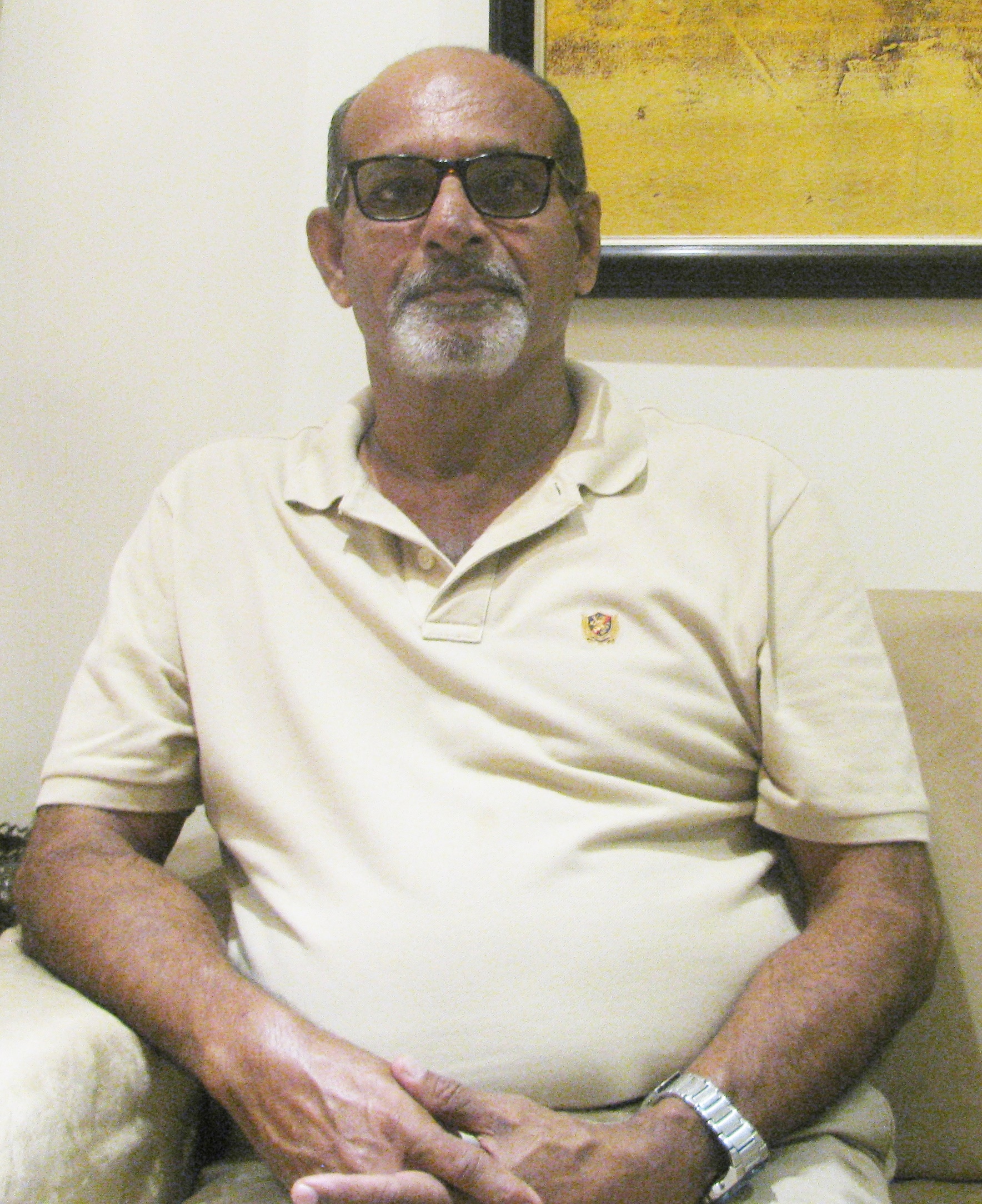
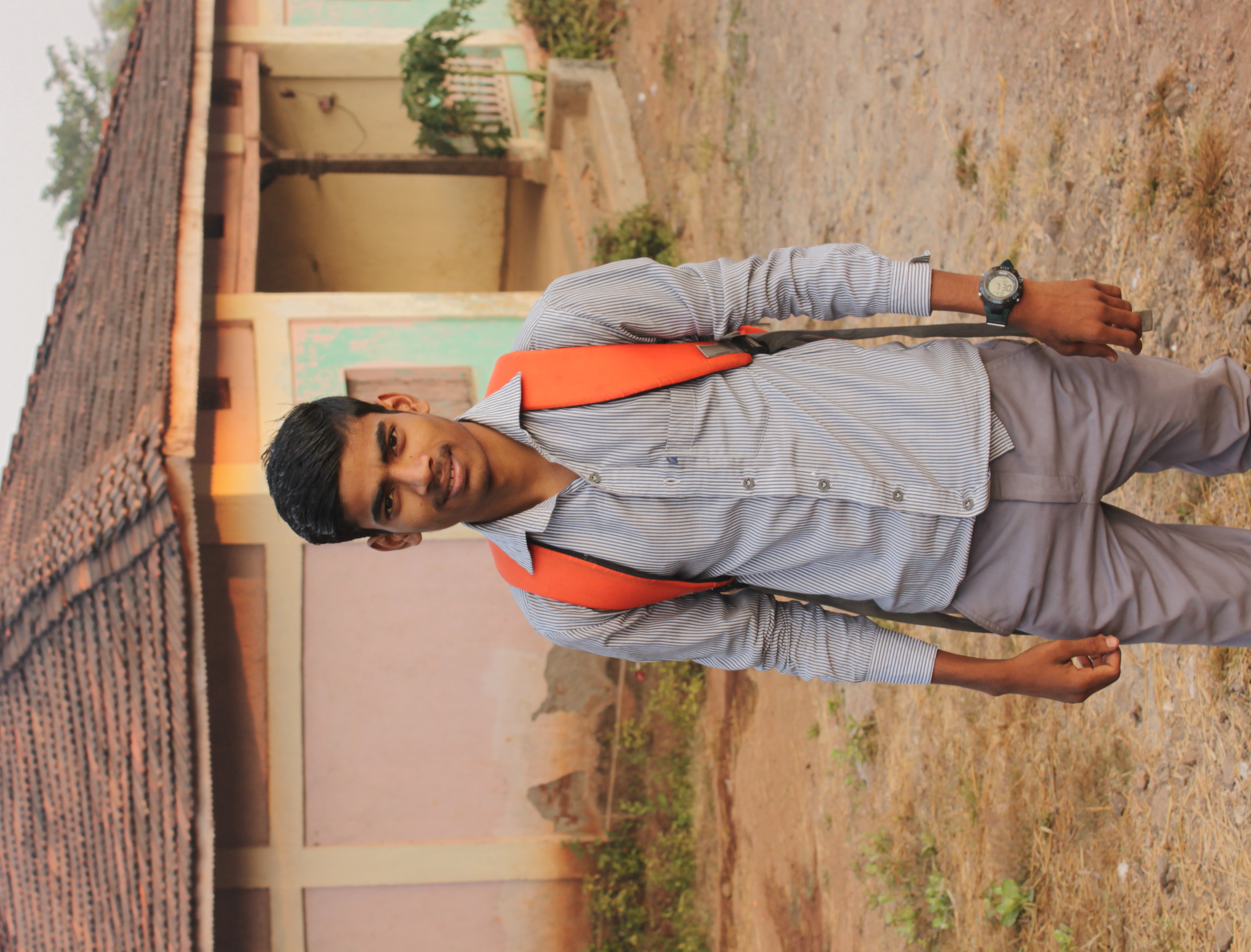
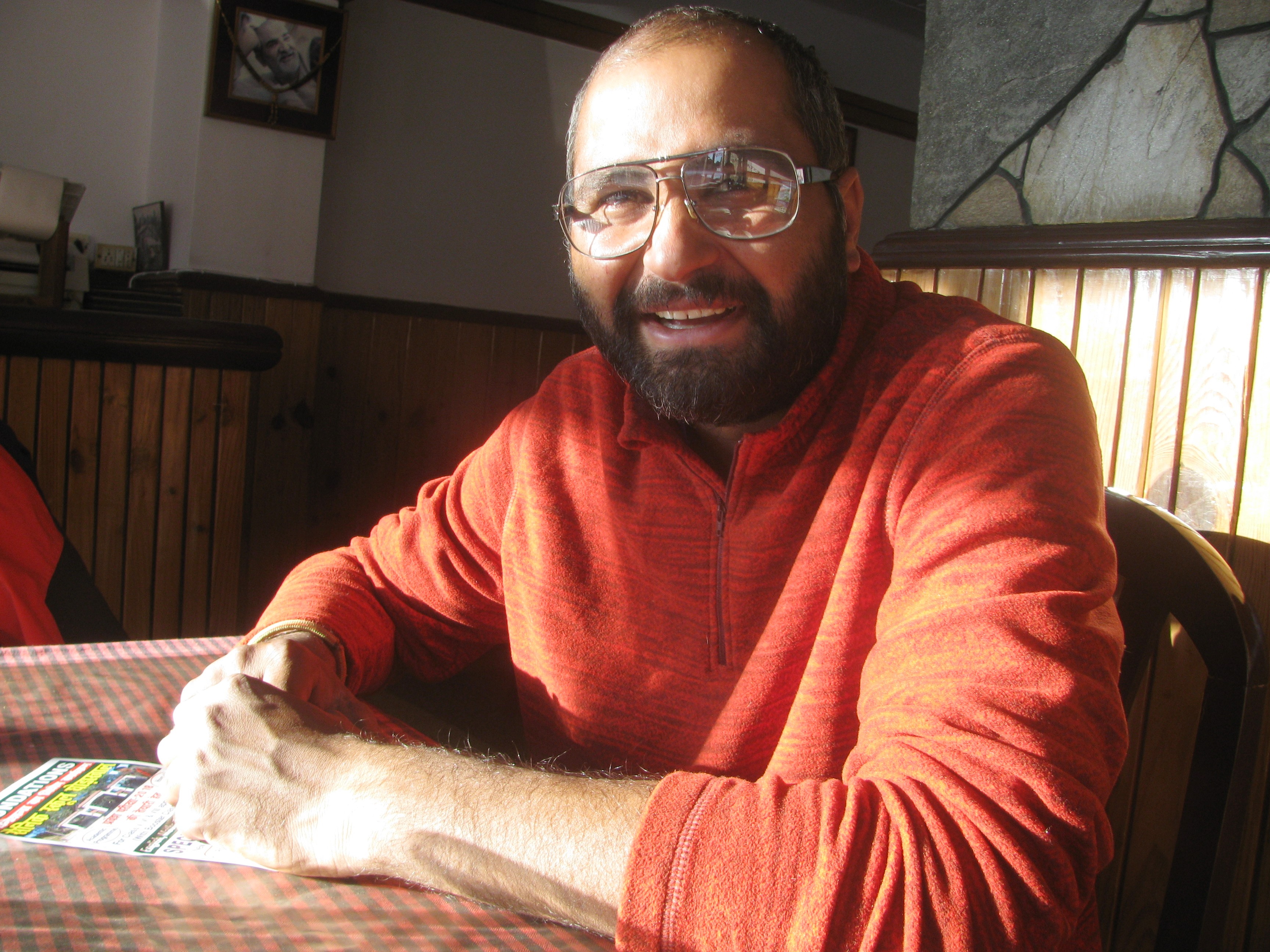
Dhruv Joshi (Photo: Shyam G Menon)

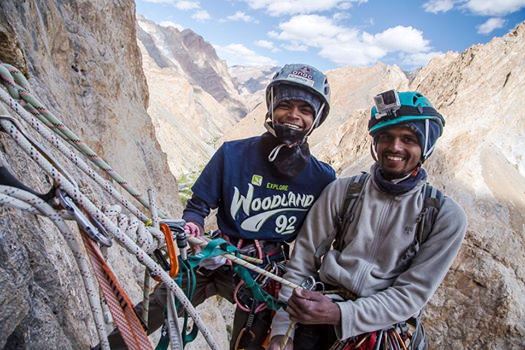
Dhruv Joshi didn’t run after big, costly peaks and foreign landscapes. Instead, he favored peaks that interested him. Two other angles engage in Dhruv’s journey. The expeditions he has been responsible for, are mostly alpine style or using small teams. As yet, these trips have frequented the area around Nanda Devi in Uttarakhand, the state he hails from.

In India, the C certificate is a document coveted by members of the National Cadet Corps (NCC).

When it comes to recruitment in the armed forces, C-certificate holders have an edge over other candidates.

Dhruv Joshi wasn’t short of reason to attempt joining the forces. He hailed from Uttarakhand, a state were employment in the military and paramilitary is widespread. His father had retired as head constable in the Border Security Force (BSF) and the person he looked up to – his uncle, Colonel J. C Joshi – was an illustrious army officer, reputed in the country’s mountaineering establishment. Col Joshi had been part of many climbing expeditions in the Himalaya, served as commandant of the High Altitude Warfare School and been the second principal of the Nehru Institute of Mountaineering (NIM). Born November 1981 in Almora, Dhruv had grown up with some of the best views of the Himalaya for company. The peaks were visible in the distance from Dhruv’s house. His uncle told him the names of some of the mountains. Instances like an accident on Maiktoli in the early 1990s and a ringside view of his uncle coordinating rescue operations brought the specter of mountaineering home (at that time, Col Joshi was in Nainital and secretary of the Nainital Mountaineering Club).

Tackling the tricky ridge on Nanda Khat (Photo: courtesy Dhruv Joshi)

In 1996, at Col Joshi’s suggestion, Dhruv went on a trek to Pindari Glacier, organized by Altitudes High Adventure. The trek culminates in an arc of mountains, which as any mountain lover would tell you is impressive for the proximity to peaks it rewards the hiker. It is also noteworthy for another factor – the mountains here are linked to the architecture of peaks that shape the location of Nanda Devi, at 25,643 feet, the second highest peak in India and among the world’s most beautiful. A twin peaked-mountain, its western summit is the main one; the eastern summit – referred to as Nanda Devi East – is lower at 24,390 feet. In mountaineering Nanda Devi is revered for some interesting attributes. Access to the mountain is tough and took long to be figured out. Very few mountains have the magnificent setting it has, surrounded by high peaks providing a protective wall. Twelve of these peaks exceed 6400 meters (approximately 21,000 feet) in elevation. Further, Nanda Devi rises steep and high from the glacier at its immediate south western base. This rise measures about 10,800 feet and occurs over a span of 4.2 kilometers making the mountain pretty steep to climb. The Pindari Glacier hike ends just beyond the rim of the outer wall of peaks guarding Nanda Devi. The peaks at hand here include Baljuri, Panwali Dwar, Nanda Khat, Changuch and Nanda Kot of which Panwali Dwar and Nanda Khat are categorized as on the outer wall of the Nanda Devi sanctuary while Nanda Kot is just outside it. In between this arc of peaks lay Traill Pass; it links the Pindari Valley to Milam and Munsyari. Standing at Zero Point, where the hike to Pindari Glacier concludes, the most dominant peak would seem to be Changuch (20,741 feet). It showed up prominently in photos Dhruv took. When he shared the images with Col Joshi, the veteran mountaineer said that it hadn’t been successfully climbed yet. Dhruv remembers telling himself that he should take a shot at it some time. Right then however, he hadn’t done any mountaineering course and Col Joshi had been periodically reminding him of the need for it. The impetus manifested when despite C certificate, Dhruv’s attempts to join the army and be like his uncle, failed. In all he made seven attempts to enlist; all of them to the same disappointing result. It was time to look at life differently.

By 2004, having completed his BSc from Kumaon University and elected to do his MCA through correspondence course from the Indira Gandhi National Open University (IGNOU), Dhruv found himself in Delhi. In 2005, he eventually got around to doing his Basic Mountaineering Course from NIM. Same year, thanks to his uncle, he attended celebrations around the fortieth anniversary of the first Indian ascent of Everest (Col Joshi had been on that team). At that function in Delhi, he met Junko Tabei, the Japanese mountaineer who became first woman to ascend Everest and Maurice Herzog, the French mountaineer who in 1950 became the first person to climb an 8000 meter-peak when he and Louis Lachenal reached the summit of Annapurna in Nepal. For young man dreaming mountains and recently trained in the sport by mountaineering institute, this was interesting. Dhruv also met Col J.S. Dhillon, at that time principal of the Himalayan Mountaineering Institute (HMI) in Darjeeling. In March-April 2006, Dhruv did his Advanced Mountaineering Course from HMI. It was however a year of tragedy in the family. Col Joshi’s wife passed away, he was diagnosed with cancer and an aunt met with an accident (she too would pass away). On the way back from HMI, Dhruv spent time in Faridabad with his cousin, Vikram (Col Joshi’s son). Not long afterwards, in April itself, Col Joshi passed away in Almora. That was a trying period – three deaths in the family in a year. Dhruv shifted back to Almora. By then he was also through with those appearances before the Service Selection Board (SSB) for potential recruitment in the army. In May 2006, erstwhile army aspirant found himself working with a group of school children at an outdoor camp organized by Altitudes. Dhruv liked the experience.

On Changuch (Photo: courtesy Dhruv Joshi)

Around this time, he had begun checking out the expeditions being planned by Indian Mountaineering Foundation (IMF). IMF is the nodal organization in India for mountaineering in the Himalaya. Besides administering the sport, permitting expeditions and monitoring them, it also runs its own expeditions. Dhruv was sure that he wasn’t keen on sport climbing (which too the IMF administers); he wanted to be out on expeditions in the Himalaya. The call came a year or so later. Dhruv was working a program at a school in Coimbatore in South India, when the IMF informed him of his selection for an expedition to climb Panwali Dwar (21,860 feet), under the leadership of Col Vijay Singh Thakur. In May-June 2007, along with other team members, Dhruv was tasked with specific responsibilities; the preparatory phase at IMF lasted almost two weeks. Panwali Dwar is a lovely triangle of a peak with a prominent notch interrupting the straight upward sweep of one of its ridges. Out on the mountain, the team climbed up to the notch but had to turn back from there due to bad weather. Soon afterwards, Dhruv travelled to Ladakh. This time, in one of those moves people wishing to be at altitude do – they work any role they get just to be in the mountains – he had joined an expedition to Chamser Kangri (21,775 feet) as a High Altitude Porter (HAP). Work as HAP typically means you get a chance to climb the peak. Although he climbed Chamser Kangri, Dhruv didn’t find it challenging. It made him think of Panwali Dwar. The peak in Ladakh and the one in Kumaon were similar in height but Panwali Dwar was a challenging climb. Needless to say, thoughts of Changuch too returned. It was yet to receive a first Indian ascent. There had been a joint expedition to the peak by the IMF and Indian Navy; it resulted in two casualties.

Amid this, in 2008, Dhruv was assigned an IMF expedition to Maiktoli (22,320 feet), led by Col Vijay Singh Thakur. Maiktoli, which is on the outer wall of the Nanda Devi sanctuary, is approached through the Sundardunga Valley. Just as Changuch dominates Zero Point, Maiktoli dominates Sundardunga. Dhruv fell into the bergschrund of the mountain’s glacier when a snow bridge snapped under the combined weight of person and load. Stuck some seven feet below in the crevasse, he remembers sensing void below. Somehow he climbed back up. This was followed by bad weather and an avalanche. Eventually, having made it as high as 6200 meters (20,340 feet) or so on the peak and beset with corniced ridges ahead, the expedition turned back. It was yet again an unsuccessful trip but for a change, this one had yielded learning. In 2009, Dhruv applied afresh to the IMF for a seat on any of its expeditions. In the interim, he went on expeditions to Shitidhar (17,224 feet) and Ladakhi (17,536 feet) in Himachal Pradesh; in both cases his role ended with being at summit camp. When IMF finally called, it was to inform that he had been assigned to a joint BSF-IMF expedition to Plateau Peak (26,679 feet) in Ladakh. Among those on this trip was Loveraj Singh Dharmshaktu, a BSF officer who would go on to be the Indian climbing Everest the most number of times. It was a big team; Dhruv remembers knowing many of them from before – they were either from the hills (like him) or former course-mates from mountaineering institutes. Plateau Peak was an unclimbed peak then. In the month-long expedition, the team made it up to around 6800 meters (22,310 feet) before turning back.

View of Nanda Devi from the upper slopes of Changuch (Photo: courtesy Dhruv Joshi)

The name of British mountaineer, Martin Moran, is well known in Kumaon. In May-June 2009, Dhruv’s pet project, Changuch, received its first ascent from a team led by Martin. In August 2009, aware of Dhruv’s obsession with the peak, Altitudes – the company he worked for – launched an expedition to Changuch. The team made it up to Advanced Base Camp (ABC) at 14,670 feet. “ There is a rock wall here, which is tackled to make one’s way to Traill Pass. You climb this and then cross to the other side for the route to Changuch. We couldn’t find the proper route,’’ Dhruv said. The expedition turned back. In the heavy snowfall that followed, some of the porters ran away. Supplies were not consolidated. It was a tough situation. Somehow they wound up the trip and came down. Dhruv’s employer, the owner of Altitudes, assured him that they would return to attempt the peak again. All that Dhruv could think of was – so many expeditions done and still only one easy peak – Chamser Kangri – for summit. It hurt.

Dhruv wrote to Martin Moran explaining that he had been on expeditions including an aborted trip to Changuch. So, could he work for Martin? The reply he got suggested that he try and be liaison officer for Martin’s upcoming expedition to Satopanth (23,212 feet). In the meantime, in 2010, Dhruv noticed an option put up on the IMF website. The agency was asking visitors to suggest peaks to attempt. Dr Anil Gurtoo – whom Dhruv knew from before – had been tasked with leading an IMF expedition. Together, Dr Gurtoo and Dhruv selected Nanda Khat (21,690 feet), which stands between Panwali Dwar and Changuch on the arc of mountains at Zero Point near Pindari Glacier. Selection of peak done, Dhruv left for NIM to do his course in search and rescue. His mind was however on the proposed expedition. Almost every day, from the institute, he called up Dr Gurtoo to discuss the upcoming expedition which by now, had been approved by IMF. Conscious of his track record with only Chamser Kangri for successful ascent, Dhruv looked to Nanda Khat with hope. He knew that chances of successful summit were there. From previous trips to Pindari Glacier and higher up, he already knew the route to Camp 1. “ It seemed doable and I needed a successful summit badly,’’ Dhruv said. From his course-mates at NIM’s search and rescue course, he roped in Bharat Bhushan and Takpa Norbu (Takpa was also Dhruv’s batch-mate for basic mountaineering course). He also consulted the late C. Norbu, a senior instructor at NIM and among the best instructors the Indian mountaineering fraternity has known, for other potential candidates. The next addition was Chetan Pandey from Almora. New IMF rules required that woman mountaineers be mandatorily included. Three years earlier, in 2007, Dhruv had met Wallambok Lyngdoh at IMF. Now, given his need to know more about a woman climber from Meghalaya in India’s north-east, he called up Meghalaya Rock Climbing and Mountaineering Association and to his surprise, Wallambok answered the phone. The latter not only provided the needed details but also joined the team himself.
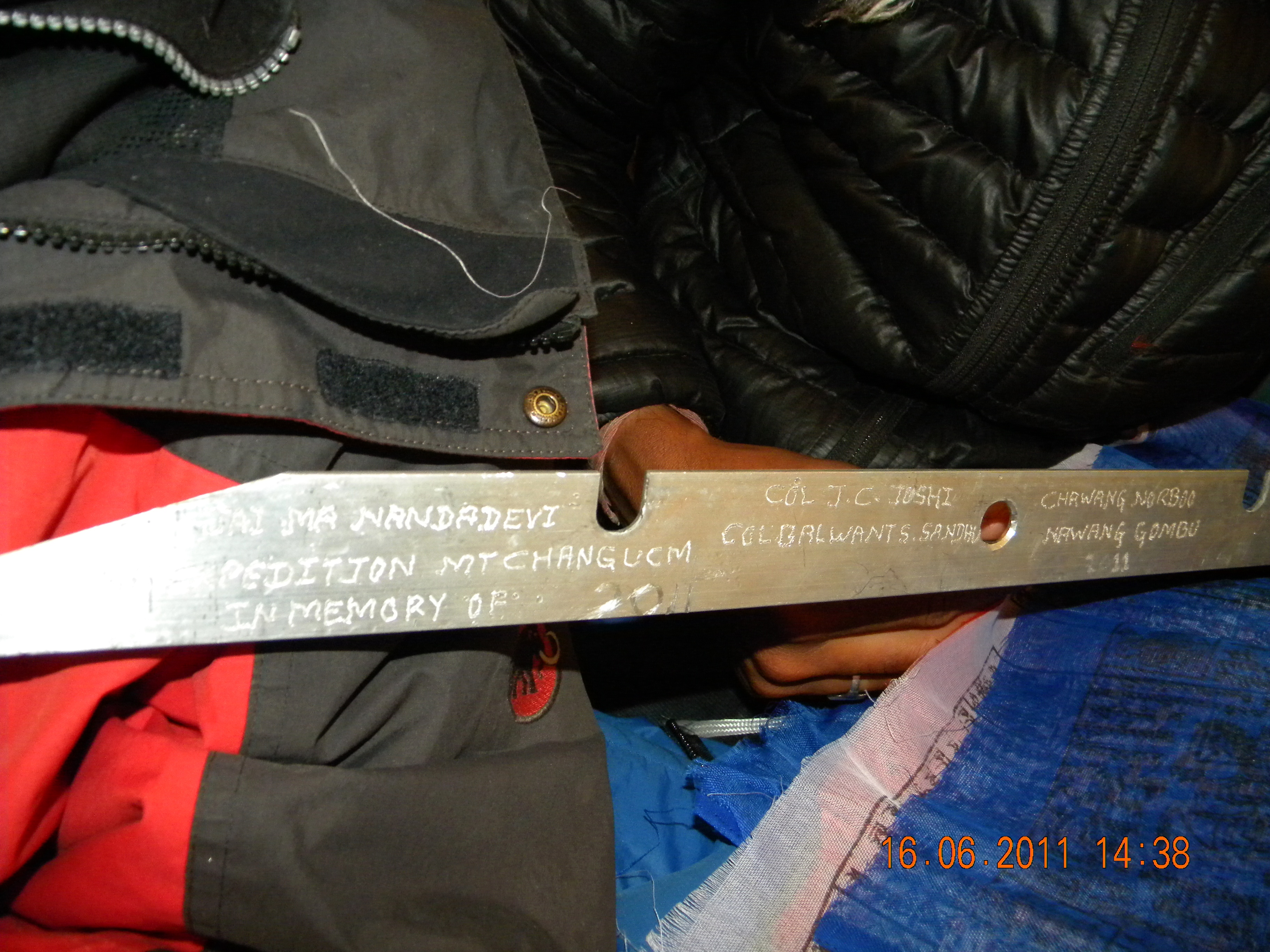
The snow stake which was left on the summit of Changuch. It has engraved on it, the names of senior mountaineers, to whom the expedition was dedicated (Photo: courtesy Dhruv Joshi)

The Indian style of climbing has traditionally featured large expeditions. Some military and paramilitary expeditions have even smacked of siege. Veteran mountaineer, Col. B.S. Sandhu, who was overseeing the Nanda Khat expedition, wanted the team to attempt the peak alpine style. This meant minimum support staff overall with climbers doing everything themselves on the mountain. As Dhruv had predicted, progress was smooth till ABC near the rock wall above Pindari Glacier. It took them three days to clear the wall. On top was a big glacial plateau. Weather was rough on June 22, 2010. Dhruv decided to make an all-out attempt for the summit. Nanda Khat has four summit humps of which, the third is the actual summit. Upon reaching the first of these summits they discovered that the approach to the second was along a knife edge-ridge. They sat astride it and traversed roughly half of the ridge on their butts; potential fall looming to either side. Around 4 PM they reached the actual summit. From that high point, Dhruv recalls, they looked towards Changuch and Nanda Kot, seeking climbing routes on their slopes. Then, the weather deteriorated. There was thunder and lightning and static electricity could be felt. About 8.30 PM they were able to get back on their return route; they were back in camp by midnight. Altogether, the summit bid took roughly 21 hours and thirty minutes. It was realized later that at least a part of the route taken by the team was new; no one had done that traverse earlier. It was now time for the Satopanth expedition with Martin Moran. “ Martin talks little. He is usually a serious person,’’ Dhruv said. He went with Martin and his team to Garhwal. As it turned out, bad weather ensured that Martin’s expedition to Satopanth in September 2010 was denied summit. But Dhruv considers the opportunity he got to see Martin’s management of the expedition, a chance to learn. Martin gifted him a small tent, ideal for bivouac. It was apt for mountaineer aspiring to repeat Martin’s ascent of Changuch.

In the light of the successful ascent of Nanda Khat, Dr Gurtoo recommended to IMF that Dhruv be made an expedition leader. In March 2011, Dhruv was in Faizabad when he got the call from IMF confirming his appointment. He was to lead an expedition to Changuch. “ The Pindari Valley has been kind to me. That’s where my first real summit happened and I also got opportunity to work for the first time as deputy leader and leader,’’ Dhruv said. For the Changuch expedition, Dhruv didn’t have to look far for team. He had a tried and tested team from the Nanda Khat ascent. Further, Dr Gurtoo was scheduled to lead a team to Nanda Bhanar (20,459 feet) nearby. That put old friends in the same neighborhood. Given Dhruv’s Changuch expedition was a case of attempting its first successful ascent by an Indian team and first successful attempt from the Pindari Glacier side, he got to pick his team members first. He retained Bharat, Takpa, Wallambok and Chetan. Dr Anand Vaidya from the old Maiktoli expedition came aboard as team doctor. Total team strength was eight. There were no HAPs. They hired one person for the kitchen and three helpers for the passage to Zero Point. Dr Vaidya, one team member and the lone person on kitchen duty stayed put at ABC. The rest moved up self-sustained. The route up to Camp 1 was the same as used for the Nanda Khat expedition. At summit camp, Dhruv’s walkie-talkie stopped working as did his watch and altimeter. They found there, a snow stake from Martin Moran’s expedition, which they retained as memento. The team pitched two tents – a three man-tent and the tent Martin had gifted. For summit attempt, they left the summit camp at 11.30 PM. One team member stayed back at summit camp to keep refreshments ready for the summit party when they return. The summit of Changuch was reached at 9.50 AM on June 17, 2011. For Dhruv, it was a longstanding dream coming true. “ There are two ramps before the summit. At the first ramp, Wallambok said that it was his father’s death anniversary. The rest of the team therefore asked him to go ahead. All four of us – Wallambok, Bharat, Chetan and I – reached the top. Everyone cried. Takpa was last person up. He was bewildered to find a party of grown-ups crying on the summit,’’ Dhruv said laughing. Given Nanda Kot was covered in clouds it was difficult to compose a photograph as proof of ascent. So they left behind Takpa’s prayer flag and a snow stake with the names of senior climbers they had dedicated the climb to, inscribed on it. By 11 AM they commenced return. Takpa’s prayer flag could be seen through a zoom lens from lower camp. Dhruv dedicated the climb to Col. Joshi, Col. B.S. Sandhu, Nawang Gombu and C. Norbu. Their names feature on the snow stake left on the summit of Changuch. Dhruv didn’t rest content with Changuch in the bag.
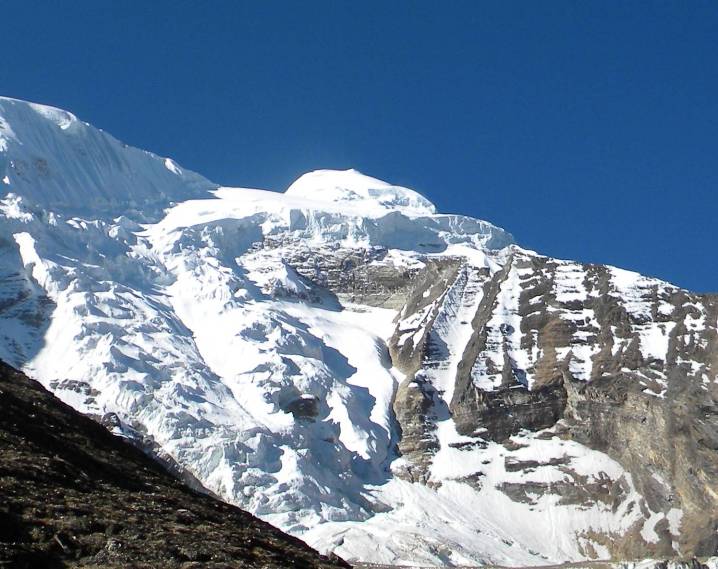
Kuchela Dhura (Photo: courtesy Dhruv Joshi)

One of the peaks visible from Changuch summit camp was Kuchela Dhura (20,650 feet). It extends at a tangent from the Nanda Kot massif, on the Munsyari side of the Pindari-Munsyari divide. It was unclimbed. Access would be through Lawan Glacier; the glacier is fed by the snows of Kuchela Dhura, Nanda Kot (22,510 feet), Changuch, Nanda Lapak (18,970 feet), Peak 6041 and Nanda Devi East.  Dhruv’s proposal for an expedition to attempt Kuchela Dhura in 2012 was approved by the IMF. An eight member team including Takpa, Chetan, Bharat, Wallambok and Dhruv was pieced together. At the same time, Dr Gurtoo took a four person team to Nanda Kot. Base Camp for Kuchela Dhura was established on flat ground near Naspanpatti on the way to Nanda Devi East Base Camp. Kuchela Dhura was totally new on climbing’s radar; no previous climbing data existed. The team decided to access the peak via its col with Nanda Kot, which had been the route of an old Japanese attempt on Nanda Kot. Summit camp was set up on the col at “ roughly 6200 meters,’’ ie around 20,300 feet. “ It was a very windy camp and most members were not feeling well,’’ Dhruv said. Two members descended to lower camp. Of the remaining, Bharat left after one night.

On summit day, Dhruv and Wallambok proceeded to the summit. “ It was a sharp ridge; quite unlike topographic maps would have you imagine. From the summit camp, summit should have been approximately four kilometers away horizontally. We covered roughly three kilometers. Then we found ourselves on the lip of a big V-shaped cleft. To get across that gap, you had to climb down and then climb back up. It was lose rock. We deemed it unsafe. So we returned to camp,’’ Dhuv said. On return, Dhruv and Wallambok were dispatched on an IMF expedition to climb Rimo I in Ladakh. The expedition had its highest camp at 7020 meters (23,031 feet), then, turned back owing to bad weather. Soon after the 2012 failed bid on Kuchela Dhura, Dhruv submitted fresh mountaineering proposals to IMF including another attempt on Kuchela Dhura. In 2012 December, Dhruv tried a winter ascent of Baljuri (roughly 19,500 feet). It is the smallest of the peaks in the arc at Zero Point in Pindari Valley. The attempt failed. He would try the peak unsuccessfully in September 2015 and April 2016. On all occasions bad weather forced him to give up. Small or big, a peak can be challenging when it wants to.

In Indian arranged marriages, once the parents have spoken to each other, the prospective bride and groom are set up for a face to face meeting in the presence of elders. On May 23, 2013, as part of a proposed arranged marriage, Dhruv went to see a girl. That ritual done he departed next day to take a client across Traill Pass, which lay between Nanda Devi and Changuch at a height of 17,428 feet. The team spent three days at Base Camp during which time the client retired from the attempt but urged that the rest of the team proceed up the pass. On the sixth day the team – now three people; Dhruv, Bharat and Vineet Kumar Saini – climbed the rock wall above Pindari Glacier. On the seventh they crossed Traill Pass. By the tenth day, they were in Munsyari. “ It was all alpine style,’’ Dhruv said. They got back to Delhi to news of the Kedarnath floods. In August 2013, the second attempt on Kuchela Dhura got underway. Dhruv was leader; Wallambok, deputy leader. Others in the team included Vijay Singh Rautela, Chitramohan, Vineet, Ram Singh Lodha, Karan Kumar and Dr Vaidya. They decided to attempt the peak via a different route. They decided to attempt it along a hanging glacier that dropped down from the summit. This way, the V-shaped cleft and its unstable rock, could be avoided. They successfully crossed the glacier and established summit camp on the col leading to the main summit. On September 6, 2013, past 8.20 AM, the team reached the summit in white out conditions. Two months later, in November 2013, Dhruv got married to Meenakshi, who he had met just before leaving for Traill Pass. He had told her in jest that he would marry her if he successfully crossed the pass.
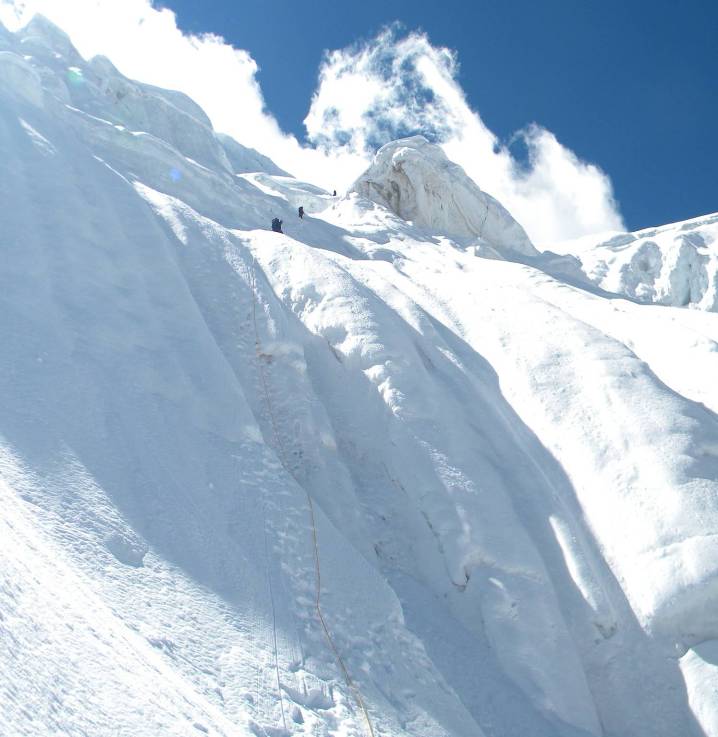
Climbing Kuchela Dhura. The climbers are visible as specks in the top half of the picture; their rope is the faint red line down the middle of the snow clad face (Photo: courtesy Dhruv Joshi)

In May-June 2014, Dhruv was back, this time attempting Latu Dhura. Information on the Internet puts the height of this peak at 6392 meters (20,971 feet). Part of the idea behind this attempt was to recce potential routes on Nanda Devi East. Besides Dhruv, the team included Bharat, Vineet and Karn Kowshik. There were also members drawn from a recent outing with the IMF. The Latu Dhura expedition was unsuccessful courtesy unstable ice. According to Dhruv, Latu Dhura remains candidate for another attempt, another time. Also on the list of mountains to attempt are Nanda Devi East and several of the unclimbed spurs on the outer wall of the Nanda Devi sanctuary. Nanda Devi East rises on the eastern edge of the sanctuary wall and is open to climbing from the eastern side. “ My dream project – that would be traversing the ridge linking Nanda Devi main summit to its east summit,’’ Dhruv said. Nanda Devi sanctuary is a restricted area. At the time of writing this article, it was well over three decades since the mountain – religiously important locally and home to a fragile ecosystem – had been closed for climbing. For the present, Dhruv had a more realistic project to chew on – winter ascents. In 2016, he started an outdoor company, Himalpinist, along with Vijay Singh Rautela and Vineet Kumar Saini. Dhruv reasons that during the company’s many treks in the Johar Valley he should be able to position gear and what he needs for a winter climb of nearby peaks, aptly, in advance. Then during winter, he should be able to come in light and try ascending the peaks, alpine style.

(The author, Shyam G Menon, is a freelance journalist based in Mumbai. Height of peaks is as available on the Internet. This article is based mostly on a conversation with Dhruv Joshi.)          
NANDA DEVI / CLIMBERS’ PERSPECTIVE

Harish Kapadia (Photo: by arrangement)

Harish Kapadia is among India’s best known explorers of the Himalaya. Trekker, mountaineer and author of many books, he was awarded the Patron’s Medal of the Royal Geographic Society. More recently he was conferred the Piolet d’Or Asia Lifetime Achievement Award by the Union of Asian Alpine Associations. He was Honorary Editor of the Himalayan Club Journal for over three decades. He spared time to talk to this blog about Nanda Devi. The interview helps anchor other articles on climbs of Nanda Devi and peaks in the vicinity, hosted on this blog. Excerpts from a chat in December 2017:

What makes Nanda Devi unique among mountains?

Nanda Devi and the sanctuary the mountain is located in, is roughly speaking shaped like an `E,’ albeit a curved one, not angular. Nanda Devi main and east peaks form the middle slash. The mountain is surrounded by a wall of high peaks. If I remember right, on the average that wall is around 21,000 feet high and it has approximately 20 peaks above 20,000 feet in elevation. Within the walled area there are four major glaciers. Their meltwater comes out through the Rishi gorge. It is very deep and tough to navigate. It took a long time to find the way in; Bill Tilman and Eric Shipton eventually accomplished the task in 1934. All this makes the mountain special. Further, locally, the mountain is treated as a goddess. It is seen as a bliss giving goddess. The cold winds blowing in from the high plateau of Tibet are blocked by Nanda Devi and the wall of peaks surrounding the mountain. Some of it falls as precipitation and snow in the Nanda Devi sanctuary. As a result of this blocking of winds, Uttarakhand and the plains of Uttar Pradesh are shielded from cold conditions that could have affected the region’s agriculture. This role of Nanda Devi and the surrounding peaks can be understood better from Tibet, where they show up on the Indian side as a barrier. You can see this from the foot of Kailash.

Are there other peaks with a similar setting or is Nanda Devi unique in terms of the immediate surrounding geography?

I would say Nanda Devi is unique.  There are other mountains with adjacent peaks and the appearance of a group. But nowhere do you have a sanctuary like this. In fact, thanks to the peculiarity of its local geography and layout, the Nanda Devi sanctuary has its own weather system. Clouds from the outside traveling at a height of up to 17,000-18,000 feet cannot enter the sanctuary due to the surrounding mountain wall. However, by afternoon on most days, clouds funnel in from lower altitudes through the passages and saddles in this mountain architecture causing rain and snow in the sanctuary. By evening, things clear up.

You have been fortunate to spend time inside the sanctuary. Can you describe the experience?

The route is challenging but beautiful. From Malathuni Pass you descend 4000-5000 feet to Dibrugatta and then you go all along the Rishi Gorge. The path is steep. As you enter the Rishi Gorge, you have to climb a stiff rock wall posing nasty consequences should you fall. You enter the sanctuary from the west. From there you proceed inside. It is a very nice, beautiful area. Because of the clouds coming in, everyday afternoon it would rain and snow. By 3 or 4 PM, it would clear up. We used to call this the matinee show. On one occasion we were in the sanctuary to climb Devtoli peak, which stands on the southern sanctuary wall. Having climbed it from inside the sanctuary, we decided to delay our return to camp because we didn’t want to be caught in the matinee show. So we waited on the summit, till the weather cleared up below.

In mountaineering, how prized is it to climb Nanda Devi and do the traverse between the main peak and the east peak?

That traverse is an absolutely challenging experience. It has been done only once before by an Indo-Japanese team. Earlier, an Indo-French team had tried it but they did not succeed. The Japanese did it in a thorough fashion. The traverse is very unique. But otherwise, the east peak has been climbed several times now; the main peak has also been climbed four to five times. The sanctuary has been closed since 1983. Had it been open, more people would have attempted the summit. The reason given for closing the sanctuary was – environment. Successive expeditions had contributed to garbage accumulating in that pristine area. It cannot be denied. But a part of the reason for closing the sanctuary would have been the failed attempt to install a nuclear powered device on top of Nanda Devi by a joint Indo-American team in the 1960s. It was an enterprise undertaken by the intelligence agencies of both countries. China was conducting its nuclear tests in Tibet and the idea was this device on top of Nanda Devi would be able to detect any such test. If there is a nuclear explosion, then the isotope on Nanda Devi would react – that was the logic. While they were taking the device up, bad weather set in. Monsoon was approaching. So they cleared a platform on the mountain’s slopes and secured the device there, planning to return in autumn to recommence their efforts. When they returned in autumn, the device was missing. This was in 1965-66. For the next decade they kept on looking for it. I suspect this issue of the missing nuclear device may have played a role in the closure of the sanctuary. A similar nuclear powered device was eventually installed on top of Nanda Kot. It was removed after a few years, given new technologies for monitoring had developed by then.

After the Nanda Devi sanctuary staying closed for years, I was leader of a team from the Indian Mountaineering Foundation (IMF) that went in to take stock of the situation. We found few signs of the sanctuary having been actually closed to people from the outside, despite it being officially shut. The trails leading to Nanda Devi appeared regularly used and there were multiple trails even within the sanctuary. The sanctuary has four sections. Seeing how poorly the closure had worked, I asked subsequently that at least a limited number of mountaineering expeditions – say not more than two teams per section of sanctuary per year – be officially permitted with adequate regulations in place. A few officially permitted teams in the sanctuary from time to time would also serve to keep an eye on what was going on. But the suggestion was not approved by state authorities. Alongside there is also the prevailing decision by Parliament that the sanctuary be closed. A generation or two of Indian mountaineers have lost their chance to see the main peak up close.

Given its height from bottom to top and the gradient of climb, is Nanda Devi among the tougher mountains to climb?

One of the tougher mountains – yes it is. Is it the toughest? No. However one needs to draw a distinction between known routes on the mountain and unclimbed ones. One of the ultimate ascents in my opinion – waiting still to happen – is the climb of the west face of Nanda Devi. From bottom to top, this should be in excess of 10,000 feet. It is steep rock. The north face of the mountain is also difficult. But it was climbed by the Americans. The regular route on the main peak is tough but not impossible. And that traverse – that is yet to be repeated. The traverse linking the two summits is two kilometers long and at an average height of 22,000 feet. It is very challenging.

There are some other fantastic climbing challenges also remaining in the Indian Himalaya. In Ladakh you have one of the faces of Saltoro Kangri II. That peak is hard to access for climbing because it is right on the border. Then, there is a peak called Hawk on the Siachen Glacier.

(This interview is not wholly verbatim. The original text, which was conversational in nature, was edited for focus on Nanda Devi, particularly the mountain from a mountaineer’s perspective. The edited text was approved by Mr Kapadia before being published here. The author, Shyam G Menon, is a freelance journalist based in Mumbai.)
NANDA DEVI / ACCOUNT OF A 1981 EXPEDITION

Nanda Devi as seen from BrijGanj Dhura (15,308 feet), the pass between Ralam and Milam valleys. To the left is Nanda Devi East (24,390 feet) and to its immediate right is Nanda Devi Main / West (25,643 feet). This photo was taken in mid-October 2011 (Photo: Punit Mehta)

This article provides the account of a 1981 expedition to Nanda Devi undertaken by the Indian armed forces. The expedition by paratroopers was led by Major K. I. Kumar KC; Captain Lakha Singh was deputy leader. It featured two teams. Group Captain P. Venugopal SC (Retd), who served several years as Chief Instructor of the Paratroopers Training School, was leader of the team attempting the main summit (25,643 feet). Wing Commander Unni Krishnan Palat SC (Retd) was part of the team attempting Nanda Devi East (24,390 feet). In events that unfolded, he had to assume a leadership role on the east peak. Also on the expedition’s agenda was doing the traverse linking the two peaks, the first time an exclusively Indian expedition would be trying it. Across both peaks, the expedition suffered casualties; five climbers lost their lives. Nanda Devi is one of the tougher mountains to climb. The approach to the mountain is difficult; once accessed, the climb is steep and challenging

The 1981 expedition was among the last climbing the mountain from inside the sanctuary and among the last to attempt the mountain’s main summit in the era the main peak was open for mountaineering. In 1982, the Nanda Devi National Park was established. In 1983 the Nanda Devi Sanctuary was closed to mountaineering expeditions. With that, civilian access to the main summit ceased. In 1988, the Nanda Devi National Park was declared a UNESCO World Heritage Site. Nanda Devi East remains open for climbing; its climbing route can be accessed from outside the sanctuary wall. In 1993, a 40 member-team of the army’s Corps of Engineers was given special permission to climb Nanda Devi. Group Captain Venugopal’s account of the 1981 expedition was published as part of an interview with him, in the annual magazine of Sri Shankara College, Kalady, where he had studied years ago. He provided me a copy of the magazine to flesh out a narrative besides noting down his observations and mailing them across. Wing Commander Palat wrote about his experience in one of the brochures brought out by his unit. He scanned and mailed that across to refer, edit and publish afresh. The following narrative is a mix of all three inputs. For ease of reading, after formal introduction stating rank, military personnel have been referred to by name. The reference by name is also in part to remain true to the tenor of Palat’s narrative, which was based on his expedition diary. – Shyam G Menon

In 1981, the Indian Army’s paratroopers launched an expedition to scale both Nanda Devi West and East and traverse the ridge linking the two summits. The traverse, at an altitude of over 22,000 feet, had been done only once before, by an Indo-Japanese team in 1976. According to Venugopal, an Indo-French team tried to climb the two peaks and do the traverse in May 1975. They climbed both the peaks but failed to execute the traverse. There were two attempts made on June 18 and 19; both had to be abandoned owing to bad weather.

At the time the 1981 project was announced, Unni Krishnan Palat was a Parachute Jump Instructor. He was selected as a climber along with his colleague Venugopal. Besides K.I. Kumar, Lakha Singh, Venugopal and Palat, other members of the team included Deputy Leader Namgyal, Phurba Dorji; Captain Srivastava, Captain Premjit Rokhpa, Captain Shekhawat, Captain P.D. Punekar (medical officer), Lieutenant Chib, Asst Political Leader Nima Tashi of the Special Frontier Force and a few more climbing members and members of support staff. In all, the party consisted of 20 climbing members plus support staff and high altitude porters, Venugopal said recalling the expedition.

Group Captain P. Venugopal SC (Retd) (Photo: Shyam G Menon)

The team left Agra – where the Paratroopers Training School is – by road on August 18 and reached the village of Lata near Joshimath, on August 22. On August 27, an advance party led by Lakha Singh and consisting of four climbers and 80 porters left Lata for Base Camp, a ten day-trek. The rest departed for Base Camp on September 1. Base Camp was established by September 12, on the glaciers of Nanda Devi South Basin at a height of 16,000 feet. The expedition was split into two teams; one to attempt the higher main summit and the other for the lower east summit.

The Indian Mountaineering Foundation (IMF) had a team of men and women in the sanctuary attempting the main peak. This was an important expedition. According to Venugopal, in 1949, after seeing Nanda Devi in the Indian Himalaya, American mountaineer Willie Unsoeld had decided to name his daughter after the mountain. Twenty seven years later, he came to Nanda Devi, co-leader of an expedition attempting the peak. His daughter Nanda Devi Unsoeld, who was part of the expedition, died on that trip.  Consequently it was popularly believed that the mountain will not receive woman climbers on its top. IMF’s mixed expedition of 1981, aspired to put the first set of Indian women on the summit of Nanda Devi; something it eventually did successfully. The presence of that team on the mountain meant shortage of space to pitch tents, from Camp 2 upward. The paratroopers’ expedition being military was told to delay its departure. “ We were asked not to proceed beyond Base Camp till September 25 or till the other expedition returned, whichever happened earlier,’’ Venugopal noted in the interview he gave his old college. The delayed departure meant they could end up climbing in harsh conditions.  In additional observations he mailed in, Venugopal noted that from mid-August onward, temperatures inside the Nanda Devi sanctuary drop drastically with winds at higher altitudes picking up speed, often creating jet streams. Beyond mid-September, it becomes very tough to stay inside the sanctuary due to sub-zero temperatures, high wind speed and white-out snow conditions.

Unlike on the west peak, there was no embargo on the army expedition attempting Nanda Devi East. The team therefore decided to focus first on Nanda Devi East, opening the route and sending up supplies and men. Palat was with the Nanda Devi East team.

By September 14, Prem’s party established Camp 1. Palat set off to Camp 1 from Base Camp with a load at 0600 hours. “ I appreciated the efforts of Prem and Dorji better when I carried a load myself on a route threatened by falling rocks with at its end, a steep climb of almost 800 feet up to Longstaff Col,’’ he noted. The next day, the complete Nanda Devi East party moved out of Base Camp to a Dumping Point below Longstaff Col. Dorji and Palat went up at 1630 hours. When they emerged from their tents at Base Camp, Palat recalled, Sherpas Pasang and Sonam coming to see them off; they had a flask of hot tea and insisted on carrying their backpacks. After accompanying the two climbers for half the distance, they gave them tea, embraced them and went back down wishing us luck. Longstaff Col (19,390 feet) is integral to climbing Nanda Devi East. It is a saddle on the ridge between Nanda Devi East and Nanda Khat and was first climbed by Dr T.G. Longstaff along with two Swiss guides in 1905. A rather poignant video on the garbage left behind by previous expeditions shot by Anindya Mukherjee during his 2014 expedition to Nanda Devi East (available on YouTube) provides a feel of Longstaff Col. The ridge is narrow here. Longstaff Col connects to the South Ridge climbing route on Nanda Devi East. The South Ridge route was pioneered by Polish climbers in 1939. Following the closure of the Nanda Devi sanctuary to mountaineering expeditions, Longstaff Col has been accessed from the Lawan glacier side, which falls outside the outer wall of the sanctuary. A doctor, explorer and mountaineer, Longstaff is also regarded as the first person to climb a peak of over 7000 meters, when in June 1907 he reached the summit of Trisul (23,360 feet). Trisul is part of the ring of peaks protecting the Nanda Devi sanctuary.

Wing Commander Unni Krishnan Palat SC (Retd) (Photo: by arrangement)

On September 16, while doing a load ferry to Camp 1, a falling stone hit Palat on the stomach. The team decided to stop all movement in the stone fall-area by 1000 hours as the place was dangerous once snow, which holds rocks in place, began melting in the day’s warmth. Palat shifted the temporary camp at Dumping Point, further away from the mountain slope. It was a sound decision. A few days later, an avalanche hit the old site. Then the challenge the mountain posed began to slowly reveal itself. Further climbing became extremely difficult as the fixed ropes got buried in snow. On September 17, it started snowing at 1000 hours. Progress of Sri’s party opening route to Camp 2 was also rendered slow, given bad weather. The next day, Palat went up with another load to Camp 1. Ferrying load on the tough route began taking a toll. Two climbers fell sick and returned to Base Camp.

Tashi and Palat were to lead two different parties. But both were left with only two climbers. So on September 18, Palat decided to go up to Camp 1 and replace a climber who was stuck there after losing his crampons. He decided to form a new party at Camp 1 with himself, Tashi and Sherpas, Tshering and Phurba. He set off alone from Dumping Point at 0800 hours and made it to Camp 1 in three hours. Two tents perched precariously on the narrow ridge. That was the camp site. On either side were sheer falls. On September 20, he moved up to Camp 2 at an altitude of 21,000 feet with his team under white-out conditions. “ We dug up the snow and cleared a small area to pitch our two 2-person tents to establish Camp 2. Cooking with a pump stove with no pin was tough. So we had Tibetan tea and biscuits and retired,’’ Palat wrote in his diary.

Over September 21 to 25, the team opened the route and fixed ropes between altitudes of 21,000-23,000 feet. It was not easy. “ Strong wind and continuous snowfall made things worse. Irritation came in the form of load and rations not coming up from lower camps. Plus, there was the loss of our only good ice hammer in a crevasse. We all looked forward to our 1800 hours radio contact with Base Camp and other camps perched on the main and east peaks. When that happened, there was exchange of notes and jokes and pep talk to boost morale. Sometimes Prem played tunes on his mouth organ,’’ Palat noted. On September 22, they stumbled upon an old Japanese camp buried in the snow. They kept working their way up the sharp ridge leading to the peak, establishing Camp 3 by September 25.

The next day, Prem’s party went up to occupy Camp 3 and open the route to Camp 4. Palat descended to Camp 2 to ferry load. By September 28, it was snowing heavily. It snowed so heavily through the night that Palat feared his tent may collapse under the weight of snow. Venugopal from the Nanda Devi main summit team and Prem from Camp 3 reported similar foul weather. To be watchful of when working in the mountains, especially amid snowfall and bad weather, is frostbite. It occurs when cold temperature causes skin and other tissue to freeze. Hands, feet and face are most commonly affected. Not to be confused with frostbite and according to Wikipedia, capable of affecting individuals with a predisposition for it, is chilblains. It is tissue damage caused by exposure to cold and humidity. To his horror Palat discovered that Camp 3 did not have a first aid kit. So he inquired from the doctor at Base Camp details to prevent frostbite. On September 29, Prem’s party moved up to occupy Camp 4. “ We did a ferry for them. I was getting worried that my team mates and I may not have enough strength left in us after such regular load-carrying above 22,000 feet,’’ Palat wrote. Next day, he went up to Camp 4 with load. By then two of Prem’s party had chilblains. They descended to Camp 3 with the others and then further down to Base Camp.

With Camp 4 in place, the summit was beginning to look realistic. On October 2, Prem and party came down to Camp 3 to rest, prior to their summit attempt. A day later, on October 3, Prem, Phu Dorji and a Sherpa went up to occupy Camp 4. But the third member returned soon complaining of chilblains. Prem’s party was reduced to two people.  On the morning of October 4, Palat dispatched a climber to join Prem before the summit attempt. “ But to our amazement, we discovered through our binoculars, early morning, two tiny specks moving towards the summit. They were Prem and Phu Dorji. Soon clouds enveloped the whole area. That was the last we saw of them,’’ he wrote in the article. That evening, there was no radio contact from the two climbers. Panic gripped the expedition, especially the Sherpas and porters, who considered it a bad omen and wanted to be off the mountain. A search and rescue mission was immediately planned.

Nanda Devi Main / West and Nanda Devi East (right). Purple dots below the east peak denote where the bodies of Captain Premjit Rokhpa and Phurba Dorji were spotted just above the mouth of a crevasse (Photo: courtesy Group Captain Venugopal [Retd])

Early morning, October 5, Palat moved up to Camp 4 with three members. The going was tough. The wind velocity had reached 100 kmph (jet stream effect) at that time. “ Very often we had to lie flat on the ice and anchor ourselves with our axes, to avoid being blown off the mountain. We staggered into Camp 4 at 1600 hours. Camp was just a two-person tent. We realized that Prem and Dorji had not gone prepared to endure the night. They hadn’t taken feather clothing for use in sub-zero temperature. I radioed the situation to Base Camp. I volunteered to conduct a search for the missing climbers. The leader cautioned us of the adverse weather and the danger to our own lives. Five of us spent a cold, sleepless night at 23,400 feet in the two-person tent,’’ he recalled.

On October 6, the team searched for the two missing climbers at an altitude of 23,800 feet. All that they found was Prem’s blood stained balaclava and Dorji’s ice axe (although their bodies were subsequently spotted using binoculars, they could not be retrieved as the climbers had fallen into an inaccessible area prone to frequent rock fall and avalanche). That evening Palat radioed his leader about his plans to attempt the summit the following day. “ He tried to dissuade me saying that the main concern was to retrieve all climbers to the safety of Base Camp. I realized that winter had approached the mountains and an attempt would have to be done immediately or we wouldn’t get another chance. Ultimately, I got my leader’s consent,’’ Palat said. Up at 4 AM the next day, Palat and his team had some Viva and pre-cooked chappathi, little realizing that would be their only meal for the next 30 hours. By the time the four of them put on crampons and roped up, it was 0700 hours. They made it to the slope above their camp in good time. There were two humps to negotiate on the ridge they were following. By 1130 hours they had only got past the first one. Our progress became slow. By 1300 hours they crossed the second hump and were on the snow field right below the summit. The summit ridge was steep. “ We dragged ourselves up and reached the top of Nanda Devi East at 1415 hours. The descent to Camp 4 was equally painful as we were thoroughly exhausted and it was getting quite cold. By 1900 hours we reached Camp 4. To our horror we found that Sri’s party of five was already there and squeezed into the two-person tent, the only shelter available. That night all of us piled on top of each other in a tent meant for just two. Melting snow was out of question. We went hungry and thirsty. In the bargain, I suffered frostbite,’’ Palat wrote.

The next day, Palat’s team descended to Camp 2 where to their relief they found food and a stove. Upon reaching Base Camp he was evacuated quickly to Bareilly Military Hospital and then to Army Hospital, Delhi. On October 9, Sri and his party of four climbers reached the summit of Nanda Devi East. It had its share of tragedy. Dayachand slipped out of his tent at Camp 4 and suffered a fatal fall.

Meanwhile on the main peak (west summit) of Nanda Devi, Venugopal’s team – as was expected of them – had stayed focused on route-opening and setting up Camp 1. By around the time the east summit bid was nearing the top, Venugopal had managed to lead his team of four to Camp 3 (23,000 feet) on the main peak. They got stuck there for four days due to white out conditions and raging wind. He got chilblains and returned to Base Camp for medical attention. Deputy Leader Lakha Singh and Havildar Kushal Singh climbed up to Camp 4 (24,100 feet). There, they got stuck for the next nine days. They had no food and water. Successive teams attempting to reach Camp 4 were beaten back by the weather. Many got injured. After recovering from chilblains, Venugopal led another team of four to Camp 4 on the ninth day in an attempt to rescue those at Camp 4. “ That night a badly dehydrated, blistered and frostbitten Kushal Singh arrived outside my tent and collapsed. I nursed him through the night. He informed us about the demise of Captain Lakha Singh at Camp 4 due to exhaustion and dehydration. Meanwhile another of my team members developed frostbite while yet another person vomited blood. At daybreak I instructed the sick team members to descend to the safety of lower camp. Then I singlehandedly evacuated Kushal Singh and reached him to the lower camp. He survived,’’ Venugopal said in the interview he gave the college magazine.

Nanda Devi Main / West as seen from the slopes leading to Ghia Vinayak (15,551 feet) in Central Garhwal, connecting the Alaknanda and Mandakini valleys. This photo was taken in end-October 2012 (Photo: Punit Mehta)

The following day, they formed a team of four with Venugopal as leader and climbed back up to Camp 3. The other members were Ki Kami, Sepoy Wangdu and Naik Gyarsi Ram, who was Venugopal’s trainee. The weather cleared up. They moved up to Camp 4. On October 16, while engaged in the summit bid and a mere 400 feet short of the main summit, Venugopal who had been experiencing blurred vision, became totally snow-blind. According to Wikipedia, snow blindness or photokeratitis is a painful eye condition caused by exposure of insufficiently protected eyes to ultraviolet (UV) rays. The website of World Health Organization (WHO) links the level of exposure, to the sun’s height (UV levels are most during mid-day and in summer), latitude, cloud cover, altitude (thinner atmosphere means less filtration of UV rays), the level of ozone and ground reflection. High in the mountains, the two factors catalyzing photokeratitis are altitude and ground reflection. While with every 1000 meters of altitude gained, the UV level rises 10-12 per cent due to thinner atmosphere, snow reflects as much as 80 per cent of UV rays.  Snow blindness is similar to a sunburn of the cornea and conjunctiva and is not usually noticed until several hours after exposure. Speaking to this blog, during the interactive composition of this article, Venugopal said that he had mistaken his progressively depleting vision to be a case of deteriorating weather. Eventually, he could see nothing. “ About 400 steps short of the summit,’’ while attempting to clip in and climb up, the anchor of the fixed rope came lose and he rolled down about 100 feet. He survived. His teammates offered to come down and take him up to the summit but he declined their offer. “ It was one of the most difficult decisions I have made. We had been climbing for nine hours and were exhausted. If the rest took me up, they would put their lives too in risk. I did not call off the climb because I knew it would be unfair on the others. The wind was blowing at 80-90 kmph. I told them to tie me to a rock and encouraged them to proceed,’’ he said. He told those proceeding ahead to keep photos as proof of summit for skepticism was bound to be high of summit reached in such conditions, so late in the season. One of the members came down and tied him to a rock. Then, those three proceeded to the summit. They returned to where the leader was, “ in about half an hour to 45 minutes,’’ Venugopal wrote in.

Their problems didn’t end there. Venugopal was blind and frostbitten on toes, fingers, nose and ears. While bringing him down tied to a rope, Naik Gyarsi Ram unclipped himself at one point, slipped and fell to his death. Venugopal survived two more falls but broke a rib. He decided to call off the descent. They spent the night in the open, exposed to minus 35 degrees ambient temperature and wind speed much in excess of 100 kmph. Factoring in wind chill, the actual cold felt by the body would have been significantly more. Thanks to their layered high altitude clothing and feathered jacket and trousers, they survived. “ It took another six days to crawl down the mountain and be evacuated by helicopter to the safety of the plains. Fifteen to twenty days after the accident, I regained my vision fully. After five months of hospitalization, three surgeries and partial loss of eight fingers and toes, I was back on my feet again. Six months later, I successfully argued my case with the medical board to upgrade me to a fit para jump medical category,’’ Venugopal said.

(Group Captain P. Venugopal (Retd) now lives in Bengaluru; Wing Commander Unni Krishnan Palat [Retd] lives in Kochi. The original articles they provided access to were edited into one composite text. Where required, portions were tweaked to keep the narrative focused on mountaineering and sense of context and individual. The priority has been to feel the mountain and what altitude entails; not obsess with summit. The resultant text – essentially the portions based on their earlier writings – was played back to both former air force officers before being published on this blog. The author, Shyam G Menon, is a freelance journalist based in Mumbai.)
DEFINING 50

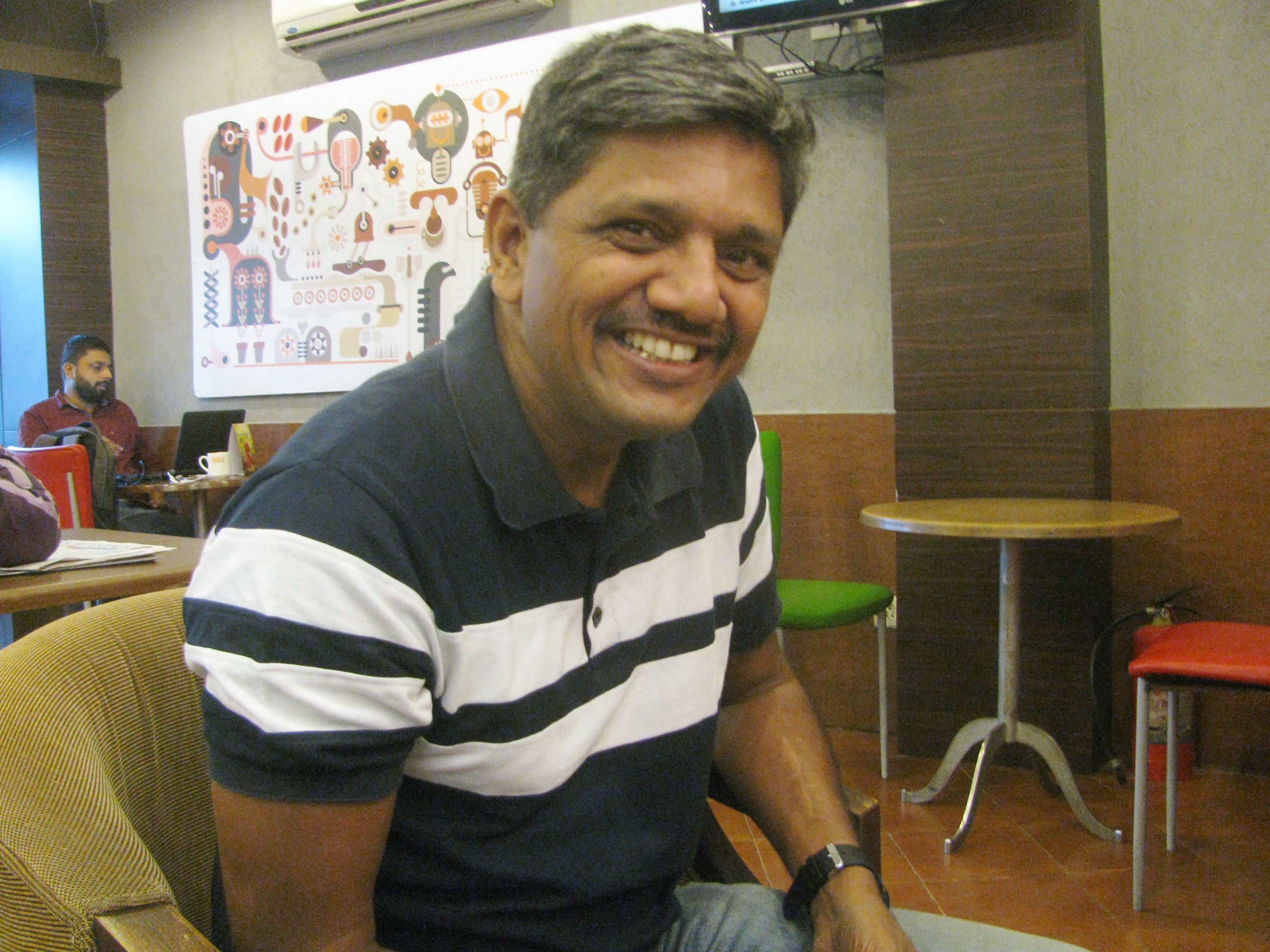
Sundaresan Renganathan (Photo: Shyam G Menon)
Lieutenant Colonel Sundaresan Renganathan (Retd) set out to make his fiftieth birthday different and meaningful. This is his story.

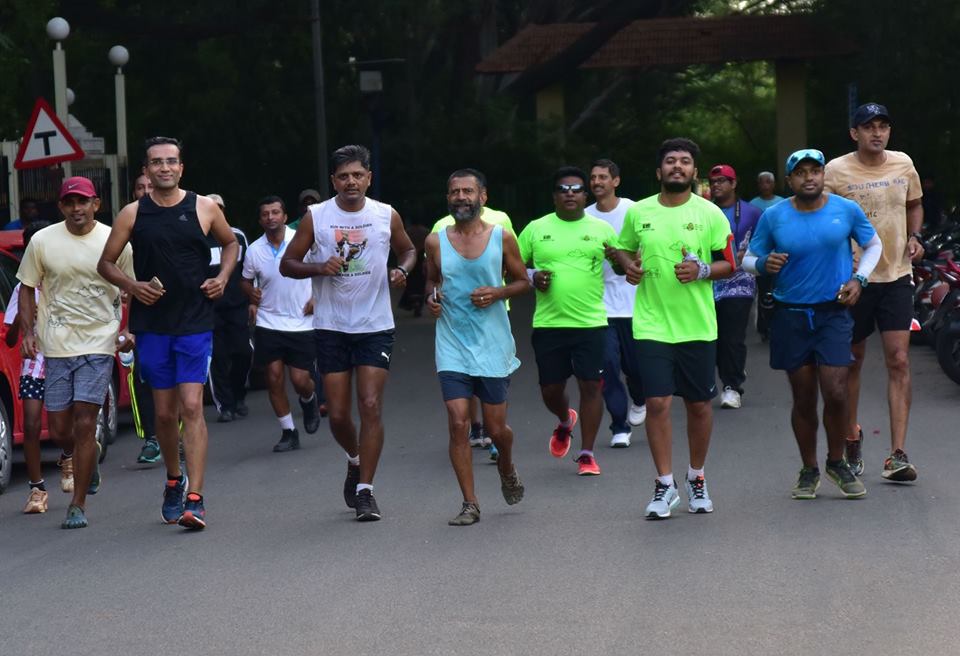
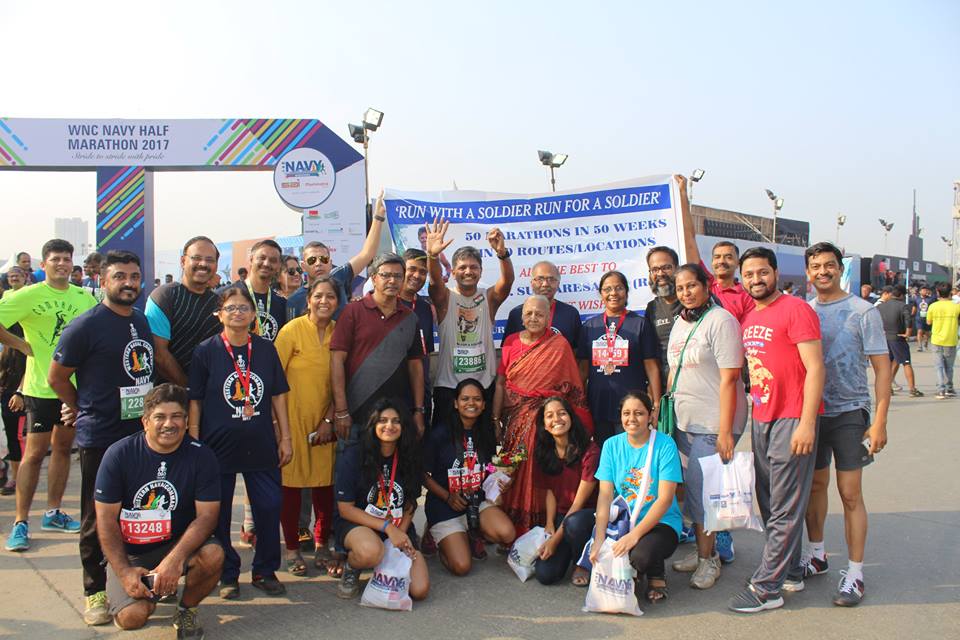
Towards the finish line of the Western Naval Command Navy Half Marathon on November 19, 2017, two siblings ran side by side the last kilometer of their respective runs.

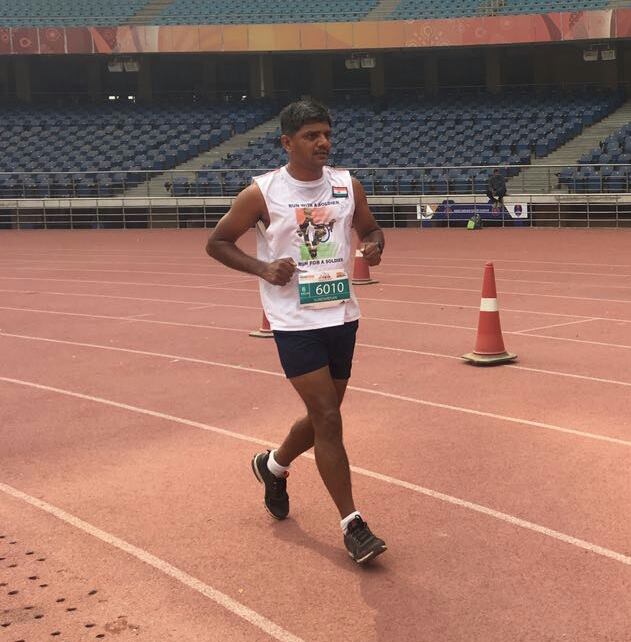
Saroja Narasimhan was completing her 10 km-race while her brother Sundaresan Renganathan, a retired army officer, was finishing his fiftieth marathon in fifty weeks with just that day between him and his fiftieth birthday.

Age is usually treated as just another number. But fifty has a special ring to it. For Sundaresan, 50 was sufficient reason to do something. “The thought that came to my mind was – why not run 50 marathons in 50 weeks and conclude it just before I turn 50?” he said.

On November 19, 2017, Sundaresan was up by 1 AM at his house in Kharghar, one of the prominent townships of Navi Mumbai.  Given the event he was running was a half marathon organized by the Western Naval Command, it became essential  that he run a half marathon in advance so that his day’s run would measure up to a full. Sundaresan’s run therefore started at 3 AM. He had the company of a few runners, who volunteered to run the distance from Navi Mumbai’s Vashi to Mumbai’s Bandra-Kurla Complex, the starting point of the navy half marathon.

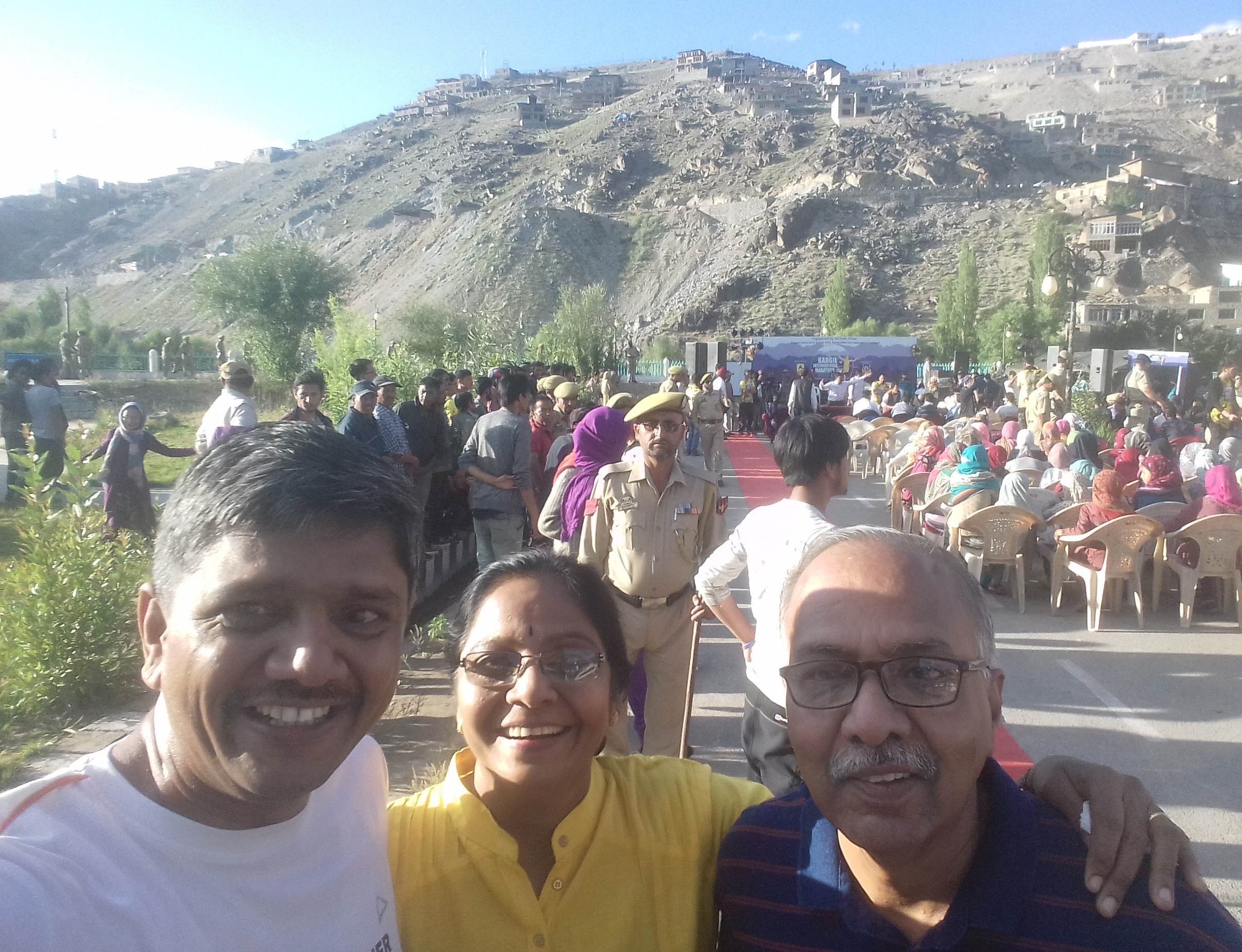
Sundaresan with his sister and brother in law, at a pre-race day function in Kargil (Photo: courtesy Sundaresan)

Apart from Saroja, many of his family members, friends and batch mates from the army turned up to cheer him at the finish line.

“What can I say? He is my mentor. It’s great to run with your guru. He is my baby brother but in running he is my motivator and my guru,” Saroja said. Now 61 years old, she was nudged into running at the age of 58, by Sundaresan.

The idea of being a runner, reached Sundaresan late. While in the army, for 13 years he was posted to Jammu & Kashmir with stints in Siachen, Poonch, Doda and Srinagar. There was adequate trudging up and down the mountains that served him as endurance training. Amid this, over 1500 kilometres away in Mumbai, in 2004, the Mumbai Marathon, sponsored by Standard Chartered bank, made its debut. Sundaresan was posted at Pathankot then. His sister-in-law called him to tell him about Mumbai Marathon. “The idea got into my head,” Sundaresan said of how his running started.

Born 1967 in a family of six siblings, Sundaresan was not actively involved in competitive sports in his schooling days at AFAC School in Chembur, a suburb of Mumbai. Following school, he joined SIES College to secure a degree in chemistry. He was into sports including some bit of running in a rather informal way, nothing competitive ever.

From a stadium run in Delhi, the seventh marathon from his planned 50 (Photo: courtesy Sundaresan)

While many of his classmates were making furious attempts at going overseas, mainly the U.S., to pursue further studies, Sundaresan, readied himself to join the armed forces. “During my college years I was active in NCC and I was sure that I wanted to join the army,” he said. He was commissioned into the Rajput Regiment, an infantry regiment of the Indian Army. There, he stayed for 23 years, before seeking voluntary retirement as Lieutenant Colonel.

For much of his years in service, active participation in any official sport was not possible but the accent on fitness was strong. In 2008, he got posted to Mumbai. Given residence in South Mumbai’s Colaba there could not have been more appropriate moment and location to start running. Sundaresan registered for the 2009 Mumbai Marathon to run his first timed half marathon. That trend continued into 2010’s Mumbai Marathon as well. Soon after that he wanted to move into the full marathon and was aiming to run the full marathon at the 2011 edition of Mumbai Marathon. But his initiation into the full happened in 2010 September when he ran the Kaveri Trail Marathon. This was followed by another full marathon in December, the Sabarmati Marathon.

In Mysuru with Ajit Thandur and other runner; Mysuru was was host for the twenty second run (Photo: courtesy Sundaresan)

In 2010, he chanced upon Amit Sheth’s book, Dare to Run, on running the Comrades in South Africa and immediately decided to attempt this iconic ultramarathon.  Comrades is the world’s oldest ultramarathon and now it’s biggest. At present, nearly 20,000 people run this ultramarathon every year. They come from different countries. The race alternates every year between uphill and downhill with the former measuring 87 km and the latter, 89 km. Founded as a war memorial, over time Comrades has acquired the reputation of being a fantastic event, remembered for the bonhomie, crowd support and cheering.

In 2012, Sundaresan retired from the army. Jobs in the private sector that came his way were primarily for heading security. He worked for ITC Grand Central Hotel, Panoramic Group and had a short but tight stint at the Board for Control of Cricket in India (BCCI) in connection with the T 20 World Cup and IPL 2016. During these years, he never let go of his desire to run Comrades and registered for the 2016 edition of the run. This edition was the downhill version.

To get the final confirmation for the run he had to secure sub-five hour timing in the marathon. For someone who was running the marathon in excess of five hours, he had to first focus on sub-five hour timing. He eventually achieved it at the 2016 Mumbai Marathon where he finished 42.2 kilometers in 4:36:49.

“I took tips from many of the runners who had attempted Comrades. Satish Gujaran was one of them. But I did not have a structured training program,” he said. Satish, an ultrarunner will be attempting his ninth consecutive Comrades in June of 2018.

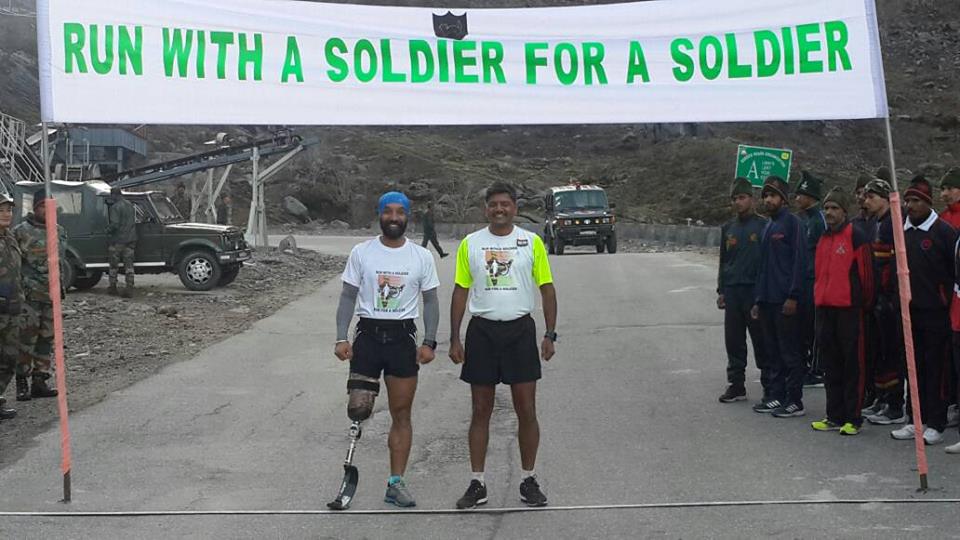
With Major D.P. Singh from the run in Sikkim, Sundaresan’s favorite from the 50 marathons he ran (Photo: courtesy Sundaresan)

Some amount of training was already behind Sundaresan by the time he finished the 2016 Mumbai Marathon. From February to April of 2016, he was tied up with work, as part of his assignment for BCCI, for T20 cricket World Cup followed by IPL 2016 season which runs through April and May of every year.

Heading security, he was required to travel to various destinations where the teams were playing. “I used to get up at 2 AM to do my running,” he said. During his hotel stays he did something unusual. He would enter the hotel’s swimming pool not to swim but to run the length of the pool. “I did all of two long runs. One of 54 km and the other of 56 km in February and March,” he said.

Sundaresan says he enjoyed Comrades thoroughly. According to him, it is a “should go” event for ultramarathoners. “It’s a fun event but yes one should go prepared,” he said. He completed the run with a timing of 11:52:54 hours, within the final cut-off of 12 hours.

Five months before his Comrades attempt, Sundaresan had already discussed the idea of running 50 marathons in 50 weeks with a couple of runner friends.

Once back from South Africa, he started developing his plan, which included listing out all running events through the year across the country and accounting for the weeks when there would be no marathon events especially during the summer months.

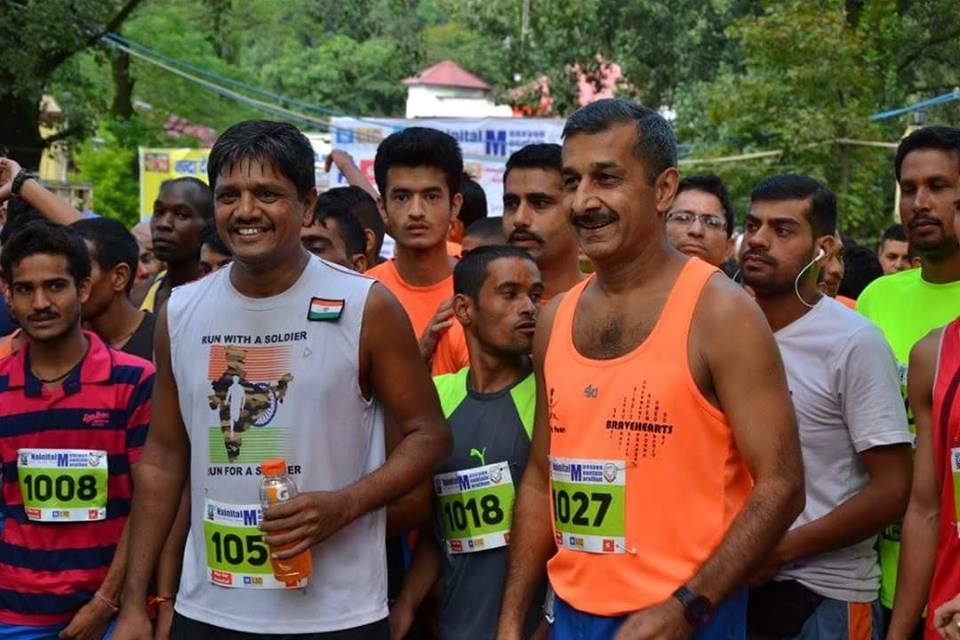
With Colonel Sandeep Madan at the marathon in Nainital, the thirty eighth from the planned 50 (Photo: courtesy Sundaresan)

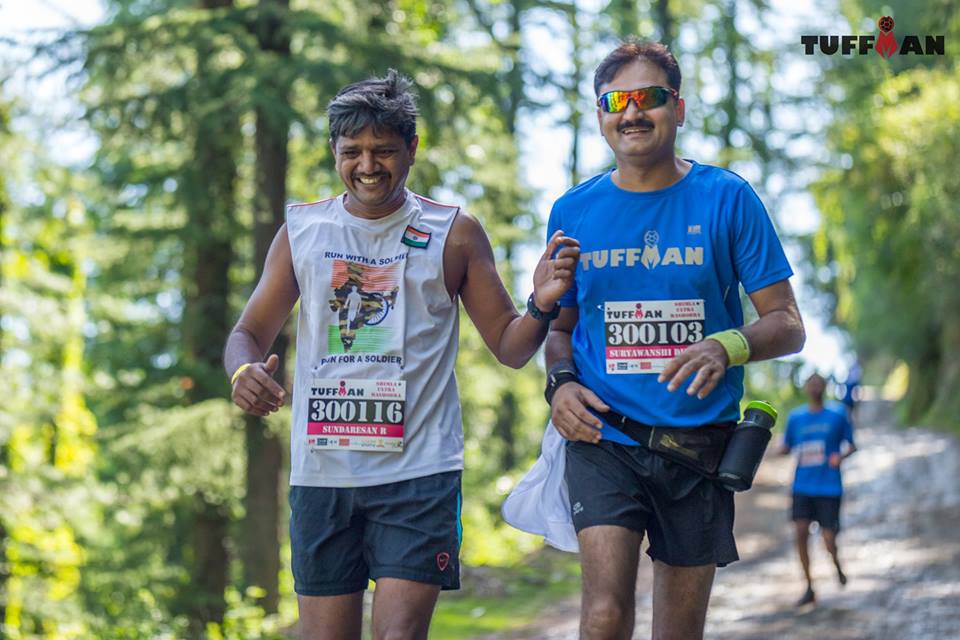
With Dipak Suryavanshi, runner from Nashik, at the Shimla Tuffman run, the twenty seventh marathon for Sundaresan from his planned 50 (Photo: courtesy Sundaresan)

Funding was a major requirement and Sundaresan realized that he would have to dip into his earnings. Once family (wife and daughter) and siblings’ approval was sought he went about diligently writing to companies including sporting entities to seek funds. “I wrote to many companies and also to some sports companies. Nobody responded positively,” he said. After six marathons, Global Group of Companies agreed to pick up his air fare for travel to marathons across the country.

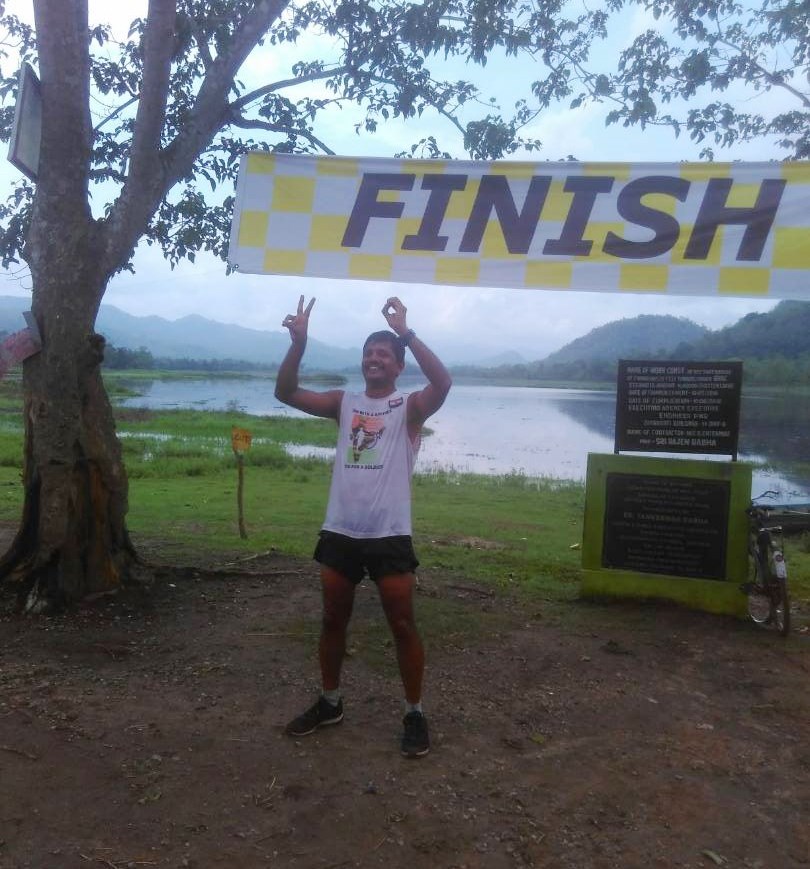
Alongside, he also thought of running for a cause – raising funds for the families of martyred soldiers. His endeavor got a name thereby – Run with a Soldier, Run for a Soldier. The cause of his run brought in some incentives. At some running events, organizers waived off his registration fee and also offered accommodation.

He embarked upon his run on December 11, 2016 with the Vasai-Virar Mayor’s Marathon. For the next 49 weeks, Sundaresan was crisscrossing the country to run marathons where marathons were available or running two half marathons where the event was a half marathon.

Sundaresan traveled to various destinations to run his marathons – Kargil, Ahmedabad, Hyderabad, Chennai, Bengaluru, Pune, Mumbai, Guwahati, Dehradun, Sikkim, Manipur, Rookee, Raipur, Matheran, Kochi, Saputara and Shimla among others. The aim was to cover as many states as possible.

“Fifty weeks is a huge time period. Anything could have gone wrong during this period. Thankfully, family support was superb,” says Sundaresan, who often left on Friday for his outstation marathons and returned on Monday, missing weekend with family.

Paying respects to his late father with a sign of `20′ after the run in Guwahati, the twentieth run from the planned series of 50. Sundaresan lost his father just days before the event (Photo: courtesy Sundaresan)

During these weeks of running, Sundaresan experienced two setbacks. On April 20, 2017, he lost his father. “It was a Thursday and on Friday I was scheduled to leave for Guwahati for the twentieth marathon on Sunday, April 23. That evening after the cremation was completed, the extended family came together to goad him to go for his run and his mother was duly informed. “She told me, go and run. Your father’s blessings will be with you,” Sundaresan said.

The second setback came during the 44th week when he woke up with viral fever. Slated to leave for Pune, he had to cancel his run and also had to skip the next week’s marathon at Surat. Over the next two weeks he decided to run four marathons to cover up the loss of the previous two weeks.

He rates his best marathon to be the one in Sikkim in May, when the army went all out to make arrangements for the run from Changu Lake to Gangtok. “There was no organized run in Sikkim. But I chose to run here to get a break from running in in the May heat,” he said. India’s first blade runner Major D.P. Singh, retired army officer, ran with him a distance of about 25 km.

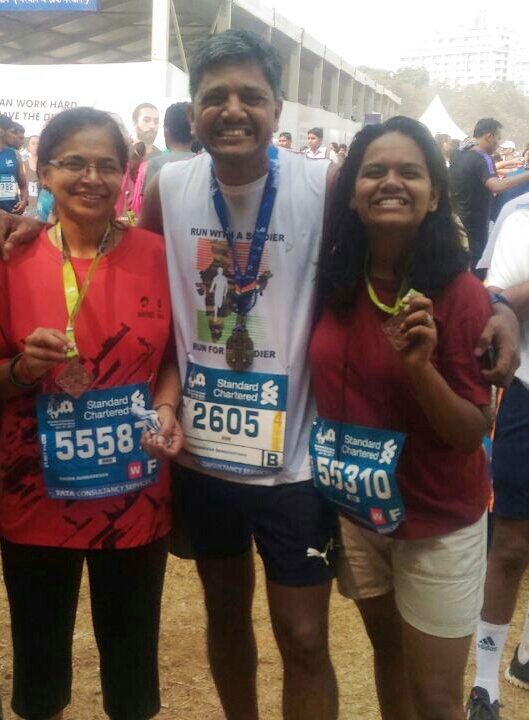
With wife and daughter after SCMM, typically a family outing. For Sundaresan, this was his sixth marathon from the 50 (Photo: courtesy Sundaresan)

Among the running events he went to, he rates the Dream Runners’ Half Marathon of 2017 held in Chennai as the best half marathon event. Of course, he had to run a half marathon before the event to make it a full marathon. “I started running from Valsaravakkam at 2:30 AM and then joined the starting line of the half marathon,” he said. The distance from Valsaravakkam to the starting line is 18 km and he covered the balance 3 km running around at the start point. The toughest marathon was the Tuffman Shimla Trail Marathon where the entire route was trail with good amount of elevation. One of those who had a ringside view of Sundaresan’s project was Dhaval Ajmera, Executive Sous Chef at ITC Grand Central. “When I met Lt Col Sundaresan, who was the head of security at ITC Grand Central, I realized that he was into running. I was already into running. We started running together. I was quite comfortable and it was great fun running together. Even after he quit his job at ITC and moved out to another job, we continued running together. He told me about his plan to run 50 marathons in 50 weeks.  I have been able to help him to some extent. I ran with him some distances in couple of his marathons, including the final one at Navy Half Marathon. He was quite dedicated to the cause of his run,’’ Dhaval said.

With family and course mates after the fiftieth run, which was melded into the Western Naval Command Navy Half Marathon in Mumbai (Photo: courtesy Sundaresan)

In the initial weeks of the 50 marathons in 50 weeks-challenge, Sundaresan added a couple of short practice runs in between his marathons. But as the weeks went by he dropped it to a single run and finally gave up running for practice. Instead he focused on strengthening and stretching, which, he believes, stood him in good stead over the 50 weeks. He did not sustain any injury. Averting injury was high on his priorities. He made sure he ran slowly and at events, never more than the marathon distance he was required to meet. He was assailed by cramps only in two of his marathons – one at Matheran, the other was the navy half marathon.

Sundaresan was able to raise Rs 27 lakh for martyred soldiers. Twenty seven families were chosen to be given one lakh rupees (Rs 100,000) each. “ The money is in the process of being disbursed,” he said. The pattern used for raising funds and disbursing them was simple. Given Global Group of Companies was the main sponsor, Global Foundation became the temporary repository of funds raised. They would then make out the payment as required to Sundaresan, for onward disbursement. The beneficiaries – families of martyred soldiers – were identified with the help of the army; Sundaresan contacted the commanders of the units he had served with for the same. Most of the 27 families identified had members – since martyred – serving with the Rajput Regiment. A few are connected to Rashtriya Rifles.

At the finish line of the final marathon at Mumbai’s Bandra-Kurla Complex, Sundaresan felt happy that the project had ended smoothly. “The credit for this goes to my army training,” he said.

(The author, Latha Venkatraman, is an independent journalist based in Mumbai. This article is based on a conversation with Sundaresan Renganathan. Except for the first photo, all the other photos used herein were downloaded from Sundaresan’s Facebook page and used with his permission.)

THE DNYANESHWAR EFFECT / VIKRAMGAD’S RUNNERS

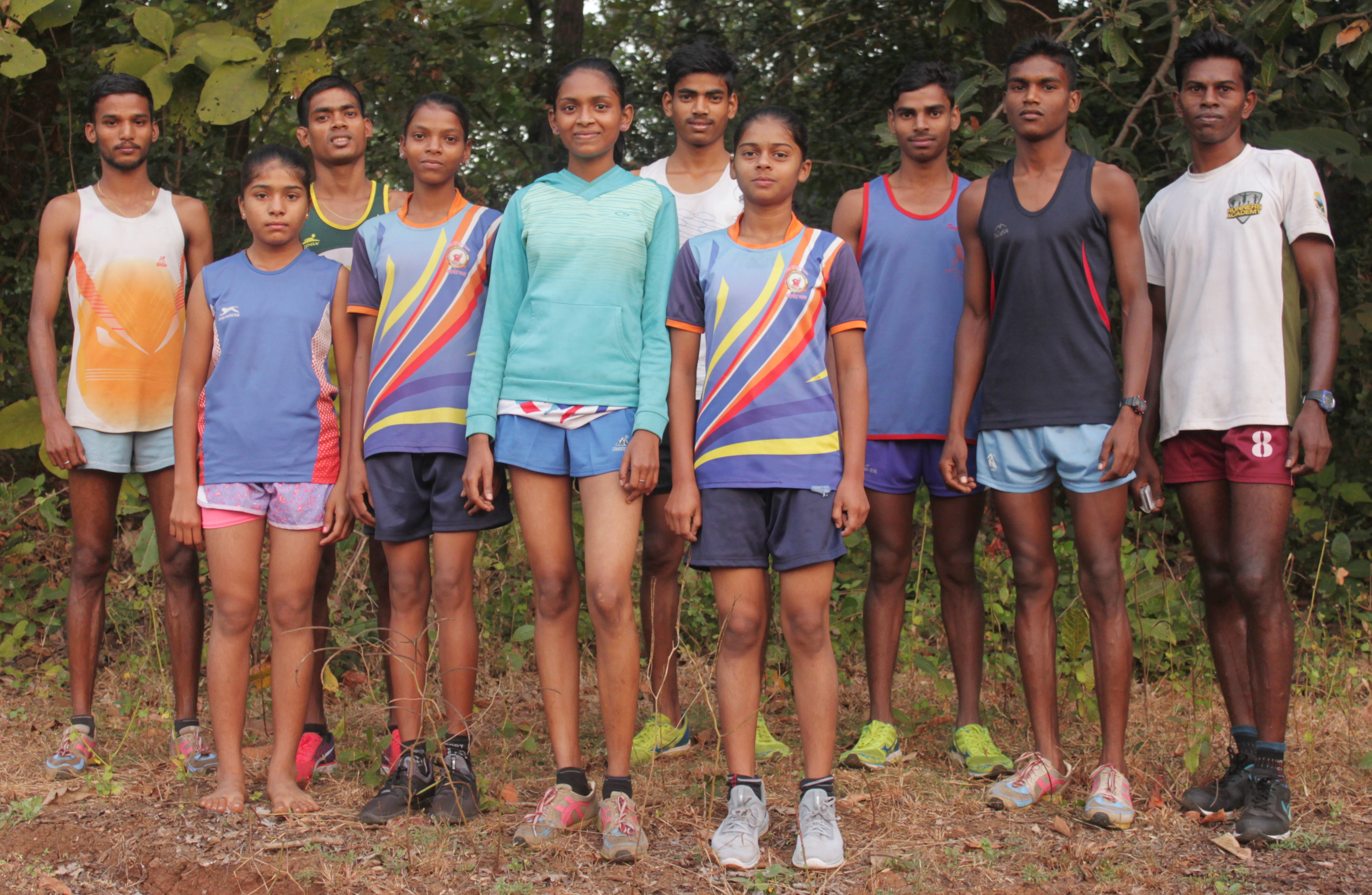
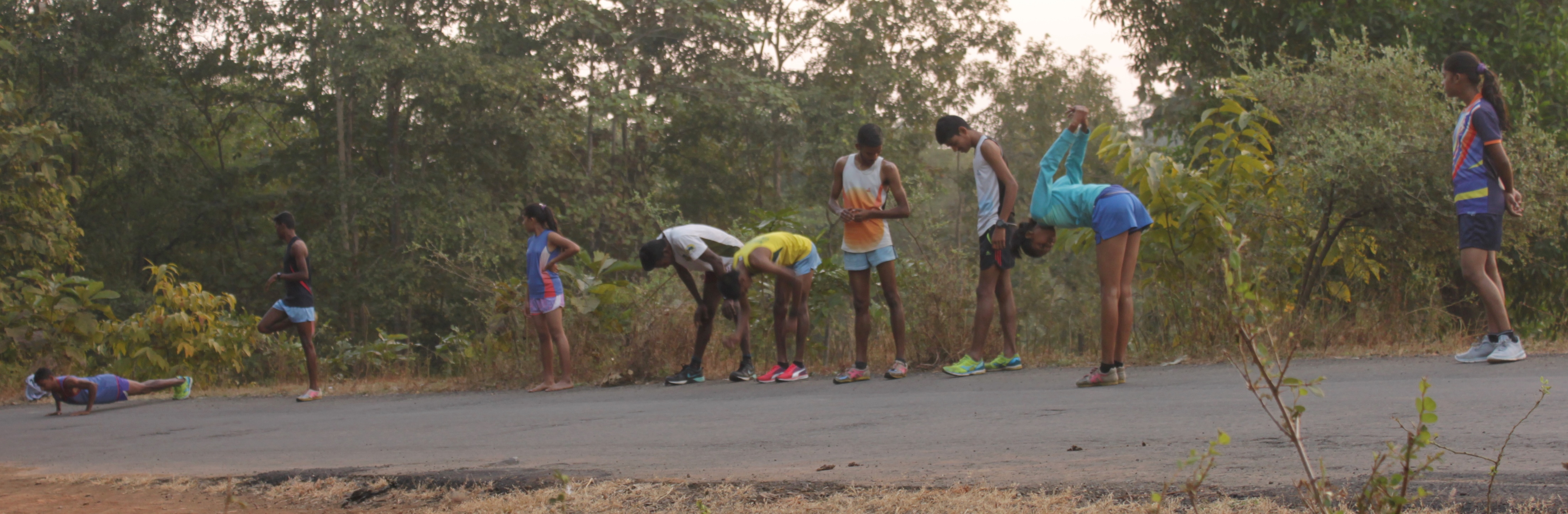
Vikramgad’s runners (Photo: Shyam G Menon)

Late November 2017.

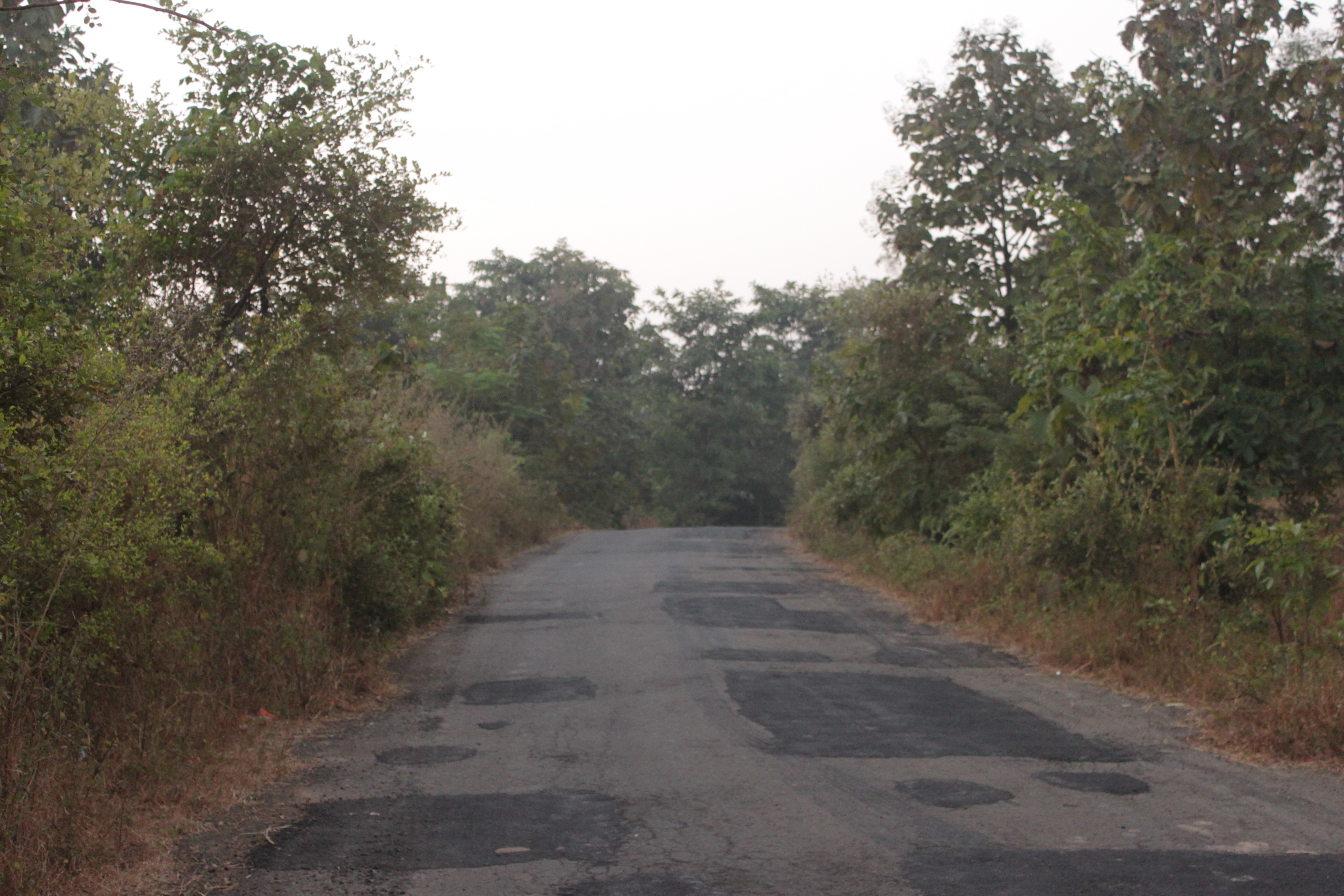
Although nearing 6AM, it is dark as we walk from the house to the quiet road passing through Vikramgad Khand.

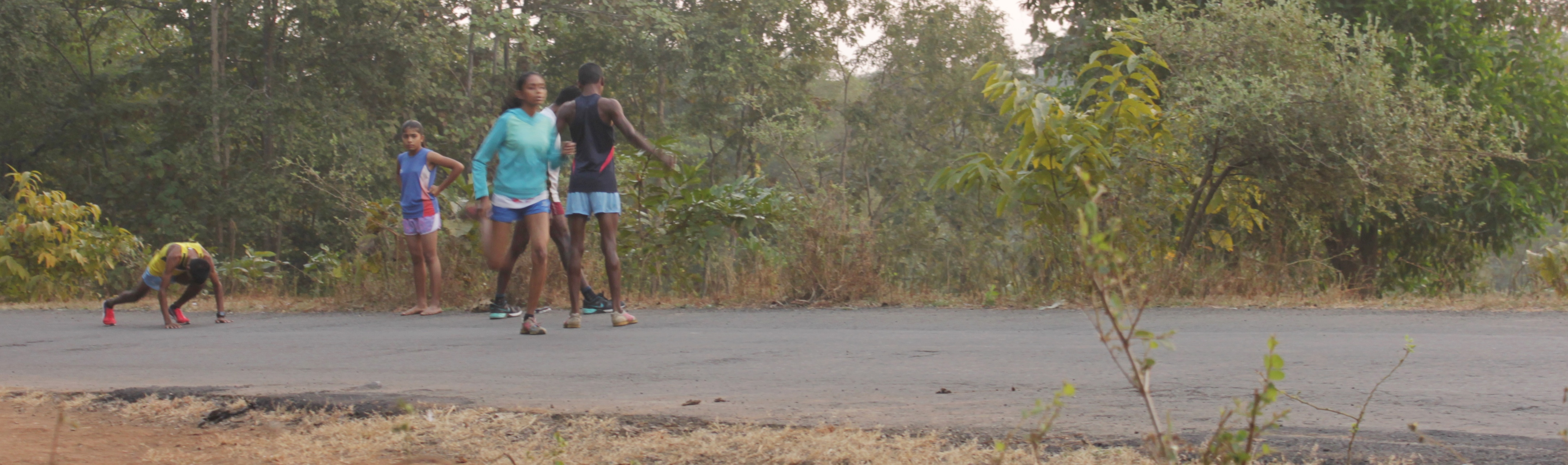
The village is perhaps three kilometers from the market in larger Vikramgad, a settlement between Wada and Jawahar. The quintet of four boys and one girl walked briskly to a small node ahead and then hung back to limber up. Roughly ten minutes later, the sound of runners’ feet approached from behind as the quintet trotted past at a relaxed steady pace. It reminded of every marathon’s initial phase – that rhythmic sound of feet striking tarmac and sense of pack when a bunch of athletes run by. There was no traffic on the small road save an occasional two wheeler. Once in a while the darkness was breached by torchlight or the approaching red glow of a lit beedi; farming chores commence early in these parts. Then two middle aged men came by on their morning jog. As the rising sun slowly made its presence felt, a lady walking briskly, appeared; followed by the sight of a man warming up for his jog, another who jogged by and then paused to do push-ups on the road. Dinesh Mhatre had said the day before that Vikramgad early morning has its growing share of walkers and runners. We were roughly 90 km away from Thane and maybe 120 km from Marine Drive, the showpiece of Mumbai’s running.

Over two months before this dawn at Vikramgad Khand, we had waited near Thane’s bus depot for the leader of the quintet. The atmosphere was humid. People and vehicles dashed about like packed atoms. The person we wanted to meet had got stuck in Bhiwandi, a dusty township associated with the textile industry, famous for having the most number of power looms in India. That meant he was just half way through to Thane, where we had agreed to meet around noon. We used the time to locate a quiet eatery to have lunch at once our subject for interview arrived. Almost two hours later, two young men met us at the Thane bus depot. When sat down for lunch, Dnyaneshwar Morgha had no hesitation choosing rice over roti. In Vikramgad Khand, where he lived, that’s what he did – he cultivated rice.

The road to Vikramgad Khand, early morning, November (Photo: Shyam G Menon)

Vikramgad Khand is hilly terrain. Born April 1994, Dnyaneshwar is the eldest of three children; two brothers and one sister. His parents are farmers. They own some land. Life was tough, growing up. The family didn’t have much money. What saved the day was a simple flower, small and among the most beautiful in the Indian subcontinent. Southern and western India, including the state of Maharashtra where Vikramgad is, is home to the jasmine. While Dnyaneshwar studied in the local school till the twelfth, his parents often came to Thane seeking livelihood. They sold jasmine flowers at about twenty rupees a kilo, making roughly sixty to seventy rupees daily for the family to live on. It also meant that unlike in the case of the affluent lot paying school fees every month or every term, Dnyaneshwar and his siblings could pay their fees only in an erratic, aggregated fashion depending on income flow and what little the family saved. Needless to say, once he was old enough to work, Dnyaneshwar began doing agricultural work.

Aside from he being the elder of the siblings, one reason for the urgency Dnyaneshwar felt in taking charge of his life was that drinking was common in the community he belonged to. His parents were no exception. The habit takes a toll on human being’s ability to work. “ They are not well now. So, they don’t work,’’ Dnyaneshwar said of his parents. He does not touch alcohol. It is not that he hasn’t. There was an instance in the seventh standard, when he drank toddy. His teacher, “ Diwan sir’’ punished him. After that, he has stayed away from drinking. When we met him, Dnyaneshwar having completed his twelfth and got married, was into a routine of working his family’s agricultural land and taking ahead the admission for graduate studies he had secured at a college in Ullhasnagar. His sister was married. The rice the family cultivated was being consumed at home itself. There was no share of it being sold in the local market. Dnyaneshwar met his family expenses and the fees for his education using the money he earned from running. His younger brother Rohidas was in the twelfth and also a runner.

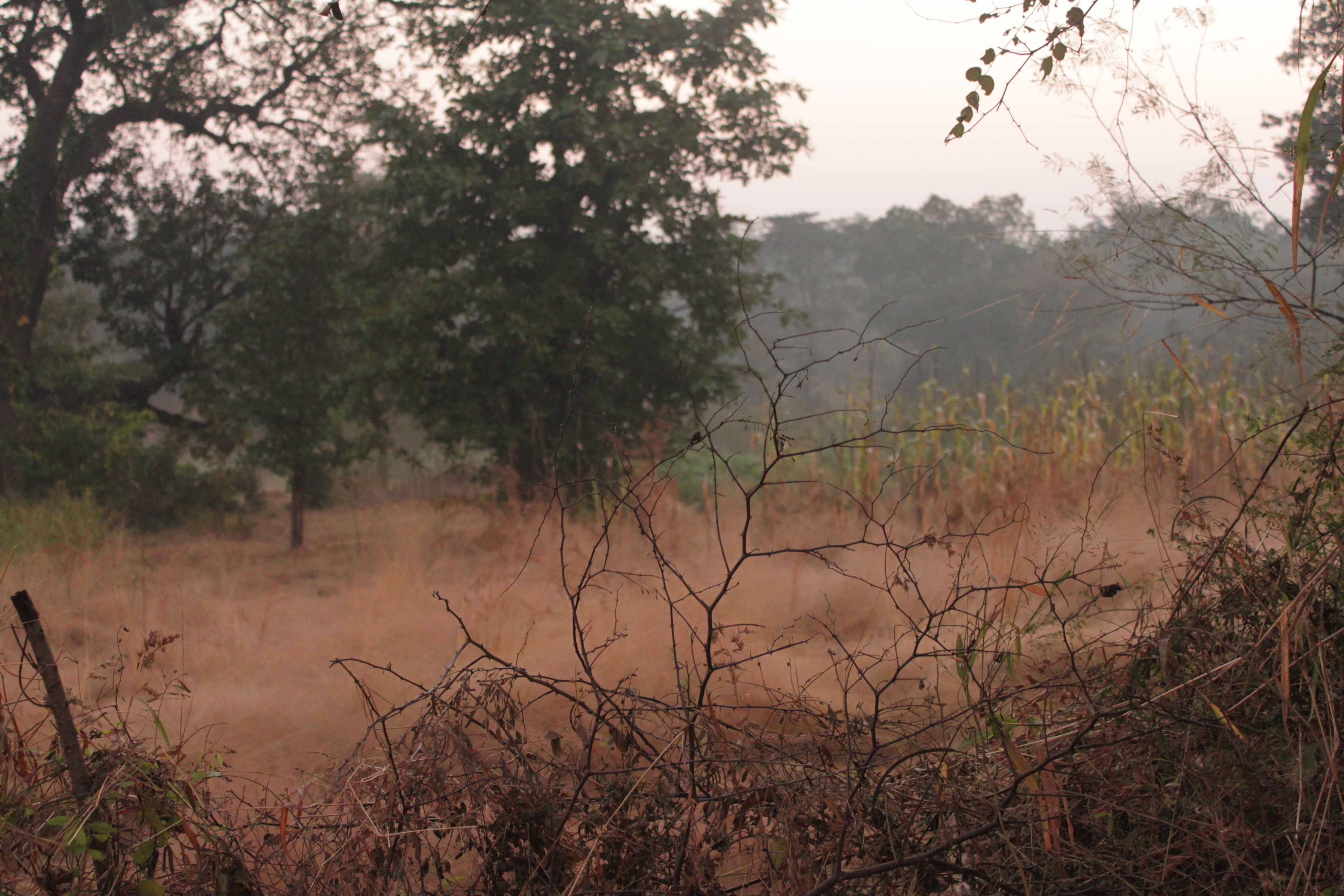
Near Vikramgad Khand, early morning, November (Photo: Shyam G Menon)

Dreams have always fascinated human beings. A dream is a succession of images, ideas, emotions and sensations that usually occur involuntarily in the mind during certain stages of sleep – that is how Wikipedia explains dreaming. Various cultures have responded in their own unique way to our tendency to dream. In another section, Wikipedia added: in the late nineteenth century, psychotherapist Sigmund Freud developed a theory that the content of dreams is driven by unconscious wish fulfillment. According to Dnyaneshwar, turning point was in the ninth standard. He claims he had a dream of himself running. By then his relation with his parents had touched a low point. As liquor took its toll, whatever was being earned as livelihood got squandered. Nothing reached the children. “ We would mix masala powder in water and have it just so we had something in our stomach,’’ Dnyaneshwar said. The already fragile relation snapped, when one day, he declined to get liquor and was told to leave the house. For the next few years he stayed with his uncle.

Most of us wouldn’t take a dream seriously. Why should we, when the mind keeps running movies in the head for no particular reason? Dnyaneshwar however clung to what he had dreamt. “ I latched on to that vision because my predicament was desperate. If I don’t try to make my own path I will get sucked into how things have been for the past several decades,’’ he said. Following that dream, for a year, he trained diligently. He ran to forget his personal situation; he ran also because he hoped the madness would bring him something better. He ran between the hours of 2 AM and 5 AM. He ran barefoot on the road. It wasn’t long before others in the village took note. Communities may have been originally formed to take everybody along for the journey. But one of the problems in community is how difficult it is to follow your mind if what you wish to do stands out from the norm. Comments fly easily. Dnyaneshwar said that when his running was discovered by others, he was laughed at. It was to escape such judgement that he embraced the darkness of the truly early morning hours. Out of sight is out of mind. The only person to run with him was his friend, Kaluram. But Kaluram quit after a year. Dnyaneshwar was back to being Vikramgad Khand’s runner in darkness. Then a race over five kilometers was announced in the village of Kudus nearby. He participated in it and finished in third place. As prize he got Rs 1500. “ That was a lot of money for me,’’ Dnyaneshwar said.

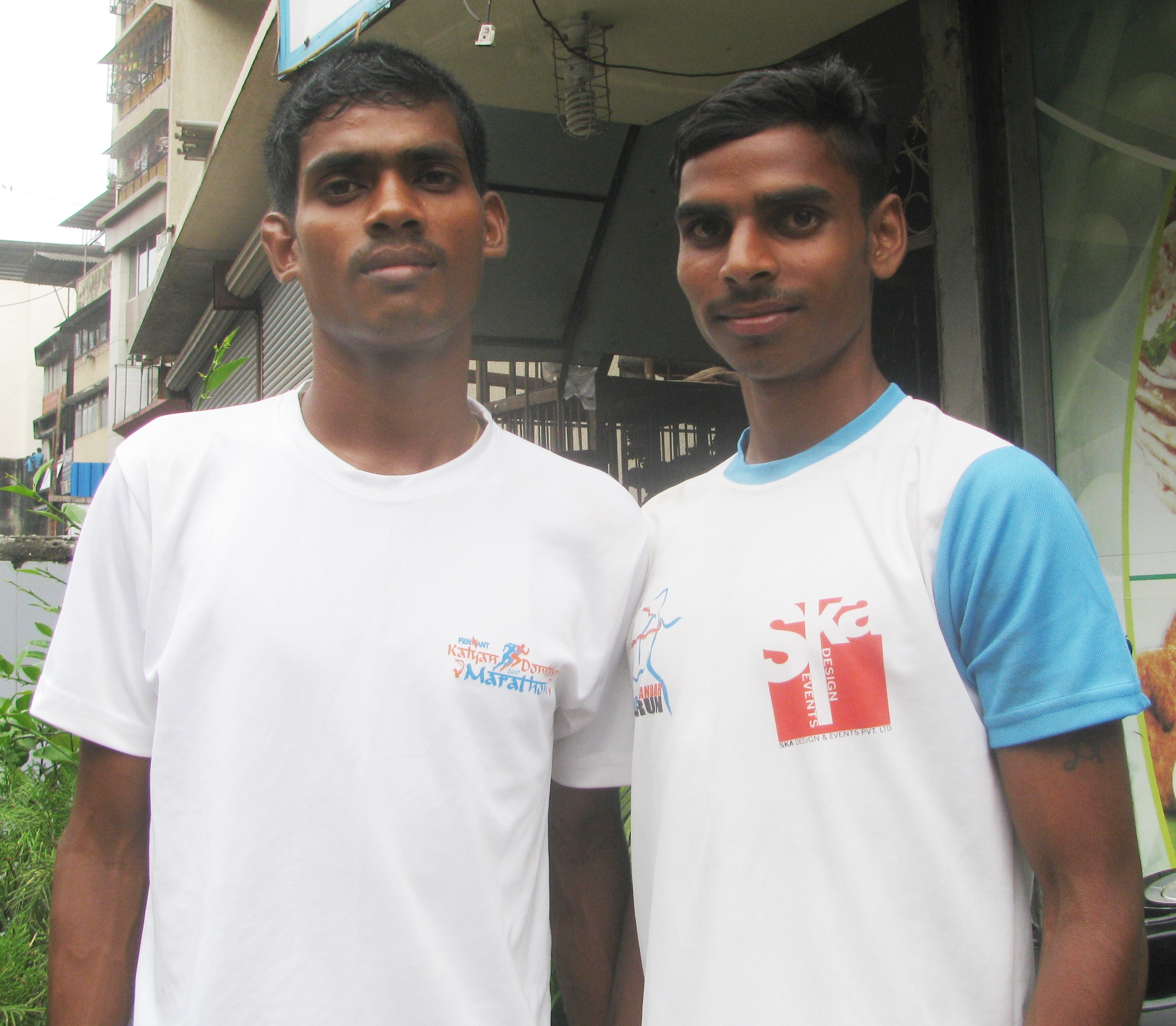
Dnyaneshwar (left) and Amit (Photo: Shyam G Menon)

His first formal half marathon happened in Vikramgad itself. It was an event organized by Vanavasi Kalyan Ashram, an outfit that works among tribal communities. He secured first place in that run. This was followed by a half marathon in Pen, where too Dnyaneshwar finished first. Then he was dispatched for a few days to Pune, where a “ national level competition’’ was due. At this competition, Dnyaneshwar finished first in the half marathon with a timing of one hour, fourteen minutes. That win fetched him Rs 30,000 as prize money. “ I had never seen so much money in my life,’’ Dnyaneshwar said. The person Dnyaneshwar has kept in touch with at Vanavasi Kalyan Ashram is Satish Chavan. According to Chavan, following his win in that half marathon in Pune, Dnyaneshwar told him of his desire to run at the Standard Chartered Mumbai Marathon (SCMM, now called Tata Mumbai Marathon – TMM). It was the biggest event in running, much written about in the media and automatically, magnet for runners. “ Dnyaneshwar wanted to run but he didn’t know anything about how to participate at the running events he had heard of,’’ Chavan said. As he scouted for details on how to register Dnyaneshwar for SCMM, Chavan found that there was a plethora of running events around, not just SCMM. For the youngster from Vikramgad therefore, his first race in the Mumbai region was one of the editions of the Thane Varsha Marathon, wherein he ran the 10 km-race. He secured first place there with a timing of 31:22. Dnyaneshwar’s friend Dinesh keeps him informed of upcoming races in Mumbai. As regards the big annual marathon in Mumbai, Chavan said that Dnyaneshwar has had two outings so far at SCMM’s half marathon. On both occasions podium finish eluded him. Chavan continues to help. Given his association with Vanavasi Kalyan Ashram, Chavan has links to potential supporters. With their assistance, he has provided 5-6 pairs of running shoes to Dnyaneshwar.

Sport is a great leveler. Runners are known to help each other. Running in Mumbai expanded the pool of people willing to help Dnyaneshwar. Among those who saw him running at an event and tried to assist, was Phillip Earis, a runner from England who lived in Mumbai for a few years till mid-2016. In 2016, he had written in about the first time he saw this runner from Vikramgad Khand: I first met Dnyaneshwar at the end of a half marathon in Bandra in December 2014.  I was originally supposed to be running in the race myself, but the day before the race the organizers phoned me up to say regretfully they were disqualifying me, and they feared any non-Indians running could be a safety risk and need extra permission etc.  As the race was taking place near my apartment I went along anyway to watch and cheer on the runners.  The winner was this very small and young runner, who glided along at great speed and seemingly effortlessly. His huge talent was obvious to see, and yet it was also apparent from a quick conversation with him afterwards that he had so much untapped potential – he didn’t have any coaching and wasn’t even really following a training plan.  I tried to get his details but there was some mistake in the phone number, and it took me a further year to finally track him down.

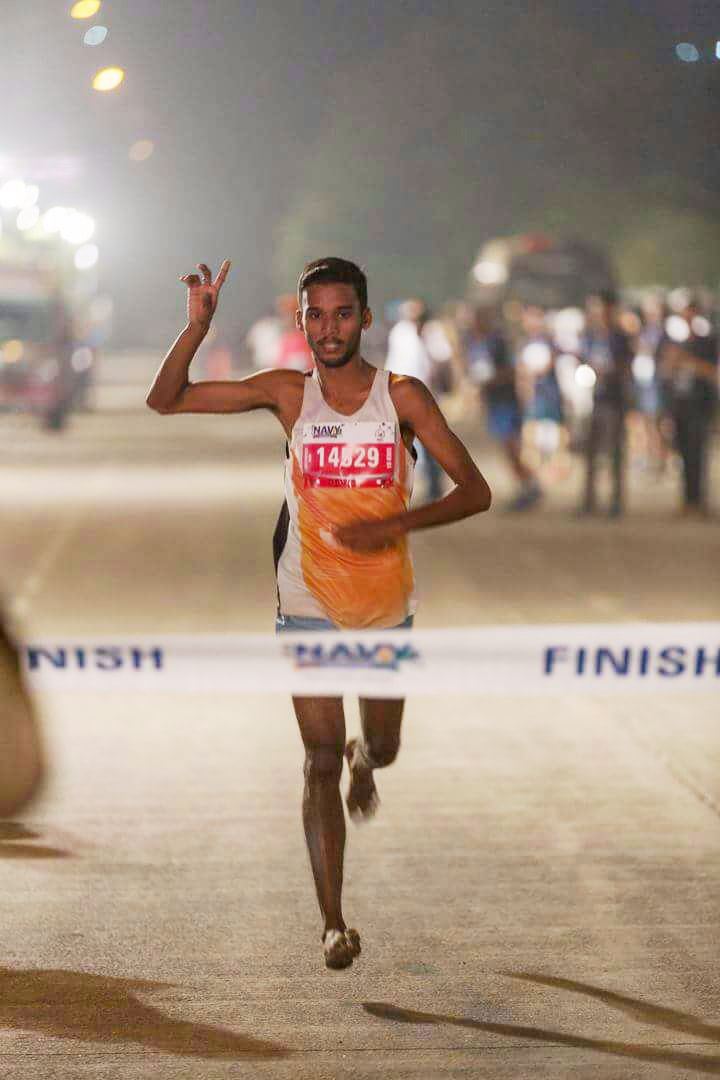
Dinesh at the finish line of the Navy Half Marathon (Photo: courtesy Dinesh)

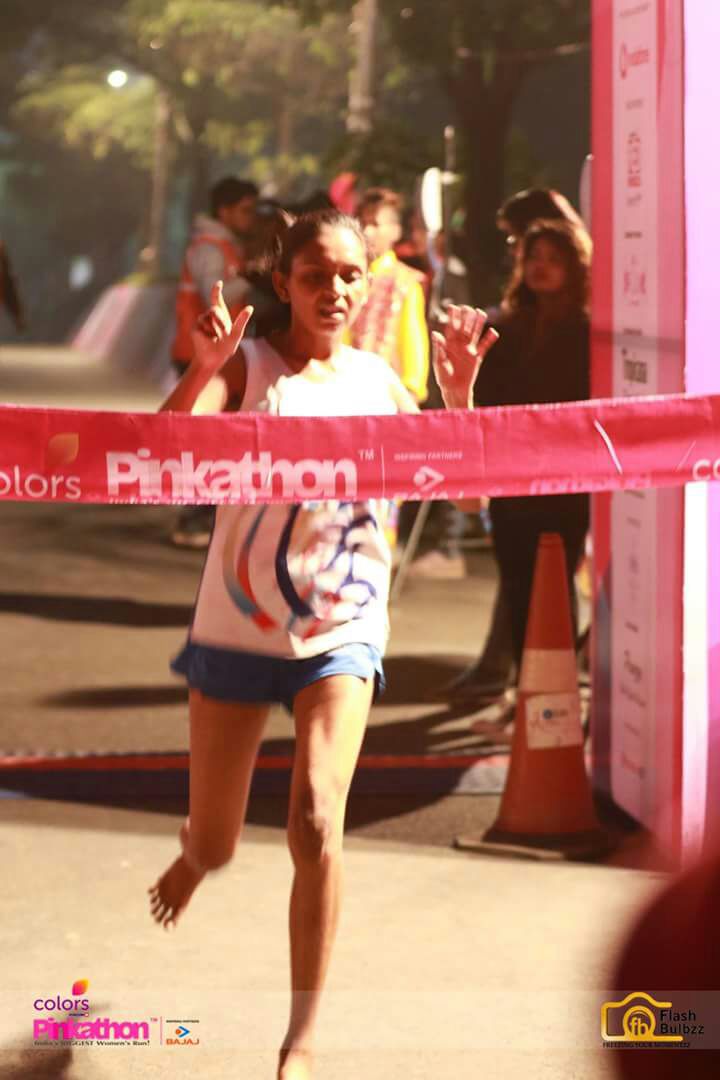
Kavita finishing her race at one of the editions of Pinkathon (Photo: courtesy Dinesh)

Another runner Phillip helped was Kamlya Bhagat, whose background is similar to that of Dnyaneshwar. He lives some distance away from Panvel, a township south east of Mumbai (Vikramgad Khand is north east of Mumbai). Older than Dnyaneshwar but a fellow race horse counting on running for a fair amount of his income, Kamlya won the half marathon at SCMM (now TMM) in his age category, in 2016 and 2017. Incredibly, Dnyaneshwar missed registering for the 2018 TMM. He had entrusted the task with someone; it apparently got overlooked. His personal best in the half marathon was 1:08 clocked at the 2016 Vasai Virar Mayors Marathon (VVMM). In early 2017, Dnyaneshwar became the recipient of the Runner of the Year award given by Mumbai Road Runners (MRR), one of the biggest running groups in the city. Srivatsan Mambakkam, senior runner from Navi Mumbai, was on the jury that selected winners of the 2016 awards. “ In Dynaneshwar we had a runner who clocked 1:08. I think the attributes we appreciated in him were – he was young; fast, consistent in performance and returning good timings at events featuring decent competition. VVMM for example, is quite competitive,’’ Srivatsan said. Dnyaneshwar’s streak of good timings has continued. At the IDBI Federal Life Insurance Mumbai Half Marathon of 2017, he finished first in the half marathon with a timing of 1:09. In November 2017, he romped home first in the Western Naval Command (WNC) Navy Half Marathon, clocking 1:09:37.

Dnyaneshwar races almost every Sunday. He said that he trains under Aman Chowdhury. Given coach is in the Mumbai region and ward in Vikramgad, the instructing is on the phone. A typical day for Dnyaneshwar starts at 5 AM. If he has run 21 km at a race on Sunday, then he dedicates Monday for a recovery run. On Tuesday, he does an easy five kilometers, including 200-400 m sprints. Wednesdays are meant for working out. On Thursday, he and everyone else in his team, run together at race pace. Friday reverts to easy running or running an easy 21 km in case he has a half marathon to race on Sunday. Saturdays are devoted to rest. He also takes rest all of May. In the running calendar that is usually a month with few races given the heat of India’s summer. In 2016, Dnyaneshwar said, he made anywhere between one to two lakh rupees from running (one lakh is equal to 100,000). He said he puts some of the money aside in a bank account.

The trophies and medals in Dnyaneshwar’s house (Photo: Shyam G Menon)

The attraction for running is hard to understand in a conventional way. Most runners don’t stress over returns from running because returns from regular physical activity are priceless. But that is not how the Indian circumstance wedded to money and sedentary life, views things. For example, several runners we spoke to while writing articles for this blog, mentioned of families and parents puzzled by the sight of runner paying money to register for a distance run that left him / her exhausted. Who pays to get punished? Who pays to seemingly lose investment? By the same yardstick, the easiest route for respect by running is when it yields result admirable by conventional logic – when it fetches you money. At his house in Vikramgad Khand, Dnyaneshwar showed a prepaid gift card, part of his winnings at a race. On the wall was what it bought him – a TV. On his wrist was another prize from running – a runner’s watch. The house he currently lives in – a modestly big properly built house – that had been funded with money borrowed from others and prize money from running. Medals from races adorned the walls of the living room; a clutch of trophies graced one corner of the clean, tidy floor. According to Dnyaneshwar, when he started earning from running, those around him began seeing his madness in a different light. Respect for running and curiosity for the sport crept into the frame. Others also wanted to run. Dnyaneshwar now informally coaches other runners in Vikramgad. The first of these wards was with him when we met in Thane; they were both heading to a race in the Mumbai region, scheduled the following day. Twenty one years old, Amit Bhagwan Mali started running when he was in the tenth standard. He and his friends were playing cards in the village one day, when Dnyaneshwar arrived with trophy and prize money. “ I decided I must also race,’’ Amit said. His father is no more. He has to look after his family. They too are farmers. At the 2017 IDBI Federal Life Insurance Mumbai Half Marathon, Amit had a podium finish in the 10 km-run with a timing of just over 32 minutes. Doing well at that event, was also Dnyaneshwar’s brother, Rohidas. Once you get into running, a world opens up. At a race in Kalyan, Dinesh met Amit; the latter didn’t get the event’s branded T-shirt and Dinesh gave him his. Through Amit, he met Dnyaneshwar. Dinesh said he now spends most of his days in Vikramgad Khand, his training base. He travels periodically to visit his mother who stays at Angaon, a village near Bhiwandi. Dinesh specializes in the 10 km-run. At the 2016 IDBI Federal Life Insurance Mumbai Half Marathon he had run the 10 km-discipline in 33 minutes placing second. Closer to our meet-up in Vikramgad Khand, he had finished first in the 10 km-run of the Navy Half Marathon with a timing of 32.38 He hopes to graduate to the half marathon. When that move should be – he counted on Dnyaneshwar to advise him.

Towards the end of an early morning run at Vikramgad Khand (Photo: Shyam G Menon)

In Vikramgad Khand: stretching after the early morning run (Photo: Shyam G Menon)

According to Amit and Dnyaneshwar, running has slowly picked up in the Vikramgad area. Around 10-15 boys are now regular runners. They also spoke of Ramji Gangda, 57 years old, who runs regularly. However, conservative family and society restricts the number of girls in running, Dnyaneshwar and Amit said. Marriage happens early in tribal communities. While by and large boys get to do what they want, it is tough for girls. For now, barring exceptions, running doesn’t fit in with the priority of things as imagined by parents. A few girls from one of the adjacent villages join in as the runners go by, the two youngsters said. Chavan painted a more optimistic picture. He said that in the pool of runners from tribal communities in the region, there are now at least 8-10 girls. The lone girl in the quintet starting the run from Vikramgad Khand was Kavita Bhoir, yet to touch 18 years of age but already getting podium finishes in the 10 km-run and the half marathon. She had finished first among women in the 10 km-run, part of the Navy Half Marathon held mid-November in Mumbai. Her timing was 42:25. She had also tried her hands recently at the half marathon; an event in Pune. “ I didn’t feel anything. It was quite easy,’’ she said of her first half marathon, tad puzzled by the experience and unsure if it was the appropriate thing to say. She had a podium in that race too. Kavita hailed from the same region as the others but like Dinesh, had house and studies in Angaon.

Rohidas; morning run completed, leaving for classes (Photo: Shyam G Menon)

When the quintet that ran out from Vikramgad Khand got back to where it started, it had grown in numbers. There were new faces joined in from the nearby village. The youngest was a girl, 14 years old and taking part in five kilometer-events. The eldest was Dnyaneshwar. They concluded their run with some exercises, making sure they did the cool-down and stretching out of sight from Vikramgad Khand. They wanted to avoid the gaze of society and its established ways. Speaking to Dnyaneshwar, Dinesh, Kavita and Amit on the walk back to the house, it was clear that what they all struggled with was a generation gap. Born to the present and its age of opportunity, they felt the need to have a sense of direction, accomplish something. Failing which, they feared they would be engulfed by the age old life lurking all around. Dnyaneshwar said he would like to continue working in the field of running. The subject interests him. He doesn’t charge anything for the training and sharing of experience he does in his village. About his own running currently straddling the half marathon and races over less than half marathon-distance, Dnyaneshwar said, he intended to wait for some more years and then try his hand at the full marathon as well. As we neared the house we had left two hours earlier, a figure – hair combed, dressed in clean clothes and backpack on shoulders – approached. It was Rohidas. Having finished his run, he had gone ahead of us, got ready and was now heading for his classes. Like elder brother Dnyaneshwar, he too counted on running’s prize money to fund his studies.

(The authors, Latha Venkatraman and Shyam G Menon, are independent journalists based in Mumbai. Timing and position secured at races are as said by the interviewees. This article is based on conversations with Dnyaneshwar and his friends in Thane and Vikramgad Khand.)

SAMSARA IS NIRVANA: THE MANY SIDES OF A CLIMB

From the 2017 climb: Kumar Gaurav and Madhu C.R on Samsara is Nirvana (Photo credit: Abhijeet Singh Photography / photo provided by Kumar Gaurav)

“All the world’s a stage and men and women merely players’’ – William Shakespeare wrote so in As You Like It.  Same holds true for climbing routes; they are stage and climbers, merely actors. In 2007, a team of rock climbers from overseas opened a climbing route in Ladakh. It has since become an absorbing challenge for a few dedicated Indian climbers.

In Sanskrit, the word samsara refers to the cycle of death and rebirth to which, material life is bound. Nirvana – in Hinduism, Buddhism, Jainism and Sikhism – refers to the profound peace of mind that is acquired with liberation from samsara. Climbing routes are usually named by those who ascend them first. The climbing route Giovanni Quirici pioneered in 2007 in Ladakh was called Samsara is Nirvana. According to published reports, others in the team included Elie Chevieux, Claude Chardonners, Guy Scherrer and Phillip Chabloz. The route lay on a rock face in Tsogra gorge in the Kharnak region and received little attention from Indian climbers for the next few years.

In 2010 or so, at the annual climbing competition organized by Girivihar in Mumbai, Pune-based Tuhin Satarkar met Elie. “ Elie mentioned about Samsara is Nirvana to me. I decided to find out more about it, and emailed him a few months later. He shared some information with me, but it was all very haphazard,’’ Tuhin, among India’s best young climbers, wrote in when asked. In early 2015, he did a recce trip to Leh to find out more.

Tuhin Satarkar; 2014 file photo from Badami (Photo: Shyam G Menon)

A key person in the emergent Indian attempts to climb Samsara is Nirvana is Tenzing Jamyang. He manages GraviT, a combination of climbing gym and café in Leh. It is a popular hang-out for visiting rock climbers. Jamyang is also one of the organizers of the Suru Boulder Festival and runs an adventure travel business. His first brush with Samsara is Nirvana was roughly the same year Tuhin met Elie in Mumbai. A couple of French climbers were in Leh looking for the route. They had with them a rough map. Jamyang got some idea of the route’s location from that. But a climbing line on a rock face in vast mountain landscape – that needs more than approximate map to be precisely located. Over time, he gathered more information. When Tuhin arrived for the recce trip, Jamyang was able to link him up with a local horseman who knew Kharnak and the Tsogra gorge. Tuhin would later compare finding the rock face hosting the route to solving a puzzle. “ By the end of it I had everything I needed to attempt the route,’’ he said. Tuhin attempted Samsara is Nirvana with Pascal, a French climber. “ It was extremely challenging since there had been no ascent on it since 2007, when the first ascent had taken place. It was difficult to pinpoint the exact route and spot all the bolts. It resembled climbing the route for the first time. The weather conditions were terrible and we ended up having to retreat just 100 meters away from the summit, without completing the ascent,’’ he said.

Two things have been evident to some of the Indian climbers attempting Samsara is Nirvana. First, given sections of lose rock, it is a dynamic route. Climbers said the realities of the route keep changing through the years. Second, you must be able to handle long run-outs. Long run-outs make the size of potential fall before protection kicks in, big. Why this trait features on Samsara is Nirvana is unclear. One recurrent train of speculation has it that the pioneers may have been short of expansion bolts and so spaced out placement of protection. Tuhin explained his experience of the route, “ There are at least 20-30ft slabs of loose rock on the wall, which adds to the challenge. One needs to be very careful, especially due to the location and terrain since accidents can potentially be very dangerous. Since the first ascent in 2007, there has definitely been a lot of weathering, some parts of the rock have fallen off. We can’t really say anything about the run-outs, since we don’t know if any of the bolts have been dislodged or fallen off. It did make a difference while climbing it with the long run-outs.’’  When Tuhin and Pascal made their attempt of Samsara is Nirvana in 2015, Jamyang’s outdoor business had provided the required infrastructural support. During one of the support trips to Tsogra gorge, Jamyang said, Delhi based-climber Sandeep Maity got a chance to go along and see the route. In 2016, following that year’s Suru Boulder Festival, Sandeep and fellow Delhi-climber, Kumar Gaurav were having a conversation with Jamyang in Leh when he asked the two climbers: why not attempt Samsara is Nirvana? Like Tuhin, Gaurav and Sandeep are part of India’s new generation of rock climbers; all have been part of the national sport climbing team. Gaurav had apparently heard of the route from Tuhin. “ I said it just like that but the two of them were so motivated and fired up that a climbing trip got underway,’’ Jamyang said of that occasion when he mentioned Samsara is Nirvana to Sandeep and Gaurav. The required gear and support was assembled quickly and a four person-team, including Jamyang, left for the route in Kharnak. It was September 2016.

Sandeep Maity; file photo from 2017 IFSC World Cup in Navi Mumbai (Photo: Shyam G Menon)

Kumar Gaurav on Samsara is Nirvana (Photo credit: Abhijeet Singh Photography / photo provided by Kumar Gaurav)

According to Gaurav, they reached the location of the route on the afternoon of September 17. By 2 PM, they started to climb. Gaurav took on the role of lead climber. Over the next three hours, they made it to the fourth pitch of the route. Then they came down for the night. Jamyang remembers Sandeep and Gaurav as a good, determined team. Next day, they commenced climbing at around 11AM. By about 4.30 PM, they were at the twelfth pitch. Each pitch signifies a rope length or slightly less. Any climb in which rope is used for safety, including multi-pitch climbs, typically features a lead climber and a belayer. The latter watches the leader’s back and secures the leader’s safety should there be a fall.  The belayer’s position on a route trails that of the leader. As the leader climbs he / she keeps passing the rope through protection placed on rock. This may be placed by him / her or as is the case on bolted routes, already drilled and placed in rock. Expansion bolts have provision to take on a quick-draw through which the lead climber’s rope is passed. When the leader falls, he / she falls double the distance ascended above the last protection the rope was passed through. Run-out indicates the distance between one protection and the next. Where run-out is high, the fall can be equally big. Once the lead climber reaches the end of a pitch, he / she anchors self and belays the second climber as he / she climbs up.

Gaurav said that data left by the overseas climbers indicated 7b moves and a pretty difficult second pitch. That data was from several years earlier. “ I now think the twelfth pitch is the hardest,’’ Gaurav said. On that pitch, Gaurav took a fall; a big one. According to Jamyang, Gaurav fell twice that day. Following the first fall wherein he hurt his left ankle, he climbed back up. But the second fall from the twelfth pitch was a punishing fall. Sandeep, who was belaying, said that this particular portion of the climb featured both long run-out and a “ blind spot.’’ The latter referred to sections of the rock face where climber is not within eyesight of the belayer. A rock face can be undulating; there are intervening ledges, ramps and other rock features. Sandeep couldn’t see Gaurav. Depending on their size and the height at which climbers are, rock faces can also be places where it is difficult to hear properly, even if two people shout to communicate over the distance separating them. Although a climbing rope primarily links two people for safety; the pace at which it is fed to lead climber, its stillness, any resistance felt, how taut it is, how it suddenly goes slack – all these help provide the belayer an approximate idea of leader’s predicament. In blind spots and patches where oral communication is difficult, the rope’s behavior is like a telegraph line. It was the rope that told Sandeep of Gaurav’s fall commencing. He instinctively started pulling in the slack to contain the dimension of fall. There’s only so much any belayer can do when run-outs are long. From far, Jamyang saw the fall. “ It was a big one,’’ he said.

Kumar Gaurav tackling a sketchy section of the climb on Samsara is Nirvana; the belayer can be seen way below (Photo credit: Abhijeet Singh Photography / photo provided by Kumar Gaurav)

Gaurav injured his left palm in the fall. He was in a state of shock. Such big falls are not every day occurrences in Indian climbing. It was the end of that attempt on Samsara is Nirvana. Jamyang carried Gaurav on his back, from the base of the rock face to camp. By the time they reached camp, the injured hand was swollen. It was late evening and immediate exit to Leh was impractical, given several hours of hiking in between. Further, it being a small team, each of them had heavy backpacks. Luckily Jamyang was able to get a trekking group passing by, to carry Gaurav’s belongings with them to Leh. Next day, the climbers hiked out from camp and eventually reached Leh and hospital. On October 23, in Delhi, the injured palm – it was fractured – was subjected to surgery. Doctors were skeptical of pace of recovery, anticipating several months for return to form. By end November-early December, Gaurav however participated in a climbing competition in Nepal. In April 2017, he completed his Advanced Mountaineering Course from Himalayan Mountaineering Institute (HMI), Darjeeling. This was followed by some mountaineering expeditions. There was an attempt to climb Laspa Dhura in Kumaon in May. It didn’t succeed. Reaching Leh in July, Gaurav along with his friend Jonathan Parker (they met at Suru Boulder Festival in Ladakh) climbed Stok Kangri East Face and Kang Yatse 1 and 2. They also went to Dzo Jongo in the Markha Valley region. Amid the recovery from injury and surgery he also made another decision – he would try the route in Kharnak again. Jamyang was already working on a second attempt by Sandeep and Gaurav on Samsara is Nirvana, emphasis this time being on a crew to document the climb. Gaurav however kept his project separate. It wasn’t smooth sailing. According to him, he had initially planned on attempting the route a second time, with Tuhin. That was set aside after the demise of Pune based-cyclist Ajay Padval, in Leh in July. Having navigated the months since injury with return to Kharnak in mind, Gaurav grabbed the next set of sponsors and supporters that came his way. The expedition was thus salvaged but he lacked a crucial element – he didn’t have a climbing partner.

Madhu C.R; behind is the climbing wall at Kanteerava Stadium, Bengaluru (Photo: Shyam G Menon)

Located over 3000 kilometers south of Leh, Karnataka’s Mandya district is part of the Cauvery River basin. It is known for its sugarcane crop. Madhu C.R hails from Mandya, to be precise, a village therein called Chikkankanahalli. After schooling and two to three years of work at his family’s farm, he shifted to Bengaluru driven by the wish to have a career in sports (he used to play cricket in the village). “ It is difficult for a villager to get what he wants in big city,’’ Madhu said, a morning at the café within Bengaluru’s Kanteerava Stadium complex. Not far from where we were, was the stadium’s climbing wall. For six months, after moving to Bengaluru, he worked at a steel fabrication unit. During this time, he chanced to go trekking and made the acquaintance of Naveen, who ran a travel agency. Naveen guided him to the city’s best known climbing wall, located at the stadium. Madhu who was into running and boxing, also became a member of Mars Adventure Club and started working with them. Slowly, his interest in running and boxing faded; climbing became his chosen fix. He became good enough at climbing to participate in competitions at the zonal level. In his third year of climbing, he made it to the national competition. According to him, the best position he ever reached at the nationals was eighth in lead climbing and fifth in speed. It was at a national competition in Delhi in 2013 that Madhu met Gaurav for the first time. Not long after, they met again at Badami in north Karnataka, a much loved climbing destination in India. For someone new to climbing and life outside Mandya, Madhu’s forays engage. In June 2015 he made his first visit to the Himalaya; to Manali. He traveled alone. Unlike many first timers who stick on in Manali, Madhu visited Chatru as well – the aim being to boulder at both these places. Across Manali and Chatru, he spent some 45-50 days relishing the weather and fewer people found away from big cities. “ It was a nice experience. I liked it,’’ the youngster from Chikkankanahalli said. He also saw a huge rock face and committed it to memory as a face to climb someday. Since then, Madhu has returned every year to the Himalaya.

Madhu’s experience of big walls was restricted to rock faces at Savandurga near Bengaluru. He had climbed a couple of multi-pitch routes; the first such route he did was called Beladingalu in Kannada, meaning bright moonlight. In July 2016, Madhu made his second visit to Manali where he met Kumar Gaurav. According to Madhu, on this meet-up, Gaurav mentioned his interest in Samsara is Nirvana. While Gaurav then moved on to Leh, Madhu went alone for a recce of the rock face in Chatru fascinating him from the previous year. That year, past mid-September, Gaurav’s attempt at Samsara is Nirvana would end in injury. According to Madhu, around April 2017, Gaurav asked him if he would like to go to Kharnak and try Samsara is Nirvana. “ I was a bit confused because I had a lot of work at that time,’’ Madhu said. He thought for a week and said: yes. What a person is in normal life is rarely what person is, while climbing. Knowing a person as climber is therefore important while choosing partners. Gaurav and Madhu had worked as a team before in Badami. They had belayed each other on tough sport routes in Badami like Ganesha and Samsara (not to be confused with the one in Kharnak). In August 2017, they met at a village roughly 100 km before Leh and four to five hours’ hike from the route in Kharnak. Base Camp was reached on August 31. There were totally eleven people in the team. The expedition was sponsored and supported. When he saw it, Madhu liked the rock face hosting the climbing route.

Madhu C.R on Samsara is Nirvana; Gaurav is visible below (Photo credit: Abhijeet Singh Photography / photo provided by Madhu C.R)

Although Madhu wished for a day’s rest before climbing, Gaurav decided to start climbing the next day itself. As they did, Madhu’s assessment of what he had got into became more realistic. The duo got stuck in the very first pitch. Slowly the route’s grade of difficulty and the meaning of long run-out began to hit home. “ I went in blindly,’’ Madhu said in retrospect. On the brighter side, that was also his preferred style; he does not like too much information, anxiety and consequent inaction. On the first day of climbing, they made it past the first belay station but could not make it to the first anchor of the second pitch. So they turned back. According to Madhu, away from the climbing route, the rock face affords easy access all the way to the third pitch. He fixed a rappel rope there, and abseiling down, marked the route over the second and first pitches. Then the duo started climbing afresh from the bottom. Gaurav took the lead and yet again, got stuck in the first pitch. Half an hour went by so. Then Madhu tried it using different beta. It was same outcome. Frustration was building up. Post-lunch, they tried again; Madhu clipped into the rappel rope for additional safety. He somehow climbed the first pitch. Gaurav followed. Madhu then started the second pitch, according to the Swiss, the route’s hardest section. He got stuck at the fourth or fifth bolt. He took a fall. He tried twice. With exhaustion catching up, the duo rappelled down. That was the end of the second day. Third day commenced with the team rappelling down from the third pitch to the belay station at the end of the first pitch. They started climbing from there. Madhu led; he cleared the second pitch in one go. Gaurav led the third, fourth and fifth pitches. Madhu led from the sixth to the eighth. Day 3 ended there. But before it ended, it exposed another challenge in the offing. Madhu tried a bit of the eighth pitch. He got stuck; the nearest bolt for protection was not to be seen. It appeared he had moved in the wrong direction. It was dicey. Consequences would have been severe had he taken a fall at this point. He would have landed on a ledge below. It took him 30 nerve wracking seconds to extricate himself from the predicament and locate the bolt. He had to traverse and climb down to reach it. Wind was picking up as they came off the face.

On the fourth day, the duo used a jumar (ascender) to reach the start of the eighth pitch from the fifth. Madhu led through the eighth, ninth and tenth pitches. Then he got stuck in the eleventh. He found that section technically difficult. He had to use trad gear to ensure safe passage (trad gear was used on the eleventh and fourteenth pitches). Somehow Madhu completed the eleventh pitch. He led the twelfth pitch too. On that, he overlooked a bolt. The result was – a long run-out developed. As mentioned before, the problem with long run-out is that it enhances the dimension of potential fall. A fall is typically double the distance you have climbed up from the last anchor. This length of potential fall is called fall factor. The farther behind the last anchor is from climber, the bigger the fall factor. At this stage, attempting the twelfth pitch, Madhu was “ super tired.’’ Tired climber caught in a tough situation – that is something everyone courting the vertical tries to avoid if they can. “ I got scared,’’ Madhu said. There was also an unnerving detail. According to Gaurav, on one of the bolts of the twelfth pitch, Madhu saw the quick-draw left by Gaurav a year before. That was from where he had fallen. Madhu climbed down a bit, rested a while and tried again. He still couldn’t find the right holds. He told Gaurav that he was unable to proceed. Gaurav told him to come down. Fourth day ended on that note but with a twist. The twelfth pitch commenced from a small ledge. They decided to spend the night there. It was their first bivouac on the wall. Between the two, they had carried a sleeping bag, a poncho, a jacket, a small cachet of dry fruits, half a liter of water and half a liter of Tang. “ The bivouac was not part of the plan. But it was the most efficient thing to do. It seemed better to finish the route and come down,’’ Madhu said. The night on the ledge was cold and windy. Mercifully it did not rain. Madhu could not sleep that night. He knew that the twelfth pitch was there, waiting for them.

Madhu C.R on Samsara is Nirvana; Gaurav who is belaying is visible below to the left (Photo credit: Abhijeet Singh Photography / photo provided by Madhu C.R)

Next morning they began climbing at around 8 AM. They waited till then for the night had been cold and the rock needed to warm up in sunshine, so that it could be held by human hands. Staring at the twelfth pitch, Madhu was sure he wasn’t going to give up. Gaurav shared the sentiment. They motivated each other. Thanks to night on the ledge, their fingers and feet were almost numb from cold. Additionally Madhu’s feet hurt badly. Good rock climbing shoes are expensive to afford. More precisely, climbing routes being varied depending on type of rock and length of climb, the shoes required for each climb also varies. The rock climbing shoes Madhu owned were meant for aggressive climbing. That meant they fitted very tight on the feet, driving energy to the big toe. This is perfect for short, aggressive climbs. Long routes require a more relaxed fit and Samsara is Nirvana wasn’t just long, it was proving to be a multi-day affair. Managing all this in his head, Madhu once again overlooked a bolt on the twelfth pitch. The run-out grew. But there was a difference now. The duo’s confidence level was up; they knew they weren’t going to leave the job half-done. Madhu cruised through the difficult section. “ That morning I knew I could do it. The only thing to be careful about was a fall because the run-out was long,’’ he said.

Pitch number thirteen was easy. But problems persisted. The next bolt – bolts have hangers for attaching quick-draws, so they are sometimes called hangers for convenience – couldn’t be found. On risky dynamic routes featuring patches of bad rock, hangers positioned by pioneers also serve to show the way. In their absence, climbs become difficult. Worse, when you are attempting a given route and you can’t locate hangers, how do you tell the climbing world that what you climbed and finished was actually the route? Progressing through the thirteenth pitch, Madhu encountered two belay stations at the fourteenth. He went towards one of them but was confused of way ahead. He found a rock patch, flaky and loose. “ One day that will come down,’’ he said. He used trad gear to stabilize himself and stayed there for a while, wondering what to do. Gaurav climbed up to join him. Finally the duo found an anchor forty feet further up but left of the route they were on. It became visible when sunshine graced its metal and it shone. Madhu used trad gear to correct his direction, reached the bolt and clipped in. From there to the end of the sixteenth pitch was easy. Except for one issue – the end of a climb is typically indicated by a proper belay station. All they saw at the end of the sixteenth pitch was a single hanger. They looked around for signs of route continuing. They couldn’t find any. It was perhaps a fragile ending in terms of convincing those who seek firm proof of exact route completely done (some articles on the Internet describe Samsara is Nirvana as 17 pitches-long; Gaurav said, the topo [description of climbing route] he had, showed 16 pitches). According to Gaurav and Madhu, they looked around for more bolts and accepted that single bolt as conclusion of climb because they couldn’t find any more bolts marking the way. They spent half an hour savoring their success. Then, they rappelled down to the eighth pitch. By around 8 PM, they were at the bottom of the face.

Ajij Shaikh; file photo from 2014 (Photo: Shyam G Menon)

As rock climbing gains currency in India spawning a new generation of professional athletes backed by sponsors and media, the competition among climbers has risen. It is not the innocent, forgiving world of before. Climbers, climbs done, claims of first ascent – all get thrust under the scanner. News of the 2017 climb evoked mixed response. Critics latched on to the lack of clarity in route taken – especially the climb’s concluding portion. Purity of climb from beginning to end – that too has been questioned. When it became clear that Gaurav was proceeding with his own plans to attempt the route, Sandeep – part of the Indian team for the 2017 IFSC World Cup in Bouldering at Navi Mumbai – availed an opportunity to train in Slovenia for the event. Among others training so was Pune-based Ajij Shaikh. According to Ajij, Sandeep apprised him of the project he had got into – Samsara is Nirvana – and asked if Ajij wished to join. Ajij, who is among India’s best sport climbers, had already heard of the route from Tuhin. He sought more details. He knew that hailing from Pune, the bulk of his climbs had been in warm weather conditions. Samsara is Nirvana is in Ladakh, a region with average elevation near 10,000 feet, its mountains and rock faces being still higher. In June, all four – Sandeep, Ajij, Madhu and Gaurav – would converge in Navi Mumbai for the World Cup; Sandeep and Ajij to climb and compete, Madhu and Gaurav to volunteer.

In August, Ajij went to Leh. It was his first visit to the Himalaya. Following time spent in Leh to acclimatize and a trip to Suru Boulder Festival, in September 2017, Jamyang, Ajij and Sandeep reached Tsogra gorge to attempt Samsara is Nirvana. By now, news of Madhu and Gaurav climbing the route had filtered through. It was also tad late in the season. Ladakh was beginning to get cold. Sandeep and Ajij climbed for two days but the attempt had to be aborted following fall and an uncomfortable bivouac on the rock face. According to Ajij, the grade of climb isn’t too hard. What makes Samsara is Nirvana challenging is the combination of grade, the impact of altitude on climbing, long run-outs and the cold environment. Plus, unlike sport climbing, multi-pitch entails a lot of hard work; there is gear, ropes and stuff you need for potential bivouac to haul. On the second morning of their climb, as he started to lead, Ajij had found the rock too cold to grip. He felt tired and not in his elements. Eventually the duo aborted the climb at the eighth pitch or so. Sandeep plans to try Samsara is Nirvana, again. I asked Tuhin if he planned to attempt Samsara is Nirvana again. “ I do plan on attempting the route again,’’ he wrote in. Ajij wasn’t sure he would. The curiosity was there but the environment in which the route was, bothered. He was in a train in Pune, when we spoke. Amid erratic phone network, sound of locomotive horns and the chatter of people around, he said that multi-pitch climbing at altitude wasn’t exactly his cup of tea. Sport climbing seemed more his style.

Giovanni Quirici; 1978-2011 (Photo: this image was downloaded from BMC website. It is being used here in good faith; no copyright violation intended)

Both Madhu and Gaurav now think of attempting more trad routes and big walls in the Himalaya. “ It was smooth, working with Gaurav. There hasn’t been a dispute or disagreement, so far,’’ Madhu said. By now he had finished the tea and butter idli he ordered at the cafe. Monsoon was waning and Bengaluru’s weather was pleasant. “ I will adjust with anything,’’ Madhu said of coping with the Himalaya, “ whatever challenge is there, I will take it. Of course, I will think before I take it. Whatever happens is right for me. Good or bad doesn’t matter.’’ At the time of meeting him for this chat, Madhu was yet to do a mountaineering course. He wasn’t in any hurry to do one. He said he preferred the challenge rock climbing offered. Gaurav credited Madhu for the duo finally topping out on Samsara is Nirvana. About himself, he said he had approached the route – scene of his earlier accident – with a positive mind.

On August 12, 2011, Giovanni Quirici died.

The talented Swiss climber was killed in a fall in the Alps. A post on the website of The British Mountaineering Council (BMC), dated August 21, 2011, said, “ although exact details have not been forthcoming, the Geneva-based Swiss alpinist was leading a pitch on Le Chant du Cygne (Swan Song), Michel Piola’s last of five new routes on North Face.’’ The North Face referred to was the north face of the Eiger. Piola is a noted Swiss climber who, according to information on Wikipedia, opened more than 1500 routes worldwide with more than a hundred in Europe’s Mont Blanc massif alone. Quirici was both former Swiss junior climbing champion and a member of the country’s national climbing team. He left indoor competitions to focus on first ascents on rock. He established several difficult first ascents. The report on BMC’s website said, “ It appears that 33 year-old Quirici took a big fall and died more or less instantly. His partner was rescued unharmed.’’ Dwelling on Quirici’s climbs, the post also mentioned that four years earlier, in 2007, he had put up a 650m rock route in Ladakh, named Samsara is Nirvana.

(The author, Shyam G Menon, is a freelance journalist based in Mumbai. Reconstructing a climb is difficult especially if you haven’t been on the route or at the site of the climb. Please factor that angle in, as you read. This article is primarily based on separate conversations with Kumar Gaurav and Madhu. Given the first round of talk with Gaurav featured a weak phone connection, details of climb are as Madhu said during a face to face chat in Bengaluru. A subsequent clearer conversation with Gaurav served to fill things in, some more. Climbing is an intense personal experience and sometimes recollection of intense experience may not be 100 per cent accurate. Please factor that too in. Treat this as a writer’s attempt to piece together a narrative from multiple sources. Tuhin and Ajij connected from Pune, Sandeep and Jamyang from Delhi. This article was triggered by Facebook posts on the climb by Gaurav and Madhu. However in the process of talking to people and writing, it evolved to be more about the route and the effect the route had on climbers. The author wishes to emphasize that given climbing is capable of injury if practised without proper risk management skills or adequate attention, no climbing route should be positioned / treated as a proving ground. “All the world’s a stage and men and women merely players’’ – William Shakespeare wrote so in As You Like It.  Same holds true for climbing routes; they are stage and climbers, merely actors.)            

2018 GGR / THE THURIYA GETS READY

The Thuriya when she was floated in August 2017; view from aft, notice the small cabin, tiller and wind driver autopilot (Photo: Shyam G Menon)

Thuriya, the sail boat that will carry Commander Abhilash Tomy KC in the 2018 Golden Globe Race (GGR), will have her mast fitted in December.

The boat, based on the same design that Sir Robin Knox-Johnston used for his solo nonstop circumnavigation in the first GGR of 1968, was built at Aquarius Shipyard in Goa and floated in August 2017.

The GGR involves solo nonstop circumnavigation of the planet in a sail boat. Sir Robin was the first person to do such a solo nonstop circumnavigation. Suhaili, the boat Sir Robin used, was built in Mumbai.

The Thuriya is currently in Goa. Aquarius, the yard that built her, had earlier built the Mhadei and her sister vessel, the Tarini, too.

In 2012-2013, Abhilash had become the first Indian to do a solo nonstop circumnavigation aboard the Indian Navy’s INSV Mhadei.

His team manager for the 2018 GGR is Captain Dilip Donde (Retd), the first Indian to do a solo circumnavigation.

“ We did a dry run of the mast installation at the yard to figure out the placement of deck gear. After that, we took off the masts and kept them aside. We will do the final installation of the mast in December seaward of all the bridges on Mandovi River,’’ Abhilash informed last week. Being seaward of the bridges for mast-installation was the case when Mhadei was built at Aquarius, too. Sail boats may be small. But their masts can be tall and the road bridges over the Mandovi don’t have adequate clearance for such sail boats to pass through, below. The mast is therefore fitted closer to the river’s estuary, past the bridges. Aquarius on the other hand, is located upstream.

According to Abhilash, the team also did a trial of the jury rig on the river. “ Jury rigging is the use of make-shift repairs or temporary contrivances, made with only the tools and materials that happen to be on hand, originally in a nautical context. On square-rigged sailing ships, a jury rig is a replacement mast and yards (a yard is a spar to which a sail is attached) improvised in case of damage or loss of the original mast,’’ Wikipedia explains. “ We will be doing formal trials sometime this week after all the communication equipment and electrical systems are installed,’’ Abhilash said.

Incidentally, the Thuriya has to be free of modern digital communication and navigation devices. Besides circumnavigation, the second GGR’s quest is to sail around the world at the same technology level as prevailed in 1968.

Meanwhile, the engine trial has been done and the team is satisfied with the result. The engine on a sail boat is typically used for maneuvering within harbors. Races impose strict conditions on how they may be used, including sometimes, cap on amount of fuel permitted.

“ Sea trials will happen in December after the mast is installed,’’ Abhilash said.

Major sponsors to support the voyage are awaited. Few events showcase adventure in the true sense as sailing around the world solo and nonstop in a sail boat with electronics capped at 1968 level.

Abhilash is the only participant from India in the race.

For more on the Thuriya and the 2018 GGR please click on this link: https://shyamgopan.com/2017/08/11/2018-golden-globe-race-ggr-meet-the-thuriya/

For more on solo circumnavigation please click on Sagar Parikrama under `categories’ in the side bar of the blog.

(The author, Shyam G Menon, is a freelance journalist based in Mumbai.)

THE REGISTER OF HIMALAYAN HOTEL

File photo of Khati from 2009.  The village has grown bigger since (Photo: Shyam G Menon)

Updated version of a story originally written in 2012 about a family from a Kumaon village and their connection to Traill Pass in the Himalaya

Harish Singh handed me a brightly colored, plastic cover with ` Raj Fashions’ written on it, the name of a ready-made garments shop in Bageshwar where the family had likely shopped. It had come all the way from Khati to Song and then with Govind, in his jeep to Ranikhet.

Within the bag was a small piece of Pindari Glacier-history.

Khati is a big village. At the time of first writing this story in 2012, Khati was a compact aggregation of houses, packing in several families into a modest expanse of land located steeply above the point where the Pindari River meets the river flowing down from Sunderdhunga. What it lacks in scale, Khati makes up for on two other fronts – it is the last major village on the popular tourist trail leading to the Pindari Glacier; as last village it has access to sizable forest lands beyond and forest produce therein. Notwithstanding this local prominence, Khati is actually a young village. Its neighbors are older.

Harish, who works in Ranikhet, hailed from Khati. He had heard that the area where the village stands was originally called `khata,’ a general reference to any place where goat, sheep and buffalo are brought to graze and their dung settles into a good manure for grass to grow. Usually animal shelters are built at such places and the people come up seasonally with their flocks. There are similar grazing spots at altitude trekked through even today in the Himalaya, where if you visit off-season you are met by stone buildings and sheds with neither man nor animal around. It’s of course a different story in grazing season.

Over time, Harish said, people from nearby villages like Pattag, Sorag and Supi moved permanently to the `khata,’ forming the nucleus for the families who currently reside in Khati. Harish used to be very close to his father, the late Pratap Singh. A former soldier, Pratap Singh, after retirement, ran the family’s small enterprise in Khati – the Himalayan Hotel. Begun by Harish’s grandfather, Gopal Singh, it was a small restaurant with a shop and two adjacent rooms for travelers to stay over if required. What was in that plastic bag was an old register kept at the hotel, titled simply ` certificate book.’

If viewed in perspective, the book’s contents were very engaging.

The `certificate book’ (Photo: courtesy Harish Singh)

History begins from the very first certificate on page one. Addressed to Gopal Singh, it was written on July 8, 1925, by Henry G. Hart, Secretary of the Lucknow Young Men’s Christian Association. Talking of his decision to mail Gopal Singh a little axe as token of appreciation for assistance provided on his trip to Pindari, Hart said, “ I am enclosing a copy of a letter which I have just written the Deputy Commissioner, Mr Rutledge, in which I recommend your help if he tried the Pass again.’’ Two things merit attention. The ` Pass’ referred to here is likely Traill Pass or Traill’s Pass or even Trail Pass and Trail’s Pass as all these spellings exist in our world’s reservoir of information. George William Traill was the second British Commissioner of Kumaon. The pass named after him lies at the top of the Pindari Glacier. It is at an altitude of approximately 17,400ft on the southern shoulder of Nanda Devi East (24,091ft) and Changuch (20,741ft). It links the Pindari valley with the Milam valley via Lawan Gad. Mr Rutledge is most likely Hugh Ruttledge, the well-known explorer of the Himalaya, who once served as Deputy Commissioner at Almora. Besides his explorations trying to find a route into the Nanda Devi sanctuary he was also involved in the early expeditions to Everest. A brief account of Ruttledge’s 1925 attempted crossing of Traill Pass can be seen in the archived issues of the Himalayan Journal brought out by the Himalayan Club.

H.W. Tilman, in his account of the ascent of Nanda Devi, says it was Ruttledge who first called the Nanda Devi Basin, `Sanctuary,’ a name by which the area within the outer ring of high mountains and guarded by them, has become popularly known. Tilman then quotes a passage credited to Ruttledge and opening with the famous sentence, “ Nanda Devi imposes on her votaries an admission test as yet beyond their skill and endurance.’’ In a letter to the London Times in 1932, Ruttledge described the challenge, “ A seventy mile barrier ring on which stand twelve measured peaks of over 21,000ft which has no depression lower than 17,000ft except in the west where the Rishi Ganga rising at the foot of Nanda Devi and draining the area of some 250 square miles (799 square kilometers) of snow and ice has earned for itself what must be one of the most terrific gorges in the world.’’

In his book `The Nanda Devi Affair,’ Bill Aitken has dwelt on Traill and Ruttledge, plus a third person who is the reason for this article. “ Traill’s perseverance in crossing the dangerous ice-fall linking Milam with the source of the Pindar was rewarded with the naming of an unfixed pass after him. On top of this, his explorations have been accorded sporting status. It seems more likely his search for a shortcut had been occasioned by the East India Company’s desperation to get a share of the `shawl wool’ filtering over the passes from Tibet (shatoosh happens still to be the most expensive fabric in the world). If Traill is to be termed the discoverer of the pass what does that make Malak Singh, the villager who guided him up and over the ice-fall? The descendants of Malak Singh continue to remind all visitors on the Pindari glacier trek of their ancestor’s prowess but unlike the Chomolungma lobby that deplores the imposition of `Mount Everest’ there is as yet no insistence on dislodging ` Traill Pass’ for `Malak La,’’ Aitken wrote.

George William Traill went over the pass that has since borne his name, in 1830. Malak Singh – he became known as Malak Singh Buda, that last bit denoting the position of being an elder – was the grandfather of Gopal Singh, in whose time the `certificate book’ appears to have commenced its life. That makes Harish, the current caretaker of the book, the great-great-grandson of Malak Singh. In the Pindari area, Gopal Singh held an official designation called `Sarkari Bania,’ which, according to Harish, was akin to being a government appointed supplier of food and essentials. In that role, he appears to have assisted many travelers on the Pindari trail. Harish remembers family talk of his grandfather as a locally important person thanks to his position and the people he encountered so. Thus there is even a touch of royalty to the contents. On October 3, 1940, at Furkia (also spelt Phurkia), a halt up the trail from Khati towards the Pindari Glacier side, a letter was issued by the `Baroda Camp Officer’ certifying that Gopal Singh had accompanied the Maharaja Gaekwar of Baroda to the Pindari Glacier. “ The note issued on paper bearing the seal ` Huzur Office, Baroda’ – it is there in the book – says, “ His Highness has presented him (Gopal Singh) a wrist watch in appreciation of his services.” Another piece of similar paper work from the past is the certificate issued in May 1935 by the President of the United Provinces Legislative Council.

Harish with the certificate book (Photo: courtesy Harish Singh)

However, even as the certificate book engages attention, Malak Singh’s role in the history of exploring these parts of the Himalaya, does not seem to have had any impact on how that history was recorded.

In October 1987, a party signing in the book as “ D.P. Nad & Party” from Asansol confirms hearing the story of Malak Singh and Traill Pass from Pratap Singh. The letter promises “ to negotiate transactions at governmental level to alter the name of Trail Pass.” There is also an old clipping from a Hindi newspaper – date not available – in which the Nainital Mountaineering Club is reported to have sought renaming Traill Pass to reflect Malak Singh’s role in exploring the route. The Hindi word used in the report to describe Malak Singh’s work is `khoj’ which means search or explore.

The most endearing story revolving around the book from Khati should be the one linking the following two certificates.

On October 9, 1936, F.W. Champion, Deputy Conservator of Forests, West Almora Division, wrote, “ Gopal Singh ran an exceedingly good bundobast for us while camping at Martoli on the Pindari Glacier. I had a large number of followers and mules, but I did not have any sort of complaint from anyone – which is unusual. He also seems to be a very pleasant mannered man, only too keen to oblige and I am sure that his presence here as sarkari bania is of great assistance to people touring to the glaciers.” Seventy years later, on October 9, 2006, there is an entry in the book by James Champion from Scotland where he has recorded his gratitude to Harish and his father for having looked after him well when he was retracing the steps of his grandfather F.W. Champion, IFS, who had made the same journey in October 1936 and was guided by Gopal Singh, Harish’s grandfather.

Following Pratap Singh’s demise in 2006, the hotel he commenced was shut down. In 2009, while on an expedition to attempt Baljuri (the bid failed subsequently; for more on that expedition please click on this link: https://shyamgopan.com/2015/12/18/humbled/), I chanced to spend a few days in Khati amid torrential rains. Years later, Harish would tell me, I had stayed in a room right next to where his father’s hotel used to be. The wooden balcony I idled on waiting for the rain to taper ended in a stone wall, on the other side of which was the hotel’s erstwhile location, albeit on the ground floor. Pratap Singh’s children, save one – Harish’s younger brother – have moved elsewhere from Khati. It is now late 2017. Three years ago, after several months of effort, Birender – the sibling still staying in Khati, started a small hotel, this time on land right next to the trail leading to Pindari Glacier. According to Harish, the new enterprise features an eatery, a shop and provision for travelers to stay over. The family named it: Himalayan Hotel.

(The author, Shyam G Menon, is a freelance journalist based in Mumbai. This article draws from two earlier articles the author wrote on the subject and appeared in the The Hindu and the Facebook page of NOLS India.)

AN AFTERNOON IN RANIKHET

Nitendra Singh Rawat (Photo: Shyam G Menon)

Talking to Nitendra Singh Rawat, among the finest marathon runners in India

It was early November 2017, around 7 AM.

Winter was in the air. Not yet the season full-blown but its approach.

The area around Kumaon Regimental Center’s (KRC) Somnath Ground in Ranikhet was already bustling with activity when I got there from Mall Road. There were troops in uniform lined up for morning jog and columns of what seemed to be new recruits, dressed in track suit, limbering up. In between, I found the type I was looking for – already sweating, well into morning’s share of work out; no jogging but real running. Clad in shorts and singlet, they passed by like bullet train to my vintage steam locomotive. Indeed the whole road proceeding from Somnath Ground to Kalika seemed the stuff of army’s running. There were lines drawn at regular intervals on the tarmac, each indicating distance and potential turnaround point for those repeating loops. At one curve on the road, a distinctly athletic man, running fast uphill, with strides much longer than mine, broke through to early morning sunshine filtered on to the road by the adjacent pine forest. “ Hi Shyam,’’ he shouted as he ran by. It was the man from day before yesterday; the chat at Meghdoot. It isn’t always that an Olympian mentions your name. I felt my spine automatically straighten to the best running posture it could adopt; my journalist-slouch was briefly history. Amid my huffing and puffing, I managed to shout back, “ Good Morning!’’       

Most hill stations in India have a Mall Road dating back to British India days. These settlements typically grew around a central mall. Over the years, Mall Road became a hub for human activity and socializing. Some Mall Roads have even become avoidable for those seeking peace and quiet. You don’t visit the hills to be in the bustling center of yet another town – do you? That’s what makes Ranikhet’s Mall Road different. All the activity is at least three kilometers away, where the local market took shape. This Mall Road is quiet, except for vehicular traffic. It is a road largely lost to army cantonment, some residences, a post office, an officers’ mess, a few shops selling grocery, a tea-shop or two and a hotel – Meghdoot Hotel. Some three kilometers away from Meghdoot, towards Ranikhet’s market, a panoramic view of the Himalaya opens up. On a clear day, snow-capped peaks stretch from one end to the other with the 7120 m-high Trishul, beautiful and dominant up front. The mountain guarded by many of these peaks, including Trishul, sits recessed and therefore appears tad small despite its 7816 m-height. Nanda Devi was first climbed by H.W. Tilman and Noel Odell in 1936, thirty six years before Meghdoot opened in Ranikhet. The town and its bus service of the 1930s find mention in Tilman’s writings about the expedition. As does “ Garul’’ – likely modern day Garur – the settlement through which the expedition, moving on from Ranikhet, proceeded to Joshimath via Kuari Pass.

Garur is now a busy, small town on the road from Ranikhet to Bageshwar. Nitendra Singh Rawat hails from there. That afternoon, it wasn’t difficult for me to identify him among the people gathered near Meghdoot. The track suit with `India’ printed on it, made it easy. We sat down for tea and conversation at the hotel’s restaurant. In training for the Airtel Delhi Half Marathon (ADHM) due later that November and the Tata Mumbai Marathon of January 2018, he brought his own flask of water to drink. Nitendra was born 1986 in Anna village in Garur. He is the eldest; he has two younger sisters. His father, who eventually worked as a contractor, also offered at one point, a service that harks of erstwhile geographical remoteness and bygone times – villagers in the region entrusted him with their exposed film rolls; he accumulated them, got them processed in Delhi and provided photographs. Nitendra spent the first five years of school life in Garur. For the next five, he shifted to Ranikhet and its Army Public School. For eleventh and twelfth grades, he returned to Garur. At this stage of his life, he wished to be a doctor. He was as active as any youngster born to the hills; he played cricket, basketball and hockey – all as recreation, not for potential career in sports. “ I never thought I would become an athlete,’’ Nitendra, among India’s best marathon runners at the time of writing this article, said.

Photo: courtesy Nitendra Singh Rawat

Garur, Ranikhet – they fall in the eastern half of Uttarakhand, traditionally known as Kumaon. Kumaon University maintains two campuses; one in Nainital, the other in Almora. Wanting to graduate in science, Nitendra attended classes at the Almora campus. The town had a ground, where people ran regularly. “ I wanted to be able to do that,’’ Nitendra said. He joined the runners. Despite his desire to be as good as the others, he found running, boring. Then one day a friend arrived wishing to enroll in the Indian Army. Uttarakhand is among states sending the highest number of recruits to the army. Indeed running in the hills is entwined with enrolling in the army; approaching recruitment season sees more people running on the road just as an approaching major marathon does in Mumbai, Delhi, Chennai or Bengaluru. Although the recruitment plan was his friend’s, Nitendra also ended up taking the relevant written and physical tests. Following this, he went back to his studies. Unknown to him, he was accepted for joining the army. The call letter was posted to his home in Garur, where it caused a flutter. Being the only son, it wasn’t an easy decision for Nitendra’s father to send him off to the army. An extended meeting involving relatives was required to approve his enlistment. In 2005, Nitendra joined the army. He was accepted into the Kumaon Regiment, one of the most decorated regiments of the Indian Army. Its regimental center is in Ranikhet (the Naga Regiment is also based here). The army got Nitendra who had once found running boring, to run. “ Training was hard,’’ he said. Everyday routine involved running 4-5 km. Weak runners merited punishment, typically running longer distances. “ You run as best as you can because you don’t want to be punished,’’ Nitendra said. His first cross country run as part of training wasn’t a case of strong finishing. But when the selection for the regiment’s cross country team was done, he stood first in trials. He became part of KRC’s cross country team. KRC is a place where a sportsman can find jackets bearing different insignia – some have the regiment’s name written on them, some have ` Services’ and a few, ` India.’ “ I knew I wanted one,’’ Nitendra said.

Fired up, he tried running with the best runners around. Too much too soon usually spells disaster in running. Keeping up with the best took a toll on Nitendra. He came down with shin splints in both legs. He was advised rest for six to seven months. In 2007, he was labelled RTU (Return to Unit) and sent to join Sixth Kumaon, then based in Delhi. In 2008 beginning, the unit moved to Poonch near the Line of Control (LOC) between India and Pakistan. It was hard work. Engaged so, Nitendra wondered: why not put in the same hard work in sports, back at KRC? He began taking sports within the army seriously. He worked his way up the levels. The 2008 Cross Country Championship was held at KRC in Ranikhet. Cross country typically has two disciplines – four kilometers and 12 km. Nitendra finished fourteenth in the four kilometer version. That gained him a berth in the army cross country team. Towards the end of that year, the cross country training camp was held in Hyderabad. A little over a year later, in January 2010, Nitendra represented Delhi state in the national cross country championships. Following this event, he was among those selected and dispatched for that year’s World Military Championships held in Brussels. On return from Brussels, he decided to work still harder. When he ran 5000 m on track, he returned a timing of around 15 minutes, 30 seconds. Within one month, he had it reduced to 15:07. At a subsequent national level athletics championship, he ran the 5000 m in 14:29. That was a major turning point. He was selected for training at the Army Sports Institute (ASI) in Pune. Over 2010-2012, he ran several races in which he covered 5000 m in timings in the range of 14:30 to 14:50.

Photo: courtesy Nitendra Singh Rawat

Reaching ASI was a boon in more ways than one. It is among the best facilities for training athletes in India; Nitendra thinks that in some departments it is on par with the best in Asia. Here an athlete gets to focus on his discipline. For Nitendra, ASI also meant a miraculous opportunity to work with a senior athlete turned coach from Uttarakhand, he had only heard about till then. Surinder Singh Bhandari, hailing from Gairsain, still held the national record in 10,000 m at the time of writing this article. He joined the army’s Garhwal Regiment. Nitendra’s selection to train at ASI coincided with Bhandari’s appointment as a coach there. Subsequently both coach and ward would also make it together to their first national camp; this one held at Bengaluru. “ ASI was a good environment to be in. Everyone there was a top class athlete. That motivated you,’’Nitendra said. By May 2013, coached by Bhandari, he ran the 5000 m in 13:55, the first athlete from his batch of runners to touch that mark. Great performance is like a knife’s edge. Six months later in November, he experienced pain in his knee. It was diagnosed as meniscus tear. Surgery followed. Nitendra was once again, out of training. The break lasted 2-3 months. When he reported back to the national camp, the situation was demotivating. He was unfit; he had gained weight. Coach Bhandari told him to jog easy for 20 minutes or so. While that may have been the correct route for return, the overwhelming impression Nitendra had was – everyone who trained with me has gone way ahead. He was in the slow lane, alone. It was also equally clear that he would have to work his way back from zero.

Nitendra shared his sense of gloom with Bhandari. But the coach kept on motivating him. Commencing an altogether new journey, Nitendra first trained with juniors. Then he trained with elite women runners. Inch by inch he improved. By February 2014, he was good enough to restart the old training. Four months later, at national level competitions held in Lucknow, he was back to being in the top three in the 5000 m. Alongside, the need to make a decision emerged. To be an international class athlete in the 5000 m, Nitendra knew he would have to break the 13 minute barrier and be able to sustain such performance. As of late 2017, the world record in the discipline belonged to Ethiopia’s Kenenisa Bekele with a timing of 12:37:35. The Indian national record hailed back to June 1992, when Bahadur Prasad ran the distance in 13:29:70. Nitendra, running the 5000 m and tasked with improving his performance in it, felt he wouldn’t be able to break into sub-13 minute realm. On the other hand, the mileage athletes accumulated in training, even for a discipline like the 5000 m, was sizable. They had the endurance to attempt longer distances if they wanted to. Nitendra began telling Bhandari to help him transition to the marathon. Eventually the coach relented. The army runner became Bhandari’s first ward shifting to marathon territory. The switch happened in March 2015 at Dharamsala. In June that year, Nitendra ran his first formal marathon at the trials held to select athletes for the upcoming World Military Games in South Korea. He completed the run in 2 hours 21 minutes. Selected for the event, ward and coach moved to Ooty in Tamil Nadu to train at altitude. Ooty is favorite destination for high altitude training in Indian athletics. It is 7350 ft up in South India’s Nilgiri Hills. It is both a hill resort and a military base, Wellington, roughly 11 km away, being home to the Indian Army’s Madras Regiment as well as the Defence Services Staff College (DSSC).

According to Nitendra, the army’s facilities here include a proper running track. If you are selected for a formal national camp in athletics at Ooty, then the arrangement provides you quarters to stay in. If you are not part of the national camp, committed athletes knowing well the value of training in Ooty, rent their own accommodation and train. Given top class athletes keep shifting in and out of national camps, many of them are familiar with both these modes of training in Ooty. A typical Ooty schedule for Nitendra was: wake up at 4.20 AM, do yoga and exercises, then head to the ground for training. For the World Military Games, Nitendra and Bhandari set a target of 2 hours 15 minutes. Nitendra completed his run in South Korea in approximately 2:18, slightly outside the qualifying mark for the 2016 Olympic Games scheduled in Rio de Janeiro, Brazil. A day after this run, Nitendra was told that he had qualified for the Olympics. He thought it was a joke. But it turned out to be true because in the meantime, the qualifying mark for Rio had been lowered to 2:19. Nitendra’s 2:18 in South Korea was sufficient to be eligible to run the marathon in Brazil. By evening that day, the news of his qualification was officially disclosed. He phoned up his father in Garur to convey the information. The family couldn’t believe it. “ Olympics is the dream of every sportsman,’’ Nitendra said.

Nitendra with Paula Radcliffe (Photo: courtesy Nitendra Singh Rawat)

Realizing the gap that stood between him and the best marathon runners due to assemble in Rio, he decided to proceed with a realistic training program. For target he chose the 2:15:25-world record (mixed gender) in women’s marathon set by UK’s Paula Radcliffe at the 2003 London Marathon. The event he had in mind to try and achieve this, was the 2016 Standard Chartered Mumbai Marathon (SCMM / now called Tata Mumbai Marathon). January 17, 2016 in Mumbai was a remarkable day for the Indian Army’s runners. While the men’s winner overall was Kenya’s Gideon Kipteker who ran the distance in 2:08:35, Nitendra set a new course record for Indians with a timing of 2:15:48. While this was marginally slower than Paula Radcliffe’s world record, it was remarkably close to the 2:15:40, which Bhandari had predicted ahead of that edition of the SCMM and conveyed to Nitendra’s Commanding Officer. “ It shows how well my coach knew my ability,’’ Nitendra said. Further credit to the army, two more of their runners – T. Gopi (2:16:15) and Kheta Ram (2:17:23), qualified for the Rio Olympics. The story didn’t end there. Roughly 25 days later, at the 2016 South Asian Games held in Guwahati and Shillong, Nitendra achieved the target he had been chasing. He ran the full marathon in 2:15:18; timing faster than Paula Radcliffe’s record. “ That was two personal bests within a gap of 25 days,’’ he said, sipping his tea. It was now evening and being early winter, the sun’s dip below the horizon was also an early affair. Winter sunshine is one of the best things there is. It stands out for warmth amid cold and light in grey environment. Meghdoot’s restaurant faced west. Evening brought shafts of sunlight into the restaurant.

For writer from Mumbai, the hotel’s story was engaging. Ranikhet is at an elevation of 6132 ft. Decades ago, the land on which Meghdoot stands belonged to a Parsi gentleman known simply as Rustomji. The building he constructed came to be called Rustomji Building. Today, the Parsi community’s best known address is Mumbai. Back then, Ranikhet’s Rustomji Building wasn’t alone in its Parsi origin; there was also Sorabji Building and Jamshedji Building nearby. On the land he leased near what is today’s Mall Road, Rustomji built a single storey structure that housed shops and had a stout basement which functioned like a storage depot of sorts. This structure was destroyed in a fire. Rustomji rebuilt it. The building, besides its shops, had a billiards room and a skating rink built of polished teak from Assam. Jamshedji Building in the neighborhood had a second billiards room and shops, while Sorabji building had a cafe. Additionally, there were dance halls in these old buildings, there were wine shops, tailors – all of which probably made the Mall Road of those days different from its current quietness. Further up from Mall Road was Chaubatia identified with bungalows for military officers and British India’s government officials. In due course, the British India Motor Company became a tenant at Rustomji Building. They operated buses on the Haldwani-Ranikhet route, linking Kumaon’s hills to the plains. The environs of today’s Meghdoot, was then, the location of the bus station, a workshop to repair buses and a petrol pump. Along the way, the British India Motor Company sold out to a transport company from Nainital; they continued to run the bus service. Then at some point, the bus service and the bus station, folded up. Their disappearance, leaving market three kilometers away as local hot-spot, would have contributed to the peace characterizing today’s Mall Road. In 1958, ownership of the property that used to be Rustomji Building, changed hands. On February 2, 1967, for the second time in its history, the building was victim of a fire. Rebuilt, the new structure opened as Meghdoot Hotel in May 1972.

Like winter’s sunshine, good times don’t last long. By May 2016, following a series of strong performances, Nitendra was getting early signs of hamstring injury. The Olympic Games in Rio was due to begin on August 5. After the national camp for Rio bound-athletes held in Bengaluru, Nitendra reached the Brazilian city with the rest of the Indian squad. He recalls being very excited to be in Rio; it wasn’t just the chance to be at the Olympics, it was also a chance to meet stars he had kept track of – among them, Jamaica’s Usain Bolt and UK’s Mo Farrah. Nitendra’s own story however wasn’t playing out well. Within 3-4 days of arrival in Rio, his hamstring injury started acting up. He underwent physiotherapy. For the first few kilometers of the marathon at Rio, Nitendra said, the pain from his injury, on a scale of 1-10, was at 5. At this stage of the race, he was with the lead pack of runners. By the fifteenth kilometer, the pain worsened. He began dropping back. One reason for this, he believes, was the course, which was wet from rain. If you run fast on a wet course, your hamstrings are bound to work harder attempting to provide better grip for your feet on slippery surface. It took a toll. While Gopi and Kheta Ram produced personal best timings to place 25th and 26th respectively, Nitendra completed the marathon at Rio in 2:22:52, placing 84th. Interestingly, Gopi’s 2:15:25 at Rio matched Paula Radcliffe’s record, which Nitendra had chased in 2015-2016 and eventually bettered by seven seconds at the 2016 South Asian Games. For Nitendra, his performance at Rio and injury meant another challenge.

Photo: courtesy Nitendra Singh Rawat

“ In the run up to Rio, I received a lot of encouraging messages on social media. There was much expected from me. Bad performance changed it, I must have disappointed well-wishers. The sentiment in messages reversed. I began getting messages with a negative tenor to them,’’ Nitendra said. The experience scarred him. Rio left him an Olympian but he does not enjoy talking of it. He avoids public functions around that. Meanwhile injury meant exit from national camp. “ I wish Indian sports supported athletes in a more sustained fashion. Injuries happen and athletes will tumble from the high position they held. You must not disown them at every fall. The support and encouragement given to athlete should be consistent,’’ Nitendra said. Post-Rio, when Nitendra had to leave the national camp, he wondered what would be the best option. An old detail, probably forgotten in the thick of preparations for this event and that, surfaced in mind. He was born to the mountains in Garur; he was admitted to the Kumaon Regiment – which is a regiment from the mountains, KRC in Ranikhet is perhaps a thousand feet lower in elevation than Ooty but not significantly so (besides if you want still higher elevation, it is easily found in the Himalaya). Why not move back to KRC and train in Ranikhet? When I met him at Meghdoot, Nitendra was dividing his time between training at Somnath Ground and running on the road; he had measured out loops on the road near Rani Jheel (a small lake) and the road to Kalika. “ This is a good place to run except that at this time of the year, early morning can be cold,’’ he said. Most important – he intended to stay injury free. On October 22, 2017, around ten days before I met him, Nitendra ran the BSF Half Marathon in Delhi, covering the distance in 1:03:55. But he wanted an event of higher profile to formally measure his comeback. So on the radar next was the Airtel Delhi Half Marathon (ADHM) of November 2017 followed by the Tata Mumbai Marathon (TMM) in January 2018. As for whether he dreams of going for another Olympics – the answer to that is: yes.

One can imagine and plan for races. But there is no greater teacher than being in a pack of elite runners. Having run with the world’s best in Rio, what does Nitendra think about India’s chances in the marathon? “ I don’t think genes matter. Hard work does,’’ he said. He explained the dynamic: once you have somebody make it to a certain level, then the whole field shifts to a higher benchmark. He offered the example of Vijender Singh and the impact he has had on boxing in India. It is the same in running. While the late Shivnath Singh’s national record in the marathon (2:12:00) has remained one of the longest standing records out there, in more recent times, as Nitendra moved into 2:15 territory, there were others who improved alongside nudging the expected timing in Indian men’s marathon, a few notches up. That’s how the field grows its competence. Somebody breaks a barrier; others catch up. “ The only thing is you shouldn’t get injured doing whatever you are doing,’’ he said. It was now a near empty restaurant. There was the two of us at our table, the owners of the hotel, a waiter – else it was empty. Nitendra’s camp was roughly 5-6 kilometers away. He dialed a friend to hitch a ride. “ So, what do you plan to do?’’ he asked me, putting the flask back in his bag. I thought of my journalist-slouch, my apology of a daily run and Olympian across the table. I hesitantly ventured, “ well, I like running from here to Katpudia. Reach there, have breakfast, take the share-taxi back. I plan to do that day after tomorrow.’’

(The author, Shyam G Menon, is a freelance journalist based in Mumbai. This article is based on a conversation with the subject. Timings at races are as recalled by the interviewee. Except for one photo clicked by the author, all other photos used herein were provided by Nitendra Singh Rawat and have been acknowledged as such. Research used for a couple of earlier articles written by the author, has been included in this piece.)          

IN ORAGADAM, A BADWATER WINNER

Wataru Iino (Photo: Shyam G Menon)

Article on Wataru Iino, winner of the 2017 Badwater Ultramarathon in the US

Located in the north eastern corner of Tamil Nadu in southern India, Kancheepuram district is a mix of the old and the new. It has been part of ancient kingdoms, is home to old temples and has its name associated with some of the finest silk sarees woven in India.

Tamil Nadu is among the more developed states of India. In 2014-2015 its Gross State Domestic Product (GSDP) was estimated at $ 150 billion. It is also a leading destination for Foreign Direct Investment (FDI) in India. A considerable portion of FDI in the automobile sector dovetailed into Oragadam, part of Kancheepuram district, bordering Chennai. It was a little known spot characterized by flat, sprawling landscape till the automobile industry moved in. Oragadam is now an industrial hub. It is home to the manufacturing facilities of several Fortune 500 companies; among them – heavyweights from the global automobile industry. Early October 2017; it was warm at Oragadam but there was also an unexpected grey in the skies. “ It should rain today. That’s the pattern we have here,’’ Shina Satyapal, Manager, Corporate Communications, Daimler India Commercial Vehicles (DICV) said as we made our way to a building at the truck manufacturer’s factory, where the winner of the 2017 Badwater Ultramarathon had agreed to meet us.

Running in Nepal; at Namche Bazaar, near the finish line of the Everest Marathon (Photo: courtesy Wataru Iino)

Wataru Iino was born in Tokyo in 1979. In the just over 6400 km separating Oragadam and Tokyo, lay the Bay of Bengal, portions of Mainland South East Asia, southern and eastern China and a bit of the Pacific Ocean. He was a man from far away; runner of globalized world – born to one country, running in another and winning races in yet another. Japan is the original Asian economic miracle. It rose from the aftermath of World War II to be one of the biggest economies on the planet. The journey, characterized by a culture of hard work, also had its price. Seen from far, Japan was known for its industrial economy. But its people seemed draped in an industrial anonymity. Wataru’s father was a regular employee; one of many in a workforce crucial to the architecture of post war-Japan’s economic resurgence. He maintained a keen interest in kendo, the Japanese martial art descended from swordsmanship. Wataru’s mother managed the household; his sister currently works in Beijing. That was family. Through school and university, Wataru was into judo. Following studies at the Shibaura Institute of Technology, the young engineer joined Mitsubishi, the well-known Japanese conglomerate – erstwhile zaibatsu – that was also into the manufacturing of cars and trucks. “ In Japan, people don’t normally change the company they work for,’’ Wataru said. It was no different in his case. He stayed with the same company within Mitsubishi. However the company’s ownership pattern altered. The end of the twentieth century and the beginning of the twenty first was a period of much churn in the automobile sector. In 2003, German automobile major, Daimler, acquired 43 per cent equity stake in Mitsubishi Fuso Truck and Bus Corporation (MFTBC). That has since gone up to 89.29 per cent. MFTBC – where Wataru worked – became a part of Daimler AG’s Daimler Trucks Division.

From Marathon Des Sables. soon after finishing the race (Photo: courtesy Wataru Iino)

Daimler Trucks is the world’s biggest producer of commercial vehicles. In 2008, Wataru Iino moved for a few years to Stuttgart, where Daimler Trucks has its headquarters. The shift wasn’t easy on the then 28 year old-engineer from Tokyo. He spoke no German, the Germans spoke no Japanese and his proficiency in English wasn’t all that good. Further, although he liked to eat, German food was heavy. Wataru began to put on weight. He needed to do something to counter the situation and lose weight. The simplest thing to do was – run. “ Running is easy. It is an individual sport. All you need to start running is a pair of running shoes,’’ Wataru said. Notwithstanding that apparent ease of access to the sport, the Tokyo-born hadn’t been a serious runner before. Geographically, the Japanese predicament is interesting. According to Wikipedia, Japan is a composite of 6852 islands (four of them being the main ones – Hokkaido, Honshu, Shikoku and Kyushu). Nearly 70 per cent of Japan is forested, mountainous and unsuitable for agricultural, industrial and residential use. Japan’s population is concentrated on the coastal areas. Density of population is thus high. Tokyo, where Wataru grew up, is one of the world’s biggest cities. The Greater Tokyo Area is the most populous metropolitan area in the world. The city is home to one of the world’s biggest city marathons. The Tokyo Marathon is part of the World Marathon Majors. However, cities are not traditionally the home ground of great runners in Japan. According to Wataru, the best Japanese runners usually hail from the countryside. On the other hand, when you talk automobiles, you typically imagine flat land. Uniquely, the German terrain Wataru found himself in was quite unlike the synthetic, built-up spaces of a giant Japanese metro. “ It was more up and down,’’ Wataru said. Wikipedia’s description of Stuttgart complements his observation. Here’s what it said: Stuttgart is unusual in the scheme of German cities. It is spread across a variety of hills (some of them covered in vineyards), valleys (especially around the Neckar River and the Stuttgart basin) and parks. This is often a source of surprise to visitors, who associate the city with its reputation as “ the cradle of the automobile.’’ Both Mercedes Benz and Porsche have their headquarters in Stuttgart.

Given his difficulty in communicating, for the first year of his life in Germany, Wataru focused on work. In 2009, worried by weight-gain, he started to run. Initially, Wataru ran short distances. He didn’t run daily; he rested 2-3 days a week. “ I couldn’t find friends to run with. Germans are more into football and cycling,’’ he said. It is important to point out at this juncture that Wataru Iino, while being new to running, was no stranger to endurance sport. One of his friends at Mitsubishi had gifted him a Colnago road bike. Back in Japan, he used to cycle and had once covered 1000 km riding across Japan during one of the short sets of holidays, which is as big holidays get to be in work obsessed-Japan. When Wataru moved to Germany, he brought the Colnago with him. Amid the need to lose weight, it proved a boon, especially when combined with one aspect of German life Wataru liked – holidays here were longer. “ In Germany, you could take a month off. In Japan, you could take a week off at best,’’ Wataru said. During summer vacation, the engineer from Tokyo would take off on his Colnago to see Europe. Endurance gained from cycling must have stood Wataru in good stead when he took to running. By 2010, he was touching 40 km, sometimes more, on training runs. His first formal marathon was the Frankfurt Marathon; he took over three hours to complete it. By now, there was a method to the running craze. Wataru liked to visit new places. He also liked pushing himself. Traveling to various cities in Europe to run marathons there seemed a fine blend of both.

Scenes from Japan / Takeshita Street Market (Photo: Sastry Bhamidi)

Scenes from Japan / Fushimi Inari (Photo: Sastry Bhamidi)

The Frankfurt Marathon was followed by similar runs in Prague and Stockholm. A new angle cropped up. How about something adventurous in an ambiance totally different from city-hopping? As many in that frame of mind would have done, Wataru searched the Internet for the “ toughest race’’ around. One of the events that popped up was: Marathon Des Sables (MDS). It is a self-supported multi-stage ultramarathon run in the Sahara desert. “ The Sahara was among places I wanted to see,’’ Wataru said. He registered for the race. If you view the choice made from the average marathon runner’s perspective, MDS would be distinct as a totally different ball game. Over six days of running, it covers 251 km in the desert with the longest single stage on record being 91 km. It is also self-supported, which means that during every stage runners have to carry water and whatever else they need, in a small backpack.

Wataru didn’t dwell much on either the transition he was making at MDS from being a marathon runner to an ultramarathon runner or the dramatic change in locale, from city to wilderness. It seemed the stuff of what he had to do. He got some tips from a colleague at Daimler who had run MDS before. But otherwise he prepared mostly by himself figuring out how to train and what gear he required from the race’s website. He didn’t sweat to gather a tonne of information or stress for lacking it. What mattered to him was – he wished to do well. According to Wataru, he made two attempts at MDS. On his first attempt, he finished in sixteenth position. The second attempt was driven by his desire to improve. In the second attempt of 2012, Wataru finished ninth overall. That year – 2012, he moved back to Japan from Germany. It had been an engaging four years in Europe. He had not only become a runner; he was also into ultramarathons. “ I prefer running long distances. If it is just a marathon, the body’s condition is typically going downhill. When it is much more than a marathon, it is never downhill all the time. You go down but then you recover. It is a series of ups and downs. I like that,’’ Wataru said. That was only one reason for liking the ultramarathon. As his journey in the discipline progressed, another significant reason for liking the ultramarathon would surface.

Scenes from Japan / Mt Fuji (Photo: Sastry Bhamidi)

At 12,389 feet, Mount Fuji is Japan’s highest mountain. It is roughly 100 km south-west of Tokyo. On a clear day, you can see the mountain from Japan’s capital. The mountain is surrounded by five lakes; their names according to Wikipedia are: Lake Kawaguchi, Lake Yamanaka, Lake Sai, Lake Motosu and Lake Shoji. Japan’s biggest ultramarathon event involves running loops around these lakes. In accordance with the number of loops run, the sub-events therein range from the Fuji 3 Lakes ultramarathon to the Fuji 5 Lakes. Attempting the Fuji 5 Lakes in 2013, Wataru finished the single stage race in fifth position overall. He wasn’t happy with the outcome. So he returned in 2014 and not only earned a position on the podium but also the first place overall; his first such win in running. That brings us to the second reason why Wataru likes the ultramarathon. Well-known running events get their share of elite professional athletes. As Wataru pointed out, the professionals are “ expected to win.’’ But a good amateur can pull off a surprise and the potential to pull off such a surprise is higher in the ultramarathon. To underscore the point, he recalled an instance from an ultramarathon he ran in Germany. “ It was a 78 km-ultramarathon. At one stage, I was overtaken by a 58 year-old lady. That was humbling and insightful,’’ he said. Additionally, when you listen to Wataru and factor in the quiet commitment he brings to racing (staying amateur but aspiring for professional benchmarks); you also notice that he hasn’t shrunk the breadth of his running through focus on the ultramarathon. He still goes for the running world’s 10km, 21km and 42km disciplines. Amid the push for distance, he also does his speed training. In fact, by the fourth year of his foray into running, he was running the full marathon in timings like 2 hours, 27 minutes.

Scenes from Japan / Ginza Street (Photo: Sastry Bhamidi)

Scenes from Japan / Otemachi business district (Photo: Sastry Bhamidi)

The three point-Mercedes star is a mark of German engineering known in India since long. When India’s leading business group, Tata, rolled out its first commercial vehicle in 1954, it was through a joint venture with Daimler Benz. In fact, until March 2010, the German company maintained a small equity stake in Tata’s automobile company, which had grown to be both India’s biggest automobile company and also its biggest manufacturer of commercial vehicles. In 2008, Daimler signed a 60:40 joint venture agreement with India’s Hero MotoCorp to build medium and heavy trucks. Following economic downturn this joint venture was dissolved in 2009. The company formed for the purpose became a 100 per cent subsidiary of Daimler AG and was renamed, Daimler India Commercial Vehicles (DICV). It set up manufacturing facilities at Oragadam near Chennai; the factory has an annual production capacity of 72,000 units (depending on pattern of shift adopted) and along with related infrastructure straddles a 400 acre-complex. It is the only site in the world producing trucks, buses and engines under three brands – BharatBenz, Fuso and Mercedes Benz. DICV provided a sneak preview of the first BharatBenz truck at the January 2012 Delhi Auto Expo. The medium duty-trucks it produced were based on the Fuso Canter and Fuso Fighter platforms, both of Mitsubishi lineage. Like Daimler Benz, Mitsubishi trucks too had previous history in India. Years ago, Mitsubishi light trucks were rolled out in India through a partnership between Eicher Motors (since entered into a joint venture with Volvo) and the Japanese company. Amid the making and unmaking of alliances in the global automobile industry, the Indian market for commercial vehicles has stayed among the world’s biggest. As Daimler Trucks’ emphasis on its Asian strategy grew, Daimler Trucks Asia (DTA) combined the strengths of two distinct legal entities – MFTBC and DICV. This helped them collaborate in areas like product development, production, exports, sourcing and optimizing research and sales and market development activities. It wasn’t long before the ripples of these measures reached Mitsubishi Fuso in Japan and the upcoming ultramarathon runner in its Research & Development (R&D) wing, Wataru Iino.

From a run in Ooty, Tamil Nadu (Photo: courtesy Wataru Iino)

The toughest ultramarathon on the planet – that is a popular, if inaccurate title many races vie for. Around the same time Wataru stumbled upon MDS he also came to know of the Badwater Ultramarathon in the US. California’s Death Valley, through which this race passes, is home to some of the hottest temperatures recorded on the planet. Badwater had been playing on Wataru’s mind. It was a race he wished to go for. Two things held him back. It was expensive and it required a support team. In 2014, he had placed second in the 250 km-Madagascar Race. At that race he became friends with some Japanese runners who had turned up to participate. They heard of his desire to run Badwater and offered to be his support crew. “ I was lucky to find them,’’ Wataru said of his support crew – Maki Izuchi, Takashi Okada and Keisuke Sato. He registered for the 2017 edition of the Badwater Ultramarathon. There was also another decision to make. In June 2016, Wataru’s boss, Mathew Oommen, had suggested that he shift to Daimler’s truck operations at Oragadam in India. Wataru approached the offer positively as an opportunity to work with people from another Asian country. But of all things, what tipped the balance in favor of shifting to Chennai was its weather. In India, Chennai’s hot, sultry weather finds few fans. For Wataru, dreaming Badwater and training for it, hot and sultry Chennai seemed a better spot to be in compared to temperate Japan. On arrival in India in January 2017, he was advised that staying in Chennai and commuting every day to Oragadam, some 50 km away, would probably be sensible option. Being a metro, Chennai has all the facilities a foreign employee may need. Wataru looked at the traffic and the commute and decided staying in Oragadam made better sense; he would save time and time thus saved is time for training. He decided to stay in an apartment complex not far from DICV’s factory in Oragadam. The old Colnago had in the meantime been replaced with a Merida road bike. It accompanied him to India and became his vehicle for commute between apartment and factory.

Oragadam offered straight flat roads exposed to the sun, for the Badwater aspirant to train on. “ There was one problem though. In Japan if you wanted a sports drink or some such item while running, you could always step into a store and buy it. At Oragadam you have self-contained communities and nothing but open road in between,’’ Wataru said. On weekdays, Wataru ran for an hour before sunrise and another hour, after sunset. On weekends, he ran during the day to get used to running in hot conditions; summer temperature in and around Chennai is known to touch 40 degrees. Back in Japan, Wataru’s monthly mileage had been around 900 km. In Chennai’s testing weather, that dropped to around 500 km. He typically ran about 20 km daily, occasionally cranking that up to 30 km. “ Once I ran all the way from Oragadam to Kancheepuram, a distance of 40-45 km. By the time I reached Kancheepuram I was so dehydrated that I had to hire a three wheeler for the ride back,’’ Wataru said laughing. Thanks to Merida and excursions on it, he already knew the way to Kancheepuram. The race of July 2017 was to be Wataru’s first outing at Badwater. Yet he did not hesitate to set himself a goal. “ I wanted to finish in the top three,’’ he said. As it turned out, he won the race, finishing it in 24 hours, 56 minutes and 19 seconds. He felt he was lucky to win for although he had wisely kept his energy in reserve while others cruised ahead, what also helped was that those who were leading the race started to tire and slow down. Among those who slipped by so was Pete Kostelnick who held the course record with his 21:56:32 finish of 2016. Eventually this July, as the punishing race progressed through Death Valley and on to Whitney Portal beyond, Wataru found himself alone and ahead; a finish line in the distance. According to him, the point where potential victory dawned was the 120 mile-mark. “ I heard that the second placed runner was 30 minutes behind me. The last 15 miles is hilly; it is difficult to catch up,’’ he recalled. Into that last stage, he realized – he was actually winning at Badwater!

From 2017 Badwater, just after finishing the race (Photo: courtesy Wataru Iino)

MDS, Badwater – all these are iconic races. But the race that is Wataru’s favorite and keeps calling him back is Tor des Geants Trail, a 330 km endurance race in Italy’s Aosta Valley. Wataru had attempted it in 2015. But that year the race was interrupted on the third night due to bad weather and finally stopped on the fourth night with only six runners completing the whole distance. A lover of trail running, he wants to try it again. “ My preferred mix is training on trail and racing on road,’’ Wataru said. Also on the list to go for are Spartathlon and a second visit to the Ultra-Trail du Mont Blanc (UTMB). From races in India, Wataru said that he was curious about La Ultra The High, the 333 km-ultramarathon held annually in Ladakh. He was familiar with the region, having been to Ladakh to train, ahead of the 2017 Everest Marathon. Further, among top ten finishers at the 2017 Badwater, were Grant Maughan (he finished sixth) and Ray Sanchez (he finished eighth) – both of them have previously participated in La Ultra The High, with Grant being joint winner in 2016. Wataru’s employers now financially support his participation at various races. For any runner, this is a dream come true. Given this emergent piece of good fortune, Wataru has decided to try the more expensive races first. Races like 4 Deserts for instance. You sense him wondering whether he is making the right decision, whether he is picking the right races. But then there was also that bit he mentioned in the context of Badwater: he does not like too much information, too much asking around for a perfect decision. It is important that every journey be new and feel, just what it is.

Isn’t that what adventure is?

WATARU IINO / SELECT RACES (first column indicates position secured)

3rd        Germany              69 km             Allgäu Panorama Ultra-trail / 2011

4th        Germany              50 km             Schwäbisch-Gmünd / 2011

2nd       Germany              50 km             RLT Rodgau / 2012

9th        Morocco              250 km             Marathon des Sables / 2012

1st           Japan                   112 km             Challenge Fuji5lakes / 2014

2nd        Japan                    100 km             Yatsugatake Nobeyama / 2014

1st          Japan                   100 km             Iwate ginga Challenge / 2014

2nd       Madagascar        250 km            Madagascar Race / 2014

7th        Hong Kong         100 km             Hongkong Trail / 2015

1st           Japan                   118 km              Challenge Fuji5lakes / 2015

2nd         Japan                   100 km             Hida-Takayama / 2015

         Italy                       330 km             Tor des Geants Trail / 2015 *

24th      France                  167 km              Grand Raid Reunion / 2015

9th        Hongkong            100 km             Hongkong Trail / 2016

1st        Japan                     230 km             Little Edo Oedo / 2016

1st        Namibia                250 km             Namib Desert Race / 2016

—        Japan                     165 km             Ultra- Trail Mount Fuji / 2016 *

2nd       China                    168 km             Ultra-Trail Three Gorges / 2016

1st        Thailand                100 km             Ultra-Trail Koh Chang / 2017

7th        Nepal                      65 km               Everest Marathon / 2017

1st        USA                         217 km             Badwater135   / 2017

*Race was stopped owing to various reasons

Source: Wataru Iino

(The author, Shyam G Menon, is a freelance journalist based in Mumbai. This article is based on a conversation with Wataru Iino. Timings are as provided by the interviewee. The author would like to thank Sastry Bhamidi for allowing the use of his photographs with this article.)