IAU 24 Hr Asia & Oceania Championships Japan – A Haul of Medals for India

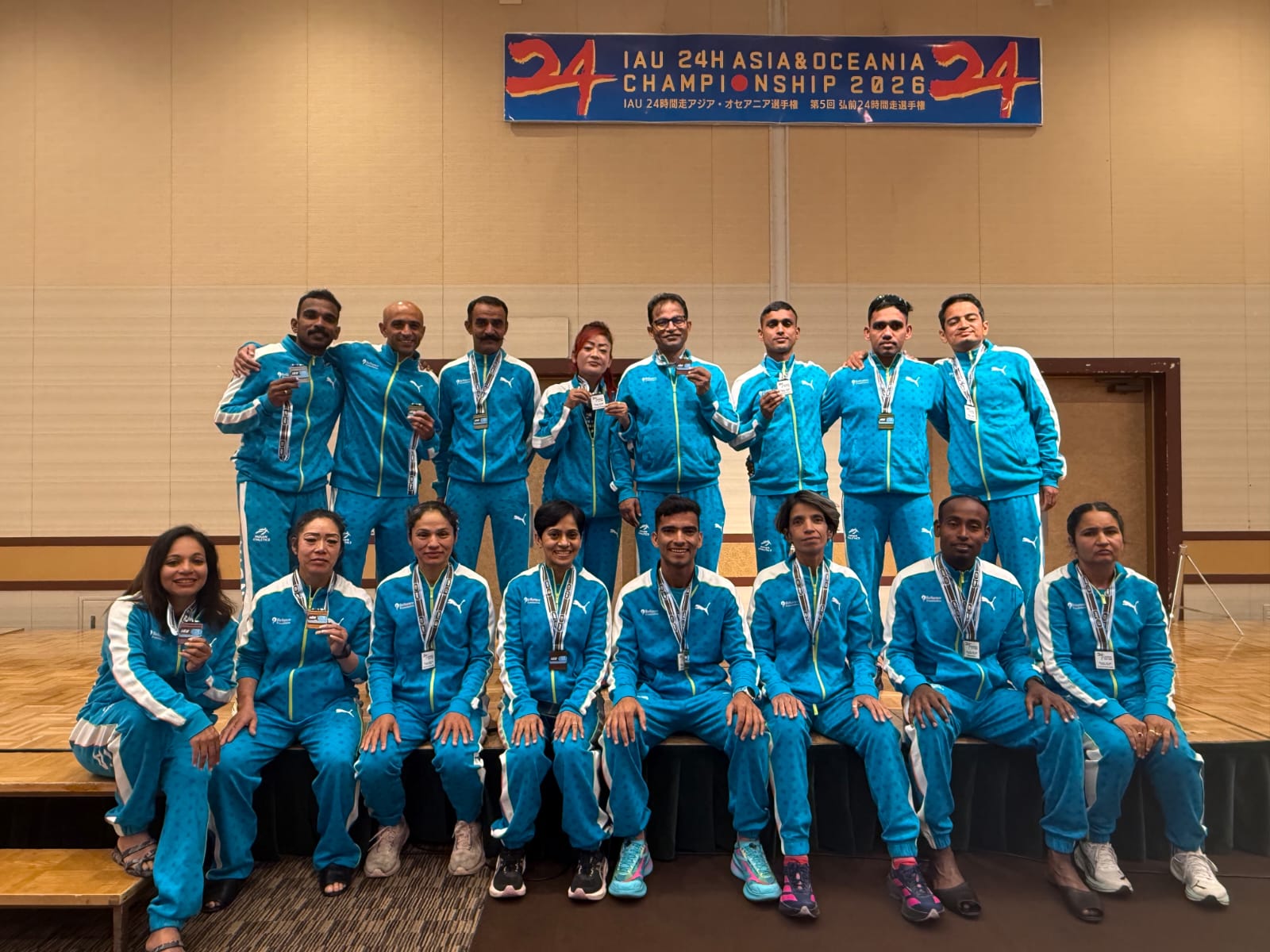
At the recent IAU 24 Hour Asia & Oceania Championships held at Hirosaki, Japan, Indian team put up their best performance so far and finished with a haul of five medals – 2 gold, 1 silver and 2 bronze.

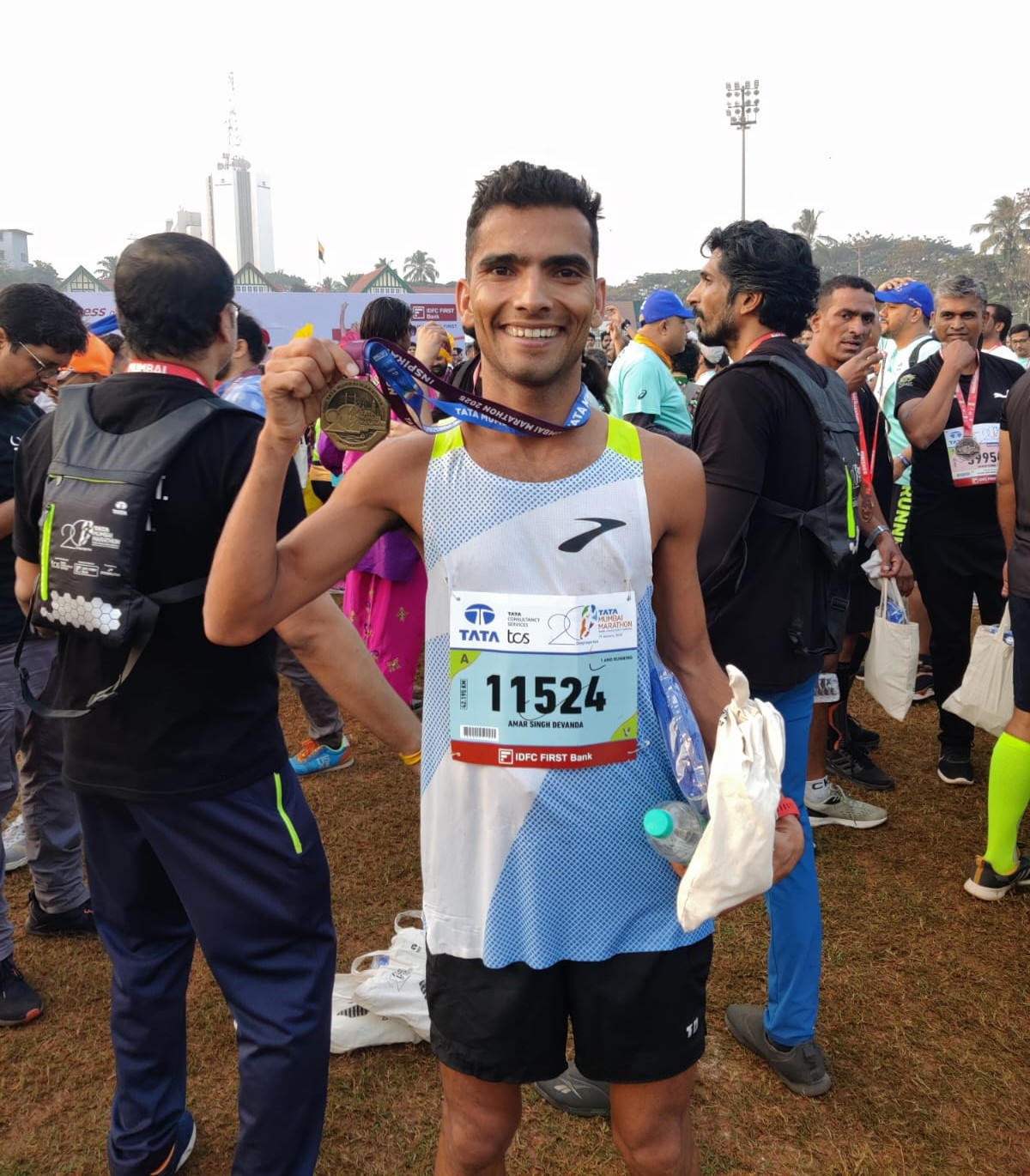
Tenzin Dolma and Amar Singh Devanda shattered the individual national records in men’s and women’s 24-hour running.

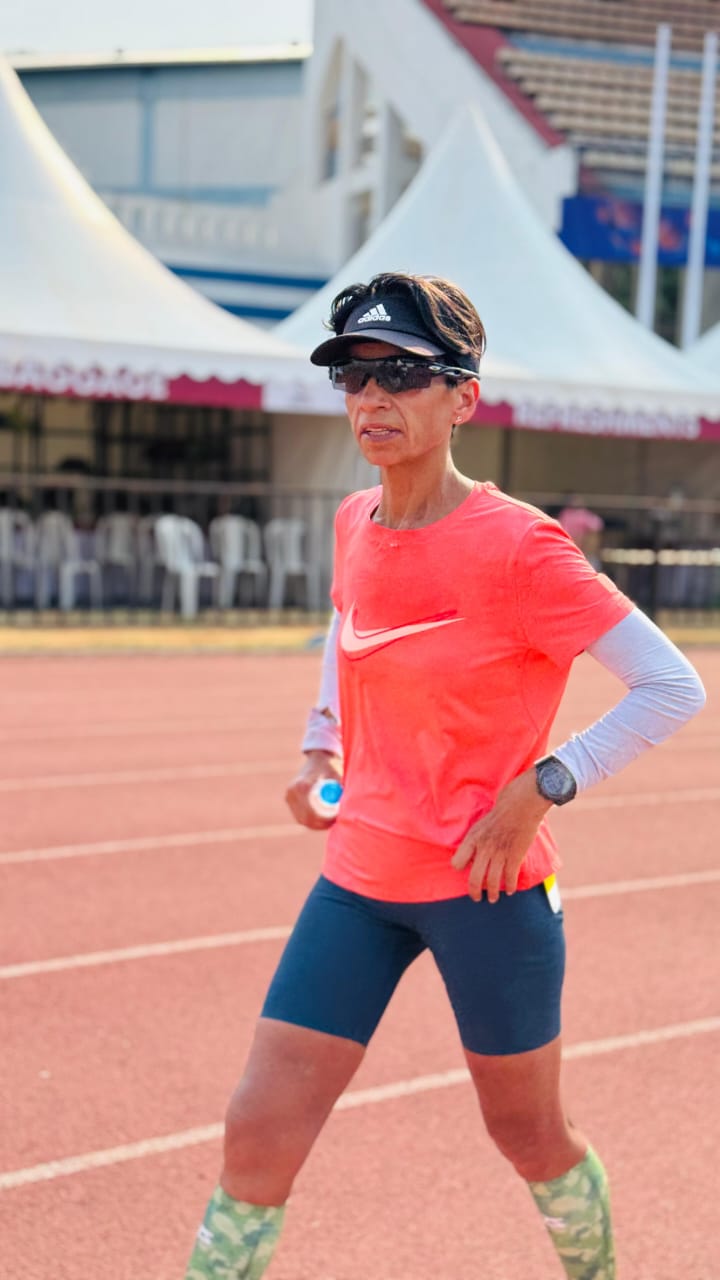
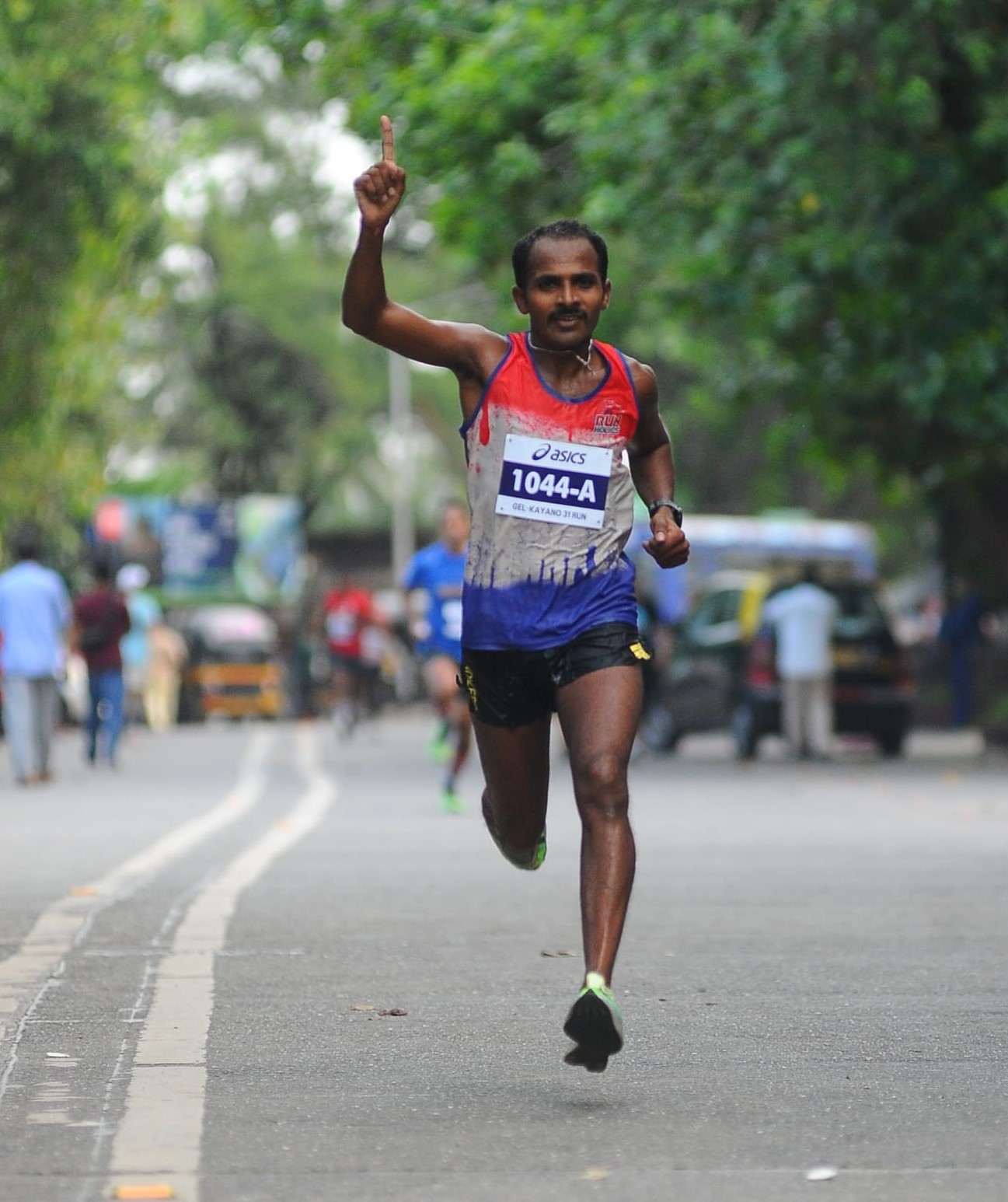
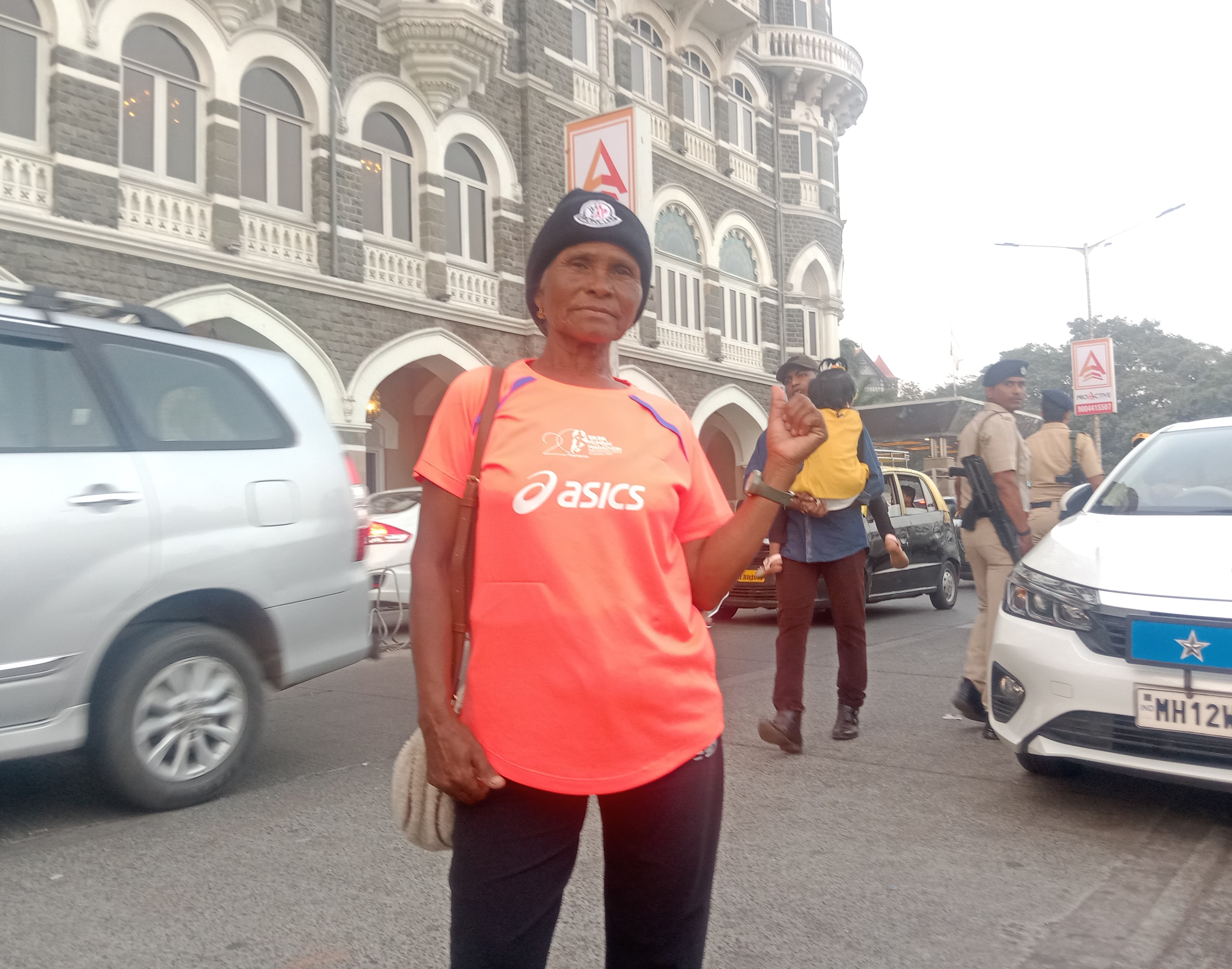
In the women’s run, Tenzin Dolma set a new national record of 228.939 kilometres, surpassing the previous record of 217.327 km set by Sunita Subba in France in 2025. Tenzin finished in the fourth position among women runners.

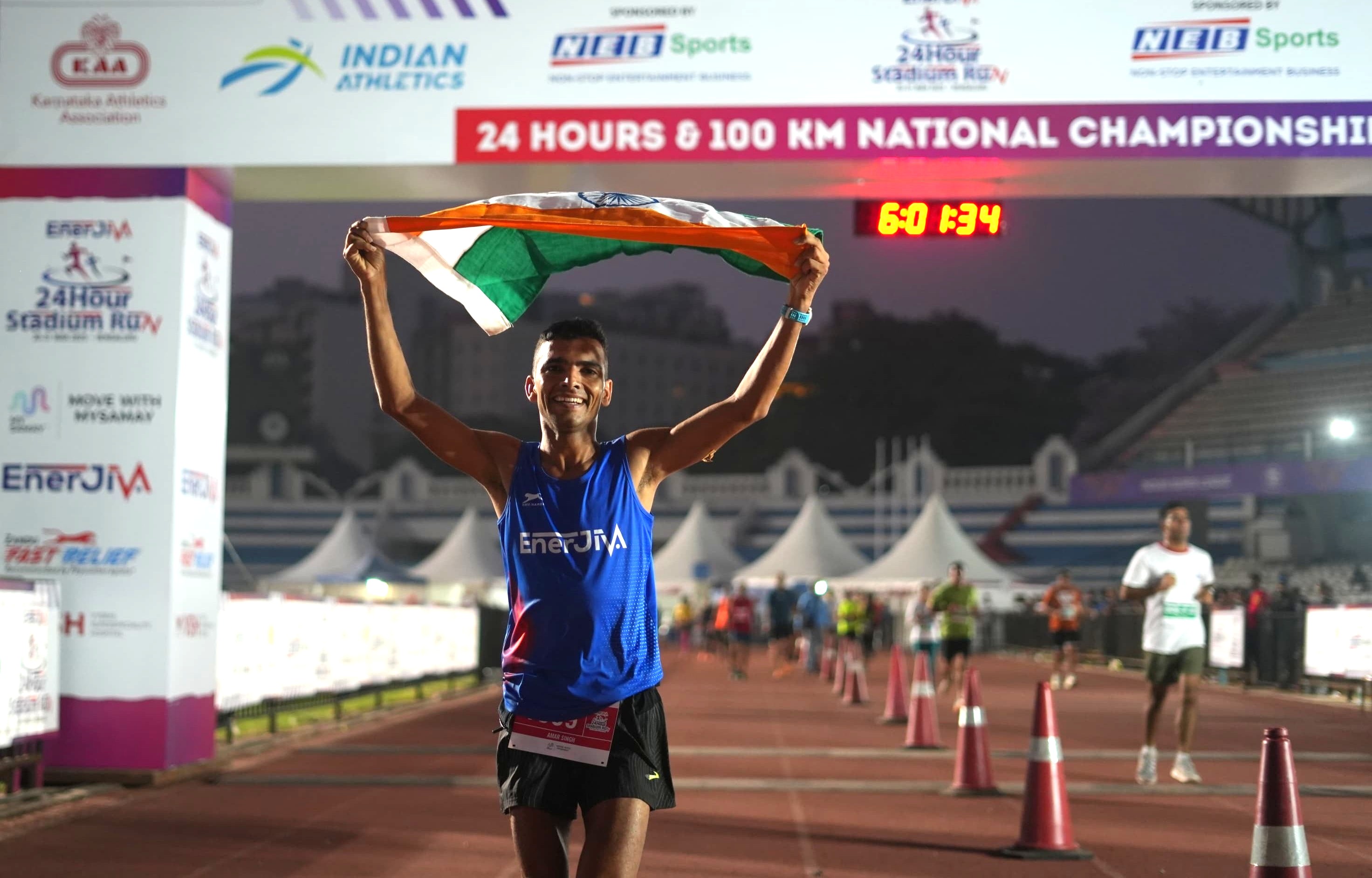
In the men’s event Amar broke his own national record of 272.537 km set in April 2024, to set a new national record of 282.881 km. He also won the individual gold medal.

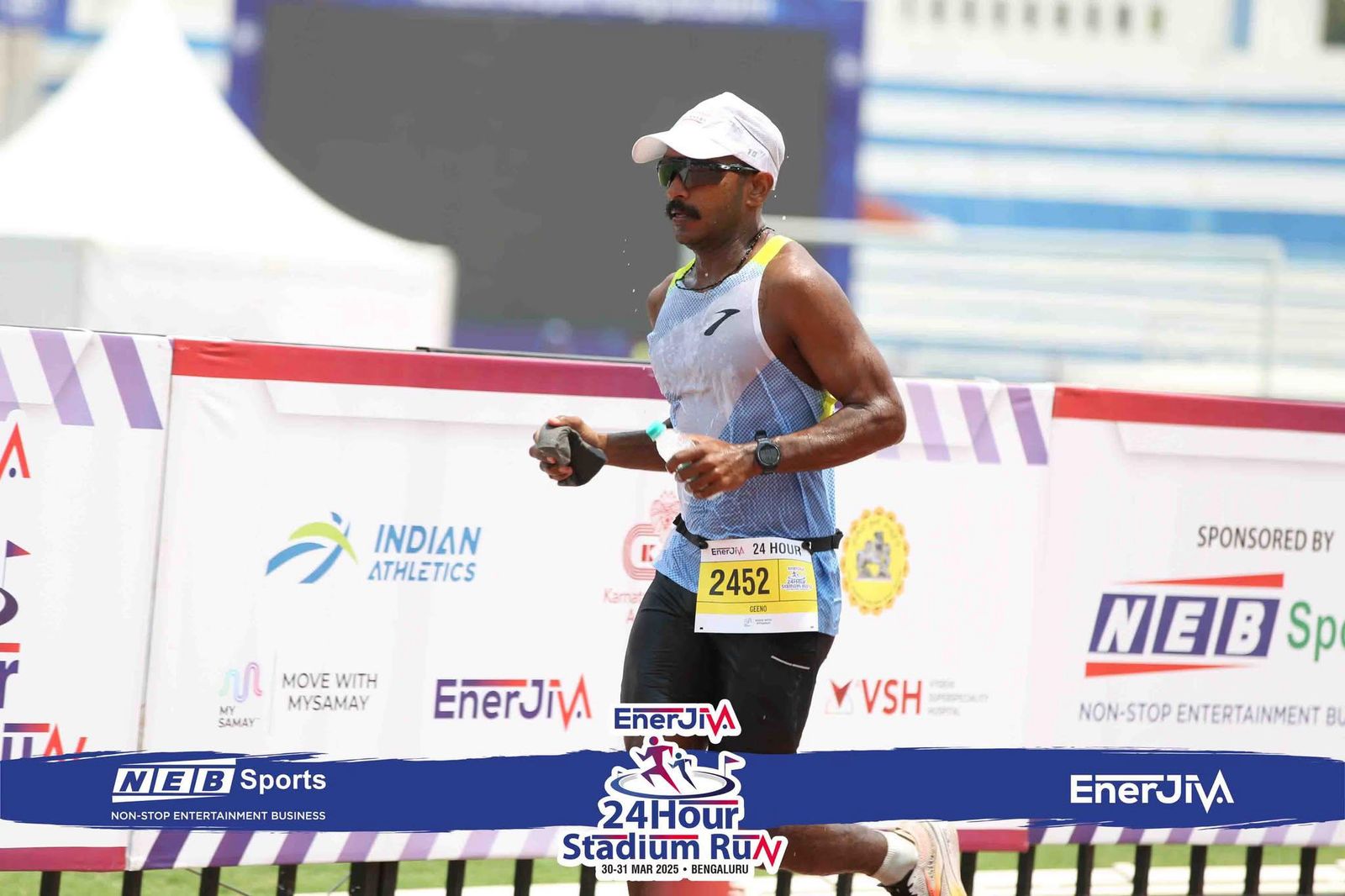
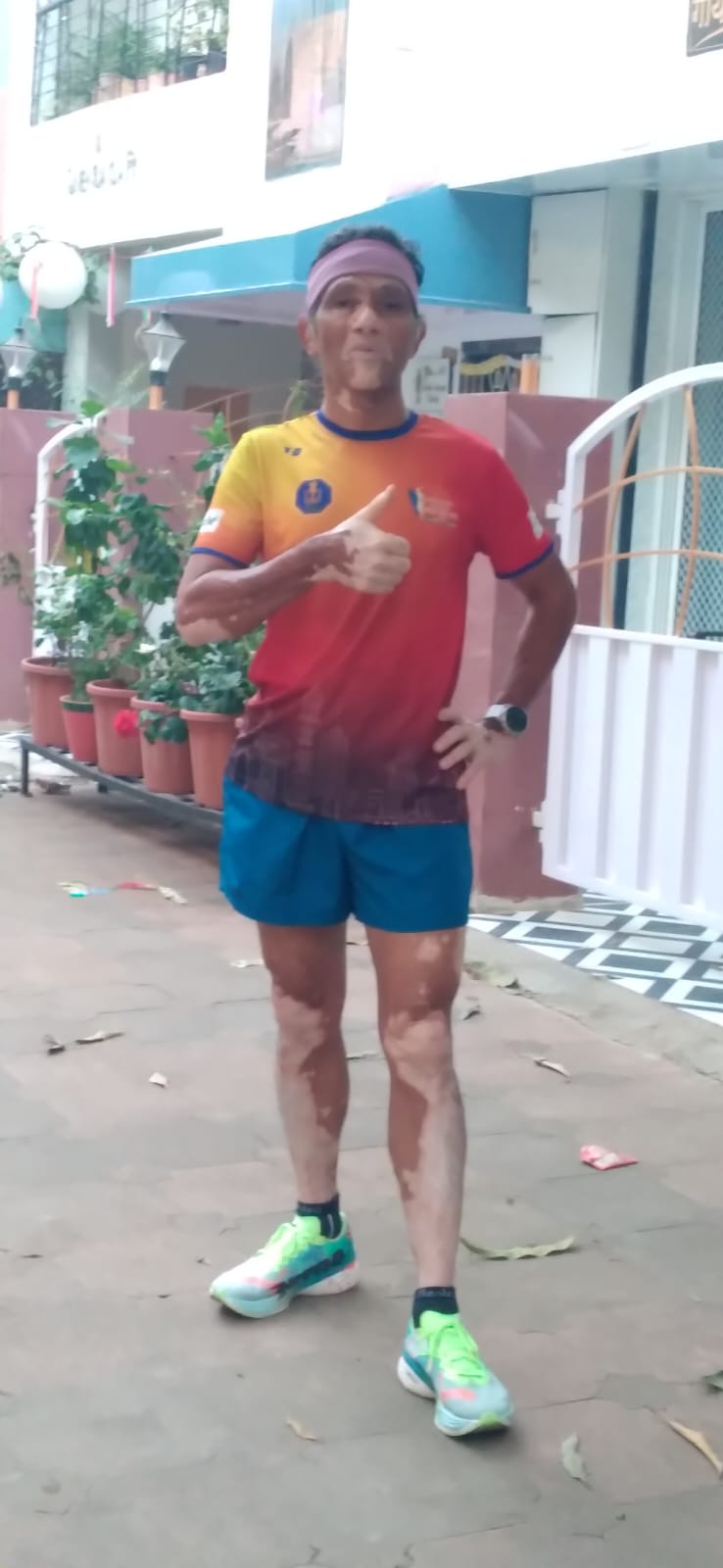
Indian men swept the individual podium positions winning the gold, silver and the bronze medals. Geeno Antony secured silver medal with a distance of 272.894 km and Saurav Ranjan the bronze with a distance of 260.058 km.

With a combined distance of 815.833 km, the Indian men finished with a team gold.

The women’s team from India secured the bronze medal with a total distance of 667.722 km (The total of the first three leading runners of a country is considered for the ranking as per the rules of IAU).

The blog spoke to all the 11 athletes and their coach Santhosh Padmanabhan.
Santhosh Padmanabhan – Coach and Manager Indian Ultrarunning Team

The stupendous improvement in the Indian team’s performance at international ultrarunning events is primarily due to the shift in the team camaraderie, says Santhosh Padmanabhan, official coach and manager of the Indian ultrarunning team in all of the IAU ultra running events that India is part of.

“From competing with each other to now running as a team the shift in the camaraderie among the team members has made a huge difference. Now, as a team we are doing well and not merely focussing on individual performances,” he said. This, in turn, has led to a collective improvement in the performances of each of the athletes.

“Of the 11 athletes, eight of them got their personal bests,” he said.

Over time, he along with the team of runners and crew have figured out the hydration and nutrition requirements for ultrarunning events. “We have realised that hydration and nutrition cannot be mono-dimensional. One can’t sustain on one fixed formula. We should be ready to shift options,” he said.
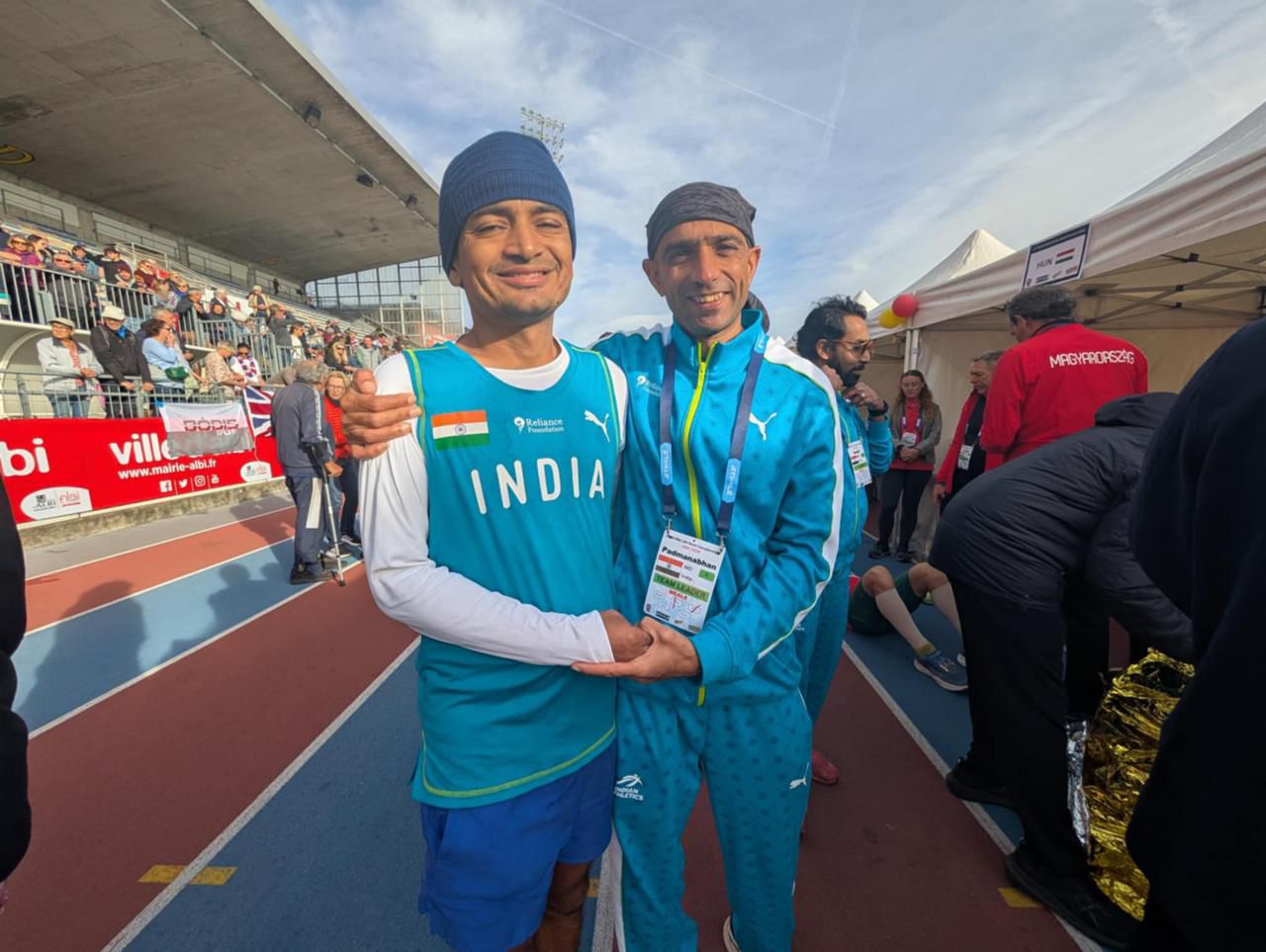
Santhosh Padmanabhan with Sugourav Goswami (Photo from a previous race)

This time around the team worked with a nutritionist, Sonali Sahoo. “We analysed everything, created a cheat sheet and listed out the possible challenges and the strategies to overcome these,” Santhosh said.

The crew, comprising nutritionist Sonali, Crew Gorkha Ram, Assistant Coach, Hemant Kumar and Physiotherapist Aashish Kushwaha, was present throughout the training program including travelling to destinations, Santhosh said.

Going ahead, there is abundant potential to explore among Indian ultrarunners and at the same time a lot of learnings from each of the ultrarunning events, he said.

Tenzin Dolma

At Hirosaki, Tenzin Dolma shattered the national record in 24-hour running by a huge margin.

At the end of the stipulated 24-hour period, Tenzin’s mileage tally was 228.939 km, surpassing the previous national record for women by more than 11 km. She finished fourth among women runners.

Tenzin Dolma was part of the IAU 100 km Asia & Oceania Championships in November 2025. She had secured a silver medal in the women’s race with a timing of 9:18:49.
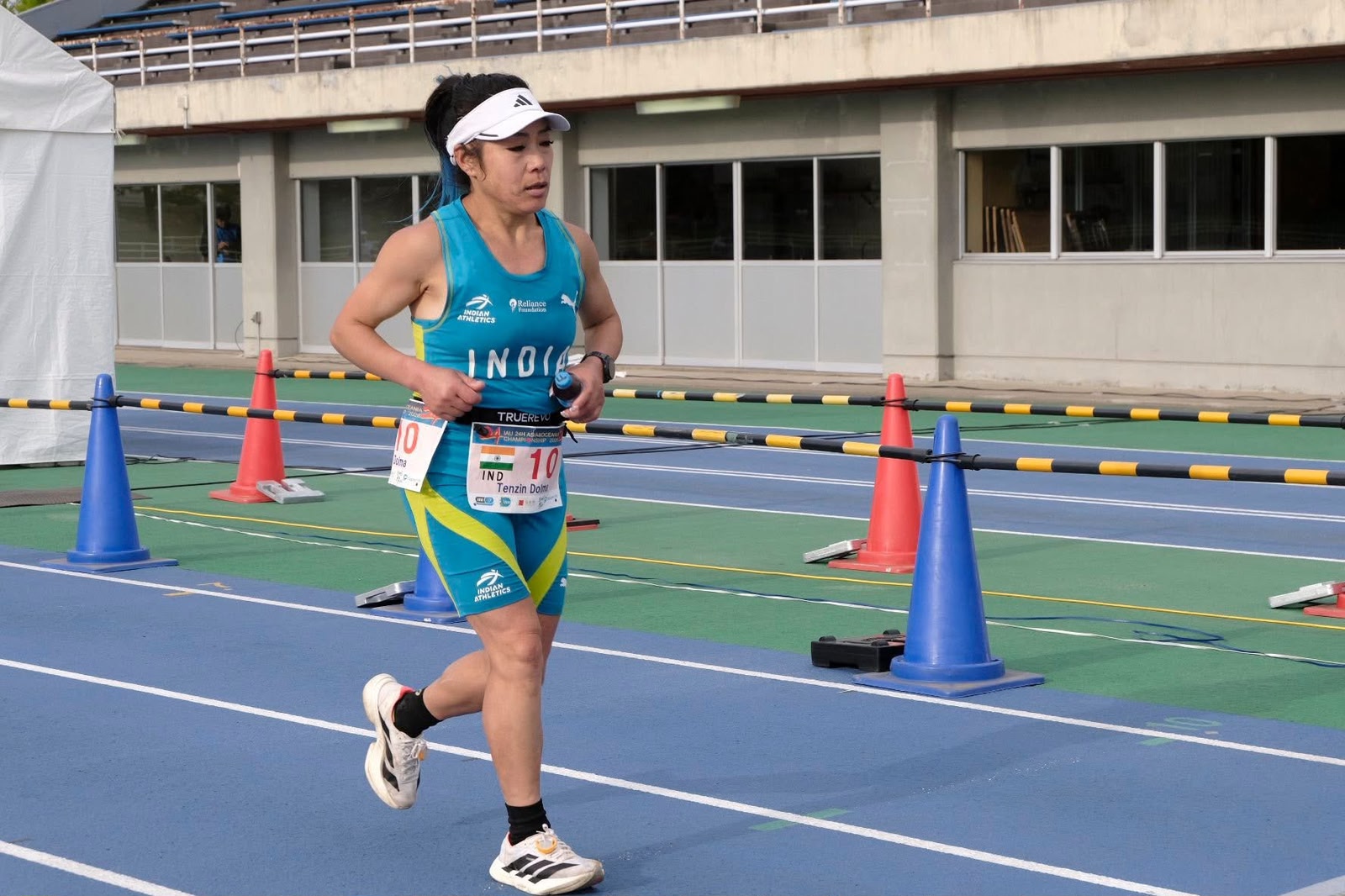
“I did my training for Japan in Manali where I stay. Because of the undulating terrain here, I was not able to put in speed work in my running,” she said. Also, she was not able to fulfil Santhosh’s training plan fully. Her strength training also fell short.

Standing at the start line in Hirosaki, Tenzin did have an injury around the knee.

“But the hydration and nutrition support during the run worked out very well,” said the 40-year-old ultrarunner.

Her post-run recovery has been good. Tenzin believes she can improve further in 24 hour runs. “I could have done better if I had trained well and had no injury,” she said.

Sunita Subba

The Darjeeling-based ultrarunner, Sunita Subba, who represented India at the 2025 IAU 24 Hour World Championships, France, and set a new national record, fell short in her training plan for the Japan championships.

“Santhosh Sir’s training plan was excellent but I could not follow it fully. My son had his 12th exams and I had to pay attention to him,” she said. She came down to Bengaluru from Darjeeling to be part of the training team but had to return home in a short while. At Albi, France, Sunita had set a new national record in 24-hour running to 217.327 km.
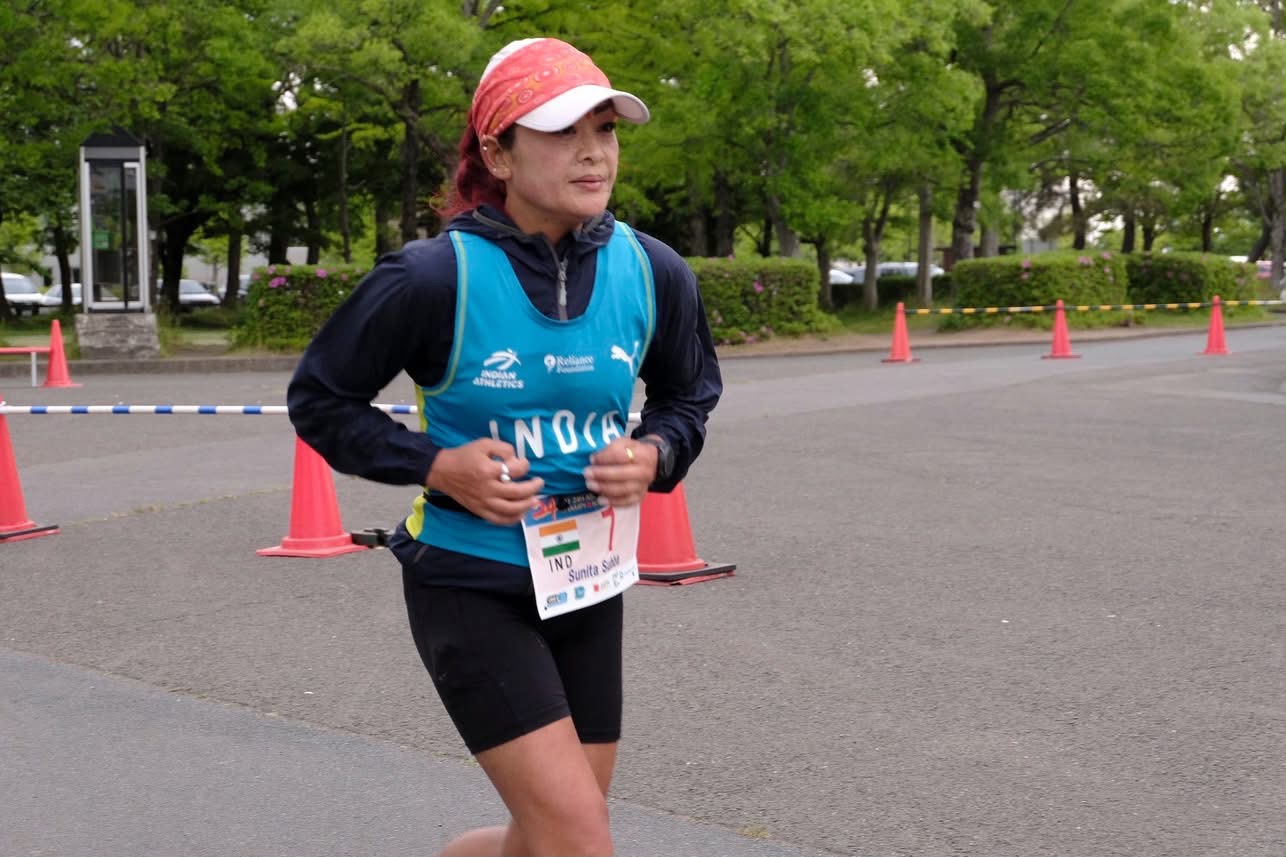
At Hirosaki, Sunita commenced her 24-hour race in her new pair of shoes that she purchased in Japan. That did lead to some discomfort. “After 14 hours of run, I got back into my old pair of shoes and I was much better off. I did have some gut issues and had to take many toilet breaks,” Sunita said. She surpassed her national record mark to cover a distance of 224.237 km, a new personal best and fifth position among women runners.

“After the run, I did not feel as tired as last time. The nutritionist’s (Sonali) recommendation to start consuming solid foods from the second hour itself helped, I think,” Sunita said.

Amar Singh Devanda

Ultrarunner Amar Singh Devanda has been rewriting national records in two categories – 100 km run and 24-hour run – for the last few years.

At present, he holds the national records in both these events.

At Hirosaki, Amar surpassed his own record in 24-hour run by a huge margin. He covered a distance of 282.881, up from his previous record of 272.537 km. He believes he has the potential to take it up further.

This time around, training was for a shorter period. Nevertheless, he covered a distance of 200 km weekly in training.

Many factors helped this time – mileage in training, the weather on race day, well-planned nutrition and hydration support and great team spirit.
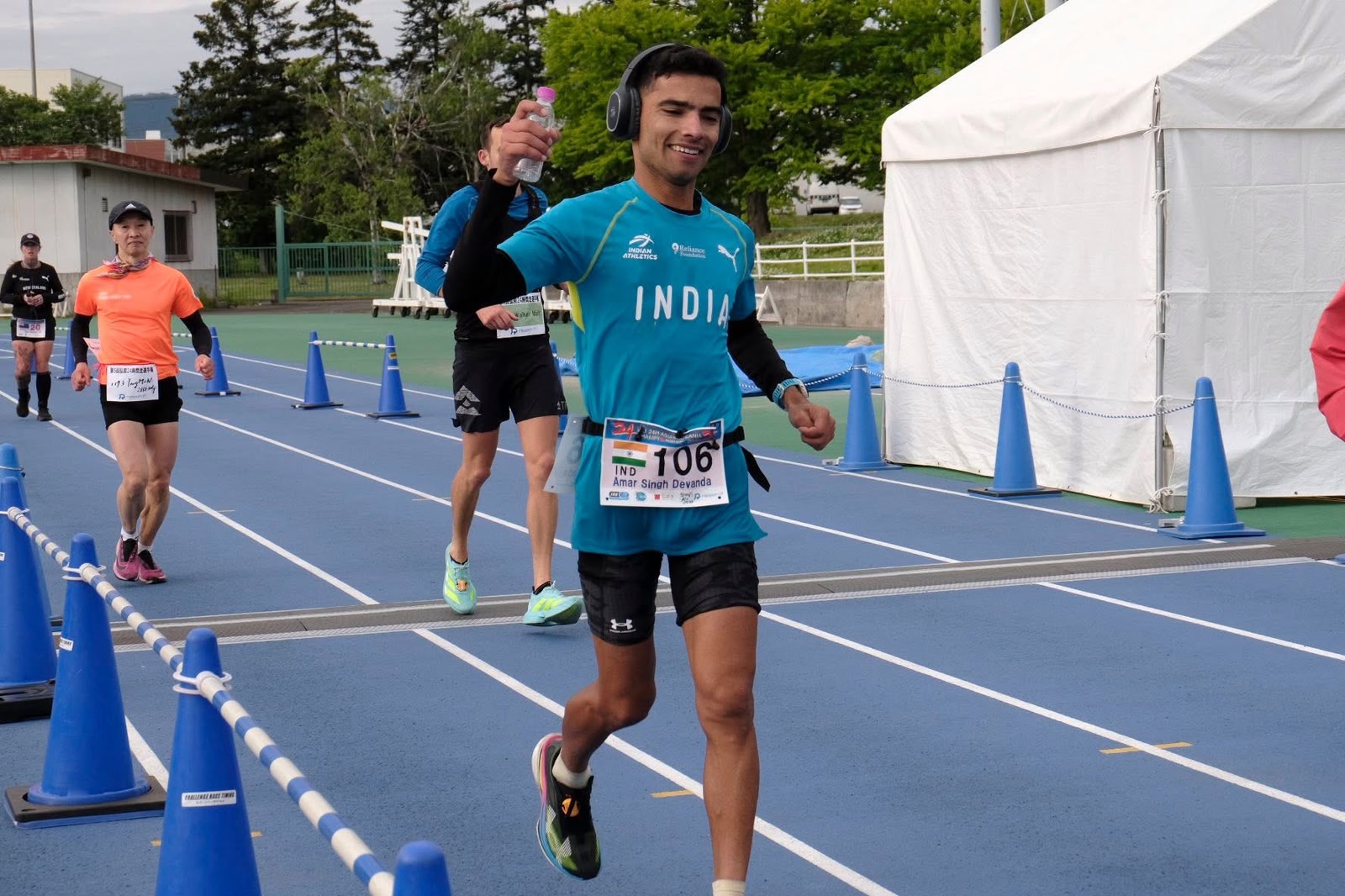
“I was confident going into the race, both mentally and strength wise,” Amar said.

His recovery post-race has also been quite good. “After a few days’ break, we may commence our training for the IAU 100 km World Championships to be held in Spain later this year,” Amar said.

Geeno Antony

At the 2025 IAU 24 Hour World Championships, Geeno Antony topped among Indian men and also secured 10th position among the men.

He had covered a distance of 265.198 km during the stipulated 24 hours. He attributes his performance in Albi to the rigorous training schedule chalked out by the team coach Santhosh.
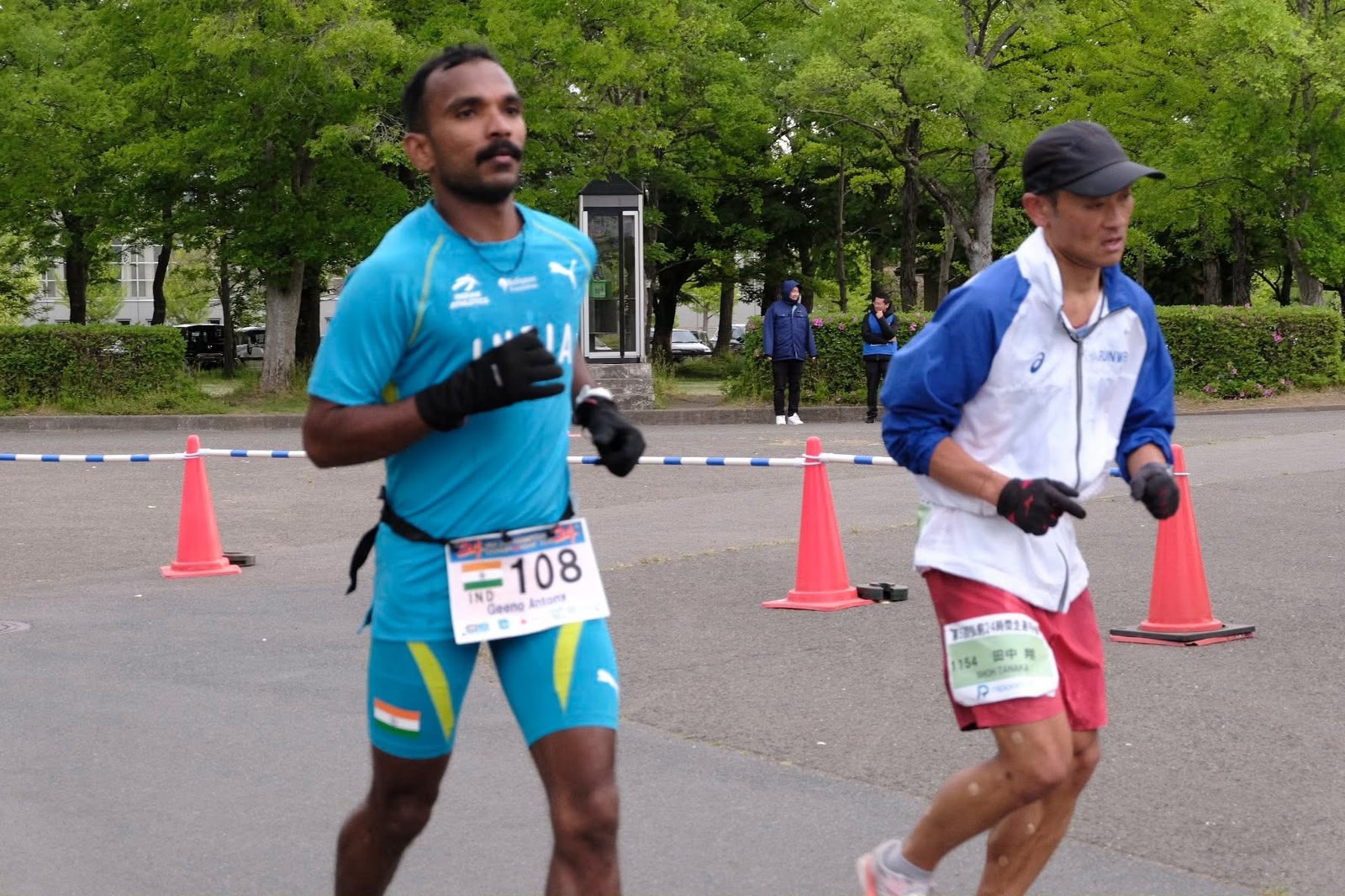
Geeno was able to adhere to the stringent training for the Japan championships too. “With so much of training, solutions are also easy to find,” he said.

Weather, according to him, was largely pleasant. “At the start of the race, it was sunny but then cooled down after sun went down,” Geeno said.

“It was clear that there was team work this time around. That really helped everybody’s performance,” he said. The crew’s support was also excellent. He was assigned Gorkha Ram as his crew. Gorkha Ram from IAF is also an ultrarunner.

Geeno covered a distance of 272.894 km, briefly surpassing the previous national record, and securing a silver medal in individual men’s race.

Saurav Kumar Ranjan

Saurav Ranjan has represented India in many IAU organised ultrarunning events.

“This time around my training went off quite well and I was able to execute all the runs including the long ones to the best of my ability,” he said. Saurav is currently posted in Bengaluru from Indian Air Force. At Bengaluru, he trained with his running compatriots – Geeno Antony and Amar Devanda.

“I did have a clavicular bone injury but I did not feel the pain during the 24-hour run,” he said.
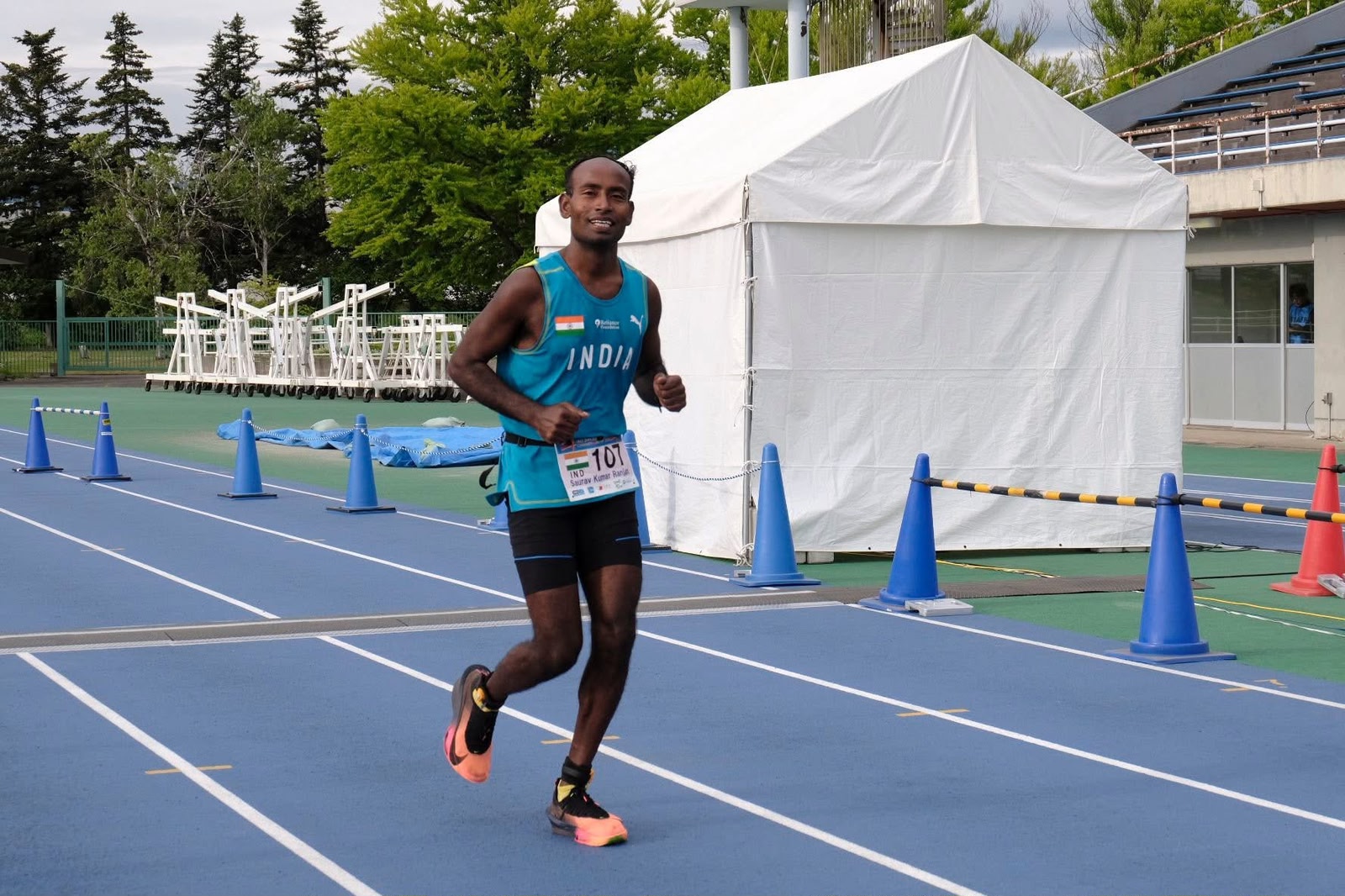
Weather at Hirosaki, Japan, during the 24-hour period of the run was quite conducive for running. “Also, this time around, I avoided too many gels and focused on eating natural food as guided by our nutritionist,” Saurav said.

The 34-year-old ultrarunner covered a distance of 260.058 km, improving his own personal record by 18 km and securing a bronze medal in individual performance.

Aparna Choudhary

Aparna Choudhary was nursing an injury in her foot that she earned during the 338-kilometre run at Vineyard Ultra in February 2026. She completed the distance in 64 hours, an improvement of four hours from her previous attempt in 2025. She finished third overall.

She took time off from running to help the healing process and started training for Japan quite late.
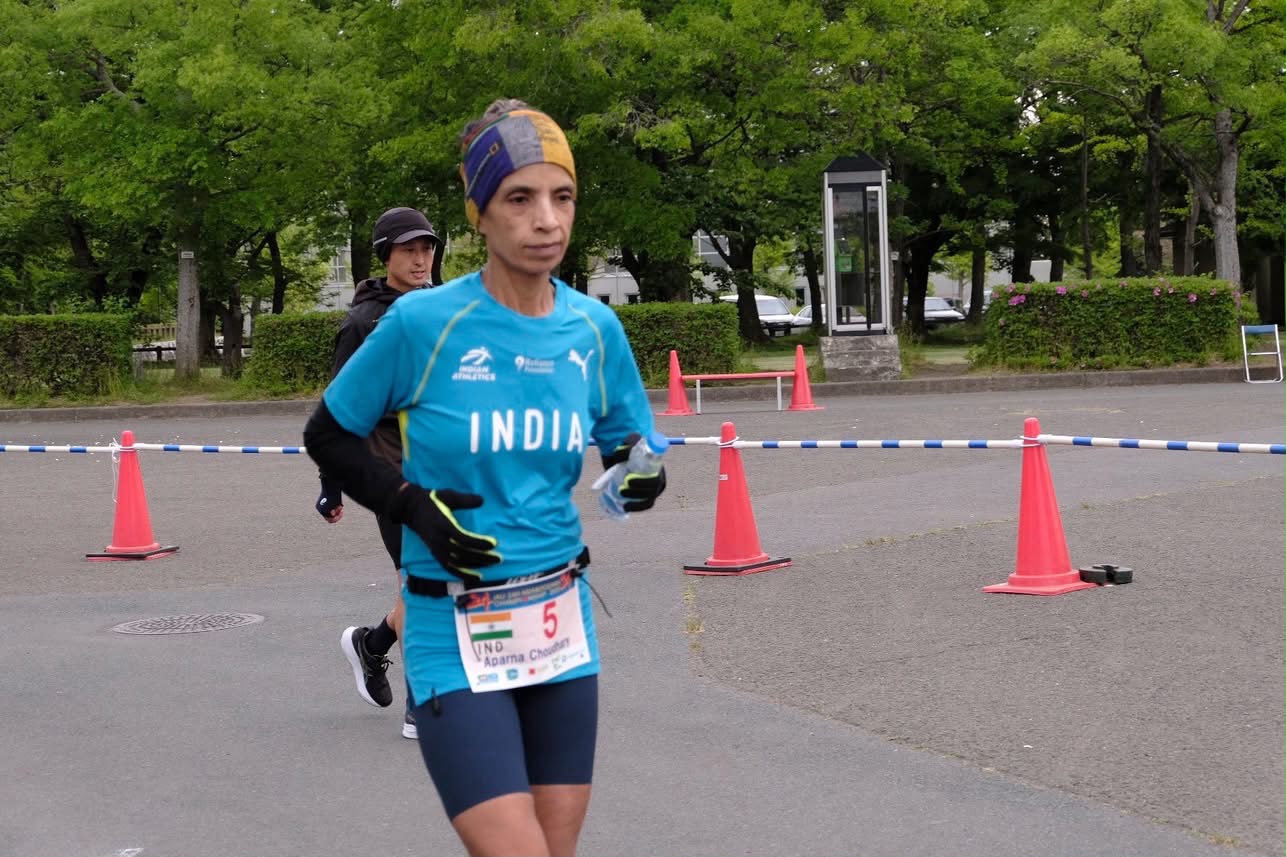
At Japan, she kept running steadily through the 24 hours of the race. “But I kept taking too many toilet breaks as I had gotten cold because of the delay in getting into warm clothes,” she said. Aparna, often prone to gut issues during these ultra runs, was fine this time around. “After 14 to 15 hours, I reduced my food intake,” she said.

Towards the last part of the race, Aparna was quite inclined to give up. “But Bindu’s company helped me. What was amazing that despite her setback, she was goading me to go along and not stop,” Aparna said.

Aparna covered a distance of 214.546 km during the stipulated hours of the race, improving her personal record by 4 km. (For more on Aparna Choudhary follow this link (https://shyamgopan.com/2026/03/09/aparna-choudhary-running-the-ultras/)

Sugourav Goswami

Sugourav Goswami took to ultrarunning a few years ago and has been a regular podium finisher in many of the events.

At the Albi Championships, Sugourav finished second among Indian men.

Sugourav along with the other ultrarunners went through a gruelling training plan for the Albi championships. Training for Hirosaki was not adequate, he said.

“I could feel that I was lacking in strength. Also, I had an injury in my left glute. At times, it was quite painful,” the ultrarunner from Uttarakhand said. According to him, physiotherapist Aashish Kushwaha’s presence in the crewing team was a great help to all the runners.
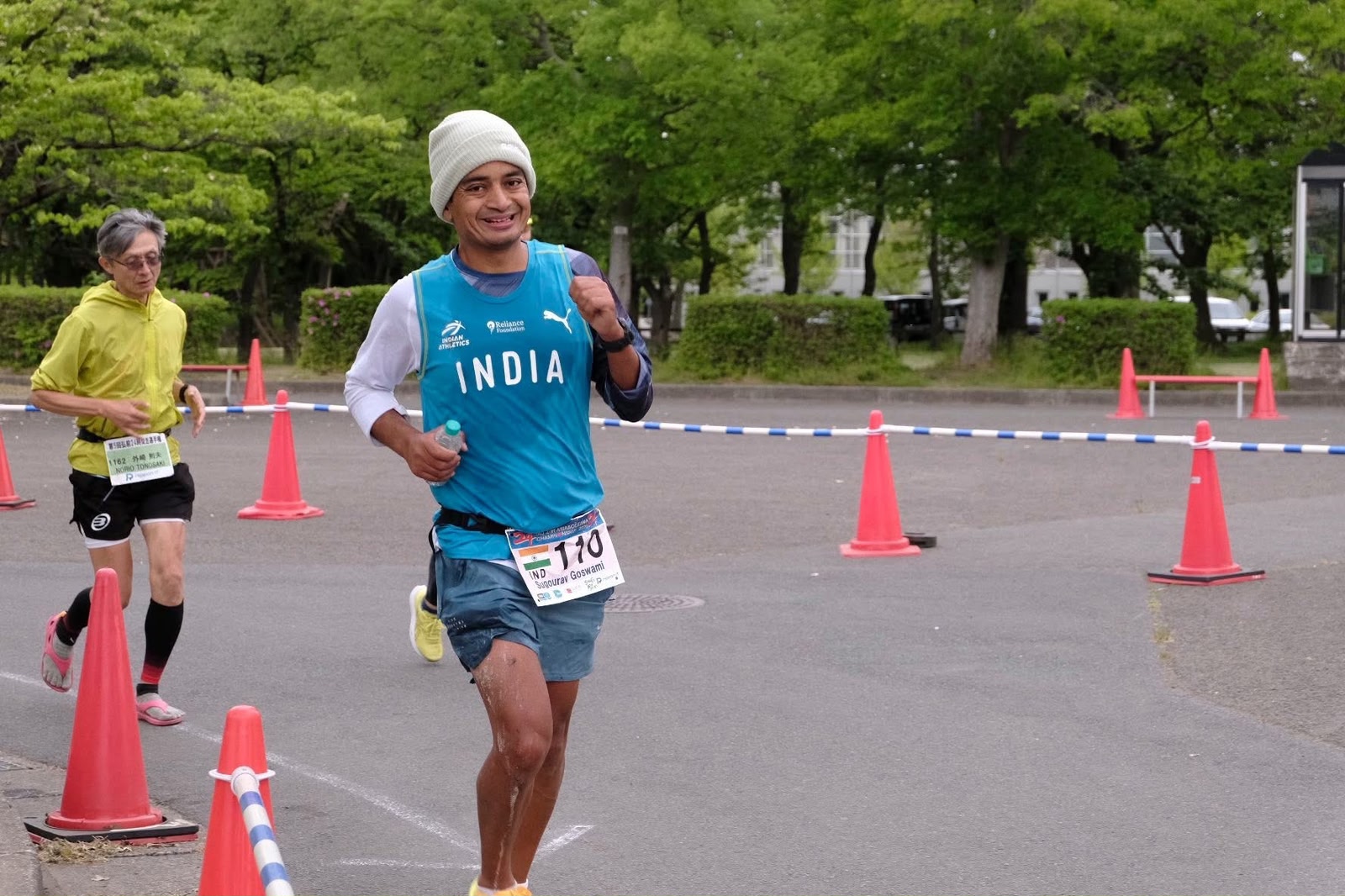
Up until 16 hours, Sugourav ran alongside Saurav. “After that my energy dropped. I could not maintain my pace,” he said.

“I really struggled in the last eight hours. I was not able to maintain my pace,” he said. He also pointed out that the camaraderie among team mates this time around was quite good and that helped in bettering runners’ performances.

In the intervening hours, Sugourav also sought medical help and crew support for Bindu Juneja, who had collapsed during the run.

Sugourav covered a distance of 250.270 km during the 24 hours, improving his personal record by 5 km and also finishing seventh among men.

Mukesh Kumari

Mukesh Kumar, the Panchkula-based ultrarunner started running a few years ago and quickly moved into ultrarunning.

At the Tuffman 24 Hour Stadium Run in 2022, Mukesh covered a distance of 168 km.

She was also part of the 100 Days of Running, putting up a daily mileage of 30 to 40 km. That helped her build up her endurance.
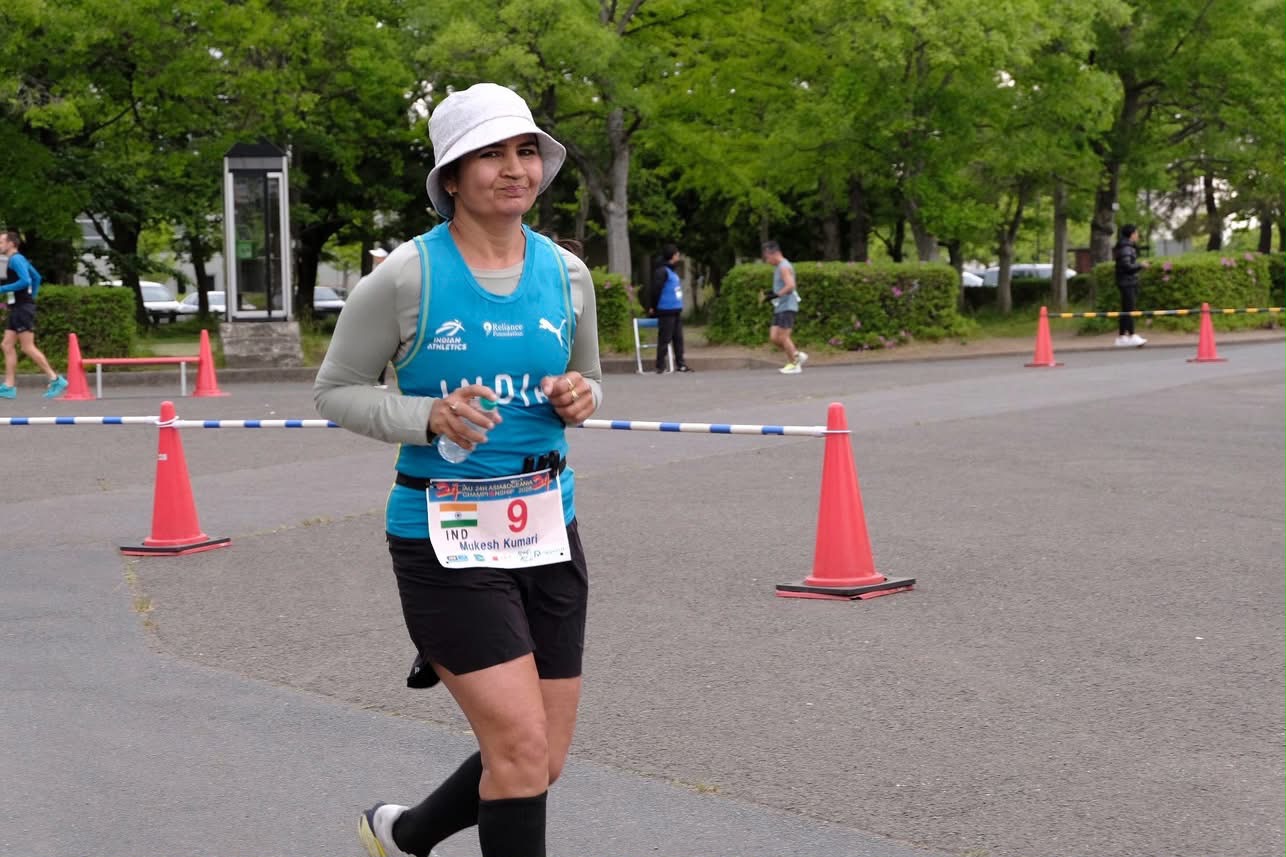
After she was chosen for the Japan championships, she followed Santhosh’s training plan diligently. “My race at Japan went off very well. The arrangement and the crew support were quite good,” she said.

Mukesh Kumari finished the hours with a mileage of 194.237 km, an improvement of 6 km from her previous 24 hour run.

Velu Perumal

Velu Perumal has been representing India in many of the ultrarunning events for the past few years.

The runner from Indian Army, now in Ooty, had a very good training season, often running with India’s elite marathoners, Gopi Thonakal and Man Singh.

However, his decision to start the run with a new pair of shoes proved to be wrong as his toe nail came off and his toes started bleeding. “At the 13th or 14th hour, I changed into my old shoes but the damage had been done,” Velu said. He had to chug along at a slow pace.
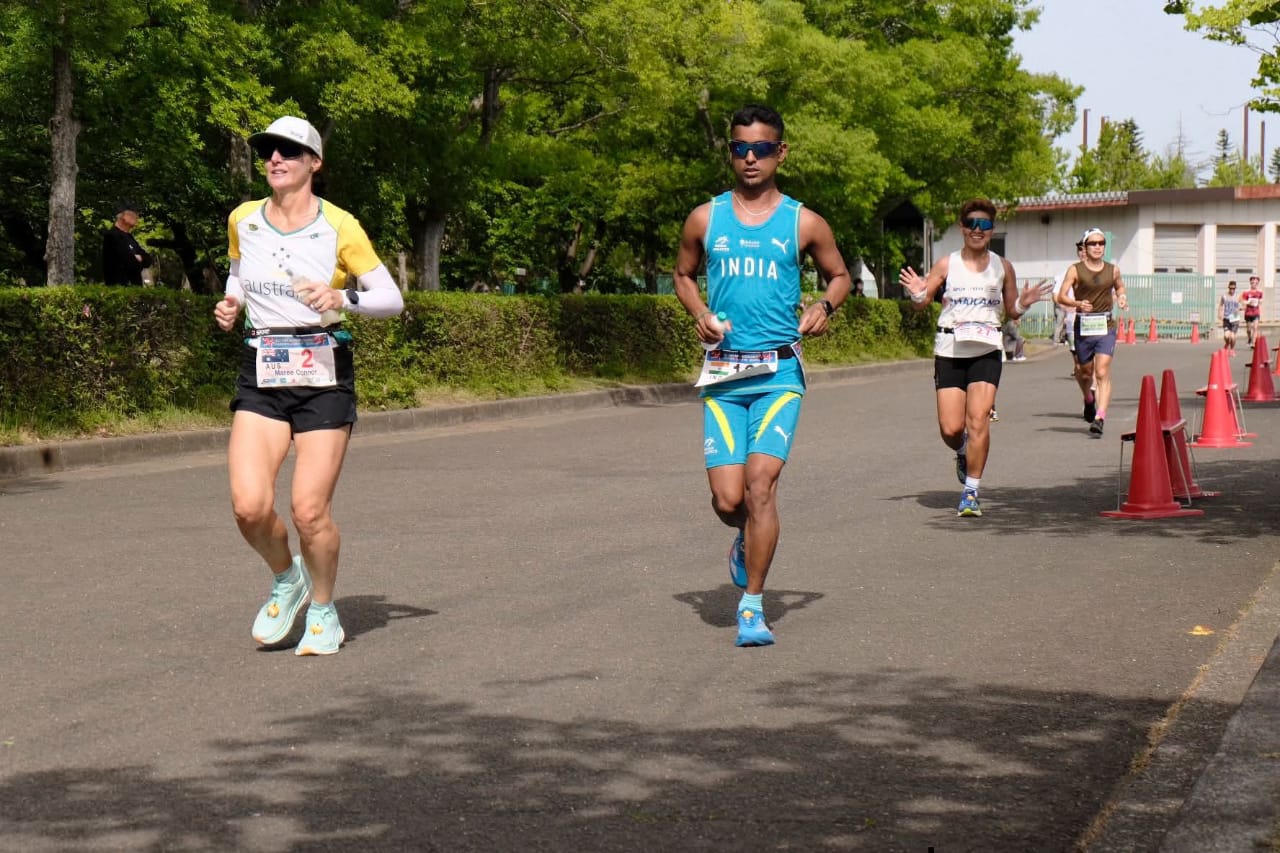
He had set a target of covering 260 km and his training had done justice to that target. He finished with 192.895 km, falling short from his personal best of 234 km.

“I feel quite bad about my performance. I had training very well for four months,” he said.

Though he fell short of mileage, he was asked to run alongside the other runners in the team to keep the momentum going, said Santhosh.

The crew support, according to Velu, was quite good, especially that of the nutritionist.

Shashi Mehta

Shashi Mehta, an officer of the rank of Major from NCC, started running in 2018. Up until now, she has done eight 24-hour runs. She has also represented India in both 100 km and 24-hour runs of IAU.

Originally from Pithoragarh, Uttarakhand, Shashi did some bit of sprinting in her school days. She started running in 2018 when she was posted in Kottayam in Kerala.
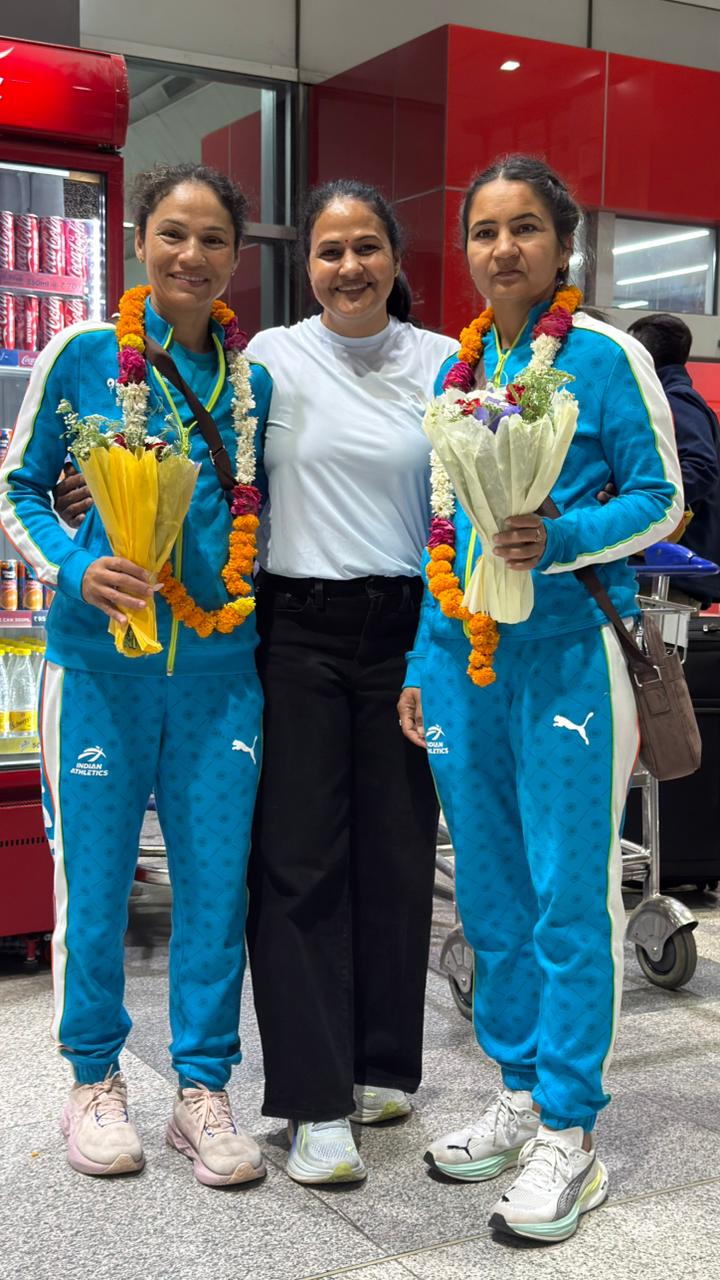
Shashi Mehta and Mukesh Kumari along with ultrarunner Deepti Chaudhary (centre). Picture courtesy Deepti

At the 2026 edition of White Sands Ultra held at Rann of Kutch in March, she won the women’s race in the 100-miler with a timing of 26:11:48 hours. She is a regular podium finisher in many ultrarunning events.

“Returning from White Sands Ultra, I was left with just six weeks for the Japan championships. I took two weeks off to recover from the 100-miler. My training for Japan did take a hit as I had not fully recovered from the race,” she said.

Shashi completed the Japan race with a mileage of 176.755 km. “This time, I had no gut issues. During the race, I consumed 20 gels, electrolyte drinks, salt tablets and solid food,” she said.

According to her, Indian women ultrarunners do have the capability to bring home the gold medal.

Bindu Juneja

At the IAU 24 Hour World Championships 2025 held at Albi, France, Bengaluru-based ultrarunner Bindu Juneja crossed the 200 km mark to finish with a distance of 202.164 km, a huge improvement of 17.2 km in her personal record.

This time around, she was not able to put in the requisite amount of training. After the World Championships, she went off training for a surgery and was left with two months to train for Japan.
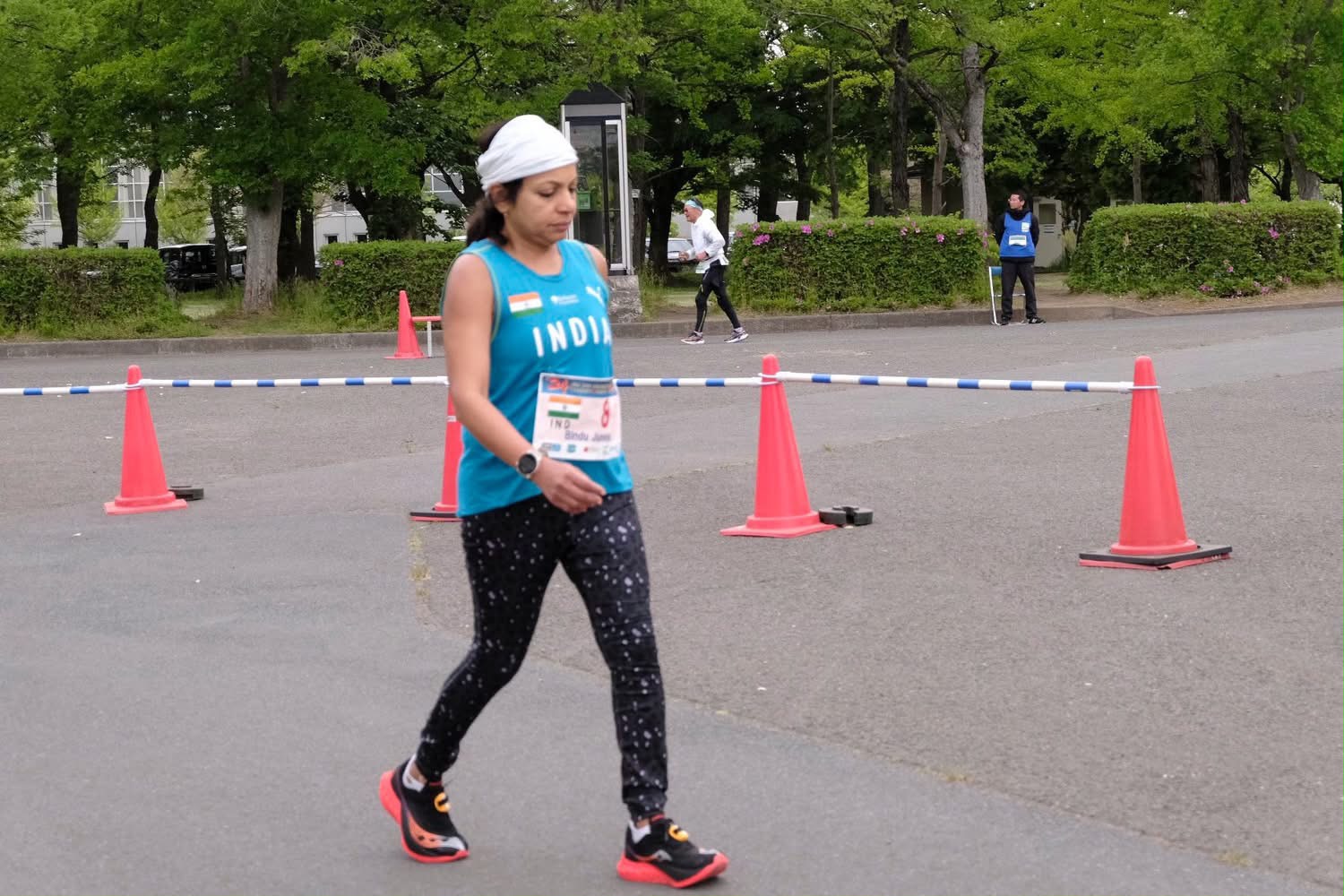
On race day, Bindu managed to run steady for 10 hours. “Into the 10th and 11th hour, I started to feel dizzy and my heart rate was hitting highs constantly,” Bindu said. Following that she had no clue what happened. Sugourav Goswami, a fellow runner from her team, saw her lying down. He alerted the medical team and guided her to India’s support tent. Initial indication showed that her blood sugar had dropped to very low levels. She was also cold and started shivering. “I was out of the race from the 11th to the 14th hour. From the 15th hour I started walking until the 18th hour and then ran rest of the hours consuming only Coke and Eclairs,” she said. Bindu finished with a distance of 160.378 km.

“I will be eternally grateful to Sugourav for having rescued me after he had found me fallen along the race’s course, sacrificing his own race momentarily,” Bindu said.

(The author, Latha Venkatraman is an independent journalist based in Mumbai)

(Photos by Indian Team)

(Inputs from IAU website)
My Boston Marathon Story

A personal account by runner Jayadrath Singh

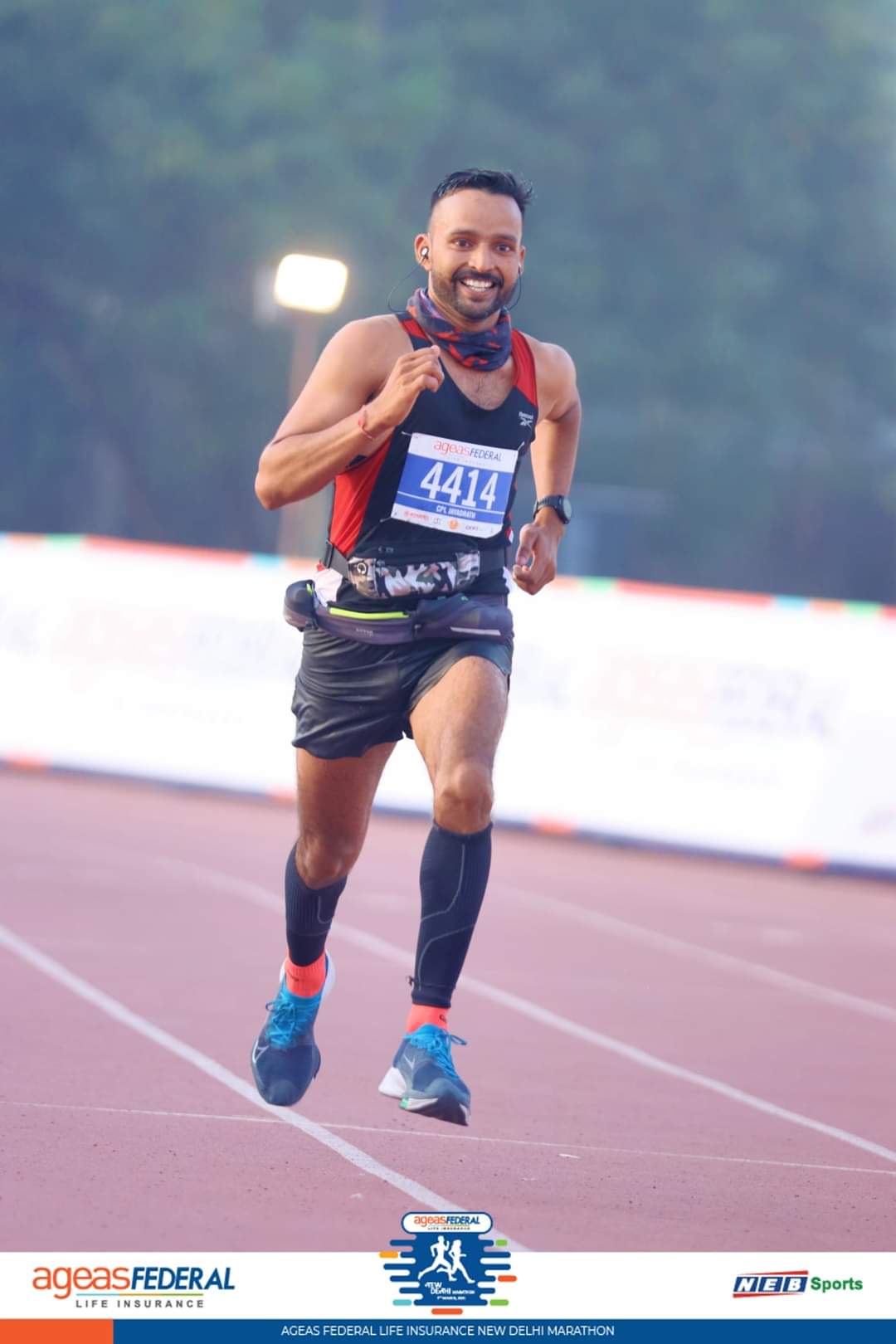
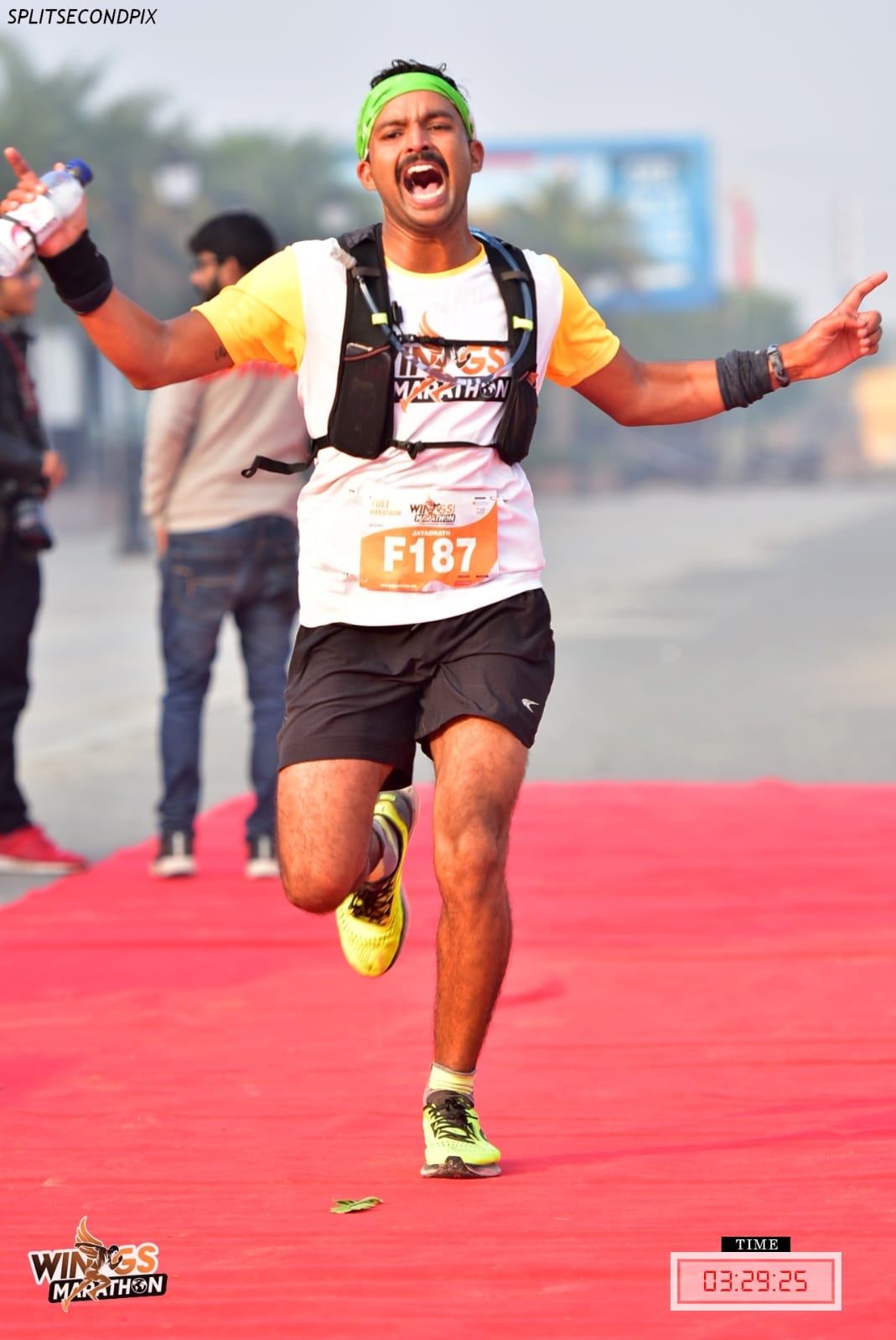
Jayadrath Singh commenced running sometime in December 2018. A year later he ran his first marathon, finishing in three hours and 30 minutes. An SNCO (Senior Non-Commissioned Officer), Jayadrath, originally from Rishikesh in Uttarakhand, is now posted in Chennai.

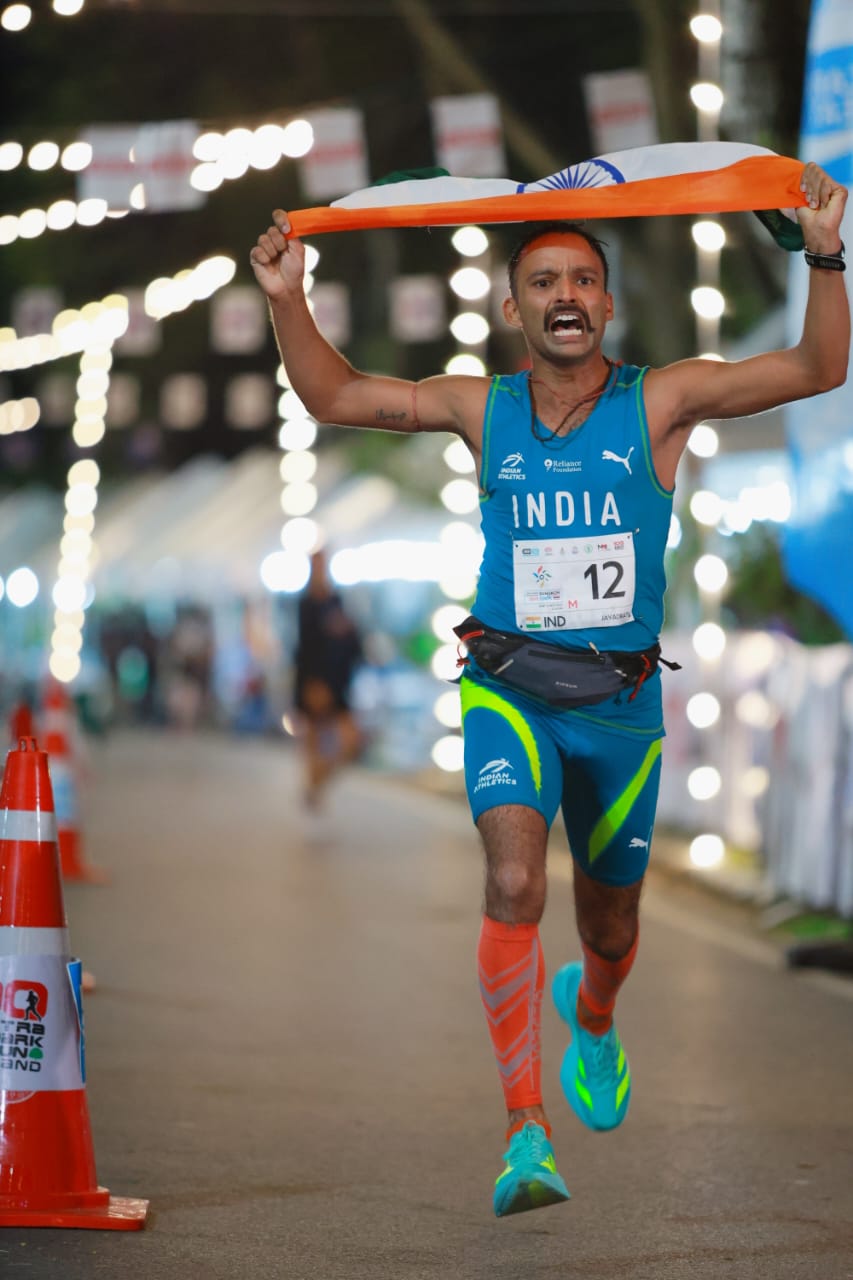
Jayadrath’s foray into running was prompted by the need to step up his physical activity. Soon, he began enjoying running. In 2021, he attempted his first 50 km, a stadium run in Lucknow. Having done a few ultras thereafter, Jayadrath got the opportunity to represent India at the IAU 100 km Asia & Oceania Championship, held in November 2025 in Bangkok, Thailand.

On April 20, 2026, he attempted his first World Marathon Major – Boston Marathon. He finished the race in 2:46:09, second fastest among Indian runners this year.

He writes about his experience at the 2026 edition of Boston Marathon.

I ran my first marathon in December 2019 finishing with a timing of three hours and 30 minutes. At that point I did not have any plan to go back and do another marathon, a distance of 42.195 kilometres. But within a week, I found myself training for the next marathon.

Running his first marathon – Wings Marathon Faridabad December 2019

In February 2020, I ran the New Delhi Marathon and completed the race in 3:11 hours, an improvement of 19 minutes. My coach Vin D told me that I could qualify for Boston Marathon. This was the first time I heard about this marathon. Curious about Boston Marathon, I asked my coach the criteria for registering for the race. He smiled and told me it is sub-three hours for my age category. The question that came to my mind was, “Can I achieve this?”. He was confident I could improve my time efficiency. When the coach believes that I can achieve the target, it became a moral responsibility to work towards it.

From that moment Boston Marathon qualification was my main goal. I began scouring through Boston Marathon website to find out about athletes from India who had run the iconic race in sub-three hours. I made a point to look for those runners who had finished the race in sub-three hours with a full-fledged job. Some of the runners’ names that came up in my search were Mahesh Diwedi, Hemant Beniwal, Dany Saran and Binay Sah. I followed their inspiring journey and with the help of my coach’s running plan and meticulous training I ran and finished the 2021 edition of the New Delhi Marathon with timing of 2:55. Most importantly, I had achieved a negative split in the race.

I was happy to have met the target visualised by my coach.

But qualifying is only one part of the work for participating in Boston Marathon. I needed funds for travel and stay in Boston. Also, with every passing year, the qualifying mark was getting tighter at Boston Marathon. Thankfully, I was able to improve my time efficiency in the marathon distance year after year.

Between 2021 and 2016, I qualified for Boston Marathon nine times.

Ultrarunner Vikas Malik, owner of Leap (nutrition brand) offered support to me to help me transform my dream to reality. I will be forever grateful for his support. I hope there are many more Vikas Maliks to help Indian runners get to the start line of Boston Marathon.

Representing India at the IAU 100 km Asia & Oceania Championship 2025 at Thailand

Race day (April 20) was chilly and cloudy day when I lined up in Hopkinton, the start point of the marathon. From boarding the distinguished yellow school buses with Boston police escort to the finish line volunteers never leave a chance to amaze you and make you feel special during your entire Boston Marathon.

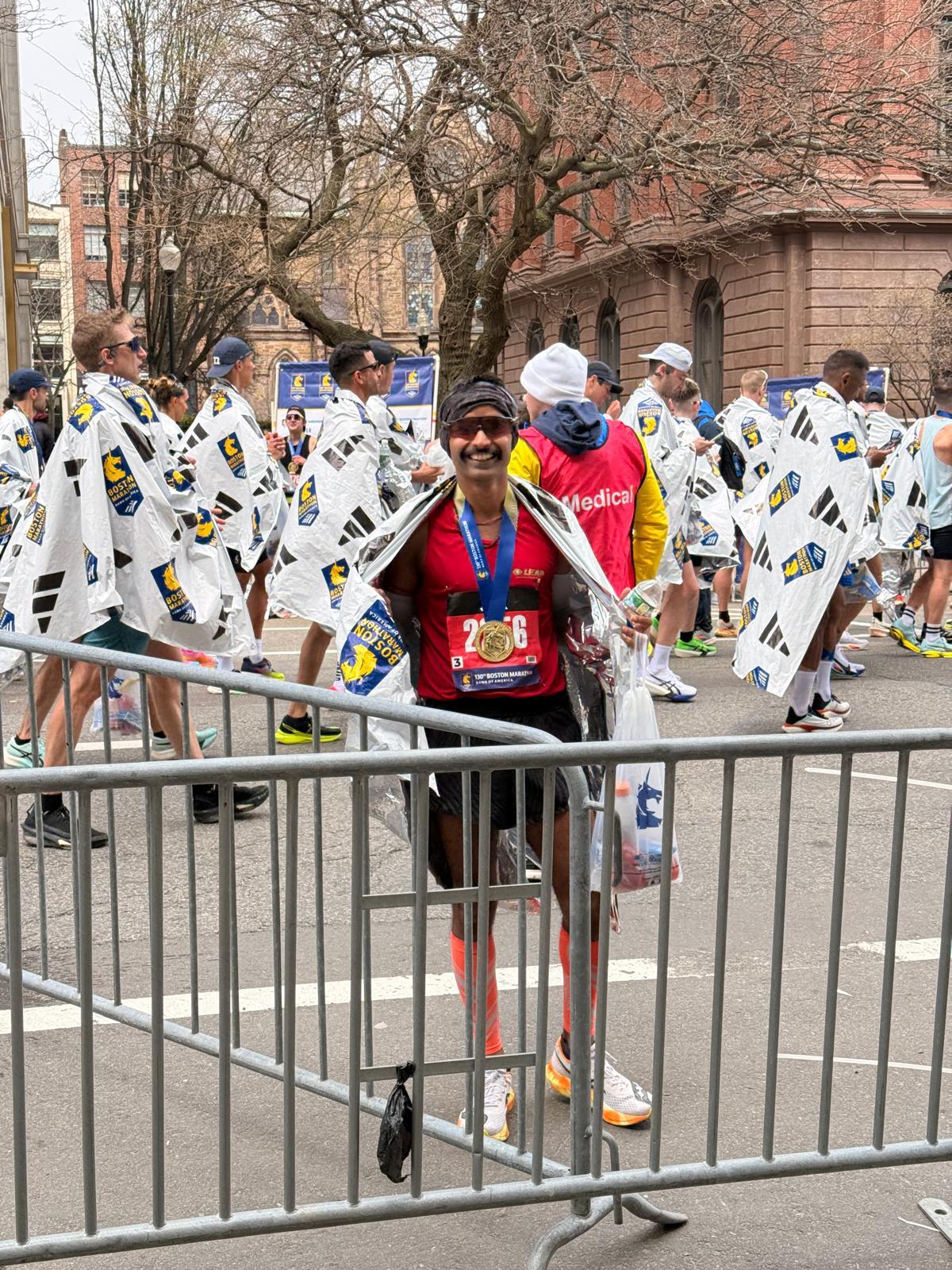
At Boston Marathon 2026

I was in Coral 3 Wave 1. I set off the start line with sun shining bright and witnessing the US Air Force fly along the course. It was an emotional moment crossing the start time. I felt confident and proud completing my first lap even as I remembered what my coach advised me, ‘to stay calm and composed during the early part of the race and push in the second half.’

The vibe was incredible and all along the course there is not a single stretch where people are not standing and cheering. It felt as if the entire city had turned up at the marathon course to cheer the runners.

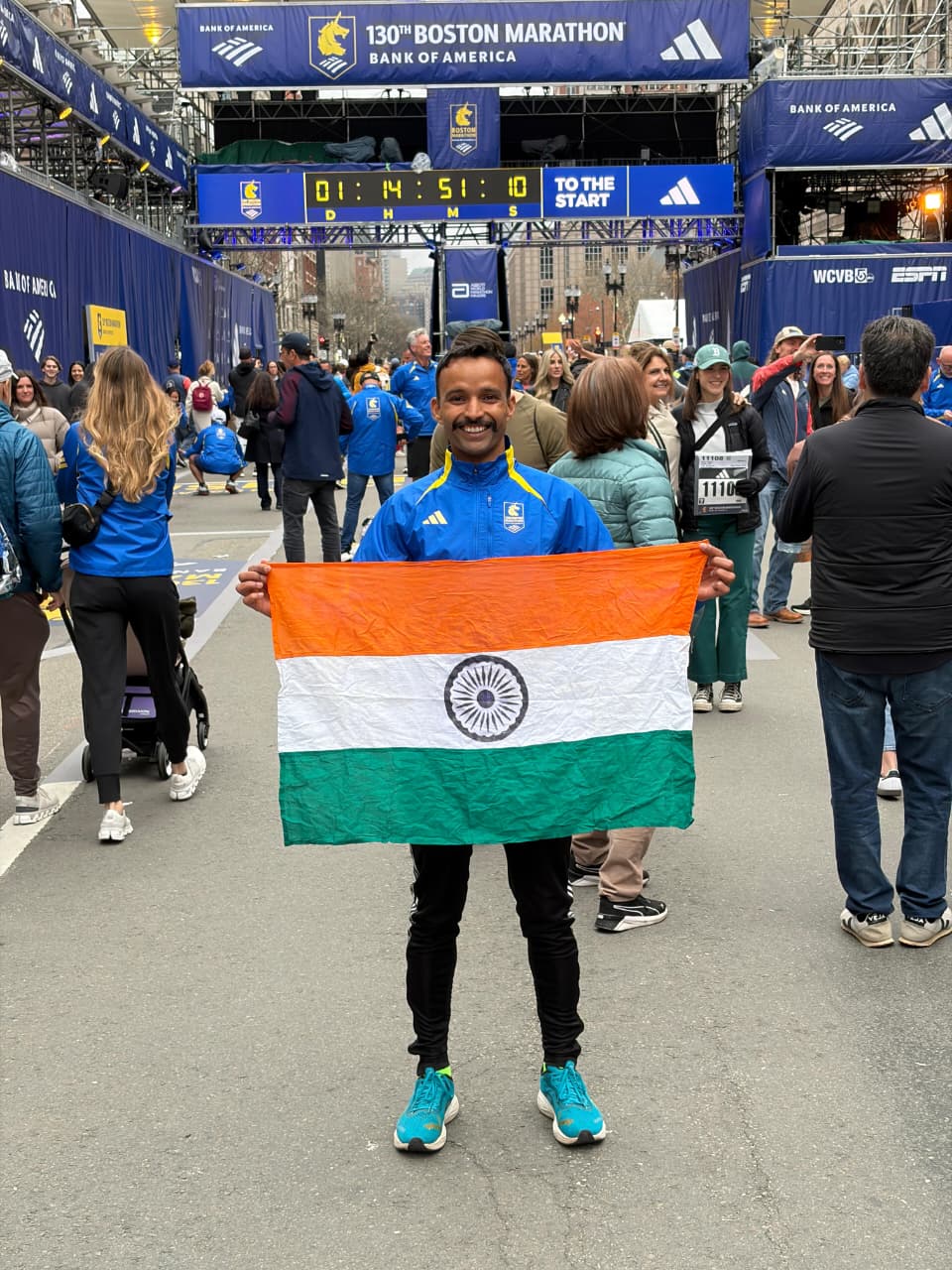
At Boston Marathon 2026

As the miles went by, clouds began covering the sun and the weather turned pleasant. Advancing towards the finish line I kept hydrating myself with energy gels at regular intervals. The course was not easy by any stretch. The rolling hills kept the challenge for the runners. But the pulsating energy from the people and volunteers prompted every runner to push.

I crossed the finish line with gratitude and pride. The icing on the cake was getting a gold colour Boston Marathon finisher medal as the US is celebrating 250th anniversary of the Nation this year.

I finished Boston Marathon 2026 with a timing of 2:46:09. I was the second fastest Indian this time.

(Photos courtesy – Jayadrath Singh)

(Inputs from Boston Marathon website)
Sawan Barwal smashes India’s 48-year-old marathon record

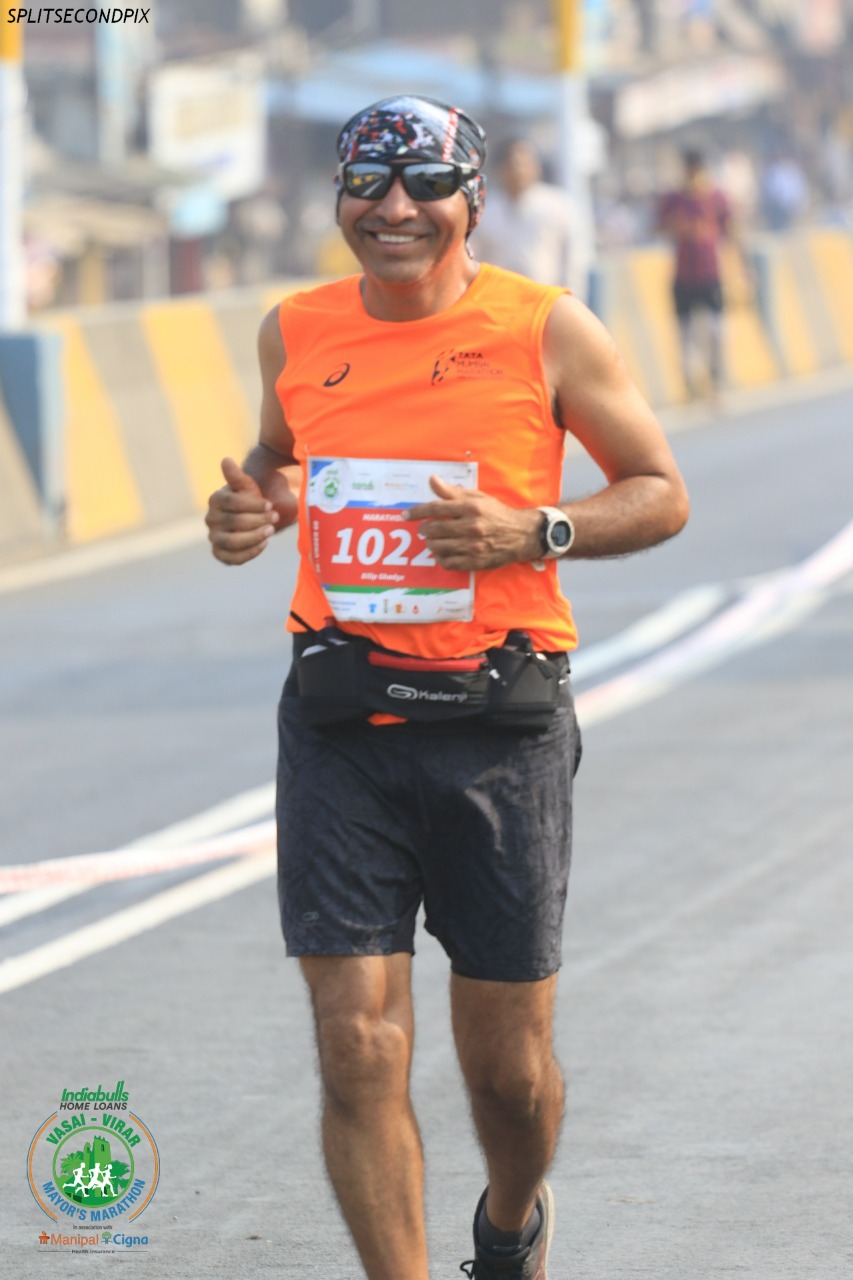
Indian long-distance runner Sawan Barwal, in his debut marathon, smashed the country’s 48-year-old marathon record by two seconds at the N N Marathon Rotterdam, held on April 12, 2025.

Sawan, a half-marathon champion, finished the marathon in two hours, 11 minutes and 58 seconds, beating Shivnath Singh’s national record of 2:12 set way back in 1978, media reports said.

He finished in the 20th position in the elite race at N N Marathon Rotterdam, its website showed.

Photo downloaded from Athletic Federation of India Facebook page

The 28-year-old runner from Indian Army is an athlete well-known for his competence in 5,000 metres, 10,000 metres and half marathon races.

At the Rotterdam race, his army compatriot Gopi Thonakal finished in 2:13:16 in 23rd position.

Cognizant New Delhi Marathon 2026 – Musings

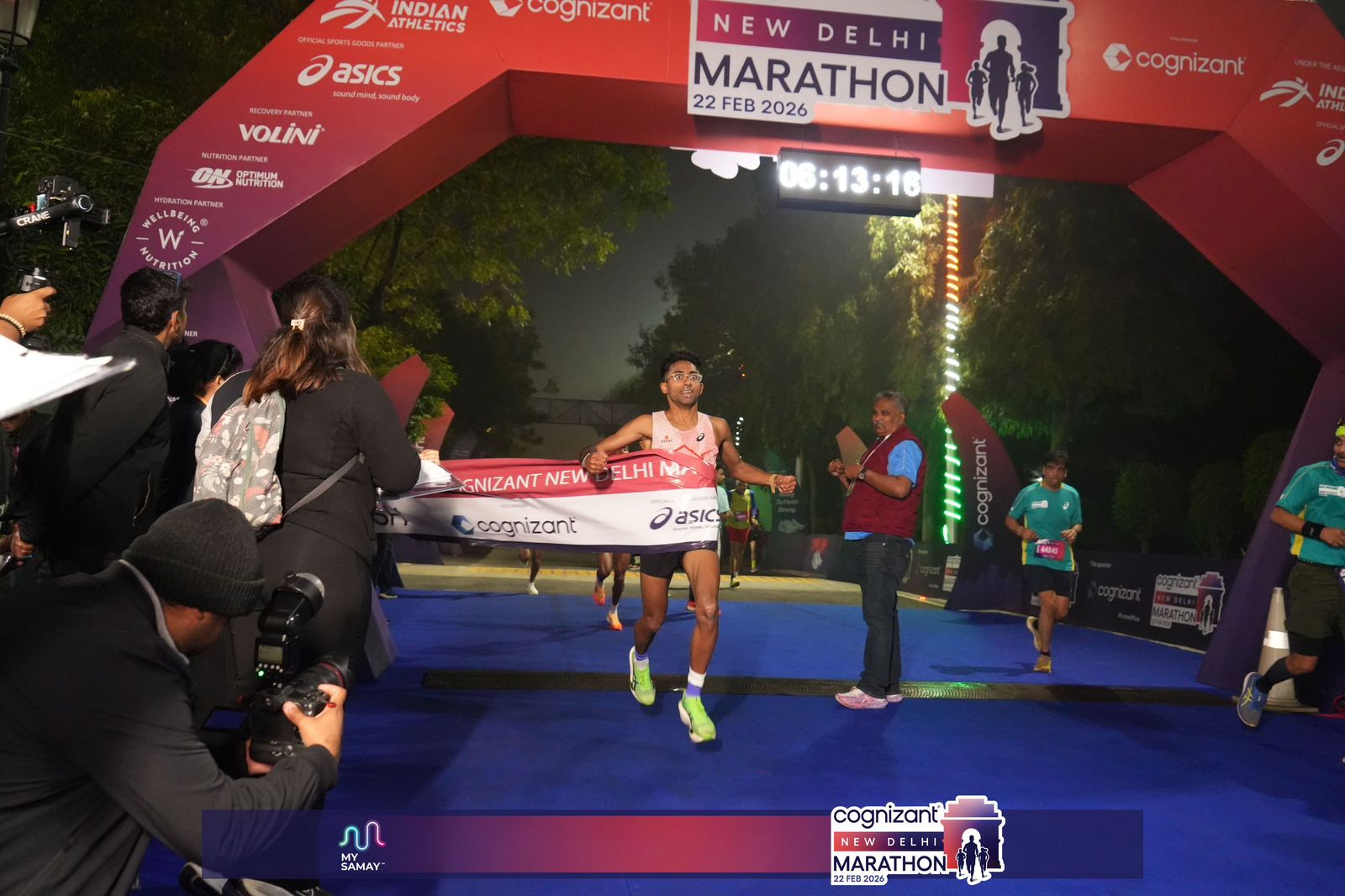
Kartik Karkera and Nirmaben Thakor won the men’s and women’s marathon race at the Cognizant New Delhi Marathon 2026 held on February 22.

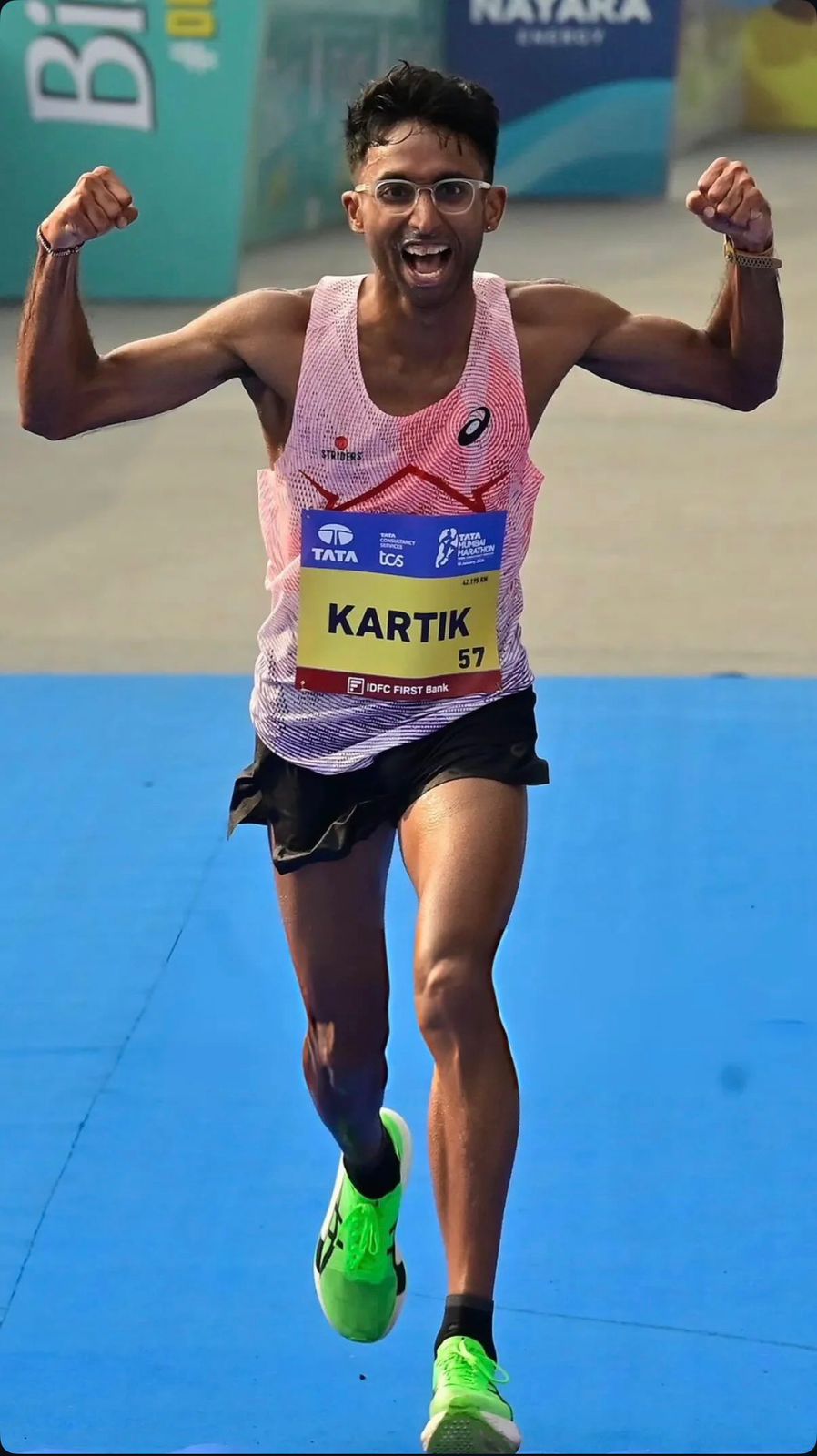
Kartik won the race in two hours, 13 minutes and 10 seconds, a huge improvement from his win a month ago at Tata Mumbai Marathon 2026 where he finished the race in 2:19:55.

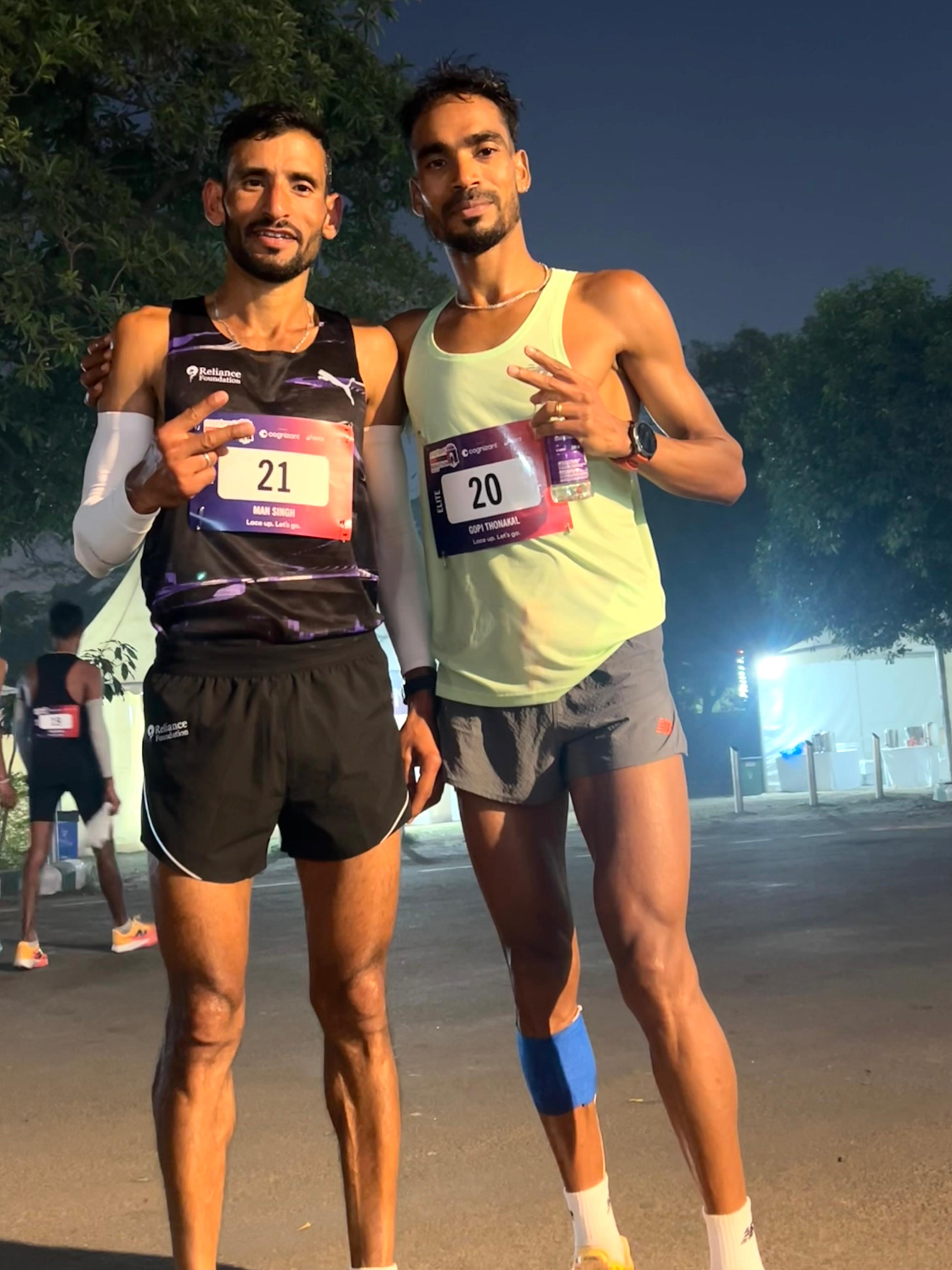
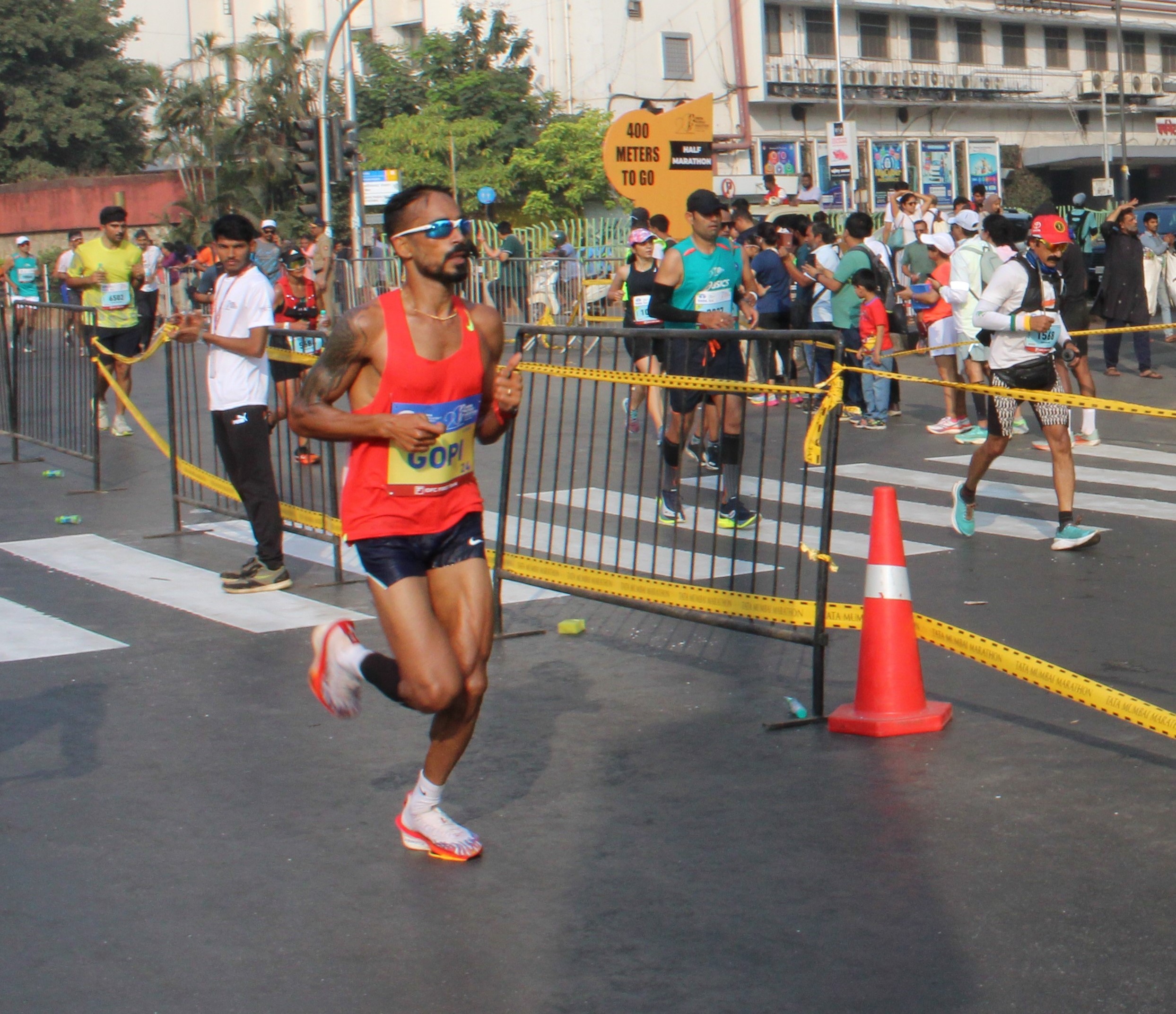
The men’s race was a tight finish. Finishing two seconds after Kartik was Gopi Thonakal, veteran marathon runner, and the second fastest Indian marathon runner. Man Singh, the defending champion, finished three seconds after Gopi at 2:13:15.

All the three top finishers have qualified for the Asian Games. The qualifying mark as per Athletic Federation of India (AFI) was 2.15.04. The continental games are slated to be held in Japan in September this year.

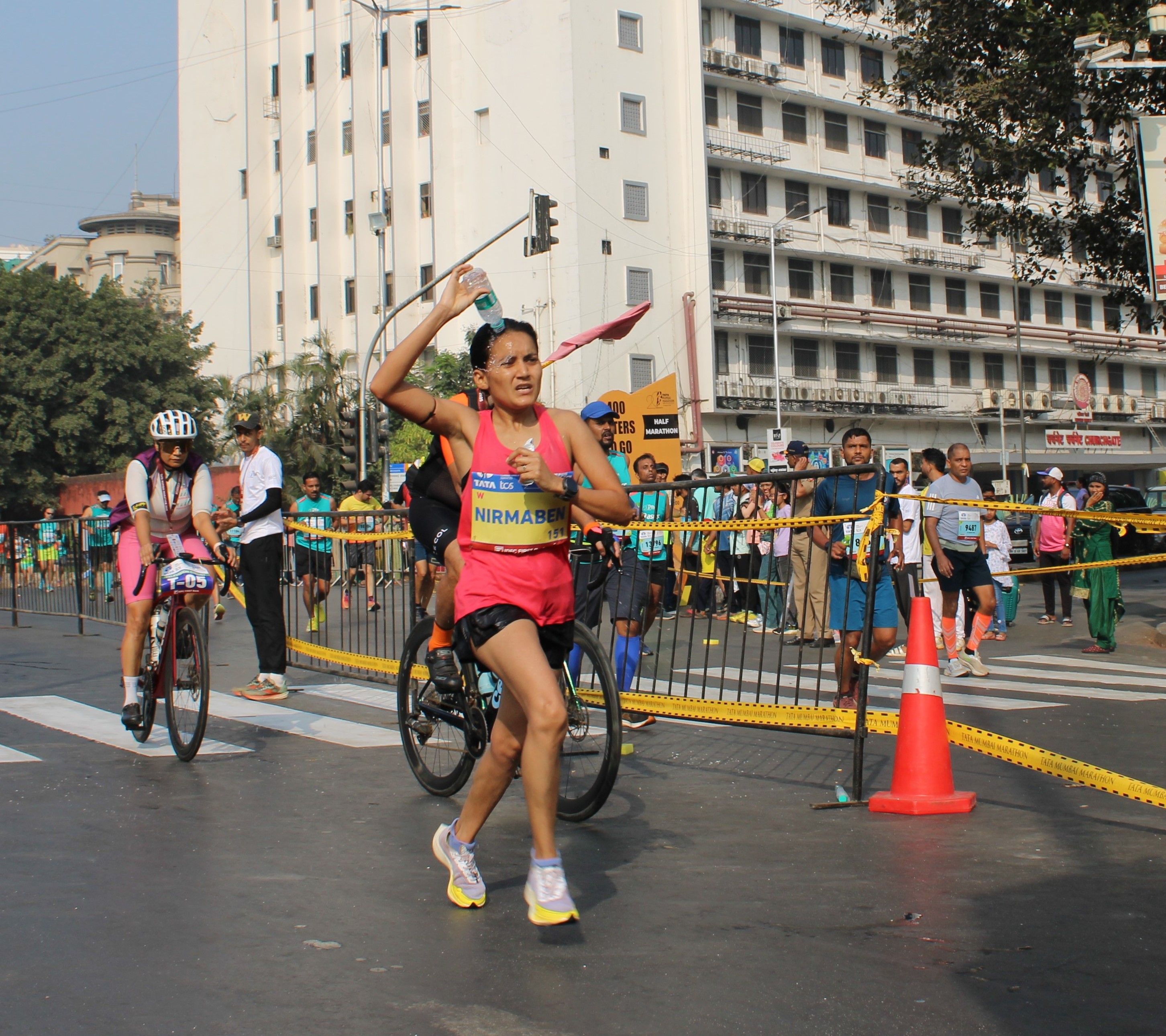
In the women’s race, Nirmaben Thakor won with a finish of 2:41:15, a stupendous improvement in her personal timing. Defending champion Bhagirathi Bisht came in second with a finish of 2:43:28. In third position was Ashwini Jadhav with a finish of 2:56:59.

Certified by AFI as the National Marathon, the New Delhi Marathon is a coveted marathon course as runners are able to improve their timings. The flat course of the New Delhi Marathon route and the cool February weather assist runners in improving their timings. Often times, the gains have been substantial.

Media reports pointed out that over 30,000 runners took to the streets of Delhi to run varying distances as part of the New Delhi Marathon.

The blog spoke to a few of the winners about their experience running the marathon.

Kartik Karkera, orthopaedic surgeon, may seem like he came out of nowhere to emerge as a winner in elite category in two leading marathons – Tata Mumbai Marathon 2026 and Cognizant New Delhi Marathon 2026.

But the truth is that he has been quietly working at improving his running over the last ten years. “I enrolled for MBBS in 2015 in Moscow. In 2016, I started running and swimming mainly as a hobby,” he told this blog. He went on to do his MS in Russia and then commenced working in Russian Olympic Committee as a surgeon.

“During the Covid-19 years, I took to running twice a day. I was putting in more effort and I was enjoying it too,” he said. While in Moscow, he experienced his first running event – a 1,500-metre race.

Kartik returned to India in November of 2023. He had to write the Foreign Medical Graduate Examination, a mandatory test for those with overseas medical degrees. He joined Dr Vasantrao Pawar Medical College and Hospital in Nashik.

He has been focussing on 800 metres and mainly on 1,500 metres and has won gold medals for Maharashtra state in these events. Moving on to longer distances, Kartik went on to do 5 km, 10 km and half marathon races. At Vedanta Delhi Half Marathon, Kartik finished third among Indian elite.

The 2026 edition of Tata Mumbai Marathon was his debut marathon. “It was an experience for me as it was my first marathon. I had cramps and did struggle a lot during the latter part of the race. Also, the late start was tough,” Kartik pointed out. He won the Indian elite race with a timing of 2:19:55.

A month later, Kartik won again with a huge improvement in his timing at the New Delhi Marathon. His finish of 2:13:10 has secured him a berth in the upcoming Asian Games, due in September 2026 in Japan.

As opposed to Mumbai, the NDM start time for elite runners was too early, at 4 am. “My aim was to win this race and qualify for Asian Games,” he said adding that he was able to finish strong. “Up until 35 to 36 km, we were on track for a national record,” he said.

With his TMM run, he has also completed the Procam Slam, which entails running the four events – TCS World 10 k, Vedanta Delhi Half Marathon, TSK 25 k Kolkata and TMM.

Kartik trains under Vijendra Singh, who is also the coach for Nirmaben and Sanjivani Jadhav, the elite runner who won the Indian women’s race at TMM 2026. “For strength training, nutrition and other aspects, I devise my own plan. I do my own research on sports medicine,” he said.

He is due to run the TCS World 10 K at Bengaluru in April. His main focus this year would be training for Asian Games.

In December 2025, Gopi Thonakal came quite close to the long-standing marathon national record when he crossed the finish line of Valencia Marathon with a timing of 2:12:23. The national record of 2:12 was set way back in 1978 by Shivnath Singh.

Gopi has been training in Bengaluru for many years but for the last six months he has moved his base to Ooty to train on a hilly terrain and higher altitude. Gopi believes the Ooty training has helped him to secure a substantial improvement in his timing at Valencia Marathon.

“My training for New Delhi Marathon went off quite well. I came into the race quite confidently,” said Gopi. But the 4 am start at Delhi was a dampener. “I did not sleep a wink. There was too much noise and I had to wake up at 2 am for 4 am start,” he said.

Though the weather was conducive for racing, the lack of sleep did bother. “I was able to do the first half of the race well but in the second half, I could feel the tiredness,” he said.

A slightly delayed start, at around 5 am, would have been more beneficial, Gopi pointed out. “When you wake up at 2 am for a 4 am start it is also difficult to eat or drink anything before the race,” he said.

Gopi, 37, will resume training in a few weeks and his focus is most likely on Asian Games.

At the start line of the elite marathon race at NDM 2026, defending champion Man Singh had the backing of very good training, which he executed with his compatriot Gopi.

“Our focus was to qualify for the Asian Games and therefore our training plan was designed keeping that in mind,” he said.

Man Singh (in black vest) with Gopi

The army man, otherwise based in Pune, moved to Ooty mainly to get the benefit of training in the hills.

The night before the race, Man Singh also had not slept at all. Man Singh and Gopi were sharing a room.

“The race timing was too early. In the early part of the race, some of the stretches along the route were quite dark. I could feel cramps coming on but they were manageable,” Man Singh said.

Although he was disappointed with his third finish, Man Singh did improve his personal record. He finished the marathon at NDM in 2:13:15, a 10-second improvement from his previous personal best which he achieved in 2025.

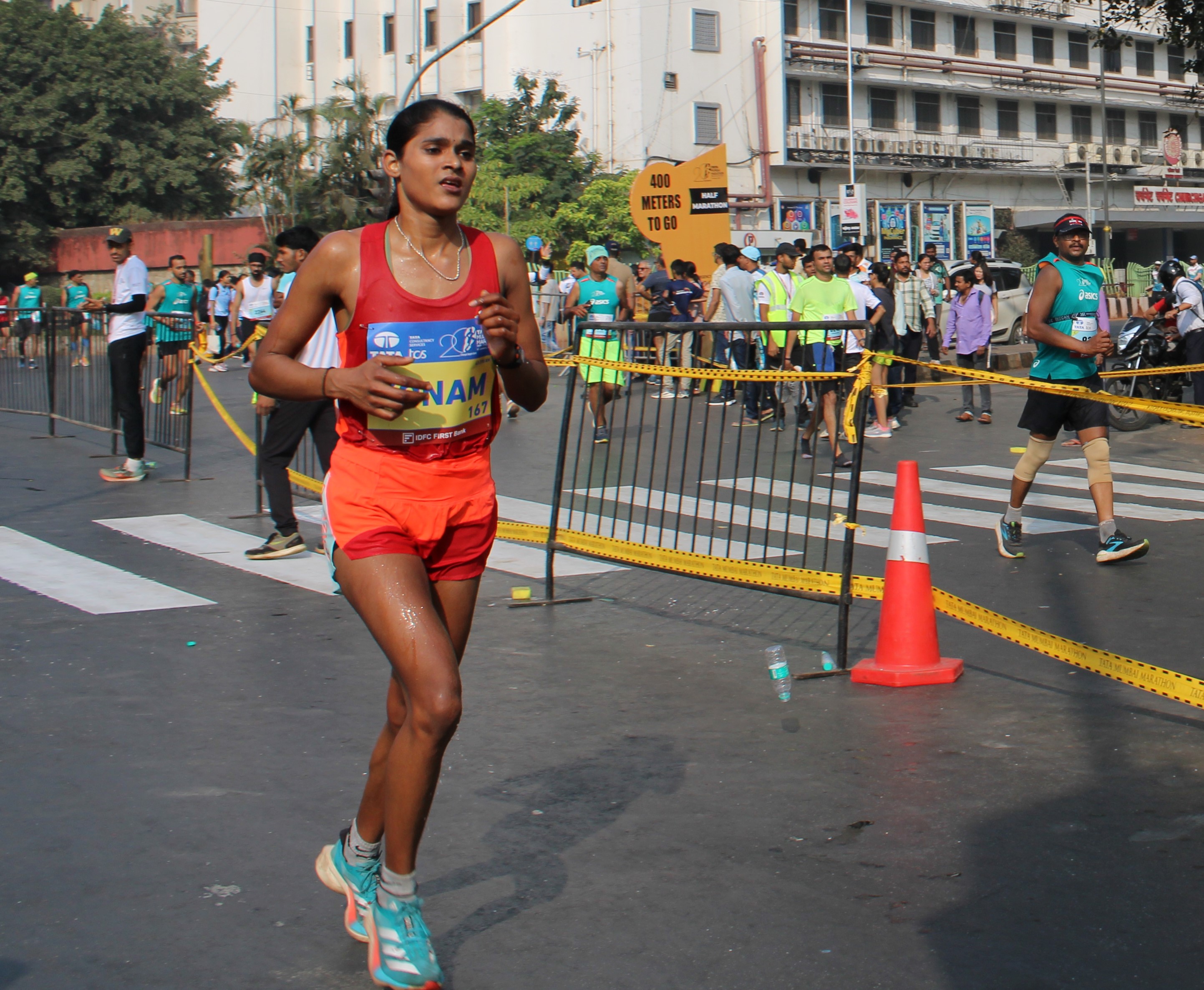
In January 2026, Nirmaben Thakor had finished second among Indian elite women at Tata Mumbai Marathon. She was the defending champion at TMM 2026 but lost out to Sanjivani Jadhav by a few seconds.

Nirmaben is unperturbed by these rankings. “It is extremely competitive out there. These things are bound to happen,” she told this blog.

At New Delhi Marathon 2026, she not only won the women’s race but also secured a personal record with a huge margin.

The elite runner from Patan, Gujarat, has been residing and training in Nashik under Coach Vijendra Singh. Her training in the run up to these two major marathons was quite good and that helped her performance at NDM 2026.

Nirmaben finished the marathon in a timing of 2:41:15, a stupendous improvement over her previous personal best of 2:47:11, which she secured in the 2024 edition of Tata Mumbai Marathon.

Nirmaben survives on her earnings from podium finishes in races.

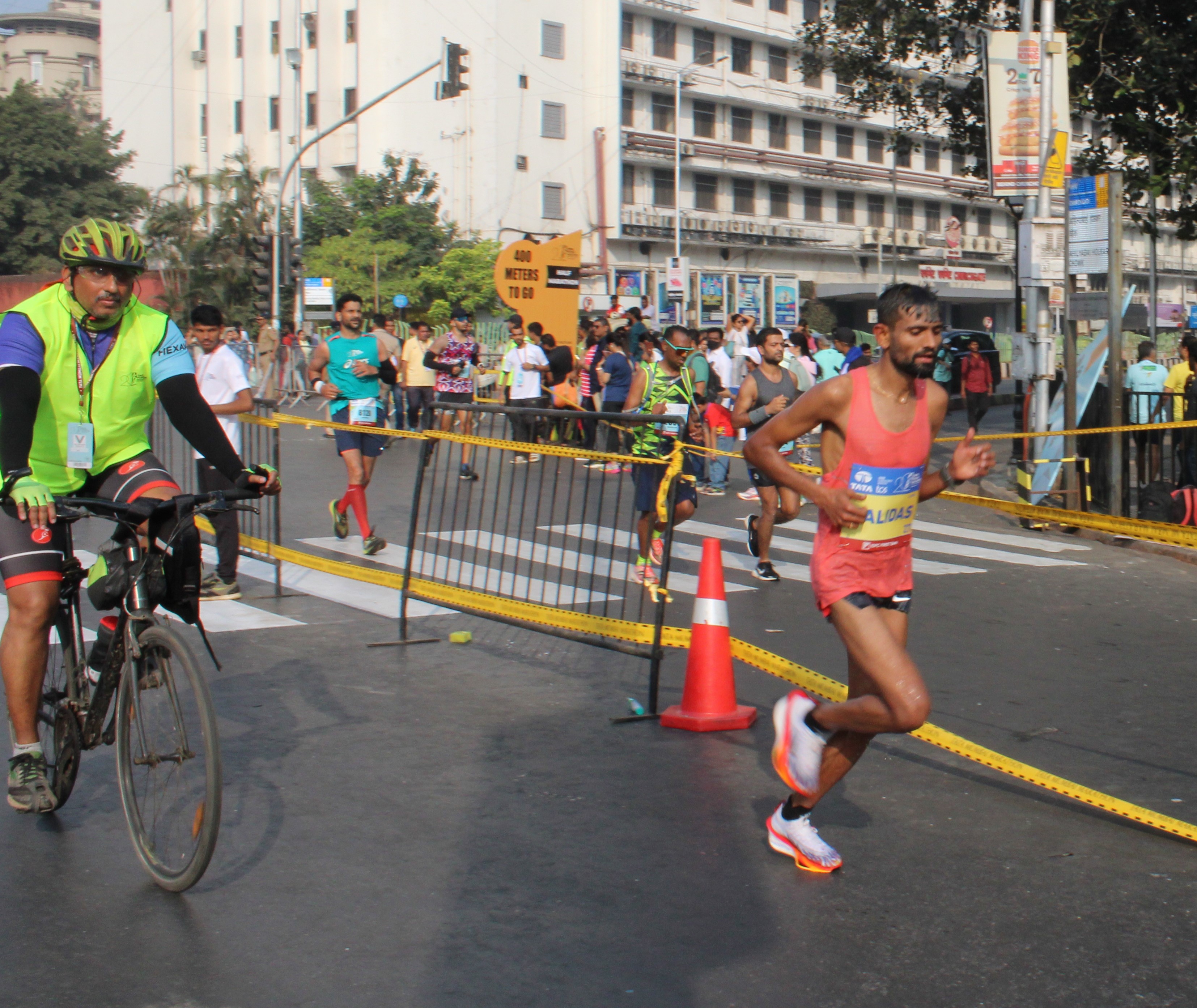
For the last few years Kalidas Hirave has been a podium finisher in leading marathon races.

He started as a middle-distance runner moving to longer distances over the years. In February 2022, Kalidas ran his debut marathon at the New Delhi Marathon, finishing with a personal best timing of 2:18:12.

At the 2023 edition of Tata Mumbai Marathon, Kalidas finished in third position among the elite.

Kalidas, originally from Satara in Maharashtra, now resides and trains in Nashik. He works with Life Insurance of India. “My training for NDM 2026 was quite good. Kartik Karkera, the winner of the race, trained with me,” he said.

He completed the run in 2:20:09, securing a sixth position among marathon elites. “The first half of my race went very well. But in the second half I started to feel tightness in my legs due to cramps and had to slow down a tad,” he said.

He is also due to participate in TCS world 10k at Bengaluru in April.

Ashok Bind also mostly survives on his prize money from podium finishes. The runner, originally from Uttar Pradesh, has been securing podium finishes in many of the races recently.

At TMM 2026, he had finished second overall in the open category of the marathon race and first in his age group of 18 to 24 years.

Ashok has been running for about 10 years, initially doing steeple chase and middle-distance races.

“My training for NDM was quite good,” he said. He had previously told this blog that he trains under O.P. Jaisha, a veteran marathon runner, who continues to hold the women national record in marathon.

“My run at NDM went off quite well. The weather and the route, both were good,” he said. Ashok finished the race in 2:28:25, securing a second position in the open category of the marathon. It was also a new personal best timing compared with his previous best of 2:30:11 at the 2024 edition of the New Delhi Marathon in 2024, when he secured an overall third position and first in his age category of 35 to 45 years.

He is likely to run TCS World 10k, due on April 26, 2026.

In November 2025, running the 100 km race at the IAU 100 km Asia & Oceania Championships held at Thailand, Jayadrath Singh finished fifth among men with a timing of 7:51.

“The race was quite tough because it started at 10 pm. I am not used to running in the nights,” said Jayadrath, a long-distance runner from the Indian Air Force, currently posted in Chennai. The warm weather in Chennai did help with the humidity in Thailand but he did suffer from nausea during the 100 km race. Ultrarunners are wont to suffer from gut issues during the race if hydration and nutrition are not ideal.

Jayadrath, originally from Rishikesh in Uttarakhand started running in 2019.

“This is the seventh year, I am running NDM. This time around I had a very good race,” he said. Jayadrath finished the run in 2:42:04, securing a sixth position in the open category of marathon and second position in his age category of 30 to 40 years. Also, this finish was his new personal record, an improvement from his previous best of 2:43:41, which he had set at the 2025 edition of NDM.

Jayadrath will be participating in Boston Marathon 2026, slated to be held on April 20, 2026. “I have taken a break from work mainly to train in the hilly terrain of Rishikesh for Boston Marathon,” he told this blog.

Three weeks ahead of Tata Mumbai Marathon 2026, ultrarunner Binay Sah ended up with an ankle injury. He went off training to help the recovery but the time available until TMM race day was not sufficient for a complete recovery. He finished the race in 3:01 hours.

But he was able to do well at the IDFC First Bank Indian Navy Half Marathon held in New Delhi on February 1, 2026. He finished the race in 1:20:20

“My ankle injury took a month’s time to recover,” he said.

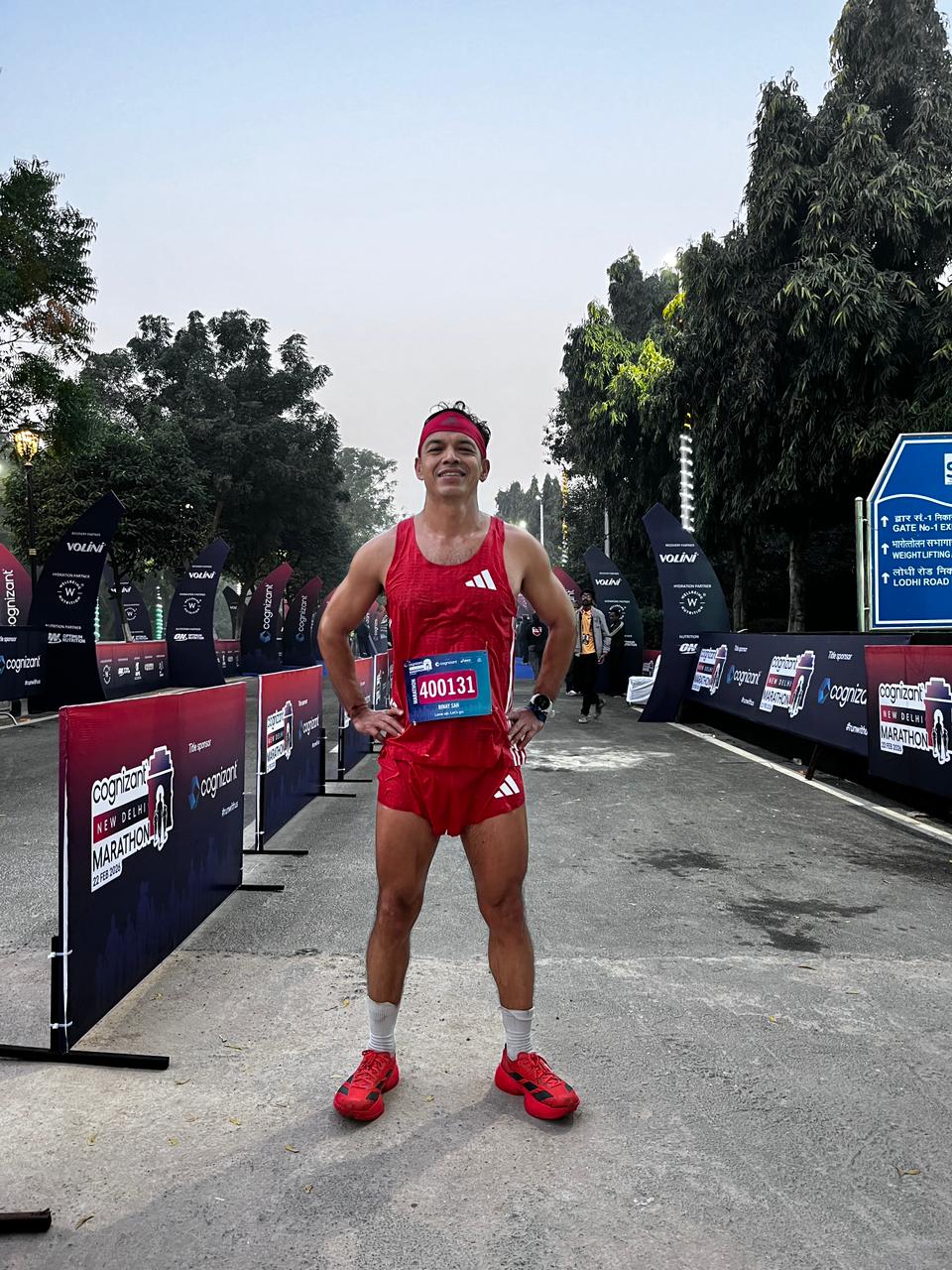
Running the New Delhi Marathon 2026, Binay was able to achieve a new personal record. He finished in 2:43:05, securing a lead position in his age category of 40 to 50 years and ninth overall in the open category of the marathon race.

Having suffered a couple of setbacks, Binay was all set for the New Delhi Marathon. “This time, I also trained for the U turns on the NDM route,” he said.

The NDM route, though mostly flat, has many turns including several U turns.

Binay has represented India is many ultrarunning events held within the country as well as overseas. In November 2025, he was due to run the IAU 100 km Asia & Oceania Championships held in Thailand. But in early November, he contracted dengue and had to pull out of the race.

In 2022, Binay had a health scare. He was due to leave for Spartathlon, 246 km ultramarathon held in Greece in September every year. “I had to go to Fortis Hospital in Delhi for a fitness certificate before I left for the race. The cardiologist, a friend, casually did a 2D Echo and the whole story changed. He found a hole in my heart,” he said. Binay was asked to pull out of Spartathalon that year and was advised to go in for ASD Closure, a medical procedure to rectify the problem.

Next on cards for Binay is the 50 km at the Masters Meet in Delhi on March 15. This event runs concurrently with the IAU 50 km World Championships, initially slated to be held in December 2025 but postponed to March 2026 mainly due to the bad air quality in the capital city.

Elite runner Ashwini Jadhav comes from the same place the veteran marathon runner Jyoti Gawate hails from – Parbhani in Maharashtra.

Jyoti has been a podium finisher in many of the leading marathons including Mumbai Marathon and the New Delhi Marathon over the last few years. Jyoti holds the national record for 100 km with a timing of 8:20:07 hours set at the IAU 100 km World Championships at Berlin in 2022.

Ashwini, 21, trains with Jyoti under their coach Ravi Raskatla. She has been running for the last eight years and took to marathon running in the last three years.

“My training for NDM 2026 was not very good. I was not well. I have been running too many races and there has been no time for recovery,” she said. Ashwini, Jyoti and many other runners around the country mainly survive on the prize money from their podium wins. At TMM 2026, Jyoti had finished sixth among Indian elite women.

“At NDM this time my run was okay, far from my best. The route is good and the weather was excellent,” she said. Ashwini finished third among elite women with a timing of 2:56:59. At the 2025 edition of the New Delhi Marathon, Ashwini had secured a personal best with her finish of 2:50:48 and a third position among elite women.

Having finished her BSc degree, she has now secured admission for BPEd.

With age on her side, Ashwini believes she can improve her marathon timings further.

(The author, Latha Venkatraman, is an independent journalist based in Mumbai)

(All photos provided by athletes)

(With inputs from MySamay.in)

INDIAN TEAM FOR 2025 IAU 24 HOUR WORLD CHAMPIONSHIP ANNOUNCED

Illustration; Shyam G Menon

The Ultra and Trail Running Selection Committee of Indian Athletics (formerly Athletics Federation of India) met on May 1 to decide on the team of ultra runners to represent India at the IAU 24 Hour World Championship scheduled to be held in Albi, France over October 18 and 19, 2025.

Twelve runners (six women and six men) will be representing the country. Two additional runners have also been chosen as stand-by for both the men’s team as well as the women’s.

The women’s team comprises Aparna Choudhary, Shashi Mehta, Sunita Subba, Bindu Juneja, Arti Agrawal and Sadiya Salim Savy. Sufiya Sufi will be the back-up runner.

The men’s team includes Amar Singh Devanda, Ullas Narayana, Saurav Kumar Ranjan, Geeno Antony, Velu Perumal and Sugourav Goswami. Badal Teotia will be the back-up runner.

(The author, Latha Venkatraman, is an independent journalist based in Mumbai)

BACKYARD ULTRA / OPENDRO WINS, ASHWINI SETS A NEW NATIONAL BEST

Thoudam Opendro Singh

Ashwini Ganapathi fell short of an overall win at the Bengaluru BigFoot Backyard Ultra but set a new national best for women.

She ran for 28 hours (covering 6.7 kilometres in each hour) notching up a total mileage of 187.6 km, a new national best by a woman in this format of ultra running. The previous record of 27 hours (180.9 km) was held by Aparna Choudhary, which she set in October 2024.

The overall winner of the Bengaluru BigFoot Backyard Ultra 2025 was Thoudam Opendro Singh. He ran for 29 hours. The event was held on May 10, 2025.

The backyard ultra, also known as the last runner standing, is a format of ultra running in which runners are required to run a loop of 6.7 km within an hour. Every new hour runners who have completed the 6.7 km in the previous hour continue their running until the last surviving runner is declared the winner. This winner is also the sole finisher of the race.

“ The Backyard Ultra is an interesting format of ultra running and I had wanted to attempt it for some time now,” Ashwini said.

The concept of backyard ultra was founded by Gary Cantrell of Tennessee (also known as Lazarus Lake). He is the founder and race director of Barkleys Marathon.

Ashwini Ganapathi

“ I paced my run in such a manner so as to get seven to eight minutes time in each hour to get rest and nutrition before the next hour started,” Ashwini said. She managed to finish well within the 60-minute cut-off for most of her 28 hours barring one when she had a close call. She had to help a runner get back to the finish line.

The rules of this format of ultra running mandate that runners not take any external help or aid from passers-by or friends while on the route. But at the end of each loop, they can be assisted by their support crew. Ashwini’s support crew consisted of her husband Sandeep and Anand Adkoli, race director of Malnad Ultra.

“ When we started at 6 am on May 10, 2025, we were 20 runners. As the hours went by, runners kept dropping out. At the 18th hour only four runners remained and by the 22nd hour only two of us were left – Opendro Singh and me. I continued till the 28th hour. I gave up as I had developed blisters on my feet. Opendro Singh continued for the 29th hour to win the race,” she said.

The national best for men in this format – 52 hours – is held by Sunil Sharma. He set this record in October 2024.

Ashwini also holds the national record for 12 hours with a mileage of 111.8 km.

(The author, Latha Venkatraman, is an independent journalist based in Mumbai)

2025 BENGALURU STADIUM RUN / AMAR SETS A NEW NATIONAL RECORD

Amar Singh Devanda (photo: courtesy Amar)

Ultra runner Amar Singh Devanda bettered his own national record in the 12-hour run at the 24-hour Stadium Run Bengaluru held on March 30 and 31, 2025.

Amar ran a distance of 151.6 kilometres during the stipulated 12 hours, smashing his own record of 145.2 km set previously. He also holds the current national record for 24-hours with a distance of 272.54 km covered.

Aparna Choudhary (photo: courtesy Aparna)

In the 24-hour run category, Aparna Choudhary and Geeno Antony won in the women’s and men’s categories respectively. They qualified for the IAU 24-Hour World Championship to be held in Albi, France later this year.

In the women’s race in the 12-hour category, Bengaluru-based Bindu Juneja finished with top honours covering a distance of 108.8 km.

Amar Devanda’s training for the 12-hour run was a coordinated effort of the NEB Performance Team, which included a nutritionist, a running coach and a strength and conditioning coach. “ The training was devised with a scientific approach,” he said. As Amar has already qualified for the World Championship, the focus was to step up his pace in the 12-hour run so as to attempt the same pace during a 24-hour run.

“ My run went as per the plan laid out by the coaches,” he said. Post event, his recovery has also been quite good. “ I should shortly commence my training for the World Championship,” he said.

Aparna Choudhary, winner of the women’s 24-hour run, said she was confident going into the race as her training went well. Aparna normally does her training runs in the afternoon, therefore the weather adversities did not trouble her during the race.

Sugourav Goswami and Arti Agrawal

On race day, weather was pleasant in the early hours at Bengaluru but got progressively tough with harsh sun and gradual rise in temperature.

“ I did suffer some gut issues, which really got bad. Lalita (race director of India Backyard Ultra), the person crewing for me, saved the day. I also ended up with hip flexor issues, a common problem that I have faced in many of my ultra runs,” Aparna said. In the 24-hour run, she covered a distance of 192 km.

In February 2025, Aparna had finished overall first in the 338 km run at Vineyard Ultra 2025 held in Nashik. She also won the women’s race of the Border 100-mile run held in December 2024. She has been running events for the past few months including marathons and ultra runs.

Arti Agrawal, who finished second in the women’s 24-hour race, had entered the event with very little training.  “ I have a full-time job and a family to take care of,” she said. But she did a few ultra runs including the 100-mile race of Border Ultra 2024, Adani Ahmedabad Marathon 2024, Tata Mumbai Marathon 2025, Jaipur Marathon 2025 and Tata Ultra 2025. “ I took these races as my training runs for the 24-hour run,” she said. During the stipulated 24 hours, Arti covered a distance of 182.8 km.

Geeno Antony (photo: courtesy Geeno)

Geeno Antony, who secured the top position in the men’s 24-hour run also went through a vigorous 10-week training program before the event. “ This time around my training plan was designed by Santhosh Padmanabhan (also the manager of the Indian ultra runners’ team). Training included very long runs leading to a weekly mileage of 200-220 km sometimes,” he said.

As part of his training, Geeno did a 10-hour run, four night runs and four six-hour runs.

“ On race day, I started conservatively so as to stay consistent through the 24 hours. But I did lose the last 50 minutes due to an injury. It was a setback to lose that time but my coach asked to me to stop, a prudent decision in hindsight,” Geeno said. He covered a distance of 238.8 km, a new personal record of 300 meters.

Velu Perumal (photo: courtesy Velu)

Velu Perumal, who finished second in the 24-hour race, was targeting a distance of 245-250 km but finished with 233.2 km. Having done much of his training in the cool climate of Ooty, Velu did find the daytime heat at the Bengaluru stadium difficult. Velu, an army man, is now posted at the Military Hospital at Coonoor in Ooty. His training went off well with inputs from Santhosh Padmanabhan and support from Brigadier Muthana, Military Hospital Commandant.

Sugourav Goswami, who finished third behind Velu, had also stepped up his training ahead of going into the race. “ I had the longest training session with higher intensity, increased distance and time. I was running a distance of 150-170 km every week,” he said. Sugourav, who finishing third, covered a distance of 226 km, thereby qualifying for the World Championship. To qualify for the IAU 24-Hour World Championship, male runners have to cover a distance of 225 km and women runners 180 km during a 24 hour run, as per Indian Athletics guidelines.

“ My race went as per plan, near perfect. As I train around a lake in Bengaluru, I was used to running in a loop,” Sugourav said. But the long hours did prove challenging. The Bengaluru-based ultra-runner has participated in many ultra-running events. This run was his first ever stadium run. “ The longest time I had been on my feet in a running event was 18 hours. At the stadium run, I did find the last few hours tough. I struggled in the last three hours,” he said. He had devised his own training plan.

Bindu Juneja (photo: courtesy Bindu)

In the 12-hour women’s race Bindu Juneja was the winner covering a distance of 108.8 km. “ This was a personal best for me but I am tad disappointed that I could not break the national record of 111.8 km (currently held by Ashwini Ganapathi),” she said.

Her training was executed very well with guidance from Santhosh but on race day she did face some gut issues. Nevertheless, in the last one hour of the race, Bindu managed to cover 10.5 km to take her total mileage to 108.8 km.

The 100 km race was won by Jayadrath who finished in 7:59:33.

The NEB organized stadium run in Bengaluru was held to enable ultra-runners qualify for the upcoming IAU 24 Hour World Championship.

(The author, Latha Venkatraman, is an independent journalist based in Mumbai)

2025 TOKYO MARATHON

Illustration: Shyam G Menon
Subhojit Roy (photo: courtesy Subhojit)

Subhojit Roy

Pune-based Subhojit Roy was always more focused on running a well-timed marathon in different cities than on the six-star World Marathon Major (WMM) journey. Nevertheless, having done a few of them he decided to play along and complete all the six.

The six-star WMM circuit entails running the six marathons – Berlin, Boston, Chicago, London, New York City and Tokyo. Subhojit’s first WMM was Berlin Marathon, way back in 2017. This year, at Tokyo, he completed his six-star WMM journey. “ I got entry to the Tokyo Marathon after several attempts over the years,” he told this blog.

Towards the end of August 2024, Subhojit contracted chikungunya and had to drop out of the half marathon race at Hyderabad Marathon 2024. Though he recovered from the infection the aftereffects continued to wreak havoc for several weeks thereafter.

“ I had enrolled for Berlin Marathon 2024.  My training was absolutely negligible but I decided to go as all my bookings were non-refundable. On race day, I decided to run but carried some cash that would enable me to get back to my hotel in the event I could not complete,” he said. He finished the race in 3:12:59.

He continued to suffer body pain due to the chikungunya infection until sometime in December 2024. “ I had six weeks to train until the Tokyo Marathon,” he said. His coach Nihal Baig chalked out his training plan but a half marathon race timing and a tempo run did not turn out well. After a discussion with his coach, he altered his nutrition and was able to put in two weeks of very good training runs. “ After these training runs, I was confident,” he said.

He targeted a 3:08-finish but was able to finish in 3:05:56, a new personal record for Subhojit. “ The weather was warm and the last 5-6 kilometres were tough. I was not in a mood to let go. The weather turned warm by Tokyo standards but we train in much worse air quality and on traffic-laden roads,” he said. Subhojit was the fastest among Indian runners at the 2025 Tokyo Marathon.

“ My recovery after Tokyo Marathon has been quite good,” he said. He has enrolled for the 2025 Boston Marathon but is yet to decide on going for it.

“ My WMM journey has helped me maintain fitness, focus and sanity in the face of the many ups and downs of life. I think it has more than served the goal of self-improvement and discovery that I embarked upon when I started,” he said.

Narinder Sharma (photo: courtesy Narinder)

Narinder Sharma

Narinder Sharma, now a resident of Chandigarh, trains under Pune-based endurance athlete and coach, Kaustubh Radkar. He commenced his training under Kaustubh while he was at the National Defence Academy (NDA), Khadakwasla. He has been running for over 10 years.

“ My training for the Tokyo Marathon went off quite well,” he said. His performance stayed on track though the rise in temperatures did impact him. Narinder finished in 3:31:57.

At Tokyo Marathon, runners are not allowed to carry their own water bottles. They are required to seek hydration support offered in a very organized manner all along the route.

Narinder, 61, an army veteran, has completed three of the six WMM so far – Chicago, Berlin and Tokyo. He is due to participate in the 2025 Boston Marathon slated to be held on April 21. He plans to resume his training shortly. “ After Boston Marathon, I may consider New York City Marathon, which is held on the first Sunday of November each year,” he said.

Harish Vasista (photo: courtesy Harish)

Harish Vasista

The 2025 edition of Tokyo Marathon was the culmination of the six-star WMM journey for Bengaluru-based runner Harish Vasista.

He had commenced his WMM journey in 2018 when he ran Berlin Marathon that year. Training under Bengaluru-based coach K.C. Kothandapani (also known as Pani Sir to runners), Harish followed his training plan. “ Every Sunday, he gives me a plan. Usually, the training plans are woven around the race I am planning to do, my current conditions and my ability,” he said. It is often a combination of fast runs, tempo runs, interval training and long runs on the one hand and strength training and stretching on the other, he said.

“ My coach had given me a target of 3:45 but I was able to better it, and finish in 3:43:11. I had no issues during my race at Tokyo but I missed a couple of water stations and that was tough as the weather was warmer than expected,” he said. Runners are required to go to specific water stations on the basis of the last digit of one’s bib number. “ With so many runners around, you do end up missing your water stations,” Harish said.

Running the six WMMs was a lifetime experience as one meets runners from different parts of the world. “ It is awesome to see runners come with challenges and difficulties and yet complete their run with perseverance. I enjoyed all my six marathons,” he said.

Harish has signed up for the Sydney Marathon, which is the seventh run to become a part of the World Marathon Major circuit. He said he would like to do the Ladakh Marathon but it may not be possible this year as Sydney Marathon falls on August 31, 2025 and the Ladakh Marathon is typically held in the first weekend of September. What awaits him closer home is the TCS World 10k in Bengaluru, scheduled to be held on April 27, 2025.

Dilip Ghadge (photo: courtesy Dilip)

Dilip Ghadge

The 2025 Tokyo Marathon was Dilip Ghadge’s fourth World Marathon Major. He had done Berlin Marathon, London Marathon and Chicago Marathon earlier.

A resident of Kalyan near Mumbai, Dilip, 57, has been running for over 10 years. After the initial flurry of running events, Dilip wanted to run a marathon in a European city and was aiming for the Amsterdam Marathon. But he was advised to run the Berlin Marathon, one of the initial six WMMs. He did the race in 2023 and quickly followed it up with the 2024 London Marathon and the Tokyo Marathon this year.

As Dilip has ACSM (American College of Sports Medicine) certification, he drew up his own training plan for Tokyo. “ Training went off quite well and the run was also good,” he said. Dilip finished in 3:52:26, a new personal record.
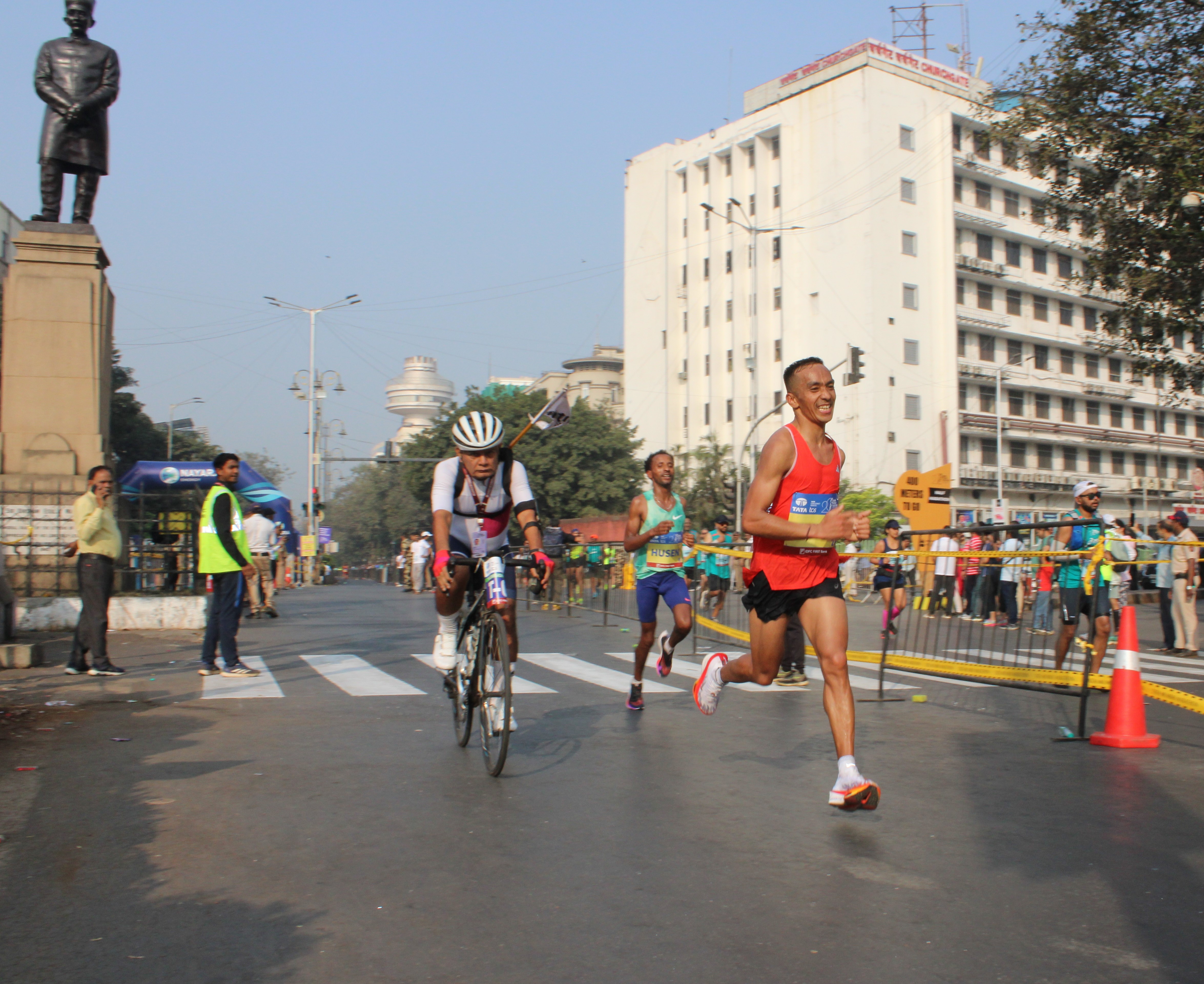
“ I had learnt about Tokyo Marathon rules, especially the one about hydration. At Tokyo, water is supplied in cups and runners have to gulp down quickly and resume their running. During my training runs, I practiced this method of drinking water – gulping from the bottle kept in my car,” he said.

His recovery has been good, helped mainly by lots of walking, He went on some sight-seeing trips in Japan after the run.

“ I will be running Boston Marathon on April 21, 2025 and I have already resumed my training,” he said. Later in August this year, he will be running the Sydney Marathon, which has now become part of the World Marathon Majors as its seventh event. Dilip’s sixth WMM – New York City Marathon – will have to be attempted in 2026.

Smita Kulkarni (photo: courtesy Smita)
Smita Kulkarni

Smita Kulkarni, a runner from Pune, completed five of the six marathons of WMM with her run at Tokyo Marathon this March.

Her training for the Tokyo Marathon went off well under coach Kaustubh Radkar. She was happy with her training. But the warm weather of race day threw up challenges. “ At Tokyo Marathon, runners are not allowed to carry hydration and with unexpectedly warm weather there was a rush at the hydration stations. Most runners were trying to grab water. It was a mess,” she said.

“ The first half of the race went off okay but during the second half we had no respite from the sun,” she said. Barring the problem with hydration everything else about Tokyo Marathon was good, Smita said. She finished in 3:57:51.

Smita is trying to qualify for the Boston Marathon and she needs to finish in 3:50 for her age category. Having finished Tokyo Marathon and with nothing immediate on the cards, Smita plans to get back to the gym for weight training.

“ In the past 15 months, I have done five marathons – New York City, Delhi, London, Ahmedabad and Tokyo,” she said acknowledging the fact that she needs to take a break from running and resume with renewed energy, later.

Sunanda Dayani (photo: courtesy Sunanda)

Sunanda Dayani

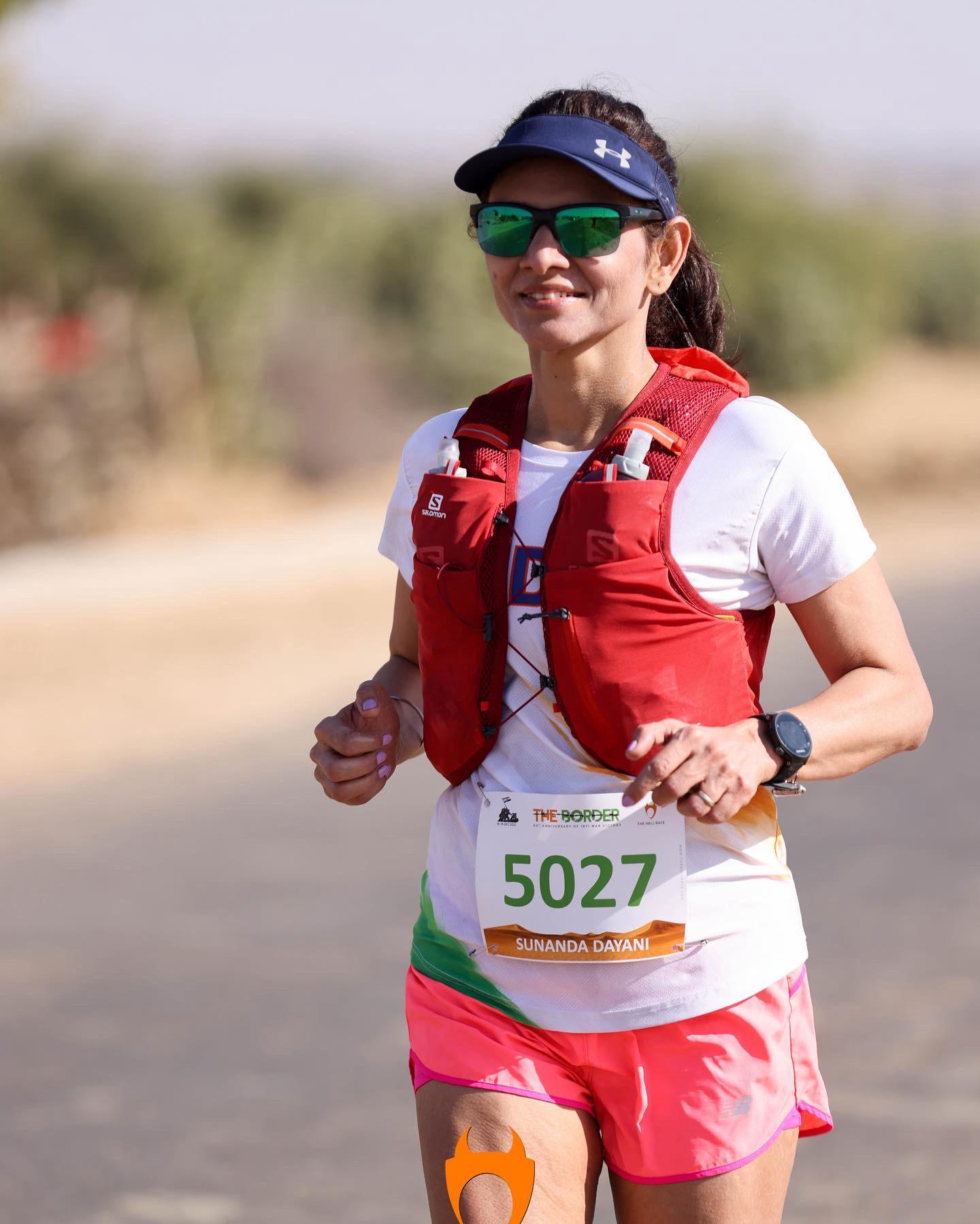
Sunanda Dayani, a runner from Mumbai, has been running for over ten years. Tokyo Marathon was her fourth WMM, having done the New York City Marathon in 2019, Berlin Marathon in 2023 and Chicago Marathon in 2024.

Guided by Coach Kaustabh Radkar, Sunanda went through a 16-week training plan that commenced in November 2024. “ My Tokyo run went off very well though the weather was much warmer than expected. It’s a late start and the sun was right on our heads,” she said. Sunanda found the second half of the race tough because of the sun. She finished the marathon in 3:58:32. Her personal best timing in a marathon is 2:55:23, secured at the Apollo Tyres New Delhi Marathon 2024.

“ My recovery has been quite good. I have been walking a lot in Japan,” she said. Sunanda, a nutritionist, plans to now focus on strength training and resume marathon training in July. Typically, runners in India ease off running during the summer months and focus on strength training. “ I may want to do a trek possibly,” she said.

Kranti Salvi (photo: courtesy Kranti)

Kranti Salvi

At Tokyo Marathon 2025, Kranti Salvi completed her six-star WMM journey.

“ Because I run regularly, I am always race ready,” she said. The Mumbai-based runner is often a podium finisher at most of the races that she participates in. She has also secured a Guinness World Record for being the fastest marathon runner in a saree at the 2018 Berlin Marathon, in Welsh dress at the 2022 London Marathon and in a Japanese kimono at the 2024 Toronto Waterfront Marathon.

She used the Tata Mumbai Marathon 2025, held in January, as a long training run for the Tokyo Marathon. Her WMM journey began in 2017 with Boston Marathon.

“ Tokyo Marathon was a very different race compared to the other WMMs. There are many rules to adhere to. It’s also a silent race. The roads are excellent and the volunteers do a very good job,” she said.

She finished Tokyo Marathon in 3:59:09.

Back in time, she had wanted to do the Tokyo Marathon in a kimono but the race rules do not permit running in costumes. Having secured the requisite permissions from the Guinness World Records she decided to do it at the 2024 Toronto Waterfront Marathon.

Pramod Salvi (photo: courtesy Pramod)

Pramod Salvi

When Pramod Salvi signed up for his first long-distance race at the Mumbai Marathon many years ago, he enrolled for the full marathon without knowing what it entails.

He is not new to sports or adventure sports. He has been involved in many activities including tennis, swimming, equestrian events, motor rallying and hang gliding.

Pramod has been into recreational running for over 13-14 years and has done several marathons and many other shorter distance runs. He and his wife Kranti Salvi, a podium finisher in most runs, have been participating in several races of varying distances over the years.

At Tokyo, his run went off well barring some niggling cramps that he felt sometime around the 30 km mark. He finished the run in 5:23:03.

With this marathon, he has finished five of the six-star WMMs. He is yet to do the Boston Marathon.

Pratik Shetty (photo: courtesy Pratik)

Pratik Shetty

Mumbai-based Pratik Shetty learnt about World Marathon Majors when he decided to read about running to get information on injury prevention.

He started running sometime in 2014 primarily as a means to stay fit and keep himself involved in some sporting activity. At the 2016 Mumbai Marathon, he signed up for a full marathon. “ I realized later that I jumped to full marathon too early in my running. Following that Mumbai Marathon run, I ended up with an ankle injury,” he said. He decided to read up and find out more details about injury prevention. That’s when he got to know about World Marathon Majors.

Pratik, 34, has been registering for each of these WMMs and got entry to his first one at the 2018 Berlin Marathon. He bagged his second one at the 2025 Tokyo Marathon. He has four more to go for the six-star WMM medal.

“ My training for Tokyo Marathon was not good as my work kept me busy. My training mileage was quite low,” he said. On race day, he started well and was able to keep to his pace until the 22nd kilometre. After a toilet break at this point Pratik was not able to get back to his pace. He finished in 5:56:53.

“ The Tokyo Marathon course appears easy but the gentle inclines along the way do take a lot of energy out of the runner,” he said. Pratik will now be focusing on the Procam Slam, which entails running four races – TCS World 10 k in Bengaluru, Vedanta Delhi Half Marathon, Tata Steel World 25 k in Kolkata and Tata Mumbai Marathon.

Having done the ACSM (American College of Sports Medicine) certification, Pratik chalks his own training plans. His next race will be the upcoming TCS World 10 km race in Bengaluru slated to be held on April 27, 2025.

(The author, Latha Venkatraman, is an independent journalist based in Mumbai)

FIRST EDITION OF SFC GLOBAL 10K POSTPONED

Illustration: Shyam G Menon

The inaugural edition of the SFC Global 10K run in Navi Mumbai, originally slated to be held on February 16, 2025, has been postponed to February 2026.

The event, which was to see participation by international and Indian elite runners, will now be held on February 15, 2026.

“ While we had initially planned for the first race to occur in February 2025, we have made the decision to defer the event to 2026 in order to create an even more immersive and exceptional running experience for all participants,’’ a statement on the event website sfcglobal10k.com said. The 10K course has been charted along Navi Mumbai’s Palm Beach Road which is a straight, flat stretch potentially offering an opportunity for runners to improve their personal timings.

The event is a joint effort between SFC and Navi Mumbai Municipal Corporation (NMMC). “ We are also extremely thankful to double Olympic Champion and World Record holder Beatrice Chebet for confirming her participation in the race and look forward to welcoming her again, in February 2026,’’ the statement said.

According to information on the website, the organisers of the event have decided to give full refund for those runners who had registered and promised them free entry for the 2026 inaugural edition.

(The authors, Latha Venkatraman and Shyam G Menon, are independent journalists based in Mumbai)

2025 TMM / MUSINGS

Illustration: Shyam G Menon
Anish Thapa; from 2025 TMM (photo: Shyam G Menon)

Anish Thapa

For their training, the Indian Army’s battery of elite marathoners is typically spread over Pune, Ooty, Ranikhet and Bengaluru. Anish Thapa came to Mumbai straight from Ooty. He had just two days to adjust from the cool climes of the southern hill station to Mumbai’s warm and humid weather. Not to mention – race day in the city has always been a last-minute kiss or kick as regards the weather. You never really know what’s in store, till the day dawns. For instance, overall, on the warmer, humid side, Mumbai had thrown a surprise in 2024 gifting athletes excellent weather conditions and they responded with good performances. As it turned out, 2025 race day witnessed Mumbai back to its usual self. It wasn’t a kiss but a kick. “ My run was okay till the bridge over the sea. After that, the uphill at Peddar Road took a toll. Then past 40 kilometers or so, my hamstring got tight. The last two kilometers was really tough for me,’’ Anish Thapa said. Despite the difficulties, Anish completed his run in two hours, 17 minutes and 23 seconds to place first among Indian elite men and seventh overall. He was among those who – while speaking to this blog – recommended an earlier start for the elite race in Mumbai. In 2025, it commenced at 7.20 AM. He felt a 6 AM or 6.30 AM start would be better given the general trend of race days in the city staying warm and humid. Provided his post-TMM recovery goes off well, Anish hopes to run the marathon in New Delhi in February second half. 

Nirmaben Thakor; from 2025 TMM (photo: Shyam G Menon)

Nirmaben Thakor

This elite runner, who hails from Gujarat, ably defended her title at the 2025 edition of the Tata Mumbai Marathon. However, it was not without its share of difficulties. Nirmaben placed first in the Indian elite women’s category with timing of 2:50:06. Last year, she had won the race with a personal best timing (PB) of 2:47:11. This time around, weather played spoilsport despite her training being quite good. Nirmaben trains under Vijendra Singh at Nashik. On social media accounts Vijendra Singh describes himself as an athletics coach from Sports Authority of India training at Bonsala Military School, Nashik. Nirmaben hails from a village in Patan district, Gujarat. “ During my school days I did not do much of sport. But somewhere along the way I got into running,” she told this blog. In competitions around running, Nirmaben was able to turn in very good timings. At the Bajaj Allianz Pune Half Marathon 2023, she finished the women’s race in 1:17:16 securing an overall second position. She turned in her best timing in the full marathon at the 2024 edition of Tata Mumbai Marathon. “ That is my personal best in the full marathon,” she said. The 27-year-old runner survives on her podium earnings. According to Nirmaben, the weather on January 19, 2025 – race day in Mumbai – was challenging. “ It was quite warm and the humidity was also high. My body was getting heated up. Our start time is very late,” she said. The elite runners started their race at 7.20 AM. Despite the heat, she was free of cramps. “ During the last three kilometers I had difficulties with my shoes as they had become wet and my feet were feeling squishy inside. But I decided to ignore it as I was too close to the finish line,” she said. Nirmaben may opt to go for the New Delhi Marathon, slated to be held on February 23, 2025.

Man Singh; from 2025 TMM (photo: Shyam G Menon)

Man Singh

The winner of the 2024 Asian Marathon Championships, wasn’t quite happy with how he fared at 2025 TMM. “ I am not satisfied with my performance. It could have been better,’’ Man Singh said. According to him, he had targeted a sub-two hours, 14 minutes timing. But the weather on race day proved to be a problem. It was warm and humid. “ My run was good in the beginning. But then, the heat started to take a toll. I got muscle cramps,’’ he said. The cramps in turn hindered his progress, slowing him down especially in the last five to seven kilometers. “ I became slow,’’ Man Singh said. Covering the 42 kilometer-distance in 2:17:37, Man Singh placed second among Indian elite men and eighth overall. The difference in timing between him and Anish Thapa, winner among Indian elite men, was 14 seconds. With his TMM outing not up to satisfaction and India’s elite athletes continuing to chase the late Shivnath Singh’s longstanding national record (2:12:00 – set in 1978) in the marathon, Man Singh hopes to recover well from his run in Mumbai and be ready for the marathon in New Delhi, due February second half. He would also like to do a race abroad.

Gopi Thonakal; from 2025 TMM (photo: Shyam G Menon)

Gopi Thonakal

Among the most familiar faces at TMM, Gopi’s preparations for the 2025 edition of the race had been good. The outcome – he finished in 2:19:59 to place third among Indian elite men – wasn’t to his satisfaction. “ I had prepared well but couldn’t deliver as expected,’’ he said. Gopi too found the warm, humid weather of race day challenging. Around 25 kilometers, he sensed his body developing catches. Result – he couldn’t run as freely as he wished to. Nevertheless, it being too early in the race to worry over such issues, he soldiered on. Plus, unlike in some of the previous editions of TMM, this time around, he wasn’t getting cramps or requiring to stop and stretch. According to Gopi, given the weather was impacting the foreign elite athletes too, they weren’t very far from the Indian elites even at kilometer-30. Overall, his progression was okay till the 32nd kilometer or so. “ Then I became slow,’’ he said. Depending on how well he recovers post-TMM, he would like to participate in the upcoming marathon in New Delhi scheduled for February second half (he won the 2024 edition of this event in 2:14:40) . He also plans to do a race overseas in the months ahead. At the time of writing, Gopi (he won gold at the Asian Marathon Championship in 2017) still held the second fastest time yet by an Indian in the marathon – 2:13:39, set at the Seoul International Marathon in 2019.

Sonam; from 2025 TMM (photo: Shyam G Menon)

Sonam

Sonam finished third among Indian elite women runners at 2025 TMM. Uniquely, she is, as yet, only an occasional long-distance runner. The 2025 TMM was her first marathon. She has run the half marathon distance at a few races before. Her main disciplines in athletics are the steeplechase and the 5000 meters. The 20-year-old athlete commenced running along with youngsters training for entry into the services. “ I had started running before the pandemic induced lockdown,” she said. At the 2022 National Junior Athletic Championships held in Assam, Sonam got the gold medal in the 2000 meter-steeplechase event. She also got a podium finish at the 2022 National Cross-Country Championships held in Kohima, Nagaland. At the 2022 edition of Vasai Virar Municipal Corporation Marathon (VVMM), she finished fifth among elite women in the half marathon run. Sonam’s decision to sign up for Tata Mumbai Marathon was largely fuelled by her family’s need for money. Her sister’s wedding was coming up. “ My coach signed me up for this race as he was confident that I would finish within the first seven finishers among Indian elite women,” she said. The first seven finishers are assured of prize money. Sonam, originally from Bulandshahr in Uttar Pradesh, lives in Delhi and trains under coach Sanjeev Kumar, whose disciplines include steeplechase and hurdles. Sonam did not do much training before the TMM race, barring a couple of runs of 30 and 32 kilometers. “ It was quite a challenging race for me. First, the late start was not comfortable. For the first five to six kilometers I got no water,” she said. She was also quite clueless about the hydration requirements for a marathon as this was her first race over the distance. “ I had no idea about the route or how much I had finished. I was beginning to get cramps and suffered cracked nails. But when I crossed the finish line, I felt overwhelmed,” Sonam said. Mumbai’s humid weather is something she has to get accustomed to. “ During the race, I was running alone and I felt scared. I have a phobia of water and running on those bridges was quite a daunting experience for me,” she said, adding that she did consider giving up the race somewhere along the route. Looking back, she is glad she did not give up. She finished in 2:55:45. “ Having completed the marathon, I can say it was a great experience. A lot of the niggling issues that we athletes tend to get bothered by seem so negligible once you finish a marathon,” she said. She will now be participating in the National Games in February, focusing on her disciplines – the 5000 meter run and the 3000 meter-steeplechase.

Kalidas Hirave; from 2025 TMM (photo: Shyam G Menon)

Kalidas Hirave

One of India’s best civilian marathoners, it was only in early December 2024 that Kalidas Hirave won the year’s edition of the Vasai Virar Municipal Corporation Marathon (VVMM). He won it with timing of 2:18:21, missing the course record narrowly. A little over a month later, came the 2025 TMM. “ My preparation was good but the heat and humidity of race day got to me,’’ Kalidas said. He wanted to attempt a good timing, something in the range of two hours and 15 minutes. On January 19 in Mumbai, Kalidas’s run proceeded more or less according to plan till about the 25th kilometer. Then he began to feel the impact of exerting himself in Mumbai’s weather. By kilometers 33 and 34, he was sensing some sort of failure in the body. “ Over, the last 3-4 kilometers, I was very slow,’’ he said. He finished in 2:20:28, to place fourth in the Indian men’s elite category. Looking back, Kalidas is unsure if two marathons in two months – both at high levels of performance – may have impacted his performance at 2025 TMM. Big races call for comprehensive recovery periods in between. Consequently, even as he would like to go for the February second half-marathon in Delhi (like the other elites) he pegs it to proper recovery from his outing at TMM. Still, at the time of writing, he had already recommenced training and was hoping to make it to Delhi for the annual marathon there. For this runner based out of Nashik, the biggest challenge faced in training is the typical curse of the elite civilian athlete. Alone in that space, one trains alone. One does not have a marathon pack for company (a pack of that level of running), like runners in the military do. This is one of the major problems in Indian marathon running – the lack of inclusiveness between civilian and military in training so that talent is drawn from a common pool. The blunt truth is that civilians, despite all the work-life challenges they face (in the military you can focus on sports), have made good progress in the past few years and there are civilian athletes now delivering sub-2:30 performances; some of them, consistently. “ I wish I could also train in Ooty or Bengaluru along with the other elites or be supported by big companies into sports,’’ Kalidas said.   

Srinu Bugatha; from 2025 TMM (photo: Shyam G Menon)

Srinu Bugatha

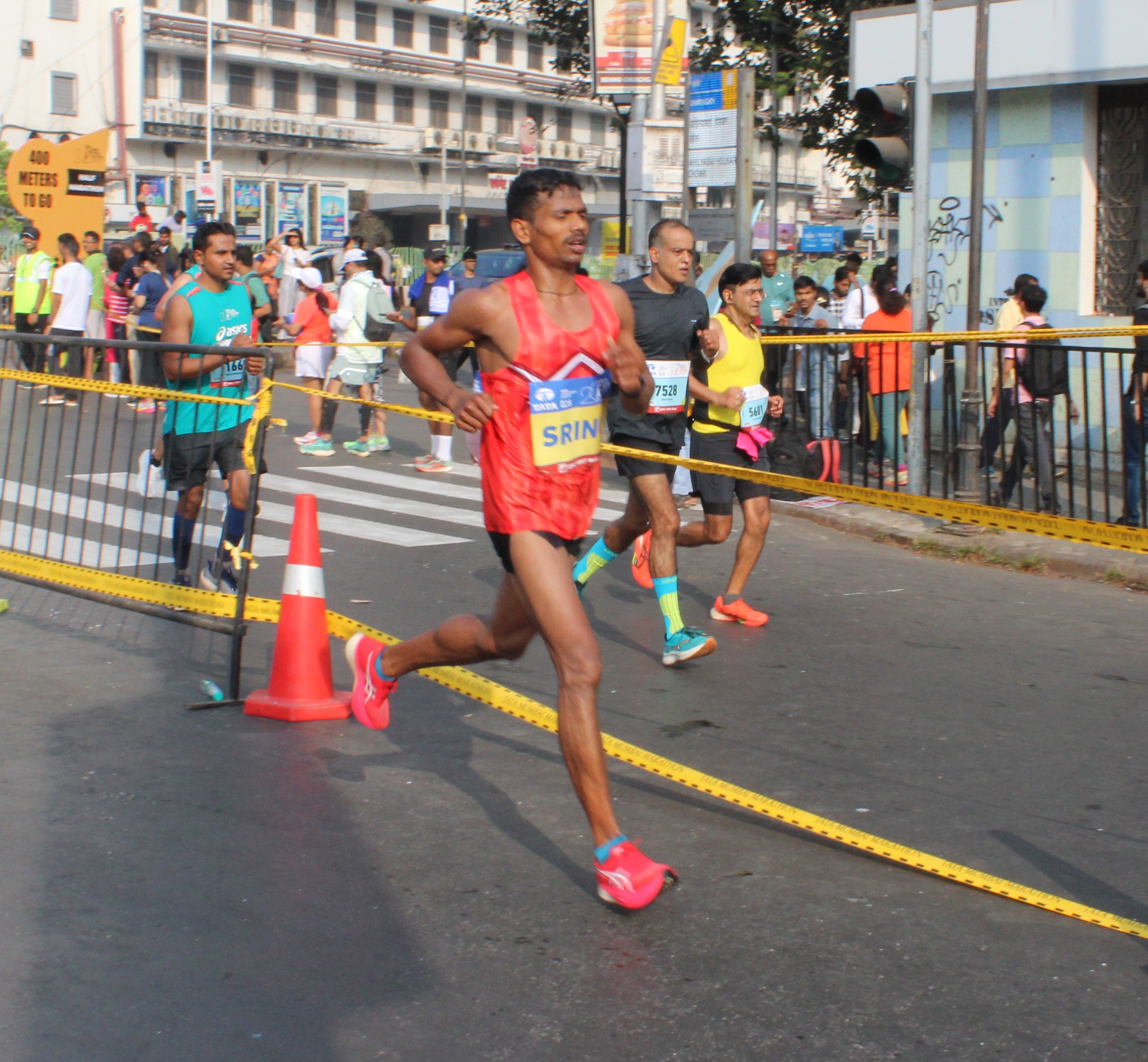
Last year at TMM, Srinu Bugatha had placed first in the Indian men’s elite category with time to finish of 2:17:29. He improved that to 2:14:38 at the 2024 Apollo Tyres New Delhi Marathon held in February. Then in April, he suffered an injury to his right hamstring. In Europe, where he went to participate in the year’s Prague Marathon, the injury worsened. He had to spend time recovering from the injury and nursing himself back to form.  In August 2024, he finished first among Indian men at the NDMC Hyderabad Marathon with timing of 2:29:25. Two months later, he was laid low by dengue fever. Recovering from it, he was able to train for roughly two months and get ready for 2025 TMM. “ My run at TMM this year, didn’t go as I had planned,’’ Srinu said. After kilometer-23, his pace began to slacken a bit and at that stage his fellow runners from the Indian men’s elite squad, keeping up with their pacer, left him behind. For the remainder of the race, he soldiered on alone, not exactly an ideal position to be in. Srinu finished in 2:20:43 to place fifth in the Indian elite men’s category. He now plans to run at the 2025 edition of the New Delhi marathon slated for February 23.   

Jyoti Gawate; from 2025 TMM (photo: Shyam G Menon)

Jyoti Gawate

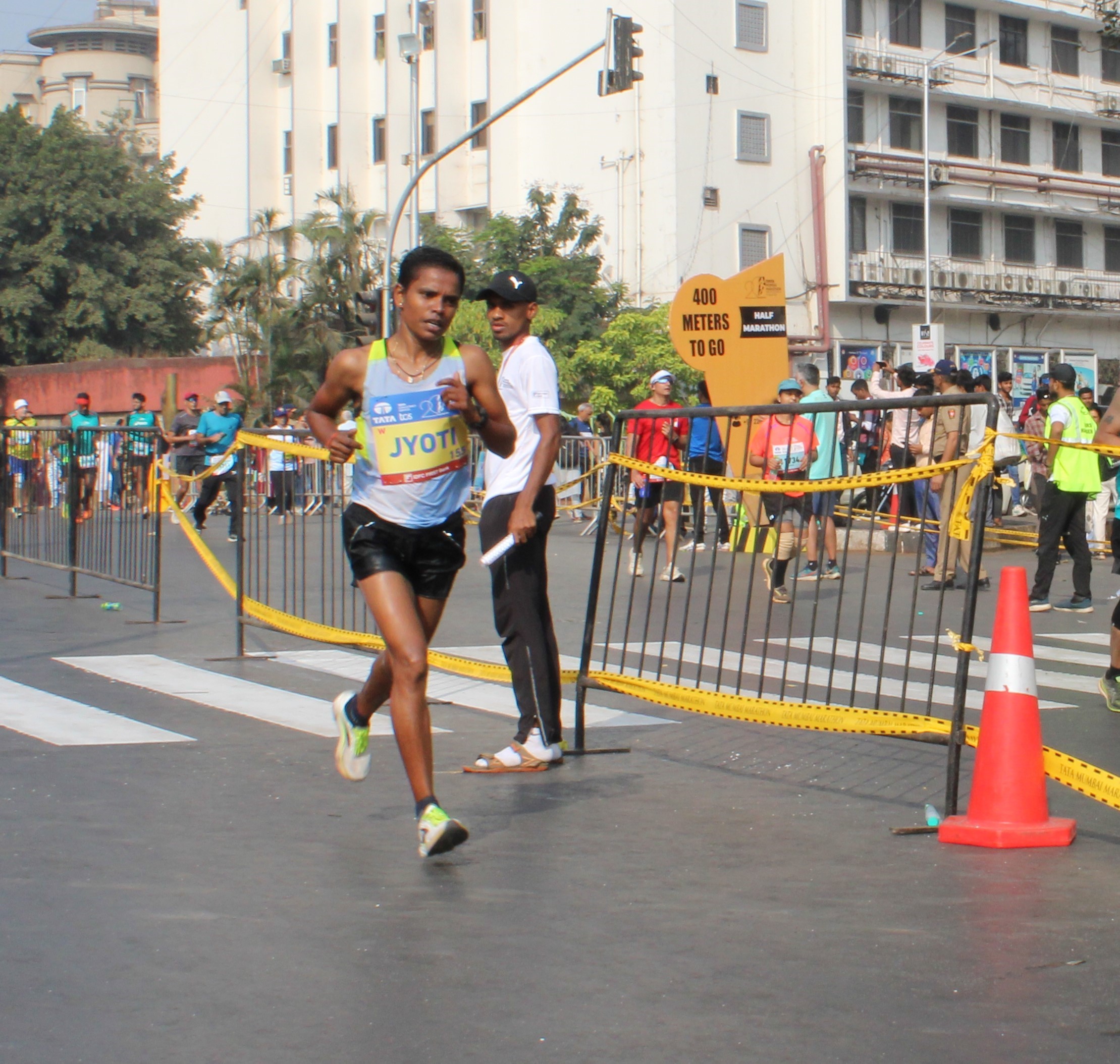
An elite runner, Jyoti Gawate from Parbhani in Maharashtra, is a regular participant at many of the races around the country. Jyoti has won the Mumbai marathon’s race for Indian elite women twice, secured second position four times and third position once. She won the race for Indian elite women in the 2011 and 2017 editions. She came in second in 2010, 2018, 2019 and 2020 editions. In 2014, she finished third among elite women runners. In 2015, she finished fourth and in 2012 and 2013 she finished in fifth position. In 2016, she finished in sixth position. “ I am returning to the Mumbai marathon after four years. My training was quite good but the race was very tough because of the weather,” she said. Jyoti finished the race in 3:11:09 to place seventh among Indian elite women runners. “ I did not get any energy drinks during the run,” she said. Jyoti had represented India in the IAU 100 km World Championship held in Bengaluru on December 7, 2024. But she had to quit the race at 60 kilometers due to injury. Jyoti has represented the country for 100K and 50K races in both Asian and world championships. Jyoti holds the women’s national record for 100 kilometers, 8:20:07 set at the IAU 100 km World Championship in Bernau-Berlin in 2022. Immediately on the cards for Jyoti is probably the 50 kilometer-race at Tata Ultra, due on February 23, 2025. “ I have nothing planned but I would like to attempt the 100 kilometer-race again to see if I can improve my national record timings,” she said.

Shyamali Singh (photo: courtesy Shyamali)

Shyamali Singh

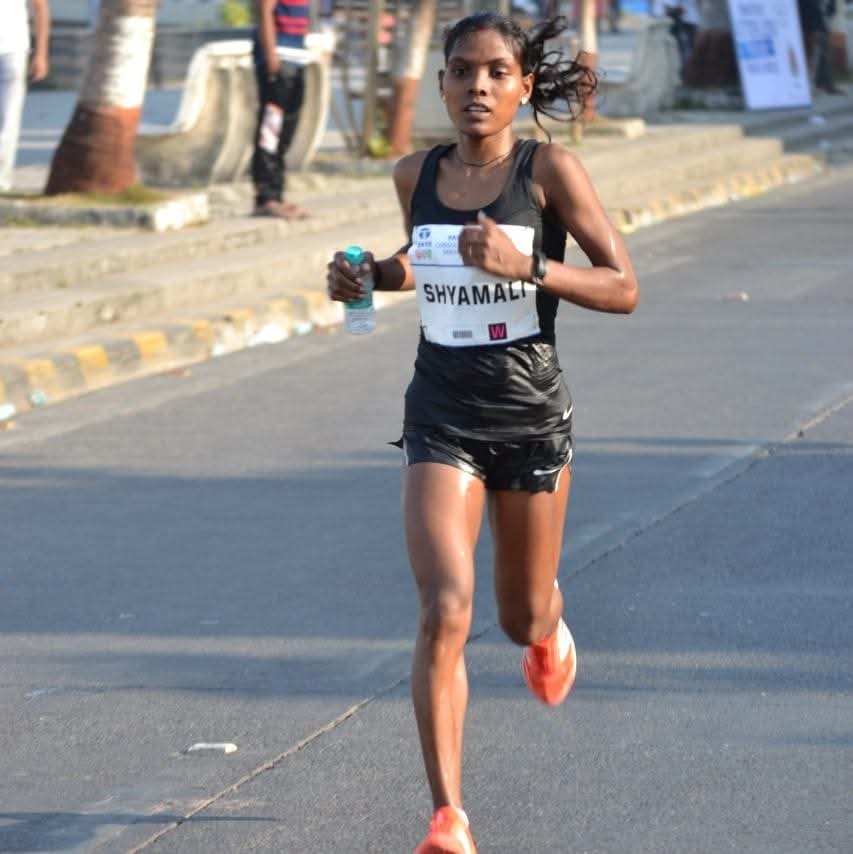
At the 2025 edition of TMM, Shyamali Singh had to give up the race at around eight kilometers as she had a severe backache. “ While travelling to Mumbai a few days before the race itself, I noticed that my back was hurting quite badly. I kept taking medicines but to no avail,” she said. There’s more to Shyamali’s story than the above-mentioned setback of January 19, 2025. No stranger to TMM, twenty-five-year-old Shyamali has been running for several years and has finished with podium or near podium positions, including in the Indian women’s elite category in Mumbai. In the 2017 edition of the Mumbai marathon, Shyamali finished second among Indian elite women (3:08:41). She finished second among Indian elite women at the Tata Steel 25K event in Kolkata, in 2019 (1:39:02). At the 2020 edition of TMM, she placed third among Indian elite women with timing of 2:58:42. That same year in September, she started to have mild headache and fever. Following routine visits to local doctors and taking medicines, her fever came down but the headache worsened. A resident of Asansol in West Bengal, Shyamali, had to go through a series of hospitalizations and wrong diagnoses before she and her husband, Santosh Singh, learnt of Dr Siddhartha Ghosh, neurosurgeon at Apollo Hospital in Chennai. “ By this time, we had already incurred a huge amount of expenses,” Santosh said. For their consultation with Dr Ghosh, they had to take a flight from Durgapur to Chennai. After the diagnosis – the doctors discovered a tumor – and the initial treatment, they went back home to Asansol and returned to Chennai in December 2020 for surgery. Shyamali underwent a 12-hour brain surgery in December, 2020. “ For us, Dr Ghosh is akin to God. He was aware that Shyamali was an elite long-distance runner and therefore allowed her to resume running slowly after six months,” Santosh said. At the 2024 edition of TMM, she finished in third place in the Indian elite women’s category with timing of 3:04:35. This year’s TMM didn’t prove as successful. But such is life. Going ahead, Shyamali is likely to participate in Kochi Marathon, slated to be held on February 9, 2025.

Reenu Sandhu (photo: courtesy Reenu)

Reenu Sandhu

Running the elite marathon at 2025 TMM, Reenu Sandhu pulled out of the race at around 27 kilometers. “ During the 2025 National Cross-Country Championship last week I ended up with fever and I had not fully recovered. Because of the overall fatigue and the weather conditions on race day I had to give up the TMM race,” she said. The late start was also not helpful. The race for elite runners commences at 7:20 AM, which is considered late for Mumbai’s humid weather. Reenu, a head constable with the Central Industrial Security Force (CISF) and posted in Bhopal, is a track and field athlete who focuses on 5000 meters and 10,000 meters. The 27-year-old athlete, hailing from Haryana, also runs the half marathon and the full marathon. In 2023, Reenu won the Indira Marathon, held in Prayagraj. The following year she earned a silver medal. She had secured a gold medal in the 2023 Indian Army Veteran Half Marathon held in Delhi. Her personal best in the marathon is 2:47:11, which she secured at the Coal India Ranchi Marathon 2024. She will now be heading for the 2025 Coal India Ranchi Marathon scheduled to be held on February 9, 2025. Next on the cards will be the 2025 World Police Athletics to be held in the US. She will be running the 5000 meters and 10,000 meter-races at this event.

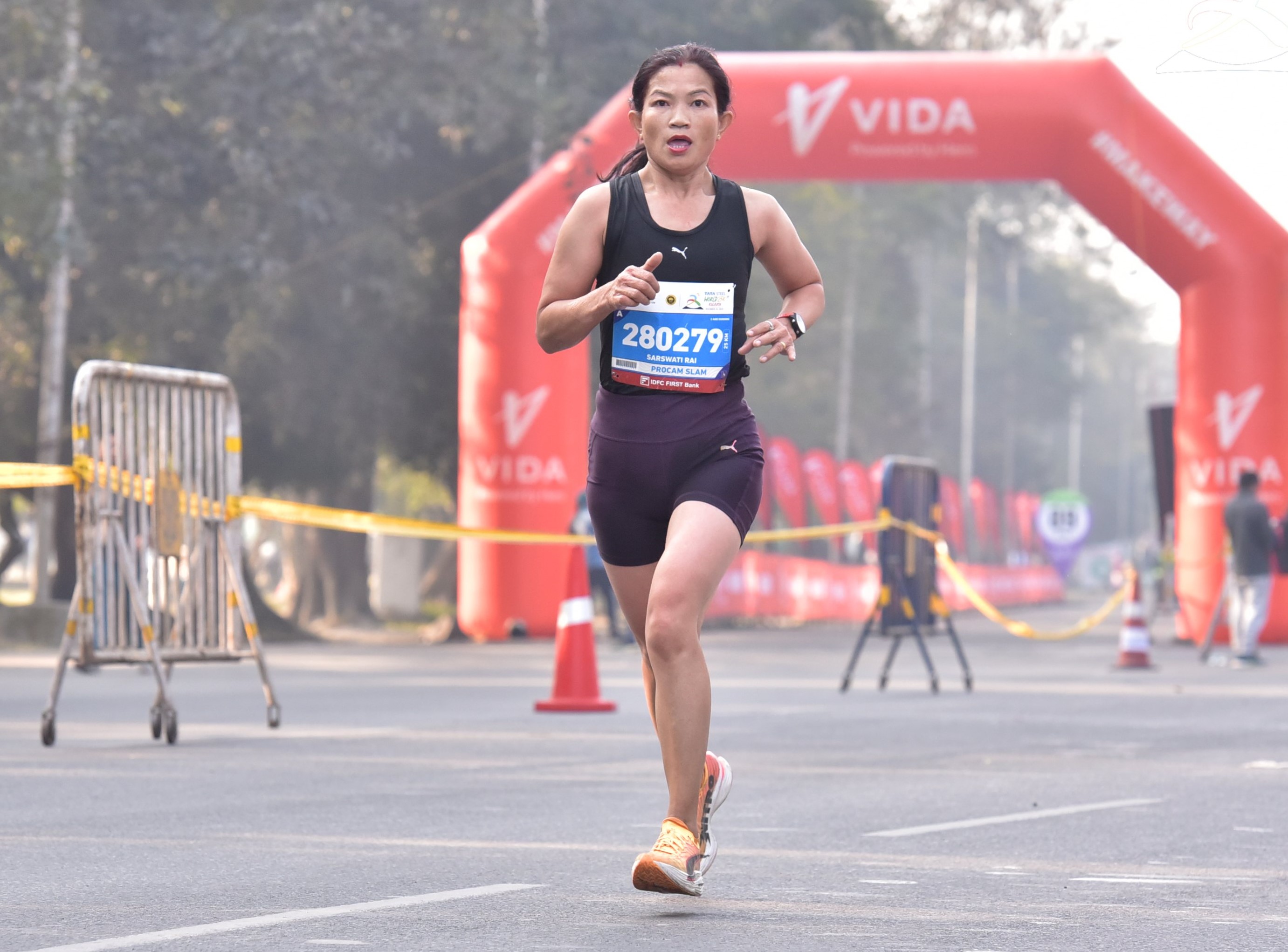
Sarswati Rai (photo: courtesy Sarswati)

Sarswati Rai

Winner of the women’s race in the open category of 2025 TMM, 46-year-old Sarswati Rai commenced running about 10 years ago. “ My husband, who was in the army at that time, encouraged me to take up running. Initially, I used to wake up early, go for a run at 4 AM and return home before daylight appeared. I was very shy of getting out and running. There was no running culture where I lived,” she said. Her husband now works with Defence Security Corps (DSC). A resident of Kalimpong, Sarswati was initially clueless about distances. “ I did not know what a distance of one kilometer was. In 2015, I enrolled for half marathon at the Rotary Darjeeling Marathon. It was a tough run for me. I kept stopping as I was feeling dizzy. I finished in two hours, 50 minutes. The guy who was driving the ambulance kept asking if I wanted to stop running,” she said. Sarswati then began focusing on shorter distances to improve her timing and worked her way up through the distances. Her training for 2025 TMM was quite good but her performance on race day did not match up to the training, she said. “ The weather was tough. It was very warm and humid. Normally, I can do 10 kilometers without water but here I had to have water at seven kilometers itself,” she said. She finished the marathon in 3:10:45 winning overall among women in the open category as well as in her age category of 45-49 years. With this race, she completed the Procam Slam for the second time. Procam Slam entails running the four races organized by Procam. These include Tata Mumbai Marathon, TCS World 10K Bengaluru, Vedanta Delhi Half Marathon and the Tata Steel World 25K Kolkata; each of these races have to be completed within a stipulated finish time. In February 2024, Sarswati won the women’s open category marathon at New Delhi Marathon also known as National Marathon, with a timing of 3:02:46, her best so far. “ It would be ideal to come a few days ahead of the race to Mumbai but as we have to spend our own money for travel and stay it is not feasible,” she said. Her next race was a half marathon at Golden Pagoda Marathon 2025 at Namsai in Arunachal Pradesh on February 9, 2025.

Amar Singh Devanda (photo: courtesy Amar Singh)

Amar Singh Devanda

Amar Singh Devanda did not train specifically for the Mumbai Marathon. A seasoned ultrarunner who has been in the Indian ultrarunning team multiple times, he had recently represented India in the IAU 100 km World Championship held in Bengaluru in December 2024. Amar was the fastest runner among Indian ultrarunners at that championship. At Tata Mumbai Marathon 2025, Amar finished overall third in the open category and first in his age category of 25 to 29 years. He finished his marathon in 2:35:13, a new personal record for him. Amar could see many runners struggle on account of the weather but he was able to sustain his pace primarily because of his exposure to ultrarunning. He believes that his mind used to ultrarunning helped him cope with the adverse weather. Amar holds the national record for 24-hour run (272.54 km). “ I was able to maintain my hydration and nutrition well throughout the run,” he said. At TMM, the problem for early finishers is the wall of runners especially from the 10 km segment. “ After 31 km it is a struggle running through the crowd of runners. Volunteers need to be guided to direct 10K runners to keep to one side of the road so that there is space for marathon runners to run,” he said. Amar will now be doing 50 km at the Tata Ultra Marathon, slated to be held on February 23, 2025. Thereafter, his focus will be on 24-hour running.

Anil Korvi (photo: courtesy Anil)

Anil Korvi

Last year Anil Korvi ran the half marathon at TMM as he was nursing an injury. He won in his age category (30 to 34 years old). This time around he did the marathon and finished overall 13th in the open category and third in his age category with timing of 2:42:34. His performance could have been better if not for a niggling back pain, the fatigue of three events run within the duration of a month and tough weather on race day. A month ago, he did TSK 25 km in Kolkata. He finished seventh overall and third in his age category. Following this run, he ended up with back pain and fever. He had barely recovered when he had to travel to Gorakhpur for a 10 kilometer-cross country run there. Anil is an employee of Indian Railways. “ I was not able to do any long runs because of lack of time. I was not able to do speed runs either. Every time I tried to step up my speed my back pain would return,” he said. On the TMM course, Anil tried running with Manoj Rane (also a podium finisher) and Amar Singh Devanda but after a few kilometers he decided to fall back; he could not keep pace with the fast runners. “ The weather was not much of an issue for me. My training was inadequate. Also, after the 38th kilometer-mark I did not get hydration support as the water stations were on the other side of the road,” he said.

Mrinal Biswas (photo: courtesy Mrinal)

Mrinal Biswas

During the COVID-19 pandemic lockdown period, Mrinal Biswas, 67, was unable to go swimming as most pools were closed. He decided to take up running. Initially, he ran on the terrace of his building in Mira Road. Later he came on to the road and started running on the streets of his colony. “ My cousin Abhijit Shome is a runner. I took his advice and tips on running from him. I took it slow,” he said. In October 2024, Mrinal competed in the Goa Ironman. The 2025 edition of Tata Mumbai Marathon was his third year at this iconic running event. The annual Mumbai marathon commenced in 2004 and completed 20 years this year, having lost two years in 2021 and 2022 to the pandemic. In the previous two editions, Mrinal ran the half marathon race. At this year’s edition of TMM, he was running his second full marathon race. “ In my first full marathon I finished in 3:55. Many runners were surprised with my timing,” he said. Mrinal wanted to train properly and so, joined Snails2Bolt group under Coach Manish Jaiswal. He followed Jaiswal’s training plans. “ My training for this event went off very well,” he said, adding, “ race-day was quite good for me. I did not find the weather too tough. It was a well-organized run with very good work by the volunteers.” Mrinal finished the marathon in 3:33:21, finishing first in his age category of 65 to 69 years.

Kmoin Wahlang; near Mumbai’s Taj Mahal hotel and Gateway of India, hours after 2025 TMM (photo: Shyam G Menon)

Team Meghalaya

Kmoin Wahlang is not your everyday senior citizen. A small woman, easily lost among the physically bigger people and still bigger crowds clustered near Mumbai’s Gateway of India, which was where this blog met her, Kmoin had just claimed her sixth victory in her age group hours earlier at 2025 TMM. The 76-year-old, sole participant in TMM’s ` 75 years & above female’ category completed the 42 kilometer-marathon in 4:37:30. The mother of 16 children (12 of who are alive today), grandmother to 54 and great grandmother to seven, was relaxed and betraying no sign of exhaustion from that morning’s race. This blog asked her if Mumbai’s weather – race day was warm and humid affecting the performance of many athletes – had been an issue. She dismissed it; she faced no problems worth mentioning. In 2024, she had completed the marathon at TMM in 4:29:24. What strikes the observer is the timing – in 2025 for instance, the timing returned by the 76-year-old would fetch her a third place in TMM’s 60 to 64-year-old age category; a group that is more than 10 years younger in age. Hailing from Shngimawlein in Meghalaya, Kmoin said she started her journey in running at age 69 or 70. She reaches Mumbai every year for TMM with the team of runners regularly coming for the event from the state in north east India. Besides Kmoin, Meghalaya had a podium finisher in Tlanding Wahlang, who completed the marathon in 2:45:18 to place first in the 45 to 49 years age category for men.   

Thomas Bobby Philip; at 2025 TMM (photo: Shyam G Menon)

Thomas Bobby Philip

For Bengaluru-based Thomas Bobby Philip, 2025 TMM was an enjoyable experience. Bobby plans his annual training calendar around two events – the TCS World 10K in Bengaluru and the Tata Mumbai Marathon. TMM is an event he looks forward to every year. He found the 2025 edition of the event well executed. Equally, the execution of his own plan and strategy at the event, went off well. He had targeted a finish time of below three hours and 15 minutes and was delighted to complete the race in 3:11:48. Strategy and disciplined delivery appear to have been the key. “ Had I altered the pace and gone a second or two faster, I would have probably messed it up. Over time, you learn to leash in that urge to accelerate and run in a more controlled fashion,’’ Bobby, who has by now years of experience running marathons, said. The only difficulty he felt may have been at the uphill section on Peddar Road but even that went by without much exertion and only some ache in the calves to cope with for the rest of the run. Asked about the weather conditions on race day, Bobby said that it didn’t affect him because Mumbai has a general nature of weather that is characteristic to the city and also, he “ had planned for the worst.’’ “ Even in that phase when I was getting sub-three hour-timings, I didn’t let the weather bother me too much,’’ he said. Further, this was Bobby’s thirteenth TMM; he knew what to expect and when he runs, he doesn’t allow external factors to affect him. He keeps his mind in check. Bobby said that the completion of the infrastructure projects underway earlier, definitely made the course in Mumbai more enjoyable. A barefoot runner, he also said that the resurfacing of some of the roads made his 2025 outing in Mumbai among the best he had in all these years of running in the city. Bobby placed third in his age category (55-59 years) in the marathon at 2025 TMM.  

Vaijayanti Ingawale (photo: courtesy Vaijayanti)

Vaijayanti Ingawale

A paediatrician based in Thane, Vaijayanti Ingawale was not able to execute a good training plan ahead of the 2025 TMM. “ I had some back issues and was not able to do speed practice,” she said. Vaijayanti, who is also an ultrarunner, had enrolled for the Border 100 kilometer-run, held over December 14-15, 2024. She had to quit after 30 kilometers as she started cramping. She has been securing age category podium positions in marathons and shorter distances for the past several years. At TMM, she decided to take it slow and steady. “ The weather did not get to me but I could see a lot of runners suffering,” she said. Vaijayanti had a fall at around 21 kilometers but she was able to resume walking and then, running. “ My target was to finish somewhere between 5:13 and 5:30 hours,” she said. Vaijayanti, 67, finished the marathon in 5:24:51 securing first place in her age category of 65 to 69 years. She has enrolled for the 50 kilometer-race at Tata Ultra, due on February 23, 2025 in Lonavala.

Pervin Batliwala (photo: courtesy Pervin)

Pervin Batliwala

Pervin Batliwala has been an age category podium finisher in most of the running events that she participates. At TMM 2025, she finished the half marathon in 2:14:20, winning yet another age category podium (70 years and above). In December 2024, at Vasai Virar Municipal Marathon (VVMM), she had covered the distance with an even better timing of 2:11:48 to finish second in her age category of 60 year and above. “ When I started the run at TMM, I found my friends running too fast. I decided to do my own race,” she said. Her training for Mumbai Marathon was good, though her focus has been more on swimming in recent months. “ In 2024, much of my training time was focused on swimming. I wanted to focus on freestyle swimming technique as I am new to it. I am good in the breast stroke,” she said. Pervin also takes part in open water swimming races. She has completed the six-star World Marathon Majors, done a few ultrarunning events including Comrades Marathon (an ultramarathon in South Africa) and the Khardung La Challenge, a 72 km run in Ladakh among others. This time around at TMM, weather was a dampener. “ It was quite warm. I found it difficult to accelerate. I saw many runners suffering cramps. In such situations we have to be sensible and careful and pull back from our targets,” she said. Her next event is in swimming. Later, she may consider signing up for the Sydney Marathon, which is now part of the World Marathon Majors.

Asokan Shanmugam (Photo: courtesy Asokan )

Asokan Shanmugam

A runner based in Chennai, Asokan Shanmugam, got into recreational running when he was 41 years old. Over the past 11 years (now he is 52) he has been able to get age category podium finishes at many of the running events that he participates in. “ I run six days a week and for two to three days I do strength training,” he said. At the 2024 edition of Vasai Virar Municipal Marathon (VVMM) Asokan won in his age category (50-59 years) with a personal best timing of 1:23:53 in the half marathon race. “ At the time of the Vasai Virar race the weather was quite good but by the time of the Mumbai marathon, the heat had increased,” he said. He was not unduly affected by Mumbai’s weather during the TMM run as he is used to running in similar weather in Chennai. At 2025 TMM, he finished the half marathon in 1:24:59, getting a third position in the age category of 50 to 54 years. “ I would like to bring down my half marathon timing by another 2-3 minutes before I attempt a full marathon,” he said.

(The authors, Latha Venkatraman and Shyam G Menon, are independent journalists based in Mumbai. This article is a work in progress and will keep growing as more conversations happen)