THE TINTIN YEARS

Illustration: Shyam G Menon

Many decades ago, two significant developments happened near simultaneously, in my extended family.

Two uncles, two comic strip heroes and a bunch of school going cousins – that was the context.

My uncle Narayana Pillai got me Flight 714, my first title from the series showcasing the adventures of Tintin. Until then, the only illustrated narratives I was familiar with were the ones from Marvel, DC, Indrajal and Amar Chitra Katha. They had strong following among school students, to the point that classmates with bound volumes of comic books were important people to know. I didn’t have bound volumes. Although my mother helped out by borrowing bound volumes from a local lending library, in general I suspect, my parents and grandparents held the view that comics, while popular, made for simplified narrative requiring less imagination. Reading was encouraged, purchase / borrowing of wholesome books approved. Days when the cousins got together typically featured a morning or afternoon of painting. Imagination was encouraged. A picture may speak a thousand words but the mind gets useful stretch if it can paint a picture from a word or a theme, perhaps even nothing – that seemed the approach. Into this ambiance landed Flight 714 and at the house of my cousins – Rajeev and Manju – thanks to another uncle: Sachidanand, a handful of books featuring Asterix.

It took me a while to warm up to Tintin. But you guessed it right – it took no time to like Captain Haddock. Who can forget “ thundering typhoons’’ and “ blistering barnacles’’? I also remember liking Skut for no stronger reason than that he was a pilot in Flight 714. Those days I shared a craze for aircraft with my cousin Jayu. Both of us had those small, thick Observer books with plenty of fighter planes in it and we spent time piecing together our respective air forces, which then competed for supremacy in the sky. We also made model aircraft from cardboard, Jayu being infinitely better at the job than I. Flight 714 thus landed at the correct time. My mind was ready for adventure. What attracted me to Tintin were also perhaps the size of a Tintin book and the average length of a story. Uniquely, it was bigger in size than the regular comic book. It told a full-fledged, long story spanning continents, sometimes taking two issues to finish; a sort of early introduction to the graphic novel format that would become popular decades later.

What I remember most is however something else.

Maybe it is a larger Malayali trait, maybe it is a family trait – I don’t know which of the two is correct –we had the tendency of analyzing experiences. At near fifty, I understand childhood better now. It is a phase when you have the luxury to do something because you feel like it; no analysis in the mix. Impulse and intuition are not unfashionable. Our passage to adulthood is fueled by just the opposite. We become adults by analyzing to make sense, till we become armchair analysts of all that is alive and stirring. Expectedly, my extended family put Tintin and Asterix under the scanner. The emergent fascination among the children for these two series triggered discussion among the adults. It was a discussion revolving around idea, story and artwork; we had no clue of such political details like Tintin’s origin in a Belgian newspaper identified with far right views. I remember the outcome. Asterix stayed ahead because its illustrations were bolder and had more flourish. Asterix stories with their play on characters’ names were also more deeply imagined and as the more sophisticated, layered comic book it was respected that much more because childhood is after all stepping stone to more sophisticated adulthood. None of that bothered me. I like Asterix. But Tintin is special. Something about it appealed to childhood’s idea of adventure.

My uncle probably noticed the brewing interest. His work took him often to other cities in India. Occasionally, it also took him overseas. Almost always, he returned with another title from the Tintin series. All the titles were displayed on the back of each book. So it was easy to identify what you hadn’t read and hunt for it. Tintin made me do crazy things. One of them was my scale drawing of a rocket. I arrived an evening with my father at the house of Rajeev and Manju. Their father – Govindan (he was a physics professor) – smiled and indulged me with his time and patience as I explained how my rocket would work. It was all well illustrated in the drawing on large graph paper – the fuel tank would feed the engine and my rocket would escape Earth’s gravity and be moon-bound. Why shouldn’t it? I had a rectangle with dials on it, labeled ` control panel,’ another rectangle with pipeline attached, labeled ` fuel tank’ and yet another one marked ` engine.’ That last rectangle ended in a nozzle copied from one of the jet engines in my Observer book. In retrospect it’s a good thing I didn’t join the Indian space program.

In those days of economy yet to open up like now, each Tintin bought traveled to multiple homes. At every home a kid or two eagerly lapped up the contents. Sometimes titles got exchanged at school; I will lend you my title if you lend me yours, which I haven’t read – that sort of deal. And unlike, regular comic books, which few bothered if they got misplaced or torn through lending, deals over Tintin and Asterix were deals of honor. Misplace or mishandle, you risked being branded unreliable for life. That adds a touch of mystery to how my Tintin collection – all titles acquired save four; that’s 20 out of 24 – fared, once I reached college and employment beyond. Back home in Thiruvananthapuram, not one title survives. I hope some kid; somewhere is still reading what I collected and drawing rockets and submarines. Slowly as Tintin titles became more easily available in India, we started buying the books ourselves (a visit to Kochi was always incomplete without dropping in at PAICO). One by one, we collected the titles mentioned on the back cover of every Tintin book. Then the search commenced to at least access and read titles not mentioned there; titles mentioned in Tintin lore or in conversation among his devoted fans. Meanwhile, my uncle’s children, Lakshmi and Hari, also grew interested in Tintin and started their own collection.
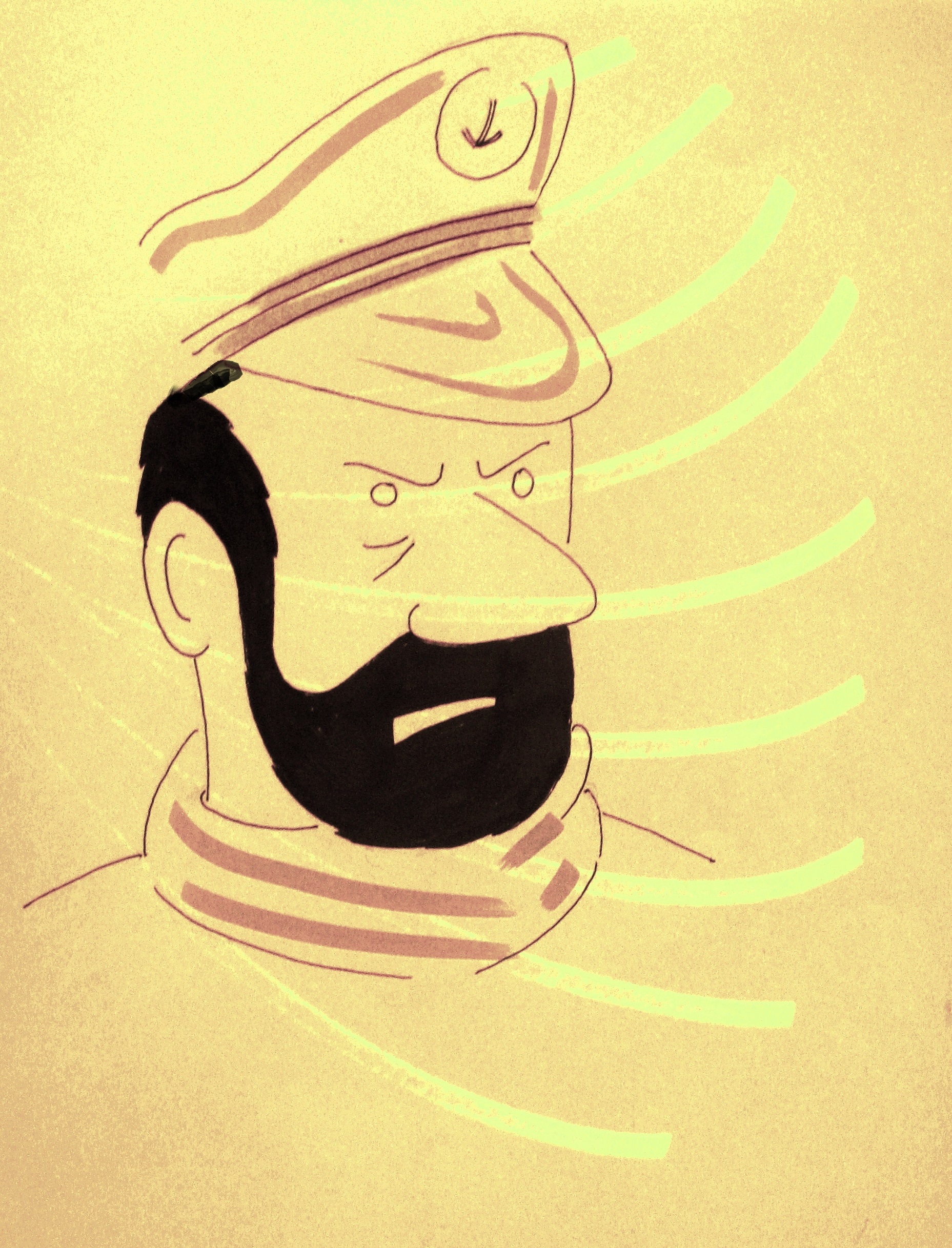
Illustration: Shyam G Menon

I never outgrew Tintin. I can still pick up a title and enjoy browsing through it. In my adult life, the arrival of Steven Spielberg’s film on Tintin was a much awaited event. My favorite character was Captain Haddock and I was utterly curious to see how he would be on celluloid. I was disappointed and it isn’t Andy Serkis’s fault. My curiosity was in seeing which actor would pull off that role well and being an avid watcher of Hollywood films, I had even attempted some casting in the mind. As it turned out, the movie was made using motion-capture technology. That put it neither here nor there. It reminded me of the title: Tintin and the Lake of Sharks. Of all the Tintin titles I had, this one – assembled using stills from a 1972 animated film – had attracted me the least. When it comes to converting comic books to movies, I am not a fan of hybrid. After all, Tintin is not a Jungle Book, wherein modern animation technology makes animal characters life-like rendering the film a classic. Tintin sits firmly in the world of people and it surprised me that the producers deemed hybrid imagery, acceptable. I felt that was a letdown, considering Tintin has been portrayed before on stage and several other comic book heroes have been adapted brilliantly for the big screen.

In early August 2017, Lakshmi mentioned that a prominent item at Hari’s home in California is a poster of Tintin. Among his favorite shops is one where he picks up “ his Tintin stuff.’’ It made me wonder: what made her father Narayana Pillai, pick up Tintin books in an era of closed economy in India? Laskhmi’s own take on it was that her father bought it for the children in the family but he wasn’t above reading it on a flight himself! But then, unlike today when the media floods you with trends instantly, those days a comic book hero from Belgium was as distant as Belgium itself. You were compelled to read about Superman, Batman, Phantom and Mandrake because they were around. But Tintin? He didn’t have any PR machinery promoting him in the Indian media. It left the question: how did Narayana Pillai born and brought up in the Kerala of the 1940s and 50s, come to know about Tintin? He had never shared those details. A day into recollecting my thoughts around Tintin, I called up my uncle at his home in Aluva. Now in his mid-seventies, he laughed upon hearing that the phone call from nephew nearing fifty years of age was connected to his Tintin purchases from long ago. There was no loss of time in recollecting details. The bulk of the Tintin books were sourced from a book shop at the Mumbai airport of old, which my uncle visited during his business trips. “ I used to look for illustrated children’s books. That’s how I came across Tintin. I flipped through its pages and felt the characters in the book were interesting. The hero was a young journalist. When I bought my first Tintin, I had no idea how it will be. But from that one book, we moved onto many more, possibly the whole lot…Hari’s collection is still here,’’ he said. Further, in as much as he bought the books for children, he loved reading Tintin himself.

(The author, Shyam G Menon, is a freelance journalist based in Mumbai.)   
THINK EVEREST IF YOU MUST BUT DON’T FORGET THE SEA

Illustration: Shyam G Menon

In early September 2017, I read a news item from Kerala that spoke of a state based-adventure outfit wishing to put women from South India on top of Everest.

It made me sad. Not because Everest is unworthy of aspiration but because it captures our attention at the expense of other equally worthy if not worthier objectives.

To begin with, in May 2014, Malavath Purna, a 13 year old-girl from Telangana had successfully scaled Everest. She was at that time the youngest girl to ascend the peak. That’s sufficiently record-making for South India if you ask me. Maybe then, the adventure outfit’s reference was to people from Kerala. While anyone is free to raise the required funds and attempt Everest, it is a fact that in mountaineering, Everest is equated with guided mountaineering as long as one is attempting it by its frequently climbed routes. The most important factor in guided ascents of prized peaks is whether you – as client – can afford the cost of permit, gear rental charges and the fees of the guiding company. In Everest’s case that is a big amount. Everest tests your stamina. It also tests your purse.

A guided climb of Everest by the normal route does not automatically make you distinguished in the company of mountaineers. Discerning climbers will seek details and they know well that challenging peaks are available elsewhere too in the Himalaya. On the other hand, alpine style ascents on Everest or climbing it by less frequented routes are ideally tackled by experienced climbers for they are quite difficult.

If you can raise enough money to climb Everest; then directing those resources to any other part of the Himalaya will yield plenty of peaks of lesser height that cost less to climb. Should Kerala structure a mountaineering program that puts the focus on less known Himalayan peaks, it would do climbing a service. Some of these peaks are genuinely challenging. Ascents on them have been the stuff of award winning mountaineering. For those who define adventure differently from courting a tonne of risk (I belong to that category), these lesser mountains and their landscapes also harbor much wild beauty and solitude. Currently they don’t fascinate Indians as much as Everest because we and our media are still in the early phase of mountaineering. We haven’t got under the skin of climbing. We remain awestruck by Everest. That’s why the world’s highest peak, climbed by many and their guides every year, continues to attract. A good example of its popularity and symbolic value is betrayed in the experience of a well-known mountaineering club from western India. Having climbed Everest successfully, this club tried raising funds to climb other peaks. It didn’t work. It was easier to find sponsors for yet another Everest expedition with adjacent peaks included. Among mountains, Everest fetches sponsors and when it comes to money to attempt other peaks, Everest done or Everest too in the frame, is the stamp that fetches sponsors.

It doesn’t end there.

When individual aspirants fall short of funds for Everest, they borrow. Some even take bank loans. For these folks, a trip to Everest and summit missed means investment lost and life in debt. Such stories have been reported in the media. Further, government departments awarded promotion at work against Everest ascents recorded. Potential recognition of this sort, which has nothing to do with climbing, inspires its share of unrealistic expectations, not to mention fraud. I climbed Everest but didn’t get due recognition – is a complaint sometimes heard. Meanwhile, a husband and wife team from India was shamed not long ago for faking their summit photo.

Given several states have already seen their residents ascend Everest, I wonder if yet another Everest expedition or creating a training base for those aspiring to climb such a costly peak, deserves priority. Sure it can be a business opportunity, for those seeking guided ascents up Everest are clearly people willing to spend money for it. However if one is imagining sport with support from state exchequer in mind, then I submit what Kerala must do is something else.

As a coastal state, it must embrace water. It must encourage disciplines like swimming, distance swimming, sea kayaking and sailing. Water rarely gets the attention it deserves in our imagination of adventure although it forms 70 per cent of the planet and is deep enough to sink mountains. In his autobiography, American swimming legend Michael Phelps states his admiration for Australia. Down under swimming was one of the most popular sports, a position unheard of for swimming elsewhere. Phelps wanted this to happen in the US too. Access to water and sea is Kerala’s real gift. There is nothing wrong in wishing to meet the Himalaya. In fact, there is nothing wrong in anything you choose for adventure – it is your instinct, your choice. Just that in Kerala’s case, it would be a tragedy to hanker after the Himalaya far away, and merit in the process, guided swims and sailings in the Arabian Sea lapping at one’s feet.

Kerala has produced good swimmers who topped nationally. A couple of them also participated in the Olympics. Kochi has a marina. It is hometown of Commander Abhilash Tomy KC, the first Indian to do a solo nonstop circumnavigation of our planet in a sail boat. Did this translate into policy supportive of water sports in the state? I doubt it and by supportive policy, I don’t mean events (that’s tourism). I mean training and empathy for those wishing to court water. I have also not heard of any endeavor from Kerala that is the equivalent of an ` adventure’ on water. Further, for the record: swimming cannot be substitute for regular climbing as means to be good at mountaineering. But it provides physical fitness and cardiovascular health; both essential for any endurance based activity, including mountaineering. There is a lot that focusing on water can yield – it can help you excel on land, if land still be your chosen medium for adventure.

If you are in Kerala and can call upon government, companies and people to contribute resources, what would you attempt for adventure – Everest or a long distance swim or voyage?

Think about it.

(The author, Shyam G Menon, is a freelance journalist based in Mumbai.)

THE HOLMES IN US

Illustration: Shyam G Menon

The only character I have come across in my readings who avoids boredom like the plague is – Sherlock Holmes.

It took me years to understand why I liked him so much. I credit the delay to our rationalization of the boring as essential ingredient for successful life. Boring is our Voldemort; we don’t speak of it lest we lose livelihood. In such a world – one that increasingly ignores what it means to have a brain – Holmes makes it alright to be you. His continued existence, even as fictitious character, assuages the sense of uselessness you accumulate for failing due to your own capabilities. Sir Arthur Conan Doyle created Holmes. But many others have contributed to his splendid evolution since, into an emblem of being alive.

Between film and television, I believe it is the latter that got Holmes right. The late Jeremy Brett is the best Holmes I have seen. By that I don’t mean staying true to what the creator of the character wrote; I mean more bringing the character alive. However Brett’s Holmes is in a context from the past. There have been later reinterpretations of Holmes; attempts to position him and his stories in more contemporary ambiance. My initial fling with the two TV series – Sherlock and Elementary – made no impression. I couldn’t accept Holmes as super warrior adapted for digital age or Watson as a woman. I mentioned this the last time I wrote about Holmes on this blog.

With more episodes watched, things changed.

I am intrigued by the nature of connect these series have had on me.

The connection is inspired less by Holmes and more by his immediate and extended ecosystem. That, I believe, is where the portrayal was tweaked for renewed appeal. The two series, while retaining Holmes’s known traits added new possibilities, particularly in the interplay between him and those around him. Embedded in the interplay are moments we quickly empathize with.

In social response familiar to those staying single, the detective-doctor duo of Sherlock is sometimes mistaken for being gay as they are inseparable friends. When it comes to Holmes’s life and work, Watson, his wife Mary, Lestrade, Mrs Hudson, Molly Hooper and Mycroft – all form a protective ecosystem, alternatively frustrated by the consulting detective’s sharp insight delivered bluntly and admiring it. Moriarty vacillates between being an evil character outside of Holmes to being the stuff of his own mind; a natural and inevitable counterbalance to the faculties he possesses. In Elementary, Watson is a lady doctor who accepts a position as sober companion keeping an eye on Holmes, cast as a recovering drug addict. Elementary has Holmes based in New York and assisting the NYPD. In both TV series, the police as a whole are not welcoming of Holmes. But Lestrade and Captain Gregson, as individuals, are very supportive.

There are two major factors common to both these TV series.

In an episode from Elementary, as Holmes sits nursing a fever and the NYPD texts of a dead body found in an abandoned building, Watson reminds a Holmes eager to leave for crime scene that the police don’t pay him for his services. “ Watson, you should know by now that boredom is far more dangerous to my health than any fever,’’ he replies. As scathing and unforgiving are his observations of boring world, equally strong are his slides to vulnerability. Unlike the old Holmes with cocaine and Irene Adler for vulnerability, here the vulnerabilities are many and the occasions when they are on display are also many. There is a pronounced degree of seeming misfit. You have characters being publicly sarcastic of Holmes. Recall Sergeant Sally Donovan and her word for Holmes – Freak? The name calling doesn’t hurt Holmes. It hurts us Holmes fans.  In Sherlock, he cracks up (remember the episodes around Watson’s wedding?). In Elementary, he often stands there like a person wronged. As Watson’s tenure as sober companion drifts to a close, Holmes admits in a moment of weakness that his life rendered dry and impassive by the science of deduction is not how he wanted it to be. He says that he would miss the collaboration with Joan Watson if she went away. What stifles a more direct plea for help and understanding is ego. Benedict Cumberbatch and Jonny Lee Miller – both fantastic as Holmes reinterpreted – have captured this struggle well. I found myself lapping up episodes from both the series.

Illustration: Shyam G Menon

The above mentioned vulnerability, which probably strikes a chord with many, has been critical to Holmes’s continued evolution and presence in our lives. I suspect the reason it strikes a chord is because so many of us, while hardly as intelligent as Holmes or given to deduction, are nevertheless in terribly boring situations and unable to do anything about it. Our capabilities are wasted. We are intellectually alone. Society attaches little value to insights beyond the mundane. Money favors that which matters for its growth and mundane fits the bill eminently. Money also likes stability. If you aren’t naturally wired for enduring this combination or lack compelling reason to tow its line, you risk becoming outcast. For some of us at least – the ones declining to endure such boredom or asking questions about it – our vulnerability stands exposed. We wish for Watsons and Molly Hoopers to emerge by our side. We crave supportive ecosystem, even if it be four or five people, which is all Holmes has. From attracting us by his riveting brilliance as consulting detective, Holmes has transformed through the past few decades to attracting us for how he pays for his brilliance – there is his loneliness, there is his isolation. Given perspective is a product of subject and beholder, Holmes’s transformation is equally a commentary about the beholder. It is a state of the world report.

Brett’s Holmes was a wonderfully engaging portrait. We peered through time into the goings on at 221B Baker Street; it was a period of syringes reused and carriages drawn by horses. In contrast, the Holmes of Sherlock and Elementary remind us of contemporary predicament. He becomes a figment of our straightjacketed brain navigating environment dismissive of its insight and creativity. The ecosystem offered by Watson and Holmes’s few other friends keep him as what he is while Moriarty, cut from the same fabric, represents what can dangerously be.

(The author, Shyam G Menon, is a freelance journalist based in Mumbai.)            

MAGIC, 32 YEARS AGO

Illustration: Shyam G Menon

Remembering Freddie Mercury

July 1985.

News of the concert had been brewing for a while.

In that time, the newspapers had made Bob Geldof and The Boomtown Rats names to know. I knew nothing more of them. All-knowing by instant search wasn’t yet in. Google’s birth was another thirteen years away; easily accessed Internet even more. Being curious about universe and welcoming of world, I memorized the names for conversation with musically inclined friends. Geldof was the main organizer of the upcoming Live Aid, a massive rock concert to help victims of the famine in Ethiopia. It was to be held simultaneously in London and Philadelphia. The event was to be broadcast live across 150 countries; India was one of them. Some of the world’s biggest bands were heading straight to our living room. Television in India was young those days; colour TV younger still. There was only one broadcaster. Single broadcaster catering to the tastes of 780 million people (India’s population in 1985) meant that something fitting your taste on screen was both fleeting and a household event. Rock concert on TV was very rare. That year – 1985 – had seen the release of Brothers in Arms, the album that made Dire Straits a phenomenon. Thanks to Thiruvananthapuram’s music collectors and the network of the interested, we used to make up for Google’s absence and somehow access the music. I liked Dire Straits; they were expected to play at Live Aid as was Led Zeppelin in a much awaited reunion. D-Day was July 13. We watched the telecast together, as a family.

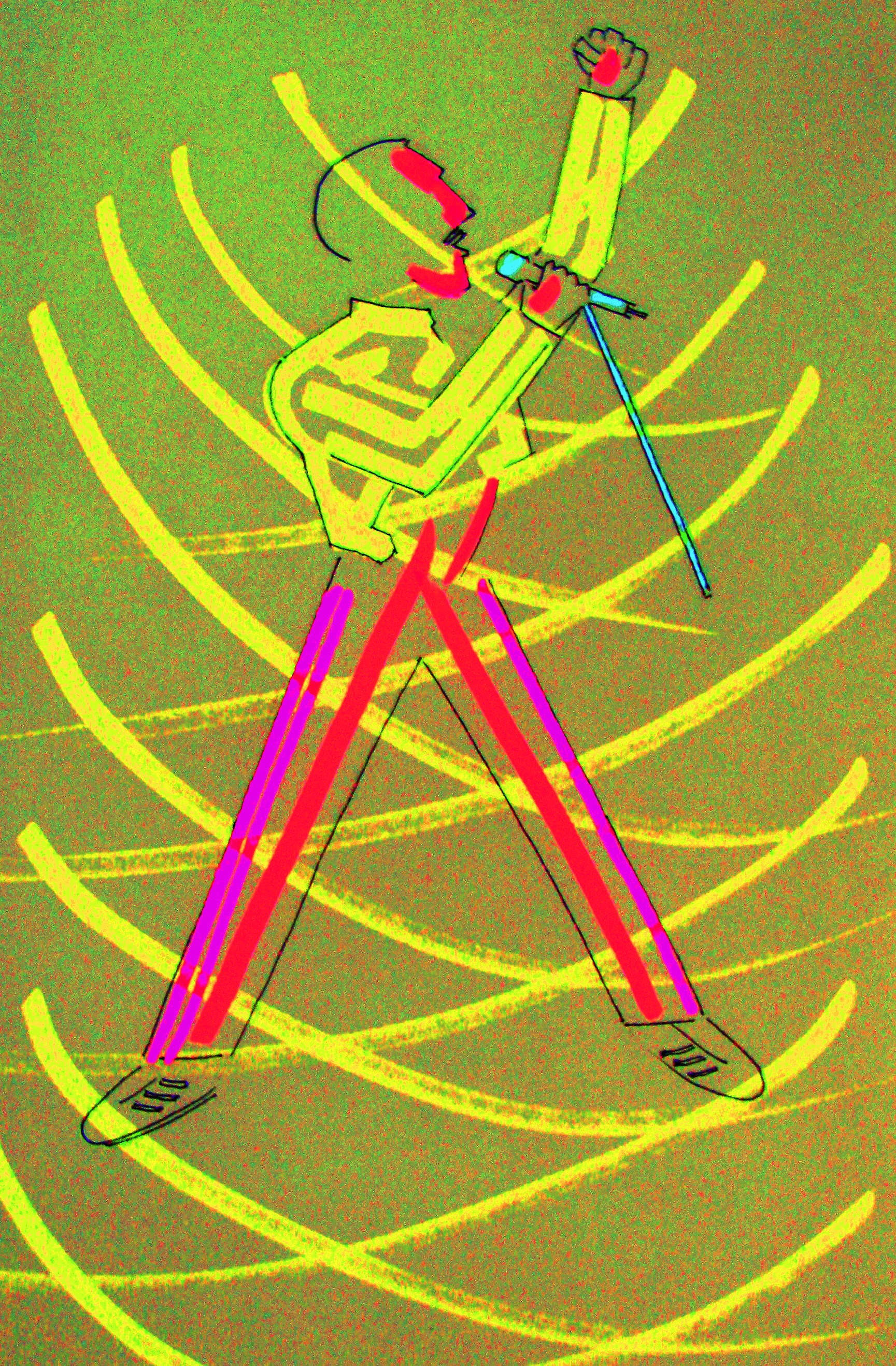
What I remember best from that telecast is what has since become famous as the greatest live performance in the history of rock music. We gazed in amazement at the TV screen as the people gathered at London’s Wembley Stadium (over 70,000 were present that day) raised their hands in the air and clapped in unison to Queen’s Radio Ga Ga. Then Freddie Mercury put them through a few vocal improvisations and they sang as he did, note for note. By the time the band was concluding its set with We Are the Champions, the Wembley crowd was swaying like a forest in the wind. On stage, Freddie Mercury was brilliant. It would be revealed later that Queen’s sound engineer may have tampered with the volume limit assigned to speakers, making the band the loudest act of the day at Wembley. If so, the band was unrepentant about it. Unlike many of the other bands at Live Aid who reportedly took their performance casually, Queen had come prepared and rehearsed. They intended to leave an impression. They did just that. Journalists writing on rock music have since compared it to one of those defining moments a lifetime of existence gravitates to. Freddie on stage at Live Aid was in such a moment.

Live Aid is supposed to have reached over a billion people. The world’s human population in 1985 was 4.8 billion. That would put the event’s TV viewership at close to a quarter of humanity, in days preceding Internet, Facebook, Twitter and human swarms trolling to enforce `like.’  Twenty minutes of Queen was Live Aid’s undisputed high point. As many would conclude later, Queen at Live Aid is rock music’s greatest live performance yet. Rock bands connect to audience through the technical proficiency of their musicians and through their front man. Queen was well balanced in this regard. Those writing on Queen have noted that none of its four members – Freddie, Brian May, Roger Taylor and John Deacon – could dominate individually, a trend capable of destabilizing bands. Further, each of them has contributed to writing one or the other of Queen’s many hits. Yet as often happens in rock music, the charisma of the front man influences a band’s perception by the public and Queen was no exception. Freddie Mercury was an electrifying act. Born Furrokh Bulsara on September 5, 1946 in Zanzibar, his father hailed from Bulsar, also known as Valsad, a town 150 km north of Mumbai. His mother was from Mumbai. Freddie spent most of his childhood in India (he attended school in Panchgani, 240 km away from Mumbai) before moving back to Zanzibar and then in the wake of the Zanzibar Revolution, onward to England. On November 24, 1991, a little over five years since that day at Wembley for Live Aid, Freddie Mercury passed away due to complications arising from AIDS. He was 45 years old. In 1996, at the opening of a photo exhibition on the life of Queen’s lead singer, the band’s lead guitarist, Brian May, would say (video of quote available on YouTube),“ to be truthful I am against recreating Queen in any other form as I think without Freddie it would always be something less than what it was.’’

Live Aid was also an opportunity to see U2, two years before they became a smash hit (and one of my favorite bands) with the album, `Joshua Tree.’ Queen and U2 warmed up to me differently. U2 peaked with my own advent to rock music-loving age, my craving in ever lonelier world for music as companion. I fell in love with Still Haven’t Found What I’m Looking For the first time I heard it. It remains a favorite even now. Which seeker in the head can resist such a song? Queen on the other hand, took time to connect. Notwithstanding their popularity, I found the architecture of Queen’s music stiff and set in an ecosystem that was very European and British.  They felt like a group hang-out. You bonded over their songs. For example, it isn’t music you seek in We Will Rock You, a song so evocative of tribe; you seek belonging. Long after Live Aid, I had friends who swore by Bohemian Rhapsody and We Will Rock You. I found Bohemian Rhapsody an engaging mix; it was baroque, operatic and rock. But a sucker for the traveling spirit, I wanted something less rooted. Perhaps something less grand and more portable? As a young journalist in Mumbai enjoying life’s early flush of hard earned income, I also remember sitting in pubs and singing along to I Want To Break Free. I outgrew that. More to my taste were songs like Breakthru and The Invisible Man. But over time, it was another Queen number, A Kind Of Magic, which remained in head enduring life’s ageing process. I love its barreling sense of momentum, soaring vocals and surface-skimming lead guitar; it gives me a feeling of hurtling along to somewhere and nowhere in particular, all at once. Above all I love the unbridled energy that characterizes Freddie’s rendition of this song at the July 12, 1986 concert in Wembley, a year after Live Aid. It is an image of absolute confidence. The video of the performance (available on YouTube) reminds you of Live Aid. It smacks of sensing opportunity. Just past the 45th second as Freddie launches into the song, he looks towards the audience, through the haze caused by the fog machine, tad uncertain of what to expect. A minute and couple of faint smiles later, he looks to the camera and you see that glint of acknowledgement; he knows the audience is in the mood for magic.

Illustration: Shyam G Menon

Twenty five years after Freddie Mercury’s demise, at a book fair near Navi Mumbai’s Vashi railway station I picked up Lesley Ann-Jones’s 2012 biography of the singer. My curiosity for it was the same as for a book on running, climbing, cycling, swimming or any such activity. Why should rock music be seen differently? Its all life; its all universe. Among other details, the book noted that Freddie’s first band was the `Hectics,’ formed at school in Panchgani by a 12 year-old Freddie and his schoolmates. An artistically inclined person given to sketching, he later took a diploma in art and graphic design, in London. His idol in rock music was Jimi Hendrix. According to the book, as successful rock star, Freddie rarely elaborated on his early years in Africa and India. On the other hand, it suggests that prolonged separation from his parents at so early and sensitive a stage in life, thanks to his schooling in distant India, may have impacted Freddie and contributed to the performer and person he became later in life. For long, Queen was a favorite with rock fans in Mumbai. Now a new generation and their music have taken over. Not to mention, Bollywood. The last big act in town was Justin Bieber (he was born three years after Freddie Mercury died). Movies have been made on artistes like Jim Morrison, Johnny Cash and Ray Charles. In 2010 a film was announced on Freddie Mercury’s life. In the years since, the cast and producers underwent change. When last reported in the international media, Egyptian-American actor, Rami Malek, was set to play the role of Freddie.

Live Aid happened 32 years ago.

Had Freddie Mercury been alive, he would turn 71 years old, this September 5, 2017.

(The author, Shyam G Menon, is a freelance journalist based in Mumbai.)     
THOUGHTS FROM A FOOTBALL FIELD

Illustration: Shyam G Menon

Not far from where I stay is a ground.

To one side of it is a skateboard rink taking shape; to one corner is a volleyball court. The rest of the space hosts cricket and football matches and once in a while that Indian weakness for elaborate marriages and prayer meetings.

One day, my friend Prashant informed that work seemed underway on a proper football field. The following Sunday, we went to take a look. There were laborers toiling in summer heat at its worst. The supervisors on site confirmed that the objective was a football field. Near the entrance to the ground, a board installed by the municipal corporation mentioned work completion by October 2017, when the FIFA under-17 World Cup is due in India with a well-known stadium in my neighborhood, among hosts. What we were witnessing appeared a practice field being built. Still, it isn’t a small thing for a community to get a good quality football field.

The suburb I stay in is part of India’s declared smart city projects. I am skeptical of `smart’ from smart phones to smart cities. If happiness is what matters, I am yet to see happiness multiplied because we have more smart phones or shifted everything to digital. I get happiness from a morning run, a climb or cycling. In several parts of India, running has acquired the dimension of a popular movement. Organize a marathon and a few thousand turn up. Why is there no push for sport cities in India?

The trick is to have this born from within and not as an imposition capable of commerce, which is what smart city does. Or yoga packaged as right / righteous living did. Thanks to branding, both `smart’ and yoga now possesses the character of divide; you are with it or against it, which isn’t how it used to be. The idea of sport city should be as organic as your morning run. You get out and run not because somebody organized a marathon or you want to be seen running but because it feels nice to begin your day with a run. Sport city must be a state of mind first, a state of infrastructure building only next. To indulge in sport is to indulge in physical and mental regeneration. I respect this regeneration. It restores one’s brain to where it belongs – one’s head.

One’s brain in one’s head is apt setting for human creativity. Instead of trends deciding your life, you live your life. Maybe you even author a trend. Urban regeneration includes creatively reusing already used spaces. You don’t always have to build anew to find space for sport. Acquiring land, building afresh – that is what the real estate lobby wants. That is also when sport becomes expensive for somebody has to pay the bill for fresh capital cost incurred. How about negotiating with authorities and convincing them for a grant of space, long term lease instead of land purchase and imagining with depreciated assets instead of newly made ones? Redesigned and spruced up, an abandoned garage or warehouse can become home for a climbing gym. A road closed to traffic or road in community given less to motoring, attracts joggers. Reduce the number of cars in a housing society and erstwhile car park can be a shuttle court. A community agreed on less pollution, accidents and congestion will automatically bring forth the cyclists in their midst. Check sea pollution, clean up rivers and backwaters; imagine what all water sport blossoms on it. Indeed an aspiring `sport city’ has to do no more than state that it wants to consciously promote the active lifestyle; that it will stand by citizen’s initiatives in that direction.

Question is – do we genuinely want it?

Aside from active lifestyle parceled as real estate opportunity or event management I haven’t yet heard of any Indian city genuinely promoting sport. None saying we are committed to becoming a center of excellence in sports. None saying we love having residents who are into the active lifestyle. None that put up boards cautioning traffic to be sensitive towards joggers and cyclists on the road. It is the absence of a certain instinct. It is like the question I am frequently posed – nobody asks why I blog or what I write as blogger; they all want to know whether I make money. “ What is your business model?’’ – That precedes interest in subject. To those sticking on past my silence, I usually say: this blog has no specific purpose except contribute in what small way it can to sustain the life interesting. The day life stops being interesting, I wouldn’t know what to do.

Life interesting – that’s the promise in that football field.

(The author, Shyam G Menon, is a freelance journalist based in Mumbai.)    
MUMBAI MIRAGE

Illustration: Shyam G Menon

The Mumbai Metropolitan Region is among the most populous metropolitan regions of the world. It was, until some decades ago, India’s industrial capital. Now that title is unclear. As industrialization gathers currency elsewhere too, the ingredients of being industrial capital lay scattered across several large Indian cities. Mumbai survives though as India’s financial capital.

The metropolitan region includes among others, Mumbai city, Thane and Navi Mumbai – all well-known urban entities with municipal corporations that are by no means poor. On paper for instance, Navi Mumbai – its growth anchored by the City and Industrial Development Corporation of Maharashtra Ltd (CIDCO) – is one of the largest planned townships in the country. Despite Mumbai featuring sharply contrasting images of super wealth and daily economic struggle with a huge chunk of its residents living in slums, Mumbai’s municipal corporation is among Asia’s wealthiest. Wikipedia’s page on the Brihanmumbai Municipal Corporation (BMC) states that its annual budget is bigger than the budget of some of India’s small states. Further, a clutch of India’s biggest private sector companies are headquartered in Mumbai.

Juxtapose on this a few facts from the outdoors. The first civilian expedition from Maharashtra to successfully climb a peak in the Himalaya was from Mumbai – a Girivihar expedition, years ago. Girivihar is Mumbai’s oldest mountaineering club. In 1988, the club staged an expedition to climb Kanchenjunga – the world’s third highest peak. It was the first Indian civilian expedition to an 8000m-peak and saw two climbers reach above 8000m. Ten years later in 1998, it was a Tata-sponsored Everest expedition that put Surendra Chavan on the roof of the world. He was the first person from Maharashtra to gain that summit. There is a tradition of hiking and climbing in the Western Ghats, in Mumbai. The city is home to dozens of outdoor clubs. Among clubs with a Mumbai address is the venerable Himalayan Club, reputed as a repository of information on India’s biggest mountain chain, particularly exploration and climbing in the Himalaya.

Mumbai is home to a community of rock climbers coping with crags under threat or progressive loss of access to crags. In some cases, the crags are being encroached upon by real estate players, slum dwellers and religious institutions; in other cases, government agencies doing their best to guard depleting forests and green belts have clubbed climbers with the forces to be checked. Amid this, regular climbing has managed to survive in the crags of Belapur in Navi Mumbai, Names like Manori and Mumbra, crags elsewhere in the Mumbai region, are still heard in climbing’s grapevine. Belapur went on to host an annual sport climbing competition (initially on rock and then on artificial bouldering walls) for over a decade, the learning from which eventually led to the  IFSC World Cup in Bouldering held in Vashi, Navi Mumbai in 2016. Several years ago, plans for an adventure academy (with emphasis on climbing) were shared with CIDCO by a bunch of climbers from Girivihar. It envisaged in the main, a climbing gym.

Till date, despite the cumulative monetary wealth of the Mumbai-Thane-Navi Mumbai region, the plethora of outdoor clubs around, the giant companies headquartered in the region and a World Cup held in 2016 – despite all that, there is not one world class lead climbing wall or a complex of such walls in the region. Thanks to the World Cup, one international caliber bouldering wall is now available. Post World Cup, that wall emerged from storage to host an open climbing competition in early 2017. But as of March 2017, a permanent home for the wall was still to be found. Just as in the case of people, a home for a bouldering wall is tough to find in region notorious for blistering real estate price. One solution is to house it in the city’s outskirts. But the economics of urban sport is also fueled by incidental fancy; people drawn to try because they could easily see it, easily access it. Where is the scope for incidental fancy if climbing is showcased in the city’s periphery?

As far as this writer knows, there hasn’t been a meeting of the city’s outdoor clubs (at least in recent times) to investigate why the Mumbai region lacks climbing infrastructure like a world class lead climbing wall, how to develop consensus on the matter or what it would take to get a world class lead climbing wall up and functioning in the region, ideally in Navi Mumbai. One says Navi Mumbai because comprehensive plans to develop climbing were submitted here earlier. It is home to a respected climbing competition which the local administrative agencies have been good enough to support. The agencies are thus empathetic to climbing. Navi Mumbai has a well-developed yet slowly disappearing natural crag in Belapur (the crag is a victim of encroachment) and was host to a World Cup. It is connected by suburban rail to Mumbai and Thane, it is close to India’s biggest container port (critical when it comes to importing infrastructure for sport) and it is due to get a new airport (relevant for visitors in sport) – all of which add to this location as ideal address for a world class climbing gym / complex. Yet compared to the urge to have more competitions including more World Cups and such, focus on establishing climbing infrastructure and training facilities languish.

Unlike Mumbai, other cities have moved ahead in this department, however small their achievements in climbing infrastructure may be. Some of them have proper lead climbing walls and bouldering gyms. Delhi, Pune and Bengaluru – they all have it; they are also the cities from where the bulk of India’s best sport climbers now hail. None of them have Mumbai’s population, municipal corporations as rich as Mumbai’s or private companies (potential sponsors) as big as those headquartered here. So what’s holding back the Mumbai region? There’s something puzzling about an ecosystem that succeeds at hosting a World Cup but can’t roll out a reliable blue print for world class climbing infrastructure with equal, if not more, urgency.

A point to remember is that sport holds much promise in India by quirk of demographics alone. More than 50 per cent of this country is now young and young people need room for activity. Conversely, restrict such room and you may be staring at frustrated youngsters. In at least a few countries, climbing on artificial walls received state support for exactly this reason.

That elusive world class lead climbing wall – for now, it is a case of Mumbai mirage.

(The author, Shyam G Menon, is a freelance journalist based in Mumbai. This essay reflects his personal opinion on the subject and has been written with a view to get readers thinking on why the predicament mentioned in the article prevails.)    

MAN VERSUS MACHINE

Illustration: Shyam G Menon

Illustration: Shyam G Menon

During the day, Mumbai’s railway stations are typically crowded places that become more crowded whenever a train arrives. Here and at equally crowded nodes on the city’s streets, small eateries and tea stalls exist that work at frenetic pace. One such eatery, at the railway station I frequent, has long been halt for a plate of potato vada (served with mint chutney and spicy chilli-garlic powder) and a cup of tea for me – a sort of cheap brunch freelance journalist treats himself to. There are two such stalls at the railway station, one each at its two exits on the side of town I live in. The vada is tastier at the place I patronize. You may notice a moment of relaxation here and a moment of relaxation there but otherwise almost everyone working at these eateries stays busy. The manager accepts the money, pays the balance, shouts the order and keeps a watch. At the same time, his assistants hear the order shouted, wipe a plate clean, find the required food item from the several kept around and serve it. The whole sequence from payment to serving food takes less time than what would be required to either swipe a card for digital payment or do one of those phone-based electronic wallet-transactions. Thanks to demonetization, overall business has dropped a bit, for people rattled by shortage of change hold back on expense. Impulsive expenditure like a cup of tea or a snack, are among the first things to get put off. Seeing the manager enjoy a rare moment of quietness, I asked him whether the Indian government’s evangelism for digital payment would work in his case. He smiled. “ I own two establishments here,’’ he said, pointing to a tad more fashionable joint next door, visited by college students. The one freelance journalist goes to is an older working class type-eatery. The college crowd-joint had a suitably attractive name and slightly more expensive food – rolls, sandwiches etc. “ I installed a card-swiping machine there,’’ the manager said, “ but the telecom network has suddenly got loaded with traffic that it takes a long time to make a payment. As for the place where you have your vada and tea, here the pace of work is so fast that a swipe machine or an electronic wallet would fail to keep pace. In the time I swipe one card, under normal circumstances I would handle five or six customers, quite likely more. Besides, a machine does one job at a time. As manager I am doing several jobs at once – while I am accepting money and giving back balance, I am shouting the order and also keeping an eye on whether the orders are being attended to, even who is taking what from the refrigerator. I am also being flexible, negotiating and taking spot decisions as I go along. Electronic transactions have one value for sure. A record of transactions is automatically kept. It makes the daily tallying easier. But we anyway do that with some marginal, negligible error. By and large for our work at this eatery, none of the digital fads are relevant. Hopefully, in some days the problem with change is sorted out and we are back to the old level of hectic work,’’ he said. I wondered if realities like this find place in the wisdom of the day, deciding how India should live.

(The author, Shyam G Menon, is a freelance journalist based in Mumbai.)

CHANGE

Illustration: Shyam G Menon

Illustration: Shyam G Menon

“ Are you sure you want it all machined down? How about some longer strands up front so that you can comb it sideways?’’ the hairdresser asked.

My vision for hair was however as clear as my bald pate.

Off with everything upstairs.

No two ways about it.

For some time now at the salon, my choice of instrument has been the electric trimmer, popularly called “ machine.’’  Use it like a lawn mower.

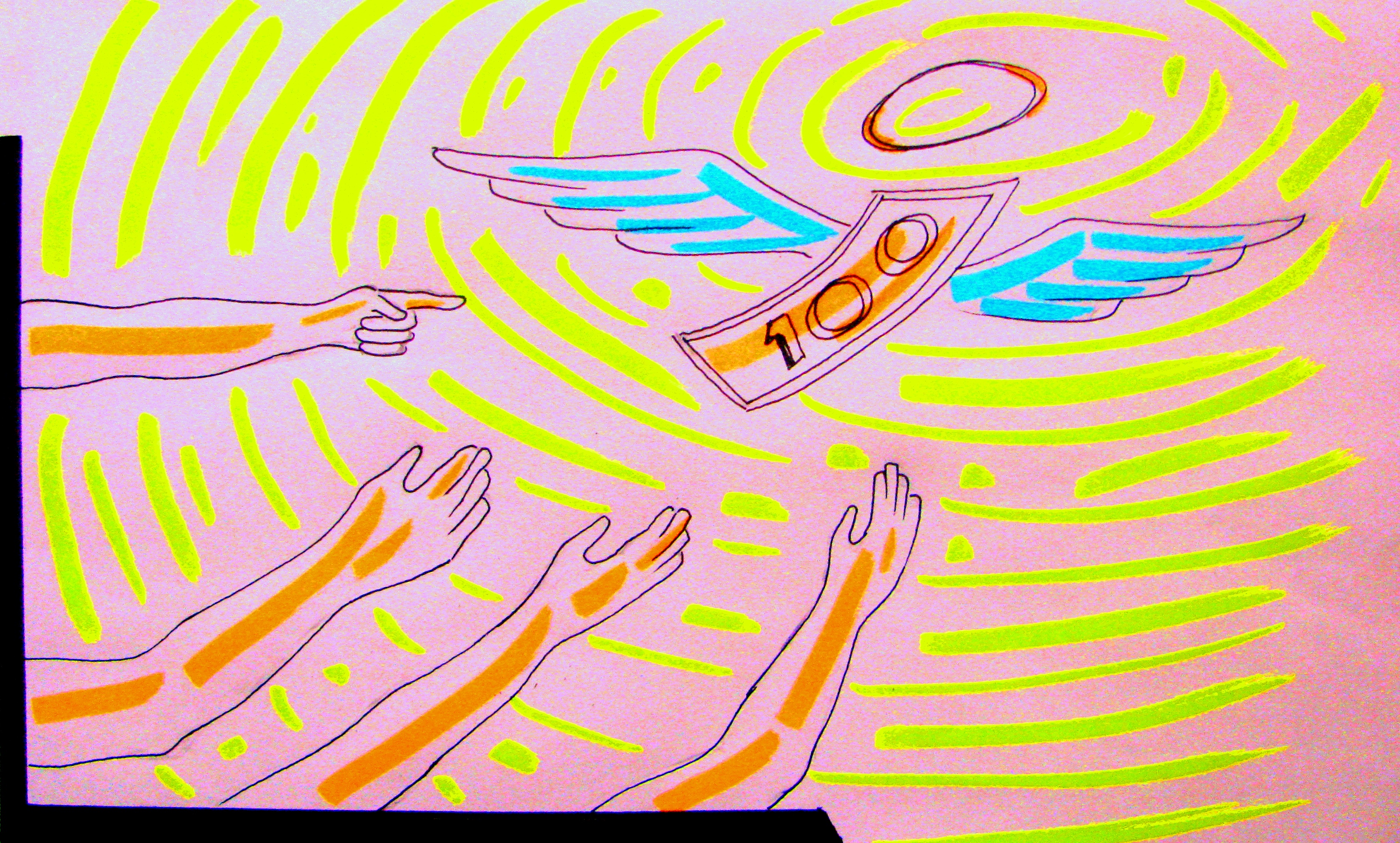
The hairdresser seemed disappointed at prospect of art, declined. But he was an efficient craftsman. The job was accomplished in a jiffy. It cost Rs 70. I reached for my purse to pay, not quite happy to lose another hundred rupee note. Smaller denomination notes had come to resemble precious stones slowly brought to the surface by the earth’s crust building activity. They were in short supply and the Reserve Bank of India’s pace of note printing harked of crust building; it was taking a million years for the tsunami of demonetization to settle down with new equilibrium in liquidity struck. What’s in short supply, you hate losing. I didn’t want to lose the diamonds and rubies in my purse. Who knows when they will resurface next? That’s when I noticed the new EPOS device with the hairdresser. You can swipe your debit card after a haircut. Things had changed.

Between the best known dictionary meaning for `change’ and its connotation as small denomination currency, it is the latter that dominates imagination in end-2016, given days spent wondering what to do with that museum piece of a new denomination – the 2000 rupee note. Nobody wants it and yet that is what is spewed out by the few ATMs functioning. I remember standing in a queue of amused folks at a D N Road ATM, the machine gifting everyone exactly one 2000 rupee note, a splendid invitation to financial uselessness. In a way you could say the unexpected move to demonetize the old Rs 500 and Rs 1000 notes is change in the classical sense but the fun is clearly lost in the larger drift to a cashless economy suddenly thrust upon us. November 8 was a tsunami, the ocean floor slipped beneath liquidity in the economy. What has survived as perception of such forced change is satire, cynicism. Let’s not get into demonetization politics for this article isn’t about my financial troubles. It is about strands of old memory that surfaced in brain navigating the long bank queues and cashless ATMs of Mumbai following demonetization.

What a change! Damn change! Is this change? For whom are we changing? Change is the only constant.  – There were many thoughts running through my head. It was the first working day for banks after demonetization. The queue I was in, snaked out from the bank to bright sunshine outside. In these days of humans defined by life indoors and worries over complexion, the queue tracked every nook and cranny of available shade, making it seem, a rather lethargic anaconda, one idling to digest after a mammoth meal. What had it swallowed? The new government – I thought; tough food to swallow and much ache in the tummy afterwards. Whatever, it was change from previous diet and standing in queue had been dressed up by demonetization propaganda as nation building, patriotism, fight against corruption and black money, so on and so forth. I suspect the real reasons lay elsewhere. But at my level as ordinary citizen, my suspicions are merely private conspiracy theories and knowing that well in land overwhelmed by 1.3 billion people, I choose instead to bury my head in ruminations about `change.’ It puzzles me how a word that denotes something as remarkable as day changing to night and shifts of such scale as change of season, got entangled with money and its transformation to smaller denominations. `Change’ loses something of its natural magnificence through association with dull money. God or whatever that point before everything, said: let there be change and a whole universe birthed itself from nothing. Compare that to change by demonetization or life reduced to hunting for small change. It is distraction ruining appetite for universe.

Somewhere between banks, the hair cutting salon and the next ATM without cash or one gifting 2000 rupee notes, thoughts about `change’ made me recall an old hair cutting salon in distant Thiruvananthapuram. The Internet now tells me that Brut, tucked away in Mascot Hotel, opened in the late 1970s; 1979 according to one write-up. It was already up and running by the time we got to know of it. What I remember is this: the first person from my family to patronize Brut was my father’s first cousin. Unnichettan’s neat hair cut was my inspiration. I was in high school when I followed in his footsteps to Brut. The place was expensive but the folks there did an excellent job. Of particular interest to me was that the salon played music. They had a Philips turntable with built-in amplifier, a pair of speakers and a young hairdresser with streaks of dyed hair – those days that spelt `different’ in capital letters – who kept a collection of LP records. He played music while crafting hair. At most other shops an older lot of hairdressers clipped hair to the drone of daily news or film music that at least, some of the young had long lost interest in.

It was the disco era. Trendy youngsters grew their hair tad long; it was combed tight above the ears and the more courageous, sported streaks of dye on either side of the head. I was pretty tame in that department but I suspect, rather adventurous in other tastes – including music. At one sitting in the salon, I fell in love with the disco music being played. I remember asking the hairdresser for the LP cover. It was the album The Glow of Love by the Italian-American post-disco group called Change. The songs I had fallen in love with were A Lover’s Holiday and Searching, featuring the late Luther Vandross. To my luck, the album’s cassette version was available at Quilon Radio Service, which in those days had a counter selling music.

Times have changed since.

I lost my hair; disco disappeared.

But those two songs by Change always make me happy.

Now if only all change was so.

(The author, Shyam G Menon, is a freelance journalist based in Mumbai.)

ROOTS, REVISITED

Illustration: Shyam G Menon

Illustration: Shyam G Menon

This article presents a view; it is not the only perspective possible.

It was a hot summer afternoon and I had just ordered a dosa for lunch at Thiruvananthapuram’s Arul Jyothi restaurant. Three people – a woman and two men – still engrossed in discussion, got up to leave at the next table, their exit a matter of slow progression punctuated by each twist in the conversation. The subject was a fireworks explosion that happened at a temple 50kms away, less than 36 hours earlier. Over 110 people died, several hundred were admitted to various hospitals with injuries.

To recap – the temple management was denied permission to conduct a competitive fireworks display. While district authorities said it was blanket denial of permission, according to versions in the media, the attribute ` competitive,’ was interpreted as key to permission denied. The management went ahead with the display as a non-competitive affair. Discreetly however, it had all the ingredients of competition and investigations after the tragedy exposed the use of banned chemicals and more stocks of explosives in the neighbourhood. The whole affair was an exercise in illegality. Watching the packed explosives on TV, I couldn’t associate any of that with civilian festivals. Their size and dimension reminded of medieval war. In the immediate aftermath of the April 10 accident, a judge moved the High Court seeking an end to such firework displays. None of the politicians shown on TV could bring themselves to ban fireworks. With elections imminent, the Chief Minister said: we have called for an all party meeting on the matter. The Paravur incident was merely the worst in a list of fireworks related accidents in the state. Fireworks and elephants are deemed essential for festivals in Kerala. A narrow, long state between hills and sea, Kerala has one of the highest population densities in India.

At the same time that a bunch of people died for nothing in Paravur, a train carrying water was heading to Marathwada in Maharashtra, where successive droughts had left people thirsty and cast their lives in difficulty. There is no such debilitating water shortage in Kerala. For sure, the state’s summers are getting hotter. This April, Thiruvananthapuram was unbearably hot and humid. But there was nothing in Kerala similar to what I read before I left Mumbai: a Maharashtra with only 25 per cent water; Marathwada with just five per cent. Every time I am in Kerala, I travel by road to get an idea of what’s going on. The dominant motifs shaping my impression remained the same this year too – premium on well settled life, hoardings of brides clad in jewellery and couples getting married, hundreds of advertisements for businesses dealing in gold, apparel, building materials (to construct houses), mushrooming supermarkets and malls and rising garbage. It is a picture of life drawn overwhelmingly from well settled, consumerist existence. It is physically defined and possessions-based. After days of seeing big houses and hearing stories of success, I withdraw to my shell. My Kerala visits typically end so. Yet I keep going back, for the place shaped parts of my perspective.

Some years ago, I got a call from a man in the foothills of the Himalaya, whose daughter was getting married to a “ Kutty from Kerala.’’ Concerned about the groom’s caste, he called me up. I said Kutty betrayed nothing relevant to what he wished to know; it is used affectionately and does not signify religion or caste. “ How can that be?’’ he shot back agitated. “ Well in the time I spent in Kerala, I have known Govindan Kutty, George Kutty and Ahmad Kutty,’’ I said. It left him totally confused. Indeed a Malayali approach perplexing others in India is the idea of the human being as just that without immediate focus on religion and caste as co-ordinates. This appetite for what you are as opposed to who you are, has I suspect, much to do with Socialist influence in Kerala. The discomfort others have with it has much to do with how little Socialism caught on elsewhere and how rapidly the idea of equitable life is shrinking today.

I grew up in Kerala, in times dominated by Communism. They guarded their politics with the same zeal as the Right worships its gods and rituals. Back then, it was red flags and posters of Karl Marx, Lenin and Che Guevara. Like the muscular gods of today’s Right, art in service of Socialism was all about a muscular working class. Both are not art; it is propaganda. My father ran a small business. That was enough for us to be branded `bourgeois.’ Yet I have always felt that a touch of Socialism, which seeks equality, is essential to sensitize the Indian mind growing up on a diet of unquestioned prejudices and inherited privileges. In 1957, Kerala was home to the first democratically elected Communist government in the world. By 1982, Kerala settled into a pattern of two opposing political coalitions as choice for government. When people tired of red, they voted for the Congress. They were the moneyed lot, close to plantation and business lobbies, with a penchant for fishing in communal waters. Besides its erstwhile business bashing-doctrines, the Left in Kerala was stridently vernacular in flavour. Sometimes I think the Left in Kerala was Left in name but actually ethnic. In politics, that pays dividends. Now in addition to Communist paraphernalia in Kerala, you have posters of Hindu gods, mahotsavam, mahayajnam and saffron flags, not to mention the state’s share of the same in Islam’s green and Christianity’s business of a church. Each of these religions, account for approximately a third of the state’s population. They are mutually competitive. Each community takes pride in its political clout, share of millionaires, famous personalities, real estate, wealth etc. Much effort goes into keeping these communities as clearly etched silos.

Privately, Malayalis knew that beneath the veneer of being progressive, a regressive Kerala existed. In as much as the Left and Right were similar in cadre-based structure and behaviour, their disagreement over religion made them foes. People elsewhere in India associate Kerala with matrilineal succession. They find it hard to believe patriarchy exists in the state. Patriarchy is a gender based-tendency, a zone of comfort. At the height of Communist rule, the neighbourhood party heads and functionaries kept an eye on life around; not at all different from what Right wing forces currently do. Just as today’s Right wing enforces a culture from centuries ago, those days, the Left worried over any thought process potentially questioning the Communist world. Making a fortress of one’s imagination and having an opinion on how others should be, has fancied anyone with enough drift to dominate. Having seen these tendencies in the Right and the Left, I view it as anthropology in action; you once read Desmond Morris, now you see it as documentary film. While cadre based-power was the language of the Left and the Right, the Congress let money speak. Whatever the route adopted, in the end everything was about fiefdom. Some of the huge marches in the state were called shakti prakadanam or display of strength.  Over time, from weddings to festivals and political campaigns, nothing was deemed worthwhile without a display of one’s clout.

Illustration: Shyam G Menon

Illustration: Shyam G Menon

A giant remittance economy, Kerala currently has a lot of young people of school and college going age and a large number of ageing citizens. In the flux, thoughts and things resembling anchors – that proverbial “ settled’’ – are valued. On the threshold of refining tradition and proposing new thoughts, society repeatedly relapses to the old. In November 2015, courtesy a non resident Malayali businessman, Kollam (in which district, Paravur is) was host to one of the costliest weddings staged in India. News reports estimated the expense at Rs 55 crore (Rs 550 million or roughly $ 8.2 million). Indians living overseas see India as heritage. They also see it as proving ground; a venue to showcase their success. In one, a living country seeking evolution reduces to heritage museum offering identity to overseas sponsor. In the other, a regime of the moneyed displacing those not so, is encouraged. If the Japanese adapted their designing ability to a Tokyo increasingly short of space, the approach visible in Kerala is money laden offensive to secure scarce space for big houses, big cars; the mega life. Already stressed land, gets stressed further. Still, few would have it differently. If you extend this line of reasoning, it is not difficult to see how impressive having an elephant on a leash or staging massive explosions as fireworks is. Associating this with grandeur, it doesn’t mind irritated elephants running amok or losing over 110 lives to loud explosions while elsewhere in India, trains bring drinking water and school children in Mumbai raise funds to help a parched Marathwada. According to news reports, in the run up to the temple incident, residents nearby had sought relief from loud fireworks as the explosions were damaging their houses. You have to reflect well on the Paravur tragedy, go past surface politics, to notice the mind-set. Two days after the incident, it was the turn of the organizers of the Thrissur Pooram festival, famous for its fireworks and caparisoned elephants, to argue for tradition on TV. The silver lining I saw was that three ordinary people chose to discuss the Paravur tragedy over lunch at Arul Jyothi. All three said festivals have reduced to commerce and competition fueled by money. The swiftness with which the tragedy became the stuff of serious discussion brought hope.

I often wonder what cultural heritage is in the modern context. Like a computer’s hard disc, our brain is not an infinite storage space. Born in one place we live to discover a universe. Given that, I suspect cultural heritage must become an underlying elegance and things elegant, are typically simple, occupying little memory space. Heritage in simple terms does exist in Kerala. Vishu, the popular Malayali festival fell four days after the Paravur tragedy. Vishu is associated with the flowers of the golden shower tree. My small family was together for Vishu after a long time. While the offerings – an arrangement traditionally called Vishu Kani – were being readied the previous night, my mother recalled what the poet Vyloppilli Sreedhara Menon wrote in Malayalam years ago (my translation in English is given below each line):

Ethu dhoosara sankalpangalil valarnalum

No matter what murky circumstances you grow up in

Ethu yantravalkrita lokattu pularnalum

No matter what mechanized world dawns

Manassilundavatte gramattin visudhiyum

Let there be in you the purity of the village

Manavum, mamatayum, ithiri konnappoovum

Fragrance, love and some flowers of the golden shower tree

I liked that. If I may add my bit – such elegance and simplicity is what visits the mind after a long run, a hike, a mountain climb, a swim, a canvas painted, a piece of music composed or a round of meditation.

(The author, Shyam G Menon, is a freelance journalist based in Mumbai.)
THE FIRST KNOT

Illustration: Shyam G Menon

Illustration: Shyam G Menon

I don’t remember my first pair of shoes.

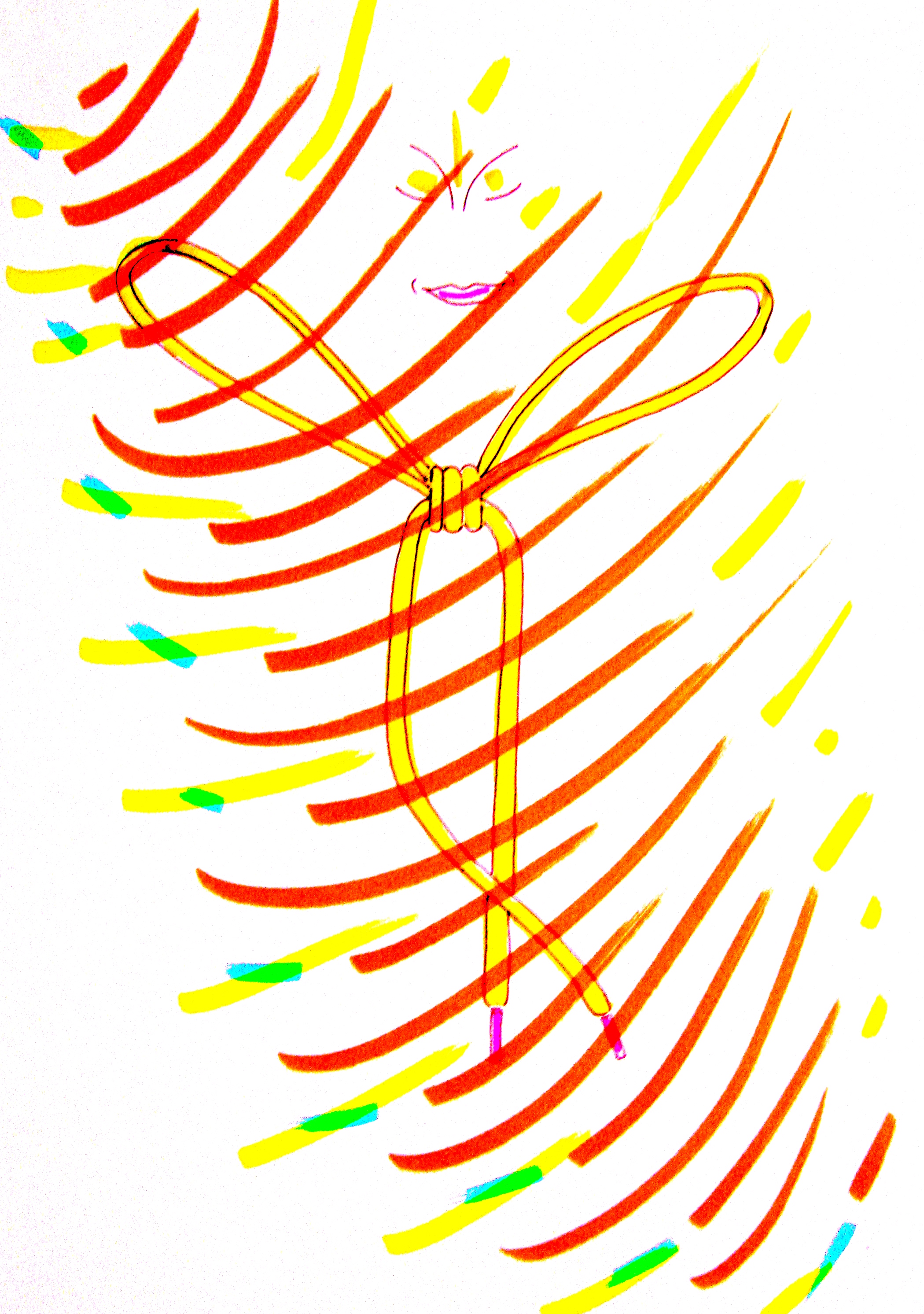
I do remember that it took me a while to master tying shoe laces.

It is a long learning curve to perfect knot.

At first, you overlook dissimilar lengths of lace on the right and left sides and end up with an imbalanced knot. Then you overlook applying the right tug at each twist and end up with a poorly constructed wobbly knot begging to come undone. After much trial and error, you get it right – a balanced, adequately tight knot keeping everything in place. Once that stage is achieved, you learn finer aspects like how to adjust the knot without undoing the whole thing.

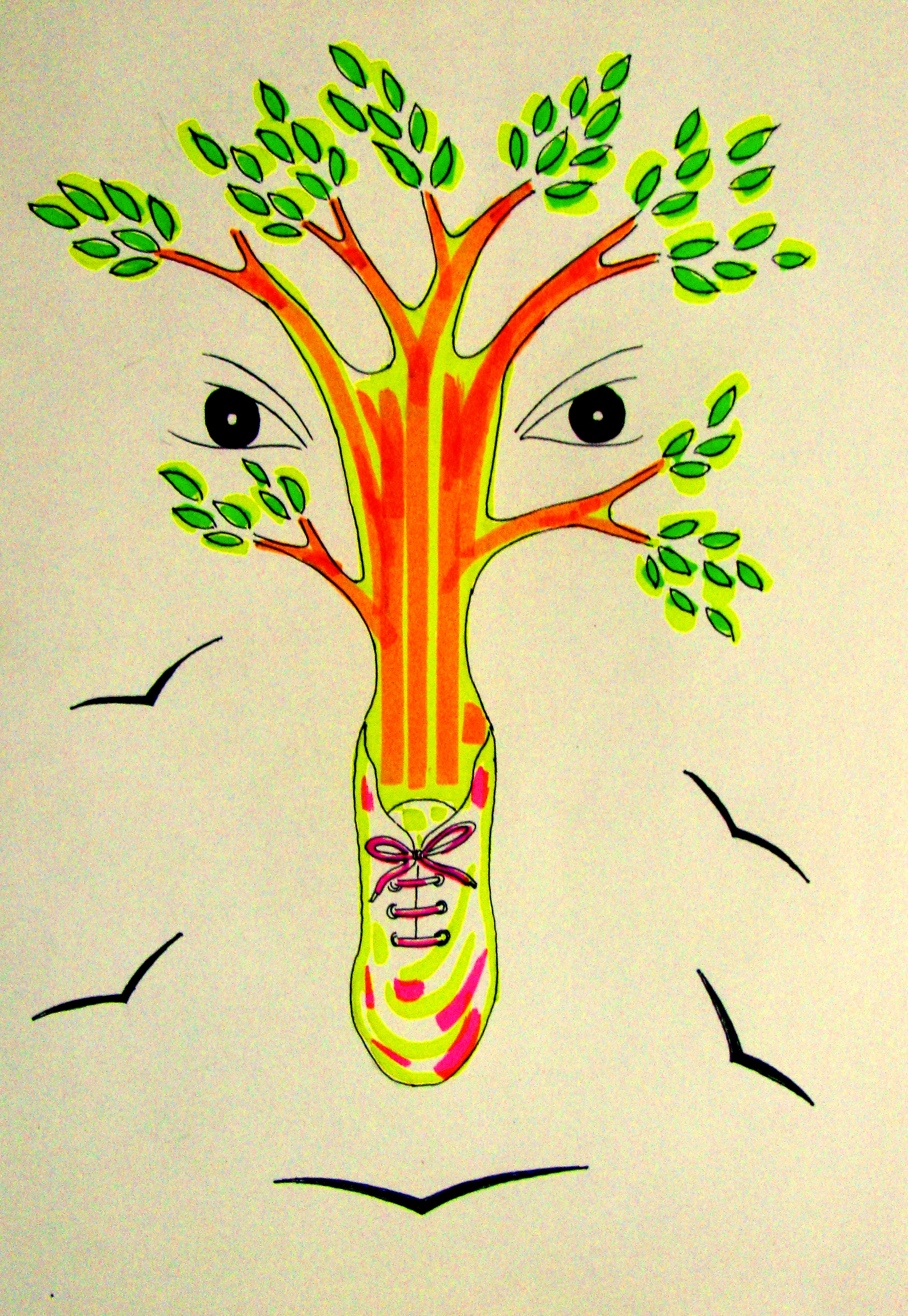
Most of us begin our tryst with shoes laces around the same time we commence our tryst with school. Years later, wearing the black shoes of office, the pattern of relationship is similar. The shoes arrive well made and polished from the store. For some time, every speck of dust on its polished sheen is unbearable. You frequently inspect the shoes, wipe it clean. Then you realize that loss of sheen is inevitable. To be around is to weather. Enter that phase when instead of constant eagle eye on shoe, once every few days you dust, clean and polish it. Then as the activities causing wear and tear became more important than shiny shoe, black shoe acquires creases. Sometimes, the shoe sports a patch of dull leather where the outer layer has flaked off with intense use. Polished, it is shiny black where leather is still intact; in other places, a sort of matt finish-black intervenes. Through all this wear and tear right up to eventual retirement of shoe, one thing consistently improved at school – your ability to tie shoe laces. You tied them well, you tied them fast. Till it got burnt into your brain like a permanent tattoo. The art of tying a shoe lace is widespread skill acquired early in life that it is rarely called `skill.’ It has dissolved to being part of one’s being. We don’t analyse the art of tying a shoe lace to notice the framework of learning it brought. On the other hand, even after mastering it, we always questioned the knot seeking ways to escape it.

Sometime in high school, I recall buying my first pair of black slip-on shoes. It was an attempted premature graduation to adulthood for many adults sported slip-on shoes. But life at school was way too active for slip-ons to stay securely on the feet. How do you run with shoes that tend to fly off? I returned to shoe laces. The only time I reverted thereafter to shoes without laces was in rock climbing. My personal impression is that the world of rock climbing is neither for nor against laces, it has its moments of respecting laces and moments when it values alternatives. My first pair of climbing shoes was a lace-up. It took time to lace up and be ready for a climb. My second pair was also a lace-up but it was so for a particular reason – precision. Climbing demands attention to choice of shoe. There is a lot of foot-technique involved and accordingly shoes are designed to deliver. Many climbing shoes are designed to focus the foot’s strength on the big toe; some others are designed for sensitivity, yet others are shaped to generate friction for smearing. Some are specialists for certain types of climbs; others are all rounders. There are also a few other expectations that arise with continued climbing – when you are in the thick of climbing and having fun with your friends at a climbing wall or boulder, you don’t want to waste time tying shoe laces. Sometimes, you are so focussed on a boulder problem that you don’t want your shoes interfering with the climb. You just want to go. Enter Velcro. However from what I know, Velcro isn’t as precise in harnessing foot strength as a lace-up. Velcro is convenient. My third pair of climbing shoes used Velcro straps; I had much fun in them.

Velcro is photography in auto focus to lace-up’s art. You know this because you tied laces long enough – right from school – to know what art is. That’s when you reflect upon the first knot learnt long ago; the movement it taught your fingers, the hand-eye co-ordination you acquired and the imagination the act of tracing the knot lent your mind. True, climbers tell you: don’t take your climbing knot as casually as you would your shoe lace-knot; and rightly so, for the consequences are serious in climbing. What we forget is that we bring to bear on the climbing knot an understanding of knot and ability to make it, honed on the humbler, less sexy shoe lace. Marry that comprehension and imagination to a purpose with far more serious consequences – you get the mindset for learning a climbing knot. In small acts performed, lay the seed for bigger ones. My repertoire of climbing knots is limited because my flair for them isn’t much. That’s my adult mind. As a late entrant to climbing, when I struggled with climbing knots, wondering what I should do to remember how each is made, I did think about my tryst with the shoe lace. Unfortunately the child in me is a whole middle age away in the past to revisit and ask: how did you do it?

Illustration: Shyam G Menon

Illustration: Shyam G Menon

The other day in a Mumbai suburban train, a college student treated me to an ultra fast completion of the Rubik’s Cube puzzle. His fingers flew. I noticed that even the way he held the cube was different – it was worked back from the requirement to flick and flip the squares fast. Solving a puzzle is not just an individual’s flair at specific art; it is one of nature’s evolutionary masterpieces showcased – our being as this evolved machinery capable of solving problems. I wonder what all that young man must have been doing in a physiological and psychological sense when he solved the puzzle of the Rubik’s Cube. If you slow down the process to notice – there is motor activity, motor activity co-ordination, imagination, imagination of things as they were, as they are and how they will be, not to mention, all this happening at once. Muscles twitching, neurons firing, eyes darting, mind focusing – it is thoroughly engaging. I got my first Rubik’s Cube in high school. Those days it wasn’t available in India; it was typically brought from overseas. In my case, a family friend visiting from the US gifted it. Now, decades later, Rubik’s Cube is easily available in India. Its days of popularity are over. It is the committed, who stay with it. That college student in the train was working specifically on how to solve the problem super fast. He was timing his effort, trying to match a certain timing he had read about. Even his cube had evolved; unlike the cube I had, his was designed to flip around fast.

Examples ranging from climbing to Rubik’s Cube, make me wonder: what would have been our first puzzle; the first challenge requiring us to focus, marshal our intelligence, focus our faculties to pay attention to a given task and co-ordinate the effort to produce a result? Some of us may say – sitting, walking etc. I submit these are underlying expectations from life, things we do without exercising deliberate choice; probably why those tasks are attempted by children like genetic programming unleashed. I think tying a shoe lace is definitely one of the earliest puzzles we consciously wrestled with; it is almost in the same league as a Rubik’s Cube, something not essential for existence but quite fascinating if you meditate on what it leaves behind as imprint. The puzzles we choose and the ones we grow to like, betray our preferred style of thinking. Solving a puzzle can also tell us much about our level of mental alertness. At high altitude the humble shoe lace-knot has often been an index of alertness and well being for me. When your fingers find it a chore being dexterous enough for the task, you know the cold is getting to you. When your mind finds it a chore, then you know that both cold and exhaustion have got to you. Sometimes the need to pause and focus on tying a shoe lace slows down world flying by. It helps you gather your thoughts, gives you time to breathe. When you do that, you sense yourself. You know you are alive. Breath is life.

Mid-March 2016, I was at the office of a media company thriving on product reviews, when somebody excitedly mentioned about a leading shoe manufacturer’s just concluded press briefing.  That night, browsing the Internet, I discovered the reason for the press conference – the company had launched a new shoe model, one that automatically tightened its shoe laces. The video showed a foot slipping into a shoe with ankle guard; the laces automatically tightened to snug-fit. There were no fingers weaving lace into a knot, actually there was no knot, only a few parallel lines of perfectly aligned, well tightened shoe lace. It was the end of an old puzzle. It wasn’t puzzle solved and therefore puzzle ended as was the case when we learnt to tie those laces and burnt the art into muscle memory. It was puzzle eradicated. An opportunity to learn lost? – I don’t know. I am no psychologist or researcher of human behaviour to hold forth on that angle. But I do wonder: what will be the nature of human being growing out from those `high tech’ shoes with no lace to knot. What will a society of such people be like. Hopefully, as with climbing’s lace-up and Velcro, it isn’t a question of one replacing the other but both, coexisting.

(The author, Shyam G Menon, is a freelance journalist based in Mumbai.)