THE CAPTAIN, THE TEACHER, THE WARRIOR AND THE BUSINESSMAN

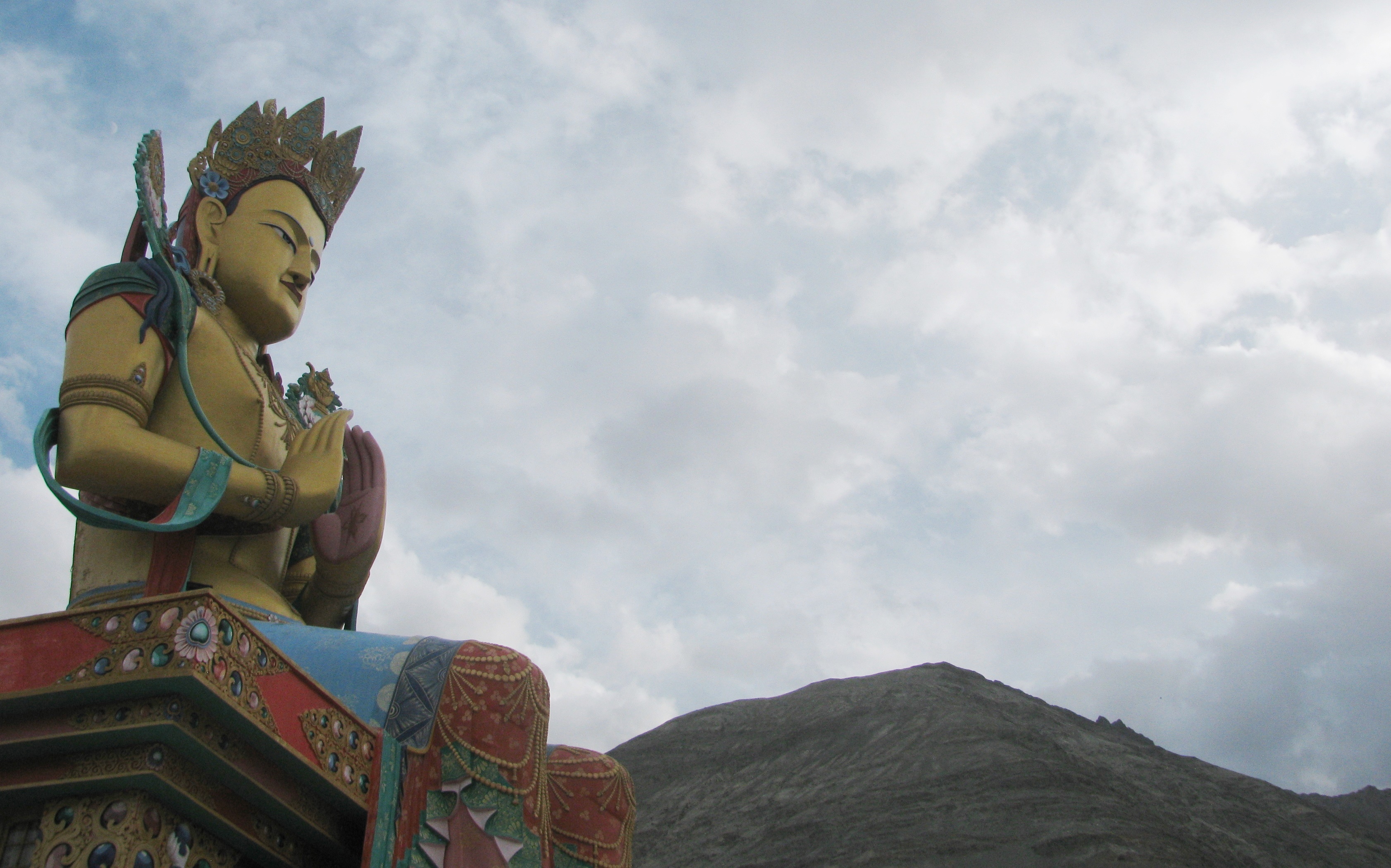
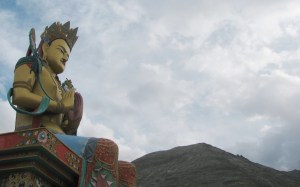
Diskit's Maitreya Buddha statue (Photo: Shyam G Menon)

Diskit’s Maitreya Buddha statue (Photo: Shyam G Menon)

An article in long form, on the 2016 edition of La Ultra-The High

August 10, 2016.

My hotel room has a fan and I can’t believe it.

The temperature didn’t warrant using it. Equally, if I turned it on I wouldn’t be very cold. The fan harked of early entrant whose time will come. As in the Bob Dylan song: the times, they are a changing. The food served at Hotel Siachen, amazed for the variety of vegetables in it. The hotel was in Diskit, Nubra Valley, Ladakh. “ The vegetables used were grown here,’’ the employee standing behind the buffet table informed. He said that weather patterns had been changing slowly in Ladakh. Winters aren’t as severely cold as before and in land famous for being high altitude cold desert, rain was getting through. That has its problems. The powdery soil of Ladakh’s mountains dislodges quickly with water. Rain makes people nervous. On the other hand, the rising warmth and occasional wetness has meant improved scope for home-grown vegetables on Siachen’s table.

Next day, around noon, a very light rain manifested briefly. The forecast, as available from a couple of days ago, wasn’t good. August 11 evening; there is a mass of dark grey gathering in the skies behind Diskit. A cold wind blew. The massive Maitreya Buddha statue on a hill near the Diskit monastery faced the approaching grey in peaceful meditation. It rained. Dr Rajat Chauhan looked past the statue to the clearer skies it guarded. Hope is a good word. It was still raining when the convoy of cars left Diskit. Ladakh’s roads are a study of curves and straight lines; curves on mountainsides, straight lines on vast, open flat land. The starting line was on a straight road below Diskit, close to the flood plains of the Shyok River. The vehicles bearing runners parked here, one behind the other. A small hamlet of headlamps took shape. The countdown had begun.
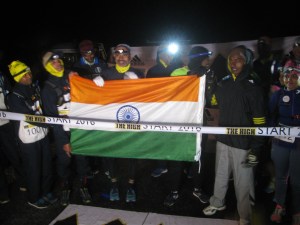
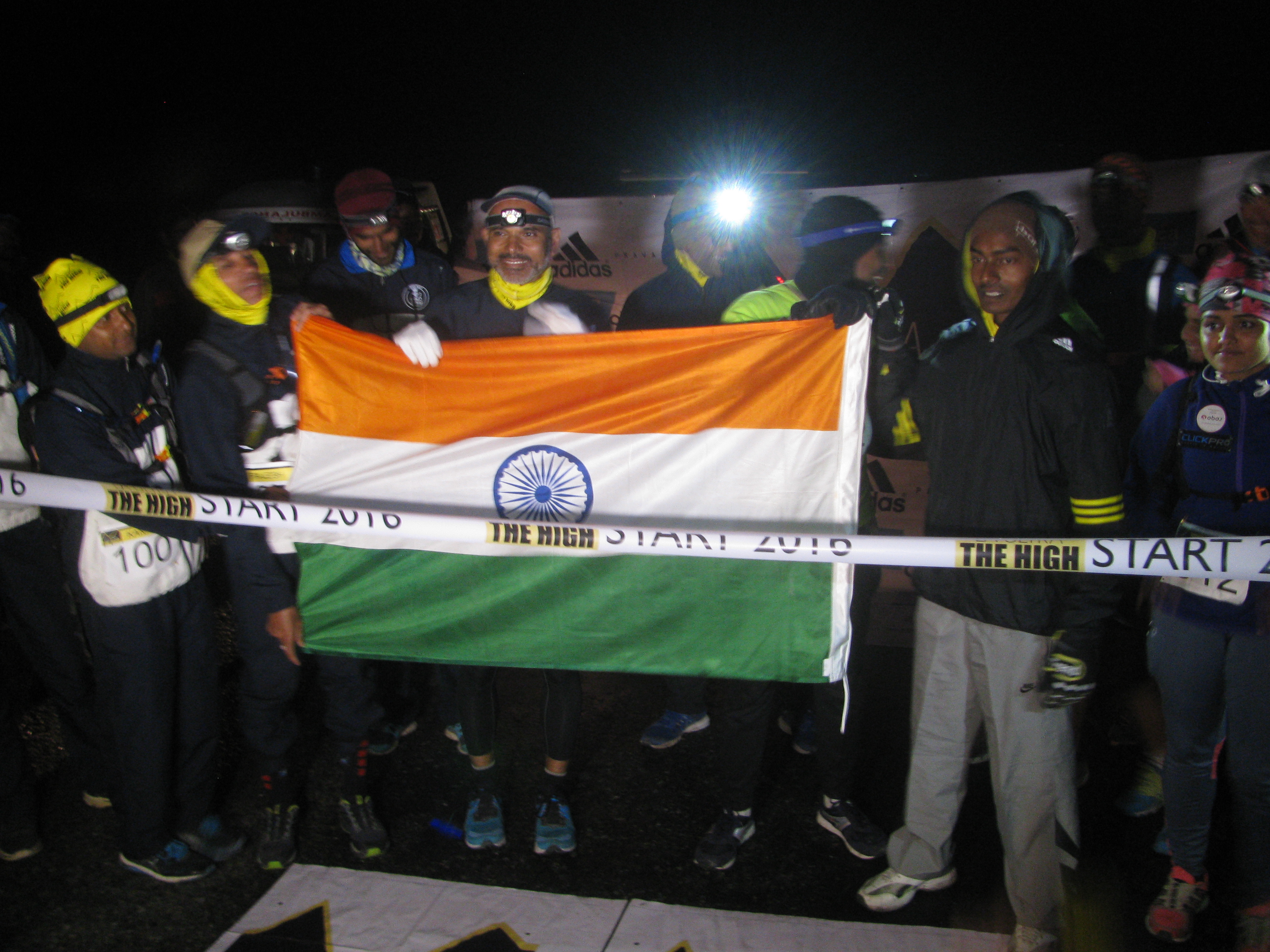
August 11, close to 8 PM, start line of the race. In the foreground are some of the 111km-runners including members of the Indian Navy team (Photo: Shyam G Menon)

August 11, close to 8 PM, start line of the race. In the foreground are some of the 111km-runners including members of the Indian Navy team (Photo: Shyam G Menon)

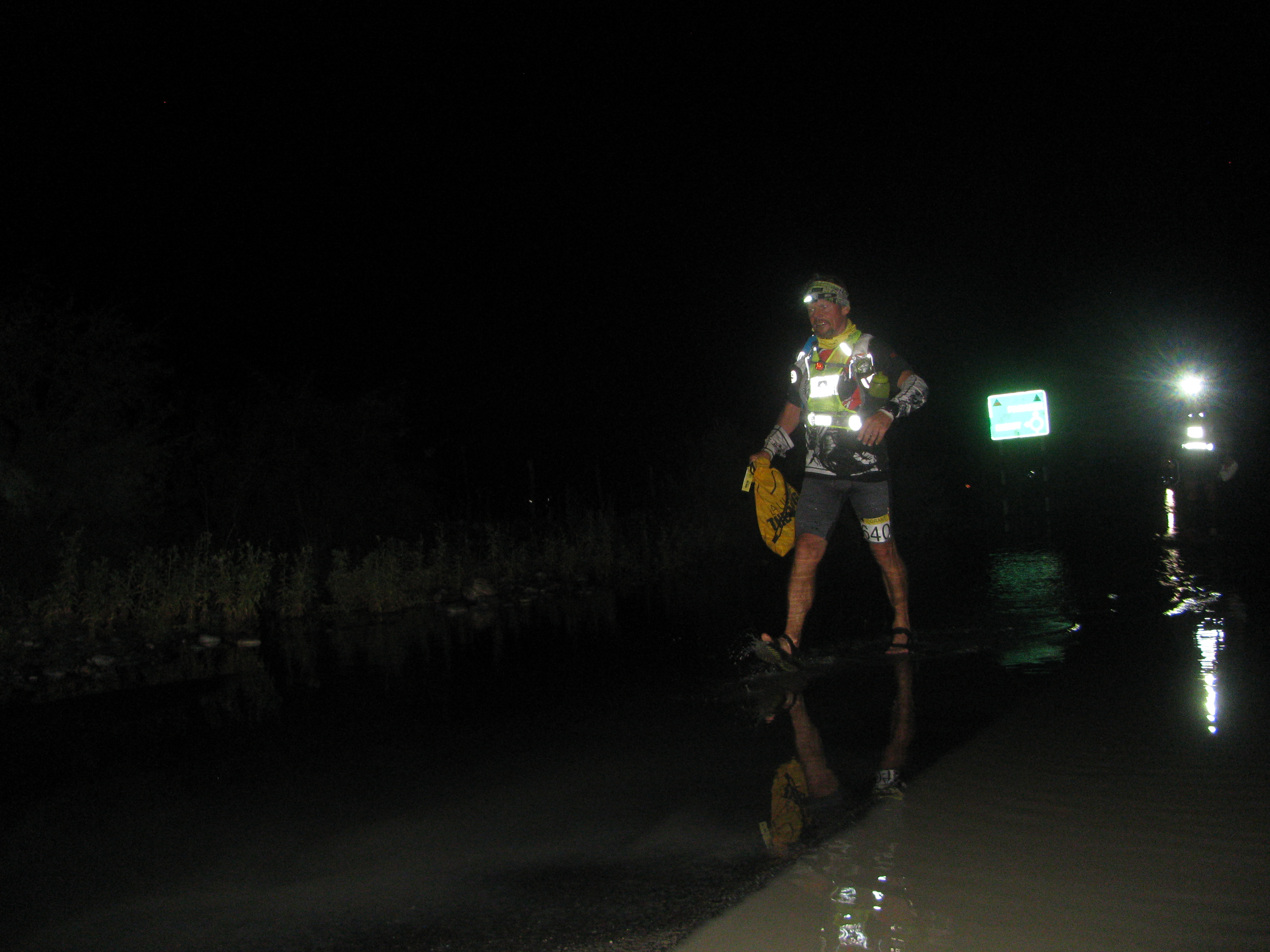
In 1992, director Ridley Scott made a movie: 1492: Conquest of Paradise. Garnering mixed reviews, the movie wasn’t commercially successful. Its theme music ` Conquest of Paradise,’ by the Greek composer Vangelis, however became popular, including as the preferred music at the start of the Ultra Trail du Mont-Blanc (UTMB) in Europe. A powerful, evocative musical composition, it played on the mobile phone of Dalibor, part of Jovica Spajic’s support team. Rain and cold notwithstanding, Jovica looked ready for action. By now the other runners too had got out from their vehicles – Grant Maughan, Mark Steven Woolley, Alexander Holzinger-Elias, Dariusz Strychalski, Nahila Hernandes, Dunya Elias, the team from the Indian Navy, Saachi Soni, Rahul Shukla, Ramanand Chaurasia and Kieren D’Souza. August 11, 8 PM, they set off. Minutes into the 2016 edition of La Ultra-The High, they tackled the first problem: a portion of the road submerged in ice cold water, thanks to an overflowing stream. That done, one by one, they drifted into the inky blackness of Nubra’s night, a series of headlamps making steady progress on the road. Kieren led the group. There was a ring of expectation around Kieren. He was a young Indian ultramarathon runner born in Nagpur, brought up there and in Bengaluru, now living in Faridabad. His well-wishers presented him as someone who had grasped the nuances of the sport. In 2014, he had participated in the 111 km race of La Ultra and failed to complete it; according to the official website of the event, his race ended at kilometer-48, a Did Not Finish (DNF). Two years later, he had elected to return with considerable training at altitude done. Besides races in India, he had been to UTMB. That night on the road leading to Khardung La, Kieren showed no lack of confidence. He ate up the miles, opened up a long lead and chugged steadily on to Khardung La.

La Ultra-The High is an ultramarathon composed of three separate races on the same course – 111 km, 222 km and 333 km. As the distance increases, so do difficulties. The average elevation of Ladakh is around 10,000 ft. The race is held on the road. Its highest elevations are mountain passes with roads through them. In the 111 km segment, you get Khardung La (17,582 ft), in the 222 km segment, you get Khardung La and Wari La (17,200 ft), in the 333 km segment you get both the earlier mentioned passes and Tanglang La (17,480 ft). Running this course, a runner will experience temperatures varying from 40 degrees centigrade to minus 10 degrees centigrade. Depending on altitude, atmospheric pressure will reduce to 50 per cent of what it is at sea level. This affects oxygen intake. Add to it progressive fatigue and susceptibility to adversities brought on by the elements – that’s what makes La Ultra particularly challenging. It currently ranks among the toughest ultramarathons in the world. It is also an expensive proposition given the mandatory acclimatization schedule. You have to be in Leh, days in advance. That makes it, a commitment.
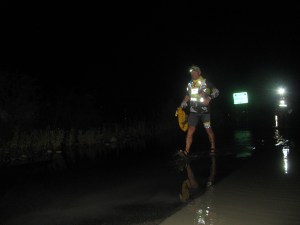
Night of August 11; Grant Maughan crossing the waterlogged stretch of road (Photo: Shyam G Menon)

Night of August 11, Grant Maughan crossing the waterlogged stretch of road (Photo: Shyam G Menon)
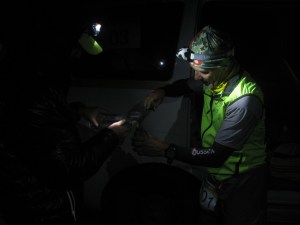
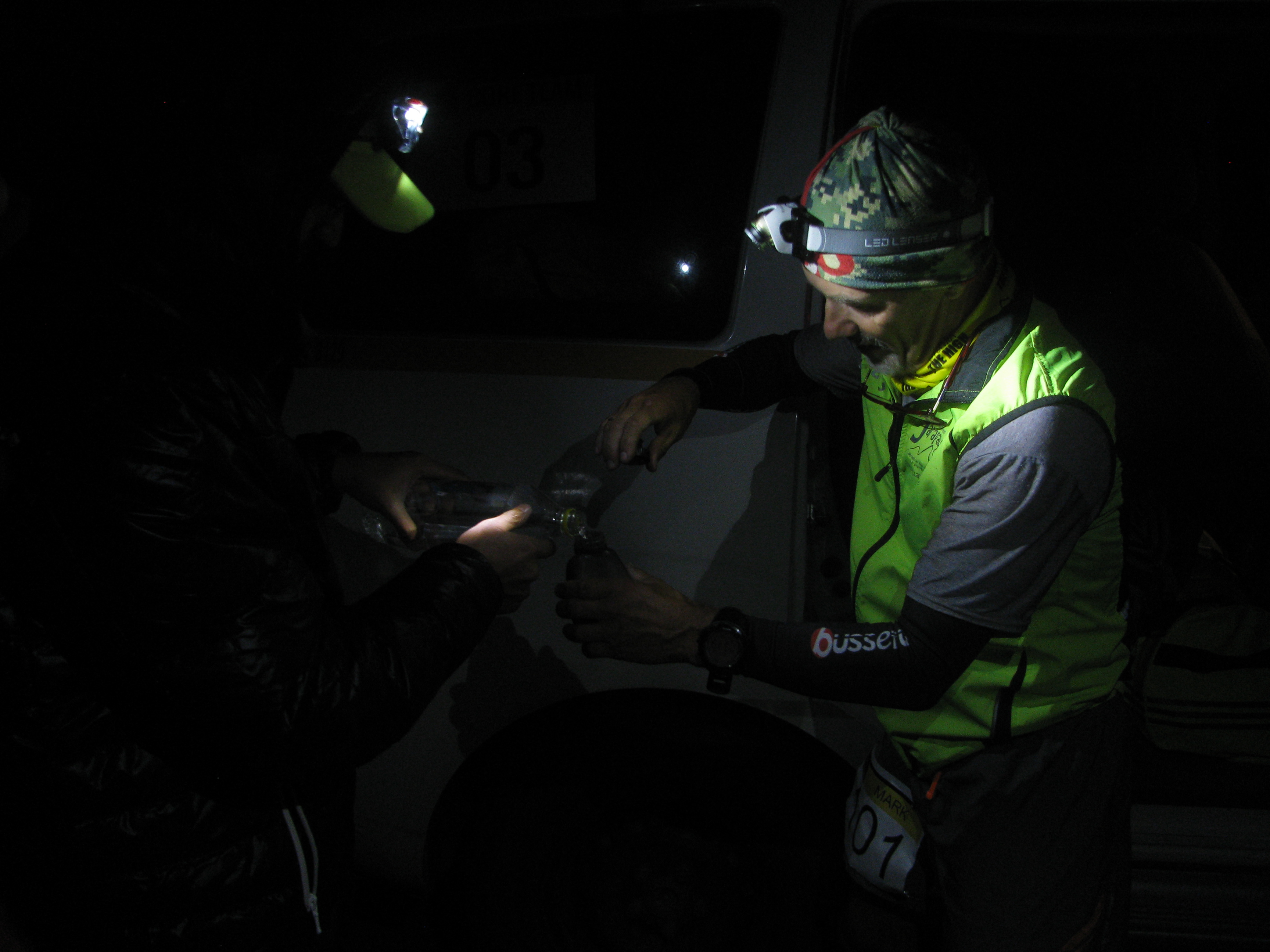
August 11th night. En route to Khardung La, Mark Woolley gets a quick refill of water from one of the support vehicles (Photo: Shyam G Menon)

Night of August 11, en route to Khardung La, Mark Woolley gets a quick refill of water from one of the support vehicles (Photo: Shyam G Menon)

As some of the foreign athletes gathered to run the 333 km segment said, the race is little heard of in the global ultra-running circuit. Discerning runners are attracted by the fact that not everyone finishes it. Appreciated in this context, was how the organizers have preserved race parametres without diluting it to attract higher number of participants. Broadly speaking, this purity is a function of distance and cut off time. The whole race of 333 km is run at one go with runners moving through the night. They have to cope with sleep deprivation, planning their rest as they wish. However within this large single stage, there are cut offs (time limits within which sub sections must be run) to respect. This introduces a sense of constant momentum. Rest is typically eyes shut for some time. The whole course is covered in a mix of running and power-walking, rarely dipping below that in pace. Seventeen runners reported for the 2016 edition, twelve of them (two foreigners, rest Indians) for the 111 km race.

Very important for a race of this sort is the medical team. The Race Director (indeed its founder) is Dr Rajat Chauhan, who is a leading specialist in sports medicine. The 2016 medical team was composed of Tim Berrow and Nick Dillon, experienced in dealing with medical emergencies in remote locations. As they explained, a difference when working with an ultramarathon wherein athletes push their limits is, gauging how far a runner can push his / her limits safely and monitoring that appropriately. You don’t terminate his / her race without providing room for stretch.
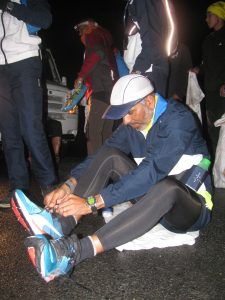
Cdr. Sunil Handa of the Indian Navy gets back into running shoes after crossing the waterlogged stretch of road (Photo: Shyam G Menon)

Cdr. Sunil Handa of the Indian Navy gets back into running shoes after crossing the waterlogged stretch of road (Photo: Shyam G Menon)

At a medical briefing for volunteers and support crew, Tim and Nick put their approach in perspective. While altitude is the most obvious challenge in La Ultra, the solution for altitude related complications like High Altitude Pulmonary Edema (HAPE) and High Altitude Cerebral Edema (HACE) – is as obvious. The best treatment for altitude issues is descent. With the race being held on the road and vehicles present for support, treatment was available at hand – get the patient down as quickly as possible. The medics were more worried about heat related complications – the consequences of losing heat or heating up. La Ultra debuted in 2010 as a 222 km race. Given its emphasis on adequate, prior ultra-running experience, it was partial to foreigners. Indians who attempted it, struggled to get past the race’s early stages. For a country getting used to the ultramarathon, 222 km at altitude with cut-off time alongside, was probably too big a first step. At the same time, some of the foreign runners who completed 222 km felt that a return to attempt the same distance wasn’t engaging. They sought greater challenge. That’s how the 111 km sub-race and the extension of overall length to 333 km happened. 2016 was special for the 111 km segment. The Indian Navy dispatched a team of six runners for the 111 km race. Their team leader Captain Rajesh Wadhwa had been podium finisher (along with Ramanand Chaurasia) at an ultramarathon in Garhwal, which serves as qualifier for La Ultra’s 111 km category. When he sought permission to participate in La Ultra, the navy, noticing the uniqueness of the race at altitude, recommended a team.
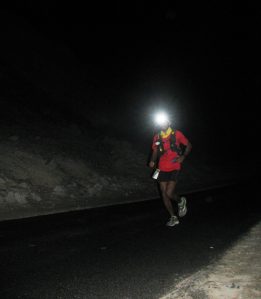
Kieren on the ascent to Khardung La (Photo: Shyam G Menon)

Kieren on the ascent to Khardung La (Photo: Shyam G Menon)

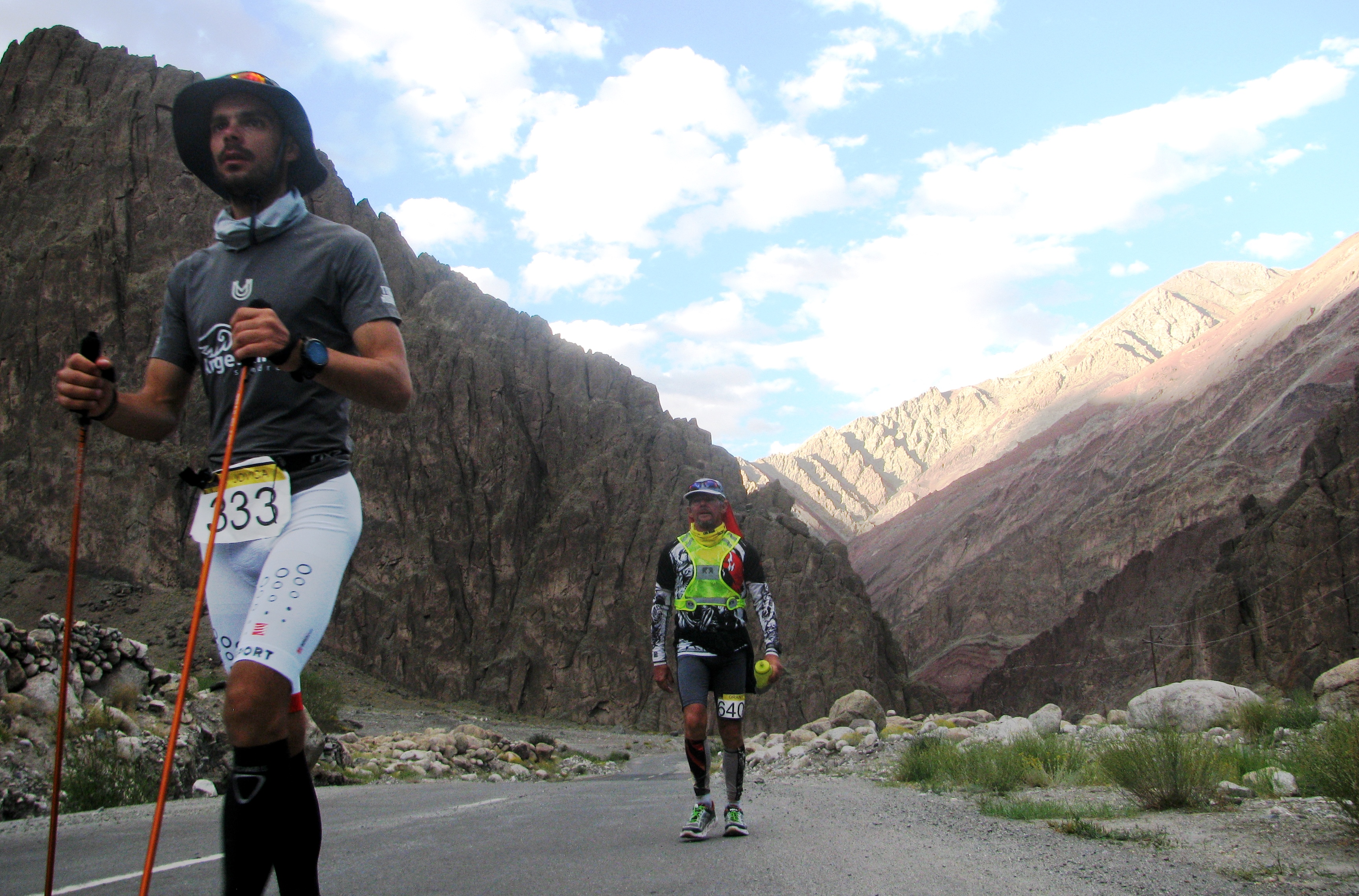
If you want to know how fast runners can be – even in the hills – all you need to do is, eliminate traffic. Night does that for you. With nothing else around moving for distraction, running’s pace shines forth. An ultramarathon is slow. But even that seems a determined, consistent lapping up of distance when ultra-runners are the only ones moving in the frame. Past midnight, the slopes of Khardung La were pitch-dark. Kieren’s headlamp would bob in the distance and then slowly, unfailingly wind up the road’s curves to where one stood. As I prepared to ask “ all okay?’’ he quipped, “ are you okay?’’ On the road, the first half of the string of runners included Kieren, the 333 km-pack, some of the navy runners, Rahul and Ramanand and Dariusz (Darek) Strychalski of Poland. Darek had enrolled for the 222km segment. He runs mainly with one side of his body; the other side having been paralysed in an accident in childhood. The mishap affected his vision too. Recovering, he lived a lonely life. Running was accidental and testing. He used to run very early in the morning to avoid being seen as his gait was awkward; one leg and side of the body does most of the work, the other supports as best as it can. Initially people looked at him like an oddity. He persisted. Slowly he regained the company of people. After two years of running, he ran his first marathon. His best timing yet in the full marathon was 3:07. He also ran the Badwater Ultramarathon. “ In Poland he is called the Polish Forrest Gump,’’ Anna, Darek’s friend said. Darek, who spoke no English, had been to La Ultra before. In 2015, attempting 222 km, he had to pull out at kilometer-35. That time he had been unable to continue his run because of a leg injury. In Leh, in the run up to the 2016 edition, he had experienced return of the old leg injury. Running steep uphill sections challenged the man who counted on one good leg to do the bulk of the work. Darek never let the strain show. His face was always calm.
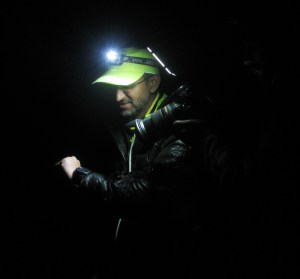
Early morning August 12; Race Director Dr Rajat Chauhan counting down to cut-off at North Pullu (Photo: Shyam G Menon)

Early morning August 12; Race Director Dr Rajat Chauhan counting down to cut-off at North Pullu (Photo: Shyam G Menon)

For the medics and the Race Director, the 111 km segment is the busiest section of the route as the number of runners is more and it includes the less experienced. At the first cut-off, a little over 20 km from the start, two runners missed the stage cut off time and had to withdraw. Punctuating the ascent and descent on Khardung La are South Pullu and North Pullu. They are check posts, both at approximately 15,500 ft. On the ascent from the Nubra side, you hit North Pullu first. The medics gave everyone a check-up here. Two more runners retired from the race at North Pullu as they failed to reach on time. Darek arrived at North Pullu before the cut off time. He was very cold and having low oxygen saturation. “ His lungs was clear, his pace had slowed down. He was okay but feeling very, very cold,’’ Nick Dillon, one half of the medic team, said. Darek was warmed up. He was the last one to leave North Pullu for Khardung La. Nick followed in his vehicle; he kept reassessing the runner’s condition. Not just Darek’s but as he put it – into a race, the back of the pack is where the ones needing help are.
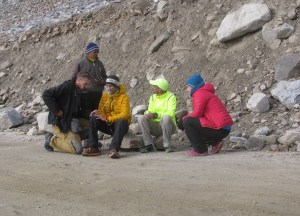
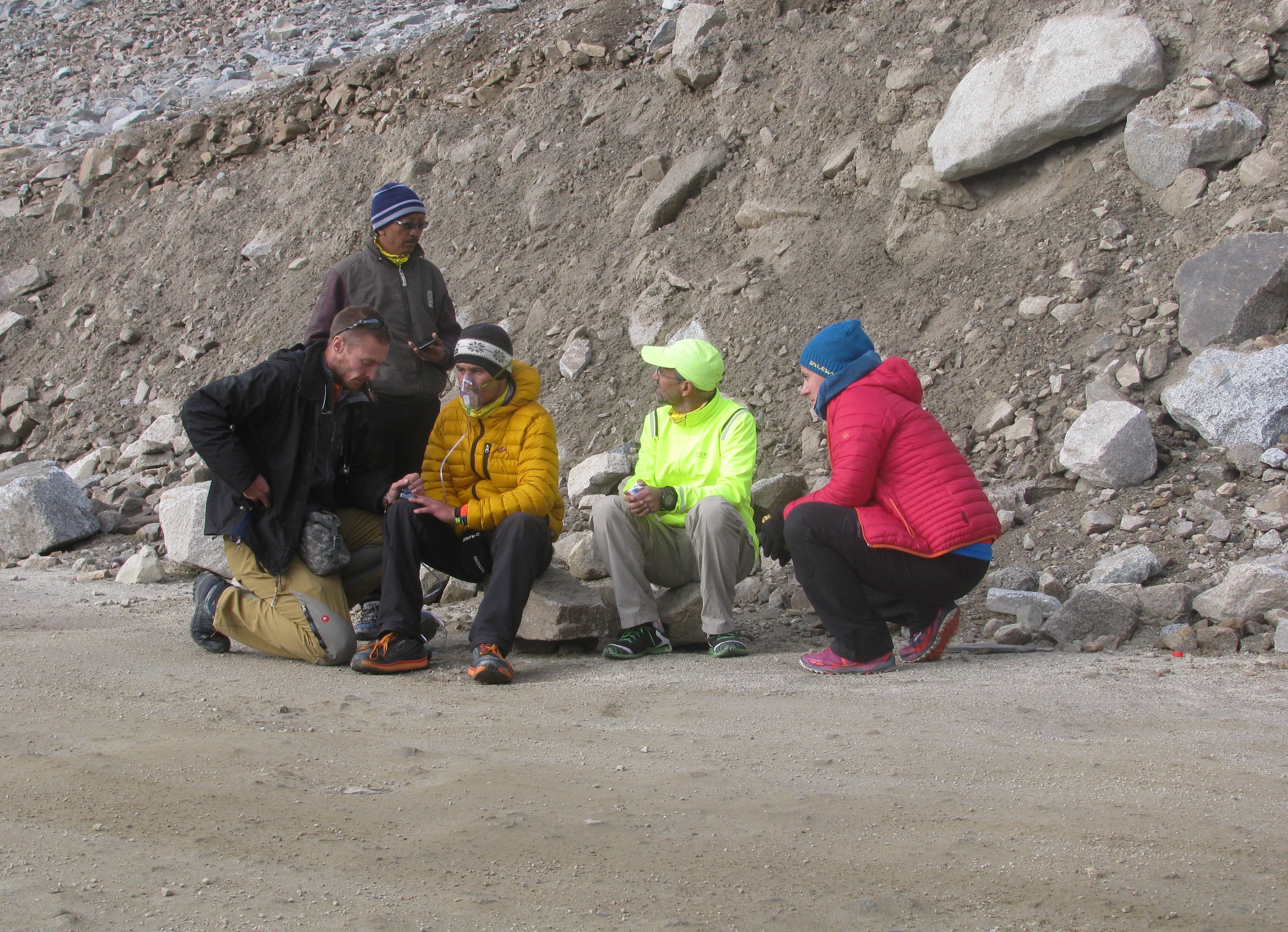
Dariusz (Darek) Strychalski - seen in yellow jacket - exits the 2016 race. Medic Nick Dillon (kneeling) next to him; also seen are Dr Rajat Chauhan and Darek's friend, Anna. Although his race stood terminated, Darek returned to cheer other runners (Photo: Shyam G Menon)

Dariusz (Darek) Strychalski – seen in yellow jacket – exits the 2016 race. Medic Nick Dillon (kneeling) next to him; also seen are Dr Rajat Chauhan and Darek’s friend, Anna. Although his race stood terminated, Darek returned to cheer other runners (Photo: Shyam G Menon)

Between North Pullu and Khardung La. Nick Dillon grew worried about Darek. The runner’s lungs were clear, his mental clarity was good. His pace was very slow. At one point his oxygen saturation was 55 while that of everyone else in the medic vehicle was around 70 (these figures must be read in the context of altitude). What made Darek’s diagnosis difficult is that his medical history featuring partial paralysis, created a case for weak circulation. Even looking for ataxia (loss of balance, it is a symptom of altitude sickness) was difficult because Darek’s natural gait had a wobble to it. He was allowed to proceed because he seemed neurologically sound. But when the runner’s pulse slowed down and ataxia became strongly suspect, Nick decided to consult Dr Chauhan, the Race Director. The latter spoke to Darek who resolved to press on. About 50 metres from the Race Director’s vehicle, with Nick and Anna present, Darek stumbled pronouncedly. It was curtains for his second attempt at La Ultra. The Race Director pulled him off the race and Nick administered oxygen. “ It was a combination of factors and several things building up over time that resulted in this intervention,’’ Nick said. It was also a text book case of what the medics had promised – that they would assess, provide room for stretch, keep monitoring and if required, pull the runner out. Darek bore it stoically. He and Anna returned to the race to encourage and applaud fellow runners.

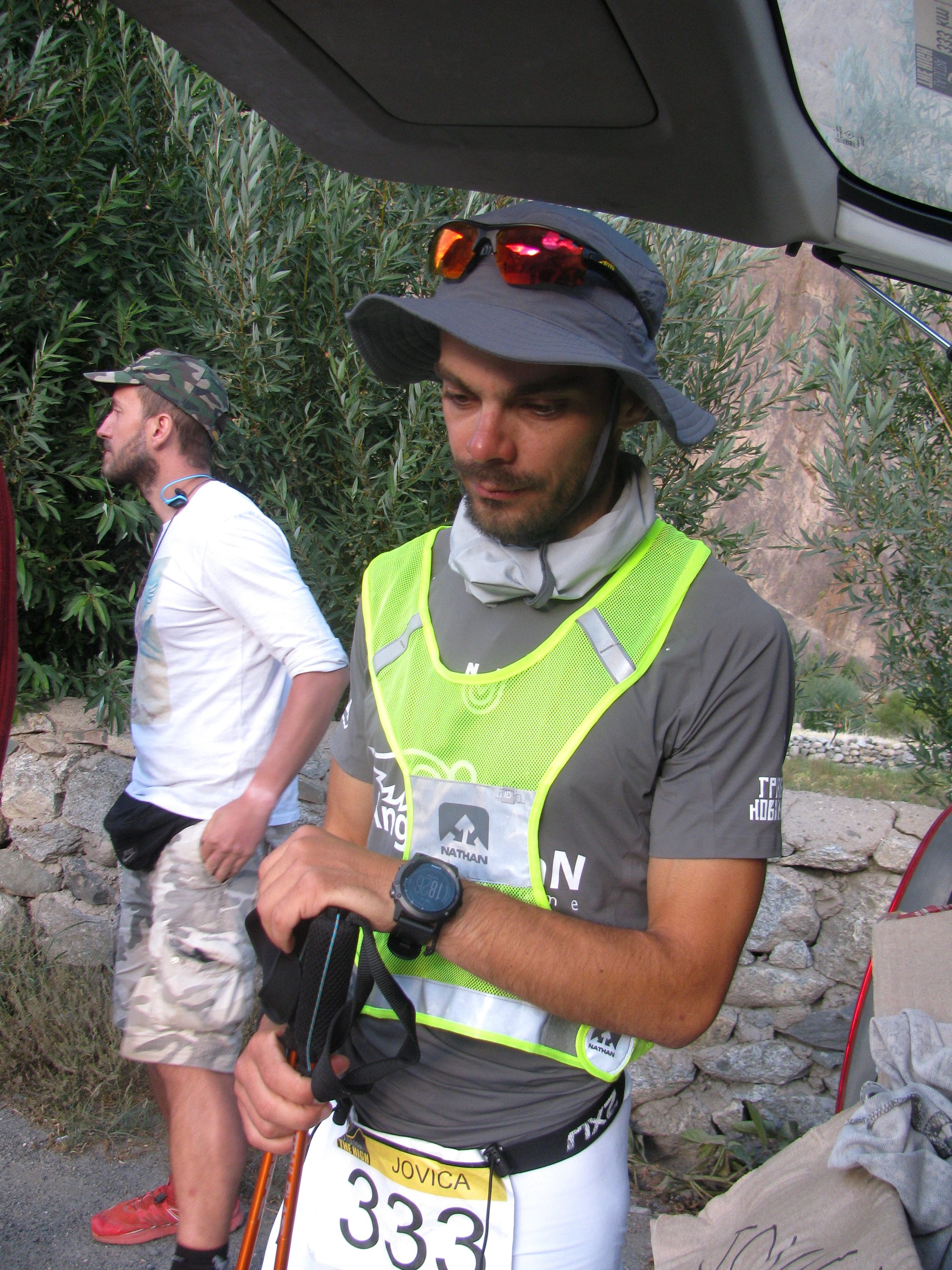
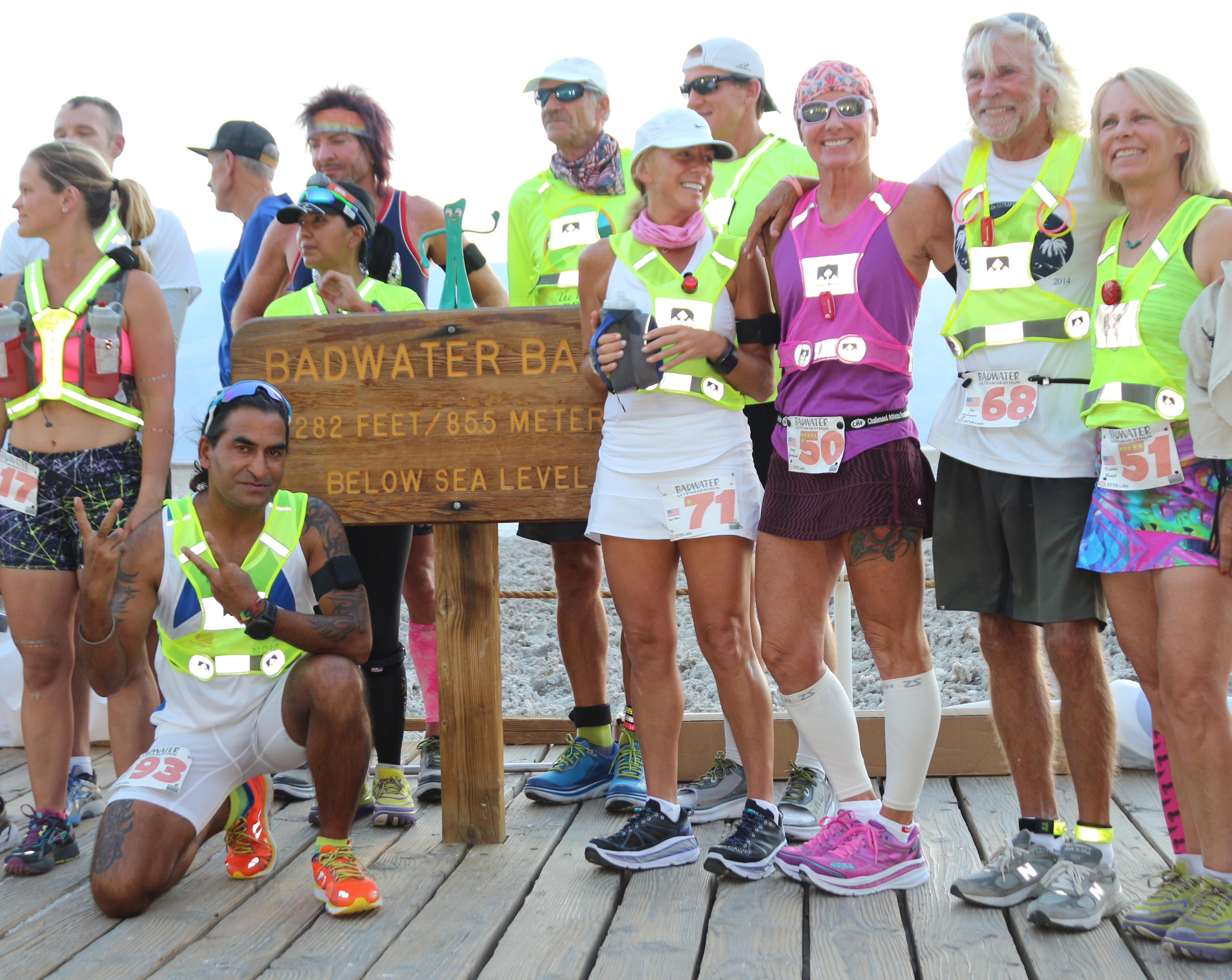
On the map of Europe, Slovakia lay to the south of Poland, south of Slovakia is Hungary and to Hungary’s south is Serbia. Straddling the junction of European and Asian cultural influences, East Europe has a tradition of being Europe’s powder keg; the world wars of the twentieth century were sparked by events in these parts. In the closing decades of that century, as the erstwhile Iron Curtain crumbled, the Yugoslav Wars broke out (Wikipedia describes them as conflicts spanning 1991-2001). Jovica Spajic was born in Priboj in Serbia in 1987. He grew up with his grandparents; he used to help his grandfather with work in the forest. “ These memories bring so much peace in me. I liked to talk about the future with my grandfather,’’ he said. His father worked in the police and following his basic education, Jovica attended secondary police school. Then he moved to Belgrade for “ real’’ police school to join the special-forces. For someone with that background, Jovica speaks passionately, emotionally. “ Till I turned 14 years old, we had war. That is too much for young people. Maybe it matured us with experience. You learnt to survive with little; a piece of bread and a glass of water. We enjoyed small things. Life was tough and beautiful at once,’’ he said. His grandparents died some years ago. “ There is a lot of empty space in my heart because of that,’’ he said. If there was a well-tuned running machine at the 2016 La Ultra, it had to be Jovica. A black belt in judo and jujitsu, he seemed energy reined in. He came to Leh with two close friends, Dalibor and Alex. Jovica met Dalibor much before his running career took off; at a “ small’’ run in Belgrade, “ a six hour-race for which I had arrived in walking shoes and jeans.’’ In the stipulated six hours, Jovica covered over 60 km. Dalibor encouraged him to take up running. “ That was the start of a voyage,’’ he said. Later, back in Belgrade after a mission in the mountains with the special-forces team, he chanced upon a magazine article on a race in the Sahara. He decided to go for it. He was the first Serbian to attempt the race and completed it in seventeenth position.
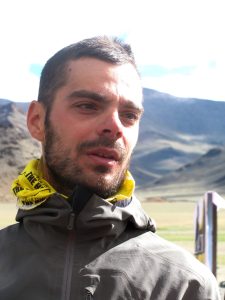
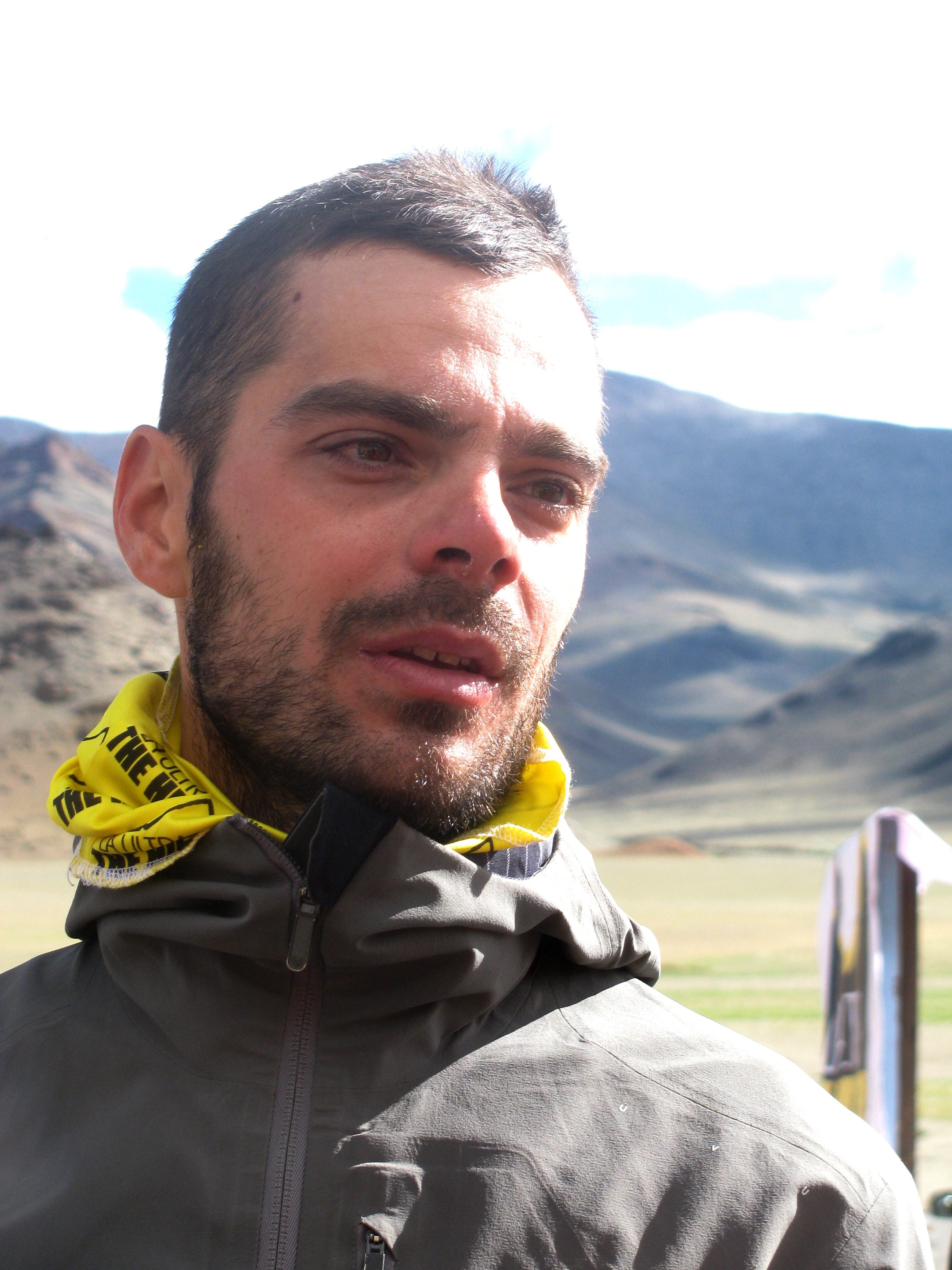
Jovica Spajic (Photo: Shyam G Menon)

Jovica Spajic (Photo: Shyam G Menon)

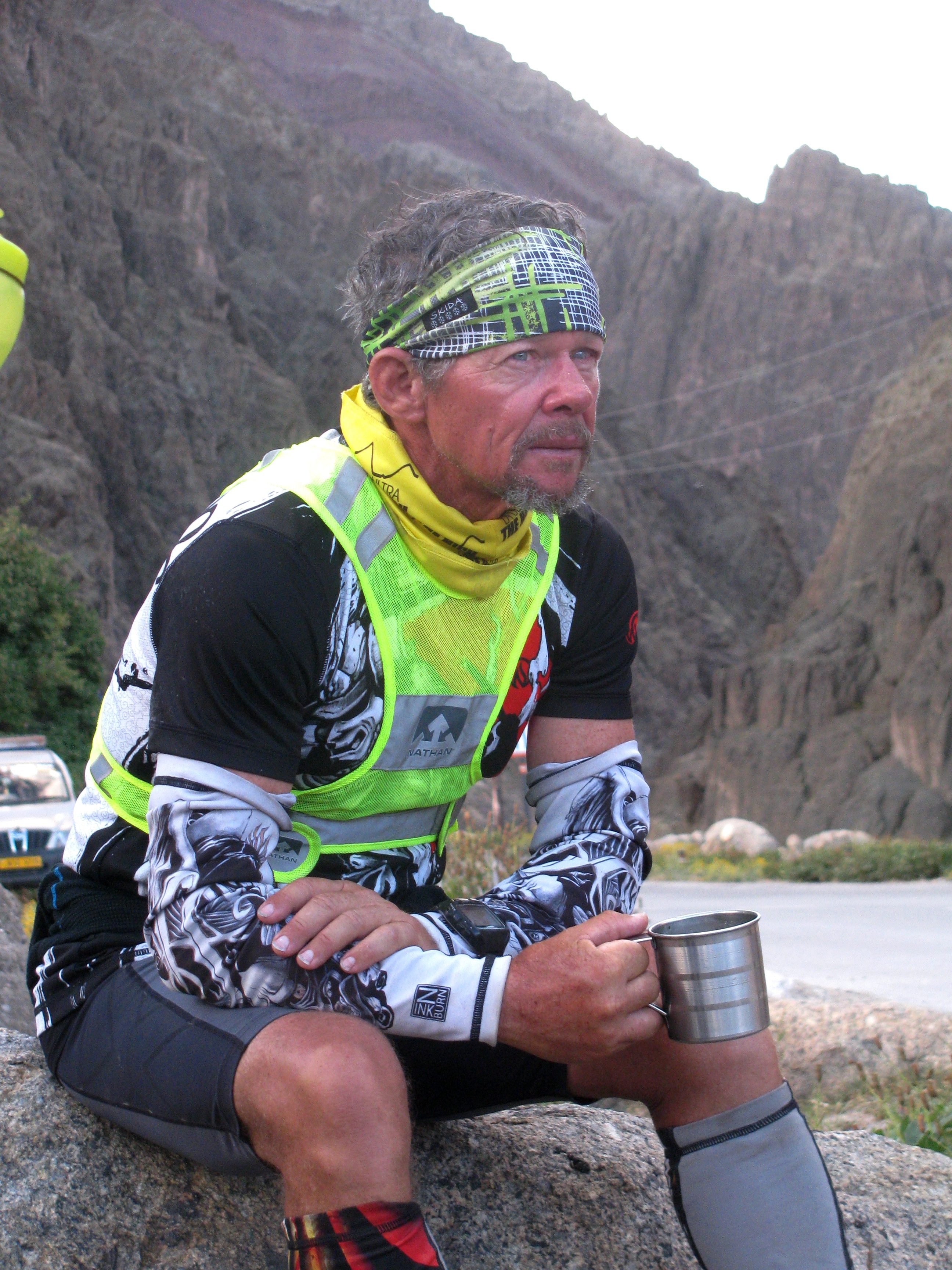
On return, he and Dalibor formed a group called: Ultra-runners Serbia. “ It is like a community. There are people from age 15 to 55. It isn’t just about running; it is about life, friendship, progress. Each of us, have some talent, we express that in our community; we try to motivate others to find their strong point. There is nothing aggressive. We don’t judge anyone. That is not our purpose. The elder generation talks with sorrow and pessimism about world and war. We try to be different. We want to tell positive stories to the next generation and create in their head, space for forgiveness. We don’t blame anyone. We must put a full stop and move on; there is no use staying in the past,’’ Jovica said dipping into the many things ultra-running seemed, in his life, the first 14 years of it, affected by war. “ Ultra-running is like a river. It is like life, flowing along. Life is a synonym for ultra-running,’’ he said. According to him, Serbia’s ultra-running community has the quality of an oasis. “ It is our space. We don’t make huge plans. We take small steps. In big space you can’t make a difference; in small space you can,’’ he said. Following the race in the Sahara, Jovica started to regularly participate in races and push his limits. He ran Italy’s longest road race, the ` Ultra Milano San Remo’ and the ` Race of Titans’ in the Italian Alps. In due course he became the national record holder in running for 24 hour-runs, 48 hours, 72 hours and six day-races. Then he entered the Guinness Book of World Records for the maximum number of sit-ups – 30,000 repetitions in 24 hours. In 2015, he was accepted to run the Badwater Ultramarathon in California’s Death Valley, one of the hottest places on Earth. Training for it in Serbia with its nice weather, was tough. Jovica trained with several jackets piled on to create a very hot environment. “ It was odd doing so in the centre of town,’’ he said. In Death Valley, he had just one day to acclimatize. “ I had no strategy or tactics, I ran with my heart,’’ he said. Jovica completed the iconic race in about 29 hours to secure eighth position overall, the highest place that year for a European. On the final climb to Mt Whitney Portal, he had the best split timing; all that growing up in the forest and hills of Serbia must have helped, he said. Among those Jovica met at Badwater was, Grant Maughan. “ When you say Badwater, you think of Grant and a few other runners. It is like his playground,’’ Jovica said. Fifteen to 20 miles into the run in Death Valley, Jovica saw Grant struggle with stomach issues. He asked Grant if he needed help. “ He just laughed and said: everything is okay mate; this is normal, this is ultra-running. That’s one thing about Grant – one moment he is like near dead, 15 minutes later, he is full of energy,’’ Jovica said. Grant, who has been a podium finisher at Badwater, ended the 2015 race in ninth position overall, just after Jovica. In conversations that followed, Jovica said he would like to run with Grant sometime.

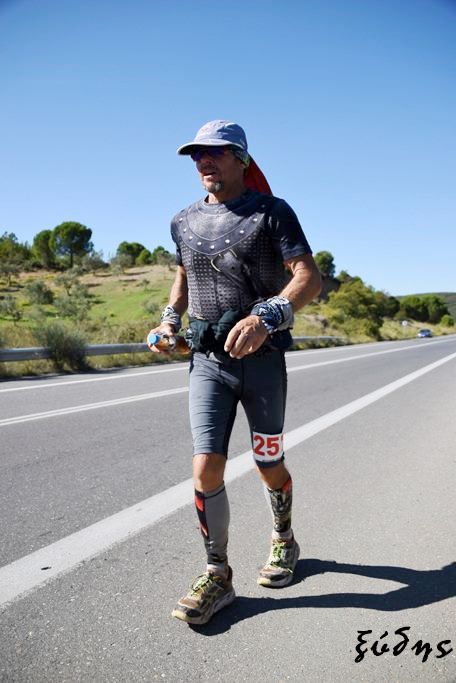
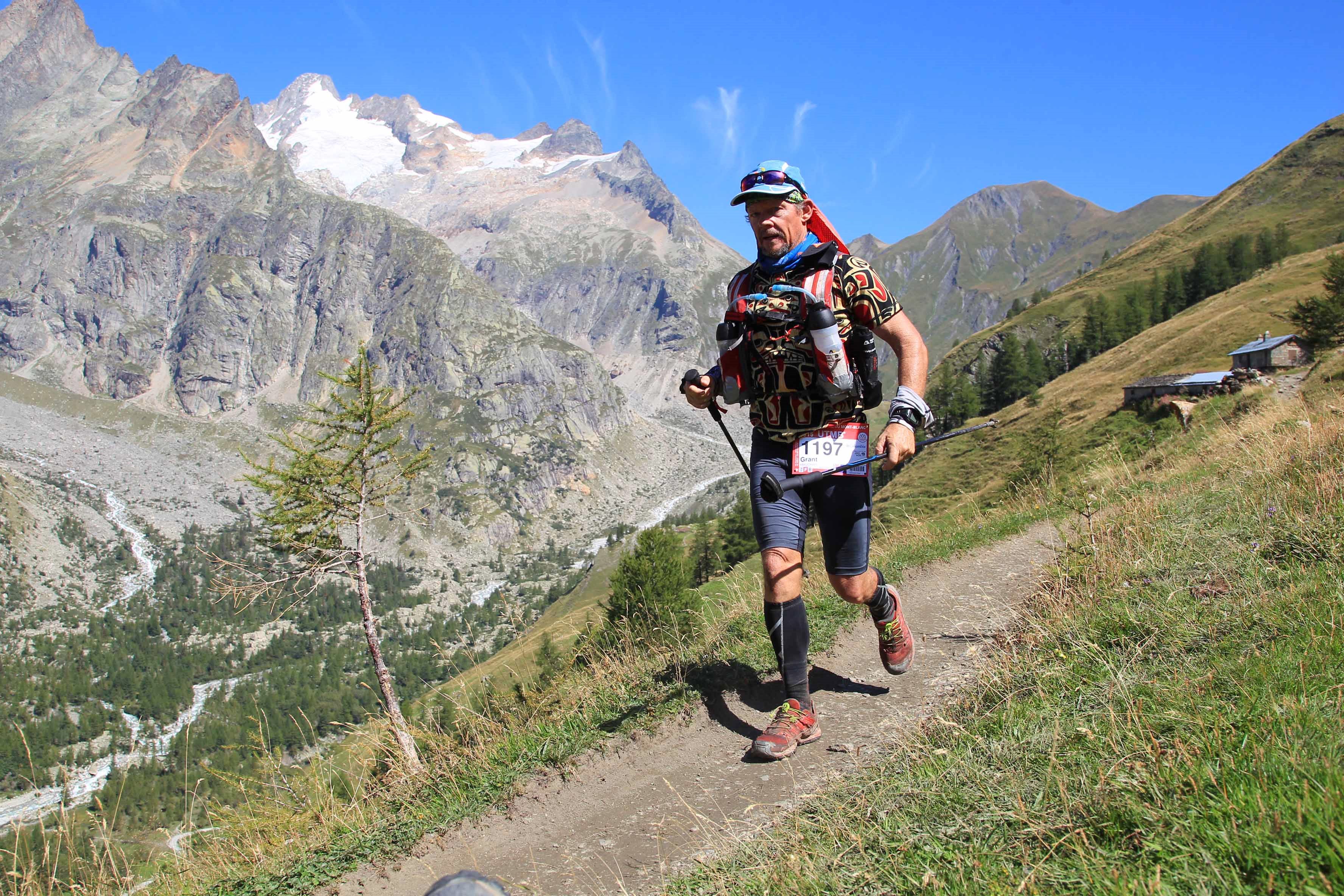
In Leh, Mark Woolley and I knocked on Grant’s door at the Leh-Chen hotel, to see if the 52 year-old would speak to freelance journalist. An athletic weather beaten man of medium height opened the door wondering why his sleep had been disturbed and yet ready for whatever the interruption held. Let me start the profile backwards, beginning with what I discovered last, long after the 2016 La Ultra had ended, Grant was in the US and I was in Mumbai. Grant Maughan is an excellent one man-band. Sometime amid his travels to run races, he should cut a disc. One of his songs is about the Australian Antarctic explorer Sir Douglas Mawson, who like Ernest Shackleton, had endured an epic story of survival. If you decide to compose a song for somebody, there must be much empathy therein and when the subject is exploration and Antarctica, you can imagine what the heart identifies with. Growing up in Australia, Grant liked the active life; he liked surfing, he also liked motorcycles becoming at some point in his life the owner of a KTM 640 (one of his travelogues is about an 8500 km-motorcycle trip around Scandinavia, including a visit to Murmansk in Arctic Russia). Travel and adventure appealed much to Grant. He became a sailor. He was skipper aboard yachts, ships and fishing trawlers. The world’s oceans taught him to cope with solitude and sleep deprivation; he also became familiar with the uncertainties of weather, how cold and icy things can be. Somewhere along the way, while helping to unload cargo that had been lashed down to the ship’s deck, a mishap occurred leaving him blind in one eye. Grant took to running only in 2011. He quickly moved through his first marathons to embrace the ultramarathon, which he felt was his calling. The portfolio of runs he has been to, is diverse – there are desert runs, runs in arid terrain and runs in snowbound terrain pulling sledges. He has a twin brother, who – according to Grant – is quite unlike him. Grant was married for 19 years. When he took to running, his wife joined the support crew for one of his races. “ It was nice of her to do so,’’ he said. He has no children. “ My wife and I, we made a conscious decision not to have children,’’ he said. The couple later separated because they weren’t getting much time together. They remain “ best of friends.’’
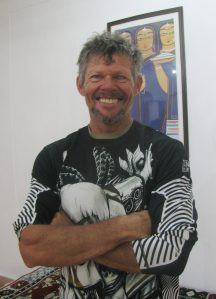
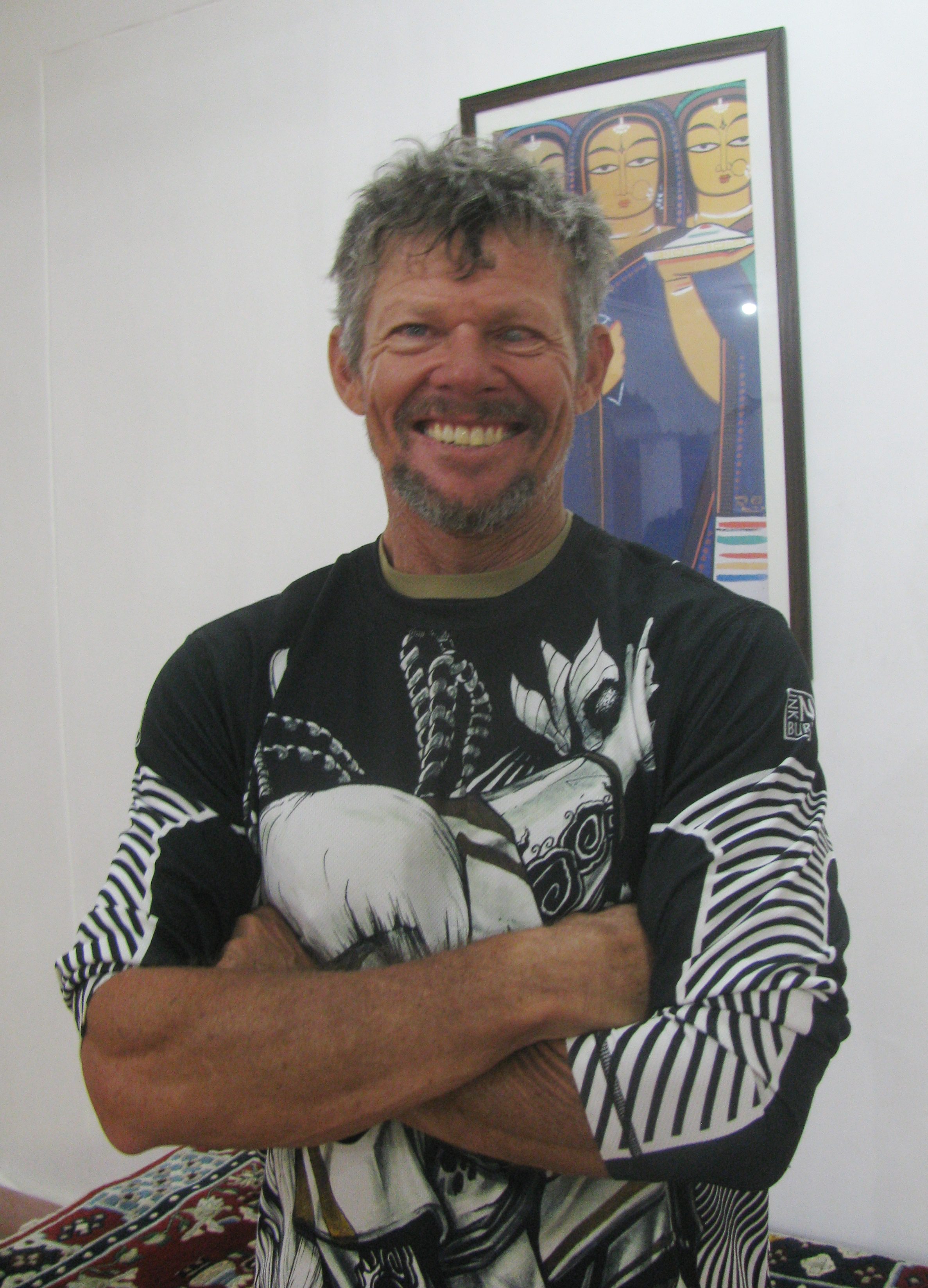
Grant Maughan (Photo: Shyam G Menon)

Grant Maughan (Photo: Shyam G Menon)

Grant seemed to keep a packed calendar. As of late August, his race history, available on the Internet, had been updated till February 2016 with the last event being the Alaskan winter classic, the Iditerod Trail Invitational. The list was an eclectic mix – many ultramarathons, a handful of marathons and a bunch of triathlons including Ironman; altogether 52 races, since 2011. In mid-July 2016, he successfully completed yet another edition of the Badwater Ultramarathon (finishing it in sixth position overall), by July end he was in Leh to acclimatize for the 333 km-La Ultra and race done in mid-August; he was expected within days thereafter in Colorado to run the Leadville Trail 100, a demanding 100 miler and among the world’s best known ultramarathons. “ I tend to recover well,’’ he said. Interestingly, Grant also said he gets bored very easily and needs activity. Further he is on a trip to stay healthy and get the most out of as little training as possible – the best option therefore, was to make running a lifestyle, hop from one race to another (one of the gathered runners pointed out that the flip side of this approach, is you may run some events sub-optimally). He found the people in ultra-running agreeable company. On the small lawns of Leh-Chen, on the eve of leaving for Diskit, he quipped how different the people around would be had it been a gathering of triathletes or marathon runners and not those into the ultramarathon. “ I find ultra-runners a quieter lot. They are an interesting bunch of people,’’ he said. Besides running, seafaring and surfing, Grant is also a mountaineer who has climbed in North and South America. He heard of La Ultra from among others, Mark Woolley. He registered for the 2016 race. Reaching Leh – a town he had visited decades ago as a young traveler – he rested and then progressively set out to acclimatize for the race. One of the things he did was go up Stok Kangri, the peak climbed by many for a shot at 20,000 ft. He felt good. For race bib number, he had chosen `640,’ after his bike. Coincidentally, another runner the organizers reached out to was his young admirer from the 2015 edition of Badwater, Jovica Spajic. The opportunity the latter had dreamt of – to run with Grant – materialized. Reaching Leh, Jovica and his team, after spending some time in town, moved to Wari La, the pass that sits in the middle of the La Ultra course, to train. August 11, from the start of the race in Diskit, Jovica and Grant ran together.
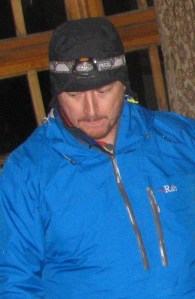
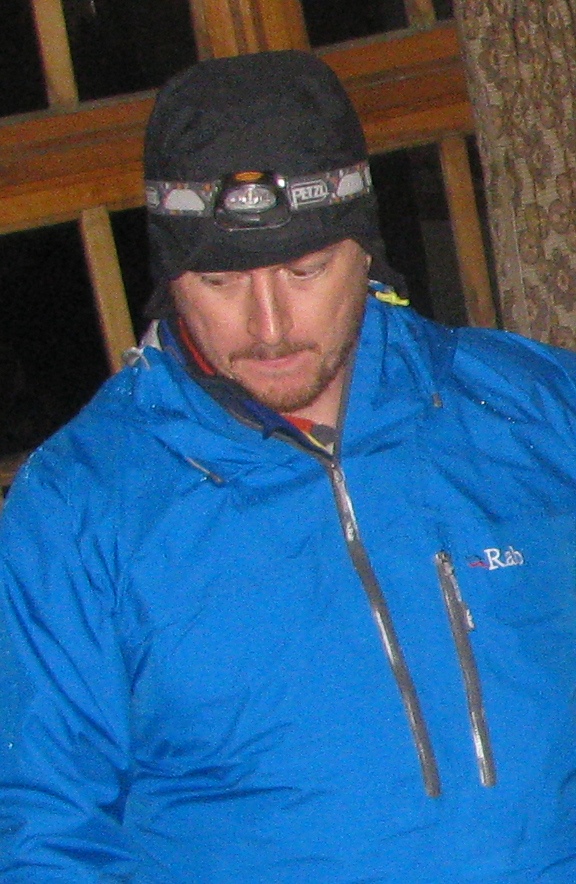
Tim Berrow (Photo: Shyam G Menon)
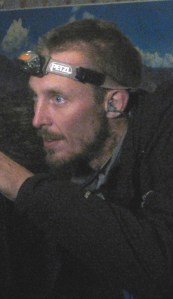
Tim Berrow (Photo: Shyam G Menon)

Nick Dillon (Photo: Shyam G Menon)

Nick Dillon (Photo: Shyam G Menon)

The night of August 11, medics Tim and Nick were at North Pullu when the runners reported for their check-in. It had rained along the way and with elevation, it had got quite cold. The small café at North Pullu was where the runners were assessed and warm drinks had. The personnel of the local ambulance service, was also present. Jovica’s entry into the café made heads turn. He resembles Virat Kohli, India’s cricket sensation. At North Pullu, the medics did a quick assessment of Grant. “ He was okay, there was nothing out of the ordinary,’’ Tim said. Past North Pullu, problems began. Tim was by now tracking and checking the first lot of runners for although they led the pack, that very fact meant they were ascending fast. Gaining altitude quickly can be dangerous. As the medics put it, broadly speaking the vanguard of the runners’ column where the strong racers are, runs the danger of coming up too fast; the middle is usually alright, the caboose is slow for valid reasons. So their eyes were on the front and the rear of the column. Up ahead, Tim posed simple questions to the runners. “ What I was looking for was: can they answer me in a full sentence, a quick inspection of how they were running or walking…such things,’’ he said. At roughly 15,800 ft Grant who had slowed down, said he was finding it hard to breathe. Tim had noticed changes. So he kept monitoring. At Khardung La, he once again caught up with Grant. By now Grant’s difficulty in breathing was clear. “ It was obviously pulmonary edema. I didn’t have to get my stethoscope out, I could hear the crackling,’’ Tim said. The treatment for HAPE is descent to lower altitude and administering oxygen if needed. Inhaling bottled oxygen disqualifies a runner. So Tim walked with Grant till he descended to 15,800 ft on the other side. Tim’s vehicle followed with oxygen cylinder aboard. At 15,800 ft, Tim checked Grant once again. He seemed able to continue without medical assistance. “ This was a case of quick onset and quick recovery,’’ Tim said. Something else – something very central to the 2016 edition of La Ultra – happened at Khardung La. When Grant struggled, Jovica waited. Grant told the young Serbian runner to continue and not waste time. Jovica not only waited for Grant’s medical assessment to be done but on the descent thereafter, he carried Grant’s small backpack till he felt sufficiently well. Abhinav Sharma, one of the members of Grant’s support crew, was waiting for the runners at South Pullu on the Leh-side of Khardung La. “ It was a humanizing instance,’’ he said of the moment Grant reached South Pullu, the effects of Khardung La visible on him.
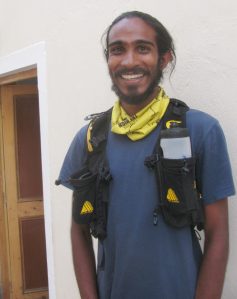
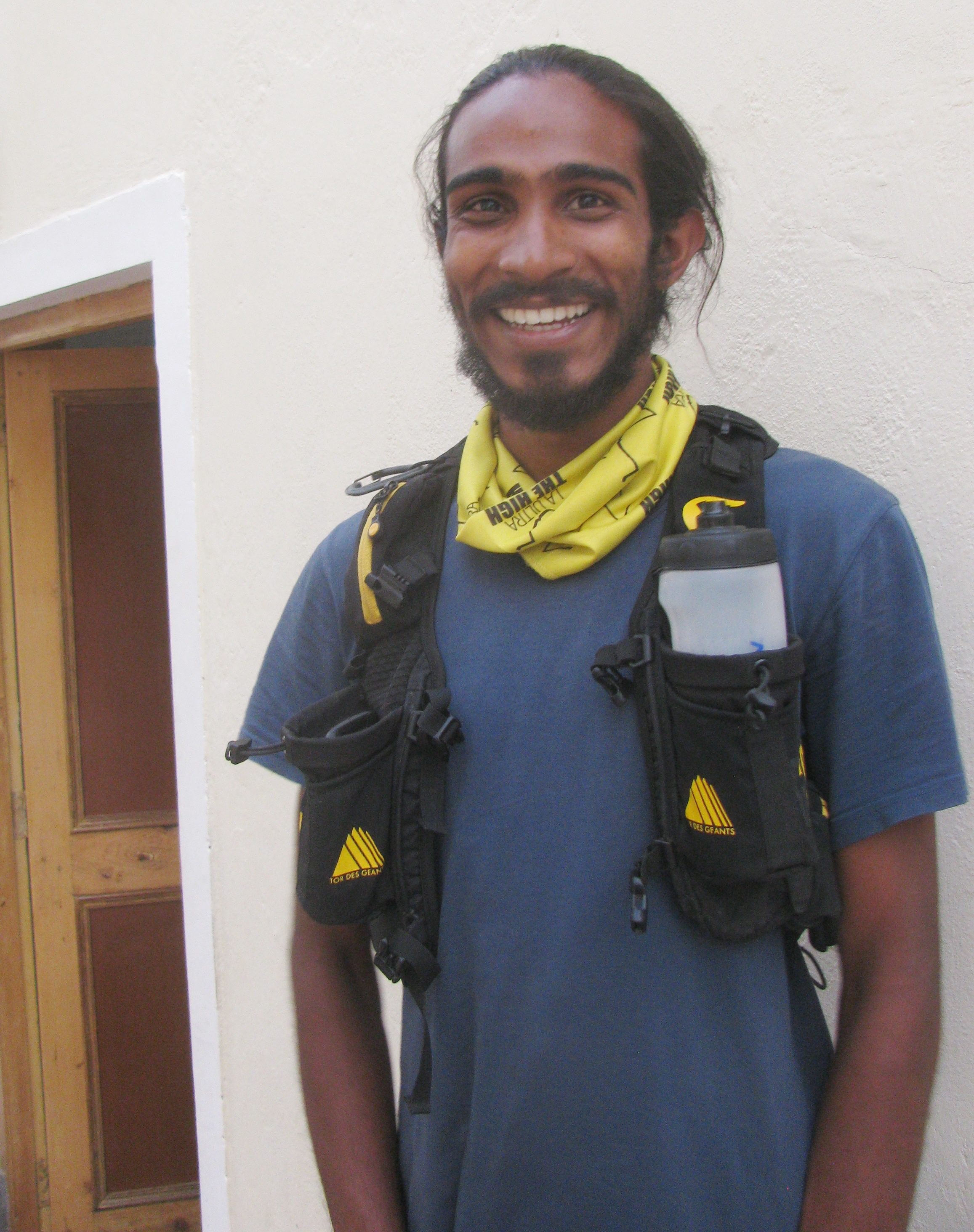
Kieren D'Souza (Photo: Shyam G Menon)

Kieren D’Souza (Photo: Shyam G Menon)

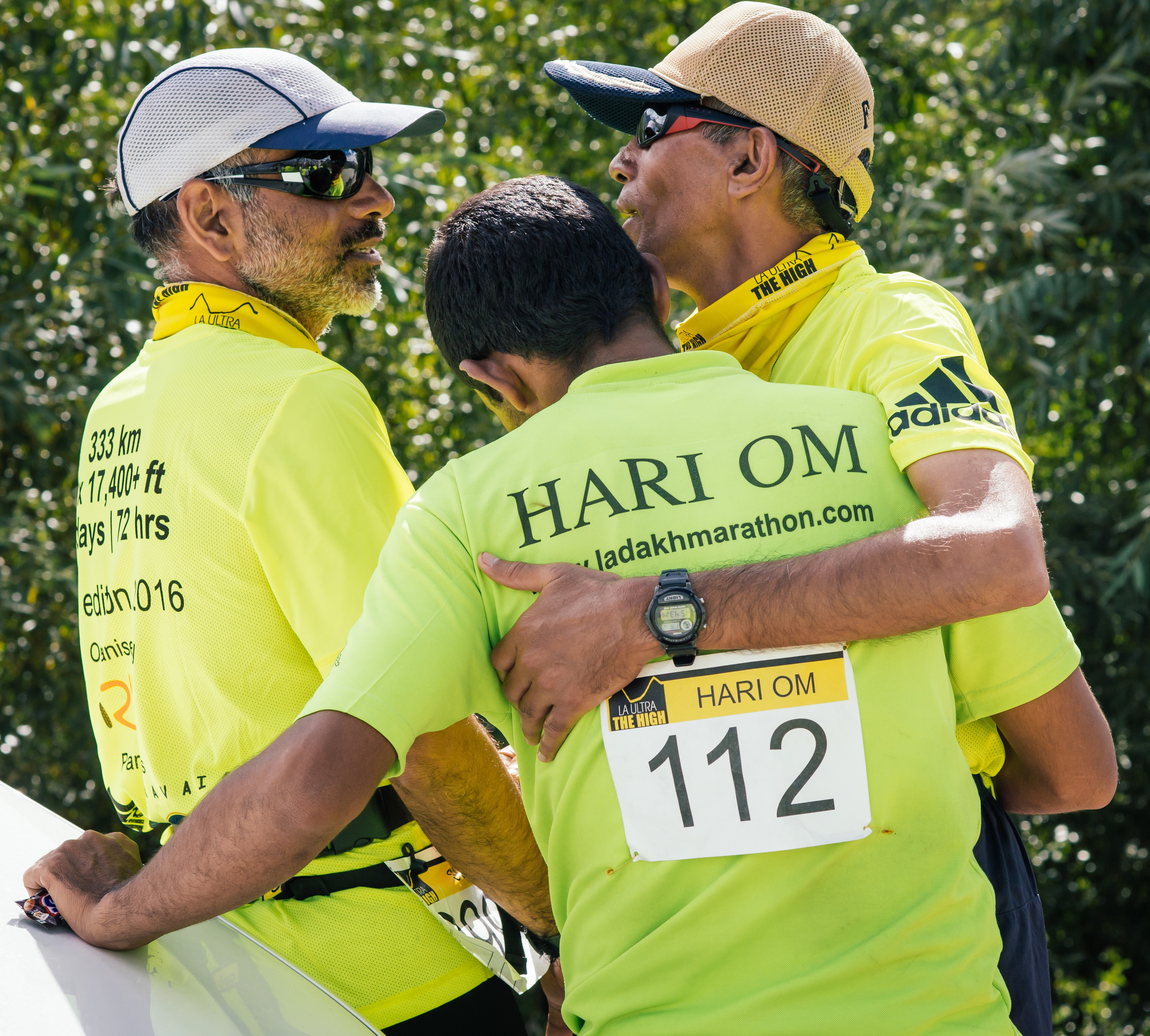
Towards noon, August 12, Kieren D’ Souza reached the finish line of the 111 km race. It was a new course record – 15:30 hours. The August 19, 2015 issue of Hindustan Times has the story of the previous course record; 17 hours and 57 minutes. It was set by Parwez Malik a scrap dealer from Dehradun in Uttarakhand. Parwez was the first Indian to complete the 111 km race of La Ultra. While Kieren placed first in the 111km segment in 2016, the second position was secured by Rahul Shukla, an engineer from Bhubaneshwar. Third was Hari Om of the Indian Navy. Kieren’s timing is considered to be very good for that distance, in a high altitude environment. “ Under similar conditions, the best we can expect internationally is just over 14 hours. However, we must appreciate that we got extremely lucky this year. We started off with poor weather conditions, which cleared very soon. Best conditions in the last seven years. Let’s not make too much of these timings as they can’t be compared from year to year for the earlier mentioned reasons,’’ Dr Chauhan said. In September, Kieren was scheduled to travel to Greece for Spartathlon. “ Give him 2-3 years, he will be right up there,’’ Dr Chauhan said. A remarkable story from the 111 km race would be that of Nahila Hernandez. Born in Azerbaijan and now a Mexican national, she is one of Latin America’s top female ultramarathon runners. Among other milestones in her career, she was the first woman to cross South America’s Atacama Desert. Nahila’s baggage arrived late in Leh upsetting her acclimatization plans. Then, a day before setting out for Diskit, she fell ill with food poisoning. Till the time of leaving for Diskit, she was under the care of the medics. Nahila had originally registered for La Ultra’s 222 km race. She switched to the shorter 111 km and essayed a wonderful run, surviving on just fluids. But what should interest amid all this is that the ones who immediately followed Kieren were those from the 333 km-pack; they had over 200 km more to go and yet their pace wasn’t terribly slow compared to Kieren’s.

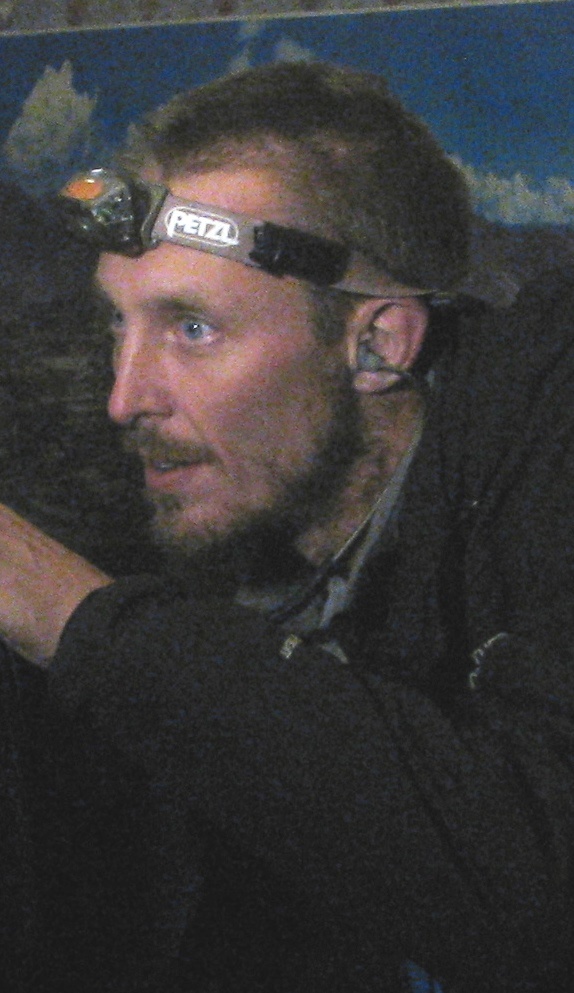
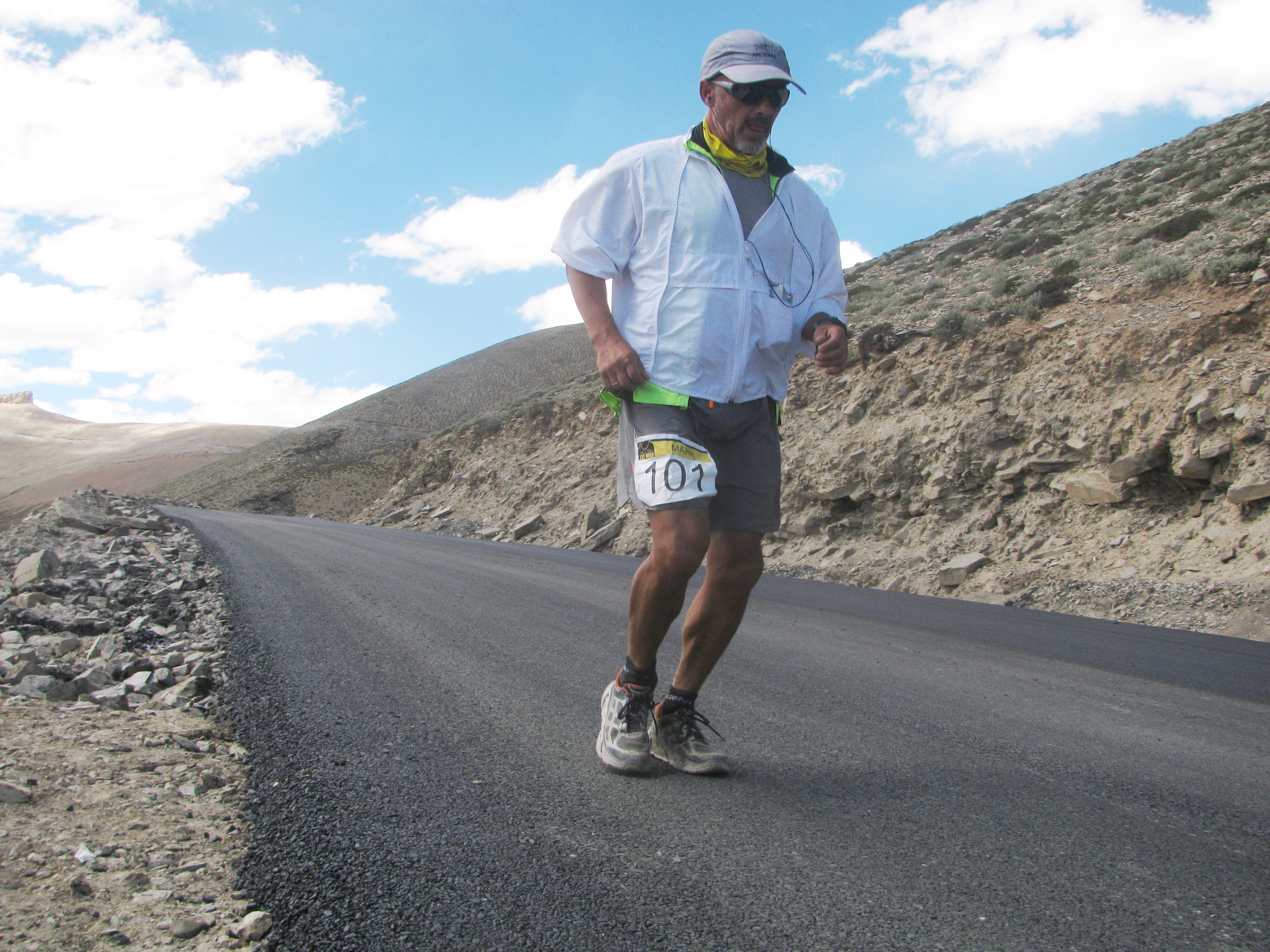
Mark Steven Woolley was seated nearby when I interviewed Grant. They were of the same age. At one point, Mark couldn’t help intervening, hearing Grant’s views on running – it was so similar to his own. Yet as the two runners explored that similarity further, disparities emerged. Grant said he is a loner. Mark wasn’t, indeed among the gathered foreign runners he was the one who mixed with others the most. Grant didn’t think much of competing; Mark admitted to occasionally drawing energy from it. Late evening, on August 12, several kilometres away from Leh, the headlights of our car picked up a runner, paced by a member of his support crew and proceeding diligently to Sakti. It was Mark. He was in many ways the real hero of La Ultra’s 2016 edition. While people blaze their way to the finish line or complete strenuous races on their first attempt, Mark had been denied the satisfaction of completing the 333 km stretch twice before. Mark is an accomplished ultra-runner with races like UTMB, Badwater and Spartathlon under his belt. He was also into martial arts. Mark is an Englishman, living and running in Spain. He is a school teacher; he teaches Physics. Elena, his wife who was part of his support crew for the first time on the 2016 edition of La Ultra, is a photographer. Mark had previously completed the 222km version of the race successfully. According to La Ultra lore, his disinterest in coming back was among reasons that spawned the longer 333 km race.
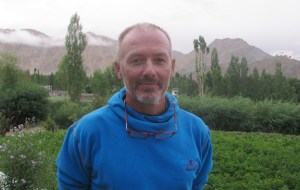
Mark Steven Woolley (Photo: Shyam G Menon)

Mark Steven Woolley (Photo: Shyam G Menon)

A new race born, in 2014, Mark attempted it. That first time at La Ultra’s 333 km race, he overtook his nearest competitor and led, till at kilometer-317 – past Tanglang La – he collapsed. He went into shock. The descent from Tanglang La to Dibrung, in its early portion, is a mix of sharply contrasting ambiances. Depending on the time of day, just after the pass, you get a sunlit mountain face. The road then proceeds to a gully, takes a U-turn and straddles the opposite mountain face, which is in the shadow and hence cold. “ Up there, the big issue is high altitude but sometimes you have the more common problems like hypothermia and hypoglycemia. Mark was extremely low on energy and suddenly the temperature dipped because he was in the shadow region,’’ Dr Chauhan said of what triggered collapse and shock. That year was weird. Probably because 2014 was the inaugural year for La Ultra’s 333 km-challenge, of nine people running the distance, eight ended up DNF. Only one – Kim Rasmussen of Denmark – finished. Mark’s was the last of the DNFs, which had begun from kilometer-48. On the second occasion, in 2015, Mark ran up and over Khardung La in good time but then began worrying if he had done it too fast. He wondered whether such an approach to altitude would elicit a toll later in the race. Next day, when he experienced difficulty breathing, a rather convincing notion that he was unwell, took hold. With memory of previous collapse alive in mind, he lost much time insisting on being checked by the medics when the medics couldn’t find anything wrong. Eventually he finished the race 52 minutes after the cut off time for the whole course. 2016 was his third attempt. “ I like to finish what I started,’’ Mark had said ahead of the 2016 race. If there was any runner, everyone wanted to see finish the race successfully – it was Mark. You have to have a big heart to return three times for La Ultra’s 333 km-ordeal. I had asked him if three times on the same route may deny runner’s mind a sense of motivation. “ No, you start with an empty head. Every race is new. Besides this is the Himalaya,’’ Mark said.
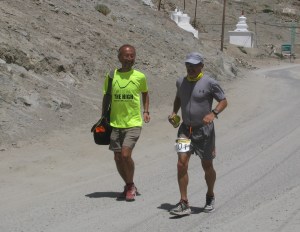
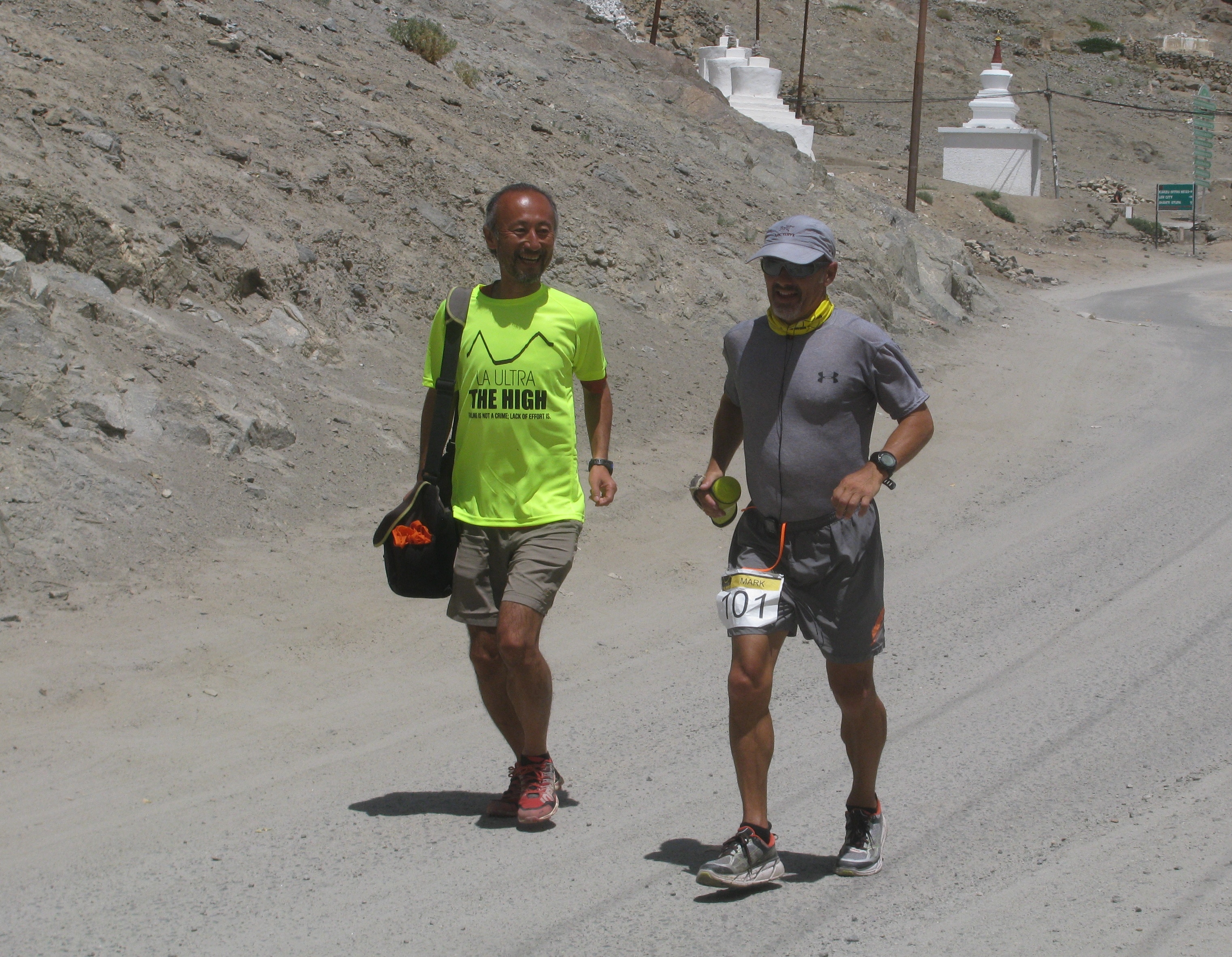
August 12. Ryoichi Sato and Mark on the approach to Goba Guest House, Leh (Photo: Shyam G Menon)

August 12. Ryoichi Sato (left) and Mark on the approach to Goba Guest House, Leh (Photo: Shyam G Menon)

Morning of August 12, as they came off Khardung La and South Pullu, the 333 km-runners were free to halt at the Goba Guest House in Leh, which served as the race organizers’ base camp. Waiting for Mark there was Ryoichi Sato. In La Ultra circles, everyone spoke of the Japanese runner with respect. His visiting card offered a glimpse of the races he had run: among them were the Marathon Des Sables, Spartathlon, 24 Hour World Endurance Marathon, Annapurna 100, Mustang Mountain Trail Race and a clutch of races in Japan. In 2013, he required a pacemaker to be attached to his heart. Two months later, he completed La Ultra in its 222 km-avatar. “ I got to know of his pacemaker only after I reached Leh. That year’s medical director almost had a fit when she learnt of it. Sato has some crazy runs in some amazing times. The pacemaker wasn’t something that bothered me. I did tell him that he needed to listen to his body a bit more now and not be as reckless as he would have been a couple of years ago,’’ Dr Chauhan said. In 2014, Sato had attempted the 333 km-version of La Ultra along with Mark. “ Sato San’’ met Mark a little away from the guest house and ran a short distance with him. A while later, refreshed and rested, Mark left the guest house on the next leg of the race. That was hours ago. Now a blazing afternoon and much of an evening later, on the run up to Sakti, he seemed to have slowed down.
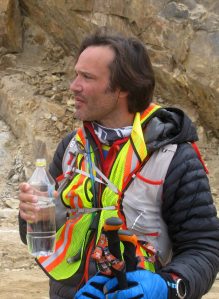
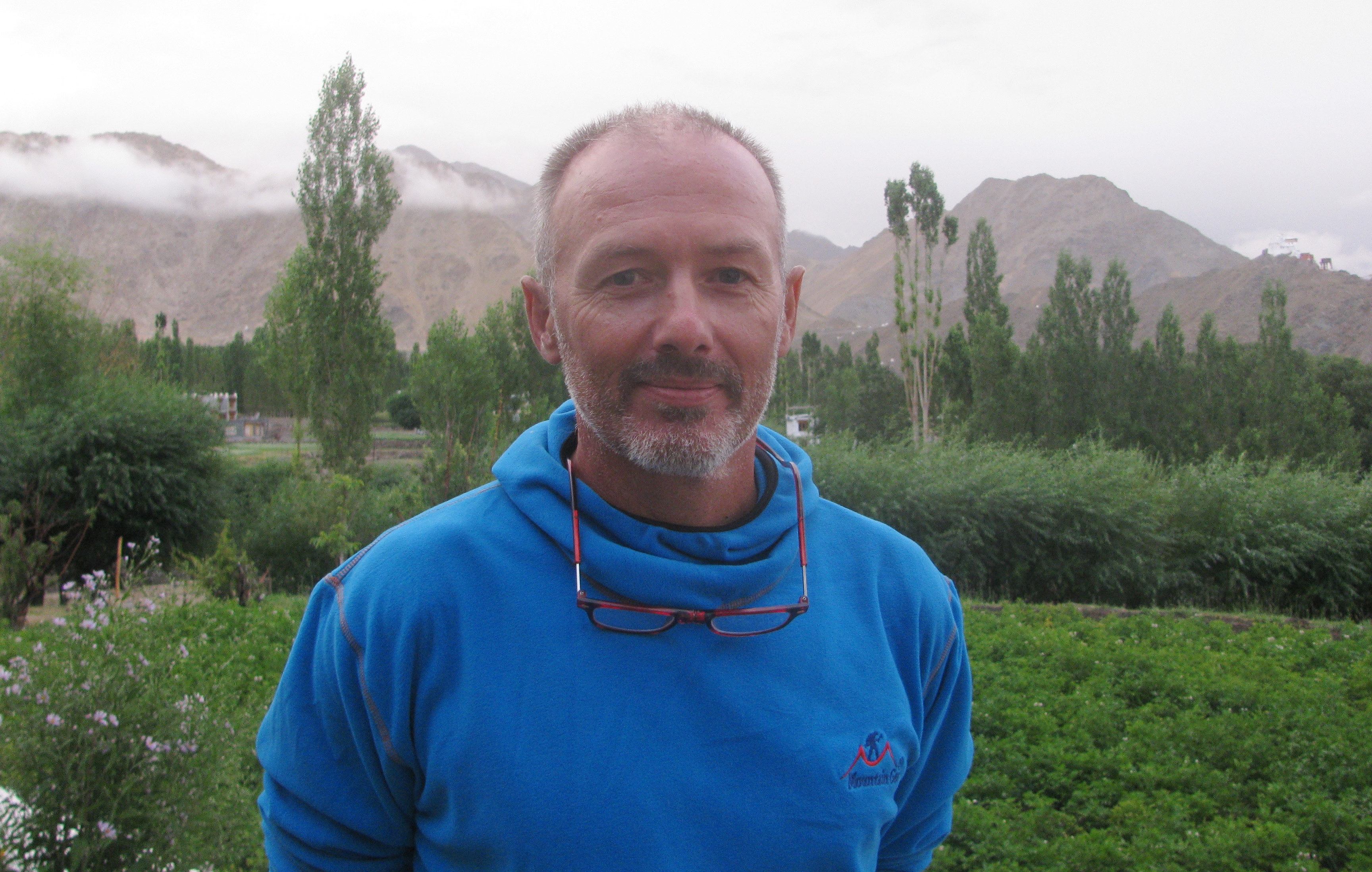
Alexander Holzinger-Elias (Photo: Shyam G Menon)

Alexander (Alex) Holzinger-Elias (Photo: Shyam G Menon)

Gone past Mark was Alexander (Alex) Holzinger-Elias, a German businessman based in Bahrain. Both Alex and his wife Dunya are into running. Alex, who has been a regular at The Comrades in South Africa, had completed the 111 km race of La Ultra in 2015. That year, he placed second, behind Parwez Malik. He had then taken a leap of faith and opted for the 333 km category in 2016, skipping progression through the intermediate 222 km option. Training was a problem. Bahrain is a hot place with neither mountains nor altitude. Alex opted to run long hours early in the morning and after work, besides making the best use of the treadmill and the stair-master. With Dunya as coach and manager, he also did a couple of races, which he thought may prepare him for La Ultra. Dunya’s bid at the 111 km race in 2016 ended quite early. She missed the North Pullu cut-off by 15 minutes. It was her second DNF; in 2015, she had stopped at kilometer-54. On August 12, she joined Alex’s crew. The least experienced of the 333 km-field, Alex kept a steady pace. He was the last of the four runners to reach Leh from Diskit, but by Karu, on the approach to Sakti, he had overtaken Mark. That was the pecking order August 12 evening; past Mark and his crew we came across Alex and his team. Ahead lay a small guest house – Solpon Camping & Home Stay – and beyond that, the 17,200 ft high-Wari La.
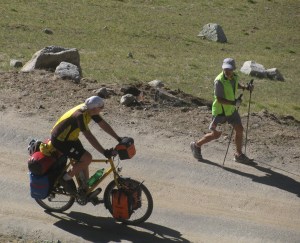
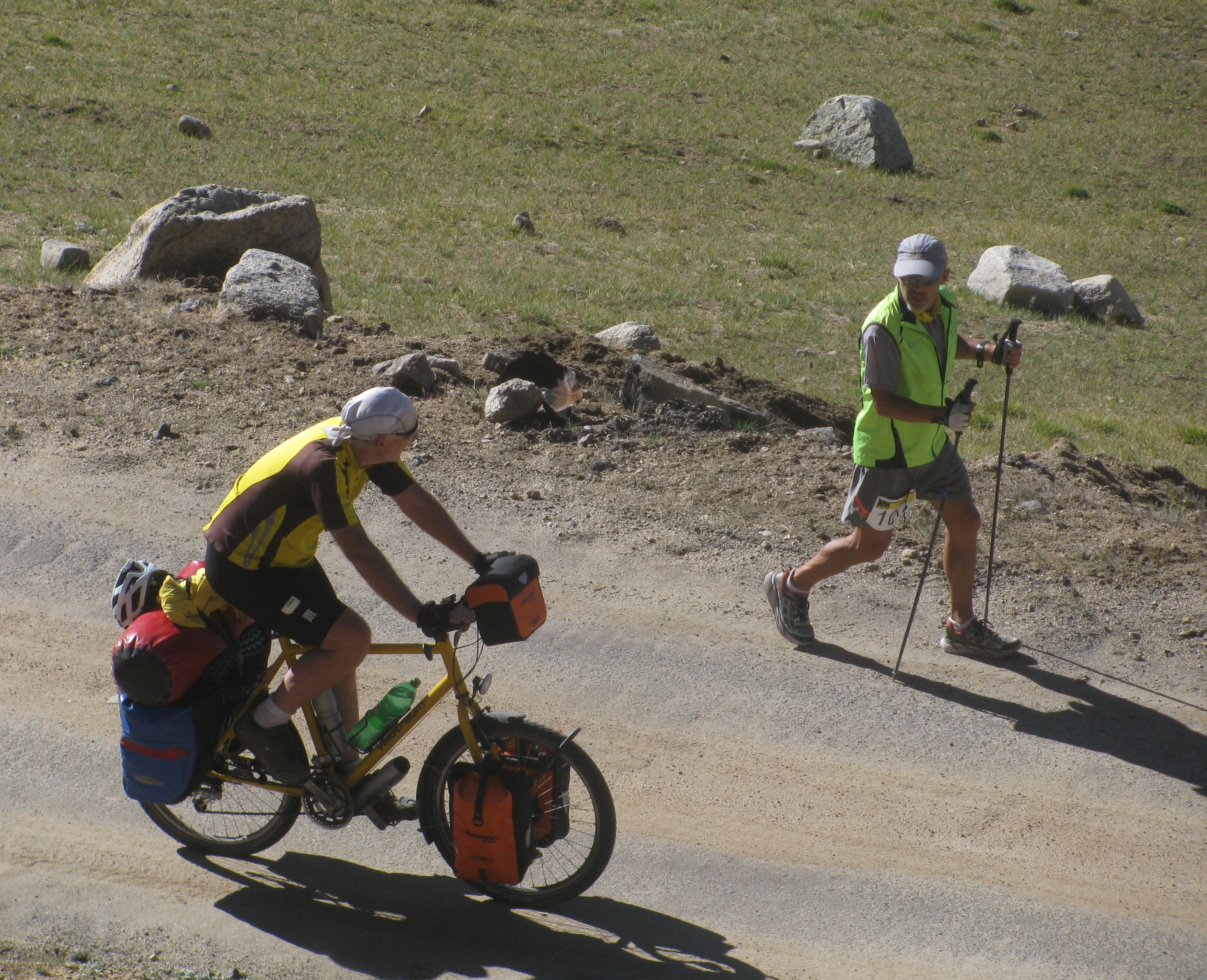
On the ascent to Wari La; Mark and Peter, the cyclist (Photo: Shyam G Menon)

On the ascent to Wari La; Mark and Peter, the cyclist (Photo: Shyam G Menon)

Jovica and Grant had already reached Sakti and Solpon Camping & Home Stay. They rested for about an hour and 45 minutes. Late night, they set off for Wari La. Grant had to exercise caution. They were moving into high altitude. But Jovica was prepared for Wari La; this was where he had trained ahead of the race. The duo made brisk work of the pass. “ Their initial target was to reach the top of Wari La in about eight hours. They did so in six hours,’’ Dhanush K. N, who was part of Jovica’s support crew, said. Meanwhile very late at night, Alex and Mark too reached the guest house. Early morning as the sun revealed the beauty of Wari La and the view from there; all four runners were once again in the same region. Jovica and Grant were returning from the top while Alex and Mark were on their way up. Grant seemed fine after Wari La. Tim and Nick had an observation about the Jovica-Grant partnership. It worked to mutual benefit. The tough older runner had the drive of the younger one to draw motivation from; the younger one avoided the folly of heading too fast to altitude thanks to older runner around. It kept both in a stretched but mutually beneficial, relatively safe zone, aware of potential complications yet avoiding it. On the ascent to Wari La, Mark kept a slow, steady pace. He had chosen his crew carefully. Two of his crew members had been with him on his previous attempts; the third was Elena. “ For me, the most important thing in a crew is absence of conflict,’’ he said. He had that peace in his team; Mark’s was a happy, relaxed crew. It graced runner too. Mark was never beyond a “ hi’’ or a “ hello’’ on the road.
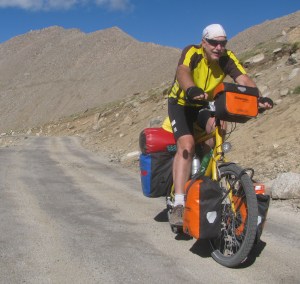
Peter (Photo: Shyam G Menon)

Peter (Photo: Shyam G Menon)

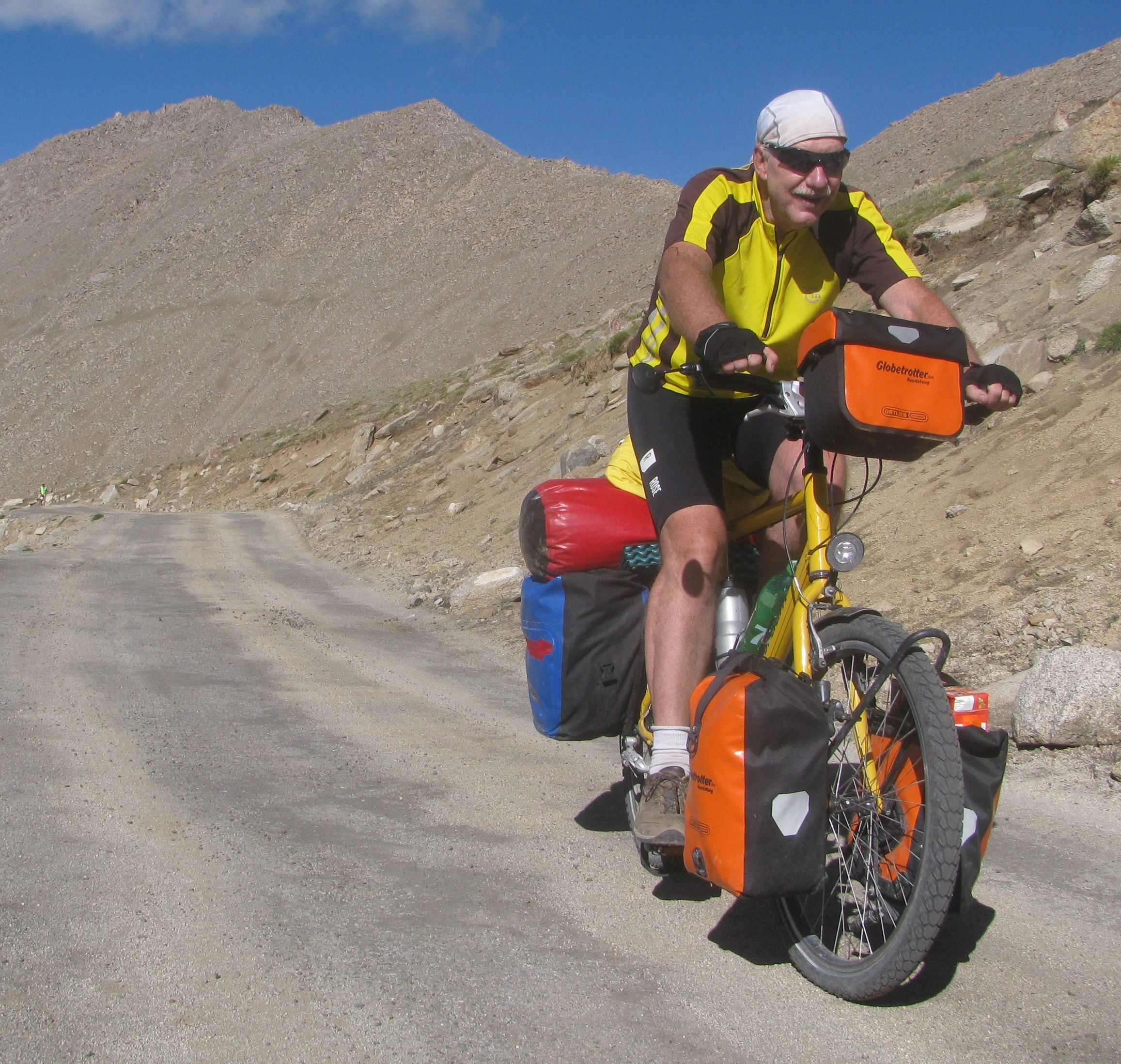
Unlike cities, mountains are quiet. From a couple of bends above, I heard Mark say hello to Peter. The cyclist had slowly caught up with Mark. Peter was a police officer from Germany. His touring bicycle – a Velotraum – had pannier bags at the rear and up front. Loaded, it was heavy. “ I like my independence,’’ he told me. For a while, cyclist and runner seemed side by side, a moment Elena tried to capture on camera. Then the cyclist pulled ahead. On Wari La, Peter watched from the side as Mark reached the pass and turned back. The Wari La portion of the La Ultra course, is an up and down along the same road. As Mark left, we went looking for Jovica and Grant. Peter stayed on alone at the pass, enjoying his rest, before cycling on to Nubra.
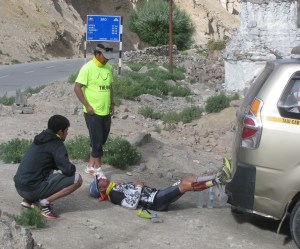
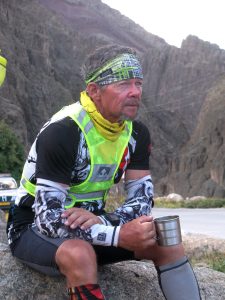
Grant rests for a while (Photo: Shyam G Menon)
Grant rests for a while (Photo: Shyam G Menon)

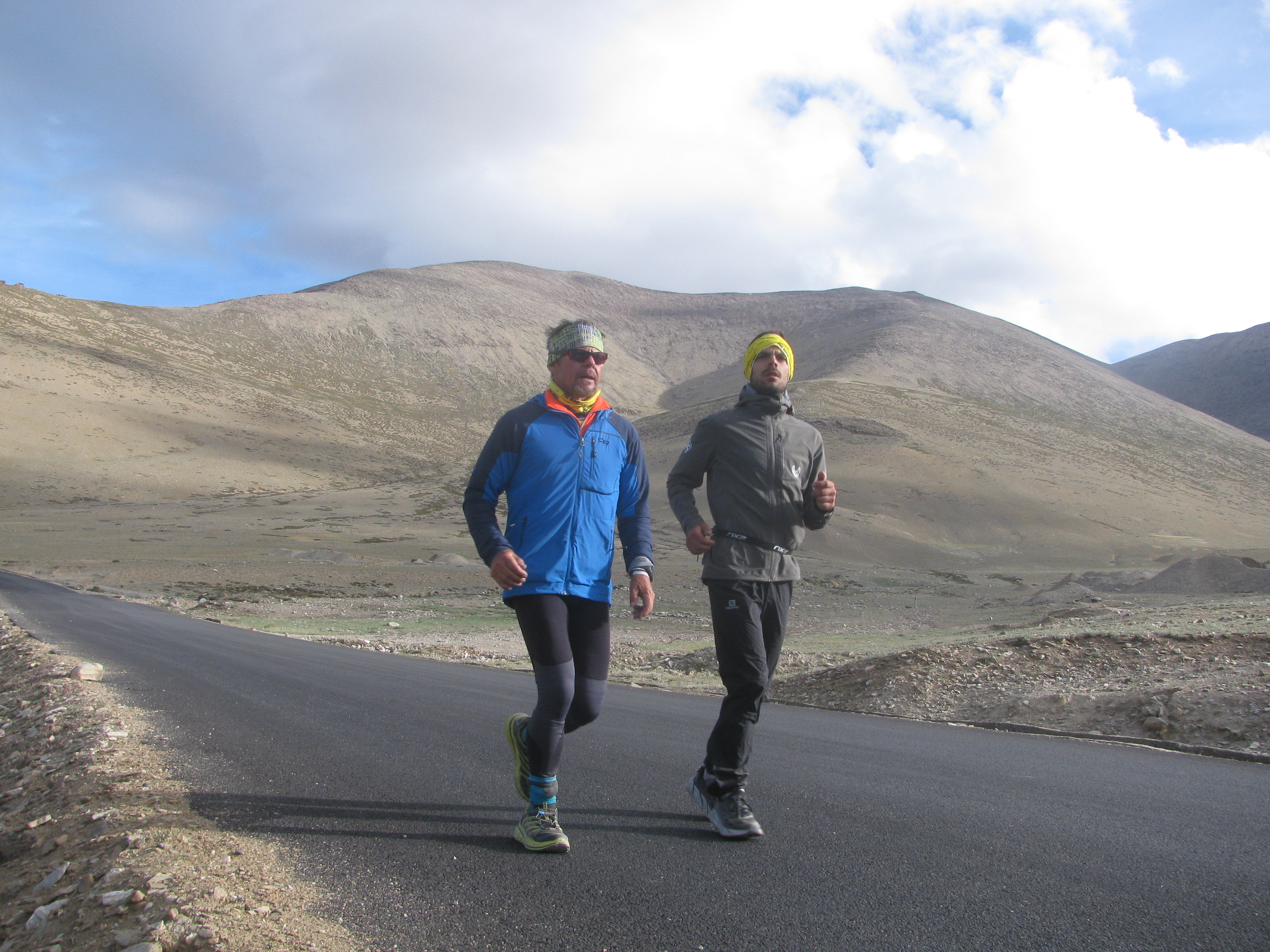
Jovica and Grant on the road to Rumtse (Photo: Shyam G Menon)

Jovica and Grant on the road to Rumtse (Photo: Shyam G Menon)

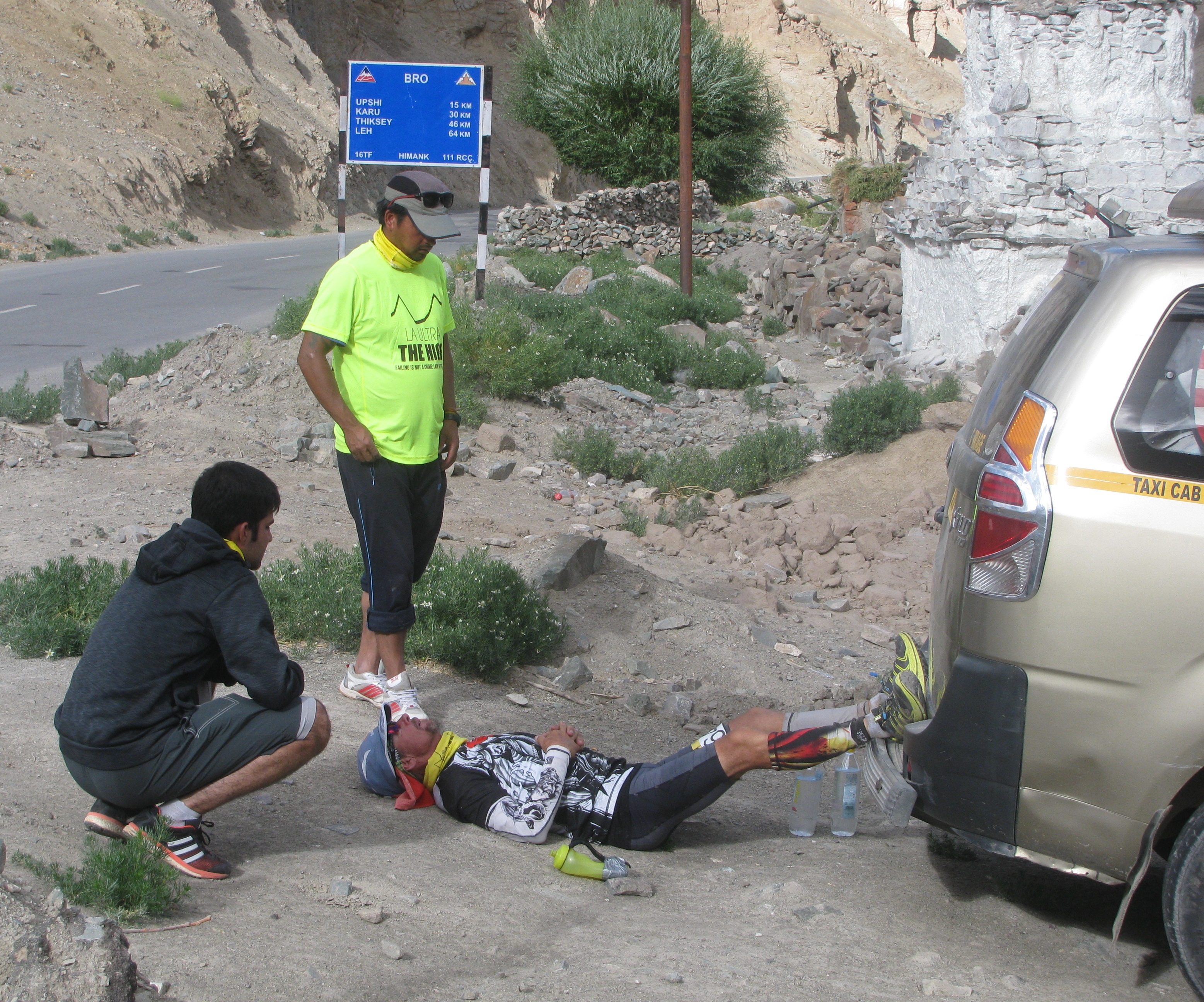
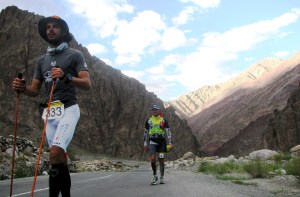
The road to Sakti and Wari La branches off from Karu on the Manali-Leh highway. Jovica and Grant were not at Karu; they had already gone past the junction. The sun was now blazing; it was hot, close to noon. We met them at Upshi, where the duo had decided to break for lunch. Jovica sat in his support vehicle. Grant sat on a chair in a dhaba (a roadside eatery), dressed in racing attire amid a bunch of tourists. Few looked up from their banter, food and selfies. The road from Upshi to Rumtse was testing. Not only was it the hottest part of day, there was vehicular traffic and in Ladakh’s still air, every molecule of smoke invades one’s nose and lungs. The runners proceeded carefully on this section. By all accounts, it was Grant who kept the steadier head on these hot, irritating sections of road with traffic. Exhaustion was slowly creeping in. Jovica paused to rest. Grant walked considerably ahead and decided to take rest himself. The support crew created a chamber within their vehicle for him to rest, windows masked with dark fabric. He chose to lie down on the road, legs up on the vehicle’s bumper. Before the start of the race, Grant had mentioned that he would like to keep his breaks for rest, not full-fledged but partial. Bare earth was perfect; neither here, nor there. Late at night, after a two hour-halt at the guest house in Rumtse, Grant and Jovica set off for the last high pass on the La Ultra course – Tanglang La.
Grant, evening of August 13; Rumtse is still some ways off and beyond that lay, Tanglang La (Photo: Shyam G Menon)

Grant, evening of August 13; Rumtse is still some ways off and beyond that lay, Tanglang La (Photo: Shyam G Menon)

Probably because it is the highest and most publicized, when it comes to mountain passes in Ladakh, Khardung La is everything. Tourists in cars, bikers, cyclists – all want a photo or selfie there. When you run La Ultra from Diskit, things are different. As the first test by altitude along the way, Khardung La takes its toll. But a seasoned runner is still fresh and able to tackle the challenge. Next night, it is a tired runner who reaches Wari La. However Wari La is overall gentle unless the weather plays truant. Picturesque and tucked away, it pulls the visitor in without a mission mode in the frame. August 13 night, as Jovica and Grant began the ascent to Tanglang La, they were not only tired from being on the road (almost continuously) for more than two days, they were sleep deprived and the approach to the pass was long and winding. The dimensions of these mountains hit you. The frustration is perhaps more at night, for in the darkness you can’t see the far bends or estimate how much more distance is left to reach your objective. Headlamps show you the way; they don’t show you the world.
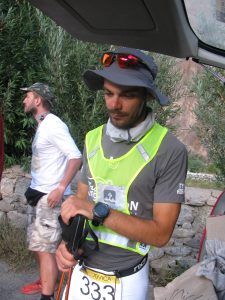
Jovica, evening of August 13 (Photo: Shyam G Menon)

Jovica, evening of August 13; the 333 km-runners have been on the road from August 11, 8 PM, onward (Photo: Shyam G Menon)

The unending climb took its toll on Jovica. He grew tad irritable. At one point he asked me if I knew exactly how many kilometres remained to the pass. He seemed searching for an answer better than the regular Indian reply of: it’s just over there. Although I had been on that road before as a traveler, I hadn’t observed it well enough to estimate distance, particularly at night. My response was disappointingly vague. Another time Jovica wondered if this combination of endless ascent and their tired selves was “ some sort of scientific experiment.’’ Grant assured in a composed voice that their problems stemmed from the night denying them perspective to gauge distance. Grant was however battling other worries – it was cold, exhaustion had been creeping in and Tanglang La was once again, a return to elevation. Not far from the pass, the medics came by checking on the duo. The runners asked if the medic’s car could be driven slowly so that they could follow its lights to the pass. That’s how Jovica and Grant reached Tanglang La. It was bitterly cold.
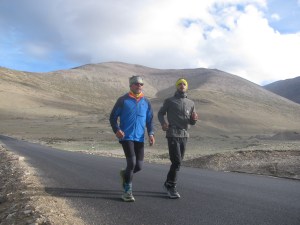
Morning of August 14; Grant and Jovica on the final stretch to Dibrung (Photo: Shyam G Menon)

Morning of August 14; past Tanglang La, Grant and Jovica on the final stretch to Dibrung (Photo: Shyam G Menon)

The medics assessed Grant. “ Jovica was tired. But Grant was not engaging mentally. He wasn’t responding. We quickly took him to the vehicle and turned the heating on. His oxygen saturation was 65 while everyone else was at about 75. He was told that medically he is unfit to continue for the next ten minutes. He accepted that,’’ Nick said. During the ten minutes that followed, Grant had a litre of water and two chocolate bars. He was reassessed. His oxygen saturation was now around 85. His lungs were clear. He was allowed to continue the race. According to Nick it was a case of exposure exhaustion. Jovica once again waited till Grant was back on his feet. Tanglang La, appearing late in the race when runner is exhausted, has always been the real challenge in La Ultra. “ The pass is 309 km into the race. That’s a lot of running by any standards even if it is in the plains. Now add high altitude and extreme cold to it. This year’s medics pushed my extreme approach too. They are thorough professionals who appreciate what runners are doing and what it means to them. As a support team, they were the find of the event. We are still learning how the human body responds to endurance events in such extreme conditions,’’ Dr Chauhan said.
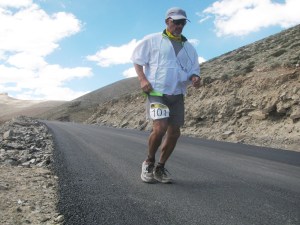
Mark on the final stretch to Dibrung (Photo: Shyam G Menon)

Mark on the final stretch to Dibrung (Photo: Shyam G Menon)

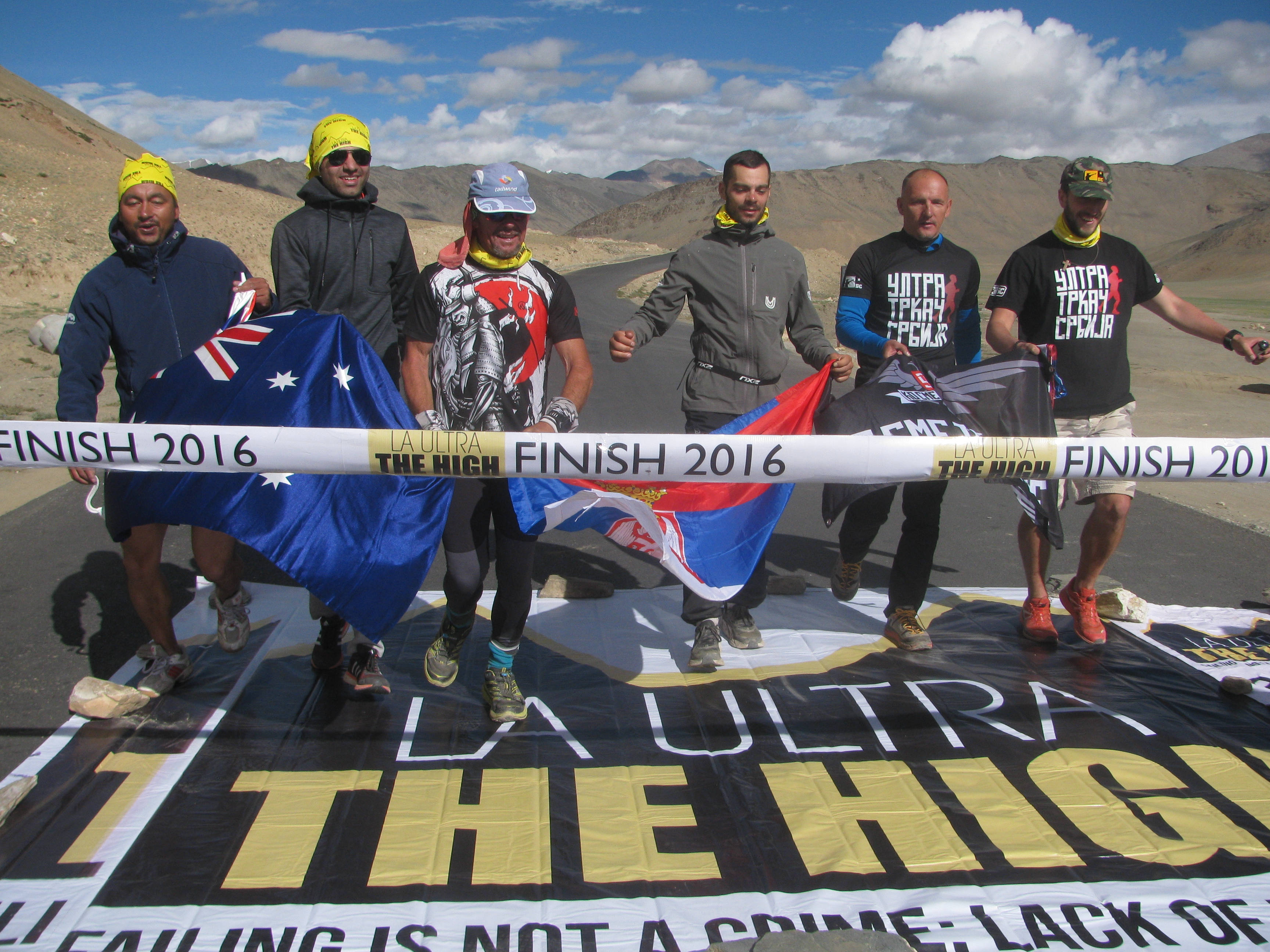
At the 2016 Badwater Ultramarathon where Grant finished sixth, completing the race in seventeenth position was Ray Sanchez. In 2011, Ray, running La Ultra in its then 222 km-avatar, had a memorable tryst with Tanglang La. It was there, delirious and disoriented, that he lost his lead to Sharon Gayter who went on to win that edition of the race. I didn’t specifically ask the runners but I suppose, crossing Tanglang La is a psychological threshold in La Ultra. You know you are now on the home stretch albeit still with work to do for someone racing against time, as there is one final cut-off – 333 km in 72 hours – to meet. The lead duo of 2016 had however made it to the pass with much time to spare. The peaks around wore a crown of early morning sunshine as Jovica and Grant jogged down the descent from Tanglang La. A little over a half marathon now remained. Their passage to Dibrung was largely uneventful. Sixty hours and 37 minutes after they commenced their run in Diskit, Jovica and Grant crossed the finish line in Dibrung, together. It was a new course record. Grant later described his partnership with Jovica during the race, as akin to a “ father-son relationship.’’
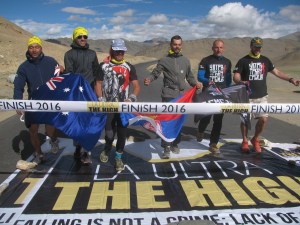
Grant, Jovica and their support crew at the finish line (Photo: Shyam G Menon)
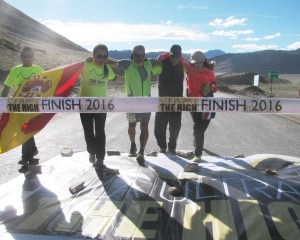
Grant, Jovica and their support crew at the finish line (Photo: Shyam G Menon)

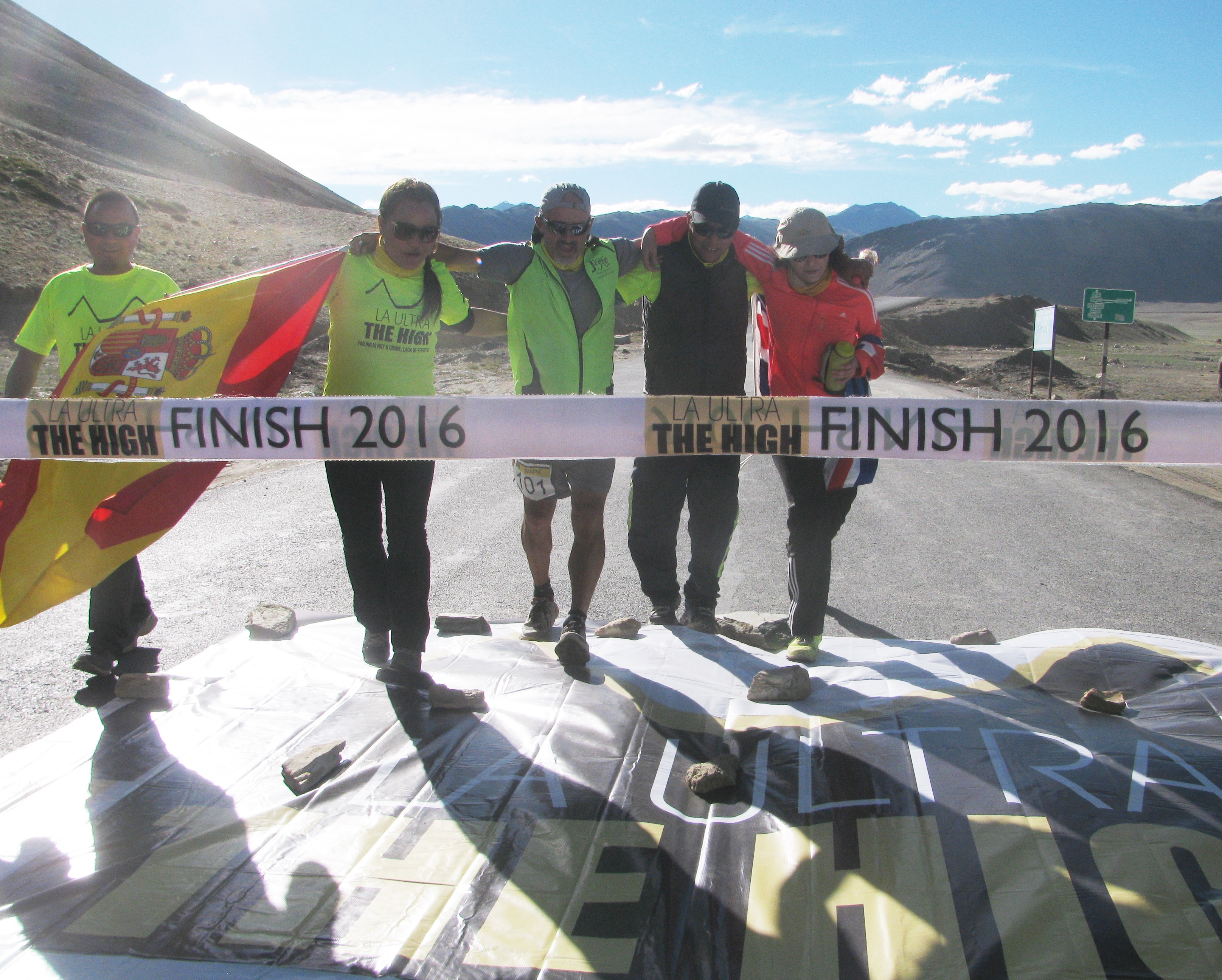
Mark and his crew reach the finish line in Dibrung (Photo: Shyam G Menon)
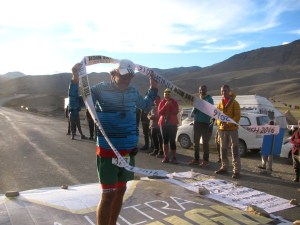
Mark and his crew reach the finish line in Dibrung (Photo: Shyam G Menon)

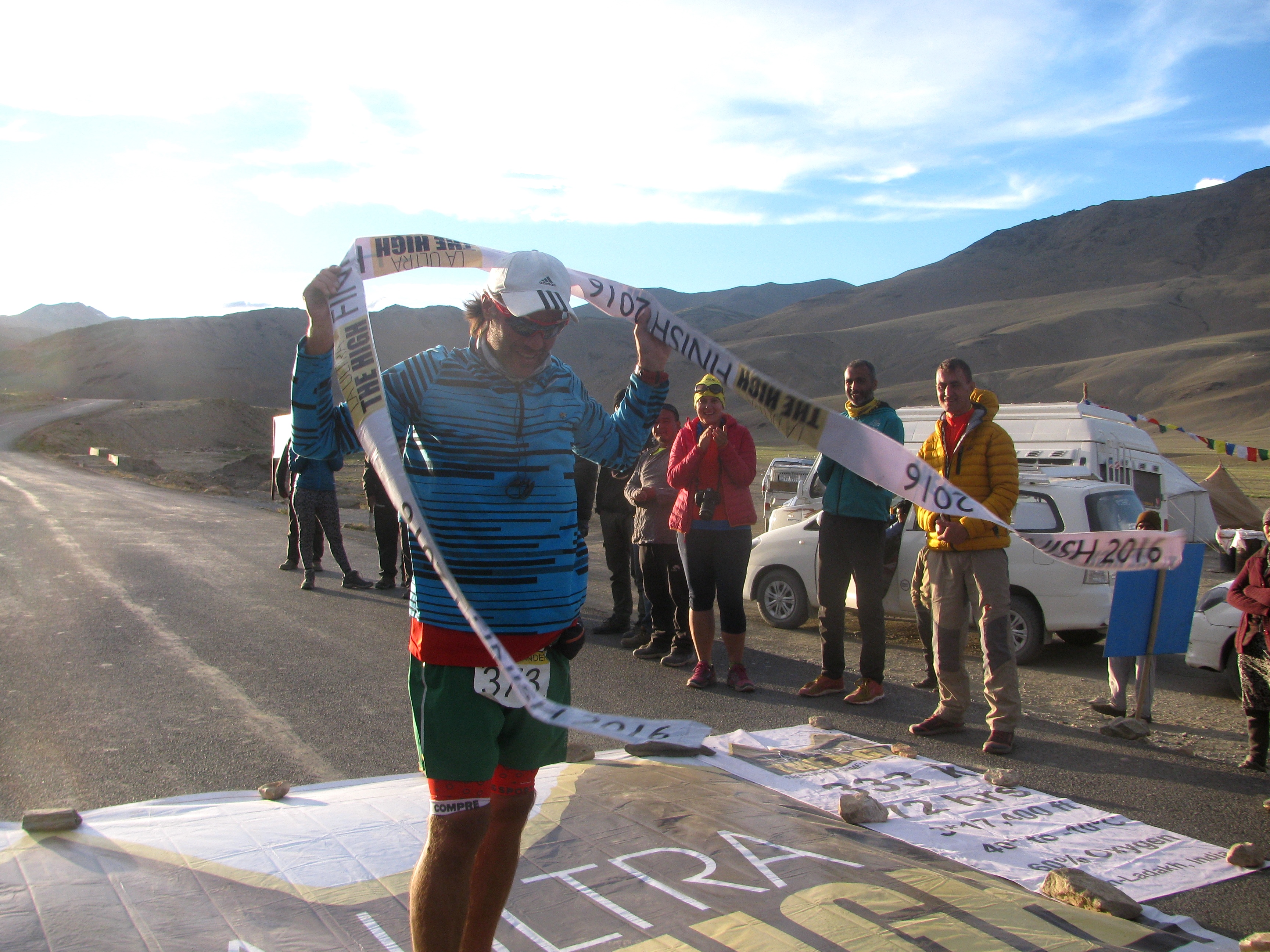
Alex at the finish line (Photo: Shyam G Menon)

Alex at the finish line (Photo: Shyam G Menon)

The previous morning, Alex had reached Wari La before Mark. On the way down, Alex decided to rest some time at the guest house in Sakti. Mark didn’t. He regained his lead. But at Karu he rested and Alex went ahead. The latter, reaching Rumtse ahead of Mark elected to rest for about two hours. Mark reached Rumtse late but kept his rest short. Some hours after Jovica and Grant had crossed the finish line, it was Mark we met first on the Dibrung side of Tanglang La. Alex was still a bend or two below on the other side of the pass. At one point, as he walked down the sunlit face of Tanglang La, Mark said, “ my energy level is fine. My legs feel like blocks of concrete.’’ If you run your hand on the bone above Mark’s ankle, you can feel a line of screws beneath the skin. There’s a rod in there. On the knee of his other leg, to the side, is the scar of a surgery gone by. Both are joints that have seen much work. “ The ankle holds up but the knee tends to hurt,’’ he had said in Leh ahead of the race. Elena walked with him for a while on the home stretch to Dibrung. Just before the finish line he was joined by his whole team. That last bit, they walked together. On his third attempt at the 333 km race of La Ultra, Mark Woolley succeeded, completing it in 68 hours and 57 minutes. The finish is significant. Mark, 52, has been working on a book on his life in running. He can now write the chapter on La Ultra. It was evening by the time Alexander Holzinger-Elias reached the finish line. He had taken a chance at 333 km and cracked it in the very first attempt. He completed the race in 70 hours, 39 minutes. V.S. Ramachandran was part of Alex’s support team for the first half of the race. “ I was sure from start that Alex would complete the run,’’ he said.
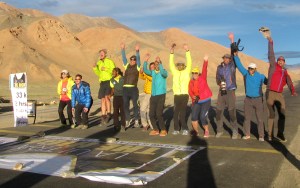
Some fun at the finish line (Photo: Shyam G Menon)

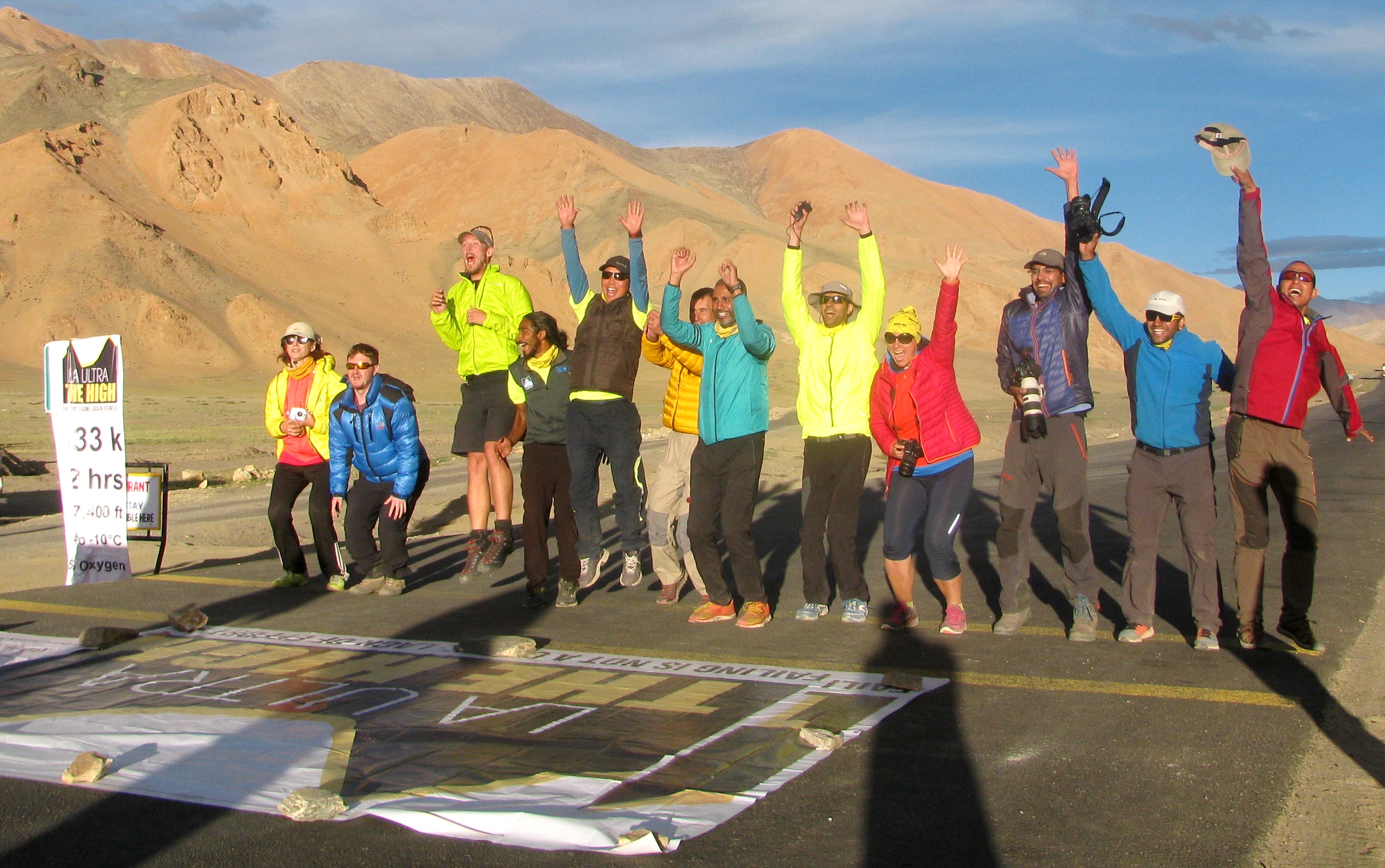
Some fun at the finish line while waiting for the runners (Photo: Shyam G Menon)

The thing about La Ultra is that because it is an extended commitment, it forges bonds. “ I think we are all sad that it’s over,’’ Alex said after the awards ceremony on August 15. “ Post-race blues,’’ Grant said smiling. Mark felt Grant is among the toughest adventure racers in his age category at present in the world. Grant thought of himself as a gypsy. This life – hopping from one race to another, encountering different cultures, enjoying the company of ultramarathon runners – suited him. He hadn’t worked the past six months. He had invested his earnings such that he could keep race-hopping. But resources were running out and he knew he would have to skipper a boat or two to further the gypsy life. I asked him if he had anticipated his troubles at Khardung La. “ I thought I went in good considering I acclimatized well and the distance seemed doable. It surprised me that the altitude got to me. There are quite a few bits and pieces of the race that I can’t remember,’’ he said. About Jovica he said, the Serbian is a talented runner, somebody to watch out for. As for La Ultra itself, Grant felt “ it is really, really extreme.’’ But describing any race as `toughest in the world,’ more than one runner cautioned, would be incorrect, for at day’s end perceptions are personal. I asked Elena if she would return to being on the support crew for Mark, now that she had made her debut at the job in Ladakh. A photographer, she didn’t consider herself a sportsperson. She wasn’t sure she would repeat the experience. People are different; some are into sports, some are creative. What each one is should be respected. She said of Mark, “ if he is angry or upset, you give him his running shoes. He goes out for a run, he is calm again.’’ Late August 2016 – I searched for Grant Maughan on the 2016 Leadville Trail 100 results. A week after La Ultra, he had finished second in his age category at Leadville.
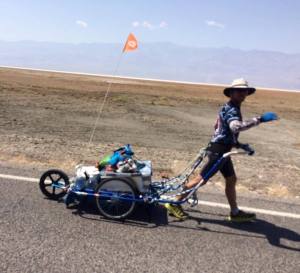
Grant, during Badwater 146 mile solo, self supported crossing he did in the days after the 2016 edition of La Ultra (Photo: courtesy Grant Maughan)

Grant, during the Badwater 146 mile solo, self supported crossing he did in the days after the 2016 edition of La Ultra (Photo: courtesy Grant Maughan)

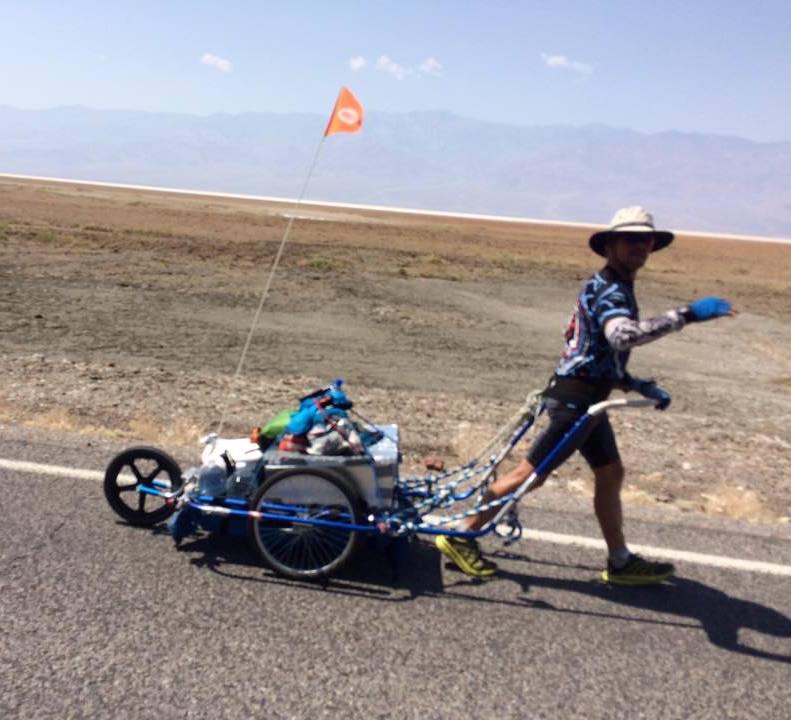
Postscript: One month after the 333 km race in Ladakh, Grant wrote in with a small synopsis of what he had been up to. He wrote: a few days after finishing La Ultra “ I was back in Colorado to run the Leadville 100 mile trail race which I managed to do in sub-24 hours. Then I drove for two days back to Death Valley and completed the Badwater 146 mile; solo, self supported crossing and broke the record by about six hours (49 hours 42 minutes). Solo means you have to carry enough water, food and gear to get from Badwater Basin in Death Valley all the way to the summit of Mount Whitney (highest mountain in lower 48 states of the US). I pulled all the stuff in a three wheeled cart. It weighed about 85 kilo at start because of all the water you need to carry. You are not allowed to resupply along the way or even get rid of garbage. Pretty cool!”

(The author, Shyam G Menon, is a freelance journalist based in Mumbai. The altitudes of mountain passes are as mentioned in the race route map. The details of DNF from earlier editions are taken from the race’s official website. There is an article on the 2011 edition of La Ultra available in the blog archives. At that time the race was of 222 km and it started from Khardung village. The organizers have been talking of increasing the distance of the race to 555 km and 666 km, making it multi-stage alongside. An article on that too can be found in the blog archives.)     


THE INDIAN NAVY’S FIRST ULTRAMARATHON TEAM

The Indian Navy's ultramarathon team (Photo: courtesy La Ultra / the navy team)

The Indian Navy’s ultramarathon team (Photo: courtesy La Ultra)

In May 2016, a set of events underway since February that year resulted in a message dispatched from headquarters to all the commands of the Indian Navy.

It sought volunteers to represent the navy in an ultramarathon.

For a force used to life at sea and deployed at bases along the seashore, the ultramarathon in question was at elevation; its altitudes ranged from 10,000 ft to 17,500 ft.

The person responsible for this situation was Captain Rajesh Wadhwa. Since 2004, he had been into running, progressing through a clutch of half marathons and full marathons to the ultramarathon. “ I used to think the full marathon is the longest distance around for running. It was an eye opener learning of the still longer distances people run,’’ he said. Capt. Rajesh’s first proper ultramarathon was a run of 80 km near Delhi, part of the 2014 Bhatti Lakes Ultramarathon. “ The dream was to run those races where fewer people queued up,’’ he said. Among the things he liked about the ultramarathon was its demographic profile – it was a mix of ages; not the brute dominance by youth you typically associate with sports. Further, as the distance to run grew with rising need for endurance alongside, the older, experienced runner wasn’t a push over. He / she clearly had something to bring to the table in an ultramarathon.  Having successfully completed the Bhatti Lakes 80 km run (he completed it in 12:33 hours to finish third), Capt. Rajesh did a couple of shorter ultramarathons. But the euphoria was short lived. His attempt at a longer distance – 100 km – at the next edition of Bhatti Lakes ended in Did Not Finish (DNF). Unwell, he had to withdraw from the race at around kilometer-60.

In February 2016, he found himself in Mussoorie, running Garhwal Runs, a 76km uphill of a race from Mussoorie to Dhanolti. The event was also a qualifier for the 111 km-category of La Ultra, the ultramarathon in Ladakh with three race categories –111 km, 222 km and 333 km. The overall cut off time for the Garhwal Runs-76 km was 12 hours. But if you did it in 10 hours, you qualified for the 111 km-segment of La Ultra. “ I started the race with no expectations. When I got tired, I walked fast. I kept moving. After several hours, I realized I was running second. That was when I asked: oh my God, what’s happening? A little later I caught up with the leader. He was walking. Seeing me, he picked up pace. I gave the guy a good chase. He was a youngster, as old as my son. Then at some point, I turned the last corner and there was the finish line. I crossed it bang on the tenth hour. That was fantastic!’’ Capt. Rajesh said. He was not only podium finisher; he was eligible to run the 111 km-category in La Ultra. On return to office in New Delhi, he applied for permission to participate in the ultramarathon in Ladakh, representing the Indian Navy. Intrigued by ultramarathon, the navy’s adventure cell recommended a team. Until then, the navy’s officers and employees had participated in ultramarathons in their personal capacity. Procedure required that the event organizers extend an invitation to the Indian Navy, so that the invitation to an organization – as opposed to an individual – would create sufficient grounds to float a team. The organizers of La Ultra invited the Indian Navy to participate in the event’s 111km race. Invitation secured, the navy dispatched its message of May 2016, seeking volunteers.

Cdr. Sunil Handa's collection of mementos from the races he participated in (Photo: Shyam G Menon)

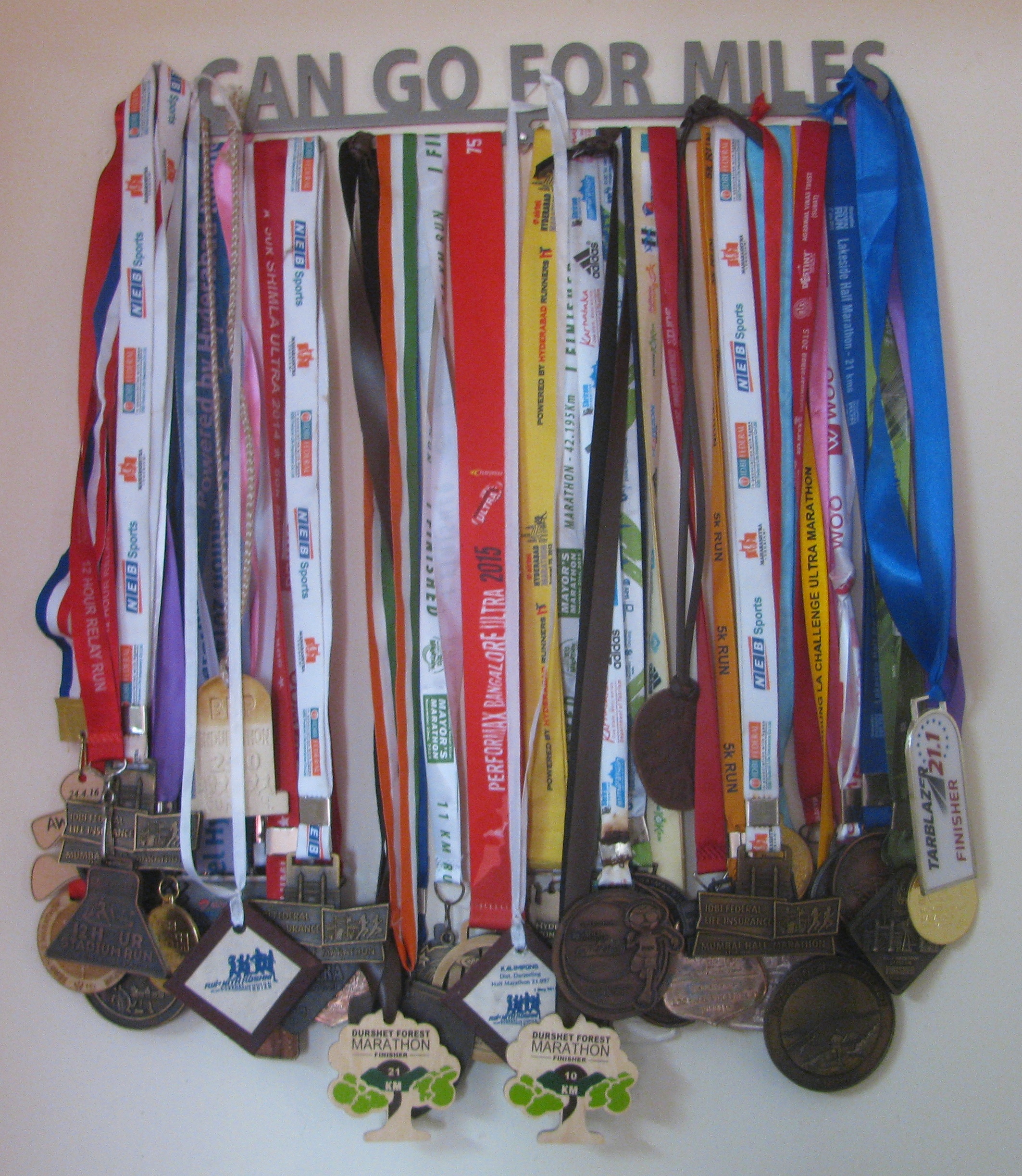
Runner in the house; Cdr. Sunil Handa’s collection of mementos from the races he participated in (Photo: Shyam G Menon)

Running is a common human activity and in the forces, it is a tradition from training days. But there is a huge difference between those training runs, the later runs to stay fit and an ultramarathon. Not many realize this. In response to the navy’s call for volunteers, some 20-25 persons stepped forward. More interesting and rather revealing of how little understood the ultramarathon is – there were applicants enthusiastic to run La Ultra’s 222 km and 333 km races as well. The navy realized it had a job on its hands. The number of volunteers had to be trimmed to about 6-8 persons and the selection process required to mimic some of the challenges of an ultramarathon so that the volunteers stayed aware of what they were getting into.

In Mumbai, Commander Sunil Handa – he and Capt. Rajesh had run together before in Vizag – had earned a reputation in the city’s running circles as an ultramarathon runner. He is also a mountaineer. In 2015, he had run the Khardung La Challenge – an ultramarathon of little over 70 km, held every September in Ladakh. Focusing on the challenge offered by the pass, the route spans Khardung village, up and over Khardung La, on to Leh. While preparing for the ultramarathon, Cdr. Sunil ran the 2015 Mumbai Ultra, an annual 12 hour-endurance run held on a stretch from Shivaji Park to Worli sea face, in the city. Impressed by this and seeking to run with him thereafter, was Petty Officer Hari Om from the Indian Navy. He was also a mountaineer. The following September, both Cdr. Sunil and Hari Om completed the Khardung La Challenge, Hari Om finishing just outside the cut off time. Familiar with mountains and mountaineering, the two had followed an acclimatization schedule ahead of the run, which included an ascent of the 20,182 ft-Stok Kangri, albeit a cheeky and not to be recommended fast ascent of the peak. Rajesh knew that he could count on these two runners from Mumbai to be part of the proposed team.

Cdr Sunil Handa; August 12 morning, just past South Pullu (Photo: Shyam G Menon)

Cdr. Sunil Handa; August 12 morning, just past South Pullu (Photo: Shyam G Menon)

Problem was with selecting the others. Getting all the volunteers to assemble in one place for selection was difficult as they had their official responsibilities to attend to. It was decided to take the selection to them; have the trials where the volunteers are. With those overseeing sports at the various commands struggling to comprehend what they should look for in a potential candidate for this little known discipline called the ultramarathon, Cdr. Sunil was tasked with the selection in areas under the Mumbai based-Western Naval Command. For the rest of the commands, Capt. Rajesh decided to do the selection himself. As he was based in Delhi, he counted on technology and his knowledge of the running routes at the various commands, to oversee the process. On the average, Cdr. Sunil said, the volunteers ran 70-80 km during the selection trials. Where possible, they ran on routes Capt. Rajesh suggested (for instance, he knew the routes in Vizag very well, including how to combine inclines and flats for a route offering a miniature experience of what an ultramarathon entails). The runners used WhatsApp to update him real time. “ Since I wasn’t there in person, there was a lot of trust involved,’’ Cdr. Sunil said. It was a selection process that saw navy runners tackle long distances amid official duties, family responsibilities including children’s exams and even the monsoon (the trial run in Kochi had to be postponed owing to heavy rain).  Late July, a team of six runners met up in Delhi and proceeded to Leh. Captain Rajesh Wadhwa, Commander Sunil Handa, Commander Navneet Nagi, Lieutenant Commander Kanishka Chandel, Lieutenant Amit Kumar and Petty Officer Hari Om, – they became the first official team from the Indian Navy headed for an ultramarathon.

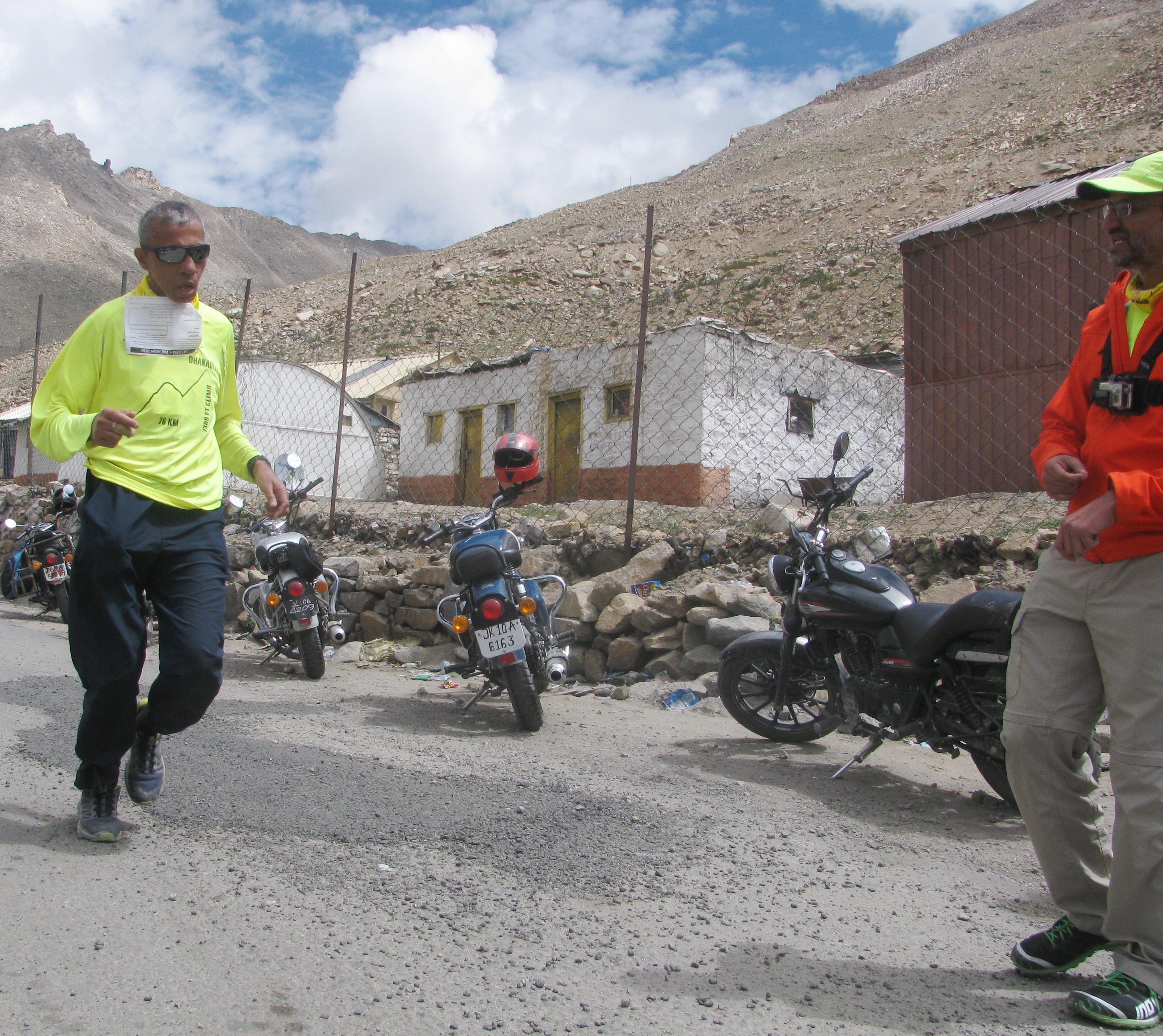
Hari Om, on the home stretch from South Pullu (Photo: Shyam G Menon)

Hari Om, on the home stretch from South Pullu (Photo: Shyam G Menon)

Taking a leaf from the previous trip of Sunil and Hari Om to Ladakh for the Khardung La Challenge, the team decided to do the Markha Valley trek with a climb of Kang Yatse II for acclimatization. The navy’s adventure cell arranged required gear. After the mandatory rest period in Leh, the team commenced its trek. One of the highlights of this hike to get used to altitude was doing yoga at elevation. However, the day they set out for the summit of Kang Yatse II, Capt. Rajesh had to make a choice. Except for Cdr. Sunil and Hari Om, none of the others were mountaineers. On the other hand, they were all runners and they had all come to Ladakh to run an ultramarathon. It raised a simple question: does the team climb Kang Yatse II all the way to the top or does it focus on the need to acclimatize and save its energies for the ultramarathon? On the mountain, when they were as high as Khardung La (the highest point on the La Ultra course), Capt. Rajesh posed the question to his team: what is the best option? Eventually Hari Om went on to summit the peak while everyone else proceeded back to camp. That reminder about running made sense, for the next day, in the vast, relatively flat terrain of Markha Valley, the team members spent their time doing yoga and running. Armed with these preparations and a team song they had composed during the hike, they returned to Leh for a few days of proper rest. On August 9, there was a meet up of all those participating in the 2016 edition of La Ultra.  Capt. Rajesh introduced the navy’s ultramarathon team with characteristic humour.  Referring to the team and its mix of varied age and experience, he said, “ I am the team’s daddy, Sunil, the uncle and Amit, the kid.’’ The next day everyone proceeded to Diskit, where the start line of the ultramarathon was. Amid the short walks around Diskit to get used to the environment, Capt. Rajesh remembers getting several messages from friends and supporters, wishing the team luck. He also had an infected blister on his hand – got from using an ice axe on Kang Yatse – lanced, drained and dressed by the race medics.

Race Director Dr Rajat Chauhan (right) looks on as Capt Rajesh Wadhwa (left) reaches South Pullu in the nick of time (Photo: Shyam G Menon)

Race Director Dr Rajat Chauhan (right) looks on as Capt. Rajesh Wadhwa (left) reaches South Pullu in the nick of time (Photo: Shyam G Menon)

The race began on the night of August 11. According to Cdr. Sunil, although he and Hari Om had run up and over Khardung La before, the La Ultra version of the experience with start in Diskit, made the run more challenging. It increased the distance and overall height gain to Khardung La and with the race commencing at night, he was forced to cope with something he hadn’t tackled before in a run or trained for – sleep deprivation. “ Between North Pullu and Khardung La, around two kilometers from the top, I was really in need of sleep,’’ he said of that passage through elevation and cold. Pass done and descent to Leh commenced, his condition improved. Meanwhile, in the distance between Diskit and North Pullu, two runners from the navy team had failed to meet stage cut-offs. They were eliminated from the race. Capt. Rajesh – Hari Om with him – was having a tough time. The initial portion of the race had gone off well for him.  Past kilometer-30, the two even did some yoga. But somewhere on the approach to North Pullu, Capt. Rajesh had sensed the pace slackening. There was a sense of daunting task, growing. At the same time, the 52 year-old knew that the onus of the team’s performance rested on him for he was skipper. He pushed on as best as he could. He reached North Pullu tired and out of breath. The race medics hovered around him. They checked on the runner. Before Khardung La, two to three bends below the pass on the North Pullu side – at the spot where Polish runner Dariusz (Darek) Strychalski was taken off the race – the Race Director spoke to Capt. Rajesh. There was concern that he was pushing his limits a bit too far. The naval officer told Hari Om to carry on. Then he explained how as a military man he cannot give up, how much he owed to those who had wished him well for this run. A little later, he resumed his trudge to the pass.

In retrospect, that was a turning point.

Cdr. Sunil, Hari Om and Capt. Rajesh (Photo: courtesy La Ultra / navy team)

Cdr. Sunil, Hari Om and Capt. Rajesh (Photo: courtesy La Ultra)

As a new day dawned and Ladakh’s sun revealed the surrounding topography, the runners diminished to minor detail on big mountain. Some hours later at South Pullu on the other side of Khardung La, Race Director, Dr Rajat Chauhan took his position to count down the stage cut off for that section. Enforcing stage cut off is a heartless job; it is door shut and no looking back. Making it home with minutes to spare was Capt. Rajesh. Before South Pullu, with about 15 minutes left for stage cut-off, he had given that portion of the race all he had. “ That third cut-off – that was the toughest stage for me,’’ Capt. Rajesh would say later. Right then it meant, the navy had successfully preserved its surviving quartet. Ahead on the race’s final stretch, proceeding to a comfortable finish were Lt. Amit, Cdr. Sunil and Hari Om. Nick Dillon and Tim Berrow, the race’s medical team, were impressed. “ Capt. Rajesh Wadhwa was a concern. He was exhausted. He was just very, very tired. But he wasn’t medically unfit to continue. I gave him one chance to continue. He took that chance and made the most of it,’’ Nick said.

Earlier, when Capt. Rajesh halted before Khardung La to chat with the Race Director, a small but significant step occurred. He told Hari Om to go ahead. While young ultramarathon runner, Kieren D’ Souza smashed the course record to finish 111km in 15:30 hours, Hari Om, tapping into some new found energy, finished a creditable third giving the Indian Navy a place on the podium. Altogether, four members of the Indian Navy team – Hari Om (19:04 hours), Cdr. Sunil (19:20), Lt. Amit (19:30) and Capt. Rajesh (19:33) – completed the 111km-race, the navy’s first official participation as a team in an ultramarathon.

Now that they have a team in place, the navy plans to run more ultramarathons. For starters, they have their eyes on attempting one of the two ultramarathons in the Rann of Kutch. “ This is the beginning of a journey,’’ Capt. Rajesh said.

(The author, Shyam G Menon, is a freelance journalist based in Mumbai. The photos credited to La Ultra were provided by the navy team.)

THRESHOLD

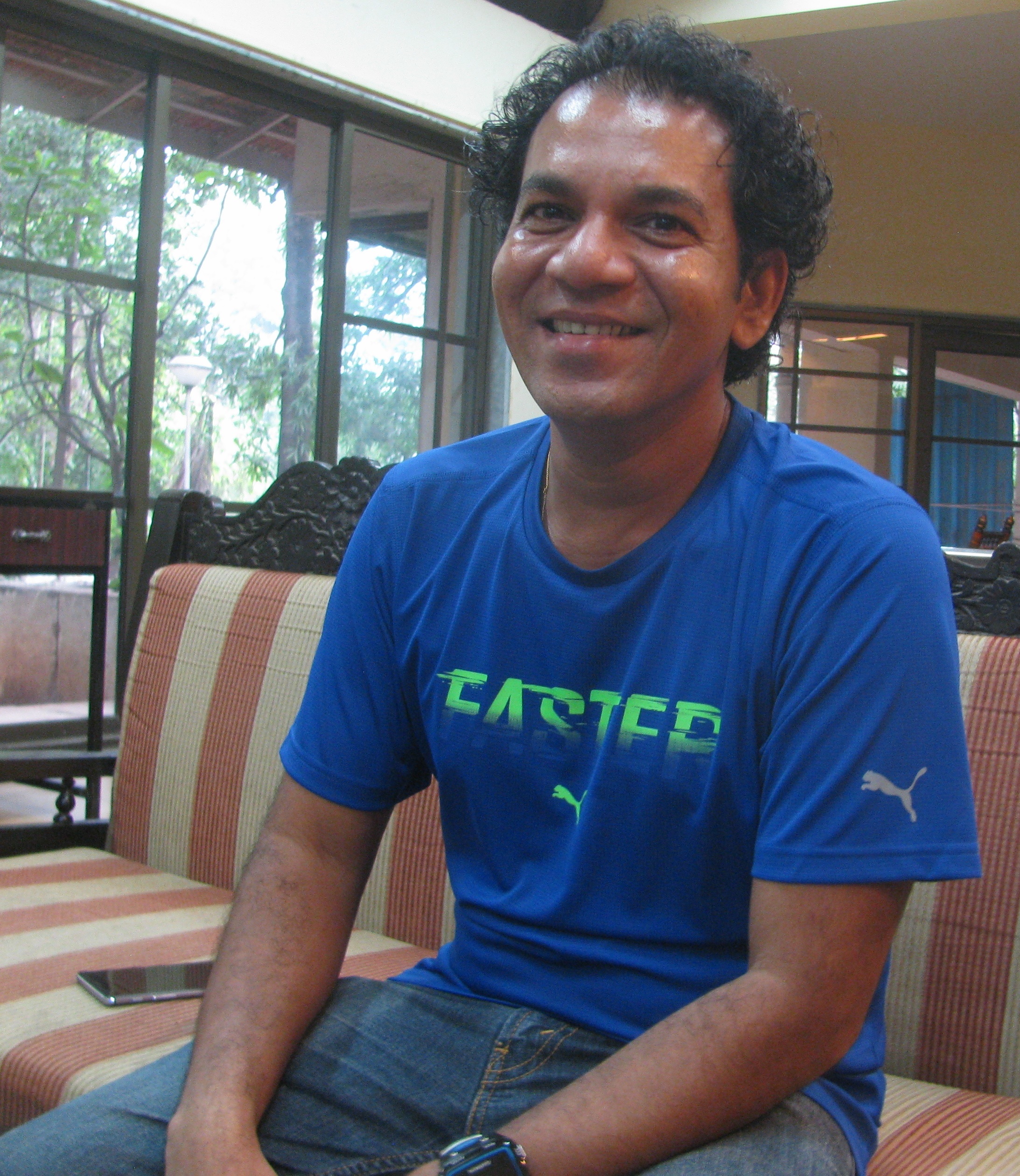
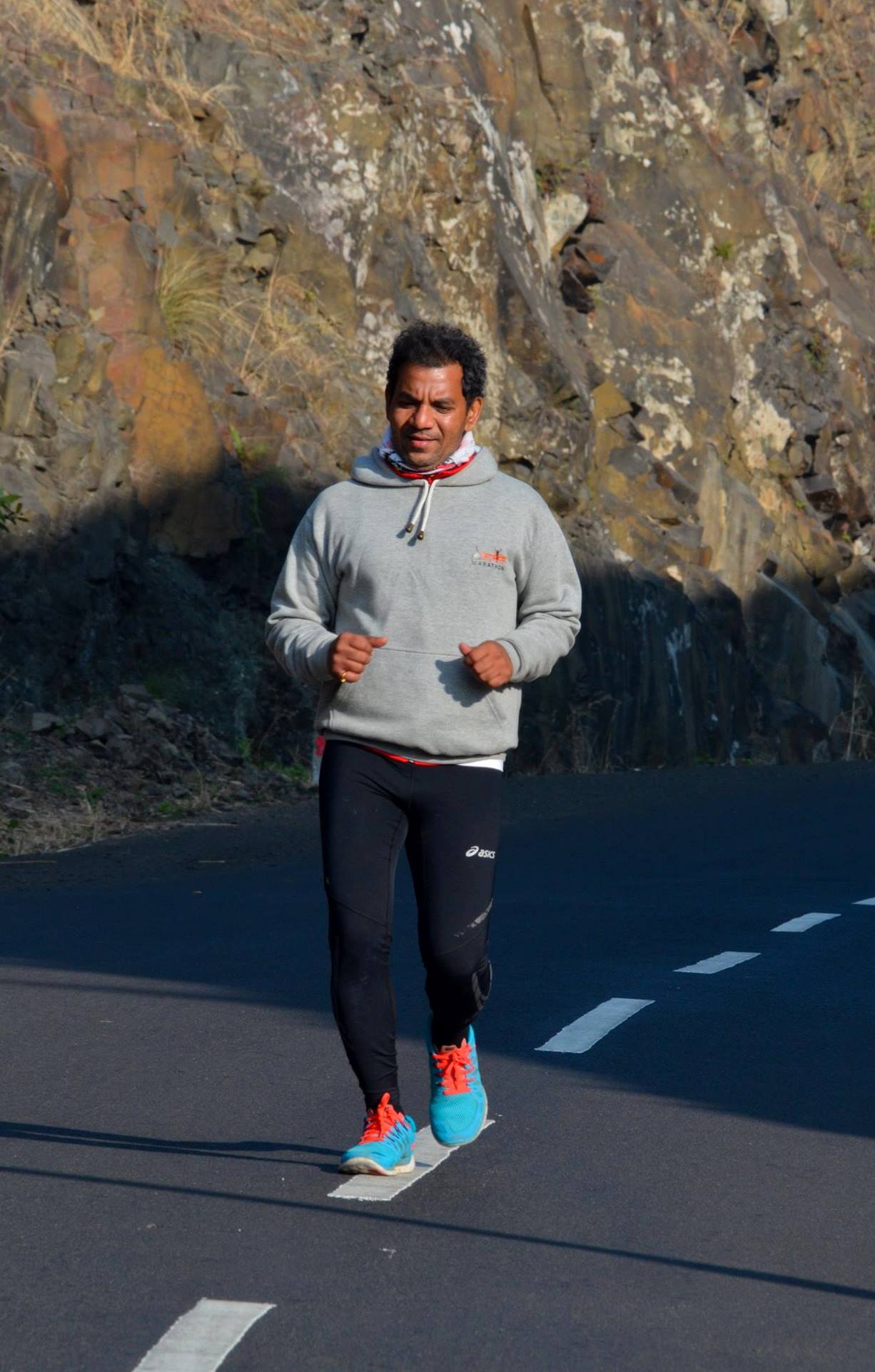
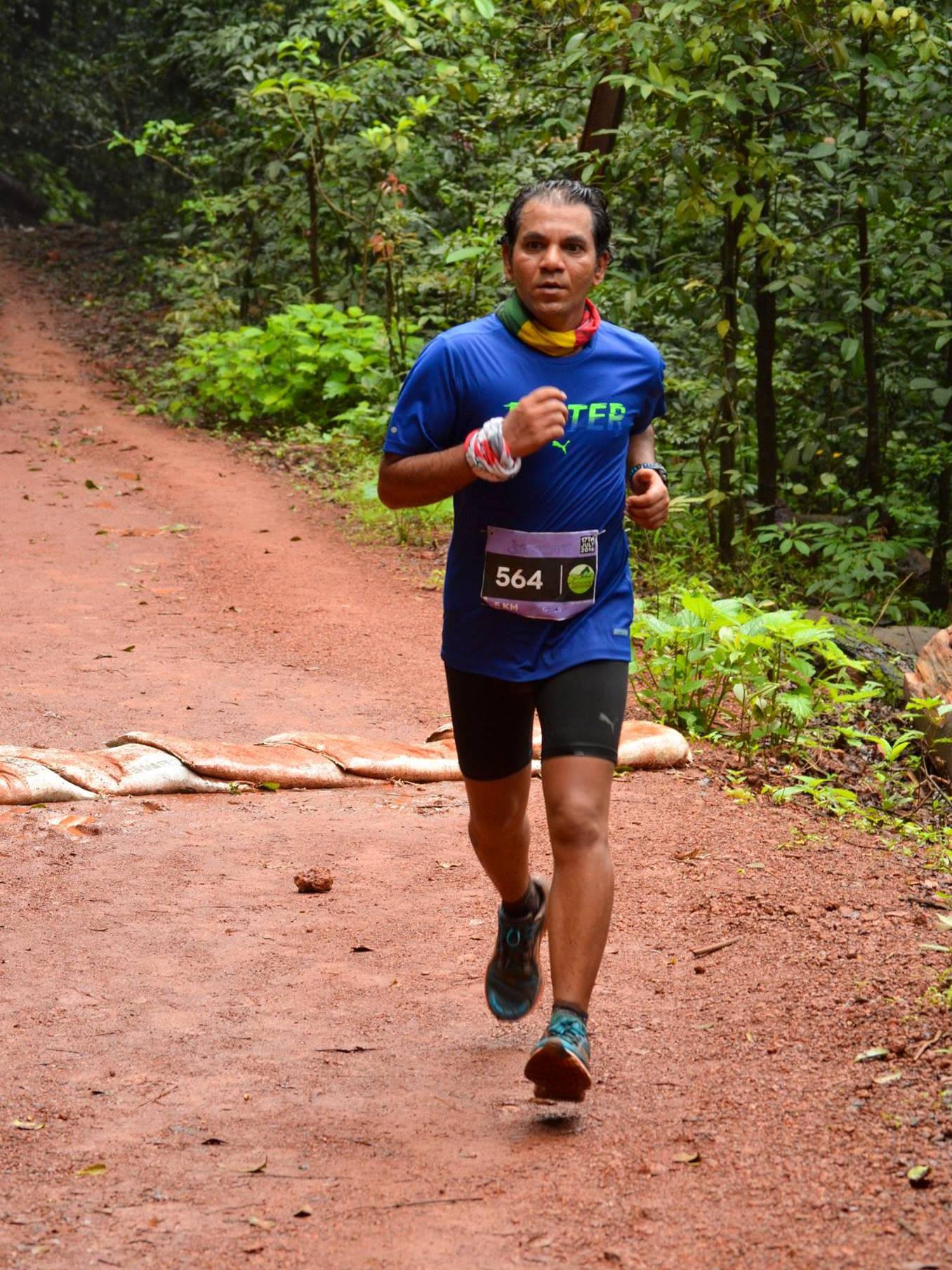
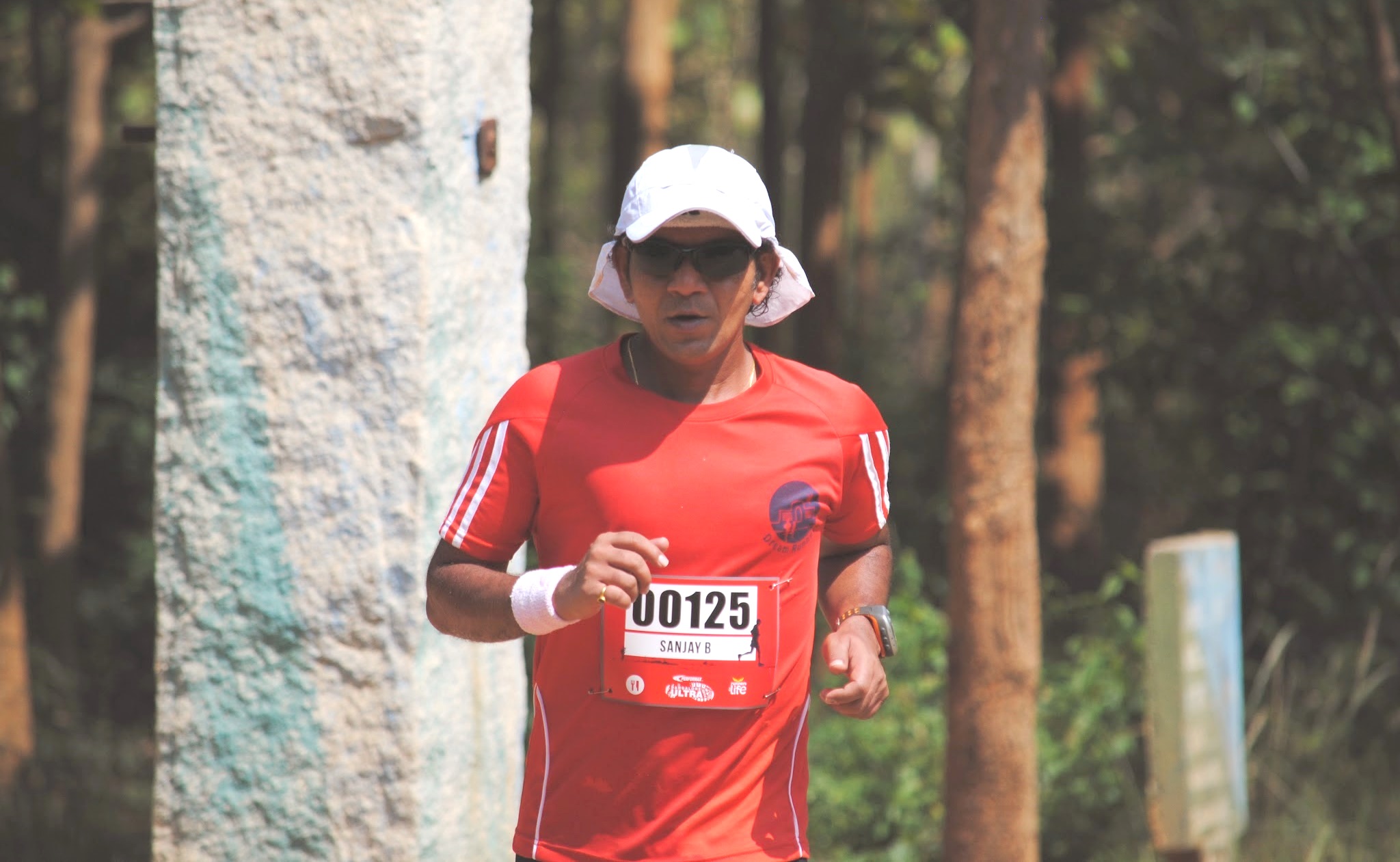
Sanjay Bhingarde (Photo: Shyam G Menon)

Sanjay Bhingarde (Photo: Shyam G Menon)

Entering the Indian Institute of Technology (IIT) at Powai in Mumbai, smacked of threshold.

Just beyond the gate, city faded without you quitting city. A verdant green canopy took over, you felt lungs and oxygen. Building blocks housing the institution’s schools, hostels, recreational facilities – they loomed to view. The tranquility and space was so unlike Mumbai. The place seemed built for running. On the other side of threshold, when you don’t have IIT, you create IIT in the head. A morning walk in city yet to go crazy; a morning run, time spent cycling – they open threshold in the head and gift you the IIT you miss. Two scribes with IIT in the head; to meet, was someone who ran daily at IIT.

A student dressed in shorts and T-shirt, running shoes on his feet, appeared at the lobby of the institute’s Vanvihar building, where we sat chatting. He looked inquiringly at our subject of interview. “ Carry on, I will join you later,’’ Sanjay Bhingarde said. The youngster trotted off. It was in 2004 that Sanjay found employment at IIT. In 2007, much before he was allotted a house in the IIT campus, he started running. Every day after work, he ran on campus and then left for home in Thane. Although he had no background as athlete or sportsperson, he says, he took well to running. But for a long time he didn’t bring his running to the events that lay on the outside, beyond the institute’s threshold. He was very worried about timing. Events seemed all about timing; post event talk – indeed all talk in running – was about timing. For close to five years, he kept his running a private affair.

In August 2012, he marshalled courage and ran the half marathon at that year’s Varsha Marathon in Thane. He completed the run in 2 hours 35 minutes. “ The sight of people walking during a marathon was a comforting factor for me, who was attempting to overcome fears of timing. It was at that event that I got hooked to running events,’’ he said. Probably because he knew what he was overcoming to finish a run, post Varsha, he commenced a new practice – after finishing, he would run back along the track to encourage the stragglers. Sanjay soon began seeking out events to run at and running groups to be out with. In 2012, besides Varsha half marathon, he ran the half marathon events in Delhi (net time 1:57) and Pune and the half marathon segments of the Vasai Virar Mayor’s Marathon (VVMM) and the Goa River Marathon. He also ran a half marathon at night in Surat. Next year, he ran half marathons at Arrey in Mumbai and in Alibaug. Two things happened in 2013 – he started to try improving his personal timing; he also decided to attempt his first full marathon. Planning his daily runs accordingly, he graduated the weekend distance to runs of 20-25 km. For a group to run with, he joined Mumbai Road Runners (MRR).

Photo: courtesy Sanjay Bhingarde

Photo: courtesy Sanjay Bhingarde

“ People used to say that the Hyderabad marathon is the toughest among city marathons in India. So I opted for Hyderabad to do my full marathon,’’ Sanjay said. In 2014, he ran the half marathon at the Standard Chartered Mumbai Marathon (SCMM). In August 2014, he ran the 12 hour endurance run called Mumbai Ultra, held around the Dadar Shivaji Park-Worli area of the city. Starting at 5 AM and running till 5 PM, runners do many rounds of a six kilometer-loop. In 12 hours, Sanjay covered 77 km. End of that month he ran the Hyderabad marathon, his first full marathon, completing it in 5:44. “ That year, conditions were such that the Hyderabad run was a struggle,’’ he said. Two months later, running the full marathon in Bengaluru, Sanjay improved his timing by a whole hour, ending the race in 4:44. By that year’s VVMM in November, he had brought it down further to 4:30.

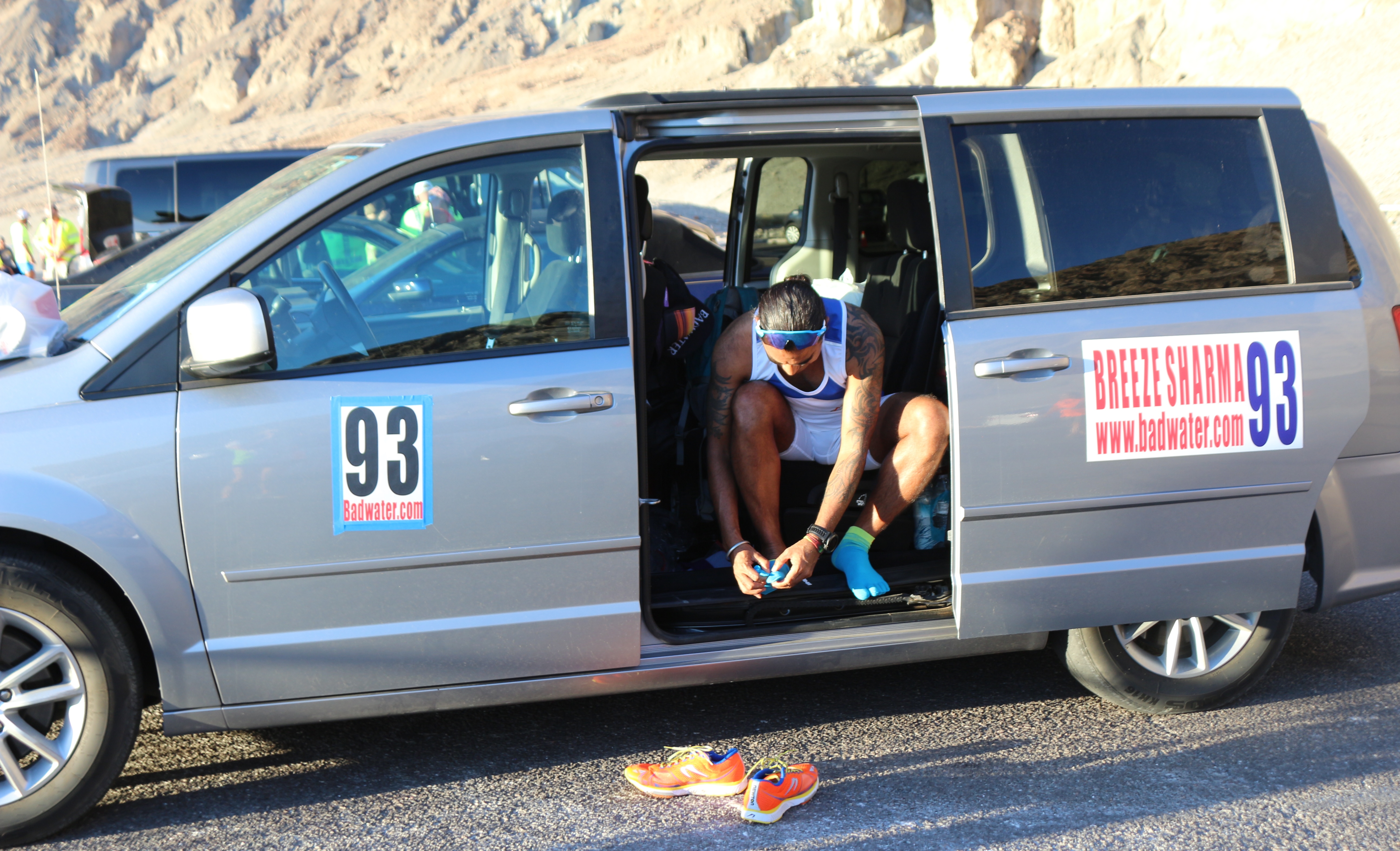
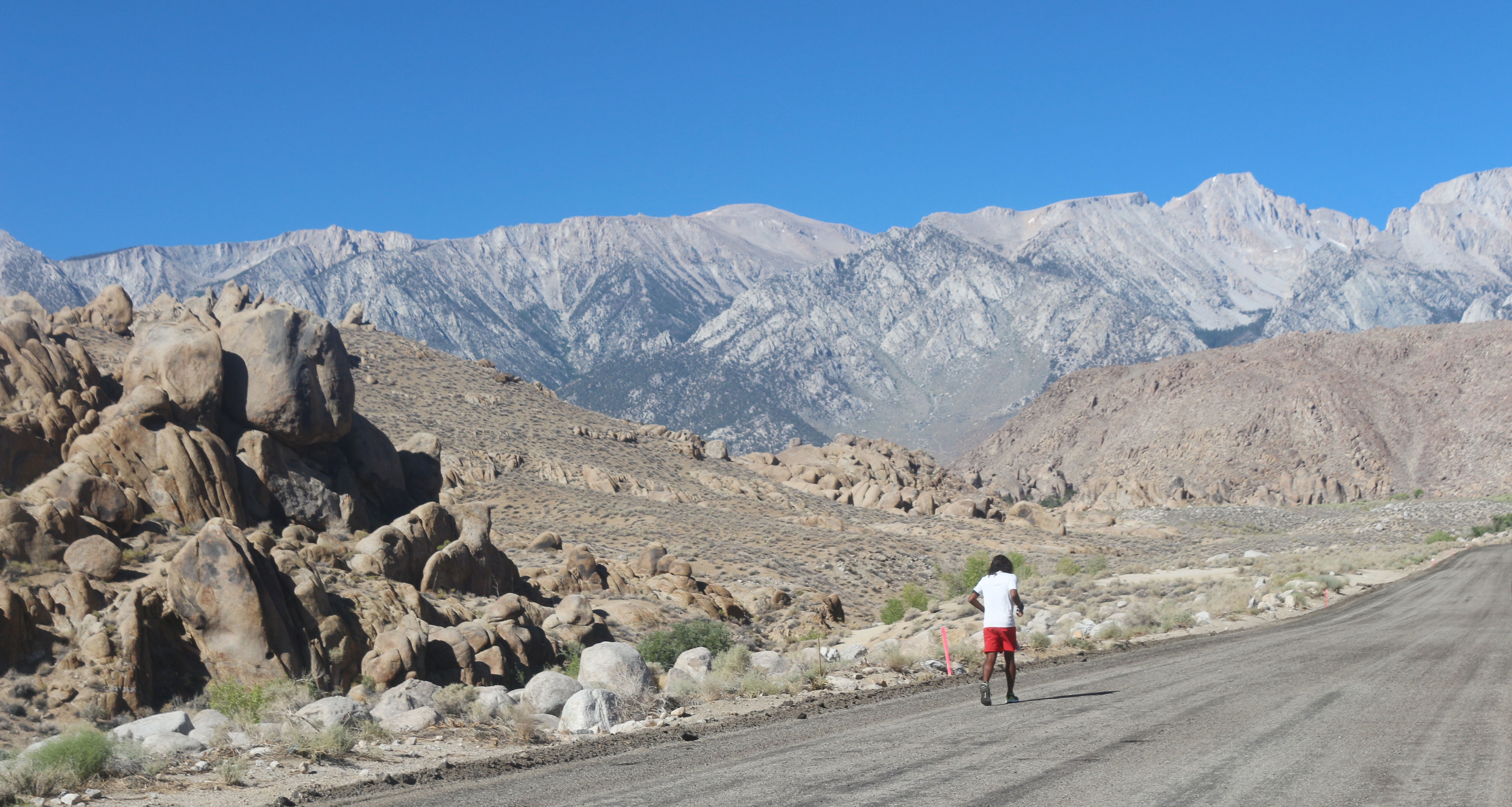
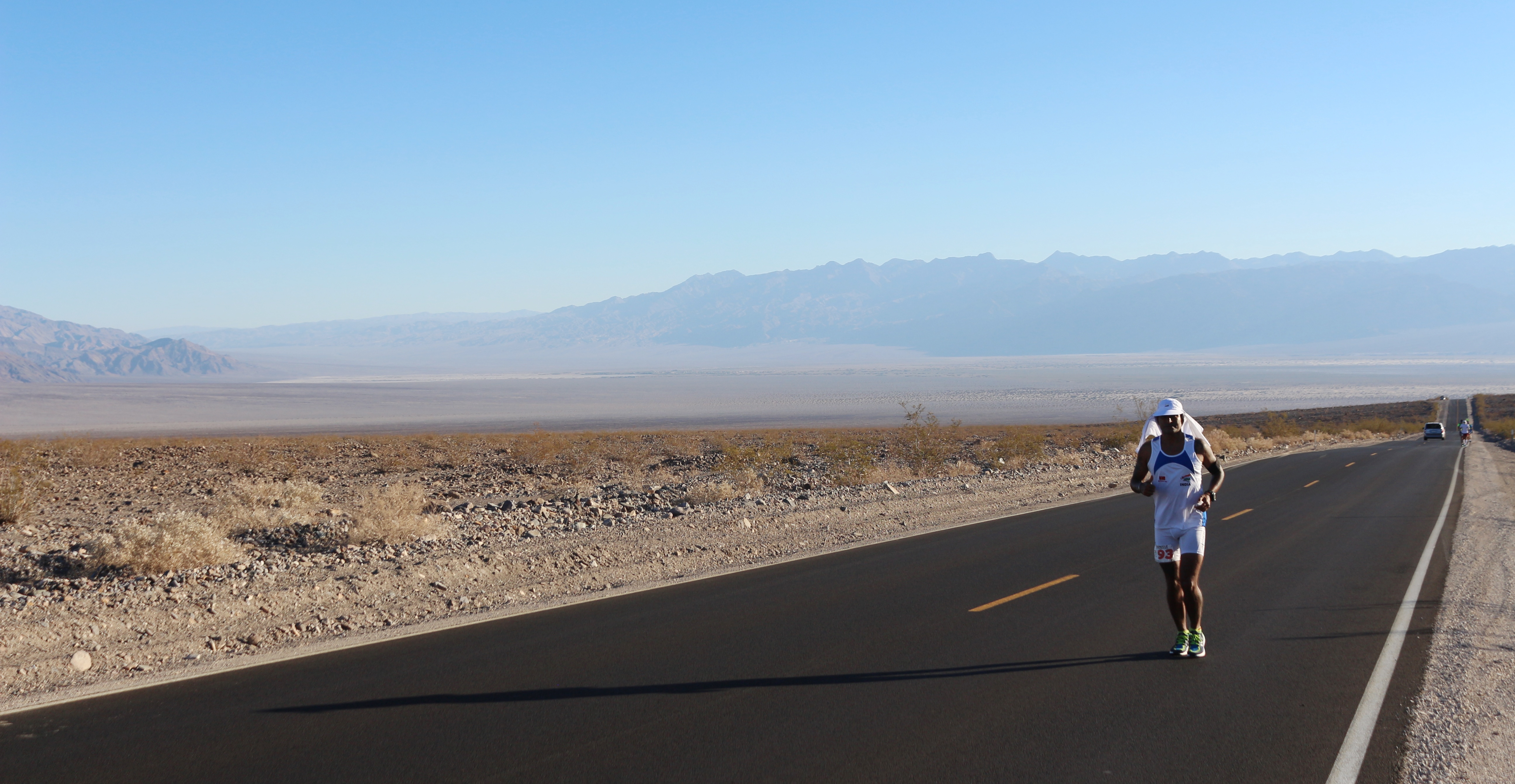
The Mumbai Ultra had left him with an impression. “ I felt running really long distances is my forte,’’ Sanjay said. What tilted the balance was this: he wanted to enjoy his running and room for enjoyment seemed most in ultramarathons. “ In comparison, the pressure to return a good timing takes off the joy in running, from half and full marathons,’’ he said. While these thoughts were playing out, at the Yeoor Hills Run of 2014, Sanjay met Breeze Sharma. The latter had gravitated to running long distances by then; in fact, Breeze would grow so rapidly in the field in the following years that in July 2016, he successfully completed the Badwater UItramarathon in California’s Death Valley, often called the world’s toughest footrace. He was the second Indian runner, after Arun Bhardwaj earlier, to complete Badwater. Sanjay told Breeze that he wished to attempt the 75 km-run at the upcoming Bengaluru Ultra. Although Sanjay had managed a creditable distance at the Mumbai Ultra, the event was designed for runners seeking a taste of ultra-running in a contained, safe – maybe even tad festive – environment. Breeze suggested that the duo do a 50 km-run as test to see if Sanjay had what it takes to run far. An afternoon, around 3 PM, they set off. The run progressed well; they even managed to increase their pace over the last two kilometres, a likely indication of reserves still available after some six hours of running, covering 50 km. Breeze recommended that Sanjay forget thoughts of doing the 75 km-run and instead opt for the 100 km-category. Accordingly Sanjay registered for that category at the Bengaluru Ultra, while Breeze enlisted for the 24 hour endurance-run. In Bengaluru, Sanjay finished his 100 km in 16:44. He felt encouraged enough to formally attempt a true blue ultramarathon, settling for the 100 km category at an ultramarathon in Gujarat’s Rann of Kutch. To prepare, Sanjay not only ran, he also began cross training. He started cycling. More importantly, he frequented the swimming pool at IIT. His swimming style honed in his village river long ago, was soon pointed out by the coach as something to correct. Correction done, swimming improved. He also bought a home gym.

Photo: courtesy Sanjay Bhingarde

Photo: courtesy Sanjay Bhingarde

Ultramarathons are much smaller events than city marathons; they can be fully supported events with aid stations at regular intervals or partially supported ones. Sanjay’s 2015 ultramarathon in the Rann of Kutch was not a fully supported run. That meant runners, including Sanjay, had to carry three litres of water, some snacks, torch, extra clothes etc, all stashed into a small backpack. He completed the stipulated 100 km in 20 hours to place first. Then in September 2015, he tried his luck at a totally new environment for man living and running in coastal Mumbai. Ever since the Ladakh Marathon was commenced by the Leh based-Rimo Expeditions, one of it’s most important events has been the Khardung La Challenge. While not a very long ultramarathon, this run involves a full marathon worth of ascent to the high Khardung La pass (among the highest mountain passes in the world with a road through it) from the Nubra side, followed by a long descent into Leh town. The race has traditionally been dominated by Ladakhi runners. Sanjay, running at altitude for the first time and new to the mountain environment and its demands on the body, paid the price. He had to do a Did Not Finish (DNF). But later that year, he was back to the ultramarathon – this time placing second in a 100 mile race in Pune called the Western Ghats Ultra. In January 2016, he returned to the full marathon at SCMM completing it in approximately five hours. But his link to the full marathon had become tad indifferent. “ I don’t know why, I am not enjoying the full marathon anymore,’’ Sanjay said. The month after SCMM, he hit the Rann of Kutch to run an ultramarathon called, `Run the Rann.’ But Khardung La repeated and Sanjay, having suffered a twisted ankle at the 96th kilometre had to DNF. That’s where things stood when we met Sanjay at IIT. “ Sanjay is a good long distance runner with much potential. On his training runs he shows amazing endurance and that should translate into fine performance at events,’’ Breeze said.

It was now sometime since that student had come and gone. There was an invitation to run waiting. You don’t stand between a runner and his daily fix. What next? – We quickly asked. To begin with there will most likely be returns to Khardung La and the Rann of Kutch to exorcise the shadow of DNF. There are thoughts of attempting the triathlon sometime. A reason being – his competence at swimming has improved vastly; at the annual endurance swimming event at IIT (open to students and staff) Sanjay swam 20 km in the pool, in 12 hours. He was also planning to do the 36 hour-stadium run in Bengaluru. “ Running round and round on a track can be mentally tiring,’’ Sanjay said. He has been on his feet continuously for up to 32 hours, before. If he can hold on for another four hours, he should be able to do the 36 hour-run, he reckoned. According to him, although he plans ahead for given distance, most of his ultramarathons have a transition stage – a threshold crossed – somewhere around the middle or past the middle. “ Let’s say, if I am running 100 km, then at around 50 km or 70 km, I exhaust my initial supply of fuel and energy and the mind asks: what are you doing? Why are you doing this? But the runner in me persists. I keep going till sometime later, gears kick in afresh and I am back in business,’’ Sanjay explained. He also had, tucked away, a personal source of energy and motivation, a bank of life experience he leverages to answer the mind’s questions when the body exhausts – he hasn’t forgotten his childhood in Dhamani. “ When the going gets tough, I think of my past,’’ Sanjay said.

From the Bengaluru Ultra (Photo: courtesy Sanjay Bhingarde)

From the Bengaluru Ultra (Photo: courtesy Sanjay Bhingarde)

The Google Map image of Dhamani showed a few houses, some fields and plenty of green vegetation. It also had a marker for the local secondary school. Zoom out and the image from higher up grew to a mix of green and bald patches of earth, not surprising for a village in Sangameshwar tehsil, in Maharashtra’s Ratnagiri district. Sangameshwar – named so because it is the confluence of the rivers Sonavi and Shastri – is bordered on the east by the hills of the Western Ghats. At IIT, speaking of his early life in Dhamani was an emotional instance for Sanjay. Born April 1974, youngest in a line-up of two brothers and three sisters, Sanjay’s father who worked in Mumbai’s textile sector, disappeared when the boy was still very young. The family, residing at the father’s house some distance from Dhamani, never saw him thereafter. It cast mother and five children into a wretched situation. “ We were on the road,’’ Sanjay said. His maternal grandmother provided them space to live in Dhamani. But there was nobody to take care of them, stand up for them or protect them. They were on their own. The three sisters gave up their studies and moved to Mumbai, where they did household work, fended for themselves and sent a little money home. Back in the village, Sanjay’s mother did house jobs. Sanjay helped her. They worked at two to three houses in the morning, another two to three houses in the evening. “ We made twenty to thirty rupees and ate leftover food, the arrangement gave us at least one meal a day,’’ he said fighting back tears. One silver lining prevailed – young Sanjay who enrolled at the local Marathi medium school was good at studies. But sports, there was little for him. Malnourished, he was thin, of small size and easily picked on by others. He recalled the school teacher telling him that the school was very aware of the family’s distressed condition and the last thing school or family would want is fragile student injured through sports. Junior school completed, Sanjay did his high school and eleventh and twelfth (he opted to study commerce) from the New English School & Junior College, in nearby Kasba.

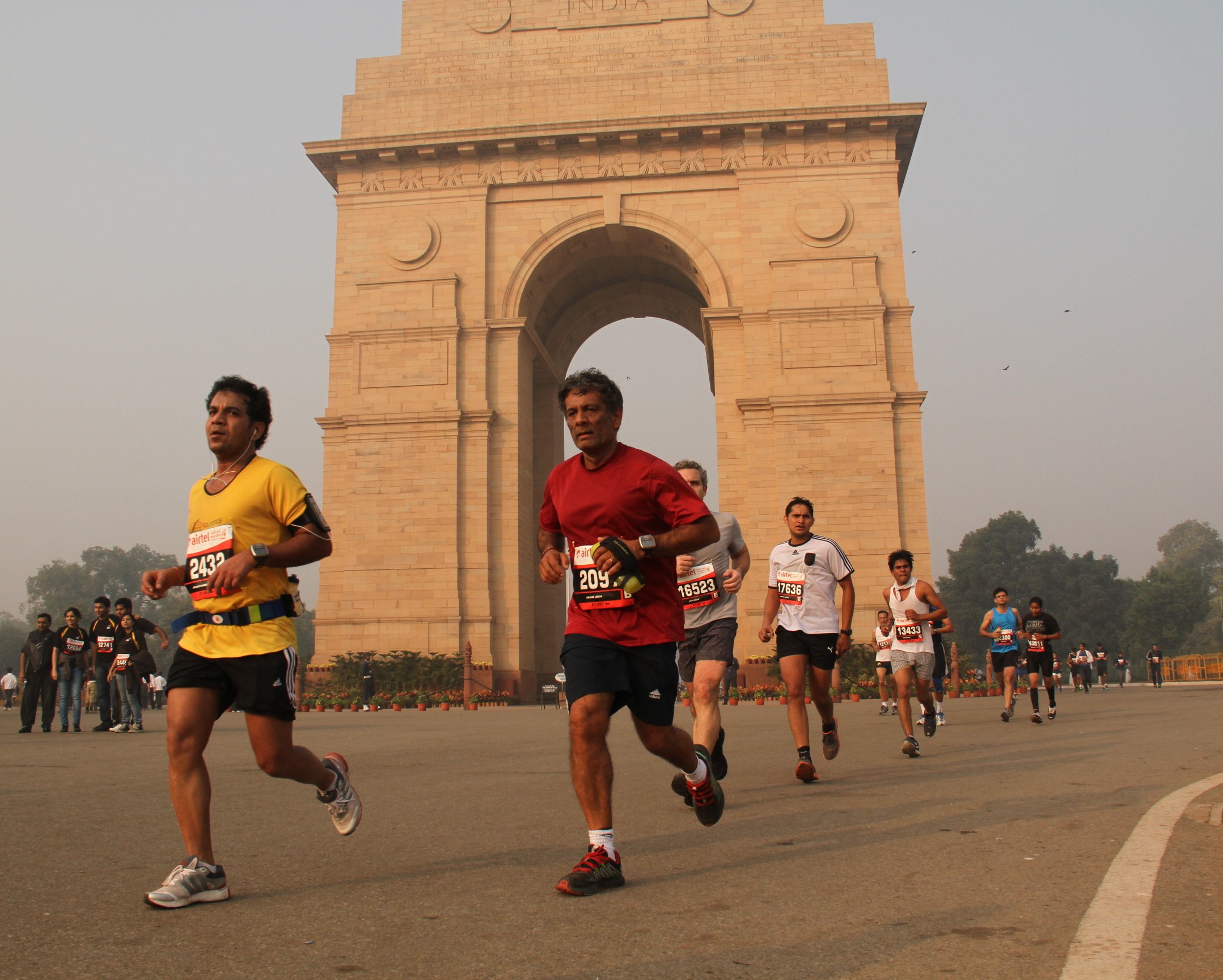
Running in Delhi (Photo: courtesy Sanjay Bhingarde)

Running in Delhi; Sanjay (left) in yellow T-shirt (Photo: courtesy Sanjay Bhingarde)

By then his elder brother having finished his twelfth earlier, was already in Mumbai working by day and attending college by night. Sanjay also shifted to Mumbai, where he elected to do his graduation in commerce at the St Xavier’s evening college. He left this course in its second year and opted to study hotel management at an institute in Belapur, his studies funded by a loan from his brother in law. Around this time, his mother too shifted to Mumbai, taking up residence with her two sons in a Ghatkopar slum. From there, they worked their way to a dwelling in Kurla, ran a successful computer typing and photocopying shop in Thane and finally bought the first house of their life, in Thane. Having completed his hotel management studies, Sanjay worked briefly at Hotel President in Mumbai before shifting to industrial catering at Radhakrishna Hospitality. Amid this, there was a period when he worked in the catering section at Mumbai’s IIT. In 2004, he started working at IIT permanently, in the institute’s hospitality section, responsible for the guest house and the outsourced cafe. In due course, he was allotted a house to live on campus. His mother stays with him. “ When we go back to our village, people now speak of us as an example to others,’’ he said, voice cracking.

Sanjay’s has been a life with thresholds crossed, just as in the ultramarathon.

As we walked back to the institute’s gate, the roar of Mumbai’s traffic grew.

Past it, we became one with noisy city.

We had left one world, entered another.

(The authors, Latha Venkatraman and Shyam G Menon, are independent journalists based in Mumbai.)     


REFLECTIONS ON BADWATER

Breeze Sharma (Photo: Shyam G Menon)

Breeze Sharma (Photo: Shyam G Menon)

Three months and Badwater later, we are back at the café in Kanjurmarg, Mumbai.

Breeze Sharma looked tired but he seemed happy and relaxed in his black T-shirt with `Badwater’ written on it. Ten days earlier in July, he had made it past the finish line of the iconic ultramarathon in California’s Death Valley, the second Indian after Arun Bhardwaj, to do so. Breeze summed up the Badwater Ultramarathon in two words: mind game.

He reached the US on July 1, for the 2016 edition of the race scheduled to start 17 days later.  For that period, he rested, doing just a 12 km-walk, one day in between. With bib collection due on July 17 at Furnace Creek, he reached there on the 16th. “ The temperature at Furnace Creek was around 120 degrees Fahrenheit,’’ he said. According to him, as an Indian he didn’t find the heat – the way it impacted as a new experience in new land – a killer. Hailing from Rajasthan, home to India’s Thar Desert and having lived the early part of his life there, Breeze suspects that early conditioning may have helped him.  Further, compared to Mumbai where he came to work, live and run, Death Valley’s heat was devoid of humidity. “ It was dry heat. When the wind blew, it too was hot,’’ he said. That initial estimation was however tad misplaced for as Breeze discovered; the trying part was not the heat per se but its unrelenting persistence (even at night the temperature hovered at 100 degrees Fahrenheit) and a whole ultramarathon to run, amid that. Each outing at Badwater, no matter how well you got things covered, harbors an element of uncertainty.

Breeze with other runners (Photo: courtesy Vijayalakshmi Nadar)

Breeze with other runners (Photo: courtesy Vijayalakshmi Nadar)

For Breeze, the race ambiance at Furnace Creek was a revelation. One of the best things he liked about Badwater was how the gathered ultra-runners treated runners of all levels of experience, equally. “ It was humbling for me to stand alongside some of the best ultramarathon runners around, runners who had years of experience. Some were veterans of Badwater who had run and completed the event several times,’’ he said. He also remembered the Race Director going out of his way to announce Breeze’s presence, a first timer at Badwater all the way from Mumbai, India. “ That felt nice,’’ Breeze said. The run got underway at 8 PM, July 18. His support crew anchored by US based-Vijayalakshmi Nadar moved with him. Breeze debuted at Badwater with a classic error of the running sort – he covered the first 21 km in 2 hours,18 minutes; a pace that would qualify to be a decent half marathon in Mumbai, except this wasn’t a half marathon but a 135 mile-long ultramarathon in Death Valley, one of the hottest deserts on the planet. For that distance, indeed almost up to 30 km, he was ahead of the pack. He realized his mistake, corrected and settled to a sensible, sustainable pace.

In the support vehicle (Photo: courtesy Vijayalakshmi Nadar)

In the support vehicle (Photo: courtesy Vijayalakshmi Nadar)

Vijayalakshmi provided an overview of crewing. “ As the race got underway, the runners ran ahead and after a few miles, we follow, to pull a little ahead of the runner, to ice him (put ice under his cap, and tie some around his shoulder) and spray him. Hand over food items, including fruits and nutrition bars and let him pass. We pulled ahead every two miles or so through the race. My challenge was also to ensure that he didn’t stop for more than a couple of minutes each time. The first night of running was a breeze, the next day it started getting tougher,’’ she wrote in. Death Valley is an amazing place. “ The region and the route attract you,’’ Breeze said citing the austere beauty of the dry, hot desert despite the punishment it inflicts. At night, the sky was a clear canopy above runner’s head, dotted with millions of stars. We checked again – he repeated it, the way he said it at first: the desert attracts you; not the other way around. The mutual fascination played out fine for the first 100 km. At about 65-70 miles, he admitted he started feeling the heat; the dry arid environment austere in its beauty initially, also appeared bleak and devoid of anything different to motivate. An element of harshness set in. “ I would say that even the first 100 miles was alright, I must have covered that in about 29 hours of running. The question was what lay after that,’’ Breeze said. Beyond 100 miles, was an unknown quantum for him. In his journey to Badwater, he had run three 100 milers to qualify and knew what running that distance felt like. But he had no idea what 135 miles held in store. For runner getting progressively tired and hitting his limits, the additional 35 miles can be a veritable gulf to bridge.

Running the Badwater ultramarathon (Photo: courtesy Vijayalakshmi Nadar)

Running the Badwater ultramarathon (Photo: courtesy Vijayalakshmi Nadar)

Breeze had reached out to Vijayalakshmi for support crew because she was one good friend he had in the US. Vijayalakshmi is a runner but she was new to running very long distances and crewing for it. In the support vehicle, she was having her own Badwater experience, learning first-hand what crewing entailed. Past the 100 mile-mark she figured Breeze was entering uncharted territory. “Though Breeze has run 100 miles effortlessly in an Indian situation, he has never pushed himself beyond that and he had no game-plan on how he would do the rest, except the confidence that he will do it. After he finished his 100 miles, I caught him slurring on one of the breaks because of lack of sleep and I decided that if I let him run alone now, on the isolated race course, it would be tough for him. We were still in the endless stretch of dry but very beautiful desert, lit only with stars and the moon, and only occasional runners and their crew vehicles passed us. I thought I will walk / run with him only for a couple of miles, but that stretched to the next 30 miles. I sang old Hindi hits, to cheer us up….I had to constantly remind him and me that we have a task to finish and we can rest later. We kept walking / running till day break when we reached Lone Pine, the last official break, before the final stretch, up the mountain, ‘’ Vijayalakshmi said.

The Badwater course is a mix of desert and mountain environment. It is fully on road, starting at 279 feet below sea level in the Badwater Basin of California’s Death Valley and ending at an elevation of 8360 feet at Whitney Portal, the trail head to Mt Whitney. According to Breeze, the ascents on the hill section are not stiff but they can be long and winding. As you keep running, any incline can be testing. At around 8 AM on the third day – after a night of running followed by a full day and another night of running – Breeze hit the slopes leading to Whitney Portal.

Breeze Sharma, Badwater (Photo: courtesy Vijayalakshmi Nadar)

Breeze Sharma, Badwater (Photo: courtesy Vijayalakshmi Nadar)

“ There we met Pete Kostelnick, eventual winner of the race who also set the course record. He pepped up Breeze a bit and he headed for his final stretch, up 13 miles ascending Mt Whitney Portal. With the sun beating down, when you have already put 122 miles behind you, and physically and mentally you are literally hanging by a thread, even walking those endless curves can be tough. While the crew including me waited ahead at the finish line, it was a relief to see Breeze come up with the national flag, which I had handed over to him, a couple of miles earlier,’’ Vijayalakshmi said. “ The last 13 miles was very slow for me, it took me five hours to cover that,’’ Breeze said, adding he owed much to his support crew. At noon on the third day, he completed his Badwater Ultramarathon in 40 hours 47 minutes.  He had kept five pairs of shoes for the race. He used three; the hot road of Death Valley singed their soles. “ It was all in all a humbling experience for Breeze and me. While Breeze realised all that goes into preparing and running an international race like this, for me it was bags of learning about human behaviour in a stress filled race. It was only the next day, when we were driving through the entire stretch of the race venue, on our way from Lone Pine to Las Vegas that I stopped to marvel that Breeze ran all this distance on foot, and what a stupendous task that was…and I paused to pat my back for a job well done,’’ Vijayalakshmi said.

Panoramic view of runner and the course of the Badwater Ultramarathon (Photo: courtesy Vijayalakshmi Nadar)

Panoramic view of runner and the course of the Badwater Ultramarathon (Photo: courtesy Vijayalakshmi Nadar)

A few realizations have dawned post-Badwater. Breeze firmly believes that he over-trained. “ I was running too much in Mumbai, preparing for Badwater. It should have been less. I should have rested adequately. In turn that would have kept more energy at my disposal,’’ he said. Further, in his relatively quick progression through a clutch of ultramarathons in India to Badwater in the US, he had failed to perfect a fluids intake system. “ I drink water as required. But everything I drink while running would only qualify as hydration, it cannot be counted as energy-providing,’’ Breeze said. The thing he hadn’t got used to and which he feels he should, in retrospect, are energy drinks. “ I don’t think there is really much difference between running 100 miles and running 135 miles. I was quite alright. What I missed at Badwater is the potential boost in energy I could have got from the occasional energy drink,’’ Breeze said. When you run an ultramarathon, it isn’t just enough that you have all this in your supplies for the road; you should have tried and perfected the practice before, for race day is not for experiments. Trying energy drinks earlier, finding which one works for you, at what point and in what quantity – all this, perfected earlier, would have helped. Food habits also interfere when race locations change. “ Breeze is a very conservative runner and hardly eats during races. He’s not used to nutritional supplements as well and though I had done my research on what the runners use for fuel on the way, he declined my suggestions. All he ate was cucumbers, cherries, oranges and grapes. The only real food we managed to get, a veggie wrap, was not to his liking at all, because it lacked chillies, which he cannot do without,’’ Vijayalakshmi noted in her email.

Completing the race (Photo: courtesy Vijayalakshmi Nadar)

Completing the race (Photo: courtesy Vijayalakshmi Nadar)

Breeze would like to return to Badwater. Notwithstanding the desert’s changing face or its face as perceived by changing runner, Death Valley’s attraction remains. He also hopes that with Arun Bhardwaj and now him completing the race, more Indians will attempt Badwater. The race has inspired some ideas in Breeze. He would like to run the world’s top ten ultramarathons. Badwater is run as a single stage race. There are multi stage ultramarathons. Breeze has his eyes on attempting the Marathon Des Sables (MDS) in the Sahara. But before that, next year, he has a pending assignment to address. On April 25, 2015, Breeze had been among those caught in a deadly earthquake-triggered avalanche at Everest Base Camp, where he was on what eventually became an aborted attempt to climb Mt Everest. 2017 is his last chance to return to Nepal and try the peak again. “ This year, I elected to attempt Badwater. Next year, hopefully, Everest,’’ he said.

(The authors, Latha Venkatraman and Shyam G Menon, are independent journalists based in Mumbai. For more on ultramarathon runner Arun Bhardwaj please click on this link: https://shyamgopan.wordpress.com/2015/06/21/the-connoisseur-of-distances/ You can also find this story which is titled ` The Connoisseur of Distances,’  under recent posts or in the blog archives.)    
YOUNG AND ULTRA

Illustration: Shyam G Menon

Illustration: Shyam G Menon

On June 19, 2016, Mumbai had its first 12 hour-stadium run. The inside lanes of the track at the city’s University Ground, were reserved for those running alone. Lanes further to the outside were for teams running the event in relay format. Among those running in the inside lanes was a young man, still a long way off from runners’ wiry build. He wasn’t one of the favorites; there were those better accomplished and looking the part, in the field. He compensated for his shortcomings with a committed work ethic. He kept at his task, steadily chugging along. By evening with an hour or so left for the allotted 12 hours to end, the others allowed themselves to relax but he appeared to sustain his pace lapping up as much mileage as possible. We left it there. At night, browsing race results, we found that the hard work of the concluding hours had paid off. He had finished third logging 99.2 km in 12 hours.

Mid-April, we were at a café in Chembur, Mumbai. “ Three years ago I was 95 kilos,’’ the youngster before us said. Given a big waist size he was finding it difficult to get a suitable pair of jeans. He realized he had to do something about his predicament. He started playing football at the RCF ground near where he stayed; he also began a daily regimen of exercises and subscribed to a strict diet. This brought down his weight a bit. Balan, who was the football coach, told the youngster that his future prospects in football seemed bleak but maybe, he should try distance running. Accordingly, around July 2013, he started running. It was tough initially; his knees hurt and his running form (posture) wasn’t good. But he persisted; slowly raising his daily mileage to ten kilometers. Balan introduced him to a routine of strength training that would stand him in good stead as aspiring runner. “I still do the exercises he taught me. All natural stuff, no visiting the gym,’’ the youngster said. Not just that, he found that he liked strength training. To this end, he also did much browsing on the Internet, looking for exercises that would help him.

Inderpal, during the 12 hour stadium run in Mumbai (Photo: courtesy Inderpal Singh Khalsa)

Inderpal, during the 12 hour stadium run in Mumbai (Photo: courtesy Inderpal Khalsa)

After participating in some of the smaller running events he took part in his first half marathon – the Varsha Half Marathon held at Thane, near Mumbai. “ It was very tough for me but I managed to complete it in about two hours. I was totally exhausted after that race,’’ he said. It left him wanting to quit running. He thought about it. Then as before, he decided to stick with what he had begun. Although he trained through November-December of 2013, he failed to register for the 2014 Standard Chartered Mumbai Marathon (SCMM) because he didn’t know how to register. He couldn’t figure it out. He confessed to a wrong doing – he ran SCMM using another runner’s bib (running with another’s bib is forbidden). He said he completed that full marathon in 4:02. This was followed by the Thane Hiranandani Half Marathon, which he finished in 1:52. In August 2014, he ran the 12 hour endurance run called the Mumbai Ultra (it is different from the stadium run), covering 86 km. He also did a full marathon in Hyderabad, repeating the wrong he committed earlier – he ran on someone else’s bib. He closed that year with the Vasai-Virar full marathon, completing the race in 4:13 hours. By now, he had developed an appetite for running. “ My grandmother would tell me to focus on my studies. I would go for a race saying this is my last race and so on,’’ he said. His grandmother matters much to him. For the runner in the making, parents were grandfather and grandmother.

Between the 2014 full marathon in Hyderabad and the one later in Vasai-Virar his life in running took a turn. While the Mumbai Ultra is a fully supported non-competitive event in which runners pile up as much mileage as they can, he ran the 100 km-category of the Nilgiris Ultra, finishing the race in 12 hours 23 minutes to place fifth. Ultramarathons differ from marathons and half marathons in many ways. There is the obvious difference in distance covered. By definition an ultramarathon exceeds the length of a marathon. That excess is however only the beginning of ultramarathon distances. They can range anywhere from in excess of marathon length to 100 miles (160 km) and multi-stage races wherein runners do marathon lengths and more back to back for several days. Some of these races are supported; some are not wholly supported, requiring the runner to carry a small pack bearing essentials. Some have set routes following roads, trails or paths; some require the runner to navigate. Some ultramarathons are big affairs with many people participating. Some are secluded events that see few people participate. Unlike marathons, usually set in cities and now almost an urban fad, ultramarathons are typically associated with interesting terrain and scenery. Interesting terrain may also mean challenging terrain. In locales like Rann of Kutch and Ladakh in India, you not only endure distance but also temperature and elevation change. It is often said in climbing that climbers begin with rock climbing, which is fueled by youth and then transition to mountaineering. Nature and the multiple challenges posed by nature, make mountaineering wholesome. Age is a much respected ingredient in this transition. Ultramarathons have for long been the bastion of a senior lot. Can you be young and experienced enough for the ultramarathon?

From the Run of Kutch (Photo: courtesy Inderpal Singh Khalsa)

From the ultramarathon in Rann of Kutch. In the frame (from left) are Kanishk Pandey, Sanjay Bhingarde, Inderpal and Breeze Sharma (Photo: courtesy Inderpal Khalsa)

In Mumbai, Inderpal Khalsa, the young man who others feel is in a hurry to get somewhere, divides the running community. Born November 1994, he was 21 years old that day at the café when he spoke of his life and in it, the Nilgiris Ultra. That ultra was his first proper ultramarathon. In his head, it set something in motion. Distance appeared his forte. “ I have a fascination for distances,’’ he said. He counted on social media to locate interesting races. The Nilgiris Ultra was discovered so. In February 2015, Inderpal ran a 100 miler (160 km) in the Rann of Kutch. He trained for it in Mumbai, running at Juhu, hydration pack strapped to his back. The Rann of Kutch (it is one of the biggest salt deserts in the world) was challenging environment; during day it would be hot, by night it turned cool. It took Inderpal 31 hours to complete the race, which was called Run of Kutch. He finished first in the open category. Soon after the race in Kutch, Inderpal went to Manali with fellow ultramarathon aficionado, Kieren D’ Souza. The two had met at the 2014 Nilgiris Ultra where Kieren finished fourth and Inderpal, fifth. “ We did trail running in the mountains around Manali. It was part of preparations for a race I was due to participate in,’’ Kieren said when contacted. This trip to Manali was just after Inderpal’s exams. By then running was pretty much life for the college student. He maintained his regimen of strength training, attended classes and ate only food that was appropriate for the running he had embraced. 2015 was Inderpal’s defining year.

With Satish Gujaran and Kieren D'Souza from the Mumbai-Surat run (Photo: courtesy Inderpal Singh Khalsa)

From left: Kieren D’Souza, Inderpal, Ashish Kapadia and Satish Gujaran during the Mumbai-Surat run (Photo: courtesy Inderpal Khalsa)

From the Bhatti Lakes Ultra, Inderpal (centre) crossing the 160km-mark with Bhupender Singh Rajput (Photo: courtesy Inderpal Singh Khalsa)

From the Bhatti Lakes Ultra, Inderpal (centre) crossing the 160km-mark with Bhupender Singh Rajput (Photo: courtesy Inderpal Khalsa)

It kicked off with the earlier mentioned race in the Rann of Kutch. This was followed by the Manali trip and a barefoot-run of 80km in 11 hours, done for the fun of it, mainly to see how well he could run barefoot. “ While I enjoyed this run, getting started in barefoot running was quite tough. I had to cope with a lot of blisters,’’ he said. Then an opportunity to be part of an inter-city run emerged. Satish Gujaran, among Mumbai’s best known ultramarathon runners, was running from Mumbai to Surat. Inderpal joined him as a support runner. Due to difference in pace and gaps opening up (it makes the job of the support vehicle difficult) Inderpal didn’t run the entire distance in a continuous, unbroken fashion. Following this outing, Inderpal ran the 24 hour-stadium run at the Kanteerava Stadium in Bengaluru (running barefoot he covered 136 km) and the Mumbai Ultra (where he covered 80 km in 12 hours). At the Bhatti Lakes 100 miler (160 km), he ran the distance in 31:08 hours placing third. “ This was a challenging run. It was very hot and my skin was burning,’’ Inderpal said. November 17, 2015, marked his twenty first birthday. He said he celebrated it with a 20 hour-walk in Mumbai. Among marathons that year, he ran the Hyderabad Marathon and the Vasai-Virar Marathon. He wrapped up 2015, running the Western Ghats Ultra in Pune. Inderpal couldn’t complete the race. “ It was very tough,’’ he said.

Inderpal (left) with Jayaraman Rankawat during the run from Mumbai to Goa (Photo: courtesy Inderpal Singh Khalsa)

Inderpal (left) with Jayaraman Rankawat during the run from Mumbai to Goa (Photo: courtesy Inderpal Khalsa)

In January 2015, when Inderpal was preparing for his run in the Rann of Kutch, an IT professional, roughly ten years older, participated in the first running event of his life – a 10km race in the Mumbai suburb of Powai. Born 1985 in Rajasthan, schooled in Karnataka and working with Tata Consultancy Services (TCS) in Mumbai, Jayaraman Rankawat had never been into sports before. In fact, during his days in school, he was among the timid who got bullied. Life in Mumbai with its annual SCMM got him interested in running. He took 90 minutes to complete that Powai run. “ For the next couple of days I was in pain,’’ he said this June, at a café near the Airport Road metro station not far from Andheri. However the pain made him think – had he practiced and run, wouldn’t the pain have been less? He started going for all 10km runs he could find. In February 2015, the month Inderpal went to Rann of Kutch, Jayaraman ran his first half marathon in Thane, finishing the race in 3:15. Searching on the Internet for people he could connect with in running, he found Sharmila Munj and the organizers of Pinkathon (a running event focused on getting more women into the sport) now held in several Indian cities. He started running with them in Juhu. In April 2015, he found himself at a non-competitive event called `United We Run As One.’ There, he saw among the many runners assembled, Mumbai’s well known running couple – Sunil and Sangeetha Shetty; they were wearing T-shirts from the Bengaluru Ultra. “ I went home, searched for the event on the Internet and when registration commenced, registered for the 100km race at the Bengaluru Ultra,’’ he said. In August, Jayaraman ran the 12 hour Mumbai Ultra. In the allotted 12 hours, he managed to cover 62 km. “ The Mumbai Ultra gave me confidence to face the Bengaluru event. If I can be on my feet for 12 hours, I figured I should be able to be on my feet for some more hours and complete 100 km on foot,’’ he said. Within days of the Mumbai Ultra, Jayaraman went to Hyderabad and ran a half marathon there finishing it in under-2:45. Back in January, although he wasn’t running the SCMM, he had visited the race expo and the stall put up there by the organizers of the Ladakh Marathon. In September, after ensuring some dedicated preparation for the event and reaching Leh a week in advance to acclimatize, he ran the half marathon there, completing the run in around three hours. “ It was tough,’’ he said of the effect of altitude. Next month, his monthly mileage in Mumbai was about 350 km, making him winner of a “ challenge’’ issued by some local runners. In November, he ran 100 km at the Bengaluru Ultra, taking approximately 19:30 hours to complete the distance. “ The last 20 km I walked,’’ he said. Later in November, he ran his first full marathon at Vasai-Virar, finishing it in roughly six hours. Then he followed it up with the Goa River Marathon in December, completing the race in 6:30. In January 2016, he ran the full marathon at SCMM in 6:20. “ I spent a lot of money in 2015 traveling to run at 26 timed events in different locations,’’ he said.

Inderpal attends to the blisters Jayaraman accumulated through the first six days of running. The blisters were lanced, cleaned and taped up so that the duo can continue running (Photo: courtesy Inderpal Singh Khalsa)

Inderpal attends to the blisters Jayaraman accumulated through the first six days of running. The blisters were lanced, cleaned and taped up so that the duo can continue running (Photo: courtesy Inderpal Khalsa)

One of the friends he acquired in this haphazard journey through a clutch of distances was Inderpal Khalsa. Their paths crossed at the Mumbai Ultra and again, at the Bengaluru Ultra and the Vasai Virar Mayors Marathon. In February-March 2016, two runners from Bengaluru – Spoorthi and Giridhar Kamath – ran from Bengaluru to Hyderabad, in connection with a Pinkathon event that was due in Hyderabad. A similar event was scheduled in Goa in April. It set Jayaraman thinking: why not run from Mumbai to Goa? He floated the idea on Facebook, asked if anyone was interested. Inderpal responded. They discussed the project with actor and runner, Milind Soman and the Pinkathon team. On April 6, 2016, Inderpal and Jayaraman started their run from near Mumbai’s Siddhivinayak Temple. Days on the road began at 6.30 AM. On April 15, some 600km covered and ten days after they left Mumbai, they reached Goa. Milind ran with them on the first day, the third day and the last two days. Future plans for Inderpal included, a run in August from Lucknow to Delhi, a yet to be finalized run from Mumbai to Nagpur, a 36 hour-stadium run in Bengaluru and a 135 miler (220 km) in Uttarkashi. “ After Kutch and Bhatti I can run in any weather,’’ he said confidently. His dream is to run the Badwater Ultramarathon in the US and the Spartathlon in Greece. Both Badwater and Spartathlon are coveted races, usually aspired for by really good and experienced ultramarathon runners.

Much before we met Inderpal, we picked up the observation about him in Mumbai’s running circles: he is doing too much, too early. “ I think that at least till the age of 30, he should gather experience running half marathons and full marathons. Ultramarathons need you to know yourself well. That, and maturity, come only with age and experience,’’ a seasoned senior runner in Mumbai with appetite for the ultramarathon, said, adding, “ what is the guarantee that 20 year-old running ultramarathon distances now will continue doing so?’’ It is a valid point. Instances like being pushy to further his chances, maybe even those episodes of running on others’ bibs – these have reportedly left some in the running community questioning the young man’s ways. The Mumbai-Goa run also fetched its share of critics. Although there were regular updates on the Internet about the progress of the run, the duo failed to properly plot their passage on a GPS. Proof matters where peers are involved. “ Except for the Pinkathon team, nobody from the established lot in the running community appreciated us for our effort,’’ Jayaraman said. Like Inderpal, he is physically on the heavier side but with the ability to hang in there on long journeys; that tenacity was evident at the 12 hour stadium run of June 19, where the duo and Milind were present. Asked what he thought of his slow timing at the half marathons and marathons he ran and why he had approached running in such an unplanned fashion, Jayaraman said, “ I am interested in running free. I don’t want excess technical information; I don’t want something planned as per the books.’’ As he put it, he already has the structured approach in corporate life. Running, on the other hand, is something “ I chose.’’ Why make both similar? He regrets the vanishing element of exploration and fun. We decided to explore the issue of age and structured approach to the ultramarathon, some more.

Grabbing some rest during the Mumbai-Goa run (Photo: courtesy Inderpal Singh Khalsa)

Grabbing some rest during the Mumbai-Goa run (Photo: courtesy Inderpal Khalsa)

In India, the story, which immediately comes to mind in the context of young age and long distance running, is that of Budhia Awooga Singh who at the age of four ran from Bhubaneshwar to Puri, covering the distance of 65 km in seven hours and two minutes. He earned a mention in the Limca Book of Records. Wikipedia’s page on Budhia says that by the age of four, he had run 48 marathons. Although fame by media and sponsorships piled up, Budhia’s marathons were banned by the state on the advice of the Khurda District Child Welfare Committee. In a later submission before the Odisha High Court, the state cited potential early onset of osteoarthritis and burnout among reasons for the ban. In September 2007, Budhia was admitted to a sports hostel of the Sports Authority of India (SAI). An April 2016 report in The Indian Express pointed out that Budhia, now 14 years old, wasn’t enjoying his stint at the sports hostel for a variety of reasons; one of them was that he had been shifted to running middle distance races, which are faster and don’t tap into the endurance he had displayed originally. While the hostel coach declined comment, the report mentioned Surender Singh Bhandari – as coach, he mentored Nitendra Singh Rawat, Kheta Ram and T. Gopi, who have all qualified for the marathon event at the 2016 Rio Olympics – as saying that Budhia needs to wait it out. According to him, the Indian body develops slower compared to foreigners and if Budhia were to start running marathons again at 14, not only may some of his old injuries act up but he may become burnt out and injury prone by the time he is 20-21 years old. In the report, Bhandari, who believes that the ideal age for Indians to start training for the marathon is “ after 20,’’ says that the apt thing for Budhia now would be to stick to middle distances so that he is in touch with running and can build up his body, speed and stamina.

With Milind Soman (centre) on the final days of the Mumbai-Goa run (Photo: courtesy Inderpal Singh Khalsa)

With Milind Soman (centre) on the final days of the Mumbai-Goa run (Photo: courtesy Inderpal Khalsa)

In 2006 – the same year Budhia gained entry into the Limca Book of Records – a train of events was unfolding some 15,000 km away. Sample this account from those overseas incidents: Jenny and Billy had only started running two years before, but Billy was already winning some of the toughest 50ks on the East Coast, while “ the young and beautiful Jenn Shelton,’’ as the ultrarace blogger Joey Anderson called her, had just clocked one of the fastest 100-mile times in the country. These lines are from the book ` Born to Run’ by Christopher McDougall. Preceding the above description of the two runners McDougall was to meet at the airport in El Paso, Texas, is their introduction: I was pretty sure I was wasting my time, but there was a chance I’d be picking up Jenn “ Mookie’’ Shelton and Billy “ Bonehead’’ Barnett, a pair of twenty-one year-old hotshots, who’d been electrifying the East Coast ultra circuit……In the book, 21 year–old Jenn and Billy, all of two years into running then, are among those who eventually race with the Tarahumara in Mexico’s Copper Canyon in running’s most loved ultramarathon story. A decade after the ultramarathon at the heart of ` Born to Run,’ Wikipedia’s page on Jenn Shelton says that she now finds marathons more challenging to run than the ultramarathon. Shelton, who competed in the 2012 US Olympic Marathon Trials (but did not finish due to a hamstring injury), has said that she intends to run more marathons and shorter races, citing a desire to run faster races, the page said.

With Milind Soman at the check-post before Goa (Photo: courtesy Inderpal Singh Khalsa)

With Milind Soman at the check-post before Goa (Photo: courtesy Inderpal Khalsa)

Which of the above suggestions / patterns do you go with? In the US, running became the movement it is, in the 1960s and 1970s. Europe followed. A mere 24 years separates the start of the world’s oldest marathon (1897 – Boston Marathon) and the world’s oldest ultramarathon (1921 – The Comrades). However, compared to the visible popularity of the marathon by the early decades of the second half of the twentieth century, ultramarathons became similarly known later (the International Association of Ultrarunners (IAU) was founded in 1984; it was recognized by the International Amateur Athletics Federation in 1988). This likely meant that those running in the early flush of popularity enjoyed by the marathon would have advanced in years by the time the ultramarathon became popular. The ultramarathon filled a niche experience some of them were seeking in their progression through life and running. It is possible that the well-entrenched description of the ultramarathon runner as a middle aged mature individual, owes much to this demographic transition. Does it mean only that age group qualifies for the ultramarathon? What complicates matters is that a correct apples-for-apples-comparison is hard to find for the variables are many. There are personal variables, generic variables, variables based on whether your expectations are competitive or recreational etc. One approach would be to work back from the perspective of risk. At a running event – like an ultramarathon – nobody is shouldering as much risk as the event organizer. When things go wrong the event manager faces the heat. Some of the world’s leading ultramarathons require that applicants should have run comparable races before; they also enquire about applicants’ overall experience in the sport. Dr Rajat Chauhan is the Delhi based-organizer of La Ultra-The High, a tough high altitude ultramarathon held every year in Ladakh. Asked if the twenties are too young an age for the ultramarathon, he said that age by itself is not the problem. “ Runners should gradually build up. Injuries happen if you are not careful. There is a very simple observation in sports medicine – the vast majority of injuries happen because you are doing too much, too soon,’’ he said. What makes the Indian context fertile for injury is competition, the need to prove, the `challenges’ proliferating on social media – in other words, the many distractions diverting attention from personal journey. What if Dr Chauhan is faced with a 20 year old applying for an ultramarathon? It is, he said, a matter of the organizer being adequately convinced. “ I will study that individual’s application very closely. I have zero issues if he is capable of running a given ultramarathon,’’ he said, adding a lot of “ back and forth’’ in choice of race (ie in terms of distance elected to run) and creative running outside the traditional formats of 21 km and 42 km are bound to happen in India too. That even unplanned approaches to running explore the opposite side (in this case, the more ordered side) was evident in Jayaraman’s transition – against 26 timed events run in 2015, in the first half of 2016, he did only three.

Inderpal Khalsa (Photo: Shyam G Menon)

Inderpal Khalsa (Photo: Shyam G Menon)

According to Inderpal, he doesn’t dwell much on whether he is running too much, too early. He reposes faith in his youth and exercise routine. Besides the strength training he has been doing, he also does yoga. Some of this confidence – irksome to those advocating a slower progression in running – may be rooted in age. At the same time, it was clear that whatever he was doing was rubbing off on the young man. “ It is a different high that you get when running an ultra. It is meditative. The sleep that follows a long run is utterly deep. Once every two months, if I am not running an ultramarathon, I feel something is missing,’’ he said. Inderpal’s parents divorced when he was very young, when he was yet a child. He said he has never seen his father. His mother, who remarried, made efforts to reconnect in his adolescence. But he related to her as though to a stranger. “ It is difficult to suddenly feel close to someone who wasn’t there for you in your growing up years,’’ he said. For all matters concerned, the grandparents who looked after him were his family. Those familiar with the situation said that the grandmother stepped in to stabilize the remains of a marriage gone wrong and brought up Inderpal and his brother, like her own children. They lived in an apartment in Chembur; a joint family, which also included two of Inderpal’s uncles and their families. The brothers navigated their way through the rough and tumble of life. Their grandfather passed away sometime back. Running has given Inderpal identity and belonging. He said he likes the ultramarathon community. It is way smaller in size than the huge army of regular runners out there and because the ultramarathon world is a smaller community, its races are smaller affairs; its denizens know each other. “ In every ultramarathon, every race, I learn something new,’’ Inderpal said.

When we met him, he had just finished his graduation and applied for a MBA in sports management. The yoga bug had also got to him and he wondered if he would be able to open a yoga institute at some point in the future. Finally, there were those sandals which the young man makes and he had brought in his bag to show us. They looked like running sandals, the sort you find mentioned in `Born to Run.’ The ones we beheld at the café were made of leather sourced from Dharavi, the city’s hub for locally made leather goods. They seemed their part – minimalist sandals that reminded of running. “ You can’t run in these sandals but you can use them as casual wear,’’ he said, his product pitch tinged with hope.

(The authors, Latha Venkatraman and Shyam G Menon, are independent journalists based in Mumbai. Please note: all race details are as provided by the interviewee. This article is best seen as the mix of a young person’s life story as told by him and musings around a question it opened up: is there an apt age for running an ultramarathon? The article does not seek to suggest or promote any particular approach to running.)           
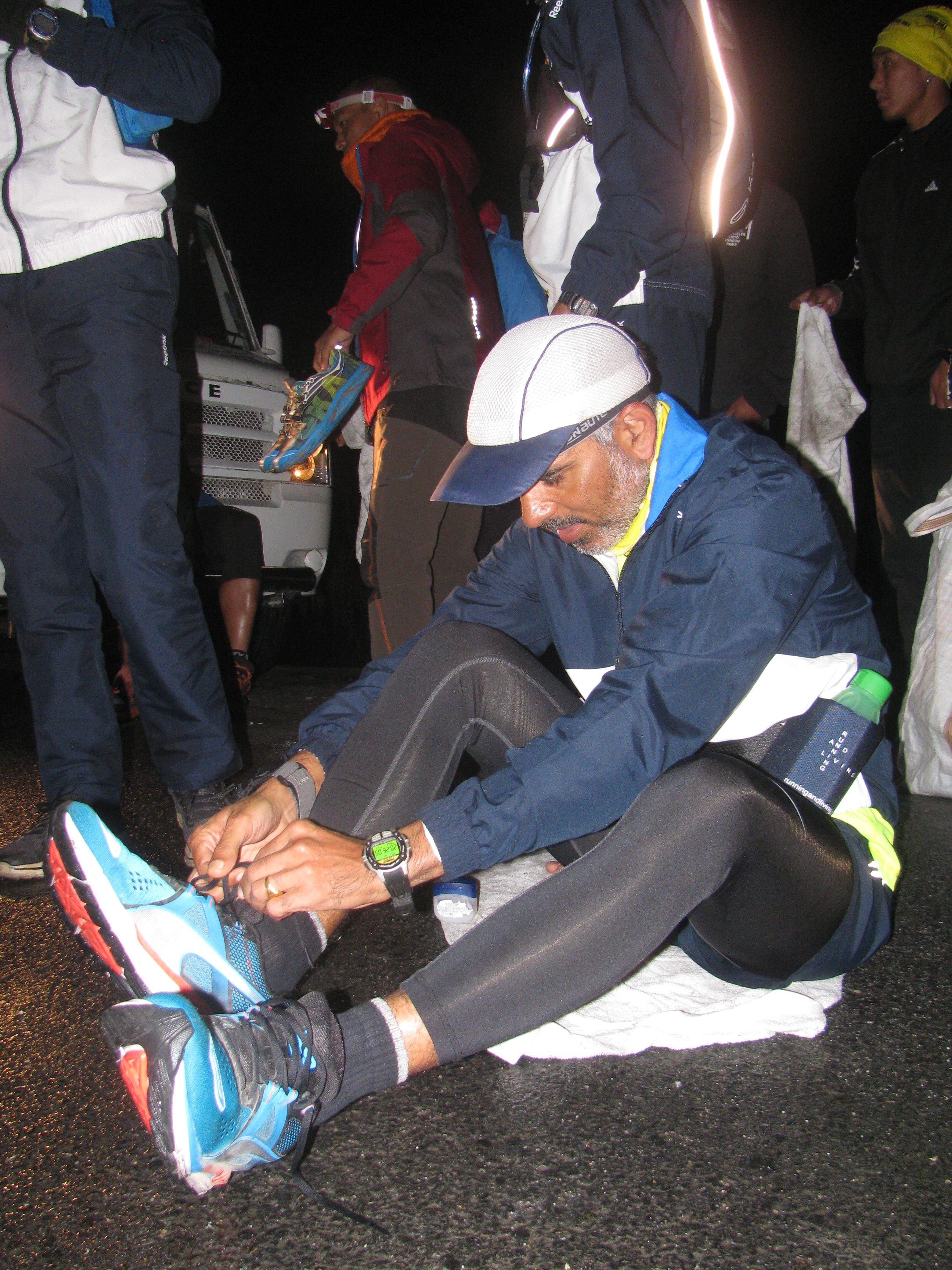
PLANNING SUB-THREE

Illustration: Shyam G Menon

Illustration: Shyam G Menon

The café near Kaloor in Kochi had just opened for the day.

But there was no hesitation over whether to serve a customer arrived early or not.

I chose a table, ordered a cup of tea and waited for the subject of this article.

On Wikipedia, the page for Infosys says that the company had 194,044 employees as of March 2016. “ Back then I was employee number 342, based in Bangalore,’’ Ramesh Kanjilimadhom said of his first job. Brief introduction aside, we had wasted no time in starting a conversation. Those were the pre-IPO days of Infosys; it was yet to become the household name synonymous with information technology that it would be in the years following IPO with shares listed and traded. Ramesh worked with Infosys over 1992-1993, then he joined Wipro GE Medical Imaging Systems. He left that in 1995 and shifted to the US, where he became part of a small company called Beechwood Data Systems in New Jersey. Until then, life had been relatively predictable, straightforward. He was born 1969 in Varandarappilly, a town near Thrissur in Kerala, to parents who were teachers; his father taught Malayalam at a college, his mother taught Malayalam at a school. “ I never thought of myself as an athlete. I played cricket in school – that was it. My grandfather was a temple priest, my father was into literature – it was a highly literary household that I grew up in. There was no inclination towards athletics. I felt I wasn’t cut out for it,’’ Ramesh said. His schooling spanned three towns: Varandarappilly, Irinjalakkuda and Kothamangalam, leading up to a degree in engineering (Computer Science) from the Government Engineering College in Thrissur. Employee number 342 at Infosys was soon after that.
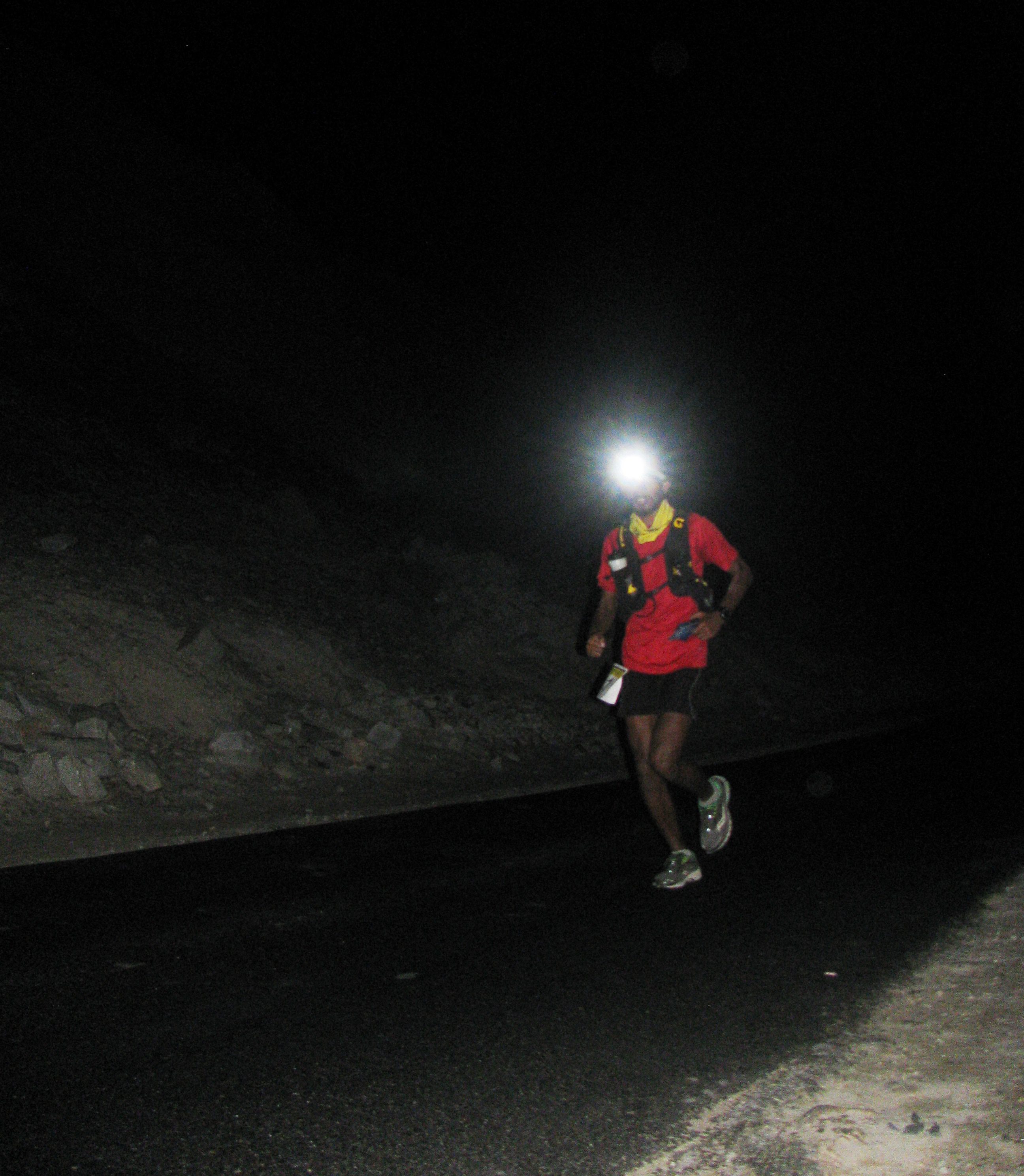
Ramesh at the 2009 Marine Corps Marathon (Photo: Courtesy Ramesh Kanjilimadhom)

Ramesh at the 2009 Marine Corps Marathon (Photo: Courtesy Ramesh Kanjilimadhom)

In the late 1990s, Ramesh’s elder brother was diagnosed with diabetes. Around the same time, his mother too was diagnosed with diabetes. When Ramesh went for his annual medical check-up, his doctor recommended that he do something to avert what appeared to be a genetic disposition in the family. Ramesh started running in Fairfax, Virginia; his daily mileage was 7-8km. He built it up to 12km once a week. “ It was hard finding the motivation to do this,’’ Ramesh said. Luckily for him, Salvatore Messina, his boss at Beechwood was a marathoner. He encouraged Ramesh to try longer distances. `Sal’ was passionate about the Marine Corps Marathon (MCM), held every year on the last Sunday of October, in Washington DC. The event begun by the US armed forces in 1976, is currently deemed the sixth biggest marathon in the US and 12th biggest in the world. Egged on by Sal, Ramesh enlisted for the 2006 MCM. He signed up six months ahead. For preparation he ran a local 20km race and also a 21km race. “ At MCM there is something called ` Beat the Bridge,’ which is basically a bridge 32km into the race that must be crossed in 4-5 hours. I was aiming for a four hour-marathon. On the bridge I hit the proverbial wall and cramped up,’’ he said. Nevertheless, he completed the first full marathon of his life in 3 hours 47 minutes. Sal was sufficiently impressed by it to tell Ramesh that perhaps he should try the Boston Marathon. Ramesh didn’t take the suggestion seriously right then; instead he pursued the idea of a marathon in 3:30 and registered for the Carlsbad Marathon near San Diego in California. This was tougher than MCM. It was a hilly course. He finished in 3:46. “ That second marathon taught me what a marathon entails,’’ he said. Persisting with the goal of 3:30, he then ran the Fredrick Marathon in Maryland. He trained for it. In 2007, he completed the run in 3:33. Now he began thinking of Boston.

Following that 3:33 at the Fredrick Marathon, Ramesh decided to do a Boston Qualifier (BQ). Those days, the qualifying time for his age group was 3:20. The BQ he chose was a race called Steamtown Marathon, held in Scranton, Pennsylvania. In retrospect, Ramesh thinks it isn’t the ideal BQ, for it is downhill most of the way with the last 3-4km being uphill. “ I would think that ideally a BQ should be flat,’’ he said. The day of the 2007 Steamtown Marathon turned out to be hot. Same day, after the Chicago Marathon commenced, it was cancelled citing the heat. “ I finished Steamtown in 3:28. But I still felt that I can do a 3:20,’’ he said. By this time, further changes had happened at work. Ramesh left Beechwood Data Systems in 2002; Beechwood would eventually be acquired by Capgemini. In 2004, he started a small company in league with his former boss at Beechwood. The company is called Seygen and Ramesh is one of its directors. Seygen develops software for telecom companies. Three weeks after Steamtown, he ran his second MCM and then shifted back to India with Seygen. In India, the company has offices in Kochi and Mumbai. Ramesh keeps traveling to the US regularly, where Seygen has the other half of its operations.

Ramesh at the 2009 Boston Marathon (Photo: courtesy Ramesh Kanjilimadhom)

Ramesh at the 2009 Boston Marathon (Photo: courtesy Ramesh Kanjilimadhom)

In 2008, not long after returning to India, Ramesh ran his first Standard Chartered Mumbai Marathon (SCMM). He completed the full marathon in 3:36. Same year, he ran the St George Marathon in Utah. “ It is a downhill course and Utah is beautiful. However it was extremely cold and windy, I also reached the venue later than expected thanks to some air travel problems,’’ Ramesh said. He finished the race in 3:28. After the run he was ill, shivering from the cold. He still remembers – the treat for runners after the race in that chilly weather, was an ice cream! Following the Utah event, he ran his third MCM. Three months later, while still searching for a BQ, he found himself with his children at Disney World. There, he ran the Disney World Marathon. It was a flat course, running from one Disney Park to another. Ramesh didn’t like that commercial aspect but he completed the race in 3:09. “ It was the first race I ran without any walking,’’ he said. That year the qualifying time for his age group in Boston was 3:15. Ramesh’s timing from the Disney World Marathon was well within it.

In April 2009, he ran his first Boston Marathon. “ It was a wonderful experience. Boston is great because of its spectators. You don’t see even ten metres without spectators. The cheering is awesome. Then there is the Wellesley College portion of the course, which is called the ` Scream Tunnel.’ It is a girls’ college and on race day they offer the runners free hugs and kisses. It is fun. Wellesley College is roughly around the 20km-mark. Between 26km and 32km there is a series of hills called Newton Hills, culminating in Heartbreak Hill. After Heartbreak Hill is Boston College. The Boston Marathon is like a big festival for the residents of the course,’’ Ramesh said recalling a race he evidently loves. He completed his first Boston Marathon in approximately 3:37. The experience seems to have taken a load off his chest, for he says, he settled down thereafter to enjoying his running. “ I began running for the fun of it,’’ he said. Asked if he consciously managed the number of races he ran a year, he said, “ I don’t hold back on races.’’ Ramesh has run 3-4 marathons in a month. When I met him in April 2016, he had already logged 52 marathons and three ultra-marathons.

Ramesh went on to run the Boston Marathon in 2010, 2013 and 2015. In 2015, he completed the course in 3:19. That was the year Thomas Bobby Philip from Bengaluru ran barefoot in Boston. “ It was cold! I don’t know how he managed to do that,’’ Ramesh said, appreciating the effort. After his first Boston Marathon of 2009, Ramesh increased his mileage. In December 2009, he ran 550km; he said he recovers well after every long run. Roughly eight months after his first Boston Marathon, Ramesh began experimenting with barefoot running. In January 2010, Ramesh ran the Dubai Marathon wearing minimalist footwear. He completed it in 3:05. Since the 2010 Dubai Marathon, the majority of his running has been barefoot. “ I am not an evangelist for barefoot running. How it works, varies from person to person. But you won’t know till you try it. I believe everyone should try it at least once,’’ Ramesh said.

Ramesh at the 2014 Bengaluru Marathon (Photo: courtesy Ramesh Kanjilimadhom)

Ramesh at the 2014 Bengaluru Marathon (Photo: courtesy Ramesh Kanjilimadhom)

The 2012 SCMM was special. Finishing it in 3:14, it was the first time Ramesh qualified for the Boston Marathon in India. Two weeks after that edition of the SCMM, he completed the Dubai Marathon in 3:08. That run in Dubai earned him entry to the New York Marathon of November 2012. In Kochi, Ramesh stays in Kakkanad. Friday, August 10 dawned with heavy rain. At 5.30 AM, the hour Ramesh leaves for his daily ten mile-run, it was relatively dark save for the street lights on the road. “ I try to finish my weekday runs in time to wish the kids before they get on the school bus,’’ Ramesh said. According to a report in The New Indian Express, that day Ramesh was running by in front of the Youth Hostel near NGO Quarters, when a car suddenly appeared from a side road and hit him on his left side. He landed on his face. The car didn’t stop. It accelerated and sped away. Ramesh tried to hold his leg, stand up and go to the nearest junction to get help. He could not.  “ The accident broke the tibia and fibula of my left leg. My lower leg was dangling at an angle,’’ he said. As often happens in India, likely fearing the legal hassles that follow getting involved in the aftermath of an accident, no passing vehicle stopped to help Ramesh. Luckily, Rocky Roger, a BPO professional who had just finished his shift and was headed home, saw Ramesh. He stopped his car, picked up the injured runner and reached him to the hospital. X-rays revealed the multiple fractures.

At the 2015 Chennai Trail Marathon (Photo: courtesy Ramesh Kanjilimadhom)

At the 2015 Chennai Trail Marathon (Photo: courtesy Ramesh Kanjilimadhom)

The orthopedic surgeon at the hospital, decided to insert a steel rod to hold the fractured bones in place. Seema, Ramesh’s wife who had by then arrived, reminded the doctor of the patient’s love for running. The steel rod was traded for a titanium one. It was surgery, insertion of titanium rod and end of New York Marathon plan for time being. Interestingly, due to a hurricane, the New York Marathon of that year was cancelled. “ I got back the money I had paid as entry fee,’’ Ramesh said. He was on crutches till early November. Mid-November 2012, he resumed running. For the 2013 SCMM, his preparation wouldn’t have exceeded 30km in all. He finished the full marathon in 4:07. I asked Ramesh about the surgery months before that SCMM, and his road to recovery. “The surgery was done only after my wife Seema arrived at the hospital and she alerted the doctor that I was a runner. So he used titanium rod which is lighter instead of the steel that they normally work with. I had the rod, plate and screws for about one and a half years. I ran fine with them. They were eventually removed in March 2014. My passage back to running was rather uneventful.  I followed the instructions of the doctor and the physio to the tee. The good thing was the doctor was quite supportive of my running and he wanted me to get back to it quickly; so that helped. I started walking without crutches in a couple of months after the surgery and started running by late November. SCMM 2013 was hard because I had run no more than five to six times in the months preceding it, but it was a big confidence booster. I didn’t have any pain due to the surgery during or after the race, so didn’t have to look back,’’ Ramesh said.

In 2013, Ramesh’s friends Prasanna Kumar (aka A.P. Kumar; based in Kochi) and Manoj Kuriakose (based in Dubai) suggested that they start a running club. While this thought process was on, Ramesh got a call one day from Houston based-Mathew Mapram. He was calling from Kottayam. Mathew was a runner, around 68-69 years old then; he wanted to know what he could do to make running a lifestyle in Kerala. “ That was a spark for the runners around to meet up. We decided to start a running group. Manoj came up with the name: Soles of Cochin. The group started in July 2013 and its growth has been amazing, not just in terms of numbers but also in terms of passion for the sport. We don’t leave out any race anywhere. We just go and run everywhere. We make a lot of noise. We have now become a synonym for being crazy runners,’’ Ramesh said. In Kochi, the group trains four days a week. They have a tempo run on Tuesday; a hill run on Thursday, a long run on Saturday and a beginners’ run plus recovery phase on Sunday. “ We have supported long runs but nothing like Mumbai Road Runners’ monthly Bandra-NCPA run in Mumbai. We want to get to that level though,’’ Ramesh said. However Soles of Cochin has three full-fledged events that it organizes. In January, it holds the Puttumanoor Race (21km, 10km, 5km), in May it holds the Spice Farms Race (21km, 10km, 5km) and in November, it conducts the Spice Coast Marathon (42km, 21km, 5km). In between, it also organizes trail runs in Munnar, Vagamon and Lower Periyar. Two weeks before I met Ramesh, Soles of Cochin had organized the Night Owls Ultra, a 12 hour-run at night on Willingdon Island (home to Kochi’s port). “ We want to do it more often. Maybe do it in monsoon; March was hot,’’ he said laughing.

Ramesh Kanjilimadhom (Photo: Shyam G Menon)

Ramesh Kanjilimadhom (Photo: Shyam G Menon)

At the 2015 Mumbai Ultra (a supported non-competitive 12 hour-endurance run held annually in Mumbai) I met Naushad Asanar and Vijayan Pillai, both Kochi based-runners and members of Soles of Cochin. According to Naushad, Ramesh, who is much respected in Kochi’s running scene, prefers to keep a low profile. He sports a simplicity acquired from years of running. “ He is not crazy about gear. At the events we organize, he plays his role but stays in the backdrop. Others may pitch to invite celebrities for a running event to create some buzz. Ramesh is rarely part of such trends, for him running is what matters,’’ Naushad said, adding, that simplified, functional view of running has influenced the group. “ We see Ramesh as a guide. He has done a lot of running, yet he is humble. Although someone who shuns the limelight, he is a very open person and newcomers to the sport learn much talking to him. If you go for a run with him, his love for the sport rubs off on you,’’ Vijayan said.

Ramesh completed the 2015 SCMM in 3:04. In 2016 he ran the Boston Marathon again, this time barefoot and completing it in 3:11:54, his best timing yet at the event. Six days later, he ran the Big Sur Marathon in California, “ one of the most scenic marathons in the world,’’ although Ramesh who ran it barefoot does not deem it ideal for barefoot running given road conditions. But it was an event he ran earlier in 2016 that set him thinking. He finished the 2016 Dubai Marathon in 3:02. It got him interested in the possibility of running a sub three-hour marathon. He knows that although a mere three minutes separates 3:02 from sub-three, getting there will be challenging. “ I can plan to push myself for a sub-three perhaps by January 2017,’’ he said. For now the Houston Marathon appears a good event to try this. In the meantime, he is trying to build up his strength and endurance.

(The author, Shyam G Menon, is a freelance journalist based in Mumbai.)     

PATTERNS

Illustration: Shyam G Menon

Illustration: Shyam G Menon

Article on Philip Earis and his many interests: science, change ringing, stepwells, solar lighting, running and a proposed seaside promenade for Mumbai.

The caretaker of the premises appeared hesitant.

We wanted to see the bells atop the church tower. We had read about them, the subject we were writing about knew of the bells and had mentioned it. Effort made to go up the tower and see the bells may aid the writing – so we felt. We left it at that. If we are meant to see the bells, the universe will make it happen.

The bells were a unique lot. According to reports, they may have been originally meant for a British tradition called ` change ringing.’  The bells don’t work anymore the way they were intended to. Some crucial parts were never installed; some of the components have jammed through disuse. Of eight bells in there, only one has been operated in recent times. In olden days, church bells served two functions – they marked the passage of time; they brought the devout to church. Suspended high above ground in a tower, the sound of the bells was expected to travel far. But there was a limitation. Although the bell was at a height, its mouth typically faced the interiors of the tower with the result that the sound it produced wasn’t travelling out effectively. Wikipedia says change ringing started in England in the early 17th century following the invention of the `full-circle tower bell.’ This innovation allowed bells to swing almost 360 degrees from a fulcrum. The mechanism allowed the mouth of the bells to rotate up; a chime produced so traveled out from the tower. Each bell produces a different sound / strike note. What this note is depends on the size, shape and metallurgy of the bell. Every time a clapper hits one particular bell, the strike note will be the same.

Philip in the ringing room of the 12 bell-tower in Cambridge, UK (Photo: courtesy Philip Earis)

Philip in the ringing room of the 12 bell-tower in Cambridge, UK (Photo: courtesy Philip Earis)

Change ringing is based on a sequence of permutations of different notes; thus a composition involving eight notes, requires eight bells. Hanging from the centre of a bell, the clapper takes a very small – yet measurable – period of time, to hit the bell’s metal side. If the bell is big, located up in a tower and rung using ropes from below, then this time gap between intent in the head and actual chime must be mastered, particularly if you are creating a pattern of sounds with others ringing other bells in the tower alongside. Imagine maintaining the sequence for hours. That is the challenge at the heart of change ringing. Besides mouth-up position allowing the chime to travel far, the full-circle tower bell also provided more refined control over chiming. An idea of long aural sequences played with bells, so far imagined in the head began to manifest physically as change ringing. Change ringing is also done with smaller hand held bells. Videos of change ringing available on the Internet, show people working with bells of various sizes, the ringers knowing exactly which bell and what chime to produce for given sequence / composition. It is an activity seemingly imbued with patterns; mathematical patterns.

Philip with his daughter at the Joggers Park in Bandra, Mumbai; a Christmas Day.

Philip with his daughter at the Joggers Park in Bandra, Mumbai; a Christmas Day.

England continues to be the centre of the change ringing tradition. In tune with wherever the British went, traces of change ringing can be found across the world. Some time back, an Englishman, staying at Bandra in Mumbai, visited the church we were at and went up the tower to inspect the bells. “ Yes, yes, I know him…a tall, thin person. They just had a baby,’’ the caretaker said. As of June 2016, Philip Earis was part of a small team that holds a world record in change ringing – the longest continuous bell ringing performance. It was done in England, with hand held bells. Philip was born in Huddersfield, a town in West Yorkshire, England. Wikipedia pegs the population of Huddersfield at 162,947 as per 2011 census. The son of a vicar and a teacher, he majored in Physics from Cambridge. “ I was enjoying science broadly, not so much in the narrow aspect,’’ he said, a morning at his apartment in Bandra. Following his studies, Philip went into science publishing. “ My role was to network with scientists and have them write for the journal I was working for,’’ he said. Philip managed a portfolio of seven journals. “ I was never into sports. I didn’t enjoy physical education in school. I did a bit of cycling – that’s all,’’ he said. Philip did try running. But he would get exhausted. Eventually a friend advised: take it easy, take up running slowly. About five to six years ago, he started running regularly, covering roughly six kilometres daily in Cambridge. What brought out the runner in Philip was probably the similarity between change ringing and rhythmic running. Both Philip and his wife, Jennifer (they met as students [she studied mathematics] in Cambridge; they got married in 2011) were into change ringing. The act of ringing a bell repeatedly with perfect timing and in harmony with others to create an enduring aural pattern requires discipline, focus and empathy for a meditative state of mind. The mind settles into a pattern punctuated by periodic change to patterns. Running is not radically different from this. Striding is a pattern; the mind visualizes a given distance overall and alters the patterns you settle into accordingly. And at the back of it all, as with sustaining the effort of bell-ringing for hours is the challenge of sustaining the running for hours over a long distance. It is mind over matter. Both are mind games. Besides Philip, another person from the world record holding-change ringing group is into running. Yet another is an avid hill walker.

Philip running the Vasai-Virar Mayor's Marathon (VVMM) near Mumbai (Photo: courtesy Philip Earis)

Philip running the Vasai-Virar Mayor’s Marathon (VVMM) on the outskirts of Mumbai (Photo: courtesy Philip Earis)

In 2013, Philip and Jennifer shifted to Mumbai, where Jennifer would start an actuary practice for PriceWaterHouseCoopers. Philip left his original publishing job. But he had in place his contact with scientists and an appetite to know better, scientists in India, even attempt solutions for local problems that he came across. “ From the outset itself, we wanted to be immersed in India. We didn’t want to be surrounded by a corporate or expat bubble,’’ he said adding, “ coming to Mumbai with a fresh pair of eyes has been helpful. I guess people have an unquestioning attitude at times. A fresh pair of eyes that way can be helpful.’’ One of the areas he got involved in was solar energy. Another area of interest was mapping the existence of stepwells in India and creating a web atlas for them (www.stepwells.org). A May 2016 article in Mid-Day said that in eight months, Philip was able to collate information on about 300 stepwells. He estimates that their total number in India should be around 1500; many of the known ones are in a state of neglect. The Archaeological Survey of India (ASI) has reportedly preserved only 46. Stepwells worked primarily as reservoirs. But given the temperature at the bottom of a stepwell was sometimes up to six degrees lower than at the top, they were also meeting places for people. Over time, depleting water table caused by overuse of ground water and ruin through neglect caught up with India’s stepwells. Many have gone dry. The state of neglect increased under British rule; they considered water from stepwells to be unhygienic.

The Chand Boari stepwell in Rajasthan. This photo is used for representation purpose only (Photo: Doron, commons.wikimedia.org)

The Chand Baori stepwell in Rajasthan. This photo is used for representation purpose only (Photo: Doron, commons.wikimedia.org)

While in the article Philip has described his interest in stepwells for the Indian solution to an Indian problem (water scarcity) they are, in the context of change ringing, it is hard not to ignore the precise mathematical architecture and repetitive visual patterns that characterize a typical Indian stepwell. Change ringing generates mathematical patterns in the aural dimension. Philip described in a nutshell the change ringing world record he was part of: There were three participants, each ringing two bells, so six bells in total. With six bells, there are 6*5*4*3*2*1 = 720 different sequences where each bell rings once and once only (`permutations’), for example: 123456 or 214365 or 365241 etc. An `extent of a method’ is a way of arranging the sequences such that all 720 permutations appear once and once only. In the record breaking-performance, we rang 100 different extents of methods. According to the historical requirement for change ringing peals, all methods have to be strictly committed to memory beforehand (no memory aides are allowed) and the whole performance must be rung continuously without any hesitation or break. So the big challenge was to continuously recall a memorized sequence for 24 hours at a fast pace and without any breaks. 

On the first Sunday of every month, the running group, Mumbai Road Runners (MRR), have their monthly half marathon from Bandra in the suburbs to NCPA in South Mumbai. It is usually well attended. Slow, struggling runners, the authors choose to start earlier than the rest. The first of the runners coming from behind typically catch up with our huffing and puffing selves on Worli sea face. Lost to their rhythm, they overtake smoothly and proceed on, leaving writers in the dust. Among them would be Philip, now recognized as one of the finest amateur distance runners in the city, in his age group. His first race in Mumbai was ` Footsteps for Good,’ a ten kilometer-run organized by the British High Commission. In 2014, he ran his first Standard Chartered Mumbai Marathon (SCMM), which was also his first full marathon. “ The first half was fine, the second half was messy. I had to do a bit of walking,’’ Philip said. He then ran the half marathon in Bengaluru in 2014, repeated the SCMM full marathon in 2015, ran the full marathon at Vasai-Virar in 2015 and the full at SCMM in 2016. In between he also ran the Mumbai Ultra, his first attempt at distances exceeding the full marathon’s length. “ I would like to run some of the longer distances,’’ he said.

Philip (left) with Kamlya Bhagat (centre) and Aditya Shroff at Kamlya's village (Photo: courtesy Philip Earis)

Philip (left) with Kamlya Bhagat (centre) and Aditya Shroff at Kamlya’s village (Photo: courtesy Philip Earis)

Fanaswadi (aka Fanaswadi-Valap) is a small dusty settlement some distance from Panvel on the outskirts of Mumbai-Navi Mumbai. In the summer of 2015, we reached Fanaswadi to meet Kamlya Bhagat. A runner hailing from poor circumstances (in 2016 he won the SCMM half marathon in his age group), he was financially challenged. During the course of the conversation, he mentioned how other runners had helped with shoes and registration fee for races. One such intervention by fellow runners could be seen in the space outside his small house and the trail leading up to it – a series of solar powered lamps. Fanaswadi didn’t have electricity. Solar lamps made sense. That was where we first heard of the English runner dabbling in solar energy; subsequent enquiry yielded the name – Philip Earis. A July 2015 article in DNA newspaper about Philip further pointed out that his work had brought lighting to slums in Worli, the Bandra Reclamation area, Gilbert Hill in Andheri and Prabalgad, a village off Panvel albeit in a direction different from Fanaswadi. In the months that followed, Philip’s name would emerge in not only such assistance provided but also in cases of introducing deserving athletes from poor backdrops to Mumbai’s running community. Dnyaneshwar Morgha is an example. Philip described how he met Dnyaneshwar:  I first met Dnyaneshwar at the end of a half marathon in Bandra in December 2014.  I was originally supposed to be running in the race myself, but the day before the race the organizers phoned me up to say regretfully they were disqualifying me, and they feared any non-Indians running could be a safety risk and need extra permission etc.  As the race was taking place near my apartment I went along anyway to watch and cheer on the runners.  The winner was this very small and young runner, who glided along at great speed and seemingly effortlessly. His huge talent was obvious to see, and yet it was also apparent from a quick conversation with him afterwards that he had so much untapped potential – he didn’t have any coaching and wasn’t even really following a training plan.  I tried to get his details but there was some mistake in the phone number, and it took me a further year to finally track him down. Philip believes that India has a lot of talent in distance running but it needs to be discovered and nurtured. Resource crunch aside, an overview of the Cambridge Half Marathon he provided, hints at the difference in running between here and overseas. Cambridge, where Philip commenced his running, had an ambiance conducive for running. Wikipedia pegged the 2011 population of Cambridge at 123,867 including 24,488 students. Having become a regular runner, Philip once participated in the Cambridge Half Marathon. “ Nearly 7000 people took part in it, which is high if you compare it with the total population of Cambridge. What’s more – the average finishing time is under two hours,’’ he said.

Philip at the Satara Hill Marathon (Photo: courtesy Philip Earis)

Philip at the Satara Hill Marathon (Photo: courtesy Philip Earis)

Following Asia’s largest marathon settling in as annual event, Mumbai has become India’s running city. However, for all that reputation, Mumbai running is despite the city’s congestion and traffic. While SCMM happens once a year, events like MRR’s Bandra-NCPA run (and others of the same ilk) keep the running movement alive. Mumbai is a coastal city. On the map, the route from Bandra to NCPA would seem a run by the sea. In reality it is not so. With several million people in the city and residences, office complexes, apartment blocks and slums packed into limited area you are visibly by the sea at only four spots on MRR’s iconic monthly half marathon. You have a small bit of polluted estuary near Mahim, the Worli sea face, the Haji Ali stretch and finally Marine Drive. Unlike Mumbai, many other coastal cities have successfully maintained seaside promenades. Philip’s “ fresh pair of eyes’’ helped. In league with the Observer Research Foundation (ORF), Philip has a project submitted to municipal authorities for a long seaside promenade on Mumbai’s west coast that would be aesthetic, engaging local communities and open for running, walking and cycling. Called `BayLine,’ it visualizes a 15m-wide, 24km-long pedestrian pathway along the seashore, linking Haji Ali and Versova in the city. The proposal is rooted in the observation that 52 per cent of daily trips in Mumbai are done on foot with pedestrians accounting for 58 per cent of accident deaths – that underscores the need for pedestrian focused infrastructure, which the BayLine is. According to Philip, much of the connectivity for creating this promenade already exists. The onus of seeing BayLine through may now shift at least in part to the local running community (who along with communities residing by Mumbai’s sea coast, walkers and cyclists would be among stakeholders), for Philip Earis and family are due to return to England by mid-2016. MRR has dedicated the Bandra-NCPA run of June 5, 2016, to Philip.

Philip Earis (Photo: Shyam G Menon)

Philip Earis (Photo: Shyam G Menon)

We asked Philip what his impressions were of running in Mumbai; what he would like to remember? He responded: My biggest impression is of the dedication and determination of runners here.  Mumbai is a very hard city to run in – the heat and humidity are invariably tough, and sometimes almost impossibly so.  The traffic, badly-paved surfaces, air pollution, and lack of open space and good running routes all pose many problems.  And yet thousands of runners still motivate themselves to get up before dawn and incorporate running into their busy lives. The enthusiasm shown by runners – of all speeds – is inspiring.   It is wonderful to see the ongoing growth in running culture in the city.  My twin hopes are that this growth can both continue and ensure the running community is more reflective of the city’s population as a whole (recreational running is currently skewed towards the wealthy and well-educated strata of society), and moreover that runners can join together and make their voices heard to push for a much better deal: more open space, better runner-friendly facilities (like the BayLine), and a focus on reducing Mumbai’s dangerous levels of air pollution.

The caretaker of the church listened as we said Philip would soon return to England and we needed to write an article, for which the excursion up the bell tower would help.  “ Come,’’ he said. The church was closed. He brought forth a set of keys and opened the main door giving us a glimpse of the lovely interiors within. Immediately to the right of the main door was a small passageway, spiraling tightly in claustrophobic diameter to the top. It had steep steps. Roughly two floors up, the steps yielded to a rusty ladder, above which was a cobwebbed platform of steel with more stairs going up the church tower. Some bit of continued climbing and one stood right below the heavy bells, made in England over a century ago.  We were inside the bell tower of Afghan Church in South Mumbai’s Colaba.

(The authors, Latha Venkatraman and Shyam G Menon, are independent journalists based in Mumbai.)


IFSC WORLD CUP, NAVI MUMBAI – DAY 2

Miho Nonaka after the last boulder problem at the 2016 IFSC World Cup in bouldering held in Navi Mumbai (Photo: Shyam G Menon)

Miho Nonaka after the last boulder problem at the 2016 IFSC World Cup in bouldering held in Navi Mumbai (Photo: Shyam G Menon)

Kokoro Fujii after the last boulder problem at the 2016 IFSC World Cup in bouldering held in Navi Mumbai (Photo: Shyam G Menon)

Kokoro Fujii after the last boulder problem at the 2016 IFSC World Cup in bouldering held in Navi Mumbai (Photo: Shyam G Menon)

The Japanese secured four of the six podium positions on offer at the 2016 IFSC World Cup in bouldering, in Navi Mumbai on Sunday.  The men’s category was won by Kokoro Fujii of Japan, with second and third positions going to Tomoa Narasaki (Japan) and Alexey Rubtsov (Russia) respectively.  In the women’s segment Miho Nonaka of Japan finished in first place followed by Monika Retschy (Germany) and Akiyo Noguchi (Japan) in that order. Earlier, six athletes each from the men’s and women’s categories made it to the finals. Besides those mentioned in the podium finishes, others in the list of finalists were Rustam Gelmanov (Russia), Jongwon Chon (Korea), Jeremy Bonder (France), Melissa Le Neve (France), Sol Sa (Korea) and Katharina Saulwein (Austria). The semis saw some upsets. Among those who didn’t make it to the finals were Jan Hojer (Germany), Sean McColl (Canada) and Shauna Coxsey (Great Britain).  Being Sunday, there was a sizable audience at the venue and they cheered the climbers through the competition.

Following the Navi Mumbai World Cup, the top five athletes in terms of their ranking in the currently underway-2016 bouldering season were Kokoro Fujii (Japan / 255 points), Alexey Rubtsov (Russia / 242), Tomoa Narasaki (Japan / 218), Rustam Gelmanov (Russia / 216) and Jan Hojer (Germany / 168). The top five among women were Shauna Coxsey (Great Britain / 337), Melissa Le Neve (France / 258), Miho Nonaka (Japan / 254), Akiyo Noguchi (Japan / 212) and Monika Retschy (Germany / 172). As regards national team standings, Japan led the field with 793 points followed by France (712), Great Britain (612), Russia (424) and Austria (288). Interestingly in combined rankings (across sport climbing’s various disciplines) for the ongoing 2016 World Cup season, the leader in the men’s category by a wide margin was Sean McColl (Canada / 144).

Here are a few photos from day two of the recently held World Cup in Navi Mumbai:

day two-7day two-9day two-8

day two-1day two-12day two-15day two-6day two-18day two-13day two-21day two-17day two-16day two-20day two-14day two-25day two-29day two-19day two-22day two-23day two-2day two-4day two-5day two-30day two-26day two-10IMG_9903IMG_0059

(The author, Shyam G Menon, is a freelance journalist based in Mumbai. All the photos used in this article were taken by him. He would like to thank Pravin Shinde for permitting the use of his camera for the days of the World Cup.)

IFSC WORLD CUP, NAVI MUMBAI – DAY 1

Photo: Shyam G Menon

Photo: Shyam G Menon

Forty climbers – 20 each in men and women – have qualified for the semifinals of the 2016 IFSC World Cup in bouldering being held in Navi Mumbai. There were no major upsets. The top three in the qualifying round for men were Jeremy Bonder (France), Jongwon Chon (Korea) and Kokoro Fujii (Japan); in the women’s segment the top three were Melissa Le Neve (France), Akiyo Noguchi (Japan) and Miho Nonaka (Japan). As many as eight Japanese climbers made it to the semifinals in the men’s section. Iran, Russia and Germany had two climbers each in the semis while France, Korea, Slovakia, Canada, Czech Republic and Austria had one climber each. Of the 20 women climbers who moved up to the semis, five were from Japan, four from Austria, three from France, two each from Great Britain and Canada and one each from Chinese Taipei, Korea, USA and Germany. The semifinals and finals will be held on May 15. Saturday is a working day for many. Despite this, the opening day of the World Cup was attended by a good number of people. Please find below some photographs from Day 1:

day one-1day one-2day one-3day one-4day one-5day one-15day one-17day one-13day one-16day one-8day one-20day one-25day one-24day one-22day one-19day one-23day one-27

(The author, Shyam G Menon, is a freelance journalist based in Mumbai. All the photos used in this article were taken by him. He would like to thank Pravin Shinde for allowing the use of his camera for the days of the World Cup.) 

INDIAN CLIMBING’S PROBLEMS OF A DIFFERENT SORT

Photo: Shyam G Menon

Photo: Shyam G Menon

In climbing, problems are on the wall.

In Indian climbing, problems exist off the wall too.

Nothing was more evocative of what happened to the Indian team at the 2016 IFSC World Cup in bouldering in Navi Mumbai, than this remark by a team member: it is easy to don the country’s colours; doing justice to it is another. This is my last bouldering competition at this level. If you participate, you must prepare well first. Else, don’t participate. It was said honestly, sincerely. Being host country, India fielded one of the biggest contingents. None of the Indian athletes made it past the initial qualifying round. Not that the qualifying round at a World Cup is easy; it is difficult by domestic climbing standards. But a miracle was hoped for by many in the Indian climbing community given a World Cup had come to India.

The climbers in the team provided many reasons. Although it was known that a World Cup was scheduled to be held in India, team selection and training didn’t happen well in advance. While the last national championship in climbing took place in the last quarter of 2015, team selection for the World Cup was done only by April 2016. Actual training, team members said, would have spanned a fortnight at best. A couple of them also availed loans and spent money from their own pocket to attend a climbing competition in Singapore. They thought it would help. According to some of the team members I spoke to, what is missing in India is a whole ecosystem that prepares you for competition climbing. To begin with, there are very few Indians travelling abroad to participate in international competitions, essential if a climber is to shoulder the pressure that comes with competing in an arena filled with people. The more you compete, the better you become at handling the pressure. Second, you need competent route setters at home who will challenge you and push you in line with the type of routes seen at competitions. “ You need a good coach, you need a good route setter,’’ one of them said.

Third, while the route setter can imagine, the software in the mind transforms to hardware on the wall through a bank of climbing holds. Software and hardware are mutually connected. There are no big climbing gyms in India; certainly none of the sort that can be compared to the facilities some of the foreign athletes train at. This leads us to a fourth point – Indians get to touch for the first time, many of the holds and voluminous features used on climbing walls only when they travel to compete overseas or a World Cup comes to town as it did in May 2016. They are not familiar with certain types of holds, especially the big volume holds and features, which typically cost more to purchase in the market and which are found more and more on contemporary competition routes. Foreign athletes on the other hand are so familiar with some of these holds that they are able to guess well on seeing a hold, which part of it may be capable of hosting grip. As was evident on the opening day of the Navi Mumbai World Cup, Indian climbers lose time figuring out how to grip a hold or feature, often at the starting portions of a climbing route. Fifth, traveling abroad and participating in competitions is an expensive proposition. Few Indians have the financial muscle for this. Some, including those driven by passion and borrowing for the purpose, manage to compete overseas. Going there for a precious learning experience denied at home, they return with few discernible results that home federation and sponsors can take notice of. As Indian climbers participate in international competitions without being able to make an impression, the outcome reinforces the feeling in officialdom that the whole exercise of going to World Cups is basically futile. “ This becomes a vicious cycle. Unless you support the athlete consistently and for long, he or she is not going to gain experience and without experience you cannot hope to make an impression at competitions like the World Cup,’’ a team member said.

Lack of resources is typical of developing economies. One of the interesting things happening in climbing is that even as it is recognized as a sport with European roots, at present its growth is driven a lot by the Asian market. Affordability cannot be ignored in such contexts. The Navi Mumbai World Cup is itself an example of this drift – climbing’s rising popularity in Asia helps endorse the case for a World Cup in India. At the same time, budgetary constraints saw one of the walls used in the competition being fabricated locally. That is the affordability paradigm at work. Sean McColl is Athlete President in the Athlete Commission, which represents the interests of climbers in the World Cup circuit. I asked him if any athlete exchange programs or special funds to train athletes from the developing world were being thought of as climbing journeys to new geographies. He said nothing has been thought of yet. Potential reasons for it ranged from a lot of the administrative and developmental work in climbing being done on a voluntary basis to the athletes’ own busy schedules. However the IFSC, he said, does what it can to spread the software of climbing, like courses for judges; the rationale being that if climbing infrastructure and know-how grow, then climbing of good quality will follow. As my question was posed against the backdrop of Indian climbers and their feeling that lack of competition experience was doing them in, Sean highlighted another angle: Asian teams like those from Japan and Korea, have had athletes come for their first World Cup and yet make an impression. He had a point. For instance, climbers from Iran are familiar to the Mumbai climbing community thanks to the previous visits they made to participate in the Girivihar annual climbing competition. Iran had two athletes in the men’s semifinal. Singapore’s Ashraf is similarly known to the Mumbai crowd. Although he didn’t reach the semis, he put up a creditable performance. “ It may also be a case of having to work on strength,’’ Sean said as he prepared to leave the venue late evening, having watched the women’s qualifying round.

In the audience at Navi Mumbai, witness to the collapse, was a large contingent of sports administrators and officials overseeing Indian climbing. One thing is clear. The time for excuses is over. Indian climbing either gets its act together and goes about improving the quality of climbing or stays content hosting World Cups. A rising generation wants creative thinking and results to show so that they can stand shoulder to shoulder with the best in the world. The journey will be tough. But the least everyone can do is – make it happen.

(The author, Shyam G Menon, is a freelance journalist based in Mumbai.)