AT A GLANCE / MARCH 2019

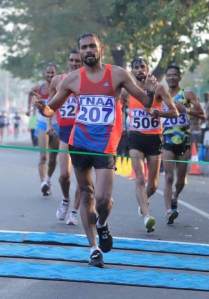
K. T. Irfan (This is a file photo from an earlier event; image has been cropped for use with this specific article. Photo: AFI Media)

K. T. Irfan becomes first Indian athlete to qualify for 2020 Tokyo Olympics

Indian race walker, K. T. Irfan completed the 20 kilometer-race walking event at the Asian Race Walking Championships in Nomi, Japan, in one hour, 20 minutes and 57 seconds.

Placing fourth in the competition, Irfan, national record holder in 20 kilometer race walking, became the first Indian athlete from the field of athletics, to qualify for the 2020 Tokyo Olympics. The Tokyo Olympics qualification standard for the discipline is one hour, 21 minutes.

The Olympics qualification window for race walking events and the marathon commenced on January 1 this year and will run till May 31, 2020.

Irfan had set the national record when registering his personal best (PB) timing of 1:20.21 hours at the 2012 London Olympics.

“ Mentally, I am feeling relaxed now. It is good that I have achieved the Olympics qualification mark very early in the season. There is more than a year now to train and prepare for the Olympics,’’ Irfan was quoted as saying in a statement issued by Athletics Federation of India (AFI).

“ Today it was raining constantly here in Nomi and it was cold. I could not warm-up properly because of cold and was a bit slow in the first two laps; else my target was to finish in first three,” he said.

Japan’s Toshikazu Yamanishi was the winner with a timing of 1:17:15 while Kazakhstan’s Georgiy Sheiko (1:20.21) finished second and Korea’s Byeongkwang Choe (1:20:40) secured the third place.

Anu Rani sets new national record in javelin throw

Anu Rani set a new national record in javelin throw at the 23rd Federation Cup in Patiala.

The athlete from Uttar Pradesh threw the javelin to a distance of 62.34 meters, improving upon her own national record of 61.86 meters set at the 2017 edition of the Federation Cup.

Anu Rani, 26, set the latest record of 62.34 meters in her penultimate attempt, Athletics Federation of India (AFI) said in a statement. With her national record throw, she also achieved the qualification standard of 61.50 meters required for the IAAF World Championships 2019 to be held in September–October in Doha. Anu Rani’s third throw of 58.35 meters had already qualified her for the Asian Championships.

“ I have thrown over 64m in practice very often. So I was expecting to throw that much in the competition. But I was making some mistakes in my technique. Now that I am going to the Asian Championships, I will try to improve,” Anu Rani was quoted as saying.
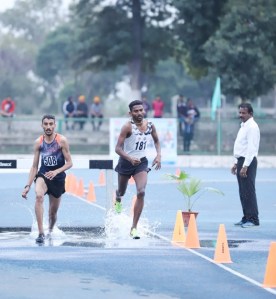
Avinash Sable (Photo: AFI Media)

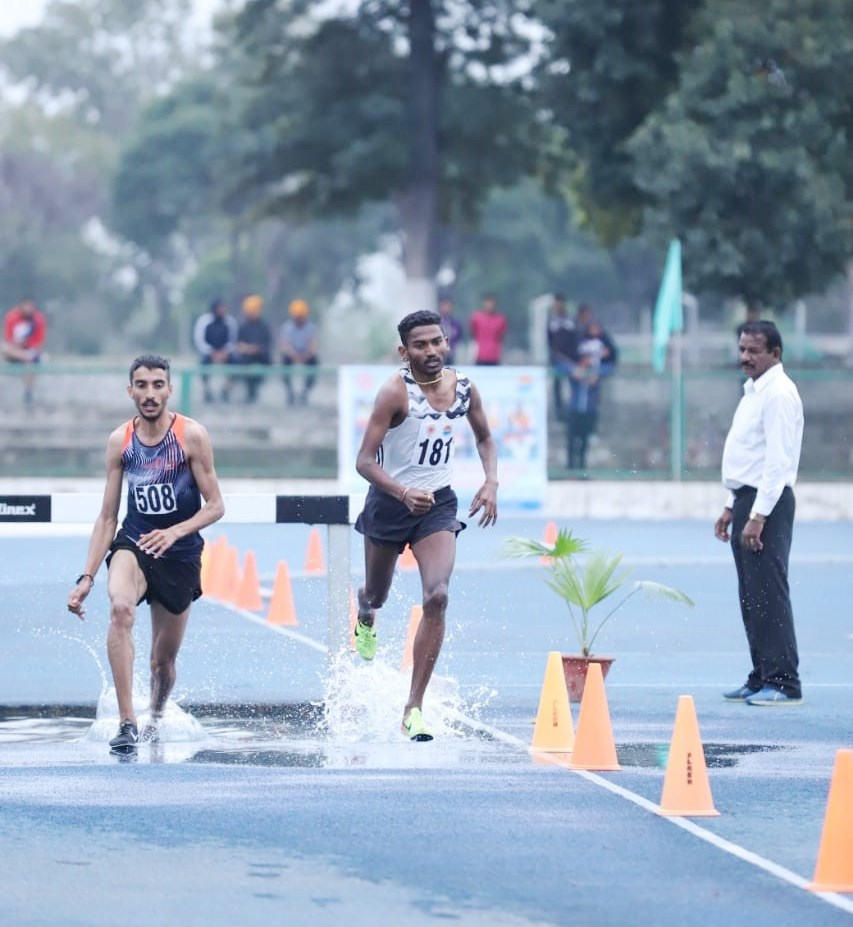
Avinash Sable sets new national record in steeplechase

Avinash Sable smashed the national record in the 3000m men’s steeplechase competition on the final day of the 23rd Federation Cup in Patiala. . The 25-year-old stopped the clock at the athletics track at the National Institute of Sport in 8.28.94 to erase his own national record of 8.29.80 recorded just six months ago in Bhubaneswar.

According to a statement (dated March 18, 2019) available on the website of Athletics Federation of India (AFI), Sable’s effort was more than enough to secure him a spot in the upcoming Asian Championships. AFI had set 8.35.00 as qualifying mark for this event. Sable’s time was also good enough to get past the qualification mark for the IAAF World Championship due in Doha over September-October 2019, for which the assigned qualification standard was 8.29.00. Shankar Lal Swami placed second with a time of 8.34.66.

Asian Games gold medalist in the 1500m Jinson Johnson finished first in the discipline at Federation Cup clocking a time of 3.41.67 to finish well under the AFI qualification guideline of 3.46.00 for the Asian Championships. Johnson was followed closely by Uttar Pradesh athlete Ajay Kumar Saroj, who clocked a time of 3.43.57. Also finishing under the AFI qualification guideline was Uttar Pradesh athlete Rahul who stopped the clock at a time of 3.44.94, the statement said.

Arokia Rajiv assured himself of a spot on the Indian team that will travel to the Asian Championships, by winning the men’s 400m race in a time that met the AFI’s qualification guideline. Rajiv produced a mini upset by beating the national record holder Muhammad Anas over the quarter mile. Rajiv clocked a time of 45.73 to finish 0.12 under the AFI qualification standard of 45.85.

Also assuring herself of a spot in the Asian Championships was Swapna Barman, Asian Games gold medalist in the women’s heptathlon. According to the AFI statement, Barman had a relatively slow 800m race to finish her competition but her total of 5901 points was more than enough to meet the AFI qualification guideline of 5800 points.

Five athletes clear 10,000 meters qualifying mark for Asian Championships

Gavit Murali Kumar of Gujarat was winner in the men’s 10,000 meter race at the 23rd Federation Cup held in Patiala. He crossed the finish line in 29.21.99 minutes.

He and four other athletes cleared the qualifying guideline of 29.50.00 in the men’s 10000m race for the Asian Championships, due in Doha in April 2019, ahead of the IAAF World Championships later in the year.

Abhishek Pal of Uttar Pradesh came in second with a time of 29.22.37; the bronze medal went to Kalidas Hirave who clocked 29.25.16. Defending champion G Lakshmanan came fourth with a time of 29.26.41 while Vasudev Nishad came fifth in a time of 29.31.42, Athletics Federation of India (AFI) said in a statement. All of them have thus cleared the qualifying mark.
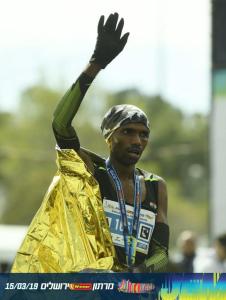
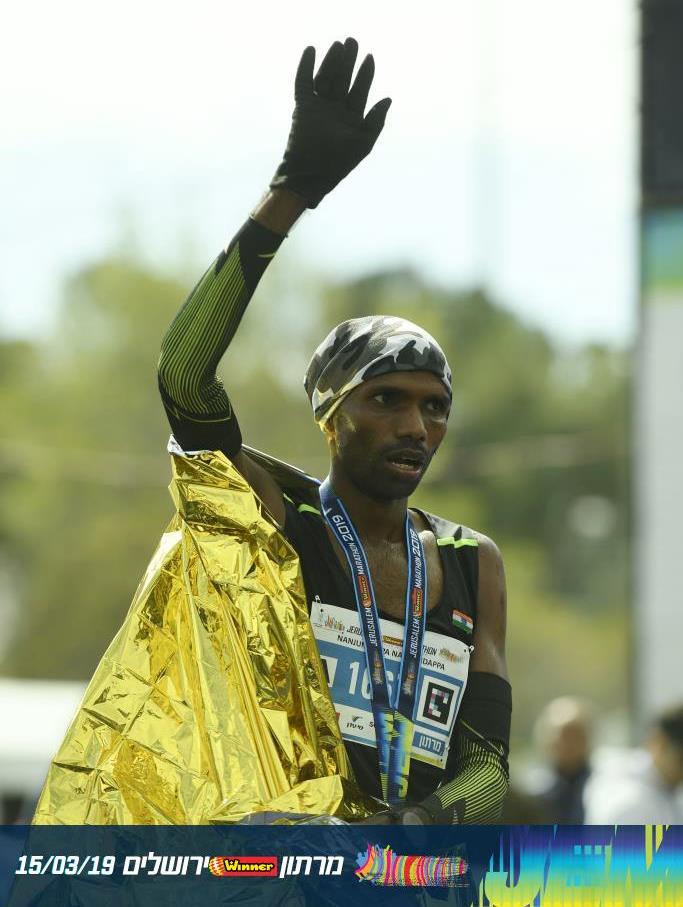
M. Nanjundappa at the 2019 Jerusalem Marathon (Photo: courtesy Nanjundappa)

India’s Nanjundappa finishes ninth at 2019 Jerusalem Marathon

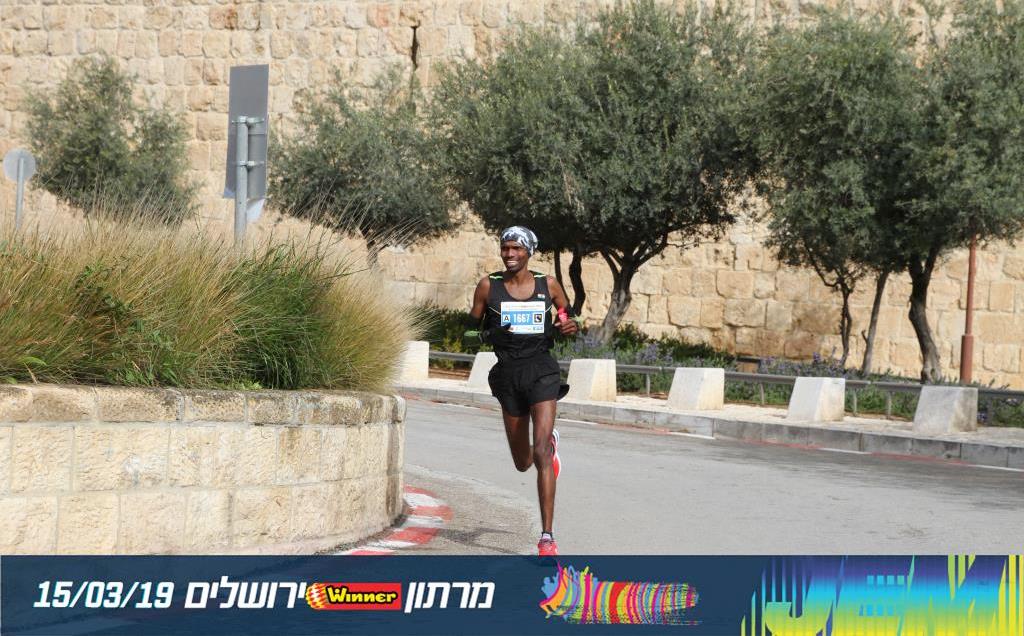
Bengaluru-based M. Nanjundappa finished ninth overall and eighth among men at the Jerusalem Marathon held on March 15, 2019.

He crossed the finish line in two hours, forty-eight minutes and two seconds.

On February 24, 2019, he had participated in the IDBI Federal Life Insurance New Delhi Marathon and secured third position in his age group of 18-35 years with a timing of 2:38:48.

“ At Jerusalem, the route was very tough with many uphill sections. That’s why my timing suffered. Also, I had run a marathon in New Delhi just over 20 days earlier,” Nanjundappa said.

Karnataka Athletic Association took the initiative to see him participate in this marathon, he said. “ The organizers of the Jerusalem Marathon took very good care of athletes,’’ he said.

Nanjundappa trains under coach, K.C. Kothandapani, in Bengaluru.
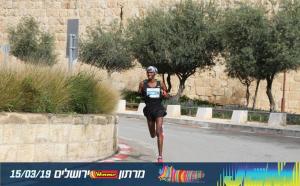
M. Nanjundappa at the 2019 Jerusalem Marathon (Photo: courtesy Nanjundappa)

At Jerusalem Marathon, it was a Kenyan sweep in both the men’s and women’s categories of the race.

Kenya’s Nancy Chepngetich Kimaiyo was the winner among women with a timing of 2:44:50. Ronald Kimeli Kurgat, also of Kenya, won the men’s race with a timing of 2:18:47.

“ Approximately 40,000 runners from 80 countries around the world ran a breathtaking route, passing through the Old City walls, the Sultan’s Pool, Mishkenot Sha’ananim, Mount Zion, the German Colony, Rehavia, the Armon Hanatziv Promenade, Ammunition Hill, Mount Scopus, Mount of Olives and other sites,’’ The Jerusalem Post noted in a report on the marathon.
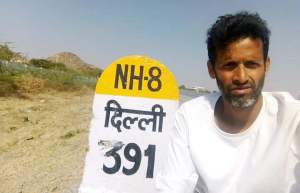
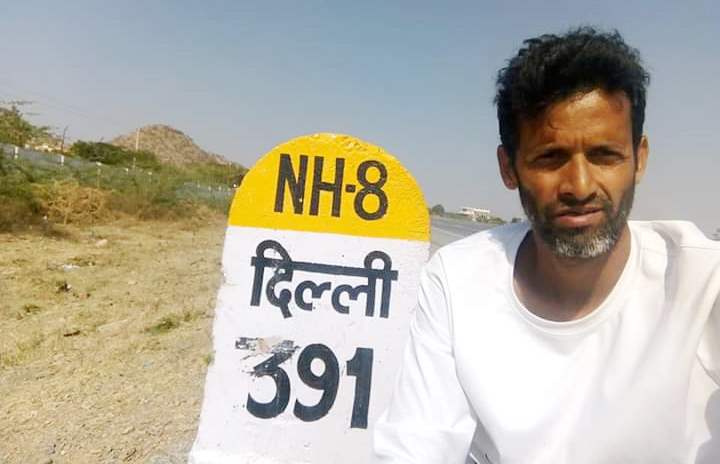
Photo: courtesy Rahul Jadhav

Former prison inmate does a long run from Mumbai to Delhi; raises awareness about drug de-addiction

Not so long ago, Rahul Jadhav was cooling his heels in Mumbai’s Arthur Road jail. Picked up by the police in 2007 and charged under the Maharashtra Control of Organized Crime Act (MCOCA), Rahul, during his prison tenure, developed fondness for drugs as well.

Initially out on bail in 2010 and wanting to live a normal life, Rahul however kept getting arrested in other cases. During this phase, he managed to secure a regular job but was forced to abandon it after the cops picked him up again. In 2013, he was finally acquitted of the charges filed against him. Rahul recommenced his search for a job but no employer wanted to hire a former criminal. The disappointment drove him deeper into substance abuse. He also contracted tuberculosis. Finally, his family got him admitted to Muktangan Rehabilitation Center, Pune, to combat the drug addiction. A year later, one of his counselors suggested that he attempt a 10 kilometer-run in Pune.

“ When I started running I understood my capability. I realized that running a marathon and living a life are very similar. The finish line in a marathon is akin to life’s future. You run towards your future,’’ Rahul said. Just as running made him aware of his capability, Rahul began to realize that he should be realistic about his job expectations. While at Muktangan, he used to do various tasks for which he earned a honorarium of thousand rupees per month. He was told that such work would keep his chances of securing a job alive, once he left the institution. That hope also prompted him to improve other aspects of his life. “ I began working on my English and also started reading newspapers to be up to date on news and information,’’ he said.
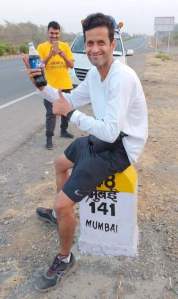
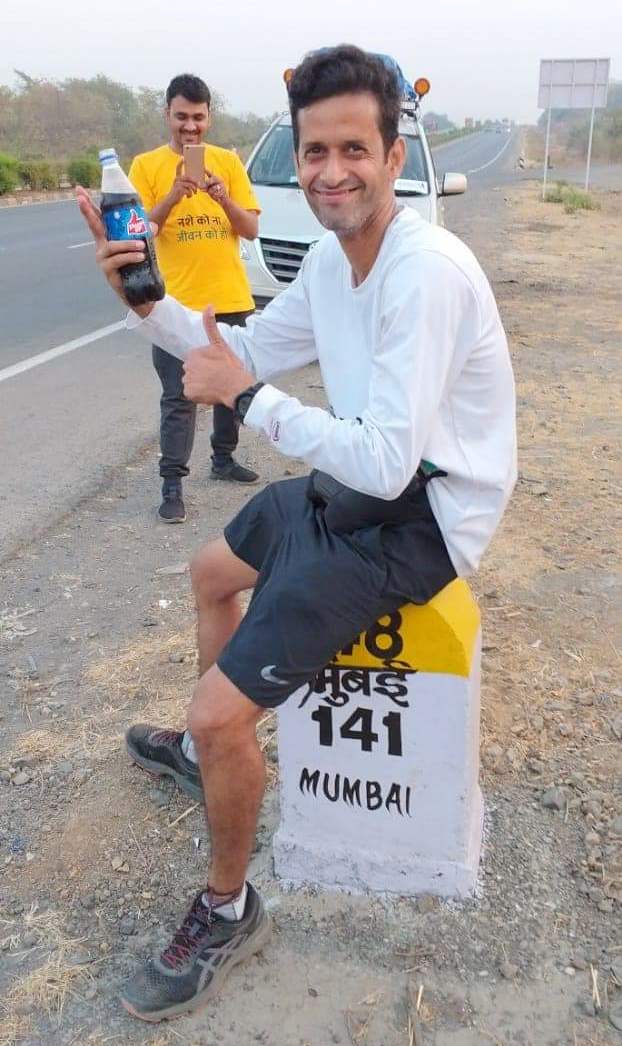
Photo: courtesy Rahul Jadhav

Meanwhile, running engaged his mind and he continued running long distances. In 2016, the year he started running, he also attempted a full marathon – Pune Running Beyond Myself Marathon – held in October. Journeying alone, Rahul persisted with his distance running. He attempted Mumbai-Khopoli, Mumbai-Pune several times besides other similar distances. In the meantime, he also secured employment at Morde Foods Pvt Ltd. “ I laid my life threadbare before my employers. I realized, there was no point hiding the truth. This helped me get the job,” Rahul said adding that apart from his salary he was also given an allowance to fund his requirements in running. He now works in logistics at the company.

When you break the law and indulge in criminal activity, society shuns you. That happened to Rahul too. He had bridges to rebuild. “ I had to go to my village in Ratnagiri district. I decided to run the distance. I did a Google search and found some lodges where I could spend nights,’’ he said. Strapping a haversack to his back, he ran all the way to his village in Ratnagiri, south west Maharashtra (the Internet estimates the distance from Mumbai to Ratnagiri at 346 kilometers). This run essayed in January 2018, was his gesture of atonement. He was welcomed at his destination, Rahul said.

Fascinated by ultra-distances, Rahul then decided to attempt Mumbai-Kathmandu. Discussing this with a friend from Nepal, he realized that he should ideally attempt a shorter distance. That’s how the idea of running from Gateway of India in Mumbai to India Gate in New Delhi came about. Muktangan stepped in to organize the run with the aim of creating awareness about drug de-addiction. Morde Foods’ owner Harshal Morde contributed to financing the run.

Rahul ran an average of 80 kilometers everyday covering the distance in 19 days and seven hours. “ Most days I ran a distance of 75 kilometers and occasionally, 100 kilometers. One day, I could only run 15 kilometers and had to stop because of injury but I made up later,’’ he said. He completed the run on February 20, 2019. Arun Bhardwaj, India’s best known ultra-runner who is also noted for pioneering the sport in the country, was at the finish line to receive Rahul.

Rahul lives in Kalbadevi, Mumbai. He visits his parents in Dombivili every Sunday.

“ They now sleep peacefully at night,” he said.

Ethiopians win men’s, women’s race in rain drenched Tokyo Marathon

Ethiopians Birhanu Legese and Ruti Aga emerged winners in the men’s and women’s race respectively at the 2019 Tokyo Marathon on March 3, 2019.

Birhanu Legese finished in two hours, four minutes and forty-eight seconds. Ruti Aga crossed the finish line in 2:20:40 to win it. Heavy rains marred the race.

Among men, Kenya’s Bedan Karoki came in second with a timing of 2:06:48, exactly two minutes behind the winner. Kenya’s Dickson Chumba, a two-time winner of the Tokyo Marathon, finished third in 2:08:44. Among women, Ethiopians Helen Tola came in second (2:21:01) while Shure Demise (2:21:05) finished third.

New indoor one mile record set by Yomif Kejelcha

Ethiopian Yomif Kejelcha set a new indoor one mile world record during the Bruce Lehane Invitational race in Boston early March.

With a timing of 3:47:01, Yomif broke the previously held record of 3:48:45 set way back in 1997 by Morocco’s Hicham El Guerrouj.

Yomif is coached by America’s Alberto Salazar, former long-distance runner and currently track and field coach.
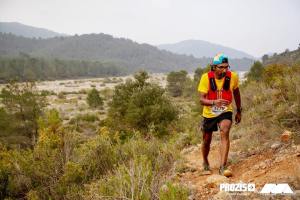
Ullas Narayana at the 2018 IAU Trail World Championship (Photo: courtesy Kieren D’Souza)

Five athletes to represent India at 2019 Trail World Championships in Portugal

Ullas Narayana, winner of India’s first international medal in ultra-running, has been chosen to lead a team of five athletes at the International Association of Ultrarunners (IAU) Trail World Championships, scheduled to be held at Miranda Do Corvo, Portugal on June 8, 2019.

The team includes Kieren D’Souza, Tlanding Wahlang, Radhey Kumar, Rajasekar Rajendra and Ullas Narayana.

To be eligible, AFI had set norms requiring athletes to have run category-specific races and obtained the specified benchmark – a cotation of 650 (men) and 550 (women) in ITRA Race Category S (45 km – 74 km) or M (75 km to 114 km) in a period of 18 months before the date of the championships and the last date for submission of applications.
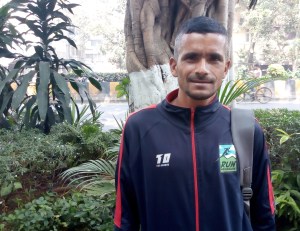
Tlanding Wahlang (Photo: Shyam G Menon)

Also, the athletes were required to have run an ultra-race in a period up to 12 months before the championships, AFI said in a statement on its Facebook page.

“ I am glad I have made it to the Indian team once again for a top international competition. The level of trail runners is fast improving in India and competition is getting tougher with each passing year. I was also part of the Indian team in 2017 Trail World Championships and it was first world championships for us. I am confident we will have better results compared to last time which is our main target and to keep improving our overall standard at international level in ultra-running,’’ AFI’s statement said quoting Ullas Narayana. He had won a bronze medal at the IAU 24Hr Asia-Oceania Championships in Taipei in December 2018.
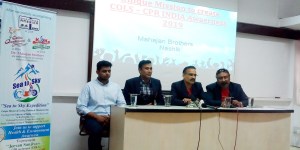
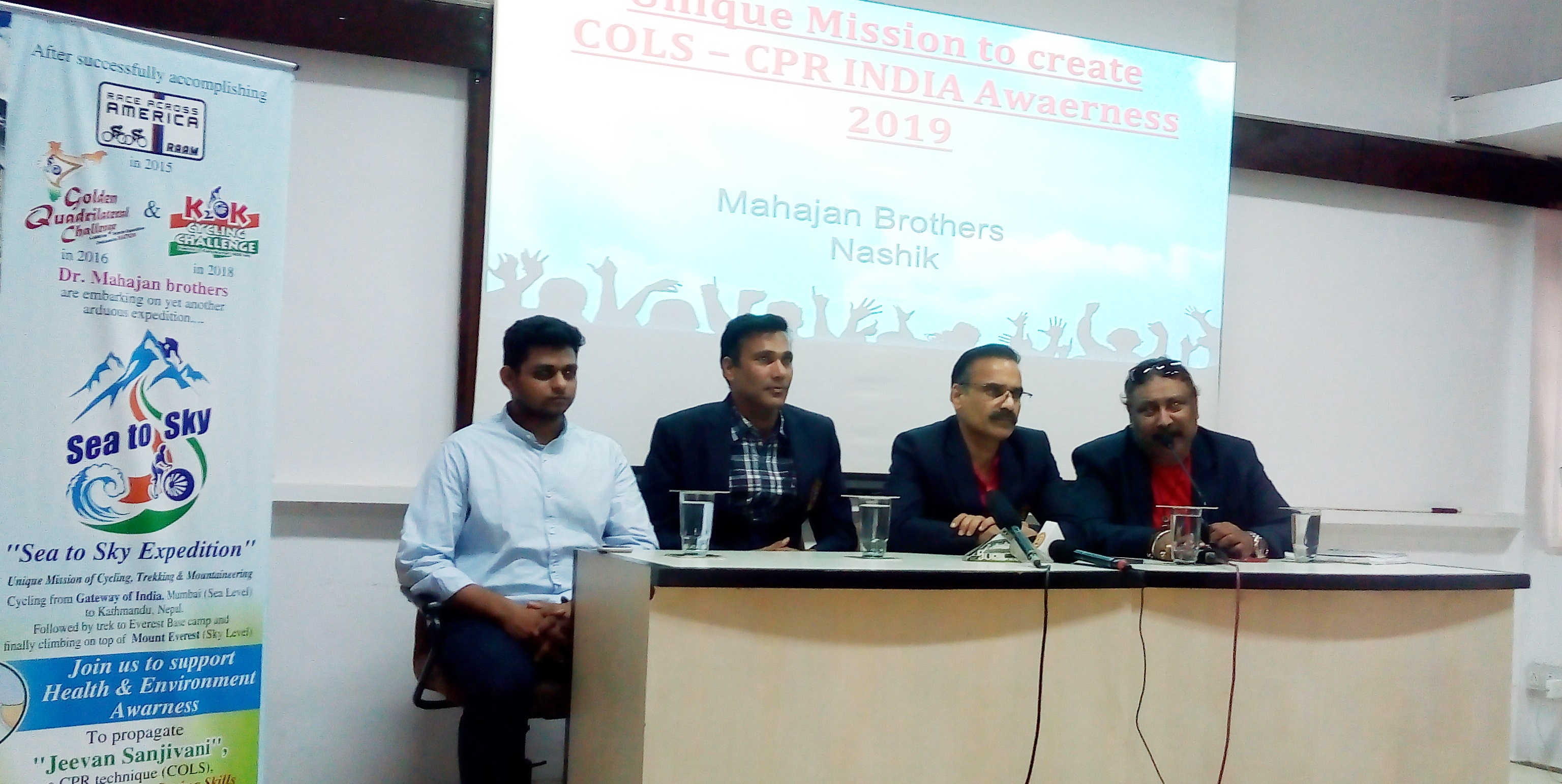
The Mahajan brothers – Mahendra (second from left) and Hitendra (third from left) – at the press briefing in Mumbai (Photo: Latha Venkatraman)

Mahajan brothers to commence Sea to Sky expedition on March 31

Dr Hitendra Mahajan and his younger brother Dr Mahendra Mahajan will commence their Sea to Sky expedition on March 31, 2019, from Gateway of India, Mumbai.

The Sea to Sky expedition entails cycling, trekking and mountaineering. The duo will cycle from Mumbai to Kathmandu in Nepal, trek to Everest Base Camp and then attempt Mount Everest.

Way back in 1996, Swedish adventurer, the late Goran Kropp had cycled from Sweden to Nepal, climbed Mount Everest and cycled back part of the way. In 2015, the Mahajan brothers had shot to prominence becoming the first Indians to complete Race Across America (RAAM), widely considered to be one of the most challenging races in ultra-cycling.

The Mahajan brothers’ expedition aims to create awareness about Cardio Pulmonary Resuscitation (CPR). It will have sessions on CPR conducted by Jeevan Sanjivani, Hitendra said at a press conference in Mumbai.

The brothers have estimated the cost of the expedition at Rs 70 lakh and are in the process of raising the money. Force Motors have come in as one of the sponsors of the expedition, offering Rs 10 lakh by way of support.

Starting from Mumbai on March 31, the brothers will have a stop at Nashik. By the end of that day, they are scheduled to reach Dhule in Maharashtra. Among other halts mentioned so were Indore, Kanpur, Lucknow, Basti, Butwal and Bharatpur before crossing the border with Nepal to eventually reach Kathmandu.

The trek to Everest Base Camp is slated to commence on April 8. The team expects to reach base camp in nine days.

After acclimatization, the climb up Mount Everest will start depending on a favorable weather window, Mahendra said.

(For more on the Mahajan brothers please try this link: https://shyamgopan.com/2018/12/26/mahendra-mahajan-life-before-and-after-2015-raam/)

(The author, Latha Venkatraman, is an independent journalist based in Mumbai.)

JOURNEY TO FIRST MARATHON: AMAZING 12 MONTHS

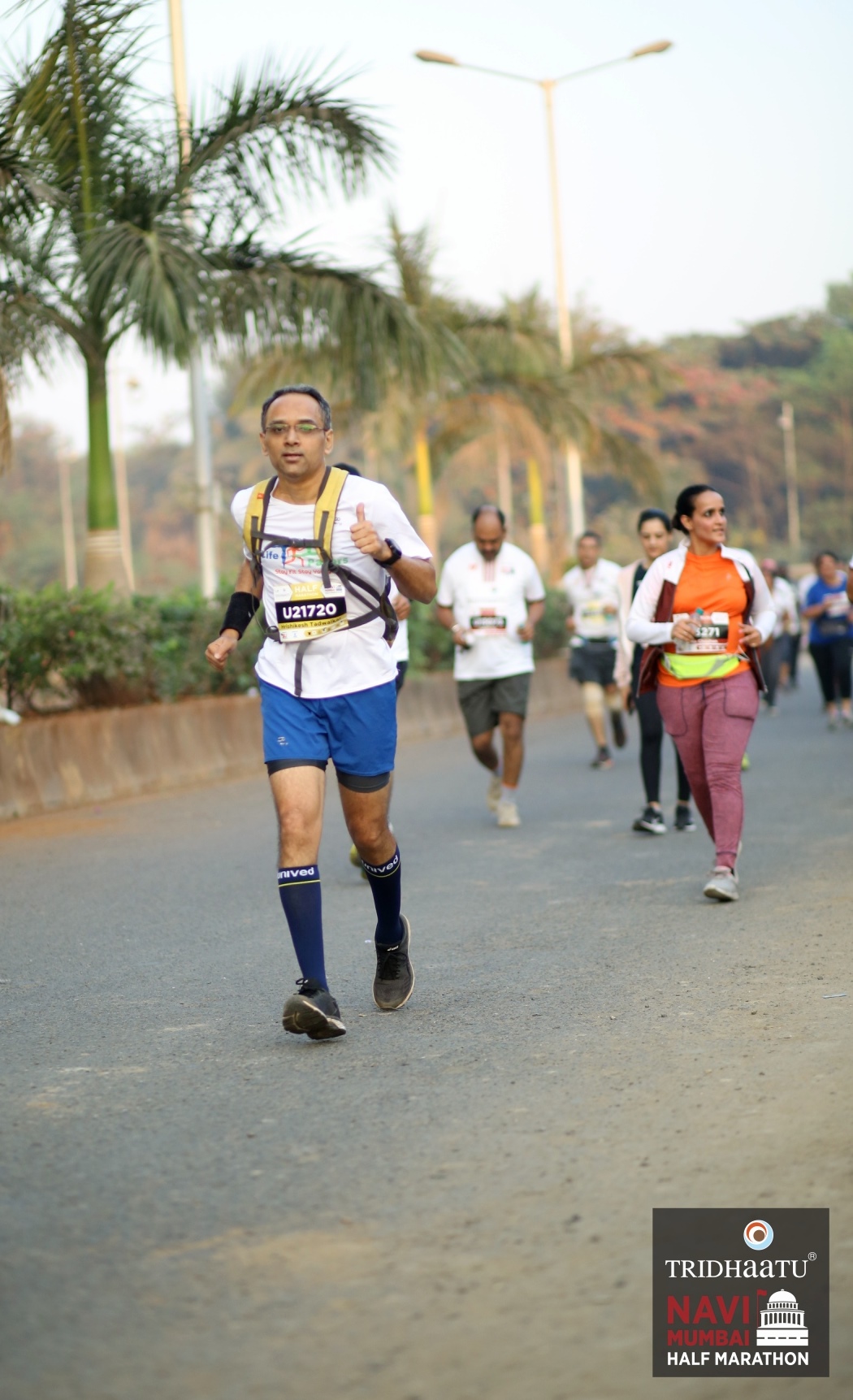
Hrishikesh at the Navi Mumbai Half Marathon (Photo: courtesy Dr. Hrishikesh Tadwalkar)

Dr. Hrishikesh Tadwalkar, an eye surgeon specializing in oculoplastic and orbital surgery, started running a year ago. In September 2018, he attempted his first half marathon. Encouraged by his performance, he decided to train for the full marathon. His goal: the 2019 New Delhi Marathon. This is his journey, in his own words:

In September 2018 I ran my first Satara Hill Half Marathon.

It was a big achievement for me considering the fact that I had never done any running prior to January 2018 and had only run my first race (a 10K) in February.

A year earlier I would have hardly believed that I could run a distance of 21 kilometers let alone in an “ ultra’’ hill marathon but just after finishing the race in Satara my mind was already asking the question: what next?

Around that time I came across an interesting quote by Joe Vitale in a blog on running. It said: A goal should scare you a little, and excite you a lot!

I decided to aim high and try to attempt the full marathon.

I have no illusions about my athletic ability. I am from a middle class family with the customary emphasis on education and academic excellence. Growing up, I played cricket and other games in the housing complex (after finishing home-work). That and the occasional sprint to catch the BEST bus on my way to school were about the entire extent of my physical activities. The rigmarole of undergraduate and postgraduate medical education (I am an eye surgeon by profession) left me hardly any time (and inclination) for fitness pursuits. The situation only worsened in the next phase of life viz. setting up a medical practice and settling down.

I always disliked the gym. So to reduce weight and build fitness, I turned to running. I started small by following a `Couch to 10K’ app and gradually built up running distance and time. After completing my first 10K, I joined the Navi Mumbai-based running group `Life Pacers’ for further training. It was a decision that proved to be truly transformative. Full credit for the improvement in my fitness and running ability goes to Life Pacers’ training.

Life Pacers is mentored by Pravin and Arati Gaikwad (both of them, doctors), Debabroto Ghosh and coached by Dnyaneshwar “Don’’ Tidke. The program is customized to suit each runner’s ability and focused on injury prevention and improving running-longevity. Personal strength training is also provided in a gym; it contributes to performance enhancement.

Within six months of joining the group I could go from 10K to finishing three half marathons and three 10K races; I also improved my timing steadily. When I enquired if I could take a shot at the full marathon, the seasoned runners around were very encouraging. However they advised me to train well and run with no time-target in mind. Don and Dr. Pravin recommended that I wait two to three years and build up a solid foundation to avoid risking injury. I assured them I would attempt the race only if I completed all scheduled runs including long runs comfortably (they were still not happy; they were concerned I may get injured).

The training for the 2019 Tata Mumbai Marathon (TMM) – I was running the half, it being my first TMM – started in mid-October 2018. It was quite intense with speed drills, tempo runs and progressively longer long, slow, distance (LSD) runs. It was rather exhausting at times but the improving metrics provided motivation to keep going.

At the Mumbai Half Marathon (Photo: courtesy Dr Hrishikesh Tadwalkar)

I had five weeks between TMM and my first full marathon. The event I had chosen was the New Delhi Marathon, scheduled for February 24, 2019. It was reputed to have a generally flat course and the weather expected to be fairly cool.  At 2019 TMM I completed the half marathon in one hour, fifty-nine minutes and thirty-five seconds. Post TMM, as others in my group enjoyed a well-earned respite, I ploughed on.

The longest I had run prior to TMM was 26 kilometers and I knew I needed longer runs under my belt before I could deem myself prepared for the full. I was following Hal Higdon’s Novice 1 program apart from regular training and asked Don for additional advice. He gave me (reluctantly and under statutory warning!) a LSD schedule for the next four weeks which I followed to the T.

As per everyone’s advice, my race strategy was very simple: run at comfortable pace, focus on hydration and nutrition, enjoy the race (you only run one first full marathon) and finish strong with a smile on my face (after all, PB [personal best] was guaranteed!).

I had done all my longer runs (30 kilometers and more) comfortably at 6:10 pace. So I decided to target the same pace in the race. I broke down the race into five parts of eight kilometers each; I targeted to finish each segment in 50 minutes. This way I was not too preoccupied with my Garmin and yet could keep track of my progress. We had an early start at 4 AM. The pre-race atmosphere was crackling with energy. A little warm-up, a push-up challenge and we were off!

Since I had a predetermined plan, I decided not to go with any pacer. The weather was comfortably chilly with mild breeze and the route was flat with very good arrangements for hydration and nutrition (basically no room to complain or give excuses; the race was entirely mine to screw up!). I started slowly and resisted the urge to accelerate and get carried away by the crowd (occasional shouts from pacers like “only 38 kilometers to go,’’ also helped in slowing down!). I reached my targeted pace by the eighth kilometer.

After that I just held the pace and enjoyed the wide roads and famous sights of a New Delhi, slowly waking up. The end of the first loop (21 kilometers) came and went and I was feeling quite strong. Still, I decided against any acceleration and held the pace till 32 kilometer-mark. I was well within target after every eight kilometer-block, so I was relaxed.

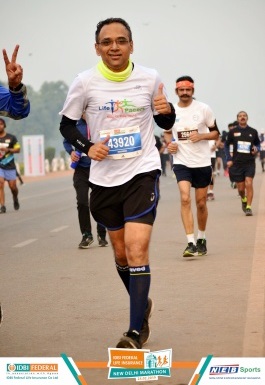
At the 2019 New Delhi Marathon (Photo: courtesy Dr. Hrishikesh Tadwalkar)

Running a marathon – especially when you do so alone – can be a contemplative experience. A lot of thoughts go through the mind as one runs those long miles on the return leg of the course. I reflected with gratitude on all the speed intervals and high intensity interval training (HIIT) exercises performed grudgingly, earlier. They were now helping me to finish strong. I recalled all the encouragement and motivation from my friends and running buddies which was keeping my spirits high. I also remembered fondly, the understanding with which my family supported me.

On the return stretch of the second loop I got caught up in the flow of half marathon and 10K runners as there was no separate lane for those attempting the full marathon. At most places, the wide roads ensured no hindrance but in one or two places where the course was narrow, it created bottleneck.

A small loop ahead of the finish line was a little vexing. But before I knew, the finish line loomed in front and I crossed it with a smile on my face. I clocked four hours 24 minutes. About 40 per cent of the runners in the field got a faster time than me but I count my race a success as I stuck to my plan and finished strong without injury. It was roughly a year since I did my first 10K race in February 2018.

From couch potato to running sub-2 half marathons and sub-55 10K races, what an amazing journey the past 12 months has been!

And now, I’m marathoner too.

(The author, Dr. Hrishikesh Tadwalkar, is an eye surgeon specializing in oculoplastic and orbital surgery. He is based in Navi Mumbai.)

IAAF COUNCIL MODIFIES OLYMPIC QUALIFICATION AND ENTRY STANDARDS

Illustration: Shyam G Menon

According to information available on the website of the International Association of Athletics Federations (IAAF), the IAAF Council recently approved a new Olympic qualification system for the 2020 Olympic Games in Tokyo.

This will give athletes more opportunities to achieve the required entry standards.

The qualification window has been extended by two months for most events. “ This will start on 1 May 2019 (instead of 1 July 2019), to include more international competitions such as the IAAF Diamond League, and end on 29 June 2020,’’ the statement (part of a press release dated March 11, 2019) said.

The qualification period for the marathon and 50km race walk will close at the end of May 2020 (instead of 29 June), to give the qualified athletes more time to prepare specifically for the Games.

After extensive consultation with key stakeholders, the Council has decided to introduce a dual qualification system, combining both the entry standards and the new World Ranking System, to determine which athletes are eligible for Olympic selection in 2020.

Under this new qualification process, an athlete can qualify for the 2020 Olympics in one of two ways:

  • Achieve the entry standard within the respective qualification period
  • Qualify by virtue of his / her IAAF World Ranking position in the selected event at the end of the respective qualification period.

The process is designed to achieve about 50 percent of the target numbers for each event through Entry Standards and the remaining 50 percent, through the IAAF World Ranking System, the statement said.

Race walking

Another statement available on the IAAF website informed that the IAAF Council agreed in principle with the Race Walking Committee’s proposal to change the competition program for race walking in order to protect and promote the discipline at major international championships and its appeal and attractiveness to new audiences.

According to the statement, the Council specifically agreed with the importance of:

  • Maintaining a 4-medal discipline and gender equity with two men’s and two women’s events at all major international competition
  • Continuing to prioritize investment in and development of the Race Walking Electronic Control System (i.e, the electronic chip insole technology)
  • Testing and validating the technology in competition during 2020
  • Roll out of two of the following events: 10km, 20km, 30km or 35km from 2022.

The above decisions and others were made at a recent meeting of the IAAF Council in Doha, venue for the upcoming edition of the World Athletics Championships.

(The author, Shyam G Menon, is a freelance journalist based in Mumbai.)

TRIVANDRUM DIARY / MARCH 2019

Illustration: Shyam G Menon

I know it is Thiruvananthapuram. But for the heck of these musings, let’s keep it Trivandrum in the title for that is what the city was called years ago; the start line from which my generation commenced its journey. Vignettes and thoughts from a recent visit:

From deluge to frying pan

At his house in Thiruvananthapuram, my uncle told me of a video his son sent him. It was shot in Chicago, during the extreme cold weather caused by polar vortex. In it, a cup of water is thrown up in the air. It transforms to a shower of ice in no time. I remembered this well into my regular morning run in Thiruvananthapuram. The predicament around was abject opposite of Chicago’s cold. It was a few days into March 2019 and Kerala, still bearing scars from the floods of 2018, was officially into heat wave.  From extreme rain, the state had swung to unbearable heat. With humidity also in the mix, the resultant brew wasn’t pleasant by any yardstick. Advisories had been issued by the state government urging people to stay hydrated and avoid working in the open during hot afternoons.  Sweat is familiar companion on runs in Kerala. But the run to Kovalam from home in the city went a bit beyond that. Heat overall and straight, monotonous road in parts – that’s how the bypass leading to Kovalam was. It brought spells of boredom. Good thing was, the struggle made breakfast on the beach well earned. After days of such warm weather, we had a slightly overcast evening. Early next morning as my daily run entered its concluding phase, an excuse of a rain drop made its presence felt. It seemed the reverse of that story from Chicago.  Once was rain drop. Somewhere along its passage through hot atmosphere, it vaporized to excuse. For a while it rained excuses. Despite drizzle, the road betrayed no sign of wetness. As Bob Dylan sang: the times, they are a changin’. Yet Kerala marches on; its priorities in life, consumerism, social attitudes and lifestyle declining to acknowledge the changes afoot. From weather to environment, demographics and remittances from overseas – there are impacts felt or due to be felt. An hour later, runner and excuse of rain gone, that narrow city road lined by myriad plots sporting individual houses within, would be lost to a flood of automobiles. Like serpent eating its tail, our habits swallow us. Thus content, we conclude: nothing has changed.

City of stadiums

Thiruvananthapuram’s Jimmy George Indoor Stadium is right next to the local swimming pool, venue for many national competitions from years past and training ground for several promising swimmers. In his younger days, this author too had his share of time at Thiruvananthapuram’s pool aka Water Works pool. Promise, unfortunately, there was none. My swimming stayed survival-level. Early March 2019, the indoor stadium named after Kerala’s greatest volleyball player yet, was hosting an exhibition of sports equipment. On land between the stadium and the pool, was a make-shift auditorium for panel discussions and demonstrations of various sports; right next to this temporary facility was an equally temporary boxing ring. The first evening of the expo, a few boxing bouts were staged for the public to watch. A law student into boxing that I consulted for better understanding of how points are awarded told me that Kerala lagged in the senior category in the sport even as it managed to perform decently at junior level. Somehow the promise seen at junior level didn’t get carried over; there was continuity lost. He couldn’t articulate why. I asked him about local facilities to box. According to him, there was one boxing ring on the outskirts of town. College level boxers trained in improvised circumstances and before a major competition, managed some sessions at the ring for the feel of being in one is distinctive. On the brighter side, he said that Thiruvananthapuram now had a boxing club of sorts with he and interested others training youngsters in the sport. I have said this before and I say it again – few Indian cities have as many stadiums, sports facilities and synthetic tracks, all within relatively short distance of each other, as Kerala’s capital does. What we need to do is use it well and along with that, love well-rounded education more than one heavily partial to academics. To exist is to breathe life into all of one’s faculties; mind and body fuel each other. Ideally, success by career should be secondary to awareness by existence. Don’t you think so?

Extreme academics

Kerala loves films. In my childhood, English films were regularly screened in Thiruvananthapuram. Past college, as the ascent of television commenced and programming in Malayalam gained currency, Hollywood faded at the city’s theatres. Cinema halls previously associated with English films started hosting the latest Malayalam blockbuster. For a while I was upset because there was little in vernacular content that fascinated me. Not anymore. Some Malayalam movies are now genuinely engaging and well made; among the best in India. Back in time however, Hollywood was welcome diversion from plots, contexts and characters I couldn’t relate to. Several years ago, on a visit home I was delighted to find Apocalypto running at a local cinema. Until the latest visit home that was the last movie I saw in Thiruvananthapuram. With many of the old cinema halls since converted to multiplex and spliced for consumer preference, Hollywood seemed back. Given Mumbai’s multiplexes are unaffordable on my freelance journalist-income I hadn’t seen Bohemian Rhapsody, the Oscar winning biopic on Freddie Mercury. Courtesy Oscar glory, a Thiruvananthapuram multiplex had this movie and Black Panther returned to the screen. As memorable as Bohemian Rhapsody, was a set of hoardings I found outside the cinema hall; actually across the road from it. I quote from memory. One board sported two messages: For your entertainment (arrow pointed to multiplex); for career advancement (arrow pointed to a nearby building offering coaching classes for various exams). Another board nearby announced: Extreme Coaching Classes; cautionary note below added: only hardworking-students need apply. Who said extreme is meant only for extreme sports?

Illustration: Shyam G Menon

The success epidemic

I love Kerala. I hate Kerala. Middle aged, living life as I wish and hauling my share of broken ware courtesy such experiments, I visit families only to be treated to tales of successful parents, successful children and successful grandchildren. It is typically success measured in terms of academic brilliance, intelligence, smartness, career and well settled life. In land by attributes like academic excellence, remittance economy and well settled life, the above said narrative is all over the place like a background drone. Families draw satisfaction from humming it. I sit and listen. In Kerala, this parade of success would seem a bigger epidemic than all the fevers, coughs and ailments surfacing by summer. Successful people should be happy people. Interestingly, that isn’t always so. I have a theory for it. When life is lived too much on the theme of last man standing, accumulating all the wealth required to buy your passage when world crashes, it is possible that you revel in having bolstered your chances of survival; it is also true that you acknowledge inevitable disaster lurking in the horizon. Else why would you arm yourself so with more and more money? Are you then, happy or afraid? Worse, none of the factors around raising fear of potential disaster, are addressed. As this trend grows, private fortresses become coveted shelter.

In Thiruvananthapuram, a friend’s father told me this – he had been attempting unsuccessfully to get the residents of his colony to meet up and chat. It is something everyone wants to do for there is real loneliness in successful Kerala. But as yet, the chat has remained a dream. Except one person, nobody turns up. Why? – He asked me. My analysis was simple and drawn from the distance growing between my friends and me as we age. The colony in question showed no visible sign of struggling to exist. The houses were solid, many were multi-storeyed and all houses had compound walls and gates securing them. It was the epitome of successful well settled life; very Malayali. Each plot, likely a tiny kingdom. When people emerge to meet world outside it is like ambassadors dispatched for diplomatic engagement. You are projecting image, lineage, social standing. Now, people are people. They will socialize. The problem is when they come accompanied by their success and other related baggage, including ego. Too many peacocks in one room make it a competition in preening. Who feels happy comparing and competing all the time? Park that baggage outside and the human warmth and company sought, should resurface. Life is about you, your times; your friends and what you understood of planet from your fleeting existence. Why crowd it with talk of parents, children, grandchildren, engineering, medicine, MBA, career, USA, Europe, NRI, bank account, mansion and car; none of it really you as in you in your bubble of existence? Families, dynasties and kingdoms have had their time. You have a sense of world, all your own. Revive that. That’s the challenge confronting my friends and me too. In our middle age, the ego and baggage we reaped living, does the talking. To meet person like you once did before the deliberate living began, you have to get past an entire chess board of accomplishments, avatars and accomplices.

(The author, Shyam G Menon, is a freelance journalist based in Mumbai.)

FREE SOLO WINS OSCAR FOR BEST DOCUMENTARY

The world of climbing won’t forget the 2019 Academy Awards ceremony.

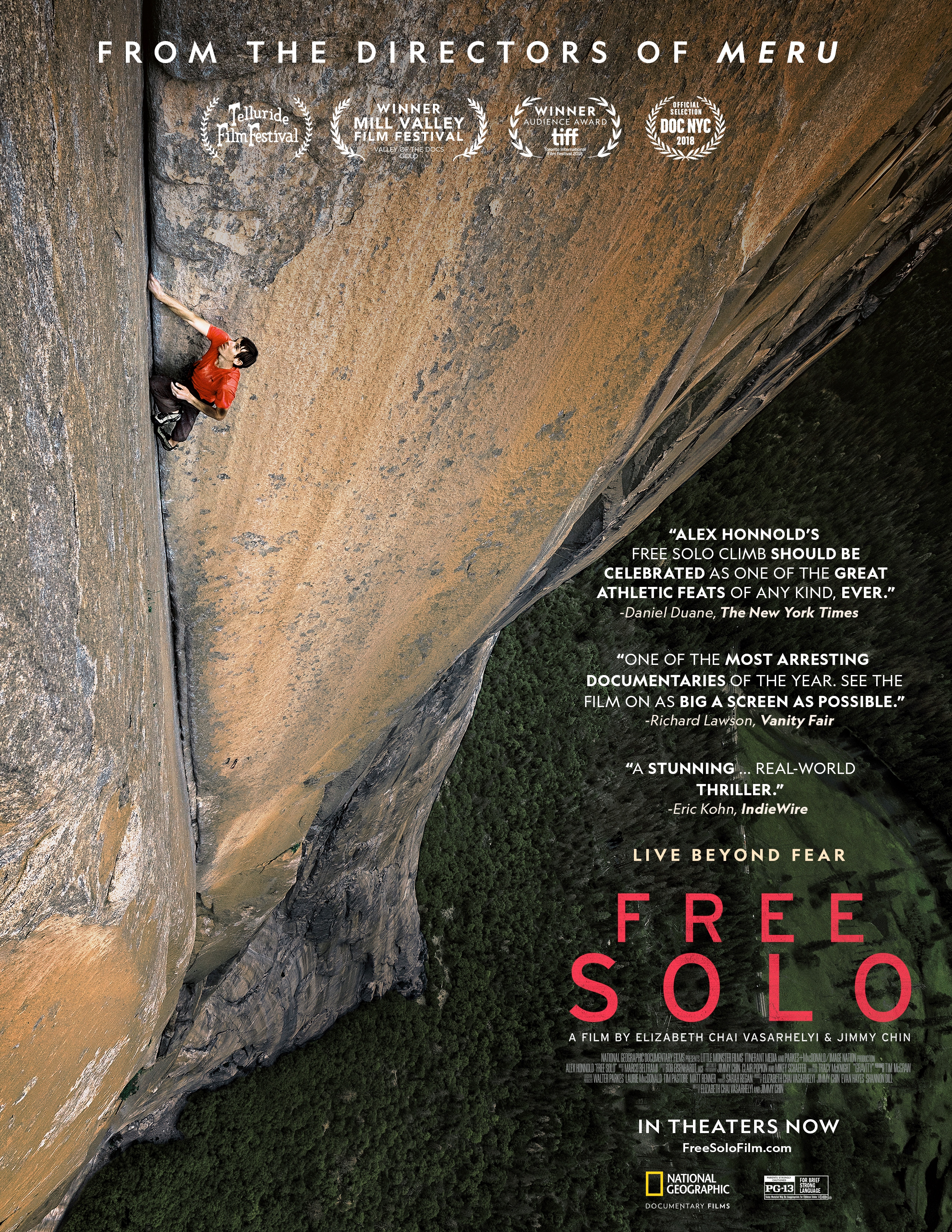
The movie Free Solo which profiles rock climber Alex Honnold, won the Academy Award for best documentary feature. Alex Honnold is noted for his stunning free solo ascents; basically solo climbs without using any ropes or climbing gear. All that he uses on these ascents from the litany of climbing paraphernalia are rock climbing shoes and climbing chalk, carried in a chalk bag.

Free Solo covers Honnold’s 2017 solo ascent of El Capitan’s Freerider route. El Capitan is a vertical rock formation, roughly 3000 feet high, in Yosemite National Park, US. It is a much revered objective in the world of big wall climbing.

The film is directed by Elizabeth Chai Vasarhelyi, a documentary filmmaker and Jimmy Chin, professional climber and skier who is also photographer for National Geographic. “ The film benefited from Honnold’s thoughtful charm on camera, and Chin and Vasarhelyi’s incredible access during Honnold’s years-long training process, including while he was thousands of feet off the ground without a rope,’’ Outside magazine observed in an article marking the Academy Award. The magazine described the movie as the first climbing film to receive such broad mainstream acclaim.

Free Solo was released in August-September 2018. According to Wikipedia, it has so far made 19.3 million dollars at the box office. The highest grossing documentary on IMDB is 2004’s Fahrenheit 9/11, directed by Michael Moore. It made 119.19 million dollars.

The 2019 Academy Awards ceremony – it honored the best films of 2018 – was held on February 24 (early hours of February 25 in India) at the Dolby Theater in Hollywood, US. For more on Alex Honnold please try this link: https://shyamgopan.com/2017/03/16/alone-on-the-wall/

(The author, Shyam G Menon, is a freelance journalist based in Mumbai.)     

RASHPAL, JYOTI WIN 2019 NEW DELHI MARATHON

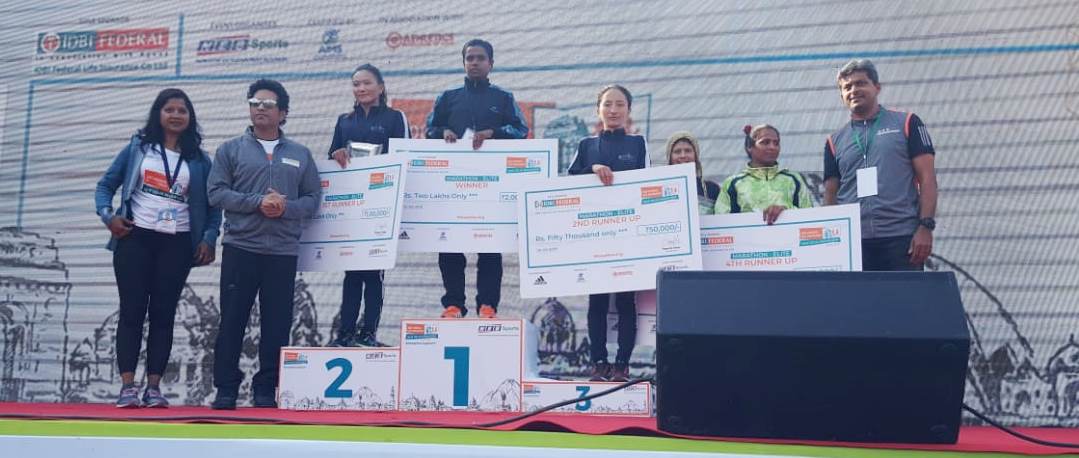
Sachin Tendulkar with winners from the women’s elite category of the full marathon at the 2019 IDBI Federal Life Insurance New Delhi Marathon (Photo: courtesy Jyoti Gawate)

Rashpal Singh and Jyoti Gawate emerged winners in the men’s and women’s category of the fourth edition of the IDBI Federal Life Insurance New Delhi Marathon held on February 24, 2019. Both athletes competed in the elite section of the race.

Rashpal Singh won with a timing of 2 hours 21 minutes and 55 seconds. Jyoti finished first among women with a timing of 2:47:54, which is an improvement over her performance last year at the same event but short of the mark she had been hoping for. A consistent podium finisher in women’s marathon for the past several years, in January 2019, Jyoti had placed second among elite women at the Tata Mumbai Marathon (TMM).

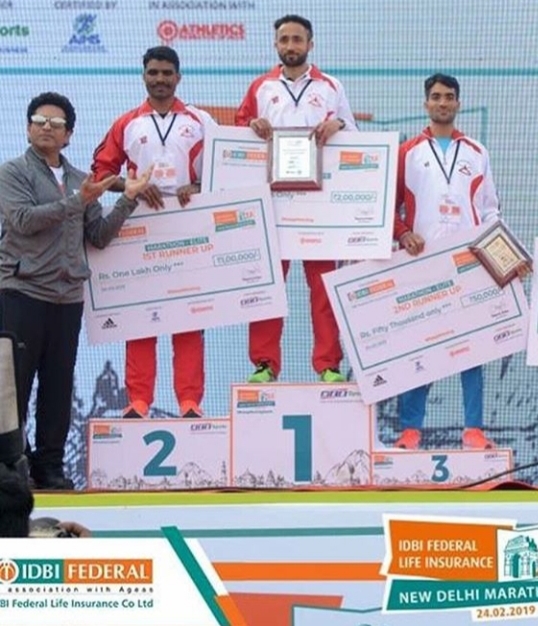
Sachin Tendulkar with winners from the men’s elite category of the full marathon at the 2019 IDBI Federal Life Insurance New Delhi Marathon (Photo: courtesy Sunil Shetty)

Among elite men, Sher Singh came second in New Delhi on Sunday with a timing of 2:23:16 followed by Manavendra Singh with a timing of 2:28:27. All the three podium finishers – including Rashpal Singh – train at the Army Sports Institute in Pune, news reports said.

Jyoti, the winner among elite women, was hoped to improve upon her 2019 TMM timing of 2:45:42, in New Delhi. Unfortunately, that didn’t happen. “ There were too many turns this time on the route,’’ she told this blog Sunday evening. The route of the marathon in New Delhi was altered slightly this year.

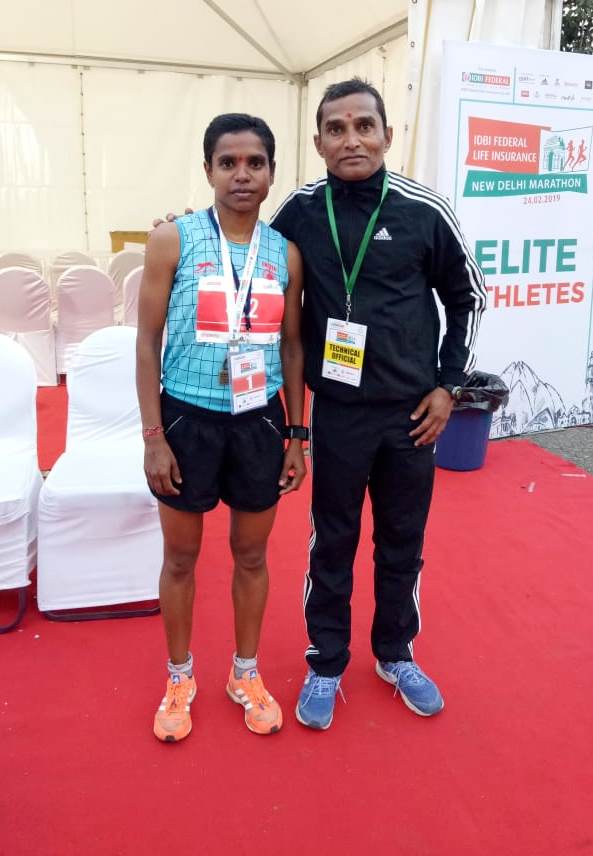
Nevertheless, she was happy with her performance as she had bettered her timing over the previous years in the same event. In the 2018 edition of the New Delhi Marathon, she had finished second with a timing of 2:50:11. The runner from Parbhani district of Maharashtra was hoping to improve her timing and get below the cut-off timing of 2:37 hours required for participation in the IAAF World Athletics Championships to be held in Doha, Qatar, later this year. “ I am happy with her performance in Delhi today,’’ Ravi Raskatla, Jyoti’s coach said. Jyoti had finished third in 2016, second in 2017 and 2018 and now secured first place in the 2019 edition of the event.

Jyoti Gawate and her coach Ravi Raskatla at the New Delhi Marathon (Photo: courtesy Jyoti Gawate)

Going ahead, she is slated to participate in the 2019 New Taipei City Wan Jin Shi Marathon scheduled for March 17, 2019. For more on Jyoti please try this link: https://shyamgopan.com/2019/02/04/jyoti-and-the-eight-minutes/

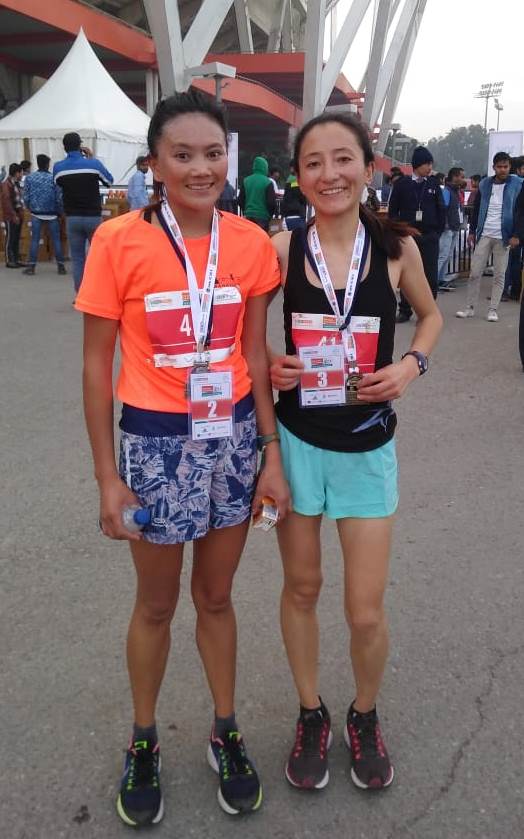
Among elite women in the full marathon, Jigmet Dolma finished second (3:01:30) followed two seconds later by Tsetan Dolkar (3:01:32) who placed third. Both these athletes are from Ladakh and belong to the team supported by Rimo Expeditions; every winter they spend a few months competing at races in India’s big cities. In January, Jigmet had placed third among elite women at TMM.

The timings returned by Jigmet and Tsetan in Delhi are noteworthy. Soon after TMM, in conversations with this blog in Mumbai, both runners had mentioned that their next objective is to progress towards sub three-hour timing in the full marathon. Sunday’s timing may not be there yet but it is close and importantly, a sizable improvement over the timing they registered in Mumbai. At 2019 TMM, Jigmet had finished in 3:10:36; Tsetan’s timing was 3:13:05.

Jigmet Dolma (left) and Tsetan Dolkar at the New Delhi Marathon (Photo: courtesy Chewang Motup)

In the elite half marathon segment, Robin Singh finished first among men with a timing of 1:09:01; Jyoti Singh took top honours among women finishing the race in 1:22:12 hours. From the men’s category in the half marathon, Dipak Suhaug finished second (1:11:07) and Deepak Singh third (1:12:51). Among women, Ujala finished second (1:24:25) and Prabhawati Rawat third (1:34:26).

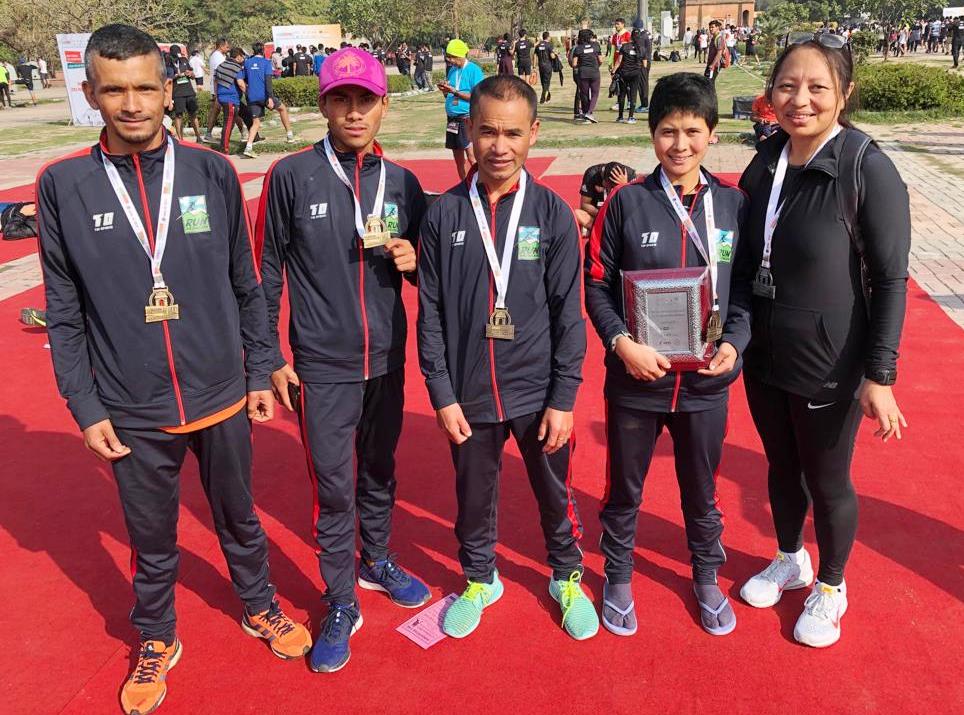
Initiatives by running communities and well-wishers of running to support talent in the sport have contributed to podium finishes at domestic marathons. Rimo’s travel and training program for Ladakhi runners bore fruit in the half marathon segment of the New Delhi Marathon as well. Tashi Ladol and Stanzin Chondol, who fetched podium finishes just days ago at the Navi Mumbai Half Marathon, finished second and third respectively among women in the half marathon segment (18-25 years age group) of the New Delhi Marathon. Tashi finished in 1:30:17; Stanzin in 1:31:20. Similarly, in New Delhi, the team from Run Meghalaya also had its share of podium finishes and near podium finishes. In the women’s elite category of the full marathon, Darishisha Iangjuh placed fourth with a timing of 3:23:45. Earlier in January, Darishisha had been a podium finisher in Mumbai; with a timing of 3:21:07 she had placed third overall among amateur women and second in her age category. In the 18-35 years age group of the full marathon for men, Kresstarjune Pathaw finished first in New Delhi; he completed the race in 2:36:44 hours. In the age group of 35-45 years for men, Tlanding Wahlang (2:34:57) placed first. At 2019 TMM, Tlanding had placed second overall among amateurs and first in his age category with a timing of 2:40:53.

The team from Run Meghalaya at the New Delhi Marathon. From left: Tlanding Wahlang, Kresstarjune Pathaw, Arbet Nonglang, Darishisha Iangjuh and Dr Carolyne Lyngdoh (Photo: courtesy Habari Warjri)

In the open category of the full marathon in New Delhi, among women in the 18-35 years age group, Swati Panchabuddhe (3:08:51) placed first; in second position was Divyanka Chaudhary (3:16:40) and in third, Kaylea Brase (3:23:47). In the same age group for men, Pramod Chahar (2:38:23) and Nanjundappa M (2:38:48) finished second and third respectively. In the age category of 35-45 years among men, second and third positions went to Manjit Singh (2:44:28) and Hemant (2:54:28). In the same age category, women podium finishers were Ranjini Gupta (3:35:05), Aradhana Reddy (3:35:16) and Payal Khanna (3:41:18).

Thomas Bobby Philip (2:55:44), Murthy R.K (3:12:04) and Parag Dongre (3:15:07) were podium finishers among men in the age group of 45-55 years. Women podium finishers in the same age group were Nirupma Singh (3:40:30), Gurmeet Bhalla (3:52:46) and Ashima Mehra (4:01:07). As of Sunday night, the event’s results table posted on the web, showed only one podium finisher for the age group 40-45: Satyajit Joshi (4:38:26). In the age category 55 years and above, podium finishers among men were Ashok Nath (3:26:16), K.C Kothandapani (3:29:50) and Lachhman Singh (3:32:43). For women in that age group, there was only one podium position shown: Martha Corazzini (5:16:06).

Sunday’s race was flagged off from New Delhi’s Jawaharlal Nehru Stadium by cricket legend Sachin Tendulkar.

(The authors, Latha Venkatraman and Shyam G Menon, are independent journalists based in Mumbai.)

AT A GLANCE / FEBRUARY 2019

2019 Tata Ultra: 50k race; podium finishers from the men’s category (Photo: courtesy Deepak Bandbe)

Anjali Saraogi, Deepak Bandbe win 50k race at 2019 Tata Ultra

Anjali Saraogi and Deepak Bandbe took top honours in the 50 kilometer-race at Tata Ultra Marathon held February 24 in Lonavala.

Kolkata-based Anjali covered the distance in four hours 22 minutes and 50 seconds while Mumbai’s Deepak crossed the finish line in 3:43:06.

“ It was quite a tough race. Until 30k the course was along a road generally going uphill. After that for about 5-6 kilometers it was trail. Weather was not as cool as expected,’’ Deepak said.

He was hoping to better the timing of last year’s winner in the 50k category, Srikant Yadav (3:38:59) but fell short.

“ It was a very well organised event. Over the last five kilometers, there was hydration support for every kilometer,’’ Deepak said. “ Devendra, who finished second, was way ahead of me. I caught up with him at 40k and went past,” he said. Deepak decided to go easy in the early part of the race and that approach helped him.

Devendra Singh finished second with a timing of 3:50:52. Jitesh Vishwakarma came in third in 3:51:43.

“ It was a beautiful but tough course and a very well organised race. The run started at 2:30 AM. Being a woman it could have been scary running alone but there were bike-marshals through the entire course,” Anjali, winner among women in the 50k category, said.

2019 Tata Ultra: Anjali Saraogi (Photo: courtesy Anjali Saraogi)

The youngsters manning the aid stations were well trained in handing out hydration. “ Such small details make a huge difference to the runners, especially in tough conditions,’’ Anjali said.

She resorted to a walk-jog-run strategy as there were many uphill and downhill sections to negotiate along the 50k course, largely simulating the Comrades Marathon course. Tata Ultra is known to serve as training run for those attempting the ultramarathon in South Africa in June.

“ The strategy here has to be different from running a marathon. I walked quite a lot as it was not possible to run some of the stretches, which were quite steep,’’ Anjali said adding that grit and mental strength are central to completing a race like Tata Ultra.

Among women, Rajashri Tarihal came in second at 5:05:11. Preeti Lala (5:08:53) came in third.

In the 35k race category, podium finishers among men were Tukaram More (2:20:37), Anil Korvi (2:28:10) and Kamlya Bhagat (2:30:44). Women podium finishers were Shailja Sridhar (3:19:44), Kavita Chand (3:32:20) and Monica Becerril Ugalde (3:35:19).

Dnyaneshwar Morgha (Photo: Chetan Gusani)

2019 Navi Mumbai Half Marathon: Dnyaneshwar and Parshram triumph / Ladakhi runners top among women

With a timing of one hour, 12 minutes and 34 seconds, Dnyaneshwar Morgha and Parshram Laxman Bhoir were joint winners overall at the 2019 Tridhaatu Navi Mumbai Half Marathon

“We finished the race together,” Dnyaneshwar, a resident of village Vikramgad Khand in Thane district said. According to him, the race went off very well. However, Dnyaneshwar’s best timing in a half marathon is 1:08 hours.

A couple of weeks ago, Dnyaneshwar ran his first full marathon at a race in Chiplun in Ratnagiri district of Maharashtra. He finished the race in 2:33 hours. For more on Dnyaneshwar please try this link: https://shyamgopan.com/2017/12/01/the-dnyaneshwar-effect-vikramgads-runners/

At the Tridhaatu Navi Mumbai Half Marathon, Akshay Padwal finished third with a timing of 1:16:24.

Tashi Ladol (Photo: courtesy Tsering Stobgais)

Stanzin Chondol (Photo: courtesy Tsering Stobgais)

Runners from Ladakh took top honours among women. Tashi Ladol finished first with a timing of 1:28:12 hours followed by Stanzin Chondol, who crossed the finish line in 1:30:40. Both runners are from Ladakh, part of the group supported by Rimo Expeditions and visiting Mumbai every year in time for the annual Mumbai Marathon. In third position was Sayli Kupate with a timing of 1:31:57.

Susannah Gill sets new world record in World Marathon Challenge

British runner Susannah Gill set a new world record in the World Marathon Challenge early February 2019, completing the feat in 24 hours 19 minutes nine seconds to beat the previous record.

The Challenge involves running seven marathons across seven continents in seven days.

The last of the seven marathons was in Miami, Florida, where Susannah finished the race in 3:26:34 hours.

Forty competitors participating in the World Marathon Challenge were flown around the world on chartered planes to complete the marathon distance on each continent.

American runner Mike Wardian was the winner among men, in the Challenge.

Nikki Han (This photo was downloaded from the Facebook page of Hong Kong Four Trails. No copyright infringement intended.)

First ever woman finisher at HK Four Trails 298K Ultra Challenge

Nikki Han emerged the first ever woman finisher at the 2019 edition of Hong Kong Four Trails 298-kilometer Ultra Challenge.

She covered the course in 58 hours 20 minutes.

The Challenge entails running through four trails – Maclehose, Wilson, Hong Kong and Lantau – covering a distance of 298 kilometers.

Runners have to reach the end – post box in Mui Wo on Lantau Island – within 60 hours to be termed as “ finisher.’’ Those ending the run in under 72 hours are called “survivors.’’

This is a self-supported run and participants are not allowed to carry hiking poles and walking sticks.

Among men, Kristian Joergensen was the first to finish in a timing of 55 hours 52 minutes.

Nihal Baig; from Colombo Ironman

Nihal Baig tops among Indian triathletes at Colombo Ironman

Mumbai’s Nihal Ahamad Baig was the first to finish among Indian participants at the Colombo 70.3 Half Ironman, held on February 24, 2019.

Finishing the triathlon in four hours, 39 minutes and 17 seconds, Nihal ended thirteenth overall and third in his age category of 25 to 29 years.

“ I had trained with a target of 4:35 hours. I lost some time in each of the three disciplines. Nevertheless, I was able to improve my timing by five and a half minutes,’’ Nihal said.

The swim in the sea and was slightly difficult as it was a bit choppy, he said.

“ The cycling route was flat but there were three loops and during turns one had to slow down. By the time the run started it was 9:30 AM and it was hot and humid. After the halfway point I had to reduce my pace as the heat was too much,’’ Nihal said.

Nihal Baig

He had finished the Bahrain 70.3 Ironman in December 2018 in 4:44:48 hours.

With his Colombo finish, Nihal has earned a slot for the World Championships Ironman 70.3 to be held in Nice, France in September 2019.

Earlier in January 2019, Nihal had placed ninth overall and second in his age category (18-24 years) in the full marathon at the annual Tata Mumbai Marathon (TMM).

This time at Colombo 70.3, over 90 Indian triathletes participated, according to unofficial reports.

Nisha Madgavkar from Goa also achieved a podium finish in her age category of 40-44 years with a timing of 5:44:41 hours.

The overall winner of Colombo 70.3 was Olivier Godart with a finishing time of 4:05:06 hours. Godart hails from Luxembourg but lives in Dubai.

Dinesh Kumar and Aarti Patil win at Hiranandani Thane Half Marathon 2019

Dinesh Kumar was winner in the half marathon distance at the seventh edition of Hiranandani Thane Half Marathon. He finished the race in 1:09:05 hours.

In second position was Dinesh A, who completed the race in 1:09:28 hours, followed by Deepak Kumbhar in third place with a timing of 1:11:25 hours.

Among women, Aarti Patil was the winner with a timing of 1:21:13 hours. She was followed by Saigeeta Naik (1:22:20) in second position and Manisha Salunkhe (1:26:07) in third position.

In the 10k run, the winner was Dharmendra Yadav, who finished the race in 32:14 minutes. In second position was Adesh A with a timing of 32:19 minutes followed by Chandrakant Manwadkar (32:54).

Among women in the 10k race Poonam Sonune (38:41 minutes) placed first followed by Varsha Bhavari (39:05) in second place and Rishu Singh (40:18) in third.

Abhishek Pal (Photo: courtesy Abhishek Pal)

New world records for both men and women in 5k race; Abhishek Pal in fourth position

Dutch athlete Sifan Hassan set a new world record for women at the Herculis 5 k race in Monaco on February 17, 2019.

In the same race, Julien Wanders of Switzerland set a new world record for the men’s 5 k distance.

Sifan Hassan crossed the finish line in 14:44 minutes improving the previous world record of 15:48 minutes. Britain’s Laura Weightman finished second in 15:29 minutes.

According to details available on the website of the International Association of Athletics Federations (IAAF), Julien Wanders finished his 5k race in 13:29 minutes, improving a second from the previous world record of 13:29 minutes.

In the same race, 22-year-old Abhishek Pal of India finished in fourth position with a timing of 14:04 minutes.

On February 8, 2019, Julien Wanders had broken Mo Farah’s European half marathon record at the Ras Al Khaimah (RAK) half-marathon in United Arab Emirates.

Julien finished in 59:13 minutes beating Mo Farah’s previous record by 21 seconds.

At the 5k race in Monaco, Sondre Moen of Norway finished second with a timing of 13:37 minutes.

The 5km road distance was introduced as a world record event in November 2017, with the inaugural record to be recognized after 1 January 2018 if the performances were equal to or better than 13:10 for men and 14:45 for women. If no such performances were achieved in 2018, the best performances of 2018 were to be recognized on 1 January 2019.

From 2019 Ultra Spice (Photo: courtesy Divya Tate)

New course record at Ultra Spice

Lt Col Bharat Pannu set a new course record in the 1780-kilometer solo category of the 2019 edition of Ultra Spice, the annual ultra-cycling event organized by Inspire India. The race spans Goa-Ooty-Goa.

Bharat completed the race that commenced and ended at Bogmalo Beach, Goa, in 95 hours 47 minutes, breaking the previous record set by Col Srinivas Gokulnath.

Ultra Spice is a composite of three distances – 1750 km, 1000 km and 600 km – all starting and finishing in Bogmalo, Goa. It has both solo and relay team categories. Racers must have support vehicle and crew.

Bharat Pannu (Photo: courtesy Divya Tate)

In the 1750 km and 1000 km categories, two support vehicles with a minimum of two drivers in each vehicle, is mandatory.

Solo racers, who finish within stipulated time, qualify for Race Across America (RAAM), the ultra-cycling event held every year in the US featuring a ride from the country’s west coast to the east.

Kabir Rachure from Navi Mumbai placed second in the 1780 km solo category this year with a timing of 100 hours 46 minutes. The cut-off for this category is 120 hours.

Karthik Padmanabhan finished third with a timing of 119 hours 22 minutes.

Ila Patil was the first and only woman participant to finish the 1780 km race. She finished the race in 137 hours 17 minutes, outside the cut-off timing of 128 hours.

Ila Patil (Photo: courtesy Divya Tate)

In the two-person team category for the distance of 1780 km, the winner was Team Pedal Demons comprising Adesh Kale and Dhanraj Helambe. They finished in 85 hours 24 hours, well within the cut-off timing of 96 hours.

Mayank Tripathi won the 1000 km solo category finishing the race in 54 hours 32 minutes within the cut-off timing of 56 hours.

Team Gear and Beer comprising Kaustubh Dandekar and Rohit Dandekar won the two-person team category finishing the race in 47 hours 45 minutes within the cut-off timing of 48 hours.

In the solo men’s 600 km race, Shlomi Kot won in the age category of 50 years and above, finishing in 27 hours 25 minutes against the cut-off time of 32 hours. Vivek Shah finished the race for solo men in age group of 18-49 years in 29 hours four minutes against the cut-off timing of 30 hours.

This photo was downloaded from the Facebook page of Delirious W.E.S.T (Breeze; front row, third from right). No copyright infringement intended.

Delirious W.E.S.T / Breeze Sharma participates in first edition of the race

At the time of writing, the first edition of Australia’s 200 mile-ultramarathon, Delirious W.E.S.T, was going on.

The course of this ultramarathon is entirely on the Bibbulmun Track in the South West and Great Southern regions of Western Australia, from Northcliffe to Albany.

The event commenced on February 20, 2019 and was due to end at 3 PM on February 24 with a 104 hour cut-off.

India’s Breeze Sharma (Brijmohan Sharma), mountaineer and ultra-runner, was among 43 participants at the inaugural edition.

The event’s course is through forests, coastal scrub, beaches and along the Bibbulmun track.

At the time of writing, Breeze Sharma had covered over 286 kilometers.

Update: As per results available on the Delirious W.E.S.T Facebook page, Breeze Sharma completed the ultramarathon in 95 hours 39 minutes.

(The author, Latha Venkatraman, is an independent journalist based in Mumbai.)
LADAKH MARATHON: EXPECT SOME CHANGES

This photo was downloaded from the Facebook page of Ladakh Marathon.

The 2019 edition of the Ladakh Marathon will feature changes with regard to hydration.

The annual marathon straddles two sub events: a marathon including the half marathon and races of shorter distances; and the Khardung La Challenge, which is an ultramarathon. The event is a full member of the Association of International Marathons and Distance Races (AIMS) since 2015.

Ladakh is an environmentally sensitive destination. Organizers feel that the routine practice at marathons of runners helping themselves to bottled water – which the Ladakh Marathon too followed till now – is not sustainable. So far, they have shipped out discarded bottles. “ This year for the Khardung La Challenge we are definitely not going to provide bottled water along the route,’’ Chewang Motup, owner of Rimo Expeditions, organizers of the Ladakh Marathon, told this blog recently.

According to him, the paradigm of hydration for the full marathon and other shorter distances are being studied with a view to make the event environment friendly. He indicated that runners may be asked to bring their own bottles or hydration gear of choice. Instead of the traditional practice of handing out bottled water at aid stations, race organizers may provide facilities to refill. “ We may be able to give a hint of what to expect by the time registration for the event opens this year. The practical details could take a little longer to work out because the act of refilling must also be as efficient as possible,’’ Motup said. He added that organizers were however already resolved that hydration for Khardung La Challenge should shift from bottled water to refilling.

Motup hopes that runners will understand the larger need for this shift and accommodate any impact on timing the new practice may cause. As it is, thanks to challenges posed by altitude, timing at the Ladakh Marathon is rarely a personal best (PB) for those coming from outside. The event’s USP is opportunity to run a marathon in Ladakh, a high altitude destination characterized by unique landscape. That being so, pausing to refill water in one’s personal bottle should sit well with runners, the organizers reason. Incidentally, their attention is not merely on hydration. There is also the issue of food packaging and wrappers discarded by participants. “ We are looking into that. It too needs to be addressed,’’ Motup said.

This photo was downloaded from the Facebook page of Ladakh Marathon.

The Ladakh Marathon started in 2012. The event’s first edition attracted some 1500 participants. In 2018, the figure was 6000. The event calls itself the world’s highest marathon; between the main marathon and ultramarathon over Khardung La, altitude on the course ranges from 11,500 feet to 17,618 feet. Runners arriving from outside Ladakh are told to reach Leh a week to 10 days before the marathon so that they get properly acclimatized. Ladakh is beyond the main axis of the Himalaya. Although climate change and its associated vagaries in weather have impacted Ladakh too, traditionally the Himalaya cuts off monsoon clouds from the south rendering much of Ladakh a rain-shadow region. The region’s landscape is that of a high altitude cold desert.

Organizing the annual marathon is not an easy job, Motup said. The organizers have to make sure that participants take acclimatization and acclimatization schedules seriously. Many of the materials required for conducting the event have to be brought in from the outside world. In the case of stuff that is discarded after use – packaged water being an example – it has to be trucked out for proper disposal and recycling. These tasks are easily done in big cities which have resident facilities for recycling. Ladakh in comparison is not only environmentally sensitive, its location, distance from the plains and mountainous access can complicate logistics. Further, unlike in the cities, where event-related services are easily outsourced, in Ladakh, the organizers and their team of volunteers have to do the bulk of the work themselves.

(The author, Shyam G Menon, is a freelance journalist based in Mumbai.)  
A CONFERENCE ON RUNNING AND A STUDY ON RECREATIONAL RUNNERS

Illustration: Shyam G Menon

The study based on results from 72 marathons overseas and focused on recreational runners “ is the largest of its kind ever produced.’’

The IAAF Global Running Conference scheduled over May 31-June 1 at Lanzhou in China will have among key themes for discussion: the economic, social and environmental impact of road races.

More than 600 attendees representing much of the international road race industry are expected to take part. China is the world’s fastest growing market for recreational running. Against 22 sanctioned road races in China in 2011, there were 1100 in 2017. During the same period, participation grew from 400,000 to more than five million, a statement on the conference available on the website of the International Association of Athletics Federations (IAAF), said.

According to it, the conference will discuss subjects including the growth of the marathon tourism industry, creation of running cultures in cities, economic benefits of organizing events and best practices for organizing them in environmentally sustainable ways. Jen Jakob Andersen, founder and CEO of RunRepeat.com, will deliver the opening address at the conference. He will present a report on the current state of running drawn largely from a research comparing marathon performances across nations. “ The study by Andersen and his team is the largest of its kind ever produced,’’ the IAAF noted, providing alongside a link to RunRepeat.com and abstracts from the study.

The study centered on recreational runners’ performance from 72 marathons over 2009-2014 – basically six editions of 12 events. The data base analyzed spanned 2,195,588 results; the study had Andersen as lead researcher and was funded by RunRepeat.com. “ On average marathon runners are being slower,’’ RunRepeat noted on its page hosting this study focused on recreational runners and restricted to multiple editions of a pool of select races.

The project looked into results from six editions of the following marathons: Chicago, Marine, Boston, London, Paris, Berlin, Frankfurt, Athens, Amsterdam, Budapest, Warszawa and Madrid. Results of elite athletes were not studied; the focus was on recreational runners. Results of nations with less than 100 results were not considered. Also omitted were results from countries having less than 10 men and 10 women in each of the years studied. Only events with results for all the six years and mention of athletes’ gender alongside were accepted for study.

Over 2009-2014, within the database analyzed, the average time taken to complete a full marathon was four hours, 22 minutes and five seconds. For 2014 alone, the figure was four hours, 21 minutes and 21 seconds. Over the six years (2009-2014), the average time for men was 4:13:23 and that for women, 4:42:33 (29.10 minutes slower), RunRepeat said on its website. At 3:55:35, Spain had the fastest average time. Looked annually, Spain was fastest in 2011, 2012 and 2013. In 2014, runners from Iceland topped. Out of 47 countries listed so India was ranked 46 with average time at 5:03:41. Interestingly at number 45 was Japan (4:40:14), a country strongly associated with the marathon and ultramarathon. The US (4:29:31) was placed 30, while the UK (4:32:24) was ranked 41.

Among men, the fastest average time was from Iceland (3:52:01); the slowest was from India (5:00:34). At 5:27:04, Indian women were slowest in their gender category topped again by Iceland (4:18:29). Over the six years studied Iceland, Philippines and Singapore showed the greatest improvement in average finish time in the men’s category. In the women’s category, India, Germany and Finland were the nations improving the most. With an improvement of two minutes 39 seconds overall, India was ranked 18 in the improvement list topped by Iceland (23 minutes 47 seconds). The country registering least improvement was China; the average time of recreational runners from China at these events got slower by 33 minutes 38 seconds. On the other hand, if you judge growth in popularity of marathon running from the database studied, then China was placed second with a growth of 259.47 per cent; it followed Russia at 300 per cent. Corresponding growth from India was 154.78 per cent. Participation from Asia grew by 92.43 per cent; that of men therein at 90.40 per cent and women, 97.80 per cent. Europe grew slower than the rest of the world with a growth of only 10.30 per cent.

In the database studied, it was observed that participation overall had increased by 13.25 per cent with enrollment of women up by 26.90 per cent compared to 7.8 per cent for men. The average distribution of women marathon runners in the numbers was 29.76 per cent; North America had the highest representation of women in running at 44.67 per cent followed by Asia (27.86 per cent), South America (26.26 per cent) and Europe (21.99 per cent). USA was the most gender equal marathon nation. Of 47 countries featured in the study, India ranked 43 as regards gender parity with its women participants at the races studied estimated at 11.76 per cent.

The overview of the study can be accessed on this link: https://runrepeat.com/research-marathon-performance-across-nations

This blog would like to point out that 2014 is now almost five years in the past. Additionally, while one definitely needs to qualify for some of the marathons overseas, participation is dependent on ability to fund and in developing economies like India, talent for sports and deep pockets (to travel and run) don’t always manifest in the same individual. Not all recreational runners who make the cut in terms of performance reach the start line abroad. On the other hand, those who can afford will, including by means other than qualifying like availing charity bibs.

(The author, Shyam G Menon, is a freelance journalist based in Mumbai.) 
IRFAN SCORES A HAT-TRICK BUT RACE WALKERS FALL SHORT OF DOHA QUALIFYING MARK

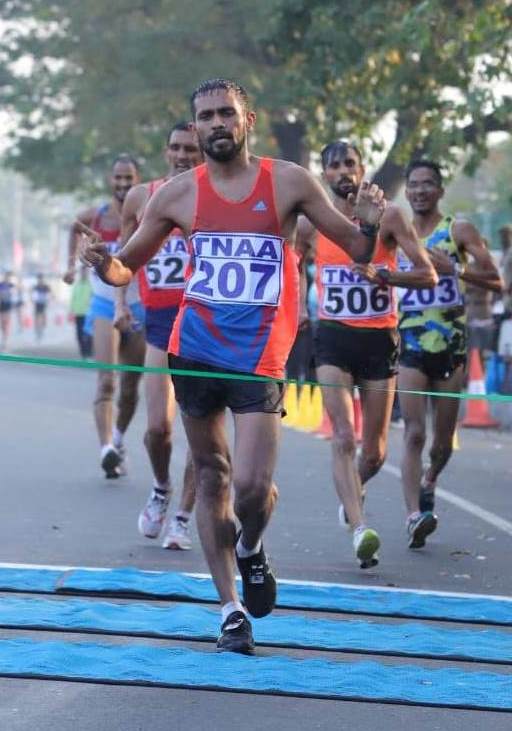
Irfan K.T (Photo: AFI Media)

The Sixth National Open Race Walking Championships held over February 16-17 in Chennai was to serve as platform for Indian athletes to meet the qualifying time for the IAAF World Athletics Championships due later this year in Doha, Qatar.

However, none of them made the cut.

At the just concluded event in Chennai, Jitendra Singh Rathore of Rajasthan was the winner in men’s 50km race walk. He finished the race in 4:23:23 hours to secure the gold medal, ahead of Sagar Joshi of Gujarat. Sagar finished the race in 4:24:21, earning the silver medal. Haryana’s Pawan Kumar took the bronze with a timing of 4:30:49 hours, the results posted on AFI’s website said.

Jitendra Singh Rathore (Photo: courtesy Jitendra Singh)

The men’s 20km race walk was keenly contested. Kerala’s Irfan K.T took the gold covering the distance in 1:26:18. Second place went to Devender Singh of Haryana (1:26:19) while Sandeep Kumar (1:26:19), also of Haryana, finished third. It was photo finish for Devender and Sandeep. Tamil Nadu’s Ganapathi Krishnan (1:26:20) missed the podium by a whisker. While informing the results, the AFI statement of February 16 quoted Irfan as being disappointed that his effort wasn’t good enough to qualify for the world championships. He intends to try again next month at the Asian Race Walking Championships to be held in Japan.

This was the third consecutive triumph for Irfan in the discipline at the national championships.

The women’s 20km race walk was won by Soumya Baby of Kerala who clocked 1:40:25. This was well short of her national record – 1:31:29 set in February last year. Uttar Pradesh’s Priyanka finished second in 1:41:20 while the bronze medal was picked up by Haryana’s Ravina who finished in 1:41:46.

A statement from the Athletics Federation of India (AFI) on February 15 had pointed out that the qualification standard (for Doha) in the men’s 20km race walk stood at 1:22:30 (hours, minutes and seconds respectively) while the mark in the men’s 50km race was 3:59:00. The qualification standard in the women’s 20km race was set at 1:33:30.

The IAAF World Athletics Championships is scheduled to be held in Doha in September-October this year.

Soumya B (Photo: AFI Media)

According to race walkers this blog spoke to, Chennai’s heat and humidity took a toll on their performance.

“ The race was good but the heat was too much,’’ Jitendra, the gold medalist in 50km, said when contacted. His personal best is 3:58:56 hours, which he set in the National Open Race Walking Championships in New Delhi in 2018.

“ The race was tough because of the heat as well as the humidity. Normally this competition is held in Delhi or Jaipur where the weather at this time is conducive for good performance,’’ Sagar, who won silver, told this blog. His had trained for this competition with a targeted timing of 3:56 hours.

Haryana’s Sandeep Kumar, who holds the national record of 3:55:59 in the 50km race walk, set at the Indian Race Walking Championships last year, did not start the contest in that discipline, the table of results from Chennai showed. Also DNS (Did Not Start) in the 20km race walk was Manish Singh Rawat of Uttar Pradesh.

Sagar Joshi (Photo: courtesy Sagar Joshi)

Jitendra and Sagar, both of them from the Indian Army, train at the Army Sports Institute in Pune. Following the Chennai event, they headed back to Pune. According to Sagar, while it is for the AFI to take a call on sending them to the upcoming meet in Japan, as back-up plan, the athletes’ coach Basanta Bahadur Rana has suggested the option of requesting the army to send them to Japan. Basanta Bahadur Rana had represented India in race walking at the 2012 London Olympics.

At the Chennai meet, Suraj Panwar of Uttarakhand won the gold medal in the boys’ 10 km race clocking a time of 43.19 minutes. Haryana’s Juned won the silver with a timing of 43.32 minutes. The bronze medal went to Farman Ali of Uttar Pradesh; he finished in 44.50 minutes.

Among girls, Roji Patel of Uttarakhand secured gold in the 10 km race. She finished the race in 53.38 minutes. Suvarna Kapase of Madhya Pradesh secured silver with a time of 55.36 minutes and Punjab’s Gurpreet Kaur got the bronze with a time of 57.00 minutes.

(The author, Latha Venkatraman, is an independent journalist based in Mumbai.)