THIRUVANANTHAPURAM’S FIRST IRONMAN

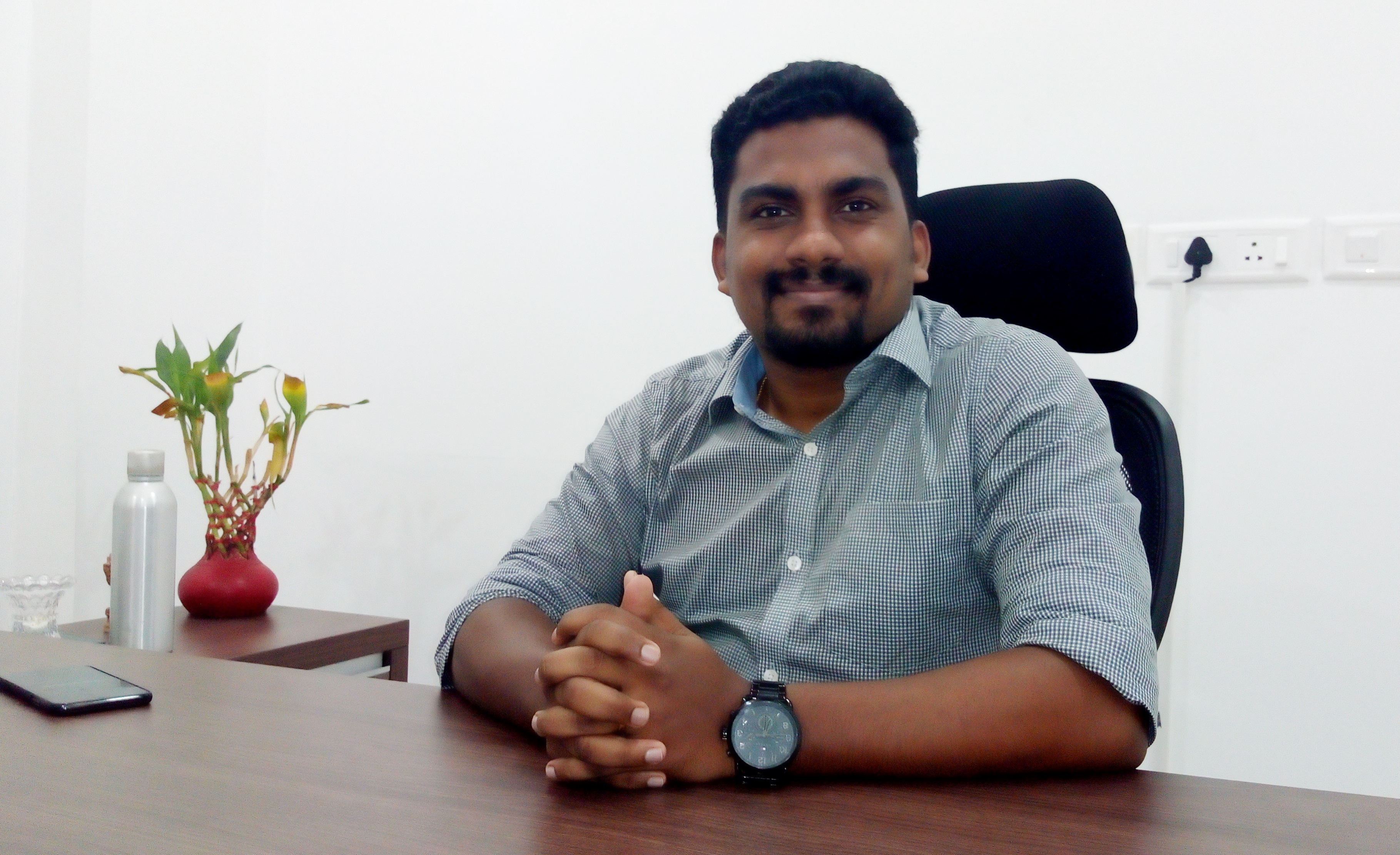
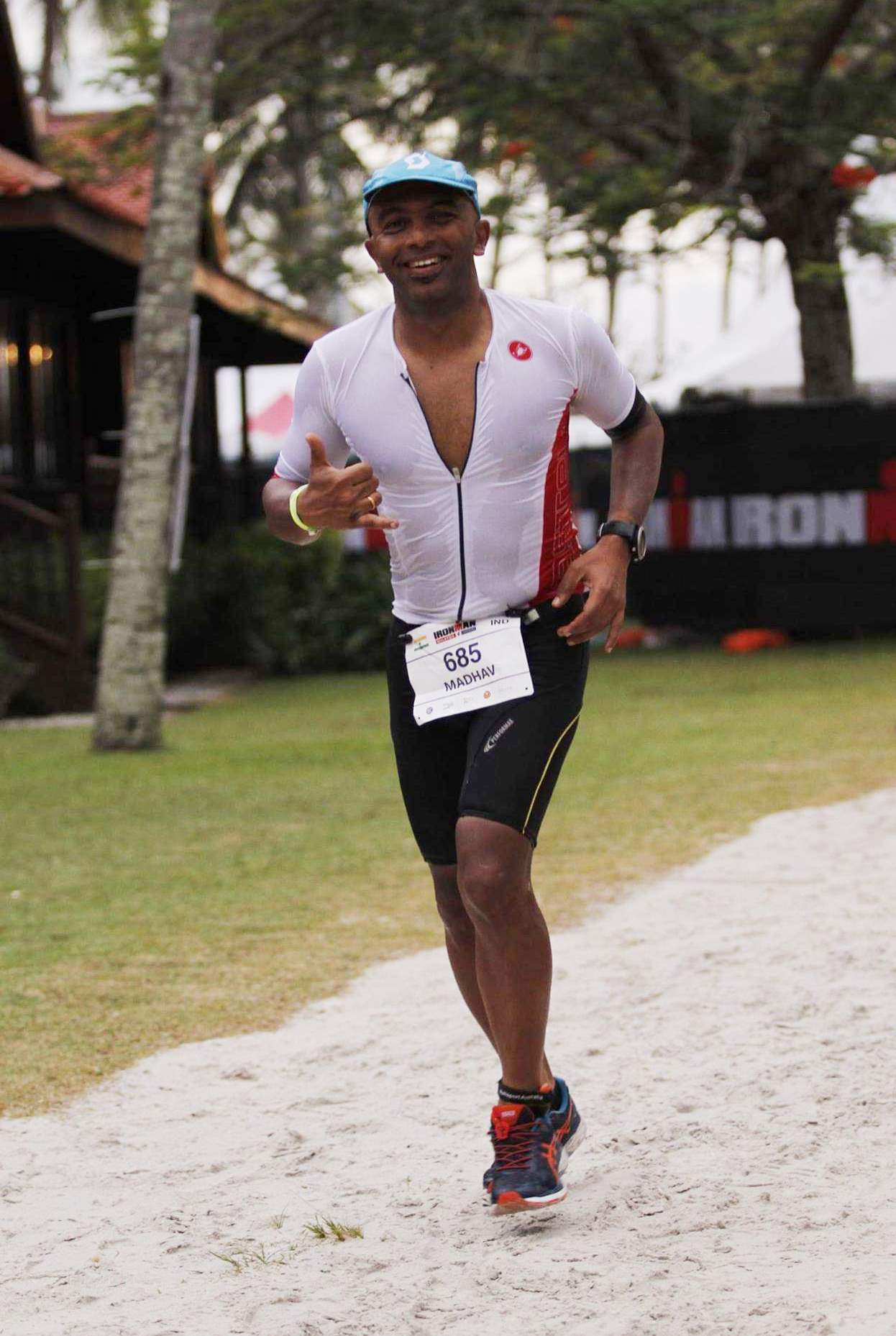
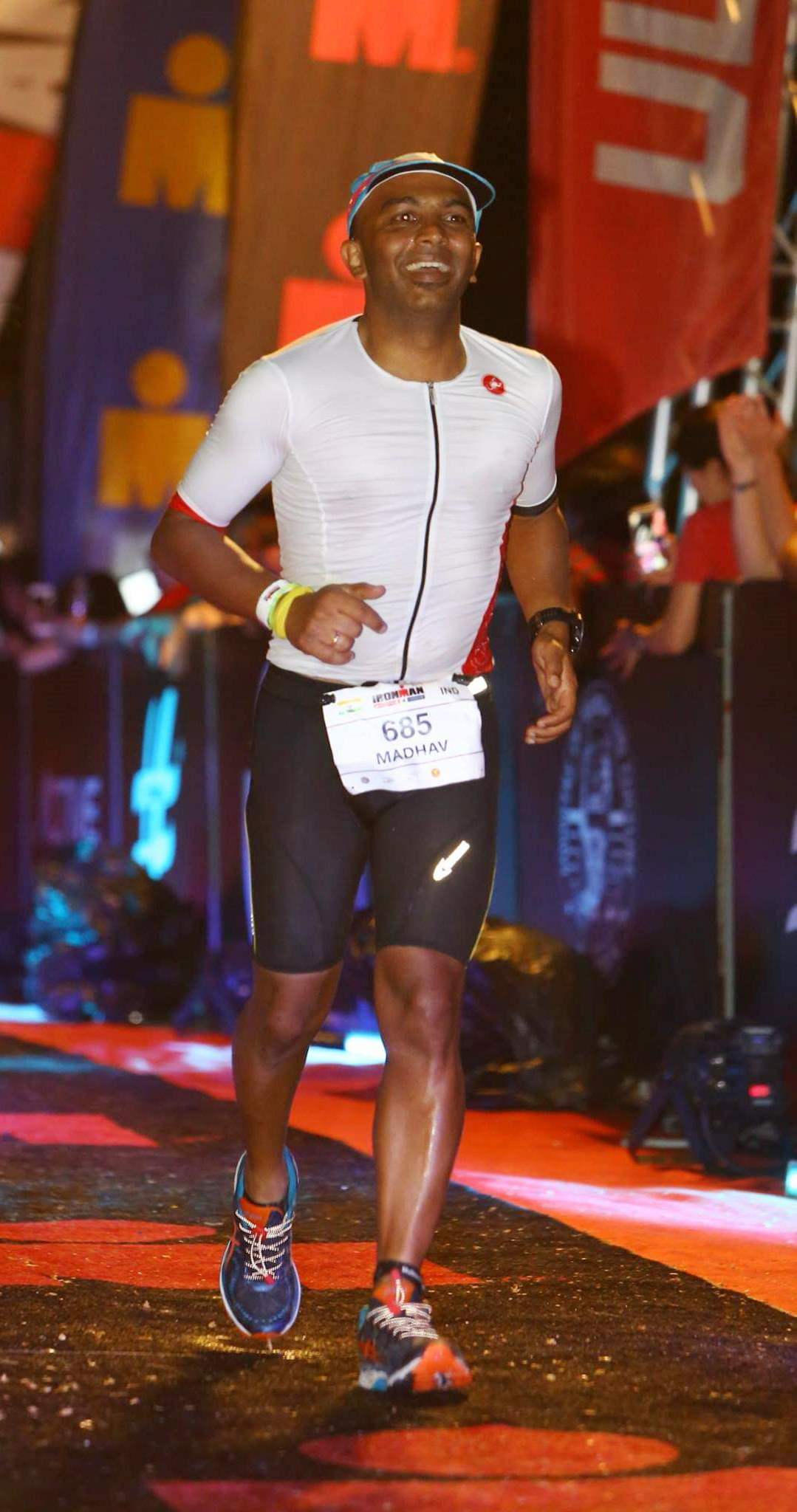
Dr Madhav Manoj (Photo: Shyam G Menon)

A narrow, long state, Kerala’s rivers are comparatively small.

They engage for the tiers of elevation they straddle despite short length.

The Karamana River which cuts through Thiruvananthapuram falls in this league. Wikipedia estimates its length at a mere 66 km; by then it reaches the Arabian Sea.  Its source is however pegged at around 5250 feet in the nearby Agasthyakoodam hills (the Agasthyakoodam peak, second highest in Kerala after Anamudi [8842 feet] is around 6128 feet high). How many cities can boast of such variety in landscape? All that uniqueness is now, stuff of the past. There was a time when the river looked like one.  Now, within the city, it stands hemmed in by Thiruvananthapuram’s growth. Its waters have begun ailing from urban pollution. Once in a while when it rains hard; the Karamana – as indeed other rivers in the region – swells. Floods happen. That is when city remembers river in its midst. Water’s capacity to damage and threaten is also when humans are reminded of the value in knowing how to swim.

In Dr Madhav Manoj’s childhood, there was one such devastating flood when the Karamana breached its banks submerging adjacent settlements. Madhav’s father K. Karunakaran – an advocate; in the early 1970s he served as mayor of Thiruvananthapuram – observed how depressing it was to see people rendered helpless before the deluge. His wife decided that their son should learn swimming.  For those aspiring so in Thiruvananthapuram city, the place to train at was the Water Works Swimming Pool in Vellayambalam. Established in the early 1960s, the pool is an integral part of Thiruvananthapuram. Madhav who stayed at Nanthancode, not far from Water Works, headed to the pool to learn swimming. It would be the beginning of a journey.

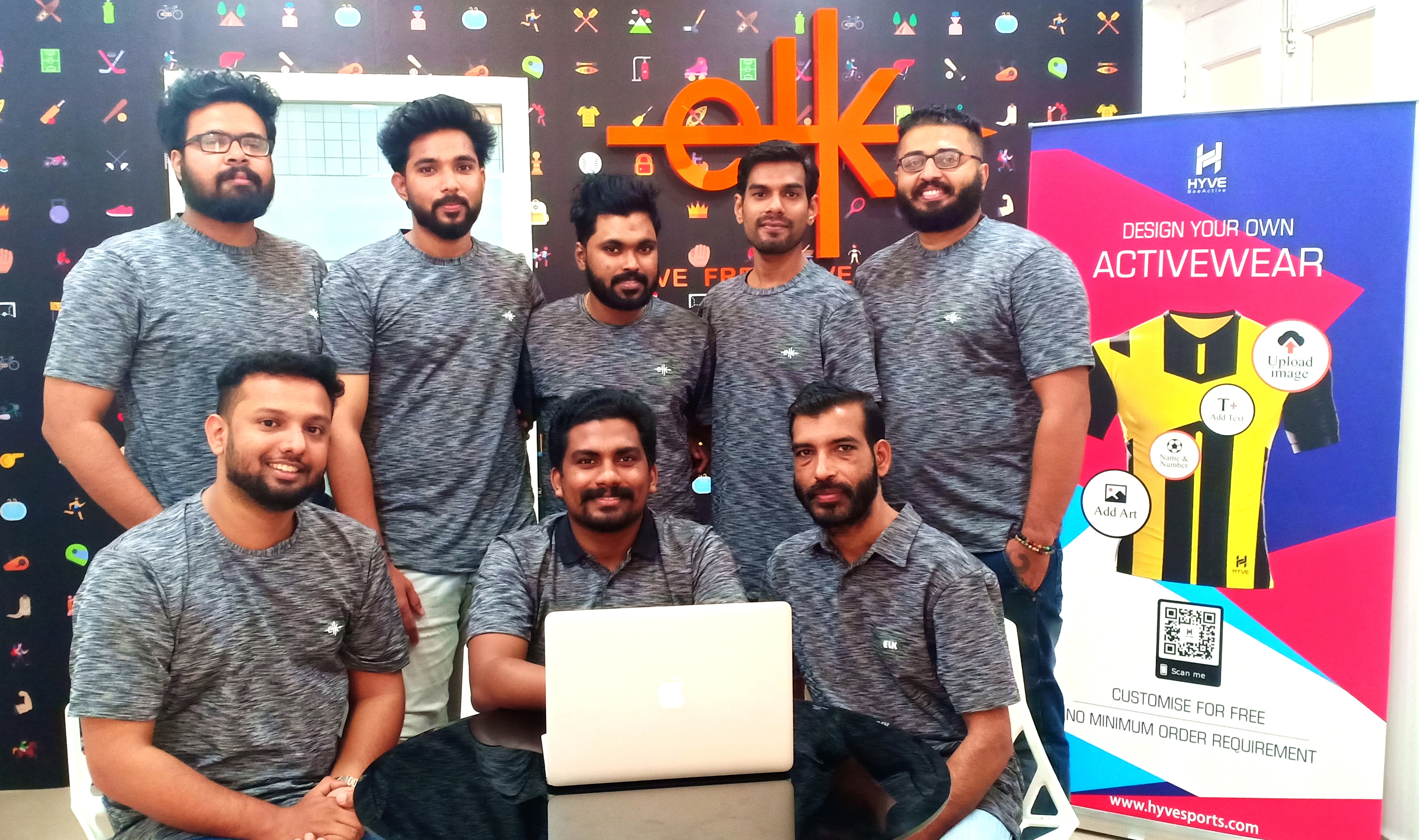
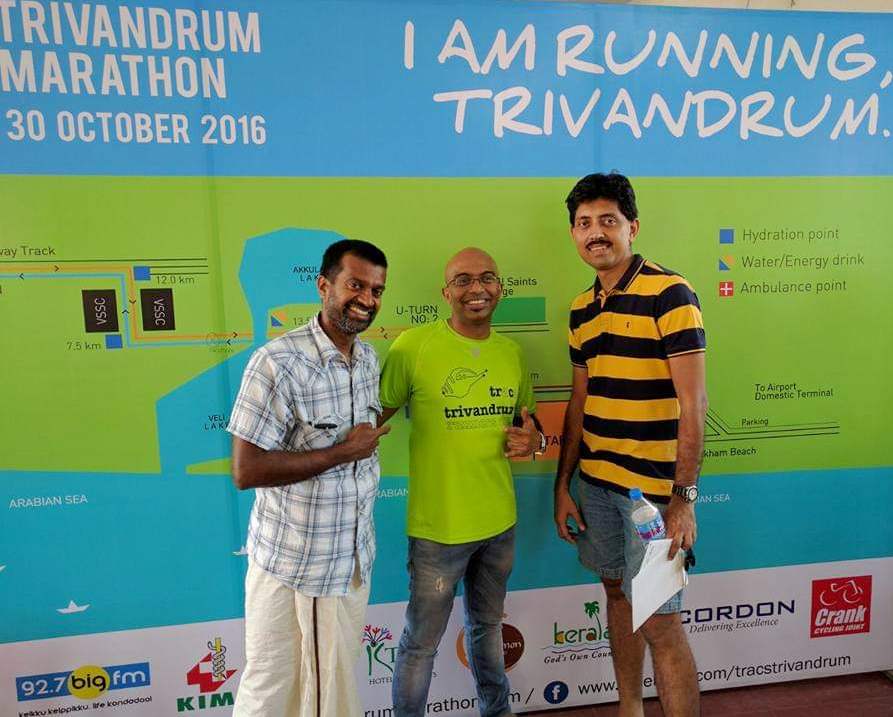
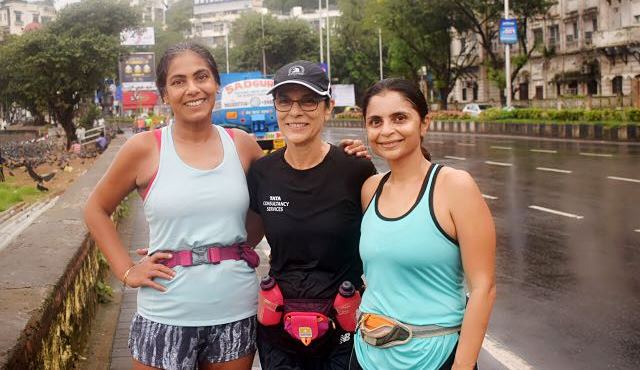
From left: Rajashekharan (Raj) Nayar, Madhav and Santhosh J. K (Photo: courtesy Dr Madhav Manoj)

Born 1973, Madhav was seven or eight years old when he commenced swimming classes. He was good at the sport; good enough to be a competitive swimmer. His first national level competition was while he was still in sub junior category. By the time he got to juniors, he was South Zone champion and a silver medalist at the national level. His specialty was the butterfly stroke. But he was strong across styles in the short distance swims ranging from 50m to 200m. In his early years in college, he was a regular podium finisher at inter-university competitions. The going was good enough for the Indian Railways to spot him and enquire if he would be keen on a career in sports with them, job and all. But he opted to study further. He cleared his entrance exam to study medicine and joined the local dental college. With that, swimming took a backseat.

The hours offered by the city’s pool – 6 AM to 8 AM – didn’t work well for the schedule his studies followed. The evening hours on offer too, didn’t work. “ That was depressing because at the time I commenced studies to be a dentist, I was swimming 12-13 km at the pool daily. That sort of training and studies were difficult to manage. I had to choose,’’ Madhav said. He shifted from swimming to playing cricket. National level swimmer became captain of the dental college cricket team. A few years later, that too ground to a halt. It was: goodbye to serious pursuit of sports.

After completing his post-graduation, Madhav joined PMS College of Dental Science & Research at Vattappara near Thiruvananthapuram. There, he got around to playing cricket with his students. Meanwhile he got married and settled into the process of raising a family. “ All of a sudden, I found myself aged 42 and with two kids. I didn’t know what happened in between,’’ he said. It is typically around this time of life lost to established pattern that the odd blips and signals emanating from the human networks we are invested in; catch our eye.  Madhav had kept in touch with his old school mates. As is typical in Kerala, many of them were overseas; some were in the US. From this lot, Santosh J.K, who was living in the US, was into running marathons.  Madhav was aware of it. But a marathon is 42 kilometers done one kilometer after another – that’s a lot, especially when viewed from the perspective of middle age blues. At a get together of his batch-mates from school that followed, Madhav reconnected with one of his classmates – Rajashekharan (Raj) Nayar. Raj used to be a plump person in school. Those days, Madhav – he was regularly swimming at the pool – was utterly fit. Now in his early forties, Raj was lean while Madhav seemed out of shape. Raj had gone into long distance running and martial arts. What he didn’t tell Madhav right then was his journey into the triathlon alongside; he had already completed two Ironman events.

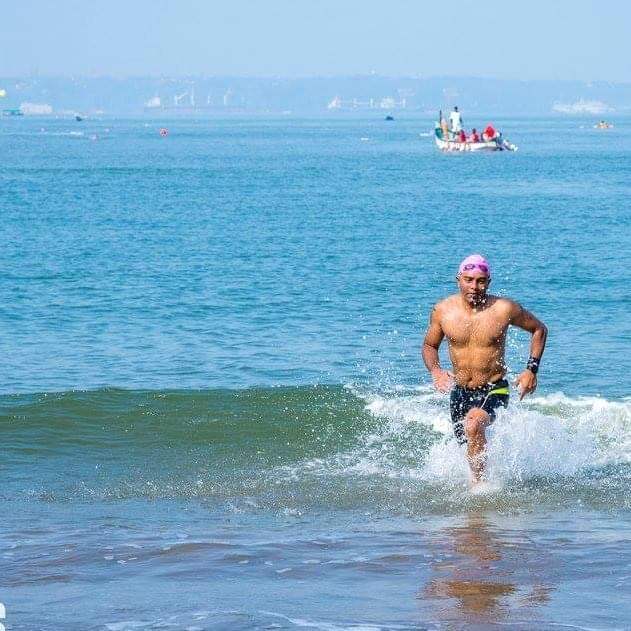
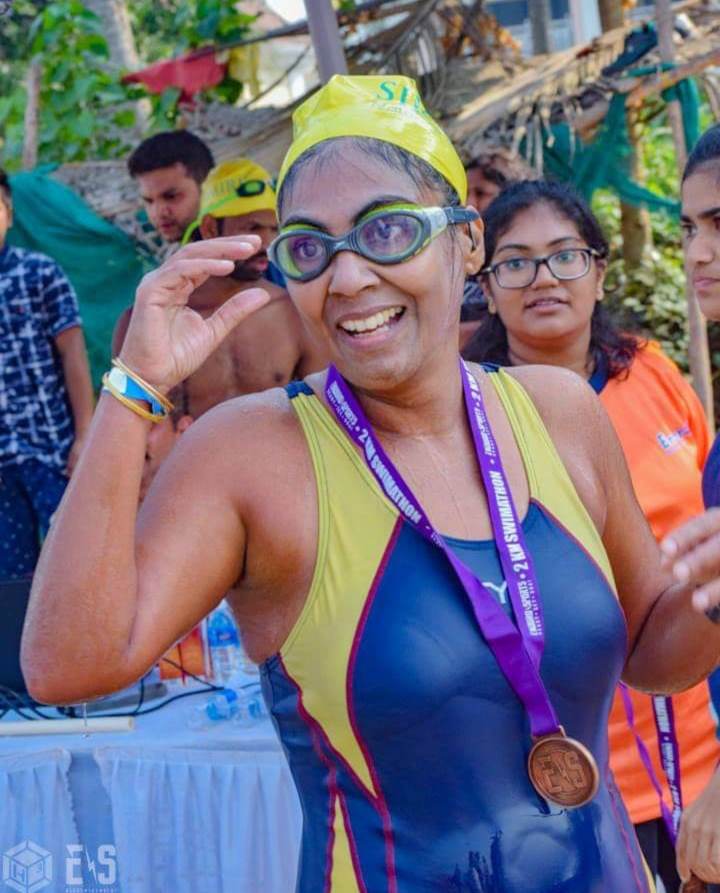
In Goa; from the swim in the sea (Photo: courtesy Dr Madhav Manoj)

The meet-up with Raj prompted Madhav to participate in the annual marathon in Thiruvananthapuram. He did a ten kilometer-run with his friend P. Vijayakumar who kept him company, advising him to run slowly. Santhosh then connected Madhav to Vishwanath Harikumar, a software engineer in Thiruvananthapuram who was into long distance running. Later, through Trivandrum Runners Club, Madhav also met Dr Kiran Gopalakrishnan, an ophthalmologist originally into cycling and then taken to running. During one of the runs they were on, Vishwanath introduced Madhav to the idea of attempting Ironman. The reason was simple.  The triathlon – which is what every Ironman event is – is composed of swimming, cycling and running. In India, most people are familiar with running and cycling. Swimming is not only less popular; the ones who manage to perfect the technique are fewer still. Madhav was strong in swimming. From the perspective of triathlon that seemed more than half the prerequisites in place. The way in which the Ironman idea cropped up encapsulates the predicament.

“ During a conversation with my friends, we discussed the need to train for swimming. I offered to coach because I knew swimming. That was when the whole Ironman idea fell into place. I seemed well placed to try it. I talked to Raj also about it. We decided that the best approach would be to first attempt a triathlon in India. There was a triathlon organized in Chennai by Chennai Trekking Club. It had triathlon of Olympic dimension and half Ironman dimension.  I decided to try the half Ironman distance,’’ Madhav said. Now he had to train.

Thiruvananthapuram has never lacked sports facilities. But probably due to the high importance given to academics and well settled life, the vast majority of people around conduct their life without ever setting foot in the city’s stadiums, its swimming pools or stepping on to its athletics tracks. Once described as apt place to settle down after retirement, Thiruvananthapuram has since, slowly changed. It is still very much in the grip of the old but new generations and the presence of IT companies in the neighborhood have contributed to shaking off some of the inertia. For sure it isn’t Kochi, which is more free spirited and has made a popular movement of running. Thiruvananthapuram is comparatively regimented. Free running on its roads for example, is still a distant second to appointment based running at locations like the local museum and zoo. Now slowly, in bits and pieces, the city is learning to relax, breathe free.

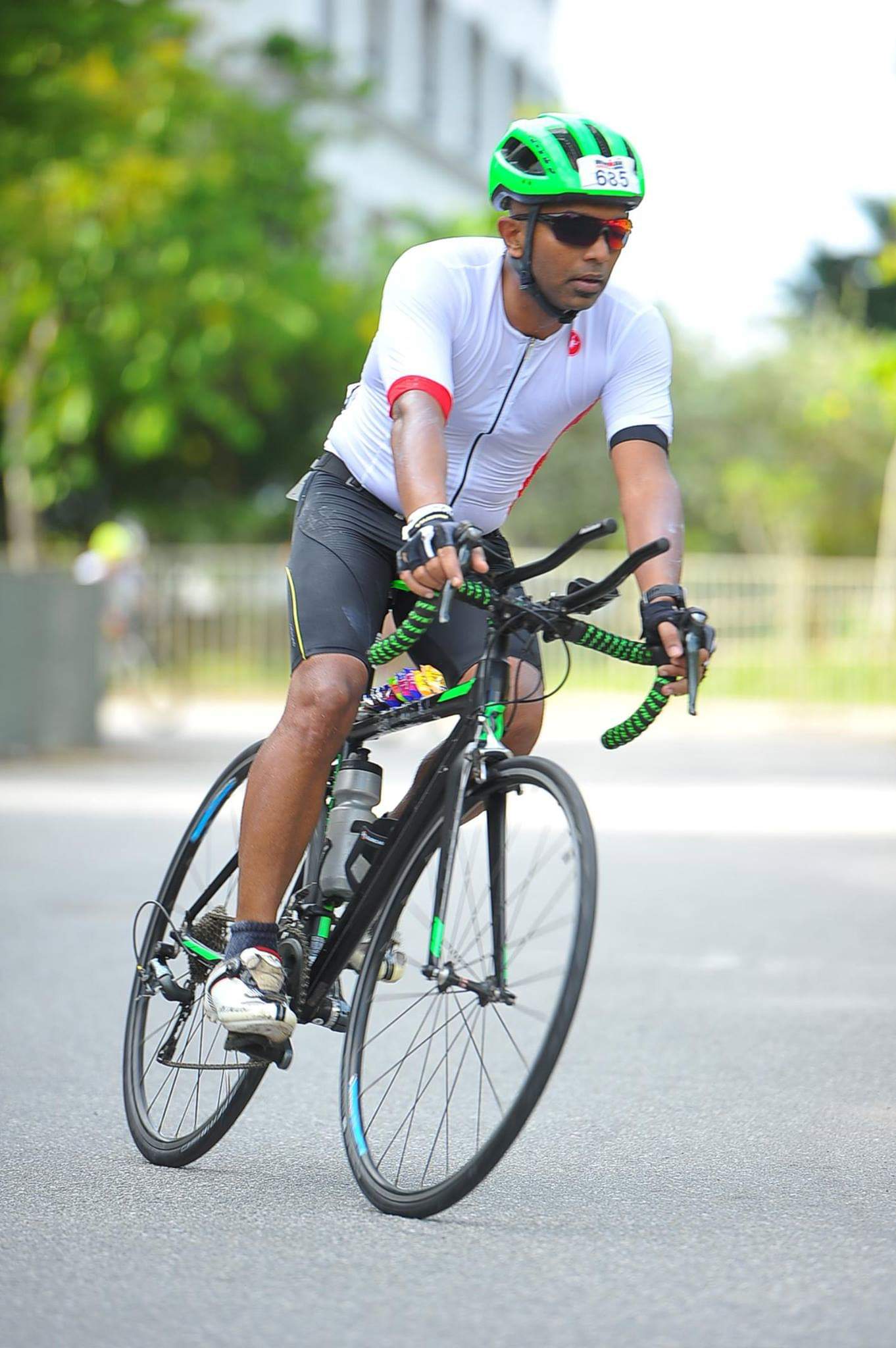
From the Langkawi Ironman (Photo: courtesy Dr Madhav Manoj)

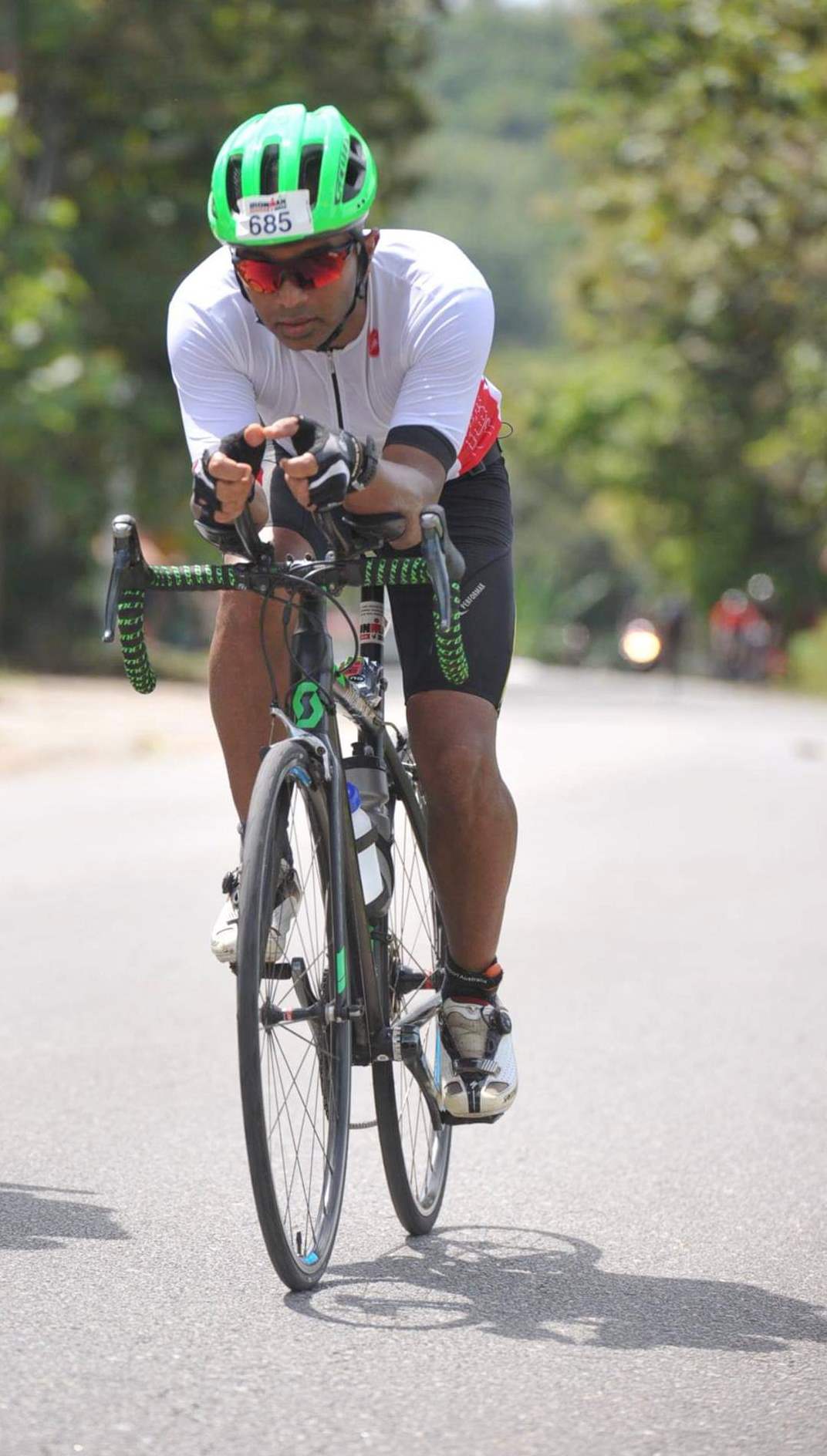
From the Langkawi Ironman (Photo: courtesy Dr Madhav Manoj)

Madhav bought a Scott Speedster road bike from Crank, a newly opened bike store in Thiruvananthapuram. For cycling, he and his friends counted on stretches of road like the one from city to Kovalam. Up and down that amounted to a circuit of roughly 40 km. Such outings came, courtesy Madhav’s association with Trivandrum Bikers Club. For swimmer, running was the toughest activity to get used to. “ I found it really difficult,’’ Madhav said of the impact-free sport he loved and the impact-filled sport running is. One day, Madhav ran ten kilometers and then ended up in the pool for a swim. For the heck of it he swam 1500 meters that day.  It was a wake-up call. He was doing breast stroke. Trying such distance after a long time, he got tired. “ Every 300 meters, I had to take rest. I felt very bad because these are distances I used to swim at a stretch in the past,’’ he said. The predicament also presented him with another issue to tackle. A triathlon requires sustained use of one’s legs across three disciplines. You can’t have your legs fried up doing one discipline and then crumble doing the next one.  He needed to be efficient and good at a swimming style that spared his legs too much strain and kept them alive for the disciplines that followed.  At this time, Madhav was teaching at PMS College. He was also consulting at a clinic in Male, Maldives. He cycled, ran and swam in Thiruvananthapuram; he ran whenever he could in Male too, at the local stadium.

Raj, who had taken on the role of planning Madhav’s training schedules, would mail it from the US. Problem was finding adequate time for training. Madhav worked from 7 AM to 7 PM. On weekends he managed long runs of 15-17 km and 60-70 kilometers of cycling. Weekdays were a struggle.  At the event organized by Chennai Trekking Club (CTC), he developed cramps while cycling. Then he briefly lost his way. Eventually he managed to complete the 1.9 km of swimming, 90 km of cycling and the half marathon in approximately seven hours, 20 minutes. After the CTC triathlon, Madhav spoke to Raj and communicated his decision to go for the full Ironman. Raj reminded that the full Ironman isn’t the half doubled but much more for that is how the ramp-up works. Starting with training, it will consume significant chunks of time. Raj recommended that Madhav first talk to his family. They are the people closest to him; they are the ones he would be sparing less time for when training starts. Madhav’s wife Manju is also a dentist. At that time when Madhav was contemplating the full Ironman, their daughter was in the eleventh standard. Having secured his family’s support, Madhav committed himself to the training. For event, he chose the Ironman in Langkawi, Malaysia because he reckoned, the weather there should be similar to what prevailed in Thiruvananthapuram. He had roughly seven months to prepare.

From the Langkawi Ironman (Photo: courtesy Dr Madhav Manoj)

Fitting the training schedule for the full Ironman into his teaching and travel schedules was difficult. By now, Madhav had also begun swimming in Male, where there was a pool marked out from the sea. He swam there after work. “ The first time I swam in that pool I felt very uncomfortable because unlike in an artificially lit pool where you see all the way to the bottom, here it was dark. Then I got used to it,’’ Madhav said. In March 2017, he went to Goa for a five kilometer-swim in the sea. This was his first real taste of open water swimming. He covered the distance in roughly 105 minutes. By June-July the monsoon was in full force in Thiruvananthapuram. So he acquired a trainer and did his cycling indoors.

Of all three disciplines required for the triathlon, cycling was toughest to train for in Thiruvananthapuram. Its undulating terrain makes the city great for training to do endurance sports. Aside from general apathy to the active life, the main problems are narrow roads and the growing Malayali propensity to announce well-being in the form of more and more vehicles purchased (some recently published figures of state-wise automobile sales, available on the Internet, position small Kerala among the biggest vehicle markets in South India). Result – roads fast choking with traffic. The city’s roads – especially ones like the highway to Kollam, which Madhav used for long cycle rides – tend to fill with vehicles. Cars and buses squeeze out room for cyclists. “ It was risky, cycling on such roads,’’ Madhav said.  On some of the long bicycle rides, he had family tagging along in a car behind, offering hydration support. In the last month leading up to Langkawi, PMS College allowed him to report for work an hour late so that he could use that extra time for training.

From the Langkawi Ironman (Photo: courtesy Dr Madhav Manoj)

Three days before the event in November 2017, Madhav and Manju left Thiruvananthapuram for Malaysia. “ It was a well-managed event,’’ Madhav said of the Langkawi Ironman. The full Ironman entailed 3.8 km swim; 180 km cycling and a full marathon. The swim went comfortably for Madhav. Cycling in the hot sun was tough. The hydration he planned was inadequate. The run was alright. “ Some parts of the course were dark and tad depressing. Otherwise everything was cheerful. In the end, they announced: Madhav Manoj, you are an Ironman – that was fabulous to hear,’’ he said.  Madhav took 15 hours, 50 minutes to complete the Ironman. Of 13 Indians who turned up that year for the event in Langkawi, six finished.

In the media, Madhav has been reported as the first person from Thiruvananthapuram to complete a full Ironman. According to him, in the months that followed, Sam Chandy, a chartered accountant from the city, completed the Ironman in Copenhagen. “ I am not keen on repeating an Ironman because it is too expensive especially for somebody from India. An exception would be – if it can be combined with a family holiday. The triathlon definitely interests me,’’ Madhav said. Going ahead, he would like to take up the full marathon as a distinct discipline, know more about the world of randonneuring in cycling and try his hand at swimming in the Masters Championships.

(The author, Shyam G Menon, is a freelance journalist based in Mumbai. This article is based on a conversation with Madhav Manoj.) 

THE LONG WALK TO TOKYO

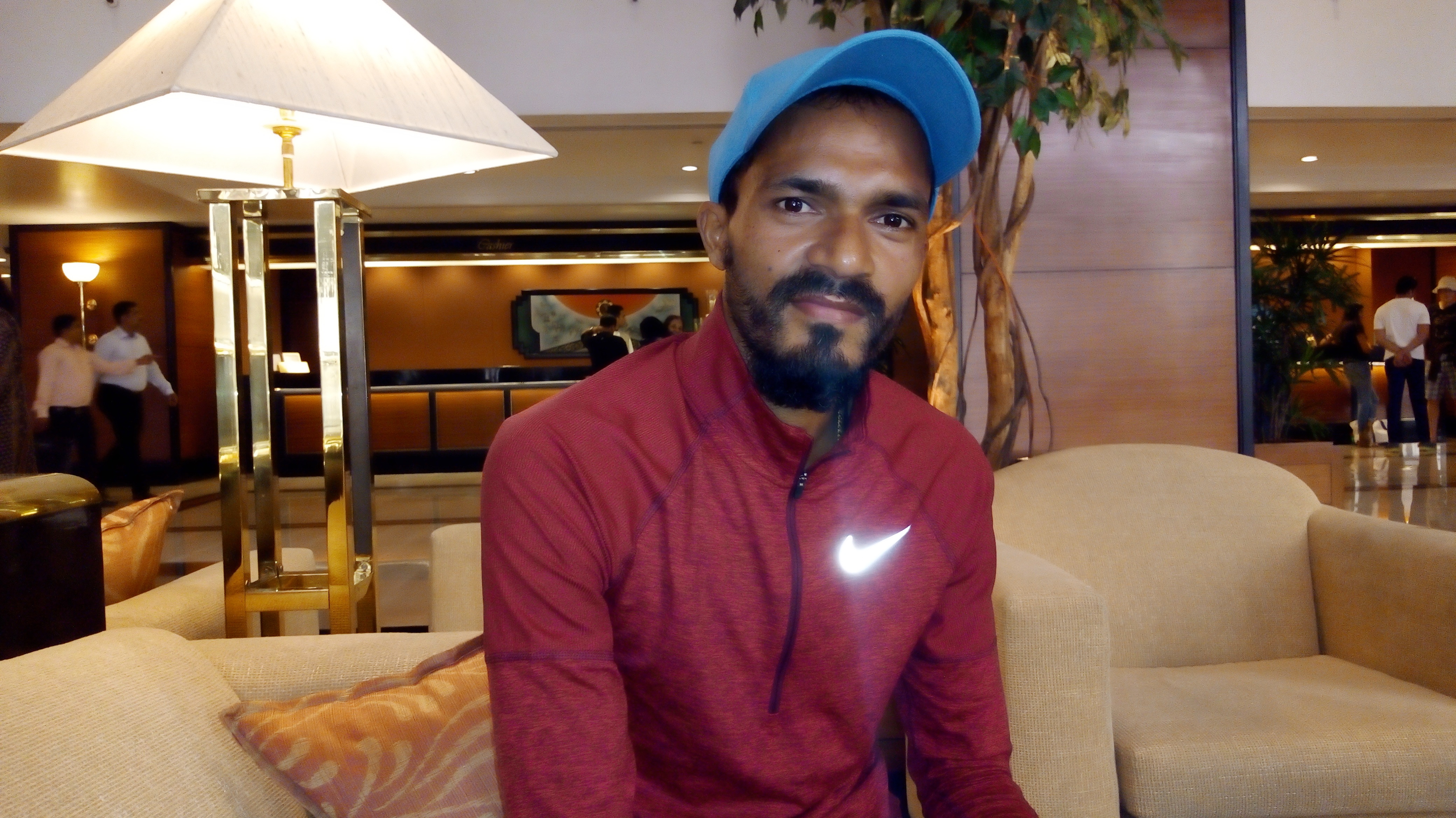
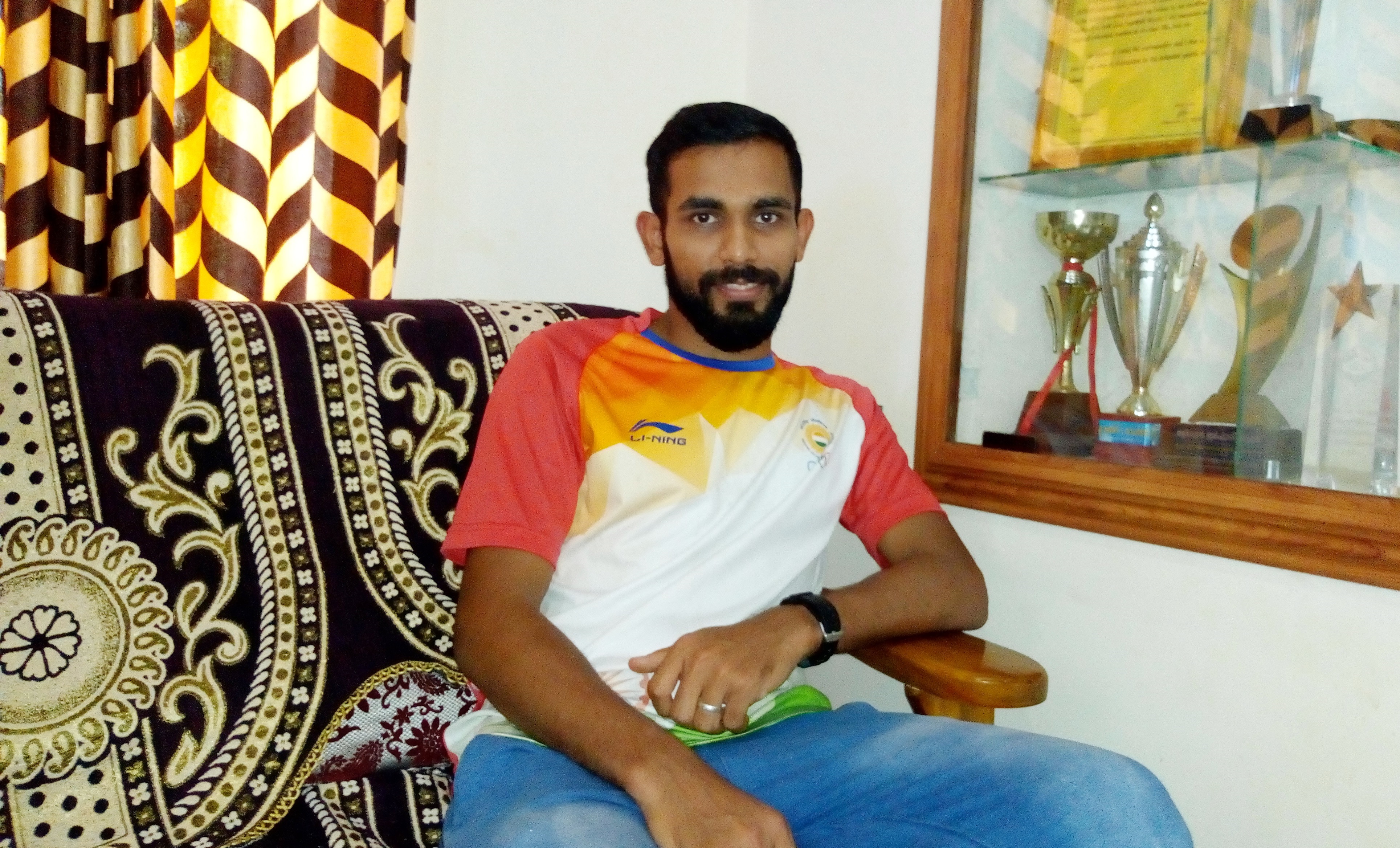
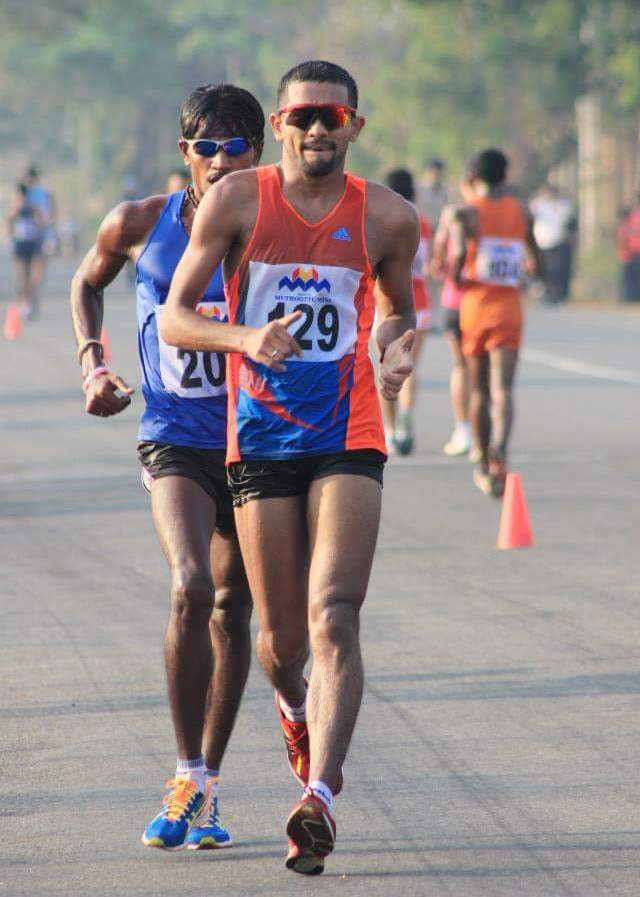
K. T. Irfan (Photo: Shyam G Menon)

In April 2018, K. T. Irfan was at a low point in his career in sports. Roughly ten months later, in a return to form, he became the first Indian athlete to qualify for the 2020 Tokyo Olympics. “ I am very happy,’’ he told this blog at his house in Kuniyil in Kerala’s Malappuram district. This is his story:

Race walking is a little understood sport.

Actions like running, jumping and throwing are well-defined; they highlight ability. To our minds, walking has never been in the same league as running. If you walk fast, it remains just that – a fast walk. Leveraging that to mean high sport is tough on the imagination. Unless you get down to attempting a 20 km or 50 km walk and complete it in times that would put most amateur long distance runners to shame. Which is what, race walkers do. But then all sports have become so wrapped up in their private ecosystem that imagining what it’s like being in someone else’s shoes is a fading talent.  The uniqueness of running is that it is not as common as walking. Who will empathize with what’s perceived as less?

That’s why the news of mid-March 2019 engaged. Six years earlier, in September 2013, Tokyo had been selected as host city for the 2020 Summer Olympics. In the time since, a lot changed with regard to rules for athletes to qualify for the Olympics. While the jury is still out on how apt the revised qualifying norms from International Association of Athletics Federations (IAAF) are, the general impression is that qualification by timing has been tightened further while some cushioning (as additional route to qualify) has been provided courtesy an international ranking system in each discipline. At the beginning of 2019, there were three major events looming before elite athletes – the Asian Athletics Championships in Doha (Qatar), the IAAF World Athletics Championships in Doha and the 2020 Tokyo Olympics. The qualifying mark got tougher as one moved from the first event to the last. The Sixth National Race Walking Championships held in Chennai in February 2019 was to serve as platform for Indian race walkers to qualify for the world championships in Doha. None made the cut.

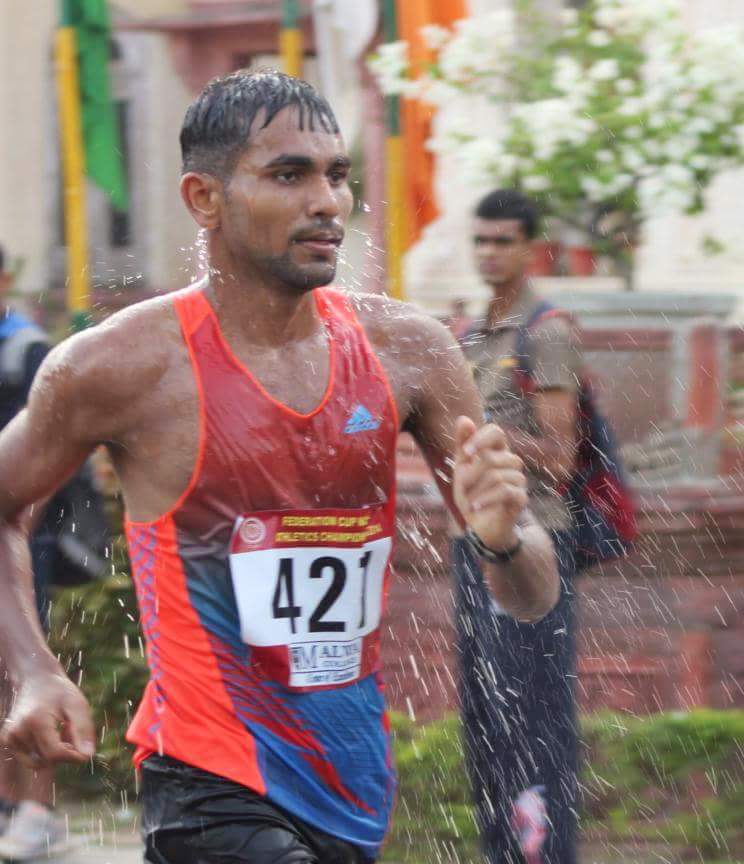
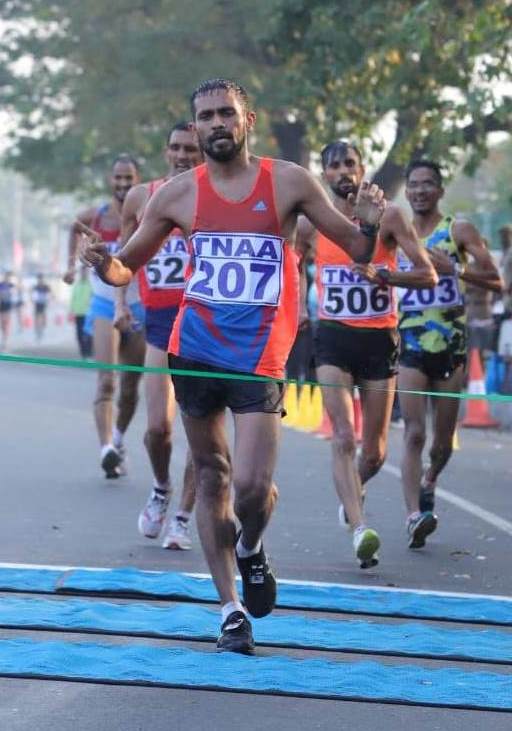
Following the race walking competition in Chennai, the sport once more sank from media attention. Then a month later, race walking provided a story worthy of national attention – K. T. Irfan had placed fourth in the 20 km race walk at the Asian Race Walking Championships in Nomi, Japan. More important, at one hour 20 minutes and 57 seconds, his timing was within the qualification standard of one hour 21 minutes assigned for the 2020 Tokyo Olympics. Race walking had produced the first Indian athlete to qualify for the upcoming Tokyo Olympics. For Irfan, already a veteran of two Olympics in his 29 years on the planet, it was more than qualifying for Tokyo; it was much awaited return to normalcy.

K. T. Irfan (Photo: courtesy Irfan)

Roughly ten days after the event in Nomi, it was very hot in Kozhikode, north Kerala. The state, battered by heavy rain in 2018, was now in the grip of a heat wave.  Health advisories were out. “ Are you sure you don’t want an air conditioned room?’’ the front office manager at the hotel asked. “ Absolutely,’’ I said. There are certain things you are sure of when surviving on freelance journalist’s income; type of hotel room is one of them. Over an hour later, the trip by transport bus to Kuttoli in adjacent Malappuram district was surprisingly tolerable.  I attribute that to vegetation, still alive and offering shade in these parts.  The region was hilly with ups and downs, not pronouncedly but definitely so. From Kuttoli, one took the road proceeding to Kuniyil. Wikipedia provides further insight into the geography of this area. Kuniyil falls in Kizhuparamba panchayat; the latter in Malayalam means low lying land. Essentially the valley between nearby hills, some parts here are susceptible to flooding when water levels rise in Chaliyar River during monsoon. Kuniyil is where Irfan grew up.

Born February 1990, he was one of six children. His father’s work entailed aggregating coconuts from the region and drying it to copra for onward supply to oil mills. Financially, it was hard times for the family. They struggled.  Irfan studied at Kuniyil’s Al Anvar High School up to tenth standard. For eleventh and twelfth he attended Government Vocational Higher Secondary School at Kizhuparamba. Traditionally the more sport loving part of the state, north Kerala is crazy about football. “ This is football country,’’ Irfan said. Like any other youngster he too ran and played in school. There was nothing remarkable in that engagement with sports. Sole incident recalled was a fall during high jump that left him with a cracked arm. Things changed when Rebas Mosahi entered the frame.

Race walking’s origins date back to the nineteenth century, to competitive long distance walking events generally called pedestrianism. According to Wikipedia, it was a popular working class past time in England and America. The first English amateur walking championship was organized in 1866. Race walking first appeared in the Olympics at the 1904 Olympic Games as a half mile walk in the all-rounder category, a precursor to the modern decathlon. From 1908 onward it has been at the Olympics as a distinct, stand-alone event. Women’s race walk made its Olympic debut in 1992. At senior level, the distances tackled are usually 20 km and 50 km but this, the IAAF has said, is set to change (for more on these changes please try this link: https://shyamgopan.com/2019/02/07/race-walking-iaaf-committee-recommends-changes/). By the time Irfan was growing up in Kuniyil, race walking was already a discipline included at school and college level athletics competitions in Kerala. Rebas – he was senior to Irfan and a friend of Irfan’s brother – was a competitive race walker. He trained under their school coach, Jose. Race walking is not a sport featured frequently in the media. In rural Kuniyil, there wasn’t much information available on race walking. Jose was window to the sport.

It was generally felt that Rebas would benefit from having a training partner. That is how Irfan came into the picture, as did another friend, Salman K.P. The trio trained to race-walk at school and on the local roads. Typically, it was jogging in the morning; race walking in the evening. Race walkers have always been an oddity for their peculiar style of walking. It is a style that takes walking to as fast as it can be while respecting two critical conditions – (a) the athlete’s back toe cannot leave the ground until the heel of the front foot has touched the ground (b) the supporting leg must straighten from the point of contact with the ground and remain straight till the body has passed over it. Walk so and it is often a peculiar gait to behold. With three local lads into the sport, Kuniyil got used to the sight of them race walking on local roads. But in a sport where logging miles is part of training, reactions weren’t the same everywhere they went to. “ When we crossed from Kuniyil to other places in the region, it was common for people unfamiliar with race walking to make fun of us. You ignore it and carry on,’’ Irfan said. As the months went by, the boys logged miles on the region’s ups and downs. The first break through for Irfan came in 2006. At a school meet in Palakkad, he finished fourth in the state in 20 km race walk. Salman placed fifth.

K. T. Irfan (Photo: courtesy Irfan)

Following the Palakkad result, Jose suggested that Irfan appear for trials to secure admission to the Sports Authority of India’s (SAI) regional training facility in Kozhikode. The trials were due at the city’s Devagiri College. When they first reached the scene, both Irfan and Salman turned back owing to sheer nervousness. But they felt guilty; Jose had invested time and effort in them and they couldn’t let him down.  So they returned to the trials, where Irfan made the cut and was accepted as a day trainee. Given Kuniyil was some distance from Kozhikode he stayed with his aunt in the city and attended training. At SAI, his coach was Bose. In 2007, at Puducherry, Irfan set a new under-20 South Zone record in the 10 km race walk, covering the distance in 46 minutes 46 seconds. At the next level – the inter zone meet – he finished sixth. “ I was tense. It was my first national meet,’’ Irfan said. After that South Zone record, he was provided hostel accommodation at SAI, Kozhikode. He also gained admission under sports quota, to study at Devagiri College. “ One reason I persisted with sports is that I wanted my education to be self-supported and not be a drain on my father’s income,’’ Irfan said.

For three years – 2007, 2008 and 2009 – Irfan competed in university level competitions (he represented University of Calicut). In 2007, he did his first 20 km race walk, completing it in two hours five minutes.  In 2008 and 2009, he secured gold medal at these contests. Given the timings reported by race walkers in their discipline, they would seem good candidates for crossing over into the world of distance running. For instance, the timing reported for 20 km race walk compares well with timings at half marathons (the half marathon is longer by a kilometer) while the timing for 50 km race walk (as of early 2019, the world record in the discipline was held by Yohann Diniz of France; 3:32:33) sits comfortably in full marathon territory despite 50 km being longer than a marathon. Irfan said, he never had any inclination of that sort. “ I was never in doubt or wanting to shift to another sport,’’ he said. One reason for this was his cadence; he called it “ frequency.’’  He has very good frequency in this movement, critical for race walking. “ I had faith that I would do well,’’ he said. In 2009, as SAI started weeding out over-age trainees, Bose told Irfan that it was time he looked for a job. Around this time, there was an inter-state athletics meet held in Kochi. At this meet Irfan met the race walking team from the Indian Army’s Madras Regimental Center (MRC). Their coach P. S. Jalan, took note of his performance and asked if he would be interested in joining the army. Following trials at MRC, Irfan was selected. After the required medical tests in Bengaluru, he formally joined the Indian Army (Madras Regiment to be precise) on March 15, 2010. He reported to MRC in Ooty.

MRC had a sports company, which had in it the regiment’s sports stars. It was coached by Subedar Ram Kumar. In September-October 2010, Irfan participated in an army sports meet featuring athletes drawn from its units in South India. He got gold in the 20 km race walk. After this, he moved to Hyderabad where the Southern Command maintained its sports team.  At the inter-command sports meet, he finished first in 20 km.  Selected to represent the army, Irfan next participated in the Services Meet where again he finished first. Thereafter at the 2011 National Games, he placed fourth. At the behest of Gurudev Singh, coach at the national camp, Irfan reported to the national camp in Bengaluru in June 2011. After about ten days of training under Gurudev Singh, on June 12, he secured silver at an inter-state championship in Bengaluru. That was his first medal at the national level, in senior category. Following this he shifted to National Institute of Sports (NIS) in Patiala for the remaining period of the national camp. In September 2011, at the Open National Athletics Championship in Kolkata, Irfan secured gold.

At Gurudev Singh’s suggestion Irfan was continuing on at NIS, when he was called to Ooty by the army to prepare for their internal competition. At this time, selection for the Asian Championships was on at NIS; two of his compatriots qualified for the 2012 London Olympics. Irfan missed out. Meanwhile Irfan hit gold at the army area meet. In March 2012, at the Federation Cup held in Patiala, Irfan resolved to do well. He set a new meet record of 1:22:14 in the 20 km race walk, which also sufficed to see him qualify for the London Olympics. Interestingly at four race walkers qualified and destined for London, race walking had significant representation in the Indian athletics squad for the event. Conditions were good in London. Irfan set a new national record in 20 km race walk at the Olympics; 1:20:21. He finished tenth in a field of 56 participants. He recalled warm, welcoming receptions in India after this achievement. Then it was back to national camp in Bengaluru.

In May 2013 at the IAAF World Challenge Meet in China, Irfan finished in 1:20:59 placing fourth. This gained him entry to the World Championships in Moscow in August 2013. In Moscow, he was disqualified; at the time of disqualification he was in fourth position in the race. Disqualification (it follows a series of cautions) is for losing leg contact with the ground and for not keeping the supporting leg straight. “ Such mistakes usually happen due to the pressure of competition. The first warning does not affect you. The second one makes you conscious. It slows you down,’’ Irfan said of how the process elicits toll on athletic performance. In 2013, Indian authorities commenced a national championship for race walking. That year Irfan didn’t participate. He did, at the 2014 edition in Kochi, where he finished second in 20 km and qualified for the Asian Championships despite pulling his hamstring at around eighteenth kilometer. At the Asian Championships, he topped among participating Indian race walkers covering the distance in 1:21:41. In April, at the Federation Games, he returned a timing of 1:24:21, tad outside the qualifying mark for the upcoming Asian Games. Nevertheless based on previous performance, he made the cut. The training that followed was in Dharamshala. Somewhere during this phase, probably due to over-training or vitamin deficiency or maybe, both – he developed a stress fracture on his right ankle. Not realizing the gravity of injury he participated in the Asian Games at Incheon, South Korea and finished fourth in his discipline with a timing of 1:23:14. “ There was pain. After the Asian Games, I rested for a month and then resumed training. But the pain came back. It was then that stress fracture was diagnosed,’’ he said.

K. T. Irfan (Photo: AFI Media)

Of help in this phase was his signing up with Olympic Gold Quest (OGQ); it had happened two years earlier in 2012. OGQ assisted with medical treatment.  Recovery took time. Post Asian Games, Irfan was coached by Alexander Artsybashev, a Russian coach who had been working with the Indian race walking team. The next major event for Irfan was the 2016 Rio Olympics. The qualification for it was hoped to be achieved at the Open Race Walking Championships in Jaipur. Irfan placed fourth in Jaipur but he still made the cut for Rio; he clocked 1:22:45 against the qualifying mark of 1:24:00. According to Irfan, at Jaipur, as many as nine Indian race walkers made it home within the Olympic qualifying time. Then fortunes nosedived for the athlete from Kerala. The old hamstring injury he sustained in Kochi returned. Irfan couldn’t participate in the Asian Championships; he also had to avoid the Olympics. But he continued at the national camp doing off-season training.

In 2017, he participated in the Open Race Walking Championships held in Delhi, where he finished first. At that year’s Asian Race Walking Championships he secured a bronze medal. “ It was my first medal at the international level,’’ Irfan said. He followed that up with good timing – 1:21:45 – at the World Championships in London. But his position in the field wasn’t as good. In 2018, he secured gold at the Open Race Walking Championships in Delhi with a timing of 1:21:31. It was good enough to qualify for both the upcoming Commonwealth Games and the Asian Games. The first of these events was the Commonwealth Games held in Gold Coast, Australia in April 2018. The weather was terribly warm. Irfan didn’t do well. He finished thirteenth in a field of 16. He got a caution in the first two kilometers; then a second. It rattled him and inhibited his performance. “ It is my habit to spend the first three quarters or so of a race with the leading group. Given the cautions, I got scared, slowed down and missed being part of the lead group,’’ he said. However, the worst was yet to come. Some days after the above mentioned race, news appeared of two Indian athletes – triple jumper Rakesh Babu and race walker K. T. Irfan – asked to leave the 2018 Commonwealth Games for violating the no-needle policy. The said policy was part of measures to weed out doping. According to published news reports a cleaner alerted Games officials to a used needle found in a cup in the room shared by the two athletes; a second needle was later discovered in a bag belonging to Rakesh Babu. The athletes said they had no idea how the needles got there. Games officials were not satisfied with their explanation. On April 17, 2018, Times of India reported that the Athletics Federation of India (AFI) had challenged the decision to remove Irfan from the Games village. But the damage had already been done. Public perception of athlete altered with the media reports from Australia.

The 2018 Commonwealth Games was the lowest point in Irfan’s career. “ It was a difficult period,’’ Irfan said. The first competition after the Commonwealth Games was the World Team Cup of May 2018. “ I was mentally depressed after the Commonwealth Games. My timing at World Team Cup was quite bad,’’ Irfan said. Three months later at the Asian Games in Jakarta, he was disqualified. “ It happened at 15 km. Till that point I was in contention for bronze,’’ he said. According to the media, four Indian race walkers including Irfan suffered disqualification at the 2018 Asian Games. It was a major setback for the squad. After the Asian Games, Irfan took a break for about a month. Around December 2018, he started training again. His coach now at the national camp in NIS, Patiala was Harminder Singh, former race walker and bronze medalist at the 2010 Commonwealth Games. For coach and ward, ahead was the National Race Walking Championship scheduled in Chennai for February 2019. “ It was a good competition. But the weather was very warm,’’ Irfan said of the event, where he defended his national title in 20 km for the third time in a row but failed to qualify for the 2019 IAAF World Athletics Championship due in Doha. However, his timing in Chennai was good enough to earn him a berth for the upcoming Asian Race Walking Championships in Nomi, Japan.

K. T. Irfan (Photo: courtesy Irfan)

Located in Ishikawa Prefecture on Honshu, the largest among the islands constituting Japan, Nomi has a humid continental climate characterized by mild summers and cold winters with heavy snowfall. According to Wikipedia, Nomi’s average annual temperature is 14.1 degrees C. The temperatures are highest in August at around 26.8 degrees C; it is lowest in January at around 2.7 degrees C. The 2019 Asian Race Walking Championships were scheduled for March. “ The weather was really good,’’ Irfan said of conditions on race day in Nomi. One hour 20 minutes and 57 seconds after commencing the 20 km race walk, he was once again the stuff of positive news in India; he had become the first athlete from India to qualify for the 2020 Tokyo Olympics. On March 17, 2019 the Press Trust of India (PTI) reported: National record holder K. T. Irfan on Sunday became the first Indian from athletics to qualify for next year’s Olympics while finishing fourth in the 20 km event of the Asian Race Walking Championships in Nomi, Japan. A huge load was lifted from Irfan’s shoulders. The long shadow of the 2018 Commonwealth Games seemed to recede. “ I hadn’t gone to Nomi hoping to qualify for the Olympics. I was looking to meet the qualifying standard for Doha. I am very happy with the outcome,’’ Irfan said.

Irfan’s personal best (also national record as of March 2019) was the timing he returned over 20 km at the 2012 London Olympics – 1:20:21. The world record for the same discipline (at the time of writing) was 1:16:36 held by Yusuke Suzuki of Japan. According to Irfan, in the 20 km discipline, the weakness of Indian race walkers is usually the last five kilometers. “ For 15 kilometers we manage to stick with the leading group. Thereafter we begin to fade while the stronger race walkers in the field get quicker. If we try to go faster, we risk disqualification,’’ he said. It highlights the points to focus on in training, as race walkers try to honor the sport’s technical rules and still push pace despite exhaustion. With the means to identify loss of foot contact and bending of support leg, set to become more sophisticated and accurate, race walkers have their work cut out. It was now noon in Kuniyil and K. T. Irfan, glad for Nomi, was not looking that far into the sport’s technological future. He was just happy to put all that bad press from Gold Coast behind, enjoy his days at home on leave from the national camp and when the break gets over, return to training for Doha and Tokyo. Just as we left the sturdy brick and mortar house that was now his home, he pointed to a small crumbling building on the edge of the compound. “ That is where we used to live,’’ he said. Half an hour later, I was on the bus back to Kozhikode.
(The author, Shyam G Menon, is a freelance journalist based in Mumbai. This article is based on a conversation with K. T. Irfan. Timing at races are as provided by him.)       

KEEP ON RUNNING

Shibani Gharat (Photo: Shyam G Menon)

“ I am not obsessed with completing the Marathon Majors. I am not obsessed with anything actually. I just enjoy running.’’

For those working in the media, general elections are usually a period of hectic activity.

In India, 2019 dawned with elections around the corner. Political parties in the fray attached much expectation to it. A familiar litany of heated discussions, exclusives, poll forecasts, exit polls and election analysis would roll out across television channels and publications. Having covered elections before, Shibani Gharat knew what would head her way in April-May, which was when polls were due. Before the decibels peaked, could she squeeze in a challenge? It was a journey, as yet six years old. Unlike elections, this one was her own. Canberra? – She wondered.

January 2013. Among those lined up for the year’s Mumbai Marathon was a young woman clad in Bermuda shorts and T-shirt. Apart from her daily half a dozen loops around Shivaji Park in Mumbai’s Dadar and weekend mileage of as many kilometers, she had run all of one long run – 17 km – as preparation for the marathon she was set to attempt. She was neither familiar with the right attire for running nor aware of the training required for a marathon.

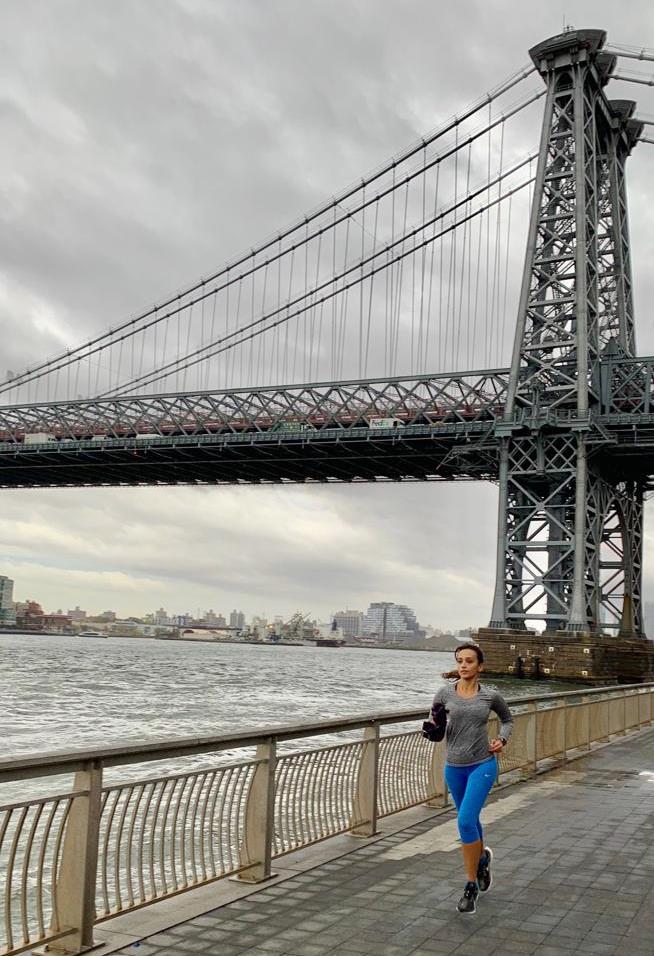
Running at Saratoga Creek, San Francisco (Photo: courtesy Shibani Gharat)

It was sometime in the second half of 2012 that a friend pushed her into enrolling for the half marathon at the 2013 Standard Chartered Mumbai Marathon (SCMM). By the time she decided to enroll, slots for the half marathon were full. The half marathon segment of Mumbai Marathon is hugely popular with recreational runners. Without any hesitation she enrolled for the full marathon (42.2 kilometers). The full marathon at Mumbai starts in the southern part of the city, moves towards suburbs in the north-west and then returns. On race day, at Haji Ali, during the return leg of the marathon, a friend called out to her: tu zinda hai ya mar gaya (are you still alive or dead)? She completed that maiden marathon in four hours 58 minutes. By the standards of recreational running, that is good timing; certainly for a first timer.

Running in New York (Photo: courtesy Shibani Gharat)

The erstwhile textile mills of Lower Parel are now among Mumbai’s bustling business districts. The old mills have transformed to shopping malls, office spaces; even apartment complexes. As if that injection of perceived modernity is not enough, you have vertical lines of high rises – some of them, among the tallest buildings in India – stretching into the sky. Yet typical of India, no scene is sanitized to favor a single attribute. The old and the new co-exist. The roads of Lower Parel also have plenty of old buildings. The streets are congested and oozing at every twist and turn, the hallmarks of high population and densely packed life. It was December 2018. The television journalist we were to meet wasn’t hard to spot as she walked in. She wore a bright red dress and there was make-up from the studio, still on her face. It was late evening; the closing hours of another working day. The café in Lower Parel was packed with people, mostly young. “ During my school years, I was quite fat. I used to eat my classmates’ lunch,’’ Shibani Gharat, now trim and athletic, said recalling her past. She may have looked the consummate rookie, Bermuda shorts and all, that early morning of the 2013 SCMM. But she was no stranger to the active life. During her undergraduate studies, she had enrolled in a self-defence course and been subsequently introduced to taekwondo by coach, Bhaskar Karkera. Shibani went on to represent Mumbai in the sport at the state level; once she competed at the nationals too. She started running as part of her training for taekwondo.

Photo: courtesy Shibani Gharat

Born 1985, Shibani is the only child of her parents, both of them retired bankers. She grew up in Mumbai’s Shivaji Park area; heart of the city and quite centrally located if one imagined a portrait of town by sports facilities. Following her studies at the city’s Sophia College for Women, Shibani aspired to be a journalist. It was an uphill task. She could write well; she was already contributor at Asian Age and Times Journal of Photography. But the completion of studies and search for a job coincided with economic recession. There were no openings immediately available. Her parents, hailing as they did from banking circles, knew nobody in newspapers or TV channels to request for opportunity. Shibani’s first job therefore was as copywriter at an advertising agency. This was followed by a stint working at the publishing arm of Network 18. In no time employment elicited its first casualty. In her college days, she used to practise taekwondo in the morning and evening. “ The odd working hours meant that there was no time for taekwondo and running,’’ she said. The impact of declining physical fitness came sooner than expected. She suffered severe backache and ended up in hospital. Medical investigation showed vitamin deficiency among causative agents (vitamin deficiency is now widespread in India’s white collar workforce). She endured vitamin injections for a month. “ My condition was so bad that my mother had to come and lift me from bed. Compounding matters was my travel schedule. It was a wake-up call. I had to take my fitness into my hands. I went back to my old discipline of going for a run around Shivaji Park,’’ she said. She ran slightly longer distances on the weekend.

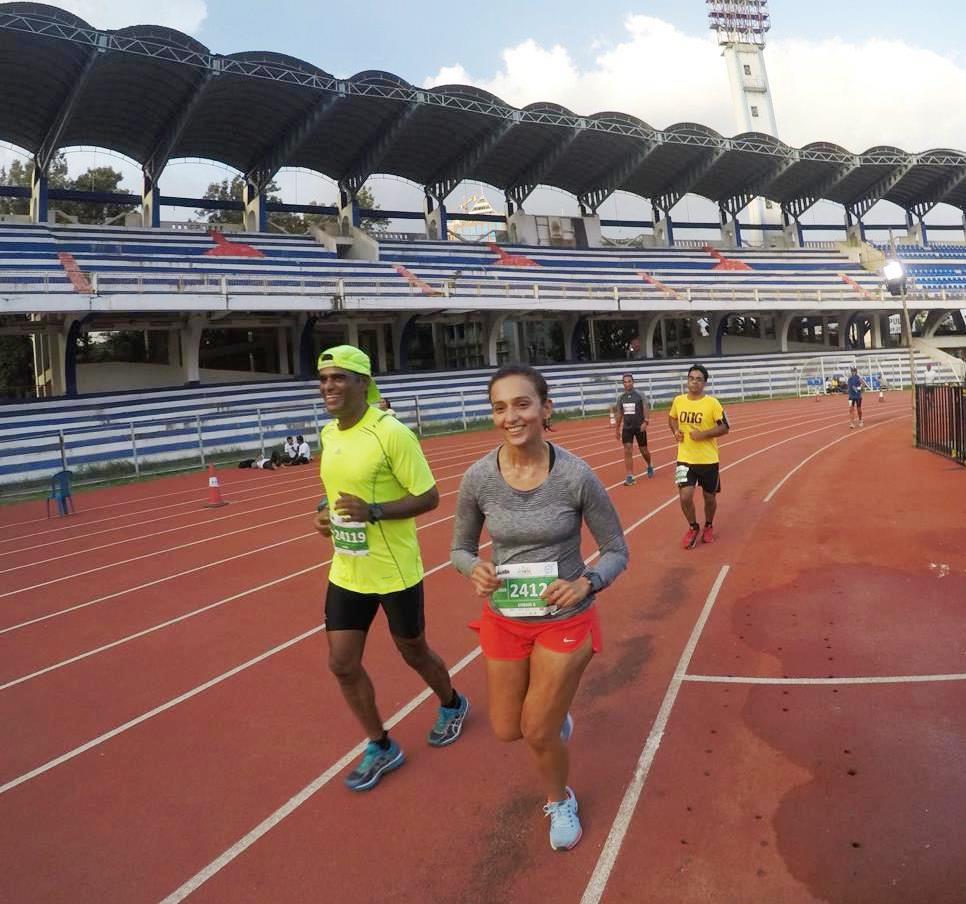
With Sunil Lahigude; from a stadium run in Bengaluru (Photo: courtesy Shibani Gharat)

The jogs at Shivaji Park brought her face to face with other runners from the region, like Sayuri Dalvi, who is among Mumbai’s well-known woman marathoners in the amateur category. It was at the behest of one of them that Shibani tried registering for that half marathon in 2013 (she was between jobs at this stage; on her way to joining CNBC), ending up eventually in the full. After this unexpected debut in the full marathon in Mumbai, Shibani enrolled for the full marathon in Hyderabad. It was a tough race and took a lot out of her. “ I suffered reaching the finish line,’’ she said. Between SCMM and the Hyderabad Marathon, there had once again been no formal training; the longest distance she ran in training was 20 km. On the bright side, she was into yoga and strength training. Notwithstanding the experience in Hyderabad (in amateur running circles the event is recognized as a tough but well organized marathon), she found herself signing up for the 50 km-category at the Bangalore Ultra. That was a jump from marathon to ultramarathon led by curiosity. Next on the cards was the Nilgiris Ultra where she covered a distance of 100 km. Here, for the first time, she met some of the known names from ultra-running in India, including Aparna Choudhary. There was little by way of structured training and progress in this journey from jogs around Shivaji Park to first marathon and ultramarathons; all in relatively short period of time. But by the end of that eventful year after participating in events far from home, Shibani got round to doing what she should have perhaps done earlier – she met runners from Shivaji Park Marathon Club. They provided her a sense of what training for the marathon entailed.

With Arun Bhardwaj; from a stadium run in Bengaluru (Photo: courtesy Shibani Gharat)

It didn’t take long for television to notice runner in its ranks. In December 2013, Star Sports contacted her seeking to track her run during the 2014 edition of SCMM. “ The magnitude of having completed the full marathon hit me only when Star Sports approached wanting to cover me for 2014,’’ she said. The channel tracked her run at the 2014 edition of the Mumbai Marathon. It ended up being a personal best (PB) for her. She covered the distance in four hours 36 minutes. In February of 2014, she attempted the 101 km category at Run the Rann. But it turned out to be a disappointment. She quit the run at 65 km after she found herself going around the same loop several times. In August 2014, after training with Milind Soman (he was heading for the 12 hour-stadium run in Bengaluru), she ran the 12 hour-Mumbai Ultra. It was her first run of such duration. That year, Bengaluru-based ultra-runner Dharmendra Kumar told her about Khardung La Challenge, the 72 km ultra-marathon held as part of the annual Ladakh Marathon. She promptly registered for the ultra-run in 2014. “ As part of my training I did stair workout, running up several floors. I also avoided alcohol for three months before Khardung La,’’ she said. She made sure to acclimatize well ahead of race in Ladakh. The race was a fantastic experience for Shibani. She became the first non-Ladakhi woman to complete the ultra-marathon. Completing the Khardung La Challenge helped build her confidence. The same year, she enrolled for 100 km at Bangalore Ultra and completed the run in 18 hours. By now, she was quite well known in running circles as an ultra-runner.

At that time, the ultra-running community in India was still small. As a recreational sport, the discipline was just picking up. The first stadium based ultra-run was organized in Bengaluru in 2014. In August 2015 the second edition was due. The organizer, NEB Sports, was inviting ultra-runners for the event. Shibani was among those invited. Running for 12 hours, she managed to cover a distance of 87 km. “ Stadium run is like a party with friends around. There is food and hydration every 400 meters,’’ she said. Stadium based ultra-runs are now held in many Indian cities including Mumbai, Delhi, Bengaluru, Chandigarh and Hyderabad. A week after the stadium run in Bengaluru, the 12 hour-Mumbai Ultra was scheduled. The course was in and around the same region in town as Shivaji Park. Shibani was among key runners at this event in Mumbai; she covered a distance similar to what she covered in Bengaluru, during the allotted 12 hours. Before the year was out, in November, she also ran the 2015 edition of the Istanbul Marathon.

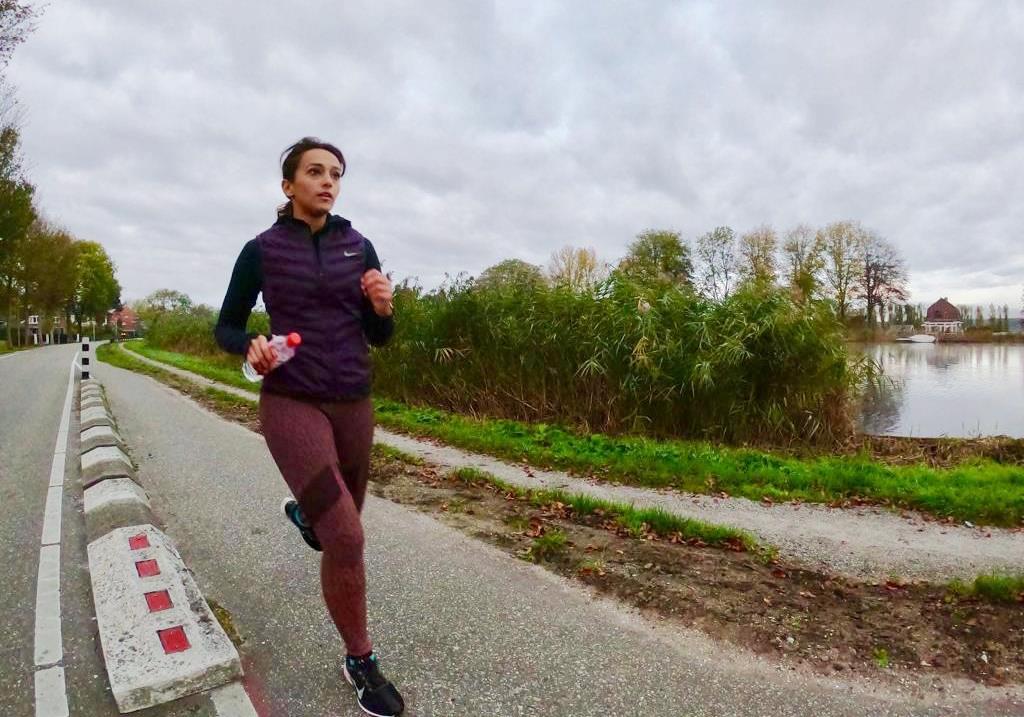
Running in Amsterdam (Photo: courtesy Shibani Gharat)

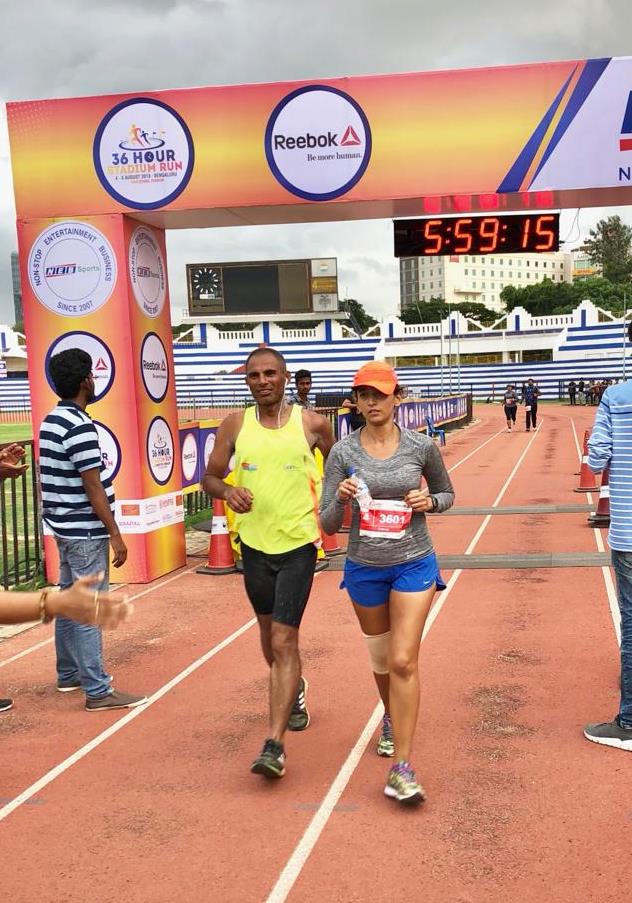
When it comes to courses for running, Shibani prefers undulating terrain over flat ones. “ I have never felt motivated to apply for races like Berlin, which are famous for their flat, fast courses,’’ she said. Yet, she has participated in a number of stadium ultras run on flat, synthetic track. “ Stadium runs, though on flat course, offer a different challenge. The challenge in stadium runs is combating the boredom of running on the 400 meter-track, loop after loop. It is mentally challenging. Further extended running in loops casts greater pressure to one side of the legs; race organizers address that by shifting from clockwise to counter clockwise and vice versa every few hours. That said, the nicest part of a stadium run is that you are assured of food and hydration at regular intervals. The stadium runs in Bengaluru are great fun. Plus the weather there is fabulous,’’ she said. In 2016, the stadium ultra in Bengaluru introduced a new 36 hour-run. Entry for this segment was by invitation and many ultramarathon runners were invited to participate. Held in August 2016, Shibani was one of the participants in the 36-hour run. “ The first thing I went and asked the organizer was how many hours of the 36 hours I could spend sleeping. I was told six hours. I slept for five hours,’’ she said. For this run, she attempted running with shoes sporting different types of soles; she also ran 40 km barefoot. She covered a distance of 184 km and ended up in the third position after well-known ultra-runners, Aparna Choudhary and Meenal Kotak. The 36 hour-run, according to Shibani, is challenging because of sleep deprivation. However, challenge or none, she doesn’t appear to have slowed down in the momentum of participating in events. A week after that 36 hour-run, she ran the 12 hour-Mumbai Ultra held on August 15, 2016. That outing was followed by a 100 miler in September 2016 in Singapore. “ I like to register for a race. It gives me a goal to chase,’’ she said. In the weeks following the event in Singapore, she placed first in a 12 hour-race organized by Oxfam. Then, she took off to Finland alone to see the Northern Lights.

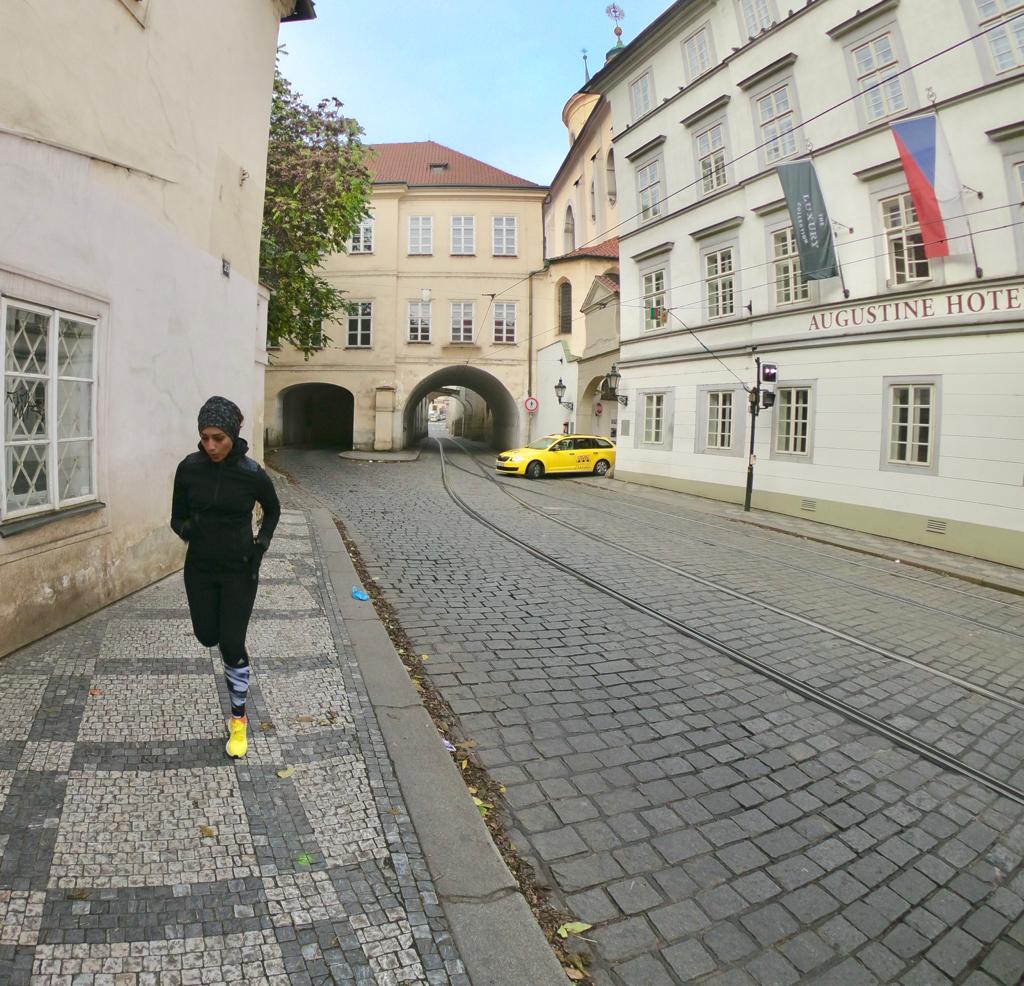
Running in Prague (Photo: courtesy Shibani Gharat)

In 2017, among the many runs that she enrolled for, Shibani attempted the 24 hour-stadium run in Bengaluru. According to her, from the pantheon of stadium based-distances in ultra-running, it is the 24 hour-category that challenges her the most. As regards distances in road running, she finds the half marathon more challenging than the 10 km or the full marathon. “ I find the 24 hour-ultra-run much more challenging than 12 hour and 36 hour-ultra-runs. The 12 hour-run is easy. The 36 hour-format is tough sustaining. The challenge in 24 hour-ultra to me is akin to that of running the half marathon. I really like ten km-races because they typically get over in an hour. The half marathon stresses me because two hours is deemed respectable timing. That element of respectable timing makes some distances challenging. I want to get better in the 24 hour-run. I feel I have not given my best in the 24 hour-ultra-run yet,’’ she said. Along with her ultra-runs, she also added several marathons to her list of races, not to mention the occasional 10 km events and half marathons. In 2018, she ran the New York City Marathon, one of the six Marathon Majors of the world. The high point of her running so far has been participating in the 2018 International Association of Ultrarunners (IAU) 24 Hour Asia & Oceania Championships held in Taiwan. The run did not go as well as she would have wanted it to. “ On the day of the run, the weather was boiling hot,’’ she said. Her mileage suffered on account of the weather. “  It was great opportunity to get a chance to participate in this event, I had to change my training overnight from marathon training to ultra-marathon training with only a couple of weeks left for the event. I had barely any time to get the mileage required for ultra-marathon, under my feet. I could have trained better. Ultra-marathoners can’t really complain about the weather,’’ she added as afterthought. She followed that with another 24 hour-stadium run in Delhi, her last run of 2018.

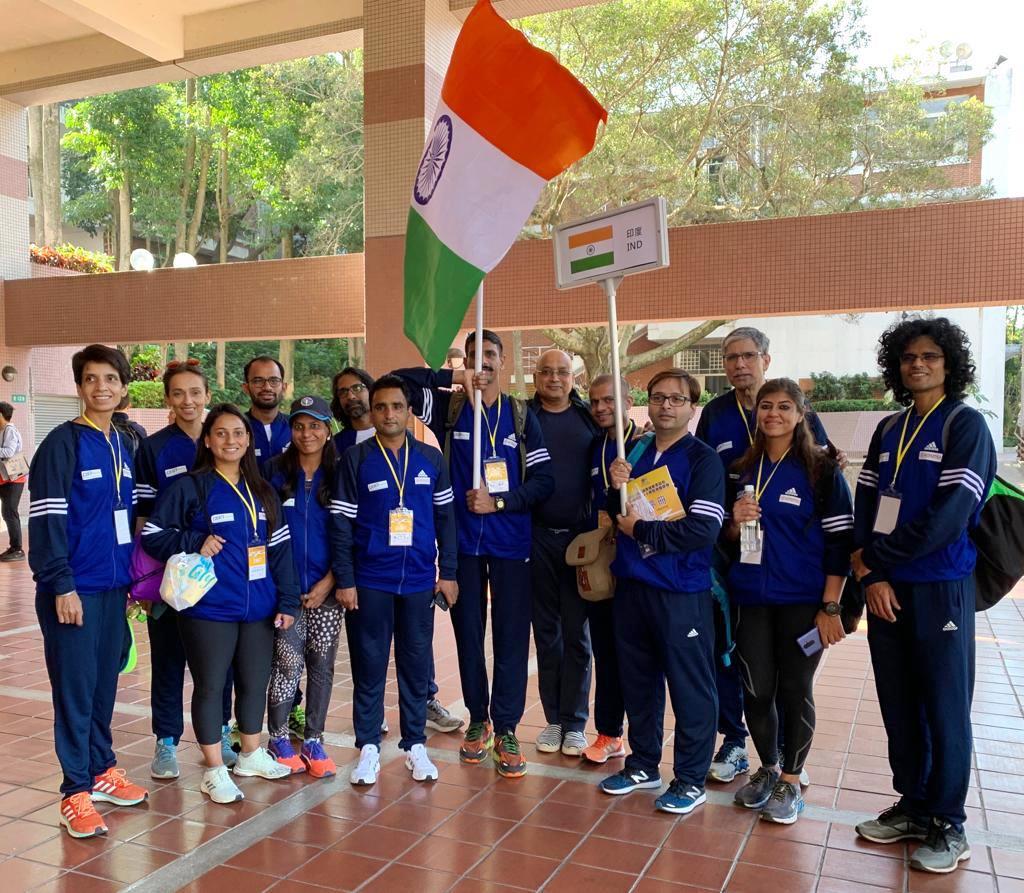
From the IAU 24 Hour Asia & Oceania Championships (Photo: courtesy Shibani Gharat)

Shibani is one of those runners whose participation at events has been so prolific that specific instances escape quick recall and details tend to blur. Along the way there have been multiple editions of the Vasai Virar Mayors Marathon (VVMM) participated in. There was the Saputara Summit run, the Saptashringi Parikrama run. “ In 2017, there were only two months that I didn’t do a full marathon. I really like registering for a race. It keeps me focused on fitness. My work is such that you get sucked into it. Ultras challenge you to do well amid this predicament. I like challenges. I like races that offer some amount of challenge,’’ she said. Shibani has had her share of podium finishes, some in tune with her known strengths, some pretty unexpected. “ It comes as a real shock to me when I get a podium finish in a half marathon,’’ she said. Starting with the FICCI Flo Run in September 2015 in Pune, she has also been a pacer at running events. Given her approach of running and the distances she loves to tackle, some of these assignments are challenging on Shibani. “ Pacing is a tremendous responsibility. You have to think about others. I don’t normally drink water in the early part of a run. But there are others who need to. There are so many such details about your running that you have to change when pacing,’’ she said.

Photo: courtesy Shibani Gharat

With her running gaining volume and frequency since 2015, a lot of things have changed. There is more structure to her training; there is a dedicated long run of 50-55 km on weekends, there is also greater focus on yoga and Pilates. Now, a familiar face on television, work does interfere with Shibani’s running. “ At any given point of time, my biggest challenge is work. I am passionate about whatever I do. When I work that has my entire attention. When I run, that is all that matters,’’ she said. Shibani often travels on work. When she does so, she makes it a point to make time for running. “ I make sure that happens. My works hours are crazy. Even if I am in office for 14 hours, I am out running at 6 AM. I have my lunch and dinner at the desk. Dinner at the desk because I can go home and sleep; it makes waking up early next day possible. Every 10-15 minutes saved thus gets added to my bank of time for running,’’ she said. There are also other angles. While registering for a race gifts her goal to focus on, she is also someone who digs solitude (she does a lot of her training alone). That is one reason she likes the long haul the ultra-marathon represents. But then it should be designed such that nothing distracts from the trance of being in an ultra. In 2016, she came off feeling not so good about the 100 miler in Singapore precisely because of this. There was an element of treasure hunt built into that race; it wasn’t a clearly marked course, she said. “ I like getting into a trance. Ultra-running is a lot about being in such rhythm after a certain amount of distance covered,’’ Shibani said. And so Canberra it was.

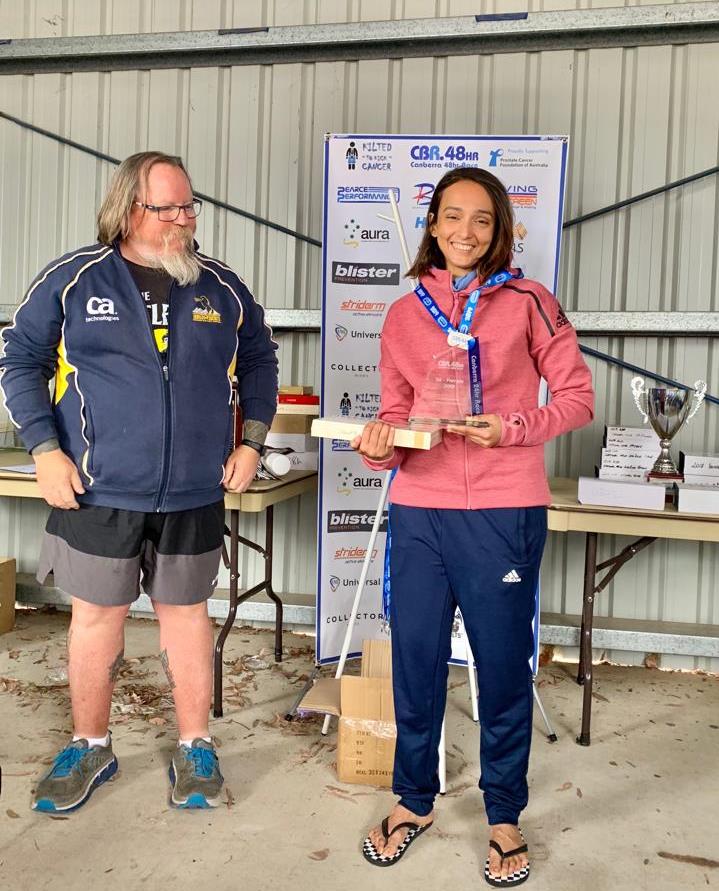
At the event in Canberra (Photo: courtesy Shibani Gharat)

She enrolled for the 24-hour race at the Canberra 48 Hour Race, a track and field ultra, scheduled for March 15-17, 2019. “ I wanted to do a race in March to keep up the mileage as in the following two months I may have to travel on election related work,’’ Shibani said. It was a fantastic experience. She found the camaraderie from Australian runners warm and helpful. She was running without any crew. Her run was from 9 AM to 9 AM; it was for 24 hours. “ For the first 15 hours, my run went off well and I was in fourth position among women. During the second half of the run, I started to face stomach issues and was unable to eat anything at all. For the last ten hours of the race, I just survived on water,’’ she said. At around 3 AM, with six more hours to go for the finish, Shibani started to feel a bit faint and decided to approach the medical team. She was advised rest for about 20 minutes. Barring this 20 minute break, she was pretty much on her feet all through and as the hours rolled by, she kept improving her rank moving up from fourth to third to second and finally first position. She ran 343 laps covering a distance of 142.2 kilometers during the 24-hour period, finishing first among women and eighth overall, as per official results. “ The most amazing thing was the help I got from other runners. They cheered me and offered me their crew members for assistance,’’ she said.

Among plans for 2019, Shibani had registered for the Chicago Marathon. “ I am not obsessed with completing the Marathon Majors. I am not obsessed with anything actually. I just enjoy running,’’ she said.

(The author, Latha Venkatraman, is an independent journalist based in Mumbai. This article is based on a conversation with Shibani Gharat. Names of events and timing at races are as provided by her.)

REGULATION SHOULD MAKE ADVENTURE SAFE, NOT RESTRICT IT / TALKING TO STEVE SWENSON

Steve Swenson (Photo: Shyam G Menon)

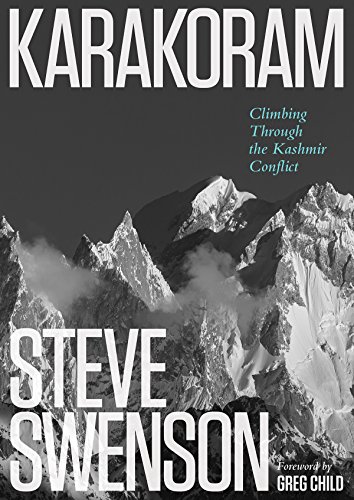
In February 2019, Steve Swenson, well-known mountaineer and former president of American Alpine Club was in Mumbai to accept the 2018 Kekoo Naoroji Book Award for his book: Karakorum – Climbing Through the Kashmir Conflict. Besides giving two talks that dwelled on his book and drew upon his wealth of experiences in climbing, Steve also participated in a panel discussion on risk management, safety and regulations pertaining to adventure sports. Thanks to accidents, litigation and complaints of environment degradation, the issue of regulating adventure tourism and adventure sports has been slowly gaining traction in India. On the other hand, poorly imagined regulation, harsh regulation, excessive regulation – these can stifle adventure.

In India, as rules and regulations for adventure sports are framed, some of the emergent concerns include how restrictive they would be of personal freedom and where the trained and experienced amateur sportsperson would be positioned in the pantheon of subjects to be regulated. Each location has its own matrix authored by population, natural spaces and resident empathy for adventure. India has to find its way. The US has one of the most active and evolved climbing scenes in the world with regulations to match. This blog met Steve after the Himalayan Club meeting for a chat on a range of subjects; among them – regulation of climbing, the US experience with regulations, the adventure point (as Steve put it), what he has learnt as a veteran climber now partnering young climbers on expeditions, the need for the young to be patient and of course, his book. Excerpts:

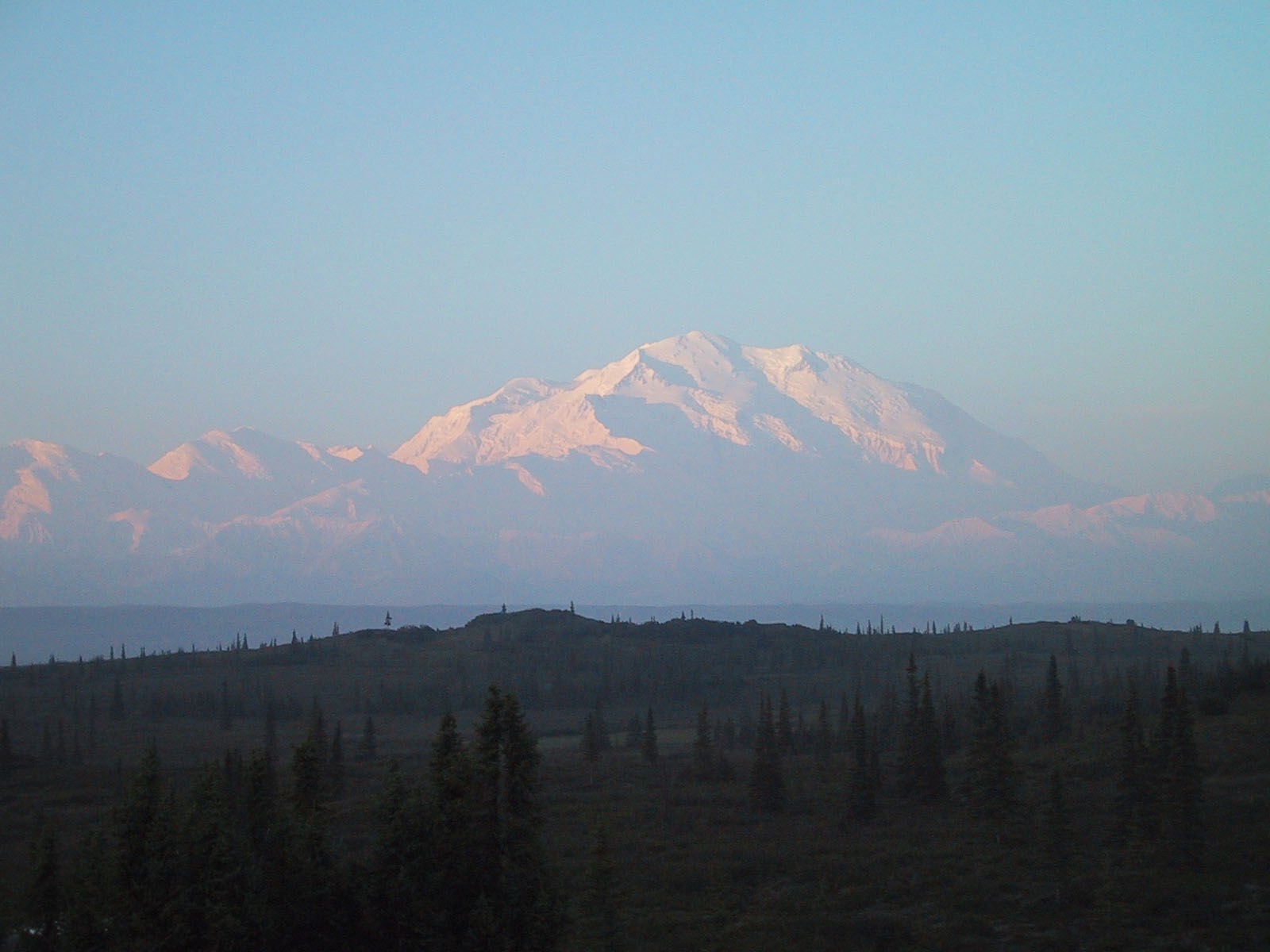
Denali; view of the summit from Wonder Lake (Photo: Ted O’ Callahan)

In the US, how well do you distinguish between adventure-seekers going out on their own assuming responsibility for their safety and conduct, and guided trips? Do individual adventure-seekers, doing so after years of training and frequenting the outdoors, also get caught up in the same rules and regulations as applied to guided trips?

In North America, amateur climbers going climbing in public lands which would be mostly parks – they have to observe the rules of the park. They have to pay the entrance fee and in some of the parks there may be restrictions on the number of people allowed to visit certain areas. Amateur climbers have to fall within those rules. Some of the national parks on big mountains like Denali; they have a thorough permit and registration process even for amateurs. On Denali you have to register 60 days ahead, you have to go through an interview with a park warden who is an expert climber. On a big mountain like that, they like to make sure that the people who are coming are people who know what they are doing and won’t get themselves into trouble. They can’t tell them they can’t go. They try public education to minimize people who are clearly going to get themselves into trouble.

I think the climbing community has done a good job educating people about issues like safety, environmental protection and stewardship and providing information about concerns like avalanches. There is a lot of education in the community to ensure that when you go out you have enough information to make a sound decision. There is a pretty big network on these matters. However, as the sport becomes more popular, I do see increasing numbers of inexperienced climbers out there. This is putting greater demand on the different climbing clubs and professional guides to try and make sure that all these enthusiasts are getting their outdoor education needs met.

On the guided side – wherein people pay money to be taken on trips – there is much more regulation. The land managers at different parks, they need the companies involved to have permits to take clients climbing on public lands. They demand a certain level of certification to operate. If you don’t have certification and permits and they catch you for illegal guiding you will be in big trouble.

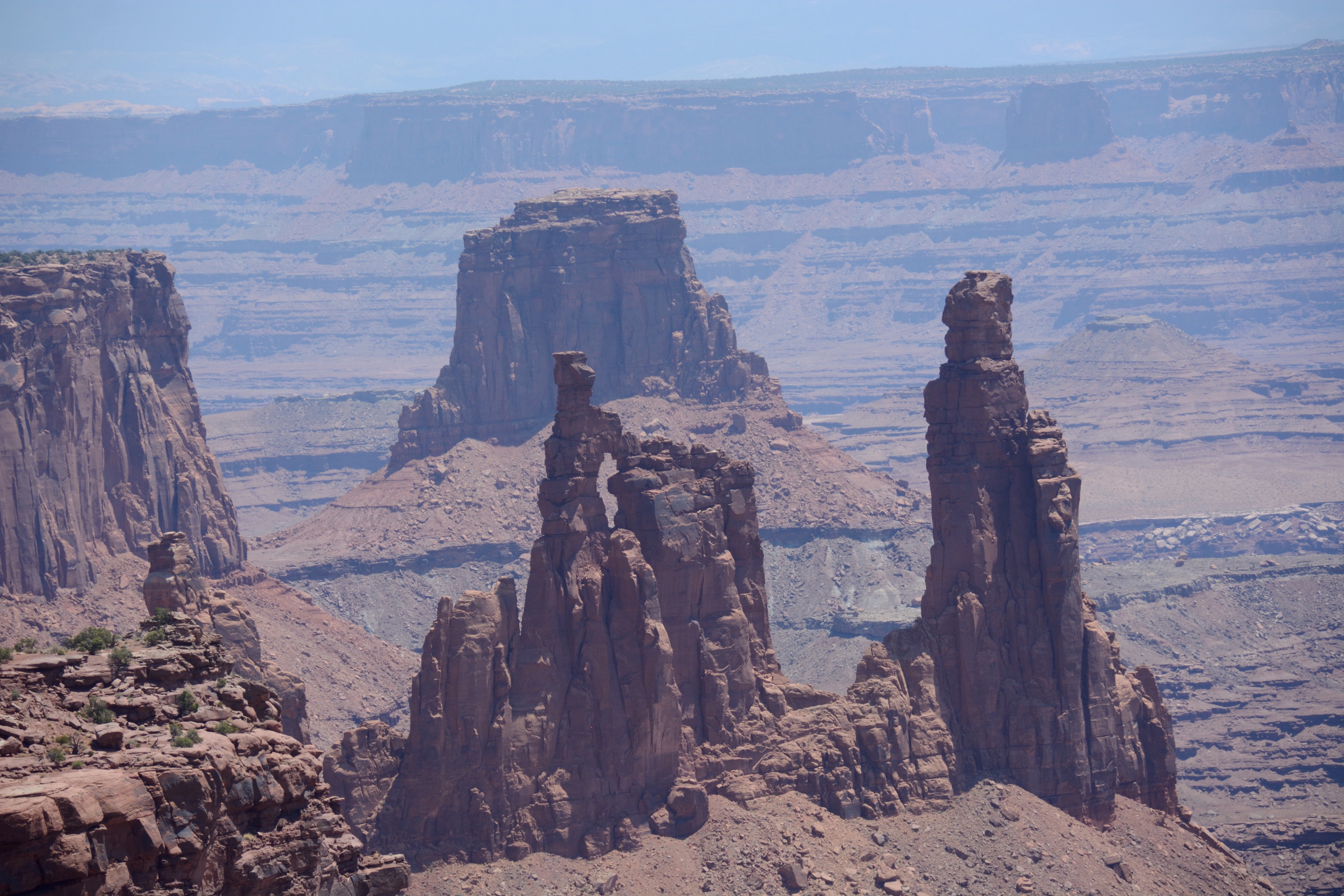
Canyon Lands (Photo: Dinesh Kaigonhalli)

When it comes to ensuring technical competence, In India, there is always the contest between the organic route featuring climbing clubs with you learning from others over a period of time and assigned institutes where you undergo an adventure course and receive a certificate. What do you follow in the US?

There are multiple paths you can take to learn those skills. There are some people who never take a course, they climb with friends, read books, refer videos – they sort of do it organically. Then, there are clubs that teach outdoor education but these are formal courses. You have to sign up, pay for the course and you are taught by experienced volunteer instructors.  It is a course with a curriculum and you have to complete it before you get a certificate. Then there are schools like NOLS or Outward Bound – those would be similar to the institutes you have in India. Then there are those who learn by hiring private guides and once they have acquired the required skills, go out with climber-friends and eventually, go on their own.

From a land manager’s perspective – if you went to climb in a park for instance – is any one of these approaches deemed more acceptable officially than the other?

No, no they wouldn’t do that. However, there will be caps on the number of people allowed in per day based on the land manager’s study of each valley’s carrying capacity. For example on a weekend, when many people turn up to climb, the land manager may say – this guiding company gets five, this other company gets ten and the amateur club over here, you get 15. They will be limited that way. But the land manager is not going to show any preference as long as everybody is following the rules.

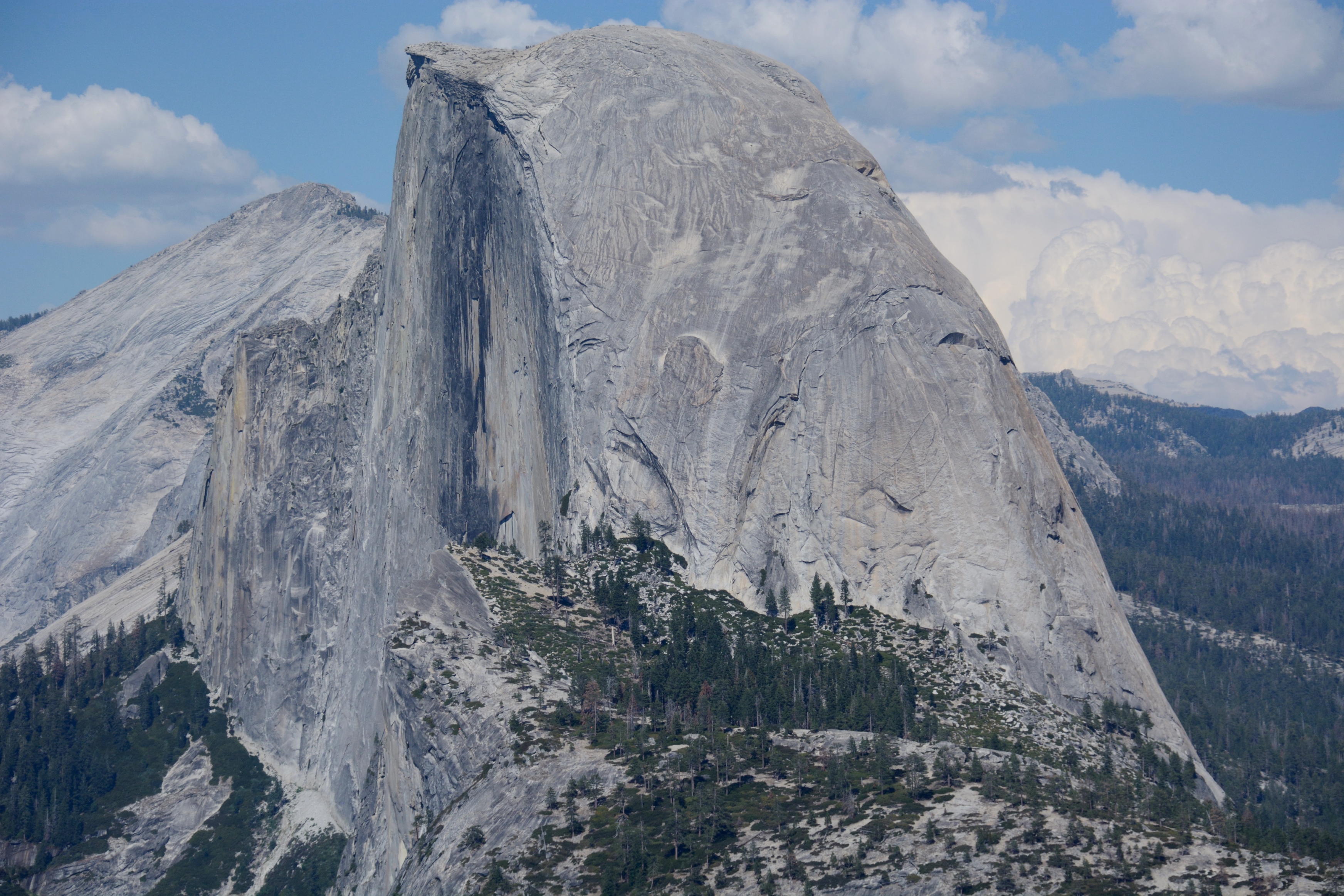
Half Dome; Yosemite National Park (Photo: Dinesh Kaigonhalli)

You have been president of the American Alpine Club. How important is it for you to keep the amateur category alive; how important is the amateur flame – if I may describe it so – to the sport? I ask this because increasingly in human predicaments like India, it is very tempting to conclude that guided trips are the way to go….

I think that if land managers decided that anyone who is climbing has to be part of a guided party, there will be this huge protest against it. People would go completely crazy if they ever did anything like that. Land managers would be flooded with protests. Elected representatives would be flooded with complaints. For people in North America, a lot of the appeal in going to the mountains is to experience that personal freedom, have your own adventure. If the government was to come in and restrict the kind of adventure that you are going to have, then, people would be really, really upset. That would never happen.  Different things work for different people. I believe the land managers recognize that there has to be a variety of options. In some places, restrictions are stiff – rafting in the Grand Canyon being an example. The number of people wishing to do that often exceeds the carrying capacity of the place. If you are an amateur river rafter you can get a permit to go there but it is a lottery. When you get the chance you better go because it may be another decade before you win the lottery again. Some amateurs may argue that in such instances the permit regime is partial to commercial operators because they give permits every year to them to operate a certain number of boats. Your chance of winning a lottery is small but you could sign up with a commercial operator because they will be running boats that already have permits.

How important is it for land managers in the US to be familiar with a sport in question? That is a challenge we face in India because administrators designing policy and implementing them are often not familiar with the sport.

In the parks in the US, the people that are administering a climbing program – let’s say Denali, Yosemite or Mt Rainier, you know any place where climbing is a big part of what goes on – they are climbers. And they are usually good climbers. When you go to the ranger’s office you are talking to a fellow climber; someone who knows the mountain, knows what current conditions are and is familiar with all the rules and carrying capacity of the place. I have friends who are climbing rangers. On off days, we go climbing together. So they are as much a part of the climbing community as all the amateurs, guides and everybody else. They are very knowledgeable.

Is there a lot of interaction and exchange of information that happens between the climbing community and the land managers?

Oh yeah. Sometimes it is very co-operative, sometimes it can be a little bit contentious. In Canada, where I go ice climbing in winter; one of the biggest hazards up there is avalanches. If I want to know what snow conditions are like and if after my research I am still unsure of exactly how things are, I can just pick up the phone and speak to the park’s safety specialist and ask him.

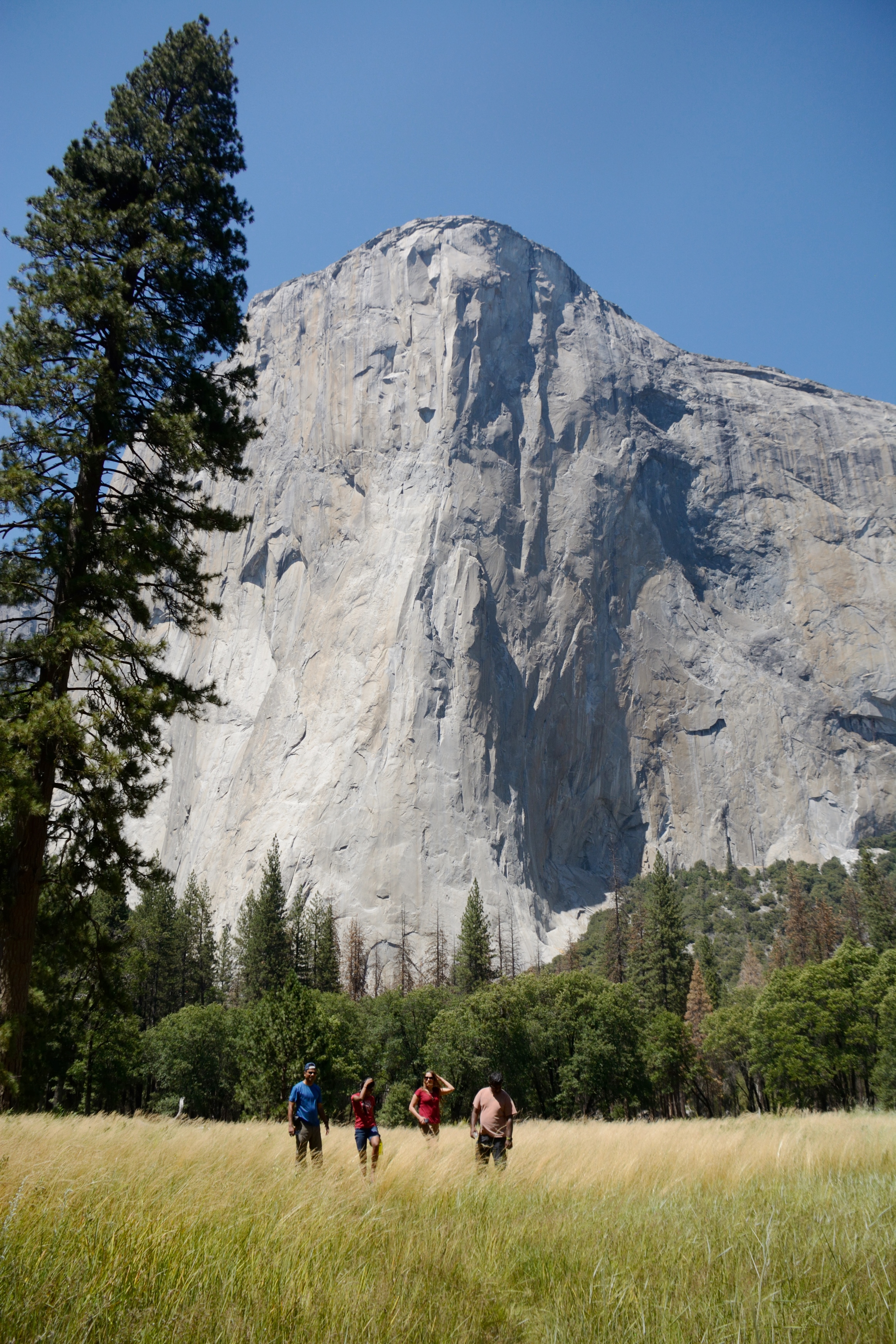
El Capitan from the meadows; Yosemite National Park (Photo: Dinesh Kaigonhalli)

For the sake of clarity I wish to ask this: the tenor on the part of whoever is answering that phone is not to stop you from climbing….

No, no, that’s not their job. However if the rangers thought that where I was going is a bad idea, they would tell me. They can’t tell me: don’t go there. That’s not part of why they are there. But they may tell me: we think that’s a really bad idea and if you went there then the possibility of an avalanche killing you is quite high. So we would avoid that.

But there are other situations, where historically the park managers and climbers have had a testy relationship. Take a park like Yosemite. It is an iconic rock climbing Mecca. That park is very crowded. They have all the problems that you would find in a big city, there. What the rangers have to do in a park like that is law enforcement. There’s not enough room in Yosemite Valley to accommodate all those who go there and camp. The climbers that go there, they want to live there; they want to stay there for months at a time. But the rules say you can camp there for only two weeks at a time. If you exceed, you deny others their opportunity. Rangers don’t allow that. The climbers then end up camping illegally. The rangers don’t like that. They go out at night to find them and then give them a ticket or they kick them out. Situations like this can create tensions between land managers and the climbing community because you are dealing with a limited resource – camping space. And climbers can sometimes be iconoclastic, you know be very adversarial towards rules and regulations and people in positions of authority. The rangers don’t like that. In the past in places like Yosemite, relations have devolved to being very poor. Now in such situations, organizations like the American Alpine Club do things to foster better relationship between the land manager and the climbing community. For example, in the past, the American Alpine Club has done things like pay for Sunday morning coffee and biscuits for the rangers. They are at the camp with the climbers and it becomes an opportunity for both sides to meet and interact, get to know each other better.

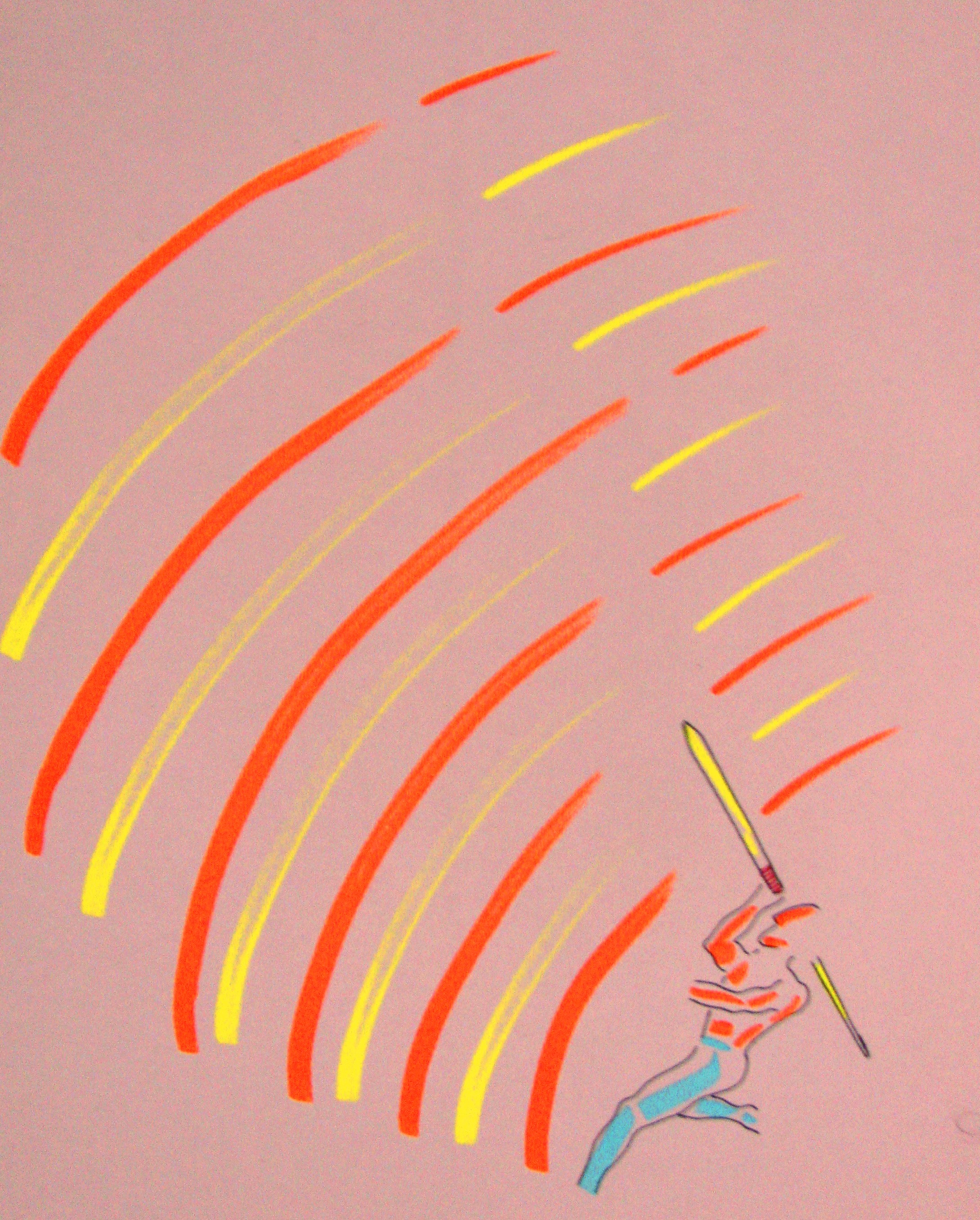
Illustration: Shyam G Menon

At the Himalayan Club meeting, you would have heard about how the need for Indian states to frame rules and regulations for adventure sports, commenced. In one instance, a case was filed over a fatal accident by the aggrieved party and from there the process started. In India, generally speaking, we are also at that stage where if tomorrow a marathon is held and somebody dies attempting it, the negativity of death outstrips the underlying fact that the person expired trying something he wished to, valued or liked. The US is a country strongly associated with litigation. How are fatal accidents in the outdoors dealt with in the US? Is there a strong cultural empathy for adventure, which works as bedrock in such situations or is there the tendency to stop adventure because somebody died?

I am not a lawyer, so I wouldn’t be able to answer that in detail. You should ideally talk to a lawyer in the US who has experience dealing with recreation. At my level, my understanding is that in the past there have been instances like somebody put a harness on incorrectly, they fell out of the harness and died and their family sued the harness manufacturer. This did happen some thirty years ago. When that happens, the whole community sort of rallies around the gear manufacturer and offers assistance to defend the business because they don’t want the litigation shutting down their sport. And they don’t want that litigation leading to a situation where nobody makes harnesses any more. There have been a number of such cases in the past. Most of the time, the gear manufacturer or the guide service provider – they are able to successfully defend themselves.  In the US, there is probably enough case law by now (for such defence)……unless there was gross negligence (involved in given case). There is also over time a legal standard that the gear manufacturers and service providers have to live up to. If they live up to that then the case law sort of kicks in to protect them. Guiding services, clubs – anyone who enrolls (at these facilities) has to sign waivers, which recognizes the sport they are getting into as dangerous and potentially fatal. Everybody participating is required to read and sign waivers. If you go to any indoor climbing gym there is a whole waiver process you have to go throw. Waivers have to be renewed every year. It’s a requirement in everyone’s insurance that they go through this to establish the legal standards of what they got into.  I think all this has got pretty standardized in North America that people feel they are protected. It doesn’t hold the sport back. It’s the same with access.  In America we have something called Access Fund, which helps put in place the necessary standards so that the land owner does not have to worry (about being held liable in case of accident) if climbers access his property to pursue their sport.

Would you say that there is also this angle of how each culture – maybe human predicament – relates to adventure? For instance, at the Himalayan Club discussion on risk management and safety, there was this observation or something very similar: lower the risk, increase the adventure…..

I don’t agree with that observation. I don’t think it is adventure if the risk is low. I have given talks on adventure and risk. I often speak of something called the adventure point. For me the adventure point is – on one side you have risk and on the other side you have ability. If your ability is high then the risk is low and that is not quite adventure. If I go and climb a rock that is really, really easy for me it is not going to be that much of an adventure. If my ability is low compared to what I am trying to do, then the adventure is high but so is the risk. I could kill myself. So to me, what I call the adventure point is where you have these factors in balance; where risk and ability sort of balance each other. You push yourself as hard as you can to be reasonably safe.

Illustration: Shyam G Menon

There is a video on the Internet of you giving a presentation to The Mountaineers in which you speak of the growing number of gym climbers and the need to acquaint them with the outdoors. Can you elaborate on this issue?

I’d say clubs like The Mountaineers are old fashioned clubs, like the Himalayan Club. They offer these basic courses and take people outdoors. It is a bit like what probably happens in India at any of your institutes – they teach you a basic course that is a mile wide and an inch deep. In other words, they teach you a little bit about a whole bunch of different things ranging from camping to rock climbing to snow and ice climbing to crevasse rescue to navigation – all that stuff. You get to know a little bit about a lot. And then what happens is that when you take an intermediate course, it would be like layering up. When you do that for many years, you actually end up knowing a lot about a lot of things. In North America now, nobody learns like that. It’s got flipped on its head. It’s completely upside down. People now learn a lot about a narrow part of that information base. Like rock climbing – they start in a gym; they get really strong, they know how to train, they know how to clip bolts, they are way stronger and have more technical skills. But if you took that person outdoors and asked them to navigate their way through difficult landscape from point A to point B, they would have no idea how to do that. In North America, all these people coming out of gyms – their outdoor IQ, if you call it so; is low. There are special courses now that clubs are teaching, knowing that they are really strong in some areas and weak in these outdoor skills. They teach these outdoor skills, they don’t try to teach them stuff they already know. Gyms in the US now offer a course called Gym to Crag. It is just teaching people how to go outside. It isn’t just about sport climbing outdoors it is also about aspects like taking care of the environment, stewardship, dealing with human waste, handling pets etc. The only people learning the old basic courses are a small number of people at old fashioned outdoor clubs.

Photo: Shyam G Menon

So in retrospect there is value in the old basic courses….

There is value. But at the same time it is important to recognize – you can’t be somebody who is wishing for the past. I say: wake up. This is not how young people do it now. We have to adapt and change to how people learn now. If you can’t, you just need to accept it and go away. I would say that for ninety per cent of people in North America who are getting into climbing, their first exposure to the sport would have been at a climbing gym.

During your talk at the Himalayan Club, you mentioned about your experience climbing with young people. You spoke of how you hold yourself back on climbing trips and intervene only when needed; you also spoke of things that you learnt from young people. Can you tell us some more about what it is that you learn from them given you have already spent almost five decades in climbing?

One of the big changes in climbing is that climbing has become much more of a mainstream sport. People are now developing sophisticated training specifically for what we do. In the past you couldn’t go to a shop and buy a book on how to train for climbing. Today you can not only do that, you can also buy books specifically on how to train to be a boulderer or sport climber or alpinist. You can also hire a trainer. That kind of formal training for the sport is new to me. The young guys grow up with these training programs. When I hang out with them, they give me insight into these programs or provide me tips on what to do to improve. One of the things I am not good at in climbing is – power. You must have noticed this – when you are climbing in the high sixes you can do things pretty statically. But to break into the sevens, you have to be comfortable making dynamic moves. To do that, you have to be able to pull hard. So one of the things young people helped me with was – Steve you got to work on your power; here’s how you do that. When we climbed Saser Kangri II, in 2009, it was very difficult on a mountain like that to find a place to set up your tent at night. Everything around is tilted up or down. There is no flat place. In the past, we spent time looking for a place. There was nothing; we just wasted time looking. When we went back in 2011, the young guy said: we are not going to do that. We are not going to waste time. We will keep climbing and when it gets dark, we will camp. We will just figure it out. And he was right – we did figure it out. Another thing I learnt from young people is – how to go lighter. Equipment is always changing and it’s hard keeping up with it. It isn’t just technical climbing equipment it is also clothing. The young guys are really into it. If I want to get a new piece of gear, I just ask them.

Steve, your book Karakorum – Climbing Through the Kashmir Conflict won the 2018 Kekoo Naoroji Book Award. Can you tell us how this book came about?

I never really had an opportunity to reflect on my many expeditions spanning some thirty five years. When I came home from a trip, I would get busy with my profession and family. So I wanted to go back and examine what that was. I think that was the primary motive – see what we were doing, what it was all about. It was all these things that I had done but I really didn’t know much about. One of the big things that I realized during the writing process which I didn’t know going into it, for example, was that – when we were on K2 in 1990, we had a big dispute on our team between the four climbers and these two support guys. The two support guys – they came from Australia, they were the friends of one of the climbers – they were quite inexperienced.  They didn’t have proper footwear for instance. As soon as we saw that, the remaining three climbers said, they are not going up. It turned into a big dispute. At the end of the day, we came up with a compromise. We let the two guys climb up to 7000m using fixed ropes we put there. There were also restrictions like they shouldn’t use the food we had brought up. We compromised so because we were a four person team and we wanted all four climbers working. The process of reaching that compromise felt a little bit ugly at that time. It felt so particularly when juxtaposed on the traditional idea of the brotherhood of the rope. I left it there.  But when I started writing the book, I began thinking more and more about it and you know – that was a really good team. In reality these trips aren’t about people sitting around holding hands. You got to work through tough situations and work out compromises to keep teams together. Until the writing process, I hadn’t thought of it and figured it out. The tragedy is that we didn’t know it then.  Now we can look back and say: we made a good team.

You have spent over fifty years in climbing. You mentioned at the Himalayan Club meeting that you waited a decade for your first major summit. You said it in the context of reminding the younger generation to take things a little slow, be more patient. Can you elaborate on this point?

There is this young guy that I climb with in the Canadian Rockies. He has only got three years of experience and he is doing expert level stuff. He is a very talented athlete. He is a classic example of someone who is very strong, has a lot of athletic skills but he does not have the commonsense – you know practical knowledge of the entire landscape he is practising in – to be safe. So I am worried about him. Just last week, he took a hundred foot-fall and broke his scapula. He was lucky; he could have got hurt way worse than that. It doesn’t surprise me. I try to communicate that at least for me, it took a long time to learn how to be safe in a complex environment. Maybe I am a slow learner. But you are not going to do it overnight. The word I use a lot is patience. You got to learn to play the long game. When you are young, you are playing the short game. If you want to live to being an old guy like me, you know, you got to take it a little bit slower. Realize that you can’t learn everything that you need to know about what you are doing in a very short period of time. It is the nature of what it is. It is complicated.

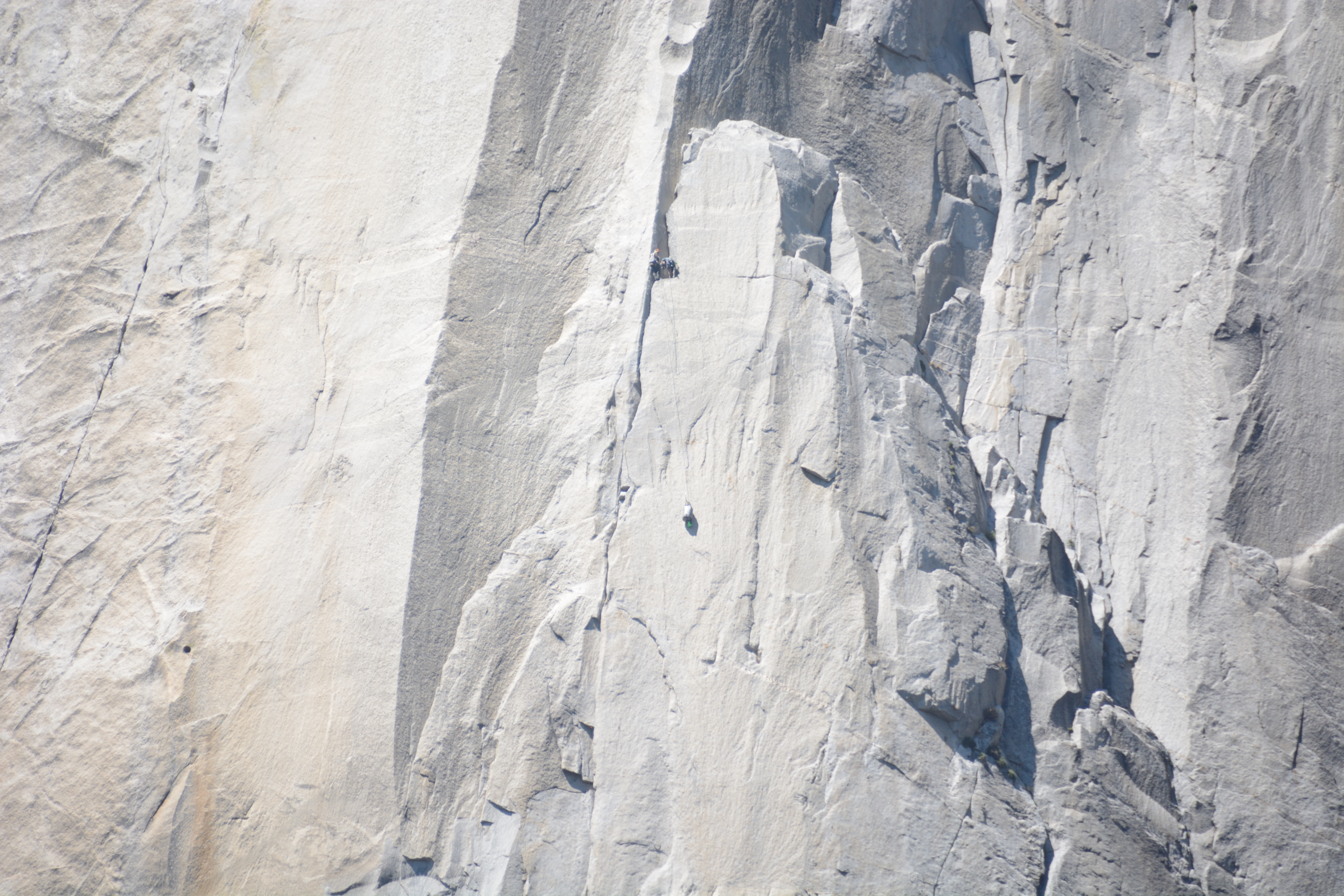
Climbers on The Nose; El Capitan, Yosemite National Park (Photo: Dinesh Kaigonhalli)

Looking back, at any point in your career, was climbing ever a proving ground for you? That you got to prove that you are somebody by doing it?

No. It never felt to me like a proving ground. One of my favorite expressions is: every day is a school day. To me, it has always felt like a learning environment; never proving ground. If I felt that it was a proving ground, I’d be dead by now. That is not a sustainable way to be doing things. It is like this kid who took a hundred foot fall. He is desperate to be recognized by the climbing community as this tough guy. If he doesn’t get over that, he will get killed. I have told him so. The sport is not about that. I have written about it in the book – you know we were putting tremendous amount of effort into these trips that were not getting us to the summit. But every one of those trips was getting us closer. We did this one better than we did last time. We didn’t quite get to the top but I really feel better about how I did it. I could see that if we stayed on that trajectory then eventually we were going to succeed. We were going to have success in a way we felt in control. You know, not like – I made it to the summit but I almost died. That to me would feel like failure. I wanted success to be the result of a learning process and not the result of being crazy. That learning process – I really enjoy it.

(The author, Shyam G Menon, is a freelance journalist based in Mumbai.)   

WATER, RUNNING AND THE ACTIVE LIFESTYLE THAT CHANGES YOU

Ayesha Broacha (Photo: courtesy Ayesha)

Photographer, illustrator and recreational athlete, Ayesha Broacha started running ten years ago primarily to build her stamina. Soon, she was participating in running events in Mumbai, Delhi, Goa, Hyderabad, Satara, Bengaluru, Ladakh and Durshet among others.

In 2018, she enrolled for the open water swim called Swimathon, organized by Enduro Sports. She participated in the two kilometers discipline. In 2019, she enrolled for five kilometers and two kilometers. In the five kilometers swim, she finished on the podium – third position in the age category of 40 years plus for women. This is her journey; in her words:

Friday, a day ahead of the 5 km discipline at Swimathon, I went for a swim in the sea. It was an attempt to get a feel of the water, where the event was scheduled to be held. As soon as I put my face in the water, I began to have a panic attack. The water was muddy. I was overcome with claustrophobia and my heart started pounding so fast that I seriously doubted being able to continue. I was very concerned about my ability to attempt the swim the next day.

This was not the first time I was doing an open water swim.

Last year (2018), I had attempted the two km swim and thoroughly enjoyed it. It was enough to prompt me to register not just for the 5km category this year but also the 2km one the following day. In 2018, I had swum the distance using breast stroke. This time around I was attempting to cover the distance swimming freestyle. The change in style required me to be face down in water more often. Breast stroke spares you that. The trial in sea turned muddy, wasn’t at all comforting.

On the day of the event, I was very nervous, and couldn’t shake off the discomfort of the previous day’s experience. I got into the water trying my best to rationalize with myself. However as soon as I put my head in the water, once again I felt suffocated. My goggles felt too tight, and I contemplated taking my ear plugs out even though I knew that water in my ears wouldn’t be a pleasant sensation. I started doggy paddling just to stay afloat and calm myself. I was the last one to get going in the race, which didn’t do much for my confidence either. But I knew that if I got started, I would be able to finish the swim, strong.

Ayesha Broacha (Photo: courtesy Ayesha)

The 5 km distance had to be covered in four stretches of 1.25 km each. It basically meant swimmers had to do two loops of 2.5 km. After my slow start I managed the first 1.25 km stretch quite well though the current was strong. The turnaround was easy. By the time I got to the second loop the current in the sea had become stronger. It was hard, swimming. The last 200 meters before the next turn was tough. In spite of swimming as hard as I could, I found I wasn’t moving forward. The current was so strong. By the time I got to the turnaround point I was elated, the finish was in sight. I could feel every muscle on my back. The return was not easy either. By then the tide was high and staying on course was challenging.

I finished my swim in three hours, ten minutes and forty-four seconds. The longest I have ever swum at a single stretch in my life till now!

My training for this event was akin to preparing for my first full marathon. The aim was to finish the distance, strong, with no pressure of timing.  By my calculations I needed to be in the water for two and half hours. However as I learnt that morning, the sea is most unpredictable.

Having finished the 5 km event I was feeling good to attempt the 2 km event the next day.

It was my third day in water. I was determined to not let my paranoia get the better off me. Unfortunately I still took a while getting started. I knew what to expect but that did not help. I finished in 1:04:41.

I really like swimming in the sea and am trying to understand it, so that I may overcome this newly developed fear and feeling of claustrophobia when I get into water.

I am a self-taught swimmer. I used to swim freestyle but got lethargic and found it less taxing to swim breaststroke. Swimathon forced me out of my comfort zone. I embraced freestyle once again and have tried to improve my stroke, but clearly, there is a long way to go.

During my school years at Rishi Valley School, I was engaged in almost every sport, but in a non-competitive way. I played tennis, hockey, basketball, kho kho and kabaddi; I also cycled and swam.

Sometime after my second child was born, I took to playing squash but realized that I had no stamina. I started running to build my stamina. That was ten years ago. During my runs in Mumbai I used to see coach, Savio D’Souza on the road. I got to know him; he encouraged me to join his running group. Savio and his group would start their practice runs at NCPA (southern tip of Marine Drive). They would run up to Chowpatty and turn back. It was through that group that I met Pervin Batliwala.  Pervin, I and a couple of other runners would run from Chowpatty to NCPA and back as that suited our daily routine.

I have been doing my training runs with Pervin for the last eight years. She is extremely disciplined; she never misses her training. She is full of beans and enjoys dispensing advice to any runner who may or may not listen. We ended up becoming a fairly large group. I started running half marathons and then did a few full marathons. I have run the Mumbai Marathon, Airtel Delhi Half Marathon, Bengaluru Marathon, Hyderabad Marathon, Ladakh Marathon, Goa River Marathon, Durshet Run and Satara Hill Marathon; some of these events multiple times.

Ayesha (left) with Pervin Batliwala and Nimisha Vora (Photo: courtesy Ayesha Broacha)

I neither have a training plan nor do I have any ambitions around the events I wish to attempt.

One of my friends, Ariez Kharas and a group of runners, started attempting triathlons. Last year (2018), he enrolled for Swimathon. That was how I got around to enrolling for my first shot at 2 km-swim. I trained at the Breach Candy Club swimming pool, which is a large circular pool. The training entailed swimming around the pool continuously to simulate the distance.

As that edition of Swimathon was my first swimming event, I just wanted to complete it. Last year the number of competitors was small. It was a comfortable swim. When I finished I realized that it had ended quite fast and I hadn’t got my money’s worth. Hence the 5km-swim this time around.

I will definitely continue to swim. I do not have any agenda, participating in events – the build up to an event is what is most fun and satisfying for me.

(Ayesha Broacha spoke to Latha Venkatraman. Latha is an independent journalist based in Mumbai.)

POSSIBILITY OF 5000M STILL ALIVE IN NEW DIAMOND LEAGUE FORMAT

Illustration: Shyam G Menon

The IAAF addresses a concern raised by Athletics Kenya. It is an issue and an explanation that should interest any top athlete running distances longer than the 3000m, not to mention fans of those distances.

Absence of the 5000m race from the official Diamond League programme does not preclude individual Diamond League meets from hosting the event outside the international broadcast window.

This has been mentioned in an official statement of the International Association of Athletics Federations (IAAF), dated March 31, 2019, issued in the context of concerns raised by Athletics Kenya over the exclusion of events longer than 3000m in the Diamond League programme. Sebastian Coe, president, IAAF and Jon Ridgeon, CEO, IAAF, have reassured Athletics Kenya that changes to the IAAF Diamond League format next year will not disadvantage African athletes.

Coe, Ridgeon and Athletics Kenya president Lt. General (retd) Jackson Tuwei met during the World Cross Country Championships in Aarhus in order to avoid any misunderstanding between the two organizations over the new Diamond League format approved by the IAAF Council in Doha earlier this month, the statement said. According to it, Athletics Kenya was particularly concerned by the exclusion of any event longer than 3000m from the Diamond League programme next year and the reduction in the number of meetings from 14 to 13.

Tuwei sought, and received, assurance that Kenyan and other East African athletes, who feature prominently in 5000m races, would not lose competition opportunities due to this process. Coe confirmed that the absence of the 5000m from the official Diamond League programme would not preclude individual Diamond League meetings from running the event outside of the 90-minute international broadcast window and that several meetings had already shown interest in hosting the 5000m.

Ridgeon explained that the IAAF’s market research showed that producing a series that consistently featured the best athletes competing against each other was a key factor in improving the appeal of the Diamond League for broadcasters and fans, the statement said.

At the same time the 5000m runners, coaches and agents consulted during the process indicated that they were unlikely to run six races over that distance during the Diamond League series (last year no leading athlete ran more than two 5000m races during the regular Diamond League season). The 3000m distance was selected because it was more likely to attract the best distance talent more regularly.

As a consequence, distance runners will have the option of running up to seven 3000m races (including the Diamond League Final), plus additional 5000m races, across the season.

“ We believe that ultimately these changes will be beneficial not only to Kenyan and East African distance runners, but to our leading athletes around the globe, because it will result in a stronger, higher-profile, commercially-successful annual showcase series for our sport,’’ Coe said.

“ And it’s important to remember that the IAAF will be creating other continental competition opportunities outside the Diamond League as we redesign the global calendar.’’ This he affirmed will increase opportunities for the athletes to compete, the statement said.

According to it, Ridgeon emphasized the IAAF’s intention to review the new format at the end of the 2020 season and make any adjustments to the programme as required.

Backdrop: According to Wikipedia, the IAAF Diamond League is an annual series of elite track and field competitions. The series began with the 2010 Diamond League. It was designed to replace the IAAF Golden League which had been held annually since 1998. While the Golden League was formed to increase the profile of the leading European athletics competitions, the Diamond League’s aim was to enhance the worldwide appeal of athletics by going outside Europe. In addition to the original Golden League members (except Berlin) and other traditional European competitions, the series now includes events in China, Qatar, Morocco and the United States.

(The author, Shyam G Menon, is a freelance journalist based in Mumbai.)

USHA SCHOOL OF ATHLETICS GETS ITS FIRST TRAINEES FROM OVERSEAS

The team from Malaysia (Photo: courtesy V. Sreenivasan)

Team from Malaysia in Kerala to train under P. T. Usha

Almost seventeen years after it began operations on a modest scale, Usha School of Athletics in Kerala is set to receive its first batch of trainees from overseas.

A team of eleven athletes – six girls and five boys (plus their coaches) – from Malaysia’s Putra University are expected at the school from Saturday, March 30, 2019. They will train for ten days. The visiting athletes straddle a range of disciplines, V Sreenivasan, treasurer of the school and one of its directors, told this blog at the school premises in Kinalur near Kozhikode on Friday. They are at the school for advanced training.

According to him, from commencement of enquiry by the university to the arrival of the team at the school, it would have taken roughly two months of mutual communication and coordination.

The co-founder of the school and its chief coach, P. T. Usha, is among India’s most reputed athletes. While many elite athletes retire and fade once past their prime, she is one of the few who elected to contribute to athletics by starting an athletics training school. The school commenced work from rented premises in Koyilandy in May 2002. After the Kerala government provided it land on lease in Kinalur and initial facilities were set up, the school shifted to its current location.

It has groomed quite a few athletes of national and international caliber, among them – Olympians Tintu Luka and Jisna Mathew.

Enquiries similar to the one from Malaysia have emerged from institutions in Sri Lanka and the Middle East too, Sreenivasan said.

(The author, Shyam G Menon, is a freelance journalist based in Mumbai.) 

JOURNEY TO FIRST OPEN WATER SWIM / AN ENJOYABLE EXPERIENCE

Pervin Batliwala (Photo: courtesy Pervin)

Pervin Batliwala, Mumbai-based long distance runner, attempted her first race in open water swimming recently. The 64 year-old did not finish within assigned cut-off time. But she enjoyed the experience thoroughly. This is her journey; as told by her:

In 2018, I participated in three major marathons – Mumbai Marathon, London Marathon and New York City Marathon. Including training sessions, that was a lot of running.

I was getting weary of running.

I needed a break.

Many of my friends had participated in Swimathon, a sea swimming-event in Goa, organized by Enduro Sports. Some of them suggested that I attempt it. I took up that idea and decided to enrol for the event’s 2019 edition.

Several years ago, I had learnt swimming at the pool at YMCA, Bombay Central. I ended up training in the breast stroke; I was not very proficient in freestyle.

Every now and then I used to swim. Swimming is good cross training for running. One of my friends, Zarir Baliwala, is a member of Breach Candy Club. I would go with him. He is a very good swimmer.

For Swimathon, I signed up for the event’s two kilometre-distance category. My preparation for the race was great fun. They say that one should enjoy the process and not worry too much about the outcome. This was entirely true for me in the case of Swimathon. I just completely enjoyed the process, right from deciding to enrol to finishing the event.

My event was on March 24, 2019. I landed in Goa on a Thursday. On Friday, many of us who were participating in the various races decided to do a small practice swim. This was the first time I was stepping into an open water situation. My training had been entirely in the swimming pool at Breach Candy Club. However I was absolutely comfortable swimming in the sea at Goa. It was more like a bay. We swam for 600 meters just to get familiar with the water body.

On the day of the race, there were about 200 swimmers attempting the same distance (2km) as me. It felt like a giant churn when the swimmers started the race. As I was first timer, I decided to wait until the swimmers had all started and then commenced. Also, most of them were freestyle swimmers and I was doing breast stroke. I thought it was best to allow them to go ahead of me.

My aim was to finish the race. Just two weeks ahead of the event, I had suffered a back problem. I had experienced similar back problem soon after the Mumbai Marathon too.

We had to swim a distance of one kilometre, turn around and come back to log the scheduled distance. The going was a bit tough for me. The current in the sea was quite strong and it was flowing against the direction the swimmers were moving to. At the turning point many swimmers collided into me and I ended up getting cramps in my hamstring. I lost about five minutes trying to get to the other side of the boat marking the half way point. But once we turned, the current was in our favour and the return to the finish line was quite easy.

I was not tired at all. In fact, at the finish line I felt I could have gone on for some more time. Also, I guess because of my long-distance running, I had the endurance to sustain it. If your breathing technique is right there is very little chance of getting tired. Because I was doing breast stroke, sighting the route was not a problem for me.

Photo: courtesy Pervin Batliwala

I exceeded the time limit of one hour, fifteen minutes assigned for the swim. I finished the race in 1:19:21. Initially, I was a bit disheartened. But then I remembered my first ever run. I had so much difficulty that I had to walk the second half of that half marathon in Mumbai, years ago. Compared to that, the timing here at Swimathon was not bad at all. It is good to know where I stand. I can now train better.

Overall, it was an extremely enjoyable experience. It was a well organised event. During the race, there were so many kayaks going around with volunteers asking the swimmers if they needed any help, hydration etc. There were quite a number of volunteers. There were many participants too; the estimate I heard of was – over 600 swimmers across various distance categories.

Swimming is definitely on the cards for me. I plan to now train in freestyle swimming because that gives you more speed compared to the breast stroke.

I also plan to learn cycling. I would definitely like to attempt a triathlon.

This year, I will be attempting Berlin Marathon in September. I will be registering for Tokyo Marathon and Chicago Marathon – both in 2020 – to complete the World Marathon Majors. Once that is done, I may look at triathlon or running events entailing distances longer than the marathon.

(Pervin Batliwala spoke to Latha Venkatraman. Latha is an independent journalist based in Mumbai. For more on Pervin please try this link: https://shyamgopan.com/2016/09/30/age-is-what-you-make-of-it/)

RUNNING IN THE HIMALAYA: 75 DAYS, 1500 KM, 40 MOUNTAIN PASSES / TALKING TO PETER VAN GEIT

Peter Van Geit (Photo: Shyam G Menon)

Chennai based-Peter Van Geit is well-known in the field of ultra-running and outdoors, in India. In 2018, Peter completed an ultra-run (most of it solo) spanning 75 days, in Himachal Pradesh. Doing so, he covered roughly 1500 kilometers and crossed 40 mountain passes some of them frequented little by visitors from the outside. This was the first time Peter was running off-road in the Himalaya. While the seed of the project was a map on a Himachal Tourism board that he came across near Koksar during an earlier run, a lot of the initial information required for planning the project was sourced from a blog run by Satyanarayana (Satya), avid trekker from Bengaluru. In mid-2018 Satya was reported missing in the Himalaya. He was out on a solo trek. In February 2019, Peter was in Mumbai to deliver the annual Kaivan Mistry Memorial Lecture organized by the Himalayan Club. He spared time to talk to this blog. Excerpts:   

How did you get to know Satyanarayana? What was it about his writing that attracted your attention?

When you talk about Himalaya, to go there on your own, self-supported without any groups – the challenge therein is one of not much clear information on the map. Generally speaking, there are very few good blogs available to go through. An exception is Satya’s blog. When you start searching for the names of mountain passes you will be directed to his blog. Satya has been to the Himalaya extensively. The surprising thing was that he was from Bengaluru and not from North India. He was extremely good with maps. He used to get Survey of India maps; they have a lot of terrain data. He used to take photos, digitise them. He used to geo-reference-index them. He used to explore a lot of trails that were documented on those maps. Satya was pretty good with technical details. He documented the passes he went to accurately with GPS logs and latitude-longitude of campsites. Even the maps that he used for navigation were available on the website. Somehow, I was able to contact him through an email id and he called me. We had a long chat on the phone. He was leaving before me on a one-month journey exploring more of Kinnaur and Ladakh. Listening to him on the phone – I never met him in person – he came across as a very caring person. He was very accurate in his blogs. He was going on a solo self-supported trip without guides and other hikers. That was my style of traveling too.

Photo: Peter Van Geit (This photo was downloaded from Peter’s Facebook page)

Was it your plan all along to do this solo or it happened so because of other reasons?

I got inspired seeing a board of Himachal Tourism. It showed a lot of passes. That board triggered it off for me. I had done some solo biking in Himachal but most of the time I was running with a small group of two-three friends. This time also one of my friends was planning to do a little bit of exploring in Pangi valley sometime in August. That was the initial plan for two weeks. I had a lot of friends at Chennai Trekking Club (CTC) who were making plans. Some were planning for July, some others for September. Then I said I will do two weeks with one set of friends and another two weeks with another group. But as it turned out, although they were ultra-runners some could not mentally sustain the strenuous environment with glaciers and cold temperatures, especially when it started raining. Some suffered altitude sickness.

Eventually, about 70 per cent of the time I ended up being solo. It is an experience. It was scary after the first group left. But once I got into the solo momentum it was fine. The terrain was quite complicated, weather was challenging. Going solo allowed me to go at my own pace, comfortably, without having to wait for people who were slow.

In addition to what you got from Satya, how much more homework did you have to do?

Satya’s blog had a lot of information. But he had grown over the years, meaning in some phases he was not that accurate and not that technical. It was in recent years that he became really proficient with maps and GPS. I also took a lot of data from street maps. They are the public equivalent of Google maps wherein if you go beyond the roads you can see trails. Then there were two to three blogs which were very useful. Based on all these inputs we started identifying the exact location of the passes I wished to attempt.

Was the master-map your individual work or was there a team from CTC that worked on it?

Mostly it was me and Maniraj. He is quite good with maps. Mani has done a lot of hikes; in fact he has hiked for more years than me. He has done hikes in parts of Uttarakhand and Ladakh. He is also technically sharp. He offered a lot of inputs on the maps. Both of us are good at looking at satellite images and finding trails that are one metre wide. In terrain like Ladakh which has very little vegetation it is easy to spot trails. The colours and contrasts of trails make them visible. Putting our skills together we made a beautiful map. Initially we planned some 21 passes but then we kept adding.

Photo: Peter Van Geit (This photo was downloaded from Peter’s Facebook page)

This was the first time you were going off-road in the Himalaya. Was it easy for you to do that with just maps for guide?

For many of the trails there were GPS logs which always gave a good feeling. They had been prepared by others after being on these trails; they were accurate, so chances of getting lost were remote. If you go off track you can always work your way back by looking at these logs. This is helpful especially in places featuring glaciers and moraine; they resemble a battlefield. Having GPS log was quite useful especially in places like Pin Parvati. In such places not having a GPS log would have been tough. You could cross over to the wrong side and make a fatal mistake. Having GPS logs and over ten years of experience roaming around in dense jungles gave me a lot of confidence. Further when you get above tree line in the mountains, you get a good view. But I was wary of crevasses in glaciers and thoughts of getting stuck; I was very cautious about these things. In some places the maps we used were old and features had either changed or grown over or landslides had altered the landscape completely. A couple of times I got totally stuck. On one pass there was a trail but there were too many bushes, thorns and it was too steep. Then I tried the same pass from the other side and I got the right trail. One good thing about the passes is that they are like saddles and on both side there are valleys. It not landscape with many sides. That helps. The problem I faced was – wild streams. You better be on the correct side of such streams as you don’t get a second chance to cross.

You mentioned about the board you saw near Koksar past Rohtang Pass, which was the start of the whole project. Was that the reason why you picked Himachal? Did you have the option of going to any other state?

I am quite familiar with this region. For three to four years I had been running in Pangi and Chamba. Rohtang Pass, Spiti-Zanskar all that was quite familiar. Given I used to stick to the road, I was not familiar with the ranges. I was also familiar with the terrain from a biking point of view. I had gone there in 2000-2001 and also a few times more recently. That’s why I picked Himachal. Uttarakhand is on my plans for 2019.

In terms of number of passes were you comfortable with the number of passes you chose? It is an ambitious number of passes that you tackled at one go….

Whenever you go to the Himalaya, typically you go for one pass. You need three-four days for acclimatization. The thing is – from the second pass onward I don’t need to acclimatize. I have been hiking up to an elevation 2500 meters in South India. We knew forests, alpine meadows – this was known terrain. Once you stepped above 3000 meters you were in rocky areas, moraine, glaciers, passes which – for me – was unknown terrain. I didn’t know what to expect there. I did not know the rate of progress, how long it will take. But my history of being a hiker and ultra-runner – I had run over 2000 kilometers in Vietnam – that helped in terms of strength and lung capacity. I have been able to go at a good pace even at high altitude. Also having mental endurance helped. What I saw with those who kept me company on my wilderness trips was that they were not intimidated by the terrain or the physical difficulties. They found it tough mentally. Going solo is easier than taking a group of 20 people along.

With respect to gear, you whittled everything down to five kilograms. Was this something you developed as a standard from your runs or was it something that you arrived at specifically for this project?

On most of the occasions that we ran from town to town we didn’t have to carry food. Stay was easy. Also, we were running with a mix of runners and cyclists. We had the luxury of dumping all the camping gear on the cyclists. That meant we were running completely free with zero luggage, no food, no camping gear – that was so until I went to Vietnam where I did a solo run and had to carry some basic stuff. I didn’t have to carry too much. I went in winter when temperatures (including at elevation) go down to five degrees and it is around 30 degrees during the day. I had to carry some amount of shelter and warm clothes for the night. There I was running with a four kilo bag, not as heavy as the one that would be needed in the Himalaya. In Vietnam I ran 50 marathons with that four kilo bag though not at high altitude with low oxygen. There I felt quite comfortable. From the beginning itself a group of cyclists came along. It was a good experience.

Photo: Peter Van Geit (This photo was downloaded from Peter’s Facebook page)

In Himachal was the run originally planned for 75 days or it turned out to be so?

I had planned for less number of days, may be one and a half months or two months covering 21 passes. But as days went by Mani kept adding passes! In Kinnaur, I did not want to go by bus to Leh. He said try this pass. Like this we kept adding and adding till the start of winter.

Was Mani adding passes even as you were out in the mountains?

Yes. Whenever I reached town and had access to 3G I would download. He was a good guy to have at base camp and kept supplying me with useful options.

Peter, do you still have your job?

July 2017 I quit my job. Financially I was independent. I had to scale down. I was making good money at Cisco as a project manager. Because you make a lot of money, you buy a lot of things. You earn money; you spend money. You sit in traffic every day. You waste a lot of your life sitting in a cubicle attending to work. My work was interesting but I am 46 now. I should think about my life too. When you have a job, whenever you want to go on a trip like this one you are stuck with just two weeks of leave. That kind of time does not give you freedom. From day one you start counting the days and you always get the feeling that time is running out. So quitting that job and scaling back a little financially – it really felt as though you could go on for months and be able to decide from day to day. You could look at a valley you found yourself in and say: now I am going to spend some time here. This time I could enjoy my trip without being too stressed for time.

Was this project designed with limited capital in the frame?

This was one of the cheapest trips I ever did. Both in Vietnam and in Himachal I spent Rs 200 a day apart from the expenditure incurred to travel to the place. The major cost in such travel is transportation and stay. I was always traveling by state transport buses and staying in a tent or in somebody’s home or shelter. The only expenditure was food and food in extremely remote places is quite cheap – like Rs 60 for a nice plate of ten momos and five rupees for tea. I must have spent some Rs 5000-6000 for a whole month.

You however need to spend on gear. I spent around Rs 2500 on my first pair of shoes. I wore down some three pairs of shoes on this run.

This particular project is the culmination of how many years of experience?

First of all you need to have physical fitness. I also mentioned about mental endurance. Then, if you really want to do these things self-supported you need experience in navigation plus you need enough time to spare. That kind of combination makes it unique. There are quite a few things involved. So you won’t find too many people doing this even though they may be physically fit or mentally fit. But just looking at the physical aspect, I have been running very consistently for the last five years since I started running in 2013. Running is all about consistency. I have been doing weekday runs and during weekends, my long runs are trail runs. Running long distance so, gets your legs used to rocky trails. I have seen a number of runners struggling to balance on rocks. Also, the elevation practice – you need to go up and down. In Chennai, I run at least twice a week on nearby hills which also give an elevation gain of 500 meters. Running on trails and tackling elevation makes you stronger than running on flat roads.

Photo: Peter Van Geit (This photo was downloaded from Peter’s Facebook page)

You would encourage people to start small before scaling up?

Yes, two factors are essential – regularity in running and patience in scaling up distances. Running has to start slowly with easy pace; else, you risk injury. It is also about enjoying your run, not just about speed. But young people are very impatient, they want to see results. There is too much running to prove to other people. City runs are more about competition, medals and timings. Once you step into nature running becomes a different thing. It is about enjoying your surroundings, mentally engaging by looking at the beauty of nature. That way you can continue to run from morning till evening. At the end of the day you actually feel refreshed because you ran through so much beauty. Ultra-running is a totally different experience.

In the outdoors did you move continuously through a given day or you chose your hours; when to be active and when to rest?

In the south, we used to definitely have a break from 12 noon to 3 pm. It is too hot and humid. But in the Himalaya I kept going from sunrise till sunset because there it was not very sunny. Weather was always pleasant, never hot. The sun was intense but not hot. So, it was comfortable to keep going but you can’t have a constant pace. When you ascend you have to switch to walking. After you cross a pass initially it is quite steep and then when it flattens out you can start running.

What next for you?

The Himalaya is endless, so I think I will keep going. In summer I will be going back to Himachal, Uttarakhand and Ladakh and trying to cover 100 passes. I took these 100 passes from another blog. I will be referring Satya’s blog too. He has traveled so much and gone to areas which are so remote. I would like to walk in his footsteps. And then you have the backup security of meeting some shepherds. That will be the summer plan. In winters I am planning to run in different countries. I am planning to go to Laos. I don’t want to go to touristy places. I want to make my own route and go running where people don’t go.

You are designing your own trips. Are you also attempting international ultramarathon races?

Yes, I have been doing that. In 2017 I did so. But the point is – once you become self-sufficient and make your own route, carry your own gear; you don’t depend on aid stations, you also navigate by yourself. Organized events will always be competitive. You can’t enjoy them because they will say you have to finish it in specified time. You end up running day and night. By the second night you are sleep deprived and you start hallucinating. The enjoyment of running is not there. It also feels artificial that people stand in the middle of nowhere with food, pasta, biscuits and Coca Cola for you. Someone who is serious should go on their own with food in their bag and explore the outdoors. Once you go to that level, there is no stepping back to doing events. Not to mention the expense incurred for participating in these organized events. Many of these races are quite expensive. Add to that flight tickets and stay. With that kind of money I would rather spend a month in the Himalaya.

Photo: Peter Van Geit (This photo was downloaded from Peter’s Facebook page)

At 46 you left your job and now you are full-time in the outdoors. How do you imagine your life ahead?

I now know that you can do this in a very cost-effective way. If I had known this I would have done this much earlier instead of spending 25 years in a cubicle. I met two cyclists from Belgium; they had been on the cycle for over two and half years. They pedaled all the way from Belgium through Middle East and Kazakhstan to India. They were just 21 and 29; a couple. I have seen a lot of people like that, touring. They earn for six months and then disappear somewhere for six months. I had studied hard and then, worked hard. Looking back, I feel the quality of life is not in making money and buying fancy gadgets. In the remote areas I visited, I met real people; I woke up every day in a different place to a different sunrise. Each of those 75 days was amazing. The most important thing is to be healthy.

In Chennai, you are also associated with open water swimming. Are you contemplating anything in open water swimming?

Once in Chennai we did a 15 kilometer-swim from one town to another. Swimming is good; you can keep swimming and not feel tired but swimming in the sea can be boring. It’s akin to running on the roads as opposed to running in the mountains. It was possible to keep running day after day during my 75 day-run because I was mentally excited. Every day was unique. Every pass was unique, the approach, the challenges. Every one of those 40 passes was a completely different experience. You go from forests to meadows to rocks to glaciers. Mountains give you the mental stimulation to keep going as opposed to the plains.

(Interviewed by Shyam G Menon; transcribed by Latha Venkatraman. Both are independent journalists based in Mumbai. The photos downloaded from Peter’s Facebook page and featured here include pictures from the Himalaya and Vietnam. For more on Peter Van Geit please click on this link: https://shyamgopan.com/2017/02/28/i-dont-have-time-isnt-a-valid-excuse/)

GOPI GETS A PB AT SEOUL MARATHON, SURPASSES DOHA CUT-OFF

T. Gopi (Photo: Shyam G Menon)

Early today morning (March 17, 2019), Indian marathoner T. Gopi completed the 2019 Seoul Marathon in two hours, 13 minutes and 39 seconds.

“ It is the best result so far in my career,’’ Gopi said.

Prior to today’s race, Gopi’s personal best (PB) was 2:15:25, which he achieved at the 2016 Rio Olympic Games. The timing at Seoul would also be the closest any Indian athlete has come to in recent times, to the longstanding national record for men in the marathon; two hours 12 minutes set by the late Shivnath Singh in May 1978 in Jalandhar. In 2017, Gopi had triumphed at the year’s Asian Marathon Championship held in China covering the distance in 2:15:48.

With the Seoul marathon result, Gopi has met and surpassed the qualification time assigned for the 2019 IAAF World Championships in Doha. For the men’s category in the marathon, the qualifying time for Doha is 2:16:00. In January 2019, despite preparing well, an unexpected calf injury had prevented Gopi from achieving this mark at the 2019 Tata Mumbai Marathon (TMM). Running well till injury struck forcing him to halt and stretch, he finished second among Indian elite runners with a timing of 2:17:03. At the Mumbai event, from among the assembled Indian elite marathon runners, Nitendra Singh Rawat who won in the men’s category and Sudha Singh who topped the women’s category had managed to meet the cut-off for Doha.

Following this setback, Gopi had registered to participate in the 2019 Tokyo Marathon hoping to qualify for Doha. However there were last minute hiccups in securing visa and that plan had to be abandoned. The Seoul Marathon of March 17 had then emerged as alternative. From the perspective of focus in preparations, these developments were a little upsetting. There was some disappointment when Tokyo, for which he had prepared diligently, failed to materialize. But he quickly recovered and got Seoul into focus. According to Gopi, who trained for the event in Bengaluru, conditions were generally cold in Seoul. It also rained the day before the race. “ But the run went well,’’ he said. Gopi has an old hamstring problem. It made its presence felt in the last five to six kilometers. “ Had that not happened the timing would have been still better,’’ he said. The calf muscle issue – which had troubled him in Mumbai – stayed in check. “ There is no completely perfect day in running. You make the best of what you have,’’ Gopi said.

The event in Seoul is Asia’s oldest continuously held marathon and the second oldest in the world after the iconic Boston Marathon. Sunday’s race was won by Thomas Kiplagat Rono of Kenya in a timing of 2:06:00. Gopi placed eleventh among elite men.

For more on T. Gopi please visit these links:

https://shyamgopan.com/2018/04/05/the-challenge-of-the-final-stretch-talking-to-t-gopi/

https://shyamgopan.com/2019/01/23/an-unexpected-setback-talking-to-t-gopi/

https://shyamgopan.com/2018/01/27/2018-tmm-podium-musings/

(The author, Shyam G Menon, is a freelance journalist based in Mumbai.)