THOUGHTS AROUND SMOG

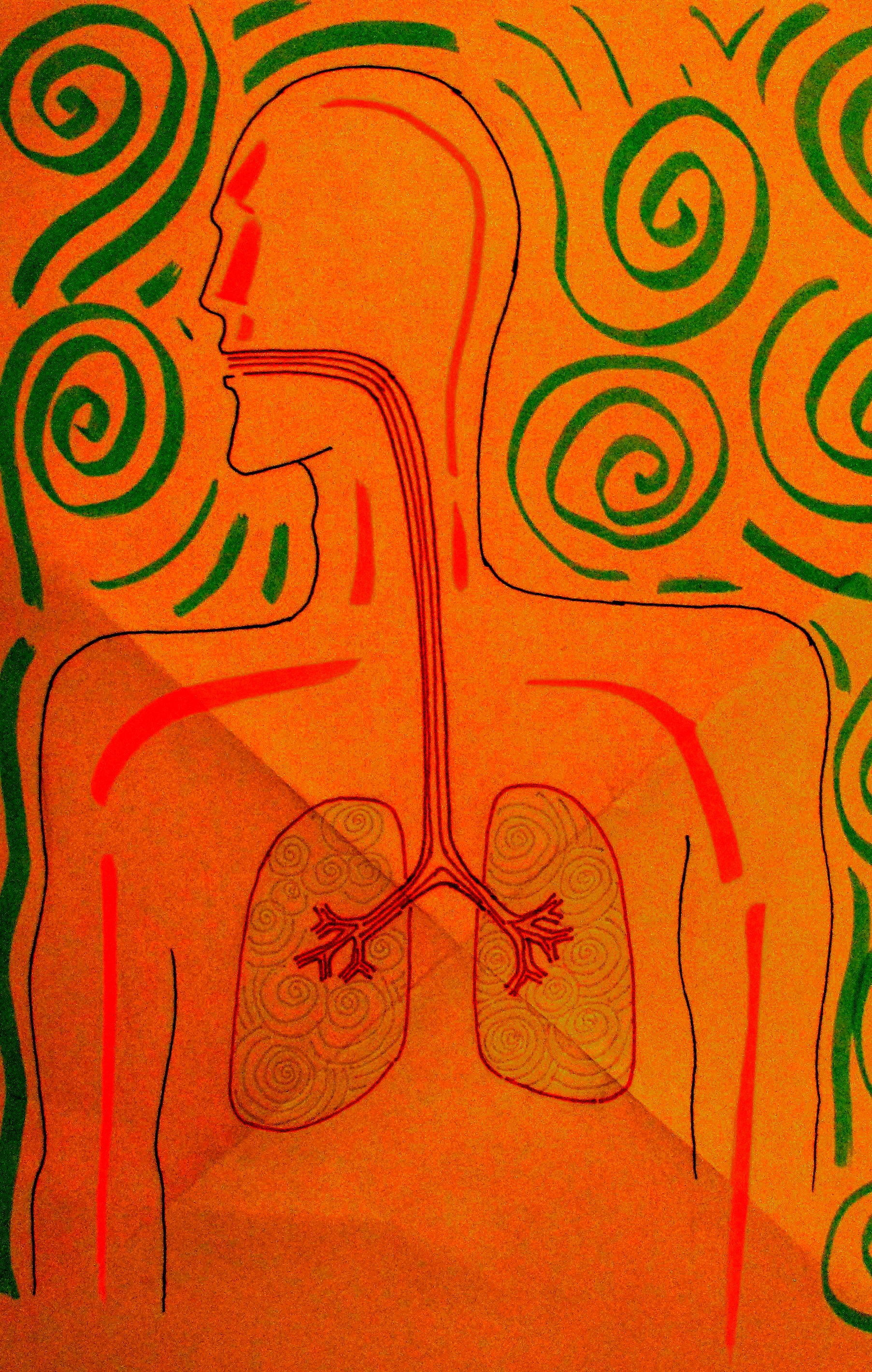
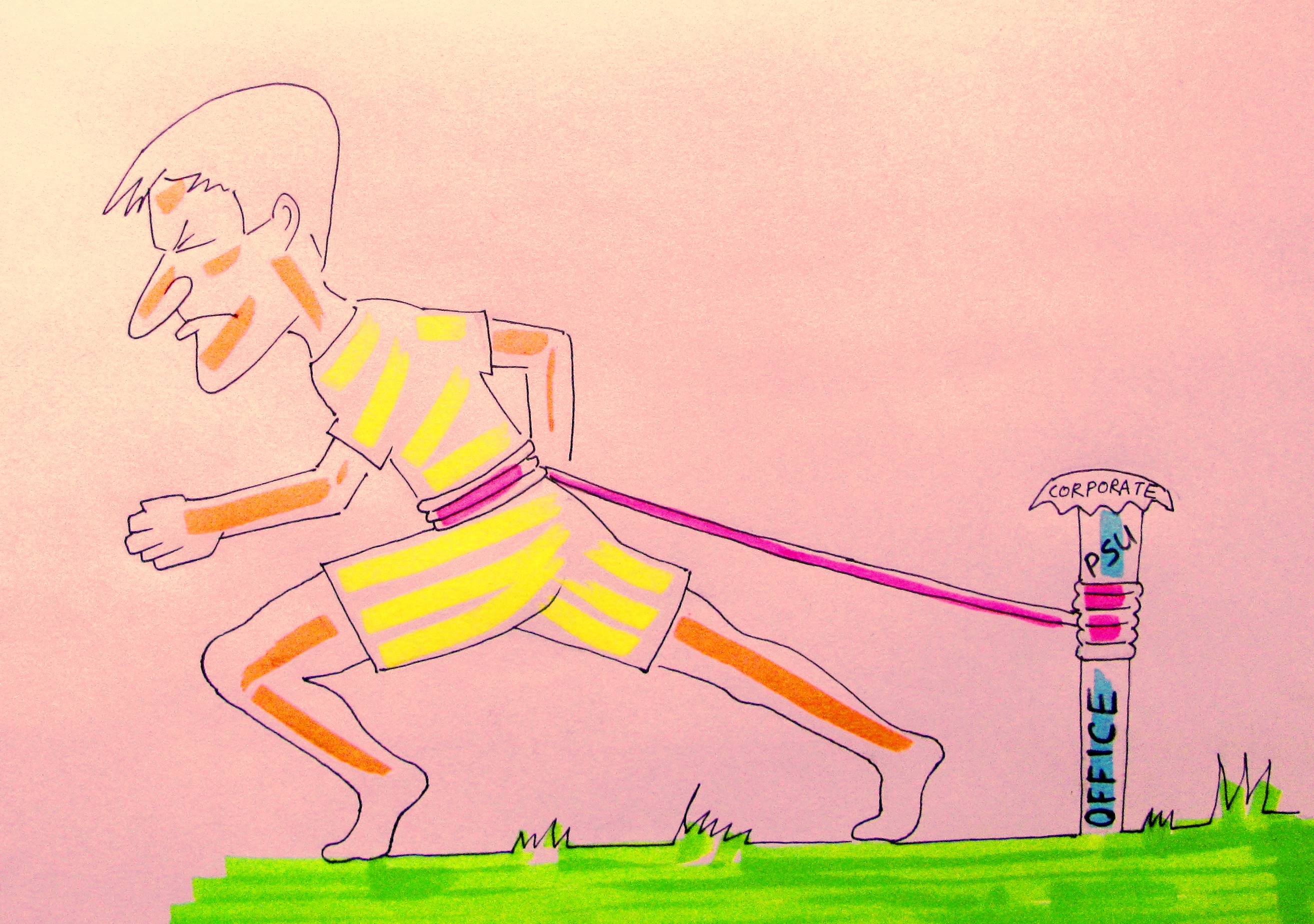
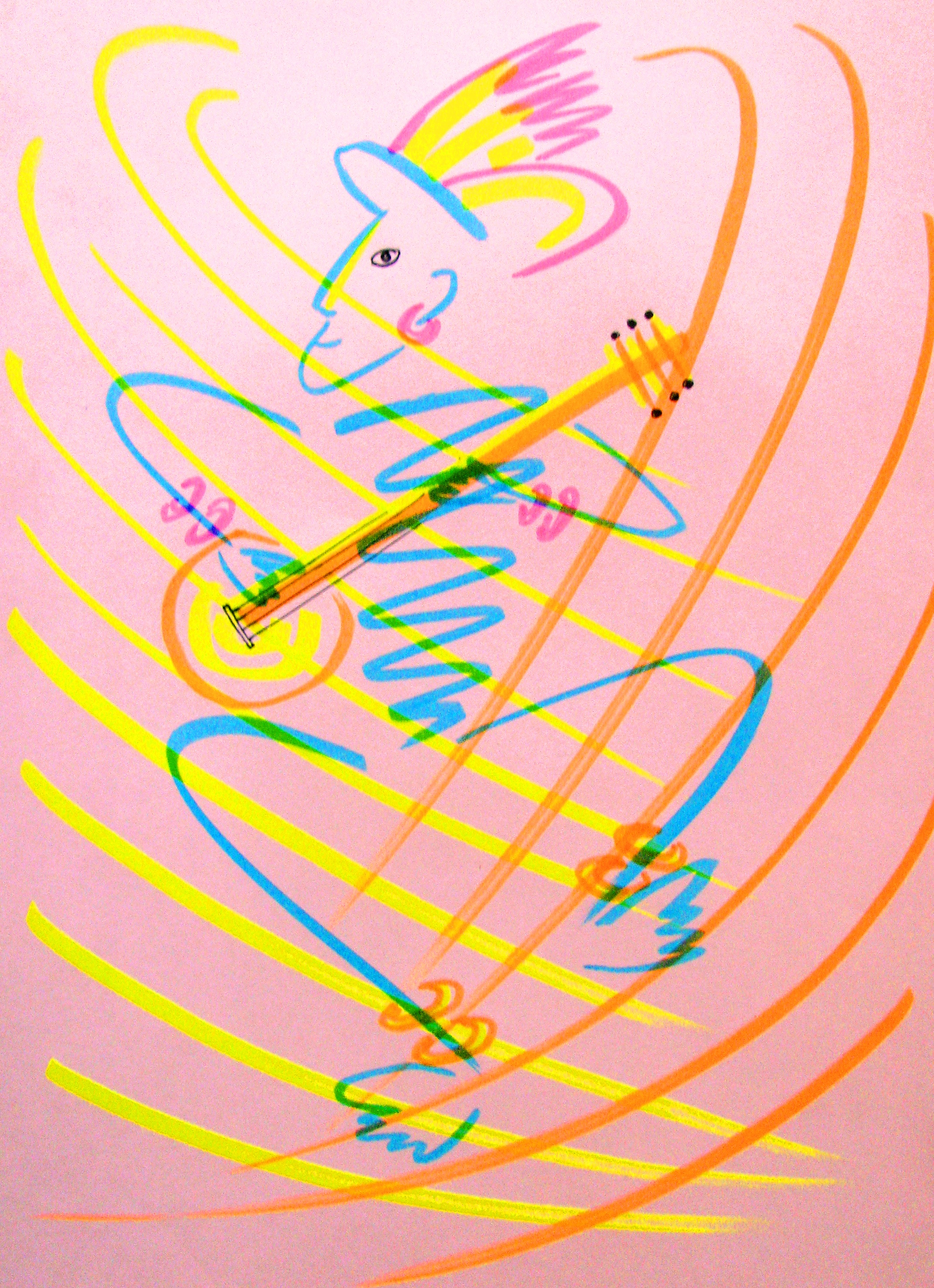
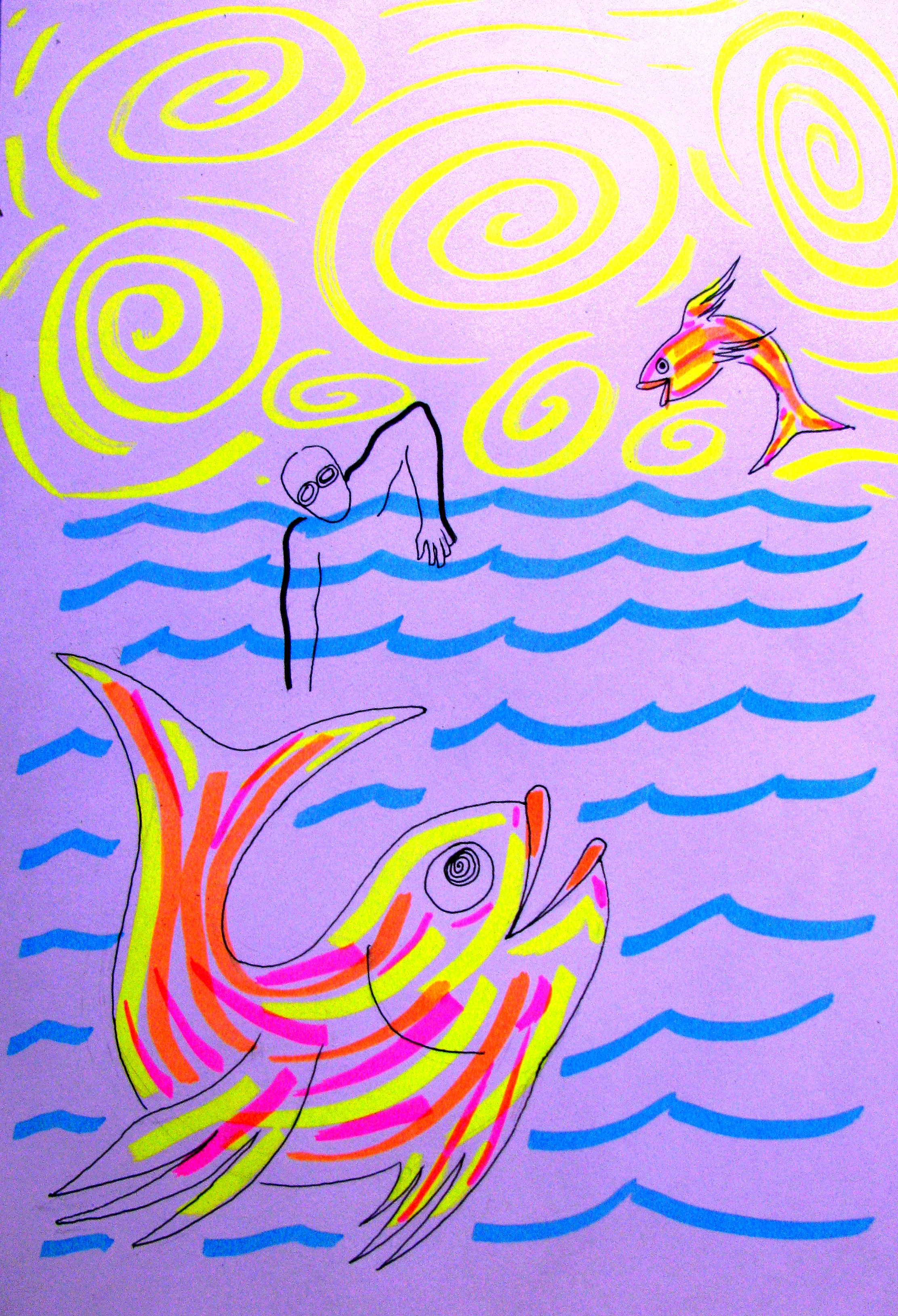
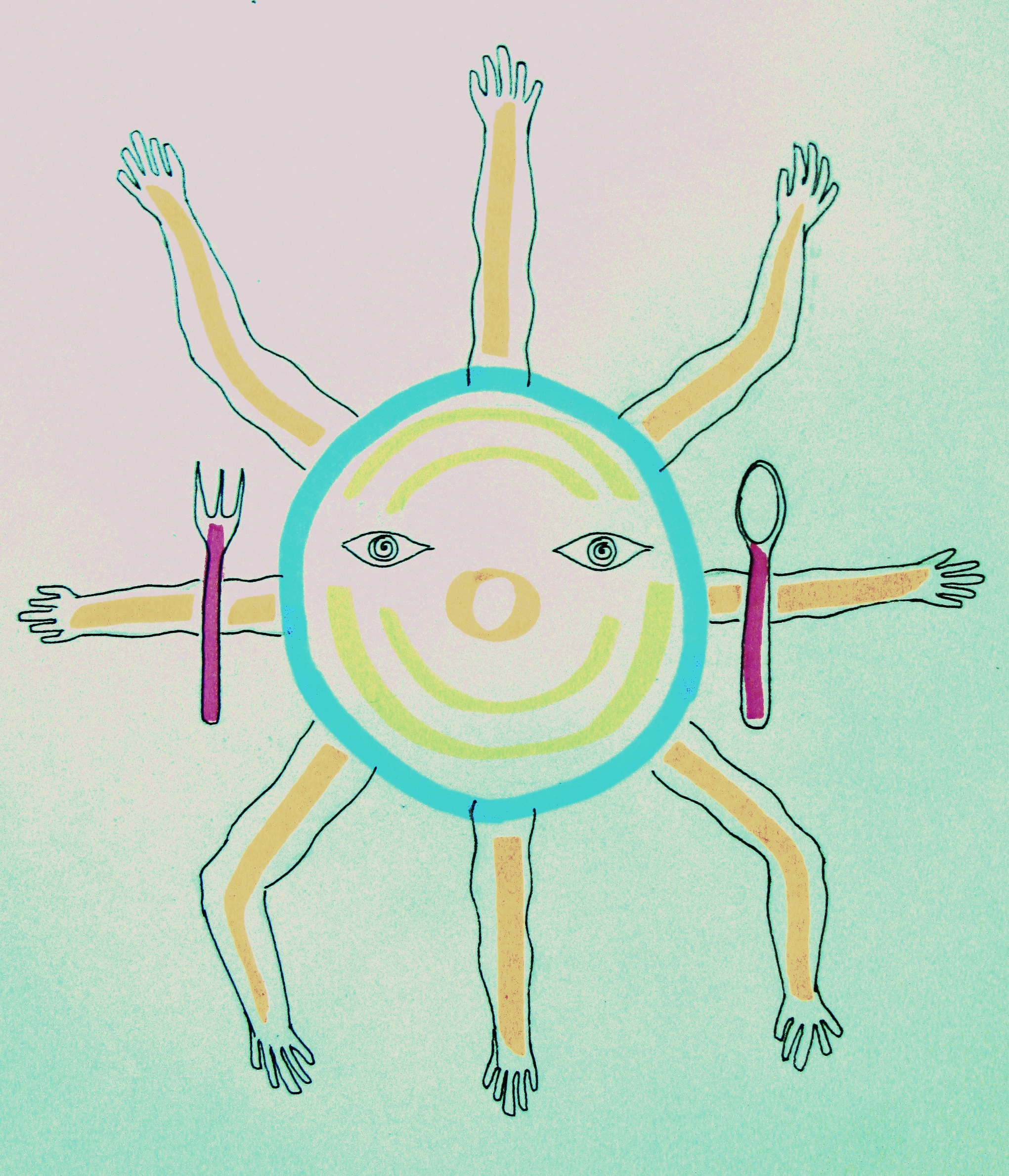
Illustration: Shyam G Menon

Breath is life.

Early November 2017, the question vexing Delhi was – how safe is the air?

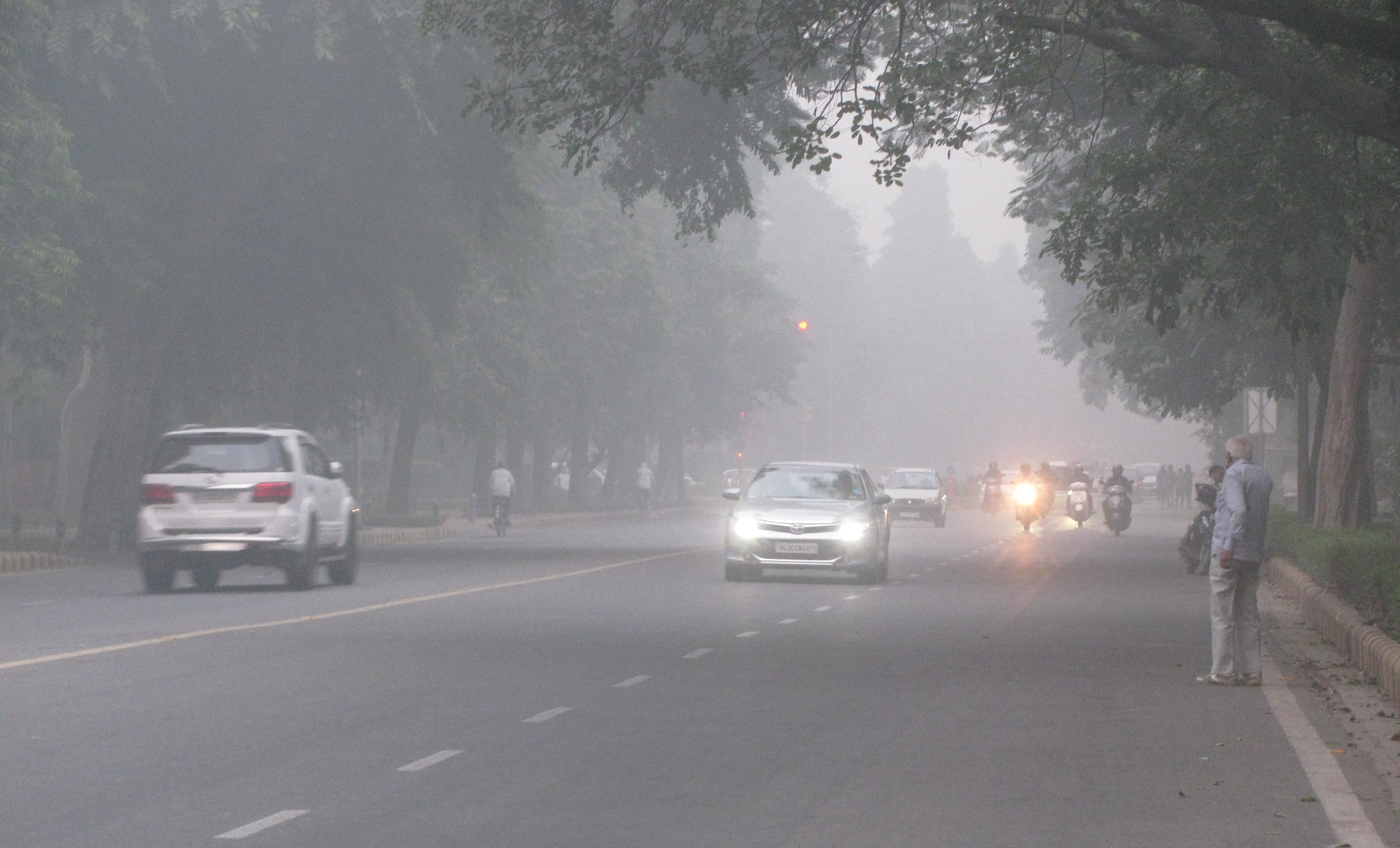
The smog hung thick.

The union environment minister was quoted in news reports ascribing the smog to “ adverse meteorological conditions.’’ According to him, there were the twin problems of still wind at ground level and two wind masses – one bearing pollutants from crop burning in Punjab, the other laden with moisture and blowing in from eastern UP – colliding in the upper atmosphere. The minister was likely correct. It was also selective explanation, the stuff of calibrated response. It suggested that the fault wasn’t ours; it was more a conspiracy by weather.

We have known for long that Indian cities are polluted and becoming increasingly so. Across Mumbai, Delhi, Chennai, Bengaluru, Kolkata and more – there are rivers, streams and creeks that have been polluted to varying shades of sewer. Blaming their toxicity on lack of water flow or colliding water currents, would be laughable. We know the toxicity is us; our way of life. All the three major culprits cited for the Delhi smog are man-made – crop burning, automobile emission and construction dust. Mumbai escapes terrible smog probably because it is a coastal city. But its land, water bodies and the adjacent sea are scarred by pollution. Adding to the confusion over how to tackle pollution is life by religion. Amid smog in Delhi, some highlighted how the Court erred, blaming Diwali for pollution when immediate culprits are other causes. I shut my ears. By the time I left Delhi for Mumbai, two people were dead after their car fell into the Yamuna River, courtesy smog and low visibility. Elsewhere, there were reports of vehicle pile-up.

For those interested in running, major question was – what will happen to Delhi’s biggest running event due later in November? This discussion too was characterized by calibrated response. The organizers termed medical advice seeking cancellation of event as premature; they said similar conditions had been there before, they said vehicles wouldn’t be plying the race’s route from 12 hours prior to the event and that salt water would be used to wash the route to keep dust settled. Are we past calibrated response? Anyone who walks, runs or cycles regularly in Indian cities is automatically exposed to the dark side of our collective existence; the extent of air pollution and the danger of rising vehicular traffic. Besides poor quality air for runners to inhale, cyclists have got knocked down by aggressive traffic. People have died.

What worries in an experiential sense is how respect for human-powered locomotion and the outdoors is shrinking in Indian life and how that attitude is spreading like fashion. Nine days after I left Delhi, the city’s prestigious half marathon was held as scheduled. News reports said, close to 35,000 people had registered. Thanks to wind and rain, pollution thinned and air quality improved. It’s good to know that committed runners will run no matter what. Unfortunately nobody asks – what happens after they display their resolve? Will the resolve extend to making sure that next time around, pollution levels are low? As we become more and more slaves of our emergent nature, those of us feeling alarmed by pollution outside shrink in number and calibrated response to pollution becomes increasingly acceptable. It is convenient, avoids blaming us. Colliding air currents suffice to explain Delhi’s smog and runners and cyclists would seem a nuisance on streets meant for climate controlled-vehicles transporting people and goods to their destination. Why are we suckers for calibrated response? Why don’t we notice the blunt truth? Nobody likes pointing the finger of blame at themselves, particularly in context like India where national problems – from population to pollution – are self-wrought. Calibrated response is dished out to keep the human collective and strategically important economic interests therein, happy. Population becomes market and workforce for GDP; pollution becomes collateral damage for industry and employment.

Delhi, early November 2017 (Photo: Shyam G Menon)

In contrast, endurance is about experiencing self and solitude. Deep into a run, hike or swim you confront it. You become just what you are. There is no room for pretense, cover-up and fraudulence. There is no hive; only bee. For such a mind, between noticing smog and buying into calibrated response, the former should attract. Doing so, you are no more market. A market pace of evolution is nowadays not only slow compared to the urgency of our problems, it also leaves us intellectually dissatisfied. Increasingly now, a better environment is our individual responsibility. The outdoors and endurance sport are like portals to awareness. Some view it as achievement. A slightly different lot would view it as a new way of looking at life. The word for it is perhaps – aesthetic. The Oxford dictionary describes aesthetic as: concerned with beauty or the appreciation of beauty. Dig a bit deeper. Here’s how the dictionary describes beauty: a combination of qualities, such as shape, color or form that pleases the aesthetic senses, especially sight. Within that meaning and several other sub-texts, there was also this: a combination of qualities that pleases the intellect.  Question to ask is – are we living an aesthetically pleasing life? Did the smog seem beautiful?

There’s more to the smog than meets the eye.

In it, we see what we have become.

A sense of aesthetic will help us pollute less.

Following which, any marathon will be beautiful, no salt water needed.

(The author, Shyam G Menon, is a freelance journalist based in Mumbai.)  

THE IMPORTANCE OF EDUCATION – AN IRONMAN STORY

Nagaraj Harsha (Photo: Shyam G Menon)

On May 2, 1927, when The Stevens Hotel opened in Chicago, it was the biggest hotel in the world. It had 3000 rooms. Its first registered guest was Charles G. Dawes, then vice president of the US and in 1925, a co-recipient of the Nobel Prize for Peace. History however had other plans for the hotel. The Great Depression ruined its owners and the property went bankrupt. The government took the hotel into receivership. According to Wikipedia, in 1942 the US Army purchased the hotel for use as barracks and classrooms. Two years later, the War Department sold the property to a private businessman, Stephen Healey. In February 1945, as World War II drew to a close, Conrad Hilton purchased the hotel from Healey. With that, The Hilton, Chicago, was born.

A day in August 2014, two young men from India; both of them longstanding friends – one freshly arrived from Bengaluru; the other staying in Chicago – reached the hotel. The Chicago resident dropped the visitor off at the hotel and drove away. Nagaraj Harsha kept his emotions in check as he made his way to the hotel’s restaurant, where a meeting was due. Neither party had met each other before. This was their first time face-to-face. Thanks to photographs periodically exchanged; from far, from their table in the restaurant, the family he was seeking to meet, recognized Nagaraj. It was a meeting over two decades in the making.

From the Colombo half Ironman (Photo: courtesy Nagaraj)

Sometimes the earlier chapters of one’s life gather clarity only as the later ones unfold. It was late evening in Bengaluru; actually night, the hour when day rolls up its cuffs, loosens its shirt collar and relaxes over a cup of coffee or a mug of beer, delighting in finding sense or the lack of it, in all that went by. Just outside the café we were in, at the corner where Church Street met Brigade Road, two prominent shops – one selling Nike products, the other selling Puma; the reflection of their glowing logos on glass facades nearby amplifying their presence – kept endurance sport in the frame. “ I am 27 years old now. It was only a year or two ago that I got convincing explanation for what I used to be in childhood and early youth. Things are clearer now,’’ Nagaraj said. His face betrayed joie-de-vivre, restless energy visible in his wiry build and the passion with which he spoke of his life in sports. For a minute his ways and nature of speech reminded me of a friend in Ladakh. Youngster full of energy, he had turned entrepreneur and was mellowing down with the process. How is he doing? – I thought.

Nagaraj was born April, 1990, in Bengaluru. He grew up in the city. He did his schooling at Methodist Kannada School, studying there till tenth standard, before moving to Kripanidhi College to do his eleventh and twelfth. These years are very important in how they define Nagaraj’s sense of self and life. His mother brought up her children single handedly. The family was poor; life was a struggle. They needed help. Looked up in mid-October 2017, Wikipedia’s page for Compassion International did not mention India among countries it works in. The agency is described as “ a Christian humanitarian aid, child sponsorship organization dedicated to the long term development of children living in poverty around the world.’’ Back in the 1990s, it was this NGO that came to Nagaraj’s assistance. They sponsored his education, all the way to college. The person who sponsored his education was Gladys Downey, a benefactor from Canada. “ She has been like a second mother to me. I owe so much to her,’’ Nagaraj said. The school he studied in catered mostly to under-privileged children. On that island of education, Nagaraj was sometimes topper. He doesn’t beat his chest on that attribute. He viewed it in perspective as the natural fallout of being good at studies in a financially challenged backdrop where many students in class may have been similarly struggling and good was sufficient to top the lot. What should engage in Nagaraj’s case is that he achieved such result despite behavioral traits challenging the ability to sit down and study. He was hyperactive.

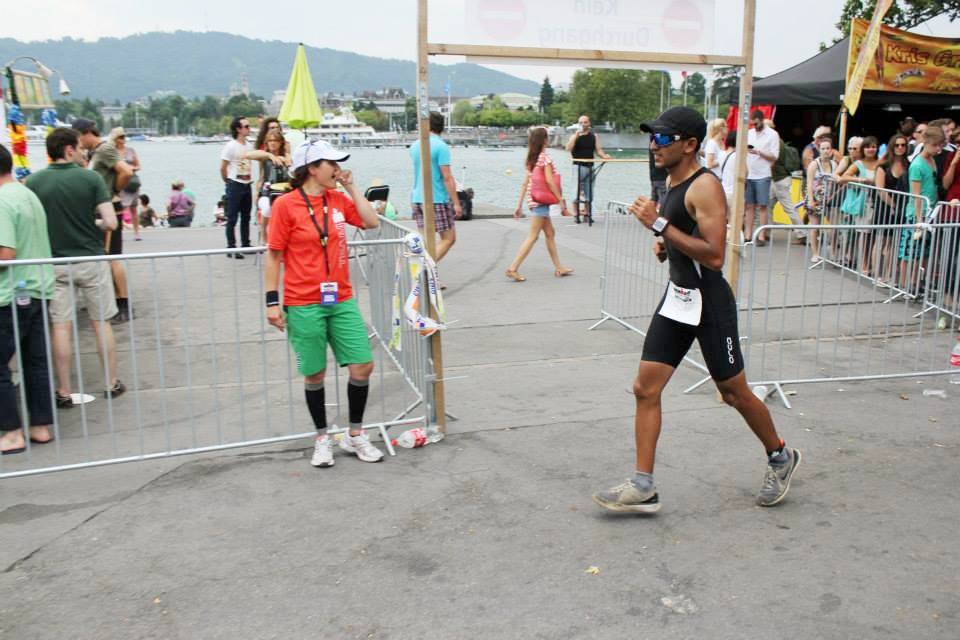
From the Ironman competition at Zurich (Photo: courtesy Nagaraj Harsha)

The condition – Attention Deficit Hyperactivity Disorder (ADHD) – is not easily diagnosed. Information on ADHD available on the Internet, hints at a period of observation and study of subject eventually leading to the conclusion that a person may be having ADHD. This was the explanation, Nagaraj got later in life. In school, long before the diagnosis was made; it was plain struggle to focus. He had boundless energy. He wanted to play, participate in sports and be good at it. But unlike other children, he couldn’t master the art of channelizing his energy to achieve an objective. “ I would try taking part in sport and end up failing,’’ Nagaraj said. A further problem and a potential solution also presented themselves. Everybody needs something that makes them happy. One reason sport has its following is because physical activity releases endorphins; the resultant high is a nice feeling to have. Unable to focus his energy properly in sports and games, Nagaraj found happiness in eating. The more he ate, the more he put on weight. Chubby youngster was typically target for bullying. Around this time, his mother got him a gift for topping studies at school – it was a bicycle. By the time he joined Bengaluru’s Christ College to do his graduation, that cycle had become his mode of commuting to college. Physical exertion and sweating, he understood, skimmed off the excess energy creating havoc in his system. It helped him focus. The family didn’t have money to send Nagaraj to a good college. Realizing the family’s difficulties, once again, Gladys and Compassion International intervened. They decided to foot the bill for Nagaraj’s college education. According to Nagaraj, he was the first student from his school sponsored by the NGO all the way to college education.

Illustration: Shyam G Menon

First year at college was normal except for a sartorial issue. Like most courses oriented towards eventual work in the business and corporate sector, the graduate program in commerce at Christ College required its students to dress formally. Nagaraj was a good student but he turned up in what dress he could afford. It went on for a while till his teachers took him aside and asked why the streak prevailed. They realized it wasn’t any rebellion on show; it was plain difficulty to afford. According to Nagaraj, the faculty raised money for him to buy a set of formal clothes. By the second year, Nagaraj’s mother had to stop working. This made it imperative for Nagaraj to look out for a job. He had joined Global Gym at Adugodi in the city to work-out and lose weight. He approached the gym management and offered to work for them, cleaning up the premises. On their part, they told him to take three months’ time, learn the ropes and be a trainer at the gym. The arrangement brought purpose to his life. He started waking up at 4.30 AM; he would open the gym at 5 AM, work there till 9-9.30 AM and then proceed to college. He worked at the gym again in the evening, from 5 PM to 10 PM.  “ This was my schedule Monday to Saturday. On Sundays, I worked from 5 AM to 12 PM. Through much of second and third year of college, I therefore had little social life,’’ Nagaraj said. At the café, the man and woman at the adjacent table got up to leave. A new couple took their place. Outside, Church Street was its usual self; plenty of young people, ambiance of imminent dinner, conversation and catching-up and amid it all, the city’s much loved book shops. While historical places abound, every Indian city has its post economic liberalization hotspot. This patch of Bengaluru – MG Road, Brigade Road and Church Street – had for long been the city’s postcard to the world. In the 1980s, it was where you went to see a phenomenon called `pub.’ I remembered my own pilgrimage from college days long ago, to that strip of road, traffic, neon signs and shops selling branded goods. Pubs have since become passé. But new generations still throng this area to engage in what Nagaraj shuttling between home, gym and college missed out on – socializing.

Louisville Ironman (Photo: courtesy Nagaraj)

During his second year at college, at the athletics meet connected to the annual sports day, a friend challenged Nagaraj to a run, saying he wouldn’t be able to manage five kilometers. In the impromptu race, his friend gave up after a kilometer; Nagaraj completed the full course. He was exhausted by the effort (next day he was down with fever) but it showed that with determination and will power, he can accomplish goals in endurance. Nagaraj graduated in commerce with job in hand; he secured it via campus selection bagging alongside the second highest pay package in his batch. Job meant end to his career at the gym. He had been there for over two years, earning in the process his own cachet of long term trainees. One of them had even gifted him a bicycle – a Firefox MTB. He bid goodbye to all that and moved to Usha International’s office at Gurgaon near Delhi, working in finance and accounts. The year was 2010. You can take the man out of Bengaluru; you can’t take Bengaluru out of him – that was true in Nagaraj’s case. He didn’t like Delhi. Now armed with a decent cash flow of his own, he took to drinking, catching up on the socializing he had missed out earlier. He put on weight. Luckily for him, post-probation, his company understood his predicament and gave him a posting in Bengaluru.

During this phase, Nagaraj started to look up blogs related to adventure. The IT industry, after its sunrise stage of the 1990s, had matured into a predictable quantum. There was a sea of young people in Bengaluru, many had studied or travelled overseas. Craving for engaging activity was high. Both trekking and cycling were catching on. Nagaraj decided to try cycling 100 km on the Firefox MTB. The plan was to cycle to Nandi Hills and back. One night he started out. About 15 kilometers away, in Hebbal, he got mugged. “ They took away my cell phone. Luckily they spared the bicycle,’’ he said. He continued his journey and reached the top of Nandi Hills, taking an hour and forty five minutes to get from the base of the hill to its top on his seven-speed MTB. Encouraged, he started to cycle and trek regularly. His next big outing was a three day-cycle trip from Pollachi to Munnar via Athirapally. This time he had a new bike, bought with newly acquired credit card – a Cannondale SL 5. In 2011, in what was his second run since that race with friend in college, he ran his first TCS 10K in Bengaluru, covering the distance in 58 minutes. He paid for the lack of preparation. He was in terrible pain after the run. “ The whole idea was to participate and get a dry-fit T-shirt,’’ Nagaraj said.

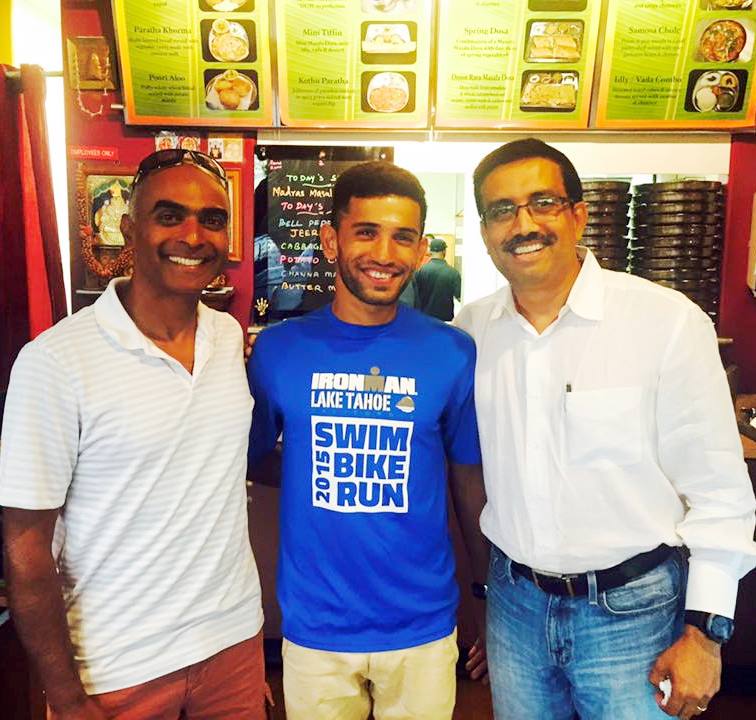
With Gurudev and Jay, who helped raise some of the funds Nagaraj needed to participate at the Lake Tahoe event (Photo: courtesy Nagaraj)

Nice is the second largest French city on the Mediterranean coast, after Marseilles. It is home to an Ironman (triathlon) event. When Nagaraj met Dipankar Paul while socializing in Bengaluru, the latter was planning to attempt the Ironman in Nice. The idea intrigued Nagaraj. Isn’t it worth trying? After all, he was capable of running and cycling. While Dipankar went on to participate in the Ironman, Nagaraj joined a swimming pool in Bengaluru to train. In August 2011, a half Ironman was announced in Colombo, Sri Lanka. The half Ironman entails 21 km of running, 90 km of cycling and 1.9 km of swimming. Two months later, in October, Nagaraj signed up for it. Soon thereafter, he also acquired his first road bike – a Bianchi Nirone 7. He started training for the Half Ironman in earnest. Initially he couldn’t do more than 100-200m in swimming. However, he was consistent, reporting to the pool for a session from 7 PM to 8 PM, every day. All the same by November, he was still short of confidence. Deepak, another regular swimmer at the pool had been observing Nagaraj’s daily sessions. He asked if Nagaraj was preparing for something and upon being told of the upcoming Colombo event, offered to help. Under Deepak’s guidance, Nagaraj improved the daily distance he covered in swimming to 1500m. In December 2011, he went to Puducherry to try his hand at open water swimming (the swim leg at Colombo was to be open water). He co-opted a local fisherman into his scheme. The fisherman took Nagaraj a kilometer out into the sea in his boat and kept him company while Nagaraj swam back to shore. Back in Bengaluru, he biked on weekends and ran 10-15 km. None of this training had any structure.

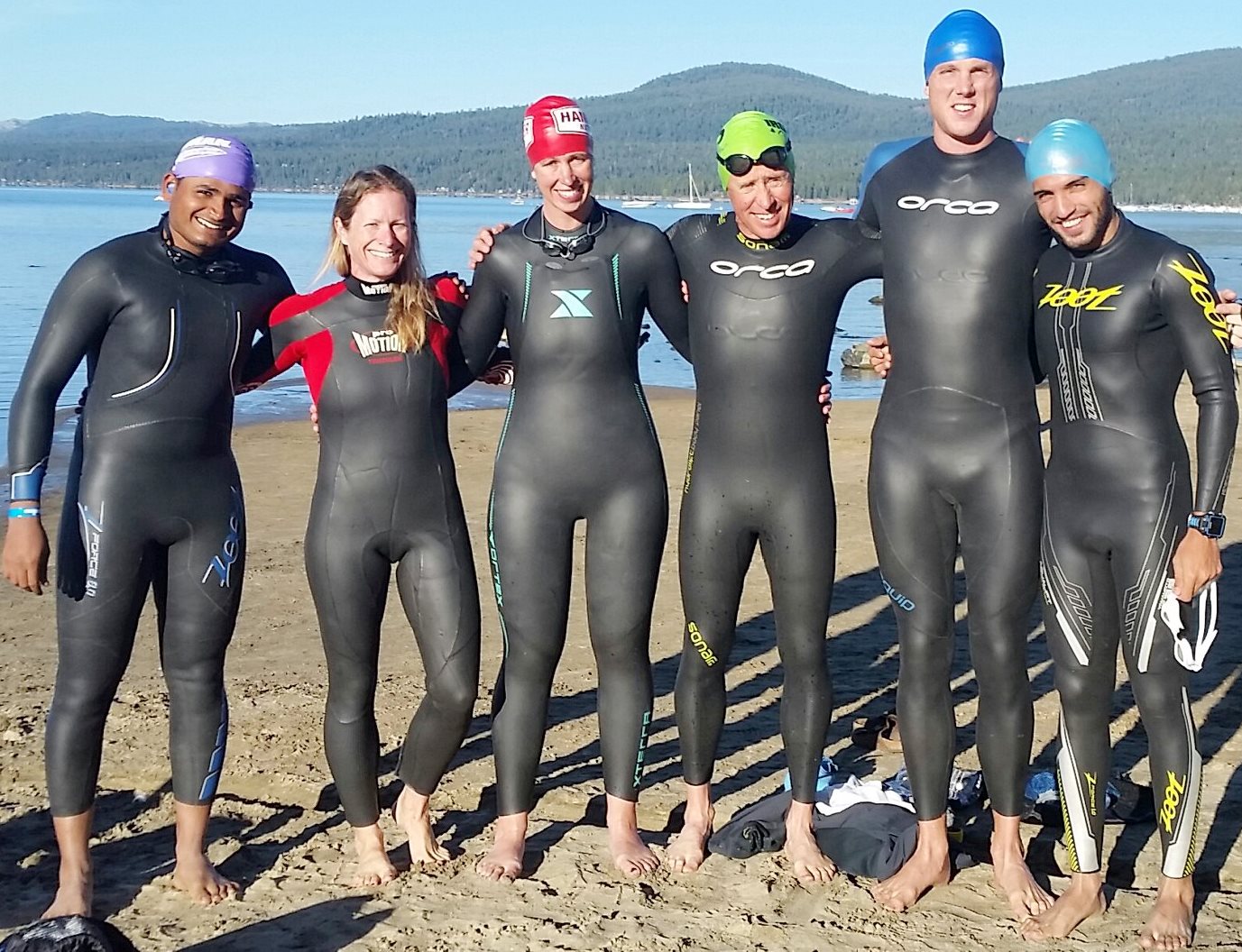
From the Lake Tahoe-Ironman (Photo: courtesy Nagaraj)

In February 2012, accompanied by a group of friends, Nagaraj reached Colombo for the race. He completed his first half Ironman in six hours, 37 minutes. It was also his first half marathon and the first time he swam 1.9 km. “ I felt a sense of achievement,’’ Nagaraj said. He decided to attempt a full Ironman; the location he chose was Zurich in Switzerland. Europe is a dream destination for many Indians. It is also expensive. Nagaraj lacked the Rs 2.5 lakhs he required to visit Zurich and participate in the Ironman. He took a bank loan. Some of his friends, conscious of his family backdrop, reminded him not to throw money behind his new found craze for the triathlon. In 2012, he had also quit Usha International and joined Toyota Kirloskar Motors in sale and marketing. It was period of transition with funds crunch at personal level, to boot. Very few people encouraged him. “ In India desires of this sought end up as solitary pursuits. We live to make money and once we make money, it all goes to the family – that is the dominant mentality. Doing something for one’s own pleasure or personal growth is the stuff of guilt,’’ Nagaraj said. Stretched for resources, Nagaraj decided to attempt the Zurich Ironman with the same gear he had assembled for the Colombo half Ironman. To obtain visa, he needed to show Rs 100,000 in the bank, something he didn’t have. Dipankar, who too was attempting the Zurich event, came to his rescue, loaning him the amount. In July 2013, Nagaraj completed the Zurich Ironman in 13 hours, 17 minutes. “ I told myself – this is the life I want to lead,’’ he said. He decided on 2014, as year for his next Ironman competition. For location, he chose Louisville in Kentucky, USA. There was a reason for this – Ganesh, his old friend from Christ College; the one who had challenged him to that 5 km-run long ago, lived in Chicago. Ganesh wanted Nagaraj to stay with him. Louisville was 300 miles away from Chicago.

With Jaymin Shah, Country Manager, Scott Sports India and Beat Zaugg, CEO & President, Scott Sports SA (Photo: courtesy Nagaraj)

That year – 2014 – was also the starting year of the Bengaluru Marathon. Ironman events were news in India and with a half and a full Ironman done, Nagaraj had been featured in the media. Nike extended him support for more than a year; taking care of his need for apparel and shoes. With interest in the triathlon slowly picking up in India, Nagaraj with Nike’s support became one of the athletes featured in publicity around the 2014 TCS 10K. So when the 2014 Bengaluru Marathon drew close, its organizers chipped in, sponsoring his air ticket to the US, for the Louisville Ironman. Nagaraj completed the US event in 11:55. The full Ironman entails 3.8 km of swimming, 180 km of cycling and 42 km of running. With Louisville, where the swim leg was in a river, Nagaraj felt happy to have swum in the sea (Colombo), a lake (Zurich) and a river at various Ironman events. It was Ganesh who dropped him off for that meeting at The Hilton Chicago. The meeting was the first time Nagaraj came face to face with his sponsor of many years, Gladys Downey. Right from Nagaraj’s childhood, sponsor and student had written to each other periodically. Photos were also exchanged. Hearing of Nagaraj’s participation at the Louisville Ironman, Gladys and her family had flown to Chicago from Toronto to meet him. They were staying at The Hilton. As he walked into the spacious restaurant, they instantly recognized him. “ It was initially an emotional meeting,’’ Nagaraj said of the first time he came face to face with the person who had funded his entire education. He spent three days with Gladys and her family.

Team trial winners at Bangalore Bicycle Championship (Photo: courtesy Nagaraj)

From the 12 hour-stadium run in Mumbai (Photo: courtesy Nagaraj)

Post-Louisville, back in India, Nagaraj was financially in troubled times. He was in debt. That didn’t stop him from signing up for the full Ironman at Lake Tahoe, California, in 2015. Lake Tahoe is the largest Alpine lake in North America; it is situated at an elevation of 6225 feet in the Sierra Nevada mountain range and straddles the state line between California and Nevada. Gurudev, who lived in the US and who Nagaraj had met on the Internet, helped raise some of the funds required to participate in this event. Another source of support was sports gear manufacturer, Adidas. They put him on a one year sponsorship contract (since renewed thrice; it was in its third year at the time of this interview) and backed him with apparel and shoes. For the 2015 Bengaluru Marathon, Nagaraj was once again among athletes featured in their publicity for the event. Nagaraj completed the Lake Tahoe Ironman in 11:58. This was also the Ironman where he accomplished his first sub-four hour-marathon, covering the 42 km-distance in 3:55. By now some more support was becoming available. With three years spent working at Toyota-Kirloskar, his financial difficulties had eased. In November 2015, bicycle manufacturer Scott Sports offered sponsorship. They gave him a Scott Plasma 20 TT bike; a model designed for triathlon competitions. To train, he got a Scott Solace 30 road bike.

At Kalmar (Photo: courtesy Nagaraj)

According to Nagaraj, the primary factor that decides his choice of Ironman events is cost. Also influencing choice are attributes like location, elevation and weather at given time. Kalmar is a city in Sweden. It is situated on the shores of the Baltic Sea. In 2016, Nagaraj signed up for the full Ironman at Kalmar. In the middle of that year – in June – he turned up for the 12 hour-stadium run in Mumbai, an ultramarathon held on the running track at University Stadium. It took some convincing for the organizers looking for proven ultramarathon runners, to let a triathlete participate. That’s probably an indication of how little understood the triathlon is, in India. Nagaraj covered 110 km in the assigned duration and finished first in the event. The Kalmar Ironman took place in August 2016 and proved to be Nagaraj’s fastest Ironman yet. He finished it in 11:17; he got a personal best of 5:44 in cycling and 3:53 in the marathon. “ The Ironman is now a lifestyle for me. I can’t imagine life without it. It helps me stay motivated, nothing gives me more happiness. Triathletes support each other. It is one event where an amateur gets treated like a professional,’’ Nagaraj said. Further one of the fallouts of being a triathlete is that you become very focused and disciplined; it teaches you time management. “ I like competition and I am competitive to the extent that I wish to better my performance. Once upon a time, the goal was to somehow finish. Now the goal is to improve. I also try not to give up when doing each of the disciplines. If it’s a run, I don’t walk,’’ Nagaraj said. That said, at Lake Tahoe where he managed his best finish to date (he thinks it was 195 / 1500 participants) he collapsed after completing the event; not at the finish line but a while later, walking into the medical tent and then collapsing. He had to be administered IV fluids. Does his mother empathize with her son’s Ironman craze? “ At first, she wasn’t quite appreciative especially because the family needed resources and my interest in the triathlon was eating into it. Now that we are financially a little better off, she has begun to understand,’’ Nagaraj said. His sister also works now.

Nagaraj with Gladys in Canada, 2015 (Photo: courtesy Nagaraj)

From his first half Ironman to the several full Ironman events that followed, Nagaraj’s training pattern has changed. “ It has definitely become more structured,’’ he said. On the average, he trains two to three hours per day. Every week, he does 6-8 km of swimming, roughly 250 km of cycling and up to 60 km of running. Waking up at around 5 AM, he trains for one discipline in the morning and another in the evening. This mix of disciplines which works like cross training is a gift the triathlon provides. Nagaraj’s last injury was in 2013. “ That was my first and last injury,’’ he said. For his fifth full Ironman, he was scheduled to attempt the event at Busselton, Western Australia, in December 2017. Between Ironman competitions – which for him is typically one every year – he participates in other events. At the 2017 Standard Chartered Mumbai Marathon (now Tata Mumbai Marathon) he finished the full marathon in 3:04. He also had a podium finish in cycling as part of a team participating in team time trial at the Bangalore Bicycle Championships. His team covered 50 km in 1:08. “ That is dream come true for any amateur,’’ he said. Meanwhile on the job front, he has shifted from Toyota-Kirloskar to Fast & Up; he joined the latter in March 2016 and oversees business development in India’s southern, western and eastern regions.

At the time of writing this article, Gladys Downey was 94 years old. Nagaraj visited her a second time after the Lake Tahoe Ironman. He flew to New York and after spending time there with his friends, he took a bus from New York to Toronto. Gladys’s daughter came to pick him up at the bus stop. Although still independent and capable of driving her car, Gladys stayed at a senior citizen’s home. Of all the children, whose education she had sponsored, Nagaraj said, he was the only one who had got around to actually connecting with her. This was their second meeting. He spent a week with the family. “ I believe education is very important. Had I not been educated well, I don’t think I would be heading in the direction I am going now,’’ he said.

(The author, Shyam G Menon, is a freelance journalist based in Mumbai. This article is based on a conversation with the interviewee. Timings and positions at races are as provided by the interviewee.)

THE TINTIN YEARS

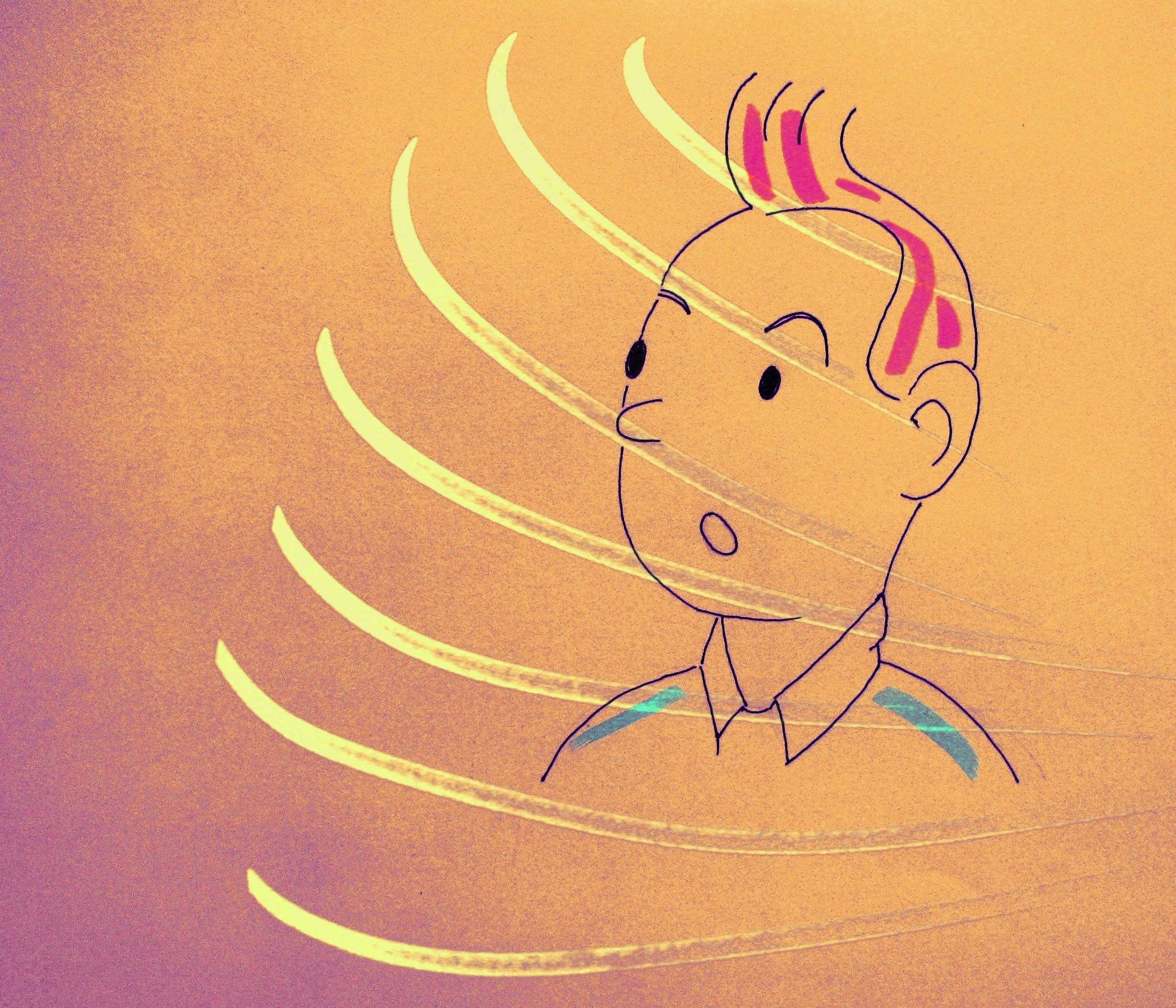
Illustration: Shyam G Menon

Many decades ago, two significant developments happened near simultaneously, in my extended family.

Two uncles, two comic strip heroes and a bunch of school going cousins – that was the context.

My uncle Narayana Pillai got me Flight 714, my first title from the series showcasing the adventures of Tintin. Until then, the only illustrated narratives I was familiar with were the ones from Marvel, DC, Indrajal and Amar Chitra Katha. They had strong following among school students, to the point that classmates with bound volumes of comic books were important people to know. I didn’t have bound volumes. Although my mother helped out by borrowing bound volumes from a local lending library, in general I suspect, my parents and grandparents held the view that comics, while popular, made for simplified narrative requiring less imagination. Reading was encouraged, purchase / borrowing of wholesome books approved. Days when the cousins got together typically featured a morning or afternoon of painting. Imagination was encouraged. A picture may speak a thousand words but the mind gets useful stretch if it can paint a picture from a word or a theme, perhaps even nothing – that seemed the approach. Into this ambiance landed Flight 714 and at the house of my cousins – Rajeev and Manju – thanks to another uncle: Sachidanand, a handful of books featuring Asterix.

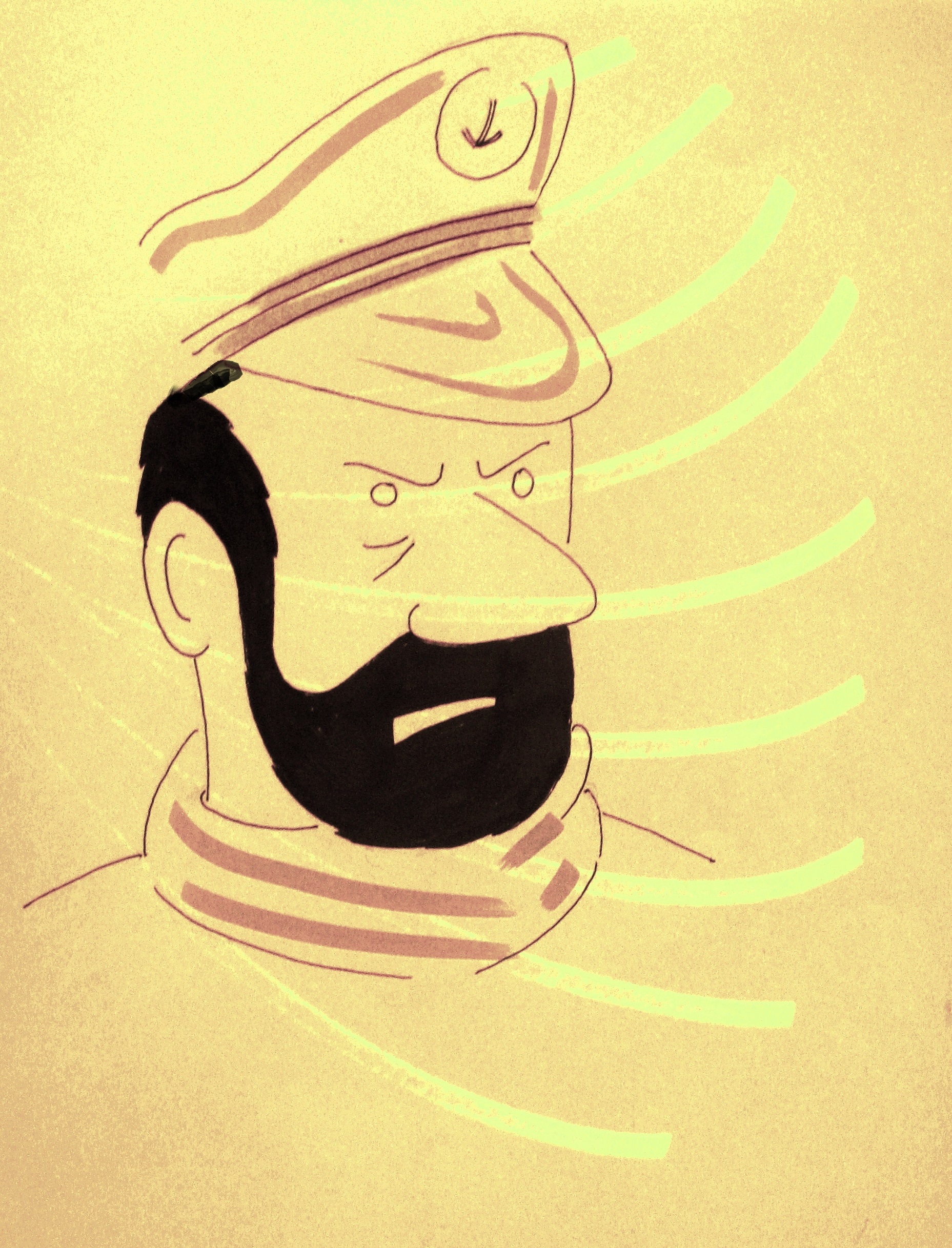
It took me a while to warm up to Tintin. But you guessed it right – it took no time to like Captain Haddock. Who can forget “ thundering typhoons’’ and “ blistering barnacles’’? I also remember liking Skut for no stronger reason than that he was a pilot in Flight 714. Those days I shared a craze for aircraft with my cousin Jayu. Both of us had those small, thick Observer books with plenty of fighter planes in it and we spent time piecing together our respective air forces, which then competed for supremacy in the sky. We also made model aircraft from cardboard, Jayu being infinitely better at the job than I. Flight 714 thus landed at the correct time. My mind was ready for adventure. What attracted me to Tintin were also perhaps the size of a Tintin book and the average length of a story. Uniquely, it was bigger in size than the regular comic book. It told a full-fledged, long story spanning continents, sometimes taking two issues to finish; a sort of early introduction to the graphic novel format that would become popular decades later.

What I remember most is however something else.

Maybe it is a larger Malayali trait, maybe it is a family trait – I don’t know which of the two is correct –we had the tendency of analyzing experiences. At near fifty, I understand childhood better now. It is a phase when you have the luxury to do something because you feel like it; no analysis in the mix. Impulse and intuition are not unfashionable. Our passage to adulthood is fueled by just the opposite. We become adults by analyzing to make sense, till we become armchair analysts of all that is alive and stirring. Expectedly, my extended family put Tintin and Asterix under the scanner. The emergent fascination among the children for these two series triggered discussion among the adults. It was a discussion revolving around idea, story and artwork; we had no clue of such political details like Tintin’s origin in a Belgian newspaper identified with far right views. I remember the outcome. Asterix stayed ahead because its illustrations were bolder and had more flourish. Asterix stories with their play on characters’ names were also more deeply imagined and as the more sophisticated, layered comic book it was respected that much more because childhood is after all stepping stone to more sophisticated adulthood. None of that bothered me. I like Asterix. But Tintin is special. Something about it appealed to childhood’s idea of adventure.

My uncle probably noticed the brewing interest. His work took him often to other cities in India. Occasionally, it also took him overseas. Almost always, he returned with another title from the Tintin series. All the titles were displayed on the back of each book. So it was easy to identify what you hadn’t read and hunt for it. Tintin made me do crazy things. One of them was my scale drawing of a rocket. I arrived an evening with my father at the house of Rajeev and Manju. Their father – Govindan (he was a physics professor) – smiled and indulged me with his time and patience as I explained how my rocket would work. It was all well illustrated in the drawing on large graph paper – the fuel tank would feed the engine and my rocket would escape Earth’s gravity and be moon-bound. Why shouldn’t it? I had a rectangle with dials on it, labeled ` control panel,’ another rectangle with pipeline attached, labeled ` fuel tank’ and yet another one marked ` engine.’ That last rectangle ended in a nozzle copied from one of the jet engines in my Observer book. In retrospect it’s a good thing I didn’t join the Indian space program.

In those days of economy yet to open up like now, each Tintin bought traveled to multiple homes. At every home a kid or two eagerly lapped up the contents. Sometimes titles got exchanged at school; I will lend you my title if you lend me yours, which I haven’t read – that sort of deal. And unlike, regular comic books, which few bothered if they got misplaced or torn through lending, deals over Tintin and Asterix were deals of honor. Misplace or mishandle, you risked being branded unreliable for life. That adds a touch of mystery to how my Tintin collection – all titles acquired save four; that’s 20 out of 24 – fared, once I reached college and employment beyond. Back home in Thiruvananthapuram, not one title survives. I hope some kid; somewhere is still reading what I collected and drawing rockets and submarines. Slowly as Tintin titles became more easily available in India, we started buying the books ourselves (a visit to Kochi was always incomplete without dropping in at PAICO). One by one, we collected the titles mentioned on the back cover of every Tintin book. Then the search commenced to at least access and read titles not mentioned there; titles mentioned in Tintin lore or in conversation among his devoted fans. Meanwhile, my uncle’s children, Lakshmi and Hari, also grew interested in Tintin and started their own collection.

Illustration: Shyam G Menon

I never outgrew Tintin. I can still pick up a title and enjoy browsing through it. In my adult life, the arrival of Steven Spielberg’s film on Tintin was a much awaited event. My favorite character was Captain Haddock and I was utterly curious to see how he would be on celluloid. I was disappointed and it isn’t Andy Serkis’s fault. My curiosity was in seeing which actor would pull off that role well and being an avid watcher of Hollywood films, I had even attempted some casting in the mind. As it turned out, the movie was made using motion-capture technology. That put it neither here nor there. It reminded me of the title: Tintin and the Lake of Sharks. Of all the Tintin titles I had, this one – assembled using stills from a 1972 animated film – had attracted me the least. When it comes to converting comic books to movies, I am not a fan of hybrid. After all, Tintin is not a Jungle Book, wherein modern animation technology makes animal characters life-like rendering the film a classic. Tintin sits firmly in the world of people and it surprised me that the producers deemed hybrid imagery, acceptable. I felt that was a letdown, considering Tintin has been portrayed before on stage and several other comic book heroes have been adapted brilliantly for the big screen.

In early August 2017, Lakshmi mentioned that a prominent item at Hari’s home in California is a poster of Tintin. Among his favorite shops is one where he picks up “ his Tintin stuff.’’ It made me wonder: what made her father Narayana Pillai, pick up Tintin books in an era of closed economy in India? Laskhmi’s own take on it was that her father bought it for the children in the family but he wasn’t above reading it on a flight himself! But then, unlike today when the media floods you with trends instantly, those days a comic book hero from Belgium was as distant as Belgium itself. You were compelled to read about Superman, Batman, Phantom and Mandrake because they were around. But Tintin? He didn’t have any PR machinery promoting him in the Indian media. It left the question: how did Narayana Pillai born and brought up in the Kerala of the 1940s and 50s, come to know about Tintin? He had never shared those details. A day into recollecting my thoughts around Tintin, I called up my uncle at his home in Aluva. Now in his mid-seventies, he laughed upon hearing that the phone call from nephew nearing fifty years of age was connected to his Tintin purchases from long ago. There was no loss of time in recollecting details. The bulk of the Tintin books were sourced from a book shop at the Mumbai airport of old, which my uncle visited during his business trips. “ I used to look for illustrated children’s books. That’s how I came across Tintin. I flipped through its pages and felt the characters in the book were interesting. The hero was a young journalist. When I bought my first Tintin, I had no idea how it will be. But from that one book, we moved onto many more, possibly the whole lot…Hari’s collection is still here,’’ he said. Further, in as much as he bought the books for children, he loved reading Tintin himself.

(The author, Shyam G Menon, is a freelance journalist based in Mumbai.)   

ALL IN ONE’S HEAD

Bhupendrasing Rajput (Photo: Shyam G Menon)

Khandesh is in the north-west corner of the Deccan Plateau.

When you come from North India, this region signals transition to Deccan. Cutting through Khandesh is the Tapi River. To the north lay the hills of Satpura. Most rivers in the Deccan flow east. The Tapi flows west. According to Wikipedia, the Tapi flows in a deep bed and therefore historically its waters were difficult to use for irrigation. The lands north of Tapi are fertile but most of Khandesh lay south of the river. Bhupendrasing Rajput was born 1969, in the Khandesh region; in Mandane village, part of Maharashtra’s Dhule district. “ In modern times, Khandesh is where the borders of Maharashtra, Madhya Pradesh and Gujarat meet,’’ he said. We were at a park in Hauz Khas, New Delhi. It was early April, 2017 – Mumbai had been hot when I left it; Delhi felt comparatively pleasant. The previous night it even rained. What’s happening to weather? – I thought.

Overall, the paradigm of life in Mandane was tough in more ways than one. The terrain is undulating. There is a small river near the village. “ The river has been dry since my childhood. When I was six or seven years old, I remember water being available in the village. After that, it has been generally dry,’’ Bhupendra said, illustrating the frugality within which, life and farming in these parts must operate. He was the fourth child among five brothers and two sisters. His father, a farmer, was also Gram Sevak; the executive officer of a Gram Panchayat. Mother was housewife. “ I too am a skilled farmer,’’ Bhupendra said. In fact, till fifth standard at school, he had attended to regular responsibilities in farming.

From a 12 hour stadium-run in January 2017 (Photo: courtesy Bhupendrasing Rajput)

Bhupendra studied up to fourth standard in Mandane. According to him, the village is still stuck at that level of local education. Even today it offers no scope for further study. Same has been the case with regard to transport connectivity. There was no bus to Mandane in Bhupendra’s childhood. There still isn’t; the road is a kilometer away. For his fifth standard, the boy attended school at Dondaiche, a town four to five kilometers away from home. From sixth to twelfth standard, he studied at Dhule. Not just Bhupendra, his siblings also shifted to Dhule. There, they rented a two room-house for stay and onward studies. The parents stayed back in Mandane. This meant, from a young age itself, the children tended to all details of survival, from cooking to washing and studying. The arrangement wasn’t easy on the pocket.

The year before the children shifted to Dhule, the family’s house in Mandane was burgled. The loss was significant. “ It left us financially weak. We were struggling and struggling,’’ he said. Amid this, the shift to Dhule and pursuit of studies had a reason. Bhupendra was a good student right from junior school. Till the tenth standard there was no concept of scholarship. His teachers took note of the family’s struggle and often waived fees. By the time he was in the ninth standard, Bhupendra was earning on the side to support his studies and the siblings’ stay in Dhule. His job was making copies of audit reports. “ Typewriting was a luxury. My job was to make three to four handwritten copies of these reports. I was paid one rupee per page,’’ he said. This work of making copies usually commenced around 9-10 PM. Next morning on his way to school, he would submit the work to his employers.

At the 2013 Bhatti Lakes Ultra; with Piyush Shah (Photo: courtesy Bhupendrasing Rajput)

In tenth standard, Bhupendra topped his school, meriting scholarship support for eleventh and twelfth standards. After twelfth, he found himself at the crossroad most students pass through in India – medicine or engineering? He gave up medicine as it was expensive. He was admitted to do his engineering at the college of engineering in Pune but traded that for a more affordable course in agricultural engineering at the Agriculture University in Rahuri near Shirdi. To help him through this phase, he had merit scholarships won in his twelfth standard, plus, he took tuitions. He also availed an education loan from Punjab National Bank (PNB). Bhupendra topped the university in his engineering course. “ My desire was to pursue post-graduate studies in the US. I had decent scores in GRE and TOEFL. I also got admission at the University of Illinois with 100 per cent scholarship. But for some reason, I was declined visa. I was rejected in all my three attempts.  I had to reconcile myself to that rejection,’’ he said. In September 1991, he joined Thermax Ltd in Pune, working for them in Pune and Mumbai.

From the 2015 12 hour-trail run in Aravalli (Photo: courtesy Bhupendrasing Rajput)

Through all this, sports had no significant presence in Bhupendra’s life. Back in Mandane, he used to play kabaddi. In middle school, he recalls doing the high jump. “ Probably, I needed to burn some calories; that’s all,’’ he said. What he does admit to doing consistently is – long walks. “ Long walks barefoot were a part of my life. Besides, I am also the kind of person, who once he gets the hang of something, goes on with it,’’ he said. Awareness of marathon set in much later, when he was posted to Mumbai on work with Thermax and one day, saw a city bus with the advertisement for the 2006 Standard Chartered Mumbai Marathon (SCMM) on it. “ The enrolment process then was to go to the office of Standard Chartered, fill in the form and drop it off with a hundred rupee note attached,’’ he said. Bhupendra registered for the half marathon. On race day, with no idea of what the marathon entailed and lacking the basic essentials to turn up properly attired for it, he ran the event in “ office pant, office shirt and office shoes.’’ He finished the race in two and a half hours. “ I just went with the crowd, I was borne along by it,’’ he said. After completing the run, he went to a photo studio in Chembur and had a picture taken for posterity. Post SCMM, one change happened. He started running two to five kilometers every day. “ The idea was to stabilize my performance in the half marathon,’’ Bhupendra said. He ran the SCMM half marathon again in 2007 and 2008, eventually managing a non-stop run with finish in just above two hours. At that point, he decided to graduate to the full marathon.

Bhupendra after his first SCMM in 2006. He ran it in office attire. This was the photo taken at the studio in Chembur (Photo: courtesy Bhupendrasing Rajput)

From what he said, one aspect of Bhupendra’s progression in running strikes you. He was in Mumbai, very clearly at that time the running capital of India. Places like Marine Drive in the city have hosted runners for years. SCMM was nudging through a running culture. Yet Bhupendra was bereft of any company in running. He was staying in Andheri those days and used to train at Joggers Park in Lokhandwala Complex, running daily “ with much energy.’’ “ My problem was that I had nothing to talk of with anyone, except running. I don’t smoke, I don’t drink. The world around had no incentive to invite me for any socializing,’’ he said. Result – Bhupendra then and to date is not part of any running group. He negotiates running’s maze by himself. In 2008 Bhupendra moved back to Pune from Mumbai. But the full marathon plan stayed on course. With no significant change to his training schedule and logging the same modest mileages he used to put in daily, he went ahead and ran the full marathon of the 2009 SCMM. “ I completed the run in 4:46 or so. I never felt there was anything difficult about it. Of course, there was the occasional struggle in that run-walk, run-walk…but I always knew I would do it,’’ he said. A breeze rustled the dry leaves on the ground. Not far from the park bench we were seated on, a group of boys began playing football; the conversation at the bench periodically punctuated by the dull thud of ball landing close by.

Thar Desert Run; with Denis, Kavitha, Vishwas, Raj Vadgama and Aparna (Photo: courtesy Bhupendrasing Rajput)

If the 2006 SCMM triggered the practice of running daily in Bhupendra, the 2009 SCMM did more. He ran a plethora of races thereafter, among them – Kaveri Trail Marathon, Airtel Delhi Half Marathon, Baroda Half Marathon and TCS 10K. “ After the 2009 SCMM, it was a mania,’’ he said laughing. He didn’t distinguish between distances too – he welcomed 42 km; 21 km, 10 km alike. Post 2010, somebody introduced him to Facebook and through it he got introduced in turn to the world of trekking. “ I am now a crazy lover of the hills,’’ he said. Facebook was also avenue to something else. Vishwas Bhamburkar, a runner from Ahmedabad, posted on Facebook that he was interested in attempting the 135 mile-Brazil Ultra and wished to do a training run of 150 km around Pune. “ I was curious,’’ Bhupendra said. In September 2011 he joined Vishwas for the training run, starting one night at around 8-8.30 PM and going on till next evening. Well known ultra-runner Aparna Choudhary was the third person participating. By next evening, Bhupendra had logged 135 km without any problem. “ I observed that only some 40-50 km was real running. The rest was walking. I asked how this can be and Vishwas responded: that is how ultras are managed. It occurred to me, if this is the case, then ultramarathons are doable,’’ Bhupendra said. Following this training run, Bhupendra and Vishwas met again in Hyderabad for the Hyderabad Heritage Marathon of October 2011. Vishwas suggested that Bhupendra attempt an upcoming ultramarathon – the Bhatti Lakes Ultra organized by Globeracers. “ Once again it was a case of no training, somebody pushing and I being there,’’ he said.

With an officer of the Border Security Force (BSF) at the finish line of the 2017 Run of Kutch (Photo: courtesy Bhupendrasing Rajput)

From the 2014 Run of Kutch; with Breeze Sharma (Photo: courtesy Bhupendrasing Rajput)

The race was an eye opener. “ The Bhatti Lakes Ultra was a fantastic experience. Besides Vishwas and Aparna, among those I met were Aditya Bee, Gaurav Madan, Milind Soman and Raj Vadgama. It was a clean completion for me. I topped the 100 mile-category, finishing it in 27 hours, 28 minutes,’’ Bhupendra said. If Facebook introduced him to Vishwas and ultra-running, Globeracers offered him a basket of ultramarathons to attempt. “ Globeracers has really created good benchmarks in organizing ultramarathons not only in terms of mileage but also in terms of trails and locations,’’ Bhupendra said. He went on to run Globeracers’ 100 mile-ultramarathon in Thar Desert once, the 100 km-ultramarathon in Nilgiri once, the 100 mile-ultramarathon in Kutch four times, the 135 mile-ultramarathon in Uttarkashi four times, the 100 mile-category of Bhatti Lakes once and its 135 mile-category four times. Typically, runners are conservative at picking their events. They give their bodies time to recover from each race and hence space out the races. Bhupendra’s calendar would seem anything but that. Compounding the apparent madness would be the fact that he is regularly logging ultramarathon distances (although in training he was still sticking to modestly long runs). Needless to say, his share of Did Not Finish (DNF) piled up. The 2014 and 2015 Bhatti Lakes were cases of DNF as was Kutch in 2016 and Uttarkashi in 2012. According to Bhupendra, Kavitha Kanaparthi, who runs Globeracers, advised that he pause and introspect: maybe he needed time to recover?

From the GSR Coorg Ultra-80 in Sept, 2016 (Photo: courtesy Bhupendrasing Rajput)

It is hard to deduce what makes Bhupendra run so. A window to his mind is available in what keeps him going in the ultramarathons he participates in.  “ My sense of home is moving away from civilization. By civilization I mean, the urban cluster, the concrete jungle. As you move away from civilization resources become scarce – that is when you have a challenge to manage things,’’ he said. The nature of engagement herein can be further understood if you examine two points. First, among ultramarathons, Bhupendra says he prefers those that court trail or wild settings. The more the element of nature, the more he likes it. Second, as the afore said management of scarce resources kicks in, he is metaphorically in a return to childhood, when he and family had little to live on and they required to stretch resources as best as they could. Yet again, this may explain, in an oblique way, why he runs the way he does. It isn’t conclusive. What’s truly bizarre is that, according to him, his training regimen remains very modest even today. His daily mileage is still two to five kilometers, he claimed. For Bhupendra what matters most is – mind. “ I decide on running with my mind. Once the mind has decided on a run, I can carry on. I don’t give up unless things are totally beyond my control,’’ he said. So what was the factor getting out of control and forcing those DNFs?

2016 Himalayan Crossing (Photo: courtesy Bhupendrasing Rajput)

The culprit seemed to be, nutrition. “ At least three of those four DNFs happened because of low fluid and food intake while running an ultramarathon. Even when I was offered snacks to eat or fluids to drink, I wouldn’t take it,’’ he said. This was Kavitha’s observation too. Kavitha wrote in on what she had told Bhupendra after the 2016 run in Kutch, “during this race, I was not present though Bhupendra and I talked at length post-race. Pre-race, we always have a word about how he will approach the distance based on how much he has been able to train. Bhupendra is known for his perseverance and discipline. If he DNFs a race, it will be after considering many factors. Nutrition is the main factor in most of his DNFs. At that time I felt he was rushing the distances. He wasn’t also focused on training with a plan, as in testing the nutrition he will consume during a race and ensuring he eats whatever he intends to as per plan. During our conversation post-Kutch in 2016, I advised that he rest much of that year, training only to retain his base and build on it while he perfects his nutrition intake. My advice included running shorter distance races, building a bit of speed and choosing one big race for the remaining part of the year.’’ Bhupendra’s response to Kavitha’s suggestion of considering some time to recover was to partly embrace the opposite. “ I wondered – can it be proven that my DNF had nothing to with my body and everything to do with my own foolishness, my ineptness at handling things?’’

Cooling off during the 2012 135-miler in Uttarkashi (Photo: courtesy Bhuprendrasing Rajput)

The Kutch DNF happened in February 2016. Soon thereafter, Bhupendra opted to do the 2016 Himalayan Crossing organized by Globeracers; it was due in July. He was originally scheduled to be crew member for a runner from New Zealand and the way it was structured, the race was to be – perhaps for the first time in its history – a 338 km-single stage run in the Spiti Valley with maximum elevation en route touching 15,060ft. A month before the event, the New Zealand runner opted out. Bhupendra stepped in as runner. “ When he applied for Himalayan Crossing, I wasn’t sure if he was ready but being aware of his ability to stop if he feels that’s the right thing to do and not push on in the face of physical adversity, I accepted his application. I am usually tuned in to most runners’ psyche; that is, those who run with us regularly. I have turned them down too for some races. Accepting Bhupendra’s application was a decision based on his prior experience at races and his approach to them,’’ Kavitha said. Bhupendra was the sole runner that year and it is to Kavitha’s credit that she kept the event going despite such low enrolment. The route starting at Tabo and going over the Kunzum La (15,060ft) and Rohtang La (13,050ft) to Manali also included a couple of detours that were more like treks. Bhupendra completed it in approximately 78 hours. Not just that, in August (the Himalayan Crossing was in July) he successfully completed the 135 miler in Uttarkashi, in September he ran an 80 km-ultramarathon in Coorg, in October he completed the 135 miler at Bhatti Lakes, in November he ran the Airtel Delhi Half Marathon barefoot to a personal best of 1:40, in December he did the Bengaluru Midnight Full Marathon and 50km Summit 2, in January 2017 he ran a 12 hour-stadium run in Delhi and a 12 hour-trail run in the Aravalli and in February 2017 he completed yet again the 100 mile-ultramarathon in Kutch along with the New Delhi Full Marathon, which he ran to a personal best of 4:07.

With fellow runners at Ultra India 2012 (Photo: courtesy Bhupendrasing Rajput)

“ I did this focused on just one thing – let me prove that body recovery is not something utterly mandatory. The body knows how to deal with itself. I am not for a minute saying that you should ignore your body and run everywhere. I am only saying, body recovery is not something you should be bogged down with,’’ Bhupendra said. However he did make one major change at the ultramarathons he ran after the 2016 DNF in Kutch. He consciously decided to take adequate fluids and food while running; as further precaution he told event organizers to make sure that he ate and drank for deep into an ultramarathon, he may have drifted off into a zone forgetting what his body needs. “ Bhupendra is one runner who doesn’t believe in doubting himself as long as he has trained and his body is not ailing. It does not work for everyone, especially when they are not as mentally strong as Bhupendra. What works for him is his level of maturity and perseverance,’’ Kavitha said. If, as he says, the bulk of his running lay in the mind, then perhaps Bhupendra digs meditation? Wrong; he doesn’t do any meditation. What he does is – he does all the work at his house in Saket, by himself. A bachelor, he stays alone. He cleans, cooks, washes, takes care of all household chores. He employs none to help. “ I do this by choice. It is not by compulsion. Doing your own work at home is the best meditation anyone can have,’’ he said. Bhupendra’s father passed away in 2000. He had promised his father that he would make sure his sisters are settled well in life. One sister is married; the other hadn’t yet.

In August 2014, Bhupendra joined Driplex Water Engineering Private Limited and shifted to Delhi. The mix of tough childhood and an adulthood with plenty therein to remind him of what he had endured to reach where he did, has spawned an unorthodox outlook in Bhupendra towards what races he may do in future. Events cost money. He has no sponsors; he does not want sponsors either. He also does not want to throw a truckload of resources into running, for running is his passion and he sees no reason to spend indiscriminately on a passion. “ A lot of my walking in childhood was barefoot. I don’t promote barefoot running but beyond need for a pair of functional running shoes I don’t chase big brands. I will run, no matter what shoes I wear,’’ he said outlining his position in the realm of brands and sponsors. What can brands do with a man who sees through the gloss of marketing and says he will run anyway? He nurtured fancy for one costly event overseas – TransOmania. Otherwise, he appeared content racing within India. “ If I find it enjoyable, economical and feel ready for it, I will run overseas. But just because others have done it and therefore you should – no, I can live without that,’’ he said.

(The author, Shyam G Menon, is a freelance journalist based in Mumbai.)

MUMBAI MIRAGE

Illustration: Shyam G Menon

The Mumbai Metropolitan Region is among the most populous metropolitan regions of the world. It was, until some decades ago, India’s industrial capital. Now that title is unclear. As industrialization gathers currency elsewhere too, the ingredients of being industrial capital lay scattered across several large Indian cities. Mumbai survives though as India’s financial capital.

The metropolitan region includes among others, Mumbai city, Thane and Navi Mumbai – all well-known urban entities with municipal corporations that are by no means poor. On paper for instance, Navi Mumbai – its growth anchored by the City and Industrial Development Corporation of Maharashtra Ltd (CIDCO) – is one of the largest planned townships in the country. Despite Mumbai featuring sharply contrasting images of super wealth and daily economic struggle with a huge chunk of its residents living in slums, Mumbai’s municipal corporation is among Asia’s wealthiest. Wikipedia’s page on the Brihanmumbai Municipal Corporation (BMC) states that its annual budget is bigger than the budget of some of India’s small states. Further, a clutch of India’s biggest private sector companies are headquartered in Mumbai.

Juxtapose on this a few facts from the outdoors. The first civilian expedition from Maharashtra to successfully climb a peak in the Himalaya was from Mumbai – a Girivihar expedition, years ago. Girivihar is Mumbai’s oldest mountaineering club. In 1988, the club staged an expedition to climb Kanchenjunga – the world’s third highest peak. It was the first Indian civilian expedition to an 8000m-peak and saw two climbers reach above 8000m. Ten years later in 1998, it was a Tata-sponsored Everest expedition that put Surendra Chavan on the roof of the world. He was the first person from Maharashtra to gain that summit. There is a tradition of hiking and climbing in the Western Ghats, in Mumbai. The city is home to dozens of outdoor clubs. Among clubs with a Mumbai address is the venerable Himalayan Club, reputed as a repository of information on India’s biggest mountain chain, particularly exploration and climbing in the Himalaya.

Mumbai is home to a community of rock climbers coping with crags under threat or progressive loss of access to crags. In some cases, the crags are being encroached upon by real estate players, slum dwellers and religious institutions; in other cases, government agencies doing their best to guard depleting forests and green belts have clubbed climbers with the forces to be checked. Amid this, regular climbing has managed to survive in the crags of Belapur in Navi Mumbai, Names like Manori and Mumbra, crags elsewhere in the Mumbai region, are still heard in climbing’s grapevine. Belapur went on to host an annual sport climbing competition (initially on rock and then on artificial bouldering walls) for over a decade, the learning from which eventually led to the  IFSC World Cup in Bouldering held in Vashi, Navi Mumbai in 2016. Several years ago, plans for an adventure academy (with emphasis on climbing) were shared with CIDCO by a bunch of climbers from Girivihar. It envisaged in the main, a climbing gym.

Till date, despite the cumulative monetary wealth of the Mumbai-Thane-Navi Mumbai region, the plethora of outdoor clubs around, the giant companies headquartered in the region and a World Cup held in 2016 – despite all that, there is not one world class lead climbing wall or a complex of such walls in the region. Thanks to the World Cup, one international caliber bouldering wall is now available. Post World Cup, that wall emerged from storage to host an open climbing competition in early 2017. But as of March 2017, a permanent home for the wall was still to be found. Just as in the case of people, a home for a bouldering wall is tough to find in region notorious for blistering real estate price. One solution is to house it in the city’s outskirts. But the economics of urban sport is also fueled by incidental fancy; people drawn to try because they could easily see it, easily access it. Where is the scope for incidental fancy if climbing is showcased in the city’s periphery?

As far as this writer knows, there hasn’t been a meeting of the city’s outdoor clubs (at least in recent times) to investigate why the Mumbai region lacks climbing infrastructure like a world class lead climbing wall, how to develop consensus on the matter or what it would take to get a world class lead climbing wall up and functioning in the region, ideally in Navi Mumbai. One says Navi Mumbai because comprehensive plans to develop climbing were submitted here earlier. It is home to a respected climbing competition which the local administrative agencies have been good enough to support. The agencies are thus empathetic to climbing. Navi Mumbai has a well-developed yet slowly disappearing natural crag in Belapur (the crag is a victim of encroachment) and was host to a World Cup. It is connected by suburban rail to Mumbai and Thane, it is close to India’s biggest container port (critical when it comes to importing infrastructure for sport) and it is due to get a new airport (relevant for visitors in sport) – all of which add to this location as ideal address for a world class climbing gym / complex. Yet compared to the urge to have more competitions including more World Cups and such, focus on establishing climbing infrastructure and training facilities languish.

Unlike Mumbai, other cities have moved ahead in this department, however small their achievements in climbing infrastructure may be. Some of them have proper lead climbing walls and bouldering gyms. Delhi, Pune and Bengaluru – they all have it; they are also the cities from where the bulk of India’s best sport climbers now hail. None of them have Mumbai’s population, municipal corporations as rich as Mumbai’s or private companies (potential sponsors) as big as those headquartered here. So what’s holding back the Mumbai region? There’s something puzzling about an ecosystem that succeeds at hosting a World Cup but can’t roll out a reliable blue print for world class climbing infrastructure with equal, if not more, urgency.

A point to remember is that sport holds much promise in India by quirk of demographics alone. More than 50 per cent of this country is now young and young people need room for activity. Conversely, restrict such room and you may be staring at frustrated youngsters. In at least a few countries, climbing on artificial walls received state support for exactly this reason.

That elusive world class lead climbing wall – for now, it is a case of Mumbai mirage.

(The author, Shyam G Menon, is a freelance journalist based in Mumbai. This essay reflects his personal opinion on the subject and has been written with a view to get readers thinking on why the predicament mentioned in the article prevails.)    

“ I DON’T HAVE TIME’’ ISN’T A VALID EXCUSE

Peter Van Geit

Peter Van Geit

Interview with Peter Van Geit, founder, Chennai Trekking Club (CTC)

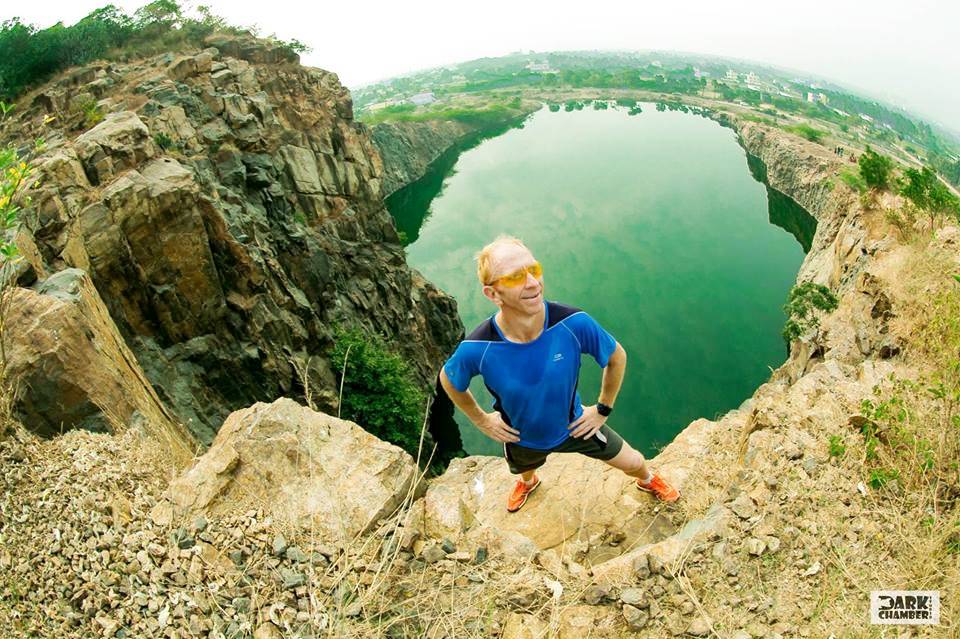
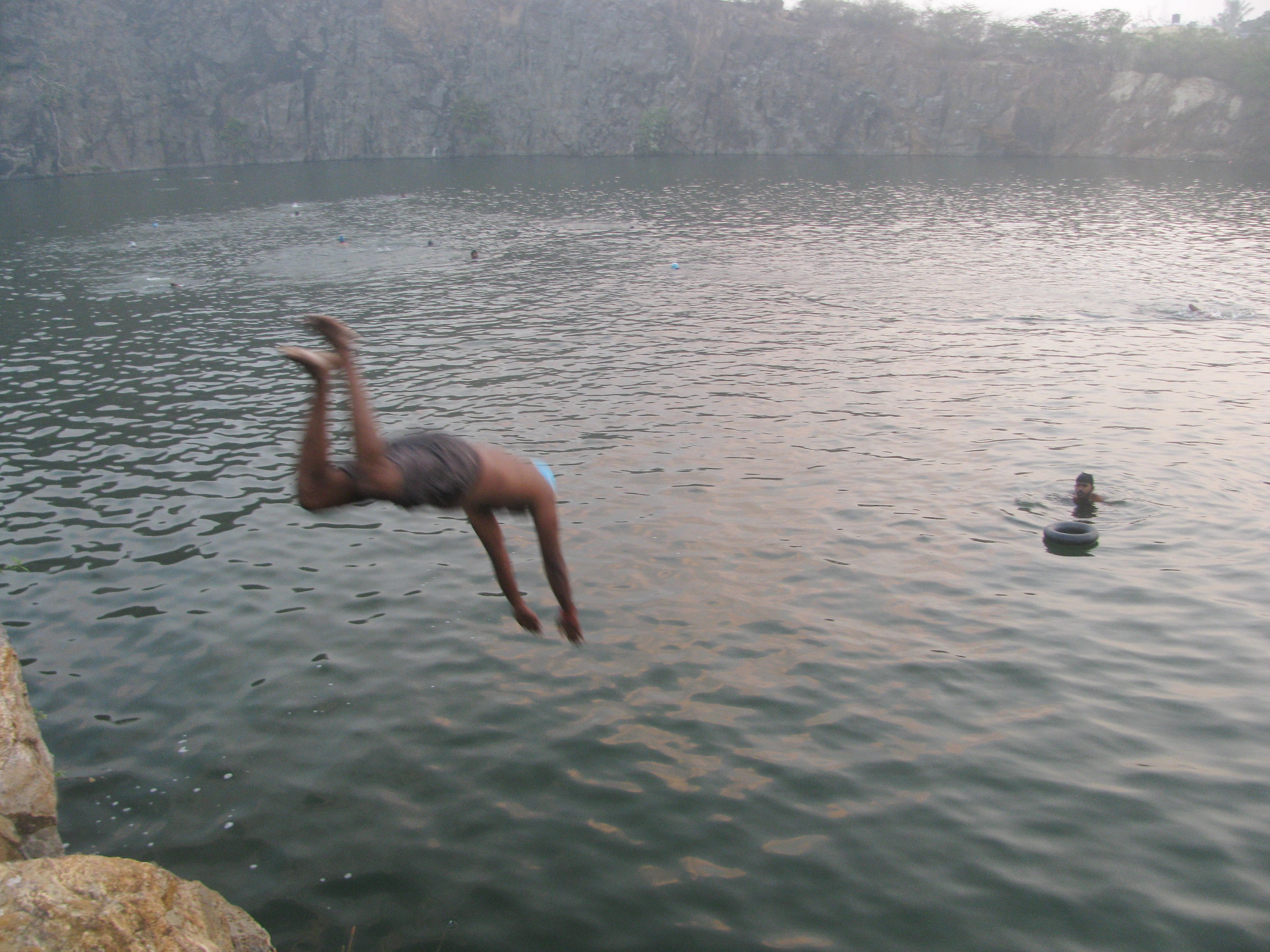
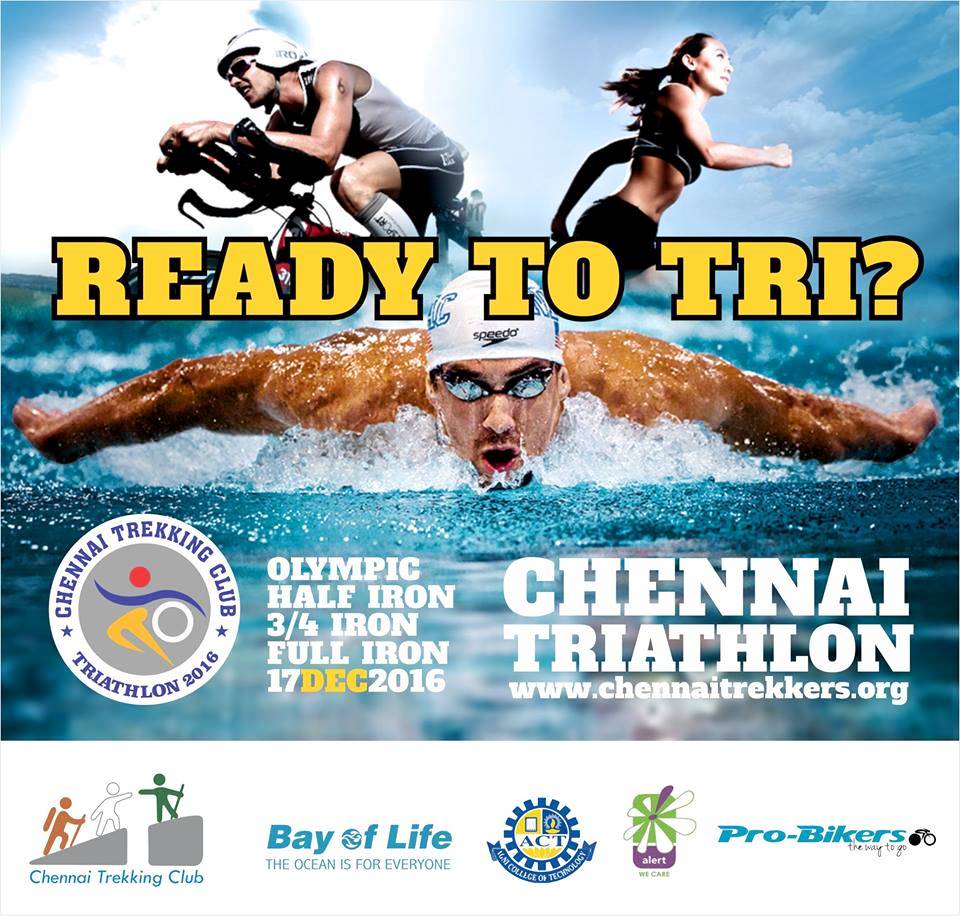
A few days after we spoke to Peter Van Geit, we came across a video on the Internet. As person wielding the camera, his voice was audible in the background. Some of those we had met along with him were in the frame. The location was out at sea; it appeared to be a sea-swimming session. A bunch of happy young people bobbed up and down in the gently heaving sea. Chennai’s profile graced a line on the horizon. The pleasure in talking to Peter is that despite his acceptance of social media as tool for networking, he hasn’t traded the outdoors for the comfort of commanding a virtual community. To meet him, we had to be at a large, deep pool – an abandoned quarry – at Ottiambakkam on the outskirts of Chennai. It was 6.30 AM and members of the Chennai Trekking Club (CTC), which the Belgian national founded years ago, were already swimming laps in it, preparing for the triathlon. Some of them, like Peter, were swimming after a stint of running still earlier in the day. The location wasn’t far from Chennai’s IT corridor. Swim done, the IT corridor was where many of those who came, headed to. Early morning run and swim, straight to office thereafter. A few days after we came across the video on sea swimming, Peter was in the news for running from Chennai to Puducherry (Pondicherry) and then running a marathon at Auroville. As Peter told us, I don’t have time – isn’t an excuse for denying oneself the active life.  If you are keen, you will find time. Born January 1972 in Lokeren in Belgium and completing his masters in computer studies from the University of Ghent, Peter moved to Chennai in 1998. Excerpts from an interview with Peter, founder of CTC and a project manager at Cisco:

Early morning; CTC members at the abandoned quarry in Ottiambakkam (Photo: Shyam G Menon)

Early morning; CTC members at the abandoned quarry in Ottiambakkam (Photo: Shyam G Menon)

CTC claims a Facebook driven-membership of 40,000 people. That’s a lot for an outdoor club. How do you keep them engaged? Do you have a busy calendar?

Our activities have evolved nicely and naturally over the years. Nothing planned. Every year we get into five new activities. Open water swimming, triathlon, ultra-running in the hills – it all happened so. Initially, we were focussed only on the weekends because all of us work. We never thought of making time for weekday mornings. Now they get up at 5 AM, they run, they swim; they do so many activities during weekday mornings. In the earlier days, it was mostly hiking on weekends. About two to three years ago we realised that we had time; so we started planning all 52 weekends. There are biking trips, hiking trips, photography trips. We also started doing major events like big marathons where over 1,000 people participate, triathlons and cleaning up of Chennai’s coastline. It got very busy with a mix of major and minor events. That’s why two to three years ago I started thinking how can we do more and thus became active on weekday mornings too. Now from Monday to Friday we do many activities such as running, swimming, cycling and zero waste community work. We go to fishermen’s hamlets for cleaning up the place, educate people on segregating dry and wet waste. We have been successfully doing this for the last six months in fishing hamlets close to Marina Beach. There are tree plantation activities going on. So a lot of things are happening on a daily basis. This February marked nine years since Chennai Trekking Club started.

peter-2

Trail running

Of the 40,000 members, how many are truly active?

That’s of course an interesting thing. I am a bit of a known person here. Whenever we meet there is somebody or the other who tells me, “hey Peter I am one of your members.”  My response is, “have you been to one of our events?” Nine out of ten people will say I have been a member for one year but I haven’t had a chance yet to attend. A lot of people become members seeing our pictures on Internet links and our Facebook page. I would say of the 40,000 members about 5,000-10,000 would be active. That is also a sizeable number. Of these, there are some people who probably come just once a month or for some weekend activity.

When it comes to a physically active life, the popular excuse you hear is that there is no time for it. In a city like Mumbai many activities are held over the weekend. How do you take out time during weekdays? Today for instance, you all first ran, then swam and will shortly proceed to office. How do you find time for this on a day to day basis?

Too many of us come up with excuses. All of us are working. Most of our active members are working in the IT corridor, which is within 30 minutes from where most of our activity is. If they start working at 9 AM then definitely they can do something till 8-8:30 AM.  I don’t think office is the limitation. It is more like people getting into morning habits. It is a mental issue. The morning is so beautiful. If you sleep by 10 PM and get a good night’s rest, you can start early with some activity. Once you get used to it, it is very addictive. If you go to office after three hours of sports you feel so fresh, so focussed.  This morning physical activity routine is so good. Everyone has time according to me. People think they don’t have time. Everyone has time. It’s just a question of discipline and motivation to get up early and start the day.

peter-10peter-12CTC is now a multi-activity club. Did this profile of activity grow organically or were there people driving specific interests?

Nothing was planned over the past nine years. It started with hiking. Then it was natural for a lot of photographers to join our group. So we had photography related trips. We took people to beautiful natural places. We were good at map reading; topographic map reading. So we were able to make our own trails. Because of my background in biking we also did a lot of biking trips. About 4-5 years ago we started getting imported bicycles in India. So we started mountain biking trips. More recently, running became quite a rage with the help of social media. Initially we did 10 km runs around the city. Now for the last two years I have also been actively involved in hill running. Once a month we go to a beautiful hilly place to do trail running. We have a lot of hills in Tamil Nadu. We do ultra-trail running; sometimes 50 km on Saturday, 50 km on Sunday. We run from morning till evening. It is not like a marathon where we run for four hours. All these activities have happened naturally. Once we started running we discovered this big quarry just 30 minutes away from our office and then we started swimming. We then started organising triathlons. Now people come from all over the country for these triathlons. We also saw a lot of natural places being spoilt by garbage and anti-social activities. So we started clean-ups and created awareness automatically. Then we went to the next level of garbage segregation and zero-waste communities. We are working with corporates and with schools to create awareness about it. Every year some three to four new activities are being added to the list.

How receptive are your members to these activities?

We have a very well connected group. We have a mailing list of 30,000 people and a Facebook group of 40,000 people. We are pretty good in capturing whatever we do with social media, visual photography, smartphone etc. We post a couple of pictures and then it gets picked up. Thanks to digital photography we are able to capture beautiful pictures and upload them quickly. The only thing that we need to do is to keep the activities going consistently. Our organisation is pretty flat and open. But we do have a core group which plans and drives activities. .

peter-22Events like triathlons can be competitive. When you look at CTC, are you looking at it from the perspective of building a competitive group of people or making activity more participatory in nature?

There are two elements here. One is inspiring more people to get into a healthy lifestyle. The other is competition. We are not that competitive. We do timed events so that people do the sporting events seriously maintaining the spirit of the event. That said, in the last few triathlons we did not have any rankings or places on the podium. We really want as many people as possible to get into swimming, cycling and running without it being too competitive. When I see people going for the top five or top three positions, I suspect they are losing out on passion as they are too obsessed with time and podium. For us it is not just sports. CTC’s mission is being close to nature such as beautiful jungles and mountain ranges. So we always combine sports with nature. We will not swim in swimming pools; we will not run on city roads. We always take people to natural places. If you spend one hour close to nature you feel so refreshed. You get so much from nature. All of us are born in nature. During the Republic Day weekend some 25 of us went to Meghamalai forests. For four days we ran and cycled through the tea estates and dense forests from morning till evening. The amount of positivity and freshness you get from doing this close to nature rather than doing 10 km loops in the city is something totally different. It is important for people to be close to nature because everybody in cities are so disconnected living in air-conditioned cubicles and enduring traffic, chaos and stress. They desperately need to reconnect with nature. The great outdoors has such a detoxifying and destressing impact on us. Most deaths in urban India are related to lifestyle problems. We want to move people into a healthy lifestyle. Nature is very important for physical and mental wellbeing.

peter-20

Running in the hills of South India

The Himalaya is often spoken about as the place to go to for outdoor activity. You have a great amount of experience in the outdoors of South India. What do you think about the options for outdoor activity in the south?

The Himalaya has always made a big impression on people, including me. Last September I did a self-supported 500 km solo run through Zanskar valley and Ladakh. In 2015 also, I ran 1000 km with a small group of people; not just in the touristy places of Manali-Leh but in remote places like Spiti. We carry our own tent. The magnitude, the remoteness and the beauty of the Himalaya is fantastic.

But here in the South also there are a lot of beautiful places. Many people say Bangalore and Pune are good. The Western Ghats are beautiful. Chennai is also blessed with beautiful mountain ranges. We have a couple of ranges like Nagalapuram, which is just two hours from the city. We also have a lake called Pulicat Lake. Lot of evaporation takes place, so clouds form, they rise and hit this range which is about 800 m high and then condense to form rain. Rains fall throughout the year in this place. Throughout the year there are pristine springs and because of that it is possible to go there throughout the year. Once you get inside the jungle, it is lush green forest. You have Kolli Hills and Javadhu Hills. We go to places in Kerala and Karnataka. There is the Kabini forest. In the four southern states there are so many options for hiking and other activities. Hiking in the south is nice because the weather is good. It is not too cold like the Himalaya. Also, the Himalaya attracts people for the snow and the peace. In portions, it is more like barren land, vegetation is bare. Here, on the contrary, we have beautiful jungles, lush forests; lot of water is present in these forests. In the Himalaya you cannot take a dip, here you can swim easily. Here it is quite safe to trek, there you have to be very careful because weather conditions can be life threatening. Here you can trek light, you don’t have to carry much.  I prefer hiking in the south.

peter-17peter-18The peninsula is where the Indian subcontinent meets the sea. We are blessed with a long coastline, one that is longer than the mountains to the north. Do marine sports interest you?

Once every two weeks we go for a long swim in the sea. I stay at Pallavakkam, just 200 m from the sea. So whenever I feel like it, I walk out of my home in swimming trunks, enter the sea and do a 2 km-swim. That’s again an amazing experience because of the vast openness. There’s nothing above you, nothing around you and all you can see is small houses along the coast line. It’s peaceful to swim in the sea. Eventually, we would like to organise triathlons in the sea.

You have had accidents at CTC, including a couple of fatal ones. Many states have begun drawing up regulations for outdoor activities. Arguably, there is a problem in India when it comes to imagining regulations for the outdoors. Given that Indian lifestyle is predominantly sedentary, rules and regulations are often imagined by people partial to the convenience of settled life. Do you find this a problem? Do you feel that rules and regulations are not sufficiently empathetic to the pursuer of an active lifestyle?

A couple of things on that: one thing that has been difficult for us is dealing with government agencies, whether it is forest department for permission to go on a hike or the sports department of the government. There is small time corruption. It is difficult for us to get permission to get swimming pools for triathlons. Similarly, it is very difficult to get permission from forest officials to get to do a hike. It is more like an administrative hassle and I am not even coming to the rules and regulations that might be there for adventure activity. It is the administrative hassle.

peter-16Do you think there is sufficient appreciation for adventure activity?

In Bangalore, there is an outdoor culture. Also, in the Himalaya there is a large community that is involved in the outdoors. But Chennai is very conservative. There is so much beauty around but people would go to the beach or visit Mahabalipuram. Or they would go for a movie and nothing else. Even now when we go hiking, many of the parents are wary as they think those going for hiking or trekking are just going to booze and do some anti-social activity. They don’t look at it as a positive activity. Many of the guys who come with us on a trek may not have informed their parents and that becomes a problem.  If an injury or a fatality occurs we have to deal with hostile parents. It is not easy but things are changing.  In the last three to four years outdoor activities have become popular mainly because of social media. If you look at Wipro Chennai Marathon, it has grown phenomenally in terms of participation. About four to five years ago very few people used to run the marathon but now it has grown to 20,000 in terms of participation which was unimaginable 3-4 years ago. Runners would post pictures of podium finishes and other related pictures and that would put peer pressure on others to join. Sometimes people are obsessed about doing something quickly without proper training. We are trying to get people on a regular basis into sports, make it part of daily life and not just see it as competitive events. I prefer regular ongoing activities rather than one marathon and one month to recover.

In Europe and America people grow up with the outdoors as part of their life. There is nothing like outdoor experience being apart from one’s normal existence. In India, life is largely around human clusters and space indoors. The outdoors is distinctly ` outdoors.’ Do you find anything different in the way the average Indian relates to the outdoors?

I see that youth here is so much focused on education and studies that there is absolutely no space left for other activities. I see very few parents encouraging their wards to get into other activities. These kids are always busy at school and occupied with studies. You only see them in the month of May when schools close for longer holidays. Outdoor activity has very less priority, I would say.  That’s a problem. I got a lot of exposure to nature during my younger days. I started swimming quite early. I used to go hiking with my parents. Whatever you do at a young age makes a huge impact. Young minds are very perceptive. Doing something later becomes much more challenging.

Chennai is pretty conservative compared to other cities. In school and college years, youngsters are busy with studies. Once out of college and into a job, particularly the IT sector; then, they join us. Some of them are very passionate and quite regular. Then after about two to three years they disappear completely. Once they get married they are off the radar. Not like in Europe where you see parents with two kids coming for adventure activities. Here, once you are married you are not supposed to do any of these activities. About 90 per cent of them would disappear into married lives. This is a problem for me. I need organizers to carry on activities. Some disappear as they get relocated to other parts of India. Once they get out of Chennai they lose the momentum. Also, they don’t have that energy. Some people are lost when they change jobs and then they get too busy. Some go abroad for further studies. These are some of the reasons, active people disappear completely. That’s very sad because whatever passion they had will have to be buried and whittled down.

peter-19When it comes to outdoors there must be emphasis on environmental sensitivity. Your organization brings large volumes of people to the outdoors. How much do you emphasise environmental sensitivity?

There were reports about organisations taking people to Himalaya in large groups of 50 or so. Himalaya is a very sensitive place. What we do here is we put a head count. On a hike, we won’t take more than 20-25 people. We are very strict on that because if you take more numbers there is the issue of safety and also the issue of environmental impact. It is a bit of a challenge. Almost every weekend we take people to some spot or the other. One thing we do – judiciously, depending on the place – is that we don’t follow specific trails. We go through the wilderness using maps and GPS like explorers making our own trails. That way we kind of spread out and don’t go on the same trail. We don’t want to leave a permanent trail. People have criticised Chennai Trekking Club because we were taking 300 people to some places. We have to strike a balance between bringing people close to nature and yet keeping nature largely undisturbed. We try and do activities in places which are not virgin nature. More than hiking we do a lot of trail running. Here again, we don’t go into deep jungles but mostly run on jeep trails between villages. Hiking is now pretty balanced. We never leave any garbage behind. We are very strict and disciplined about littering. We ourselves carry out environmental campaigns where we educate people about garbage. When people come with us they learn about the place and get very excited about the natural beauty. But some of them return with private groups and that’s when the problem of littering starts and things get nasty especially in places which are easily accessible.

How do you ensure safety? Do you have safety clinics at CTC?

Safety is very important and has many aspects to it. One very important aspect is to have the right organisers. All our organisers have grown as people. They have been coming with us for years and they are very responsible, very experienced. We often have two leaders on a trip, one in the front and one at the back of the group so that managing groups becomes easy and people don’t get lost. Number one killer is water. There are some people who get very excited seeing water and sometimes they jump in even though they do not know swimming. They assume someone will pull them out. We had a couple of cases in which people have drowned. Another problem is people straying away from the main group and then doing stuff which they are not supposed to do. Lack of adherence to safety is the number one killer in these outdoor activities. We are very strict about safety. We also make sure that our organisers and rescue team are excellent swimmers and are able to pull out people safely. We always ensure that non-swimmers carry tubes or life jackets with them when they enter water. In Himalaya, weather is the reason for calamities but here it is mostly water that causes fatalities. We do a lot of treks to places where there are beautiful streams and waterfalls around. We ensure that we keep an eye on people going into water. We do regular workshops in the group on first aid, basic CPR and we have an ERT group (emergency response team) who we can call anytime. When some people go missing, we call the ERT. They are very experienced and they come within a couple of hours. All these systems have naturally evolved over the years.

peter-14When you dealt with serious accidents like fatal ones for instance, what did you personally feel? Did you feel that you were dealing with people who understood what you are doing or was it a case of adventure, outdoors – all those tags automatically branding you as guilty?

Everything completely depends on the reaction of the parents. There are parents who say this was fate. And then we have had parents who went against us even though we had nothing to do with this. One time there was a youngster who jumped into the water wearing jeans. He is a good swimmer but all of a sudden something happens and he drowns. It all depends on the reaction of the parents.

In many instances the victim of an accident in adventure / outdoor activity is an adult who consciously participated. Yet when things go wrong, that wilful participation by an adult is overlooked in the quest to fix blame.

That’s definitely an issue. People in their 40s and 50s are still living with their parents and listening to their parents about what they should and should not do. I come from Belgium, which is not as forward as other countries. I come from a place where there are divorces and kids run away. I come from a place where the social fabric is disturbed. I concede that. But here people are too much under the control of their parents and too entangled in the social lives of relatives. I see many people who are extremely passionate about the outdoors facing tremendous pressure from their parents to get married, have children and then focus on the lives of children. It’s a vicious circle.

Now there are situations wherein people don’t inform their parents about doing a trek because they are conservative. This becomes a problem. We, therefore, have a disclaimer that people joining in for our activities are doing so at their own risk. Ours is not a commercial organisation. We are all doing these activities because we are passionate about them and we do it in our free time. We all come together on an equal footing. About 20 or so people come together to do some activities. Of course, we ensure safety to the best of our ability. We have had serious difficulties with some parents, who were politically connected. We try to do a lot such as supporting the parents, helping in recovering the body, helping in transporting the body home and such stuff. There was once a case when one person from the group strayed off the path and went on his own trail. That gave us a lot of negative publicity. For the next four days we were looking for that guy. He went on his own journey. He never understood what trouble he caused us. The first thing we did was we informed the parents about their missing son and also gave them the location with latitude and longitude details. Police could have easily come there but police do not have the capability to come there. We went on a very active search inside a thick jungle.

From a clean-up drive by CTC. in Chennai.

From a clean-up drive by CTC in Chennai

You did exemplary work during the time of the Chennai floods. What was the motivation for that?

Our group is an open group. It is fully volunteer-driven. People come because they have a shared passion. Bangalore has so many groups but some of them have a commercial purpose. In contrast, we are a group of people driven by a shared passion who come together to run, swim, cycle and trek. So the energy and spirit is much more open. When something like a natural calamity happens, automatically people come together. During the floods, in a couple of days we had about 400 volunteers coming together and setting up relief centres. Social media helped in bringing everybody together but people came on their own. We started making kits that would help one family for two weeks. The coming together of people to help was akin to volunteering during an event. For instance, during a triathlon also volunteers are happy to organize the entire event. People spontaneously volunteer for events, they don’t sleep for two days, they prepare everything, set up the route, set up podiums and do all the preparatory work. We have been involved in clean-ups throughout the years. Perseverance is the key to keep the momentum up. And then it is backed up by social media.

(The authors, Latha Venkatraman and Shyam G Menon, are independent journalists based in Mumbai. Where photo credit hasn’t been provided, the photo concerned was downloaded from the Facebook page of Peter Van Geit and used with his permission.)

MAKING UP FOR YEARS LOST

Venugopalan Arunachalam (Photo: Shyam G Menon)

Venugopalan Arunachalam (Photo: Shyam G Menon)

It wasn’t difficult locating Venugopalan Arunachalam in the park.

True, Tower Park in Chennai’s Anna Nagar had many people by evening. But there was only one person in distinct running shoes, track pants and a bright colored T-shirt that said: Chennai Runners. No need for smartphone and quick reference of Facebook photo; your senses said he had to be the quiet person, sitting at one end of a park bench. That’s another attribute, if one may submit, of those who have journeyed long in endurance sports – they typically have an air of self-contained detachment.

Over the next two hours, we were treated to a conversation that every company in the country – public and private – should perhaps take note of. A septuagenarian now, Venugopalan was born almost 600km away in the port town of Thoothukudi (Tuticorin). He was the third child among six siblings. His father worked in the Post & Telegraph Department. That meant several transfers on work within the country. Venugopalan started school in Jodhpur but soon enough, the family shifted to Kalyan near Mumbai. There, he studied up to third standard before moving south to Thoothukudi, where he stayed with his maternal grandmother and studied up to class six. “ It was there in school that I won my first race in running. I was probably ten years old and a got a red soap box as prize,’’ he said. While Venugopalan was in Thoothukudi, his father had continued at his work in Kalyan. With his father being transferred next to Jabalpur, Venugopalan followed, struggling in the process with the shift from Tamil medium of education to English medium. At school in Jabalpur, he found himself qualifying in the heats for the 100m, 200m and 400m races. He practised daily for the finals. “ In the finals I came last in all three. The competition was really good,’’ he said. However that outing was both beginning of life as runner and a precious lesson learnt – maybe his strength wasn’t racing fast but racing long?

Venugopalan (left) at an event (Photo: courtesy Venugopalan Arunachalam)

Venugopalan (left) at an event (Photo: courtesy Venugopalan Arunachalam)

In those days, the “ mile-race’’ was a popular fascination. For the following year, Venugopalan thought of registering for the 800m and 1500m events. He was a small, lean lad. In his tenth, eleventh and twelfth standards, the rather reserved and independent thinking youngster from Thoothukudi trained regularly for the distances he aspired for (he used to run five kilometers everyday) and consistently managed podium finishes in the 400m, 800m and 1500m disciplines. He also merited a second place finish in a 3.5 mile-race. “ It convinced me, I am better at long distance running,’’ he said. He practised his running mostly at night. His family was supportive. “ They didn’t know how much I was running but they were happy to see the certificates come home,’’ he said.

Following his school years, Venugpolan opted to study mechanical engineering. While his father shifted to Delhi on work, Venugopalan moved to the Benares Hindu University (BHU). There, after other students had completed their daily dose of football, he would run on the ground, savoring the everyday fix of five kilometers he had got used to from school. On BHU’s annual Sports Day, he would participate in the 800m, 1500m and 5000m competitions, usually winning all three. “ Engineering students are typically a studious lot. Work load is high and they don’t have much time for sports. The competition I faced in these races was mostly from arts and science students,’’ he said. Venugopalan passed out from BHU in 1968. He secured a job at Bharat Heavy Electricals Limited (BHEL) in Trichy. The company – a public sector undertaking (PSU) – was one of the leading industrial enterprises of the government. It was Venugopalan’s first job after BHU. For the next 40 years or so, until his retirement over a decade ago, aged 60, he remained at BHEL. Joining the company was a turning point. Life changed drastically for the young man used to running five kilometers every day and enjoying races, since school.

Photo: courtesy Venugopalan Arunachalam

Photo: courtesy Venugopalan Arunachalam

At Trichy, BHEL had its own cocooned ecosystem. Its township was a good 14 kilometers away from town. There was running and sports in Trichy. But its vibes rarely reached the insulated township. “ The problem I faced was this. Both the Indian Railways and the military encourage athletics as part of sport. PSUs, in contrast, were partial to games. They had no interest in comparatively solitary pursuits like athletics,’’ Venugopalan said. By nature, he had little interest in games.  Result – at BHEL, his active life came to an utter standstill and his fitness nosedived. At Anna Nagar’s Tower Park, the septuagenarian Venugopalan cut a trim figure. Back in his BHEL days, despite no smoking and drinking, by the time he hit his mid-thirties, he had sprouted a tummy. Around that age, all BHEL employees had to go in for a mandatory medical check-up. In the check-up, he was found to be mildly diabetic. It rang alarm bells for there is a history of diabetes in his family. Venugopalan speaks rather bitterly about this turn of events. Although he resorted to walking to stay fit following the medical diagnosis of diabetes, up until his eventual retirement and exit from BHEL, there was no relapse to running. He says it was simply impossible in the ambiance of the township. For instance, the athlete in him was soon looking for ways to make walking more engaging. He read up on race-walking and began practising it. Needless to say, that made him an oddity. By the time people hit that midlife medical test, many would be advised to walk. But few – likely none – race-walked as they do at the Olympics. One man doing something different stands out in crowd of conformists. Is that why the industrial environment is partial to games? Games teach you to collaborate and conform as a team, while athletics is often a solo trip to self-discovery? One wonders.

Illustration: Shyam G Menon

Illustration: Shyam G Menon

“ I firmly believe athletics should be encouraged at PSUs. On the one hand we say that it is not machines but manpower that is the wealth of an organization. But then, we make no provision for the health and wellbeing of this manpower. In their own interest, corporates must make arrangements for their people to have an active life. Running is the least infrastructure-intensive of sports. You can even do it alone. Nowadays, the private sector has begun recognizing this but PSUs in India still lag,’’ Venugopalan said. It wasn’t BHEL alone that appears to have weaned athlete away from his regimen. Along the way, Venugopalan got married and raised two sons. In the Indian context – as both culture and economics – family is a commitment and society’s perspective of this institution rarely accommodates what the individual desires personally for meaning and fulfilment in life.

Photo: courtesy Venugopalan Arunachalam

Photo: courtesy Venugopalan Arunachalam

When Venugopalan shifted from mere walking to race-walking what catalyzed that move in man tucked away in industrial-township was the growth of the Internet. The worldwide web brought the notion of larger planet home; suddenly it was possible to leap over immediate society and notice others like you elsewhere. “ I read up on race-walking and started to practise it,’’ Venugopalan said. Used to having an early dinner, he was the type who experienced wakeful hours by 3 AM. So he started to go out for race-walking that early, come back and sleep again. Slowly, a commitment and devotion to something he was passionate about, built up.  In 2005, Venugopalan retired and moved to Chennai where he stayed on rent in Anna Nagar West Extension while his house was being built in Anna Nagar West. Given he had elected to tackle his diabetes through exercise he continued the daily walking he had started at age 35. One day when out walking, he saw a marathon underway and elite African athletes go by.  “ It ignites a spark in you. Such images, you don’t forget at all,’’ he said. Long forgotten running legs stirred restless again.

As luck would have it, in ` The Hindu’ newspaper, he read about the group – Chennai Runners. He joined their Google group, regularly perusing their posts on running, occasionally pitching in with a comment. Meanwhile, his friend and running partner from BHU days – Brigadier K. Venkatraman – called up from Bengaluru informing that he had been running the marathon. “ That is how the seed to resume distance running was sown in my head,’’ Venugopalan said. His first attempts at running in the local park were a total failure; he would be out of breath in no time. So he started to jog around in his apartment, emerging to run in public only after he felt ready for the transition. He chose a 10.5km-loop in Anna Nagar for his daily run, covering it on the average in about 70 minutes. He ran 10km every day, raising the distance to 15km on weekends. Soon enough, he reached that point where he could run 10km without a break. Then the inevitable happened: one day he did two laps of the circuit, making it a half marathon. That was the first time, he had done 21km. “ It was a really good feeling,’’ he said.

Photo: courtesy Venugopalan Arunachalam

Photo: courtesy Venugopalan Arunachalam

The East Coast Run in Chennai featured distances of 10km, 20km and 30km. In 2009, he did the 30km segment, completing it in a mix of running and walking. “ There I got recognition from Chennai Runners that at close to 64 years of age, I was able to cover 30km on foot. The way they used to talk and chat about it; that gave me self-confidence. It really helped me. People came to me, they spoke to me, they became friendly,’’ he said. The sight of elite athletes in action, which sparked the resumption of running, had been from the Chennai Marathon. A year after that sighting, Venugopalan did the half marathon segment of the event, completing it in 2:20. “ Towards the end, I was quite tired,’’ he said. Then a smaller version of the BHEL-quarantine struck. Like most Indian parents, Venugopalan and his wife wanted to see their sons married and settled in life.  The sons though – the elder one in particular – had a mind of their own. Over time, Venugopalan’s wife, initially skeptical of her husband’s running, had both become empathetic towards it and even commenced her own share of walking. However as prospective alliances for their sons fell by the wayside, she decreed that Venugopalan’s running should be halted till the required marriages occurred in the family. Two years went by so. During that period spanning 2010-2012, his friends in running would call up to inform of upcoming events, even offer to get him out of the house and running. He declined the offers, determined to address family responsibilities. At best, he went along to see his friends run. “ That’s hell, to see others run and not be able to run myself. My children are now married. Thank God the embargo on running did not extend to my children having children too,’’ he said laughing in jest about the many eccentricities of the Indian predicament.

In 2013, Venugopalan ran his first full marathon at Auroville in Pondicherry, covering the distance in 4:55. Later in the same year, he participated in the Wipro Chennai Marathon. He completed the full marathon there in 4:05. He has since gone on to get podium finishes at the Standard Chartered Mumbai Marathon (SCMM), finishing third in his age category in the full marathon in 2014, first in 2015 and third again in 2016. His personal best in the full marathon is 4:04. Aside from walking at aid stations along the way, at full marathons, he runs the rest of the distance. In between, he also did a race involving six hours of cycling and six hours of running. However, the gains have not been without their share of related problems. He has had to cope with running injuries. But what has laid him low is herpes. Its onset has meant a weakening of muscles. It forced him off the 2017 SCMM; he didn’t participate. Ageing athlete hasn’t given up. He has embraced the Pose Method of running, wherein gravity is roped in as active partner to aid one’s running. “ Using this method I am now able to cover 20km in 2:18. I must now add speed. I haven’t run a race yet using the Pose Method. Now I have to,’’ Venugopalan said.

Photo: courtesy Venugopalan Arunachalam

Photo: courtesy Venugopalan Arunachalam

The evening light was now slowly fading and as the sun threatened to drop out of sight, the urgency of those playing games in Tower Park grew. A misdirected smash from a volleyball match racing against sunset saw the ball land close by. “ Careful, careful,’’ Venugopalan gently told the youngster who came to pick it up. He has often thought of what made him run years ago. He didn’t have a single answer. In his childhood he has chased after his older brother as the latter and his friends ran around pushing their toys – was that how it all started? He doesn’t know. “ I don’t quite know why running interests me. I think I like the feeling of the wind blowing in my face. It used to give me a lot of happiness. It is also true that when I run, I feel my body and mind is one and not limited. It is expanding. I feel I am one with the universe,’’ he said.

(The authors, Latha Venkatraman and Shyam G Menon, are independent journalists based in Mumbai.)    

THE KARANJA METAPHOR

Meena Barot

Meena Barot

The story of a woman, who overcame her fear, used what she had around her to train and completed a half Ironman.

“ I wanted to do something in life rather than just get married,’’ Meena Barot said.

It isn’t that her parents didn’t understand. The larger family and community she found herself in didn’t expect women to work.

Most women married and settled down, raised families.

If there was anything for a woman to gravitate to, it was that predicament.

Born 1972 in Vadodara (Baroda) and roughly a decade later, shifting to Belapur in Navi Mumbai, Meena wasn’t one bit inclined to tow the community line. In her schooldays, she was into athletics and excelled at badminton. “ That sporting spirit probably brought some aggression to the table,’’ she said, mid-2016, at her neat apartment in Kharghar, where she stayed self-contained, two bicycles for company.

Realizing early that India assigns set direction for girl child and one’s own effort is the only way to foray a different path, Meena kept busy. Continuing on to college, she worked part time while still an undergraduate. She did her PG Diploma in Pathology from Grant Medical College and worked full time at Hinduja Hospital as a lab technician for the next four years. “ I believe every woman should be financially independent. Dependence and relations can take a twist at any point in life,’’ she said, adding, “ you don’t need others to tell you that you are strong. You need to realize it yourself.’’ While still at Hinduja Hospital, Meena enrolled for a MBA in marketing from the Narsee Monjee Institute of Management Studies (NMIMS) and successfully completed it. She funded that MBA course entirely with her earnings. “ It was a struggle doing all that. But the struggle made me a strong person. My life to date has been my decision,’’ Meena said.

Meena with her team at the China office of Shalina Healthcare

Meena with her team at the China office of Shalina Healthcare

Following the MBA, she worked for three years at a company called Becton Dickinson, shifting later to a smaller outfit called Shalina Healthcare, which though smaller, allowed her room to learn. In their employ, Meena moved to Shijiazhaung near Beijing, tasked with setting up operations for the company in China. She had to do everything from scratch, from finding a place to stay to finding a place to set up office. Shijiazhaung had just two other Indian families. Indeed there were few foreigners in town. “ It was tough but the local people were good,’’ she said. Back in Navi Mumbai, for some time now, her father had known that his second child had no appetite for conventional womanhood. According to Meena, he maintained his views on life but rarely interfered with her choices. When she got the offer to move to China, she didn’t inform him at first. Once everything was in place and the shift was imminent, she broke the news at home. The China angle also came at the right time. With her siblings marrying and settling down in life, there was pressure on her to follow suit. China put an end to that. For the next five years – from 2005 to 2010 – she was based there. One of the highpoints of that tenure happened in 2008. As the Beijing Olympics drew close, Meena who participated in a contest by Lenovo to choose a bunch of ordinary people who would get to carry the Olympic torch, found herself in the lucky lot. After the relay, she got a torch as memento; it is there at home with her.
Meena with the Olympic torch; from the torch relay head of the Beijing Olympics

Meena with the Olympic torch; from the torch relay ahead of the Beijing Olympics
From a weekend cycling trip in China; Meena with friends

From a weekend cycling trip in China; Meena with friends

Setting up a company office entails much work. There was considerable stress. A year after moving to China, in 2006, she was diagnosed with hypothyroidism. It triggered weight gain; she nudged 90 kilos. Living alone and the long, lonely stint endured from schooldays, navigating her path in life – all that was also taking their toll. “ I was in the happiest phase of my life. Strangely, I was also depressed,’’ Meena said of that period in Shijiazhaung. What particularly depressed her was the loss of stamina. Going up stairs had become difficult. She joined a gym, working out regularly after work. It helped physically (she brought down her weight to 80-83 kilos) and while it did help mentally, it also posed a fresh problem – over time gym becomes boring. For engaging alternative, she joined a badminton coaching class, where the students were mostly children. That didn’t demotivate her, she kept up the routine till a new set of problems emerged – knee pain and lower back issues. The doctor she consulted while on a visit to India, said, “ no exercise.’’ Once back in China, Meena took up cycling. She was getting on a bike after 25 years or so. It was a lady’s bike called ` Emily,’ single speed, no frills. She started cycling to office. Soon she was going everywhere on Emily. Around 2008, she bought a Giant MTB (mountain bike). The shop, which sold her the bicycle, also hosted organized rides. That way, Meena started riding 30-40 km on weekends. China is both the nerve centre of global bicycle production and home to a large number of people using bicycles for day to day commute. “ Half of our regular road in India – that is how much space they demarcate on roads for cycling,’’ Meena said. Her parents visited her in China. She remembers the visit for her father’s observation. “ I am happy you didn’t get married although I pressured you to,’’ he said.

In December 2010, Meena moved back to India and Navi Mumbai. Reason was her father’s ill health. He had a heart problem having suffered his first stroke in 1987 followed by a bypass surgery in 1992 after his third stroke. In 2009, he was victim of yet another stroke; this time, severe. He had called up Meena in China and asked her to return. Not long after she returned, in March 2011, he passed away. He was 66 years old. Meena felt the loss, deeply. She had moved back to Mumbai with the same company that sent her to China. In India, she was tasked with setting up a new department and that involved considerable work. So much so, that within a week after her father’s demise she was back at her office desk. “ That got me thinking – what am I living for?’’ she said. The old depression was coming back to haunt.
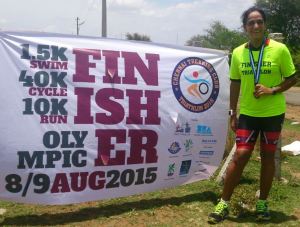
From the 2015 Chennai Triathlon

From the 2015 Chennai Triathlon

By November 2011, she had made up her mind to quit her job. It was a well thought through decision – she had cleared her loans, had some savings, endured a high pressure job with consequences and wanted to be done and over with that lifestyle. China had sent her back with a hobby for gift – cycling. She was now cycling regularly in Navi Mumbai. One of the friends she made so was P. V. Subramanyam (aka Subra). He was a member of Navi Mumbai Runners (NMR). He kept saying that Meena should get into running. By then, she had also linked up with Shalil Nair, one of the founders of NMR. In 2012, after her last day at work, she went out for a run with Nair who incidentally asked her about her background and realized that she was between jobs. He was Director, Human Resources at Institute for Technology and Management (ITM Group of Institutions). Meena was offered a job as part time lecturer at ITM Business School in Kharghar. “ I was thus unemployed for only eleven days,’’ she said. She sought six months break before joining. In that time, she did a cycling trip with Youth Hostels Association of India (YHAI) in Himachal Pradesh, to the Jalori Pass.
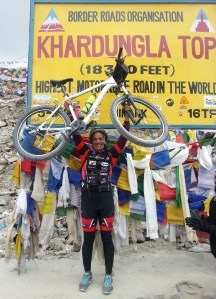
From a cycling trip to Khardung La in Ladakh

From a cycling trip to Khardung La in Ladakh

One of the great challenges for people living alone is – what do you do with time? Bereft of human company and the evolving dynamics of person meeting person characterizing crowded Indian life, time sits still, a palpable quantum on one’s shoulders. A sense of engagement is essential. If you don’t have that, the very fabric of life – time, can turn against you. Still insufficiently engaged in life for a person of her nature, time was turning against Meena. Over January-June 2012, she was severely depressed. “ I had nothing to look forward to. The biggest issue was – what do I do with my time?’’ she said.  The good thing about life is surprises lurk in every corner. Kripa Sagar is Meena’s friend, met through cycling. “ I had heard about Meena from some friends. I met her sometime in 2011 after she returned from China. She was into cycling. Our first ride together was to Nere-Maldunga, off Panvel. She came across as a very unassuming, friendly and grounded person who was at the same time a strong woman. I enjoyed her company,’’ Kripa said. One day Kripa had gone cycling to Kharghar; she called up Meena and asked if they could meet for tea. “ I went over to her house. While sitting in the balcony, I mentioned to her: why not do Ironman? We both agreed to try,’’ Kripa said. Meena had neither done distance running nor did she know well, what Ironman was. She read up on Anu Vaidyanathan – among India’s best known triathletes – and lapped up what she could learn about Ironman. It was 2012. At least a half Ironman by 2016 seemed possible. Less than four years remained. As with China, it was another start, almost from scratch. “ Meena took on the challenge seriously and trained intensely. It was a very tough training session that she chalked out for herself. Some days, she would train for 7-8 hours. Many runners and athletes could not keep pace with her intense training schedule,’’ Kripa said. Although Ironman was an idea shared by both, Kripa had to drop out as she was committed to another project.
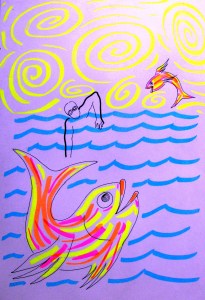
Illustration: Shyam G Menon

Illustration: Shyam G Menon

Ramachandra Rao is a senior runner living in Kharghar. He used to be an organic chemist and researcher with Ciba Geigy (now part of Sandoz). He got into running during his days at university in the US. Every morning, he and his wife (she likes to walk) go out for a walk and a run. A quiet person and a dedicated runner, Rao is a member of NMR. He first met Meena on a NMR-run from Nere to Maldunga. It was some time before Rao got to know her better; that happened mainly because Lavanya Chillara, a runner staying in Rao’s housing society and Meena, used to run together. “ One thing sets Meena apart from others,’’ Rao said, “ others plan but often don’t do, she plans and executes meticulously. She is very committed.’’ According to Rao, once the Ironman idea was in, Meena went after it diligently. She had Daniel Vaz as her running coach. Off and on, Rao would run with her. “ In one year, she improved a lot from jogger to runner,’’ Rao said.

By October 2012, Meena had run her first half marathon at that year’s Vasai-Virar Mayors Marathon (VVMM). The same year, she also got to know of the Brevet des Randonneurs Mondiaux (BRM) events in cycling and consequently rode 200 km from Borivali in Mumbai to Cheroti and back. Determined to improve, she found a cycling coach. Soon she was regularly cycling and running. By 2013-2014, she was securing podium finishes at some competitions. In 2014 she participated in a duathlon organized by Kripa Sagar – 100 km cycling plus 21km running. The cycling was from Navi Mumbai to Nariman Point and back, while the running was done on Navi Mumbai’s Palm Beach road. However, if the Ironman was to be goal, Meena had a major obstacle to overcome. She didn’t know swimming and, she was scared of water. In June 2014, she joined the Belapur YMCA’s coaching sessions to learn swimming at their pool. It taught her the basics. As was her habit, she kept working at pushing her limits. There was a big problem. She may have learnt to swim and overcome some of that fear of water in the process. But the Ironman event required her to swim in open water and the two – swimming in a pool and swimming in open water – are two distinctly different animals for those tackling water right from the basics. In one you have a sense of containment and accessible safety, in the other, you are on your own and safety isn’t quite at hand. Where was she to go for a taste of open water?
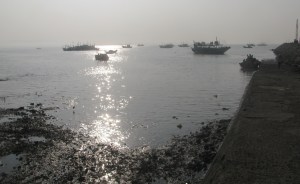
Karanja (Photo: Shyam G Menon)

Karanja (Photo: Shyam G Menon)

The question is stupid in Mumbai-Navi Mumbai for the urban agglomerate is right next to the sea. But it is also one intense mass of human habitation and industrialized to boot. The sea around Mumbai-Navi Mumbai is polluted. To compound the problem, the coast in these parts sees significant ingress and egress during tides. Most beaches during low tide are an ugly sight with debris and garbage exposed; the scene sticks in mind even if you swam only during high tide. What do you do? In the meantime, Meena had registered for the 2015 Chennai triathlon and the Hyderabad triathlon. Her running was improving; she had even ended third in her category at one of the editions of VVMM. She was also regular at the BRMs. Roughly two hours’ cycle ride away from Belapur is Karanja. It is on the edge of the sea. People come to the boat jetty here to take a ferry and cross over to Rewas. On a Sunday morning, a cyclist reaching here from Navi Mumbai would be treated to the not so dainty sight of muddy land surfaced in low tide, fishing boats with their hulls exposed in the receding tide and murky waters typical of tidal zones. It was to Karanja and its boat jetty that Meena turned to for familiarity with open water swimming. She was determined to go for an Ironman. She knew she had to make do with what was available. No point complaining. Accompanied by her swimming coach and good friend Ramachandra Rao, she frequented Karanja, where they went out in a rented boat with Meena subsequently swimming in open water supervised by her coach. “ The water was very muddy. It was also prone to tides. I was a bit concerned about her health, swimming in that water. Meena though had no hesitation in jumping in and swimming,’’ Rao said. Despite her efforts, she would remain a slow swimmer. At Chennai, it took her an hour and ten minutes to cover 1.5 km; at Hyderabad where the swim was in a pool, she needed an hour and twenty minutes to cover 1.9 km. Internationally the cut off time for 1.9 km is 1:10. Altogether, she took nine hours to do the half Ironman distances at Hyderabad. To compete in Europe in 2016, which she planned to, she required cutting this time by a whole hour.
At the Hyderabad Triathlon

Then in December 2015, while working out at the gym, she injured her lower back. “ I just could not bend,’’ she said. In January 2016, running the half marathon at the Standard Chartered Mumbai Marathon (SCMM), she noticed mild pain in the left leg. At a cycling trip in Sri Lanka, which preceded SCMM, she had felt heel pain. She managed to complete the half marathon at SCMM in 2: 12. However the heel pain steadily worsened till it was diagnosed as Plantar Fasciitis. Post SCMM, there was no running and looming ahead in July 2016, was the half Ironman she had signed up for in Budapest, Hungary.  To add to her woes, the 2015 monsoon season had been weak with resultant water shortage in the state of Maharashtra. By March 2016, many swimming pools in Mumbai-Navi Mumbai had shut. Meanwhile, to reduce the heel pain, the doctor recommended a steroid injection. By mid-April she was back to cycling and running. For swimming, it was Karanja. Then towards April-end, the heel pain returned forcing her to stop running. By May, she was left with only cycling to do. It didn’t end there. In mid-May, while training, she fell from her cycle. With that, she was off running, cycling and swimming. How much adversity will life throw at her? “ I used to cry a lot,’’ Meena said. Her friends told her to take it easy.
Budapest Half Ironman; Meena just after finishing the swim segment

Budapest Half Ironman; Meena just after finishing the swim segment

On the bright side, she was able to merge an ITM trip to Europe, with the Budapest Half Ironman. In Normandy she found a place to run, cycle and swim. With weeks left for Budapest, she trained as best as she could. Ahead of the event, Ramachandra Rao – he had become instrumental to keeping her motivated – texted Meena regularly with positive thoughts. On July 29, a day before the half Ironman, there was a trial swim in open water at Budapest. “ I went into the water and panicked. I tried five to six times but I kept coming back. I was scared, it was psychological,’’ Meena said. There was a sense of endless depth to the water and seeming absence of limits nearby to the expanse of water she had to tackle. She decided against participating in the event. Some of the Indian participants told her not to do so and to at least swim up to the buoy midway. But as she did so, she panicked again attracting the attention of the rescue boat. The doctor on the boat shouted at her, “ what you are doing is not swimming! This is not a swimming pool. You will kill yourself!’’ Back on land, those comments hit Meena hard. From January 2016, given all the reverses life had thrown at her while preparing for the half Ironman, she had been battling depression. The universe didn’t seem to notice what she had done; all it appeared to see and enjoy toying with, was her nervousness in water. Suddenly her motivation crashed. She sat in Budapest, eating ice cream, hoping to lift her spirits up. “ I didn’t tell anyone back home what I was going through. The only person I called was Mr Rao,’’ she said. He told her to calm down and relax. It brought back some of her motivation. She decided to attempt the race. “ I know her potential. I was very positive that she will do it, provided she keeps her mind calm. I told her to remain calm and see that thoughts don’t disturb her mind. Don’t get involved in it. Always think that you have the ability to do it. It is easy to say so but to practise it in adverse situations, it entails much work,’’ Rao said. Meena also had a chat with a colleague from ITM, Deepthy, who got her to meditate. Thus calmed, she fell asleep.
Meena, cycling at the Budapest Half Ironman

Meena, cycling at the Budapest Half Ironman

On July 30, race day, she decided to tackle the swim in segments and not visualize it as the entire distance it represented. She also told herself: it is okay to be last. What is important is to attempt the swim. “ If you don’t attack fear at the time it appears, then it sets in for life. I will then live my life knowing that I messed up at the starting point and didn’t attempt the race at all,’’ Meena said. Further as the medic’s shouting of July 29 showed, the rescuers were alert and good. She was in safe hands. She finished her swim just within cut-off time, in an hour and ten minutes. The organizers provide a grace period of 50 seconds. By the time she started cycling, the professionals had already completed their first 45 km-loop. But there was a pleasant difference to their cycling. “ They cheer you on,’’ she said. Both the cycling and the running went off well for her. In the end, she finished the half Ironman in Budapest in seven hours and forty six minutes compared to the nine hours she took for the same distances in Hyderabad.
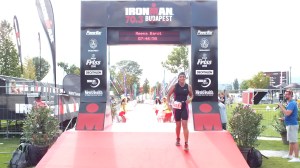
Meena, completing the Budapest Half Ironman

Meena, completing the Budapest Half Ironman

Looking back, Meena credits the journey completed to hard work and discipline. She used to wake up at 4 AM and start training. Aware of her capacity for depression, she stayed off all forms of negativity. This included keeping away from people who were negative or tended to doubt her abilities. “ I was out of all social media groups – WhatsApp, Facebook, all that. I was in touch with only those who were positive,’’ she said. “Rao sir’’ was very important in this framework. “ Never once did he say, don’t do it. He always said, you will do it,’’ Meena said.

Uniquely, Budapest taught her to relax.

“ I don’t have to prove a point. I am happy with the place I am in, right now,’’ she said, explaining her learning.

Meena hopes to do a half Ironman every year.

(The authors, Latha Venkatraman and Shyam G Menon, are independent journalists based in Mumbai. All the photos used in this article – except those otherwise mentioned – were provided by Meena Barot.)     

MAN VERSUS MACHINE

Illustration: Shyam G Menon

Illustration: Shyam G Menon

During the day, Mumbai’s railway stations are typically crowded places that become more crowded whenever a train arrives. Here and at equally crowded nodes on the city’s streets, small eateries and tea stalls exist that work at frenetic pace. One such eatery, at the railway station I frequent, has long been halt for a plate of potato vada (served with mint chutney and spicy chilli-garlic powder) and a cup of tea for me – a sort of cheap brunch freelance journalist treats himself to. There are two such stalls at the railway station, one each at its two exits on the side of town I live in. The vada is tastier at the place I patronize. You may notice a moment of relaxation here and a moment of relaxation there but otherwise almost everyone working at these eateries stays busy. The manager accepts the money, pays the balance, shouts the order and keeps a watch. At the same time, his assistants hear the order shouted, wipe a plate clean, find the required food item from the several kept around and serve it. The whole sequence from payment to serving food takes less time than what would be required to either swipe a card for digital payment or do one of those phone-based electronic wallet-transactions. Thanks to demonetization, overall business has dropped a bit, for people rattled by shortage of change hold back on expense. Impulsive expenditure like a cup of tea or a snack, are among the first things to get put off. Seeing the manager enjoy a rare moment of quietness, I asked him whether the Indian government’s evangelism for digital payment would work in his case. He smiled. “ I own two establishments here,’’ he said, pointing to a tad more fashionable joint next door, visited by college students. The one freelance journalist goes to is an older working class type-eatery. The college crowd-joint had a suitably attractive name and slightly more expensive food – rolls, sandwiches etc. “ I installed a card-swiping machine there,’’ the manager said, “ but the telecom network has suddenly got loaded with traffic that it takes a long time to make a payment. As for the place where you have your vada and tea, here the pace of work is so fast that a swipe machine or an electronic wallet would fail to keep pace. In the time I swipe one card, under normal circumstances I would handle five or six customers, quite likely more. Besides, a machine does one job at a time. As manager I am doing several jobs at once – while I am accepting money and giving back balance, I am shouting the order and also keeping an eye on whether the orders are being attended to, even who is taking what from the refrigerator. I am also being flexible, negotiating and taking spot decisions as I go along. Electronic transactions have one value for sure. A record of transactions is automatically kept. It makes the daily tallying easier. But we anyway do that with some marginal, negligible error. By and large for our work at this eatery, none of the digital fads are relevant. Hopefully, in some days the problem with change is sorted out and we are back to the old level of hectic work,’’ he said. I wondered if realities like this find place in the wisdom of the day, deciding how India should live.
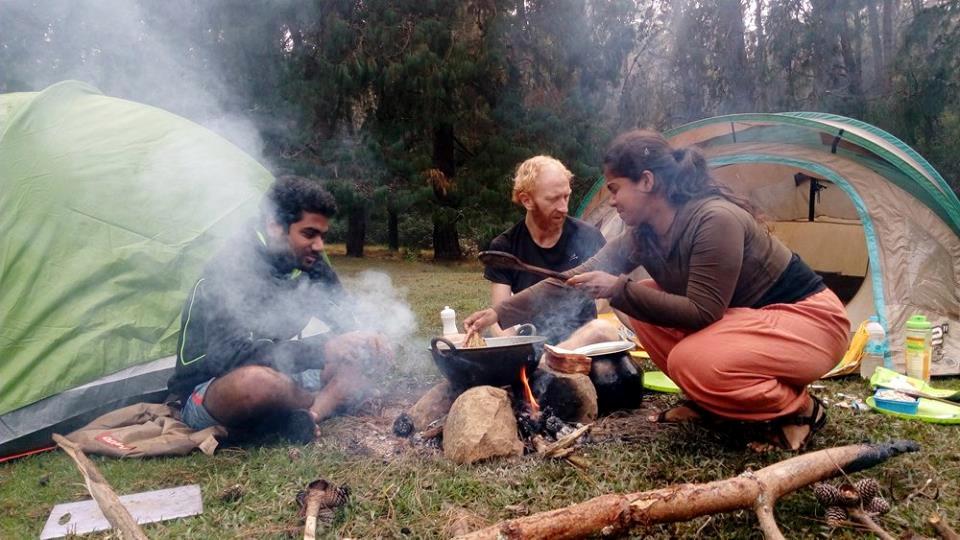
(The author, Shyam G Menon, is a freelance journalist based in Mumbai.)