SAGAR PARIKRAMA – PART 3

POPULARIZING SAILING
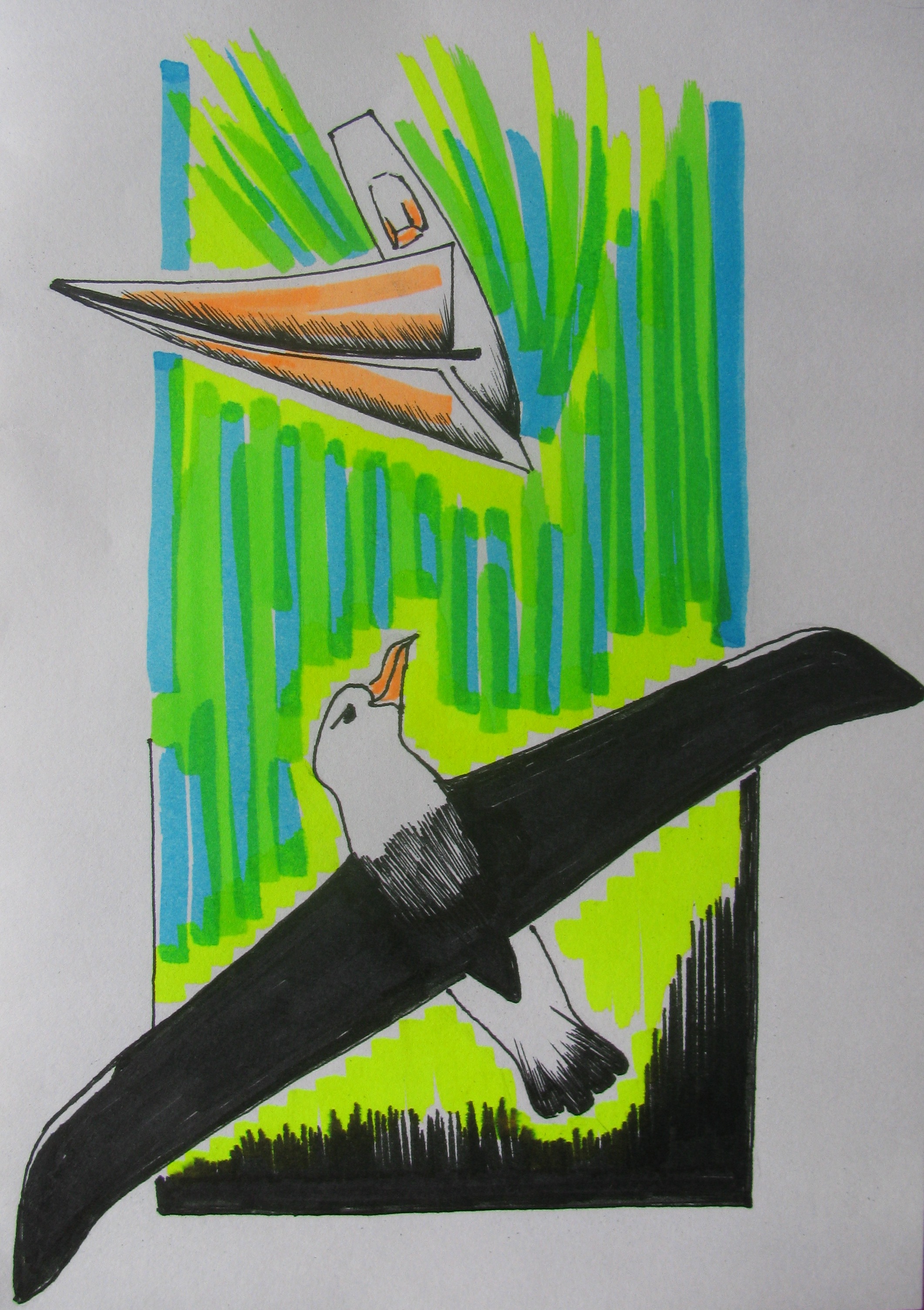
Illustration: Shyam G Menon

Illustration: Shyam G Menon

The Indian Navy is the only navy in the world to officially do solo circumnavigation and solo nonstop circumnavigation.

Specific to the navy, Sagar Parikrama’s impact may be threefold. First, greater interest in sailing in India automatically means bigger share than before in the civilian mind for the navy. This is helpful for recruitment and goodwill. Second, the average navy sailor imagines his theatre of operation in terms of his own country; the country’s immediate seas, his ship and given mission. Now there is a larger awareness brewing in the navy of oceans and weather patterns beyond. Not to mention, a proven example that Indians in a sail boat can endure what the seas throw at them. Third, solo circumnavigation is all about endurance. The typical sailor in our navy considers 15-20 days at sea as long. The circumnavigation voyages by Donde and Tomy lasted months. That’s proof of what is possible; it can inspire mindset change. “ I want to see an Indian circumnavigate Antarctica. The conditions there would be trying – ice floes; icebergs, cold temperatures, high seas and winds,’’ Awati said, gazing seaward. For him, Sagar Parikrama is the beginning of a revolution, a revolution of Indian mindset by the sea.

Centuries ago, powered by sail, the Indian east coast had spawned empires that touched South East Asia. In Beypore, Kerala, building wooden ships called the ` Uru’ has long been a traditional art. `Suhaili,’ the wooden ketch in which Sir Robin circumnavigated the globe, solo and nonstop was built in Mumbai, mostly at a yard then called Colaba Workshops. Now with Mhadei, the boat used for Sagar Parikrama, built by Aquarius Fibreglass, Goa, India has proven competence in fibreglass boats. We are the world’s biggest democracy with a coastline of over 7500 km, a history of maritime trade that stretches back to well before Christ, and a track record in fine boat building. Yet civilian interest in sailing is abysmal compared to the length of India’s coastline and its population.

In many adventure sports, the armed forces led the way in India. Reasons for this could be several, but mainly two. First, there is general aversion to adventure – call it zone of discomfort – among Indians. Decades ago, the religious taboo attached to crossing the seas made anyone going overseas impure. Nowadays, it is over-protective parents and their reluctance to accept anything risky. This plagues even the armed forces. Awati recalled his days as Commandant of the National Defence Academy (NDA) when parents would object to certain exercises he introduced saying it was dangerous. “ My standard reply to that was – if not now, your boy will face it later, so why not now and get used to it?’’ When Donde was sailing, ahead of him in the Pacific Ocean was Jessica Watson, a young Australian, yet to turn 17. Her circumnavigation was questioned by purists based on a technical flaw; she failed to connect two antipodal points on the planet, which some people consider a must for pure circumnavigation. Notwithstanding these critics, her solo voyage around the world – from Sydney to Sydney – at that age, remains a fact. It is certainly debatable whether she should have circumnavigated when still so young but contrast her backdrop with the average Indian life – her family lived on a boat for five years, the children being schooled via distance education as they sailed.

Second, in direct proportion to how the majority obsesses with well settled life, our armed forces are seen as the ones enshrining qualities that the rest lacks. In our compartmentalised view of society, the forces are licensed to adventure. Vicariously, they complete us. Third, capital used to be a major problem. Expeditions are capital intensive. Even today civilian expeditions struggle to find resources. For the armed forces, it is a case of approving project and sanctioning budget internally. Compared to scattered resources in the civilian realm, the armed forces represent focussed delivery.

With economic liberalization and rising affordability levels, civilian participation in adventure sports is now slowly rising in India. Bulk of it hardly delves deep into what adventure is. In fact, taken to its extreme as philosophy, adventure even shuns the media and the world, preferring its own trajectory. Moitessier is great example. He no doubt tickled the media with his eccentricity. But he sailed on his terms. One of his sentences from the voyage, rivets, “ I no longer know how far I have got, except that we long ago left the borders of too much behind.’’ Moitessier seems the hermit of the seas; at home on it. Past Cape Horn, Tomy said, he had a spell of depression and went drifting off northward in the Atlantic. He knew the remaining eastbound leg was a sail home. He didn’t want that. He wanted to keep going. Or sample what Peter Nichols says about Sir Francis Chichester. According to him, by the late 1960s, trans-Atlantic sailing races resembled motor racing. It had become the turf of young sailors, the races were very competitive. With competition the races became expensive, teams splurged on ever fancier boats. The importance of sponsors increased and with it sailing became the ability “ to navigate the tide rips and currents of commercial sponsorships.’’ Sir Francis and others like him sought a different canvas. In 1966, he sailed off the competitive confines of Atlantic racing and circumnavigated the globe with just one stop; Sir Robin took it to nonstop. Can we get the essence of sailing, across to an Indian audience without loss in translation?
Illustration: Shyam G Menon

Illustration: Shyam G Menon

Sailing is much more than sailing to win a race. As you research route, weather conditions and prepare for voyage – it becomes an exploration of life and the planet. It is education. Awati lives in Satara. He likes to talk of a school student there, who tracking the Mhadei’s journey, could tell the retired admiral the names of all the three great capes correctly. Or sample this – a fine example of what a good old fashioned adventure, cast the classical way can inspire people to do. On hearing of Swapnali Dhabugade, I requested her for a chance to meet. We talked over a cup of tea at a cafe near Vashi station. A cost accountancy student from Mumbai, Swapnali read about Sagar Parikrama in mid-September 2012. She isn’t sure what caught her fancy but suspects it was `solo,’ a situation so different from the average Indian life crammed with people. Intrigued, she got in touch with Tomy, travelled to Goa with her friend Mugdha Chavan, went aboard the Mhadei, then visited Aquarius Fibreglass and met Ratnakar Dandekar. In mid-December she met Donde. She attended Sir Robin’s lecture at the Maritime History Society. With help from friends and family, Swapnali pieced together a ` Sagar Parikrama Awareness Programme,’ primarily for secondary school students as the voyage fitted in well with geography classes at school. She and her friends made 17 presentations in Mumbai and Jalgaon reaching out to 2685 young people, many of who subsequently tracked Tomy’s blog. Schools covered included the 100 year-old King George School where Awati is alumni. The navy responded, presenting a letter of appreciation to the whole team. In April this year, Swapnali took her interest further ahead, doing a basic course in sailing from a private sailing school. 

To be the popular movement Awati hopes Sagar Parikrama will be, then whoever pushes it – navy or otherwise – will have to imagine a transference mechanism for the idea of sailing; one that is broad-based and adequately contemporary. Today’s society is diverse in terms of who wants to learn something, when they wish to learn and how they learn. Even the same person learns differently at different stages in life. Anyone who can learn a bit typically aspires to go the whole hog if the bug bites deep enough. The Himalaya has a total length of 2500km. India’s coastline is three times longer at 7500km. Sailing’s vast playground makes it a democratic urge, brings it closer to running an outdoor club, in terms of ideal operating ethic. Currently India’s yacht clubs – some of them teach sailing – are elite addresses, carried over from the colonial era or newly created for fashionable social apartness. A few private sailing schools have opened. There is also the National Cadet Corps (NCC). If Sagar Parikrama inspires at large, then sailing will face the same crossroad as mountaineering in India did – should it grow top-down with regulation and bureaucracy (as mountaineering chose to) or should it foster enthusiasm at ground level (as running and outdoor clubs did), work to make sailing popular?

Awati said, “ top-down won’t work.’’ Tomy however emphasised the need to retain aspiration. Asked if making the sail boat cheaper is central to popularising the sport, he quipped, “ do you think if boats are affordable people will sail?’’ According to Tomy, sail boats have become affordable with India’s economic growth but more importantly, you must want to be a sailor. The sea should catch your fancy. There is no substitute for that; it is what makes you aspire. Tomy has a point for beyond constraints of affordability, there is a fundamental urge – a curiosity for the medium – that has remained absent in India. Thus for instance, the Mhadei, while certainly vindicating Aquarius’s competence to the Indian Navy and thereby in vessel construction for military / paramilitary purposes, does not automatically open up business in sailing yachts for Dandekar. There are two to three reasons. First, sailing is very under developed in India with little civilian interest. So a big enough local market isn’t there yet. Second, the current market is for luxury yachts bought by the wealthy. For this group, it counts to say that their yacht was imported or built at some particular foreign yard. Third, thanks to our erstwhile economic controls, the trend of yacht-building shifting to new geographies as a matter of overseas enterprises seeking cost effectiveness, bypassed India and went to countries like Sri Lanka and Thailand. For now, Aquarius’s competence in yacht-building seems as much an island as Diwar. Looking down from your train window you may thus not see a great financial story. But for sure, that’s where the Mhadei was built, where history was made.  On their part, Donde has written a book on his voyage, while Dandekar plans a Sail Training Association with the Sagar Parikrama team.

Commander Dilip Donde, India’s first solo circumnavigator, was awarded the Shaurya Chakra; the Tenzing Norgay National Adventure Award, the MacGregor Medal and deemed the National Offshore Sailor of the Year. Lt Commander Abhilash Tomy, India’s first solo nonstop circumnavigator, got the Kirti Chakra, the Tenzing Norgay National Adventure Award and the title of National Offshore Sailor of the Year. At the time of writing this article, he was also the only Indian to be inducted into The International Association of Cape Horners.

(PLEASE SEE PART FOUR OF THIS SERIES TO READ THE INTERVIEW WITH VICE ADMIRAL [RETD] MANOHAR AWATI)

(The author, Shyam G Menon, is a freelance journalist based in Mumbai.)       
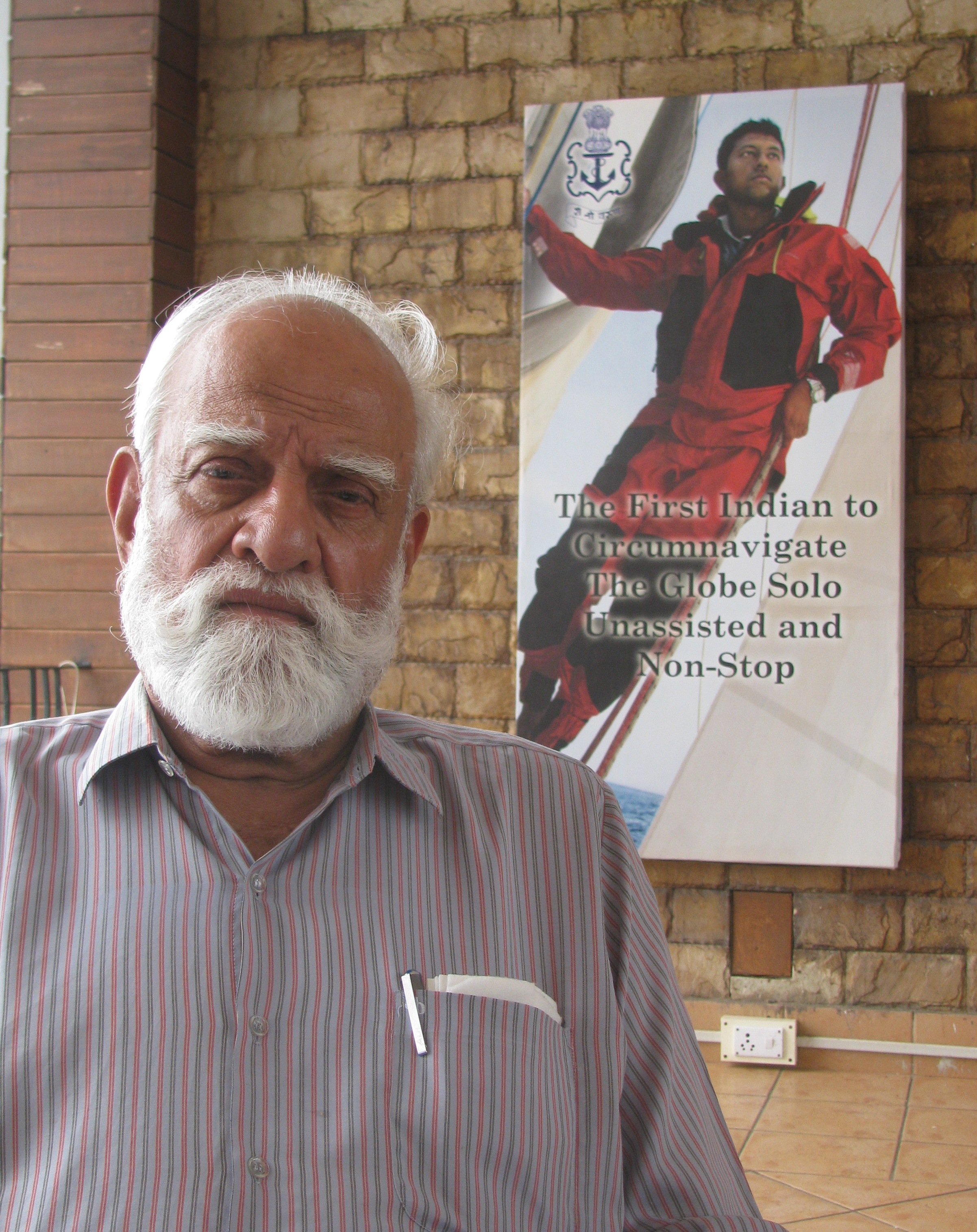
SAGAR PARIKRAMA – PART 4

INTERVIEW WITH VICE ADMIRAL (RETD) MANOHAR AWATI


Vice Admiral Manohar Awati retired from the Indian Navy in 1983. He was last the Commander-in-Chief of the Western Naval Command, the sword arm of the Indian Navy. He is the main architect of Sagar Parikrama, having imagined the project, kept it alive and seen it through. Now 87 years old, he is an inspiration to talk to. He was kind enough to grant an interview for this blog.


Excerpts:


Vice Admiral (Retd) Manohar Awati (Photo: Shyam G Menon)

Vice Admiral (Retd) Manohar Awati (Photo: Shyam G Menon)

You kept the idea of Sagar Parikrama alive through decades in service and several years in retirement. What are your thoughts from that journey?


I kept plodding and trying to elicit some interest in the voyage I had in mind for so long, with the navy and the corporate world. No one seemed to be interested in sailing. Many said that I was being too ambitious for India, that we as Indians were neither too happy nor too felicitous with the sea. Many quoted historical reasons for this attitude towards the sea. The risks were too high, almost incomprehensible for a nation where the young had shunned making a career at sea for so long, a thousand years to be precise. It is not as if Indians were afraid of the sea. They could not have been that. Look at the thriving fishing industry and so many poor littoral people like the Kharvas of the Gujarat coast finding employment with international shipping companies as Khalasis. Almost as many Konkan Musalmans served as firemen in the engine rooms of these ships. They were all competent seamen, much sought after by the companies for their competence and loyalty. But turn to the Indian middle class – it was zilch; an amazing paradox.


I am not a sociologist but I am a history buff, aware therefore of the ban imposed on embarking upon the sea about a thousand years back by a zealous religious leader on pain of losing caste. Now in those days one protected one’s caste with one’s life, if need be. There could be no compromise in a society which held caste dearer than life itself.  You may remember Bal Gangadhar Tilak subjected himself to rigorous ritual cleansing after his return from the Round Table Conference in London in the early twentieth century because of the pollution his person had suffered crossing the ocean! I have a niggling feeling that many upper caste Hindus in India have not quite rid themselves of the stigma of going afloat. Parental permission is still residual in many families to boys, and increasingly girls now, from taking up a career at sea. We do not take part in any numbers, in recreation upon the waters of our ocean even as throngs go off sailing during weekends in the west, especially in Western Europe and America. The sea has been a part of their lives for centuries even as we Indians distanced ourselves from it.


The sea was very much a part of Indian awareness in the ancient days of Meluha, the country of the Indus Delta, the civilisations of Mohen-jo-Daro, of Dholavira, as also of the east coast later during pre-Ashokan times. That awareness continued through Buddhist India, its association  of the Sangha, the trade guilds which came up to advance maritime trade through ship and cargo insurance and the myriad activities that go with trading across the oceans, the Blue, not just along the Brown water coasts. The Buddhist Jatakas are full of great voyages, of shipwrecks through storms, of pirates and pillage at sea and much else, including the riches which were the result of that trade despite the vicissitudes. The sea carried India’s very considerable and very rich trade.


We have almost forgotten that centuries back this country enriched itself from trade across the seas carried by ships built along our coast – especially the west coast – from shipbuilding teak which grew in the forests backing the coast. Today the descendants of the great Mesthries (shipwrights) of the past seek employment with the Sheikhs of Araby because the government cannot find any use for their once applauded art. Shameful! In the Middle Ages our seamanship and ship management had atrophied so low through disuse that several coastal principalities had to employ Arabs as the Shah Bandars ( port officers ) of their harbours and ports to keep trade flowing. Any wonder then that the Arabs had a monopoly of trade with India? It was the Muslim Arab who the Christian Portuguese wished to remove as an impediment. That prompted them to their adventures by sea, the discovery of the Cape route to the riches of Inde.


As late as 1850, twenty seven per cent of world trade was India’s share. What is it today? Less than one per cent! How and why did this slide happen? The European colonisers had their share in this collapse, no doubt. But the main cause was India distancing herself from the sea which surrounds it on three sides, as a result of some religious belief to do with caste and such other nonsense in a caste ridden society, which by then, as a result of a long bout of slavery, had quite possibly turned on itself, like some desperate, depressed individual. Distancing herself from the sea was an act of near suicide for the nation. We have not yet recovered from that act.


There has to be; there must be – a revival if we are ever to grasp the nettle of a great nation. We have to revive ourselves at sea by an effort to be friends with that great, all encompassing, yet fickle medium which governs life on this planet. Let people remember – no sea, no climate and therefore no life as we know it. 


Illustration: Shyam G Menon

Illustration: Shyam G Menon

You structured the project such that the first Indian to sail solo around the world would do so in a boat built in India. In an era when many people question the need to reinvent the wheel what made you insist on building the boat here?


It is not really a question of reinventing the wheel.


No two circumnavigator boats are the same, from Robin’s wooden Suhaili, to the trimarans, to all things fibreglass and now carbon fibre, all the way to my Mhadei. Every boat built has own character; its handling peculiarities, its survivability in extreme weather conditions. I wanted the boat to be built in India because at one go I would demonstrate an Indian’s ability to go round the world solo and bring to the notice of the world the abilities of the Indian boat carpenter whose reputation around our ocean and beyond was so very enviable for so long. He was invited abroad for advice and supervision of ships built of timber. The watertight- ` Wadhera Joint’ for joining wooden planks, was invented in India. It needed no caulking. It is difficult to fashion; therefore not cost effective. Sagar Parikrama is remarkable because aside from the Dutch design it was an Indian enterprise. The high value instrumentation was of course, imported from Europe.


What next for Sagar Parikrama?


I now look forward to the first Indian woman circumnavigator, in my life time. At 87 that may appear to be a little unlikely. I am optimistic. We have taken the first steps. There are volunteers from among the women officers of the navy. There are Dilip and Abhilash who will carry my ambition to fruition. There are several in the business of directing the Service, especially in the navy’s HRD, who think as I do. I am therefore, hopeful. 


After that I want an Indian to circumnavigate Antarctica, solo.


What is your advice to those planning adventure activities?


I say: plan a real whammy activity, not some common or garden stuff. It is how you tackle the danger therein that is the core value of real adventure. Adventure must offer a challenge to your character, the character of those who participate in it, whether it is a solo or a group affair. It becomes training in leadership where leadership stands for example and willingness to take calculated risks which demand decision on the spur of the moment.

Are there values in expedition planning and execution, which civilians can learn from the armed forces? If so, in your observation and seeing the state of affairs in the civilian realm, what would be the most important traits for a civilian expedition to copy?

The most important trait for civilians to copy from the military is surely and above everything else, discipline.

Staying power is next, once you have decided what the purpose and aim of your expedition is.

An adventure expedition needs to have an aim. It should not be some purposeless ramble.

Of course a ramble has its own value in getting out in the country, observe nature or just breathe in the ozone and get a feeling of wellness. But a serious adventure MUST have a purpose and it must involve serious challenge. Otherwise it becomes an empty adventure, adventure in name only. An adventure activity must help to build or bolster character, character which matters in civic life and in nation building. We in India are seriously devoid of people who have character. Character means willingness to shoulder responsibility, ability to make decisions and lead by personal example. Regrettably, apart from a few, I cannot name anyone in India with these qualities. Among those who are under fifty, I cannot think of a single person.

In a manner of speaking, Sagar Parikrama is a good example of civil-military interface. It delivered. But then I was fortunate in both the military man, Dilip and the civilian, Ratnakar. It just happened. Coincidence ? May be. I do not believe in coincidences. If you plan and push with a purpose, then usually the right people come in. Once, Ratnakar’s mother told me, “ Admiral I was not sure of this mad project of yours, that it would ever come off or happen. But when I saw three mad people come together, I started thinking otherwise.’’ Wise and observant words from a worldly wise lady! There are huge possibilities in defence for civil-military symbiotic relationship for the good of the nation. It is waiting to be fully exploited. A small beginning has been made. It must be widened, exploited to advantage. Whoever takes the lead in doing this – it has to be done from the highest level in government and in corporate bodies – will have to tread on many toes and old corns, disregard the nay-sayers.

By all means let us begin with adventure activities, real adventure, if we dare.

(PLEASE READ PART FIVE OF THIS SERIES FOR THE AUTHOR’S NOTE ON SAGAR PARIKRAMA)


(The author, Shyam G Menon, is a freelance journalist based in Mumbai. This interview was done by email.)

SAGAR PARIKRAMA – PART 5

AUTHOR’S NOTE                      

Illustration: Shyam G Menon

Illustration: Shyam G Menon

Bang in the middle of the Pacific Ocean is the island of Tahiti.

When European ` discoverers’ reached this island in the heart of Pacific wilderness in the eighteenth century (Tahiti was sighted by Europeans in the sixteenth or seventeenth century), there were men and women already there. How did the first people reach Tahiti? Science deems Africa’s Great Rift Valley as the evolutionary ground of our species. Our ancestors are said to have walked out from Africa. In that case, humanity’s first sea-crossing may have been the Red Sea, from near the Horn of Africa to West Asia. Those days, the water level in the Red Sea was low. Journeying on, humankind would reach the edge of East and South East Asia. Water levels were low here too, exposing that much more land (now reverted to below water) and rendering distances by sea, so much less. Slowly our ancestors navigated across the nearby seas all the way to Australia. Measured against the impatience of our times, this journey out of Africa, took a long time to be completed. Human settlement of Tahiti though seems to have been a later day affair.

If you check the map, Tahiti would appear as a dot in an ocean of blue.

According to Wikipedia, the first people on Tahiti hailed back to early residents of South East Asia. They arrived through an emigration in stages over the years, reaching Tahiti around 200BC on outrigger canoes. These are canoes having one or more lateral support floats fitted to one side of the main hull or both sides. They are paddled or sailed. Outrigger canoes are a part of the maritime heritage of Polynesia and South East Asia, having played a major role in the settlement of far flung islands and transport in general. Interestingly, Wikipedia also says that it was an emigration on outrigger canoes sailing west from South East Asia that brought human settlers to Madagascar over 350BC-550AD. That’s a long, long time since humans crossed the Red Sea eastward from mainland Africa which lay just across the Mozambique Channel from Madagascar. Emigration from mainland Africa to Madagascar followed this initial settlement. On the map, the emigration from Borneo to Madagascar would appear a crossing of the Indian Ocean – on outrigger canoes!

These early voyagers had no Wikipedia to tell them of Tahiti and Madagascar; no GPS to navigate accurately, no infallible yachts or ships as we do at present. Once gone, did they know how to get back to that thing called home, which rules, haunts and shapes us in this age of identity by settled life? Or was it all about reaching new land for new life? Take what I wrote with a pinch of salt – and the genuinely curious, please, I encourage you to read and research yourself – for my intention is not to teach you flawless history, anthropology and geography. My intention is merely to make you think. A slow and patient (not fast and impatient) gaze at the planet and its cultures would tell you that people tackled fantastic challenges long before us. Historians and archaeologists may sift through traces of human existence to give you proof of the world’s earliest sailors, the oldest boat etc. But it doesn’t tell us everything about the adventurers of yore, for quite likely, more have disappeared without trace than the few whose names survive thanks to some trace. What lives on is their legacy. It survives in humankind’s continued affair with the sea and the shape of boats, still traceable to the wisdom of ancient voyages.

Illustration: Shyam G Menon

Illustration: Shyam G Menon

Land was once as awesome as the sea. Today, land lay known and exploited. Its great adventures have largely reduced to the stuff of commercial expeditions, sponsored thrills and people competing to prove, “ I can also do it’’ or “ I can do better.’’ Out in the blue and deep below it, for no better reason than that fewer people court that vastness, so much bigger than land – a sense of self and adventure in their original tenor probably exists. During the 1968 race, Sir Robin Knox-Johnston, short of money, sailed out in the ` Suhaili.’ Far out in the Atlantic, she started taking in water. He had to fix the problem, narrowed down to an issue of caulking, by carrying out repairs from under the water. For this, he had to dive into the sea and be below the boat, repairing it while the vessel slowly sailed on. Most sailors worry if their boat would drift away leaving them behind. Sir Robin was in the habit of enjoying a daily swim, diving off the bowspirit, swimming as the boat floated past and eventually helping himself back aboard using a rope trailed from its stern. Shift context and sample this from an evening, late October 2013. Lights dimmed at Mumbai’s Sterling theatre and a film commenced that was weirdly silent for the visual spectacle, which was its opening frame. For the next 90 minutes it kept the audience spell bound with deft use of aural and visual technologies and a continuous dramatic interplay of, sound and silence, movement and stillness. Befitting the medium in which the story was set, we rotated, spun and revolved in a vastness brought alive so, for the first time on big screen. As I write this, Alfonso Cuaron’s much acclaimed movie `Gravity,’ is still running in Mumbai theatres. On Earth, only the sea comes close to space in terms of distances, depth, 360 degree-expanse, the sense of being afloat and the complexities of survival in a medium that isn’t as much man’s home as terra firma is. The sea is the world’s great wilderness, till space takes over. Already you can see the similarities: `ship,’ `vessel,’ `craft,’ the relation between person and ship, the endurance required for long stints aboard  – the words and ideas are common to both fields noticeable for their power to make the human being feel small.

Sagar Parikrama impressed me for the sheer scale of the experience it put the two naval officers through. It also impressed as subject ranging from the sea’s spread on the planet to its human history. Seventy per cent of the planet; deep enough to sink the highest mountains and home to fantastic natural forces, not to mention experiencing it at the pace of sail. Despite 21st century, the story still felt like revisiting books from the exploratory phase of land. Early Everest expeditions had to tackle the nuts and bolts – explore an approach to the peak, study the effects of altitude on the human being, fashion oxygen cylinders, design appropriate clothing etc – not much different from Commander Dilip Donde commencing expedition work from scratch, his interaction with Sir Robin and of course, Aquarius Fibreglass building the Mhadei in Goa. When it came to Lt Commander Abhilash Tomy, the challenges were likely more internal to self, for the defining difference had moved to nonstop circumnavigation. In all this work from researching route to boat and self, much was already known and there were templates for everything. But the approach was classical – as Vice Admiral Awati wanted it to be.

From a more short term, practical angle, nothing can be more effectively metaphorical of the relation between us and India than a boat at sea. The reason the Mhadei mattered so much for Sagar Parikrama, is because it was the vessel that would take a human being around the planet and bring the person back, safely. That’s why Ratnakar Dandekar’s role was pivotal. Like all sailors and particularly solo sailors, Commander Dilip Donde and Lt Commander Abhilash Tomy, during their voyages, devoted attention to the needs and requirements of the boat. The Mhadei was all that stood between them and the deep. If they maintained the Mhadei well, their chances of sailing safely were that much stronger.

Isn’t that true of a boat called India, too?

(CONCLUDED)

(The author, Shyam G Menon, is a freelance journalist based in Mumbai. Abridged versions of the main article comprising parts one, two and three of this series, and abstracts from it, were published in The Hindu newspaper, The Hindu Business Line newspaper and Man’s World [MW] magazine.)

GRAVITY

Illustration: Shyam G Menon

Illustration: Shyam G Menon

It’s straightforward and simple.

If you haven’t seen the film ` Gravity’ yet, then see it.

Gravity is the sort of film that comes along once in a long while.

I found it remarkable for the following reasons:

So far, most movies about space that I have seen, fall into two categories.

There is the genre, which embraced the perception of space as science fiction fantasy. It told great stories set therein. The imagination, while bringing into play everything that humankind knew of space, stretched it a wee bit more, sometimes a lot more, for the heck of story. But these films were often far in excess of what our actual ventures into space have been. In these flights of fancy, human beings travelled through the solar system, hurtled through black holes and visited other galaxies, even as the farthest a human being ever got to, remained the moon. Cut to the other genre of being more realistic and telling stories within the realm of actual human exploration – we in India often felt left out because in tune with reality, all those stories had to be necessarily about foreigners at work; their sagas, their travails, their victories. A certain late astronaut called Shariff singing an Indian film song in orbit or George Clooney commenting on the beauty of a sunrise over the Ganges do nothing to stoke South Asian excitement for Gravity. The film worked because it was gutsy enough to keep space its real hero. At one stroke, it eliminated the petty divides inspired by human life on the planet and brought home a reality beyond the capacity of our different languages to describe. I felt, Gravity took the human being out of space and prepped us for a medium as it is.

Experiencing Alfonso Cuaron’s film was fantastic. There have been many films that exploited modern cinema’s technology to the hilt. A new sound system would come screaming in; a wide screen would be shown such that we are dwarfed to shifting in our seats for seeing it end-to-end. This film had no such agenda. Gravity’s opening sequence in a typical Mumbai theatre yet to stop chatting, reminded me of Steven Spielberg’s `Saving Private Ryan.’ That was the first film I saw, where the filmmaker, telling a story from the point of view of the soldier in battle, showed action all around with no sound. Such numbness happens in war; the film brought it home. After years used to Star Trek, Star Wars, Aliens and the like, the abject silence of Gravity’s space took time getting used to. But once it gripped, you wanted it to remain so for you realized that unlike before, here, you were dealing with the real stuff. I wonder what the more mainstream filmmakers will do about space now that its silence has hit the theatres and the audience didn’t walk away! I also hope this will become a trend going ahead – a cleansing of big media experience to restore an experience of world that is greater than humanity’s media.

Not many films have succeeded in breathing its context into every frame as Gravity did. Emmanuel Lubezki’s cinematography was calm and restless at once, weaving us in and out through twists and turns, for space is 360 degree-expanse on every axis.  It was like being in a washing machine and that is close enough but not fully accurate description. Finally, Gravity wasn’t without sound. Where required it had that and dialogue. In fact, it had music. Except – Steven Price’s music didn’t ever intrude. It stayed in the backdrop like a grinding saw of tension, picking up momentum as the film approached climax, which was most acceptable aesthetically for the climax was a descent to Earth and its environment, including capacity for sound. One day, maybe Cuaron or somebody else will show us the reverse – music petering out in tune with an ascent to space; a loud background score fading to stillness or receding to the very electronic sound of music in an astronaut’s earphones while space rules awesomely silent all around.

See Gravity; experience a shift in perspective.                                                   

(The author, Shyam G Menon, is a freelance journalist based in Mumbai)               

ABOUT A ROAD

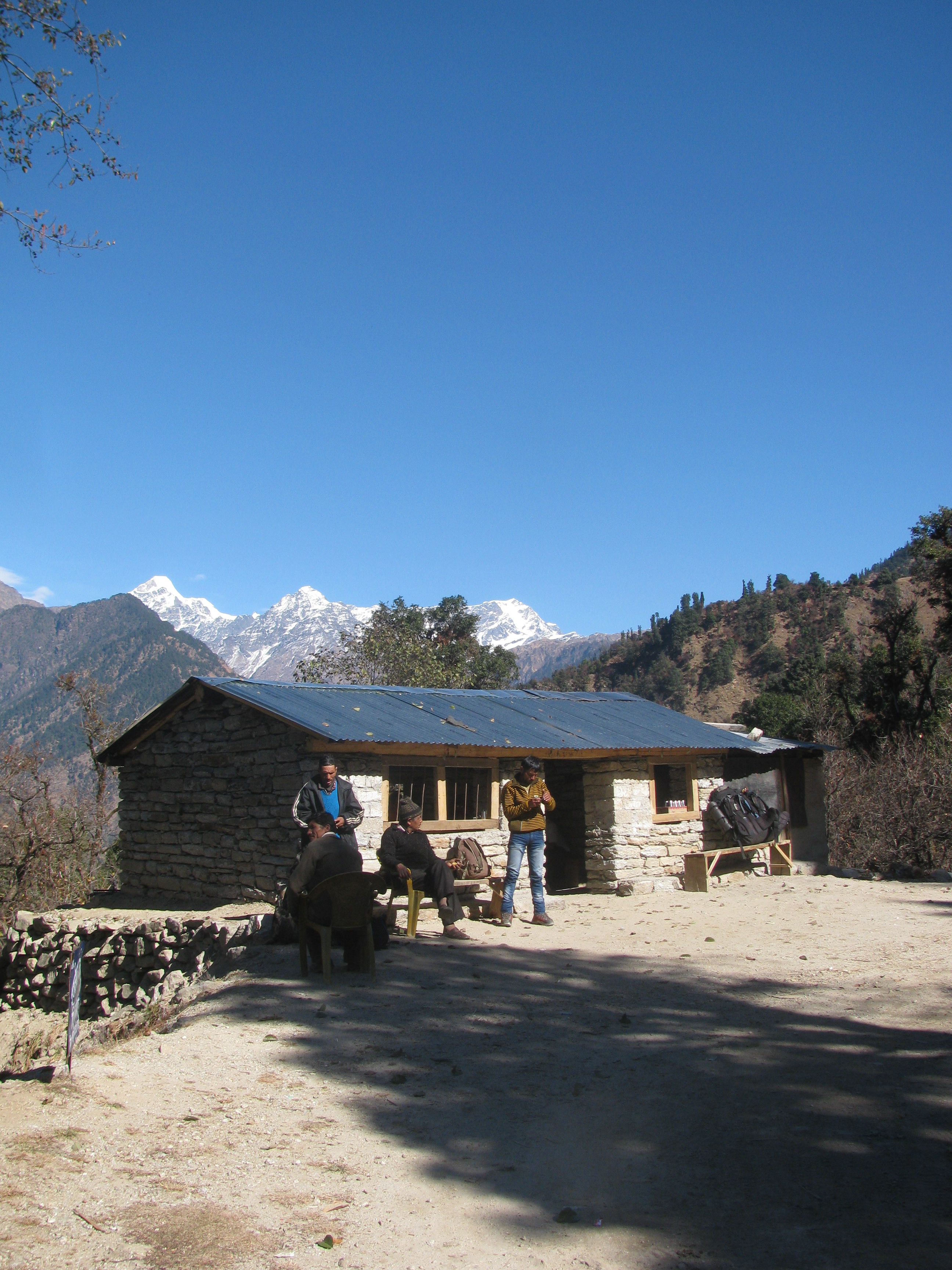
The teashop at Dhur (Photo: Shyam G Menon)

The teashop at Dhur (Photo: Shyam G Menon)

Thakur Singh worried if he would make it back to Ranikhet in time.

He was restless.                                                 

Hoshiar Singh on the other hand, cracked jokes. Pratap Singh laughed. Nearby, the chain smoking-teashop owner from Kharkia lit a beedie and responded frugally to his talkative host, the owner of the teashop near Dhur.

We were seven or eight people; maybe ten. Some enjoyed the sun. Others idled within the teashop. All were stuck at that bend on an empty, winding road. The stillness of afternoon overcame December morning-energies. We grew quiet, progressively drifting to the wisps of smoke leaving the Kharkia-teashop owner’s lips as sole sign of life in us.

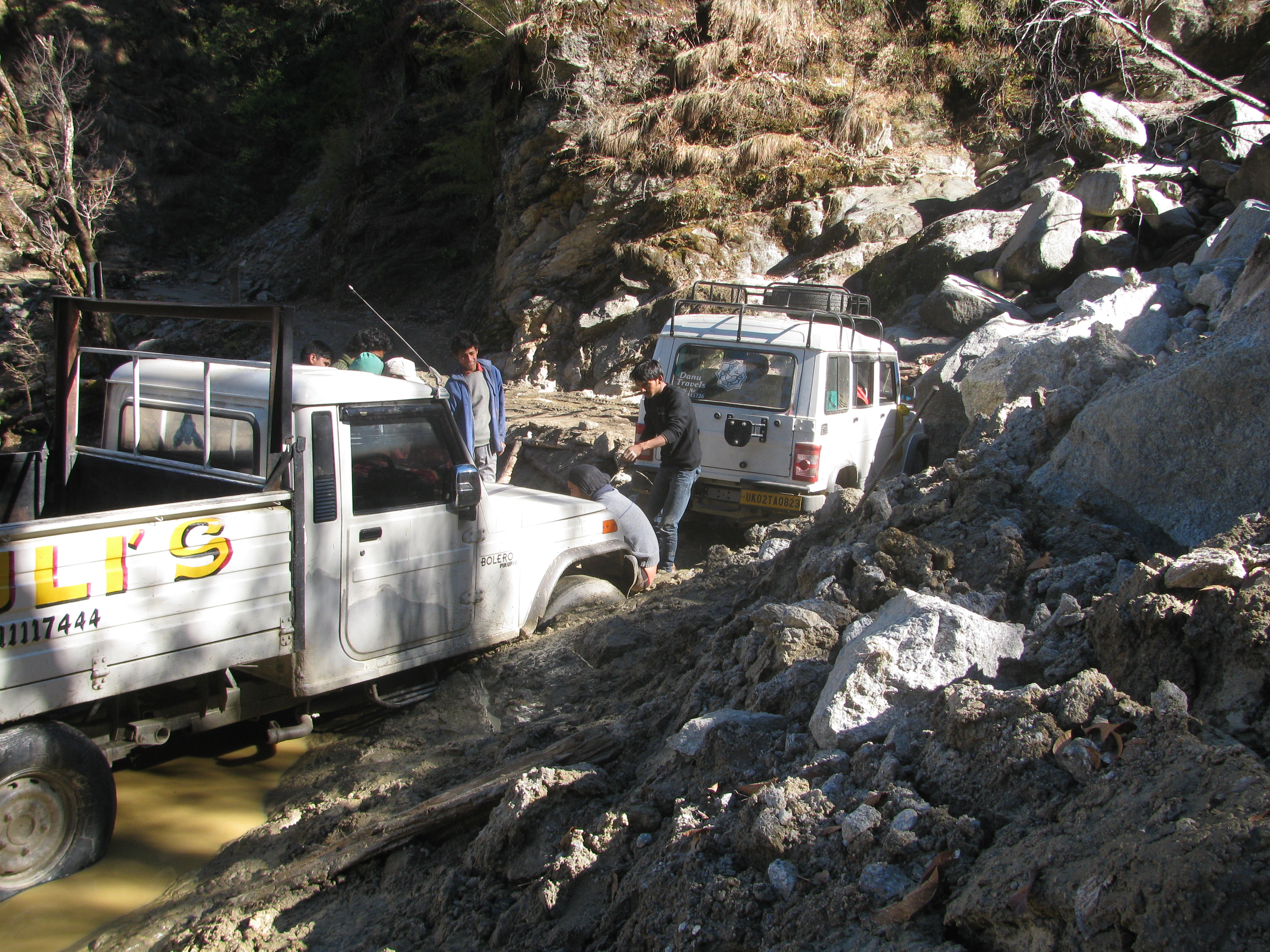
Just behind the teashop at the bottom of a cliff was the Pindar River. Up the valley, the chiselled summit of Nanda Kot, soared to over 6800m. The high ridge of Dhakuri, cloaked in winter’s first snow, wasn’t far off. But it was farther than before. That morning, we had traded the straightforward trail from Kharkia to Dhakuri and Song for the comfort of a jeep to Song. It was despite news at Kharkhia of a vehicle stuck in a landslide on the Kharkia-Song road. Mountain roads are unstable during rains and winter. Stranded in a gooey landslide, the driver had repeatedly tried freeing his vehicle only to see it sink deep. Night froze the mud cementing the jeep to position like a statue; a study in firmness for this otherwise infirm road. We drove up expecting to free the vehicle, clear the road and proceed to Bageshwar. We had along two jeeps to pull, ropes, steel cables, shovels, hired labour.  The labourers got tired of shovelling, the ropes and cables broke and the drivers got fed up. Maybe there was winter’s sloth at play. Add to that, a dash of hangover from the previous night. At least some of us, sleepy eyed and looking to get back to distant towns, had seen each other earlier at the marriage of a common friend in Khati. That village was an hour’s walk away from Kharkia, in the direction of the Pindari Glacier.

The jeeps from Kharkia returned home.

We walked past the landslide hoping that somebody would drive up from Song, discover the road block and ferry us back the forty odd kilometres of winding mountain road to the beginning of the descent to the foothills. But some of the vehicles plying daily were stranded on the Kharkia side of the landslide. That meant fewer jeeps to service the road. We flopped down at Dhur’s teashop to take stock of the situation. Past Dhur was a less used, longer trail to the Dhakuri ridge. Song seemed possible, provided we outpaced winter’s early sunset. Thakur Singh and I pushed off. Five minutes later, we heard a whistle. Our departure had shattered the group’s ennui. All except the Kharkia-teashop owner, who was Bageshwar-bound to treat an injured leg, had decided to hike. They were following us. We walked for a long time. Then as often happened, a lovely patch of grass emerged by the roadside and people plonked down to rest. It was officially called rest; unofficially, it was that couldn’t-care-less attitude which seeps into people in such situations. Time and life ran slowly in the mountains. I wasn’t in a hurry to get anywhere, certainly not when my backpack contained snacks and tent. I had a stove but no fuel; I had gifted the remaining petrol to a villager who owned a motorcycle. But finding food shouldn’t be a problem. I was at ease. Among us, only Thakur Singh was edgy. He was on leave and had to get back. He tried sleeping to keep the worry at bay. Hoshiar Singh had weathered slit eyes. Like Clint Eastwood’s. Where Eastwood’s `Blondie’ aka The Man with No Name smoked a cigar, Singh idly chewed a blade of grass, his eyes looking into the distance towards Sorag on the other side of the Pindar. Then some conversation came up and the dreamer in me started nudging talk towards how mountains were formed, how long day and night could be in the polar regions, what lay ahead for the sun, how the universe was formed – so on and so forth. All listened intently, except for a youngster studying in a college in town who had traded larger curiosity, for world by relevance and irrelevance. Of what use are the sun’s life cycle and Big Bang Theory when it comes to career? Time went by.  

Stuck in the landslide (Photo: Shyam G Menon)

Stuck in the landslide (Photo: Shyam G Menon)

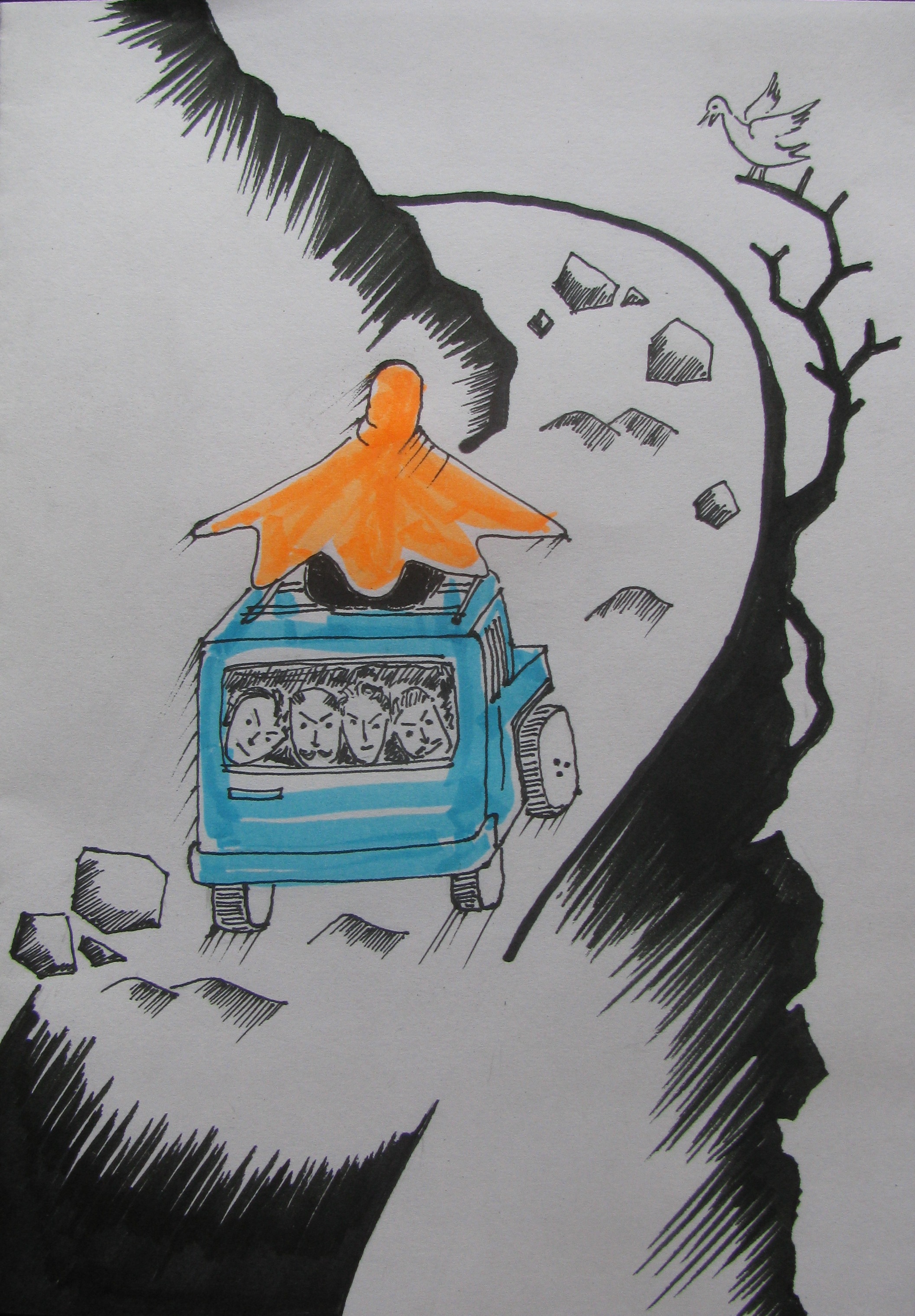
The road from Song to Kharkia was a treacherous one. Roads in unimportant corners of India were like that. What’s special about this road? You may ask. I don’t know what its current state is but until the time of writing this article, in the years (probably three) that I had been on it, this road’s condition never changed although it was part of a national scheme for village roads and an adjunct to the much walked tourist trails to Pindari Glacier and Sundardhunga. For villages in the area – Kilbara, Badiyakot, Pattag, Sorag, Wacham, Jatoli, Khati – it was sole road link to the outside world sparking hopes ranging from higher education to timely healthcare. Completed some years ago, the rickety road’s only permanent fixtures were a big concrete gateway erected midway to deify the builders and the utter absence of bitumen. On a lucky day, the road may be fully functional. On others, it may be blocked or damaged. For much of its length, it hugged the mountain’s edge. It was largely wide enough for two vehicles to pass, but only just so. It was also narrow, muddy and riddled with cavernous ditches. Seeing your vehicle’s trajectory and poise, you wouldn’t know whether you were driving, sailing or skiing.

Jeep drivers from Kumaon’s towns rarely brought their vehicles here fearing damage. A few times up and down this road and your vehicle aged prematurely. Local drivers worked this road using cheap vehicles, pushed daily to the limits. Taxis were filled with people and stuff. During the ride you stared down the vehicle’s bonnet into an approaching ditch; you shook violently climbing out from it, the chassis would hit the road and occasionally you skidded along in mud inches from the void. It was regular village life – forty plus kilometres of bone-rattling ride. When a jeep came from the opposite direction, the driver sometimes startled you by requesting for brake fluid or something as critical, which you thought was already there in the machinery. The request and the supportive camaraderie were routine given the punishment inflicted on vehicles. Once, on a day of no taxis, I travelled the whole stretch in the cargo bay of a pick-up truck. I understood what life as a chassis was. As yet, my most unforgettable sight on this road has been a heavily laden small truck that stalled while struggling uphill. On re-start it reversed and then charged up the terrible road, including its hairpin bends as not to lose momentum. The truck shook and twisted; its tyres hit and flew over stone, it roared straight towards my parked taxi and veered off with fine timing. One error and we would have been history. That was 2012 summer. Now, it was December. The road, as ever, was unchanged. Probably the truck too is; lying in some workshop, almost dead from exertion.

Illustration: Shyam G Menon

Illustration: Shyam G Menon

An hour or more after we left Dhur’s teashop, a pick-up truck brought us news that taxis were heading up. By 4PM, we had a jeep for Song, hopefully beyond. We crammed in. “ Naren’’ (likely short for Narender) who couldn’t fit within had to take the vehicle’s roof. His friends kept up a conversation to distract Naren from the December cold blasting him up there. Once in a while, to the amusement of his friends, Naren howled or yelled to stay awake in the freeze. Sometimes, he sang loudly from up there. Thanks to the delay caused by the blocked road, we didn’t reach Bageshwar. We stopped at Bharadi. Naren jumped down from the vehicle’s roof, playfully shouted a few expletives at the driver as everyone laughed, and ran off. I took leave of Hoshiar Singh who had been a nice person to talk to. Bharadi was a proto-town ahead of the real town, Bageshwar. Its facilities weren’t fully evolved. Four rooms at a hotel; seventeen beds, fifty rupees per bed, one toilet and the usual inebriated men. Pratap Singh was in the room adjacent to mine. He was en route to Almora for surgery. Had it not been for our road Singh would have had to walk to Bharadi.

Few days earlier, we were in a jeep from Bharadi to Pathyasar beyond Song, the end of the road for the Saryu valley. Our co-passengers included half a dozen or so village elders. From Song to Pathyasar runs another rickety road, belonging yet again to that national scheme and about as bumpy as the road to Kharkia, albeit shorter. The conversation in the vehicle had been on how all political parties are similar in their indifference to the public’s travails and how the rule of different parties in Uttarakhand had yielded the same result for this region – the continued neglect of roads. Maybe they are right. “ If you see a JCB tell them of the stuck vehicle,’’ one of the Kharkia-drivers had told me while parting ways at the landslide. Albeit manufacturer’s name, JCB had become near generic for bulldozer in these parts.

I never saw a JCB.

(The author, Shyam G Menon, is a freelance journalist based in Mumbai. An abridged version of this article was published in The Hindu newspaper.)

AN ULTRA MARATHON, FROM THE SIDELINES

Illustration: Shyam G Menon

Illustration: Shyam G Menon

It was early August 2011, Khardung village in Ladakh.

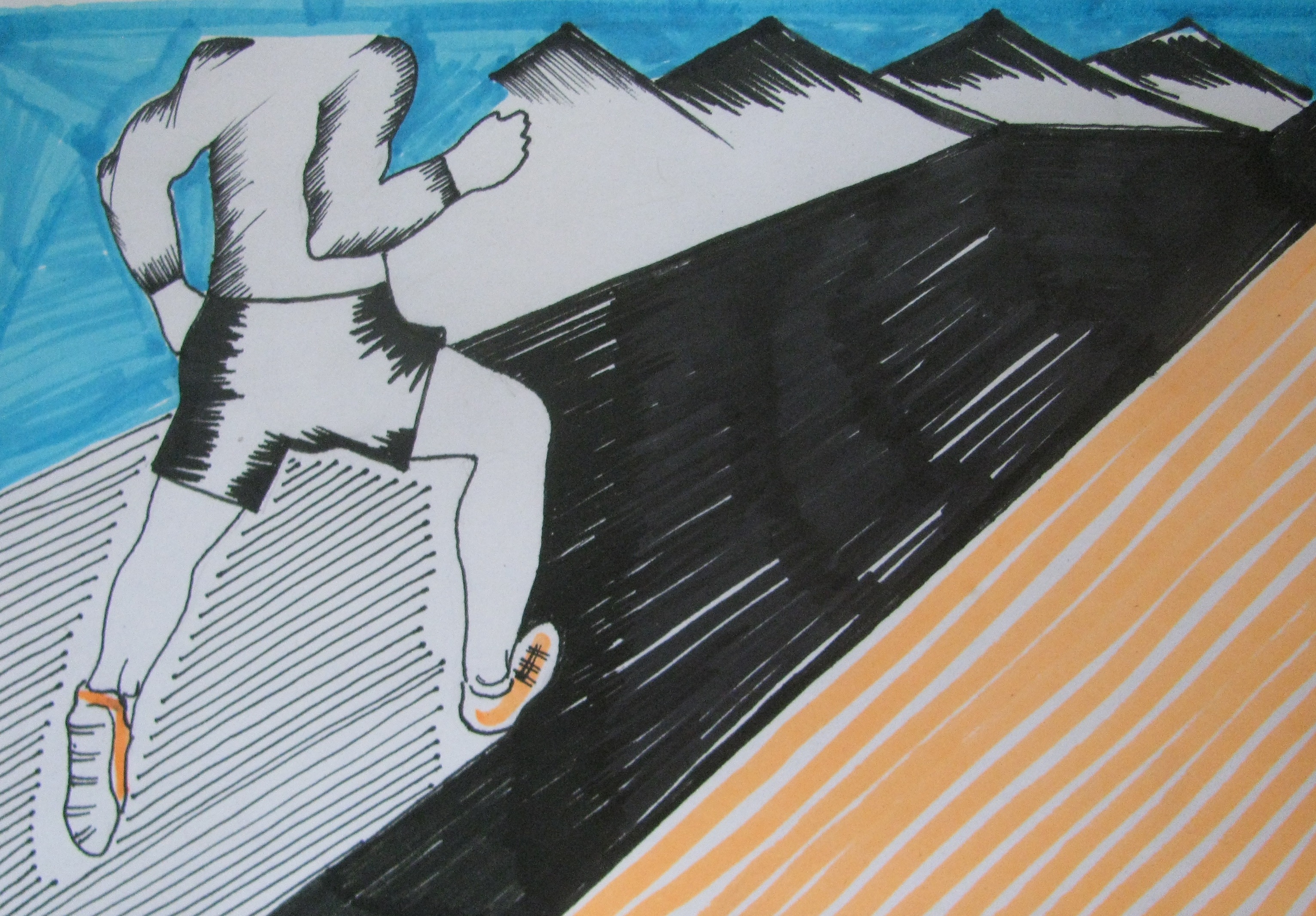
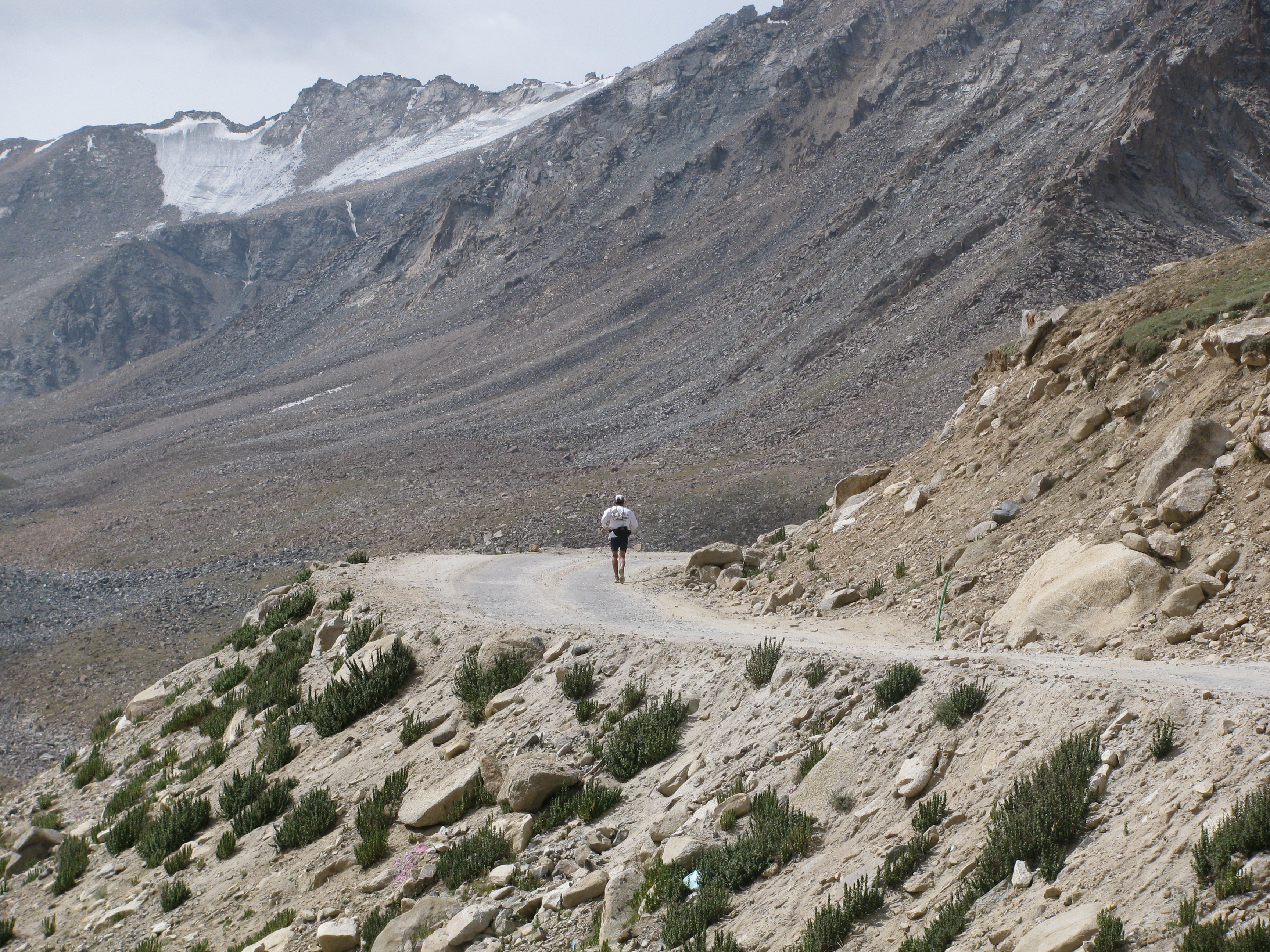
I stole out from the camp housing race officials, support staff and runners and walked in the direction of the 17,700ft-high Khardung La. Next day, six people would run 222 kilometres at an average altitude of over 14,000 feet. More walker than runner, I wanted to taste the effort. Couple of turns on the road later, the camp disappeared from sight behind me. I found the privacy needed to confront my physical limitations. Out of sight, I commenced jogging. The first minute, perhaps two, were fine. It was magnificent landscape, morning traffic was as yet mild and the winding, open road appeared a mythical tarmac for the lone runner. Slowly my breathing became pronounced. A mild headache manifested. I slowed down. It was a relatively flat stretch of road, rather a gentle gradient. What would it be like on real uphill? I wondered. I was gaining my first insights into running at altitude.

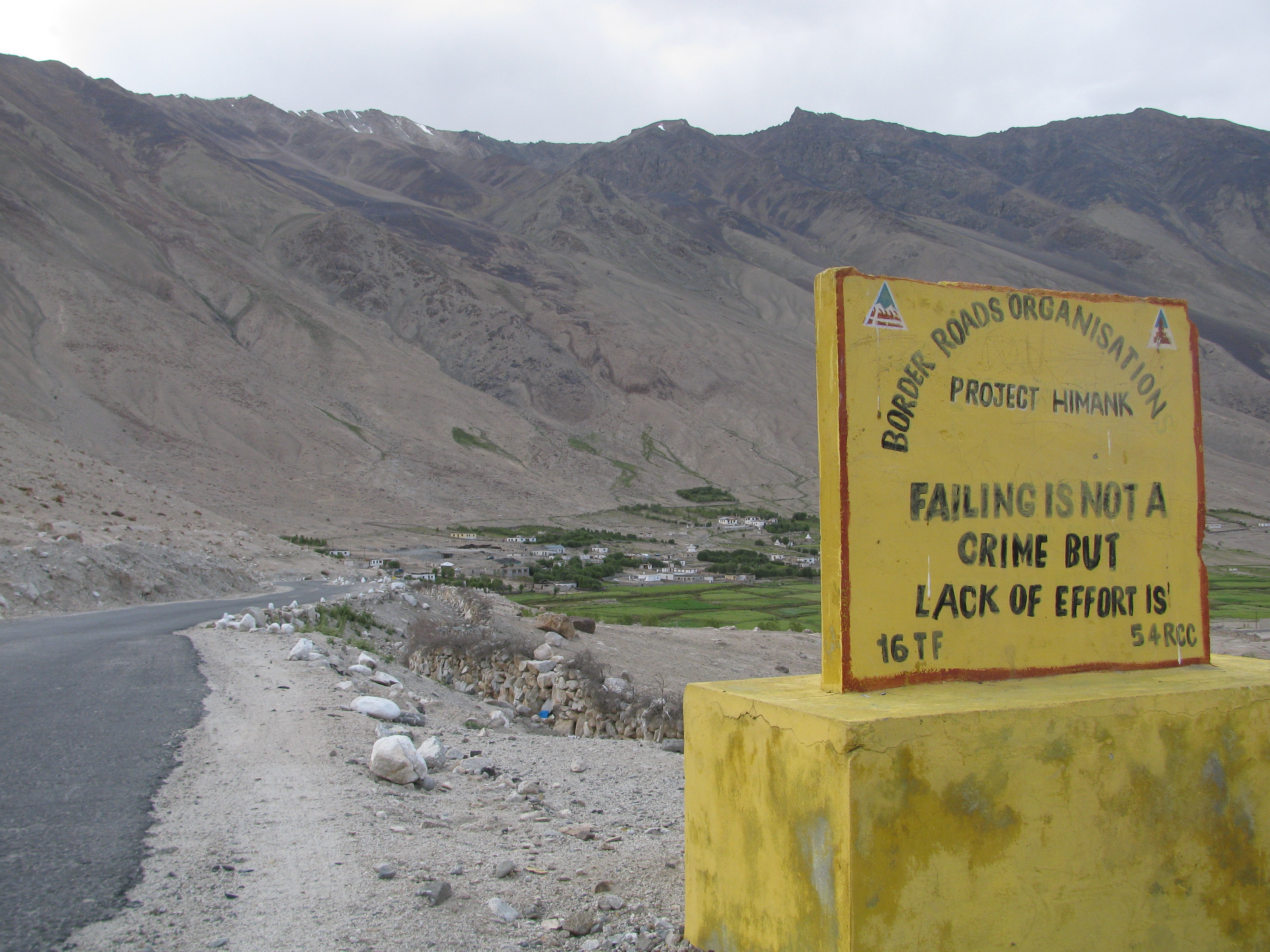
Eventually I balanced my breathing and running and struck a rhythm. As trekker and amateur mountaineer, I was frequent visitor to altitude and therefore aware of what rarefied air meant. But 222 km of such running? In a small way, I understood what the runners would experience during La Ultra-The High, billed as the world’s highest ultra-marathon. That morning, I was the only person out running on that stretch of road. With news of the race known in Leh, passing vehicles thought I was elite runner, out practising. They slowed down. I revelled in the attention and essayed my brief role as impersonator, as convincingly as I could. Once vehicles and tourists went by, my stoic expression collapsed to gasps and groans. I sat on a rock for a while; then, walked back. Roads here were built and maintained by the Border Roads Organization (BRO), an outfit affiliated to India’s military. It was famous for its sign boards, some sporting thoughtful messages, some amusing. There was one such board near our camp. Its message: `Failing is not a crime but lack of effort is,’ had become the Ladakh ultra marathon’s tag line.    

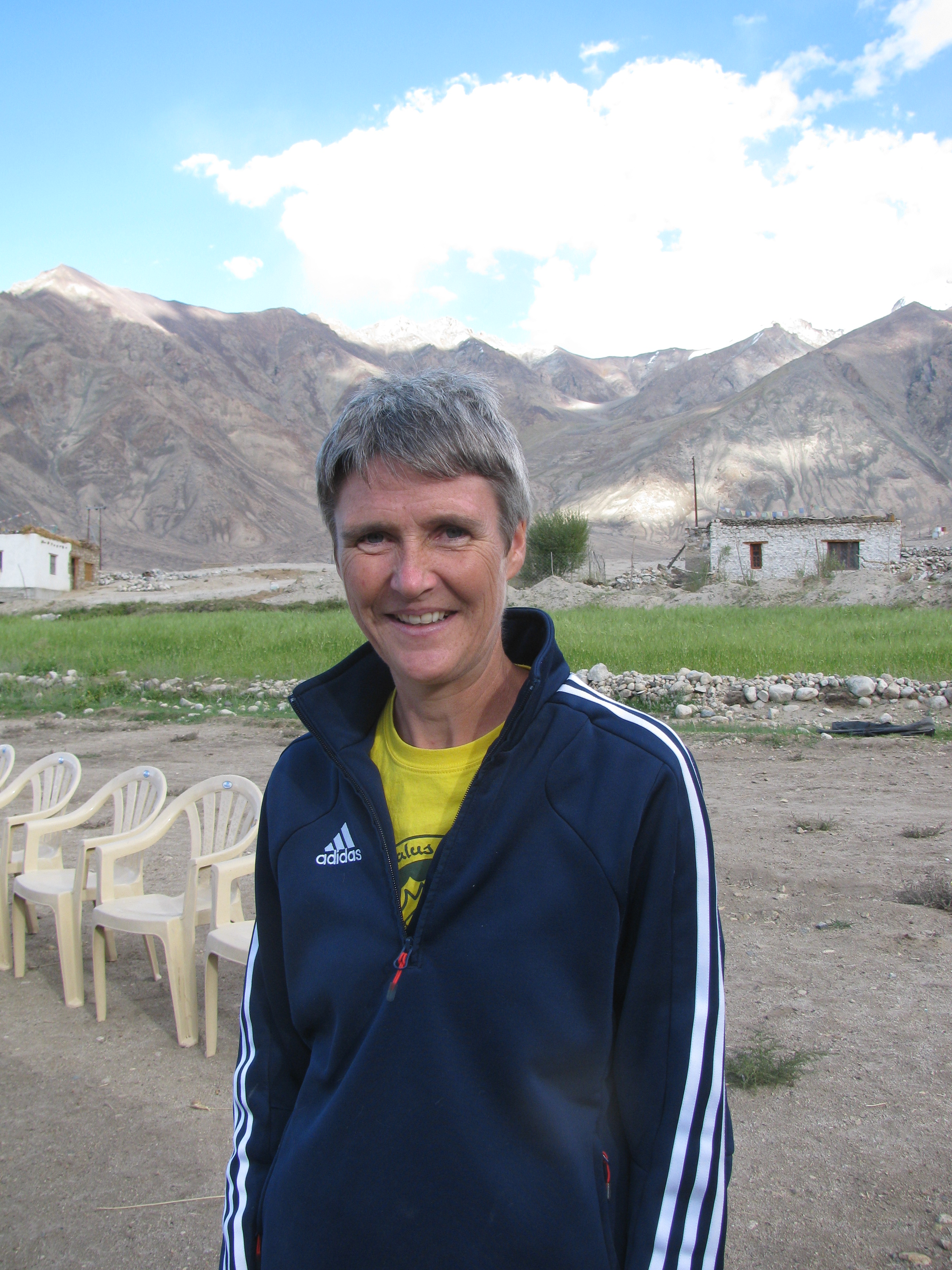
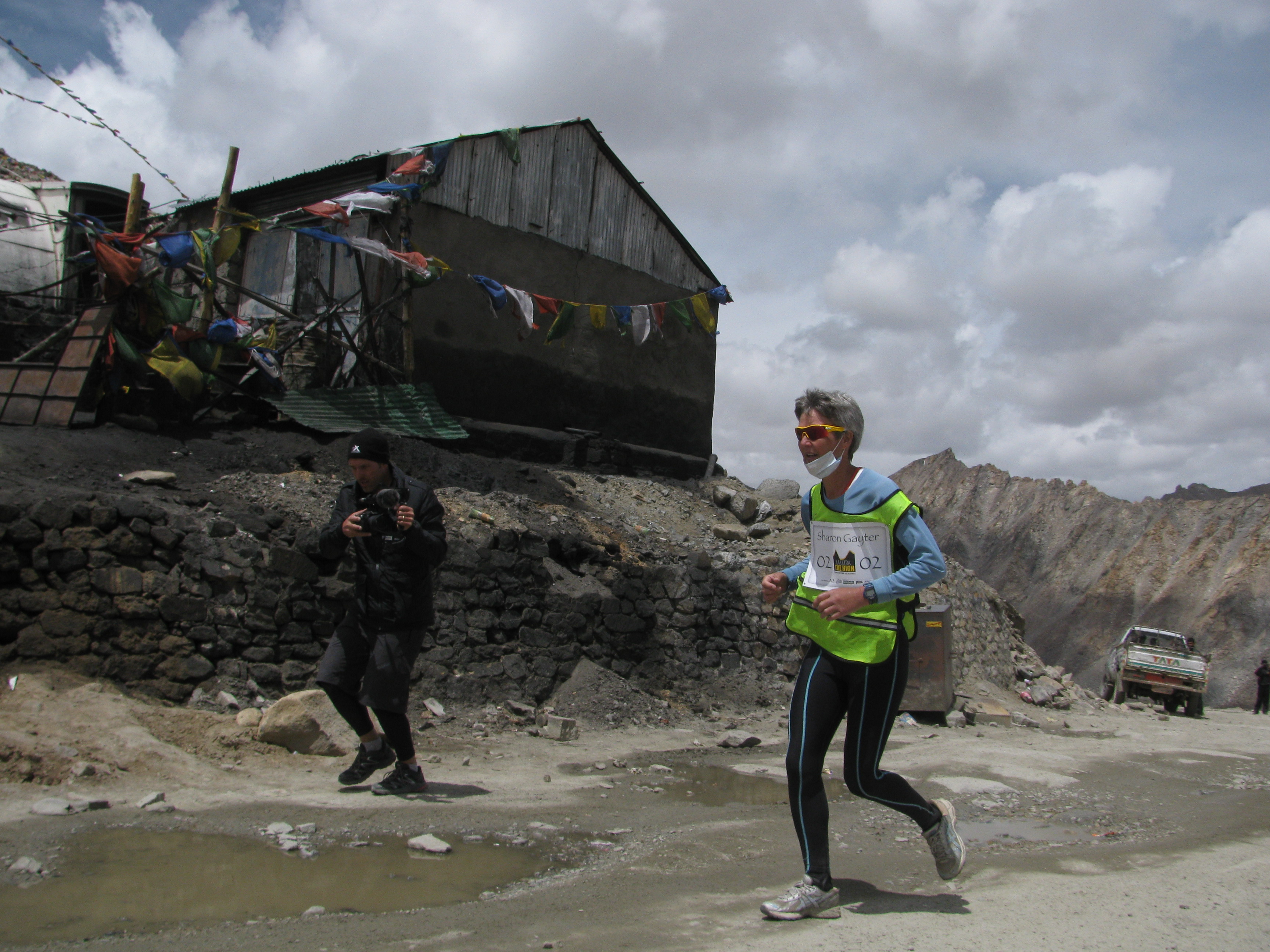
Sharon Gayter (Photo: Shyam G Menon)

Sharon Gayter (Photo: Shyam G Menon)

Meanwhile at camp, personalities were unravelling among the athletes. People approach challenge differently. And challenge exposes people as different personalities. Rains the night before had made a mess of the originally selected camp site. In the time lost to setting up new camp, four of the six athletes elected to stay at a guest house. Only Sharon Gayter of UK and Samantha Gash of Australia stayed at the outdoor camp. Sharon was the most composed of the runners; her kit being all of three bags amid teams lugging duffels by the dozen. Some had their own film crew. Sharon’s support team was mainly one individual – her husband. She looked uncomplicated and pared down to essentials; ready to run. Sharon was among Britain’s top distance runners and of those assembled in Ladakh for the race, easily the most experienced. In a field beginning to be competitive ahead of the race, Sharon talked, laughed and set her goals away from rivalry. She described it loosely as finishing the run, doing so to her satisfaction and improving the previously established timing (in 2010, the winner had clocked 48 hours and 50 minutes). Samantha, by her own admission, looked up to Sharon. Yet the two were as different as chalk and cheese – the older one fuelled by experience; the younger one banking on preparation, personal protocol and checklists.

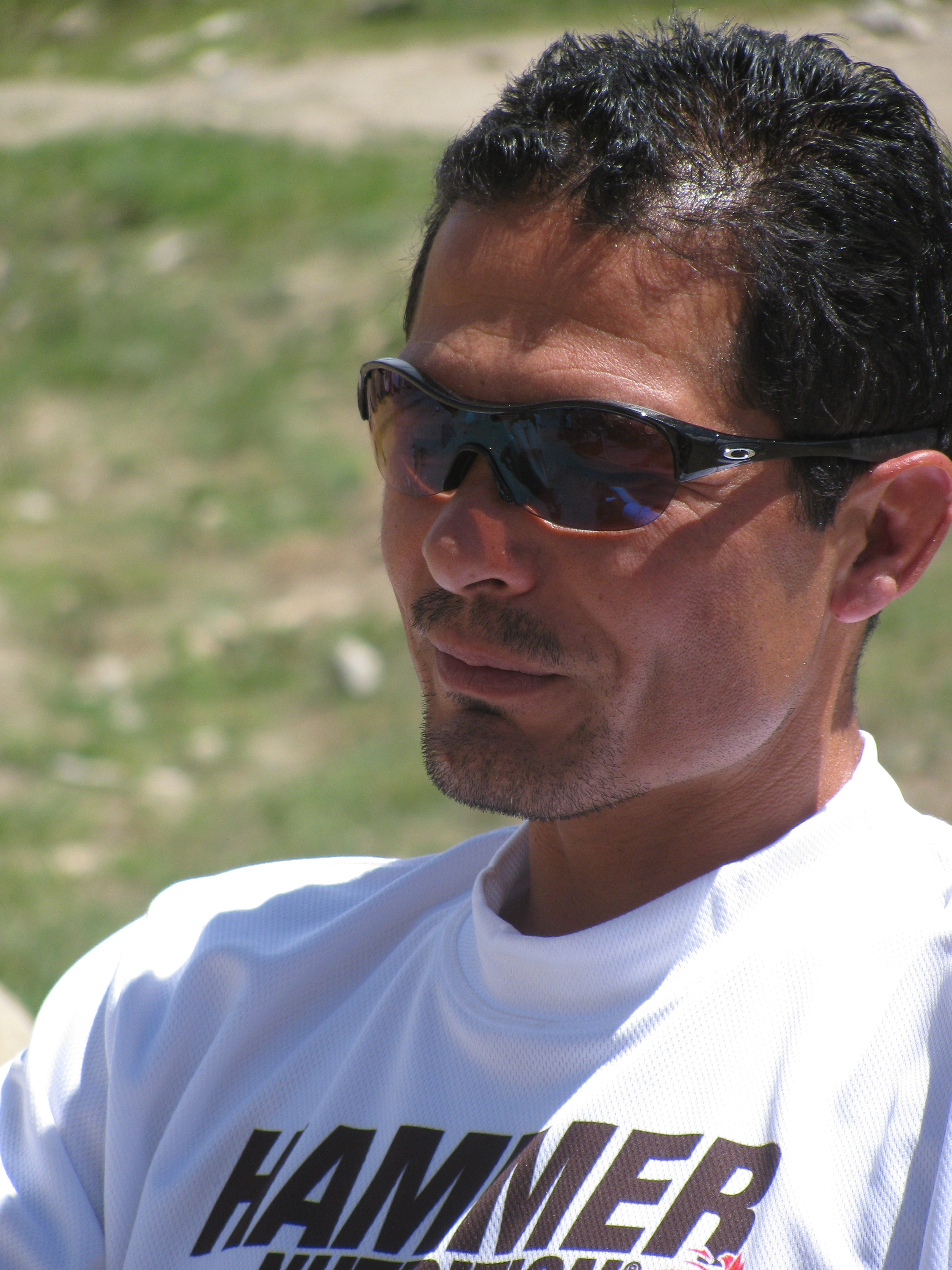
Ray Sanchez (Photo: Shyam G Menon)

Ray Sanchez (Photo: Shyam G Menon)

The other four were shades of these two extremes. Ray Sanchez of the US, a former boxer, appeared to share Sharon’s emphasis on self-awareness as key to distance running. But on the eve of the race, he looked comparatively tense, his sense of humour notwithstanding. Lisa Tamati of New Zealand was the most technical with a battery of support staff and equipment. Molly Sheridan of the US and Jason Rita of Australia (settled in the US) wanted to do their best and finish. At this stage, if there was anyone who seemed to gain energy from the ambience and the people around, it was Sharon.

That evening a dust storm struck. The horizon grew dark with grey clouds. The winds were powerful. It collapsed large tents and sent smaller ones flying. Sharon kept her composure through all that dust and commotion. Samantha would later report a swollen eye.

Ray on the approach to Khardung La (Photo: Shyam G Menon)

Ray on the approach to Khardung La (Photo: Shyam G Menon)

Early next morning the six runners set off from a line on the road ten kilometres away from Khardung on the Nubra Valley side. Ahead lay 222 kilometres of running – over the Khardung La, through Leh town, over the Tanglang La and ending at Morey Plains. In these parts of the Himalaya, `La’ meant a pass. Khardung La was the highest pass in India that you could drive through and one of the highest in the world. Ray raced off to a handsome lead. Sharon hung around in second position. It seemed that the outcome would be decided by these two. The athletes were free to run, walk, rest – manage their time any way they wanted as long as they covered the whole distance in 60 hours, which was the official cut-off time. I remember that as the rule then. As the kilometres went by, the sound of laboured breathing enveloped each athlete like a private ecosystem. I was in a small media van with a film crew. Thanks to four wheels and an engine, we could range up and down the route without strain. Ladakh was a vast barren landscape of mountains. I remember my uncle quipping that the real hero in David Lean’s Lawrence of Arabia was the desert. If so, the hero of Ladakh would be a tussle between land and sky. Both were awesome. In that setting, graced additionally by stillness, as the media van slowly overtook a runner, you heard clearly the sound of human body working. I wondered what the runners’ minds would be like with each passing stride; active and chattering or simply shut down to quietness?

An ultra-run is a composite of body, mind, nutrition and strategy. While physical fitness had seemed priority for all, there had also been plenty of talk among the athletes about the route and how that route should be run – particularly how energy should be rationed to tackle challenging sections. Thus the Khardung La may be India’s highest motor-able pass but for the runners, it was the 17,583 feet high-Tanglang La looming towards the latter part of the run (when they would be tired) that challenged. Nutrition occupied considerable pre-race talk. It was a simple problem – in a race lasting many hours you required periodic, effective nutrition without digestive complications for a body strained to the limit. As I found out, runners spent years perfecting their on-race nutrition. It took many races and plenty of mistakes before a pattern of food intake unique to a given athlete’s body became perfect. Up until the Ladakh ultra, Ray for instance, was still perfecting his nutrition. With years of running behind her, Sharon had got it right and Bill, her husband, knew exactly what she wanted at each stage of a run. No wonder so much of premium was attached to knowing one’s self as defined by mind and body.

Sharon at Khardung La (Photo: Shyam G Menon)

Sharon at Khardung La (Photo: Shyam G Menon)

I followed the run to Khardung La. Ray made mincemeat of that ascent; Sharon followed. From the start to the high pass, it was 42 kilometres, a full marathon. I waited – perhaps an hour or more at the pass for another three runners to cross that landmark. Then I chased the first two in the van, pausing en route to check the progress of Samantha and Lisa. I failed to catch up with Ray and Sharon; both had completely descended on the other side and gone past Leh, Ladakh’s main town. Who would win – Ray, persistent as the pugilist he used to be or Sharon, veteran of many a race and knowing when to strike?  Or would they both, running in non-negotiable altitude, give way to someone else?

My freelance self wasn’t in Ladakh for one assignment.

Having other work to do, I got off the van at Leh.

Over tea, I referred my notes from a conversation with Dr Susan Thompson, senior member of the race’s medical team. During an ultra, you require fuel for the body (including glucose), fluid intake (basically water) and electrolytes like sodium and potassium that are essential for body cells to work. The most common problem in long distance running is hyponatremia, a situation wherein electrolytes are lost through sweating and the hydration people resort to as compensation only restores water but not electrolytes. Runners therefore work towards right intake of isotonic salts. Unattended, hyponatremia can affect the brain. Then, there is dehydration. Unattended, that can lead to kidney malfunctioning. Last but not the least, there is the issue of energy. As body energy levels dip through continuous running, the body starts processing muscular fuel – glycogen. This erodes precious energy reserves which can impact a person’s anaerobic metabolism. It causes lactic acid to build up opening a host of other problems. Like the road’s edge on a mountain, these issues would be shadowing anyone running out there. Safely tucked into my café chair, I sipped ginger-lemon-honey-tea. No place like Ladakh for a glass of it. In all my tea drinking in India till then, this wonderful mixture sipped with Ladakh around, had been the best. 

The next evening, I learnt that Sharon had won the race.

Deep inside, I had expected it.

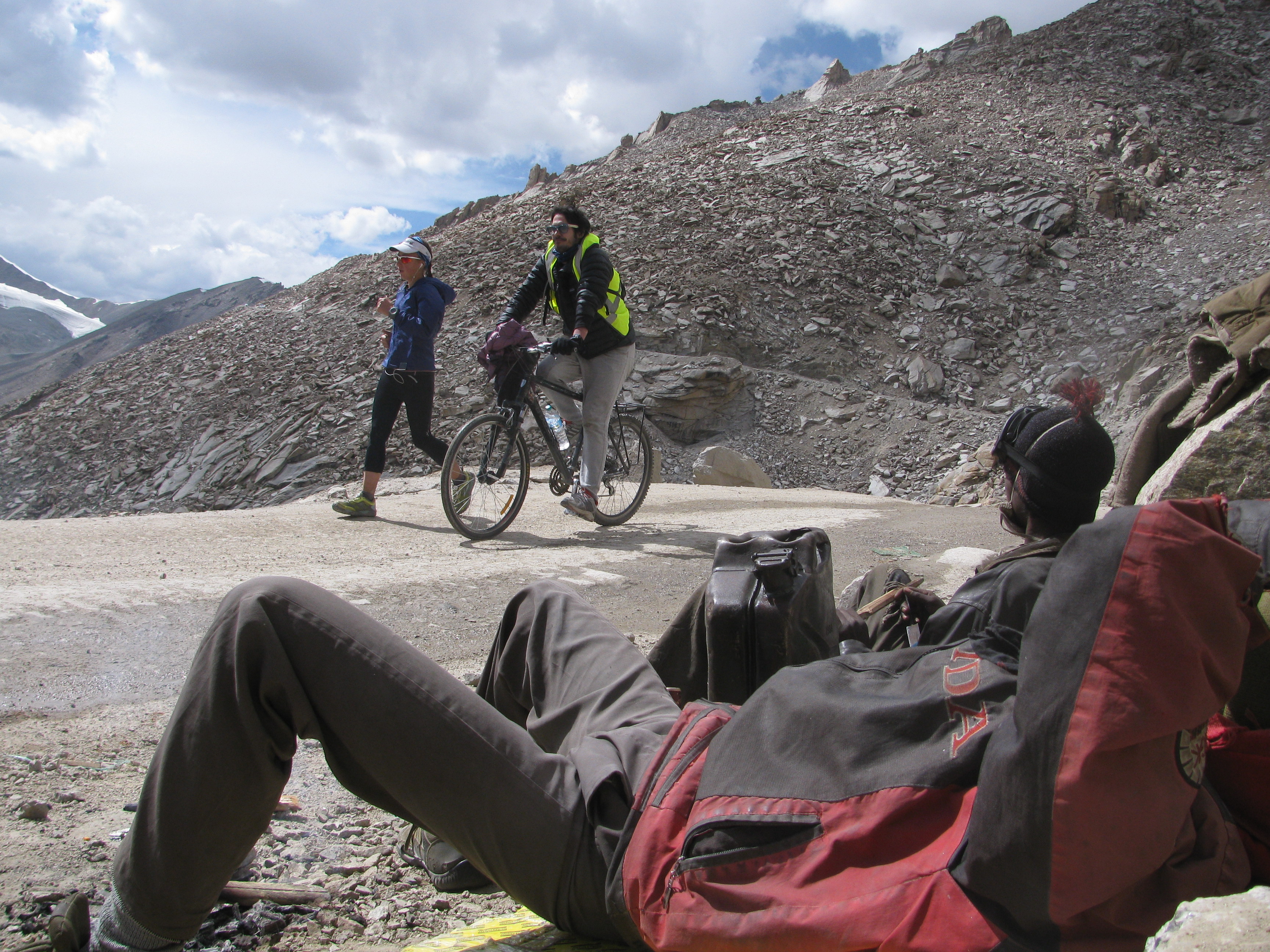
Samantha Gash on her way to Leh from Khardung La; a member of her team keeps company on a bicycle. Watching on are BRO workers enjoying a break (Photo: Shyam G Menon)

Samantha Gash on her way to Leh from Khardung La; a member of her team keeps company on a bicycle. Looking on are BRO workers enjoying a break  (Photo: Shyam G Menon)

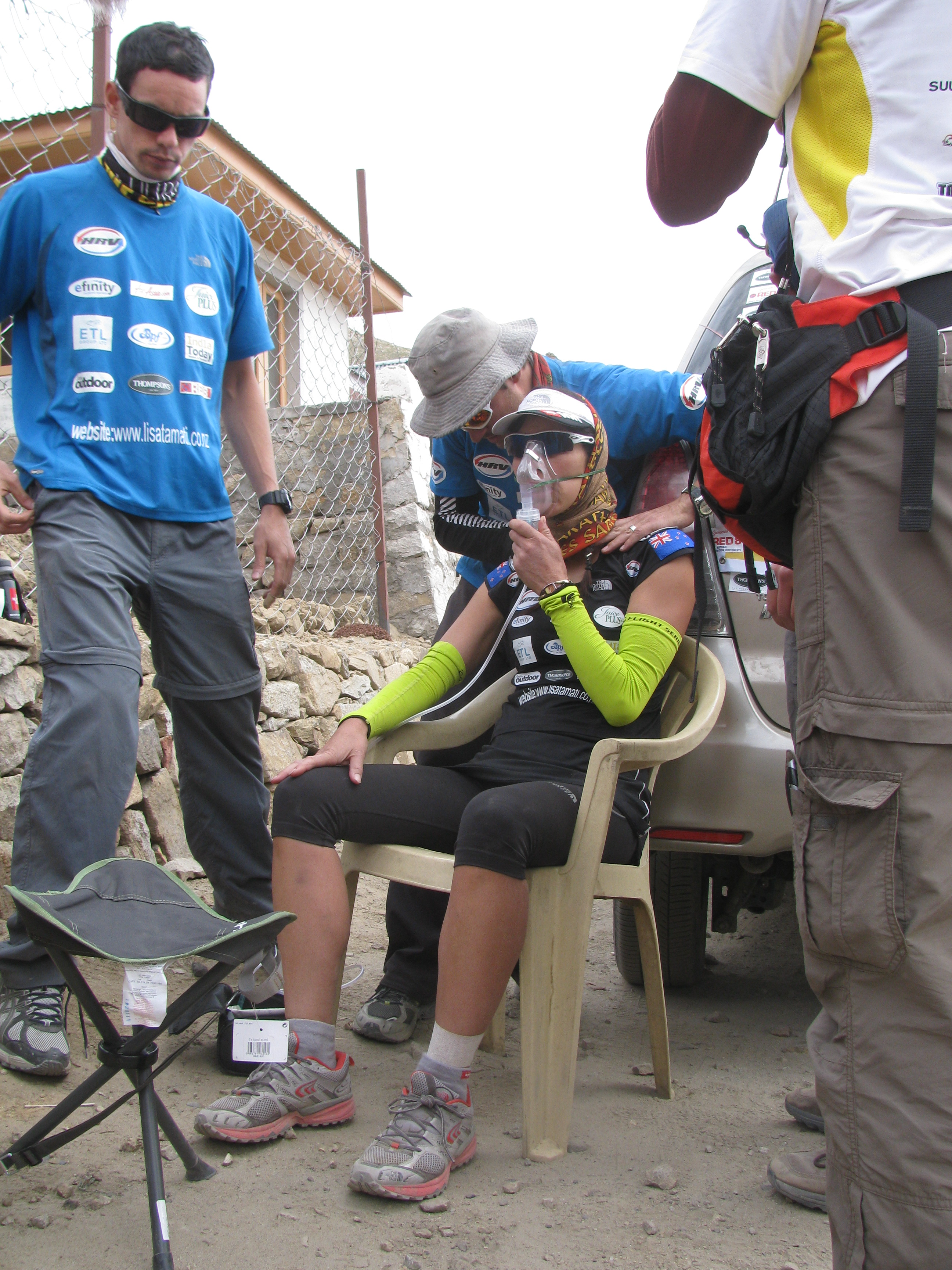
There’s something about endurance tests that empathise with the experienced, the patient – indeed, the not merely physical but the mental as well. What happened en route betrayed the real character of the Ladakh ultra. Ray had maintained his lead for almost three quarters of the run. Somewhere around Tanglang La, exhaustion kicked in. That mixed with altitude, made him hallucinate. Delirious, he was in and out of examination by the medical team. This episode and its aftermath, I was told, was when Sharon took the lead. Not that she didn’t have her travails – in her case, for the first time in many years, her nutrition plan had not worked properly.  Further, as an asthmatic tackling high altitude and running through bouts of vehicle exhausts, she had to use a nebulizer roughly every four hours. Although the race organizers may not have wanted it so, the challenge wasn’t just about you, running and altitude. Ladakh was way up in India’s north and landlocked. It had no railway link. Two main roads connected it to the outside world during summer. By early winter, they closed owing to snowfall. What a whole region can get by air is limited. Road transport dominated. Trucks plied supplying goods for civilian consumption and to also keep the sizable presence of the army, stocked. Given the strategically important Siachen Glacier and international borders with China and Pakistan Occupied Kashmir close by, Ladakh was a major military base.

Lisa Tamati gets some oxygen in (Shyam G Menon)

Lisa Tamati gets some oxygen in (Photo: Shyam G Menon)

Atop trucks and army convoys, were the vehicles carrying tourists, not to mention several private cars and motorcycles driving in because man on motorized transport photographed against Ladakh’s bleak landscape was considered high adventure in the plains. Traffic here is not yet as severe as in other parts of the sub continent. You can still experience empty stretches without passing vehicle. In the tourist season, traffic increases. When a vehicle passed by, in the still, clean air of Ladakh, your nose sensed every molecule of toxic automobile emission. They are two distinct high altitude worlds – the comfort within a vehicle or astride it, and running on the road breathing a blast of vehicle exhaust. Early in the race itself I noticed – Sharon had a surgical mask ready for use.

However the real challenge in the Ladakh ultra marathon was the altitude. The whole region straddled 10,000 feet and up. For variety, uphill gave way to downhill and the heat of day gave way to the cold of night. But what could the runner do about altitude which lurked everywhere? Sharon said that the Ladakh run had been the toughest yet in her distance running career. In a subsequent post on her website, she would write, “ It’s taken nearly four weeks to recover from The High.’’

Sharon, 47 years old then, finished the race in 37 hours and 34 minutes, chopping over 11 hours from the winning time of 2010. Ray’s timing was 39 hours, 03 minutes. All six participants completed the 222 kilometres within the assigned cut-off time as opposed to only one finisher in 2010.

The sign board near camp (Photo: Shyam G Menon)

The sign board near camp (Photo: Shyam G Menon)

A day after the ultra, Ray Sanchez ran a full marathon in Ladakh!

I later caught up with Ray and Sharon for a chat in Leh and couldn’t believe that they had the energy to talk, crack jokes and laugh after such a run. They autographed a race T-shirt for me, which I gifted to an ultra runner friend in Mumbai, who seemed more committed to running and capable of it than I. As for me, my running has remained the delight of a few weeks of jogging before the shin, foot and so many other parts of my left leg announce their existence, through pain.

(The author, Shyam G Menon, is a freelance journalist based in Mumbai. This article was published in much abridged form as a news report in The Telegraph newspaper and in a less abridged version in Man’s World magazine.)  

THE BUS STATION

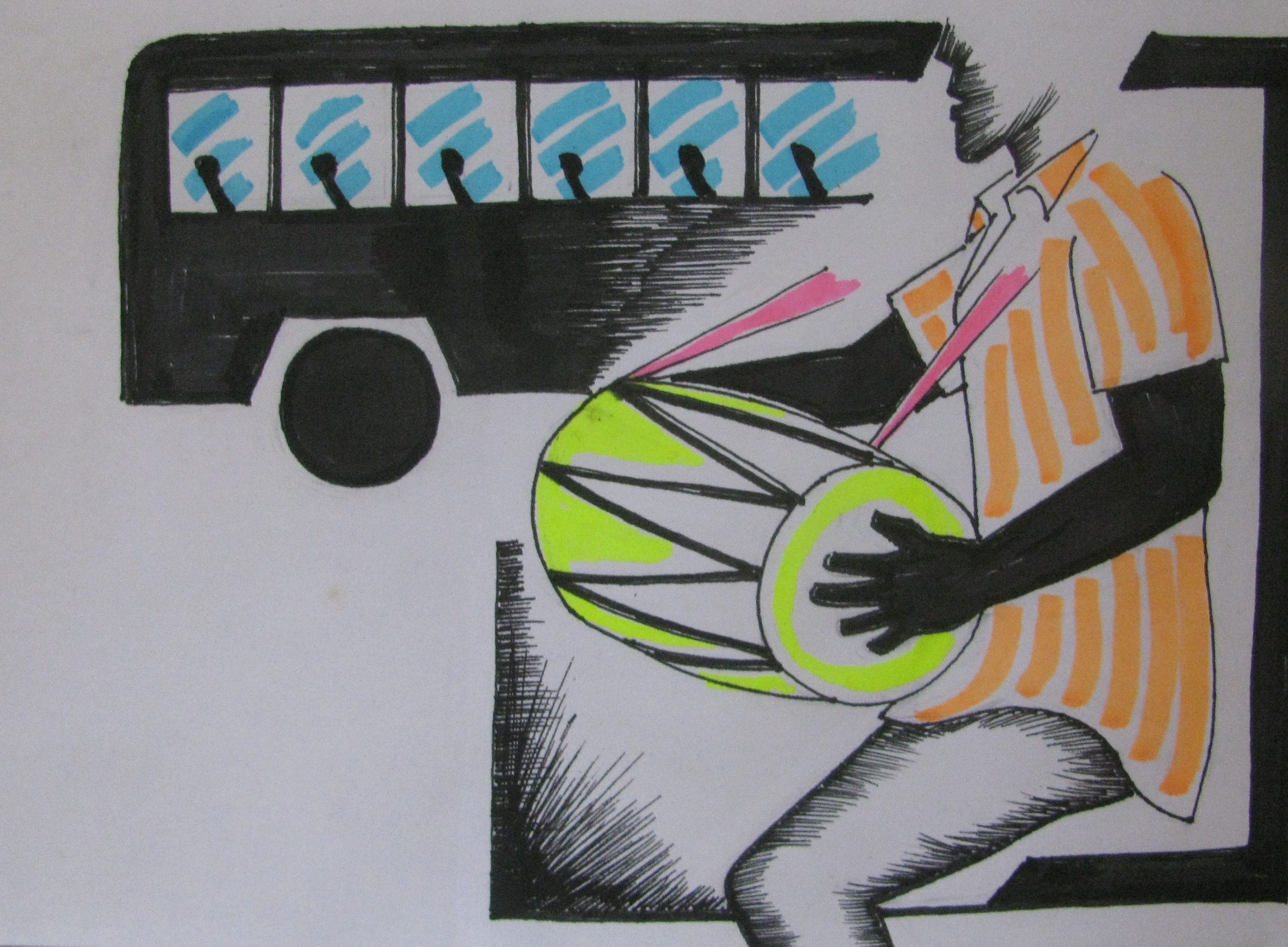
Illustration: Shyam G Menon

Illustration: Shyam G Menon

Some years ago, a friend from Ladakh and I, were on our way from Uttarkashi to Delhi.

We travelled to Rishikesh in a packed jeep and from there, took a bus to Haridwar.

Upon reaching, we found that there were no buses just then to Delhi.

Trains were full and the only available tickets required patronizing the black market.

We decided to wait for a bus.

The bus station was the regular sort – dismal. It was located opposite Haridwar’s railway station and therefore in a rather busy part of town. We briefly walked around in the neighbourhood, had tea from a roadside vendor before the railway station and then settled down to wait at the bus station. These are the occasions when you indulge in India-watching. What’s that man doing? Isn’t that woman beautiful? Those people, dressed that way – where could they be from? What’s that vendor selling? Why do people have so many children? So on and so forth. I wondered what my Ladakhi friend made of the Haridwar environment, thick with people. Ladakh was vast desolate mountain landscape with few people. It was cold desert. As one of the least populous districts of India, his land was the absolute opposite of this congestion at the foothills of the Himalaya, where the plains lapped innocently at mountains’ feet not yet betraying the ocean of troubled life beyond the teasing waves. As you went more and more into the plains, crowd and congestion rose till India became crushing reality of huge population struggling for resources. Yet we never speak of our numbers. I had just begun freelancing then and in the years that followed, I would discover how averse even the Indian media was to being reminded of population as anything but market and potential GDP.

A bus, clearly not state transport type, drove into the station and stopped. A troupe of youngsters got out. One of them carried a drum. Ten minutes later, a street play ensued in the bus depot. It was on safe sex, HIV, population, family planning and so on. The people around watched, amused. Women pulled their saris over their faces and laughed shyly. Until some years ago sex was too touchy to discuss publicly in India. Babies happened. And when babies were a more conscious choice, it was packaged as human fulfilment, even cultural expression. Either way, every census returned more numbers of us. Who cared if we were drowning in all that fulfilment and expression? The street play went on for a while. When it concluded, the artistes treated themselves to tea, packed their props and returned to the bus. It drove off to new location somewhere else.

I couldn’t help admiring those young people.

They showed the courage to address something terribly important to India and grossly neglected by everyone from government ministers to common people. I also remember feeling sad – for nobody and by that I mean nobody, will ever tell those young people how critical they were for public awareness. In contemporary Indian imagination only losers do what those youngsters did. Winners find profitable careers; make money, have babies, leave India – so on. When aspiration is the stuff of escaping the drowning, who wants to plug the deluge? If you want to do anything sensible, you must be prepared to live with the stigma of being loser. I hope those young men and women find the resources to endure it.

The bus to Delhi arrived.

Hours later, we reached India’s capital.

From Delhi, my friend left for Ladakh.

I returned to Mumbai.

Recently, Business Standard – a well known Indian financial newspaper – reported on an Oxfam study alerting the world to the average price of staple foods like wheat and maize doubling worldwide by 2030 (http://www.business-standard.com/article/markets/world-stares-at-doubling-of-food-prices-by-2030-113101501088_1.html). Some of us may find that too conservative, for in our own lifetime we saw prices shoot up more. The scorching price of onions was top news in India some weeks ago. Anyway – average prices doubling globally was Oxfam’s estimate and they attributed the scenario to a host of factors ranging from climate change to high population, falling productivity in agriculture and cultivable land diverted for crops other than food courtesy market forces. The main cause and probably the most immediate of all causes cited, was climate change. But think a bit and you will see behind it, the ways of a giant population. We and our ways worldwide contributed in no small measure to climate change. We can’t dissociate ourselves from adverse weather phenomena. We cannot also dissociate ourselves from the ways of the commodity markets. Today on the planet, we are a global population of over seven billion people plus the habits and aspirations of that many. We will exceed nine billion people globally by 2050. Our demand for food is projected to rise by 70 per cent. As yet, we don’t seem to have good enough answers or leadership for what potentially lay ahead. The forecast on sharp rise in food-demand is when we don’t have the will despite our existing predicament, to stop the rotting of food for want of proper storage. Not to mention, each one of us thinks we deserve family; the undeserving is someone else. The big picture engages none. Maybe, it exhausts everybody. The price of continued disinterest in the big picture can be steep. It isn’t about food alone. It is also about what people will do to get food; the potential for conflict therein.

Earth seems a bus station needing a street play.

Nobody wants to lose tackling a difficult truth.

The easy win, attracts.

I wonder where those youngsters are.

(The author, Shyam G Menon, is a freelance journalist based in Mumbai.)
IN THE SPOTLIGHT

Illustration: Shyam G Menon

Illustration: Shyam G Menon

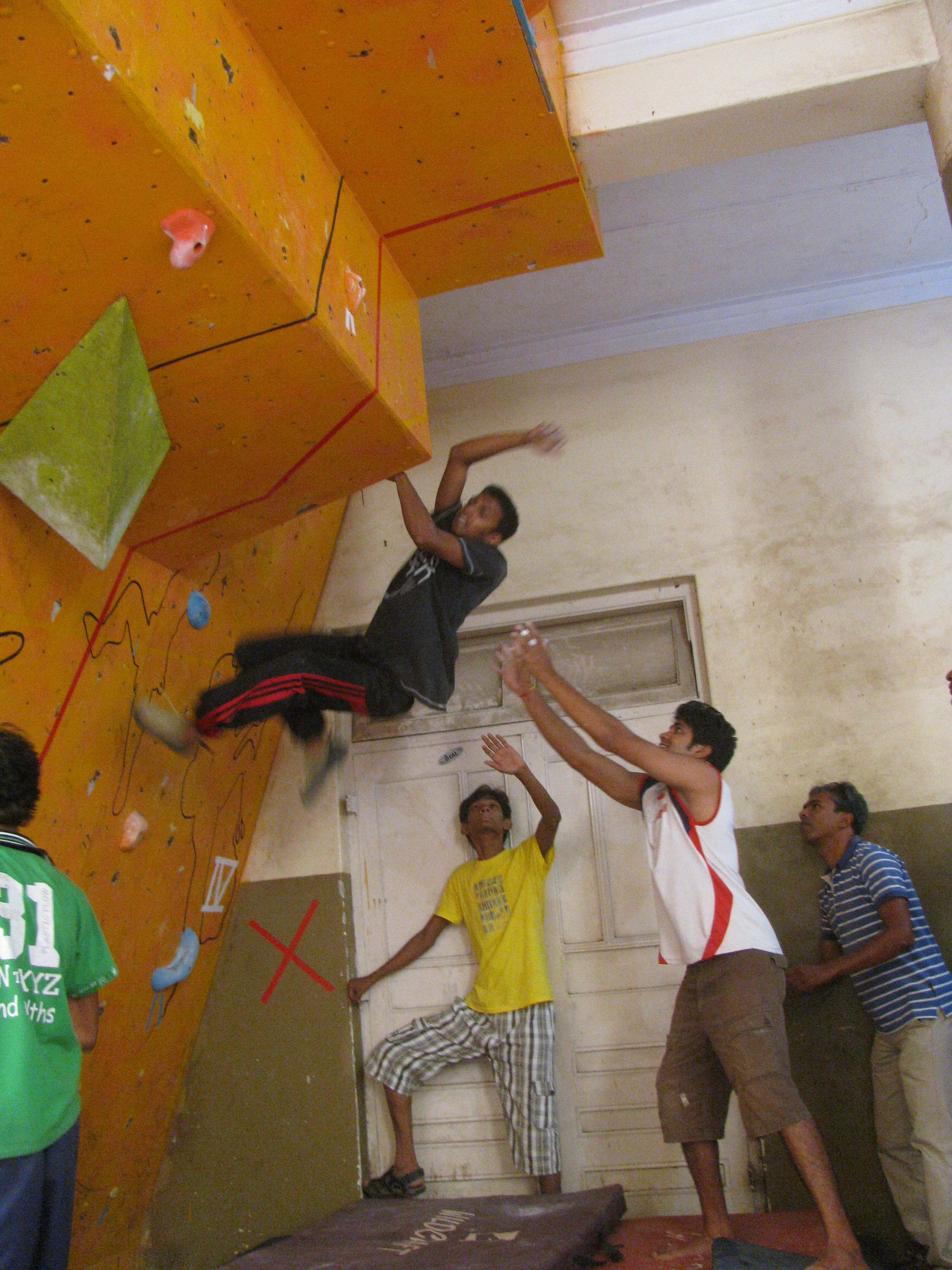
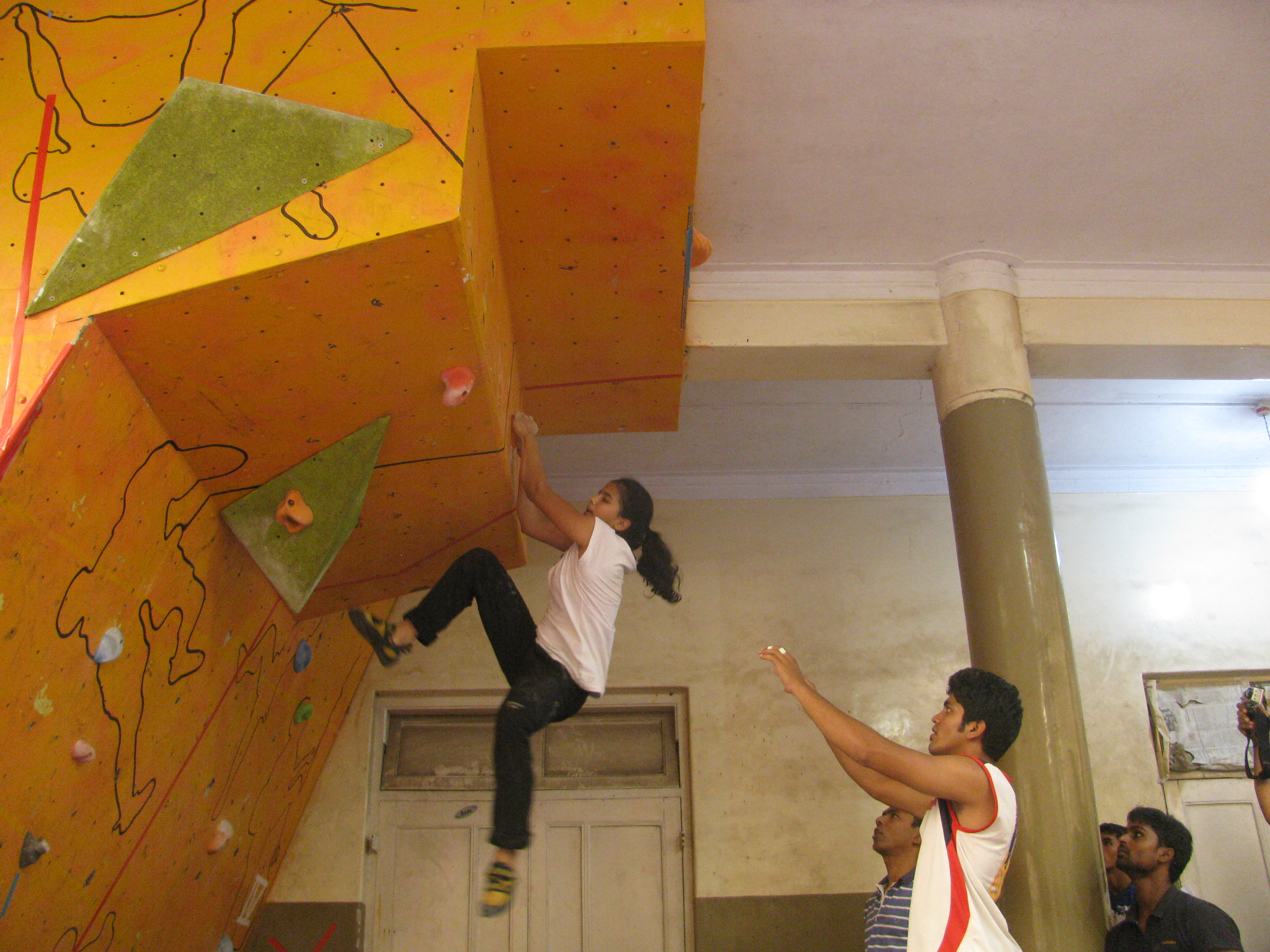
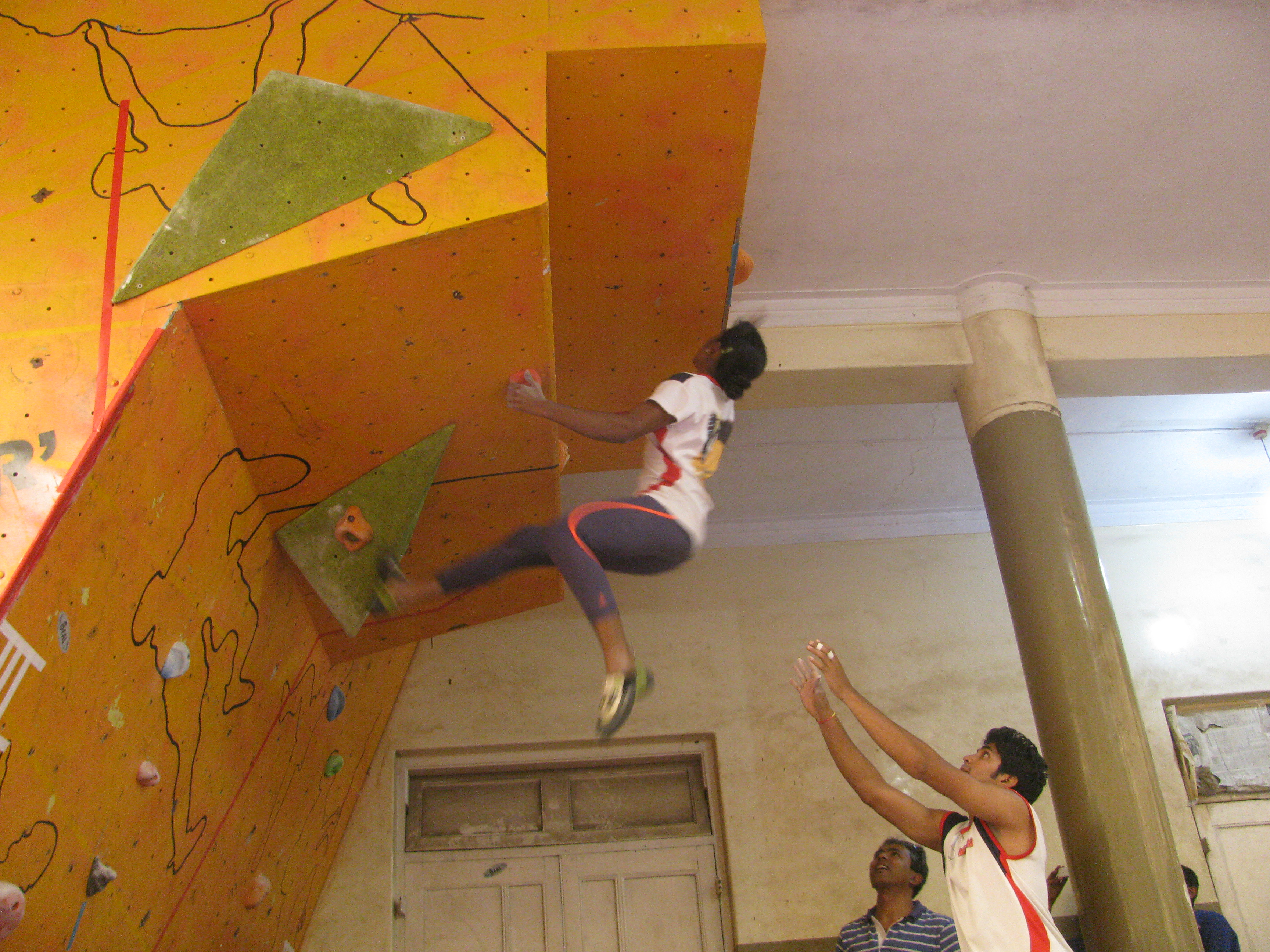
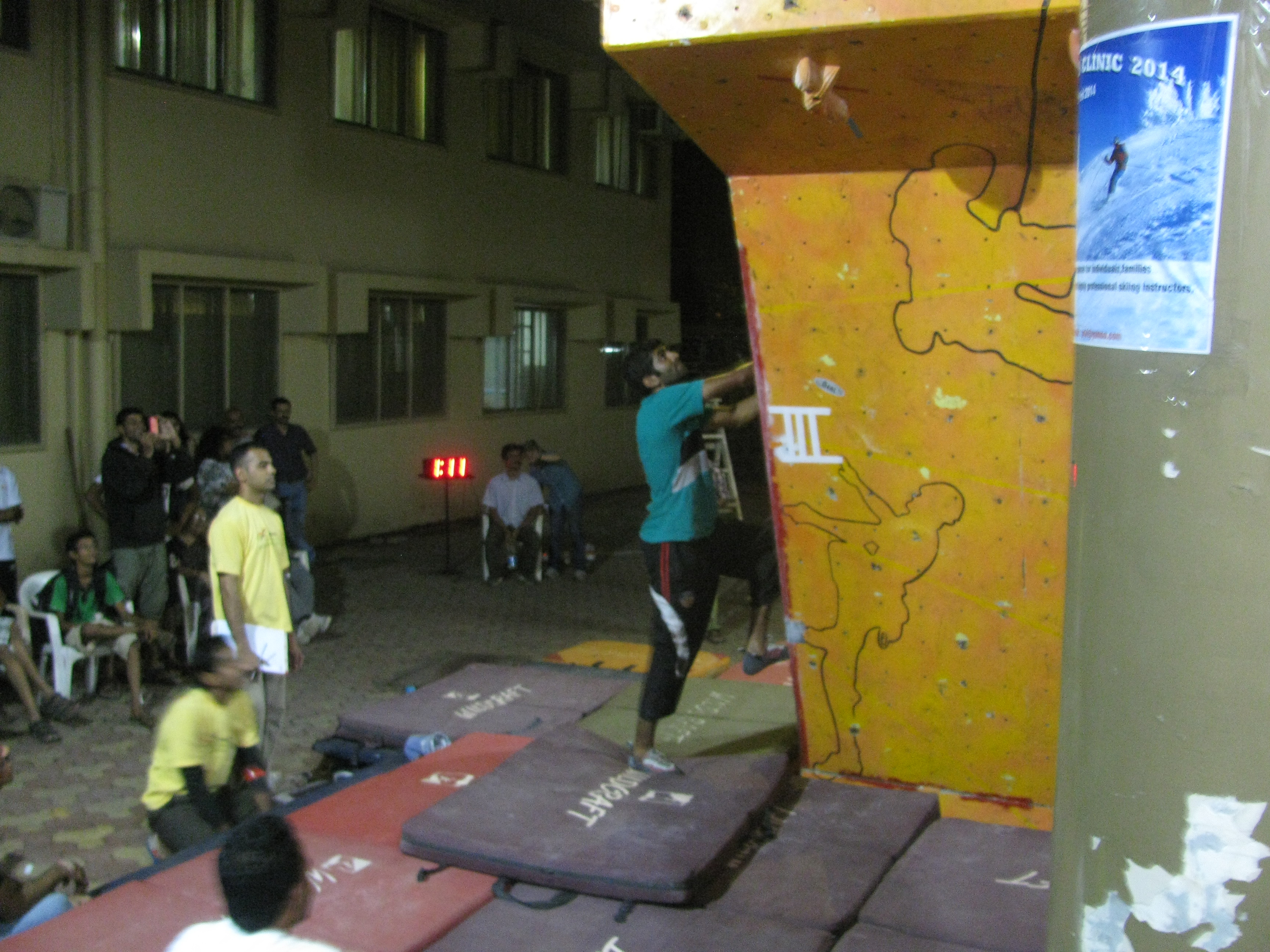
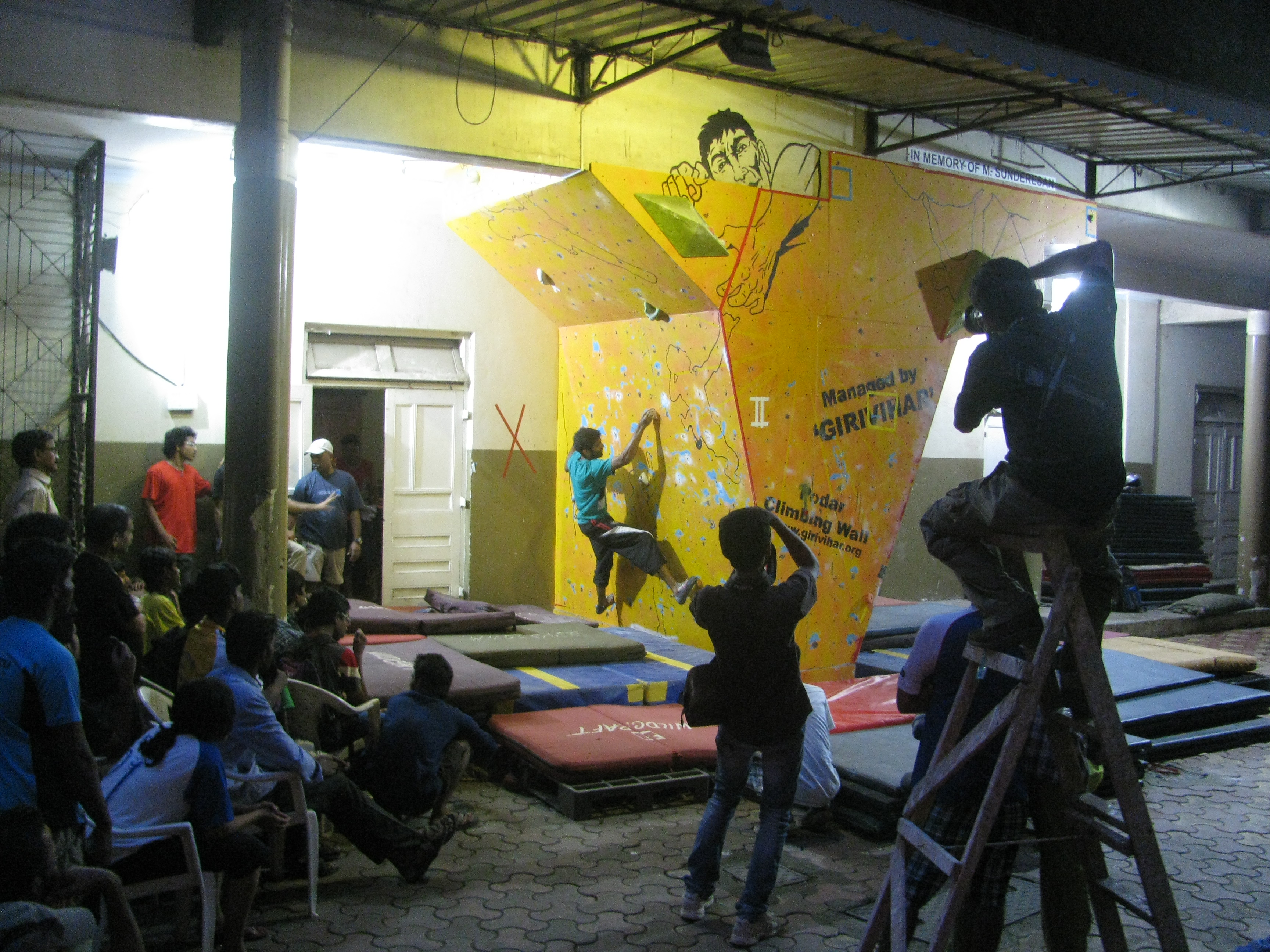
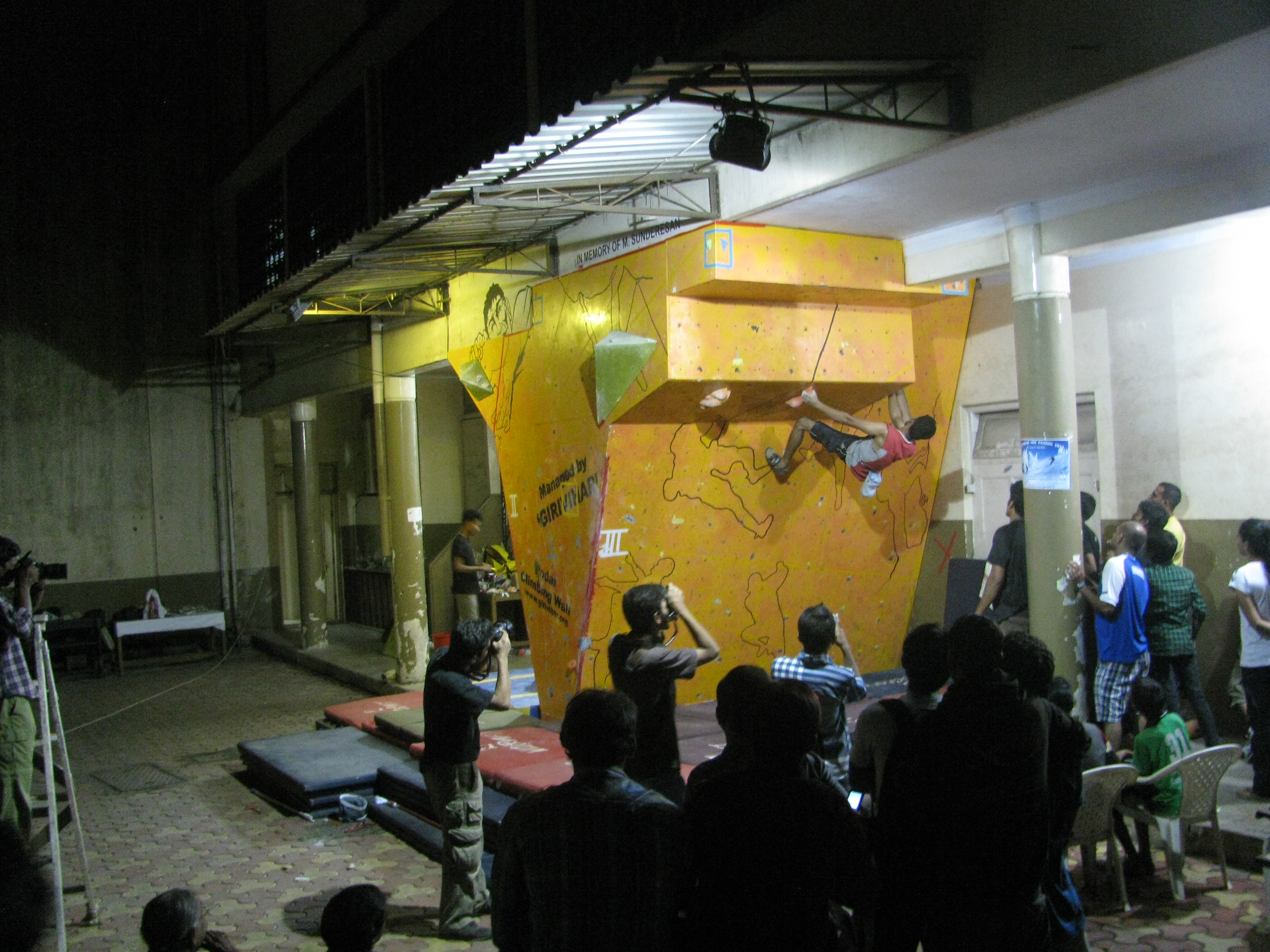
We were around seventy people killing time in a large, bare classroom at a school in suburban Mumbai.

Every fifteen minutes or so, a group of volunteers would come and whisk off two or three from the room. At regular intervals, a round of applause, sometimes shouts of encouragement, reverberated from the outside. Fervent shouting meant the competitor was battling in the arena, sustained applause meant he had done damn well. Once in a while, a moan would emanate. Its meaning was well known and dreaded.

What would my fate be? I thought.

Barring another person – a veteran climber – everyone else in the room seemed well below thirty years of age. They were mostly college students or youth in their twenties, early twenties. Preparation had been diligent and designed to peak for the zonal climbing competition. Fit gladiators, all. A lot of people in the room were shaking out their limbs, limbering up or trying to focus. Once in a while somebody would get up and trot around the room, a few hops and stretches added for warm-up. Occasionally the door frame attracted and a climber or two did pull-ups. The person next to me was wiping his climbing shoes. He cleaned every nook and cranny of its sticky rubber; then inspected it closely to make sure. What if one particle of dust was what made the difference?

Here and there in the room, the people with the best chances relaxed in a heap of cronies. It was funny – anyone capable in India became an emperor. There was careful pattern to the talk of king and crony. The hangers on would massage the champion climbers’ ego – “ you are a wizard; you are strong,’’ so on and so forth. The champions in turn did that old feudal trick of courting the underdog. They would cite inadequate practice and better preparation by foes. Everyone wanted to win, badly so. From the quiet ones preparing in their minds for battle to the hangers on enticing the champs up cliffs of sycophancy to the champs fighting off the unwanted adulation – all wanted to win. Why not? We live in the age of ambition and competition.

I knew most people in the room but didn’t have anyone to really connect to. I was in my late thirties then, average climber and participating in the zonal competition partly to find out if I could belong to climbing at such level and partly to challenge the negativity in my head. I had wanted to take part in the competition but didn’t feel like because I was sure I would place at the bottom. Who wants a bottom dweller? But that seemed a case of me being unfair unto me, plus fear of failure.

So in I went.

Those days, every weekend was spent climbing. Soon after I registered for the competition, preparations began. I had to do what I could. I was employed at a newspaper. After work, I frequented a friend’s house to train. Abhijit Burman aka Bong had a tiny climbing wall made of a single plywood sheet fitted with artificial holds. This was his old house, before he acquired a new place where he built a wall such that he seemed to be living under it. And that was before he lost his living space to climbers moved in to live under his wall! I trained my way. Young people do a lot of dynamic moves. It featured lunges and leaps. It was the popular climbing style. I was too much a bag of injuries to risk that. Besides I didn’t like dynamic moves. They make for great visual. But outside competition environment and pre-protected sport routes, most climbers wouldn’t do it. Yet that’s what competitions strive to be – great visual. It is activity squeezed into spectacle format. Without it where’s the fun for participant and arena? Not to mention business model, for media and sponsors don’t go where there isn’t spectacle. All sports therefore have their competitive half. We may have run originally as hunters engaged in lengthy pursuit of prey. But there is no competition on the planet more engaging than ascertaining who is the fastest runner around even if you can hold that pace for only less than ten seconds. The stadiums of ancient Greece and the arenas of ancient Rome are thus among the longest standing truths about human behavior. They have since hardened into markets deciding how sport should be. My upcoming zonal competition was a tiny, tiny version of that legacy by market.

Twice or thrice every week, I finished work early and took the suburban train to my friend’s house for an hour or two on his climbing wall. On the day of competition, parked in that classroom of gladiators, I knew my efforts to prepare had been very little compared to the training and goals in my neighborhood. So I kept quiet and rested. Till the numbers in the room dwindled and the airy classroom was so thick with the wait that it started to suffocate like a prison. The bars on the windows looked like the burly rods of a jail. I had sat in chambers like this before when I was a regular competitor at college in extempore speech contests. You went through a period of isolation before the competition but that was rarely for more than an hour, including five minutes to prepare once topic was given in isolation within isolation. With seventy climbers listed and mine being the last number to be called, it was a wait from morning till evening. I was mad with restlessness by the time I reported at the wall. Forget the climbing wall; I could have walked through brick and concrete to taste freedom.

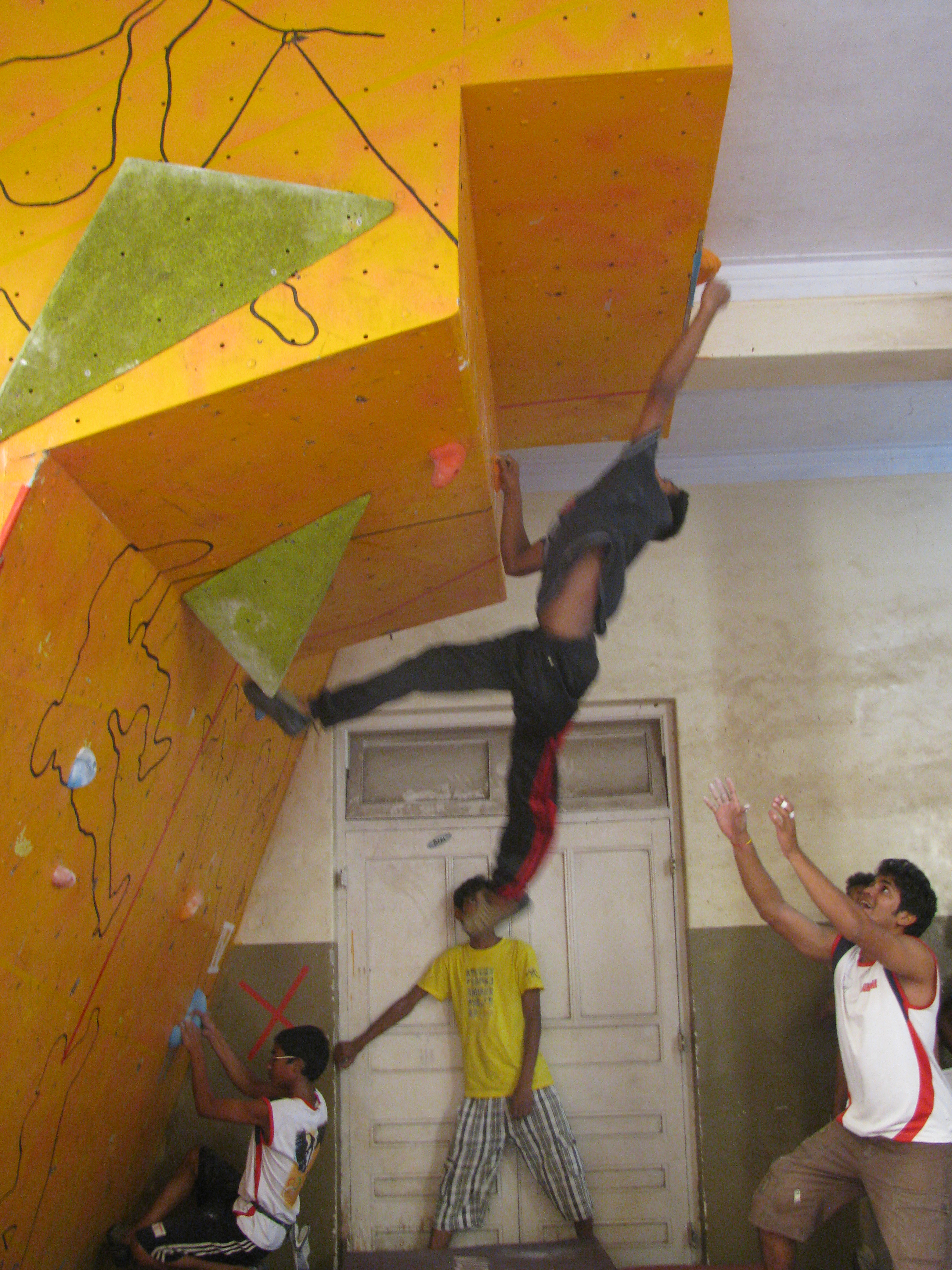
A voice announced my name on the loudspeaker. I fastened my harness, picked up my chalk bag and approached the wall. I was nervous. I don’t know how competitors manage to wave to crowds and such. My deduction now is – they wave to get the nervousness over and done with. Once the world is acknowledged and elegantly pushed out of your head, all that remains is climbing. My head was full of several worlds asking – what the hell are you doing here? A few of my friends cheered and the sound system switched to loud, thumping Hindi film music. People started clapping in anticipation of spectacle. I made a threaded figure of eight on the rope incorporating my harness loop also into it. Its safety knot locked off like a mute button silencing surrounding world.

Now there was no escape.

What next for reluctant warrior?

Suddenly my average climbing ability was all over me and embarrassingly so, for I had additionally walked into the spotlight. It was like being on the poster of `Chicago’ with no dancing skills at hand. I could imagine the flair shown by the others. The youngsters would have danced and pirouetted their way up from hold to hold. That’s what all those ovations I heard in isolation had been.

They must have been fantastic.

Will I be as good as them? The well trained climber, having prepared for weeks, works his way elegantly from hold to hold up the wall, till on that roof high above the ground – oh watch this ladies and gentlemen – he executes a one hand-hang, rests a while in a figure of four, chalks up his hands, shows off the power in his abs as he assumes the horizontal, calmly clears the roof and waltzes his way to the top!

Applause!

In retrospect and after watching several competitions, I have realized that aside from being a great climber, a winner on the wall is usually someone who can channel the encouragement from the audience into a positive flow of energy for climbing. Someone who enjoys climbing and who just enjoyed it better given all those people sitting around. You just shouldn’t get shaken up. My existence was different. I enjoyed climbing; climbing at my pace. I didn’t enjoy people as easily. At the wall, I was shaken and stirred, down to the tip of my roots. And my thought at that point was – what the hell am I doing here? I just didn’t believe that I could do anything. I didn’t study the route properly and all I remember is mumbling my readiness to the person belaying. Then I blindly climbed a few moves up, found myself wrong footed for the next move and lost interest.

I came off the wall.

A moan of disappointment went up from the audience. But it didn’t linger long. A new song blared loud on the sound system. The competition had concluded and it was now time for the results. I knew where I stood in the list. I quietly packed my rucksack and left the scene. Some weeks later, Bong, who had been part of the competition’s organizing team, handed me a certificate that said I had taken part in the zonal. It is there, somewhere in my cupboard.

The day after the competition, I was back to being newspaper reporter in Mumbai’s rat race. Save one friend at work, nobody knew where I had been. Several months after this competition, I participated in another one. It was far more informal and internal to my climbing club. It was on natural rock. I finished a respectable fourth I think, in that much less challenging field.

I have since taken a clean break from competitions.

Fourth place seemed apt for honorable exit!

(The author, Shyam G Menon, is a freelance journalist based in Mumbai. The zonal competition mentioned in this article happened several years ago.)

AN EARLY MORNING IN PUNE

Illustration: Shyam G Menon

Illustration: Shyam G Menon

Recovering from a shin injury seemed apt time to catch my first sight of many people running together.

Although based in Mumbai, a city renowned for its annual marathon, I hadn’t watched any running event cast so. The closest I got to the spectacle of people-in-motion was during early morning jogs in cantonment towns in the Himalaya, when my very slow self would be overtaken by groups of soldiers running by.

Last weekend changed that.                                  

I wanted to support my friend who had taken to running in her fifties. I have been on mountaineering expeditions. I know what an uphill task is. She was tackling an uphill task in life albeit in a different sport. She had enrolled for a run in Pune. It is an interesting city; a mix of the traditional and the modern with much young blood for physicality. Mumbai on Maharashtra’s coast and Pune on the western margin of the Deccan plateau are cities distinct by character. Past 4.45AM, my friend and I walked to the venue. Early morning there was very little traffic. The October weather was pleasant. Mumbai after the rains was prone to heat and humidity. Pune, 1840 feet above sea level, was neither hot nor cold. The train journey in had been lovely. A post monsoon explosion of orange coloured blossoms graced the countryside bordering the railway tracks. It was Sunday. Yet I suspect Pune woke up more casually than Mumbai, India’s nonstop financial capital. No tea stall was open. No vendor of India’s wake-up beverage had parked his cart close to the venue to tap the early morning market of people out walking and running.

Photo: Shyam G Menon

Photo: Shyam G Menon

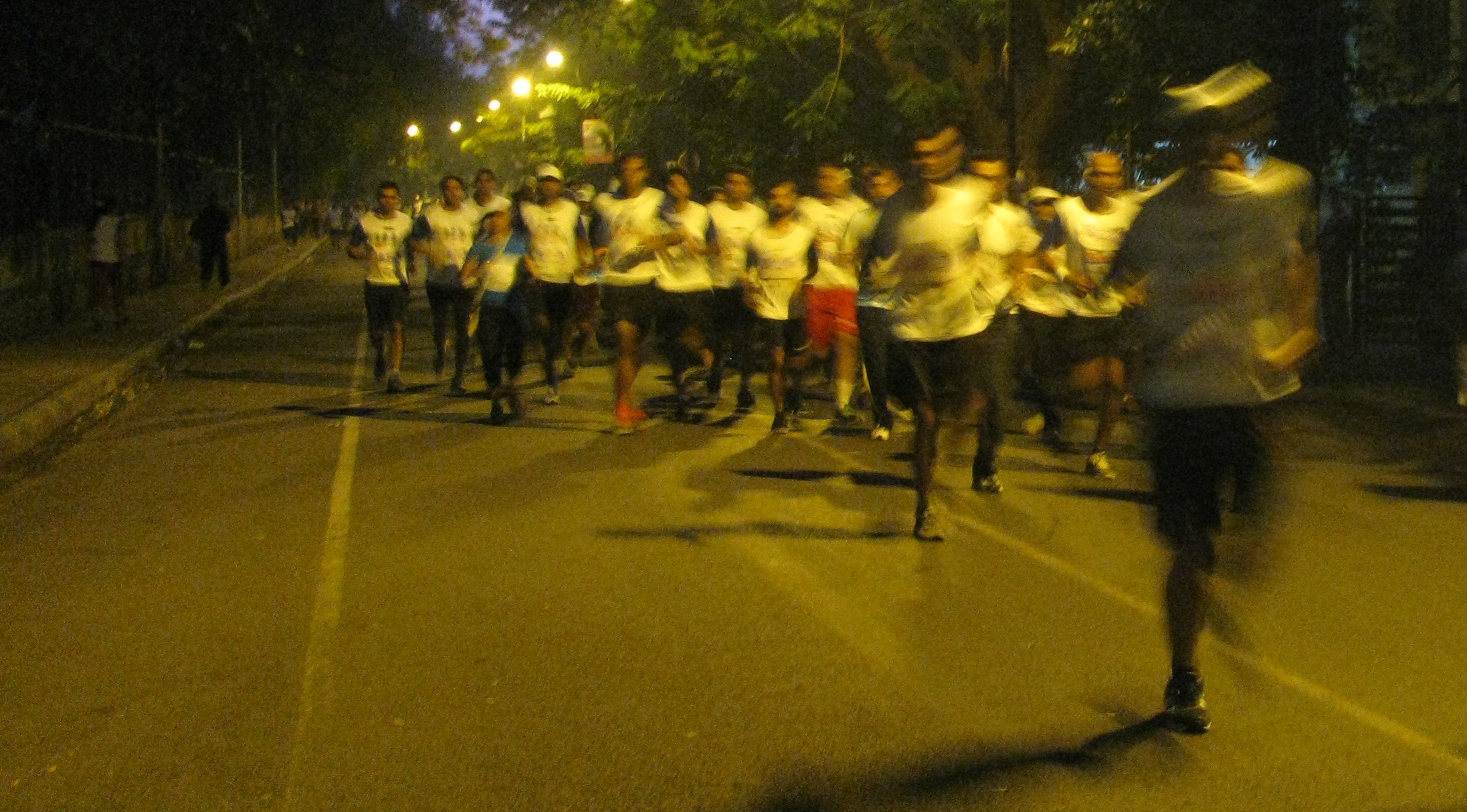
The street lights shone like yellow orbs. I liked the sight of runners converging on the ground near Pune’s BMCC College. Some walked alone; some came in groups, some walked leisurely, others walked fast, some jogged. There were young people, children and middle aged people. Assembled on the ground, they were soon lost to pre-race stretching and warm-up. I wished I could be like them. But I was getting injured too often to run enjoyably for long. Some weeks spent running and I am back on the bench nursing pain. Further, contemporary running’s fierce sense of purpose was intimidating. I am not exactly your trail blazing-type to hold my ground before Running Inc’s gladiators, their measurement by timing, the races you participated in etc. It reminds me of everyday rat race.  

My friend entered the ground. I wished her luck and took my place on the road as spectator. Three old women, local residents who used the ground for their morning walk, arrived. They were politely apprised by the volunteers, of the ground being closed that morning for all except runners. The women took it stoically and walked off to choose a place to stand by and watch the run. At quarter to six, roughly a dozen motorcyclists on their Harley Davidson bikes rode in. Not quite apt – I remember thinking so, clearly. Yes, the bikers looked impressive as an advance party for the runners. But surely a lot of engine, noise and fossil fuel-burning were hardly best ambassadors of running. Events imagine differently and one day we may comprehend how sport by event management changed the idea of sport. Close to 6AM, the national anthem was played. A band of traditional drummers began playing. Right on time, the motorcycles thundered out from the venue on to the road with the runners who must have been pacers for the half marathon, right behind. At their heels, came the half marathon column.

It was an eerie feeling. On a regular day, you noticed the passage of a single runner on the road as mere passing visual. But a large group of runners brought the same feeling to my neighbourhood, as a passing herd. A herd of human beings running by produced a consistent shuffling sound and magnified sense of breath, like something big moving. It was like a passing rustle, soft yet pronounced by the many feet striking the ground. I wondered what it must be like to be within that column and enveloped by the sound of that breathing, striding organism. This was running’s equivalent of cycling’s peloton. I recall the seriousness of many runners. Each appeared to be in a private world, likely imagining the distance to sustain the effort. Or, more likely they were trying to keep such thoughts at bay for nothing worked as well in running or any endurance sport as a blank mind nestled like a marble in a bowl of rhythmic movement. Yet a blank mind was tough to achieve. The more you tried to achieve it as an achievement, the more the mind thought and produced baggage in the head! You have to be naturally happy running – that’s the Holy Grail, the Zen of it and all of them would soon be chasing Zen. How funny – the roundabout ways in which we recreate natural impulse only to find it synthetic due to the underlying compulsion. Or perhaps, the more fundamental question is – does man move at all without compulsion, without prey to chase or bait for attraction? Lost in such thoughts, I forgot to take out my camera and click on time. By the time I did, the column had tapered. Amid this, I thought I had missed my friend go by. Then just as I looked up, there she was!

Photo: Shyam G Menon

Photo: Shyam G Menon

After the runners were on their way, I walked around in the area looking for a tea or coffee stall. A small roadside shop called `Coffee Stop,’ which I had hoped to visit and seemed ideal for freelance journalist’s pocket, was closed. At Gopal Krishna Gokhale Chowk, not far from a bustling lot of newspaper boys loading their bikes with printed news that would inevitably be mere paper by evening, I found a tea vendor and his cart. It was the typical cart on wheels with beaten aluminium sheets on wood for kitchen platform. The vendor served good, hot, masala chai. Then, I stepped into an adjacent eatery, which had captured my curiosity. Cafe Goodluck (yes, they wrote good luck so) was on the ground floor of an old building. It had been there since 1935. Its serving sealed its place in my heart and wrapped up those early morning hours in Pune, in a cocoon of contentment. The cafe gave me the best bun-butter (locally called bun-maska) I have had away from Mumbai’s Yazdani Bakery. The Mumbai bakery’s bun was in a class of its own. Goodluck compensated for its more ordinary yet tasty bun, with a big sized-serving. I liked restaurants that fed their customers knowing that food was meant to sustain life. It is a value I admire in these days of hunger by economic inflation.

Freelance journalists know that hunger very well.

(The author, Shyam G Menon, is a freelance journalist based in Mumbai.)                   
BOULDERING COMPETITION AT PODAR COLLEGE

The second edition of the annual climbing competition held on the bouldering wall at Mumbai’s Podar College, happened recently. The wall is built and managed by Girivihar, the city’s oldest mountaineering club. For some of the participants, the event was an ideal warm-up ahead of the west zone competition in surat. the wall is a small one, wrapped around a pillar on the edge of an inner courtyard on the college’s ground floor. participants for the competition were largely from mumbai and pune. as ever in indian climbing, it was a small gathering of the committed. the youngest person to turn up and watch was a small child with mom and dad bringing pram along. the oldest was most likely 92 year-old pio linhares, whose son, franco, is the club’s former president and a regular climber at the wall. 

Here are some photos:

juniors

IMG_0198IMG_0186IMG_0187IMG_0194IMG_0199IMG_0196IMG_0205

LADIES

IMG_0227IMG_0217IMG_0223IMG_0226IMG_0234 

AND GENTLEMEN

IMG_0261IMG_0290IMG_0291IMG_0294IMG_0304IMG_0285

climbers, cameras and overall view

IMG_0254IMG_0282IMG_0312

PEOPLE

IMG_0278IMG_0229IMG_0240IMG_0236IMG_0276IMG_0246IMG_0269

results:

men’s final

1. aziz

2. Vicky

3. tuhin

women’s final

1. siddhi

2. mayuri

3. anjali

Juniors (boys’ final)
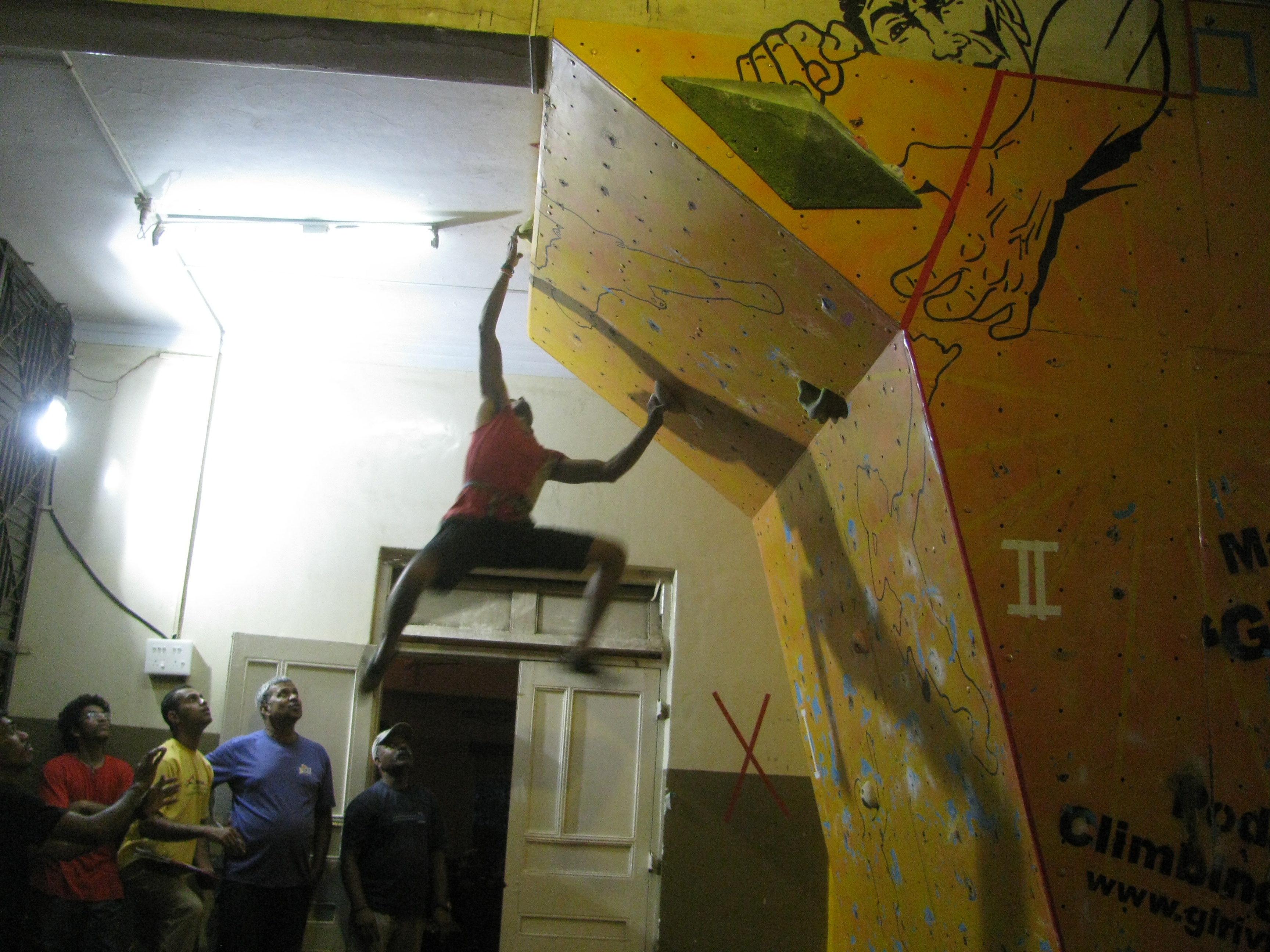
1. akash

2. sachin

3. bunty

(The author, shyam g menon, is a freelance journalist based in Mumbai. All the photographs herein were taken by the author.)