THE IMPORTANCE OF EDUCATION – AN IRONMAN STORY

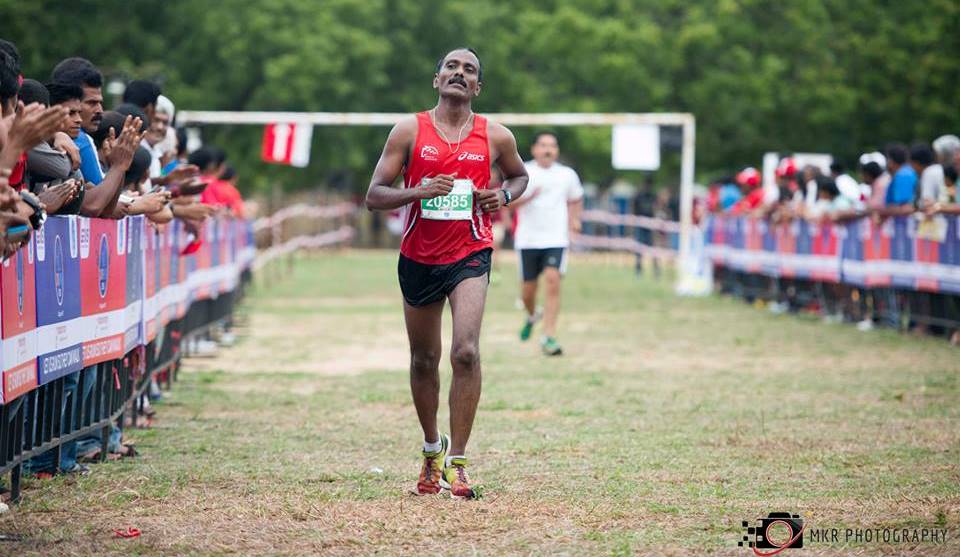
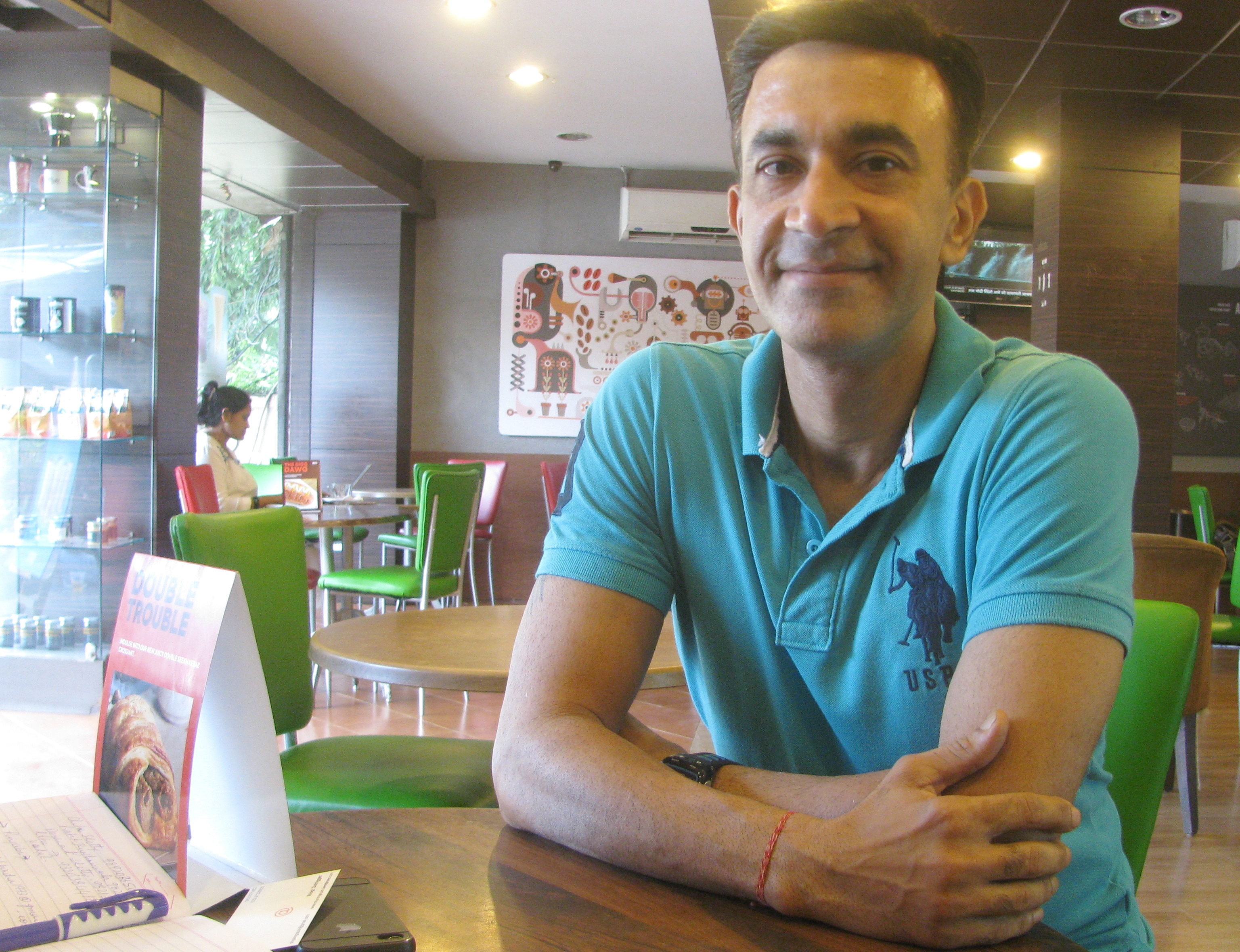
Nagaraj Harsha (Photo: Shyam G Menon)

On May 2, 1927, when The Stevens Hotel opened in Chicago, it was the biggest hotel in the world. It had 3000 rooms. Its first registered guest was Charles G. Dawes, then vice president of the US and in 1925, a co-recipient of the Nobel Prize for Peace. History however had other plans for the hotel. The Great Depression ruined its owners and the property went bankrupt. The government took the hotel into receivership. According to Wikipedia, in 1942 the US Army purchased the hotel for use as barracks and classrooms. Two years later, the War Department sold the property to a private businessman, Stephen Healey. In February 1945, as World War II drew to a close, Conrad Hilton purchased the hotel from Healey. With that, The Hilton, Chicago, was born.

A day in August 2014, two young men from India; both of them longstanding friends – one freshly arrived from Bengaluru; the other staying in Chicago – reached the hotel. The Chicago resident dropped the visitor off at the hotel and drove away. Nagaraj Harsha kept his emotions in check as he made his way to the hotel’s restaurant, where a meeting was due. Neither party had met each other before. This was their first time face-to-face. Thanks to photographs periodically exchanged; from far, from their table in the restaurant, the family he was seeking to meet, recognized Nagaraj. It was a meeting over two decades in the making.

From the Colombo half Ironman (Photo: courtesy Nagaraj)

Sometimes the earlier chapters of one’s life gather clarity only as the later ones unfold. It was late evening in Bengaluru; actually night, the hour when day rolls up its cuffs, loosens its shirt collar and relaxes over a cup of coffee or a mug of beer, delighting in finding sense or the lack of it, in all that went by. Just outside the café we were in, at the corner where Church Street met Brigade Road, two prominent shops – one selling Nike products, the other selling Puma; the reflection of their glowing logos on glass facades nearby amplifying their presence – kept endurance sport in the frame. “ I am 27 years old now. It was only a year or two ago that I got convincing explanation for what I used to be in childhood and early youth. Things are clearer now,’’ Nagaraj said. His face betrayed joie-de-vivre, restless energy visible in his wiry build and the passion with which he spoke of his life in sports. For a minute his ways and nature of speech reminded me of a friend in Ladakh. Youngster full of energy, he had turned entrepreneur and was mellowing down with the process. How is he doing? – I thought.

Nagaraj was born April, 1990, in Bengaluru. He grew up in the city. He did his schooling at Methodist Kannada School, studying there till tenth standard, before moving to Kripanidhi College to do his eleventh and twelfth. These years are very important in how they define Nagaraj’s sense of self and life. His mother brought up her children single handedly. The family was poor; life was a struggle. They needed help. Looked up in mid-October 2017, Wikipedia’s page for Compassion International did not mention India among countries it works in. The agency is described as “ a Christian humanitarian aid, child sponsorship organization dedicated to the long term development of children living in poverty around the world.’’ Back in the 1990s, it was this NGO that came to Nagaraj’s assistance. They sponsored his education, all the way to college. The person who sponsored his education was Gladys Downey, a benefactor from Canada. “ She has been like a second mother to me. I owe so much to her,’’ Nagaraj said. The school he studied in catered mostly to under-privileged children. On that island of education, Nagaraj was sometimes topper. He doesn’t beat his chest on that attribute. He viewed it in perspective as the natural fallout of being good at studies in a financially challenged backdrop where many students in class may have been similarly struggling and good was sufficient to top the lot. What should engage in Nagaraj’s case is that he achieved such result despite behavioral traits challenging the ability to sit down and study. He was hyperactive.
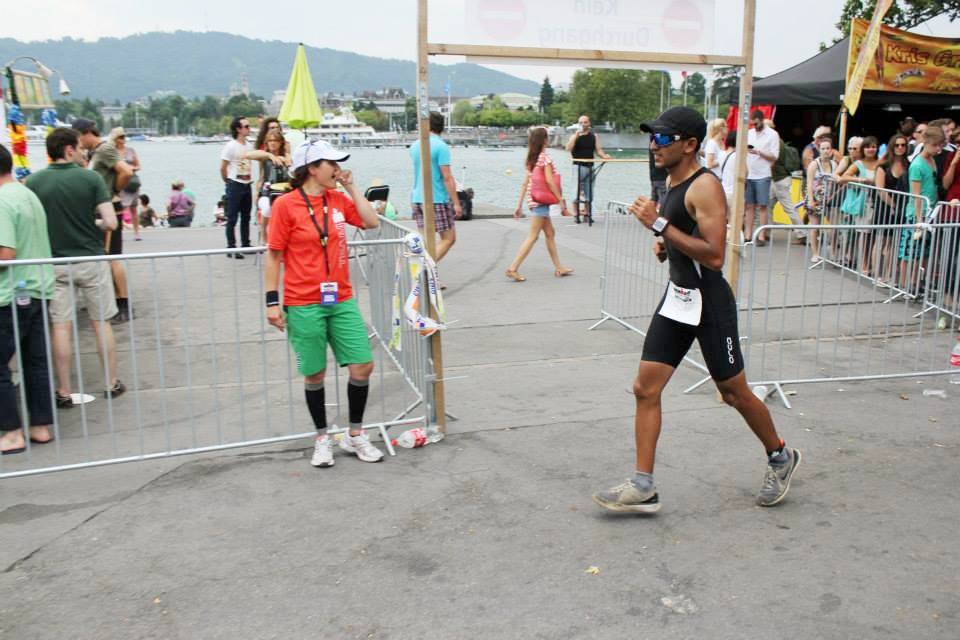
From the Ironman competition at Zurich (Photo: courtesy Nagaraj Harsha)

The condition – Attention Deficit Hyperactivity Disorder (ADHD) – is not easily diagnosed. Information on ADHD available on the Internet, hints at a period of observation and study of subject eventually leading to the conclusion that a person may be having ADHD. This was the explanation, Nagaraj got later in life. In school, long before the diagnosis was made; it was plain struggle to focus. He had boundless energy. He wanted to play, participate in sports and be good at it. But unlike other children, he couldn’t master the art of channelizing his energy to achieve an objective. “ I would try taking part in sport and end up failing,’’ Nagaraj said. A further problem and a potential solution also presented themselves. Everybody needs something that makes them happy. One reason sport has its following is because physical activity releases endorphins; the resultant high is a nice feeling to have. Unable to focus his energy properly in sports and games, Nagaraj found happiness in eating. The more he ate, the more he put on weight. Chubby youngster was typically target for bullying. Around this time, his mother got him a gift for topping studies at school – it was a bicycle. By the time he joined Bengaluru’s Christ College to do his graduation, that cycle had become his mode of commuting to college. Physical exertion and sweating, he understood, skimmed off the excess energy creating havoc in his system. It helped him focus. The family didn’t have money to send Nagaraj to a good college. Realizing the family’s difficulties, once again, Gladys and Compassion International intervened. They decided to foot the bill for Nagaraj’s college education. According to Nagaraj, he was the first student from his school sponsored by the NGO all the way to college education.

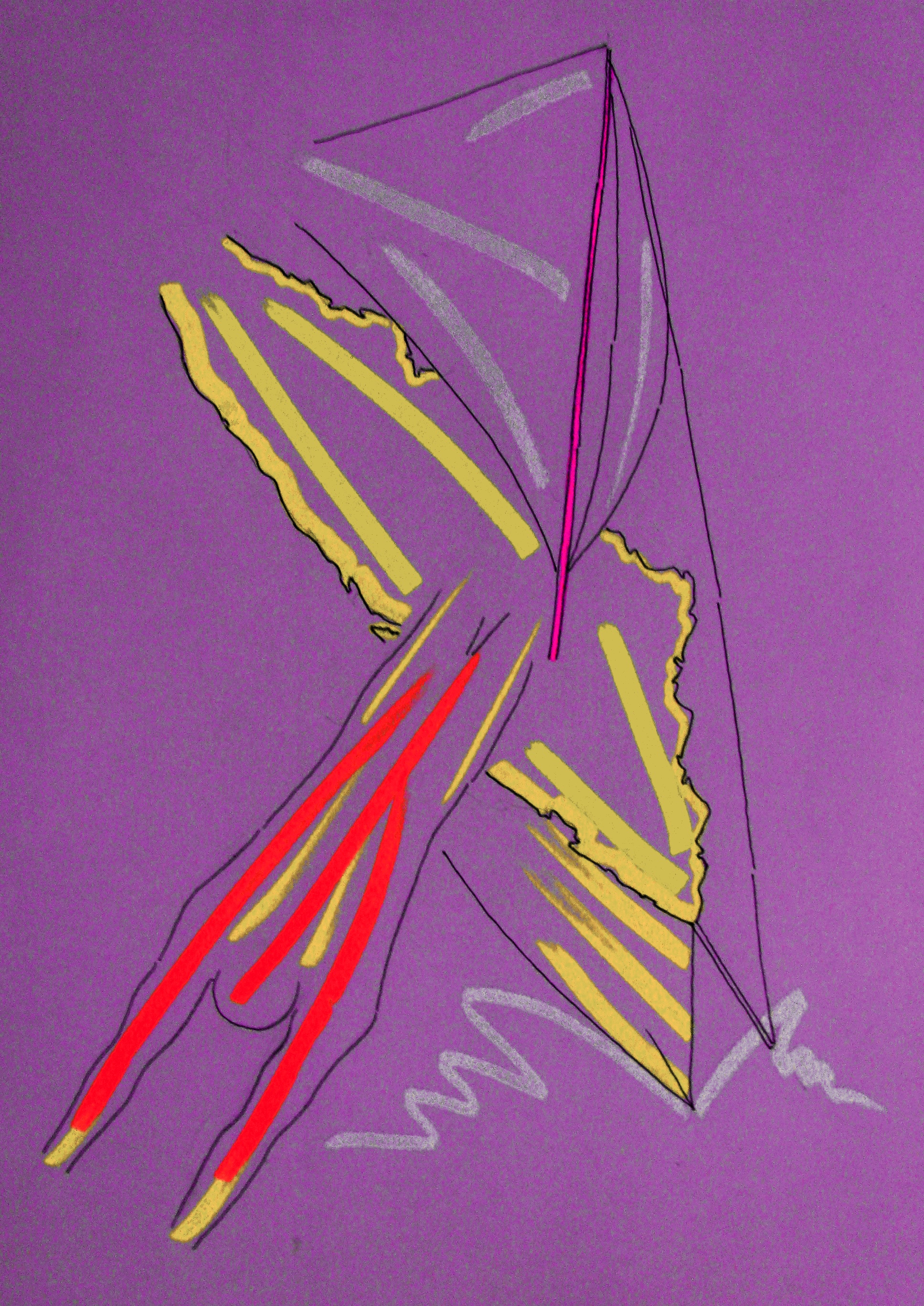
Illustration: Shyam G Menon

First year at college was normal except for a sartorial issue. Like most courses oriented towards eventual work in the business and corporate sector, the graduate program in commerce at Christ College required its students to dress formally. Nagaraj was a good student but he turned up in what dress he could afford. It went on for a while till his teachers took him aside and asked why the streak prevailed. They realized it wasn’t any rebellion on show; it was plain difficulty to afford. According to Nagaraj, the faculty raised money for him to buy a set of formal clothes. By the second year, Nagaraj’s mother had to stop working. This made it imperative for Nagaraj to look out for a job. He had joined Global Gym at Adugodi in the city to work-out and lose weight. He approached the gym management and offered to work for them, cleaning up the premises. On their part, they told him to take three months’ time, learn the ropes and be a trainer at the gym. The arrangement brought purpose to his life. He started waking up at 4.30 AM; he would open the gym at 5 AM, work there till 9-9.30 AM and then proceed to college. He worked at the gym again in the evening, from 5 PM to 10 PM.  “ This was my schedule Monday to Saturday. On Sundays, I worked from 5 AM to 12 PM. Through much of second and third year of college, I therefore had little social life,’’ Nagaraj said. At the café, the man and woman at the adjacent table got up to leave. A new couple took their place. Outside, Church Street was its usual self; plenty of young people, ambiance of imminent dinner, conversation and catching-up and amid it all, the city’s much loved book shops. While historical places abound, every Indian city has its post economic liberalization hotspot. This patch of Bengaluru – MG Road, Brigade Road and Church Street – had for long been the city’s postcard to the world. In the 1980s, it was where you went to see a phenomenon called `pub.’ I remembered my own pilgrimage from college days long ago, to that strip of road, traffic, neon signs and shops selling branded goods. Pubs have since become passé. But new generations still throng this area to engage in what Nagaraj shuttling between home, gym and college missed out on – socializing.

Louisville Ironman (Photo: courtesy Nagaraj)

During his second year at college, at the athletics meet connected to the annual sports day, a friend challenged Nagaraj to a run, saying he wouldn’t be able to manage five kilometers. In the impromptu race, his friend gave up after a kilometer; Nagaraj completed the full course. He was exhausted by the effort (next day he was down with fever) but it showed that with determination and will power, he can accomplish goals in endurance. Nagaraj graduated in commerce with job in hand; he secured it via campus selection bagging alongside the second highest pay package in his batch. Job meant end to his career at the gym. He had been there for over two years, earning in the process his own cachet of long term trainees. One of them had even gifted him a bicycle – a Firefox MTB. He bid goodbye to all that and moved to Usha International’s office at Gurgaon near Delhi, working in finance and accounts. The year was 2010. You can take the man out of Bengaluru; you can’t take Bengaluru out of him – that was true in Nagaraj’s case. He didn’t like Delhi. Now armed with a decent cash flow of his own, he took to drinking, catching up on the socializing he had missed out earlier. He put on weight. Luckily for him, post-probation, his company understood his predicament and gave him a posting in Bengaluru.

During this phase, Nagaraj started to look up blogs related to adventure. The IT industry, after its sunrise stage of the 1990s, had matured into a predictable quantum. There was a sea of young people in Bengaluru, many had studied or travelled overseas. Craving for engaging activity was high. Both trekking and cycling were catching on. Nagaraj decided to try cycling 100 km on the Firefox MTB. The plan was to cycle to Nandi Hills and back. One night he started out. About 15 kilometers away, in Hebbal, he got mugged. “ They took away my cell phone. Luckily they spared the bicycle,’’ he said. He continued his journey and reached the top of Nandi Hills, taking an hour and forty five minutes to get from the base of the hill to its top on his seven-speed MTB. Encouraged, he started to cycle and trek regularly. His next big outing was a three day-cycle trip from Pollachi to Munnar via Athirapally. This time he had a new bike, bought with newly acquired credit card – a Cannondale SL 5. In 2011, in what was his second run since that race with friend in college, he ran his first TCS 10K in Bengaluru, covering the distance in 58 minutes. He paid for the lack of preparation. He was in terrible pain after the run. “ The whole idea was to participate and get a dry-fit T-shirt,’’ Nagaraj said.
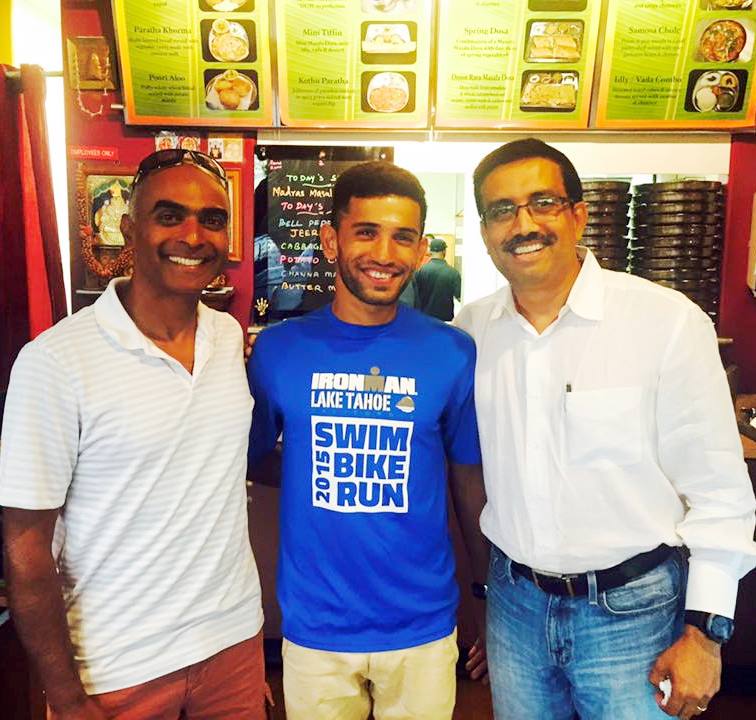
With Gurudev and Jay, who helped raise some of the funds Nagaraj needed to participate at the Lake Tahoe event (Photo: courtesy Nagaraj)

Nice is the second largest French city on the Mediterranean coast, after Marseilles. It is home to an Ironman (triathlon) event. When Nagaraj met Dipankar Paul while socializing in Bengaluru, the latter was planning to attempt the Ironman in Nice. The idea intrigued Nagaraj. Isn’t it worth trying? After all, he was capable of running and cycling. While Dipankar went on to participate in the Ironman, Nagaraj joined a swimming pool in Bengaluru to train. In August 2011, a half Ironman was announced in Colombo, Sri Lanka. The half Ironman entails 21 km of running, 90 km of cycling and 1.9 km of swimming. Two months later, in October, Nagaraj signed up for it. Soon thereafter, he also acquired his first road bike – a Bianchi Nirone 7. He started training for the Half Ironman in earnest. Initially he couldn’t do more than 100-200m in swimming. However, he was consistent, reporting to the pool for a session from 7 PM to 8 PM, every day. All the same by November, he was still short of confidence. Deepak, another regular swimmer at the pool had been observing Nagaraj’s daily sessions. He asked if Nagaraj was preparing for something and upon being told of the upcoming Colombo event, offered to help. Under Deepak’s guidance, Nagaraj improved the daily distance he covered in swimming to 1500m. In December 2011, he went to Puducherry to try his hand at open water swimming (the swim leg at Colombo was to be open water). He co-opted a local fisherman into his scheme. The fisherman took Nagaraj a kilometer out into the sea in his boat and kept him company while Nagaraj swam back to shore. Back in Bengaluru, he biked on weekends and ran 10-15 km. None of this training had any structure.
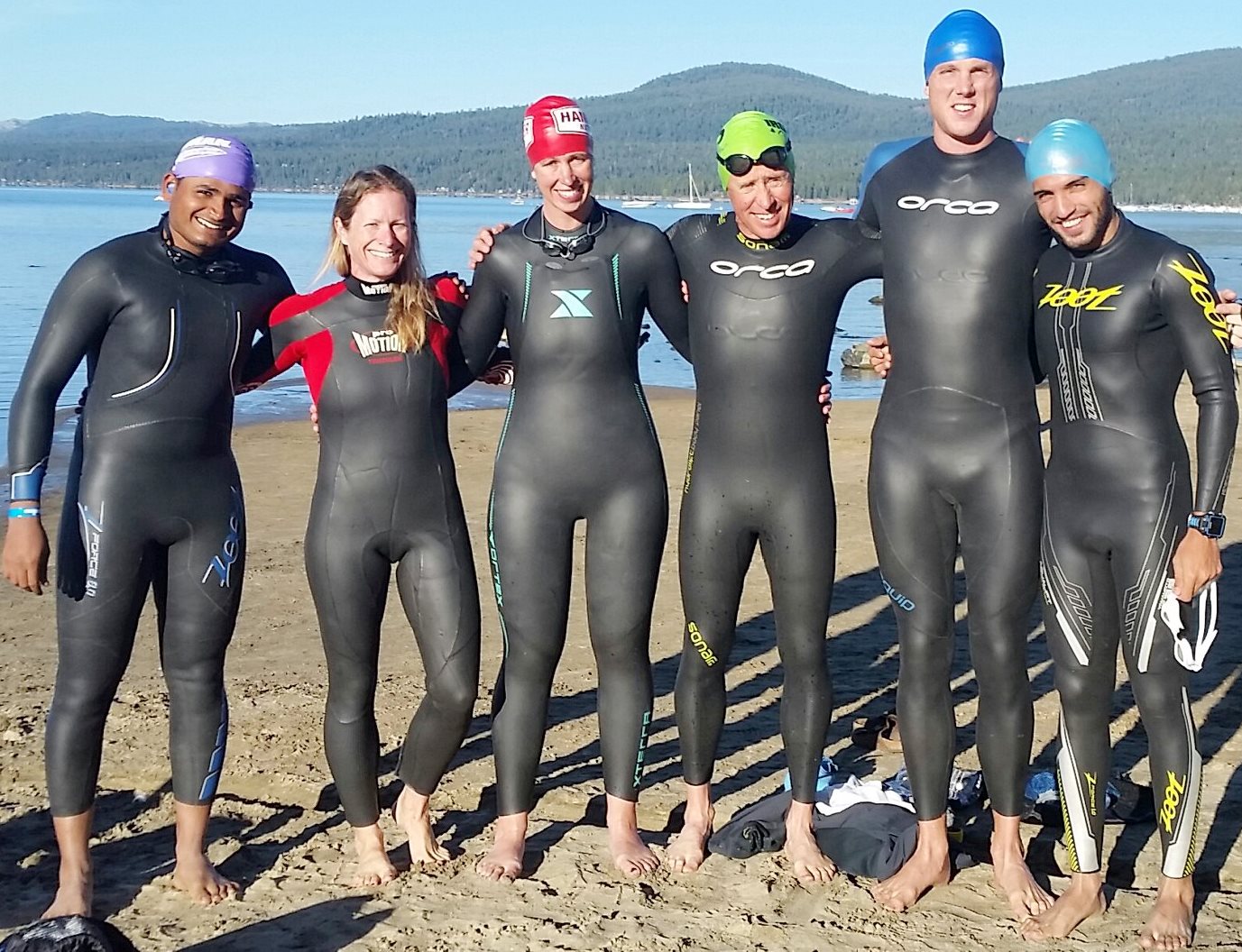
From the Lake Tahoe-Ironman (Photo: courtesy Nagaraj)

In February 2012, accompanied by a group of friends, Nagaraj reached Colombo for the race. He completed his first half Ironman in six hours, 37 minutes. It was also his first half marathon and the first time he swam 1.9 km. “ I felt a sense of achievement,’’ Nagaraj said. He decided to attempt a full Ironman; the location he chose was Zurich in Switzerland. Europe is a dream destination for many Indians. It is also expensive. Nagaraj lacked the Rs 2.5 lakhs he required to visit Zurich and participate in the Ironman. He took a bank loan. Some of his friends, conscious of his family backdrop, reminded him not to throw money behind his new found craze for the triathlon. In 2012, he had also quit Usha International and joined Toyota Kirloskar Motors in sale and marketing. It was period of transition with funds crunch at personal level, to boot. Very few people encouraged him. “ In India desires of this sought end up as solitary pursuits. We live to make money and once we make money, it all goes to the family – that is the dominant mentality. Doing something for one’s own pleasure or personal growth is the stuff of guilt,’’ Nagaraj said. Stretched for resources, Nagaraj decided to attempt the Zurich Ironman with the same gear he had assembled for the Colombo half Ironman. To obtain visa, he needed to show Rs 100,000 in the bank, something he didn’t have. Dipankar, who too was attempting the Zurich event, came to his rescue, loaning him the amount. In July 2013, Nagaraj completed the Zurich Ironman in 13 hours, 17 minutes. “ I told myself – this is the life I want to lead,’’ he said. He decided on 2014, as year for his next Ironman competition. For location, he chose Louisville in Kentucky, USA. There was a reason for this – Ganesh, his old friend from Christ College; the one who had challenged him to that 5 km-run long ago, lived in Chicago. Ganesh wanted Nagaraj to stay with him. Louisville was 300 miles away from Chicago.

With Jaymin Shah, Country Manager, Scott Sports India and Beat Zaugg, CEO & President, Scott Sports SA (Photo: courtesy Nagaraj)

That year – 2014 – was also the starting year of the Bengaluru Marathon. Ironman events were news in India and with a half and a full Ironman done, Nagaraj had been featured in the media. Nike extended him support for more than a year; taking care of his need for apparel and shoes. With interest in the triathlon slowly picking up in India, Nagaraj with Nike’s support became one of the athletes featured in publicity around the 2014 TCS 10K. So when the 2014 Bengaluru Marathon drew close, its organizers chipped in, sponsoring his air ticket to the US, for the Louisville Ironman. Nagaraj completed the US event in 11:55. The full Ironman entails 3.8 km of swimming, 180 km of cycling and 42 km of running. With Louisville, where the swim leg was in a river, Nagaraj felt happy to have swum in the sea (Colombo), a lake (Zurich) and a river at various Ironman events. It was Ganesh who dropped him off for that meeting at The Hilton Chicago. The meeting was the first time Nagaraj came face to face with his sponsor of many years, Gladys Downey. Right from Nagaraj’s childhood, sponsor and student had written to each other periodically. Photos were also exchanged. Hearing of Nagaraj’s participation at the Louisville Ironman, Gladys and her family had flown to Chicago from Toronto to meet him. They were staying at The Hilton. As he walked into the spacious restaurant, they instantly recognized him. “ It was initially an emotional meeting,’’ Nagaraj said of the first time he came face to face with the person who had funded his entire education. He spent three days with Gladys and her family.

Team trial winners at Bangalore Bicycle Championship (Photo: courtesy Nagaraj)

From the 12 hour-stadium run in Mumbai (Photo: courtesy Nagaraj)

Post-Louisville, back in India, Nagaraj was financially in troubled times. He was in debt. That didn’t stop him from signing up for the full Ironman at Lake Tahoe, California, in 2015. Lake Tahoe is the largest Alpine lake in North America; it is situated at an elevation of 6225 feet in the Sierra Nevada mountain range and straddles the state line between California and Nevada. Gurudev, who lived in the US and who Nagaraj had met on the Internet, helped raise some of the funds required to participate in this event. Another source of support was sports gear manufacturer, Adidas. They put him on a one year sponsorship contract (since renewed thrice; it was in its third year at the time of this interview) and backed him with apparel and shoes. For the 2015 Bengaluru Marathon, Nagaraj was once again among athletes featured in their publicity for the event. Nagaraj completed the Lake Tahoe Ironman in 11:58. This was also the Ironman where he accomplished his first sub-four hour-marathon, covering the 42 km-distance in 3:55. By now some more support was becoming available. With three years spent working at Toyota-Kirloskar, his financial difficulties had eased. In November 2015, bicycle manufacturer Scott Sports offered sponsorship. They gave him a Scott Plasma 20 TT bike; a model designed for triathlon competitions. To train, he got a Scott Solace 30 road bike.

At Kalmar (Photo: courtesy Nagaraj)

According to Nagaraj, the primary factor that decides his choice of Ironman events is cost. Also influencing choice are attributes like location, elevation and weather at given time. Kalmar is a city in Sweden. It is situated on the shores of the Baltic Sea. In 2016, Nagaraj signed up for the full Ironman at Kalmar. In the middle of that year – in June – he turned up for the 12 hour-stadium run in Mumbai, an ultramarathon held on the running track at University Stadium. It took some convincing for the organizers looking for proven ultramarathon runners, to let a triathlete participate. That’s probably an indication of how little understood the triathlon is, in India. Nagaraj covered 110 km in the assigned duration and finished first in the event. The Kalmar Ironman took place in August 2016 and proved to be Nagaraj’s fastest Ironman yet. He finished it in 11:17; he got a personal best of 5:44 in cycling and 3:53 in the marathon. “ The Ironman is now a lifestyle for me. I can’t imagine life without it. It helps me stay motivated, nothing gives me more happiness. Triathletes support each other. It is one event where an amateur gets treated like a professional,’’ Nagaraj said. Further one of the fallouts of being a triathlete is that you become very focused and disciplined; it teaches you time management. “ I like competition and I am competitive to the extent that I wish to better my performance. Once upon a time, the goal was to somehow finish. Now the goal is to improve. I also try not to give up when doing each of the disciplines. If it’s a run, I don’t walk,’’ Nagaraj said. That said, at Lake Tahoe where he managed his best finish to date (he thinks it was 195 / 1500 participants) he collapsed after completing the event; not at the finish line but a while later, walking into the medical tent and then collapsing. He had to be administered IV fluids. Does his mother empathize with her son’s Ironman craze? “ At first, she wasn’t quite appreciative especially because the family needed resources and my interest in the triathlon was eating into it. Now that we are financially a little better off, she has begun to understand,’’ Nagaraj said. His sister also works now.

Nagaraj with Gladys in Canada, 2015 (Photo: courtesy Nagaraj)

From his first half Ironman to the several full Ironman events that followed, Nagaraj’s training pattern has changed. “ It has definitely become more structured,’’ he said. On the average, he trains two to three hours per day. Every week, he does 6-8 km of swimming, roughly 250 km of cycling and up to 60 km of running. Waking up at around 5 AM, he trains for one discipline in the morning and another in the evening. This mix of disciplines which works like cross training is a gift the triathlon provides. Nagaraj’s last injury was in 2013. “ That was my first and last injury,’’ he said. For his fifth full Ironman, he was scheduled to attempt the event at Busselton, Western Australia, in December 2017. Between Ironman competitions – which for him is typically one every year – he participates in other events. At the 2017 Standard Chartered Mumbai Marathon (now Tata Mumbai Marathon) he finished the full marathon in 3:04. He also had a podium finish in cycling as part of a team participating in team time trial at the Bangalore Bicycle Championships. His team covered 50 km in 1:08. “ That is dream come true for any amateur,’’ he said. Meanwhile on the job front, he has shifted from Toyota-Kirloskar to Fast & Up; he joined the latter in March 2016 and oversees business development in India’s southern, western and eastern regions.

At the time of writing this article, Gladys Downey was 94 years old. Nagaraj visited her a second time after the Lake Tahoe Ironman. He flew to New York and after spending time there with his friends, he took a bus from New York to Toronto. Gladys’s daughter came to pick him up at the bus stop. Although still independent and capable of driving her car, Gladys stayed at a senior citizen’s home. Of all the children, whose education she had sponsored, Nagaraj said, he was the only one who had got around to actually connecting with her. This was their second meeting. He spent a week with the family. “ I believe education is very important. Had I not been educated well, I don’t think I would be heading in the direction I am going now,’’ he said.

(The author, Shyam G Menon, is a freelance journalist based in Mumbai. This article is based on a conversation with the interviewee. Timings and positions at races are as provided by the interviewee.)
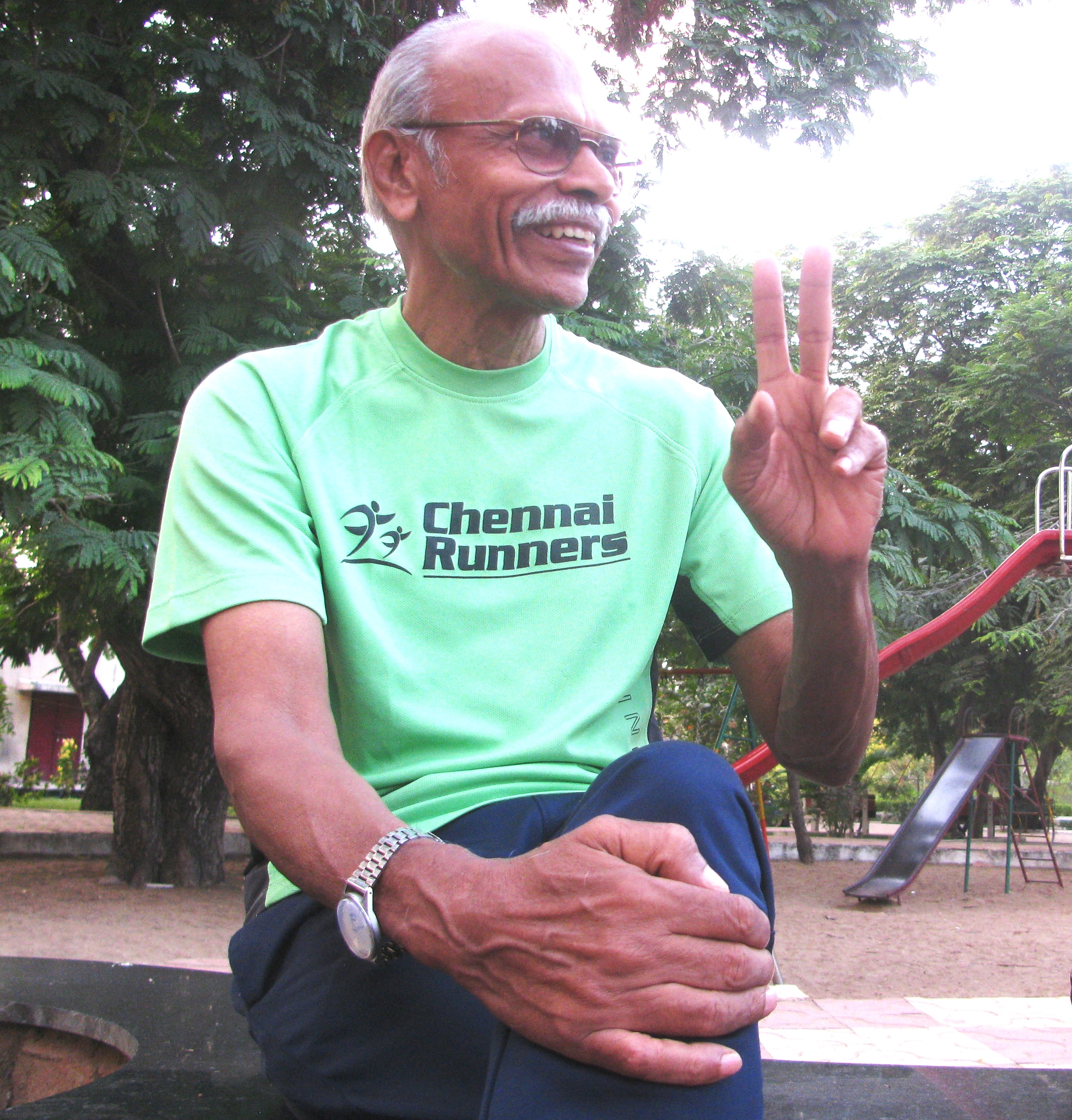
VENUGOPALAN ARUNACHALAM PASSES AWAY

Venugopalan Arunachalam (Photo: Shyam G Menon)

Venugopalan Arunachalam, senior runner based in Chennai, is no more.

He passed away at around 11.30 AM today (October 22, 2017), an update on the Facebook page of Chennai Runners informed.

A wonderful person to interact with, Outrigger had interviewed him in early 2017.

That article can be accessed on this link:

https://shyamgopan.com/2017/02/17/making-up-for-years-lost/

Venu (that’s how he wished us to address him) last wrote in to the blog’s authors two days ago, on October 20.

In that mail he referred to age catching up and said, “ Time just slips through without me realizing it!’’

Outrigger will miss him and his gentle personality.

Our condolences.

(Latha Venkatraman and Shyam G Menon are independent journalists based in Mumbai.)

LOYOLA’S BOSCO

Lourdes Irudaya Bosco (Photo: Shyam G Menon)

This article is on Lourdes Irudaya Bosco, who works with Indian Railways and is among Chennai’s senior runners. He grew up in the neighborhood of the city’s Loyola College, studied there, trained on its running track and continues to author his life in running with that track at its center. Into running since 1985, Bosco also trains others.

For Lourdes Irudaya Bosco sport was sole option.

Born December 1967 at Nungambakkam in Chennai, the youngest child of a teacher-couple, he had that one problem which usually spells calamity in India – Bosco was weak in studies. He studied at St Joseph’s School in Nungambakkam and later at Santhome Higher Secondary School. At the latter, during his tenth standard exams, he failed in a couple of subjects. Eventually clearing matriculation, he did his eleventh and twelfth grades privately. Bosco used to play a lot of football. By the time he was nudging college that interest in sport was all he had to shape his future.

Bosco looked up to his elder brother, Maria Xavier. The latter had commenced a snack bar business, where Bosco worked. It was a struggling enterprise. Amid his challenges on the business front, big brother also realized that Bosco was desperate for something to latch on to for rudder in life. Maria Xavier and his friend Cyril took Bosco to meet Nedunchezhiyan, a former national level athlete in the 800m. Nedunchezhiyan in turn introduced them to Sathoor, coach at Chennai-based athletics outfit: Star Track Club. With Star, Bosco began running 5000m, 10,000m and cross country races. Training sessions were at the 400m-track of Loyola College and at the local YMCA.

Photo: courtesy Bosco

Maria Xavier was into karate. Along with his friend Philip Francis, Maria Xavier used to go for daily runs. The duo allowed Bosco to accompany them on these extended runs, covering a fair amount of distance. That was when Bosco discovered that he liked long distance running. Star Track Club had groomed him in middle distance running. Those days, distances longer than middle distance, weren’t as popular as today. Moving into long distance running typically entailed personal journey. After completing his stint at Star Track Club, Bosco began training individually. His brother stood by him. “ The level I reached in sport is only because of my brother,’’ Bosco said. They evolved their own training program. Bosco trotted behind his brother on his bicycle. That way they covered 30-40 km. For three crucial years, from 1985 to 1988, Maria Xavier helped keep the flame of distance running alive in his younger brother.

Bosco joined Loyola College to do his BA. As you talk to him, you realize that Loyola College means a lot to him. According to Bosco, Satyaseelan, Physical Education Director at Loyola College, offered him support and guidance including use of the college ground for training. Bosco still stays in the neighborhood of Loyola College. Having become a regular fixture at the college’s running track he now trains others there. “ I am thankful to this college,’’ Bosco said. Loyola was also source of other memories. A gentleman called Shivdevan, used to frequent the Loyola premises for walks. He noticed Bosco training regularly. He became a supporter of the upcoming athlete, sponsoring his shoes. Also sponsoring shoes was Rajkumar Subramaniam of Chrompet Cheetah Runners. Chinnadurai, Director of Panimalar Engineering College, who was yet another benefactor, supported Bosco for two years, letting him access nutritious food for his running. The rest of the support came from his brother (Maria Xavier now runs a food products business in Puducherry).

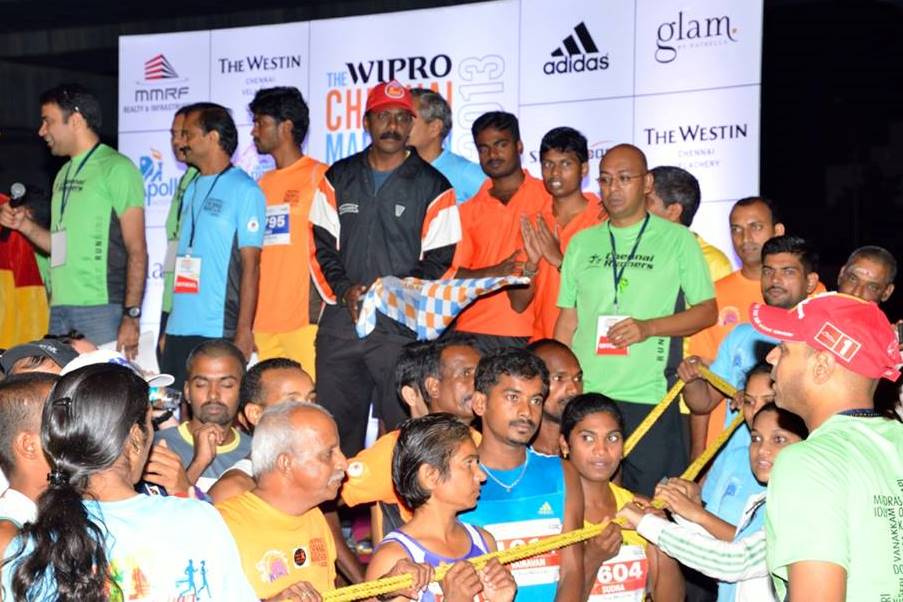
Bosco on stage; at one of the editions of the Wipro Chennai Marathon (Photo: courtesy Bosco)

In 1989 Bosco ran his first full marathon, the YMCA Madurai Marathon. He finished in sixth position with a timing of 3:13. By the Pune International Marathon of 1989, he had that down to 2:42:15. Maria Xavier’s faith in his brother was paying off; Bosco the distance runner had arrived. Around this time two other things happened – Bosco began representing the state at long distance (half marathon, full marathon) and cross-country running events; from 1991 to 1993 he participated in distance running events as an invitee of the Indian Railways. A secure future and employment was priority. Indeed, Bosco’s journey into sport had been partly fueled by his lack of other options to sculpt a life. He tried to join the army. Although good athlete with track record to show, he was over-age to be army recruit. In January 1994, having finished his BA course but ahead of giving his exams, Bosco joined Indian Railways. There he has remained since. Four years after securing employment, another change happened. From 1985 to 1998, he used to train in shoes but run at events, barefoot. Following new rules by sport administrators in India, Bosco’s barefoot-running at events, ended. “ I used to train in shoes. It took a little while getting used to racing in shoes. Overall, the transition wasn’t a big problem,’’ he said.

Once Bosco joined Railways, he came under the wings of coach, H.K. Seetharama, a former army person and silver medalist at the Asian Games. Seetharama, who hails from Shimoga, was the first proper coach in Bosco’s life. “ He guided me. I learnt to be disciplined from him. That is how I improved,’’ Bosco said. The young runner was introduced to training camps in Mysore and Ooty. There were around 15 people, including women, in the distance running team of Southern Railways, spanning middle distance to marathon. The weeks went by in a blur. It was the sort of schedule Bosco had long wanted. Mondays were typically reserved for pace running. Tuesdays in Chennai, he ran on the city’s flyover, they being the best way to mimic hill running in urban landscape. Wednesdays he spent running on the track. Thursdays he went to run on the beach; he ran on varying textures of sand ranging from sea shore to beach sand. Friday was devoted to speed running. Saturdays were kept for long, endurance runs. On Sunday, he rested. Again, within this schedule, broadly speaking – mornings were spent running on the road while evening usually found him doing track work-out at Loyola College. Bosco’s narration was littered with many names that he said he owed much in life to. There were his “ advisors’’ on the Loyola track: Ranjith Narayanan (former 100m runner) and M.E. Rajasekhar (former 110m hurdler); there was John Britto, a former Loyola student whom he included among supporters, there was Nandakumar,…it was a long list.

Bosco at one of the editions of the Bengaluru Marathon. Also visible in the photo are Siddesha Hanumantappa, Sabhajeet Yadav and Dnyaneshwar Tidke (Photo: courtesy Bosco)

Someone who has been running for long needs milestones revisited to recollect and remember. Bosco has been running since 1985. At his house not far from the boundary walls of Loyola College, he sat with a fat file of certificates accumulated over the years. For this author, newcomer to running (and still struggling with it) it was like a dive into running’s history in India; not the really old chapters but old enough given a robust running movement in India is still quite nascent. The certificates provided data and timings; Bosco’s nature made sure he remembered his benefactors. Strung between certificates and supporters, Bosco’s story continued. Before joining the Railways, Bosco used to run several marathons a year. After joining the Railways that all-out participation was replaced with more judiciously chosen events. Slowly over the years, podium finishes accumulated. There were certificates from the Mavana Sugars Marathon and podium finishes from Kaveri Trail Marathon, Standard Chartered Mumbai Marathon (SCMM; now Tata Mumbai Marathon), Allahabad Marathon, Chennai Marathon and Hyderabad Marathon. As Bosco aged and slowed down to that extent, the podium finishes have gradually shifted from open category to podium position within age category. His personal best in the full marathon was around 2:30. And while he may have slowed down over the years, he can still pull off a mean timing. The week before I met him in Chennai, at the 2017 Coimbatore Half Marathon, Bosco had finished second in his age category with a timing of 1:31.

Of all the events he has participated in, one event has stayed close to his heart. On August 8, 1998, he ran at the Fourth National Travancore Marathon & Track Meet in Thiruvananthapuram, Kerala. He finished the full marathon in 2:34:50 to secure second place. He got Rs 50,000 as prize money. Twenty days later that money helped him fund the expenses of his wedding. On August 28 that year, he married Jenacious Priya; they have a son Andrew Jose. Then there are the amusing side stories: once he mistook reference to ` cross-country’ in the advertisement for an outstation event to mean running and landed up ready to run. He was taping his feet to help it tackle cross-country terrain when the organizers asked him what he was doing. That was when runner realized what he had walked into – it was a cross-country bicycle race. He borrowed a cycle and completed the event, finishing in fourteenth place. The organizers gave him Rs 150 to cover his travel expense to the venue and back.

Photo: courtesy Bosco

In his long career in running, Bosco has run several marathons in sub-2:45 timing. When I met him, he said that he was now in the realm of three hours and above. As age and experience mount, he has been playing the role of coach. During 2014-2015, he was a fitness trainer with Reebok, training people on Saturday and Sunday. Talking to Lourdes Irudaya Bosco you notice the subtle yet major questions faced in runner’s life. For instance, there was a phase long ago when recommendation was strong that Bosco specialize in middle distances like the 1500m. Reason – he ran with long strides. That didn’t happen because for the most part he trained alone. A significant factor for this training style was his closeness to his family, something you sense in the many years he has stayed in the familiar vicinity of Loyola College and the respect and affection he showed his brother. For person courting solitude to train, there is rarely coach at hand to effect transition and transformation. So for most part Bosco trained himself; he trained for what he liked – long distance running. That gift of long stride, sensible perhaps to capitalize on in runner’s younger years, was overlooked. Then there is Bosco with his wealth of running in Chennai as chronicler of a city’s changing ambiance in running; it’s changing face. “ When I started running, there were very few distance runners out on Chennai roads. Now that number has risen. There are also many running clubs, events and competitions. In the years gone by, there would be an event once every three months or so. In all, Chennai would have less than five races a year. Now there is a race almost every week, there is prize money too,’’ Bosco said. That is good but it also needs a word of caution as regards indiscriminate participation.

Two things are very important for runner, according to Bosco – rest and diet. “ There is no point in continuously training and running; you spoil the body doing so,’’ he said. What worries however, is the state of Indian roads; Chennai’s roads included. “ In 1985, the roads were relatively free of traffic. Early morning runs were easy, enjoyable affairs,’’ Bosco said. Thanks to exploding vehicular traffic and congestion, veteran runners like Bosco are now scarred warriors. “ Now, that early morning enjoyment of running has faded. You cope with pollution and heat,’’ Bosco said. Over the years, he has endured burning eyes and dust in the air. In his effort to escape traffic and run peacefully, his morning runs have been starting earlier and earlier. He goes to sleep at 11 PM and sometimes wakes up at 2 AM to train. Traffic is a problem unraveling across Indian cities for runners and cyclists; they are shifting to being the moving shadows of pre-dawn hours in cities still lit by streetlights. Sunshine has become traffic’s privilege to enjoy.

Photo: courtesy Bosco

A couple of other points also stood out in the conversation. Like many runners – rank amateurs and those from the elite category – Bosco envied the runners from India’s defence forces. They have discipline, good coaches, proper training and proper diet. They also have access to high altitude training camps, something every athlete wishing to push limits aspires for. “ They get to focus on what they wish to do,’’ Bosco said. That was him looking back on the years gone by and commenting. From that same sweeping gaze, which he is entitled to given his experience of three decades plus in running, he also suggested that races and running events make it standard practice to recognize and encourage the top ten finishers in every age category. Don’t cut off encouragement at the top three or top four-level; encourage some more – he felt that makes sense.

Courtesy a little confusion over where exactly Bosco’s house was in Nungambakkam and my decision to walk and explore my way to the venue of our meeting, our chat had begun a bit later than scheduled. Past 6 PM, there were phone calls landing up every ten minutes or so from trainees on Loyola’s track, seeking instructions from their coach. Bosco guided them on the phone extracting that much more time to spend with me. Around 6.40 PM or so, I could sense we had probably reached breaking point; those trainees needed their coach on the track. Bosco dropped me off on the main road. I headed for a quiet dinner at Besant Nagar beach; he headed to the running track at Loyola.

(The author, Shyam G Menon, is a freelance journalist based in Mumbai.)   

FOUR QUADRANTS AND DIVERGENT FOR RELIEF

Illustration: Shyam G Menon

What am I?

The question fascinates us no end.

I had a phase as an outdoor educator.

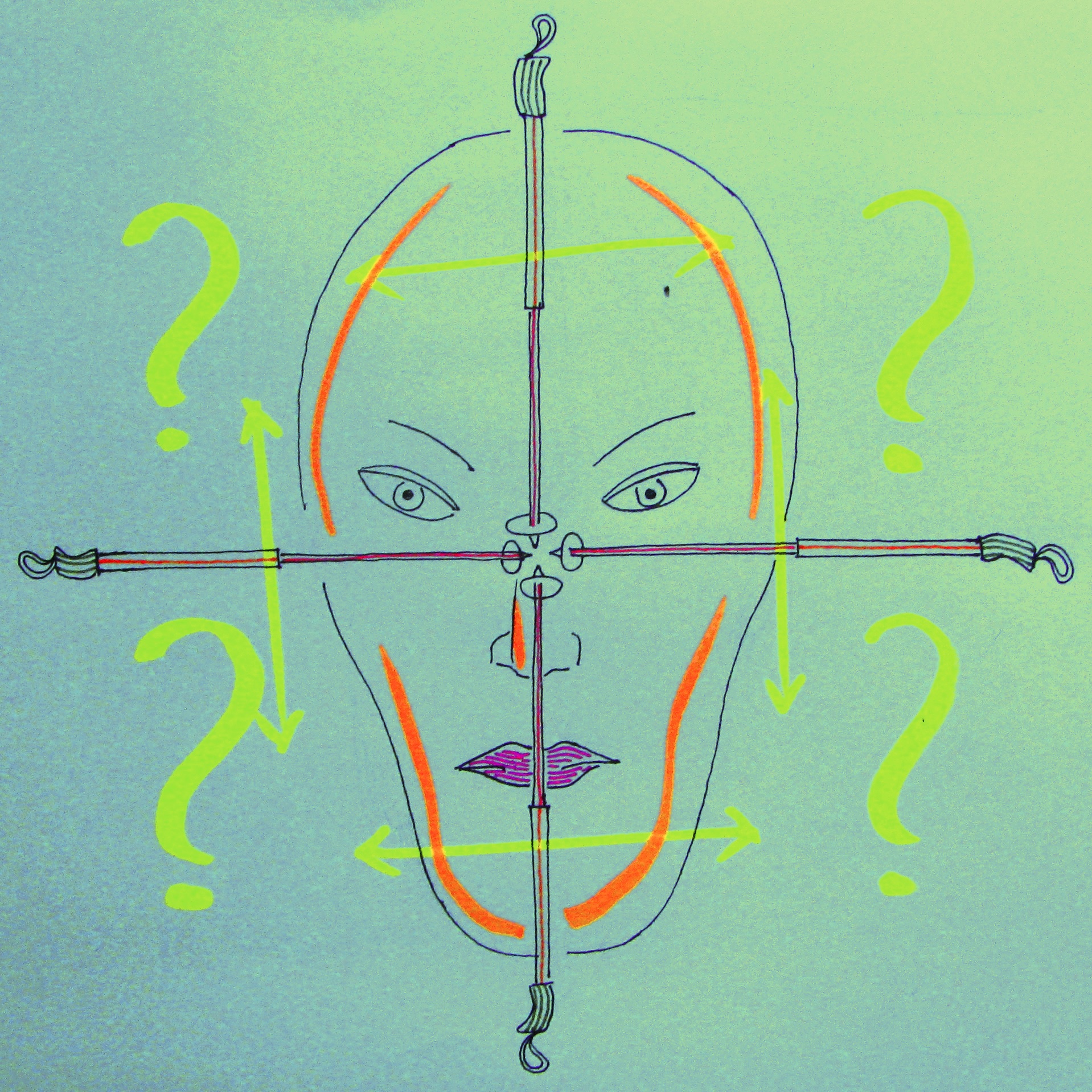
In that period, I was introduced to a method used by experiential educators in leadership and team building sessions. My memory is a little foggy around the edges but I think it involved using personality and temperament – as stated by participants and corrected by fellow participants where required – to assign people to four quadrants showing distinct leadership styles. These four quadrants (we would create them on the ground using trekking poles or ropes) were deemed essential for a good team. Initially the exercise engaged for it answered the question of what I am, like a case of self-discovery. Oh…so this is what I am – there was enough in that nascent discovery, however questionable, to ruminate and reflect upon. Then problems with self-image set in.

I debuted in a quadrant meant for those who value human relations. That felt good, except – what I wished to be was something else. I wanted to be a doer. The rules of the exercise were pretty clear. A quadrant, diagonal from where you were placed would be toughest to transition to. The doer lot was diagonal to where I was. Adjacent quadrants were easier accessed. Given the model accepts that you tend to change with time, in several subsequent instances of exercise repeated, I found myself in the adjacent quadrants – some showed me up as an information gatherer and analyst of data; a few other instances showed me as a motivator.  Not once was I a doer. Damn!

To an extent the analysis was correct. The most powerful sport I ever engaged in was rock climbing. As lead climber, placing protection and opening the route, I was weak. As follower, I was good. Climbing doesn’t lie. I found myself enduring the notion – repeated for my benefit by friends – that I was adventurous only because I knew others better than me. The description denied me ownership of initiative shown. Even a hitchhiker owns his / her journey. Why deny me mine? We never spare an occasion to rub into someone that he / she achieved because they were lucky followers.  On the other hand, during the several instances when I was travelling alone or the decade I have been freelance journalist surviving on tight budget, I was a quiet doer, executing things as needed. It never landed me in anyone’s doer quadrant. Who thinks of writing and freelancing as challenge or doing?

Quadrant for membership is an easy way to address life’s pressing question: what am I? The experiential education method I was familiar with is but one of many such approaches to temporarily categorize people. Books have been written and movies made on the premise that everybody belongs to some category. And almost always the quadrant of the action hero – the doer – is a coveted spot to be in. He gets all the pretty girls. In due course, I accepted the fact that life didn’t find me a doer. Accepting it allowed me to move on. Sometimes the categorization business was fun. Once on a hike that I worked as a junior instructor, our students – all fans of the Harry Potter universe – deliberated on what maybe my house at Hogwarts. I was touched. Not because they gave me a house in the Harry Potter universe but because somebody bothered to think about me that deeply and for that long. Thank you.

J.K. Rowling isn’t the only author who dabbled in the politics of categories. The search for a category pervades all walks of existence now. One of the factors that made this tendency widespread is the rise of technology and organization; the latter triggered the ascent of management science. The combination – technology and management science – unleashed the regime of everything as measurable. Most job applications are precise, well defined exercises. If there are multiple responsibilities involved, then each is segregated and shown as a percentage of the whole. An enrollment process is designed to find the best fit for an opportunity. That automatically births the notion of right mental type and category. I am uncomfortable with such certainty in the meeting grounds of technology and management science. Not for me, this use of us as emotionally dead building blocks. I am sure that in their own discreet way, organizations later seek to retain talent by allowing people to move across functional capacities. However if you want to know yourself by confronting that which you are genuinely not good at, you may need to give up employer-organization.

There is only so much any employer will be willing to lose. So you quit and go solo. Solo keeps risk and loss restricted to you. My hunch is – soloing while difficult, will amaze you by what it reveals. Personally, I think we have the potential for all those quadrants wired in us. We deliver as circumstances require. In a lifetime we journey through different circumstances. The question to pose would be: are we journeying enough to realize our potential for all the quadrants; or houses and factions as the world of fiction elects to call them? And if you can pass through all those separating walls, what are you? If that’s what you are and you are still dubbed loser, what does it say of world declining room for you?

That’s why the Divergent series engaged. Written by Veronica Roth, the trilogy was made into three movies; the last one of the series Allegiant, released in March 2016. I haven’t read the books; I saw the films. There have been many movies that leverage the interplay of what we are and what we are expected to be. The Divergent series caught my eye immediately because its premise of a dystopian citizenry assigned factions to belong to, instantly reminded me of my experiences with that experiential educators’ model to teach leadership. More important, it helped me assuage my grudges against that method by creating the idea of divergent as category, a rebel category. I am not a fan however of the purity-impurity angle built into the story with the divergent protagonist positioned as most evolved. I tap into the idea of divergent as relief from the need to be a fixed somebody.

(The author, Shyam G Menon, is a freelance journalist based in Mumbai.)         

SIMPLICITY, MARKET STYLE

Illustration: Shyam G Menon

The salesman at the electronics store explained it well: this phone is solidly built, has latest operating software, no bloatware, makes do with less internal storage space, saves photos to the cloud, is not a fan of multi-tasking gone crazy electing instead to multi-task judiciously, puts the brake on all-in-one mythical super-phone, keeps photography basic, is happy with modest RAM and has a battery of equally modest capacity.

I had waited long to hear this.

I thought of a similar moment earlier at the peak of my research and subsequent confusion over what bicycle to buy. That was expenditure heavy to shoulder on freelancer’s income. Unable to throw money around as the consumerist market expects, I had worked on understanding bicycle models and component specifications to find the bicycle model suited for my needs, at my price point. Problem was – my price point was too low for the specs I sought. Suddenly a slightly old bicycle model of right dimension and specs, at price tad discounted given its age and outmoded wheel size, materialized. It was perfect fit for freelance journalist lacking a fortune to spare. A source of considerable enjoyment since, it is now parked six feet away from my work table.

The dust on that purchase had hardly settled when the government threatened my comfort zone with all out drive to go digital. I use an old Nokia feature phone. What it can do is all I need. It also suited my interface with universe, which is quite tactile. Back in 2002, it was nice seeing Tom Cruise swishing his hands this way and that as he shuffled data on virtual screen in Minority Report. I didn’t ask to live it. I also have difficulty viewing large sections of geography on small screen. Where am I? – is a more important curiosity for me than destination guaranteed. We don’t mind small screen for maps because we value destination guaranteed with pointer showing you the way. Besides, your typical smartphone keeps beeping with messages from this app and that. I don’t like it. I have zero appetite for some of the messages floating around, particularly the troll type. Further, once I started going on expeditions, I grew accustomed to switching off phone and being out of contact. The digital epidemic however meant more angles than the above, affected. Unlike the phone of old, now our money, bank transactions, passwords – all have dovetailed into the smartphone. The world around me was being prompted to transact its business in a certain way and if I hung on to my old phone, I risked getting deleted from existence. The epidemic triggered hunt for a smartphone.

In both bicycles and smartphones, trends appear similar although it is particularly entertaining in the case of phones given that simple argument – if you spend for a bicycle as much as you spend on a smartphone; at least you gift yourself an active lifestyle.  Needless to say, one of the most hilarious sights I witnessed recently was a fellow commuter on a Mumbai local train taking selfies with his tongue sticking out. It amused to think that moments like this get official patronage through policy favoring smartphone while the bicycle battles daily with growing traffic hell bend on denying it space. Don’t these trends speak something about us? Anyway, the nature of market evolution I noticed from my search was somewhat like this:

First you take an innovation that has at heart a relevant and clear proposition. None can dispute the clarity in what a bicycle or a phone means.  A bicycle takes you from place to place at modest pace with zero pollution and physical exercise included. Motorized transport beat the bicycle in terms of speed. But in days of present lost to smog and sedentary life, the bicycle has been reborn absolutely futuristic. To think that it was introduced in the late nineteenth century and its relevance remains strong – now that is a product. A phone helps you talk over long distances. Do you need one? The answer is yes. But that isn’t good enough from a manufacturer’s point of view. So in the second stage of evolution by manufacturers and market, you dismantle given product into its several constituent parts and start tinkering with the parts, such that you are developing capabilities in apparent isolation. This is a departure from the unquestionable relevance of a product at debut stage. In the second stage, either industry players are many or more players are seeking to muscle in. In both cases fresh raison d’etre needs to be manufactured. The plain vanilla cellphone, which catered to clear, fundamental needs, gets touch screen, camera and apps (none of which are the sort we died for lacking) and becomes a smartphone. During marathons you hear technology’s automated voice speaking with robotic love: congratulations, you have completed a kilometer; the time taken was….Or, there is the selfie generation, which has grown so big and omnipresent that of the smartphone’s two cameras, the one facing user is gaining more megapixels than the one facing world.

The third stage is the strangest stage, when the focus is no more on overall product relevance but marketing gimmicks promoting the technological advances in specific components used, quite often at the expense of larger harmony among components. It is the Popeye stage, when brain and body live in the shadow of outsize bicep. In my search for smartphone, I came off wondering why someone is selling an imbalanced product. A typical review: this smartphone does this, this and this. But the cost of having all these functions is – it heats up and may not run that long on a single charge. When was the last time a decade ago, that your phone claimed to be smarter than you and died every day for want of power? Equally confusing are the product reviews. Online retailers in their effort to empower customers with information, host plenty of reviews, many of which seem rants or half baked analysis. Not to mention, there is nothing in the identity of reviewers to prove that they are really customers and not paid PR by brand or competitors out to put a spanner in the spokes of a brand. Given this, my hunch is brick and mortar will return for those valuing tangible product before buying. But it won’t be as the regular brick and mortar of old. Its new avatar could be in line with trends articulated at the end of this article.

Illustration: Shyam G Menon

Meanwhile, business is brokered by how you look at a problem. The above mentioned lacuna of inadequate power opened up room for phones with massive batteries. Not all massive batteries are sold to you with quick charging devices alongside. If you want your own private power station that takes a lifetime to charge, you pay a certain price; if you want the same with quick-charge, you pay a bit more. And no matter how huge your battery, few of these phones with ever increasing apps and expectations riding on them, match a good old feature phone in terms of reliability. The old phones were rugged; they survived in rain and cold. They used all the power they had for two primary functions – talk and text. The new ones are comparatively fragile and born of proximity to power sources. You can make up for absence of power source nearby by carrying a variety of portable power sources and charging devices, all of which merely add to the stuff you truck around. With required gadgetry stashed on self and backpack, you could call yourself a smartphone-commando, a smartphone-marine or member of the elite squad of communications-special forces. Point is – this third stage is all about confusing the customer and milking him. Do you want to make a phone call or do you want to look like a commando?

A good instance of third stage in the bicycle market, in my opinion, was the confusion over wheel sizes in MTBs – 26 inches, 27.5 and 29. It had nothing to do with the happiness you found, cycling. Cyclists had managed to reach most places on the planet. The 27.5 and 29 were not going to reach you some place humanity hadn’t. Yet you paid for industry’s eccentricity because industry was desperate for a reason to energize its business. A case of overlapping domains in cycling and communications technology would be using smartphone for navigation, weather forecasts etc. Yes they are absolutely relevant. They work. But setting out on a ride only if you have all this is a bit like retracing the footsteps of Marco Polo or Fa Hien and knowing all along that they ventured out despite not having any such technology in their times. With capital backing technology, there is no great wave seeking to restore the adventure in adventure. Instead, there are isolated moves afoot. For example, the upcoming 2018 Golden Globe Race (GGR), which is a race to circumnavigate the world solo and nonstop in a sail boat, has banned all kinds of modern electronic gadgetry aboard participants’ boats. They want you back at technology levels matching the year of the first GGR – 1968.

Not surprisingly, the fourth stage is clarity rediscovered and restored. I greet it with as much hope and affection as Ice Age’s sabre toothed-squirrel does his prized acorn. It celebrates relevance, aptness and perfect fit. Sounds like fundamental rights. Isn’t this what buying a product always meant? Transpose this to the idea of democracy. If a democracy deemed fundamental rights luxury you would be quick to say it got things wrong. What would you then say of a market where relevance is luxury or matter of circuitous rediscovery? Overall therefore the simple description for this evolution by market is: wild goose chase. There is a saying that you can either touch your nose from front or you can take your hand behind your head and try touching the nose from behind. Smartphone’s discovery of simplicity harked of the latter. How else would you birth bloatware, sell a tonne of it and then acknowledge it as dispensable?

My friend Prashant owns a couple of smartphones including the sort that currently dominates sales in India: 3GB & 32 GB, 16 MP & 4 MP, quad core Snapdragon at 1.3 GHz and 3000 mAh battery. Prashant likes to climb and cycle. He is into yoga. Recently I found the old Nokia smartphone with Windows operating system back on his table. “ How come?’’ I asked. “ If I can live without all these apps, this much of phone is enough for me,’’ he said bluntly. I know he was saying it prematurely for there are facilities from the smartphone’s recent past he has got used to and which need a different phone to run. But he had a point. If I go by specs from six years ago archived by Wikipedia, the old phone should have 512 MB RAM-16 GB internal storage, 1.4 GHz single core processor, 1450 mAh battery, 8 MP rear camera and no front camera for selfies. Between this phone and returning to this phone, were a couple of other phones owned and got tired of. One discussion Prashant and I often have is whether money can be the answer for everything. If you look at the market, it would seem – you fix the problems you are facing at a given state of life by being capable of affording a better one. But we moved from sophisticated phone to more sophisticated phone and after screwing up the phone market with a plethora of transient twists in technology, we are gifted a simple, uncluttered phone. It harks more of starting line than finish.

Illustration: Shyam G Menon

The salesman at the electronics store explained it well to Latha and me: this phone is solidly built, has latest operating software, no bloatware, makes do with less internal storage space, saves photos to the cloud, is not a fan of multi-tasking gone crazy electing instead to multi-task judiciously, puts the brake on all-in-one mythical super-phone, keeps photography basic, is happy with modest RAM and has a battery of equally modest capacity.

Wonderful!

There is one thing though: simple phone doesn’t come cheap yet.

You still have to pay the premium for industry’s return to simplicity after many intervening phases of delusion by technological opiates. Like that ` carefully worn careless look’ from the pages of fashion glossies, this is ` simplicity redefined’ and expensive. The same will shape brick and mortar’s return too. Prices there are already not as low as prices quoted online. They have a valid reason – you are getting to touch and feel a product before buying it. It is an argument that wasn’t there earlier. A precious part of the data our brain uses to decide – the sense of touch – has got monetized. That’s one of the legacies of wild goose chase – all aspects of our existence get monetized. Meanwhile big data has been compared to what oil was in the twentieth century. Shareholders and equity markets must have liked that. By the same yardstick, I would assume parallels between the legacy of oil and the evolving legacy of big data. The new legacy will unfold even closer to our physiological and psychological make up for when I look around I find the smartphone’s impact on human behavior to be profound. Through smog and climate change – both legacies of the oil age – the smartphone’s fans stay glued to the mesmerizing device. This time, whatever smog and storms are due, will be in the human head. No wonder gurus and babas have a roaring business teaching us how to install delete buttons in the brain.

(The author, Shyam G Menon, is a freelance journalist based in Mumbai.)

THE NEW RAIN

Illustration: Shyam G Menon

There is a new rain in town.

You have to walk, run or cycle to feel it.

Actually it is a rain that has been around for long.

What is new is its ferocity.

Unlike climate change which bewilders with its unsteady, erratic nature of incidence, this one has been systematically growing. We do nothing to merit the rain of nature and its life force. Yet we receive it every year, like God sent; sometimes more, sometimes less. In contrast, the new rain has thrived under our active patronage.

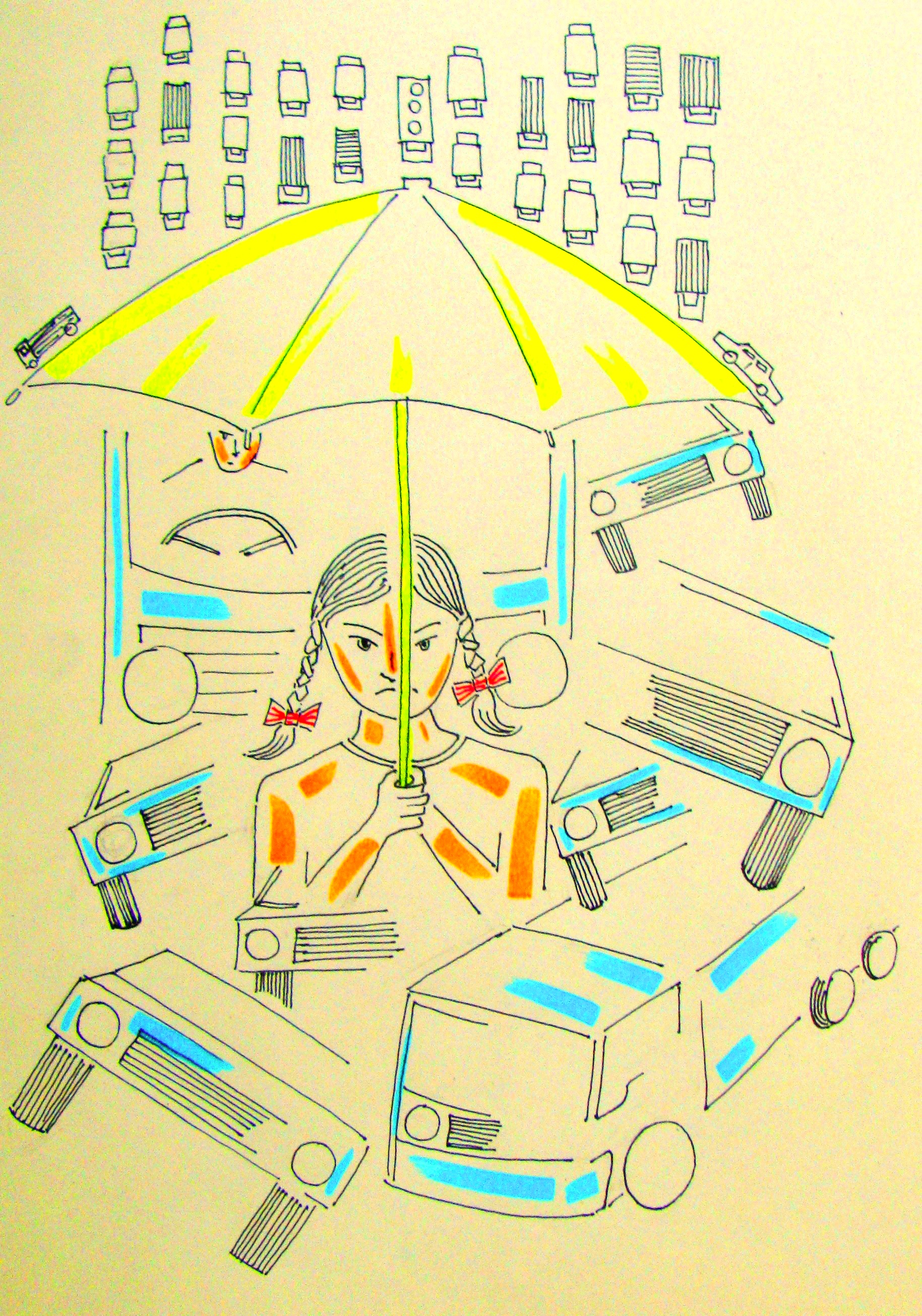
I like a morning run or a round of cycling. The number of runners and cyclists has gradually grown over the years. However, what has increased more visibly is traffic. It is a barreling flow. There was a time not long ago when the roads I frequent early morning were relatively quiet. Service roads (a narrow road parallel to an existing big one) featured almost no traffic. The air was clean. Now that is gone. Traffic starts building up from 7 AM. Traffic rules are also broken that early. Engine powered-mobility has scant respect for self-powered-mobility. Might is right. Runners and cyclists on the road have to be careful. Its raining vehicles.

There was a time in my days as employed journalist, when I wrote on the automobile industry. I wasn’t one finding vehicles sexy or magnetic. I wrote on the industry; I did so for a decade. At that time, the automobile industry with its basket of ancillary manufacturers and dependent service providers was the world’s biggest. I have since lost a lot of my fascination. I outgrew it. Further, when I got into running and cycling and had my taste of what it is like to be at ground level sensing a tonne of metal hurtling by, I saw myself looking at automobiles differently.

Like many other industrial sectors, the automobile industry was encouraged with investment sops. I haven’t seen similar encouragement offered in India for the active, healthy lifestyle. Let me be clear: the idea of healthy lifestyle is not to be confused with support for the medical care / hospital industry.  Like the auto industry, this industry too feeds off our purse. I am talking of communities enjoying adequate open space, green environment and easily accessed facilities for sport.

I haven’t seen one city, municipality, district or state that declares itself keen on supporting a physically active, healthy lifestyle for its citizens. States and districts bought into literacy; they have missions to ensure cleanliness. They haven’t bought as well into what constitutes an interesting life. Its like a crisis of the imagination. We put up a hospital with maternity ward quicker than we would anything to make the life that follows birth, interesting. Isn’t that contradictory? We don’t design our environment to be sufficiently engaging. We don’t plan our cities and living spaces for it. Many housing societies have space for a swimming pool. Just that nobody wants a swimming pool when that space can be used for parking. Even then, quarrels erupt over parking slots usurped because the number of vehicles is going up. So it isn’t just new rain. There is the flooding too.

The Indian approach is – money is king. In its durbar, sedentary imagination dominates. That imagination percolates down to everything. Its terrible as theme for life. Merely accumulating money never made anyone happy. Often when I find myself muscled out by vehicle on road, I wonder: does the driver hate me because I am living the life I like? You know what? – I suspect that is the case; especially in cities. Strange as it may seem the few instances I received room as cyclist, were in the hills and mountains. His loaded truck laboring up a steep slope, driver, upon seeing cyclist powering self and baggage on same road with no engine for help, would give a wave. Or a passing car driver would stick his hand out and show a thumbs-up.

On hopes of such moments visiting us somewhere, back in the city, we weather the new rain of an old order.

(The author, Shyam G Menon, is a freelance journalist based in Mumbai.)

TRANSFORMED

Girish Bindra (Photo: Shyam G Menon)

A logistics business keeps you on your toes.

You must ensure your vehicles are in good shape and available to haul cargo; find cargo, make sure the cargo is delivered on time and manage the cargo transit environment with its plethora of paper work, which in India – land of forms, taxes and toll plazas by the dozen, is never easy. Finally, there is that vigil over one’s vehicles being on Indian roads and surviving the traffic. Logistics is not for the faint of heart. That modern work place – the smartphone – didn’t spare Girish Bindra even in the depths of a 48 hour-stadium run. Transporter by profession, he is currently among Mumbai’s leading ultramarathon runners. “ On the second morning of that stadium run, I was answering calls from work,’’ he recalled. We were at a coffee shop in Chembur, not far from his office and its modest fleet of trucks and trailers plying the roads of western India. It was quiet in the café compared to the busy road outside. The road led to Navi Mumbai and destinations like Pune, Goa and Bengaluru beyond.

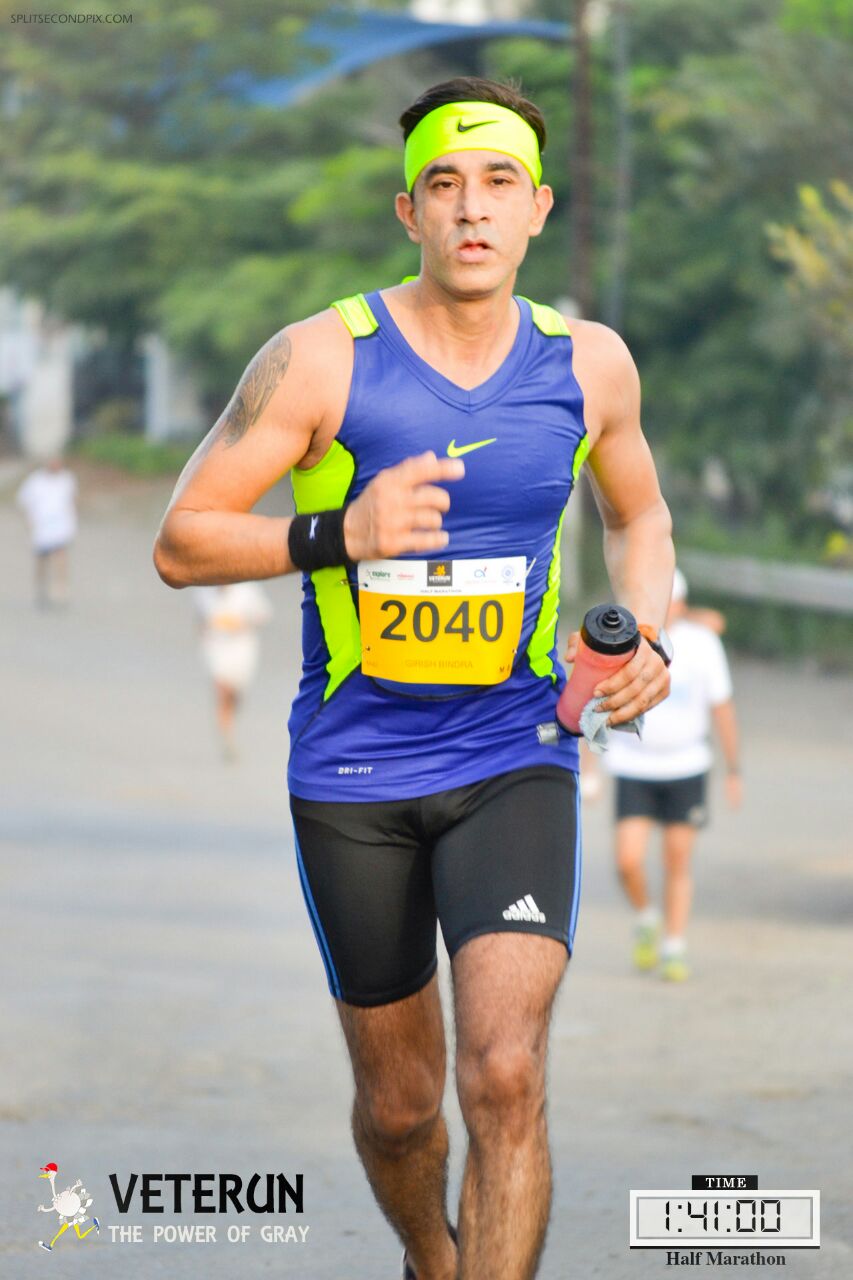
From the Veterun Half Marathon in Pune (Photo: courtesy Girish Bindra)

Most runners have a story, one that harks of transformation. Girish too has one. More than just a story, for anyone who has run in Mumbai these past few years and crossed paths with him somewhere on the road, it is a small movie of transformation playing out in front of you. In appearance, Girish is now an absolutely fit person. He reminds of a triathlete, which he isn’t yet. Two to three years ago, he was visibly on the heavy side. Somewhere in the time elapsed since, his persistent physical activity saw him get past that point of no return for fat to continue sticking around. He transformed to athletic build. The Girish of old was actually heavier than the Girish we met for the first time on Mumbai’s Marine Drive, a couple of years ago. Born October 1973 in Mumbai, Girish is the middle child among three siblings. The family lived in the Mumbai suburb of Sion. “ My father ran a transport business. He is now 78 years old. He is my inspiration. Both my parents are diabetic. For the last forty years, they have lived a simple life and stuck to their daily walking,’’ Girish said. He attended school at AMK Premier High School in Sion, studied commerce at Podar College in Dadar and pursued his cost accountancy and chartered accountancy. Life nudged him towards taking over his father’s business, which he eventually did; merging it with a transport business he himself founded to merit the fleet size he managed when we met him. Apart from playing cricket in college and being good enough to be included in the Podar College-team twice, Girish had no other involvement in sports. In 1997, he did what many in India do – he went in for an arranged marriage. Five years later, he was a well looked after-93 kilos. Concerned, in 2002, he joined a gym. He was regular with his work-outs there. The main goal was to cut down weight. But 11 years ago, in 2006, a crucial twist happened in Girish Bindra’s life.

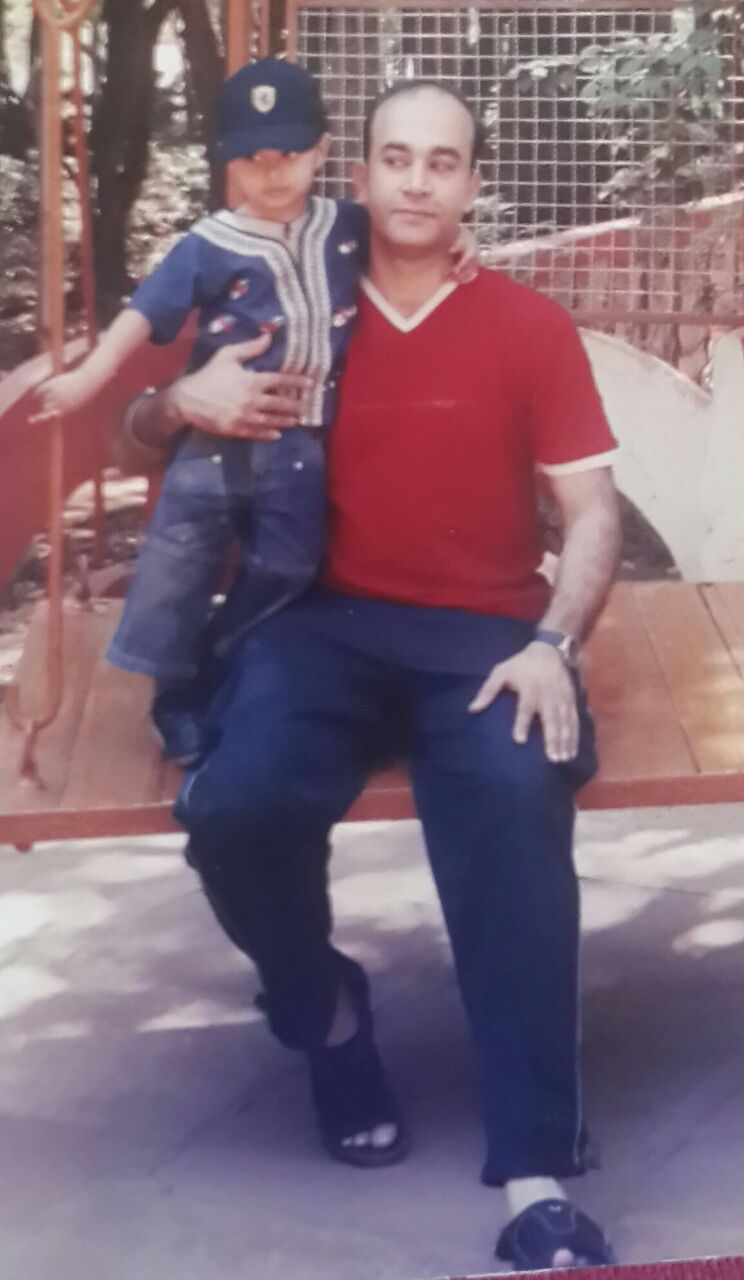
Girish with his elder son, Hriday, at Matheran in 2003 (Photo: courtesy Girish Bindra)

Girish was at his sister’s place in Ahmedabad, when for the first time ever, he got convulsions. In the course of one night, he got three epileptic seizures. The subsequent medical investigation revealed cysts in the brain and neurocysticercosis, a major cause of acquired epilepsy. It is a serious condition. Neurocysticercosis is a form of cysticercosis, a parasitic infection. The onset of the infection was attributed to excessive intake of salads. Doctors advised strict rest and no work-out at the gym, for one year. Every day, Girish had to take 20-22 tablets. “ I was quite depressed,’’ he said. The changed lifestyle was unbearable. He had come to enjoy his daily work-outs at the gym. He used to do weight training and exercises for cardiovascular fitness. To compensate for the lack of gym visits, Girish started going for walks at Five Gardens in Matunga. One of the oldest instances of planned urban development in Mumbai; it is an area now popular with walkers and runners. During his days of walking there, Girish inevitably came across the specter of others running. “ I thought why not give it a try,’’ he said. Slowly, he progressed from walking to a bit of running. But he got tired easily. “ Three hundred to four hundred meters of running and I would be a panting mess,’’ Girish said. Improvement was gradual. In six to eight months, he reached the stage where he could jog 8-10 kilometers. Running and its accompanying gift of endorphins helped Girish combat his depression. In turn that enhanced the pace and quality of his recovery from neurocysticercosis. His doctor – Dr Ramesh Patankar – was happy with the progress, Girish said. In retrospect, a seemingly insignificant factor may have also helped. Many of us commit the mistake of focusing excessively on the upper body while working out. That is the physical landscape of our vanity. The legs are typically forgotten. Girish didn’t do that. At the gym, he had invested effort in exercising his legs too. So when the time to run came, his legs were in a position to cope with the strain. Girish’s interest in running gathered momentum. The seizures had happened in 2006. By 2009, Girish was off medication. By 2010, he was also free of the half yearly medical check-ups doctors wanted him to do. In between, in 2008, he registered for the half marathon segment of the 2009 Standard Chartered Mumbai Marathon (SCMM), now called Tata Mumbai Marathon (TMM).

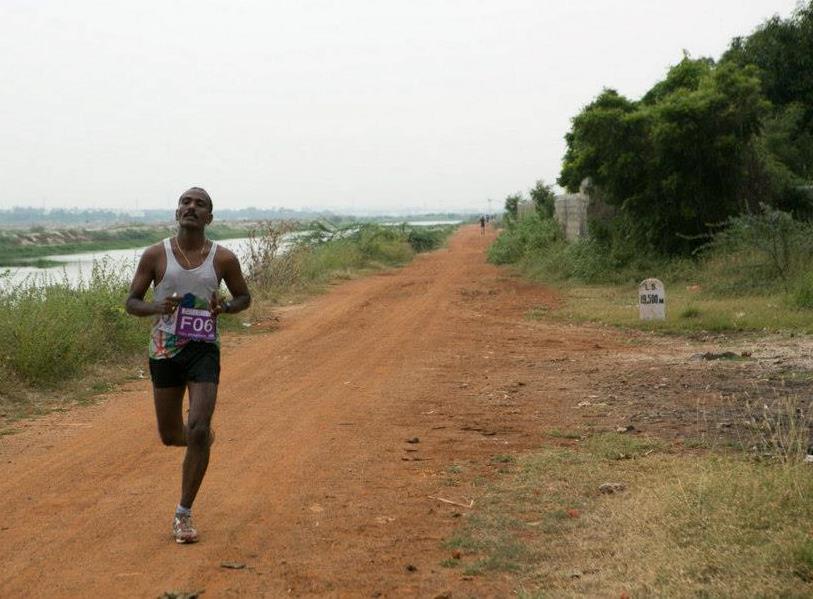
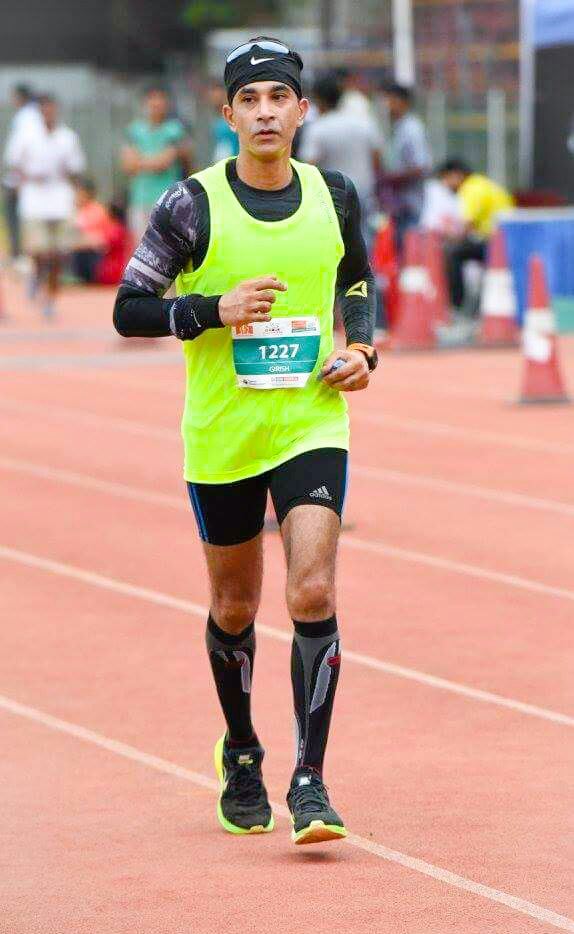
From the 2016 12 hour-stadium run in Mumbai (Photo: courtesy Girish Bindra)

“ That run was my first half marathon. It was the most I had run till then. I found it tough. I finished in two hours, 55 minutes. However notwithstanding the difficulty, I enjoyed it very much. It was a liberating experience, I felt very positive,’’ Girish said. There was no looking back after that. Girish began running regularly. He kept up his regular visits to the gym too. In 2012, he signed up on Facebook to be part of Mumbai Road Runners (MRR), one of the biggest runners’ groups in the city. The introduction came through Runners for Life (RFL); MRR had a relay on a five kilometer-route in Navi Mumbai, which Girish subsequently went for. He liked the outfit and became a regular on their practice runs. Through the network of friends he gained at MRR, his got introduced to more events in running. In 2013, he registered for his first full marathon, signing up for that year’s Vasai Virar Mayor’s Marathon (VVMM), an event on Mumbai’s periphery loved by runners for the fervor and scale of its cheering. In as much as VVMM greets you with infectious cheering, it tends to be a hot and humid race. The 2013 edition was notoriously hot and humid. Girish got cramps after 30 kilometers and had to walk the rest. He finished in five hours 27 minutes. As paradigm change from the half marathon, Girish said, he had no difficulty embracing the full marathon. “ I genuinely like to run. So for me, it was an invitation to run more, do more of something that I anyway enjoy doing,’’ he said.

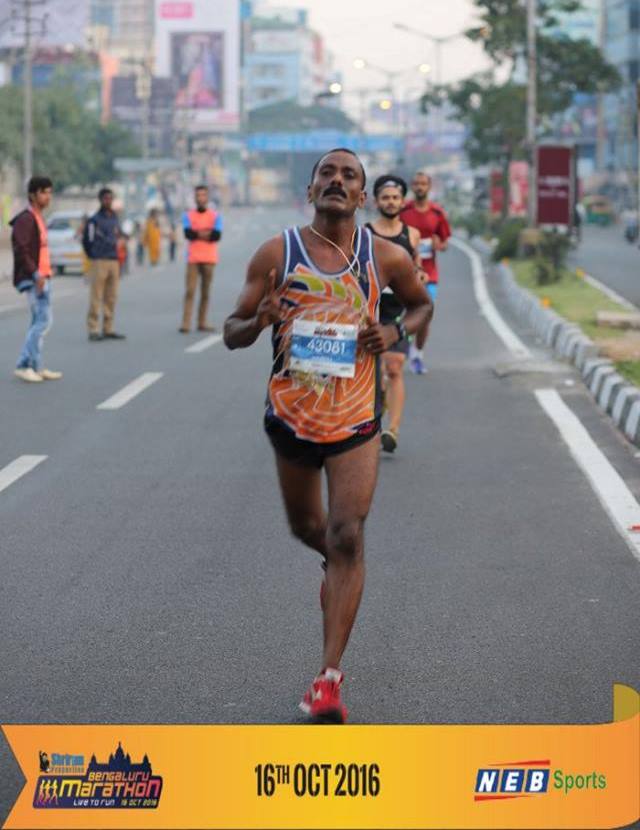
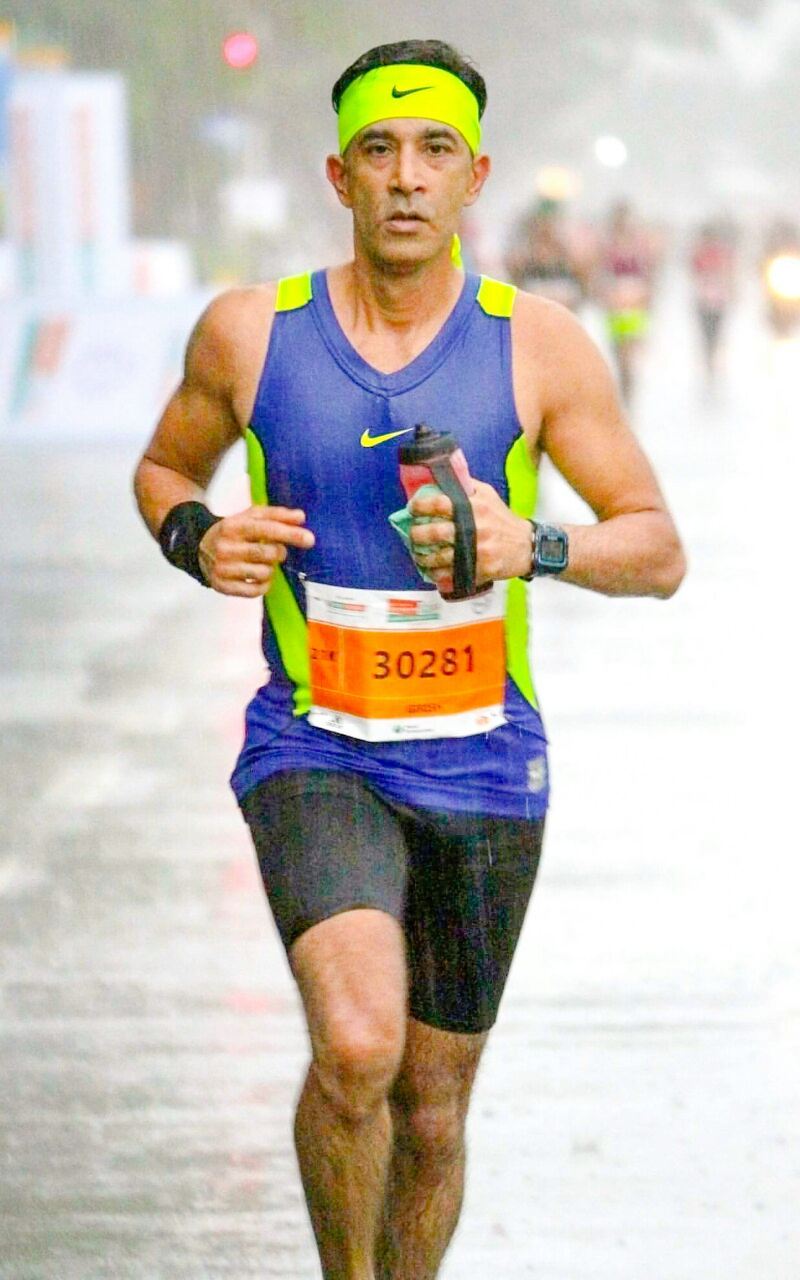
At the 2017 IDBI Federal Life Insurance Half Marathon in Mumbai (Photo: courtesy Girish Bindra)

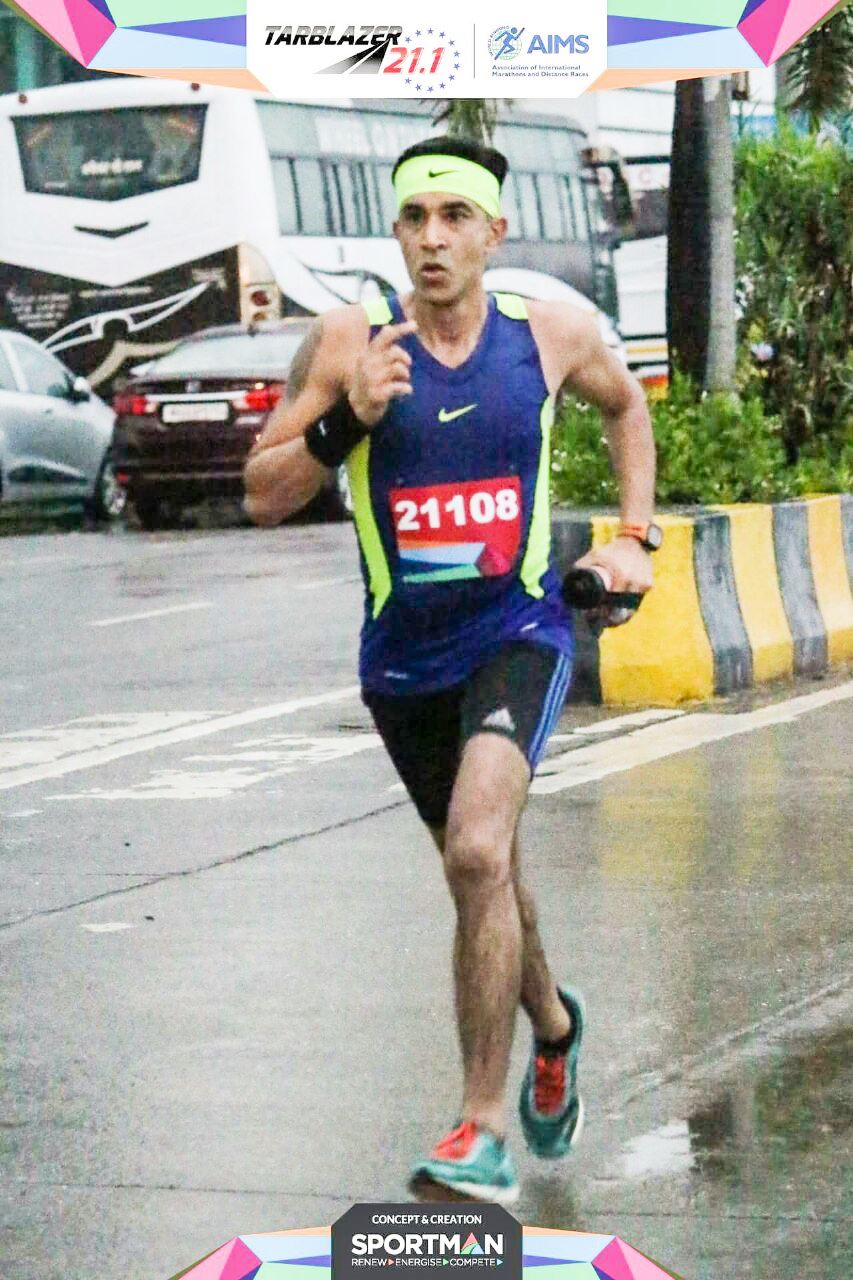
At the 2017 Tarblazers Half Marathon in Mumbai (Photo: courtesy Girish Bindra)

According to Girish, since 2012, he has participated in more than 45 half marathons and 11 full marathons, including the well-known races in Mumbai, Vasai and Hyderabad. His best timing in the half marathon was 1:35; in the full it was 3:43. It doesn’t stop at these established distances. Girish had done 20-25 races over the 10 kilometers-distance; his personal best was 43 minutes, eight seconds. He had also done 12 ultramarathons, including those spanning distances of 75 kilometers and 100 kilometers. He had two 12 hour-stadium runs (one each in Mumbai and Hyderabad) and two 24 hour-stadium runs (Bengaluru and Mumbai) under his belt. The 2016 24 hour-stadium run in Bengaluru, where he placed second covering 182.8 kilometers, had qualified him for the world 24-hour endurance championship due in Ireland in 2017. He got to know of his qualifying only much later and so could not go. However in 2017, he achieved another personal milestone, ending fifth in the 48 hour-stadium run in Bengaluru, covering 252.8 kilometers. This repertoire, spanning 10 kilometers to ultramarathons and 48 hour-stadium runs, can be found among amateur runners but it is not something people persevere to retain. Most gravitate towards a chosen discipline or two. Girish has no such plans yet. “ I love speed as well as mileage. Whatever it is, I work to give it my best. I am a fighter in life. I have seen what I went through; there was that medical condition, I also overcame financial difficulties in my business. I don’t want to repent not having tried anything,’’ he said.

It is important to note that Girish’s journey in running never had a coach in it, save four months of training he did with Raj Vadgama. For someone navigating his route by himself, Girish has done remarkably well. He reads up on running. He listens to his body and appears to have struck a healthy balance between actual running and strengthening his body. At the time of talking to us, his weekly mix was approximately three days of running and four days in the gym. He used to cycle but has since given up on cross-training; a judicious balance between running and working out was his mantra for continuing the journey. “ The strengthening exercises and stretching I do at the gym have helped me,’’ he said. His recovery after strenuous events is good. At the time we met him, Girish was not following any special diet. He liked his food as tasty and wholesome as they came. The largely self-taught runner had also doled out training plans and tips on training to his friends in the sport. “ It gives me immense pleasure to be of use like that,’’ Girish said.

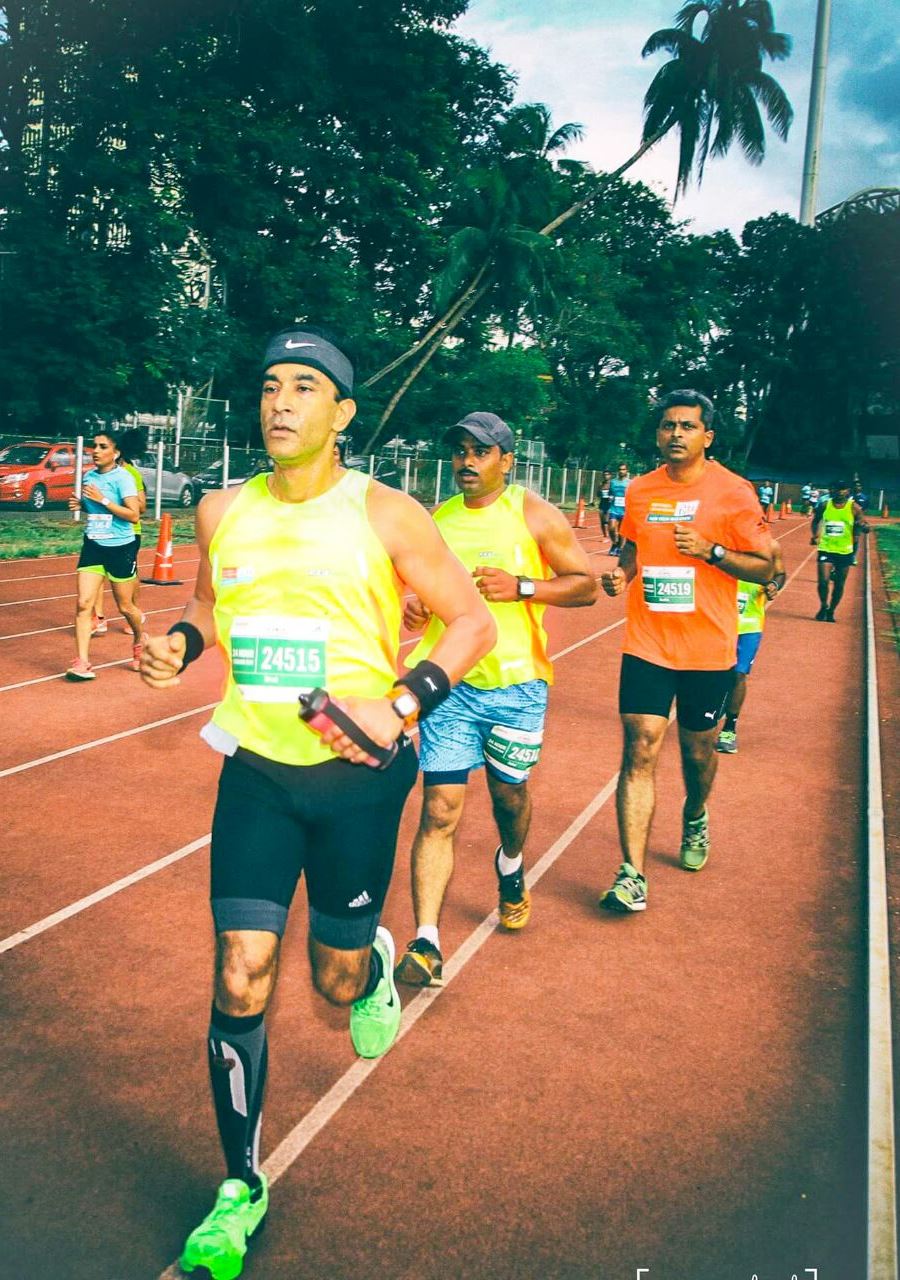
At the 2017 24 hour-stadium run in Mumbai (Photo: courtesy Girish Bindra)

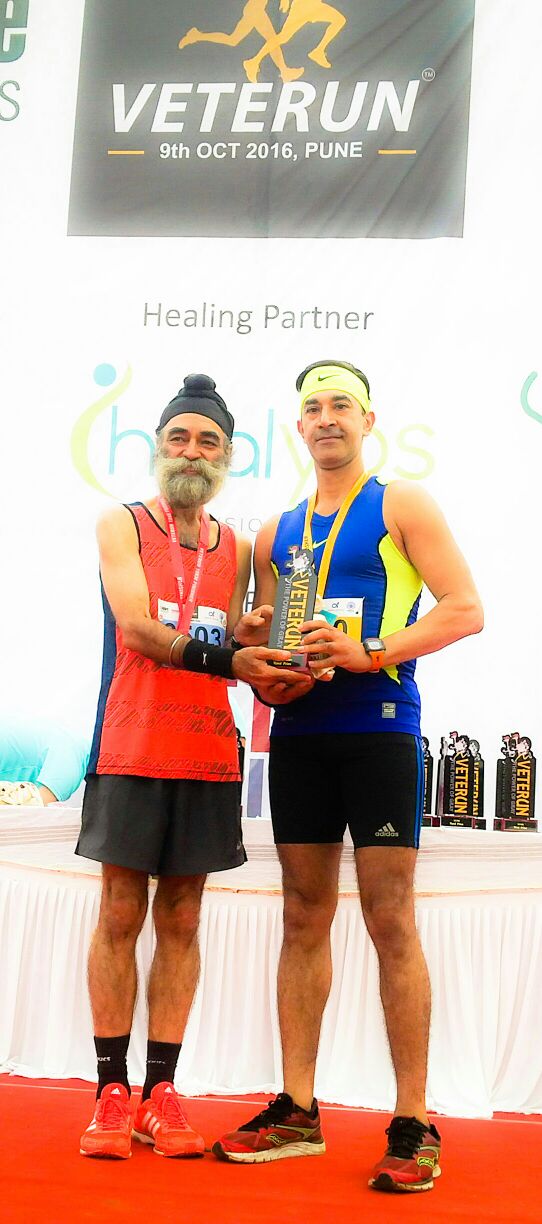
With Kiranpal Singh Dhody at the 2016 Veterun Half Marathon in Pune (Photo: courtesy Girish Bindra)

Chittu Shetty, 50 years old in 2017, had met Girish through MRR’s practice runs. The two used to pass each other while running on the road. Chittu was always doing long runs and Girish had been noticing it. When the two got talking, Girish offered advice. “ He is a very approachable person; somebody who is willing to help. He gave me tips on resting and improving my speed. I followed it and my performance in the half marathon improved. I used to finish running 21 kilometers in 2:15 or so. I was able to haul that up to 1:53. Similarly in the full marathon, he gave me tips like the right stage to have an energy gel. My personal best in the full is now 4:23,’’ Chittu said, when contacted. MRR runs were the context to meet Girish, for Ritu Kudal too. As of 2017, she had been running for six years. For the first four years or so, when Ritu stayed focused on the half marathon, Girish provided her periodic tips on improving performance. In 2016, she decided to train for the full marathon segment of the 2017 SCMM (now TMM). That needed a whole plan and Girish provided her with a comprehensive training plan, starting in July-August 2016 and leading up to the race in January 2017. “ It was a good plan; one that really helped me. I finished strongly and did not suffer any cramps,’’ Ritu said. Her opinion of Girish was similar to Chittu’s. “ He is a very down to earth person, very grounded,’’ she said.

For Girish, quality of training matters more than quantity. The number of days in a week that he actually runs remains pretty much the same; it hasn’t altered despite portfolio of disciplines ranging from ten kilometers to the ultramarathon. Within that, intensity and mileage may go up depending on whether he is training for a ten kilometer-run, a half marathon or a full marathon. During the course of a regular week, he can be usually seen doing hill work-out every Wednesday near Mount Mary’s Baslica in Bandra, speed intervals every Friday at Five Gardens or on the Eastern Express Highway and long runs of 20-30 kilometers every Sunday, commenced either at Shivaji Park or Nariman Point. Not long before we met him, Girish completed his course in marathon training from Exercise Science Academy (ESA), Mumbai. Officially therefore, he is now a certified trainer. It is a line of work that he would like to grow. Japanese athletic equipment manufacturer, Asics, is set to start its running club in Mumbai from October 2017. Girish said that he has been selected to work with them as a coach.

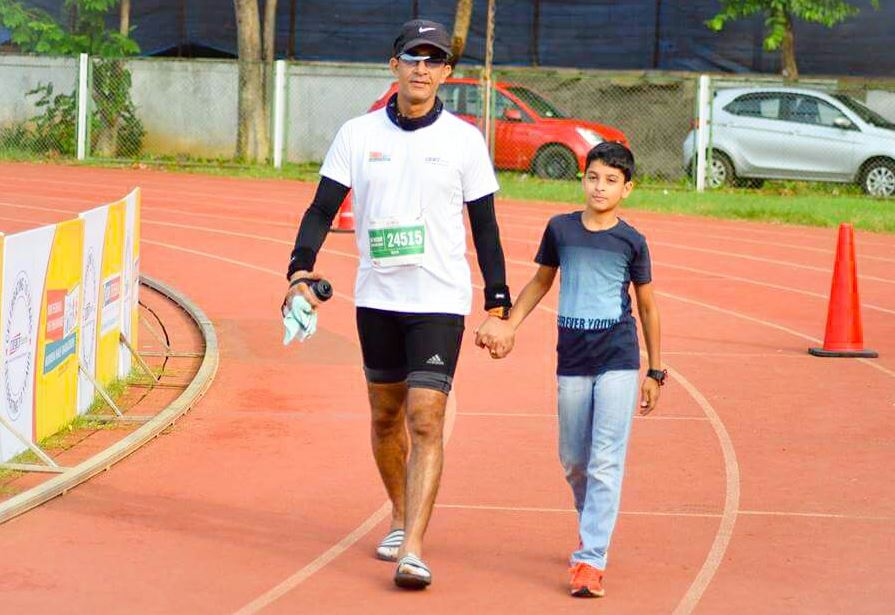
Latter half of the 2017 24 hour- stadium run in Mumbai; feet covered in blisters, younger son Sahaj for company (Photo: courtesy Girish Bindra)

In terms of races ahead, Girish had registered for the 2018 Comrades in South Africa. He admitted that work pressure denied him the chance to travel and run at various locations, he would otherwise love to. A destination like Ladakh for instance, requires runner to include a proper acclimatization schedule. Many days away from work is tough for transporter juggling the responsibilities that go with trucks heading this way and that. Well supported runs at easily accessed locations, at altitudes not drastically different from Mumbai’s, are therefore easier to handle. But one wish still defies this time constraint authored by business – at some point he would like to attempt Badwater Ultramarathon in the US.

For all the personal supervision Girish must do in his business, he maintained some clear switch-off points in his daily work schedule. His running is always in the morning. For regular runs, he is up at five in the morning. On days of long training runs, he is up at 3.30-4AM. After his running, he heads to work. Every evening he heads from office in Chembur to his gym in the same suburb. By about 7.30-8PM, he makes sure he is home for time with his family. Girish has two sons. The eldest, he said is creatively inclined. Except Girish, nobody from his family is into running. In much of the narrative about his running, that world and the world of his family don’t overlap. However, during the 2017 24 hour-stadium run in Mumbai, his wife, Rashmi came to see it and after Girish developed a bad case of blisters on his feet, which reduced him to walking, his younger son joined him on the 400 meter-track, keeping him company for some of the mercilessly repeating loops. “ That felt good,’’ Girish said.

(The authors, Latha Venkatraman and Shyam G Menon, are independent journalists based in Mumbai.)

THE TINTIN YEARS

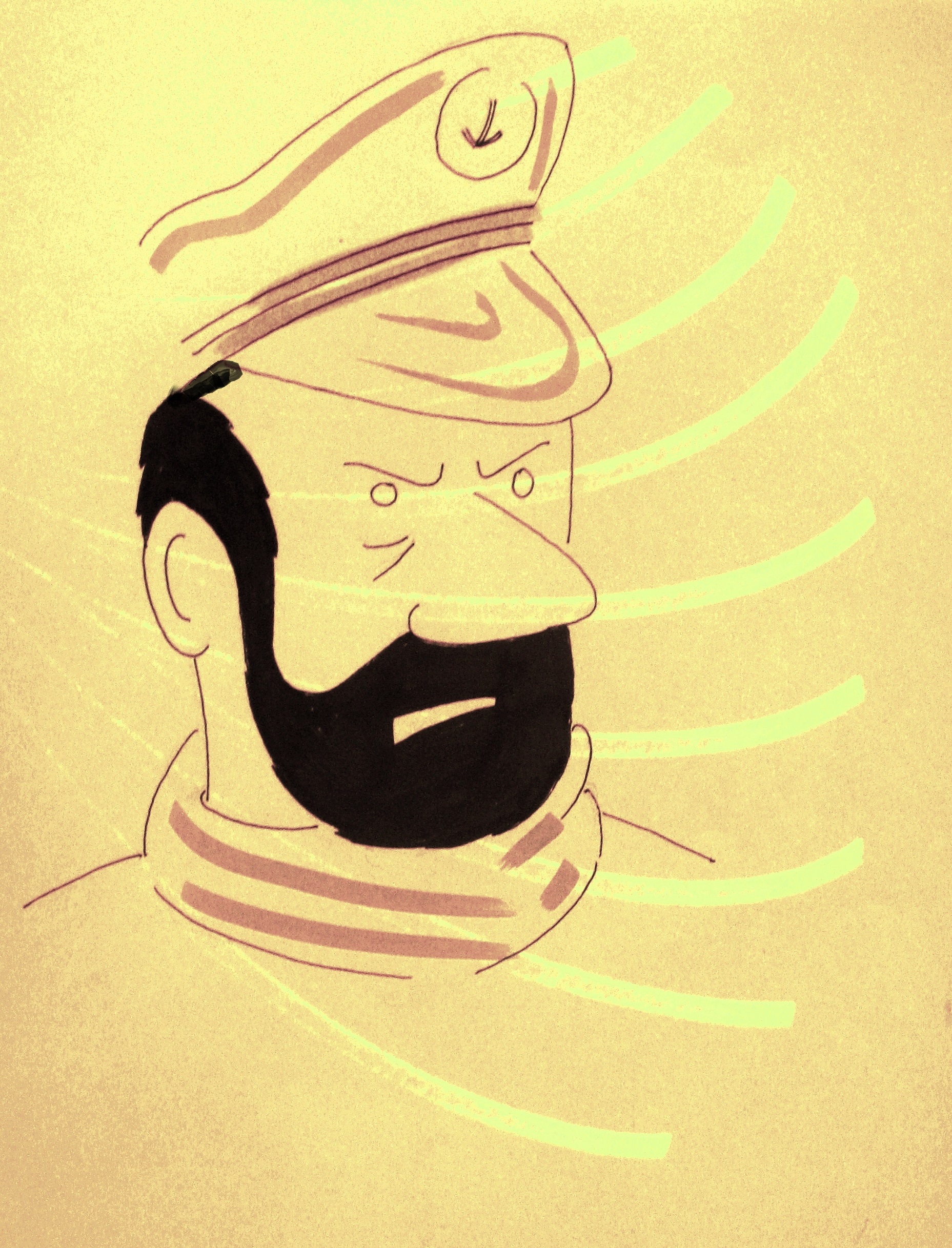
Illustration: Shyam G Menon

Many decades ago, two significant developments happened near simultaneously, in my extended family.

Two uncles, two comic strip heroes and a bunch of school going cousins – that was the context.

My uncle Narayana Pillai got me Flight 714, my first title from the series showcasing the adventures of Tintin. Until then, the only illustrated narratives I was familiar with were the ones from Marvel, DC, Indrajal and Amar Chitra Katha. They had strong following among school students, to the point that classmates with bound volumes of comic books were important people to know. I didn’t have bound volumes. Although my mother helped out by borrowing bound volumes from a local lending library, in general I suspect, my parents and grandparents held the view that comics, while popular, made for simplified narrative requiring less imagination. Reading was encouraged, purchase / borrowing of wholesome books approved. Days when the cousins got together typically featured a morning or afternoon of painting. Imagination was encouraged. A picture may speak a thousand words but the mind gets useful stretch if it can paint a picture from a word or a theme, perhaps even nothing – that seemed the approach. Into this ambiance landed Flight 714 and at the house of my cousins – Rajeev and Manju – thanks to another uncle: Sachidanand, a handful of books featuring Asterix.

It took me a while to warm up to Tintin. But you guessed it right – it took no time to like Captain Haddock. Who can forget “ thundering typhoons’’ and “ blistering barnacles’’? I also remember liking Skut for no stronger reason than that he was a pilot in Flight 714. Those days I shared a craze for aircraft with my cousin Jayu. Both of us had those small, thick Observer books with plenty of fighter planes in it and we spent time piecing together our respective air forces, which then competed for supremacy in the sky. We also made model aircraft from cardboard, Jayu being infinitely better at the job than I. Flight 714 thus landed at the correct time. My mind was ready for adventure. What attracted me to Tintin were also perhaps the size of a Tintin book and the average length of a story. Uniquely, it was bigger in size than the regular comic book. It told a full-fledged, long story spanning continents, sometimes taking two issues to finish; a sort of early introduction to the graphic novel format that would become popular decades later.

What I remember most is however something else.

Maybe it is a larger Malayali trait, maybe it is a family trait – I don’t know which of the two is correct –we had the tendency of analyzing experiences. At near fifty, I understand childhood better now. It is a phase when you have the luxury to do something because you feel like it; no analysis in the mix. Impulse and intuition are not unfashionable. Our passage to adulthood is fueled by just the opposite. We become adults by analyzing to make sense, till we become armchair analysts of all that is alive and stirring. Expectedly, my extended family put Tintin and Asterix under the scanner. The emergent fascination among the children for these two series triggered discussion among the adults. It was a discussion revolving around idea, story and artwork; we had no clue of such political details like Tintin’s origin in a Belgian newspaper identified with far right views. I remember the outcome. Asterix stayed ahead because its illustrations were bolder and had more flourish. Asterix stories with their play on characters’ names were also more deeply imagined and as the more sophisticated, layered comic book it was respected that much more because childhood is after all stepping stone to more sophisticated adulthood. None of that bothered me. I like Asterix. But Tintin is special. Something about it appealed to childhood’s idea of adventure.

My uncle probably noticed the brewing interest. His work took him often to other cities in India. Occasionally, it also took him overseas. Almost always, he returned with another title from the Tintin series. All the titles were displayed on the back of each book. So it was easy to identify what you hadn’t read and hunt for it. Tintin made me do crazy things. One of them was my scale drawing of a rocket. I arrived an evening with my father at the house of Rajeev and Manju. Their father – Govindan (he was a physics professor) – smiled and indulged me with his time and patience as I explained how my rocket would work. It was all well illustrated in the drawing on large graph paper – the fuel tank would feed the engine and my rocket would escape Earth’s gravity and be moon-bound. Why shouldn’t it? I had a rectangle with dials on it, labeled ` control panel,’ another rectangle with pipeline attached, labeled ` fuel tank’ and yet another one marked ` engine.’ That last rectangle ended in a nozzle copied from one of the jet engines in my Observer book. In retrospect it’s a good thing I didn’t join the Indian space program.

In those days of economy yet to open up like now, each Tintin bought traveled to multiple homes. At every home a kid or two eagerly lapped up the contents. Sometimes titles got exchanged at school; I will lend you my title if you lend me yours, which I haven’t read – that sort of deal. And unlike, regular comic books, which few bothered if they got misplaced or torn through lending, deals over Tintin and Asterix were deals of honor. Misplace or mishandle, you risked being branded unreliable for life. That adds a touch of mystery to how my Tintin collection – all titles acquired save four; that’s 20 out of 24 – fared, once I reached college and employment beyond. Back home in Thiruvananthapuram, not one title survives. I hope some kid; somewhere is still reading what I collected and drawing rockets and submarines. Slowly as Tintin titles became more easily available in India, we started buying the books ourselves (a visit to Kochi was always incomplete without dropping in at PAICO). One by one, we collected the titles mentioned on the back cover of every Tintin book. Then the search commenced to at least access and read titles not mentioned there; titles mentioned in Tintin lore or in conversation among his devoted fans. Meanwhile, my uncle’s children, Lakshmi and Hari, also grew interested in Tintin and started their own collection.

Illustration: Shyam G Menon

I never outgrew Tintin. I can still pick up a title and enjoy browsing through it. In my adult life, the arrival of Steven Spielberg’s film on Tintin was a much awaited event. My favorite character was Captain Haddock and I was utterly curious to see how he would be on celluloid. I was disappointed and it isn’t Andy Serkis’s fault. My curiosity was in seeing which actor would pull off that role well and being an avid watcher of Hollywood films, I had even attempted some casting in the mind. As it turned out, the movie was made using motion-capture technology. That put it neither here nor there. It reminded me of the title: Tintin and the Lake of Sharks. Of all the Tintin titles I had, this one – assembled using stills from a 1972 animated film – had attracted me the least. When it comes to converting comic books to movies, I am not a fan of hybrid. After all, Tintin is not a Jungle Book, wherein modern animation technology makes animal characters life-like rendering the film a classic. Tintin sits firmly in the world of people and it surprised me that the producers deemed hybrid imagery, acceptable. I felt that was a letdown, considering Tintin has been portrayed before on stage and several other comic book heroes have been adapted brilliantly for the big screen.

In early August 2017, Lakshmi mentioned that a prominent item at Hari’s home in California is a poster of Tintin. Among his favorite shops is one where he picks up “ his Tintin stuff.’’ It made me wonder: what made her father Narayana Pillai, pick up Tintin books in an era of closed economy in India? Laskhmi’s own take on it was that her father bought it for the children in the family but he wasn’t above reading it on a flight himself! But then, unlike today when the media floods you with trends instantly, those days a comic book hero from Belgium was as distant as Belgium itself. You were compelled to read about Superman, Batman, Phantom and Mandrake because they were around. But Tintin? He didn’t have any PR machinery promoting him in the Indian media. It left the question: how did Narayana Pillai born and brought up in the Kerala of the 1940s and 50s, come to know about Tintin? He had never shared those details. A day into recollecting my thoughts around Tintin, I called up my uncle at his home in Aluva. Now in his mid-seventies, he laughed upon hearing that the phone call from nephew nearing fifty years of age was connected to his Tintin purchases from long ago. There was no loss of time in recollecting details. The bulk of the Tintin books were sourced from a book shop at the Mumbai airport of old, which my uncle visited during his business trips. “ I used to look for illustrated children’s books. That’s how I came across Tintin. I flipped through its pages and felt the characters in the book were interesting. The hero was a young journalist. When I bought my first Tintin, I had no idea how it will be. But from that one book, we moved onto many more, possibly the whole lot…Hari’s collection is still here,’’ he said. Further, in as much as he bought the books for children, he loved reading Tintin himself.

(The author, Shyam G Menon, is a freelance journalist based in Mumbai.)   

A PEEK INTO A CHAMPION’S ECOSYSTEM

Make no mistake – this is not a gentle book on how to swim or improve your skills in the sport. This book is about competing and winning against some of the world’s best. Michael Phelps likes to compete. It took him all the way to titles at World Championships and the Olympics. Beneath The Surface – his autobiography – is an action packed-ride.

Phelps starts human. At journey’s start there is that worry common to many of us – fear of water. It soon fades secondary to purpose found in life for hyperactive youngster. There is nothing like buckets of energy meeting well defined purpose. Notwithstanding humor and casual writing style, I found the book intense. It sticks to subject and packs in details. It isn’t just timings in finals that find mention; the timings in practice, at trials, heats – all get cited because at this level of competition every sub-second shaved, counts. A portrait of the world’s greatest Olympian and athlete comes alive in that space. I read this book to know more about Phelps, an icon in my times. He had his idols – the Australian great Ian Thorpe finds ample mention. Mark Spitz, a legend by 1972, thirteen years before Phelps was born, makes an appearance. Given its central protagonist heads for the Olympics, you also get a glimpse of the Games and life at Olympic Games villages as seen through the eyes of a young, rookie Olympian, progressively moving on to – as seen by a star.

What struck me after reading the book was how much running dominates our idea of athlete. With no disrespect meant to the greats of track, fact is – Phelps has a breadth and depth to his swimming that makes glories elsewhere seem like a side act.  He competes in distances ranging from 100m to 400m and that includes the individual medley, which requires you to be good at all four strokes used in swimming. He also participates in the relay; a discipline that brings out the thrill in being part of a team. He is a winner across these disciplines. Phelps tackles packed schedule with multiple swims – ranging from heats to finals – sometimes happening on the same day. If you dwell a bit on the level of competition at these races, the timings returned and the laurels at stake – you realize how energy sapping these performances are on participants. Not surprisingly, you are also introduced to swimmers swimming down after an intense session in the pool. It helps lower the lactic acid build-up in their body. And lest one forget, you cannot swim to such elite timings or face packed schedules at races, if your training sessions don’t push you to the limit. All this goes into the making of a top notch competitive swimmer. However for some reason, in our mind, swimming does not command the profile track athletics does. When we are asked about the greatest athletes ever, our mind quickly seeks names from the list of track athletes. Phelps talks of the popularity swimming enjoyed in the Australia of Thorpe’s time. He wishes the same was possible in the US and rejoices every time signs of it emerge.

The autobiography embraces the reality of sponsorship and media. It describes how sponsorship, media and publicity are handled such that an athlete’s focus on his / her work is not disturbed by distractions. It casts light on the suggestions Phelps received on how to handle the media. Above all the book gives you a ringside view of what a coach means to athlete and how their bonding and collaboration work in modern sport. Phelp’s achievements are as much his as they are of Bob Bowman, his coach. Together, they work on perfecting Phelps’s techniques, hone his competitive instincts, smash world records and make the swimmer, the most successful Olympian yet. As important as Bowman in Phelps’s journey to greatness is his family. His mother and two sisters (both sisters are swimmers) are there for him. It clearly shows that while success has often been depicted as a person’s battle against odds including lack of family, the reverse can also be true – supportive family works. After 23 gold medals won at the Olympics, you don’t need more proof; do you?

This is an interesting book. It is tad heavy on details around timing but it tells you what champions are made of, what their ecosystem is like. The book’s weakness is also pretty much the same. You get to know a lot about competitive swimming; not much about what human engagement with water through an act called swimming, means.

(The author, Shyam G Menon, is a freelance journalist based in Mumbai.)

THINK EVEREST IF YOU MUST BUT DON’T FORGET THE SEA

Illustration: Shyam G Menon

In early September 2017, I read a news item from Kerala that spoke of a state based-adventure outfit wishing to put women from South India on top of Everest.

It made me sad. Not because Everest is unworthy of aspiration but because it captures our attention at the expense of other equally worthy if not worthier objectives.

To begin with, in May 2014, Malavath Purna, a 13 year old-girl from Telangana had successfully scaled Everest. She was at that time the youngest girl to ascend the peak. That’s sufficiently record-making for South India if you ask me. Maybe then, the adventure outfit’s reference was to people from Kerala. While anyone is free to raise the required funds and attempt Everest, it is a fact that in mountaineering, Everest is equated with guided mountaineering as long as one is attempting it by its frequently climbed routes. The most important factor in guided ascents of prized peaks is whether you – as client – can afford the cost of permit, gear rental charges and the fees of the guiding company. In Everest’s case that is a big amount. Everest tests your stamina. It also tests your purse.

A guided climb of Everest by the normal route does not automatically make you distinguished in the company of mountaineers. Discerning climbers will seek details and they know well that challenging peaks are available elsewhere too in the Himalaya. On the other hand, alpine style ascents on Everest or climbing it by less frequented routes are ideally tackled by experienced climbers for they are quite difficult.

If you can raise enough money to climb Everest; then directing those resources to any other part of the Himalaya will yield plenty of peaks of lesser height that cost less to climb. Should Kerala structure a mountaineering program that puts the focus on less known Himalayan peaks, it would do climbing a service. Some of these peaks are genuinely challenging. Ascents on them have been the stuff of award winning mountaineering. For those who define adventure differently from courting a tonne of risk (I belong to that category), these lesser mountains and their landscapes also harbor much wild beauty and solitude. Currently they don’t fascinate Indians as much as Everest because we and our media are still in the early phase of mountaineering. We haven’t got under the skin of climbing. We remain awestruck by Everest. That’s why the world’s highest peak, climbed by many and their guides every year, continues to attract. A good example of its popularity and symbolic value is betrayed in the experience of a well-known mountaineering club from western India. Having climbed Everest successfully, this club tried raising funds to climb other peaks. It didn’t work. It was easier to find sponsors for yet another Everest expedition with adjacent peaks included. Among mountains, Everest fetches sponsors and when it comes to money to attempt other peaks, Everest done or Everest too in the frame, is the stamp that fetches sponsors.

It doesn’t end there.

When individual aspirants fall short of funds for Everest, they borrow. Some even take bank loans. For these folks, a trip to Everest and summit missed means investment lost and life in debt. Such stories have been reported in the media. Further, government departments awarded promotion at work against Everest ascents recorded. Potential recognition of this sort, which has nothing to do with climbing, inspires its share of unrealistic expectations, not to mention fraud. I climbed Everest but didn’t get due recognition – is a complaint sometimes heard. Meanwhile, a husband and wife team from India was shamed not long ago for faking their summit photo.

Given several states have already seen their residents ascend Everest, I wonder if yet another Everest expedition or creating a training base for those aspiring to climb such a costly peak, deserves priority. Sure it can be a business opportunity, for those seeking guided ascents up Everest are clearly people willing to spend money for it. However if one is imagining sport with support from state exchequer in mind, then I submit what Kerala must do is something else.

As a coastal state, it must embrace water. It must encourage disciplines like swimming, distance swimming, sea kayaking and sailing. Water rarely gets the attention it deserves in our imagination of adventure although it forms 70 per cent of the planet and is deep enough to sink mountains. In his autobiography, American swimming legend Michael Phelps states his admiration for Australia. Down under swimming was one of the most popular sports, a position unheard of for swimming elsewhere. Phelps wanted this to happen in the US too. Access to water and sea is Kerala’s real gift. There is nothing wrong in wishing to meet the Himalaya. In fact, there is nothing wrong in anything you choose for adventure – it is your instinct, your choice. Just that in Kerala’s case, it would be a tragedy to hanker after the Himalaya far away, and merit in the process, guided swims and sailings in the Arabian Sea lapping at one’s feet.

Kerala has produced good swimmers who topped nationally. A couple of them also participated in the Olympics. Kochi has a marina. It is hometown of Commander Abhilash Tomy KC, the first Indian to do a solo nonstop circumnavigation of our planet in a sail boat. Did this translate into policy supportive of water sports in the state? I doubt it and by supportive policy, I don’t mean events (that’s tourism). I mean training and empathy for those wishing to court water. I have also not heard of any endeavor from Kerala that is the equivalent of an ` adventure’ on water. Further, for the record: swimming cannot be substitute for regular climbing as means to be good at mountaineering. But it provides physical fitness and cardiovascular health; both essential for any endurance based activity, including mountaineering. There is a lot that focusing on water can yield – it can help you excel on land, if land still be your chosen medium for adventure.

If you are in Kerala and can call upon government, companies and people to contribute resources, what would you attempt for adventure – Everest or a long distance swim or voyage?

Think about it.

(The author, Shyam G Menon, is a freelance journalist based in Mumbai.)