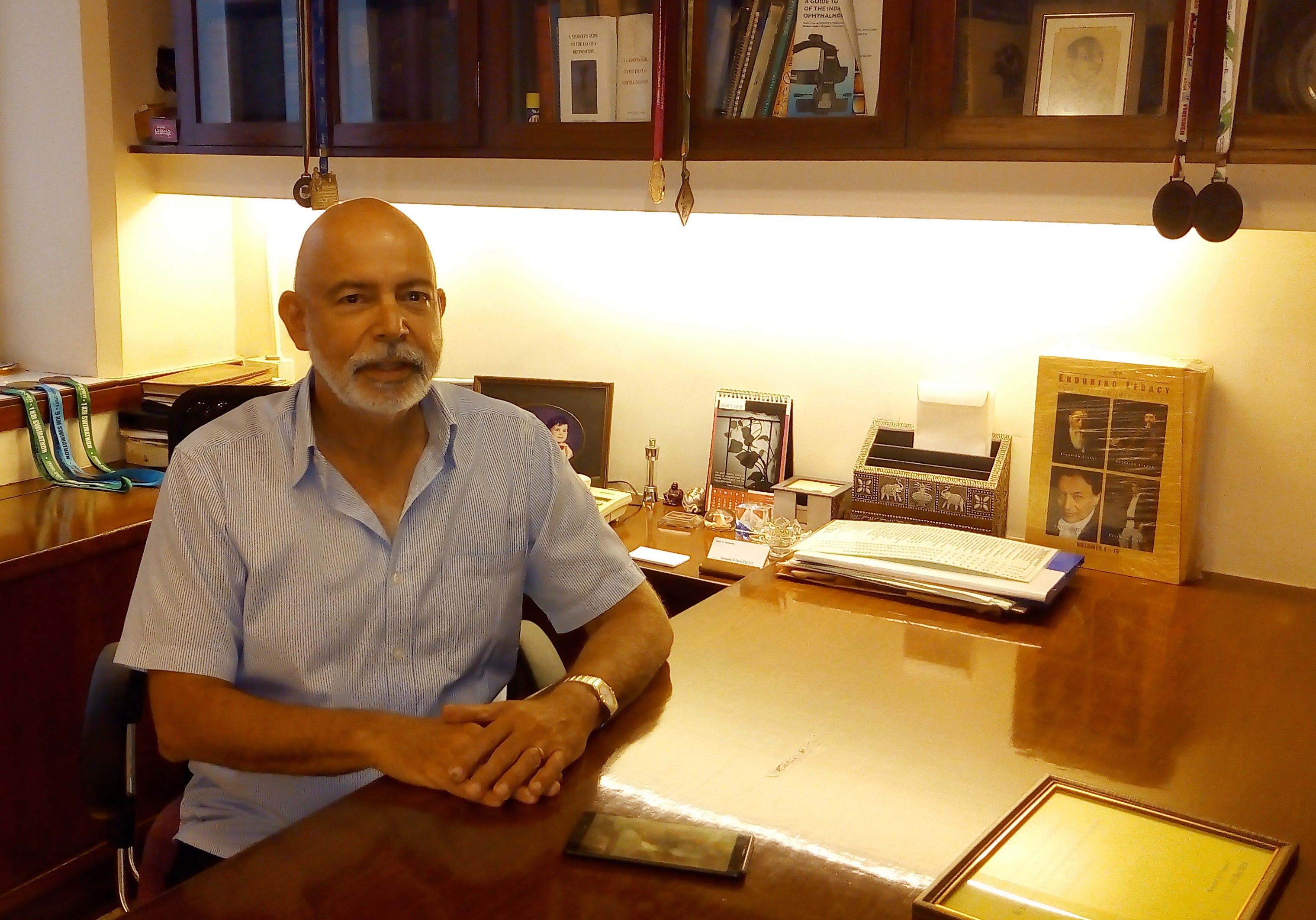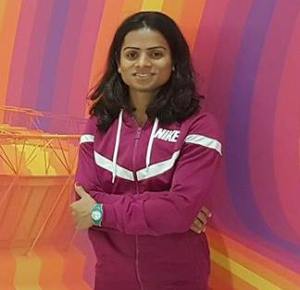
ANJALI SARAOGI, ULLAS NARAYANA GET AFI ULTRA AND TRAIL RUNNING AWARDS; INDIA BIDS TO HOST INTERNATIONAL CHAMPIONSHIPS

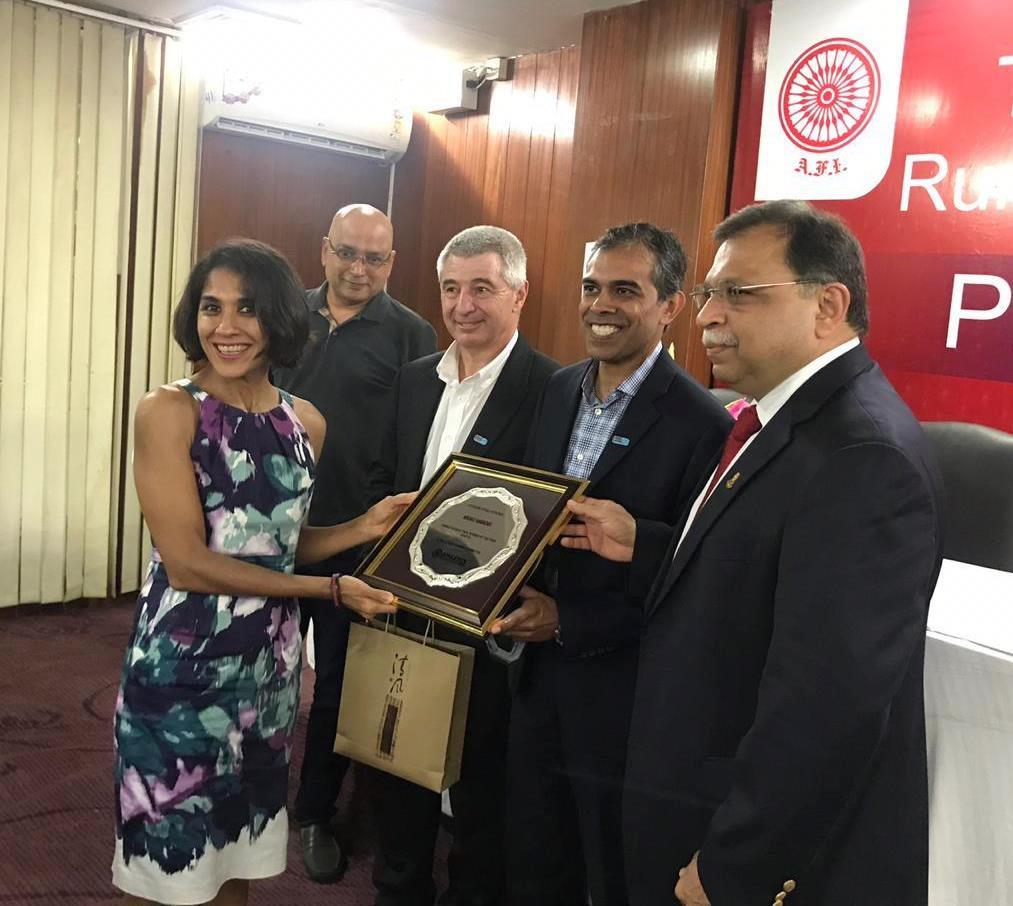
Anjali Saraogi receiving her award (Photo: courtesy Anjali)

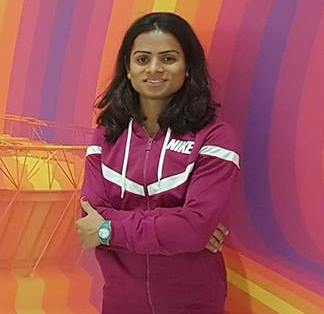
Ultra-runners, Anjali Saraogi and Ullas Narayana, have won the ultra and trail running awards for 2018-19, Athletics Federation of India (AFI) said in a statement today (July 15, 2019).

Kolkata-based Anjali was conferred the female ultra and trail runner award for 2018-19. Ullas, who lives and works in Vancouver, was chosen for the award in the male category.

The Ultra & Trail Running Committee of AFI selected the winners, the statement said.

Anjali’s performance at the IAU 100 kilometre World Championships in Croatia in September 2018 was mentioned as women’s best performance in 100 k event. She had completed the run in nine hours, 40 minutes and 35 seconds.

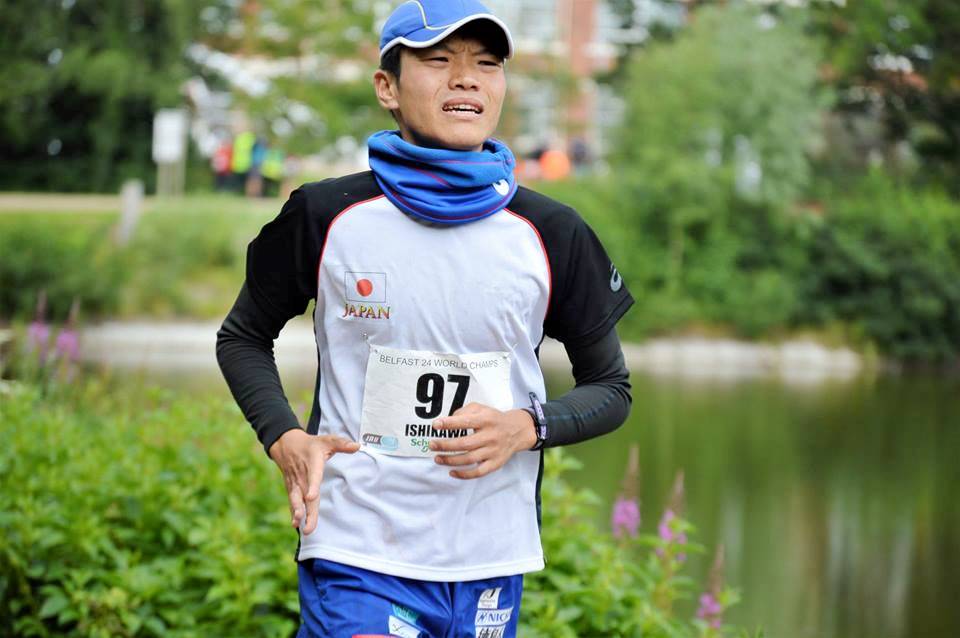
Ullas’s bronze medal win at the men’s 24-hour run at IAU Asia & Oceanic Championships at Taipei in December 2018 was adjudged the best performance among men in that discipline. He had covered a distance of 250.37 kilometres to win the bronze medal.

Apoorva Chaudhary’s performance at the women’s 24-hour run at the NEB Sports New Delhi Stadium Run in December 2018 was commended as a significant achievement in ultra-running for women. She had covered a distance of 176.8 kilometers, setting a new national best in the discipline.

Surat-based Sandeep Kumar’s performance at the downhill version of the Comrades Marathon in 2018 and Deepak Bandbe’s run in the uphill version of the same event in 2019 were also mentioned as significant achievements. Sandeep Kumar had completed the ultra-marathon in South Africa in seven hours, 29 minutes and 53 seconds. Deepak Bandbe finished the uphill run in seven hours, 43 minutes and 34 seconds.

The highest ITRA rating among Indian ultra-runners was “ 730 general cotation” for Kieren D’Souza.

It was on 15 February 2017 that AFI became a member of the IAU. This paved the way for ultra-runners from India to participate on the international platform of the IAU and ITRA (International Trail Running Association); at the World and Asia & Oceania Championships. Since 2017, the AFI has sent Indian ultra and trail runners to represent the country at the Trail World Championships, the 24 Hour World Championships, the 100 Km World Championships and the 24 Hour Asia & Oceania Championships.

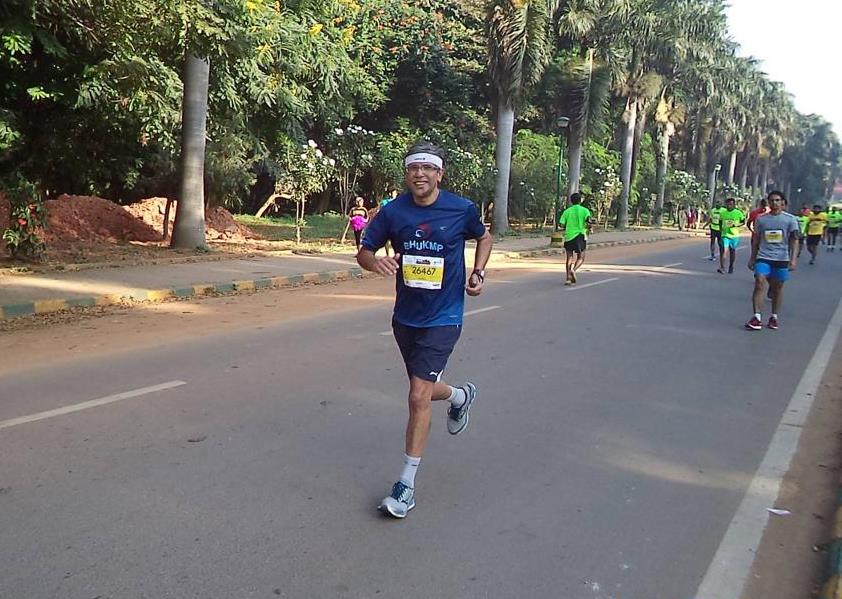
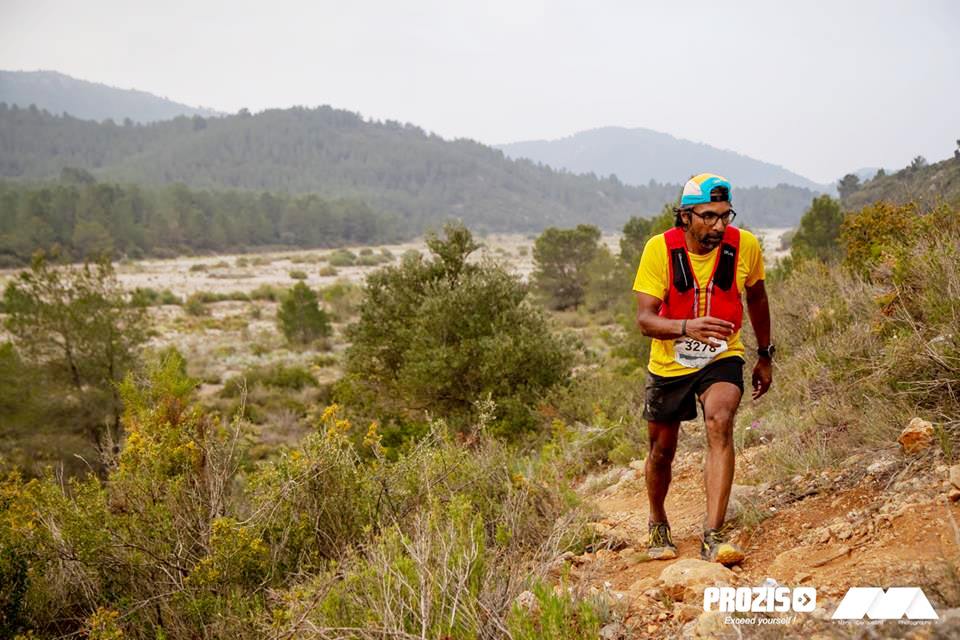
Ullas Narayana at the 2018 IAU Trail World Championship (Photo: courtesy Kieren D’Souza)

It was at the 2018 IAU 24 Hour Asia and Oceania Championships held at Taipei, that India won its first individual and team medal at an international ultra-running event. Ullas Narayana won the bronze medal in 24 Hours and the Indian Team comprising Ullas Narayana, Sunil Sharma and Lallu Meena finished in third spot.

The sport of Ultra Running and Trail Running has been growing rapidly with at least 50 such ultra-running events being organized in the country. A large number of runners are also competitively taking part in international events such as the Spartathlon, Badwater, La Ultra The High, UTMB and Comrades. A couple of domestic ultra-events are drawing up to 750 participants under different categories, a related statement said.

India bids to host international championships

According to the statement, AFI and NEB Sports have invited IAU President Nadeem Khan and Vice President Robert Boyce to consider India as the next destination for holding an International Ultra Running Championship. “ India has bid for hosting the IAU 24 Hour Asia & Oceania Championships in 2020 and the IAU 100 Km Asia and Oceania Championships in 2021,’’ it said.

“ We have received India’s bid to organize continental-level events and I think the facilities we visited in Bangalore are really good. The final decision on hosting IAU 24 Hour Asia & Oceania Championships in 2020 and the IAU 100 Km Asia and Oceania Championships in 2021 in India will be taken by IAU council,’’ the statement quoted the IAU President as saying.

(The author, Latha Venkatraman, is an independent journalist based in Mumbai.)

“ I JUST SAY TO MYSELF IT’S OKAY. YOU’RE OKAY’’ / ABDULLAH ZEINAB, WINNER, TRANS AM 2019

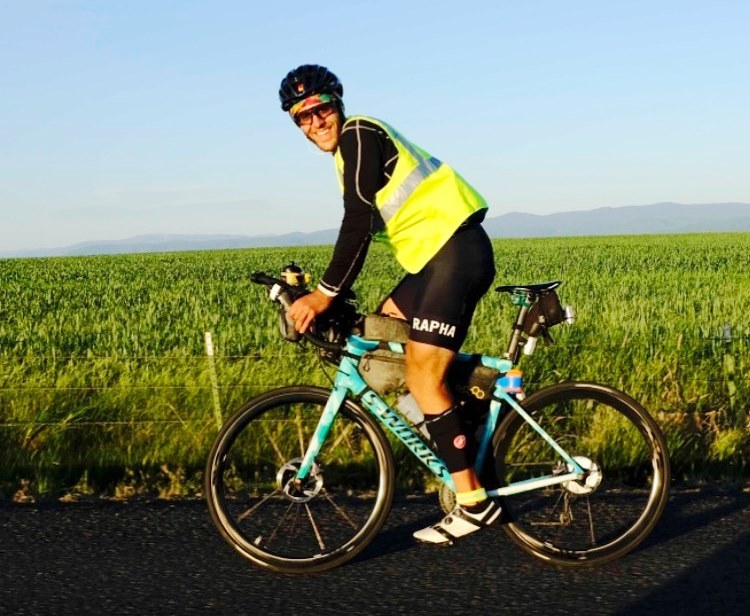
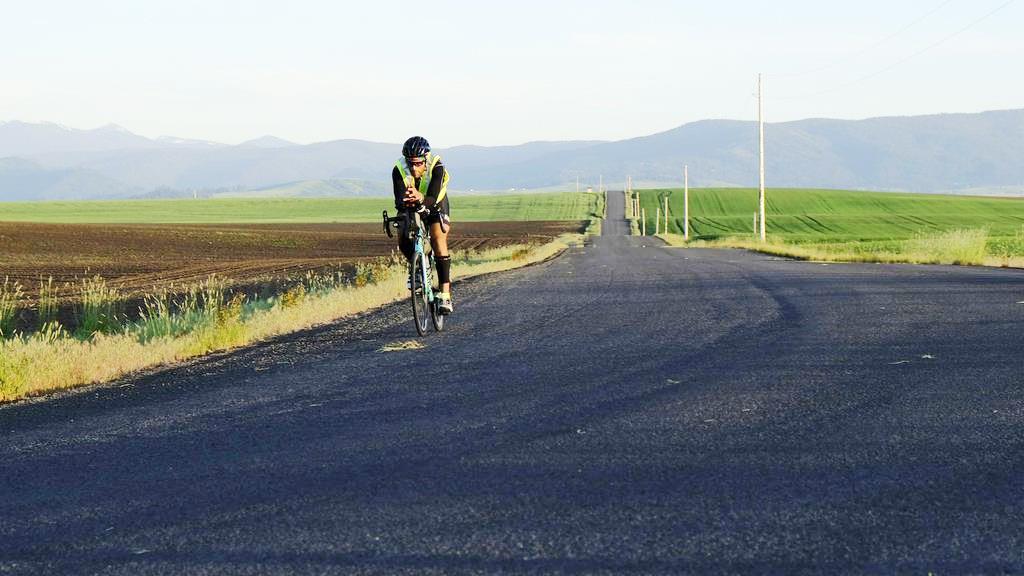
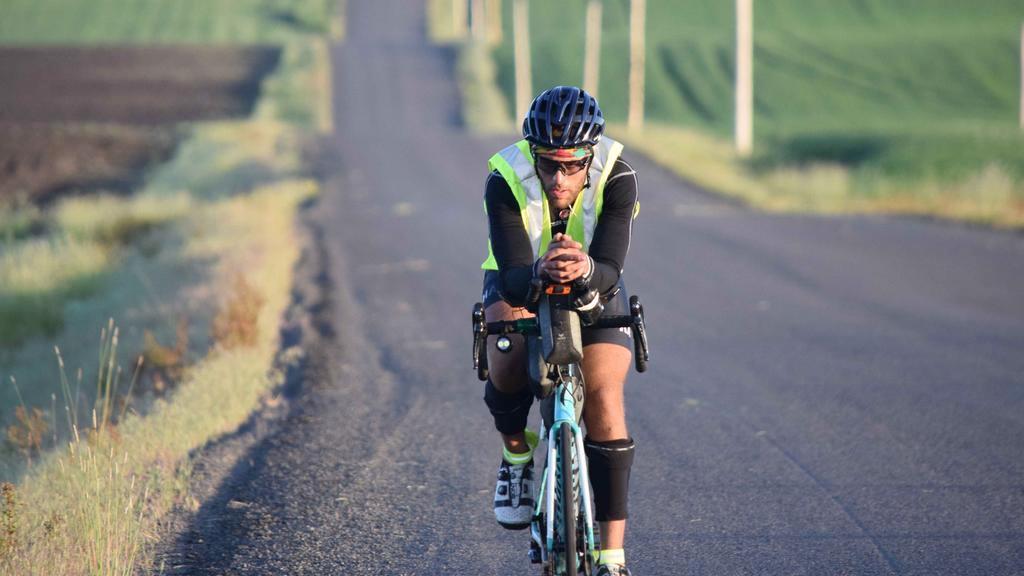
Abdullah Zeinab (Photo: courtesy Abdullah / this photo was sourced from the website of Trans Am Bike Race)

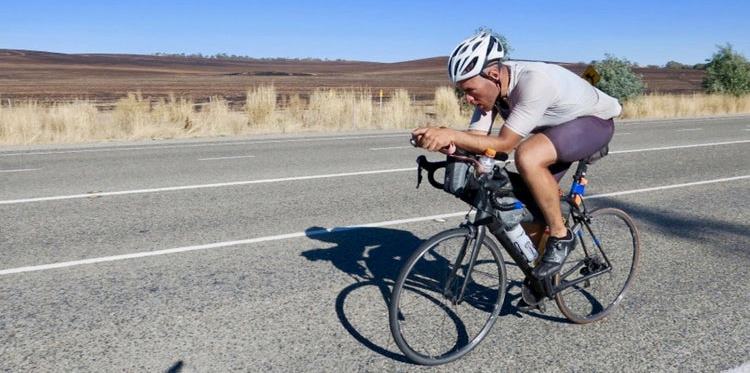
The Trans Am Bike Race is an unsupported cycle race from one side of the United States to the other. The 2019 edition of the event was won by Abdullah Zeinab from Australia; he reached the finish line in record time. This is his story.

Melbourne is where Abdullah Zeinab’s story in cycling begins.

He grew up in Adelaide with his mother and grandmother but moved to Melbourne after finishing school, to attend university. In Melbourne, he started cycling to work; he rode a single speed and his commute was around five to six kilometers. “ I really began to enjoy it and started riding the bike on the weekends,’’ Abdullah said. Before this phase of cycling he had tried out several different sports, growing up. He didn’t really pursue any of them longer than a few months. One choice however, was to leave a lasting impact. When he was sixteen he started going to the gym with his friends. That was the first thing he became consistent with. Strength training provided him a foundation to attempt other pursuits from.

“ Eventually I bought a road bike and the same weekend I decided to ride to Adelaide where my mother lived. It was about 1000 kilometers away. I didn’t know what I was in for and the reality of the situation was a big shock. I had no long distance gear, no lights and nothing to charge my electronics, with. The ride really broke me and I remember crying every day for no particular reason. After six days I made it to Adelaide and strangely as I pulled into my house I thought to myself: I want to try it again and see if I can do it better. This was probably in the middle of 2015. Since than I have followed a pattern of cycling consistently for a few months, then taking a few months off; continuing like that,’’ Abdullah said. Back in those early stages of his interest in cycling, he figured things out on his own. He has never been part of a cycling club or group. He wasn’t into brevets. “ I just started riding by myself and slowly began to meet other cyclists,’’ he said.

Roughly three years before Abdullah got into cycling regularly, in February 2012, a race to circumnavigate the globe on bicycle, was kicked off from near the Greenwich royal observatory in south east London. There were nine participants. The event was called Quick Energy World Cycle Racing Grand Tour. The riders were free to choose their own route. But according to media reports, they had to satisfy one condition – they had to cover a minimum of 18,000 miles in the same direction with GPS tracking throughout. Ninety two days after they set out, the race produced a winner – Mike Hall, an engineer from Harrogate, North Yorkshire. It was a new world record. Reporting the win, The Guardian wrote: a cyclist has triple cause for celebration after he won a round-the-world race on his birthday and broke the world record in the process. Hall would go on to become an iconic figure in unsupported (or self-supported) ultra-cycling. In 2013, the year after that round-the-world race, he won Tour Divide, a 2745 mile (4418 kilometers) annual race traversing the length of the Rocky Mountains from Canada to the Mexico border. That year on, he was principal organizer of the Transcontinental Race, an ultra-cycling event in Europe. In 2014, he won the inaugural Trans Am Bike Race, a 4200 mile (6800 kilometers) race spanning the breadth of the United States.

Abdullah Zeinab (Photo: courtesy Abdullah / this photo was sourced from the website of Trans Am Bike Race)

As you look at the world map, some countries give you a distinct sense of space as matrix of land area and population (overall numbers and dispersion). Australia with its great outback is one of them. The above said matrix, is often sought by adventurers and endurance athletes; it is aesthetic they dig. Fremantle is a port city at the mouth of the Swan River in south west Australia. It is a place familiar to those into sailing or tracking the sport. It is a halt on the world’s regular circumnavigation route. The closest major city is Perth. The annual Indian Pacific Wheel Race (IndiPac) starts from Fremantle. Its course extends 5500 kilometers – a line across the belly of the continent – to finish at the famous Sydney Opera House on Australia’s south east. Among participants in the 2017 inaugural edition of IndiPac, was Mike Hall. Unfortunately, it was his last bike race. Hall was in the final phase of the race and placed second overall, when he was hit by a car on the Monaro Highway, south of Canberra in the early hours of March 31. He died at the scene. It was a big blow for the race and for the world of ultra-cycling. Following the accident, all racers were pulled off the course. Its impact was felt the next year for although riders registered to participate, the race couldn’t be officially held due to concerns ranging from ongoing inquiry into the accident to road safety. However participants decided to cycle all the same. The 2018 edition of IndiPac was therefore unofficial and it produced an unexpected winner (in this case, given unofficial race; person finishing first).

A year earlier, in 2017, Abdullah had been among those involved with filming IndiPac. It gave him a ringside view of elite ultra-cyclists. The experience was a game changer. “ Filming 2017 IndiPac and being able to witness the extraordinary capabilities of the riders doing the event from such close quarters – that really captivated me. I was following Mike Hall and Kristof Allegaert very closely during that race. Just the way both those guys carried themselves under extreme fatigue was fascinating. It looked like they were on a casual Sunday ride. I told my girlfriend halfway through that I had to try this race one day. After that I couldn’t back out on my word,’’ Abdullah said. He got back from a holiday at the end of November and began training for the event’s 2018 edition. “ I gave myself approximately 12 weeks to really train for it,’’ he said. As mentioned, IndiPac 2018 – happening as it did in the shadow of Mike Hall’s demise the previous year – was unofficial. It was a case of cyclists registered to participate, deciding to proceed despite event being cancelled. Several days and 5500 kilometers later, the first finisher of that year’s unofficial IndiPac reached Sydney’s Opera House. It was Abdullah on his Trek Emonda.

Abdullah Zeinab (Photo: courtesy Abdullah)

“ IndiPac 2018 went really well for me. I ended up reaching the finish first out of all the riders who started. Filming and driving the whole route the year before gave me a massive advantage. Also being able to witness two of the best unsupported ultra-endurance cyclists in the world in 2017 was the ultimate classroom. I guess what worked well for me was creating an ambitious plan. I didn’t really know what my potential was and I didn’t really want to limit it by creating a safe schedule to follow. Instead I just roughly set out to do what the leaders from the year before did and stuck to that. To my surprise I was able to stick to it. That race really showed me just a small taste of what the human body is capable of. I was under-trained and didn’t have the conditioning on paper to back it up day in, day out. But I just rode every kilometer as if it was my first and last,’’ he said. Winning the unofficial IndiPac of 2018 called for an altered approach to what he was doing. “ Given the race ended up well for me, I thought I should try and pursue this type of riding a bit further by being more consistent with training and set a target for a new race,’’ he said.

According to Abdullah, at the finish of IndiPac, somebody came up to him and asked if he could imagine a race with double the elevation and another 1300 kilometers thrown in. “ He said that’s what Trans Am is. I guess at that moment the seed was planted in my head,’’ Abdullah said. He went home and rested well for about three months. Then he commenced training with some structure. Although the distance of Trans Am was intimidating, especially once he began to reflect on how hard some moments were during IndiPac, he decided to give it a go.“ So basically, three months after I finished IndiPac, I decided that I would do Trans Am,’’ Abdullah said.

Over the next eleven months, he did triple the training he had done for IndiPac. “ I had never really been consistent with training before. I wanted to give myself the opportunity to see what would happen if I was consistent. I focused on getting out at least five times per week on the bike which was a lot different to my IndiPac preparation wherein at times, I rode only thrice a week. I knew I could ride long hours so I focused on quality rather than quantity and gave myself more time to rest throughout the training. This was possible because I gave myself more time to prepare. All in all it was approximately 750 hours on the bike from start to finish,’’ Abdullah said.  As with IndiPac, he researched Trans Am, essentially figuring out how much he wished to travel per day and checking what services were available along the way – till he was comfortable enough to ride it. “ In terms of details of the research, it’s just knowing the opening hours of gas stations, supermarkets and if there is a hotel nearby,’’ Abdullah said.

Unsupported racing (or self-supported as some call it) requires cyclist to carry all that he / she may need. There is no support crew trailing cyclist in a car. You can eat and avail shelter and repair from outside sources but on courses like the long ones ultra-cycling courts, there are intervening spaces with no human habitation and those with facilities too frugal for the sort of support you seek. An element of self-reliance is therefore important. At the same time, if all that you elect to carry becomes too much, then the weight is bound to slow down progress. What to take becomes a product of research, self-awareness, experience and appetite for the unknown. Given he had done IndiPac, Abdullah had a gear list for such racing. What he needed to do was – research and work out how far he could carry the same stuff for Trans Am too. “ The only difference was I took a few extra pieces of clothing to keep me warm; like an extra set of gloves. Everything I had was distributed between the frame bag and the top tube bag with some spare tubes in a small saddle bag on the seat post. I had spoken with a few friends online who had done the race previously and they helped me understand the type of conditions we would be going through and the necessary clothing required,’’ Abdullah said. Here’s what he finally carried: rain jacket, wind jacket, base layer, gloves (two pairs), beanie and glasses; multi tool, tubes (five), patch kit, spare tyre, zip ties, electrical tape, 10,000 Ma battery pack, wall charger to plug USB ports into, charging cables, Etrex 30x and Wahoo Bolt for navigation. As for bicycle, he used a 2019 Specialized S Works Tarmac.

Abdullah Zeinab (Photo: courtesy Abdullah / this photo was sourced from the website of Trans Am Bike Race)

What did he have on his mind, going into Trans Am 2019?

“ First and foremost I wanted to improve on my previous performance at IndiPac. The Trans Am course has a lot more elevation gain. So I thought that if I could get close to the same average distance per day, I would have improved. Goals before the race and during it are different. I wanted to set a new record at Trans Am and do it the fastest anyone had done before. But once I was a few days deep, I really just wanted to make sure I got to the end in one piece,’’ Abdullah said. According to him, the Trans Am experience was great. “ For crossing a whole country I would say it worked out very well. I had some bad patches of weather but it was mostly just rain and some severe head winds. I was fortunate because some of the racers behind me had to go through snow. There is really no other option than to keep going. I wish I had rain pants and some other things to keep me warm but in the moment the only way out is to continue. From what I experienced so far with this type of riding it rarely goes 100 percent as you expect but you become better at accepting the situation for how it is. The moment you don’t is the moment it becomes harder than it needs to be,’’ Abdullah said.

At both Trans Am and IndiPac, which preceded it, there were several moments when Abdullah was unsure if he would make it; mainly due to physical pain. “ Especially with Trans Am I had some moments of excruciating physical pain and I was unsure if I would make the next town without injury,’’ he said. In such circumstances and generally in ultra-long endurance races, how you think matters. What does Abdullah tell himself through such races?

“ For me, I got nothing to lose. Winning or losing the race isn’t going to define who I am. Cycling is something I do but it’s not who I am. Success for me is giving 100 percent effort. I have achieved enough of the goals I have set out to accomplish to realize that the moment you achieve them is never what you think it will be. It is really the process that is special. Being able to enjoy the process to the highest degree possible is something I continually strive for. In a race like this I tell myself all sorts of things. It depends on the situation and what I am dealing with. To me there is no suffering in a race. It’s not a word I say to myself. If am finding it overwhelmingly difficult and I am struggling to deal with it; well cool… that’s just how it is. Specifically for races like Trans Am or IndiPac, the moment I identify with suffering or something being extremely difficult as a bad or good thing it becomes my slow downfall. You submit yourself emotionally to the ups and downs of good and bad, hard and easy or sad and happy. In my mind moments are just moments. Weather they are good or bad is dependent on your perception of them. I just say to myself it’s okay. You’re okay. Such a simple statement; but it offers me a path that kind of transcends the ups and downs and offers a more stable experience, which allows me to enjoy the whole ride versus being a mess for 50 percent of it and being ‘happy’ for the other 50 percent,’’ Abdullah said.

Abdullah Zeinab in Yorktown, after completing Trans Am 2019 (Photo: Chip Coutts / this photo was downloaded from the Facebook page of Trans Am Bike Race public group)

At Trans Am 2019, the cyclist from Melbourne, Australia, completed the course in 16 days, nine hours, 56 minutes. He not only won the race; he set a new course record. For Abdullah, who has so far banked on his resources and support from his family, to fund his participation at major races this was the second big win of his fledgling career in cycling. “ I hope now that I may be able to get help from sponsors. We will see,’’ he said. In photos and videos showing his finish at IndiPac 2018 and Trans Am 2019 – they are available on the Internet – one person you notice is his mother. She is there at the finish line. “ My mother has always supported me in anything I do, whether it be playing table tennis or riding a bike. She really is my biggest supporter and I wouldn’t be the person I am without her,’’ Abdullah said.

After Trans Am 2019, what’s next for Abdullah Zeinab? “ Honestly right now I am just enjoying the time off and relaxing as much as possible. I am trying not to think about what’s next too much because I know it will ruin my relaxation and reflection time. In a month or so I will begin to see what excites me,’’ he said.

(The authors, Latha Venkatraman and Shyam G Menon, are independent journalists based in Mumbai. The interview with Abdullah Zeinab was done via email. Trans Am Bike Race website: https://transambikerace.com/)

AT A GLANCE / JULY 2019

Dutee Chand (This photo was downloaded from the athlete’s Facebook page. No copyright infringement intended.)

Gold for Dutee Chand at World Universiade

Sprinter Dutee Chand struck gold at the World University Games (World Universiade) at Naples in Italy.

According to media reports today (July 10, 2019), the national record holder became the first Indian woman track and field athlete to secure gold at the event when she won the 100m dash in 11.32 seconds. Del Ponte of Switzerland placed second with a time of 11.33 second while Germany’s Lisa Kwa Yie finished third in 11.39 seconds.

Dutee’s national record in 100m stands at 11.24 seconds.  At the 2018 Asian Games in Jakarta, she had won silver in both 100m and 200m. Dutee’s gold at Naples is the second such instance for India after Hima Das won gold in 400m at the World Junior Athletics Championships last year.

New court ruling means Caster Semenya cannot defend her 800m title at Doha World Championships

In the ongoing Caster Semenya vs IAAF story, the South African athlete will now not be able to defend her 800m title at the upcoming IAAF World Championships in Doha, as on July 30, a tribunal at the Swiss Supreme overturned an earlier order of the same court granting her temporary exemption from rules set by the International Association of Athletics Federations (IAAF) regarding athletes having differences in sexual development (DSD).

According to media reports, Semenya, responding through her PR agency, has said that notwithstanding the latest court ruling, she would continue fighting for her human rights and that of other similar athletes. Semenya’s lawyers have said that their appeal process will continue. The South African athlete has declined to take the hormone medication required to lower her testosterone levels to admissible limits.

In a statement posted on its website on July 31, IAAF said, “ the IAAF welcomes the Swiss Federal Tribunal’s decision today to revoke its Super-Provisional Order of 31 May 2019 after hearing the IAAF’s arguments. This decision creates much needed parity and clarity for all athletes as they prepare for the World Championships in Doha this September. In the remainder of the proceedings before the SFT, the IAAF will maintain its position that there are some contexts, sport being one of them, where biology has to trump gender identity, which is why the IAAF believes (and the CAS agreed) that the DSD Regulations are a necessary, reasonable and proportionate means of protecting fair and meaningful competition in elite female athletics.’’

Illustration: Shyam G Menon

2020 Tokyo Olympics: engaging route for marathon on the cards

The 2020 Tokyo Olympics is now less than a year away.

The Games span July 24-August 9, 2020.

According to a report on the website of International Association of Athletics Federations (IAAF), the event will break from tradition by having the Olympic cauldron not in the main stadium “ but on the waterfront at the Yume-no-Ohashi Bridge, near the urban sports cluster.’’ There will be a temporary cauldron in the stadium for the opening and closing ceremonies.

The Olympic stadium will be formally opened in December 2019. It has cooling systems given the Games will be held amid weather conditions expected to be warm.

Of particular interest to those tracking endurance sports, should be the description of the Olympic marathon route available in the report.

“ The marathon route starts and finishes at the stadium, passing the landmarks of Kaminarimon (the Thunder Gate, which is guarded by the deities of wind and thunder), the Imperial Palace, home of Japan’s new emperor Naruhito, Tokyo Station, the Zojoji temple, Tokyo Tower and the Nihombashi bridge.

“ But none of these milestones is expected to be as decisive as the hill that rises steadily from 37km to 41km on the course. It is not steep but it is relentless, rising 30m in elevation, from five meters to 35 meters on an otherwise almost flat course.

“ At that stage of the race, given the expected hot conditions, even a mole hill is likely to feel like a mountain to whoever is left in contention,’’ the report said.

Women athletes will hit the course on August 2, 2020; men on August 9.

“ The race walks will be held on the part of the marathon course that crosses the outer gardens of the Imperial Palace, using a one-kilometer loop for the 20km events and a two-kilometer loop for the 50km events,’’ the report said. The men’s 50km walk will have the earliest start among disciplines at the Games to escape the worst of the heat and the humidity.

According to the report, heat acclimatization strategy will be important for all endurance athletes.

So far, more than 3.22 million tickets for the event have been sold in Japan, the report dated July 24, 2019 said.

Mumbai trio complete English Channel swim

The quartet comprising Sudarshan Chari, Zarir Baliwala, Moiz Rajkotwala and Catherine Stefanuti, a South African swimmer based in UK, completed their planned relay swim across the English Channel on July 12, 2019 in 14 hours and 59 minutes. In a message after completing the swim, Zarir informed that since 1875, an estimated 817 teams have successfully done this swim ratified by CSA (Channel Swimming Association). For more on this story, please click on this link:  https://shyamgopan.com/2019/06/29/a-relay-swim-across-the-english-channel/
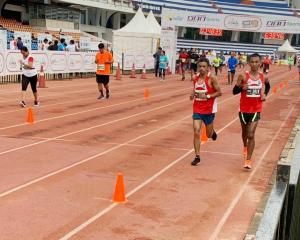
Tlanding Wahlang (second from right) during the 100k stadium run in Bengaluru (Photo: courtesy Run Meghalaya)

Meghalaya runners claim 100k titles at Bengaluru stadium run

Tlanding Wahlang of Meghalaya won the men’s 100 kilometer-category, part of stadium runs held over July 20-21, 2019 at Bengaluru.

He covered the distance in eight hours, 21 minutes and 38 seconds. He was followed by Suraj Chadha who finished in 8:47:28 hours. In third position was Hemant Beniwal, who completed in 8:54:44.

In the women’s 100k run, Darishisha Langjuh of Meghalaya was the sole participant. She completed in 10:19:28 hours.

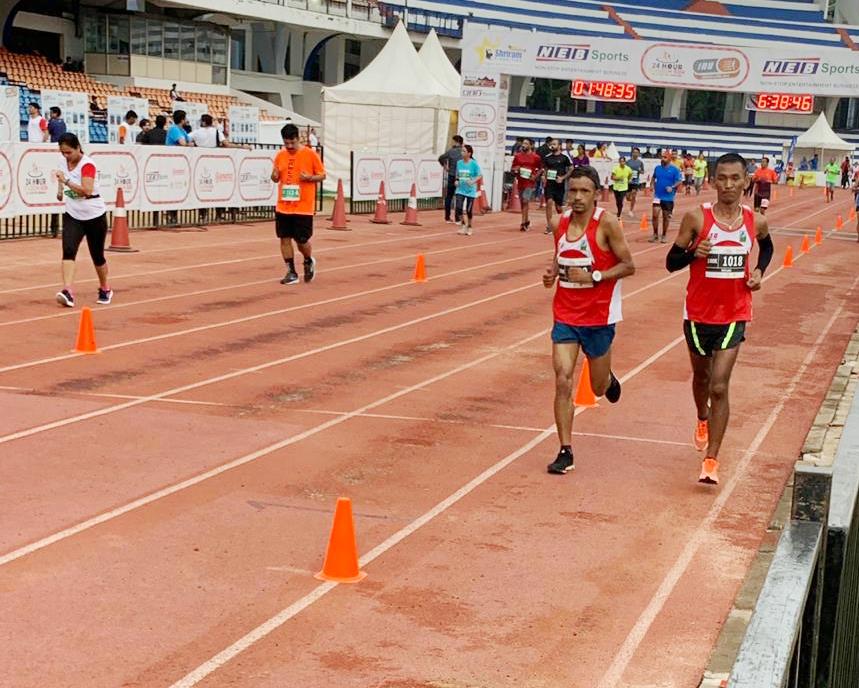
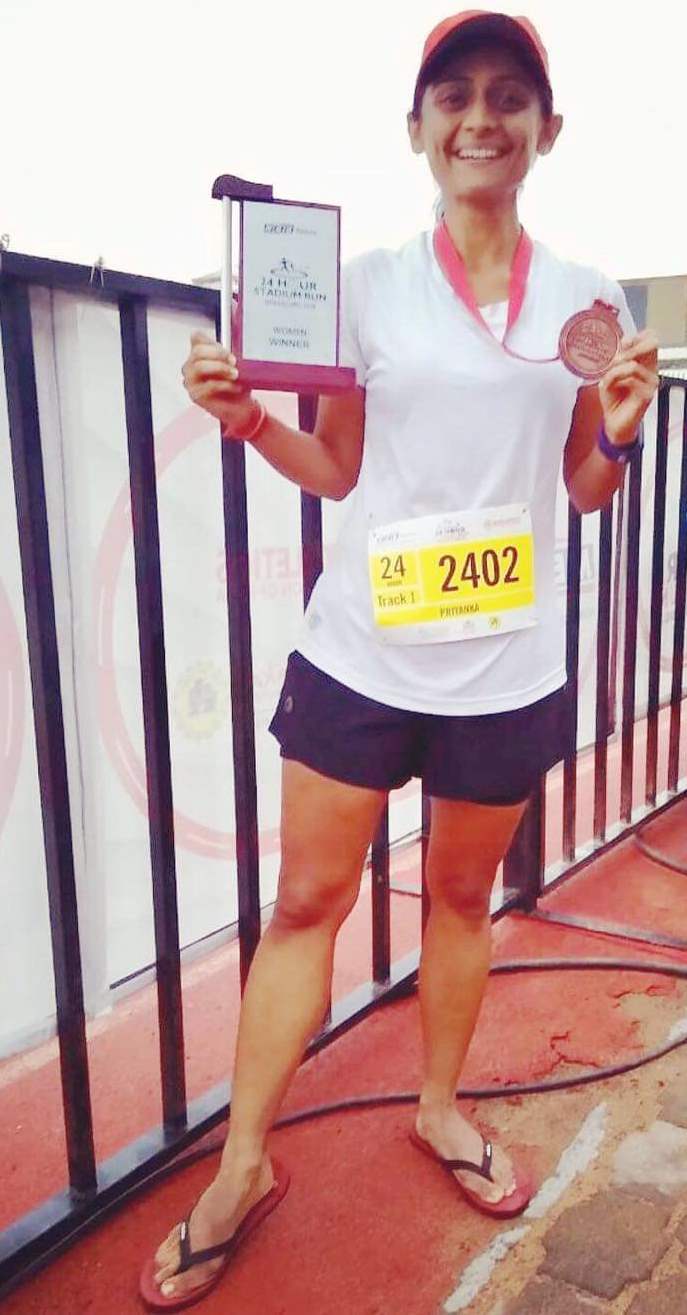
In the 24-hour run, Priyanka Bhatt and Sunil Sharma took top honors in the women’s and men’s sections respectively.

Priyanka covered a distance of 170 km in the allotted time. In second position was Shyamala S, who covered a distance of 167.6 k. Bindu Juneja finished third with 163 km covered.
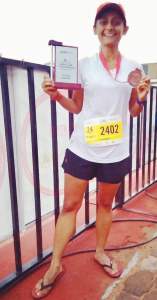
Priyanka Bhatt (Photo: courtesy Priyanka)
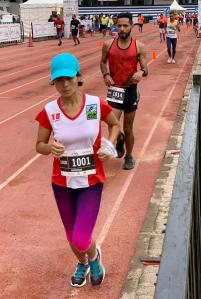
Darishisha Langjuh (Photo: courtesy Run Meghalaya)

“ I had trained my mind and my body. Ultra-running is a mind game. Your body follows your mind. I kept telling myself that I have prepared well for this race and can do it,’’ Priyanka told this blog.

In the men’s 24-hour event, Sunil Sharma covered a distance of 215.6 km to place first. In second position was Ullas Narayana, who covered a distance of 212.8 km. Pranaya placed third 211.6 km covered.

In the 12-hour event, Aakriti Sanjeev Verma and Geeno Anthony were the winners in the women’s and men’s categories respectively.

Aakriti covered a distance of 98.4 km. In second position was Juby George, who logged 96.5 km and in third position was Deepti Chaudhary with 95.2 km to her credit.

Geeno Anthony covered a distance of 126.8 km. Velu P was second with 118.4 km and Binay Kumar Sah third with 115.6 km.

Japan sweeps podium positions in half marathon at World University Games

Japan won a third of the gold medals on offer on the final day of athletics action at the World University Games in Naples on Saturday (13), an official statement available on the website of the International Association of Athletics Federations (IAAF) said.

The morning’s half marathon events – where Japan filled the top three spots in both the men’s and women’s races – set the tone for the rest of the day.

Akira Aizawa finished 12 seconds ahead of compatriot Taisei Nakamura to win the men’s title in 1:05:15 with Tatsuhiko Ito finishing third in 1:05:48. The women’s race was similarly close as 19-year-old Yuka Suzuki took first place in 1:14:10. Rika Kaseda and Yuki Tagawa were separated by just four seconds, clocking 1:14:32 and 1:14:36 respectively to finish second and third, the statement said.

Union Budget 2019: National Sports Education Board to be set up

In her budget speech in parliament today (July 5, 2019), India’s Finance Minister Nirmala Sitharaman has said that a National Sports Education Board for Development of Sportspersons will be set up.

“ Khelo India Scheme, launched in October, 2017, has created awareness of sports as an integral part of wellness throughout the country. The Government is committed to expand Khelo India Scheme and to provide all necessary financial support. To popularize sports at all levels, a National Sports Education Board for Development of Sportspersons would be set up under Khelo India Scheme,’’ the text of the minister’s speech (part A, point 65) available on the finance ministry’s website said.

Earlier in the 2019 interim budget presented in February, the government had raised the sports budget for 2019-2020 by Rs 214.20 crore to Rs 2216.92 crore. According to published news reports, this included a Rs 55 crore-hike in funding for the Sports Authority of India (SAI) to Rs 450 crore, an increase in allocation for the National Sports Development Fund (NSDF) from Rs 2 crore to Rs 70 crore and a hike in the incentive fund for sportspersons from Rs 63 crore to Rs 89 crore. The support for Khelo India was also increased by Rs 50.31 crore to Rs 601 crore in the interim budget of February.

(1 crore=10 million)
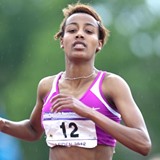
Sifan Hassan (This photo was downloaded from the athlete’s Facebook page)

Sifan Hassan sets new world record

Ethiopian-Dutch middle and long distance runner, Sifan Hassan, has become the fastest miler among women to date.

At the Herculis EBS Diamond League athletics meet in Monaco, she covered the distance in 4:12:33 breaking the earlier mark of 4:12:56 set by Svetlana Masterkova of Russia, which had survived for 23 years, a statement available on the website of International Association of Athletics Federations (IAAF), said.

Britain’s Laura Weightman (4:17.60) finished second while Gabriela Debues-Stafford of Canada (4:17.87) placed third.

Hassan came into the event as the third fastest miler.

Born in Adama in Ethiopia, Hassan left the country as a refugee and reached the Netherlands in 2008, aged 15. She began running while studying to be a nurse, Wikipedia’s page about her, said.
This photo was downloaded from the event’s Facebook page.

Goa Trail Run to be held on August 18

The second edition of Goa Trail Run is scheduled to be held on August 18, 2019.

Organized by the Goa-based Adventure Breaks, the HDFC Bank Goa Trail Run’s route is on the Socorro plateau in Porvorim.

The event offers two races – 10 kilometers, a half marathon and a fun run of 7.5 kilometers. There are two age categories – open and veteran (above 45 years of age).

The organizer Adventure Breaks started out in 2014 with a Tower Run (a stair climbing race inside buildings) in Goa. “ We have conducted six tower runs in Goa -one every year – since, and two in Mumbai that were sponsored by the Tata Group at the World Trade Centre, Cuffe Parade, ‘’ Ashwin Tombat, Director, Adventure Breaks, told this blog recently.

In 2016, Adventure Breaks got into other non-motorized adventure sports (kayaking, sailing, ocean treks, rock climbing, cycling and sea swimming).  “ We got the idea for a trail run when we found this incredible plateau that is wilderness right in the middle of Porvorim, a suburb of Panaji, Goa’s capital city. It took us a few months to recce a route and, last year, we did a 7.5km trail run. About 100 people participated; nearly half of them were women, Ashwin said.

IAAF takes note of slide in global sports participation

Jon Ridgeon, CEO, International Association of Athletics Federations (IAAF) has committed the organization to doing its part to address a slide in global sports participation which is endangering the health of future generations and of organized sport, a statement on the IAAF website said.

In a keynote address at the Sports Decision Makers Summit in London on July 10, Ridgeon said he was shocked by some of the recent research on general sports participation among children and young people. He said the latest evidence, which showed that 81 percent of adolescents aged between the ages of 11 and 17 fell below the World Health Organization’s recommended minimum of physical activity to maintain good health, was a call to arms for all sports federations.

The WHO recommends that each person should do at least two and half hours of moderate activity a week (20 minutes a day), or 75 minutes of vigorous activity per week (ten minutes a day).

Ridgeon urged other sports organizations to join the IAAF in fighting for the future health of the global population. “ We need to come together, not compete against each other, to collectively campaign for sport,’’ he said.

“ For our part we at the IAAF are committed to campaigning to governments, cities and local authorities to get them to understand the problem we are facing, and to help to change the current decline in community health.

“ I believe athletics is uniquely placed to make a difference. More people run than do any other sport on the plant. An estimated half a billion people around the world run regularly. Running, and walking, is accessible to almost anyone,’’ the statement quoted him as saying.

According to him, the IAAF has begun to address this issue with the inclusion of mass participation opportunities in its World Athletics Series events and the creation of its global Run 24:1 campaign, which encourages people all over the world to run a mile on the same day to promote the joy of running. “ We also want to create a real legacy in the cities around the world that host our World Athletics Series events,’’ he said.
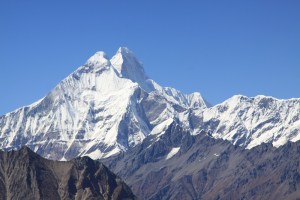
Nanda Devi (Photo: Punit Mehta)

Nanda Devi East / bodies moved to Munsyari

All seven bodies found at the accident spot near Peak 6477 in the Nanda Devi region, have been brought to Munsyari by Indian Air Force (IAF) Cheetah helicopters.

They will be moved to Pithoragarh and Haldwani in bigger choppers, an official familiar with the ongoing operations said today; July 3, 2019. The bodies have not been formally identified yet. The accident occurred in the closing days of May.

Late evening June 23, the media had reported that a team of the Indo Tibetan Border Police (ITBP), dispatched to recover the bodies of climbers believed to have met with an avalanche on Peak 6477 near Nanda Devi East, had collected seven bodies from the snow. According to a senior ITBP official quoted in the report, the bodies were found “ on the western ridge of the peak towards the Pindari Glacier.”  Peak 6477 is on the ridge continuing from Nanda Khat towards Nanda Devi East. It is on the outer wall of the Nanda Devi sanctuary; Nanda Khat is close to the Pindari Glacier.

On June 30, this blog was told that the IAF having identified a spot at 15,500 feet in the Lavan Valley, where a helicopter can land, had carried out a trial landing. ITBP and disaster management personnel were estimated to take 2-3 days to carry the bodies to this location on foot. From there, the bodies were to be airlifted to Pithoragarh. In a separate development, two media reports, one quoting the district magistrate of Pithoragarh and the other quoting a senior ITBP official, also said that the search for the eighth climber had been “ abandoned.”

It was in end-May that news broke of eight climbers (seven from overseas plus the team’s liaison officer from India), part of an expedition that had set out to attempt Nanda Devi East, reported missing following avalanche on Peak 6477. The expedition was led by well-known British mountaineer and mountain guide, Martin Moran.

In subsequent search operations, helicopter sorties by the Indian Air Force (with some of the surviving members of the expedition aboard to refine area of search) had sighted five bodies in the snow and ample evidence of avalanche.

Besides a large team composed of personnel from ITBP, State Disaster Response Force (SDRF) and National Disaster Response Force (NDRF) dispatched from the Munsyari side, the Indian Mountaineering Foundation (IMF) had also sent a team for recovery operations. The latter headed up from the Pindari Glacier side.

For more reports providing background, please refer the list of articles on this blog dating from end-May onward.

Update / July 6: The eighth climber, whose body wasn’t found, is expedition leader, Martin Moran, a news report from Nainital said. The remaining seven bodies have been identified. The report quoted the District Magistrate of Nainital, Savin Bansal. The bodies were identified after their photographs were dispatched to the respective embassies in Delhi. The body of the team’s liaison officer who hailed from Almora in Kumaon, was identified earlier in the week. Eight climbers had been reported missing late May following an avalanche near Peak 6477 in the neighborhood of Nanda Devi East.
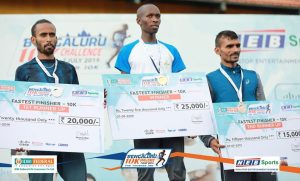
This photo was downloaded from the event’s Facebook page.

Kenya’s Henry Togom, India’s Priti Lamba win Bengaluru 10k Challenge

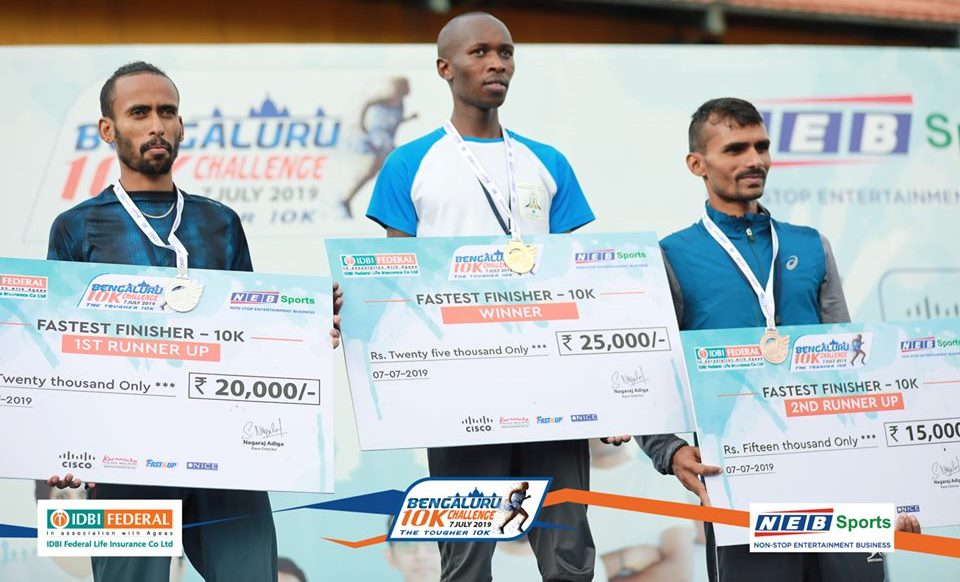
Henry Kiprono Togom of Kenya took top honours at the IDBI Federal Life Insurance Bengaluru 10k Challenge held on July 7, 2019.

He finished the 10 kilometer-distance in 31:44 minutes.

He was followed closely behind by Mikiyas Yemata Lemlemu of Ethiopia, who finished in 31:57 minutes. Pramod Kumar of India placed third with a timing of 32:19 minutes.
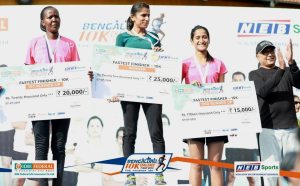
This photo was downloaded from the event’s Facebook page.

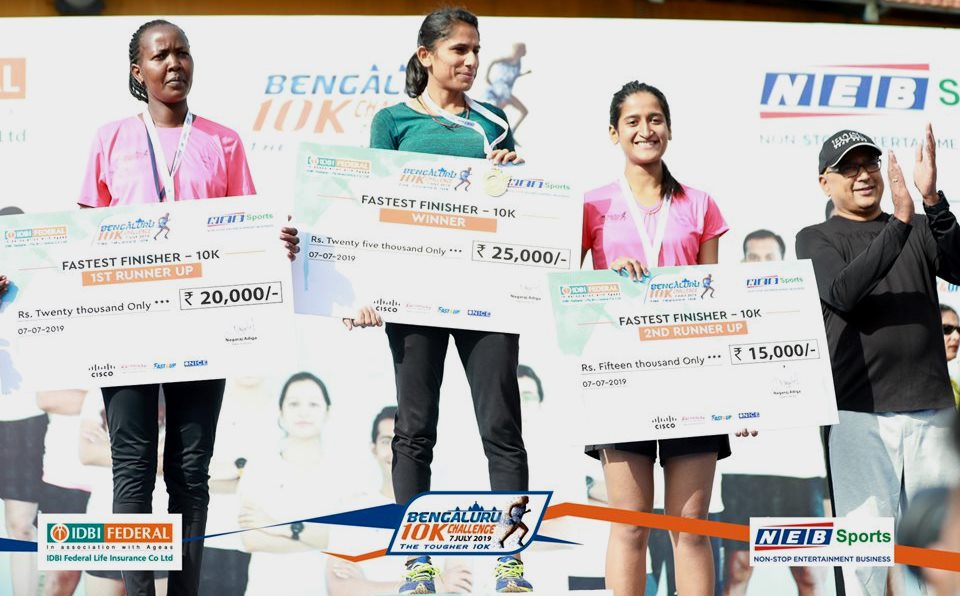
Among women, Priti Lamba of India crossed the finish line in 37 minutes to secure the first position in the 10k race. Stellah Cherotich of Kenya came in second with a timing of 42.56 minutes followed by Farheen Firdose who had similar time but was microseconds behind the Kenyan.

In the five kilometer-race, Kunal Sangalge was the winner with a timing of 21:16 minutes followed by Srikant Nayak in 21:42 minutes. In third position was Adarsh S, who crossed the 5k finish line in 21:58 minutes.

Among women, Shloka Murthy came in first with a timing of 22:06 minutes. Kaveri Velankar finished second with a timing of 24:15 and Kasturi Velankar third with a timing of 27:25.
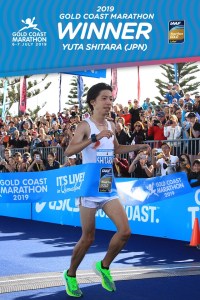
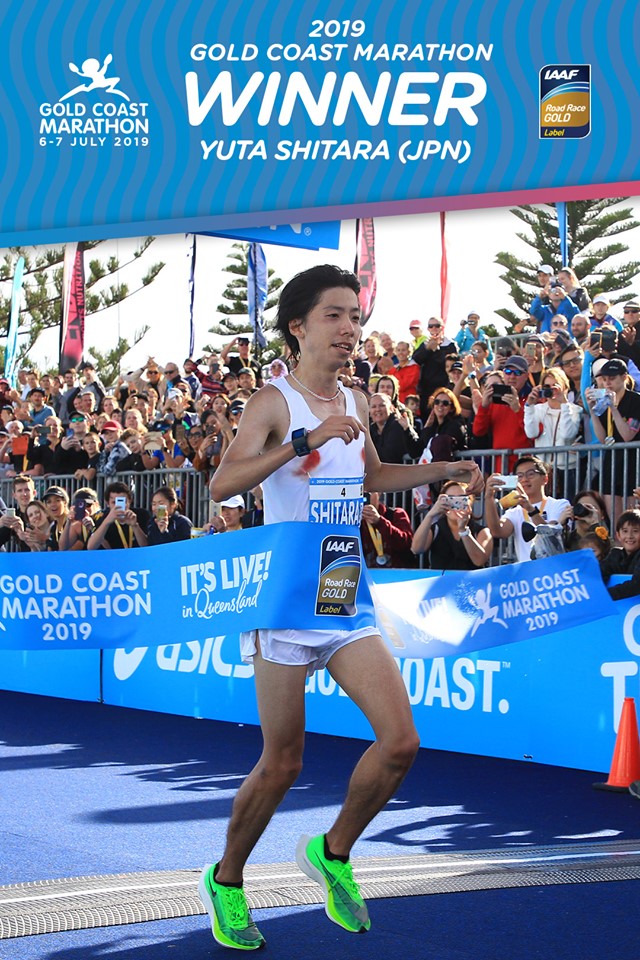
Yuta Shitara (This photo was downloaded from the Facebook page of Gold Coast Marathon)

Yuta Shitara of Japan sets course record at Gold Coast Marathon

Japanese runner Yuta Shitara set a course record at the Gold Coast Marathon held on July 7, 2019.

The Japanese runner crossed the finish line of the men’s race in two hours, seven minutes and 50 seconds, bettering the course timing of 2:08:42 set in 2015 by Kenyan runner Kenneth Mungara.

The Gold Coast Marathon, in Australia, is an IAAF Gold Label road race.

“ With Shitara’s 2:07:50, Kenya’s Barnabas Kitum’s 2:08:02 and New Zealand’s Zane Robertson’s 2:08:19, the 2019 Gold Coast race provided the three fastest times on Australian soil,’’ IAAF said in a report.

Weather conditions were tough with strong headwinds and heavy rain.

In the same race, five-time Olympian Bernard Lagat set an American masters record in a marathon with a timing of 2:12:10, ten seconds faster than Meb Keflezighi’s timing set at the 2016 Olympic Marathon Trials.

(The authors, Latha Venkatraman and Shyam G Menon, are independent journalists based in Mumbai.)

“ IT’S THE CAPTAIN AFTER ALL’’

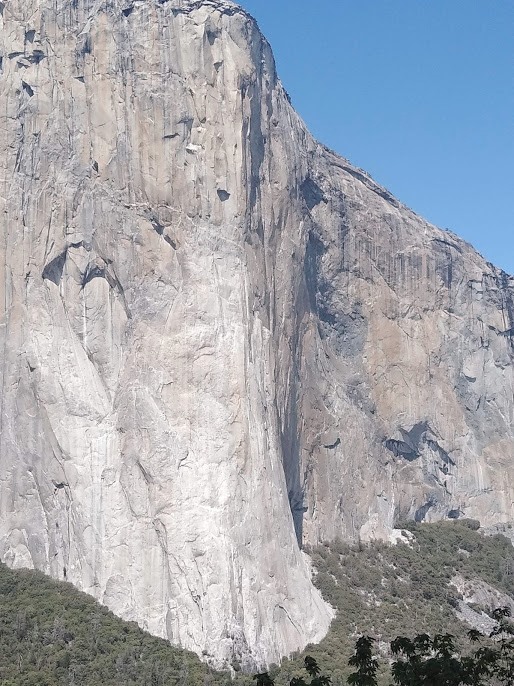
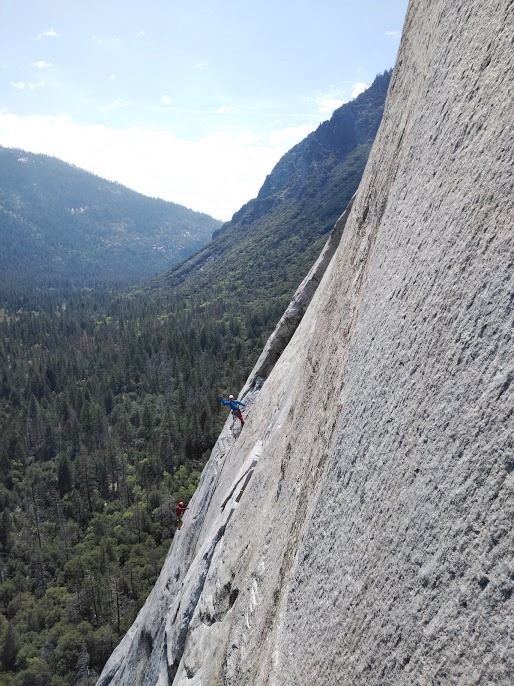
El Capitan, Yosemite Valley (Photo: courtesy Mohit Oberoi)

This is an article by invitation. Delhi based-climbers Mohit Oberoi and Kumar Gaurav were in California’s Yosemite Valley over April 24-May 19, 2019, to attempt The Nose route on El Capitan. In all, The Nose is 3000 feet (5.9 C1) and 32 pitches of climbing. Due to a combination of factors, after about 800 feet climbed, the Indian duo had to bail out. For Mohit, a pioneer in the field of rock climbing in India and now into his fifth decade of life on planet, El Capitan has been a longstanding dream. This is his account:   

“ So, how many more pitches to the Dolt Tower?’’

I posed the question to the figure laden with gear, extra rope and pack, coming down towards my right.

What started as a small dot had become a figure.

“ I think you have a few more to go,’’ came the reply, most words getting lost in the high wind.

My mind woke up to a shout from above: Taakkeeeee…..

I pulled in the rope hard and held on; Kumar on the sharp end.

Things were looking bleak.

The wind was blowing hard…the windbreaker fluttered hard. It felt like I was sitting on a motorcycle. It was 6.30 PM. It will be pitch dark in another 90 minutes. A 35 kilo-haul bag aka ` pig’ was hanging heavy on the rope. What the hell should we do?  The only way now seemed to be down. The wind had picked up, left us cold; climbing further appeared hard. We would need headlamps to climb in the dark. Not to mention, blood sugar was hitting super low levels. The valley floor was 800 feet below.

Okay Kumar let’s head down: I shout up to him. A reluctant Kumar started lowering himself down on the slope. The look said it all. But we have to `bail out’ in our best interest.

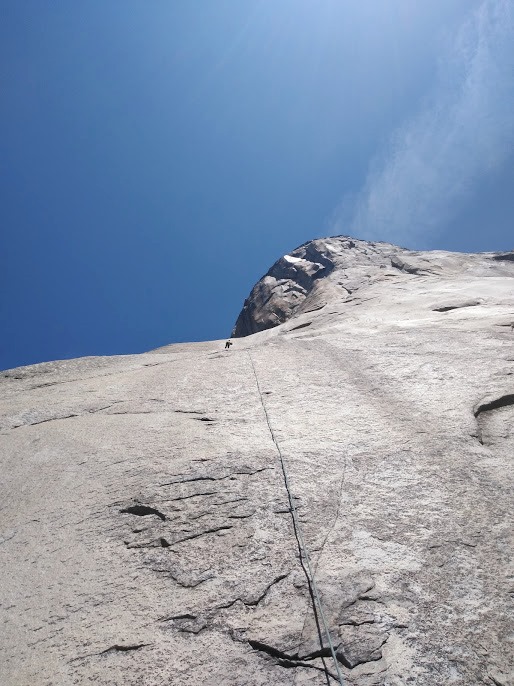
On El Capitan (Photo: courtesy Mohit Oberoi)

It had been a dream since teenage years. Persistent dreams become itches. The itch started 35 years ago with articles from Mountain magazine, UK showing stunning  photos of El Capitan (El Cap) and the Mecca of rock climbing – Yosemite valley. Names like Jim Bridwell, Randy Leavitt, John Bachar, Ron Kauk, Mark Hudon and Max Jones – they were my childhood super heroes possessing the power to ascend blank cliffs 3000 feet high. The seed was born and I knew which side to face for my Mecca. Much Time passed. Fiftieth birthdays are magical; the number can turn a few screws around for a lot of people. I was looking at a postcard from Kiran (nine years) and Sachin (six years) – they were the children of my friends, Luca and Priya. The postcard with a photo of El Cap sent from Yosemite a few years ago and stuck on the fridge was daily reminder that El Cap was waiting. I needed to make my pilgrimage before I died. A date was set and a partnership deal sealed with Kumar Gaurav.

“ Hey do you want to go America?’’

I am not sure what Kumar, a 24 year-old Delhi based-climber thought about the offer from the blue. A shrug of the shoulder and a smile said it all. Few weeks later, we were in the queue in front of the American Embassy for our visa interview. We are climbers and we want to climb in the Yosemite Valley – that was what we told the young visa officer, who thought this was certainly a very valid reason to go to USA. A 10 year multiple entry-visa approved, we walked out.

I had to lose the many rolls of fat accumulated around the waist. The training to climb again the last few decades was spent running, swimming, doing triathlons and hiking. There hadn’t been much climbing. It was going to take some effort getting back into shape for climbing. I would have to do regular laps on the climbing wall / running, to build general strength plus trips to the rocks. Amid this, one thing was clear – it had to be a month-long visit. We had to give proper time for this climb; taking four weeks off felt very intimidating, both from the perspective of work and family.

Delhi-Singapore-San Francisco flight followed by a pick-up from dear friend Ishu and we landed in `Camp 4’ in Yosemite Valley. The idea was to spend maximum time in the valley. We had no other agenda. I was very clear about the objective of this trip: spend time in the valley…climb; run, hike, bike, dream, drink beer all, of it in the valley only.

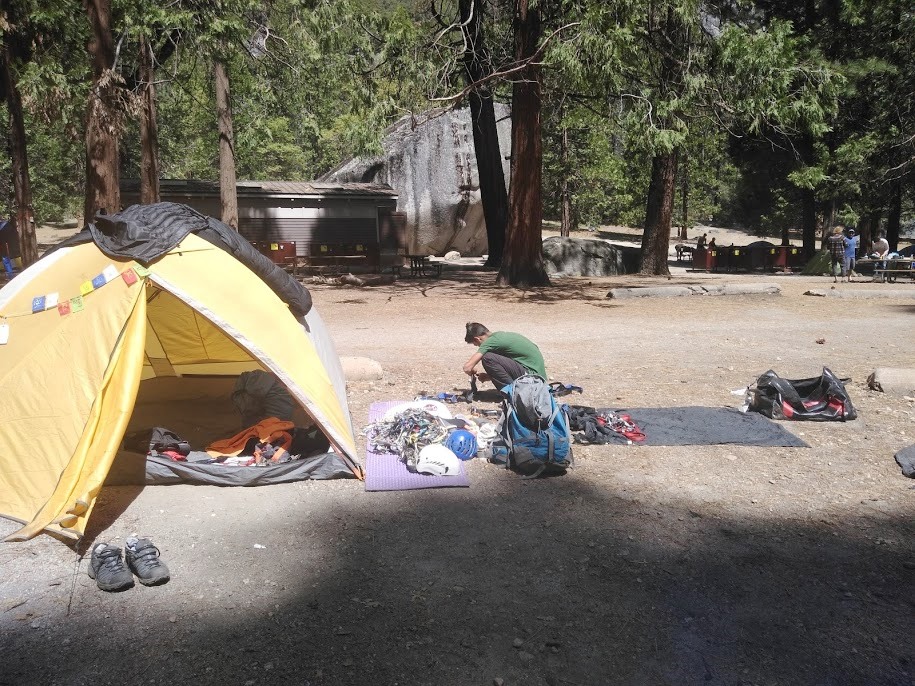
At the campsite in Yosemite (Photo: courtesy Mohit Oberoi)

The valley granite was very unique and for sure it was unforgiving. As mentioned in every guide book, article and blog, if you think you can come and crush at the same grades as your home crag you would be surprised, true to every word written. The first week was spent on climbing classics around Camp 4, reaching crags wherever we could on cycle; climbing routes ranging from single pitch to 5 pitches. I struggled on the 5.6-5.8s and Kumar on 5.9 /10 (he being a 5.14 sport climber I am sure this must have come as a surprise..!) Valley granite is mainly crack climbs of varying sizes, fingers to wide chimneys  – a lot of it is very slick due to ancient glacier polish or just because some routes were climbed so many times that they became really slick. Trusting the feet on such rock was a whole new dimension. I took a fall of 15 feet and realized that for this type of climbing we needed more time to get used to.

As with most climbers, we spent beautiful sunny days climbing the classics. The normal routine was to start at 9 AM and end at 7 PM every day. But The Nose route of El Cap, sometimes referred to as the “ greatest rock climb on Earth’’ was always at the back of our mind. We had to get on the Captain. If Yosemite Valley was the Mecca of rock climbing, then Camp 4 was the center of it all; it has been there as climbers’ campground since the 1950’s. Camp 4 has hosted the who’s who of the climbing world. At six dollars a night per person this was the cheapest place to be in the valley. However one could spend only 30 days in a year there and out of it only seven days could be had in the period from 1st May to 30th September, that being peak season. We got a permit for 14 days since we arrived on the 24th of April.

It was great to meet climbers from all over the world. A big Spanish team was in camp. We started to get information about The Nose route on El Cap from two young Americans, Kip and Joe who had bailed out from the “sickle ledge’’ just two days ago. They said they were too slow and carried too much weight, a phrase we heard a lot in the next couple of weeks. After a week of climbing, our thoughts moved to giving The Nose (it is 3000 feet high, 32 pitches) a go. Ideally everyone first climbs the first four pitches to Sickle Ledge, fixes a few ropes down to the ground for hauling the `pig’ up to the ledge and then carry on in a single push with an average time of three days to the top.

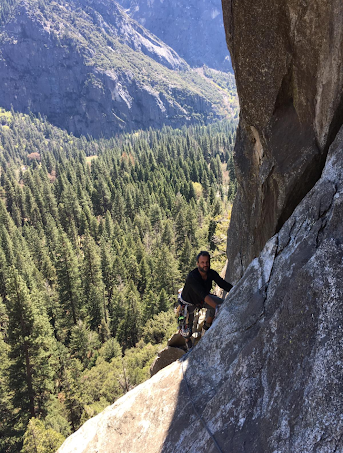
On El Capitan (Photo: courtesy Mohit Oberoi)

We followed the same strategy. We decided to climb the first four pitches to the Sickle and then fix three 60 meter-ropes down to the ground. The German duo, Peter and Mark, start before us. There were also other parties at various stages on the route. Kumar led the first pitch and I was surprised to find him struggling. They say that the climbing on the Nose can be unique, weird and hard to describe. One has to experience it to understand what it is like. The plan was to “ French free’’ – it means to climb whatever can be freed and otherwise pull on fixed gear or fix own gear and pull on it. The idea being to maintain a quick pace, get to the belay stance and fix the rope for the second to “ jug up’’ (jumar) the rope. The leader can then haul the bag up or in our case the bag was very heavy for a very light Kumar to haul alone; either we would haul it together or I would use my body weight to haul. Hauling involved fixing a system on the anchors with a pulley / grab device, through which the rope passed and then, hand over hand, the climbers pulled the bag. The traversing nature of the first four pitches needed short pendulums on fixed gear, tension traverses and very interesting climbing on pin scars. While Kumar led I carried the pack with the spare rope and a haul line trailing from the harness. It was a beautiful sunny day with great views across the valley.

The wind generally picks up around 11 AM. It can be very unnerving as the gusts can take you unawares. The rope starts to go all over the place. We reached Sickle Ledge to find that the Germans had fixed ropes to descend to the ground, haul their bag up and sleep the night on the ledge. Kumar and I planned to fix ropes and descend to the ground. We didn’t have a haul bag, we needed to acquire / buy one. Satisfied with the day’s target achieved, we headed back to Camp 4. Our bicycles were locked near the base of El Cap. While most drive up to near the base we didn’t have a car. So we biked everywhere.

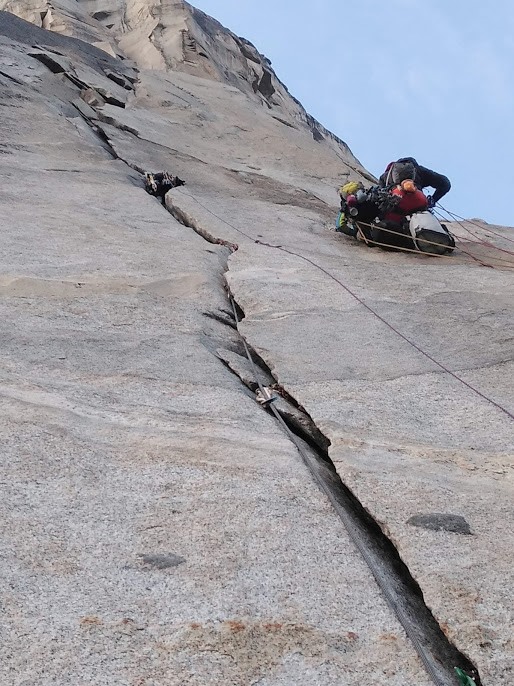
On El Capitan (Photo: courtesy Mohit Oberoi)

We bought the haul bag from the mountain shop in the valley. It looked huge. It will contain eventually 22 liters of water in duct taped bottles and jerry cans, food for four days, sleeping bags, mats, stove and cookware, poop bags (it is mandatory to collect poop in poop bags and then carry them out in a poop tube back to the camp); this was apart from the climbing gear and ropes which would be easily another 20 kilos. The `pig’ once packed, weighed around 35 kilos, the majority of the weight being water as there was no water on the wall.  We planned to jug our fixed ropes to the Sickle and also haul the bag to it and leave it there. All this movement was to get our systems in place. I hadn’t really jugged ropes before. A quick reference to a how-to guide got me going. It actually felt easy and fun after a while.

The exposure on the wall can be debilitating. The more we moved up and down, the more we got used to it. We met Alex and Nani the two strong, ever smiling Spaniards who had climbed the rest of the Nose except the first four pitches. They had jugged up someone else’s rope to the Sickle and done the rest of the climb. They were now down to climb the first four pitches; not the most conventional way to climb the route. Our haul bag was eventually anchored to the fixed bolts on Sickle Ledge. Three bolt anchors generally marked the end of every pitch on the Nose. It saved climbers the trouble of making anchors and rigging a complicated haul system.

It was now a rest day. Moving camp from Camp 4 as our 14 day-permit got over, we shifted to another place in the valley. Thanks to the generosity of a valley local, we managed to camp in his backyard for the rest of the trip. This was divine intervention saving us the hassle of getting a car and driving out of the park every day or getting an expensive campground which was no less than 100 dollars a night.

At 7 AM we pedaled fast to get to the base to start our climb. We were already late as organizing the gear and breakfast took more time than usual. We reached the base to where our ropes were hanging to find two Spanish teams ready to climb and haul on our ropes! We were disappointed to see this. We told them that we planned to climb our ropes and then drop one of the ropes to the ground (a normal practice; the rope stays at the base till the team comes back to retrieve it).  Seeing the disappointment on their faces, Kumar asked one of them to climb our ropes fast and fix theirs. As we got ready, they finally fixed their ropes and we ascended ours to Sickle Ledge. It was already 9 AM and we are at least two hours behind schedule (this delay proved to be very expensive). The pitch above Sickle looked very broken up and hard to haul. Kumar climbed the initial easy section and then a hard move round the corner took him to a fixed bolt station. Advice from a fast and experienced party which overtook us suggested that we push the haul bag off the side and haul from the start of the next pitch. That turned out to be good advice. The Nose was certainly a very complex route. The first four to five pitches were not straightforward and knowledge of what to do and where played a critical role in efficiency and speed. This is a major factor to make quick progress on the route.

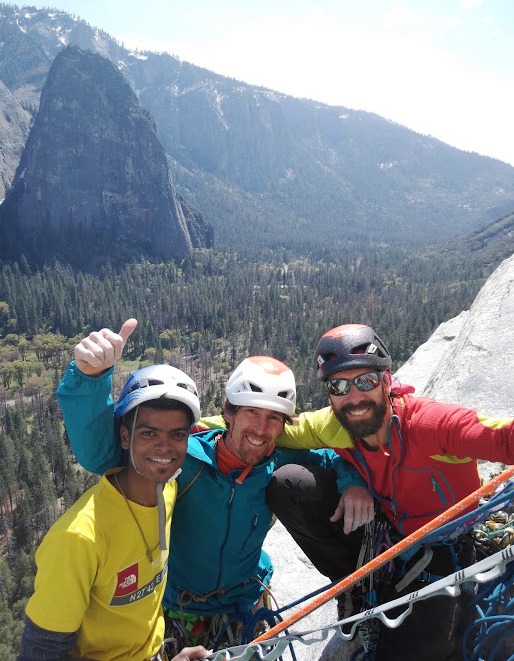
Kumar Gaurav (left) with two of the Spanish climbers – Alex and Nani – on Sickle Ledge (Photo: courtesy Mohit Oberoi)

A short pendulum and tension traverse took us to a three bolt-belay station. Now the exposure seemed significant. The initial forays on the rock had made us immune to the exposure at least up to this height. Kumar led a pitch and we had now got into the start of the “ stove legs’’ which is a significant land mark on the climb. The stove legs are hand / fist / off width size-cracks which go up four pitches to the ` Dolt Tower.’ Our aim was to get to Dolt Tower as, after Sickle Ledge, this was the only ledge we could sleep on. Since we did not have a portaledge (portable foldable ledge made of aluminum tubes and nylon fabric to sleep on, which can be set up almost anywhere as long as anchors are available), we had to try and hit the Dolt or we had to hang all night on the bolt anchors as last option.

The stove legs can slow down parties like us who don’t have very good crack climbing experience. The cracks were the same size all through and needed a lot of cams and wires of the same size. Thus double and triple of each size required to be carried or have to be “ back cleaned” by the leader. Even the 5.8 pitches seemed hard with the added weight of gear (5-7 kilos); two ropes (lead rope and haul line), wind gusting away, fatigue from hauling, slick rock and exposure. The 5.8 started feeling like 5.10/11. We met many climbers blasting away to Dolt Tower 10 pitches up, without any haul bags and then coming down the same day; a good way to get used to climbing on the route and get familiar with climbing / route complication.  NIAD (Nose in a Day) climbers find themselves climbing with first timers like us who take 3-5 days and then slowly work on the route to eventually do it in 24 hours. Or like Alex Honnold and Tommy Caldwell, climbing it in two hours (!!) which is crazy (!!!) and totally insane.

It was now 6.30 PM and Kumar was leading on pitch eight. We were still two pitches away from the Dolt. Maybe an early start and not losing time to the Spanish team (who climbed behind us and slept on Sickle Ledge) would have helped. It seemed best to bail out as most parties do at the stove legs; a series of 60 meter-rappel anchors straight down lead to the ground. We started to head down, first lowering the haul bag to the anchor and then I lowering off. This took a lot of time. Then I took the haul bag on my tie-in loop of the harness, crushing my hips. But then it was better than the haul bag being lowered off. Tempers ran high as the low sugar level and dehydration hit us. We had not eaten anything and had less than two liters of water between the two of us the whole day. In such conditions, it’s easy to make a mistake. We started descending on head lamp lights with no ledges and finding the bolt anchors on a blank granite wall at night. One error could be fatal. We managed three rappels and then one error – the 70 meter-rope got jammed in the anchor above us. We couldn’t retrieve it. We continued with one 60 meter-rope, unsure if the rappel anchors were also at 30 meter-intervals. A guessing game began and we started to head down on a single 60 meter-rope. Luckily or perhaps I must say, sensibly, the climbers had equipped this route also for a 60 meter-rope (for idiots like us who managed to snag our rope!). We reached the ground at 11.30 PM, safe at last.

Mohit Oberoi (Photo: courtesy Mohit)

We opened the haul bag. While Kumar gorged on bars and trail mix and basically anything he could lay his hands on, I pulled out the sleeping bags and put some food in the stomach after nearly 16 hours. Then we both lay down under the tree at the base for a good night’s sleep. We woke up next morning and couldn’t see the rope which had got stuck; it must have been 400 feet up. We have to see if someone coming down is able to retrieve it.

Back at Camp 4 we met Peter and Mark (the German team which was ahead of us by a few days). They had exhausted themselves and bailed just above Sickle Ledge. Mark said he got really exhausted and did not find himself comfortable, climbing on such ground. His words resounded in my years:  it’s the Captain after all; it doesn’t go down easily. He laughed. The bail out rate is 50 per cent on The Nose; 500-600 parties attempt it every year, out of which 50 per cent bail out.

I was happy that we had got on to The Nose / EL Cap. Maybe I was under-prepared, not skilled enough or fit. But I think it was important for me personally to attempt to climb, instead of dreaming of it, endlessly and forever.

A VERY BIG THANKS TO: Annie; the ‘ROCK’ in my life. Abhi and Ikki, guys we have to climb this together one day. Thanks to Kush / Ishu Khandelwal; brother in San Francisco, who hosted us, climbed with us and inspires me to push myself out of the comfort zone. Sanjay Suri (brother from another mother!!) man you make it look so easy; you drove in this huge SUV from San Francisco and just drove us out of the valley…a VERY BIG THANK YOU. Curtis thanks for seeing us in Camp 4 and the hot shower and BBQ after two weeks was very welcome. Alisha, thanks for the logistics. Singapore Airlines was the way to go. Alex Cox dude thanks for hosting us and I hope you are using those bikes.

(The author, Mohit Oberoi, is a longstanding climber and businessman based in Delhi. He owns gear retailer, Adventure 18. For more on Kumar Gaurav please try these two links: https://shyamgopan.com/2015/01/31/the-kumar-gaurav-story/ and https://shyamgopan.com/2017/11/24/samsara-is-nirvana-the-many-sides-of-a-climb/ For further insight into some of the workings of Yosemite National Park, please try this link: https://shyamgopan.com/2019/04/04/regulation-should-make-adventure-safe-not-restrict-it-talking-to-steve-swenson/)

A RELAY SWIM ACROSS THE ENGLISH CHANNEL

Zarir Baliwalla (Photo: Latha Venkatraman)

Please scroll down to the end of this article for update.

Three men from Mumbai gear up to attempt a relay swim across the English Channel in July 2019. Completing the quartet will be a South African lady, an experienced swimmer who has crossed the channel before.

For 35 years Zarir Baliwalla was a smoker. He led a quiet life, managing his business, Baliwalla & Homi Private Ltd.

“ When I hit 50 years of age, I wanted a healthy lifestyle and started running,’’ Zarir, now 58, said. Years ago while at school – Cathedral School in South Mumbai – young Zarir was involved in a number of sports; running, swimming and hockey. None of that was at serious competitive level.

The years of running helped him pick up the recreational activity well. “ I used to run on my own on Marine Drive. I would see a lot of runners; they would wish me during the run. One of them, Pervin Batliwala, asked me to join her group, Savio’s Stars built around Coach Savio D’Souza,’’ he said.

Zarir ran with the group whenever possible. He got into the emergent trend of running half marathons and 10 kilometre-races at events. He participated in the Mumbai Marathon, Goa River Marathon and Delhi Half Marathon, besides others.

In due course, running became mundane. Some of the group members moved to triathlons to escape boredom.

“ I heard about triathlon from some of the members of the group. I resumed swimming to balance my physical activity across disciplines,’’ he said. He also bought his first bicycle, a Trek mountain bike. “ Those days, everybody used a MTB but I realised soon that I needed a road bike for triathlons. I bought a road bike later,’’ he said.

Zarir and a few of his friends used to organize triathlons in Mumbai periodically as practice sessions. In 2017, he enrolled for the Goa Triathlon, an Olympic distance-event. “ One week before the event I crashed my bike,’’ he said.

The diversification in sport, he commenced, continued. From running, he had shifted focus to triathlons; pretty soon he was enrolling for swimming events.

During his school years and later as an adult, Zarir’s experience in swimming was confined to pools. “ It was when I got into open water swimming that I realized, I enjoyed swimming in the sea,’’ he said.

In December 2017, triathlete and national level swimmer, Samiir Wheaton, proposed the idea of swimming the English channel as a four-member relay team to Zarir Baliwalla and a couple of other friends.

The idea seemed preposterous to Zarir. “ After all, I am not such a strong swimmer as Samiir,’’ Zarir said from his desk at the office of Baliwalla & Homi Private Ltd in Marine Lines, South Mumbai.

Samiir was keen to swim the English Channel solo. But instead of plunging into it directly he had chosen the more prudent option of doing a relay swim ahead of attempting a solo swim, Zarir said.

“ The English Channel is a coveted objective for open water swimmers. The shortest distance across the Channel as the bird flies is 32 kilometers but when you swim, the distance can stretch to 38-40 kilometers depending on currents, wind and the tide,’’ he said.

Moiz Rajkotwala, Zarir Baliwalla and Sudarshan Chari (Photo: courtesy Zarir)

Apart from Samiir and Zarir, two others were roped in to complete a relay quartet – Moiz Rajkotwala and Anirban Mukherji. Moiz is a marathon, ultra-marathon runner and triathlete. Anirban is also runner and a triathlete.

They set out to study the process involved in attempting the English Channel. Swimmers have to register with either of the two international bodies associated with the English Channel – Channel Swimming Association and Channel Swimming & Piloting Federation.

For the relay swim, the participants are required to have a qualifying swim of two hours non-stop in the sea with water temperature below 16 degrees. Swimmers are not allowed a wet suit. They have to enter the water in swimming trunks, goggles and cap.

In January this year, Anirban had to drop out due to medical issues. Sudarshan Chari, a swimmer and triathlete, replaced him in the team to maintain the quartet.

Sudarshan has been swimming from his school days; he has participated in school level competitions. “ Swimming was always part of my life. But it was mostly confined to swimming in the pool. About three years ago, I got into open water swimming,’’ Sudarshan said. He became part of the Goa Open Water Swimming Club.

The club started organising swimming competitions, known as Swimathon. Triathletes and swimmers have been enrolling for the event since it commenced. Over the last three years, Sudarshan has enrolled for various distances – three, five and ten kilometers. At this year’s Swimathon in February 2019, Sudarshan completed the 10 kilometer swim in four hours, 24 minutes, 47 seconds.

In March 2019, Sudarshan enrolled for the Ocean Walker Swimming Camp held at Malta. The coach at the camp was Adam Walker, endurance swimmer and first Englishman to complete the Seven Oceans swim.

“ Adam Walker trained us how to reduce hand movements and use our body instead during long endurance swims,’’ Sudarshan said. Also, the camp ended with a qualifying swim for solo as well as relay swim for the English Channel. Given his aspiration to do the English Channel swim, the qualifying swim was useful.

While Samiir, Moiz and Sudarshan were already qualified for the swim, Zarir had to travel to England for a qualifying swim in May. His guide for the qualifying swim was Loretta Cox, a long-distance swimmer and coach, who has completed the English Channel swim multiple times.

“ She did not allow me to do my qualifying swim on the first day. She said I needed to get used to the cold waters before attempting the swim. On the first day I swam for 15 minutes, on the second day I did two swims – one for 20 minutes and another for 30 minutes and on the third day I did two sessions of one hour each,’’ he said. On the fourth day, he did his qualifying swim.

With his qualifying swim in place, the team was all set for the relay swim across English Channel.

The team secured a third position for the July 7-19 (2019) window for the relay swim across the Channel.

Then another setback occurred.

“ Unfortunately, Samiir had to opt out of the proposed swim for personal reasons. We then had to look out for another swimmer to take his place. And that swimmer had to have completed a qualifying swim as there is not enough time to go through preparation and qualifying,’’ Zarir said. He approached various open water swimming forums seeking a swimmer to join the trio for the relay.

“ Catherine Stefanutti, a South African swimmer based in the UK, agreed to join us. She has already done the English Channel solo and as part of relay teams couple of times. Her experience should augur well for our team,’’ he said.

Channel Swimming Association (CSA) rules are stringent about how the relay swim has to be carried out. Of the four members of the team, one person starts swimming and has to swim exactly for one hour before the next swimmer takes over. A boat with the pilot, remaining three participants and one observer aboard, accompanies the swimmer.

Swimmers are not allowed to touch the boat during the swim. Stroke rates are also measured. A substantial drop in stroke rates of the swimmer can lead to disqualification, Sudarshan said.

Sudarshan Chari (Photo: courtesy Sudarshan)

According to Zarir, adapting to swimming in cold waters is a challenge for those from India, especially people from Mumbai. “ I have switched from shower to bucket bath. I fill my bucket with ice and ensure that the temperature is below 16 degrees for my bath. I am now used to that cold temperature,’’ he said.

The ice water baths do help swimmers to adapt to the cold waters of the English Channel. Nevertheless, challenges of cold water remain. “ Every time you enter the cold water, the body takes time to adjust. In a solo swim the challenge is at the start but in a relay swim you have to adjust to the cold water as many times as you may require to enter the waters to complete the distance,’’ Sudarshan said. Apart from ice baths, the trio also ramped up their swimming mileage to prepare for the long haul.

Through the relay swim, the team is raising funds for Impact Foundation of Tata Memorial Hospital.

“ The idea of raising funds for paediatric oncology came about during my visits to the hospital. As part of the medical equipment business, I had to visit the hospital, where I saw several children in very critical condition. The hospital is doing a lot voluntarily work but funds are never enough. We would like to contribute some funds to the hospital,’’ Zarir said.

Update / July 14: The quartet comprising Sudarshan Chari, Zarir Baliwala, Moiz Rajkotwala and Catherine Stefanuti completed the relay swim across the English Channel on July 12, 2019 in 14 hours and 59 minutes. In a message after completing the swim, Zarir informed that since 1875, an estimated 817 teams have successfully done this swim ratified by CSA (Channel Swimming Association).

(The author, Latha Venkatraman, is an independent journalist based in Mumbai.)
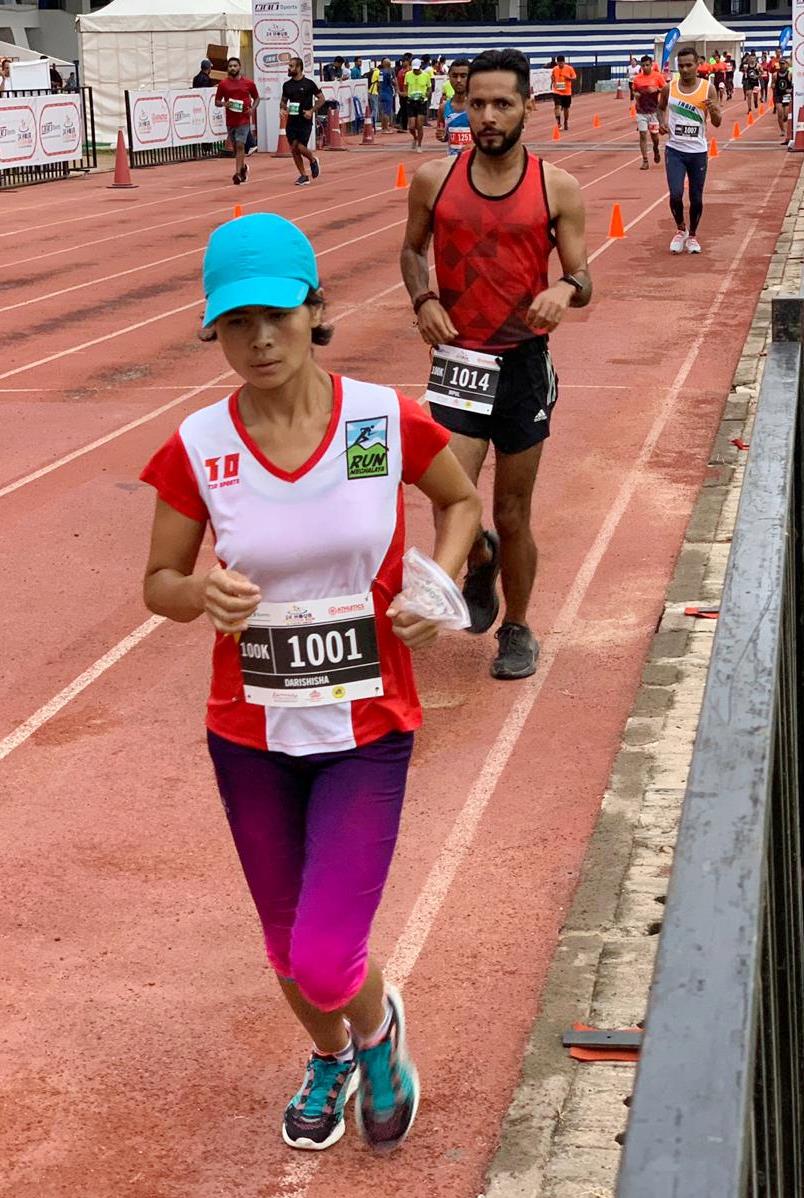
RAAM 2019 / KABIR RACHURE CROSSES FINISH LINE

Kabir Rachure (Photo: courtesy Sapana Rachure)

Kabir Rachure has successfully completed the 2019 edition of Race Across America (RAAM).

The cyclist from Navi Mumbai, India, covered the roughly 3000 mile (4800 kilometers) distance in 11 days, 22 hours, 43 minutes, as per results available on the leader board section of the event’s website. RAAM’s course stretches right across the United States, from Oceanside in California on the US west coast, to Annapolis in Maryland on the east.

Kabir’s support crew for RAAM was anchored by his sister Sapana. Earlier, she had been his crew chief for several races in India too. At roughly 260 miles left to finish, she recalled the main challenges the team had faced at RAAM that far. “ Till now Kabir’s longest ride was 1750km Ultra Spice race, which he finished twice. So after that, the entire thing is new territory for us. The biggest problem is sleep management after the sixth day,’’ she said. According to her, Kabir was sleeping around two and quarter hours daily with short naps during daytime as required. They had three support vehicles and a crew of ten. All crew members were from India. The team had four bicycles for use during RAAM – a Lapierre Pulsium, a Lapierre Aircode, a Colnago C-RS and a Specialized.

Kabir, 29, is the third Indian cyclist to complete RAAM in the solo category.

The previous such finishes were in 2017, when Lt Col Srinivas Gokulnath earned the distinction of being the first Indian solo cyclist to complete RAAM. He finished in 11 days, 18 hours, 45 minutes. Srinivas was followed by Dr Amit Samarth, who became the first Indian to complete RAAM in the solo category in the very first attempt in 11 days, 21 hours, 11 minutes. That year, Kabir too was there at RAAM; he was part of support crew for Samim Rizvi, cyclist from Bengaluru. Among Indian cyclists, Samim had been a pioneer at attempting RAAM solo. Unfortunately Samim’s 2017 attempt ended up DNF (Did Not Finish), somewhere past 900 kilometers into the race. Not wanting to give up on his chance to see the RAAM route, Kabir had then taken a car and gone up till Durango in Colorado before returning to California and later, back to India.

Kabir Rachure (This photo was downloaded from the cyclist’s Facebook page)

These solo rides aside, the first Indian finish at RAAM was in 2015 when the Mahajan brothers – Dr Hitendra Mahajan and Dr Mahendra Mahajan – completed the race in eight days, 11 hours as a two person-team.

In other finishes at RAAM 2019, Brazil’s Daniela Genovesi crossed the finish line first among women solo riders. She covered the distance in 10 days, 17 hours, 59 minutes. Coming in second was Leah Goldstein of Canada, who reached the finish line in 10 days, 19 hours, 28 minutes. Both riders belong to the 50-59 years age category. Daniela’s average speed of 11.9 miles per hour is a new record at RAAM for women in this age group.

For more on Kabir Rachure please click on this link: https://shyamgopan.com/2018/12/19/three-years-and-raam/

The 2019 edition of RAAM also saw Krishna Prakash, senior police officer from Mumbai complete the shorter Race Across West (RAW), a race carved out from the initial stages of RAAM. His crew chief was Amit Samarth.

Seana Hogan (This photo was downloaded from the Facebook page of RAAM)

Update: Seana Hogan completed the 2019 edition of Race Across America (RAAM) in 13 days, four hours, 23 minutes.

In a report dated June 24, available on the event’s Facebook page, the race organizers said: Seana Hogan (USA) arrived on City Dock here in Annapolis at 8:31 last night, to make a success out of her being our first-ever age 60-69 entrant. This 13th RAAM for Hogan was a dramatic one indeed. After being up among the younger women in this year’s field of 8 women for the first 1/3 of the race, she was stopped in Colorado for nearly 24 hours to attend to saddle sores.

As our first 60-69 entrant, Hogan was granted additional time to finish in an effort to establish a benchmark for that category.

Seana Hogan is among best known names at RAAM. A six time-winner of RAAM, she holds the record for the highest number of wins among women at the event. She won in 1992, 1993, 1993, 1995, 1997 and 1998.

(The author, Shyam G Menon, is a freelance journalist based in Mumbai.)
WILL LONGER RACES IN INDIA HELP INDIAN CYCLISTS FARE BETTER AT RAAM?

Illustration: Shyam G Menon

If you compare length for length, then over 60 per cent of Race Across America (RAAM) is uncharted experience for riders from India.

RAAM is a little over 3000 miles (approximately 4800 kilometers) long.

The longest Indian ultra-cycling event serving as qualifier for RAAM is Ultra Spice, which spans 1750 kilometers (1087 miles); the race proceeds from Goa to Coorg, Wayanad and Ooty and then returns to finish in Goa. The 1750 kilometers length of this race means that somewhere past the first one third of RAAM’s 3000 miles in the US; Indian riders begin to tackle unfamiliar waters. Will having a race longer than Ultra Spice on the domestic circuit help shrink that element of unknown at RAAM and similar races elsewhere?

“ Yes obviously,’’ Divya Tate of Inspire India, organizers of Ultra Spice said, adding, “ just as doing RAAM once or even failing at it, makes it easier to do it next time! But seriously, training approaches worldwide don’t demand for you to do the distance while you train, especially not for ultra-cycling.’’ Having qualified for RAAM and trained for it diligently, Lt Col Bharat Pannu was supposed to participate in the 2019 edition of the race. But an unfortunate injury sustained in rides ahead of race in the US, forced him to withdraw. Asked whether he thought having a race longer than Ultra Spice in the domestic circuit would help reduce the unknown in RAAM, Bharat said, “ as per my experience, the distance of 1750 kilometers provides you with all necessary experience required for RAAM, except the distance. And for distance such as RAAM, it becomes a test of your mental strength and your ability to endure pain. Definitely, a longer race will prove to be beneficial,’’ he said.

According to Divya, Ultra Spice is the bridge between the minimum RAAM qualifiers of 640 kilometers and RAAM itself. “ One doesn’t need to participate in longer ultra-races to train for RAAM. Crewing or doing team at RAAM would however be highly recommended before attempting solo. Also with four RAAM qualifiers being offered in India, a lead-up to RAAM solo or team should include as many of these, offering a variety of terrain and challenges, which is why these were created.,’’ she said.

If a longer race is to be created in India, what will be the challenges?

“ The biggest challenges are monitoring, funding and the participation numbers. Inspire India does have two ultra-races that have been in the pipeline for 3-4 years that we can only now consider putting up since we have affordable tracking devices in India. Funding these big races is not yet happening and they are really hard to run. The longer the race, the lower the number of people able to or interested in participating, and these races are expensive to participate with support vehicles etc. Which is why the two races – The Great Coast Race and The K2K Ultra will have a different format, closer to bike-pack racing. The expense of participation is also why we have now created a separate category in Ultra Spice 1750, which is unsupported or without personal support vehicles. But the unsupported category is not a RAAM qualifier,’’ Divya said.

In 2017, Amit Samarth had become the second Indian to complete RAAM solo and the first to finish it in his first attempt. In 2018, he had successfully completed the Red Bull Trans-Siberian Extreme; a 15-stage, 9100 kilometer-long race in Russia. He had a very simple matrix as reply for the question this blog posed on whether a race longer than Ultra Spice in India, would help Indians tackle RAAM better. According to him: longer the race, longer the recovery. “ You can do a race that is longer than Ultra Spice to reduce that element you call the unknown in RAAM. But it should be done at least 5-6 months before RAAM,’’ Amit said. He suspects Indian cyclists may be over-training for RAAM. That is what happened to him in 2017. Not knowing what to expect, he trained rigorously and ended up feeling tired during the actual race in the US. “ What we don’t realize is that in India, we do too many races. It makes us mentally surer of the distance but eventually it also makes us physically slower,’’ he said of the folly in overlooking rest and recovery. Amit thinks cyclists like Christoph Strasser (2019 marked his sixth victory at RAAM solo) don’t exhaust themselves doing very long rides in training.

Photo imaging: Shyam G Menon

Strasser at RAAM is a treat to watch on the race’s live tracker. RAAM solo and RAW solo (Race Across West; a smaller race within RAAM) start on the same day. Those riding as multi member-teams start later. In 2019, Strasser steadily pulled ahead of the field, hung in there and finished first. The gap between him and second placed soloist was palpable. In that gap, a few teams raced in (because they cycle in relay format, they cover ground faster) to cross the finish line. It was after this early flurry of team finishes that the rest of the solo racers started completing the race. Simply put – keeping aside other issues like sleep management and experienced crew, Strasser rides faster than others. His average speed at 2019 RAAM over the eight days, six hours, 16 minutes he took to reach the finish line, was 15.48 miles per hour. The fastest team this year at RAAM was the 4-person Team Alpha from Austria; riding in relay format they covered the course in five days, 15 hours, 33 minutes at an average speed of 22.65 miles per hour.

After RAAM 2017, when Amit decided to head for Trans-Siberian Extreme, he knew two things – the race in Russia at 9100 kilometers is significantly longer than RAAM; he didn’t want to repeat what happened to him at RAAM 2017. He connected with Pierre Bischoff of Germany – Bischoff is a much experienced ultra-cyclist; 2016 winner of RAAM – to learn how best to prepare. Bischoff’s suggestion was to focus on two aspects – speed and recovery. “ I made sure I did not over-train for Trans-Siberian Express,’’ Amit said. He became the first Indian to complete Trans-Siberian Extreme; Bischoff won it.

So if needlessly piling on miles in training is unwise, how then do you tackle the unknown in RAAM?

“ There is no other way but to deal with it mentally. One thing you must understand about ultra-cycling is that because the distances involved are huge, you cannot cover all aspects in training as you would for a marathon. There will always be the unknown,’’ Amit said.

(The author, Shyam G Menon, is a freelance journalist based in Mumbai.)      
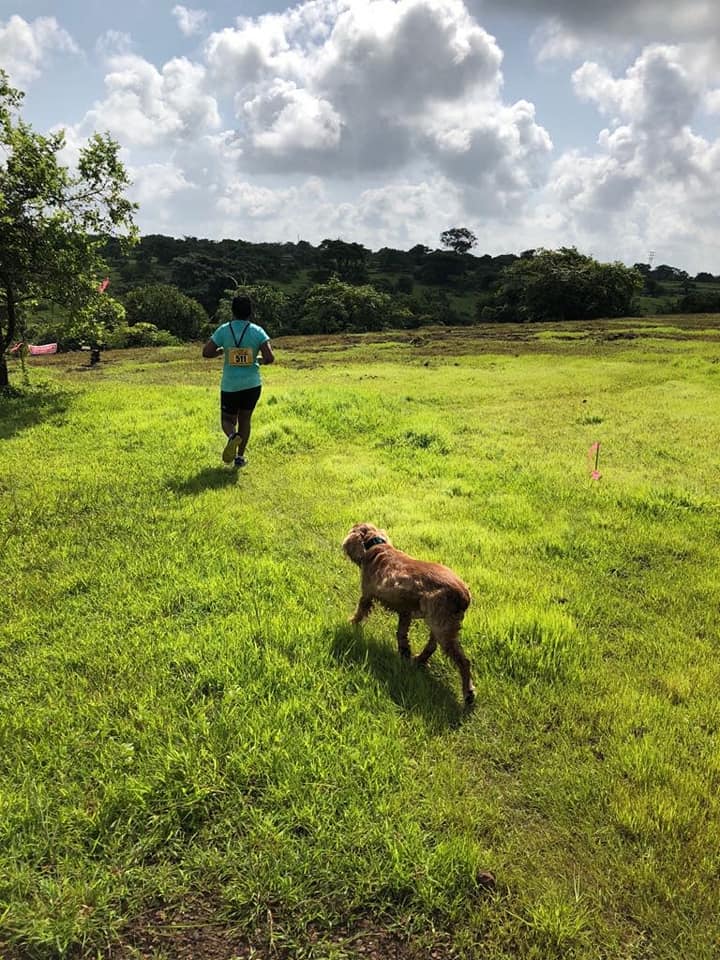
NANDA DEVI EAST / SEVEN BODIES RECOVERED

Nanda Khat, Peak 6477 and Nanda Devi (Photo: Shyam G Menon)

IMF team also reaches accident spot / Please scroll down for updates

Late evening June 23, the media reported that a team of the Indo Tibetan Border Police (ITBP), dispatched to recover the bodies of climbers believed to have met with an avalanche on Peak 6477 near Nanda Devi East, has recovered seven bodies from under the snow.

According to a senior ITBP official quoted in the report, the bodies were found “ on the western ridge of the peak towards the Pindari Glacier.”  Peak 6477 is on the ridge continuing from Nanda Khat towards Nanda Devi East. It is on the outer wall of the Nanda Devi sanctuary; Nanda Khat is close to the Pindari Glacier.

The fully linked line shows the route taken by the IMF team, which commenced its walk-in from Khati on June 12. The dotted line shows the route taken by the ITBP team, which was air-dropped to Nanda Devi East Base Camp on the Johar side, on June 15. The Base Camp, ABC and Camp 1 mentioned on the map refer to the IMF team’s progress from the Pindari Glacier side. This map is an approximation and is not to scale (Illustration: Shyam G Menon)

The bodies, including that of a woman, have not been formally identified. That will be possible once the bodies are brought down to base camp, the reports said.

It was in end-May that news broke of eight climbers (seven from overseas plus the team’s liaison officer from India), part of an expedition that had set out to attempt Nanda Devi East, reported missing following avalanche on Peak 6477. The expedition was led by well-known British mountaineer and mountain guide, Martin Moran.

In subsequent search operations, helicopter sorties by the Indian Air Force (with some of the surviving members of the expedition aboard to refine area of search) had sighted five bodies in the snow and ample evidence of avalanche.

Besides a large team composed of personnel from ITBP, State Disaster Response Force (SDRF) and National Disaster Response Force (NDRF) dispatched from the Munsyari side, the Indian Mountaineering Foundation (IMF) had also sent a team for recovery operations. The latter headed up from the Pindari Glacier side.

For more reports providing background, please refer the list of articles on this blog dating from end-May.

Update / June 25: The IMF team has also reached the site where the bodies have been located by ITBP. “ They will now join the ITBP in searching for the eighth body and work out a joint plan for bringing the bodies back,” a senior IMF official informed today.

The 12 member-IMF team started walking from Khati village on June 12.  They approached the accident site from the Pindari Glacier side while the ITBP team was dropped by Indian Air Force (IAF) helicopters at the Nanda Devi East Base Camp (on the Johar side accessed from Munsyari) on June 15.

“ Bad weather has given both teams a difficult time and while the ITBP team reached the site on Sunday, the IMF team got there today,” the official informed.

Update / June 30: According to reliable sources, the Indian Air Force (IAF) having identified a spot at 15,500 feet in the Lavan Valley, where a helicopter can land, carried out a trial landing. The ITBP and disaster management personnel will take 2-3 days to carry the bodies to this location on foot. From there, the bodies will be airlifted to Pithoragarh. It is also understood that the camps of the IMF team, spread over the south side in the Pindari Valley, are being wound up and the team will be moving down.

In a separate development, two media reports, one quoting the district magistrate of Pithoragarh and the other quoting a senior ITBP official, said that the search for the eighth climber has been “ abandoned.”

(The author, Shyam G Menon, is a freelance journalist based in Mumbai.)

NAVEEN JOHN: TIME TO REWIRE

Naveen John (Photo: Shyam G Menon)
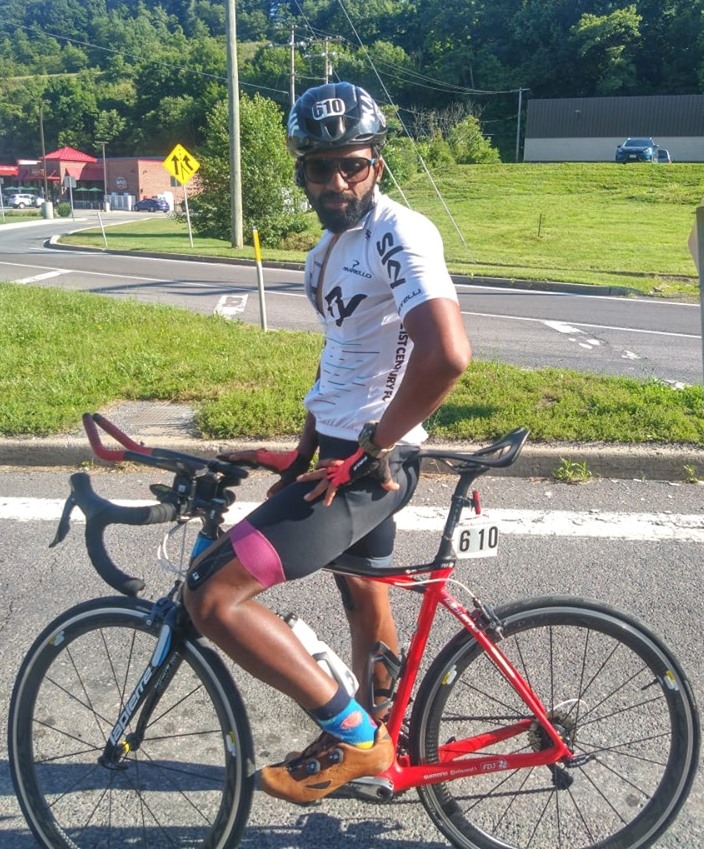
Naveen John is among India’s best bicycle racers. More importantly, he is a pioneer; one of those early birds into the cutting edge of sport, forced to explore and find their way in the pursuit of excellence. Through the rough and tumble of race results he has kept a personal project alive – the Indian Cycling Project (ICP). There is a small but growing number of ICP alumni in the top echelons of Indian cycling now. 

Calais is a name known well to swimmers.

It is the French city closest to England.

Presiding over the Straits of Dover (the narrowest part of the English Channel) on the French side, Calais affords a view of the white cliffs of Dover across the channel, on a clear day. Many swimmers conclude their channel crossing near here. Calais falls in Hauts de-France, the northern most region of France. The origins of the Scheldt River are also in Hauts de-France, at Gouy. From here, the Scheldt flows into Belgium next door and eventually meets the sea in Netherlands. One of its tributaries is the small river called Durme. Lokeren is a Belgian town on the banks of Durme. It is in the province of East Flanders. It is unlikely that many of us in India would have heard of Lokeren.

A clutch of Indian cyclists, however, have.

In 2018, one of India’s best bicycle racers scored a podium finish here at the annual Lokeren kermesse.

“ That podium finish has been the highlight of my life in cycling so far,’’ Naveen John, former national champion, said. Naveen placed third. The event was won by Jonas Goeman. What made the Lokeren kermesse special was the result of the Belgian National Championships that took place two days later. Finishing second at the Belgian Nationals was Jonas Goeman. For Naveen, it felt fantastic to have been on the podium in Lokeren, alongside one of the leading cyclists of Belgium, a country at the heart of bicycle racing.

“ Lokeren is not one of those internationally significant races. But getting a podium finish there and knowing that the winner is one of Belgium’s best made it special for me. It will fuel the ambition of other Indian cyclists coming after me,’’ Naveen said. It wasn’t his first season in Belgium. Having decided that his route to exploring and knowing the higher levels of bicycle racing lay through the land of Eddy Merckx, he had been on Belgium’s kermesse circuit before. As had some other Indian cyclists, who were known to Naveen. It was a small, tightly knit group. News of their annual trips had been shared on social media.

“ This time, two 17 year-old cyclists from Hyderabad also showed up in Belgium. They came on their own. That is really great,’’ Naveen said.

Two pictures of Naveen before the start of the Drongen kermesse. The one on the left is from his first day in Belgium in 2015, when he was racing for KYNKYNY. The other is from a recent season in Belgium in 2018, when he raced for Ciclo. Both photos were taken by a local supporter who shared these pictures with Naveen (Photo: courtesy Naveen John)

Naveen’s team for 2018 included Arvind Panwar, Gagan Reddy and Sreenath Lakshmikanth. A week after Lokeren, Arvind placed in the top ten at a kermesse in Bottelare. That was the last race of the season for the visiting Indians.

Welcome to the Indian Cycling Project (ICP). It all goes back to the end of a fantastic project and a corpus of money it left. A March 2018 article on Naveen available on this blog cites the roots: The kermesse is a form of Dutch bicycle race currently most popular in Belgium, especially the northern Flanders region. Europe is the beating heart of bicycle racing. Within Europe, nations like France, Belgium and Netherlands represent the home of cycling culture. In Bengaluru, KYNKYNY (bicycle racing team), after a phase of being supported by the reputed American bicycle brand: Specialized, began disbanding in 2015. “KYNKYNY aspired to be the first Division Three team from India. It was ahead of its times. We were unfortunate in that we didn’t have 12 strong riders, who were consistently good enough for that journey along with related support,’’ Naveen said. As the team disbanded it found in its possession a small cachet of funds. That money opened prospects to attempt races overseas. Naveen’s research took him to the writings of Ed Hood who had documented accounts of British racers cutting their teeth in continental racing and progressing to the top echelons of the sport. It mentioned the importance of racing in continental Europe, in shaping cyclist’s reputation. In continental Europe, Belgian cycling was noted for speed and power, France for distance and challenging terrain.

Naveen was at that time in good form. After winning the ITT at the 2014 nationals he had followed it up with a win at the 2015 National Games. There was also the fact that – amazing as it sounds – it cost less to race in Belgium than in India. Such is the disparity in economic efficiency as measured in terms of what all it costs to race. In 2015, four Indians – Naveen among them – spent 60 days in Belgium; altogether and across all of them, they participated in 20 races. Naveen managed to finish at four races. The best position he got was twentieth, secured in the last event he raced at. “The experience was an eye opener,’’ he said. It showed that the future for Indian cyclists was not to wait for the sport’s systems to emerge in India but to leverage the systems already existing outside India.

(From left) Arvind Panwar, Arvind Anirudh, Naveen, Sreenath Lakshmikanth, Prajwal Pingali, and Gagan Reddy, in Belgium in 2018. This was right after an Indian dinner the ICP Class of 2018 cooked for Arvind and Prajwal. The two 17 year-olds had followed the ICP pathway themselves (with parent’s support), all the way from Hyderabad to Belgium. They spent a month in Belgium, racing and training (Photo: courtesy Naveen John)

This was the seed of the Indian Cycling Project.

In 2016, a friend who was documenting Naveen’s journey in photos, asked him: what next? Naveen struggled for a proper answer. He knew that if you have been an amateur racer for long, the obvious thing to do next is to become professional. So he blurted out that fantasy – he wanted to become a professional cyclist and do so outside India. To this end, he did a lot of cold emailing; he aimed for Division Three on the Union Cycliste Internationale (UCI) website. Cam Whitting, who runs cyclingiq.com, helped.

Naveen managed to connect with a couple of teams from Australia, eventually signing up with a team called: State of Matter / MAAP. It was previously known as Charter Mason Giant Racing. However there were some problems. He struggled to raise funds for the Australian foray; he was also delayed in reaching Australia. Naveen’s contract was from January 2016 to December 2016. Since he was going to race with a cycling team, he applied for a sports visa. As it turned out, aside probably from cricketers, not many athletes from India had applied for a sports visa to Australia after the Sydney Olympics of 2000. That caused delay. Reaching Australia with some of the major races already over, Naveen could participate in only amateur races in the domestic circuit. Even that was an experience for the field was strong. Naveen stayed part of the team roster for 2016. State of Matter was later disbanded.

Naveen was not part of the Belgium trip in 2016. That year he put together the ICP Class of 2016, which included Makarand Mane from Pune, Parashuram Chenji from Hyderabad and Arvind Panwar from Meerut. Naveen had to be in Australia.

In 2017, seven cyclists from India traveled to Belgium for another go at races there. This time Naveen participated in 22 races; he finished 21 and crashed at one. “The average amateur kermesse is faster than the Indian nationals. The distances are also longer. Indian courses are typically straight. Over there, you tackle bumpy, uneven roads. You don’t complain. Cobblestones are an integral part of Belgian racing. There are entire races built around it,’’ Naveen said. Visiting Belgium and racing there is now set to be an annual affair. It is the bedrock of activities planned around Ciclo Team Racing, Naveen’s new team, which is backed by 2go Activewear, TI Cycles and Absolute.

May, 2019. We were at the same outdoor café in Bengaluru that we had met in early 2018.

Arvind and Naveen after their last race in Belgium in 2018 at the Bottelare kermesse. They are seen here with Philippe, a spectator they befriended in 2017, who has been very supportive of the ICP team, handing them feeds at a lot of races. “ He does it purely because we’re there racing, all the way from India and don’t have any local support,” Naveen said (Photo: courtesy Naveen John)

According to Naveen, the reason he persisted with ICP’s Belgium engagement is that it challenged a committed cyclist in all departments. It isn’t about any one skill; it is about everything that makes you cyclist. “ Belgium is the deep end of bicycle racing. It raises all aspects of your fitness. It forces you to unlock your potential as sum total of all the parts. Every aspect gets pulled up,’’ Naveen said. The kermesse season also tied in neatly with the national championships back in India. You could come back and devote a month to focus on specifics, relevant to the particular discipline you participate in at the nationals.

An unexpected summer squall sent things flying at the cafe.

We headed for the big building next door to shelter from the near horizontal rain and wait out the altered atmospherics.

2018 had been a year of realization for Naveen. The Belgium visit had gone on well. A podium at a kermesse was simply fantastic. On return to India however, there was reality check to cope with. At the 2018 National Cycling Championships, Naveen finished second in individual time trial (ITT). Gold went to Arvind (ICP Class of 2016, 2017 and 2018 and a fellow rider on the team Naveen managed – Ciclo Team Racing). There were good things happening for ICP alumni, riders on the team he was managing, those he was coaching or had coached / mentored. Aman Punjani (ICP Class of 2015, 2017 and formerly coached by Naveen) won the under-23 road race and ITT. It was a repeat of the double Naveen had achieved for the first time at the previous nationals. Gagan placed fourth in under-23 ITT; Sreenath placed fifth in under-23 road race – both had been coached by Naveen and were part of the ICP Class of 2018. For Naveen though, it was the first time in the past several years that he was ending up without gold medal at the nationals. “ It woke me up to the significance of the nationals,’’ he said. Immediate fallout of the result at the nationals was that he wasn’t in the first selection for ITT for the Indian team heading for the Asian Championships. Arvind made the cut. Naveen let Arvind know early that he wouldn’t contest the decision by seeking a selection trial, which would have affected the preparations of both the riders leading into the Asian Championships. Thanks to his second place, Naveen was however first choice for the team doing the road race at the championships. But something wasn’t right. What went wrong?

Riding to second place-finish in ITT at the 2018 nationals (Photo: courtesy Naveen John)

Naveen normally speaks with precision; it is a tenor that reminds listener of the technical subject he studied once for profession – electrical engineering. In the foyer of the big building with a security guard constantly reminding us that we weren’t supposed to sit there and chat, I could sense Naveen’s search for answer. He recalled that in 2018, for some reason, he hadn’t been able to follow a pattern of training that normally graced his preparation for the nationals. There was lack of motivation. Usually, ahead of major competition, he goes into hermit mode. Late-2018, that didn’t happen. Then, he thought a bit and added, “ It is not easy to win the Indian nationals anymore. Your closest friends are your main rivals now. But that competitiveness is critical. The level of performance in the sport is rising.’’ You wonder if life smacked of mineral leaching. Everyone struggles, finds their respective key to unlocking ability through exploration, experimentation and intense personal search. Then, in that inevitable requirement to advance further – team formation – best practices and learning get shared. What you know goes to others; what others know comes to you. And as gaps get evened out, competitor needs to hone his game further to stay ahead. It is particularly true in sports where young blood is constantly snapping at your heels.

Prior to making Bengaluru his base, Naveen had the good fortune of cycling in the US. It gave him perspective in the sport; showed him how things are done. The power meter measures performance objectively. Unlike heart rate monitors, it is more instant in feedback. The wattage it shows indicates how hard you are cycling / training. In 2012 – the year he moved to India – Naveen was the only cyclist competing at national level in India who used a power meter in training. A strong votary of the device, he functioned like an ambassador promoting it. Now there are many cyclists in India – including those reporting for the nationals – using it. Thanks to such practices and others like it shared, gaps had closed. Such is life. You don’t complain. But you can’t help reflecting either.

Reflecting on the 2018 nationals (Photo: courtesy Naveen John)

Post 2018 nationals, Naveen realized that he had too many things on his plate. He needed to step back from running a team (Ciclo) to focus on himself. “ Ciclo was founded with three goals in mind. We wanted to support the best riders in India to push the envelope. We wanted to develop a path ahead for young riders. We wanted to share the story of what we do,’’ Naveen said.

Cycling teams are driven by passion. Problem is – top end performers blaze a trail that opens a significant gap between them and where the bulk of the market is. This gap is sizable in markets like India where the majority is bogged down in the daily battle to survive. Premium bicycles, to which category road bikes and bicycle races belong is currently a luxury, both in terms of affordability and the ability to devote time for cycling. Not to mention – the challenging traffic environment confronting cyclist in India. The larger the gap, the tougher becomes the task of making top end performers sensible to the mass market. Across sports, companies like to support a bridgeable divide, not one that is formidable and threatens to vaporize as spectacle. For the talented, this is a major problem in the Indian ecosystem.

In India, bicycle manufacturers have traditionally moved with the market, even trailed it but almost never, stayed ahead of it. Even the push to sell premium bicycles happened after a new company having none of the traditional baggage, dared to sell upmarket bicycles. Like its predecessors and contemporaries in India, Ciclo too – it is a joint venture between Ciclo Café and TI Cycles – is limited by the nature of the Indian bicycle market. Nevertheless, it would seem that the team tried its best to meet the earlier stated basic expectations. The Belgian chapter was born from ICP but Ciclo supported it; the 2018 and 2019 teams to Belgium were almost entirely Ciclo riders. Naveen wanted to keep ICP brand-agnostic. There were instances when cyclists associated with competing bicycle brands joined the annual trip to Belgium. Ciclo didn’t say no to that.

Naveen (second from right) riding in the escape of four riders that went on to contest the win at the Lokeren Doorselaar kermesse in 2018. Jonas Goeman in the foreground of the picture (Photo: courtesy Naveen John)

What was truly a moment to pause and reevaluate for Naveen, was the loss of gold at the nationals. It suddenly brought to focus two important issues – he wasn’t getting any younger; he had a few things to aspire for while age was still on his side. “ For 2019, I’m almost done bringing together a coalition of brands that see the value my sweat equity brings and trust the idea-to-execution process solely in my hands. That was something I had to let go off when I had to manage a team of riders and look after the team’s and rider’s interests first,’’ Naveen said. What is center-stage is brand agnostic ICP with the Belgium visits therein.

Sample two outcomes of the annual Belgium visits that make it feel encouraging.

“ With an estimated crowd of 300,000 lining the 190.2-kilometer route, Grewal edged Canadian Steve Bauer to claim the gold medal in the men’s road race, breaking away from the field with 20 kilometers remaining and opening up a 24-second lead after 11 of 12 laps and then being caught by Bauer with 10 kilometers left, setting up a dramatic final-lap showdown. This scene, replayed many times since, is one of the most emotional Olympic victories of the Modern Games’’ – This was the description the United States Bicycling Hall of Fame gave for Alexi Grewal’s gold medal winning-ride at the 1984 Olympic Games. Son of a Punjabi immigrant to the US, he was the first American man to win an Olympic gold medal in road cycling. After Naveen posted about a 2018 kermesse on social media, among those responding was Alexi. Apparently the American national team had followed the same path as ICP. Alexi provided a tip: ahead of race, do a recce of the kermesse route so that you weed out variables and get to focus on racing. That underscored the relevance of ICP and the route it was taking. Same year – 2018 – out of the blue, a Belgian lady had shown Naveen a photo of him from a 2015 kermesse. For Indian cyclist visiting Belgium to participate in the country’s races, it felt wonderful to be remembered so. Talent needs suitable ecosystem; one that is interested in whatever it is that talent is pursuing. If you don’t find it in place that dare not challenge market realities, then you should spend more time where realities are different. After all, it’s one life.

Finishing the Melle pro kermesse in 2018; Naveen (foreground) racing in his ASFRA Flanders team kit. This was his first prof koers start. “ I was super happy to finish the race mid-pack,” he said (Photo: courtesy Naveen John).

According to Naveen, in Belgium, there are two tiers of elite racing: Elite met contract or prof koers for riders with a professional contract (division III, II, or I) to race the professional kermesses; and elite zonder contract, for amateur riders without a contract yet. In Elite met contract, the bulk of riders are professionals – division three riders, but there are also division two and division one (the Tour de France lot) riders in the fray plus invited elite amateur teams. In the elite zonder contract, anyone from elite amateur level plus those from division three, the lowest level of pro cycling, can participate. In 2018, Naveen finished every race he started except one. The list included two prof koers. In Belgium, Naveen and Arvind ride for a club called Asfra Flanders. You have to be part of a club to be part of met contract races. At the very top echelon of met contract races are the Semi-Classics and the Spring Classics. “ I just want to keep pushing my boundaries in terms of results and for what a racer from India has done,’’ Naveen said.

His next goals include working to be in the top-20 in a prof kremesse; try and repeat a podium in a zonder contract kermesse and work towards a podium for India at the Asian Road Cycling Championships in 2020. As of April 2019, he was 33 years old. He has assigned two-three years to address the above. As he navigates all the above mentioned rewiring, the electrical engineer has to also find other means to fund his journey in cycling. In December 2018, he ramped up the number of trainees he was coaching from four to 15. In partnership with a company called Happy Earth, he also got into distributing Power2Max, a German power meter.

(The author, Shyam G Menon, is a freelance journalist based in Mumbai. Thanks to Naveen for the clarity provided regarding the types of contracts in cycling. For a more comprehensive overview of Naveen’s life in cycling, read this article as well as an earlier piece called The Electrical Engineer, available in the archives of this blog. For more information on ICP please try this link: https://www.naveenjohn.com/indiancyclingproject)   

STRAY DOTS CONNECTED BY NELSON’S EYE

Illustration: Shyam G Menon

From high mountains to vehicle sales and jobs with fat salaries, the industrial paradigm is blinding us to the obvious.

2019 was not the first climbing season on Everest hosting queue of climbers.

One recalls photos shown by those who climbed Everest in the past decade. Lines have happened before; maybe not this bad on the final stretch of the ascent. A line is a potential queue; a queue is potential congestion. In other words, 2019 was in the works.

All that was needed was favorable circumstances converging. A slightly higher number of permits doled out, fickle weather of climate-change, a cyclone big enough to have distant impact in the Himalaya and climbers rushing to take advantage of a narrow window – that appears to have tipped what was potential into reality. In the days following the tragic deaths of May 2019 official explanation puzzled. A memorable line of reasoning was that people had died of altitude sickness, poor fitness and lack of experience, not traffic congestion on the peak. That is probably true.

Traffic jam at altitude

Consider the following. Altitude sickness is checked through acclimatization. But there is no certainty that it won’t strike. When it hits, the best remedy is losing elevation. Poor fitness can spell trouble when climbing a mountain entailing physical strain and the challenges of altitude. Experience counts. The more you have been to the high mountains and endured different scenarios, the better your understanding of self (and its limits) and greater your bandwidth to cope with nature.

In the event of altitude sickness, how easy will it be to turn around and lose elevation if the climbing route has too many people, at least some of them slowed by strain of altitude? If your fitness is poor and experience limited, how well will you cope with extended exposure to harsh nature, which is what happens when caught in a queue? Point is – long lines on any high mountain is unsafe. That raises the question: why do we ignore signs of potential accident? Why do we defend after tragedy?

One reason (certainly not the only one) would be the difference between mountaineering as activity and the same as industry. Across sectors, industry has typically showed reluctance to acknowledge its faults. There are investments, businesses and livelihood at stake. Viewed through such prism, old lines from old photos may not have seemed early indicator of what could potentially be. The other thing you notice in activity cast as industry is how notion of dynamic nature recedes and predictability becomes prized. Approached as industry, a high mountain becomes branded objective bought off a shop shelf. As with any other product, expectations rule the transaction and those expectations have to be met. The tragedy and defence from Everest spanned May-June 2019.

Traffic jam at sea level

On June 19, a leading daily reported that Mumbai had some of the worst traffic jams in the world. The report was notable for pinning blame almost wholly on civic authorities responsible for roads and the traffic police, responsible for issues like parking. There are two actors overlooked in the story of traffic jams – vehicle manufacturers and consumers.

Vehicles are manufactured, marketed with high voltage campaigns, sold at attractive prices and backed with consumer finance – all by the automobile industry. The ones willfully spending, congesting the roads with their purchase and often prone to driving rashly are the customers. Yet no solid blame reaches these two segments. Vehicle manufacturers have traditionally kept big advertisement budgets; something media seeks. About two decades ago, officials at Indian auto companies used to argue that they are above spoiling the market with aggressive pricing, low interest loans and product discounts. Growing competition among auto companies, the pressures of surviving market cycles, the technological challenges facing the global auto industry, the rising relevance of public transport and ethical preference for less polluting means of mobility – all these changed industry. There is desperation to sell before product relevance dries up. Now the Indian market also hosts freebies, discounts and cheap loans. Sellers are targeting pockets where the consumerist dream still attracts and tales of urban congestion are distant.

Questioning the habits of readers / viewers (who are also vehicle customers) to the point of irritating them is not affordable to media. Editors have limits decided by business model. As people spend on vehicles in age of high salary and more disposable income, both customer and industry are spared acute scrutiny by media. Civic authorities and traffic police take the blame instead. Like the mountaineering industry’s inability to visualize potential danger in a long line at altitude, vehicle manufacturers and customers reserve a Nelson’s Eye for their role in traffic congestion. They see their combined activity as feeding GDP (even if time wasted in traffic jam is productivity lost). GDP is currently unquestionable; it is a nice place for big fish to hide.

There is a cost for our collective existence – growing and burgeoning – that nobody wants to acknowledge. Like Mumbai’s traffic jams and May 2019 on Everest, all costs eventually come home. Yet the architecture of potential mess appears lost on even the educated.

Traffic jam in the head

The new rain; rain of vehicles (Illustration: Shyam G Menon)

And so in June 2019, it was Nelson’s Eye again, as a former senior official of the Indian IT industry argued that what stifled employment in the country was not lack of jobs but lack of well paid jobs. It harked of an older fantasy sold (much successful like vehicle sales measured in numbers) – that of celebrating exploded population as demographic dividend. Doesn’t demographic dividend / workforce have the propensity to be consumerist with consequences thereof? If you are not blinded by GDP, you will notice that more money does not reduce the carrying cost of our bloated existence and its equally bloated aftermath ranging from stress to congestion to trash. Instead, allowing ourselves to see without tainted spectacles would be a good starting point.

One example for how money solves nothing is government finances creaking under the load of rising wage and pension bill. Transplant the habit to private sector, you will simply spread the disease. In the urge to appease constituencies monetarily, inequality grows and the economy is stalked by inflation. What we need is reasonable hours of work, reasonable salary and most importantly – affordable cost of living that stretches currency’s mileage. This demands a very fundamental reinterpretation of life away from mono-cropped imagination. After all, the best way to enjoy Everest without damaging it, is not to have everyone aiming for the top but respect even those content to watch it from far. In other words, spread earnings and opportunities around. Unfortunately, our educational system (that’s where we gain perspective of life) has been surrendered to GDP. It is the stuff of rat race; it even advocates it. We have few original characters born from it. There is no contrarian thought. To the extent it is all driven by money, alternative incentives like social acceptance and support, relevant to sustain non-mainstream imagination, have shriveled up. Your intuition warns that the overall accounts of existence are not balanced. Money tells you: don’t listen to that internal auditor, just keep minting money. What would you call such book keeping if it was a company, bank, airline or housing finance outfit, you were auditing?

In June again, there was a news report which said, some youngsters were living frugally and saving as much as they could to retire earlier than usual. It smacked of industrial superstructure tapped solely for income with an acknowledged lack of soul-connect to it. Unlike before, meaning it seemed, lay in retirement. There were others stepping out to see the world on small budgets; hope in their hearts to compensate for lack of cash. Now, that’s a different approach. At least, it’s no Nelson’s Eye.

(The author, Shyam G Menon, is a freelance journalist based in Mumbai.)