A WORKSHOP IN NAVI MUMBAI

Illustration: Shyam G Menon

In the concluding months of 2020, an accomplished ultra-cyclist discovered the beauty in sharing his knowledge and skills through an extended workshop. Here’s an overview: 

Bala Sitaram Rokade bought her cycle about two years ago. She was into the active lifestyle. She had been running regularly since 2015, was training women interested in physical fitness and had become an ambassador for Pinkathon in the Seawoods area. At the time of purchasing the bicycle, she didn’t know how to cycle. “ I wanted to learn cycling,” she said. Having learnt it; prior to the pandemic-induced lockdown of March 2020, the maximum distance she cycled at one go was approximately 25 kilometers on that road much loved by runners and cyclists in Navi Mumbai – Palm Beach. In October 2020, as the relaxation of the lockdown progressed, Bala enrolled for a workshop on cycling that she came to hear of through the social media channels of Everest Cycling Culture (ECC). It spanned a few weeks. “ The workshop enhanced my confidence to cycle on the road and on Palm Beach. Within a fortnight of training at the workshop, I did my first ride of 100 kilometers,” she said.

The 100k ride was essayed as loops on Palm Beach, a pretty flat road. Bala covered the distance in around five hours. Following the workshop, Bala began attempting BRMs, which are self-supported long distance rides held with a cut-off time but no competition among participating cyclists. It is typically the first stepping stone for those aspiring to know the world of endurance cycling. Internationally, the tradition of brevets or BRMs is overseen by the Audax Club Parisien (ACP); each country has a local chapter that supervises rides within its domain. Bala did her first 100k (Vashi-Khalapur-Vashi) in 4:58 hours; the second 100k (Belapur-Khopoli-Belapur) in 5:18 hours and on January 30, 2021, a 200k BRM (NMMC building near Belapur-Dhapoli) in 12:58 hours. Officially, BRMs start from 200k; the 100k is classified as Brevet Populaire (BP). “ I wish to try becoming a Super Randonneur,” the 50 year-old said. To be a Super Randonneur or SR, a cyclist has to do BRMs of 200, 300, 400 and 600 kilometers in one SR season.
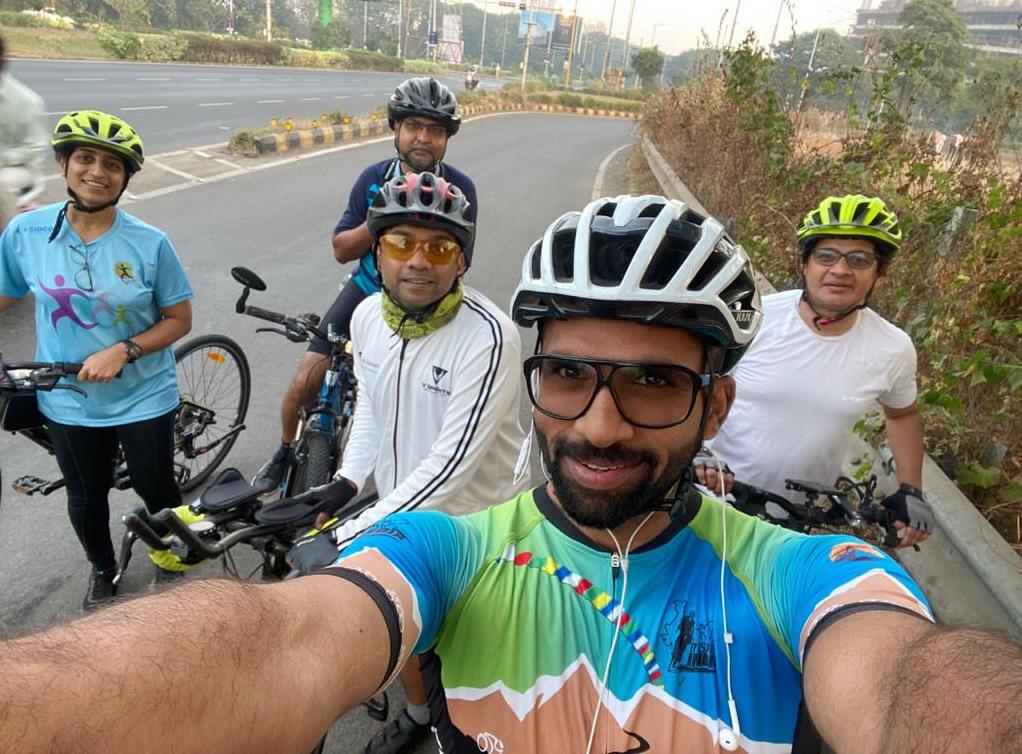
From the workshop (Photo: courtesy Kabir Rachure)

February 2021. At a small cafe in the subway below the Seawoods  railway station, Kabir Rachure recalled his predicament in the second half of 2020. “ I was bored,” he said. Among leading endurance cyclists in western India, Navi Mumbai-based Kabir has been a podium finisher at domestic ultra-cycling events and a finisher in the 2019 edition of Race Across America (RAAM). Like others in the country, he had seen life in his neighborhood come to a halt with the pandemic and lockdown. Weird for ordinary human beings to behold, the specter of life brought to a standstill was weirder still for the cyclist used to training outdoors daily. In the initial phase, it was unsettling. Kabir trained indoors but the repetitive pattern of a bleak existence was boring. Past its strictest phase, as the lockdown started to relax and he recommenced his outdoor rides, Kabir thought of ways to overcome the ennui that still nagged him. Although there were virtual events organized by friends that he participated in and instances of Everesting (an activity in which, cyclists pedal up and down a hill multiple times till the cumulative elevation gain equals that of Everest – 8848 meters; it is done by runners too) he attended, he knew it would be some months before the old calendar of physical events in endurance cycling got restored. It left him with time on his hands and thoughts around how such time may be put to good use.

Everest Cycling Culture is a leading name in the bicycle retail business in Navi Mumbai. For some years now, it has functioned as a modern bicycle shop in the suburb of Seawoods. ECC anchors a community of cyclists replete with weekend rides covering modest distances. Kabir knew ECC well. Long before the lockdown  of 2020, he and the well known Nagpur-based ultra-cyclist Amit Samarth, had been speakers at a function organized by ECC. He had also given a talk at ECC after completing RAAM. In the period of the phased dismantling of the lockdown, Kabir realized that what would satisfy him is sharing and coaching. Thanks to his excursions in the field of ultra-cycling, he had built up a well of experience. Besides the grace in sharing, helping others improve their skills can be a sort of healing for the mind emerging from pandemic and lockdown. Not to mention – the timing seemed apt because in the wake of lockdown being relaxed, in India and elsewhere in the world, there had been a sharp surge in interest in cycling. The pandemic had highlighted the importance of physical fitness. Among avenues to stay fit, cycling ranked at the top because it mixed exercise with the joy of movement and at the same time ensured physical distancing, which had become an important aspect of pandemic-related safety protocols.

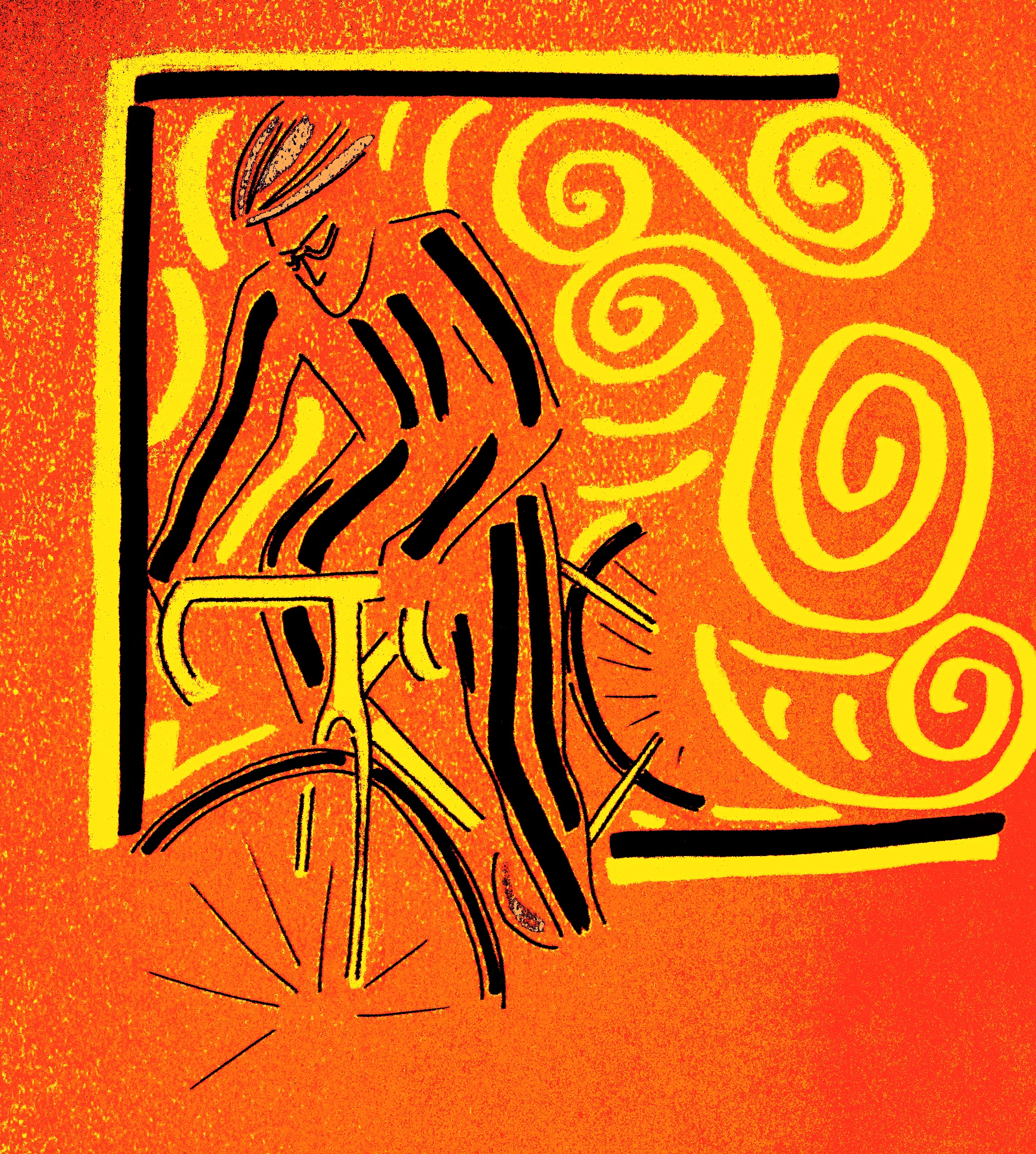
Illustration: Shyam G Menon

According to AbdulRab Kazi, founder and admin of ECC, it’s online community of cycling enthusiasts is currently over 3000-strong and spread across 19 WhatsApp groups in Navi Mumbai. “Kabir has been associated with ECC since 2014-15. We were talking one day when Kabir broached the idea of a training workshop,” Kazi said. ECC quickly bought into the idea. Amateur cyclists typically need some guidance to gain confidence and give wing to their abilities. The workshop seemed ideal for that. “ We decided on a format that would have Kabir ride with the trainees at least three days a week and assign them homework for the remaining days,” Kazi said. ECC circulated the proposal on social media to their members. Alongside they also reactivated an old WhatsApp group they had. Called Wheelist, it was originally meant to address members nursing dreams of personal expeditions and projects. Those interested in the workshop were encouraged to come aboard Wheelist. The workshop was named: Train with Kabir. A fee of Rs 1000 was charged for the program to ensure that only those truly interested (and having suitable cycles) would participate. Around 17-18 applications were received. From that, 13 persons were selected to attend the workshop. It was a varied field ranging from abject recreational cyclists to those who had already done BRMs. It was also varied in terms of age. The diversity suited ECC because its aim is to get more people on the saddle and help them acquire the capability of riding 100 kilometers, comfortably and responsibly. As regards age, Kazi felt that in today’s times many people wake up to their capabilities late. Amateur running and cycling has plenty of people who picked up the sport in middle age. “ At ECC, we have a wide range of age groups, from 9-10 year-olds to those above 70,” Kazi said. Among those who applied and made it to the workshop was, Bala.

Another was fifty year-old Ajith B. Nair, who stays in Seawoods and works as a chief manager at State Bank of India. He had been living the regular working man-existence with physical fitness denied its due share of attention, when a physiotherapist he consulted for a knee problem, recommended cycling. Initially, he borrowed his son’s bicycle for the purpose. “ I liked the experience,” Ajith said. He joined the cycling community at ECC. About a year and a half ago, still unsure whether his new interest in cycling would become a serious engagement or not, the bank officer purchased an affordable hybrid bike – Riverside – from Decathlon. “ My goal on the days I cycled was to pedal for an hour or in terms of distance, about 20 kilometers. I hadn’t heard of BRMs and so knew nothing about them,” he said. However courtesy, the supported group rides offered by ECC, Ajith had to his credit a long bike ride of around 60 kilometers prior to reporting for the workshop. That was the longest distance he had covered. In the course of the workshop (it started on October 20), Ajith did a 70km-ride on Palm Beach. “ It was at the workshop that I got my first insight into what BRMs are,” he said. Ajith did his first BRM, a 200km-ride in November during the course of the workshop. In December, he did his second BRM, this time a 300km-ride. He plans to continue participating in BRMs. But the best thing that the combination of cycling, workshop and BRMs have done is that it has given him a hobby he can continue anywhere in India. “ BRMS are there in many cities now,” he said.
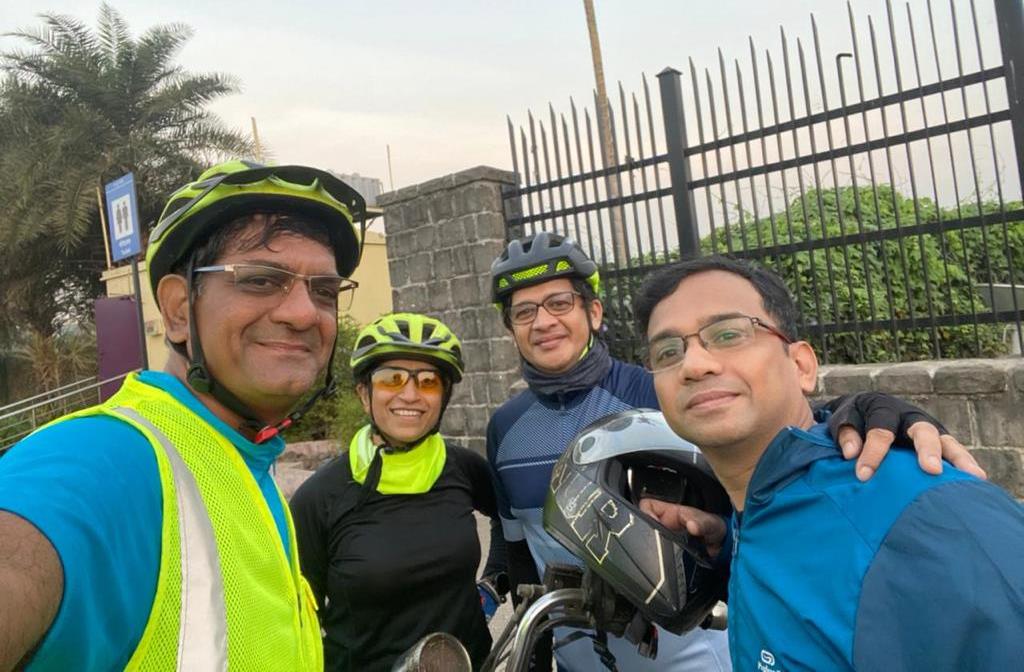
From the workshop (Photo: courtesy Kabir Rachure)

A structural engineer by profession, Parag Kulkarni, 48, used to be a recreational cyclist.Owner of a Giant road bike, he was a member of the ECC cycling community. The longest ride he had done ahead of the workshop was of 100 kilometers; it was a supported outing with ECC of 70 kilometers complemented by a 30km segment on his own. According to Parag, in the early stage of the workshop, the participants along with Kabir, did a slightly long ride covering Palm Beach and the nearby Parsik Hill. This gave Kabir an idea of where each trainee was in cycling; he was able to customize inputs for each in addition to the general sharing of knowledge, which every workshop entails. Parag participated in his first BRM roughly three months ago, a 200km-ride that he completed in approximately 13 hours. Going ahead, he wishes to attempt being a Super Randonneur. But for that, he feels an emergent problem in cycling has to sort itself out. One of his BRMs (a 400k one) had to be aborted because of a couple of punctures, including one that ripped the tyre. Parag managed to hire transport and get himself and cycle back to Navi Mumbai. Unfortunately in the months after lockdown’s relaxation, the sudden surge in cycling and bicycle purchases had created a shortage of bikes and spare parts. Good tyres have become difficult to procure. It took him a couple of weeks to find a replacement for the damaged tyre and that meant no cycling for the period. The difficulty in finding spares also means that amateur cyclists pushing their limits may have to do so conservatively, for damaged parts are currently tough to replace.

Anup T. V was among the more experienced of the trainees. The 41 year-old forex dealer working with Kotak Mahindra Bank and residing in Sanpada, is a triathlete with a few Ironman events under his belt. It was around three years ago that he bought his first bicycle – a Firefox Rapide hybrid. The decision to take up cycling was mainly to check weight gain. He also became a member of ECC. In the ensuing months, he was one of the attendees at the talk hosted by ECC featuring Amit Samarth and Kabir; the former had completed both RAAM and Trans Siberian Extreme while the latter was preparing for RAAM. “ A day after this talk, I signed up for my first triathlon – the Ironman 70.3 held in Dubai in 2019,” Anup said. The journey to that event saw him acquiring a second bicycle, a road bike – Scott Addict 30. Following the Dubai Ironman, Anup participated in the 2019 Ironman Goa and a triathlon of 70.3 dimensions in Kolhapur. The last Ironman event he competed in was in New Zealand. Held in March 2020, it was a case of leaving an India before lockdown, competing in New Zealand and then returning to an India and world altered by the pandemic-induced lockdown. With ECC, Anup had done rides of 100 kilometers and more. Back in 2018 he also did a 200km-BRM on his hybrid bike, covering the distance in roughly 13:15 hours. During the course of the workshop, Anup did two BRMs of 200km each – from Navi Mumbai towards the Pune side, up Bhor Ghat and back. The first one he completed in approximately 10 hours, the second in 11 hours. Later he did a 300km-BRM in roughly 15:10 hours and a 400km-BRM in 23:15 hours. In November 2021, he plans to participate in the 600km category of the Deccan Cliffhanger, an event used as a RAAM-qualifier by many. Interestingly, despite his ability in cycling, Anup’s focus is not ultra-cycling; it is the triathlon. He has set his eyes on an upcoming Ironman in Lanzarote, Spain, which is reputed for its tough cycling leg. “ I would like to keep doing an Ironman every one to one and a half years,” he said.
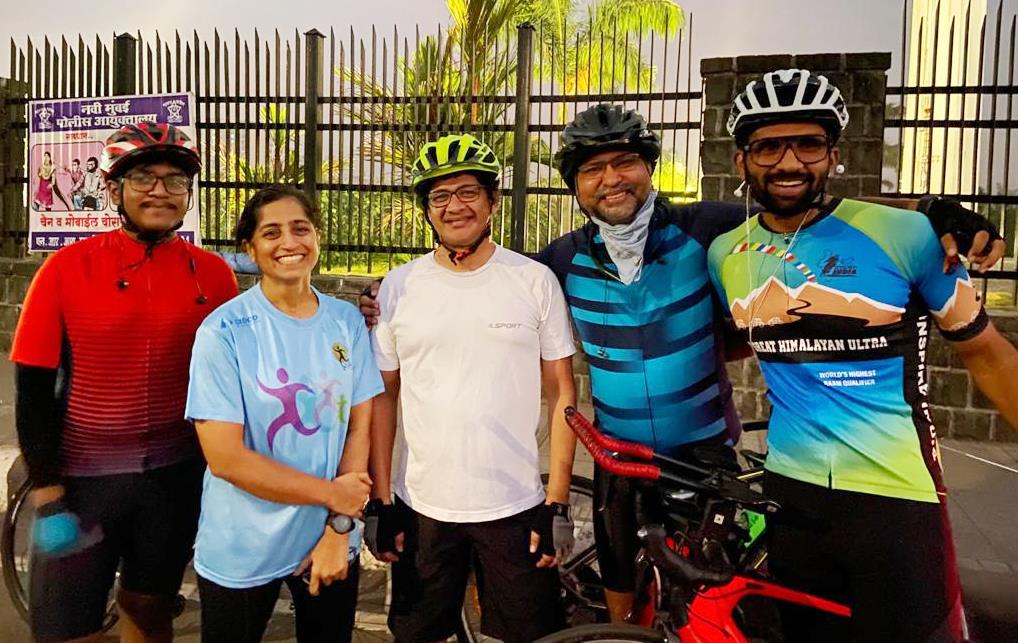
From the workshop (Photo: courtesy Kabir Rachure)

Seventeen year-old Lenin Kennedy was the youngest trainee at Kabir’s workshop. Until then, he had been the regular recreational cyclist-sort, taking his bike out once or twice a week for rides approximating 20 kilometers on Palm Beach. Owner of a Dodge hybrid cycle, he was also a member of ECC and with the group, had done rides that were 50-70 kilometers long. The workshop has taken his relationship with cycling to another level. While many of the other participants at the workshop proceeded to participate in BRMs, Lenin couldn’t as his age didn’t make him old enough to enroll for one. So the youngster had his own 200km-ride on Palm Beach, which he completed in roughly nine hours. “ I am now interested in getting into professional cycling. I wish to take part in road races,” he said.

Fifty two year-old Prabhat Paranjpe, a telecom professional working with Reliance, has been a recreational cyclist for the past six years or so. His bike is a Trek 3 series MTB, purchased in 2013-14. “ I used to be a weekend rider,” Prabhat said. His rides usually covered around 50 kilometers; “ 25 kilometers one way,” as he put it. From Navi Mumbai, he used to ride in the direction of South Mumbai, Thane and Kalyan. A member of ECC, on his rides with them he cycled a bit longer. “ I didn’t know much about BRMs,” he said. What drew him to the workshop was a simple instinct. During group rides with ECC he had noticed others who were better  than him at cycling longer and faster. He wished to improve. He also wanted to give himself adequate motivation to graduate from being merely a weekend rider to somebody who cycled more regularly. “ I was hoping to bring in some discipline and knowledge,” he said. That seemed possible with the workshop because it was scheduled to be at least a month long affair (it eventually lasted some more to accommodate Kabir’s commitments as a cyclist). During the course of the training program, Prabhat did two rides that were longer than any he had attempted before. He did his first 100k ride; Vashi-Khalapur-Vashi, which he completed in roughly five and a half hours. The next was supposed to be a 200k BRM but Prabhat required some customization. The route of the ride from Navi Mumbai included the Bhor Ghat, which lay on the approach to Lonavala. Given he was on a heavier MTB with 21 (7×3) gears to boot, Prabhat was doubtful of how he would fare within the paradigm of a BRM. So Kabir suggested an alternative – accumulate 200 kilometers by riding from Navi Mumbai to Kasara and back. This Prabhat did; he covered the distance of 205km in approximately 13 hours, stops included. Unfortunately after the workshop, there was a minor loss of momentum in Prabhat’s cycling as the months of January and February had to be surrendered to business travel and recovering from illness. Past mid-February 2021, he said, “ I have just got back to cycling. I did a 50k this weekend and should be doing a 100k next weekend.” Not one to chase timings and such, he seemed interested in solo, self supported tours on his bicycle. “ Maybe I will ride to Pune next,” he said. 
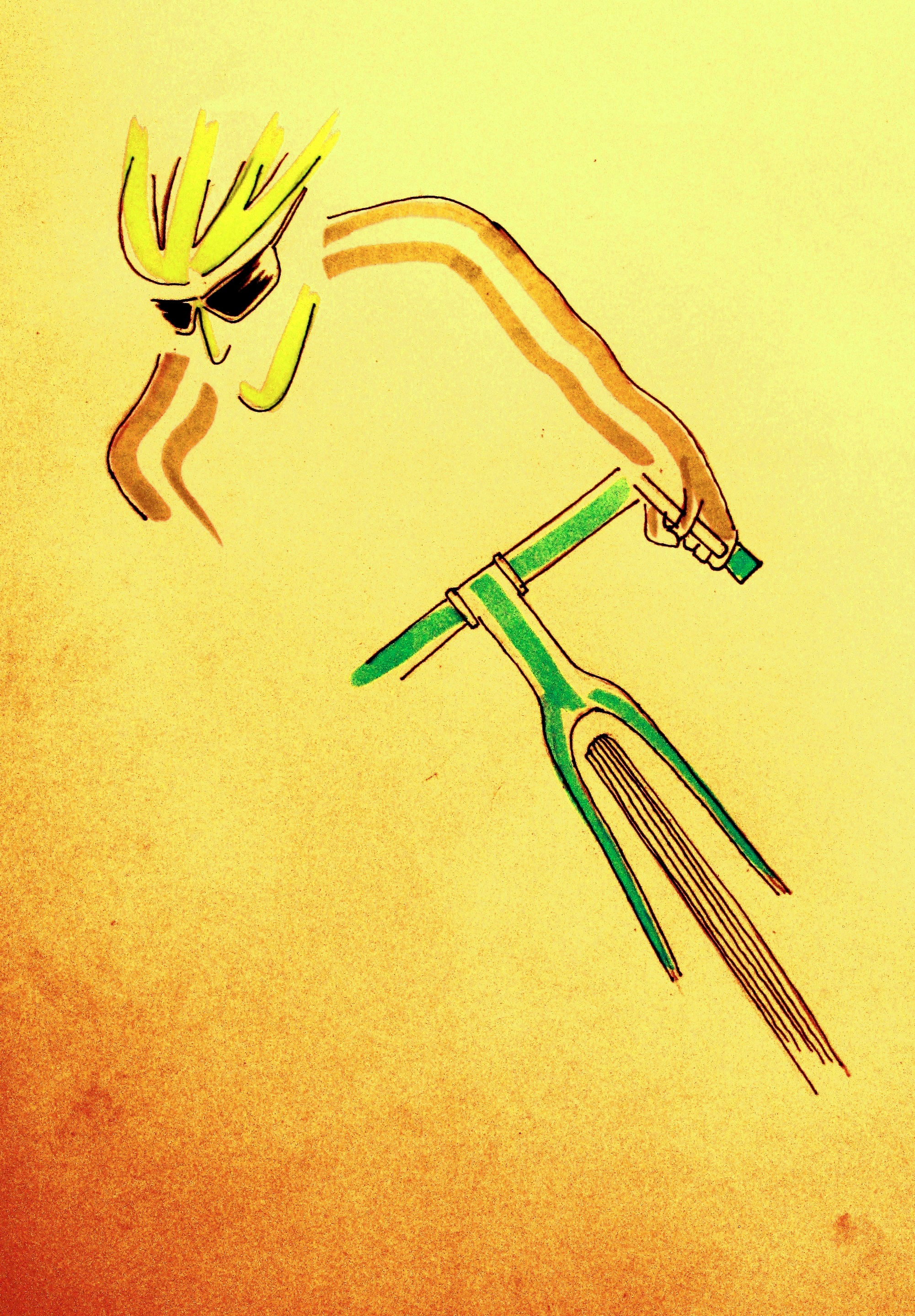
Illustration: Shyam G Menon

From the conversation with Kabir, a visible streak in the training process appeared to be sharing of his personal experience and nudging people towards attempting BRMs. As he pointed out, the physical ability to cycle is there in most people; what varies is the personal experience gained from cycling long and hard. That is what ultra-cyclists like him bring to the table at a workshop. Years of training and pedaling long distances have given them insight into how to endure extended hours on the saddle and tackle various situations related to person and bike as they evolve. In the latter context, the encouragement to try BRMs makes sense because they are self-supported rides; the rider has to manage challenges en route himself / herself. But in addition to the above and the general satisfaction he got from helping fellow cyclists improve, there was probably another reason why Kabir elected to coach. Although he and others from his generation in cycling continue to dominate ultra-cycling events in India, the gap between them and the next wave of talent has been narrowing. Kabir thinks that in general, the basin for this talent currently runs through Mumbai-Navi Mumbai, Nashik, Pune and Bengaluru. These are regions that have produced prominent names in ultra-cycling (riders and coaches), around who, other cyclists have since clustered or grown. Each successive wave of talent rides in having benefited from more opportunities to cycle and improve, than the generation before it. So at some point, it is inevitable that new names will hog the podium. Nobody wins forever. What genuinely endures in such reality is one’s accumulated bank of experience as a cyclist. It makes sense to share it.

(The author, Shyam G Menon, is a freelance journalist based in Mumbai.)    
AT A GLANCE / FEBRUARY 2021

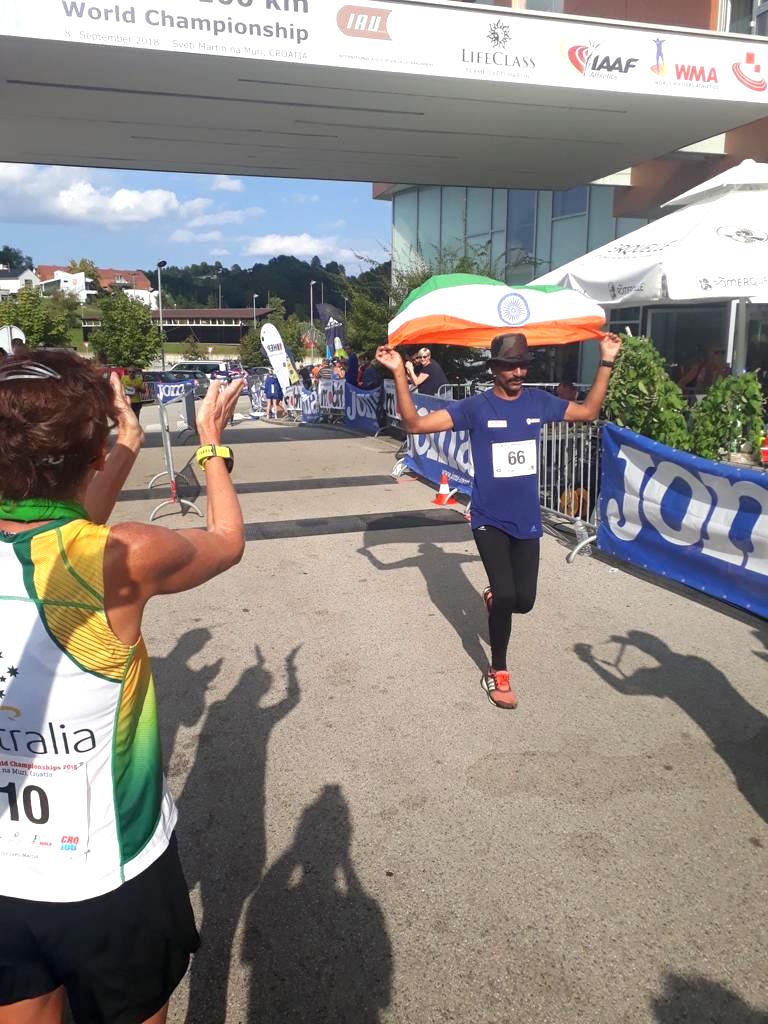
L L Meena (right, with the Indian flag) Photo: courtesy Sunil Chainani

Ultra-runner L. L. Meena passes away

Noted ultra-runner, L. L. Meena, passed away on February 10, 2021, following a battle with cancer.

Meena, who worked with the Indian Army had turned 39 on February 1. He had been running ultra-distance races for the past several years and had represented India in both the 2018 100 kilometer IAU World Championships in Croatia and the 2018 24-hour IAU Asia & Oceania Championships in Taipei.

“ He was running ultra-distance races much before India started sending teams to represent the country in international championships,” Sunil Chainani, member of the Ultra Running Committee of Athletics Federation of India, said. At the Taipei event, he pushed himself over the last couple of hours to help India secure the bronze medal. He was among the three top Indian finishers, the others being Ullas Narayana and Sunil Sharma, Chainani said. The team medal is decided on the performance of the top three runners. The Indian team was represented by six runners at that event.

Many ultra-runners remember Meena as a kind, genuine, compassionate, extremely helpful and down-to-earth person. He was known to be very supportive of runners. “ In Croatia, we had rented a large apartment for the event. Meena would cook for all of us,” Sunil Chainani remembered. “ He was extremely supportive and a very positive person. You won’t find another ultra-runner like Meena. We ran together at many events,” Pranaya Mohanty, ultra-runner, said. 

“ He was a very selfless individual,” Anjali Saraogi, ultra-runner, said. Meena used to call people without fail, on festival days and their birthdays, to wish them. She remembered in particular the support he offered at the 100 kilometer IAU World Championships in Croatia. Anjali came into this event as a comparative novice. “ Meena had already done many ultra-runs and stadium runs. He used to call me and provide tips and suggestions on how to prepare. He was protective and encouraging,” she said. In the run up to the event Anjali came down with dengue fever. Result – on the day of the competition, as the run got underway, she found herself really challenged. “ I was suffering. The competition in Croatia was held on a loop. There were many instances when Meena and I passed each other on that loop. At each instance, he would overlook his own suffering and encourage me,” Anjali said, pointing out how Meena never lost sight of the team. “ His passing is a big loss for the Indian ultra-running community,” she said.  

According to those who knew him well, the type of cancer Meena suffered from was tough to overcome. It was detected in the second stage. Both the news of Meena’s ailment and his eventual passing, reached the running community late. Chander Kandpal is among those who knew Meena well. He comprehended the situation obliquely at the 2020 New Delhi Marathon. At one of the hydration points en route, he came across Meena cheering and supporting the runners. Chander noticed the typical signs of chemotherapy on Meena; that was how he got to know of the predicament. “ He used to come to Delhi for treatment. After the diagnosis, which I think was sometime in August 2019, Meena didn’t participate in any event. But he would turn up to cheer and support others,” Chander said, adding, “ anybody can be a good runner but being a great human being, that is not possible for everyone. Meena was just that. He was the finest human being in the ultra-running community.”  

New national records in 20km race walk

Sandeep Kumar (Haryana) and Priyanka Goswami (Uttar Pradesh) became the first Indian athletes to qualify for next year’s World Athletics Championships Oregon22 when they broke the national record in the 20km race walk for men and women respectively, a press release dated February 13, available on the website of Athletics Federation of India (AFI) said.

The event concerned was held on a 1km-loop on Morabadi Road in Ranchi.

“ Together with Rahul Kumar, who finished second in the men’s event, they also qualified for the Tokyo Olympic Games to be held later this year. Both men are athletes from the Army Sports Institute They took the number of Indian race walkers who have made the grade to five, joining K T Irfan and Bhawana Jat.  Their efforts have raised the number of Indian qualifiers to 14 so far,” the release said.

Results:

Men 20km walk: 1. Sandeep Kumar (Haryana) 1:20:16 (new national record / old: 1:20:16, K T Irfan, London, 2012 and Devender Singh, Nomi, 2016); 2. Rahul Kumar (Haryana) 1:24:41; 3. Hardeep (Haryana) 1:47:47.

Women 20km walk: 1. Priyanka Goswami (Uttar Pradesh) 1:28:45 (new national record / old: 1:31:29, Baby Sowmya, Delhi, 2018; awaiting ratification 1:29.54, Bhawana Jat, Ranchi, 2020); 2. Bhawana Jat (Rajasthan) 1:32:59; 3. Sonal Sukwal (Rajasthan) 1:36:05.

List of ultra-runners for Global Solidarity Run announced

A press release from the Athletics Federation of India (AFI), dated February 26, 2021 and available on the organization’s website, disclosed the list of ultra-runners selected for the IAU & AFI 6 Hour Global Solidarity Run to be held on 21st March 2021.

According to the release, the following athletes have been selected to run the IAU 6 Hour Global Solidarity Run, slated for 05:30 AM – 11:30 AM IST on the aforesaid date:

Men: Binay Kumar Sah, Sunil Sharma, Amar Singh Devanda, Velu P, Praveen Kumar, Geeno Antony, Amit Kumar, Sampath Kumar Subramanian and Ajit Singh Narwal.

Women: Preeti Lala, Ashwini G, Anju Saini and Aparna Choudhary.

The following athletes have been selected to run the AFI 6 Hour Solidarity Run, also scheduled for the same date, same time:

Men: Badal Teotia, Saurav Kr Rajan, Manoj Bhat and Pranaya Pratap Mohanty

“ In addition, the committee will also invite ultra-runners meeting the criteria to participate in the AFI 6 Hour Solidarity Run,’’ the release said.

(The authors, Latha Venkatraman and Shyam G Menon, are independent journalists based in Mumbai.)

2021 TATA MUMBAI MARATHON SCHEDULED FOR MAY END

Flashback / pack of elite runners from the 2019 edition of Tata Mumbai Marathon (Photo: by arrangement)

The 2021 Tata Mumbai Marathon (TMM) is scheduled to take place on 30th May.

A related statement dated February 9, 2021, available on the website of the event organizer concerned, Procam International, said, “ with cautious optimism and hope, this decision has been taken after deliberation and collaborative efforts with the state and civic authorities, including the Indian and International Athletic bodies. Guided by the prevailing government protocol, Procam International will look to conduct the on-ground event, with limited participation in the Full Marathon, Half Marathon and 10 Km runs. While limited numbers will run from their scheduled location, participants from across India and the world, will be able to run as one with TMM from a location of their preference, via the official TMM 2021 App.”

The event organizer will continue to monitor the situation keeping the safety of participants and support staff in mind, the statement added.

“ Details including format of the race, registration details, safety measures, protocols, and participant requirements will be shared at a later date,” the statement said.

While the last edition of TMM happened in accordance with the normal practice of holding it in January, the months thereafter till now were affected by pandemic, lockdown and the phased process of restoring old normalcy through progressive relaxation of lockdown. In India, from among major events in running, only the 2020 Airtel Delhi Half Marathon (ADHM) and the 2021 Chennai Marathon managed to host truncated physical versions; the rest were cancelled or had to stay content with virtual formats. However, following the Chennai Marathon which featured several hundred amateur runners on a race track away from the city, the momentum has been slowly building. For instance from the world of ultra-running, over January-February, stadium runs were held in Bengaluru and Mumbai. In March, the Ageas Federal Life Insurance New Delhi Marathon is scheduled to take place in the national capital.  

(The author, Shyam G Menon, is a freelance journalist based in Mumbai.)
PREETI LALA WINS 24 HOUR MUMBAI STADIUM RUN

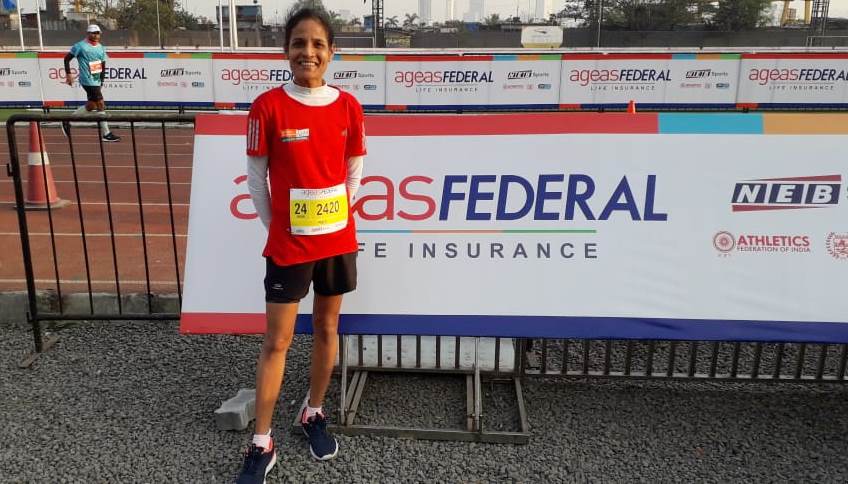
Preeti Lala (Photo: courtesy Preeti)

Deepak Bandbe wins in 100 km category

Preeti’s mileage is the second best by an Indian woman in the 24-hour category so far

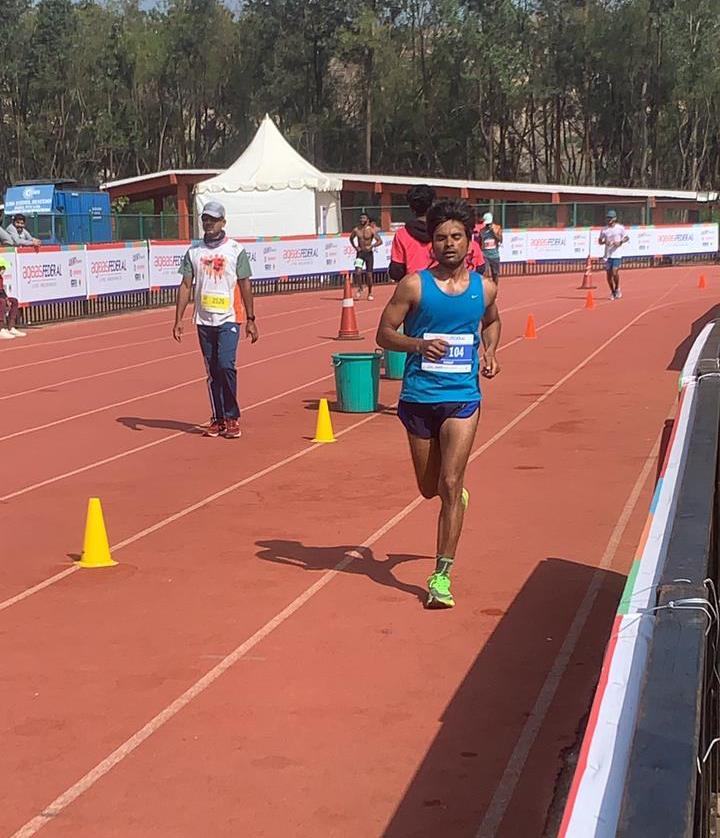
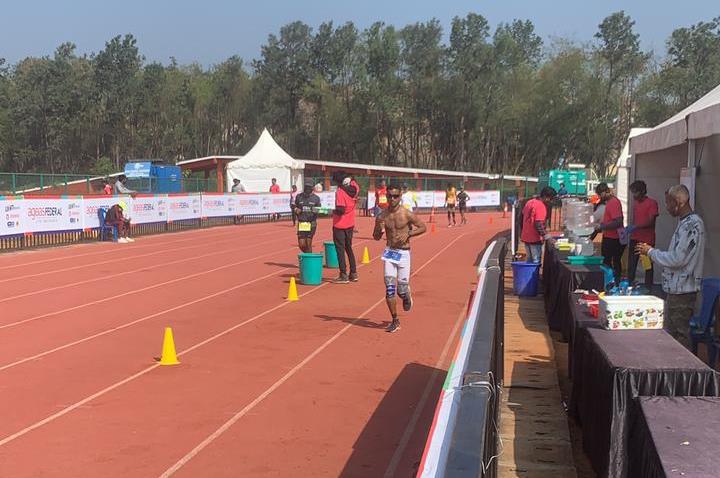
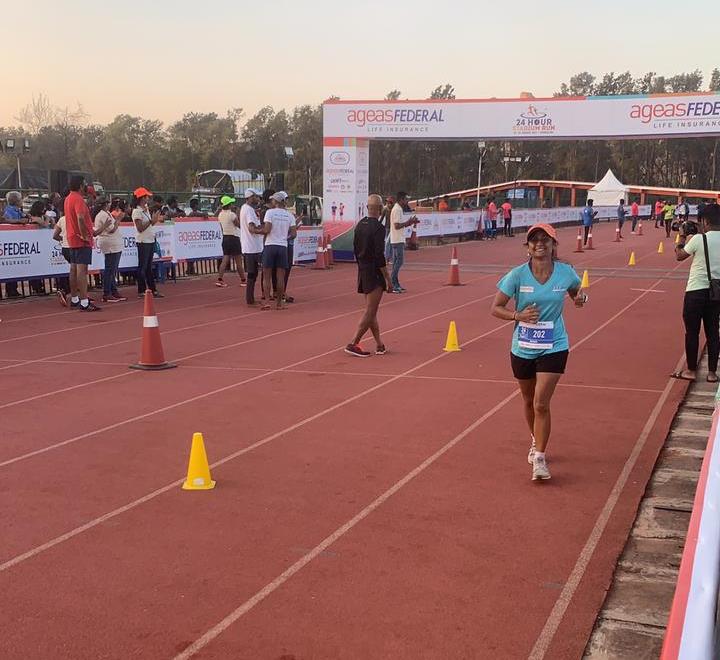
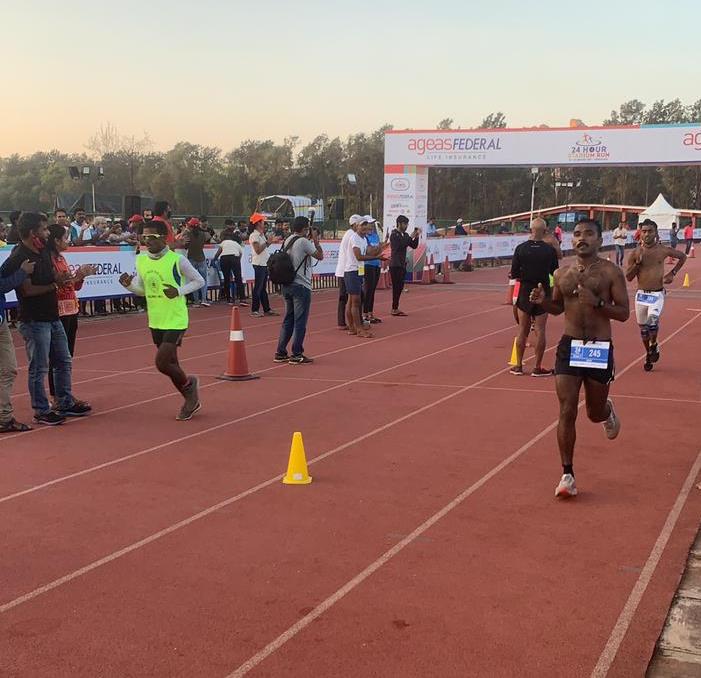
Preeti Lala emerged the overall winner of the Ageas Federal Life Insurance 24-hour Stadium Run held in Mumbai over February 6-7, 2021.

Thane-based Preeti, the sole woman running the 24-hour race category at the Mumbai event, finished way ahead of the rest of the field, covering a distance of 193.60 kilometers during the allotted time of 24 hours. It is the second best by an Indian woman in the race category so far. It was also the maximum distance covered across both genders in the given race category, at the Mumbai stadium run. 

Apoorva Chaudhary holds the national best of 202.212 km, set during the 2019 IAU 24-hour World Championships held in Albi, France. During the same event, Priyanka Bhatt had finished with a distance of 192.845 km. It is this mark that Preeti has bettered.

In the 24-hour category at the Mumbai event, Parwinder Singh was the winner among men with 154 km covered. Buddhi Saini finished second (151.60 km) and Munir Kulavoor third (150 km).

Deepak Bandbe, running in the 100 km category at the Mumbai event, finished the race in seven hours, 57 minutes and 47 seconds. It is the third best finish so far for Indian men in the 100 km category.

Sandeep Kumar had set the national best in 100 km – 7:56:22 – at the Bengaluru Stadium Run held on January 23 and 24, 2021. At the same meet, Abhinav Jha had secured the second best male performance in the same category with a timing of 7:57:35.

In the 100 km category for men in Mumbai, Nilesh Yadav finished second with timing of 8:27:28. Aaditya Dattaram Badavate placed third with 9:24:20. In the 12 hour-category, Sandel Kisan Nipane (120.80 km) was the winner among men. He was followed by Raman Baisla (119.60 km) and Ankur Lakhera (112.80 km). From among women, the winner was Reena Maru (98.40 km). She was followed by Mahek Makhija (95.60 km) and Corina Van Dam and Pooja Varma (both 82.80 km). The Mumbai event was organized by NEB Sports.

Preeti started her run at 6PM on February 6, 2021. “ I did not have any target except that I wanted to be on my feet for the entire 24 hours,” she said.

Deepak Bandbe (Photo: courtesy NEB Sports)

Participants were few as there was uncertainty about the event taking place, she said. Training could have been better but the uncertainty affected it. Still, she had moderately good training sessions for three months with average mileage of 100-120 kilometers per week.

Over 2020, training for most runners was impeded by the lockdown due to the COVID-19 pandemic. Preeti’s last run before the lockdown was in the 50 km category at Tata Ultra of February 2020.

Getting back to training after the lockdown induced-break, Preeti chose to run the Run to the Moon challenge organised by NEB Sports. “ The challenge required us to run a distance of 2 km to 10 km daily. This helped me get back into rhythm,” she said. She also participated in TCS 10k virtual run.

“ I am happy that the event (Mumbai Stadium Run) took place finally. The weather was mostly humid especially during the night but early mornings were quite cool. We had several hours of scorching sun,” Preeti said.

“ The excellent arrangements at the venue with volunteers and runners supporting me during the race, helped immensely,” she said.

Apeksha Shah and her husband, both runners, provided substantial support to Preeti. “ Also, Pranaya Mohanty, ultra-runner from Bengaluru, ran with me for the last 20 km,” she said.

(The author, Latha Venkatraman, is an independent journalist based in Mumbai.)

A COVER TO COMPLEMENT THE ORIGINAL

Photo: Rajeev G / Imaging: Shyam G Menon

Doing the cover version of a song can be as engaging as you wish it to be. Some artistes aspire to keep it true to the original; others offer their own interpretations. Both approaches have unique challenges. In the first, there is the challenge of nailing things perfectly, to the last detail. In the second, you must get your interpretation right; right in terms of either how enjoyable the resultant music is as distinct creation or how resonant of the original the overall reinterpretation is despite degrees of departure. It is a balancing act.

Many of us have an all-time favourite song; something that we love because it completes us and our view of life, lyrically or as soundscape. For long, that song for me, has been U2’s I Still Haven’t Found What I’m Looking For. I loved it from the day I heard it for the first time, in 1988, when a program on the nominees for the year’s Grammy Awards was broadcast on television in India. Courtesy it’s weird yet comforting rhythm and signature bass line, the song helped channelize the restlessness in the listener into a joyful sense of movement, a journey. The lyrics then proceeded to build a beautiful cathedral in the mind. Unlike so many other rock songs which end up anchored in earthly concerns and entanglements within the human collective, this one stayed spiritual and therefore, a song for the years. The influence of gospel music in the song was something I discovered much later in the age of Google and Wikipedia. What endeared it to me was the theme of not having found what you are looking for; the notion of a continuing quest.

A cover version of this U2 song is tough to do, especially one featuring reinterpretation. The original set the bar high and moulded expectations comprehensively. Room to manoeuvre is limited. How do you use so little space to shift things around and yet make a statement, uniquely your own? In early January 2021, on YouTube, I came across the cover performed by K. T. Tunstall and Pomplamoose. It was remarkable; they had a style and sound that was distinct without losing the spirituality and sense of journeying of the original. As mentioned, the original was special for Larry Mullen Jr’s unforgettable drumming and the beautifully supportive contributions by the other members of U2. The Tunstall-Pomplamoose version is less radical as it essentially builds on a fantastic original but it holds its ground, courtesy excellence in vocals, engaging bass and an airy texture that retains the song’s overall feel.  

(The author, Shyam G Menon, is a freelance journalist based in Mumbai.)
VELU PERUMAL, PRIYANKA BHATT, SANDEEP KUMAR WIN AT STADIUM RUN IN BENGALURU

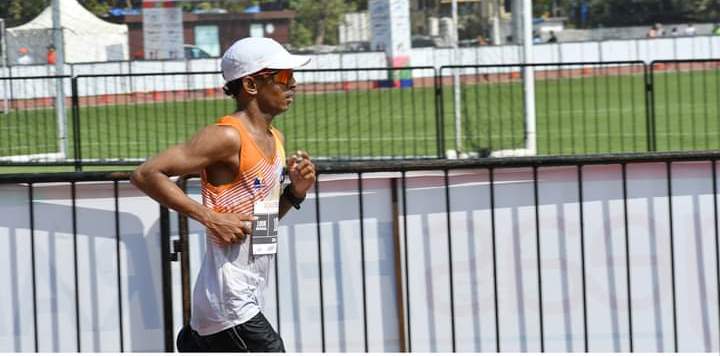
Sandeep Kumar (Photo: Sunil Chainani)

Velu Perumal and Priyanka Bhatt won in the 24-hour category for men and women respectively, at the 24-hour Stadium Run in Bengaluru on January 24, 2021.

Velu, an ultra-runner from the Indian Army, covered a distance of 224.4 kilometers during the assigned 24-hour period. Priyanka, who is from Mumbai, covered 187.2 km. The event was organized by NEB Sports.

In the 24-hour segment, Geeno Antony placed second with a distance of 219.6 km. Parveen Sangwan finished third covering a distance of 219.54 km. Among women, Anju Saini finished in second position with 183.2 km to her credit; Aparna Choudhary placed third with a distance of 182.4 km.

Velu Perumal (Photo: Sunil Chainani)

In the 100 km category, the winner was Sandeep Kumar, ultra-runner from Surat. He finished the distance in seven hours, 56 minutes and 22 seconds, a new national best (the previous national best in the discipline in an IAU label race was 8:04 by Deepak Bandbe; it was set at the 2019 IAU Asia and Oceania Championships in Jordan). Naval officer Abhinav Jha finished second with a timing of 7:57:35 hours. In third position was Vipul, finishing in 8:10:38 hours. There were no women runners in the 100 km category.

Priyanka Bhatt (Photo; Sunil Chainani)

In the 12-hour category, Taru Mateti won the women’s race covering a distance of 87.98 km. Syed Atif won the men’s race with distance covered of 120.76 km.

The weather on the day of the event was not very conducive for participants. There was no cloud cover; it remained sunny for most part of the day. This time around, the stadium run was held at the DYES (Department of Youth Empowerment & Sports, Karnataka government) sports facility at Vidyanagar, Bengaluru.

Thirteen runners qualify for IAU Championships

At the stadium run, six male runners achieved the qualifying time required for IAU Asia & Oceania 100 km Championships to be held in September 2021 in Bengaluru.

Geeno Antony ; right foreground (Photo: Sunil Chainani)

These include Sandeep Kumar, Abhinav Jha, Vipul Kumar, Suman Kumar Mishra (8:15:43), Amar Singh Devanda (8:26) and Saurav Ranjan (8:51:10).

Four women runners and three men have secured qualifying timings for the IAU World 24-Hour Championships to be held in Romania later this year. The women runners are Priyanka Bhatt, Anju Saini, Aparna Chaudhary and Ashwini Bhat (180.8 km). This was Ashwini’s first shot at the 24-hour format.

The male runners are the three leading finishers of the 24-hour race – Velu Perumal, Geeno Antony and Parveen Sangwan.

(The author, Latha Venkatraman, is an independent journalist based in Mumbai.)

AT A GLANCE / JANUARY 2021

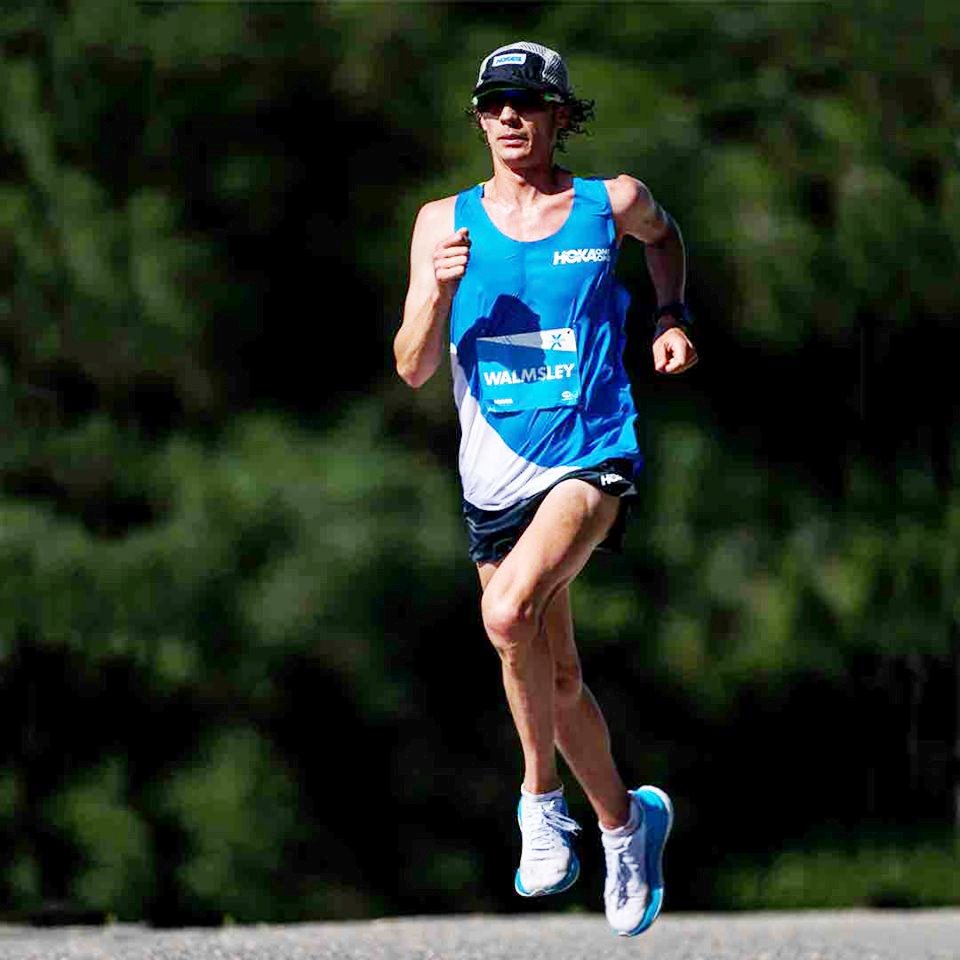
Jim Walmsley (This photo was downloaded from the athlete’s Facebook page)

100K / Walmsley misses world record by 11 seconds

Ultramarathon runner, Jim Walmsley of the US, broke the American record but narrowly missed setting a new world mark in the 100k at the Project Carbon X 2 event organized by Hoka One One in Chandler, Arizona on January 23, 2021.

Walmsley covered the distance in 6:09:25. The world record of 6:09:14 set in 2018 is held by Japan’s Nao Kazami. The previous American record was 6:27:44, set by Max King in 2014, Runner’s World said in their report on Walmsley’s performance.

At the Chandler event, the runner finishing second behind Walmsley was Rajpaul Pannu. He finished in 6:28:31. According to an article in Runner’s World dated June 4, 2019, Pannu made his marathon debut in a timing of 2:17:06 at the 2017 California International Marathon; it gained him a berth for the 2020 US Olympic Marathon Trials. At the subsequent trials, he finished 63rd, the magazine’s report on the Chandler event, said. For more on Pannu, please click on this link to access the Runner’s World article: https://www.runnersworld.com/runners-stories/a27632323/rajpaul-pannu-olympic-marathon-trials-qualifier/

The women’s race was won by Audrey Tanguy of France; her timing was 7:40:36 (source: Athletics Weekly).

Indian runners dominate SAAF elite category of 2021 Dhaka Marathon

Indian long distance runners dominated the SAAF (South Asian Athletics Federation) elite category of the Bangabandhu Sheikh Mujib Dhaka Marathon held on January 10, 2021. The said category covers runners from SAARC (South Asian Association for Regional Cooperation) countries.

In the women’s section of the SAAF elite category, Jyoti Gawate of India secured second position covering the distance in 3:00:16 hours. Fellow Indians Divyanka Chaudhary (3:07:41) placed third and Jigmet Dolma (3:09:41), fourth. The category was won by Nepal’s Puspa Bhandari in 2:59:41. 

In the men’s segment of the SAAF elite category, the top three positions were swept by Indian runners. India’s Bahadur Singh Dhouni (2:21:40) topped the segment. Second place went to Rashpal Singh (2:21:41). Het Ram (2:25:23) finished third while Manvendra Singh (2:36:48), also of India, finished fifth. Fourth place in the category went to Kiran Singh Bogati Rajwar (2:26:13) of Nepal.

According to a report in the Dhaka Tribune, the overall winner of the elite category was Hicham Laqouahi of Morocco; the winner in the women’s elite category was Angela Jemesunde of Kenya. Thirty five international runners including 23 elites from France, Kenya, Ethiopia, Bahrain, Belarus, Lesotho, Ukraine, Spain and Morocco and 12 from Maldives, Nepal and India, participated in the marathon.  Around 200 runners participated in the event organized by the Bangladesh Army, the report said.

Swimming pools permitted for use by all

In its latest guidelines for relaxing the lockdown triggered by COVID-19 last year, the central government has said that swimming pools will soon be accessible to all users.

Currently the use of pools is restricted to competition swimmers.

“ Swimming pools have already been permitted for use of sports persons. Now these will be permitted for use of all, for which a revised SOP will be issued by Ministry of Youth Affairs and Sports in consultation with MHA,” a Press Trust of India (PTI) report on the latest guidelines, published January 27, 2021 and available on leading news websites, said.

According to it, the new guidelines will be effective from February 1, 2021.

(The author, Shyam G Menon, is a freelance journalist based in Mumbai.)
CYCLING EVENTS RETURN

Illustration: Shyam G Menon

“ Getting back to cycling outdoors – that was a really good feeling. The air was less polluted and it was lovely to see greenery,’’ Anil Sharma, Chennai based recreational runner, cyclist and a coach for those aspiring to do the Ironman triathlons, said. Till his first forays onto the road after the lockdown was relaxed, he along with several others from Chennai Runners had kept busy working on their physical fitness with online sessions. He also cycled indoors using the home trainer.

Anil is a member of Madras Randonneurs. When lockdown struck in March 2020, the randonneuring calendar, which runs from November 1 to October 31, was curtailed. Randonneuring clubs in India try to do two to three Super Randonneur (SR) cycles. The classical SR cycle spans rides of 200, 300, 400 and 600 kilometers (if you do all these rides, you become a SR). In Chennai, two SR cycles are done – the first in the period from November to March and the second, during June to October. “ My club could do its planned 200 and 300 kilometer-BRM. But the 400 and 600 didn’t happen because by March we were into lockdown,’’ Anil, who has been SR five times, done BRMs of 1000 and 1200 kilometers and been to Paris for randonneuring’s coveted ride; the Paris-Brest-Paris (PBP), said. He managed to do a 200k ride in the early part of 2020 before life funneled into lockdown.

By the time lockdown eased to the extent that BRMs could reappear, randonneuring’s 2020 calendar was almost over. The rides of September were essentially to help those who had set out to be a SR in 2020, complete their mission. “ It was a bit like back to back; clearing a backlog,’’ Anil said. Now things are much better. As part of the first SR cycle of the new 2021 calendar, Anil’s club has already held its 200 and 300 kilometer-BRMs; the 400k was due later in January and the 600k is planned. He did a 200k and a 300k; the first with his club, the second with Trichy Randonneurs to Koli Hills near Salem. The hill has a series of punishing hair pin bends. Anil loved this ride. “ Trichy is special for randonneurs in Tamil Nadu. Brevets measured out from Trichy take you to interesting places. The club also hosts these rides very well. Riders from elsewhere turn up for Trichy’s brevets,’’ he said, adding, “ unless the government reintroduces restrictions citing the pandemic, I think cycling is more or less back to normal.’’ One of the great advantages cycling has in this regard is that rides like randonneuring’s BRMs naturally respect many of the safety protocols required in times of pandemic, the most obvious of which is that cyclists are usually at a safe distance from each other. “ Physical distancing happens naturally in cycling,’’ Anil said.     

Domestic cycling events have been making a comeback. “ We restarted BRMs in September 2020,’’ Divya Tate, founder director of Audax India said. Audax India is the all India organization of randonneurs; it is recognized by Audax Club Parisien to conduct and oversee Brevets de Randonneurs Mondiaux (BRMs – self-supported, non-competitive endurance rides) and other Audax events in the country. The recommencement of activity happened at the right time. After months stuck indoors following lockdown, cyclists were waiting for an opportunity to get out and pedal. The clubs associated with Audax India were advised to decide locally after consulting relevant authorities, Divya said. This way, safe decisions could be made.

There were instances of rides planned and then cancelled. For example in Pune, BRMs of 300 kilometers to 600 kilometers were scheduled for December 2020 but were later called off because the Maharashtra government decided to introduce night curfew. Overall, the shorter BRMs were the easiest to resume. Early January 2021, Divya told this blog that while BRMs spanning 100 kilometers to 600 kilometers were happening under various clubs, the longer ones – 1000 kilometers, 1200 kilometers and 1400 kilometers – were yet to take off and would likely remain on the backburner for some more time. As she pointed out, the hesitation is not so much with the cycling community which is eager to get back on the saddle. The reluctance is an angle that accompanies the act of organizing an event; that is when you gauge potential risk, realize that somebody has to accept responsibility for anything going wrong and design ride accordingly. Further, longer rides require an entire ecosystem ranging from shops to eateries and ATMs to be functional along the way. They help support the riders with hydration and replenishment; they also serve as checkpoints and proof of rider having cycled the assigned distance. This ecosystem isn’t still available as smoothly as before at several places.  

According to Divya, the response to the BRMs arranged after lockdown relaxed, has been encouraging. While existing cyclists were happy to avail the opportunity; new cyclists have also turned up. One of the engaging side effects of the pandemic worldwide was enhanced interest in cycling. Industry officials have ascribed this spike in interest with accompanying jump in sale of bicycles, to the search for environment friendly personal transport and the pursuit of fitness with the latter being the more prominent driver in the premium category. The sudden rise in sales was sufficient to clean up available stocks, strain the supply of bicycles and create never before seen waiting lists. Amidst this increased interest in cycling, the membership base of Audax India also grew, Divya, who lives in Pune, said.

Besides being founder director of Audax India, Divya heads Inspire India, an outfit that organizes long distance bicycle races including ultracycling events like the annual Ultra Spice. The 2021 edition of Ultra Spice is scheduled for February 6. The pandemic has left its imprint on the mix of races it will showcase this year. Over time, the event had been gradually moving towards longer races. For 2021, the event will have two distance categories – 600 kilometers and 1200 kilometers. The still longer category of 1750 kilometers will not be there as its route traverses four states: Goa, Karnataka, Kerala and Tamil Nadu. Retaining that long route appeared challenging in times of pandemic. The 2021 edition will be limited to routes traversing Goa and Karnataka. “ The response in terms of registrations so far, has been good,’’ Divya said.

Among Indian cities, Bengaluru is known for its tradition of monthly bicycle races under the auspices of Bangalore Bicycle Championships (BBCH) and Bangalore Amateur Racing (BAR). According to Venketeswara Rao Navanasi aka Bikey Venky, well-known cyclist and coach from the city, BAR had its first race in September at Hoskote. The response was encouraging as racing aficionados were waiting to get out and cycle. “ We followed physical distancing and the timing was done using Strava,’’ he said. The happiness in being out was evident in BAR’s Facebook post after the event. “ Awesome turnout today for the first BAR race since February for the two rider time trial this morning! Elbow-bump greetings replaced shake hands and fist bumps. Thankfully, the suffering on the bike and the cake at the end are a constant at our lovely community event! Thanks everyone for turning up and making it a huge success!’’ it said. At the time of writing, BAR’s next race was scheduled for January 10, 2021. BBCH had races in November and December 2020; its January 2021 edition revolved around an Individual Time Trial (ITT) on the 17th with a MTB race on the following Sunday. Venky who is among prime movers at BAR, planned to take things slowly; organize one race a month and wait for the environment to be reliably stable before introducing more. “ If the response to the races held so far is anything to go by, I believe things are slowly beginning to look up,’’ he said.     

(The author, Shyam G Menon, is a freelance journalist based in Mumbai.)      
2021 CHENNAI MARATHON HELD AS SCHEDULED

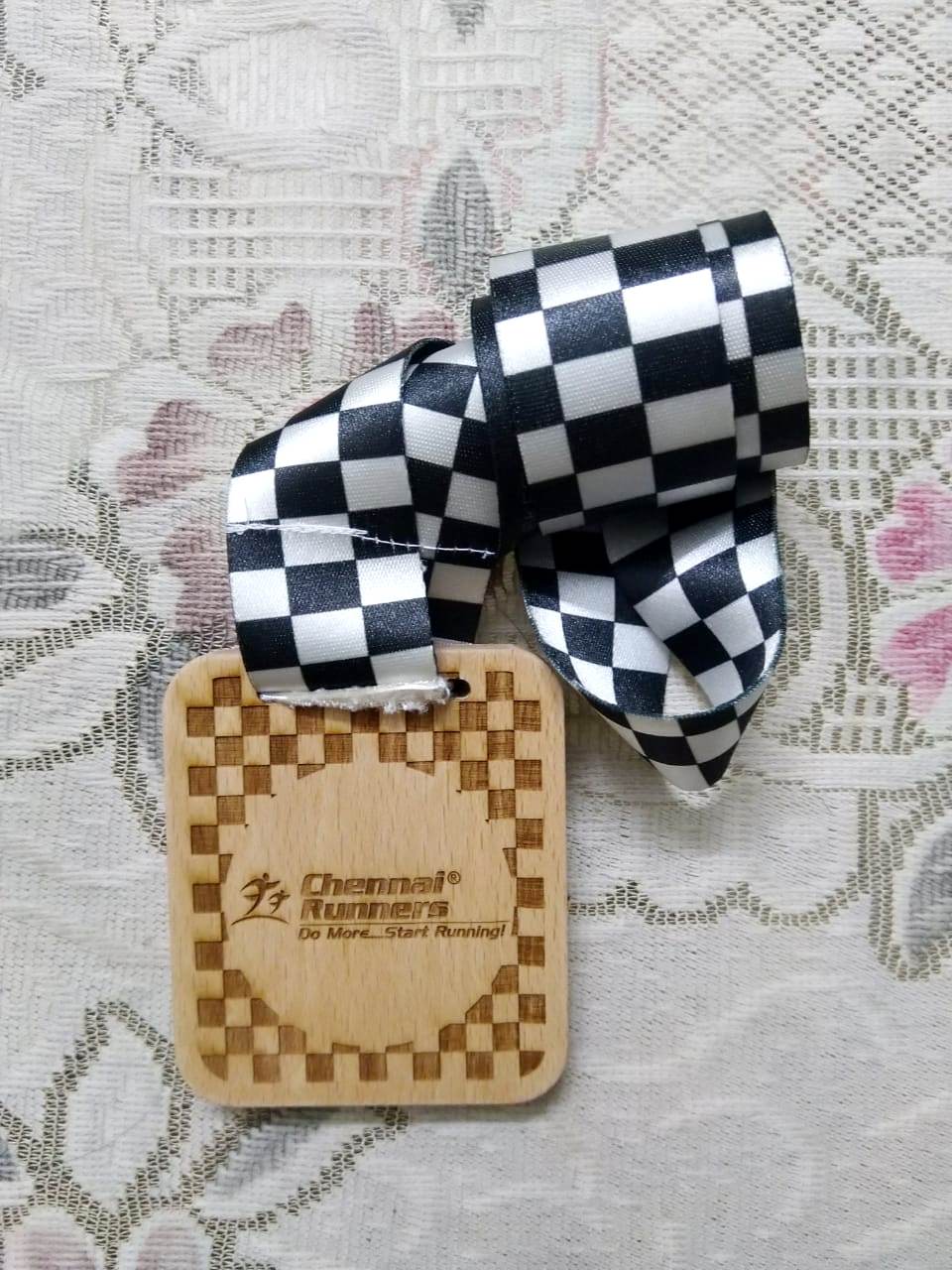
Finisher’s medal from the 2021 Chennai Marathon (Photo: courtesy Anil Sharma)

After months of no mass participation events and amateur running in general weighed down by the restrictions of lockdown, the New Year kicked off with a scaled down version of the 2021 Chennai Marathon held as scheduled early today morning (January 3).

“ The event went off quite well under the watchful eyes of officials,” V. P. Senthil Kumar, Race Director, Skechers Performance Chennai Marathon 2021, said. When asked about the number of runners who actually participated in the event, he said tallying that number would take a few days. Following the onset of lockdown in India in March 2020 and its subsequent phased relaxation, the 2021 Chennai marathon was the second major running event to put feet on the ground after the 2020 Airtel Delhi Half Marathon (ADHM) of November. However while ADHM’s physical race was a competitive elites-only affair held in the safety of a protective bubble, the Chennai Marathon was non-competitive, open to amateurs, conducted on a motorsports racetrack away from the city with COVID-19 safety protocols in place and capped to a maximum participation of 1000-1500 runners.

Among those who ran in Chennai was Bengaluru-based amateur runner, Thomas Bobby Philip. A regular podium finisher at the annual Tata Mumbai Marathon (TMM), he currently runs in the race’s 50-54 years age category. “ I didn’t find any of the safety measures in place intrusive,’’ he said when asked how the Chennai Marathon experience felt, compared to those from pre-pandemic days. He said that when he first heard of the event in Chennai and the return to some form of event-based running it promised, he was certain that he wanted to participate. “ It was a relief,’’ he said of event savored after months with none on runner’s plate. Bobby finished the full marathon in 2:57:12, which was better than his previous best timing at TMM – 2:57:40, registered in 2018. “ I don’t compare these timings as the conditions and circumstances are different,’’ Bobby said.

The Chennai Marathon followed the 3.4 kilometer-loop of a race track and atop the benefit of that contained environment, was also utterly pleasant for a barefoot runner like Bobby. “ The track served up one of the best barefoot running experiences I have had so far,’’ Bobby said. The course was fairly flat. According to him, the others from Bengaluru who got sub-three hour finishes were “ Tilak, Devi Shetty and Vinuth.’’ All of them belong to Pacemakers, the training group anchored by Coach K. C. Kothandapani. “ There were around 150 runners for the marathon, which started at 4.30 AM. You had to report to the venue 15 minutes ahead. Safety protocols were followed well and in the holding area we had circles marked on the ground for each runner to stand with adequate physical distancing from the other.  Government officials were present to make sure that protocols were followed,’’ Bobby said.

According to Anil Sharma, member of Chennai Runners, the organizers of the event, the idea of holding the 2021 Chennai Marathon began getting discussed – including with the authorities who would be granting the required permissions – around October 2020. The proposal was to hold an event with all COVID-19 protocols in place. The race track at Irungattukottai also offered a location outside city limits. “ The authorities were supportive,’’ he said.  Anil, who participated in the half marathon, provided an overview of the approach to the event. The first priority, given the times and conditions in which the event would be held, was to get a grip on the potential number of participants. It had to be manageable so that chances of infection may be limited. “ We introduced some restrictions including timing-based eligibility to participate. It ensured that those who registered were keen on running,’’ Anil said. Additionally participation was capped at a maximum of 1000-1500 runners. Bib collection was set for the day before the event and prior to collecting the bib, those registered and turning up had to get their temperature checked and provide a declaration that satisfied a checklist related to COVID-19.

On event day, upon reporting 15 minutes prior to the start time, there was another round of temperature check to secure entry. Masks were to be worn till the commencement of running. “ We had people on loudhailers frequently reminding participants to maintain physical distancing in the holding area,’’ he said. Volunteers also checked the same. Government officials were present to monitor the proceedings. On the 3.4 kilometer-race track two aid stations were made available for the runners. Post run refreshments were served in packets that the runners could pick up themselves; the same went for medals, which were hung on stands and could be picked up. There was a medical team and ambulance available for any health emergencies. “ We were a bit concerned about the race track ambiance because it offers no shade. The full marathon takes some time to complete and the half marathon was starting roughly two hours after the marathon had commenced. There was a chance of running in bright sunshine towards the concluding stages. Luckily, the day stayed cloudy,” Anil said. 

It is understood that at least one other major race organizer had a representative at the venue to observe the Chennai event, widely seen as an icebreaker for the slow return of road races. In December 2020, industry officials had mentioned that besides the 2021 Chennai Marathon there was an event in Hyderabad too slated for January.

(The authors, Latha Venkatraman and Shyam G Menon, are independent journalists based in Mumbai. This report is based on telephone conversations with the people spoken to.)     

2021

Illustration: Shakuntala Devi. A retired professor of botany living in Thiruvananthapuram, she likes to draw pictures of plants and flowers and in recent times has maintained a portfolio called: Through My Window.


Wish you a very happy New Year


Thank you for visiting this blog


Please continue to do so