Few races represent running like the Boston Marathon does.
As the 2022 edition of Boston Marathon returns to its April schedule, long-distance runners around the world are getting ready to travel for international road races. They hope the upcoming race – it is being held on the race’s traditional date – signifies the return of normalcy to running events worldwide after the calendar of races was upset by the COVID-19 pandemic.
The Boston Marathon, in its 126th year, is scheduled to be held on April 18, 2022, its first rendezvous with Patriot’s Day in three years. Held every April, the event inspires hundreds of runners around the world to qualify for it and participate. The 2020 edition was cancelled due to the coronavirus pandemic and was held in a virtual format later in the year. The 2021 edition was held in physical format in October 2021 with Kenyan elite runners taking top honors.
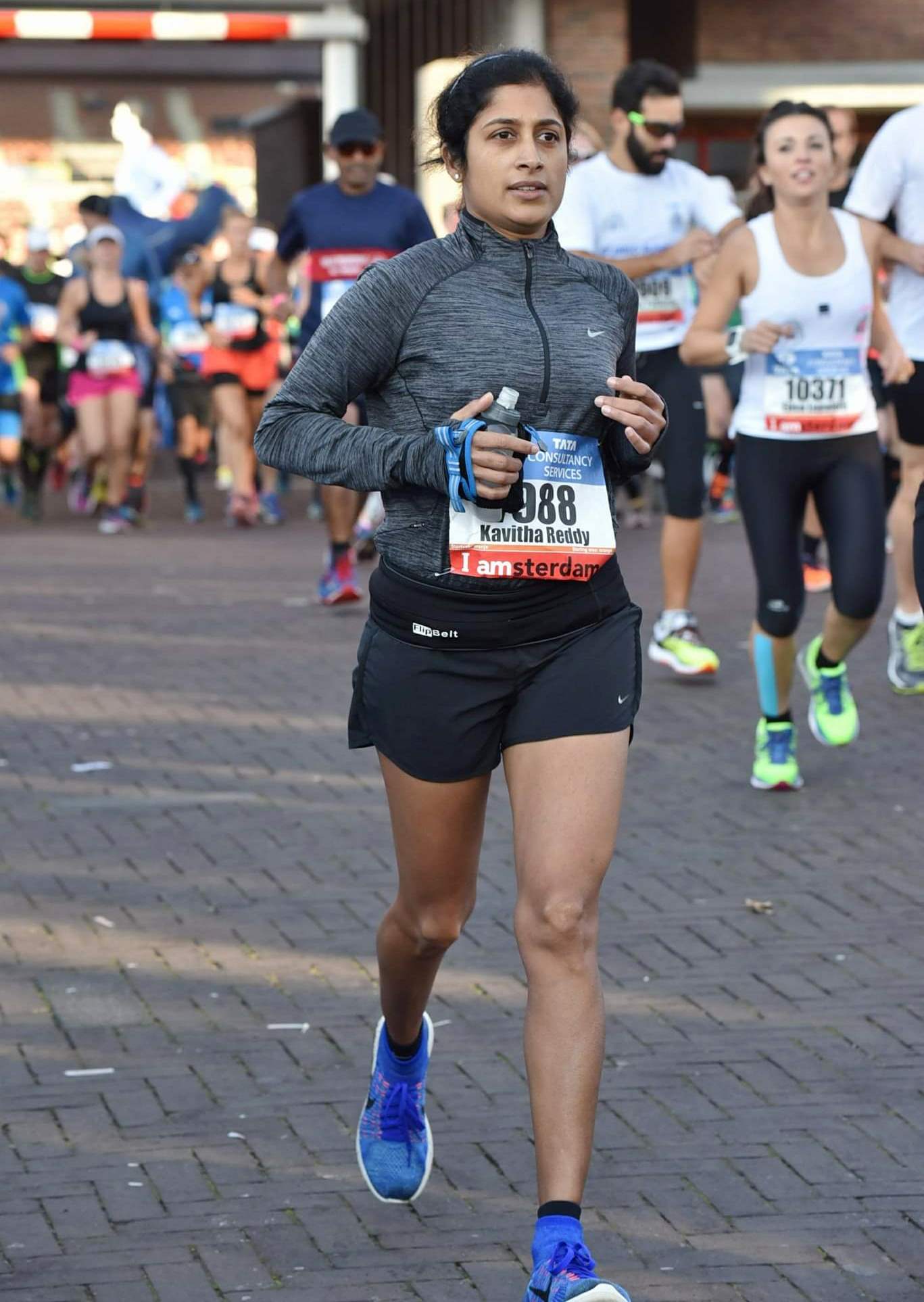
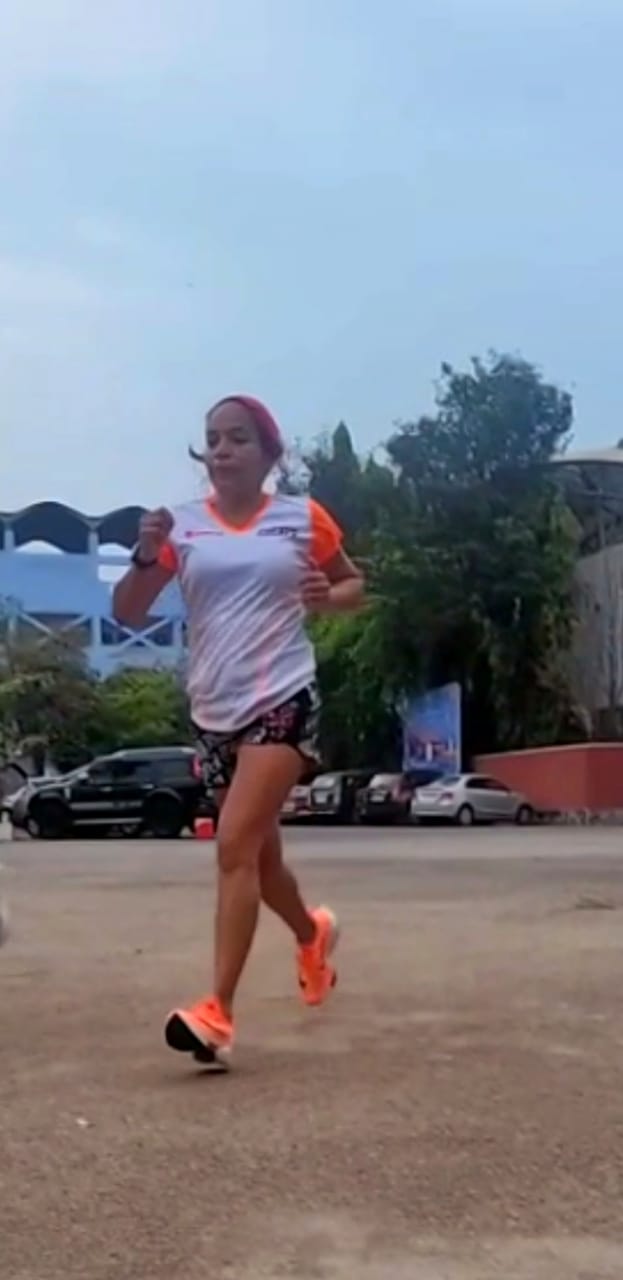
This year, over 100 runners from India have found a place in the entry list and are travelling to Boston to participate in the event, which is a World Marathon Major and among the globe’s most iconic races. “Getting back to international running events is something to look forward to after two years of pandemic,” said Pune-based Kavitha Reddy. She couldn’t think of a better way to execute the return than to run the Boston Marathon.
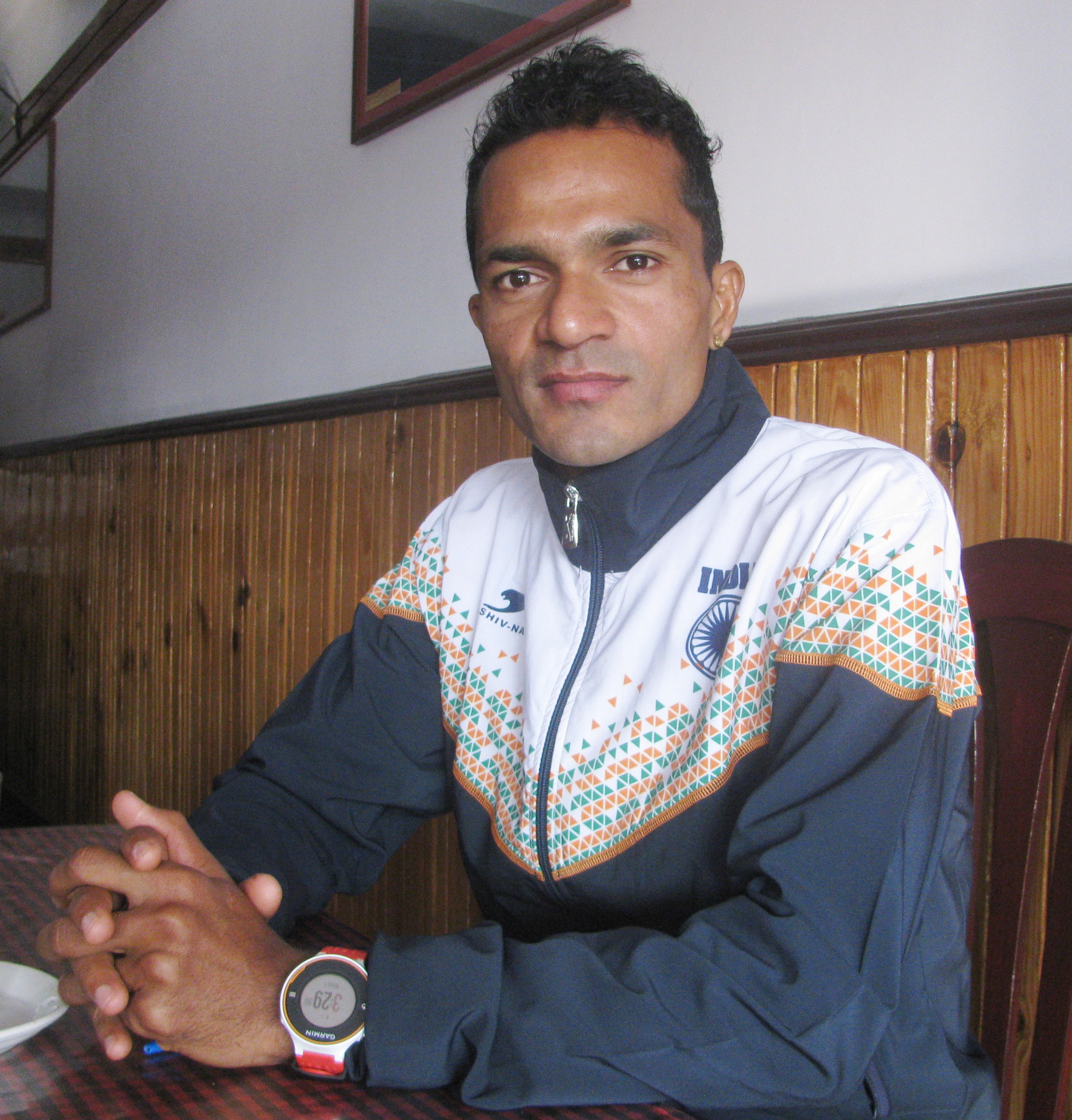
Hemant Beniwal (Photo: courtesy Hemant)
Kavitha had participated and completed the Boston Marathon in 2018, the year the marathon encountered its worst weather in 30 years. Faced with howling winds, rains and snow and the weather deteriorating as the race progressed, many runners had to quit, including the African elite contingent.
Memories of the 2018 race continue to engage her as variations in weather conditions is an issue with the Boston Marathon. All the same, her training went off quite well especially in the final stages. She lost a couple of weeks in January 2022 to coronavirus infection. “When I got back to training after COVID, it was tough initially. But slowly I got my energy back,” she said. On March 13, 2022, she ran a half marathon at the Jaipur Marathon, finishing in one hour, 30 minutes and 47 seconds. Kavitha is one of the best recreational runners in India in terms of time efficiency.
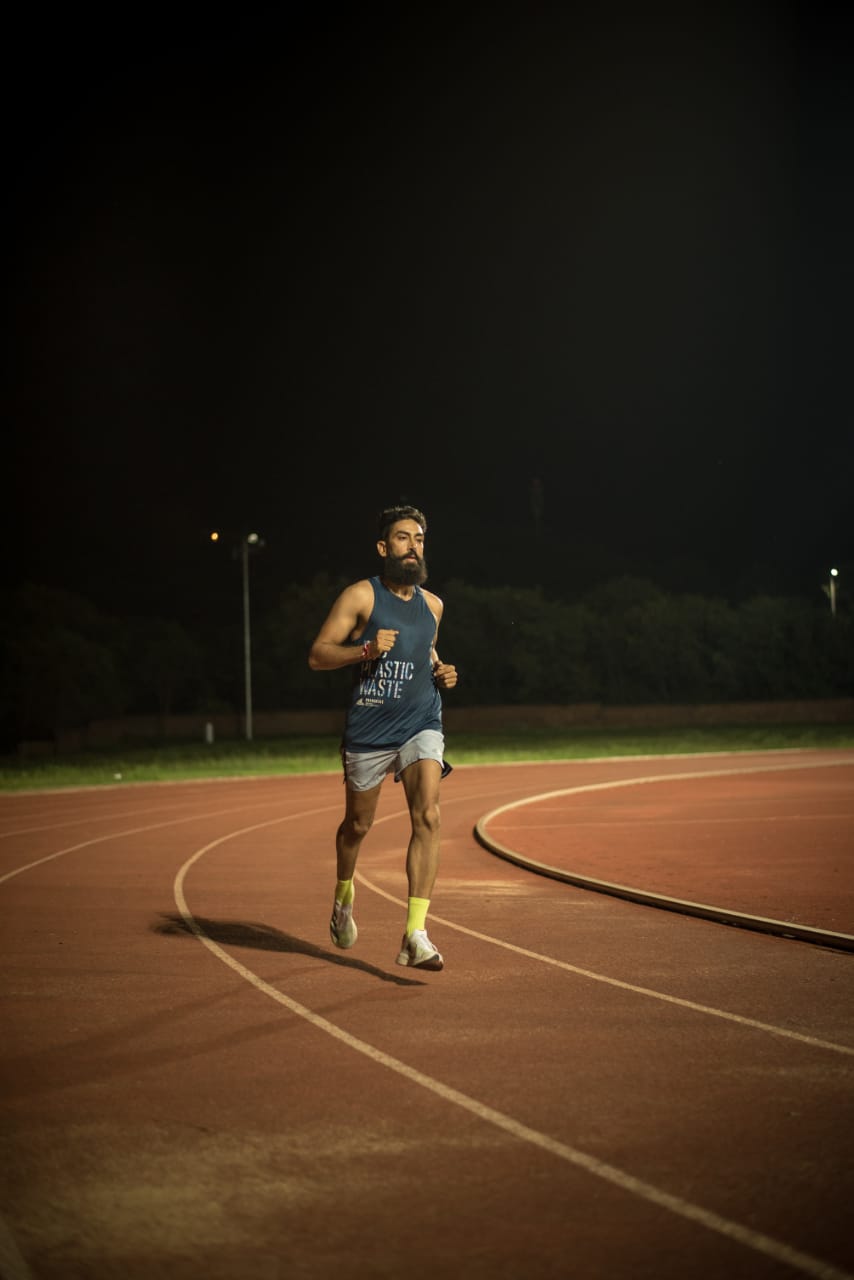
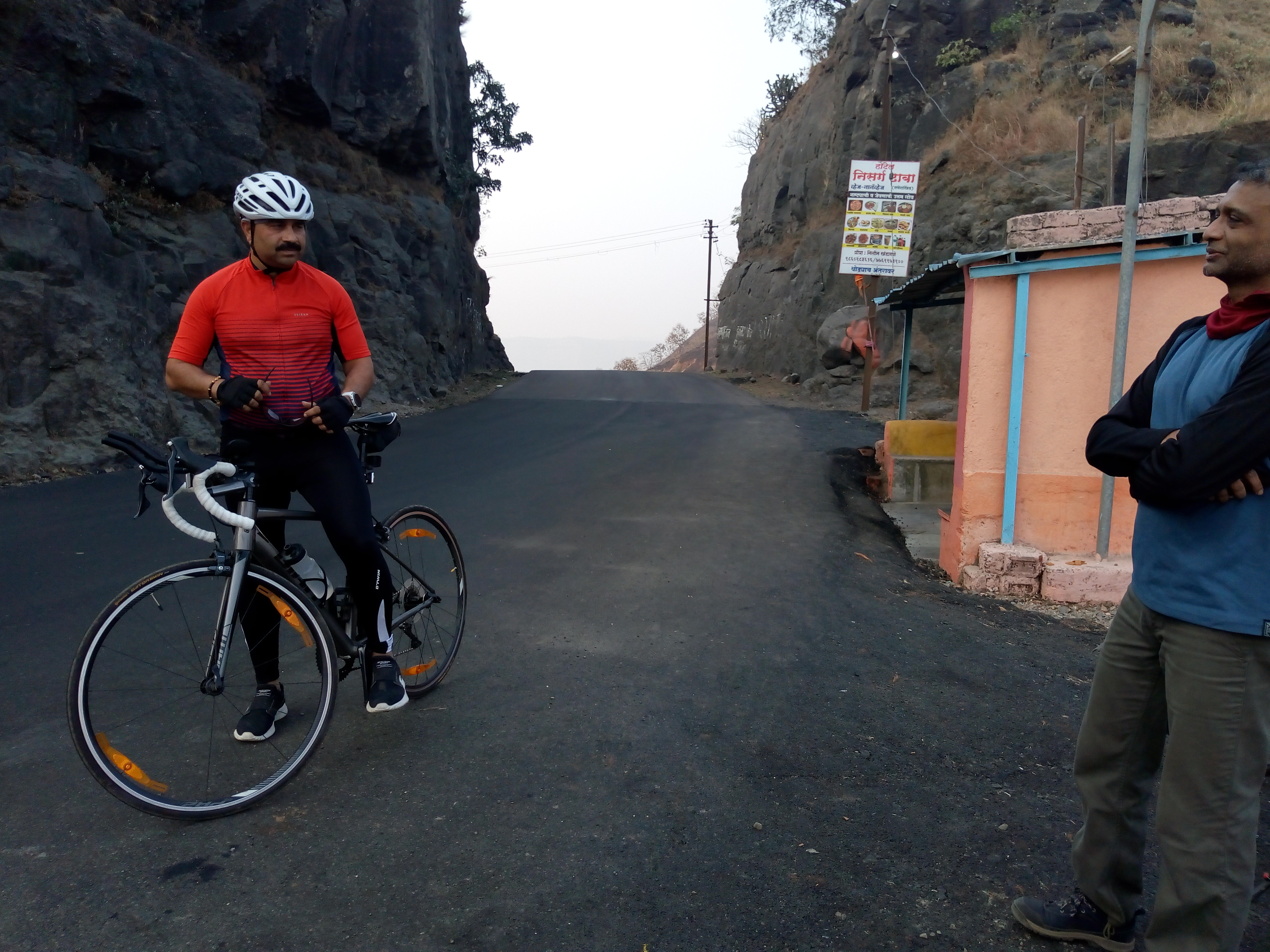
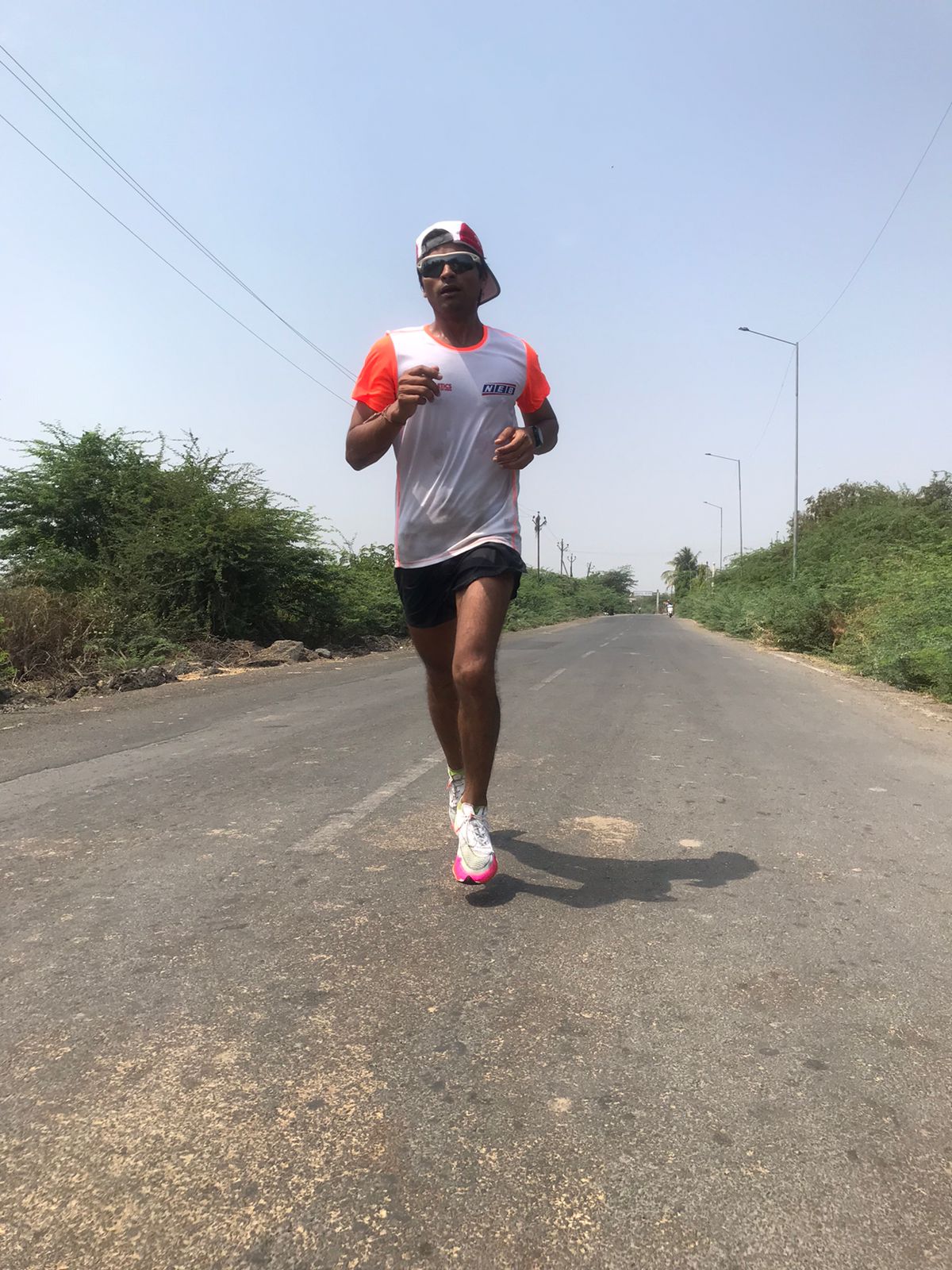
Gurgaon-based Hemant Beniwal, is headed to Boston for his first attempt there. In 2019, he ran the Berlin Marathon, finishing it in 2:59:30, as per data on the Berlin Marathon website. “It is a privilege to run the Boston Marathon as the bulk of the runners are chosen on merit. Also, the energy level in Boston is incomparable to any other running event. The city celebrates every runner’s presence,” said Hemant. He had qualified for Boston Marathon in 2018 but did not make it. He attempted another qualifying run in 2021 to secure the timing required for his age group (35-39) and make the cut. This was even as the time for qualifying got tougher.
Hemant is also an ultra-marathoner. He represented India at the 2019 100 km IAU Asia & Oceania Championships held at Aqaba in Jordan. The Indian men’s team had secured gold at the event. Hemant finished the distance in 8:12:11.
Rajeev Singh (Photo: courtesy Rajeev)
Srividya Ramnath from Navi Mumbai has already done two of the World Marathon Majors – Chicago Marathon and Berlin Marathon. She has been training diligently for the Boston Marathon for the past four months, helped by a training plan designed by her coach, Ankita Gaur. “I resorted to speed runs even during my long runs and that approach has helped,” she said. She has been an age-category podium finishers in some of the events in India.
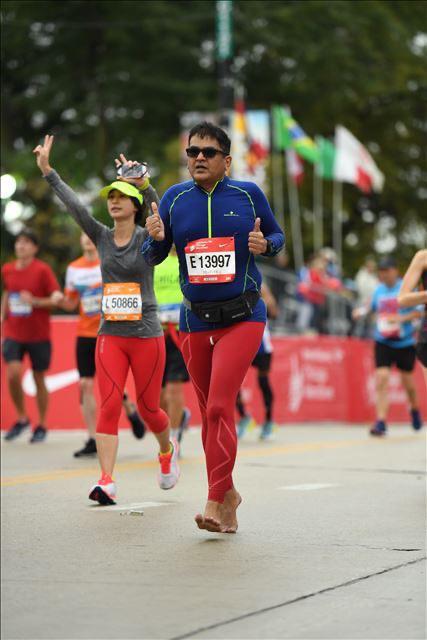
Rajeev Singh, also from Navi Mumbai, has run several international races. This will be his second outing at Boston, the first one having been in 2019. Rajeev has been running barefoot for about six years. But recently he shifted to minimalist footwear. “I have been running quite regularly. My preparation, I think, has been good,” he said.
(The author, Latha Venkatraman, is an independent journalist based in Mumbai.)
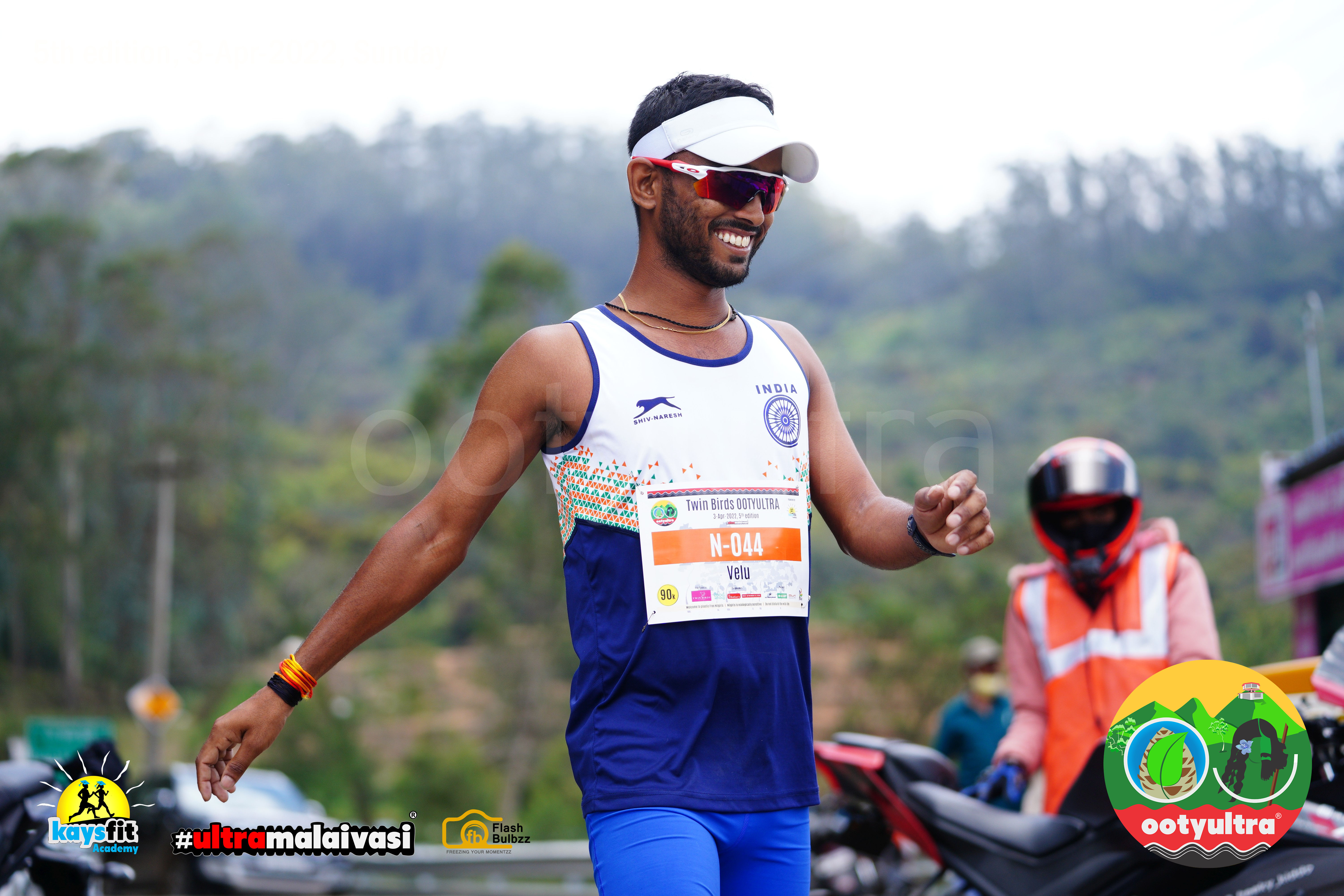
Ultra-marathoner, Velu Perumal, won the 90 km-OotyUltra road race held on April 3, 2022 in Tamil Nadu.
The ultra-marathon, held on the streets of Ooty, was challenging with substantial elevation gain and long stretches of downhill. But it was supported well by race organisers and volunteers, runners this blog spoke to, said.
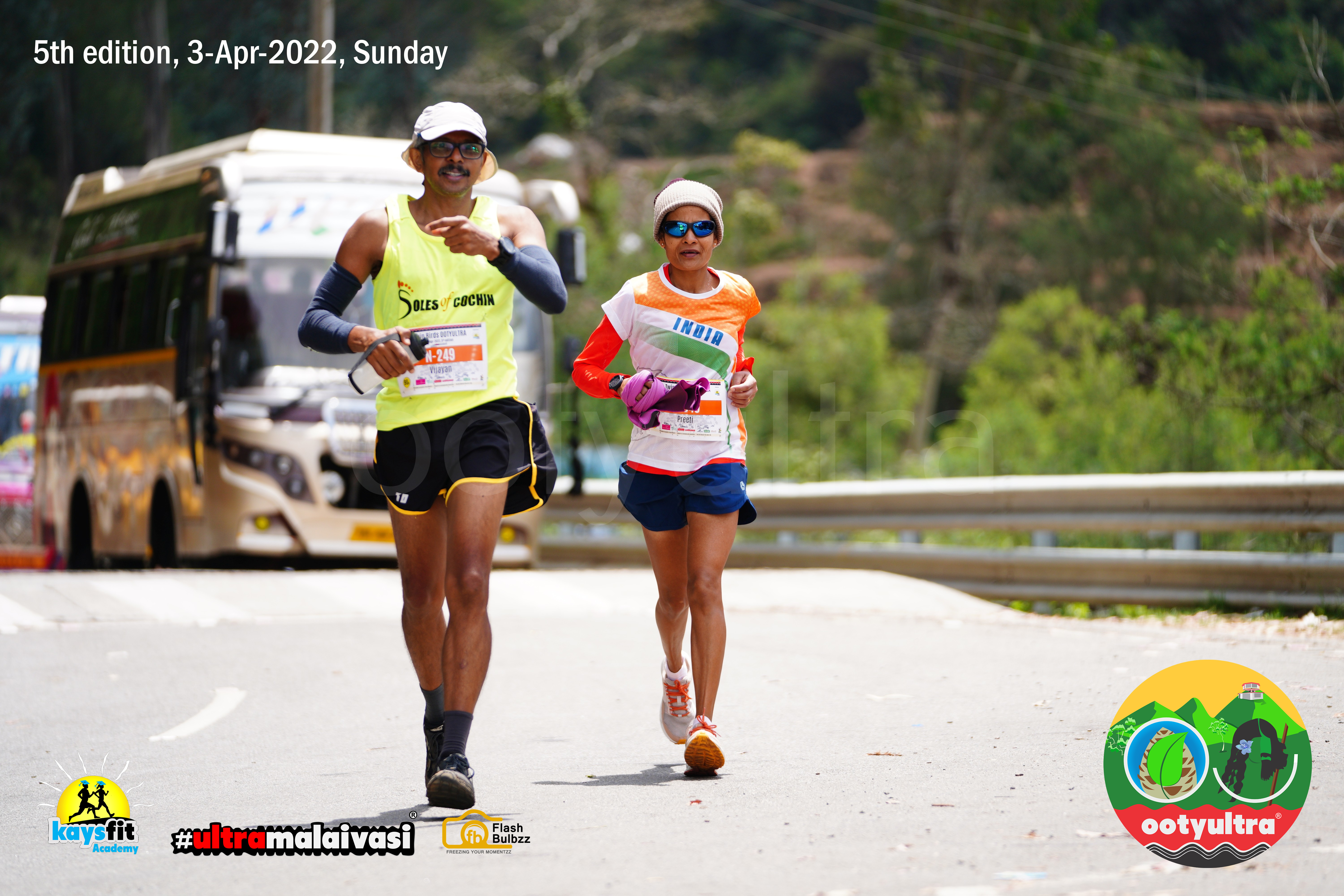
Of the six runners at the start line of OotyUltra’s 90 kilometre-race, held on April 3, 2022, three finished the race. Velu Perumal was the winner followed by Preeti Lala from Mumbai and Vijayan Pillai from Kerala.
OotyUltra has four events – 90 km, 60 km, 30 km and 15 km. The 90 km race, which was by invitation, has a cumulative elevation gain of 2600 metres. There are extended sections of uphill and downhill, with the route touching Dodabetta Peak, winding through Kothagiri and ending at Tea Park.
The event was organised by KaysFIT Academy, founded by Kannan Sundarajan, known as Coach Kay in running circles; it was its fifth edition. In its physical form, Ooty Ultra was in its third edition, having lost two years to the coronavirus pandemic. Coach Kay, originally from Ooty, commenced running in 2011, starting with marathons. He later moved to ultra-marathons.
“It was quite a tough route, quite challenging, requiring us to put in a lot of effort,” Velu, the winner of the 90 km-race, said. He finished it in ten hours, 48 minutes and 31 seconds. Velu is a regular participant and podium finisher in many ultra-running events. He has also represented India in ultra-running events overseas held by IAU. The 31-year-old, who works with the Indian Army, has been coached by Subedar Pawan Kumar from Army Medical Corps.
Mumbai-based Preeti, who placed second among the three finishers, refers to the 90 km-race at Ooty Ultra as “ Indian Comrades.’’ Comrades Marathon is an ultra-marathon held every year in South Africa. “This is a must-do event for those running the Comrades Marathon,” she said. She finished the race in 11:38:27. She was the only woman participant in the 90 km-category. Preeti is due to go to South Africa to take part in the Comrades Marathon, scheduled to be held in August 2022.
Vijayan Pillai, who came in third, managed to finish within the 12-hour cut-off; he clocked 11:52:55. Preeti and Vijayan ran together for a long distance but somewhere around the 84 km- mark Vijayan started to develop cramps and had to slow down. His first time at OotyUltra, Vijayan found the event well organised. According to him, the first part of the run led to Dodabetta Peak and on the return, took a deviation to Tea Park (also the eventual finish point). The second and third parts, “ followed a different loop but in opposite directions.” “The aid stations were well-placed and the volunteering was great. The youngsters, who were recruited to do the volunteering, did a great job,” he said. Vijayan commenced running eight years ago and over time got interested in ultra-running, particularly trail running.
Weather was quite good at the start of the race in Ooty but the afternoon stretch turned quite warm. “The hydration and nutrition support by the organisers and the villagers helped us get by during this tough period,” Preeti said. On offer were watermelons, energy drinks, curds, jaggery, bread and butter. The hydration points were positioned at intervals of 3-4 km along the route.
Vijayan Pillai and Preeti Lala (Photo: Flashbulbzz Photography)
Preeti has finished on the podium before, at ultra-running events. Running the 24-hour race at NEB Sports Mumbai Stadium Run in February 2021, she had emerged the overall winner with a distance of 193.60 km covered. It was the second best by an Indian woman in the category.
At OotyUltra, Dr C. Selvaraj chose to run the 60 km-race. He did it barefoot. This was his second ultra-running event, the first one being the Yercaud Hills Ultra, where he completed the 50 km-race.
“Running barefoot was tough during the hot, sunny hours. I had to run by the side of the road,” he said. Overall, the race was tough with a total elevation gain of 2000 metres, he said. A neurologist, Dr Selvaraj started running for health reasons. Over time, he grew more and more interested in long-distance running.
(The author, Latha Venkatraman, is an independent journalist based in Mumbai.)
Jyoti Gawate and Nitendra Singh Rawat secured top honours at the 2022 edition of the Ageas Federal Life Insurance New Delhi Marathon held on March 27.
Nitendra completed the men’s marathon in two hours, 16 minutes and four seconds. Jyoti, an elite runner from Maharashtra, covered the distance in 3:01:19 to win the women’s race.
The event was an opportunity for athletes to qualify for the year’s Commonwealth Games and Asian Games.
The marathon-qualifying time for the Commonwealth Games (CWG) to be held in July-August 2022 in Birmingham is 2:18:40 for men and 2:38:19 for women. The same for the Asian Games to be held in Hangzhou, China in September 2022, is 2:18:48 for men and 2:39:28 for women.
File photo / Jyoti Gawate (Photo: courtesy Jyoti)
Anish Thapar Magar got the second position in the men’s race, finishing 36 seconds behind Nitendra with a timing of 2:16:40. In third position was Anil Kumar Singh (2:16:46). In the men’s marathon, finishers up to the fourth, fifth and sixth place – Ashish Kumar (2:17:03), Belliappa A.B. (2:17:08) and Kalidas Laxman Hirave (2:18:12) – joined the podium finishers in the list of those qualified for the CWG and the Asian Games.
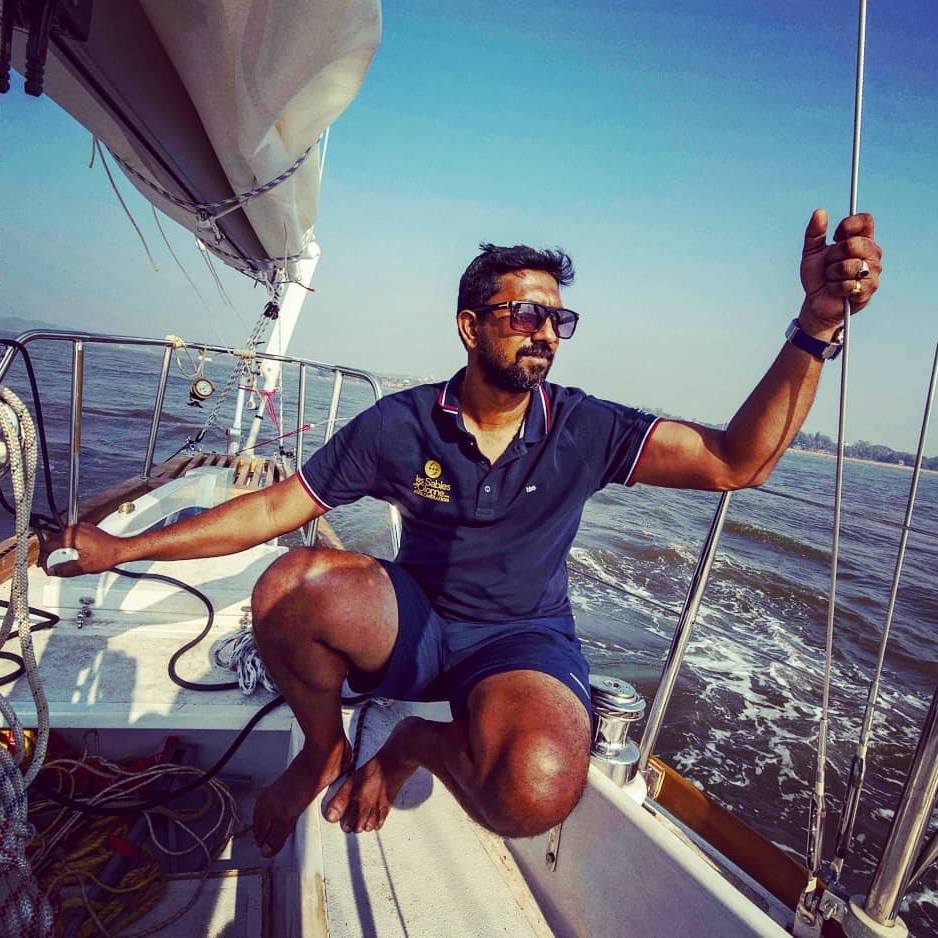
Commander Abhilash Tomy KC (This photo was downloaded from the Facebook page of Commander Abhilash Tomy and is being used for representation purpose. No copyright infringement intended.)
He has five months to complete a full refit and sail a 2000 miles solo voyage to qualify for the GGR.
Well-known Indian sailor, Abhilash Tomy, will be participating in the 2022 edition of the Golden Globe Race (GGR).
The former naval officer, will sail in a UAE-registered sailboat named ` Bayanat’ which will race under the number 71, the year in which the United Arab Emirates was formed. The announcement was made at the ongoing Dubai Expo.
In 2018, Abhilash – he is the first Indian to sail solo nonstop around the world – was a participant in the 2018 GGR. Following a severe storm in the southern Indian Ocean that damaged his boat and left him injured, he had to be rescued. At that time, he was sailing in the ` Thuriya,’ a replica of the ` Suhaili,’ which Sir Robin Knox Johnston had used to complete the first solo nonstop circumnavigation in 1968. The ` Suhaili’ was built in Mumbai; the ` Thuriya,’ in Goa. Following his rescue, Abhilash endured surgery and a challenging road to recovery.
In his Facebook post confirming participation in the 2022 GGR, Abhilash provided a synopsis of the 2018 accident and explained why taking part in the 2022 GGR “ is a big thing” for him. Excerpts: “ After 82 days we were lying in third position when the storm overtook us. My boat was dismasted and destroyed, and I suffered a huge fall which left me with multiple spine fractures. And with pretty functionless legs. The remoteness? Couldn’t have been worse. The Antarctic was the nearest continent. We were exactly between Australia and South Africa, and south of India.’’
The situation triggered an international rescue effort. Four nations contributed – Ireland (Irish sailor Gregor McGuckin, a fellow competitor in the race made a heroic effort to reach Abhilash), India, Australia (both countries dispatched their naval assets) and France (it’s fisheries patrol vessel ` Osiris’ was the first to reach Abhilash). The injured sailor was shifted to a small island in the French Sub-Antarctic Territories where he was provided primary medical care. He was brought to India on the 16th day of the accident.
Excerpts continued: “ An MRI revealed the fractures in the spine. Two days later I was operated upon. Titanium rods were inserted in my spine and 5 vertebrae were fused into one. My legs were so badly off that I had to learn to walk again. But I did learn to walk, and then got into a cockpit and got back to flying, and sailing! 3 and a half years later, I am heading back into the same race that almost got me killed. Wish me luck !”
Abhilash’s boat for the 2022 GGR bears the name of his sponsor – Bayanat, a G42 company specializing in AI-powered geospatial intelligence. According to a report on the GGR website, Bayanat has said that during the race Abhilash would aid in ongoing scientific work, “ including the collection of water samples which can be analysed for up to date insight on the presence of microplastics in the world’s oceans.” Additionally, a small section of the yacht will be painted with a special coating which will serve as a reflectance target for satellites, “ representing a one-of-a-kind opportunity to collect calibrated data during the race.”
As per the report dated March 22, 2022, available on the GGR website, Abhilash purchased a Rustler 36 in France, and named it “ Bayanat.” The boat was previously raced in the last Golden Globe by Philippe Péché with PRB sponsorship (he retired from the race on August 25, 2018 due to a broken wind vane and put in to Cape Town). “ He has five months to complete a full refit and sail a 2000 miles solo voyage to qualify for the GGR,’’ the report said adding that with Abhilash’s entry, the total number of competitors in 2022 GGR stood at 23 sailors from 13 countries.
GGR’s list of skippers for 2022 also includes Gaurav Shinde (originally from Mumbai), who will be representing Canada in the race. “ Such great news! Can’t wait to share the start line with this legend.” – Shinde responded on Facebook to the news of Abhilash’s participation, confirmed.
The 2022 GGR is scheduled to commence from Les Sables-d’Olonne in France, on September 4. “ Whilst the proven formula of the 2018 Notice of Race will remain substantially the same, there are some additions for this third running of the Golden Globe. Sailors must show prior ocean sailing experience of at least 8,000 miles and another 2000 miles solo before applying to compete. Two new film drop points have been added to the course: Cape Town and Punta del Este. An extra 2000 miles non-stop solo qualifying voyage in the GGR entered yacht, using only celestial navigation, is required on top of the previous minimum 8000 ocean miles and a further 2000 solo miles. Thus, a total experience of 12000 miles at the start of the race,” the GGR website said.
(The author, Shyam G Menon, is a freelance journalist based in Mumbai.)
From the race in Saudi Arabia (Photo: courtesy Adventure III)
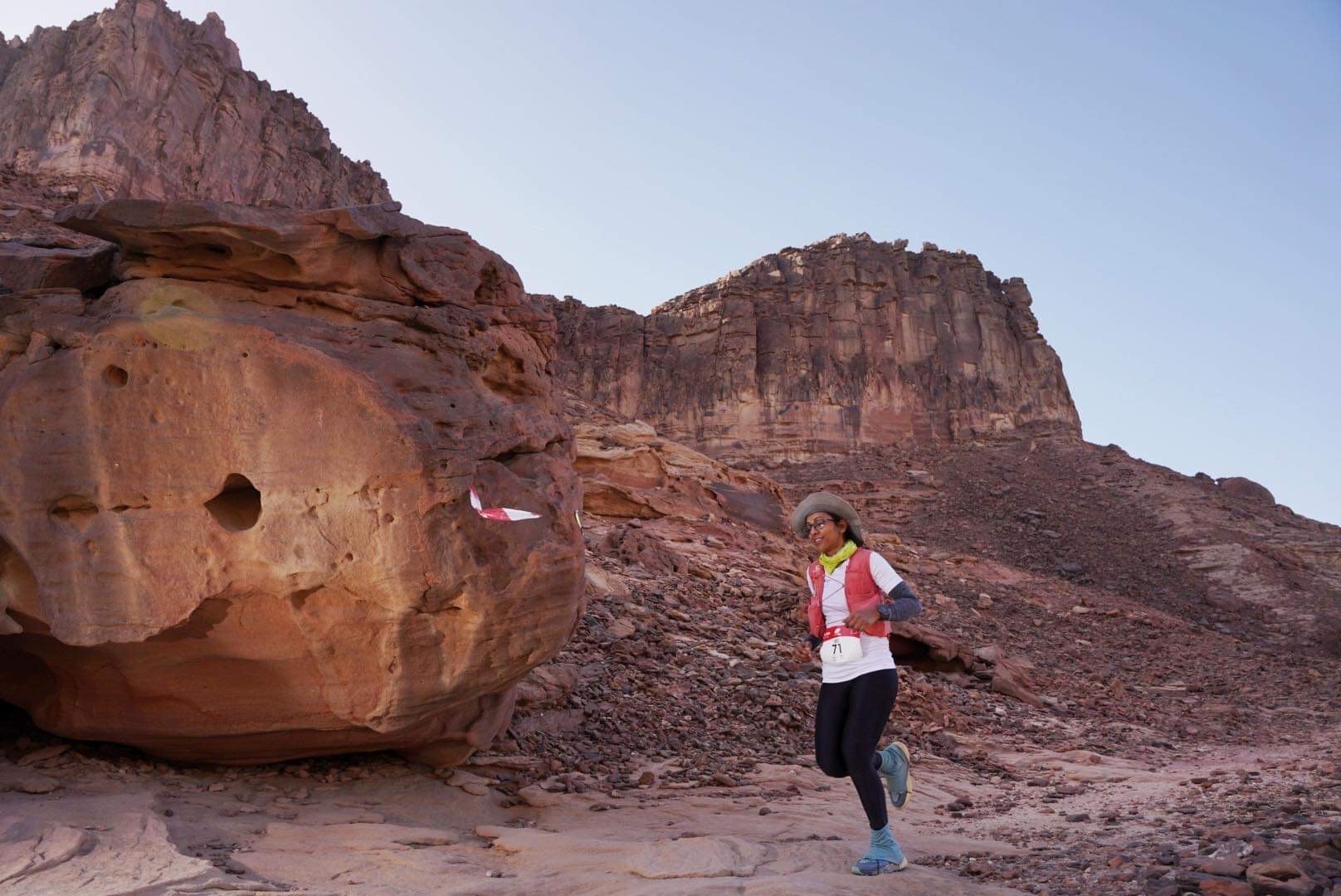
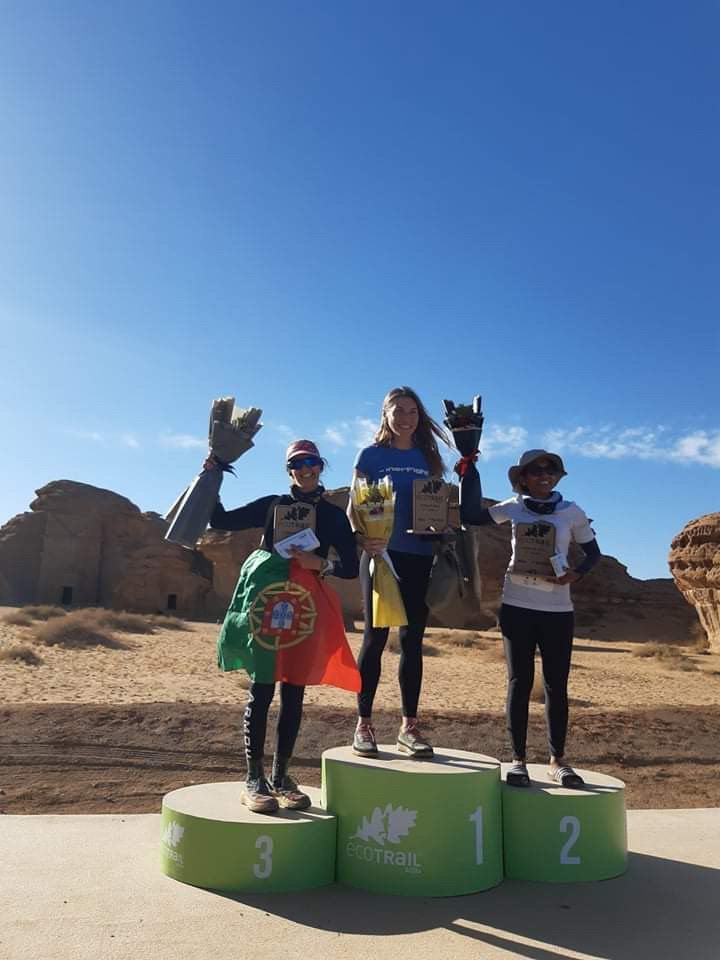
Indian ultra and trail runner, Nupur Singh, finished second among women and seventh overall in the 81-kilometre category of EcoTrail AlUla 2022 held on March 19.
In January 2022, Nupur Singh received an invite from Asia Trail Masters, a series of trail running races in Asia, to participate in EcoTrail AlUla 2022.
For much of 2021 Nupur had been battling a personal crisis; she lost both her parents to COVID-19. “ In January 2022 I was not in a good shape. I was completely off training for most of 2021 because of the situation at home,’’ she said.
The invitation from Asia Trail Masters propelled Nupur to resume her training.
“ I was very excited by the invite to EcoTrail AlUla. I wanted to come back to running,’’ she said. Nupur commenced her training in Manali, where she resides. “ It was snowing there. So, I shifted to Bir, where I trained for one and a half months. Here, the weather was a mix of cold mornings followed by hot afternoons,” she said. She also participated in Tuffman Stadium Run’s 6-hour relay race, opting for an afternoon slot of two hours, primarily to train herself for running in Saudi Arabia’s desert heat.
Nupur travelled to Jeddah from New Delhi and after an overnight stay there, moved on to Al-‘Ula, a city in North West Saudi Arabia, in the Medina Region of the country.
From the race in Saudi Arabia (Photo: courtesy Adventure III)
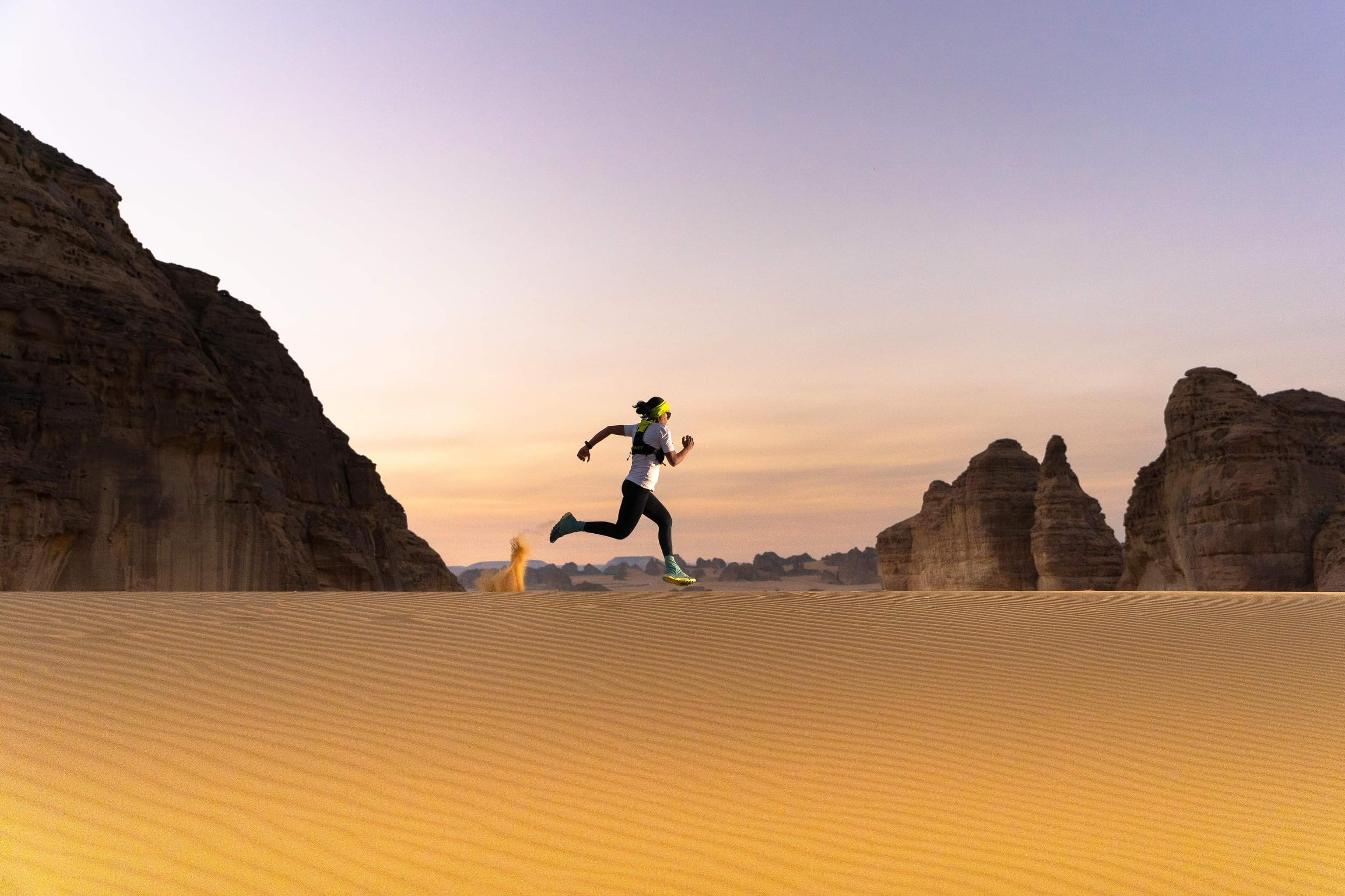
The 81 km race at EcoTrail AlUla is predominantly a trail course comprising deep sandy stretches for over 10-12 km, followed by rocky canyons with stretches of continuous ups and downs. The wide open desert landscape was interspersed with rock formations, date farms, architectural monuments and the occasional road for transitioning to different areas. The course also winds through Hegra, the archaeological site, marked as a UNESCO World Heritage Site. The entire course has an elevation gain of 1200 meters.
“ Here, the mornings and nights are cold while the afternoons are quite hot. The race started at 6:10 AM on March 19, 2022, and the initial terrain was a mix of deep and paved sand. It was chilly and that helped me pick up a good pace. From the beginning, I had decided to run my own race and not push too much early on and to enjoy the course and my comeback. The most enjoyable part of the course for me was the canyon section; technical terrain with mountain views is what I love the most,” she said.
Saudi Arabia’s dress code ensured that women runners wore outfits that covered themselves fully. “ It was beautiful to see so many women taking part in the race and at aid stations,” Nupur said.
Nupur said she felt strong for most part of the race. “ I never felt low at any point. My nutrition and hydration went off quite well. It was a good come-back race for me,” she said. She finished in nine hours, 19 minutes and 25 seconds. It earned her the second position among women and an overall seventh place.
A second place-finish; on the podium with the other winners (Photo: courtesy Adventure III)
Her nutrition consisted of Unived gels, salt tablets, peanut butter, oranges and locally grown dates. For hydration, she had Unived recovery drink mixes and water.
In the 81 km category, there were a total of 67 participants of which 31 runners finished the race.
Nupur got into running in 2014. Soon afterwards she started organising races in the mountains. In November 2019, she participated in the IAU 100 km Asia & Oceania Championships held in Jordan. She ran in the open category and finished in fairly good time behind British athlete, Joasia Zakrzwenski, the winner of the open race.
Following the race in Saudi Arabia, her aim now is to participate in qualifying races for the IAU 100 km World Championship to be held in August 2022 in Berlin, Germany and the IAU Trail Championship scheduled to be held in November 2022.
(The author, Latha Venkatraman, is an independent journalist based in Mumbai.)
Reaching the small pass on the road from Pargaon to Junnar (Photo: Shyam G Menon)
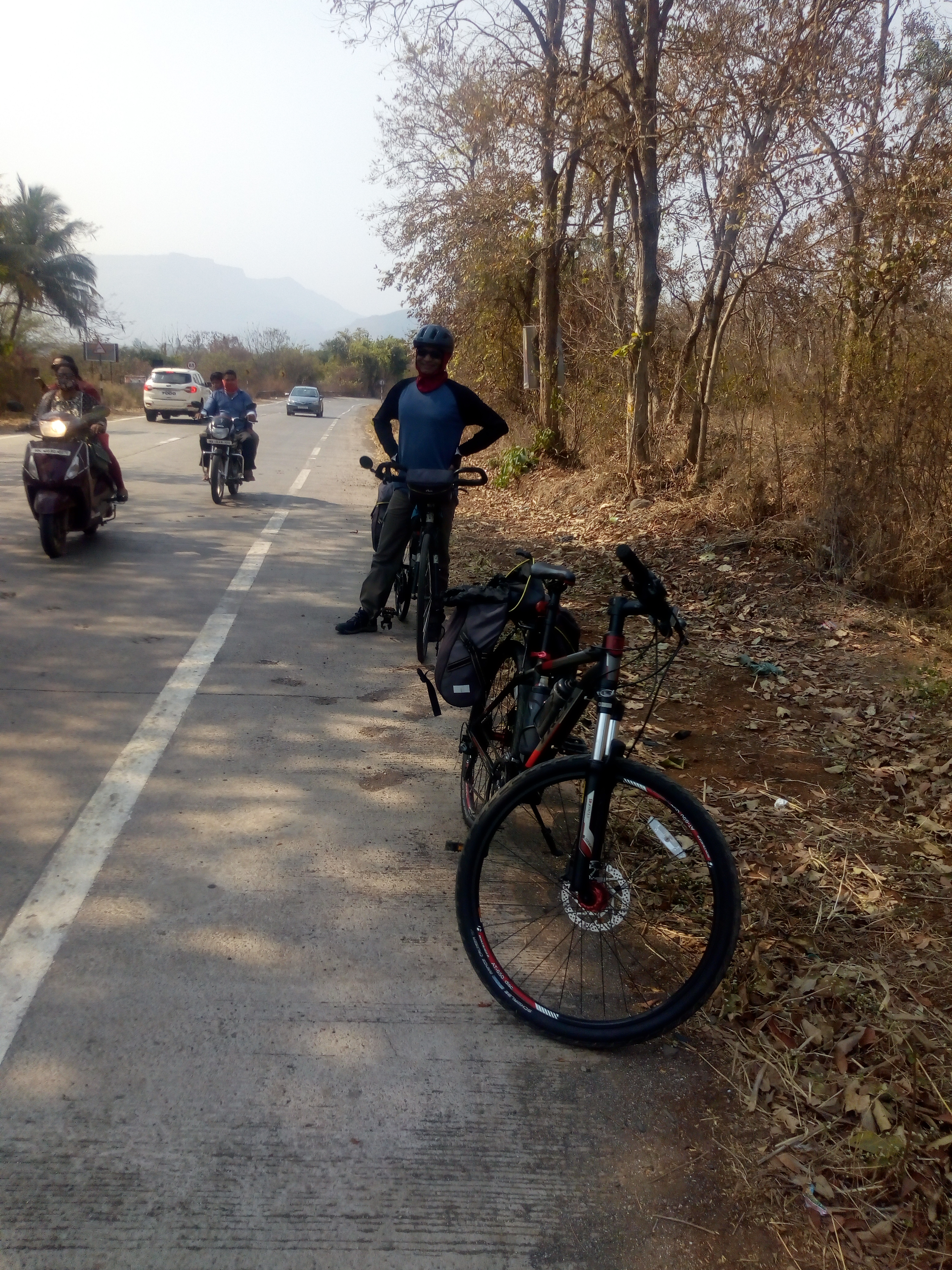
A bicycle trip we had planned a couple of years ago, eventually got underway in March, 2022. Hoping against logic, we imagined temperate weather; the lingering grace of winter’s extended exit. Nature had other plans.
Heat waves are not often heard of in Mumbai.
There is always the relief gained through location on the sea coast. But then, these are times of unusual weather. On March 16, 2022, newspapers reported that the Indian Meteorological Department (IMD) had issued a heat wave warning for Mumbai.
In its report, the Times of India explained, “ heat wave warnings are issued when the temperature of any coastal station reaches 37 degrees and the departure from normal is between 4.5 to 6.4 degrees. When both these conditions are met for a costal station like the city and when it persists for two days at more than one station, then a heat wave is declared for that region. If departures exceed 6.5 degrees, then severe heat wave conditions are issued by the weather bureau.’’ The report then quoted the IMD: Due to the advection of warm and dry winds from North West India, heat wave to severe heat wave conditions are very likely over parts of Konkan-Goa, including Mumbai, over the next three days. Due to the prevailing clear skies and low humidity values, the temperatures are expected to rise and similar conditions are likely to prevail for next two to three days over the region.
Savouring a patch of shade (Photo: Shyam G Menon)
“ Aha,’’ I thought with the satisfaction of having found the answer. My mind was dwelling on the afternoon of March 5. Early that morning, Prashant Venugopal and I had set out on a small, multi-day cycling trip from Navi Mumbai. We knew the timing was bad; ideally it should have been in December, January or February when the weather is relatively pleasant. But for much of January-February 2022, I wasn’t in Mumbai and given his work, Prashant has to schedule the required number of days, which takes time. Eventually, the trip was slotted to commence on March 5. The idea was older still. It took shape in 2019, not long after the two of us cycled from Mumbai to Goa (for more on that trip, please click on this link: https://shyamgopan.com/2019/12/29/on-a-bicycle-mumbai-goa/). By now periodically studying the map for interesting routes, we had noticed this giant circle possible around the Bhimashankar massif. With Malshej Ghat added, one could do it like a circle linking the coastal plains with the higher Deccan Plateau. Then a few things happened.
First, in the first quarter of 2020, India slipped into COVID-19 and lockdown. The following year too was spent in and out of COVID. Our trip went into hibernation. Second, we heard that portions of the route had become part of a BRM. Brevets are a different world. As the casual touring sort, we would never cycle as fast or as consistently as those participating in brevets do. But news of the BRM reminded us to try the route, in our own way. Third, over 2020-2021, Prashant’s niece came to study at a university near Bhimashankar. We thought of our fifty plus-selves dropping by one day on cycles to say hello but the very same musings provoked the question: why don’t we do the full route? We took it up seriously in February 2022, dates were decided towards the end of the month and after a quick check of the chain, drive train and disc brakes of my bicycle by Inderjeet of Evolution Cycles, we left home at around 5.30 AM on March 5. We had this hope that although it was unmistakably summer, the weather would be tolerable.
On the Mhasa-Vaishakhare road; late afternoon, day 1, Gorakhgad and Machindra to the far left
Our goal was to proceed from Nerul to Panvel and onward to Chowk, Karjat, Mhasa, Vaishakhare, Malshej Ghat, Junnar, Narayangaon, Chakan, Lonavala, Khopoli and eventually back to Nerul via Panvel. We made no arrangements for stay in advance and given the Mhasa-Vaishakhare stretch could see us bivouacking, we provided for some extra layers in the panniers besides regular stuff like snacks, first aid kit and bike repair / maintenance equipment. We thought of taking a tarp or a tent ground sheet along but finally dispensed with that; neither of us wanted to work overtime on fashioning a perfect ride. Take it as it comes.
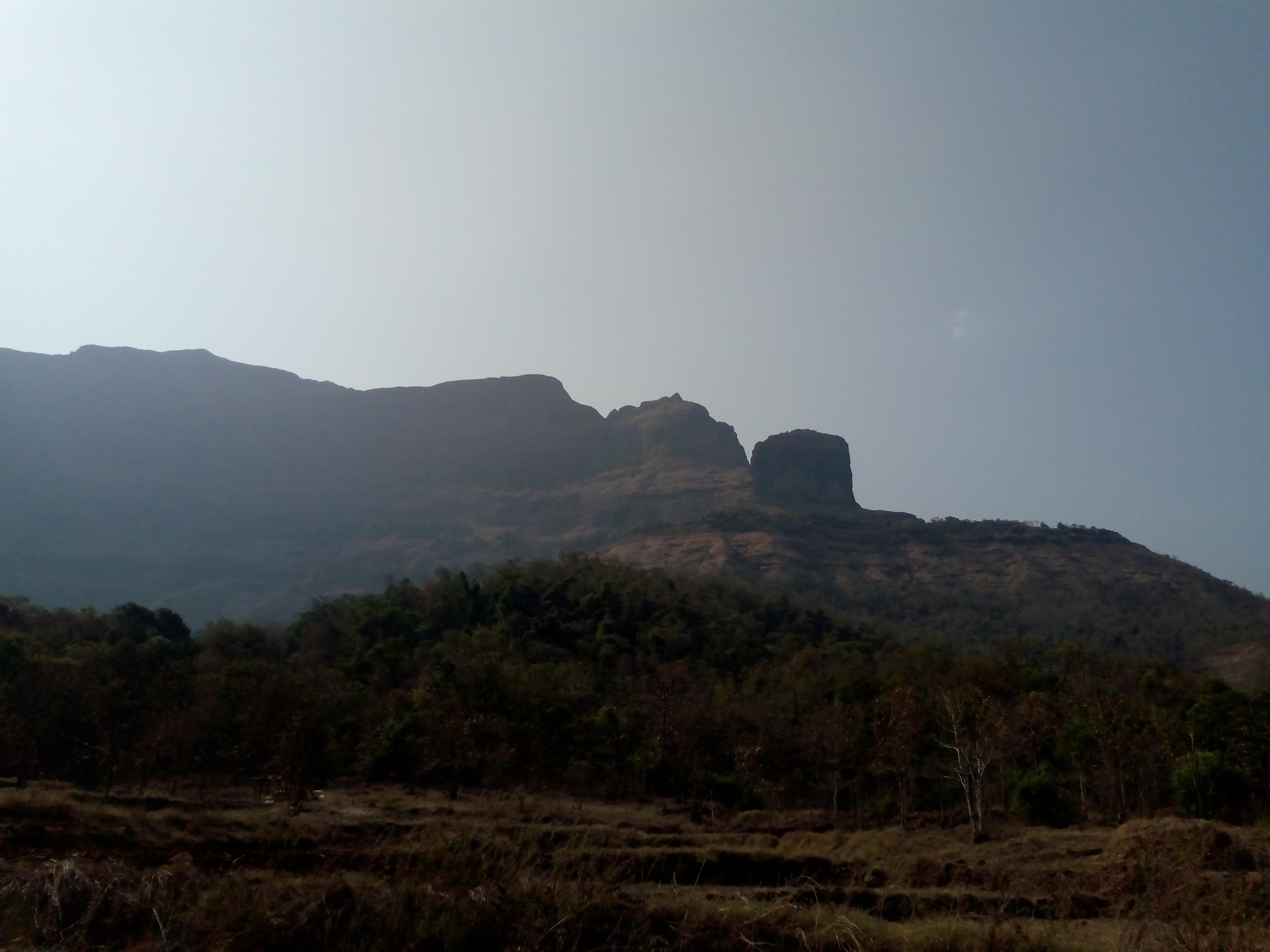
Gorakhgad (background, centre) and Machindra pinnacle (to the left), as seen from the ashram in Dehri (Photo: Shyam G Menon)
By noon of the first day, on the Karjat-Murbad road, it was amply clear that we had underestimated the heat. Among the great achievements of civilization has been diminishing tree cover and this road seemed an excellent example of that. The land to the side of the road and the smaller roads meandering off inland had sprinklings of shade. But the main road itself was starved of tree cover good enough for you to stand under and feel cooled. Those big trees of yore – they are deeply missed. The result was a slow and steady progression of cyclist into dehydration. It wasn’t so much the lack of water, which we had in sufficient quantity. In my case, it was the loss of water and salts and the glare all around caused by exposed road and limited shade. To make matters worse, I love tea and soft drinks. Both, recommended as unsuited (perhaps the right description is: deceptively satisfying) for hot days, I downed in handsome quantities. It was a bad choice. I felt full and hollow at once and lacking energy. After a particularly bare stretch of blazing hot road, roughly an hour before Mhasa, I unhesitatingly rode into the fragile, thatched shelter of a tiny shop selling lemonade. It was sweet relief and there I remained for quite some time, waiting for Prashant and recalling a similar moment of God sent-relief on a hike to Prabalgad several years ago.
Our mountaineering club having acquired new tents, Abhijit Burman (Bong), Franco Linhares and I had decided to camp overnight on the hill’s apex, so that we could test the gear and also take in the unhindered sight of city lights in the distance. All that was good, except somewhere in the walk-in with tent, stove, fuel and provisions to cook food, Bong remembered that he had forgotten to take a matchbox. None of us smoked and that meant, there were no matches on Franco and I, as well. Suddenly we realized the value of a matchbox; the small thing separated us from a nice dinner and sleeping on an empty stomach. And we liked to eat. The evening was quickly fading to night, when we hurriedly retraced our steps to the nearby village. We worried that we may have to knock on people’s doors, be a nuisance. And what if they didn’t have matchboxes to spare? Luckily, ahead of the village, a lone old man appeared smoking a beedi. “ Maamaaa…,’’ Bong shouted in relief and happiness. He brought himself to a halt before the old man, bowed low and offered a heartfelt namaste. Never before in the history of the matchbox was a non-smoker so happy to see a person with smoke escaping his lips. The old man looked on amused. Bong narrated the blunder we had committed. The old man listened. He saved us, he let us have his matchbox. At the small roadside shack, I had three lemonades one after the other. Prashant had his share. Never before in the history of lemonade were two cyclists this happy to see a lemonade vendor. Thirst quenched and salts restored, we thanked the vendor and picked our way to Mhasa.
Sunrise on the Mhasa-Vaishakhare road (Photo: Shyam G Menon)
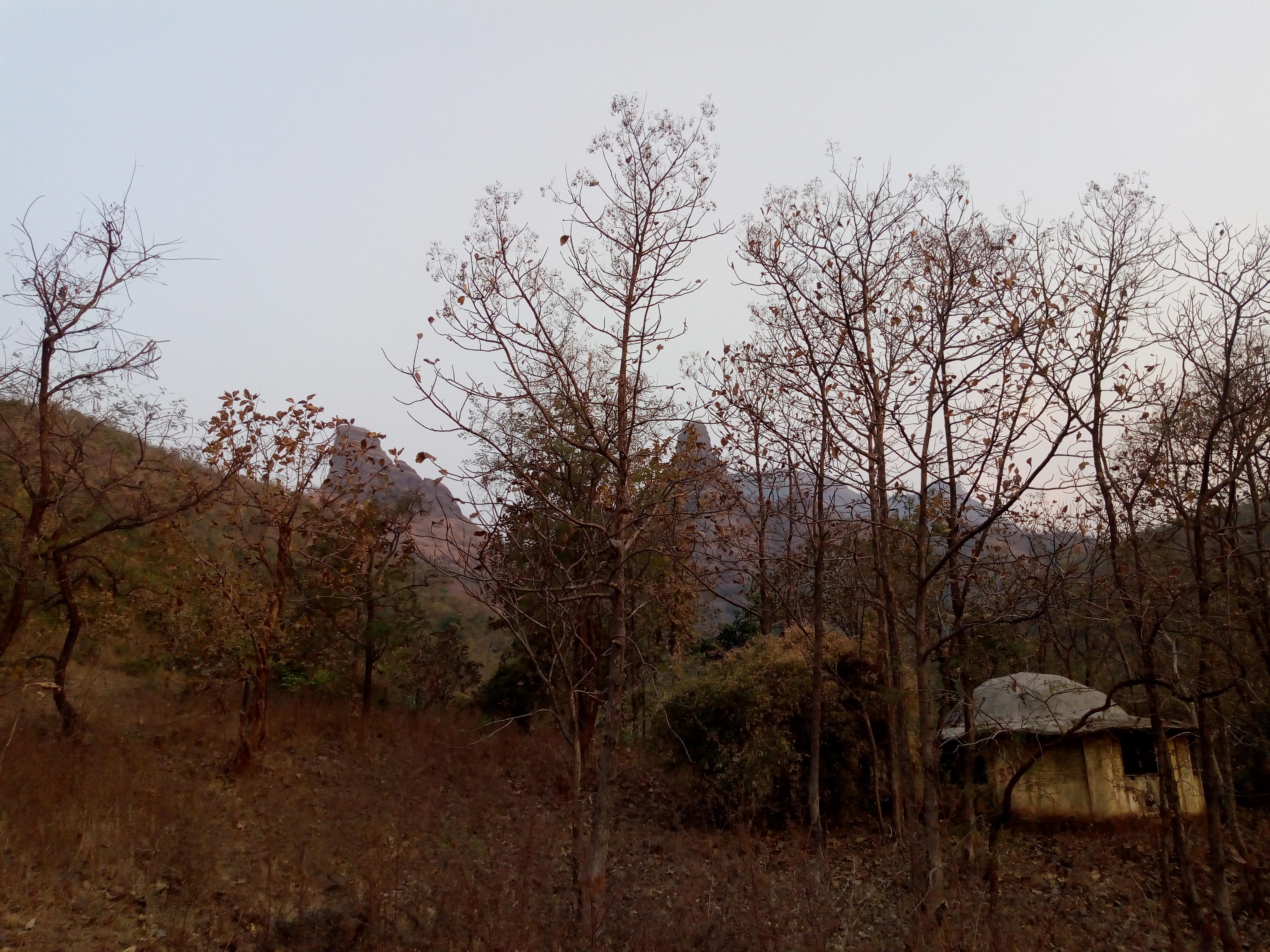
At Mhasa’s Guruprasad restaurant, we evaluated our options. Enquiries along the way had shown that rest houses were limited on the Mhasa-Vaishakhare road. “ Go to Murbad’’ – that was everyone’s suggestion. On the other hand, we had thought of days one and two of the trip as its main attraction and within that, the Mhasa-Vaishakhare road was important. Cycling to Murbad and then returning to Mhasa next morning to be on that road, didn’t appeal. The waiter who served us lunch at the hotel indicated that his manager may know more and so Prashant took up the task of speaking to the manager to find out about places of stay. He recommended an ashram in Dehri village and connected us to the caretaker there. It was a restricted property and securing permission for stay was difficult. But eventually, Prashant got a yes. The journey from Mhasa to Dehri was more or less a repeat of the conditions experienced on the Karjat-Murbad road. It was hot, dry and not generous in shade. By evening we were in Dehri and the ashram, located right at the base of Gorakhgad; Machindra pinnacle to the side. Under the greener circumstances of monsoon or winter this would be a pretty place. Unfortunately, we were visitors in March. In summer, vegetation in the Sahyadri dries up and the hills acquire a dusty, light brown shade interspersed with the black of ancient volcanic rock.
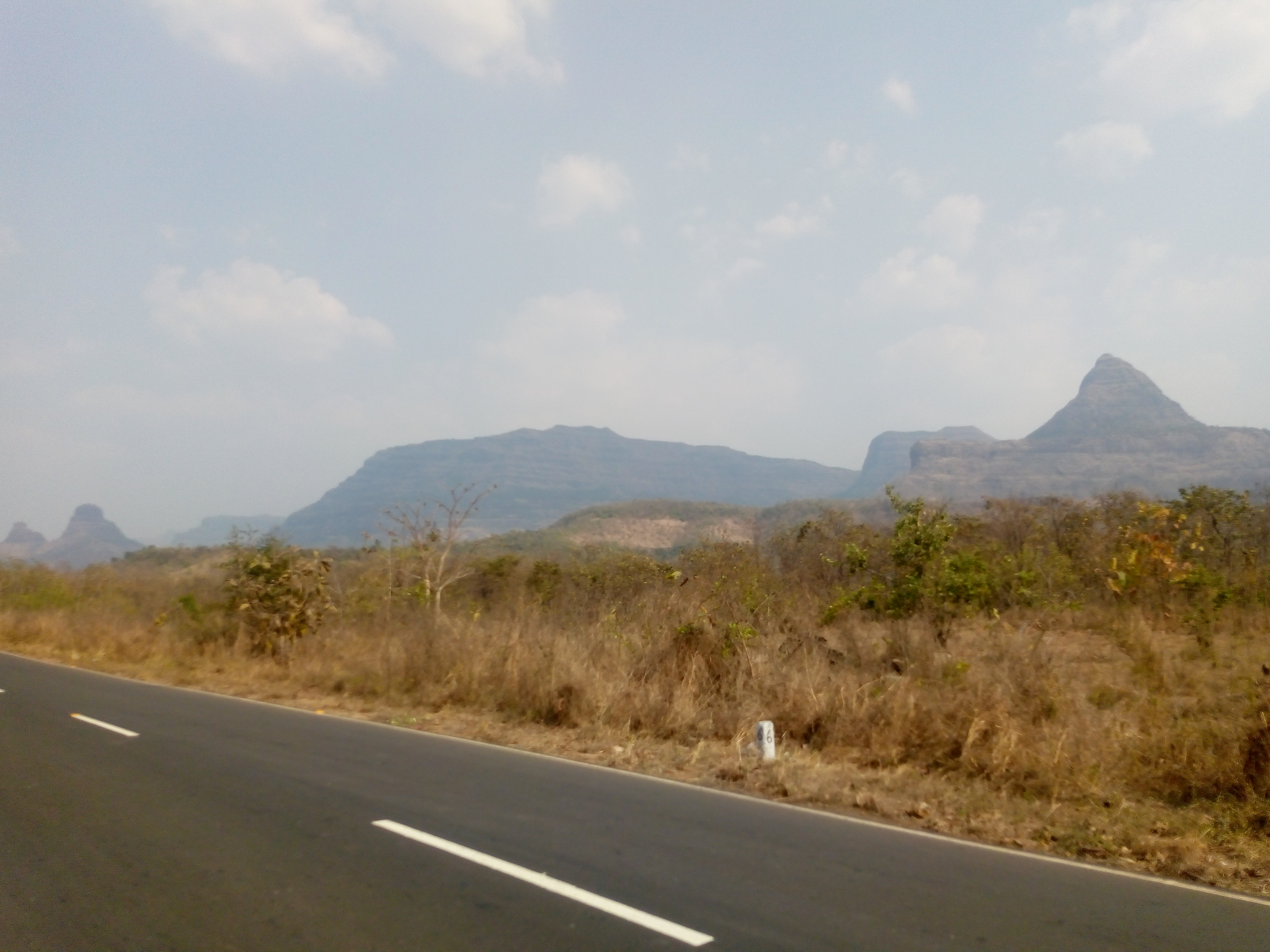
Gorakhgad holds a special place in my life. It was one of the first Sahyadri forts I hiked to, back in 1997-1998. After my first hike in Sikkim, I had looked out for company to go hiking around Mumbai and my first friend in this regard was a young, very tall Sikh gentleman. We made an odd pair; as tall as Satinder was, I was short. Gorakhgad was the second or third fort I visited with him. Those days, Dehri had been just a bus stop with a couple of shops. Having arrived in the late evening bus from Kalyan (or was it Murbad?), we slept in the veranda of one of the shops and hiked up Gorakhgad early next morning. However, it was in the years that followed, spent hiking and climbing with Girivihar (Mumbai’s oldest mountaineering club) that I realized the full scale and wealth of the Mhasa-Vaishakhare road. From Gorakhgad to Jeevdhan, Naneghat and Bhairavgad a massive wall of hills signified the abrupt drop of the Deccan plateau to the coastal plains. The last time I was here was to hike up Dhakoba and onward to Durga Killa (you can read about it here: https://shyamgopan.com/2013/08/05/the-short-cut/). Simply put, Mhasa-Vaishakhare is a special road; one of the less celebrated gems although of late (especially following the early waves of COVID-19), there have been reports of many visitors going in, naturally triggering concerns alongside. Our stay at the ashram was comfortable. The caretaker’s family made us a tasty dinner. Our gratitude to them. As we took leave of the family to return to our room, a car load of trekkers who had taken a wrong turn, arrived on the premises asking if the path to Gorakhgad ran through the property.
From the road to Malshej Ghat (Photo: Shyam G Menon)
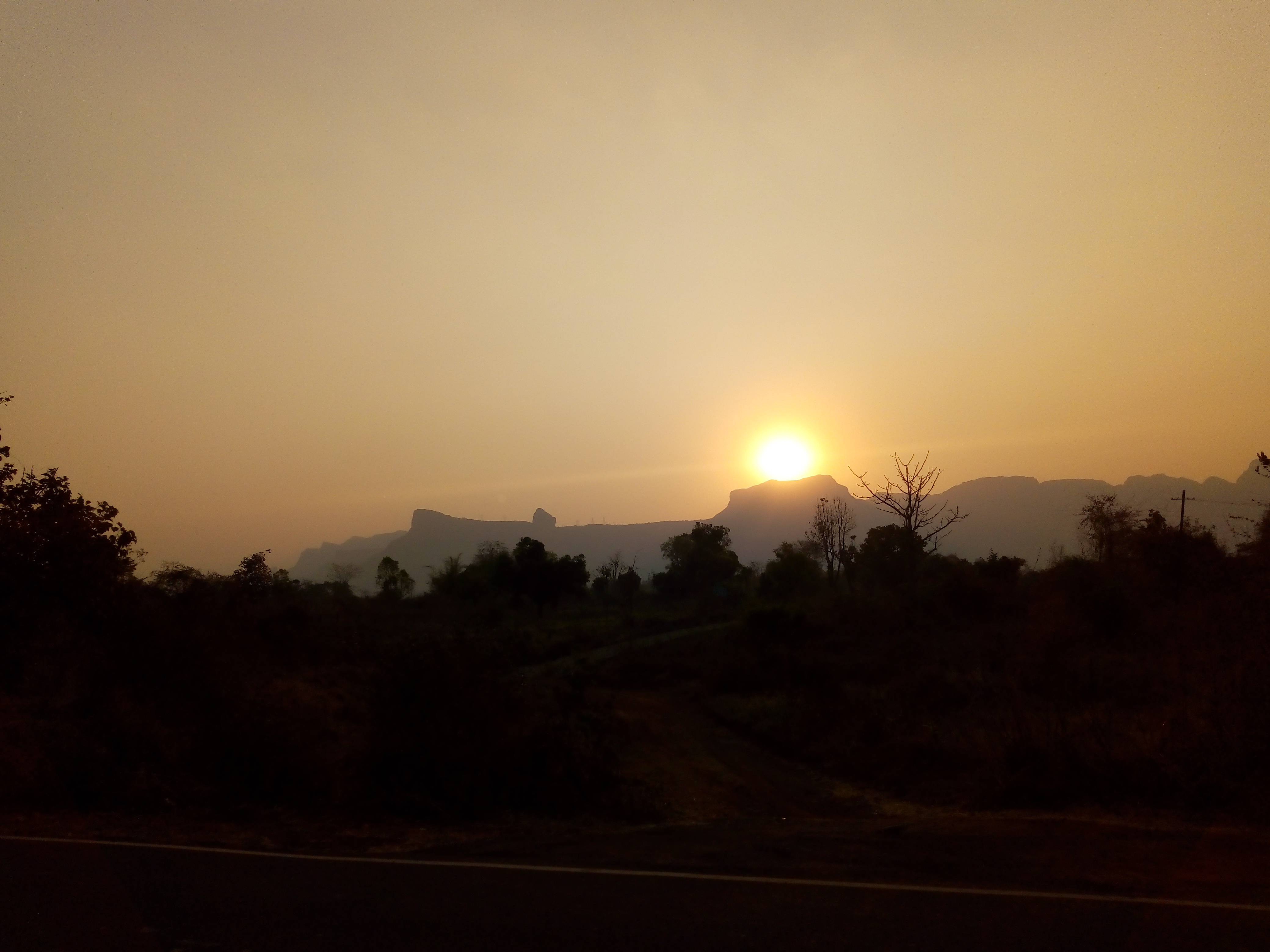
Early next morning, we pushed off for Vaishakhare and Malshej Ghat. The road was very good and distances marked directly on the tarmac indicated that it may have played host to road races. We cruised along, first in darkness and then, savoring a fantastic sunrise. A few kilometers before Vaishakhare, a man we met suggested that we take a short cut. We did so and ended up off-roading for a while. The path connected us to the road leading to Malshej Ghat. At the hotel we stopped for morning tea, a bus passenger traveling from Ahmednagar to Kalyan and halted there for breakfast, took much interest in our cycles and the small trip we were doing. He gave us an overview of the road to Junnar beyond Malshej. Tea had, we pushed off. Our next stop was another hour or more later – a cart and a van parked by the road to Malshej; the former offering tea and vada-paav, the latter functioning as a store selling packaged snacks. Both were managed by a local villager and his son. We had tea and vada-paav and enjoyable conversation with the father-son duo. Then, up the ghat road, we continued.
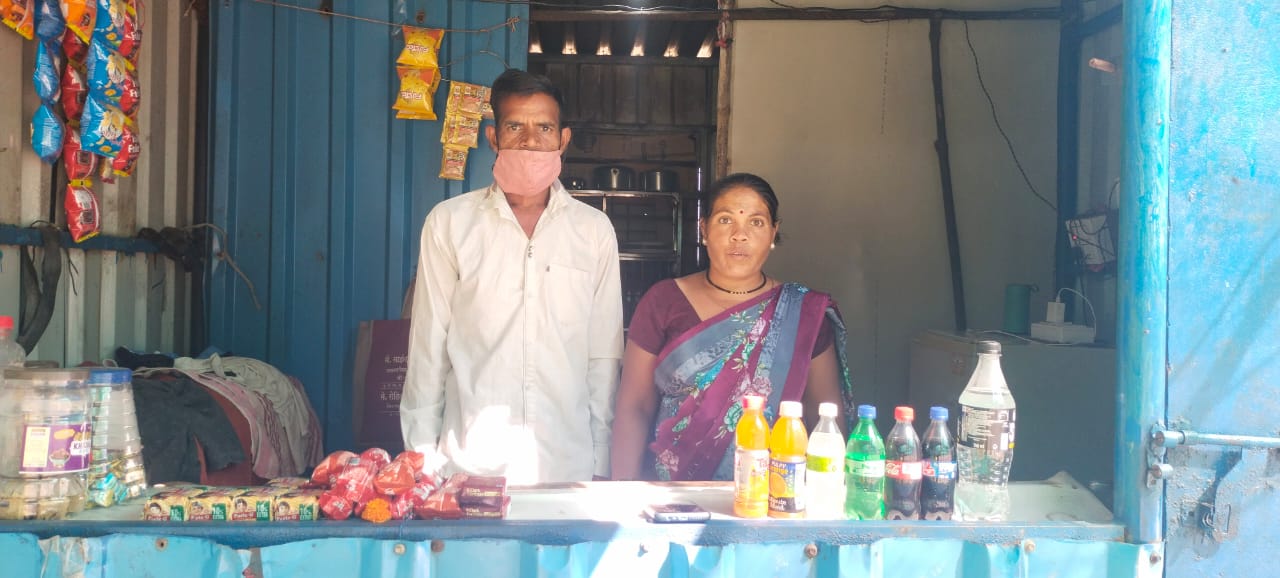
The small eatery called Hotel Malshej; Balu and his wife, who served us excellent food (Photo: courtesy Balu)
The mountain wall from day one now curved towards Malshej Ghat. The dyke-like Bhairavgad was an impressive sight to behold. Meanwhile we could see ranges coming into view on the opposite side of the road as well. Occasionally a motorcycle rider or the occupants of a passing car would give us a thumbs up for encouragement as we sweated it up Malshej Ghat (on the Internet, the average elevation of Malshej Ghat is given as 700 metres, around 2300 feet). We took periodic breaks, particularly at view-points with parking space created by the side of the road. Having learnt the importance of self-care from the previous day, we were also quite liberal with halts for hydration, especially lemonade. Around noon, we reached the entry to the final stretch; there was a lemonade stall, a fort-like structure and a patch of road with a fleet of cranes and many workers engaged in (what seemed like) strengthening the rock wall of the hill through which the road had been cut. Besides that, the workers removed lose rocks. We paused here for lemonade and some down time spent watching people and traffic. Early afternoon, we reached the side road leading to the Maharashtra Tourism Development Corporation’s (MTDC) resort at Malshej Ghat. But given Dehri had made us fans of the local cooking, instead of heading to the resort straight away, we dove into Hotel Malshej, a dhaba (small eatery) right at that corner. It was operated by Balu and his wife. They didn’t let us down. It was another encounter with tasty food; fresh, simple and beautifully made. We told Balu that we will be back for dinner.
Post lunch, we proceeded to the MTDC resort but ended up quite disappointed with their tariff, which despite it being off season, was high. The tariff showed no sign of being flexible. And they didn’t appear to require questioning the inflexibility because there were people driving in on their cars and SUVs, willing to spend that much for a room. What are two cyclists then? – I guess. We asked ourselves if the basic paradigm of a bicycle trip is to spend high for creature comforts or focus resources on the cycling. The answer was definitely the latter. So, we consulted Balu and he fixed us up at Hotel Nisarg a little distance away. It was a rather bleak lodge but liveable and with an evening stroll to a nearby meadow possible and dinner set up at Balu’s eatery, the hours went by quickly. Interestingly, the lodge’s biggest customer appeared to be the firm doing the work on the rock wall at Malshej Ghat. The officers of the company stayed there. There was a small temple near the lodge. Harishchandragad could be seen in the distance. There was however one emergent problem – the flow of traffic on the road was now steady and the number of vehicles, more. On top of it, the road here was in a bad state. It didn’t augur well for next day’s start.
On the road to Junnar (Photo: Shyam G Menon)
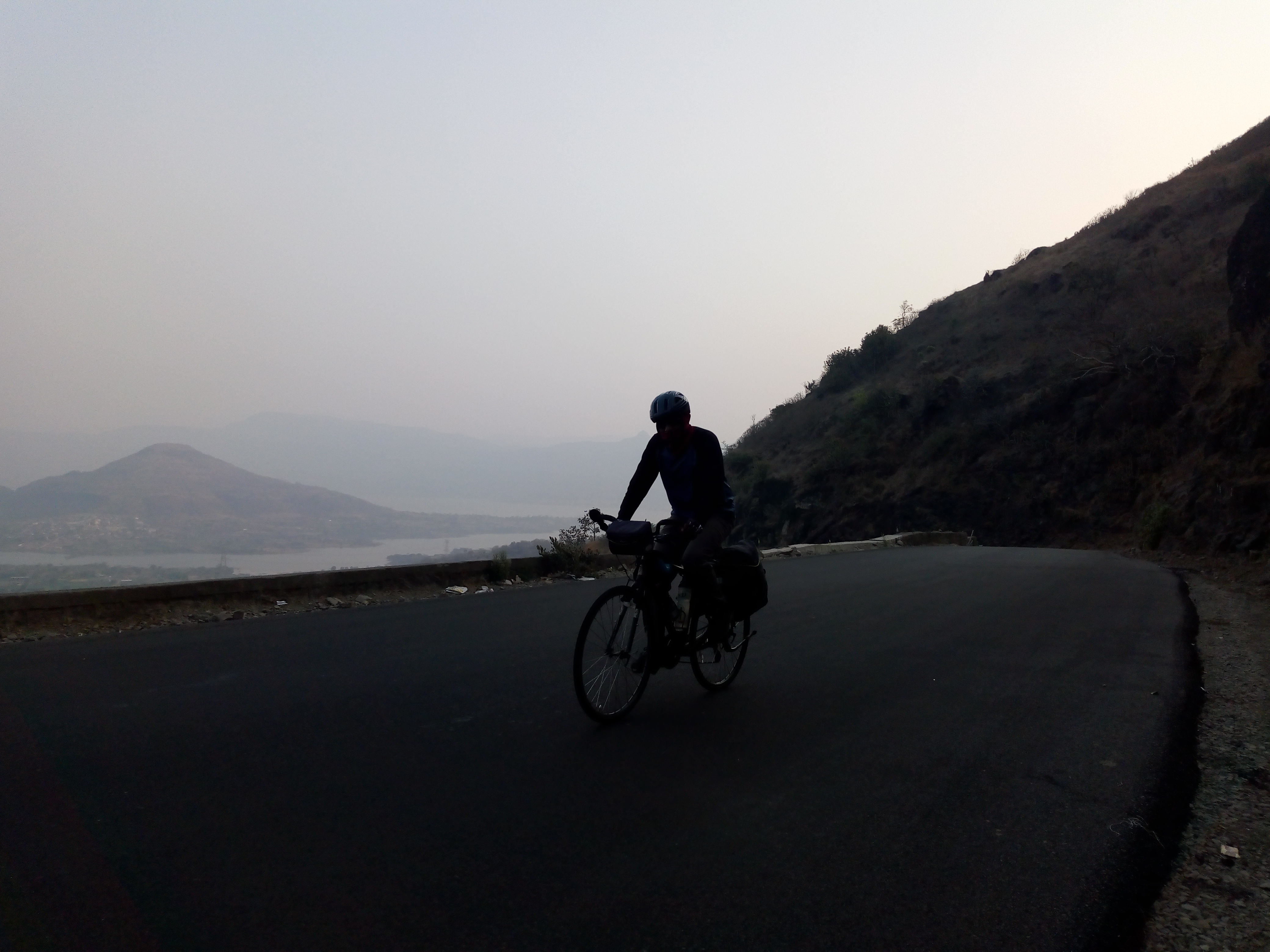
Hikers, climbers, runners, cyclists – they typically like an early morning start. The reason is simple. Unlike people traveling in the climate controlled comfort of automobiles, these activities involve physical strain. You therefore try to get at least some portion of the day’s work done before the heat sets in. It had been the same with us. We always aimed to commence cycling by 6 AM or earlier. Usually, it is a nice experience. That terrible irritant of Indian roads – traffic, is less and in places away from cities, you have a world at peace for bonus. Early next morning however, the cycling was a challenge. The road was gravely, the tarmac dipped sharply at the road’s edges and there were potholes. But the real nuisance was the traffic and the ocean of lights one saw in front. Probably because this is a hill section, trucks, cars, pick-ups, SUVs and vans plying on the road tend to have multiple lights. Their logic would be – the more the number of lights, the more the visibility. Oncoming vehicles therefore hark of a film shooting scene. There’s so much light; all one needs is a movie star dancing on the road. What they forget is, lighting technology has changed over the years. The average car or SUV of today has headlights significantly more powerful than what they used to be years ago. Adding more lights is overkill. For cyclist on the road, oncoming traffic awash in a battery of such lights is blinding. For an hour at least, I struggled to see properly. Dawn’s sunshine brought relief. Slowly the road condition too improved. We soon got past Pargaon and on to the hill road leading to Junnar. This road was a bit steep in parts but it was in excellent condition. There was very little traffic at that hour and hence, the road was quite enjoyable. It was peaceful.
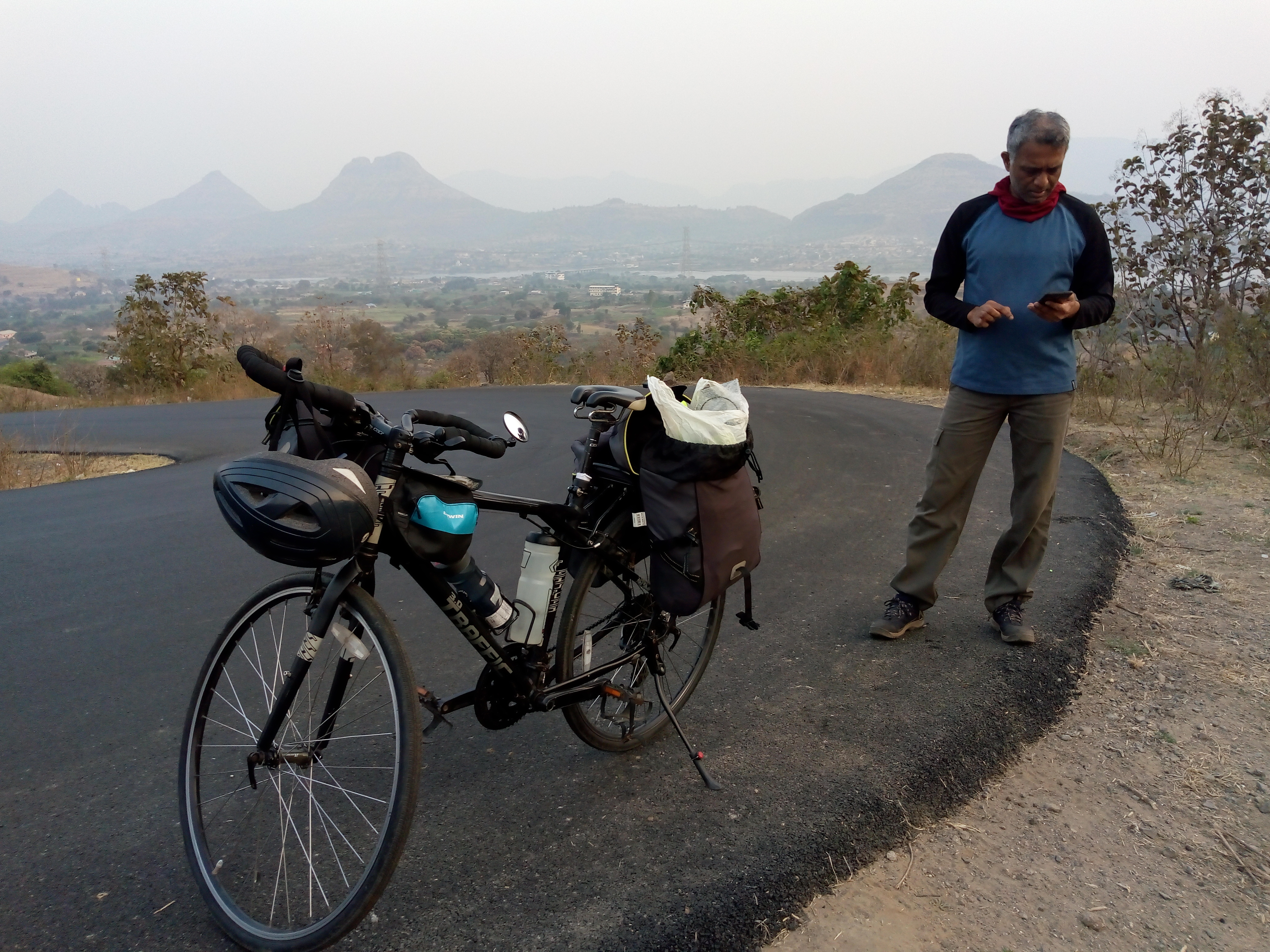
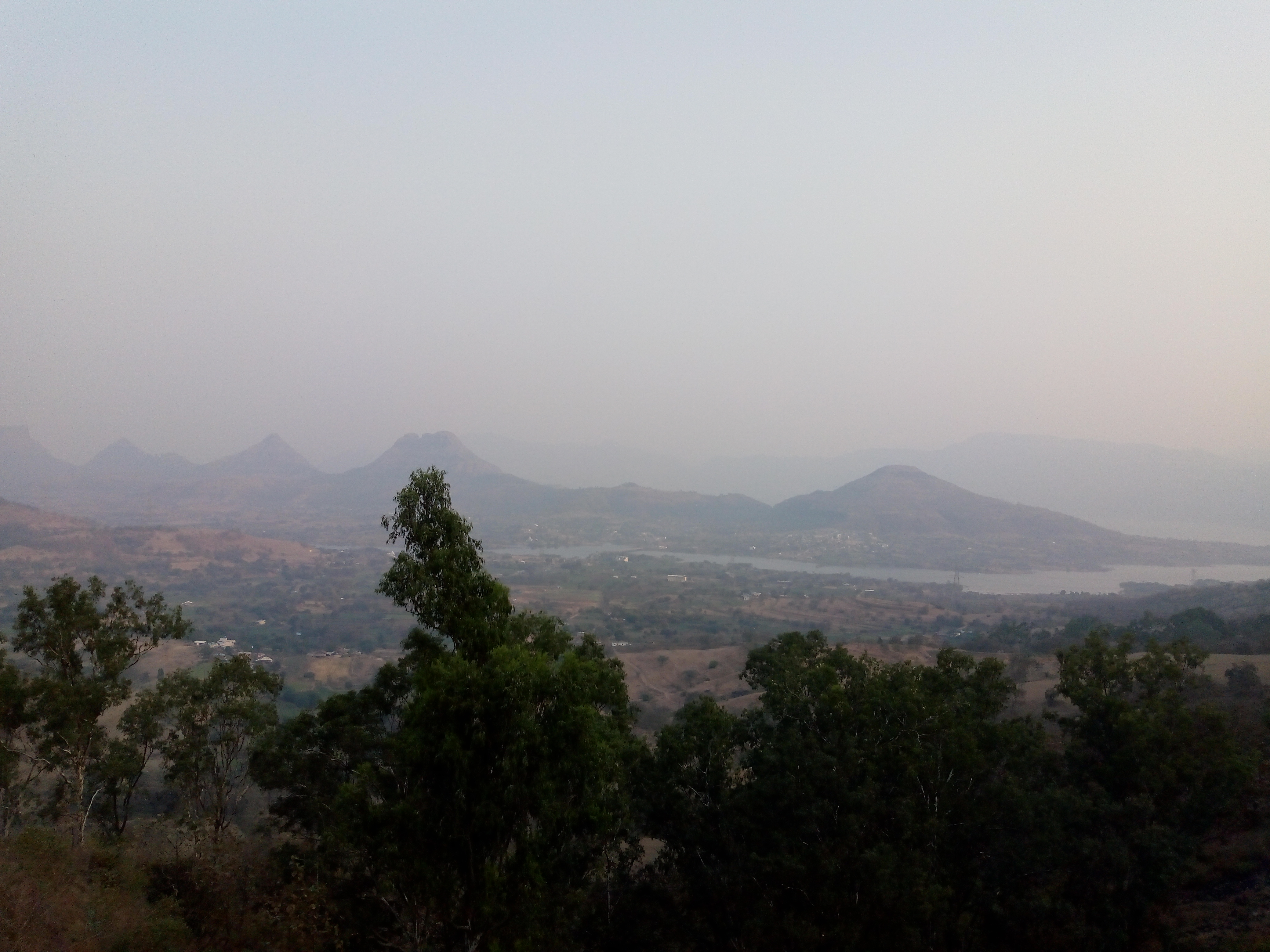
We saw a well-dressed young woman, seemingly on her way to college, walking barefoot with her slippers in her hand. It was an odd sight. Prashant asked why she was walking so. She replied that her slippers were fancy ones unsuited for walking on the hill road. Maybe closer to her destination, she would slip them back on. The road climbed up to a lovely, small pass with a temple by its side. We parked our bicycles at the pass to hydrate and take in the view. It was an impressive landscape; a chain of hills and the lake created by the Pimpalgaon Joga Dam. As we stood there, we saw a cyclist on a light road bike, come up from the Junnar side. It was Santosh, jeweller and cyclist from Othur, out on his regular training ride. It was a study in contrast – he on an utterly light road bike free of load and us (an MTB and a hybrid) sporting panniers and hauling load. We exchanged notes and a brief conversation later, Santosh rode off elegantly as road bikers typically do; he essayed a smooth turn at the corner and disappeared down the road in the direction of Pargaon. We crossed the pass towards Junnar and were treated to a long, smooth descent. It was fun; that stint going downhill felt like a magic carpet-ride.
Looking towards Malshej from the small pass on the road connecting Pargaon and Junnar (Photo: Shyam G Menon)
After breakfast at Junnar, we attended to a major problem, on since day two of the ride. My shoes, veteran of several rides, were enduring a divorce; the upper had come off the soles completely. The first one separated so before the trip and I had it repaired in Navi Mumbai. The second one followed suit at Malshej. We located a cobbler just outside the Junnar bus depot. He stitched the whole thing up. Bless you sir. We set off for Narayangaon. In retrospect, all the attractions of this trip ended at Junnar. From Junnar onward, the route we had chosen was on a crowded main road or highway and therefore very reminiscent of India’s daily rat race-existence. We could sense in the environment, the distant presence of Pune, Maharashtra’s second biggest city and among India’s major industrial hubs. As traffic from all over merges and proceeds to such hubs, the local flavour recedes and an industrial blandness takes over. The return to urban life was viscerally felt in the lunch of day three – the thali we ordered at a dhaba along the highway had nothing authentic or regional. It tasted of everywhere. Several hours of cycling on characterless roads later, we reached Chakan.
Meeting Santosh; the small pass in the backdrop (Photo: Shyam G Menon)
By now the return to civilization was full blown. Its most visible ambassador was traffic moving nonchalantly towards you on the wrong side of the road. It seemed an institutionalized, normal practice. And it was dangerous, making for deadly roads. We turned into the road leading to Talegaon from Chakan and some ways off, decided to halt at the fairly upmarket Matrix Inn. While we discussed the tariff, we told the manager of the hotel that we were cyclists out on a multi-day trip and spending high wasn’t exactly what we wished for. He heard us out and offered a good deal; he also let us take our cycles to the floor we stayed on. It was an excellent stay. Next morning, the hotel even prepared an earlier than usual complimentary breakfast for us. There was sandwich, boiled egg, fruit and tea. Our thanks to the manager and his staff.
The early morning ride through Chakan was a gaze into the dim underbelly of GDP. The factories here contribute to the GDP that is bandied about as data for discussion in the financial circles of Mumbai and the government circles of Delhi. However, there is something bleak about how GDP is made; about Chakan’s early morning heavy traffic, the sight of buses transporting workers to various factories, people waiting at bus stops, the queues before factory gates and people walking along the road, mile upon mile, proceeding on foot to their places of work. And the sun isn’t up, yet. There was an Orwellian tinge to the picture; a sense of self succumbed to industrial order and redemption through money. It isn’t an uplifting sight and you cannot blame anyone for the lack of buoyancy in the frame. It is just us, our numbers and our predicament of life traded for means of survival. Spoken of as data and statistics and minus the human angle, GDP is sexy.
Day 3, lunchtime; our cycles at a dhaba between Narayangaon and Chakan (Photo: Shyam G Menon)
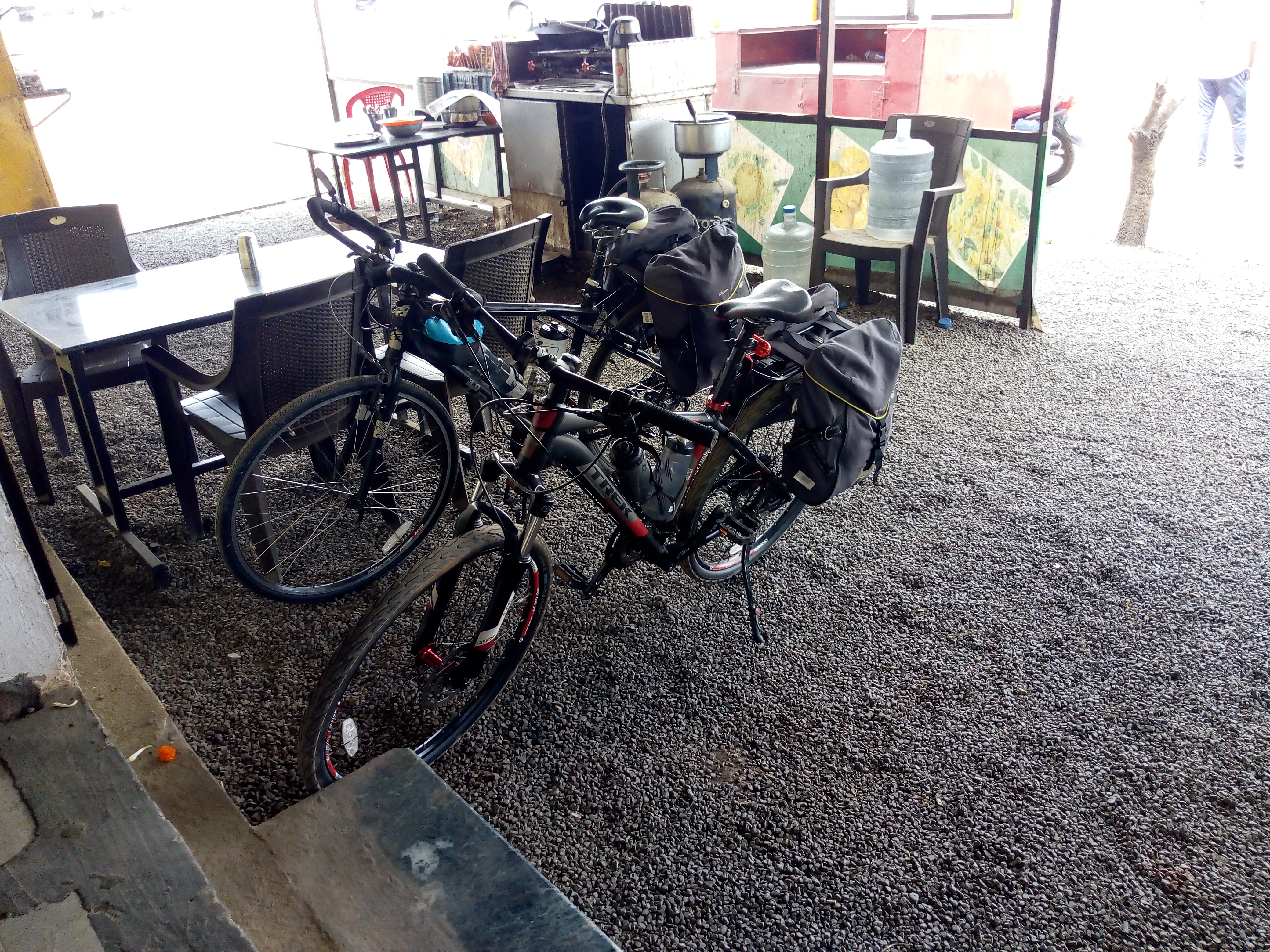
We wound our way to Talegaon, tucked into the traffic flow headed to Mumbai on the old Mumbai-Pune highway, watched paragliding over a cup of tea at Kamshet, breezed through Lonavala, descended to the coastal plains via Bhor Ghat and sat down for a ritual snack at Khopoli. The whole passage was as industrial as the morning mood of Chakan. A few hours later, Mumbai hit us in full force at Panvel. By afternoon on the fourth day (March 8), we were back in Nerul. In terms of daily mileage (approximate and measured on Google), Prashant estimates it was 95 kilometres covered on day one, 55 on day two, 90 on day three and close to 130 on day four. The cycles – a Trek 4500D MTB and a GT Traffic hybrid – held up well. The only instance of gear malfunctioning was a headlight (one of two used on the given cycle) that failed on day two. We tried repairing it in our lodge room at Malshej but to no success.
The IMD’s warning, the Mumbai municipal corporation’s (BMC) advisory on heat wave and the related news reports not only put those hours on the Karjat-Murbad road and the Mhasa-Vaishakhare road in perspective, it also helped explain another aspect of the heat, which we had felt. Although the cycling beyond Malshej had been less enjoyable due to traffic and regular highways, the heat hadn’t been as punishing as it was in the phase before Malshej Ghat and the phase following Bhor Ghat on the return. That was unusual for summer – a comparatively tolerable Deccan and an unsettlingly warm coastal plain.
(The author, Shyam G Menon, is a freelance journalist based in Mumbai.)
27 Indian ultra-runners participate in IAU Virtual Global Solidarity Run
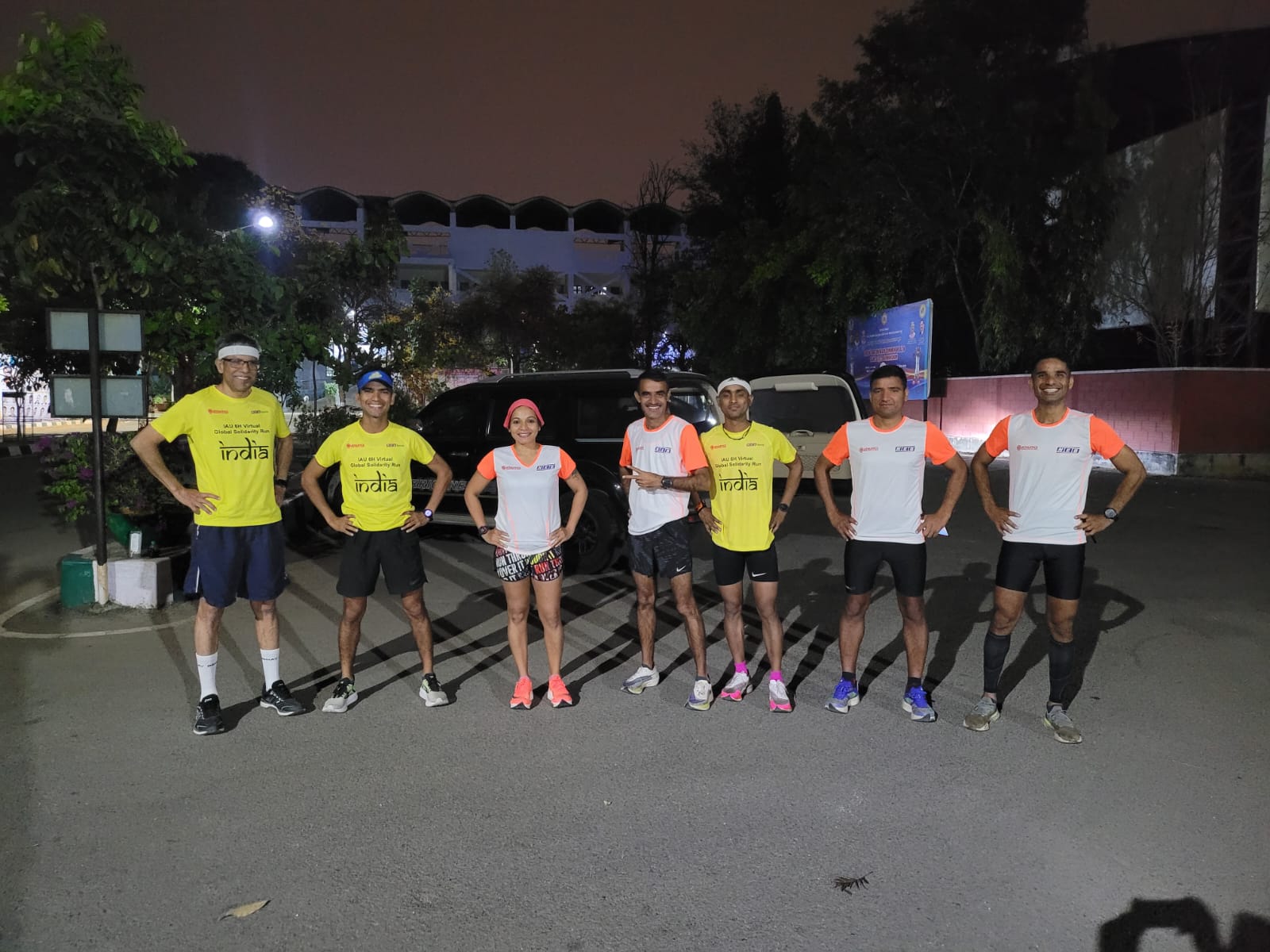
Twenty-seven Indian ultra-runners participated in the 6-Hour IAU Virtual Solidarity Run 2022 held on March 20.
Originally 28 Indian runners were scheduled to participate in the 6-hour run. Manoj Bhat had to drop out due to injury.
Among women Bindu Juneja reported the most distance logged within the stipulated duration – 63.3 kilometres. Sandeep Kumar covered a distance of 81.2 km, the highest in the men’s category. Geeno Antony had the second highest mileage – 68.37 km.
Sandeep Kumar
Running in Surat, Sandeep found the familiarity of the place psychologically easy prompting him to push for high mileage. In 2020, during the same run, Sandeep had covered 79.5 km during the 6-hour period.
“ It was quiet in the early morning but after 8 AM heat and Sunday traffic started to rise,’’ he said. With barely one hour left for the time to finish, he found himself beset with injury. “ But I decided to continue,” he said.
For nutrition and hydration, he had gels, electrolytes, coconut water, lemonade, banana, oats biscuits and peanut butter.
Sunil Chainani, Amar Singh Devanda, Bindu Juneja, Gorkha Ram, Velu P, Rakesh Saran and Om Prakash (Dany) Saran
Running in Bengaluru, Bindu Juneja had the company of five male runners from among those enlisted to run. “ We were to run in the outer loop of Kanteerava Stadium. Initially, the stadium staff were reluctant to allow us to run for six hours. We thought we would run for the first few hours there and then move out. But eventually, we ended up running in the stadium throughout,” she said.
“ I had a plan and followed it till the end. The weather was relatively good,” Bindu said.
For company, she had ultra-runners P. Velu, Amar Singh Devanda (the national record holder in 100 km and 24-hour), Gorkha Ram, Rakesh Saran and Dany Saran.
Asha Singh
Geeno Antony
Sunil Chainani, Bengaluru-based runner and formerly a member of the Athletics Federation of India’s ultra-running committee, also kept the runners company for the first three hours.
Asha Singh, running in a park in Lucknow, managed to cover a distance of 61.86 km during the stipulated time. Last week, she had participated in the 100 km race at Tuffman Stadium Run in Chandigarh. But the race was cancelled mid-way because of technical glitches in timing. There, she had covered a distance of 75 km before the race was called off.
During the 6-hour period, temperatures in Lucknow touched 36 degrees Celsius. Asha’s husband Bajrang Singh provided support to her during the run.
The Indian runners were given T-shirts by NEB Sports.
Illustration: Shyam G Menon
Indian ultra-runners to participate in IAU Virtual Global Solidarity Run 2022
Twenty-eight ultra-runners from India – nine women and 19 male runners – will be participating in the six-hour IAU/AFI Virtual Global Solidarity Run 2022 to be held on March 19 and 20, 2022.
Alongside the IAU Virtual Solidarity Run 2022, the Athletic Federation of India (AFI) Virtual Global Solidarity Run will also be held. In the AFI run, 13 runners – 10 men and three women – will be participating.
“ The IAU 6 Hour Global Solidarity Run has been an overwhelming success and popular amongst the ultrarunners. An event that was initiated to bring the IAU family together during the pandemic has become a source of hope and a beacon of optimism for the global ultrarunning community,’’ IAU statement said quoting IAU General Secretary Hilary Walker.
Women ultra-runners participating in the IAU event include Asha Singh, Deepti Chaudhary, Anju Saini, Preeti Lala, Ashwini G and Shashi Mehta.
Among men, Binay Kumar Sah, Sandeep Kumar, Sunil Sharma, Velu Perumal, Geeno Antony, Gorkha Ram, Om Prakash Saran, Amar Singh Devanda and Vipul Kumar will be representing the country.
AFI runners include Badal Teotia, Munish Dev, Parveen Kumar Sangwan, Rakesh Kumar Saran, Manoj Bhat, Satpal Rayka, Deepak Chhillar, Amar Shiv Dev and Santosh Gowda among men and Bindu Juneja, Aparna Chaudhary and Shikha Pahwa among women.
As per the instructions issued by AFI, the runners are mandated to commence their 6-hour virtual run at 5:30 AM and end at 11:30 AM on March 20, 2022. They are to run with a GPS tracker device and are expected to give a screenshot of the tracker every hour.
The virtual event will be overseen by Dr Rajat Chauhan and Santosh Padmanabhan.
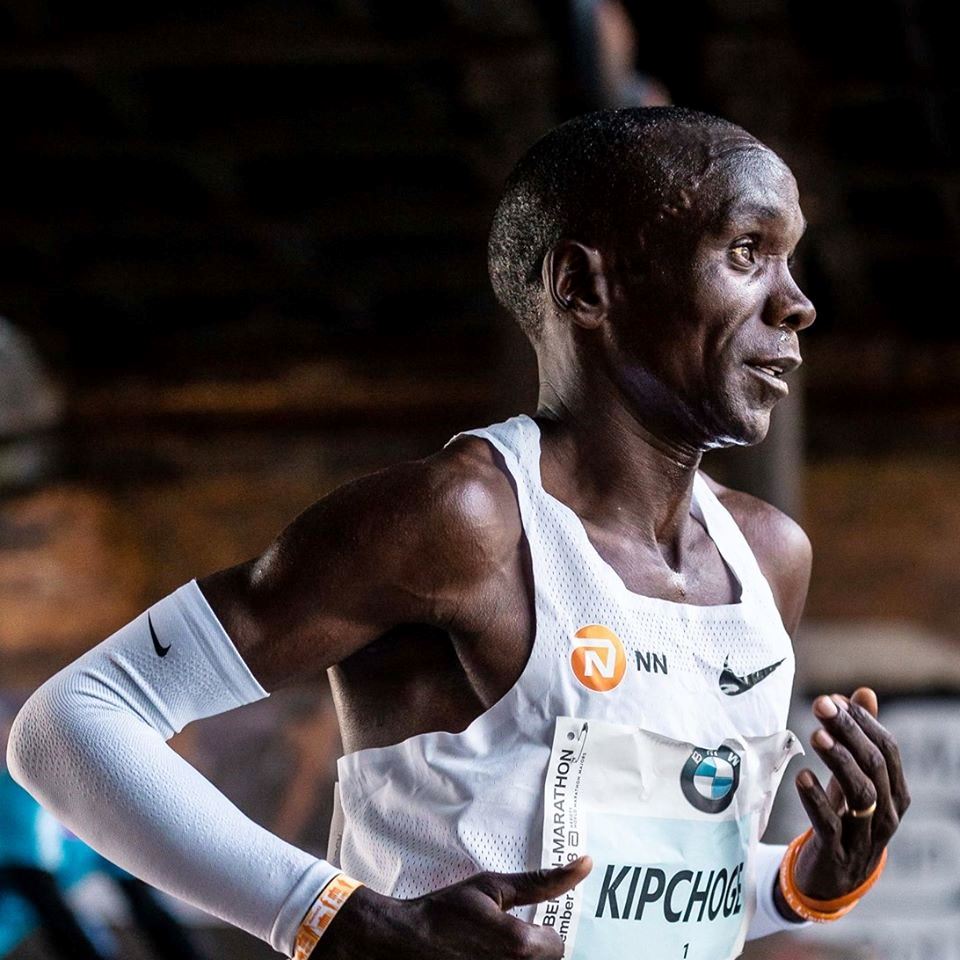
Eliud Kipchoge (This photo was downloaded from the athlete’s Facebook page and is being used here for representation purpose. No copyright infringement intended)
Kipchoge, Kosgei emerge winners at Tokyo Marathon
Eliud Kipchoge of Kenya won the men’s race at the Tokyo Marathon in a new course record of 2:02:40.
The time he took to cover the distance is as yet the fourth fastest in the history of the sport. Kipchoge’s performance was despite a wrong turn essayed by the lead pack just after the 10 kilometre-mark, an incident that would have affected the runners’ time and rhythm. The Tokyo Marathon was held on Sunday, March 6, 2022.
“ Kipchoge has now won 14 marathons overall, including nine World Marathon Major events and two Olympic marathons. With wins in Tokyo, London, Berlin, and Chicago, he joins Wilson Kipsang as the only men to have won four different WMM events since the series began in 2006. Only Boston and New York remain for Kipchoge to complete an unprecedented sweep,” the website letsrun.com said in its report on the Tokyo Marathon.
Second place in the men’s race went to Kenya’s Amos Kipruto (2:03:13). Tamirat Tola of Ethiopia (2:04:14) placed third. Although held in March 2022, the event was actually the delayed 2021 edition because that year’s race was postponed to be held in October 2021 due to the COVID-19 pandemic, and then again postponed to March 2022.
In the women’s race, top honours went to world record holder Brigid Kosgei of Kenya. She completed the race in 2:16:02, the third fastest time recorded yet for women. Ashete Bikere of Ethiopia (2:17:58) finished second while fellow Ethiopian, Goytom Gebrselase (2:18:18) placed third.
(The authors, Latha Venkatraman and Shyam G Menon, are independent journalists based in Mumbai.)
The recent incident of a trekker stuck on a high rock face near Malampuzha and eventually rescued by army personnel, should be cause for reflection in Kerala.
Footage broadcast on TV showed a rescuer descending from the top of the rock face, collecting the 23-year-old who endured nearly two days without food and water (there was a small cavity he could sit in), and the duo then being slowly hoisted up. It seemed a fairly straight forward operation. By the evening of the rescue, there were TV debates asking why the local police lacked the required skills. Unfortunately, that’s the wrong end to start enquiring. What one must find is the source of the required skillsets and ask why climbing, the sport hosting many of those skills, never gained traction in Kerala.
In India, civilian presence in adventure sports like climbing was traditionally inhibited by the fact that they are expensive. When it came to the ability to afford gear and access prized terrain like the Himalaya (which unfortunately constitutes a sensitive border), the armed forces always scored. In the list of Indian mountaineering expeditions, one will therefore find a sizable military presence. In Indian media, rescuers are often described as trained in mountaineering.
Rock climbing in India, evolved differently from mountaineering. Here one half of the traditional impediments to adventure – accessibility – is less. Engaging rock faces are available in the ranges south of the Himalaya along with access less constrained by weather and security issues. Consequently, domination by military is absent. In their earlier years, India’s climbing clubs attempted some of these faces and features with what gear they possessed. Later club members pooled their resources and bought better climbing equipment. Nowadays, thanks to the growth in number of rock climbers and rise in disposable income, there are individuals owning a full set (a rack) of climbing gear.
From the perspective of rescue, civilian-rock climbing matters because notwithstanding difference in terrain tackled and variations to equipment thereby, many of the basic systems of mountaineering and rock climbing are similar. Besides south of the Himalaya, you are not dealing with snow and ice. In peninsular India, Maharashtra and Karnataka have produced good rock climbers. Maharashtra has a number of hiking and climbing clubs; some of their members climb rock regularly in the Sahyadri and have also done courses in mountaineering. Rescue related to the outdoors in Maharashtra, rarely sees the army called in; it is done by a combination of the clubs and local authorities. According to Umesh Zirpe, among the most respected expedition leaders from Maharashtra (he has led successful civilian expeditions to several 8000m peaks in the Himalaya), in the above-mentioned combination, as much as 90 per cent would be civilian volunteers familiar with hiking and climbing, working for free. The club Zirpe belongs to – Giripremi – was instrumental in starting South India’s only mountaineering institute in Pune. In 2016, the club and the institute launched the Maharashtra Mountain Rescue Coordination Centre (MMRCC). Today, the state has a 24×7 mountain rescue helpline that gets volunteers to respond in the event of a mishap, he said.
Arguably, the most crucial aspect in this ecosystem are the clubs and the treatment of climbing as sport; not as spectacle or something extraordinary. Done so and treated in a relaxed, unpressured fashion, learning happens. If one wants to be a good rescuer one has to be competent at the technical systems involved. This is not a macho accomplishment. It is basically comprehension of a given situation, knowledge of climbing gear and its maintenance and an understanding of system architecture. One gets good at this in direct proportion to how often one is practising the sport and which sub-category of climbing, one is interested in.
Bouldering for example, is minimalist; it dispenses with equipment (except for crash pad, chalk bag and rock climbing shoes) but teaches a lot about physicality and the grammar of movement. Sport climbing teaches more about systems but given climbing routes are prepared in advance, there is no need to delineate afresh a route on rock or set up anchors oneself. Traditional (trad) climbing – particularly multi-pitch – brings climber closer to the range of contexts and skillsets required for rescue. “ In multi-pitch trad climbing, one navigates on rock in a fashion that isn’t simply a continuous vertical progression. One may climb up, then correct by climbing down. Unlike sport climbing, there is more looking around. Plus, we get situations that require applying one’s sense of judgement,’’ Dinesh Kaigonahalli, among Bengaluru’s best-known senior climbers, said. While knowledge of multi pitch climbing provides the foundation, to be a rescuer there are specialized techniques to master additionally. Club culture and regular climbing expose us to the basics and the world of learning beyond.
This skills-led, civilian-based approach is also in tune with models reported overseas. For example, one of the world’s greatest big wall-climbing destinations is Yosemite in the US. It is home to massive rock faces cherished by many as an objective to climb. Occasionally, climbers get stuck or accidents happen. Rescue is done by Yosemite Search and Rescue (YOSAR). As a direct offshoot of adventure activity being treated as sport, rescue machinery in several countries is managed by motivated civilians familiar with the sport and locality, and trained in rescue systems. This is unfortunately yet to happen in India at large, although as mentioned earlier, in states like Maharashtra, there is an emergent self-reliance in rescue.
In Kerala, trekking and climbing remained small. Given the eco-sensitivity of the Western Ghats and presence of wild animals, the state’s wilderness is officially protected (as it should be). Extended monsoon adds to the complexity; rock climbing needs dry rock. The state could have overcome this by opening up access to rock in less eco-sensitive areas and complementing the limited outdoor window with good indoor climbing infrastructure. That hasn’t happened as needed. Further, marketable soft adventure as is the case in tourism, is quickly understood in the state. When it comes to full blown trekking or rock climbing (or adventure in water and air), there is the tendency to initiate youngsters into the sport via agencies like the National Cadet Corps (NCC), which endorses the widespread notion that adventure is the domain of the armed forces. The paradigm was visible in TV programs around the rescue in Malampuzha as well; discussions featured police officers and ex-military personnel. This is despite the state of affairs overseas and the evidence of Keralites working in other states in India, who learnt to enjoy hiking and climbing as a responsible, civilian sport.
Illustration: Shyam G Menon
Wider knowledge of the proper techniques and etiquettes of trekking and climbing is the best way to avoid mishaps in the outdoors. Shorn of spectacle and treated as a sport (as done by responsible clubs), such awareness is disseminated easier. One gets to be in an ecosystem that is not only seriously pursuing the activity but is also sharing information on associated courses and workshops. Good club culture matters. If clubs end up serving vanity, alpha characters and internal politics (all, classic Indian problems), then they lose professionalism. Interestingly, one of the comments this author heard from a foreigner who spent time fostering outdoor culture in India, was how young Indians approached the outdoors like a caged beast set free. A direct product of conservative family and pressures at work, the behaviour breeds its own scope for accidents, he said.
Viewed through the prism of adventure, Kerala’s limitations are on show. Simple rescues have vaulted to the realm of madness by media and involvement of the armed forces. The solution is to treat adventure as an instinct within sport, base it in the civilian realm to which it naturally belongs and let a responsible club culture take roots. This will put in place a wider base of climbers, those competent in related first aid (there are first aid courses designed for people into outdoor sports and wilderness), and above all, a regimen of regular engagement with the sport for ultimately you are only as good as the last time you practised those skills. Ensuring that people stay in touch with their skills is a priority for Zirpe too, given the sizable share of volunteers in Maharashtra’s pool of talent for mountain rescue. “ We plan to conduct refresher courses,’’ he said.
The model of clubs should not be difficult for Kerala to emulate. Recreational running and cycling have become quite popular in the state and good clubs exist in those spaces. They invest in best practices, skills, dissemination of knowledge and provide support. That’s the way to go. But let’s be clear – notwithstanding the best we do, mishaps may still happen. A promising society learns from every incident without stifling the appetite to explore.
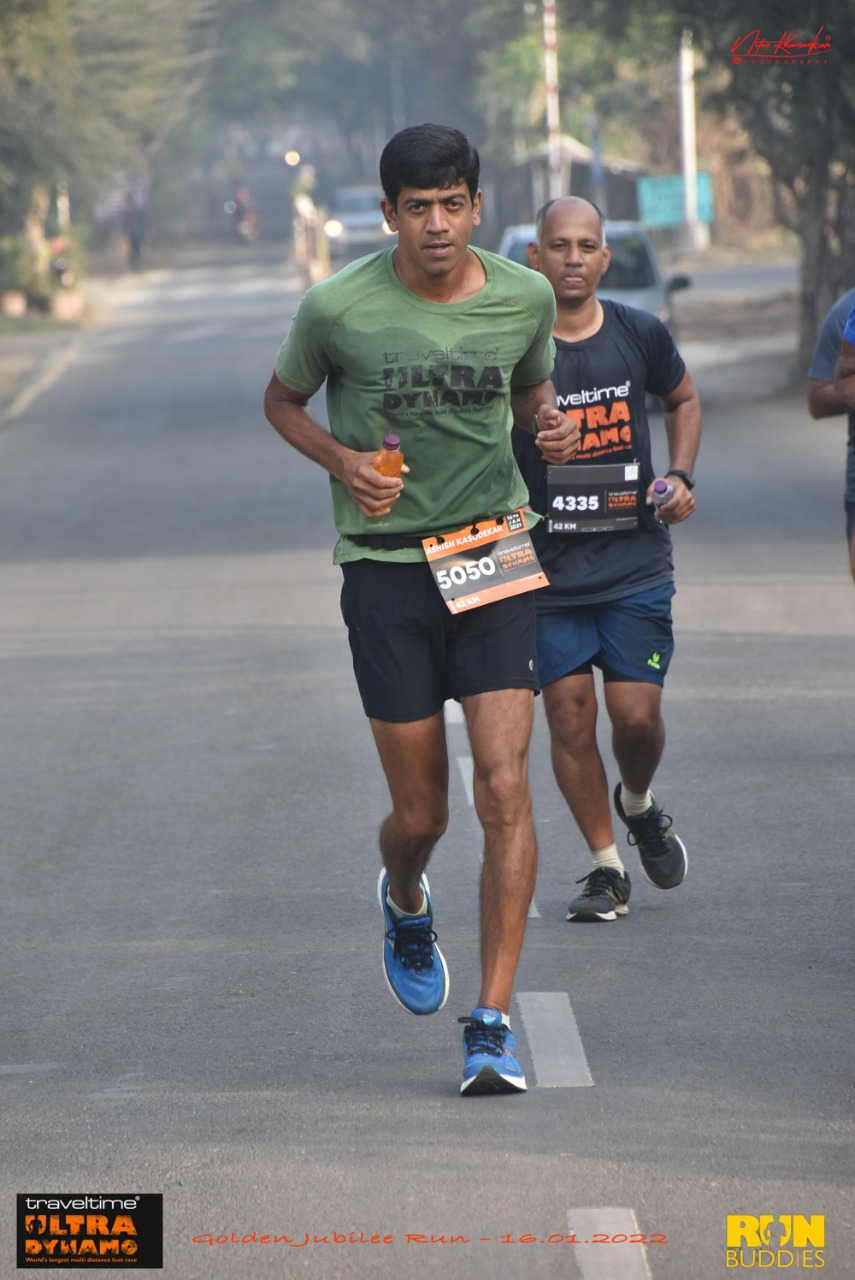
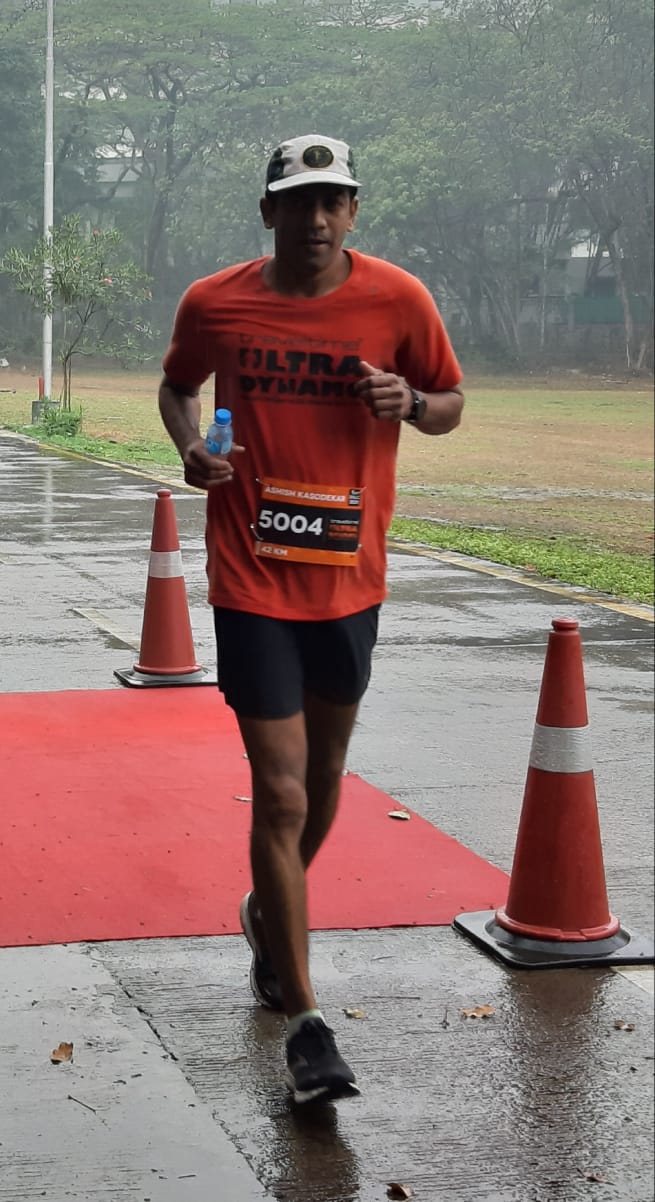
Every morning for 61 days, Pune-based ultra-marathoner, Ashish Kasodekar, woke up at 4:30AM and ran a marathon, a distance of 42.2 kilometres.
It was a well-planned endeavour, cast in the form of a two month-long running event, organised by Run Buddies. The one extra day was Ashish’s decision to test himself after running for 60 days.
In 2021 Ashish was turning 50 and wanted to run 50 marathons consecutively to celebrate it. “ When I found out that there was a Guinness record for 59 back-to-back marathons, I decided to extend it to 60 days,’’ he said. His plan was to execute the project in April but he was not able to do so as the country was in the grip of the second wave of COVID-19 pandemic and lockdown.
However, the groundwork for Guinness record requirements began. As per the Guinness guidelines, Ashish was required to achieve this record in a public event. There had to be two finishers apart from the record seeker, four witnesses, photographs and video recordings among others.
The event that was created was titled Ultra Dynamo. The lead sponsor was Traveltime Car Rental Private Ltd. It was organised by Run Buddies at Savitribai Phule Pune University on a loop of 5.3 km. Run Buddies organised it like a multi-day event offering runs of varying distances such as 5 km, 19 km, 21 km and 42 km.
The organisers invited other runners to join the event and run a marathon. Ashish started running on November 28, 2021. “ When I started my endeavour, there were very few cases of COVID-19 but the numbers started to climb,’’ he said, adding that the organisers reduced the number of runners to be invited to run. “ There were many runners who ran a marathon for the first time during those 60 days,’’ he said.
Even as COVID-19 was spreading fast in its third wave, Ashish remained untouched by any infection. “ My routine was well-organised. I would wake up at 4:30AM and get ready to leave for the run. At 6AM, the run was flagged off. Once, I was done with the marathon, I would head home, have lunch and rest. I was eating, sleeping and exercising well,’’ he said. “ The positive energy of those 60 days, meeting so many people and leading a disciplined life helped me immensely,’’ Ashish said.
According to him, his preparations by way of fitness for the two month long-event spanned both stretching and strength training. During the two months of a marathon done every day, Ashish counted the run itself as his fitness routine. He did it as a mix of running and walking to keep injuries at bay. He laid emphasis on recovery, making sure that he ate, stretched and slept well.
In endeavours like the one he was attempting, wherein an activity is repeated and sustained for a long period of time, the main thing to manage well, he said, are discipline, avoidance of injury and proper recovery. You keep that cycle going.
Although repeating the same loop for two months, Ashish said he never found the experience monotonous. “ For me it wasn’t at all monotonous. Every time, I completed the loop it was an opportunity to refuel and see my friends and those who had come to encourage me. I called it my Recharge Station,’’ he said.
A team of 8-9 friends, friends from running and volunteers of Run Buddies, helped Ashish execute the project. On most days, Ashish completed the distance in about five and a half hours. “ Speed was not the issue. I wanted to run easy to stay injury free. I took each day as it came. I am happy with the way it finished,’’ he said.
Ashish Kasodekar (Photo: courtesy Ashish)
Ashish is a keen basketball player. Apart from runners, hockey players and basketball players came along for the run on a couple of occasions; the latter dribbling their ball on the 5.3 km loop. “ One person in a wheelchair also completed the marathon,’’ he said.
Ashish’s aim was to officially conclude the project on January 26, 2022, to coincide with India’s Republic Day. He ran for one more day to test himself after running for 60 days. “On January 27, I ran the marathon in 3:45 hours,’’ he said.
Ashish has been participating in running events since 2013. He has been focussing on ultra-distance events. In August 2019, he was the first Indian to finish the 555 km-category at La Ultra The High in Ladakh. In January 2020, he completed Brazil 135, an ultra-marathon held in the Serra da Mantiqueira mountains.
In July 2022, he is scheduled to do the Badwater 135 ultra-marathon. The original plan was to do Badwater in 2020 but the event was cancelled due to the pandemic.
“ In a few days’ time I will start training for Badwater,” Ashish said. The race in the US, covers a distance of 135 miles or 217 km from Death Valley to Whitney Portal, the trail head to Mt Whitney. It takes place annually in mid-July when the weather conditions are extreme.
(The author, Latha Venkatraman, is an independent journalist based in Mumbai.)
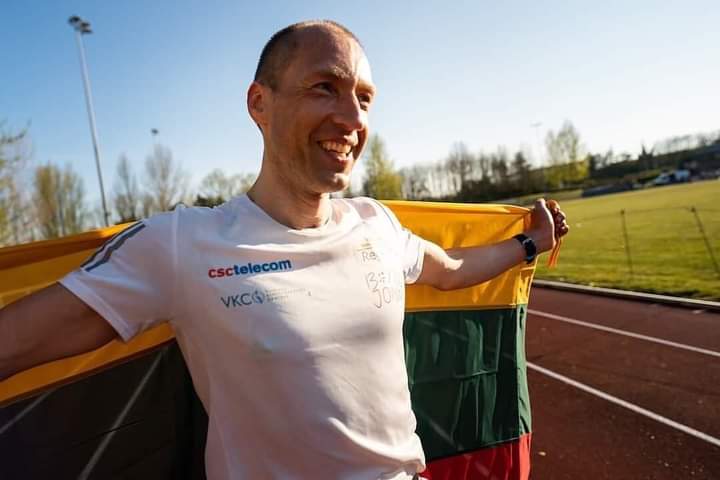
Aleksandr Sorokin (This image was downloaded from the athlete’s Facebook page. No copyright infringement intended)
Aleksandr Sorokin breaks 100 mile, 12-hour world records
First runner to cover 100 miles in less than 11 hours
Lithuanian ultra-runner Aleksandr Sorokin set new world records in the 100 mile and 12-hour run at the Spartanion 12-hour event in Israel on January 6.
He is the first runner to break the 11-hour barrier in 100 miles.
Running on a 1.46-kilometre loop, he covered 100 miles in 10 hours, 51 minutes and 39 seconds. He went on to complete the 12-hour run covering a distance of 110.24 miles (176.384 km). Both of these are new world records. According to a January 6 report on the website irunfar.com, the new records were yet to be officially confirmed.
Known popularly as Sania, he broke his own records set in April 2021 at the ultra-running event in Ashford, Kent.
“ Sorokin held an incredible average pace of about 6:32 minutes per mile (about 4:04 minutes per kilometer) for 12 hours. This effort breaks his own previous world records of 11:14:56 for 100 miles and 105.825 miles (170.309 kilometers) for 12 hours, improving those respective records by about 22 minutes and about 4.4 miles (about 7 kilometers),” irunfar.com said in its report.
(The author, Latha Venkatraman, is an independentjournalist based in Mumbai.)