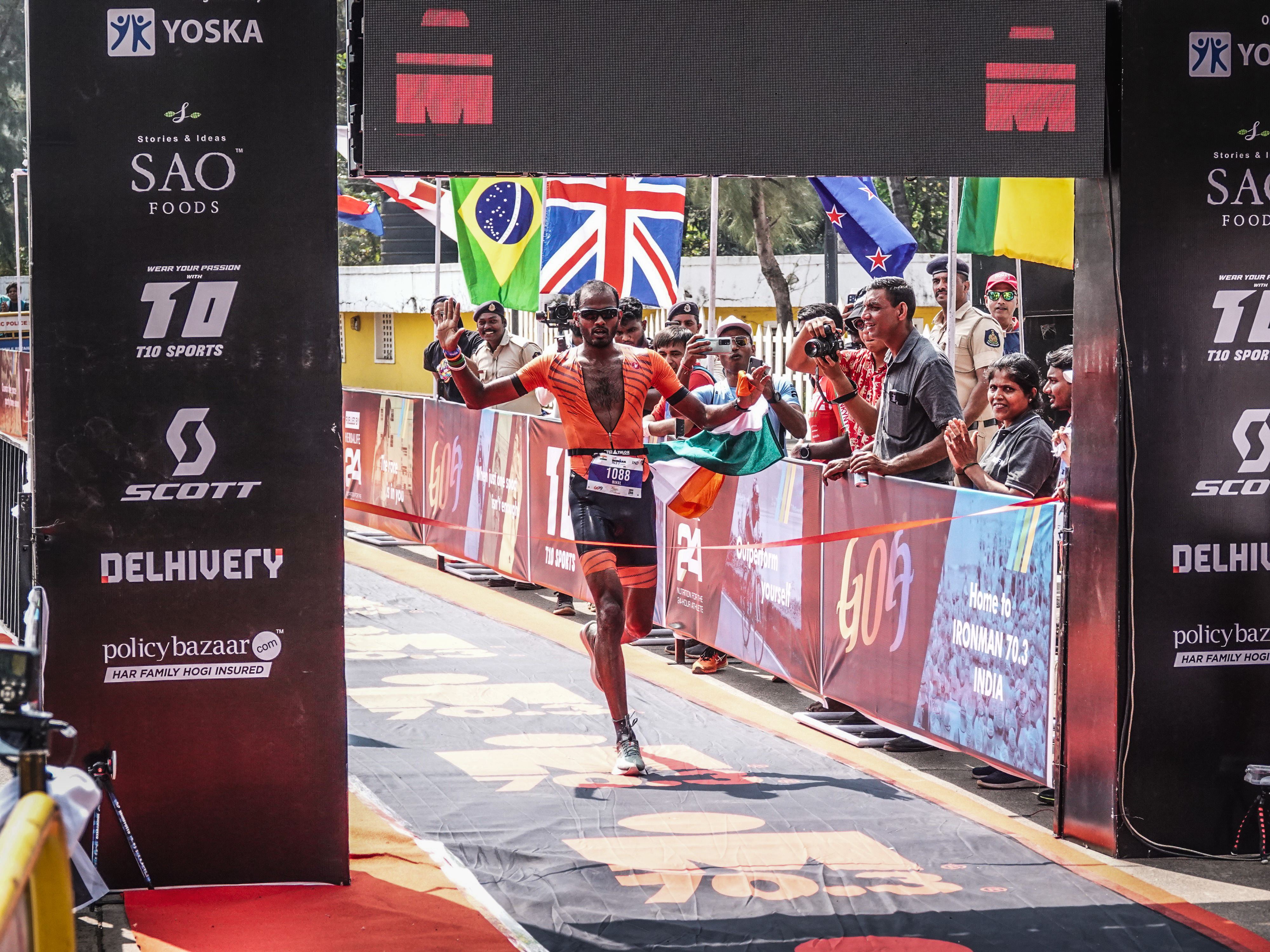
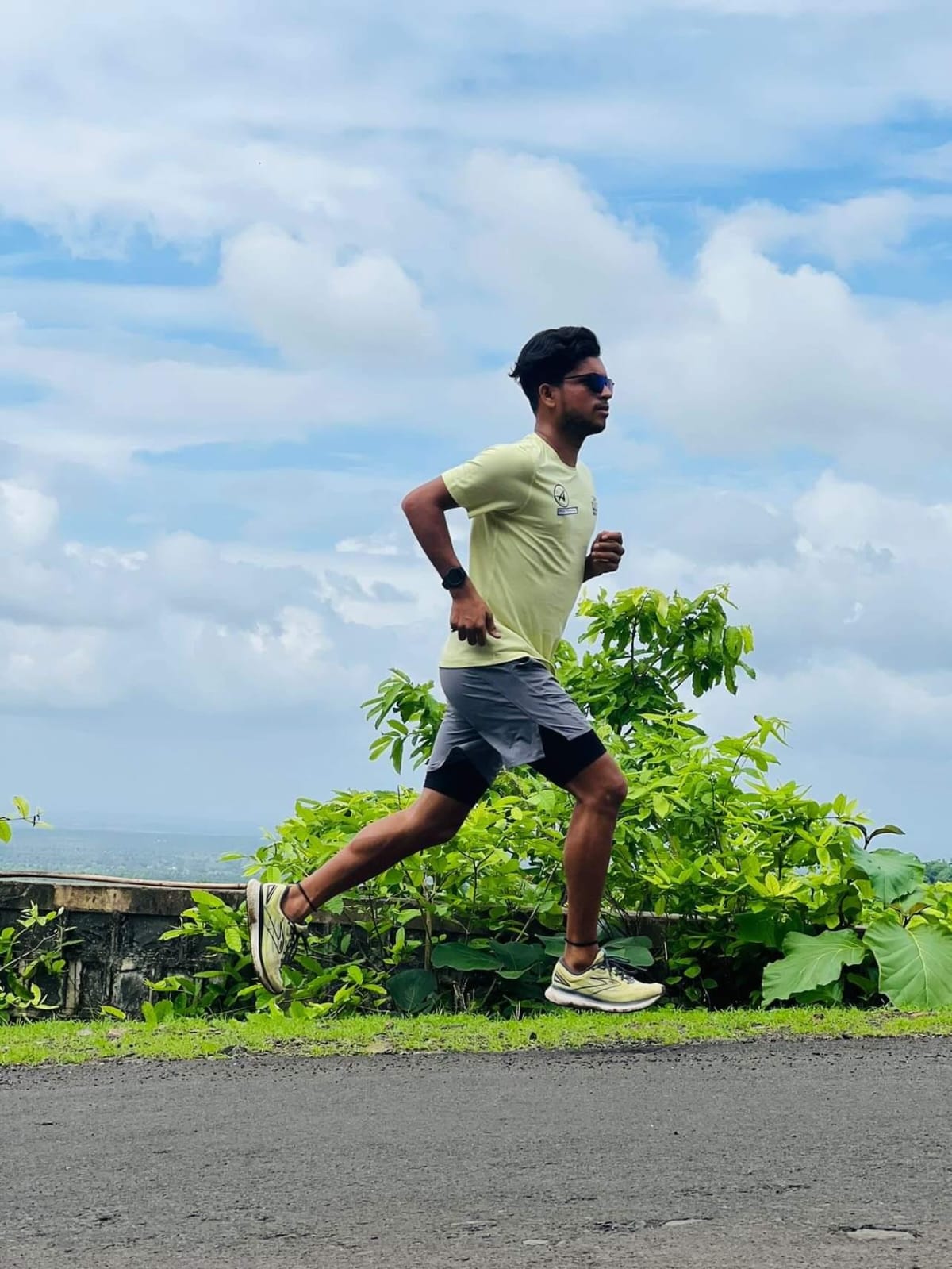
Nihal Ahamad Baig; at the finish line of the 2022 Ironman 70.3 Goa (Photo: courtesy Nihal)
Nihal Ahamad Baig was overall winner of the 2022 edition of the Ironman 70.3 held in Goa. He completed the triathlon in a personal best (PB) of four hours, 29 minutes and 45 seconds to place first.
In terms of break-up in performance across the triathlon’s three disciplines, Nihal finished eighteenth in swimming, ninth in cycling and first in running.
Second place overall went to Bishworjit Saikhom (4:37:21). Pankaj Dhiman (4:40:41) finished third.
The Ironman in Goa falls in the category of a Half Ironman aka Ironman 70.3 (70.3 miles or 113 km overall consisting of 1.9 km-swim, 90 km-bike ride and 21.1 km-run). In the previous edition of the race in 2019, Bishworjit (4:42:44) had placed first and Nihal (4:47:47), second.
Nihal who has been featured before on this blog, spoke to Latha Venkatraman, a few days after the competition in Goa in mid-November. The following is a description of Nihal’s passage to the event in 2022 and his experience on race day, narrated from the athlete’s point of view:
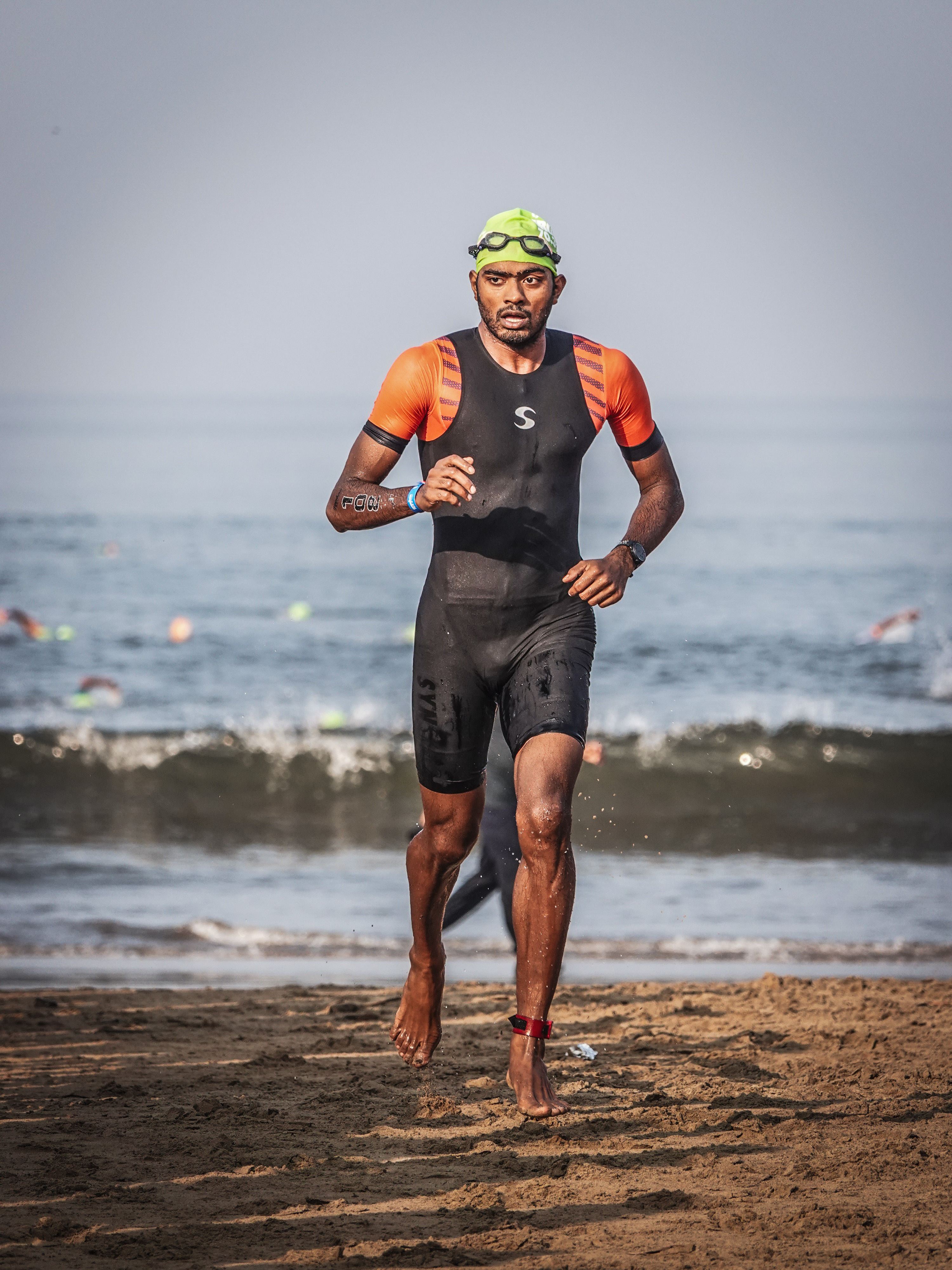
2022 Ironman 70.3 Goa /Back on land after the swim segment in the sea (Photo: courtesy Nihal)
Towards the latter part of 2021, my focus was on running with a little bit of cycling as well in the mix. Swimming was completely off as due to the pandemic swimming pools were shut.
Around the end of 2021, I started swimming in a lake as I was set to participate in the 70.3 Bergman Triathlon at Kolhapur in January 2022. That race went well (Nihal won this race). Thereafter, I was focused on the Berlin Marathon. I had registered for the race in Germany. Until early September my focus was on running. I cycled mainly for cross-training and I still wasn’t doing much swimming.
At the end of August 2022, I felt burnt-out from the training. I stopped training. I decided not to go for the Berlin Marathon, which was slated for end of September 2022. I was not enjoying my workouts. I thought it was prudent to stop training. But the burn-out did not disappear fast. For a week I stopped training completely. Yet I did not feel better. Then, I started swimming and began feeling okay. I was able to focus on my swimming. From the middle of September till the end of the month I swam regularly. After that I went home to Guntur in Andhra Pradesh for three weeks. I took my bicycle with me. I could not swim there because there is no pool. I did some strength training and cycling. I was there till October 25.
When I returned, I had just 20 days left for the Ironman 70.3 in Goa. There wasn’t much time. I started running, cycling and swimming. I also did a few key workouts. I was not specifically training for Ironman. I had been training throughout the pandemic doing one or the other of the disciplines constituting the triathlon. I was fit. I decided to attempt the triathlon in Goa on the strength of my fitness,which I had developed over the earlier months.
In terms of weather, it was hotter this time and humid. Last time in Goa, because of the continuous showers in the run-up to the race it was much cooler. But sea conditions were rough last time compared to this time when the sea was much calmer. In 2022, there were no currents. The conditions for swimming were better. I did the swim segment in much better timing compared to the last time.
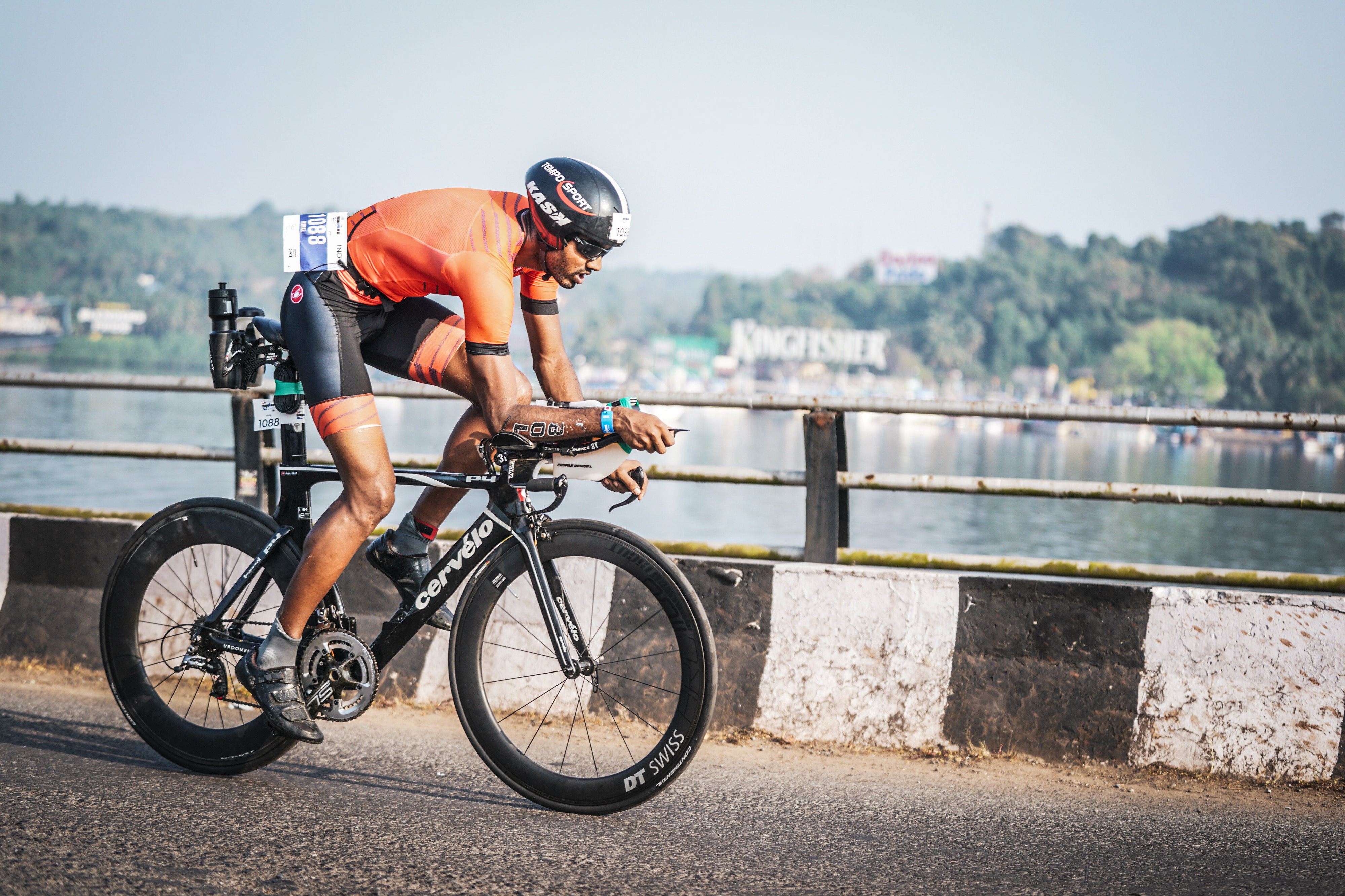
However, weather conditions for cycling and running were harsher. The overall temperature was higher. This time there was significant change in the cycling route. There was a lot of rolling hills and some elevation to tackle. Most of the route was through highways, which made progress faster. That was offset by the elevation, which made things tough. Because of lack of adequate training, I could not push much in the cycling segment. At the same time, I did not lose much ground here. Pablo Erat from Switzerland was strong in the bike segment. He had a 15-minute lead on the bike. He was there in the 2019 edition of the race and had done well in the swim and the bike segments.
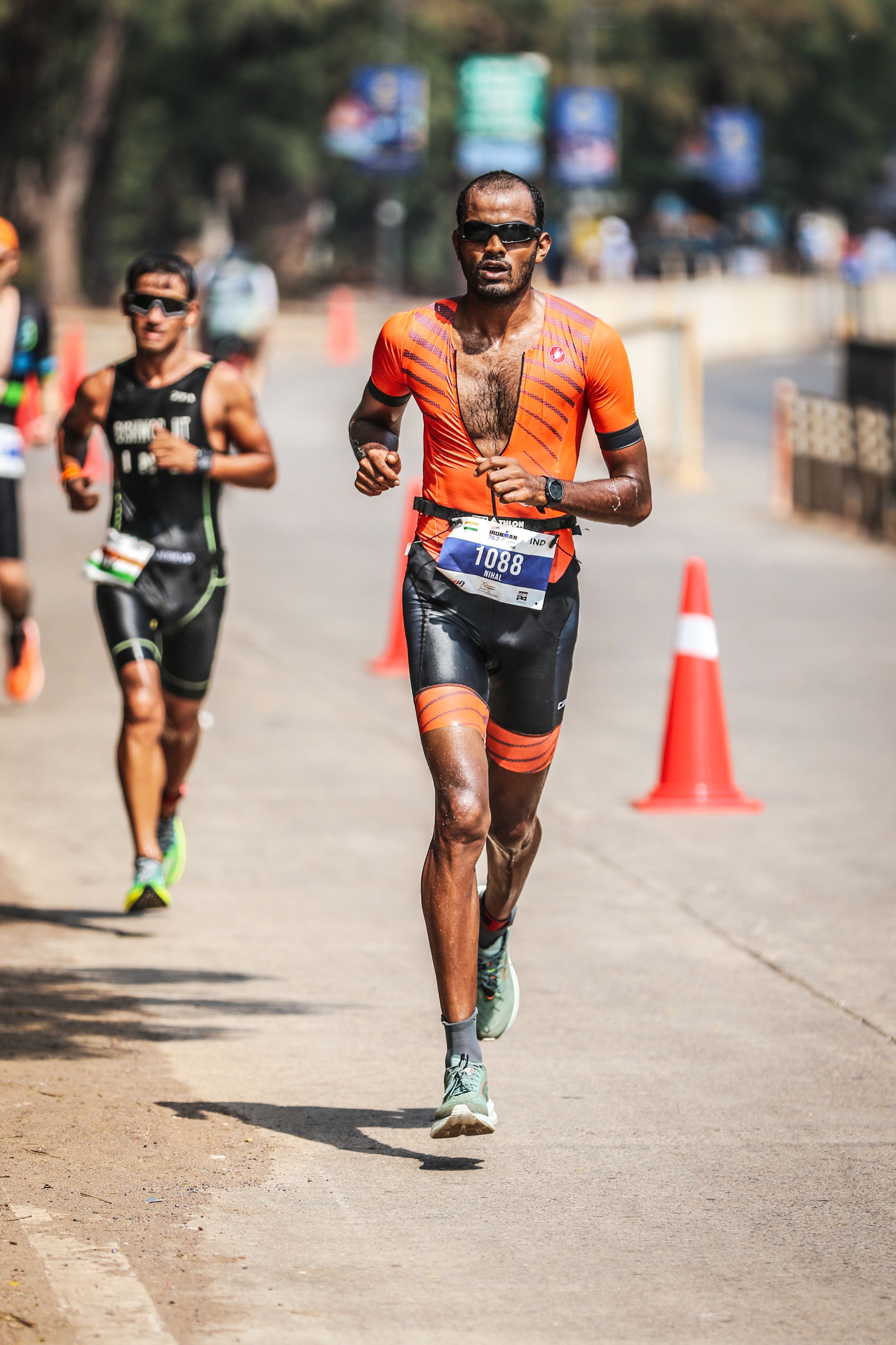
2022 Ironman 70.3 Goa / From the run (Photo: courtesy Nihal)
By the time I started running it was quite hot. The race started at 7:40 AM. I got to the running portion at 10:45 AM. The sun was out. Last time, it was overcast and slightly windy and that had helped. I knew that if I pushed too hard while running, I may hit a wall. I started at a conservative pace. When I started running, I was in seventh position overall. I was sure I would cover this gap. Pablo was ahead of me but with time he started to slow down. After the first loop, Bishworjit Saikhom, the previous edition’s winner, was ahead of me. During the second loop I was able to overtake Bishworjit at the eighth kilometre-mark. After overtaking Bishworjit, I was still second. Pablo was about 8-10 minutes ahead of me. I pushed slightly to see how well I would be able to cover the gap. When I was at around 10 kilometres, I saw Pablo slowing down considerably. At that point I knew that I would be able to take the lead soon. It happened at around 12.5 kilometres. At this point I knew that if I could hold my pace, I would win the race. I slowed down in the third lap due to a sensation of cramps around my inner thighs but by then I knew my pace was considerably better than others and so I won’t get passed.
Ironman 70.3 Goa is a tough event. I have done Bahrain Ironman, which boasts the fastest course in the world. In 2019 I did Colombo Ironman, which was as challenging as Goa though the bike route was pretty much flat. I am mentally in a good space now. I think I should start my training again. I want to focus on marathons and triathlons. I plan to train for both simultaneously. I haven’t done a full Ironman yet. I might do one soon but I haven’t decided when and which race to attempt.
(The author, Latha Venkatraman, is an independent journalist based in Mumbai.)
Finnish sailor, Tapio Lehtinen (This photo was downloaded from the Facebook page of Tapio Lehtinen Sailing and is being used here for representation purpose, No copyright infringement intended)
The 2022 Golden Globe Race (GGR) saw a rescue operation at sea get underway over November 18-19.
Finnish sailor Tapio Lehtinen was the participant rescued; the location was in the southern Indian Ocean. Tapio’s vessel – the Asteria – flooded suddenly and sank. He had to shift to his life raft.
According to the first report of November 18 (available on GGR’s website), Tapio communicated distress at 0645 UTC that morning following which, the race organizers started coordinating with French and South African authorities. “ At 0852 UTC, Tapio also activated his life raft’s PLB indicating that he may have abandoned ship. The life raft also has a VHF radio and GPS packed inside. MRCC Cape Town contacted nearby commercial vessels to divert to his position, with the closest ship 250 miles away,’’ the report said. PLB stands for Personal Locator Beacon.
The GGR entrants nearest to Tapio were India’s Abhilash Tomy (sailing in the Bayanat) and South Africa’s Kirsten Neuschafer (sailing in the Minnehaha). They were 170 miles and 105 miles south-southwest of Tapio, respectively. Both sailors were informed of Tapio’s location. Abhilash, who was the first to receive the message diverted his course accordingly. Tapio’s communication indicated that he was “ able” and had the emergency grab bag containing food, water, and critical equipment with him. The report said, Tapio informed GGR officials that his yacht had flooded from the stern with water up to deck level in five minutes. He was in his survival suit and had boarded the life raft but with no glasses was struggling to write or read text messages.
Same day, with Kirsten successfully contacted and she being the participant closest to Tapio’s position, Abhilash was released from the rescue effort. However, he continued to sail close by and asked to be updated on the progress of the rescue operation. Meanwhile, South African authorities established communication with Captain Naveen Kumar Mehrotra of the Hong Kong-flagged bulk carrier MV Darya Gayatri, to divert and render help. The ship was 250 nautical miles northwest of Tapio’s location.
As per the second report of November 19, Kirsten reached Tapio’s location at 0510 UTC that morning and picked up the Finnish sailor from his life raft. “ Tapio had an early visual on Kirsten’s yacht, but she could not see the life raft in the swell. Kirsten would hear him on the VHF but Tapio could not hear her voice. The GGR Crisis Management Team homed her onto Tapio’s position until they were close enough to see and hear each other to plan for recovery. Kirsten called the GGR Management team at 0805 UTC to confirm that she had retrieved Tapio from the life raft onto Minnehaha with a retrieving line,’’ the report said.
According to it, Tapio has since been shifted to the bulk carrier MV Darya Gayatri. As explained in the report of November 19: “ Kirsten called the GGR Management team at 0805 UTC to confirm that she had retrieved Tapio from the life raft onto Minnehaha with a retrieving line. After sharing a good glass of rum, they then proceeded to put Tapio back in the raft, pulled it towards the carrier, which he then successfully boarded via a rescue ladder.’’
GGR involves a circumnavigation of the planet. The 2022 edition of the race started from France on September 4.
Back in 2018, during the last edition of GGR, Tapio had been among the finishers. This time however, his race has ended in the southern Indian Ocean. As of November 20, GGR’s website said on Tapio’s page (every skipper has a write-up introducing him / her), of the incident causing his exit from the 2022 race, “ Asteria sank in 5 minutes with a strong unidentified water intake from astern. ‘’ A Facebook post by Tapio’s team (its English translation has been made available on the GGR Facebook page) said that the Finnish sailor woke up at around 8.30 AM on Friday (November 18) to a loud bang. At that point, the water was knee-deep in the boat’s saloon. More water flooded the engine compartment at the rear. The situation was dire. “ The most critical moment was when the pull knot of the life raft came loose. Fortunately, the weather was almost calm. I took a long leap into the water, grabbed the board and jumped in,’’ the post quoted Tapio as saying. He watched his yacht slowly sink, “ At the last moment, I stood up shakily in the life raft and put my hand in the cap as a last salute to my friend,’’ he said.
In the 2018 GGR, Abhilash Tomy had suffered accident and injury in the southern Indian Ocean following which, he was rescued in an operation involving Indian, Australian, and French authorities.
As of November 20, 2022, GGR’s live tracker showed Simon Curwen of the UK in the lead. He was followed by Abhilash in second place and Kirsten in third.
(The author, Shyam G Menon, is a freelance journalist based in Mumbai.)
A morning in late September, social media indicated that Geeno Antony was in Thiruvananthapuram.
Two days later, I found myself waiting for him at a small café close to the city’s Raj Bhavan (governor’s residence). In the months following lockdown and pandemic, the café had become favourite meeting place for my friends and I (when I was in town). We were the odd lot; on the wrong side of age in a clientele dominated by college students. On the other hand, the oddness didn’t matter. The need to hang out and converse over coffee isn’t the birth right of any one demographic. So, there I sat, waiting for the best ultra-runner from Thiruvananthapuram yet.
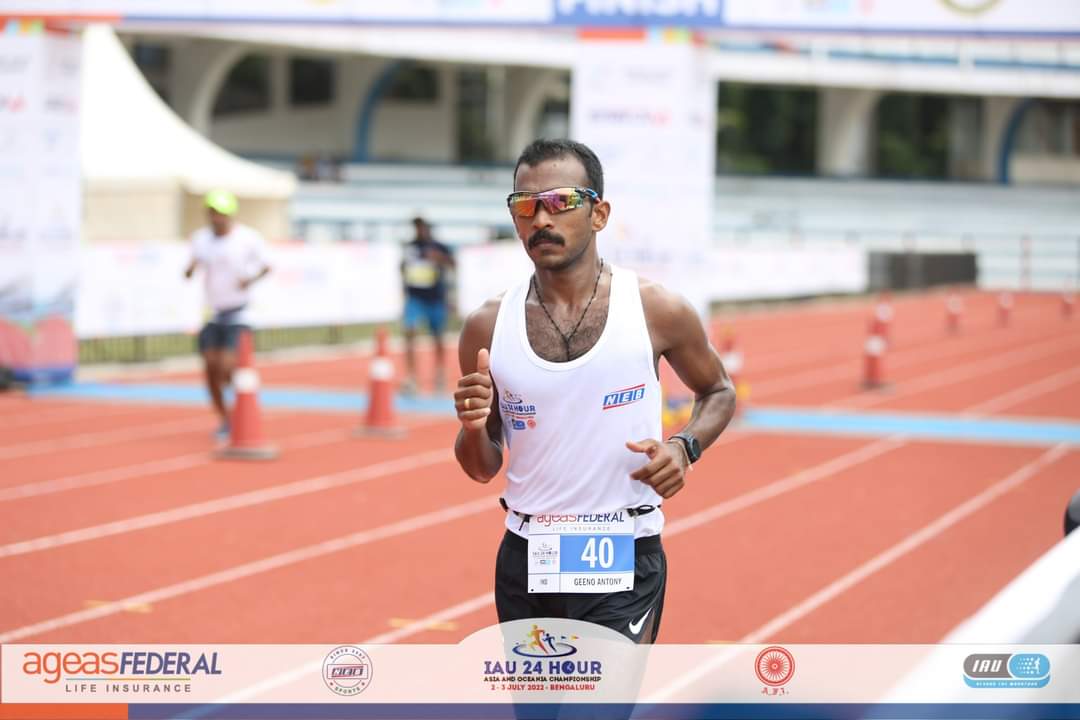
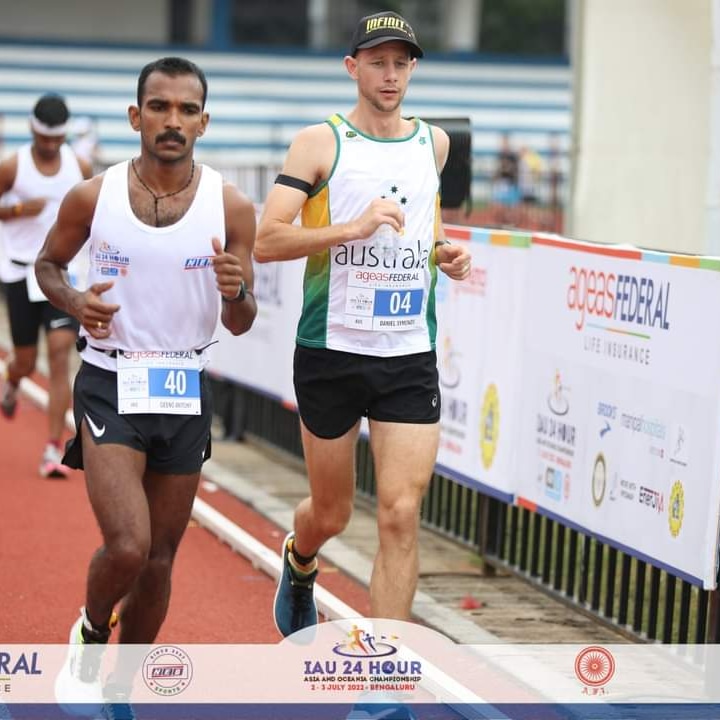
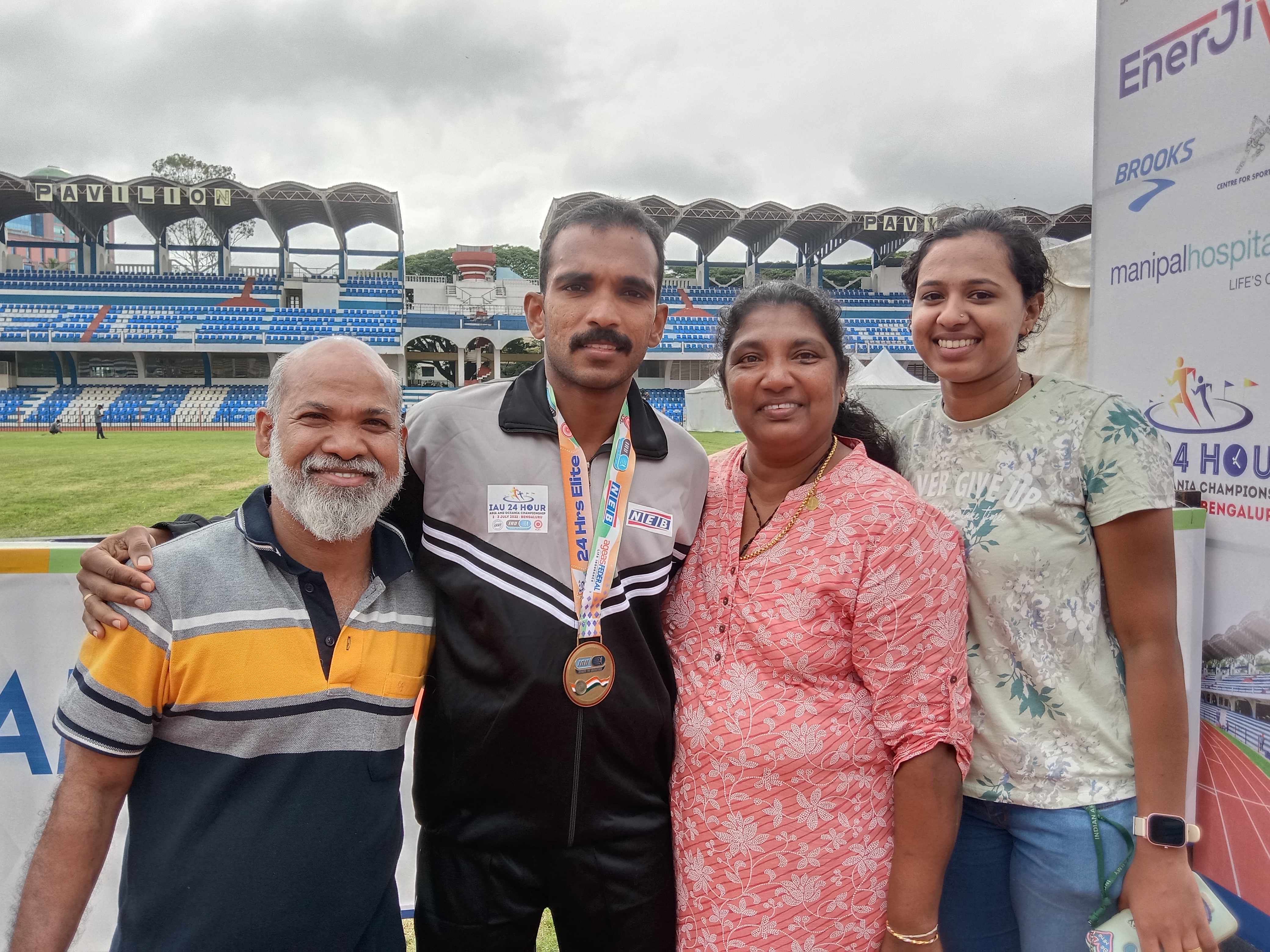
While his periodic podium finishes saw Geeno mentioned on this blog from a couple of years ago, my first meeting with this athlete from the Indian Army was in July 2022, at the IAU 24H Asia & Oceania Championships in Bengaluru. Part of the Indian men’s team, which took gold at the event, Geeno had placed third in the individual category covering 238.977 kilometers in the assigned 24-hour period (that’s more than the distance from Kerala’s capital city to its commercial capital, Kochi). When the competition concluded (Amar Singh Devanda of India who ran 257.62 kilometers was overall winner), it was a sight very different from the usual city marathons. Exhaustion was writ large on the face of most athletes. Some couldn’t stand up and had to be wheeled in on wheelchairs or supported by others for the short walk to the podium. Notwithstanding battered body, there were smiles. It’s the one thing the universe promises distance runners – after all the sweat and hardship, there is an enjoyable peace. In that lot of tired, happy people, was Geeno. Cheering him were his wife and parents.
Born in Chalakkudy in central Kerala, Geeno grew up at Thumba near Thiruvananthapuram. Thumba is close to the sea. It is flat terrain although the city of Thiruvananthapuram nearby, built on seven hills, sports plenty of uphill and downhill. The Vikram Sarabhai Space Centre (VSSC), part of the Indian Space Research Organisation (ISRO), is located in Thumba, its presence marked for years by the weekly launch of a sounding rocket. Geeno’s parents are speech and hearing-impaired. Both father and mother were into sports. Within their category of physical challenge, they did well in sports. His father played table tennis while his mother captained the state volleyball team for the speech and hearing-impaired.
Thanks to his track record in sports, Geeno’s father could secure employment at ISRO. The job provided the family, quarters to stay in and Geeno, a school to study at. The boy was active in sports and by the time he reached eleventh standard had begun to show promise in athletics and games. He went for competitions within the world of CBSE (Central Board of Secondary Education) schools. An early sign of potential was when he topped Thiruvananthapuram district in 2000m, for boys under 16 years of age. On another instance, he topped the state in 1500m. But at the subsequent nationals, he failed to secure podium position. While in the eleventh standard he attended trials at the local arm of the Sports Authority of India (SAI). He was selected for training but couldn’t do justice to it because he was doing too many things at school, ranging from an interest in dance to being part of the National Cadet Corps (NCC).
In the twelfth standard, Geeno secured a second place at state level in the 1500m but like before, returned empty handed from the nationals. Following school, he joined St Xavier’s College in Thumba to do his graduation in physics. He played basketball and handball. Within a year of being at college, he applied to join the army. Based on his success in the selection process plus his NCC background, he was drafted into the Electrical & Mechanical Engineers (EME) arm of the Indian Army. Thumba gave way to Bhopal; that was the location for soldier’s training.
Shortly after reporting to Bhopal, Geeno was selected to play basketball at the company level. But it was a case of limited progress thereafter. He lacked the height to tackle further competition in basketball. Ability at sports is valued in the army, especially against the backdrop of contests between the army’s units. Following that lack of progression in basketball, Geeno got selected for cross-country running, hockey and handball. Upon the first half of his training concluding in Bhopal, he was shifted to Vadodara. Once the whole period of training was over, he received his first posting – it was to Allahabad. The day after he reported, he ran his first cross-country race there and ended up first. Then like before, the circulation through various games for company’s prestige, commenced.
Geeno Antony (Photo: courtesy Geeno)
Amidst this, noticing his performance in cross-country, Geeno’s colleagues suggested that he try his hand at training to be a paratrooper. Consequently, in May 2013, he reported at the relevant training centre in Agra for selection. A battery of tests spread over a month, followed. He cleared most of them but couldn’t clear the one in which he had to perform with maximum load. Plus, he did well in cross-country. A second chance to get through the tests he didn’t clear, was offered. He cleared all except one. Unfortunately, a further attempt wasn’t possible because it was time to pack up and return.
“ I took this reversal in fortunes rather badly,’’ Geeno said. In the army, living up to expectations and the goals one sets for oneself, matter. He felt that he had let himself and his colleagues, down. A phase of disinterest in sports and a degree of self-neglect crept in. Things changed a bit, when he was transferred from Allahabad to Dibrugarh. Compared to Allahabad, Dibrugarh was away from India’s hustle and bustle. Slowly Geeno got back to running. It was difficult. “ Even one to two kilometres of running felt tough,’’ he said of the climb back from a depressing phase. But luck continued to dodge him. He applied for selection to the National Security Guard (NSG). They didn’t have any vacancy. In due course, Geeno moved within the EME, to Nashik. Here, his fortunes improved. To begin with, he found that he could get time to train. Courtesy his colleagues, Subedar J. N. J. Charles and Havildar K. B. Reddy, who were into cycling and distance running, he got introduced to the marathon.
Well, introduced isn’t the correct word. It was more of a revisit. In the past, soon after he completed twelfth standard, Geeno had attended long distance races in Kottayam and Kochi. He also did a half marathon from Neyyattinkara to Thiruvananthapuram and while in college, had placed seventh in the Kerala University’s cross-country competition. In Nashik, he placed second in the defence category in the half marathon he participated in (it was otherwise a civilian event). He took one hour, 25 minutes to cover the distance. Taking note of the performance, his company gave him permission to attempt another half marathon in Aurangabad. But there he finished in “ seventh or eighth’’ spot. In January 2019, Geeno ran his first full marathon in Nashik and finished nineteenth with timing of three hours, 13 minutes. This was followed by a first place in the Golden Peak Half Marathon, a 22 kilometre-run up the hill called Ponmudi near Thiruvananthapuram. In February 2019, he tried his hand at the Deccan Ultra but lost his way on the trails and came off, a Did Not Finish (DNF). However, he didn’t lose hope. He registered for the 2019 Hennur Bamboo Ultra in Bengaluru. It set him up to try running 100 kilometres.
One of the things Geeno lacked from school to Hennur, was proper training. He also missed having a good coach. In the army, he would get help from his colleagues. But mostly, he was on his own. The abrupt transitions reveal it. He didn’t think much about jumping from 21K to 42K, a transition amateur runners spend a great deal of time, training for. Similarly, he didn’t think deeply about moving from 42K to 100K. He just dove into the opportunity. “ I was unaware of the correct training methods,’’ Geeno said. To prepare for the race in Hennur, in addition to whatever regular running he did, he added a couple of 40K runs. As things turned out, Geeno finished first in the 100K at Hennur. Eventually, the Hennur run became important for another reason as well. It was here that Geeno got to know of stadium runs and the upcoming stadium run in Mumbai organized by NEB Sports.
Geeno and two colleagues from the army decided to try the 12 hour-category in the stadium run. They had two months to prepare. The outcome was encouraging. In Mumbai, Geeno placed first in the 12 hour-category for men. He covered 109 kilometres in the allotted time. One thing leads to another. At the event he met Sunil Chainani and Nagraj Adiga, both closely associated with the selection and grooming of Indian ultra-running teams. They told him of the upcoming selection for the 100K team scheduled to participate in the Asia & Oceania Championships due in Jordan. To be eligible for consideration, Geeno would need to run 100 kilometres in nine hours. It required training. To his great luck and joy, his commanding officer in Nashik comprehended Geeno’s need. Col Joshi made sure that Geeno was transferred to Secunderabad, where EME had its base for sports. But there was a problem and it is something many ultra-runners in India talk of.
Ultra-running is not an Olympic sport yet. Because of this, it escapes the attention of those putting together specialized training programmes for various disciplines. Such efforts in distance running typically favour the long-established middle-distance races and the marathon. They are firmly Olympic and therefore supported by sports organizations, sponsors and the government, as regards focused training. Although its distances exceed that of the marathon and an ultramarathon entails much effort by the runner, it is not awarded the importance it deserves. It is a victim of the distortion in perception, excessive emphasis on the Olympics causes.
Notwithstanding the Athletics Federation of India (AFI) setting up a committee to oversee the sport in India, compared to other disciplines in running, the ultra-marathon exists a bit of an orphan. Further city marathons have spread awareness of the marathon far and wide. People know what it is. But an ultra-marathon (as athletes themselves told this blog) may still be greeted with questions from the public asking about its purpose. Why do you run 100 kilometres? What do you get out of it? – such questions nowadays spared for the marathon, haunt the ultra-marathon.
Geeno Antony; from the 2022 IAU 24H Asia & Oceania Championships (Photo: courtesy Geeno)
When Geeno arrived in Secunderabad with preparation for the ultra-marathon in mind, the bulk of local training in athletics was focused on the middle-distances and the marathon. He had two weeks to prepare for the Indian team-selection in the 100K. Physical training is only one element of the ultra-marathon; there is in addition, mental training and aspects like nutrition. He designed his training as best as he could. On the day of the run for team selection, nutrition felled him – a few hours into the event, he ate something inappropriate and his stomach went for a toss. Geeno was forced to seek a second chance. Then, post-medication and availing the second chance, he ran for 12 hours covering 126 kilometres. What’s 12 hours and 126 kilometres doing here when the goal was to cover 100 kilometres in nine hours? – you may ask. Geeno explained: the 12-hour run was availed as part of three options offered that year to gain eligibility for potential selection. The options were: completing The Comrades Marathon (it is actually an ultramarathon of 89 kilometres) in South Africa in a certain time, managing 100K in nine hours and covering more than 120 kilometres in 12 hours. Roughly three weeks after he gained the above said eligibility, Geeno ran the Hyderabad Marathon and finished first in the open category with timing of two hours, 57 minutes. Then, excited at the possibility of going abroad as part of an Indian team, he busied himself acquiring a passport. Unfortunately, even as he gained eligibility to be considered for the Indian team, he didn’t get selected because there were others with better performances to their credit. But Geeno didn’t give up.
Something about how he fared during the 12 hour-run told him that a 24-hour run wouldn’t be too great a stretch to attempt. As before, he didn’t think. “ Had there been somebody to advise me, I wouldn’t have increased the challenge levels so fast,’’ Geeno said. On the bright side, despite such jerky transitions, he hasn’t sustained any injury. In February 2020 with a view to chasing a place in the Indian team in the 24-hour category, he participated in the Tuffman stadium run in Chandigarh. Eligibility to be considered for the team was set at 205 kilometres. Geeno did 209 kilomteres to place third in the stadium run. But then, the Asia & Oceania Championships in the discipline scheduled to be held in Bengaluru was cancelled due to the onset of COVID-19. There was no Indian team to submit eligibility to. Worse, the pandemic spelt cancellation of events across the board. Worldwide running slipped into the grips of a great slow down. It would take the sport, a few months to get moving again; normalcy was a long way off.
In July 2020, Geeno got married to Josmy Joesph, who has a background in sports. In school she had been a race-walker. By the time she was working with sports goods retailer Decathlon in Kochi, she had successfully transitioned her competence in race-walking to long distance running. She had settled into the half marathon as her chosen discipline and was once a podium finisher (second place) in the open category in Kochi’s annual Spice Coast Marathon. According to Josmy who now works as a fitness trainer, in her days of peak performance, she could manage a half marathon in an hour and 30 minutes.
Roughly six months after his marriage and still pursuing his dream of being in the Indian team, in January 2021, Geeno participated in the 24-hour category at a NEB stadium run in Bengaluru. He logged 219 kilometres and placed second. But any further leveraging of the performance for prospective place in an Indian team stood diminished as the World Championship due in Romania was first postponed due to the pandemic and later, cancelled. Yet another avenue to be in the team, opened up through hard work, appeared shut.
Not one to give up, at the next 24-hour stadium run of August, Geeno ran 227 kilometres. This time, his luck held. He was accepted into the Indian team for the 2022 IAU 24H Asia & Oceania Championships. He had adequate time to prepare for the event slated to be held in July 2022. Training largely on his own, he structured the first phase of his training around inputs gathered from YouTube. For the second half, he also gathered inputs from colleagues and fellow runners. At the end of the IAU competition in Bengaluru, with a third place on the podium earned, he must have been happy. The road leading to that podium finish had been a long struggle.
“ People ask me – why do you do this? Why do you run such long distances? All I can say is – the satisfaction you get is beyond measure,’’ Geeno said. The search for a purpose in running amuses him. “ Why do you do this? What do you get out of it? These are the questions bothering everyone. The questions based on which anything gets done,’’ he said laughing about the human obsession with reward. For most of us, satisfaction it would seem, counts low as reward. Promise of money, fame, promotion at job – they count. Coffee and chat done, we split for the day. Geeno and his scooter, disappeared into Thiruvananthapuram’s evening traffic.
Geeno with his parents and wife Josmy at the 2022 IAU 24H Asia & Oceania Championships in Bengaluru (Photo: Shyam G Menon)
Two weeks later, we were at his house near Nehru Junction in Thumba. It is a locality changed initially by the establishment of VSSC nearby and subsequently, by the ascent of Thiruvananthapuram’s IT industry in Kazhakkoottam, part of the region’s extended neighbourhood. A balcony, two cups of Kashmiri kahwa tea, a clutch of cookies and a conversation featuring neither rocketry nor information technology. Having seen him communicate with his father during a video call at the café, I had asked him on the drive to the house, whether he had formally learnt sign language. It turned out, Geeno hadn’t. He picked up the signs he used much the same way a child picks up language. Back in time, there was a phase in his childhood, when the absence of normal conversation and language at home, made him tad slow to speak. He overcame that.
From among the three ultra-running disciplines, he has been exposed to – 100K, 12-hour run and the 24-hour run, he believes the 24-hour category is his calling. In that space, going ahead, he hopes to be at a world championship one day. Aside from being part of an Indian team, the motivation therein includes the opportunity to see first class ultra-runners in action. Geeno is not in a hurry. Ultra-running has traditionally been kind towards older human beings. Sterling performances have been reported from people in their forties and fifties. Narrowed down to the requirements of world class competition, Geeno thinks, peak performance these days for an elite ultra-runner may be at 37-38 years of age or thereabout. As of October 2022, he was 29 years old.
(The author, Shyam G Menon, is a freelance journalist based in Mumbai. This article is based on two sets of conversation with Geeno. The sequence of events, the dates of competitions and the timings at races are as mentioned by the interviewee.)
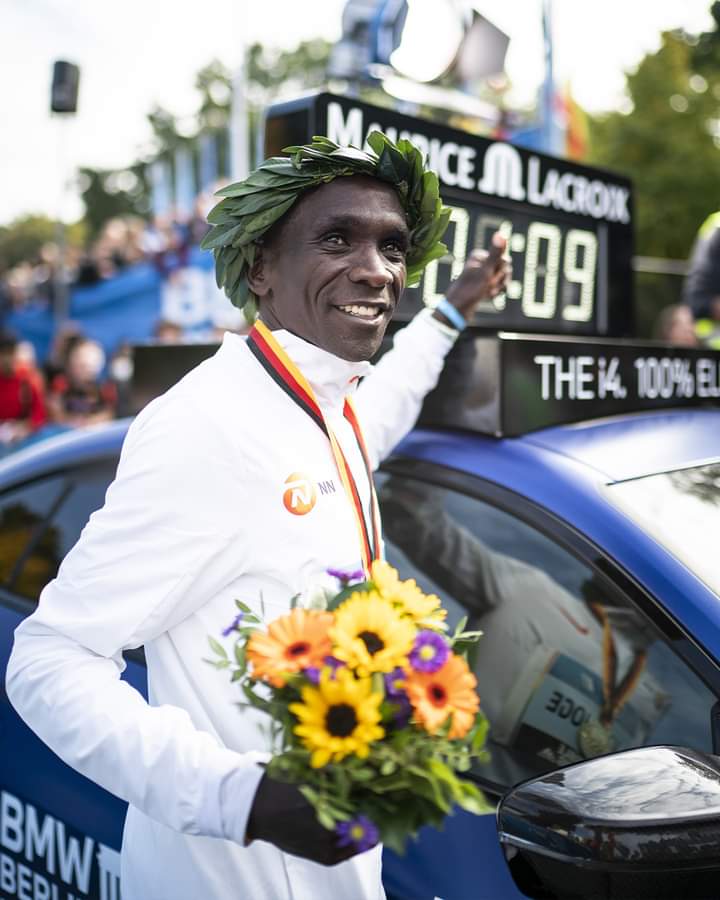
Eliud Kipchoge (This photo was downloaded from the Facebook page of Berlin Marathon and is being used here for representation purpose. No copyright infringement intended)
The numbers bewitch: 2:01:09, 30 seconds lopped off and the man does it at 37 years of age.
Olympic champion and world marathon record holder, Eliud Kipchoge, rewrote his marathon world record at the 2022 edition of the Berlin Marathon held on September 25, 2022. The 37 year-old Kenyan great covered the 42.2 kilometres-distance in two hours, one minute and nine seconds, chopping off 30 seconds from his previous world record of 2:01:39 set in Berlin in 2018.
Kipchoge ran the first half of the race in 59 minutes and 51 seconds and the second half in 61 minutes and 18 seconds. His first half pace raised hopes of the legend doing a sub-two-hour marathon but after that pace started to drop in the second half, the possibility of a sub-two was ruled out. For the moment, it leaves the unofficial sub-two he ran in October 2019 (1:59:40.2 at the Ineos 1:59 Challenge in Austria), as an instance of human performance achieved under circumstances very different from that of a regular race.
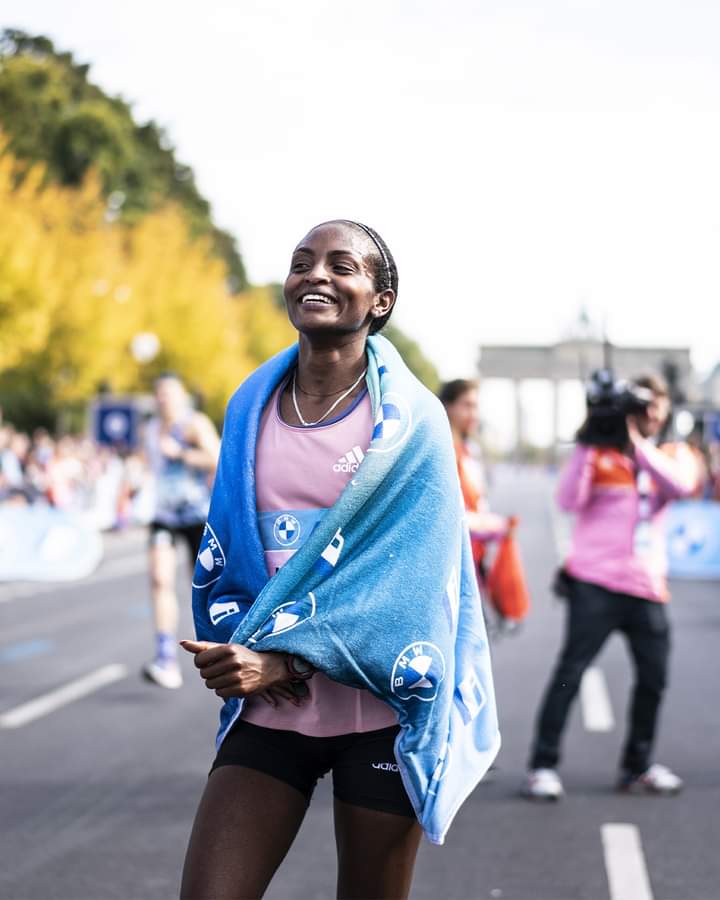
In the women’s segment at Berlin, Ethiopia’s Tigist Assefa smashed the course record by more than two minutes with a 2:15:37 finish. In the process, she became the third fastest woman marathon runner in the world. Kenya’s Brigid Kosgei holds the women’s world record of 2:14:14 set in Chicago in 2019. Paula Radcliffe, the earlier world record holder (2:15:25) is the second fastest after Kosgei. Going into the race, Assefa was not among those fancied to win; she had run only one major marathon before – the 2022 Riyadh Marathon, where she registered a timing of 2:34:00. In Berlin on Sunday, she produced a faster pace for the second half of the race.
Tigist Assefa (This photo was downloaded from the Facebook page of Berlin Marathon and is being used here for representation purpose. No copyright infringement intended)
In the men’s race, Kenyan runner Mark Korir finished in 2:05:58, almost five minutes behind Kipchoge. In third place was Tadu Abate of Ethiopia (2:06:28). In the women’s race, Rosemary Wanjiru of Kenya finished second in 2:18 and Tigist Abayechew of Ethiopia finished third with a timing of 2:18:03.
In its report, Runner’s World pointed out that Sunday’s world record breaking performance was Kipchoge’s 17th win from 19 marathon starts. Two of the 19 starts were demo races that were ineligible for records. At the 2013 Berlin Marathon, he had finished second and in 2020, he had placed eighth in the year’s London Marathon. Kipchoge has run four of the five fastest times in the marathon so far.
The course of the Berlin Marathon is flat; it has played host to many record-breaking performances in the discipline. Besides 2022, Kipchoge won in Berlin in 2015, 2017 and 2018. In its report, NBC Sports noted, “The last eight instances the men’s marathon world record has been broken, it has come on the pancake-flat roads of Berlin. It began in 2003, when Kenyan Paul Tergat became the first man to break 2:05.’’ According to it, Kipchoge’s focus now is to be a three-time Olympic champion (he has been crowned twice – 2016 Rio and 2020 Tokyo; the next Olympic Games is in Paris in 2024) and also win the six World Marathon Majors (he is yet to run the city marathons of Boston and New York).
(The authors, Latha Venkatraman and Shyam G Menon, are independent journalists based in Mumbai.)
The 2022 edition of Comrades Marathon was held in August.
The ultramarathon, held annually in South Africa, was happening after a gap of two years lost to the COVID-19 pandemic.
Participation of Indian long-distance runners in the event, has been increasing over the past few years. This year’s race was downhill starting from Pietermaritzburg and ending at Moses Mabhida Stadium in Durban. The ultramarathon, measuring approximately 90 kilometres, usually alternates between uphill and downhill routes. This year’s downhill route measured 89.895 km.
Thane-based Gitanjali Lenka was the fastest finisher from among Indian women runners in 2022. Kartik Joshi from Indore was the fastest male finisher from India.
Gitanjali,50, finished the race in eight hours, 52 minutes and 58 seconds. This makes her the second fastest finisher among Indian women in the years since Indians began appearing at this ultramarathon. In June 2017, Kolkata-based Anjali Saraogi had completed the ultramarathon in 8:38:23, the fastest time yet by an Indian woman.
Among Indian men, Kartik Joshi was the fastest finisher this year with a timing of 7:51:56. He is the third fastest finisher among Indian male runners so far. Sandeep Kumar of Surat is the fastest finisher yet, having covered the course in 7:30:17 in the 2018 edition. Deepak Bandbe, the second fastest finisher, completed the race in 7:43:34 in 2019.
Besides the time she clocked, Gitanjali was also the fourth finisher in her age category of 50 to 59 years. She missed her age category-podium by a small margin. This was Gitanjali’s second outing at the Comrades Marathon. In 2019, she finished in 11:36:16 hours. The nearly three-hour improvement in her timing comes after a rigorous training schedule set for her by her coach, Ashok Nath.
Gitanjali attributed the improvement in her timing to her coach Ashok Nath’s training and nutrition methods. “ I followed my coach’s plan very meticulously. I could sense the difference between 2019 and this year, when I stood at the start line of Comrades. Back then, I was clearly nervous,” she said.
There were days when she would step out for a training run in the bright sunshine and growing heat of mid-morning as she had to complete her responsibilities at home. Through the lockdown of pandemic when many runners took a break from running, Gitanjali continued her training relentlessly.
She enrolled with Ashok Nath in February 2019, a few months before her first attempt at Comrades. A gritty runner, the main focus in Gitanjali’s training was to get her fit, Ashok said. “ For an ultramarathon, the reason for running such long distance is critical to keep going when the body says: stop. Getting Gitanjali to understand her purpose or reason was a focal point in the training,” he said.
“ Cardio is over-rated in an ultra and most err on the side of overdoing it. It is equally sheer fitness and mental strength that are crucial,” Ashok explained. In the three years of Gitanjali’s training – the intervening years between her first and second outing at Comrades – these two elements, fitness and purpose, were incorporated well, he added.
Gitanjali’s journey in running commenced in 2016 when she signed up for Hiranandani Thane Half Marathon. The run is held annually at the Hiranandani residential colony where Gitanjali resides. “ A couple of my friends would go for this run every year. I decided to sign up for the 2016 edition, choosing the 10 km distance. I had no clue about running or its attire,” she said. Gitanjali finished the run in 1:19:11. At the end of the run she realized that she finished easily without any strain despite the absence of any training while many others were “ huffing and puffing at the finish line”. Two months later, she signed up for another 10 km race, finished within one hour and landed on the podium.
She has found herself on the podium quite a few times since.
Prior to 2016, barring the occasional sports day outing while at school and college in Cuttack, Odisha, Gitanjali had not been involved in sports formally. But she was always focused on fitness through the years of her college life, marriage and later as a mother of two children.
Once she took to running seriously, she signed up with coach Haridasan Nair for training. During the many running events she attended thereafter, Gitanjali began familiarizing herself with details of the sport. Among other things she heard of Boston Marathon and the stringent qualifying timing required for the race.
Gitanjali had started running ultramarathons without actually running a marathon in a formal sense. Her running is marked by many podium finishes but along the way she was dogged by injury forcing her to pause her running for some time until she recovered from it.
Her training for Comrades 2022 commenced in April. “ I would wake up at 3:30 AM and get out at 4:30 for the training run. Initially, I stuck to a one-kilometre loop until daylight appeared and then stretched the loop as per my plan for the day,” she said. Her training included two days of strength workout. Her weekly mileage during the months of May, June and July was in the range of 150-160 km. “ In August, the focus was on speed running,” she said.
Comrades done; she is slated to go for the 2022 Berlin Marathon later in September. As for the Boston Marathon, having qualified for it, she is scheduled to participate in the 2023 edition of the race in April next year. “ I would love to focus on ultra-running as ultras are my preferred distance,” she said adding that she, would however like to complete her pursuit of the World Marathon Majors.
Kartik Joshi (Photo: courtesy Kartik)
For Kartik Joshi, the 2022 Comrades was his first international running event. He had a comfortable run for much of the 89.895 km-long course in South Africa. “ I found the last 10 km quite tough. The wind was quite strong,” he said. He had a tough time on the nutrition front as he is vegetarian. “ Going forward I will have to figure out my nutrition if I am going to be running international events,” he said.
Twenty-year-old Kartik started running during his senior school days. “ During my school days I would often see the personnel at the Rustamji Armed Police Training College in Indore. I was inspired, seeing them run,” he said.
Seeing the police personnel run, Kartik was prompted to attempt running himself. “ On the first day I ran about 500 metres and spent the rest of the hour watching runners. A few of them were running slow but they kept going for a long time,” he said adding that he eventually chose to run long distances.
Kartik took up running in a serious fashion at the age of 15 and over the past five years have participated in a number of half marathons, marathons and ultramarathons. The ultramarathons that Kartik participated include Hennur Bamboo Ultra 250 km, 12-hour and 24-hour stadium runs, Backyard Ultra and Malnad Ultra.
He lost a year at school after his father Om Prakaesh Joshi went into coma due to health problems. Further in 2021, Kartik had to take up a job midway through his college education after his father suffered a heart attack. At 20, he is in the process of completing his degree and attempting an entry into the armed forces.
(The author, Latha Venkatraman, is an independent journalist based in Mumbai.)
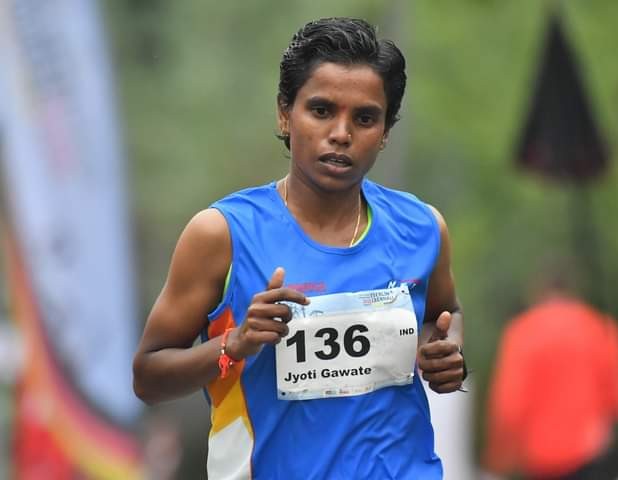
Jyoti Gawate (this photo was downloaded from the Facebook page of IAU)
Haruki Okayama, Floriane Hot are 2022 world champions
India’s Vipul Kumar and Jyoti Gawate rewrote the national best in the 100K run by a sizable margin, in the men’s and women’s categories respectively, at the 32nd IAU 100km World Championships in Bernau-Berlin on August 27, 2022.
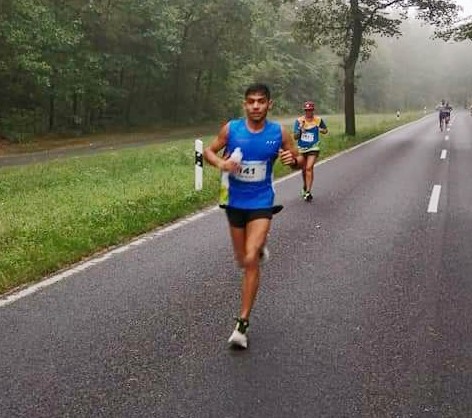
Covering 100 km in seven hours, four minutes and 52 seconds, Vipul was the 38th male runner to cross the finish line. He improved the previous national best of 7:32:43 – set by Amar Singh Devanda in March 2021 – by a handsome margin.
Vipul Kumar
Same was the case with Jyoti. A regular podium finisher at major marathons, who recently added the ultramarathon to her portfolio, she covered the 100 km in Berlin in 8:20:07, improving upon the previous national best of 8:44:27 set by Nupur Singh in April-May 2022.
Jyoti finished 41st among women. “ I am very happy for her. She has been trying to break the national record for marathon distance. This is a very good achievement,” Jyoti’s coach Ravi Raskatla said when contacted by this blog. Hailing from Parbhani in Maharashtra, Jyoti has been part of the national team in the marathon. The race in Berlin was the first time she represented India in an ultramarathon.
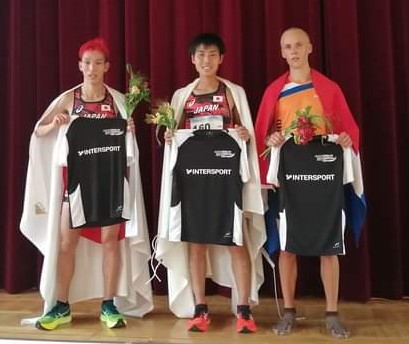
The top three finishers in the men’s category at Berlin (this photo was downloaded from the Facebook page of IAU)
At the 100K World Championships the places on the podium for men was dominated by Japan and that for women, by France.
Haruki Okayama of Japan finished first among men and first overall, covering the distance of 100 km in six hours, 12 minutes and 10 seconds. His compatriot Jumpei Yamaguchi took silver in 6:17:20. Piet Wiersma of the Netherlands won the bronze medal with timing of 6:18:47.
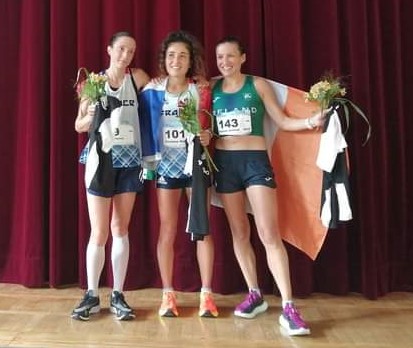
In the women’s category in Berlin, gold went to Floriane Hot of France; she covered the distance in 7:04:03. Camille Chaigneau, also of France, placed second in 7:06:32. The bronze medal went to Caitriona Jennings of Ireland (7:07:17).
The top three finishers in the women’s category at Berlin (this photo was downloaded from the Facebook page of IAU)
Among Indian women runners at the race, following Jyoti, Nupur Singh finished with a timing of 8:52:18 to place 57th among women. Gunjan Khurana with a timing of 9:17:15 placed 71st among women runners in the race.
On the men’s side, Om Prakash Saran finished in 7:25:44 (53rd finisher among men). His timing too an improvement on the previous national best. Contacted after the race, Om Prakash said that the weather was quite favourable and he was very happy with the nutrition and hydration support.
As per provisional data, in the team category for men, the top three teams were Japan, France and South Africa (in that order). The same for women was – USA, France and Japan. The Indian women’s team was placed 13th in its gender category.
(The authors, Latha Venkatraman and Shyam G Menon, are independent journalists based in Mumbai. Please note: race data usually takes some time to settle. If there is any change to timings and team positions, it will be corrected suitably.)
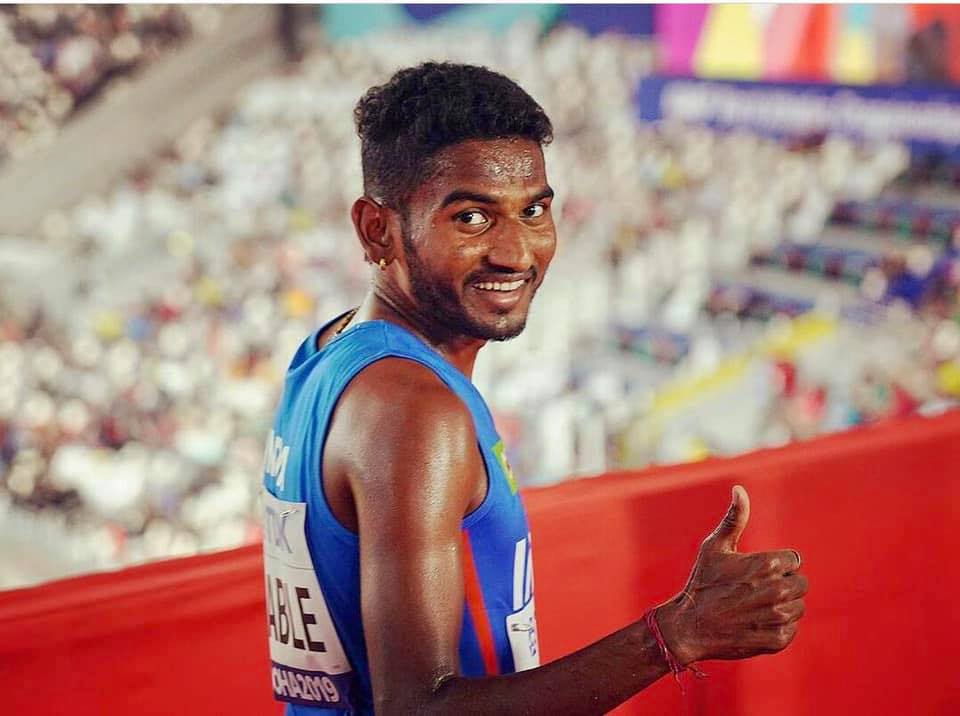
Avinash Sable. This photo was downloaded from the Facebook page of the athlete and is being used here for representation purpose. No copyright infringement intended.
India’s Avinash Sable showed the lion-heart he is, nearly snatching the gold medal from Kenya’s Abraham Kibiwot’s reach, as he crossed the line for a well-deserved silver in a tightly contested men’s 3000m steeplechase at the 2022 Commonwealth Games in Birmingham, UK.
Kibiwot’s victory was hard earned and by the narrowest of margins; he clocked eight minutes, 11.15 seconds. Sable (8:11.20) finished right next to him, bettering his own national record in the process. Amos Serem of Kenya (8:16.83) secured the bronze.
The race started with much expected from the Kenyans. In their ranks was defending champion Conseslus Kipruto. He had won in the discipline at the 2018 CWG in Gold Coast, Australia with timing of 8:10.08. He was also world champion at the World Athletics Championships held in Doha in 2019 and bronze medallist at the recently concluded World Championships in Eugene, Oregon, USA.
Shortly after the commencement of the race in Birmingham, Sable moved into the lead. The trio of Kenyans kept him company. But soon, the Kenyans took over; they set a fast pace (at one point hinting at a potential finish in less than eight minutes as per race commentary) and opened up a sizable gap with the rest of the field, barring Sable, who hung around in fourth position. Sable never let the Kenyans get far from him. Just doing so, was a new high in Indian athletics for the attitude it personified.
As the final lap approached, Sable began working his way up and by the time he took the bell had carved himself a slot in second position. He maintained it right through the water jump and the last hurdle, chasing Kibiwot down to the line forcing a verdict decided by a wafer-thin margin. It was as good a scare as the Kenyans, traditional kings of the steeplechase, could get.
Kipruto finished in sixth place; he timed 8:34.96. Abraham Kibiwot was silver medallist at the 2018 CWG; he has a PB of 8:09.25 set in 2016 (source: Wikipedia). Amos Serem was gold medallist at the 2021 World U20 Championships held in Nairobi, Kenya.
At the world championships in Oregon, Sable had finished eleventh in the steeplechase final with timing of 8:31.75. An icon in Indian athletics and someone with no close competitor in the country in his chosen discipline, Sable has improved his national record several times in the past few years. In June 2022, at an international meet in Rabat, Morocco, he had clocked 8:12.48. It stands improved in Birmingham to 8:11.20. Besides steeplechase, Sable also holds the national record in the half marathon – one hour, 30 seconds (1:00:30).
(The author, Shyam G Menon, is a freelance journalist based in Mumbai.)
Kuanju Lin of Chinese Taipei was the gold medallist in the women’s category at the 2022 IAU 24-Hour Asia & Oceania Championships held in Bengaluru. It was her first time representing her country.
“ I don’t know what attracts me to running. But I feel happy, free and meaningful when I run,” Kuanju Lin said.
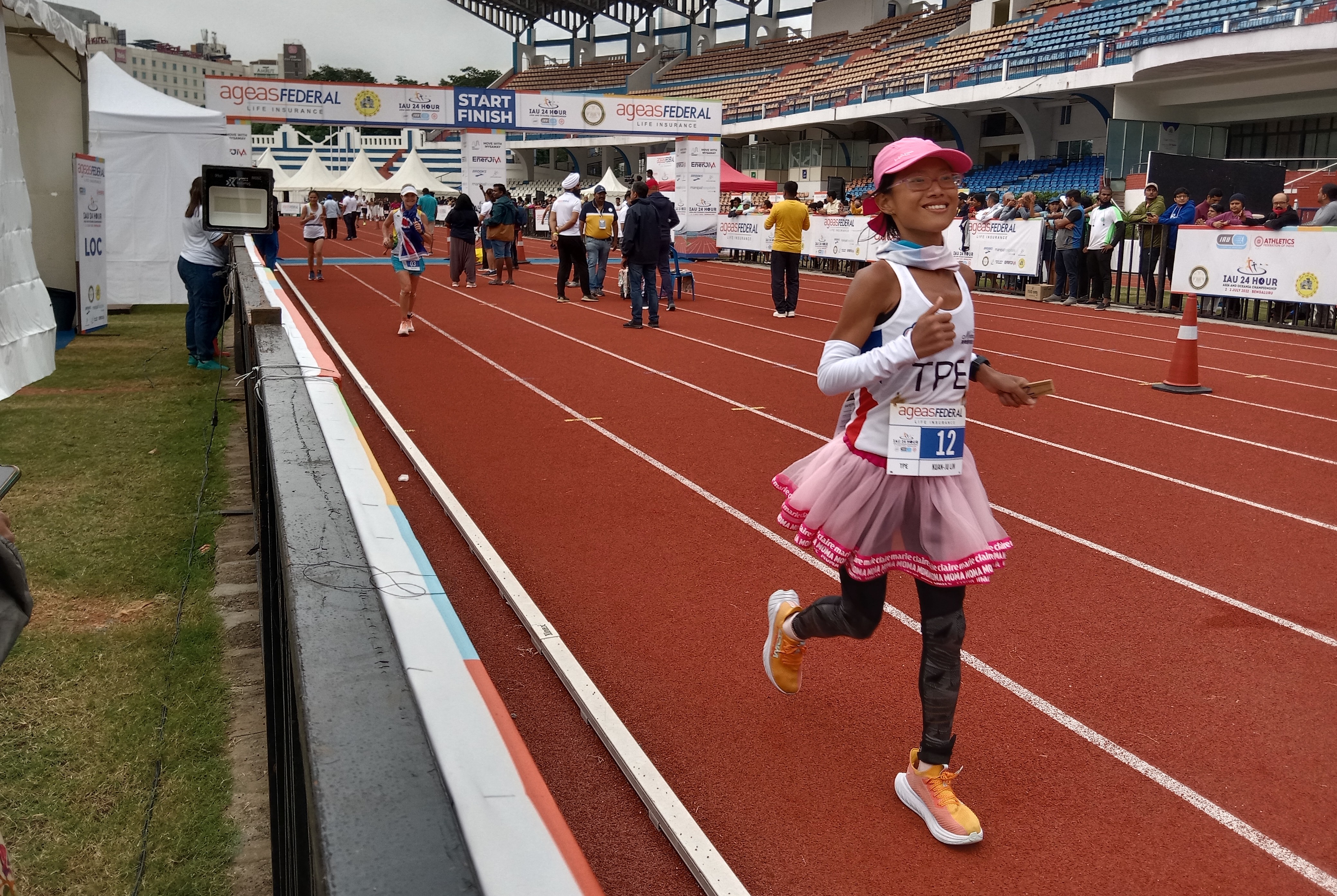
We were faces at the two ends of a video chat; she in Taiwan (Chinese Taipei); I in Mumbai, India. It was July 2022, sometime in the month’s third week. Earlier, over July 2-3, Kuanju had essayed a superb run at the 2022 IAU 24-Hour Asia & Oceania Championships in Bengaluru. The venue was the city’s Sree Kanteerava Stadium and the participants had to run laps on the synthetic track for the assigned period of time. Kuanju, 35, covered 216.877km in 24 hours to place first among women.
Kuanju lives in Banqiao, a district in New Taipei City. A special municipality, New Taipei City is Taiwan’s most populous city. Located in northern Taiwan, it encloses the city of Taipei, which is the country’s capital. On the map, the main island of Taiwan (where Taipei and New Taipei City are located) is distinctly hilly to the east. The vast majority of the country’s population resides in the plains to the west. Taiwan has a high density of population. According to Wikipedia, one third of Taiwanese citizens live in the Taipei-Keelung metropolitan area to which the cities of Taipei, New Taipei City and Keelung belong. Banqiao has the third highest population density in Taiwan. “ Its flat,’’ Kuanju said when asked about the topography of the place she lives in.
During her school years, Kuanju disliked exercising. She studied design, craft, painting, singing and music. She took up running after she commenced working. “ A friend invited me to run. That’s how I got into running,” she said. Initially, she focussed on the marathon. The many marathons she ran included two World Marathon Majors – Tokyo Marathon in 2018 and Boston Marathon in 2019 – and the New Taipei City Wan Jin Shi Marathon. Along the way, she achieved a personal best of 3:09 in the discipline at the 2021 Taipei Marathon. However, in due course, she moved to ultra-marathons. “ In the past I focussed entirely on the marathon. In 2015, I challenged myself to attempt a 100 km race,” she said. It was the Wulu Gorge Ultramarathon, held on Taiwan’s east coast. She covered 100 km in nine hours and 38 minutes. It fuelled her curiosity further; she wanted to know more about what attracted other runners to court hard challenges. Eager to find out how long she could run, she opted for a 24-hour run.
Her first 24-hour ultra-running event was as recent as in February 2022. She covered a distance of 180 km. “ I felt good about my mileage but my ankles hurt and swelled up,” she said. The event helped Kuanju to understand the dynamics of a 24-hour run and train accordingly. For the championships in Bengaluru, Kuanju focussed on strength training and long-distance running. “ I did two ultra-long training runs – one of 135 km and another of 95 km. In Bengaluru, I focussed on nutrition and hydration. I prepared some fruit, energy bar with nuts, electrolyte liquid and chocolate – I kept consuming that during my run,” she said.
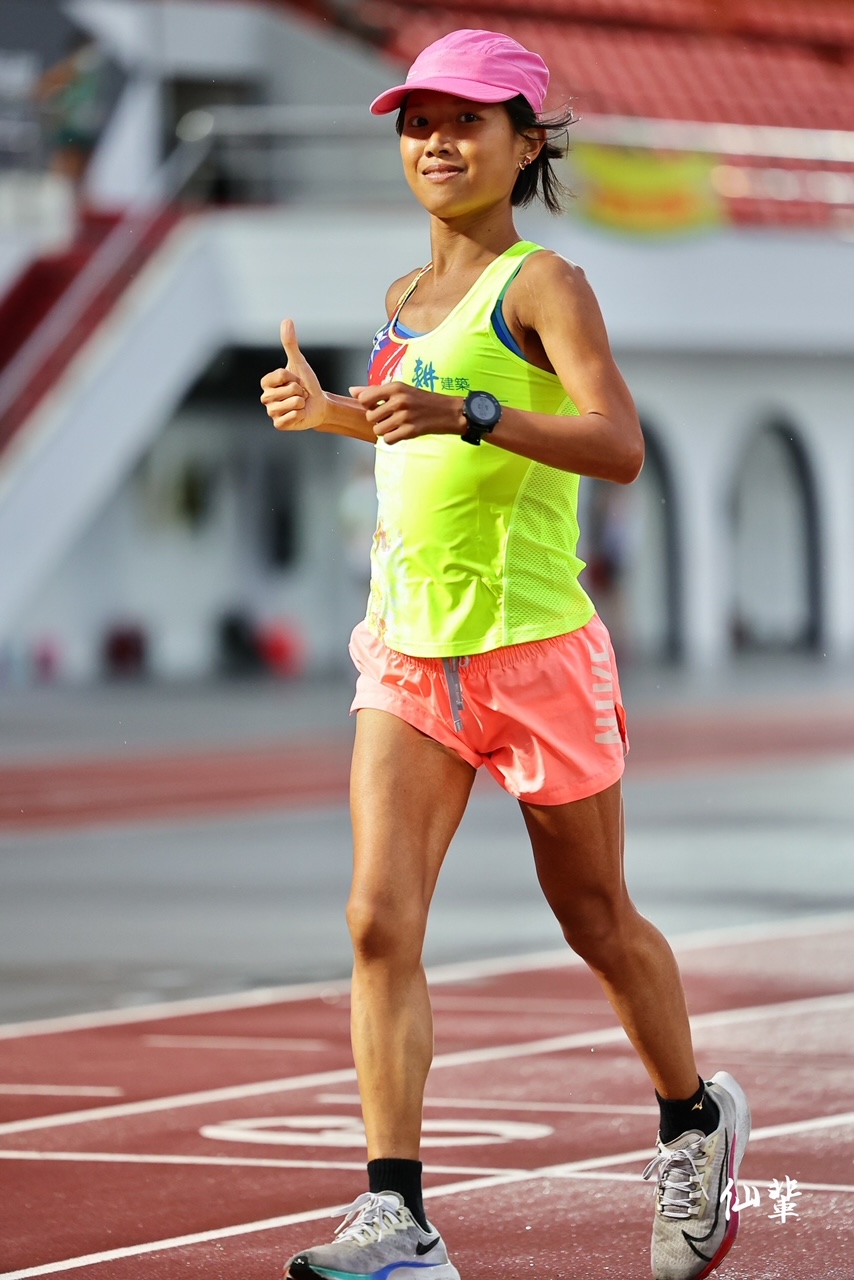
Kuanju Lin (Photo: courtesy Kuanju)
Unlike a marathon, where elite runners run the length of the whole course, ultra-running events like the 24 hour-race typically involve a mix of running and fast walking. The prevailing weather plays a big role in how extended runs of this sort, play out. In a post-race article available on runnerstribe.com, Australian athlete Cassie Cohen (she was a participant in the Bengaluru event) highlighted the part weather plays: “ while on paper, my PB (204.92 km) was among the strongest in the field, I knew that didn’t tell the full story. The Indian and Chinese Taipei athletes had got their results in hot and humid conditions as we would experience on race day. I got mine in Canberra in near perfect cool conditions. PBs meant nothing once the flag was raised to start the race.’’
New Taipei City has a climate that is characterized as ` humid subtropical.’ It features hot and humid summers and cool to mild winters. Bengaluru has a ` tropical savanna climate’ but it’s elevation (3020 feet) gifts it a generally moderate climate. In early July 2022, the city was getting showers and the weather was fairly pleasant by Indian standards. But humidity was high and this impacted the runners doing laps at Kanteerava Stadium, including some of Kuanju’s teammates who had to use ice to see themselves through the heat of the Indian afternoon. The Australians too suffered. In her detailed article, Cassie estimates that conditions touched 29 degrees and 70 per cent humidity.
For Kuanju, things appear to have played out tad differently. She was largely unfazed by Bengaluru’s humid weather. “ I felt comfortable most of the time though it was a bit warm. I am used to sunny weather,’’ she said. The first 12 hours went by pleasantly for her. “ I enjoyed the sun, the music and the cheering from the spectators. During the night hours, I walked because my right foot was aching. I wore earphones to listen to music. I resorted to singing along with my music. Encouragement from other runners also helped me to keep going,” she said. In retrospect, the main concern seems to have been the foot, to tackle which, she had to avail a brief intervention by the physiotherapist.
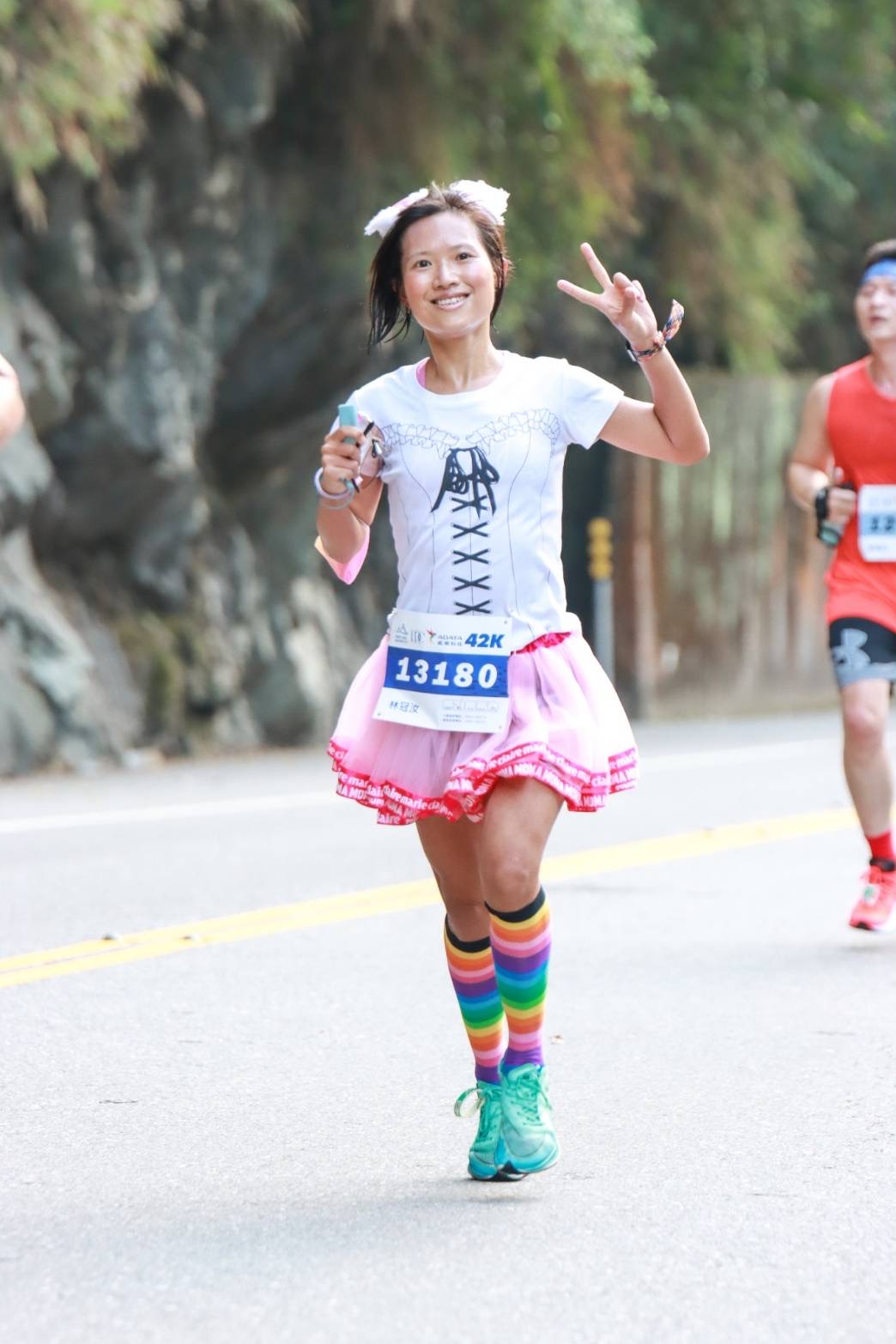
Those who watched the race in Bengaluru would likely recall two things. First, Kuanju had a near consistent pace. It was suitably slow for ultrarunning and steady. She kept going round and round with clockwork efficiency. Initially, her small size and light build may have inspired a different image, one of potential fragility. But as the day (July 2) progressed, it was increasingly clear that appearances can be deceptive; Kuanju’s steady pace was logging significant mileage. Second, her attire intrigued. Most of the runners sweated it out in shorts and vests. Kuanju wore a fluffy pink skirt over her leggings. While others were a picture of hard work and strain, she seemed to float along. Kuanju says she is fond of dressing up well for her races. “ When I started running, I used to get nervous. I relaxed myself by wearing accessories such as bows and cute things. Once, I wore a fluffy skirt for a race. There were many photographers and they kept clicking my photo. Also, runners and onlookers kept cheering me. That really helped improve my mood and reminded me to run enthusiastically and with a smile. Thereafter I used these accessories during runs,” she said. The fluffy skirt, according to her, is not just a cute accessory but something that lends positive energy.
On the morning of July 3 with only hours to go before the 24-hour mark, Kuanju was among few runners in the stadium still smiling and looking upbeat. In the final hours of the gruelling competition, top honours among women ended up a contest between Kuanju and Cassie Cohen. At 8 AM on May 3, when the race concluded, it was Kuanju securing gold; the Australian runner with 214.990 km logged was short by 1.9 km. Kuanju’s performance was a new national record for Chinese Taipei (Taiwan). Coming into the race in Bengaluru, Kuanju had not expected to win. Cassie took the silver while her compatriot Allicia-Grace Heron (211.442 km) bagged the bronze. At the team level, Chinese Taipei secured bronze in both men’s and women’s categories. The strain of the race was visible on all the teams; more than one runner had to be helped to get on to the podium.
Kuanju Lin; from the 2022 IAU 24-Hour Asia & Oceania Championships held in Bengaluru (Photo: Shyam G Menon)
The event in Bengaluru was the first time Kuanju represented her country. Back in New Taipei City, she works as a coach for boxing, cardio workout, fitness, spinning and TRX training. Her personal training for the ultramarathon is a combination of speed workout, progressive pace workout and long and easy runs with a day for rest during the week. “ Time management is a challenge. I need to calculate time for training, my job and the occasional break. Usually, I run over 400 km per month but if I am training for an ultramarathon, I need to run almost 600 km,” she said.
Although she topped the women’s race in Bengaluru cementing her position as an ultrarunner, she does not want to stop running marathons. “ I want to focus on marathon as well as ultramarathon running events,” she said when asked which distance she prefers. However, she is not chasing the World Marathon Majors. “ I don’t have the time or the money to pursue the Marathon Majors,” she said.
(The author, Latha Venkatraman, is an independent journalist based in Mumbai. Edited by Shyam G Menon.)
Liam Adams of Australia leading in the initial stages of the 2022 CWG men’s marathon. This photo was downloaded from the Facebook page of the event and is being used here for representation purpose. No copyright infringement intended.
Nitendra Singh Rawat finishes twelfth
Uganda’s Victor Kiplangat took gold in the men’s marathon at the 2022 Commonwealth Games (CWG) being held at Birmingham, UK.
The first Ugandan to win the CWG marathon, he covered the distance in two hours, 10 minutes and 55 seconds, a report on world-track.org said. Silver went to Alphonce Felix Simbu (2:12:29) of Tanzania and the bronze to Kenya’s Michael Mugo Githae (2:13:16).
India’s Nitendra Singh Rawat finished in twelfth position. He covered the distance in 2:19:22.
Despite Kenya participating, there was no Eliud Kipchoge (he holds the world record – 2:01:39) or anyone in that league, at Birmingham. Defending CWG champion, Michael Shelley of Australia (PB – 2:11:15) was also absent given he retired in 2019. He was CWG champion in 2014 (Glasgow) and 2018 (Gold Coast). It was therefore a modestly sized field – 19 runners – on Saturday (July 30) with equally modest personal bests. But it was a competitive field with athletes having PBs not significantly spaced from each other, promising thus a good contest.
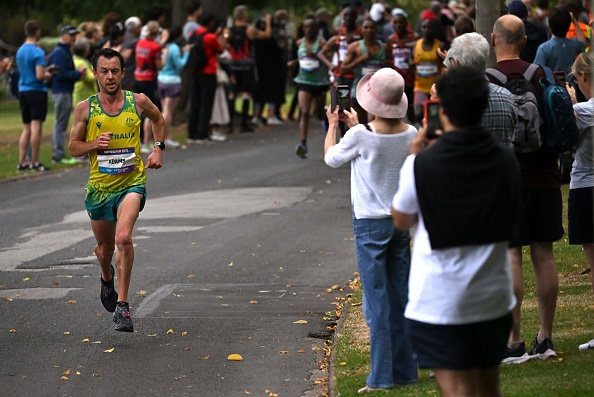
Within minutes of the race starting, Liam Adams of Australia shot off into the lead with a group of about half a dozen in pursuit. Coming into the race, Adams had a PB from March 2020, of 2:10:48 according to data available on the website of World Athletics. As the first half hour went by, the chasing group split into two with two Tanzanian runners including Simbu (PB – 2:06:20), ahead of the remaining three, which included Kiplangat (PB – 2:05:09) and Kenya’s Jonathan Kipleting Korir (PB – 2:04:32).
The 15K mark went by with Adams still in the lead; he covered it in 46:03, which if sustained, pointed to a potential sub-2:10 finish. According to Wikipedia, the CWG record in the men’s marathon was set in 1974 at Christchurch, New Zealand, by Ian Thompson of England; he had a timing of 2:09:12, which was also a PB. It makes the unbroken CWG record four years older than the unbroken Indian national record in the men’s marathon set by Shivnath Singh in 1978; he covered the distance in 2:12:00.
Past the 15K-mark at Birmingham, Nitendra Singh Rawat was in fifteenth place. As per updates on the website of Sportstar, he moved up to twelfth spot after 30 kilometres in the race. Liam Adams, race leader in the initial phase, finished a creditable fourth with timing of 2:13:23. Korir wrapped up the top five, covering the distance in 2:14:06, world-track.org said. According to the website, past 30 kilometres, Kiplangat and Simbu were evenly matched but the Ugandan runner managed to increase his pace and open up a lead. It was a lead that was sufficiently big for him to correct a wrong path he took late in the race without compromising his position in the final results.
(The author, Shyam G Menon, is a freelance journalist based in Mumbai.)
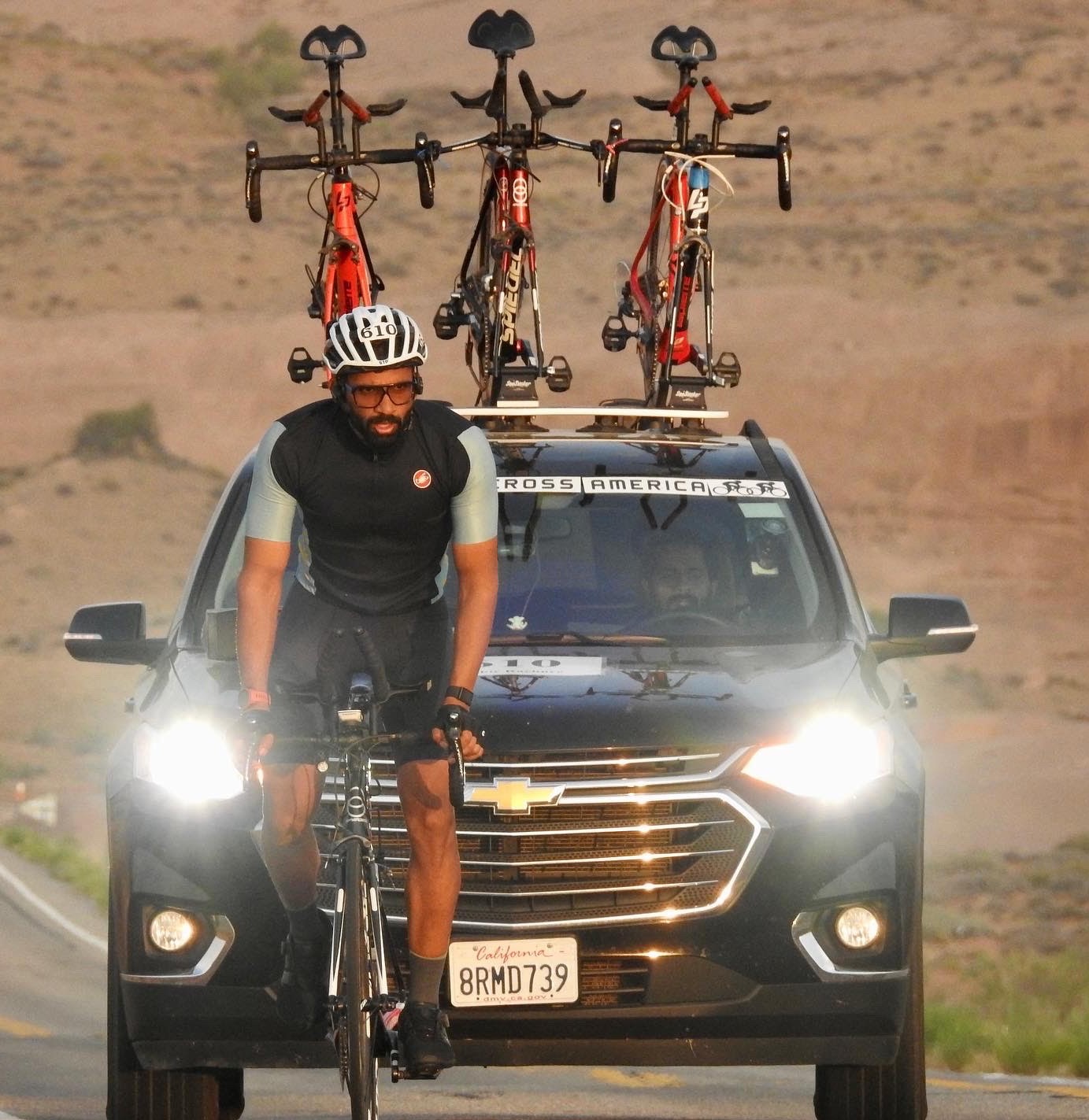
July 2022. It’s a couple of weeks after the year’s RAAM. There was a change in the tenor of Kabir’s talk. Two successful finishes later, there was now mention of competing to win.
Riders from India would fare better at Race Across America (RAAM) if they acquire familiarity with the challenges posed, become better supported and progressively hit from the front foot instead of the backfoot as they normally do, Kabir Rachure, among India’s leading ultra-cyclists and a two time-finisher of RAAM, said.
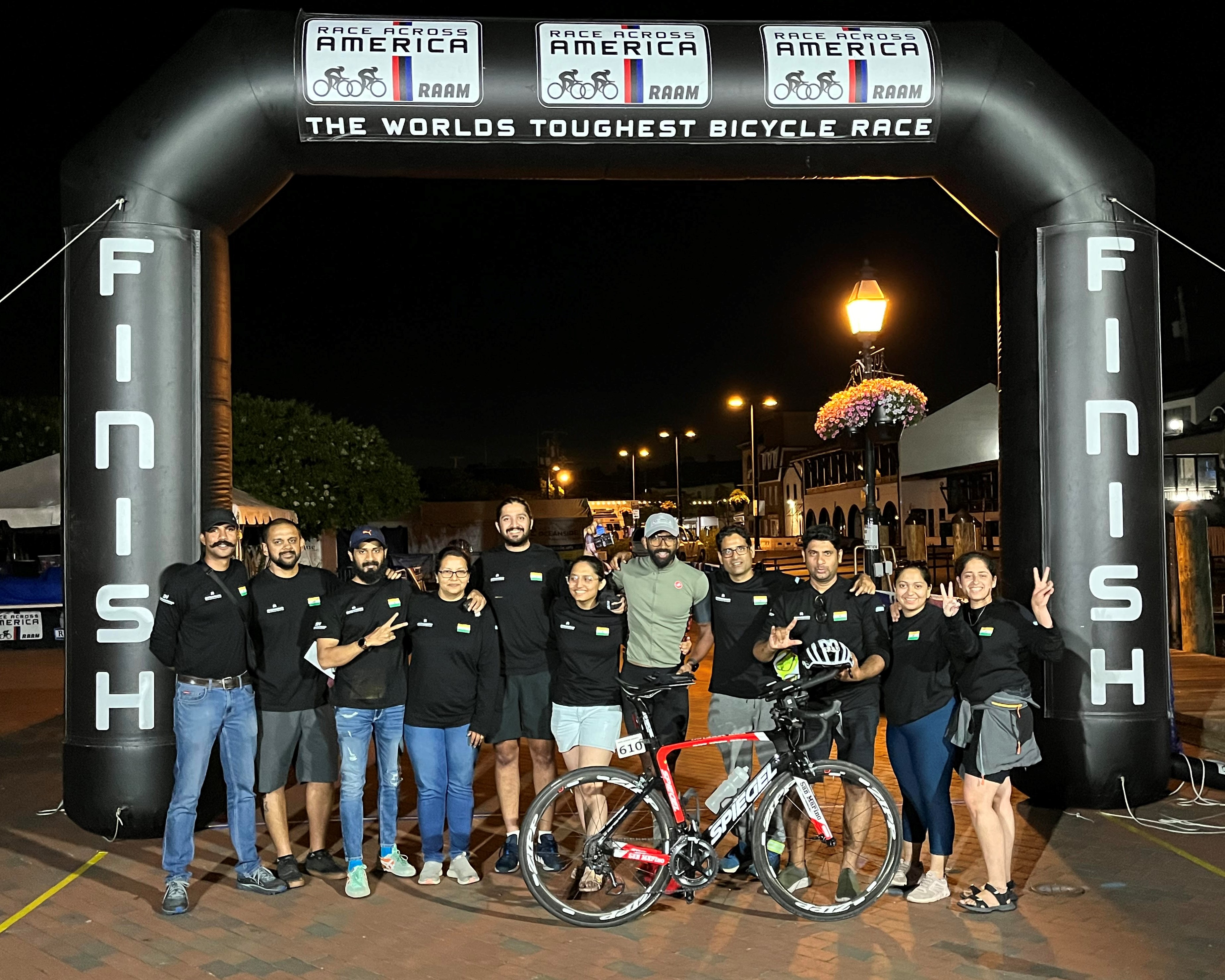
In June 2022, Kabir successfully completed RAAM for a second time (11 days, 11 hours and 25 minutes); he also placed third in his age category. He plans to return to RAAM in 2024 and when that happens, he would like to cycle faster and approach the race with a view to win. The Navi Mumbai-based cyclist explained his reasons for the changed perspective.
To begin with, he had come off the experience of 2019 – when he finished RAAM in 11 days, 22 hours and 43 minutes – resolved to attempt it again. He felt there was ample scope to improve. In 2019, he didn’t have well developed strategies for nutrition and rest. “ I didn’t follow a proper sleep pattern,’’ he said. Early on in the race, the heat of Arizona took its toll. Despite training for the event, he had found himself progressively exhausted, experiencing a hazy view of the proceedings and unable to recall in detail, sections of the 3000 mile-route, he pedaled through. Further, in a race wherein rider tackles challenges in partnership with the support crew, there were some deficiencies in the latter. “ We took it lightly. Everyone wasn’t at 100 per cent. The correct balance wasn’t there. In 2019, although we completed the race, I wasn’t satisfied with our performance,’’ Kabir said. The team was determined that their next outing at RAAM should be with the required improvements, addressed.
Once you have been a finisher at RAAM, cyclist is lifetime-qualified to participate in the race. Kabir has this privilege, courtesy 2019. His idea was to go back to RAAM in 2020 but that year the event was cancelled due to the COVID-19 pandemic. The team would have gone back in 2021 but there were too many variables in the air, ranging from vaccination to quarantine conditions; not to mention – all preparations going for a toss should infection strike just before or during the race. For cyclist from India, each attempt entails a sizable financial investment. Given such uncertainty, Kabir and his team decided not to participate. There was also another reason. Kabir wished for a decently strong field; he wanted RAAM to be an instance of competing with the best and competing with many. In 2021, with the world only beginning to emerge from the shadow of pandemic, strong line-ups were hard to come by in races. The goal therefore was, 2022.
Photo: courtesy Kabir
In 2021, there was a virtual RAAM, which riders could participate in from anywhere in the world as long as they had Wi-Fi and trainers capable of hosting apps for competing digitally. Kabir didn’t take part in this. He felt, RAAM’s digital version wouldn’t be a complete substitute for the actual experience of the race. In the real world, cycling at RAAM includes challenges like mountain sections, the heat of Arizona, the weather conditions of Kansas, the punishing hours on the saddle, the sleep deprivation and the support crew actively working with rider to keep the journey going. The digital version, in comparison, featured limited sections of RAAM repeated like a loop. All of it executed from a room where support was easily accessed. “ The main challenge in virtual RAAM concerns being on a trainer – it restricts the natural variety of body movements possible in real world cycling. This lack of variety in movement, is tough on the body. It can be hard on your knees,’’ Kabir said.
For 2022 RAAM, Kabir dipped into his 2019 experience and trained differently. There was a time when he thought – like many did and continue to – that success in ultra-cycling events requires hours and hours of training piled on in the preparatory phase. With RAAM done in 2019 and an idea of what to improve had, Kabir structured his training for 2022 around quality, not quantity. “ This time around for RAAM, I trained 8-12 hours per week,’’ he said. He did the bulk of that indoors. He avoided some of the popular temptations in Indian cycling. “ I won’t say that if you do K2K (Kashmir to Kanyakumari) or the Golden Quadrilateral, you can complete RAAM. After the initial portion of K2K, the route is mostly flat. The only thing that is tough in K2K, is the traffic,’’ he said. RAAM in contrast, features varying topography and weather patterns. It doesn’t let you settle into one paradigm. “ RAAM is a different beast,’’ Kabir said.
Among the changes effected in training for 2022, the most significant one was that weekly total of 8-12 hours. “ Somewhere along the way, I have crushed the myth that you must train 25-30 hours per week,’’ he said, highlighting the importance of balancing training and recovery. However, Kabir admitted that he could shift more towards quality because he had the quantity already in place (thanks to many ultra-races and training for it, done) with one outing at RAAM to boot. For those new to ultra-cycling, he said, he would want long rides done because they help the rider know his / her body better. But the mileage must be ramped up carefully; slowly and steadily. “ I don’t want anyone hurting themselves,’’ Kabir said. In his case, years of cycling has ensured a litany of long rides done and with an idea of how his body behaves now in place, he could afford to trade quantity for quality in the run up to 2022 RAAM.
Roughly two months before RAAM, in April 2022, Kabir shifted to the high-altitude environment of Ladakh. From April 20 to May 20, he trained there. He cycled some 1200-1500 kilometres there including a dash up to Khardung La from Leh in less than three hours (two hours and 40 minutes according to him). Then, returning to Mumbai he flew out to the US on June 1 with about a fortnight left for the year’s RAAM to start. The benefits of training at altitude are well-known. Although many people believe that the rub-off effects of altitude, stay with the individual only for a few weeks, Kabir says that in his experience, right nutrition (essentially iron in one’s diet) can help prolong the benefits. The learnings from 2019 RAAM combined with a modified training regimen ensured that Kabir commenced 2022 RAAM in a strong frame of body and mind.
Kabir Rachure, 2022 RAAM (Photo: courtesy Kabir)
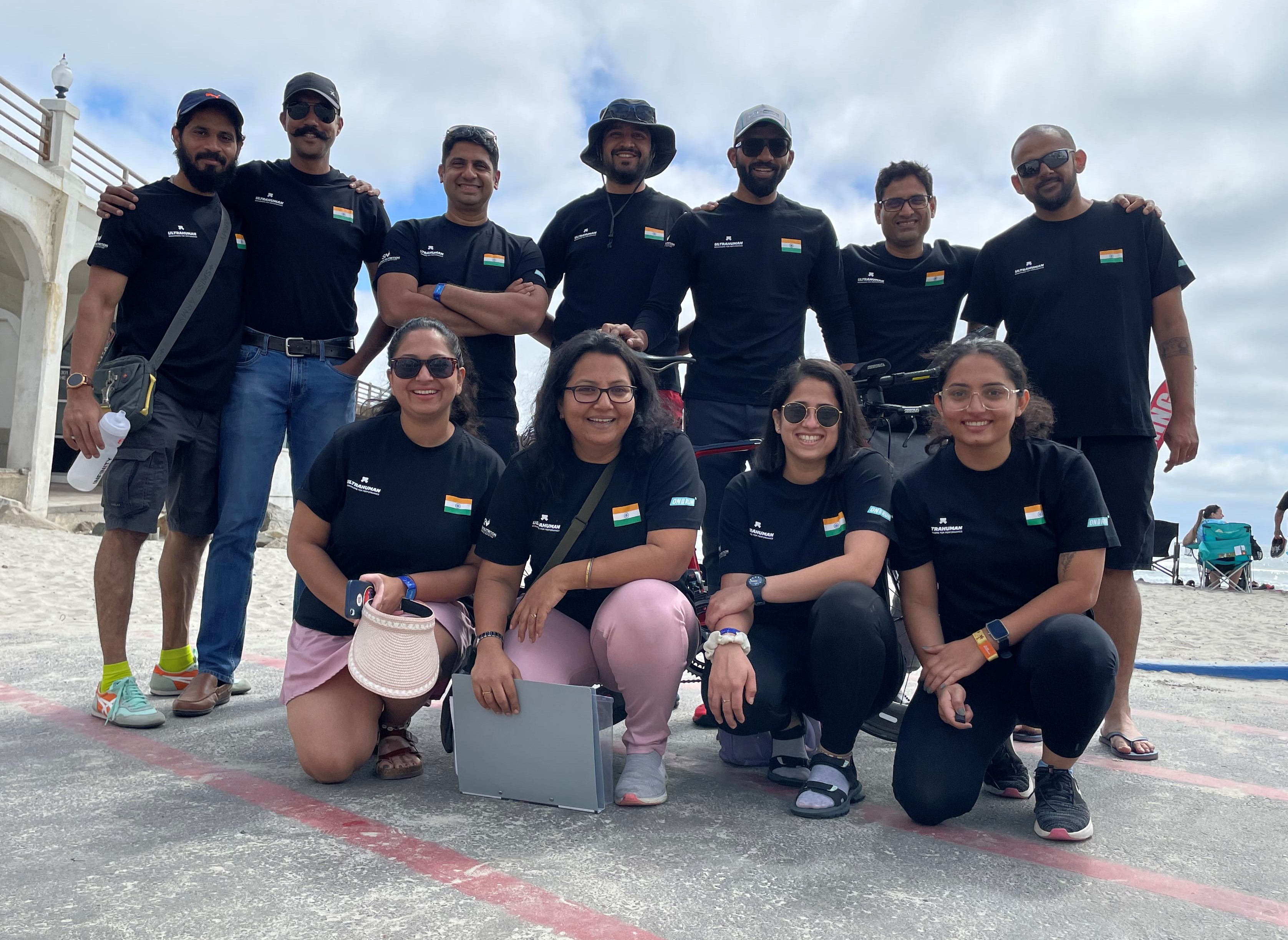
A notable absentee at 2022 RAAM was Christof Strasser. For years, the Austrian ultra-cyclist with multiple wins at RAAM to his credit, had been a regular participant. “ RAAM without Strasser does not feel the same,’’ Kabir said. Endurance cyclists like Christof Strasser and Marko Baloh (Kabir now has Marko’s signature preserved on his bike) have the capability to go into an attack mode compared to the defensive mindset of Indian riders. Kabir traces this attitude found overseas, to a state of being well supported and having nothing to lose. To illustrate it in simple terms, he quoted the example of Formula One. If someone participated with a car they bought with their own money, would they drive as aggressively as a Lewis Hamilton backed by Mercedes and enjoying a supply of cars from the company? When you have someone backing you and you are told to focus on your performance, you will perform better than if you were on our own, Kabir said. As luck would have it, for his 2022 RAAM attempt, two sponsors came aboard – Spiegel Bikes and Ultrahuman. He could therefore afford to imagine a bit differently. Face RAAM with a semblance of nothing-to-lose. Still the race threw up challenges.
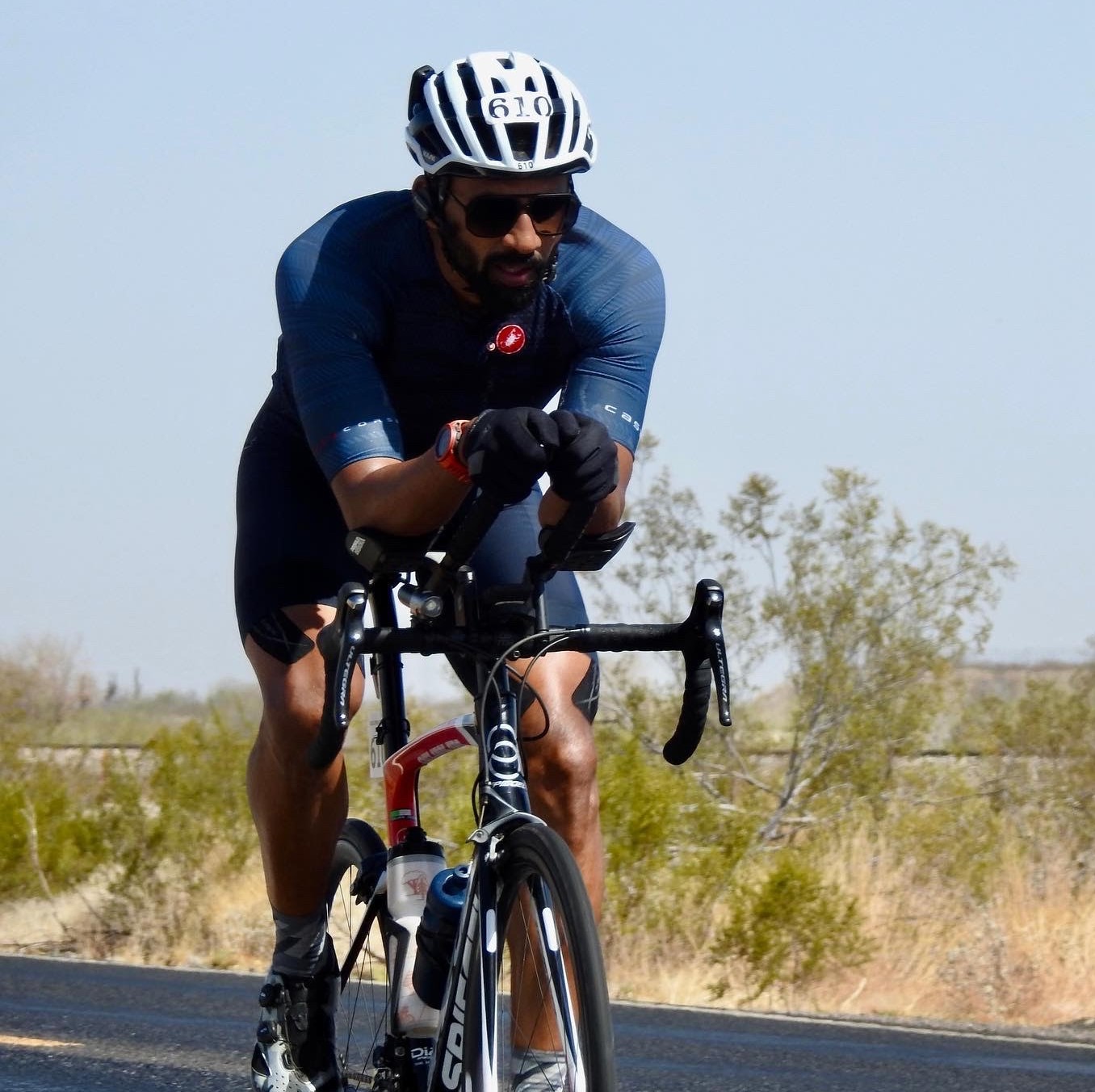
Kabir brought with him to the US, four bikes for use in RAAM. He kept a time trial bike with aggressive geometry to cycle through Arizona. Although Arizona felt less warm than in 2019, there was no escaping the buckets of sweat the heat triggered. Kabir developed a terrible saddle-sore following which, the fast TT bike had to be given up. Any more time on it would have seriously endangered his prospects in the race. He ended up using a Spiegel San Merino for around 2700 kilometres and two models of Lapierre (including a Pulsium, which is a comfortable endurance bike) for 1600-1800 kilometres. If reworking the bicycle mix was an early challenge, then the wind in Kansas posed its own set of hardships later. A powerful headwind made cycling through Kansas difficult. At other times, crosswinds kept the bicycle constantly at a tilt and difficult to steer with one hand. It rendered periodic engagements with the support car (while still pedaling) for hydration and nutrition, tough to handle. One nasty fall and Kabir could end up retired from the race. But aside from these challenges, the race went off smoothly. He experienced little of the abject exhaustion he had felt in 2019. He finished RAAM in better time and better shape than in 2019; he also got a podium position in his age category. Upon examining the videos of others who finished ahead of him in 2022 and seeing the state they were in; Kabir feels he can push harder. He thinks he can match those performances. They are within achievable distance. In 2022 there was much energy he held in reserve. In retrospect, it was good; it helped him finish comfortably. But it would be a shame not to explore tapping that reserve. Maybe there is room to push further and discover another reserve beyond? A new perspective has taken root.
Kabir will return to RAAM next in 2024. In the immediate aftermath of 2022 RAAM, he thinks a bit of rest is in order as his body is craving for it. The purse also takes some time to recuperate. As he put it, expensive multi-day races like RAAM resemble sugarcane cultivation. Sugarcane needs a lot of water and once the water in the well has been used up, it takes time for it to replenish before another season of cultivation is possible. Same holds true for RAAM, rider and money. Until the purse is replenished, aspirations must stay modest. In November 2022, he will participate in the 24 hour-time trial slated to take place in Borrego Springs, Arizona. If all goes well, he will do a six hour-time trial as well. In 2023, he plans to try Race Around Austria. And in 2024, when RAAM looms afresh on his calendar, the best weapon in his armoury may lay in this observation post-2022 RAAM: “ I feel I have unlocked myself in some way.’’ According to him, it is like having battled some monster and suffered a great deal but also gained a lot.
Photo: courtesy Kabir
His sister, Sapana who oversees Kabir’s support crew is also not resting on the better performance of the team at 2022 RAAM. With Kabir now talking of winning, she is aware of what lay ahead. According to her, Kabir currently has a pool of around 12 people to pick and choose from, for each competition he goes into. They are known well to him and given the number of races they have attended with him, are aware of Kabir’s requirements. Together, they cover a spectrum of support services ranging from driving the crew car to navigation to nutrition to physiotherapy and bicycle maintenance. Some are good for short races; some for longer ones. “ This time at RAAM, we were all on the same page,’’ Sapana said. Had it not been for the wind in Kansas, the time taken to complete would have been less. Sapana knows that in ultra-cycling competitions like RAAM, wherein rider and support crew must pull together, every additional effort Kabir puts in to improve must be matched on the crew side too. “ We plan to use the same people for the rides ahead. The two years to 2024 is good enough time to improve further,’’ she said.
As regards training ground for ultra-cycling, Kabir thinks that India is a fantastic place to train given the range of topography it has, including the Himalaya. Some states and union territories have a better mix in this regard – Tamil Nadu, Maharashtra, Ladakh; and in terms of cities sporting such variety – Bengaluru, Pune, Nashik and Navi Mumbai. But as ever in India, in all these places there is a killjoy snapping at cycling’s heels – the explosive growth of automobile traffic.
(The author, Shyam G Menon, is a freelance journalist based in Mumbai. This article is mostly based on a conversation with Kabir at Kharghar, Navi Mumbai in July 2022.)