DESIGNER ON THE RUN

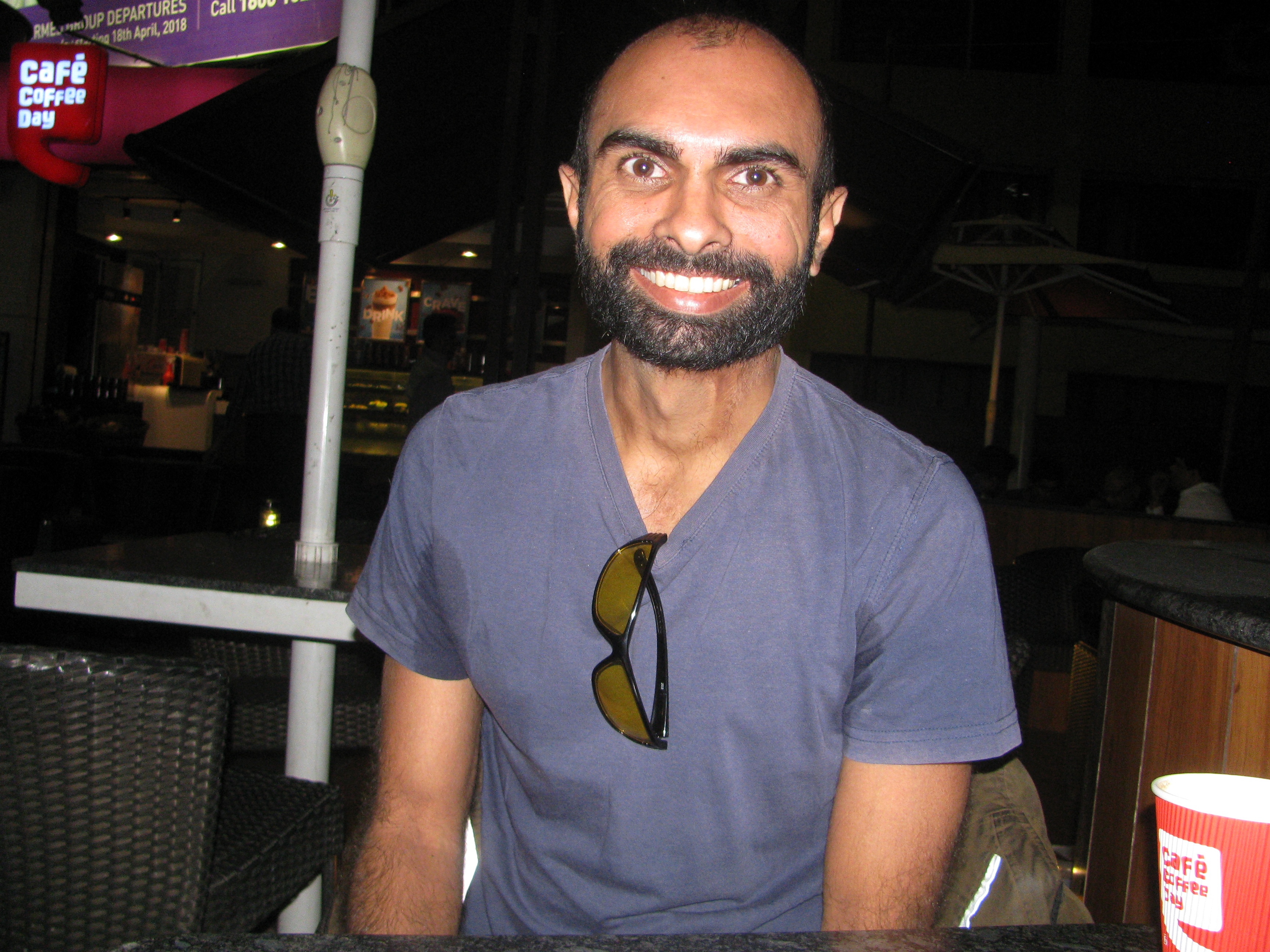
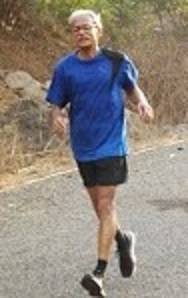
Athreya Chidambi (Photo: Shyam G Menon)

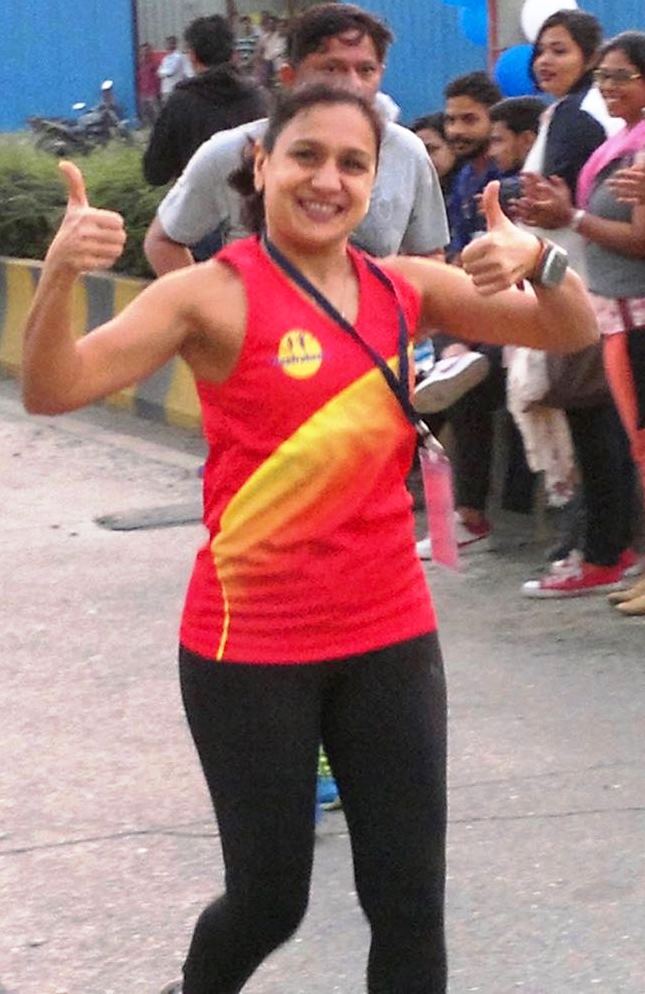
We speak to Athreya Chidambi, runner of multiple distance categories but above all, a lover of trails.

The Auroville Marathon is a much loved event in the Indian calendar for amateur running. It is mostly on trails and unpaved roads. What makes it special is also something else. There is no timing chip. It is a minor difference from the regular running event but one that is profound if you are the sort declining life with blinds. Removing timing chip from the frame restores to running dimensions missed at races. Every year the Auroville Marathon gets its faithful seeking a paradigm apart from the killer competition of Indian cities. “ Auroville is one marathon I try to do every year,’’ the wiry, bearded man said. The fragility of his view was evident as he spoke. Right there in the café on Bengaluru’s MG Road, the table next to us was resonant with high decibel conversation of selling some product, moving consignments around and clinching deals before competition did. Can you be happy these days, doing something just for the love of it; without beating somebody? Good question.
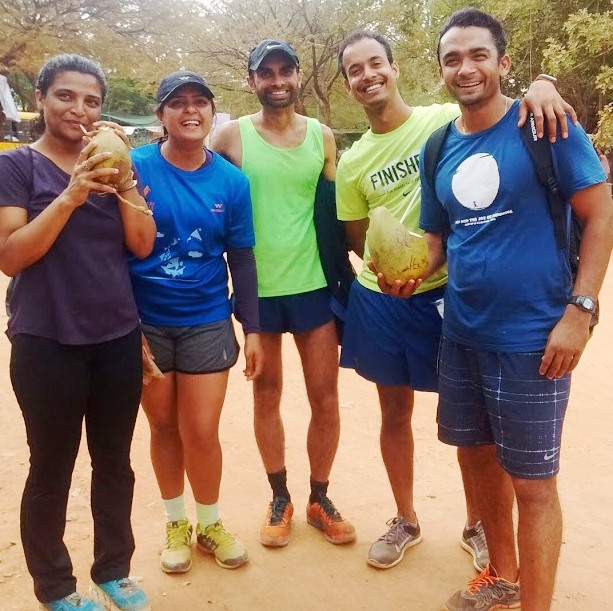
With friends at Auroville Marathon (Photo: courtesy Athreya Chidambi)

We play to win. In world dominated by the brain’s analytical and engineering faculties (a quality we increasingly bring to sport too), Athreya Chidambi aspired for a career in art. He was born in 1978 in Bengaluru, growing up thereafter in the city. As a school student he was active in sports – mainly basketball and football – but constant companion all along, was drawing and sketching. His father worked as a management consultant; his mother taught at the same school Athreya attended – Mallya Aditi. Following school, he joined Karnataka Chitrakala Parishat in the city to do a foundation course in art. But that inevitable child of the Indian rat race – the question: what employment prospects will you have? – wormed its way into his environment. None in his family had studied art and while successful artists exist, a career in art has never been without its share of ups and downs. Indian imagination on the other hand values security. So a tweak was made. He shifted to Melbourne in Australia to do a course in multimedia; that subject seemed safer bet for livelihood than pure art. However, his return to India coincided with the dotcom bust. “ It took a while to get a job,’’ Athreya said laughing. When it came, it was with a company called Thought Gun. He worked there for about a year and then joined Rediff.com in Mumbai as a web designer. It was during the two years he spent in Mumbai, that the first edition of the Standard Chartered Mumbai Marathon (SCMM / now called Tata Mumbai Marathon) happened. Curious, he participated in the event’s seven kilometer-Dream Run.
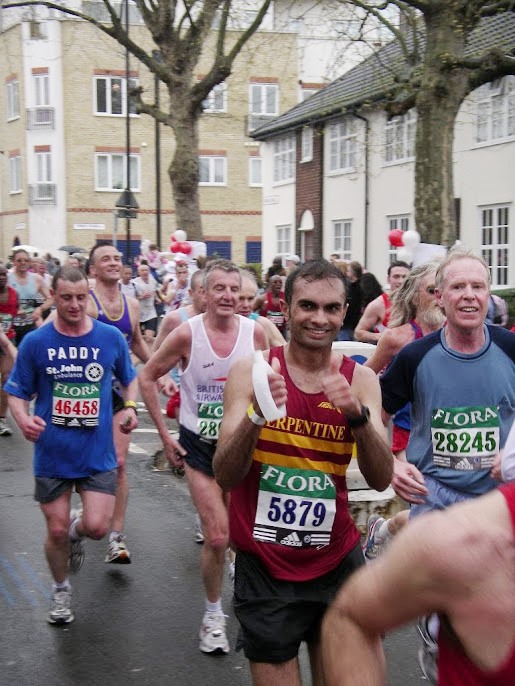
At the 2006 London Marathon; Athreya in `Serpentine’ vest (Photo: courtesy Athreya Chidambi)

In 2004, Athreya shifted to London where his sister stayed. He had a “ working holiday visa.’’ London was a runner-friendly city. It had large parks and small hills that could be easily accessed by public transport. There were pavements to run on. People gave way to pedestrians. When one runner saw another, a “ hello’’ or “ good morning’’ was said. There were running events spanning distance categories ranging from five kilometers to multi-day events and they were spread throughout the year. Plus, you had access to a wide variety of clothes and equipment for running. January 2005, Athreya started training to run; he also signed up for a half marathon – it was called Three Forts Challenge – scheduled for May that year. Three Forts was held in a small town outside London. The run went off well for Athreya, he finished in two hours. “ I was very happy with it,’’ he said. Trusting his longstanding acquaintance with sport and not yet knowing the details and micro-details of progression in distance running, he decided to aim next for a full marathon. He signed up for the Budapest Marathon of October 2005. He isn’t sure what motivated him to vault from first half marathon to first full marathon so soon and so early in his running career. “ One of my seniors from school had done the New York Marathon. I suspect that may have prompted me to register for Budapest,’’ Athreya said.

In June 2005, Athreya joined London’s Serpentine Running Club. The club’s origin is linked to the London Marathon, one of the world’s top running events; its first edition was in 1982. To prepare and train for the 1983 edition of the event, a group of runners had formed a club, since well-known as Serpentine Running Club. Wikipedia describes it as a cross country running club that draws members from across Greater London. A member of Serpentine is called a “ Serpie.’’ Athreya found their outings helpful; they were quite structured with distances assigned and pacers allotted for each category. Besides regular runs, there were hill-running sessions every Saturday. Athreya got by on a mix of getting tips from coaches and figuring out things himself. It was trial and error. Luckily injuries were few. Aside from a minor brush with shin splints, there wasn’t anything major. In October he completed the Budapest Marathon in 03:22:38. However his good fortune didn’t sustain. At the next marathon he signed up for, an event in London, he got cramps. Then in April 2006, Athreya ran the London Marathon. “ Entry was by lottery and I just proved lucky. Two of my friends who had been in the UK longer, didn’t get it. I think I was just lucky,’’ he said. The London Marathon was an experience. “ I had never seen a crowd so big. Everyone comes out to cheer. Belonging to Serpentine, which is a major club, also helped; you are noticed and encouraged. At London, it is hard not to run even if you are struggling,’’ he said. He completed the London Marathon in 03:41:49.
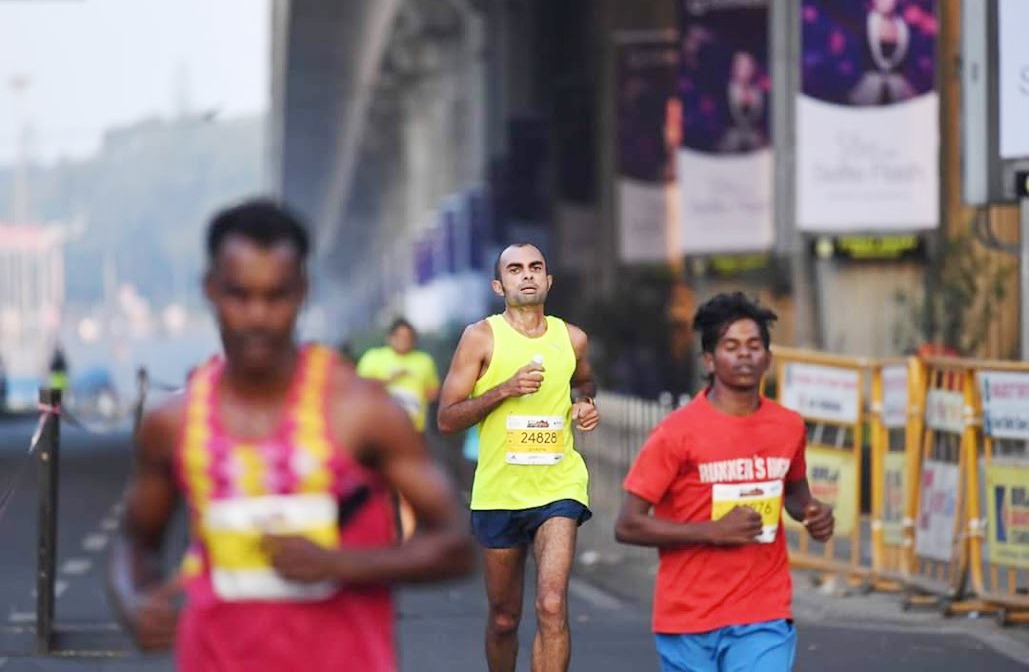
Running at the Bengaluru Marathon (Photo: courtesy Athreya Chidambi)

Besides the above mentioned races, during his stay in UK, Athreya also ran the Nike 10k, Luton Marathon, Watford Half, Hastings Half and Clapham Common 10k. For food on the table, he worked freelance. He traveled a lot in the UK; he also visited Hungary and Norway. In 2006, soon after the London Marathon he returned to Bengaluru. To keep his running alive, he initially trained near his house. Then, he joined Runners for Life (RFL). In Bengaluru, he set his eyes on the Bangalore Ultra, deciding to attempt the 78k category they had then. “ To my mind, there is difference between how the west approaches running and how India does. There, things are structured. Here it is more a case of being bitten by the bug, experimenting and carrying on. I got no formal education here on how to progress or effect transitions from one distance category to another. When it came to the ultra, I just decided to try it,’’ Athreya said. He planned his route to Bangalore Ultra with the Kaveri Trail Marathon (KTM) of September 2007, in between. It was designed by the organizers as a stepping stone to Bangalore Ultra. Athreya completed KTM with timing of 03:57:47. He found that he liked running on trails. You can take a road-run for granted because the surface is even. Not so, trails. “ On trails you have to watch every step. I also find that I recover faster from trail runs. After most of my road-running events, I am tired for three to four days. With trail runs, I recover in a day or two,’’ he said. Notwithstanding KTM, Athreya was laid low by a stomach bug during the Bangalore Ultra. He had to DNF (Did Not Finish) at around 50 kilometer-mark. “ For a long time I was dejected and depressed. Slowly I got over it,’’ he said. The reversal he suffered remained in the head as unfinished business. Next year he enrolled for the Great Tibetan Marathon (GTM), which used to be held in Ladakh. A week before the event he tore a ligament. He ran GTM wearing a brace, finishing the event at altitude in approximately 04:32:19 hours. Next on the agenda was to address that unfinished business at the Bangalore Ultra, the route to which lay through KTM. This time he DNF-ed at KTM (conditions were quite warm and he got cramps) but completed the 75 kilometer-category of Bangalore Ultra, successfully. He finished in 09:05:43.
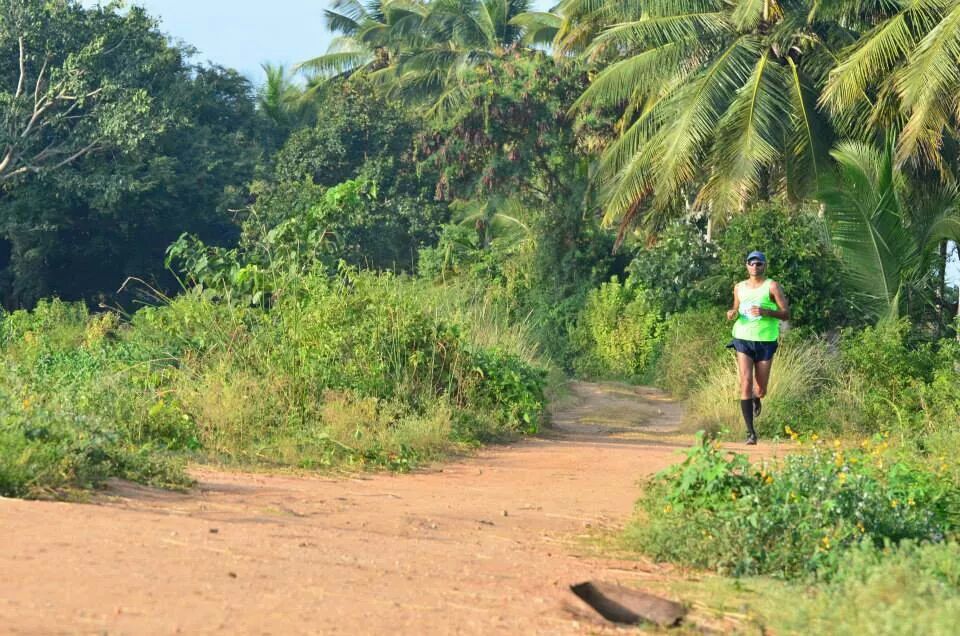
At Kaveri Trail Marathon (Photo: courtesy Athreya Chidambi)

Apart from some exceptions, the bulk of Athreya’s running has been in peninsular India. One likely reason for this was a factor he repeatedly kept observing the evening we met – Bengaluru may have become chaotic and its traffic, horrible, but it still has that weather, which is probably the best among big Indian cities for running. Like Auroville, which he frequents to run free of the tyranny of timing, two other events that surface consistently on Athreya’s annual list are KTM and Bangalore Ultra. In 2009, the year he got married, he ran the 75k category at the Bangalore Ultra. In 2010, he did the 100k covering the distance in 12:06:18. He also made a foray into a business that brought a touch of nature to people’s homes. For quite sometime now, Bengaluru with its mix of young people, educational institutions, software companies and well-traveled executives has been India’s city of ideas. After they got married, Athreya’s wife who worked at Infosys, quit her job. She and three others – Athreya among them – commenced a start-up that tapped the opportunity to grow plants in the balconies of houses; it was called mysunnybalcony.com. For regular job, Athreya also worked at a company called Logica.
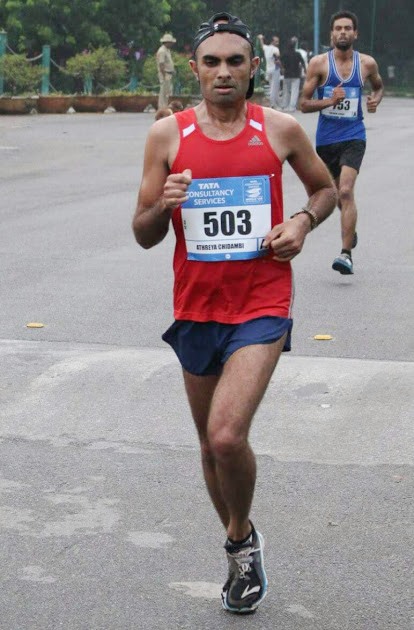
At TCS 10k (Photo: courtesy Athreya Chidambi)
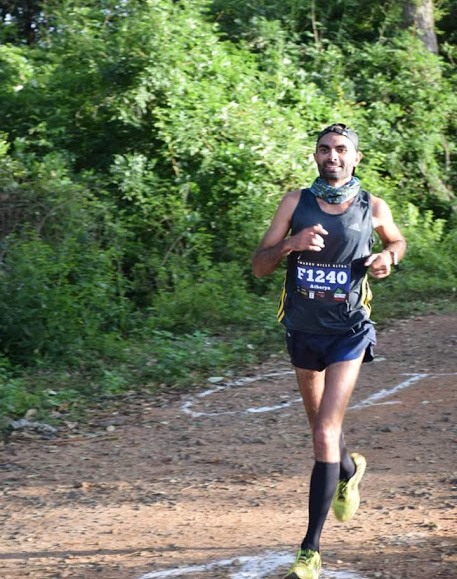
At Javadhu Hills Ultra (Photo: courtesy Athreya Chidambi)

By now, Athreya’s distance running was well past the days of introduction to the sport. In 2011, he got into a 24 week-training plan for ultra-running, the first time he was doing so. That year he got his personal best at KTM – 03:14:24. It was followed by the 50k category at Bangalore Ultra, completed in 03:58:56. This phase of running was different for a few more reasons. For the first time, Athreya felt competitive in a race. By now he was also running Bengaluru’s annual 10k (associated originally with Sunfeast and later with TCS), covering the distance in around 40 minutes. He also trimmed his preferred ultra-distance to 50 kilometers; that’s what he has mostly stuck to since at the Bangalore Ultra and similar runs elsewhere. In 2012 Athreya joined Aditi Technologies.

There wasn’t much running in 2012-2013. In 2015, he ran the 50k category of the Javadhu Hills Ultra. Athreya explained why trail running suited him. First, he likes nature. “ I have always been an outdoors person; I am not the city type,’’ he said. Second, he is the sort who usually trains alone. He likes that solitude. “ I can’t take crowds. I typically train on my own. In Bengaluru, I normally train on a mud track near Ulsoor. The other place I train at is Nandi Hills. Traffic is less there and I get to do both road and trail-running,’’ he said. Third, he likes small races. “ They don’t end up extremely competitive like the races in cities. They remain a personal experience. Running has always been a personal experience for me. If I do better, it is for my own self. Trail running is hard initially. To get through distances all by yourself on trails, is mentally tougher than managing a city based-race where you have people egging you on,’’ Athreya said. He covered the 50k distance category at Javadhu in 04:16:21. In 2015 he quit Aditi Technologies and partnered his runner friend, Dharmender, to see if coaching runners attracted as profession. Dharmender, who used to work at KPMG effected that switch successfully. Athreya didn’t find it his cup of tea. But that phase indirectly helped for the regimen of coaching at Bengaluru’s Kanteerava Stadium and adhering to training plans, improved his performance particularly in the half marathon and 10k. In 2015, he ran the half marathon in Hyderabad in 01:26:33 and the annual 10k in Bengaluru in 39:30 minutes. By 2016, he had lowered the timing in 10k at this event to 37:41 and at another similar event, to 37:06 minutes.
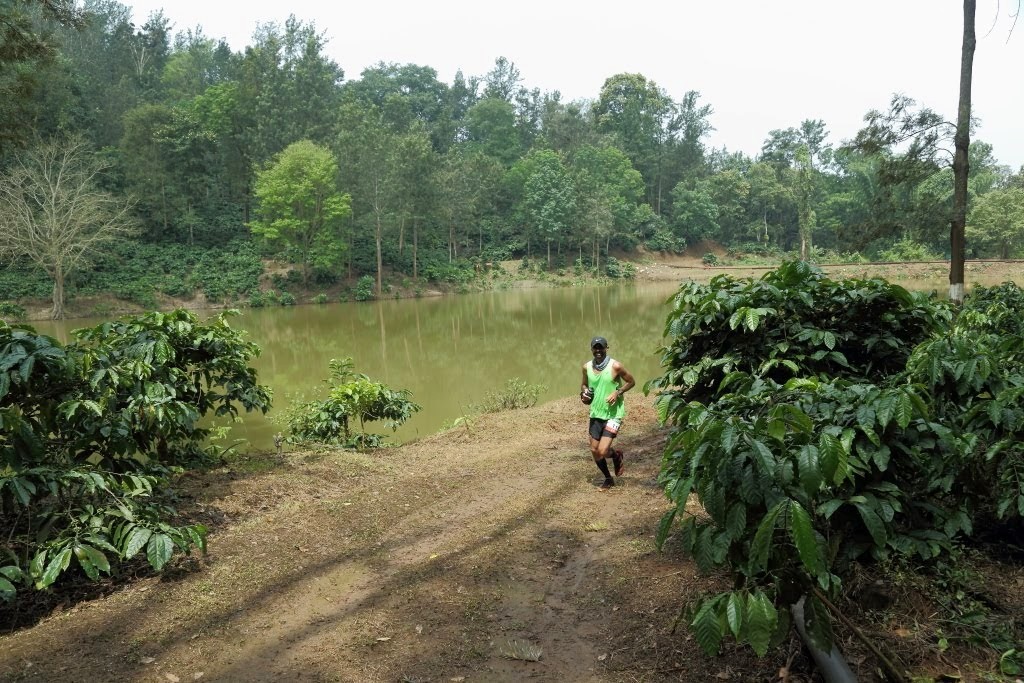
At Malnad Ultra (Photo: courtesy Athreya Chidambi)

In 2016 Athreya also made a departure from his 50k-fixation in ultra-runs, to attempt the 110 kilometer-category at Malnad Ultra. He knew the organizers and had been part of the team, which did the recce. Athreya wrote in his blog about why he chose this race: As most people progressed to running distances of 75k, 100k and 24 hours, I decided to stay at 50k. 50k had become my go-to race distance. I stuck to trail races and wanted to get better at the distance before I went back to doing ultras. And it did get better – I got stronger at the distance but I had got comfortable. I needed to get out of my comfort zone and see where I was at in terms of longer distances. The Malnad Ultra route was through coffee estates. To train for the event, he ramped up weekly mileage to roughly 100 km per week, peaking at around 120 km. He did several 40k runs around Nandi Hills and once, an 80k. He trained alone. On race day, Malnad went well for Athreya till around the 80k-mark. Then things started to go downhill. Amid the running, he had missed having lunch. By the time he reached the last 10 kilometers, he was tired and delirious. He finished in 13:45:55 hours. What doesn’t satisfy stays as unfinished business. Following Malnad, he ran the half marathon at Bengaluru’s annual marathon. In 2017, he came back to Malnad and did the 110k all over again (this time the course was slightly different with more elevation), completing it in 13:11:45 hours. Then as before, he ran the half marathon in Bengaluru, finishing it in 01:28:35. Same year he also did the 75k at Javadhu completing it in eight hours.
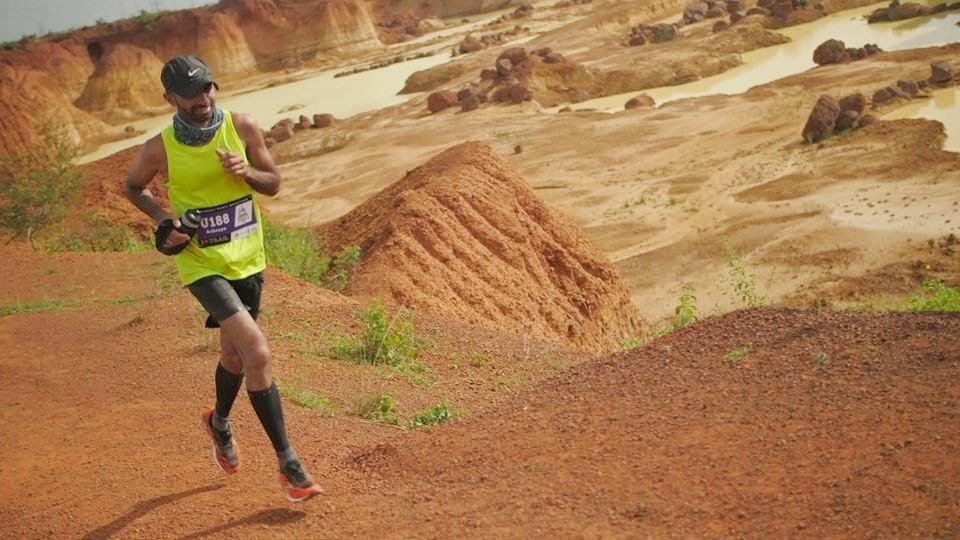
Running the Chennai Trail Marathon (Photo: courtesy Athreya Chidambi)

Another race Athreya ran in 2017 was the Chennai Trail Marathon. “ Many of us got lost while running that,’’ he said. Getting lost is one of the problems faced in trail-running. In trail-runs, the location is typically away from crowded city centers, people are few on the course and off it, markers may be inadequate and as happens sometimes – volunteers may give you directions but dropped off in wilderness, they may be as confused as you are. In some trail-running events, runners have to do the navigation themselves. If you are terribly competitive or seeking money’s worth, things going wrong can be an irritant. Racers sometimes come off cursing event organizers for what went wrong. I asked Athreya how he reacts to an incident of getting lost. “ For me, I guess, it is okay, part of the deal. I try to enjoy that also. I would probably go mad if it was a city that I got lost in. On trails, I have no expectations. If I get lost, I get lost. That’s one more way to know a place,’’ he said. In the running he has logged so far, Athreya has had several podium finishes in his age category, spanning both ultra-distances and the shorter ones. At the time of writing, what he wanted to try next was a 100 miler. “ I want to do it well, do it within a certain time,’’ he said. As for places he would like to run in, there was Kutch, Khardung La, Hong Kong and Nepal’s Annapurna circuit.

When people meet, they exchange visiting cards. Athreya’s was sky blue in colour with letters printed in white. The card introduced him as designer of useful experiences and illustrator. The reverse of the card was yellow with a sky blue circle at its center. Within the circle were a running shoe and the tag line: designer on the run. His website was no different. It declared unabashedly: this website combines my love for running and design.

(The author, Shyam G Menon, is a freelance journalist based in Mumbai. This article is based on a conversation with Athreya Chidambi. Timings at races are as mentioned by interviewee.)             
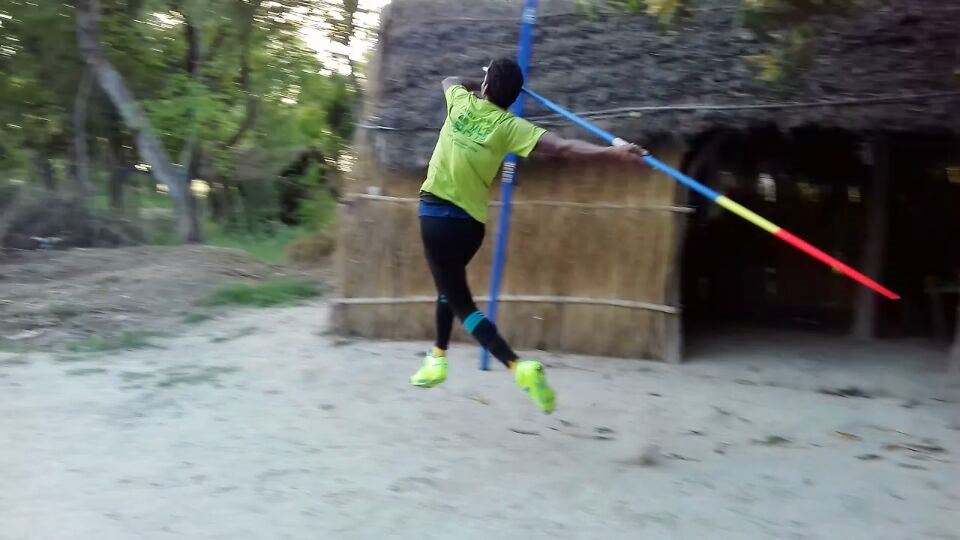
ROHIT YADAV: NEW JAVELIN, NEW PHASE

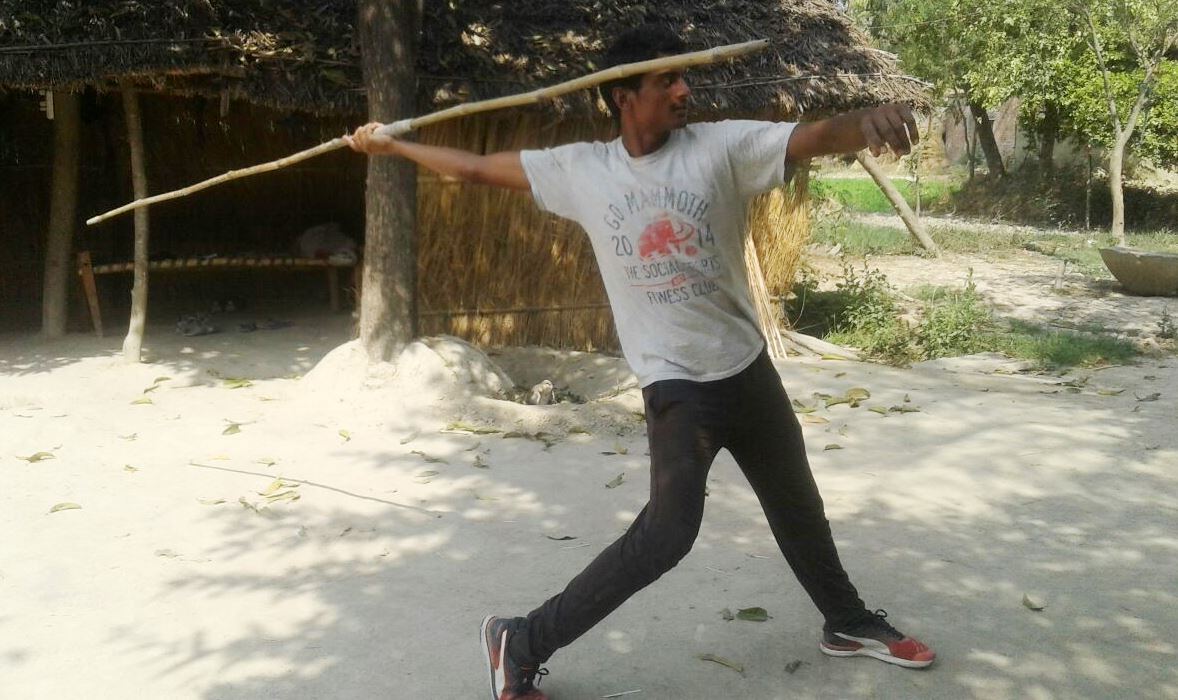
Rohit Yadav training with the new javelin at his village (Photo: courtesy Sabhajeet Yadav)

March 14, 2018.

“ Rohit is very happy,’’ Sabhajeet Yadav said about his son who has commenced training with a brand new javelin.

According to him, Bhasker Desai sponsored the Nemeth javelin; their friend Melvin made the necessary arrangements for sourcing the javelin and dispatching it. “ We collected it from Meerut yesterday,’’ Sabhajeet said.

Sabhajeet Yadav, a farmer from Dabhiya, Uttar Pradesh, is a well-known amateur runner with several podium finishes in his age category.

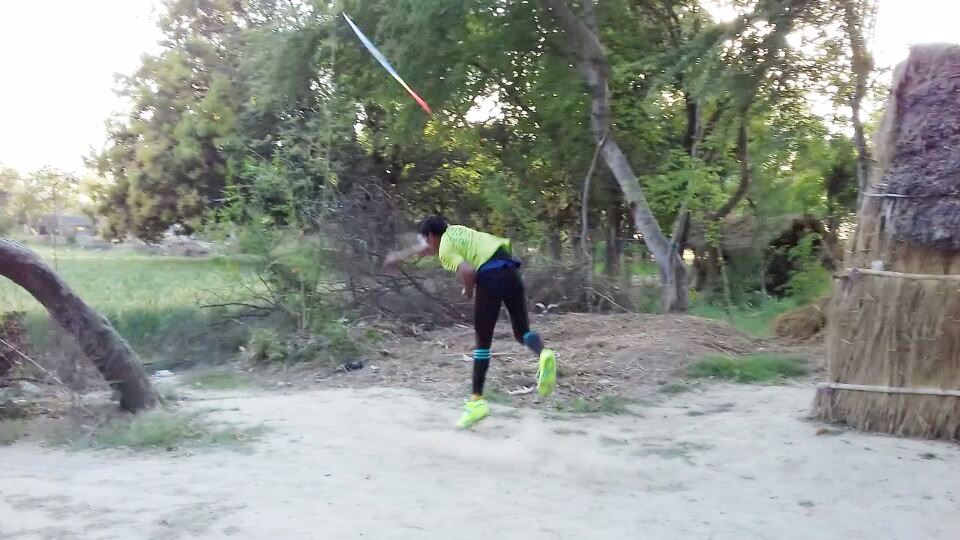
Rohit in action (Photo: courtesy Sabhajeet Yadav)

Rohit is a former gold medalist in javelin-throw at the World School Games.

Asked about the new javelin and how it felt in training sessions, Rohit said that it made a lot of difference.

For more on Rohit and his journey so far, please scroll down to the article immediately preceding this report or click on this link: https://shyamgopan.com/2018/03/09/a-javelin-for-rohit/

(The author, Shyam G Menon, is a freelance journalist based in Mumbai.)
A JAVELIN FOR ROHIT

In Dabhiya, Rohit Yadav with the homemade javelin he started out with (Photo: courtesy Sabhajeet Yadav)

A promising young athlete, returning to sport after failing an anti-doping test, wants to procure a good javelin. This is an article on amateur runner Sabhajeet Yadav and his son Rohit, who was gold medalist in javelin-throw at the 2016 World School Games.  

March 1, 2018. Tucked away in the sports section of the morning newspaper was a report about a 29 year-old Indian athlete returned positive under anti-doping tests conducted by the newly set up Athletics Integrity Unit (AIU). The sport in question – yet again javelin-throw – reminded of another incident less than a year ago.

A farmer from Dabhiya in Uttar Pradesh, Sabhajeet Yadav, 62, is known in the world of Indian amateur running as a consistent podium finisher in his age category. He counts on the prize money he gets from running as additional income stream. One of his personal projects has been training his son, Rohit, to become an athlete of repute in the javelin-throw. Mumbai’s Lokmanya Tilak Terminus is where this blog catches up with Sabhajeet. Having come for a marathon in town, secured a podium finish and with an hour to spare before train to UP departs, he would sit down for a chat and cup of tea. On some of these occasions, he had mentioned his desire to see Rohit participate in the Olympic Games.

Javelin-throw is one of the oldest disciplines at the Olympics. According to Wikipedia, it was part of the pentathlon at the ancient Olympic Games. In those days, it was judged for distance and target. Javelin-throw became part of the modern Olympics at the 1906 Intercalated Games held in Athens, an event that has stopped being counted as an official Olympic Games by the International Olympic Committee (IOC). While we are used to seeing the javelin thrown with one hand, in the late nineteenth century and the early part of the twentieth, there was a phase when judging at competitions was based on the aggregate best a person could achieve throwing separately with the right and left arms. This practice featured at the Olympics just once, in 1912. After that, it faded. Three countries – Norway, Sweden and Finland – have dominated javelin-throw in the men’s category. They account for almost 50 per cent of the Olympic medals given out so far in the discipline, for men. Women’s javelin-throw was added to the Olympic program in 1932.

As interesting as the sport’s history, is the evolution of the javelin. For a long time, javelins were made of wood with a steel tip. In the 1950s, pole vaulter-turned javelin thrower, Budd Held of the US, introduced the `Held Javelin,’ which was hollow and aerodynamic. Its later models were made entirely of metal. These new javelins flew farther but they also tended to land flat, making for some landings that were difficult to measure accurately, Wikipedia says. Experiments to redesign started in the early 1980s. They were fueled by one more concern – the javelin was now being thrown by athletes so far that it threatened to exceed the dimensions of a normal stadium infield. In 1984, Uwe Hohn of East Germany (since unified with West Germany to become Germany) had set a record of 104.80 meters. The redesigned javelin, approved in 1986, saw its center of gravity moved forward marginally, the surface area in front of the center of gravity reduced and the same behind, increased. These innovations helped contain the distance traveled and ensure that the projectile landed stuck in the ground. Interestingly this design was also tinkered with in the competition to achieve longer throws. In 1991, the authorities outlawed javelins with serrated tails and reset records with retrospective effect.

According to his profile, available on the website of International Association of Athletics Federations (IAAF), Rohit Yadav was born in 2001. News of him training in his village appeared in the media some years ago in a report following Sabhajeet’s podium finish at the Mumbai Marathon. The report engaged as window to the family’s drive and ingenuity. Unable to afford a modern javelin, Rohit trained with a homemade one. In times when the javelin’s design and engineering are as important as athlete’s ability to extract a world class throw, a homemade javelin is inadequate means to train. “ I made that javelin from bamboo. I had a photo of a javelin to guide me. I did not follow any established specifications about size, weight or anything like that. The crudely made javelin was not good for the hands. Rohit used it for two years,’’ Sabhajeet said. The path Sabhajeet and Rohit took, of making their own javelin, would be what India calls jugaad. Happening in underprivileged circumstances, jugaad addresses a need with none of the finesse or elegance that marks well made, well designed products.  What shows through is refusal to be stopped. The underlying curiosity shouldn’t be dismissed. It was the same curiosity – albeit in a different, more sophisticated environment – that yielded the Held Javelin.

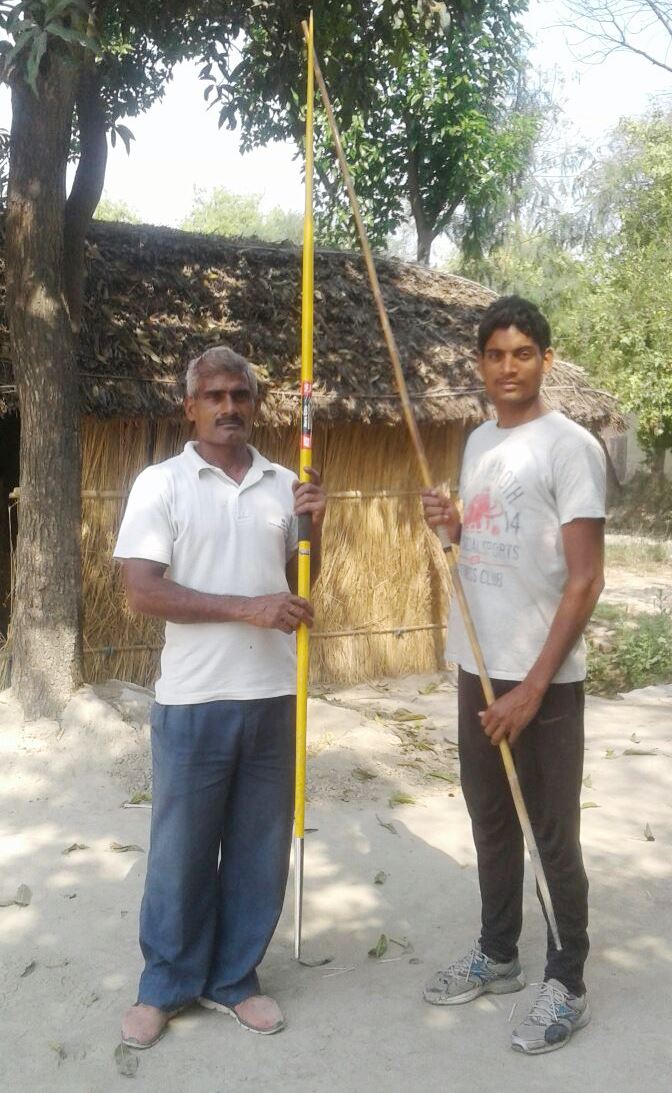
Sabhajeet Yadav (left) and Rohit; the javelin in Sabhajeet’s hands is the one bought from Patiala (Photo: courtesy Sabhajeet)

Prior to the 1950s, nearly all the best throws in the world had been with javelins made in Finland, using northern birch. Budd Held, who was studying engineering at Stanford University, observed one day that one of his Finnish javelins traveled farther than the rest. As per a detailed account available on the Internet, Held studied that javelin closely, took accurate measurements and discovered that the front section of the javelin was slightly larger in diameter than the tail section. The wood in the front section was also bit softer. All this was probably an oversight in manufacture but the improved travel resident in that single specimen and subsequent analysis of it, was what led Held to come up with his own design – the Held Javelin. Training with homemade javelin didn’t stop Rohit from graduating through the ranks. It helped him reach state level-events, where better javelins were available for athlete. “ We then bought a javelin for Rs 12,000 from Patiala,’’ Sabhajeet said. By July 2016, Rohit had secured a gold medal at the World School Games with a throw of 72.57 meters. In May 2017, he got silver at the second Asian Youth Athletics Championship held in Bangkok.

Then disaster struck.

In May 2017, the media reported that Rohit had failed a dope test conducted by the National Anti-Doping Agency (NADA); he had tested positive for the banned substance stanozolol and was set to be stripped of the silver medal he won in Bangkok. The news shocked Sabhajeet; it was keenly tracked by those in the amateur running community, many of who knew Sabhajeet. Eventually, Rohit was given a one year-ban. According to Sabhajeet, the ban is from May 21, 2017 to May 21, 2018. At the time of writing, Rohit’s best throw on record – as available on his IAAF profile – was 76.11 meters (for comparison, the national record is 86.48 meters set by Neeraj Chopra while the world record is 98.48 meters held by Czech athlete, Jan Zelezny). When we brought up the subject of Rohit a few months after he was banned from competing for a year, Sabhajeet was in tears, unable to handle the topic. He claimed his son was innocent and the family had no idea how stanozolol had got into him. Over time the setback appears to have got processed in the head. By the time we met him for a chat after the 2018 Tata Mumbai Marathon (where he earned a podium finish for the seventh time), Sabhajeet was more hopeful and imagining the way ahead once Rohit recommenced competing at events (he would have to work his way up all over again). The father-son duo’s plan is to attempt the qualifying round for the 2018 Youth Olympics scheduled to be held in October in Buenos Aires, Argentina. “ The qualifying round will be held two months ahead of the Games. If he qualifies he will be sent for the Games by the government. As of now, he will continue to train here in the village. If he does well and we get a reliable coach, then he will be sent for training,’’ Sabhajeet said.

One of the things Sabhajeet would like to have for his son’s journey ahead, is a modern, competition-standard javelin to train with. The best javelins are manufactured overseas. According to data on the Internet, leading names in the business include Nemeth Javelins (company founded by Miklos Nemeth, Hungarian athlete who was gold medalist in javelin-throw at the Montreal Olympics), Nordic Sport and OTE javelins. The javelin will have to be imported and Sabhajeet believes that the cost could be anywhere between Rs 80,000 to 100,000. Mumbai based-businessman and amateur runner, Bhasker Desai, has been Sabhajeet’s benefactor for several years. He has stepped in to do the needful. But the intervention, while addressing an immediate need, will have limited relevance because Rohit will move into the senior category in a couple of years’ time. There is disparity in specifications (mainly, weight) between competition javelins used in the senior category and the one, Rohit can use now.  A mechanism to support his journey in a more sustained fashion will need to be looked into.

(The authors, Latha Venkatraman and Shyam G Menon, are freelance journalists based in Mumbai. For more on Sabhajeet Yadav please click on this link: https://shyamgopan.com/2015/11/28/a-farmers-dream/)


JOURNEY FROM HALF TO FULL

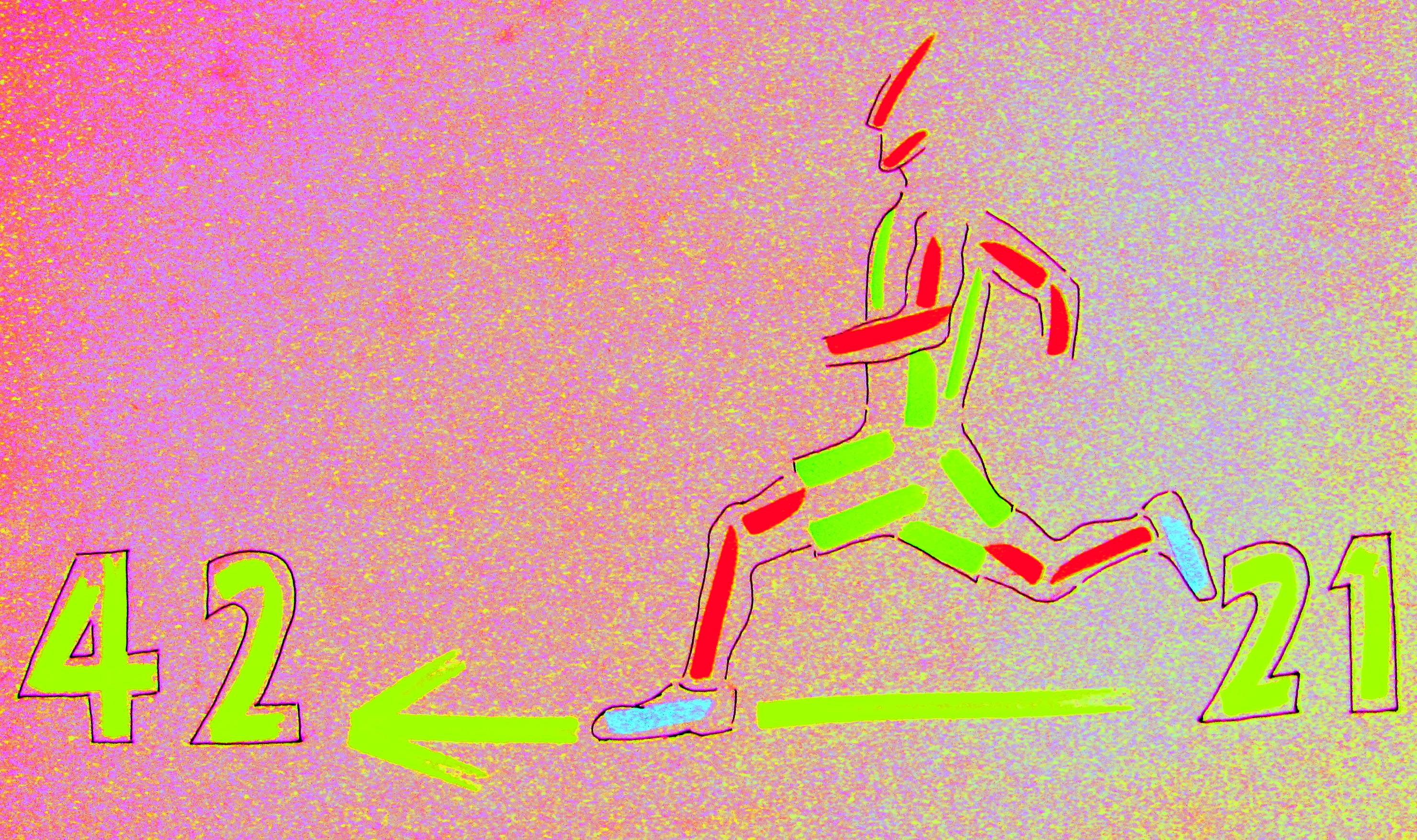
Illustration: Shyam G Menon

This article deals with the transition from running comparatively modest distances like the half marathon, to running the full marathon. It is a mix of the coach’s perspective and the personal experience of a few runners who recently did their first full marathon. This is not a training manual. It is a compilation of observations and experiences.

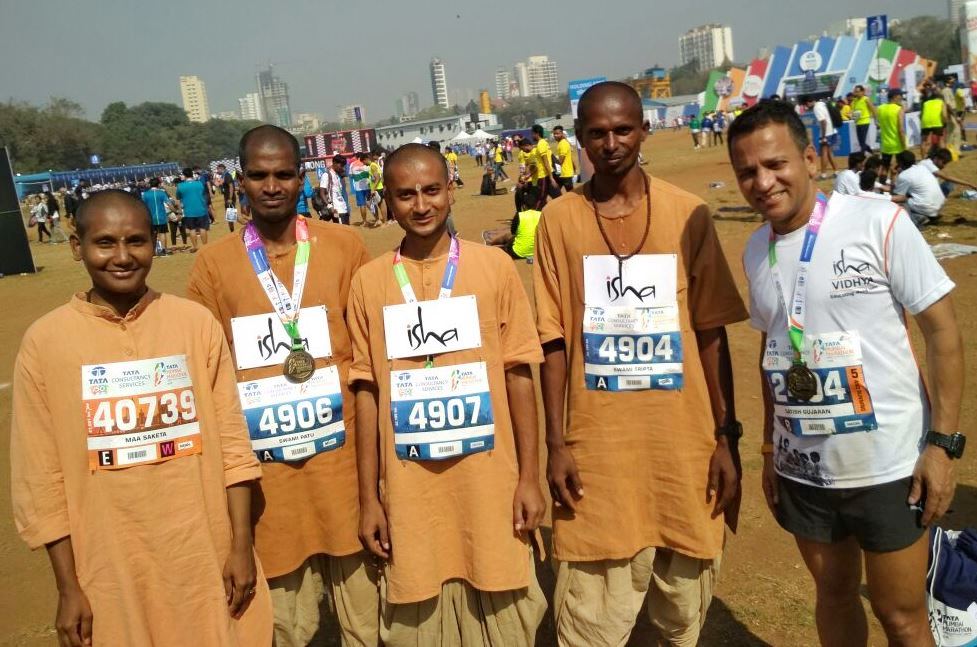
At the expo preceding the 2018 Tata Mumbai Marathon (TMM), a group of monks from the Coimbatore-based Isha Yoga Centre, awaited their turn to collect bibs for the run.

Young and dressed in saffron kurta and dhoti, some of them were transitioning to the full marathon after having run the half marathon for a couple of years. It wasn’t entirely their choice. One reason attributed for the transition was that slots for the half marathon filled up fast and the only option available was enrolling for the full marathon. Enrolment for TMM typically opens up in the latter half of July. Slots for the half marathon are prone to getting filled up within a week; entry to full marathon stays open for a longer period. TMM is among Asia’s biggest marathons in terms of participation; away from heavily attended segments like the Dream Run, meant to endear the event to its home city, the half marathon sees the most number of runners. The progression to full marathon (distance of 42.2 kilometres) from half marathon (distance of 21.097 kilometres) must rest on real reasons, running coaches aver. According to Satish Gujaran, Mumbai based-ultramarathon runner, who the team from Isha Yoga Centre looked to as coach and guide, the monks had a generally high level of fitness. That attribute weighed in when the team eventually decided to attempt the full marathon.

Suchita Varadkar (Photo: courtesy Suchita)

Suchita Varadkar, Mumbai-based coach, is often seen encouraging her wards at major running events. Sometime in the late 1980s, while still in college, she did a teacher’s training course in yoga, thereby making her foray into the world of fitness. Running, she said, is a workout entailing much impact. A marathon involves running for a long period of time and that means putting the body’s joints at risk. “ Therefore, the prime focus should be health,” Suchita, who was an athlete before she turned coach, said. With emphasis on sports limited at most schools and colleges, many Indians living in these times of running’s ascent in the country, get exposed to sporting activity late in life. Consequently running a marathon can be quite challenging. Planning followed by systematic training should preferably commence a year ahead of the event, coaches we contacted, said.

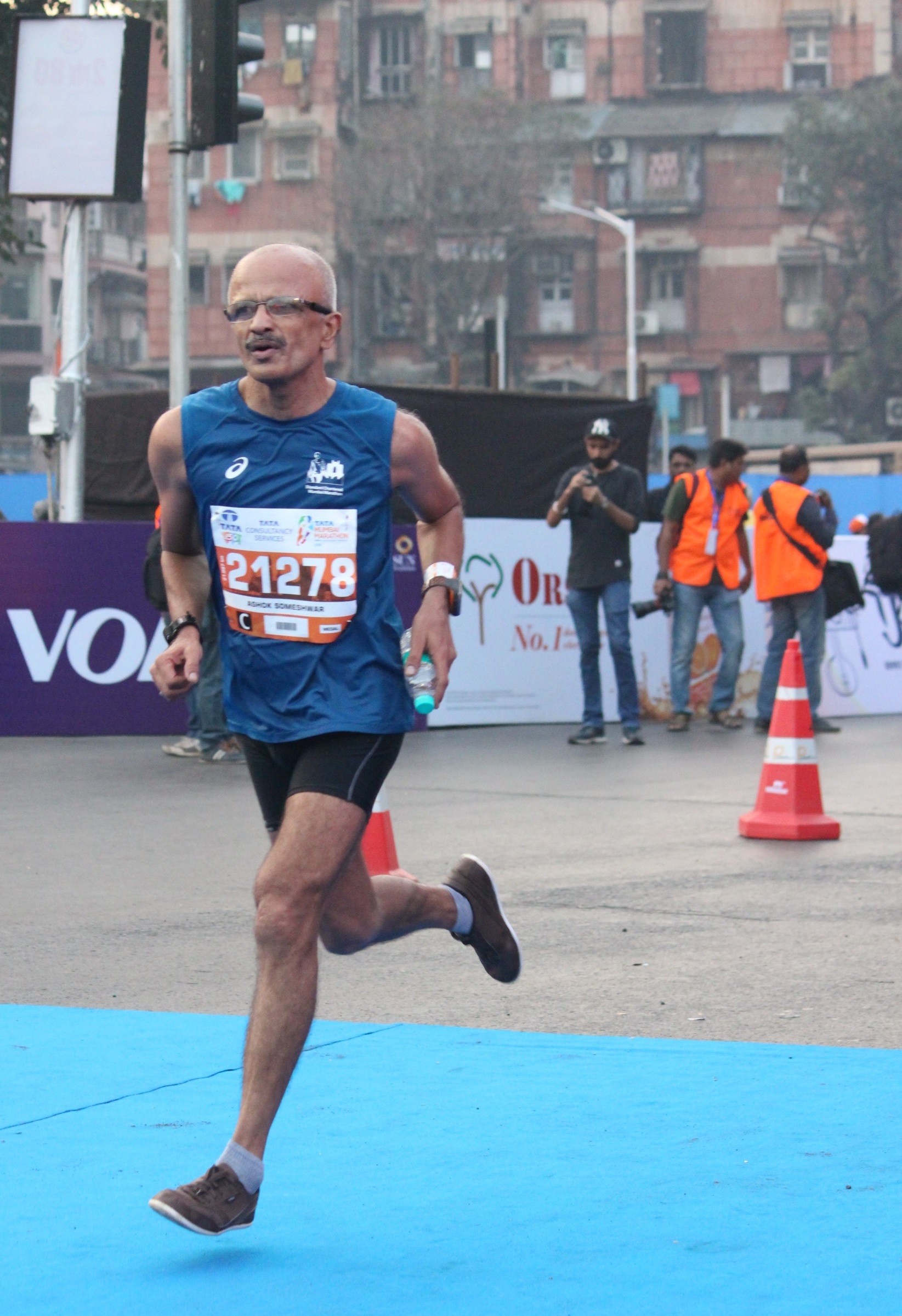
Mumbai-based marathoner Ashok Someshwar has been running for several years. A podium finisher at some events, Ashok believes the right way to progress would be to start with running five kilometres and then graduate to tackling 10 kilometres. “ It would be nice to participate in events featuring these distances frequently as the distances are not too long and recovery is faster,’’ he said. Once this process has been pursued for a year, training can commence for 10 milers (16 kilometres) and the half marathon. “ To be good at running a half marathon, it takes a few years. It would be advisable to continue running half marathons for at least two to three years. This should be combined with regular five kilometre and 10 kilometre-runs so that it is possible to set a target for the half marathon. Once a person has done half a dozen half marathons and is really comfortable with the distance – by this I mean racing and not just running – then, he or she is ready to plunge in to the full marathon, if and only if half marathons are finished comfortably,’’ Ashok said. According to Suchita, the progression should largely depend on fitness. However she added that there are runners, whose graph is quite sharp; they are able to shave off minutes, race after race. She pointed out the example of endurance athlete Chitra Nadkarni.

For recreational runners, running a marathon is an activity spanning a few hours. For this reason, running a marathon requires not only cardiovascular endurance but muscular endurance as well, Suchita said. Strength training with special focus on glutes and core is imperative. “ Ideally, a marathon should be completed within five hours. Running for any period beyond five hours is exposing oneself to too much dehydration, especially in Indian weather conditions,” Suchita said. In fact, according to some coaches, while a marathon may be only double the distance of a half marathon, the effort required is nearly four times.

Ashok Someshwar (Photo: courtesy Ashok)

Before the actual training for a marathon commences, base mileages have to be stepped up. The bare minimum training, according to Ashok, is at least five months, with the first month spent in building a decent mileage base. This should be in accordance with a training schedule of 16 weeks incorporating speed intervals, tempo runs and long runs besides strength training and core workouts at least twice a week. “ There should be a minimum of three long runs exceeding 32 kilometres built into this schedule,’’ Ashok said. Marathon training has to take into account many facets of fitness training – among them are aerobic and anaerobic efficiency, flexibility, nutrition and rest. Speaking to this blog in early 2016, well-known coach and athlete from Bengaluru, K.C. Kothandapani had said that his training for the marathon and shorter distances cover three aspects – base endurance, speed endurance and race strategy and pace. Every fourth week was an easy step-down week wherein training volume was reduced by 50 per cent (please click on this link for the article on Kothandapani: https://shyamgopan.com/2016/03/14/take-things-sportingly/)

Ashok’s journey to running long distances started in 2006 when he did his first half marathon at the Standard Chartered Mumbai Marathon (now TMM). He moved to full marathon after five years of running SCMM. Some of the friends he was training with had been running the full marathon. He was soon drawn to the idea of running the distance. “ I had been trekking for long and walking long distances was always a part of my life. This made me attempt the full marathon,’’ he said. Ashok drew up a plan with the help of coach, Daniel Vaz, who has been his mentor for a long time. He followed the plan diligently. “ I started training for the full marathon almost one year in advance for mileage-building and then followed a strict plan for six months.  I followed most of the rules of training. However I was a bit short on sleep due to office commitments,’’ Ashok said. At the time of writing, he had been running full marathons for seven years, interspersing it with half marathons and 10 kilometre-runs.

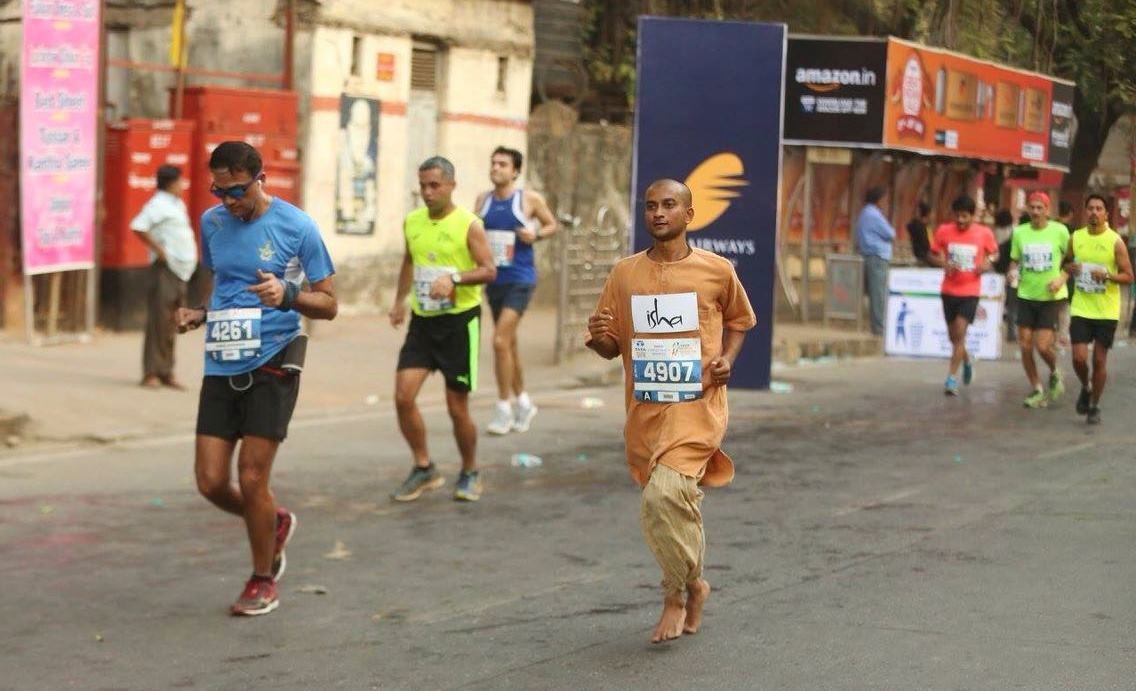
Swami Lavana running the 2018 TMM (Photo: courtesy Swami Lavana)

A seasoned runner, Satish was keenly aware of the preparation needed for a full marathon. With the Isha Yoga Centre team suddenly staring at the prospects of running a full, he had to foment a decision. “ I was at the ashram for only two days and during that time I provided them tips on how to train for the marathon. Later I guided them remotely. But they didn’t have adequate time to spare; they hadn’t also trained formally for sports earlier. What they did have going in their favour were two other factors – they were young and their fitness level was high. I felt they could try the marathon,’’ Satish said. When we met them at the 2018 TMM expo, Swami Lavana and his colleagues from Isha Yoga Centre expressed their eagerness to attempt the full marathon for the first time. Born Raghavendra Anisetty, Swami Lavana had initially secured his mechanical engineering degree and found employment at Toyota Kirloskar Motors. Six months later, he resigned and proceeded to do the Inner Engineering course from Isha Foundation. Moving deeper into the subject, he eventually became a monk at the Centre.

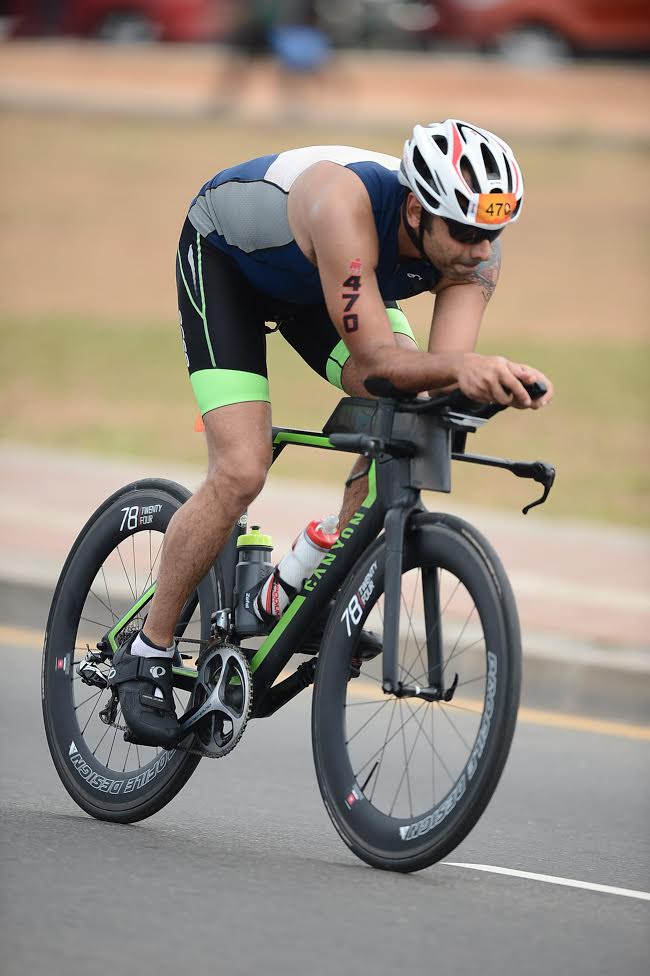
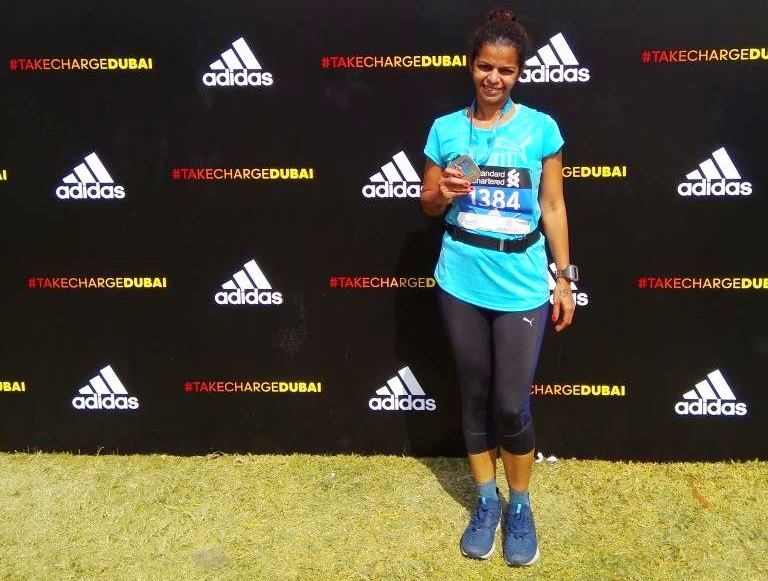
For most runners, transitioning to the marathon from shorter distances is logical next step. Mumbai based-Deepa Raut commenced running in 2014. Training sporadically, Deepa just went along with the flow. In her third year of recreational running, she was hit by the full marathon bug. From idea to actual event she had sufficient time to train systematically. In 2018 she chose to skip TMM and instead enrolled for the Standard Chartered Dubai Marathon, which is usually held five days after the Mumbai event. She trained under runner and triathlete Vivek Menon, who drew up a schedule for her based on her pace at previous running events. “ The first month of training was entirely focused on discovering my capacity,’’ Deepa said. She diligently followed Vivek’s plan, which incorporated speed workout and tempo runs. As her training progressed, Vivek kept tweaking the plan to push her limits. “ I guess I was able to push my limits because I used to be good in sports in school days,’’ Deepa said. Although coaching Deepa, Vivek’s trajectory was tad different. He has been running for seven years. From regularly running the half marathon, Vivek chose to move to the triathlon. “ It’s never about doing big distances. Finishing strong is key,’’ he said.

Vivek Menon (Photo: courtesy Vivek)

Vivek figured that training for the full marathon is relatively tougher and more intense compared to the Half Ironman (triathlon). Nevertheless, he decided to attempt the full marathon at the Standard Chartered Dubai Marathon on January 26, 2018. He had also decided to participate in a Half Ironman at Colombo on February 25. Managing the training for both these disciplines entailed an extremely packed schedule. He switched between swimming, cycling and running. Strength training is integral to marathon training. Prone to injuries, Vivek opted to do pilates. Juggling all this amid regular Mumbai life isn’t a joke. Deepa’s strength training fell short of actual requirement. “ I could manage only 20 per cent of the required strength training,’’ she said. Lowering body weight to the requisite level is critical for marathon training, Vivek said. Nutrition assumes importance.

With wear and tear being high in marathon training, eating the right food is absolutely critical, Suchita said. Carbo-loading is important and at the same time some amount of protein – be it plant protein or animal protein – should be included in the diet. Also, snacking should be healthy. “ Any diet adopted, has to be sustainable,’’ she said. In that endeavour, cutting out refined sugar is the fastest way to drop weight and it helps in reviving energy levels, Vivek said. He also chose to stay away from parties to keep off alcohol as it can mess with sleep and hydration. Managing a full-time job, son and home, Deepa had a tough time time in this department too; she was not able to perfect her diet. For Swami Lavana, attention to nutrition was impossible as he cannot decide his meals at Isha Yoga Centre. Training for the full marathon takes away much of one’s personal time, Vivek and Deepa, both first time marathon runners, said. If structured training is critical to participate in the full marathon, tapering is equally important, Suchita reminded. During the tapering period, weekly mileages are lowered to the extent of 10-15 per cent and there are no tempo and speed runs. This helps recovery.

Satish Gujaran (right) with the team from Isha Yoga Centre (Photo: courtesy Swami Lavana)

At the start line of 2018 TMM, Swami Lavana was a bundle of excitement. “ My run started quite well. I was running fine till around 30-31 kilometre-mark. My pace was in line with my practice. But after that I started to feel discomfort in my thigh muscles and left knee. My pace then started to drop,’’ he said. He had to resort to doing stretches along the way. “ But in the last kilometre there was a different level of energy with all the clapping and cheering.  That prompted me to sprint to the finish line,’’ Swami Lavana said two weeks after TMM. He completed his first marathon in 4:27 hours, running the distance barefoot, clad in monk’s attire of long kurta and dhoti. “ There was some fear about running 42 kilometres before the run. But once I started, I found the experience so wonderful,’’ he said. His colleague, Swami Patu, completed his maiden marathon in a time of 3:48 hours. Having completed his first marathon, Swami Lavana now sees value in focussed training. With limited time on his hands, he will have to find ways to train. For Swami Lavana, running in monk’s attire has not been an issue. If it rains during a run, then running becomes a problem as wet clothes weigh you down, he said.

Deepa Raut (Photo: courtesy Deepa)

Deepa trained as best as she could for her maiden marathon. Still no matter how well runner plans, race day takes its own course. At 7 AM when the run commenced, temperatures in Dubai were around 14 degrees Celsius. “ Till about the thirteenth or fourteenth kilometre I was sleepy. My ears were shut because of the cold. Unexpectedly, the temperature shot up to 25-27 degrees Celsius by around 9:30 AM,’’ Deepa said. Up to the thirtieth kilometre, Deepa ran along with Darshita, a Dubai-based runner, who was also running her first full marathon. “ She was the one who pulled up my pace but after the thirtieth kilometre she started getting cramps. I decided to go along with her to ensure that she completes her maiden full marathon. Had I gone ahead, she would have quit the race,’’ Deepa said. Deepa finished in 5:23 hours, tad outside her target of five hours.

In the run up to the Dubai marathon, Vivek had trained well. He also helped other runners with training plans. But a week prior to the Dubai run, he broke his elbow. He could not straighten his arm. “ I had trained so much. My flight and stay were all booked. I decided to go along and see what I could do,’’ Vivek said. Running is done with the legs. But in the overall action of running, the arms play an important supportive role. We instinctively move our arms as we run. Vivek had his doctor put his arm in a cast before he left for Dubai. “ In Dubai, I commenced my run at a controlled pace. But around 12 kilometres my arm started to ache. It was way too early in the race. By the 21 kilometre-mark, it was too much to manage. Also, given sweating my cast started to get heavy. I stopped at an ambulance to see if the cast can be removed but the staff inside the vehicle did not have a cast cutter,’’ he said. At the 26 kilometre-mark, Vivek seriously contemplated DNF (Did Not Finish). Weighed by cast and his running form affected as a result, new problems set in. “ Because of the imbalance in my running my right ankle started to give me trouble,’’ he said. From this point onwards, Vivek resorted to a mix of running and walking. He finished the run in 5:01 hours, against his target of sub-four hours.

Chitra Nadkarni (Photo: courtesy Chitra)

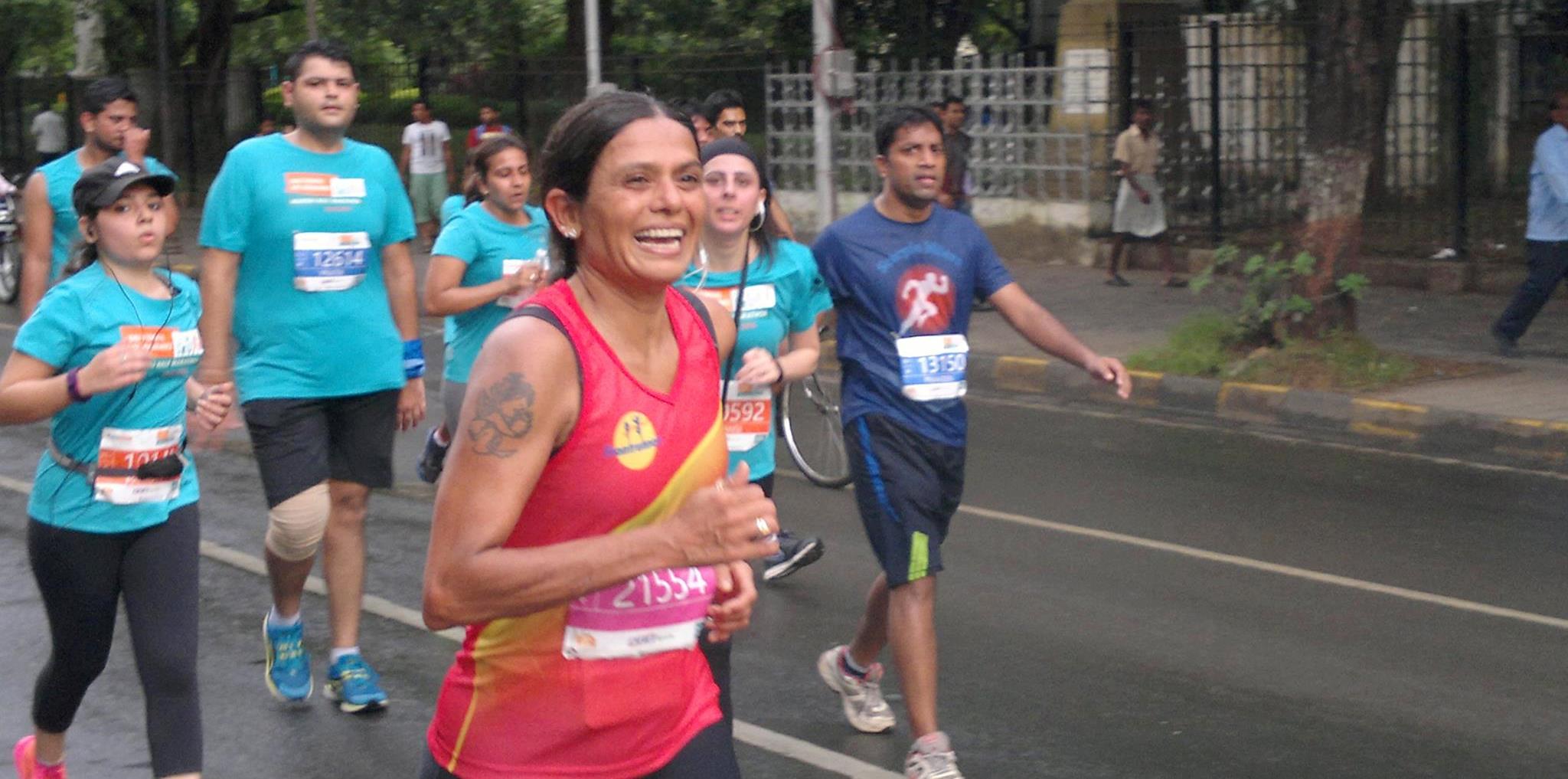
Sometimes you hit your first full marathon en route to attempting something much longer. Endurance athlete Chitra Nadkarni is a podium finisher at most runs she has participated in, in India. Her recreational running career commenced in 2012 and in 2013 she attempted her first half marathon in Hyderabad. She then started thinking of doing Comrades, an ultramarathon of around 89 kilometres in South Africa. Even as she was training for Comrades, she ended up running her first full marathon in Amsterdam following it up with the full marathon at the 2015 Mumbai Marathon. “ Training for Comrades helped me do the full marathon,’’ she said. Once she finished her Comrades in mid-2015, Chitra started focusing on diet. She wanted to move on to the Half Ironman (triathlon) and realised that she was falling short in strength training. A full marathon, according to her, is very challenging. “ Mentally, it takes a lot and you are alone on the road for that distance,’’ she said. Many recreational runners opt to move to ultra-distances from having attempted the half marathon, skipping the full marathon in between or running it during the journey to ultra. By no yardstick does that dilute the challenge in a full marathon. The combination of full marathon distance and the need to complete it in respectable timing makes the full marathon an engaging problem to sweat over. Running a full marathon within a stipulated time frame can be quite challenging, runners we spoke to said.

Hence – the need to tackle that progression, slowly, steadily.

(The author, Latha Venkatraman, is an independent journalist based in Mumbai.)

A SKIING COURSE WITH A DIFFERENCE

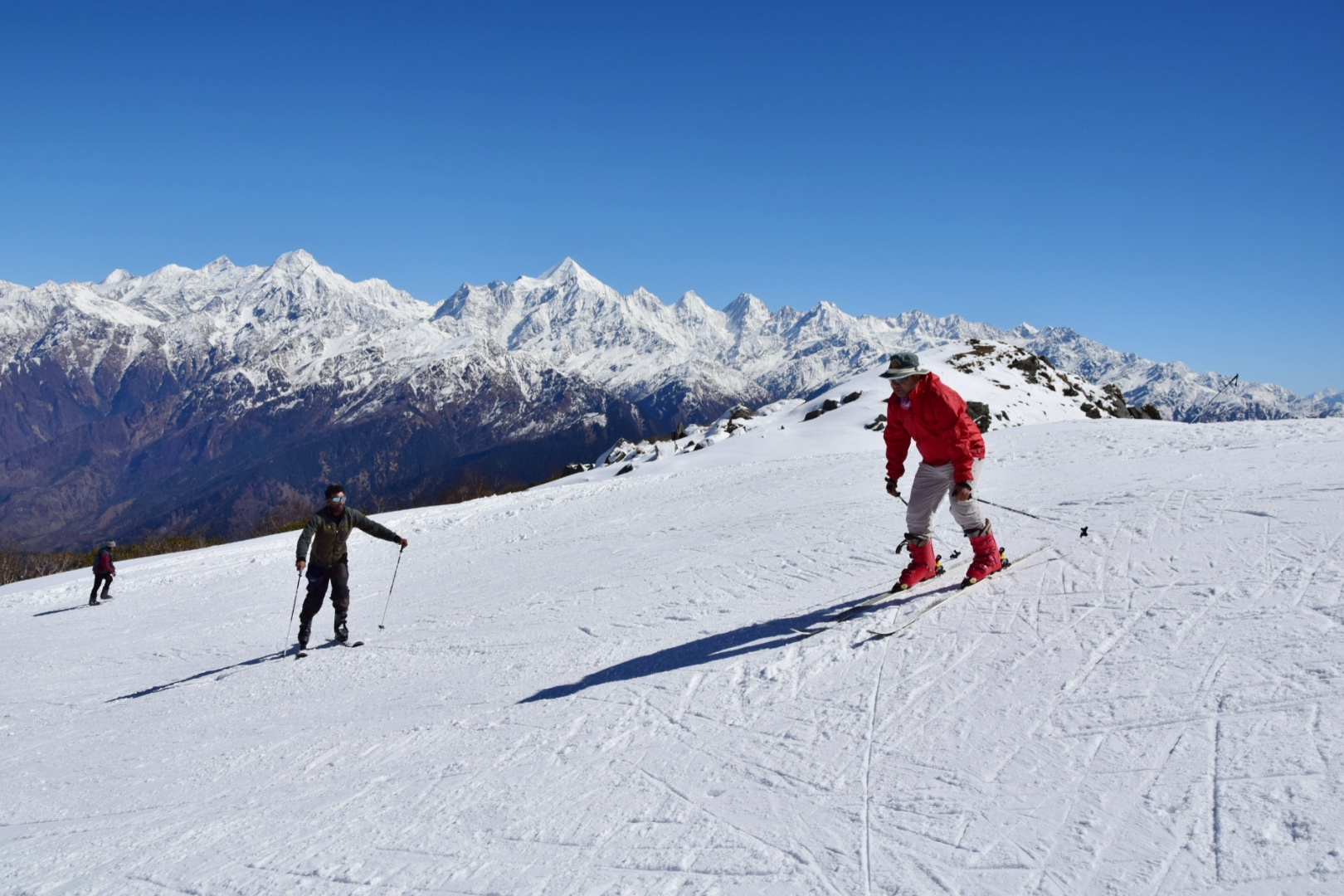
From the PNSMTI basic skiing course (Photo: courtesy Reena Kaushal Dharmshaktu)

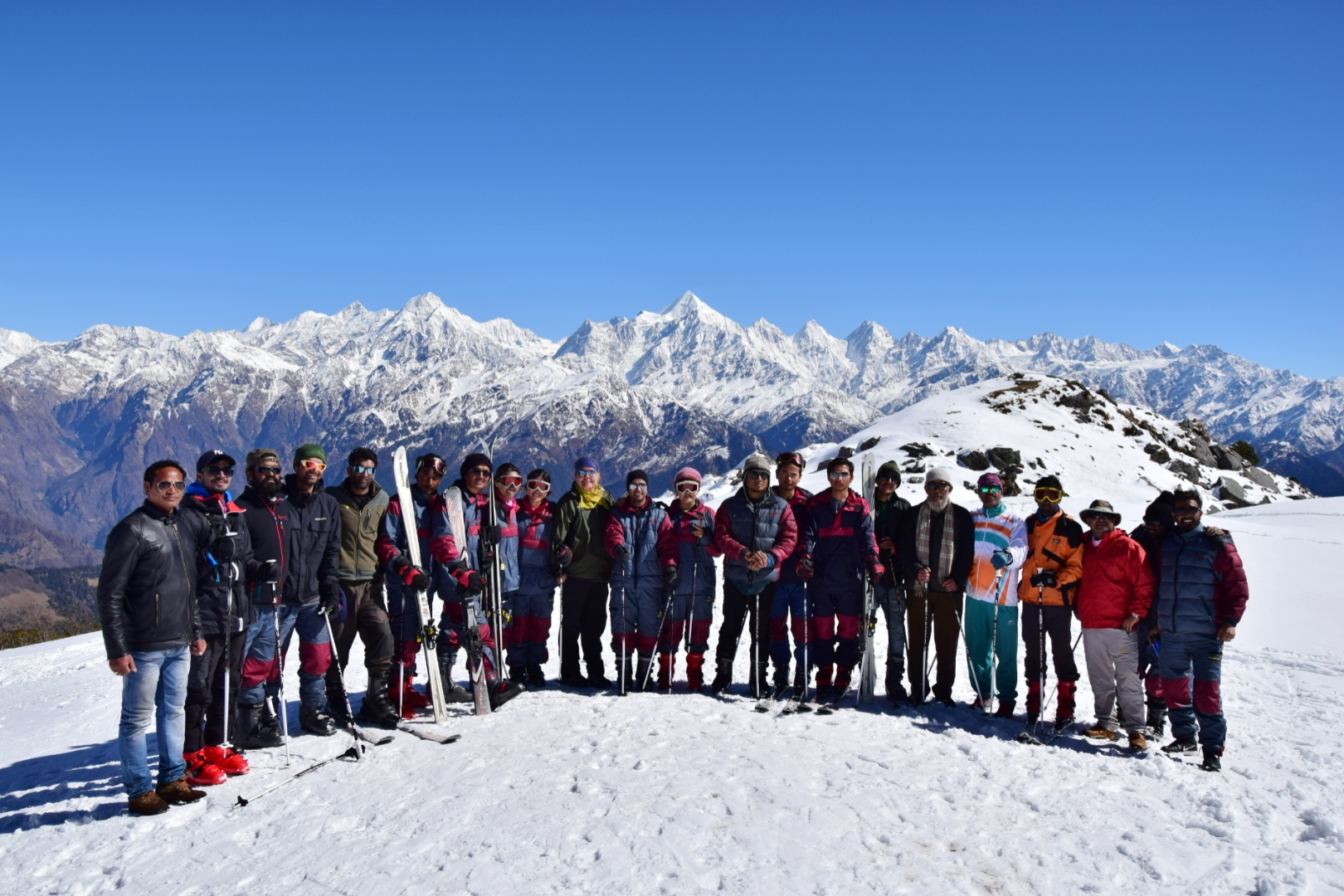
The Munsyari based-Pandit Nain Singh Surveyor Mountaineering Training Institute (PNSMTI), the country’s youngest institute of its sort has just wrapped up its basic course in skiing for the year. This was the third such course for the institute; it had previously held basic skiing courses in 2016 and 2017.

Commissioned on October 20, 2015 (the birth anniversary of Pandit Nain Singh Rawat), PNSMTI is still in its early days. It falls under the Sports Department of the Government of Uttarakhand. PNSMTI doesn’t have a proper campus yet but has commenced work with an annual skiing course. The institute is also free to organize / host outdoor management programs and leadership programs for interested companies.

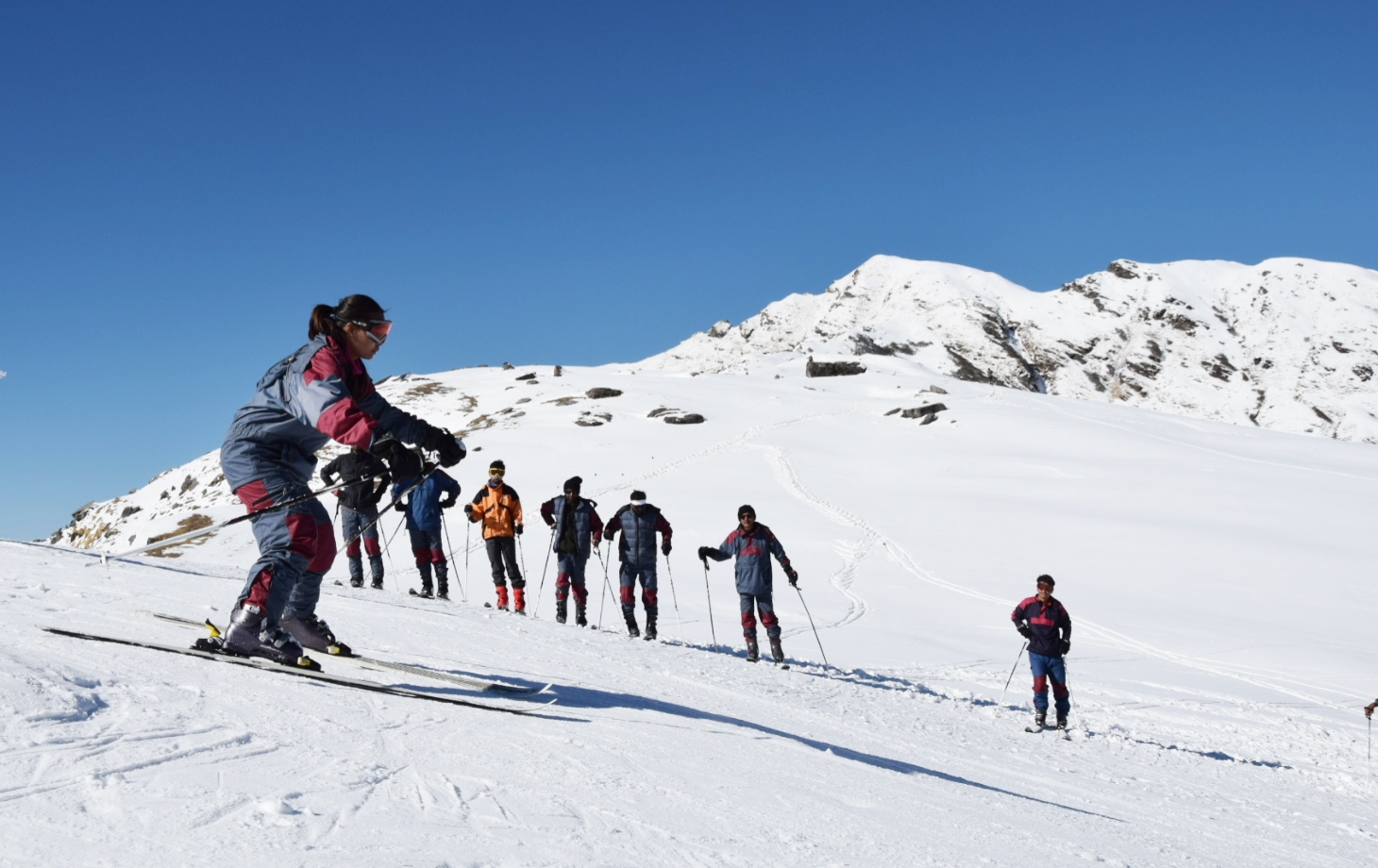
From the PNSMTI basic skiing course (Photo: courtesy Reena Kaushal Dharmshaktu)

“ Going ahead, we would like to have a bigger portfolio of courses,’’ Reena Kaushal Dharmshaktu, Officer on Special Duty (OSD), PNSMTI, said. Reena is an accomplished trekker and mountaineer, who is also the first Indian woman to ski to the South Pole. Skiing is a subject close to her heart. Pandit Nain Singh Rawat, in whose memory the institute was established, is among India’s greatest explorers of the Himalaya (For more on Pandit Nain Singh please click on this link: https://shyamgopan.com/2014/06/23/walking-with-nain-singh/ ). He hailed from Johar valley near Munsyari, in Uttarakhand’s Kumaon region.

From the PNSMTI basic skiing course (Photo: courtesy Reena Kaushal Dharmshaktu)

PNSMTI’s skiing course accepts 30 students. The course is for two weeks and is held in February. The course fee is Rs 12,000; it is subsidized by the state’s sports department. The fee covers all costs including cost of training, equipment, boarding and lodging. Students come from Uttarakhand and other states. According to Reena, what makes the PNSMTI course unique is the ski slope they use. Located on Khalia Top near Munsyari, the slope is at an elevation of 11,500 feet making it among the highest ski slopes in the country that a student can hope to get trained at. “ The view from Khalia Top is spectacular. You can see Nanda Devi and its surrounding peaks, the Panchchuli range and other peaks of the Johar region,’’ Reena said.

(The author, Shyam G Menon, is a freelance journalist based in Mumbai.)

2018 HIMALAYAN CLUB SEMINAR / MICK FOWLER MADE HONORARY MEMBER

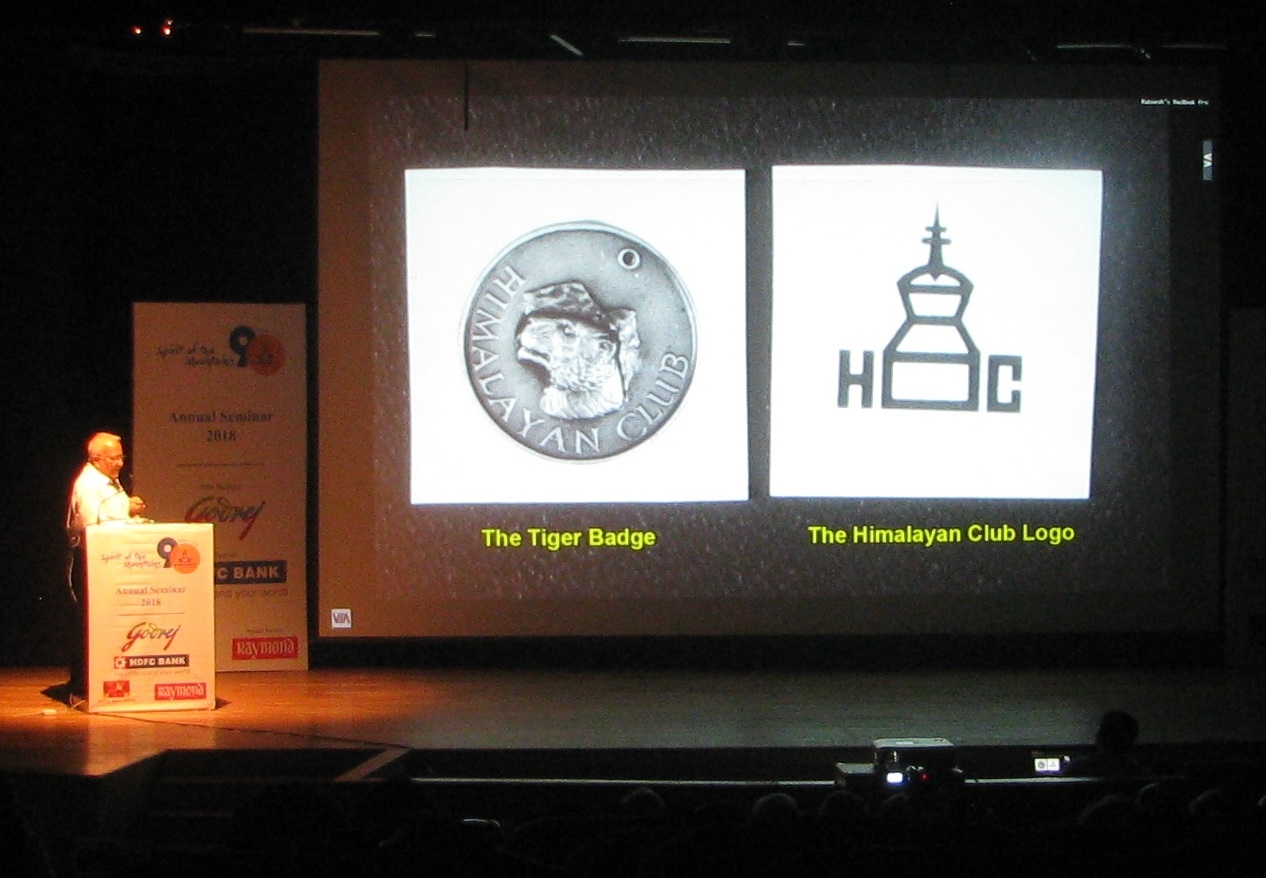
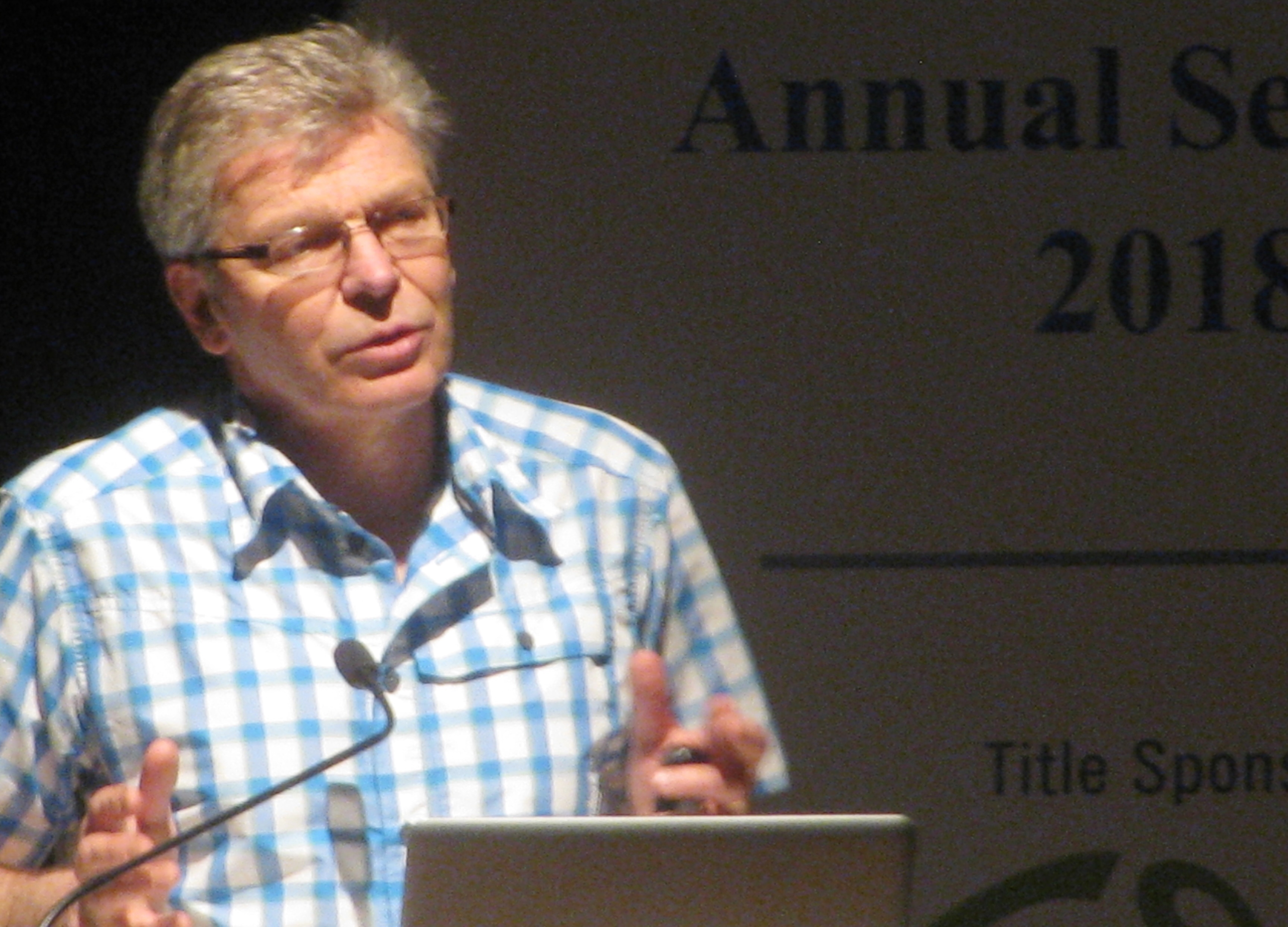
Veteran mountaineer Harish Kapadia provides the audience an overview of the Himalayan Club’s history. As of 2018, the club was 90 years old. (Photo: Shyam G Menon)

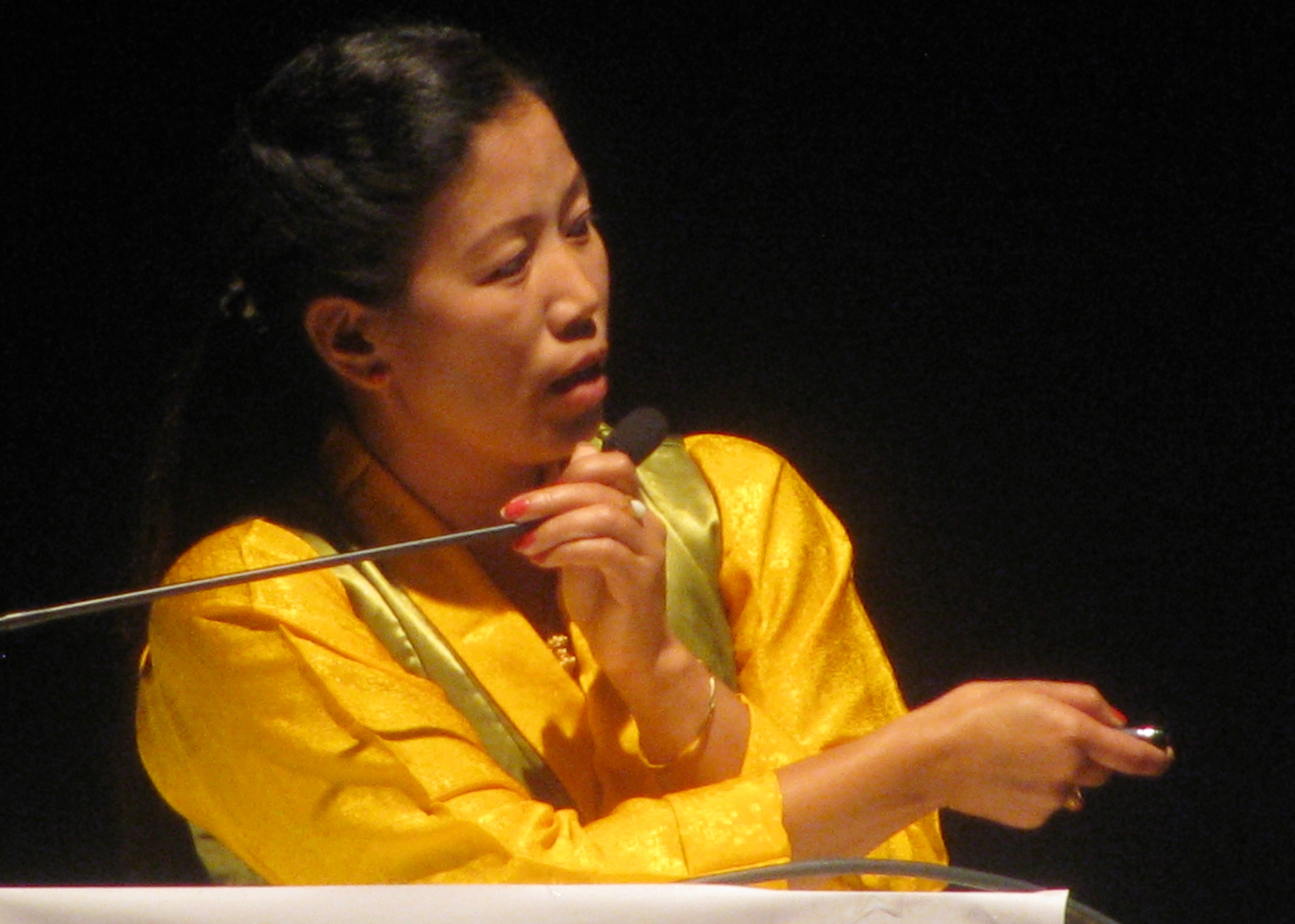
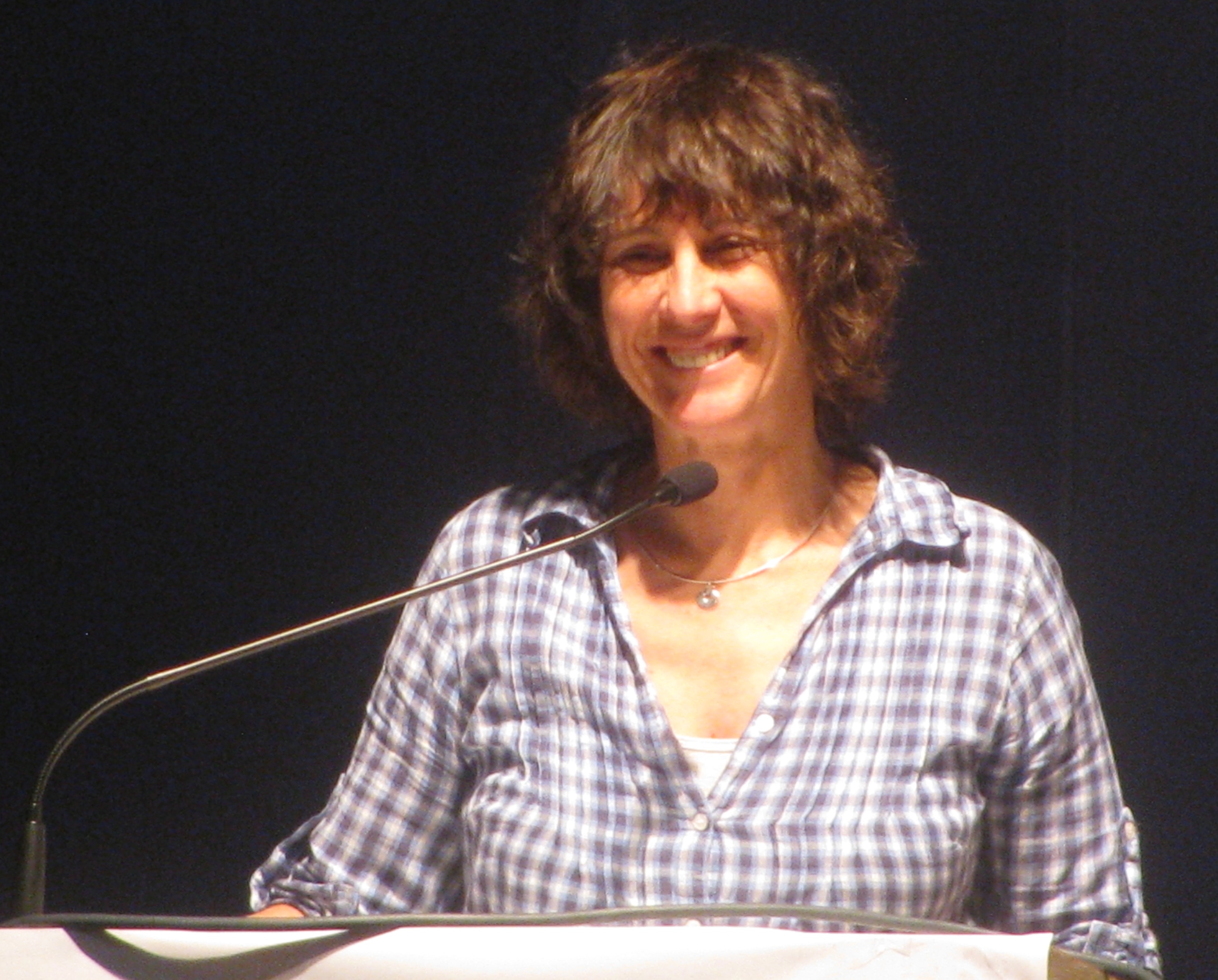
The 2018 annual seminar of the Himalayan Club stayed true to how the world of hiking and climbing has always been in Mumbai – it is a small, tightly knit world of those appreciative of these pursuits. Talks by two riveting climbers – Mick Fowler and Catherine Destivelle – anchored this year’s proceedings. Strung between these two presentations, were talks by Mark Liechty, David Breashears, Maya Sherpa and Vineeta Muni.

The two day seminar held over February 17-18, was inaugurated by industrialist Adi Godrej; the Godrej family has been longstanding benefactors of the club. Also present was Nadir Godrej. It was announced on the second day of proceedings that British mountaineer, Mick Fowler, known for his alpine style expeditions to attempt tough, unclimbed routes at altitude, had been made an honorary member of the Himalayan Club. As of 2018, the club was 90 years old. In all that time, only 28 people were selected for honorary membership.

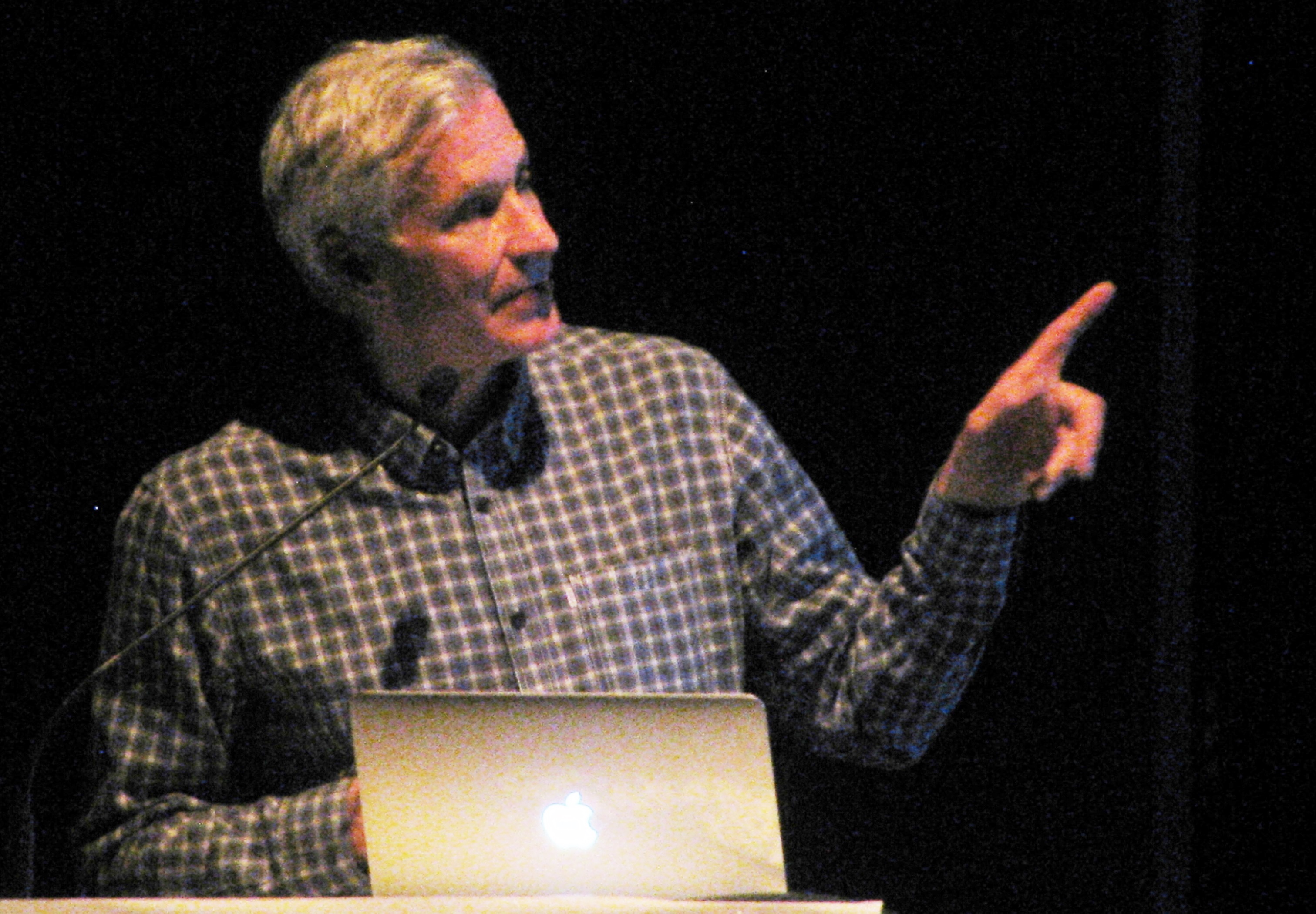
Mick Fowler (Photo: Shyam G Menon)

Both in his presentation and a brief chat he had later with this blog, Mick mentioned that he didn’t belong to that school which tries to secure success at any cost on an expedition. Failure is part of the game and it must be accepted. On more than one occasion Mick voiced his disapproval for drilling rock and installing expansion bolts (for placement of gear), something climbers are prone to do when a route is sketchy. It is bizarre to conclude that just because you couldn’t climb a route – using available holds – it can’t be done; particularly when younger generations are out-performing older ones. What should matter is – how you climbed an objective, he said. Mick’s choice of routes stands out for their high degree of technical difficulty and challenge. Asked how easy providing for potential failure is, given modern expeditions have several constituents including sponsors who invest for promised result, he admitted that it isn’t always an easy task. However, there are foundations and people providing grants, who look at mountaineering differently, valuing the challenge tackled more than the success guaranteed. This year’s Kaivan Mistry Memorial Lecture was delivered by Mick.

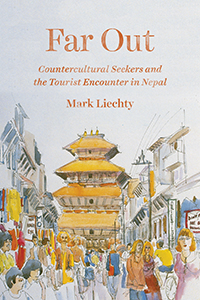
Far Out – the book by Mark Liechty. This image has been downloaded from the University of Chicago Press website and is being used here for representational purpose only.

Mark Liechty’s book, ` Far Out,’ won the club’s Kekoo Naoroji Book Award. Mark – through his acceptance speech following the prize ceremony – illustrated the context of the book and what it dealt with. As a quest to understand why and how the Himalaya came to mean what it did for the counter-culture movement, it is among few books out there to have tackled the subject and perhaps the only one enmeshing the quest with research. Shortly into his speech, Mark explained the book’s premise clearly, referring to an interview given by the actor and director of a recent Hollywood movie which alludes to the Himalaya in the mystical fashion the West is prone to. “ My guess is that many of you here have visited Kathmandu and I wonder how many of you found it to be “incredibly spiritual and marvelous,” – a place with “almost no Western influence,” a “deeply mystical and religious” place, a “most peaceful” city. How anyone could go to Kathmandu and not find a chaotic, noisy, polluted, crowded, underdeveloped city, I don’t know,’’ Mark said. Of course Kathmandu has its charms and the Nepalis are wonderful, gracious people. But the question that bothered Mark was – how is it that presumably reasonable people like that film crew could go to Nepal and find a place that arguably does not exist outside of their own imagination?

“ In a nutshell, that is the question I’m trying to answer in this book. After a lifetime of hearing comments like these, I wanted to know how and why Westerners have constructed not just an imagined Kathmandu, but an imagined Himalayan region marked by mystical alterity,’’ he said. As Mark dug deeper into these questions, he soon found that the kind of things the film crew was saying were anything but new. Rather, for most of the last 200 years Europeans and Americans had been imagining the Himalaya in similar, and sometimes almost identical, terms. “ Especially for counter-cultural figures—people unhappy with the secular, rational, capitalist West—the Himalaya was the last unknown place, and therefore the last place on which they could project their hopes, dreams, and fantasies for some other, uncontaminated, place,’’ he said. Mark, is currently Associate Professor of Anthropology and History and Coeditor, Studies on Nepal History and Society, University of Illinois, Chicago.

Maya Sherpa (Photo: Shyam G Menon)

You can’t think of American mountaineer David Breashears without Everest in the frame. He was the first American to summit the peak more than once. Among the world’s best known high altitude film makers, he was responsible for the IMAX movie on the mountain made several years ago, the shooting of which in 1996, happened the same season one of the biggest tragedies on the mountain (since famous as material for Jon Krakauer’s book: Into Thin Air) unfolded. At the seminar, his presentation dealt with the work around climate change that he is doing at Glacier Works, a non-profit organization he founded in 2007. While the organization’s work revolves around showing how climate change has impacted the glaciers of the Himalaya, David brought the issue closer home pointing out that as the world’s major ice caps melt leading to increase in sea level, Mumbai would be among cities potentially affected by it. He also shared his views on how commercial mountaineering has impacted the Everest environment, especially the location of camps along the main climbing route. A lot of cleaning up has been done but the scale of human presence on the mountain is not without accompanying impact.

Catherine Destivelle (Photo: Shyam G Menon)

Catherine Destivelle’s presence at the seminar signified her first visit to India. She is one of the most iconic climbers in the history of the sport with a career that spans competition climbing to rock climbing and solo ascents to climbing on snow and ice in the big mountains. She opted for a combination of screening a film on three climbs in the European Alps that provided a window to her life and nature and replying to questions thereafter. Nepal’s Maya Sherpa came up the hard way. Having done her training, she was working in the country’s trekking industry when opportunities to climb manifested. With a handful of elite mountains – including K2 and Everest – already bagged, she confirmed that she is on a quest to climb all the fourteen 8000m peaks. Vineeta Muni’s presentation provided an overview of her long tenure in Indian mountaineering, including a trans-Himalayan hike done years ago in the company of others. A resident of Mumbai, Vineeta said that she owes much of what she came to know in life to her affection for the mountains.

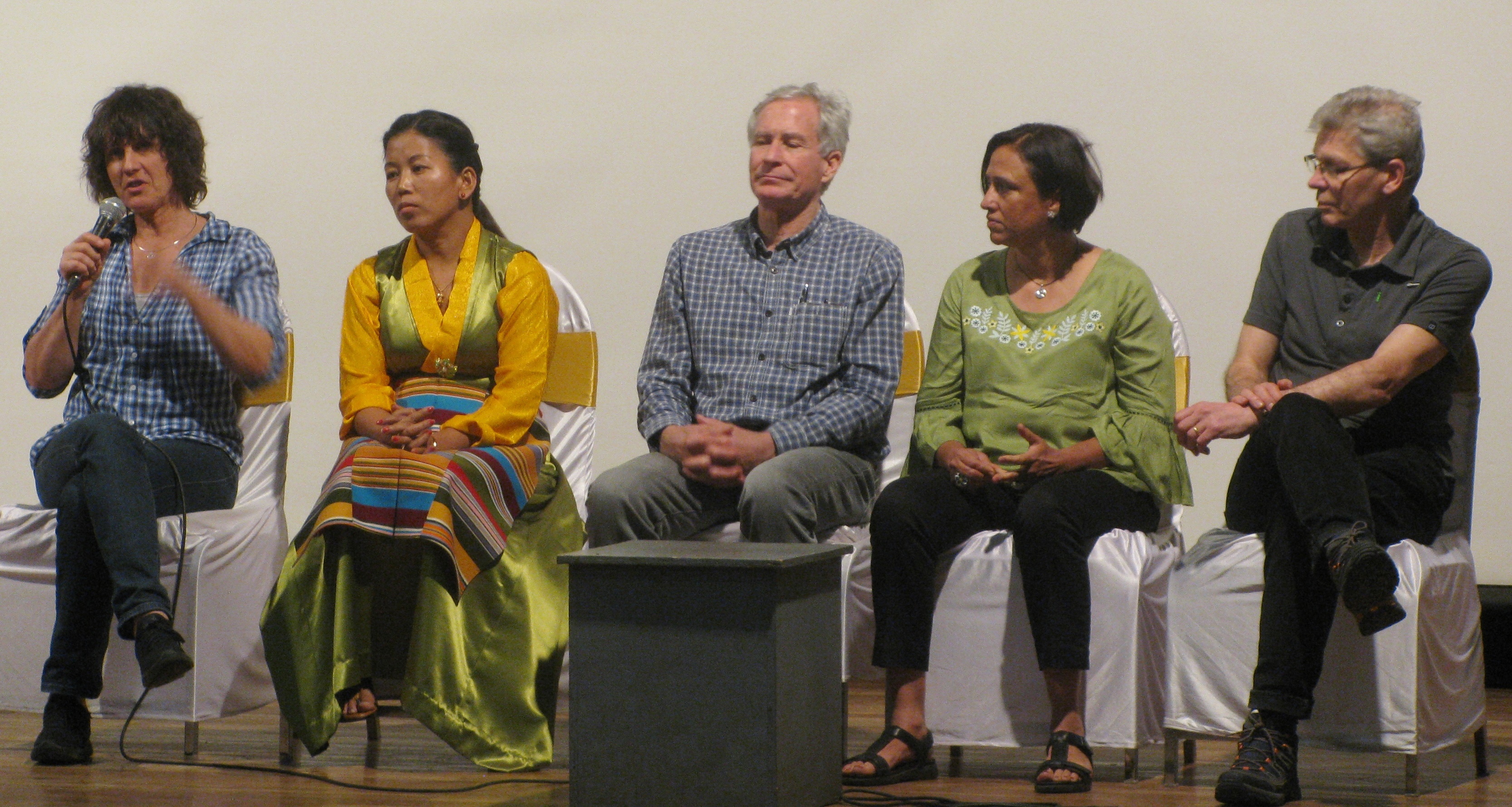
The speakers answering questions from the audience. From left: Catherine Destivelle, Maya Sherpa, David Breashears, Vineeta Muni and Mick Fowler (Photo: Shyam G Menon)

Later while answering questions from the audience, all the panelists agreed that anyone newly getting into climbing should train for the sport and not rush into it. They should allow things to evolve slowly, taking time for it. Knowing how to take care of oneself is important at altitude as failing to do so, potentially puts others too in danger. Both Catherine and Mick mentioned that they picked their friends in climbing, carefully.

(The author, Shyam G Menon, is a freelance journalist based in Mumbai.)   

2018 HIMALAYAN CLUB SEMINAR / BRIEF CHAT WITH DAVID BREASHEARS

David Breashears (Photo: Shyam G Menon)

David Breashears is among America’s best known mountaineers. He was the first American to climb Everest more than once. He is also a reputed film maker; he was the man behind the IMAX movie on Everest, which provided viewers a ringside experience of being on the peak. Several years before that, he had done the first live broadcast from Everest. Currently, David’s work largely revolves around Glacier Works, a non-profit organization he founded to spread awareness on the impact of climate change on Himalayan glaciers. His talk at the 2018 annual seminar of the Himalayan Club provided a snapshot of the work he was doing at Glacier Works. Among the visuals he showed were instances of old photographs shot by visitors to the Himalaya, replicated to the T after painfully locating the exact spot from where the original photograph was taken. Juxtapose new photograph on old; the story of glaciers melting and receding becomes clear. The same mountains, the same glaciers, the same valleys – then and now – the changes are striking. The newly shot images are technology-rich – they are panoramic and composed of multiple high resolution photographs. From the earlier generation of photographers – many of their works serve as archival material to compare contemporary images of glaciers with –  David was particularly appreciative of the contribution of Italian photographer, Vittorio Sella, whose stunning pictures of the Himalaya are held in high esteem. In the age of 24×7 media and mountaineering under its glare, few can surpass David’s knowledge of media in adventure and the outdoors. Outrigger caught up with him for a brief chat on the sidelines of the 2018 Himalayan Club annual seminar. Excerpts:

Years ago you had pioneered live broadcast from the top of Everest. Now you are using rich digital imagery at Glacier Works to drive home the impact of climate change at altitude. Can you tell us whether your relation with media and technology has transformed over the years or does it continue unchanged?

First it was a physical and tangible relation to media through film. You loaded your camera; we had the IMAX camera, 65mm film on the top of Everest. You were in contact with the media. I embraced the digital world very, very quickly for a couple of reasons. First of all, I could get much more information, more data, many more images, less expensively. I don’t have to buy film, process it and have prints made. I also became more mobile because I didn’t have all this film and film is heavy. It is also very useful to be able to review your work when you work the way I do. I happen to be away for lengthy periods of time and you can’t come back and find that the camera was scratching all the film. These are the practical things. The digital world has also given me so much more potential for the story telling I want to do. For example with that big 3.8 billion pixel-image (reference here is to a panoramic image of the Everest region he showed at the seminar), people have found it a fascinating way to explore Everest. I still love film for some purposes. But I can’t imagine now going back into the field with 50 rolls of film. It was transformative.

How about the contrast between your earlier work and what you are doing now? Previously your films brought the experience of Everest into theatres and the homes of people. Now you are using your abilities to spread awareness about the impact of climate change on glaciers, which is conservation oriented. Is there something of your own experience transforming you that is visible in this altered relation with the media?

The film experience is very special whether you are sitting in front of your TV, computer or you are at a theatre – because you have not only imagery, you have sound, dialogue, music and effects. And these things are very powerful in creating an emotion. However, when it comes to climate change, we are acting like journalists. We don’t want to play music and such. The information has to present itself and stand on its own. The other thing is, I have become very fond of our exhibits. We have had exhibits going around the world. I myself like going to exhibits; I like the experience of being at exhibits and finding out what someone else finds curious. When you are seeing in a theatre, you don’t experience something with someone else. You are looking at a screen; you may laugh at a joke with a friend or a whole theatre may laugh together. But in an exhibit space, people can turn to each other and say: what do you think of that? Or you overhear conversations or sometimes, say I am at an art exhibition, if someone is standing for a long time in front of a photographic print or a painting, then I go and I want to look over their shoulder and find what they find interesting. So although I have moved away from conveying information through film, I am most satisfied with using this current all-digital imagery of Glacier Works in print form in an exhibit. I don’t want someone sitting at home staring at it on a computer. Of course, that is where it gets its biggest audience. But I am an exhibit guy now. Live broadcast from Everest, I am ex-film, I went into exhibits and I will go back to films. But what we are doing now is hard and takes a tremendous amount of discipline. I didn’t want to mix up the discipline of that still photography and a high level of execution and compromise it by saying, let’s do a lot of video. We are small teams and we are focused on what we are there to do – the photography. I still miss film making.

You have spent many years in mountaineering; you also spent many years in the media. Of late, there has been a lot of media in mountaineering. The late Tomas Humar’s climbs for instance, were sometimes occasion for live reportage on social media. Are you happy with how the media has contributed to mountaineering or would you prefer to have seen it contribute differently?

I think there is great danger in having access to information that hasn’t been properly curated; instant access to information and the competition out there – whether it is Twitter, Instagram or Facebook or any form of social media. And the fact that things come out so quickly on traditional news. This is a very slippery slope. You create this audience that is always hungry for information in almost real time. But I do think there is no going back. It is very addictive, this need for information instantly. However I would still sit down and read long form articles about something. I know that several months from now after Elisabeth Revol and others have told their stories (David is referring here to the January 2018 rescue on Nanga Parbat in which French climber Elisabeth Revol was brought to safety but Polish climber Tomasz Mackiewicz couldn’t be reached), I want to read this in a good piece of reporting because I don’t think I got the best information yet. Sometimes you got to really get in there and get a lot of information from people.

(The author, Shyam G Menon, is a freelance journalist based in Mumbai.)     

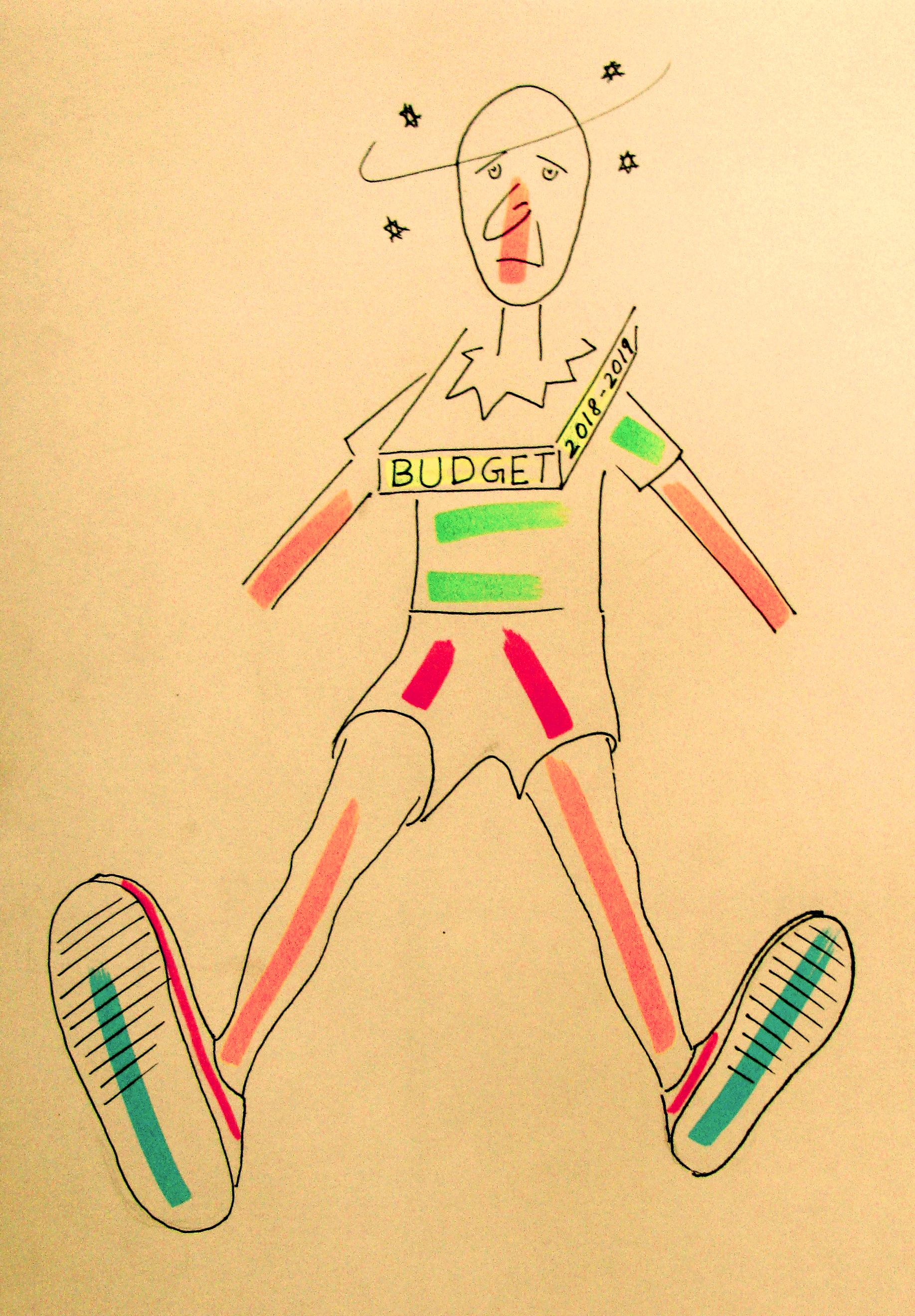
BUDGET 2018-2019 AND SPORTS

Illustration: Shyam G Menon

Every year in India, the Finance Minister presents the Union Budget in Parliament. This lengthy article explores the impact of the 2018-2019 budget on activities relevant to this blog like running, rock climbing, mountaineering and cycling. Not to mention sailing and kayaking as viewed through the tax man’s lens. The article seeks to look beyond the obvious, with examples. Will raising import tariffs automatically trigger manufacturing at home? While that does have some effect, there are other steps too which are needed to localize production meaningfully, especially if local manufacturing is to stay relevant to the performance segment in sports. 

The 2018-2019 Union Budget’s treatment of sports was a mixed bag. On the one hand, the centralized allotment of funds to the Sports Ministry increased significantly by Rs 258.2 crore to Rs 2196.36 crore. On the other hand, revision of import duty ensured price rise for a variety of imported sports equipment, including running shoes. In sports like kayaking, requests to re-examine existing duty rates went unaddressed.

A sting at retail level

February 1, around noon, the first news flash appeared of potential price rise in sports goods. Are you sure? Just days ago, the government was talking of encouraging sports… – that was the reaction of a Mumbai based-retailer of climbing and outdoor equipment. A few days later, the budget’s fine-print showed price rise in much of what he retailed. Climbing hardware and climbing shoes are almost wholly imported. The relevant customs duty had doubled from 10 per cent to 20 per cent. In footwear there seemed no exception made for sports shoes. A week after the budget, the shop’s owners were still waiting for a picture, clear in every respect. At shop level, clarity takes time to unravel.

Illustration: Shyam G Menon

For most of us, running is synonymous with freedom. It takes little to run. The growth of competition, including at amateur level, has changed that. Today, running is an industry with events, products and services available for a price. It is as corporate as your workplace; you chase goals, network, market, eliminate errors, advance your prospects, achieve – you do everything pretty much the same Sun Tzu-way you function in office. Our tendencies notwithstanding, running remains still an activity with health benefits and for those who care, a private ecosystem of self and universe. Before the latest budget, a pair of good running shoes cost anywhere between Rs 6000-10,000. The day following the budget, one newspaper picked a distinctly expensive model of running shoes and forecast an addition of Rs 2000 to its price tag. The eventual price was around Rs 17,000. Fact is, sale price of Rs 6000-10,000 is whammy enough. Whether you should use shoes for running or not, will remain a debate. For those who use shoes, finding the right shoe and sticking with it, is a matter of importance. Even runners from financially challenged backdrops, when they are able to afford shoes or access a pair, pick a good brand. As per a recent newspaper report, India’s per capita income in real terms (2011-12 prices) for 2017-18, was projected to be Rs 86,660. That would make it Rs 7221.67 per month. Juxtapose on that, Rs 6000-10,000 for a pair of running shoes! If you go purely by the import duties altered (overlooking how companies plan their sourcing), the 2018-2019 budget has made imported running shoes costlier still. Gym equipment strangely found soft corner as regards customs duty although its applicable domestic tax rate (GST) is high. As product category, gym equipment is more in the realm of institutional purchase than retail. In contrast, running shoes are widely bought.

Footwear is a focus segment under the government’s `Make in India’ program. In his speech, Finance Minister Arun Jaitley mentioned that the duty adjustment in question was done to encourage local manufacturing in a range of products, footwear being one. According to data on statista.com, the world produced 23 billion pairs of footwear in 2016. The top four manufacturing countries were China, India, Vietnam and Indonesia – in that order, with China leading by a hefty margin. If you go to a store in Mumbai that sells running shoes and check models for the ` Made in India’ tag, you will typically find it on cheaper models not associated with high performance. On the other hand, China, Vietnam and Indonesia frequently show up in tags from the performance segment. Clearly there are reasons best known to shoe companies, why this is so.

Organization and manufacturing culture

Illustration: Shyam G Menon

This blog couldn’t get a response from the foreign shoe giants dominating the market for running shoes. However, if you track published news reports, a narrative unravels of what happened in the footwear industry. Given its massive population – soon to be the world’s biggest – India is among the world’s biggest markets for footwear. According to a study by Technopak Advisors, cited in the media, the domestic footwear market is growing at 12 per cent per annum; it is expected to vault from $ 6 billion   in 2014 to $ 11.5 billion by 2020. A big share of this industry is unorganized; 80-85 per cent of players fall in micro, small and medium enterprise categories. Data published alongside some of these news reports show that 40 per cent of industry sales came from modern retail while 60 per cent came through unorganized retail. Synthetic footwear constituted 80 per cent of sales, leather accounted for 20 per cent. The Indian footwear industry is known for its strength in leather craftsmanship. According to some in the business of making running shoes that this blog spoke to, in as much as India is strong in leather craftsmanship, it has catching up to do in other areas, including ability to produce real performance shoes for use in sports. Inadequacies surface depending on how truly performance oriented you want the shoe you make, to be. If you are aiming high, the Indian manufacturing environment falls short. For example, some of the types of rubber used in the soles of shoes meant for running and found in models overseas, are not yet available here. If your wish, as Indian brand, is to make a product that matches a good foreign running shoe, you end up either importing the whole shoe under your brand or importing the raw materials should you have manufacturing facility here. The market for sports shoes and performance shoes therein are still evolving in India. Consequently the manufacturing ecosystem for these products is also not highly developed. Depending on what type of shoe they wish to make, Indian manufacturers are forced to look overseas. Abroad (in the case of footwear, it is mainly China and South East Asia), the required raw materials are available as are well-appointed factories with skilled manpower, not to mention – the existence of well entrenched manufacturing culture.

It would seem the tariff revision of the 2018-2019 budget coincided with flux already underway in the Indian footwear sector. In the run up to GST, the industry reportedly sought five per cent tax for its products. At least one news report said, the Council for Footwear Leather and Accessories (CFLA) wanted shoe imports from China discouraged as these shipments had come to command “ over 20 per cent of the market by value.’’ When GST was implemented in 2017, the effective tax rate in footwear was five percent for shoes costing not more than Rs 500 a pair and 18 percent for the rest. GST is expected to be a game changer for Indian industry. The footwear industry was unhappy with the polarized tax rates of five per cent and 18 per cent. Revisions to GST announced in November 2017, brought no relief for footwear. If you go through media reports quoting footwear industry officials from mid-2017 onward, you will also find another aspect mentioned – the 18 per cent rate would be tough for those making shoes in the price range of Rs 500-1000. These points illustrate the industry backdrop against which, customs duty on imported footwear increased to 20 per cent in the 2018-2019 budget. Besides discouraging imports from China as sought, the move potentially opens up possibilities for domestic manufacturers to tap any tariff inspired-drive to manufacture locally; it also allows existing local players to grab volume in the middle segments of the market using cosmetic additions to what technologies they already possess. To note: the middle segment is not the performance segment. “ Everything therefore depends on what specific product you wish to make; how high you are aiming,’’ one manufacturer this blog spoke to, said.

Perhaps the most confusing part of the shoe story was the situation at retail stores selling imported running shoes. Two weeks after the budget, we visited a couple of stores at a leading mall. None of them knew of the customs duty hike. They spoke of prices revised after GST for the ongoing season, even prices reduced in the recent past. “ Maybe the impact of duty revision will show up in the next season when fresh stocks arrive,’’ one shop assistant speculated. But as of mid-February 2018, there is a caveat we should consider before reaching any simplistic conclusion on the budget’s impact on running shoes. January 26, 2018 was notable; a host of ASEAN heads of state attended India’s Republic Day parade. Almost fifteen years earlier, in October 2003, the initial framework for the ASEAN-India Free Trade Area (AIFTA) was signed. The final agreement was signed in August 2009 and the free trade area became effective in January 2010. Major exporters of footwear – including running shoes – like Vietnam and Indonesia, are members of ASEAN. At least one news report said that those from the Indian footwear industry requiring still to import, hoped that AIFTA would provide an alternative, cost effective route to the barrier of 20 per cent customs duty imposed by the 2018-2019 budget. Till these options play out, it is probably too early to speculate about prices of running shoes. A more relevant question is whether altering customs duty for protection, really triggers domestic manufacturing and if so, what the nature of that manufacturing is. The pattern of domestic manufacturing industry chasing volume and continuing to lag in technology was witnessed earlier in another budget, which tampered with customs duty.

Photo & imaging: Shyam G Menon

The example of cycling and 2012 budget

The 2018-2019 budget and its impact on running shoes, brought memories of a budget tabled by Pranab Mukherjee in 2012, wherein the import duty for bicycles and bicycle parts was hiked. That was the first budget-induced jolt to cycling since the arrival of a slew of foreign brands revitalized Indian cycling. Six years after that budget, there has been change. Indian bicycle manufacturers have more models sporting better specs, in price brackets leading up to the performance category (also called super premium). This is where the market’s volumes are for now and into the near future. Two other aspects are visible alongside. Performance models continue to remain the domain of imported brands. It takes a combination of factors – ranging from a cycling culture that pushes itself to manufacturing that pushes itself – to develop performance DNA. That is a choice independent of manufacturing economics and love for tariff driven-protectionism; it is a commitment. Second, within the world of bicycle manufacturing, technologies relevant for the performance category are still not accessible in India or when accessible, not cost competent. New Indian bicycle brands – from the driven lot that is – do their own product designing but make their aluminum-bicycle frames overseas. The larger companies with big brands to protect are comparatively opaque. How much of their aluminum frames in the costlier models are made in India, how much is sourced from abroad – we have little idea of that.

Before the foreign brands entered, India was an all-steel bicycle market. Talk in the trade is that aluminum bicycle frames are still a matter of import. Butting and well finished welding – these are the two main challenges while fabricating aluminum bicycle frames. Butting requires you to hollow out aluminum tubes such that they are structurally strong at critical points even as they are light overall. This is done through the creation of varying wall thickness within the tube. Done improperly (aluminum is tricky material to work with), a tube can develop weak spots. You can cover up your deficiency by not pushing the limits in butting and retaining a heavy tube, which in turn makes for heavy frame. Word on the street is that Indian manufacturers are also hampered by their inability to do aluminum-butting and welding cost effectively at home. Result – aluminum frames continue to be imported. In the global bicycle industry, aluminum frames are a notch above steel. Stacked above aluminum are frame technologies using materials like titanium and carbon fiber. In the aftermath of the 2012 budget, bicycle prices rose, there was alteration of specs to suit price points – all this happened; in other words a giant ripple triggered, takes time on water to play itself out and strike fresh equilibrium. What improved in the process were products in the market’s middle – the volume category or what is called mass premium segment. As for performance products; what the shoe manufacturer said stays true across product categories: if you are customer, it depends on what you are looking for; if you are manufacturer, it depends on what you wish to make. This is where we stand in bicycles the budget of 2012 notwithstanding.

Illustration: Shyam G Menon

A sample of the new entrants – who are they, what are they like?

New industry players are different from the earlier lot. They don’t necessarily hail from industry. Some have a background in sports; others are deeply interested in the activities they cater to.

According to Wikipedia, Siddharth Suchde was once ranked number 39 in the world, the second highest ranked squash player from India. He grew up in India, Scotland and Switzerland and went on to attend Harvard University. The year he graduated from Harvard, Siddharth was national champion in college level squash in the US. In 2016, sometime after he retired from professional squash and commenced an e-commerce company, Siddharth started a private label in performance gear focused on serious athletes. It is called Azani Sports. In footwear, the company makes running shoes. Siddharth had no previous knowledge of footwear manufacturing. Entering performance shoes straightaway is a risky gamble; you can make or break your reputation. But Siddharth said that as an athlete, exploring ways to improve is what he has done all along. He has cut up shoes, taken them apart to see what goes into making them. He can talk of grades of rubber, raw materials for running shoes and manufacturing processes. His wish is to offer shoes that perform really well at reasonable price. So far, Azani has done its own designing and got the shoes made in Vietnam and China. They test the shoes in India and abroad. Post 2018-2019 budget, import duty for raw materials relevant to Azani’s manufacture rose by five per cent while fully built shoes were candidate for customs duty of 20 per cent. On the bright side, in a few months’ time, the company’s factory will be commissioned in Bengaluru, Siddharth said.

For a couple of years now, an engaging story in cycling has been Pune based-Psynyde Bikes. Founded by cycling enthusiasts, who grew up in the era of well entrenched Indian manufacturers of steel cycles and limited product portfolio, they pushed their rides to their limits, took them apart and modified them – till, they began designing and building custom bikes themselves. Soon they were ready to risk the numbers game. Psynyde designs in India, builds overseas and ships the products back for sale in the domestic market. It is a fledgling company with two factory built-models and different finish levels thereof. As products like running shoes and climbing gear took a hit in the 2018-2019 budget, cycling was breathing free. “ Bicycles seem to have been spared in this budget,’’ the country head of a leading foreign bicycle brand, said.

Indigenous manufacturing of climbing and outdoor gear has always been a tricky business because safety is critical in this line of sport. Climbing equipment in particular has to be tested and certified to international norms. Few knew of Gipfel till its crash mats lined the floor at the 2016 and 2017 World Cups in bouldering held in Navi Mumbai. The company with factory in Meerut now makes a range of products including climbing harness. When the 2018 budget rolled out, Gipfel was sitting pretty. Aapar Mahajan, CEO, said that up to 95 percent of Gipfel’s products are locally made. He said the budget hadn’t changed duty rates for imported raw materials Gipfel used. Asked about GST, he said, “ our sales have increased from last year but that is probably because we are a new company and constantly introducing new products. We are not sure if the sales would have increased faster if GST was lower. It is true that GST was 28 percent in July for most of our items and we did experience a slow momentum initially but it helped after GST was revised to 18 percent. I still wish that GST was 12 percent like in many other conventional sports equipment such as cricket because 18 percent is too high for this industry. Some sports equipment is taxed at 12 percent and the rest at 18 percent. This is not so motivating.’’

Illustration: Shyam G Menon

Elements important for change that budgets overlook

February 2018; Shailesh Krishna was in Mumbai to explore the possibilities of pursuing a PhD in product design / industrial design (human powered mobility). He started out studying automobile engineering. By the time he finished his engineering course, he had lost his admiration for IC engine-based transport (in fact, while studying engineering he conceived the blue print of “ a new kind of IC engine, which would leave behind many of the course properties of existing technology’’). He wanted to be a designer in the transport space but could see nothing heart-warming in the prevailing state of Indian roads. Where people once walked comfortably, there was an explosion of vehicles, terrible congestion and serious pollution. Even if you shift to clean technologies, you still won’t address traffic congestion. Further, there was something deeply disturbing about the idea of traveling in caged private space within a closely knit social fabric that is city. As the model perpetuates itself, insularity takes hold. On the other hand, cycling is exposed to world and universe. “ Bicycles work as a positive force in society. When I ride, my bicycle gives me freedom, it also connects me with people,’’ Shailesh said.

His next academic stop after engineering was the MIT Institute of Design in Pune. There, he started a cycling club called Ridea and when the time came for his final year project, he chose to work with TI Cycles. The company was planning to roll out a new road bike (it would debut under the Montra brand) and Shailesh contributed much to the program; he addressed aspects like bike geometry and ergonomic fit. He rode various models from international manufacturers, used as benchmark, over long distances to experience their ride firsthand. He cycled so from Chennai to Puducherry and from Chennai to Sriharikotta. He also put in a brief stint as business development manager covering markets in western India. Moving around at ground level, he saw how retailers of bicycles paid little attention to sizing bicycles properly to riders, he saw how badly designed many of the bicycles in the Indian market were. Even children’s bikes weren’t spared – some of the designs therein could potentially hurt riders. Interested more in making dealers understand the products they sold and not cut out to drive sales volume, it wasn’t long before Shailesh realized he wasn’t the man to grow business, do marketing or sell. His interest was in “ driving ethical design.’’

Shailesh has high regard for TI Cycles. But he does not let that interfere with his views on how design is treated in India. If you think about it, all change starts with design. To design, you must have the ability to comprehend multiple requirements; for instance, there’s what the customer seeks, there’s what engineering can do, there’s how much capital will be assigned, there’s the present as starting point and product lifecycle extending into the future (you need to have a sense of how trends may evolve) and then, there’s the challenge of how you can address all these expectations. It is an exciting, convergent process. But the Indian approach to manufacturing relegates design to the realm of looks and styling; it attaches premium to making money. “ Quality takes a backseat at most companies. Priority is for what can be produced fast and cheap,’’ he said. Result – designs get watered down; limits emerge on how much you can push boundaries. In an oblique manner, this probably explains why the classic Indian business play is around garnering volumes and not improving performance. If you want to improve performance, then user, product, design – they all assume significance as subjects to understand.

It provokes a question in the context of budgets periodically revising import tariff to encourage local manufacturing. How effective is raising import barriers if it is not accompanied by domestic industry’s willingness to introspect and change? I asked Shailesh what the ideal work environment for a designer like him would be. “ I would like to work for a brand that allows me the freedom to make things happen and yet lets me stay in their space, working on what I want to be involved with. I don’t want to be converted into what they define as work because that is what the market wants. I want the room to design and build without the company’s business or its fear of losing market, interfering,’’ he said.

Illustration: Shyam G Menon

The wall new ideas encounter

By virtue of the fact that it represents alternative perspective, creativity has always had a rough ride. Yet at every juncture when difference is sorely needed, it is creativity that comes to our rescue. Do we have an environment supportive of creativity?

A key component in manufacturing and localization is engineering. India is among the largest producers of engineers in the world. Around 1.5 million engineers are released into the job market every year in the country, a 2016 media report said.

In the nineteenth century, Sir James Thomason was the lieutenant-governor of north western provinces in British India. According to Wikipedia, under the system of project implementation used by the British, superintending engineers came from Britain; craftsmen, artisans and sub-overseers were recruited locally. The need to make the latter category more efficient led to the setting up of industrial schools and other related engineering establishments. The Upper Ganges Canal Project was a major assignment taken up by the British. Thomason proposed that a civil engineering college be started at Roorkee. The resultant Thomason College of Civil Engineering signified the start of formal engineering education in India; years later it became the Indian Institute of Technology (IIT), Roorkee. Under the British dispensation, ideation was their domain, the locals were trained to implement. Although it is now slowly changing, this approach has remained the bedrock of Indian engineering education.

Now retired, Dr R.V.G. Menon studied at IIT Kanpur, spent many years teaching mechanical engineering at engineering colleges in Kerala and eventually took his PhD in a line of research related to solar energy. Author of a book on the history and philosophy of science – it is part of engineering curriculum in Kerala – he has also been president of Kerala Sastra Sahitya Parishad (KSSP), one of the biggest grassroots level science movements in India. I asked him how valued tinkering is in India, as aptitude / ingredient in the making of an engineer. After all, curiosity for product and the tendency to take things apart; understand materials, craftsmanship, product architecture and assembly, build upon that knowledge – this is what you find common in earlier mentioned examples like the folks at Psynyde Bikes, Siddharth Suchde or Shailesh Krishna.

“ Our engineering education has traditionally straddled two levels. The more common, basic level restricted itself to the application of available knowledge. The higher level, wherein you try to acquire new knowledge is where creativity comes to play. As of today, the bulk of our engineering education is partial to the former,’’ he said. Altering this is tough because there is considerable resistance within the system; the majority of teachers belong to the old block. This is an issue in engineering education unlike in science or humanities, where research done or PhD earned, are respected for the value they hold. Currently, appreciation for creativity in engineering is more overseas. “ Things are slowly changing but given Indian context, it will take time,’’ he said. In practical terms, that delay is a measure of how long it will be before we become sufficiently sensitive to notice and appreciate creativity.

For Indian sports, even the existence of IITs hasn’t always been helpful. If you look up the story of Shiva Keshavan (veteran Indian luger who is Asian champion, participated in six Winter Olympics and coincidentally retired from the sport at the 2018 PyeongChang Winter Olympics, days after the 2018-2019 budget) on this blog, you will see there was a phase when he tried unsuccessfully to get his new luge built in India. The sport has product specifications that must be met. Shiva had approached one of the IITs to see if they would make his luge. Very simply put, a luge is no more than a fast, responsive sled. But to get those attributes correct, you should know materials, design and fabrication well, plus have empathy for intended application. The luge for Shiva couldn’t be built in India. It was finally built by former American competition luger Duncan Kennedy in league with the New York based-Clarkson University.

Illustration: Shyam G Menon

Make it easier to set up and run businesses. Don’t play with sports

Early February, when the Finance Minister was presenting the 2018-2019 budget in Parliament, an India-built sailboat – INSV Tarini – crewed by a team of women officers of the Indian Navy would have been making its way across the Atlantic Ocean, headed for Cape Town. For Goa based-Aquarius Shipyard, it was the second sailboat they built based on a Dutch design, out on circumnavigation. That is no small statement about Indian manufacturing; circumnavigation challenges boat and build quality. However, you would be getting it completely wrong if you concluded the Aquarius story is all about India’s wizardry with budget and tariff-inspired protectionism. Building INSV Mhadei – the first sailboat for circumnavigation the yard made – was passion and adventure, right from the retired admiral who conceived the project (Vice Admiral Manohar Awati [Retd] – he wanted India to succeed at solo circumnavigation with a boat built in India) to the naval officer who was her first skipper (Capt Dilip Donde [Retd]) to the yard that built her. In 2018, Commander Abhilash Tomy, the first Indian to do a solo nonstop circumnavigation (Mhadei’s second such voyage), will participate in the 2018 Golden Globe Race (GGR), yet another solo nonstop circumnavigation. His boat – Thuriya – has been built by Aquarius. That’s three boats for circumnavigation built at the same yard. Years ago, after the Mhadei was constructed and handed over to the Indian Navy, the guardians of India’s finances left their stamp on the mission to realize India’s first solo circumnavigation. Taxmen raided Aquarius; they were followed by the Customs. Their imagination revolved around `yacht,’ which was how the vessel was described in tender documents; yachts are taxed heavily. That episode – the yard got back what it was forced to pay – is now a forgotten snippet but one which clearly shows how narrow a book keeping-perspective of human pursuits can be.

The problem of being taxed on par with luxury yacht is also felt in kayaking. Kayaks meant for the performance category, capable of being used in white water rapids, have to be imported. Imported kayaks stand up to the stress and abuse that turbulent waters and rocky rivers throw at them. They are also designed such that it is easy for paddler to roll over and revert to surface should the kayak capsize. Currently the cumulative tax impact on these types of kayaks aggregates to 53 per cent; 25 per cent customs duty plus 28 per cent GST. Reason – tax officials include them in the same bracket as luxury yachts. According to one Bengaluru based-kayaker, the situation is so bad at times that authorities tax kayaking accessories also at the same rate. “ We had given representations to government but the rate enforced on us remains unchanged,’’ he said almost two weeks after the 2018-2019 budget.

If you read the history of foreign climbing gear-brands, you will see that many of them began as cottage industry. Interest in sport drives curiosity for improvement, quest for apt gear, design, testing and manufacturing – historically in sport, that’s the chain. In bicycles and running shoes, internationally there have been new brands that cultivated a following. Some of the younger bicycle brands were born through committed cyclists getting into design and manufacture. In running shoes, there are stories overseas of brands which began as retailer of performance footwear, got into customization of shoes (improving the fit of other brands) and slowly transformed to outfits designing and making their own shoes. The best way to encourage manufacturing of sports gear is to desist from denting the fun in sports by raising access cost, including such things like cost of running shoes. People playing more and more translates to more experience compiled, more curiosity provoked and the search for right gear fueled. Policy-makers should focus on angles like – what it would cost to start a manufacturing unit, how easy the process of setting up business is, how affordable the capital goods relevant to manufacture those products are, how supportive community and local administration are of first generation entrepreneurs,  whether proper labs for testing equipment quality are available or not etc. Perhaps, most important of all, they must realize that affordable life all around is critical for cost competitiveness in manufacturing. The domestic environment is actually far more important to motivate a citizenry and its creativity than import tariffs fiddled with. If you take the 2012 budget as example, aside from spurring domestic bicycle manufacturers to do what they should have done earlier as natural course of business, there is little dramatically different in the industry, we can claim for budget’s legacy. Aluminum frames continue to be imported because others make it better. Viewed so, what can we hope to see as legacy for 2018’s dose of protectionism?

(The author, Shyam G Menon, is a freelance journalist based in Mumbai.)

JOURNEY TO FIRST 100 MILER

Ritu Handa (Photo: Latha Venkatraman)

Ritu Chandel Handa started running in 2014. Three years later she did her first 100 miler – Mumbai2Pune 100 miles. This is her story.

South Mumbai has a charm to it. At its southern end, Sobo (short for South Bombay) as South Mumbai is often called, converges into a study of contrasts. There are the bustling roadside shops of Colaba selling jewellery, clothes and artefacts, the unexpected quietness of its bylanes, the high rises of Nariman Point and Cuffe Parade, the heritage buildings of Churchgate, Flora Fountain and Fort, and not far from all this, by the sea, that sea front of four kilometres called Marine Drive.

Marine Drive is a great place to run. Early mornings and evenings here witness plenty of people out for a jog or a walk. Another nice place to run is Navy Nagar but access here is restricted to navy and army personnel and their families. In 2014 Commander Sunil Handa of the Indian Navy was transferred to Mumbai from Visakhapatnam. He was a runner, having begun his tryst with distance running in 2004, around the time the Mumbai marathon made its debut in India’s financial capital. Ritu Chandel Handa, Sunil’s wife, was familiar with her husband’s affection for running. Her own story in the sport started a decade later, when the family shifted to Mumbai. By 2014, her two daughters had grown up and she could afford to take time out to pursue running. There was also the effect Mumbai’s running ecosystem had on her; few cities in India turn out to run as Mumbai does.

(From left) Cdr Sunil Handa and Ritu with others during a run at Yeoor Hills (Photo: courtesy Ritu Handa)

Almost 1500 km north east of Mumbai is the state of Himachal Pradesh. Geographically, it is a composite of the foothills of the Himalaya and the main ranges. Kangra district in Himachal Pradesh straddles elevations ranging from 427 meters to 6401 meters above mean sea level. The district lay in western Himachal Pradesh; its lowest elevation pertains to plains bordering Punjab, while its highest elevations fall in the Dhauladhar Range, part of lesser Himalaya. Life in hilly terrain is ideal for building endurance. The altitude, daily life tackling gradients and slopes – they have an impact on human physiology. As with life anywhere, when you are born to the hills and grow up there, you rarely notice how the geography shapes you. It takes an instance when specific qualities are called for, to put such past in perspective and notice what it meant. Ritu realized that in middle age, when she completed her first 100 miler.

Born December 1972 in Kangra, Ritu did her school and college education in Himachal Pradesh. Then she moved to Rajasthan’s Banasthali University to do her B.Ed. Through these years, sports was completely absent in her schedule. Her first deliberate foray into physical activity happened after marriage, when she joined a gym in December 1999. “I liked gyming,’’ she said. Married to a naval officer, access to gyms was easy given accommodation provided by the armed forces typically included urban amenities. “But now I like running,’’ she said with afterthought. Running was Mumbai’s gift.

Unlike Kangra of her childhood, Navy Nagar is flat land. That’s where Ritu started to train, discovering slowly in the process, the capacity for endurance she had. During the first year of her running, when it came to events, Ritu took part in10 kilometer-runs. Her first half marathon (21km) was during the 2016 Thane Hiranandani Half Marathon. She kept her training runs restricted to the South Mumbai area because she wished to be closer to home and her daughters, aged 15 and 12. Meanwhile, husband Sunil, had considerably notched up his mileage. He was becoming known in Mumbai running circles as a runner of the ultramarathon; featuring distances in excess of 42 km. Sunil would go on to complete demanding races like the 111 km and 222 km segments of La Ultra The High, held annually in Ladakh.

Ritu with Milind Soman (Photo: courtesy Ritu Handa)

Given husband who was an ultramarathon runner, it wasn’t long before the curiosity got to Ritu – can I run an ultramarathon?  “ I wanted to try it at least once,’’ she said. Sunil was keen that she push her limits. What they needed was the right opportunity. That came courtesy Milind Soman, endurance athlete, model and actor, who is associated with the Pinkathon initiative. “ Milind was organizing a multi-stage 100 mile-run from Mumbai to Pune for Pinkathon and he suggested that I attempt it,” Ritu said. According to her, she didn’t think twice about taking up the offer, which would see a paradigm shift in the distance she would tackle. She may have been running 10km and 21 km races until then but all along, she had wanted a shot at the ultramarathon. This was her chance. She took it up. The year was 2017.

One reason why Ritu felt comfortable attempting the 100 miler was that Milind had envisaged a structured approach with training plan and progressive sieving of potential participants to the best eligible lot. As part of training for the event, Milind first organized a six-hour training run at Mumbai’s Goregaon. The distance of 36 km that Ritu covered during those six hours was not impressive but it gave her the confidence that she could do such events. “At the end of the run I was perfectly alright,” she said. How you feel after pushing yourself is a good index of what you can do, how much more you can take and how much work you need to put in to do that. A couple of months later on July 30, Ritu took part in a six-hour night run organized by Mumbai based-coach, Haridasan Nair. Sunil ran with Ritu at her pace the entire time. For him, the run served as training for his upcoming 222 km-run at La Ultra The High in Ladakh. That night, Ritu logged 41 km. “I was not comfortable running at night,’’ she said. Fifteen days later, on August 13, she ran the 12-hour Mumbai Ultra where Ritu was able to cover a distance of 62 km.

Cdr Sunil Handa and Ritu; from Sunil’s successful attempt at the 222 km-segment of La Ultra The High in Ladakh (Photo: courtesy Ritu Handa)

Two days later she travelled to Leh to be part of support crew for Sunil during his shot at the 222 km-segment of La Ultra The High. Ritu was to join Sunil at the 78 km-mark, one of the cut-off points in the race. “I was waiting for Sunil at the 78 km cut-off. Time kept ticking by and I started to panic,’’ she said. Panic soon turned to tears as there was no sign of Sunil. “Dr Rajat Chauhan (organizer of La Ultra, The High) kept reassuring me that Sunil would make it. Then at 10:50 hours with just 10 minutes left for cut-off, Sunil emerged, much to everyone’s relief,’’ she said. Ritu and Rigzin Chosdon, an athlete from Ladakh, ran with Sunil. “I would run 10 km and take a break while Rigzin ran the next10 km with Sunil,’’ she said. Ritu ran a total of 50 km with Sunil at altitude; Ladakh’s average elevation is around 10,000 feet. The naval officer completed the race’s 222 km-distance in 46 hours 21 minutes, placing third.

Once back from Ladakh, Ritu started her training for the 100 miler. “Milind gave a training schedule for all the women participating in the 100 miler. Sunil also created a training program specifically for me,’’ she said. The training plan entailed running for five days a week with weekday mileages of around 10 km and weekend mileage approximating 50 km. “ Fact is that I followed only 70 per cent of the training program given by Milind,’’ Ritu said. Nevertheless, she made it to the final stages of selection for running the 100 miler from Mumbai to Pune. “ I felt I could go for it,’’ she said. According to her, Milind, who was tracking the performance of potential participants, kept streamlining the final list of runners eligible to take part in Mumbai2Pune 100 miles.

From the Mumbai-Pune 100 miler (Photo: courtesy Ritu Handa)

Little over a month after her Ladakh outing, Ritu travelled to Manali with her family. “Sunil was running 60 km as part of Hell’s Race. I had no plans to run this event. But when I got there I decided to do the 30 km-segment and went in for spot registration,” said Ritu. The course laid out mostly on trails across Manali was tough. Ritu took six hours to finish her run. “ It was really hell’s race. I will think twice before I go for a trail run,” she said. Meanwhile as part of training for the 100 miler, Milind Soman organized a run at Yeoor Hills in Thane on October 22. The runners participating were required to do ten loops of six kilometers each, in a time of 11 hours. At the end of this event, 20 women were chosen to do the 100 miler. Ritu was one of them.

On November 23, they 100 miler kicked off at 5 AM from Shivaji Park in Mumbai with five crew cars (one car for each set of four women runners) alongside. The first day was tough with pollution, heat and heavy traffic assailing the runners. Ritu and her team of four women covered a distance of 64 km. A major positive was the superb hydration and food support that runners enjoyed during the three-day run. The second day was much better despite the path being hilly. She covered a distance of 54 km. On the third and final day, she covered the remaining 38 km and reached Pune in the afternoon. According to Ritu, all the 20 women who participated completed the distance. Once the multi-stage 100 miler was done, it was time for Ritu to get back to her home and routine.

Ritu at a stadium run (Photo: courtesy Ritu Handa)

Running a 100 miler does not seem daunting to her. “ It is doable,’’ she said in an unassuming manner. Training is important to run ultra-marathon distances, she reiterated, almost like a mantra to herself. For someone who straddles 10 km, half marathon and now ultra-marathon distances, Ritu was however uneasy about running the full marathon. “ I will run ultras but I do not want to do a marathon,’’ she said.

Ritu’s observation won’t surprise runners. The full marathon, although only 42 km-long, is often more demanding than the ultramarathon because it comes packaged with the need to cover the distance in a reasonable amount of time. The required combination of stamina and speed makes one’s progress in a full marathon, challenging. Ultramarathon champion Scott Jurek, in his book “Eat & Run,” has noted that an ultramarathon isn’t as hard as a marathon. “ With the right training and support anyone can do an ultra,’’ he says. That said, the emergent quest with ultramarathon runners is to be able to maintain a steady pace for long. There are ultramarathons with stiff cut–offs and little external support; not to mention, many 100 milers are run in one stage. After all, what makes a run a race are the challenges added in.

(The author, Latha Venkatraman, is an independent journalist based in Mumbai.)

THE ENJOYABLE LIGHTNESS OF BEING

Ramachandra Rao (Photo: Shyam G Menon)

We spoke to Ramachandra Rao, winner in his age category (70 years and above) in the half marathon for men at the 2018 Tata Mumbai Marathon (TMM). 

Much of Ramachandra Rao’s life was devoted to science.

It was so till questions about existence – traceable back to his student days at the Indian Institute of Technology (IIT) – resurfaced and whisked him off to a dozen years of quiet contemplation. As with many people who explored the puzzle of existence, Rao’s responses during our conversation were replete with the urge to be as honest as possible and doing so, delving into blasts from the past suffused with clarity about the universe. Only then does the train of reasoning behind each response line up properly. It also spawned the struggle – where are the words to describe insight as accurately as possible?

Rao, 71, is a scientist specialized in organic chemistry. He used to work with a leading multinational company in the pharmaceutical sector; in their research lab. A combination of factors triggered journey to spiritual dimension. The fine research lab he worked at progressively shut down. Subsequent assignments he took up were not sufficiently engaging. Those days, the Indian R&D environment wasn’t a match for what MNCs offered. It disappointed Rao. At the same time, questions about the meaning of existence, long unanswered came back to haunt. There was also the coincidence of means to find answers – books on spirituality for example – landing up without him seeking them out. He had suspected all along that something was not adding up in materialistic world. It seemed time to apply his scientifically trained mind to those questions.

During the time Rao lived the withdrawn phase that followed his departure from employment, he stayed near the Mahalakshmi Race Course and at Churchgate, both parts of Mumbai quite close to the annual Mumbai marathon’s course. He admits to having been aware of the event; at Churchgate he could even hear the sea of runners passing by. But he had no interest in watching the marathon. The questions in his head held no room for running right then. Rao’s phase of withdrawal eventually made his mind quieter, helped him deal with his thoughts and lightered him as a human being. The journey also elicited a physical toll. By the time he shifted to Kharghar in Navi Mumbai, sustained lack of exercise meant he couldn’t walk for long and when it came to tackling stairways, he needed a railing for support. His wife, who is a regular walker, remembered Rao’s interest in sports and athletics while he was doing research in the US. She encouraged him to recommence running. He had no running shoes. Luckily an old pair belong to his son was available in the house. It took Rao a couple of months to find his stride and rhythm. There were also other challenges to overcome. A freak accident in childhood had ensured that Rao saw little with his right eye. His vision is therefore limited. On the other hand, Indian roads – the most accessible training surface for runner in this country – tend to be uneven and the traffic on them, unpredictable. It took some time getting used to early morning runs. Running in low light is difficult for Rao and when automobile headlights shine harshly, he is easily blinded. Nevertheless, once he found his groove, a new journey began.

A soft spoken person, Rao trains in Kharghar, now a bustling township. He is a good runner. In 2014, the first time he ran the half marathon at the Mumbai marathon, he ended up third in his age category. In 2015, he improved that to second position. He was also on the podium twice (in the half marathon category), at the Satara Hill Marathon. At Kharghar, he trains five days a week. His companion on some of these training runs is triathlete Meena Barot, who lives in the same township. According to Rao, Tuesdays are kept for an easy run. On Wednesday, he runs fast “ like a tempo run, making sure I don’t exhaust myself.’’ In terms of distance, this would span 8-10 km. He does not run on Thursday. Friday, he does interval training with adequate gap between sets to rest and recover. On Saturday he does an easy run of not more than eight kilometers. He does a long run of anywhere between 15-20 km on Sunday. He also does some strength training. Running in Kharghar used to be more enjoyable; nowadays it gets occasionally taxing. “ There are factories in Taloja nearby and my trained organic chemist-nose quickly senses pollutants in the air,’’ Rao said, adding that several runner-friends have shifted their training towards the adjacent township of Belapur to escape the pollution.

Like most runners, Rao had his share of experiments with running shoes. Finding suitable shoes in India is tough; generically, the nature of shoe sales here is such that finer details get glossed over. Rao has slightly wide feet with requirement for a large toe box. A perfect fit eluded him. Then four to five years ago, he began trying barefoot-running. The transition was both testing and time consuming. “ You have to be patient,’’ Rao said. Navi Mumbai runners, Surya and Shyam Sunder, introduced him to Vibram’s collection of minimalist footwear. It worked well for Rao. Even the old back pain he had, subsided. Then, a new problem emerged. Kharghar has relatively wide, straight roads and for hill running, there is that lovely road leading all the way up Kharghar Hill. The hill road, much valued by runners to train on, has fallen into a state of disrepair. Having found his ideal footwear for running in Vibram’s collection, Rao’s disappointment with the hill road’s condition and the poor surfacing of Indian roads in general, was pronounced. Uneven surface and lose gravel aggravate the pace of wear and tear on runner’s footwear; they also poke through soles, hurt runner’s feet, cause twists and such injuries. Injury has been a recurrent issue in Rao’s running, revived in his years as senior citizen. Rao does not participate in many events. Twice, in 2016 and 2017, he registered for the Mumbai marathon but could not run because of injury.

Ramachandra Rao (Photo: by arrangement)

His passage to the 2018 Tata Mumbai Marathon (TMM) started with gradual recovery from the last major injury, sustained in 2017. With injuries laying him low in 2016 and 2017, he had a technical problem to overcome – he had no valid timing certificate to submit for eligibility to register at TMM. To get one, he first participated in a half marathon at the Bandra Kurla Complex (BKC) sponsored by Hindustan Times. He finished that run in 2:17. He applied for TMM and was accepted; his designated holding area at the start line of the race, was `E.’ From past experience at the Mumbai marathon, Rao knew how holding areas lower down the alphabetic order can be. You risk getting trapped behind a wall of runners. There is also much pushing and jostling, something he prefers to avoid, given age and limited vision. So in the days that followed he ran another half marathon at BKC, this time organized by the Indian Navy, covering the distance in 2:09. Then he requested the managers at TMM, if this new timing certificate could be considered when allotting holding area. To his delight, they accommodated his request. He graduated to `D.’

Race day was smooth for Rao except for some delay in accessing his first dose of hydration. TMM’s half marathon starts on the road along Worli sea-face. It then traverses up and down the massive bridge across the sea – popularly called Sea Link – before proceeding through Worli and Haji Ali to South Mumbai. The first aid station Rao passed by on the Sea Link was yet to be manned. At the second one, volunteers were just unpacking cartons of bottled water. In the hurry to access a sip, his limited vision ensured that he banged into one of the volunteers. It left Rao with a cut on his lip. From aid stations elsewhere on the course he availed two to three packs of oral rehydration solution. “ I need these replenishments; they are important for my running,’’ Rao said. He finished the half marathon discipline at 2018 TMM in 2:02:01, placing first in his age category (70 years and above). Seven years earlier and younger in age by as much, he had participated in his first running event – the Pune Half Marathon of November 2011. There, he had completed the distance in 2:06.

 “ It is strange, the happiness you get from the physical exertion of running and the happiness you get from the wakefulness that follows meditation – they feel similar,’’ he said.

(The author, Shyam G Menon, is a freelance journalist based in Mumbai.)