RAAM 2018 STARTS / VIEW FROM OCEANSIDE

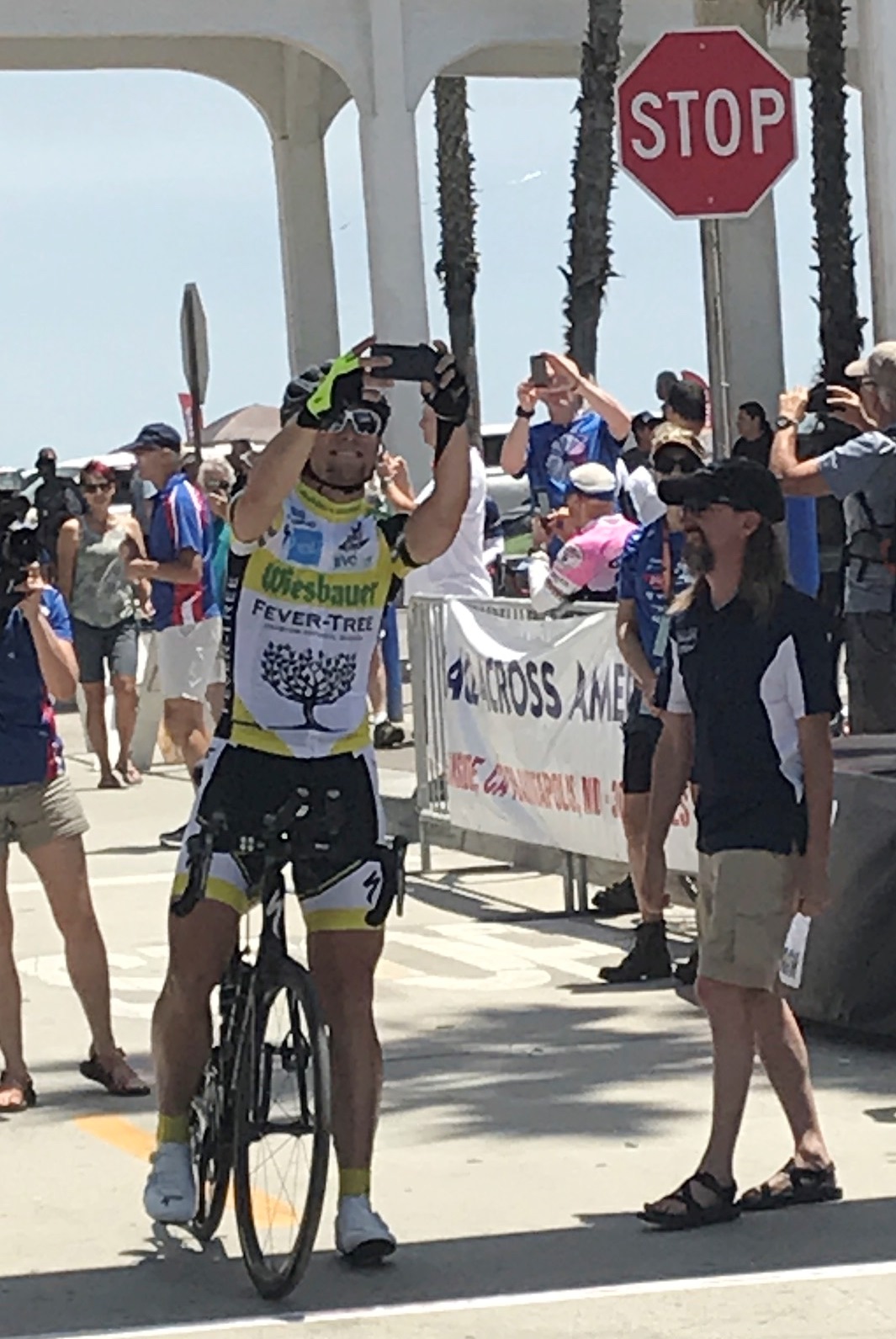
Austria’s Christoph Strasser takes a selfie at the start line of RAAM 2018 (Photo: Rajeev G)

This report mixes an on the spot account of the start of RAAM 2018 with relevant background information. Rajeev G, was at Oceanside for this blog.

The 2018 Race Across America (RAAM) began from Oceanside, California on June 12.

The race, which traverses the United States from Oceanside on the west coast to Annapolis in the east, entails cycling a distance of approximately 4800 kilometers. The race ends on June 25. Last year’s winners in the solo category for men and women were Christoph Strasser of Austria and Sarah Cooper of the US.

Strasser, one of the leading ultra-distance cyclists in the world today, is racing at RAAM this year too.  While Sarah Cooper is not listed for 2018, a name to watch out for among women doing RAAM solo would be Switzerland’s Nicole Reist. Also participating is Seana Hogan of the US, veteran cyclist and six time winner at RAAM who is seeking to improve her record in the fifty plus age category.

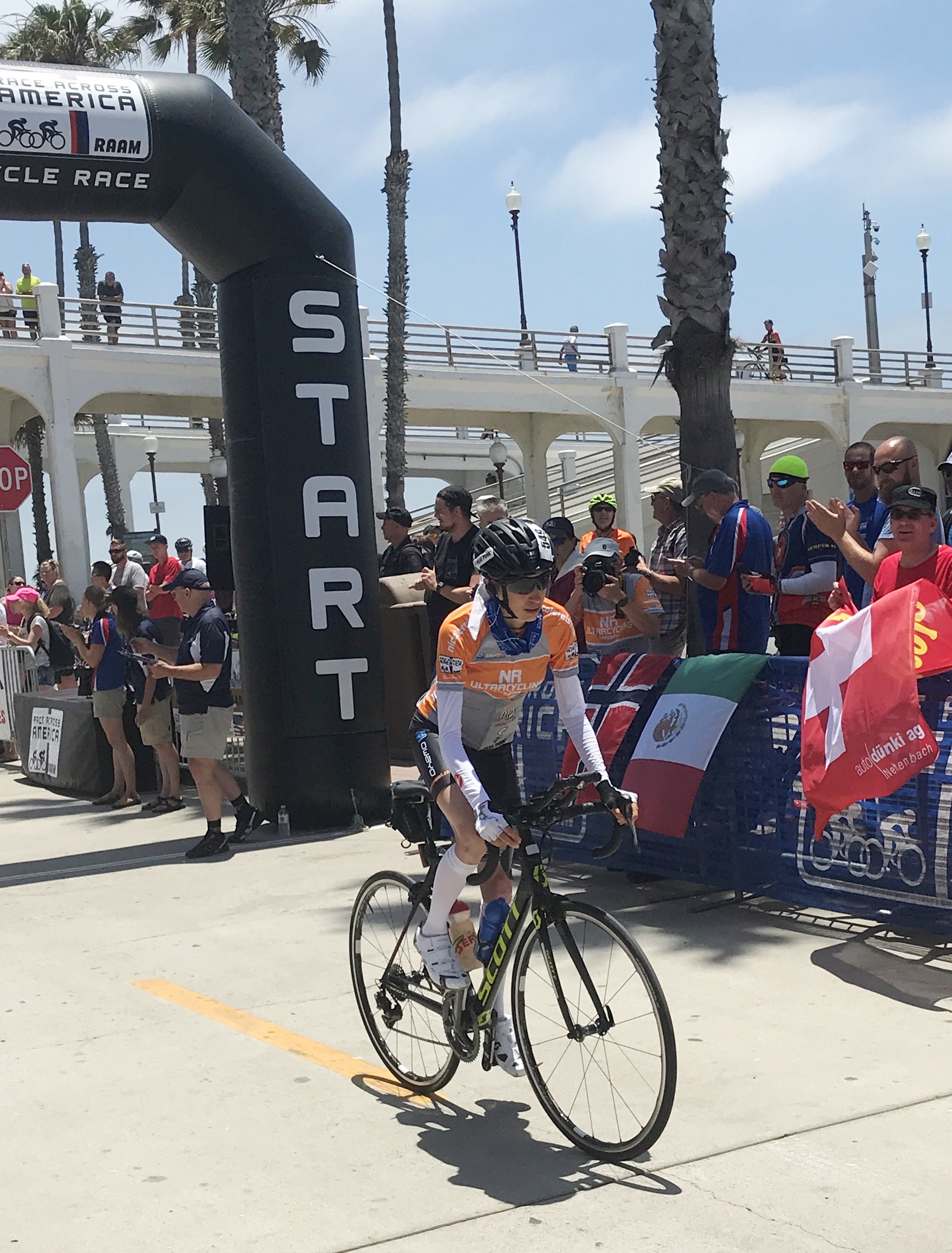
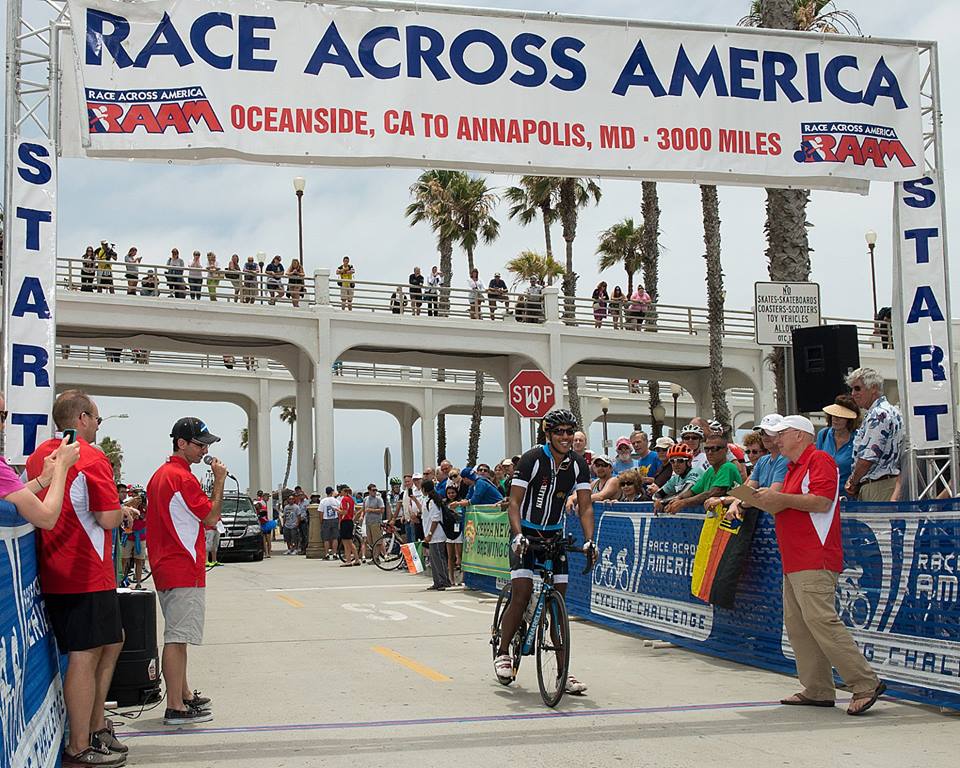
San Diego based-engineer, Rajeev G, was there at Oceanside to witness the start of RAAM. “ Strasser was the last rider to start. He looked very relaxed and was smiling and laughing at the start line,’’ Rajeev wrote in. Strasser who has dominated RAAM in recent years, paused to take a selfie at the start line before pedaling off into the race.

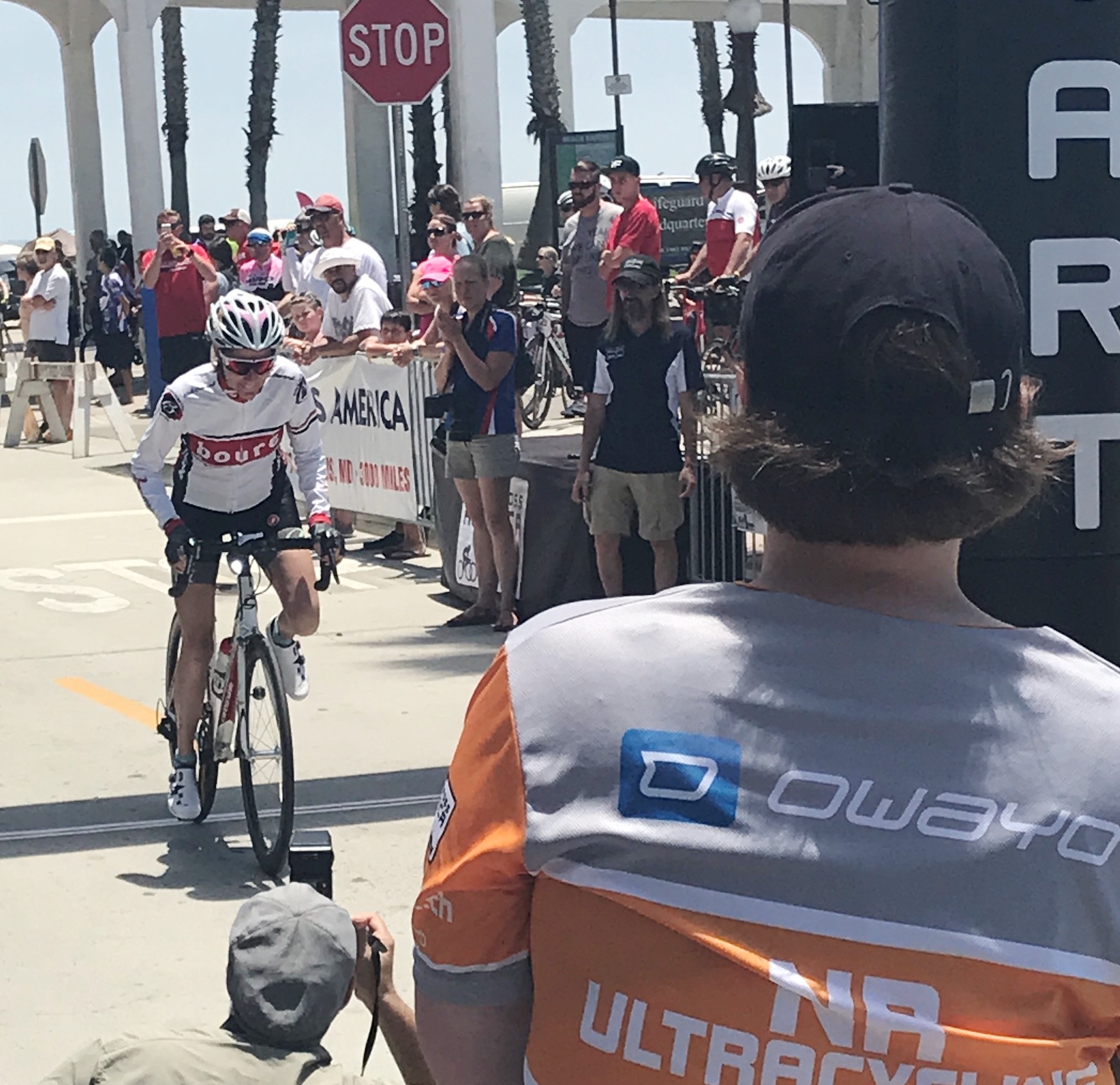
Kathy Roche-Wallace at the start line of RAAM 2018 (Photo: Rajeev G)

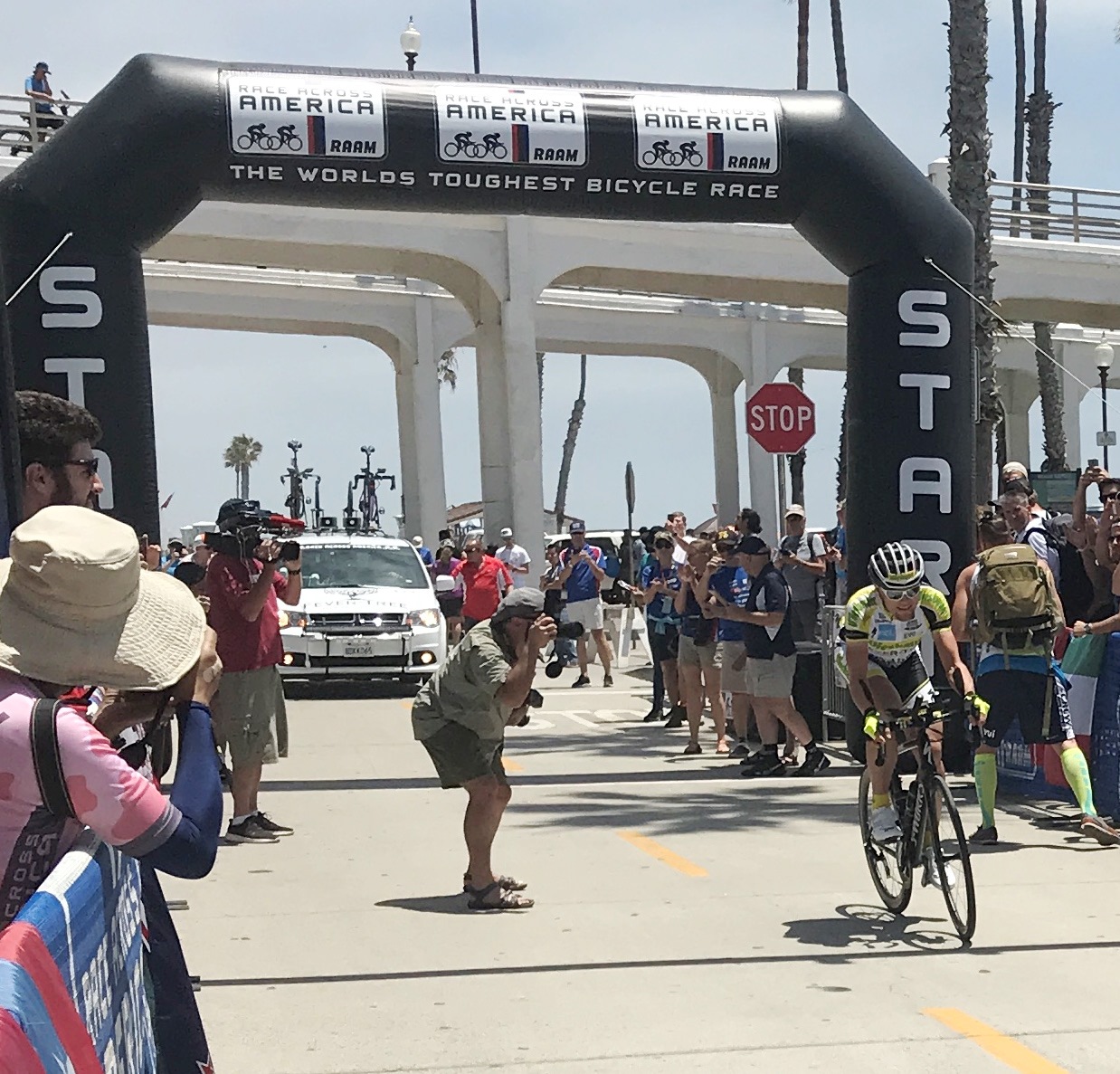
Christoph Strasser commences his race at RAAM 2018 (Photo: Rajeev G)

Unlike many of the other riders, Strasser did not seem to have a dedicated fan club or many supporters in the crowd at Oceanside. However everyone knew who he was and you could sense awe in the crowd. Thanks to her crew members, Nicole Reist enjoyed the loudest cheering. She was one of the early riders to start. “ Reist had the most vocal support of anyone,’’ Rajeev noted. According to him, Seana Hogan was one of the first racers to start (apart from all the RAAW riders of course). “ She was clearly very popular; terrific acknowledgement from the crowd as her name was announced. Seana was in good spirits at the start as well. She left rather quickly after reaching the starting line,’’ he said.

Rajeev had been at the start line in 2017 too.

Compared to last year, he felt that the ambience was subdued this time around. “ Hanging around near the start, I met Bob and Darlene Mckenzie from Tulsa, Oklahoma. Bob was scheduled to ride as part of a four-person team (Team RAAM Polio). Darlene was his crew chief; she claimed that is the tougher job. They watched the start for a while before heading to the airport to pick up Bob’s three Austrian teammates. Darlene mentioned that there are fewer solo riders in this year’s RAAM, but neither of them knew why,’’ Rajeev wrote in.

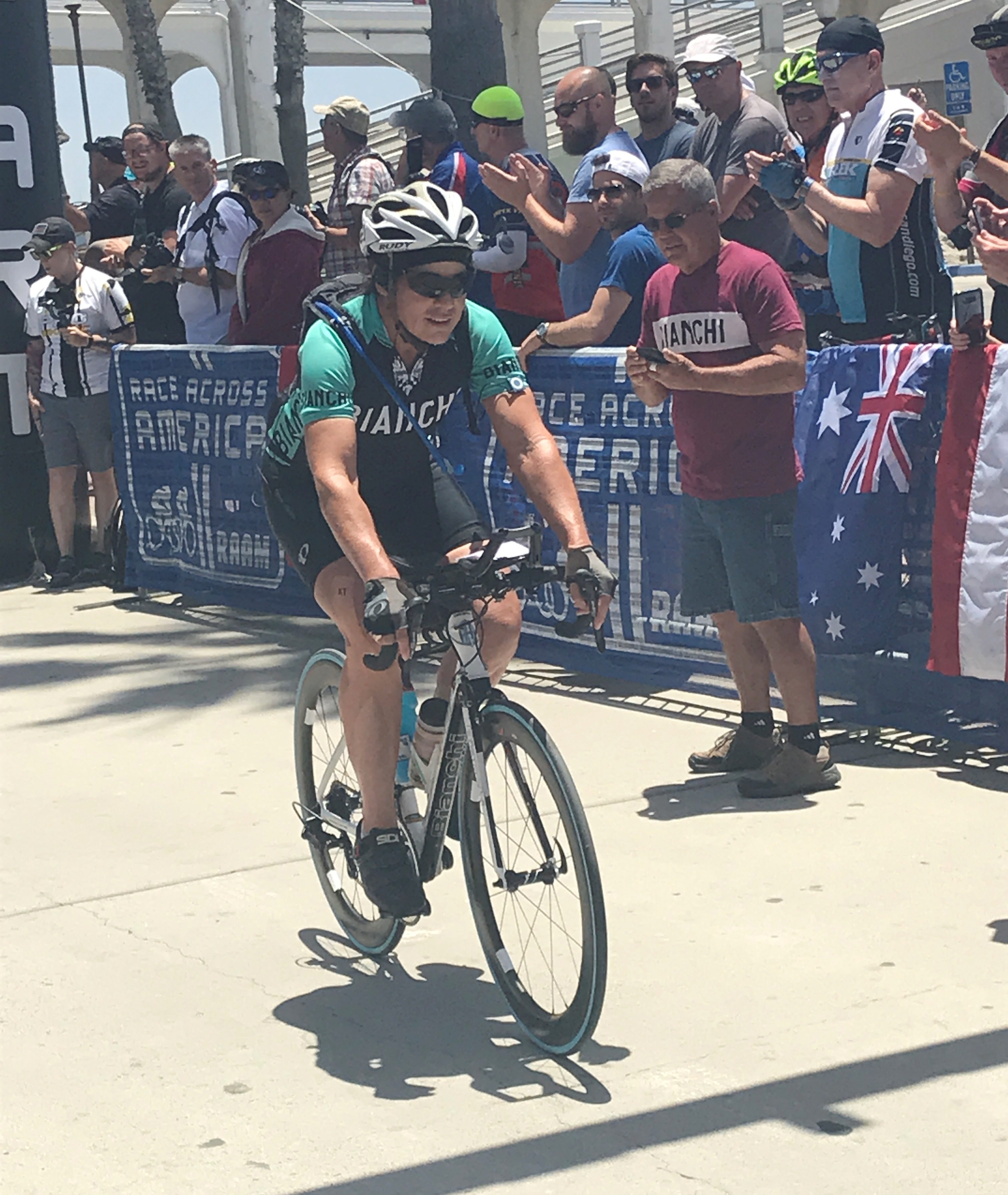
Seana Hogan starts her race at RAAM 2018 (Photo: Rajeev G)

Nicole Reist at RAAM 2018 (Photo: Rajeev G)

He added, “ Bob had a pretty interesting story. He only picked up road riding close to his 60th birthday six or seven years ago. He told me that he was totally unathletic before that. Apparently since he took up cycling, he has lost fifty pounds and completed almost 300 centuries (100 mile-rides). 2018 will be his third time doing the RAAM team race, each time with a four person-team. Last year his team had finished in just over seven days. This year, the goal is to finish in under seven days.’’

In 2017 Lt Col Srinivas Gokulnath had become the first Indian to complete RAAM, followed by Amit Samarth. This year there are no Indian cyclists in the fray. Sundaram Narayanan from Goa, who had registered to participate in the solo category, withdrew following injury while training in San Diego.

At the time of writing this report (June 14, 3.35 PM in India), Strasser was leading the solo riders having covered 716.8 miles. Nicole Reist was at 583.3 miles and Seana Hogan at 501.1 miles.

(The author, Shyam G Menon, is a freelance journalist based in Mumbai. This article has inputs from Rajeev G, engineer based in San Diego. He provided the view from Oceanside.  All photos used herein have been provided by Rajeev.)

COMRADES 2018 / BONGMUSA MTHEMBU WINS FOR THIRD TIME

Bongmusa Mthembu of South Africa emerged overall winner at Comrades 2018, held this Sunday.

He finished the race in 5:26:34 hours.

Joseph Mphuthi, also of South Africa, finished second with a timing of 5:35:09. Britain’s Stephen Way finished third, completing the ultramarathon in 5:35:27.

For Mthembu, it was his third win at Comrades.

He had previously won in 2014 and 2017. Last year he completed the race, which was run uphill, in 5:35:34.

Among women at Comrades 2018, Ann Ashworth of South Africa won with a timing of 6:10 hours.

In second place was Gerda Steyn of South Africa (6:15:34) while Alexandra Morozova of Russia (6:20:21) placed third.

Surat-based Sandeep Kumar appeared the fastest among Indians who participated in the event. He completed the 90.184 kilometer-ultramarathon in 7:30:17, ranking 628 overall, 601 among men and 376 in his category.

This was the 93rd edition of Comrades, the world’s biggest and oldest ultramarathon. As per the event’s official website featuring results, 16,844 runners participated in 2018. According to news reports, Bongmusa Mthembu is the first South African to win Comrades back to back since Bruce Fordyce in the late 1980s. Fordyce holds the record for the most number of wins – nine. Eight of those wins were consecutive. Participating in the period from 1977 to 2012, he ran the race 30 times.

A total of 161 runners from India had registered to participate in the 2018 edition of the race, run annually between Durban and Peitermaritzburg in South Africa. This year, the run was downhill from Pietermaritzburg to Durban with finish at Moses Mabhida Stadium in the coastal city of Durban.

(The author, Latha Venkatraman, is an independent journalist based in Mumbai.)

TEAM SUNDARAAM PULLS OUT

Sundaram Narayanan who was scheduled to participate in the 2018 Race Across America (RAAM), has pulled out of the event.

In a mail received early Saturday (June 9) morning, Sundaram informed that he suffered a crash while training in San Diego, California.

It resulted in a fracture to his left thumb.

“ Hence I withdrew from RAAM 2018,’’ the cyclist from Goa, wrote.

Sundaram was to race in the solo category.

He and his support crew were registered as Team Sundaraam.

When contacted, Dr Pankaj Mhatre, Crew Chief of Team Sundaraam, said that following the cyclist’s injury, they had sought opinion from various doctors.

“ Opinion is that RAAM is not possible for him this year,’’ he said.

 (The author, Shyam G Menon, is a freelance journalist based in Mumbai.)

SUNDARAM NARAYANAN SOLE RACER FROM INDIA AT 2018 RAAM

Sundaram Narayanan (Photo: courtesy Pankaj Mhatre)

Sundaram Narayanan is the sole participant from India at the 2018 edition of Race Across America (RAAM), which commences at Oceanside, California on June 12. The cyclist from Goa will be racing in the solo category.

RAAM is a 4800 kilometer-long ultramarathon bicycle race that traverses the United States from its west coast to the east.

Across RAAM and the shorter Race Across West (RAW), three Indians had registered to participate in 2018. As per indications on Wednesday, June 6 (with less than a week left for commencement of race), Sundaram alone remained in the fray. He was already in the US. Last year Lt Col Srinivas Gokulnath had become the first Indian to complete RAAM solo. He was followed by Dr Amit Samarth. Sundaram had been part of the support crew for Srinivas Gokulnath in 2017 (for more on Srinivas Gokulnath please click on this link: https://shyamgopan.com/2017/08/25/after-raam-there-is-race/). Crewing is widely advised as means to familiarize oneself with demanding endurance races like RAAM. Many racers crew before they get down to attempting the race themselves.

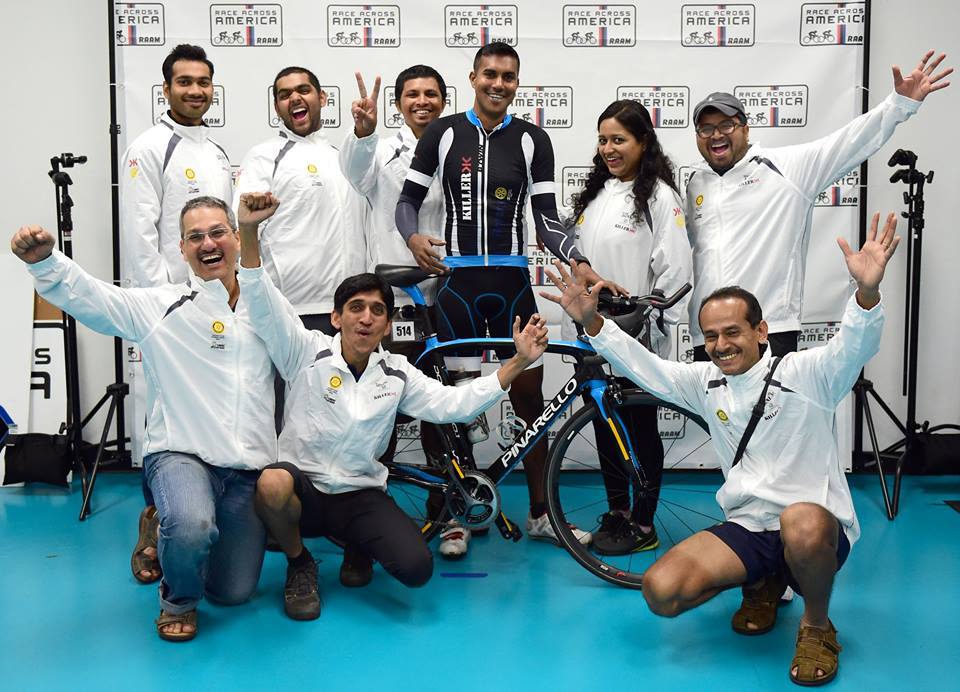
Sundaram’s team – registered under the name Team Sundaraam – has nine members, all of them passionate about cycling. They include Dr Pankaj Mhatre who is the crew chief, Vinod Pai, Rick Zwestch, Ajay Dongre, Raghav Gowda, Rutvik Khare, Chakravarthy Birur, Venkatesh Shivarama, Dhanasekhara and Niranjan Upasani. Five of them have previous RAAM experience. Family members of solo racers have often featured as part of support crew. Sundaram’s wife Harshal, who is a nutritionist, will be joining the crew, Dr Pankaj Mhatre said.

Participating in RAAM is an expensive affair.

Sundaram was supposed to participate in the race in 2017 but could not due to insufficient funds. His team then decided to have him crew and gain experience. According to Dr Mhatre, Sundaram got into serious cycling some time in 2012. At that time, like many in India, he used a basic mountain bike. His interest in road biking grew by leaps and bounds. He achieved multiple Super Randonneur titles, was attracted to RAAM and qualified for the race twice. His RAAM project has been on since 2015. A medical physicist by profession, Sundaram has been in Goa since 2012.

For RAAM, Sundaram will be using two bikes and three wheel-sets. To ride, he will have at his disposal a Merida Scultura 5000 and a Merida Scultura 4000, upgraded to Ultegra group-set.

The 2018 RAAM begins on June 12 and ends on June 24.

Christoph Strasser of Austria, who won last year’s RAAM, is registered to participate this year too (for a report on his win last year please click on this link: https://shyamgopan.com/2017/06/22/raam-christoph-strasser-wins-again-amit-and-srinivas-are-past-the-2250-mile-mark/). In October 2017, Strasser – he is a four time winner of RAAM and holds the record for the fastest time – was in the news for smashing the 24 hour-track cycling record; he rode 941.873 kilometers in 24 hours at a velodrome in Grenchen, Switzerland. According to news reports, he completed 3767 laps of the 250 meter-track at an average speed of 39.42 kilometers per hour.

(The author, Shyam G Menon, is a freelance journalist based in Mumbai. For an article on Samim Rizvi, the first Indian participant at RAAM, please click on this link: https://shyamgopan.com/2017/05/23/chasing-a-10-day-raam/)  

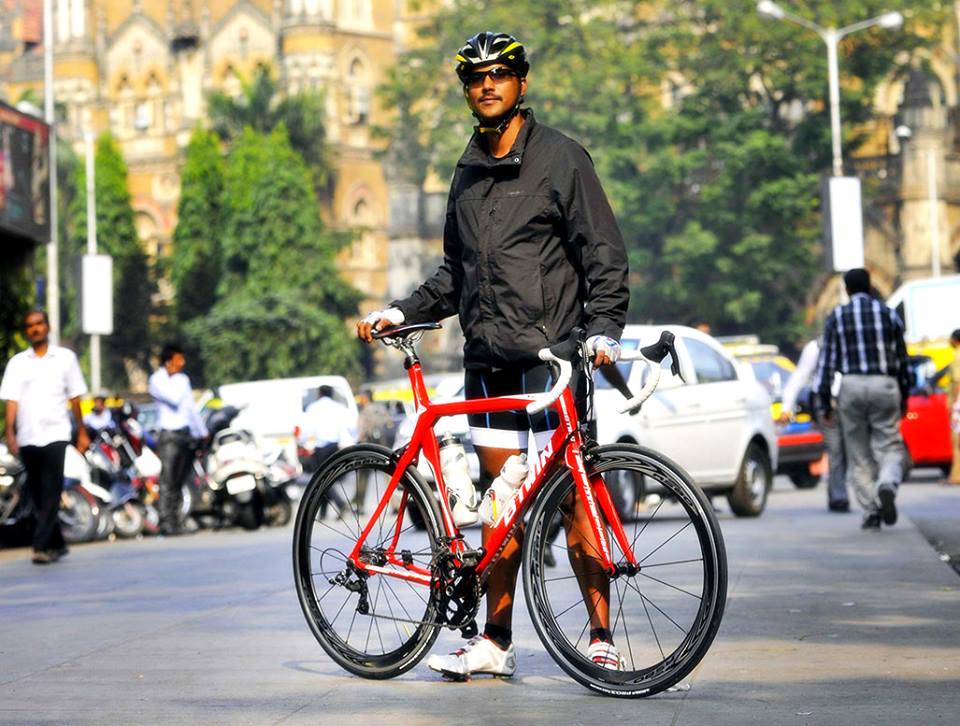
SUMIT PATIL: SEGUE FROM RAAM TO MANALI-LEH

Sumit Patil (Photo: Shyam G Menon)

In mid-June 2018, when the year’s Race Across America (RAAM) kicks off in Oceanside, California, Sumit Patil won’t be there. The Mumbai cyclist qualified for the event and registered for it but cannot go for want of funds. Sumit won’t be sitting idle. He has other plans up his sleeve.

In Mumbai, Colaba is well known. It is the southern tip of the city; home to Gateway of India, the Taj Mahal hotel, the flea markets of the tourism district and the local military cantonment. With its popular pubs, longstanding eateries, the iconic Regal Cinema, the fish market at Sassoon Docks and proximity to other South Mumbai nodes like Churchgate, Nariman Point, Kala Ghoda and the Chhatrapati Shivaji Maharaj Terminus (formerly Victoria Terminus), Colaba is a place many in Mumbai visit once in a while. Beyond Colaba is the Arabian Sea, albeit a busy portion of it, for it is through the nearby shipping channel that ships headed for the region’s two major ports and naval base navigate their passage. That channel is a bit out to sea. Closer to shore are the sail boats, yachts and ferry boats.

Not many people know Kulaba.

Kulaba is the old name for Maharashtra’s Raigad district. As the crow flies, it is approximately 45 kilometers, south-south east of Mumbai. While Mumbai is a composite of islands, Raigad is on the mainland. The administrative headquarters of Raigad is Alibag. If Matheran and Mahabaleshwar are the hills Mumbai frequented to escape itself, then Alibag is where it went for sea and farm life. The city’s rich and famous are known to own property there. According to Wikipedia, the name – Alibag – is rooted in farming and plantations. The place was historic hinterland of Bene Israeli Jews. One of them, Ali, was a wealthy person owning plantations of coconut and mango. The region where he stayed came to be known as Alichi Bagh (garden of Ali in the Marathi language); over time that became Alibag. The first major industrial unit in these parts was the factory producing urea and chemicals, set up by Rashtriya Chemicals and Fertilizers Ltd (RCF), a company owned by the central government and having significant presence in Mumbai and Raigad. Born 1985, Sumit Patil studied at the school in RCF’s Alibag campus. His father worked at RCF while his mother was employed with India Post. He has a younger sister; she is now a doctor. “ Alibag was close to Mumbai. Yet it was so unlike Mumbai,’’ Sumit said. We were at a café opposite Mumbai’s famous Siddhivinayak temple, in the suburb of Prabhadevi. Although Saturday, the arterial road outside, linking South Mumbai to places like Bandra, Andheri and Borivali roared with traffic. Alibag was a vision in mind dreaming slow life.
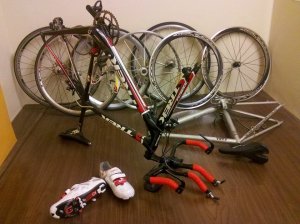
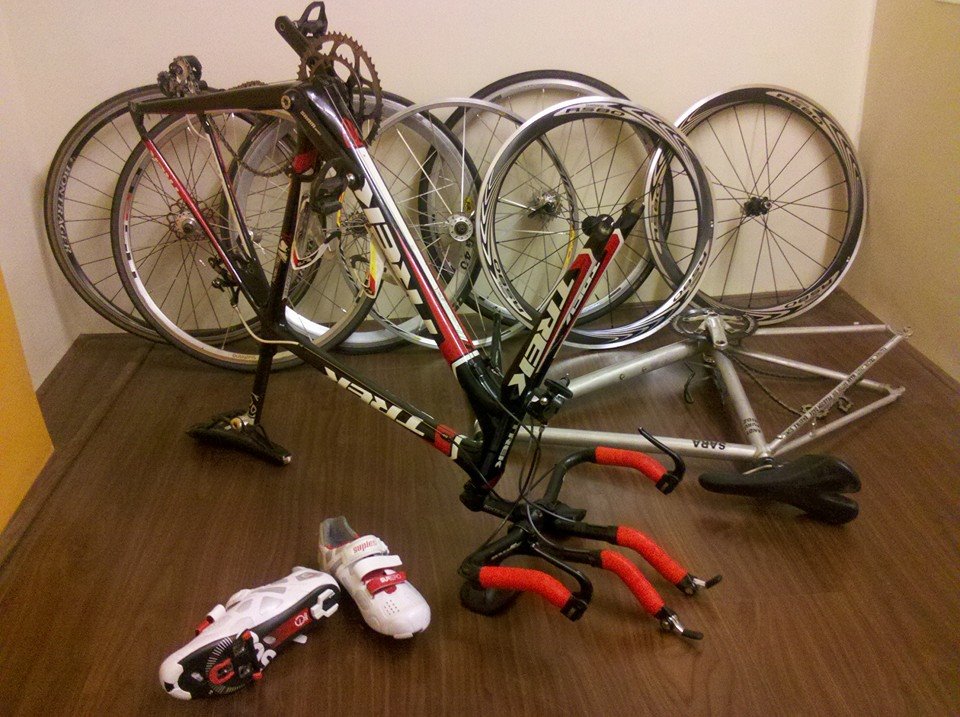
Anatomy of an interest; in the foreground, Sumit’s Trek Madone (Photo: courtesy Sumit Patil)

Life at RCF’s school in Alibag was interesting. “ We had two large football grounds and an Olympic size swimming pool,’’ Sumit said. He made use of it. He also took to swimming in the sea. These are possibilities hard to find in wealthier Mumbai with its congested environs. “ When I moved to Mumbai, I realized that most people here hadn’t enjoyed such facilities in their childhood,’’ Sumit said. Besides the facilities at school, Raigad provided options for hiking and star gazing. Having picked up cycling around the third or fourth standard, he recalled a memorable field trip facilitated by mobility on two wheels. A class on what taluka (an administrative division in South Asia) is came alive after the students cycled around their taluka for improved comprehension. Very simply put, in Alibag, free of overwhelming urban currents Sumit could indulge his childhood curiosities. The shift to Mumbai was gradual. Determined to join the armed forces and required to clear the relevant exams, he used to come to the city on weekends for coaching classes. Although in his eyes, the interest in the armed forces was a major influence shaping his life, in retrospect, that would seem to compete with another trend setting in strongly. From a very early age, volunteering appears to have captured his imagination. Among the first major instances of this was a multi-day cycle trip organized by Dnyan Prabodhani, a Pune based-school that saw Sumit and other students visit places ranging from Vigyan Ashram founded by Dr Shrinath Kalbag to the Giant Meterwave Radio Telescope to Ralegan Siddhi and its social activist, Anna Hazare, and a night climb up Shivneri fort, the birth place of Chhatrapati Shivaji Maharaj, founder of the Maratha empire.  In all the students cycled some 600-700 kilometers taking a little over a week to do it. “ Today you would call it bicycle touring,’’ Sumit said. Uniquely, it wasn’t the cycling that left an impression. The take away for Sumit was the volunteering he saw at many of the places he visited. That and subsequent similar experiences, has left him deeply suspicious of and uncomfortable with commercial instincts in human activity, including sports.
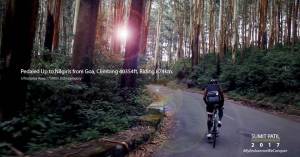
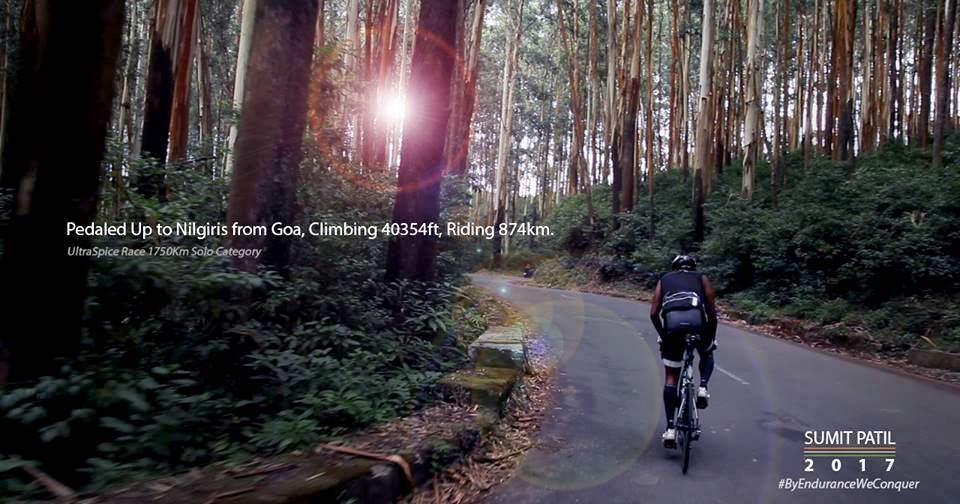
Cycling up the Nilgiri hills (Photo: courtesy Sumit Patil)

Following school education, Sumit joined Ruia College in Mumbai to do his graduation in Physics, following that up with MSc in the subject. Away from studies, two lines of interest characterized college days. To bolster his chances at joining the army, he stayed active in the National Cadet Corps (NCC). Within NCC, participation in the annual Republic Day camp is prized. Selected to go and adjudged best cadet from Mumbai Group Headquarters, the camp however eluded him as he came down with jaundice. But his desire to join the military was the strong. Over the years that followed, Sumit would attempt selection to the armed forces 13 times and be rejected at some stage or the other.  He exhausted his last chance via these selection tests in 2012. He hasn’t given up hope yet; the final port of call is the Territorial Army, a second line of defence after the regular army, composed of volunteers. The other thing which happened during Ruia days was immersion in Mumbai’s hiking scene. According to Sumit, the attraction for hiking was as much outdoors as it was an opportunity to mimic the military, popularly associated with all things tough. “ You saw them as heroes and when you hiked, you walked a bit like them with rucksack on your back,’’ Sumit said laughing. Mumbai has many outdoor clubs with the local hiking season peaking during the rains. He didn’t join any of the clubs. He trekked with whoever came along. The hills and mountains would become a major influence in his life. In April 2001, he did his Basic Mountaineering Course from the Nehru Institute of Mountaineering (NIM), Uttarkashi.
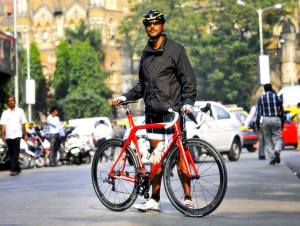
In Mumbai, with Btwin FC 7 (Photo: courtesy Sumit Patil)

Sumit is a little unclear on what exactly pushed him into endurance sports. In 2005 he suffered a road accident in Alibag. He was on a two wheeler and was hit by large truck. The truck drove away from the scene; he was left unconscious on the road. Passersby ensured he was taken to the hospital. Among injuries, he had a fractured wrist and a broken mandible. Coupled with the consistent failure to get into the army, this was a trying phase. He admits he may have looked for release, an outlet to vent his frustration. From some years earlier, the Indian bicycle market had begun to slowly change. Firefox entered the market with bicycles that attracted for their design; they were also sold at swanky showrooms, another first in the trade traditionally associated with heavy, steel bikes and a retail format that paid little attention to customer. Firefox was also local distributor for Trek bicycles. The Firefox-Trek combination (Firefox has since been purchased by Hero Cycles and Trek now retails in the Indian market on its own) was the first whiff of change. By 2006, a large shopping mall that opened in Mumbai’s western suburbs had begun selling imported Raleigh bicycles. Sumit bought a Raleigh M-Trax, a MTB. Meanwhile in 2004, the Mumbai Marathon commenced. With all that exposure to sports in school, the intermittent cycling and his fondness for hiking, Sumit was a decent runner. He participated in the Mumbai Marathon’s half marathon segment in 2007, 2008, 2009 and 2010; his best timing across these years was one hour, forty two minutes. With this came another realization. Thanks to the RCF pool, he knew swimming from a young age. Alibag’s proximity to the sea had also ensured that he swam in the sea and held no fear for it. Now he was into cycling and running. Had the time come to attempt the triathlon? – That was the thought.

Serendipity is a 2001 romantic comedy directed by Peter Chelsom; it stars John Cusack and Kate Beckinsale in the lead roles. Sumit liked this movie. In 2010, there was a triathlon announced in Goa. Event in mind, Sumit bought his first road bike. It was a Trek 1200 SL. He named it Sara after Kate Beckinsale’s character in Serendipity. As it happened, the triathlon didn’t take place that year. Given bike anyway bought, Sumit rode to Goa from Mumbai. On the third day of cycling, he heard a passing three-wheeler driver shout something about the road ahead. Sumit couldn’t understand what he said. Ahead was a series of badly built speed breakers. That was the end of Goa trip for Sara and rider. Sumit returned to Mumbai in a state transport bus, nursing his injuries. Sara lay lashed to carrier on the vehicle’s roof.
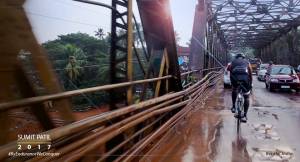
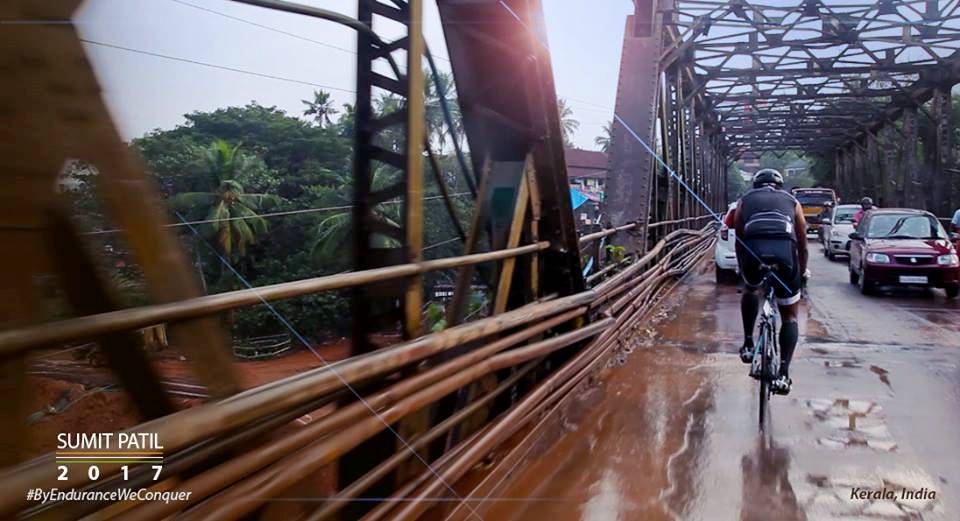
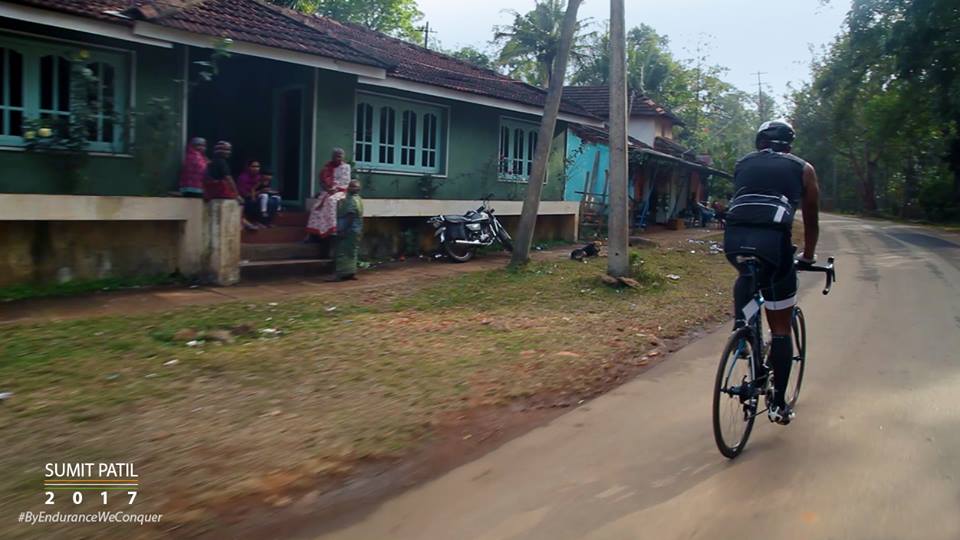
Riding in Kerala (Photo: courtesy Sumit Patil)

In cycling, audax means audacious. According to Wikipedia, the first recorded audax cycling event took place on June 12, 1897; twelve Italian cyclists attempted to cover the 230 kilometers from Rome to Naples during daylight hours. As similar events gained popularity, a French journalist, Henri Desgrange, formulated rules and regulations for audax events. Riders rode as a group and successful rider were awarded a certificate called Brevet d’Audax. The onus of organizing events was assumed by Audax Club Parisiene (ACP). But following a disagreement, Desgrange withdrew ACP’s right to organize events using his regulations. The ACP created its own version of the sport with successful riders being awarded certificates called Brevets des Randonneurs. This format came to be popularly known as randonneuring. It has its own eccentricities. A brevet – which is how these rides are called – is not a race. No order of finishers is published; everyone is equal. Riders may ride alone or in groups. They are required to be self-sufficient between check points. To that extent, randonneuring is sometimes considered a cousin of touring. Brevets come in various distances and cut-off times. They are: 200 kilometer-brevet to be completed in 13.5 hours; 300 km / 20 hours, 400 km / 27 hours, 600 km / 40 hours, 1000 km / 75 hours, 1200 km / 90 hours (or 80 hours or 84 hours as the rider chooses) and 1400 km / 116:40 hours (or 105:16 hours or 93:20 hours). A rider who completes a 200 kilometer-brevet is called a randonneur. Brevets are many in the world but some are iconic. One of the most famous is Paris-Brest-Paris; started in 1891 and currently the oldest regularly held bicycling event in the world. It is held once in four years and to participate, a cyclist must complete a series of brevets in one year.
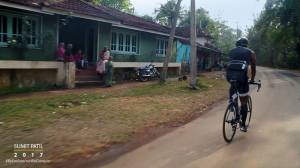
From a ride in Coorg (Photo: courtesy Sumit Patil)

The first thing Sumit did when he got back to cycling after the accident was, buy a helmet. He hadn’t been wearing one on the ride to Goa. To buy a helmet, he visited the shop run by Prabodh Keny. During their conversation Prabodh mentioned about an upcoming BRM (Brevets des Randonneurs Mondiaux), the first 300 kilometer-BRM being held in India, from Mumbai to Vadhivare near Nashik and back. The distance had to be covered in 20 hours. “ At that time, I was doing 100 kilometers in four to five hours. So I calculated in my head and decided 300 kilometers in 20 hours should be very doable. That was the first mistake; my first lesson in endurance – there is no mathematics in this madness,’’ Sumit said. On the day of BRM, Sumit rode Sara, breezing past the first 100 kilometers in good style. That was when reality hit home – he had no clue about how he would fare for any kilometer following that first 100 kilometers as he hadn’t ventured past such distances at a stretch, before.  It was a cardinal error – thinking that all the stages of a ride unfold similarly. Ideally, you should visualize the whole distance and plan your hydration, nutrition and pacing for each stage. Such ability is a product of experience and maturity; it comes from having lived life and having been out there cycling, for long. “ As Indians we specialize in racing straight off the blocks in a mad rush to be first. That is what we are taught at our schools. In the race between the hare and the tortoise we reserve our admiration for the hare. Endurance is all about being tortoise,’’ Sumit said. By the time, Sumit reached Kasara Ghat the BRM had become a killer for him. He tagged along with Raunak, a friend. Eventually he completed the BRM in 19 hours, 45 minutes. From finish line in Mumbai, he had to go to the RCF colony in Chembur in the eastern suburbs, where he lived. Utterly drained from the ride, he alternatively walked and cycled, treated himself to dinner at Chembur’s roadside food stalls and slept the exhaustion off. “ After this first BRM, I started attempting BRMs like anything. It was now familiar territory. The more I became aware of what I did, the more analytical I became. I then consulted the Internet for advice. It is awash with people’s experience and suggestions. You have to pick what is relevant for you and adapt it to your reality,’’ Sumit said.

BRM was brought to India by Satish Patki, among Mumbai’s most respected cyclists. Now in his late sixties, interviews done with him and available on the Internet say he splits his time between the US and India. Satish is more than cyclist. According to published articles, he has a background in mountaineering and has indulged in a variety of adventure and endurance sports. The first BRM Sumit went for was the second BRM Satish organized. Sumit remembers being overtaken very early in the BRM by this much older cyclist, who he saw next only at the finish line. Satish was what endurance cycling was all about. He had tonnes of experience, he had the required maturity to assess a route and plan his strategy. “ Satish was older than many of us youngsters recently entered into distance cycling. Yet he was so much stronger and better than us that pretty soon, we knew, he was the guy to beat. Satish used to finish two to three hours ahead of the rest. For us the only goal was to beat this veteran. How was he managing to finish so? ’’ Sumit said. Listen carefully to Sumit’s talk and you understand this wasn’t competition with another person. Newcomers, in their attempt to improve, seek external benchmarks. For Sumit, his first such quest was to be as good as his friend Kaushik Iyer, who had more experience in cycling and had done a Tour of Nilgiris before the two started attempting BRMs together. Beyond Kaushik, the person to catch up with was Satish. Sumit considers Satish his mentor. Their camaraderie has seen its share of ups and downs.
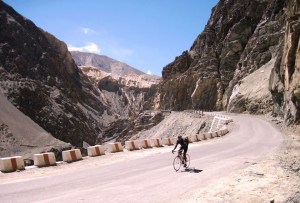
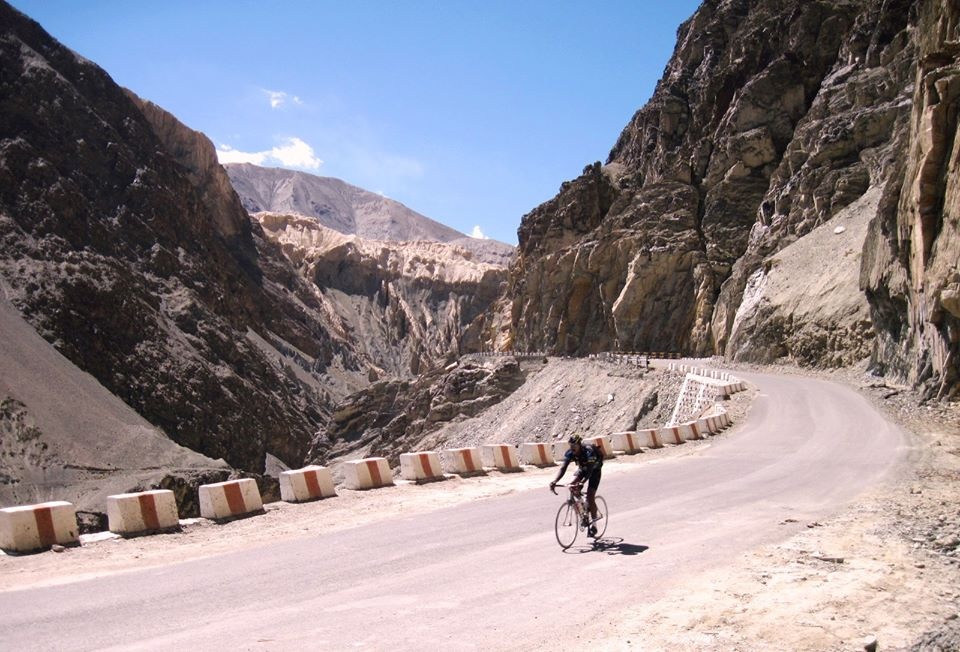
Sumit cycling in Ladakh (Photo: courtesy Sumit Patil)

2010 was a busy year. Sumit kept attending BRMs regularly. He also planned a cycle trip from Alibag to Leh. That plan had to be abandoned following cloud burst in Leh. But around this time, he read an article about Samim Rizvi in the media. Samim, who hails from Mumbai but lives in Bengaluru, was the first Indian to attempt Race Across America (RAAM). It is a 4800 kilometer-long ride across the US, from west to east, with the winners typically finishing it in eight to nine days. As he gathered more information on RAAM, the race captured Sumit’s fancy. Same year, a 600 kilometer-BRM with 40 hour-cut off – from Pune to Kolhapur to Lonavala and then back to Pune – occurred. Sumit and Kaushik finished this BRM by cut-off. “ Those days BRMs had an accommodative ambiance. It wasn’t about competition. Riders helped each other. They looked out for each other. They left none behind,’’ Sumit said. Nevertheless one thing he had to do to feel good about his abilities was beat the maverick; which he did at a 2011 600 kilometer-BRM from Mumbai to Ratnagiri and back. Sumit passed Satish at Mahad and reached Ratnagiri two to three hours ahead. On the return leg from Ratnagiri to Mumbai, which was after some rest, they rode out together. Sumit was now at peace. He knew what he can do. Satish told Sumit to go ahead, for the BRM was opportunity to ensure a slot at the upcoming edition of Paris-Brest-Paris (PBP), subject to qualifying in 2011. Sumit eventually finished the BRM three hours before cut-off, earning his slot at PBP. He subsequently qualified for PBP as well. Then the young man in him set about complicating the opportunity.

At the Pune-Kolhapur-Lonavala-Pune BRM, one of the participants was Samim Rizvi. That BRM had been opportunity for Sumit to talk to Samim and get acquainted with RAAM. However he didn’t mention his own interest. He researched RAAM more and found an imminent avenue to qualify. PBP offered three options for participants – you could sign up to complete it in 80 hours, 84 hours and 90 hours. Sumit found that there was a provision at PBP, whereby if you finished it in 64 hours, you qualified for RAAM. An old bug – the sort that had bitten him just ahead of his first BRM – got to Sumit. While most others from Mumbai signed up for 90 hours, Sumit signed up for 80 hours. Others tried to talk him out of it to no avail. Then to compound matters, his visa for France got delayed. He reached France with less than 24 hours for PBP to start. By the time he got to the venue the riders aiming for 80 hours had already cycled off. He was allowed to ride with the 84 hour-group but it was hopeless. His ride was terminated at Brest. Sleep deprived from having reached the venue straight from airport and tired by the cycling that followed, he was hallucinating, mistaking Brest’s architecture for Mumbai’s CSMT. That year, there were two Indian finishers at PBP – Samim and Kailas Patil.
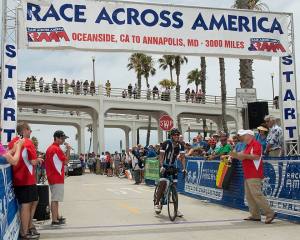
At the start line of 2014 RAAM (Photo: courtesy Sumit Patil)

After the 2011 PBP, Sumit continued to go for BRMs. But his interest was slowly waning. The first BRM he went for after PBP was a 200 kilometer-trip. In due course, Satish stepped down as organizer and a new set of organizers took over. While he didn’t articulate it as such, it was clear from Sumit’s talk that among reasons for his fading interest in local BRMs, was the event’s own maturity, a process that progressed in tune with cycling’s growing popularity in the country. In any sport, such progression is characterized by love for camaraderie and purity of sport in the beginning. Then as the movement gathers momentum, the original values rust a bit. “ I kept going for BRMs despite my receding interest because the mileage all of us put in matters for country at PBP,’’ Sumit said. As per rules, the more the cumulative mileage earned by cyclists completing BRMs in a given country, the more the slots allotted to that country at PBP. At a 600 kilometer-BRM – his third time at Pune-Kolhapur-Lonavala-Pune – Sumit’s disenchantment eventually caught up with him. Some 180 kilometers ahead of finish, he got off the bike, handed over his energy bars to his friend and sat by the road. He was done. An antidote for the obsession with competition in India is to stretch endurance so much that completion itself becomes a daunting task. As his fancy for BRM receded, RAAM grabbed attention in Sumit’s mind. It was an ultra-endurance event. He qualified for RAAM at the 2013 Ultra Bob, a RAAM qualifier in India conducted by Globeracers.

2013 was also the year another portal to opportunity presented itself. That year, Sumit started working as volunteer with Youth Hostels Association of India (YHAI). His job was to shepherd YHAI’s clients attempting to cycle from Manali in Himachal Pradesh to Khardung La, the high mountain pass near Leh. This is high altitude landscape. Cast into volunteer mode, a style of work he has had considerable respect for since childhood, Sumit liked the assignment. YHAI charged a fee that was much lower than many private operators. The approach appealed to Sumit, who has an ideological disagreement with steep sums of money charged for adventure activity that results in those who are talented but not wealthy, being unable to try it. The work gave him considerable satisfaction. Sumit wishes for those entrusted to his care to have done their homework and prepared in advance for the trip. Thereafter, if someone struggles, he helps by giving them company. Sumit has been YHAI’s point man for the Manali-Leh trip for many seasons. In turn, it has meant prolonged cycling at altitude. He stays in Leh for a few months every year and ends up doing the Manali-Leh cycle trip two to three times. An endurance monster like RAAM wasn’t therefore a shot in the dark. Once back in Mumbai, Sumit shifted to Pune to train for RAAM. It was based on a simple logic – exit to highways and good roads with less traffic takes longer in Mumbai as it is a huge city. It takes less time in Pune. But even as he trained, there were other problems cropping up. Big expensive projects like RAAM have multiple components. There is the challenge of raising funds; there is the question of finding the right people for support crew. With endurance cycling and RAAM little known in India, raising resources proved a drag. Eventually the minimum required funds were pieced together thanks to two rounds of crowd funding and assistance offered by the Rotary Club of Mumbai, Worli.
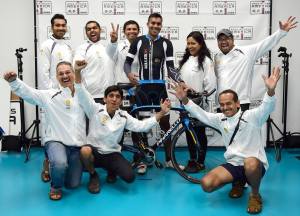
Sumit with support crew at 2014 RAAM (Photo: courtesy Sumit Patil)

By then however, there were issues with the support crew. The original team Sumit had imagined – it featured some of the most experienced cyclists, managers and technicians around – didn’t seem keen to go along. A new team was assembled. But neither with this new team nor the earlier one, had he managed to put in long hours of training together. Mutual familiarity born from such training is critical for endurance races like RAAM. “ I tell people, it isn’t rider; it is rider plus support crew that win a race. Ideally the team should think for you. Sometimes if support crew is damn good, all a rider does is listen to what the crew says,’’ Sumit said. But most important of all, a rider won’t ride well if he has too many worries in the head. And that is what Sumit was beginning to face ahead of 2014 RAAM; the funds were in place only close to departure for the US and the support crew was relatively untested although he was happy that somebody came along.
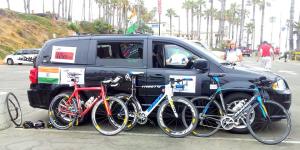
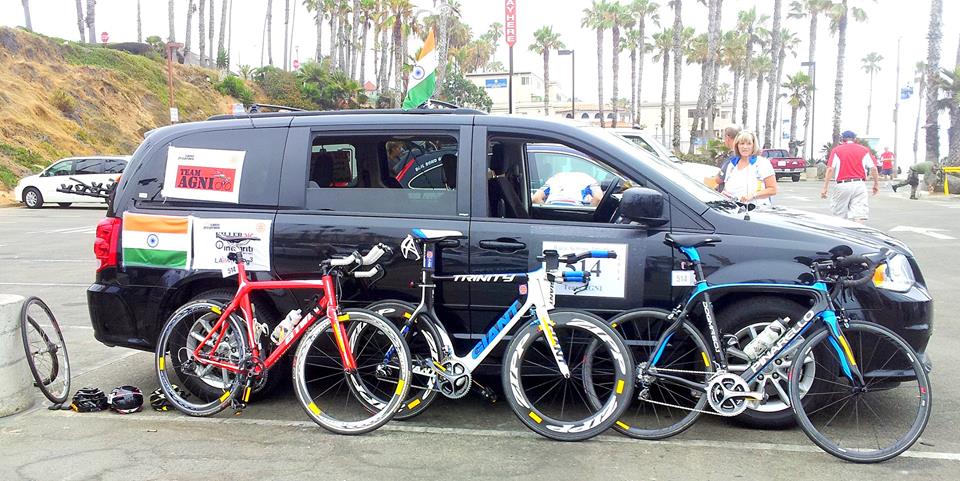
From 2014 RAAM; Sumit’s support vehicles and his three bicycles (Photo: courtesy Sumit Patil)

In California, the 2014 RAAM got off to a shaky start for Sumit. Lack of adequate work with support crew before the event meant that details like hydration and nutrition wasn’t as aligned to his needs as it should be. By day three, race officials informed that he seemed unlikely to meet the cut-off at Durango. Currently, besides Sara, Sumit owns four other cycles – Mukta (Pinarello Dogma 60.1), Toothless (Btwin Alur 700), Veronica (Giant Trinity) and a yet to be named Trek Madone. Given he had a stint as technical partner with Btwin in India, he also owned a Btwin FC 7 in between. Of these, Mukta and Veronica were bought specifically for RAAM. However bought with funds gathered for the purpose, they had been acquired late and were still new to Sumit. On the road in the US, this too was a problem. For the first time Sumit developed blood blisters from long hours spent on the saddle. Shortly after his fate was spelt out by race officials, Sumit shifted to the Btwin FC 7, which he was familiar with. His pace picked up. One reason for this was tyre pressure. An experienced combination of rider and crew would calibrate tyre pressure to the sort of surface the bicycle is tackling. Mukta was mistakenly calibrated to smooth race track. Result – on the road, the high pressure kept air time (the time the wheels are in the air) high causing less traction. The Btwin didn’t have tyres that could hold air at such high pressure. So, even as the team continued to err on the tyre pressure front, the Btwin gripped tarmac and Sumit cruised comfortably. Noticing his improved pace, race officials relaxed the Durango cut-off and let him continue. However at South Fork, past the highest pass on the RAAM route and with approximately 1600 kilometers covered, Sumit pulled out. It was curtains for the 2014 attempt. On the bright side, according to Sumit, he learnt later that his RAAM attempt which had been back-ended into raising funds for charity had raised close to ten million rupees for a project distributing prosthetic limbs.
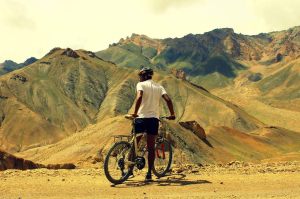
Cycling in Ladakh (Photo: courtesy Sumit Patil)

Big cycling projects are like mountaineering expeditions. The echoes of actions taken continue long after expedition. With performance at stake, things are said in the heat of the moment. Misunderstandings occur. Sumit burnt some friendships. He regrets it; there is pain sensing the void that has crept in where good relations once existed. Then there are the obligations emanating from resources raised. His RAAM attempt may have ended but his responsibility to those who supported, continue even after event. It was a three year contract. Sponsors expect you to meet these obligations. In the process, an attempt to set a record, cycling India’s Golden Quadrilateral (the highway linking Mumbai-Delhi-Kolkata-Chennai-Mumbai) had to be sacrificed so that the demands of sponsors, who backed his RAAM trip, could be met. In world smothered by the triad of money, media and marketing what they ask you to do may not be agreeable if you are someone wishing sport to stay pure. Sumit had to swallow his reservations and go along. June 2018, when I met him, Sumit had become free of all these obligations. The shadow of 2014 RAAM was gone. But his attempts to go for RAAM post 2014, had all failed. In the meantime, the first Indians to finish RAAM had also happened – in 2017, Lt Col Srinivas Gokulnath became the first Indian to complete RAAM; he was followed by Dr Amit Samarth. Sumit’s latest RAAM qualifier had been the 2018 edition of Shivalik Signature, which he completed successfully in April. He was also registered for 2018 RAAM as Team Agni. However lack of resources decided otherwise. As Indian teams registered for RAAM made their way to the US or were already there, Sumit was cautiously sipping coffee with me in Prabhadevi. A coffee lover, he has been told to restrict his caffeine intake. Reason – he suffers from Ankylosing Spondylitis. It was diagnosed after PBP; symptoms had set in earlier. Ignored, this type of arthritis can be debilitating. One of the best ways to keep the condition in check is to remain active. That is a solid reason to keep cycling. Coming up therefore was something else; a segue from RAAM.
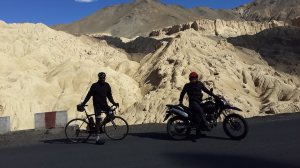
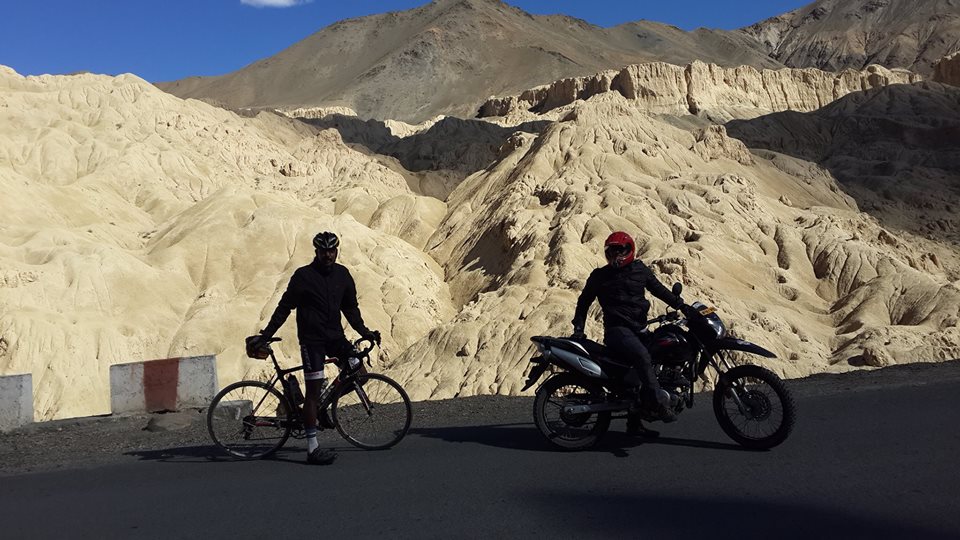
In Ladakh, man on bicycle, another on motorbike (Photo: courtesy Sumit Patil)

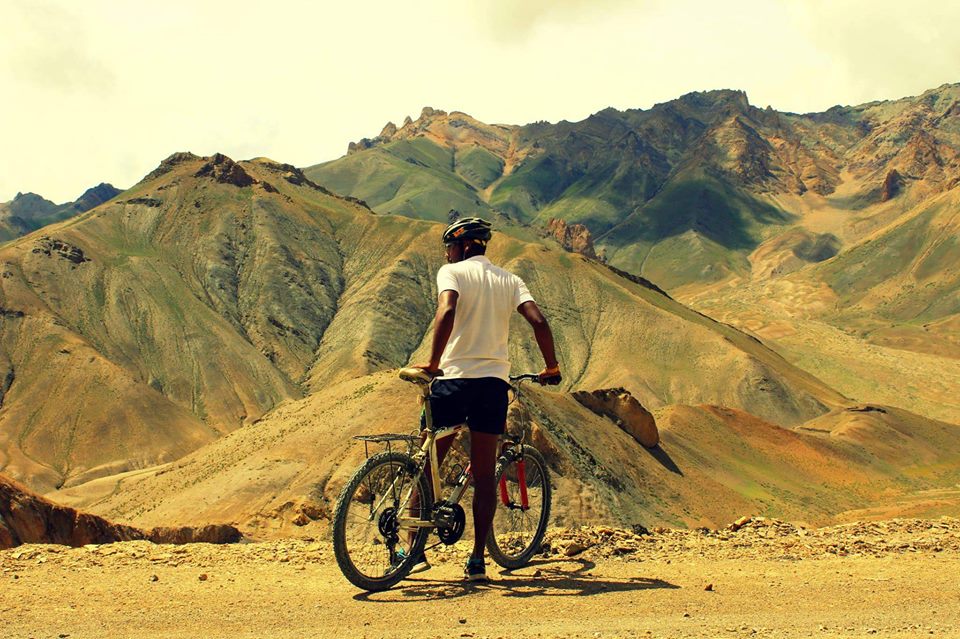
Days after we met and a few days before the start of 2018 RAAM in the US, Sumit was scheduled to leave for Leh. Sometime in July, he will take up a project that seeks to improve a record he achieved in 2015. That year in September he had cycled from Manali to Khardung La, a distance of roughly 517 kilometers, in 71 hours, 28 minutes. The route features several passes – Rohtang (13,051 feet), Bara-lacha La (16,043 feet), Nakee La (15,547 feet), Lachulung La (17,598 feet) and Tanglang La (17,480 feet) before reaching Khardung La (17,582 feet). It gained him entry into the Limca Book of Records; the certificate awarded describes it as “ fastest solo bicycling across Himalayan passes.’’ According to Sumit, the choice of September for riding affected the time he took to finish. When you are riding with little rest, seeking record, you cannot decide when you will be on a high mountain pass. Sumit reached some of these passes in very cold circumstances. September is the beginning of winter. The real problem is in the descent. Wind chill adds to the cold and conditions can be quite unbearable for rider on bicycle. Consequently, he had to halt at times on descents, go down by car to wait out the cold, come back up to where he stopped and resume. This year, he plans to improve his record. He has chosen July for the attempt and believes that the halts of before may not be required in July’s temperatures. Daylight will also last longer, at this time of the year. The section selected is Manali-Leh and his goal is to cover the distance involved – approximately 490 kilometers – in under-40 hours. “ We hope to enter the timing in the Guinness Book of Records,’’ Sumit said. Both the Manali-Leh project and a similar attempt planned on the Golden Quadrilateral later this year, are steps towards showcasing endurance cycling in paradigm familiar to the public and thereby make cyclist deserving of support. The RAAM project lives.

(The author, Shyam G Menon, is a freelance journalist based in Mumbai. This article is based on a conversation with Sumit Patil. Except for the road distance mentioned in the Limca Record and those associated with BRMs, all elevations and distances quoted have been taken from the Internet. Save the first photo, all other photos used herein have been downloaded from the Facebook page of Sumit Patil and used with his permission.)             

IT’S TIME FOR COMRADES

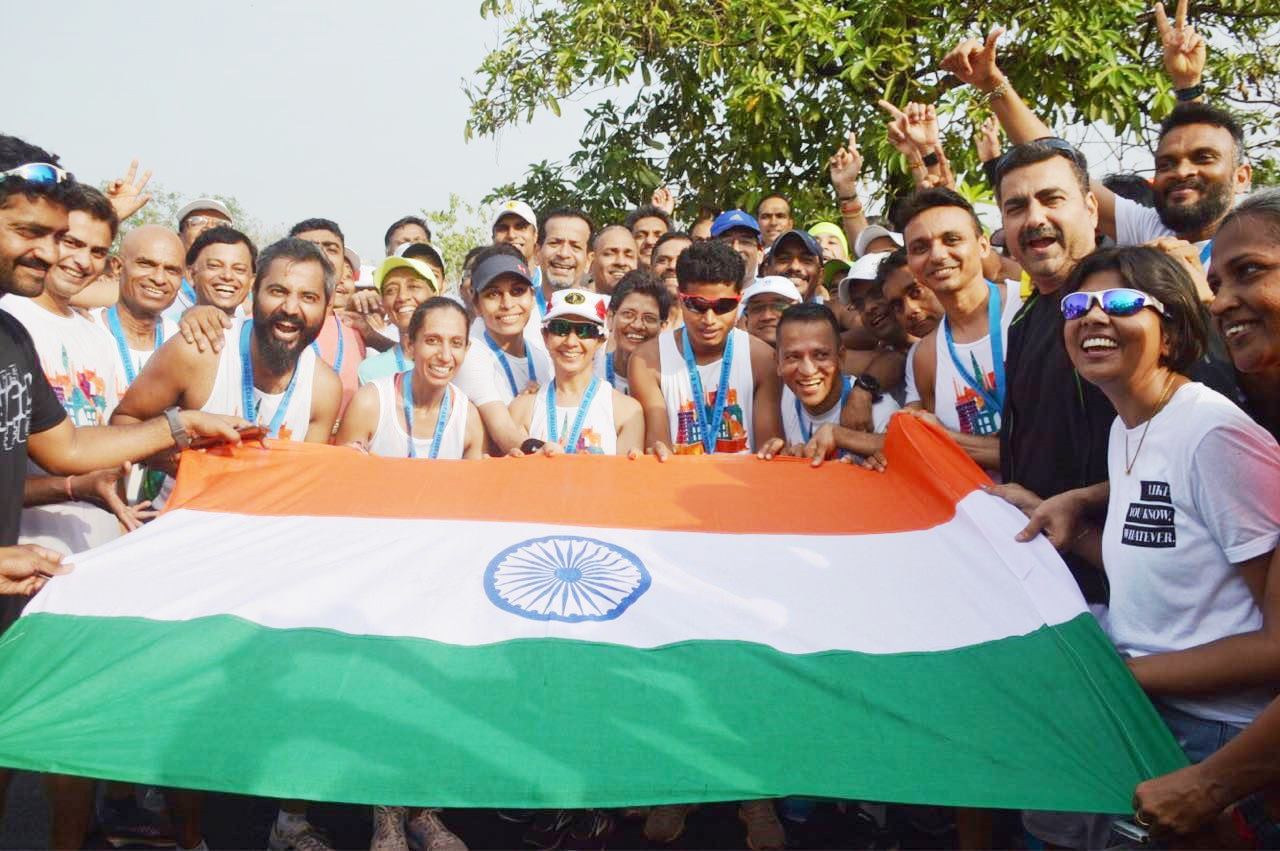
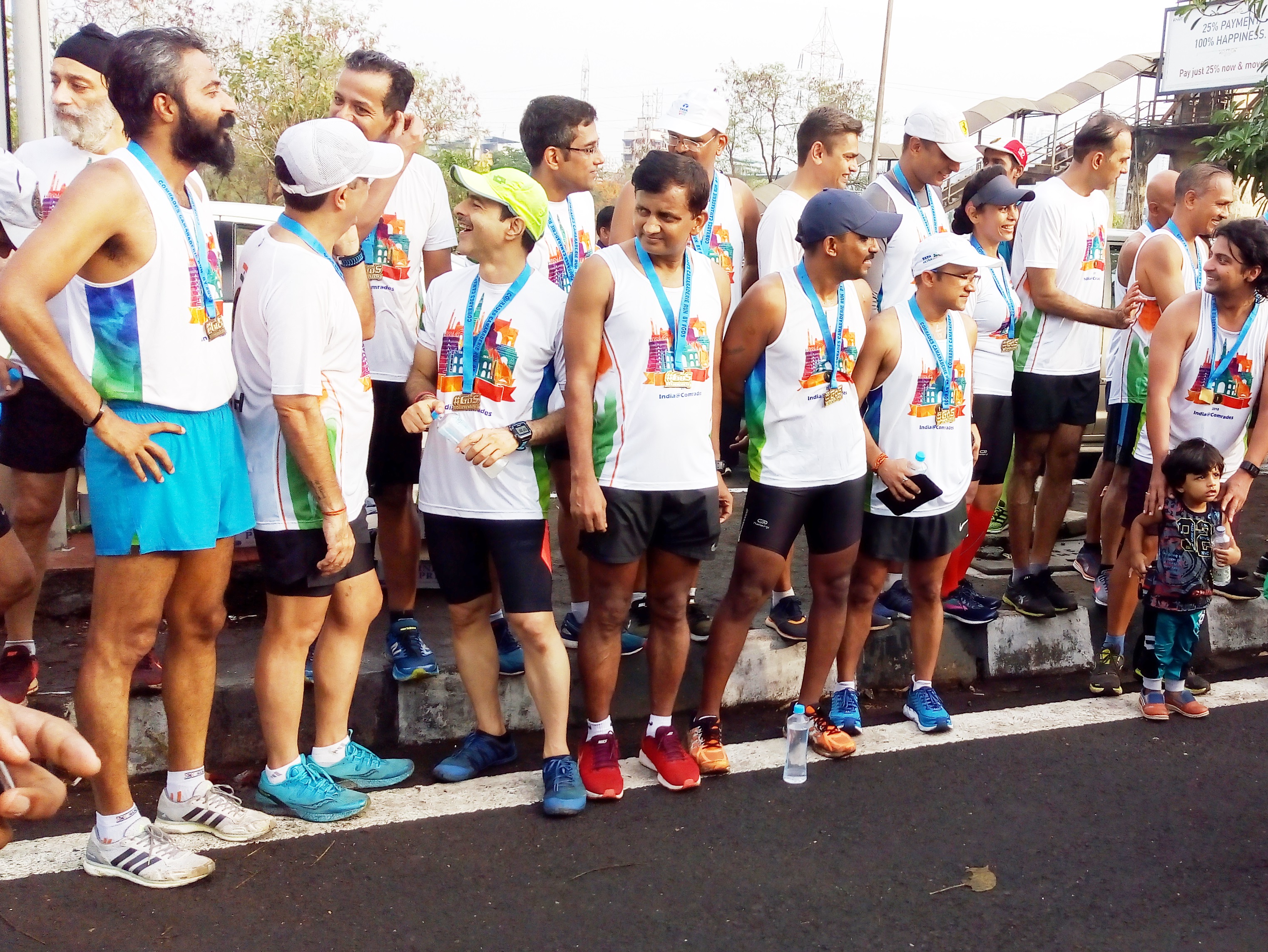
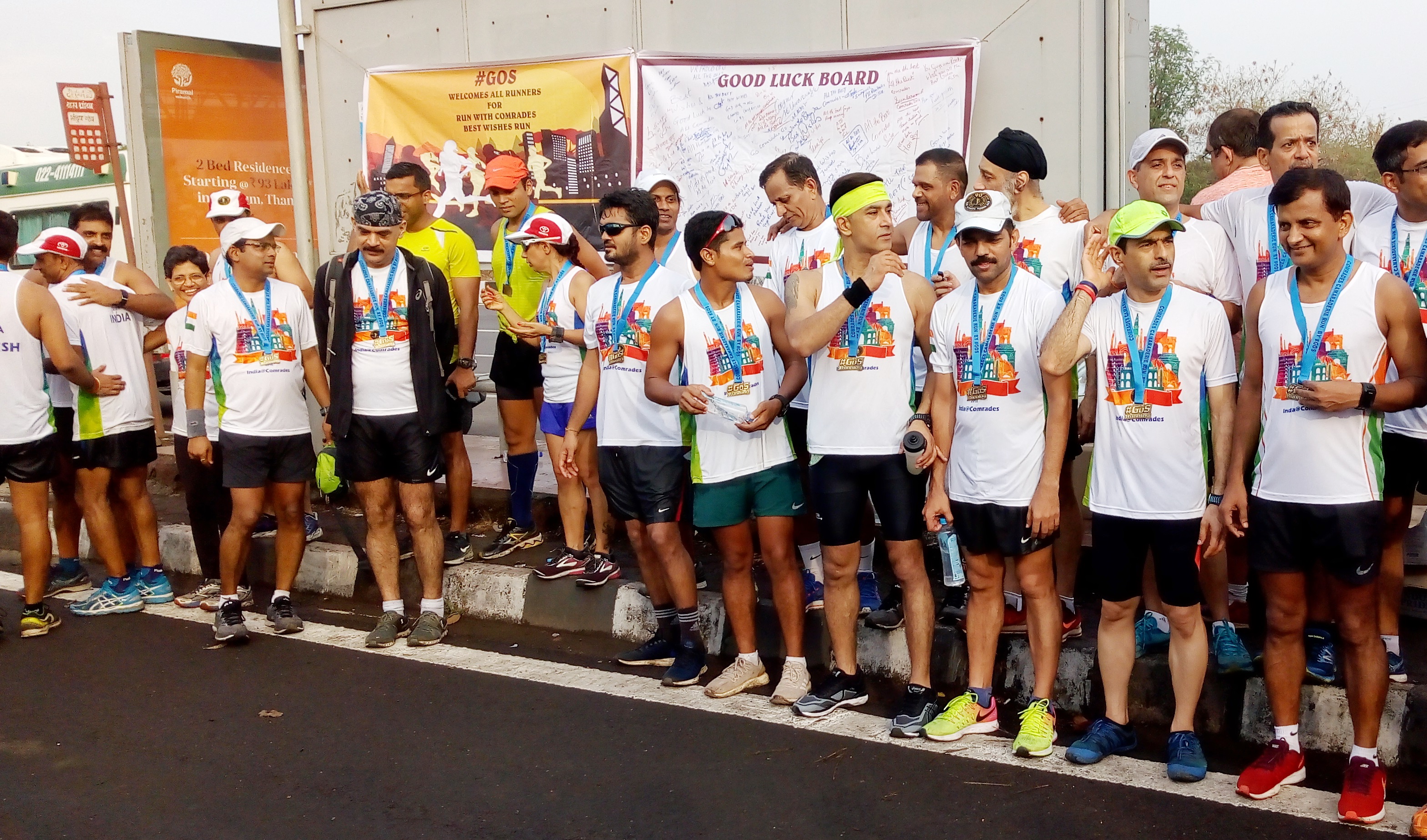
From a weekend run in Mumbai with those heading for Comrades (Photo: courtesy Satish Gujaran)

This Sunday around 20,000 runners are expected to assemble at the start line of Comrades Marathon in Pietermaritzburg, South Africa.

Promoted as the “ Ultimate Human Race,’’ Comrades Marathon is actually an 87-89 km-ultramarathon, run between the cities of Durban and Pietermaritzburg. The former is on the coast; the latter, in the mountains.

The number of Indian runners participating in this race has been slowly inching up with 161 runners expected to attempt the 2018 edition of Comrades Marathon.

The race, which draws runners from several countries, was first held in May 1921. The route alternates each year between uphill and downhill.

From a weekend run in Mumbai with those heading for Comrades (Photo: Latha Venkatraman)

The 2018 edition is a downhill run with runners having to complete a total distance of 90.184 km in a time of 12 hours with six timing cut-offs in between. Runners will have to run a bit extra this year to finish the race at the Moses Mabhida Stadium at Durban. Last year, the finish line was at King’s Park Stadium. For the 2018 edition the finish line has been moved to Moses Mabhida Stadium adding an additional kilometre. This was done because of the event’s growing number of runners and spectators, its Twitter handle @ComradesRace said.

This year, runners from 80 countries are participating in Comrades Marathon, an official tweet said. The event has been gaining traction among Indian runners. Likely reasons for its popularity include a qualifying time that isn’t as tough to meet as some of the other major international marathons, South Africa being familiar to many in India in the atlas of Indian diaspora and the marathon-like crowd support and ambiance at Comrades, which is unique for an ultramarathon. Interestingly, the community you form once you register and the training done in India ahead of race, also appear to enhance the attraction for Comrades.

“ Comrades has gained popularity among Indian recreational long distance runners primarily through word of mouth,’’ Satish Gujaran, Mumbai-based ultramarathon runner, said. He has been running Comrades for the past eight years. The 2018 edition of the race marks his ninth attempt.

“ The experience of running this ultramarathon starts with the grueling training that lasts for about three to four months. The training is tough mainly because it coincides with India’s punishing summer,’’ he said. Comrades Marathon is usually held early June every year (for more on Comrades and Satish Gujaran please click on this link: https://shyamgopan.com/2015/10/22/the-comrade/).

From a weekend run in Mumbai with those heading for Comrades (Photo: Latha Venkatraman)

The key element of Comrades Marathon is the training, Dhiraj Dedhia, heading to South Africa this week to participate in the run, said. The camaraderie among runners while training for the race is not only infectious but immensely enjoyable, he said.

The crowd support, cheering, volunteering and the atmosphere in South Africa add to the experience, Satish said. This experience prompts runners to join in the carnival with numbers from India increasing every year. The collective training and the buzz around it has been a major reason for the growing popularity of Comrades among Indian runners.

(The author, Latha Venkatraman, is an independent journalist based in Mumbai.)
SHUBHAM AND THE OCEANS SEVEN

Shubham Vanmali (Photo: courtesy Dhananjay Vanmali)
A young man, who battled Learning Disability as a child and discovered purpose in swimming, is trying to complete one of the toughest challenges in open water swimming. This is his story; based on a conversation with his father. 

On May 29, 2018 the Navi Mumbai suburb of Nerul woke up to news of one from their midst completing a long distance swim in the US.

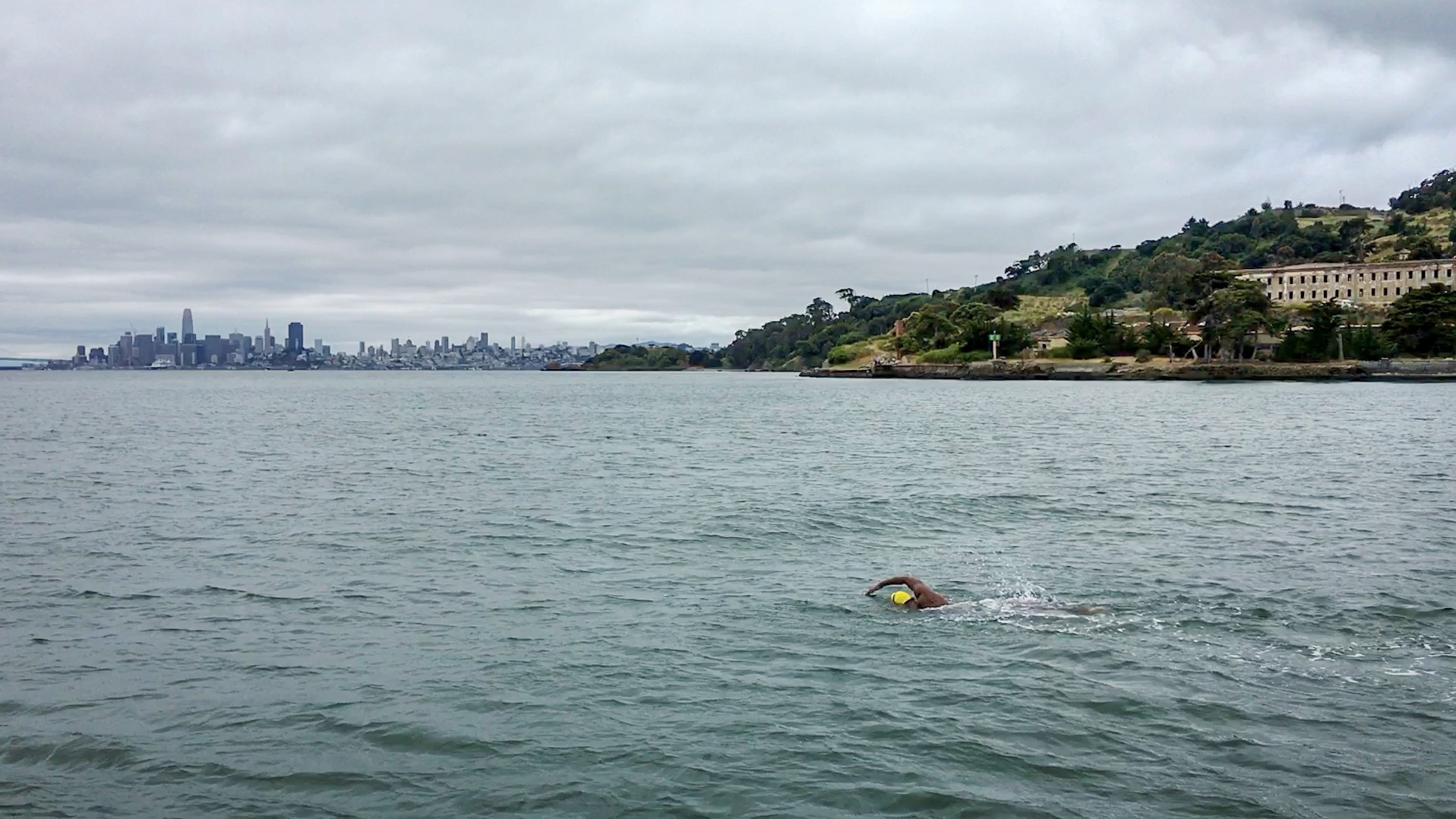
Twenty two year-old Shubham Vanmali had become the youngest person to complete the San Francisco Round Trip-Angel Island swim entailing a distance of 16.1 kilometers in the waters of the San Francisco Bay.

According to a statement from the North California Open Water Swimming Association (NCOWSA), the swim is reputed to be the most technically challenging in the Bay waters and has been attempted by more than 25 people over the past 40 years with only 12 completions. Besides being the youngest person yet to do it, Shubham is also the first Indian and the first to complete the swim under the newly formed NCOWSA. The swim starts and ends on the shared beach of San Francisco’s open water swim clubs, the South End Rowing Club and Dolphin Club. The course requires the swimmer to leave through the opening of Aquatic Park, swim past Alcatraz Island, swim around Angel Island through a body known as Raccoon Strait before returning past Alcatraz and back through the narrow opening of Aquatic Park. All this, while crossing three international shipping lanes twice, 12 ferry routes and swimming cross-current for the major part in 10-14.5C waters, the statement said.

May 29 evening, this blog caught up with Shubham’s father, Dhananjay Vanmali for a chat.

Shubham doing the San Francisco Round Trip-Angel Island swim (Photo: Pacific Open Water Swim Co)

He was due to leave for the US, the next day. Coming up was another swim, part of the main project Shubham has been working on. Over June 3-9, he will attempt swimming the Molokai Channel in Hawaii. According to Wikipedia the Molokai Channel aka Kaiwi Channel separates the islands of O’ahu and Molokai. The crossing of this channel is part of the Oceans Seven Challenge, which is the project Shubham has been working on for the past few years. The other crossings required for the Challenge are the North Channel (formerly called Irish Channel) linking the Irish Sea with the Atlantic Ocean, the Cook Strait between the North and South Island of New Zealand, the English Channel between Britain and France, the Catalina Channel in California, Tsugaru Strait between Honshu and Hokkaido in northern Japan and the Strait of Gibraltar connecting the Mediterranean Sea to the Atlantic Ocean. The only Indian to have done the Oceans Seven yet is Pune’s Rohan Dattatrey More who is also so far the youngest and the first Asian on the finishers’ list. The first person to complete the Challenge was Stephen Redmond of Ireland. A former rugby player and triathlete, he completed the Challenge over 2009-2012, at times requiring multiple attempts at some of the channel crossings. The Oceans Seven Challenge is positioned as swimming’s equivalent to the Seven Summits of mountaineering, which entails climbing the highest peak on each continent. The Challenge was conceived in 2008 by former professional marathon swimmer Steven Munatones who was world champion in the discipline in 1982 and coached the US national team for several years. Articles on the Challenge published in the media say that participants need to be hardcore endurance athletes with ability to swim in very cold and warm seas and be physically and mentally prepared to tackle adversity ranging from sea creatures to currents and strong winds.

Shubham; from the Dharamtar to Gateway of India swim (Photo: courtesy Dhananjay Vanmali)

Shubham comes from a family of sportspersons. His father is a former state player in volleyball, his mother used to play kabaddi and his sister used to be a competitive swimmer. According to Dhananjay, Shubham’s career in swimming commenced after an initial foray into football. Around 2001, Nerul Gymkhana started Mission 2010 seeking to train talented youngsters in football, swimming, hockey, cycling, tennis and athletics. Shubham was selected for football under Mission 2010. Born 1995, he was quite small and very likely would have not been well developed and competitive in the sport by 2010. “ So he was shifted to swimming,’’ Dhananjay said, adding that by around 2009, Mission 2010 ended for want of funds. Following this, Shubham moved to practising at the pool in the complex housing Nerul’s D.Y. Patil Stadium. However, from the point of view of becoming a competitive swimmer, he seemed to have a problem. Although he trained well, at the time of competition, all that hard work couldn’t be made to focus and deliver performance. By around eighth standard, Shubham was formally diagnosed with Learning Disability. It took a while to locate the correct doctors but eventually intervention by good psychologists and sports psychologists helped.

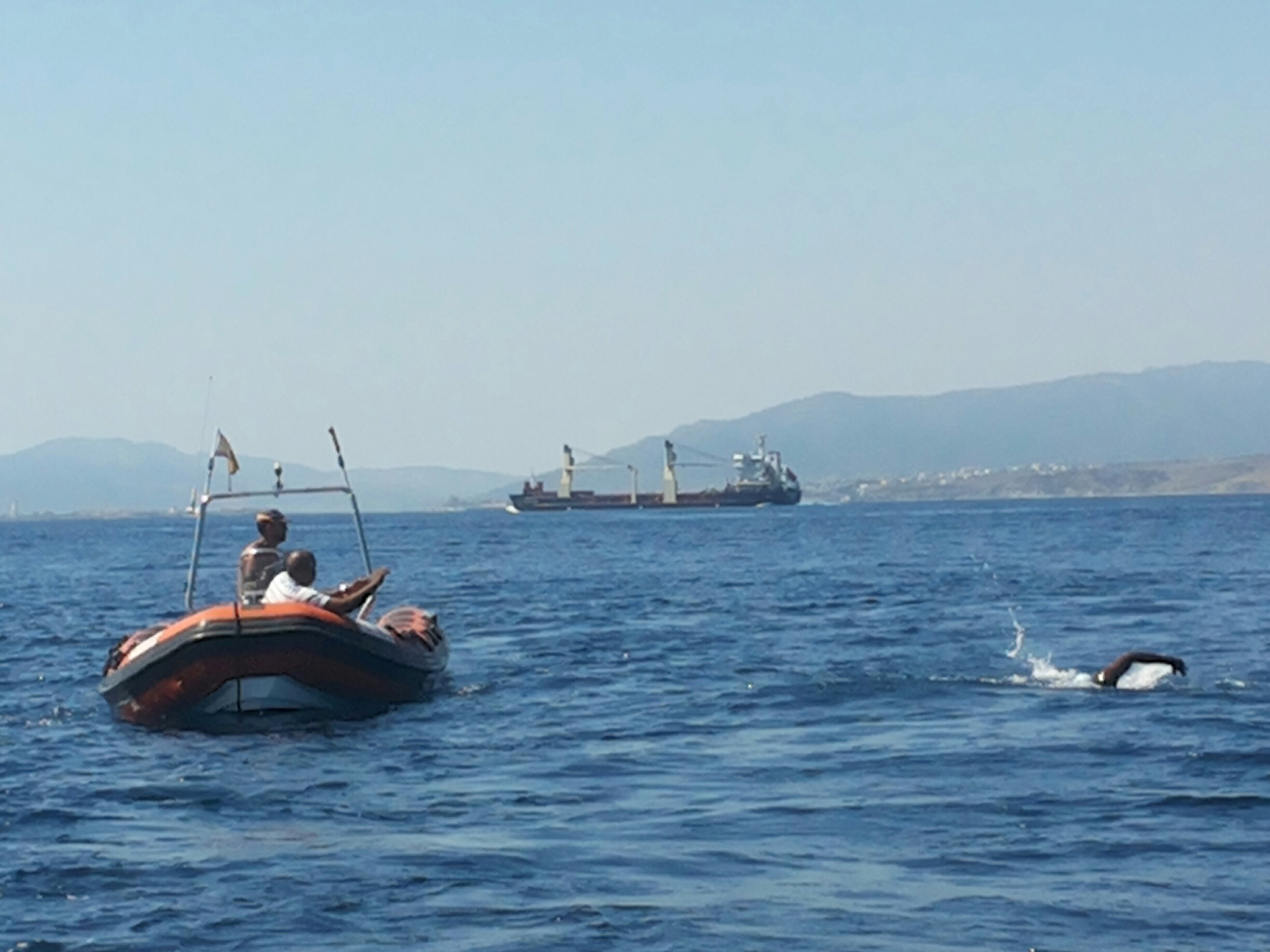
Shubham crossing the English Channel (Photo: courtesy Dhananjay Vanmali)

Around tenth standard, Shubham’s approach started to change. “ In the tenth standard he was selected for the state championship. By the twelfth, he had secured podium finish in the state championship in 1500 meters freestyle,’’ Dhananjay said. During his time in eleventh and twelfth standard, Shubham trained at the pool belonging to Father Agnel Sports Academy. Gokul Kamath became his coach in swimming. By the time Shubham reached college, he secured bronze in 100 meters, silver in 200 meters and gold in 400 meters and 1500 meters at the inter-college meet, Dhananjay said. Besides clear evidence of his emergent ability to focus his energies, it also indicated that his strength lay in the longer distances demanding endurance. In Shubham’s first year at college, there was a competition in Thane he participated in. Dhananjay recalled that a couple of senior Channel swimmers had come to attend it as guests; they were watching from the gallery. A month and a half after this event, Shubham approached his father and said that he wished to attempt crossing the English Channel. After discussing it with his coaches, the family decided to take up the project. Shubham started training for it. Besides his regular swimming, every Saturday and Sunday he used to go to Uran and be taken out to sea in a boat to do open water swimming for three to four hours.  “ We also did swimming at night,’’ Dhananjay said. For stepping stone to English Channel, Shubham first swam from Dharamtar to Gateway of India in Mumbai, a distance of roughly 35 kilometers. Then, on August 4, 2014, he swam across the English Channel becoming the youngest to do so at that point in time.

Crossing the Strait of Gibraltar (Photo: courtesy Dhananjay Vanmali)

Given he was going all the way to Europe and UK for doing this it made sense to attempt the Strait of Gibraltar soon thereafter. Approaching bad weather restricted his window for the Gibraltar swim. It was complicated further by the fact that the swim had to done the same day he was reaching the start point from UK. However Shubham went ahead. For a prospective record, the family first thought of trying a to and fro swim. Shubham gave it some thought and told Dhananjay that there was another option – he could try and reach the other side faster than any Asian had done so far. That’s what happened on August 14, 2014 – he became the fastest Asian to cross the Strait of Gibraltar, doing so in three hours, sixteen minutes. Dhananjay believes that it was from this trip to Europe and interaction with swimmers and other people he met that Shubham picked up the idea of Oceans Seven. With two of the required crossings done, it seemed worth pursuing.

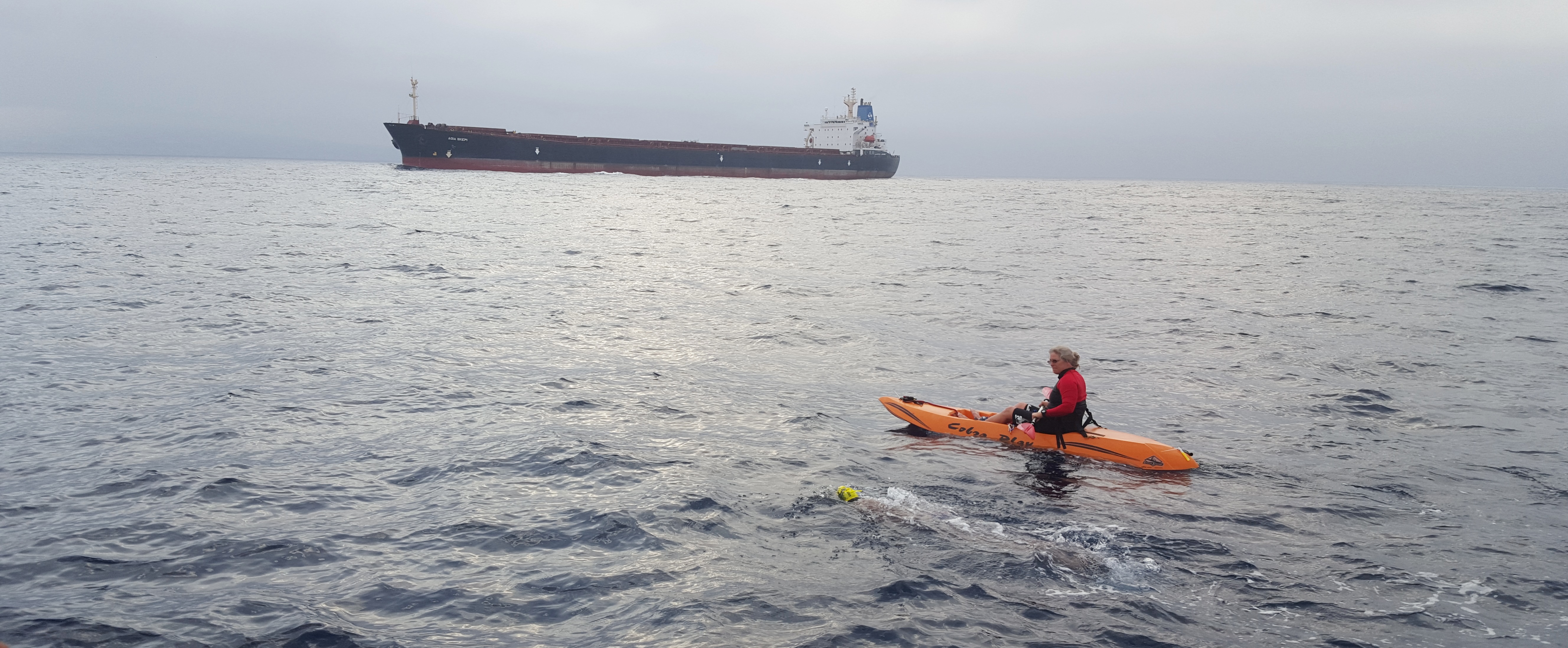
Shubham (in the water, next to the kayak); from the Catalina Channel swim (Photo: courtesy Dhananjay Vanmali)

In 2015, Shubham successfully accomplished the swim in the Catalina Channel. “ He began the swim one night and finished early next morning. It took him 10 hours and 42 minutes,’’ Dhananjay said. Shubham followed up Catalina with the Manhattan Island Marathon Swim on the US east coast, thus completing a smaller challenge in marathon swimming called Triple Crown – it is composed of swimming the English Channel, Catalina Channel and the Manhattan Island Marathon Swim. Then a reversal of fortunes happened. In 2016, Shubham travelled alone to Ireland to attempt the North Channel aka Irish Channel. His family searched on the Internet and rented suitable accommodation for him to stay in Ireland and prepare for the swim. The Irish Channel is rated one of the toughest swims in Oceans Seven. On the day of the attempt, after 13 hours of swimming and a mere two kilometers from successful completion, Shubham developed hypothermia. He had to abort the swim at that stage.  It left him feeling low for quite some time. “ He didn’t swim much. He was into cross-fit. Then last year, he began returning to swimming,’’ Dhananjay said. On the Internet, the Molokai Channel is described as the longest swim in Oceans Seven. The sea is deep here, nearly 700 meters. Early June, should the young man from Nerul accomplish the swim in the Molokai Channel; that would be four down, three to go in his pursuit of the Oceans Seven Challenge. He plans to go back to Ireland to attempt the North Channel again.

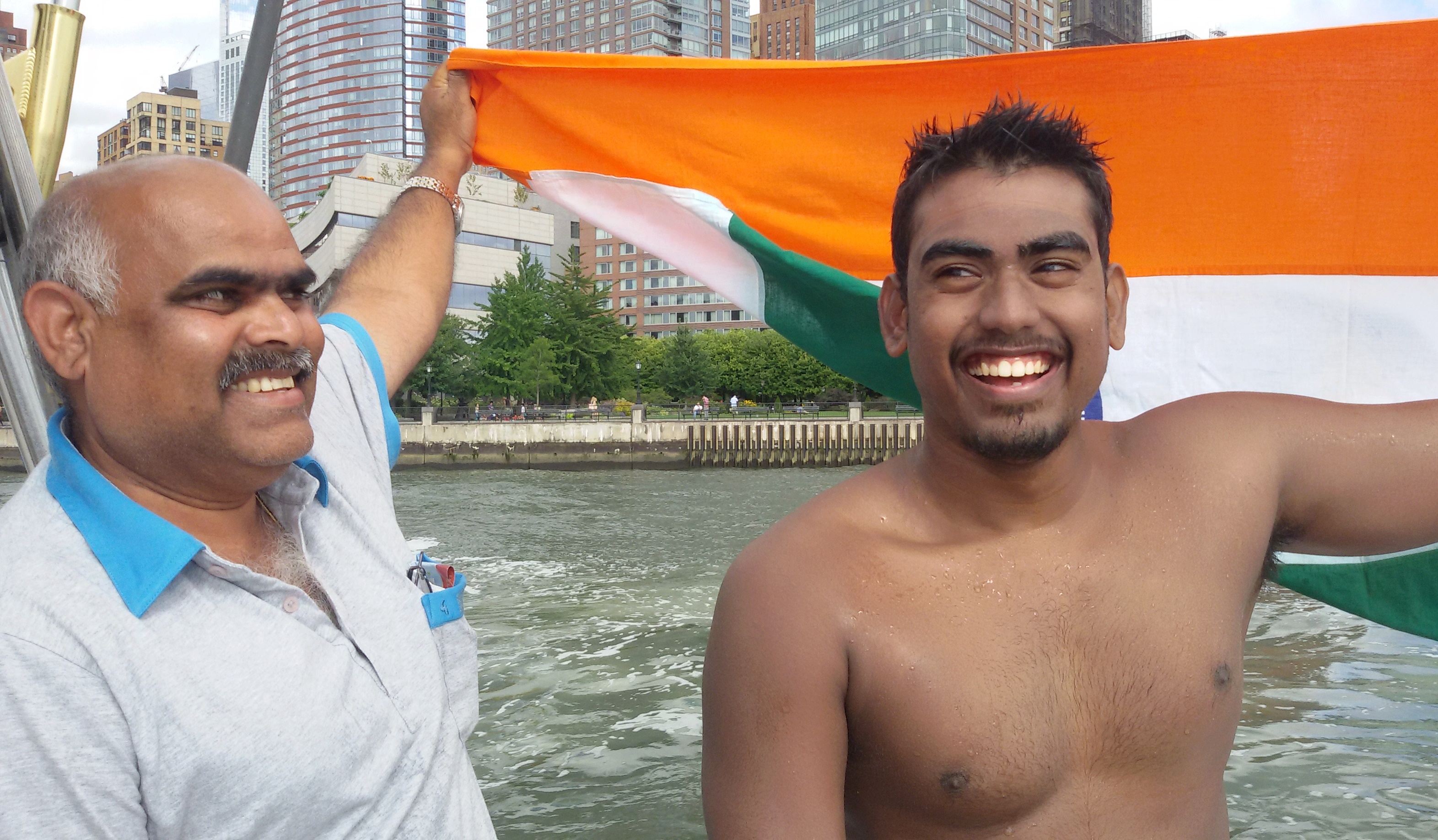
Dhananjay (left) and Shubham after the Manhattan Island Marathon Swim (Photo: courtesy Dhananjay Vanmali)

Swimming at all these locations and the training required for it, requires financial resources. His family has funded Shubham so far. That was also among reasons, he felt bad after the North Channel attempt didn’t succeed; he apparently felt he had wasted his parents’ hard earned money. Dhananjay works with Bharat Petroleum Corporation Limited (BPCL); his wife works with Vijaya Bank. He tried getting sponsors. According to him, he would have repeated meetings with prospective sponsors but on the day of providing sponsorship they would offer an amount much smaller than what was originally promised. There were also other problems. Projects of this sort are PR intensive and securing such traction is not the forte of every athlete or his / her family. On the other hand, mileage in the media is what sponsors seek in return for their support. Further sponsors easily warm up to supporting games because that is a picture of team effort which is a popularly liked theme. It is also one that is in line with corporate imagination. Adventure sports and endurance sports are on the other hand, typically solitary pursuits. “ These things affect my motivation level,’’ Dhananjay said. He still looks for sponsors but in the meantime dug into his own resources to fund Shubham’s project. Among means of raising resources, he sold an apartment he owned. “ This is a unique feat and it is my son who is doing it,’’ he said at his house in Nerul, less than a day left for his flight to the US and opportunity for family to watch Shubham attempt the Molokai Channel.

(The author, Shyam G Menon, is a freelance journalist based in Mumbai. This article is based on a conversation with Dhananjay Vanmali.)

AFTER EVEREST

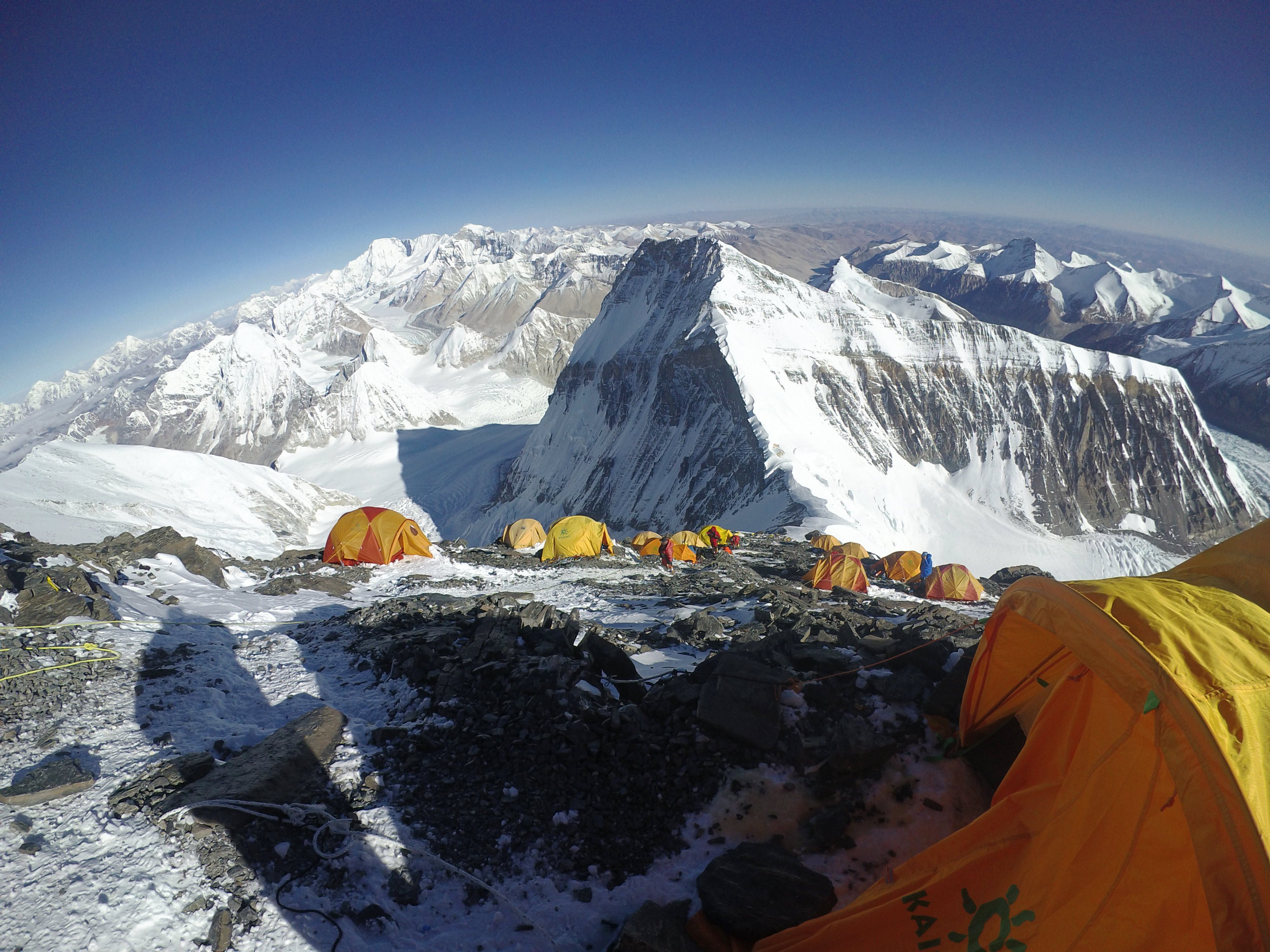
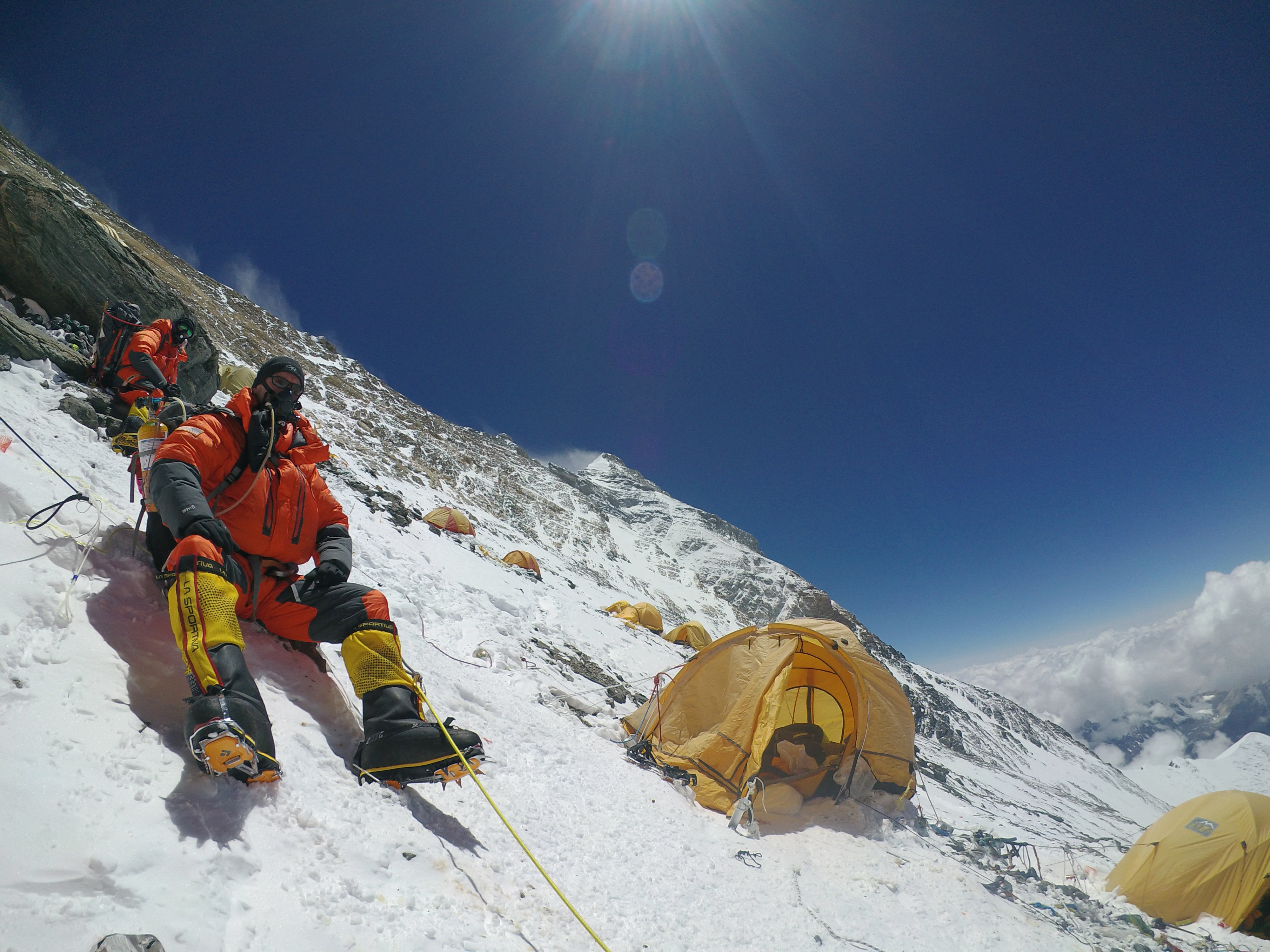
Grant Maughan; from the Everest expedition (Photo: courtesy Grant)

Grant Maughan is an experienced ultramarathon runner and adventure racer. Hailing from Australia, he is a freelance super yacht captain who also keeps a busy schedule as endurance athlete. He has participated in many ultramarathons including some of the world’s toughest. In India, he is remembered for his 2016 joint win – with Jovica Spajic – in the 333 kilometer category of La Ultra The High. In May 2018, Grant climbed Mt Everest successfully. In this interview done by email, he shares his thoughts about Everest, altitude, ultramarathon and plans he has around the theme of endurance and adventure.

Everest ascents happen from the Nepal (south) side and the Tibet (north) side. Was there any reason why you chose to climb from the north side? Did you want to be on that face or was that natural fall out of the group you chose to go with and their choice of route?

I chose the north side because inherently there are less people doing that route. I also find the history of Mallory and Irvine disappearing there in 1924 very interesting.

Can you briefly describe the climb? What were your testing moments therein?

Everything about the climb is difficult: the time it takes to acclimate, establishing camps and equipment at different levels, technical impediments, oxygen deprivation and fatigue. Your body and mind get worn down after weeks and weeks of ascending and descending. It becomes a real chore just to be there and accomplish some for the daily tasks. As you get higher on the mountain some of the technical sections become more difficult and your energy and focus at overcoming the tasks become harder to manage.

One measure often used to describe the challenge involved in an ultramarathon is cumulative elevation gain. Many ultramarathons have cumulative elevation gain exceeding the altitude of Everest. That is further complemented by the act of running and moving, often with little rest, to meet cut off times. Obviously you had a fascination for Everest despite the challenges in ultramarathons and adventure races. Can you describe the specific attraction / motivation you had for climbing Everest? Had you been thinking of it for long?

After some years of mountain running it became a natural segue to start climbing bigger mountains. It was a real fascination for me to get up some of the mountains. I spent years reading climbing books but never thought I would be able to achieve such things because I have a natural fear of heights. Even though I had flown hang gliders, tried free-fall parachuting and bungee jumping when I was younger I just figured high altitude mountaineering was for elite athletes and people much braver than I. My first big climb was Mount Rainier in the US and after that trip where I learnt some new skills and equipment selection, I was keen to try other mountains. I climbed Aconcagua in Argentina; then headed to Denali in Alaska where unfortunately we couldn’t make the summit because of a nine day storm that trapped us at almost 15,000 feet before we retreated due to lack of food and our permit, close to expiring. I have climbed Mt Shasta in California a number of times solo; Stok Kangri in the Indian Himalaya solo plus Mera peak and Imja Sja in the Nepal Himalaya. I really wanted to try an 8000 meter peak like Cho Oyu or Manaslu before considering Everest but this year after talking with a team leader I decided to just go for Everest and see how it turned out. I wasn’t sure if I would ever get the chance due to expense and the time required but everything fell in place and I only decided three weeks in advance to go on the expedition. Sometimes it is better that way so you don’t have much time to think about it and talk yourself out of it.

From the Everest climb (Photo: courtesy Grant Maughan)

How would you describe your relation with altitude? How well do you cope with it? Does the reservoir of endurance, distance runners have, make them better at tackling it or is altitude, the great unknown that even the best of runners must approach respectfully? What was your experience on Everest?

I definitely think that endurance athletes have a bit of an advantage when climbing big mountains. Endurance and fitness are part and parcel of some of the most important aspects of getting to the top. I seem to be able to acclimate fairly well and without too much trouble. I have developed breathing techniques for distance running that I cobbled together from the sport of free-diving and by just thinking about the mechanics of gas exchange that have worked for me really well. I did notice that at about 7000 meters the breathing techniques still helped but were not as efficient as at lower altitudes. Above that height everything just becomes harder. We started to breathe bottled oxygen above 7000 meters using different volumes of gas per minute compared to height and difficulty of climbing at the time. It definitely made things easier but never the same as lower down. It was always an extra worry about running out of gas or having a regulator or mask fail. So it actually added to the stress.

Distance runners and adventure racers are used to getting pushed to their limits. How extreme is this in the combination of strain and altitude that is mountaineering? In your Facebook post, you have described what you experienced on Everest as quite challenging. What made it so?

The limits are a little different. Sometimes you are struggling carrying a large, heavy backpack on steep terrain or trying to focus on getting over a technical section using hardware, both of which are not common in distance running or mountain ultras. The physical aspects can be very similar though: being on your feet for days on end, sleep deprivation, fatigue. I also found the danger aspect to be way higher than anything I have done before in the sport. A combination of the terrain, altitude, weather and support; there was always stress in the back of my mind of what could go wrong and how I would deal with it.

Aside from the busy calendar of ultramarathons and adventure racing you maintain, did you indulge in any training that was specific to your attempt of Everest?

No. I didn’t have time beforehand. I spent four months working on a ship in Antarctica with no training over Christmas; then went straight to Alaska to do the Iditarod 350 mile and then straight to Tennessee for the Barkley. One week later I was in Tibet at Everest Base Camp.   Some would say this is crazy but I seem to have the capacity to do things like this with no training and hardly any preparation of any sorts. Next month I have the 315 mile Vol State race across Tennessee and then straight to Death Valley for my sixth Badwater 135 race.

From the Everest climb (Photo: courtesy Grant Maughan)

Personally, what was it like for you to be on the summit of Everest? What did you feel right then or at the first instance you had to reflect on it?

I spent 14 minutes on the summit. It was blowing around 40 knots of wind and bitterly cold though the sky was a beautiful deep azure color. I was scared. It had taken 10 hard hours of climbing through the night to get there (we arrived at 8:50 AM on May 19th). I remember looking back down at the ridge line we had traversed in the dark and knowing how long it would take me to get back to any sort of safety at high camp number three and feeling the dread. I really just wanted to get started down to find out if I could make it back safely and get far enough down the mountain to get out of the death zone. My three cameras were all frozen as well as all my water. I didn’t know if my oxygen bottle would last and how hard it would be to descend the technical sections while being extremely tired. It was very stressful. Just after leaving the summit one of our team members got snow blindness and had to be helped all the way down. It was very difficult to manage to overtake this group on the narrow section we were on. So I lost a lot of time waiting and getting cold.

Do you have any other dreams similar to Everest and away from the world of ultramarathons and adventure races you are regularly associated with? By profession you are a seafarer. The sea is a magnificent medium; it too is wilderness. Do you have any projects on that front?

I plan to row solo across the Atlantic as well as climb some other 8000 meter mountains in the future. Lots of things to think about and plan…

(The author, Shyam G Menon, is a freelance journalist based in Mumbai For more on Grant Maughan please try the following links: https://shyamgopan.com/2018/04/05/barkley-2018/   https://shyamgopan.com/2016/09/16/the-captain-the-teacher-the-warrior-and-the-businessman/  https://shyamgopan.com/2016/10/13/living-the-interesting-life/)

TOP COP AIMS HIGH, DOES AN ULTRAMAN

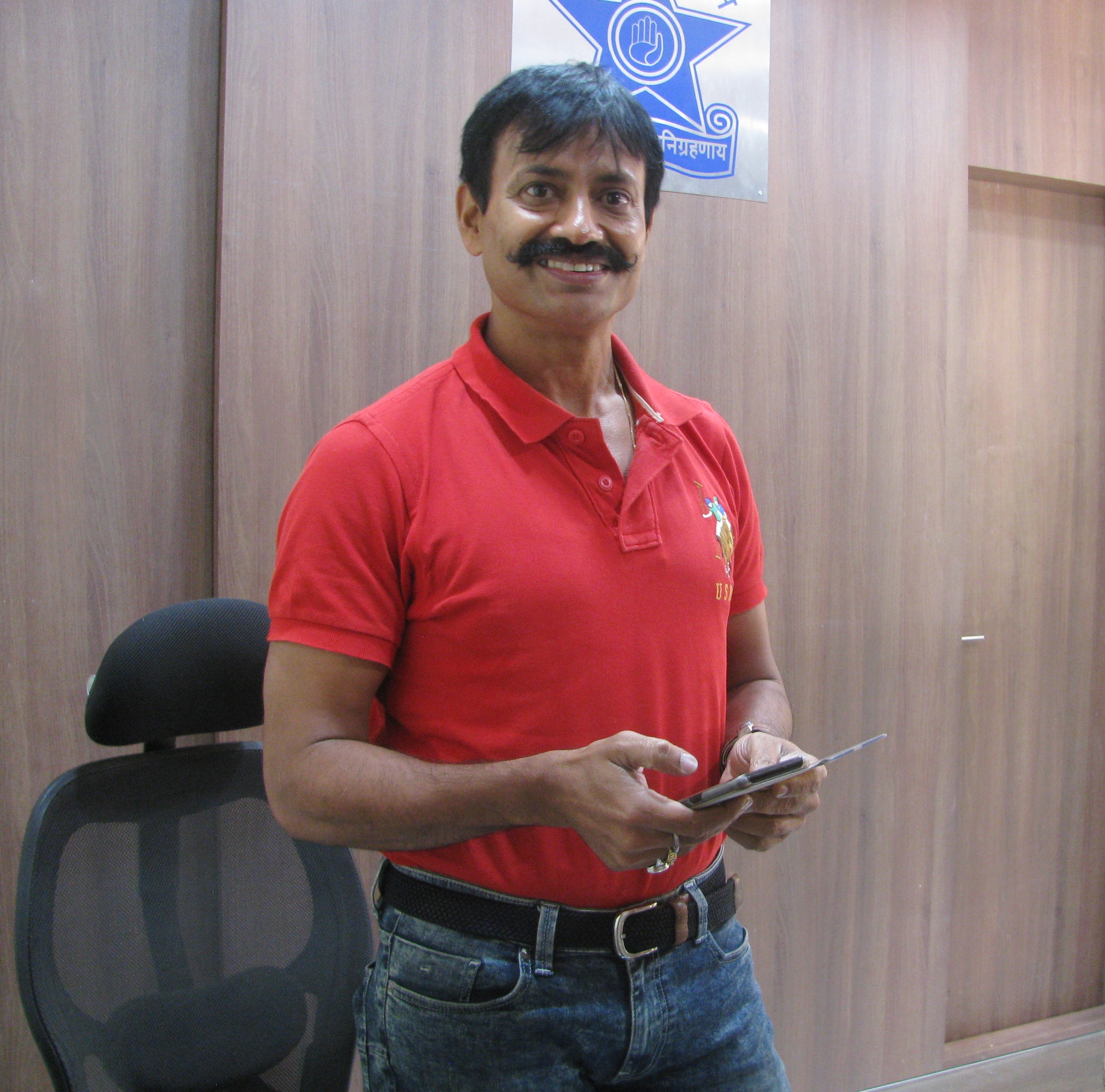
Krishna Prakash (Photo: Shyam G Menon)

An Inspector General who is also Ultraman – that is a rarity. This is the story of Krishna Prakash, IPS. It is also window to the change a city marathon can spark.

The Mumbai Marathon, long sponsored by Standard Chartered bank and now Tata, has been a life-changer for many people. In 2013 it changed the life of Krishna Prakash, at that time heading the police force in South Mumbai and thereby tasked with overseeing security arrangements for a host of sporting events ranging from cricket matches of the Indian Premier League (IPL) to the city’s annual marathon.

A second generation police officer, he hails from Hazaribagh in Jharkhand. Located roughly 2000 feet above sea level, Hazaribagh – the name means land of a thousand gardens – features a landscape of hills and forests. On a more somber note, it is also home to the second highest coal reserves in Jharkhand. Krishna Prakash’s father served in the police, retiring as a Deputy Superintendent. One of five siblings, Krishna Prakash – born 1971 – attended St Robert’s school and later St Columba’s College, from where he majored in history.  During all this time, his interest in sports was never exceptional. In his free time as a child, he ran around in the local hills, swam in the local river and the reservoir of a nearby dam – like many children do. At school, an institution blessed with adequate playgrounds and providing room for sports in the curriculum itself (there was time specifically allotted for sports), he stayed as active as anyone growing up in such circumstances would. “ I played but I was not a sports person per se,’’ he said, outlining his nature from those days.

Following college, he spent two years with the Nehru Yuva Kendra (NYK) doing social work. In 1995, he decided to appear for his civil services exam. The exam has a three tier selection process. His first two attempts took him past the first two stages of selection. On both occasions he lost out in the third, the interview stage. On his third attempt, he cleared all three stages and placed second among candidates qualifying from Jharkhand. Selected for the Indian Police Service (IPS) and awarded the Maharashtra cadre, he trained over 1998-99 at the Sardar Vallabhbhai National Police Academy in Hyderabad. In 1999, he moved to Maharashtra with his first posting at Gadchiroli. The second least populous district of Maharashtra, Gadchiroli is partly hilly terrain and has a strong tribal component to its population. It is also among districts affected by the extreme left movement. In the following years, he worked at Nanded, Malegaon, Buldhana, Amaravati, Sangli and Ahmednagar before shifting to Mumbai as officer in charge of South Mumbai’s police. Through these postings and transfers on work, he maintained interest in sports but as at school and college long ago, it stayed in the background. “ I used to play football and badminton regularly. I also participated in work-outs with my team from the police, to stay fit. But that was it,’’ Krishna Prakash said. Posted to South Mumbai, sports drew closer. The bulk of the Mumbai Marathon route, including its start and finish lines, are in South Mumbai. Given charge of security arrangements for the Mumbai Marathon, the IPS officer found it hard to keep his curiosity for the event and the experience it offered, under check. It was tough to merely watch from the sidelines and not run. Especially given an instance from the past that hinted he had what it takes to be in endurance sports – during his training days, at a competition at the police academy in Hyderabad, he had been runner up in cross country running, swimming and yoga. Knowing that, how do you keep the attraction of the Mumbai Marathon at bay? He succumbed.

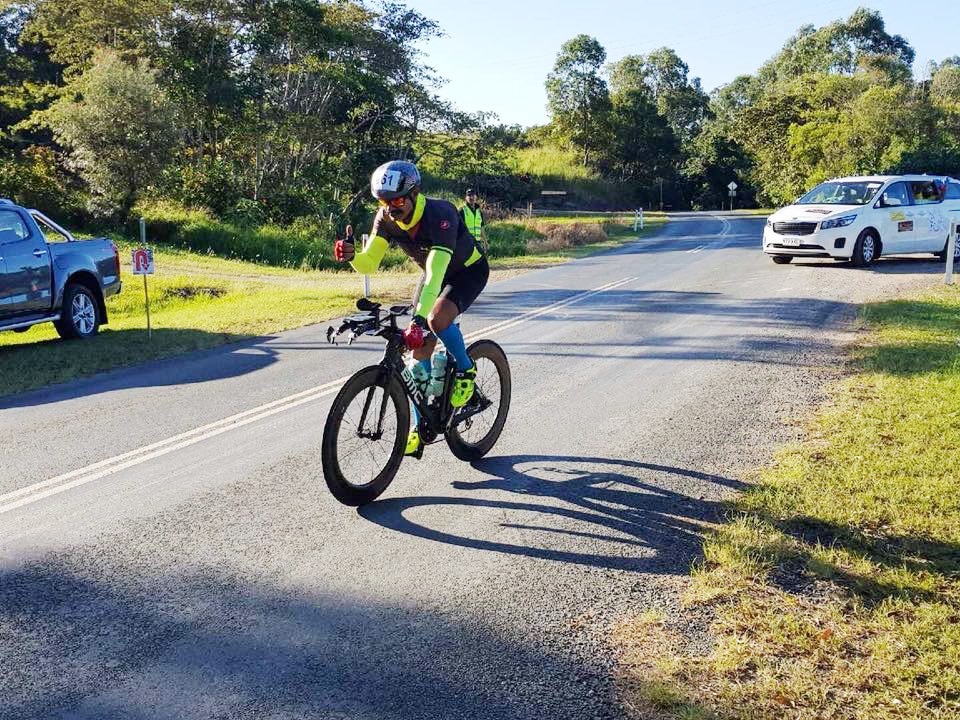
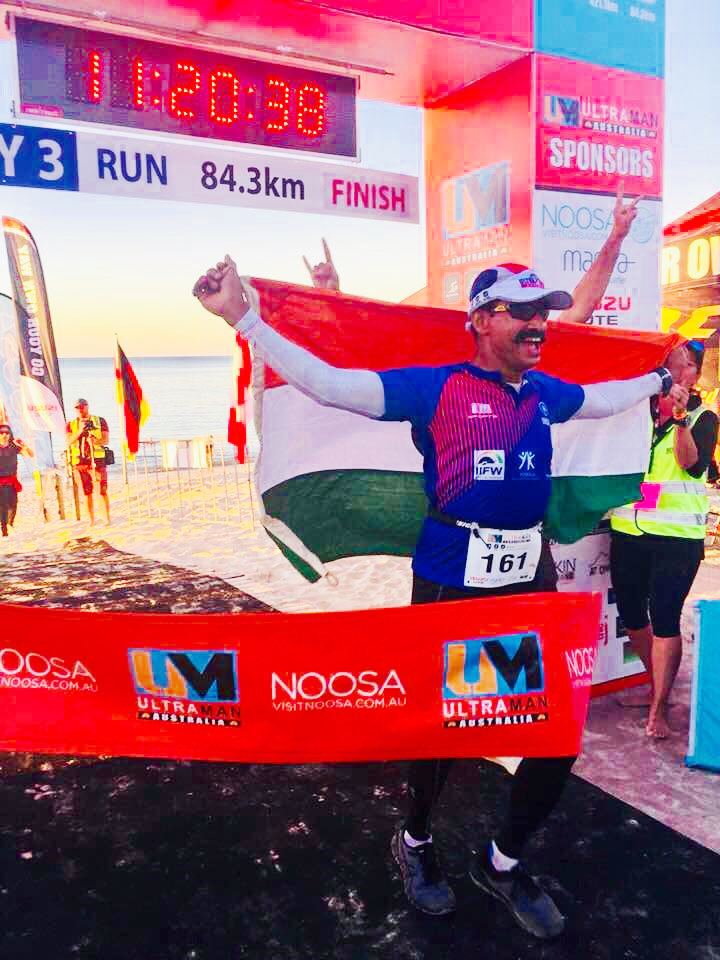
Cycling at Ultraman Australia (Photo: courtesy Krishna Prakash)

In 2013, Krishna Prakash’s superiors approved his request to participate in the event on one condition – his running should not affect the duties expected of him at the Mumbai Marathon. That year Krishna Prakash ran the half marathon segment of the event without any prior training. “ I ran it because I wanted to. There was the wish to run the half marathon. There was no preparation,’’ he said. He covered the 21 kilometer-distance in two hours, seven minutes. Immediately on completion, he changed his attire and resumed his work monitoring security arrangements; it is typically around the time the half marathoners finish that the Mumbai Marathon’s seven kilometer-Dream Run segment featuring the largest chunk of participants, commences. The switch over from half marathon to official duties, worked neatly. Krishna Prakash has participated in the Mumbai Marathon every year since that debut in 2013.Not just that, like many in the city bitten by the bug, he began running at half marathons elsewhere – in Delhi, Pune, Kolkata and Satara. “ This was how things were; till 2016, then everything changed,’’ Krishna Prakash said.

Thanks to Mumbai attracting people from all over India and thanks in part to the Hindi film industry locating many of its stories in the city, some of Mumbai’s suburbs are as well-known in India as the city itself. Dadar is one of them. More than a century ago it had gained distinction as the city’s first planned suburb. In the years that followed, it has been a popular backdrop for Mumbai life in media and conversation. Today Dadar is a busy and noisy convergence of people, shopping, rail and road transport. Its bylanes are comparatively quiet. It was late May 2018. We were at Krishna Prakash’s office in one of the bylanes of Dadar. He was now Inspector General of Police, overseeing VIP security. The change of 2016 he referred to, had happened some 260 kilometers away in an altogether different city and district – Satara. Surrounded by hills, Satara is home to the annual Satara Hill Marathon. The route features gradients. By then, a regular runner of the half marathon, Krishna Prakash ran the half marathon at the event. He ended up with severe pain in the knees. The doctor he consulted painted a gloomy picture – surgery appeared solution and running seemed finished. “ It was October-November 2016,’’ Krishna Prakash said of the incident.

Like many searching for more views than one on life’s troubles, he looked up the Internet to see what it had to say on knees made painful through running. He came across information indicating that problems with knees could be overcome by strengthening muscles directly and indirectly related to their functioning. He also came across information that highlighted the importance of food and food habits for runners.  There was a third angle he required to address. His uric acid level was up; that had to be brought down. According to Krishna Prakash he is largely self-taught in matters of training for sport. He proceeded to address the new options discovered. A longstanding practitioner of yoga, he also worked out regularly at a gym near Churchgate. Should he go with the medical assessment of his knees or should he go with what he felt about himself? – That was the question. Notwithstanding the doctor’s verdict, Krishna Prakash continued his running. “ I kept running despite the knee pain. Slowly I recovered,’’ he said. At the Mumbai Marathon of January 2017, he ran and completed the full marathon.

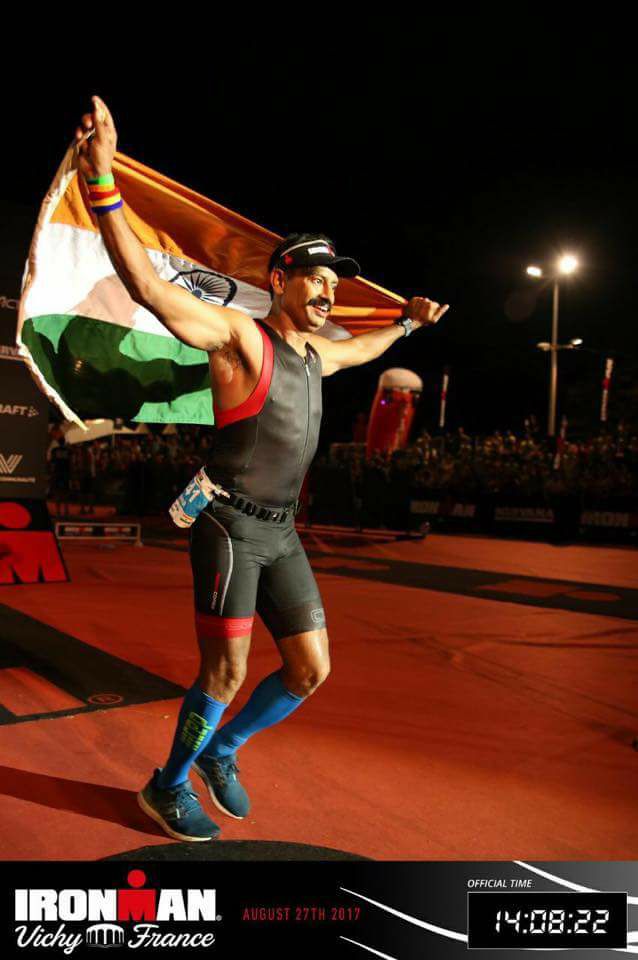
From the Vichy Ironman (This photo was downloaded from the Facebook page of Krishna Prakash)

As the crow flies, the forests and hills at the tri-junction of Karnataka, Tamil Nadu and Kerala are some 1600 kilometers away from Hazaribagh. For two decades this region was backdrop for the activities of Koose Munisamy Veerappa Gounder aka Veerappan, notorious forest brigand. By the time Krishna Prakash was training at the national police academy, the infamous Palar blast in which Veerappan used landmines to kill 22 members of a team of police and forest officials – his single biggest mass killing – had already occurred. Through the 1990s and into the early 2000s, Veerappan stayed elusive, even hogging media attention with the kidnaping of Kannada film star Rajkumar. The bandit was eventually shot dead in October 2004, by the Tamil Nadu Special Task Force headed by IPS officer, K Vijay Kumar. In 2017, Vijay Kumar’s book on the rise and fall of Veerappan – Veerappan: Chasing the Brigand – was published. There was a book release function in Mumbai and among those who attended was, Krishna Prakash. The last chapter of the book is titled ` Shootout at Padi.’ In it Vijay Kumar wrote of the bandit, “ Even at fifty two, he was sinewy and extremely fit. Forensic specialist Dr Vallinayagam, who later examined his body, told me he was in the shape of a twenty five year-old, apart from the problem with his eyes.’’ The observation set Krishna Prakash thinking – if that is the fitness level of a bandit evading the law, then police officers tasked with the job of bringing such people to justice have to be as fit, if not better.

Among the places Krishna Prakash had served at, was Malegaon. It is a city that has had phases of communal unrest. Three to four days after the book release function, Krishna Prakash attended a ` Peace Run’ in Malegaon. At this run, he met a young doctor who spoke to him of the half Ironman. Spurred by his recent thoughts on the subject of fitness and its relevance for the police, Krishna Prakash resolved to do a full Ironman. That’s a big leap; four years into distance running, the full marathon just done for the first time, no dedicated training had in swimming and cycling and here he was, planning full Ironman! Asked if he was taking a chance, he replied with an emphatic “ no.’’ According to him, once he takes up something, he gives it his all. In Mumbai, those who heard of his plan advised him that the route to full Ironman lay through patient training – first triathlons at home, then the half Ironman and eventually the full. Krishna Prakash chose to overlook the suggestions. “ I believe that if a person is confident then he can do what he applies his mind to,’’ he said. A triathlon involving distances greater than what is used for the discipline at the Olympics, Ironman events are held overseas. As yet, India has no Ironman event.

Soon after that introduction to Ironman at Malegaon, Krishna Prakash registered for the full Ironman scheduled for August 2017 at Vichy in central France. Vichy is located on the banks of the Allier River. He chose this event partly because the dates were convenient for his family – wife and daughter – to go along. From registration to event, he had roughly two and a half months to prepare. While he had graduated to running the full marathon in January 2017, his swimming was strictly functional in style and in cycling, he hadn’t ever endured long hours in the saddle. To guide him, Krishna Prakash contacted Pune’s well known triathlete and coach, Kaustubh Radkar. The triathlon – which is what Ironman is – has three disciplines: swimming, cycling and running. Radkar provided the police officer his training schedules and also told him that cycling is 50 per cent of Ironman; swimming and running together constitute the balance 50 per cent. That latter remark, encapsulating the effort and energy cycling takes up in the mix of disciplines that is Ironman, was a gentle reminder of how much work needed to be done.

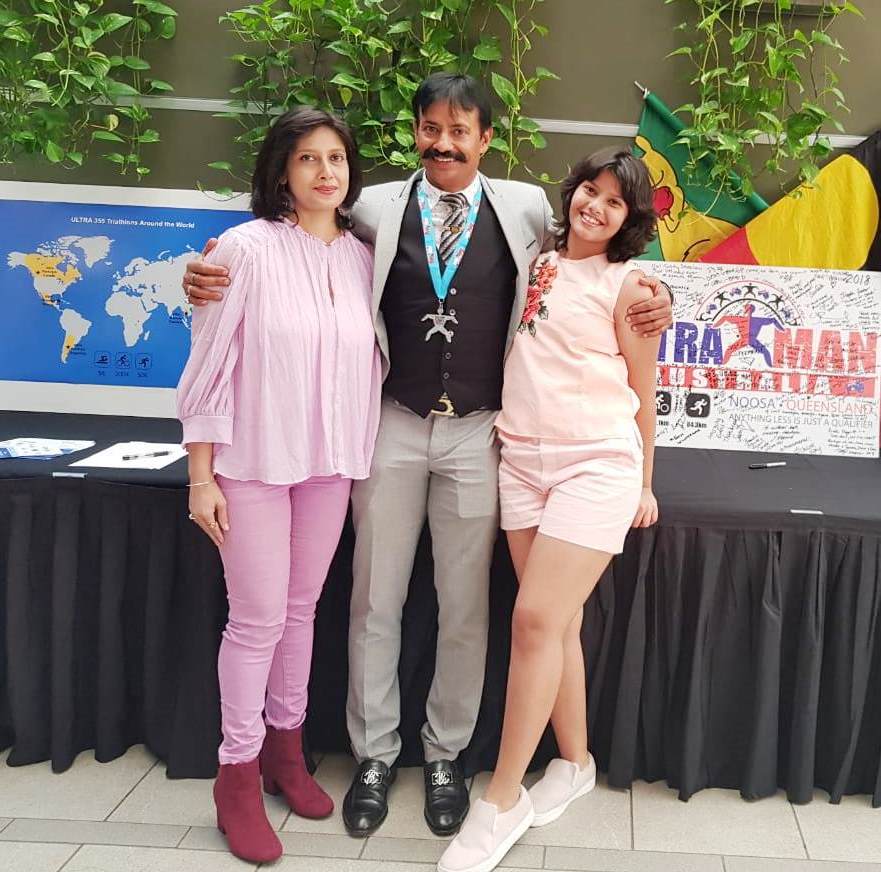
With wife Sanjana and daughter Shaurya at Ultraman Australia (Photo: courtesy Krishna Prakash)

A full Ironman entails 3.86 kilometers of swimming, 180.25 kilometers of cycling and 42.20 kilometers of running – raced in that order. The rules of service for IPS officers provide you leave to participate in sports. What is difficult for a top cop is finding time to train for a city like Mumbai and a state like Maharashtra are never short of issues to keep the police engaged. Post his Ironman resolution, Krishna Prakash’s day commenced at 3-3.30 AM. By 4 AM he would start training. Being a senior police officer must have helped. To swim, he had access to the swimming pool at Garware Club House at Wankhede Stadium, the Mafatlal Swimming Pool on Marine Drive and the pool at the Police Gymkhana, also on Marine Drive. At all these places, the management was kind enough to open the premises very early for Krishna Prakash to train. In the pool though, he was soon battling his own swimming style. His old survival swimming was a composite of several styles, none of it capable of efficient, sustained passage through water. He gradually nudged himself towards freestyle and focused on acquiring strength in it. His running was usually done on Marine Drive with interval training either at the city’s University Stadium or Mahalakshmi Race Course. Much of his cycling happened on the Eastern Express Highway, which still retains a fairly long stretch of service road used by walkers, runners and cyclists. He also acquired a Fuji road bike. While the triathlon’s three disciplines could be worked on separately, the triathlon itself challenges because they are done one after the other, almost seamlessly. Krishna Prakash earmarked his Sundays to get a feel of that. Some of his training sessions for open water swimming were at Pune’s Manas Lake. Early Sunday morning, he would drive to Pune; in the vehicle would also be his cycle. Reaching Pune by around 7 AM, he would spend the next two hours swimming. Swimming done, he would get on his bike and cycle from Pune to Navi Mumbai, reaching there by evening. Then he would run for about one and a half hours in Navi Mumbai; among the places he frequented so was the jogging track at Jewel of Navi Mumbai in the Seawoods-Nerul area. With most amateur athletes, time spent training is usually time borrowed from family. Krishna Prakash’s daughter Shaurya had to accommodate the reduced time she got to spend with her father. The reality of official life is such that a senior police officer like Krishna Prasad can’t always be left alone. His bodyguards had the option to tag along while he trained. On many occasions, they did.

For Krishna Prakash, the full Ironman at Vichy went off well except for one mishap. To cycle, he had brought along his trusted Fuji. Ironman rules, Krishna Prakash said, don’t allow a cyclist to ride close to another for long. The reason is simple and in a different context – that of the peloton; used exactly for the advantages it offers. When you ride close to another (typically behind), it is called `drafting’ or `slipstreaming.’ The practice reduces drag considerably. Krishna Prakash found himself riding close to another and to escape staying so for long (thus inviting disqualification at Ironman), he tried to overtake. Doing so, he courted a smooth patch of green by the road side. What he didn’t know was that lurking below that green was a small ditch. The cycle’s wheel hit the ditch and he fell. This episode aside, Vichy was an encouraging experience. He completed the full Ironman in 14 hours, eight minutes.

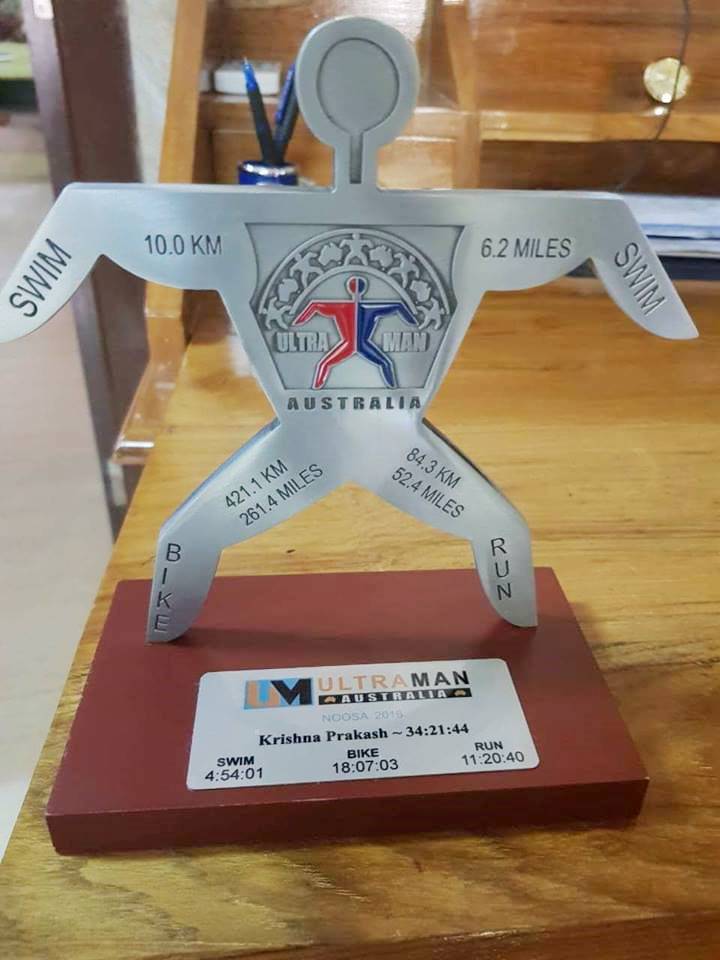
The Ultraman memento (This photo was downloaded from the Facebook page of Krishna Prakash)

According to Krishna Prakash, in the days following the Vichy Ironman, his sole wish was to try and improve the time he took to complete the event. At a minor level, beside the fall while cycling there had also been another mistake, this one likely fallout of his newness to the whole Ironman format. In the marathon segment which was run in loops with each loop marked by a wrist band given to the runner, he had ended up running four kilometers extra because he thought the run concluded at the place where the band was being distributed. All this required to be smoothed out and a clearer picture of performance had. So he registered for the half Ironman in Bahrain. But in the background there were other pulls and comments seeking to influence. One of it was the observation that his timing at Vichy was actually better than what some famous folks who did the Ultraman, got in their Ironman. Why not then, Ultraman next? – So went that line of reasoning. “ Somehow it came to my mind that I should attempt Ultraman,’’ Krishna Prakash said of his eventual drift towards Ultraman. As before, he wasn’t graduating gently in his goals. He was leaping. According to Wikipedia, the first Ultraman was held in Hawaii in 1983. This was followed by similar events in Canada, UK and Florida in the US. In May 2015, Australia commenced its edition of Ultraman; the first edition was staged at Noosa on Queensland’s Sunshine Coast and saw 37 participants. Krishna Prasad signed up for the May 2018 edition of Ultraman Australia. Unlike Ironman, which is over in a day, Ultraman spans three days. Each day’s activity has a cut-off time of 12 hours. On the first day, triathlete does 10 kilometers of swimming and 146 kilometers of cycling. On the second day, it is 275 kilometers of cycling. The event concludes with a double marathon; 84 kilometers of running. As with Vichy, the IPS officer’s choice of Ultraman Australia was partly driven by the fact that it coincided with school vacation in India; it meant his wife and daughter could go along.

At the cycling event in Ahmednagar where Krishna Prakash marked his return to cycling after the accident he suffered during the 2017 Deccan Cliffhanger (Photo: courtesy Krishna Prakash)

Given he had registered for the Bahrain Half Ironman Krishna Prakash initially visualized his progression to Noosa via Bahrain. Then disaster struck. To get stronger at cycling, he had enrolled for the Deccan Cliffhanger scheduled for November 2017. It is an annual 643 kilometer cycle race from Pune to Goa. During the race, Krishna Prakash collided with his support car and crashed. Apart from cuts and bruises, he fractured three bones in his left shoulder. It was bad enough for him to be briefly hospitalized. “ I was left quite frustrated. It upset my plans. I had planned to do sea swimming near Palghar to get ready for the open water swimming due at Noosa,’’ he said. Yet again, surgery was recommended as an option. Krishna Prakash chose the normal, natural course of healing instead. December 2017 and a part of January 2018 went by without any training. Meanwhile the main sponsorship of the Mumbai Marathon had changed from Standard Chartered bank to Tata; the 2018 edition of the event was called Tata Mumbai Marathon (TMM). On January 20, 2018, his injured shoulder and arm wrapped in bandage to restrict movement, Krishna Prakash ran the TMM full marathon. He completed it in four hours, twenty six minutes. “ That gave me some confidence,’’ he said. With that, one third of prospective triathlon had stirred alive again. In March, there was a 100 kilometer cycling event in Ahmednagar. Krishna Prakash was supposed to inaugurate it. He decided to cycle the distance. Once that was done, he knew he could commence distance cycling as training for Ultraman. Regular bicycle trips from Mumbai to Pune and Nashik started. Not surprisingly, sea swimming followed. That latter bit couldn’t be ignored for the swimming at Vichy had been in a river while at Noosa, it would be the Pacific Ocean. For guide to Ultraman, he had Deepak Raj, Australia-based triathlete and coach. Sunil Menon, Hyderabad based-triathlete and coach, also offered helpful advice. Amid accident, the Bahrain Half Ironman had to be however given a miss. It was now straight from accident to Ultraman.

At the finish line of Ultraman Australia (Photo: courtesy Krishna Prakash)

For Krishna Prakash, the three days of May chasing Ultraman in Noosa, were challenging. The quantum of activity each day was sizable and draining and it had to be repeated back to back. But he persevered. He finished the 10 kilometer-swim in four hours, fifty four minutes. The full component of 421 kilometers cycling – first day’s 146 kilometers and second day’s 275 kilometers, combined – was done in 18 hours, seven minutes. He wrapped up the double marathon in 11 hours, 20 minutes; Shaurya ran the last two kilometers with him encouraging him on. In total, he took 34 hours, 21 minutes to complete Ultraman Australia. According to the event’s website, he placed 43 on the finishers’ list. Vichy’s shadow made its presence felt down under too. Krishna Prakash chose to leave his trusted Fuji behind in Mumbai and use a borrowed time trial bike in Noosa. In retrospect, that was a bad decision. The bike fit was far from perfect; the aerobars were short for his arms and although he adjusted the seat as best as he could, he found himself bunched up. Further, the cycle’s brakes decided to play spoil sport; they ran tad lose. Result – on a portion of road close to the city, he swerved to avoid a vehicle and crashed into a wooden fence. His left shin was cut and it swelled up. The area around his right toe also swelled up. The remaining part of the bike ride was therefore cautiously executed. Worse, the injured legs affected his performance in the double marathon. We asked him if he had fully recovered from the fracture to his shoulder before he left for Australia. “ Yes. After all I was swimming,’’ Krishna Prakash said. Then he moved his left shoulder as though to be surer. “ There is some stiffness still, you know,’’ he said smiling. On plans ahead, he preferred to stay quiet, except for a general resolve mentioned to attempt more triathlons.

(The authors, Latha Venkatraman and Shyam G Menon, are independent journalists based in Mumbai.)    

2018 IAU TRAIL WORLD CHAMPIONSHIP / INDIAN TEAM PLACES 26TH, KIEREN D’SOUZA BREAKS INTO TOP 100

Team India at the 2018 IAU Trail World Championship. From left: Sampath, Lokesh, Aakriti, Ajit, Kieren and Ullas (Photo: courtesy Kieren D’Souza)

At the recently concluded IAU Trail World Championship in Spain, the Indian team placed 26th in a field of 34 teams.

At the individual level, Kieren D’Souza broke into the top 100. He placed 98th as against 195th in 2017. Ullas Narayana similarly moved up from 143rd to 118th. The 2018 edition of the championship was held at Penyagolosa, Castellon de la Plana. According to an official statement from the Athletics Federation of India (AFI), 331 runners from 49 countries participated in the 2018 edition of the event. India was represented by Ullas Narayana, Lokesh Meena, Ajit Narwal, Sampathkumar, Kieren D’Souza and Aakriti Verma.

IAU stands for International Association of Utrarunners.

As per information on the event website, the course was 85.3 kilometers long with positive elevation of 4900 meters and negative elevation of 3690 meters. There was overall cut-off of 15 hours with separate stage cut-offs. Luis Alberto Hernando of Spain topped in the men’s category, completing the race in 8 hours 38 minutes. In second and third positions respectively were Cristofer Clemente of Spain and Thomas Evens of UK. Among women, the winner was Ragna Debats of Netherlands who finished in a time of 9 hours 55 minutes. She was followed by Laia Canes of Spain and Claire Mougel of France. Kieren, who was the fastest among the Indians, completed his run in 10 hours 59 minutes. The top three teams in the men’s category were Spain, Great Britain and France in that order. In the women’s category, the corresponding teams were Spain, France and USA.

The race was technical, and for the Indian runners it was a great experience, the AFI statement said. While 49 countries were represented at the 2018 World Trail Championships, the number of teams was 34 because it takes a minimum of three people to be a team. The consolidated timing of the top three finishers from each team is taken to decide team ranking.

Kieren at the 2018 IAU Trail World Championship (Photo: courtesy Kieren D’Souza)

The race in Spain was only the second instance of Indians participating at the IAU Trail World Championship. In 2017, two runners had taken part. To select the Indian team, AFI banked on the points runners had accumulated under the points system of the International Trail Running Association (ITRA), Peter D’Souza, who is a member of the AFI committee overseeing trail running, said. A minimum of 600 points was set as cut off for an Indian male runner to be eligible to join the team and 550 for a woman. To accumulate ITRA points, runners have to run at races registered with ITRA.

Aakriti Verma, from Bengaluru who took part in the 2018 edition is as yet the only woman from India to have participated in the IAU Trail World Championship. A HR professional working with Infosys, she has been into distance running for the past three and a half years. Over the last one year her affection has been more for trail running and in that time, she ran seven to eight races on trail at various places in India. She accumulated the ITRA points required to join the Indian team, from these races. The world championship was an eye opener for her. “ It was a great opportunity to learn,’’ she said. She and Lokesh couldn’t complete the race while Ajit completed the race 13 minutes after overall cut-off. Aakriti put her experience in perspective. According to her, the race in Spain was quite technical; the terrain was rocky. In contrast, much of her training and regular running had been on the trails of southern India, which tend to be less rocky and gnarly. As she put it, we typically bring in the addiction for distance borrowed from other formats of distance running and look for a good trail to execute it on. Compared to Europe, technical terrain is less in the trail races of India. This lack of familiarity with technical terrain was the biggest difficulty she faced in Spain. Further, trail races have stage cut-off and at the world championship, the cut-off timings are understandably stiff. In Spain, after more than half the race done, Aakriti had to come off because her pace didn’t indicate that she would be meeting the next cut-off. Her experience in Spain has strengthened Aakriti’s resolve to improve. To add variety to the terrain she runs on, she plans to spend time in Manali, do hikes in the Himalaya and maybe, run in the US. She hopes to take part in trail races in India and overseas.

Asked about the visible improvement in ranking he showed (from 195 to 98) in Spain, Kieren said that this year there had been greater clarity in terms of participating at the championship with consequent room to plan and prepare in advance. Running ultramarathon distances on trail is yet very nascent in India and the sport is therefore little known. Participating in events like the world championship requires official representation routed through relevant national sports bodies. New disciplines take time to be understood and backed. In 2017, participants from India got to know that they are going for the championship only two to three months in advance. Full clarity came still later. That limited the time available to train. This year, with the ice broken in 2017, there was greater certainty of participation. “ I was mentally prepared,’’ Kieren who spends most of his time in Manali, said. He not only used the mountain ambiance he lives in to train for the world championship, he also made sure that the event in Spain would be the first overseas event he goes to in his 2018 racing calendar.

Sampathkumar at the 2018 IAU Trail World Championshp (Photo: courtesy Kieren D’Souza)

Sampathkumar who hails from Hosur and lives in Bengaluru has been into running since the past three to four years. He works at Infosys. The first trail running event he participated in was the 2015 edition of Javadhu Ultra organized by Chennai Trekking Club (CTC). Save a race or two, he said he never missed any of the trail events organized by CTC; he credits Peter Van Geit with introducing him to the sport. Since the 2015 Javadhu Ultra, Sampathkumar has run at various trail races in India at locations as varied as Kutch, Dehradun, Shimla and Malnad. He shared Aakriti’s observation that the biggest difference in Spain was the technical nature of the terrain. It wasn’t so much elevation –  the ups and downs – as it was terrain. He believes that the closest he came to a similar situation earlier, was at one of the editions of Paradise Trails in Goa (Race Director is Dan Lawson), wherein runner had to navigate by oneself and some portion of the course was technical. But then again, that was a limited stretch. Sampathkumar believes that if Indians are to be ready for courses of the sort seen at the 2018 IAU Trail World Championship, then domestic trail races must begin embracing technical terrain. Further, compared to events overseas, cut-offs at Indian races are lenient and the gap between aid stations are designed to contain stretch. He felt that there are Indian race organizers willing to put together races that are technically challenging but the trail running community has to support such shift and that happens gradually. In India, the tendency to persist with prevailing comfort zone is high. If at least some races in India mimic the conditions found at races overseas, then the possibility of domestic trail running becoming relevant to perform well overseas improves. In Spain, Sampathkumar was the last of the Indians to complete the race within cut-off; he finished in 13 hours, 25 minutes. “ I am happy I finished within the cut-off time,’’ he said. He was no stranger to the distance involved. Almost as long as the course in Spain was the 80 kilometer-trail running race in Vagamon he had gone for earlier and which, he covered in approximately nine hours. “ Spain was a great learning experience,’’ he said.

Ullas Narayana at the 2018 IAU Trail World Championship (Photo: courtesy Kieren D’Souza)

According to the AFI statement, the participation of the Indian team was an athlete-funded event. The athletes had to pay for their travel while the AFI ensured their accommodation. It is understood that this format had to be resorted to because disciplines like ultramarathon and trail running are not part of the pantheon of Olympic sports. In the awarding of funds and their subsequent allocation the `Olympic’ tag typically decides priority. At the Olympics, the longest distance currently run is the marathon. In contrast, the world of ultramarathon and trail running is filled with distances that are far longer and terrain that is more varied than what is seen at the Olympics. It is learnt that such funding challenge is not specific to India. Athletes from several other countries too, seek help from sponsors because the sport lacks the Olympic halo. For the 2018 IAU Trail World Championship, Azani Sports came forward to provide the Indian team with kit and Unived provided the nutrition supplements and hydration. Support crew is most essential at an ultra-running event and this year, Renu Narwal and Kapil Malik (thanks to Ajit Narwal), provided such assistance to the team, the AFI statement said.

The 2019 IAU Trail World Championship will be held in Portugal.

(The author, Shyam G Menon, is a freelance journalist based in Mumbai. For more on Kieren D’Souza please click on this link: https://shyamgopan.com/2017/01/22/the-one-thing-i-am-sure-about-is-that-i-wish-to-run/)