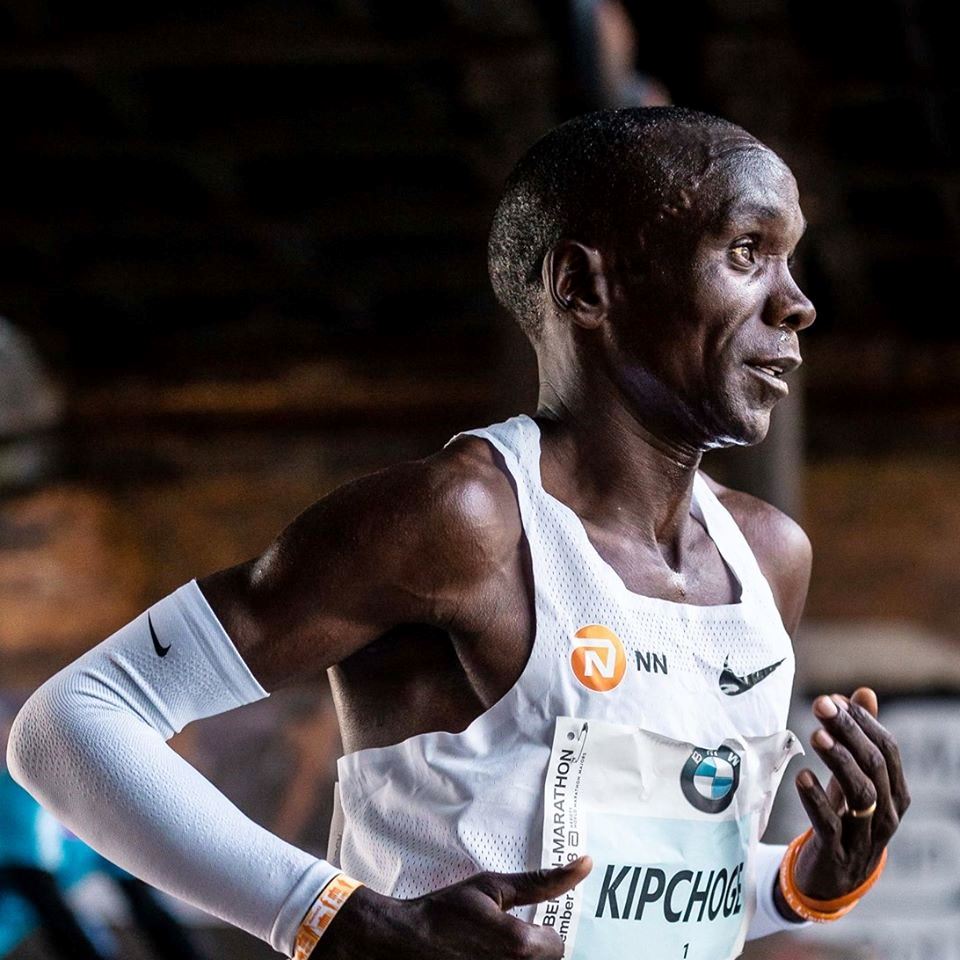
2019 ADHM / TSEHAY GEMECHU OF ETHIOPIA SETS NEW COURSE RECORD

Tsehay Gemechu (This photo was downloaded from the Facebook page of ADHM and is being used here for representation purpose)

Defending champion Tsehay Gemechu of Ethiopia set a new course record in the women’s category at the 2019 edition of Airtel Delhi Half Marathon (ADHM), covering the distance in an hour and six minutes, 50 seconds faster than the previous record in her own name, registered last year.

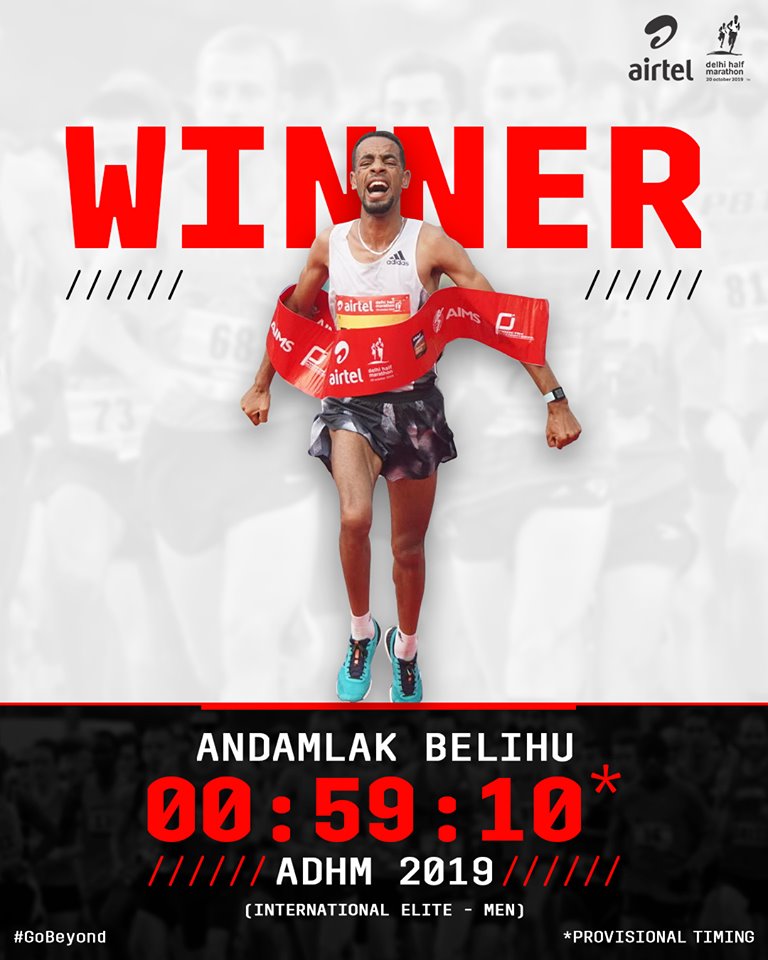
The overall winner of the half marathon was Andamlak Belihu, also of Ethiopia. He finished the race in 59 minutes and 10 seconds to defend his title.

He was followed by compatriot Solomon Berihu in second place with timing of 59:17. Kenya’s Kibiwott Kandie finished third in 59:33 minutes.

In the women’s race, Yelamerf Yehualaw came in second, finishing just one second after Gemechu. Zeineba Yimer finished third with a timing of 1:06:57.

Among Indian elite athletes Srinu Bugatha won the men’s race with timing of 1:04:33. Suresh Patel came in second at 1:04:57 and Harshad Mhatre was third at 1:05:12.

Among Indian elite women, Suriya Loganathan topped the race finishing in 1:12:49. She was followed by Parul Chaudhary (1:13:55) and Chinta Yadav (1:15:28).

In the amateur category, the overall winner was Sidhapa Mayappa. He finished in 1:09:43. Manjeet came in second with timing of 1:10:34 and Ravendra Singh came in third at 1:10:48.

Andamlak Belihu (this photo was downloaded from the Facebook page of ADHM and is being used here for representation purpose)

Among amateur women, the overall winner was Preity Rai with a finish of 1:26:39. Seema Yadav came in second with a 1:34:14 finish and Chandrawati Rajwade placed third at 1:34:23.

For Seema Yadav, a resident of Faridabad it was a personal best (PB). “ My run could have been better. I finished with an improvement of 24 seconds over my previous best timing for a half marathon,’’ she said.

Weather, according to her, was good at the start of the race but turned warm towards the latter half. “ At India Gate, we had the full blaze of the sun on us,’’ she said.

Held for the first time in 2005, ADHM is an IAAF Gold Label race. Thanks to its generally flat course, it is among races returning fast finish-time. In 15 editions of the event, winners in the male category have produced sub-hour finishes 11 times. Among women, sub 1:08 finish was clocked on six occasions. The course record for men is 59:06, set in 2014 by Guye Adola of Ethiopia. Ethiopian runners have dominated this event; their men winning in their gender category nine times and their women, eight times. According to news reports, the total number of participants at ADHM was at a record high in the 2019 edition with 40,633 registered. The race featured total prize money of 275,000 dollars. The event was flagged off early today morning (Sunday, October 20) by sports minister, Kiren Rijiju.

(The author, Latha Venkatraman, is an independent journalist based in Mumbai.)

OCTOBER 2, 1955

Illustration: Shyam G Menon

The voice at the other end of the phone line sounded alert and articulate. We decided on Friday, 4PM to meet. Friday’s conversation happened in the kitchen of the apartment; there was a youngster next door preparing for his exams. At the small dining table, pantry nearby for making coffee, the 86 year-old gave me an overview of his life and the early days of climbing in Mumbai.  

On October 2, 1955, two young men stood on top of the Karnala pinnacle, roughly 13 kilometers from Panvel in Navi Mumbai.

Rock climbing was very much in its infancy those days in the Mumbai region. Almost sixty four years later, one of the two climbers, a student of Topiwala National Medical College (TNMC) back then, remembered an instance – possibly an afternoon – from two years prior to the Karnala episode. It was June 1953, and after a circuitous process whereby a coded message was carried by runner from Everest Base Camp to Namche Bazaar, then dispatched as telegram from there to the British embassy in Kathmandu and relayed onward from there to London, news of Tenzing Norgay and Edmund Hillary achieving the first ascent of Everest on May 29, 1953 was at last broken to the world on June 2. The day the news appeared in India, the young man in question – 86 years old when I met him at his house near Bhatia Hospital in Mumbai in October 2019 – was standing in queue at the city’s Metro Cinema to catch a movie, likely an afternoon show. The day’s newspaper was being sold and the ascent of Everest was prominently featured. The news was also broadcast on the radio. He remembers rushing to the British Council Library, a favorite haunt to read, for more information on the development.

“ The first ascent of Everest created quite a buzz,’’ he said, recalling the early days of climbing in Mumbai. By all accounts, the instinct in him those years was less a specific activity called climbing and more, the desire to explore; taste adventure. In 1949, as a sixteen year-old, he had made his first push in that direction, buying a return ticket to Kalyan at what was then the Victoria Terminus (VT) station – now called Chhatrapati Shivaji Maharaj Station (CSMT) –  and then boarding the train to see parts of Mumbai he hadn’t been to yet. “ It was beautiful after Thane. At Mumbra, the Parsik range and its rock faces appeared. Then there was the Ulhas River further on,’’ he said. The rock faces reminded of landscapes featured in foreign magazines, some of which, he had gotten to see; there was Life magazine and the books on the shelves at British Council Library and American Center. More importantly, the hills reminded of memories from childhood.

The young man atop Karnala was born in 1933 at Tedim, administrative headquarters of the Chin Hills in north-west Myanmar. It was a remote place, especially in that era. His father was a doctor.  Tedim had no electricity, no telephone; there was one telegraph line. It took several days from the nearest road to reach Tedim, a journey – he said – his mother with her orderly had made on two ponies all by themselves. Yangon (Rangoon then) was a long way off to the south. When he was seven years old, the future climber was packed off to boarding school in Yangon. By then his father was working in Shwedaung. In 1942 the Japanese attacked Yangon; their planes bombed the city. In its wake, orders for evacuation were issued. Thanks to his position as doctor, his father was assured passage aboard a ship to India. But that was for only him. He turned down the offer and elected to stay with his family, now facing the prospect of walking all the way to India. This exodus of Indians, Europeans and troops of the British Indian army is well documented. They followed two routes both fairly treacherous. The first was the shorter route running through the Arakan Peninsula into what is now Bangladesh. The second was the longer route leading to Imphal, Manipur in North East India. The climber’s family opted for the second route. “ On the way, the long convoy was periodically attacked by Japanese aircraft. You could see the pilot in the cockpit looking for a suitable target as he approached. They spared the Indians but not the British, who got strafed. So when we heard the aircraft’s sound we would bundle the British onto the trucks accompanying the convoy and cover them with tarpaulin,’’ he recalled.

Upon reaching Manipur and assistance from volunteers of the Indian National Congress, the family made its way to Mumbai where their relatives stayed. “ We had nothing with us except the clothes on our back and some belongings. We started life afresh. We stayed initially at a chawl on Lamington Road. Now I am here,’’ the 86 year-old said. Tardeo nearby was a busy crossroad as was the road in front of Bhatia Hospital. But Talmakiwadi where the apartment stood was peaceful. The long walk from Myanmar assumed significance because to his mind, that childhood spent in remote parts of Myanmar and later steeled by trek of five weeks over the hills of Myanmar and North East India amid World War II, may have sown in him the ability to endure discomfort. That’s useful for a life in the outdoors.

Among Maharashtra’s pinnacles, Karnala is small. It has been climbed many times. By the 1980s and 1990s, it was among the first pinnacles anyone into climbing attempted.  You finished a rock climbing training camp and headed to Karnala for graduation. By then rock climbing shoes, ropes and gear had started trickling in; at the very least people had stuff sourced through friends and relatives abroad. Today, there are plenty of options in Mumbai for youngster curious about the outdoors. There are clubs to train with, supported hikes in the nearby hills and seasonal camps and expeditions parents are happy to dispatch their children on.  Things were different in the 1940s and 50s. “ Unlike today’s dilemma of which role model to select from the many available, back in time we had none to follow,’’ he said. In Mumbai of the 1940s, there was nobody to train budding hiker-climber. So books became teachers. On trips to the hills and rock, they experimented with some of the things they had read about – a climbing move or two. Slowly, they picked up techniques. They read about climbing knots and practised making them but having no equipment, restricted their climbing to safe limits partial to learning technique. Improvisation played a role.  Buzz around Everest notwithstanding, outdoor pursuits like hiking and its infant of a relative – climbing, were utterly niche hobbies in Mumbai. In fact, the first time the young man met others interested in the outdoors, was when he joined TNMC.

Illustration: Shyam G Menon

That was why the 1955 Karnala climb felt like a marvel. It smacked of personal break-through. The hike to the pinnacle had been long; much longer than the comparatively short walk of today. “ The vultures on the pinnacle flew away seeing us climb up. We also made sure not to disturb the honeybees and their hives, known to be around. We climbed the pinnacle with no equipment or rope and on bare feet,’’ he said. At the top of the pinnacle, the enormity of what they did and the descent that waited, hit them. “ We wondered if anyone else had climbed it before,’’ he said. Around 1955, the young man walked into a meeting of the Bombay University’s hiking club. “ There I ran into Professor Manjrekar. He was a year senior to me and well established in trekking. I was also introduced to Professor D. B. Wagh, who was then president of the hiking club,’’ he said. Same time, the young man set about securing more information on Karnala pinnacle; he wanted to find out if it had been climbed before. At a public library in south Mumbai, they checked the Bombay Gazetteer published in 1882. It had a section on Karnala; detailed maps and all. It informed that the British had climbed it with ropes and ladders. Still one question remained – had anyone climbed it without equipment? Politician and Member of Parliament, Homi Talyarkhan was author of a couple of books on the surroundings of Mumbai. The young man wrote to him informing of the climb. Talyarkhan invited the two climbers over and gifted copies of his book. What excitement remained was however short-lived. Sometime later, at an exhibition in Mumbai, the two friends came across material on the Parsi Pioneers and a photograph of the well-known mountaineer Keki Bunshah (in 1958, he would be leader of an Indian expedition to Cho Oyu, the sixth highest mountain in the world). In the photo, Bunshah could be seen climbing Karnala pinnacle clad in white shirt, white pants and white canvas shoes. There was no rope, no gear visible. So no, they were definitely not the first atop Karnala, not the first climbing it without equipment either. “ I belong to the early days of climbing in Mumbai. But the real pioneers were the Parsis. If I am not mistaken, there was also climbing around Mount Abu in western India in that early phase,’’ he said. Some years later, the Parsi Pioneers would become a more tangible link because their publication with regular update of activities used to reach Climbers Club, when the latter started functioning in Mumbai. It was common for the two outfits to exchange notes.

Having completed his MBBS, the young man entered government service as a doctor. He served in a rural area away from Mumbai and his parents. Committed as he was to his work, he didn’t last long in that job. He wasn’t successful as a private practitioner too. That approach didn’t seem to gel for him. Luckily, an opening emerged to teach at Nair Hospital. “ From that point onward, there was no looking back,’’ he said. He would work there for many years, eventually retiring in 1991 as Head of the Department of Pharmacology and Radio Isotopy. Being an outdoorsman he took students – those interested – on outings. “ I used to tell them – you will seek wealth, I seek health and fitness. When I retire I will be living on my pension,’’ he said. Back in the 1950s, the period from 1955 to 1960 was spent on private trips to the outdoors; he hiked and put whatever climbing moves he saw in books into practice. In 1954, the Himalayan Mountaineering Institute (HMI) came up in Darjeeling. In 1959, the Mountaineering Committee was born in Mumbai and a year later – in 1960 – it transformed to Climbers Club. The young man had joined the Mountaineering Committee.

The Committee sought to conduct an annual rock climbing camp in Mumbra. The self-taught young man wasn’t particularly impressed by the climbing skills of those on the Committee. It was a peculiar situation. On the one hand, everyone around knew that he moved well on rock, sometimes better than them. On the other hand, when Climbers Club took shape they wanted every member to have done a basic mountaineering course and every life member to have done an advanced mountaineering course.  He never did any formal course in climbing. But in 1960, he did join Climbers Club. Every December, Climbers Club organized four to five training camps at Mumbra taught by HMI instructors. Prominent mountaineers like Nawang Gombu (first man to climb Everest twice) and Ang Kami Sherpa came to teach. In later years, instructors from the Nehru Institute of Mountaineering (NIM) came. By around 1975, Climbers Club started losing steam. It doesn’t exist anymore. But other clubs like Girivihar (which emerged from the Bombay University’s hiking club), Explorers and Adventurers (E&A) and several more have kept the flame of climbing alive in the city.

In those early days, there was no rock climbing shoes. It was typically Hunter shoes. “ I found that they improved in friction and perch once they aged, lost tread and the sole became flat,’’ he said. Ropes used were made of hemp. The 86 year-old even recalled a harness fashioned from hemp, fabricated locally. During the 1960s, when Climbers Club was active, all the metal gear used in climbing came from the Indian Army. “ There were heavy iron and steel pitons and carabiners of different types. If I remember correct, they cost seven to ten rupees a piece. The amount seems small but so was income those days. We accumulated gear slowly. Hemp rope was priced at one rupee per yard or so. One rope served for both climbing and rappelling. There was no testing. Nylon ropes came much later. Carabiners too started coming from abroad – brands like Pierre Allen and Stubai. Another source of gear for us was people who had worked on Himalayan expeditions,’’ he said.

Among the things he acquired – in the 1960s – was a classic wooden handled glacier ice axe. The wood requires periodic treatment with linseed oil. Obtained from Climbers Club, it served him well on Himalayan trips. The last time he took it out was in 2003, on a trek to Pindari Glacier. He was 70 years old then. “ I still have the axe. My grand-nephew has given it a good cleaning. The only problem is that unlike the small light ice axes of today, this one is big. You can’t conceal it. On the train, policemen came and asked me – what are you up to?’’ he said laughing. At the crags, climbers from the early clubs – Climbers Club and Girivihar – would run into each other. They got along; helped each other. “ Clubs should work together. They shouldn’t let competition get in the way,’’ he said. Foreign climbers used to drop by in the early years of climbing in Mumbai. One of them – he recalled – was the Swiss mountaineer Raymond Lambert, who had been on early Swiss expeditions to Everest from the southern side. In May 1952, he along with Tenzing had reached 8611m on Everest, at that point the highest altitude anyone had climbed to. In Mumbai, Lambert accompanied local climbers to Mumbra.

Illustration: Shyam G Menon

The last Himalayan expedition the 86 year-old was on, was a solo trip from Mumbai with pretty big load to Manali and the nearby Manalsu Nallah. “ It wasn’t exactly expedition; I don’t call it so – more a personal jaunt. I was unable to join my friends when they went a few months earlier to the same place. So I went alone afterwards. There’s a peak there called Khanpari Tibba. I climbed it but the descent happened at night. There was snow. I had my trusted ice axe in one hand, a torch strapped to the other so that if I fell, I  could use both hands on the axe to arrest my fall,’’ he said. He had hired three local persons to assist but they weren’t with him when the descent occurred. The solitary light coming down the dark slope was noticed by people from far who asked him of it later. That was in 1966. Today Khanpari Tibba is a much advertised hike. Times change; perceptions change. For instance, nowadays climbers don’t settle for one mountaineering course; they do a handful and perch unassailable on top of a mountain of certificates. The 86 year-old, who never did a course, sees it differently. “ Did Eric Shipton do a course? Did John Hunt do a course? Take a person who did a course ten years ago. He is all flab now. Outdoor activity is something that springs from within you. The rules and regulations of a club may not suit everyone,’’ he said.

Many of Mumbai’s early climbers are no more. A comprehensive multidimensional account of the early days will be difficult to piece together. “ Sir, it is tradition to have a photo of the person I spoke to alongside the article. Failing which, I illustrate. Is it alright if I took a photo?’’ I asked. He thought for a second or two. “ No, spare me that. The account of that period matters more than the person,’’ Dr Srikar R. Amladi, 86, said. At the time of writing, he still enjoyed his periodic excursions with family to Matheran. The friend who was along with him on the Karnala climb was the late Sharat Chandra Sarang, popularly known as Baban Sarang. “ He was a couple of years junior to me. Baban passed away several years ago,’’ Dr Amladi said.

Tedim in the Chin Hills is now accessible by road. Besides its road connection to other parts of Myanmar, there has been since World War II, a Tedim Road linking Imphal to Tedim. The Tedim Road was built by the British to aid the war effort. As per accounts on the Internet, it was made operational in 1943 after the first wave of Japanese attacks on Yangon. The subsequent occupation of Myanmar (Burma) by the Japanese brought the war close to India’s borders. The Japanese advance would continue till their defeat and push back at Imphal and Kohima by the Allied forces. Like the Stilwell Road running from Ledo in Assam to Myanmar and onward to Kunming in China, awareness of the Tedim Road, post 1947, was most with regard to the functional portions of the road within India. There was little talk of ill maintained sections beyond the border leading to places in Myanmar. Things have been slowly changing. A February 2016 report in The Assam tribune said that the Rih-Tedim Road Project will provide all-weather connectivity between eastern Mizoram and western Myanmar. In January 2018, The Hindu Business Line reported, “ A detailed project report (DPR) is underway to build the Rih-Tedim road that will help connect the Trilateral Highway through Zokhawthar-Rih border in Mizoram, where India has already committed huge sums for widening the highway. Currently, Myanmar is connected by road only through Moreh in Manipur.’’ The Trilateral Highway will connect India, Myanmar and Thailand.

(The author, Shyam G Menon, is a freelance journalist based in Mumbai. This article is based on a conversation with Dr Amladi. Thanks to Ravi Kamath of AVI Industries for an afternoon spent talking about climbing in years gone by, wherein he mentioned of Dr Amladi and suggested that I meet him to know more. Please note: while this blog writes about climbing, including free climbing, it recommends that climbing be done with safety gear and protocols in place.)  

2019 CHICAGO MARATHON / TALKING TO SOME OF THOSE WHO PARTICIPATED

Kavitha Reddy (Photo: courtesy Kavitha)

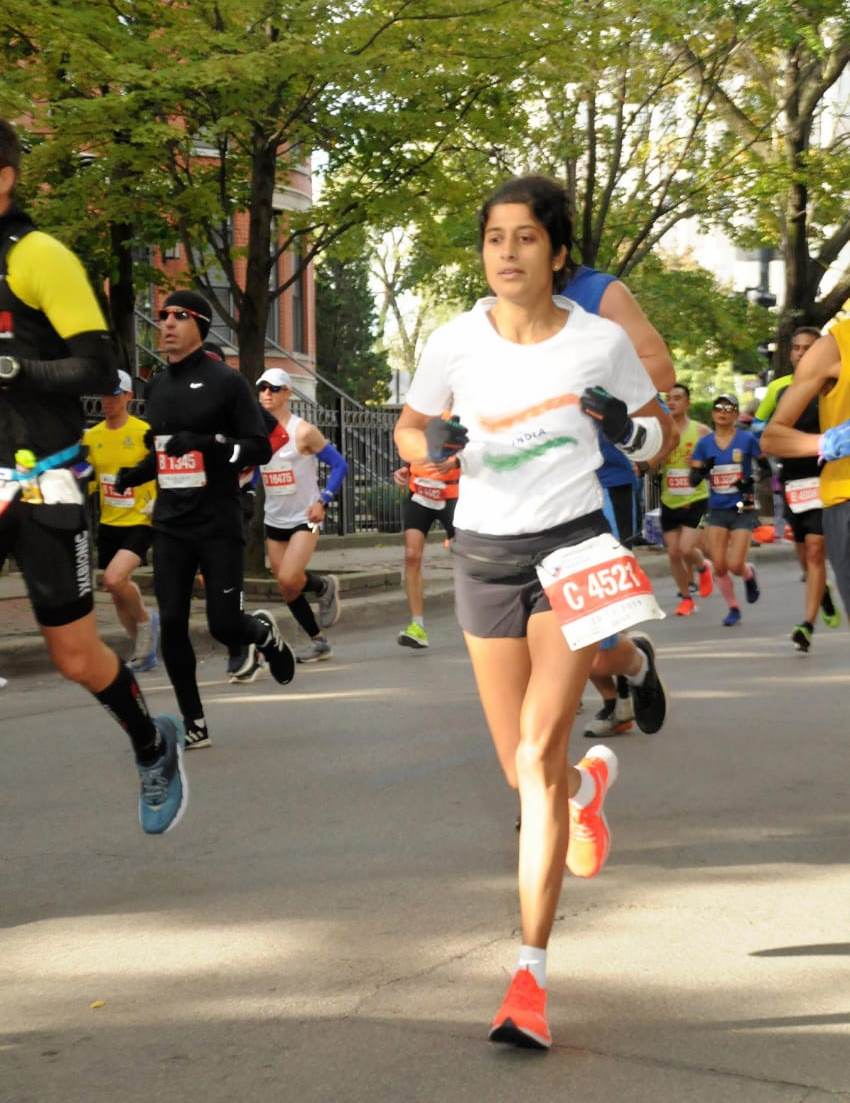
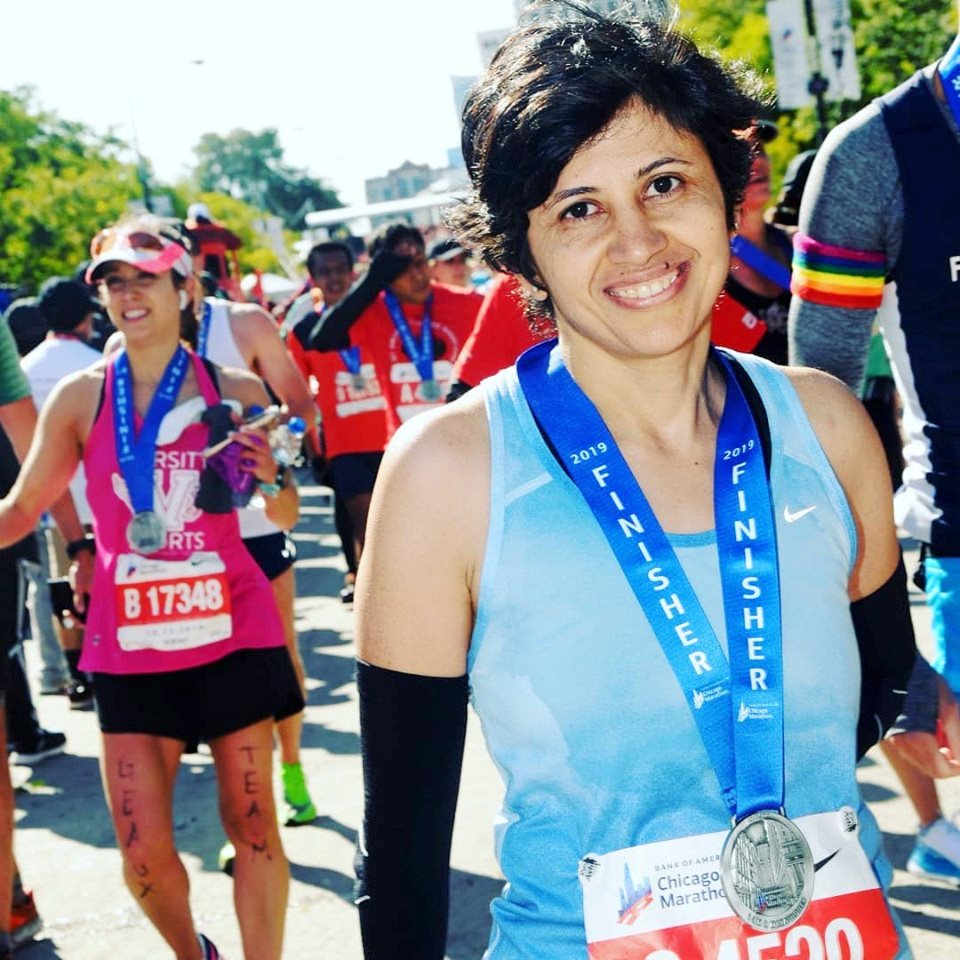
The 2019 edition of Chicago Marathon was in the limelight for Kenyan runner Brigid Kosgei smashing the 16-year-old world record in the women’s marathon held by British athlete, Paula Radcliffe. Kosgei covered the distance in two hours, 14 minutes and four seconds, a significant improvement on Radcliffe’s long-standing record of 2:15:25. Chicago Marathon is part of the World Marathon Majors and attracts runners from all over the world, including India. We spoke to some of the runners from India, who took part in the event this year.

Kavitha Reddy

Pune-based Kavitha Reddy set out to run Chicago Marathon with a target of 3:15 – 3:17, an improvement over her personal best of 3:23 achieved at the 2019 London Marathon.

“ At the start line, I decided to go with the comfortable target of 3:17 and the plan was to push strong during the last two kilometers. But my GPS device did not work properly. I did not know at what pace I was running. I kept running at an even pace,’’ she said. She finished the race in 3:14:19.

Kavitha was the fastest among women runners from India at 2019 Chicago Marathon.

She attributes her strong performance to her training, which was bang on target. Her training helped her immensely as she was able to maintain the same pace throughout the run, she said. “ The crowd support also pulls you through to the finish,’’ she said.

Chicago Marathon was Kavitha’s fifth World Marathon Major. She is now slated to run Tokyo Marathon in March 2020.
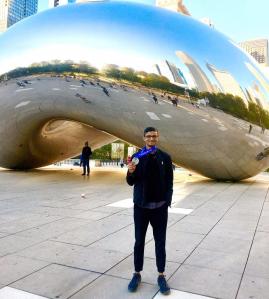
Sharath Kumar Adanur (Photo: courtesy Sharat Kumar)

Sharath Kumar Adanur

Sharath Kumar Adanur set out to run the 2019 Chicago Marathon with a time target of 2:45. His training leading to the marathon was tuned for that finish.

“ I trained intensely during the months of July, August and September but the overall mileage was not very high,” the Jamshedpur-based runner said. He focused on the quality of training rather than volume. During the training period, he also participated in two races – Dream Runners Half Marathon and the half marathon at Airtel Hyderabad Marathon.

A day before Chicago Marathon, he ran a 5 kilometer-race to get a feel of running in the city’s cold weather.

At Chicago, he was able to maintain his pace for most part of the race but strong winds towards the end of the run did pull him back. He finished the marathon in 2:46:06.

“ I knew about GPS issues in Chicago. For that reason I had planned out my mile splits. I was on course to meet my target until the 35th kilometer. But exceptionally strong winds towards the later part of the race prompted me to slow down,” he said.

Chicago Marathon was Sharath’s third World Marathon Major, having run Boston Marathon and New York City Marathon. He has to finish Tokyo Marathon, London Marathon and Berlin Marathon.
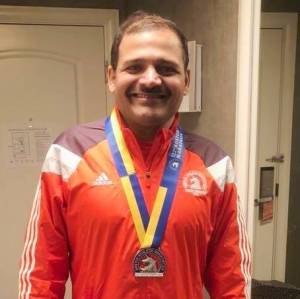
Amod Bhate (Photo: courtesy Amod)

Amod Bhate

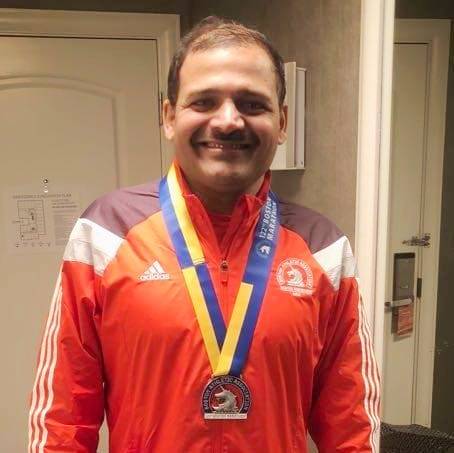
Pune-based runner and coach Amod Bhate started running in 2001 primarily for health reasons. His foray into marathon running happened much later in 2012.

Chicago Marathon was his third World Marathon Major.

Amod follows a three-day running, three-day cross fit and strength training plan. But his training ahead of Chicago was hampered by an extended rainy season in Pune. “ I missed some key running sessions. It was not possible to run because of heavy rains. I had to tweak my training plan,” Amod said adding that he focused on cross training. “ I follow the Run Less, Run Faster method of training,” he said.

At Chicago, Amod decided to go with the sub-three-hour pacers as GPS devices do not work on that route. “ I met the pacers the previous day and asked them about the strategy they would be adopting,” he said.

Amod was keen to get a sub-three-hour finish. His best until Chicago Marathon was 3:06:18 at Tata Mumbai Marathon 2019.

“ On the previous day, it was quite windy. But on the morning of the marathon, it was bright and sunny. I just went along with the pacers right from start to finish,” Amod said. He finished the race in 2:59:48.

There were about 50 runners running along with the sub-three-hour pacers. The huge group of runners stayed together until the finish.

Amod did Berlin Marathon in 2016 and Boston Marathon in 2018. He will be running Tokyo Marathon in 2020.
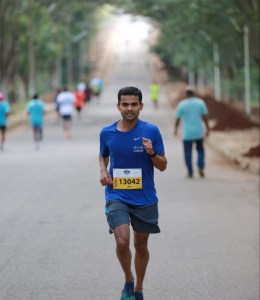
Sameer Joshi (Photo: courtesy Sameer)

Sameer Joshi

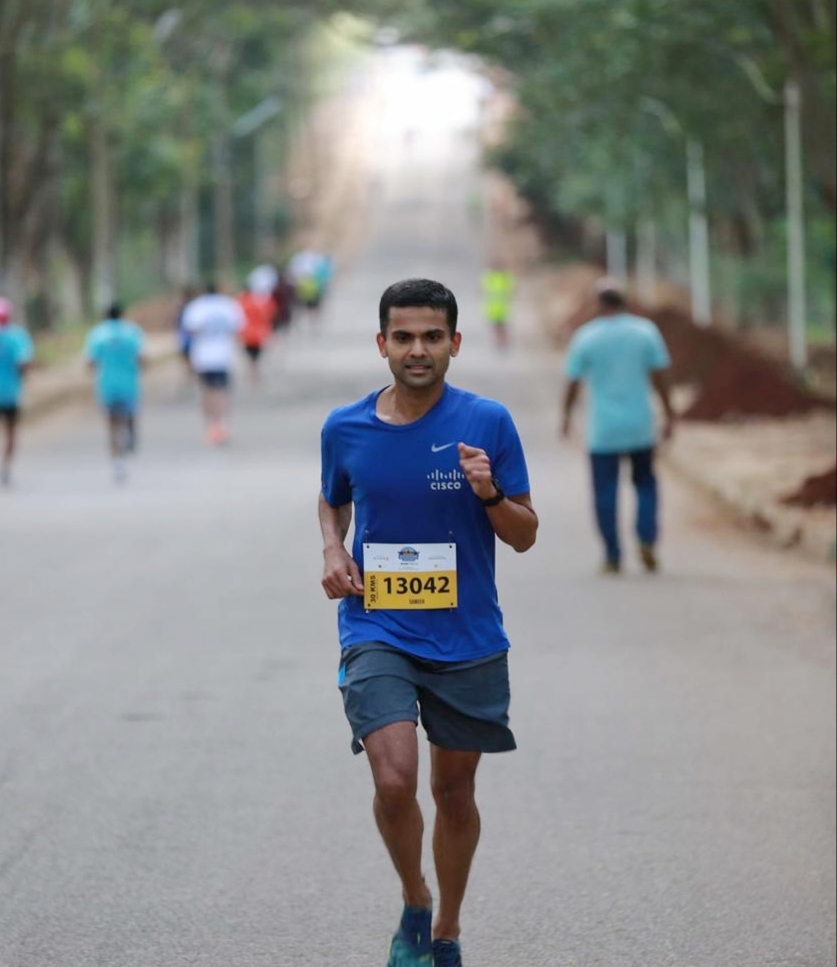
For Bengaluru resident Sameer Joshi, the 2019 edition of Chicago Marathon was his second time at this World Marathon Major.

His earlier outing was in 2017.

This time, he put in four months of training aimed at getting a time target of 3:05-3:10. His training at Pacemakers under coach, K.C. Kothandapani was tailored to meet the conditions of Chicago Marathon.

“ Though I am used to temperate weather, the morning of the run was quite cold with temperature around 4 degrees Celsius. I was on target to finish in 3:05 but the cold got to me around the 32nd kilometer,’’ he said.

For most part of the race, his pace was around seven miles but it dropped slightly after the 32k mark. “ Also, as my GPS device did not work, I ran purely based on instinct,’’ he said.

Sameer stayed on course, tracking pacers of the 3:05 finish and ahead of the 3:10 pacers.

He finished the marathon in 3:07:38, a personal improvement of 12 minutes from his previous best of 3:19:08 set during the 2019 Tata Mumbai Marathon.

Notwithstanding the better timing, Sameer said, “ for me, the 2017 finish at Chicago Marathon was stronger and more comfortable compared to this year’s. Weather was much better in 2017,’’ he said. Sameer had finished the race then in 3:19:56.
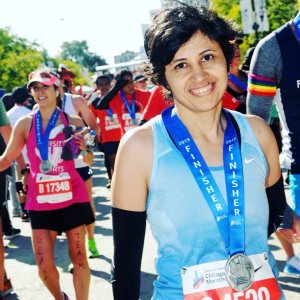
Tanmaya Karmarkar (Photo: courtesy Tanmaya)

Tanmaya Karmarkar

For Pune-based Tanmaya Karmarkar, Chicago Marathon was the third of her World Marathon Majors. She had done Berlin and Boston earlier.

Her training for the event began in mid-July following a cool-off period of three months after her appearance at Boston Marathon in April 2019. But the unusually heavy rains in Pune this monsoon season hampered her training plans. It was felt in her running; she could not always maintain pace as per plan.

“ I can say that I was able to execute the training plan given by my coach Ashok Nath to the extent of 80 per cent,’’ she said. On rainy days, she opted for running on a treadmill.

At Chicago, she stayed with a local runner, who was associated with a running club that made arrangements at the starting point. “ That helped a lot,’’ she said. Her goal was to meet her target of 3:26 hours, required to qualify for the New York City Marathon.

According to her, the race went off fairly well except that she fell short on hydration. “ I had decided to go with the 3:20 pacer to avoid going faster. I was cruising along comfortably but was not able to get sufficient water as the pacer did not stop at any of the hydration points. As a result, I started cramping in the last few kilometers,’’ she said. Nevertheless, she finished well within her target and achieved a personal record of 3:23:32. The cool weather augured well for Tanmaya. “ I am comfortable in cold weather. I usually run well in such weather,’’ she said.

She is now headed to Tokyo Marathon in March 2020 for her fourth World Marathon Major
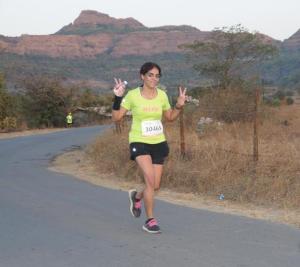
Srividya Ramnath (Photo: courtesy Srividya)

Srividya Ramnath

Last year, Srividya Ramnath, an amateur runner from Navi Mumbai, happened to visit New York.  A day before she flew back to India, she decided to drop in at the expo of the 2018 New York City Marathon. The atmosphere at the expo was enough to prompt her to register for one of the World Marathon Majors.

Chicago Marathon was her second full marathon, the first one being the 2019 Tata Mumbai Marathon. She started running recently and had signed up for her first half marathon in January 2017. “ I ran it without any training and ended up injured,’’ she said.

Subsequently, she joined Life Pacers, a marathon training group based in Navi Mumbai. “ Training for Chicago was tough. I was asked to refrain from reckless racing,’’ she said.

The run at Chicago went off well for most part of the distance. “ When I finished the race, there was not a drop of sweat on me. Until 30-35 kilometers, I felt no strain of running. I kept concentrating on the rhythm of my feet,’’ Srividya said.

During the last mile, she stepped up her speed but strong headwinds did not make that easy. “ In the last 50 meters, I pushed really hard to get to a sub-four-hour finish but missed by nine seconds,’’ she said. Srividya finished the marathon in 4:00:09, a new personal best.

Having tasted the experience of a World Marathon Major, she is now keen to attempt all of them.
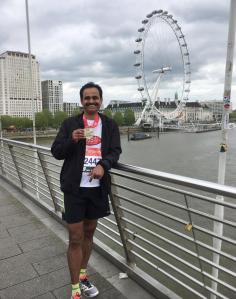
Rajagopal Ramaswamy (Photo: courtesy Rajagopal)

Rajagopal Ramaswamy

Rajagopal Ramaswamy, a resident of Dubai, commenced running in 2013 primarily as means to stay physically active. A park near his house was the venue for his foray into running. “ There I met a few runners, who were part of a running club,’’ he said.

Coaxed by the club members, he signed up for his first race, a 10 kilometer-event. Thereafter, he kept signing up for many running events and in the process went to do the World Marathon Majors – Berlin Marathon in 2016, Tokyo Marathon in 2018, London Marathon in 2019 and now Chicago Marathon.

He will be attempting New York City Marathon in early November and try and get into Boston Marathon in 2020.

He signed up recently with Bengaluru-based mentor Ashok Nath for marathon training. “ As of now, I am going by the plan given by my coach. Proper training will start after New York City Marathon,’’ he said. At Chicago Marathon, he finished the run in 5:02:36.

His focus, going forward, will be to build endurance for long-distance running. “ In terms of events, I have an unfinished agenda in the Two Oceans Marathon,’’ he said. The Two Oceans Marathon is a 56-kilometer ultramarathon held annually in Cape Town.

(The author, Latha Venkatraman, is an independent journalist based in Mumbai.)

MARATHON RECORDS: SPOTLIGHT ON SHOES

Illustration: Shyam G Menon

Over October 14-15, when the International Association of Athletics Federations (IAAF) disclosed its male and female nominees for the 2019 Athlete of the Year awards, both the world record holders in the marathon – Eliud Kipchoge and Brigid Kosgei – featured on the list.

Kosgei had just smashed the 16 year-old world record of Paula Radcliffe at the 2019 Chicago Marathon while Kipchoge, world record holder among men since the 2018 Berlin Marathon, had only a day before Kosgei’s feat, become the first human to accomplish a sub two hour-marathon albeit unofficially.

Going by media reports, questions are being posed on the shoes used.

Ineos 1:59 Challenge, the event at which Kipchoge dipped below two hours on October 12 in Vienna, was his second attempt at doing so. In 2017, at a run sponsored by shoe giant Nike and staged in Monza, he had clocked 2:00:25 (the project was called Breaking2). The 2017 attempt had employed a new shoe Nike was working on; it had carbon fiber plates in it and promised to improve running economy marginally. That measure, although small when quantified, matters a great deal when the battle is about shaving seconds over a distance of 42.2 kilometers. In an August 2019 article on shoes with this technology, Outside magazine wrote, “ The Vaporfly’s midsole also included a spatula-shaped carbon-fiber plate that the brand said was meant to help fling the runner forward with every stride—or to at least create a convincing illusion that something like that was happening. “I feel like I’m running downhill,” Nike-sponsored marathoner Galen Rupp purportedly said the first time he tried it.’’  The shoes are totally legal. By the time of Kipchoge’s 2019 attempt, the Nike shoe he used appears to have improved further. Nike’s website provides insight; the following is from a statement dated October 11, 2019 posted under the site’s news section:

“ Kipchoge first tested what was to become the Nike Zoom Vaporfly Elite in January 2016. He was instantly entranced by the radical tooling and the road feel. A few months later, Kipchoge wore the shoe, still an under-the-radar prototype, in London and again that year in Rio. Shortly after his gold-medal performance in Brazil, he addressed Nike designers with a few sharp questions: “What’s running in your mind after this shoe? Do you have plans for another version with more advanced benefits?” Since then, he’s been leading each iterative advance of Nike’s NEXT% range. Kipchoge first visited the Nike Sports Research Lab (NSRL) in 2016 as part of the journey toward Breaking2. The experience solidified friendships — Kipchoge had been regularly emailing Nike contacts for marathon footwear advice since 2013 — and set in motion a new stage in his competitive career.

“ The symbiosis between Kipchoge and the NSRL manifested itself in his brilliant performance in Monza, then progressed to breaking the marathon world record in Berlin in 2018. It has also stoked Kipchoge’s insatiable appetite for pushing the limits of potential — illustrated in how he cares for his body, prepares for his races and shifts right back into his next challenge. In turn, Kipchoge’s verve spurs the NSRL to continue to pursue science-led innovations that push the limits of performance running. Kipchoge will attempt to break the two-hour barrier on October 12 wearing a future edition of Nike’s Next% marathon shoe. No matter the outcome, what’s clear is that this champion’s singular experience will prompt more feedback, more questions and, ultimately, more advance in the sport as a whole.’’ On October 12, Kipchoge, running at Ineos 1:59 Challenge in Vienna, covered the 42.2 kilometer-distance of the full marathon in 1:59:40, an unofficial timing not considered for record purposes.

On October 14, author Alex Hutchinson writing in Outside magazine, highlighted two points. First, Jonathan Gault of LetsRun had pointed out that the five fastest record-eligible marathons had all happened in the last 13 months and they had been achieved wearing versions of the Nike Vaporfly. Second, Kosgei’s post-race interview – again as appeared on LetsRun – hints that she too may have been using similar shoes although visually (as seen in photos from the race), Hutchinson felt, the shoe seemed closer to the “ commercially available Vaporfly Next%.’’ That last point is important for as he pointed out, in 2018 the IAAF tweaked its rules to say that any type of shoe used must be reasonably available to all in the spirit of universality of athletics. On October 15, The Times reported that IAAF and Athletics Integrity Unit (AIU) had received complaints from athletes citing the advantage posed by the new shoes. It was also reported that IAAF issued a statement to The Times informing of a working group set up “ to consider the issues.’’

As trend, technological advancements shaping athletics is not new. The pole of pole vault and the javelin are great examples of new levels reached with the help of technology. In pole vault, the old bamboo pole gave way to poles made of tubular aluminum and later, fiberglass (including carbon fiber in places as required). Needless to say, technology enabled higher vaults. But there were also limits set. The javelin was redesigned when the distances thrown threatened to exceed the length of a stadium infield. In 2008, a new type of full body swimsuit by Speedo, capable of reducing drag in water by 24 per cent, was gear of choice in several world records broken. In 2009, the sport’s apex body enacted rules disallowing full body swimsuits and specifying type of fabric to be used. Against this backdrop, the relevant factors to emphasize in the case of marathons – it would seem – are level playing field in baseline (spirit of universality) and how much of technological advancement works against the essence of the sport. Needless to say, in an ever evolving world, this will be subject of periodic review and debate.

Incidentally as regards running shoes, Nike is not alone in using carbon fiber plate in the sole. In May, at an event to celebrate the launch of Carbon X from Hoka One One, American ultramarathoner Jim Walmsley had set a new 50 mile world-best mark (unofficial) of 4:50:07. A simple Google search for running shoes with carbon fiber plates yielded at least four models – Nike Zoom Vaporfly, Hoka One One Evo Carbon Rocket, Hoka One One Carbon X, Skechers Speed Elite and New Balance Fuel Cell 5280. Going by reviews and articles on these shoes, it would seem that carbon fiber plate combined with right foam cushioning and overall design is what makes the difference.

(The author, Shyam G Menon, is a freelance journalist based in Mumbai.)   

2020 TOKYO OLYMPICS / MARATHON, RACE-WALKING EVENTS MAY BE SHIFTED TO SAPPORO

Illustration: Shyam G Menon

The International Olympic Committee (IOC) today announced that it is planning to move the Olympic marathon and race-walking events to Sapporo, the host city of the Olympic Winter Games 1972.

The move to Hokkaido, the northern-most prefecture of Japan, will mean significantly lower temperatures for the athletes during the Olympic Games. In Sapporo, temperatures during the Games period are as much as five to six degrees centigrade cooler during the day than in Tokyo, which is more than 800 kilometers further south, an official statement said.

The plans are part of wide range of measures being taken by Tokyo 2020 in consultation with IOC and international federations to mitigate the effects of the temperatures which may occur next summer. IOC has informed World Athletics about the proposed changes.

This latest initiative by IOC and Tokyo 2020 comes on top of other heat countermeasures which are already planned and being implemented on the recommendations of the IOC Medical and Scientific Commission Adverse Weather Impact Expert Working Group (the IOC Working Group). They include 5000m and longer distance races being scheduled for the evening and not morning and moving the marathon and race walk events to earlier starting times.

The IOC Working Group identified the marathon and race-walk as the events that would put particular heat stress on athletes, the IOC statement said.

The implementation of the initiative to move the marathon and the race-walks will be discussed with all the stakeholders concerned. The IOC Coordination Commission for Tokyo 2020, chaired by IOC Member John Coates, has dedicated a special session in its meeting from 30 October to 1 November in Tokyo to heat countermeasures.

It may be recalled that at the recently held 2019 IAAF World Athletics Championships in Doha, Qatar, the events held within the protective ambiance of the main stadium went off comfortably for athletes. Endurance disciplines like the marathon and race-walking, held outside, elicited a heavy toll on participants with several athletes pulling out and finish timings, fairly poor compared to timings registered elsewhere.

Sapporo is Japan’s fifth largest city by population and the biggest city on the country’s northern island, Hokkaido. According to Wikipedia, “  Sapporo has a humid continental climate, with a wide range of temperature between the summer and winter. Summers are generally warm but not overly humid, and winters are cold and very snowy.” Sapporo is one of few metropolises in the world with heavy snowfall, it added. Among the main islands constituting Japan, Hokkaido is the second largest. The general lay of the land has bearing on how a course for running may be. Wikipedia in its section on Hokkaido’s geography says that the center of the island has a number of mountains and volcanic plateaus. There are also multiple plains.

(The author, Shyam G Menon, is a freelance journalist based in Mumbai.)

SPORT CLIMBING / PHASE TWO OF OLYMPIC QUALIFICATION DUE BY NOVEMBER END

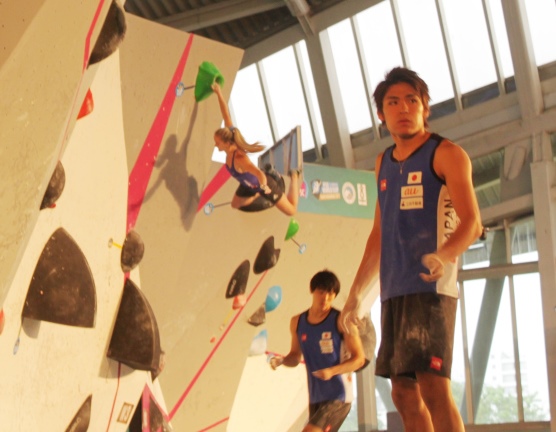
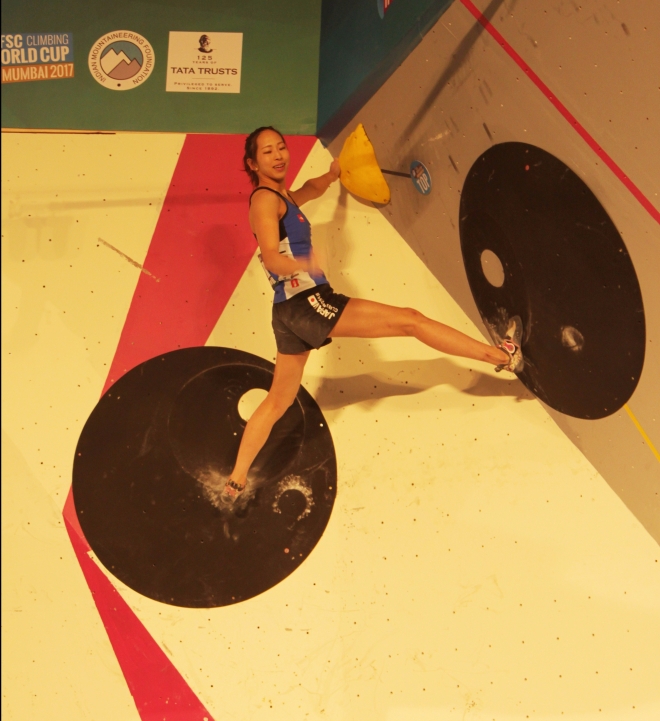
Tomoa Narasaki (foreground); this photo was taken during the 2017 IFSC World Cup in bouldering held in Navi Mumbai (Photo: Shyam G Menon)

The first list of sport climbers qualified for the Tokyo Olympics was announced in August, 2019. Qualification is a process in three phases lasting till May 2020. Interestingly, some of the athletes who made the cut in the initial list would be familiar to Indian climbing aficionados; they had participated in the two IFSC World Cup events held in Navi Mumbai in 2016 and 2017.

The selection process of sport climbers for the 2020 Tokyo Olympic Games will enter its second phase next month with the IFSC Climbing Combined Qualifier in Tournefeuille-Toulouse, France scheduled over November 28-December 1.

In August, the International Federation of Sport Climbing (IFSC) had announced the first list of selected climbers after the Combined World Championships in Hachioji, Japan. “ Over 156 athletes competed in all three disciplines at the IFSC Climbing World Championships Hachioji 2019 with the hopes of earning a ticket to the Tokyo 2020 Summer Olympic Games. Following a week of competition, the top 20 climbers in each gender were selected to participate in the Combined World Championships and the first Olympic qualifying event. The seven highest-placed athletes per gender of the Combined World Championships, with a maximum of two per country, will receive invitations for the Olympic Games,’’ an IFSC statement had said then.

Those in the first list, qualifying so (as available on the IFSC website; the list is titled: Sport Climbing’s First Olympic Qualified Athletes), are Janja Garnbret (Slovenia), Akiyo Noguchi (Japan), Shauna Coxsey (Great Britain), Aleksandra Miroslaw (Poland), Miho Nonaka (Japan), Petra Klinger (Switzerland) and Brooke Raboutou (USA) from the women’s category;  Tomoa Narasaki (Japan),  Jakob Schubert (Austria), Rishat Khaibullin (Kazakhstan), Kai Harada (Japan), Mickael Mawem (France), Alexander Megos (Germany) and Ludovico Fossali (Italy) from the men’s category.

Shauna Coxsey; this photo was taken during the 2017 IFSC World Cup in bouldering held in Navi Mumbai (Photo: Shyam G Menon)

“ All qualification places are provisional until confirmed by each athlete’s National Olympic Committee (NOC). Formal invitations will be sent by the IFSC to the relevant NOCs within five days of the conclusion of Combined World Championships. The NOCs will then have two weeks to either confirm or decline the quota places,’’ the IFSC statement of August 21, had mentioned.

According to a report in the Japan Times, in the combined discipline Narasaki placed first in bouldering and second in lead and speed. Scores are decided by multiplying the finishing position in each of the disciplines; this is the scoring model for the Olympics too. Done so, Narasaki’s score was four, which was the lowest among the competitors, making him victor of the combined championships. In the men’s category, there were three other Japanese climbers including Narasaki’s younger brother, finishing fourth, fifth and sixth. But the two-person cap per country per gender appears to have kicked in. “   Japan will select the other male and female climbers based upon outcomes in the Olympic qualifying tournament, Asian Championships and Combined Japan Cup,’’ the report said. As host country, Japan gets a reserved slot per gender.

Besides those qualified at Hachioji, six additional athletes in each gender will be qualified to the Olympic Games from the Toulouse event scheduled for end-November 2019. The final opportunity to qualify will be five IFSC Combined Continental Championships due to take place in 2020. The schedule as available on the IFSC website is – Africa, 1-3 May, Johannesburg (South Africa), Asia, 18-24 May, Morioka (Japan), Europe, 16-18 April, Moscow (Russia), Pan-Am, 27 February-1 March, Los Angeles (USA) and Oceania, 18-19 April, Sydney (Australia). Climber hoping to qualify should head to his / her respective continental championship.

This is the first time climbing will be featured at the Olympics. All three disciplines of sport climbing – lead, bouldering and speed – will be seen. However in a departure from the normal practice of climbers specializing in a discipline of their choice and competing in it, at the Olympics, the same climber will have to endure all three disciplines with the highest aggregate scores ending up on the podium. The controversial format – it was tested at the 2018 Summer Youth Olympics – had to be resorted to because the Olympic committee allotted the sport only one gold medal per gender.

Akio Noguchi; this photo was clicked at the 2017 IFSC World Cup in bouldering held in Navi Mumbai (Photo: Shyam G Menon)

At the Olympics, there will be altogether 40 climbers competing; 20 men and 20 women. This limited availability of slots automatically implies a selection process for qualifying and not every country that is into climbing will be able to have a representative competing in the discipline at the Olympics. Out of the 20 slots for each gender, one slot will go to the host country, another to a NGO called Tripartite Commission, which can give Olympic bids based on exceptional circumstances. That means, effectively, the qualification battle is for 18 slots in each gender. Each country is permitted only two qualified competitors; if more numbers qualify from a given country, then only the top two will be considered. By the time the selection process reaches the stage of the Continental Championships, there will be only five slots left to fill in each gender category (the rest having been filled by events at Hachioji, Toulouse, host country and Tripartite Commission. Should any athlete withdraw after the selection process is completed and the national rosters have been set, then the invitation for the Olympics will go to whoever ranked next to that person at the relevant qualifying event.

Climbing is among sports at the 2020 Olympics, wherein host country Japan has strong medal prospects. Overall at the 2020 Tokyo Olympic Games, Japan Olympic Committee is known to be targeting at least 30 gold medals, higher than their nation’s previous best haul of 16 secured in Athens (2004) and when the games was last held in Tokyo (1964). That said, the going won’t be easy for Japan in climbing. There is stiff competition in the women’s category (at Hachioji, the Japanese female climber with the best score – Akiyo Noguchi – placed second in the combined final after Slovenia’s Janja Garnbret who finished first) and on the men’s side, despite not making it to the first list, Czech ace Adam Ondra (he was disqualified over a technical issue in the Olympic qualification at Hachioji) has two more opportunities to qualify.

The selection process obliquely reminds the Indian climbing community of the good fortune in Navi Mumbai having hosted two climbing World Cups – in 2016 and 2017. Some of the athletes in the first list of qualified – like Akiyo Noguchi, Shauna Coxsey, Miho Nonaka, Tomoa Narasaki and Jakob Schubert had participated in one or both of the world cups held in Navi Mumbai. To that extent, the stars are not strangers; you remember them.

(The author, Shyam G Menon, is a freelance journalist based in Mumbai.)

BRIGID KOSGEI SETS A NEW WORLD RECORD IN WOMEN’S MARATHON

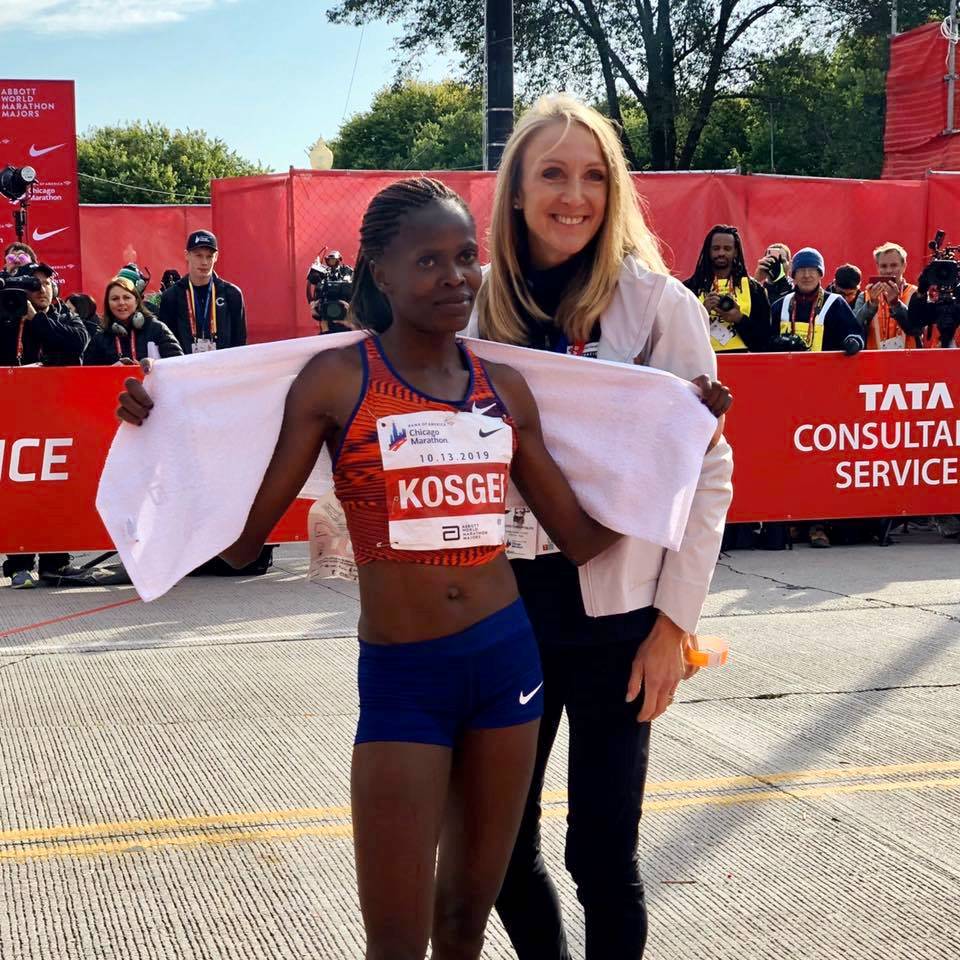
Kenya’s Brigid Kosgei, owner of the new world record in women’s marathon, with Paula Radcliffe of UK who held the previous record, at the 2019 Chicago Marathon (This photo was downloaded from the Facebook page of the event and is being used here for representation purpose. No copyright infringement intended)

Victory completes a Kenyan sweep of world records in the marathon

Kenya’s Brigid Kosgei has set a new world record in the women’s marathon.

She won the 2019 Chicago Marathon in two hours, 14 minutes, four seconds (2:14:04) bringing the curtains down on the previous 16-year-old record of 2:15:25 held by Paula Radcliffe of UK.  Radcliffe had her record-making run at the 2003 London Marathon. Kosgei’s performance is naturally a new course record for Chicago Marathon. Interestingly, the previous course record of 2:17:18 was also held by Radcliffe.

Ethiopia’s Ababel Yeshaneh came in second in the women’s race, finishing nearly seven minutes behind Kosgei in 2:20:51. Gelete Burka also of Ethiopia finished in third position in 2:20:55.

In the men’s race, Kenya’s Lawrence Cherono was the winner with timing of 2:05:45. He was followed by Ethiopian Dejene Debela who finished in 2:05:46. In third position was another Ethiopian runner, Asefa Mengstu who finished in 2:05:48.

Defending champion Mo Farah of UK finished in eighth position clocking 2:09:58.

Galen Rupp of the US, returning to a major race after a long gap due to surgery, was forced to pull out, a report in Runners World said.

With her victory and world record of October 13 in Chicago, Kosgei has helped effect a Kenyan sweep of world records in the marathon.  The men’s record – 2:01:39 is held by Kenya’s Eliud Kipchoge who touched that mark at the 2018 Berlin Marathon. The women’s half marathon record (1:04:51) belongs to Kenya’s Joyciline Jepkosgei (1:04:51 set in Valencia, Spain) , while the same in the men’s category (58: 01, set at the 2019 Copenhagen Half Marathon) is held by Geoffrey Kamworor, also of Kenya.

The new women’s world record is just a day after Eliud Kipchoge ran an unofficial timing of 1:59:40 – the first time anyone ran the marathon in under two hours – at an event custom-built for the purpose.

Kosgei was in the news early September 2019 for setting a new course record in the women’s half marathon at the 2019 Great North Run in UK (this event held every September in north east England is the largest half marathon in the world). She covered the distance in one hour, four minutes and 28 seconds (1:04:28), shattering the previous record held by Mary Keitany (1:05:39 / also of Kenya) by more than a minute. Kosgei’s course record was better than the existing world record – 1:04:51 – held by Jepkosgei. However owing to technical reasons, the new mark couldn’t be considered for a world record. The problem lay in the Great North Run’s course. The International Association of Athletics Federations (IAAF) had noted, “ as a point-to-point course and slightly downhill, it’s not valid for record purposes, but that shouldn’t take away from the performance by the 25-year-old Kenyan who dominated the race from the outset.’’

Prior to 2019 Great North Run, Kosgei was known best for her finishes at the Chicago and London marathons. She placed second among women in the 2017 Chicago Marathon, second in the 2018 London Marathon, first in the 2018 Chicago Marathon and first in the 2019 London Marathon.

Paula Radcliffe is one of the greatest runners in the women’s marathon. Her longstanding world record had unique significance in India. While the Indian national record in the men’s marathon is 2:12:00, set by the late Shivnath Singh in 1978, it has remained an enigma and a tough target for the current generation of marathoners to match. Realizing the gap between their performance and the national record and world beating performances, Radcliffe’s world record – 2:15:25 – had served as intermediate goal for some of the country’s elite marathoners.

In a conversation with this blog in November 2017, Indian elite marathoner Nitendra Singh Rawat had spoken of focusing on Radcliffe’s world record as a realistic goal to accomplish while he was preparing for the 2016 Rio Olympics. In that phase, at the 2016 Mumbai Marathon, Nitendra touched 2:15:48 (a new course record), very close to Radcliffe’s record; he eventually surpassed it with the 2:15:18 achieved at the 2016 South Asian Games in Guwahati. T. Gopi completed the marathon at the 2016 Rio Olympics in 2:15:25. He went on to clock 2:13:39 at the 2019 Seoul International Marathon.

(The author, Latha Venkatraman, is an independent journalist based in Mumbai.)
BARRIER FALLS, KIPCHOGE GOES SUB 2

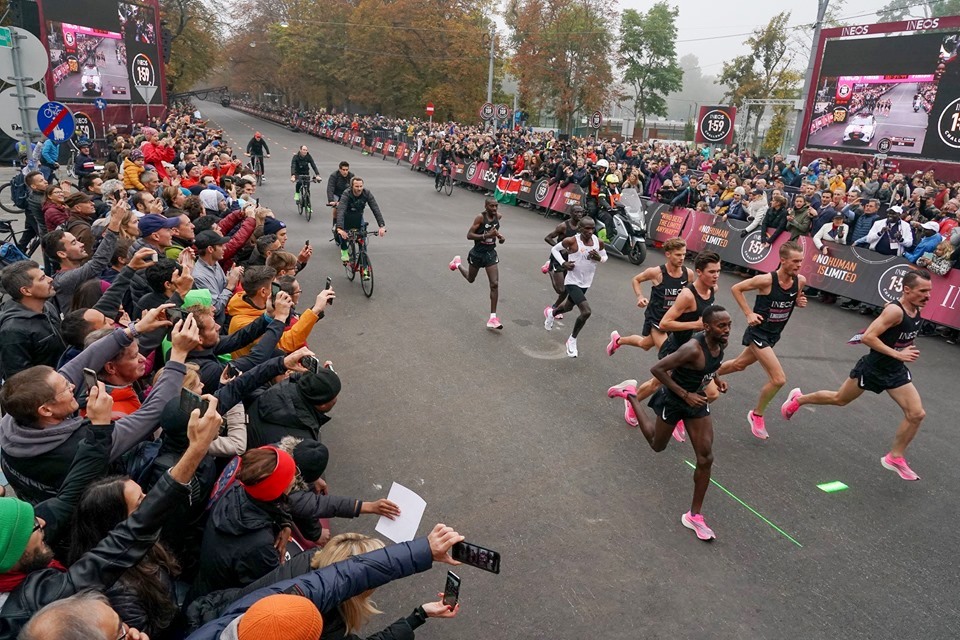
Eliud Kipchoge (in white vest) and his team of pacemakers running as part of Ineos 1:59 Challenge in Vienna (This photo was downloaded from the Facebook page of the event and is being used here for representation purpose. No copyright infringement intended)

Kenya’s Eliud Kipchoge has covered the 42.2km distance of the full marathon in 1:59:40, breaking the two hour-barrier.

The result was achieved in near perfect weather conditions – save 90 per cent plus humidity and a spell of rain – at the Ineos 1:59 Challenge in Vienna today (October 12, 2019). People lined the carefully chosen course in the Austrian capital to see the event. The course was 90 per cent straight, evenly paved and lined by trees. For the first time in Kipchoge’s running career, his family – wife, Grace and three children – were present to see him in action.

Kipchoge is the current world record holder in the marathon (2:01:39 set at the 2018 Berlin Marathon) and reigning Olympic champion. The strategy for the run, worked back from the need to go sub-2, was executed to precision. There was a car up front setting the pace accurately and more importantly, projecting a green laser lit-line on to the road just behind which, the athletes recruited to be pacemakers ran maintaining their momentum. The course had a small corridor down the middle marked by two orange lines. Kipchoge had to stay within that to make sure the required length of the run was met.

The pacemakers were arranged in the form of a `V’ (open arms facing the wind) with the captain of a given set of pacemakers anchoring the point of convergence. This formation was the best option for aerodynamic efficiency. It reduced wind resistance for Kipchoge who ran behind the captain. Two pacemakers ran on either side of Kipchoge, slightly behind him. Every few kilometers, the team of pacemakers changed. The transition was done smoothly.  There were 41 pacemakers drawn from 10 countries assembled for the task; all of them world class athletes.

Eliud Kipchoge (This photo was downloaded from the athlete’s Facebook page and is being used here for representation purpose. No copyright infringement intended)

Kipchoge and his pacemakers were on target almost all through the run. At 41 kilometers, the pace car peeled off. At an hour and 58 minutes with just a few hundred meters left, the last team of pacemakers slackened their pace and let Kipchoge take the lead. At 1:59:22, goal nearly in grasp, he began pointing to the crowd in excitement. The finish was at 1:59:40.

Although this is the first time in history that a marathon has been completed within two hours, the timing will not be recognized as a world record for three reasons – Kipchoge was the sole competitor at Vienna; he not only had pacemakers but the team of pacemakers was periodically replaced to ensure they stuck to required pace and he had fluids for hydration being handed out from a bike unlike the hydration points of regular marathons (this is as per event commentary).

“ His run today won’t be ratified as a world record, but will nonetheless be remembered as one of the greatest pioneering milestones in athletics history,” a report on the race available on the website of International Association of Athletics Federations (IAAF), said.The IAAF, which is the top body for athletics worldwide, is the agency that ratifies world records.

The event in Vienna was the second time Kipchoge attempted breaking the two hour-barrier. In May 2017 at a similar project organized by Nike, he had covered the distance in 2:00:25.  The course was straighter at Vienna, the shoes used were better than the ones employed at Monza (the scene of the 2017 attempt) and Kipchoge’s nutrient intake during the race was further improved, the event’s commentators pointed out.

(The author, Shyam G Menon, is a freelance journalist based in Mumbai.)
7KM SHORT, 215KM OF LEARNING

Shikha Pahwa (Photo: courtesy Shikha)

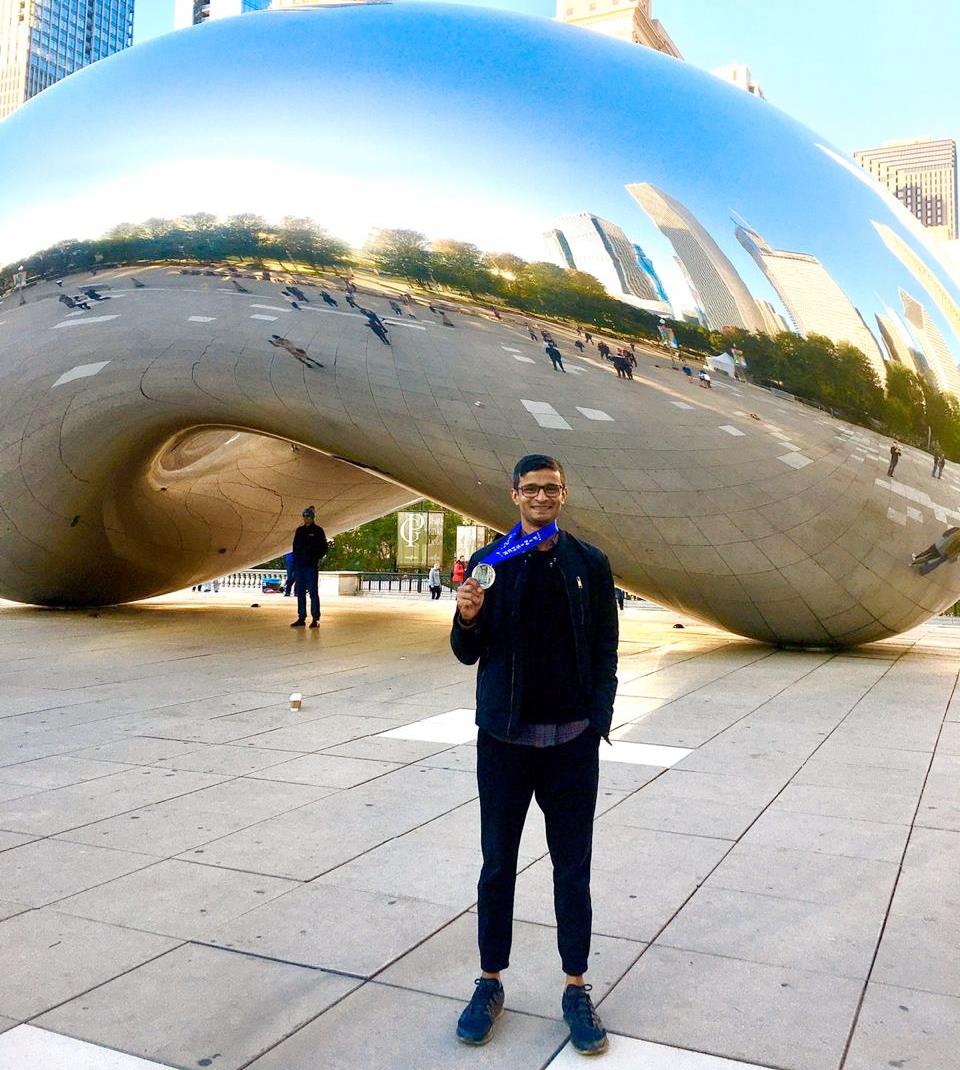
What defines outcome – the goal or the experience? This is an article by invitation. In 2019, Delhi-based runner Shikha Pahwa set out to attempt the 222km-race of La Ultra-The High in Ladakh. She tackled 215 kilometers before a combination of weather, fatigue and injury forced her to pull out (215 is the figure Shikha heard at the time of DNF, the figure shown on the race website is 212km. We decided to go with 215 because this is  a first person account of an experience and what you hear in the thick of an experience is part of it). For the past few years, Shikha has been a regular on the Ladakh circuit. In 2018, she ran the 111km distance category of La Ultra-The High, completing it in 18 hours, 15 minutes, 42 seconds. The year before that she was winner among women in the 72km Khardung La Challenge. In 2016, she had placed second among women in the Ladakh Marathon. This is her account of participating in the 222km race of La Ultra-The High in 2019.

My decision to attempt the 222km race at La Ultra–The High in Ladakh had its share of apprehensions. Not only was it double the longest distance I had run till then but its route also lingered at high altitude for a longer period of time given two mountain passes to tackle. Temperatures would range from minus 10 to 30 degrees Celsius.

I was not new to running in Ladakh. I had participated in events there since the past three years. I knew what I was getting into. To sum it up, I would say the 111km I had done the previous year was just a trailer.

Training for the 222km-run was not easy in Delhi. The weather and the terrain of the national capital are nowhere close to what one experiences in Ladakh. I focused therefore on just one aspect – more time, staying up on my feet. To be able to move for 48 hours at a stretch I needed to do a lot of training on tired legs. I started with two consecutive days of running 40km and 30km during the weekend for a month or so and then progressed to three consecutive days of 50km, 40km and 30km starting from Friday through the weekend for about two months. During Delhi’s summer months of May to July, this routine sapped my energy. In this period, I also participated in the Tuffman Shimla 80km ultra-marathon, mainly as practice for La Ultra-The High. It turned out to be a good decision as the event route featured some steep uphill and downhill portions; exactly what I needed.

From La Ultra-The High (Photo: courtesy Shikha Pahwa)

Weather conditions in Ladakh can be unpredictable. At La Ultra-The High, runners are warned to be prepared for rain or snow or heat or all of them. I knew the drill and I was ready. But the mountains proved me wrong.

On August 17, 2019, runners assembled at the start point in Nubra Valley. The race started at 6PM in light rain; it continued for approximately 60 kilometers. After that, it transformed to snow and blizzard. Going uphill to an altitude of 18,000 feet in those conditions was something I had never imagined. I felt like giving up several times but somehow, looking at Nischint Katoch, the only other runner in sight, fighting the situation ahead, I pushed on putting one step before the other. As I had never walked in snow before, it was nothing short of a nightmare. To add to the whole experience, I started to feel a pinching pain in my left shin (it later turned out to be a stress fracture in the shin and a ligament tear in my ankle, as per the MRI test report).

I felt a sense of relief upon reaching Khardung La. I expected the downhill from there to be easy. But I was completely wrong. Moving downhill in the snow was very difficult. I slipped at least seven to eight times in the snow. I had absolutely no control over my feet. I was either stepping deep into snow or into icy puddles. Worried about the manner in which I was moving, the medical teams stopped several times to check if I was alright. I was okay, except that my shin pain was increasing with no clear solution for it.

Downhill running is something I love. I just give into gravity. As I am wont to, I let go and almost immediately I felt the pain in my shin. The next four kilometers I resorted to run-walk.

As part of the 222km event (and for distances in excess), we are assigned support crew. They joined us at the 87th kilometer. The crew is not there to merely help runners with hydration and nutrition. They also act as motivators to ensure that participants keep moving.

When I reached the said mark, my crew, Milam Shah from Nainital and Kunzes Dolma from Ladakh, immediately jumped into getting things ready to make me comfortable. After a short re-charge break, I headed out again. With no rain and snow, it felt like things were back on track.

Arriving at the 111 kilometer-mark at Shanti Stupa felt great as it was almost halfway point for my distance category. There was a huge round of cheering by the gathered volunteers. After a break at a guest house ahead, we headed out again. From Leh, it was pretty much a flat route for the next 60 odd kilometers. As easy as that sounds, it wasn’t so in real terms. It was mentally exhausting to get through the endless road especially at night. It was pitch-dark. My crew car was the only vehicle tailing me. I started feeling extremely sleepy. I fought to keep my eyes open and at one point started seeing things on the road that weren’t there. That was when I stopped the car and decided to take a 20 minute nap. Even after that it was a struggle to stay awake and so the crew stepped in. They took turns to walk with me, talking, making sure that I didn’t lose self-control. We had another stop to eat and sleep in the car. Eventually we made it to the 173 kilometer-mark at the next guest house. By then, my shin was red and swollen and I was suffering from fatigue. After consulting the doctors, eating and taking medicines for the pain, I slept for around two hours.

Feeling refreshed and ready to take on the last leg, we started moving again. It was just 49 kilometers to the finish line but half of it was climbing up to Wari La at an altitude of 17,500 feet. The weather was good and there were many people around, as the 55 kilometer-category runners were on the course. Slowly making my way up, I saw two friendly faces; my good friends Taher Merchant and Gregor Gucwa, who had come all the way just to support me. These are the priceless moments of participating in an event like La Ultra-The High. We get to meet amazing people. Both Gregor and Taher were participants of La Ultra-The High. Gregor was attempting the 222km and Taher, 111km (unfortunately, both had to give up due to altitude sickness. They came to Wari La for the final stretch of the race to support me).

From La Ultra-The High (Photo: courtesy Shikha Pahwa)

After a couple of kilometers, Taher had to leave. Gregor and I, with the crew following, kept walking. As we gained altitude, the uphill walk became difficult. Gregor was going strong. He kept chatting with me and making sure that I was eating and hydrating all along. He helped me get through every sharp climb, one step at a time. We were on track, I was sure of making it to the finish in time. Then, reality hit back. We were told that there was snow along the route on the top. It brought back memories of the Khardung La stretch. The target got very very tight at this point prompting us to move faster. With snow and blizzard, there isn’t much you can do. It was slippery and wet all the way. Those four kilometers seemed endless. It played on my mind even more since I couldn’t see the point where I had to turn around; everything was just white.

At that juncture, I met Jyotsna Rawat, who is part of the La Ultra core crew team. She became my motivator, supporter and morale-booster for the moment, giving me the push that I needed, helping me to turn around. Gregor caught up soon enough, fighting the extreme weather, to be by my side. Although it was all downhill now, the snow and altitude didn’t allow us to gain much pace. With every step, time was slipping out of our hands. After the snow cleared, I started running down in small stretches. The pain in my shin was getting worse and the altitude was making me breathless. I knew there was very little chance of making it to the finish line before the cut-off time. Nevertheless, I kept pushing ahead.

The next time I asked Gregor if we would make it in time, he said it was too tight. Jyotsna, who was following me in a car, came up to ask if I wanted to continue, as there wasn’t enough time.

I was keen to finish even if it was after the cut-off time. But I had to slow down because of the agonizing pain in my shin. After another couple of kilometers I was again asked if I wanted to continue. There is that point when runners don’t see logic or consequences and are willing to endure pain and discomfort, just to reach the finish line. Gregor and the crew members tried very hard to convince me to stop, trying to prevent my injury from getting worse. After much resistance, I finally gave in. At that point I wasn’t sure how much distance was left. I later discovered that I had dropped out just seven kilometers from the finish line. Not wanting to go to the finish point at all, I was driven straight to the guest house close by to rest. After that, I only remember being comforted by Gregor, my crew and all the core crew members around.

I reached the 215 kilometer-mark but fell short of the finish by seven kilometers. To me it was an experience of a different kind. I wouldn’t term it failure. I witnessed several things for the first time, learnt a lot, realized my mistakes and understood how much the mind can push the body. Those 47.5 hours were one hell of a journey and I was extremely lucky to have so much support throughout. I couldn’t have gone through it without my crew and especially Gregor, who really is from another planet.

From La Ultra-The High (Photo: courtesy Shikha Pahwa)

Having said all this about how insane this experience was, I then look at those three super-humans – Jason Reardon, Matthew Maday and Ashish Kasodekar – who completed the 555 kilometer-event in similar conditions and over much longer distances; I feel I need to work a lot harder. Human endurance has seen a whole new level and I would be extremely happy to reach at least halfway there.

Putting together an event like this is a mammoth task. The core crew members were not there to just man the hydration points; there were multiple complex factors to take care of simultaneously in those harsh weather conditions and for several days at a stretch. Despite all that, they went all out to motivate and encourage every single runner on the course. These are the people who make the impossible, possible.

I wouldn’t call La Ultra-The High a race. I was competing with myself, fighting mind and body, battling fatigue, suffering sleep deprivation and nursing an injury. In a span of 48 hours, I saw an unbelievable side of nature and tremendous support from some amazing people. It was a completely overwhelming experience. As difficult as it was, I would like to go back and try again.

(The author, Shikha Pahwa, is a Delhi-based runner. She owns Café Qahwa, located in the city’s Safdarjung Development Area. The 222km category of La Ultra-The High saw only one finisher in 2019 – Amit Kumar, who covered the distance in 41 hours, 48 minutes. There were eight DNFs. As per the race website, both Shikha and Munir Kulavoor pulled out at 212km covered, the farthest run by those who stopped short of the finish. Shikha’s DNF followed that of Munir, the race organizers said.)

IAAF DEEMS DOHA EDITION OF WORLD CHAMPIONSHIPS, BEST TO DATE

This photo was downloaded from the Facebook page of the Doha World Championships and is being used here for representation purpose. No copyright infringement intended.

Six championship records were set, 43 countries won medals and athletes from 68 different nations achieved at least one top-eight placing at the just concluded 2019 IAAF World Athletics Championships in Doha.  There were 21 area records – double the number from 2017 – and 86 national records.

Athletes from more than 200 countries participated in the Doha edition.

Based on the IAAF competition performance rankings used to rank the quality of competitions, the IAAF World Athletics Championships Doha 2019 tops the list of all World Championships to date, an official statement from IAAF said.

According to it, taking the best five results and athletes from the best 24 events (before the concluding night’s finals), the top five editions are (1) 2019, Doha – 195,869, (2) 2015, Beijing – 194,547 (3) 2017, London – 193,426 (4) 2013, Moscow – 192,664 and (5) 2009, Berlin – 191,168. Based on the average scores of all track and field results, the top five editions are: (1) 2019, Doha – 1024.75 (2) 2017, London – 1012.84 (3) 1999, Seville – 1007.98 (4) 2015, Beijing – 1004.78 and (5) 2009, Berlin – 1004.55

There were many outstanding performances over the 10 days of competition with unprecedented depth in many of the finals. Based on the IAAF scoring tables, the top five men’s and women’s performances – as per the statement – are: MEN – 22.91m Joe Kovacs (USA) shot put – 1295pts; 22.90m Tom Walsh (NZL) shot put – 1294pts, 22.90m Ryan Crouser (USA) shot put – 1294pts, 9.76 Christian Coleman (USA) 100m – 1291pts and 43.48 Steven Gardiner (BAH) 400m – 1289pts. WOMEN – 7.30m Malaika Mihambo (GER) long jump – 1288pts; 48.14 Salwa Eid Naser (BRN) 400m – 1281pts, 48.37 Shaunae Miller-Uibo (BAH) 400m – 1272pts, 3:51.95 Sifan Hassan (NED) 1500m – 1271pts and 6981 Katarina Johnson-Thompson (GBR) heptathlon – 1269pts.

USA’s 200m winner Noah Lyles and Germany’s decathlon victor Niklas Kaul became the youngest ever world champions in their respective events. Ukraine’s Yaroslava Mahuchikh twice broke the world U20 record on her way to the silver medal in the high jump. She was one of several athletes born in or after the year 2000 who earned medals, along with Ethiopian duo Selemon Barega and Lemecha Girma and Bahrain’s Musa Isah, the statement said. IAAF President Sebastian Coe has described the Doha edition of the world championships as the best ever in the series in terms of the quality and depth of performance produced by the athletes.

This blog would like to point out that while several sterling performances were seen in Doha, almost all of them happened within the main stadium. As per published news reports, the disciplines staged outside the stadium – mainly marathon and race-walking – reported impact of heat and humidity to varying degrees.

(The author, Shyam G Menon, is a freelance journalist based in Mumbai. Please click on this link for a related article: https://shyamgopan.com/2019/10/01/two-worlds/)