LONDON MARATHON: SHURA KITATA WINS IN NAIL BITING FINISH

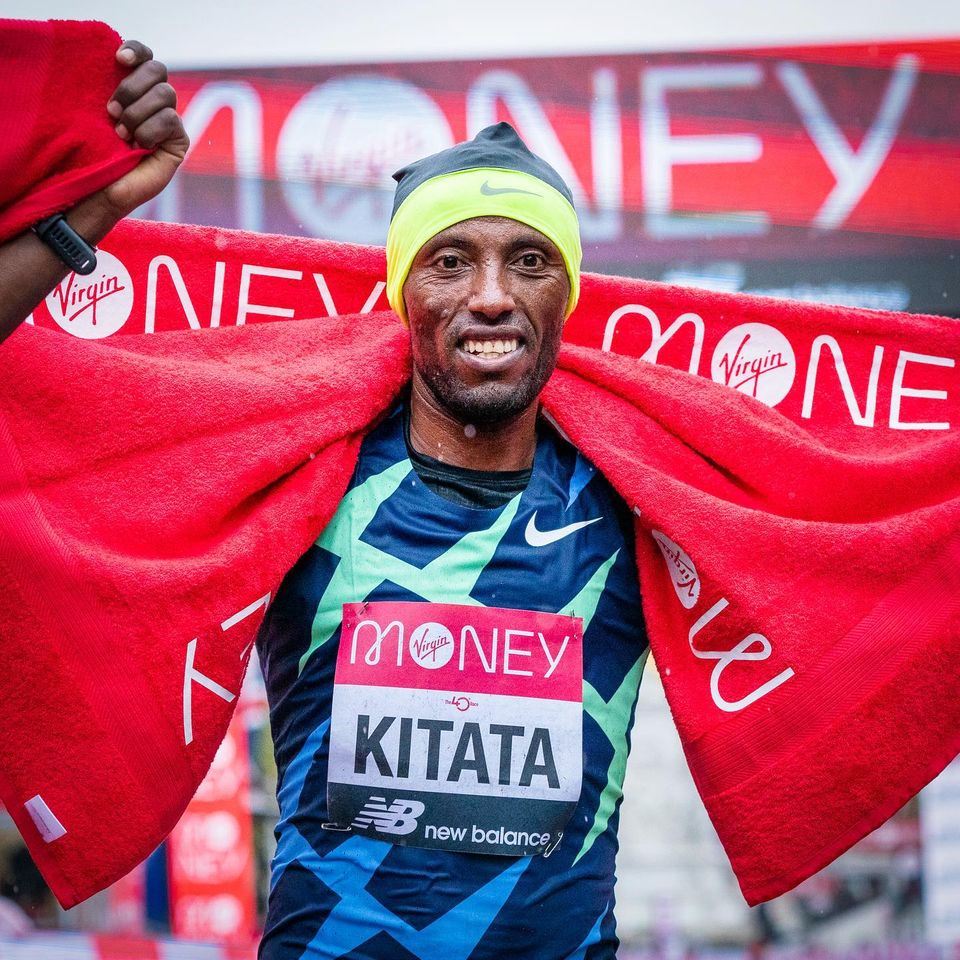
Shura Kitata of Ethiopia. This image was downloaded from the Facebook page of London Marathon and is being used here for representation purpose. No copyright infringement intended.

Kipchoge dethroned

Brigid Kosgei defends her title

Close contests decide top two positions among men, and second and third positions among women

Although Ethiopia’s Kenenisa Bekele, the athlete billed as his closest competitor pulled out ahead of the race, world record holder and defending champion, Eliud Kipchoge of Kenya, was not his usual self. He seemed to struggle and came in much after the podium finishers; he finished eighth in 2:06:49. The 35 year-old Kenyan great was trying for his fifth London Marathon title; He had won the event previously in 2015, 2016, 2018 and 2019. The crown eventually went to 24 year-old Kitata, who two years earlier had finished second behind Kipchoge at the 2018 London Marathon. The course record for men in London is 2:02:37, set by Kipchoge in 2019.

Defending champion, Brigid Kosgei of Kenya won the women’s race covering the distance in 2:18:58. Her compatriot and 2019 marathon world champion, Ruth Chepngetich placed third, while Sarah Hall of the US finished second. The top ten women athletes finished within 2:28:30, the race commentators said; the qualification mark for the women’s marathon at the Tokyo Olympics due next year is 2:29:30. Kosgei’s performance in less than ideal conditions in London compares to the world record she holds of 2:14:04 – for women running in a mixed sex race – set at the 2019 Chicago Marathon. The course record for women in London is 2:15:25, set by Paula Radcliffe in 2003.

Going by the commentary, the early laps in the women’s marathon was fast but the pace reduced later. An hour and 33 minutes into the race, the commentators observed that the pace was close to world record requirements and yet not quite there.  Potential reasons spoken of included pandemic, cancellation of events, lockdown and the impact of these developments on athletes’ training, especially opportunities to train with others. Distance runners are known to periodically train in the company of fellow runners, an arrangement that allows them to push each other’s abilities. Further, race day in London followed a spate of heavy rains. The course was visibly wet and at one point during the women’s race, there was a hint of hail. Such conditions typically force runners to tread with caution especially at the corners, details which matter when it comes to performance in the elite category where every second counts.
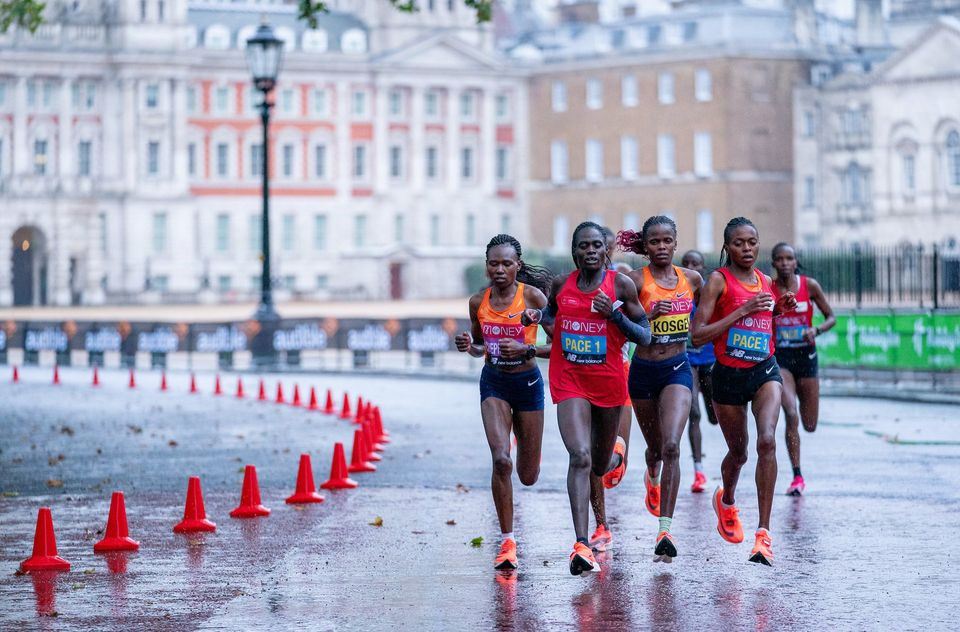
Ruth Chepngetich (left) and Brigid Kosgei – both in orange vests at the 2020 London Marathon. This image was downloaded from the Facebook page of the event and is being used here for representation purpose. No copyright infringement intended.

Notwithstanding the general pace, by 1:44 hours into the women’s marathon, Kosgei was clearly leading Chepngetich and a sizable gap had opened between them and Ethiopia’s Ashete Bekere (winner among women at the 2019 Berlin Marathon), who was in third place. The 35 kilometer-mark went by in approximately 1:55 hours.  By around 1:58, Lily Partridge and Steph Twell, among the top British contenders, had dropped off the race. By 2:04, even as Kosgei cemented her lead further, the gap was progressively reducing between Bekere and Sarah Hall following her in fourth place.  Around 2:12, Kosgei betrayed a smile as she neared the last lap; she eventually finished in 2:18:58. But it was Sarah Hall who turned in a truly inspiring performance. Having overtaken Bekere, she ran past Chepngetich in the last 100 meters or so to finish a brilliant second with new personal best to boot.     

Probably taking a cue from the women’s race, which was held first, the men’s race too maintained a momentum that was slower than what was expected of the talent crammed into it. At 44:50 the commentator said, “ it is not going to be as fast as we would have normally expected from Eliud Kipchoge.’’ At just past the half way mark, the pace was still steady and not yet showing signs of stepping up. In retrospect this may have played to the disadvantage of Kipchoge. He was older compared to those around him in the lead formation and as the defending champion and the only runner in history to have managed a sub-two hour-marathon, albeit unofficially, there was much riding on his shoulders. As the commentators pointed out, the slower pace wasn’t Kipchoge’s regular style. In the past he has displayed the habit of breaking away past the half way mark and striking out on his own. On Sunday, he appeared either struggling or hemmed in by the larger formation settled into a slightly slower pace with prospects of a sprint finish gradually opening up. On more than one occasion, the commentators pointed out that at a slightly higher pace in the early stages, Kipchoge may have shrugged off some of the runners keeping him company.  

An hour and 36 minutes into the race, Kipchoge discarded his cap and there was anticipation that he may be preparing to break free. Around 1:43, the lead runners were still huddled together; there hadn’t been anyone breaking free yet. “ This is relatively slow for the standard these men have run before,’’ the commentator said. By 1:51, Kipchoge had drifted to the back of the lead group; a slight grimace showed up on his face. Around 1:52:50, the commentator said that Kipchoge could possibly be in trouble in the race. By 1:53:46 there was a clear gap between him and the leading lot. “ There is something quite not working for Kipchoge today,’’ the commentator said. By 1:57:30 it was fairly certain that Kipchoge had lost the race and the people to watch out for were the runners nobody had focused on in the days preceding the event when top billing was assigned for a Kipchoge-Bekele face off. As the second hour of running commenced, the lead group stood whittled down to three Ethiopian runners – Kitata, Mosinet Geremew, Lemma and a lone Kenyan, Kipchumba.  Around 2:04, Geremew who had been the most fancied of the lot dropped back. “ There are casualties all around this two and a quarter kilometer-course,’’ the commentator said. It then boiled down to a potential sprint finish between the remaining three and Kipchumba seemed to gain the upper hand briefly before Kitata firmly surged ahead to breast the tape.  It was a final stage with much drama for in those waning moments, few expected Kitata to sustain a sprint given he had often led the pack from the front in the preceding laps and seemed ideal candidate to be tired.

In a post race tweet, Kipchoge said that after 25 kilometers his ear had got blocked and wouldn’t open anymore. “ But this is how sport is,” he said, pointing out that defeat should be accepted and the focus should now be on winning the next race. He hopes to return for the next edition of the London Marathon and the Olympics, Runners World reported in their article on what happened to Kipchoge.

The 2020 London Marathon was run on a specially selected course around St James Park. Athletes ran several loops. According to the race commentators, the said course was considered for the sub-two hour project Kipchoge had executed in 2019. That event finally took place on a special course in Vienna, wherein he achieved an unofficial time of 1:59:40 for the marathon. The London course was quite flat and therefore theoretically, fast. However because the run was happening on a special course due to the pandemic, even if a new course record was set in the 2020 edition, it wouldn’t be counted officially, the commentators said. The pacers for the men’s race on Sunday included Mo Farah.
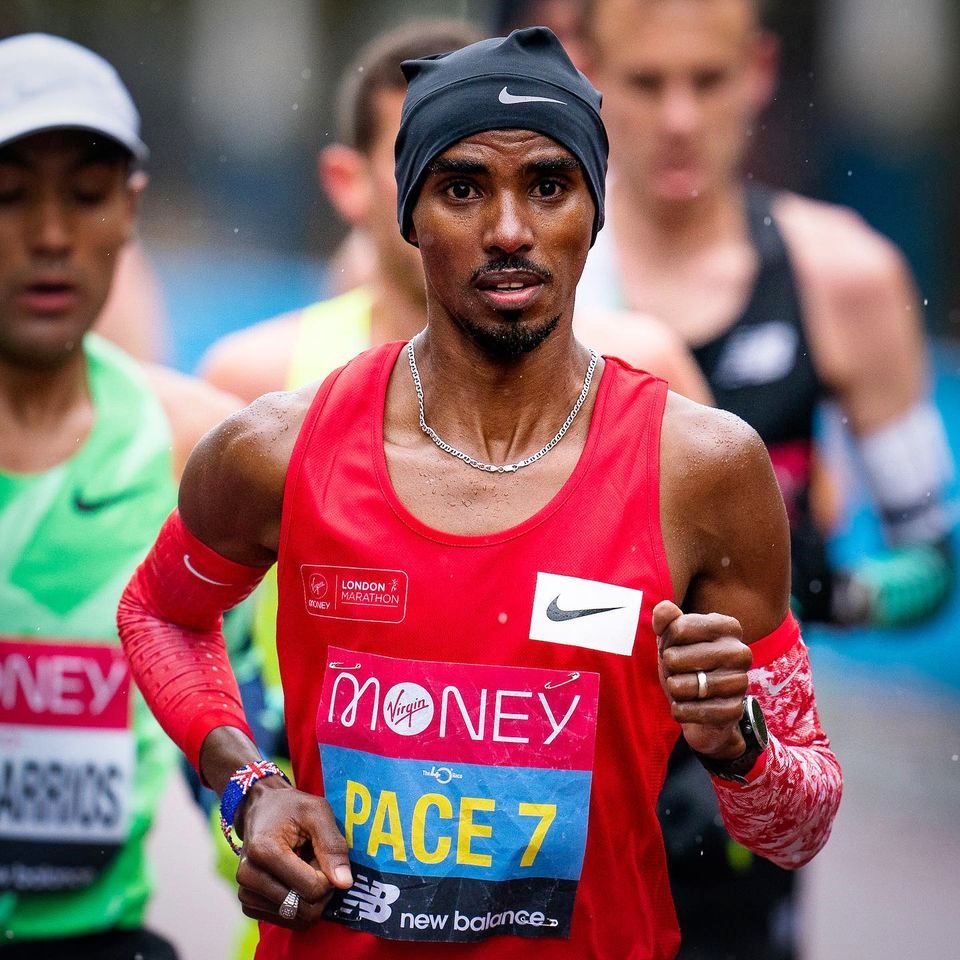
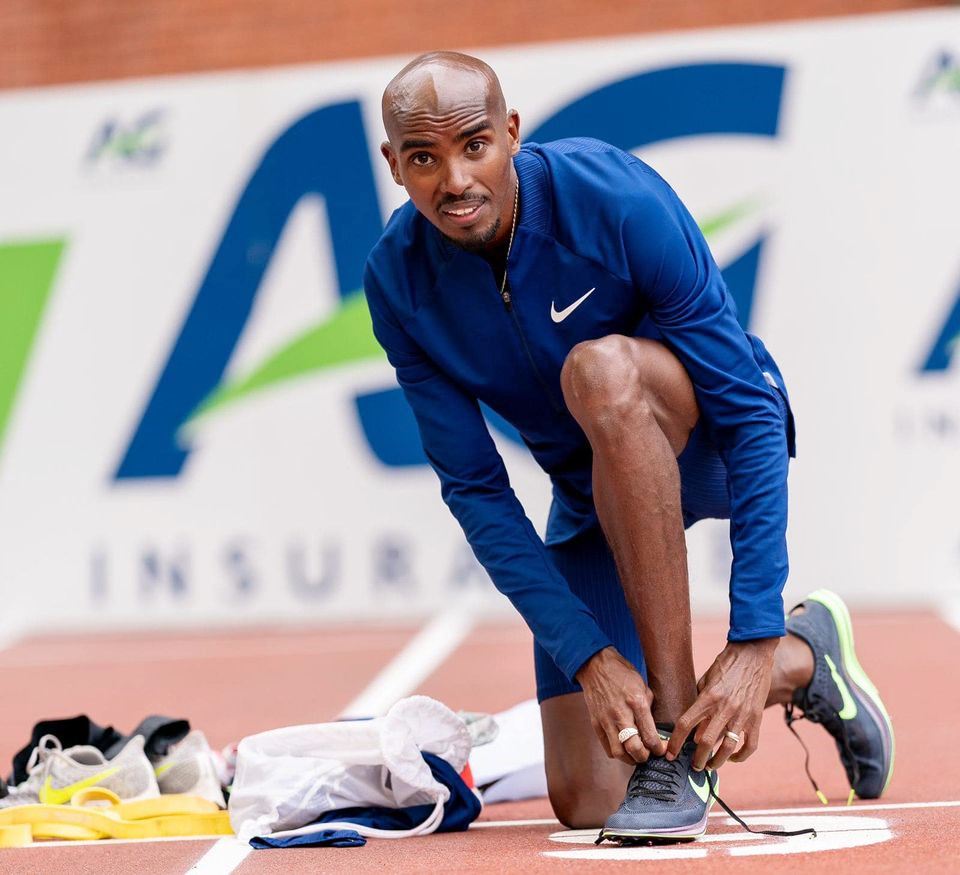
Mo Farah doing duty as pacer at the 2020 London Marathon. This image was downloaded from the Facebook page of the event and is being used here for representation purpose. No copyright infringement intended.

The 2020 London Marathon will definitely trigger curiosity in terms of what the model – a blend of physical race and larger virtual participation – holds for the business of running worldwide. An estimated 45,000 runners were due to participate in the virtual format of the 2020 London Marathon. Outside of the UK, the highest number of runners participating in the virtual version of the event was in USA, Taiwan and Hong Kong, the race commentators said. At the physical race in London on Sunday, there were no spectators and only the elite athletes running loops on a secure course. As an event then accessed through television and digital media, the physical race showcased elite running as pure performance with no other distractions in the frame. In other words, there was no life around. It is possible that some viewers may have found such running a cold, clinical experience with only the commentary providing warmth. Under the circumstances this blend appears the most viable model (there is however the problem of shrinking free access to streaming and sometimes, overpriced access) and London may provide impetus for managers of events elsewhere in the world, to follow suit. Races in Valencia and Abu Dhabi have already been spoken of in this context particularly because there is a real thirst out there with elite marathoners for events to run at and qualify for the Olympics. The marathon at the 2019 World Athletics Championships in Doha, which was one of the opportunities to qualify so before pandemic struck and the 2020 Olympics got postponed to 2021, was held in very warm, humid conditions. Timings reported there, had been slow.

As is the norm these days, the London Marathon was also watched from the perspective of shoe technology and what advanced shoe design brings to the table at races. It was only the second World Marathon Major this year to physically happen, after the Tokyo Marathon in March. Kipchoge, who has in some ways been the face of new developments in shoe technology, was running the race in London in a version of the Nike Alpha Fly with his timing from Vienna – 1:59:40 – written at the back of it, the commentators said.

(The author, Shyam G Menon, is a freelance journalist based in Mumbai.)
KENENISA BEKELE WITHDRAWS FROM 2020 LONDON MARATHON

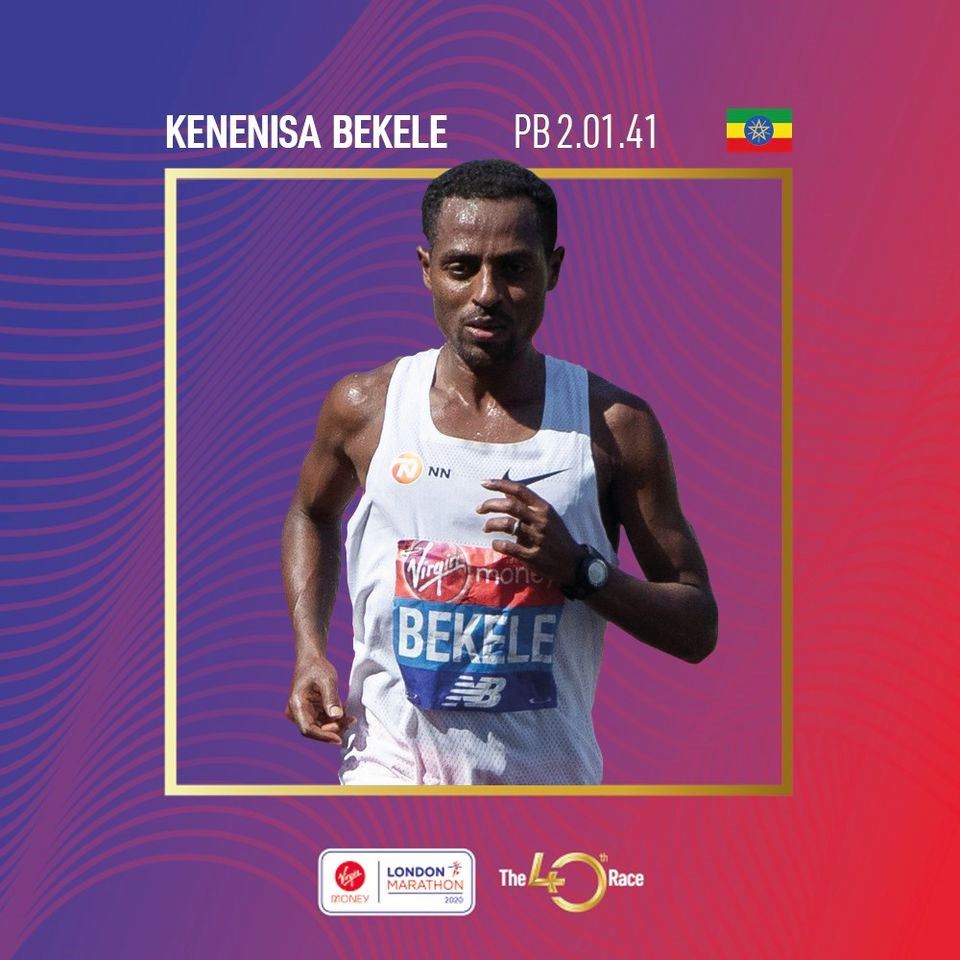
Kenenisa Bekele. This photo was downloaded from the Facebook page of London Marathon and is being used here for representation purpose. No copyright infringement intended.

Top marathon runner, Kenenisa Bekele, will not be participating in Sunday’s London Marathon.

He has pulled out of the event owing to a calf injury, information available on the website of London Marathon, said.

In a related video, the Ethiopian athlete who holds the second fastest time yet in the discipline can be heard saying that he picked up a minor injury two weeks earlier. “ We had really good training and more or less at the end of two weeks, I really pushed a little bit hard in training and I had some feeling in my left calf; a little bit. I feel like over-trained and after my physio checking about this, we tried to solve it but it’s really difficult to get enough and it’s really impossible to race on Sunday. I am not ready because of not solving these minor issues,’’ he says, adding, “ I am really disappointed for my fans; people who waited for this race. I am really disappointed too. I will come back next year. For now, I will not race on Sunday.’’

World record holder, Eliud Kipchoge of Kenya and Bekele sharing the same field was supposed to be the main attraction of this year’s London Marathon. According to a press statement on the event’s website, Sunday would have been the first time Bekele raced since clocking 2:01:41 to win the 2019 BMW Berlin Marathon in September 2019. “ It has been a tough preparation time with lockdown when I couldn’t have my NN team around me. I was in good shape but then I picked up a niggle in my left calf after two fast training sessions too close together in the last weeks of preparation. I have been having treatment every day since then and I truly believed I would be ready but today it is worse and I now know I cannot race on it,’’ the statement dated October 2, quoted him as saying.

Hugh Brasher, Event Director of the Virgin Money London Marathon, has said, “ the world has been waiting to see this head to head between Kenenisa Bekele and Eliud Kipchoge but it will now not happen this Sunday. We know how disappointed he is and we wish him a speedy recovery. This was never likely to be just a two-man race as we had four of the top ten fastest marathon runners ever and six men in the field who have broken 2:05, including Mosinet Geremew and Mule Wasihun, second and third last year, and 2018 runner-up Shura Kitata.” All the three runners mentioned herein – Geremew, Wasihun and Kitata – are from Ethiopia. Kipchoge holds the current course record in London – 2:02:37 – set in 2019.

(The author, Shyam G Menon, is a freelance journalist based in Mumbai.)     
UNLOCK 5 EXTENDS RELIEF TO ELITE SWIMMERS

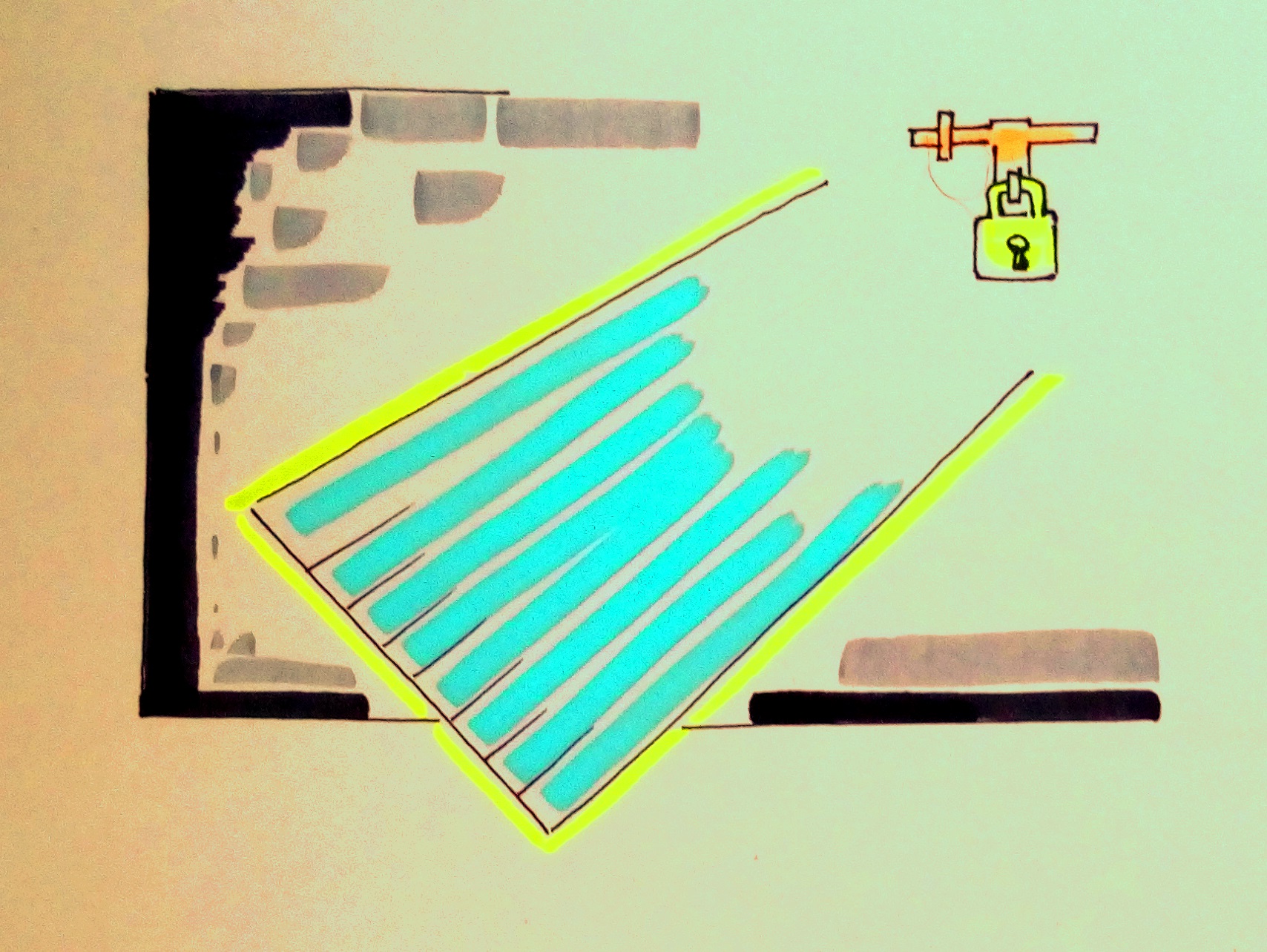
Illustration: Shyam G Menon

Notwithstanding the central government’s recommendation, the final decision will be by the state governments

The central government has allowed select swimming pools to reopen as part of the phased relaxation of lockdown in India, the media reported on September 30, 2020.

This would be as part of Unlock 5, effective from October 1 and the reference to pools has been qualified as those used to train “ sportspersons.” It has been interpreted in swimming circles as meaning competition swimmers.

In its report on Unlock 5, the Hindustan Times wrote,“   Swimming pools being used for training of sportspersons will be permitted to open, for which the standard operating procedure (SOP) will be issued by Ministry of Youth Affairs & Sports (MoYA&S).” Notwithstanding the relaxation of lockdown norms by the central government, given the continued growth of COVID-19 infections, the final decision at ground level will be taken by the state authorities concerned.

In the world of sports, the lockdown to contain the spread of COVID-19, first enforced in late March, had been felt most severely in swimming. While other endurance sports like running and cycling progressively regained a semblance of activity at both amateur and elite levels (races and events are still not permitted) with every move to relax lockdown, swimming continued inaccessible as pools remained shut. This had naturally put pressure on elite swimmers for who, every day of training lost, makes it that much harder to recoup their form and ranking in competition.

The inclusion of swimming pools meant for training “ sportspersons” in the latest unlock guidelines from the center, is the first green signal to swimming in a long while. But as mentioned, the final decision even with regard to reopening facilities for competition swimmers will be that of the state government. In Maharashtra for instance, the state’s Unlock 5 guidelines (announced September 30) continues to have swimming pools in the banned category. At the time of writing, there was no mention yet of local exemptions in line with the central government’s recommendation.

(The author, Shyam G Menon, is a freelance journalist based in Mumbai.)
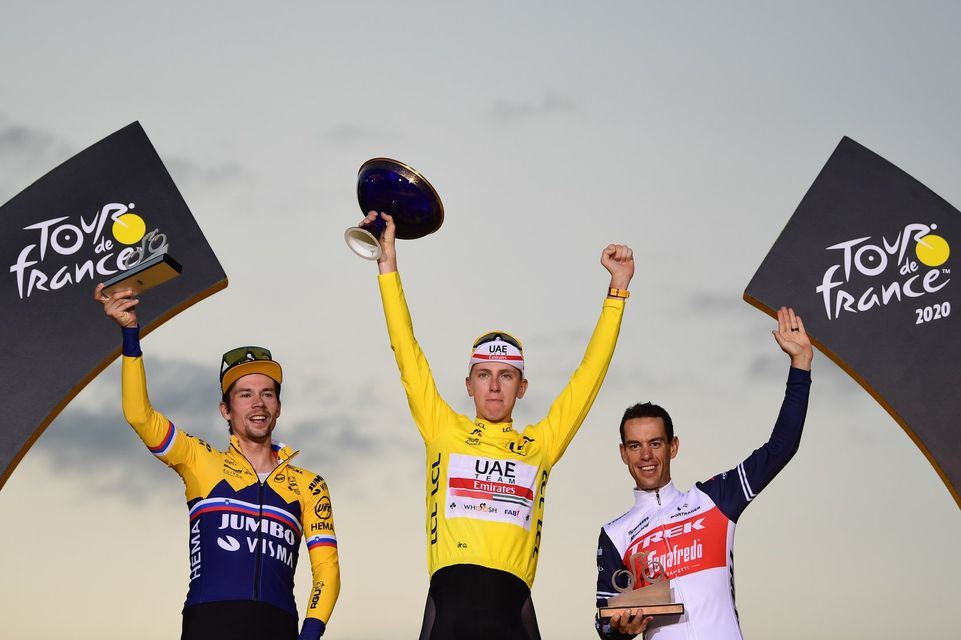
POGACAR WINS 2020 TOUR DE FRANCE

The winners of the 2020 Tour de France (this photo was downloaded from the event’s Facebook page and is being used here for representation purpose. No copyright infringement intended)

Tadej Pogacar of Slovenia has won the 2020 Tour de France.

According to a related CNN report, he is the youngest winner of the iconic race since 1904. He turned 22 on September 21, 2020, the day after the 2020 Tour concluded in Paris.

Coming into the 2020 edition of Tour de France, Pogacar wasn’t as fancied as his fellow countryman Primoz Roglic, who rides for Team Jumbo Visma.  En route to victory this year in France, Pogacar won three stages of the Tour; the clincher was his performance in the race’s penultimate stage which was a time trial in the mountains. Roglic finished second overall while the third place in this year’s Tour went to Australian cyclist Richie Porte of Team Trek-Segafredo. A report by the Associated Press, pointed out that the Slovenian sweep of the first and second positions at the Tour was the first such predicament since British cyclists Bradley Wiggins and Chris Froome took top honors at the 2012 edition of the race.

A rising talent, Pogacar served notice of his potential last year when he became the youngest winner of a UCI World Tour, triumphing in the 2019 Tour of California. He was 20 years old then. In his debut Grand Tour, he finished overall third in the 2019 Vuelta a Espana. “ After his remarkable third place in last year’s Vuelta a Espana, Pogacar was definitely someone that was felt could get on the podium; though his countryman Roglic was the favorite and Roglic’s team, Jumbo Visma, were seen as the strongest,’’ Nigel Smith, Head Coach of the India based-Kanakia Scott Racing Development Team and someone who tracks the Tour every year, said. Although Europe is the epicenter of global cycling in terms of events, talent and devotion to the sport, Slovenia – it is home to the top two cyclists from this year’s Tour – hasn’t traditionally ranked among Europe’s cycling powerhouses.  The situation is similar to how Slovakia wasn’t regarded as a cycling powerhouse “ when Peter Sagan was winning for fun,’’ Nigel said.

Going by media reports, Pogacar’s win has triggered the angle of a new generation rising in global cycling. “ The past two Tour winners, Pogacar and Egan Bernal, have been among the youngest in history,’’ Jeremy Whittle noted in his report on the 2020 race in The Guardian. “ The kids – from the irrepressible Pogacar to Van Alert and his teammate Sepp Kuss, to Marc Hirschi of Team Sunweb, Enric Mas of Movistar and Neilson Powless and Dani Martinez of Education First – have all made their mark,’’ he wrote. Asked for his view, Nigel said, “ Yes, you could say there has been a small shift in the age of successful riders; last year Egan Bernal and Remco Evenepoel had been winning all over the place, to name but two. It’s for a variety of reasons – sports science has improved; talent identification and youth development programs are much better and possibly, most importantly, the sport is much cleaner now.’’

Pogacar’s victory also puts the spotlight on his team: UAE Team Emirates; the Slovenian cyclist’s contract with them is till the end of the 2023 season. Top teams like those participating in Tour de France are a convergence of multiple abilities ranging from talent in cycling to money and resources. According to a September 20, 2020 report by Alaric Gomes in Gulf News, the team’s origin can be traced to Lampre-Merida founded in August 2016 by former Italian cyclist Giuseppe Saronni.  A while later, it was informed that its world team licence was being transferred to the Chinese company TJ Sport Consultation with the resultant entity set to become the first Chinese World Tour team in 2017.

At this point it was indicated that the project was being monitored by the Chinese government with a view to developing Chinese cycling and riders. However in November, TJ Sports’ application came under review by UCI’s Licensing Commission.  It was attributed to developments at TJ Sport causing delay in funding. The team then rebranded as UAE Abu Dhabi and the UCI confirmed a new World Tour licence in December. In February 2017, the team announced that airline major Emirates had become its sponsor with team name revised to UAE Team Emirates. The new team was launched in Abu Dhabi in January 2017, the report said. According to Wikipedia’s page on him, Saronni is currently an advisor to UAE Team Emirates.

In the past, cyclists from India have spoken of their desire to see a similar Indian experiment at the top races in cycling (for more on this, please click on this link: https://shyamgopan.com/2018/10/12/from-a-cafe-in-bengaluru-dreaming-a-world-class-bicycle-racing-team/).

(The author, Shyam G Menon, is an independent journalist based in Mumbai.)

ANJALI SARAOGI, DEEPAK BANDBE WIN 2019-2020 AFI ULTRA AND TRAIL RUNNING AWARDS

Anjali Saraogi; from the Asia Oceania 100K Championships in Aqaba, Jordan (Photo: courtesy Anjali)

Kolkata-based ultra-runner, Anjali Saraogi, has won the AFI Ultra and Trail Running award for women, for the second year in a row, this time for 2019-2020.

Anjali’s performance at the 2019 IAU 100 km Asia & Oceania Championships held in Aqaba, Jordan, in November 2019, came up for mention at the awards function held in virtual format by the Athletics Federation of India (AFI) on September 19, 2020.

In Aqaba, Anjali had completed the 100 km race in nine hours, 22 minutes and three seconds securing fourth place among women and breaking her own national record for that distance category.

Deepak Bandbe from Mumbai won the AFI Ultra and Trail Running award for male runner of the year (2019-20). He had won the bronze medal at the IAU 100 km Asia & Oceania Championships in Aqaba. He covered the distance in 8:04:16 hours, setting a new national record in that category.

Members of the Indian women’s and men’s team, who represented the country at the Aqaba event, were given cash awards for their performance. The men’s team had won the gold medal and the women’s team, silver, at the event. The gold medal winning men’s team members were given cash awards of Rs 10,000 each and the silver medal winning women’s team members received Rs 7500 each.

Nadeem Khan, president of the International Association of Ultrarunners (IAU) and AFI president Adille Sumariwalla participated in the virtual awards function. They pointed out that Indian athletes’ progress in ultra-running has been spectacular.

Deepak Bandbe (This photo was downloaded from the Twitter feed of IAU)

“ Over the last three to four years, the progress of ultra-running in India has been amazing,” Nadeem said. “ India is a growing market for us, an important market,” he added.

“ I am pleased to note the rapid progress of Indian athletes over the last few years,” Adille said. He emphasized the need to get back to events. AFI’s focus is on protecting athletes given the ongoing COVID-19 pandemic.

“ It’s a huge honour. My award belongs to every girl child in my country who will dare to dream and persevere to follow them,” Anjali told this blog after her second consecutive AFI award (for more on Anjali please click on this link: https://shyamgopan.com/2020/08/07/perfection-is-making-the-best-of-what-you-have/).

Sunil Chainani and Peteremil D’Souza, both members of AFI’s committee that oversees ultrarunning, managed the meeting.

(The author, Latha Venkatraman, is an independent journalist based in Mumbai.)

2020 VIRTUAL BOSTON MARATHON / POST RUN ROUND UP

Illustration: Shyam G Menon

The 2020 edition of Boston Marathon, originally slated to be held in April and later rescheduled to September, was held as a virtual race over the period September 5 to 14. Runners who had qualified to run at the actual event and registered for the same, were given the option of running the virtual Boston Marathon. The Covid-19 pandemic prompted the organizers of the event, Boston Athletic Association (BAA), to convert it into a virtual race.

We spoke to some of the runners from India, who participated in the virtual race. To mention in particular are two points given the run happened in the shadow of pandemic and lockdown had hampered the regular training of runners. The timings reported are decent despite above said handicaps and at least in Pune and Bengaluru, running groups scouted a good location for the virtual run and backed it with hydration support, even some cheering.

Himanshu Sareen (Photo: courtesy Himanshu)

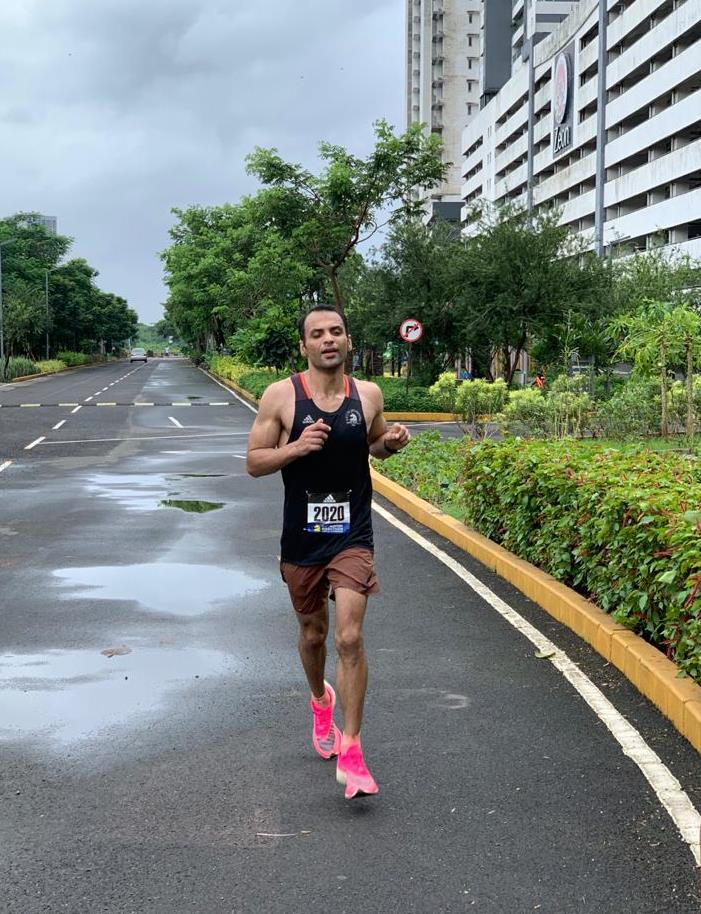
The virtual Boston Marathon was an opportunity for Himanshu Sareen to run a marathon after more than a year. His last marathon was in April 2019. The Mumbai based-amateur runner was set to participate in the Tokyo Marathon, Barcelona Marathon and Boston Marathon in 2020. All these events were cancelled and Boston Marathon was converted into a virtual race. Had the actual race taken place, it would have been his third Boston Marathon.

Himanshu’s training in the months preceding the virtual Boston Marathon was focused on two aspects – general fitness and improving speed. “ My coach Ashok Nath drafted a multi-pronged training plan that incorporated speed, fitness and participation in virtual races,” Himanshu said.

For the virtual event, he chose to run close to his place of stay. “There are two roads of one kilometer each in my neighborhood. My plan was to run on these roads in a loop,” he said. The window for the virtual run spanned September 5 to 14; you could run anytime within these dates.

Syed Atif Umar (Photo: courtesy Syed Atif Umar)

Running on September 13, 2020, Himanshu commenced his marathon a little after 6AM. Initially he had to restrict himself to a 500 meter-loop as overnight rains had resulted in puddles on one of the roads.

“ I ran quite strongly till the 26 kilometre mark. After that I slowed down as I was going too fast. Mumbai’s weather is not conducive for running fast. The second half of the run was tough,” he said. In the early phase of the run, he supported himself with water and energy drinks stationed along the loop. But soon some runners, the security guards of his building and his wife Shweta joined in to help; they handed out hydration. Himanshu completed his marathon in 2:58. He is now set to run the virtual New York City Marathon.

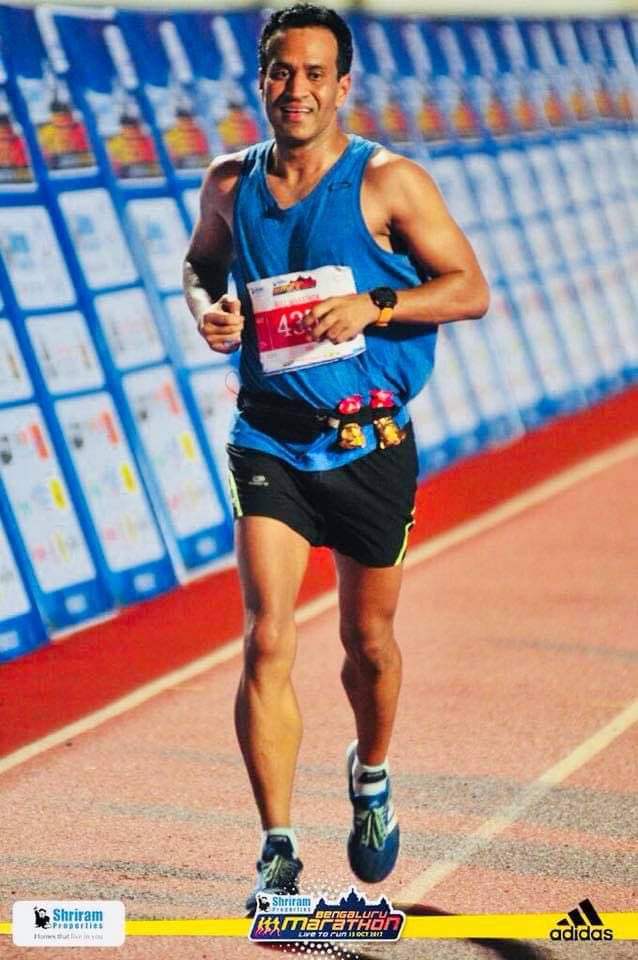
Bengaluru-based Syed Atif Umar had registered to run his first Boston Marathon this year. Like many others he had to eventually opt for the virtual race. Atif has been running for the last 10 years. He has participated in many races including marathons and the occasional ultramarathon.

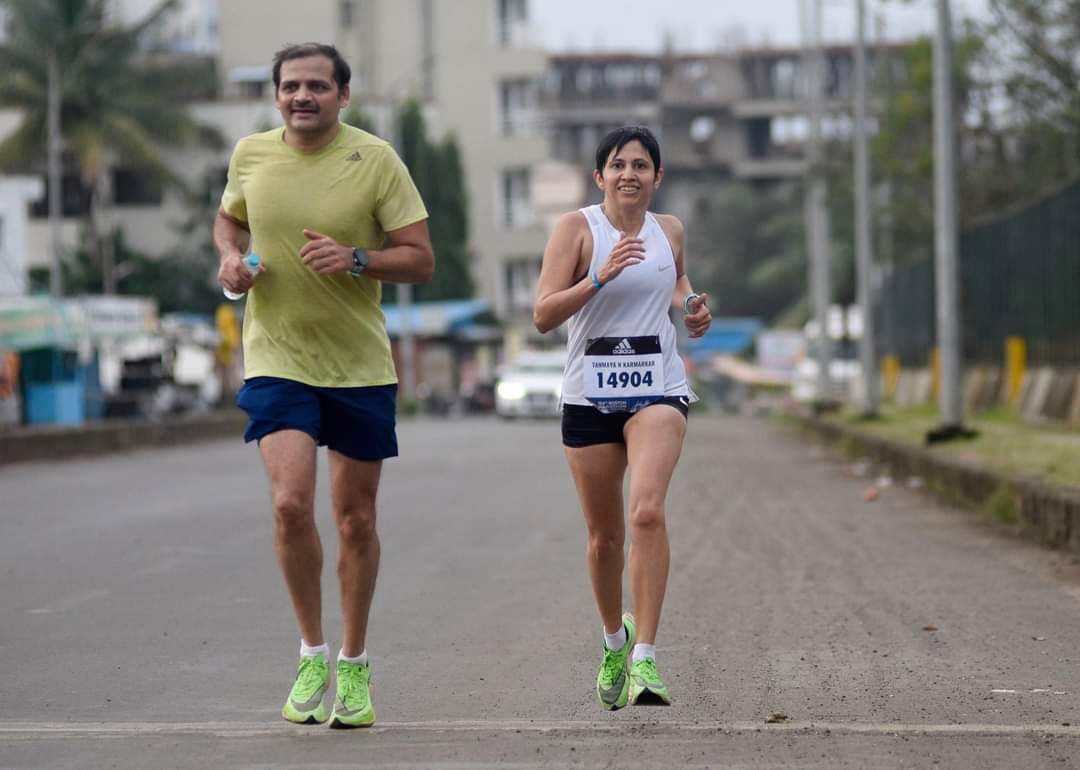
Tanmaya Karmarkar (right) with Amod Bhate (Photo: courtesy Tanmaya)

He chose to run the virtual Boston Marathon on his treadmill. “ I created a playlist with 42 songs,” he said. He completed the marathon in 2:56:42, a new personal best for him. His previous best for the marathon was 3:01 early this year.

Pune-based runner, Tanmaya Karmarkar had planned to run at a pace of 4.40. She was going as per her pace plan but around the 14th kilometer, she started to feel sick after she consumed her second gel. Her pace progressively declined. Tanmaya switched to water and began to feel better.

A running group in Pune had chalked out a route for the virtual Boston Marathon runners. It entailed running along a flat 10 kilometer-loop. “ Weather was quite hot and humid. We had to keep pouring water on ourselves to stay cool,” she said.

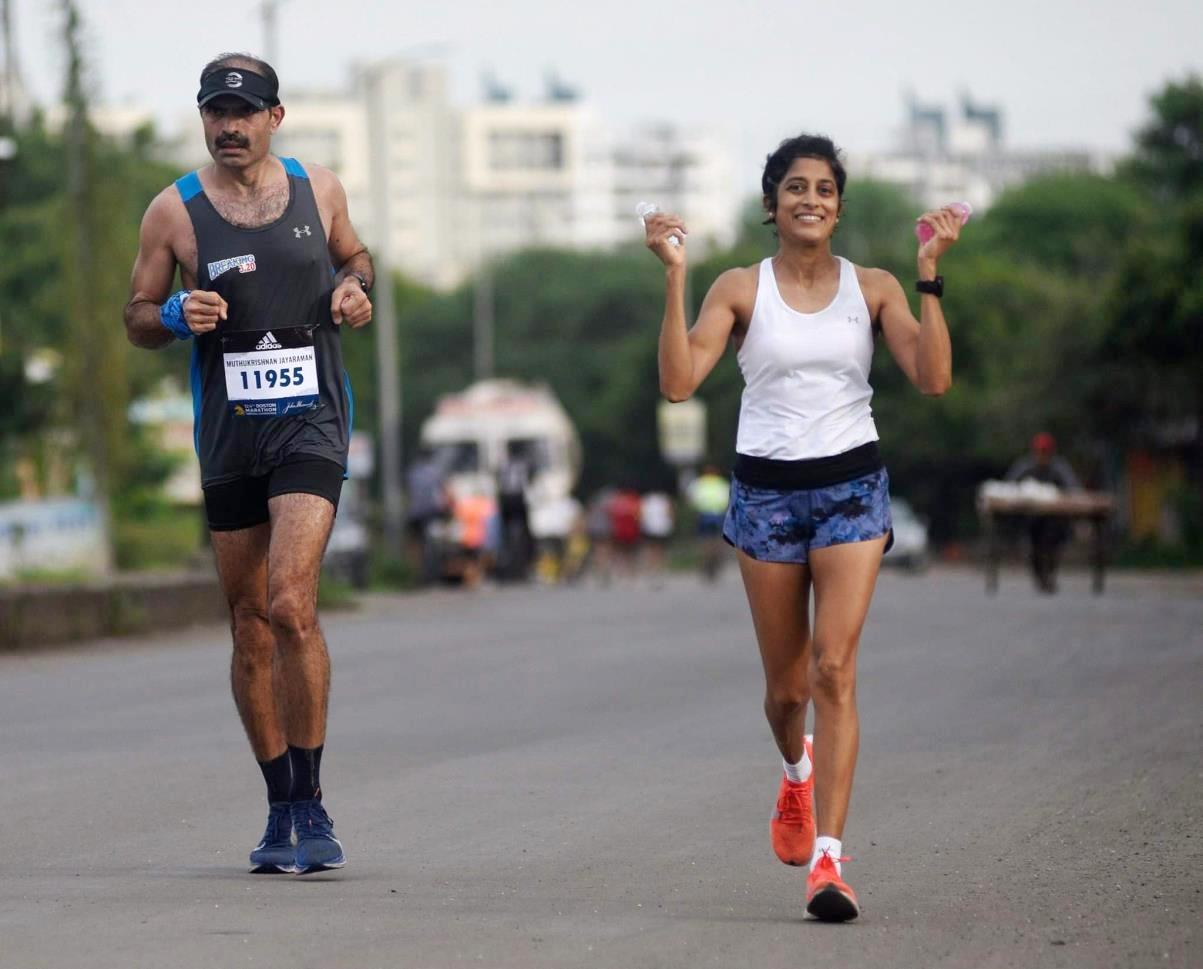
Muthukrishnan Jayaraman (left) with Kavitha Reddy (Photo: courtesy Muthukrishnan Jayaraman)

According to her, the support of other runners and friends was invaluable. “ Many people went out of their way to help me. Even people I met for the first time were all out to support us – I am really grateful and touched by this gesture from fellow runners,” she said. She finished the run in 3:27:43.

Army doctor and recreational runner, Colonel Muthukrishnan Jayaram, decided to run the virtual Boston Marathon in Pune. The city’s weather and the fact that a local runners’ group had organized support for those participating in the virtual Boston Marathon prompted him to travel to Pune from Delhi for the run.

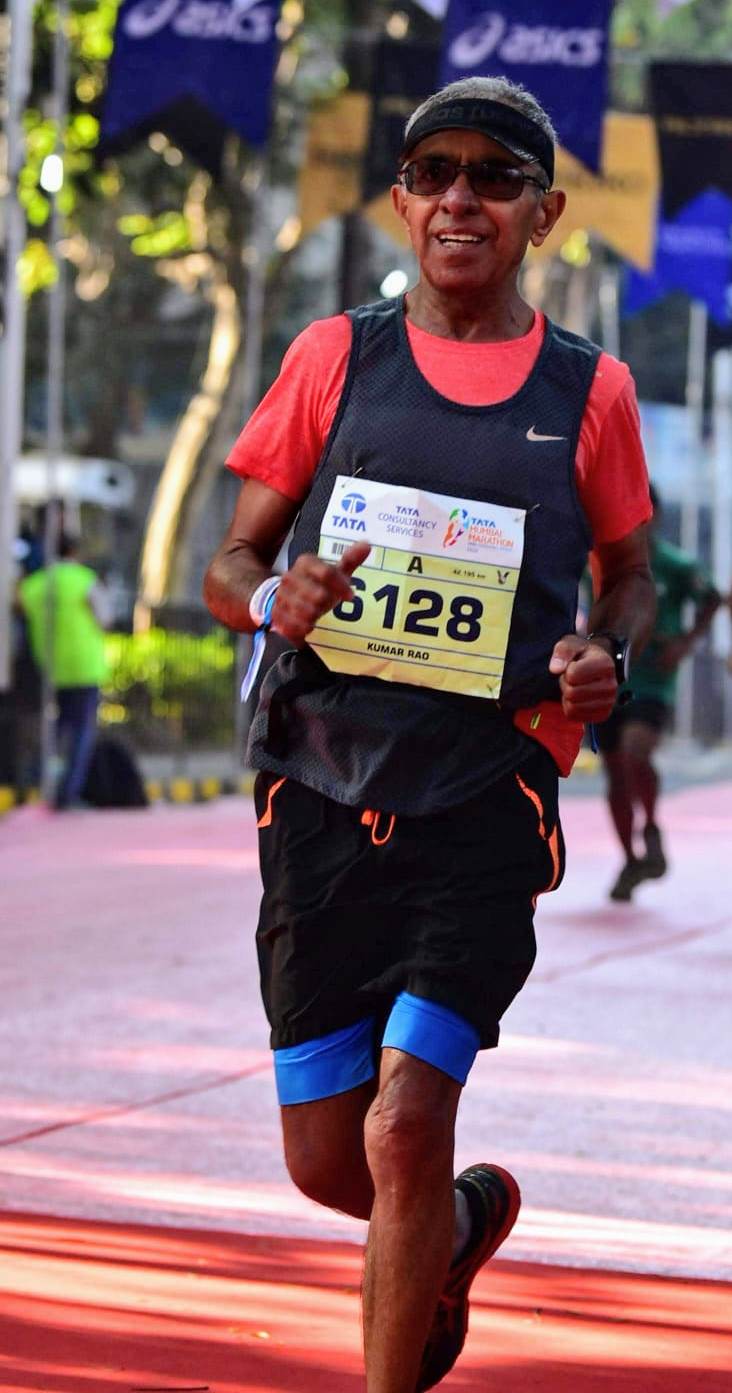
Kumar Rao (Photo: courtesy Kumar Rao)

He started the run at 4.30AM running along the earlier mentioned flat 10 kilometer-loop. After the first loop, he was paced by runners Krishna Sirothia and Kavitha Reddy. “ Although tired, I was happy I did not have any aches and was able to gather pace through the last miles to finish within my intended target,” he said. He finished the marathon in 3:47:43.

Septuagenarian Kumar Rao had trained moderately well for the virtual Boston Marathon. Running on his treadmill, he had a good run over the first 25 kilometers. But subsequently, some stomach discomfort and cramps forced him to mix the running with walking. “ After about 33 kilometers, I began to have difficulty in running tall. I changed my shoes. However it gave me just minor relief,” he said. He covered the distance in 4:24:36.

A notable aspect in Pune and Bengaluru was how runners approached the virtual run in a structured way, finding a good loop that they can run on and then backing it with hydration support and fellow runners to extend the occasional need for pacing and motivation. They even had bibs, banners and an element of cheering. In Pune, a group of runners decided to organize a support-run for those running the virtual Boston Marathon. Kavitha Reddy, one of the country’s best recreational runners, was among those helping out with this informal arrangement. “ It was a small gesture to make it a memorable run for those participating in the virtual Boston Marathon,” Kavitha said. Some of the runners helped in printing flex tapes to impart the feel of a real race. “ It was easy to manage the logistics for this run as the number of runners was small,” Kavitha said.

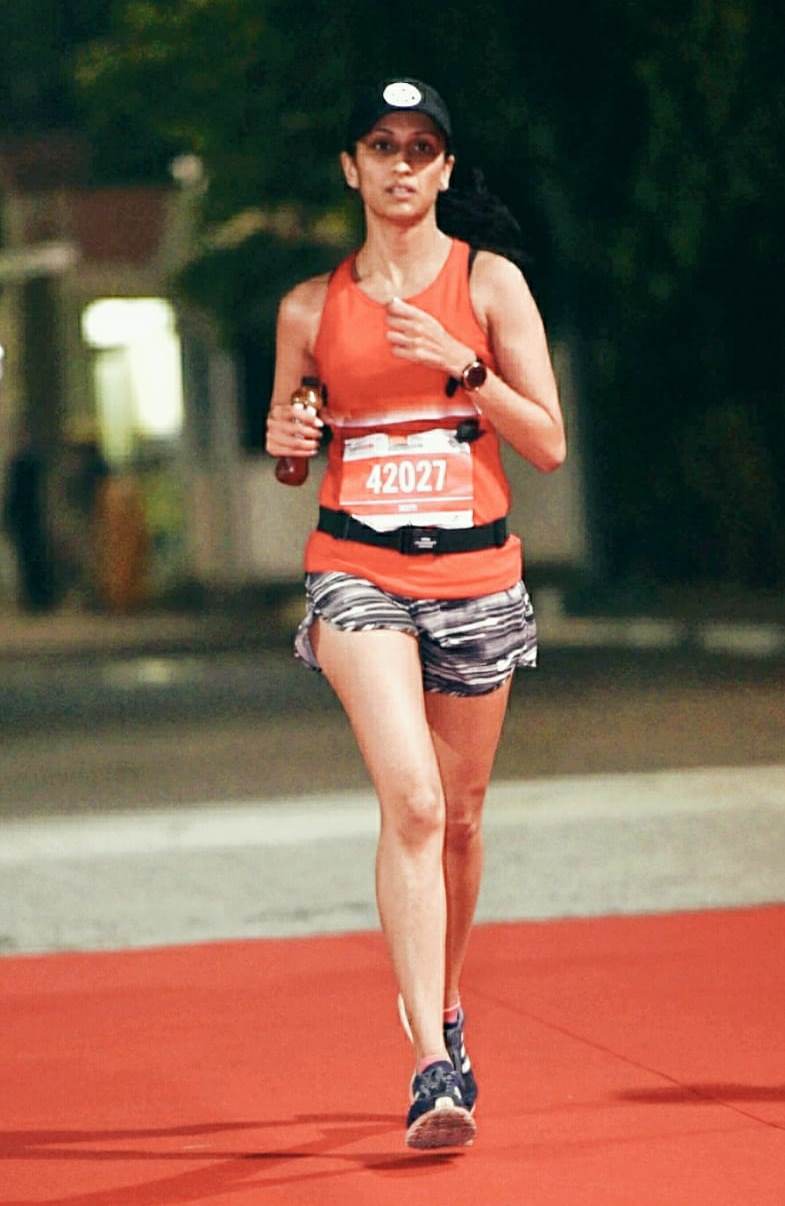
Deepti Karthik (Photo: courtesy Deepti)

In Bengaluru, Pacemakers, a marathon training group, had been organizing training runs with hydration support for its runners periodically. In August, the group had organized a 21 kilometer-training run for its members. “ These runs were organized primarily to keep the runners motivated,” Deepti Karthik said. Five runners from the group were running the virtual Boston Marathon. The team at Pacemakers thought it fit to organize a similarly supported training run that would also cater to the Boston Marathon runners. “ A couple of runners from outside Bengaluru who were running the virtual Boston Marathon also joined in,” Deepti said. Members of Pacemakers volunteered to manage the hydration support. “ We followed all safety norms needed for this pandemic. We ensured that there was no contact during the handing out of hydration. Also, we chose a route with wide roads and minimum traffic to help maintain adequate physical distance between runners,” she said.

Running in Bengaluru, Deepti commenced her virtual Boston Marathon at 4:45AM on September 13, 2020. Weather was conducive with light drizzle throughout the duration of her run. But she had some stomach issues during the run. Runners were slated to run along a 5.6 kilometer-loop; the loop was later extended to 10.5 kilometers. “ Every 2.5 kilometers, there was a hydration station. Also, volunteers and even people to cheer you on made the entire experience a happy one,” she said. She finished the run in 4:13:31.

Bengaluru-based runner, Murthy R K, decided to run the virtual Boston Marathon near his place of residence at Kanakpura Road.

Murthy R. K (Photo: courtesy Murthy)

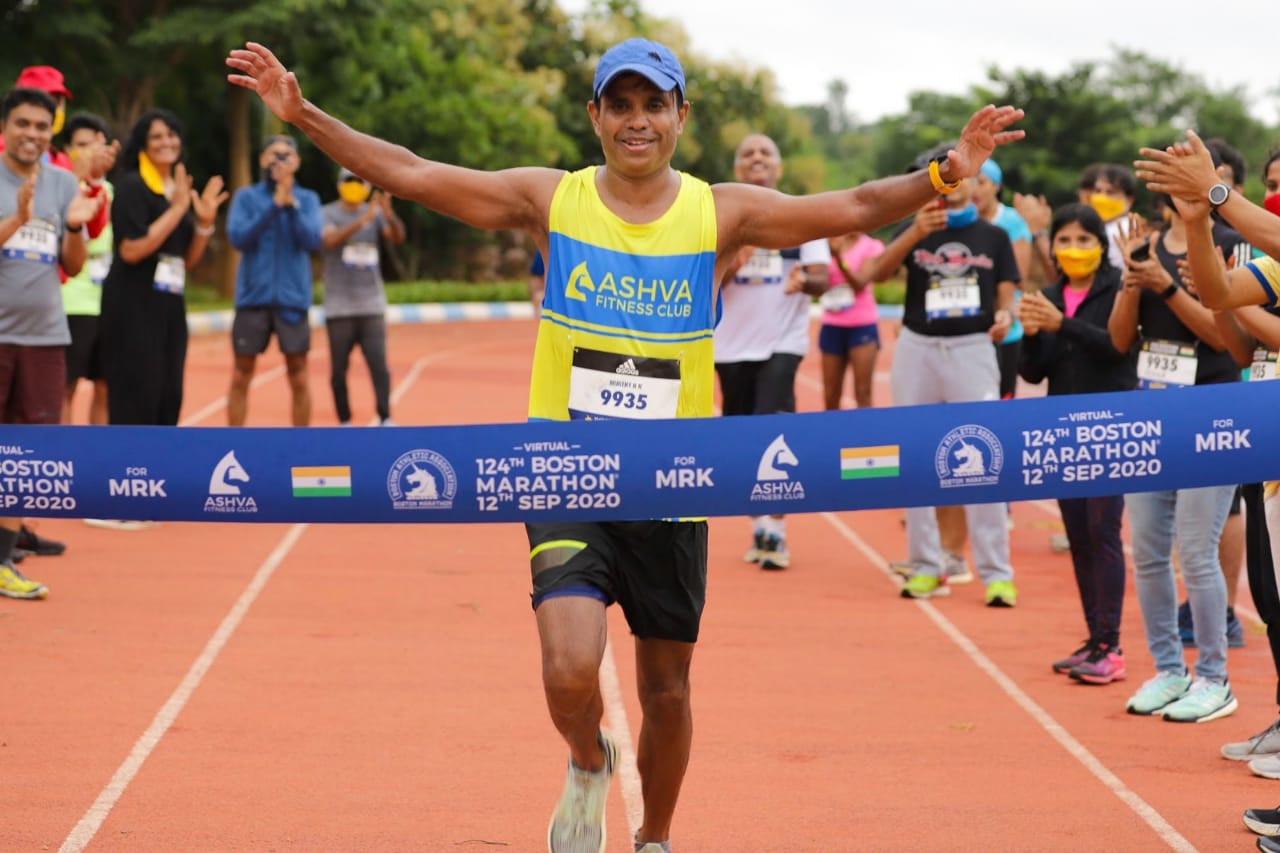
He had scheduled his run for September 12, 2020. Founder of Ashva Fitness Club, Murthy and his team created bibs and posters for the run. On September 12, Murthy ran the marathon, supported by many of his team members. But cramps during the run forced him to pause for breaks; he finished in 3:28.

Unhappy with his timing, Murthy decided to make one more attempt two days later, on September 14, the last day of the virtual Boston Marathon. He set out early and opted to run in a new residential area close to his home. He took a break every 10 kilometers.  “ At the 36 kilometer-mark, I began to feel the cramps coming on. I just told myself I have only six kilometers to go,” he said. He finished the run in 3:10:09, a new personal best.

(The author, Latha Venkatraman, is an independent journalist based in Mumbai.)

AS PREMIUM BICYCLE SALES GAIN, SCOTT LAUNCHES NEW MODELS IN INDIA

SCOTT Spark RC 900 (Photo: courtesy SCOTT India)

SCOTT Sports India has launched the SCOTT Spark series of mountain bikes in India.

According to an official press release made available on September 16, 2020, the launch includes the SCOTT Spark RC 900 Team, one of the most decorated full-suspension bikes, ridden by the likes of Nino Schurter, a winner at the Olympics, and Kate Courtney, a World Cup champion. “ The bike is a super light, super-aggressive steed that pedals with incredible efficiency and is priced at INR 369,900,’’ the statement said.

The launch follows an increase in demand for performance-oriented premium bikes in the price range of two to ten lakh rupees. When contacted, an official spokesperson informed that while the Spark RC 900 Team is currently available in India, the rest of the models in the range are available on request.

“ We’ve seen unprecedented demand in premium bicycles over the last few months. While fitness is the key driver, a lot of demand is specific to performance and high-quality components, and these bikes cost anywhere between 2 lakhs to 10 lakhs. At SCOTT, we always believe in bringing the best in innovation, technology, and design to someone equally passionate. And that’s why we are planning to introduce a higher number of performance-oriented bikes in India over the next few months,” Jaymin Shah, Country Manager, SCOTT Sports India, was quoted as saying in the press release.

“ We’ve seen an increase in demand for performance-oriented cycles, not only in the mountain bike category but also for road and gravel bike category. For instance, we received multiple orders for the SCOTT Addict RC series that are priced between 5 lakhs to 6 lakhs,” he added.

In the wake of COVID-19 pandemic there has been an increase in bicycle sales globally. Cycling is environment friendly personal transport; it is also an exercise contributing to good health.  Many cities overseas have actively encouraged citizens to cycle and walk instead of taking out motor vehicles.

(The author, Shyam G Menon, is a freelance journalist based in Mumbai.)
IT’S TIME FOR THE VIRTUAL BOSTON MARATHON

Illustration: Shyam G Menon

The Boston Marathon, held every year in April, inspires hundreds of runners around the world to qualify for it and participate. Its 2020 edition was cancelled owing to the COVID-19 pandemic, the first such cancellation in the history of the 124 year-old event.

In lieu of the real race, the Boston Athletic Association (BAA) has offered the virtual Boston Marathon experience. Running the virtual Boston Marathon won’t fully compensate for missing the actual event and the ambiance it is famous for. It will be akin to a long training run, some of the runners we spoke to, said. The promise of a finisher’s medal is a positive in the package. Under the circumstances, the virtual run is the best alternative available.

Around the world, runners are planning to partake in the event in small groups with runs over short loops to maintain the protocols necessary for these times of pandemic. Training for the virtual event, some said, has not been close to levels seen ahead of real races. Participating in the virtual run is aimed at keeping motivation levels high. Meanwhile pending further notice, registration for the 2021 edition of the Boston Marathon has been postponed. The report concerned may be accessed on this blog under the post titled: At a Glance / September 2020.

Muthukrishnan Jayaraman (Photo: courtesy Muthukrishnan Jayaraman)

The 2020 edition of Boston Marathon was to be Colonel Muthukrishnan Jayaraman’s first Boston Marathon outing.

An army doctor, Muthukrishnan had qualified for Boston Marathon three times. He was able to get a berth in the 2020 edition of the race. Boston Marathon has stringent entry norms and attracts some of the best amateur marathon runners from around the world.

Initially slated to be held on April 20, 2020, the race was postponed to September 14, 2020. But with mass participation events being cancelled due to the COVID-19 pandemic, the organizers opted to hold it as a virtual race, which can be run anytime during the period September 5 to 14.

A resident of Delhi, Muthukrishnan was able to train moderately well. “ But obviously, the training is not with a target in mind. Also, it has not been as strict as it would have been for a real race,” he said. Muthukrishnan will be travelling to Pune to do his Boston Marathon virtual run on September 13, 2020.

Tanmaya Karmarkar (Photo: courtesy Tanmaya)

Pune-based Tanmaya Karmarkar was to run her second Boston Marathon this year. With the event cancelled, she settled for running the virtual race. “ I have been doing training runs through this lockdown but structured training commenced only a month ago,” she said. She decided to run the virtual race as it would give her an opportunity to run an event in the absence of any physical races in the near future.

She along with a few Pune-based runners has chosen a route that offers a 10.5 kilometer-loop. Muthukrishnan will be joining these runners in Pune. Boston Marathon’s virtual event is open only to runners who had registered for the 2020 edition. They were required to register again for the virtual event.

The virtual Boston Marathon taking place from September 5 to 14, allows participants to run on treadmill or outside. The marathon has to be completed in six hours. Performance in the virtual marathon will not be accepted as qualification for Boston Marathon 2021.

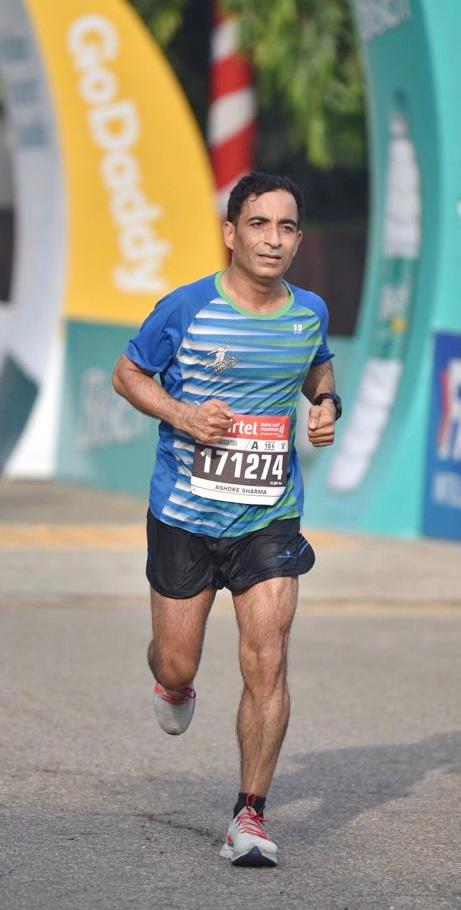
Ashoke Sharma (Photo: courtesy Ashoke)

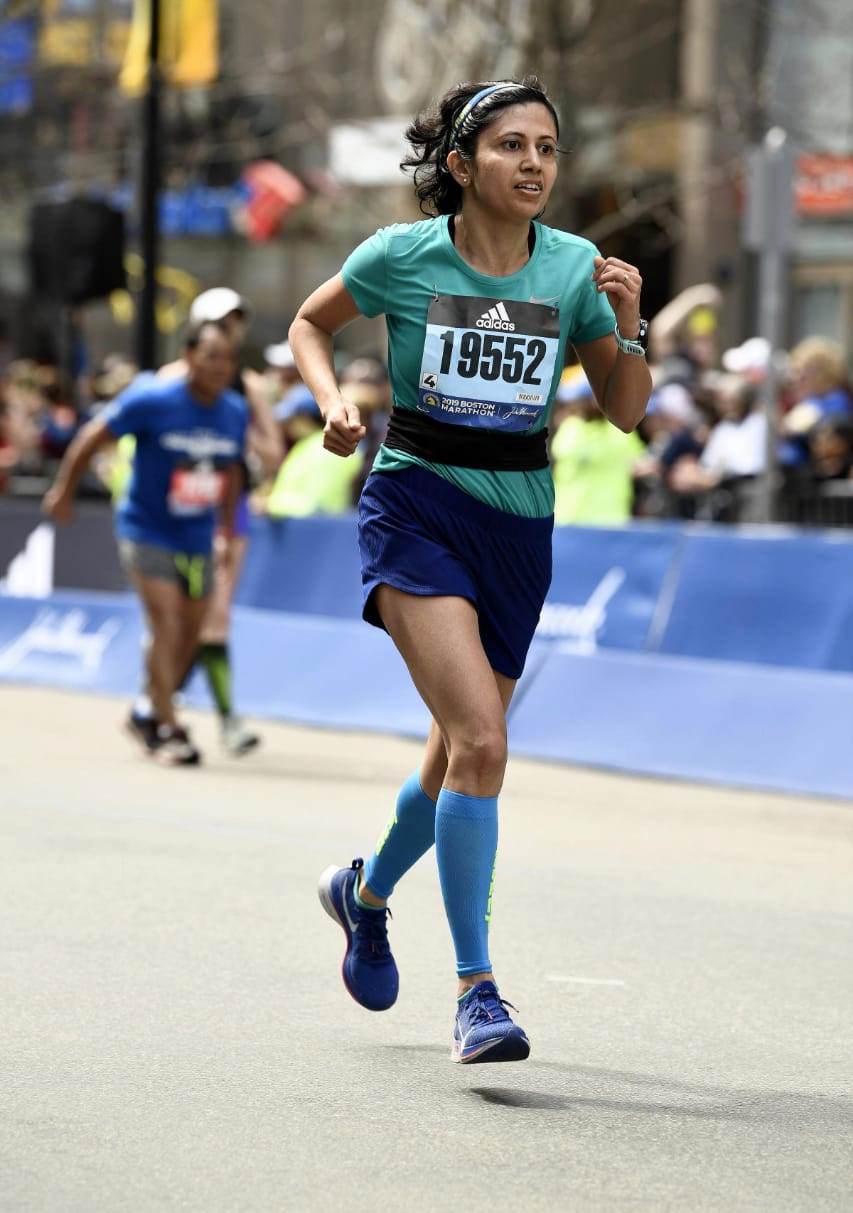
Ashoke Sharma, a Gurgaon-based recreational runner, was to run his first Boston Marathon this year. His training for the virtual event has not been as meticulous as it would have been for an actual race. The weather in Gurgaon was also far from conducive to do race pace training, he pointed out.

“ My aim is to complete the run,” he said. Ashoke will be travelling to Bengaluru to do the virtual Boston Marathon. He plans to run the marathon on a route charted by the Bengaluru-based marathon training group, Pacemakers. “ I think they have chosen a traffic-free route near the airport,” he said. Once done with Boston Marathon, Ashoke will be stepping up his training for the virtual New York City Marathon.

Like Ashoke, Wing Commander Parag Dongre (retd) was also set to run his first Boston Marathon this year. Parag had trained for the April race and then resumed training after lockdown induced-break, for September’s virtual event. “ In Pune, we lost some days of training because of another stringent lockdown spanning 15-20 days,” Parag said.

Parag Dongre (Photo: courtesy Parag)

“ Training runs are often done in the company of many runners but because of the physical distancing norms, we had to run alone. I have done a few 30 km and 35 km training runs all by myself,” Parag said.

At the time of writing, he was yet to decide on the date of his virtual Boston Marathon. Post retirement from the Indian Air Force, he works as a helicopter pilot for B.G. Shirke Construction Company. “ I am waiting for my duty schedule to come up before I decide my day for running,” he said.

“ My training has been okay though not as well as I would have liked it to be,” Deepti Karthik, a recreational runner based in Bengaluru, said. The 2020 edition of Boston Marathon was to be her first appearance at the race. “ The virtual Boston Marathon is obviously not the same as the real race. At best, it may feel like a long training run,” she said. Deepti will be running the virtual event on September 13, along with other runners of Pacemakers.

Deepti Karthik (Photo: courtesy Deepti)

“ Pacemakers has chosen a route near the airport for the virtual event. Runners will be running in a loop of 5.6 km,” she said.

Kumar Rao, also from Bengaluru, will however be running on his treadmill. “ I will be running on the treadmill on September 12. I use the Stryd footpod with Garmin 935 for accurate measurement of pace and distance,” he said.

His training for this virtual race was entirely on the treadmill at home. “ I am looking to improve on last year’s timing of 3:59:33 hours and the age group rank of 18,” he said adding that he would work on a 3:55 finish. He just completed 10 weeks of specific training for this marathon. His training volume has been around 75 to 85 km per week. Kumar has also registered for the virtual New York City Marathon.

Kumar Rao (Photo: courtesy Kumar Rao)

The pandemic related lockdown forced Kumar to train entirely indoors on his treadmill. He complemented it with home-based fitness programs including strength training. He plans to step outside for his training runs once he is done with the virtual Boston Marathon.

Murthy R K, also from Bengaluru, plans to run the virtual race on September 12. Murthy’s training for the run has been moderately good though not as good as it would have been for the real event. He plans to run the virtual race without any target in mind. Murthy had been training hard for several years to qualify for the Boston Marathon. He was able to obtain a berth for the 2020 edition of the race but unfortunately the event got cancelled due to COVID-19. Disappointed, Murthy decided to run the virtual race instead. “ I do not have any target in mind. Nevertheless, I plan to do a good run,” he said.

(The author, Latha Venkatraman, is an independent journalist based in Mumbai.)

A WEEKEND OF WORLD RECORDS

Mo Farah; this photo was downloaded from the athlete’s Facebook page and is being used here for representation purpose. No copyright infringement intended.

Great performances from Mo Farah, Sifan Hassan and Peres Jepchirchir

A world still in the shadow of COVID-19 isn’t stopping top athletes from smashing records. Three world records tumbled over September 4 and 5, 2020.

As per reports available on the website of World Athletics, Britain’s Mo Farah and Sifan Hassan of the Netherlands set world one hour-records in their respective gender categories at the Wanda Diamond League exhibition meet at the King Baudouin Stadium in Brussels, Belgium, on September 4.

Farah, a multiple world and Olympic champion set a new mark of 21,330m – bettering the 2007 mark of 21,285m set by Ethiopia’s Haile Gebrselassie. Somali-Belgian athlete, Bashir Abdi finished second, eight meters behind.  However, while he was leading the race, Abdi lowered the world best for 20,000 meters from 56:26 to 56:20.2. In her race, Sifan Hassan, the Dutch world 1500m and 10,000m champion, touched 18,930 meters in one hour, beating the existing mark of 18,517 meters set by Ethiopia’s Dire Tune in 2008, the report said.

Same day in Prague, Peres Jepchirchir of Kenya broke the “ women-only race world record in the half marathon,’’ another report on the website said.

According to it, on September 5, the 26-year-old Kenyan clocked 1:05:34 for the distance improving upon the previous record of 1:06:11 set by Netsanet Gudeta of Ethiopia at the World Half Marathon Championships in 2018.

All the new timings reported are subject to the usual ratification process.

(The author, Shyam G Menon, is a freelance journalist based in Mumbai.)
ARMY SPORTS INSTITUTE CONFERRED TOP AWARD

Illustration: Shyam G Menon

Army Sports Institute (ASI) Pune has been awarded the “ Rashtriya Khel Protsahan Puraskar 2020” by the Ministry of Youth Affairs & Sports, Government of India.

Since its inception, the institute has enabled participation of 20 sportsmen in Olympics; 12 sportsmen have already qualified for the 2020 Tokyo Olympics (rescheduled to 2021) with more hoped to qualify. The Institute has won six Youth Olympic Medals, 19 medals in Asian Games and 18 medals in Commonwealth Games, a related press release dated August 23, 2020, issued by the PRO (Defence) said.

According to it, in the last three years, sportsmen trained at ASI have won 450 international and 1118 national medals with a number of firsts and records. In the last three editions of Khelo India, the sportsmen won 125 medals in five disciplines.

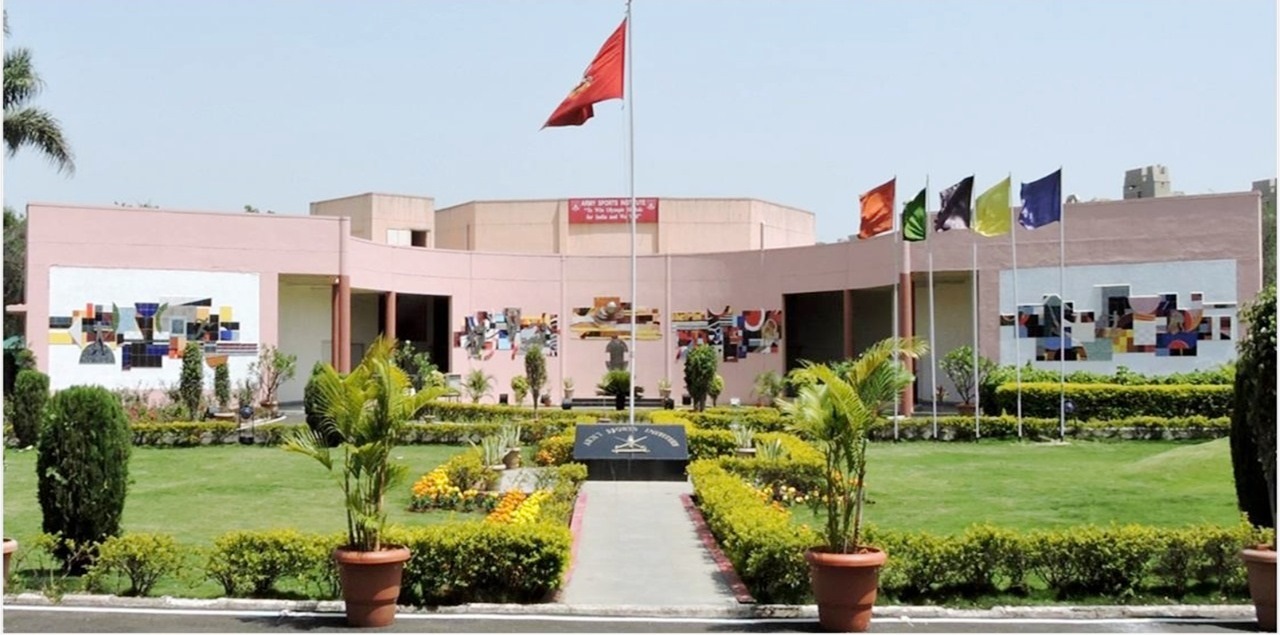
Army Sports Institute, Pune (Photo: PRO [Defence])

ASI was raised as part of the Indian Army’s “ Mission Olympics” program on July 1, 2001. “ The aim was to train the vast reservoir of talent in the army in seven selected disciplines -archery, athletics, boxing, diving, fencing, weightlifting and wrestling – with the aim of winning medals at the Olympics. The institute draws its sportsmen from the army as well as from young raw and proven talent in ` Boys Sports Companies’ (8-14 years age),’’ the release said. These sportsmen are supported by a team of foreign and Indian coaches, physical conditioners and specialists in sports medicine, physiology, psychology, bio-mechanics, statistics and nutrition.

(The author, Shyam G Menon, is a freelance journalist based in Mumbai.)