SWEET RUN CHICAGO

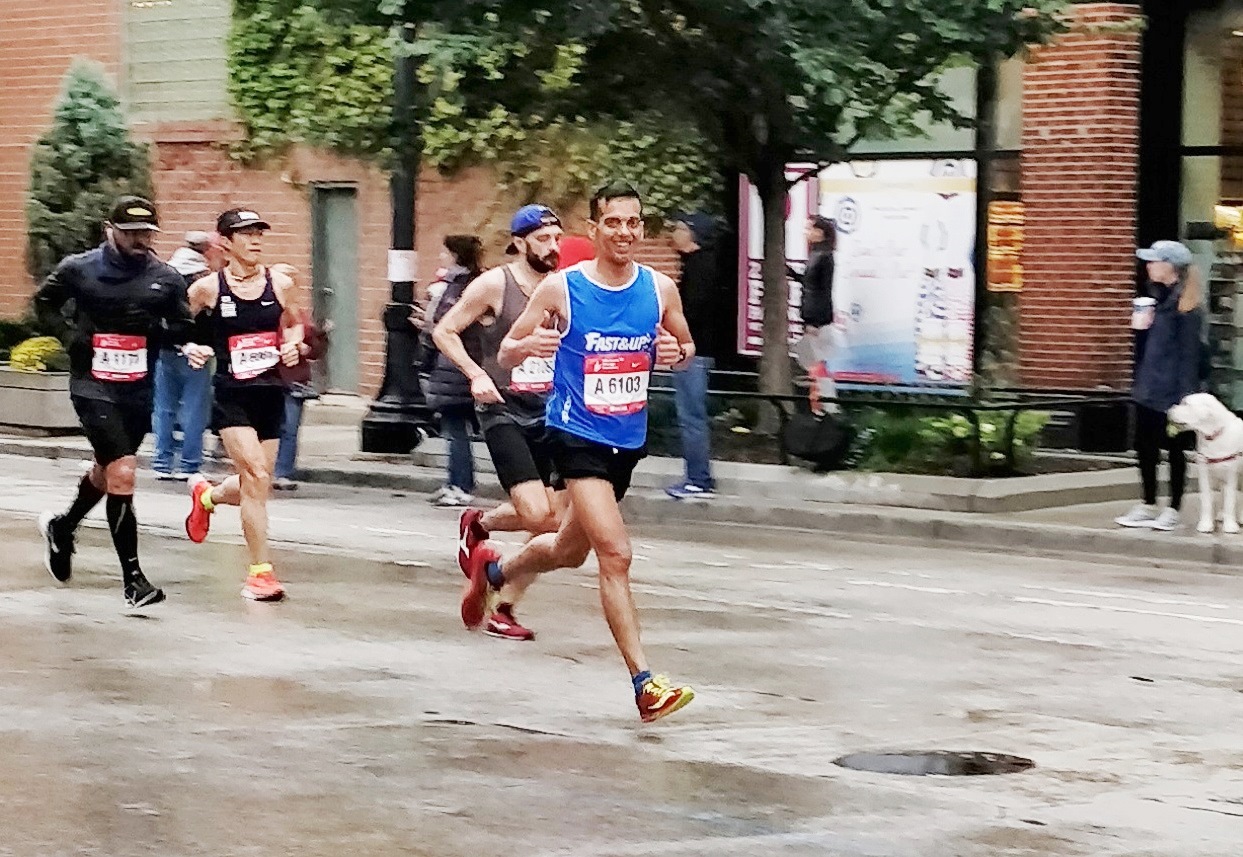
Vijayaraghavan Venugopal; blue vest (Photo: courtesy Vijayaraghavan Venugopal)

The 2018 Chicago Marathon happened on October 7. Part of the World Marathon Majors, it is the fourth largest race by number of finishers worldwide. This year’s edition was won by Mo Farah of Great Britain. He finished the full marathon in 2:05:11, a new European record. It was Farah’s first victory in the discipline. Among women, the winner was Brigid Kosgei of Kenya who covered the distance in 2:18:35. The Chicago Marathon is known for its cheering with spectators lining the street and encouraging runners on. Despite windy conditions and rain, this year too, the cheering stayed strong. We spoke to some of the amateur runners from India who participated in the 2018 Chicago Marathon.

Vijayaraghavan Venugopal

For the last three years I have been attempting full marathons at international destinations, including the World Majors.

Chicago Marathon has the option of direct entry on the strength of timing. I had applied and secured entry to this event known for its flat route. World records were set here until Berlin Marathon came into the picture. Chicago Marathon’s route entails more turns compared to that of Berlin. The weather is also an issue. Chicago is known to be a windy city and is prone to temperature fluctuations.

My run went off very well and I ended up with a sub-three timing of 2:57:11 hours. This is my second fastest timing. My fastest so far is 2:55 hours set in Berlin in 2016.

At Chicago, it was quite chilly with temperature around 10-12 degrees Celsius. It was windy and there was rain. For those of us coming in from warmer countries like India, Chicago’s weather can be challenging. Thankfully, I had appropriate clothing including head gear and gloves. I made sure that I did not get wet till the start of the race.
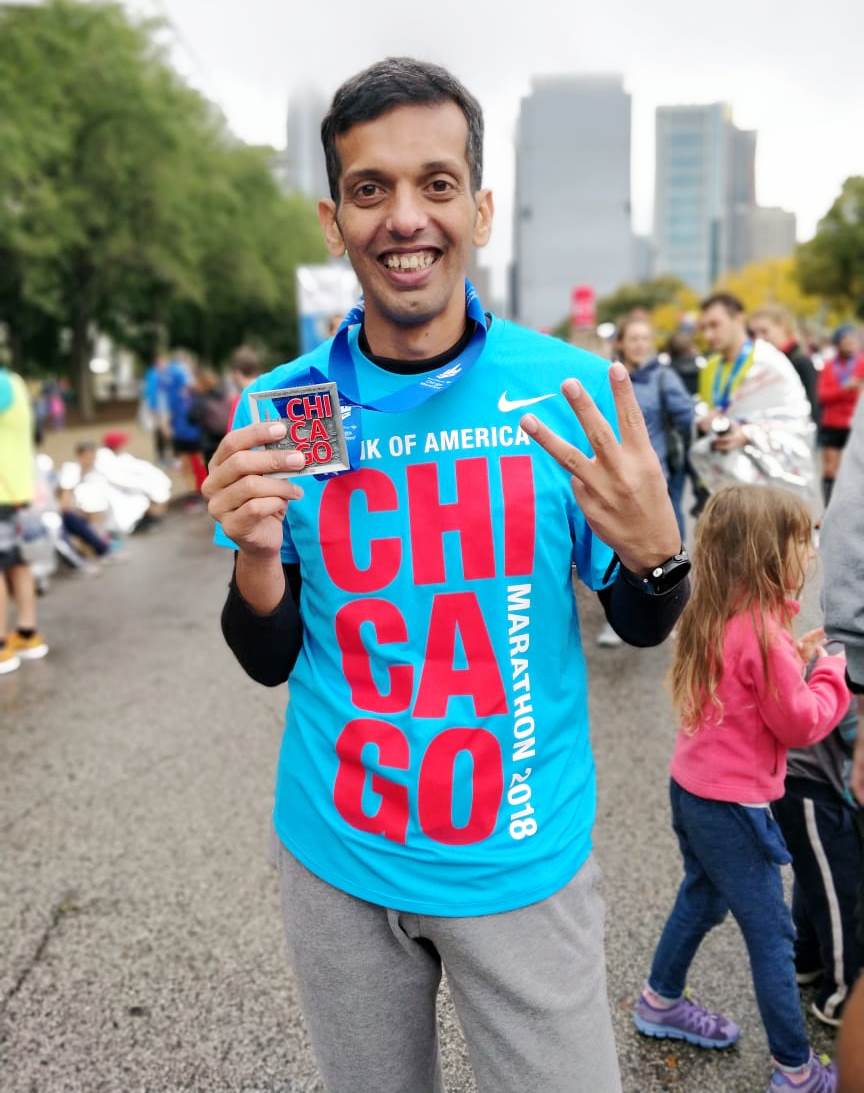
Vijayaraghavan Venugopal (Photo: courtesy Vijayaraghavan Venugopal)

Chicago Marathon has awesome cheering with some 1.7 to 2 million people lining the streets all through the 42 kilometer-route.  It is truly a city marathon as the course passes through the heart of the city.

I landed in Chicago on Monday, first day of race week, to avoid the lingering tiredness of travel and jet-lag.

Broadly speaking, my goal in timing was to run a comfortable sub-three hour marathon. The cold conditions during the race were okay but rain was a dampener. If it hadn’t rained I could have chopped off a couple of minutes from my timing. I ran quite well for 35 kilometers but slowed down during the last seven kilometers.

I would like to focus on the full marathon for the next couple of years. It is important therein to keep fit and stay injury-free so that I can continue running sub-three marathons. I hope to do New York City Marathon in 2019.

In the meanwhile, I will also do shorter distances such as 25 kilometers, half marathons and 10 kilometers. Running shorter distances at a faster pace helps in running marathons.

So far, I have done five marathons in a timing of under three hours – Boston Marathon, Paris Marathon, Berlin Marathon, Mumbai Marathon and now Chicago Marathon. Each marathon poses a new challenge. Also, training for marathons takes up three to five months. Staying injury free is key.

(For more on Vijayaraghavan Venugopal please click on this link: https://shyamgopan.com/2017/06/08/maintaining-sub-three/)
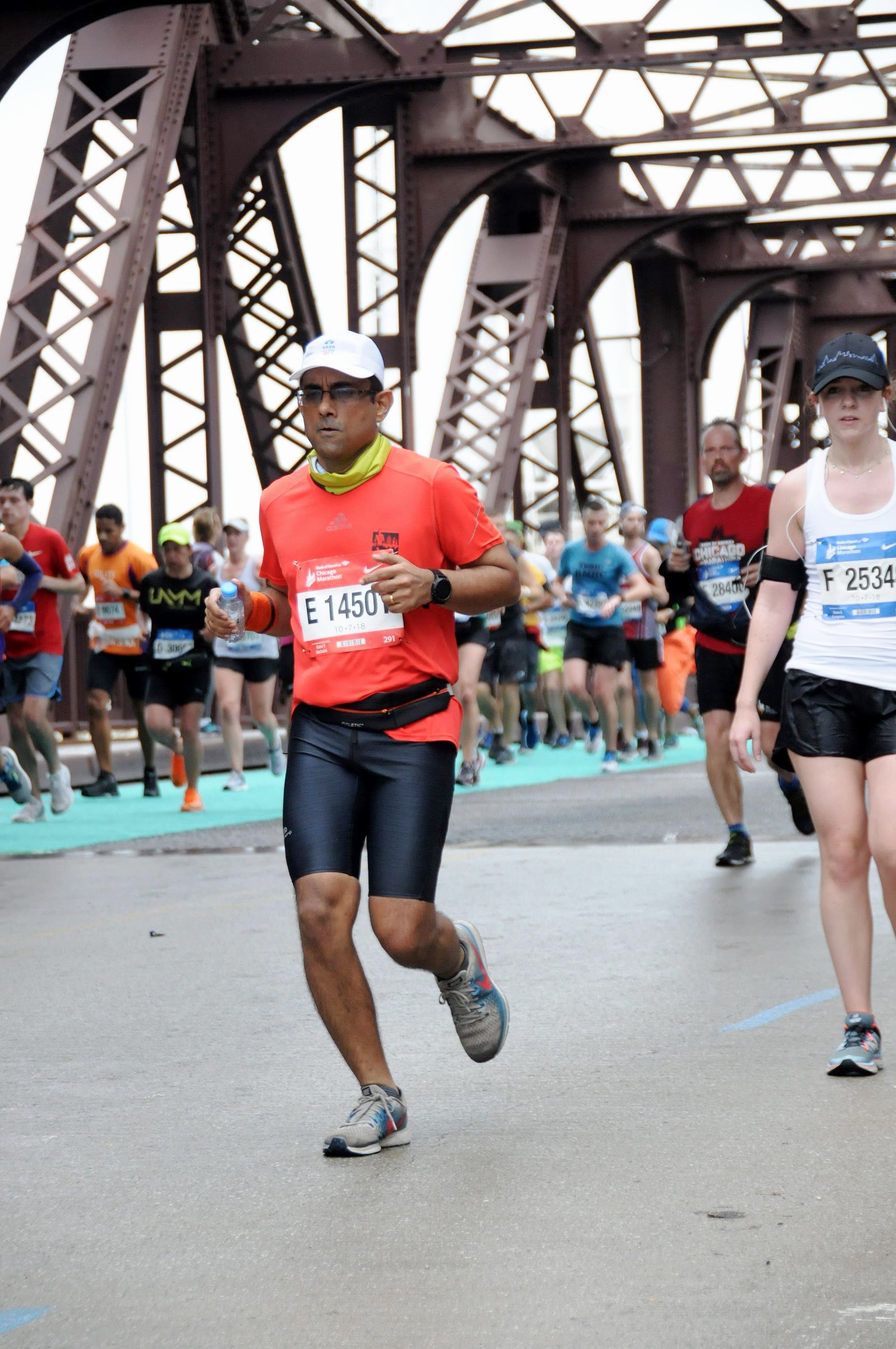
Rajesh Nambisan (Photo: courtesy Rajesh Nambisan)

Rajesh Nambisan

I have been running for the past seven years. Chicago Marathon was one of my best runs.

For me, the race went as per plan. I had trained for the preceding nine months. I recorded my personal best of 4:25 hours with more or less equal splits – the first half in 2:11 hours and the second in 2:14. It was one of those runs where I felt strong throughout the race and did not hit a wall after 30 kilometers.

I was a bit apprehensive a day before the race when it was predicted that it may rain at the start. But the weather was cool throughout and though it did rain heavily midway during the race, the body was sufficiently warmed up and in rhythm.

This run at Chicago Marathon was part of a plan to complete all the World Majors. I have now completed three out of six; New York in 2016, Berlin in 2017 and Chicago in 2018. I will be doing the London Marathon in April 2019.  I do not have any plans to do Chicago again in the near future.

Chicago is the second largest marathon in the US with approximately 40,000 runners. New York has around 55,000.  It is mostly a flat course.

More than a million spectators line the streets throughout the course to cheer the runners. The atmosphere is electrifying. I would highly recommend the Berlin and Chicago marathons to runners seeking a go at their personal best.

Although I have been running for the past seven years, I never trained seriously for any of my races. I started running in 2011 with my office colleague Sandeep Parab. We quickly graduated from running half marathons to full marathons and were always on the lookout to run races wherever our office work took us. Visit and explore a new country and run a full marathon – that became a theme.

In three years we ran full marathons in five continents – Asia (Mumbai, Bangalore, Hyderabad, Dubai, Singapore), Europe (Salzburg, Prague), Australia (Melbourne), South Africa (Cape Town), North America (San Francisco) and finally on February 20, 2015, we achieved our dream of running a full marathon on all the seven continents. We finished the quest with Punta Arenas in Chile (South America) and the White Continent Marathon in King George Island, Antarctica.

I also ran the Texas Metalsaw Marathon, Houston in the US, IDBI New Delhi Marathon, Tata Ultra Marathon (50K) and Comrades in South Africa. We were running for the sheer love of running without looking at our timing. Also there was no emphasis on speed training, strength training gym workouts etc.

From December 2017, I joined Life Pacers and began a structured training program under the guidance of Dr Pravin Gaikwad, Dnyaneshwar (Don) Tidke and Panada. This training has helped. The result was visible in my personal best at the 2018 Tata Mumbai Marathon and 2018 Chicago Marathon. I was also able to complete my first Comrades Marathon of 90 kilometers in June 2018.

I plan to run the London Marathon in April 2019 and Comrades Marathon for the second year in a row in June 2019.
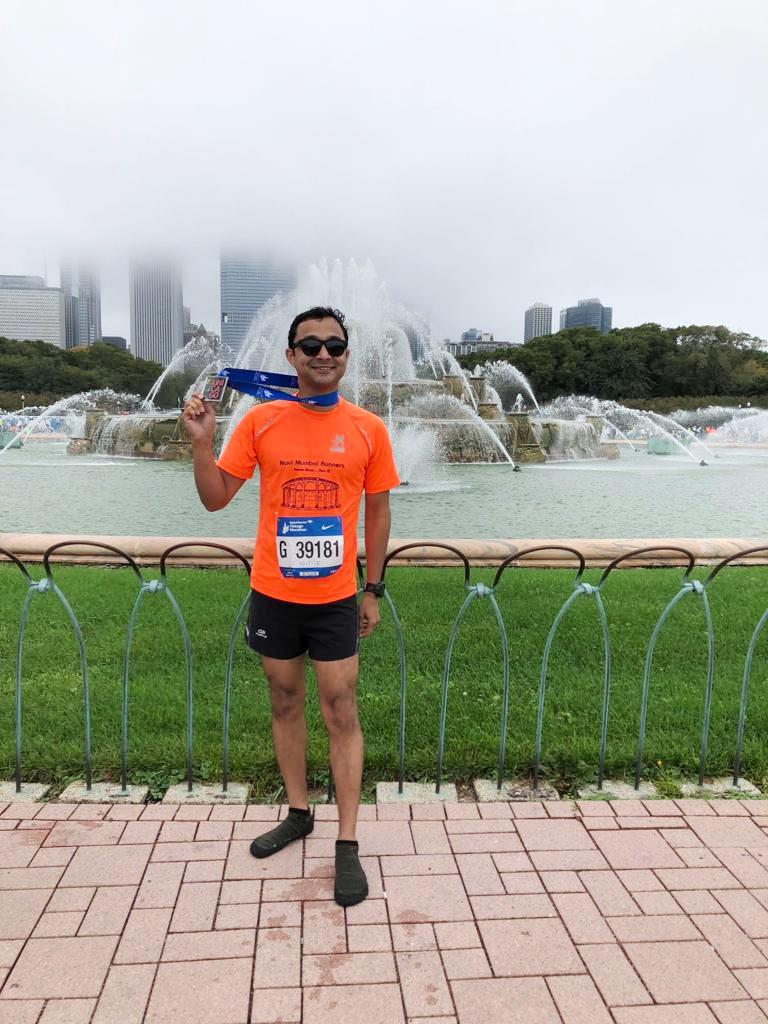
Manjunath Bhat (Photo: courtesy Manjunath Bhat)

Manjunath Bhat

I am amazed when an entire city gets its stuff right to organize a race.

Be it Chicago Marathon or Mumbai Marathon I always get goosebumps at the start line thinking about all the people who had to come together to put an event of such scale together.

I was happy to see that the streets of Chicago were filled with people supporting runners from around the world. I saw people with the Indian flag at two different places. People were cheering all along the way.

This has been a perfect race for me in terms of my performance, training, support etc. The aid stations were well-stocked and placed at just the right interval.

I did better than my expectation. My training was for a 3:59 but I ended up with a 3:52:54. External factors might have affected (improved my performance) a bit. I had not planned for a cold and wet morning. Hence I had not packed enough dry clothes when I was heading to the start line. I have never run a race with so many runners racing the full marathon. So I had to wade through runners till the finish line.

I did not know about the World Majors before I registered for Chicago a year ago. I knew that I would be in Chicago during the month of the marathon and decided to give it a try. Given a chance, I would love to do it again.

I felt this was one of the best races I have run. Including the pre-race expo, the baggage counters, the starting corrals, the route and crowd support – everything was well planned and well executed.

I would say this is a must run race for any runner.

I started running in 2011. I have participated in Kaveri Trail Marathon, Mumbai Marathon, Bengaluru Marathon and Philadelphia Marathon among others. I plan to apply for the 2019 Berlin marathon. I wouldn’t be disappointed if I don’t get in.

I run one race every year to have a timing certificate and to see where I stand. So I would definitely be running a local race if not a major one.
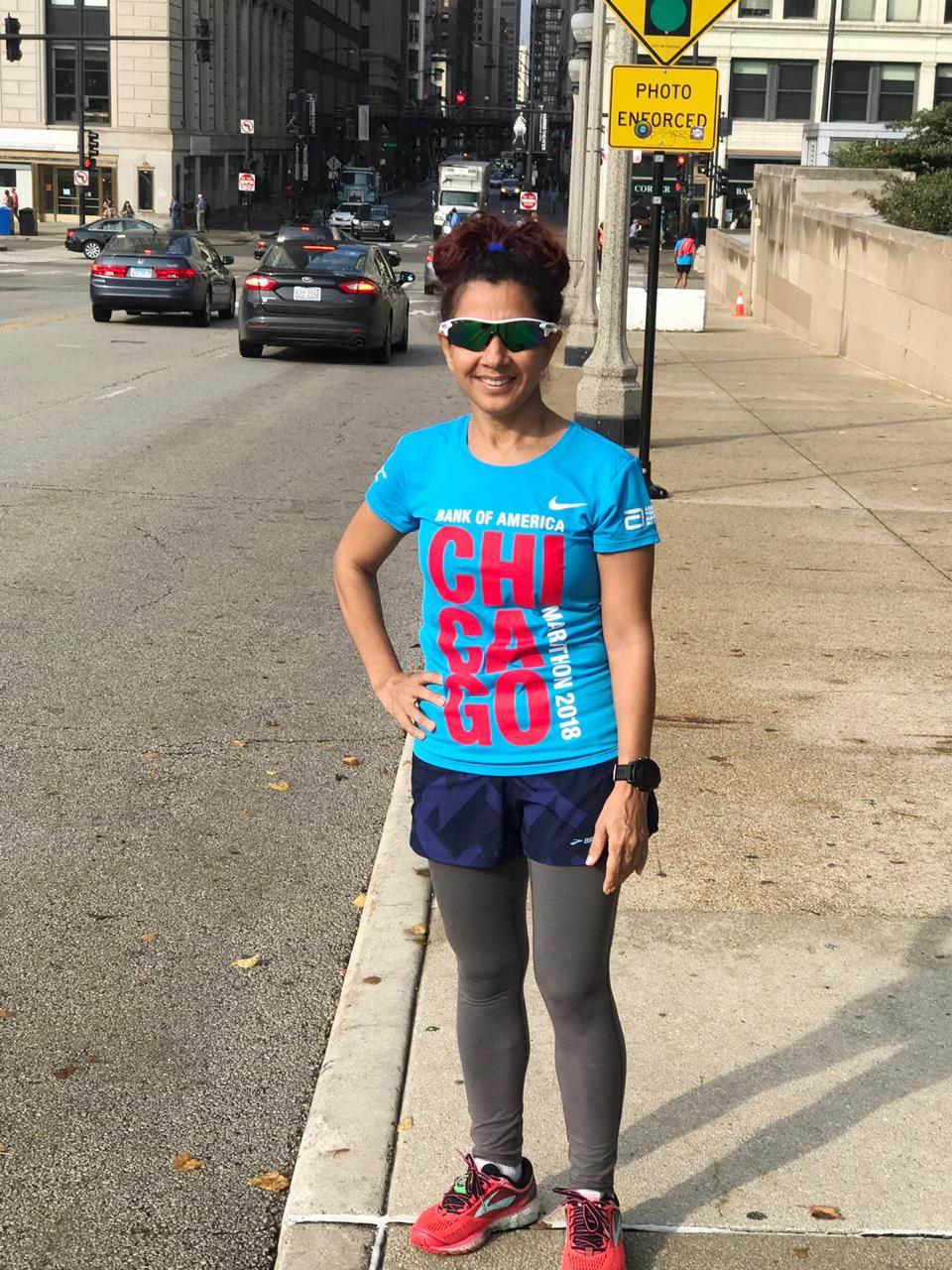
Poonam Bhatia (Photo: courtesy Poonam Bhatia)

Poonam Bhatia

I started running six years ago at the age of 44. I have run many 10 kilometer runs, half marathons and full marathons. I also ran three ultras.

Doing World Majors was never on my mind, but I registered for Chicago while training for Comrades this February; I was getting a bib.

I started training in August and had just two months to prepare for the race. I had heard that it’s a very good race with good weather and flat course.

I thought I would train to whatever level I can as per my capability in the two months I had and just go and enjoy my first major. Though I was a little apprehensive about running in a crowd of close to 50,000 runners and in a slightly cold and rainy ambiance on race day, it turned out to be a fantastic experience for me. I ended up with a personal best.

All arrangements right from the bib collection to getting to the start line, to aid stations on the course, to crowd support, to crossing the finish line and collecting our medals and refreshment bags – everything was superb. All arrangements were made keeping runners as the first priority and to make them feel special. The race T-shirt and the medal are very good.

Even three days after the race, people congratulated any runner they came across on the streets wearing the race T-shirt or medals. This was such a fabulous experience for me that now I am tempted to run all the six World Majors.

Some of the major events I have participated in are Ladakh Marathon, Run the Rann, two Comrades Marathons back to back in 2017 and 2018 and Tata Ultra Lonavala. The latest one was Chicago Marathon.

Well for now its recovery time. I will soon be back to training to get ready for the Tata Mumbai Marathon and then Two Oceans in April 2019 in South Africa.
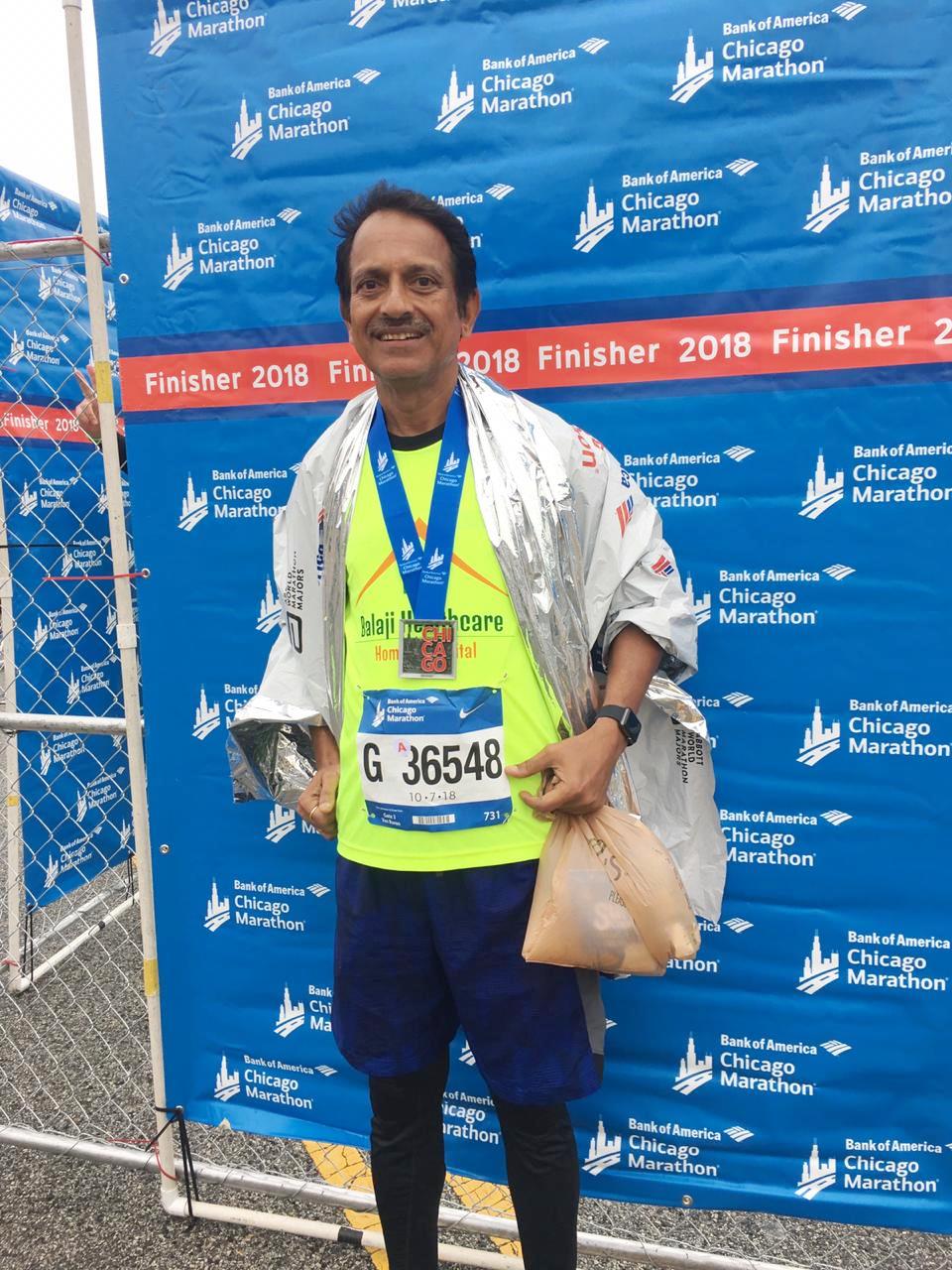
Ramani Brahma (Photo: courtesy Ramani Brahma)

Ramani Brahma

The race was really good and unlike any marathon in India the crowd support was wonderful right from the first kilometer to the finish line. You could not have asked for anything more.

Weather was good maybe a bit cold but I had no complaints. It also rained for a while.

I entered this race because my daughter lives in Chicago. Of course, this was one of the races in my bucket list.

As regards timing it was below my expectation. I had to take a break and that led to the poor timing. The first half of the run was as per plan.

Overall I enjoyed the run. It was a different experience to see tens of thousands of runners running non-stop.

Next on the cards is Comrades Marathon. But that will be considered only when I improve my timing. I have been running for 15 years now.
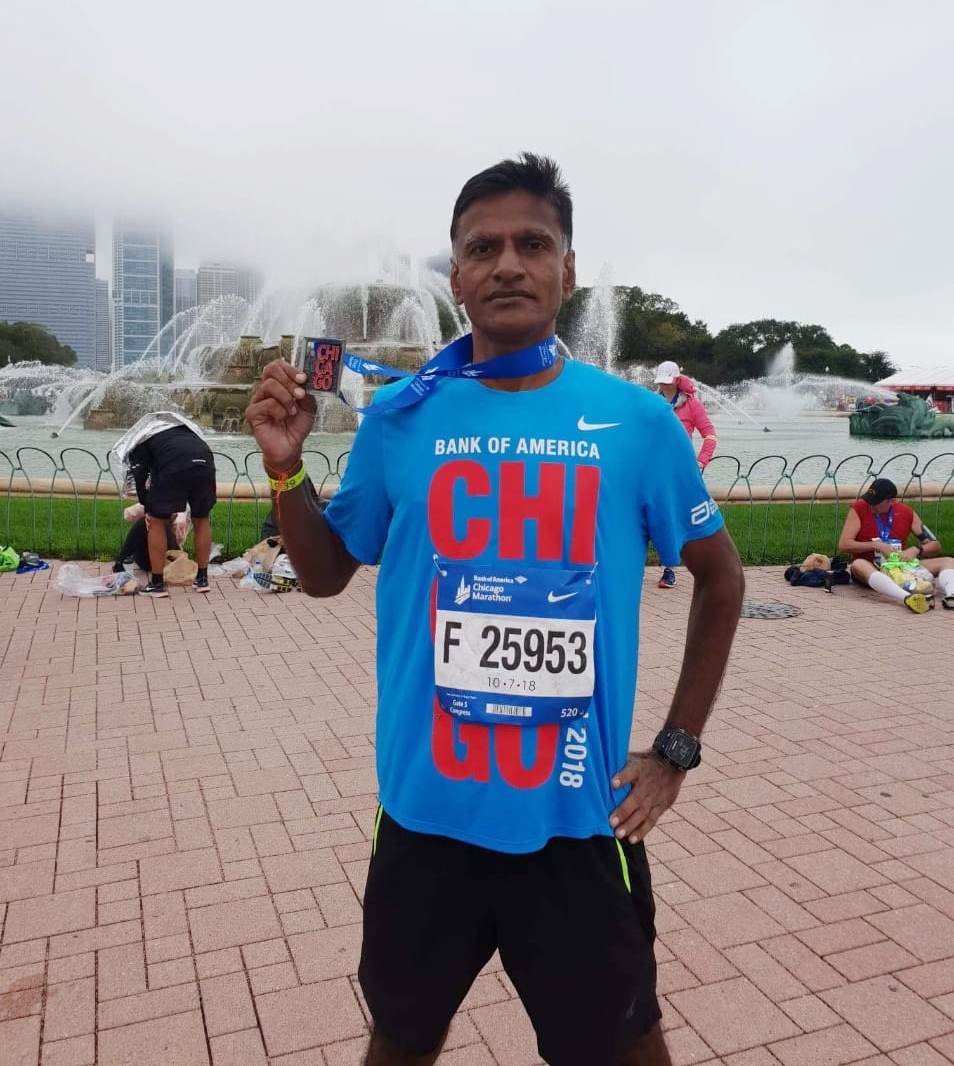
Dhiraj Dedhia (Photo: courtesy Dhiraj Dedhia)

Dhiraj Dedhia

I ran the Chicago Marathon just two weeks after the Atlantic City Half Ironman.

It more than compensated for the disappointment I experienced at Atlantic City where unfortunately I had a DNF (Did Not Finish). During the cycling segment I missed the third loop and found myself exiting the cycling course without completing the distance. Nevertheless, I continued and finished the running leg of the triathlon.

Two weeks later at Chicago I had an excellent run.

At Chicago I ended up with a personal best of 4:20:29 hours, shaving off 16 minutes from my previous personal best.

Weather was really good.

It was an awesome experience with much cheering.

My next event is a half Ironman distance triathlon at Kolhapur.

That will be followed by a full marathon at the Ahmedabad Marathon in November.
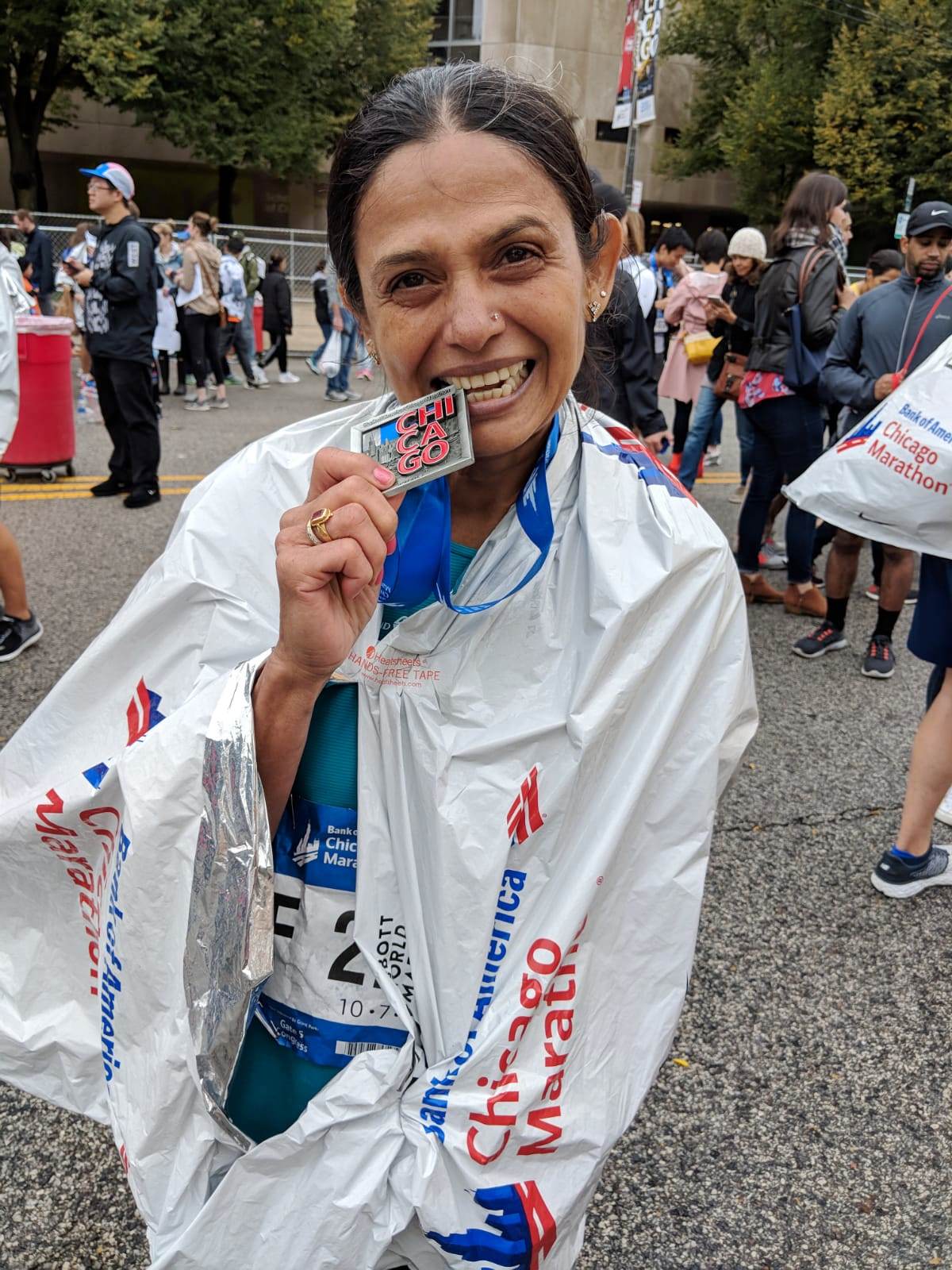
Chitra Nadkarni (Photo: courtesy Chitra Nadkarni)

Chitra Nadkarni

Chicago was a wonderful experience.

It was my fourth World Marathon Major.

When I landed in Chicago the weather was warm. But gradually it changed and it was for the better. On race day the weather was cold and rainy; there was intermittent rain throughout the run.

I had struggled with my earlier runs in London and New Zealand. Hence my coach Suchita and I worked hard on hip opening and lot of exercising of the legs. I put in much effort like taking care of food, exercise, rest, mileage.

Chicago marathon was a beautiful experience. There were so many volunteers. There was plenty of water and Gatorade. The crowd support was tremendous and the cheering, loud. The route was beautiful. There were so many runners. There was never a moment when I was running alone and never a moment when I felt I should walk or stop.

I missed my family a lot when I finished the race. It’s because of the support from my husband and daughter that I am able to do all these races.

I would truly love to do Chicago and Berlin again because they made me feel good about myself. I would love to do London again because I am sad about the result I got and given I love the city, I would like to do justice to my run.

I will be running New York in November.

(The author, Latha Venkatraman, is an independent journalist based in Mumbai.)
FROM A CAFÉ IN BENGALURU: DREAMING A WORLD CLASS BICYCLE RACING TEAM

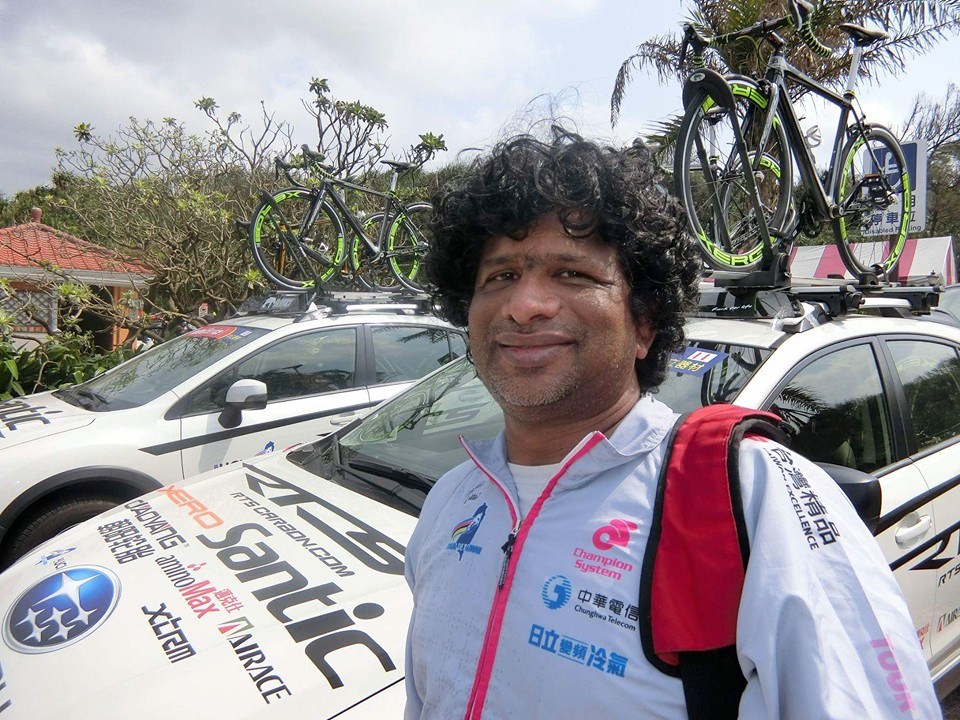
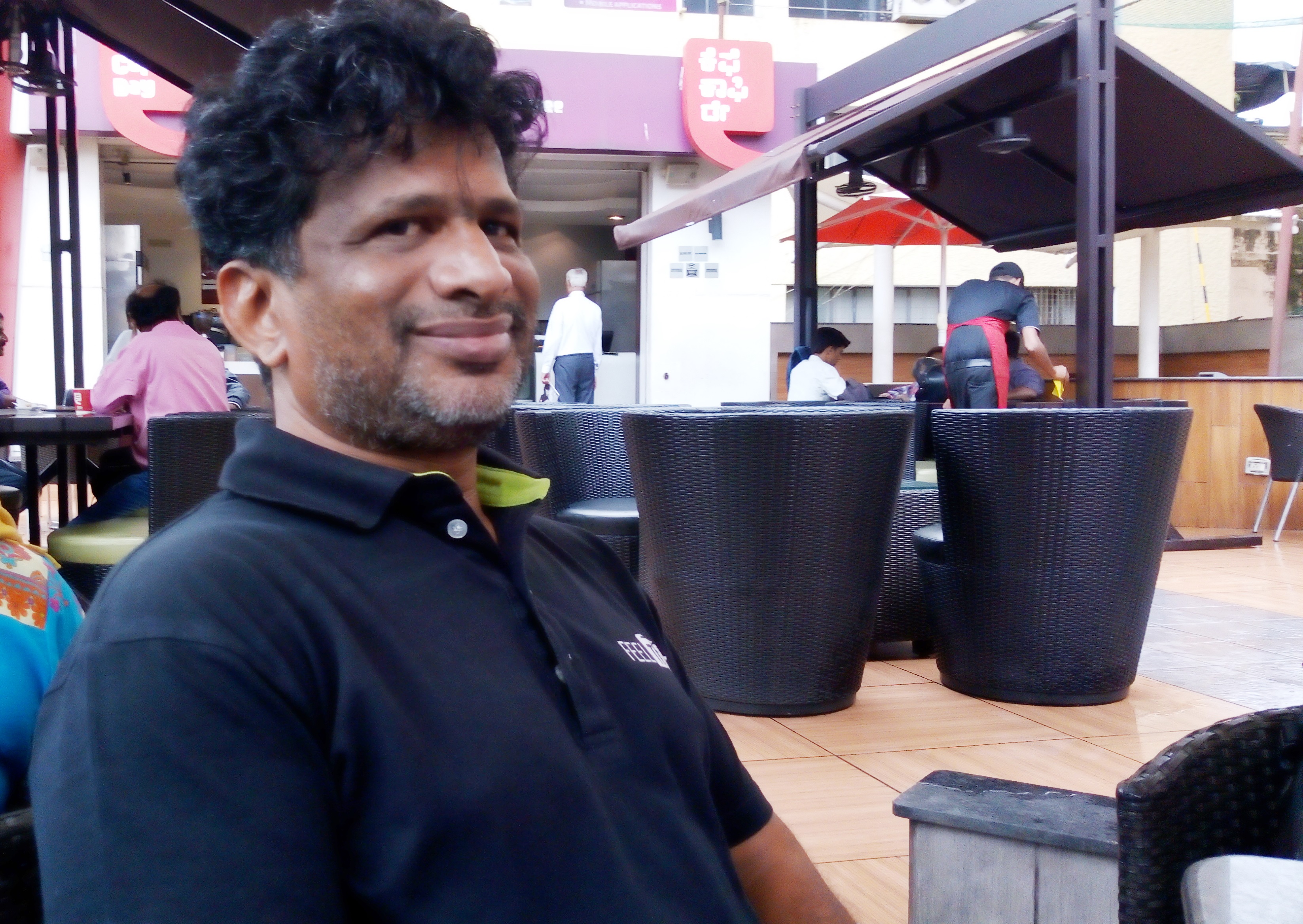
Venkatesh Shivarama (Photo: Shyam G Menon)

It is not always that a chat over coffee delves into why there isn’t as yet a world class cycling team from India. True we are a long way from having cyclists of the caliber that make it to the world’s elite races. But surely when India is described as an economy on the ascent, the capital can be found to assemble a team with infrastructure to support; hang in there, learn from the experience and slowly but steadily inch towards cutting edge performance? Venkatesh Shivarama believes he would be able do this, given the opportunity. The idea is not far fetched. Early October 2018, news appeared of plans to create a top notch cycling team from China. Problem so far in India is – nobody with capital seems genuinely interested to attempt something similar.

In Bengaluru’s cycling scene, Venkatesh Shivarama is well known.

Born 1969, he grew up in the city. The family hailed from Mangalore and his father ran a restaurant. One of six siblings, Venkatesh dropped out of college soon after his first year of studies. Sometime in late school / early college he developed a fancy for cycling; he went everywhere he had to in the city on a bike. Those were the days of Indian economy yet to be opened up. In the secure shade of protected market, a few bicycle manufacturers churned out limited models of bicycles in large numbers. It was a manufacturer-led market. Within cycling, models addressing the need to commute and carry load as part of livelihood, dominated. Bicycle racing was a niche sport and indigenously made road bikes were few.

In 1989, Venkatesh bought a BSA Mach 1, a road bike made by the Chennai based-TI Cycles, one of India’s leading bicycle manufacturers. “ I wanted to do racing. That’s why I bought that bike,’’ he said, sipping coffee at a café on Bengaluru’s MG Road. It was August 2018, a late afternoon. Among Indian cities, Bengaluru is one of the locations that enjoyed an early fancy for bicycle racing. Until some years ago when it was revamped to host an edition of the National Games, Bengaluru’s Kanteerava Stadium used to have a cycling track. The city had both types of races – track and road. Back in the late 1980s, when Venkatesh aspired to be a racer, some of these races were still around. But the glory days of this initial phase of racing were already over. MG Road, where we sat chatting, had been among venues for the city’s early crop of bicycle races.

According to Prem Koshy, whose family owns the iconic Koshy’s restaurant near the intersection of St Mark’s Road and MG Road, these races had their best days in the 1970s. The office of Deccan Herald newspaper, on MG Road, was often starting point. Races were held in several distance categories. These events were proving ground for Bengaluru’s cycling enthusiasts till one day – according to Prem – three cyclists from Bijapur turned up to participate. While the city’s racers reported with road bikes for the event, the Bijapur trio had India’s mass produced steel roadsters; furthermore, the ones they brought along were meant for carrying load and built heavy for the purpose. How will you race on these heavy iron steeds? Many thought they stood no chance racing on those bikes. But it was the cyclists from Bengaluru who bit the dust that day. “ It was a humbling experience,’’ Prem recalled. The Bijapur riders returned for subsequent editions of these races cementing their reputation as strong cyclists.

Illustration: Shyam G Menon

Bengaluru lost its cycling track when Kanteerava Stadium was revamped. But the confluence of industry, well-travelled residents who had witnessed the ascent of sports elsewhere and growing levels of spending meant that Bengaluru remained one of the hubs of Indian cycling. Today, within the overall parameters and scales of the Indian bicycle market, it is home to sizable sales of performance bicycles, has a calendar of bicycle races and a community of dedicated cyclists. All this is arguably the second phase of bicycle racing in the city. “At the time I started racing, there were hardly ten really good cyclists in Bengaluru,’’ Venkatesh said. On his part, he persisted and eventually became part of the Karnataka state cycling team. Practice sessions were held on the track at Kanteerava Stadium. According to Venkatesh, despite the cycling track, Karnataka those days wasn’t strong in track races. “ We secured some medals in road events,’’ he said. Nevertheless when the track was demolished as part of revamping the stadium, Bengaluru’s bicycle racing came to a halt. It went into a hiatus of seven to eight years, Venkatesh said.

What revived races was the Internet. Chat rooms and fora where cyclists hung out had emerged in cyberspace. Venkatesh credited Rajesh Nair for posing the question that brought the culture of events around cycling, back: why not have a bicycle tour in South India? The suggestion fetched support from other cyclists; among them – Venkatesh, Ravi Ranjan, Sriram and Deepak Majipatel. Rajesh Nair provided a name for the proposed event: Tour of Nilgiris. “ We planned to do the tour with ten riders,’’ Venkatesh said. But when the idea was made public, roughly 100 riders showed interest. For the first edition of Tour of Nilgiris some 50 cyclists turned up to participate. The route spanning approximately 900 kilometers ran from Bengaluru to Mysore, Madikeri, Sultan Bathery, Ooty and back to Bengaluru. The event – it now happens every December – sparked a revival in Bengaluru’s cycling scene. For the first four to five years, the event wasn’t a race; it stayed a ride. “ It is still not wholly a race. Only some stages are kept as races. Otherwise, it has been retained as a touring event,’’ Venkatesh, who continues to be associated with Tour of Nilgiris, said. In 2018 December, Venkatesh will participate in the event again after a gap of ten years.

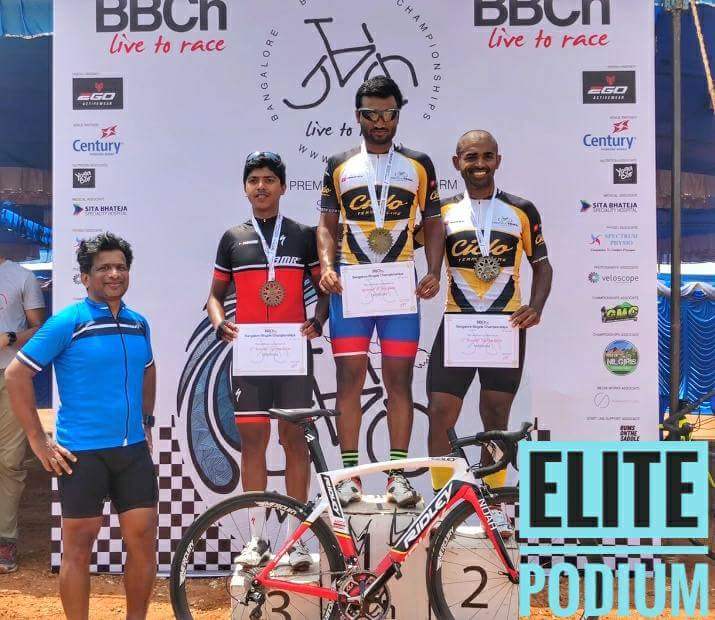
From BBCH (Photo: courtesy Venkatesh Shivarama)

The genesis of Tour of Nilgiris – as in the posting of the idea and early discussions around it – happened on an Internet forum called Bike Zone. After Tour of Nilgiris materialized, the question floated: why not actual racing? It was Bike Zone again that played host to the next gear shift in Bengaluru’s cycling scene – the move to restart bicycle racing. Consequently around 2008 the first time trial event under the auspices of Bangalore Bicycle Championships (BBCH) started. The first edition of BBCH had only time trial. Since then, it has evolved much. At present BBCH straddles time trial, team time trial, cross country, criterium and climbing Bengaluru’s well known Nandi Hills. It encompasses both road bike and mountain bike segments; there are five sub events for each category. With the exception of December and January, it is a near full calendar of events. There is a BBCH event on the third Sunday of every month. In life, when you do one thing, a potential next unfolds. Once BBCH started, the next logical thought was – how about making a bicycle racing team? The first team Venkatesh commenced was Bangalore Cycling Club (BCC). Besides racing locally, the team raced at events in Thailand and Singapore. These overseas locations were chosen for their proximity to India; they also had a good cycling scene. In a continuation of Bengaluru’s discovery of Bijapur’s competence in cycling in the 1970s, most of the BCC team members hailed from Bijapur. “ For decades in southern Maharashtra and northern Karnataka, wrestling and cycling have enjoyed popularity,’’ Venkatesh said explaining the background. Exciting as it is for Indian cycling to have a racing calendar, that didn’t go down well with the administrators of cycling in the country. According to Venkatesh, they didn’t warm up to these initiatives by the cycling community. On the other hand, cyclists turning up for some of these races risked incurring the displeasure of sport administrators. “ That is unfortunate,’’ Venkatesh, whose focus is cycling and not its ownership, said.

In 2007, when the first flush of revival in Bengaluru’s cycling scene was afoot, Venkatesh commenced the business he is currently identified with – the bike shop Wheelsports. Two factors contributed to starting this enterprise. In the preceding years, Venkatesh had been associated with the Karnataka state cycling team and the Indian Army’s cycling team. Having traded academic pursuits for focus on cycling, he evolved into something of a local authority on the subject, both in terms of knowledge about the world of cycling and great deal of acquaintance with the machine at the heart of it all – the bicycle. “ I was considered a good mechanic,’’ Venkatesh said. It seemed practical to capitalize on these strengths. At the time Wheelsports started functioning, there were only two major foreign bicycle brands sold in India – Trek and Merida. Venkatesh began selling Merida. As the local market grew, he graduated to being India distributor for KHS. As of 2018, he was distributing Polygon (an Indonesian bicycle brand) and still selling Merida. Wheelsports is also “ neutral service provider’’ at bicycle races in India. “ Any visiting cycling team can get in touch with us to get technical support. We provide it to all,’’ Venkatesh said. This line of business fluctuates with the frequency and volume of such races in India. Unfortunately, the country does not have many big label races.

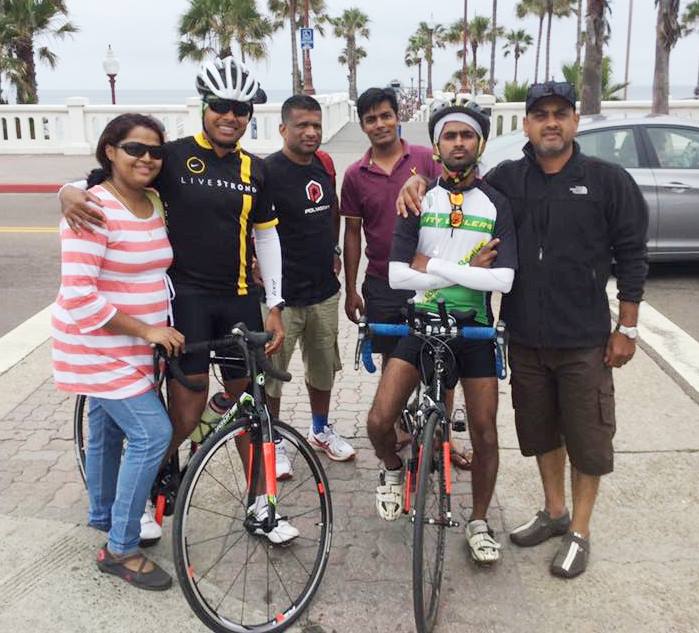
From a trip to the US for Race Across America (RAAM). Second from left – Lt Col Srinivas Gokulnath, the first Indian to complete RAAM solo; third from left – Venkatesh (Photo: courtesy Venkatesh Shivarama)

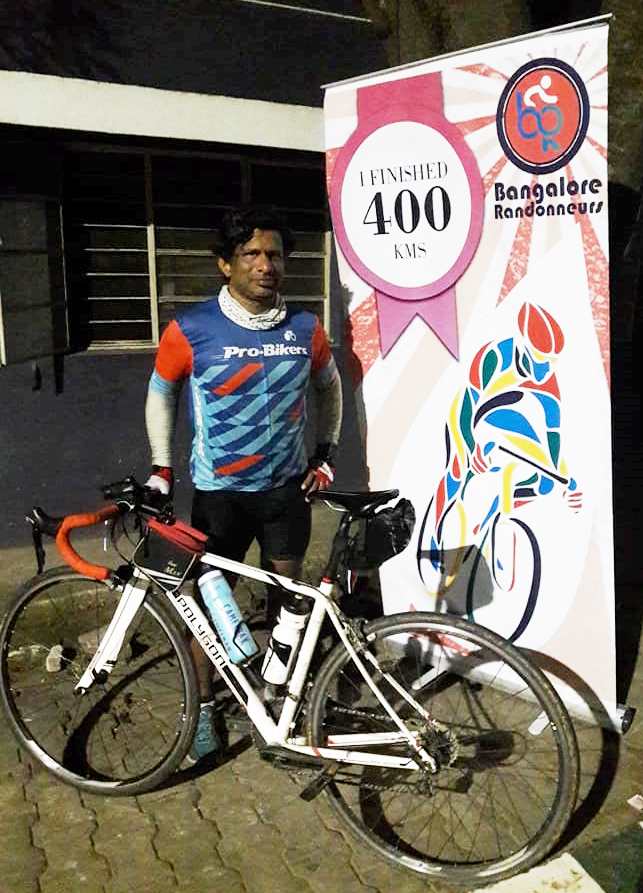
A good bicycle technician is sought after by those heading to participate in demanding races overseas. One of the friends Venkatesh picked up in Bengaluru’s bike circles was Lt Col Srinivas Gokulnath. When Srinivas decided to attempt Race Across America (RAAM), he asked Venkatesh to go along as mechanic. The first attempt – in 2016 – ended up a learning experience for cyclist and crew; Srinivas couldn’t complete the race. In his second attempt in 2017, the army officer became the first Indian to complete RAAM solo. For 2018 RAAM, Venkatesh was slated to be part of the crew for Goa based-cyclist Sundaram. Unfortunately, Sundaram had to withdraw from the race just days before its start following an accident in San Diego while out training. The RAAM experience rubbed off on Venkatesh. Having come up through racing, he wasn’t exactly a fan of distance cycling. But longstanding association with Tour of Nilgiris and multiple visits to RAAM gradually changed that. It isn’t just Venkatesh; the Indian cycling environment too has developed curiosity for distance cycling. “ I don’t find such growing interest in endurance cycling, in other countries,’’ Venkatesh said. According to him, one reason for this Indian phenomenon could be that racing and disciplines like time trial require focused approach and much discipline. That is a tough demand to meet in the sort of everyday work environment Indians have come to live in. Long distance cycling on the other hand is comparatively kinder as journey embarked upon. Intrigued by long distance cycling, Venkatesh has decided to try Race Across West (RAW) – a shorter race within RAAM – in 2019. His first attempt to qualify – it was the 2018 Shivalik Signature, a RAAM qualifier held in India – ended up Did Not Finish (DNF). He was not fully fit having been hospitalized ahead of race for a stomach infection. But once recovered, he began participating in brevets and did rides spanning 200, 300, 400 and 600 kilometers. He became a super randonneur. At the time I met him, Venkatesh was hoping to attempt a 1000 kilometer-brevet. More importantly, once he completed the 400 kilometer-brevet, thoughts of RAW resurfaced. So for 2019, two projects were playing on his mind – attempting Paris-Brest-Paris (PBP) and attempting RAW; for the latter, he would need to do a qualifier afresh.

However, what has got Venkatesh weaving designs for Indian cycling is his association with racing teams. After BCC arrived on the scene the spotlight shifted in due course to a new entity – Kynkyny Wheelsports; so named after outfits started separately by Vivek Radhakrishnan and Venkatesh. “ Kynkyny Wheelsports was a successful team,’’ Venkatesh said. When American bicycle major Specialized entered the Indian market, it did something no other foreign brand till then had thought of attempting in the country’s bicycle market – it partnered Kynkyny to form an Indian bicycle racing team. According to Venkatesh, he then started a distinct Wheelsports team. “ I used to spend Rs 30,000 to 40,000 per race per month,’’ he said. The Wheelsports team still exists; it participates in small races. One result of all these initiatives is that Bengaluru has quite a few racing teams now. Besides Wheelsports, there are names like Spectrum (reputed to be a strong team), Life Behind Bars (LBB) and Team Veloscope. When you have seen so much bicycle racing and helped form racing teams, curiosity pushes new boundaries.

Photo: courtesy Venkatesh Shivarama

Not far from where we sat talking on Bengaluru’s MG Road, was UB Towers, built by millionaire businessman Vijay Mallya, since mired in controversy and living in the UK, from where India had sought his extradition over charges of non-repayment of loans. Mallya’s downfall has been linked to his failed airline – Kingfisher Airlines, the entity for which those sizable borrowings were made. Amid the mess he landed himself in, fans of motor sports however remember Mallya for a noteworthy achievement – he strengthened India’s presence in Formula One, founding and operating Force India till it was sold off in the wake of his larger financial woes. This car racing team was unique in several aspects. In motor sports, after Narain Karthikeyan’s ascent in car racing all the way to Formula One, Force India was the next big Indian story. Working on a budget that was quite modest compared to other Formula One teams, Force India nevertheless did well for itself on the performance ladder. An afternoon in Mumbai, I met Hormazd Sorabjee, Editor, Autocar India to get some insight into Force India and Mallya’s level of involvement with the team. “ He was very passionate about the sport. He bought the old Spyker team to get a toe hold in Formula One. He wasn’t merely promoter; he was very involved. Short on resources he often used his charm to swing things. At no point did Mallya have a lot of cash to spend on the team. It is said that you need 400-500 million dollars to operate a good Formula One team. Force India managed with less and produced creditable results. Getting an Indian to drive for Force India was one of the long term goals of the project,’’ Hormazd said. At the time of this conversation, news of Force India’s sale was still fresh. Creating and managing a top notch bicycle racing team with sizable pool of talented riders to pick from, adequate world class equipment for all and calendar of events to stay engaged in – is a big task in its own way. At the café in Bengaluru, Venkatesh wondered why Indian cycling hadn’t encountered anyone like Mallya to pitchfork it to a higher level. To be precise, he wanted someone from the country to dare formation of a new team at an elite event like Tour de France.

One big difference between the context of Force India’s debut in Formula One and the present stage (2018) in Indian cycling is that the latter is yet to produce the equivalent of a Narain Karthikeyan. An Indian driving in Formula One must have helped set the tone for what followed – a car racing team with India in its name. Venkatesh didn’t seem discouraged by this. He knew Indian cyclists have much catching up to do with their counterparts elsewhere. In fact, efforts are afoot; cyclists have begun rising to the challenge. Some have begun participating every year in races in Europe. But the point is – in as much as there is catching up to do in the performance department in cycling, the Indian economy has grown in size to be among the world’s biggest with companies alongside that have capital to spare for sports if they are inclined to. And as Venkatesh said, if you want to create a team, then you should focus on doing so by any means and not be bogged down by where the domestic market is in terms of state of cycling. You have to imagine that you are creating an elite performance ecosystem; a sort of magnet for all else and remain committed to it. Venkatesh admitted that he was yet to see such interest from India’s big bicycle manufacturers. They continue to stay focused on the volume market, imagining from it, less away from it. On the other hand, given the capital around in India, it should be possible to find sponsors and assemble the ingredients for a team, provided somebody is interested. In a sort of Force India approach based on low budget and working out the best models one can with it, Venkatesh felt that the team’s riders could be drawn from Asian countries currently ahead of India in bicycle racing. While these cyclists become the main riders in the initial phase, select Indian riders can be groomed alongside (as part of the team’s larger program) in the hope that after some years they would be good enough to make the cut.

Photo: courtesy Venkatesh Shivarama

As regards top notch performance bicycles for the team – Venkatesh pointed to the fact that ambitious bicycle manufacturers have in the past groomed teams at elite races, using cycles they got made at select, boutique manufacturers and subsequently badged as their own. Such outsourcing for competitive situations is inevitable in environments where critical technologies for racing and required manufacturing skills or workmanship are hard to come by. Domestic manufacturing is seen as catching up in due course, once the pioneering work is managed by other means. The thing to accept is – performance at tough races and volume sales in mainstream market are two entirely different things. When you chase the former, it is very unlikely that you will make immediate sense to the latter. Those contributing capital to build an elite bicycle racing team have to understand this, not to mention – be patient, for results take time to manifest. It is a long ride. Venkatesh was searching for a sponsor who would be willing to accept this and take on the challenge of building a world class bicycle racing team.

Ambitious as it may seem,Venkatesh’s dream is actually of modest dimension compared to moves afoot in the world of bicycle racing. On October 8, 2018, the website cyclingweekly.com reported that a new Chinese team, backed by sizable funding, planned to debut the country’s first top tier cycling team in 2020 and produce China’s first winner of Tour de France by 2025.

(The author, Shyam G Menon, is a freelance journalist based in Mumbai. This article is based on a conversation with Venkatesh Shivarama.)        

TWO BIRDS, ONE FOOTBALL

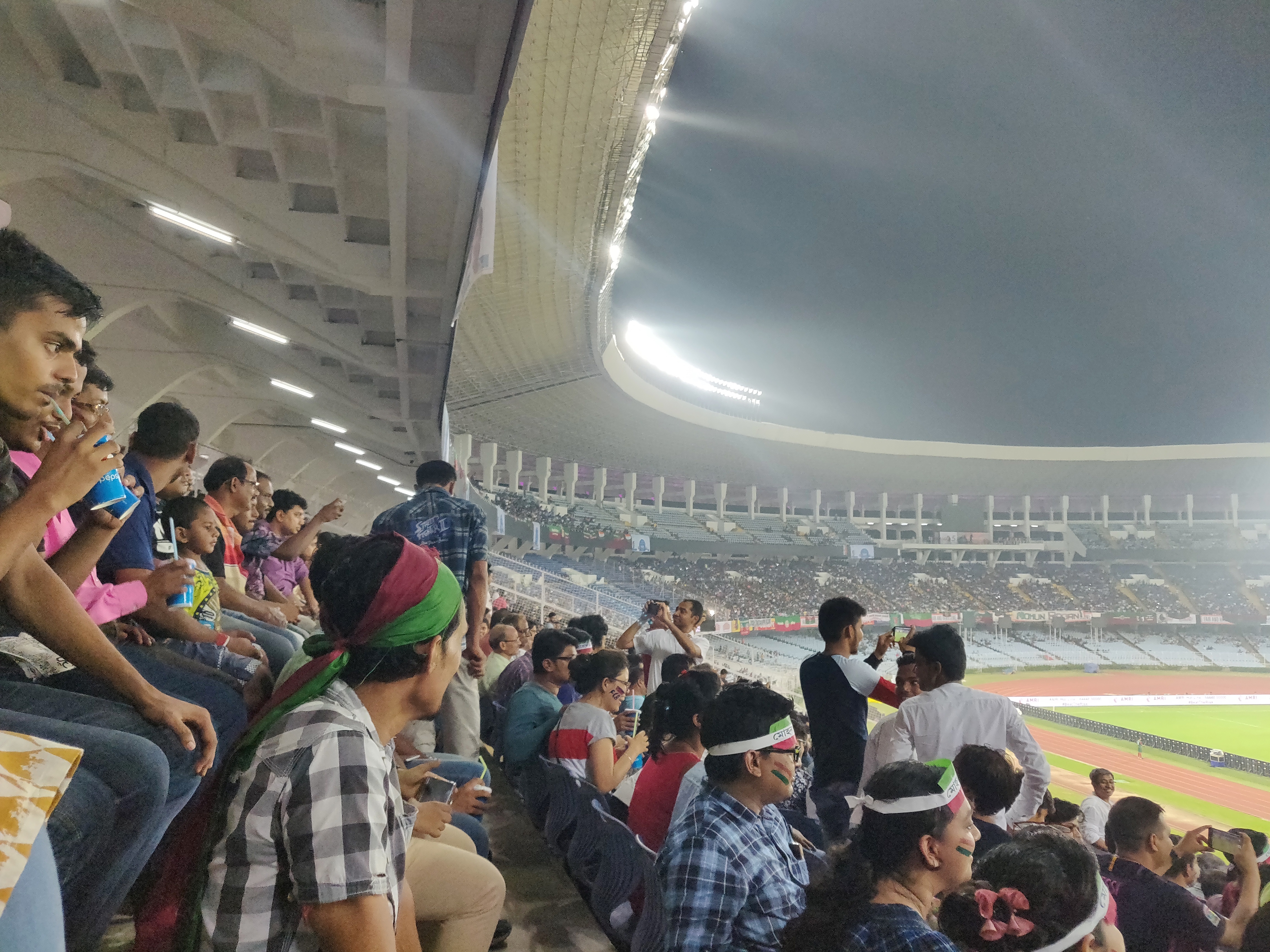
At Salt Lake Stadium, Kolkata (Photo: courtesy Arpit Nayak)

Kolkata is India’s football capital. Late September 2018, Legends of Mohun Bagan AC and FC Barcelona engaged in a crowd and brand-pleasing face-off. Bulbul Rajagopal was there at the stadium in Kolkata. She sent in this article about the sentiment behind a clash of legends. There is sport and there is what you can do with sport. Two birds; one football…..

By the time Jofre Mateu netted the sixth and final goal for FC Barcelona in the second half of stoppage time, sealing absolute victory for his team, the stands of Kolkata’s Salt Lake stadium were already singing a different story. The throng of 25000 had risen to their feet, chanting: Mohun Bagan, in the manner of a fevered anthem. On the night of September 28, the legends of Mohun Bagan faced tremendous defeat – 6-0 – at the hands of their rivals; that too, on home ground. But in the city’s eyes they had won by dint of spirit.

To the average Calcuttan, 2018 has been quite the year for football. Much like the city’s revered Durga Puja and the lead up to it, what had kept fans’ blood pumping was the countdown to the FIFA World Cup. Midway through its proceedings, Football Next Foundation struck while the iron was still hot. Towards the end of June, Kolkata was treated to the announcement of a tussle between the legends of Mohun Bagan Football Club and FC Barcelona. From a pool of 51 former players, 30 were selected to play and wear the jersey on match day. Mohun Bagan is India’s oldest football club and among its most respected. It is also one of Asia’s oldest football clubs and in Kolkata, the club traditionally favored by the social group of Bengalis native to West Bengal since the partition of India. The reasons for staging a match between legends from the Indian and Spanish clubs were several. Needless to say, football as market was one of the leading thoughts. Kaushik Moulik, the founder of Football Next Foundation believes football is a tool that can bump up brand and engagement value. “ Few in the western world know that India is a force to be reckoned with in football; fewer still know of its untapped marketing potential,’’ he said. One of Moulik’s prime concerns was that in spite of steady clamoring for the promotion of heritage, “ no one is really doing anything about it to further the cause. This is where Football Next stepped in.’’

Asked if football was being showcased in the light of cricket being generally more favored in India, Moulik was quick to state that football has always ruled the roost. “ In the corporate sector, it is football that is played by most employees. It builds teams and character,’’ he said. With the Barca-Mohun Bagan match, his organization wanted to send across the message that football can not only be viewed and played in the Indian market, but it is also relevant to shaping social development and business opportunity. Barca Legends were no stranger to this line of thought. The Legends initiative was set up to promote the global image of FC Barcelona and to help its players earn livelihood after retirement. Moulik justified the choice of pitting the local team against the Spanish giants on grounds of popular appeal. “ Barcelona has always featured in the group of names that crop up when you think ‘football’. Besides profit, this choice was made because it was governed by people’s tastes,’’ he said. The match was not a venture of Football Next alone. A partner in the scheme was real estate brand – Merlin Group. Their involvement concerned development of sports infrastructure in the city. “ We want to bring out hidden sports talent from the lower strata of society and into the limelight,’’ said Merlin’s Joint Managing Director, Saket Mohta. Amid corporate influence, philanthropy also featured as a cause. All proceeds of the match – with tickets ranging from Rs. 250 to almost Rs. 1500 – were to be donated to West Bengal’s Liver Foundation.

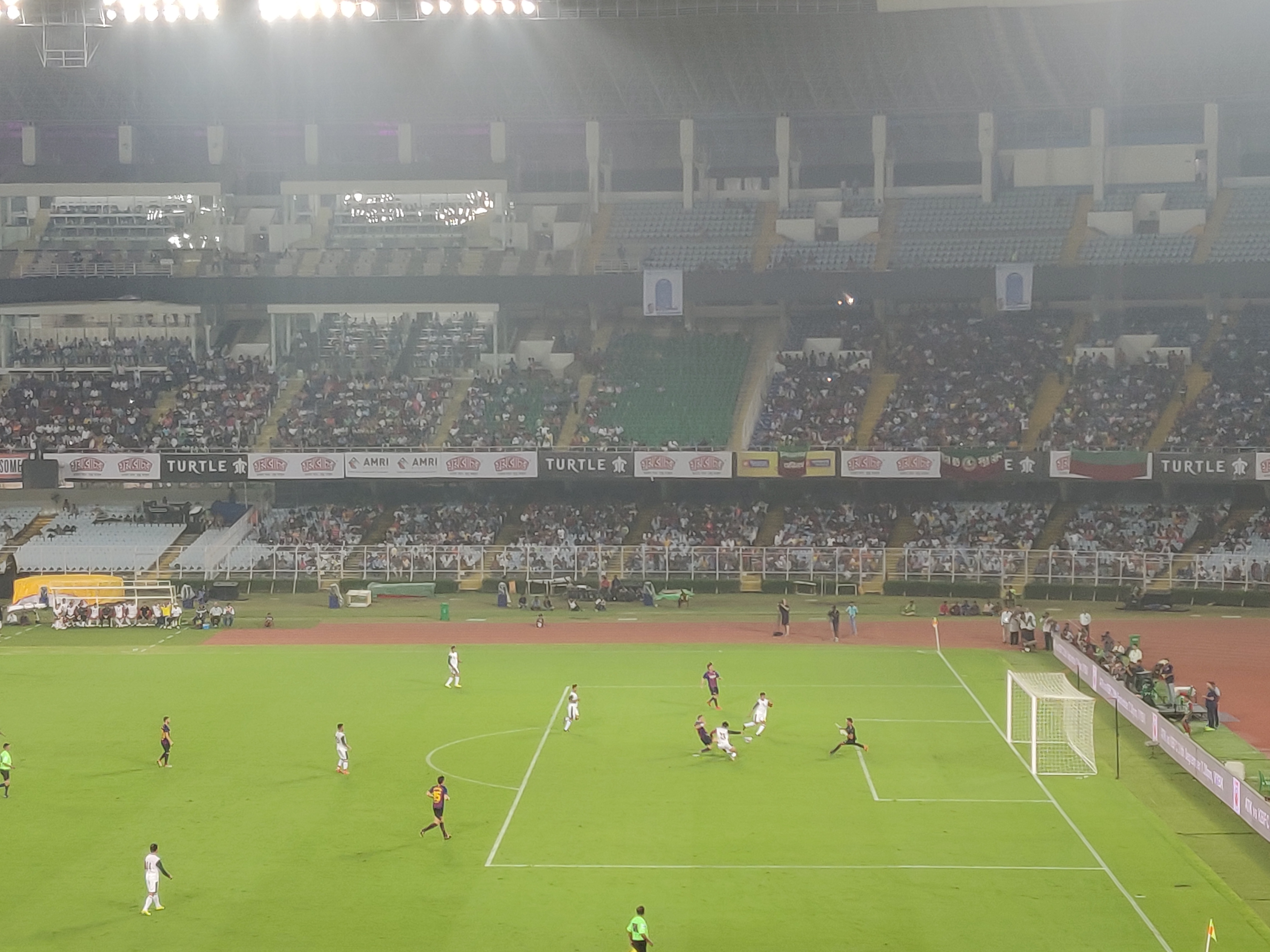
Game in progress (Photo: courtesy Arpit Nayak)

This was not the first time Salt Lake’s Vivekananda Yuba Bharati Krirangan (VYBK) Stadium saw such high-powered action. Back in 2008, the stadium was the farewell ground for Bayern Munich’s then-captain Oliver Kahn. Hailed by most football lovers in the city as “ King Kahn,’’ the German goalkeeper played his last competitive club match against none other than Mohun Bagan to a crowd of 120,000, with Bayern winning 3-0. In 2010, Football Next, ever an analyzer of football trends and in an effort to fund underprivileged homeless children, went on to organize a charity match between Bayern Munich and Mohun Bagan’s age-old rival East Bengal. The timing of their next venture could not have been more perfect. Weeks prior to the much-awaited Barca Legends match, the first Kolkata derby of the season had occurred between the sparring clubs of Mohun Bagan and East Bengal. Unlike matches against international players, sentiments run wild during derbies purely because the outcomes are taken personally given the histories of both teams. Spectators see the derby as the remnants of the rage – now diluted into strong banter – caused by the division of their homeland. Having ended in a 2-2 stalemate, Mohun Bagan’s fans were more charged than before, hoping for some sort of vindication in the match against Barcelona.

However, the match bore different result. Under the combined strength of Javier Saviola, Roger Garcia, Pedro Landi, Jani Litmana and Mateu, each of the six goals that were driven home were met with outrage from the home team’s supporters despite the fact that many of them were Barcelona loyalists as well. Outnumbering the scattering of Barcelona’s blue, red and maroon jerseys (many bearing the name of Lionel Messi) were the green and maroon of Mohun Bagan. “ These colors are more of an emotion for us,’’ said die-hard fan, Arka Roy. Confronted with the dilemma of which team to support, Roy pointed to his friend Ritam Sinha who in spite of being a Barcelona supporter, had turned up in Mohun Bagan colors, complete with face paint. “ I’d like to think I am Indian first, so I am favoring Mohun Bagan. The rest come later,’’ Sinha, an independent filmmaker, said. The crowd at VYBK mostly shared Sinha’s sentiment of supporting Mohun Bagan being a “ necessity’’ even as getting to watch their opponents play was a rarity, not to mention, luxury. Anjan Mitra, Honorary Secretary of Mohun Bagan AC believed that both clubs matched each other in legacy. FC Barcelona was founded in 1899 while his team was established 10 years earlier in 1889. “ We might not match them in terms of the heavyweight World Cup and national players they have but we are no less in terms of richness in football history,’’ Mitra said.

The home team had former star-players like Bhaichung Bhutia, Ashim Biswas, Habibur Rahman and Jose Ramirez Barreto. For months on end, there was uncertainty about the match as questions regarding permission from football bodies like FIFA, UEFA, and the Spanish Football Federation arose. However, the All India Football Federation (AIFF) permitted the match to occur with the release of a No Objection Certificate (NOC). Here too, the timing was impeccable and throws light on the planning and business acumen. The AIFF slotted the match days before the start of this year’s Indian Super League (ISL) season at Kolkata. All this point to how over time football has permeated almost all aspects of the city. Kolkata and the game are now one.

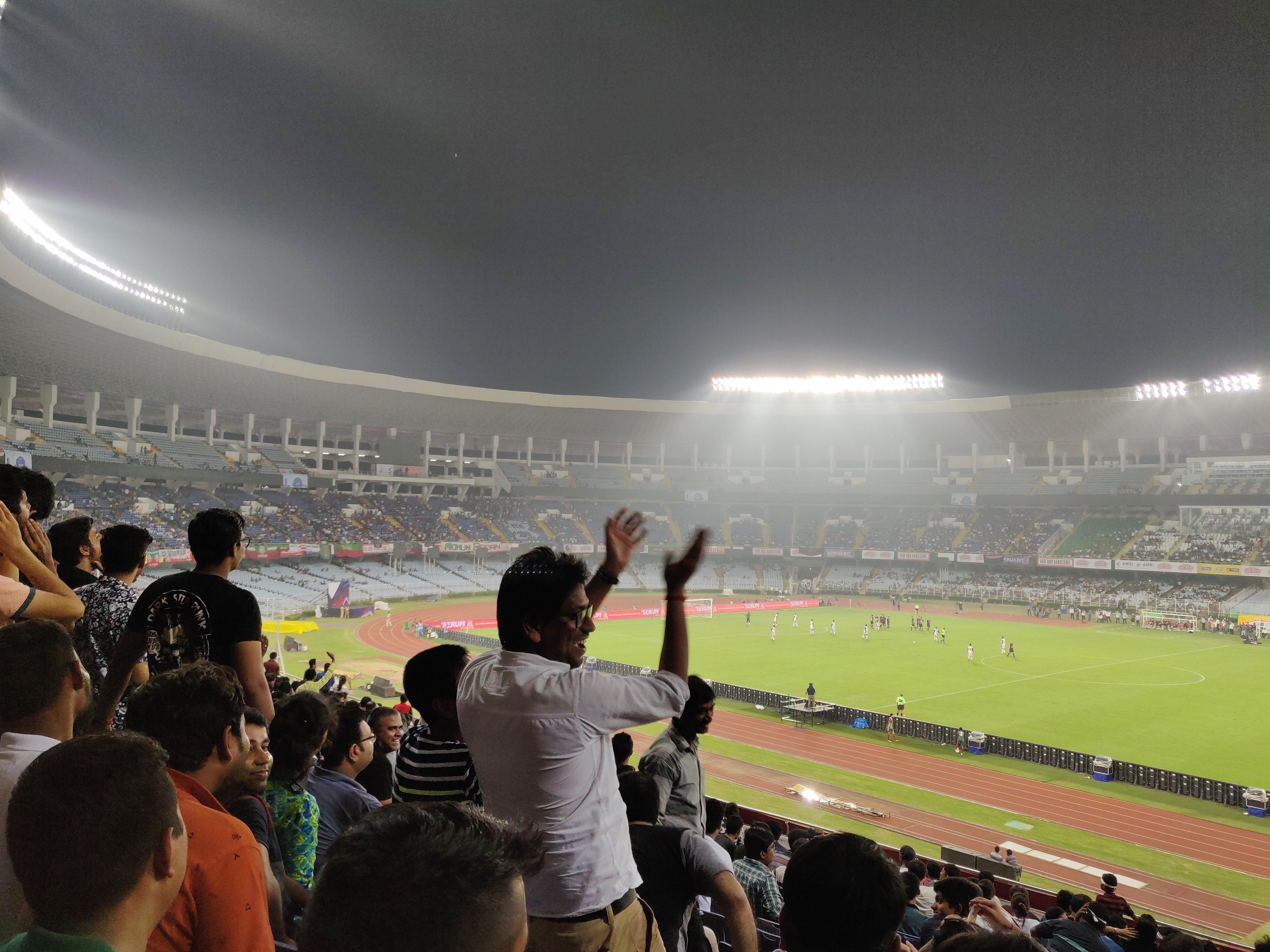
From the match (Photo: courtesy Arpit Nayak)

The Friday night of the match in Kolkata, Javier Saviola was a little over two months shy of marking his first decade since retiring from international football. Thunderous uproar shook Salt Lake Stadium in the seventh minute of the match when the former member of Argentina’s national squad opened the account for FC Barcelona. He netted the first of half a dozen goals Mohun Bagan collected in the outing. A few fans, probably those inclined to be with the winning side of things – cheered as Barcelona forged ahead. The majority of the crowd felt let down. The Mariners – that’s what Mohun Bagan’s fans are called – clung to hope; it was evident that they were pepped up by the spirit of competition. Nevertheless every goal that Barcelona’s players expertly weaved into the post was simply another nail in Mohun Bagan’s coffin. In their worst moments, the home team was roused by the loyalty of their fans. At one point, almost the whole stadium showed its support by turning on the torchlight in spectators’ cellphones – the new-age counterpart of lighters being waved in the air at rock concerts – accompanied by chants of Mohun Bagan. However, frustration was palpable towards the end. Some even kicked the stands in anger while their friends in the opposing camp mocked. When it was all too certain that this was a lost battle for Mohun Bagan, humor kept the Mariners going;  laughter, more towards self for losing since each fan felt an extension of the team, mingled with dejection. By the end of almost two hours, Mohun Bagan – after putting up a fight – had won the hearts of those watching. Amidst cries of “ Well, they were no match for Barca…I have seen better para matches…’’ were also hopeful strains of “ Next time…we’ll win next time.’’

(The author, Bulbul Rajagopal, is a final year MA student in Kolkata. She is reporting intern and contributor at this blog. She does not actively support any football team or club but enjoys studying the game and its league of fans. She grew up in Kolkata and believes the city is right up there on the global list of cities that make the phrase ‘football frenzy,’ real.)

VEDANGI’S QUEST / CANADA DONE, EUROPE NEXT

Vedangi Kulkarni (This photo was downloaded from the cyclist’s Facebook page and is being used here for representation purpose only.)

Vedangi Kulkarni, who is attempting to be the fastest woman cyclist to go around the planet unsupported, has completed her trip across Canada.

September 28 noon, her father Vivek Kulkarni informed that having finished the Canadian leg of her journey, Vedangi had just reached Iceland signifying start of the European and Russian segment.

She was expected to commence cycling in Iceland from September 29.

Vegangi has covered approximately 16,000 kilometers (roughly 9940 miles) so far, Vivek said. Prior to cycling across Canada, Vedangi had cycled in Australia and New Zealand. She began her journey from Perth on July 17, 2018.

The record Vedangi seeks to improve upon is the one held by Italy’s Paola Gianotti. In 2014 she completed circumnavigation unsupported on a bicycle – although not in consecutive stages – in 144 days.

As per information available on Vedangi’s website, her journey of 18,000 miles (approximately 29,000 kilometers) will be attempted in four stages. The first stage will see her cycling through Australia and New Zealand. The second stage will see her cycling across Alaska and Canada. The third stage spans Europe, Scandinavia, Russia and Mongolia. The fourth and last stage covers China and the trip back to where she started in Australia. Given the fact that all required visas cannot be applied for and obtained well in advance, the exact route of Vedangi’s expedition has to stay open to adjustments as her journey progresses.

Vedangi, 19, is currently a student at Bournemouth University, UK. She spent some part of her early childhood in Panvel (not far from Mumbai); later she attended Jnan Prabodhini school at Nigdi near Pune. Her family now resides in Kolhapur. The circumnavigation plan assumed shape sometime in September-October 2017. Vedangi’s circumnavigation attempt will take her across 14-15 countries, the final number depending on how the route is affected by visa availability. A film is being made on her journey. There will be a film crew meeting her at various points on the way.

(The author, Shyam G Menon, is a freelance journalist based in Mumbai. For more on Vedangi and her journey please scroll down or select from the blog archives.)

ABHILASH TOMY RESCUED

Commander Abhilash Tomy KC; this photo was taken at the time of Thuriya’s launch in Goa in 2017 (Photo: Shyam G Menon)

Commander Abhilash Tomy KC, who was injured badly after his sailboat, Thuriya, was rolled and dismasted in a severe storm in the Southern Ocean, was rescued earlier today (September 24), reports in the Indian media said.

Upon reaching Thuriya’s location, the French fishing patrol vessel Osiris dispatched a team (with stretcher) in a small boat, which successfully shifted the injured naval officer from his sailboat to Osiris. Abhilash is conscious but tired and dehydrated, a media report quoting his father, P.C. Tomy, said.

According to an update on the Golden Globe Race (GGR) website, at the time of the rescue both Indian and Australian maritime reconnaissance aircraft were circling overhead. Weather conditions were favorable. A radio briefing was held between the Maritime Rescue Coordination Centre on Reunion Island, a doctor at I’lle Amsterdam (an island in the southern Indian Ocean not far from where Thuriya was) and the master of the Osiris before the French crew proceeded to the Thuriya in inflatable Zodiac boats to assess Abhilash’s condition and administer first aid.

India’s Defence Minister, Nirmala Sitaraman, has tweeted that Osiris will take Abhilash to I’lle Amsterdam. He is expected to reach there by September 24 evening. Later, INS Satpura – one of two Indian navy ships dispatched to the Southern Ocean following news of Thuriya’s dismasting and serious injury to Abhilash – will take him to Mauritius, the tweet said. I’lle Amsterdam is part of French Southern and Antarctic Lands, an overseas territory of France. I’lle Amsterdam has a good hospital with X-ray and ultrasound equipment, the GGR website said.

Thuriya and Abhilash were participants in the 2018 Golden Globe Race (GGR) entailing solo nonstop circumnavigation of the planet in a sailboat. Ahead of storm in the Southern Ocean, Abhilash was placed third in the race. Following the dismasting and severe back injury, Abhilash was unable to move and confined to his bunk in the Thuriya. At the time of writing, details of the injury were not known.

According to the update on the GGR website following Abhilash’s rescue, Gregor McGuckin, the Irish sailor and GGR participant who was sailing towards Abhilash’s coordinates despite his own vessel being rolled and dismasted, was still 25 miles west. Gregor was attempting to motor-sail to Abhilash’s help under a small jury rig and with neither self-steering (he has to hand-steer) nor properly working engine. He was in contact with reconnaissance aircraft and although not in distress has requested for a controlled evacuation, a decision commended by race organizers given he has 1900 miles of Southern Ocean to tackle in a damaged boat and at the present juncture, has rescue assets close by.

(The author, Shyam G Menon, is a freelance journalist based in Mumbai. For more on Abhilash, Thuriya and GGR please scroll down or select from this blog’s archives.)

INDIAN NAVY AIRCRAFT SIGHTS THURIYA

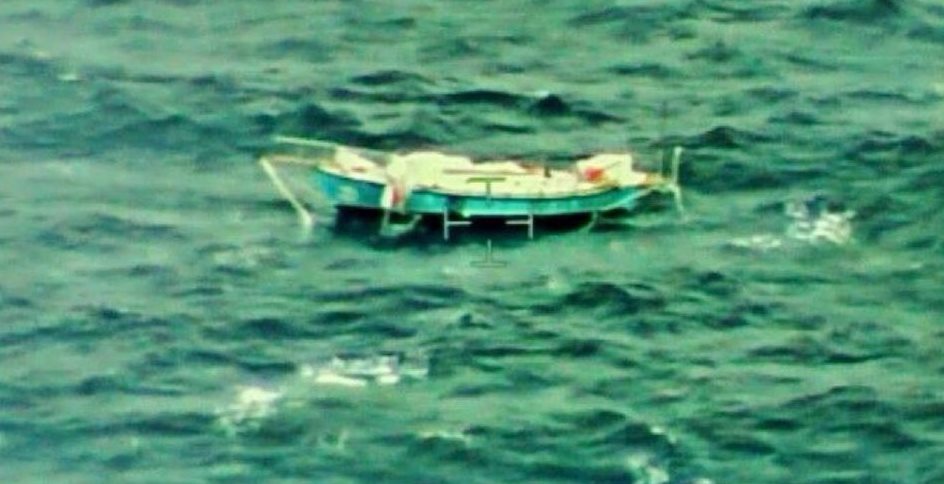
Thuriya adrift in the Southern Ocean; mast broken (This photo was downloaded from the Twitter handle of Indian Navy and is being used here for representation purpose only.)

An Indian Navy P-8I long range maritime reconnaissance aircraft has located Commander Abhilash Tomy’s sailboat, Thuriya, in the Southern Ocean, reports in the national media said today (September 23).

It may be recalled that the vessel was rolled and dismasted in a recent storm. Abhilash had subsequently reported severe back injury and inability to move around.

He has activated the Emergency Position Indicating Radio Beacon (EPIRB) and efforts have been underway to locate and rescue him. Thuriya and Abhilash were participants in the 2018 Golden Globe Race (GGR) entailing solo nonstop circumnavigation of the planet in a sailboat. It was Abhilash’s second such voyage. In 2013 he became the first Indian to do a solo nonstop circumnavigation in a sailboat.

Reports quoting an Indian Navy spokesperson said that the naval aircraft saw Thuriya adrift in the Southern Ocean, its mast broken and hanging alongside.

Further the official website of GGR informed that Australian authorities have dispatched an executive jet to the coordinates of the stricken boat. The aircraft will also overfly the boat of Irish skipper and GGR participant Gregor McGuckin, which too was rolled and dismasted in the storm. Notwithstanding an unreliable engine (likely due to fuel being contaminated when the boat was rolled and dismasted in the storm), loss of self-steering (he has to hand-steer now) and finding that the spinnaker pole he used to improvise a jury rig was bending in the strong wind, Gregor is attempting to motor-sail his way to Abhilash. The two are only 80 miles apart, the latest update on the GGR website said. Also expected to head Abhilash’s way is Estonian sailor and GGR participant, Uku Randmaa, who was 400 miles west of both Gregor and Abhilash.

Additionally, the French fisheries patrol vessel Osiris is heading to help Abhilash. Osiris has medical facilities onboard. Although he cannot move around and appears confined to his bunk due to the back injury, Abhilash has confirmed to race organizers that he can move his toes. In first responder circles, when assessing injury, the ability to move one’s body extremities is usually taken as a positive sign. Abhilash has indicated that he may need a stretcher when help arrives. Quoting Abhilash’s latest message to race organizers, the GGR website informed on September 22 (as an update to what it reported earlier the same day) that he can move his toes but is feeling numb and cannot eat or drink. The grab bag containing more emergency communication equipment remained difficult for him to access.

As per information on the GGR website, Australian authorities are also repositioning a search and rescue plane to Reunion Island to assist with the rescue efforts; this is in conjunction with the Anzac class frigate HMAS Ballarat, preparing to leave Perth for the area where Thuriya is. The Indian Navy has already sent INS Satpura and the tanker INS Jyoti to the southern Indian Ocean, where Abhilash is.

(The author, Shyam G Menon, is a freelance journalist based in Mumbai. Please scroll down or select from archives for more on Abhilash, Thuriya and GGR.)        

2018 GGR UPDATE / THURIYA ROLLED AND DISMASTED IN STORM, EFFORTS ON TO RESCUE ABHILASH TOMY

Commander Abhilash Tomy KC (This photo was downloaded from the Facebook page of Commander Abhilash Tomy and is being used for representation purpose. No copyright infringement intended)

Efforts are on to rescue Commander Abhilash Tomy KC, participant in the 2018 Golden Globe Race (GGR), after his boat, the Thuriya, was rolled and dismasted in a severe storm in the Southern Ocean.

According to information available on the GGR website, the incident has left Abhilash injured.

In a communication to race organizers on September 21, he said that he has a severe back injury and cannot stand up. At that time the Thuriya was 1900 miles south west of Perth, Australia.

In a subsequent update on September 22, GGR has quoted Abhilash confirming activation of the emergency beacon (EPIRB). The boat’s external YB3i unit continues to provide tracking information but the power line to the boat’s batteries has been damaged. The update which said Abhilash is on his bunk in the boat, said that he was using the portable YB3 texting unit – which is a back-up – for messaging.

The boat’s primary satellite phone has been damaged. There are additionally an aviation hand-held VHF phone, a second satellite phone and a second YB3 unit in Abhilash’s Emergency Grab Bag.

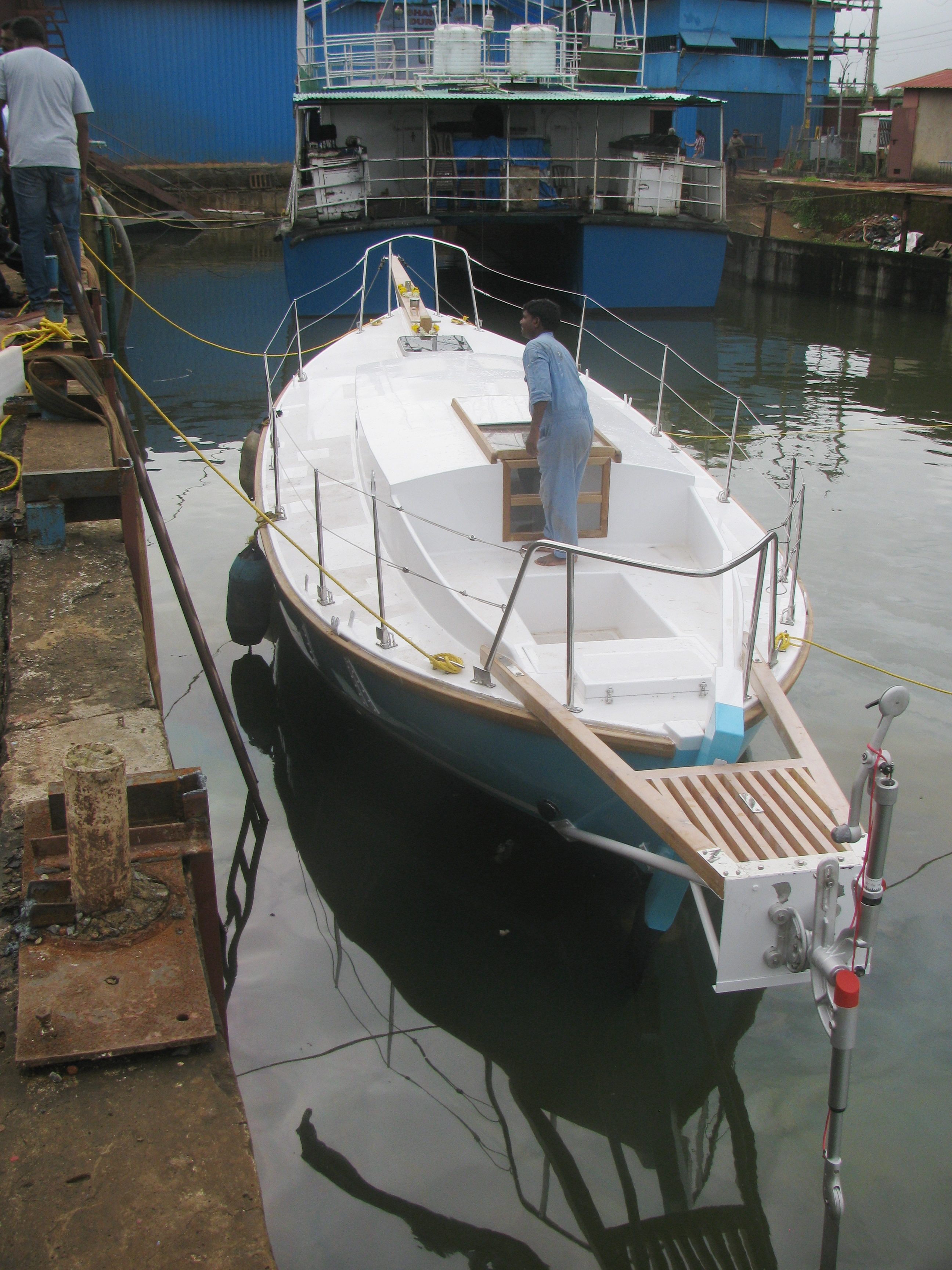
The Thuriya, soon after the boat was launched last year; view from aft. At this stage her mast wasn’t fitted; that happened later(Photo: Shyam G Menon)

But he cannot reach it given the state he is in, the update on the GGR website said.

Last reported on this blog, Abhilash was in fourth position in the race. He had subsequently improved to third position. Besides Thuriya, the powerful storm rolled and dis-masted the Hanley Energy Endurance, the boat in which fellow GGR participant, Gregor McGuckin was sailing. However Gregor is otherwise alright and following emergency repairs, was slated to sail towards Abhilash’s coordinates. He was reported to be 100 miles south west. Another GGR participant, the Estonian sailor Uku Raandma was also in range; he was reported to be some 450 miles away from Thuriya.

According to the media, the Indian Navy and Australian rescue authorities have swung into action to rescue Abhilash.

(The author, Shyam G Menon, is a freelance journalist based in Mumbai. For more on the 2018 GGR please scroll down or select from archives.) 

VEDANGI’S QUEST / CANADIAN LEG NEARS COMPLETION

Vedangi Kulkarni (This photo was downloaded from the cyclist’s Facebook page and is being used here for representation purpose only.)

Having completed the opening Australian chapter and New Zealand after that, Vedangi is close to wrapping up the Canadian leg of her journey, cycling around the planet.

Vedangi Kulkarni, who is attempting to be the fastest woman cyclist to go around the planet unsupported, has covered more than three fourths of the Canadian leg of her journey.

On September 9, her father Vivek Kulkarni informed that Vedangi had reached Ottawa, the capital of Canada. At that point she had covered 9020 miles (14516 kilometers) since commencement of her trip in Perth, Australia. This approximates to half the distance required for circumnavigation. It took her 54 days and some hours (but less than 55 overall, as per Vivek) to cover the distance.

On her Facebook page, the young cyclist wrote: How do I feel? Grateful! I feel grateful for the colourful sunrises and sunsets, the mountains and the flat lands, the tarmac and gravel paths, the beautiful trees, creeks, rivers and lakes, the howls of the wolves and close wildlife encounters, the pleasant temperatures and freezing cold, the thunderstorms and stormy winds and tailwinds, and above all, to the PEOPLE who have supported me however and whenever and wherever I’ve needed – family, friends and absolute strangers! You’re my invisible peloton and I value every single one out there wishing well for me.

The record Vedangi seeks to improve upon is the one held by Italy’s Paola Gianotti. In 2014 she completed circumnavigation unsupported on a bicycle – although not in consecutive stages – in 144 days.

According to Vivek, Vedangi had to attend to work concerning her Schengen visa for Europe, in Ottawa. For some reason in the journey so far, this particular visa had proved tough to obtain. On September 15, in a post on Facebook, Vedangi confirmed receipt of Schengen visa. She will now proceed to Halifax in Nova Scotia to complete the Canadian leg, Vivek said.

Vedangi began her passage across Canada in Vancouver. Earlier she had cycled from Perth to Brisbane in Australia (5631 kilometers) and put in an additional 1000 kilometers or so, in New Zealand.

As per information available on Vedangi’s website, her journey of 18,000 miles (approximately 29,000 kilometers) will be attempted in four stages. The first stage will see her cycling through Australia and New Zealand. The second stage will see her cycling across Alaska and Canada. The third stage spans Europe, Scandinavia, Russia and Mongolia. The fourth and last stage covers China and the trip back to where she started in Australia. Given the fact that all required visas cannot be applied for and obtained well in advance, the exact route of Vedangi’s expedition has to stay open to adjustments as her journey progresses.

Vedangi, 19, is currently a student at Bournemouth University, UK. She spent some part of her early childhood in Panvel (not far from Mumbai); later she attended Jnan Prabodhini school at Nigdi near Pune. Her family now resides in Kolhapur. The circumnavigation plan assumed shape sometime in September-October 2017. Vedangi’s circumnavigation attempt will take her across 14-15 countries, the final number depending on how the route is affected by visa availability. A film is being made on her journey. There will be a film crew meeting her at various points on the way.

(The author, Shyam G Menon, is a freelance journalist based in Mumbai.)
2018 GGR / RACE PASSING THROUGH INDIAN OCEAN

Commander Abhilash Tomy KC (This photo was downloaded from the Facebook page of Commander Abhilash Tomy and is being used for representation purpose. No copyright infringement intended.)

The 2018 GGR, which began July 1 from France, is now passing through the Indian Ocean, albeit way down in the southern hemisphere. The race with technology levels pegged back to what prevailed during the 1968 GGR entails a solo, nonstop circumnavigation of the planet in a sail boat. It is adventure, refined.

More than two months since the 2018 Golden Globe Race (GGR) commenced from Les Sables-d’Olonne in France, the race leaders are past Cape of Good Hope and Madagascar. They are well into the Indian Ocean; the region they are in qualifies to be Southern Ocean. As of September 13, 2018, they lay far out at sea in the southern hemisphere, south-south west from the Indian peninsula.

Among the world’s great capes, the next one for them to rendezvous with is Cape Leeuwin, Australia. Well past this cape at Storm Bay in Hobart, Tasmania, the participants will have a brief meet up with race officials and media. According to race rules, the participants will pass through a `gate’ and drop all sail on the boat if it is safe to do so. The entrant may moor, anchor, motor or drift but may not re-cross the gate to continue to Cape Horn until at least 90 minutes has elapsed. During this time when the nonstop, unsupported character of the race will continue to remain intact, the participants can pass on any photos, films, letters they may have. They will also have to display their `safety pack’ for inspection. The pack – it contains a portable GPS chart plotter – is meant for use in emergency and a broken seal (indicating the pack was opened) denies the participant any official ranking in GGR or GGR trophies. He / she can however continue in the event under `Chichester Class.’ Further instances of stopping anywhere or breaking the seal of the pack, will disqualify the participant from the event, altogether.

As of mid-September, of 18 sailors originally participating in the 2018 GGR, seven had retired from the race while one stood relegated to Chichester Class. Commander Abhilash Tomy KC of the Indian Navy – he is the sole participant from India and only invitee from Asia – was among those still in the race. At the time of writing he was in fourth position. He had made some significant gains in the preceding days. The race leader by sizable margin was Jean Luc Van Den Heede of France. He was followed by Mark Slats of Netherlands, Gregor McGuckin of Ireland and Abhilash in that order.

The 2018 GGR features solo nonstop circumnavigation of the planet in a sail boat. It is a repeat of the original GGR of 1968, which produced the first solo nonstop circumnavigation in a sail boat; the distinction went to Sir Robin Knox-Johnston of UK, who accomplished the voyage in the India built-Suhaili. The 2018 edition is unique for pegging technology aboard participating sail boats, to the same level as in 1968. No digital devices have been permitted. Navigation is done using a sextant. Abhilash is the first Indian to do a solo nonstop circumnavigation in a sail boat. The 2018 GGR is his second attempt at solo nonstop circumnavigation. For the race, Abhilash is sailing in the Thuriya, a replica of the Suhaili built in Goa at Aquarius Shipyard (for more on the Thuriya please click on this link:  https://shyamgopan.com/2017/08/11/2018-golden-globe-race-ggr-meet-the-thuriya/).

(The author, Shyam G Menon, is a freelance journalist based in Mumbai.)
WHEN A YEAR DOESN’T FEEL ENOUGH

Grant Maughan (Photo: Shyam G Menon)

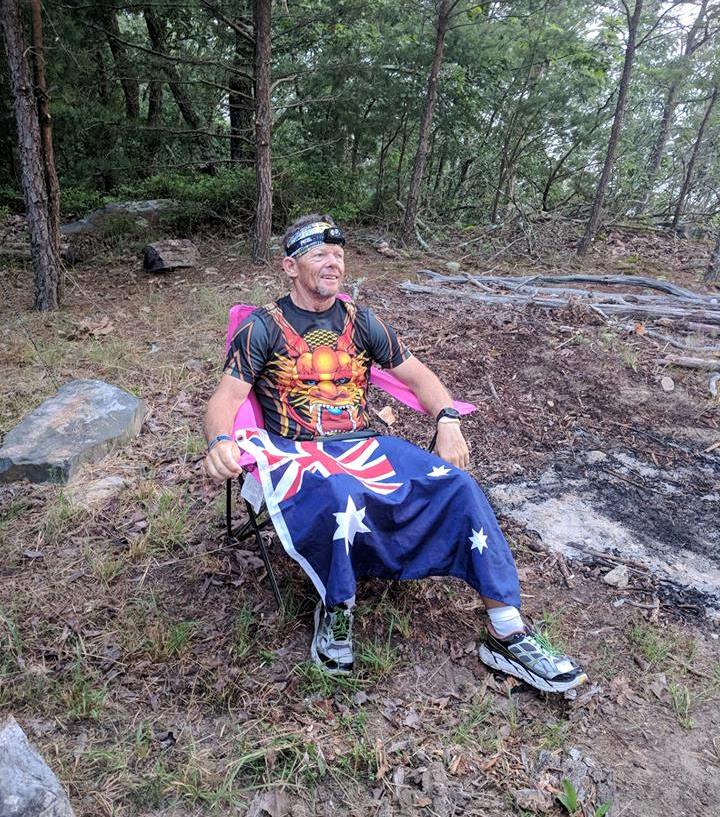
This is an article by invitation. The author, Grant Maughan, is a freelance super yacht captain and endurance athlete. Here, he provides us an overview of how 2018 shaped up for him and then takes us ringside to three ultra-running events he was at recently – The Last Annual Vol State, Badwater 135 and Angeles Crest 100. Hailing from Australia, Grant lives in the US. He maintains a packed schedule.

Sometimes a year just doesn’t seem like enough time.

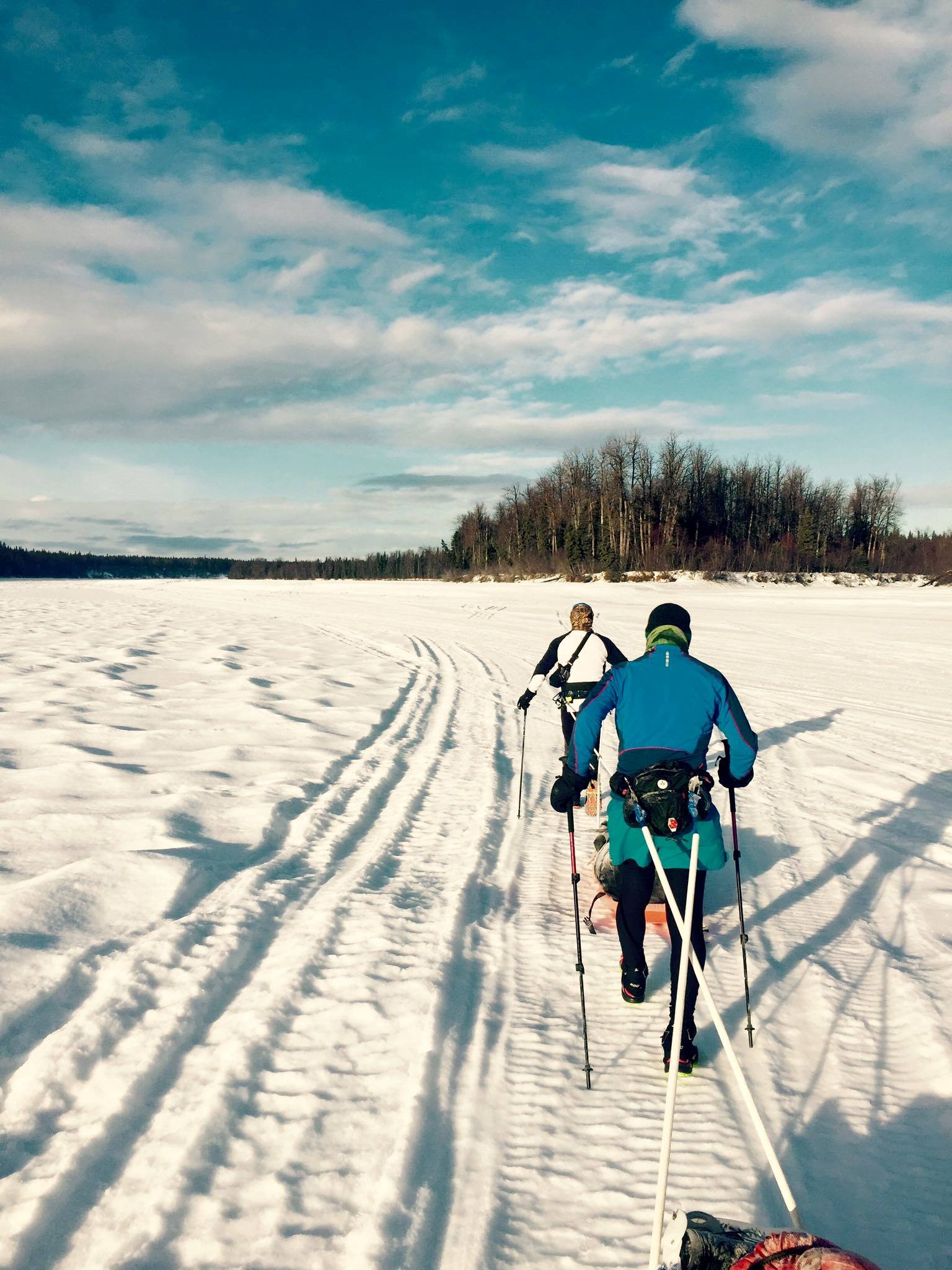
After working on a ship in Antarctica for four months in late 2017 / early 2018 and doing no training I found myself north of the equator about a week after finishing in Cape Town. I was back in Alaska for the Iditarod trail Invitational 350 mile winter race, hooked up to my sled and a little gun-shy after my withdrawal from the event the year before at around the 200 mile mark with frost bite to my fingers and nose. This year, with a conservative approach I managed to finish the event in third place and qualify for the 1000 mile attempt along the entire Iditarod Trail to Nome in 2019.

Not two weeks later I had flown to Australia to renew my passport, then back to Florida, changed equipment and driven to Frozen Head State Park in Tennessee for my first attempt at the infamous Barkley Marathons. Considered one of the most difficult ultras in the world, in its 32 year history only 15 people have managed to finish the five loops, collect all the correct book pages hidden out in the mountains and returned in time to the “Yellow gate.” This year’s weather was some of the worst on record with bucketing rain, cold temps and mud like butter. I managed to finish one loop with all the pages in the required time. Doesn’t sound like much of an achievement but I beg to differ.

From Iditarod (Photo: courtesy Grant Maughan)

A week after I had driven back to Florida, exchanged equipment again and was on a bus being shaken to bits on a mountain road through the Himalayas to Everest base camp in Tibet where I spent the better part of the next two months acclimating and working on climbing the North Col / North East Ridge route of the tallest mountain on earth. After a harrowing summit on May 19, I thanked my lucky stars to be back at base camp and packing for departure.

Not two weeks later I had flown back to Florida, changed equipment out and driven again to Tennessee for my first attempt at the Last Annual Vol State 500km road race. This event is also brain child of Barkley Race Director, Laz Lazarus and is considered an adventure across “small town America”. The route crosses the entire State and winds through country roads and quaint towns that most travelers would bypass on super highways.

Last Annual Vol State

What is the Last Annual Vol State race? Well, to begin with, it’s unlikely to be the last annual anything. Every year, more and more runners sign up for the 500k (314-mile) challenge. This year, 114 ultra-runners gathered for what is mostly a race across Tennessee — although it starts with a ferry ride across the Missouri River, zigzags across the Kentucky and Alabama state lines, and ends at a “rock” on top of Sand Mountain in Georgia. “That’s crazy… and confusing!” you might say to yourself. And you would be right.

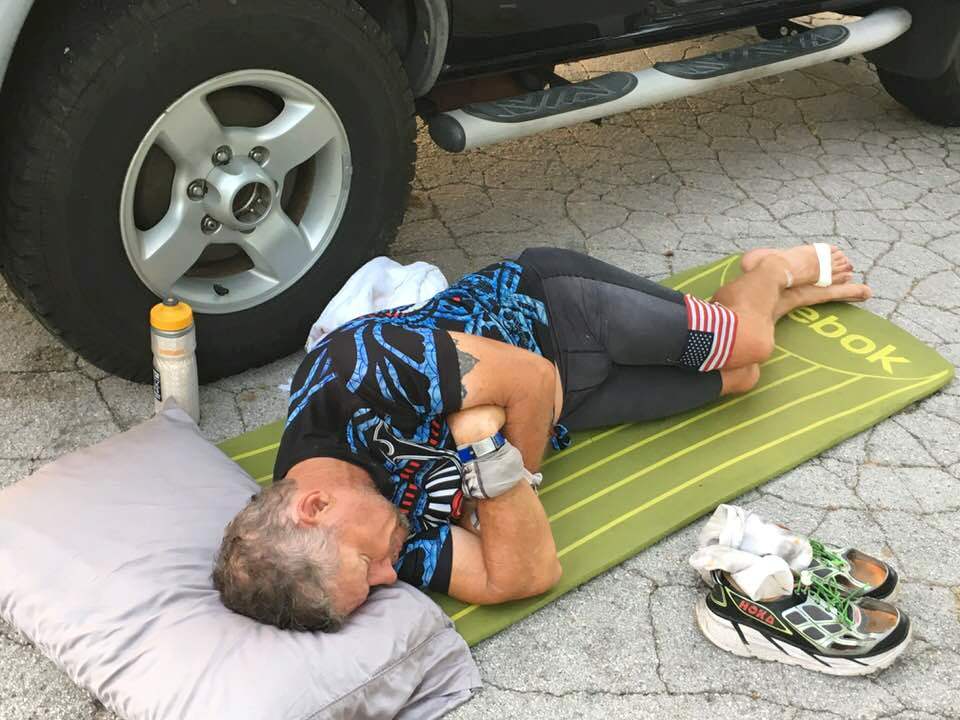
Taking a nap during Vol State (Photo: courtesy Grant Maughan)

Runners follow a labyrinthine course through small towns and farmlands, along backcountry roads and busy highways — and all at the height of a sweltering, sticky, bug-infested Tennessee summer (know what sweat bees are? If you don’t, you will!). The people are super friendly; the farm dogs, not so much. Runners have 4-10 days to finish, although the record holder did it in 3 days 7 hours. You can be crewed or “screwed” (which means un-crewed). There are no aid stations, although some kind-hearted locals took pity and set up “angel stations” along the way to offer food, water and a place to bed down (that MIGHT be chigger-free, if you are lucky). Screwed runners carry what they need or buy it along the way. Unscrewed runners have their crew do it for them.

All runners are free to check into a motel for sleep and a chance to test just how bad their chafing is in the shower. Many just sleep on the ground, where they drop. No fancy trackers — runners are required to call in twice a day with their position on the course. There are not many other rules, except you can’t ride in a car (unless a police officer makes you), and if you leave the course for food or a room, you have to go on your own two feet (no matter how much they hurt) and return to the course exactly where you left it.

King of the Road – that’s the title given to the first to reach Castle Rock by the Tennessee legislature (true story) on completion of the Last Annual Vol State 500km ultra.

Even though I was the first to get there, and proud of it, all of us who endured that long hot road across small town America at some point felt like a truck wreck. We came unstuck, went off the rails, strayed from our minds and asked ourselves questions too big to answer. But in the end we held that wheel in a white knuckle grip and kept on trucking.

Titles are not bestowed they are earned, and “King of the Road” will cost you more than a pound of fat.

I was more than a little relieved to finally make it to “The Rock” and the finish in 3 days 22 hours and 2 minutes.

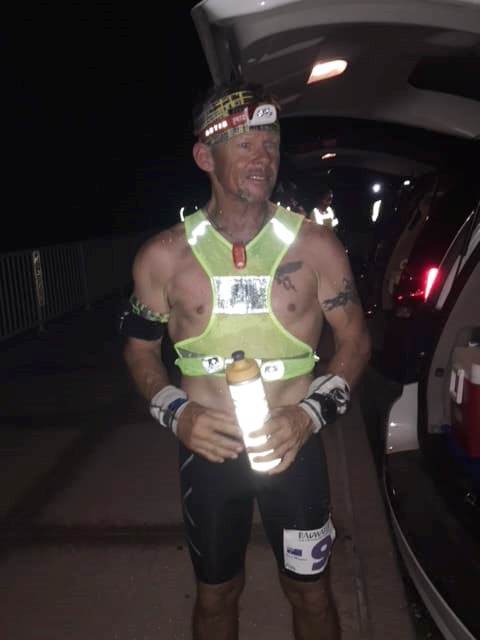
At the finish line of Vol State (Photo: courtesy Grant Maughan)

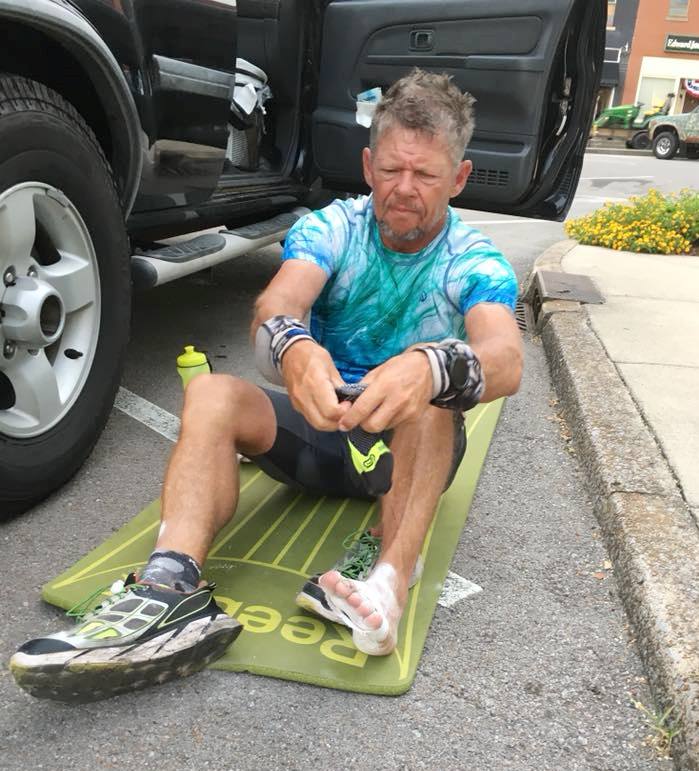
After 500 km of running across Tennessee under a relentless sun and humidity, cranky dogs and the close proximity of speeding big rigs on country roads I finally dragged my putrid body to a stop. One of the difficulties of this event is living in saturated clothing and shoes for days. It’s very difficult to stop blisters, heat rash and horrid chaffing…and that’s besides the endless miles of soul crushing tarmac.

My wife, Susan Jobe who was my solo crew, suffered as much sleep deprivation, stinky clothes and bleary vision as the runner. We traded the front seat of the car and a yoga mat for occasional cat naps on the side of the road, shunning the comforts of a hotel for reasons unknown – but could have something to do with my stubbornness?

I literally saved seven angry dogs by either running to the opposite side of the road to stop them running in front of traffic to come harass me, or standing on the road waving frantically to a high speed vehicle to stop before it vaporized a small girl’s dog in front of her as she screamed from the front yard.

I finished early in the day. So we slept the rest of it in a local hotel before packing the car and heading West for another 2800 miles to Death Valley, California for this year’s Badwater 135.

Badwater 135

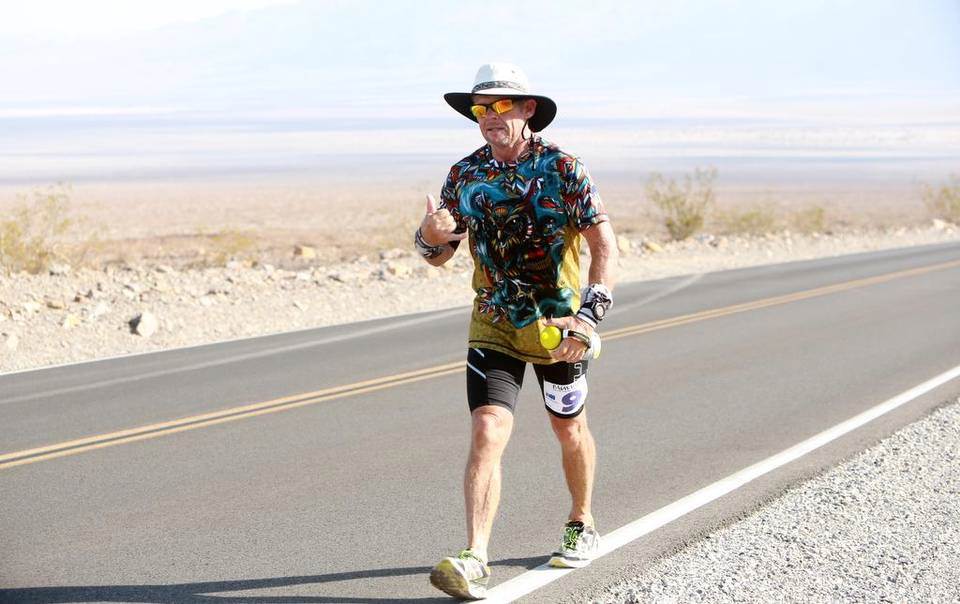
This was Badwater number six for me and I can only describe it as the toughest finish I have experienced at this race.

With record setting temperatures this year it was brutal to say the least and took a heavy toll on racers. I was obviously fatigued from Vol State only about a week earlier and my feet were in serious disrepair.

At Badwater 135 (Photo: courtesy Grant Maughan)

My slowest time ever at 34:52:30 and 22nd place didn’t bother me, heck I was just happy to finish this year. With about 30% drop out rate from the extreme heat it was one for the ages.

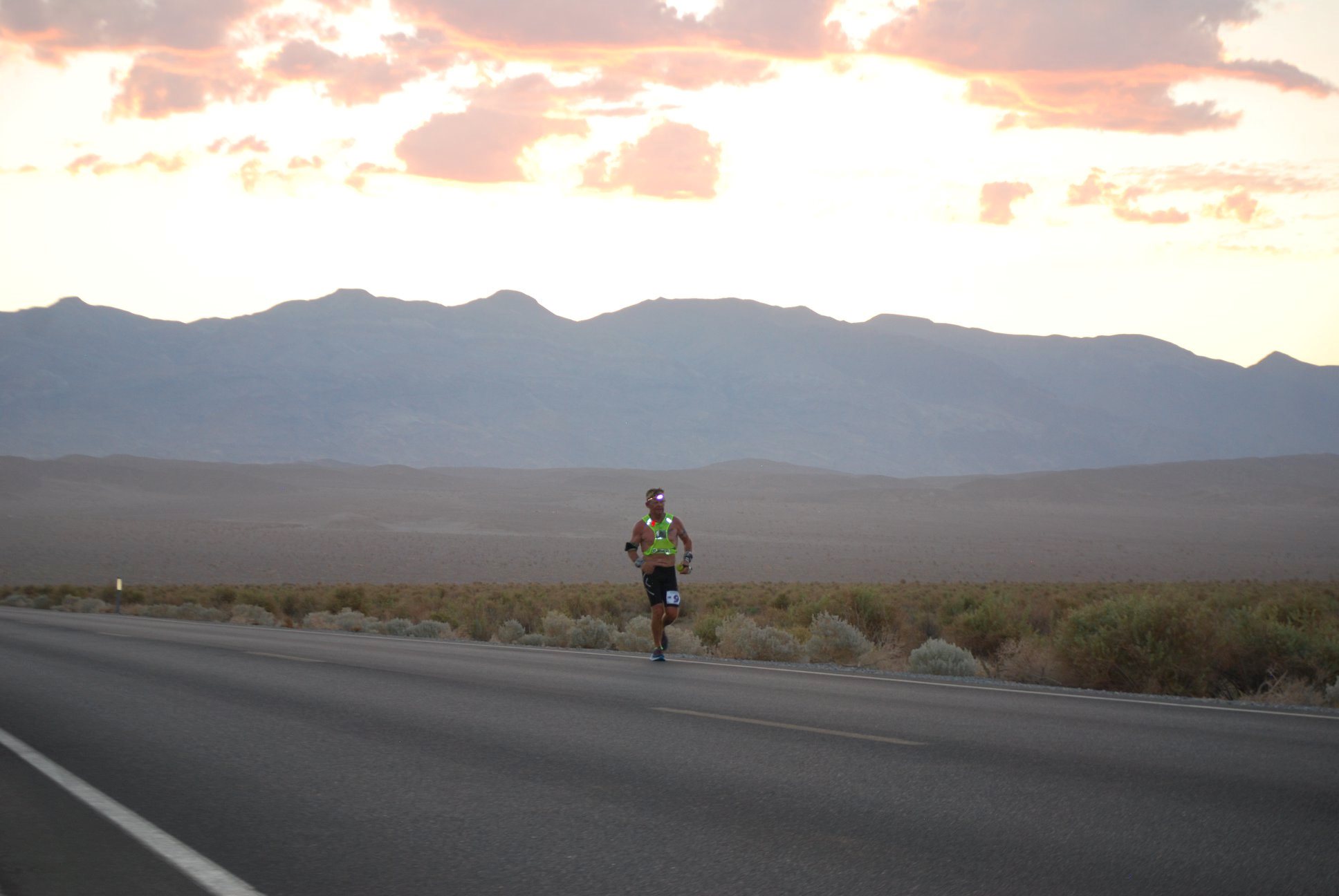
Whenever someone asks me what they need to know to run Badwater I always tell them they need to respect the first 41 miles between Badwater Basin and Stove pipe Wells. The arid atmosphere is going to suck every drop of moisture out of your body. You have trouble drinking enough to replace the loss and your stomach cannot process it all quickly enough. This year I saw total carnage along that section. Someone was throwing up only five miles from the start. After Furnace Creek I saw a female runner, totally unconscious, being carried to her crew car. A minute later the woman in front of me had a wobble, went off into the gravel and hugged a road post. Not a minute later a guy was projectile-vomiting a ten foot stream of fluid in great heaving growls that echoed off the landscape. It looked like a scene from the trenches of the Somme and we were only about a marathon into the 135 miles. I chugged along in idle, drinking like a fish and gladly peeing frequently.

Heading up Towne Pass my own problems started with my feet that had been taped up after last week’s race but started to fall apart. Blisters under the ball of the left foot started to fill again and the pad started to slew off the bottom. At the summit I had the foot taped up with blue painters tape so I could make the downhill section without the pad on the ball of the foot falling off. It was a slow, painful and unhappy trip down. Then the abominable heat rising out of the Panamint valley made me feel faint and out of it. At times when only a few hundred feet from the car I wasn’t sure if I would make it and thought I would collapse on the sizzling tarmac. It took many hours to get to Panamint Springs where I lay on a yoga mat fitfully for a couple hours.

Badwater 135; heading up Towne Pass (Photo: courtesy Grant Maughan)

Unfortunately our crew had to resign here due to heat problems and I thought my race was over until serendipity arrived in the form of the famous Bob Becker*. The runner he had been crewing had just dropped. He quickly slipped into the program and I hobbled away to climb Father Crowley in a heat haze. When we arrived at the top I tried to start running and to my surprise ran many of the miles to Darwin. The 30 miles section to Lone Pine is very amenable to running and with the sun down I gritted my teeth from the foot pain and trotted along for most of those miles, sending the crew ahead to take cat naps.

A big problem I had during this year’s race was falling asleep: day and night. It was like my body’s protection mechanisms were just shutting me down. I spent untold 15 minute cat naps trying to alleviate it. Caffeine did nothing except make me drowsier.

It was a great feeling to arrive in Lone Pine at day break and get on the Portal Road for the final climb to the finish line. Susan and Bob each paced me up the laborious climb to the finish.
It was an epic year out there and total respect to everyone who was out there – runners, crew and staff.

Badwater 135 continues to be a benchmark of the ultimate grind-fest of road racing….whew!

Angeles Crest 100

After Badwater I decided that I probably wouldn’t run AC100 because my feet were falling apart and incredibly painful to walk on.

I did some Epsom salt soaks, cut off lots of dead skin, filed nails and applied rehydration crème.

From Vol State; time for some foot-care (Photo: courtesy Grant Maughan)

To my surprise only a few days later we had driven north to a remote National Park in Nevada to hike climb a 12,500 feet peak and my feet felt “not bad”. We continued the sojourn by climbing another 12’ver near Las Vegas and I decided that though tender I might be able to make it through the 100 miles of trail in the San Bernadino Mountains near Los Angeles. So we redirected the car and eight days after Badwater I was at the start line of the AC100.

I took it easy and enjoyed the beautiful mountain and forest scenery. The trails were well maintained and I was surprised how good I felt. I made a huge mistake though just as the sun was getting higher and hotter. Some of the aid stations are 8-12 miles apart and just before the biggest climb of the race I filled only one water bottle instead of all three and suffered very bad dehydration coming down the other side. My mouth was so dry I could hardly open it.

At the next aid station I sat for half an hour drinking a couple of litres of fluid as I knew it would be difficult to get through the intense heat of the afternoon without trying now to catch up on hydration. The next aid was only five miles away and I did the same when reaching it. The next 30 miles felt okay but it was getting hot on the trails and with no breeze it was stifling. A couple of miles before the hallway point aid station I started to slow down, feeling overheated and faint whilst in heavy bush where the air was not moving. It felt heavy and pressing down on me. I sat at the check point and drank as much as my stomach could tolerate, filled every bottle and got going on a long eight mile section down in a valley.

The terrain was more complicated with a lot of rounded river rocks to navigate and sizzling temperature. About a mile from the aid station I felt totally drained and started wondering if I might have to drop. A final rock staircase up to the checkpoint had me wondering if I could even get up it. I knew I would have to stop for a while and get calories and a lot of fluid into me to be able to go on. I sat on a chair and the hard working volunteers fed me and replenished drinks. After more than an hour it was dark, I was chilly from wet clothes and I knew I had to either get going or call it quits. I started walking down the dirt road which led eight miles to the next aid. Eventually I loosened up and came out of my low point. I walked many miles though and kept drinking and eating.

After the 65 mile point the trail became more technical and there were some long downhill single tracks followed by more big climbs. At one point I lay down for ten minutes to try and stave off my sleepiness. My head was nodding lower and lower before I would stumble, just before I fell asleep. It was very annoying and again, even caffeine wouldn’t buck me up. I kept going though until the sky began to lighten and as the sun came up I felt a new surge of energy on reaching the 90 mile-mark. I ate and drank quickly at the aid station and headed off on a very long downhill with new vigour, going faster and faster.

I was amazed I was running so well after all the races and had no idea where the energy was coming from but I didn’t question it too much. I had another finish line to reach. I ran the entire ten miles and passed more than a dozen runners. I kept going hard all the way to the finish before collapsing in the shade with a cold drink and was extremely pleased with the way it ended. I came in 31st in 27 hours 46 minutes. Around 150 runners had dropped out from the heat; that left about 100 finishers!

Badwater 135; crossing Devils Cornfield (Photo: courtesy Grant Maughan)

We ate and slept at a local hotel before again packing the car to drive over 3000 miles back to Florida. I lost more skin and toenails but that is the price you pay for ultra-running.

I have a few weeks to rest before flying to Italy to try the Tor des Geants 330km mountain race on September 9. I started this race last year but only made it 50 km because of a bad flu two days before race start. Let’s see what happens this year.

It’s been a big year but I feel good and haven’t suffered any injuries from all the activities. I have hardly done any training for anything, mainly because I haven’t had the time to. It amazes me what the human body can do.

(The author, Grant Maughan, is a freelance super yacht captain and endurance athlete. * In 2015 Bob Becker, then 70 years old, had become the oldest runner to complete the Badwater Double.)