IRONMAN: THE GAME BEGINS FOR INDIA

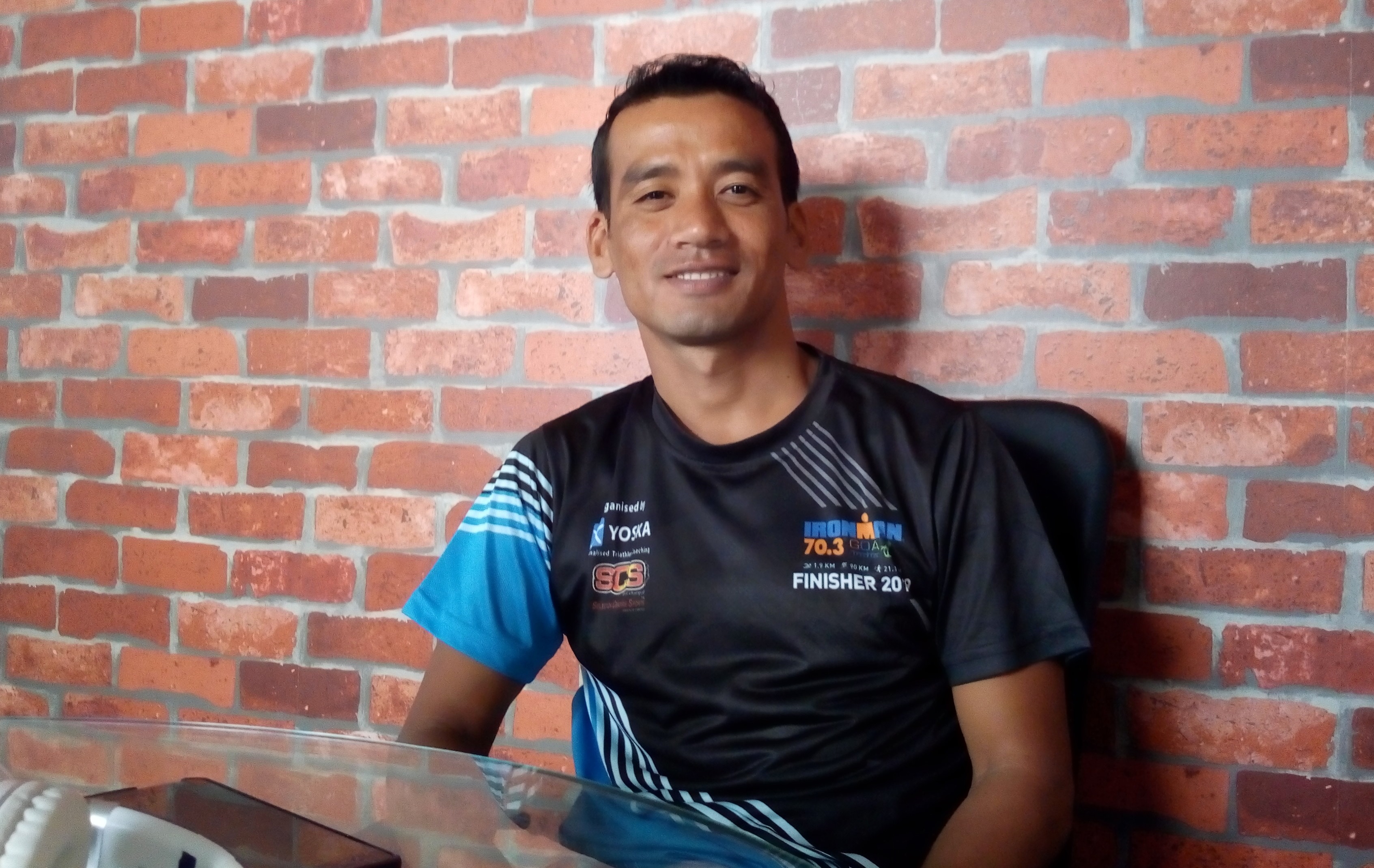
Saikhom Bishworjit (Photo: Shyam G Menon)

The Indian story in Ironman triathlons had been one of completing it. In mid-2019, that changed, thanks to triathletes from the Indian Army’s Bombay Sappers. A finish in top ten and topping in age categories was achieved. Then in October, an Indian triathlete – once again from Bombay Sappers – won an Ironman event. This is the story of that journey and what a group of amateur triathletes did to make the podium finishes possible.

Manipur is a state in north east India.

At roughly three million people, Manipur’s population is a small fraction of India’s overall human numbers estimated at over 1.3 billion. Imphal East is Manipur’s second most populous district. According to Wikipedia, the district straddles average elevation of close to 2600 feet. It has warm summers and modestly cold winters. Naharup is a village in Imphal East. That’s where Saikhom Bishworjit was born in 1990, the eighth of nine siblings – all boys. His father, now no more, worked as a teacher; mother is a homemaker.  Two people appear critical in Bishworjit’s story. His elder brother Saikhom Mani – seventh among the siblings – is a national level triathlete. But it was “ Sushil’’ another triathlete from Naharup, who kick-started things; he organized a triathlon in the local pond. Based on his performance there, Bishworjit commenced swimming at the swimming pool in Imphal.

In 2004, when selections were held for a national sub junior level competition in the triathlon, Bishworjit finished first. At the subsequent meet held in Hyderabad, he placed fourth. Despite its small population, Manipur is a powerhouse in Indian sports. For decades India’s north east was plagued by militancy, poor connectivity to the rest of the country and a general sense of being overlooked. It resulted in economic development delayed and opportunities restricted. “ For us sports was avenue to get a government job,’’ Bishworjit said. Under the Indian system, promising athletes get employment, typically in government and with public sector enterprises. In such ambiance, fourth place may not have been personally encouraging for the youngster. After the Hyderabad event, Bishworjit dropped off the triathlon.  The person who got him back on track was his triathlete brother; in 2006, Mani joined the Indian Army’s Bombay Sappers. He began supporting Bishworjit’s training. In 2008, at the junior nationals held in Porbandar, the youngster placed fifth despite using an India-built basic bicycle for the cycling segment.

A sapper, also called pioneer and combat engineer, is a soldier who performs a range of military engineering duties.  The Corps of Engineers of the Indian Army has three groups of combat engineers under it – Madras Sappers, Bombay Sappers and Bengal Sappers. Of these, Bombay Sappers has its headquarters at Khadki, Pune. In 2009, Bishworjit shifted to Pune to be with his brother and train. Among the army’s several arms and regiments, Bombay Sappers is known to maintain keen interest in the triathlon (of late, personnel from the parachute regiment have also begun appearing on the scene, those familiar with the sport said).  Although not yet part of the army, thanks to his brother, Bishworjit was able to periodically train alongside the army’s triathletes. In 2010, after he secured fourth place at the senior nationals, he was formally accepted into the army. His longstanding wish to have a government job thus came true.

Raghunath Shivaji Mali and Biten Singh Laikhuram (This photo was downloaded from the Facebook page of Recreational Triathletes)

However, there was gap between the worlds of triathlon as evolved within the army and as it prevailed outside. Oriented towards objective and clear plan of progression, the army’s typical long term goal is Olympics. Besides internal competitions; importance is given to military games, national competitions, continental meets and through all that, selection to represent country at the Olympics. But triathlon has a bustling world of events and competitions outside the fold of the Olympics.  There are the Ironman triathlons, leading all the way up to world championships. Further, the triathlon as essayed at the Olympics features short distances across all three disciplines – swimming, cycling and running.  An Olympic triathlon entails 1.5 kilometers of swimming followed by 40 kilometers of cycling and 10 kilometers of running. Ironman distances are more. Not to mention, beyond Ironman (half and full), there are events like Ultraman. As later events showed, the army was very aware of these events. But priority seemed Olympic dimension.

In October 2015, the World Military Games was held in Mungyeong, South Korea. Among disciplines therein was the triathlon; it was of Olympic dimension. Six triathletes of the Indian Army, including Bishworjit, participated. According to him, the team placed twelfth. The open water swim of the triathlon was held in the sea. Bishworjit remembers struggling to get going in the sea. It was his first time tackling the sea and sea swimming is very different from swimming in the pool or contained water bodies like ponds and lakes, which is what he was accustomed to. To get going at sea, you should know how to get past the oncoming waves.  He lost time negotiating the waves. In 2015, the National Games was held in Thiruvananthapuram, Kerala. Not making the cut to represent Services (the team which represents army, navy and air force) in the triathlon, Bishworjit represented Goa following a route athletes in such predicament are permitted to take. However, after the World Military Games in South Korea, small changes in training started to happen. The army’s triathletes who trained in Pune, traveled to Mumbai and the naval facility there to practise sea swimming.

Over the past decade, the triathlon has slowly but steadily gathered followers in India. A couple of factors may have contributed to it. First, in running, which is perhaps the most easily accessed sport for fitness, the base numbers grew enormously. Running’s growth has provided a stairway for amateur athletes to explore the world of related sports. Two other verticals in endurance sports, they quickly become aware of – usually as options to cross train – are cycling and swimming. Cycling as lifestyle activity – along with committed cyclists emerging therefrom – has picked up. Second, as the economy opened up in the 1990s and sectors like IT rose in importance, a workforce more mobile than before made its presence felt. People who spent time overseas and witnessed sports there or participated in it; wished for similar pursuits back in India. The amateur sports scene in India drew much impetus from this mobile workforce. In 2014 the Goa Triathlon made its debut with 90 participants. It was of Olympic dimension. Also taking shape during this period was Internet-based groups of sport aficionados. Recreational Triathletes was one such group. Three years old at the time of writing, the online community was approximately 1200 members-strong.

Like all groups, Recreational Triathletes is sum total of the ideas and work of its many active members. Its core team includes Zarir Baliwalla, Sharada Kulkarni, Anirban Mukherji and Rajkumar Charzal. It was Zarir (a Mumbai based-businessman, he featured earlier on this blog for his relay swim across the English Channel: https://shyamgopan.com/2019/06/29/a-relay-swim-across-the-english-channel/), who told us of Bishworjit. My meeting with Bishworjit was at the office of an IT company in Baner, Pune. MiniOrange is a security software company set up by Anirban Mukherji, who during his student days had been a swimmer competing at the national level. An engineer by profession and now a triathlete; before he located to Pune, he had worked in Mumbai and the US. According to Anirban, an obvious truth about Indians and the triathlon was there for all to see – from being nobodies in the triathlon; Indians had got around to finishing triathlons and Ironman events overseas. But that was it – finishing. A winner was yet to emerge from their ranks. “ We wanted to see an Indian win and had come up with this slogan: jana gana mana bajwa denge,’’ Anirban said of the thinking at Recreational Triathletes (jana gana mana is how India’s national anthem begins; reference herein being to national anthem played at medal ceremonies). At the Goa Triathlon, which had quickly become the premier event in the domestic triathlon calendar and where the faithful converged (participation touched 600 in four years’ time as per event website), one man Dr Pablo Erat – he is a Swiss entrepreneur  and much respected triathlete in his age category – had been winning consistently since 2014. Where were the Indian triathletes capable of changing that?
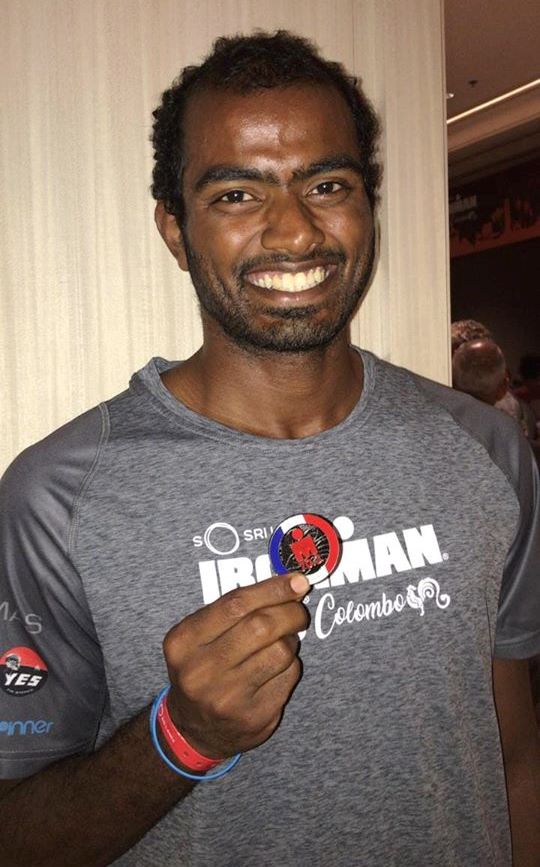
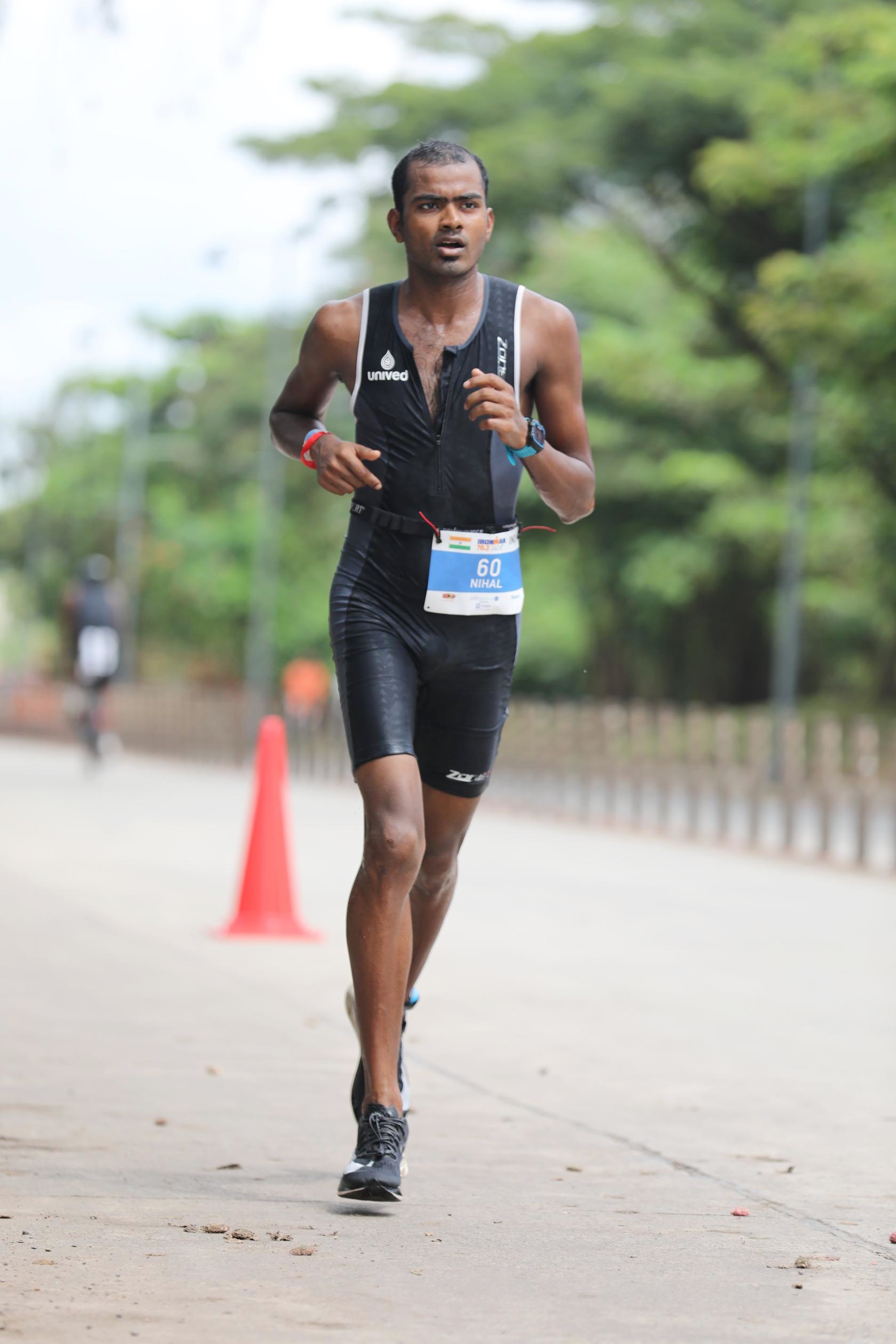
Nihal Baig (This photo was downloaded from the Facebook page of Recreational Triathletes)

In March 2017, Rajkumar Charzal happened to participate in a triathlon in Pune. Encouraged by his ability to complete it, he enrolled for the Ironman 70.3 (Half Ironman) at Langkawi, Malaysia. While he was preparing for the event, an archery coach he knew and who worked at the Army Sports Institute (ASI) in Pune put him in touch with Mani, Bishworjit’s triathlete-brother.  From there to knowing Bishworjit was a short hop. Hailing from Imphal, Manipur, Charzal is a software engineer currently working with Barclays Global Service Centre in Pune. He had worked first in Bengaluru, been in Pune briefly, moved thereafter to Mumbai and then located back to Pune. “ I have been here since 2012,’’ he said. Charzal went on to successfully complete the Ironman in Langkawi. The whole episode also introduced him to the larger triathlon community in Pune. In 2017, Bishworjit participated in the Goa triathlon. “ The decision to participate was an army initiative. They already knew of the event,’’ Charzal said.

Bishworjit’s participation in the Goa triathlon was an eye opener for Recreational Triathletes.  The sequence followed in triathlon is swimming, cycling and running. Both Pablo and Bishworjit finished their swim and emerged out of the water around the same time.  Saddled with an average aluminum bicycle the army athlete struggled in the cycling segment. But he made up for it, in running. Pablo won the event in 2:07:26. Bishworjit placed second with 2:09:52. Vishwanath Yadav – also from the army – finished third in 2:11:00. Anirban, Charzal and others from Recreational Triathletes knew they had found the talent they were looking for. But to get the army triathletes regularly challenging Pablo and his ilk at events like Goa Triathlon and Ironman, a whole ecosystem they trained in had to be engaged and convinced of the merit in new direction. First however, there was something more immediate to address – the best of these new finds deserved a damn good bicycle for it was in cycling that Pablo made the difference.

In 2018, despite the unfinished business of catching up with Pablo, Bishworjit could not participate in that year’s Goa Triathlon. He was committed to representing the army at the national triathlon championships, where for the first time he placed first completing the Olympic distance genre in 2:09:46. He was now national champion. That year he also placed second in the South Asian Championships held in Nepal. Around this time, Recreational Triathletes decided to hold a time trial in Pune. They wanted to assess how well elite Indian triathletes, used to Olympic distances in the sport, would fare over the longer distances of Ironman 70.3 – 1.9 kilometers of swimming, 90 kilometers of cycling and 21.1 kilometers of running; the increased dimensions being mainly in cycling and running. To attract participants, they dangled a carrot or two. They promised to sponsor the top performers to participate in Ironman events abroad. Also featured as carrot, was afore mentioned bicycle; a proper tri-bike. “ The trials were held on the last Sunday of every months and it lasted a few months. Those appearing for the time trial had to cycle 50 kilometers and then run 10 kilometers; do it back to back. We also kept 4:15:00 as an informal cut-off time, a sort of benchmark for deciding the top performers,’’ Charzal said. According to him, the army’s triathletes needed no coaxing to participate. They warmed up to the idea quickly. Anirban however, did mention the need to put Recreational Triathletes in proper perspective for the army triathletes to comfortably engage. They had superiors to report to and convince for permission. Recreational Triathletes was an Internet based convergence of amateur triathletes. “ There was the angle of who we are, why we were conducting the trials and explanation around that, ’’ Anirban said.
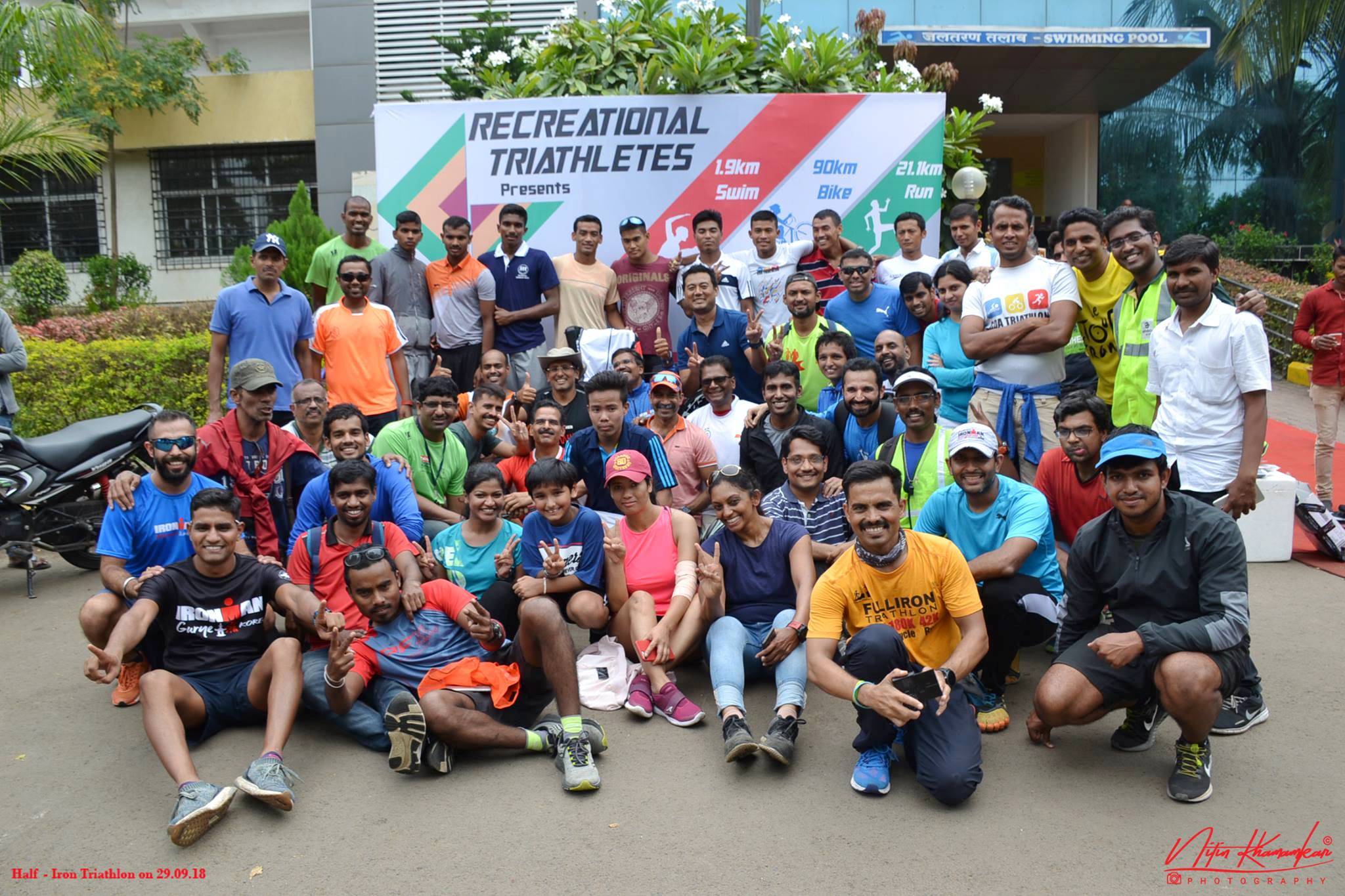
Recreational Triathletes

Post time trials in Pune – Bishworjit (he placed first in the trials with net time of 4:09:42), Biten Singh Laikhuram and Raghunath Shivaji Mali, all from the army – were selected for participation in Ironman events overseas; Bishworjit and Biten were headed to Ironman 70.3 in Bahrain. Unfortunately bureaucratic delays crept in. When the required paperwork couldn’t be wrapped up in time, Recreational Triathletes tried to get them registered for the Half Ironman in Colombo, Sri Lanka instead. That too failed because of delayed paperwork. But the group didn’t give up and continued to explore options. Eventually everything fell in place for participation in Ironman 70.3 at Bintan, Indonesia. Mali and Biten were able to proceed for the event scheduled for August 2019; Bishworjit had to stay out as he had been selected to participate in the senior national triathlon championships, the dates of which clashed with the event in Indonesia. “ Ahead of the Bintan Ironman, the army coach who was familiar with training for Olympic distances enquired about the details of Ironman 70.3 and what aspects of training mattered for the format,’’ Charzal said. Late August, encouraging results came from Ironman 70.3, Bintan. Raghunath Shivaji Mali finished first in his age category (18-24 years). Hailing from Sangli, Maharashtra, Mali had previously placed first at the junior nationals in 2015 and later, secured third place at the 2017 National Games in Kerala. At the time trials held in Pune, he had placed third with net time of 4:21:56. Biten meanwhile placed eighth overall at Bintan (field of 733 triathletes) and first in his age category; it was the first instance of a triathlete from India finishing in top ten at such an event. According to Anriban and Charzal, there have been no previous reports of two Indian triathletes topping their age categories in the same Ironman event either. Not to mention – neither Mali nor Biten were regulars at Ironman distances. In India, they specialize in the smaller Olympic distance.

Starting with a first place finish at the junior nationals held in Indore, way back in 2010, Biten had been slowly climbing up the ladder. By 2014, he had placed sixth in the senior nationals; in 2016 he finished first at the Delhi invitational triathlon and in 2017, first at the Hyderabad invitational triathlon. At the Pune time trials of 2018 conducted by Recreational Triathletes, he had placed second with net time of 4:12:41. With the results in Bintan, he and Mali qualified for the 2020 Ironman 70.3 World Championships due in Taupo, New Zealand. Further, one of the top ten finishers at the Pune trials had been Nihal Baig of Mumbai (an IIT Mumbai alumni, he works as Risk Associate at MSCI Inc), who had already participated in Half Ironman events. Recognizing his keenness, Recreational Triathletes sponsored his trip to Nice, France for the Ironman 70.3 there. It was now countdown to Bishworjit’s return to Goa. In the months following the Pune time trials that return had become special, for news had emerged that Goa would be hosting India’s first Ironman 70.3 triathlon in 2019.

A fortnight before the Goa event, Bishworjit – he had placed second at the nationals in 2019 – received his clearance to participate. Besides more training done (including some alone), there was a major difference this time. Recreational Triathletes had got him a top notch tri-bike, an Argon E119. MiniOrange bore the bulk of the cost; around 100 members of Recreational Triathletes also contributed. On race day at the start line in Goa, was old friend and fellow competitor, Pablo. “ My objective was to compete with Pablo,’’ Bishworjit said. The athletes were dispatched for their swim leg in lots of five each. Pablo was in the first batch; Bishworjit was in the third. But when they emerged from the sea having completed the swim, three of them – Pablo, Bishworjit and Mahesh Lourembam were almost together. Mahesh had ranked fourth at the trials in Pune. A good swimmer from his school days, he had competed at the national level in sub junior and junior categories and earned podium finish multiple times. Later, adding the triathlon as well to his repertoire, he had placed third at the senior nationals of 2017.

Mahesh Lourembam, Bishworjit, Nihal and Pablo Erat (This photo was downloaded from the Facebook page of Recreational Triathletes)

Runners are of different types. There is the highly focused sort, who brings to bear on their craft tons of discipline and methodical training. But there are also those treasuring running’s simplicity and primeval freedom; they transcend competition in human hive and cut a picture of peace, solitude and enjoyment.  Among the popular amateur athletic pursuits, triathlon typically smacks of focus and discipline. It is not without reason. A tough sport chasing higher and higher levels of human efficiency, details matter in it. During his 2017 shot at the Goa triathlon, Bishworjit’s transition to cycling had been less than perfect. “ In comparison, Pablo had it all worked out for maximum efficiency,’’ Anirban recalled. In 2019 however, in the transition to cycling, Bishworjit took off first. But at the 15th kilometer, with cramps slowly setting in, he was overtaken by Pablo. “ By the end of the cycling leg, Pablo had a lead of 12 minutes on Bishworjit. At this stage, we were disappointed,’’ Anirban said.  The third discipline – the half marathon – was composed of three loops of seven kilometers each. By the second loop, Bishworjit had Pablo in eyesight. At the 13th kilometer both met at the hydration point. “ Pablo told me to carry on,’’ Bishworjit said. Around kilometer-15, Nihal Baig overtook Mahesh. The final position was Bishworjit (4:42:44), Nihal (4:47:47), Mahesh (4:52:04) and Pablo (4:56:24). At last, an Indian triathlete had won an Ironman 70.3.

With their podium finishes at Ironman Goa, Bishworjit, Nihal and Mahesh also secured berths for the 2020 Ironman World Championships. Provided all goes well, at the 2020 Ironman 70.3 World Championships in New Zealand, these triathletes will be representing India – Bishworjit, Nihal, Mahesh, Biten and Mali. Recreational Triathletes has its work cut out. To begin with, they plan to sponsor about half a dozen bicycle trainers (equipment that renders the bike stationary and capable of being pedaled indoors). Bishworjit for instance, currently uses a very basic model. Training indoors is essential to excel in the triathlon. Anirban felt the triathletes would also require stepping up their mileage in running and execute nutrition strategies better. Bishworjit’s fuel intake during the Ironman in Goa had been frugal. Before swimming he had a gel, while cycling he had some water and a gel and during the run he had aerated drinks and some water. Across the table, the newly crowned Ironman of Goa laughed as he said this.

Anirban Mukherji and Rajkumar Charzal (Photo: Shyam G Menon)

Both Anirban and Charzal believe Recreational Triathletes has only scratched the surface; there is more talent around. And critically, it is talent that cannot be viewed the traditional way with gaze partial to youth. Pablo who has been beating Indian triathletes is in his late forties. Of the five headed to New Zealand next year, Mali is the youngest, Bishworjit, the oldest (he will be 30 by then). The gap between the best Indian timings and the very best timings at Ironman 70.3 is sizable. The record for men (as per Wikipedia) set in 2018 at Ironman Bahrain, is 3:29:04 (Kristian Blummenfelt of Norway). The first question people asked this writer when told of the Indian podium finishes at Goa Ironman was: how competitive is the field? Do the best foreign athletes come to participate? These are fair questions. But in a sport where peak performance is happening even in middle age, one Ironman done is hardly indicative of Bishworjit and his compatriots knowing their potential. With good training, better equipment, correct nutrition and sustained participation at events, lot more of their strengths may be found. “ We don’t have a formal program for supporting the athletes yet; it is still one thing at a time,’’ Anirban said. Meanwhile in Pune, according to Anirban and Charzal, an atmosphere of positive engagement now prevails between the army triathletes, their coaches and the civilian triathletes. There is talk of organizing programs meant to train the trainers as next step. A journey seems commenced.

(The author, Shyam G Menon, is a freelance journalist based in Mumbai.)
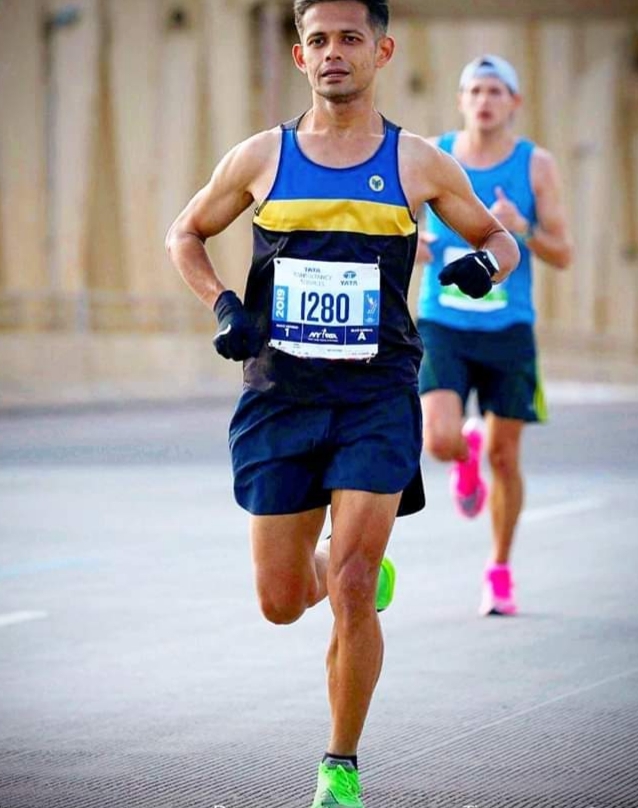
2019 NEW YORK CITY MARATHON / TALKING TO SOME OF THOSE WHO PARTICIPATED

Anubhav Karmakar (Photo: courtesy Anubhav)

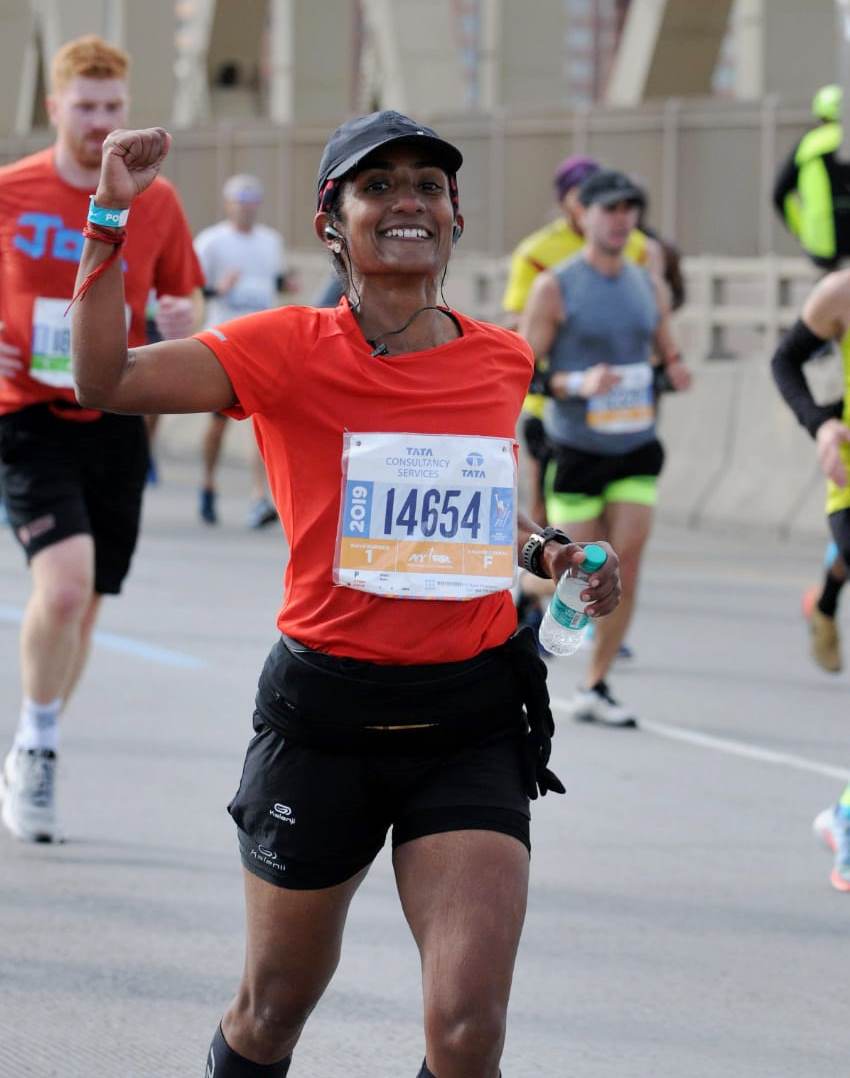
New York City Marathon (NYCM) is one of the six World Marathon Majors. It has the highest number of full marathon-participants. There were over 53,000 runners in the 2019 edition. The NYCM course passes through the five boroughs of New York city. It starts near the approach to the Verrazano-Narrows Bridge on Staten Island. The route then goes along four other bridges – Pulaski Bridge, Queensboro Bridge, Willis Avenue Bridge and Madison Avenue Bridge – before finishing at Central Park. Kenyan runner Geoffrey Kamworor was the winner of 2019 NYCM, covering the distance in 2:08:13. Among women Joyciline Jepkosgei of Kenya won the race, finishing in 2:22:38. We spoke to a few of the runners from India who participated in the marathon.

Anubhav Karmakar

Anubhav Karmakar was the fastest among runners from India at New York City Marathon this time. He finished the run in 2:41:07, a new personal record. It was however tad short of his target; 2:39-2:40.

“ My training was much better than the race,’’ he said. Anubhav’s training is focussed on improving in every race. He trained 15 weeks for NYCM.

At the start of the race, there was some confusion about where the start line mat was. “ There was no space to move because of the huge number of runners. Then I found my rhythm. But around the 15th kilometer, I had to take a loo break. That once again broke my rhythm,’’ he said.

NYCM, according to Anubhav, cannot be tackled with an eye on the clock because it is a challenging course. “ The bridges are fairly long, sometimes not so steep; sometimes steep. The second half of the race can be run only through feel,’’ he said.

Anubhav pushed hard in the last leg of the marathon. “ I did not feel strong through the race. But when I entered Central Park, I found my pace and went for a very strong finish,’’ he said. Anubhav believes he may have fallen short on nutrition during the race. “ I feel, I had a stronger finish at Boston Marathon earlier this year, although I have a new personal record at NYCM,’’ he said.

In the weeks ahead, he will be racing at Tata Steel Kolkata and Tata Mumbai Marathon. He has an entry to Boston again but his decision will depend on securing a berth at the London Marathon. “ I have also been accepted for Comrades but I have yet to freeze my decision to do the race. I thoroughly enjoy the marathon format and I don’t know if I want to break the momentum and go in for an ultra-marathon at this point,’’ he said.

Vijayaraghavan Venugopal (Photo: courtesy Vijayaraghavan)

Vijayaraghavan Venugopal

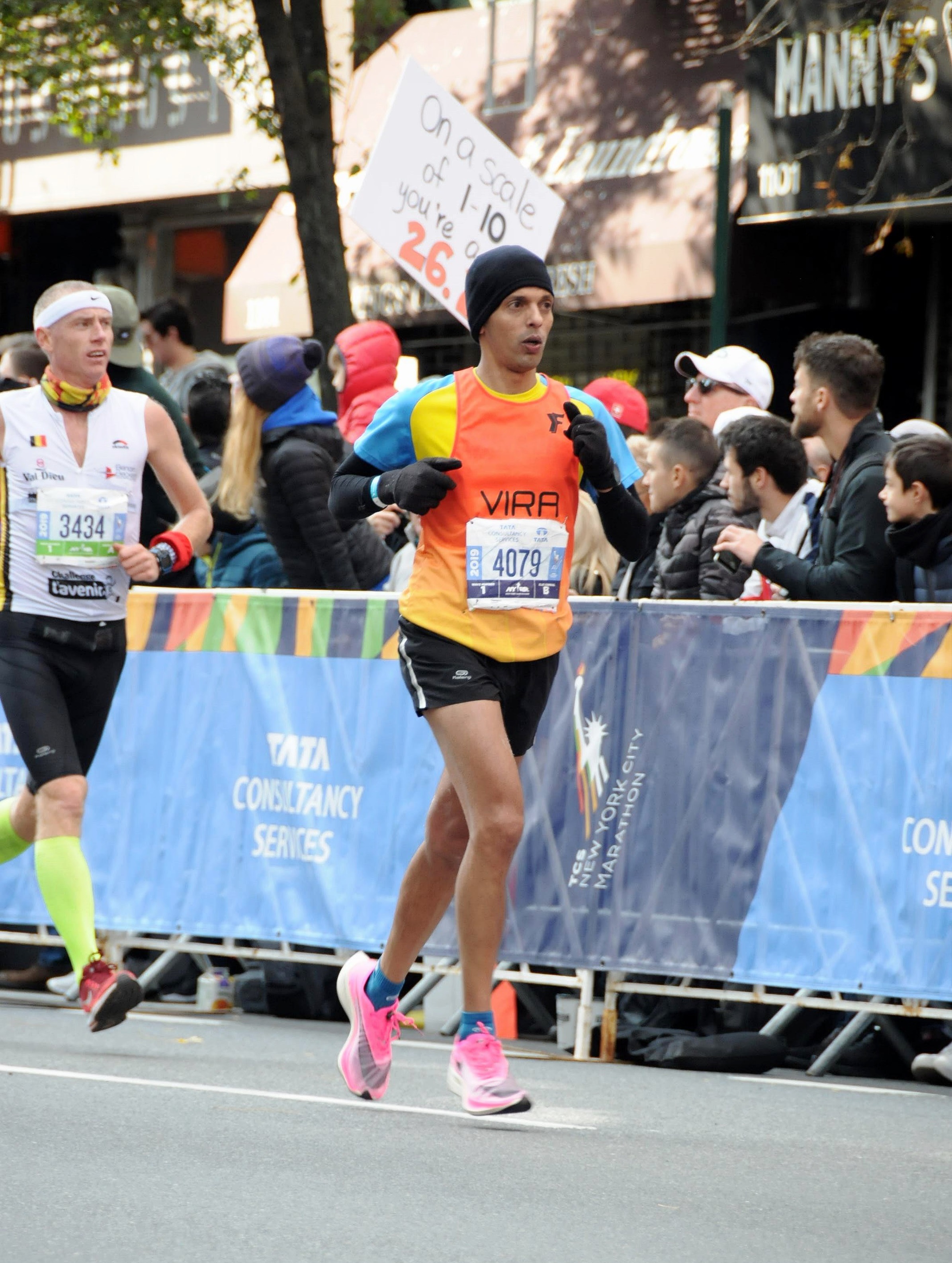
Vijayaraghavan Venugopal, 44, started running well before he became the CEO of Fast & Up, a sports nutrition company. He is known to follow a stringent training plan primarily aimed at sub-three-hour finish in the full marathon.

With Fast & Up on a trajectory of growth, the CEO’s schedule has been getting tighter with work and work related travel. “ My preparation for New York City Marathon went off fairly well, though work and travel took up a lot of my time,’’ he said.

At the 2019 edition of New York City Marathon, Vijayaraghavan finished the race in 3:16:07, outside his target of a sub-three-hour finish. “ Up until 30 to 32k I was on track for a sub-three-hour finish but lost the momentum thereafter. I did not have the energy to push for my targeted finish,’’ he said.

Had he maintained momentum till 35-36k, it would have been possible to push for said finish. When he realized that he wasn’t going to get his targeted finish, he took it easy. “ I started walking, though walking a distance of 500 meters felt like 5 kilometers,’’ he said.

Among the six World Marathon Majors, the New York City Marathon’s course is relatively tough. “ It is a technical course with five bridges. Each bridge has a different level of difficulty,’’ Vijay said.

According to him, a couple of factors at NYCM can be testing for runners. The wait before the start of the race can be tiring. Runners are required to arrive at the holding area three hours before the commencement of the race. Also, NYCM has the highest number of full marathon runners. Because of the sheer number of participants at NYCM, you are constantly running with a crowd of runners from start to finish. “ During the first two to three kilometers you are running with a huge crowd of runners, something you see in the half marathon segment of Mumbai Marathon. As the miles go by you run with new groups of runners,’’ Vijayaraghavan said.

At the same time, several other factors make NYCM one of the most coveted marathons. What truly stands out at the event is the massive spectator support with loud cheering. Further in 2019, the weather was quite good with temperatures in the range of 9-11 degrees Celsius. “ It was cold and windy but manageable. There was no rain either,’’ he said.

Analyzing his performance, Vijayaraghavan said his training probably fell short of what was required for NYCM. “ The last eight marathons went as per my plan. I trained well for NYCM but probably my training fell short of requirement,’’ he said. According to him, the key is to train specifically for a marathon.

Tad disappointed with his performance, Vijayaraghavan now wants to enroll for NYCM again to ensure a sub-three-hour finish. With his schedules getting busier, training and racing for a sub-three-hour marathon is a challenge that keeps him going.

Shailja Sridhar

During her school days in Lucknow, Shailja Sridhar never lost an opportunity to participate in sports. She kept her contact with sports alive in the years that followed too. Her foray into running happened seven years ago while she was residing at Gurgaon.

“ My friends asked me to enroll for Airtel Delhi Half Marathon in 2012. Prior to the race, I had done just two runs,’’ Shailja said. In 2013, she enrolled for the half marathon segment at Mumbai Marathon. That year, she also did the Amsterdam marathon. But training was negligible. “ Then I applied for Berlin Marathon through the lottery method. I got through. At this point I realized I must train. I contacted lifestyle coach Purnendu Nath for advice on training,’’ she said. She was able to finish Berlin in 3:52 hours.

Subsequently, she heard about Boston qualifier timings and that engaged her mind. “ One thing about running is that new goals keep emerging all the time. I started training for Boston qualifier levels. I read a lot about various training methods. I also traveled to Kenya to find out how elite runners train,’’ Shailja said.

New York City Marathon went off fairly well, according to Shailja. “ I went with zero expectation. I had no plan,’’ she said. Prior to NYCM, Shailja ran the full marathon at Bengaluru Marathon and Airtel Delhi Half Marathon. At the latter race, she finished in 1:35 and that gave her confidence for NYCM.

She finished New York City Marathon in 3:20, a new personal record for her. She was also the fastest among women runners from India at NYCM. This was her fifth World Marathon Major with London Marathon being the only one left for her, to complete.

Ramesh Kanjilimadhom (Photo: courtesy Ramesh; this picture is from the New Delhi Marathon)

Ramesh Kanjilimadhom

New York City Marathon was his third marathon in three weeks. On October 20, 2019, Kochi-based runner, Ramesh Kanjilimadhom, ran the Niagara Falls Marathon finishing it in 3:28:46. The marathon starts at Buffalo, runs along Niagara River and ends on the top of the falls. “ This one is truly an international marathon. It starts in the US and ends in Canada,’’ Ramesh said. He was completing this marathon for the fourth time.

A week later, he ran the Marine Corps Marathon finishing in 3:30:38. “ Marine Corps Marathon is my favorite. I was running it for the seventh time this year,’’ he said.

The following week he was at the start line of New York City Marathon. “ I had no time target for New York City Marathon. This was the third of my three marathons in three weeks. My training was not adequate,’’ he said. But the run went off quite well for him. He finished the marathon in 3:21:41 and his splits were evenly paced.

“ It was cold at the start of the race but it did not bother me. Later it was quite sunny,’’ Ramesh said.

New York City Marathon is a huge race with over 50,000 runners, all of them running the full marathon distance. Every participant ends up running with a large group of runners all through the 42 kilometers.

There are several hydration points along the route but because of the huge crowd of runners you may miss them. The fact that the next hydration point is not far off keeps you going, Ramesh said. Also, there are crowds of spectators all along the route except at the bridges. “ As you get off the bridges you can see the crowds along the route ahead,’’ he said.

Ranjini Gupta (Photo: courtesy Ranjini)

Ranjini Gupta

Bengaluru-based Ranjini Gupta went through a perfect training plan of 18 weeks in the run-up to New York City Marathon. The training plan was executed to perfection with intervals, tempo runs, fartlek and long runs including hill runs along with strength training. Hill runs were critical for NYCM, according to her.

“ I wanted to train well because the distance should not be a challenge. I initially did most of the runs at base pace and then ran at race pace closer to the event,’’ she said.

But she suffered hamstring tendonitis barely six weeks ahead of the race.  “ I had to do away from hill runs as they were aggravating my injury. I had to rework my training plan,’’ Ranjini said.

New York City Marathon starts on a bridge. “ As soon as I started running uphill, I felt the pain but I was mentally prepared to manage it well. I held my pace and when the pain got worse I would slightly ease my pace but not drop it drastically,’’ she said. She ended the race in 3:39:32 managing a negative split in the process. This was her fourth World Marathon Major with Boston and London Marathon next on the cards.

Sunil Chainani (Photo: courtesy Sunil)

Sunil Chainani

A member of the Ultra Running Committee of Athletics Federation of India, Sunil Chainani, had travelled to Albi, France, along with a nine-member Indian team for the 2019 IAU 24-hour World Championships, held on October 26 and 27. Sunil was part of the support team.

Once done with his work at the championships, Sunil travelled to New York to participate in New York City Marathon.

A former national level squash player, Sunil’s training for the marathon was not adequate because of his tight schedule. “ I came to New York with no expectations whatsoever. I haven’t had a good marathon run in a while because of my Achilles injury,’’ he said.

Though his training was inadequate, Sunil put in a lot of time in strength training. New York City Marathon was his third World Marathon Major. He has run Berlin Marathon twice and Chicago once.

“ At New York, the weather was great and the atmosphere was fabulous. It was a perfect running day. My approach was to run easy. I did not want to put any stress in terms of timing,’’ Sunil said. He cruised along fairly well for much of the distance but started to get cramps in the last 7-8 kilometer-stretch. He then opted to walk and run the remaining distance. Sunil surprised himself with a personal record of 4:12:53 hours. He had improved his timing by 90 seconds.

“ I am pleased with my run. My confidence is back,’’ he said.

(The author, Latha Venkatraman, is an independent journalist based in Mumbai.)

A FINE BIT OF CYCLING AT IRONMAN GOA AND A PODIUM FINISH TO REMEMBER IT BY

Photo: courtesy Nihal Baig

Mumbai-based triathlete, Nihal Baig, is not new to Ironman 70.3. The Goa edition of this triathlon – it was held in October 2019 – was his fourth outing in that line. He finished second overall including second place in his age category, 25-29 years.

Less than a month before Ironman 70.3 Goa, Nihal participated in Ironman 70.3 World Championships, Nice 2019. Prior to the event in Nice, he participated in Ironman 70.3 Bahrain and Ironman 70.3 Colombo. Of the three disciplines forming the triathlon, Nihal’s strength is in running. Earlier this year, Nihal had finished overall ninth and second in his age category of 18-24 years at Tata Mumbai Marathon (TMM).

Here he recounts the training for Ironman 70.3 Goa and how things unfolded on race day.

During my B.Tech and M.Tech days at the Indian Institute of Technology (IIT) Mumbai, I was part of the athletics team. I used to participate in races over distances ranging from 400 meters to 5000 meters.

I finished my M.Tech in 2016. But I did not stop running. I continued it on the IIT Mumbai campus thanks to my being alumni. I moved to exploring longer distances, starting with half marathons. Around this time I took up employment in Mumbai. I work as Risk Associate at MSCI Inc. I started cycling to work, a distance of about nine kilometers from where I stay. Over time, I started to go for long rides.

At that time, I had heard about the Ironman triathlon. I was keen to explore it and began learning to swim. In October 2017, I did my first half Ironman distance-triathlon in Hyderabad.

What attracted me to the triathlon was that I got to do three sports in it instead of the usual one. And triathlon is all about fitness and endurance. I love how I get to push myself in these three disciplines. I have a lot to learn. I will keep doing that and try to get better with time.

The Ironman 70.3, also known as Half Ironman, is one of a series of long distance triathlon races organized by the World Triathlon Corporation. Following the event in Hyderabad, I went on to do Half Ironman in Bahrain and Colombo.

Less than a month before Ironman 70.3 Goa (it was the first Ironman event in India) I took part in the Ironman World Championships, held in Nice, France on September 8, 2019.

Photo: courtesy Nihal Baig

I started my training for Nice Ironman in March focusing mainly on swim technique. I trained under coach, Ashutosh Barve. Our weekly training sessions were done at the pool at IIT Mumbai in Powai. Swimming is my weakest sport in triathlon.

I also had to do most of my cycling sessions indoors. I did a couple of outdoor sessions in Pune. My priority for Nice World Championships was building power and learning technical bike skills. After the World Championships, I had all of five weeks to train for Goa Ironman. Of these, the first week was lost to recovery. In the available time, I decided to concentrate on getting more comfortable riding in aero-position. I had struggled with using the aerobars on my bicycle in previous races.

Running is my strong sport. I put in a lot of volume though I was not able to do track sessions because of rain. I was also unable to do speed workout because of a hip abductor injury. I acquired the hip abductor injury ahead of the Nice World Championships. Few weeks before the event, it was quite unbearable. However I recovered considerably as the world championships drew close. The cycling segment was tough, very technical and hilly. There were many sharp turns along the route, not to mention much elevation gain packed into the 90 kilometer-distance. I finished the World Championships in 5:29:02.

I did my training runs for Goa at the IIT Mumbai campus. I am aware of the road conditions there. So it was not difficult training outdoors during monsoon. In Goa, on the day of Ironman 70.3, I woke up early to have my breakfast two hours before the start of the race. At 7:30AM, the race commenced. When we got into the water for the swim segment, we realized there was a lot of sideways current. We were getting thrown towards the rope. Also, it was so crowded that our limbs were getting entangled with the rope. For quite some time I was stuck in one place. The swim segment of 1.9 kilometers was split into two loops. During my second loop I fared better. I did get stuck but I was prepared. During the first loop my pace was 2.35 minutes per 100 meters. In the second loop, the pace improved to 2.12 minutes per 100 meters. I finished the swim segment in 45 minutes and 16 seconds against my target of 40 minutes.

From the swim to the bike segment, the transition distance was about 900 meters. We had to sprint to get to our bikes. But the crowd and volunteer support was so good. Many of them were calling out my name and cheering me. That helped me a lot. I was in a positive frame of mind when I got on to the bike. Suddenly, the disappointment of the swim seemed like a distant past.

I had got myself a Cervelo P4. During the cycling segment, I chose not to use any HR or power devices to track my effort. I just went by feel. We had to cover the distance of 90 kilometers in three loops. I pushed a lot on the bike segment. I stuck to a uniform pace for most part of the race though the road condition was not great. For about 30 kilometers at the end of the bike leg race, I rode with only one aerobar. But the cheering by volunteers and the crowds was awesome. I finished the cycling segment in two hours, 31 minutes and 57 seconds. Although I had done better at Colombo Ironman earlier this year, I would rate the cycling I did at Goa my best so far. Further, Colombo was a flat route with roads in much better condition. My training for Nice certainly helped me at Goa.

Photo: courtesy Nihal Baig

When I finished the swim portion, I was 15th in my age category and 118th overall. At the end of the bike segment, I was second in my age category and seventh overall.

I decided to go hard on the run segment. I was confident of maintaining my position. I started at 3:55 pace and when it started to get hot I slowed down slightly. My pace was between 3:55 and 4. We had to cover the half marathon distance of the run segment in three loops and in each of these loops we had to negotiate a steep and a long climb. At the start of the third loop, I was in fourth position. The person who was leading had to slow down as he had hit the wall.

I finished the Goa Ironman in 4:47:47, placing second overall and second in my age category of 25-29 years.

Going forward, my focus will shift to training for the 2020 Tata Mumbai Marathon.

(Nihal Baig spoke to Latha Venkatraman, independent journalist based in Mumbai.)

2019 IAU 24-HOUR WORLD CHAMPIONSHIPS / A NATIONAL BEST AND FIVE IN 200KM LEAGUE FOR INDIA

Apoorva Chaudhary (File photo: courtesy Sunil Shetty / NEB Sports)

Apoorva Chaudhary’s performance a new national best for women

Early days yet in the discipline, the Indian team’s participation at the 2019 IAU 24-hour World Championships over October 26-27 at Albi in France was a case of improved outcome featuring new personal benchmarks and learnings.

In the men’s category, India finished in 13th position at the championships; among women, the team placed 15th. “ The team’s performance was reasonably good, overall,’’ Sunil Chainani, member, Ultra Running Committee of the Athletics Federation of India (AFI), said. He had accompanied the team to Albi as part of the support crew.

Prior to the 2018 IAU 24-hour World Championships held in Taipei, only one Indian athlete – Ullas Narayana – had covered a distance exceeding 200 km. At the Taipei event that grew to two – Ullas and Sunil Sharma. This number grew further at Albi besides new mark set for women.

At the 2019 World Championships in Albi, among Indian women runners, Apoorva Chaudhary covered a distance of 202.212 km, creating a new national best. She beat her own record of 176.8 km set during the NEB 24-hour Stadium Run in New Delhi in December 2018.

Further, five athletes – three women and two men – achieved their personal bests at the Albi Championships. Apart from Apoorva; Priyanka Bhatt (192.845 km) and Hemlata (173.178 km) among women and Pranaya Mohanty (211.956 km) and Kanan Jain (211.157 km) among men, achieved new personal bests. Altogether five Indian runners – four men and one woman – covered distance in excess of 200 km at Albi.

According to Sunil, Pranaya twisted his ankle but continued to run despite the pain. For Kanan Jain, this was his first international event. Twenty one years old, he did very well for his age and limited exposure at the international level. Sunil Sharma ran very strong at the end of the race though he finished tad short of his personal record.

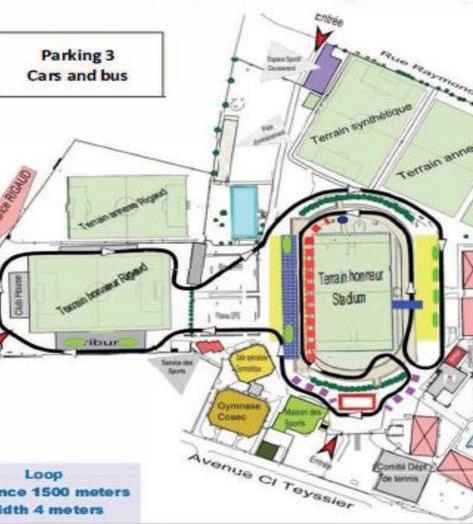
The 2019 IAU 24-hour World Championships course at Albi, France (This photo has been sourced from the IAU website and is being used here for representation purpose)

Prior to the 2018 Taipei Championships, Ullas Narayana was the sole runner from India covering distance of over 200 kilometers. He had finished with 250.3 km to his credit had secured a bronze medal, India’s first international medal in ultra-running. Unfortunately at Albi, Ullas experienced some difficulties towards the last part of the race. He ran very strong for most of the race and was in 13th position till he had to stop during the last two hours due to cramps. Binay Sah too had to stop running half-way through the race after he felt unwell. “ In a 24-hour race, the possibility of things going not as per plan cannot be ruled out. Other international runners also faced similar issues,’’ Sunil Chainani said.

“ Two of the women runners – Apoorva and Priyanka – were outstanding. Our women athletes garnered much attention from international participants and coaches with their strong running,’’ he said.

At Albi, the runners were required to run in loops of 1.5 km as opposed to 400 meters. “ This had its advantages as well as disadvantages. The larger loop meant that participants did not have to stop often and there was space between runners. But the loop had many sharp turns,’’ Sunil said.

Overall, the Indian team’s performance has been encouraging. Focussed approach to training, nutrition and a camp for ultra-runners held earlier this year may have contributed to the improved performances. Still, there are lessons to take home from these international events. Going forward, a scientific approach to nutrition during the training phase is one element that needs to be looked into more seriously, Sunil said. Also, race strategy must be planned and executed well to improve performance, he felt.

“ In 2019, the presence of Tobias Lundgren, Swedish ultramarathon runner, as a member of the crew supporting the Indian team, helped a great deal in planning the race strategy,’’ Sunil said.

At the Albi Championships, ultramarathon runner from the US, Camille Herron, set a new world best of 270.116 kilometers in the women’s category, breaking her own previous record of 262.193 km. “ Herron’s performance was absolutely outstanding. She was just over eight kilometres short of the winner in the men’s race,’’ Sunilsaid. Aleksandr Sorokin of Lithuania won gold in the men’s race covering a distance of 278.972 km.

Among Indian runners in the men’s category, Ullas Narayana was at 40th position covering a distance of 229.717 km. Sunil Sharma placed 63rd covering a distance of 213.744 km. Pranaya Mohanty finished at 67th position with a distance of 211.956 km and Kanan at 68th with 211.157 km. Binay Kumar Sah finished at 178th position with a distance of 123.856 km covered.

The Indian team at the world championships in Albi (Photo: courtesy Sunil Chainani)

From Indian women runners, Apoorva Chaudhary finished 47th covering a distance of 202.212 km. Priyanka Bhatt finished 59th with a distance of 192.845 km. Hemlata finished 85th with a distance of 173.178 km and Shyamala Satyanarayana 106th with 154.577 km.

In the team championship, US took gold in both women’s and men’s categories. In the women’s category, the US team covered a distance of 746.132 km to secure gold. Poland took silver with a distance of 721.124 km. Bronze went to Germany with a distance of 696.846 km. In the men’s category, the US team covered a total distance of 799.754 km to win gold. Silver went to Hungary with 782.241 km covered while France (779.076 km) took bronze.

According to IAU, the 2019 edition was the biggest championship so far with 45 member federations participating in the event.

(The author, Latha Venkatraman, is an independent journalist based in Mumbai.)

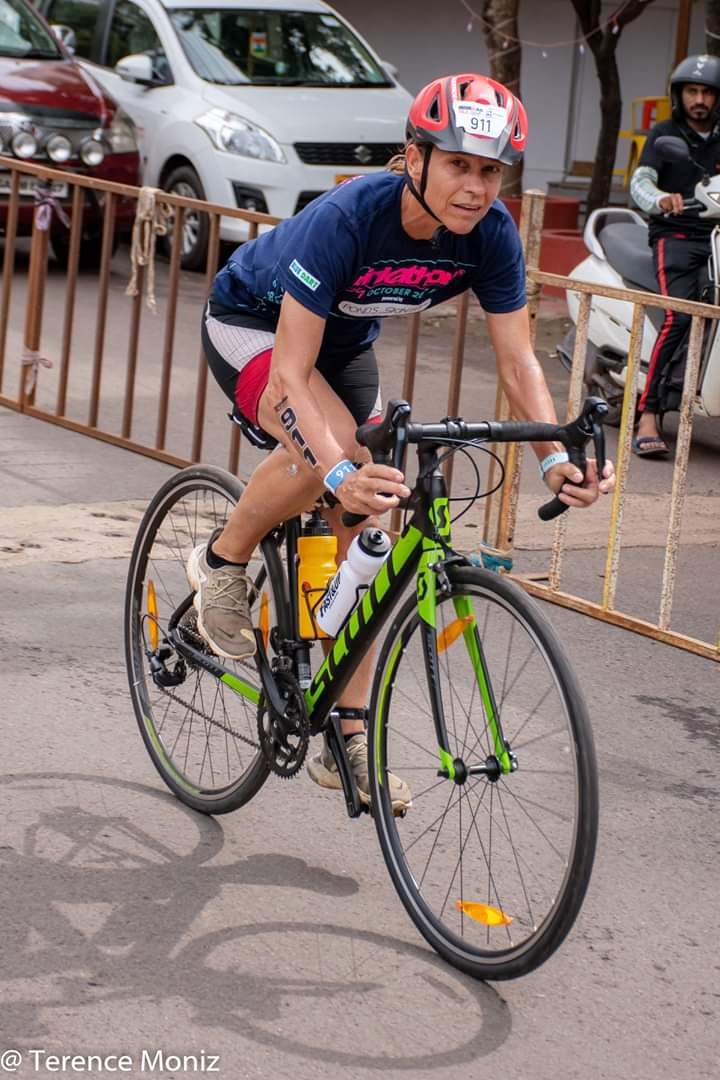
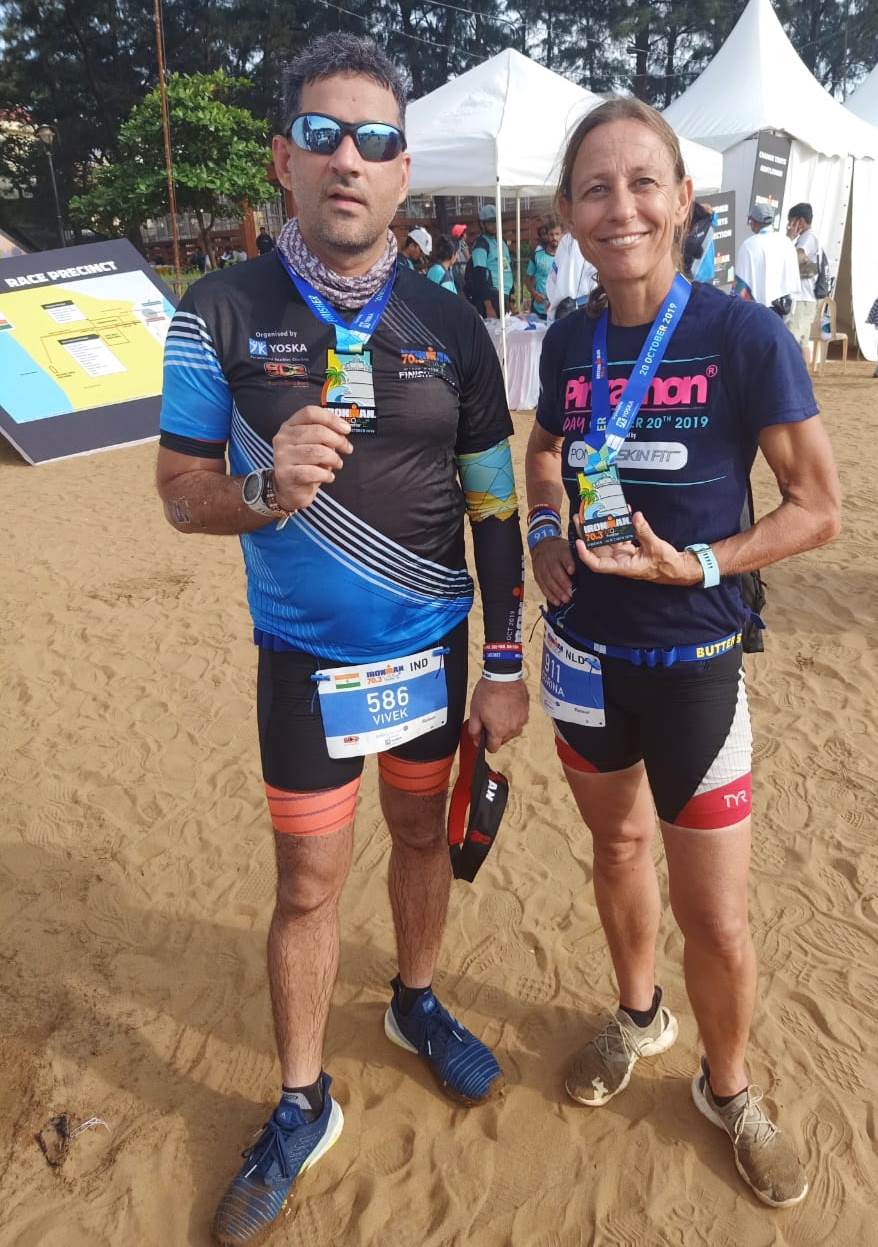
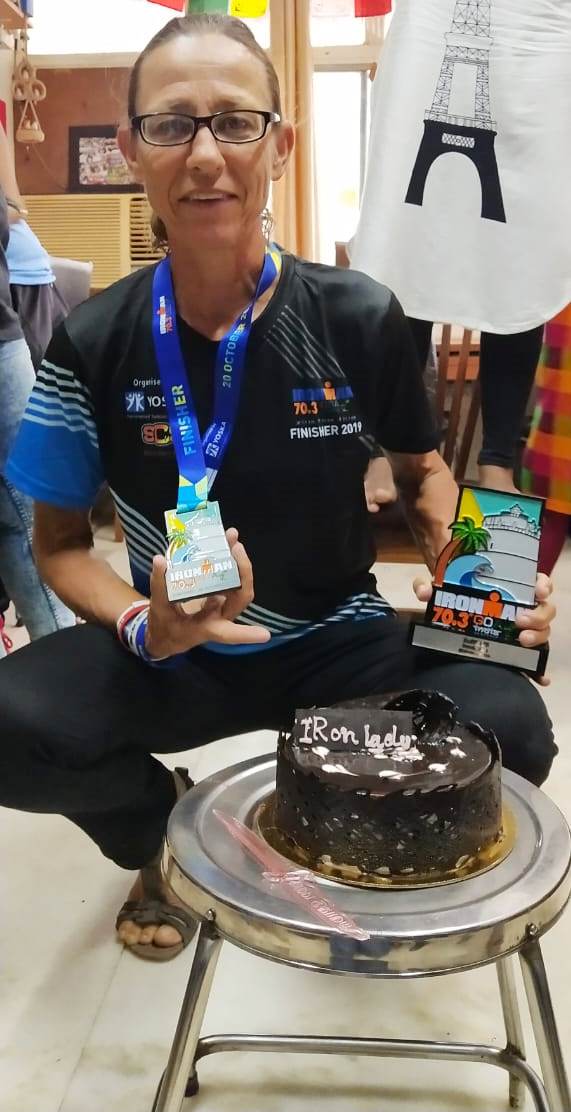
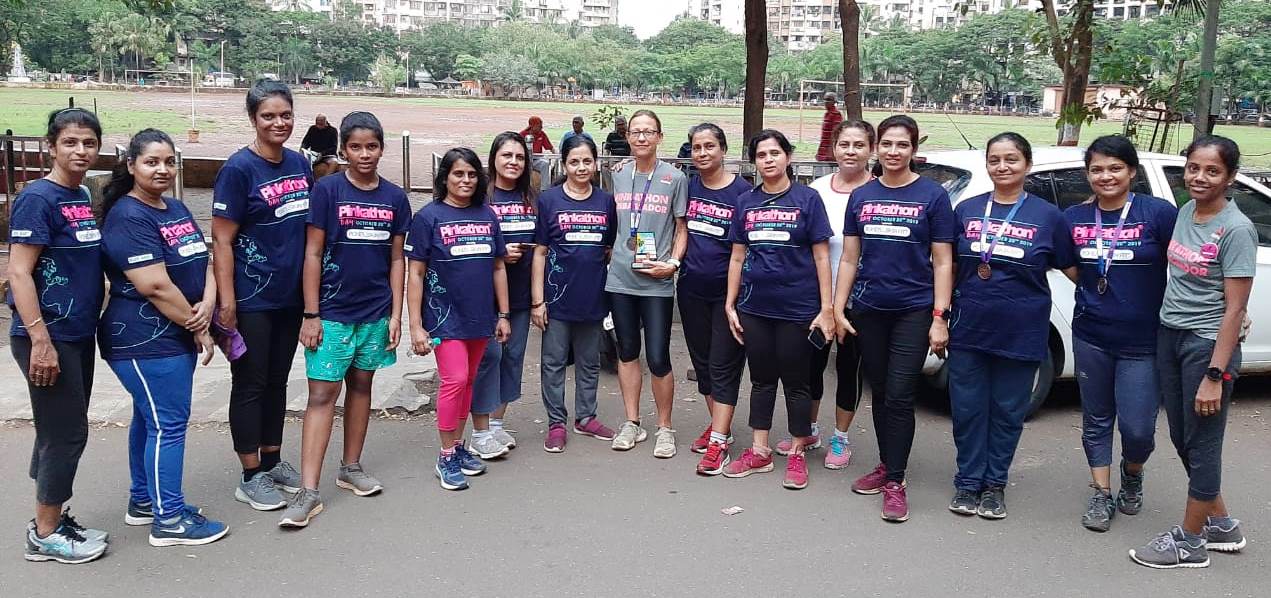
“ DON’T STOP ME NOW!’’

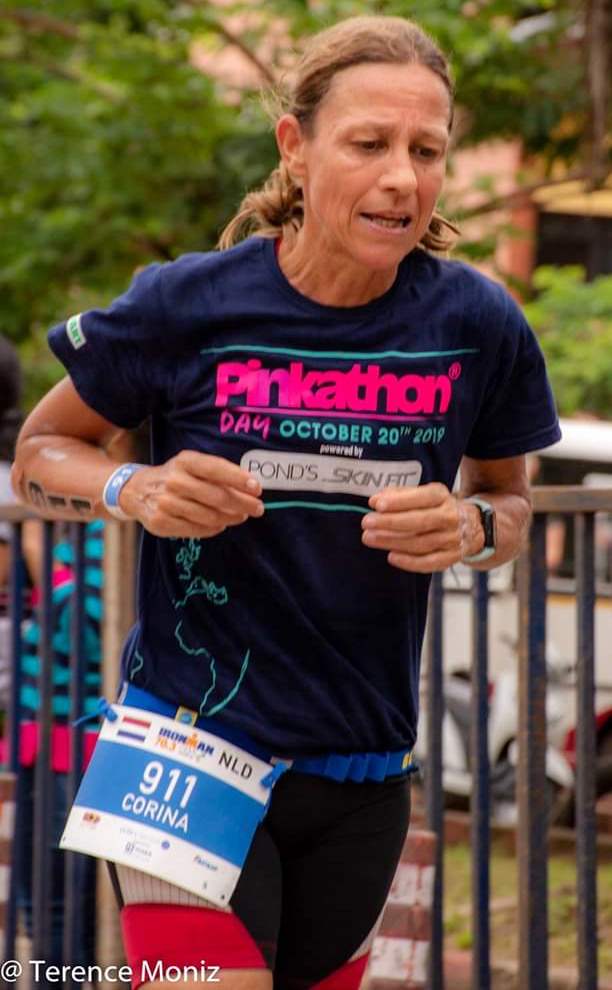
Corina (Cocky) Van Dam (Photo: courtesy Corina)

This is an article by invitation. In October 2019, Corina Van Dam, popularly known as Cocky, took part in her first triathlon. Held in Goa, the event was India’s first from the Ironman series. Here she writes about her training for the event and how things actually unfolded on race day.

I may not be the typical endurance sportsperson. Trained as a sports instructor in the 1980s, I indulged in many of the sports of that time – football, basketball, tennis, swimming, fencing, boxing, gymnastics and jazz ballet (long before zumba, aerobics existed). I liked all sports (but most off all ball games!) and managed to pass practical exams in several, even dance. I am clearly an all-rounder. You can invite me for any sport; I am happy to join.

My colleague Vivek Gaur – of Naz Foundation (India) Trust and based in Delhi – suggested I join the TCS 10K run in Bengaluru in 2018 when we both happened to be there on work at the foundation’s Bengaluru office. We had a great weekend with our Bengaluru team as cheering squad. The event was avenue for us to bond. I even finished third in my age category. We decided to do the whole Procam Slam (TCS 10K, ADHM (21km), Tata Steel 25K and TMM (42 km). After that, work-calls and meetings with Vivek always started with updates about preparations. While in Kolkota, we started thinking about our next project after the Procam Slam. Vivek, who had done a few Olympic triathlons didn’t have to waste a second: it should be the first Ironman 70.3 in India. As for me, since you can invite me for any sport: Ironman 70.3 Goa it was.

The mental preparation started in January 2019.

I thought that with my swimming skills, experience in riding bicycles and love for running, a half triathlon should be doable. Although I am trained as a sports coach, I haven’t really kept myself up to date with the new training philosophies and techniques. My 30-year work experience focuses on using sport as tool for social change and has a more sociological and psychological approach than technical. I based my training on my intuition and experience as sportswoman. I think I know my body quite well. I know when to push and when to stop. I am aware that not everybody thinks that’s a good idea.

So I started working on my general endurance through what I love most – running. In the meantime, I continued playing football in the Adidas Creators Football League and became champion with my team Wolfpack FC. It was then that I decided I must leave football for what it was – at least for a while – since I had started prioritizing not getting injured during the game. That is not the right mindset to play football. But there was a triathlon to do.

Photo: courtesy Corina Van Dam

Until June, I swam when I got the opportunity (I couldn’t find a proper pool, so relied on a friend’s club membership) and cycled every now and then. In June, I found the swimming pool in Dharavi where I got a time slot of 45 minutes to train. My goal became to swim as much as I could in those 45 minutes. The pressure on time helped me do 1.9 km in 46 minutes. I cycled to and from the pool and did a swim test at Aquaman in between to qualify for their triathlon. This gave my fellow swimmers the impression that I was a “ professional.’’ All the time I was wondering why they were not talking to me. Unfortunately, they were in awe based on their own misconception.

Most of my training to cycle, I did with my hybrid bicycle, a very heavy XL specimen. In Mumbai, I pushed the bike, pedaling hard around Eastern Express Highway, Gorai, Madh, Sanjay Gandhi National Park (SGNP) and Malabar Hill. Finally in August, I bought a road bike. It was quite an investment. As someone born in the Netherlands, cycling has been (and is) for me more ‘transport’ than ‘sport’. Cycling has brought me all my life (and still does) from point A to point B. Cycling for leisure included long coffee breaks and / or camping. In the run up to my first Ironman, I found myself cycling at 4AM during the monsoon on Eastern Express Highway, without coffee break….. I built my rounds up from 30 to 60 to 70. It became easier when I had my road bike. Or so I thought, because during my second ride I got a puncture and had to take a three wheeler back home. I continued to practise on my robust hybrid bike. In this period, I attended a workshop led by Abishek Adhav; it was very interesting and informative. The workshop was also a great place to meet others headed to Ironman Goa. What I learnt in this period was that cycling is the odd one out in the triathlon – it is expensive (even when you buy a cheap bike) and your Ironman can fail because of technical problems (or your inability to solve a technical problem). Cycling remained the discipline that scared me the most.

Running was the discipline that I planned for the least. From June onward, I participated in and won a 10 km run, two 21 km events, one of 50 km and then, I ran the longest distance among women at the six-hour Dil Se night run and the 12-hour Mumbai Ultra. All the time, I was trying to figure out where my strength lay: short distances or ultra.

I read posts on all the WhatsApp triathlon groups and started attending forums where people shared their triathlon experiences. Most of the presenters scared the hell out of me. One day I was at a meeting of those into endurance sport. In the morning I had cycled 75km (on my hybrid) to and from Mira Road and done the MRB Gorai 21 km run. During the meeting, I had to tell myself that that morning I had already put in much of the effort, which goes into an Ironman 70.3 and hence shouldn’t get upset over the horror stories being shared. Another topic which made me insecure was nutrition: the calories to replenish, how to refuel while cycling, taking gels etc. You seemed to require higher skills in mathematics to get this right. Here too, I had to calm myself down. I can run 12 hours, 82 km on sheera, bananas and whatever the hydration stations offer. So relax!!!

With Vivek (Photo: courtesy Corina Van Dam)

At the end of the monsoon and a few weeks before D-Day, Yoska – the Ironman organizer in India – held sea swimming practice sessions at Juhu Beach, the dirtiest place you can imagine and I loved it. Here we were, shivering because we were either nervous or cold in our tri-suits or both. I loved the quietness of water. Where can you be alone and not hear anything, anytime in Mumbai? I felt happy when in between two of my strokes, I saw the sunrise. Needless to say, I participated in all further training, necessary or not.

Aquaman was supposed to hold its triathlon in Goa in September. I was to accompany a friend who missed the Ironman registration and do a trial. When it was postponed due to the prolonged monsoon, we decided to do an “IM recce” since hotel and tickets were already booked and paid for. We did the full cycling route (three times), running to collect the bicycles from CyclingZens and then back again. We spent Saturday evening looking for a proper swimming pool in Panaji (Panjim) and failed. I managed to cycle 90 km and run 21km. I thought I was ready.

Getting my bicycle without damage to Goa was a headache. The WhatsApp groups couldn’t stop talking about it: cycle bags, boxes etc. I managed to get my bicycle to Goa without problem in the back of a bus. The Ironman party started when I reached Panaji. While I cycled with a backpack and a bag (discussions on WhatsApp groups led me – a person usually traveling light – to carry all kinds of stuff that I didn’t need), I met the first co-participants from Mumbai. During the rest of the day, it was one big party of meeting people I knew from the Mumbai running scene, the WhatsApp groups, swimming and triathlon meetings / workshops and loads of people I had never interacted with before. The excitement built up during the transition briefing and bicycle `racking’ (you need to have your bike checked and parked at the transition area a day before the race).

We spent the night in a hotel close to the start (my colleague Vivek always manages to get this done!). I could sleep without being nervous about getting late. The hour before the start was exciting; meeting the other participants in my age category and wishing all my old and new acquaintances good luck. That bonding over shared nervousness and the excitement of what was due to come is my best Ironman experience.

Finally, on race day – October 20th, we started.

Swimming was hell! The river that ends in the sea near the swimming course caused enormous drift. With us being inexperienced sea swimmers, that was hardly manageable. We were supposed to start with five people but most lines consisted of seven. We had to run about 200 meters before we could start swimming. I had heard about the ‘washing machine’ (the splashing effect and churn caused by many triathletes running into the water to commence their swim at the same time) and promptly fell into a tumble. While trying to get into rhythm I was hit on my head, arms and legs and pushed onto the ropes tied to the buoys. Luckily, I was not stung by jellyfish as many of my co swimmers were. Though I was trained to do the full 1.9 km freestyle, I soon decided to do breaststroke since it is easier to navigate and keep people at distance. Despite resorting to breaststroke I finished in 48 minutes; the swimming part was over before I knew it. When I reached the beach, ‘Don’t stop me now’, a fantastic song from the band Queen, was being played. It was so relevant that I shivered with happiness and sang out loud ‘coz we’re having such a good time, we’re having a ball.’

Photo: courtesy Corina Van Dam

Cycling was my biggest fear. I knew that I had to cycle faster than I had ever cycled before in my life. I did just that despite the fact that I felt almost every other participant overtook me and I overtook only a few people. Most of the cyclists pedaled at similar pace. So we kept meeting each other. Keeping in mind what I had learnt in the groups / workshops, I started hydrating after 15 minutes. I was also hoping that I would get through the race without a punctured tyre. Then I neglected the rule of ‘never trying something new in a race’ and enjoyed the hospitality along the course. For the first time in my life I had a ‘gel’. I also learned how to take a banana at 25km speed from a volunteer at the hydration point. I was as happy as a child when I mastered the art at stations that followed. During the third loop, I thought: perhaps I’m a real endurance athlete. I had commenced enjoying cycling after 60km. Coldplay’s song `Nobody said it was easy’ surfaced from my subconscious mind and I sang “No one ever said it would be so hard. I’m going back to the start’’ (which I changed to not going back). There had been a lot of chatter about the bike course. I had seen the route, so knew where the road was bad and where the inclines were. But since all of us face the same situation, I never found these discussions interesting. Given we raced without our phones, I had no idea how I was doing. My Garmin said that it had taken me 3:18:39 (as usual I started my device when I was already on the course) and thought that it was not bad.

I was looking forward to running. I dedicated my participation in the Ironman 70.3 to all the women of Pinkathon; 20th October was also Pinkathon Day and I had to miss the celebration in my locality: Tilak Nagar, Mumbai, where I am Pinkathon Ambassador. During the run in Goa, volunteers and audience responded to my Pinkathon t-shirt. Although I’m a runner and had done a few brick training sessions, running hit me hard. I got cramps in my vastus medialis (I didn’t even know that this was possible) but overcame that soon. I really enjoyed the hospitality along the course and discovered the joy of racing on Coke and chips (again I flouted the never try something new on race day-rule). The ice baths and cold sponges helped me finish in what was however, my worst 21 km time ever – 2:38:13. It was only after I got the armband upon completing the first lap (you receive an armband after every lap run) that I was able to place myself in the competition order. I didn’t notice that another participant in the P-category (women, 50-54 year) had overtaken me during the run.

At the award ceremony I realized that Vivek and I had accomplished what we set out to do. In my age category there was a participant who finished as the fastest woman in the race with 5:18:49. At ten participants, my age category was easy to oversee but just before the start, one of the women told me that the person in question was participating and we could forget winning the event. When I asked who that was, I was told she was a “six time winner in Hawaii.’’ I thought that it might be stupid to ask what happened in Hawaii. About an hour after the event (I was in the recovery zone), someone who had tracked me told me that I had finished third (in 6:57:27) and that Natasha Badmann, six time World Champion in Ironman had won the overall race and first position in my age group.

Photo: courtesy Corina Van Dam

Eventually during the award ceremony, I got the trophy for the second place. Assuming that there was a mix up, I said that I had secured the third position. It turned out, Natasha Badmann didn’t claim her’s so I got away with the trophy for second-position. Placed second, I had qualified for the World Championship slot for foreigners! Since the event had started half an hour late, there was change in the day’s schedule. One of the volunteers told me that the “ roll down ceremony” (where the places for the World Championships are given to those present) would start at 5PM. I was busy with friends who came all the way from Manipal to cheer me. I also spent time talking to other finishers. I thus arrived late at the roll down ceremony and the opportunity to participate at the Ironman World Championships went to someone else. Although I didn’t expect anything, I came to Goa with all the credit cards I had, just to stay prepared. In the end I could only be angry with myself. The feeling disappeared when I celebrated our finish with Vivek and his family.

Once I settled in my bed in the sleeper bus back to Mumbai, I realized what had happened and how many people had followed me that day: my family, my Pinkathon group, friends and colleagues. It was heart-warming to see all these people so engaged, enthusiastic and happy for me. The feeling continued for days. I was the center of parties and a flood of congratulations on WhatsApp and social media. I also realized that my timing was not bad and that I had completed the course faster than many of the other participants that I had got to know in the period prior to Ironman 70.3 Goa.

I spent two days celebrating, one day washing all my clothes, another day getting all Ironman stuff out of the way and then longed for running. During the first two rounds at Sahyadri Ground in Tilak Nagar, my body shouted at me: what are you doing? But once I got into rhythm, thoughts started creeping up: why don’t you upgrade to 100 miles for Aquaman 70.3? With Goa in your pocket, you’ve met their criteria. So, on the fourth day after Ironman 70.3, I arranged for my next adventure to be the Aquaman 100 miles triathlon.

I might be more of an endurance athlete than I thought, after all.

(The author, Corina Van Dam, works with Naz Foundation (India) Trust in Mumbai. For more on her please try this link: https://shyamgopan.com/2019/08/06/making-a-difference-with-sports/)

OLYMPIC GAMES IS NOT A BUSINESS MODEL: THOMAS BACH, PRESIDENT, IOC

Illustration: Shyam G Menon

At the recent general assembly of the Association of National Olympic Committees (ANOC) held in Doha, Qatar, Thomas Bach, president, International Olympic Committee (IOC) has said that the Olympic Games is not about making money.

In a speech, the text of which is available on IOC’s website, Mr Bach while emphasizing solidarity and political neutrality as vital to the universality of the Games has spoken against those associating the Olympics with business model.

He outlined the IOC’s mission so, “ our mission is to bring the entire world together in a peaceful competition; this is it. And what is the most important thing there, and what makes us so unique, is the entire world, is this universality and to achieve this universality, to show with the Olympic Games, the unity of humankind in all our differences. This is what makes the Olympic Games so unique, so important and so valuable.’’

Having explained the importance of political neutrality as ingredient for the mission, he said, “ another  means  to  achieve  this  universality,  besides  this  unity  and  this  political  neutrality,  is  solidarity. Without  solidarity,  without  caring  for  each  other  among  all  the  NOCs,  among  all  the  sports, there is no universality. And there, and some people, they want to explain to us that the Olympic  Games  have  to  be  considered  as  a  business  model.  It  must  be  about  how  can  we  maximise  profit  and  how  can  we  then  distribute  these  profits  according  to  the  economic contribution of the different stakeholders to this Olympic Games and to the economic success of this Olympic Games? And there to be extremely clear, the Olympic Games are not about making money. The Olympic Games are not about maximising revenues. The Olympic Games are there to  accomplish  our  mission  to  unite  the  world  through  sport  and  to  promote  and  to  defend  our  values− this is our mission.

“ So for the IOC, there I’m sure I can speak on behalf of all of you because you are the guardians of this solidarity. For us, as I said, in this G20 speech, money for us is just a means to achieve our mission because if we consider the Olympic Games to be a business model, we would not have  206  National  Olympic  Committees  and  the  athletes  from  the  entire  world  in the  Olympic  Games. We would not have athletes from 33 or 28 sports in the Olympic Games. It would only be a very select group, a very select group of athletes, not even of National Olympic Committees, but a select group of athletes in a select group of some of the Olympic sports; and the Olympic Games, as we know them, and the Olympic Games as we want them, and the Olympic Games as they were conceived by Pierre de Coubertin 125 years ago, would cease to exist. We would just  have  another  entertainment  product  in  this  world,  competing  with  other  entertainment  products,  but  not  related  to  any  kind  of  values  anymore;  it  would  just  be  show,  entertainment,  without any values, without any contribution to a better society. And  therefore,  we  will  not  consider  the  Olympic Games to be a business model.’’

The speech was available for reference along with related news report (dated October 17, 2019) about the Doha meeting, on the IOC website. The G20 meeting referred to in there happened in June 2019 at Osaka in Japan. At that June meeting in Osaka, Mr Bach had said, “ in a year from now, more than half of the world’s population will follow the Olympic Games Tokyo 2020. The Olympic Games are the only event that brings the entire world together in peaceful competition. At the Olympic Games Tokyo 2020, the world will see athletes from all 206 National Olympic Committees and the IOC Refugee Olympic Team united.’’

Apprising the gathered G20 leaders of IOC’s need for solidarity, he had said, “ this is the reason why we reinvest 90 per cent of all our revenues in the athletes and in developing sport around the world. In hard figures, this means five billion US dollars in the four years of an Olympiad. But please do not worry: not a single cent of taxpayers’ money goes to the IOC budget. We generate our revenues exclusively through sponsorship and media rights. But to be clear, for the IOC, money is not an end in itself. Money is just a means to achieve our mission.”

(The author, Shyam G Menon, is a freelance journalist based in Mumbai.)
OCTOBER 2, 1955

Illustration: Shyam G Menon

The voice at the other end of the phone line sounded alert and articulate. We decided on Friday, 4PM to meet. Friday’s conversation happened in the kitchen of the apartment; there was a youngster next door preparing for his exams. At the small dining table, pantry nearby for making coffee, the 86 year-old gave me an overview of his life and the early days of climbing in Mumbai.  

On October 2, 1955, two young men stood on top of the Karnala pinnacle, roughly 13 kilometers from Panvel in Navi Mumbai.

Rock climbing was very much in its infancy those days in the Mumbai region. Almost sixty four years later, one of the two climbers, a student of Topiwala National Medical College (TNMC) back then, remembered an instance – possibly an afternoon – from two years prior to the Karnala episode. It was June 1953, and after a circuitous process whereby a coded message was carried by runner from Everest Base Camp to Namche Bazaar, then dispatched as telegram from there to the British embassy in Kathmandu and relayed onward from there to London, news of Tenzing Norgay and Edmund Hillary achieving the first ascent of Everest on May 29, 1953 was at last broken to the world on June 2. The day the news appeared in India, the young man in question – 86 years old when I met him at his house near Bhatia Hospital in Mumbai in October 2019 – was standing in queue at the city’s Metro Cinema to catch a movie, likely an afternoon show. The day’s newspaper was being sold and the ascent of Everest was prominently featured. The news was also broadcast on the radio. He remembers rushing to the British Council Library, a favorite haunt to read, for more information on the development.

“ The first ascent of Everest created quite a buzz,’’ he said, recalling the early days of climbing in Mumbai. By all accounts, the instinct in him those years was less a specific activity called climbing and more, the desire to explore; taste adventure. In 1949, as a sixteen year-old, he had made his first push in that direction, buying a return ticket to Kalyan at what was then the Victoria Terminus (VT) station – now called Chhatrapati Shivaji Maharaj Station (CSMT) –  and then boarding the train to see parts of Mumbai he hadn’t been to yet. “ It was beautiful after Thane. At Mumbra, the Parsik range and its rock faces appeared. Then there was the Ulhas River further on,’’ he said. The rock faces reminded of landscapes featured in foreign magazines, some of which, he had gotten to see; there was Life magazine and the books on the shelves at British Council Library and American Center. More importantly, the hills reminded of memories from childhood.

The young man atop Karnala was born in 1933 at Tedim, administrative headquarters of the Chin Hills in north-west Myanmar. It was a remote place, especially in that era. His father was a doctor.  Tedim had no electricity, no telephone; there was one telegraph line. It took several days from the nearest road to reach Tedim, a journey – he said – his mother with her orderly had made on two ponies all by themselves. Yangon (Rangoon then) was a long way off to the south. When he was seven years old, the future climber was packed off to boarding school in Yangon. By then his father was working in Shwedaung. In 1942 the Japanese attacked Yangon; their planes bombed the city. In its wake, orders for evacuation were issued. Thanks to his position as doctor, his father was assured passage aboard a ship to India. But that was for only him. He turned down the offer and elected to stay with his family, now facing the prospect of walking all the way to India. This exodus of Indians, Europeans and troops of the British Indian army is well documented. They followed two routes both fairly treacherous. The first was the shorter route running through the Arakan Peninsula into what is now Bangladesh. The second was the longer route leading to Imphal, Manipur in North East India. The climber’s family opted for the second route. “ On the way, the long convoy was periodically attacked by Japanese aircraft. You could see the pilot in the cockpit looking for a suitable target as he approached. They spared the Indians but not the British, who got strafed. So when we heard the aircraft’s sound we would bundle the British onto the trucks accompanying the convoy and cover them with tarpaulin,’’ he recalled.

Upon reaching Manipur and assistance from volunteers of the Indian National Congress, the family made its way to Mumbai where their relatives stayed. “ We had nothing with us except the clothes on our back and some belongings. We started life afresh. We stayed initially at a chawl on Lamington Road. Now I am here,’’ the 86 year-old said. Tardeo nearby was a busy crossroad as was the road in front of Bhatia Hospital. But Talmakiwadi where the apartment stood was peaceful. The long walk from Myanmar assumed significance because to his mind, that childhood spent in remote parts of Myanmar and later steeled by trek of five weeks over the hills of Myanmar and North East India amid World War II, may have sown in him the ability to endure discomfort. That’s useful for a life in the outdoors.

Among Maharashtra’s pinnacles, Karnala is small. It has been climbed many times. By the 1980s and 1990s, it was among the first pinnacles anyone into climbing attempted.  You finished a rock climbing training camp and headed to Karnala for graduation. By then rock climbing shoes, ropes and gear had started trickling in; at the very least people had stuff sourced through friends and relatives abroad. Today, there are plenty of options in Mumbai for youngster curious about the outdoors. There are clubs to train with, supported hikes in the nearby hills and seasonal camps and expeditions parents are happy to dispatch their children on.  Things were different in the 1940s and 50s. “ Unlike today’s dilemma of which role model to select from the many available, back in time we had none to follow,’’ he said. In Mumbai of the 1940s, there was nobody to train budding hiker-climber. So books became teachers. On trips to the hills and rock, they experimented with some of the things they had read about – a climbing move or two. Slowly, they picked up techniques. They read about climbing knots and practised making them but having no equipment, restricted their climbing to safe limits partial to learning technique. Improvisation played a role.  Buzz around Everest notwithstanding, outdoor pursuits like hiking and its infant of a relative – climbing, were utterly niche hobbies in Mumbai. In fact, the first time the young man met others interested in the outdoors, was when he joined TNMC.

Illustration: Shyam G Menon

That was why the 1955 Karnala climb felt like a marvel. It smacked of personal break-through. The hike to the pinnacle had been long; much longer than the comparatively short walk of today. “ The vultures on the pinnacle flew away seeing us climb up. We also made sure not to disturb the honeybees and their hives, known to be around. We climbed the pinnacle with no equipment or rope and on bare feet,’’ he said. At the top of the pinnacle, the enormity of what they did and the descent that waited, hit them. “ We wondered if anyone else had climbed it before,’’ he said. Around 1955, the young man walked into a meeting of the Bombay University’s hiking club. “ There I ran into Professor Manjrekar. He was a year senior to me and well established in trekking. I was also introduced to Professor D. B. Wagh, who was then president of the hiking club,’’ he said. Same time, the young man set about securing more information on Karnala pinnacle; he wanted to find out if it had been climbed before. At a public library in south Mumbai, they checked the Bombay Gazetteer published in 1882. It had a section on Karnala; detailed maps and all. It informed that the British had climbed it with ropes and ladders. Still one question remained – had anyone climbed it without equipment? Politician and Member of Parliament, Homi Talyarkhan was author of a couple of books on the surroundings of Mumbai. The young man wrote to him informing of the climb. Talyarkhan invited the two climbers over and gifted copies of his book. What excitement remained was however short-lived. Sometime later, at an exhibition in Mumbai, the two friends came across material on the Parsi Pioneers and a photograph of the well-known mountaineer Keki Bunshah (in 1958, he would be leader of an Indian expedition to Cho Oyu, the sixth highest mountain in the world). In the photo, Bunshah could be seen climbing Karnala pinnacle clad in white shirt, white pants and white canvas shoes. There was no rope, no gear visible. So no, they were definitely not the first atop Karnala, not the first climbing it without equipment either. “ I belong to the early days of climbing in Mumbai. But the real pioneers were the Parsis. If I am not mistaken, there was also climbing around Mount Abu in western India in that early phase,’’ he said. Some years later, the Parsi Pioneers would become a more tangible link because their publication with regular update of activities used to reach Climbers Club, when the latter started functioning in Mumbai. It was common for the two outfits to exchange notes.

Having completed his MBBS, the young man entered government service as a doctor. He served in a rural area away from Mumbai and his parents. Committed as he was to his work, he didn’t last long in that job. He wasn’t successful as a private practitioner too. That approach didn’t seem to gel for him. Luckily, an opening emerged to teach at Nair Hospital. “ From that point onward, there was no looking back,’’ he said. He would work there for many years, eventually retiring in 1991 as Head of the Department of Pharmacology and Radio Isotopy. Being an outdoorsman he took students – those interested – on outings. “ I used to tell them – you will seek wealth, I seek health and fitness. When I retire I will be living on my pension,’’ he said. Back in the 1950s, the period from 1955 to 1960 was spent on private trips to the outdoors; he hiked and put whatever climbing moves he saw in books into practice. In 1954, the Himalayan Mountaineering Institute (HMI) came up in Darjeeling. In 1959, the Mountaineering Committee was born in Mumbai and a year later – in 1960 – it transformed to Climbers Club. The young man had joined the Mountaineering Committee.

The Committee sought to conduct an annual rock climbing camp in Mumbra. The self-taught young man wasn’t particularly impressed by the climbing skills of those on the Committee. It was a peculiar situation. On the one hand, everyone around knew that he moved well on rock, sometimes better than them. On the other hand, when Climbers Club took shape they wanted every member to have done a basic mountaineering course and every life member to have done an advanced mountaineering course.  He never did any formal course in climbing. But in 1960, he did join Climbers Club. Every December, Climbers Club organized four to five training camps at Mumbra taught by HMI instructors. Prominent mountaineers like Nawang Gombu (first man to climb Everest twice) and Ang Kami Sherpa came to teach. In later years, instructors from the Nehru Institute of Mountaineering (NIM) came. By around 1975, Climbers Club started losing steam. It doesn’t exist anymore. But other clubs like Girivihar (which emerged from the Bombay University’s hiking club), Explorers and Adventurers (E&A) and several more have kept the flame of climbing alive in the city.

In those early days, there was no rock climbing shoes. It was typically Hunter shoes. “ I found that they improved in friction and perch once they aged, lost tread and the sole became flat,’’ he said. Ropes used were made of hemp. The 86 year-old even recalled a harness fashioned from hemp, fabricated locally. During the 1960s, when Climbers Club was active, all the metal gear used in climbing came from the Indian Army. “ There were heavy iron and steel pitons and carabiners of different types. If I remember correct, they cost seven to ten rupees a piece. The amount seems small but so was income those days. We accumulated gear slowly. Hemp rope was priced at one rupee per yard or so. One rope served for both climbing and rappelling. There was no testing. Nylon ropes came much later. Carabiners too started coming from abroad – brands like Pierre Allen and Stubai. Another source of gear for us was people who had worked on Himalayan expeditions,’’ he said.

Among the things he acquired – in the 1960s – was a classic wooden handled glacier ice axe. The wood requires periodic treatment with linseed oil. Obtained from Climbers Club, it served him well on Himalayan trips. The last time he took it out was in 2003, on a trek to Pindari Glacier. He was 70 years old then. “ I still have the axe. My grand-nephew has given it a good cleaning. The only problem is that unlike the small light ice axes of today, this one is big. You can’t conceal it. On the train, policemen came and asked me – what are you up to?’’ he said laughing. At the crags, climbers from the early clubs – Climbers Club and Girivihar – would run into each other. They got along; helped each other. “ Clubs should work together. They shouldn’t let competition get in the way,’’ he said. Foreign climbers used to drop by in the early years of climbing in Mumbai. One of them – he recalled – was the Swiss mountaineer Raymond Lambert, who had been on early Swiss expeditions to Everest from the southern side. In May 1952, he along with Tenzing had reached 8611m on Everest, at that point the highest altitude anyone had climbed to. In Mumbai, Lambert accompanied local climbers to Mumbra.

Illustration: Shyam G Menon

The last Himalayan expedition the 86 year-old was on, was a solo trip from Mumbai with pretty big load to Manali and the nearby Manalsu Nallah. “ It wasn’t exactly expedition; I don’t call it so – more a personal jaunt. I was unable to join my friends when they went a few months earlier to the same place. So I went alone afterwards. There’s a peak there called Khanpari Tibba. I climbed it but the descent happened at night. There was snow. I had my trusted ice axe in one hand, a torch strapped to the other so that if I fell, I  could use both hands on the axe to arrest my fall,’’ he said. He had hired three local persons to assist but they weren’t with him when the descent occurred. The solitary light coming down the dark slope was noticed by people from far who asked him of it later. That was in 1966. Today Khanpari Tibba is a much advertised hike. Times change; perceptions change. For instance, nowadays climbers don’t settle for one mountaineering course; they do a handful and perch unassailable on top of a mountain of certificates. The 86 year-old, who never did a course, sees it differently. “ Did Eric Shipton do a course? Did John Hunt do a course? Take a person who did a course ten years ago. He is all flab now. Outdoor activity is something that springs from within you. The rules and regulations of a club may not suit everyone,’’ he said.

Many of Mumbai’s early climbers are no more. A comprehensive multidimensional account of the early days will be difficult to piece together. “ Sir, it is tradition to have a photo of the person I spoke to alongside the article. Failing which, I illustrate. Is it alright if I took a photo?’’ I asked. He thought for a second or two. “ No, spare me that. The account of that period matters more than the person,’’ Dr Srikar R. Amladi, 86, said. At the time of writing, he still enjoyed his periodic excursions with family to Matheran. The friend who was along with him on the Karnala climb was the late Sharat Chandra Sarang, popularly known as Baban Sarang. “ He was a couple of years junior to me. Baban passed away several years ago,’’ Dr Amladi said.

Tedim in the Chin Hills is now accessible by road. Besides its road connection to other parts of Myanmar, there has been since World War II, a Tedim Road linking Imphal to Tedim. The Tedim Road was built by the British to aid the war effort. As per accounts on the Internet, it was made operational in 1943 after the first wave of Japanese attacks on Yangon. The subsequent occupation of Myanmar (Burma) by the Japanese brought the war close to India’s borders. The Japanese advance would continue till their defeat and push back at Imphal and Kohima by the Allied forces. Like the Stilwell Road running from Ledo in Assam to Myanmar and onward to Kunming in China, awareness of the Tedim Road, post 1947, was most with regard to the functional portions of the road within India. There was little talk of ill maintained sections beyond the border leading to places in Myanmar. Things have been slowly changing. A February 2016 report in The Assam tribune said that the Rih-Tedim Road Project will provide all-weather connectivity between eastern Mizoram and western Myanmar. In January 2018, The Hindu Business Line reported, “ A detailed project report (DPR) is underway to build the Rih-Tedim road that will help connect the Trilateral Highway through Zokhawthar-Rih border in Mizoram, where India has already committed huge sums for widening the highway. Currently, Myanmar is connected by road only through Moreh in Manipur.’’ The Trilateral Highway will connect India, Myanmar and Thailand.

(The author, Shyam G Menon, is a freelance journalist based in Mumbai. This article is based on a conversation with Dr Amladi. Thanks to Ravi Kamath of AVI Industries for an afternoon spent talking about climbing in years gone by, wherein he mentioned of Dr Amladi and suggested that I meet him to know more. Please note: while this blog writes about climbing, including free climbing, it recommends that climbing be done with safety gear and protocols in place.)  

2019 CHICAGO MARATHON / TALKING TO SOME OF THOSE WHO PARTICIPATED

Kavitha Reddy (Photo: courtesy Kavitha)

The 2019 edition of Chicago Marathon was in the limelight for Kenyan runner Brigid Kosgei smashing the 16-year-old world record in the women’s marathon held by British athlete, Paula Radcliffe. Kosgei covered the distance in two hours, 14 minutes and four seconds, a significant improvement on Radcliffe’s long-standing record of 2:15:25. Chicago Marathon is part of the World Marathon Majors and attracts runners from all over the world, including India. We spoke to some of the runners from India, who took part in the event this year.

Kavitha Reddy

Pune-based Kavitha Reddy set out to run Chicago Marathon with a target of 3:15 – 3:17, an improvement over her personal best of 3:23 achieved at the 2019 London Marathon.

“ At the start line, I decided to go with the comfortable target of 3:17 and the plan was to push strong during the last two kilometers. But my GPS device did not work properly. I did not know at what pace I was running. I kept running at an even pace,’’ she said. She finished the race in 3:14:19.

Kavitha was the fastest among women runners from India at 2019 Chicago Marathon.

She attributes her strong performance to her training, which was bang on target. Her training helped her immensely as she was able to maintain the same pace throughout the run, she said. “ The crowd support also pulls you through to the finish,’’ she said.

Chicago Marathon was Kavitha’s fifth World Marathon Major. She is now slated to run Tokyo Marathon in March 2020.

Sharath Kumar Adanur (Photo: courtesy Sharat Kumar)

Sharath Kumar Adanur

Sharath Kumar Adanur set out to run the 2019 Chicago Marathon with a time target of 2:45. His training leading to the marathon was tuned for that finish.

“ I trained intensely during the months of July, August and September but the overall mileage was not very high,” the Jamshedpur-based runner said. He focused on the quality of training rather than volume. During the training period, he also participated in two races – Dream Runners Half Marathon and the half marathon at Airtel Hyderabad Marathon.

A day before Chicago Marathon, he ran a 5 kilometer-race to get a feel of running in the city’s cold weather.

At Chicago, he was able to maintain his pace for most part of the race but strong winds towards the end of the run did pull him back. He finished the marathon in 2:46:06.

“ I knew about GPS issues in Chicago. For that reason I had planned out my mile splits. I was on course to meet my target until the 35th kilometer. But exceptionally strong winds towards the later part of the race prompted me to slow down,” he said.

Chicago Marathon was Sharath’s third World Marathon Major, having run Boston Marathon and New York City Marathon. He has to finish Tokyo Marathon, London Marathon and Berlin Marathon.

Amod Bhate (Photo: courtesy Amod)

Amod Bhate

Pune-based runner and coach Amod Bhate started running in 2001 primarily for health reasons. His foray into marathon running happened much later in 2012.

Chicago Marathon was his third World Marathon Major.

Amod follows a three-day running, three-day cross fit and strength training plan. But his training ahead of Chicago was hampered by an extended rainy season in Pune. “ I missed some key running sessions. It was not possible to run because of heavy rains. I had to tweak my training plan,” Amod said adding that he focused on cross training. “ I follow the Run Less, Run Faster method of training,” he said.

At Chicago, Amod decided to go with the sub-three-hour pacers as GPS devices do not work on that route. “ I met the pacers the previous day and asked them about the strategy they would be adopting,” he said.

Amod was keen to get a sub-three-hour finish. His best until Chicago Marathon was 3:06:18 at Tata Mumbai Marathon 2019.

“ On the previous day, it was quite windy. But on the morning of the marathon, it was bright and sunny. I just went along with the pacers right from start to finish,” Amod said. He finished the race in 2:59:48.

There were about 50 runners running along with the sub-three-hour pacers. The huge group of runners stayed together until the finish.

Amod did Berlin Marathon in 2016 and Boston Marathon in 2018. He will be running Tokyo Marathon in 2020.

Sameer Joshi (Photo: courtesy Sameer)

Sameer Joshi

For Bengaluru resident Sameer Joshi, the 2019 edition of Chicago Marathon was his second time at this World Marathon Major.

His earlier outing was in 2017.

This time, he put in four months of training aimed at getting a time target of 3:05-3:10. His training at Pacemakers under coach, K.C. Kothandapani was tailored to meet the conditions of Chicago Marathon.

“ Though I am used to temperate weather, the morning of the run was quite cold with temperature around 4 degrees Celsius. I was on target to finish in 3:05 but the cold got to me around the 32nd kilometer,’’ he said.

For most part of the race, his pace was around seven miles but it dropped slightly after the 32k mark. “ Also, as my GPS device did not work, I ran purely based on instinct,’’ he said.

Sameer stayed on course, tracking pacers of the 3:05 finish and ahead of the 3:10 pacers.

He finished the marathon in 3:07:38, a personal improvement of 12 minutes from his previous best of 3:19:08 set during the 2019 Tata Mumbai Marathon.

Notwithstanding the better timing, Sameer said, “ for me, the 2017 finish at Chicago Marathon was stronger and more comfortable compared to this year’s. Weather was much better in 2017,’’ he said. Sameer had finished the race then in 3:19:56.

Tanmaya Karmarkar (Photo: courtesy Tanmaya)

Tanmaya Karmarkar

For Pune-based Tanmaya Karmarkar, Chicago Marathon was the third of her World Marathon Majors. She had done Berlin and Boston earlier.

Her training for the event began in mid-July following a cool-off period of three months after her appearance at Boston Marathon in April 2019. But the unusually heavy rains in Pune this monsoon season hampered her training plans. It was felt in her running; she could not always maintain pace as per plan.

“ I can say that I was able to execute the training plan given by my coach Ashok Nath to the extent of 80 per cent,’’ she said. On rainy days, she opted for running on a treadmill.

At Chicago, she stayed with a local runner, who was associated with a running club that made arrangements at the starting point. “ That helped a lot,’’ she said. Her goal was to meet her target of 3:26 hours, required to qualify for the New York City Marathon.

According to her, the race went off fairly well except that she fell short on hydration. “ I had decided to go with the 3:20 pacer to avoid going faster. I was cruising along comfortably but was not able to get sufficient water as the pacer did not stop at any of the hydration points. As a result, I started cramping in the last few kilometers,’’ she said. Nevertheless, she finished well within her target and achieved a personal record of 3:23:32. The cool weather augured well for Tanmaya. “ I am comfortable in cold weather. I usually run well in such weather,’’ she said.

She is now headed to Tokyo Marathon in March 2020 for her fourth World Marathon Major

Srividya Ramnath (Photo: courtesy Srividya)

Srividya Ramnath

Last year, Srividya Ramnath, an amateur runner from Navi Mumbai, happened to visit New York.  A day before she flew back to India, she decided to drop in at the expo of the 2018 New York City Marathon. The atmosphere at the expo was enough to prompt her to register for one of the World Marathon Majors.

Chicago Marathon was her second full marathon, the first one being the 2019 Tata Mumbai Marathon. She started running recently and had signed up for her first half marathon in January 2017. “ I ran it without any training and ended up injured,’’ she said.

Subsequently, she joined Life Pacers, a marathon training group based in Navi Mumbai. “ Training for Chicago was tough. I was asked to refrain from reckless racing,’’ she said.

The run at Chicago went off well for most part of the distance. “ When I finished the race, there was not a drop of sweat on me. Until 30-35 kilometers, I felt no strain of running. I kept concentrating on the rhythm of my feet,’’ Srividya said.

During the last mile, she stepped up her speed but strong headwinds did not make that easy. “ In the last 50 meters, I pushed really hard to get to a sub-four-hour finish but missed by nine seconds,’’ she said. Srividya finished the marathon in 4:00:09, a new personal best.

Having tasted the experience of a World Marathon Major, she is now keen to attempt all of them.

Rajagopal Ramaswamy (Photo: courtesy Rajagopal)

Rajagopal Ramaswamy

Rajagopal Ramaswamy, a resident of Dubai, commenced running in 2013 primarily as means to stay physically active. A park near his house was the venue for his foray into running. “ There I met a few runners, who were part of a running club,’’ he said.

Coaxed by the club members, he signed up for his first race, a 10 kilometer-event. Thereafter, he kept signing up for many running events and in the process went to do the World Marathon Majors – Berlin Marathon in 2016, Tokyo Marathon in 2018, London Marathon in 2019 and now Chicago Marathon.

He will be attempting New York City Marathon in early November and try and get into Boston Marathon in 2020.

He signed up recently with Bengaluru-based mentor Ashok Nath for marathon training. “ As of now, I am going by the plan given by my coach. Proper training will start after New York City Marathon,’’ he said. At Chicago Marathon, he finished the run in 5:02:36.

His focus, going forward, will be to build endurance for long-distance running. “ In terms of events, I have an unfinished agenda in the Two Oceans Marathon,’’ he said. The Two Oceans Marathon is a 56-kilometer ultramarathon held annually in Cape Town.

(The author, Latha Venkatraman, is an independent journalist based in Mumbai.)

SLOW AND SOLO

Vijay Beladkar; location: Cafe Colony (Photo: Shyam G Menon)

Few avenues show you world as well as touring on a bicycle does. Nothing teaches as you as much about existence as traveling solo does. Combine the two – you get the solo cyclist, moving unhurriedly, noticing the spaces he / she is passing through. Vijay Beladkar, passionate about cycling from childhood found himself doing something with it after he joined an outdoor club specializing in hiking and climbing that had also in its fold, individuals interested in bicycle touring. Equally helpful in the process, was a group of cyclists he met outside the club, who came together to execute one project after another, setting Vijay up eventually, for his first major solo tour. This is Vijay’s story:

At the foot of Tilak Bridge in Mumbai’s Dadar East, is a popular Irani café.

It is a combination of restaurant and general store.

Most evenings, Café Colony – it has been there since the 1930s as per published media reports – is a busy eatery. Every Wednesday, the central table here is taken by a group of hikers and climbers; their club called Girivihar is Mumbai’s oldest mountaineering club. Couple of years ago, when the club celebrated its sixtieth anniversary, it brought out a souvenir; two pages therein were devoted to an article on bicycle touring by Vijay Beladkar.

NIM days (Photo: courtesy Vijay Beladkar)

The fascination for cycling has been there at Girivihar for a long time. It revolved around select individuals. Abhijeet Burman (Bong), at one point among the club’s most active members in hiking and mountaineering, had toured solo on his bicycle quite a bit. Among others at Girivihar, Rajneesh Gore pedaled with his friend Rishi, from Mumbai to Goa in 2002, and published a neat little book about it. Barring perhaps Bong’s later trips, a lot of this touring was before cycling culture as we know it today – foreign bicycle brands, snazzy bike showrooms, weekend cycling groups, BRMs and organized outings – became familiar sight in Mumbai. In fact, for his 1999 tour Bong had a bicycle assembled around an Indian frame; he kept improving it along the way using better bicycle components he came across in Nepal and Thailand.

Late evening; September 10, 2019, for some reason Café Colony was shut. I walked around the neighborhood scouting for an alternative to sit and chat with Vijay. Having found a place, I went back to Café Colony and waited in front of it. Mumbai is divided into east and west by its railway lines. Traffic on Tilak Bridge and the road connecting Dadar East to suburbs in the west, was heavy. When Vijay appeared he was on his cycle. That’s how he commuted to office and back. He worked at Lagu Bandhu, a major retailer of gold jewelry in Maharashtra. The trusted steed – a Trek 4300 bearing signs of long use and loving care – was parked and locked in front of the café. It seemed premises that Vijay, from years of having attended club meetings at the cafe, treated like home turf. We left the bike there and shifted to another café close by.

Vijay (foreground, left), Sanjay, Minhaz (centre, white shirt), Paresh and Anoop (foreground, right) at Cafe Gulshan, in times when Girivihar met there (Photo: courtesy Vijay Beladkar)

People join Girivihar to pursue hiking and climbing. For Vijay though, his interest in cycling predates his affection for hiking built through the club. Born the middle child of three siblings, regular cycling for Vijay was his father’s recipe to keep son active and exercising.  Vijay’s father had initially served in the army; he later worked with the public sector oil company – Hindustan Petroleum Corporation Ltd (HPCL). When Vijay was in class nine, his father got him enrolled with a newspaper agent to distribute the morning paper. The job came with a bicycle.  That was how the tryst with cycling started. The bicycle provided by the agent was a roadster, the heavy steel bike once common throughout India and used for everything from commuting to ferrying load. Vijay took the roadster everywhere. Later, having outgrown this phase, he acquired a Flying Pigeon, a Chinese road bike, bought from retailers in Kalbadevi, the old hub for bike shops in Mumbai. After school, Vijay joined Patkar College where he actively participated in hikes to Maharashtra’s Sahyadri ranges besides a trek to Pindari Glacier in the Himalaya. His chemistry professor – Manohar Moghe – upon noticing his interest in hiking, introduced him to Girivihar. He joined the club in 1997-1998.

At the time of writing, Anoop Menon worked in Dubai. A journalist, he shifted that side from Mumbai in 2008. He was already a member of Girivihar when Vijay joined. Good friends to date, they met at one of the club’s rock climbing sessions in CBD Belapur. “ Vijay had done a rock climbing course in Mount Abu and had been on the Pindari Glacier trek. I had done neither, so that kept the conversation going at least from my end. Thereafter, we always managed to catch each other at Cafe Gulshan where Girivihar used to meet every Wednesday before we were forced to move to the current location at Cafe Colony. What I remember is that even those days Vijay would always be with a cycle – for the club meetings, for the climbing sessions,’’ Anoop said. At the club, Anoop, Vijay and Minhaz Kerawala became close friends. They went on adventure trips – like climbing rock pinnacles, a popular pursuit with Mumbai’s climbers then – together. In 2001, Vijay did his Basic Mountaineering Course from the Nehru Institute of Mountaineering (NIM). Over time, as the club’s climbing aficionados burrowed deeper and deeper into their specialized ecosystem (by now sport climbing was on the rise), Vijay was seen less and less at climbing sessions. The reason for this was his father’s ill health and the family’s subsequent decision to relocate (for some time) to their hometown, Akola. Vijay however stayed quite active in hiking and went on to become an office bearer of the club on repeated occasions. Every club has its internal politics. Girivihar had its share. Acceptance of Vijay straddled these divides; he had that quality.

From the December 2011, Mumbai-Goa bicycle trip with YHAI (Photo: courtesy Vijay Beladkar)

Around this time, Bong’s bicycle tours had become known in Girivihar. When Vijay asked him for suggestions on how to commence touring, Bong pointed him to Youth Hostels Association of India (YHAI), which was scheduled to host a supported ride from Mumbai to Goa in December 2011. With the tour filled up, Vijay had to lobby to get his candidature accepted. The trip cost him Rs 4000; bike rent included. There was also a pre-ride workshop where participants were taught the basics of geared bicycles, still new to the Indian market. The session was anchored by Bong and his frequent partner in cycling, Kedari. “ I thought Mumbai-Goa would be easy,’’ Vijay said. He had factored in the scenic beauty of the coastal route overlooking the gradients. Out on the trip, it took him 4-5 days to get into the groove. Periodic interventions and suggestions from trip leaders, Ashish Agashe and Swapnil Gharigaokar, helped. “ When you cycle, you are one with nature. The connection is strong. You also sense solitude. I like that,’’ Vijay said. Among those on the Mumbai-Goa trip was Satish Sathe. Satish wished to cycle to Khardung La, the high mountain pass in Ladakh. The momentum of the journey in cycling Vijay had embarked on, started picking up with his next outing.

Ficycles (Photo: courtesy Vijay Beladkar)

Ficycles was the adopted name of a group of five cyclists – Satish Sathe, Girish Mahajan, Milind Yerzarkar, Rutesh Panditrao and Vijay. From December 2011 to mid-2012, they did stints of hill cycling at Khandala, Matheran and Mahabaleshwar. They also cycled most weekends in Mumbai, from Mahim to Marine Drive and back. During this time, Vijay also acquired the Trek 4300. Then, in July 2012, Ficycles set off to pedal from Manali to Leh and on to Khardung La and thereafter, to Srinagar. Given this was cast as a project with social media for linking back to well-wishers at home, Prasanna Joshi – another longstanding member of Girivihar – stepped in as web administrator. The ride was a supported one; a member’s wife and the sister of another, traveled in support vehicle. The entire ride took nine days.  “ It was tiring but given the support and company I had, it was enjoyable,’’ Vijay said. Reaching Khardung La had been a personal wish for Vijay too. That done and returned to Leh, he took the flight back to Mumbai and work, while the others proceeded to Srinagar. After graduation, Vijay had done his catering studies and was at this point, working at a banquet hall. In his mind, one particular episode from the Manali-Leh-Khardung La ride stayed very alive. Two foreign cyclists the group met en route had chided them for using support vehicle. Real bicycle touring is self-supported, they said. Back in Mumbai, Vijay chanced to mention this in a mail to Minhaz, since shifted to Canada. On his next visit to Mumbai, Minhaz brought Vijay panniers, speedometer and some other cycling accessories.

The next Ficycles project was Goa-Kanyakumari. Resolved to keep it self-supported, the group trained harder. “ We were now getting bit more serious about the whole thing,’’ Vijay said. The reason was simple – none of the performance parameters from supported rides hold true in self-supported circumstances wherein your bike is laden with the weight of essentials. To get used to riding with panniers, Vijay and his friends did rides in Mahabaleshwar, around Bhandardara, up Malshej Ghat and Khandala Ghat. Besides getting used to cycling with load they had to also get acquainted with the new gear ratios. “ You figure out the correct ratios as you keep cycling. At first I went with what I was instructed. Then I slowly discovered the ratios that worked best for me,’’ Vijay said. Done in December 2012, the Goa-Kanyakumari trip took 12 days. Once that trip was completed, the outline of a larger project started to take shape. Vijay had done Mumbai-Goa, Manali-Khardung La and now, Goa-Kanyakumari. How about filling in the remaining stretch on India’s west coast?

Vijay (right) with Abhijit Burman aka Bong ahead of his 2019 Shimla-Spiti-Manali solo trip (Photo: courtesy Vijay Beladkar)

By now there was also a pattern emerging in Vijay’s life. He does not normally take leave from work. Every Wednesday evening he drops by at Café Colony for the weekly Girivihar meeting.  Weekends he reserves for his bike rides or outings with the club. Every winter he digs into his annual leave to do a long bicycle trip. In December 2013, Vijay and his friends did a self-supported ride from Koteshwar in Bhuj, Gujarat to Verawal. “ The route was interesting, with good food,’’ Vijay said. The trip took them 10 days. Next winter – December 2014 – they cycled from Verawal to Mumbai. Now, a whole coastal stretch from Koteshwar to Kanyakumari had been visited and seen on the bicycle. In December 2015, Vijay and company cycled from Jammu to Jaisalmer touching four states – Jammu & Kashmir, Punjab, a bit of Haryana and Rajasthan. It took them 14 days. “ People ask: why are you cycling? But nobody bothers you,’’ Vijay said. The cyclists relied on Google for navigation including potential spots to rest or break journey along the way. On this trip, the route brought them occasionally close to the India-Pakistan border.

From Ficycles, Vijay said, Girish Mahajan has done BRMs (randonneuring) of 100km, 200km, 300km and 1200km besides attempting the Paris-Brest-Paris (PBP) ride in France. Vijay did BRMs of 200km and 300km out of curiosity. “ I did it on my MTB. I couldn’t complete the 300. I prefer touring to riding fast or racing. I like to see the country,’’ Vijay said.  He never went back to BRMs. Meanwhile that fascination for cycling along India’s periphery continued. In December 2017, Vijay and his friends pedaled from Kolkata to Visakhapatnam on the Indian east coast. In December 2018, they rode from Visakhapatnam to Pondicherry.  Now that segment from Pondicherry to Kanyakumari remains. As does a whole amount of potential cycling in North East India and hopefully, linking that up to Manali via Sikkim, Nepal and Uttarakhand. How that will be done is a question mark. Ficycles isn’t anymore the old group it was – Satish has cut down on his cycling and Girish is more into BRMs. Vijay too was getting pulled in another direction. The first time this writer met Vijay was at a Girivihar weekend outing in 1999-2000. It was a rock climbing session in Mumbai’s Sanjay Gandhi National Park. The thing you quickly noticed about Vijay was this – he got along with people. His was a personality, at peace with the world, what you would call laid back or chilled. Coupled with a weakness for napping, it became inspiration for a moniker – Sotya – encapsulating that nature, at the club.  Of Vijay’s call sign, Anoop said, “ what clinched it, is his knack then and now, for making himself comfortable with bare minimum accessories in the most trying situations.’’ It’s a useful trait to have if you are traveler, especially one on the verge of upping the ante in his travels.

One of the most famous landmarks from the Shimla-Spiti route; the road passes through a hole cut into the rock (Photo: courtesy Vijay Beladkar)

Rutesh Panditrao had given Vijay a book to read. Called Rarang Dhang the book by Prabhakar Pendharkar told the story of building a road at altitude. “ I liked it very much. It described the lives of personnel from the Border Roads Organisation, how they live and work at altitude,’’ Vijay said. It left him with the desire to visit Spiti in Himachal Pradesh. Looking around for company, he found that most people he knew had already cycled there. The few, who hadn’t, didn’t have time to spare for a trip. Slowly the reality loomed – if Vijay wanted to go, he had to cycle solo. Riding alone wasn’t entirely new for Vijay. There had been several day trips done alone, a few lasting 2-3 days and in 2016, even a solo trip all the way from Mumbai to Goa.  That last one had been interesting. It was done in the heat of March availing a short break from work that was available. Given few days, Vijay had cycled along the national highway – NH17 – instead of taking the quieter coastal road. He covered the distance in three and a half days. “ I was taking a chance. I made it to Polatpur in time; the first day was Panvel to Polatpur. That gave me confidence,’’ Vijay said. Further on NH17, after Khed, traffic hadn’t been too heavy or bothersome. “ Traffic is high around settlements and industrial clusters. It picks up by morning and evening but is manageable for the rest of the day,’’ he said. Besides gradients are less on NH17 and in March 2016, the highway was in decent condition. Still that is Mumbai-Goa. Spiti and its landscape would be a different cup of tea.

From the Shimla-Spiti-Manali solo trip (Photo: courtesy Vijay Beladkar)

The 2019 solo trip to Spiti was Vijay’s first major solo project. Besides acceptance of the fact that he would be cycling alone in a place far off from Mumbai, it was also project entailing funds as unlike before when he cycled with group, solo endeavor rested completely on his shoulders. Girivihar stepped in to help. The mountaineering club officially backed the expedition, attaching its name to it; such association helps when raising funds. Credit for this should go to a hard fought precedent set in place years ago. In 1999, Girivihar had supported one of Bong’s trips. Supporting the trip was not easy as it required the club’s office bearers to think outside the box. As a hiking and climbing club, Girivihar imagined its mandate narrowly. Is it right to back cycling? – That was the dilemma. Approval was hard to secure. According to Bong, Girivihar’s support was eventually had on paper and it was mostly due to efforts by Minhaz, who pushed the hiking and climbing club to leverage its mandate for supporting its core adventure activity “ and allied sports,’’ to include cycling. Any financial assistance that eventually manifested, happened through his own personal connections, Bong said. In 1999, he cycled solo from Mumbai to Kathmandu and from there through Bihar and Bengal to Bangladesh. Having visited Dhaka and Cox Bazaar, Bong planned to pedal through Myanmar to Thailand. But Myanmar’s ruling junta was averse to touring cyclist just then and forced by the police, Bong had to discontinue his Myanmar leg after a couple of days. Shifted to Chiang Mai in northern Thailand, he continued his tour from there to Bangkok, Cambodia and parts of Malaysia before flying back to Mumbai from Bangkok. Some years later, he commenced a chapter of cycling in the Himalaya. He covered Srinagar-Leh-Manali; Manali-Spiti-Shimla, Rampur to places on the Char Dham circuit, and later, a brief foray into Bhutan. With precedent available, things appear to have been clearer in 2019. By this time, the component of cycling had also grown at Girivihar. When it came to Vijay’s project, the club stepped in to back it. That in turn inspired a crowd funding campaign to assist him. “ The club’s members and well-wishers helped me a lot,’’ Vijay said. On a rain-swept day in Mumbai, amid the monsoon season of 2019, he also made sure to drop by at Bong’s house and apprise him of the project.

With one of the cyclists he met along the way during the 2019 Shimla-Spiti-Manali solo trip (Photo: courtesy Vijay Beladkar)

Spiti is a cold desert mountain valley in north east Himachal Pradesh. It borders western Tibet. Its average elevation of 12,500 feet is higher than the average elevation of neighboring Ladakh. The road journey to Spiti is a bit wilder than the access to Ladakh, which is now characterized by well laid out road. Over July 7-28, Vijay cycled solo from Shimla to Kaza (in Spiti) and onward to Manali. He met other cyclists on the way. Of the lot, two were riding solo – himself and a British cyclist. Additionally, there were two, two-person teams; one from the US, the other from Spain. The whole trip – he visited Rekong Peo, Tabo, Kaza, Hikkim, Komik, Key, Kibber, Losar, Kunzum La and Rohtang Pass before touching Manali – took him 17 days. Every long ride throws up some problem – a puncture or a brake pad issue. On long self-supported trips, Vijay typically carries spare tube, brake cable, brake shoes, hand pump, puncture repair kit, bike repair kit, lubricating oil and chain cleaner. He maintains the bicycle himself, cleaning and repairing it as needed. “ On this trip, I had no problems,’’ Vijay said. He had serviced the Trek 4300 in advance and also changed some of its parts.

At Solang (Photo: courtesy Vijay Beladkar)

Parked in front of Café Colony the bike shone every bit like a well-loved mode of transport. It was faded; tad scarred here and there and yet, sounded smooth to the ears as it moved. That’s the mark of a bike, well taken care of. People who have logged as much mileage as Vijay did are usually prone to owning multiple cycles. In technically specialized verticals like racing and triathlon, ownership of multiple bikes is common. A traveler loving the significantly slower act of ambling along, Vijay has stuck to the one bike he bought at the start of his long trips. It is a different approach to wheels, valuing a different set of attributes; you and bicycle gather memories, grow into each other. The Trek had aged; even become tad outmoded – it is a MTB on 26 inch-wheels in India now given to 27.5, 29 and 700c. Vijay has never felt that his cycle is old or may give him trouble. He speaks the same way lovers of the 26 do, of how the bike suits them. “ I am attached to this cycle. I am used to it and it handles well,’’ he said. For now (as of mid-September 2019) he wasn’t toying with any new projects. He admitted though to having a personal wish, reserved for the future – a shot at Tour de Bhutan. Back in front of Café Colony, the Trek 4300 was unlocked, final pleasantries exchanged and freelance journalist departed to catch a bus to where he stayed. Vijay and bike disappeared into Mumbai’s traffic.

(The author, Shyam G Menon, is a freelance journalist based in Mumbai.)
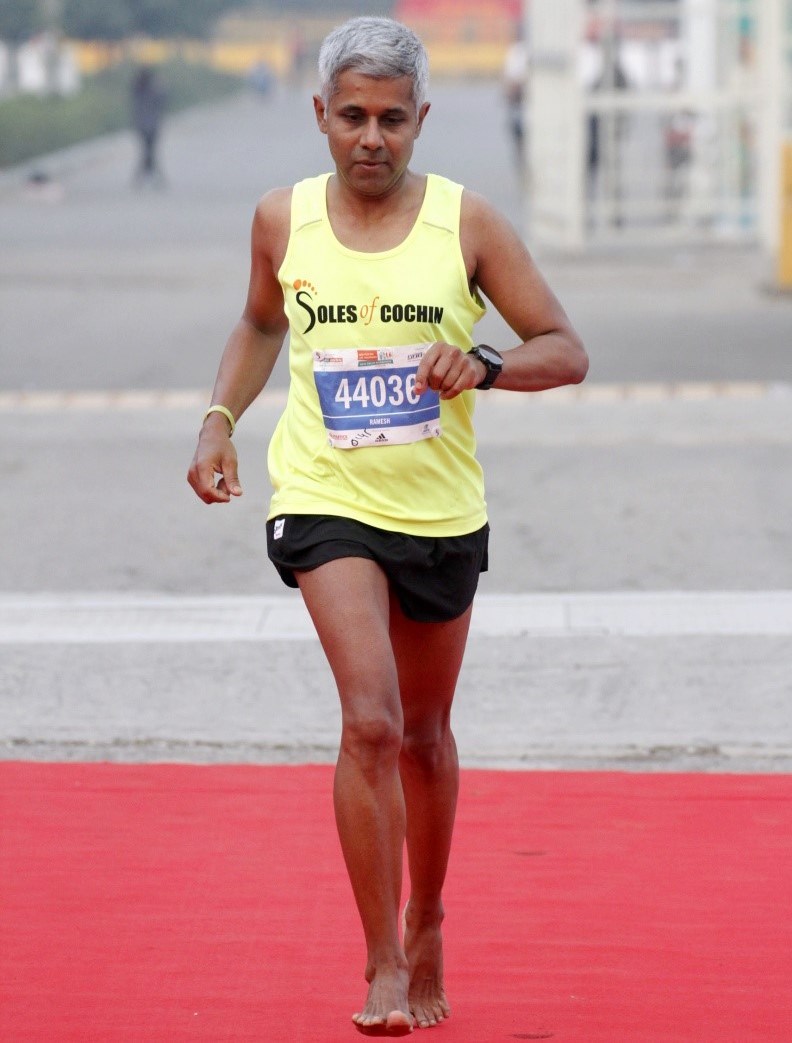
SPORT CLIMBING / PHASE TWO OF OLYMPIC QUALIFICATION DUE BY NOVEMBER END

Tomoa Narasaki (foreground); this photo was taken during the 2017 IFSC World Cup in bouldering held in Navi Mumbai (Photo: Shyam G Menon)
The first list of sport climbers qualified for the Tokyo Olympics was announced in August, 2019. Qualification is a process in three phases lasting till May 2020. Interestingly, some of the athletes who made the cut in the initial list would be familiar to Indian climbing aficionados; they had participated in the two IFSC World Cup events held in Navi Mumbai in 2016 and 2017.

The selection process of sport climbers for the 2020 Tokyo Olympic Games will enter its second phase next month with the IFSC Climbing Combined Qualifier in Tournefeuille-Toulouse, France scheduled over November 28-December 1.

In August, the International Federation of Sport Climbing (IFSC) had announced the first list of selected climbers after the Combined World Championships in Hachioji, Japan. “ Over 156 athletes competed in all three disciplines at the IFSC Climbing World Championships Hachioji 2019 with the hopes of earning a ticket to the Tokyo 2020 Summer Olympic Games. Following a week of competition, the top 20 climbers in each gender were selected to participate in the Combined World Championships and the first Olympic qualifying event. The seven highest-placed athletes per gender of the Combined World Championships, with a maximum of two per country, will receive invitations for the Olympic Games,’’ an IFSC statement had said then.

Those in the first list, qualifying so (as available on the IFSC website; the list is titled: Sport Climbing’s First Olympic Qualified Athletes), are Janja Garnbret (Slovenia), Akiyo Noguchi (Japan), Shauna Coxsey (Great Britain), Aleksandra Miroslaw (Poland), Miho Nonaka (Japan), Petra Klinger (Switzerland) and Brooke Raboutou (USA) from the women’s category;  Tomoa Narasaki (Japan),  Jakob Schubert (Austria), Rishat Khaibullin (Kazakhstan), Kai Harada (Japan), Mickael Mawem (France), Alexander Megos (Germany) and Ludovico Fossali (Italy) from the men’s category.

Shauna Coxsey; this photo was taken during the 2017 IFSC World Cup in bouldering held in Navi Mumbai (Photo: Shyam G Menon)

“ All qualification places are provisional until confirmed by each athlete’s National Olympic Committee (NOC). Formal invitations will be sent by the IFSC to the relevant NOCs within five days of the conclusion of Combined World Championships. The NOCs will then have two weeks to either confirm or decline the quota places,’’ the IFSC statement of August 21, had mentioned.

According to a report in the Japan Times, in the combined discipline Narasaki placed first in bouldering and second in lead and speed. Scores are decided by multiplying the finishing position in each of the disciplines; this is the scoring model for the Olympics too. Done so, Narasaki’s score was four, which was the lowest among the competitors, making him victor of the combined championships. In the men’s category, there were three other Japanese climbers including Narasaki’s younger brother, finishing fourth, fifth and sixth. But the two-person cap per country per gender appears to have kicked in. “   Japan will select the other male and female climbers based upon outcomes in the Olympic qualifying tournament, Asian Championships and Combined Japan Cup,’’ the report said. As host country, Japan gets a reserved slot per gender.

Besides those qualified at Hachioji, six additional athletes in each gender will be qualified to the Olympic Games from the Toulouse event scheduled for end-November 2019. The final opportunity to qualify will be five IFSC Combined Continental Championships due to take place in 2020. The schedule as available on the IFSC website is – Africa, 1-3 May, Johannesburg (South Africa), Asia, 18-24 May, Morioka (Japan), Europe, 16-18 April, Moscow (Russia), Pan-Am, 27 February-1 March, Los Angeles (USA) and Oceania, 18-19 April, Sydney (Australia). Climber hoping to qualify should head to his / her respective continental championship.

This is the first time climbing will be featured at the Olympics. All three disciplines of sport climbing – lead, bouldering and speed – will be seen. However in a departure from the normal practice of climbers specializing in a discipline of their choice and competing in it, at the Olympics, the same climber will have to endure all three disciplines with the highest aggregate scores ending up on the podium. The controversial format – it was tested at the 2018 Summer Youth Olympics – had to be resorted to because the Olympic committee allotted the sport only one gold medal per gender.

Akio Noguchi; this photo was clicked at the 2017 IFSC World Cup in bouldering held in Navi Mumbai (Photo: Shyam G Menon)

At the Olympics, there will be altogether 40 climbers competing; 20 men and 20 women. This limited availability of slots automatically implies a selection process for qualifying and not every country that is into climbing will be able to have a representative competing in the discipline at the Olympics. Out of the 20 slots for each gender, one slot will go to the host country, another to a NGO called Tripartite Commission, which can give Olympic bids based on exceptional circumstances. That means, effectively, the qualification battle is for 18 slots in each gender. Each country is permitted only two qualified competitors; if more numbers qualify from a given country, then only the top two will be considered. By the time the selection process reaches the stage of the Continental Championships, there will be only five slots left to fill in each gender category (the rest having been filled by events at Hachioji, Toulouse, host country and Tripartite Commission. Should any athlete withdraw after the selection process is completed and the national rosters have been set, then the invitation for the Olympics will go to whoever ranked next to that person at the relevant qualifying event.

Climbing is among sports at the 2020 Olympics, wherein host country Japan has strong medal prospects. Overall at the 2020 Tokyo Olympic Games, Japan Olympic Committee is known to be targeting at least 30 gold medals, higher than their nation’s previous best haul of 16 secured in Athens (2004) and when the games was last held in Tokyo (1964). That said, the going won’t be easy for Japan in climbing. There is stiff competition in the women’s category (at Hachioji, the Japanese female climber with the best score – Akiyo Noguchi – placed second in the combined final after Slovenia’s Janja Garnbret who finished first) and on the men’s side, despite not making it to the first list, Czech ace Adam Ondra (he was disqualified over a technical issue in the Olympic qualification at Hachioji) has two more opportunities to qualify.

The selection process obliquely reminds the Indian climbing community of the good fortune in Navi Mumbai having hosted two climbing World Cups – in 2016 and 2017. Some of the athletes in the first list of qualified – like Akiyo Noguchi, Shauna Coxsey, Miho Nonaka, Tomoa Narasaki and Jakob Schubert had participated in one or both of the world cups held in Navi Mumbai. To that extent, the stars are not strangers; you remember them.

(The author, Shyam G Menon, is a freelance journalist based in Mumbai.)