SAMSARA IS NIRVANA: THE MANY SIDES OF A CLIMB

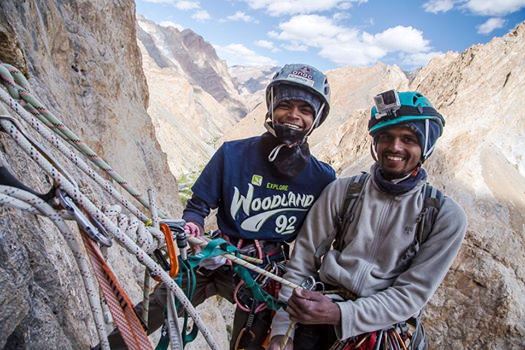
From the 2017 climb: Kumar Gaurav and Madhu C.R on Samsara is Nirvana (Photo credit: Abhijeet Singh Photography / photo provided by Kumar Gaurav)

“All the world’s a stage and men and women merely players’’ – William Shakespeare wrote so in As You Like It.  Same holds true for climbing routes; they are stage and climbers, merely actors. In 2007, a team of rock climbers from overseas opened a climbing route in Ladakh. It has since become an absorbing challenge for a few dedicated Indian climbers.

In Sanskrit, the word samsara refers to the cycle of death and rebirth to which, material life is bound. Nirvana – in Hinduism, Buddhism, Jainism and Sikhism – refers to the profound peace of mind that is acquired with liberation from samsara. Climbing routes are usually named by those who ascend them first. The climbing route Giovanni Quirici pioneered in 2007 in Ladakh was called Samsara is Nirvana. According to published reports, others in the team included Elie Chevieux, Claude Chardonners, Guy Scherrer and Phillip Chabloz. The route lay on a rock face in Tsogra gorge in the Kharnak region and received little attention from Indian climbers for the next few years.

In 2010 or so, at the annual climbing competition organized by Girivihar in Mumbai, Pune-based Tuhin Satarkar met Elie. “ Elie mentioned about Samsara is Nirvana to me. I decided to find out more about it, and emailed him a few months later. He shared some information with me, but it was all very haphazard,’’ Tuhin, among India’s best young climbers, wrote in when asked. In early 2015, he did a recce trip to Leh to find out more.
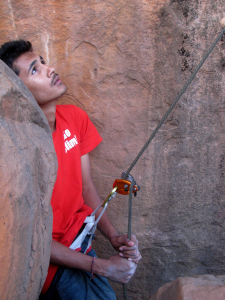
Tuhin Satarkar; 2014 file photo from Badami (Photo: Shyam G Menon)

A key person in the emergent Indian attempts to climb Samsara is Nirvana is Tenzing Jamyang. He manages GraviT, a combination of climbing gym and café in Leh. It is a popular hang-out for visiting rock climbers. Jamyang is also one of the organizers of the Suru Boulder Festival and runs an adventure travel business. His first brush with Samsara is Nirvana was roughly the same year Tuhin met Elie in Mumbai. A couple of French climbers were in Leh looking for the route. They had with them a rough map. Jamyang got some idea of the route’s location from that. But a climbing line on a rock face in vast mountain landscape – that needs more than approximate map to be precisely located. Over time, he gathered more information. When Tuhin arrived for the recce trip, Jamyang was able to link him up with a local horseman who knew Kharnak and the Tsogra gorge. Tuhin would later compare finding the rock face hosting the route to solving a puzzle. “ By the end of it I had everything I needed to attempt the route,’’ he said. Tuhin attempted Samsara is Nirvana with Pascal, a French climber. “ It was extremely challenging since there had been no ascent on it since 2007, when the first ascent had taken place. It was difficult to pinpoint the exact route and spot all the bolts. It resembled climbing the route for the first time. The weather conditions were terrible and we ended up having to retreat just 100 meters away from the summit, without completing the ascent,’’ he said.

Two things have been evident to some of the Indian climbers attempting Samsara is Nirvana. First, given sections of lose rock, it is a dynamic route. Climbers said the realities of the route keep changing through the years. Second, you must be able to handle long run-outs. Long run-outs make the size of potential fall before protection kicks in, big. Why this trait features on Samsara is Nirvana is unclear. One recurrent train of speculation has it that the pioneers may have been short of expansion bolts and so spaced out placement of protection. Tuhin explained his experience of the route, “ There are at least 20-30ft slabs of loose rock on the wall, which adds to the challenge. One needs to be very careful, especially due to the location and terrain since accidents can potentially be very dangerous. Since the first ascent in 2007, there has definitely been a lot of weathering, some parts of the rock have fallen off. We can’t really say anything about the run-outs, since we don’t know if any of the bolts have been dislodged or fallen off. It did make a difference while climbing it with the long run-outs.’’  When Tuhin and Pascal made their attempt of Samsara is Nirvana in 2015, Jamyang’s outdoor business had provided the required infrastructural support. During one of the support trips to Tsogra gorge, Jamyang said, Delhi based-climber Sandeep Maity got a chance to go along and see the route. In 2016, following that year’s Suru Boulder Festival, Sandeep and fellow Delhi-climber, Kumar Gaurav were having a conversation with Jamyang in Leh when he asked the two climbers: why not attempt Samsara is Nirvana? Like Tuhin, Gaurav and Sandeep are part of India’s new generation of rock climbers; all have been part of the national sport climbing team. Gaurav had apparently heard of the route from Tuhin. “ I said it just like that but the two of them were so motivated and fired up that a climbing trip got underway,’’ Jamyang said of that occasion when he mentioned Samsara is Nirvana to Sandeep and Gaurav. The required gear and support was assembled quickly and a four person-team, including Jamyang, left for the route in Kharnak. It was September 2016.
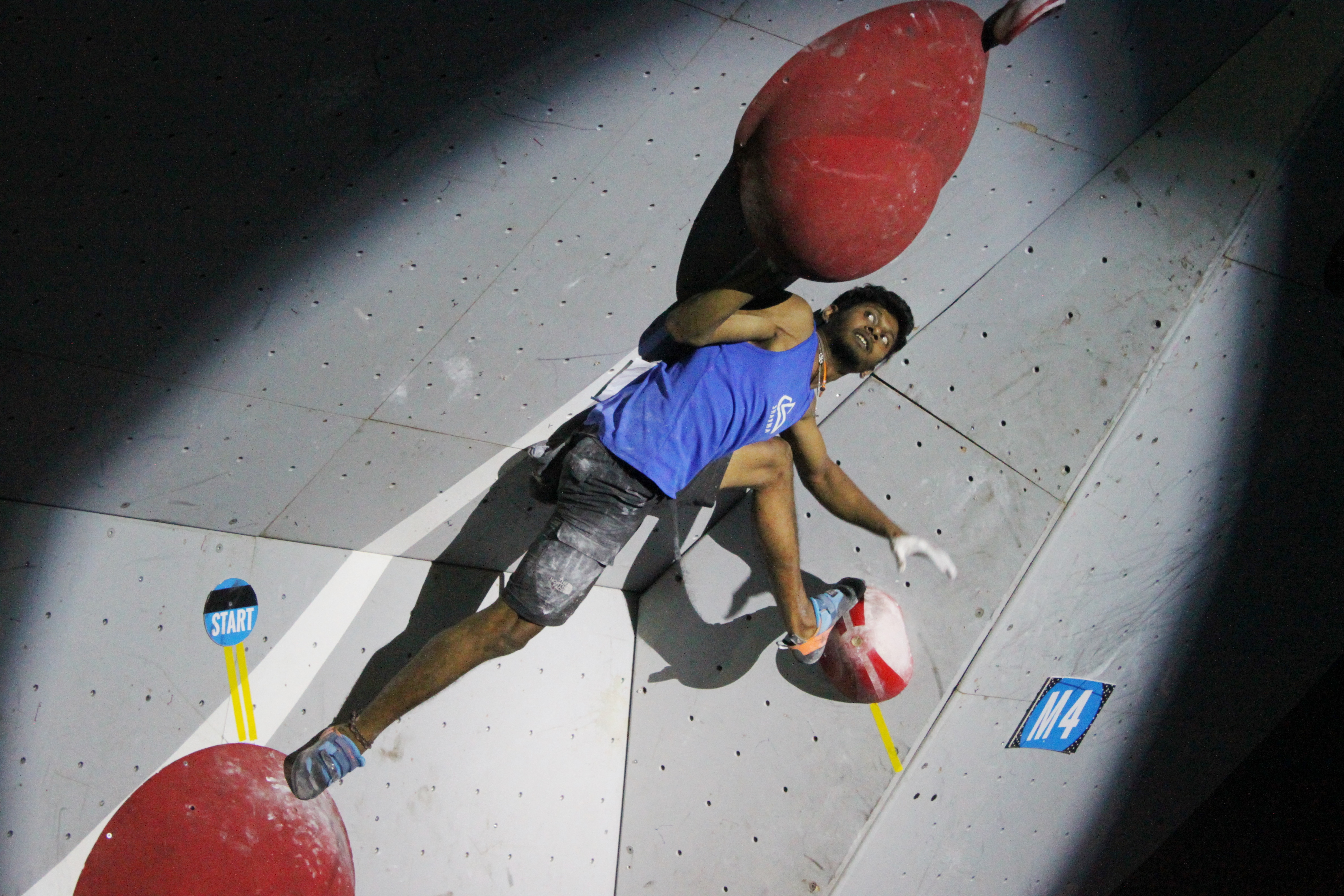
Sandeep Maity; file photo from 2017 IFSC World Cup in Navi Mumbai (Photo: Shyam G Menon)
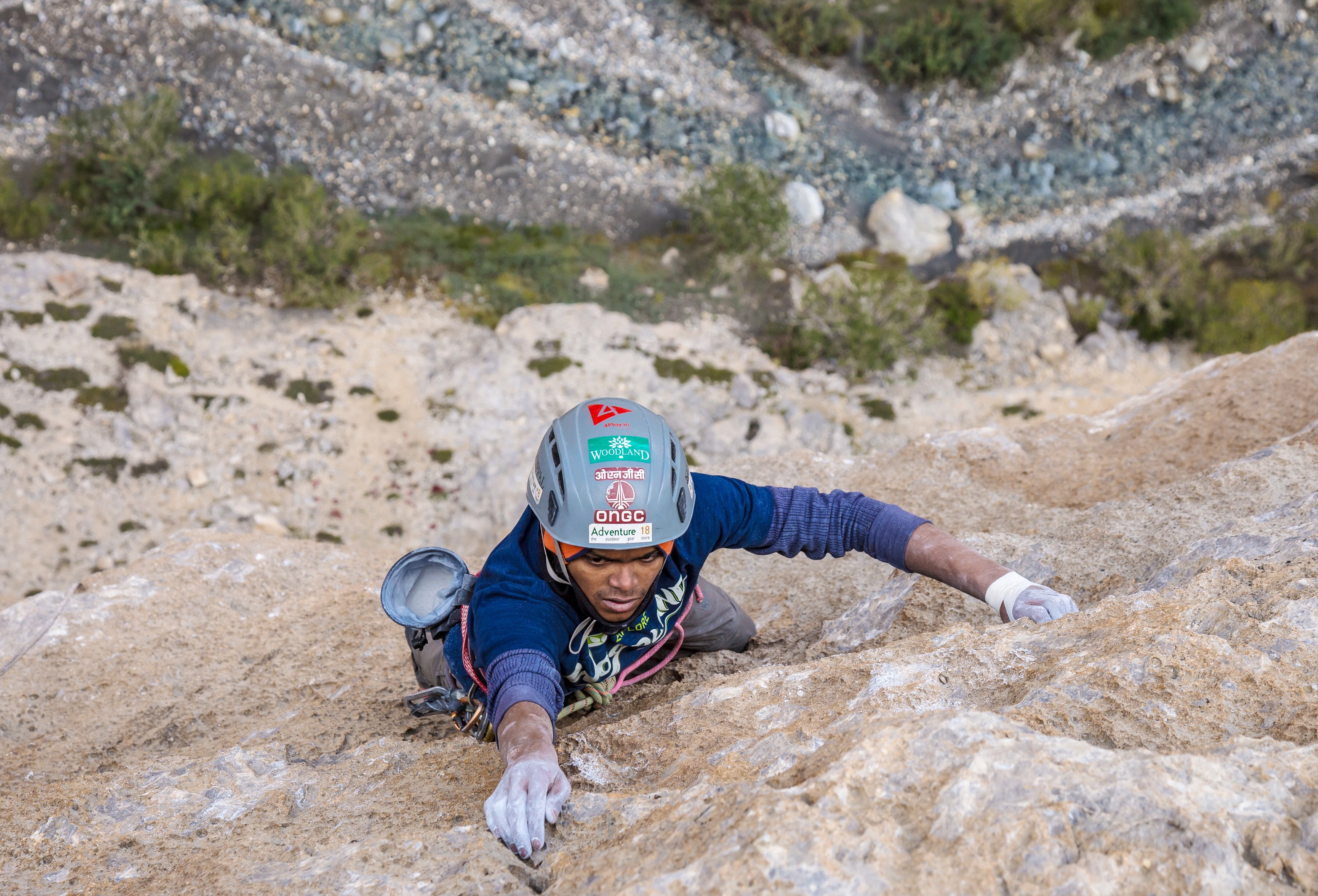
Kumar Gaurav on Samsara is Nirvana (Photo credit: Abhijeet Singh Photography / photo provided by Kumar Gaurav)

According to Gaurav, they reached the location of the route on the afternoon of September 17. By 2 PM, they started to climb. Gaurav took on the role of lead climber. Over the next three hours, they made it to the fourth pitch of the route. Then they came down for the night. Jamyang remembers Sandeep and Gaurav as a good, determined team. Next day, they commenced climbing at around 11AM. By about 4.30 PM, they were at the twelfth pitch. Each pitch signifies a rope length or slightly less. Any climb in which rope is used for safety, including multi-pitch climbs, typically features a lead climber and a belayer. The latter watches the leader’s back and secures the leader’s safety should there be a fall.  The belayer’s position on a route trails that of the leader. As the leader climbs he / she keeps passing the rope through protection placed on rock. This may be placed by him / her or as is the case on bolted routes, already drilled and placed in rock. Expansion bolts have provision to take on a quick-draw through which the lead climber’s rope is passed. When the leader falls, he / she falls double the distance ascended above the last protection the rope was passed through. Run-out indicates the distance between one protection and the next. Where run-out is high, the fall can be equally big. Once the lead climber reaches the end of a pitch, he / she anchors self and belays the second climber as he / she climbs up.

Gaurav said that data left by the overseas climbers indicated 7b moves and a pretty difficult second pitch. That data was from several years earlier. “ I now think the twelfth pitch is the hardest,’’ Gaurav said. On that pitch, Gaurav took a fall; a big one. According to Jamyang, Gaurav fell twice that day. Following the first fall wherein he hurt his left ankle, he climbed back up. But the second fall from the twelfth pitch was a punishing fall. Sandeep, who was belaying, said that this particular portion of the climb featured both long run-out and a “ blind spot.’’ The latter referred to sections of the rock face where climber is not within eyesight of the belayer. A rock face can be undulating; there are intervening ledges, ramps and other rock features. Sandeep couldn’t see Gaurav. Depending on their size and the height at which climbers are, rock faces can also be places where it is difficult to hear properly, even if two people shout to communicate over the distance separating them. Although a climbing rope primarily links two people for safety; the pace at which it is fed to lead climber, its stillness, any resistance felt, how taut it is, how it suddenly goes slack – all these help provide the belayer an approximate idea of leader’s predicament. In blind spots and patches where oral communication is difficult, the rope’s behavior is like a telegraph line. It was the rope that told Sandeep of Gaurav’s fall commencing. He instinctively started pulling in the slack to contain the dimension of fall. There’s only so much any belayer can do when run-outs are long. From far, Jamyang saw the fall. “ It was a big one,’’ he said.
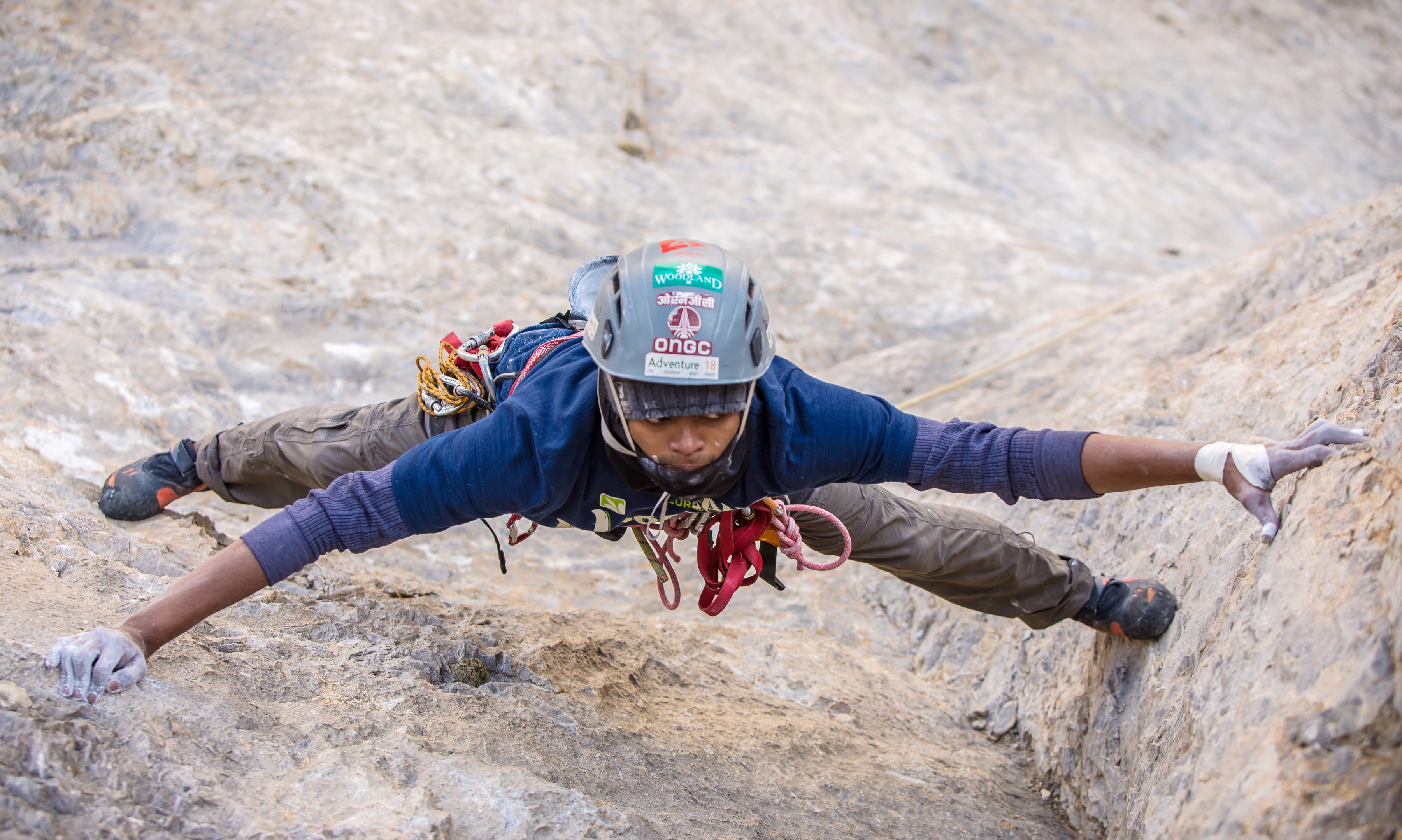
Kumar Gaurav tackling a sketchy section of the climb on Samsara is Nirvana; the belayer can be seen way below (Photo credit: Abhijeet Singh Photography / photo provided by Kumar Gaurav)

Gaurav injured his left palm in the fall. He was in a state of shock. Such big falls are not every day occurrences in Indian climbing. It was the end of that attempt on Samsara is Nirvana. Jamyang carried Gaurav on his back, from the base of the rock face to camp. By the time they reached camp, the injured hand was swollen. It was late evening and immediate exit to Leh was impractical, given several hours of hiking in between. Further, it being a small team, each of them had heavy backpacks. Luckily Jamyang was able to get a trekking group passing by, to carry Gaurav’s belongings with them to Leh. Next day, the climbers hiked out from camp and eventually reached Leh and hospital. On October 23, in Delhi, the injured palm – it was fractured – was subjected to surgery. Doctors were skeptical of pace of recovery, anticipating several months for return to form. By end November-early December, Gaurav however participated in a climbing competition in Nepal. In April 2017, he completed his Advanced Mountaineering Course from Himalayan Mountaineering Institute (HMI), Darjeeling. This was followed by some mountaineering expeditions. There was an attempt to climb Laspa Dhura in Kumaon in May. It didn’t succeed. Reaching Leh in July, Gaurav along with his friend Jonathan Parker (they met at Suru Boulder Festival in Ladakh) climbed Stok Kangri East Face and Kang Yatse 1 and 2. They also went to Dzo Jongo in the Markha Valley region. Amid the recovery from injury and surgery he also made another decision – he would try the route in Kharnak again. Jamyang was already working on a second attempt by Sandeep and Gaurav on Samsara is Nirvana, emphasis this time being on a crew to document the climb. Gaurav however kept his project separate. It wasn’t smooth sailing. According to him, he had initially planned on attempting the route a second time, with Tuhin. That was set aside after the demise of Pune based-cyclist Ajay Padval, in Leh in July. Having navigated the months since injury with return to Kharnak in mind, Gaurav grabbed the next set of sponsors and supporters that came his way. The expedition was thus salvaged but he lacked a crucial element – he didn’t have a climbing partner.
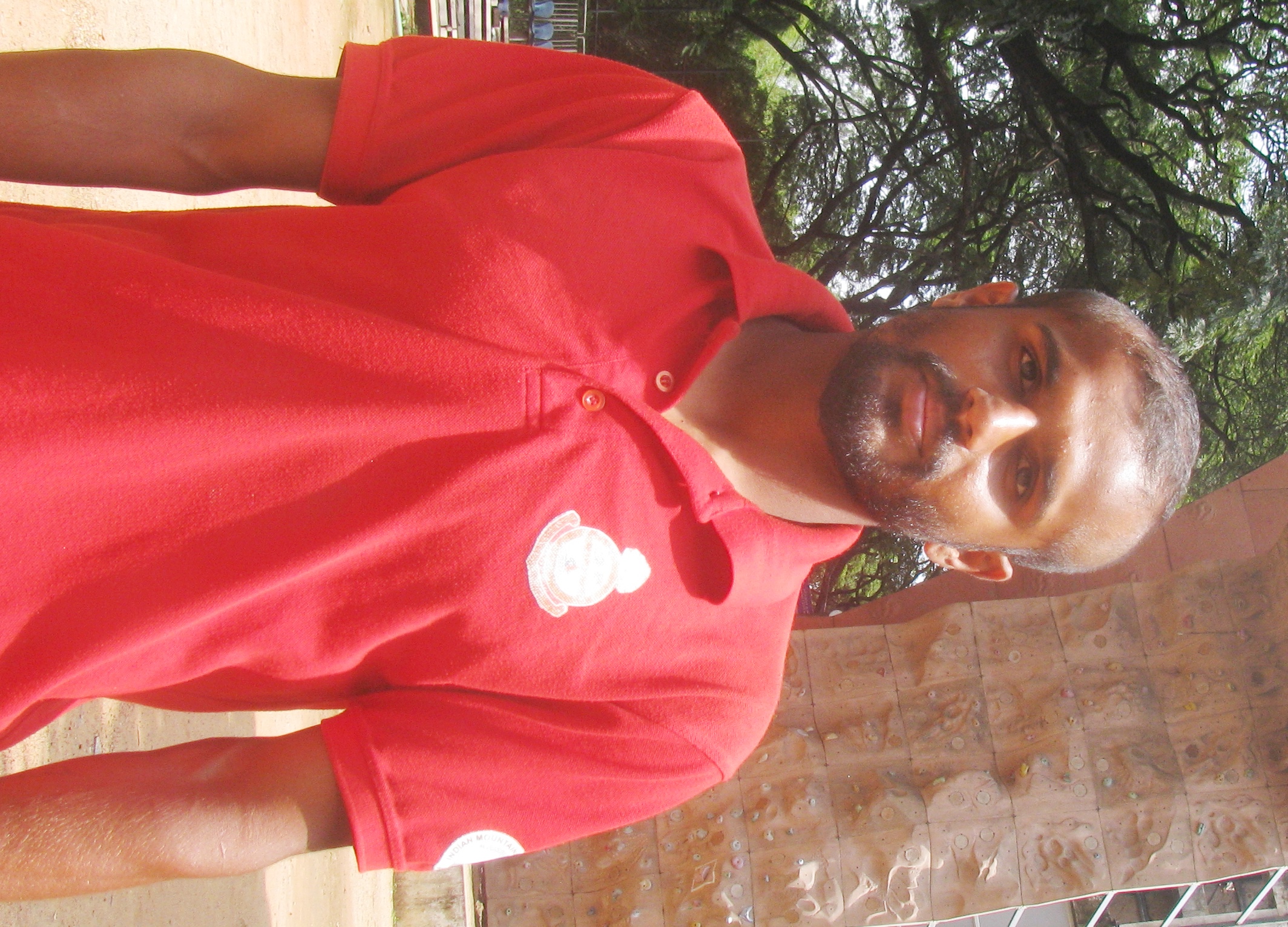
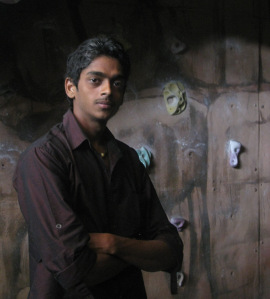
Madhu C.R; behind is the climbing wall at Kanteerava Stadium, Bengaluru (Photo: Shyam G Menon)

Located over 3000 kilometers south of Leh, Karnataka’s Mandya district is part of the Cauvery River basin. It is known for its sugarcane crop. Madhu C.R hails from Mandya, to be precise, a village therein called Chikkankanahalli. After schooling and two to three years of work at his family’s farm, he shifted to Bengaluru driven by the wish to have a career in sports (he used to play cricket in the village). “ It is difficult for a villager to get what he wants in big city,’’ Madhu said, a morning at the café within Bengaluru’s Kanteerava Stadium complex. Not far from where we were, was the stadium’s climbing wall. For six months, after moving to Bengaluru, he worked at a steel fabrication unit. During this time, he chanced to go trekking and made the acquaintance of Naveen, who ran a travel agency. Naveen guided him to the city’s best known climbing wall, located at the stadium. Madhu who was into running and boxing, also became a member of Mars Adventure Club and started working with them. Slowly, his interest in running and boxing faded; climbing became his chosen fix. He became good enough at climbing to participate in competitions at the zonal level. In his third year of climbing, he made it to the national competition. According to him, the best position he ever reached at the nationals was eighth in lead climbing and fifth in speed. It was at a national competition in Delhi in 2013 that Madhu met Gaurav for the first time. Not long after, they met again at Badami in north Karnataka, a much loved climbing destination in India. For someone new to climbing and life outside Mandya, Madhu’s forays engage. In June 2015 he made his first visit to the Himalaya; to Manali. He traveled alone. Unlike many first timers who stick on in Manali, Madhu visited Chatru as well – the aim being to boulder at both these places. Across Manali and Chatru, he spent some 45-50 days relishing the weather and fewer people found away from big cities. “ It was a nice experience. I liked it,’’ the youngster from Chikkankanahalli said. He also saw a huge rock face and committed it to memory as a face to climb someday. Since then, Madhu has returned every year to the Himalaya.

Madhu’s experience of big walls was restricted to rock faces at Savandurga near Bengaluru. He had climbed a couple of multi-pitch routes; the first such route he did was called Beladingalu in Kannada, meaning bright moonlight. In July 2016, Madhu made his second visit to Manali where he met Kumar Gaurav. According to Madhu, on this meet-up, Gaurav mentioned his interest in Samsara is Nirvana. While Gaurav then moved on to Leh, Madhu went alone for a recce of the rock face in Chatru fascinating him from the previous year. That year, past mid-September, Gaurav’s attempt at Samsara is Nirvana would end in injury. According to Madhu, around April 2017, Gaurav asked him if he would like to go to Kharnak and try Samsara is Nirvana. “ I was a bit confused because I had a lot of work at that time,’’ Madhu said. He thought for a week and said: yes. What a person is in normal life is rarely what person is, while climbing. Knowing a person as climber is therefore important while choosing partners. Gaurav and Madhu had worked as a team before in Badami. They had belayed each other on tough sport routes in Badami like Ganesha and Samsara (not to be confused with the one in Kharnak). In August 2017, they met at a village roughly 100 km before Leh and four to five hours’ hike from the route in Kharnak. Base Camp was reached on August 31. There were totally eleven people in the team. The expedition was sponsored and supported. When he saw it, Madhu liked the rock face hosting the climbing route.
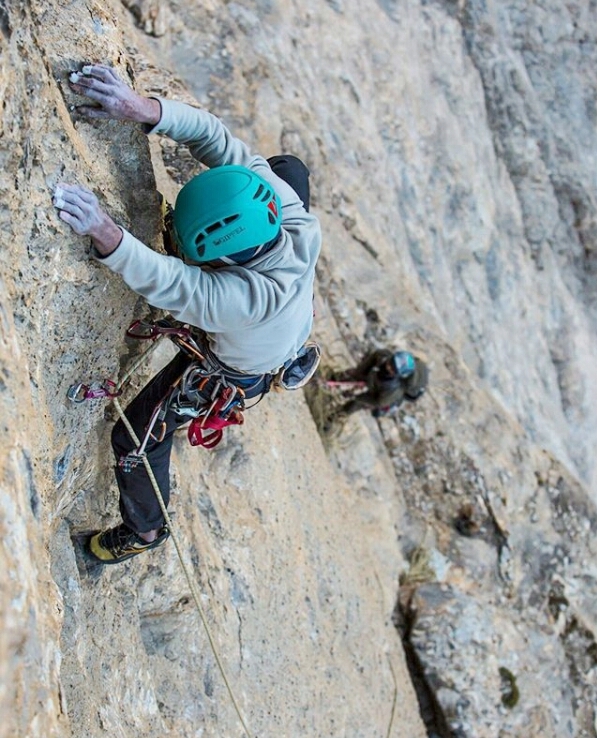
Madhu C.R on Samsara is Nirvana; Gaurav is visible below (Photo credit: Abhijeet Singh Photography / photo provided by Madhu C.R)

Although Madhu wished for a day’s rest before climbing, Gaurav decided to start climbing the next day itself. As they did, Madhu’s assessment of what he had got into became more realistic. The duo got stuck in the very first pitch. Slowly the route’s grade of difficulty and the meaning of long run-out began to hit home. “ I went in blindly,’’ Madhu said in retrospect. On the brighter side, that was also his preferred style; he does not like too much information, anxiety and consequent inaction. On the first day of climbing, they made it past the first belay station but could not make it to the first anchor of the second pitch. So they turned back. According to Madhu, away from the climbing route, the rock face affords easy access all the way to the third pitch. He fixed a rappel rope there, and abseiling down, marked the route over the second and first pitches. Then the duo started climbing afresh from the bottom. Gaurav took the lead and yet again, got stuck in the first pitch. Half an hour went by so. Then Madhu tried it using different beta. It was same outcome. Frustration was building up. Post-lunch, they tried again; Madhu clipped into the rappel rope for additional safety. He somehow climbed the first pitch. Gaurav followed. Madhu then started the second pitch, according to the Swiss, the route’s hardest section. He got stuck at the fourth or fifth bolt. He took a fall. He tried twice. With exhaustion catching up, the duo rappelled down. That was the end of the second day. Third day commenced with the team rappelling down from the third pitch to the belay station at the end of the first pitch. They started climbing from there. Madhu led; he cleared the second pitch in one go. Gaurav led the third, fourth and fifth pitches. Madhu led from the sixth to the eighth. Day 3 ended there. But before it ended, it exposed another challenge in the offing. Madhu tried a bit of the eighth pitch. He got stuck; the nearest bolt for protection was not to be seen. It appeared he had moved in the wrong direction. It was dicey. Consequences would have been severe had he taken a fall at this point. He would have landed on a ledge below. It took him 30 nerve wracking seconds to extricate himself from the predicament and locate the bolt. He had to traverse and climb down to reach it. Wind was picking up as they came off the face.

On the fourth day, the duo used a jumar (ascender) to reach the start of the eighth pitch from the fifth. Madhu led through the eighth, ninth and tenth pitches. Then he got stuck in the eleventh. He found that section technically difficult. He had to use trad gear to ensure safe passage (trad gear was used on the eleventh and fourteenth pitches). Somehow Madhu completed the eleventh pitch. He led the twelfth pitch too. On that, he overlooked a bolt. The result was – a long run-out developed. As mentioned before, the problem with long run-out is that it enhances the dimension of potential fall. A fall is typically double the distance you have climbed up from the last anchor. This length of potential fall is called fall factor. The farther behind the last anchor is from climber, the bigger the fall factor. At this stage, attempting the twelfth pitch, Madhu was “ super tired.’’ Tired climber caught in a tough situation – that is something everyone courting the vertical tries to avoid if they can. “ I got scared,’’ Madhu said. There was also an unnerving detail. According to Gaurav, on one of the bolts of the twelfth pitch, Madhu saw the quick-draw left by Gaurav a year before. That was from where he had fallen. Madhu climbed down a bit, rested a while and tried again. He still couldn’t find the right holds. He told Gaurav that he was unable to proceed. Gaurav told him to come down. Fourth day ended on that note but with a twist. The twelfth pitch commenced from a small ledge. They decided to spend the night there. It was their first bivouac on the wall. Between the two, they had carried a sleeping bag, a poncho, a jacket, a small cachet of dry fruits, half a liter of water and half a liter of Tang. “ The bivouac was not part of the plan. But it was the most efficient thing to do. It seemed better to finish the route and come down,’’ Madhu said. The night on the ledge was cold and windy. Mercifully it did not rain. Madhu could not sleep that night. He knew that the twelfth pitch was there, waiting for them.
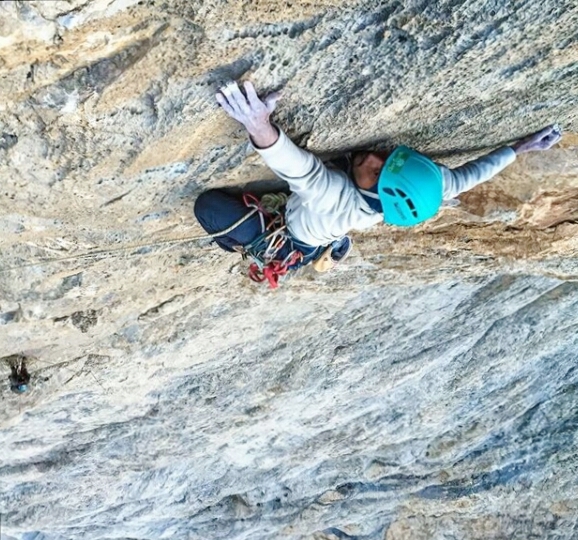
Madhu C.R on Samsara is Nirvana; Gaurav who is belaying is visible below to the left (Photo credit: Abhijeet Singh Photography / photo provided by Madhu C.R)

Next morning they began climbing at around 8 AM. They waited till then for the night had been cold and the rock needed to warm up in sunshine, so that it could be held by human hands. Staring at the twelfth pitch, Madhu was sure he wasn’t going to give up. Gaurav shared the sentiment. They motivated each other. Thanks to night on the ledge, their fingers and feet were almost numb from cold. Additionally Madhu’s feet hurt badly. Good rock climbing shoes are expensive to afford. More precisely, climbing routes being varied depending on type of rock and length of climb, the shoes required for each climb also varies. The rock climbing shoes Madhu owned were meant for aggressive climbing. That meant they fitted very tight on the feet, driving energy to the big toe. This is perfect for short, aggressive climbs. Long routes require a more relaxed fit and Samsara is Nirvana wasn’t just long, it was proving to be a multi-day affair. Managing all this in his head, Madhu once again overlooked a bolt on the twelfth pitch. The run-out grew. But there was a difference now. The duo’s confidence level was up; they knew they weren’t going to leave the job half-done. Madhu cruised through the difficult section. “ That morning I knew I could do it. The only thing to be careful about was a fall because the run-out was long,’’ he said.

Pitch number thirteen was easy. But problems persisted. The next bolt – bolts have hangers for attaching quick-draws, so they are sometimes called hangers for convenience – couldn’t be found. On risky dynamic routes featuring patches of bad rock, hangers positioned by pioneers also serve to show the way. In their absence, climbs become difficult. Worse, when you are attempting a given route and you can’t locate hangers, how do you tell the climbing world that what you climbed and finished was actually the route? Progressing through the thirteenth pitch, Madhu encountered two belay stations at the fourteenth. He went towards one of them but was confused of way ahead. He found a rock patch, flaky and loose. “ One day that will come down,’’ he said. He used trad gear to stabilize himself and stayed there for a while, wondering what to do. Gaurav climbed up to join him. Finally the duo found an anchor forty feet further up but left of the route they were on. It became visible when sunshine graced its metal and it shone. Madhu used trad gear to correct his direction, reached the bolt and clipped in. From there to the end of the sixteenth pitch was easy. Except for one issue – the end of a climb is typically indicated by a proper belay station. All they saw at the end of the sixteenth pitch was a single hanger. They looked around for signs of route continuing. They couldn’t find any. It was perhaps a fragile ending in terms of convincing those who seek firm proof of exact route completely done (some articles on the Internet describe Samsara is Nirvana as 17 pitches-long; Gaurav said, the topo [description of climbing route] he had, showed 16 pitches). According to Gaurav and Madhu, they looked around for more bolts and accepted that single bolt as conclusion of climb because they couldn’t find any more bolts marking the way. They spent half an hour savoring their success. Then, they rappelled down to the eighth pitch. By around 8 PM, they were at the bottom of the face.
Ajij Shaikh; file photo from 2014 (Photo: Shyam G Menon)

As rock climbing gains currency in India spawning a new generation of professional athletes backed by sponsors and media, the competition among climbers has risen. It is not the innocent, forgiving world of before. Climbers, climbs done, claims of first ascent – all get thrust under the scanner. News of the 2017 climb evoked mixed response. Critics latched on to the lack of clarity in route taken – especially the climb’s concluding portion. Purity of climb from beginning to end – that too has been questioned. When it became clear that Gaurav was proceeding with his own plans to attempt the route, Sandeep – part of the Indian team for the 2017 IFSC World Cup in Bouldering at Navi Mumbai – availed an opportunity to train in Slovenia for the event. Among others training so was Pune-based Ajij Shaikh. According to Ajij, Sandeep apprised him of the project he had got into – Samsara is Nirvana – and asked if Ajij wished to join. Ajij, who is among India’s best sport climbers, had already heard of the route from Tuhin. He sought more details. He knew that hailing from Pune, the bulk of his climbs had been in warm weather conditions. Samsara is Nirvana is in Ladakh, a region with average elevation near 10,000 feet, its mountains and rock faces being still higher. In June, all four – Sandeep, Ajij, Madhu and Gaurav – would converge in Navi Mumbai for the World Cup; Sandeep and Ajij to climb and compete, Madhu and Gaurav to volunteer.

In August, Ajij went to Leh. It was his first visit to the Himalaya. Following time spent in Leh to acclimatize and a trip to Suru Boulder Festival, in September 2017, Jamyang, Ajij and Sandeep reached Tsogra gorge to attempt Samsara is Nirvana. By now, news of Madhu and Gaurav climbing the route had filtered through. It was also tad late in the season. Ladakh was beginning to get cold. Sandeep and Ajij climbed for two days but the attempt had to be aborted following fall and an uncomfortable bivouac on the rock face. According to Ajij, the grade of climb isn’t too hard. What makes Samsara is Nirvana challenging is the combination of grade, the impact of altitude on climbing, long run-outs and the cold environment. Plus, unlike sport climbing, multi-pitch entails a lot of hard work; there is gear, ropes and stuff you need for potential bivouac to haul. On the second morning of their climb, as he started to lead, Ajij had found the rock too cold to grip. He felt tired and not in his elements. Eventually the duo aborted the climb at the eighth pitch or so. Sandeep plans to try Samsara is Nirvana, again. I asked Tuhin if he planned to attempt Samsara is Nirvana again. “ I do plan on attempting the route again,’’ he wrote in. Ajij wasn’t sure he would. The curiosity was there but the environment in which the route was, bothered. He was in a train in Pune, when we spoke. Amid erratic phone network, sound of locomotive horns and the chatter of people around, he said that multi-pitch climbing at altitude wasn’t exactly his cup of tea. Sport climbing seemed more his style.
Giovanni Quirici; 1978-2011 (Photo: this image was downloaded from BMC website. It is being used here in good faith; no copyright violation intended)

Both Madhu and Gaurav now think of attempting more trad routes and big walls in the Himalaya. “ It was smooth, working with Gaurav. There hasn’t been a dispute or disagreement, so far,’’ Madhu said. By now he had finished the tea and butter idli he ordered at the cafe. Monsoon was waning and Bengaluru’s weather was pleasant. “ I will adjust with anything,’’ Madhu said of coping with the Himalaya, “ whatever challenge is there, I will take it. Of course, I will think before I take it. Whatever happens is right for me. Good or bad doesn’t matter.’’ At the time of meeting him for this chat, Madhu was yet to do a mountaineering course. He wasn’t in any hurry to do one. He said he preferred the challenge rock climbing offered. Gaurav credited Madhu for the duo finally topping out on Samsara is Nirvana. About himself, he said he had approached the route – scene of his earlier accident – with a positive mind.

On August 12, 2011, Giovanni Quirici died.

The talented Swiss climber was killed in a fall in the Alps. A post on the website of The British Mountaineering Council (BMC), dated August 21, 2011, said, “ although exact details have not been forthcoming, the Geneva-based Swiss alpinist was leading a pitch on Le Chant du Cygne (Swan Song), Michel Piola’s last of five new routes on North Face.’’ The North Face referred to was the north face of the Eiger. Piola is a noted Swiss climber who, according to information on Wikipedia, opened more than 1500 routes worldwide with more than a hundred in Europe’s Mont Blanc massif alone. Quirici was both former Swiss junior climbing champion and a member of the country’s national climbing team. He left indoor competitions to focus on first ascents on rock. He established several difficult first ascents. The report on BMC’s website said, “ It appears that 33 year-old Quirici took a big fall and died more or less instantly. His partner was rescued unharmed.’’ Dwelling on Quirici’s climbs, the post also mentioned that four years earlier, in 2007, he had put up a 650m rock route in Ladakh, named Samsara is Nirvana.

(The author, Shyam G Menon, is a freelance journalist based in Mumbai. Reconstructing a climb is difficult especially if you haven’t been on the route or at the site of the climb. Please factor that angle in, as you read. This article is primarily based on separate conversations with Kumar Gaurav and Madhu. Given the first round of talk with Gaurav featured a weak phone connection, details of climb are as Madhu said during a face to face chat in Bengaluru. A subsequent clearer conversation with Gaurav served to fill things in, some more. Climbing is an intense personal experience and sometimes recollection of intense experience may not be 100 per cent accurate. Please factor that too in. Treat this as a writer’s attempt to piece together a narrative from multiple sources. Tuhin and Ajij connected from Pune, Sandeep and Jamyang from Delhi. This article was triggered by Facebook posts on the climb by Gaurav and Madhu. However in the process of talking to people and writing, it evolved to be more about the route and the effect the route had on climbers. The author wishes to emphasize that given climbing is capable of injury if practised without proper risk management skills or adequate attention, no climbing route should be positioned / treated as a proving ground. “All the world’s a stage and men and women merely players’’ – William Shakespeare wrote so in As You Like It.  Same holds true for climbing routes; they are stage and climbers, merely actors.)            
THE REGISTER OF HIMALAYAN HOTEL

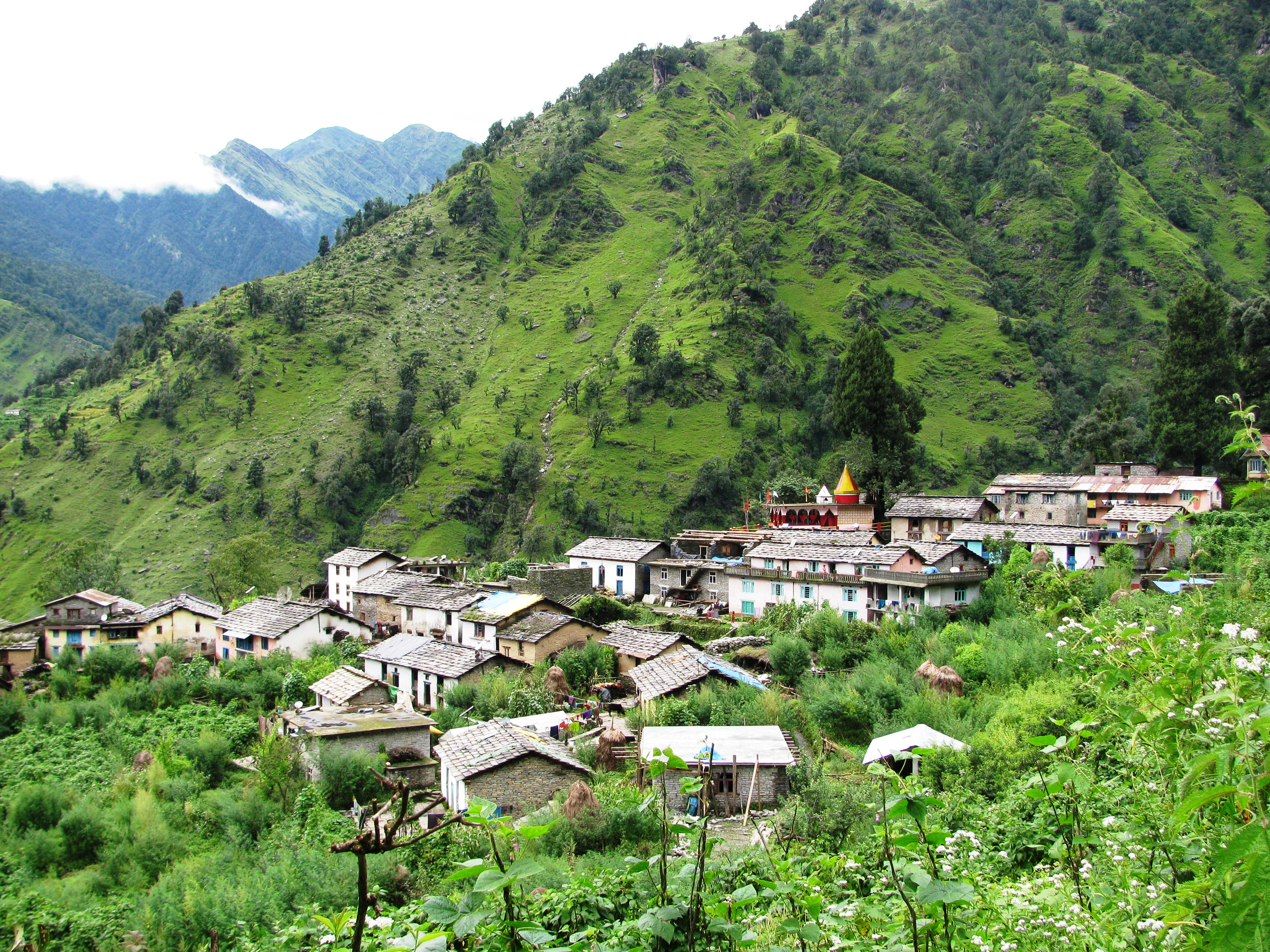
File photo of Khati from 2009.  The village has grown bigger since (Photo: Shyam G Menon)

Updated version of a story originally written in 2012 about a family from a Kumaon village and their connection to Traill Pass in the Himalaya

Harish Singh handed me a brightly colored, plastic cover with ` Raj Fashions’ written on it, the name of a ready-made garments shop in Bageshwar where the family had likely shopped. It had come all the way from Khati to Song and then with Govind, in his jeep to Ranikhet.

Within the bag was a small piece of Pindari Glacier-history.

Khati is a big village. At the time of first writing this story in 2012, Khati was a compact aggregation of houses, packing in several families into a modest expanse of land located steeply above the point where the Pindari River meets the river flowing down from Sunderdhunga. What it lacks in scale, Khati makes up for on two other fronts – it is the last major village on the popular tourist trail leading to the Pindari Glacier; as last village it has access to sizable forest lands beyond and forest produce therein. Notwithstanding this local prominence, Khati is actually a young village. Its neighbors are older.

Harish, who works in Ranikhet, hailed from Khati. He had heard that the area where the village stands was originally called `khata,’ a general reference to any place where goat, sheep and buffalo are brought to graze and their dung settles into a good manure for grass to grow. Usually animal shelters are built at such places and the people come up seasonally with their flocks. There are similar grazing spots at altitude trekked through even today in the Himalaya, where if you visit off-season you are met by stone buildings and sheds with neither man nor animal around. It’s of course a different story in grazing season.

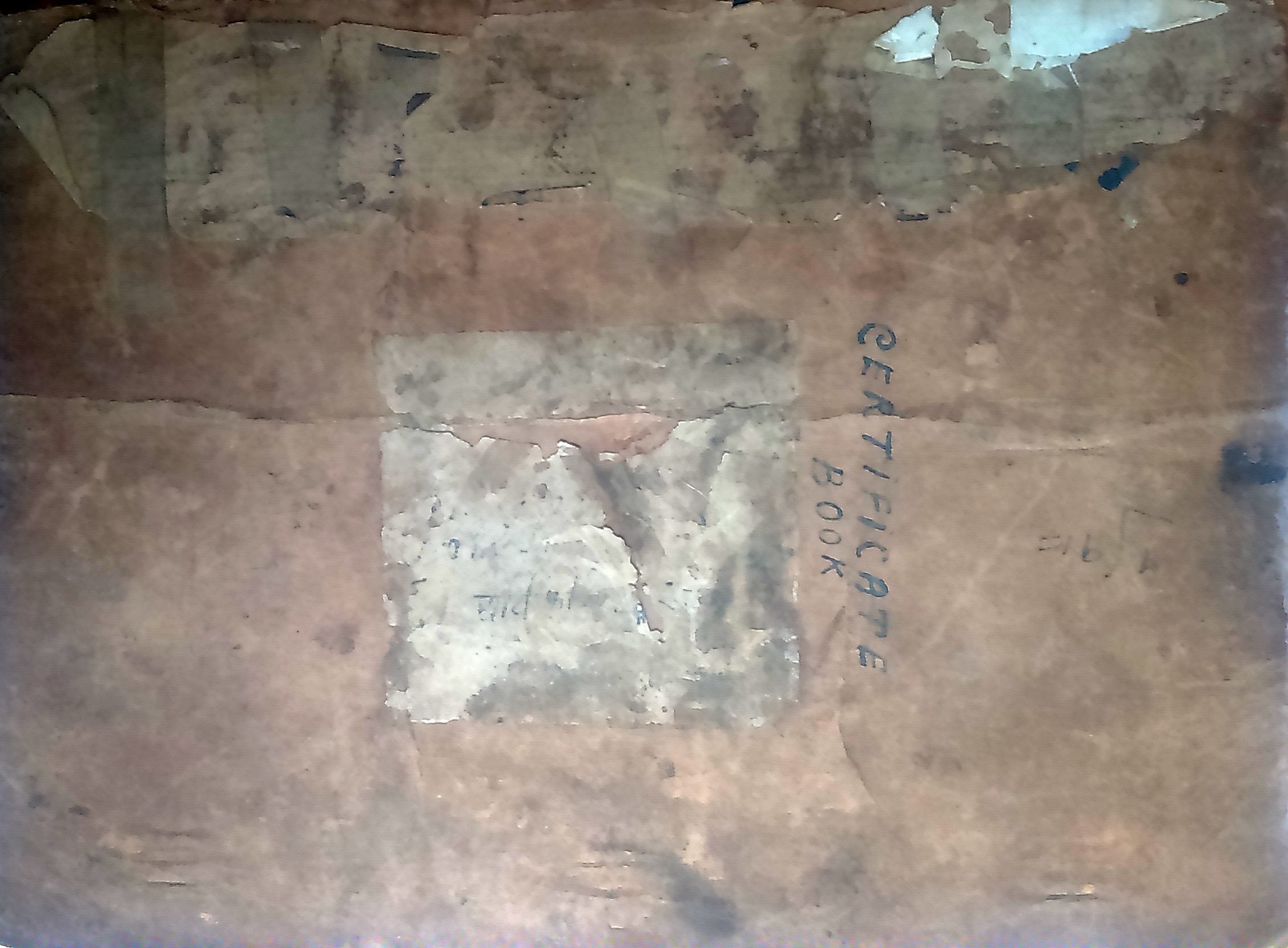
Over time, Harish said, people from nearby villages like Pattag, Sorag and Supi moved permanently to the `khata,’ forming the nucleus for the families who currently reside in Khati. Harish used to be very close to his father, the late Pratap Singh. A former soldier, Pratap Singh, after retirement, ran the family’s small enterprise in Khati – the Himalayan Hotel. Begun by Harish’s grandfather, Gopal Singh, it was a small restaurant with a shop and two adjacent rooms for travelers to stay over if required. What was in that plastic bag was an old register kept at the hotel, titled simply ` certificate book.’

If viewed in perspective, the book’s contents were very engaging.

The `certificate book’ (Photo: courtesy Harish Singh)

History begins from the very first certificate on page one. Addressed to Gopal Singh, it was written on July 8, 1925, by Henry G. Hart, Secretary of the Lucknow Young Men’s Christian Association. Talking of his decision to mail Gopal Singh a little axe as token of appreciation for assistance provided on his trip to Pindari, Hart said, “ I am enclosing a copy of a letter which I have just written the Deputy Commissioner, Mr Rutledge, in which I recommend your help if he tried the Pass again.’’ Two things merit attention. The ` Pass’ referred to here is likely Traill Pass or Traill’s Pass or even Trail Pass and Trail’s Pass as all these spellings exist in our world’s reservoir of information. George William Traill was the second British Commissioner of Kumaon. The pass named after him lies at the top of the Pindari Glacier. It is at an altitude of approximately 17,400ft on the southern shoulder of Nanda Devi East (24,091ft) and Changuch (20,741ft). It links the Pindari valley with the Milam valley via Lawan Gad. Mr Rutledge is most likely Hugh Ruttledge, the well-known explorer of the Himalaya, who once served as Deputy Commissioner at Almora. Besides his explorations trying to find a route into the Nanda Devi sanctuary he was also involved in the early expeditions to Everest. A brief account of Ruttledge’s 1925 attempted crossing of Traill Pass can be seen in the archived issues of the Himalayan Journal brought out by the Himalayan Club.

H.W. Tilman, in his account of the ascent of Nanda Devi, says it was Ruttledge who first called the Nanda Devi Basin, `Sanctuary,’ a name by which the area within the outer ring of high mountains and guarded by them, has become popularly known. Tilman then quotes a passage credited to Ruttledge and opening with the famous sentence, “ Nanda Devi imposes on her votaries an admission test as yet beyond their skill and endurance.’’ In a letter to the London Times in 1932, Ruttledge described the challenge, “ A seventy mile barrier ring on which stand twelve measured peaks of over 21,000ft which has no depression lower than 17,000ft except in the west where the Rishi Ganga rising at the foot of Nanda Devi and draining the area of some 250 square miles (799 square kilometers) of snow and ice has earned for itself what must be one of the most terrific gorges in the world.’’

In his book `The Nanda Devi Affair,’ Bill Aitken has dwelt on Traill and Ruttledge, plus a third person who is the reason for this article. “ Traill’s perseverance in crossing the dangerous ice-fall linking Milam with the source of the Pindar was rewarded with the naming of an unfixed pass after him. On top of this, his explorations have been accorded sporting status. It seems more likely his search for a shortcut had been occasioned by the East India Company’s desperation to get a share of the `shawl wool’ filtering over the passes from Tibet (shatoosh happens still to be the most expensive fabric in the world). If Traill is to be termed the discoverer of the pass what does that make Malak Singh, the villager who guided him up and over the ice-fall? The descendants of Malak Singh continue to remind all visitors on the Pindari glacier trek of their ancestor’s prowess but unlike the Chomolungma lobby that deplores the imposition of `Mount Everest’ there is as yet no insistence on dislodging ` Traill Pass’ for `Malak La,’’ Aitken wrote.

George William Traill went over the pass that has since borne his name, in 1830. Malak Singh – he became known as Malak Singh Buda, that last bit denoting the position of being an elder – was the grandfather of Gopal Singh, in whose time the `certificate book’ appears to have commenced its life. That makes Harish, the current caretaker of the book, the great-great-grandson of Malak Singh. In the Pindari area, Gopal Singh held an official designation called `Sarkari Bania,’ which, according to Harish, was akin to being a government appointed supplier of food and essentials. In that role, he appears to have assisted many travelers on the Pindari trail. Harish remembers family talk of his grandfather as a locally important person thanks to his position and the people he encountered so. Thus there is even a touch of royalty to the contents. On October 3, 1940, at Furkia (also spelt Phurkia), a halt up the trail from Khati towards the Pindari Glacier side, a letter was issued by the `Baroda Camp Officer’ certifying that Gopal Singh had accompanied the Maharaja Gaekwar of Baroda to the Pindari Glacier. “ The note issued on paper bearing the seal ` Huzur Office, Baroda’ – it is there in the book – says, “ His Highness has presented him (Gopal Singh) a wrist watch in appreciation of his services.” Another piece of similar paper work from the past is the certificate issued in May 1935 by the President of the United Provinces Legislative Council.

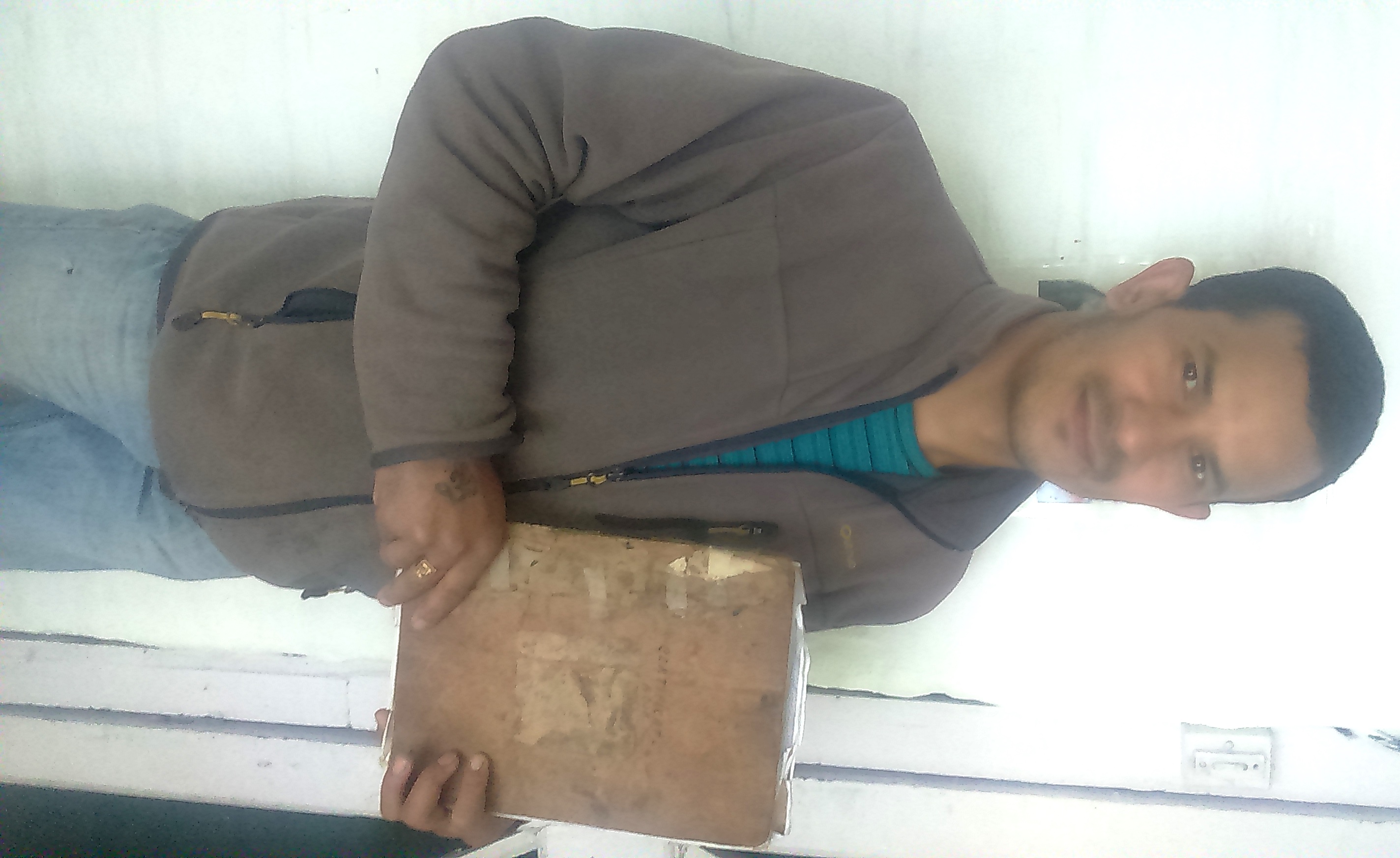
Harish with the certificate book (Photo: courtesy Harish Singh)

However, even as the certificate book engages attention, Malak Singh’s role in the history of exploring these parts of the Himalaya, does not seem to have had any impact on how that history was recorded.

In October 1987, a party signing in the book as “ D.P. Nad & Party” from Asansol confirms hearing the story of Malak Singh and Traill Pass from Pratap Singh. The letter promises “ to negotiate transactions at governmental level to alter the name of Trail Pass.” There is also an old clipping from a Hindi newspaper – date not available – in which the Nainital Mountaineering Club is reported to have sought renaming Traill Pass to reflect Malak Singh’s role in exploring the route. The Hindi word used in the report to describe Malak Singh’s work is `khoj’ which means search or explore.

The most endearing story revolving around the book from Khati should be the one linking the following two certificates.

On October 9, 1936, F.W. Champion, Deputy Conservator of Forests, West Almora Division, wrote, “ Gopal Singh ran an exceedingly good bundobast for us while camping at Martoli on the Pindari Glacier. I had a large number of followers and mules, but I did not have any sort of complaint from anyone – which is unusual. He also seems to be a very pleasant mannered man, only too keen to oblige and I am sure that his presence here as sarkari bania is of great assistance to people touring to the glaciers.” Seventy years later, on October 9, 2006, there is an entry in the book by James Champion from Scotland where he has recorded his gratitude to Harish and his father for having looked after him well when he was retracing the steps of his grandfather F.W. Champion, IFS, who had made the same journey in October 1936 and was guided by Gopal Singh, Harish’s grandfather.

Following Pratap Singh’s demise in 2006, the hotel he commenced was shut down. In 2009, while on an expedition to attempt Baljuri (the bid failed subsequently; for more on that expedition please click on this link: https://shyamgopan.com/2015/12/18/humbled/), I chanced to spend a few days in Khati amid torrential rains. Years later, Harish would tell me, I had stayed in a room right next to where his father’s hotel used to be. The wooden balcony I idled on waiting for the rain to taper ended in a stone wall, on the other side of which was the hotel’s erstwhile location, albeit on the ground floor. Pratap Singh’s children, save one – Harish’s younger brother – have moved elsewhere from Khati. It is now late 2017. Three years ago, after several months of effort, Birender – the sibling still staying in Khati, started a small hotel, this time on land right next to the trail leading to Pindari Glacier. According to Harish, the new enterprise features an eatery, a shop and provision for travelers to stay over. The family named it: Himalayan Hotel.

(The author, Shyam G Menon, is a freelance journalist based in Mumbai. This article draws from two earlier articles the author wrote on the subject and appeared in the The Hindu and the Facebook page of NOLS India.)

2018 GOLDEN GLOBE RACE (GGR) / MEET THE THURIYA

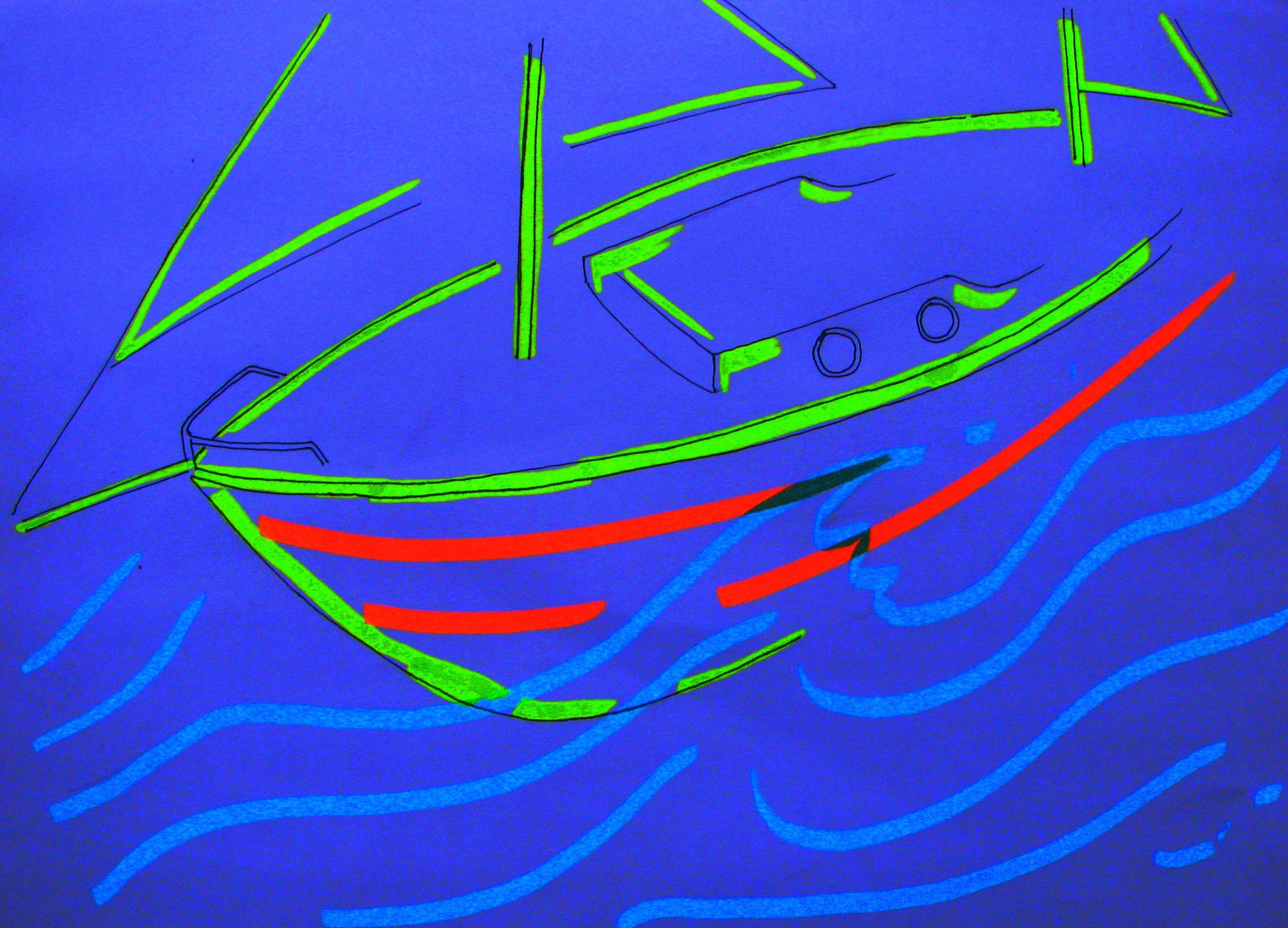
Illustration: Shyam G Menon

Commander Abhilash Tomy KC, the first Indian to do a solo nonstop circumnavigation in a sail boat, gets ready to do another solo nonstop circumnavigation in his new boat, the Thuriya.

Nearly fifty years ago, in 1968, the first Golden Globe Race (GGR) had produced the first man to complete a solo nonstop circumnavigation of the planet in a sail boat.

That person – Sir Robin Knox Johnston – was also the only participant to finish the race. His boat, the Suhaili, was made of wood and built in Mumbai.

Many entrants didn’t make it past the Indian Ocean. One skipper, who deceptively hung around in the Atlantic, was never seen again. Only his empty boat was found; he is believed to have committed suicide. Then there was the French sailor, Bernard Moitessier in his 40 foot-ketch made of boiler steel, the Joshua. He could have given Sir Robin a fight to the finish but instead, opted to continue circumnavigating and eventually drop anchor at Tahiti, sailing a total of 37,455 miles in 10 months. The 2018 GGR seeks to recreate the ambiance of the original; 30 solo sailors, including specially invited participants –  will attempt solo non-stop circumnavigation on sail boats equipped with technology no more modern than what was available in 1968. The race will start from Falmouth in UK on June 30, 2018, and being circumnavigation, eventually end there. Talking to this blog, the evening his boat for the 2018 GGR, the Thuriya was launched at Aquarius Shipyard on Goa’s Divar Island, Commander Abhilash Tomy said, “ I am not allowed to have a computer aboard. I can carry a typewriter.’’

The last time I used a typewriter to author an article was way back in the early 1990s. Ever since, it has been the computer. And for the last several years, a computer with Internet connection, making instant reference to a world of information, possible. If forced to, I can still type an article on the typewriter. But the nature of thinking and forming sentences, the layering of a story, the ability to correct and revise on the go – all that will be different. Experientially, a journalist of the typewriter age is different from one of the Internet age. Experientially, today’s sailor working from sail boats supported by electronic devices is different from a sailor of 1968, who had none of these devices for back-up. What makes the 2018 GGR doubly difficult is that while the participants of the original GGR could equip themselves with the technology of their time, many among those heading for the 2018 GGR will need to abandon comfort zones they got used to and acquaint themselves with boats bereft of high technology.

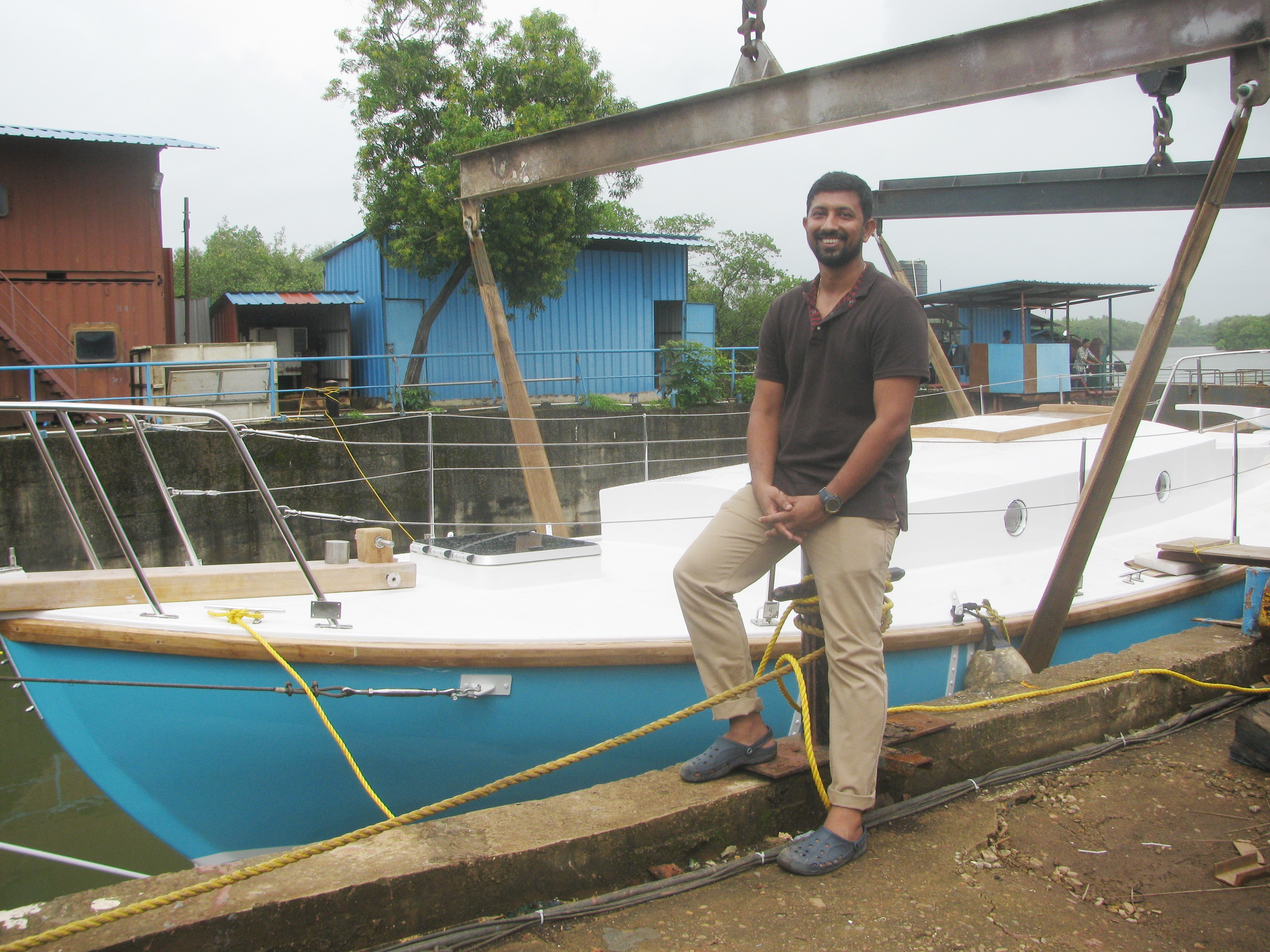
Abhilash with the Thuriya at Aquarius Shipyard, Goa; just before the boat’s launch (Photo: Shyam G Menon)

Abhilash was born in 1979. He belongs to the generation in India that grew up with computers and Internet. During the 2012-2013 solo, nonstop circumnavigation he accomplished on the INSV Mhadei – the first by an Indian – he had onboard the modern sloop (built by Aquarius), access to Internet and email, electronic maps, GPS and satellite phone. These are either absent or strictly regulated and meant for use under specified circumstances, in the 2018 GGR. According to the race website, every participant will get a standard Race Pack that will include a stand-alone satellite tracking system which the skipper cannot see but will be used for web tracking updates; a two-way satellite short text paging unit that will connect to race headquarters for 100 character-reports twice daily and a sealed box with a portable GPS chart plotter for use only in emergency. Denied access to modern technology, Abhilash will estimate his position at sea with a sextant; use printed navigation charts to plot his passage and gauge the submarine features of his neighborhood and rely on VHF and HF radio transmitters to communicate. In fact, so total is the clamp down on technology that even devices with inbuilt GPS like digital cameras, mobile phones and electronic watches are disallowed onboard in the race. Managing with the recommended alternatives is easier said than done.

Contemporary naval officers and sailors master the sextant during their training days. Thereafter it recedes to being an instrument you should know how to use; it isn’t what you use on an everyday basis for navigation, which is the stuff of computers and electronics. Abhilash, who is a naval aviator, will need to get used to the sextant again. And not just get used to it; he requires being good at it for it is all that stands between him and drifting off course in the world’s vast oceans. Further there is the question of which natural co-ordinates, usable with a sextant, the weather on a given day will allow sailor to see. Not to mention – don’t lose the sextant on small sail boat, no matter how harsh the sea. Speaking of which, no Internet onboard means no detailed weather reports from the outside world as well. Information on weather that is available as broadcast to mariners on HF and VHF radio will be the only reliable source. You can discuss weather conditions with passing vessels and fellow racers. But such meetings at sea are few on a circumnavigation route with much Southern Ocean involved. Getting weather from team managers will be unwise as it could be considered ` route-ing’ using information which is not generally available to the public. “ If the race management so decides they may give weather data to a specific boat, group of boats, or all boats. This would mostly be as a warning and not for improving performance,’’ Abhilash said. Challenges exist with the HF radio, the most easily comprehended of which is that unlike a telephone call that reaches intended person irrespective of where he / she is, radio communication is interactive only if both caller and receiver are available around their radio sets to connect. In planet of different time zones, this is not assured all the time. Similarly, the race has assigned a limit to how much fuel – for onboard engine – can be carried. The quest is to free up circumnavigation from its modern gadgetry, restore a touch of retro to it and make the ambiance match what the competitors of 1968 coped with. Doing so, you get a firsthand taste of what Sir Robin Knox Johnston and Bernard Moitessier accomplished. At the 2018 GGR, electronics are more with those overseeing the race from shore. The participants’ passage is monitored via satellite using these electronics. If things turn ugly and unmanageable at sea, Abhilash can open the sealed GPS onboard to determine his position. Doing so however, disqualifies him from the central category (the solo nonstop category) of the race. Onboard will also be a radio beacon; its activation indicating a given boat has most likely been abandoned.

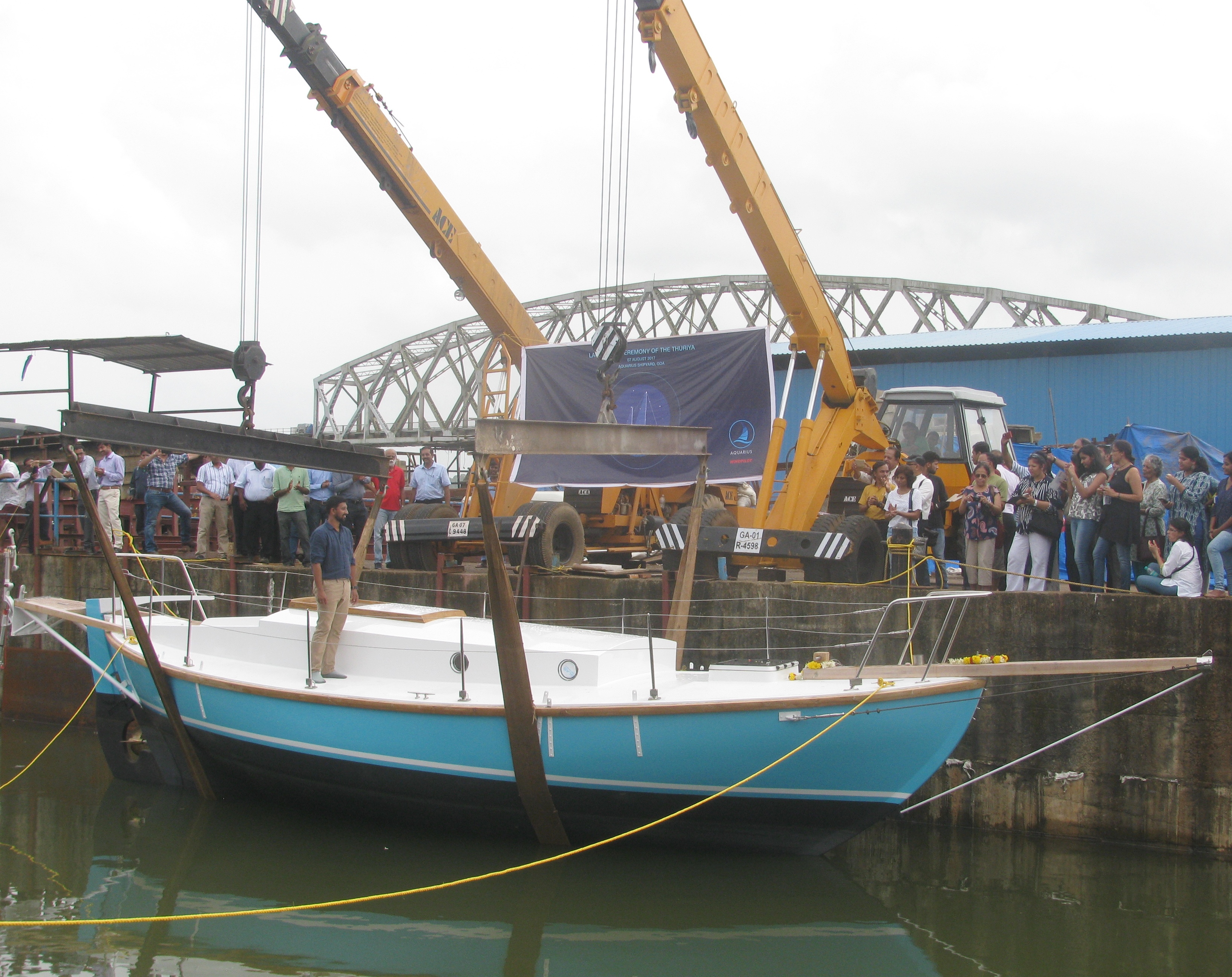
The Thuriya‘s launch ceremony in progress; Abhilash on the boat’s deck (Photo: Shyam G Menon)

The Thuriya touches water (Photo: Shyam G Menon)

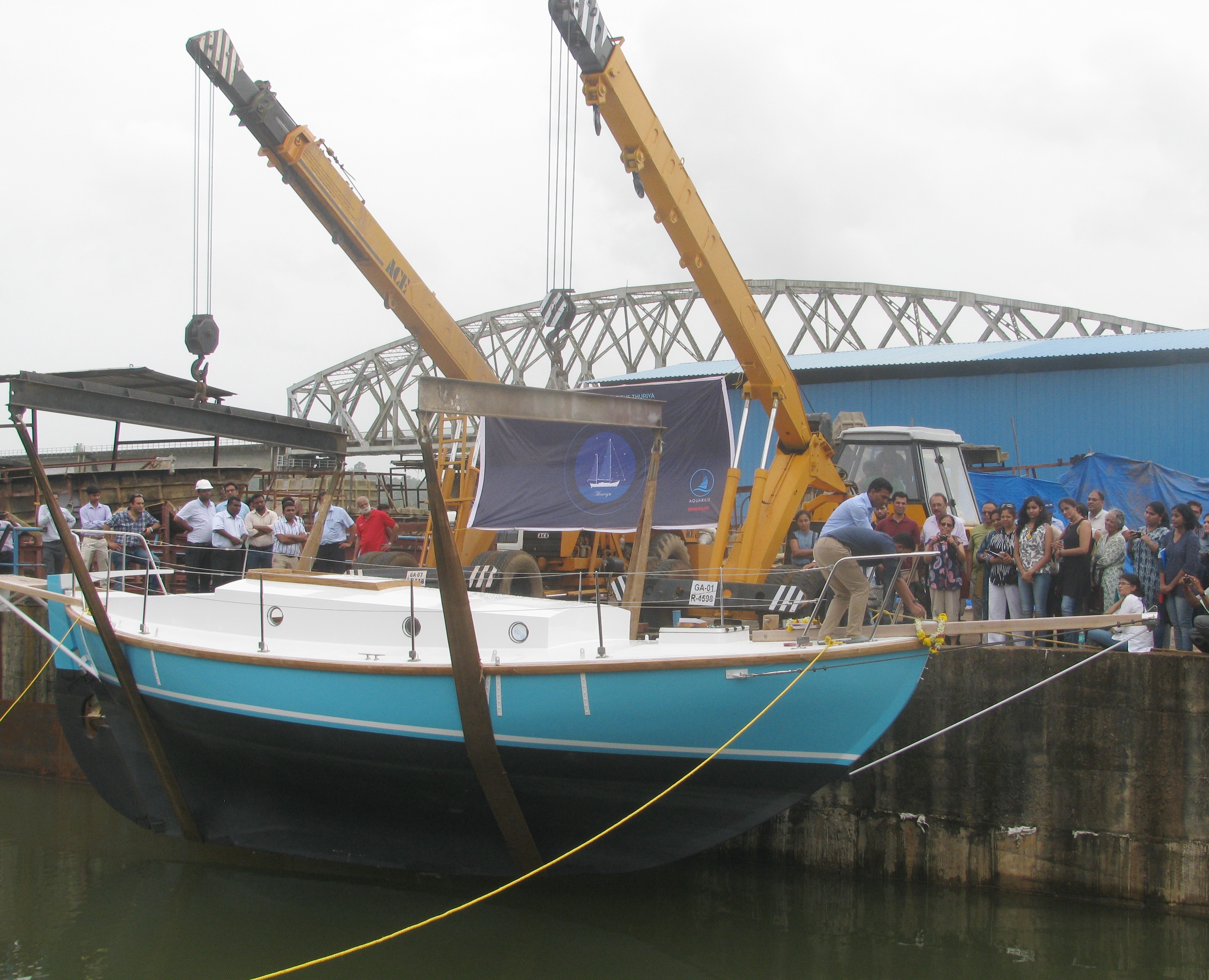
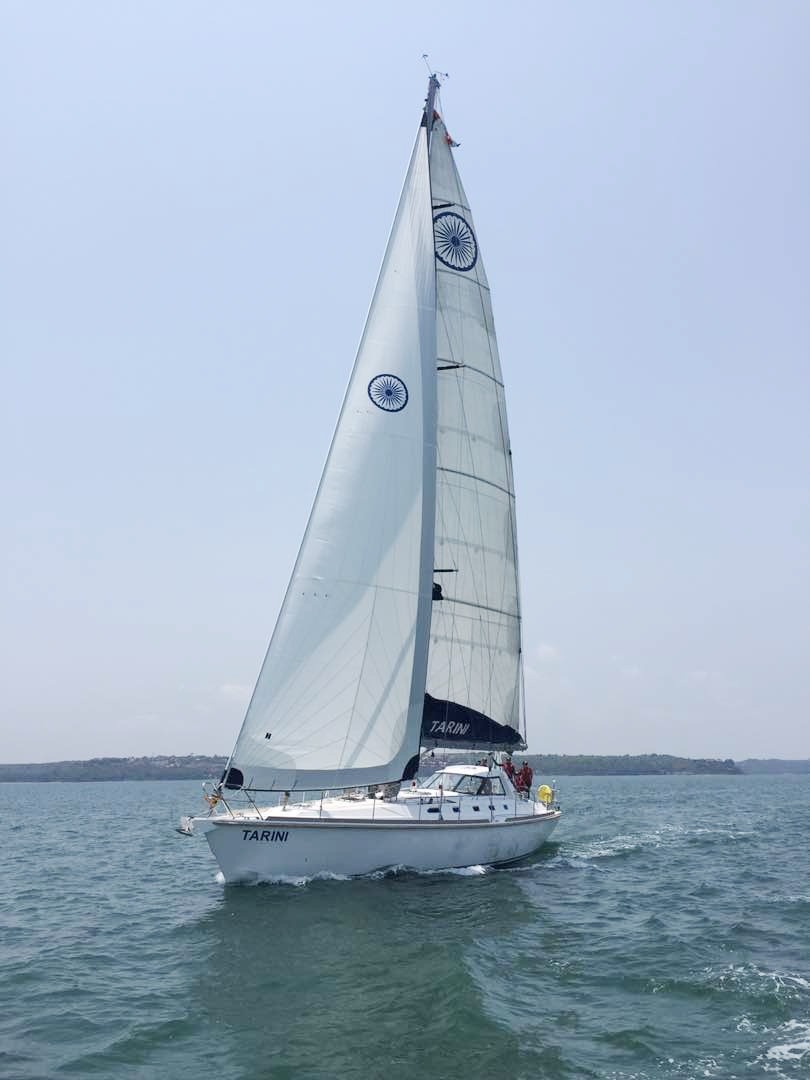
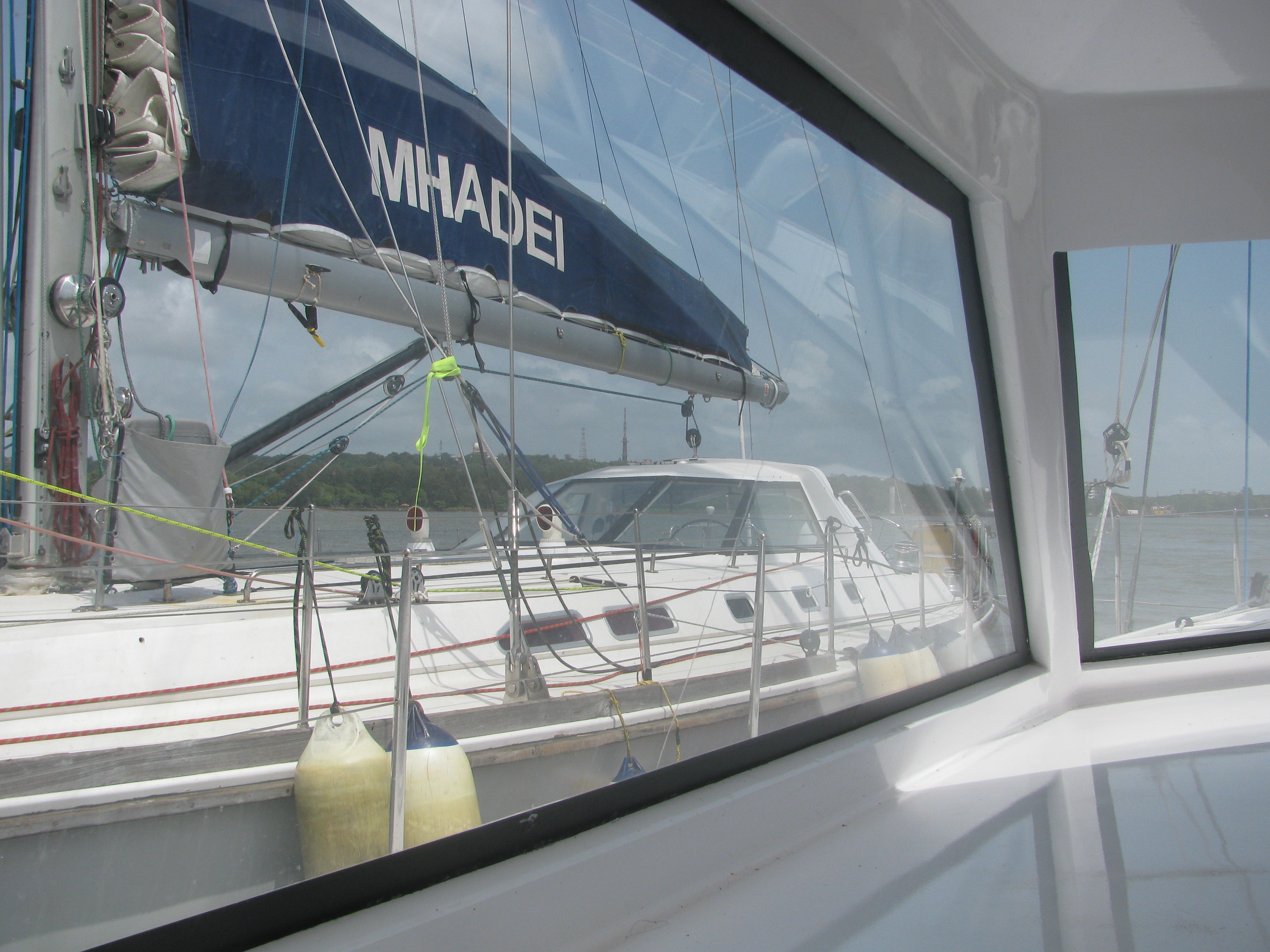
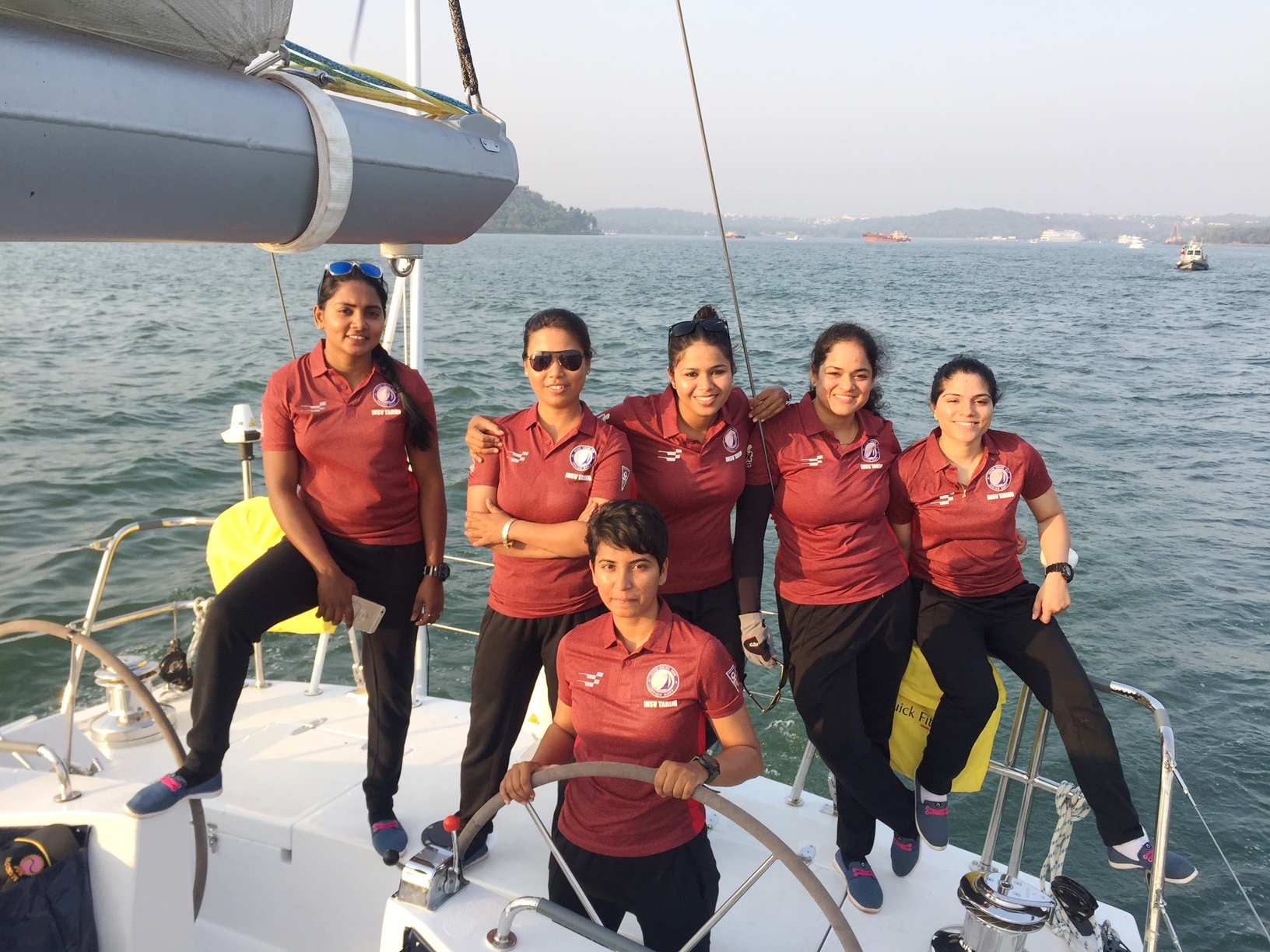
The evening of August 7, 2017, the Thuriya stood suspended by two cranes, inches above the Mandovi River’s water, let in at the drydock of Aquarius Shipyard. Every 15 minutes or so, a thundering sound – resembling that of an approaching helicopter – could be heard; it was the sound of trains passing by on the nearby bridge across the Mandovi. Aquarius is an unassuming yard predominantly making boats for the Indian military. It also caters to orders for boats from Indian state governments. The yard shot into limelight building the Indian Navy’s iconic sail boat – INSV Mhadei. A sloop, based on a Dutch design, it took two naval officers around the world on two separate circumnavigation voyages. The first was Captain Dilip Donde (Retd), who executed the first solo circumnavigation by an Indian. The second was Abhilash, who accomplished the first solo nonstop circumnavigation by an Indian. There are few boats around that have done back to back circumnavigations plus trans-Atlantic races and other voyages, as the Mhadei did. It is a testimony of her build quality and the care with which, former skippers like Dilip and Abhilash treated her that she did both these circumnavigations without any major problems. Aquarius later built a second sail boat for the navy, INSV Tarini, which is identical to the Mhadei and as of August 2017, was expected to depart shortly on the first circumnavigation of the world by a crew of Indian women. Despite tendering process that rewards the lowest bidder, Aquarius took on construction of sail boats because it is a demanding task. While most of us get carried away by the speed and flight of motorized craft, they are generally more forgiving of error in design and construction because the brute power of the engine compensates for such shortcomings (unless the idea is to build for a specific purpose, like very high speed to set a record). Harnessing wind is a different ball game. Here design and build quality genuinely matter; room for error is less. “ Making a sail boat is more challenging,’’ Ratnakar Dandekar, who owns Aquarius Shipyard, said.

When it came to a boat for the 2018 GGR, Abhilash made three notable decisions. First, he decided to build the boat in India, at Aquarius. He knew the yard would do a good job. Besides, the earlier two circumnavigation voyages had ensured that he, Dilip and Ratnakar, became a fine team. They understand each other well. For boat to sail, the organizers of the 2018 GGR had provided participants a variety of designs to choose from. They included Westsail 32, Tradewind 35, Saga 34, Saltram 36, Vancouver 32 & 34, OE 32, Eric (sister ship to Suhaili), Aries 32, Baba 35, Biscay 36, Bowman 36, Cape Dory 36, Nicholson 32, MKX-XI, Rustler 36, Endurance 35, Gaia 36, Hans Christian 33T, Tashiba 36, Cabo Rico 34, Hinckley Pilot 35, Lello 34 and Gale Force 34. One suggestion Abhilash received was that he buy a secondhand Saltram 36 and refit it to the retro norms of the 2018 GGR. This design of boat – originally called Saltram Saga 36 and designed by Alan Pape – is a classic long-distance cruising yacht. It is double ended (the fore and aft taper in similar fashion) and sturdily built. However locating good secondhand boats of said design overseas and then refitting them is both time consuming and likely, expensive. If the refitting is to be done at Aquarius, the boat would have to be sailed in from abroad, refitted and sailed to UK for GGR. If the refitting is done overseas, you don’t get any of the cost advantages attached to work done in India. The next option was to go in for fresh construction. So for second major decision, Abhilash resolved that the boat he would sail in will be a replica of the Suhaili. “ It was the only boat I could build in India and I was keen to sail a boat built in India. I had a conversation with Don McIntyre from race management. He said that for any other design, the construction would have to happen from the original mould. The only leeway was for the Suhaili replica, which could be built, brand new,’’ Abhilash said. The Suhaili’s design is called Eric 32; it was drawn sometime in the 1920s by William Atkin. The third decision was more personal. Abhilash had always wanted to own a classic sail boat. Few boats in circumnavigation are more classic and steeped in the discipline’s history than the Suhaili. Abhilash decided that he would be the owner of the new boat. By Indian standards, owning a boat costs a lot of money. Ever helpful, Ratnakar started constructing the boat for Abhilash in 2016, using his own funds. As the boat neared completion, Abhilash liquidated some of his investments and partly repaid Ratnakar; the idea is to repay fully in time. At around 5.56 PM on August 7, the blessings of the Gods sought, the cranes gently lowered the Thuriya and she kissed water for the first time.

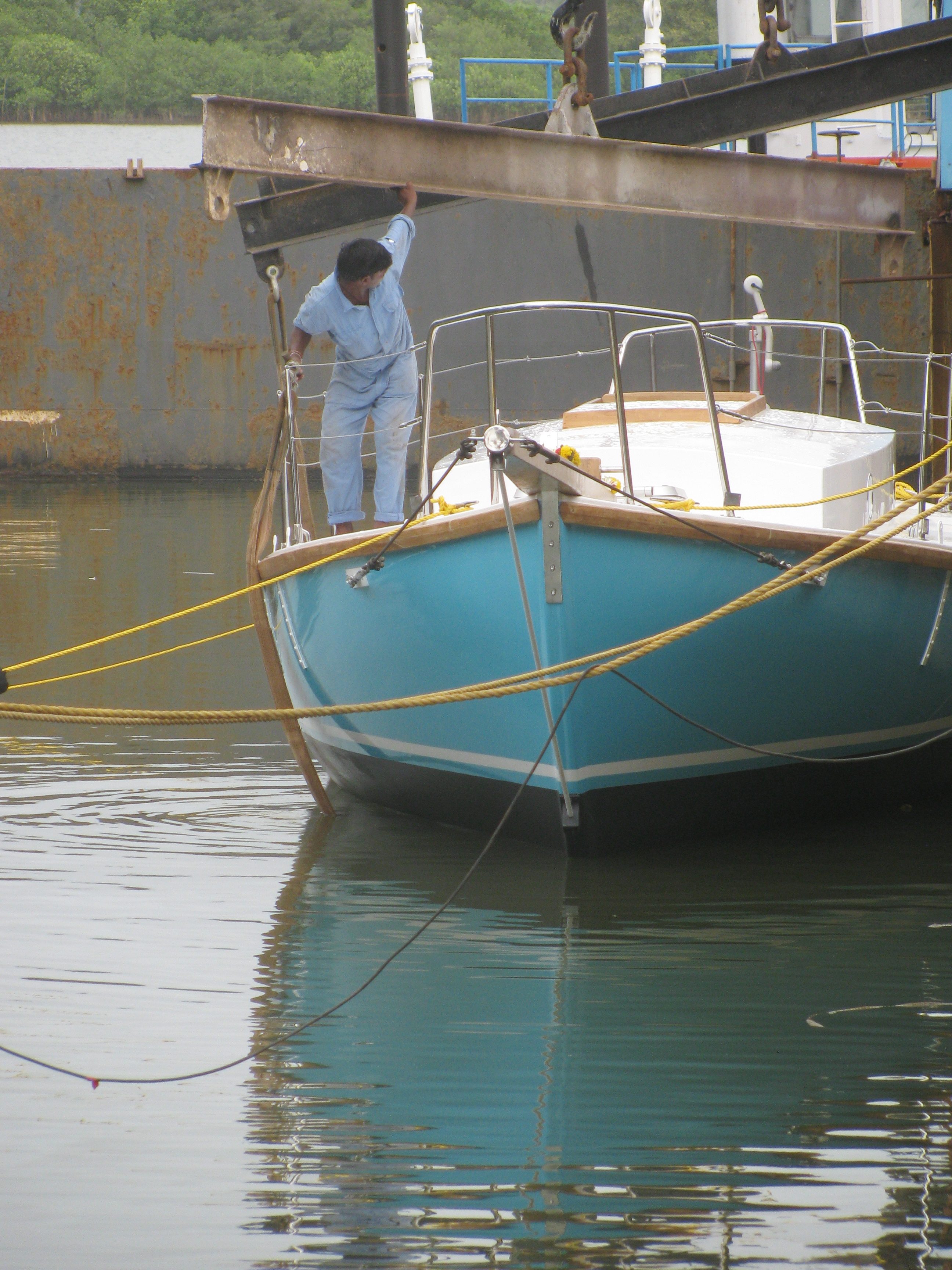
The Thuriya; crane slings being removed after the boat has been floated (Photo: Shyam G Menon)

All boat designs strike a compromise between stability and speed, depending on the purpose for which the boat is being acquired. So far, the bulk of Abhilash’s sailing has been on the Mhadei, which is a sloop, based on a design called Tonga 56. The Mhadei offers stability but she also offers adequate cruising speed on long voyages. Her hull made of wood core laminate; she has one tall mast and two sails. To the lay person beholding her, she has the sleek lines of a modern yacht. Her cabin with angular windows, rise prominently from the deck.  She is not double ended; her aft ends in an angled chop. She has a bulbous keel, laden with lead to act as counterweight in the event of capsize. “ The Mhadei is a big sail boat. She has lot of space within. If you load the boat, the percentage weight difference is less. Thanks to its high volume, it can ride down a wave at decent speed. Her upwind performance is also good. You can sail well into the wind,’’ Abhilash said. On the flip side, her sails are big and it is near impossible for a lone sailor to change the mainsail. Being a big boat, breakdowns are also tough to handle.

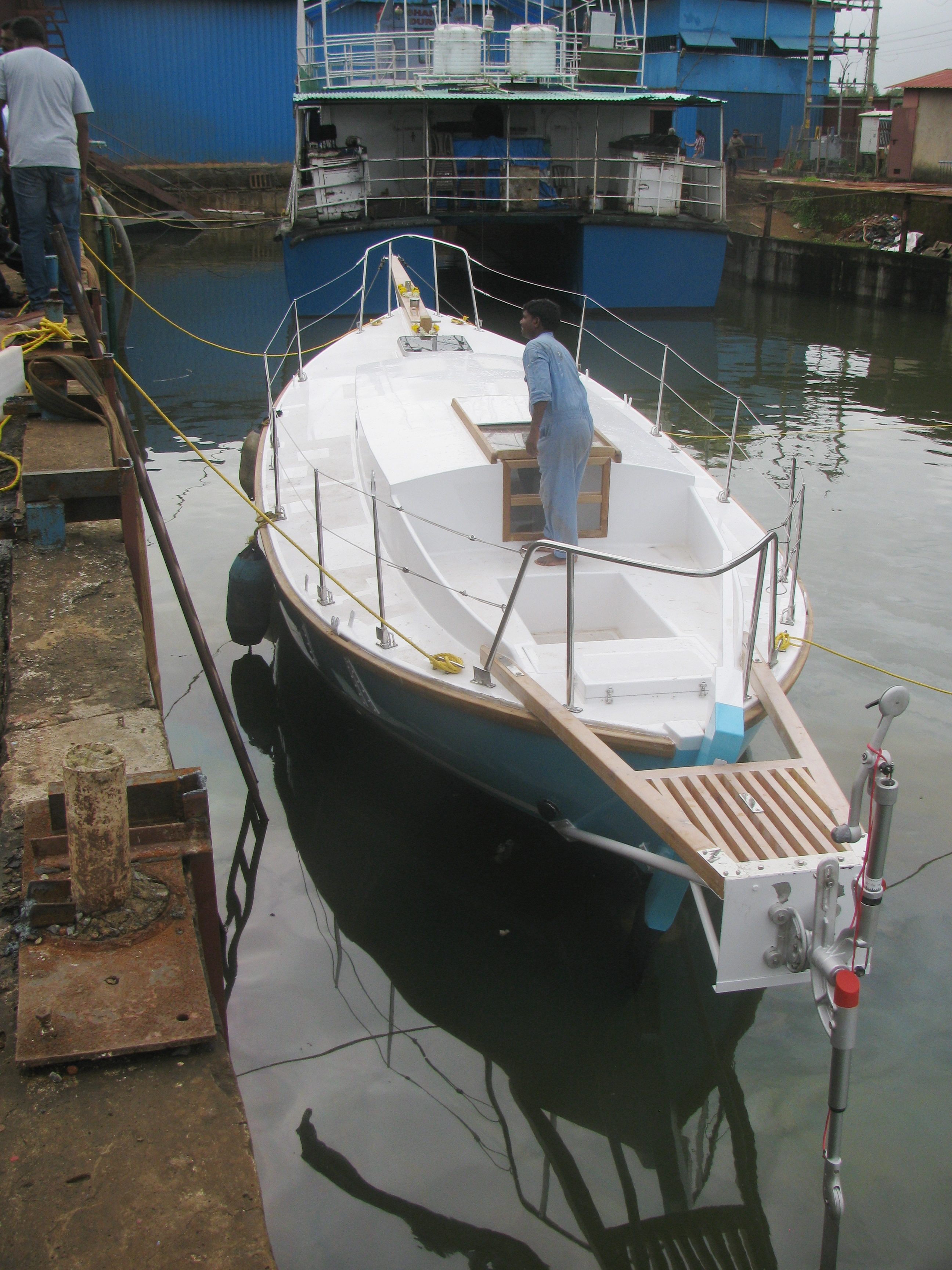
The Thuriya is a ketch. Much smaller, her Eric 32 design is roughly half the length of the Mhadei and her cabin sits sunk into the deck, rendering the cabin’s external profile almost invisible from far. The smaller size of the Thuriya made her trickier to build, Ratnakar said. She will have shorter masts. But against the sloop’s single mast, the ketch has two and between them they offer three sails. This doesn’t mean the sail area is greater; what it means is that the ketch is capable of harnessing the wind more precisely for greater maneuverability. The Thuriya’s hull is double ended and visibly squat. This aspect of the Eric 32 relates directly to design inspired by Norwegian fishing boats and which Sir Robin consciously chose when it came to the Suhaili, for his priority in the 1968 GGR was a stable, safe boat. Speed is not the forte of Eric 32; the Suhaili is a slow boat, as would most likely be, the Thuriya. Unlike Mhadei, which has two steering wheels on deck, the Thuriya is steered using a tiller. “ I prefer a tiller over a wheel. You can sit and steer the boat. Besides the tiller’s connection with the rudder is direct, unlike in the case of a wheel, which entails gears and transmission,’’ Abhilash said. Compared to the Mhadei’s two electronic and one wind driver autopilots, the Thuriya has one wind driver autopilot, donated by its manufacturer: WindPilot. Below the waterline, the Thuriya has a relatively straight keel needing less draft. The boat’s overall dimension is perfect for solo sailor venturing long distance; it is a compact ecosystem with everything at hand.

The Thuriya; view from aft, notice the small cabin, tiller and wind driver autopilot (Photo: Shyam G Menon)

On the flip side, a small boat cannot take a lot of weight and when you load it, the boat tends to slow down. “ The slower the boat, the more you need to carry because your voyage becomes longer. That’s an equation I will need to manage,’’ Abhilash said. Measured for length, the Thuriya is smaller than a modern 40 foot-marine container. From the bridge of a big ship with sizable real estate of deck stretching before it, small boats are difficult to notice. In their writings, sailors on small boats have highlighted the David-Goliath relation they tackle at sea, in world of ever growing ship sizes. Not to mention, the hazard of cargos and containers floating around after they fell off unnoticed from ships. Asked if the small size of the Thuriya and her lack of electronics added that much more pressure on solo sailor maintaining a watch at sea, he said that for most part the 2018 GGR’s circumnavigation route is still devoid of busy traffic. “ For example in the voyage on Mhadei, after crossing Sri Lanka, the first ship I saw was two and a half months later at Cape Horn. The next was one and a half months later, off Mauritius,’’ he said. Watch-keeping (staying awake, alert and on the lookout) requirements go up in and around shipping lanes and one problem is – ships are no more serious with watches as they used to be.

A special invitee for the 2018 GGR, Abhilash has rich experience in sailing and now, a boat. What he may be in short supply of is – time to get everything ready for the voyage. In the run up to his last circumnavigation, he had taken to living in the Mhadei to get used to the boat. Given shortage of time, it may not be possible to do that with the Thuriya. What he was certainly in short supply of at the time of writing this article was – sponsors. Between now (August 2017) and a month and half before commencement of the 2018 GGR, he needs to fit masts on the Thuriya (for which she has to first move past the low Panjim bridge to berths downstream from Divar), put her through her paces at sea, get a sense of her behavior, sort out teething problems, sail her to Cape Town on her first long voyage (and probably his, mimicking GGR norms), load her on a ship to the UK from South Africa and report as per schedule to the race organizers for formal introduction of boat and her skipper. Getting a sense of the Thuriya on the water is important for two reasons. First she is a ketch; there will be an element of transition to do from Abhilash’s previous experience on a sloop to handling a ketch. Second, the Thuriya is a replica of the Suhaili with one distinct difference. The Suhaili was made of teakwood. Repeating such construction in 2016-2017 would have been terribly expensive. The Thuriya is therefore made of wood core laminate, like the Mhadei. This makes her stronger and lighter. “ She could be a livelier boat,’’ Dilip, who will be the manager of Abhilash’s team for the 2018 GGR, said of the boat’s potential behavior on water. The use of wood core laminate for making a replica of the Suhaili is permitted by the race organizers. Going by the details available about participants on the race website, the most widely chosen design appeared to be Rustler 36, followed by Biscay 36, Endurance 35 and Lello 34. At one point in the run up to 2018 GGR, there were four Suhaili replicas planned, Abhilash said. As far as he knew, the Thuriya alone remains in the fray.

Expeditions go retro in a quest to relive original purity. Such instances are rare. Success in one’s time by all means possible, using everything that minimizes error and possibility of setback, is the dominant character of adventure in our crowded, competitive times. In mountaineering, alpine style climbing is an attempt to be light on the environment and also feel the challenge closer. But climbers still use the latest gear. Once in a while, in a documentary film of climbers from the past with contemporary climbers enacting days gone by, one sees the retro touch fleetingly. You could argue free soloing is retro because climbers dispense with gear altogether. But that isn’t retro; it is more defying risk. A whole expedition in retro style – that would be very rare although the rising aversion for consumerism has begun triggering a return by humans to simpler times. And as the sextant would show, simpler times are not exactly simple; they entail much work. I asked Abhilash if there are any trends emergent in the world of sailing, to go retro. According to him, current trends are all towards more and more expensive sailing. People aspire for costlier boats and yachts. Races are also getting more expensive. It is the full on, jazzed up version that sells. That said, retro allows sailing to be less expensive. It is also more challenging and given that, it may remain a niche pursuit by the adventurers among us.

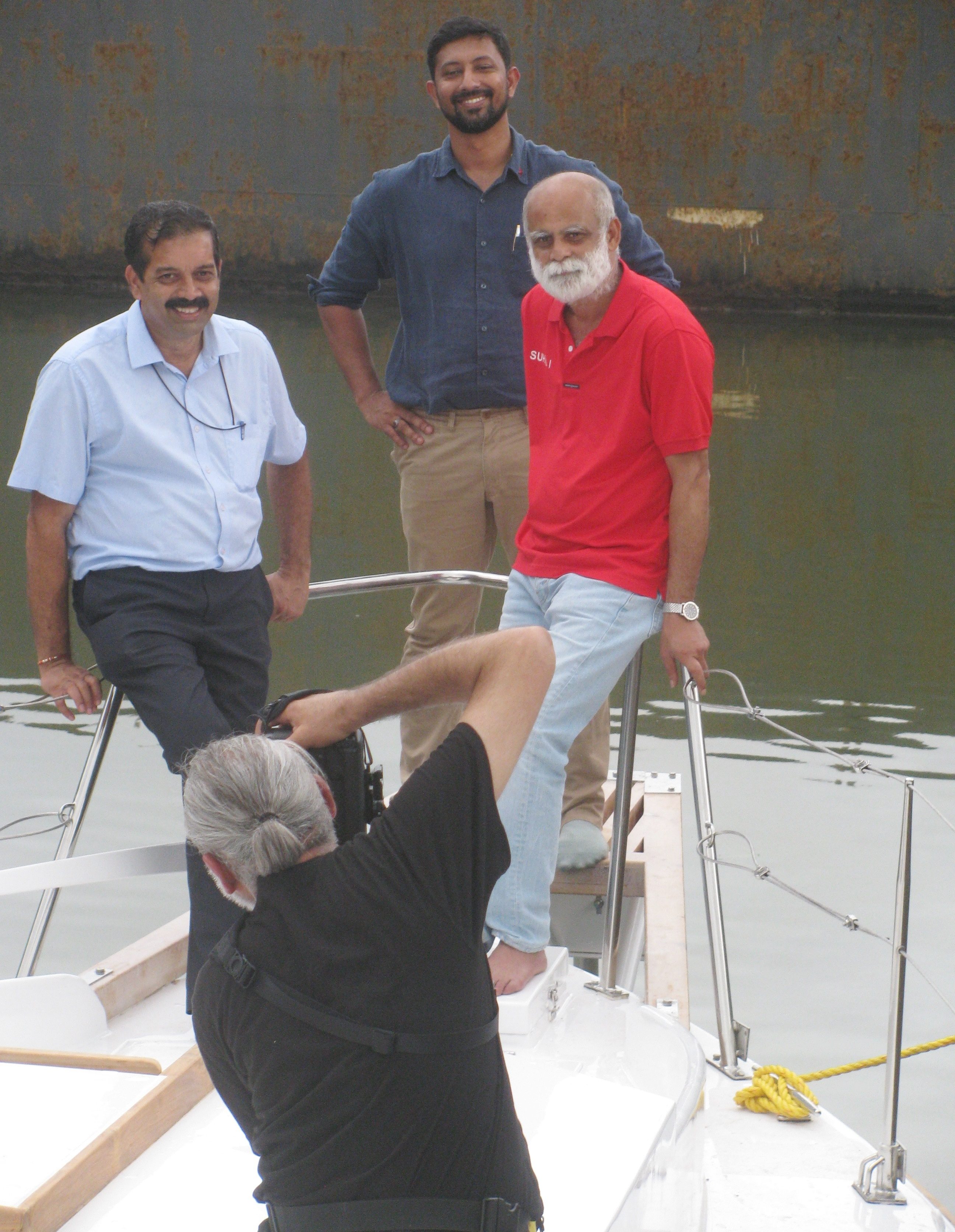
From left: Ratnakar, Abhilash and Dilip enjoy a photo session onboard the Thuriya (Photo: Shyam G Menon)

The 2018 GGR has parameters to differentiate finishers and provide a semblance of winner. Besides the Golden Globe trophies, Golden Globe plaques and total prize money of 75,000 pounds for distribution, those finishing before 15.00 hours on April 22, 2019 will receive a Suhaili trophy and refund of their entry fee. Anyone making a single stopover or forced to break the seal on their portable GPS chart plotter can remain in the race but will be shifted to the `Chichester Class’ (named after Sir Francis Chichester, who in 1966-1967 in his ketch, the Gypsy Moth IV, became the first person to achieve a true solo circumnavigation of the globe from west to east, via the three great capes; he made one stop at Sydney). They will get Chichester trophies provided they finish within aforesaid deadline on April 22, 2019. Anyone making two stops will be disqualified. “ In 1968, only one person finished GGR and he was the winner. In a race like 2018 GGR, you are a winner if you finish,’’ Ratnakar said.

(The author, Shyam G Menon, is a freelance journalist based in Mumbai.)

SEBASTIAN XAVIER OR WHAT OUR SWIMMING COULD HAVE BEEN

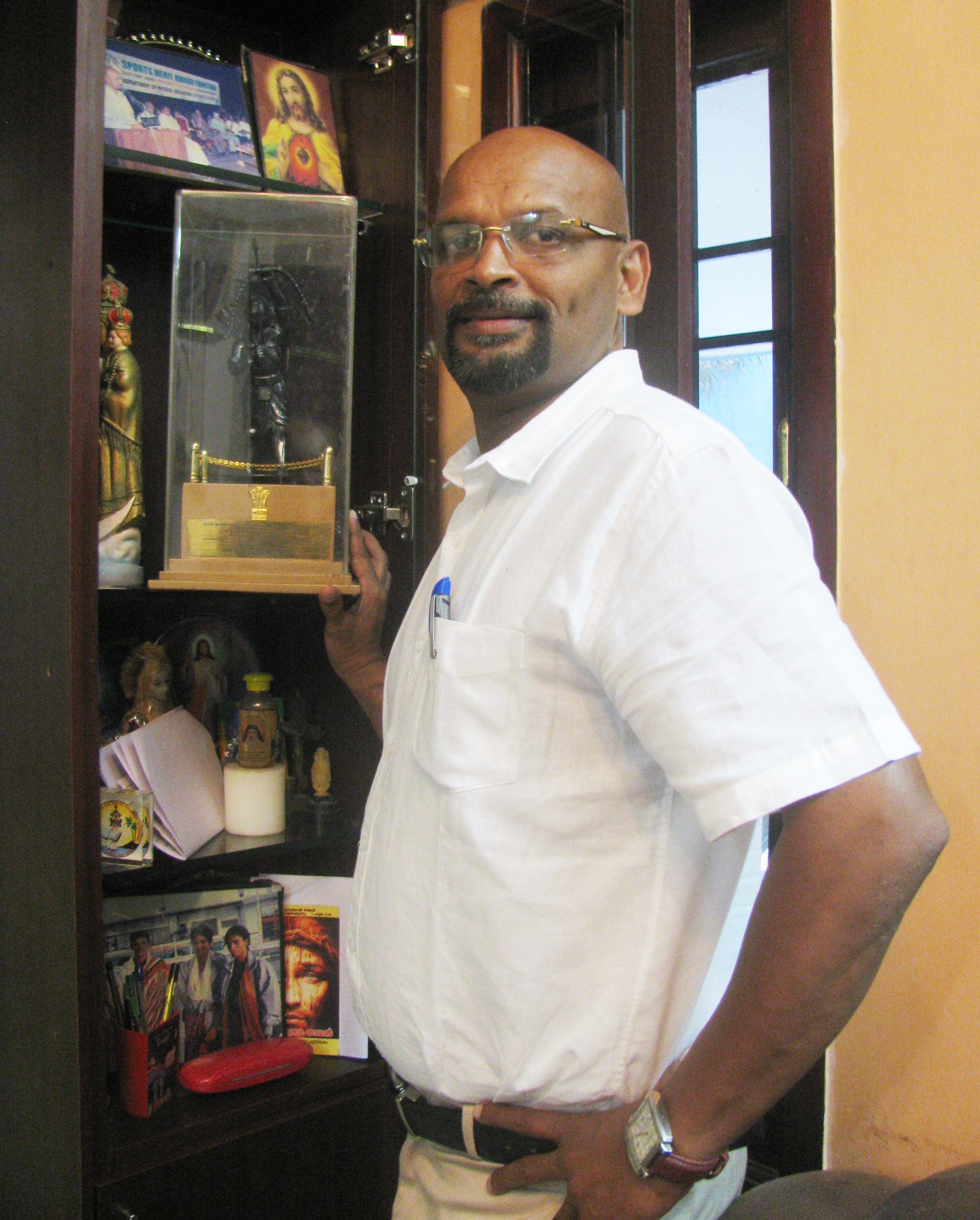
Sebastian Xavier at his house in Chennai; on the shelf, the Arjuna Award (Photo: Shyam G Menon)

Kuttanad is the region with lowest elevation in India.

On average it is seven feet below sea level.

Its origins are obscure.

One version says that it was forest reduced to ashes in a fire, inspiring the name Chuttanad, later corrupted to Kuttanad.

The place is an intense mix of water and vegetated land; rivers, canals and backwaters abound in the region. Human life tracks this ecosystem. Many houses still have waterfronts, families own canoes and until recently, it was common for everyday supplies and even letters, to arrive by canoe. Ever since a childhood visit to Thalavady faded to hazy memory of traveling by canoe, my only encounter with Kuttanad had been crossing the Thottappally Spillway near Ambalappuzha; part of many journeys between Thiruvananthapuram and Kochi via NH 47.  The spillway lets out excess water coming from upper and lower Kuttanad. As you crossed the spillway, you gazed inland and remembered: all that and beyond is Kuttanad. Early July 2017, it rained as the state transport bus from Thiruvananthapuram to Kochi, sped along NH 47. I had been instructed to get off at Haripad and take a bus for Edathua. There is a reason why you don’t sense Kuttanad on NH 47. It is a coastal highway and although the Thottappally Spillway separating the saline water of the estuary from the fresh water of Kuttanad is on the highway, as ambiance, it is the sea’s nearness which dominates. That receded as the bus to Edathua turned off NH 47 and made its way into the interiors. For a while now, I had wanted to see Edathua. It was a trip beginning in a conversation in Chennai.

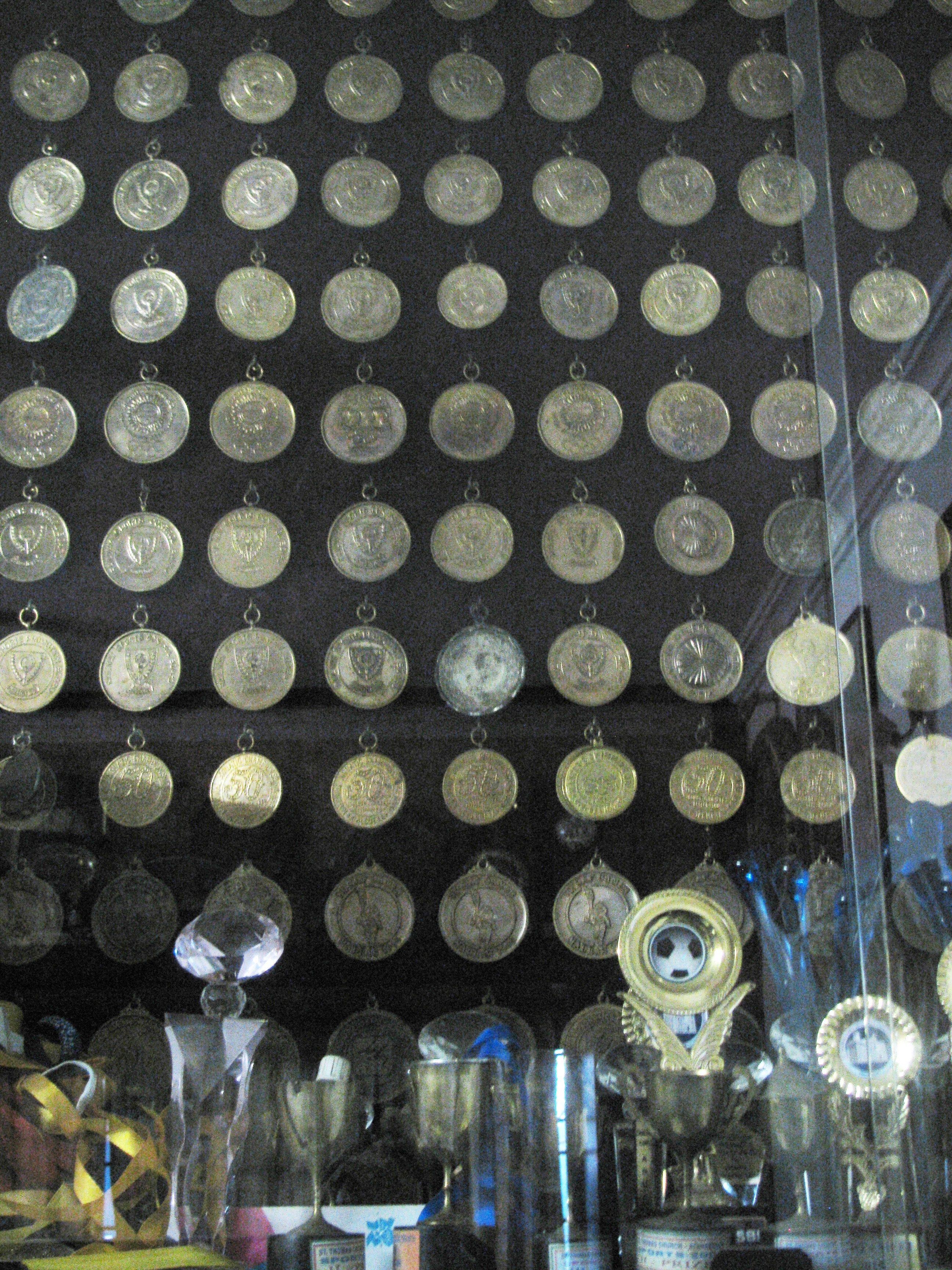
The shelf with medals (Photo: Shyam G Menon)

Amateur runners love their medals. Some hang them from display stands, a collection growing over time. Never before had I seen a shelf like the one I saw that evening in Chennai. It was full of medals. To one side was the coveted Arjuna Award. At my request, Sebastian Xavier posed for a photo beside the shelf. He was easy to talk to. But getting him to talk about swimming wasn’t easy; it appeared a business he was done and over with. He enjoyed more his daily sessions on the shuttle court. We were first at his office at the Integral Coach Factory (ICF) in Perambur and then his house nearby. That’s where the conversation began; it continued to conclusion and curiosity for Edathua, on a ride into town on his newly acquired SUV.

Sebastian is among India’s best swimmers. He was the country’s fastest swimmer from 1989 to 2000 and his national record of 22.89 seconds in the 50m freestyle stood for thirteen years from 1997 to 2010. Born 1970, he grew up in Edathua. It was an ecosystem dominated by water. The Pamba River nearby was a natural swimming pool in Sebastian’s childhood. In land with a river, pond or canal at every turn, swimming was as normal for a person born here, as walking was for those in dry cities averse to wetting feet. “ It was routine to be out and if you found a river or water body across your path, strip, hold your clothes high in one hand and swim across,’’ Sebastian said. There was also another reason for the widespread and maybe, enforced acquaintance with water. This was a region that flooded easily in the monsoon. While these days, you have roads and multiple means to be saved, in days gone by, one had to take care of oneself. Knowing how to swim was hence a skill, core to survival. Sebastian’s father was a school teacher; his mother, a housewife. The family was large – they were eleven children, Sebastian was the tenth. The family house has swimming depicted on its gate. There’s a reason for it. While Sebastian and his younger brother, Antony S. Manamel, became well known competitive swimmers, his father in his schooldays had participated in swimming competitions. Swimming ran in the family. “ In my father’s schooldays, the prizes given out used to be a comb, a soap box…’’ Sebastian said. His own first swimming competition happened once he joined college; St Aloysius College in Edathua.

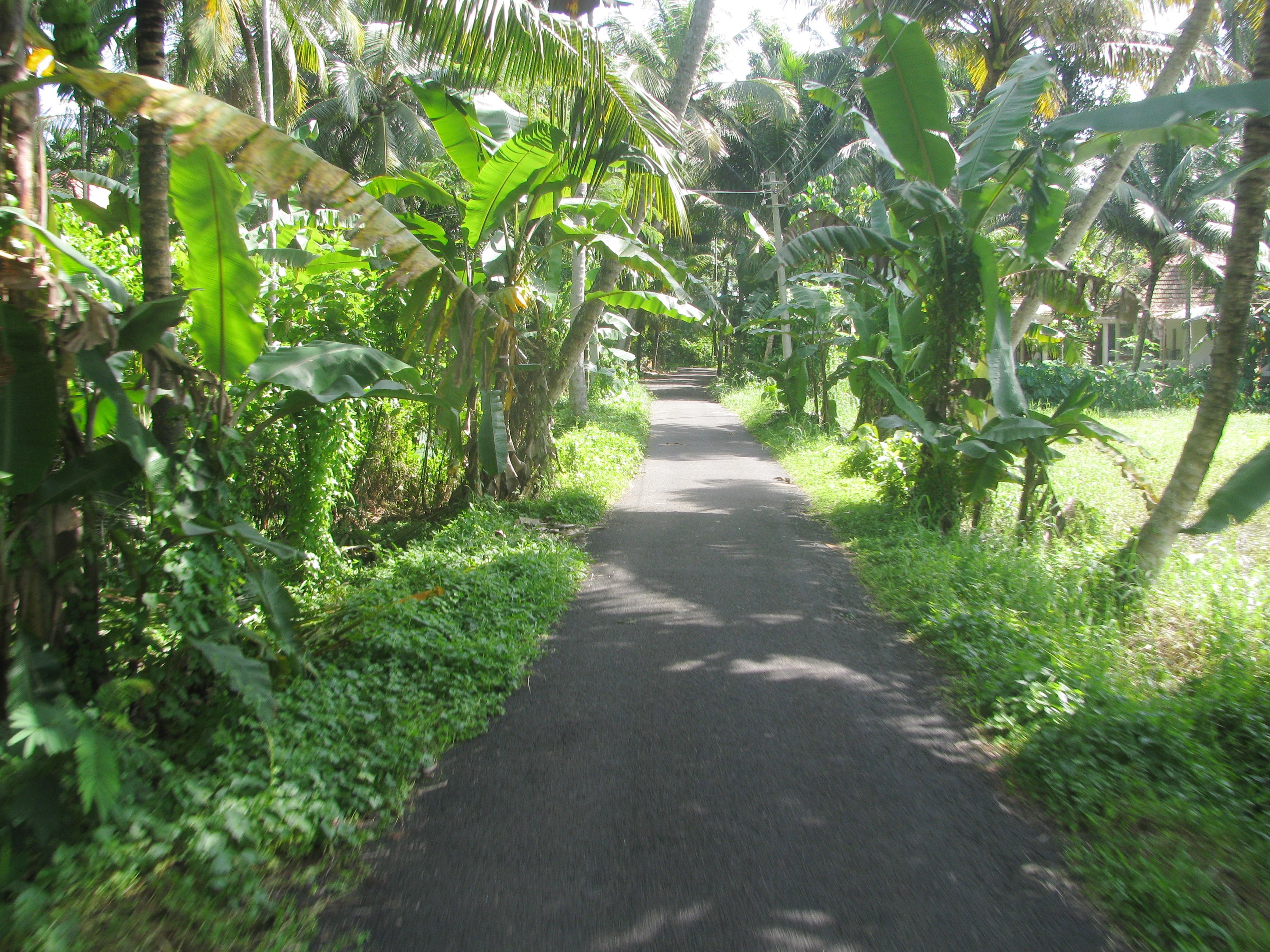
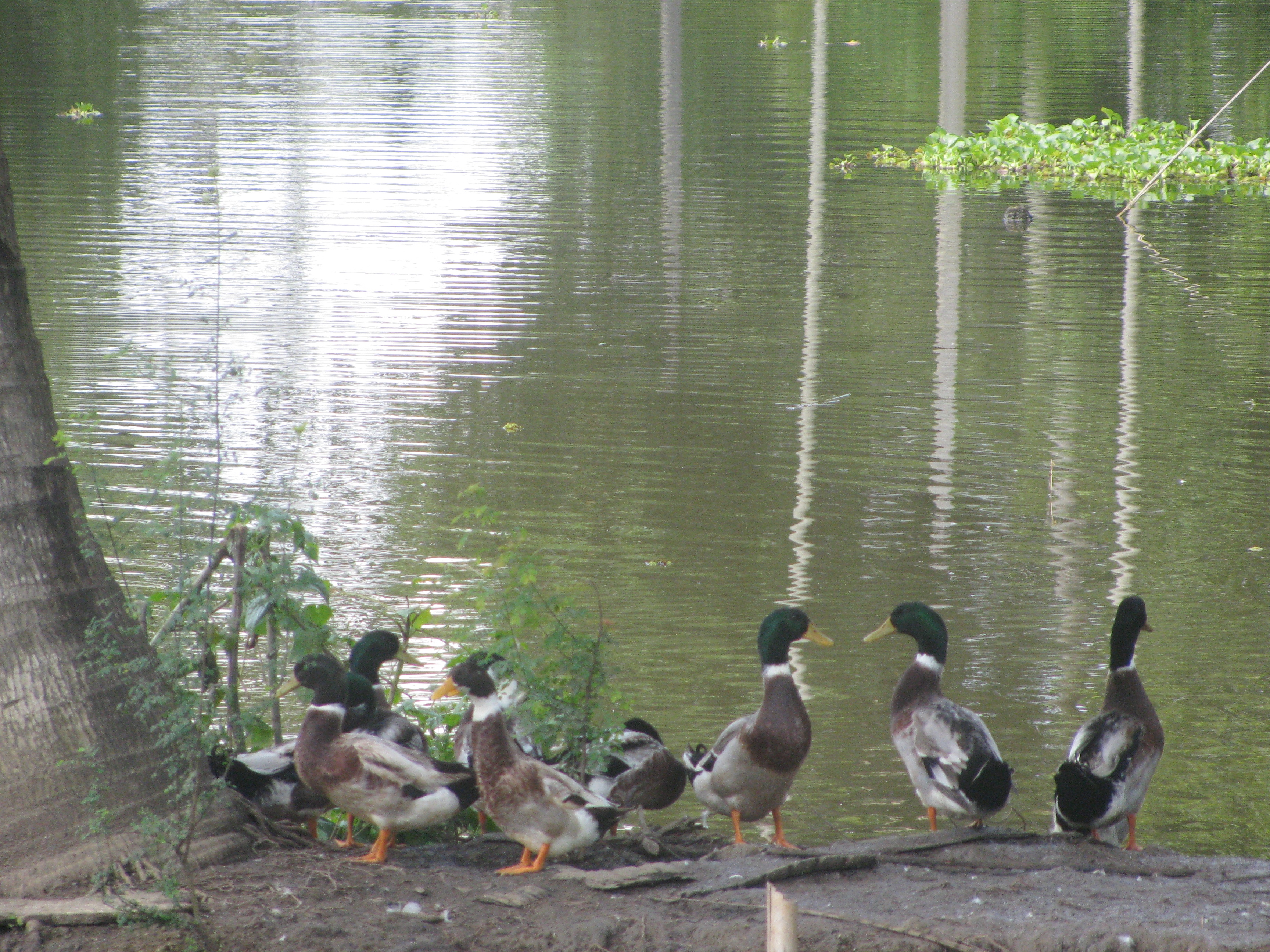
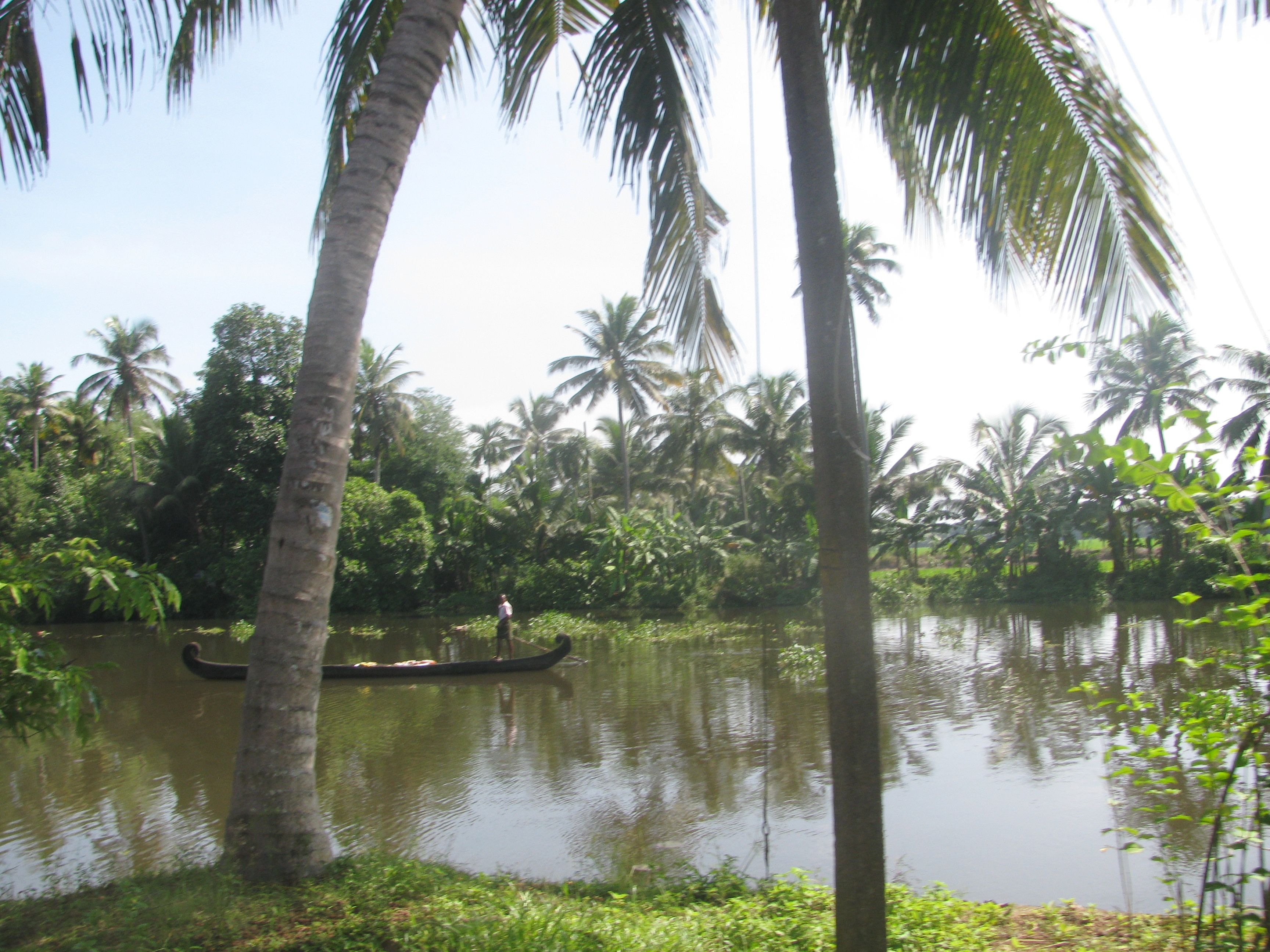
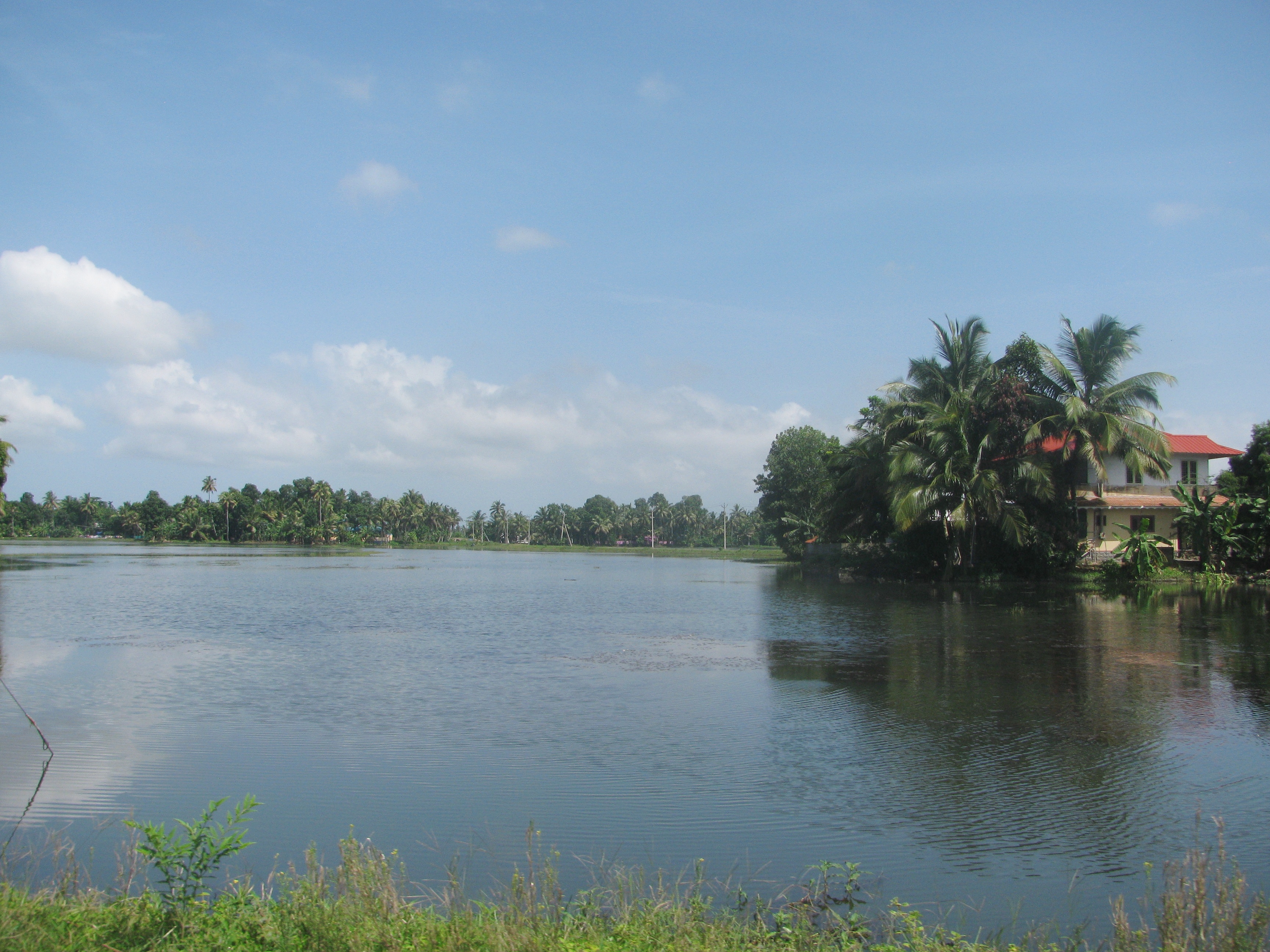
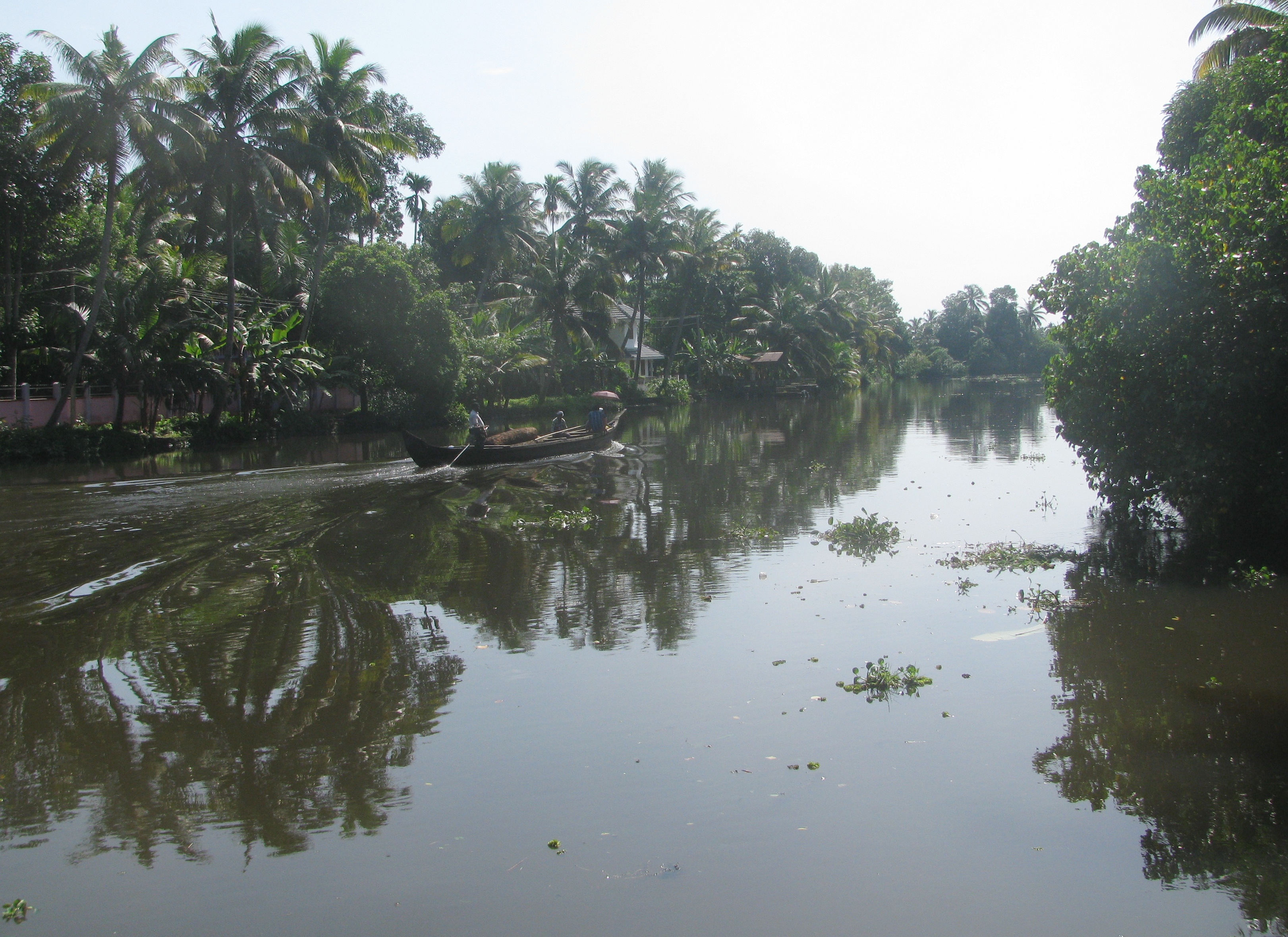
Edathua / Kuttanad (Photo: Shyam G Menon)

Edathua / Kuttanad (Photo: Shyam G Menon)

Edathua / Kuttanad (Photo: Shyam G Menon)

Edathua / Kuttanad (Photo: Shyam G Menon)

Kuttanad straddles three districts – Alappuzha, Kottayam and Pathanamthitta. Some 28 kilometers away from Kottayam town is Pala, one of the biggest settlements in the district. A prominent college here is St Thomas College. From St Aloysius in Edathua, “ Antony sir’’ used to take Sebastian and others to St Thomas College. “ They had a 50m pool. It had no tiles or anything like that. But it was the first swimming pool I saw in my life,’’ Sebastian said. St Aloysius didn’t have a pool. What it had instead was a kulam, which is how ponds are called in Kerala. Training in Edathua was a combination of swimming in the college pond and swimming in the Pamba River. The latter used to be periodically overseen by T.J. Thomas Thoppil, who was a coach with the university. Talent can’t be held down by limitations in local ecosystem. Sebastian gained selection to the university swimming team. Interestingly, his family was not happy with this development. It was his brother-in-law, Appream Thundiyil, who gave him the moral support and confidence to proceed. At an inter-university meet in Kolkata, the team Sebastian was part of, got silver in relay.

The Pamba River near Sebastian’s house (Photo: Shyam G Menon)

Theoretically, freestyle in swimming signifies the freedom to choose any stroke style for competitive swimming. The style most used is the front crawl, which delivers the greatest speed. Sebastian’s preferred genre has always been freestyle. It was nearest to the sort of swimming he grew up with and which, he could refine. There was no experienced swimming coach constantly observing wards and deciding what style suited who best. He went along with freestyle and ended up recognized in it. The choice of 50m freestyle however, was due to a specific reason. Fifty meters is the length of an Olympic-sized swimming pool. It is one lap. Longer distances in pool based-swimming are done using multiple laps. Sebastian had a weakness. He couldn’t efficiently somersault in water at the end of a lap and commence the next one. He would instead touch the pool’s end with his hand and turn around. Poor technique means time lost and in competition, efficiency and time are everything. On the other hand, compared to others around, he was blistering fast in a first lap. That’s how his shift to 50m freestyle, swimming’s equivalent of track and field’s 100m-dash, occurred. For many years now, Kerala has churned out good swimmers. The country’s first sub-one minute finish in 100m freestyle came from Kerala.

In 1987, Sebastian emerged first in 50m freestyle at the junior nationals. A year later, he joined the Indian Railways as an employee. His first national camp in swimming was after he joined the Railways. In 1988, he placed second in the nationals behind Khajan Singh. Hailing from Delhi, Khajan Singh was India’s most prominent swimmer at that time. He was known to sweep medals at the national competitions he participated in. In 1986, he also won a silver medal at the Asian Games, the first time since 1951 that India won a podium finish in swimming at the event. For Sebastian, 1989 was the turning point. That year at the SAF Games in Islamabad, Sebastian beat Khajan Singh to win gold. From then on for several years, Sebastian dominated the pool in disciplines he participated in, much the same way Khajan Singh had done earlier.

Illustration: Shyam G Menon

Sebastian’s chosen discipline – the 50m freestyle – has a history of presence at the Olympics that is younger than him. According to information on the Internet, at the games of the Third Olympiad held in 1904 in St Louis, USA, there was a 50-yard (45.72m) freestyle race in swimming, held in an artificial lake at Forest Park. Although Zoltan Halmaj of Hungary won the race, an American judge declared Scott Leary of the US winner, leading to a dispute. In the re-race, Halmaj won by a full stroke. The modern swimming pool – made to Olympic dimension – marked its debut at the 1908 London Olympic Games. Despite 50-yard race four years earlier in St Louis, there was no 50m sprint event in the pool at London. In fact, there was none for the next 80 years. Then in 1988, when Sebastian was 18 years old and joining the Railways as a promising swimmer from Kerala, the 50m freestyle was formally introduced at the Seoul Olympic Games. That year, 23 year-old US swimmer, Mathew Nicholas Biondi (Matt Biondi), picked up the first Olympic gold in 50m freestyle with a new world record of 22.14 seconds. But the man whose name would be most associated with the discipline was the Russian swimmer Alexander Popov aka “Russian Rocket.’’  He struck gold at the 1992 and 1996 games. Wikipedia has compiled the last 26 instances of world records established in 50m freestyle. It starts with the record set in 1976 by Jonty Skinner of South Africa; 23.86 seconds and ended (at the time of writing this article) with the 2009 timing of Brazil’s Cesar Cielo, 20.91 seconds. For eight years from 2000 onward, the record set by Alexander Popov ruled. Then over 2008-2009, timings sharply dipped to the current world record of 20.91 seconds. This dip coincided with the introduction of polyurethane swim suits, which have since been banned from competitions.

At 46 years of age in 2017, Sebastian Xavier is still fit and well built. He sports a shaven head, something he probably made a regular practice of, given he was losing hair due to extended exposure to chlorine at Indian swimming pools. Although above average in height, he isn’t what you would call – tall. If you probe excellence in sports, it can at times be rather disheartening. As competition heated up, sport started to ruthlessly favor those with physical gifts suited for it. The most obvious example is basketball; it has become a game of giants. In news from the swimming pool, the first depiction of a man built for the sport was probably the highly successful German swimmer Michael Gross. He was six feet, seven inches tall. More importantly, his long arms gave him a total span of 2.13 meters (six feet nine inches) that he was affectionately called `The Albatross’ by the media. By the time we reach Michael Phelps, the greatest swimmer yet, physical features are even more supportive of chosen sport. Phelps has a torso that is longer than his legs, which coupled with his big, paddle like-feet and reach, make him a phenomenon in the pool. Matt Biondi who won the first Olympic gold in 50m freestyle was six feet seven inches tall; Alexander Popov stood six feet five inches. The least Sebastian could have done in his days in the pool at the vanguard of a ruthlessness emerging in sport, was train hard and focus on technique. He had the talent. He needed a good coach; someone who noticed where Sebastian was placed in the sport and devised the best possible approach. In 1990, he experienced the benefits of good coaching first hand. That year, according to Sebastian, a German coach had come to train Indian swimmers at the invitation of Sports Authority of India (SAI). Thanks to that individual, Sebastian succeeded in cutting off at least 10 seconds from his timing in the 200m freestyle.

Illustration: Shyam G Menon

Unfortunately, the German coach was more aberration than new trend. Tracking the classical Indian story of how we treat the talented in our midst, Sebastian had to continue self-made. Years before, nobody advised him to shift from 100m to 50m; he noticed his limitation and decided to switch. Having moved to 50m freestyle, focused coaching still eluded him. Being a sprint event, the 50m freestyle is quite unforgiving. Sample for instance, Sebastian’s national record of 22.89 seconds in the 50m freestyle and Biondi’s first Olympic gold in that discipline with 22.14 seconds. There are dozens of top notch swimmers losing out in those sub seconds. That’s how closely placed and closely fought the 50m freestyle is. If you look at the discipline closely, there is the half of power packed swimming in water and there is the less highlighted half, but one that is absolutely critical – the dive into the pool, which is wholly a case of powerful launch from land, streamlined flight through the air and equally streamlined entry into water. “ The points to focus on are – good start and good finish,’’ Sebastian said. Unfortunately in Sebastian’s best days, there was no concept of specialization in Indian swimming. This is a trend in Indian athletics at a larger level. Country, state and employers – they all want to extract the maximum number of medals out of their athletes. Inevitably this results in athletes breaking specialization and participating in disciplines close to what one is doing. Medals won justify the practice. It is a vicious cycle. It is a completely different matter, if you view this from the perspective of training. To understand the specific training needs of 50m freestyle, one has to first accept that the 50m freestyle is different from other disciplines in swimming. If you don’t notice distinct disciplines in the first place, how will you notice the specific training needs in each? Incredibly at training camps, according to Sebastian, his daily swimming regimen and that of someone attempting the 1500m freestyle discipline; were kept the same. One was clearly sprint; the other clearly endurance – yet there was little distinction by officialdom.

Illustration: Shyam G Menon

At the 1994 national swimming competition in Goa, Sebastian participated in eight disciplines winning gold in all. His timing in the 50m freestyle qualified him for participation at the upcoming 1996 Summer Olympics in Atlanta, USA. He trained at Delhi’s Talkatora stadium. He trained as hard as he could. Yet again, he had no personal coach; none to point out his strengths and weaknesses in the pool. “ When you train for the Olympics, you should train with athletes whose performance pulls up your own. I was the national champion. I trained for Atlanta with the Delhi district swimming team for company,’’ Sebastian said. At the Olympics, Sebastian was eliminated in the first round itself. The eventual gold medalist in 50m freestyle at Atlanta was Alexander Popov. He became the only male swimmer in Olympic history to defend titles in both 50m and 100m freestyle disciplines. Popov had won gold in these disciplines at the 1992 Barcelona Olympics too. Participating in the Olympics is typically the pinnacle of any athlete’s life. It is so for Sebastian too. Except; he doesn’t talk much about it. I fished for details. I flashed that classic journalist question from our TV ridden-times: what did it feel like to be at the Olympics? “ I became an Olympian. I wasn’t otherwise satisfied,’’ he said. Asked what kept him going for so long despite the disadvantages he faced, he said, “ in the initial years it was tapping into a God given ability to swim well and leveraging the natural affection for water, life in Edathua and Kuttanad gave me. Later, there was support from family and my employer, the Indian Railways; every time you won something big there was an increment or promotion at work. I was thus moving from one competition to the next. Olympics was never in the plan. It just happened. But the reason I maintained my good performance in India for so long is that once you are national champion, you have to work hard to stay so. Those in second, third or fourth position have nothing to lose and only being better to gain. When you are on top it is that much more a challenge and you have to sweat it out to keep your lead. ”

It is now many years since Sebastian retired from competitive swimming. Back in Edathua, he has built a house next to his family home. The last nationals Sebastian took part in, was at Kolkata in 2003. He has also stopped swimming for his employer, the Railways. Besides the lack of a good coach, the varying standards of Indian swimming pools (now it is better) have taken a toll on him. In his time, pools rarely adhered to required water temperature and chlorine levels. High chlorine levels resulted in hair loss and affected Sebastian’s skin and teeth. During the peak of his career, he used to swim up to 10 kilometers in the morning and 10 kilometers in the evening. For five years, he played the role of a coach in swimming for the Railways. He is not keen on that role too. In the SUV he was driving through Chennai’s evening traffic, he was happiest talking of his daily rendezvous with the shuttle court. Swimming seemed distant, almost locked away.

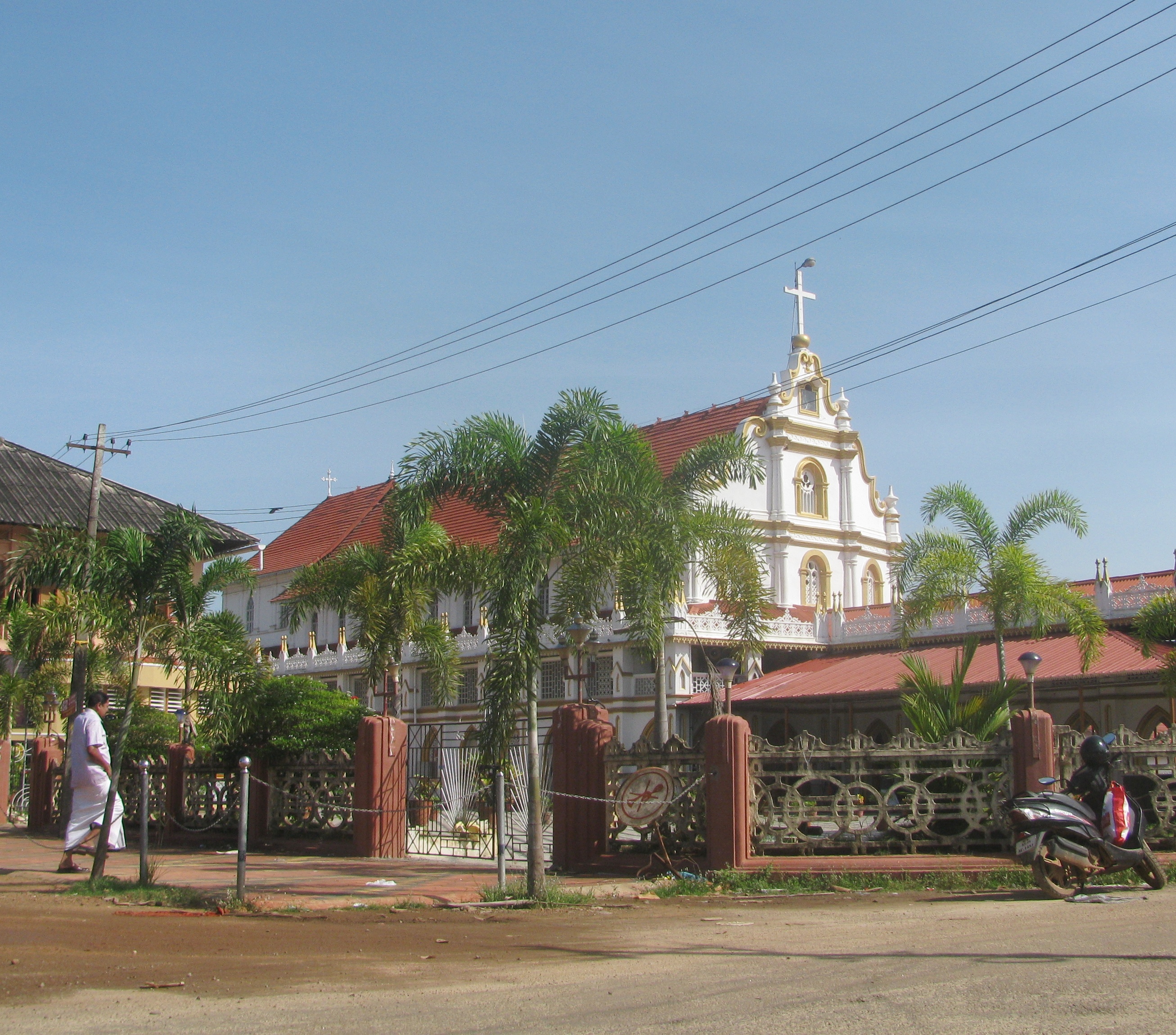
The church at Edathua (Photo: Shyam G Menon)

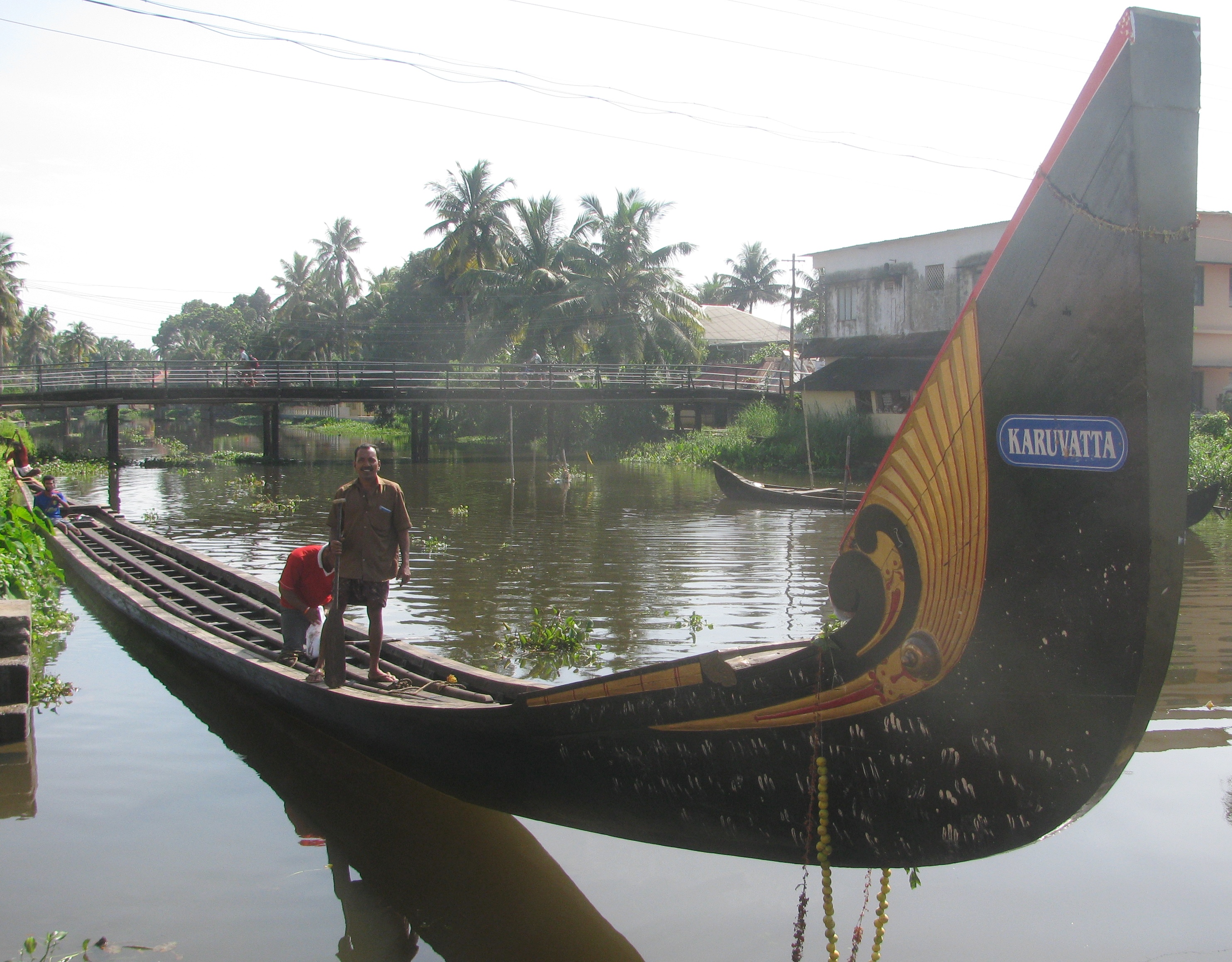
The snake boat `Karuvatta’ (Photo: Shyam G Menon)

The bus to Edathua rattled on through the countryside.

Soon after we turned off NH 47 at Haripad, the geography Sebastian grew up in began revealing itself. A sense of low lying land took over for not only was the scenery increasingly featuring canals in it but most of the land around had also become giant puddles of water in Kerala’s season of rain. The courtyard of houses held a film of water, the land outside its gates had collected water and the road, the bus was on, stayed above it all like the snout and spine of a partially submerged crocodile. The landscape was lush green. Roughly an hour later, I passed St Aloysius College. It was still early days for the year’s newbies at college. At its gate, welcoming the freshly arrived was a picture of Che Guevara and the Malayalam term: chenkottah, meaning red fort. It was the handiwork of the left wing faction in student politics. I got off at the main junction in Edathua; Kerala lad lost to other parts of India and returned home in middle age, dressed for the rains in a pair of shorts. Around me, the world moved in mundu and pants. Sudhakaran, who came on his scooter to take me around for an Edathua-darshan, later told Sebastian: a person wearing shorts had come. Had he asked me, I would have explained: journalists start out in pants; as you freelance all you can afford is shorts.

It was a fine morning. My introduction as adult to Kuttanad could not have been better. Sudhakaran was a fine guide and being a political activist (I understood that later), someone who knew many people around. Our first halt was the local church, the picture of which I had seen on the Internet. Then, as we got back on the scooter and decided to target a place with the proverbial Kuttanad scenery of canoe and canal for a photograph, I beheld for the first time at close quarters, a snake boat. And it wasn’t just any, it was Karuvatta; a name I remembered well from news reports and commentaries of boat races in the past. The first boat race of the season was around the corner and the snake boat was being readied for it. These boats are a matter of pride locally. They are seen as mascots of a given locality and usually, owned fractionally by people from there. Sebastian’s family for instance, owned a share of St George. For the next hour or so, we rode through classic Kuttanad scenery; spent time watching the Pamba River from a small jetty on its banks (“ see, you must highlight that, this is what we do now,’’ Sudhakaran said angrily, as a plastic bag thrown into the river floated by), beheld the empty, long shed that protected St George (like Karuvatta, it too was out that day) and visited the house of Vincent with its fish farm. Seemingly content in that idyllic setting of green and waters holding a mirror to the monsoon sky, Vincent said he split his time between Oman, where he worked and Edathua.

Sudhakaran, Sebastian’s friend and my guide at Edathua (Photo: Shyam G Menon)

Before he took leave from near the Edathua bus depot, Sudhakaran took out a framed photo of his Chennai based-friend, at whose request he had played guide for me. The photo was part of a newspaper report celebrating a locality’s famous son. Sudhakaran had cut out the newspaper report and framed it. Earlier that morning, not far from the Pamba, he had shown me two houses. The older one seemed locked; the new one appeared completed. The former had a metal gate with figures of swimmers on it; the latter had the Olympic rings at its top. That noon, I boarded a bus to Alappuzha via Thakazhi and Ambalappuzha. In my mind, I had some idea of the place that shaped one of India’s best swimmers.

(The author, Shyam G Menon, is a freelance journalist based in Mumbai.)     

COUNTDOWN TO CAST-OFF: THE STORY OF TARINI BEGINS

Illustration: Shyam G Menon

The Indian Navy’s all-woman crew gets ready for a mid-August commencement of their circumnavigation trip

“ I am from a place surrounded by land and mountains. So, this is a dream come true for me,’’ Lieutenant Shougrakpam Vijaya Devi said.

Not far from the room she was in at the Ocean Sailing Node (OSN) of INS Mandovi, Goa, was the Mandovi River and further downstream, the estuary where the river met the Arabian Sea. Lieutenant Vijaya Devi, from the Indian Navy’s education branch, hails from Moirang Santhong Sabal Leikai in landlocked Manipur’s Bishnupur district. A post graduate in literature, she picked up sailing during her training days at the Indian Naval Academy in Ezhimala, Kerala. Good at handling Laser class boats; she was among those who participated in a selection process to be part of India’s first all-woman team of sailors attempting a circumnavigation in a sail boat. Lieutenant Vijaya Devi made the cut. She was selected. Late July 2017, she was one of five women officers at OSN (a sixth – Lieutenant Aishwarya Boddapati – was away for her engagement), busy getting everything ready for cast-off on the much awaited voyage.

Captain Atool Sinha, Officer-in-Charge, OSN, wanted the team to be all set by August 10. “ We are as per schedule for a mid-August departure,’’ he said. The voyage will have four stops – Fremantle in Western Australia, Lyttelton in New Zealand, Port William in Falkland Islands and Cape Town in South Africa.

Goa, late July 2017; five of the crew members of INSV Tarini on the deck of the yacht. From left: Lt Payal Gupta, Lt Cdr Pratibha Jamwal, Lt Sh Vijaya Devi, Lt Cdr Patarappalli Swathi and Lt Cdr Vartika Joshi (Photo: Shyam G Menon)

The idea of Sagar Parikrama was originally put forth by Vice Admiral Manohar Awati (Retd). To date, the project has seen the first Indian to successfully circumnavigate the globe (Captain Dilip Donde [Retd]) and the first Indian to circumnavigate the globe non-stop (Commander Abhilash Tomy). In interactions with this blog, Vice Admiral Awati had said that an Indian woman circumnavigating the world was always part of Sagar Parikrama. The navy got around to addressing this task once the solo non-stop circumnavigation was done.

Early December 2015, the INSV Mhadei – the Indian Navy’s sailboat with two circumnavigations and several long voyages to her credit – was tasked with a short trip. She was to proceed from her home base in Goa to Karwar; pick up materials needed for the upcoming February 2016 International Fleet Review (IFR) in Visakhapatnam (Vizag) and return to Goa. The iconic vessel had as its crew four woman officers – Lieutenant Commander Vartika Joshi, Lieutenant (now Lieutenant Commander) P. Swathi, Lieutenant (now Lieutenant Commander) Pratibha Jamwal and Sub Lieutenant (now Lieutenant) Payal Gupta. While Payal joined later, Vartika, Swathi and Pratibha had been the Mhadei’s crew since April 2015. They had started off their tenure by training in the basics of sailing at the navy’s facility in Mumbai followed by theoretical training in seamanship, communication, navigation and meteorology at Kochi. Following these stints, they had been at Goa, sailing the Mhadei, improving their sailing skills and getting to know the boat better. Besides supervised sailings and monitored ones, they took the boat out by themselves for short trips in the vicinity. In the initial phase, the all-woman crew was trained by Dilip Donde, a Commander then.

Goa to Karwar is a distance of approximately 40 miles by sea. Around 15:00 hours on December 8, the all-woman crew – with Lieutenant Commander Vartika Joshi designated as skipper – sailed the Mhadei out from Goa. Next morning 9.30 hours they reached Karwar. After picking up whatever was needed for the IFR, the Mhadei commenced her return leg to Goa on December 9, at 14.30 hours. December 10, 11.00 hours, the crew had the boat safely back in Goa. This voyage was executed fully by the all-woman crew; the first time they were completely in charge of the Mhadei. The second such voyage with all-woman crew handling the craft happened on the return from IFR, back to Mhadei’s base in Goa. This leg of the journey was also Lieutenant Vijaya Devi’s first outing in the boat at sea. In August 2016, the OSN was set up. Among other functions, the onus of training the all-woman crew for circumnavigation, rested with OSN. Following their return from IFR, the crew then took the Mhadei on a trip to Mauritius. This was followed by a trip to Cape Town and thereafter participation in the annual Cape to Rio Race. Two members of the woman crew, Lieutenant Commander P. Swathi and Lieutenant Payal Gupta, were included in the navy’s team for the race, which was led by Captain Atool Sinha.

The INSV Tarini (Photo: courtesy Indian Navy)

In the meantime, upcoming circumnavigation in mind, the navy had placed an order with Aquarius Shipyard (formerly called Aquarius Fibreglass) for a new boat, identical to Mhadei and based on the same Tonga 56 design by Dutch designer Van de Stadt. Once the all-woman crew reassembled after the sailings to Cape Town and participation in the Cape to Rio Race, they were assigned to oversee the construction of the new boat at the yard, as part of getting to know the boat that would eventually be their floating home for months during circumnavigation. On February 18, 2017, the new boat, named INSV Tarini, was inducted into service. She is identical to the tried and tested Mhadei, save upgradation in electronics (natural given the eight years that separate the two boats), some additional storage space and ergonomic improvements for better crew comfort. Dr Pratima Kamat, Professor of History at Goa University, had been associated with the naming of the Mhadei. According to the crew, her studies and writings inspired Tarini’s name too. Mhadei is the boat deity of the Mandovi River in Goa. Tarini draws her name from Odisha’s (formerly Orissa) Tara-Tarini temple in the state’s Ganjam district. The word Tarini means boat, it is also Sanskrit for saviour. There are also sculptural similarities between the Mhadei and Tarini deities.

In the world of boats, identical build does not however guarantee identical behaviour to the T. The materials used while constructing have to taste water and settle in. Every boat must be sailed in, tested and have its initial teething problems sorted out. A sense of its responsiveness must be had. For that, on March 3, 2017 – incidentally the anniversary of the Mhadei’s first sail too – the Tarini’s all-woman crew took her on her first voyage, a Goa-Mumbai-Goa trip. This was followed by Goa-Porbandar-Goa. Now it was time to try her out for rough sea conditions. The seas of the southern hemisphere can sometimes be a handful. The Tarini made for Mauritius. In July, she sailed back to Goa with the incoming south west monsoon; an act not as easy as it may seem in the imagination, for sailing with the wind without being totally at the wind’s mercy, requires skill. “ In downwind, the sail trim and boat’s feedback are less obvious than upwind. So one has to be very careful about keeping the boat balanced,’’ Lieutenant Commander Vartika Joshi, Tarini’s skipper, said. The later voyages of the Mhadei and all the voyages of the Tarini have been overseen by the Goa based-OSN. It is the OSN that will be nodal to upcoming circumnavigation too. On July 28, both the Tarini and the Mhadei were berthed alongside each other at the navy’s boat pool in Verem, Goa. One was a veteran of over 125,000 nautical miles sailed, two circumnavigations, 16 crossings of the Equator, six crossings of the Prime Meridian, two crossings of the International Date Line and a couple of Cape to Rio races, including the last one in which she surpassed her design speed to emerge one among a few boats finishing the race – all of this, in eight years of her existence to date. The other, was her younger twin, on the threshold of her first circumnavigation, the first leg of which would be from India to the seas south of Australia.

Sagar Parikrama continues; Mhadei seen from Tarini (Photo: Shyam G Menon)

“ That will be the first time as a team, we sail east on a major voyage. So far, we have always headed west,’’ Lieutenant Commander Vartika Joshi, said. Between the two – sailing east and sailing west – there are some differences. When you sail west, you mostly sail against wind and ocean currents. This is tough on the boat as it is getting constantly pounded. When you sail east, you sail with the wind and ocean currents. “ However during our first leg to Australia, we will have to sail against the wind and that would mean much pounding. After Australia, we would be entering the southern ocean that’s known for some of the roughest seas in the world. They say: beyond 40 degrees south, there is no law; beyond 50 degrees south, there is no God,” she said. Several weeks beyond Australia, past the Pacific Ocean and at the tip of South America, lay Cape Horn. In all of sailing, Cape Horn commands respect for it takes good sailing skills to traverse this stormy portion of the planet. Further at sea, it isn’t storms alone that worry. For a sail boat, windless days – those famous doldrums – can be as challenging as days with plenty of wind and waves. So just how well prepared is the navy’s all-woman crew?

One reason for the Mhadei heading west more often than she did east is that part of her refit used to happen at Cape Town. That’s where a lot of the maintenance work on her sails and masts get done. Go through the chronicles of this little boat and you will find Cape Town mentioned affectionately. Sailing westward with Cape Town among ports of call, therefore made sense. But south west and west are also good for training. The trips to Mauritius have served to an extent as introduction to the very northern periphery of the southern ocean. “ Besides, the Cape to Rio Race is ideal for training new crew,’’ Lieutenant Commander Vartika Joshi said. Lieutenant Commander P. Swathi pointed out how the Cape to Rio Race tested sailing skills on a smaller scale (as compared to circumnavigation); the dimension of a trans-Atlantic crossing. “ We got an opportunity to see all the sails of the Mhadei being used. We also changed sails in rough sea conditions,’’ she said. The longest the all-woman crew has sailed yet is 44 days. “ That,’’ Lieutenant Payal Gupta said, “ approximately matches the longest stretch of sailing at sea we will tackle on the circumnavigation.’’ According to Lieutenant Commander P. Swathi, although the crossing of the Pacific Ocean and Cape Horn to Falkland Islands beyond may appear the longest stretch of circumnavigation for any layperson staring at the atlas; that is not the case for an Indian circumnavigator starting off from the country’s west coast. It is the first leg to Australia that is the longest bit. “ But then the best of estimates in terms of how many days you need to tackle a given stretch, go for a toss if you face bad weather or windless days,’’ she said. Then she recollected reflectively something Captain Dilip Donde, told them from his experience: you can prepare and prepare but then one day, you must cast off prepared to face what comes your way. “ I think we are all excited about the upcoming voyage,’’ Lieutenant Commander Vartika Joshi said. Her colleague Leiutenant Commander Pratibha Jamwal added, “ If you add up all the sailings we have done since reporting for duty as all-woman crew, it is just a shade short of the length of a circumnavigation.’’ The real deal, now beckons.

The crew of INSV Tarini. In front: Lt Cdr Vartika Joshi. Back (from left): Lt Cdr Patarapalli Swathi, Lt Sh Vijaya Devi, Lt Payal Gupta, Lt Aishwarya Boddapati and Lt Cdr Pratibha Jamwal (Photo: courtesy Indian Navy)

Late July, the sun played hide and seek in the monsoon grey-sky above Goa. Occasionally it rained. At the navy’s boat pool, the Tarini was a picture of serenity. She bobbed up and down gently on the Mandovi, at times straining at her anchor ropes; the Mhadei berthed alongside served as rim of protection. The interiors of the new boat were identical to her older twin. A box of machine tools sat on a table; the table’s edge sporting a heavy steel vice, both intended for any technical work the crew may have to do. The boat will be the all-woman crew’s home for several months as they sail around the Earth. “ If we set sail by mid-August as hoped for, then we should be back in India sometime in April 2018,’’ Lieutenant Commander Vartika Joshi said. For the duration of that time, it will be the crew’s responsibility to keep their floating home shipshape and in good condition. “ It is true that each one of us have our strong points. But at any given time two people will be on watch and the others may be resting. This is done taking turns. There is no way you can stay comfortable knowing just your strengths. Each of us must know everything about the Tarini; how to keep it running properly,’’ Lieutenant Commander Pratibha Jamwal said.

Bougainvillea is a plant seen in many parts of India, including Goa. It has flower-like spring leaves near its flowers. The plant gets its name from the French admiral and explorer, Louis Antoine de Bougainville. The plant, a native of South America, was discovered during a voyage of circumnavigation undertaken by the explorer. What makes the plant interesting for this account is that Bougainville’s circumnavigation trip also saw the first reported circumnavigation by a woman. Jeanne Baret, although enlisted as valet and assistant to Philibert Commercon, the botanist who named the colourful plant, is also known to have been his housekeeper and likely, mistress. Since women were forbidden on French navy ships at that time, she came aboard dressed as a man. In that guise, she became the first woman circumnavigator, modern history speaks of. A glance through Wikipedia’s list of circumnavigations is enough to tell you how few and far apart circumnavigation by women have been. After Jeanne Baret’s instance in 1766-1769, the list’s next woman is Krystyna Chojnowska-Liskiewicz of Poland who in 1976-1978 became the first woman to do a solo circumnavigation. Close on her heels is Naomi Christine James of New Zealand accomplishing the first solo circumnavigation by a woman via Cape Horn, in 1977-1978. A decade later, in 1988, you have Kay Cottee of Australia who completed the first solo nonstop circumnavigation by a woman. Compared to this, on the male side of seafaring, the first circumnavigation stands to the credit of Ferdinand Magellan’s voyage over 1519-1522 (completed under the command of Juan Sebastian Elcano following Magellan’s death in the Philippines); the first solo circumnavigation is accomplished over 1895-1898 by Joshua Slocum and the first solo nonstop circumnavigation by Sir Robin Knox-Johnston in 1968-1969. Nearly 250 years separate the first circumnavigation and the first circumnavigation by a woman; that too, a woman who had to dress up as man to circumvent gender barriers governing entry to navy ships then. Circumnavigation is among the longest voyages out there. It is a test of skill and endurance. A team of Indian women setting out to circumnavigate the world will no doubt be keenly watched by nation and its navy.

Illustration: Shyam G Menon

Two of the all-woman crew, Lieutenants Payal Gupta and Vijaya Devi, are from the navy’s education branch. They looked forward to sharing their experiences at sea with their students. Years ago, when Sagar Parikrama was conceived by Vice Admiral Awati, this knowledge-sharing was to be among intended outcomes. Embedded in the mission was the goal to make stronger the Indian sailor’s comfort with voyages of long duration at sea. Captain Dilip Donde set a benchmark with the first circumnavigation by an Indian; Commander Abhilash Tomy set it higher with nonstop circumnavigation. The OSN seeks to build further on this track record. An all-woman crew is now set to embark on circumnavigation. It is a sign of sailing in India acquiring true dimensions at last, even as the sport continues to be a niche activity despite 7500km-long coastline. The sea is a great teacher. “ People and lives change at sea,’’ Captain Atool Sinha said. OSN, the organization he heads, aims to promote ocean sailing amongst naval officers. I asked Lieutenant Commander Vartika Joshi if the ` woman crew’ tag attached to the Tarini’s upcoming expedition and all the judgement and expectations that accompany it, weighed on her mind.

“ No, I don’t think about it. To the sea, gender doesn’t matter,’’ she said.

(The author, Shyam G Menon, is a freelance journalist based in Mumbai. For previous articles on Sagar Parikrama please click on `Sagar Parikrama’ in the categories section of the blog.)

2017 RAAM GETS UNDERWAY / A SPOT REPORT

Amit Samarth just before the 2017 RAAM got underway in Oceanside, California (Photo: G. Rajeev)

Article by invitation:


On June 13, 2017, the year’s Race Across America (RAAM) got underway from Oceanside, California. One of the most grueling races in the world of cycling, RAAM sees participants cycle from the west to the east of the US, a distance of approximately 4800 km. People ride solo as well as in teams. The solo race ends in Annapolis, Maryland.


A view of Oceanside pier; starting point of RAAM (Photo: G. Rajeev)

According to Wikipedia, a RAAM winner usually finishes the race in 8-9 days, cycling roughly 22 hours every day. It takes a toll on cyclist and support crew. This year’s participants include Srinivas Gokulnath, Samim Rizvi and Amit Samarth from India. Sahyadri Cyclists – a team of four cyclists and their support crew – was also listed. 


Amit riding off; ahead lay 4800 km of the United States (Photo: G. Rajeev)

G. Rajeev was at the starting point of RAAM to catch his first glimpse of the race.


He sent Outrigger this piece.   


I got to the Oceanside pier about half an hour ahead of RAAM’s scheduled start at noon.

The start point was on the boardwalk by the pier. There was a crowd milling about there. It was smaller than I had anticipated; mostly cyclists and their support crew, some race volunteers, a few gawkers who looked puzzled at the activity going on, and of course security folks who were looking suspiciously at anyone wandering by.

It was a beautiful day – clear, sunny and warm, but perhaps not ideal for cycling incredibly long distances. I didn’t know any of the cyclists or their history, but I noticed Amit Samarth immediately thanks to his tricolor jersey. I chatted with him briefly and took a picture. He said this was his first time attempting RAAM, but he had crewed for Seana Hogan last year. She has won RAAM several times.


RAAM on a recumbent (Photo: G. Rajeev)

I wandered around some more, checking out the bicycles and the riders. Mostly a lean and fit bunch, as one would expect with lean and sleek machines in tow. Some looked intense but most were relaxed and seemed in a jovial mood. The crew looked more on edge in general.

I saw someone who I thought might be Samim Rizvi, so I asked him if this was his first time doing RAAM. When he said, “ No, this is my fourth,” I knew it was Samim. I then took a couple of snaps. Samim was preoccupied discussing something with his crew, so I left him alone and went off to stand at a point a little beyond the start.


Andre Kajlich on his handcycle. He is the first solo handcyclist to qualify for RAAM (Photo: G. Rajeev)

The race started with Race Across the West (RAW) racers heading out at intervals of about a minute or thirty seconds. There were some four person teams in this race and maybe some two person teams as well. After about thirty minutes of this, the race volunteers changed out the signs to indicate that the RAAM racers were set to start.

The women went out first, followed by the other racers in what seemed to me to be random order. Each support vehicle followed its racer closely, some driving by sedately and quietly and some going by with yells and raucous music. There was one racer on a handcycle, a couple on a tandem and one racer on a bike that he had modified at home into a recumbent.


Samim Rizvi, ahead of the start of the 2017 RAAM (Photo: G. Rajeev)

Samim rides off into the race (Photo: G. Rajeev)


John Jurczynski and Ann Rasmussen on their tandem bicycle (Photo: G. Rajeev)

Team Cassowary gets ready (Photo: G. Rajeev)

It was daunting to look up the boardwalk as the racers cycled by and think of the 3000 miles of road that awaited them. I waited for Amit and Samim and a few more and then headed back.

My phone was almost out of charge and my parking meter was expired.

There were still quite a few cyclists left at the start when I looked back at around 1:30 PM.


(G. Rajeev is an engineer by profession. He is based in San Diego, California. For more on Samim Rizvi and what it is like to attempt RAAM, please click on this link: https://shyamgopan.wordpress.com/2017/05/23/chasing-a-10-day-raam/)

THE INDIAN WEST COAST, ON A KAYAK

Kaustubh Khade and Shanjali Shahi (Photo: Shyam G Menon)

Kaustubh Khade hasn’t rested on his laurels.

In February-March 2015, he had successfully paddled his kayak from Mumbai to Goa. A journey of modest proportions, that trip was actually stepping stone to a larger plan he had in mind.

India ranks twentieth worldwide in terms of total length of coastline. At almost 7500 kilometers, the Indian sea coast – spanning Gujarat to West Bengal – is longer than the Himalaya up north, which nevertheless grabs more attention as home to snow and ice, mountaineering and military strategy. Despite the long coastline, water sports are yet in their infancy in India. In the lead up to Kaustubh’s Mumbai-Goa sea kayak expedition, he had read Joe Glickman’s book `Fearless,’ about paddling around the coastline of Australia. Something similar hadn’t been done in India. If it is to be done, isn’t it best done by an Indian? – Kaustubh reasoned. That was the thought with which he embarked on planning the smaller Mumbai-Goa expedition, which served both as an accomplishment by itself and also a laboratory to perfect measures for a bigger trip. He commenced the Mumbai-Goa trip on February 14, 2014 and completed the 413 km-journey by sea in 14 days of paddling (excluding rest days). The details of the trip can be accessed on this link: https://shyamgopan.wordpress.com/2015/11/18/mumbai-goa-on-a-kayak/)

Casting off from Vengurla, Maharashtra (Photo: courtesy Kaustubh Khade)

Kaustubh returned from the Mumbai-Goa kayak expedition in early March 2015. A year later in March 2016, he quit his job signaling commencement of preparations for the bigger project – kayaking down the coast of India from west to east. For two reasons, this project was split into two separate phases – the west coast and the east coast with the west, spanning Gujarat to Kanyakumari (Cape Comorin) being taken up initially. The first reason was that the ideal seasons for paddling on both these coasts are different and not contiguous. It is difficult to stitch together a seamless journey from one end to the other. Second, as he found out and the event organizer entrusted with the project, Meraki, advised him: sponsors who would anyway have a tough time warming up to a kayak project may be even more reluctant if they found the overall journey to exceed 7000 kilometers. It isn’t just water sport that is in its infancy in India; so is, sponsorship for adventure sports. You can’t confront hesitant sponsors with a major project they can neither fathom nor connect in turn to India’s predominantly sedentary market. It appeared better to divide the large project into two and seek support for the first half – the west coast bit. From March 2015 onward Kaustubh started training for the project, which entails a significantly greater amount of paddling compared to Mumbai-Goa. The new expedition also acquired a shape, different from the earlier trip.

Among those who had worked on planning the details of the Mumbai-Goa expedition was Kaustubh’s girlfriend, Shanjali Shahi. They met as colleagues at AppsDaily, one of the companies Kaustubh worked at. Shanjali is interested in cycling. Together they floated the idea of Kaustubh paddling along the coast by sea and Shanjali shadowing his journey on land on her bicycle. It isn’t as simple as it seems – left alone, a cycle is faster than a kayak. An expedition featuring both would need patience and coordination. Although she knew cycling and was interested in it, Shanjali didn’t have much experience doing extended trips. Not long after Kaustubh resigned his job, Shanjali followed suit. Soon thereafter, the two cycled to Goa via the coastal route, avoiding the main highway. It gave Shanjali an idea of multi-day trip and what lay in store. Not one to stay content with a Mumbai-Goa bicycle trip, she enlisted for a supported cycling trip from Manali to Leh in the Himalaya and completed it. Another element of difference in the new expedition was in terms of accompanying support crew. On the Mumbai-Goa trip, Kaustubh had engaged a motor boat to follow his kayak at a distance. His mother travelled in the boat, while his father tracked their progress on land in his car. All three teams met every evening. It was done so to keep the first expedition a family affair as well. Needless to say that whole expedition was funded by Kaustubh and family. This time, there would be no parents. There would be Kaustubh kayaking at sea, Shanjali on a bicycle on land and with her, a support vehicle bearing essentials for her trip and Kaustubh’s. A key player in this altered arrangement would be the driver of the support vehicle. They needed somebody to drive Kaustubh’s car who wouldn’t just be driver but someone who buys into the expedition and anticipates its unfolding needs, risks and urgencies. The driver had to be an enterprising, sensitive individual. They interviewed a few candidates and finally settled on Nitin Kotawadekar.

Shanjali at Harihareshwar, Maharashtra, one of the team’s rendezvous points (Photo: courtesy Kaustubh Khade)

With window for the west coast expedition identified as the period from November 2016 to February 2017, cast off was scheduled for November 2016. But as late as October 2016 no sponsor had come aboard. Sponsorship was critical. Kayaking the entire coastline costs a lot of money and Kaustubh’s rough estimate was that the whole west to east journey would cost around thirteen lakh rupees (Rs 1.3 million). That’s a lot of money. Eventually SF Watches, a line of watches made for adventure enthusiasts by the well-known Indian watch maker Titan, came aboard as main sponsor, picking up almost 80 per cent of project cost for the west coast. What worked was that SF was no stranger to kayaking. They knew the sport and knew how to leverage the sport for advertising mileage. The last major hurdle to cross was approval from security agencies. According to Kaustubh and as per the advice he obtained from those well placed in seafaring, a recreational kayaker out for sport does not need clearances from anyone to put his craft to sea. “ You don’t seek official approval to cycle from one place in India to another – do you?’’ Kaustubh asked. However, in practice, approval from security agencies dominating the coast helps given contemporary India’s growing obsession with security. With this in mind, before leaving Mumbai he ensured that word about the expedition was reached to state maritime boards and marine police down the coast. He also obtained a letter from the chief of the Marine Police in Mumbai.

Kayaking off the coast of Goa (Photo: courtesy Kaustubh Khade)

The Indian state with the longest coastline is Gujarat. On the map, this length is deceptively hidden by the layout of the Gujarat coast which is curved in many places. As coastline for kayaking, Gujarat is tricky. This portion of the coast is strongly tidal creating powerful ingress and egress of water. In some parts, currents can drag a kayak off course. Winds can also be powerful, blowing a small boat off track. Further, some daily battling is inevitable because although you can cast off aided by the egress of a receding tide there is no guarantee that you will reach your destination riding the ingress of an advancing tide. If you reached in the middle of a receding tide, you have to battle your way against the current to access land and evening’s rest. On the average, Kaustubh kayaks at a speed of about 6.5 kilometers per hour. A thumb rule to follow would be that he shouldn’t be tackling any currents exceeding this speed. With all this factored in, including suggestions that he had best not cross some of the current ridden-gulfs in the area, Dwaraka was chosen as cast off point for the expedition. It seemed to add a touch of history too to the trip, steeped as the town is in ancient Indian mythology, not to mention its prominence in marine archaeology.

On November 14, 2016, Kaustubh cast off from Dwaraka. Two minutes later he was back ashore; he had been stopped by the Gujarat Police who couldn’t wrap their heads around a kayaker venturing into the sea. Familiar questions about permission – whether he has it, who gave it, why he is indulging in this madness – all returned to haunt. To convince local officials, Kaustubh looked around for an apt person to meet, finding him a drive away in Okha. Enter Harish More, Commanding Officer in Okha for the Indian Coast Guard. He saved Kaustubh’s expedition. More informed all his officers in Gujarat of the paddler on kayak making his way down the coast. Armed with More’s support, Kaustubh cast off from Dwaraka on November 17. Keeping him company in these parts was the occasional dugong. A medium sized marine mammal, the dugong is the only strictly herbivorous marine mammal; it is largely dependent on seagrass and is found in coastal habitats that support seagrass meadows. The International Union for the Conservation of Nature (IUCN) has classified the dugong as a vulnerable species. According to Wikipedia a highly isolated population of dugongs exists in the waters of the Marine National Park in the Gulf of Kutch. These animals are 1500 kilometers and 1700 kilometers distant from their nearest brethren in the Persian Gulf and the sea around southern India, respectively. “ I freaked out seeing them,’’ Kaustubh said of his encounter with dugongs in the waters off western Gujarat. That was in the early days of the voyage. Ahead lay some 3300 kilometers of the Indian west coast.

Shanjali helps Kaustubh get his kayak ashore near Kapu lighthouse in Karnataka (Photo: courtesy Kaustubh Khade)

From a technical point of view, the Gujarat coast was the toughest portion of the voyage for Kaustubh. To tackle the water current problem and to find the best points to cut landward for his daily rendezvous with Shanjali and Nitin, he used to keep an eye on fishing boats. “ Fishermen know the coastline well because they regularly go out to sea and come back,’’ Kaustubh said. On one instance, a fishing boat that passed him by and proceeded landward, returned to make sure that he was alright and able to find the right passage amid swirling currents. While Shanjali and Nitin traveled as a team of bicycle and car on land, their evening meet-up with Kaustubh required not only micro-mapping of roads along the coast but also some bit of mutual tracking of their respective positions in real time using the app `Life 360’ aka Friend Finder. Despite this, Gujarat was tricky because the coastline is rocky and beaches are few. Where there is no rock, a given beach may be steep implying undercurrents. You can hope for a landing spot based on data and arrive to find something quite different. Three to four times in Gujarat, Kaustubh crash-landed. He usually had two cell phones on the kayak – a smart phone with capacity for GPS and for reliable communication with his team on land, a life saver of an old world, sturdy Nokia cellphone. To set direction at sea, he used the compass on his watch, which had a GPS. He also had a couple of GoPro cameras aboard. Interestingly, although on this trip he was by himself at sea without anyone at hand for assistance, Kaustubh’s emergency response plan appears to have been frugal. Should the kayak capsize, he had decided that he wouldn’t try a roll to bring it back up; a roll being done with kayaker still seated in the vessel. Instead, he would get out of the kayak, flip it back into position and get back in. Should the kayak hit rocks and be damaged or something similar happen, his plan was to use that sturdy old world phone and call up the nearest Coast Guard office. For this, he carried with him the phone numbers of the nearest Coast Guard office for each segment he was paddling. Aside from this he had no emergency equipment; no emergency beacon for example.

Once the two teams met up and a place to stay for the night was found, sponsorship related work took over. A bunch of photos and write-ups had to be dispatched to keep websites focused on the expedition, going. Sponsored expedition comes with its accompanying baggage of media responsibilities and media instincts. The daily photo dispatches is one. The other is, knowing that you have to dispatch photos by evening you look around for good pictures while kayaking, something a committed kayaker doesn’t always like to do. Quite frankly, media is a distraction. But then: no media, no sponsorship and no money, no expedition. Such is the modern paradigm for adventure. Amid the paddling, Kaustubh lost two smart phones at sea and had to replace them with new smart phones bought from wherever he landed. It added to expedition expense.

Kaushiq Kodithodi (left) with Kaustubh, just before their cast off from Payyoli in north Kerala. Kaushiq who owns Jellyfish, a water sports facility near Kozhikode, paddled for two days with Kaustubh (Photo: courtesy Kaustubh Khade)

The Gujarat coast took a long time to get past. Unlike the peninsular portion of India which converges to Kanyakumari, the Gujarat coast is intensely folded. When you are a kayaker tracking coastal undulations, you go in and come out multiple times gaining little lateral distance on the map but quite a bit on the water. “ Gujarat took almost a month to get past,’’ Kaustubh said. One positive about these parts was that the water was sparkling blue. At Rajpara, Gujarat’s fishing villages abruptly ended. Here the sea was pronouncedly rough making him fear that capsize was imminent. But he managed. Kaustubh also remembered a day in southern Gujarat when soon after early morning cast off he saw a beautiful sunrise followed by a sharp change in the colour of water from clear to murky. The Maharashtra coastline was a repeat of what he had done on his previous trip. During that earlier Mumbai-Goa trip, he had covered the distance in 17 days overall; this time that stretch of the coast went by in 13 days. For Shanjali however, the Maharashtra stretch took more time to cover. This was one part of the whole journey where the coast was hilly introducing uphill and downhill segments to the roads she was cycling on.  Unlike in the other states, where it was routine for Shanjali to reach ahead of Kaustubh at their daily rendezvous point, on the Maharashtra stretch, it was largely a case of Kaustubh arriving first. At the beginning of the Karnataka coastline, Kaustubh’s oar broke. Luckily the kayak manufacturer – EPIC – on hearing of his planned expedition had supplied him a set of spare oars. He switched to using that. The remaining portion of the trip was relatively smooth save a bout of heavy winds in north Kerala and three occasions for concern, the first two of which dealt with problems on land for Shanjali.

Shanjali and Kaustubh; location – backwaters slightly north of Kochi in Kerala (Photo: courtesy Kaustubh Khade)

Kannur in north Kerala is notorious for its political clashes. The day the expedition reached Kannur, an incident of political violence occurred in the district. Next morning while Kaustubh paddled out to a sea free of politics, Shanjali cycled out to roads observing hartal (shut down) to protest against the incident. For Mumbaikar (resident of Mumbai) generally used to city that doesn’t sleep, the tension and uncertainty of Kerala’s hartal were unnerving. She said she was stopped by activists but allowed to proceed when they heard of the expedition. The second instance was in the union territory of Mahe, famous as a watering hole. Part of the larger union territory of Pondicherry on the Indian east coast, Mahe on the west coast is surrounded by Kerala’s Kannur and Kozhikode districts. For young woman on bicycle, the sight of drunken people on the road was scary. There was also an incident of pestering (Nitin had to sternly warn off the culprit) following which, Shanjali loaded her bicycle on the support car and resumed her cycling only after Mahe was done and over with. The third occasion for anxiety was on the southern Tamil Nadu coast past Kerala, where measures taken to prevent coastal erosion made the waters in that area turbulent with resultant insecurity for man on kayak.

On February 7, 2017, the expedition reached Kanyakumari. Kaustubh had paddled approximately 2700 kilometers out of the total length of India’s west coast. His fingers were swollen from all that paddling. It took him almost three weeks to recover from the toll the expedition had taken. Both Kaustubh and Shanjali are already speaking of the expedition’s second half – the Indian east coast. On her part, Shanjali would like to do a complete outline of India on her bicycle, including the mountainous terrain up north and the desert and marshland to the west. Kaustubh is also eying a trip by kayak to Lakshadweep from north Kerala, which if he attempts, would be the first time he is cutting across the sea as opposed to tracking a coastline.

(The author, Shyam G Menon, is a freelance journalist based in Mumbai. This article is based on a conversation with Kaustubh Khade and Shanjali Shahi as well as a formal press briefing they did later in mid-March.)

A STEP IN THE RIGHT DIRECTION

Dr Abhijeet Ghosh, Head (Health Administration Team), Bajaj Allianz General Insurance Co Ltd (Photo: Shyam G Menon)

A small step has been made with regard to meaningful insurance cover for those engaged in adventure sports.

Since the middle of 2016, Bajaj Allianz General Insurance Co Ltd, among leading private insurance companies in the domestic market, has piloted a Personal Accident (PA) insurance product that includes cover for adventure sports as one of the options. As yet the company is the only private insurer in the space. What makes the cover particularly relevant is that once availed, the cover – offered as an additional option under its PA product: Global Personal Guard (GPG) – meets the cost of evacuation in the event of medical emergency, as well. This is an improvement from the earlier prevailing situation in the Indian market.

Previously, in a scenario of insurance for adventure sports shunned by most Indian insurers, one public sector insurance company was sole exception, acknowledging its necessity. However that insurance policy (Indian mountaineers are familiar with it), while meeting medical expenses to an extent, did not include evacuation cost. The product from Bajaj Allianz is claimed by the company to be the first in the domestic market that meets evacuation cost for those into adventure sports. The evacuation cost will be met only if accidental injury resulted in a medical emergency.

Why should inclusion of evacuation cost matter?

Among fundamentals they teach you in a wilderness first aid course, is that in the event of serious mishap with potential for loss of life or limb, once relevant first aid has been administered at accident site, the focus is on enabling formal medical intervention at the earliest. The quicker a seriously injured individual is reached to hospital, the better the chances of survival. If you are backed by insurance cover, the confidence to call in a chopper (should the circumstance be such that a helicopter is genuinely required) is more. According to Dr Abhijeet Ghosh, Head (Health Administration Team), Bajaj Allianz General Insurance Co Ltd, adventure sports is one of twelve additional options that a customer can choose to avail cover for, when purchasing GPG. In the case of adventure sport, the maximum cover offered is up to one crore rupees (ten million rupees). It comes with a condition attached – the client’s adventure must have been a supervised one; there should be an expert / supervisor in the frame (Dr Ghosh said that in the case of experienced adventurers going out by themselves, proof of expertise / training can be considered as alternative for supervisor). Should a GPG customer not have availed cover for adventure sports initially but is beset with an opportunity for adventure sport and wants the cover, then he should be able to activate it through his agent in two to three hours, Dr Ghosh said.

GPG is a global product and therefore the cover is effective in India and overseas. The company covers a basket of adventure sports. Within that, it treats the risk across sports as the same; in other words, the premium paid is related to the sum insured and not the sport covered. Compared to the company’s other insurance policies, premium for GPG with adventure sports included, is on the higher side; it can be two to four times higher. However depending on the cover size, the premium maybe as affordable as Rs 1200, Dr Ghosh said.

According to him, Bajaj Allianz decided to test the waters due to a combination of factors. There is 40-50 per cent growth in the outdoor activity segment and even online booking for such trips are happening, he said. Many people traveling abroad also sample adventure sports, providing scope for the adventure option to be tagged along with travel insurance. Interestingly, India’s changed demographic profile now very partial towards youth hasn’t been a pronounced driver in the company cosying up to adventure sports.  As Dr Ghosh pointed out, interest in the active life appears to be more in a slightly older lot; not the young saddled with responsibilities like EMI payments. He maintained that these are very early days for the product covering adventure sports as the overall market (pool of customers) is still small. There is an encouraging volume of inquiries but conversions into actual deals lag. “ Out of 100 GPG policies sold, maybe three percent opt for adventure sports as additional option,’’ he said. It is therefore too early to speculate about a stand-alone product solely meant to cover risk in adventure sports. “ I don’t see a stand-alone product materializing in the next three to four years. For now, this is a bridge to build the data and understand the risk in a better way,’’ he said.

Although it is as yet the only private insurer in the adventure sports space, Bajaj Allianz hasn’t been vocal about its product. Dr Ghosh says that is not the company’s style. “ We would rather be efficient in dealing with claims than advertise. Word of mouth publicity for work done well is more effective,’’he said. According to him the company has been in touch with outdoor clubs and adventure tour operators. Prima facie there are challenges for acceptance like the seasonality of adventure tourism versus the twelve month-cycle of the policy or the need for single trip-insurance versus a year-long policy. It makes people working in the adventure space and clients wonder why they should seek cover. Dr Ghosh felt that given low awareness about the benefits of risk cover, the ideal scenario would be a top-down dissemination of information about the positives of insurance by the management / leadership of clubs to its members. One example in this regard was on display at the recent annual seminar of The Himalayan Club in Mumbai. Office bearers, speaking ahead of the seminar (which was open to the public) said that the club was attempting a multi-tiered membership with select benefits accruing to each level of membership. The highest category proposed, which seemed oriented towards whatever support may be required for expeditions, had among options under consideration – insurance. “ If insurance cover can be blended in with a club’s membership fee, that would be a step forward,’’ Dr Ghosh said.

Panchchuli, seen from near Munsyari. This picture was taken from the ridge above Balatigad (Photo: Shyam G Menon)

Asked for his opinion, a leading adventure tour operator pointed out that while forays into the risk-cover segment by insurers are welcome, the real lacuna in emergency response in India continues to be bureaucratic hassles in the actual evacuation process and consequent delay. Cut to 1992 and one of the most iconic photos of a rescue underway in the Indian Himalaya: it showed an Indian Air Force (IAF) helicopter, its rotors inches away from a steep, snow clad-mountain face and a crumpled human being on the chopper’s skis. “With no space to land, the pilot could only bring the helicopter close and hold it steady. Stephen had to be on the ski,’’ Harish Kapadia, veteran mountaineer and among India’s best-known explorers of the Himalaya, had said in 2012, pointing to the photograph. We had met for a chat on search and rescue. The picture in question was clicked by Dick Renshaw at around 21,000ft on Panchchuli-V — a 21,242ft-high peak rated the toughest in Kumaun’s Panchchuli group. The rescue was spectacular and despite severe injury, Stephen Venables, one of Britain’s best climbers, survived. Also surviving was a footnote: two persons had to rush all the way to Munsyari, normally a four day-trek, to report the accident and have the authorities dispatch a helicopter. Many years before this, Kapadia fell into a crevasse on the 22,400ft-high Devtoli, damaging his hip. He was brought to Base Camp at 12,000ft where he waited nine days for a helicopter.

Much has changed in the Indian Himalaya since. Climbing gear, road and telecom network – all have improved. But rescue can still entail waiting. On the other hand, the number of people heading to the mountains has steadily risen – it means the need for quick response and dedicated infrastructure is all the more indispensable. If you are in a place where mobile phones don’t work, you have to run to the nearest village or military/paramilitary outpost to report the incident and get the word out. In other countries, this problem is overcome by using satellite phones. However, that communications life-saver was banned in India after misuse by anti-national elements and reported refusal by an international service provider to comply with security norms. India has treks where local rules stipulate that an expedition carry a satellite phone. In such cases, the phone can be hired from an approved source like the local mountaineering institute. But phones for hire are few. Satellite phones make a difference. In August 2011, after a successful first ascent of the 24,809ft-high Saser Kangri-II in Ladakh, Steven Swenson, president of the American Alpine Club, developed respiratory problems. In his case – details were available on his blog — a satellite phone helped in medical diagnosis and timely evacuation by chopper. The actual evacuation though could begin only after some “bureaucratic wrangling”. Courtesy security concerns, detailed maps of the Himalaya, Global Positioning System (GPS) and emergency beacons – all risk being viewed with an element of suspicion.

The accident reporting process is layered. Typically, the first person alerted somehow is the concerned tour operator. In the case of a foreigner, the tour operator informs the client’s insurance company as evacuation by chopper is expensive (increasingly the IAF flies two choppers for the purpose). Then the embassy concerned and the external affairs ministry are contacted, which in turn alert the defence ministry. From there, word reaches the air force or army headquarters in Delhi, which alert the air force or army chopper base nearest to the accident site and get a bird in the air. The chopper may succeed in the first sortie if weather is good; if not, another sortie or more as required. This roundabout process takes time; not to mention the added risk of the accident getting reported on a holiday when government offices are shut. Yet, on the request of a district magistrate, Indian trekkers and mountaineers get evacuated and the armed forces have to be thanked for responding with their helicopters. Given the absence of comprehensive insurance cover until last year, what the armed forces did for Indians qualified to be social service.

Some countries including Nepal have private players participating in search and rescue. The tour operator this blog spoke to said that he had tried to obtain clearance for a private search and rescue apparatus using helicopters he was willing to invest in. “ I wasn’t motivated by profit. My thinking was – such a facility has a positive impact on the overall adventure tourism space,’’ he said. But his suggestion was discouraged because parts of the Himalaya are deemed strategic and the defence forces prefer to keep the skies there restricted. A silver lining, according to him, is that the government has acted on the satellite phone issue but as expected, clarity down the chain of command and into the trade is still awaited. In the meantime as recent as August-September 2015, a rock climber from Mumbai, who was seriously injured in a mishap in the Himalaya, could be reached only after several days from the time of accident, by when he was no more. So while insurance can enable action, quick response at ground level is a separate issue altogether. If insurance is complemented by a responsive, efficient evacuation infrastructure in the mountains, the impact will be more.

For now, an insurance policy with evacuation cost covered, is a beginning in the right direction.

(The author, Shyam G Menon, is a freelance journalist based in Mumbai. This article is a composite of a March 2017 conversation with Dr Abhijeet Ghosh in Pune, a February 2017 conversation with the tour operator mentioned, a January 2012 article by the author in The Telegraph newspaper and relevant updates. The primary intention of the article is to provoke thought on how India can have an affordable, easily accessed and efficient search and rescue apparatus, useful for adventurers.)
“ I DON’T HAVE TIME’’ ISN’T A VALID EXCUSE

Peter Van Geit

Peter Van Geit

Interview with Peter Van Geit, founder, Chennai Trekking Club (CTC)

A few days after we spoke to Peter Van Geit, we came across a video on the Internet. As person wielding the camera, his voice was audible in the background. Some of those we had met along with him were in the frame. The location was out at sea; it appeared to be a sea-swimming session. A bunch of happy young people bobbed up and down in the gently heaving sea. Chennai’s profile graced a line on the horizon. The pleasure in talking to Peter is that despite his acceptance of social media as tool for networking, he hasn’t traded the outdoors for the comfort of commanding a virtual community. To meet him, we had to be at a large, deep pool – an abandoned quarry – at Ottiambakkam on the outskirts of Chennai. It was 6.30 AM and members of the Chennai Trekking Club (CTC), which the Belgian national founded years ago, were already swimming laps in it, preparing for the triathlon. Some of them, like Peter, were swimming after a stint of running still earlier in the day. The location wasn’t far from Chennai’s IT corridor. Swim done, the IT corridor was where many of those who came, headed to. Early morning run and swim, straight to office thereafter. A few days after we came across the video on sea swimming, Peter was in the news for running from Chennai to Puducherry (Pondicherry) and then running a marathon at Auroville. As Peter told us, I don’t have time – isn’t an excuse for denying oneself the active life.  If you are keen, you will find time. Born January 1972 in Lokeren in Belgium and completing his masters in computer studies from the University of Ghent, Peter moved to Chennai in 1998. Excerpts from an interview with Peter, founder of CTC and a project manager at Cisco:

Early morning; CTC members at the abandoned quarry in Ottiambakkam (Photo: Shyam G Menon)

Early morning; CTC members at the abandoned quarry in Ottiambakkam (Photo: Shyam G Menon)

CTC claims a Facebook driven-membership of 40,000 people. That’s a lot for an outdoor club. How do you keep them engaged? Do you have a busy calendar?

Our activities have evolved nicely and naturally over the years. Nothing planned. Every year we get into five new activities. Open water swimming, triathlon, ultra-running in the hills – it all happened so. Initially, we were focussed only on the weekends because all of us work. We never thought of making time for weekday mornings. Now they get up at 5 AM, they run, they swim; they do so many activities during weekday mornings. In the earlier days, it was mostly hiking on weekends. About two to three years ago we realised that we had time; so we started planning all 52 weekends. There are biking trips, hiking trips, photography trips. We also started doing major events like big marathons where over 1,000 people participate, triathlons and cleaning up of Chennai’s coastline. It got very busy with a mix of major and minor events. That’s why two to three years ago I started thinking how can we do more and thus became active on weekday mornings too. Now from Monday to Friday we do many activities such as running, swimming, cycling and zero waste community work. We go to fishermen’s hamlets for cleaning up the place, educate people on segregating dry and wet waste. We have been successfully doing this for the last six months in fishing hamlets close to Marina Beach. There are tree plantation activities going on. So a lot of things are happening on a daily basis. This February marked nine years since Chennai Trekking Club started.

peter-2

Trail running

Of the 40,000 members, how many are truly active?

That’s of course an interesting thing. I am a bit of a known person here. Whenever we meet there is somebody or the other who tells me, “hey Peter I am one of your members.”  My response is, “have you been to one of our events?” Nine out of ten people will say I have been a member for one year but I haven’t had a chance yet to attend. A lot of people become members seeing our pictures on Internet links and our Facebook page. I would say of the 40,000 members about 5,000-10,000 would be active. That is also a sizeable number. Of these, there are some people who probably come just once a month or for some weekend activity.

When it comes to a physically active life, the popular excuse you hear is that there is no time for it. In a city like Mumbai many activities are held over the weekend. How do you take out time during weekdays? Today for instance, you all first ran, then swam and will shortly proceed to office. How do you find time for this on a day to day basis?

Too many of us come up with excuses. All of us are working. Most of our active members are working in the IT corridor, which is within 30 minutes from where most of our activity is. If they start working at 9 AM then definitely they can do something till 8-8:30 AM.  I don’t think office is the limitation. It is more like people getting into morning habits. It is a mental issue. The morning is so beautiful. If you sleep by 10 PM and get a good night’s rest, you can start early with some activity. Once you get used to it, it is very addictive. If you go to office after three hours of sports you feel so fresh, so focussed.  This morning physical activity routine is so good. Everyone has time according to me. People think they don’t have time. Everyone has time. It’s just a question of discipline and motivation to get up early and start the day.

peter-10peter-12CTC is now a multi-activity club. Did this profile of activity grow organically or were there people driving specific interests?

Nothing was planned over the past nine years. It started with hiking. Then it was natural for a lot of photographers to join our group. So we had photography related trips. We took people to beautiful natural places. We were good at map reading; topographic map reading. So we were able to make our own trails. Because of my background in biking we also did a lot of biking trips. About 4-5 years ago we started getting imported bicycles in India. So we started mountain biking trips. More recently, running became quite a rage with the help of social media. Initially we did 10 km runs around the city. Now for the last two years I have also been actively involved in hill running. Once a month we go to a beautiful hilly place to do trail running. We have a lot of hills in Tamil Nadu. We do ultra-trail running; sometimes 50 km on Saturday, 50 km on Sunday. We run from morning till evening. It is not like a marathon where we run for four hours. All these activities have happened naturally. Once we started running we discovered this big quarry just 30 minutes away from our office and then we started swimming. We then started organising triathlons. Now people come from all over the country for these triathlons. We also saw a lot of natural places being spoilt by garbage and anti-social activities. So we started clean-ups and created awareness automatically. Then we went to the next level of garbage segregation and zero-waste communities. We are working with corporates and with schools to create awareness about it. Every year some three to four new activities are being added to the list.

How receptive are your members to these activities?

We have a very well connected group. We have a mailing list of 30,000 people and a Facebook group of 40,000 people. We are pretty good in capturing whatever we do with social media, visual photography, smartphone etc. We post a couple of pictures and then it gets picked up. Thanks to digital photography we are able to capture beautiful pictures and upload them quickly. The only thing that we need to do is to keep the activities going consistently. Our organisation is pretty flat and open. But we do have a core group which plans and drives activities. .

peter-22Events like triathlons can be competitive. When you look at CTC, are you looking at it from the perspective of building a competitive group of people or making activity more participatory in nature?

There are two elements here. One is inspiring more people to get into a healthy lifestyle. The other is competition. We are not that competitive. We do timed events so that people do the sporting events seriously maintaining the spirit of the event. That said, in the last few triathlons we did not have any rankings or places on the podium. We really want as many people as possible to get into swimming, cycling and running without it being too competitive. When I see people going for the top five or top three positions, I suspect they are losing out on passion as they are too obsessed with time and podium. For us it is not just sports. CTC’s mission is being close to nature such as beautiful jungles and mountain ranges. So we always combine sports with nature. We will not swim in swimming pools; we will not run on city roads. We always take people to natural places. If you spend one hour close to nature you feel so refreshed. You get so much from nature. All of us are born in nature. During the Republic Day weekend some 25 of us went to Meghamalai forests. For four days we ran and cycled through the tea estates and dense forests from morning till evening. The amount of positivity and freshness you get from doing this close to nature rather than doing 10 km loops in the city is something totally different. It is important for people to be close to nature because everybody in cities are so disconnected living in air-conditioned cubicles and enduring traffic, chaos and stress. They desperately need to reconnect with nature. The great outdoors has such a detoxifying and destressing impact on us. Most deaths in urban India are related to lifestyle problems. We want to move people into a healthy lifestyle. Nature is very important for physical and mental wellbeing.

peter-20

Running in the hills of South India

The Himalaya is often spoken about as the place to go to for outdoor activity. You have a great amount of experience in the outdoors of South India. What do you think about the options for outdoor activity in the south?

The Himalaya has always made a big impression on people, including me. Last September I did a self-supported 500 km solo run through Zanskar valley and Ladakh. In 2015 also, I ran 1000 km with a small group of people; not just in the touristy places of Manali-Leh but in remote places like Spiti. We carry our own tent. The magnitude, the remoteness and the beauty of the Himalaya is fantastic.

But here in the South also there are a lot of beautiful places. Many people say Bangalore and Pune are good. The Western Ghats are beautiful. Chennai is also blessed with beautiful mountain ranges. We have a couple of ranges like Nagalapuram, which is just two hours from the city. We also have a lake called Pulicat Lake. Lot of evaporation takes place, so clouds form, they rise and hit this range which is about 800 m high and then condense to form rain. Rains fall throughout the year in this place. Throughout the year there are pristine springs and because of that it is possible to go there throughout the year. Once you get inside the jungle, it is lush green forest. You have Kolli Hills and Javadhu Hills. We go to places in Kerala and Karnataka. There is the Kabini forest. In the four southern states there are so many options for hiking and other activities. Hiking in the south is nice because the weather is good. It is not too cold like the Himalaya. Also, the Himalaya attracts people for the snow and the peace. In portions, it is more like barren land, vegetation is bare. Here, on the contrary, we have beautiful jungles, lush forests; lot of water is present in these forests. In the Himalaya you cannot take a dip, here you can swim easily. Here it is quite safe to trek, there you have to be very careful because weather conditions can be life threatening. Here you can trek light, you don’t have to carry much.  I prefer hiking in the south.

peter-17peter-18The peninsula is where the Indian subcontinent meets the sea. We are blessed with a long coastline, one that is longer than the mountains to the north. Do marine sports interest you?

Once every two weeks we go for a long swim in the sea. I stay at Pallavakkam, just 200 m from the sea. So whenever I feel like it, I walk out of my home in swimming trunks, enter the sea and do a 2 km-swim. That’s again an amazing experience because of the vast openness. There’s nothing above you, nothing around you and all you can see is small houses along the coast line. It’s peaceful to swim in the sea. Eventually, we would like to organise triathlons in the sea.

You have had accidents at CTC, including a couple of fatal ones. Many states have begun drawing up regulations for outdoor activities. Arguably, there is a problem in India when it comes to imagining regulations for the outdoors. Given that Indian lifestyle is predominantly sedentary, rules and regulations are often imagined by people partial to the convenience of settled life. Do you find this a problem? Do you feel that rules and regulations are not sufficiently empathetic to the pursuer of an active lifestyle?

A couple of things on that: one thing that has been difficult for us is dealing with government agencies, whether it is forest department for permission to go on a hike or the sports department of the government. There is small time corruption. It is difficult for us to get permission to get swimming pools for triathlons. Similarly, it is very difficult to get permission from forest officials to get to do a hike. It is more like an administrative hassle and I am not even coming to the rules and regulations that might be there for adventure activity. It is the administrative hassle.

peter-16Do you think there is sufficient appreciation for adventure activity?

In Bangalore, there is an outdoor culture. Also, in the Himalaya there is a large community that is involved in the outdoors. But Chennai is very conservative. There is so much beauty around but people would go to the beach or visit Mahabalipuram. Or they would go for a movie and nothing else. Even now when we go hiking, many of the parents are wary as they think those going for hiking or trekking are just going to booze and do some anti-social activity. They don’t look at it as a positive activity. Many of the guys who come with us on a trek may not have informed their parents and that becomes a problem.  If an injury or a fatality occurs we have to deal with hostile parents. It is not easy but things are changing.  In the last three to four years outdoor activities have become popular mainly because of social media. If you look at Wipro Chennai Marathon, it has grown phenomenally in terms of participation. About four to five years ago very few people used to run the marathon but now it has grown to 20,000 in terms of participation which was unimaginable 3-4 years ago. Runners would post pictures of podium finishes and other related pictures and that would put peer pressure on others to join. Sometimes people are obsessed about doing something quickly without proper training. We are trying to get people on a regular basis into sports, make it part of daily life and not just see it as competitive events. I prefer regular ongoing activities rather than one marathon and one month to recover.

In Europe and America people grow up with the outdoors as part of their life. There is nothing like outdoor experience being apart from one’s normal existence. In India, life is largely around human clusters and space indoors. The outdoors is distinctly ` outdoors.’ Do you find anything different in the way the average Indian relates to the outdoors?

I see that youth here is so much focused on education and studies that there is absolutely no space left for other activities. I see very few parents encouraging their wards to get into other activities. These kids are always busy at school and occupied with studies. You only see them in the month of May when schools close for longer holidays. Outdoor activity has very less priority, I would say.  That’s a problem. I got a lot of exposure to nature during my younger days. I started swimming quite early. I used to go hiking with my parents. Whatever you do at a young age makes a huge impact. Young minds are very perceptive. Doing something later becomes much more challenging.

Chennai is pretty conservative compared to other cities. In school and college years, youngsters are busy with studies. Once out of college and into a job, particularly the IT sector; then, they join us. Some of them are very passionate and quite regular. Then after about two to three years they disappear completely. Once they get married they are off the radar. Not like in Europe where you see parents with two kids coming for adventure activities. Here, once you are married you are not supposed to do any of these activities. About 90 per cent of them would disappear into married lives. This is a problem for me. I need organizers to carry on activities. Some disappear as they get relocated to other parts of India. Once they get out of Chennai they lose the momentum. Also, they don’t have that energy. Some people are lost when they change jobs and then they get too busy. Some go abroad for further studies. These are some of the reasons, active people disappear completely. That’s very sad because whatever passion they had will have to be buried and whittled down.

peter-19When it comes to outdoors there must be emphasis on environmental sensitivity. Your organization brings large volumes of people to the outdoors. How much do you emphasise environmental sensitivity?

There were reports about organisations taking people to Himalaya in large groups of 50 or so. Himalaya is a very sensitive place. What we do here is we put a head count. On a hike, we won’t take more than 20-25 people. We are very strict on that because if you take more numbers there is the issue of safety and also the issue of environmental impact. It is a bit of a challenge. Almost every weekend we take people to some spot or the other. One thing we do – judiciously, depending on the place – is that we don’t follow specific trails. We go through the wilderness using maps and GPS like explorers making our own trails. That way we kind of spread out and don’t go on the same trail. We don’t want to leave a permanent trail. People have criticised Chennai Trekking Club because we were taking 300 people to some places. We have to strike a balance between bringing people close to nature and yet keeping nature largely undisturbed. We try and do activities in places which are not virgin nature. More than hiking we do a lot of trail running. Here again, we don’t go into deep jungles but mostly run on jeep trails between villages. Hiking is now pretty balanced. We never leave any garbage behind. We are very strict and disciplined about littering. We ourselves carry out environmental campaigns where we educate people about garbage. When people come with us they learn about the place and get very excited about the natural beauty. But some of them return with private groups and that’s when the problem of littering starts and things get nasty especially in places which are easily accessible.

How do you ensure safety? Do you have safety clinics at CTC?

Safety is very important and has many aspects to it. One very important aspect is to have the right organisers. All our organisers have grown as people. They have been coming with us for years and they are very responsible, very experienced. We often have two leaders on a trip, one in the front and one at the back of the group so that managing groups becomes easy and people don’t get lost. Number one killer is water. There are some people who get very excited seeing water and sometimes they jump in even though they do not know swimming. They assume someone will pull them out. We had a couple of cases in which people have drowned. Another problem is people straying away from the main group and then doing stuff which they are not supposed to do. Lack of adherence to safety is the number one killer in these outdoor activities. We are very strict about safety. We also make sure that our organisers and rescue team are excellent swimmers and are able to pull out people safely. We always ensure that non-swimmers carry tubes or life jackets with them when they enter water. In Himalaya, weather is the reason for calamities but here it is mostly water that causes fatalities. We do a lot of treks to places where there are beautiful streams and waterfalls around. We ensure that we keep an eye on people going into water. We do regular workshops in the group on first aid, basic CPR and we have an ERT group (emergency response team) who we can call anytime. When some people go missing, we call the ERT. They are very experienced and they come within a couple of hours. All these systems have naturally evolved over the years.

peter-14When you dealt with serious accidents like fatal ones for instance, what did you personally feel? Did you feel that you were dealing with people who understood what you are doing or was it a case of adventure, outdoors – all those tags automatically branding you as guilty?

Everything completely depends on the reaction of the parents. There are parents who say this was fate. And then we have had parents who went against us even though we had nothing to do with this. One time there was a youngster who jumped into the water wearing jeans. He is a good swimmer but all of a sudden something happens and he drowns. It all depends on the reaction of the parents.

In many instances the victim of an accident in adventure / outdoor activity is an adult who consciously participated. Yet when things go wrong, that wilful participation by an adult is overlooked in the quest to fix blame.

That’s definitely an issue. People in their 40s and 50s are still living with their parents and listening to their parents about what they should and should not do. I come from Belgium, which is not as forward as other countries. I come from a place where there are divorces and kids run away. I come from a place where the social fabric is disturbed. I concede that. But here people are too much under the control of their parents and too entangled in the social lives of relatives. I see many people who are extremely passionate about the outdoors facing tremendous pressure from their parents to get married, have children and then focus on the lives of children. It’s a vicious circle.

Now there are situations wherein people don’t inform their parents about doing a trek because they are conservative. This becomes a problem. We, therefore, have a disclaimer that people joining in for our activities are doing so at their own risk. Ours is not a commercial organisation. We are all doing these activities because we are passionate about them and we do it in our free time. We all come together on an equal footing. About 20 or so people come together to do some activities. Of course, we ensure safety to the best of our ability. We have had serious difficulties with some parents, who were politically connected. We try to do a lot such as supporting the parents, helping in recovering the body, helping in transporting the body home and such stuff. There was once a case when one person from the group strayed off the path and went on his own trail. That gave us a lot of negative publicity. For the next four days we were looking for that guy. He went on his own journey. He never understood what trouble he caused us. The first thing we did was we informed the parents about their missing son and also gave them the location with latitude and longitude details. Police could have easily come there but police do not have the capability to come there. We went on a very active search inside a thick jungle.

From a clean-up drive by CTC. in Chennai.

From a clean-up drive by CTC in Chennai

You did exemplary work during the time of the Chennai floods. What was the motivation for that?

Our group is an open group. It is fully volunteer-driven. People come because they have a shared passion. Bangalore has so many groups but some of them have a commercial purpose. In contrast, we are a group of people driven by a shared passion who come together to run, swim, cycle and trek. So the energy and spirit is much more open. When something like a natural calamity happens, automatically people come together. During the floods, in a couple of days we had about 400 volunteers coming together and setting up relief centres. Social media helped in bringing everybody together but people came on their own. We started making kits that would help one family for two weeks. The coming together of people to help was akin to volunteering during an event. For instance, during a triathlon also volunteers are happy to organize the entire event. People spontaneously volunteer for events, they don’t sleep for two days, they prepare everything, set up the route, set up podiums and do all the preparatory work. We have been involved in clean-ups throughout the years. Perseverance is the key to keep the momentum up. And then it is backed up by social media.

(The authors, Latha Venkatraman and Shyam G Menon, are independent journalists based in Mumbai. Where photo credit hasn’t been provided, the photo concerned was downloaded from the Facebook page of Peter Van Geit and used with his permission.)
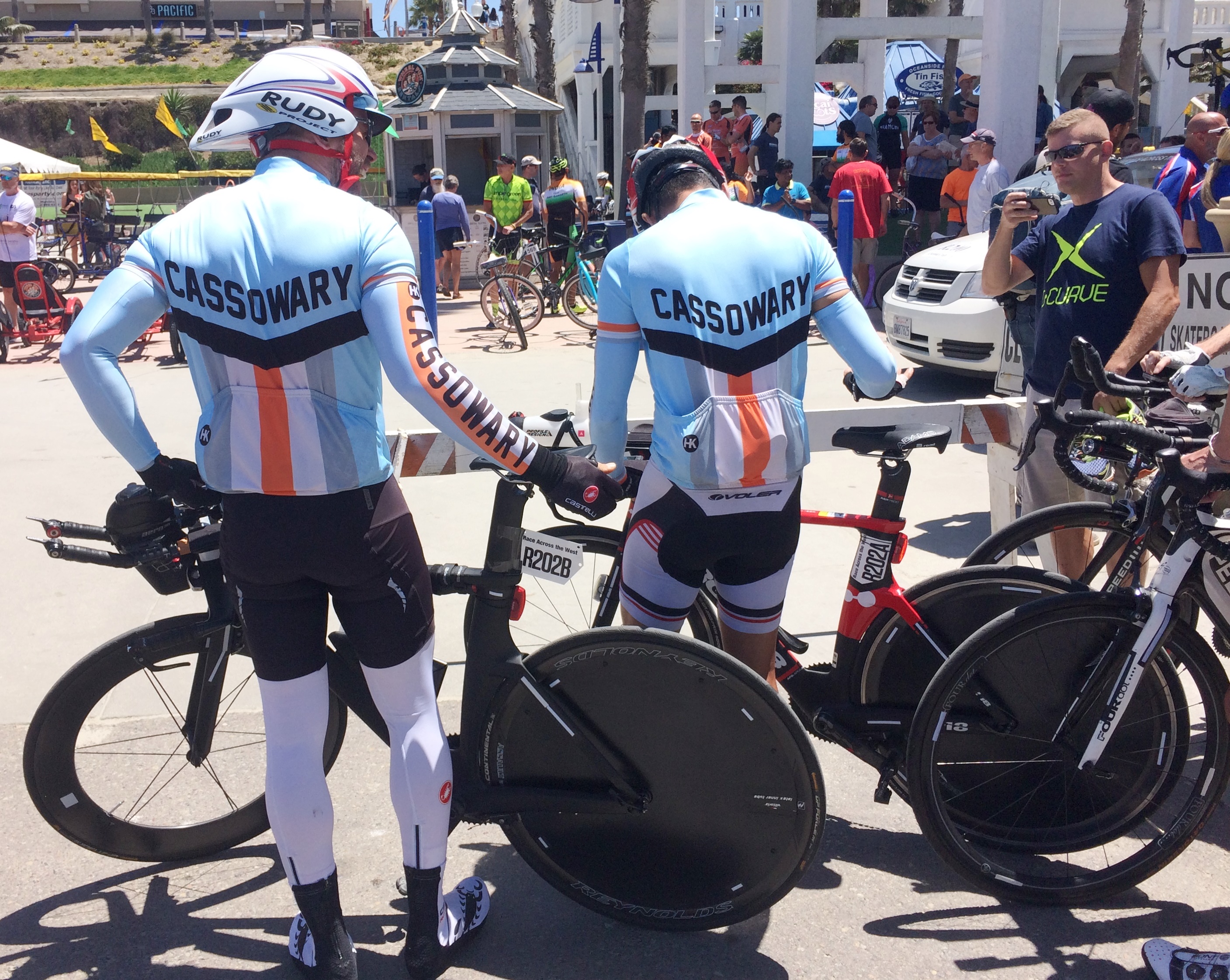
THE KARANJA METAPHOR

Meena Barot

Meena Barot

The story of a woman, who overcame her fear, used what she had around her to train and completed a half Ironman.

“ I wanted to do something in life rather than just get married,’’ Meena Barot said.

It isn’t that her parents didn’t understand. The larger family and community she found herself in didn’t expect women to work.

Most women married and settled down, raised families.

If there was anything for a woman to gravitate to, it was that predicament.

Born 1972 in Vadodara (Baroda) and roughly a decade later, shifting to Belapur in Navi Mumbai, Meena wasn’t one bit inclined to tow the community line. In her schooldays, she was into athletics and excelled at badminton. “ That sporting spirit probably brought some aggression to the table,’’ she said, mid-2016, at her neat apartment in Kharghar, where she stayed self-contained, two bicycles for company.
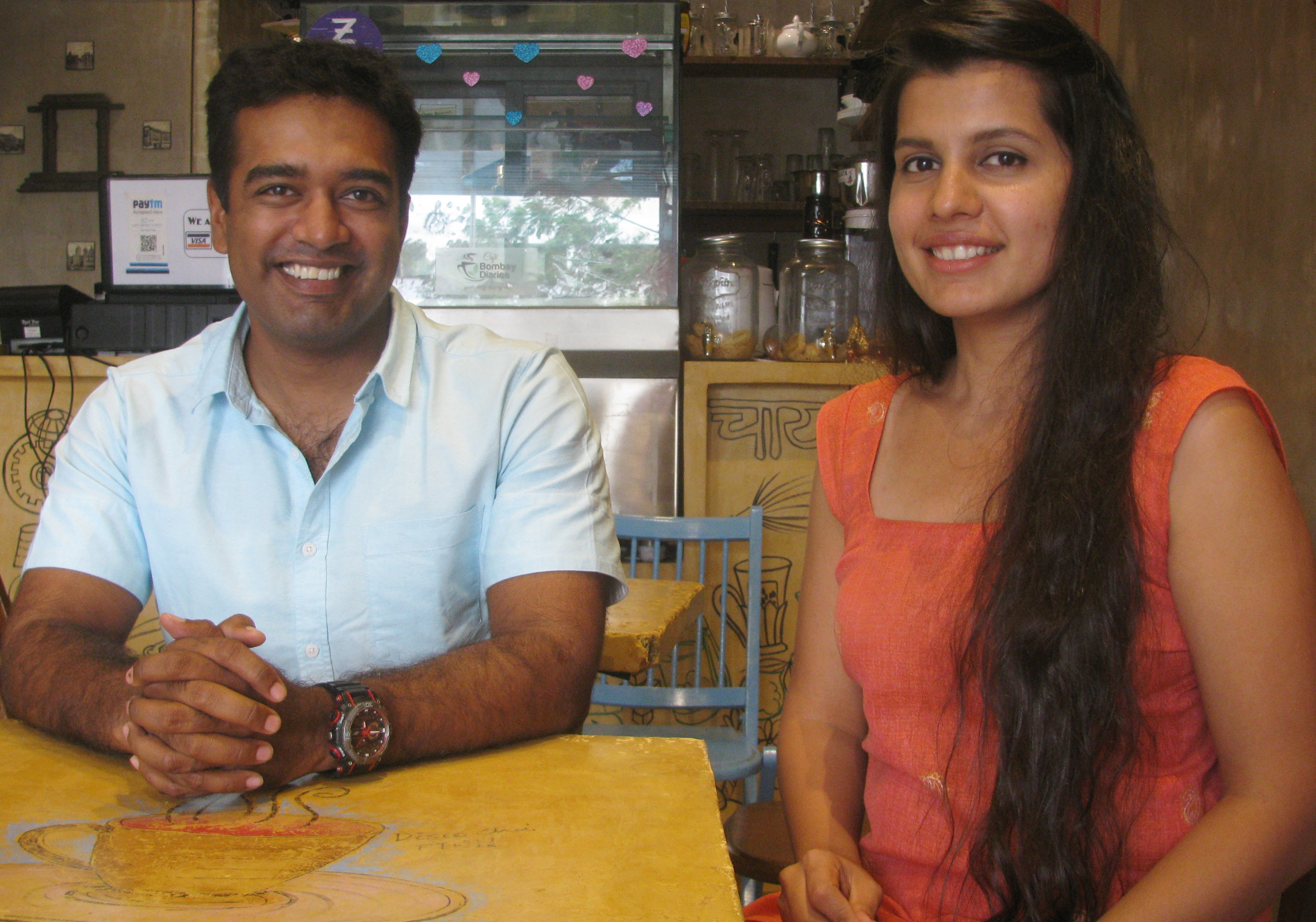
Realizing early that India assigns set direction for girl child and one’s own effort is the only way to foray a different path, Meena kept busy. Continuing on to college, she worked part time while still an undergraduate. She did her PG Diploma in Pathology from Grant Medical College and worked full time at Hinduja Hospital as a lab technician for the next four years. “ I believe every woman should be financially independent. Dependence and relations can take a twist at any point in life,’’ she said, adding, “ you don’t need others to tell you that you are strong. You need to realize it yourself.’’ While still at Hinduja Hospital, Meena enrolled for a MBA in marketing from the Narsee Monjee Institute of Management Studies (NMIMS) and successfully completed it. She funded that MBA course entirely with her earnings. “ It was a struggle doing all that. But the struggle made me a strong person. My life to date has been my decision,’’ Meena said.

Meena with her team at the China office of Shalina Healthcare

Meena with her team at the China office of Shalina Healthcare

Following the MBA, she worked for three years at a company called Becton Dickinson, shifting later to a smaller outfit called Shalina Healthcare, which though smaller, allowed her room to learn. In their employ, Meena moved to Shijiazhaung near Beijing, tasked with setting up operations for the company in China. She had to do everything from scratch, from finding a place to stay to finding a place to set up office. Shijiazhaung had just two other Indian families. Indeed there were few foreigners in town. “ It was tough but the local people were good,’’ she said. Back in Navi Mumbai, for some time now, her father had known that his second child had no appetite for conventional womanhood. According to Meena, he maintained his views on life but rarely interfered with her choices. When she got the offer to move to China, she didn’t inform him at first. Once everything was in place and the shift was imminent, she broke the news at home. The China angle also came at the right time. With her siblings marrying and settling down in life, there was pressure on her to follow suit. China put an end to that. For the next five years – from 2005 to 2010 – she was based there. One of the highpoints of that tenure happened in 2008. As the Beijing Olympics drew close, Meena who participated in a contest by Lenovo to choose a bunch of ordinary people who would get to carry the Olympic torch, found herself in the lucky lot. After the relay, she got a torch as memento; it is there at home with her.

Meena with the Olympic torch; from the torch relay head of the Beijing Olympics

Meena with the Olympic torch; from the torch relay ahead of the Beijing Olympics

From a weekend cycling trip in China; Meena with friends

From a weekend cycling trip in China; Meena with friends

Setting up a company office entails much work. There was considerable stress. A year after moving to China, in 2006, she was diagnosed with hypothyroidism. It triggered weight gain; she nudged 90 kilos. Living alone and the long, lonely stint endured from schooldays, navigating her path in life – all that was also taking their toll. “ I was in the happiest phase of my life. Strangely, I was also depressed,’’ Meena said of that period in Shijiazhaung. What particularly depressed her was the loss of stamina. Going up stairs had become difficult. She joined a gym, working out regularly after work. It helped physically (she brought down her weight to 80-83 kilos) and while it did help mentally, it also posed a fresh problem – over time gym becomes boring. For engaging alternative, she joined a badminton coaching class, where the students were mostly children. That didn’t demotivate her, she kept up the routine till a new set of problems emerged – knee pain and lower back issues. The doctor she consulted while on a visit to India, said, “ no exercise.’’ Once back in China, Meena took up cycling. She was getting on a bike after 25 years or so. It was a lady’s bike called ` Emily,’ single speed, no frills. She started cycling to office. Soon she was going everywhere on Emily. Around 2008, she bought a Giant MTB (mountain bike). The shop, which sold her the bicycle, also hosted organized rides. That way, Meena started riding 30-40 km on weekends. China is both the nerve centre of global bicycle production and home to a large number of people using bicycles for day to day commute. “ Half of our regular road in India – that is how much space they demarcate on roads for cycling,’’ Meena said. Her parents visited her in China. She remembers the visit for her father’s observation. “ I am happy you didn’t get married although I pressured you to,’’ he said.

In December 2010, Meena moved back to India and Navi Mumbai. Reason was her father’s ill health. He had a heart problem having suffered his first stroke in 1987 followed by a bypass surgery in 1992 after his third stroke. In 2009, he was victim of yet another stroke; this time, severe. He had called up Meena in China and asked her to return. Not long after she returned, in March 2011, he passed away. He was 66 years old. Meena felt the loss, deeply. She had moved back to Mumbai with the same company that sent her to China. In India, she was tasked with setting up a new department and that involved considerable work. So much so, that within a week after her father’s demise she was back at her office desk. “ That got me thinking – what am I living for?’’ she said. The old depression was coming back to haunt.

From the 2015 Chennai Triathlon

From the 2015 Chennai Triathlon

By November 2011, she had made up her mind to quit her job. It was a well thought through decision – she had cleared her loans, had some savings, endured a high pressure job with consequences and wanted to be done and over with that lifestyle. China had sent her back with a hobby for gift – cycling. She was now cycling regularly in Navi Mumbai. One of the friends she made so was P. V. Subramanyam (aka Subra). He was a member of Navi Mumbai Runners (NMR). He kept saying that Meena should get into running. By then, she had also linked up with Shalil Nair, one of the founders of NMR. In 2012, after her last day at work, she went out for a run with Nair who incidentally asked her about her background and realized that she was between jobs. He was Director, Human Resources at Institute for Technology and Management (ITM Group of Institutions). Meena was offered a job as part time lecturer at ITM Business School in Kharghar. “ I was thus unemployed for only eleven days,’’ she said. She sought six months break before joining. In that time, she did a cycling trip with Youth Hostels Association of India (YHAI) in Himachal Pradesh, to the Jalori Pass.

From a cycling trip to Khardung La in Ladakh

From a cycling trip to Khardung La in Ladakh

One of the great challenges for people living alone is – what do you do with time? Bereft of human company and the evolving dynamics of person meeting person characterizing crowded Indian life, time sits still, a palpable quantum on one’s shoulders. A sense of engagement is essential. If you don’t have that, the very fabric of life – time, can turn against you. Still insufficiently engaged in life for a person of her nature, time was turning against Meena. Over January-June 2012, she was severely depressed. “ I had nothing to look forward to. The biggest issue was – what do I do with my time?’’ she said.  The good thing about life is surprises lurk in every corner. Kripa Sagar is Meena’s friend, met through cycling. “ I had heard about Meena from some friends. I met her sometime in 2011 after she returned from China. She was into cycling. Our first ride together was to Nere-Maldunga, off Panvel. She came across as a very unassuming, friendly and grounded person who was at the same time a strong woman. I enjoyed her company,’’ Kripa said. One day Kripa had gone cycling to Kharghar; she called up Meena and asked if they could meet for tea. “ I went over to her house. While sitting in the balcony, I mentioned to her: why not do Ironman? We both agreed to try,’’ Kripa said. Meena had neither done distance running nor did she know well, what Ironman was. She read up on Anu Vaidyanathan – among India’s best known triathletes – and lapped up what she could learn about Ironman. It was 2012. At least a half Ironman by 2016 seemed possible. Less than four years remained. As with China, it was another start, almost from scratch. “ Meena took on the challenge seriously and trained intensely. It was a very tough training session that she chalked out for herself. Some days, she would train for 7-8 hours. Many runners and athletes could not keep pace with her intense training schedule,’’ Kripa said. Although Ironman was an idea shared by both, Kripa had to drop out as she was committed to another project.

Illustration: Shyam G Menon

Illustration: Shyam G Menon

Ramachandra Rao is a senior runner living in Kharghar. He used to be an organic chemist and researcher with Ciba Geigy (now part of Sandoz). He got into running during his days at university in the US. Every morning, he and his wife (she likes to walk) go out for a walk and a run. A quiet person and a dedicated runner, Rao is a member of NMR. He first met Meena on a NMR-run from Nere to Maldunga. It was some time before Rao got to know her better; that happened mainly because Lavanya Chillara, a runner staying in Rao’s housing society and Meena, used to run together. “ One thing sets Meena apart from others,’’ Rao said, “ others plan but often don’t do, she plans and executes meticulously. She is very committed.’’ According to Rao, once the Ironman idea was in, Meena went after it diligently. She had Daniel Vaz as her running coach. Off and on, Rao would run with her. “ In one year, she improved a lot from jogger to runner,’’ Rao said.

By October 2012, Meena had run her first half marathon at that year’s Vasai-Virar Mayors Marathon (VVMM). The same year, she also got to know of the Brevet des Randonneurs Mondiaux (BRM) events in cycling and consequently rode 200 km from Borivali in Mumbai to Cheroti and back. Determined to improve, she found a cycling coach. Soon she was regularly cycling and running. By 2013-2014, she was securing podium finishes at some competitions. In 2014 she participated in a duathlon organized by Kripa Sagar – 100 km cycling plus 21km running. The cycling was from Navi Mumbai to Nariman Point and back, while the running was done on Navi Mumbai’s Palm Beach road. However, if the Ironman was to be goal, Meena had a major obstacle to overcome. She didn’t know swimming and, she was scared of water. In June 2014, she joined the Belapur YMCA’s coaching sessions to learn swimming at their pool. It taught her the basics. As was her habit, she kept working at pushing her limits. There was a big problem. She may have learnt to swim and overcome some of that fear of water in the process. But the Ironman event required her to swim in open water and the two – swimming in a pool and swimming in open water – are two distinctly different animals for those tackling water right from the basics. In one you have a sense of containment and accessible safety, in the other, you are on your own and safety isn’t quite at hand. Where was she to go for a taste of open water?

Karanja (Photo: Shyam G Menon)

Karanja (Photo: Shyam G Menon)

The question is stupid in Mumbai-Navi Mumbai for the urban agglomerate is right next to the sea. But it is also one intense mass of human habitation and industrialized to boot. The sea around Mumbai-Navi Mumbai is polluted. To compound the problem, the coast in these parts sees significant ingress and egress during tides. Most beaches during low tide are an ugly sight with debris and garbage exposed; the scene sticks in mind even if you swam only during high tide. What do you do? In the meantime, Meena had registered for the 2015 Chennai triathlon and the Hyderabad triathlon. Her running was improving; she had even ended third in her category at one of the editions of VVMM. She was also regular at the BRMs. Roughly two hours’ cycle ride away from Belapur is Karanja. It is on the edge of the sea. People come to the boat jetty here to take a ferry and cross over to Rewas. On a Sunday morning, a cyclist reaching here from Navi Mumbai would be treated to the not so dainty sight of muddy land surfaced in low tide, fishing boats with their hulls exposed in the receding tide and murky waters typical of tidal zones. It was to Karanja and its boat jetty that Meena turned to for familiarity with open water swimming. She was determined to go for an Ironman. She knew she had to make do with what was available. No point complaining. Accompanied by her swimming coach and good friend Ramachandra Rao, she frequented Karanja, where they went out in a rented boat with Meena subsequently swimming in open water supervised by her coach. “ The water was very muddy. It was also prone to tides. I was a bit concerned about her health, swimming in that water. Meena though had no hesitation in jumping in and swimming,’’ Rao said. Despite her efforts, she would remain a slow swimmer. At Chennai, it took her an hour and ten minutes to cover 1.5 km; at Hyderabad where the swim was in a pool, she needed an hour and twenty minutes to cover 1.9 km. Internationally the cut off time for 1.9 km is 1:10. Altogether, she took nine hours to do the half Ironman distances at Hyderabad. To compete in Europe in 2016, which she planned to, she required cutting this time by a whole hour.

At the Hyderabad Triathlon

Then in December 2015, while working out at the gym, she injured her lower back. “ I just could not bend,’’ she said. In January 2016, running the half marathon at the Standard Chartered Mumbai Marathon (SCMM), she noticed mild pain in the left leg. At a cycling trip in Sri Lanka, which preceded SCMM, she had felt heel pain. She managed to complete the half marathon at SCMM in 2: 12. However the heel pain steadily worsened till it was diagnosed as Plantar Fasciitis. Post SCMM, there was no running and looming ahead in July 2016, was the half Ironman she had signed up for in Budapest, Hungary.  To add to her woes, the 2015 monsoon season had been weak with resultant water shortage in the state of Maharashtra. By March 2016, many swimming pools in Mumbai-Navi Mumbai had shut. Meanwhile, to reduce the heel pain, the doctor recommended a steroid injection. By mid-April she was back to cycling and running. For swimming, it was Karanja. Then towards April-end, the heel pain returned forcing her to stop running. By May, she was left with only cycling to do. It didn’t end there. In mid-May, while training, she fell from her cycle. With that, she was off running, cycling and swimming. How much adversity will life throw at her? “ I used to cry a lot,’’ Meena said. Her friends told her to take it easy.

Budapest Half Ironman; Meena just after finishing the swim segment

Budapest Half Ironman; Meena just after finishing the swim segment

On the bright side, she was able to merge an ITM trip to Europe, with the Budapest Half Ironman. In Normandy she found a place to run, cycle and swim. With weeks left for Budapest, she trained as best as she could. Ahead of the event, Ramachandra Rao – he had become instrumental to keeping her motivated – texted Meena regularly with positive thoughts. On July 29, a day before the half Ironman, there was a trial swim in open water at Budapest. “ I went into the water and panicked. I tried five to six times but I kept coming back. I was scared, it was psychological,’’ Meena said. There was a sense of endless depth to the water and seeming absence of limits nearby to the expanse of water she had to tackle. She decided against participating in the event. Some of the Indian participants told her not to do so and to at least swim up to the buoy midway. But as she did so, she panicked again attracting the attention of the rescue boat. The doctor on the boat shouted at her, “ what you are doing is not swimming! This is not a swimming pool. You will kill yourself!’’ Back on land, those comments hit Meena hard. From January 2016, given all the reverses life had thrown at her while preparing for the half Ironman, she had been battling depression. The universe didn’t seem to notice what she had done; all it appeared to see and enjoy toying with, was her nervousness in water. Suddenly her motivation crashed. She sat in Budapest, eating ice cream, hoping to lift her spirits up. “ I didn’t tell anyone back home what I was going through. The only person I called was Mr Rao,’’ she said. He told her to calm down and relax. It brought back some of her motivation. She decided to attempt the race. “ I know her potential. I was very positive that she will do it, provided she keeps her mind calm. I told her to remain calm and see that thoughts don’t disturb her mind. Don’t get involved in it. Always think that you have the ability to do it. It is easy to say so but to practise it in adverse situations, it entails much work,’’ Rao said. Meena also had a chat with a colleague from ITM, Deepthy, who got her to meditate. Thus calmed, she fell asleep.

Meena, cycling at the Budapest Half Ironman

Meena, cycling at the Budapest Half Ironman

On July 30, race day, she decided to tackle the swim in segments and not visualize it as the entire distance it represented. She also told herself: it is okay to be last. What is important is to attempt the swim. “ If you don’t attack fear at the time it appears, then it sets in for life. I will then live my life knowing that I messed up at the starting point and didn’t attempt the race at all,’’ Meena said. Further as the medic’s shouting of July 29 showed, the rescuers were alert and good. She was in safe hands. She finished her swim just within cut-off time, in an hour and ten minutes. The organizers provide a grace period of 50 seconds. By the time she started cycling, the professionals had already completed their first 45 km-loop. But there was a pleasant difference to their cycling. “ They cheer you on,’’ she said. Both the cycling and the running went off well for her. In the end, she finished the half Ironman in Budapest in seven hours and forty six minutes compared to the nine hours she took for the same distances in Hyderabad.

Meena, completing the Budapest Half Ironman

Meena, completing the Budapest Half Ironman

Looking back, Meena credits the journey completed to hard work and discipline. She used to wake up at 4 AM and start training. Aware of her capacity for depression, she stayed off all forms of negativity. This included keeping away from people who were negative or tended to doubt her abilities. “ I was out of all social media groups – WhatsApp, Facebook, all that. I was in touch with only those who were positive,’’ she said. “Rao sir’’ was very important in this framework. “ Never once did he say, don’t do it. He always said, you will do it,’’ Meena said.

Uniquely, Budapest taught her to relax.

“ I don’t have to prove a point. I am happy with the place I am in, right now,’’ she said, explaining her learning.

Meena hopes to do a half Ironman every year.

(The authors, Latha Venkatraman and Shyam G Menon, are independent journalists based in Mumbai. All the photos used in this article – except those otherwise mentioned – were provided by Meena Barot.)