SATELLITE COMMUNICATORS: AN OLD GHOST RETURNS TO HAUNT

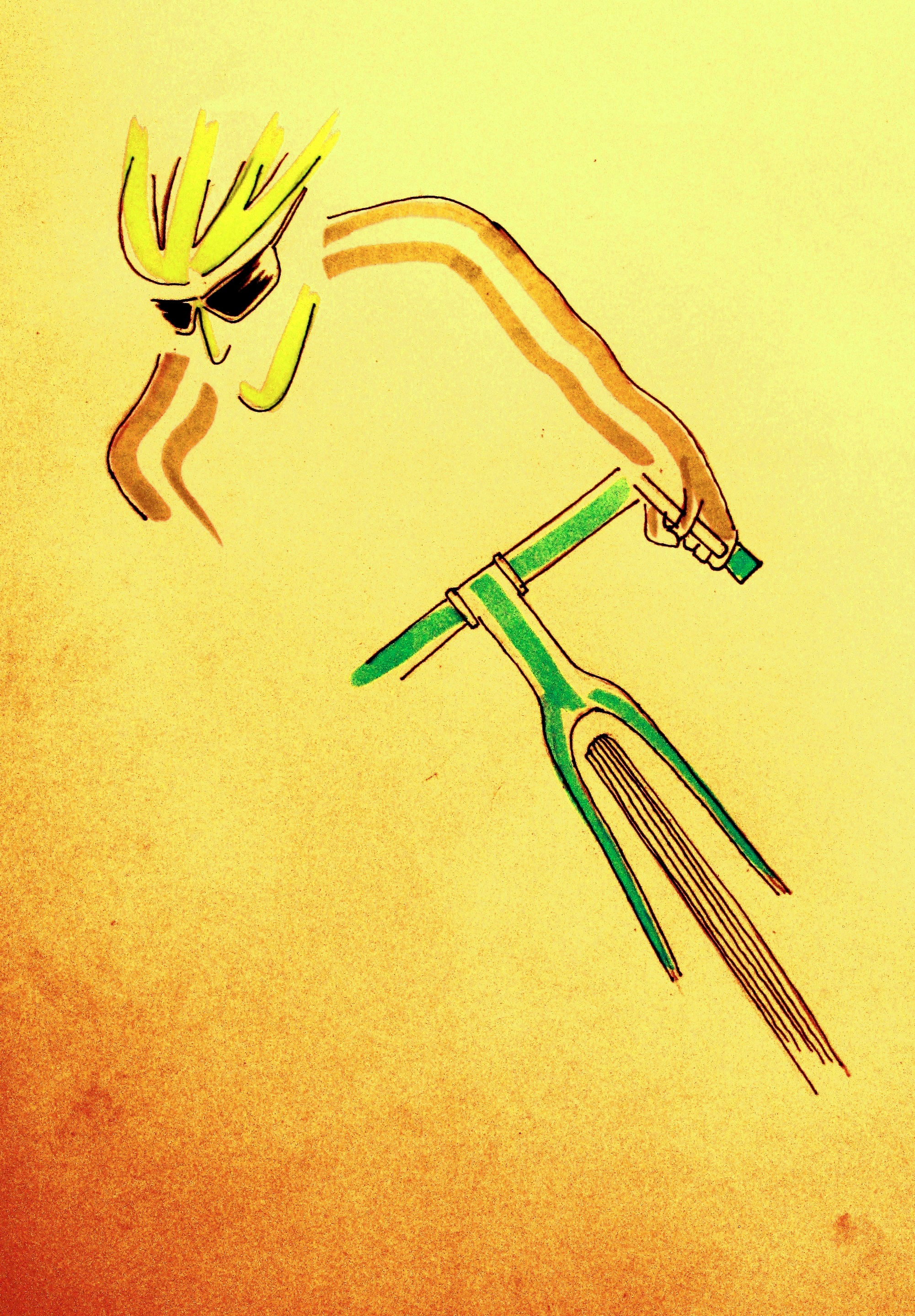
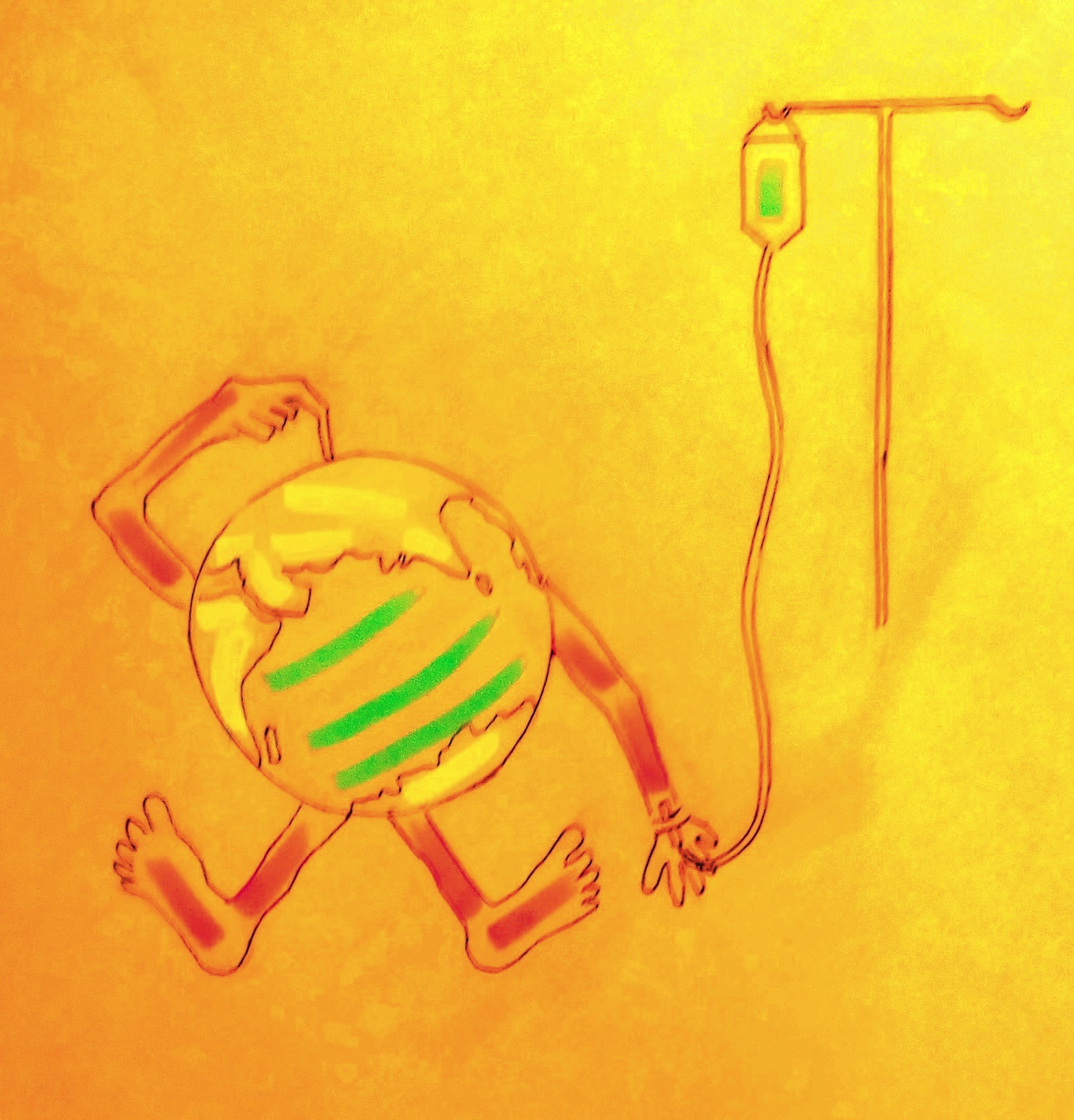
Illustration: Shyam G Menon

Hiking, running and cycling appear to be having their mountaineering moment in India with at least three instances of foreigners detained at Indian airports for carrying Garmin devices hosting technology not permitted for civilian use in India, reported from December 2024 onward.

Based on these news reports and a conversation with Garmin India, the crux of the problem seemed that the devices in question sported satellite communication technology, currently not allowed for civilian use in India and permitted import only for government use. Of the three instances cited, two – involving a cyclist and a runner – were from Goa, while one involving a hiker was from Delhi. The nationalities were Czech, Canadian and Scottish. The story of the Canadian ultrarunner / trail runner, Tina Lewis, was reported by the running website IRunFar and the website of the reputed magazine, Outside.

All the above-mentioned cases involved devices from Garmin’s inReach range of products. As per details on the website of Garmin, its inReach devices allow global two-way messaging via the global Iridium satellite network. If necessary, it can also trigger an interactive SOS message with one’s GPS coordinates to the Garmin Response 24/7 staffed emergency response coordination centre. The problem encountered in India concerns the device’s capacity for two-way communication via satellite. Based on past similar instances, it is also possible that the satellite network used in these models – Iridium – may be a problem. When contacted, an official of Garmin India said that the company imports and retails only its non-inReach line of products for use by civilians in India. Products from the company’s inReach range are imported exclusively for government use, he said. A report related to the recent detentions in India (and devices involved confiscated at the respective Indian airports), in Mint, dated January 3, 2025, said, “ The use of a device with built-in satellite transmitter is found to violate the Indian Wireless Telegraphy Act of 1933.’’ According to the Mint report, “ Garmin inReach and Garmin Edge 540 GPS devices are not allowed in India without authorisation. Earlier, a few foreign nationals were detained in India for carrying a Garmin Edge 540, a GPS-enabled cycle / bike computer that tracks speed, distance, and other metrics.’’

Indian embassies and consulates around the world have put out notices warning foreign visitors not to carry any satellite phone to India without prior permission as the device would be seized and the holder of the phone may be prosecuted under Indian law. These notices are available on the Internet. Information about the Garmin Edge 540, available on Garmin’s website, shows that it is compatible with at least two products hailing from the company’s inReach range of products (inReach Mini and inReach Mini 2). By definition, GPS devices use satellites. Based on available information, what appears to put the inReach range on the wrong side of the law in India – as happened with satellite phones earlier – is the capacity for two-way satellite-based communication; in the case of inReach devices, two-way messaging. Further, the notices put out by Indian missions abroad mention Thuraya / Iridium satellite phones as banned in India. As mentioned earlier, Garmin’s website says its inReach devices use the Iridium satellite network for their two-way messaging.

A perusal of the Indian Wireless Telegraphy Act of 1933 (it is available on the government’s website) showed its Section 3 sayings so: Prohibition of possession of wireless telegraphy apparatus without licence. — Save as provided by Section 4, no person shall possess wireless telegraphy apparatus except under and in accordance with a licence issued under this Act. Section 4 said: Power of Central Government to exempt persons from provisions of the Act. — The Central Government may by rules made under this Act exempt any person or any class of persons from the provisions of this Act either generally or subject to prescribed conditions, or in respect of specified wireless telegraphy apparatus. India’s aversion for satellite communicators is not new. India denying permission for the use of satellite phones was a vexing issue in mountaineering. The government banned the use of these phones by civilians after it was found being used by militant groups (the laws were further tightened following the 2008 Mumbai terror attacks). Mountaineering teams arriving from overseas sometimes saw their satellite phones seized; instances of phones brought in and subsequently activated on a hike or expedition provoking a hunt by authorities for the source of the signal, have also occurred. In mountaineering, the limitation the ban caused, was most felt in situations involving accident at altitude and the same requiring emergency medical response and evacuation. Without a satellite phone, people ended up running to the nearest point where conventional mobile phone signals were available. In days preceding widespread mobile phone network, members of Indian civilian teams have even rushed all the way to the nearest village or town to get news of a mountaineering mishap out. In life and death situations, every second counts. Following representations made to the government, the government allowed the use of satellite phones in mountaineering on a case-by-case basis with users adhering strictly to the regulations laid down. There is a process to be followed for the same.  

However, as felt at ground level, this still falls considerably short of the needs of mountaineering and the business of adventure tourism, sources in the trade said. According to them, the government allowed select adventure tour operators – among the biggest in the business – to acquire satellite phones. Satellite phones can also be hired from the Indian Mountaineering Foundation (IMF). But in practice, these devices can’t still be used in mountainous states with sensitive international borders. Thus, the phones get carried along on expeditions, for example in Uttarakhand, but it’s a completely different situation in Jammu & Kashmir, Ladakh, Sikkim and Arunachal Pradesh. “ It is a strange situation. Indians going abroad to climb or hike enjoy the access to emergency communication that devices like satellite phones provide, for there are no restrictions in most countries overseas. But people climbing the Himalaya from India – foreigners and Indian – can’t avail the device except in certain portions. Fact is – satellite phones and satellite communicators have become the norm overseas for mountaineering expeditions and hikes in remote areas. People wish to stay connected. I don’t think the Indian government will be able to adequately develop tourism in the border areas if it does not acknowledge this reality,’’ the owner of one of India’s biggest adventure tourism companies said, when contacted. It must be mentioned here that against the backdrop of satellite phones banned in India or allowed only with strict restrictions, some civilian outfits working in the outdoors, took to using personal locator beacons. These devices can dispatch a SOS signal to its associated satellite network. There is no provision for two-way communication of any sort. It simply transmits the exact location where emergency medical response / evacuation is being sought. The signals, in the case of these beacons, are picked up by the network of the Indian Space Research Organisation (ISRO) – that is a major difference.  

Between mountaineering’s past rendezvous with satellite phones and the recent cases of people being detained for possessing Garmin devices sporting the inReach technology, there are some differences, both as regards the device and as regards a potential solution. According to the Garmin India official this blog spoke to, the company’s inReach devices don’t allow a phone conversation via satellite. What the technology permits is messaging. For more information, he suggested that this blog reach out to the company’s headquarters. On the face of it, the recent incidents of detention in India over possessing Garmin’s inReach devices, would seem a finer interpretation of Indian law. The old stories from mountaineering concerned voice telephony; the recent instances of detention for bringing Garmin inReach devices, pertain to satellite links enabling messaging and data exchange. From what one could make out, as long as a device offers satellite communication technology for civilian use that is not permitted by Indian law, it remains a violation. The authorities can’t be faulted. Outside magazine in its piece on Tina Lewis, noted that it reached out to the public relations office of the Central Industrial Security Force (CISF – they manage security at Indian airports) but got no response. It says it got no response from the Indian embassy in Washington DC either. Garmin’s website includes India in a list of 14 countries that may regulate or prohibit the use or possession of a satellite communicator.  Others on the list are Afghanistan, Crimea region of Ukraine, Cuba, Georgia (SMS), Iran, North Korea, Myanmar, Sudan, Syria, Thailand, Vietnam, China and Russia.

For an overview of what the recent detentions meant to India’s cycling community and the navigation devices cyclists have invested in, this blog spoke to one of India’s top cyclists. According to him, in tune with the growth of cycling – and within that, performance-oriented cycling – in India, there has been a rise in the acquisition of sophisticated bike computers. In due course, cyclists themselves noticed the problems they may face in getting the devices past airport security. Consequently, there has been over time, a sharing of information among cyclists about the relevance in getting an Equipment Type Approval (ETA) for their device from the government. The document is useful when dealing with security agencies. There are also lists in circulation, which mention the devices from various manufacturers that one may possess safely in India. All this has happened through the initiative of cyclists and cycling groups; the government, this blog was told, has been hardly pro-active in keeping the cycling community informed. “ When the recent spate of detentions happened, there was fresh worry in the cycling community. This is because by Indian standards of affordability, bike computers are quite expensive. Losing one through confiscation at the airport, is a lot of money lost,’’ the cyclist explained. However, he did not think that inReach devices may have been mistakenly acquired by Indian cyclists or adventurers because its two-way messaging and SOS facilities are most sought after by solo adventurers. Indians into solo adventure pursuits, are few, he felt. His views were shared by another leading cyclist; this person, well-known in the field of ultra-cycling. “ When the news of the recent detentions appeared, it caused a flutter in the community. The problem we face is that airport security and security agencies in general, see the Garmin name on a device and instantly become suspicious instead of bothering to find out if the particular model is banned or not. The problem becomes more pronounced in border areas. The last time I was in Leh; after I finished cycling, I chose to courier my Garmin back to Mumbai,’’ he said.   

Illustration: Shyam G Menon

Today’s hassles in the digital domain have a humble, yet no less accusatory, ancestor from the era of print. There was a time when civilian hikers and climbers possessing detailed contour maps of the Himalaya, were treated suspiciously by Indian security agencies. Some of that suspicion has since faded; some has merely carried over to the digital medium. As we know through human experience, in times of technology evolving fast and what is restricted today becoming accepted tomorrow, there is often a gap between law and what technology is capable of. How does one plug or bridge these gaps such that the use of technology for healthy purposes is permitted and those that aren’t so, get countered? For instance, in the Outside article on Lewis, she says that the Garmin inReach Mini, which she had, was an integral part of her travel kit and she didn’t feel the need to research before carrying it on her Indian trip because there had been no objection in the other countries she visited. Besides, as she pointed out, GPS technology is nowadays found even in watches. To develop bridges of understanding, engaging the authorities and lawmakers in conversation is essential.

This blog spoke to a retired bureaucrat who had previously served in a very senior position in the Indian government and is familiar with matters related to internal security. He suggested that if hikers, cyclists and motorcyclists wished to see such devices used, then making representations to the government – as happened in the case of mountaineering – would be the apt way out. The community of users / potential users has to discuss the matter with the government. In mountaineering, the government eventually understood the need to some extent and responded making a few concessions. For the world of hiking, cycling and running (even motorcycle touring), it may be more difficult, he said. The main catch here would be that unlike mountaineering, which is restricted to the Himalaya and the Karakorum, the locales for these activities span an entire sub-continent. There is also the challenge of users in this category being higher in number than the mountaineering community. Not to mention, in a typical mountaineering expedition, there may be a satellite phone for a whole team. It suffices. In comparison, bike computers and SOS devices with two-way messaging ability are more individually owned. Still, making representations to the government could be a beginning, he said. When contacted, a senior official of the Adventure Tour Operators Association of India (ATOAI) said that ATOAI has already taken up the matter with the government. The problem, he said, pertains mainly to Iridium-enabled devices. To fault is lack of awareness; both on the part of travellers arriving without checking whether the devices they are carrying are banned in India or not and Indian security agencies, who treat travellers suspiciously just because they have a GPS device on them. He was clear that there is no option but to be on the correct side of the law. “ Awareness is the only way out,’’ he said. A critical shortcoming in this context is that while Indian missions overseas have put out notices on the items banned, normal tourists and solo adventurers – the sort who may not be guided in their visit by an informed tour operator – have limited means of finding out which devices and models therein stand approved. This was highlighted by the leading adventure tour operator this blog spoke to as well; he said that the method of finding out what is approved should be easy. The ATOAI official said that ATOAI has asked manufacturers like Garmin for a list of devices and models therein, approved for use in India, which the association hopes to make publicly accessible via its website.

(The author, Shyam G Menon, is a freelance journalist based in Mumbai)

MARATHON IN INDIA / WANTED: A BIG PUSH

Illustration: Shyam G Menon

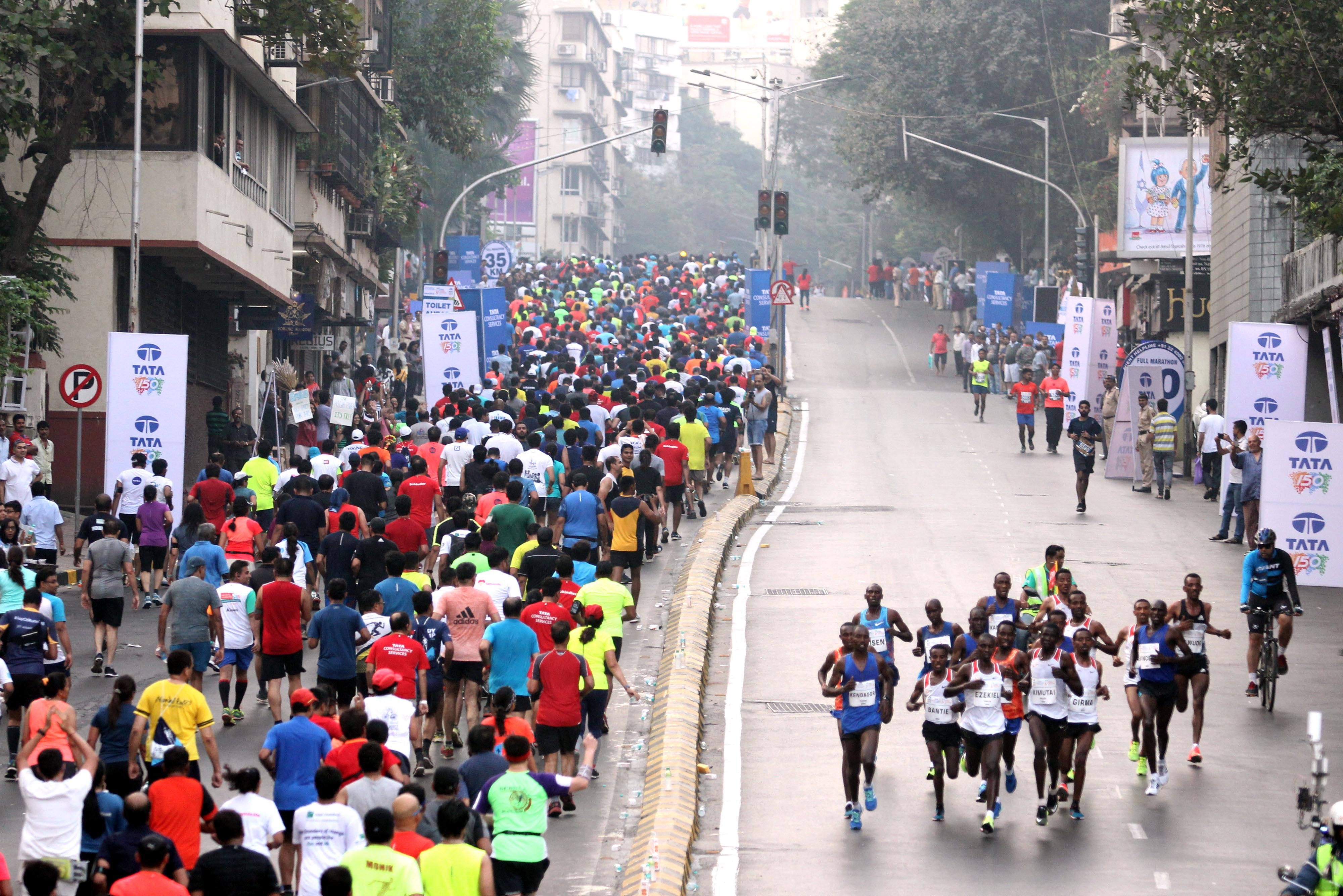
As we enter another winter season and along with it, the annual bloom of city marathons, it would be good to remember that performance-wise, the marathon in India is stuck.

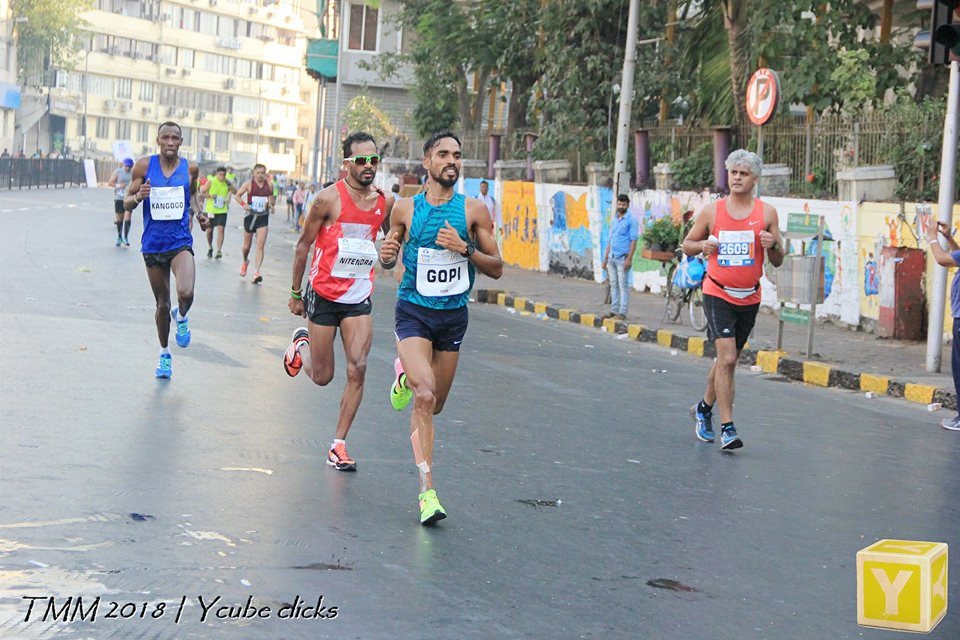
Shivnath Singh’s national record of two hours and 12 minutes in the marathon, set at an event in Jalandhar in 1978, continues intact. It is the longest surviving national record. The closest an Indian got to it was in 2022, when T. Gopi clocked 2:13:39 at the year’s Seoul Marathon. Thereafter, the lull in progression has been thick enough to cut with a knife. Following the failure of its athletes to meet the qualifying time, India did not have a marathon runner at the last Olympic Games. Top athletes have pointed out in conversations with this blog that while 2:12:00 remains a major milestone to cross in the Indian marathon scene, when juxtaposed on the global scenario, it is nothing. The late Kelvin Kiptum’s world record in the men’s marathon stands at 2:00:35.

Alongside, and even as the number of marathons in India has increased considerably over the years, the interest shown by the nation’s sports administration in the discipline has declined. The decline mentioned is not in terms of the support expected to be provided. It is with regard to how the marathon is perceived in the pantheon of disciplines administrators periodically scan to decide which item merits attention. Right now, what one gathers is that within Indian sports administration, the marathon is not a matter of urgency. It has slipped. And it is a strange predicament for this side and that of 42.195 kilometers, improvement appears good enough to warrant support and enthusiasm for those distances. Compared to Shivnath Singh’s national record surviving unchallenged for 46 years, records have been rewritten in disciplines in running up to 10,000m and past 42.195 kilometers.

A brief conversation this blog had with a top Indian sports administrator in December 2024, hinted at how the establishment thinks with regard to the marathon. Although about 42.195 and what Shivnath Singh’s national record still reigning unbroken meant for the marathon in India, the conversation unfailingly touched upon Avinash Sable. Sable has been a phenomenon; a one-man powerhouse in Indian athletics. He rehauled the national record in the men’s 3000m steeplechase several times, featured in the finals of top international competitions and also holds the national record in the men’s half marathon. Sable is among India’s greatest athletes. Although a lot happens when the distance to run is doubled and likening the half to the full marathon is incorrect, Sable’s 2020 national record in the half marathon – 1:00:30 – is less distant from Yomif Kejelcha’s 2024 world record (pending ratification) of 57 minutes and 30 seconds, than the best Indian timing in the full marathon is from the corresponding world record. On the other side of 42.195 kilometers, Indians have rather quickly carved out an impression at the Asian level in the ultramarathon. The overall standing is still hinged to the luxury of having team championships and how a few key ultrarunners deliver but Indian teams have finished on the podium and a handful of international events – ranging from Asia-Oceania championships to world championships – have been held in India.

Following mention of Sable, the administrator quickly veered to the promise seen in the middle to early long distances. The athlete spoken of was Gulveer Singh. In November, at the 2024 Hachioji Long Distance athletics meet in Japan, the 26-year-old had improved his own national record in the 10,000 meters from 27 minutes, 41.81 seconds to 27:14.88. The approach to answering the question indicated the current focus in distance running being on disciplines leading up to the marathon. Performance in the marathon, this blog was told, was expected to be shaped through the interest shown in it by the Indian Army (the Army Sports Institute [ASI] was cited as a nodal player in this context) and interventions by private sports bodies like those associated with Reliance and JSW. There was also a second half in the overall view and it comprised of two points. First, the administrator found it unfair that the current sports ecosystem ran on an architecture of the government investing to do the hard work of finding talent while the private agencies ran with the cream of the talent the government groomed, developed it further and cornered credits accruing thereafter. Second, the administrator felt that the top Indian marathoners were running too many races to get prize money instead of rationing their participation in events.

A portrait of them as people who run for money didn’t sit well with the elite athletes this blog spoke to. First, according to them, they don’t participate in a lot of races. From what one could gather, speaking to elite athletes, right now there is no national camp for the marathon. Those from the army train at the ASI in Pune, Sports Authority of India (SAI) in Bengaluru and at camps managed by themselves in Ooty. There is a foreign coach at the ASI. And for those additionally supported by private sports agencies, there is the scope to participate in races overseas or train overseas provided the acceptance abroad and the paperwork for the same are readied by the athlete. Second, the athletes feel they can’t be blamed for a marathon ecosystem, which features prize money. Even the international marathon ecosystem has races with prize money and many of the star athletes finishing high in the Olympics take part in these races.

From what this blog could decipher based on its conversations with elite athletes and its reservoir of conversations with civilian runners and those involved with the Indian running ecosystem, there are probably two areas requiring attention to get the marathon in India back on its feet. First, there is merit in the interest shown in the middle to early long distances. These largely track distances have served globally as the cradle from which, talent for the longer distances emerge. Further, one of the complaints often heard from elite Indian athletes running the 42.195, is of them doing well till the mid-30 kilometres or so and then finding it hard to sustain the targeted pace. They don’t seem to have figured out yet why this is happening and they have looked at inputs ranging from diet to strength training and mileage. This likely underscores the potential in the middle to early long distances and up to the half marathon; it also shows work still to be done in the 42.195. As one elite runner pointed out, “ it is tempting to ascribe our weakness to genetics but look at Japan – they may not be winning the medals at elite races but they have more people capable of timings less than two hours and 15 minutes in the marathon than India does. So, there can be no excuses.’’ It speaks something about running ecosystems overseas and the need to examine their Indian equivalent to know where we are getting it wrong. This is the second of the two areas for study mentioned earlier – the ecosystem.

Illustration: Shyam G Menon

The number of road races have been slowly growing in India. According to Venkatraman Pichumani of RaceMart, India now hosts almost 2000 road races every year. Thanks mainly to them, the number of recreational runners has risen manifold. Elite runners participate in a few of these events. The vast majority of these races is powered by civilian runners, including those from their ranks who run well. A couple of aspects mark this category as different from the elites. The typical elite athlete – reference herein being to those from the army – trains twice a day; in the morning and in the evening. Given they are army personnel, they enjoy consistent salary even if their job is to dedicate themselves to sports. The reality of amateurs is different. Most of them work at regular jobs, which are rarely empathetic to pursuits irrelevant to given line of work. Training twice a day can be difficult both for want of time and want of official acceptance. Amateurs train on their own. Some of them train with civilian coaches who have had a long tenure in distance running either as civilian athletes or athletes in the military. This blog has come across coaches with promising wards who wish there was some means by which, the talent they groomed as best as they could, may be helped along to the next level of training with marathon elites. Such link is not easily found. In principle, civilians in big cities and big states are better off in establishing these connections because they live in locales with systems in place. Even then, linking to elite camps is tough. When you hail from less economically developed circumstances, the chances are dismal. A woman marathon runner, who hails from a comparatively remote region and represented India once, said that for her event abroad she trained alone. On the other hand, training in a group is an integral part of the marathon. The reason, as a leading civilian coach explained, is simple – the chore of maintaining a targeted pace for long or piling on mileage becomes less boring. Right now, in India, the best marathon runners appear to be in two distinct camps. The military runners train in their own group. The best civilian runners train on their own. Civilians also don’t seem to be in groups of equally competent runners as in the army. Not just that – when you don’t know what fetches the establishment’s attention, you end up running several events hoping somebody will notice you and recommend you for higher levels of training. Of the earlier mentioned woman marathoner, her coach said, “ she ran and ran and they kept saying the timing wasn’t good enough. How would she improve her timing when where she hailed from had no modern training facility at that point in time?’’ Indications are – it is time we broke this pattern.

In spite of the limitations they face, civilian athletes from India have improved their performance. Slowly, there is a pool of talent beginning to develop just this side and that of the two hours, 20 minutes-mark in the men’s marathon. Yet strangely, one couldn’t find in the marathon circuit, any talk of training camps – virtual or real – that brought together the best of civilians and the best from the army. No drift towards a larger pool of talent focused on the simplest of challenges to improve India’s performance in the marathon – taking down that longstanding national record. To give one example: in a training camp featuring the best from both army and civilian backdrops, athletes get an opportunity to learn from each other. This is however easier said than done. First, the army runners are far ahead in terms of timing. Second, in India the civilian-military divide is such that shared spaces are rare. Still, at least one elite athlete this blog spoke to said that provided discipline and focus are maintained in the spaces shared, athletes of high calibre, irrespective of their background, will always be useful as partners to train with and maintain a targeted pace. Doing so, people get pushed; everyone learns. The pool for selectors to pick from, grows. This blog spoke to a civilian runner with personal best in the range of two hours, 18 minutes in the marathon for his view. Years ago, as a 10,000m runner, he had the good fortune of being in the national camp and training with elites from the military. As a marathoner, despite good timing by Indian civilian standards, he hasn’t been called for any national camp. “ It is not easy. On the other hand, ten good athletes training together will produce one or two who will inch closer to 2:12:00. It will take some time, but it will happen,’’ he said. Former national level marathoner and Mumbai-based coach, Savio D’Souza, recalled this compartmentalized life wasn’t the case earlier. “ In 1986, I was at the national camp in Patiala training for the marathon along with runners from the military,’’ he said.

An easy way to facilitate a convergent atmosphere, at least occasionally, without talking of training camps, is to hold periodic trials that bring together the best from military and civilians. An invite to such trials would be treasured; civilians would see it as an honour. When this blog asked the earlier mentioned sport administrator whether officialdom favoured dedicated Olympic trials in the marathon where the best from the army and civilian ranks participated, the reply was: one can already do that in any of the annual editions of the Mumbai Marathon or the National Marathon held in Delhi. The reply amazed because neither of these events are spoken of by runners as having a course or weather conditions ideal for record breaking performance. And this is without mentioning the fact that civic authorities in India are yet to grasp how much of a difference good roads make to popularizing a road running event (a societal wish to respect running and love the fact that one’s city has a marathon, eludes India). On the other hand, trials to select runners for major events can be anywhere having a good course, conducive weather conditions and the capacity to support a race at a given point in time. It can be offered by the establishment as an additional option to qualify, not to mention – allow for a fraternity of elite athletes driven by sport and not separated by walls. Still, to be fair, can one convincingly counter what the senior sport administrator said? The answer is no. And that is because elite athletes from overseas, running at Indian events, have shown repeatedly that timings better than what Indian elites deliver is possible. Timings better than the Indian national record, have been achieved in Mumbai and Delhi.

One way out of this situation may be to dig deeper on the private participation front. Government authorities are justified in being disappointed that they do all the grassroot unearthing of talent (it is hard work). In their eyes, private players do the easier quarter of working with the best. That is by and large, a fair observation. But it also has to be admitted that the running ecosystem in India wouldn’t have grown this big had it not been for private participation. All those 2000 odd road races exist because there are private sponsors willing to support. One of the biggest Indian sponsors of road races -Tata via group company, TCS – is also possibly the biggest internationally with a clutch of prominent road races across a few continents supported by said company. However, as yet in India, there is no professional road running team supported by any company, that one has heard of. Should that happen, it is likely that a deeper exploration of training methods, training locales, identifying the best talent (irrespective of civilian and military distinction) and establishment of more training facilities (the sort oriented towards long distance running) would happen. Athletes have simple demands. One elite athlete wondered if there could be a training locale that was 6000 feet in elevation but was also a plateau with space for long training loops without too many ups and downs. An ideal training spot should have access to both tarmac and mud track. These are details that the private sector should be able to address. What one should however make sure is that money does not overplay its hand.

Illustration: Shyam G Menon

A concern in private participation in sports and creative pursuits is how the engagement between these human activities and the pressure to make monetary sense, plays out. For example, imagination by money and media typically favor short duration races and sports that deliver quick results. It is a quest to gratify the impatient human being. The world of ultramarathons knows this well. When it came to pitching for a ticket to the Olympics, they had to showcase their shortest distance and also make it trail in the hope that scenic backdrops would sustain broadcasters’ interests. That mission is still on. Or remember this more biting angle – heavy traffic and pollution, which are among the problems runners out on their daily jogs (and cyclists out on their daily rides) face, are partly a private sector gift. You can blame it on gullible customers but let’s not forget – manufacturers have gleefully crammed our environment with vehicles using this incentive and that. It is great sales but hardly great for quality of life, those daily runs included. It is why imagination by money matters but only to a point. It is why CSR, designed to improve how companies are perceived, can never convince as well as genuine change. Nothing like a change in our minds. Transposed to running it means – no matter whichever external constituency agrees to pitch in and assist, the desire to take the marathon in India to greater heights has to come from the collective of runners. The solution will have to be one that maintains interest in the sport in a sustained fashion but banks equally on empathy for it by government, support from the private sector and a culture that wants long distance running to continue and grow in Indian life. That last bit is where the average recreational runner becomes important. He / she forms the biggest component in the ecosystem; the passion which keeps running alive. Do we want marathoners from India to be world class? Will we set the best in our midst, up for greater success?

The late Shivnath Singh’s 2:12:00 may be a mere set of numbers on the clock. But trying to get past it and improve further, shows us so much about how we let ourselves down and as much about what we can do.

(The author, Shyam G Menon, is a freelance journalist based in Mumbai)        

2023 LADAKH MARATHON / FROM PRE-RACE CHATS AND DISCUSSIONS

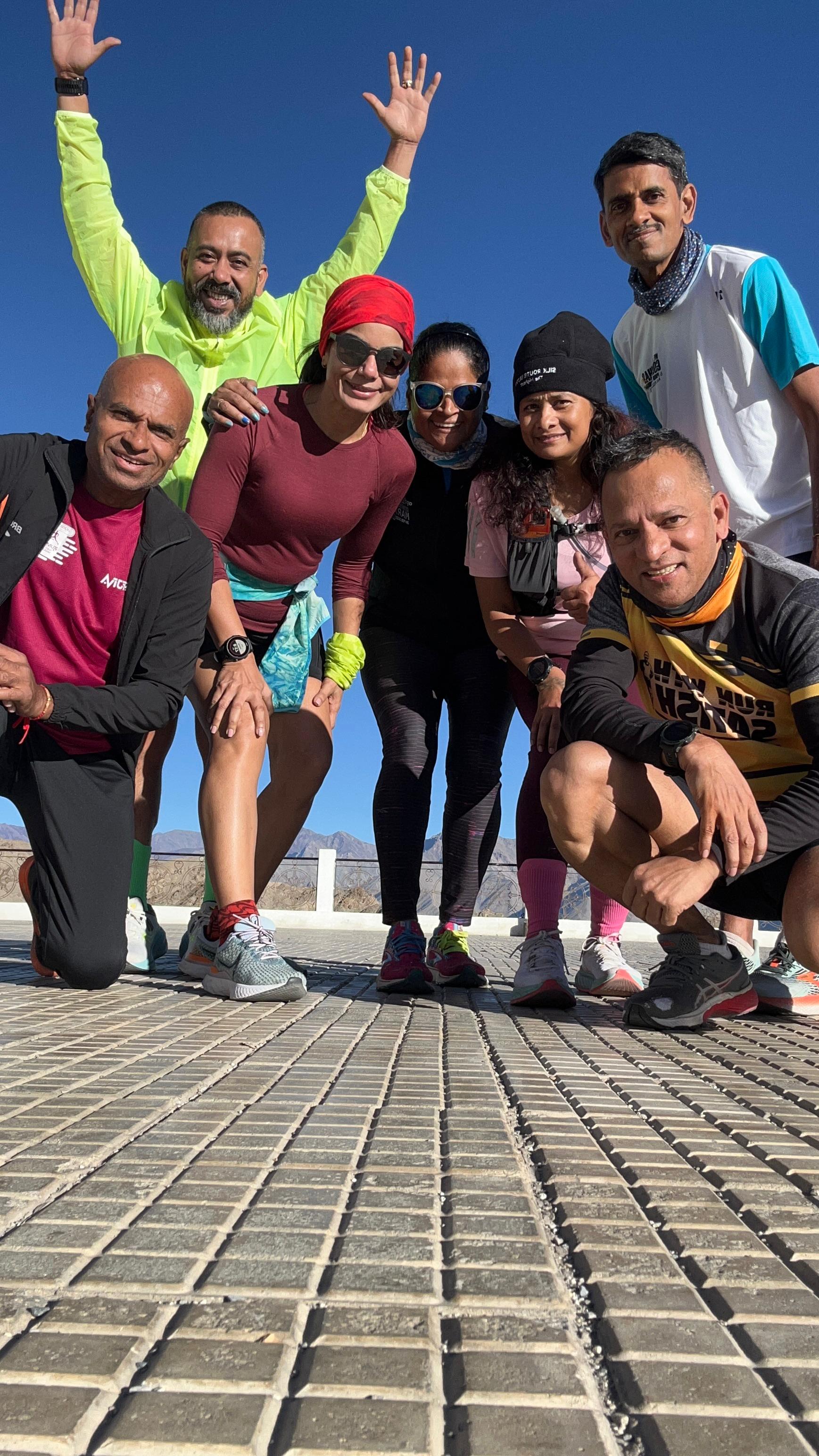
In Leh for the 2023 Ladakh Marathon. Satish Gujaran (extreme right) with Sunil Shetty, Sangeetha Shetty, Gita, Anupam Deka, Pronami Chakraborthy and Rita Chaudhary (photo: courtesy Satish)

What makes the Silk Route Ultra and the Khardung La Challenge tricky?

Locations make marathons different. According to Dinesh Heda, for those not residing in the Himalaya, it is tough to replicate in the training phase, all the challenges one may face in the Silk Route Ultra (122 km) and the Khardung La Challenge (72 km). One can address endurance and accumulate elevation. But there is nothing possible as regards high altitude and weather. The altitude one touches in the Himalaya is serious; it brings in its wake reduced oxygen levels and biting cold. Alongside, there is the unpredictability of weather conditions. Things can change at short notice. Plus, during the course of the two ultramarathons (the longer Silk Route Ultra starts in the evening; the Khardung La Challenge at around 2AM), the athlete experiences cold to very cold conditions followed by the dry, warm weather of a morning in Leh. Because nature is dynamic, no two runs offer identical experience although the broad parameters may be the same.

People who assume that the Khardung La Challenge’s 72 kilometres is just another 30 kilometres more than a marathon and therefore very doable, overlook altitude and weather, Dinesh who is a senior runner from Goa, said. Not to mention – there is the overall cut off and the individual stage cut offs, which must be met. This is what makes the Khardung La Challenge challenging and the Silk Route Ultra even more so. In the latter, which measures 122 km overall, two things get frequently overlooked by runners. While Khardung La Challenge starts from Khardung village, the Silk Route Ultra commences another 50 kilometres away, at Kyagar. That’s more than a marathon at altitude run, by the time participants join the regular Khardung La Challenge route. Second, while Khardung village to Khardung La is an uphill, same goes for the Kyagar to Khardung section. In other words, by the time Silk Route participants reach Khardung to tackle the regular Khardung La Challenge route (the two races converge at Khardung with the Silk Route Ultra leaders reaching there around the same time the Khardung La Challenge kicks off), they are already on tired legs. Dinesh attempted the Silk Route Ultra in 2022. Unable to meet the stage cut off at a particular portion of the course, he had to DNF (Did Not Finish). To his credit, Dinesh who has done the Khardung La Challenge multiple times, has accepted the outcome. In 2023, he was back in Leh, not for that unfinished business with the Silk Route Ultra, but to attempt again, the Khardung La Challenge.

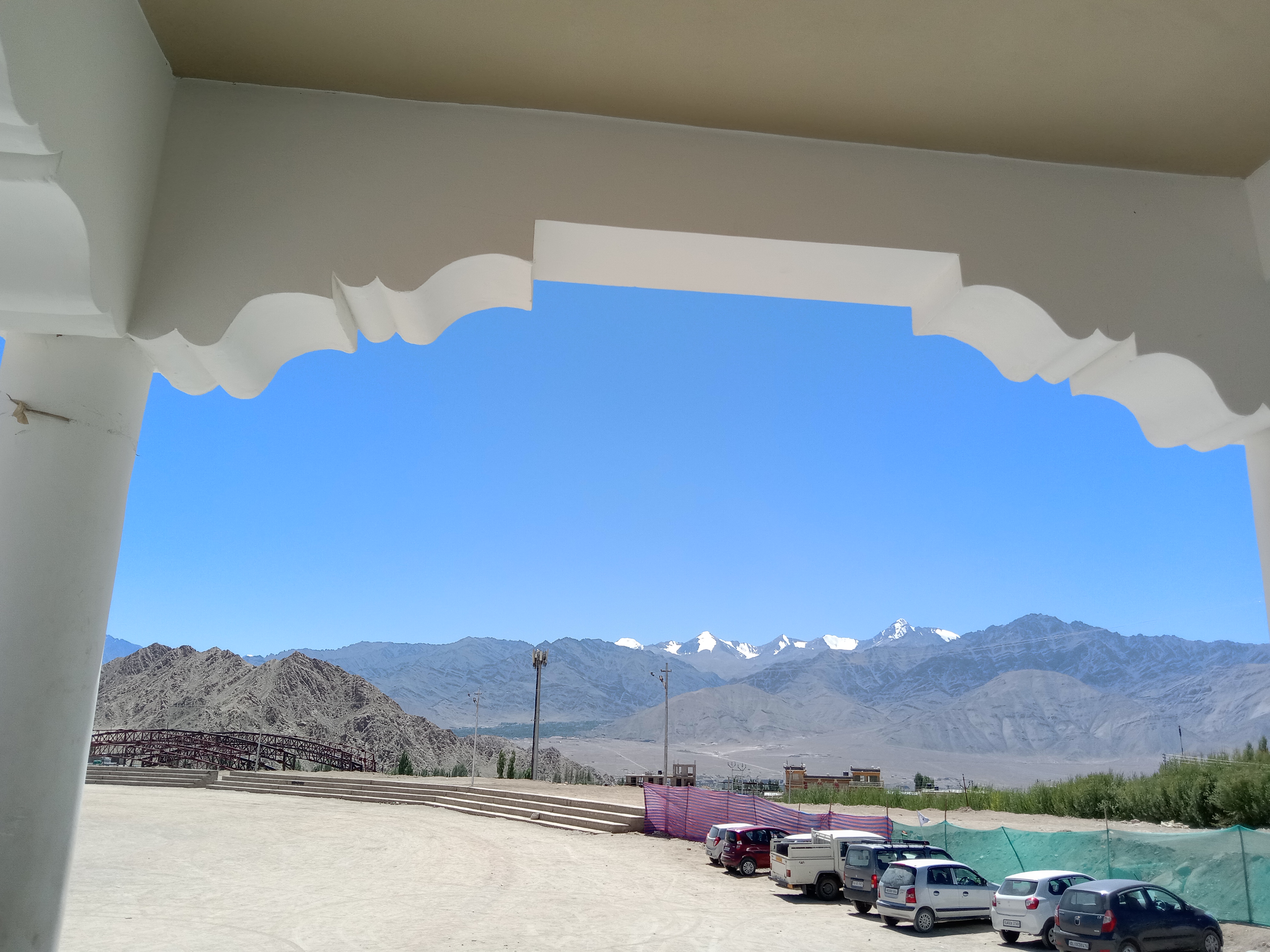
The view from the venue of the Ladakh Marathon expo (photo: Shyam G Menon)

An interesting blend

An emergent trend seen at the Ladakh Marathon is that of running the Khardung La Challenge and then following it up with the event’s full marathon. Dinesh has been doing this for a while. He was introduced to the practice in 2016. That year, Dinesh was in Leh for the full marathon when he saw Dharmendra Kumar from Bengaluru tackle both the Khardung La Challenge and the marathon. “ Dharmendra was the first runner I saw doing this combination in Ladakh,’’ Dinesh said. He commenced the practice in 2017. Today quite a few runners do this mix. When contacted, Dharmendra Kumar put the blend of ultramarathon and marathon, in perspective. “ It was a race just sitting there, waiting for you to try it,’’ he said of the marathon that beckoned following the Khardung La Challenge and a good night’s sleep. “ The idea was to do the marathon at an easy pace and enjoy the outing. That’s what we are here for, isn’t it? To run and enjoy the experience,’’ he said. What additionally engages is the difference between the two races. An ultramarathon is a personal experience. The runners may be separated by significant distance, there is a sense of being in one’s own cocoon, the route has long uphill sections, the weather may be unpredictable and there is always, the strain caused by higher altitudes. On the other hand, the marathon in Leh provides a sense of community when running with so many people around. The route has an uphill only towards the end, the weather is generally stable and after that tryst with really high altitude the day before and a good sleep thereafter, the marathon feels enjoyable to run. Plus, there is cheering. “ You take it like a recovery run,’’ Dharmendra said, adding that he was in no way discounting the inherent challenges of a marathon at altitude. It is just that when you run the marathon after the Khardung La Challenge, there is also an element of enjoyable relief and recovery at play. He was clear that the motive wasn’t to add kilometres and brag about the distance accumulated. After all, in the world of ultramarathons, 114 kilometres (the aggregate of the Khardung La Challenge and the marathon) is not big. The attraction is the relaxed pace of a recovery run and the enjoyment of being in a marathon with people around. 

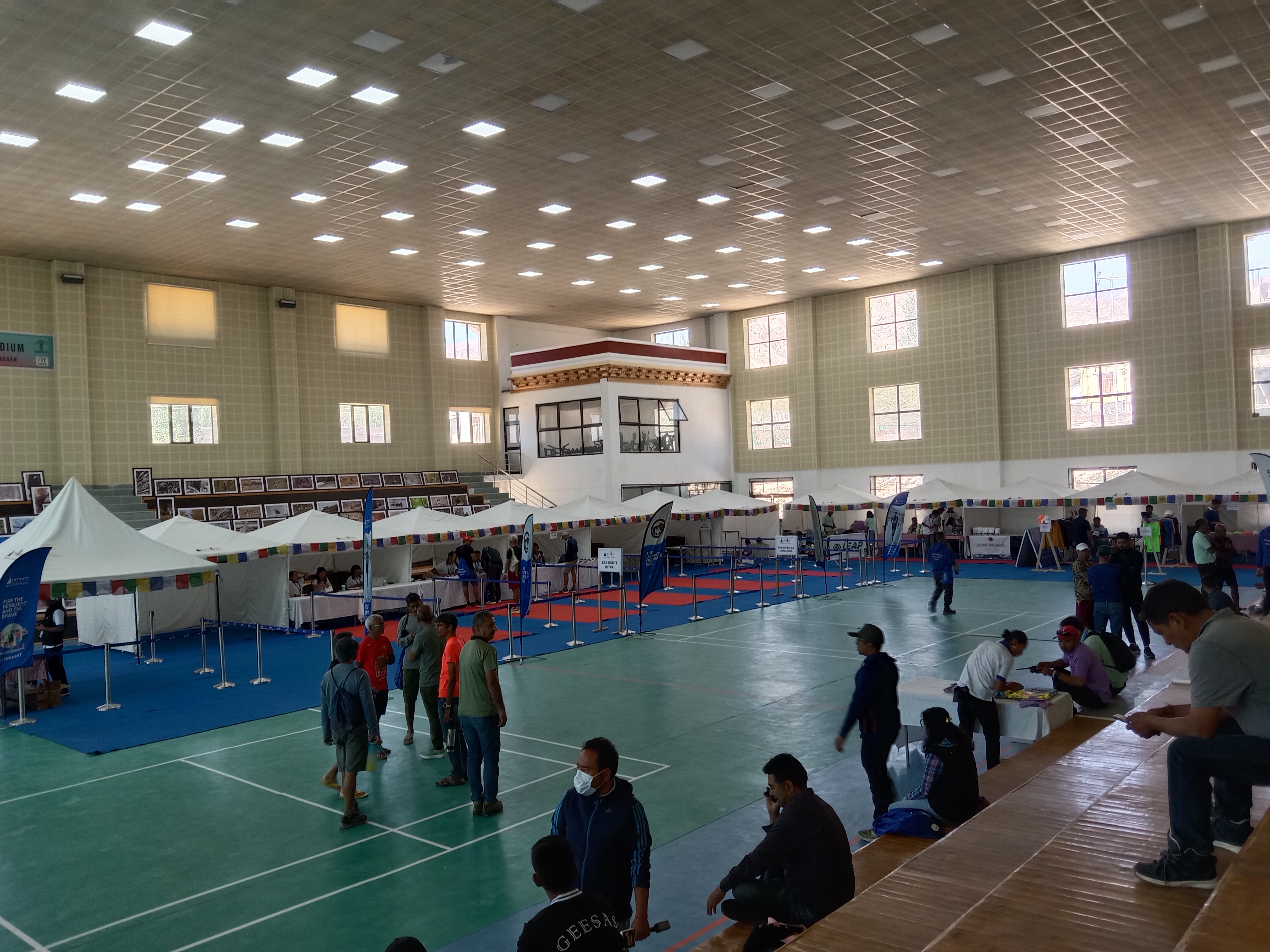
At the Ladakh Marathon expo (photo: Shyam G Menon)

The invisible risk

Being an event at altitude, medical support is critical for the Ladakh Marathon. A variety of agencies – among them, the Indian Army and the Indo-Tibetan Border Police (ITBP) dispatch their ambulances and ambulance crew to support the event. The event also has a medical partner. Since its inception, the Ladakh Marathon has had its share of medical emergencies. Significantly, it has stayed free of any fatal incident. In the case of the Silk Route Ultra and the Khardung La Challenge, participants have their oxygen saturation and pulse rate recorded twice by the organizers. The first checking is at the time of bib collection; the second happens before actual commencement of the race. Major variations are flagged and a runner may be held back from racing. Besides ambulances available along the way, there is the army’s medical station at Khardung La. With all this monitoring and the additional support of the race’s medical partner for a given edition, Chewang Motup, owner of Rimo Expeditions, which organizes the Ladakh Marathon, believes that the hosts are doing their best to contain risk. But there is one angle no organizer or race director can control and that is – concealment of medical facts by participants and poor appreciation of the risks attached to high altitude. At the race expo, Motup was seen speaking to runners, checking on their preparations and informing them of the need to respect altitude and follow the acclimatization protocol. He does not have a magic wand to flush out what runners won’t state openly.     

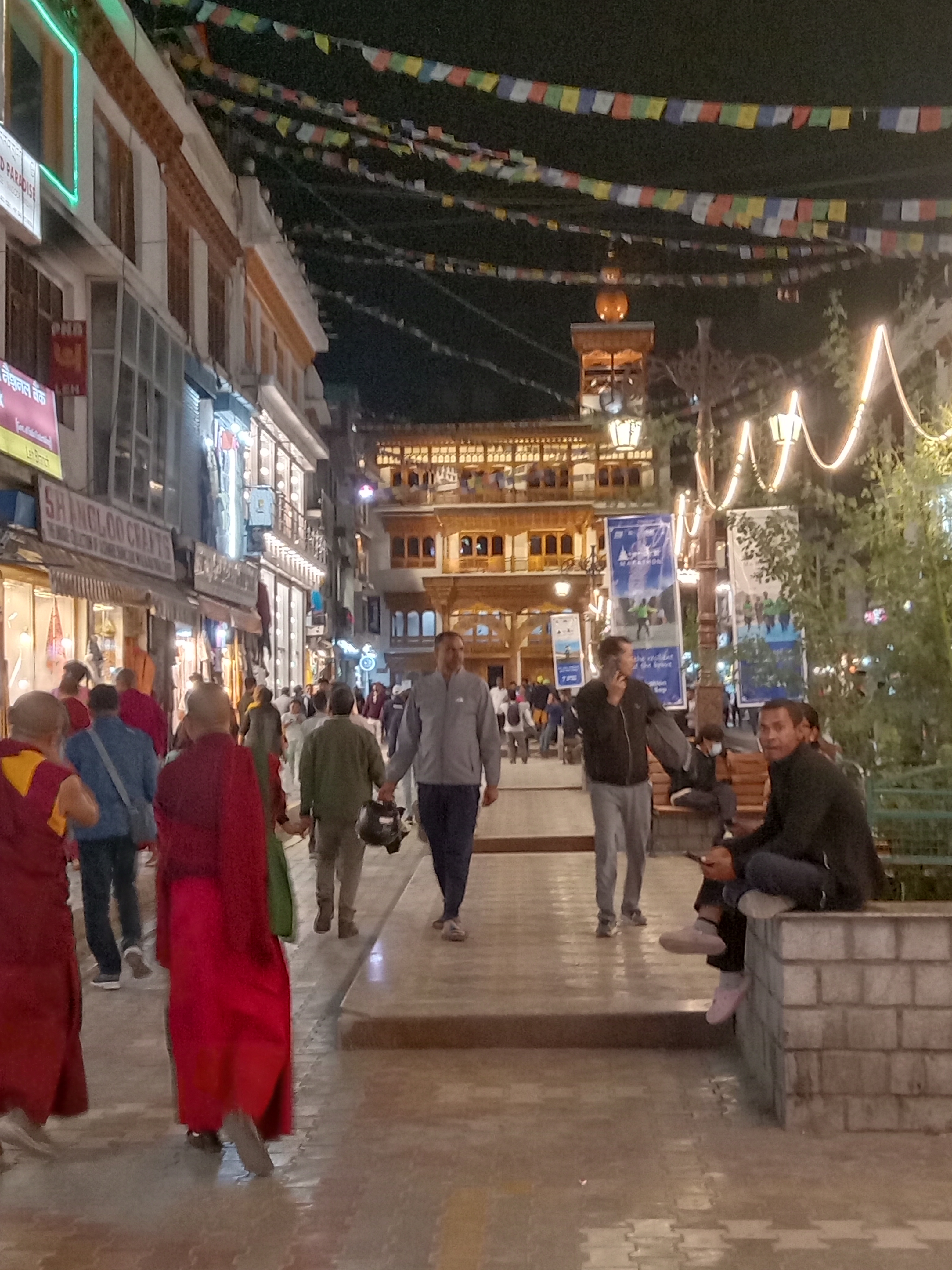
The main market in Leh (photo: Shyam G Menon)

Participation levels

In 2023, fifty-one persons were registered for the Silk Route Ultra and 261 for the Khardung La Challenge. Although podium positions are still dominated by local runners who are used to the altitude and the weather, the number of participants from elsewhere in India and abroad, have been growing. In all, the whole event spanning the two ultramarathons, the marathon, the half marathon and the shorter runs was converging nearly 6000 people to Leh this year. As P. T. Kunzon, former president of the Ladakh Buddhist Association (LBA) pointed out, the marathon has become a prominent fixture in the tourism calendar of Ladakh. Given its dates are in September, an otherwise lean period for tourism in Ladakh, the marathon has the effect of prolonging the tourist season. But it is two other factors that matter more from a business point of view. First, every runner in town is required to acclimatize well and this means, a longer period of stay in Leh. Some runners arrive with their families (in 2023, there was, according to the organizers, one family with 14 people running various distances at the Ladakh Marathon). For hotels and restaurants, this is a blessing happening as it does, in the tapering portion of the tourist season. Second, as denizens of the world of active life style, runners may wish to explore the outdoor activities Ladakh has to offer like trekking and camping (before or after the marathon). This is good news for people operating businesses around such activities. Compared to this, the tourist arrivals of Ladakh’s peak season mostly belong to the sight seeing sort. It is worth nothing that in 2023, while the number of people coming from outside Ladakh to run the two ultras, the full marathon and the half marathon had risen, the year’s tourist season till then had seen a fall in arrivals.

If one were to sense direction from how the Ladakh Marathon and the tourism around it have evolved (it has graduated from a marathon done and dusted in one day, to two ultras, marathon and smaller runs spanning as of 2023, four days), the mood is one of becoming a festival around the active life style. In 2023, besides the Ladakh Marathon, a football tournament was also scheduled to happen in the same period. This growth to being a multi-day affair is not the only emergent trend about the Ladakh Marathon. In the initial period it was a lonely walk for the event organizers, Rimo Expeditions. Over time, local authorities have come around to supporting the marathon. In Leh, local businesses with products and services relevant to the running community, keep the marathon in mind. “ We have people walking in to buy things in September,’’ Jigdol, proprietor of Himalaya Adventure Store in Leh, said. According to the organizers, on all the four days of the event, the roads earmarked for the races stay closed to traffic during the hours of the competition to ensure smooth passage for the runners. “ I prefer a road closed to traffic. As it is, I would be tired from the running. Watching out for traffic on top of that, would be making things needlessly complicated,’’ one ultrarunner told this blog at the Ladakh Marathon expo. On the Kyagar-Leh section, even the army – an active participant in the Ladakh Marathon with its pool of strong runners – suspends its convoys for the duration of the ultramarathons, Motup said. The communication support for the two ultramarathons is provided by the Signals Regiment of the Indian Army. In 2023, on the Kyagar-Leh route of the two ultramarathons, the regiment was set to have nine communication vans parked at regular intervals along the way. It is critical infrastructure for a race requiring proper monitoring of participants and medical assistance on call.

Many cities in India host marathons but the general attitude seen is one of finishing an avoidable chore and reverting to the Indian normal of traffic, rat race and money-making. Ladakh is a small place and its annual marathon, although big by local standards, is small compared to the marathons of the plains. But the ecosystem of support the event has acquired – it includes local authorities, the military, local businesses and local villages – is noteworthy.

A challenge in 2023

Leh has two major road links to the outside world. The most popular one is via Manali in Himachal Pradesh. The other is via Srinagar and Jammu. A lot of the materials needed to host the annual marathon reaches Ladakh from the plains. The goods travel by road. In 2023, the monsoon caused havoc in Himachal Pradesh. Besides causing a high number of deaths, it destroyed houses and wrecked the road network. September, the month in which the Ladakh Marathon occurs, is just outside the usual months of rain south of the main Himalayan axis (Ladakh is to its north). For a marathon, required materials should start moving at least a month in advance. In 2023, such logistics into Leh was hit by the natural calamity in Himachal. Shipments to Leh for the marathon got stuck between Shimla and Manali. A team had to be dispatched from Delhi, which then repacked the goods onto smaller vehicles and rerouted it through the few roads still open, to Jammu. There, it was transferred to trucks for passage to Leh via Srinagar. Some stuff had to be airlifted adding to costs. The kits offered to participants in the event’s ultramarathons are quite attractive and contain T-shirts, jackets, thermals etc. Orders had been placed as early as April-May. Given the challenging logistics scenario, things were still coming in even as the marathon’s expo got underway at the NDS Stadium in Leh. Nature stays an unpredictable and non-negotiable entity not just during the races in Ladakh but even in the preparations to hosting an event.

Before their race

Hanna Gogoseanu lives in Cluj-Napoca in Transylvania, Romania. She has been running regularly for the past three years or so. About two years ago, she happened to see a documentary on Ladakh on National Geographic. That was how she got to know of the Khardung La Challenge. It became a goal to aspire for. At that time, Hanna hadn’t run a proper marathon. So, to qualify for the Khardung La Challenge, she completed two marathons and in February 2023, commenced training for the race in Ladakh. For a taste of altitude, she spent time in the Carpathian Mountains of Romania but those heights are nothing compared to the Himalaya. Landing in Leh in the middle of August 2023, her first couple of weeks was tough. Besides the strain of altitude, she found the atmosphere dry. She developed nose bleeds. On August 31, when this blog met her at the race expo, she said she had begun getting used to the surroundings and had commenced her training runs. She knew she was due for an adventure and was looking forward to it.

This year, Maik Becker had with him Igor Kirsic from Switzerland and Marco Kuchhirt from Germany. For both Igor and Marco, it was their first visit to India and Ladakh. Both of them were into running but neither had done an ultramarathon at this altitude before. As Igor explained, he could accumulate elevation during training in the Swiss Alps but could do nothing about altitude, which is the irreplicable quantum when training for a run in the Himalaya. A triathlete, Marco had been to several Ironman events before. But he reserved complete respect for altitude, saying one cannot predict what lay in store. The duo was hoping to trek a bit as part of acclimatization, before reporting for the Khardung La Challenge. Maik on the other hand, was an old hand at the Ladakh Marathon and other races in India. A known Swiss ultramarathoner who travels the world to run, he had done the Khardung La Challenge a few times before. In 2023, he was set to attempt the Silk Route Ultra.

Ashwini Ganapathi (photo: courtesy Ashwini)

By the time of the race expo, Ashwini Ganapathi had been in Ladakh for over a month. She arrived on July 25. “ Five of us had planned to do a self-supported 100 kilometre run in the first week of August. We were to do it from Manali but we had to shift to Ladakh because of weather issues there,’’ she said. Apart for the 100K run, she had also planned a three-week vacation with her husband and a few treks. “ In Ladakh, we did the self-supported run of 100 km from Pang to Tso Moriri. It took us 27 hours to cover the distance. It was more of hiking than running. We drank water from the streams along the route,’’ Ashwini said. She also did a few motorbike trips apart from the treks to help in the acclimatization process. “ Ladakh is very dear to me. I have been visiting Ladakh for many years now,’’ she said. In 2019, Ashwini had done the 72 km Khardung La Challenge and finished second among women. That same year she also did the event’s full marathon. On preparations for the 2023 race, she said, “ I think my training for Silk Route has been good. I am familiar with the Silk Route course. Nevertheless, it will be a challenge to do it at night. The race starts at 7 PM. From 8 PM to 5 AM it will be dark.’’

Shikha Pahwa (photo: courtesy Shikha)

Shikha Pahwa reached Ladakh in the end of August. As part of her acclimatization, she went for a hike to South Pullu at a height of 14,000 feet. She walked the way up and ran the course down. No stranger to Ladakh, in 2017, she had done the Khardung La Challenge and emerged the winner among women. In 2018 she completed the 111 km-race of La Ultra The High. “ In 2019, I did their 222 km-race but had to give up after 212 km as weather turned for the worse. Last year, I did the 111 km again. In June this year, I did the UTMB Mozart 100 in Salzburg, Austria. The official distance was 106.3 km. I was the only Indian participant and completed it in 19 hours and 56 minutes. For the Silk Route Ultra, I am banking on my experience in running in Ladakh. But weather can be an issue,’’ she said.

Satish Gujaran (right) with Thomas Bobby Philip (photo: courtesy Satish)

For Satish Gujaran, his first few days in Leh were trying. By the evening of his arrival, he had a splitting headache. He decided to take Diamox and continued the recommended dose the next day. By now, he had loss of appetite and was feeling nauseous. From the third day onward, his condition improved. He suspects, the episode may have been the result of him resting on day one in his closed hotel room instead of an airy ambiance. Over the following days, Satish commenced running locally. When this blog met him September 2 evening on Leh’s Mall Road, Satish had begun doing trips to Khardung La to get used to that higher altitude and get a feel of how walking and running at the pass and its immediate slopes may be like. “ On the day I arrived I found it difficult to walk to the hotel. Now, it’s much better,’’ Satish, a popular figure in running and someone who has completed the Comrades ultramarathon in South Africa many times, said. He felt that running Comrades and running in Ladakh couldn’t be compared. Altitude is a totally different beast. In a reversal of the trend of Indians going to South Africa to run Comrades, Satish wishes to bring interested South Africans to Indian destinations and marathon locations like Ladakh.  

A beautiful Surly touring bike parked at the door of its owner’s office on Chanspa Road and a conversation with the owner about cycling, revealed a small detail. Leh resident, Tenzin Dorjee, was due to run his first half marathon at the 2023 Ladakh Marathon. “ My neighbour was in the army. But even after leaving the military, he continued to run. He was my inspiration,’’ Tenzin, who manages a travel company, said. He has been running for the past five years. He has been cycling for a longer period; during the COVID phase, he toured a lot on his cycle within Ladakh. In the following years, he cycled in Uttarakhand and Himachal Pradesh. According to him, the Ladakh Marathon has had a salutary effect on local running with more people in Leh stepping out nowadays for a morning jog or run. Asked why the active lifestyle was late catching on in these parts, Tenzin attributed that to life in the mountains being a naturally active one and hence people not seeking out exercise as a separate avenue to physical fitness. That has changed with the onset of new perspectives to living; it received further impetus after the pandemic, he said.

Anmol Chandan (centre) with Rakesh Kashyap (left) and Amit Gulia (photo: Shyam G Menon)

In July, Anmol Chandan had earned a podium finish (third place) in the open category for men at the 2023 IAU 100KM Asia Oceania Championship, held in Bengaluru. In 2022, he had completed the Khardung La Challenge. This year, along with his friends, Amit Gulia and Rakesh Kashyap, he was set to attempt the Silk Route Ultra. Amit reached Leh on August 29. “ We have been clocking miles,’’ he said of the training runs the trio did locally. Usually doing 6-7 kilometres a day, they did around `16-17 kilometres on one day and also made a trip to Khardung La on motorcycles. The pass felt cold that day. “ It’s going to be how you feel on race day,’’ Anmol said, adding that he intends to have a strategy in place for the Silk Route Ultra but also provide room for flexibility. Both Amit and Rakesh have completed Spartathlon.

Dinesh Heda (photo: courtesy Dinesh)

For many runners attempting the two ultramarathons within the Ladakh Marathon fold, the crux of the whole course was Khardung La and its immediate neighbourhood. This segment signified the zone with maximum altitude and lowest oxygen levels on the ultramarathon route. Runners hired cars and visited the pass to get used to the altitude and do mild training runs / walks around there. Dinesh Heda was among those not doing pre-race visits to Khardung La. Instead, after two days of natural acclimatization in Leh, he headed out in the opposite direction from Khardung La; to Shanti Stupa in Leh and the modest height gain it offered. Although he had a strategy for the race, he wasn’t a fan of the world’s fascination for measurement and data. He preferred to listen to his body. To perfect that link, Shanti Stupa sufficed. In his mid-fifties, Dinesh’s approach seemed one of reserving his running on race day for the flats, gentle gradients and downhill portions. Plus, be efficient without tiring oneself on the Khardung village-Khardung La stretch and try reaching the pass with some saved time on hand. In this, he knew that he wouldn’t be running near Khardung La, which is the hardest section. Up there, he would be walking as best as he can. “ I think it’s better to walk the uphill sections,’’ he said. Consequently, while training, he was focused more on maintaining his efficiency in brisk walking. Similarly, between performance and preservation, he preferred the latter. There were a couple of other reasons too for not stealing off to Khardung La before the actual race. Even if you visited the high pass so, there is no guarantee that conditions would be the same on the day of the race. So, why obsess with the pass and make it grow in one’s head like a formidable objective? Besides, Dinesh liked some things to stay unknown for a sense of discovery on race day. And no matter what the outcome on race day, he planned to be there for a celebratory beer in Leh with his friends.     

The pass at the centre of the two ultramarathons

For most people today, Khardung La is the world’s second highest motorable pass and in Leh, a coveted objective tourists like to visit as a landmark in altitude reached in the neighbourhood. Simply put, it is all about altitude, vehicle, travel by road, the thin air of the pass and photos taken as proof of having been there. End of story. For Ladakhis however, that isn’t the case. Khardung La was for centuries, part of the summer route on the Silk Route to Central Asia. According to Chewang Motup, owner of Rimo Expeditions (it organizes the Ladakh Marathon) the Silk Route’s junction beyond the borders of Ladakh was Morgo. It had two routes of access from Leh. In winter, caravans proceeded to Morgo via Shyok village on the banks of the Shyok River. Although the river’s name is drawn from its capacity to spread gravel, there appears to be an element of death also associated and that could be because in olden times, the caravans to Morgo had to cross the Shyok River multiple times. River crossings can take a toll on animals and humans. In summer, this route becomes unusable because glacial melt causes the river to bloat. Consequently, the summer route from Leh to Morgo went via Khardung La. Motup recalled how in his childhood it had been a three-day trip on horseback from Kyagar, his home village, to Leh. It took another two days to Srinagar, where he attended school.

In the years past, the northern side of Khardung La used to be glaciated. Caravans via Khardung La operated till almost the mid-1970s, Motup said. His grandfather had gone a fair distance on the Silk Route. In 2002, as part of an expedition, Motup made it to the Karakorum Pass via Shyok. He was the third generation of his family to stand there. The motorable road from Leh to Khardung La, which everyone takes for granted these days, made its appearance only in the late 1970s. Just beyond the pass, there used to be a bridge that was – like many things Khardung La – acclaimed for its altitude. It no longer exists; the gap it bridged has been filled and concreted. Even with a road in place by the late 1970s, Khardung La wasn’t an easily accessible spot for visitors to Leh. It was a restricted area. Much later, when Nubra was opened to the public along with Dahanu (also called Aryan Valley), Pangong and Tso Moriri, the tourist destination called Khardung La was born. On either side of Khardung La, on the approach to the pass, lay North Pullu (on the Nubra side) and South Pullu (on the Leh side). Pullu in Ladakhi means a shepherd’s shelter. Long before they acquired their contemporary names, Motup said, North Pullu was known as Spang Chenmo while South Pullu was referred to as the pullu for Ganglas and Gonpa villages. Specific to the race (Khardung La Challenge), 2018 is widely recognized as having been a tough year for participants. There was rain on the approach to the pass and at the pass it was blizzard like conditions with very low temperature.

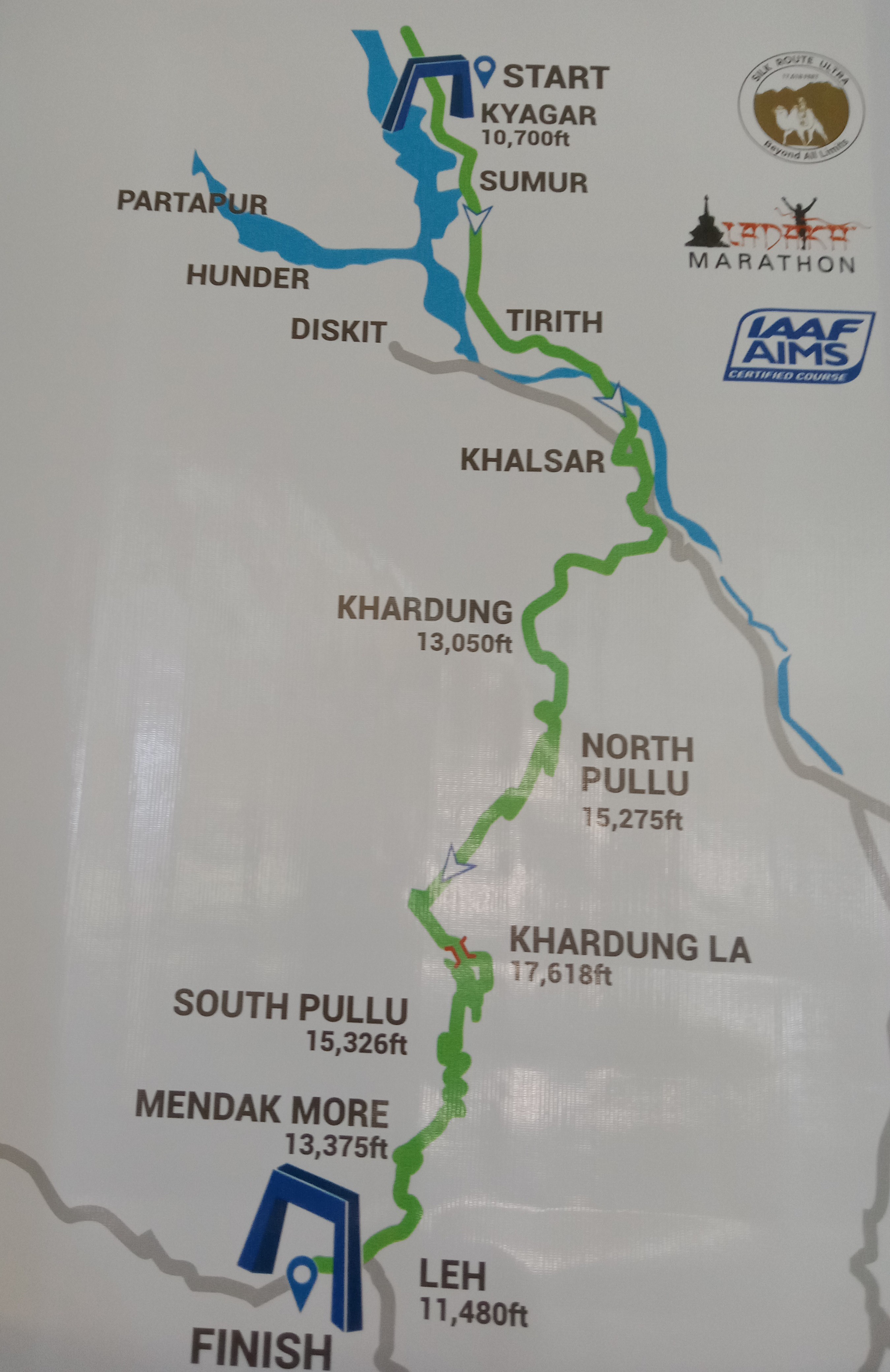
The Silk Route Ultra course (from route maps displayed at the marathon expo / photo: Shyam G Menon)

That time we run through

It is what decides podium finishes at races; it is what all runners live by (even the ones wishing to be free of its pull). Meet time. These days at marathons, time is measured using mats, which one steps on and side antennas that one runs past. The start and the finish, being most critical and requiring certainty of recording, typically feature both mats and antennas for redundancy. Mats are useful where a large number of people are involved, which is the case at the start line of a race. Time stations along the way, are served by side antennas and they suffice – especially in ultramarathons like the Silk Route Ultra and the Khardung La Challenge – because past the start line, clusters split and runners get spaced apart. The Silk Route Ultra will have six timing stations – at the start, at kilometre 25, at Khardung village, at Khardung La, at Mendak Mor and at the finish. For this race at altitude featuring a modest number of runners (both Silk Route Ultra and Khardung La Challenge put together), the service provider, Sports Timing Solutions, will work with a small crew in a format resembling a relay. Given the equipment used is imported and was designed for use in cold countries, the cold weather at stations like Khardung La won’t be a problem. What may pose difficulty is altitude; more precisely the effects of altitude on the people manning the stations (they have to be there till the last runner goes through). According to Amir Shandiwan, partner, Sports Timing Solutions, the company has learnt from its previous experience in operating at altitude in Ladakh. Aside from making sure the timing equipment and the people manning it are alright, the other thing to take care of is the availability of telecom network coverage for data transmission. Each year, this is assessed afresh on the mountainous route of the two ultramarathons. On September 5, the Sports Timing Solutions team was due to check out connectivity on the route. They had dongles from multiple telecom service providers to add redundancy into the system. As further back up, each timing station will have the provision to download the recorded data into a USB, so that in the event of any weakness in network, the data may be physically transported to the nearest point from where onward transmission is possible. To wrap up – one’s timing in the two ultramarathons may be just a series of inanimate digits; delivering it, however, entails some hard work.         

The aid stations and a story of community participation

A unique aspect of the Ladakh Marathon is the participation of the local community in race arrangements. The route of the two ultras within the portfolio of races at Ladakh Marathon – Silk Route Ultra and Khardung La Challenge – are connected. The Silk Route Ultra is an extension of the older Khardung La Challenge with its start located 50 kilometres further up the road. Between Kyagar, where the longer 122-km ultra starts and Leh (the finish point), there are 21 aid stations. Except the aid station at the highest point enroute – Khardung La, and the one at the very end, all the remaining aid stations are operated by teams drawn from villages along the route. Of the seven aid stations between Kyagar and Khardung (from where the Khardung La Challenge commences), the first and third are managed by Sumoor village, the second by Lagzhum, the fourth by Khalsar and the fifth, sixth and seventh by Kyagar. Thereafter, the first four aid stations on the Khardung-Leh stretch are operated by Khardung village and the fifth and sixth by Kyagar village. Aid stations from the seventh to the thirteenth on this stretch are managed by teams from Ganglas and Gonpa villages. The last aid station, the fourteenth on the Khardung-Leh stretch is usually managed by a business enterprise in Leh close to that point.

The fourteenth aid station, located at Khardung La, is a crucial spot and is managed by a team drawn from the trekking staff of Rimo Expeditions. They spend roughly four hours on Khardung La, the highest and coldest point of the course, providing support to the runners passing through. However, the aid station that stays open longest is typically the seventh one on the Khardung-Leh stretch, Motup said. The above architecture of participation by villages, is noteworthy. In September 2023, there were 51 runners registered for the Silk Route Ultra and 216, for the Khardung La Challenge. According to Motup, the angle of carrying capacity wasn’t yet a bother because Khardung over time has added more accommodation facilities. And as for any strain on race infrastructure and monitoring due to enhanced participation, Motup pointed out that the longer Silk Route Ultra had debuted only after several years of holding the Khardung La Challenge. It was a conservative extension of the course’s length. Not to mention – the emphasis has been on sustaining and improving an existing race before adding another to the portfolio.

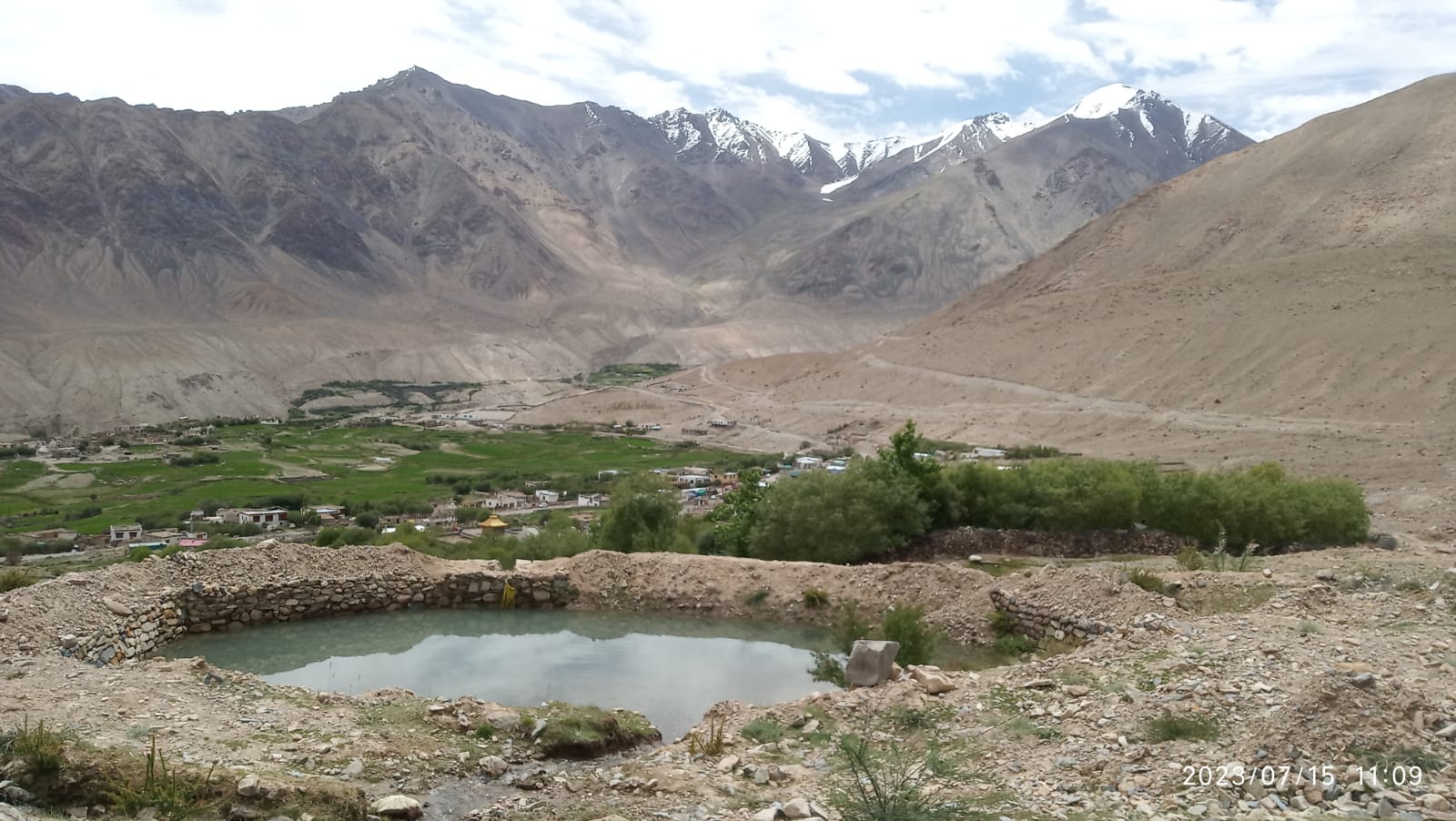
The reservoir built by the Tatas in Khardung village (photo: courtesy Chewang Motup)

Sponsors yes but preference for those appreciating the event’s uniqueness

The high level of community support has meant, Motup setting matching expectations for his sponsors. He is clear that the Ladakh Marathon cannot be approached by sponsors in the same fashion they would, a city marathon. Notwithstanding what a sponsor may want by way of marketing and brand promotion, events in Leh come with non-negotiables like the limits and possibilities of local geography, unpredictable weather conditions, sensitive environment and modest size of race. Respect for these parameters may mean, the regular compulsions of brand promotion and marketing, requiring to compromise. For instance, a potential hydration partner cannot simply supply bottled water, end its engagement there and hope for publicity. At many marathons, plastic bottles generate garbage and littering. Water must therefore be handed out in cups to those requiring a drink. Sometimes, the realities of Ladakh and the involvement of the local community may also mean sponsors needing to go the extra mile. In 2022, the Tata Group, which was a partner that year, left behind a remarkable legacy – they built a reservoir for Khardung village, something utterly useful in Ladakh, which is a high-altitude cold desert. This year, it is hoped, Bisleri would build a reservoir for Kyagar village. Motup’s expectations don’t end there. He would like any sponsor interested in the event to also help in creating and sustaining Ladakhi talent in running. It may be recalled that for years, Rimo Expeditions has supported the growth of a team of runners from Ladakh; they travel to the marathons of India’s plains, have secured podium finishes and one of them – Jigmet Dolma – made it to the Indian women’s marathon team. Motup acknowledged that while there were those wishing to support the marathon, he had to let go of many such opportunities because they didn’t satisfy the overall paradigm employed.

(The authors, Latha Venkatraman and Shyam G Menon, are independent journalists based in Mumbai. Our thanks to all those who spared the time to talk to us.)

NOLS: GETTING BACK IN PHASES

N. Ravi Kumar, Director, NOLS India

NOLS is among the world’s biggest outdoor schools. Its headquarters are in the US; it has its India operations in Ranikhet, Uttarakhand. For years, practices evolved at NOLS have served as a benchmark for the outdoor industry especially the segment therein focused on outdoor education.

When the world slipped into the grip of COVID-19 in early 2020 (the disease was first reported in late 2019) and normal human life got disrupted, NOLS too was impacted. But characteristic of it, the school worked on new, safe means to conduct its courses and by early 2021 was back to operating many of its outdoor programs in the US.

N. Ravi Kumar, Director, NOLS India is currently in the US, working outdoor programs and first aid courses there. He spared time to answer a few questions on NOLS, NOLS India and outdoor programs in the midst of a pandemic. The exchange was via email.

Broadly speaking, how has the pandemic affected the operations of NOLS globally?

The impact has been significant. In spring 2020, NOLS was forced to shut down the following locations abruptly: India, Tanzania, Patagonia, Scandinavia, Mexico and all its locations in the US.

The school had to let go of a large portion of employees and retain only essential workforce to help with restart when things are under control.

When did operations resume and in which all geographies?

Spring 2020 everything was shut. In the fall of 2020, we did a few courses with COVID protocols in place and by spring 2021 we had most of our operations in the US going with limited course offerings. The response was very good. All courses were full in no time and we have had the least number of evacuations in the school’s history as everyone wanted to be out in the woods after a year of staying indoors.

This summer we had enrolment beyond what we could accommodate and had to cut back significantly due to staff shortage.

NOLS uses the expedition model to teach its courses. How has the structure of NOLS expeditions changed to handle the precautions and protocols required in these times of COVID-19? In one of our conversations, you briefly touched upon a multi-phased model that is being used. Can you give us an overview of this model?

Coronavirus, SARS-CoV-2, and variants are an evolving hazard. The risk of contracting the illness, COVID-19, on NOLS field courses cannot be eliminated. But we have identified mitigation strategies based on guidance by the Centers for Disease Control (CDC) to reduce that risk, which can be used in concert with testing and vaccines. With those strategies in place, we believe the risk can be managed appropriately.

The cornerstones on which, we have based our approach include informed consent, reducing the risk of virus transmission, hygiene with emphasis on hand washing or sanitizing to prevent flu-like illness and monitoring for symptoms of COVID-19.

NOLS has put in place COVID-19 risk management strategies for each of the outdoor activities it is associated with spanning land and water.

Our field practices are divided into phases depending on the documented vaccination status of course members. A course starting in Phase 1 will follow the recommended practices of that phase for the first ten days of the course. After ten days, if there are no significant breaches and if no one becomes symptomatic, we can reasonably assume that the risk of COVID-19 transmission within the group is reduced and the group can move to Phase 2. A course that is fully vaccinated can start the course in Phase 2, which is normal course operating routines with continued attention to hygiene. This is the broad paradigm.

Besides detailed protocols on hygiene, daily health checks, physical distancing, masking and cooking, the first phase features a few other key elements. For instance, in Phase 1, the tents used are of the sort that are roomier and capable of better ventilation. Models like the Mega Mid are finding increased use in the quest to have less confined, better ventilated shelters. Tarps, flies – they are staging a comeback. To provide adequate physical distancing, the number of persons per tent is kept low in Phase 1. Groups are also encouraged to use their shelters such that there is spare shelter capacity within the group, for flexibility. The Phase 1 model has the quality of a protective cocoon. If during this phase or at a later stage, somebody does show symptoms, then in addition to isolating that individual and preparing for further steps thereof, the Phase 1 model may be continued or returned to for the rest of the group.

The above is an overview. It is only meant to provide a broad idea of how things have changed.

WMI first aid courses are now an integral part of NOLS. How has the onset and spread of COVID-19 affected the WMI curriculum? Has measures around the avoidance, detection and field management of COVID-19 / infectious diseases become a part of contemporary WMI curriculum?

All WMI courses start with an hour-long class on infection control, right after introductions. The class covers a wide range of infections and devotes ten minutes to Covid related infections and how to mitigate the spread. This addition has forced the removal of the lightning class in WFA courses, and altitude illness. Now we direct students to watch videos on the topics as homework.

The WMI courses are full and busy. They even started running courses partly online and partly with classroom presence. We are still adapting to norms and restrictions in large classrooms and how we run practical patient care with minimum exposure to each other.

How did COVID-19 affect NOLS India? What is the short to medium term plan for India operations? Do you anticipate any changes to how you run courses here as a consequence of the pandemic?

NOLS has decided to close a few international locations for good. India is not one of them. I hope it continues so. Most of the students on our programs run in India, are from the US. Although the US itself has struggled to deal with the pandemic (even today the number of people succumbing to the disease is high) the combination of what happened in India and how it got portrayed, has been such that a proper perspective of the reality in India is absent in the US.

Hence the school has decided to take a conservative wait and watch approach as regards restarting India operations. It is imperative that when in India, our students should get proper medical care if required. We cannot restart when the health care system is overwhelmed or there are indications, it may be.

(The author, Shyam G Menon, is a freelance journalist based in Mumbai. The WMI first aid courses offered by NOLS are WFA, WAFA and WFR of which WFA is the shortest.)

A WORKSHOP IN NAVI MUMBAI

Illustration: Shyam G Menon

In the concluding months of 2020, an accomplished ultra-cyclist discovered the beauty in sharing his knowledge and skills through an extended workshop. Here’s an overview: 

Bala Sitaram Rokade bought her cycle about two years ago. She was into the active lifestyle. She had been running regularly since 2015, was training women interested in physical fitness and had become an ambassador for Pinkathon in the Seawoods area. At the time of purchasing the bicycle, she didn’t know how to cycle. “ I wanted to learn cycling,” she said. Having learnt it; prior to the pandemic-induced lockdown of March 2020, the maximum distance she cycled at one go was approximately 25 kilometers on that road much loved by runners and cyclists in Navi Mumbai – Palm Beach. In October 2020, as the relaxation of the lockdown progressed, Bala enrolled for a workshop on cycling that she came to hear of through the social media channels of Everest Cycling Culture (ECC). It spanned a few weeks. “ The workshop enhanced my confidence to cycle on the road and on Palm Beach. Within a fortnight of training at the workshop, I did my first ride of 100 kilometers,” she said.

The 100k ride was essayed as loops on Palm Beach, a pretty flat road. Bala covered the distance in around five hours. Following the workshop, Bala began attempting BRMs, which are self-supported long distance rides held with a cut-off time but no competition among participating cyclists. It is typically the first stepping stone for those aspiring to know the world of endurance cycling. Internationally, the tradition of brevets or BRMs is overseen by the Audax Club Parisien (ACP); each country has a local chapter that supervises rides within its domain. Bala did her first 100k (Vashi-Khalapur-Vashi) in 4:58 hours; the second 100k (Belapur-Khopoli-Belapur) in 5:18 hours and on January 30, 2021, a 200k BRM (NMMC building near Belapur-Dhapoli) in 12:58 hours. Officially, BRMs start from 200k; the 100k is classified as Brevet Populaire (BP). “ I wish to try becoming a Super Randonneur,” the 50 year-old said. To be a Super Randonneur or SR, a cyclist has to do BRMs of 200, 300, 400 and 600 kilometers in one SR season.

From the workshop (Photo: courtesy Kabir Rachure)

February 2021. At a small cafe in the subway below the Seawoods  railway station, Kabir Rachure recalled his predicament in the second half of 2020. “ I was bored,” he said. Among leading endurance cyclists in western India, Navi Mumbai-based Kabir has been a podium finisher at domestic ultra-cycling events and a finisher in the 2019 edition of Race Across America (RAAM). Like others in the country, he had seen life in his neighborhood come to a halt with the pandemic and lockdown. Weird for ordinary human beings to behold, the specter of life brought to a standstill was weirder still for the cyclist used to training outdoors daily. In the initial phase, it was unsettling. Kabir trained indoors but the repetitive pattern of a bleak existence was boring. Past its strictest phase, as the lockdown started to relax and he recommenced his outdoor rides, Kabir thought of ways to overcome the ennui that still nagged him. Although there were virtual events organized by friends that he participated in and instances of Everesting (an activity in which, cyclists pedal up and down a hill multiple times till the cumulative elevation gain equals that of Everest – 8848 meters; it is done by runners too) he attended, he knew it would be some months before the old calendar of physical events in endurance cycling got restored. It left him with time on his hands and thoughts around how such time may be put to good use.

Everest Cycling Culture is a leading name in the bicycle retail business in Navi Mumbai. For some years now, it has functioned as a modern bicycle shop in the suburb of Seawoods. ECC anchors a community of cyclists replete with weekend rides covering modest distances. Kabir knew ECC well. Long before the lockdown  of 2020, he and the well known Nagpur-based ultra-cyclist Amit Samarth, had been speakers at a function organized by ECC. He had also given a talk at ECC after completing RAAM. In the period of the phased dismantling of the lockdown, Kabir realized that what would satisfy him is sharing and coaching. Thanks to his excursions in the field of ultra-cycling, he had built up a well of experience. Besides the grace in sharing, helping others improve their skills can be a sort of healing for the mind emerging from pandemic and lockdown. Not to mention – the timing seemed apt because in the wake of lockdown being relaxed, in India and elsewhere in the world, there had been a sharp surge in interest in cycling. The pandemic had highlighted the importance of physical fitness. Among avenues to stay fit, cycling ranked at the top because it mixed exercise with the joy of movement and at the same time ensured physical distancing, which had become an important aspect of pandemic-related safety protocols.

Illustration: Shyam G Menon

According to AbdulRab Kazi, founder and admin of ECC, it’s online community of cycling enthusiasts is currently over 3000-strong and spread across 19 WhatsApp groups in Navi Mumbai. “Kabir has been associated with ECC since 2014-15. We were talking one day when Kabir broached the idea of a training workshop,” Kazi said. ECC quickly bought into the idea. Amateur cyclists typically need some guidance to gain confidence and give wing to their abilities. The workshop seemed ideal for that. “ We decided on a format that would have Kabir ride with the trainees at least three days a week and assign them homework for the remaining days,” Kazi said. ECC circulated the proposal on social media to their members. Alongside they also reactivated an old WhatsApp group they had. Called Wheelist, it was originally meant to address members nursing dreams of personal expeditions and projects. Those interested in the workshop were encouraged to come aboard Wheelist. The workshop was named: Train with Kabir. A fee of Rs 1000 was charged for the program to ensure that only those truly interested (and having suitable cycles) would participate. Around 17-18 applications were received. From that, 13 persons were selected to attend the workshop. It was a varied field ranging from abject recreational cyclists to those who had already done BRMs. It was also varied in terms of age. The diversity suited ECC because its aim is to get more people on the saddle and help them acquire the capability of riding 100 kilometers, comfortably and responsibly. As regards age, Kazi felt that in today’s times many people wake up to their capabilities late. Amateur running and cycling has plenty of people who picked up the sport in middle age. “ At ECC, we have a wide range of age groups, from 9-10 year-olds to those above 70,” Kazi said. Among those who applied and made it to the workshop was, Bala.

Another was fifty year-old Ajith B. Nair, who stays in Seawoods and works as a chief manager at State Bank of India. He had been living the regular working man-existence with physical fitness denied its due share of attention, when a physiotherapist he consulted for a knee problem, recommended cycling. Initially, he borrowed his son’s bicycle for the purpose. “ I liked the experience,” Ajith said. He joined the cycling community at ECC. About a year and a half ago, still unsure whether his new interest in cycling would become a serious engagement or not, the bank officer purchased an affordable hybrid bike – Riverside – from Decathlon. “ My goal on the days I cycled was to pedal for an hour or in terms of distance, about 20 kilometers. I hadn’t heard of BRMs and so knew nothing about them,” he said. However courtesy, the supported group rides offered by ECC, Ajith had to his credit a long bike ride of around 60 kilometers prior to reporting for the workshop. That was the longest distance he had covered. In the course of the workshop (it started on October 20), Ajith did a 70km-ride on Palm Beach. “ It was at the workshop that I got my first insight into what BRMs are,” he said. Ajith did his first BRM, a 200km-ride in November during the course of the workshop. In December, he did his second BRM, this time a 300km-ride. He plans to continue participating in BRMs. But the best thing that the combination of cycling, workshop and BRMs have done is that it has given him a hobby he can continue anywhere in India. “ BRMS are there in many cities now,” he said.

From the workshop (Photo: courtesy Kabir Rachure)

A structural engineer by profession, Parag Kulkarni, 48, used to be a recreational cyclist.Owner of a Giant road bike, he was a member of the ECC cycling community. The longest ride he had done ahead of the workshop was of 100 kilometers; it was a supported outing with ECC of 70 kilometers complemented by a 30km segment on his own. According to Parag, in the early stage of the workshop, the participants along with Kabir, did a slightly long ride covering Palm Beach and the nearby Parsik Hill. This gave Kabir an idea of where each trainee was in cycling; he was able to customize inputs for each in addition to the general sharing of knowledge, which every workshop entails. Parag participated in his first BRM roughly three months ago, a 200km-ride that he completed in approximately 13 hours. Going ahead, he wishes to attempt being a Super Randonneur. But for that, he feels an emergent problem in cycling has to sort itself out. One of his BRMs (a 400k one) had to be aborted because of a couple of punctures, including one that ripped the tyre. Parag managed to hire transport and get himself and cycle back to Navi Mumbai. Unfortunately in the months after lockdown’s relaxation, the sudden surge in cycling and bicycle purchases had created a shortage of bikes and spare parts. Good tyres have become difficult to procure. It took him a couple of weeks to find a replacement for the damaged tyre and that meant no cycling for the period. The difficulty in finding spares also means that amateur cyclists pushing their limits may have to do so conservatively, for damaged parts are currently tough to replace.

Anup T. V was among the more experienced of the trainees. The 41 year-old forex dealer working with Kotak Mahindra Bank and residing in Sanpada, is a triathlete with a few Ironman events under his belt. It was around three years ago that he bought his first bicycle – a Firefox Rapide hybrid. The decision to take up cycling was mainly to check weight gain. He also became a member of ECC. In the ensuing months, he was one of the attendees at the talk hosted by ECC featuring Amit Samarth and Kabir; the former had completed both RAAM and Trans Siberian Extreme while the latter was preparing for RAAM. “ A day after this talk, I signed up for my first triathlon – the Ironman 70.3 held in Dubai in 2019,” Anup said. The journey to that event saw him acquiring a second bicycle, a road bike – Scott Addict 30. Following the Dubai Ironman, Anup participated in the 2019 Ironman Goa and a triathlon of 70.3 dimensions in Kolhapur. The last Ironman event he competed in was in New Zealand. Held in March 2020, it was a case of leaving an India before lockdown, competing in New Zealand and then returning to an India and world altered by the pandemic-induced lockdown. With ECC, Anup had done rides of 100 kilometers and more. Back in 2018 he also did a 200km-BRM on his hybrid bike, covering the distance in roughly 13:15 hours. During the course of the workshop, Anup did two BRMs of 200km each – from Navi Mumbai towards the Pune side, up Bhor Ghat and back. The first one he completed in approximately 10 hours, the second in 11 hours. Later he did a 300km-BRM in roughly 15:10 hours and a 400km-BRM in 23:15 hours. In November 2021, he plans to participate in the 600km category of the Deccan Cliffhanger, an event used as a RAAM-qualifier by many. Interestingly, despite his ability in cycling, Anup’s focus is not ultra-cycling; it is the triathlon. He has set his eyes on an upcoming Ironman in Lanzarote, Spain, which is reputed for its tough cycling leg. “ I would like to keep doing an Ironman every one to one and a half years,” he said.

From the workshop (Photo: courtesy Kabir Rachure)

Seventeen year-old Lenin Kennedy was the youngest trainee at Kabir’s workshop. Until then, he had been the regular recreational cyclist-sort, taking his bike out once or twice a week for rides approximating 20 kilometers on Palm Beach. Owner of a Dodge hybrid cycle, he was also a member of ECC and with the group, had done rides that were 50-70 kilometers long. The workshop has taken his relationship with cycling to another level. While many of the other participants at the workshop proceeded to participate in BRMs, Lenin couldn’t as his age didn’t make him old enough to enroll for one. So the youngster had his own 200km-ride on Palm Beach, which he completed in roughly nine hours. “ I am now interested in getting into professional cycling. I wish to take part in road races,” he said.

Fifty two year-old Prabhat Paranjpe, a telecom professional working with Reliance, has been a recreational cyclist for the past six years or so. His bike is a Trek 3 series MTB, purchased in 2013-14. “ I used to be a weekend rider,” Prabhat said. His rides usually covered around 50 kilometers; “ 25 kilometers one way,” as he put it. From Navi Mumbai, he used to ride in the direction of South Mumbai, Thane and Kalyan. A member of ECC, on his rides with them he cycled a bit longer. “ I didn’t know much about BRMs,” he said. What drew him to the workshop was a simple instinct. During group rides with ECC he had noticed others who were better  than him at cycling longer and faster. He wished to improve. He also wanted to give himself adequate motivation to graduate from being merely a weekend rider to somebody who cycled more regularly. “ I was hoping to bring in some discipline and knowledge,” he said. That seemed possible with the workshop because it was scheduled to be at least a month long affair (it eventually lasted some more to accommodate Kabir’s commitments as a cyclist). During the course of the training program, Prabhat did two rides that were longer than any he had attempted before. He did his first 100k ride; Vashi-Khalapur-Vashi, which he completed in roughly five and a half hours. The next was supposed to be a 200k BRM but Prabhat required some customization. The route of the ride from Navi Mumbai included the Bhor Ghat, which lay on the approach to Lonavala. Given he was on a heavier MTB with 21 (7×3) gears to boot, Prabhat was doubtful of how he would fare within the paradigm of a BRM. So Kabir suggested an alternative – accumulate 200 kilometers by riding from Navi Mumbai to Kasara and back. This Prabhat did; he covered the distance of 205km in approximately 13 hours, stops included. Unfortunately after the workshop, there was a minor loss of momentum in Prabhat’s cycling as the months of January and February had to be surrendered to business travel and recovering from illness. Past mid-February 2021, he said, “ I have just got back to cycling. I did a 50k this weekend and should be doing a 100k next weekend.” Not one to chase timings and such, he seemed interested in solo, self supported tours on his bicycle. “ Maybe I will ride to Pune next,” he said. 

Illustration: Shyam G Menon

From the conversation with Kabir, a visible streak in the training process appeared to be sharing of his personal experience and nudging people towards attempting BRMs. As he pointed out, the physical ability to cycle is there in most people; what varies is the personal experience gained from cycling long and hard. That is what ultra-cyclists like him bring to the table at a workshop. Years of training and pedaling long distances have given them insight into how to endure extended hours on the saddle and tackle various situations related to person and bike as they evolve. In the latter context, the encouragement to try BRMs makes sense because they are self-supported rides; the rider has to manage challenges en route himself / herself. But in addition to the above and the general satisfaction he got from helping fellow cyclists improve, there was probably another reason why Kabir elected to coach. Although he and others from his generation in cycling continue to dominate ultra-cycling events in India, the gap between them and the next wave of talent has been narrowing. Kabir thinks that in general, the basin for this talent currently runs through Mumbai-Navi Mumbai, Nashik, Pune and Bengaluru. These are regions that have produced prominent names in ultra-cycling (riders and coaches), around who, other cyclists have since clustered or grown. Each successive wave of talent rides in having benefited from more opportunities to cycle and improve, than the generation before it. So at some point, it is inevitable that new names will hog the podium. Nobody wins forever. What genuinely endures in such reality is one’s accumulated bank of experience as a cyclist. It makes sense to share it.

(The author, Shyam G Menon, is a freelance journalist based in Mumbai.)    

2021 CHENNAI MARATHON HELD AS SCHEDULED

Finisher’s medal from the 2021 Chennai Marathon (Photo: courtesy Anil Sharma)

After months of no mass participation events and amateur running in general weighed down by the restrictions of lockdown, the New Year kicked off with a scaled down version of the 2021 Chennai Marathon held as scheduled early today morning (January 3).

“ The event went off quite well under the watchful eyes of officials,” V. P. Senthil Kumar, Race Director, Skechers Performance Chennai Marathon 2021, said. When asked about the number of runners who actually participated in the event, he said tallying that number would take a few days. Following the onset of lockdown in India in March 2020 and its subsequent phased relaxation, the 2021 Chennai marathon was the second major running event to put feet on the ground after the 2020 Airtel Delhi Half Marathon (ADHM) of November. However while ADHM’s physical race was a competitive elites-only affair held in the safety of a protective bubble, the Chennai Marathon was non-competitive, open to amateurs, conducted on a motorsports racetrack away from the city with COVID-19 safety protocols in place and capped to a maximum participation of 1000-1500 runners.

Among those who ran in Chennai was Bengaluru-based amateur runner, Thomas Bobby Philip. A regular podium finisher at the annual Tata Mumbai Marathon (TMM), he currently runs in the race’s 50-54 years age category. “ I didn’t find any of the safety measures in place intrusive,’’ he said when asked how the Chennai Marathon experience felt, compared to those from pre-pandemic days. He said that when he first heard of the event in Chennai and the return to some form of event-based running it promised, he was certain that he wanted to participate. “ It was a relief,’’ he said of event savored after months with none on runner’s plate. Bobby finished the full marathon in 2:57:12, which was better than his previous best timing at TMM – 2:57:40, registered in 2018. “ I don’t compare these timings as the conditions and circumstances are different,’’ Bobby said.

The Chennai Marathon followed the 3.4 kilometer-loop of a race track and atop the benefit of that contained environment, was also utterly pleasant for a barefoot runner like Bobby. “ The track served up one of the best barefoot running experiences I have had so far,’’ Bobby said. The course was fairly flat. According to him, the others from Bengaluru who got sub-three hour finishes were “ Tilak, Devi Shetty and Vinuth.’’ All of them belong to Pacemakers, the training group anchored by Coach K. C. Kothandapani. “ There were around 150 runners for the marathon, which started at 4.30 AM. You had to report to the venue 15 minutes ahead. Safety protocols were followed well and in the holding area we had circles marked on the ground for each runner to stand with adequate physical distancing from the other.  Government officials were present to make sure that protocols were followed,’’ Bobby said.

According to Anil Sharma, member of Chennai Runners, the organizers of the event, the idea of holding the 2021 Chennai Marathon began getting discussed – including with the authorities who would be granting the required permissions – around October 2020. The proposal was to hold an event with all COVID-19 protocols in place. The race track at Irungattukottai also offered a location outside city limits. “ The authorities were supportive,’’ he said.  Anil, who participated in the half marathon, provided an overview of the approach to the event. The first priority, given the times and conditions in which the event would be held, was to get a grip on the potential number of participants. It had to be manageable so that chances of infection may be limited. “ We introduced some restrictions including timing-based eligibility to participate. It ensured that those who registered were keen on running,’’ Anil said. Additionally participation was capped at a maximum of 1000-1500 runners. Bib collection was set for the day before the event and prior to collecting the bib, those registered and turning up had to get their temperature checked and provide a declaration that satisfied a checklist related to COVID-19.

On event day, upon reporting 15 minutes prior to the start time, there was another round of temperature check to secure entry. Masks were to be worn till the commencement of running. “ We had people on loudhailers frequently reminding participants to maintain physical distancing in the holding area,’’ he said. Volunteers also checked the same. Government officials were present to monitor the proceedings. On the 3.4 kilometer-race track two aid stations were made available for the runners. Post run refreshments were served in packets that the runners could pick up themselves; the same went for medals, which were hung on stands and could be picked up. There was a medical team and ambulance available for any health emergencies. “ We were a bit concerned about the race track ambiance because it offers no shade. The full marathon takes some time to complete and the half marathon was starting roughly two hours after the marathon had commenced. There was a chance of running in bright sunshine towards the concluding stages. Luckily, the day stayed cloudy,” Anil said. 

It is understood that at least one other major race organizer had a representative at the venue to observe the Chennai event, widely seen as an icebreaker for the slow return of road races. In December 2020, industry officials had mentioned that besides the 2021 Chennai Marathon there was an event in Hyderabad too slated for January.

(The authors, Latha Venkatraman and Shyam G Menon, are independent journalists based in Mumbai. This report is based on telephone conversations with the people spoken to.)     

2020 / LOOKING BACK, LOOKING AHEAD

Illustration: Shyam G Menon

Long read

2020 – What can one say of it? It was the year with a numerical elegance to it. In the end, it ended up a contest with an infectious virus that infected millions and claimed thousands of lives. Many countries announced lockdown leaving people stuck indoors. Sports ground to a halt and sporting events worldwide – including the 2020 Tokyo Olympics – were postponed or saw their 2020 edition cancelled. As lockdown eased, signs of activity emerged. Distance runners set a series of new world records; in India, Avinash Sable set a new national record in the half marathon. The Tour de France happened, a few major city marathons were held in the physical form restricted to just elite athletes. The 2020 Airtel Delhi Half Marathon (ADHM), the only major road race since March to put feet on the ground in India, had its physical version confined to participation by elites. However in early January 2021, the organizers of the Chennai Marathon are expected to pioneer a bigger experiment – a run capped at a maximum of 1000 participants on a closed circuit at a location away from the city. The website of the Association of International Marathons and Distance Races (AIMS) lists a handful of races from India in its calendar of events spanning January-February 2021; among them are the IDBI Federal Life Insurance New Delhi Marathon and a rescheduled, scaled down format of the Tata Mumbai Marathon (please note: such listings aside, the final picture is as available from event website). Meanwhile Bengaluru’s well known bicycle racing championships – BBCH – has resumed and there is a trickle of ultramarathon, trail running and ultracycling events beginning to happen.

During the pandemic, a healthy lifestyle with adequate exercise found fresh respect. The World Health Organization (WHO) went so far as to say: every type of movement counts. It was a reminder of the toll modern lifestyle had been quietly taking. Realizing the virtue of fitness amidst pandemic, the number of people resorting to a morning walk or run, increased. Cycling is an environment friendly and healthy mode of personal transport. It experienced resurgence. Bicycle stores worldwide saw stocks deplete causing waiting lists to manifest at some. Procuring fresh stocks was tough because manufacturing units and global supply chains were already impacted by the altered normal of pandemic. All in all, 2020 while painful was a mirror to human existence. Nothing highlighted humanity’s effect on the planet like the clean air of absolute lockdown and the images of wildlife exploring deserted streets. Nature found a breather to rejuvenate. It put us and our ways in perspective.      

Amidst all this, one major trend that happened in sport was the rise of virtual events. It influenced endurance sports in varying degrees. Cycling was well placed to host this trend because its ecosystem already had a device capable of facilitating digital interface – the trainer. Running took a while to catch up but by the last quarter of the year, there were plenty of race apps and virtual events for runners to stay busy with. While they didn’t replace the appeal of a road race, in times of pandemic, virtual events were a reasonable alternative for those needing goals to motivate themselves. However, from the classic triumvirate of endurance sports, swimming – it is a sport that is firmly a composite of action and medium – was badly hit. In India, pools stayed shut for many months and when the government permitted reopening, it was for only competition swimmers. Not to forget – every sport is now an industry of gear manufacturers, retailers and service providers complemented by sectors that support like aviation, railways, public transport and hospitality; there has been impact in these segments as well. Those plotting revival of events like road races have to first accept that an entire ecosystem was rattled.  

Through the lockdown and its progressive easing, this blog kept a conversation going with amateur athletes and a small number of elites. The end of a year provides opportunity to look back at the year as a whole and also look ahead. We spoke to runners, cyclists, doctors and race organizers:
A familiar picture from Mumbai running – Girish with backpack (Photo: courtesy Girish Mallya)

Runners in Mumbai know there is something missing. The third Sunday of January is usually when Mumbai hosts the annual Tata Mumbai Marathon (TMM), India’s biggest event in running. For the city’s runners, the post-monsoon months are dedicated to training for TMM and the category of race one registered to participate in. It has been different in the last quarter of 2020. At the time of writing in December, there was still no official word on the fate of the annual marathon although the website of the Association of International Marathons and Distance Races (AIMS) listed in its upcoming calendar of events, a rescheduled and scaled down version of TMM for February 28, 2021. Sources close to the race organizers confirmed ongoing discussions with government in this regard. For now, given no official information yet on the race website and the general awareness that COVID-19 will allow only a scaled down format even if a physical event happens, there is little of the regimented training to peak performance that runners at large chased in December 2019. There is a vacuum and Mumbai’s amateur runners know it as they jog into the New Year. “ I really wanted to participate in the 2021 TMM,’’ Girish Mallya, who has run every edition of the annual marathon since its inception in 2004, said. He would have liked to run at least 20 editions of the Mumbai marathon without missing any. `He runs because he likes the activity (he is known to jog home from office, after work); he also generally trains alone. He doesn’t find anything particularly appealing in virtual races because he already knows the solitude of running by himself. That is what made the city’s annual marathon special – it brought forth the community of runners, not just from Mumbai but from various parts of India and overseas. It gave a sense of being with and around others. However COVID-19 caused cancellation of races and the trickle of events resurfacing after lockdown require them to be cast differently; basically scaled down, to suit the safety protocols of the times. Girish reached out to the organizers of TMM suggesting that a 2021 edition – if there is one – be whittled down to just the full marathon and any physical race happening as a result also accommodate amateurs who have remained loyal through the years. “ If nothing happens, then I will make an exception to my indifference towards virtual formats and run the virtual TMM in the New Year,’’ he said.        
Srinu Bugatha at 2020 TMM (Photo: Chetan Gusani)

Going into 2020 ADHM in November, Srinu Bugatha was the defending champion among Indian elites. He finished second in 1:04:16. That race behind him, by end December, Srinu was training for the New Delhi Marathon of February 21, 2021. “ I feel good,’’ he said. In January 2020 Srinu had finished first among Indian elites at the year’s TMM in Mumbai with timing of 2:18:44. Two months later when the lockdown set in, he shifted to his village in Andhra Pradesh from the Army Sports Institute (ASI) in Pune, where he normally trains. By around June he was back at ASI but had picked up an injury. It progressively led to a pause in his training. He then spent roughly two months resting, allowing the injury to heal. It was around October that Srinu recommenced his training. Regaining form takes a while. ADHM also happened at rather short notice. That won’t be the case with New Delhi Marathon. The event will be his first shot at qualifying for the marathon at the Olympics since COVID-19 blanketed the planet and the Tokyo Olympics was postponed by a year to 2021. The qualification is a challenge – for the men’s marathon, the entry standard is 2:11:30 (source: Wikipedia); faster than the current Indian national record of 2:12:00. The window to qualify continues till the end of May, 2021 and it is expected that more races would slowly start to open up worldwide in that period for athletes seeking to make the cut for the Olympics.      
Jigmet Dolma (left) and Tsetan Dolkar; after 2020 TMM (Photo: Shyam G Menon)

December, 2020 is different for Jigmet Dolma. For the past several years, the young Ladakhi runner, her running partner, Tsetan Dolkar and a team of runners from Ladakh were a regular fixture in a Mumbai drifting to year-end. They would arrive weeks before the annual marathon, train in the city under Coach Savio D’Souza and participate in TMM, typically securing a few podium finishes in the race. Jigmet and Tsetan used to run in the Indian women’s elite category. In the 2020 edition of the race Jigmet had placed fifth among Indian elite women, covering the course in 3:05:09. Tsetan finished in 3:05:12, to place sixth. Their participation in TMM was part of a larger program conceived and supported by Rimo Expeditions, enabling Ladakhi runners to compete in races in the plains. Coinciding as the trip did with North India’s winter, the months away from home also spared the runners Ladakh’s cold. It let them train properly. COVID-19 changed that. With India slipping into lockdown in March and most road races cancelled worldwide, this winter Jigmet and her fellow runners are in Leh. “ All of April I didn’t run. I rested. I started running locally and for short distances in May. It wasn’t possible to venture far because those days restrictions were strict,’’ Jigmet said, late December. Things slowly changed. She would manage an hour of training in the morning and an hour in the evening. She did strengthening exercises. The distance she could cover under the prevailing conditions of pandemic also increased; on Sundays she put in a long run of 25 kilometers. Asked how she motivated herself given there were no races to look forward to, Jigmet said, “ I kept telling myself, my chance will come.’’ She hasn’t resorted to any virtual race. Winter is a challenge for runner in Leh. Mumbai’s much warmer Marine Drive, where the team trained in December 2019, seems a long way off. “ Usually in Leh, I train early morning around 6.30. Now it is much later; you have to adjust it according to the cold,’’ she said.
Thomas Bobby Philip (Photo: courtesy Chetan Gusani)

Prior to the lockdown, which commenced in March 2020, Bengaluru-based amateur runner Thomas Bobby Philip had made plans for the year. He wanted to travel to ten cities in India and run there, in the process meeting more fellow runners and those associated with the sport. The virus ensured that the project went into cold storage. Instead, as lockdown took hold, Bobby found himself deprived of his daily dose of running for seven straight weeks. As he put it, those weeks were a mixed bag. On the one hand, stuck at home, he was spending more time with his family and that felt fine. On the other hand, the runner in him suffered; the house arrest led to an erosion of his motivation to run. “ Before the lockdown; during the past eleven years I hadn’t stopped running for more than a week. Anyway, I don’t look back and question or judge what happened in 2020,’’ he said. Bobby was among those who used the lockdown to focus on workouts. He did strengthening exercises. “ My focus on strengthening grew exponentially,’’ he said. Then as the lockdown eased, he started the journey of getting back to running. After seven weeks lost to another reality, it was a challenge regaining the motivation to run and re-establish the erstwhile momentum. There were no races too on the horizon to serve as goal and lead runner on. “ Still I think I have managed well,’’ Bobby said. He was doing 10 kilometer-runs in sub-39 minutes, which wasn’t significantly off the sub-37 timings he was returning in the days before lockdown. One emergent trend was helpful – virtual races. At the time of writing, Bobby had done a virtual marathon organized by Nokia, the virtual version of the Airtel Delhi Half Marathon and was due to run the virtual format of the TCS World 10k. The full marathon happened in October; it was his first run of that distance since Bobby’s participation in the 2020 Tata Mumbai Marathon in January. He started training for it only about five weeks in advance. He completed the marathon in three hours, one minute (3:01), which was an improvement over his pre-lockdown timing at 2020 TMM (3:07:49 / the performance was affected by a preceding phase of illness). It was also in line with the reputation Bobby had come to garner in his age category – that of a runner finishing the marathon in around three hours to slightly less than three. “ In Bengaluru, life is almost back to normal for those pursuing the active lifestyle. When it comes to groups, the difference is people don’t congregate in big numbers. There are the safety protocols prompted by pandemic to follow,’’ Bobby said. A regular podium finisher at the races he used to participate in, he said that notwithstanding the relief offered by virtual races, nothing can replace the ambiance of an actual road race. The absence of events continues to be sorely felt. There is hope – in November, the 2020 ADHM featured a physical race restricted to elites and in January, the Chennai Marathon is due to try out a physical version capped at 1000 runners. But with news of virus mutation too around, it is still fingers crossed and proceed with caution as 2020 gives way to 2021.
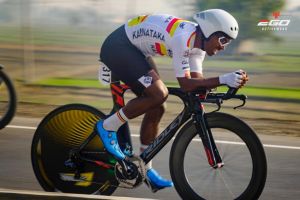
Naveen John (Photo: courtesy Naveen)

Late December 2020, Bengaluru-based Naveen John, among India’s top bicycle racers, was kicking off a new training project in Hyderabad. He had shifted to Telangana’s capital to train for the Individual Time Trial (ITT) at the velodrome in Osmania University. “ The goal is to become competent in ITT over the next 40 days and become competitive by April 2021,’’ Naveen said. Guiding him online would be his new coach – Ashton Lambie. A track cyclist who has represented the US, Lambie is a former individual pursuit world record holder. Naveen’s temporary shift to Hyderabad is happening some nine months after the lockdown was first announced. In the early part of the lockdown, when everyone was expected to stay indoors, he had embraced virtual cycling platforms and kept up his training as best as he could. It required, some rewiring of cyclist’s motivational circuitry as the freedom of being out and the outdoor environment, were suddenly missing from the frame. By late May, his training had been good enough for Naveen to muse that if there was a national competition due, he would do well. Given progressive relaxation of the lockdown, he had also regained the freedom to cycle outdoors. What was missing however was a “ horizon.’’ He could rationalize the lockdown in many ways – for instance, it can be treated as similar to a phase of injury, something athletes are used to – but the lack of endgame and races had been unsettling. “ Previously my plans used to span three to four weeks. Now I am taking it one week at a time,’’ Naveen had said then. Slowly things have changed since. In November the Bangalore Bicycle Championships (BBCH) resumed its monthly race. Naveen won the December edition of the race. Amidst all this, there were a few other challenges. As lockdown eased in India and elsewhere, bicycle sales shot up. It led to never before seen waiting lists to buy cycles; the breakdown in global supply chains also put strain on availability of spare parts. Anticipating something of this sort, Naveen had stocked up on essential components in the days leading to lockdown. Elite cyclists train harder and longer than recreational cyclists. This causes more wear and tear to equipment. Despite his preparation, Naveen wasn’t spared. A shifter on one of his bikes malfunctioned and a new shifter to replace it couldn’t be obtained. Luckily, his predicament was noticed by helpful others and the required import from overseas was managed. Someone who races in India and overseas, Naveen is hopeful that more events will return in 2021. After all, notwithstanding pandemic, the 2020 Tour de France was held. And in India, a timeframe has been assigned for the 2021 nationals in cycling.
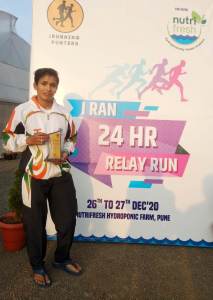
Seema Verma (Photo: courtesy Seema)

When the country went into lockdown in late March, runners who were dependent on the prize money that accompanied podium finishes at races were left in great difficulty. They used to bank on prize money to bridge the gap between living expenses and the modest income they earned through other means. Seema Verma, resident of Nalasopara, a suburb of Mumbai, had to rethink how she would make ends meet. Many years ago, she had worked as a domestic help after she was abandoned by her husband. In the initial days of the lockdown, with the uncertainty surrounding the pandemic, she had briefly contemplated going back to that role. Some running groups and individuals extended her support in terms of money and supplies for home. “ That help came as a major relief to me,” she said. During the early phase of the lockdown, she was completely confined to her one room-house. “ I did my core workouts and took to running inside my small house daily. I used to do 10 km runs inside my house and once I managed up to 17 km,” she said late December. When the lockdown norms began easing, she started stepping out for her runs, increasing the mileage slowly. But the absence of regular income remained a constant worry. She then started a flower vending business. “ Many years ago, I used to sell vegetables on a cart near the place where I stay. This time around, I decided to opt for selling flowers and bouquets,” she said. The business is risky as flowers do not have a shelf life longer than four days. “ On some days, the sales do not cover the cost,” she said. Seema wakes up early and goes for her run by 5.30 AM. “ Upon getting back, I set out for the market in my running clothes, to buy stuff. After that I shower and leave for the vending business,” she said. Her stall stays open from 9 AM to 12 noon and from 5.30 PM to 9 PM. On some days of the week, she misses her run as she has to be in the flower market to buy fresh flowers. “ If I land up late at the market, I get old, wilting flowers,” she said. Her son, now 19-years-old, has secured employment and his earnings help the mother-son duo to pay the rent for the house. Her running mileage is now around 15-20 km and on some days she does a half marathon. Recently, she did a 12-hour trail run in Pune and finished as the overall winner covering 67.2 km. But there was no prize money. “ I knew there was no prize money but I wanted to do a run before the end of the year,” she said. Seema is conscious of the fact that prize money races are still a long way, at least another six months away.
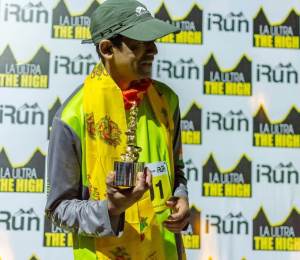
Ashish Kasodekar; from the 2019 edition of La Ultra The High when he became the first Indian to complete the event’s 555k race segment (Photo: courtesy Ashish Kasodekar)

In January 2020, Pune based-ultramarathon runner Ashish Kasodekar had completed the Brazil 135. By the end of that month, the first case of COVID-19 was reported in India but the rapid spread of infection leading to lockdown, was still some distance away. For those loving elegance in digits, February 20 was a special day; it was the 20th day of the second month of 2020. In some ways that perception betrayed the general optimism that greeted 2020, it had a nice ring to it. Ashish observed that day by hiking up Sinhagad fort near Pune, 16 times over 31 hours. The exercise provided a cumulative elevation gain matching the elevation of Everest. A major project in the months ahead was the 2020 edition of the Badwater Ultramarathon in the US; Ashish had secured a slot to participate in it. The virus decided otherwise. By March 24, India was into lockdown. Ashish followed the lockdown rules diligently. He kept himself busy indoors with a multitude of challenges from various sports communities including those into basketball, a sport he loves. He did strengthening exercises and watched motivational videos. There was also a book he had long wished to write; the lockdown proved ideal for the task. “ I didn’t find the lockdown period very troubling. I think most people who keep themselves busy with things to do would have managed it well,’’ Ashish said. He also admitted that as an ultramarathon runner, he may be used to existence as a litany of changes. During very long distance runs like an ultramarathon, athletes endure changes in weather, elevation and their own physical and mental condition. So a period of world gone indoors and mobility restricted can be mentally rationalized, alternatives to stay occupied, found. A travel consultant, Ashish’s business took a hit during the pandemic as globally, people cut down on travel drastically. He improvised. He commenced a mentoring program for those who wish to do something in life. He also started a camping trip with accompanying activity in the outdoors, done every full moon. But end December 2020, it was his fiftieth birthday due in 2021 that was keeping Ashish focused and fueled. He had commenced a personal project – visit 50 forts (the Sahyadri hills of Maharashtra have plenty of forts), plant 50 trees hailing from varieties indigenous to India, take 50 people out for lunch and run 60 marathons in 60 days. And if all goes well with the world, he should be in the US for the 2021 edition of Badwater.
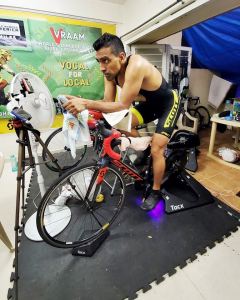
Bharat Pannu; from virtual RAAM (This photo was downloaded from the cyclist’s Facebook page)

For ultracyclist, Lt Col Bharat Pannu, 2020 was a keenly anticipated year. His earlier attempt at Race Across America (RAAM) had failed to take off following injury while training in the US, just ahead of the 2019 race. He was therefore determined to do RAAM in 2020. The onset of pandemic and the cancellation of races worldwide – including RAAM – was a setback for Bharat. RAAM is one of the toughest ultracycling events; anyone participating has to put in oodles of effort by way of training and preparation. For the second consecutive year, RAAM wasn’t happening for Bharat. Luckily, even as the real race got cancelled, a virtual version of it was made available by a technology platform in league with the race organizers. Bharat registered for it. What followed was a genuine high point in distance cycling by Indians, in a year impacted by COVID-19. Cycling on a stationary road bike in Pune along with friends who had signed up for the virtual version of the shorter Race Across West (RAW – a smaller race built into RAAM), Bharat completed RAAM and secured third place on the podium. He then moved to the virtual version of HooDoo 500, a race of approximately 850 kilometers and completed it in 41 hours, 25 minutes. Next he did a 12 hour-time trial and finished in third place, covering 390.4 kilometers in the allotted time. On October 10, he set out from Leh in Ladakh to attempt a record for cycling the Leh-Manali stretch. The authorities at Guinness Book of World Records assigned him 40 hours for the task. Bharat covered the distance in 35 hours, 25 minutes. Days later, he covered the 5942 kilometers of India’s Golden Quadrilateral (a series of highways linking the major metros of the north, east, south and west) in 14 days, 23 hours and 52 minutes. Details of the Leh-Manali and Golden Quadrilateral projects have been submitted to Guinness. “ Official ratification is awaited,’’ Bharat said, late December. Looking back, he felt he may have come off virtual RAAM and the third place he got in it, with a lot of positivism and good energy. It led him on to HooDoo 500, Leh-Manali and Golden Quadrilateral.
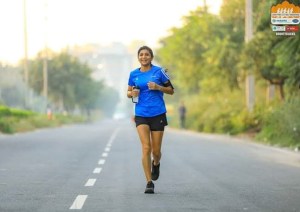
Apoorva Chaudhary (Photo: Bounty Narula)

“ It was a roller coaster ride,’’ Apoorva Chaudhary said of 2020. An ultramarathon runner who has represented India, at the start of the year she was focused on already announced international events like the Asian championships. The last event she participated in was the 2020 New Delhi Marathon, which she had treated as a training run for races ahead; that was in February. Roughly a month later, India entered lockdown. After a month stuck indoors in Gurugram and with work from home the new norm, Apoorva shifted to Bijnor to be with her parents. She continued her training and strengthening exercises there. Her coach monitored online. Things were fine for a while; then she began to lose her motivation. According to her, in the pre-pandemic scheme of things it was possible to rejuvenate a day of poor motivation to run by running in the company of one’s friends. With COVID-19 and its protocols blanketing the world, people drifted apart. Old remedies to tackle monotony weren’t available. This was a real low point. Apoorva realized she needed a change. She temporarily shifted to a homestay in a village near Dehradun; a sort of `workation.’ More important, she decided to pick up a new skill – horse riding, for which she associated with a local school that maintained a stable. “ It was a longstanding desire anyway,’’ she said. At the same time, she continued her running in the village. The experience helped her regain her motivation. As regards training, Apoorva said that her focus has been on strengthening exercises and a volume of running that is short of peak levels. The idea is to hang around in that stage of fitness where a few weeks of determined training will take her to peak condition. At the time of writing, Apoorva was back in Bijnor but there was a potential new recipe on the cards for the new normal. The hills offer fine refuge for her interests; she may take off again.       
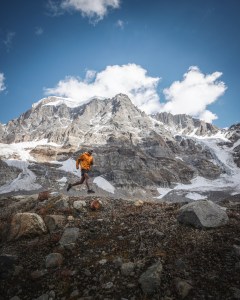
Kieren D’Souza; running in the mountains (Photo: courtesy Kieren)

2020 was a special year for Kieren D’Souza. For the past several years he has based himself in Manali but spent a few months every year overseas participating in events there. With the pandemic pausing sport events worldwide and crippling international travel, Manali became Kieren’s world. An ultramarathon runner and more importantly an aspiring mountain athlete, the predicament suited him as he was able to spend more time in the mountains that had become his training ground. On June 16, 2020, he had run from Mall Road in Manali to the base of Friendship, a 17,352 feet high-peak and then made his way light and fast to its summit. It took him seven hours and fifteen minutes to reach the summit from Mall Road. He then descended and ran all the way back to Mall Road. With that effort Kieren had hoped to kick-start the culture of Fastest Known Time (FKT), a tradition that is well established abroad. Towards the end of August, he embarked on another project. With Mall Road again as start line, he ran from Manali to Hampta Pass (14,009 feet) which brought him to Lahaul and from there over the Rohtang Pass (13,051 feet) back to Mall Road in Manali. Then in October, he elevated the game to a whole new level. This time he didn’t start from the town’s Mall Road. The objective was Deo Tibba (19,688 feet). The road head for accessing it was roughly a half marathon away from town. So the run was designed as road head to road head instead of Mall Road to Mall Road. He did a recce of the route on the mountain. For the actual attempt, a support group of individuals pitched in; they were spread out along the mountain slope and manned three camps where Kieren also parked his mountaineering gear in advance. On October 1, he commenced his run from the road head. Past base camp, he moved up Deo Tibba alpine style and without using any ropes. At the concluding portion of the climb to the summit, he and a friend roped up briefly for safety but used no ice screws or any such protective equipment. The entire passage from road head to road head took him 19 hours, 38 minutes, Kieren said. With the project finding a sponsor in the skin cream brand Nivea, a related film was also made. This model of activity and documentation using media appears sustainable going ahead, Kieren said. It may be some time before the pandemic settles to containable proportion and the world is back to relaxed mode and travel as before. But if the paradigm of existence he discovered in 2020 sustains, Manali can continue to be a productive year round base for his pursuits, Kieren felt. Viewed so, 2020 was an interesting year for the young man trying to live his dream of being a mountain athlete.
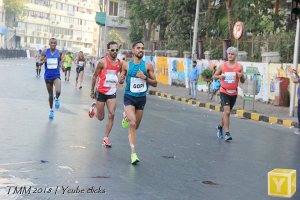
Gopi. T (blue vest) at 2018 TMM. Just behind him is Nitendra Singh Rawat; they finished first and second respectively in their category (Photo: courtesy Yogesh Yadav)

For Gopi. T, among India’s best marathon runners, 2020 has been a year of inevitable downtime catching up. The elite athlete had transitioned from 2019 to 2020 with a persistent leg injury. But he soldiered on as it was an important year for athletics – the Tokyo Olympics was due and he had to qualify for it. He skipped the 2020 TMM held in January. He set his eyes on major marathons like the Tokyo Marathon, Seoul International Marathon and London Marathon – they have a better course and typically more favorable weather conditions – for a shot at qualifying for the Olympics. In March 2019, Gopi had got his personal best at Seoul, when he completed the marathon in 2:13:39 (it is the closest any Indian runners has come yet to the longstanding national record of 2:12:00) and placed eleventh. One reason for valuing course and weather conditions in 2020 was that Olympic qualification required meeting an entry mark of 2:11:30. It is a challenge. Part of the national camp, he was assigned to train in Bengaluru. But Gopi’s injury slowly worsened. By the time lockdown set in, he was scheduled for knee surgery. Post-surgery, he was advised bed rest for close to two months to help the healing. In June the first steps in rehabilitation commenced. He continued his recovery and conditioning as best as he could; maintaining the momentum when he traveled home to Wayanad in August, as well. At that time, he could jog a short distance, walk and then repeat the mix again. Gyms hadn’t reopened in Wayanad. So Gopi did his strength training at home. Meanwhile, when the new list of athletes at national camps for the September-December period was disclosed there was nobody mentioned under the category of men’s marathon. Upon return to Bengaluru, Gopi continued his strength workouts and jogging on his own, outside the premises of the Sports Authority of India (SAI). At the time of writing, he was back to running but it had to be done carefully because there was an occasional pain on his left knee. “ I can do up to 30 minutes on the treadmill now,’’ Gopi said, late December. Needless to say, qualifying for the Tokyo Olympics looks doubtful. “ I think the reasonable option for me would be to focus on the Asian Games of 2022 and train accordingly,’’ Gopi said.
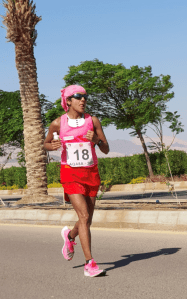
Anjali Saraogi; from the Asia Oceania 100K Championships in Aqaba, Jordan (Photo: courtesy Anjali)

Kolkata based-Anjali Saraogi used the period of lockdown to catch up on her strength training. Among India’s top ultramarathon runners, she invested in gym equipment and worked out at home. In terms of running – an act that requires person foraying out from home amid pandemic – she chose to play it safe so that none in her family were put at risk. It was June by the time she could venture out for running and even then, she was limited by the fact that the locality she lived in was often in and out of being a containment zone. That made it difficult to pile on mileage, something crucial if you are an ultrarunner. “ The 1-2 hours of running most amateur runners do, does not suffice for us. We need 3-5 hours at times’’ Anjali said. In the past one month or so things have been better. Case numbers have slowly declined and there is a sense of normalcy returning. Consequently, Anjali’s running too has benefited from the improvement in overall ambiance. Asked if the challenges of 2020, including the way it hampered training for long distance runs, had imposed a lengthy curve to regaining form on India’s ultrarunners, Anjali said that a few months of consistent training would be all that is required to get back to form. Further, from among known ultrarunners, there are those who managed to take off to the hills periodically or shifted for long periods that side to train. Such locations have comparatively less people than India’s crowded cities and case numbers have also been less. Needless to say, training has continued better in those parts. “ The difficulty has been for those running in the cities,’’ Anjali said. About 2021, she believes that things should improve post-March and after June-July life should be much closer to normal. However, even as running events recommence, Anjali said that people may warm up to it only gradually as an element of confidence and safety in travel has to be felt at large. This could take time. “ Basically as regards 2020, I feel thankful for all the blessings I have in my life. The safety and good health of my loved ones – that has been the priority,’’ she said.      
Vijayaraghavan Venugopal (Photo: courtesy Vijay)

In February 2020, when Vijayaraghavan Venugopal participated in the 2020 IDBI Federal Life Insurance New Delhi Marathon, the virus had reached India and was on the cusp of becoming a global worry. But few anticipated the rapidity with which things happened thereafter culminating in a massive, lengthy lockdown. “ It was an unpredictable year,’’ Vijay said, late December. The CEO of the sports nutrition brand Fast&Up is also a well-known amateur runner with podium finishes in his age category. “ From the world majors, I have the London and Tokyo marathons left to participate in. I also want to do New York again to attempt a sub-three hours-finish. I applied for New York but didn’t get through. After the New Delhi Marathon I was hoping to try the Airtel Delhi Half Marathon and the TCS World 10k. None of that happened because of the pandemic,’’ he said. On the other hand, COVID-19 and the lockdown it forced gave Vijay 2-3 months away from running. That was useful to both heal a longstanding injury and to reflect. One of the outcomes has been a growing interest in the shorter distances – 5k and 10k. Traditionally these distances have been important to groom marathon and half marathon runners. In India however, while the elite athletes usually follow above said path, most amateurs launch off straight into the half marathon. “ Over the last few months, I have been looking more at 5k and 10k. Hopefully, that should stand me in good stead when things improve in 2021,’’ Vijay said. A fan of racing events in the physical sense, he didn’t do any virtual runs. “ I look forward to the revival of actual races,’’ he said. His estimation is that following the elites-only ADHM of November and the proposed Chennai Marathon of early January 2021, a small number of events should emerge in the first quarter of the New Year. But it will still be touch and go and dependent on factors influencing overall sentiment like vaccine rollout, the nature of further mutations to the virus etc. The big events may be hesitant to return soon; the smaller ones associated with smaller volume of participation may be the first off the block. However, small volume-events may face the hurdle of financial viability as sponsors may stay off citing little mileage by way of publicity. “ Things should be clearer by the second half of 2021,’’ Vijay said. Having said that, he agreed there have been some new encouraging trends too as a result of the pandemic. On the average, everyone’s morning walk, run or bicycle ride is happening in an ambiance featuring more people out seeking to put in some exercise. It paints a unique scenario – one in which, races and the old racing focused approach to the sport may have receded temporarily but general interest in being physically active has likely grown. This newfound value in the physically active lifestyle is one of the less highlighted legacies of COVID-19. “ Recently Fast&Up hosted a virtual 5k run. There was a race with prize money and a run without it. The majority of people registering for the event were newbies to our website,’’ Vijay said.
Gerald Pde (Photo: courtesy Gerald)

Architect and runner, Gerald Pde, stays with his family roughly five kilometers away from Shillong in Meghalaya. That gives him access to the local woods. The way things played out, being near the woods was a blessing in times of pandemic and lockdown. The last event Gerald and the team of runners from Run Meghalaya, attended, was the Tata Ultra in Lonavala, held in February 2020. A month after that race, India entered lockdown. Back in Shillong, for Gerald and family, the first three weeks of the lockdown when it was fresh off the starting block and strictly enforced, were tough. “ After those three weeks, I started to venture a bit into the nearby woods,’’ Gerald said. It was a pleasant experience because in proportion to people gone indoors and the din and stress of human activity on planet diminishing, the local flora and fauna was staging a comeback. By May, Gerald had begun exploring trails in these woods. “ It was one of the positive sides of the lockdown. I got to know the smaller roads and trails better,’’ he said outlining how running returned to his life at this stage. Post September-October, things have drifted closer to normal. “ At peak physical condition in pre-pandemic days I used to log weekly mileage of 140-160 kilometers, sometimes a bit more. Now I am at around 100 kilometers,’’ Gerald, who is among the founders of Run Meghalaya, said. According to him, the lockdown experience would be near similar for other runners living in the neighborhood of Shillong. Run Meghalaya regularly sends runners from the state to participate in various running events in India. Some of them have been podium finishers at major races like TMM. Before lockdown set in, Gerald had set his eyes on the 2021 edition of Hong Kong 100; it has since been cancelled. Now he is toying with the idea of attending the World Mountain and Trail Running Championships due in Chiang Mai, Thailand in November 2021. Asked how Tlanding Wahlang, a regular podium finisher at marathons who has also represented India in the ultramarathon, was faring, Gerald said that he lived in a distant village where COVID-19 cases have been few so far. “ He must have been able to continue his training without too many problems,’’ Gerald said.        
Karthik Anand (Photo: courtesy Karthik)

When the first phase of lockdown was announced in March 2020, Karthik Anand, who runs his own enterprise, saw his work take a dip. It gave him more free time. The Bengaluru-based runner spent the month of April and May focused on his workouts and runs. In the process, his timing efficiency in the five kilometers and the half marathon improved. “ I was able to continue running through the lockdown period. I did not face any hassles running on the roads of Bengaluru,” he said. Karthik immersed himself in training and organizing training races during these months. As a member of Pacemakers, a marathon training group based in Bengaluru, Karthik led the process of organizing runs over distances ranging from 10 km, half marathon and 32 kilometers to the marathon; he managed the logistics for these outings. These running events were held for a very small number of participants with safety protocols in place. Pacemakers held these runs in July (10 km), August (21 km) and September 2020 (32 km and the marathon). The September 2020 race helped the runners of the group who had signed up for the virtual segment of Boston Marathon 2020. The group was able to get permission from the police to organize these runs as the number of runners was small and all COVID-19 protocols such as maintaining physical distancing and avoiding contact were in place. Pacemakers plans to hold a marathon – yet again of above said containable dimension – in January 2021 coinciding with the traditional timing of India’s biggest event in running: the Tata Mumbai Marathon. It is held annually on the third Sunday of January. The January 2021 run in Bengaluru is being organized by Pacemakers, Jayanagar Jaguars and Runners 360, all city-based training groups. The run is exclusively for the members of these groups, Karthik said.
Idris Mohamed (This photo was downloaded from the runner’s Facebook page)

These have been interesting times for amateur runner Idris Mohamed, currently based in Chennai. For several years he has been a familiar face on the Indian road racing circuit, often securing podium finish in his age category. When the lockdown struck Idris was in Chennai; his family, in Thiruchirappalli. For three to four months he didn’t get to visit them. That was a trying period. He continued with his strength training and the new line of work he had commenced – coaching. It is now a bit over a year since he donned the role of a coach. He does this in two ways. He is a coach with Asics Running Club in Chennai; he also coaches on his own. The latter is proving valuable now because people have begun getting tired of online coaching. With the earlier restrictions on mobility now relaxed, it is possible for Idris to offer one on one coaching. “ When I started coaching I was a bit nervous because I was unsure if I would be able to articulate, communicate and teach as required. But now I am comfortable. I find coaching very fulfilling,’’ he said. Engaging with another person and helping him / her, shifts the focus away from oneself; it is a healthy relief in these times. Idris also operates a fitness studio in the city. Besides podium finishes on the domestic road racing circuit in pre-pandemic days, Idris was also active in the world of Masters Athletics. At the Masters Asian Championships held in Malaysia in December 2019, he secured gold medals in the 1500m, 5000m and 10,000m. Notwithstanding the expectations and the pressure to train these achievements bring, Idris felt that the lockdown offered a relevant dose of downtime. “ My aim during the lockdown and the unlock phase that followed was to do what is needed to maintain my physical fitness without getting into heavy intensity workouts and such,’’ he said. It may have affected his performance. Recently he ran the virtual TCS 10k and his timing of 42 minutes was slower than the 37 minutes he clocked at the same event in 2019. Once things are fully back to normal, Idris hopes to train as well as he used to before. He has a reason – he would like to participate in the next edition of the Masters Athletics World Championships.        
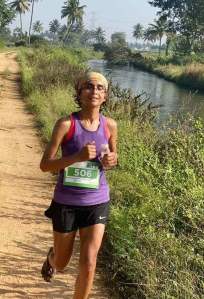
Shilpi Sahu (Photo: courtesy Shilpi)

The sudden lockdown resulted in people getting stuck wherever they were. Shilpi Sahu, from Bengaluru, was held up in Kerala for seven weeks. It put a complete stop to her running. All over the country, the initial phase of lockdown was rather strict with even those out on their regular morning walk or jog sometimes accused of flouting the law. Shilpi resumed running only sometime in May; she started out with small distances. She has been running alone during these months of pandemic. “ It is quite okay to run on the road and we are able to pull the mask down as people are few early in the morning,” she said. In Bengaluru, there are some areas with open space and less crowding. The fear of contracting the disease forced many runners to stop training outdoors completely but with time they have begun venturing out, she said. Shilpi has not been participating in any of the virtual running events. “ A few of us travelled to the place where Kaveri Trail Marathon is held every year and did self-supported training runs of varying distances,’’ she said. The 2020 Kaveri Trail Marathon, a much loved event, was cancelled owing to the pandemic.
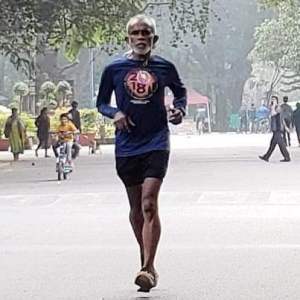
Siddesha Hanumanthappa (this photo was downloaded from the runner’s Facebook page)

When the COVID-19 lockdown was announced in March and Work from Home (WFH) commenced, Siddesha Hanumanthappa found himself with more time on his hands. A scientist by profession, he has been running regularly for the past 29 years. A break in running due to the lockdown was unacceptable for him. He realized that it would be possible to continue his running streak, if he set out early from his house. “ I would leave my house as early as 4 AM and try and finish my run by 6.30 AM,” he said. To do this, Siddesha would wake up at 2.30 AM, finish his core workouts and strengthening exercises and then embark on his day’s run. A couple of times, policemen stopped him on the road and asked why he was out. But that was it; nothing ever got out of hand. Over time, Siddesha started building up his mileage – initially it was 10km; he increased it to 15km and 20km. “ By April, I was hitting 35km daily mileage and by May I touched 38-40km,” he said. His monthly mileage which was averaging around 350-400 km in the run up to lockdown, touched 750km in April and 950km in May. By early July, his daily mileage had increased to 38-40km. “ Then somebody asked me why I was not doing a marathon,” he said. It prompted him to start running distances equivalent to a marathon (42.2km). On July 17, he ran a marathon. He sustained the trend. By December 18, he had completed 100 marathons in 2020. According to Siddesha, as of December 29, including the events he ran before lockdown like the 2020 Tata Mumbai Marathon, he had completed 104 marathons and the year’s total mileage on feet was around 11,000km. “ All my runs through the lockdown period and after the lockdown got relaxed were self-supported. Along my route in central Bengaluru there are street vendors on cycles. I stop at each of these vendors to buy water or coffee or chikki,” Siddesha said. Despite his daily running, he has not had any injuries. He attributes it to his core and strength workouts and post-run stretching. Siddesha, who has run some of the World Marathon Majors – he did Boston, New York and Chicago – has mostly stayed away from virtual runs.
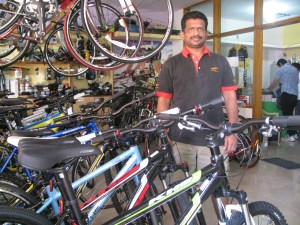
Venkatesh Shivarama (Photo: Shyam G Menon)

It is difficult to filter and highlight what exactly drove bicycle sales during the pandemic because the market for bicycles straddles several price categories and each category has its uniqueness. This blog usually writes on performance cycling; it features road bikes, hybrids and mountain bikes – all slightly expensive (to genuinely expensive), mostly imported (or at least featuring imported components) and falling in the premium segment of the Indian market. Herein, the demand is said to have been fueled by the need for mobility and physical fitness, with the latter mentioned by those in the bicycle industry as perhaps the more dominant demand driver. The pandemic highlighted the importance of staying physically fit. “ We typically sell bikes priced between Rs 25,000 to Rs 100,000. When lockdown began to ease, there was a surge in demand; it was nearly ten times what we experienced in pre-pandemic days,’’ Venkatesh Shivarama, senior cyclist who also runs the Bengaluru-based bicycle retailer, Wheel Sports, said.  Available stocks were lapped up by buyers and fresh stocks have been difficult to procure. There is a reason for it. The surge in demand for bicycles was worldwide and shops in several countries were exhausting their stocks. This put pressure on the entire supply chain from retailer to importer to bicycle and bicycle gear manufacturers. Adding to the strain was the fact that all these sites were also limited by the pandemic in their capacity to function properly. And even if they became fully functional, there was sufficient demand piled up to keep supplies inadequate for a while. The availability of spare parts (components) was also badly hit. Waiting lists for bikes and components materialized. Likely complicating the situation were the inherent peculiarities of the business. Bicycles in the premium bracket are truly international pieces of machinery. The aggregate is designed in one place, the frame is made in another place, the components come from still other places and the final assembly may be elsewhere. There is much shipping involved. Additionally, within the ecosystem of components manufacturing, there are names which stand head and shoulders above the rest with sizable reputation and market share to their credit. Thus a good quality chain may be sourced from a couple of reputed companies but the same cannot be said of the cassette, wherein if you want the best, the choice is limited. Getting the dominant brands (in component manufacturing) to respond quickly to demand spikes of the scale witnessed recently won’t be easy. On the other hand, expecting competing component manufacturers to step up also won’t be easy because fresh investments require a lead time to yield marketable products. Switching component suppliers is also easier said than done because there are well settled price points to meet in the market. Further, in India, some key bicycle components like good quality imported tyres have become victim of protective trade barriers. Consequently, according to Venkatesh, a range of components spanning chains to cassettes, tyres and tubes have suddenly become difficult to access. The only way out is for the market to stabilize with time. “ I am hoping that by February-March 2021, we should be in a better situation,’’ Venkatesh said.   
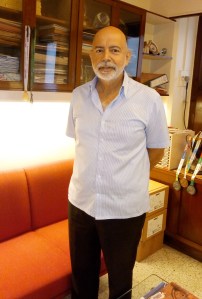
Zarir Balliwala (Photo: Latha Venkatraman)

Among sports that were hit hardest by the lockdown, was swimming. “ It has been quite a wash out this year,’’ Zarir Balliwala, President, Greater Mumbai Amateur Aquatics Association (GMAAA), said. From the time lockdown took effect in late March, swimming pools stayed shut. While pools have since opened for competition swimmers (the central government announced it as part of Unlock 5 effective October 1; states followed but based on their risk assessment, Maharashtra allowed competition swimmers to access pools from early November), there will be a long curve to regaining the earlier levels of performance. “ There is only so much dryland work outs can do to keep swimmer in shape. Ultimately swimming needs access to water. From late March to the time competition swimmers were permitted access to water again, those into swimming have been without the medium of their sport. So it will be a long journey getting back to form. The journey to peak performance levels will likely be longer for those specializing in the sprint events,’’ Zarir said pointing out that a lot of hard work is required to shave off those seconds in timing which make a winner one. He expects that if all goes well and the next round of district, state and national level competitions get back on track, then by April 2021 some level of performance should return to the sport. There are also grey areas in the unlock format. For instance even as competition swimmers have been allowed access, it is up to the managers of a pool they approach to decide whether it makes sense to open the facility and keep it running for a small group of users. Categories like channel swimmers (endurance swimmers and open water swimmers seeking to cross straits and channels) who too benefit from access to pools, don’t qualify to be called competition swimmers. Same would be the case for triathletes as many participate in well-known competitions that are however not part of what the government normally recognizes as competitive events. As yet in these instances, the managements of pools have used their own discretion and tried to view requests sympathetically. Finally, there is the continuing absence of recreational swimmers from the frame and the question of when they will be allowed back to the pool. Zarir hopes that more clarity will be available in the first half of 2021.        
Corina Van Dam, popularly known as Cocky (Photo: courtesy Cocky)

In Mumbai, Corina Van Dam (Cocky) was disappointed when Swimathon, a swimming event that was to be held towards the end of March 2020, was cancelled due the pandemic and lockdown. Cocky was slated to participate in the 10 km event. She had done all the necessary training. Soon after that, a triathlon slated to be held in April at Mahabaleshwar was also cancelled. “ I discovered the balcony in my apartment; I began seeing it in new light. I started running in the balcony; I also did some cycling. Just before the lockdown, I had bought a trainer for my cycle and that helped me cycle indoors,” she said. She also followed many of the online home workout programs put out by Mumbai Road Runners (MRR), an online community of recreational runners; she also followed other running groups and coaches including Girish Bindra. “ I do not like to do core and strength workout. But during the lockdown I did these workouts regularly and now they have become a part of my routine,” Cocky said. It was sometime in mid-July that Cocky commenced running and cycling outdoors. A recreational triathlete, she has been missing her swimming pool sessions. Pools stayed shut for long due to the pandemic and when the government decided to reopen some, it was for competition swimmers. Not one to be boxed into a corner by these limitations, of late Cocky has been doing open water swimming in the sea. Additionally, she engaged herself in a number of challenges thrown up by various running groups such as 100 days of running and Run to the Moon among others. “ Besides these, I fashioned my own challenges to keep the fitness activity going,” she said. Cocky also enrolled for the virtual race of Amsterdam Marathon. She chose a one kilometer-loop in the area where she resides and ran at night to cover the distance of 42.2 km.  The cops in the area knew her well; so being out at those hours wasn’t a problem. Closer to the time of writing, she cycled from Mumbai to Malvan. “ I will continue to do some of the virtual events,” she said.
Sharath Kumar Adanur (Photo: courtesy Sharath)

At Jamshedpur, Sharath Kumar Adanur was able to continue his running through the COVID-19 lockdown. His house is within a fairly large gated community. “ I was able to run inside my housing complex in a 600 meter-loop. When the lockdown norms started to ease, I ventured out for easy runs and occasional time trials,” he said. During the peak lockdown period, he also focused on strength training. Many recreational runners have been participating in virtual running events but Sharath has not opted for these. He made an exception for a 10 km virtual run organized by Tata Steel, where he managed to get a personal best for the distance. He completed the run in 34:24 minutes, an improvement on his previous personal record of 35:32 minutes set at TCS World 10k in 2017. Sharath did the Tata Steel Virtual run at the JRD Tata Stadium.  “ I wanted to get a good timing. Running on an athletics track was really good and it helped me with my timing,” he said. Sharath also did a Fast & Up 5km virtual run on a request from a friend. “ This one I did on the roads,” he said. He finished the run in 17:01 minutes. He has however stayed away from doing other virtual runs. “ I have not felt any attraction for these virtual running events,” he said. He is slated to do a physical marathon organized by running groups in Bengaluru, on January 17, 2021. Getting back to running a physical event will be a welcome change from these past few months of solitary running, Sharath said.
Dnyaneshwar Tidke (Photo: courtesy Dnyaneshwar)

Coach and runner Dnyaneshwar Tidke was completely confined to his house in Panvel during the early days of lockdown. For Dnyaneshwar, who normally runs six days a week, the confinement prompted him to work on his overall strength, agility and flexibility. He started creating videos of his workout plan for his wards at LifePacers, a marathon training group based in Navi Mumbai. “ The videos focused on whole body workouts with emphasis on stretching, flexibility, coordination and balance apart from strengthening,” he said. Alongside his role as a coach, he started to offer challenges to his team including squats, push-ups among others to keep the runners engaged and motivated. By the end of April 2020, he was able to venture out for outdoor running. “ There are many trails quite close to where I stay. I would set out early morning on my two-wheeler, park it and run on those trails,” he said. Over time, he started to build his mileage. “ I was able to work on good base-building during this period,” he said. He believes he is on an upward curve in terms of his endurance and fitness as a runner. His weekly running mileage is around 80-100 km these days. But he has largely stayed away from virtual events and has also not encouraged his team at LifePacers to pursue that route to stay motivated. The experience of a real race is something that he misses immensely. A competitive runner and an age category podium finisher, Dnyaneshwar believes real races will start in a limited way from the second half of 2021.
Seema Yadav (Photo: courtesy Seema)

For much of the lockdown period, Faridabad-based recreational runner, Seema Yadav, spent time in Bhiwadi in Rajasthan. She had landed there with her son during his school break to visit her father and with the sudden imposition of lockdown ended up being there for nearly three months. She did indoor workouts and stepped out to run when lockdown norms eased a bit. Following a brief period back in Faridabad, she returned to Bhiwadi for another month’s stay. “ I was anyway in the process of recovering from injuries. I was following the physiotherapist’s plan, which included strength training among other elements,” she said. Seema had enrolled for the Airtel Delhi Half Marathon (ADHM) virtual race but was unable to do it because of personal reasons. “ Every year, I try and get a personal best at ADHM. I wanted to finish the run in one hour and 30 minutes,” Seema said. A few days before the event, her husband had to have an emergency operation and she was forced to suspend her training as she had to juggle managing the home front, taking care of her son and staying connected with the hospital, where her husband was admitted. A doctor by training, Seema couldn’t visit the hospital due to COVID-19 restrictions; she coordinated with her husband’s doctors. “ I started training again after everything reverted to normal at home. I decided to do a virtual half marathon on December 12, 2020. I found out that there was a virtual run, Millenium City Marathon on the same day,” she said. She completed her run in 1:30:18, improving from her previous personal best of 1:34:12 set at the 2019 edition of ADHM. Seema plans to continue with her training runs, time trials and strength training. “ I may sign up for a physical race, if the number of runners is small,” she said.
Girish Bindra (Photo: courtesy Girish)

At the start of the lockdown, Mumbai-based Girish Bindra set about fashioning his own workout plans that incorporated various elements of strength training, core workout and high intensity interval training. A coach for Asics Running Club, Girish sometimes broadcasts his workouts on social media platforms for the benefit of his mentees. After the lockdown norms began to ease, he started frequenting the outdoors for his training runs. Shortly thereafter, he enrolled for the virtual London Marathon that was held in early October, 2020. His training for London Marathon was far from adequate. On the day of the run, a short heavy downpour forced him to delay the start but overall the run went off quite well in terms of support and performance. Girish has participated in a number of virtual running events this year including Comrades Marathon, Berlin Marathon, Chicago Marathon, Amsterdam Marathon, Barcelona Marathon, New York City Marathon and ADHM where he did the half marathon distance. He also did Asics Ekiden Challenge 42.2 km relay as well as a solo marathon and the 50 km category of the virtual race of Tata Ultra.
Abbas Shaikh (Photo: by arrangement)

Abbas Sheikh, recreational runner and coach from Mumbai, was confined to his house in the initial phase of the lockdown. That period was quite difficult; he even doubted whether he would be able to return to running. “ I started running in June but the mileage was quite low. I found it tough to run. Even a 10 km run would take so much time,” he said. Gradually, he was able to get back to his full-fledged training plan and coach other runners alongside. Although virtual runs became a fad during the phase of lockdown and its progressive relaxation, Abbas did not enroll for any of them. However, he did pace runner Kranti Salvi, when she did the virtual London Marathon. According to Abbas, virtual events may work as motivation but they lack the authenticity of the real event. A physical event is a composite of many live ingredients. “ I don’t see any point going for virtual runs.  In any case, I run 30-40 kilometers on weekends. Every other weekend I run a marathon as part of my training,” Abbas said. His role as a coach found traction when lockdown norms started to ease in June.  “ But the pick-up in interest started sometime in September and now entire families are turning up to train,” he said. Abbas works with Coach Savio D’Souza; he is part of Savio’s team. He said he has registered for an upcoming 12 hour-stadium run in the city.
Pranali Patil (Photo: courtesy Pranali)

In the initial phase of lockdown, when the quarantine centers and field hospitals for treating COVID-19 were still being set up, hospitals saw an inflow of patients affected by the virus. At the same time, fearing spread of infection, the general intake of those suffering from other diseases and approaching hospitals for treatment, reduced. In that period, Navi Mumbai-based Pranali Patil, an anesthetist by profession, saw that her free time had increased. But it meant little by way of mobility because the early phase of lockdown was also the strictest; nobody ventured out except for essentials. Pranali trains with the marathon training group, LifePacers and for the first three months of the lockdown she followed the online training sessions of her coach, Dnyaneshwar Tidke. “ I also took to skipping rather seriously,” she said. She tackled the 30-day challenge posed by her training group; Pranali’s challenge entailed running a minimum of five kilometers daily for 30 days. “ I also got into yoga during the lockdown months,” she said. At the time of writing, life had come full circle with her workload at the hospital increasing as many of the elective surgeries put on hold during the lockdown have been rescheduled to now.
Kavitha Reddy (Photo: courtesy Kavitha)

Once the lockdown took effect, it was almost 45 days of no running for Pune-based Kavitha Reddy. A frequent podium finisher at road races, she used the time to do strength training at home. She resumed running by jogging within the premises of her housing society; it yielded her a loop of around 750 meters that she would repeat. She did so for a month and then began running on the adjacent road. The loop there was smaller – about 450 meters – but it gave her the feeling of being out. Motivation was an issue in the early phase. Given there were no road races to focus on, it was a bit difficult initially to keep oneself running and training. Around late June, she began going out farther, running longer distances, mostly alone. In July she started to go beyond her immediate suburb twice or thrice a week. In the second week of July, she returned to regular training, running four to five times a week. There was no speed training or any such strenuous work out. The emphasis was on getting back to routine; she and her training group also did some time trials to get a sense of where each one’s performance level stood after the enforced break from routine caused by lockdown. Over July, August and September, they did three ten kilometer-runs (one 10k per month) and over October, November and December, three half marathons (Kavitha missed one of them). Amazingly she secured two personal bests; one each in the 10k (41:23) and the half marathon (1:30:23), the latter, an improvement over her timing at the 2020 Mumbai marathon. “ The personal bests have been an encouragement for me,’’ Kavitha said. Asked if the lack of any pressure to perform – it has been one of the side stories in running during the pandemic – contributed to the improved performance, she said it may be so. “ I hope the momentum carries forward into the approaching season of races slowly reviving,’’ she said. However she said that the return to participating in events will be gradual and based on people – including her – feeling more and more confident about the overall environment.          
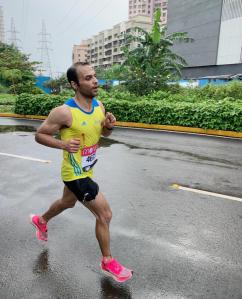
Himanshu Sareen (Photo: Shweta Sareen)

In Mumbai, Himanshu Sareen’s fitness regime during the early phase of the lockdown was centered on training for the virtual Boston Marathon with an aim to improve his speed. He had signed up for the Tokyo Marathon, Barcelona Marathon and Boston Marathon in 2020 but all these three events were cancelled due to the pandemic. Boston Marathon was held in the virtual format for those who had registered for the April race. In the months preceding the virtual Boston Marathon, Himanshu’s training, designed by his coach Ashok Nath, focused on two aspects – general fitness and improving speed. A sub-three hour marathon runner, Himanshu completed his virtual Boston Marathon in 2:58 hours. The virtual London Marathon was scheduled a fortnight after Boston Marathon. Himanshu had eyed it as a training run but on the day of the run, he appeared to find his momentum and pushed for a better timing. He finished the distance in 2:52, improving from his virtual Boston Marathon finish. For the virtual race of New York City Marathon that was next on the cards, he had initially planned to travel to New York for a holiday and do the run there. But with the pandemic showing no signs of ebbing, he ruled out travel and decided to run close to his place of residence. He finished the run in 2:47 hours, a personal record. “ The weather was not so good on the day I chose to run NYCM. But having done two marathons, I could capitalize on my good form to push for a personal best,” he said. Virtual runs do not offer the thrill of a real race. “ The experience of travelling to the venue, going to the expo and running through famous landmarks is absent in a virtual race,” he said. Himanshu has traveled across the world to run marathons and races of other distances. “ Virtual runs do offer some advantages. You can wake up at the time of your choice and start the run a few minutes late or early. For shorter distances, we can do multiple attempts too,” he said. Himanshu used the lockdown period to improve his time efficiency over the shorter distances such as one mile, 5 km, 10 km and half marathon. “ I have got reasonable improvement. This focus will continue,” he said.
Dr Rajat Chauhan in his role as race director of La Ultra The High; this photo is from an earlier edition of the race in Ladakh, location: North Pullu near Khardung La (Photo: Shyam G Menon)

With only days left for 2020 to draw to a close, Delhi-based ultrarunner and specialist in musculo-skeletal medicine and sports and exercise medicine, Dr Rajat Chauhan, shared his take on the year, from the perspective of a healer. To begin with, the pandemic and the lockdown that followed saw a major shift in work pattern; Work from Home (WFH) became the norm. This resulted in people making do with infrastructure that wasn’t originally meant for such purpose. Some companies disbursed money for staff to upgrade work facilities at home but ultimately the alterations and improvements rarely match what an office made for work offers. Adding to this has been extended hours of work; from the earlier 8-10 hours of work, people – given they were anyway at home – were on call for 13-14 hours. The resultant chair-bound life and stress have caused an increase in aches and pains. But it is the next point Dr Chauhan mentioned that genuinely engaged. Doctors like him are usually accessed against payment of a fee. As the economy got hit by pandemic and lockdown, many people lost their jobs or witnessed salary cuts. This meant their disposable income for treating medical complaints likely shrank. There is probably a lot of people out there who aren’t reporting their health problems because they can’t afford consultation fees and treatment. It prompted Dr Chauhan to highlight the need to invest in precautionary measures and advise pushing physical limits conservatively, in his social media interactions. As he put it, the number of people running for physical fitness is likely much smaller than those doing it for mental peace and happiness. “ At some point, running becomes important because it is contributing to your mental well-being,’’ he said. Given the economic pressures and mental depression of pandemic, the existing pre-pandemic army of runners and their daily activity has been complemented by the entry of new runners jogging to beat the blues and old ones jogging more to beat the greater load of blues. Adding to this has been the emergent culture of challenges – back to back running, back to back exercises, virtual races and pressures caused by social media advertising what everyone is doing. “ On the average, the number of over-use injuries appears to have gone up,’’ Dr Chauhan said. What is overlooked in such incessant physical strain is the importance of recovery. It is during recovery time that the body adapts and gains optimal strength and stamina. When you deny the body adequate time to recover, you are pushing things downhill. And yet again, the point to remember is that courtesy salary cuts, job losses and resultant avoidance of medical intervention, we may not be seeing the complete picture. “ In the end, you say running did this to you. But it is not running that is to be blamed; it is you and how you handled running that is at fault,’’ Dr Chauhan said.    
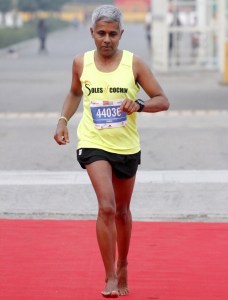
Ramesh Kanjilimadhom (Photo: courtesy Ramesh; this picture is from the New Delhi Marathon)

While several races spawned apps offering the event in virtual format and some other events debuted purely as children of the app era, not every race organizer bit the virtual-bullet. One such event that accepted cancellation of its 2020 edition in view of COVID-19 but desisted from floating an app was the Spice Coast Marathon held in Kochi. City based amateur runner and one of the founding members of the running group Soles of Cochin (they organize Spice Coast Marathon), Ramesh Kanjilimadhom put the decision in perspective. According to him, the attraction in Spice Coast Marathon is the opportunity to run in Kochi; the marathon route runs through Fort Kochi, which is home to much history and heritage. Neither that ambiance nor the enthusiasm of the organizers, supporters and the volunteers can be captured in an app. Runners know this well. “ Take for example, the Hyderabad Marathon. I personally think it is among the best in its class in India. They have a great set of volunteers. But will an app convey all that?’’ Ramesh asked. It raises the question: who wants the app the most? Very likely, the ones valuing it are the sponsors as the app offers a platform to keep events and supporting brands visible at a time when physical races are getting cancelled owing to pandemic. Apps don’t cost a lot to make. When Spice Coast decided to cancel its 2020 edition and not have an app alongside, the organizers checked with the sponsors if it was alright. “ They were cool about it,’’ Ramesh said. While he did encourage some of his friends to run virtual races of their choice, Ramesh didn’t register for any virtual event. He likes the real event and is waiting for things to settle down and the machinery of physical events to revive. His own experience of 2020 has been akin to a year of reflection and experimentation. The absence of races has infused an element of naturalness into running. There are no external goals to chase and to that extent running right now, is less synthetic. “ In the initial part of the lockdown, like everybody else, I too was indoors. When the freedom to move returned, I recommenced my running and it has progressed consistently. I used the opportunity to try slow running and heart rate running. A lot of people have changed their approach to running,’’ he said pointing out that there are others too who have used this juncture to revisit questions around why they run, what sort of running they wish to do and how to train.
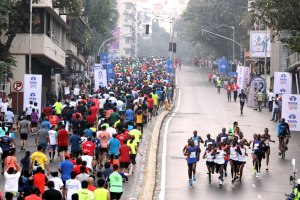
The 2018 Tata Mumbai Marathon (TMM) in progress; elite contingent on the right (Photo: by arrangement)

By all accounts, the return of physical races depends on government, race organizers and participants, feeling confident. A persistent lacuna herein has been the absence of a body representing race organizers. Such a platform can be helpful in times like the present, when the multiple verticals that usually converge to enable a race have to be spoken to and their confidence in events restored. But said platform is absent. Events of some scale with pandemic protocols in place were reported from China, US and Australia in the final months of 2020. In race organizer-circles there is expectation of events capped to limited participation, happening with safety protocols in place, in the first quarter of 2021. How successful they will be is anybody’s guess. The race organizer can organize and invite but ultimately participation must manifest and that is influenced by how secure the overall situation feels. As mentioned in the introduction, the Chennai Marathon with participation capped at a maximum of 1000 runners is slated for early January and talks are on for a similar event over a shorter distance in Hyderabad later the same month. They should work as icebreakers, test cases. A recent survey of runners by one of the players in the industry indicated that prospective participants at races may be willing to pay more so that event managers can put safety protocols in place. Meanwhile, with no mass participation road races since March 2020, the industry of running saw its share of economic impact. At various related organizations, sources said, there have been instances of delayed payment of bills and salaries, layoffs and migration of skilled hands to other sectors. It is also believed that some of the marginal outfits may have given up and shifted their attention elsewhere. Before the pandemic, India was estimated to have more than 1300 road races of various dimensions being held annually. On the other hand, just as life under lockdown highlighted the importance of essentials over luxuries, the tightrope act of organizing races with safety protocols in place and not making it very expensive either, has got managers revisiting the event model to separate the essentials from the dispensable add-ons. Suddenly the focus is on what a running event actually requires – COVID-19 protocols; timing certificate, proper measurement of distance, well defined closure of roads, hydration, aid stations, medical assistance – that sort. The more superfluous items of the pre-pandemic business model seem chop-worthy. “ This is a good opportunity to recast the business model of these events and make them more relevant to running,’’ Venkatraman Pichumani of You Too Can Run, said.

(The authors, Latha Venkatraman and Shyam G Menon, are independent journalists based in Mumbai. Please note: some of the timings, mileage and number of marathons run are as said by the athletes spoken to.)

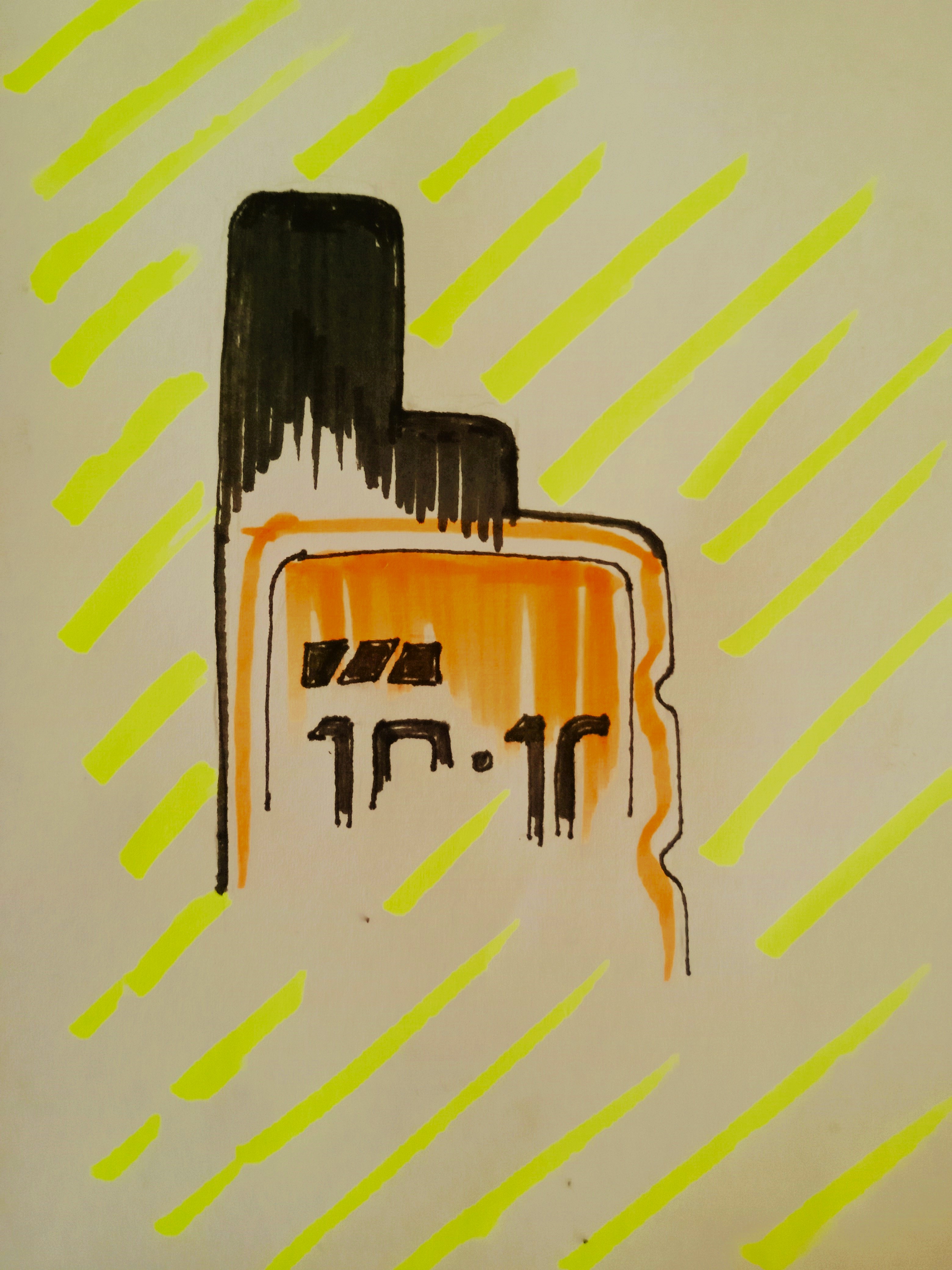
AS PREMIUM BICYCLE SALES GAIN, SCOTT LAUNCHES NEW MODELS IN INDIA

SCOTT Spark RC 900 (Photo: courtesy SCOTT India)

SCOTT Sports India has launched the SCOTT Spark series of mountain bikes in India.

According to an official press release made available on September 16, 2020, the launch includes the SCOTT Spark RC 900 Team, one of the most decorated full-suspension bikes, ridden by the likes of Nino Schurter, a winner at the Olympics, and Kate Courtney, a World Cup champion. “ The bike is a super light, super-aggressive steed that pedals with incredible efficiency and is priced at INR 369,900,’’ the statement said.

The launch follows an increase in demand for performance-oriented premium bikes in the price range of two to ten lakh rupees. When contacted, an official spokesperson informed that while the Spark RC 900 Team is currently available in India, the rest of the models in the range are available on request.

“ We’ve seen unprecedented demand in premium bicycles over the last few months. While fitness is the key driver, a lot of demand is specific to performance and high-quality components, and these bikes cost anywhere between 2 lakhs to 10 lakhs. At SCOTT, we always believe in bringing the best in innovation, technology, and design to someone equally passionate. And that’s why we are planning to introduce a higher number of performance-oriented bikes in India over the next few months,” Jaymin Shah, Country Manager, SCOTT Sports India, was quoted as saying in the press release.

“ We’ve seen an increase in demand for performance-oriented cycles, not only in the mountain bike category but also for road and gravel bike category. For instance, we received multiple orders for the SCOTT Addict RC series that are priced between 5 lakhs to 6 lakhs,” he added.

In the wake of COVID-19 pandemic there has been an increase in bicycle sales globally. Cycling is environment friendly personal transport; it is also an exercise contributing to good health.  Many cities overseas have actively encouraged citizens to cycle and walk instead of taking out motor vehicles.

(The author, Shyam G Menon, is a freelance journalist based in Mumbai.)
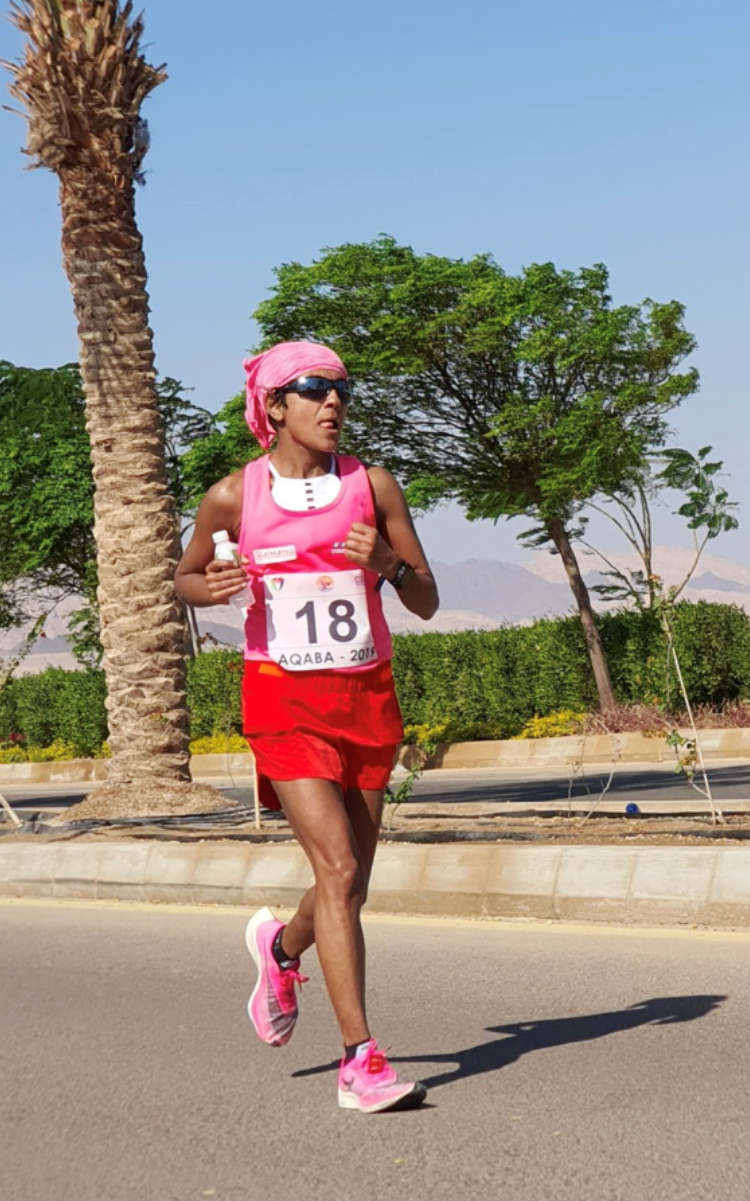
PSYNYDE BIKES / IT’S TIME TO CYCLETOWORK

This image was downloaded from the Facebook page of Psynyde Bikes and is being used here with prior permission.

The ongoing COVID-19 pandemic has bolstered the case of cycling, worldwide. Amidst the requirement to stay healthy and also keep adequate physical distance, the good old bicycle has emerged a fine combination of encouraging fitness and observing pandemic related protocols. News reports in the recent past cited bicycle sales spiking in several countries. The bulk of the new interest was in practical bicycles for commuting purposes.

Pune based boutique manufacturer of bicycles, Psynyde Bikes, plans to introduce a model that packs into this slot. Aptly named “ cycletowork,’’ the commuter bicycle had been in the pipeline for the past one to one and a half years, Praveen Prabhakaran, founder of the company, said. The pandemic and the relevance of cycling it highlighted, has authored an opportunity to formally bring the model to the market. True to Psynyde’s value-for-money positioning, the commuter bicycle is slightly high end in components and looks but affordably priced for those specifications. “ We are hoping to price it at around Rs 25,000-26,000,’’ Praveen said.

The bike, which has been designed by Psynyde in India, has an aluminum frame and steel fork. The frame is a completely new design with geometry meant for commuting. “ Its new from ground up,’’ Praveen said. The bike employs Shimano Tourney derailleurs at the front and back. It has altogether 24 gears (8×3 set up). Where it makes a departure from other similar models in the Indian market is with regard to its crank. “ It has a hollow spindle crank,’’ Praveen said. The hollow spindle crank is a bit fatter in build than its brethren. This makes it stiff and thereby capable of better response when it comes to translating effort to movement. At the same time, because the component is hollow inside, it is light and does not affect the overall weight of the bicycle, Praveen said.

The company has around 100 numbers of the commuter model in stock. “ We have been getting enquiries,’’ Praveen said.

Psynyde is a home-grown company, founded by cycling enthusiasts. Its earlier models – Psynyde Furan (MTB) and Psynyde Oxygen (hybrid) – are known well in the Indian market. The company started as an outfit making custom-built bicycles and performance oriented bicycle components. It is now a young, small enterprise that sells a limited number of bicycles designed by it. For more on Psynyde please try these links:    https://shyamgopan.com/2014/02/06/the-story-of-psynyde/, https://shyamgopan.com/2016/11/09/psynyde-alert-the-hour-of-the-furan/, https://shyamgopan.com/2019/08/03/psynyde-bikes-weathering-tough-chemistry/
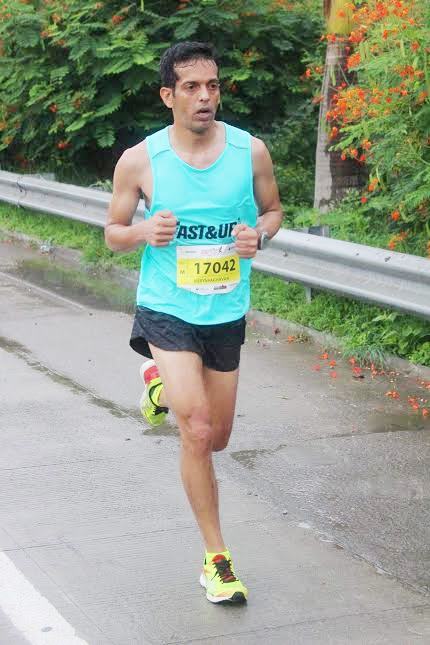
(The author, Shyam G Menon, is a freelance journalist based in Mumbai.)         

SWIMMING’S PHASE OF WOES

Illustration: Shyam G Menon

The closure of swimming pools has meant tough times for swimmers, coaches and support staff

While COVID-19 has been a setback for sports at large, it has been particularly harsh on swimming.  And within that the impact has been hardest on competition swimmers.  “ Pools have been shut since around March 19. In competition swimming, there is no real replacement for the swimming pool. Dryland work outs cannot fully substitute training in the pool. It will be difficult for swimmers to get back to earlier performance levels,’’ Zarir Balliwala, President, Greater Mumbai Amateur Aquatics Association (GMAAA) said. The prolonged closure of pools has derailed this year’s district and state level competitions. Question mark graces the nationals too.

According to Zarir, the Swimming Federation of India (SFI) is seized of the matter and it has spoken to the government. But with no response that can be acted upon available yet, the closure continues. With it, elite swimmers training for events like the Olympic Games, endurance swimmers who have crossed channels and straits worldwide as well as recreational swimmers – all have been left high and dry. The tough situation was brought to focus when ace Indian swimmer Virdhawal Khade tweeted mid-June that he may have to consider retiring from the sport if pools stayed shut. Virdhawal is the current national record holder in 50m, 100m and 200m freestyle events and the 50m butterfly. He represented India at the 2008 Beijing Olympic Games. “ Regaining form will be an uphill task if elite swimmers don’t have access to the pool for long,’’ Sebastian Xavier, former national record holder in swimming who represented the country at the 1996 Atlanta Olympic Games, said. On June 30, 2020, espn.in carried a report by Jonathan Selvaraj on swimmer Sajan Prakash, the only Indian elite swimmer who is currently training, thanks to him being in Thailand. Sajan who is still recovering from injury described his return to the pool after the virus triggered-lockdown. “ Going back to the water, I felt as if my body was made out of stone,” he was quoted as saying in the report.

Most people linked to swimming realize that with the virus sparing little room to argue their case, one has to simply hope for the best amid existing challenges. “ You have to look at the positive side,’’ Kaustubh Radkar, former national level swimmer and now a well-known triathlete and coach, said when asked how swimmers may tackle the predicament. He suggested that the best option would be to treat lockdown with its lack of access to pools, like a period of injury. “ Take it as if you are addressing injury. If I dip into personal experience, I had shoulder surgery in 2009 and was out of action for three months. You have to make the most of what is available. What you can do right now is indulge in shore based exercises and keep a positive attitude,’’ he said. With shoulder injury, Radkar estimates the dip in fitness levels he experienced over those three months at about 50 per cent. Without injury – which would be the apt way to estimate for the current situation – he felt the dip in swimmers’ fitness levels should be 25 per cent.

The above encapsulates only the physical aspect of how swimming is missed. Most people see the pool as a fun environment. That is typical landlubber perspective, one in which swimming is the exception and activity on land is the norm. This isn’t necessarily the perspective when you are a committed swimmer who is very comfortable in water. In that predicament, the way you miss swimming is more visceral. Asked how a dedicated swimmer may miss water, Radkar said that the question cannot be answered generically as the nature and extent of impact varies from person to person. Speaking for himself, he said, “ for me, water is very calming. When I am in the water, it is a perfect state of existence. There is no distraction. It is meditative and positive,’’ he said.  Zarir too recalled tranquility as the essential quality of water. This should give an idea of what exactly those embracing water as preferred medium of sport must be missing in these times of pools shut due to pandemic.

Illustration: Shyam G Menon

Swimming pools have been studied in the past for how they spread disease. The National Center of Biotechnology Information (NCBI) is part of the United States National Library of Medicine. There is a study titled “ A Review and Update on Waterborne Viral Diseases Associated with Swimming Pools’’ by Lucia Bonadonna and Giuseppina La Rosa, published January 9, 2019, available on its database. The introduction to its abstract says:  Infectious agents, including bacteria, viruses, protozoa, and molds, may threaten the health of swimming pool bathers. Viruses are a major cause of recreationally-associated waterborne diseases linked to pools, lakes, ponds, thermal pools/spas, rivers, and hot springs. They can make their way into waters through the accidental release of fecal matter, body fluids (saliva, mucus), or skin flakes by symptomatic or asymptomatic carriers. In its concluding remarks, the study noted: In light of the health hazards posed by swimming pools, it is essential to constantly monitor water quality in swimming pools and to assess the effectiveness of treatment and disinfection processes and compliance with standards. Specifically, appropriate chemical and microbial evaluation of water quality should be carried out, especially when large numbers of bathers are expected to use the pools. Overcrowding should in any case be prevented. Since the behavior of swimmers may affect water quality, strict rules of behavior in the pool should be followed and enforced, including shower before entering the water, wash hands after using the toilet, take children to bathroom before swimming, and, importantly, avoid swimming while sick. This study provides an overview of the health risks associated with swimming pools. In other words, you can’t pretend risks don’t exist. However the study precedes the COVID-19 pandemic by almost a whole year.

Similar studies specific to our COVID-19 times, were hard to locate. On May 15, 2020, www.covid19facts.com, a website hosted by Reckitt Benckiser (in India, their best-known brand is Dettol) posted an analysis by EIU (Economist Intelligence Unit) Healthcare on the risk of contracting COVID-19 from swimming in the pool or the sea. According to it, the biggest risk with swimming is likely getting too close to other people, for example in enclosed pools, changing rooms or on beaches, rather than infection from the water itself. Citing a report from the Spanish Consejo Superior de Investigaciones Científicas (Higher Council for Scientific Research), the analysis said that its authors concluded: it was “highly unlikely” that people would be infected from contact with water. However, they warned, leisure swimming tends to involve a loss of social distancing, which is the major risk from using pools or beaches. In swimming pools, the authors say, “the use of disinfecting agents is widely implemented in order to avoid microbial contamination of the waters” by users. They say that “the residual concentration of the disinfecting agent present in the water should be sufficient for virus inactivation.” They admit there is “currently no data” on what happens to SARS-CoV-2 in seawater, but say that “the dilution effect, as well as the presence of salt, are factors that are likely to contribute to a decrease in viral load and its inactivation.” They say this is based on what happens to other, similar viruses. Rivers, lakes, and untreated pools are riskier, they say, and are “ the most inadvisable aquatic environments” for swimming. The report authors stress that the most likely way people could get infected while swimming “ is through respiratory secretions that are generated by coughing, sneezing and person-to-person contact” in busy spaces. The analysis also cited what the US Centers for Disease Control and Prevention had to say on the subject. It quoted CDC: “ There is no evidence that the virus that causes COVID-19 can be spread to people through the water in pools, hot tubs, spas or water play areas. Proper operation and maintenance (including disinfection with chlorine and bromine) of these facilities should inactivate the virus in the water.” They also advise that the salt in the sea and dilution effects make it unlikely the virus would survive. CDC’s recommendations in full may be viewed on this link:  https://www.cdc.gov/coronavirus/2019-ncov/community/parks-rec/aquatic-venues.html

In March, when nationwide lockdown was announced in India, the total number of COVID-19 cases was around 500. By July 6, that had changed to a total count (since the disease appeared in India) of almost 700,000 cases; third highest in the world. The original lockdown had relaxed but with relaxation of norms leading to further spread of infection in some places, stringent lockdowns were happening at local level. Such imagery stacks the cards against adopting a kinder view towards swimming pools. The people this blog spoke to agreed that the reopening of pools would have to be a well thought through decision; one that authorities may take only when they are absolutely sure of allowing it. At least one senior coach this blog spoke to said he was anticipating another couple of months of closure. He explained the reason. “ At the complex where I work, during busy hours, we may have around 100 people in the water and almost double that number on land. You can’t have that in a situation like the present. Only when infection numbers have dropped significantly, can we examine possibilities of return to swimming with new protocols in place,’’ he said. Pools have opened in some countries and the general practice seen there is not allowing use of shower rooms, changing rooms and locker rooms. You come ready to swim and once you finish your session, you put your clothes on top of wet swimsuit and go. Asked if it would be possible to open pools just for elite swimmers (so that their training isn’t damaged beyond repair), they felt it should be possible to do that with above said restrictions and strict lane discipline in place. The report on espn.in provided insight on how Sajan Prakash is training at Phuket’s Thanyapura Aquatic Centre. “ Among the rules we have to follow since the opening of swimming pools has been to train in separate lanes. In the past, because we had to share the pool with other members of the centre, we would all have to swim in a single file in the same lane. Very often you’d find someone’s hands touching your toes. It’s much less distracting to have your own lane,” Sajan, who represented India at the 2016 Rio Olympic Games, was quoted as saying, in the report.

Illustration: Shyam G Menon

Athletes are only one aspect of sport. When sport is an industry, there are many others dependent on it. Their livelihood is hit when pandemic strikes and sports goes for a toss. With pools shut, there are swimming coaches and support staff finding it difficult to make ends meet. As with any industry, vulnerability depends on how secure your employment was. “ Those working for big institutions that run swimming pools and those located in major metros, may not be affected severely. But freelancers and the employment ecosystem around pools in smaller cities and towns would have been affected,’’ the head coach at a school in the Mumbai Metropolitan Region, reputed for its strength in swimming, said. Sebastian Xavier is among those trying to raise resources to help. He forwarded to this blog information on the fundraiser Lets Pool In, which seeks to support 100 persons from the affected category with a one-time financial grant of Rs 10,000. “ It is a good move,’’ the earlier mentioned coach also said, adding he wished the amount per capita was more. Resident in the emergent livelihood problem around shut swimming pools is a little remembered detail. India’s lockdown started in March, just as summer vacation was approaching. The warm months of summer are when pools are at their busiest; Lets Pool In estimates that the summer months contribute as much as 60 per cent of annual revenues for this industry. So in 2020, the business of swimming pools and coaching therein has already lost its best earnings season. Not to mention – the coaching camps of summer play a role in scouting the next generation of the talented young.

(The author, Shyam G Menon, is a freelance journalist based in Mumbai.)