A RIVER STORY (PART TWO)

FROM TONS RIVER TO RUPIN PASS

In accordance with our plan, a day after the camp at Mori ended, we drove upstream to Netwar.

I saw more furious sections of the Tons. The water was slowly thinning in color from Mori’s brooding grey to a playful shade; its froth and foam, a clearer white. Yet its power was uncompromised. Memories of rafting the flooded Tons still fresh in mind I engaged myself with imagined visuals of negotiating these rapids.
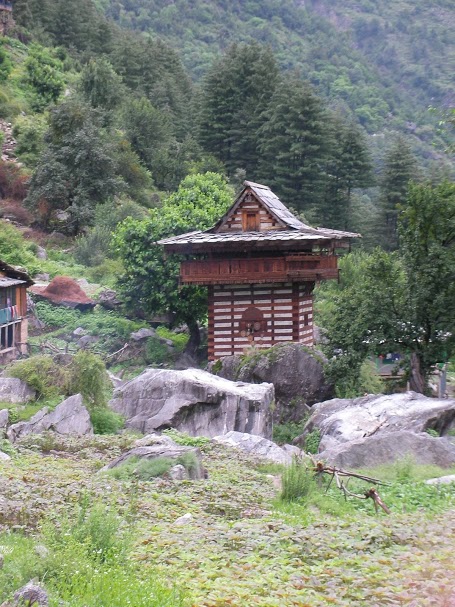
The temple (Photo: Suma Rao)

The temple (Photo: Suma Rao)

Past Netwar, we picked up the Rupin and spent the next week, hiking upstream on its banks. Popularly called the Rupin Pass trek, the mood was set as soon as one left Netwar for Dhola. The half hour-drive on a narrow road was ethereal; the Rupin flowing furiously beside that uneven terrain of bouncy road, thick foliage all around and ample shadow. The road ended ahead of Dhola village, on land cloaked that rainy day in squishy, black mud giving it the look of an oil prospecting outpost. The imprints of vehicle tyres and peoples’ boots ran deep in the mud, each depression gathered water in the pouring rain. Curious faces peeped out from a nearby shop to inspect the visitors. You almost expected to see a John D. Rockefeller or at the very least, Daniel Day-Lewis as mineral prospector Daniel Plainview, brooding harsh capitalism in one of the decrepit shacks around.
Near Dhola and from Dhola to Jakha village, the river’s flow was taut. There was crisp freshness to its waters although the occasional human settlement stood mired in dirt. The route passed through the villages of Sewa and Jiskon. The former had a well stocked store selling everything from noodles to coffee and adjacent to it, a beautiful wooden temple.

It was about twenty years-old, square tower with pagoda for roof. It was a style that strangely left you thinking about Japanese and Korean design sensibilities with a dash of the Hindu tribal, thrown in for flavor. The village had hung several shields and trophies to its wall. “ We won them playing cricket,’’ the shopkeeper said. The trophies seemed gifted to the local deity in return for blessings to the village team. The first flood plains since leaving Dhola were also in these parts. The broad swathes of sand guarded the river’s deceptively obedient course.

You almost expected to see a John D. Rockefeller or at the very least, Daniel Day-Lewis as mineral prospector Daniel Plainview, brooding harsh capitalism in one of the decrepit shacks around.

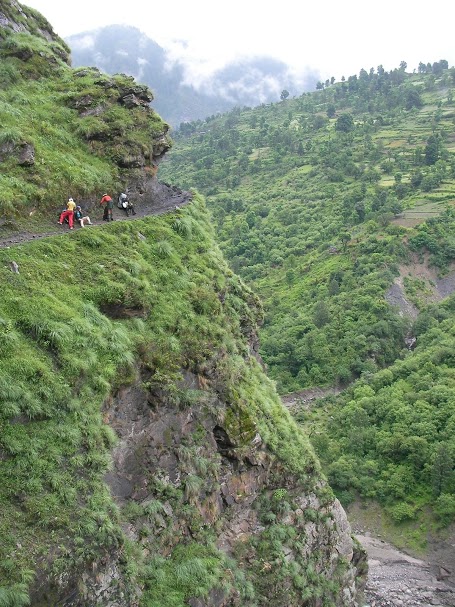
On the trail; Rupin River below (Photo: Suma Rao)

On the trail; Rupin River below (Photo: Suma Rao)

Jakha, perched high on a cliff, was waking up to commerce from the tourist trail. The owner of its first lodge – a still incomplete wooden structure with a couple of rooms ready – was waiting at the entrance to the village with claims of the Rupin Pass trek being the toughest in the Himalaya and the consequent importance of rest. “ This is the toughest,’’ he said shaking his head; then for good measure, “ a group, which went ahead of you is already in trouble.’’ Strange were the compulsions of commerce – where there was money to be made, the trail was tough; where there was no money to be made, the trail was easy even if what was amiss was the trail itself! Amid all that hard sell, I was enamored by two unforgettable sights – the region’s lovely wooden houses and the view from the balcony of the lodge with the Rupin flowing way below in the valley. The buildings were made of wood from the Deodhar tree and according to the lodge owner villagers had free access to fallen trees in the surrounding forest. That restricted his material cost to transporting the wood and getting the structure built. The lodge was pretty, even amusing given the posters of Hindi film heroines inside the rooms. However, the architecture lacked the sophistication of similar woodwork from South India, where mathematically precise joints and wooden pegs characterize traditional wood work. Up here, it was hefty sections and big nails; hammer and go. The simplicity of the craft was evident in the carpenter’s tools, a glimpse of which we got later near Sangla. An old carpenter there worked with just three tools; a small saw, a heavy planer and a mini-axe to both chisel and hammer. Under prevailing law, land could not be sold to outsiders even if they loved the place and the houses. Perhaps it was best that way. Yet truth be told, sometimes I have wished for a small house somewhere up there, my window to the snows.
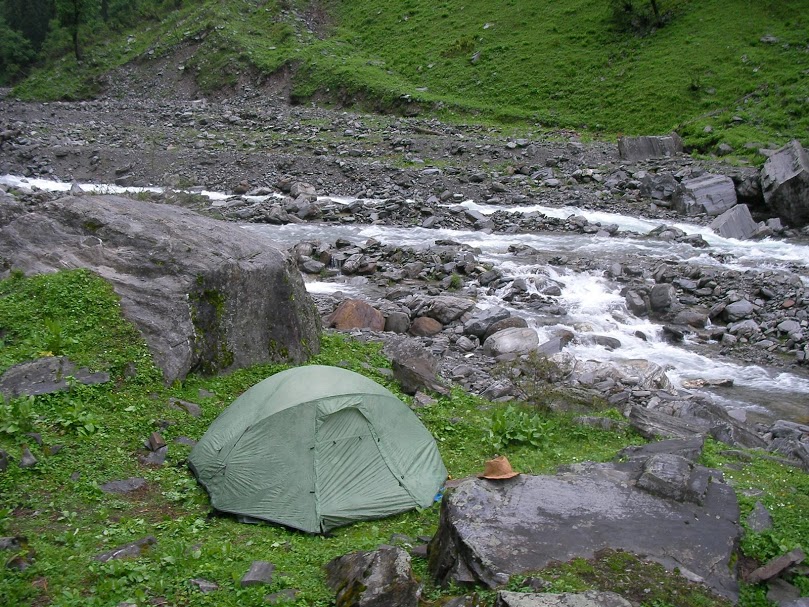
Camped beside the Rupin River (Photo: Suma Rao)

Camped beside the Rupin River (Photo: Suma Rao)

It reminded me of a conversation once had on the drive from Ranikhet to Kathgodam. “ If you like the hills so much, why don’t you marry a girl from here? You will get land and house,’’ the taxi driver had said. I laughed and inquired of his life. He had shifted with family to the plains. Wife and children were all down, only aged parents remained up there. “ What is there in these hills?’’ he had asked. For a brief while, I tried explaining what I liked about the mountains. Then I gave up, for it seemed lost on him. Besides my habit of attempting to articulate the best clarity within me always muddled my talk and confused others. Although born to the mountains the driver’s baggage in life seemed no different from the social baggage of the plains, mono-cropped so by marriage and family. To me, the compulsions of marriage appeared universal. In the backseat of the car, I had wondered – would I want to be in the mountains in such a fashion? No – was the answer I heard upstairs.

Beyond Jakha, you got the first of several snow bridges, structures that some crossed blindly but would do well to test for a route before walking over. Snow bridges were typically found on streams and gullies used by running water. Snow deposited there, lasted longer than snow in areas more exposed to sunshine. Thus below your feet, when on a snow bridge, would be flowing water. If it was minor stream, the consequences of bridge breaking were limited, save a wetting in ice cold water. If it was a major stream, the worry was more. If it was a river underneath, you had to be seriously careful when plotting a path on that slowly melting bridge with varying weaknesses and trajectories of slide, should you slip, in place.
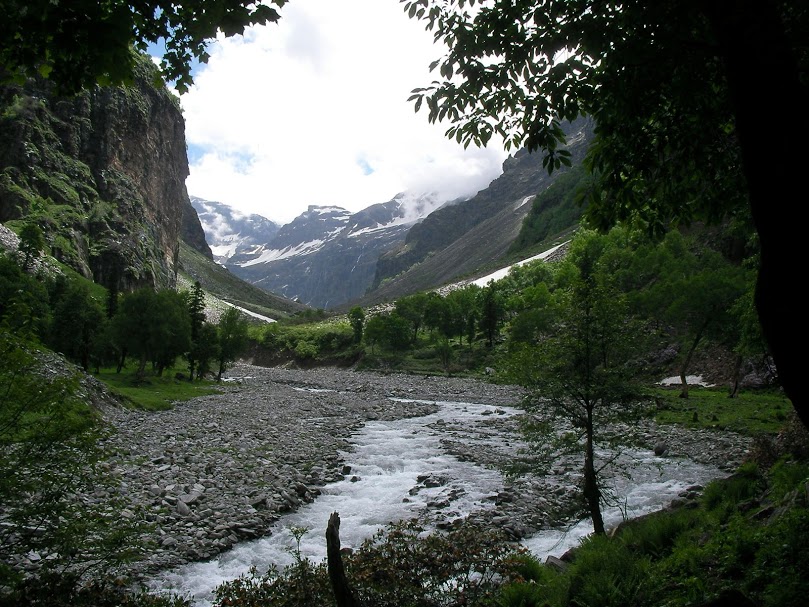
Looking towards the Upper Rupin Valley (Photo: Suma Rao)

Looking towards the Upper Rupin Valley (Photo: Suma Rao)

Roughly a day’s hike from here, you reached the Upper Rupin Valley. It had the shape of an amphitheatre with a valley as exit to the lower hills, now behind us. At places, the Rupin had braked to a gentle flow with beaches alongside. You could see through the reflected blue of the sky, into the aquamarine water and read the surface texture of rocks way below. Where an eddy or rapid formed, the froth went past the best traditions of pure white to add a touch of blue. In the right season, it should be a very pretty place sporting colorful blossoms, agile small birds, the patient vulture and plenty of cattle let lose to graze and multiply. You may also see trekkers clients and their porters, the former on holiday, the latter with a 25 kilo-load on his back. Still upstream, the verdant landscape was traded for severe terrain as the altitude gained and the river disappeared again under snow bridges. Beyond the last snow bridge in the valley you saw the river gushing out from a rock face. And high above that was a magnificent waterfall. It was a cascade that presided over the entire valley and visible in the distance from the moment you stepped into the amphitheatre. From its lip, you could look down into the whole valley and see the Rupin’s course. At your feet, it was a thunderous spray leaping off the edge into thin air. For some distance back from the precipice, the river had carved a narrow channel through hard rock packing force into the waterfall.

Beyond Jakha, you got the first of several snow bridges, structures that some crossed blindly but would do well to test for a route before walking over.
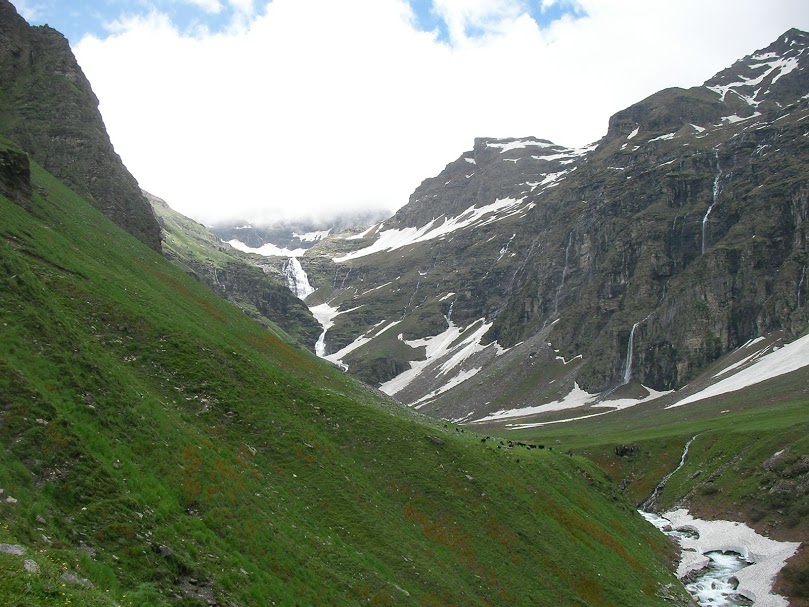
Upper Rupin Valley; waterfall in the distance (Photo: Suma Rao)

Upper Rupin Valley; waterfall in the distance (Photo: Suma Rao)

Further up, the Rupin was a playful stream that merged into the snows. As we moved towards the snow clad Rupin Pass, we veered off the river’s banks. Eventually, a frozen pond just ahead of the steep climb to the pass was all that indicated a river’s presence somewhere in that world of snowfields. Nothing moved. Even the water was mostly ice. Where it trickled off into the proto stream that would eventually become the Rupin, you could perhaps put your ear close to the water and catch a faint gurgle. Else, the only sound around was you crunching snow underfoot as you walked; your strained breathing at altitude. I thought of the Tons way downstream and its many shades, the people along its banks. I also thought of how different this whole journey had been from the typical mountaineering expedition, wherein I would have been focused on reaching a summit and judged for performance; never been at peace. Being on an expedition was like going to office. This time, I had just ambled up into the mountains after work. Here I must pause and mention that our already small team split into two teams in the Rupin Valley, to respect peoples’ itineraries. Ravi (he would later become Director of the outdoor school, NOLS India) and I had more time on our hands. So we spent an extra couple of days camped out in the Rupin Valley and made our way slowly up to Rupin Pass. The other group led by Suma Rao, camped a day in the Rupin Valley and moved on well before we us, across the pass towards Sangla.
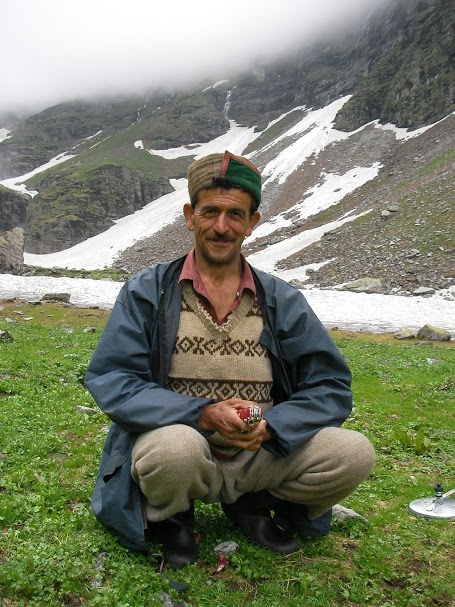
Shepherd from the Rupin Valley (Photo: Suma Rao)

Shepherd from the Rupin Valley (Photo: Suma Rao)

My introduction to the outdoors had been through a trekking club that hiked hard and then, through rock climbers and mountaineers who obsessed with objective. Hanging out with Ravi in the Rupin Valley was the first time I was in the outdoors without an objective. It was initially tough for my city bred ways demanding entry and exit from outdoors with claims and photos to prove the passage to folks back in the city. But which city can you cross over to for immediate relief from the Rupin Valley? And quite frankly speaking – what was that need for proof; the need to tell others that you did this and that and feel vindicated by their appreciation? Slowly I adjusted to sitting still and concerning myself with simple things like maintaining a tent well, getting a fire going and cooking; or just absorbing the stillness. That was my first real education in the outdoors despite several years already spent frequenting the outdoors. In the Rupin Valley, I learnt to let the outdoors in.

Eventually our leisurely amble through the valley would take us to Kinnaur in Himachal Pradesh. There were three mountain ranges in Kinnaur – the Great Himalayan, Zanskar and Dhauladhar. We seemed to be on the third. Besides the fact that the Dhauladhar formed the divide between Kinnaur and Uttarakhand, the mountains we were on fitted the classic description of the Dhauladhar as steep, dark-colored and rocky albeit of modest height. The exact height of the Rupin Pass was a bit of a mystery. On the Internet, estimates ranged from 14,000 ft to 16,100 ft. At the top of the pass, panting from the ascent, none of that mattered. A place full of `chortens’ and prayer flags, we sat down for some coffee from the thermos. For the first time, I understood what a mountain pass was. In that icy world the steep ramp which we had come up on, was the sole weakness in the nearby mountain walls for a crossing. I wondered how long it must have taken to find it and how prized it must be for people on either side of the barrier as a link to each other. Yet for all its elusiveness and fragility it was a historically important pass, for years back the Kinnaur kingdom used to have influence in the villages we had come through. The Tons area had an ethnicity that reflected this cultural mix. Pinpointing details may be difficult because history in these mountains, wrapped up in legends and oral traditions, was very different in texture from the better recorded history of the plains. One had to navigate with a few assumptions in place as context.

Being on an expedition was like going to office. This time, I had just ambled up into the mountains after work. The Rupin Valley was the first time I was in the outdoors without an objective. In the Rupin Valley, I learnt to let the outdoors in.

While there were references to the hill tribes as possibly people who were driven out from the plains by invaders, the first formal attempt at recognizing their strengths and organizing them for governance or military assistance seemed to have occurred during the time of the Mauryan Empire. Chandragupta Maurya actively involved frontier tribes in his efforts to establish a vast rule. Until then, quite the same way as life feels isolated in each valley even today, the tribes were independent and separate. The Mauryans brought them under one scepter. Remote Kinnaur was also believed – only believed – to have been part of these tides in Himalayan history. After the Mauryans, the next big emperors were the Kushans, whose greatest ruler was Kanishka. During his time, Kashmir became part of empire. Inclusion of the mountainous regions into the ambit of North Indian empire-building continued through the Gupta Age and up to the demise of Harsha who ruled from Kanauj. This last great ruler of the plains died in 647 AD and with that the mountainous regions were said to have relapsed to their old feuding principalities. This was further fuelled by princes seeking to extend their territorial sway.

According to some accounts, the area between the Sutlej and the Baspa rivers all the way up to Manasarovar had been under the Thakkers even during the time of the Maurya and Gupta emperors. From among them, the Thakur of Kamru emerged the strongest, annexed the territory of other nearby chieftains in the days after Harsha, and laid the foundations of the state of Bushahr, to which Kinnaur belonged. Its comparative remoteness worked to Bushahr’s advantage, helping it to persevere with a policy of territorial expansion even as some of the other hill states succumbed to Mughal rule during the Medieval Ages. But remoteness in relation to one side could turn out to be proximity for others. There were references that claimed Kinnaur came under the influence of the Guge Kingdom of Tibet in the ninth and twelfth centuries. What that actually meant historians know (I am not one), although centuries later the region was known as Chini Tehsil, tehsil (also spelt tahsil) being a small administrative unit. In the nineteenth century, Bushahr came under attack from the Gurkhas of Nepal. The ruler fled leaving behind a rich treasury in Sarahan, which the raiders looted. While the Gurkha invasion – it advanced till the Kangra valley – was checked by the ruler of Kangra and Maharaja Ranjit Singh of Punjab, in ensuing years the development served to grow British influence in these parts. As part of protecting the region, the British eventually defeated the Gurkha King, Amar Singh Thapa, in 1815. Kinnaur, known by then as Chini Tehsil, was merged to form a part of Mahasu district.

In 1951, Chini Tehsil etched its name into the history books when a group of Buddhist residents, eager to cast their ballot ahead of the winter snows, became the first people to vote in a general election in independent India. This has been mentioned in the book `India after Gandhi’ by the well known historian, Ramachandra Guha. In it the author noted, “ One place even Nehru didn’t get to was the tahsil of Chini in Himachal Pradesh. Here resided the first Indians to cast votes in a general election, a group of Buddhists. They voted on October 25, 1951, days before the winter snows shut their valleys from the world.’’ While there was a side story in a book on trekking in the Himalaya that said Chini was renamed Kalpa to wipe out any Chinese claims to it, the present day Kinnaur district was born from a reorganization of these border areas that happened around 1960. I don’t think I will ever meet anyone in my lifetime who can tell me convincingly when the Rupin Pass was discovered. But it sure seemed a pass that had seen footfalls from many lifetimes before me.
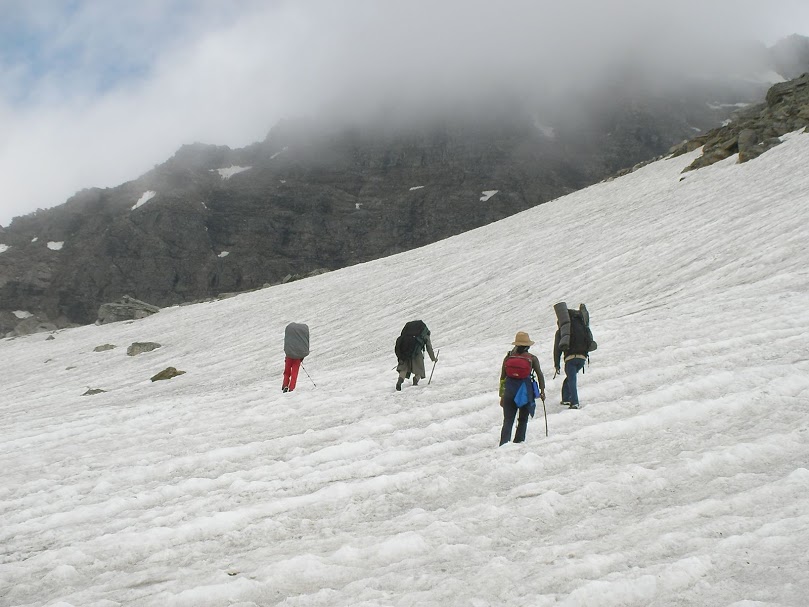
Suma's group near the Rupin Pass (Photo: Suma Rao)

Suma’s group near the Rupin Pass (Photo: Suma Rao)

As always, hot coffee in the outdoors felt really good. There was nothing that could adequately describe the spread of warmth from cup to your hands and from liquid to your insides. Our passage through the Rupin Valley had seen occasional rain; once, rather heavy downpour. A touch of warmth for the insides invigorated. In the mountains, nothing is same for long. Gradually, the pass began betraying signs of approaching cold. The sky turned cloudy cutting off sunshine.  In the outdoors, if it rained or snowed, you try not to be at some high, exposed point. The descent on snow to the other side was labored, I started slipping. While ascending the pass we had kicked steps in the snow with the toe box of our shoes, creating small ledges to stand on. Unfortunately, I had come to the Himalaya prepared for work in foothills. The trek over the Rupin Pass had been an addition born at river side camp in Mori. I was wearing light trekking shoes, which bent when kicking snow, not to mention – no grip underneath. There was no solid heel to my shoes either. Atop it, I was also bit tired. After one inelegant slide, I decided on a tender traverse with steps again. It took time. Snow field done, we passed through mixed terrain of snow and rocks, then finally, grass.

Way below in a ravine was a stream. It had been visible from the pass. Over that day and the next, it led to the Baspa River. The Baspa valley had several passes – Rupin Pass being one – linking it to Uttarakhand and two major ones that took the traveler to Tibet. The river’s fury near Sangla in Kinnaur district of Himachal Pradesh had me thinking yet again of the Tons. But downstream from there, the Baspa gathered mud from the ongoing Karcham-Wangtoo hydro-electricity project and three hours down the road from Sangla to Shimla, the river ground to a halt in the brown slush of a reservoir. It was an eyesore. True the Baspa flowed beyond, even recovering its complexion, but a dam to a river was like a choke to your neck. Seeing it I hoped fortunes stayed better for the Rupin and Tons on the other side of the mountains.

(CONCLUDED)

(The author, Shyam G Menon, is a freelance journalist based in Mumbai. He would like to thank Suma Rao for permitting the use of photos from her collection. A slightly abridged version of this article – ie parts one and two of the river story, combined – was published in Man’s World magazine.)

REMEMBERING MADHAVAN UNCLE

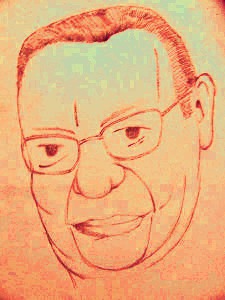
Illustration: Shyam G Menon

Illustration: Shyam G Menon

The first time I heard of him was when my maternal grandmother decided that she must hear Beethoven’s Fifth Symphony. Having read about the great German composer, she wanted to hear his famous composition.

We lived in Thiruvananthapuram, the southernmost city of Kerala, a state in South India. It was a small place, and as state capital, its predominant feel was one of politics. Where in such a town would you locate Beethoven and hear his music in a manner that did justice to its orchestral splendour? My mother’s elder brother then took my grandmother to Madhavan Nair, a relative who hailed from the same native place near Kochi as we did. He owned a fine music system and had diligently assembled over time a good collection of music spanning Indian classical to western classical and much else in between.  My grandmother returned from the visit, a thrilled person. I wasn’t let in on this story. But I figured out that music was involved.

Curious, I asked my father, “ who is Madhavan Nair?’’

His reply was evasive and it was for a valid reason. Around that time, an obsession to hear music and hear it loud and clear, had taken root in me. The financial strain it potentially indicated was clear. We were a very middle class family with a youngster praying for Technics, Pioneer, Denon and now beginning to dangerously say, Nakamichi and NAD. I drooled over product advertisements. Those were the heydays of people from Kerala working in the Middle East. Most people returning on vacation brought a two-in-one, a boom-box. At the airport with boom-box in hand was both hallmark of Gulf-returnee and new found prosperity. For many, it was the sign of prosperity that mattered. I wanted the boom-box for what it actually was. On visits to receive relatives at the city airport I became notorious for missing people and seeing only the two-in-ones being carried home from Gulf countries. Not surprisingly, my father was wary of having me in any place with amplifiers at hand. It was therefore some months before I coaxed him to take me to Madhavan uncle’s house.

Those were the days of the LP record and the audio cassette. I gazed respectfully at his music system, which included a turntable with stroboscope, tape decks with restless needles in brightly lit dials, pre-amp and power-amp, graphic equalizer and deceptive book shelf speakers that could rock a room. The whole thing sat like a living, breathing entity, pensive brain in one place and powerful impact in another, all controlled by impressive knobs adjusted to precision. For me, newly arrived to the world of music with a National Panasonic mono two-in-one  and a couple of tapes of disco music (plus some more periodically borrowed from a supportive neighbour) this was stunning, heavy duty machinery.   

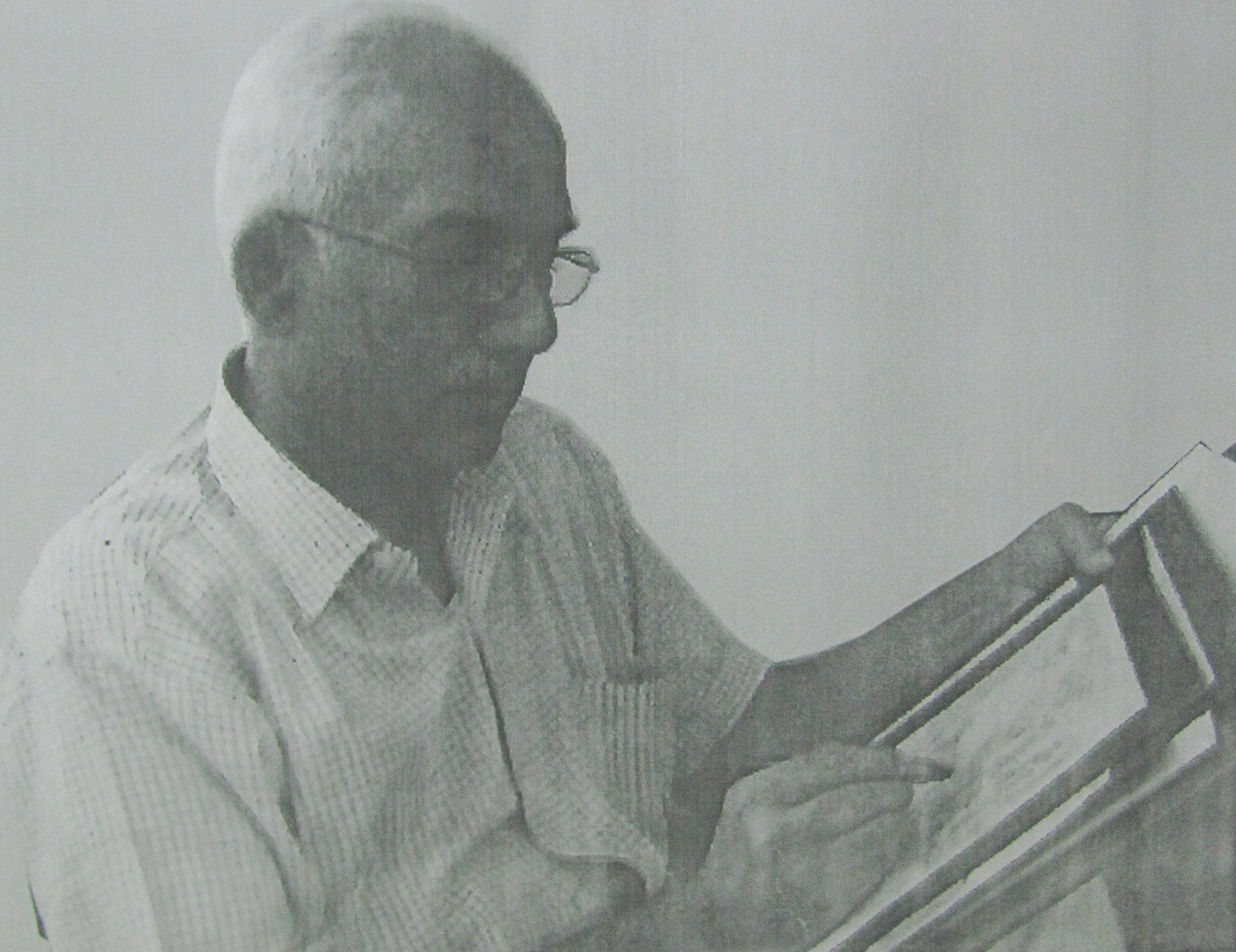
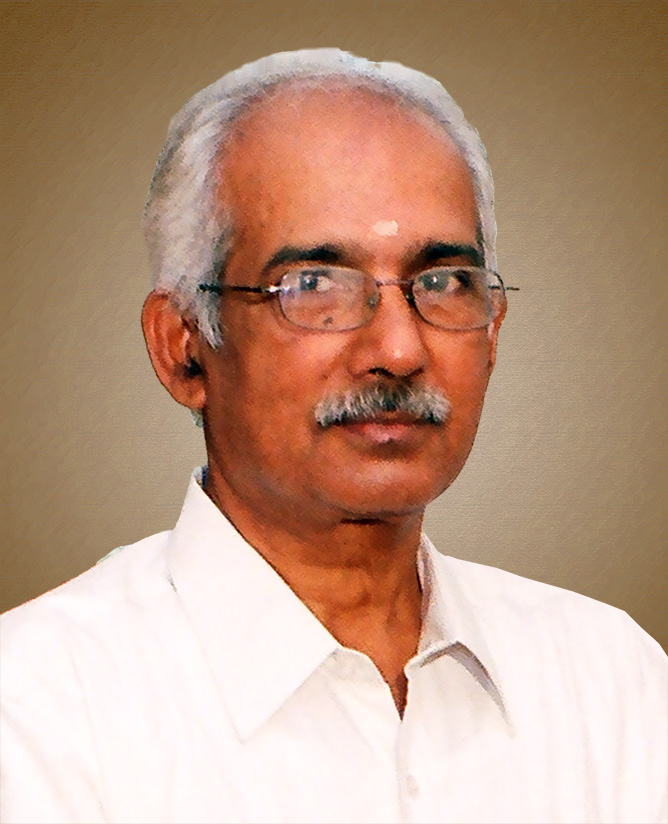
Madhavan Nair (Photo: courtesy his family)

Madhavan Nair (Photo: courtesy his family)

Madhavan uncle was a small, soft spoken person who worked at the state secretariat in Thiruvananthapuram. Away from work, he was a dedicated collector of music. He was also a good artist. In his free time he drew illustrations for other people’s short stories, published in a regional magazine. Like any music collector, he counted on friends, relatives, contacts and sometimes travellers passing through, to access new albums. On the occasions when he had to make a copy for his private collection, he would create his own cover design for the cassette and note down album details in a crisp, thin handwriting. It was all stored carefully and catalogued. An interaction with the man was a focused experience characterized by insight into music systems and genuine respect for all kinds of music. Slowly my father allowed repeated visits. I began to explore music as a collection of different genres. Back at home the old two-in-one was replaced by a car stereo, which we modified to play indoors. Then, we bought a proper Sonodyne music system, a princely investment those days. On my shelf, cassettes sporting Madhavan uncle’s crisp handwriting gradually grew in number.

As I moved from school to college, my pursuit of music became more serious. I discovered my tastes – classic rock, blues, jazz, country, folk, western classical and Hindustani classical. The occasional conversation with Madhavan uncle went beyond musician and band, to the quality of sound. He would mention about a newly acquired album, play it enthusiastically and we would concur on its elegance with a shake of the head or a short laugh. And then, just as you heard the most wonderful quality of sound, he would softly reprimand a rubber belt or connecting chord for the slightest variation audible to his ears, his ears only. A great relief you felt was the ability to approach music – any music – as such, without fear of being judged. With Madhavan uncle, you could sample Jethro Tull, Keith Jarret, Bach and Ustad Bismillah Khan in one visit without ever weighing one genre against the other. I guess that’s because he was also an audiophile. He may have had his personal preferences. What didn’t qualify for that, he probably approached it as sound that still merited being heard as perfectly as possible. Once in a while, I also met others who wished for good music and had come to know Madhavan uncle as a result. All our paths crossed at his house, which was a regular pilgrimage. The people who gathered around him became many things in life; from joining the regular army of Keralites working abroad to finding a career in custom built audio systems to – this I heard of one person – being an acoustic engineer on tour with a major American rock band. It was a small group of people and if I may say, to merely state an impression I had of them and not to indulge vanity one bit – they were seekers. My grandmother, who in her old age, sought to hear Beethoven’s Fifth Symphony, was also probably one. We just failed to think of her so.

At present with the world getting whatever it wants effortlessly, seeking has increasingly become a lost art and its after-effect on person, a lost human quality. Seeking happened in a context of deprivation. Maybe it still can, as alternative to instant gratification; seeking for the heck of knowing life. Back then, you were plain not getting what you wanted – that was the state of affairs in the 1980s and early 1990s (not to mention – certainly the years before that), when many of the creative and technological offerings of the world reached Thiruvananthapuram through the bureaucracy of India’s protected economy. If you wanted more, you had to innovate and stretch. You requested people going abroad to get some music. News of any such album recently landed spread fast through the grapevine. For obvious reasons, a friend with a twin deck tape recorder was a very valued friend. My generation was born in the late 1960s. Its ear for music came alive in the 1970s. Many journeyed back to visit Elvis and Woodstock. Some ran ahead for a taste of synthesizer music. Seekers were thus an involved lot. And critically, because they had to actively seek, they valued what they found. Seeking made you stretch, the stretch provided journey, the journey was an education. People like Madhavan uncle, represented that trait. He was among early customers of the now familiar configuration of speakers – two satellite units and a separate base unit; he was also among early birds in town to upgrade that to Bose speakers. I remember the excitement this transition generated.      

The cassettes, the handwriting (Photo: Shyam G Menon)

The cassettes, the handwriting (Photo: Shyam G Menon)

Several non-music factors also supported the seeking mentality. Around the late 1980s, if I remember right, both the local engineering and medical colleges made it to the last stages of Siddharth Basu’s iconic quiz competition on national television. While the music-crazy were anyway searching deep to know and access bands, this new found legitimacy by TV to being bizarrely informed provided value to maintaining a wider world view. It broad based the curiosity to know.  A reasonably interested college student bothered to be aware of musicians and actors not just from the state but also elsewhere. At the very least he / she tried. Looking back I sometimes feel amazed at what all my music loving friends in Thiruvananthapuram dug up – Buffalo Springfield, Travelling Wilburys, The Yardbirds, Grateful Dead, Traffic, Spencer Davis Group, Cream, Wishbone Ash, Emerson Lake & Palmer; these were besides usual suspects Led Zeppelin, Pink Floyd, Def Leppard, Jethro Tull, Bob Dylan, Jimi Hendrix, Bob Marley, Queen, Rolling Stones, Beatles and so many others. You lived in a small town. But you knew that something much bigger lived outside. Later, some of these efforts would seem the first dots joined of small miraculous journeys to come.

Once, at PAICO, one of only two or three shops in Thiruvananthapuram that sold rock music in my college days, I was sufficiently intrigued by the art work on a cassette cover to buy the album of an artiste I knew nothing of. I think the album was,`The Extremist.’ It was fantastic to hear. The album travelled around in my small circle of friends. At the local YMCA, I recall discussing Joe Satriani’s style with Ramesh, a wonderful creative person who was then a student of psychology. Over two decades later, I would hear Satriani play in Mumbai and meet him to collect his autograph. Other friends, seriously into music and more knowledgeable than me on the subject, would similarly wait in queue to hear a host of artistes from Ian Anderson to Roger Waters and Mark Knopfler, perform in India. Many of these pilgrims knew Madhavan uncle for the collection he built up, the effort he put into cataloguing it, the equipment he invested in to hear it well and his down to earth attitude despite it all. I may still have albums that he copied and gave me. But the gift went beyond album to empathy for music. Anybody can secure albums. Very few pass on an interest in music by personal example. He did.       

Sometime in the 1990s, Thiruvananthapuram stopped looking beyond its shores. The satellite television age was kicking in and with it, a strident patronage of vernacular tastes to gain eyeballs. Regional channels aggressively promoted local programming. This was expected. But it changed the texture of life for seekers. Where there was no television till the 1980s, you now had a basket of channels. It meant world at your doorstep discounting that much the need to seek. It also prompted the rise of a popular self wrapped local culture. As these changes occurred, foreign music’s cassettes were giving way to imported CDs that were expensive. It gradually eroded shelf space for foreign music. Soon I was running into film songs, parody songs and loads of religious music on shop racks in the city. I wondered if greying society and the remittance economy becoming Kerala’s overwhelming reality with its accompanying baggage of incomplete households had anything to do with the trends. Or was it the effect of big media engineering a navel gazing market of the people at hand? Kerala felt strange – gold, weddings, ethnicity, fervent prayers to God, rituals and a peculiar conservatism. An era of curiosity was drawing to a close.

Madhavan Nair (Image: courtesy his family)

Madhavan Nair (Image: courtesy his family)

My last meeting with Madhavan uncle was special. I introduced him to a couple of blues musicians that he hadn’t come across before. It was the first time I could give something back for all the music he had brought to my life. Blues particularly, was something he introduced me to. Thanks to heavy duty marketing, the Madonnas and Michael Jacksons of the world get everywhere. But something off the mainstream, like blues? And that too, not just Muddy Waters, B.B. King, John Lee Hooker, Buddy Guy and Eric Clapton but others like Robert Cray, Tinsley Ellis, Son Seals, Elvin Bishop, Luther Allison, Otis Rush and so on. Had it not been for music collectors like Madhavan uncle all this would have been difficult to access in Thiruvananthapuram. But it didn’t take long for him to turn trifle philosophical and question the relevance in having a wide taste in music when all around insularity had become virtuous. Room was shrinking for those who appreciated the wider world. I remember him saying that despondently, the last time I met him. Sometime in 2007, I toyed with the idea of calling him up on the phone. It inexplicably persisted in my head till I finally told myself that I will meet him when I went home from Mumbai, where I worked and lived. I didn’t do that early enough.

One day, I got a call from home – he was no more. In all those years that I knew him, I never asked Madhavan uncle how he began collecting music. I only know how knowing him, changed world by music for those like me. And, I also remember those times.

In my life, I have met several people cast as seekers in several subjects. In music, some intimidated me by their ability to reel off statistics about bands and their history, some intimidated by their vast collection of music measured by external hard disk-space, some intimidated by the concerts they attended overseas, for some it was what device you heard music on – was it latest iPod or some other gadget? Much of this seemed music as armour; another one of the weapons stockpiled for self importance and distinction in life. Very few people lived the simple delight in hearing wonderful music of any type reproduced well by a decent music system – which was what Madhavan Nair seemed all about. Meeting him in his living room said all that has to be told. The music system would be playing something softly, yet so clearly that it felt like gentle rain. Madhavan uncle would be dressed in simple clothes – usually the white dhoti of the Keralite householder worn with a shirt or T-shirt. I would inquire of new additions to his music library. The brief conversation about music – including on genres originating overseas – was always in Malayalam, the local language. He had all the stuff that people stocked in their armoury of music with none of the airs.   

I miss that age of seeking gone by.     

(The author, Shyam G Menon, is a freelance journalist based in Mumbai.)    

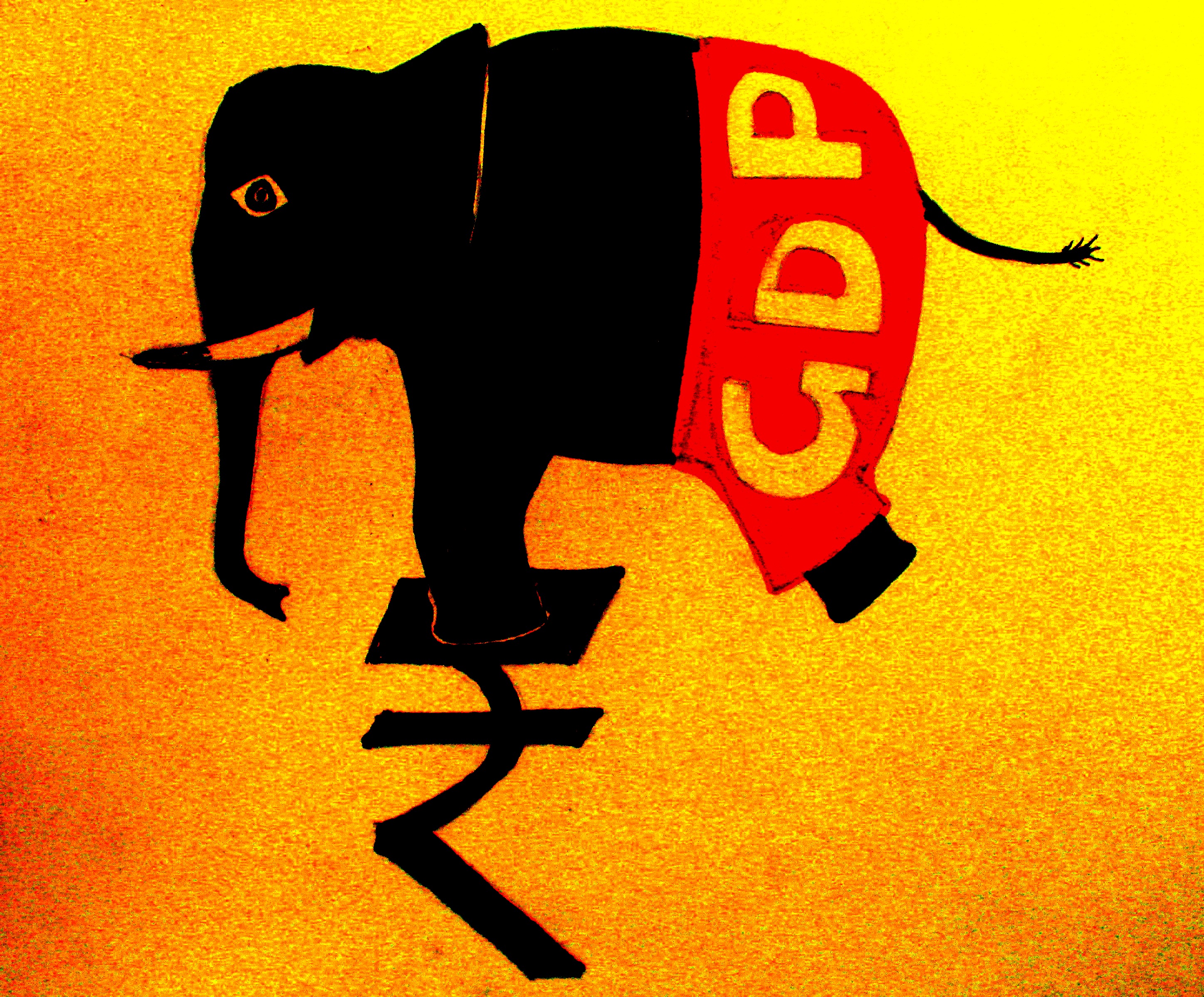
CAN’T SEE THE ELEPHANT

Illustration: Shyam G Menon

Illustration: Shyam G Menon

Call it market or future workforce there is no escaping the fundamental truth that large population challenges a country.

India’s current population is probably on par or close to what the world’s population was at the start of the 20th century.  Dwell on it. Such imagination is what we refuse to do amid our chalta hai (its’ okay) ways. Our numbers seriously impact. The country’s economic problems, described as math, may seem lifeless digits. But they dovetail to human want. With high population in place, even self reliance as solution for import-dependence, resembles a fig leaf for modesty because there are still fixed costs like steep real estate prices to face. Add to it, high salaries as solution to address rising living costs with its resultant inflationary impact down the line. It is a vicious circle. And, this is without mentioning the known decay caused by excess numbers – poverty, malnutrition, unequal access to health care, unhygienic living conditions etc. Perhaps the argument is – once the economy revs up, India will be superpower thanks to its workforce and market.

Truth is – population is the elephant we don’t wish to see.

Population as market and workforce, matters for trillion dollar GDP. That in turn, contributes to everyone’s income. It is all correct. But try imagining from the perspective of quality of life. We have delayed the good life by a long margin by producing so many people. It will take years for India’s per capita income to rise significantly.  Most likely, we will have terrible wealth-inequality. It is already visible. Other pitfalls abound. Not long ago, a visiting German delegation expressed concern about the quality of available manpower. Indian industry too has voiced worry on the quality of skills training. Wilder stories exist on the periphery of our future workforce.

India’s current population is probably on par or close to what the world’s population was at the start of the 20th century.  Our numbers seriously impact.

High population affects quality of human upbringing. Few days after the rupee hit 68 triggering a sense of outrage for the way it left us monetarily weak, many felt shocked by the punishment awarded to the juvenile involved in the infamous Delhi gang rape case. This article is not about that case. But a juvenile involved in such degree of brutality should worry us. Those arrested in the recent Mumbai gang rape are youth. Similarly, who are those people ready to drop everything and fight for religion, culture and language? They appear off and on in photos of mobs wielding sticks and swords. Ever thought if belligerence rises with cheap availability of directionless youth? There are solid sociological concerns in our giant population. As rape cases increased in number, several writers commented on the outmoded mindset of the Indian male.

Population’s impact is the sum of human numbers and human behaviour influenced by the ecosystem of high numbers. Indian life is a rat race because of this. Its external manifestation is disorder and administrative systems crippled by overload. Corruption oils the wheels, extracts movement. Anna Hazare’s campaign brought corruption to focus. But the elephant went unseen. We allege external hand when capital runs away. Arithmetically, even a portion of 1.2 billion people living and working like the developed world, would suffice to enthuse investment and stock market. Market indices and economic indices capture delivered value; they don’t show ground reality. Fact is – when it comes to the act of investing, Indians themselves seek avenues that aren’t as suffocating as Indian existence. What else is states` rolling out the red carpet for industry’? Our own companies demand special treatment. We know the political and operational gridlock by human numbers. Knowing it well, we prize life overseas more than life at home. What can economic reform mean when no government will enshrine the need to contain population as part of overall strategy? At least mention the subject periodically, so that the citizenry is aware of how much they are party to a mess that denies India quality?

Population’s impact is the sum of human numbers and human behaviour influenced by the ecosystem of high numbers. As human numbers rise quality of life crumbles.

Population is not simply more people born. Despite the 20th century being the bloodiest century in recorded history, global population rose seven times in the last one hundred years because new life was born and thanks to advancements in medicine, the new survived and the old survived longer. Thus the old are also around in India. In various fields, particularly politics, they have voice. Imagining to their convenience, they nudge country to life by old idiom. Ample availability of young people willing to latch on to anything for direction provides followers. But is the perspective of 2013BC valid for 2013AD? Impractical and irrelevant aspects of the old way of life must fade. But they don’t. Old school actors like religion and feudalism periodically elicit toll through riots. Caste thrives. Rituals proliferate. Wealth and happiness are measured by property, vehicles, money and children.  There are other examples too. Sample patriotism – it is a highly misunderstood subject in India. Its most popular interpretation imitates old fashioned fort with cannons mounted on walls and soldiers ready to die. Anything less, you are not patriot enough. You plant trees for a country losing trees – that isn’t enough. You take public transport to save oil for the nation – that isn’t enough. You do your job sincerely to contribute to nation’s reputation in quality – that isn’t enough. You teach those who can’t afford school – that isn’t enough. You are not corrupt and thus adding to nation’s efficiency – that isn’t enough. For patriotism to be felt blood must be spilled; wars must be fought. Only that image satisfies. Adding to it, there is no problem if the same self proclaimed patriots bring administration to a halt or destroy public property through violent strikes, fights around religion, language and such. From where and how does such behaviour find social approval?

Illustration: Shyam G Menon

Illustration: Shyam G Menon

Deep within heavily populated country, insecurity flourishes. Don’t think so? Then, what’s gold consumption by Indians all about? Put differently – we are forever insuring against insecurity. Why? What is our fear? What keeps compounding it? I have always suspected it relates to the nature and structure of our families. A family is never without worry about potential insecurity although being in family gives you sense of security. As rat race by population intensifies, so does the family’s perception of insecurity in the environment and its urge to move ahead at any cost. In the analogy of country as fort with cannons, family is the primary fort. The rich and well-connected get away with anything. The middle class, lacking such resources, battles differently. In big Indian cities, organized urban violence has approval traceable to families. That’s how violence became acceptable as a brand of urban politics. Violence in the name of religion and caste are all kept alive by families. It should highlight how insecure families have become thanks to exactly what they contribute to – high population. We consistently avoid this point. I say it not to load the dice in favour of lone rangers although I firmly believe that unless one realizes one’s vulnerability by standing alone, you won’t fathom the meaning of human respect, the need for it and the genuine merit in social values. Some Indian values are definitely good. Problem is – we are inheriting it without knowing why they exist because the family-trap is all about inheriting without the effort of knowing why. I merely wish to point out in this habitually marrying land, that neither family nor its larger groupings like community are implicitly states of grace. They edit out many crucial aspects of existence, particularly the individual as basic unit. They also do wrong. Remember honour killings, hit-and-run cases etc where family-imagination was either cause for crime or family ended up shielding the offender? In India’s instance, both family and community is also network of similar interests. Despite veneer of corporate governance on the surface, obfuscation of professionalism by family and community has often been a problem at Indian businesses. Long given to family, politics has become rule by dynasty. So what’s unquestionably great about family? In India, our family spaces badly need revision by new thinking.

As rat race by population intensifies, so does the urge with families to move ahead at any cost.

Thanks to giant population, we are the world’s biggest democracy. Our chosen method of administration requires plenty of efficient dialogue. India is chaotic in dialogue all the way up to state assemblies and Parliament, the very institutions expected to be examples of debate and governance for the rest. Why does dialogue fail? One reason has to be India’s caste system of several centuries that made the idea of inclusiveness alien despite our scriptures talking of world as family. The caste system was proactively attacked only after independence and adoption of modern constitution. The India from 1947 till now, is yet a dot on Indian history. Another reason could be that against the expanse of India’s history, its experience of inclusive, democratic administration is limited. We have a tradition of great minds and great debaters. But did they flourish in an inclusive environment? The larger question therefore is – how often in the past were we genuinely inclusive of us, all by ourselves, the way we have been forced to sit together and govern since 1947? I am not an expert on history. But it appears to me that our past trained us little for it; we are treading new ground. This traditional lack of inclusiveness is a huge handicap when administering 1.2 billion souls hailing from diverse backdrops. As yet, our instincts track old ways. The natural tendency of any exploded population averse to imagining differently and used only to old school feudalism will be to evolve smaller fiefdoms of the familiar old. It delivers power and money, which contemporary society by its conduct, showcases as essential. It also deepens known problems through reductionist models of the old – for example, splitting into more states. Better administration probably requires more states in India. Yet such models mean nothing if they are not accompanied by changed mindset for administrator. Will an administrator with changed mindset be winner or loser to the imagination of rat race by 1.2 billion? Is leadership perennial indulgence of community or does it include selling harder truths – like noticing that elephant to begin with?

Within two decades, India will be the world’s most populous country.

In early 2013, my cousin and I were trekking in the Himalaya, when at a village en route we met a young American woman, part of a group of foreign college students on a month long-hike in India’s wilderness. She said she was enjoying the experience but then added rather puzzled, “ you know, this is supposed to be wilderness. We are forty kilometres away from the nearest road. Yet there isn’t a day that went by when I didn’t meet people!’’  Population and its ways envelop us. Our challenges are not with this land, which provided for us for years and still yields what it does. Our problems are with what has replaced geography – ourselves; the equations between us, what all we do. Increasingly how well we manage this social space is what decides success. We are in the age of society as soil; the age of the social farmer, for the real soil is part of a fading planet overrun by people. It is also what leaves us exhausted and frustrated. On the one hand, people adept at self promotion and social networking rise to the fore. On the other hand, plenty of genuine human talent is wasted for want of networking skills. And all the time in the background, every family fueled by its protective parents and grandparents insist that their wards are the next Einstein, Bill Gates or greatest medical doctor alive.  There’s nothing we can do except suffer this noisy gridlock. It would be a tremendous loss if dysfunctional by population, we are forced to trade democracy for something more directive. To avoid it, we must comprehend what happened to us by noticing the most fundamental flaw in which everyone is invested – high population. We must notice our social organization also and inquire if it suits environment drastically altered by high population. This need is gathering urgency.

We must comprehend what happened to us by noticing the most fundamental flaw in which everyone is invested – high population. We must notice our social organization also and inquire if it suits environment drastically altered by high population. This need is gathering urgency.

(The author, Shyam G Menon, is a freelance journalist based in Mumbai.)


THE CAVES OF MEGHALAYA

This story is written weaving two streams of thought.

One is in normal text; the other is in italics.

PLEASE READ FOOTNOTE AS WELL FOR UPDATE.

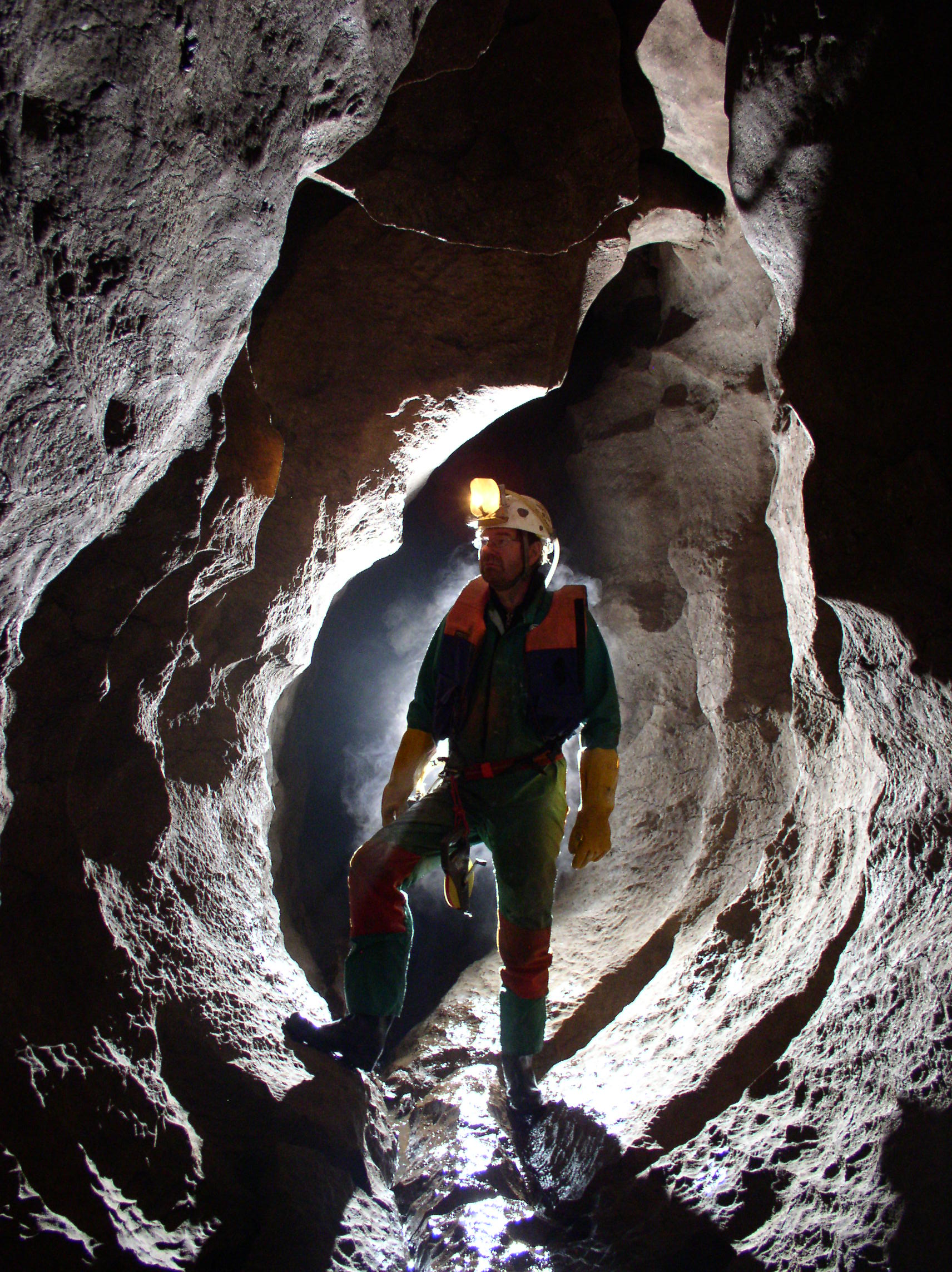
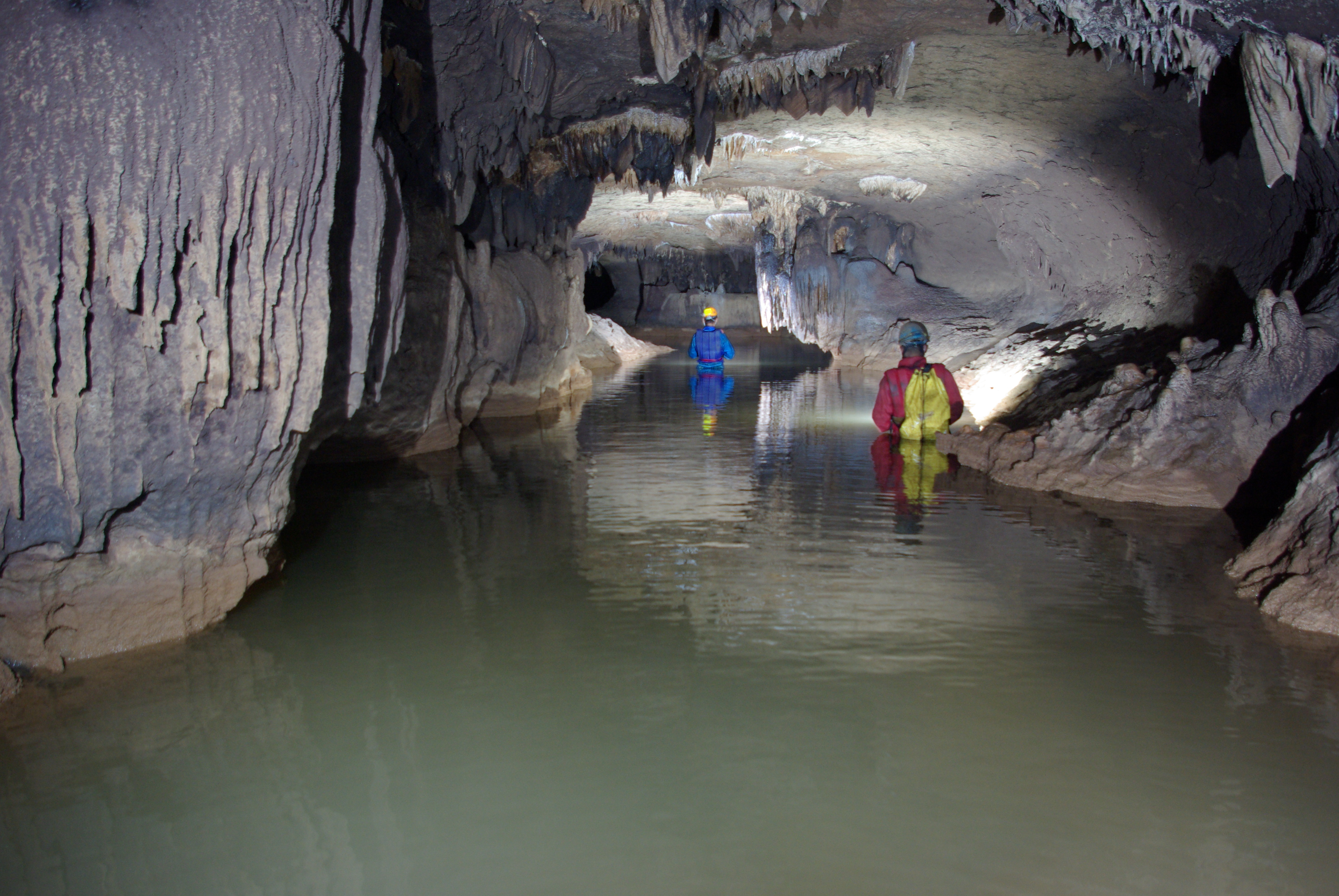
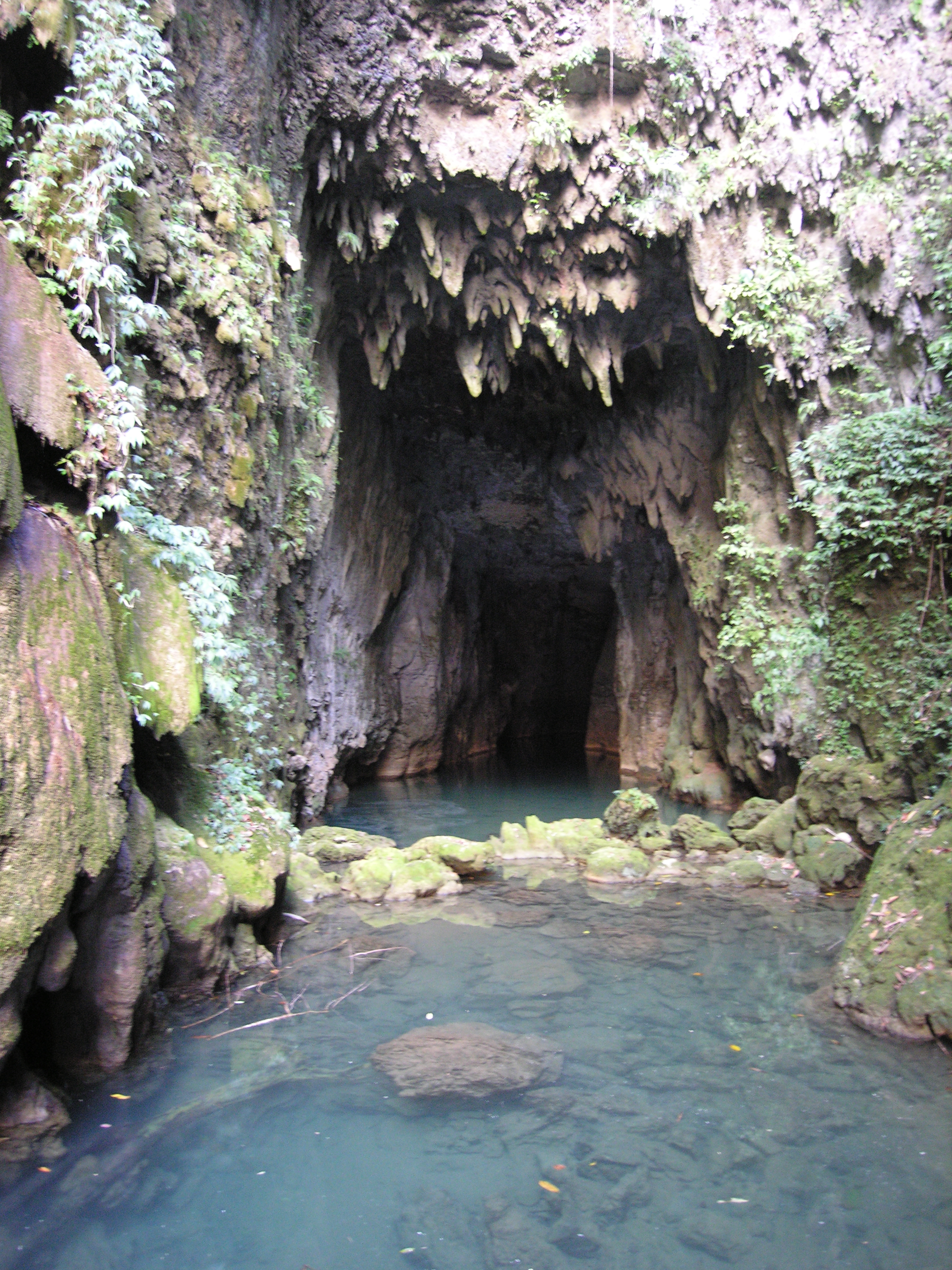
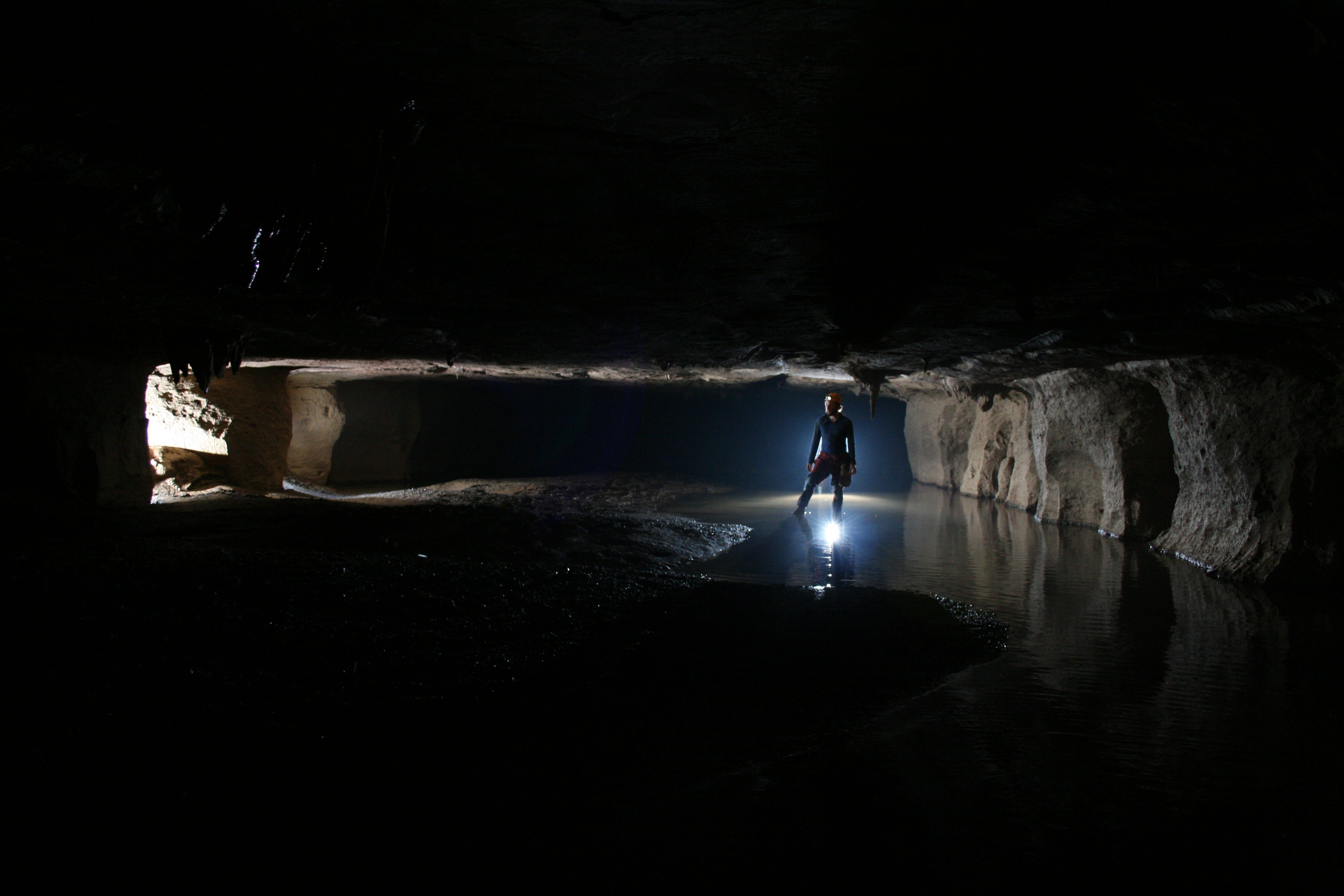
Below the ground in Meghalaya (Photo: Simon Brooks)

Below the ground in Meghalaya (Photo: Simon Brooks)

Many years ago in Meghalaya, North East India, a group of school students from Shillong were in Cherrapunji on a picnic.

Those days, Cherrapunji was famous for having the highest annual rainfall in the world.

Nearby was a large cave.

One of the boys, eager to explore the dark passage, sought company from his friends. None were ready. Dejected, he hung around. Given to reading, he was unhappy to be denied an adventure of the sort books talked of. Just then two boys from the locality turned up offering to lead him in. They made a crude hand held flame torch, walked the entire length of the cave and exited through a small shaft at its end to the other side of the hill. The boy finished schooling, graduated in physics from the local college, gave his bank test and became an employee of the State Bank of Mysore (SBM). For several years he worked in various parts of distant Karnataka, removed from family and friends in Meghalaya.

His appeals to be near home fetched him a transfer to SBM’s branch in Kolkata. But that didn’t satisfy for although Kolkata was closer to Shillong on the map than Karnataka, as a journey, home was still long way off. He sought to quit but the bank was reluctant to let him go for he was a good officer. Staying alone, work was his life. Eventually his relieving order came, just the day Prime Minister Indira Gandhi was assassinated. Back in Shillong, his qualifications and background could have got him a high profile job. Instead of that he accepted the post of CEO at a local bank passing through difficult times. Decades later, the Shillong Co-operative Urban Bank was in fine shape and Brian Dermot Kharpran Daly, 63, although of retirement age, continued to get extended tenure. It may have seemed SBM all over again, but then Shillong was home.

It was May, 2010.

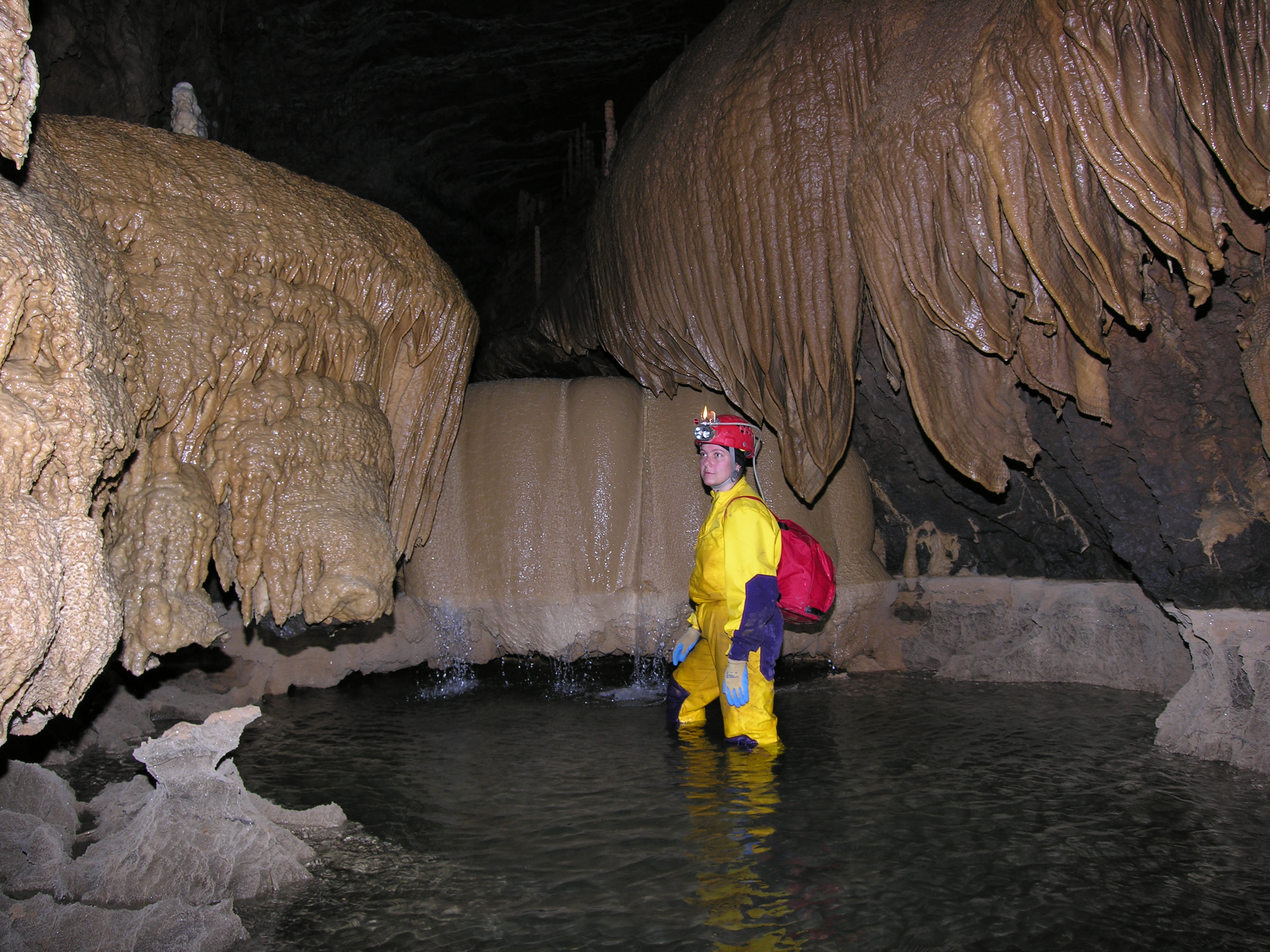
Inside a cave in Meghalaya (Photo: Simon Brooks)

Inside a cave in Meghalaya (Photo: Simon Brooks)

Meghalaya is home to the longest cave passages in India.

They run for several dark kilometers under the beautiful, green carpet of this land of hills and rains. “ Three factors – limestone, heavy rains and elevation – work in unison here to make these caves,’’ Brian, the state’s best known cave explorer, said. Limestone is easily eroded by water. Meghalaya still receives some of the heaviest rainfall in the world. Additionally, the hilly state has sufficient slopes for water to develop the kinetic energy needed to sculpt and carry off debris, leaving behind marvelous limestone caves. The caves now find mention on the state’s tourist brochures although entry into complicated systems is possible only with expert guides. At the time of writing this article, some 1200 caves had been reported, around 800 of them explored and roughly 360 kilometers of cave passages had been mapped, including India’s longest cave – Krem Liat Prah-Um Im-Labit System – as yet estimated to be 31 kilometers.

The exploration was continuing.

In India, Andhra Pradesh, Madhya Pradesh, Chattisgarh, Mizoram and Uttarakhand also found mention for caves. However when it came to the ten longest caves in India, all ten were in Meghalaya. Ranked for depth, nine were in Meghalaya and one was in Mizoram. That was how much North East India dominated in the subject. The study of caves or speleology was yet in its infancy in India. There was no university department or chair dedicated to the topic including at the North Eastern Hill University (NEHU). A few dedicated and seemingly networked scientists scattered nationwide maintained interest. The only institutional names in the field were the Raipur based-NGO, National Cave Research and Protection Organization headed by Dr Jayant Biswas and the Shillong based-MAA. Every year during Meghalaya’s dry months, expert cavers from overseas reached the state to explore its caves in league with the MAA. That’s how the underground map of the region evolved. Both the Indian Army and the Indian Navy had links with the MAA to partake in the adventure.

The entrance to a cave in Meghalaya (Photo: Simon Brooks)

The entrance to a cave in Meghalaya (Photo: Simon Brooks)

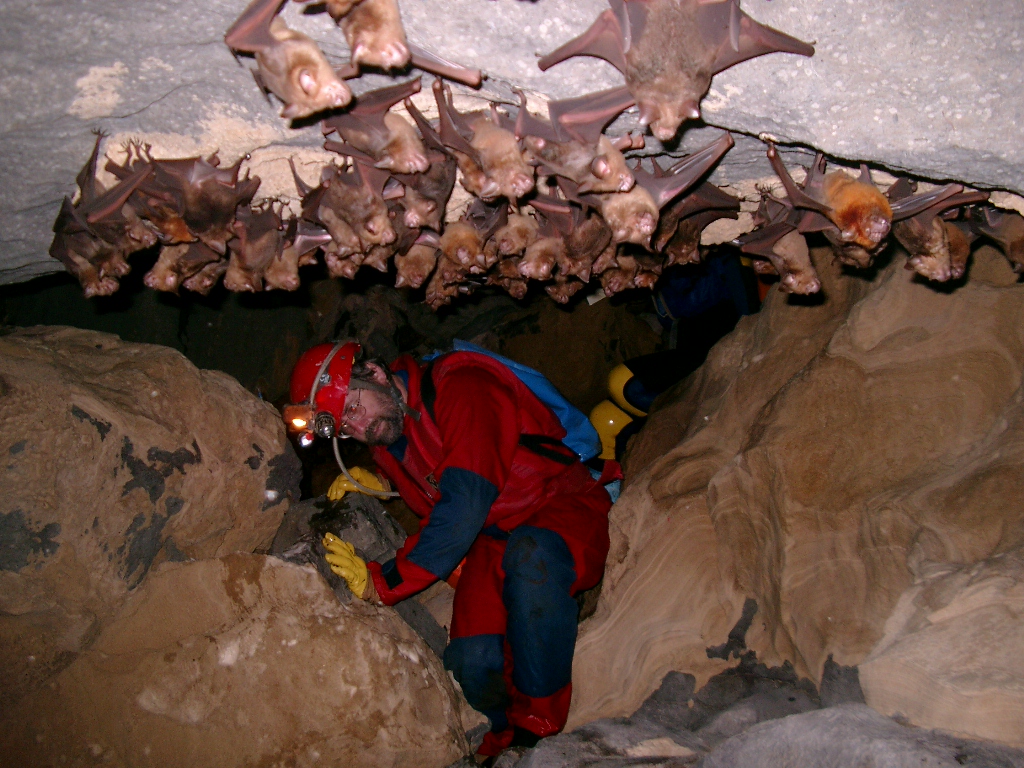
There is more to caves than adventure and geology. Darkness coupled with other changes to environment as one went deeper and deeper into caves, molds exclusive cave life, the study of which is called bio-speleology. Cave fauna typically falls into three categories: (1) Trogloxene – species which visit or take shelter in caves but do not complete their whole lifecycle there (e.g. bats, frogs, lizards) (2) Troglophile – species which live permanently in the dark zone but some of which can also survive in a suitable environment away from the cave. They could be called future troglobites (e.g. fish, salamander, crayfish and millipedes) (3) Troglobite – species which live wholly and permanently in the dark zone of caves. They are mostly blind, albinic and having extra sensory organs (e.g. same as for troglophile). Ilona Khar Kongar, scientist with the Zoological Survey of India (ZSI), said that there had been reports of fauna unique to Meghalaya’s cave systems. They awaited further study.

Caves are also known to hold fossils and in Meghalaya’s case, marine fossils going all the way back to a prehistoric age when the land was submerged by sea. Additionally, the region’s caves had become academically interesting from another angle – the several thousand year-old stalactites and stalagmites possessed details of past climate. For any curious mind therefore, these caves may seem the stuff of heritage. In Meghalaya however there was no such official declaration in favor of the caves and cavers like Brian were defending before authorities why this underground network of pitch dark passages was fascinating.

Inside a cave in Meghalaya (Photo: Rainer Hoss)

Inside a cave in Meghalaya (Photo: Rainer Hoss)

Somewhere in the early 1990s, Brian sought to spice up his life in Shillong with adventure. He thought of treks. But nothing really attracted. Born and brought up in Meghalaya, he knew there were caves around. He floated an organization called the Meghalaya Adventurers Association (MAA). The group started to explore caves. Shortly after the activity began, at one location, villagers spoke of a team of foreigners who had come looking for caves. Since caves were sculpted on rock that yields itself to shaping by water, tracking the distribution of such minerals helped locate cave-rich zones. Limestone is a fantastic cave-building medium. Deposits of soluble rock are called karst and in Meghalaya karst exists at the state’s southern portion, in an east-west line, curving to the north at the eastern end. The foreigners had done their homework. Brian’s inquiries showed that the British team included respected names from international caving. The MAA tied up with them and soon expeditions to explore the caves of Meghalaya began in right earnest.

The results would amaze anyone fascinated by the planet. Deep under Meghalaya are subterranean passages; gushing rivers, crystal clear ponds, natural rock dams and vast chambers you can only crawl into. “ People now come and tell me of caves,’’ Brian said. In 2004, he was awarded the Tenzing Norgay National Award for Adventure in the land category. However, leaving aside the cavers’ battle with the mining lobby, he wished that the younger generation responded more enthusiastically to caving. The reason for the low key response he saw till then probably lay in the nature of the challenge.

Near Lad-Rymboi (Photo: Shyam G Menon)

Near Lad-Rymboi (Photo: Shyam G Menon)

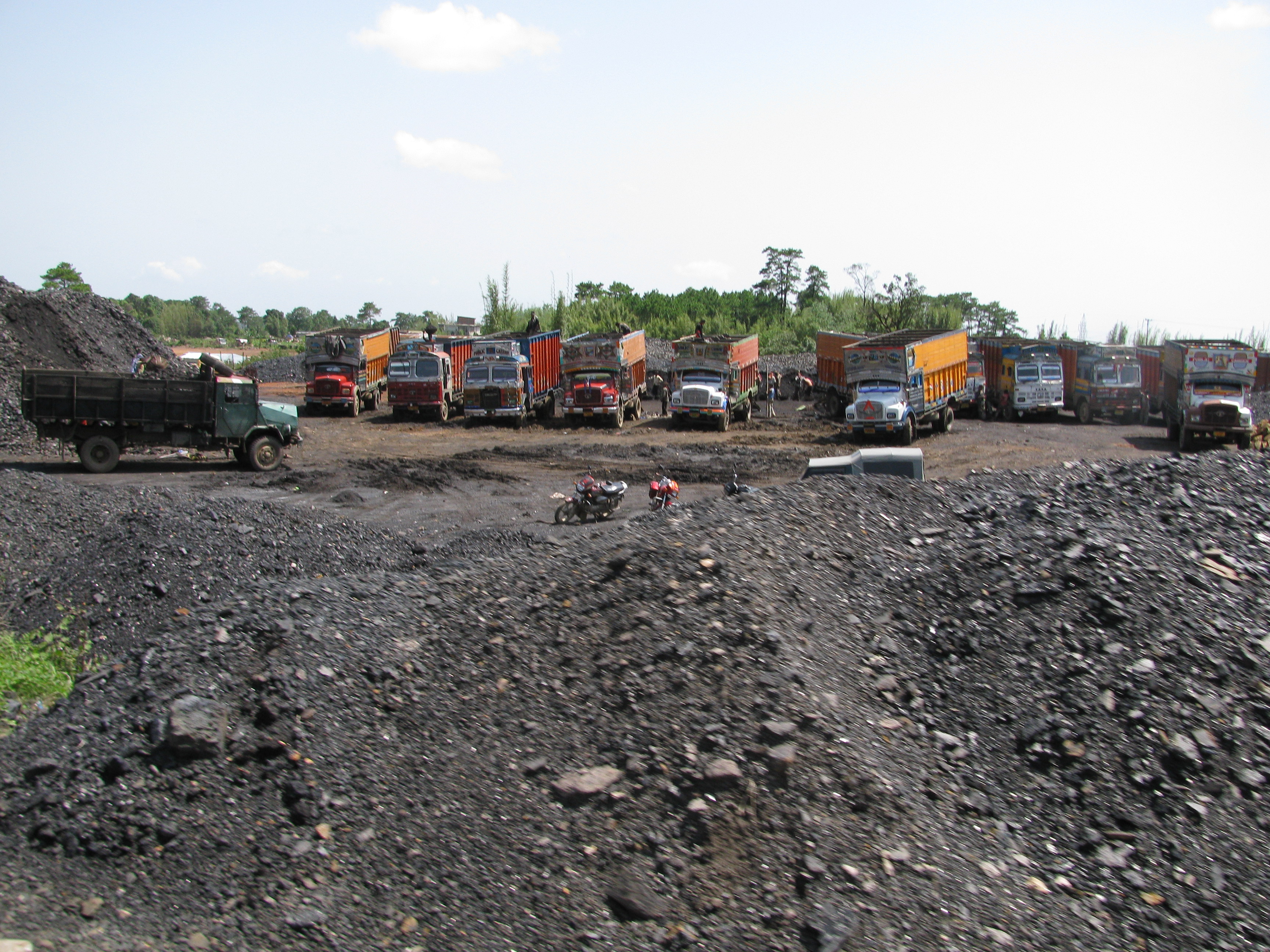
Mining was a well entrenched industry in Meghalaya.

H.H. Mohermen had lived in the thick of it.

Following a stint in London studying theology, he became a lone crusader for environment in the much mined Jaintia Hills. “ A relative who had served on the local hill council once told me that coal mining was allowed to grow unfettered because it resembled a cottage industry,’’ Mohermen said.

For a taste of Meghalaya’s mining country, I passed through Lad-Rymboi. Here pastoral Meghalaya took a hiatus. There was heavy truck traffic, the roads were awash in slush, grease stained automobile workshops repaired vehicles and a labor force of strangers roamed the town with numerous wine shops. Closer to Shillong, on the periphery of mining country one found the smallest unit of the coal business – tiny bunks typically managed by local women, selling excess coal dumped by passing trucks. Few years ago, the color of some rivers in the Jaintia Hills changed, dead fish turned up and in places, water became undrinkable. Hydroelectric projects complained that the water was corrosive. While activists attributed it to pollution from unchecked rat hole-mining, an official of the State Pollution Control Board said that given the high sulphur content of Meghalaya’s coal this was bound to happen even naturally.

Cave formation is a million year-old chemical process.

Indeed you can call a cave, a laboratory, with processes running at terribly slow pace. But it is undeniably chemistry; tamper with ingredient, quantity or concentration and you altered the experiment. According to Brian, that’s what mining did. To start with it deforested, causing soil erosion, sending soil down into caves and altering the cave’s drainage pattern. Coal mining also impacted indirectly – that same acidic water worrying humans on top, got down into the caves changing cave chemistry. With resident mining culture and wanting the modern motifs of economic growth, Meghalaya leveraged its limestone deposits to attract the cement industry.

That had direct impact on caves.

According to Brian, the attraction he felt for caving was that it wasn’t any one activity but a convergence of many – there was the adventure, the exploration, the science, the mapping, the planning, the skills and finally, the philosophy and literature you indulged in even away from caves. Brian had authored many articles on the subject; written books and compiled poetry. All this pointed to the need for an evolved mind; something rare in today’s world of adventure where everything is the stuff of snapshot success.

Negotiating bats; inside a cave in Meghalaya (Photo: George Baumler)

Negotiating bats; inside a cave in Meghalaya (Photo: George Baumler)

Further caving had its anxious moments. Once, Brian was injured by falling rock in a vertical shaft. Some caves didn’t have horizontal entrances; they had a shaft plunging into them. There was little room for escape should anything fall from the top. Shafts could be deep; India’s deepest at Krem Shrieh in Meghalaya was 97 meters (320 feet), several times longer than a single rope length and therefore requiring `pitches’ as in rock climbing. Lowering yourself into one of these passages could be tricky because they typically have narrow mouth and wider bottom. That meant a rope anchored at the top progressively stayed off the side leaving the abseiling caver wholly dangling on rope in a growing void.

On another occasion, in a cave with multiple entrances, a few cavers having entered through different passages met at a point. There, an experienced woman caver decided she wasn’t feeling well and retraced her steps. Somewhere she got lost in the labyrinth of passage ways. Her absence was noticed only after everyone had exited the cave complex. A search was launched and after several hours, she was located sitting crouched to preserve body heat, in utter darkness. Her headlamp was broken; the consequence of a fall. “ Hypothermia is a real danger in caves, particularly those with water and streams inside,’’ Brian said.

Limestone formations near the quarry in Lumshnong (Photo: Shyam G Menon)

Limestone formations near the quarry in Lumshnong (Photo: Shyam G Menon)

At Shillong, there were visible signs of the cement industry’s status in the North East.

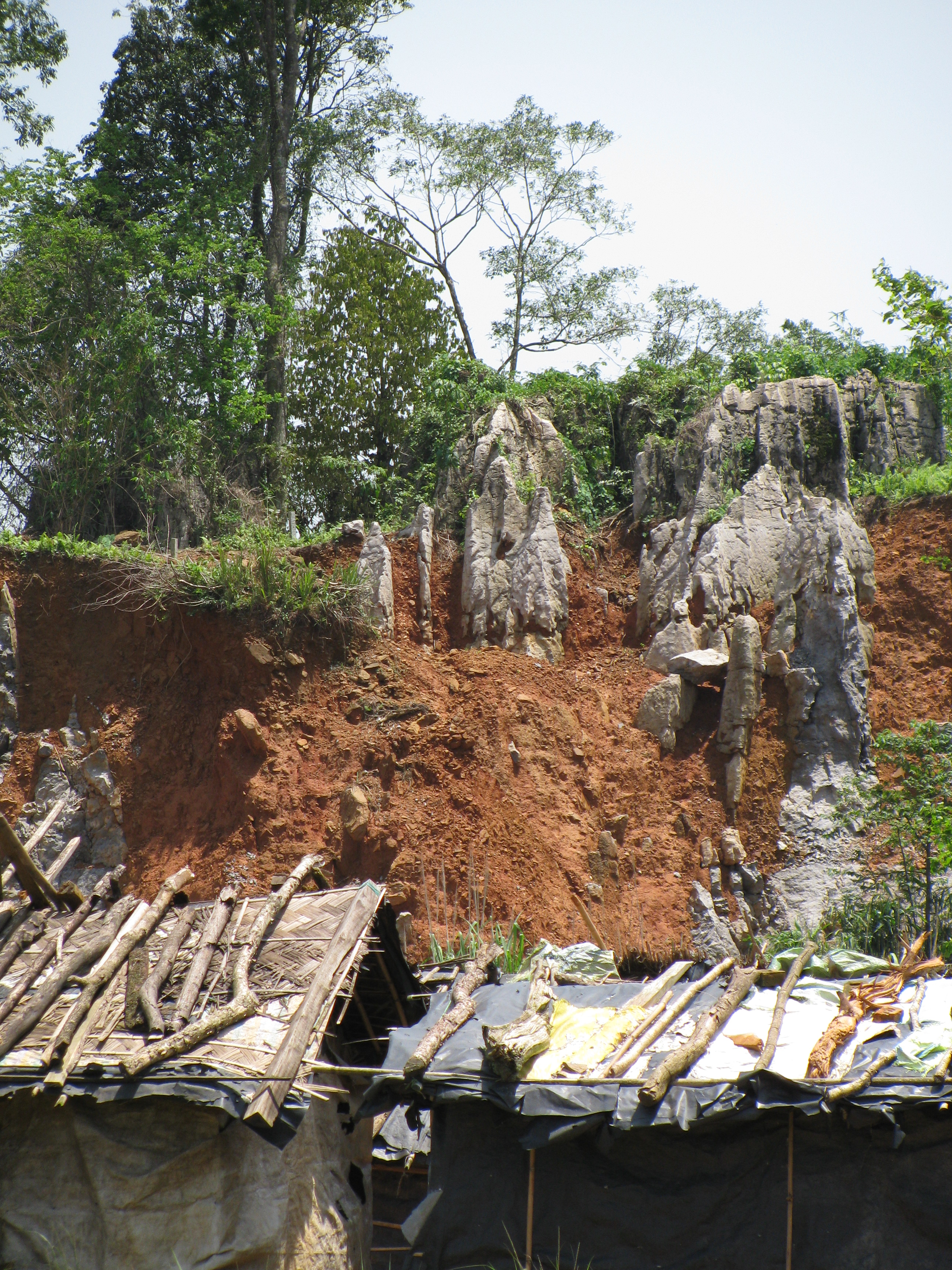
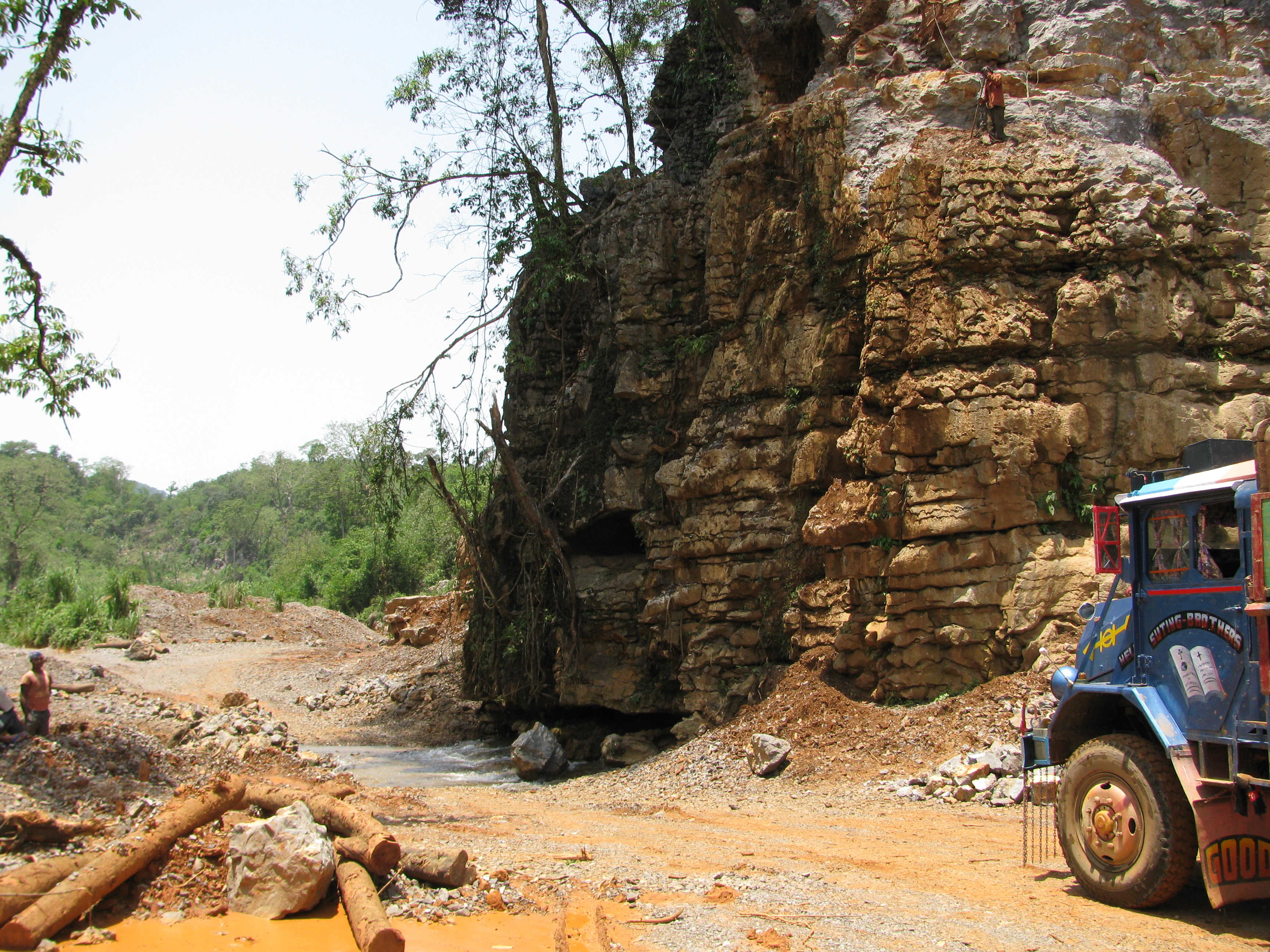
`Times change, Taj does not’ – said a hoarding for Taj Cement. Another one sponsored by Star Cement featured well known personalities like Bhupen Hazarika, Mami Varte, Sourobhee Debbarma and Lou Majaw, the Shillong singer famous for his devotion to Bob Dylan. Meghalaya’s cement companies were not big names nationwide; they were local giants. The lone cement multi-national that entered the state made a conveyor belt to ship the mined limestone to adjacent Bangladesh. Lumshnong, over 100 kilometers away from Shillong, was a couple of curves on the highway with a few shops and houses. Home to cement plants, a large limestone quarry loomed next to the highway here. If you looked at the stray rock formations behind the adjacent houses, you got an idea of what the quarry must have looked like originally – fluted, termite nest like outcrops of limestone. Now all that remained was a large crater. Jack hammers drilled away on its sides and trucks carried away the raw material. The crater floor was soggy mud. At one end, atop a rocky cliff, a worker was demolishing rock. Directly below, thirty feet or so, hugging the pit floor was a three feet high horizontal gash in the rock from which a stream flowed to the outside world. That, I was told, was one of the access points to the Kotsati-Umlawan System, at 21 kilometers explored till then, India’s second longest network of cave passages and its second deepest. At the other end of the pit, closer to the highway, piled up debris soaked and shifted by rains, had sealed off a claimed large entrance to the cave. Gregory Diengdoh from MAA hunted futilely for a third entrance, a vertical shaft, known to be somewhere around.

The fourth, an erstwhile `show cave’ for tourists where we went in, had become inexplicably muddy. Behind us, the sunlit entrance gradually diminished to button-size and at the first fork, altogether disappeared. We navigated with headlamps in pitch darkness. A thick film of slippery, gooey mud covered the floor, the cave’s boulders and its sidewalls. It was very slow, slippery going. Deep within, you heard the roar of the underground river. Not far inside the cave, I decided to wait for a dry month to progress further. It didn’t make sense to load the risk and risk at day’s end, was a personal assessment. The cavers though had a different explanation – although we were just weeks from monsoon and hence into sporadic showers, the excessive mud inside the cave could be due to river water periodically backing up as a consequence of blocked passages, courtesy the overhead quarrying.

Unproved, that was yet speculation.

The quarry at Lumshnong. The stream, I was told, was one of the entrances to the Kotsati-Umlawan System (Photo: Shyam G Menon)

The quarry at Lumshnong. The stream, I was told, was one of the entrances to the Kotsati-Umlawan System (Photo: Shyam G Menon)

“ Somewhere thousands of miles away, not too far from the nation’s capital

A little posh town rose up from the desolate and barren land

It grew in width and length, it steadily grew in height

Where once the land was flat, today a mountain of flourishing complexes

A miracle indeed unfolds

As the buildings of Gurgaon tower to the sky, the limestone hills of Meghalaya

Leveled to the humble ground.’’

          Extract from a poem Brian wrote imagining the journey of Meghalaya’s limestone.

My visit to Lumshnong was in May 2010.

As of then, for a state so much into mining, Meghalaya which saw 24 chief ministers in 38 years did not have a Mining Policy. “ Every time we ask, they say it’s getting ready,’’ Patricia Mukhim, Editor, Shillong Times, said. In its absence, officials acknowledged that unorganized coal mining was subject to few restrictions, while limestone quarrying by large companies followed Central Government norms. At least that was the official explanation.

There was a Mining Policy taking shape.

The urgency for it was partly fuelled by Public Interest Litigation (PIL).

In 2006, realizing that it was only a matter of time before unbridled mining destroyed Meghalaya’s caves Brian approached Subhas Dutta of Kolkata, who had filed PILs before. With his help the MAA moved the Supreme Court. Such litigation was not new for Meghalaya. Local journalists recalled a previous lawsuit against the logging business. However unlike in logging, there was no interim stay on mining till the case was disposed of. The journalists and activists I spoke to attributed this to Meghalaya lacking an environment movement and the state’s peculiar land holding pattern; land was owned by the tribes. Protection of environment may work in a specific area (Samrakshan Trust in Garo Hills found mention as successful example). But another stretch of land was another tribe’s property and therefore their headache. This inhibited a larger environment movement.

While activists may want a movement, the mining industry – they said – dealt with specific tribal leadership. Theoretically, this appeared participative industry and the way forward. Two and a half months later, in August, even the central government, responding to the Maoist issue (extreme left movement largely based out of the forests and hill tracts of Central and East India), was recommending a participatory model that advocated sharing 26 per cent of a mining company’s profit with tribal communities. Yet it wasn’t that simple because to work properly, any model needed a learned, holistic view of development. That included a tribe knowing how much they were losing irreversibly and how much should be mined.

From inside a cave with headlamp switched off. The faint light in the distance is the entrance (Photo: Shyam G Menon)

From inside a cave with headlamp switched off. The faint light in the distance is the entrance (Photo: Shyam G Menon)

In Meghalaya, some of the stories I heard wasn’t pretty. There were occasions, I was told, when villagers seeing mines on their land exhausted, tried to encroach on someone else’s. Then, there was the story of villages with gates to fend off likely fights. One story was generic to the problem of land exploitation in India – that when the potential of a land was revealed, powerful people began to amass real estate anticipating profit.

I could not independently verify any of this background talk.

Nevertheless so much was clear – in a state with few opportunities, mining was prime opportunity. A casual perusal of academic studies on the state, available at Shillong’s book shops, underscored this point. Mining was a major source of livelihood in the state. When information spread of his opposition to mining, Brian’s caving expedition was once threatened with disruption.

Devoid of support by powerful masthead, `freelance journalist’ fell to the bottom of the media heap. When I called up a senior official in the state government requesting for an appointment, I was initially shouted at. Then he cooled down and gave me a time with cautionary advice – there was a Cabinet meeting and I may have to wait. I waited from 3PM onward at the secretariat. By 5PM or so, the visitors and staff left. The officer’s peon and I sat sharing jokes in an empty building. Around 6PM, the power failed plunging us into utter darkness, quite like being in a cave. I thought of my visit to the Kotsati-Umlawan System; how it had been pitch dark inside the cave with our headlamps switched off. An hour later, power returned to the secretariat. The peon and I laughed, seeing each other’s faces again. Close to 8PM, the official arrived. He was tired but spared time for the freelancer.

Entrapped in government bureaucracy, struggling to balance ecology and economic development, he vehemently insisted that caves could not be surveyed as the MAA had done. This was when caving had for long been an international pursuit and modern instruments permitted cave passages to be plotted (right up to 3D images if required) as the cavers proceeded. It illustrated the tenor of divide in Meghalaya in the name of mining. The same Brian had authored the book on cave systems published by the state’s Directorate of Information and Public Relations and one of his essays on caves was included as chapter for study in the state’s Class XII syllabus.

Still the MAA irked officialdom.

“ Shouldn’t we have economic development?’’ the government official asked.

I had no answer.

In the years following my Shillong-visit, this question would become a national dilemma. The matrix for viewing it at macro level was simple: India’s high population, the emergent scale of human needs and the scale based-model of global industry couldn’t do without exploiting minerals. At micro level, this combination of interests cut formidable imagery before anyone living in the lands due for exploitation by mining. Tribes and marginalized communities, living on those lands, hit back becoming villains in the eyes of those advocating industry from rich cities.

I knew why interest groups like cavers irritated government and industry. They were not even the owners of the land in question. They espoused interest in science, adventure, even aesthetics – all irrelevant to the daily reality of survival by money. But which was the higher philosophy and ethic – deciding human lifestyle by ownership of planet or doing so by fascination for planet?

Brian Kharpran Daly (Photo: Shyam G Menon)

Brian Kharpran Daly (Photo: Shyam G Menon)

While the lay individual may presume that cavers go in leaving physical traces to identify the trail back that wasn’t always the case. “ I advise people to periodically look back and remember cave features for navigation because entry and exit points in subterranean chambers appear different when the direction changes,’’ Brian said. It was also important to never break team (there may be several independent teams exploring different parts of a cave, but each team should stick together) and systematically map the passage as one went along so that the data for navigation was available right there. A typical cave survey kit would have nyloflex tape measure, compass, clinometer (for measuring gradient), plastic coated cave survey book, pencil and GPS. Back at camp, a day’s survey data was processed with specialized software to generate a detailed map. A lot of this work had been rendered easier by the Disto-X, a device that measured distance, direction and inclination at one stroke. It could be linked to the cartographer’s PDA inside the cave itself, to make a detailed map. Interestingly, the cave explorer’s credo was not to always retreat but proceed with the faith that multiple entrances and exits existed For Brian, it was like a spiritual quest. A vast underground chamber glistening with cave pearls (sand particles covered in calcium carbonate) was like an audience with God.

State authorities, I spoke to, insisted that the mining industry followed Central Government guidelines preventing such work from anywhere near archeological sites. But then as of May 2010, none of the caves had been declared `heritage.’ Following the PIL, the state government commissioned studies by agencies like the Indian Bureau of Mines and the Central Institute of Mining and Fuel Research. From the documents I was shown, the first had given a clean chit to the impact of mining near the Mawmluh cave in Cherrapunji while the other said the Umlawan cave hadn’t collapsed and there was no adverse effect to caves in the Lumshnong area from blasting. In a paper on the Mawmluh cave published in Current Science (April 10, 2009 issue) Dr Biswas observing the influx of mining effluents into the cave through the river at its entrance had said, “ It could be presumed that the cavernicoles (cave organisms) belonging to the twilight zone of the caves are already under extinction.’’

Brian had the conservationist’s approach.

The ideal model in his eyes was to absolutely protect some caves in the interest of science and exploration. In the case of other caves, villagers could protect them as heritage with revenue from well managed tourism for upkeep. To the journalist tuned in to both sides, what stood out was the unbridgeable divide – the MAA sought strict conservation; the government responded with the language of mining standards. The reason for opposing Brain was comprehensible – how can human livelihood and economic development be held to ransom by a bunch of exotic caves hosting strange life? In their separate worlds, both sides cut logic. Somewhere in between was the sheer joy of beholding mammoth caverns underneath, their spectacular beauty and the world of trogloxenes, troglophiles and troglobites – inhabitants of a fragile ecosystem. Government officials said that a Central Empowered Committee of the Supreme Court had recommended the installation of an Expert Group to look into Meghalaya’s caves.

Cave exploration in Meghalaya (Photo: Hugh Penny)

Cave exploration in Meghalaya (Photo: Hugh Penny)

With a copy of the 2006 PIL not available, I asked Brian what his demand was. According to him, his wish was for a prioritization of the caves, listing out those that were important from an exploration and scientific point of view. They should be protected. As for the rest – he thought – local villagers could protect some caves and manage them as tourist attractions. He knew that the going would be tough even then because the Shnongrim Ridge in the Nongkhlieh area where caves proliferated was prized by industry for its limestone.

“ Wherever you mine in Meghalaya you are going to destroy caves. It is like Swiss cheese,’’ he said.

All this was in May 2010.

In September that year, it was reported that the Court had dismissed the PIL.

The news reports cited mining bodies in the state, welcoming the Court decision.

Brian’s son and daughter have joined him on caving expeditions. His son, a trained mountaineer, worked then with a leading Indian private bank at their branch in Jowai. Besides his passion for caves, Brian made one of the best homemade wines in Shillong. Strangely, here too, he learnt the ropes late, worked systematically at improving his craft and took the art to a superior level.

(The author, Shyam G Menon, is a freelance journalist based in Mumbai. He visited Meghalaya in 2010 to do this story. A slightly abridged version of this story was published in Man’s World [MW] magazine. A smaller story on Brian was published in The Hindu newspaper. The photos taken by Simon Brooks, Rainer Hoss, Hugh Penny and George Baumler were provided by Brian and have been used here with his permission. An April 2013 news report from Shillong, quoting Brian, said that 19 new caves had been discovered in the Jaintia Hills, taking Meghalaya’s total to 1350 caves with 887 caves spanning 387 kilometers explored. When contacted late August for this blog, Brian said that Meghalaya’s Mining Policy was passed by the state government in 2012. However its specific rules and regulations were still awaited. Aside from official mention of the need to protect caves, they haven’t been declared heritage yet. Brian retired at work in 2012. He became honorary Vice Chairman of the Shillong Co-operative Urban Bank, where his son also now worked. Brian’s new book on caves has been published. An overview of it can be accessed at http://sbpra.com/briandkharprandaly/) 

TALKING TO DR GEORGE SCHALLER

Dr George Schaller (Photo: Shyam G Menon)

Dr George Schaller (Photo: Shyam G Menon)

`GS’that was all I knew of Dr George B. Schaller.

GS was the finest field biologist in the world, one of the founding fathers of wildlife conservation and author of several books. He was additionally Vice President, Panthera, Senior Conservationist at Wildlife Conservation Society and Adjunct-Professor, Centre for Nature and Society, Peking University.  He had also received many awards.

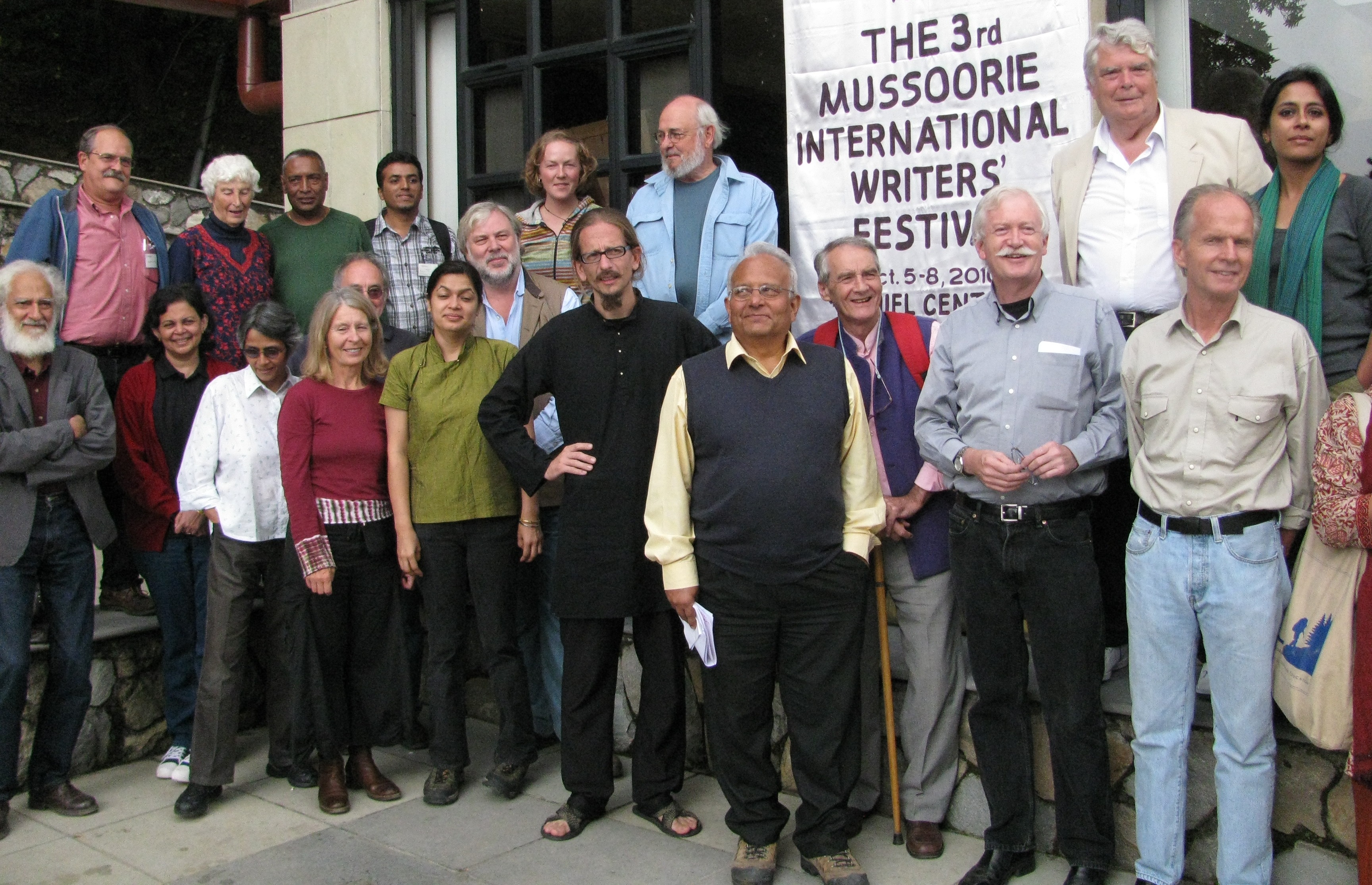
Early October, 2010, as I awaited my chance to interview him on the sidelines of the Mussoorie International Writers’ Festival, Peter Matthiessen’s book `Snow Leopard,’ about a journey to Crystal Mountain in the Himalaya with GS, was all I had for reference.

I explained my position.

The man didn’t disappoint one bit.

He kept the conversation simple.

Excerpts:

Conservation and the problem of over-consumption

Conservation basically from our selfish standpoint means human survival on this planet. The last century in many ways was easy. People thought in terms of reserves, as for instance with the tiger. But remember population growth. There are three times as many people in India today when compared to the early sixties when I was first in India. All of them want to make a good living. So it is not just population growth; the consumption has grown at a much more rapid level. Where do the resources come from? If you are talking about sustainability – don’t use more than what can be replenished – it has been calculated that the world is already at minus thirty per cent. In other words, the environment is going down steeply because of over-consumption of everything. What can you do? You need to be more inventive; you need to be more efficient, you need to be more productive, so that you don’t waste resources. Which state in India has a decent land use plan? People develop, develop, develop and nobody thinks of what it is going to be like at the end of this century. It is thinking ahead and planning that is the responsibility of governments, corporations and communities.

I get so frustrated when I see the lack of planning, the lack of care – for example in the United States. How much money has been raised for wars and armaments that could go for the benefit of people and environment; for the long term good of the country? I consider it highly patriotic to think of the future of one’s country and not fritter away money and resources because you are greedy now. The question is – how can you change the perception of wanting to consume more and more of things that you don’t need?

The finite system we know little of

People think that technology will solve their problems. Well, it can solve various problems. But you have a finite system of which, we know very little. We don’t know much about the ecology of rainforests, woodlands and so forth. How many species can a system lose before it collapses? We don’t know how all the species in a forest – from the microbes in the soil, little worms to big trees – interact to function as a system. We don’t know that. If it collapses because we killed too many species, directly and indirectly….then what happens? This concerns me because yet again, looking at it from a selfish human perspective – we need medicinal plants. At present we know only a few. What plants are out there, which in the future can produce food for a starving planet? The way things are going now we have famines somewhere in the world all the time. The countries that grow a lot of grain like Canada and others – they don’t have enough to feed the world, they have to feed their own people. Countries have to seriously think now what to do. China has a good logging act. No more big, commercial logging of forests because the watersheds are being depleted causing huge floods that kill thousands of people. Alright, the country needs wood. Where is it going to get it from? You go to Congo in Africa; you go to Indonesia – get timber elsewhere. So to keep a good lifestyle countries are pillaging each other. The United States is the principal culprit. The United States has five per cent of the world’s people and it uses roughly 25 per cent of the world’s resources. Is this morally acceptable? It isn’t for me. I don’t know what to do about it.  Now China is expanding, India is growing rapidly and expanding – but unless countries co-operate more; become self sufficient, waste less – what to do? 

Photo: Shyam G Menon

Photo: Shyam G Menon

Big worries; small solutions

Conservation in the final analysis is politics. I can go to China, I can come to India, I can co-operate with local scientists in studying the issue. From the information that we collect, we write reports, we make suggestions – those go to government. Then it is in the hands of government if they want to do something or not. You can prod a little bit but I cannot do conservation myself. I can go to a community, hold a community meeting, listen to their problems and make suggestions, may be even find funds so that they can start – but again it is up to the community and the local politics to implement something on their own behalf.  I can’t come into a country and say you have to change your agricultural practices, you have to stop polluting. That is too big an issue for an outsider. The government and the corporations have to get together and handle that. Personally, I set my own limited goal where I feel I can do something positive for the environment. Everybody should work together on this. If you have a serious land use plan, retain it – then you have a goal. But the only economic measure you see right now is our Gross Domestic Product grew by eight per cent, four per cent etc! What kind of measure is that? It doesn’t measure your environmental loss. You have to measure – to gain that (GDP growth) how much have you lost as resources? You can put economic values on resources lost and I guarantee you that every single country would be in the minus column. They are worse off than they were. If you look at it in economic terms, the world is living off its capital rather than the interest. How many businesses can do that for long? So I have big worries but I focus on trying to do something small and useful.

His message to future conservationists

In one word, that would be – persistence. If you see that something is essential for the good of society, humankind and you have set yourself a goal – keep at it. You won’t necessarily get results immediately but keep emotionally involved, scientifically involved. Learn the politics to some extent because unless you have the backing of the local forest department or whatever that you are dealing with, you won’t get anywhere. And that – being an environmental politician, is something one has to learn whether one likes it or not.

(The author, Shyam G Menon, is a freelance journalist based in Mumbai. This interview was published in The Hindu Business Line newspaper in February 2011.)

A TRIP TO MUSSOORIE

Photo: Shyam G Menon

Photo: Shyam G Menon

One evening at a book store in Mumbai, I came across what I was looking for.

It was Ruskin Bond’s `Landour Days,’ subtitled `a writer’s journal.’

In it the author wrote, “ when I first came to live in Mussoorie, some forty years ago, I did not expect to be the only writer living in or around the hill station. There were, of course, writers in Dehradun, which had a literary climate of sorts; but in Mussoorie there was none, at least not until I had been here for some time.’’

Situated at an altitude of 6000 feet plus, Mussoorie had been a hill station for long. Was it after reading `Landour Days’ or was it before – I don’t remember when exactly – during a brief stay in Mussoorie, I used to frequent the small cafe near Woodstock School for an occasional snack. The school was on the Landour side of Mussoorie. The name Landour, was originally derived from the name of a village in south west Wales. I asked the cafe owner about Bond’s morning walks, which he had often written about. The man thought a while and said the writer wasn’t as frequent as before in his walks.

“ Hmmm…’’ I said biting into the delicious bread-omelette he had served me.

Somehow for me, that simple meal always felt wonderful in the Himalaya. I suspect this sudden discovery of satisfaction in simple pleasures had much to do with the complicated, consumerist life now left behind in Mumbai. More precisely, the perceived switch to different world was relative for Mussoorie itself had been slowly gathering consumerism.  

I didn’t know if what the cafe owner said of Bond’s walks was true but a question on the author usually found response from people as though knowing the subject was part of everyday Mussoorie life.

It was pleasantly old fashioned to hear that.  

How often did you find unassuming writers, poets and artists remembered by people these days, that too, in such detail like whether the person was as frequent as before on morning walks? A man walking by is a dismissible event. But repeated many times over and married to a certain hour and juncture in your everyday life, it becomes a painting in the mind. From dismissible event to memory, it is a painting by time. Good, old fashioned time, now forced to sprint with only hurried sketches for memory or a quick photograph that captures image but not the whole impression. Bond could write a story from the simplest subjects under the sun.

Ruskin Bond was popular all over India.

Yet that fame didn’t take anything away from the effect of hearing somebody recall the author’s walks past their shop or house. If you liked such things as art, music and literature, better still, if you have lived by practising it for livelihood, then you would understand what I felt. Being remembered was all that anyone got for having lived. We don’t ask for it. It just happens. Bond was well remembered for his works from an age preceding the industry of memory. Memory too had since become industry – what else were media and social media all about?

Illustration: Shyam G Menon

Illustration: Shyam G Menon

It was early October 2010.

The Mussoorie International Writers’ Festival had just been inaugurated by the Governor of Uttarakhand state. There was a reading by Ruskin Bond, the hill town’s best known author. His was a name that people, big and small in Mussoorie, knew. Coming to think of it, he was probably the only writer around in the English language that average folks from anywhere in India probably bothered to ask about should they land up in this hill town. Not to mention, some of them at least, must be remembering his writings or discussing him once in a while, each time they visited the hills; any hills. Some may even carry a book written by Bond along.

In Mussoorie, you could easily find directions to reach Bond’s house.

Thanks in large measure to Bond, Mussoorie and writing now went together. Other well known writers had appeared on the scene; `Landour Days’ itself mentioned several from the time it was penned. Plus there was that charm of being writer in the Himalaya. The first Mussoorie writers’ festival kicked off in 2007 with writing across cultures as theme. The next edition in 2008 had for theme, writing on nature. In 2010, it was mountain literature. That attracted me to the place. “ We wanted to celebrate Mussoorie’s own literary heritage and also expand that with new voices,’’ Stephen Alter, Curator, Winterline Centre for the Arts, said.

Winterline incidentally was the name given to the sharp delineation of sunset-sky from the inky blackness of earth below, which one saw on the horizon during winter in Mussoorie. It was reputedly only the second place in the world where you could see that, the other place said to be in Switzerland. The Winterline Centre for the Arts, which was the driving force behind the writers’ festival, was supported by the Winterline Foundation, begun by Woodstock alumni. The main venue for the event was the school’s Hanifl Centre, dedicated to outdoor education and therefore an ideal address for a meet-up of people loving mountain literature. “ I do generally think that if Mussoorie has to define itself, then it has to look for an identity. A literary destination is not a bad idea from that perspective,’’ Alter, a successful novelist, said. 

For its subject of mountain literature, the festival’s organizers had tied up with the Himalayan Club. The overseas speakers included well known field biologist and author Dr George Schaller; climber, writer, filmmaker and painter Jim Curran, the versatile Bernadette McDonald (climber, musician and writer, she was for many years Director of the Banf Mountain Film Festival and founding Director, Banf Mountain Book Festival. Among her books was an unforgettable biography of the late Slovenian alpinist, Tomaz Humar), Garry Weare, best known as the author of all five editions of Lonely Planet’s `Trekking in the Indian Himalaya,’ Andre’ Bernard, Vice President & Secretary of the John Simon Guggenheim Memorial Foundation, Vince G Martin, President, The WILD Foundation, David Wagner, botanist and artist and Kate Harris, adventurer, writer and photographer. Participants from India included veteran mountaineer and author of many books Harish Kapadia; traveller and writer Bill Aitken, filmmaker Toby Sinclair, actor Victor Banerjee, poet Arvind Mehrotra, novelists Anuradha Roy, Sudhir Thapliyal and Paro Anand, environmentalist Bittu Sehgal and journalists Prerna Bindra and Shailaja Bajpai. There was a small book stall, featuring works by the participating authors and other books.

From the 2010 writers' festival (Photo: Shyam G Menon)

From the 2010 writers’ festival (Photo: Shyam G Menon)

According to Alter, one aspiration of the festival was to draw an audience of teachers and students from both Woodstock and other schools in the region. Dr Schaller’s address for instance was attended by students of the Doon School as well. That aside, what captivated was Mussoorie as location for discussing mountain literature. The organizers, enjoying access to an entire mountainside thanks to Woodstock, had the option of locating evening get-togethers at picturesque outdoor spots. Movement between venues required a small walk.

Festival over, I went to Bond’s house to get a quote from him for this article. It was the blessed hour of afternoon nap, 2PM. I wondered whether I should intrude or not. If I didn’t it would be months before I came back to Mussoorie for another attempt at saying hello to him. If I did, I probably risked triggering annoyance. I realised I had to take my chance. A slightly agitated Bond opened the door. I explained that I was a freelance journalist from Mumbai seeking a quote from him for an article on the Mussoorie writers’ festival. He smiled. I couldn’t help feeling that he may have seen through me and realized that all I wished to do was say hello to him. Coming to think of it that was correct. Had I left Mussoorie without meeting him, Mussoorie wouldn’t have felt a complete experience. “ Well the festival gives writers a chance to meet, you know,’’ he said. Having read about mountains and liked Bond’s own work, I just had to hear it from him.

I thanked him and took my leave.

(The author, Shyam G Menon, is a freelance journalist based in Mumbai. An edited version of this article was published in The Hindu Business Line newspaper.)

CYCLING’S SECOND YOUTH

March 2012.

A month earlier, in mid-February 2012, Hero Cycles, the Indian player described as the world’s biggest manufacturer of bicycles, had announced a carbon fibre model called Red Dot, priced at less than Rs 50,000. Traditionally, cycles sporting carbon fibre-frames sell at the top of the heap. On the other hand, Hero’s offering was positioned at the top end of its just unveiled range of premium cycles called Urban Trail with prices spanning Rs 10,000 to Rs 43,000. “ It is important that we adapt ourselves to the changing times. The customer is also changing. The market is slowly shifting from livelihood oriented cycles to lifestyle oriented models,’’ Pravin V Patil, President, Urban Trail, Hero Cycles, said.

Photo: by arrangement.

Photo: by arrangement.

Hero Cycles showcased the traditional business of the larger group helmed by the Munjals. Patil described the company as closely held and cash rich. Around it a vast business empire had grown focused on India’s automobile revolution. Amidst that saga in motorcycles spanning the Hero Honda CD-100 to the Hero Impulse and much auto ancillaries in between, the cycle business had remained relatively low profile except for a heavy weight parameter – the tag of being the world’s biggest cycle manufacturer.

About a year before Hero announced Red Dot, TI Cycles – the other big name in India’s cycle industry with a 25 per cent domestic market share – launched its own premium brand called Montra. Compared to Red Dot, the Montra Techno carbon fibre bike was priced at Rs 71,000. Both outlined capability and purpose. As motifs shaping company profile in the media, these developments impressed.

But did they cut ice with the new Indian market, especially its discerning portion?

In a repeat of India’s automobile industry story, there were two contradictory yet convergent themes playing out. Big domestic manufacturers were attempting to convince a new generation of customers that they had what it took to capture the premium market’s imagination. The customers of this segment owed no particular loyalty to Indian companies. A sketch of this customer could be had from Internet chat rooms around cycling. The product ownership profile of several participants kicked off with Indian brand, followed by a churn of foreign brands. As with many things, when you aspired, made-in-India failed to keep pace.

The synopsis of a 2010 sector report prepared by Global Industry Analysts (GIA), available then on the web said that the world’s market for bicycles should exceed $ 77.7 billion by 2015. Asia-Pacific would be the largest growing market therein. According to TI Cycles, the entire Indian bicycle market was estimated at around 17 million units. The industry had 9 per cent growth rate in 2010-2011 on account of rising individual incomes and the higher aspiration level of the middle income group. Four players – TI, Hero, Atlas and Avon – accounted for 90 per cent of this market.

In that, the premium bicycle segment priced between Rs 7500 and Rs 15,000 was estimated at around 350,000 units per annum; the super premium segment – above Rs 15,000 – at 16,000 units. “ These segments are growing at a phenomenal level compared to the industry growth rate,’’ K.C. Ramamoorthy, General Manager (International Business), TI Cycles said. Although companies spliced the market differently, the reading was similar. In a presentation, Hero put the bulk of the domestic market in the Rs 2000 to Rs 6000 range with upward of Rs 6000 being the `mass premium’ and `super premium’ segments.

It was in these upper tiers of the market that the capabilities of Indian companies were getting tested. For decades the major players chasing volumes and catering to customers’ livelihood needs saw these categories as commercially irrelevant because the market was price sensitive. With volumes becoming habit for companies, another twist set in – large players wouldn’t venture into a business unless there was assurance of critical volumes. Simultaneously, as a new generation of customers grew up on a diet of rising affordability and access to information, the Indian brands seemed prisoners of their business model and stuck with traditional cycles while brand appeal shifted to the stuff of passion, performance and aspiration.  

Shiv Inder Singh (Photo: Shyam G Menon)

Shiv Inder Singh (Photo: Shyam G Menon)

Shiv Inder Singh, Managing Director, Firefox, was to the Indian bicycle industry what Maruti was to the Indian automobile sector – the wake up call to think differently. “ Where the Indian automobile industry was 20 years ago, that’s where the Indian bicycle industry is today,’’ he said over tea, February 2012, in Delhi. He provided an uncomplicated picture of the market. Broadly speaking, the Indian cycle market fell into two categories – a standard segment and a fancy segment. Anything unlike the standard cycle was called fancy although even in the fancy bracket, the components were typically standard. The fancy segment had grown to be roughly 50 per cent of the market with its real creamy layer composed of CKD imports.

Singh studied at Doon School and later at the Indian Institute of Technology (IIT) and the Indian Institute of Foreign Trade (IIFT). He worked in the export sector, mostly in textiles. From 1980 to 1983 he worked in Taiwan, in the clothing business of a Hong Kong based-group, sourcing from Taiwan, Korea, Hong Kong and Philippines. Then he shifted back to Delhi working for another Hong Kong based-company. In 1996, when that company shut down he started a partly owned outfit in league with the Kapoor Group, exporting lamp shades. He ran this for eight years till 2004. It was during his tenure in Taiwan that he met his current partner Pradeep Mehrotra. The latter sourced cycle components from Taiwan and China and had a manufacturing unit in Sri Lanka which assembled cycles and shipped them out. Those days, Mehrotra owned the Muddy Fox and Silver Fox brand of cycles in the UK market.

In 2005, Singh and Mehrotra started Firefox.

Firefox was launched with 36 models, ready and in stock. These imports were better looking and more contemporaneously designed than models in the Indian market; they were also costlier in a market described by its biggest players as price sensitive and range bound. To sell these bikes, a new retail experience was created. Stores had their interiors designed, store locations were carefully chosen. There were dedicated company outlets at Delhi, Chandigarh, Pune and Bangalore. Firefox also gave its dealers higher commissions. The dealerships had to subscribe to company approved retail design and stock only Firefox cycles. Several dealership enquiries were rejected. “ We didn’t do a market survey before all this because there was no precedent yet in the market on these lines,’’ Singh said. Further with a focus on children and young people, the company’s products and product details were displayed online. That had its problems too. Any shortcoming with the cycles got highlighted in Internet chat rooms and sometimes the fire-fighting took long to be effective.

Competition waited for Firefox to fold up.

It didn’t.

Couple of years later, Firefox began distributing Trek bicycles as well. That was probably the validation the industry needed. It was now time for the Hyundais, Fords, GMs, Toyotas and BMWs of the cycling world to arrive. Not to mention – time for the Tatas and Mahindras of the domestic bicycle industry to shape up.

Indeed one interesting thing when talking to senior executives from the cycle industry in India was how much they borrowed imagery and examples from the automobile sector. Historically several automobile manufacturers have marketed bicycles under their brand; among them – BMW, Mercedes Benz, Peugeot, Jeep, Hummer, Ducati and Honda. While I can’t speak for times gone by, the most likely reason for this in recent times – aside from the fact that a cycle with vehicle brand stamped on it provided cheaper, surrogate ownership of the automotive brand – was that the cycle showcased an automobile brand’s design and engineering ability with minimum clutter, not to mention environment friendliness. Compared to the automobile, the cycle was an easier accessed, tangible experience. Unlike automobiles, it was pollution-free.  Peugeot however enjoyed distinct reputation in bicycles. This French company, producing cycles since the late 19th century and winner of a record ten Tour de France titles, briefly relinquished its cycle business to Cycleurope. It appeared to be returning. In India, Firefox – a bicycle company – participated in the Delhi Auto Expo. That wasn’t wholly puzzling for the costliest cycles sold in India cost as much as an entry level mid-size car and the act of buying and selling at the upper end of the domestic bicycle market was being decided increasingly by customer and retail experience.

As of 2012 first quarter, customers from Pune and Hyderabad appeared to head the list for the most expensive bicycles bought in India. A Cannondale Jekyll Ultimate was believed to be at the top of the pile. In January 2011, a buyer in Pune paid Rs 650,000 for this model. One of the lightest bikes in the world, it was a versatile mix of uphill and downhill cycling capabilities. The rider could change from one mode to the other, in the process altering the geometry of the frame and his position on it. From Hyderabad, a customer dished out Rs 450,000 for a Trek Remedy 9.9. Early March 2012, a Scott Genius LT 10 worth Rs 425,000 was scheduled for delivery. All these models were full suspension carbon fibre frame-MTBs with top notch components. Earlier Scott India had sold an aluminium frame-Spark 40 full suspension MTB priced at Rs 216,000. Industry officials said that it would be erroneous to dismiss customers of this ilk as merely moneyed because some of the bikes bought had strength in specific applications. 

Lifecycle in Pune was probably India’s biggest multi-brand showroom for high end cycles. It had three floors of cycles; brands like Cannondale, Trek, Scott, Orbea, Bergemont, Merida, Giant, Firefox, Axis, GT, Schwinn, Bianchi, Fuji, Mongoose, Dahon and Huffy. Altogether 24 brands, said its owner. The walls had cases stocked with cycling accessories; at one end was a TV showing a video on cycling. Differently from Lifecycle but around the same DNA of passion for cycling, there were other such shops blossoming elsewhere in India too.

At the time of writing this article, TI Cycles was due to open a large Track & Trail Cafe – their version of high end retail experience – in Chennai. There was Rohan Kini’s shop with its delightfully irreverent name – Bums on the Saddle (BOTS) – in Bangalore. There was the hard core cyclist community around Venkatesh Shivarama in Bangalore. There was the first Track & Trail Cafe in Bangalore. There was Nachiket Joshi and Lifecycle in Pune. In Mumbai, there was Rahul Mulani and his shop Gear and Prabodh Keny, assembling cycles at his home.

Nachiket Joshi (Photo: Shyam G Menon)

Nachiket Joshi (Photo: Shyam G Menon)

Two cities in particular defined the Indian market for high end bikes – Bangalore and Pune. Both places were blessed by a matrix of old and new India. There was sufficient continuity of old fashioned commitment and passion plus a healthy dose of contemporary, youthful enterprise. Unlike Mumbai, real estate cost had not mono-cropped business imagination. Ideas stood a chance. Not to mention – disposable income, cycling clubs, communities and regular calendar of events around. Roughly similar across Bangalore and Pune, although not exactly so, was the local climate and topography. Bangalore had bearable climate year round. Pune had a harsh summer and distinct winter. At both cities, you could cycle off onto roads with less traffic and if it interested you, court hilly terrain.

The current drivers of cycling in Pune and Bangalore included those who were passionate about cycling when Hero and TI dominated what used to be a seller’s market. They struggled in that environment, first putting Indian bikes to punishing use and then researching and sourcing bikes unavailable in India to feed their passion. Consequently they didn’t bring to the table automatic respect for India’s big cycle manufacturers. They were not in awe of them. Across the new age cycle retailers I spoke to, there was a cool, guarded approach to Indian brands pushing carbon fibre cycles as motif of new found technological advancement. The manufacturer may be pushing something genuinely valuable but the point was – this market had questions, access to information and knew cycling. It chatted, discussed; there was even an Indian mountain bike magazine, `Free Rider.’ It was clearly not the old market. True, there will be those who buy to match peers or because they have money to splurge. Like this customer who called up asking for a bike costing over one hundred thousand rupees. The purchase was approved with photo of the bike dispatched via cell phone. The cycle was picked up by the customer’s driver. But even for this customer, rich enough to buy without seeing the cycle, it mattered who guided his choice. In this case, advisor had been an enterprise begun by cycling enthusiasts. That shift caused all the difference.

Bangalore's Track & Trail cafe (Photo: Shyam G Menon)

Bangalore’s Track & Trail cafe (Photo: Shyam G Menon)

Not surprisingly therefore, as much as a good product in this upmarket segment created a reputation for manufacturer, a bad product or a good product abandoned to bad after sales service created ill repute where there was none previously. The old approach to bicycle sales wouldn’t work. Bangalore’s Track & Trail Cafe stocked all the cycle brands that TI Cycles imported and distributed through its network. The best part of it was that it recognized a cycle as a creation and surrounded it with space to appreciate its design, geometry and engineering. You could take in all this with a cup of coffee in your hand, sip it and walk among the cycles, gaze at the posters on the wall or browse through the many books on cycling and magazines on the subject kept on the racks. The cafe served as a point of sale, played host to bicycle maintenance workshops and organized cycle rides. “ The Track & Trail Cafe serves as a platform for engaging like minded community members to make cycling a way of life through active company participation. The concept encourages users to browse leisurely,’’ Ramamoorthy said. Hero had planned Urban Trail showrooms. According to Patil, the top 200 dealers from Hero’s 2200 dealerships nationwide would sell Urban Trail models. There would be additionally, 30 company owned outlets, 30 franchise dealers and three experience centres for the Urban Trail brand in Delhi, Pune and Bangalore. That was the plan, when I met him.  

Rohan Kini (Photo: Shyam G Menon)

Rohan Kini (Photo: Shyam G Menon)

What interested was how the cycling community hadn’t yet (at the time of writing this piece, that is) migrated in strength to these new company sponsored platforms. It was early days. The shift was expected. Both Hero and TI already sponsored major cycling events. But as of then, the cycling community in places like Bangalore and Pune, clustered around individuals and clubs passionate about cycling. Notably, they remembered being under-served by Indian industry and drew people to them without necessarily having on offer all the material frills that the company spaces held.

The best known cycling community in Bangalore was around BOTS. Rohan Kini saw his main job as managing the community and being an evangelist for cycling. Very different from the modern showroom space BOTS had acquired, was the first floor shop of Venkatesh Shivarama. It was packed with cycles. Imagine that – a first floor shop for something that runs on wheels? Yet the faithful arrived, for Venkatesh was perceived as an experienced, technically sound cyclist, an evangelist for cycling in his own way. He anchored a reputed cycling team and the assistants helping him at the shop were committed cyclists into racing. In Pune, Nachiket Joshi was crystal clear – his top priority was the community he had built around Lifecycle.

What was opening up in India in the form of a market for high end cycles was a classic chicken and egg situation. New product and market making were debuting side by side. To sell these cycles you required a culture that enjoyed cycling, understood what modern cycles did and wished to buy or promote them. That culture, starting with spreading the joy of cycling, was possible by nurturing communities. Unlike the old cycle shop owner who sold available products brusquely, the new age retailer of bicycles in India noticed customers. The premium segment’s growth rested on everyone’s evangelism for cycling. If cycling turned boring, they knew, the business would fail.

Rahul Mulani, who pioneered BMX in Mumbai years ago and started a cycle shop subsequently, provided a different yet equally involved view. He didn’t want to run a cycle shop. That wasn’t his aim. His aim was BMX. But what do you do when in BMX you were always thrashing your cycle and spare parts were so hard to come by in an India that ignored cycles for niche markets like his? He became an importer. More than one devoted cyclist and at least one dealer told me of cycles in the garage that served purely to be cannibalized for spare parts because import duties and exchange rate fluctuations hampered parts availability.

Venkatesh Shivarama (Photo: Shyam G Menon)

Venkatesh Shivarama (Photo: Shyam G Menon)

Of India’s two biggest cycle manufacturers, TI which claimed leadership in the special cycles-segment had in addition to its own product line-up opted to distribute imported cycles. Hero wanted to go it alone. “ I may at best seek a good designer, I have all the other capabilities,’’ Patil said. According to him Hero was targeting 35 per cent domestic market share in the premium bikes category to start with. Over time, the definition of indigenous cycle had become hazy. The standard cycles hailing in origin from the days of controlled economy, had fully localized production. As you moved up the pecking order and this machine called bicycle grew more complicated, the anatomy of the cycle became an international assembly. It transformed from a product wholly made at a factory in India or built with components from India to a product that was assembled from imported components. Uniquely in the global bicycle industry, some components were strongly associated with a handful of manufacturers. Example – Shimano and SRAM in gears. Aircraft manufacturers obsess with the design of planes’ wings for that is the critical piece of technology. Similarly, in cycle manufacturing, the bicycle brands controlled the geometry and technological specifications of the bike frame which was the heart of a given model of bicycle. The frames were unique for their rigidity, measurements, angles, thicknesses, welding and materials used. These attributes altered with intended application of bicycle. Thus the frame of a mountain bike was different from that of a road bike by more than just appearance. To the frame, components matched to performance and price point, were attached. The manufacturer then grew the brand DNA through a diet of field testing and performance. Dig deeper and you found that there was respect for independent designers, fabricators, testers and like. As you moved up the value chain in cycles, you encountered products defined more by design, engineering, build-quality and application.  Theoretically, these segments could be cost competitive in manufacture at modest volumes. If the volumes of such cycles in the Indian market slowly gained, that could eventually mean reason to manufacture them locally, which would be an interesting departure from the well entrenched worship for sales volume. In these categories defined more by performance than price, a critical, modest volume would do. What mattered was engineering excellence and craftsmanship. “ That would be an interesting development to watch out for,’’ Jaymin Shah, Country Manager, Scott India, the local arm of leading international bicycle brand, Scott, said.

Photo: by arrangement

Photo: by arrangement

The country to beat in this game was China. They manufactured the cycles sold by leading international brands and they did it efficiently at low cost. In early 2012, there was talk of South East Asian countries emerging as new manufacturing locations. Was this an exploitable crack? China itself had become low cost manufacturing destination for cycles on the back of Taiwan’s rising cost in cycle manufacture. It was only natural that cost-stories should migrate as economies prospered. According to an article on the Earth Policy Institute website, from 1995 to 2005, China’s bike fleet actually declined by 35 per cent to 435 million units while private car ownership doubled. Yet in 2008, China was still producing almost four fifths of the 130 million bicycles produced worldwide. If in 2012, names like Vietnam cropped up as cheap production bases, it shouldn’t surprise. Will Indian bicycle companies blessed with domestic market and gaining scale in niche segments, catch up and marry scale to technology for a swing at things? (As I edit this article for my blog, the rupee is at 64-65 against the dollar, begging an export culture.)

Patil said that scale was his primary asset. As the world’s largest producer of bicycles with 45 per cent market share in India, Hero had the capacity to source globally. That however begged a question in the eyes of observers – precisely because of faith in scale and because the cycle is increasingly an assembled product with brand identity divorced from manufacturing location, there needn’t be urgency for Indian manufacturers to produce high end cycles in India. Till costs compel otherwise (the sharp rupee depreciation of 2013 could be one), why not outsource, assemble the product and push the brand?  As said, such assembly was established industry pattern. It made no sense to keep reinventing the wheel. Except, the foreign bicycle manufacturers came across as more experienced and tested for unlike in India, they built brands around credible performance and not scale. You may be buying a mass produced brand. But it was traced to company with strong DNA in performance. Indian companies were yet far from acquiring such link. This made attempts in that direction very important, for unless you evolved by aspiration and imagination, the product – no matter how dominant the brand – would remain an unconvincing shell. The market never failed to argue – every year the foreign brands were at the races and something from those outings should be rubbing off on the brand as learning. DNA by performance – the market valued that in a bicycle brand.  

When I mentioned Indian carbon fibre cycles to one of the new age dealers, he quipped, “ do you know what grade and quality of carbon fibre that is?’’ How much of everything on the cycle is carbon fibre and how much isn’t? Evidently, the young man knew the material and its use on cycles well enough not to be felled by a claim. In contrast, he pointed out that many of the foreign brands newly into India had been at least once to Tour de France, not to mention won it. And just in case you thought that dealer’s quip was spot on, here’s another observation from another dealer – why can’t an Indian manufacturer be successful and iconic when many of the foreign brands despite their heritage and reputation have ended up being made in probably the same factories in China? Are you sure the old care and personalized attention which makes products distinct are still there in the foreign names?

It showed the possibility open to Indian manufacturers if they wished to genuinely try.

Photo: by arrangement

Photo: by arrangement

As of early 2012, the impact of all this was visible in select home brand-products near the Rs 10,000-price level in the domestic market, where design and quality had improved. “ Indian bicycle manufacturing had been bogged down on the price and mobility platform and had not made any investments as made by international manufacturers. We are slowly building capacity for alloy and carbon frame bikes and eventually other materials also,’’ Ramamoorthy said. Alongside new approaches to the market may be tried. TI Cycles for instance, was examining the scope to start a rental business for performance bikes at its Track & Trail Cafes. Its well located bike stores may also host this business, which provided the market an easier option to experience the new bicycles besides allowing cycling aficionados to continue their lifestyle when travelling on work.

Then on March 16, 2012, a game changer happened.

The premium cycles segment found mention in the Union Budget with the customs duty on imported cycles and bicycle-parts going up. Very broadly, this move spelt impact from price points like Rs 5000 – 6000 and upward in the market because models, right from children’s bikes, used imported components. What survived untouched was the mass market livelihood-cycle category, which incidentally wasn’t the growth segment of the market. The growth segment and what was evolving to be the next centre of gravity for the bicycle market, was the beginning level of the premium category taking to the market concepts like alloy frames and gears, which were not mass produced in India. Suddenly the very fun centre of the market had been choked by the Finance Minister! The budget was speculated to trigger two to three trends – the cost of imported cycles and cycles with imported components would go up; there was the likelihood of down-trading to cheaper technology as models strived to preserve price points and finally, there could be greater manufacturing in India to get over the higher import cost. None of this would have pleased cyclists left wondering why cycling – an activity that burns no imported oil or contributes to pollution – was penalized.

Photo: by arrangement

Photo: by arrangement

The budget left many cyclists angry. But in the months since, room to complain steadily eroded for it was life by game changers. The rupee at 64-65 against the dollar would have further reinforced protective barriers. The currency’s real exchange rate, some said, was yet away. Every generation has its challenges. The last one capped its imagination at ordinary bicycles. New generations defined by consumerism alone don’t make for a great generation. They must create convincing products. On the bright side, indigenous models in the premium segment have grown. TI’s Montra brand for instance, has spawned models at a pace not seen before in the market.

The field is wide open in Indian cycling’s second youth.

UPDATE: Mid September 2015, media reports said that Hero Cycles had acquired Firefox Bikes in an all cash transaction. The deal included distribution rights for Trek and other brands. 

(The author, Shyam G Menon, is a freelance journalist based in Mumbai. This article was written in mid-March 2012. Some rewriting and updating was done for this blog. However minutiae in context, as well as officials and product prices quoted herein may have changed since. Serious readers are requested to note that. The blog’s intent is – perspective.  A very abridged version of this article was published in Man’s World [MW] magazine. A portion of this material was also used for an article in The Hindu Business Line newspaper soon after the Union Budget of March 2012.)

FIELD HOCKEY’S FAMILY FESTIVAL

Illustration: Shyam G Menon

Illustration: Shyam G Menon

March 2010.

For a festival of its size and uniqueness, the banners announcing the mid-April start of the Maneyapanda Twenty Ten were both few and hard to find.

In sport loving Kodagu (Coorg, South India), it was the latest edition of a then thirteen year-old annual ritual using field hockey to preserve a tradition of closely knit families. Started in 1997 by a former senior manager of the State Bank of India as means to reinforce family ties, the festival had since grown to be the world’s biggest field hockey event. It was recognized for its scale by the Limca Book of Records. The Guinness Book eluded it reportedly due to its exclusivity – you have to be a Kodava to participate. But that didn’t take away any sheen from this festival, for the region had for years been a major talent pool for the national men’s hockey team. Family teams sometimes included former members of the Indian squad, even Olympians. Both men and women played alongside. An unmarried woman played for the family she was born into; a married woman played for the family she married into. The youngest player may be just out of his or her teens. “ This year the oldest players could be B.A. Nanaiah and C. Vasu, both nearing eighty. They used to be good hockey players,’’ S. Appaiah, Chairman, Sports Committee of the Maneyapanda family, said when I met him.

In Madikeri, C. A. Karumbiah’s office sat next to the greenest spot, a patch of astro-turf. Formerly with the Indian Air Force, he was now Administrative Officer of the local Sports Authority of India (SAI) complex. In his prime playing years, he had been in the national hockey camp. He had also played thrice – with son and daughter – for the family he belonged to, Chandapanda. The roughly 150,000-strong Kodava community maintained its roots in family. Everyone was traced back to a male ancestor and there was a tradition of ancestor worship. Men had names with two initials, the first denoting family and the second, father’s name. There were no historical records to explain the genesis of these patriarchal family names, called manepedas. So when engineer turned writer C.P Belliappa, who became a coffee grower at Athur near Gonicoppal, dwelt on the topic in his book, “ Tale Of A Tiger’s Tail & Other Yarns from Coorg,’ he dipped into imagination for a delightful little chapter. Suffice to say, family ties were very strong in this hill province. Disparities in well being aside, most families had a large ancestral house that served as a magnet for periodic get together. When these meetings happened twice or thrice a year, a hundred to two hundred blood relatives may congregate. The house also reserved quarters for those in a family who had fallen on hard times.

Like the origin of their family names, the Kodavas I spoke to were hard pressed to explain why hockey of all games became so popular in the area. An explanation for the prominence of sports could be attributed to the British influence in these hills inhabited by a warrior community, the area later becoming the center of coffee cultivation in India. If you look around, vignettes of British influence in the region surface, ranging from Kodagu’s love of sports to similar tendencies in Malabar down to a quaint two hundred year old tradition of playing cricket in Thalassery ascribed again to the region’s coffee planters.

“ In our community there was always respect for the soldier and the sportsman,’’ Karumbaiah said. At Madikeri’s `Coorg Cuisinette,’ recommended locally as an eatery to visit for traditional food, I ran into young Subbaiah and Varun Cariappa, the former proceeding from third to the fourth standard, the latter, from eighth to the ninth standard. “ We go for hockey practice at five in the morning,’’ Subbaiah said, pointing to a tradition of elders proficient in the game coaching youngsters. When reading up for this article, I also came across a news report of Kodavas in the US forming a hockey team. Karumbaiah reeled off the names of several Indian hockey greats from Kodagu – M.D. Muthappa, M.P. Ganesh, B.P. Govinda, P.E. Kalaiah, M.M. Somaiya, K.M. Kusha, Ammanda Vasu, Chengappa, M.S. Monnappa, A.B. Subbaiah, Vinod Chinnappa, Koothanda Poonacha, B.K. Subramani, Chepudira S. Poonacha. More recently there have been Arjun Halappa, Len Aiyappa, S.V. Sunil, Hariprasad, Raghunath and Vinayak. Some of these players returned annually to play for their families.

The man who tapped this talent to create a huge family festival was 74 years old when I rang him up. “ I am very happy the way this festival has evolved,’’ Pandanda Kuttappa said over the phone. According to Belliappa, the former bank manager’s idea was a brilliant one. “ By March, the harvest here is over and people are generally free till monsoon. That’s the ideal time for a hockey festival,’’ he said.

Illustration: Shyam G Menon

Illustration: Shyam G Menon

There appeared to be an estimated 700 to1000 families in the Kodava community. In the first inter-clan (okka) hockey tournament held in 1997 at Karada and funded by Kuttappa and his family, 60 teams showed up. In 2003, participation peaked at 281 teams. “ The family-hockey link works well because it is a team sport. It won’t work that well in something more individualist like athletics,’’ former international athlete Ashwini Nachappa said. Since it was an affair exclusive to the community, the festival’s administration was vested with the Kodava Hockey Academy (KHA) which had nothing to do with government agencies in the field. The umpires for the matches came from the mainstream Coorg Hockey Association. However, they too belonged to the Kodava community. Just as in international events, by the time one edition ended, the host family for the next edition was already identified and at work. While Kuttappa, who was President of KHA, had to dip into his own funds for the first edition, the tournament now had sponsors. But its implementation stayed ad-hoc and partly so for strong reasons.

At the government school in Ponnampet, where two hockey grounds were being prepared for the month-long festival, the mood was both professional and community service. Brigadier Devaiah oversaw preparations for the Maneyapanda family. According to him there was a reason for the festival shifting venues every year and not locating permanently at a fixed venue which would have made infrastructure efficient. In the distance one saw the Kunda Hill, sacred to the Maneyapanda family whose members lived in the vicinity. Many in the family had studied at this government school. “ It doesn’t have proper water supply. Alongside organizing the festival here, which would obviously need water, we also hope to leave behind a water supply infrastructure for the school,’’ the Brigadier said. On the other hand, every host family started its preparations from scratch. The KHA received several bids and usually selected the host family on the strength of prominence and capacity to implement. Once a family was chosen they proceeded to set up a core committee with sub groups handling specifics like finance, ground preparations, technicalities of the sport etc. Sadly however, work began every time from scratch with few documented practices from previous tournaments for template. Thus for Brigadier Devaiah, used to project execution in the army, the Ponnampet work was challenging. Work started from basics like collecting the addresses of all family members; collecting the addresses of women from the family who married into other families, working out the budget, requesting family members for funding (some contribute big, others small), informing the same to members married outside (their contributions were completely voluntary), readying the infrastructure etc. The overall budget for 2010 was Rs 50 lakhs.

For the finals due in May second week that year, the organizers were expecting a crowd of 30,000 people. Temporary stands were being constructed at the school ground. With one more ground nearby, two matches would be played simultaneously to expedite the knock out stage. There was space adjacent for several food stalls. Teams scheduled to play on a given day would play and return for further matches if required. “ Roughly twelve matches would be played every day,’’ Appaiah said. At Karumbaiah’s Academy for Learning & Sports in Gonicoppal, run by Datta Karumbaiah of the Maneyapanda family and his wife Ashwini Nachappa, I was told that around 185 families had submitted their entries for the hockey festival with a day still left for closing registration. The then Union Minister for Sports, M.S. Gill was expected for the April tournament as was the Air India hockey team for a friendly match. In Madikeri, C. A. Karumbaiah said that he had agreed in principle to using the SAI’s astro-turf ground for okka matches in the future. “ Since there is no age limit and many of the older players were groomed in the old style, there could be injuries if they play on fast moving astro-turf. But from quarter finals onwards, we are looking at good teams playing seriously. They should be able to handle astro-turf,’’ he said.

Illustration: Shyam G Menon

Illustration: Shyam G Menon

Despite its popularity, the family hockey festival was not the stuff that was tracked by committed talent scouts. The picture appeared to be one of the festival’s standing in sport being diluted by the festive flavor. More than hockey, it was an occasion for family members to meet, in some cases for the first time. It was also an occasion for match-making in the small community. As one person said, “ somebody might tell a young man: that’s the girl I told you about. See, that one in the red saree?’’ In a different context though, those sarees should intrigue Kodagu. The region’s prominence in hockey had been in men’s hockey. When it came to women, the talent pool today was up north and in the east. “ We need more women to come forward and play the game,’’ Karumbaiah of SAI said. That incidentally was a smaller problem in a larger trend becoming visible. Although talent scouts periodically visited interior schools to catch them young, great talent was slowly becoming rarity in Kodagu. Reasons were speculative and they ranged from smaller families with lesser children to so many other options available now for a person talented in sport.

However, that hadn’t dampened the intertwined model of family and sport.

Kodagu’s okka hockey festival was being emulated as model in the region’s taste for cricket and golf.

(The author, Shyam G Menon, is a freelance journalist based in Mumbai. This article was published in an abridged form in The Week magazine.)

LADAKH’S ICE HOCKEY

June 2009.

Ladakh couldn’t comprehend its mixed fortunes in ice hockey.

In India, the game was first played in Shimla during the British times.

But it fizzled out.

Ice hockey in Ladakh (Photo: courtesy Chozang Namgial)

Ice hockey in Ladakh (Photo: courtesy Chozang Namgial)

Then in the 1980s, some say earlier, the Indian Army started playing ice hockey at its remote, cold postings in Ladakh.

The Ladakh region has a severe winter. Dras, often cited as the coldest inhabited place in the country with altitude induced sub-Arctic temperatures sometimes plummeting to minus 45 degrees, lay in the adjacent Kargil district. Even today, a winter in Ladakh entails being cut off for months as regards access by road.  Water bodies freeze, the most famous and touristy of which is the annual freezing of the Zanskar River that makes the winter trek on it much sought after. In towns and villages, people live off stocks of food they carefully accumulated during the summer. Families gather around large decorated stoves which serve to both cook food and heat a room. The choice then looms of either restricting yourself to such life or getting out and doing something more active.

That’s where ice hockey fitted in.

When the army started the trend in Ladakh, ice hockey sticks were made from willow wood. The skates were locally fabricated and fixed to the soles of military issue shoes, tin cans were used for pucks.

It soon spread to other parts.

In Leh the game has been played for years on a frozen irrigation pond. The Ladakh Winter Sports Club (LWSC) was formed in 1985. It offered coaching and organized tournaments, slowly moving the game away from the army’s clutch and into civilian ownership. At present the military / paramilitary forces don’t anymore run the game but send their best teams to compete with that of the state and local clubs.

Equipment was a huge hurdle to cross for it had to come from abroad and was required in good quantities if the sport was to penetrate the remote hinterlands. Luckily with ice hockey’s ascent, it caught the eye of diplomats and expatriates staying in Delhi and Mumbai. Among them were Canadians. Through them Ladakh got the first real sets of ice hockey gear and several more of used equipment for dispersal to the interiors. “ Those days, it was difficult getting the gear cleared at customs. We lost one set,’’ Chewang Motup Goba, founder of Rimo Club, national champions in the sport, recalled.  He was also Vice President of the LWSC at the time I was writing this story. The game had state and national level competitions with an administering body – Ice Hockey Association of India (IHAI) – based in Delhi.

In March 2009, the national ice hockey team made its debut at the international level.

Ice hockey in Ladakh (Photo: courtesy Chozang Namgial)

Ice hockey in Ladakh (Photo: courtesy Chozang Namgial)

The team was wholly from Ladakh.

Shimla hadn’t been getting good ice for the previous 3-4 years and that led to its players being left out.

When Tundup Namgial turned up at the Leh View Restaurant for a chat, he was absolutely different from the typical skipper of an Indian team. He spoke to the point with a reluctance that hinted he would rather play or be lost in the folds of his Ladakhi landscape. At experiential education courses, my thoughtful journalistic persona has often found itself in spaces identified with the analytical, procrastinating, human company-loving type. Tundup Namgial reminded me of the active sort, which struggle to find the correct words because the active life is their equivalent of thought and conversation.

Some in Leh felt he should have spoken up at a certain press conference in Delhi when the national team was sent to Abu Dhabi to play in the Asia Challenge Cup. From the administrators of the sport they got team T-shirts. That was all. The team had no doctor; equipment kits were pieced together from the inventories of the army, Rimo Club and J&K Tourism. Stay and accommodation was courtesy the organizers. Travel cost would have been entirely the team’s onus had not the Jammu & Kashmir Bank agreed to sponsor tickets, reportedly at the behest of state Chief Minister Omar Abdullah.

At Abu Dhabi, the team featured in the opening game of the tournament. It was routed owing to lack of international experience and more significantly, the absence of an artificial rink back home. “ Nobody plays competitive ice hockey these days on frozen ponds,’’ Namgial said ruefully. Abu Dhabi in the desert underscored it and the behavior of puck on the ice of artificial rink was dramatically different from the way it slid on Leh’s frozen irrigation pond. Yet the tough lads improved with each fixture and exited the tournament earning the respect of other national teams. UAE won the championship that year.

The IHAI attributed the limited support it gave the team to both the niche stature of the sport in India and its own early days as an association. It hoped to get funding from the International Ice Hockey Federation. Both J&K Bank and Volvo, companies that sponsored the national team that went to Abu Dhabi, were expected to continue supporting for the next five years. “ We are also getting a coach from the ice hockey school in Finland to visit India this winter,’’ Mr Akshay Kumar, Secretary, IHAI, had said then.

Ice hockey in Ladakh (Photo: courtesy Chozang Namgial)

Ice hockey in Ladakh (Photo: courtesy Chozang Namgial)

Ladakhis love ice hockey.

Their women fought for equality in the game.

“ Our youth have nothing to do in winter but play ice hockey,’’ P.T. Kunzen, President then of the LWSC, said.

A national team and aspirants for it must train year round.

The Ladakh Autonomous Hill Development Council (LAHDC) was installing a second rink, a natural one again with hopefully an extended period of frozen existence as grace. That may increase the playing calendar by a month or two.

But where was the artificial rink that Ladakh badly needed for all it had contributed to the sport?

In 2009, thanks to an Uttarakhand initiative with central funding – a proper rink was coming up at Dehradun, in time for the South Asian Federation Winter Games. Teams from Himachal Pradesh, Delhi and Uttarakhand would thus find a rink close at hand. Meanwhile with the growth of shopping malls and such, recreational rinks have opened up or been announced as curiosity in several Indian cities. Late 2012, I would find a giant hoarding outside the Mumbai airport announcing that winter’s ice hockey tournament in Leh, sponsored by a leading hotel chain; months later in Kochi I would see a newspaper article about an artificial ice skating rick at a huge mall. In new India with no shortage of people and people packaged as market, there is no dearth of marketing to attract crowds. What is amiss is an understanding of sport and meaningful investment in it. Growing something patiently, organically – that is an art lost in these days of design by disruptive growth and utter impatience to reach where the Joneses have.

Thus in yet another one of the ironies of sport in India that artificial rink went many places, except where there is a readymade culture for using it.

Kunzen, Chewang Motup and Namgial were all at a loss to explain this situation.

They were sure Ladakhi players would travel to Dehradun for practice. Still the bad luck rankled. Against the backdrop of 60 per cent central funding for sporting proposals from the states, the IHAI felt Ladakh can get its rink if the state pushed for it. But the time I was in Leh, it didn’t seem simple. Gulmarg in the Kashmir Valley is a favored spot for the national winter games and all states humor Delhi to merit their share of opportunity. The question being posed in 2009 was – will the state risk Gulmarg’s fortunes for the sake of an artificial rink in Ladakh?

Illustration: Shyam G Menon

Illustration: Shyam G Menon

The only other alternative was to encourage in-line hockey – similar to using roller blades – during the summer and keep Ladakh’s talent engaged. Chewang Motup saw one silver lining. He said that the then union minister for sports was aware of Ladakh’s concerns. But today as I brush up the article for this blog, it is many months since the said union minister was shifted out from sports. In India, you can’t trust politics. Its notion of time – swiftly ending through human intrigue sometimes and carrying on eternally at other times – follows laws that are apart from the natural laws of physics.

Unlike in politics, a more natural form of time runs out on the playing field.

Namgial knew his time was up.

“ Another two or three years of playing, after that I plan to coach youngsters,’’ the captain of the Indian team said.

Hopefully by then, Leh should have an artificial rink.

Namgial is the only captain of an Indian team I was privileged to have tea with.

I met him a couple of times after this visit.

One of those meet-ups was memorable.

We were a group of journalists who had just landed in Leh to cover the Hemis Festival and write about a school run by the Drukpa Lineage. I ambled out from the airport to locate the vehicle assigned to pick us up. A large number of people stood waiting outside the building, most of them taxi drivers and chauffeurs of hotel owned-vehicles or lodge and home stay-owners come to collect their clients. In the crowd was a face that struck me as familiar. Eventually Tundup Namgial and I recognized each other. We shook hands, exchanged greetings. Later, we met for a chat on ice hockey at his house now sporting additional rooms for lodging tourists.

It is now August, 2013. I spoke to a friend in Ladakh few days ago. At the one place in India where ice hockey grew so much, an artificial rink wasn’t functioning yet.

Ladakh waits.

(The author, Shyam G Menon, is a freelance journalist based in Mumbai. This article was originally published in a shorter version in The Hindu Business Line newspaper in September 2009. It has since been tweaked a bit to reflect the times.)
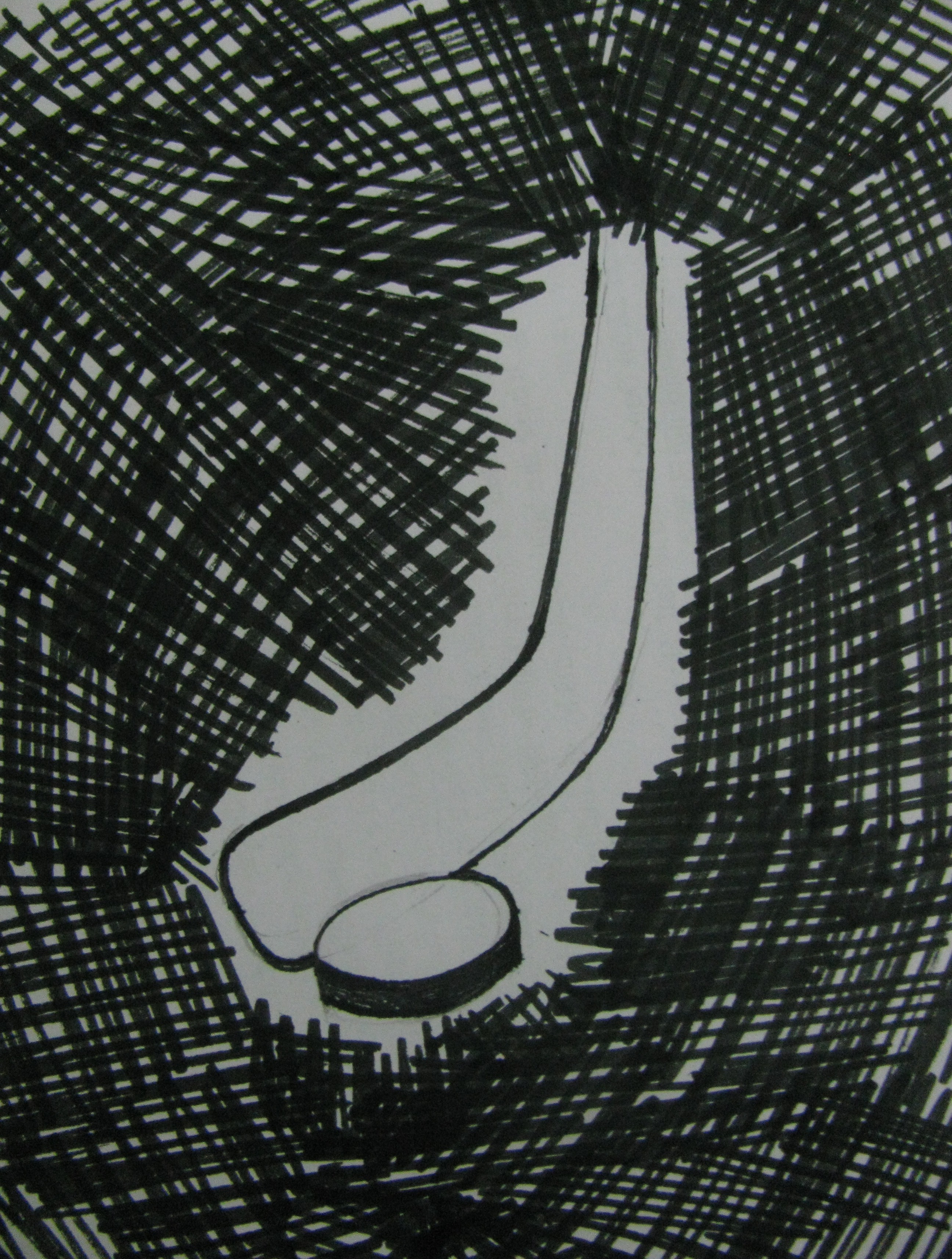
 

BLACK, WHITE AND WOLF

When you are the first Indian woman to ski to the South Pole, tough decisions are bound to have been part of your diet.

Yet Reena Kaushal Dharmshaktu struggled to be strict with the black dog that knew her well from past treks in the Pindari Glacier area and worse, seemed to know how to soften her resolve. As Reena said repeatedly, taking dogs out of their familiar territory can be hard on their lives. It was better that this dog stayed put at Khati.

She had begun the day determined to enforce it.

Kaalu though had a mind of his own.

At first he stayed ahead of the trekkers slowly picking their way up to Khati Khal en route to villages east of the Pindari Glacier trail. Every time Reena caught up with him and shooed him away, the black dog – hence his name Kaalu – slyly fell back. He would almost drop out of sight only to emerge at the periphery of the trekkers’ world – typically lying down and nonchalantly watching humans huff and puff through his backyard. Early evening as we set up camp, we knew Reena’s best attempts to discourage Kaalu had failed. That night the newest member of the trekking party announced his role by keeping vigil and chasing inquisitive jackals away. Next morning, our group composed mostly of high school students learning the finer aspects of wilderness travel, were in love with Kaalu. The old trickster had got the better of Reena. She sat there smiling at him. We had another ten days or so to go.

Reena with Kaalu (Photo: courtesy Reena Kaushal Dharmshaktu)
Reena with Kaalu (Photo: courtesy Reena Kaushal Dharmshaktu)

It was April 2011. The Young Leader India (YLI) course from the Indian branch of the National Outdoor Leadership School (NOLS) was underway. Reena was course leader; Gaytri Bhatia, who loved to run ultra-marathons, was second in command. I was Instructor-In-Training. Kaalu became mascot at large for the course. And he wasn’t mascot for one day or two – it was so for more than ten days.

Some of us knew him well from previous walks in the region. Usually you found him lounging near Khati’s Jai Nanda restaurant, bordering the small ground where hikers pitched their tents. One of those mountain sheepdogs, Kaalu had exactly the looks and demeanour that would endear him to anyone. He could look at you expectedly as only the word expectedly meant, while you spooned food to your mouth. You patted him on the head and your hand sank into a cushion of eminently pat-able crown. If you didn’t give him any food, he didn’t complain, whine or create a fuss like other dogs did. He would stoically go back to rest like a hermit meditating on empty stomach; except, he knew that such behaviour elicited your respect and firmly reserved his seat for the next dinner. He was an investor; he worked on you quietly, patiently, diligently.

Kaalu was what you would call a `tourist dog.’

He kept no particular loyalties to anyone and was therefore an outcast at Khati, a village where the habits of settled human life and by extension, the same for canines, appeared held in high esteem. “ Kaalu? That dog would go with anybody,’’ villagers would say dismissively. Man measures dogs by their loyalty to him. The more a dog has qualities revered by humans in other humans, the worthier the canine becomes. A dog loyal to one master or household was therefore dog personified.

Kaalu’s sole loyalty was to food.

Whoever provided it or hinted that they may provide it; he went along. The human aspects of the deal – he rationed it and played it like a master stroke; a sort of embellishment to what actually mattered. As in our case with no indulgence offered, he still managed to nudge the cards in his favour, hanging on long enough to make the human being feel guilty if such an unobtrusive guard dog wasn’t spared some scraps.

Day after day, Kaalu stayed with us.

He followed us into valleys; hiked up mountain passes, camped in the forest and near wild rivers. For the most part, he was well behaved, something I will come to a bit later. The only irritating things about him were the scruffy unwashed look that came with being the backpacker of the canine community; a weakness for cheese and a penchant to crawl into the instructors’ tent when the weather was adverse. What I remember most about him was something else. He rarely picked up a quarrel with another dog although a wanderer like him passing from one village to another was perennially trespassing territories zealously guarded by other packs. Barked and howled at – you could literally say hounded – from one end of a village to the other, he simply kept his cool and walked amidst the file of trekkers.

Kaalu, on the trail to Khati Khal (Photo: courtesy Reena Kaushal Dharmshaktu)

Kaalu, on the trail to Khati Khal (Photo: courtesy Reena Kaushal Dharmshaktu)

It reminded me of seasoned human travellers. They lose their interest in the territorial defence of settled life, almost becoming useless for such defence. They would much rather keep their peace and take in the world, aggression, defence, shallowness and all.

On the last day however, Kaalu met his match. Tiger of Munar village was not only fiercely territorial but he was also a good half size bigger than Kaalu. As the two dogs squared up in a fury of growls and bared teeth, the surrounding humans intervened to eliminate a fight. Had there been one, I doubt very much if Kaalu would have survived. Travellers rarely do for their mind is not in such householder-lunacy.

Defend a piece of territory when a world waits?

Nah! 

That day we dropped off Kaalu at Song, which is the official starting point of the Pindari trek. It wasn’t easy on the humans. The driver of one of our vehicles wanted to take him to Ranikhet; a student was ready to take him all the way to her house in Ahmedabad. Reena and Gaytri weighed the options and decided that the hill trails he knew were his natural home.

A fortnight later, I was back in Khati.

Kaalu wasn’t around.

When he appeared, it was from the Pindari Glacier side, as usual, leading a group of trekkers.

I have been a regular visitor to the Pindari, Sunderdunga and Saryu valleys.

On several trips, I ran into Kaalu.

In May 2013, my cousin Rajeev and I had an enjoyable hike in the region that was memorable for the dogs we encountered.

A cold evening, camped below Jatoli village, we were woken up from sleep by somebody saying hello. Outside were a Polish couple and their pet canine, `Duna.’ She was a Czechoslovakian Wolfdog. Over the next few days spent hiking into and out of the Sunderdunga valley, we got to know them better. The Wolfdog was trifle detached and aloof in temperament. Unlike regular dogs, it was mostly silent and never wagged its tail. Its expressiveness seemed to be in its eyes; how it tilted its face to observe, how it held its ears, how it listened. It rarely barked; it had a repertoire of whines instead, some imploring and questioning, others, stating. A big, lean, athletic animal, its body movements were deliberate, often slow. It had its playful moments but it often left me imagining a melancholic loneliness.

It’s was a serious, soulful presence.

I liked that.

The white dog on the trail to Dwali (Photo: Rajeev G)

The white dog on the trail to Dwali (Photo: Rajeev G)

Some days later, the morning we commenced a day hike from Khati to Dwali, we were accosted by a dog that was as white as Kaalu was black. It walked with us all the way from Khati to Dwali and back but never completely with us. It seemed shy of heart and soul-commitment. Clearly preferring independence, it hung around the periphery of our world drifting through life like a satellite orbiting a moving planet. Aside from the times we rested or halted for tea and snacks, it usually stayed ahead, pausing to look back and make sure that we were following. From its appearance, we quickly realized its Husky roots. It had brilliant, pale eyes and every once in a while chose to cool itself by lying down in the flowing water of streams. The nippy Himalayan air seemed too warm for it.

Later, our deduction was proved correct. At Khati we were informed that the dog belonged to a Russian couple staying in the village.

I have since looked up photos of Siberian Huskies on the Internet and those eyes and demeanour match.

(The author, Shyam G Menon, is a freelance journalist based in Mumbai. An abridged version of this article was published in The Hindu Business Line newspaper.)