THE PAIN HANDBOOK: ONE FOR KEEPS

pain-handbook-3Keeping the most essential things accessible is a habit we all grow up with.

You know well where you have that song which struck a chord, where you have the book that meant a lot, where you have the movie you like to return to.

What you value; you find a place for it and remember where you kept it.

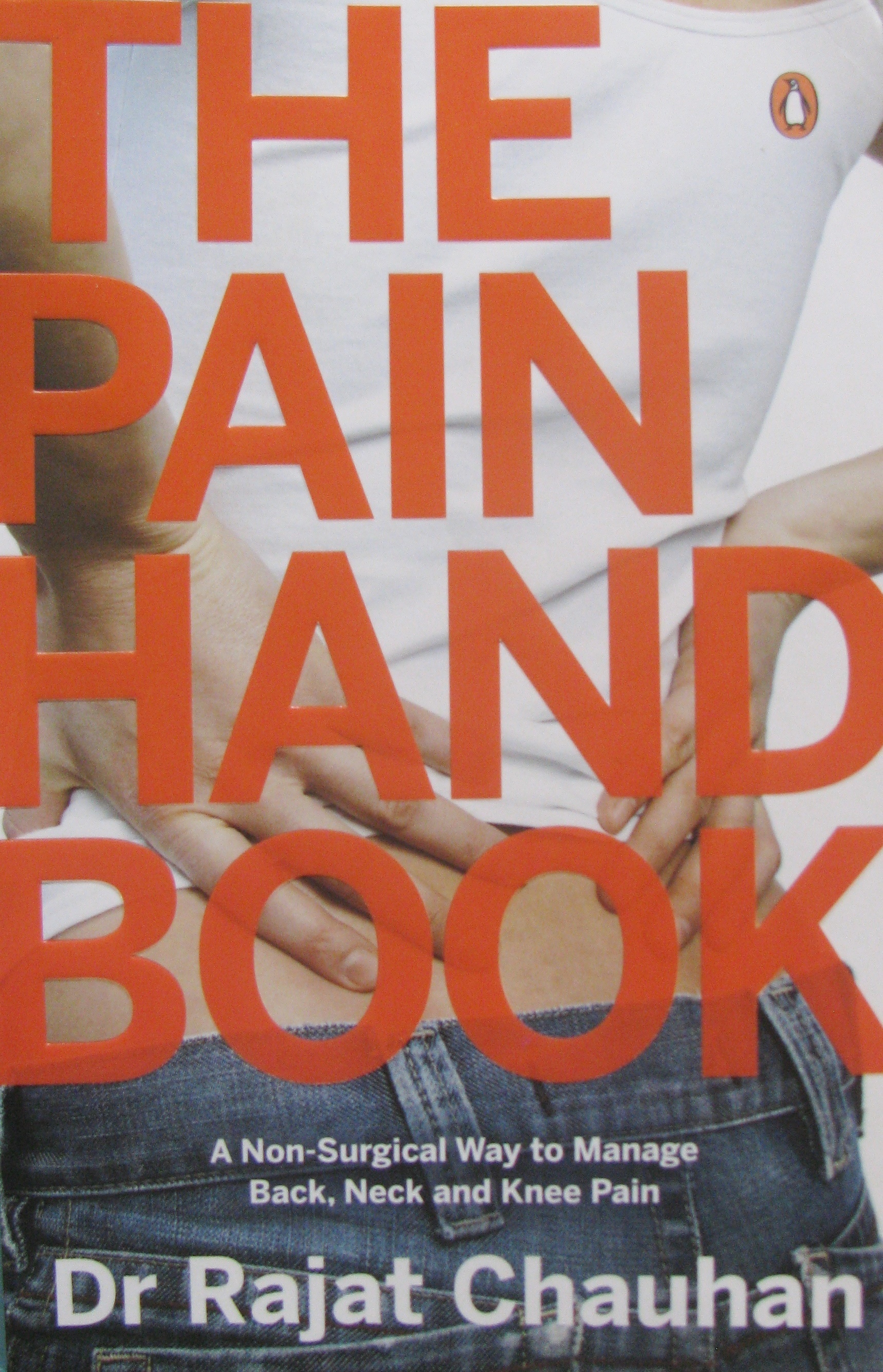
Dr Rajat Chauhan’s book, ` The Pain Handbook – A Non-Surgical Way to Manage Back, Neck and Knee Pain,’ falls in this league. Its one for keeps.

The book deals in the main with lower back pain, which is the most common pain reported. Doing so, it deals with the spine, knee, hip and foot besides touching upon other related points. Some problems are explained with case studies. The book’s biggest contribution, I felt, is how it helps you understand what is what in your back and lower body and what may be happening in your anatomy and lifestyle that is the cause of those aches and pains. It shows how the modern sedentary lifestyle is taking a toll on us; even how the health care system makes a business of the opportunity. The book encourages doctors to go beyond seeing their patient as mere statistic and attempt comprehension of person. After all, the cause of pain may range from injury to simply stress.  Despite proliferation of advanced technology, some aches and pains can be addressed with the simplest of solutions.

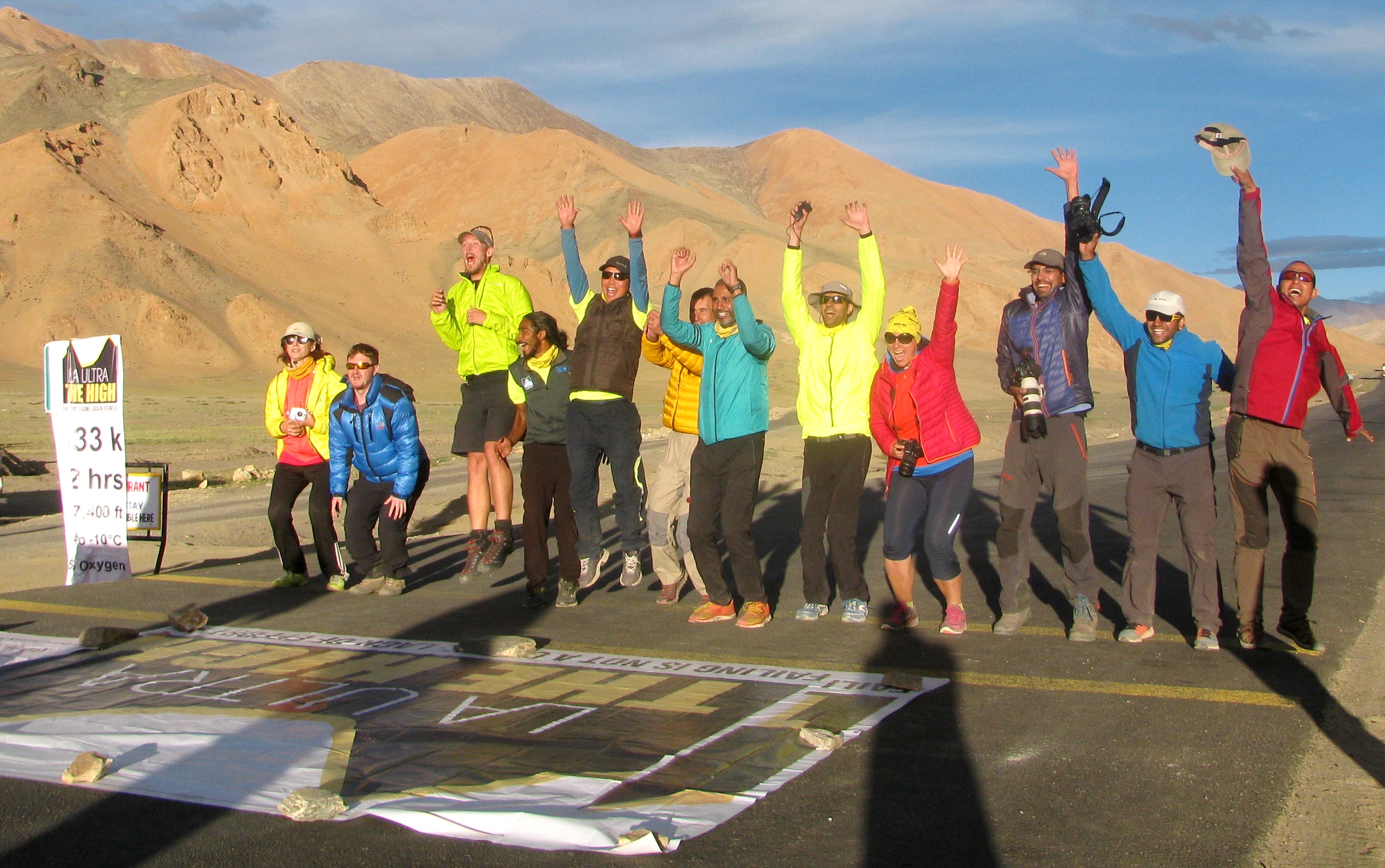
The book is written in a reader friendly style; almost conversational. The non-surgical way to managing pain is underscored by a portfolio of exercises and photos of the same, provided in the book. The narrative is partial to being a practical overview of pain (within that, lower back pain) and a useful handbook to refer. If you are looking for the science and phenomenon of pain or an exploration of its biological relevance, you may find the inquiry limited. Where it scores is in its larger appeal as guide (handbook) in times of predominantly sedentary existence with attempts made by the denizens of that world, to embrace a more active lifestyle. Besides being a doctor specialized in sports exercise medicine and osteopathy / musculoskeletal medicine, Dr Chauhan is a distance runner and the main architect of La Ultra-The High, a challenging ultramarathon at altitude held annually in Ladakh.

This is a book I would like to remember where I have in the house.

It is certainly worth buying, reading, keeping.

(The author, Shyam G Menon, is a freelance journalist based in Mumbai.)

`ANYWHERE BUT HOME’ – A GOOD READ

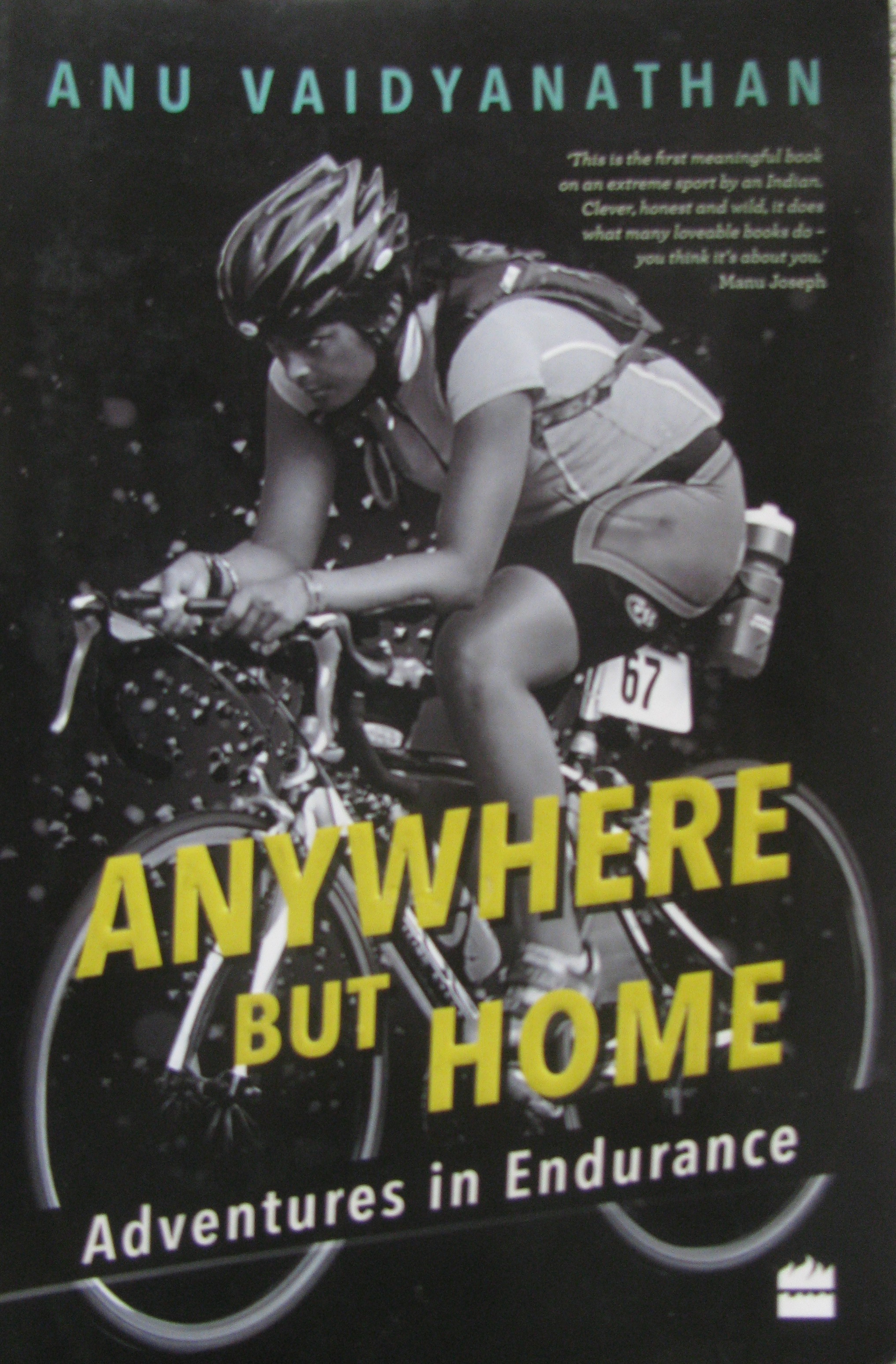
anu-vaidyanathan-1Anu Vaidyanathan’s book, `Anywhere but Home,’ is an enjoyable read.

The language is simple and the narration, direct.

The author, who is a well-known triathlete, provides a breezy overview of her life. The choices made are stated as such without recourse to justification. Doing so, both triathlon and life in Anu Vaidyanathan’s book, are beautifully devoid of labored explanation. There is no manufactured heroism or manual on how to succeed, except perhaps what lingers obliquely as an idea of person (who is also triathlete). One of the great reliefs I found reading this book was its treatment of athlete’s life without making it seem extraordinary. The writing transcends given sport to underlying qualities.

The book spans growing up in India; studying overseas, the difference between here and there, managing a business, pursuing a PhD, the question of “ who am I?’’ and within all that – an engagement with the triathlon. It is a packed life; a triathlon of a life wherein the sport appears to have given physical expression to a person’s nature. Many outdoor and athletic pursuits inspire the need to progressively lighter one’s view to essentials. When `essentials’ becomes ink for writing, the pages turn. That’s so with this book.

Buy it, read it.

(The author, Shyam G Menon, is a freelance journalist based in Mumbai.)

PSYNYDE ALERT: THE HOUR OF THE FURAN

The Furan (Photo: courtesy Psynyde Bikes)

The Furan (Photo: courtesy Psynyde Bikes)

It’s the hour of the Furan, a game changer for Psynyde Bikes.

Wikipedia describes Furan as a heterocyclic organic compound; one that is a colourless, flammable, highly volatile liquid with a boiling point close to room temperature. At Psynyde, Furan is a hardtail mountain bike (MTB). It represents the first time, Psynyde Bikes – a small enterprise funded by “ friends and family’’ – is making a departure from custom-built bicycles and launching a product for the larger market. Doing so, they have to move through all the regular motions of a bicycle manufacturer from finding the best way to make the bicycle, selling it and supporting it in the market.

The story is longer still, if one sees Pune based-Psynyde as a response by riders to the shortcomings of the Indian bicycle market, dominated for decades by a clutch of manufacturers churning out large volumes in protected economy. Thanks in large part to one man – Shiv Inder Singh, one of the founders of Firefox Bikes (subsequently bought by Hero Cycles) – a market for premium bicycles opened up in India. Away from the main market, cyclists like Praveen Prabhakaran and Vinay Menon, tapped into their personal learning to start initiatives such as Psynyde (for more on the origin of Psynyde, please try this link: https://shyamgopan.wordpress.com/2014/02/06/the-story-of-psynyde/).

Making custom-built bikes, Psynyde catered to a small niche of customers for whom, premium didn’t necessarily mean perfect. At that level of search, the bicycle world entailed materials science, computer aided design, frame geometry, welding technology and the like; basically the quest to make a perfectly fitting bicycle that also addressed the application in mind. There is much learning here but as Praveen said, it can also be a bit difficult sometimes coping with unrealistic deadlines and customer expectations. It was from this backdrop that the Furan, Psynyde’s first hardtail MTB to be made in large numbers, took wing. Two aspects qualify the Psynyde approach. First there is the obvious – they see their products as designed, tested and made by riders. Second, both Praveen and Vinay are clear: they wish to be in the performance segment, which at present is a niche within the premium category of bicycles. “ We want to address serious cyclists,’’ Praveen said.

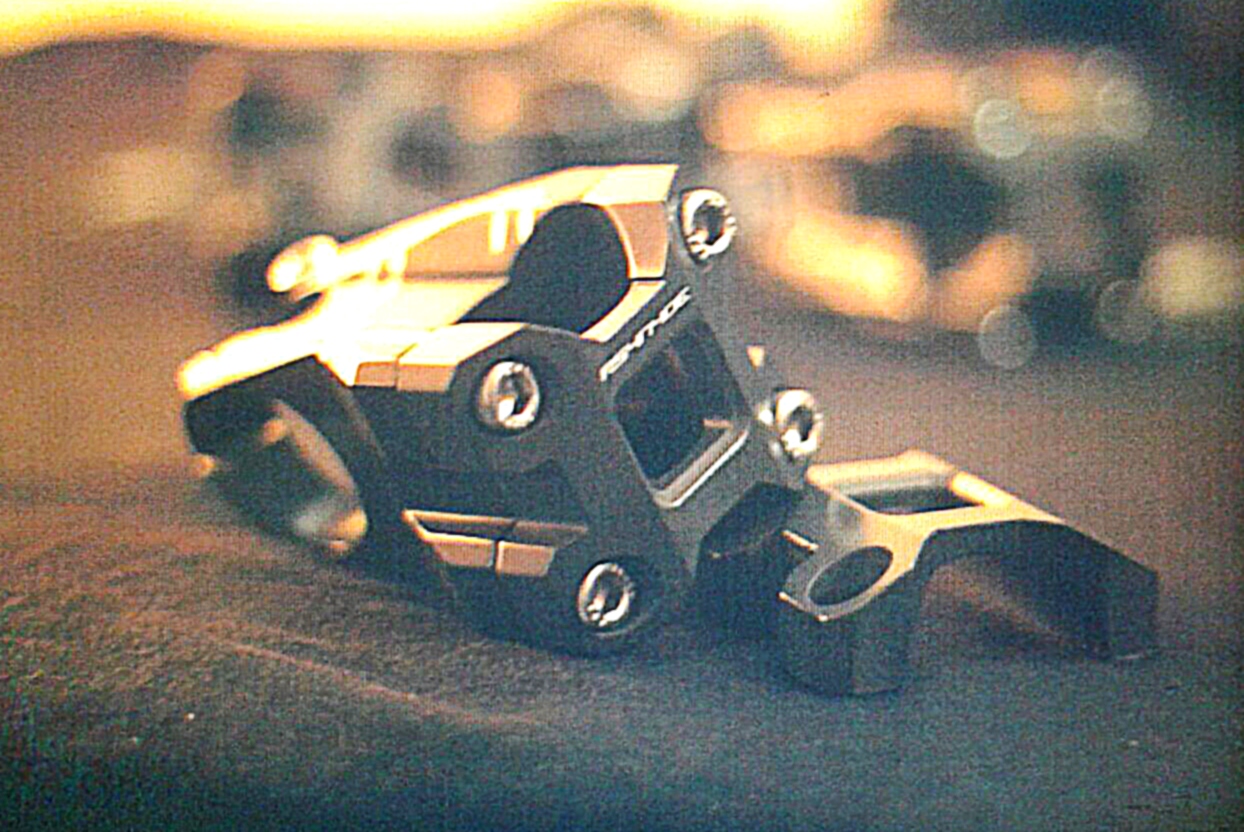
A bicycle component - a stem; part connecting the handlebar to the fork - made by Psynyde Bikes (Photo: courtesy Psynyde Bikes)

A bicycle component – a stem; the part connecting the handlebar to the fork – made by Psynyde Bikes (Photo: courtesy Psynyde Bikes)

The premium category can be broadly divided into three types of bicycles – road bikes, hybrids and MTBs. Road bikes are popularly called “racing cycle’’ in India. The MTB segment, born for uneven terrain and previously little known, became popular once the market opened up. The hybrid, as the term denotes, straddles the lightness of a road bike and the off-roading capability of a MTB without being pronounced in either. It is a flexible, overlapping segment gaining much popularity of late. Psynyde’s need to be identified with performance meant the hybrid was automatically ruled out for want of sharp definition. While Psynyde has custom-built road bikes, they did it using steel, a material that has advanced much in terms of metallurgy and machining. A discerning client will comprehend a light road bike made of special steel. But the market revered carbon fibre as ultimate in light weight road bikes. Psynyde is yet to acquire familiarity with carbon fibre. On the other hand, although there are good performance grade aluminum road bikes internationally, in India for some reason they are perceived as `entry level.’ Further, the posture adopted on a road bike isn’t exactly the market’s sweet spot. It is radical; an effort to sustain and to that extent, defining a road biker rigidly to the expense of other cycling styles. Looking for a product to debut with in the market, Psynyde’s focus therefore shifted to the MTB segment. MTBs attracted for a variety of reasons. To begin with, both Praveen and Vinay had a background in mountain biking with Vinay ending up among the best freeriders in India. When the Indian bicycle market opened up, the MTB was what everyone rushed to buy. Many people subsequently upgraded to hybrids and road bikes. But the entry was through MTBs, pointing to a fascination for the model. For its first mass produced bike, Psynyde decided to go with a MTB.

Next step was to decide which particular segment of MTB, seemed best to make a mark in. The MTB category can be roughly divided into three: cross country, trail bike and all-mountain. The cross country bicycle is designed to spend long hours off-road. It is usually strong at tackling uphill. What it occasionally misses is good control at aggressive levels of riding. According to Vinay, many of the MTBs currently sold in India are closer to this technical set up in lineage. All-mountain on the other hand, showcases control including in aggressive riding that pushes the limits. It typically has a wider handle bar and shorter stem. It tends to be tad heavier but is capable of greater control at higher speeds.  In the middle, sort of like a hybrid within the MTB segment, is the trail bike. Its geometry too is amenable to decent control when pushing the limits. A fourth segment – fat bike, featuring fat tyres – has started showing up in India, but for now, it is a novelty. The Furan was imagined as a performance MTB that could also be used on roads. Psynyde decided that a versatile trail bike is what the Furan must aspire to be.

The Furan (Photo: courtesy Psynyde Bikes)

The Furan (Photo: courtesy Psynyde Bikes)

Having resolved to build a trail bike focused on performance, the question next was: how do you define the performance package in a machine that is a composite of frame and outsourced components made to different quality levels and performance parametres? “ Our story is a lot similar to brands like Marin, GT and Specialized – all of who began as frame builders,’’ Vinay said. Like its wing is to an airplane, in a bicycle, the most important part is the frame. Every bicycle manufacturer worth its salt, stakes its reputation on the frame; its geometry and build quality. For Psynyde’s Furan too, its DNA would reside in the frame. That’s the calling card. Other components can vary to provide affordability. The Furan frame was thus matched to different combinations of components. Across the three finishes of Furan offered on the same frame, one critical component stayed the same – a fork with 120mm travel; it was in line with the performance segment the bike wished to be in. Very importantly and in a step unique for the Indian market, it was also decided to sell the Furan frame separately allowing dedicated cyclists in the market to build a cycle with components of their choice.

Next was firming up wheel size. By early 2016, when the idea of Furan was assuming shape, the global MTB market had split into three main wheel sizes: 26 inches, 27.5 and 29 – all having strong reasons for being what each is. The standard used to be 26. Altering wheel size shakes up the market. Existing frames, forks and suspensions become redundant when wheel size changes. It makes existing customers insecure. It puts new ones at the mercy of what companies dish out as logic for the shifts. The core reason for moving into dimensions bigger than 26 inch-diametre – the erstwhile standard – is roll over ability. As the term denotes, a bigger wheel rolls over obstacles easier; it also covers more distance. To complicate matters, even as they suddenly lost fancy for 26, big bicycle manufacturers who committed investments towards their chosen new standard, polarized in their preference for 27.5 and 29. This created the impression that money power and not users will decide trends. As if that is not enough, the manufacturers too appear to be undecided which way the wind will blow for some of their bicycle frames are capable of hosting more than one wheel size. In markets like India, where cycles are bought and retained for long due to less money with customers, such tricky shifts worry. What should Psynyde do? “ We grew up on 26, we are all 26 fans. If I am doing jumps with my bicycle, I still prefer 26,’’ Vinay said. At the same time, you have to accommodate the future and provide for versatile use, which includes covering distance on roads. One thing mattered – as a performance bicycle, expected to be put to punishing use, the Furan couldn’t risk flex in the rim. It seemed wise to embrace the future conservatively. The 27.5 was closer to 26 than 29. It was decided that the Furan should have 27.5 inch wheels.

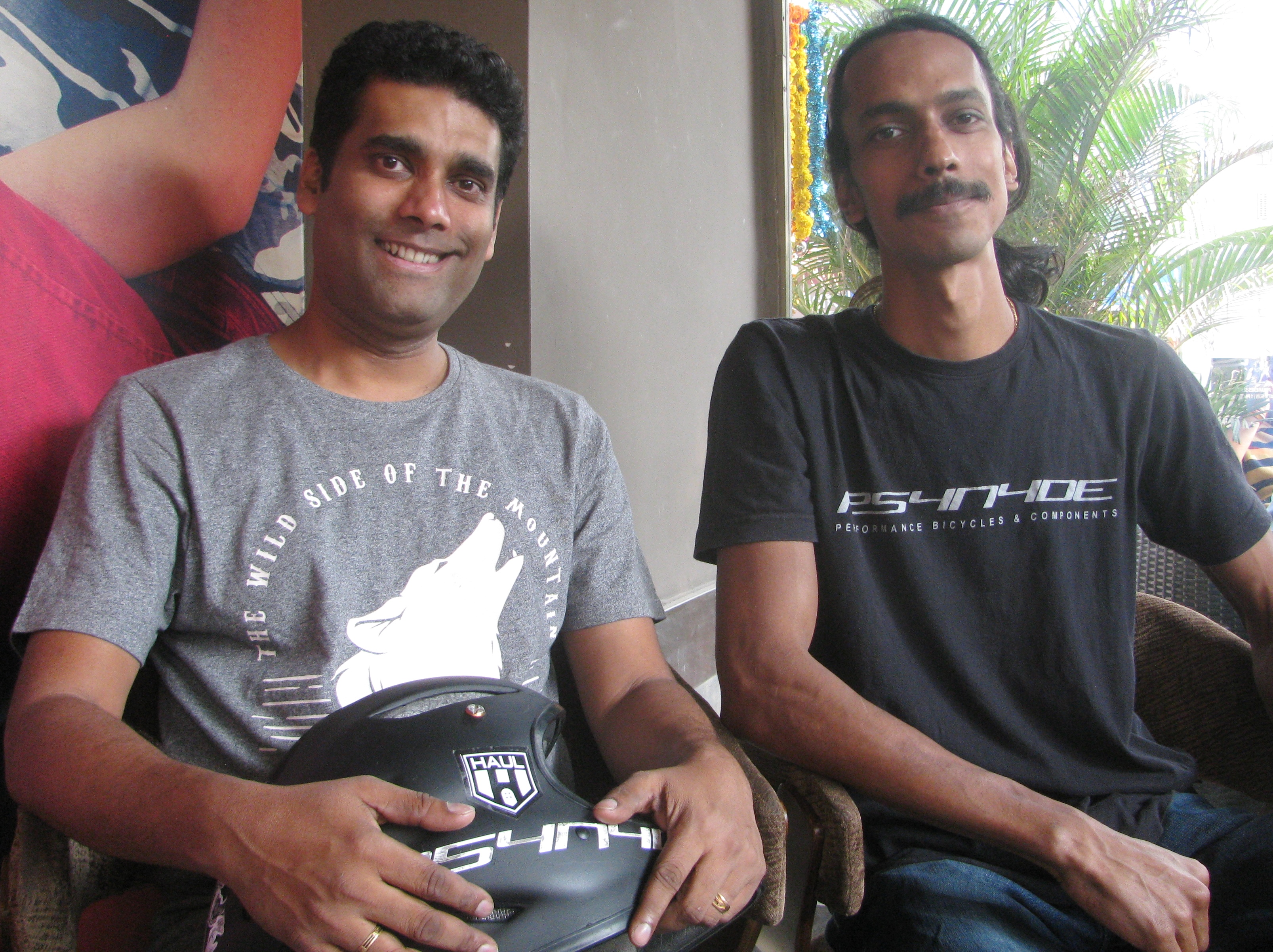
Praveen Prabhakaran (left) and Vinay Menon (Photo: Shyam G Menon)

Praveen Prabhakaran (left) and Vinay Menon (Photo: Shyam G Menon)

All through Psynyde’s journey, Praveen had been the brain behind design and manufacture. He was the one custom-building bikes and who in the process acquired knowledge of materials and welding techniques. While Praveen worked on the Furan’s design, the team searched for a factory that would build the frame from 6061 aluminum alloy. India is a price sensitive market dabbling still in steel for much of its bicycle manufacture. It does not yet support the economics of manufacturing 6061 frames to affordable cost nor does it have the required finesse in aluminum welding techniques. The place to look for was China. Praveen emphasized a point here. China is the global powerhouse in bicycle manufacturing. Many of the world’s leading brands of bicycles are made at factories in Taiwain, China, Vietnam and elsewhere in South East Asia. Investing in scale, the Chinese have a reputation for being low cost. It is also fashionable to associate the Chinese with poor quality. “ What is closer to reality is that they will make a product as you wish it to be. If you ask for a low quality bicycle, you will get a low quality bicycle. What we forget is that we blame the source based on what product we chose to sell in the market, ignoring who decided product specifications in the first place,’’ he said.

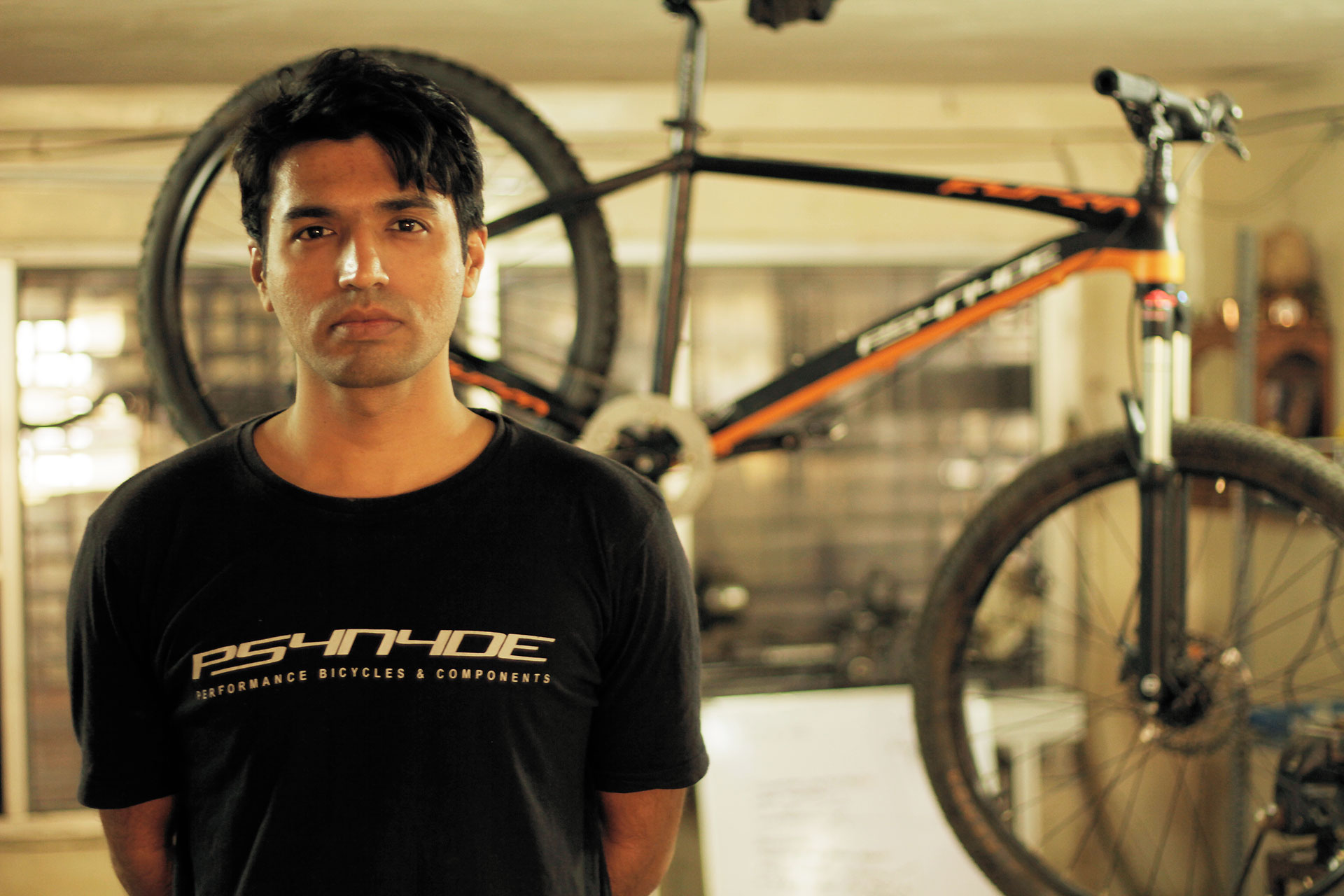
Sudeep Mane (Photo: courtesy Psynyde Bikes)

Sudeep Mane (Photo: courtesy Psynyde Bikes)

Sudeep Mane is a statistician. He grew up in Pune. His first job after completing studies was with Bajaj Allianz General Insurance. Finding himself interested in archery, he trained in the sport at Army Sports Institute (ASI) for about a year. Later he took up trekking. By then he had moved to his second job, at SAS Research & Development. His engagement with the outdoors growing, he decided to do his Basic Mountaineering Course from the Himalayan Mountaineering Institute (HMI) in Darjeeling. Upon finding it hard to obtain leave for a month – the duration of the basic course – he quit his job and proceeded to do the mountaineering course. His third job – this time with the US headquartered-IT company CNSI – found him based in Chennai. For a person liking outdoors and Pune’s hills, this was different terrain. So Sudeep focused his attention on training for the triathlon. As part of this, he bought an entry level Schwinn MTB. He also learnt swimming. A year and a half later, Sudeep took part in the triathlon organized by Chennai Trekking Club. He realized the sport wasn’t his forte; his swimming was not up to the mark. But he had made a discovery: he liked cycling. He had found something he wished to pursue. His inquiries revealed that the best bike would be a custom built one. On the Internet, he stumbled upon Praveen’s blog about building cycles. The blog appeared an on-off affair without systematic updates. Sudeep mailed Praveen. “ I mailed him exactly five words: do you still do this?’’ Sudeep said.

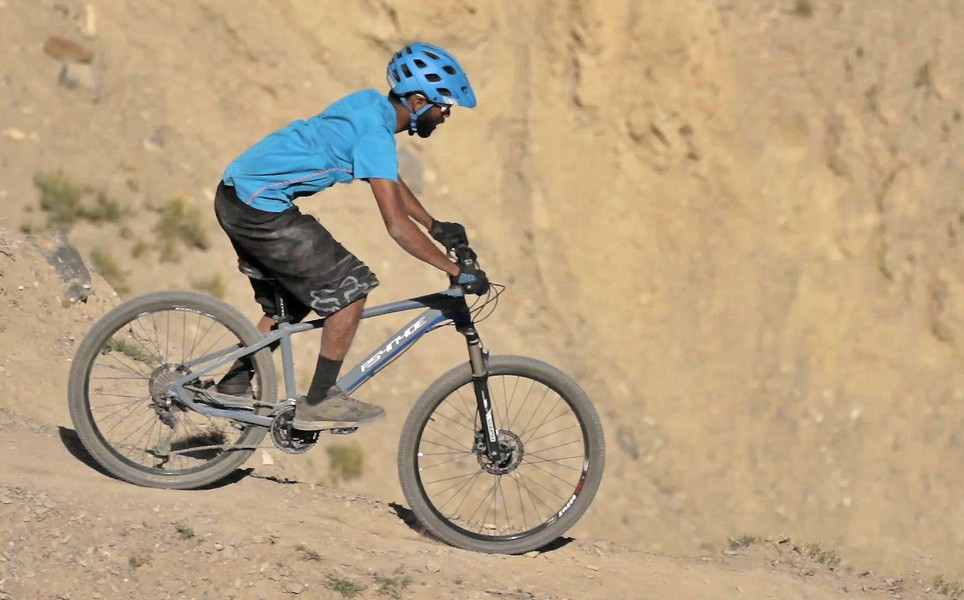
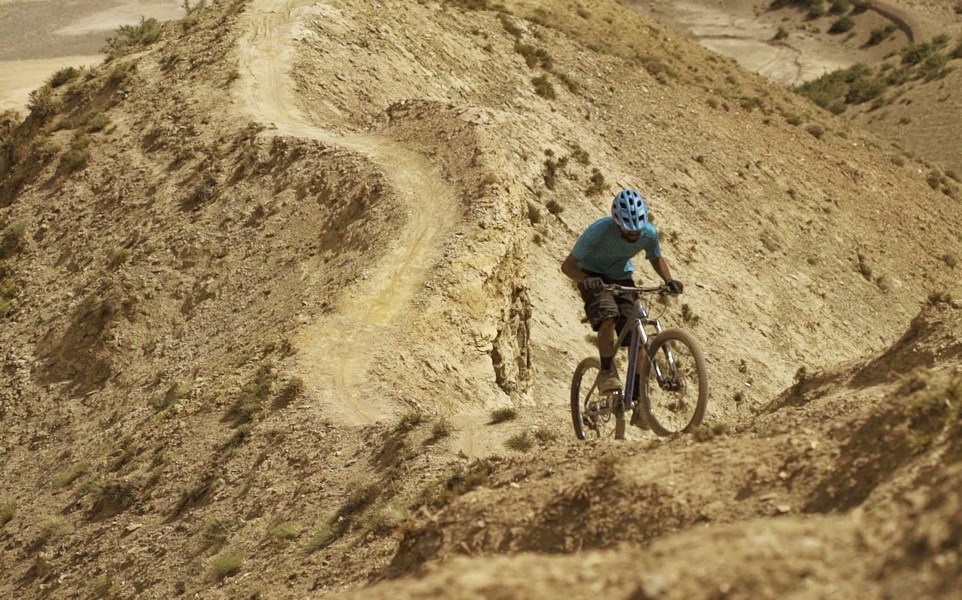
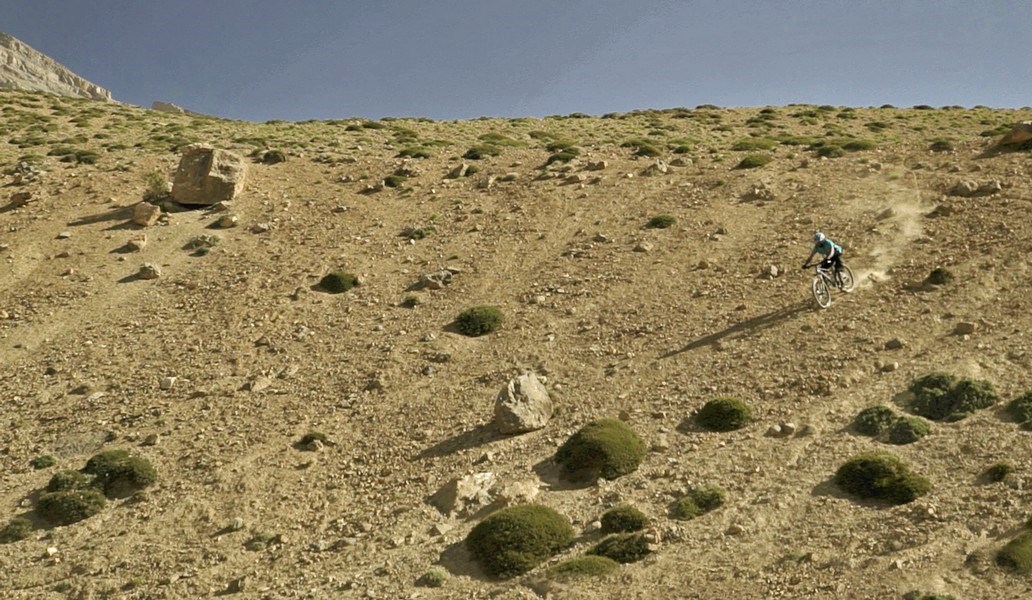
The Furan being tested in Spiti. Rider: Ajay Padwal (Photo: courtesy Psynyde Bikes)

The Furan being tested in Spiti. Rider: Ajay Padval (Photo: courtesy Psynyde Bikes)

Praveen built a bicycle for Sudeep; a road bike named Psynyde Projectile. Meanwhile Chennai was working on Sudeep. The city had a fairly big community of cyclists. “ Early mornings I would probably find two to three times more cyclists in Chennai than in Pune,’’ Sudeep said. Slowly the idea of a good quality bicycle in an Indian market progressively getting ready for it, took shape. In May 2015, Sudeep got in touch with Praveen and Vinay and pitched the idea of a partnership in making bicycles. Committing himself to the move wasn’t exactly easy for Sudeep. Having no previous experience as entrepreneur, he wondered whether he should do a MBA. Two things helped. A professor he knew at Mumbai’s Wellingkar Institute guided him; officials at the company he worked for – CNSI, were supportive. Today Praveen, Vinay and Sudeep are the core equity investors at Psynyde Bikes. Sudeep coming aboard had immediate impact. The enterprise acquired structure and a sense of urgency. In January 2016, Psynyde Bikes moved to official address on 1000 square feet space at a MIDC-industrial estate in Pune. “ Praveen was building cycles. Neither he nor I was thinking of how to sell it. I knew how to test a bicycle. Sudeep gave the idea concrete shape. That was needed. Otherwise, we would have still been chilling, taking it easy,’’ Vinay said. Sudeep oversees the finance function at Psynyde. He handled Psynyde’s dealings in China.

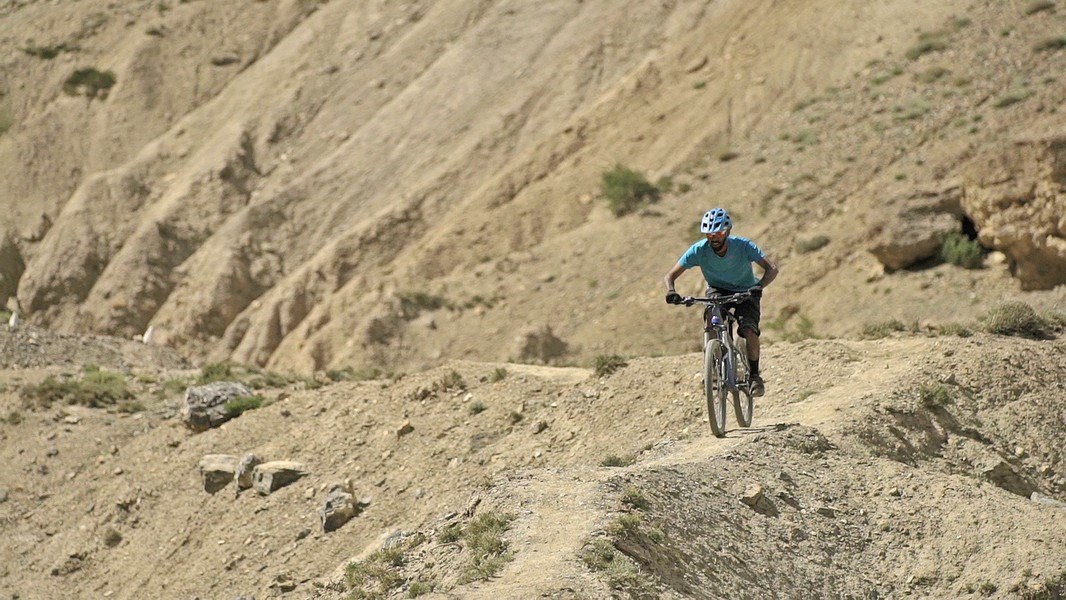
According to Praveen, the typical Chinese manufacturer keeps a catalogue of already designed products. Many brands order bicycles from the catalogue. What is bought is then badged to sport a given brand’s name. “ We were approaching a Chinese manufacturer with a bicycle frame we designed. We knew what kind of frame we wanted; we merely wished to get it built and produced in numbers. We were also uncompromising on specs,’’ Praveen said. By April 2016, two Furan frames and their associated components had arrived in Pune. Two bikes were assembled. Vinay headed to Spiti in Himachal Pradesh to test the MTB. With him was Ajay Padval, an upcoming mountain biker, currently part of a Psynyde sponsored-team of cyclists. They tested the Furan for a month in the mountains. They also participated in some mountain bike races. The Furan had a couple of finishes in the top ten-category, Vinay said.

The Furan in Spiti (Photo: courtesy Psynyde Bikes)

The Furan in Spiti (Photo: courtesy Psynyde Bikes)

In early November when we met for this article, the Furan was in the stage of crowd funded-sales. About 120 bikes or so were totally on offer in the initial phase. Orders placed – as visible on the crowdfunding site in early November – were very few. Less than 10 days remained for campaign’s close. Neither the demand for Furan nor the level of funds raised by then (a little over one tenth of what they stated as goal) bothered Praveen and Vinay. They said there had been healthy enquiries for the bike from riders and dealers long known to them. While around 70 dealers who are into performance bikes, showed interest, about 25-30 of them have agreed to stock the Furan to gauge market response. “ The crowd funding campaign provides us visibility because news of the Furan gets dispersed thanks to the very nature of crowd funding. Being a small outfit, our budget for marketing is otherwise very low,’’ Vinay said. Sudeep provided insight into the start-up company’s finances. Broadly speaking, the money for investment has come from people who empathize with cycling, understand the product and have noticed the Indian bicycle market or believe in the promoters, their background in cycling and their commitment to it. He approached several banks for funding but nothing worked. Their procedures wouldn’t allow them to take a position on a new bicycle venture like this. So investors other than the promoters have put in their funds as loans. It is currently debt but should the company hit revenues forecast, it can be converted into equity. Otherwise it is money to be repaid. Interestingly these investors include some senior corporate officials, who have invested in their personal capacity.

The Furan being tested (Photo: courtesy Psynyde Bikes)

The Furan being tested (Photo: courtesy Psynyde Bikes)

Deliveries of the Furan were slated to commence by mid-December. “ As regards where the Furan is in the Indian bicycling scenario, it is in a good spot right now. There are a small number of people who understand performance bikes. They will identify with our journey. We are also in no hurry to grow,’’ Vinay said. According to him, the Furan has the required quality certification to sell in the Indian market. Rider friends from overseas have shown interest. While they can pick it up in India, supplying the Furan to dealers overseas, even in limited numbers, will take time, for due certifications have to be obtained.

According to Praveen, the foray into manufacturing the Furan had another reason too; a secondary one. Psynyde had machined bicycle components in the past. These components were periodically disclosed on the outfit’s Facebook page. The components were meant for discerning riders. Fact is – you can’t have a market of discerning riders seeking high end components, unless the market has an idea of a good ride. For that, you need good bicycles. If the Furan can pull it off in its chosen segment, then Psynyde’s capacity to design and machine high performance components, also stands to gain. Vinay assigned five years for Psynyde’s Furan phase to play out. When that draws to a close – maybe earlier, maybe tad later – he expected to see others like him, Praveen and Sudeep enter the performance category with bicycles they designed. That would spell competition. But it is also the spirit of Psynyde, vindicated.

(The author, Shyam G Menon, is a freelance journalist based in Mumbai.)                    


“ ORGANIZING A RACE SEEMED THE THING TO DO IN LIFE’’

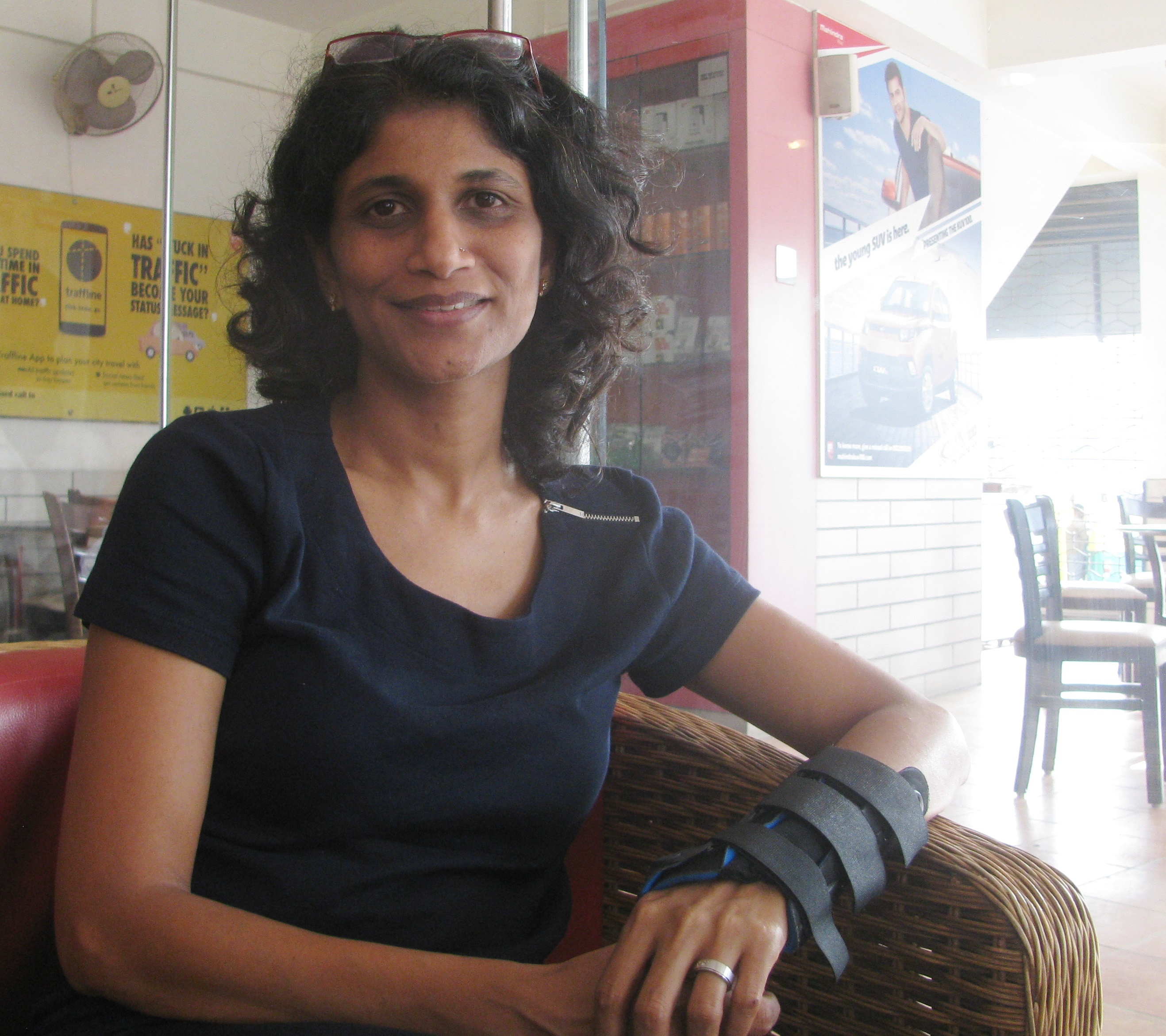
Kavitha Kanaparthi (Photo: Shyam G Menon)

Kavitha Kanaparthi (Photo: Shyam G Menon)

Talking to Kavitha Kanaparthi, whose company Globeracers manages a diverse portfolio of ultramarathons in India.

In August 2005, Kavitha Kanaparthi was in Bengaluru to settle a pending legal matter.

An American citizen, she had five weeks for the purpose. Her plan was to finish the work in Bengaluru and get back to the US, where a job in government awaited her. She had been selected for it and training was due to begin. But the legal issue needed urgent attention; it demanded closure. She had requested her employers for time and secured those five weeks. What unfolded in Bengaluru was completely unexpected. A Pandora’s Box opened up. Legalities extended correspondingly. The five weeks grew to a wait of three years. By the time closure was reached, she had long lost the job she was selected for. She was upset, at a difficult juncture in life and yet again with running as sole companion to escape world and its ways.

Kavitha is no stranger to both – difficult situations and running. There is a video on the Internet, of one of her lectures, wherein she mentions an old road accident. It happened in 1988. She was on a cycle and was hit by a bus, the impact sending her flying some 25 feet into the air before crashing back to the ground. “ I pretty much broke all the bones in my body,’’ she says in the talk. Further, her face was damaged. The Kavitha of today is a “ pretty good patch work’’ done by her father, who is a doctor. “ This is not the original me,’’ she tells her audience. In the immediate aftermath of the accident she suffered from amnesia, unable to recognize anyone including her parents. She had to cope with a long path to recovery and even now its legacy is felt occasionally. In fact, she came for our chat in a Bengaluru suburb, wearing an orthopedic prop to support a wrist, a case of old accident’s aftermath periodically acting up. Her education too appears to have been fraught with penalties from society, incurred periodically for being true to her instinct. Through all this, sport remained part of her life. “ I was already competing as a runner when I was 8-9 years old,’’ she said. There were gaps – accident being one – but running was something she always got back to.

In 2008, while stuck in Bengaluru, she spoke to a friend about attempting ` The Amazing Race.’ It is an American reality competition show in which typically, eleven teams of two race around the world. The process of application required submission of a video. To shoot that, in May 2009, they went to run in the Sandakphu area on the West Bengal-Nepal border. Her friend had run there before. In all there were six persons of which, three were runners; they did the run from Mane Bhanjang to Sandakphu and back in four days. Till the time of my meeting her in mid-2016, Kavitha had not run a formal marathon at an organized event, save an exception at the request of her friend Nagaraj Adiga, when she ran the 2014 Bengaluru Marathon.  City marathons are not her cup of tea. “ I love mountains. I love trails and I like being out there on my own,’’ she said. Kavitha was brought up at her village in Andhra Pradesh and then, in Vijayawada. After finishing her school education in the city, she had moved to the US and attended Washington University in St Louis. She found much happiness running and cycling in the forests there. Her love for trail and respect for solitude likely comes from this phase. As for professional qualification, she holds a degree in electrical engineering, something she has described in her talks as “ by default’’ given what she subsequently did in life had little to do with the degree she obtained. A sliver of what lay ahead surfaced in the Sandakphu run. It was the electrical engineer with a fondness for running who put the entire run together. Her friends were impressed by how she organized it. That’s how the suggestion that she organize races, took shape. “ I was very excited about it,’’ she said. She wrote about her new experiences on a blog and called it – Globeracers.

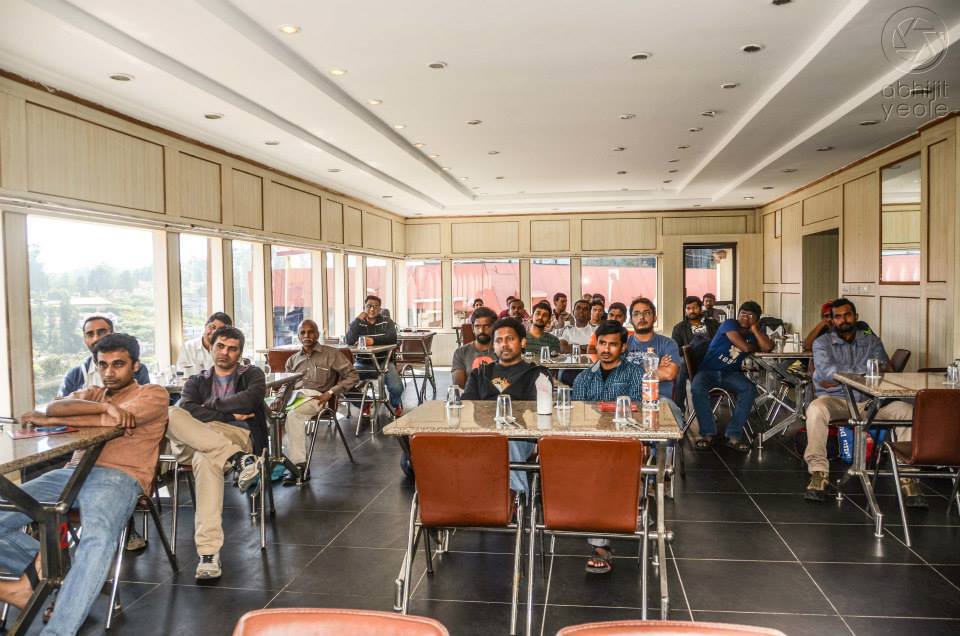
A race briefing (Photo: courtesy Globeracers)

A race briefing (Photo: courtesy Globeracers)

Immediately after that Sandakphu run, she chanced to go to Jodhpur and Jaisalmer in Rajasthan. The regular tourist circuit bored her. Somebody said: why don’t you visit Pokhran? Kavitha shifted to Pokhran and stayed there for a couple of days. One day, seeing sand dunes in the distance, she spontaneously embarked on a run, “ much to the consternation of my hosts.’’ She thoroughly enjoyed the run. Her hosts having understood her interest in running shared her enthusiasm to organize a race in the region. “ Over the next three days, we planned out the whole race,’’ Kavitha said. In Bengaluru, she got down to the job of rechecking the distances involved. Then she changed her blog into a website and created a home for the event she had in mind. She also posted information about the event on the Runner’s World website. “ I expected nothing out of it,’’ she said. Nevertheless, organizing the event in Rajasthan excited as idea. “ I thought I will organize races for a living. Each recce takes me to a new place, I have to run to locate trails and get a feel of how things are. Organizing a race seemed the thing to do in life. It really comes down to my need to be in wild landscapes. These locations aren’t the type where one goes to spend an hour or two. They are best experienced over days. Ultras allow me to spend that time outdoors. I don’t feel the need to organize shorter distances. There are one too many offering it already,’’ she said. Finally there was also that bonus: when you organize an ultramarathon, you meet other ultra-runners. As a breed, ultra-runners aren’t as many as the marathon lot. It is a smaller community.

To get the event up and going, Kavitha spoke to Santhosh Padmanabhan of Runners’ High. Through him, she got in touch with Arun Bhardwaj, who has been a pioneer among Indian ultramarathon runners and who by then was participating in events overseas and faring well in many of them. However the first person to register for the race in Rajasthan was a German citizen working with Mercedes Benz in India. Two days later, a runner from Canada enrolled. Then two runners from Singapore signed up. The Pokhran run was planned for December 2009. She had six months to prepare. During that time, Kavitha did the recce twice. She didn’t want the race to be on the road. It had to be trail. The markers for the GPS were picked up during the recce. Her route started in Pokhran and ended in Jodhpur, 210 km away. It was a good enough distance for a multi stage ultramarathon. Arun wanted to do this at one go. The interest all around was encouraging. But there were challenges. Kavitha didn’t have the required capital to invest. On the other hand, high race fee, which is usually the norm when races happen in remote locations (cost of organizing, overheads etc), cannot be shouldered by all. For instance, according to Kavitha, when Arun signed up for the run in Pokhran, he wasn’t in a position to pay the fee decided by race economics. You have to take talent along. A race being organized for the first time, struggles.

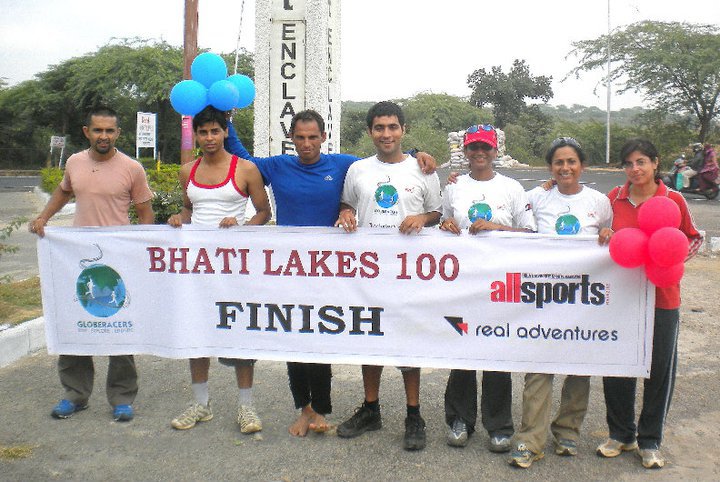
From one of the editions of Bhatti Lakes Ultra (Photo: courtesy Globeracers)

From one of the editions of Bhatti Lakes Ultra. Arun Bhardwaj (third from left), in blue T-shirt (Photo: courtesy Globeracers)

Given Pokhran as location, Rajasthan Tourism helped. Approvals from the local administration took some time to materialize. In 2009, India’s biggest marathon – the Standard Chartered Mumbai Marathon (SCMM) – was itself only five years old. Although growing, the running culture was an urban phenomenon; that too most seen in big cities like Mumbai, Bengaluru and Delhi. Ultramarathons were known mainly to distance runners and within that, to a limited lot. Most people had no clue what the discipline held or why anyone would be so mad as to run extremely long distances. Add to it, the spectre of going off road and into an arid desert. Initially officials at ground level couldn’t understand what the organizers were up to. When they grasped the idea of ultramarathon, they tried to steer the race on to the road, something Kavitha didn’t want. She preferred off road and trail. Eventually permissions had, about half a dozen participants ran the first edition of the Thar Desert Run. Arun’s blog entry on the race mentions that he ran it at one go because that suited his style; besides, he didn’t have that many days to spare. He finished the whole 210 km in 31 hours, 20 minutes. It was with the Thar Desert Run that Globeracers firmly left the world of being blog and became race organizer. The event was run again in 2012 with seven runners.

The best known race from Globeracers’ portfolio is Bhatti Lakes Ultra. According to Kavitha, that race was the fallout of a need felt by Arun Bhardwaj. He hadn’t run the iconic Badwater Ultramarathon, staged every year in California’s Death Valley. Until then, no Indian living in India had completed Badwater. In 2010, Chris Kostman, the Race Director of Badwater Ultramarathon, visited India at Kavitha’s invitation. It was part of a quest to get Arun to Badwater. Participation in the race is by invitation. While the visit provided the Race Director an opportunity to meet Arun and gauge his interest, Arun needed a 100 mile-race, an officially accepted Badwater qualifier. Kavitha was staying in Gurgaon at this time.  A friend, Prem Bedi, spoke of a place to run near Delhi, essentially a trail-run in a region hosting five lakes. They went to the said area and tried the trail. The local people said they will help organize the race. On race day, 19 people turned up to run the inaugural Bhatti Lakes Ultra, most of them for the shorter distances. Arun ran the entire 100 miles. The 19 participants were despite no marketing. “ There was no thought in me that I should market the race. For me, it was all goodwill. There were embassy officials; there was a race organizer from Nepal. My learning from organizing races is – logistics. I feel insulted if I have to market a race. I am not looking for a large number of participants. I would like to know my runners by name, know what they want, what they eat, what makes them run,’’ Kavitha said. The Bhatti Lakes Ultra has since been organized every year. According to her, the runners who come to Bhatti Lakes are serious runners.  “ I believe they have a sense of accomplishment at my races. That is among the reasons that make us special,’’ Kavitha said of Globeracers and its races. The 2016 race was the seventh edition of Bhatti Lakes. As for Arun, after that first edition, he went on to successfully complete the Badwater Ultramarathon in 2011, the first Indian from India, to do so.

From one of the editions of Ultra BOB (Photo: Globeracers)

From one of the editions of Ultra BOB (Photo: Globeracers)

Besides being a distance runner, Kavitha is a keen cyclist. When in Bengaluru, she used to cycle from the city to Ootacamund (Ooty).  Those trips became the bedrock for her next ultramarathon event – a run in the Nilgiris. The first edition of this race in 2012 December had just two runners; they had been to Globeracers’ Bhatti Lakes Ultra before. The Nilgiris Ultra has been happening every year since. However participation grew at snail’s pace. In the second edition, the number of runners was again low – three. It was in the fourth edition that the number of participants moved up marginally. Kavitha is clear she is not looking for a large number of participants. She however acknowledged that it is hard economics to tackle when numbers are low. In fact, as a whole, the paradigm of organizing ultramarathons in India makes for difficult economics, given the sport is still in familiarization phase. The difficulty is arguably more when the event entails genuine distance and challenges, isn’t cast as loops in a city stadium or loops over a contained course in a city or its outskirts. Running in remote locations or point to point on a road away from main cities, entails cost. Sponsors shy away from such events because brand visibility is little. Participation is low, at best modest, because it is a niche sport. The same economics characterized her next event – an ultramarathon in Uttarkashi. Kavitha had once run the Har Ki Dun trail. But a race on it never materialized; it exists still as an idea in the mind. Instead, in the ensuing years, she recced the road route from Rishikesh to Uttarkashi with Gaurav Madan and decided to go ahead with a race on it – a 220 km single stage ultramarathon. For the first race in August 2012, she had two runners. Next year the event wasn’t held owing to floods in Uttarakhand. But it has been held annually thereafter. Participation was always in the range of two, three or four runners.

Kavitha used the description“ stabilized’’ only for the Bhatti Lakes Ultra. The rest are an annual challenge, she said. Race location away from media filled cities, tough economics of organization and low to modest participation levels make her races among the more expensive ultramarathons in India. An apt sponsor to share the cost is hard to find. What makes this a tough deal to strike is that she finds relevance in cash sponsorship to meet expenses related to organizing and logistics. Such sponsors are hard to find; product sponsors are comparatively easy. In the absence of cash sponsorship for working capital, ultramarathon events are an endurance test for organizer too. “ Visibility and sponsorship haven’t been my focus. I prefer to focus on runners’ needs and not sponsors’ demands. Finances are tough and we hope our planning and execution will be honed well enough to keep wastage to a minimum while not compromising on quality,’’ she said. Likely echoing the same rationale is her reply to another observation a few runners (this blog contacted) had about her races – you rarely find any big names from overseas participating. “ That is not correct. We have had good participants from overseas. However, one thing about us is – big or small, we treat everyone the same,” she said.

Himalayan Crossing (Photo: courtesy Globeracers)

Himalayan Crossing (Photo: courtesy Globeracers)

Except for two or three events organized at irregular intervals, Kavitha has so far kept most Globeracers events happening every year despite participation levels. There is also something else you notice – she appears to add events even when already commenced ones are yet to stabilize. Some may question this approach. But the flip side would theoretically be – it gives her a portfolio of races, not one or two. While it is hard to see benefits of scale in a multi-location activity with much location specific nuances, portfolio means richer variety of experience, bigger geographical footprint and more people reached. In her business model, Kavitha funds the parent organization – Globeracers – herself. An exception is what she receives in the form of race fee. Unless she finds a genuinely compatible sponsor she would rather not open up the parent outfit for funding. “ It may change the path and the vision. That is not a welcome change,’’ she said. What she prefers instead is treating each race as an independent entity with relevant sponsors coming aboard at that level as required. She also said that although a couple of events evaded the discipline, she admires having continuity in her races. “ Continuity is important to us,’’ she said. Yet continuity can also be “ every other year’’ and she plans to introduce a few races so, to allow runners to enjoy variety in geography and race format. The direction, it would seem – is creating and retaining a community that boards a bandwagon and gets to race in different places.

Several Indian ultramarathon runners have been through the races organized by Globeracers. Some counted on these races to qualify for bigger events overseas. The 335 km-Himalayan Crossing, staged in July 2014 with start in Spiti and going over the Kunzum La and the Rohtang La, had only one participant – Mumbai’s Breeze Sharma. In 2016, Breeze became the second Indian from India (after Arun Bhardwaj) to successfully complete the Badwater Ultramarathon. At the time this blog wrote about him in April 2016, he had run four races from the Globeracers portfolio. Further, of the three 100 milers he needed to qualify for Badwater, two were from the Globeracers fold. “ Kavitha has definitely contributed to growing the ultramarathon scene in India,’’ Arun Bhardwaj said.

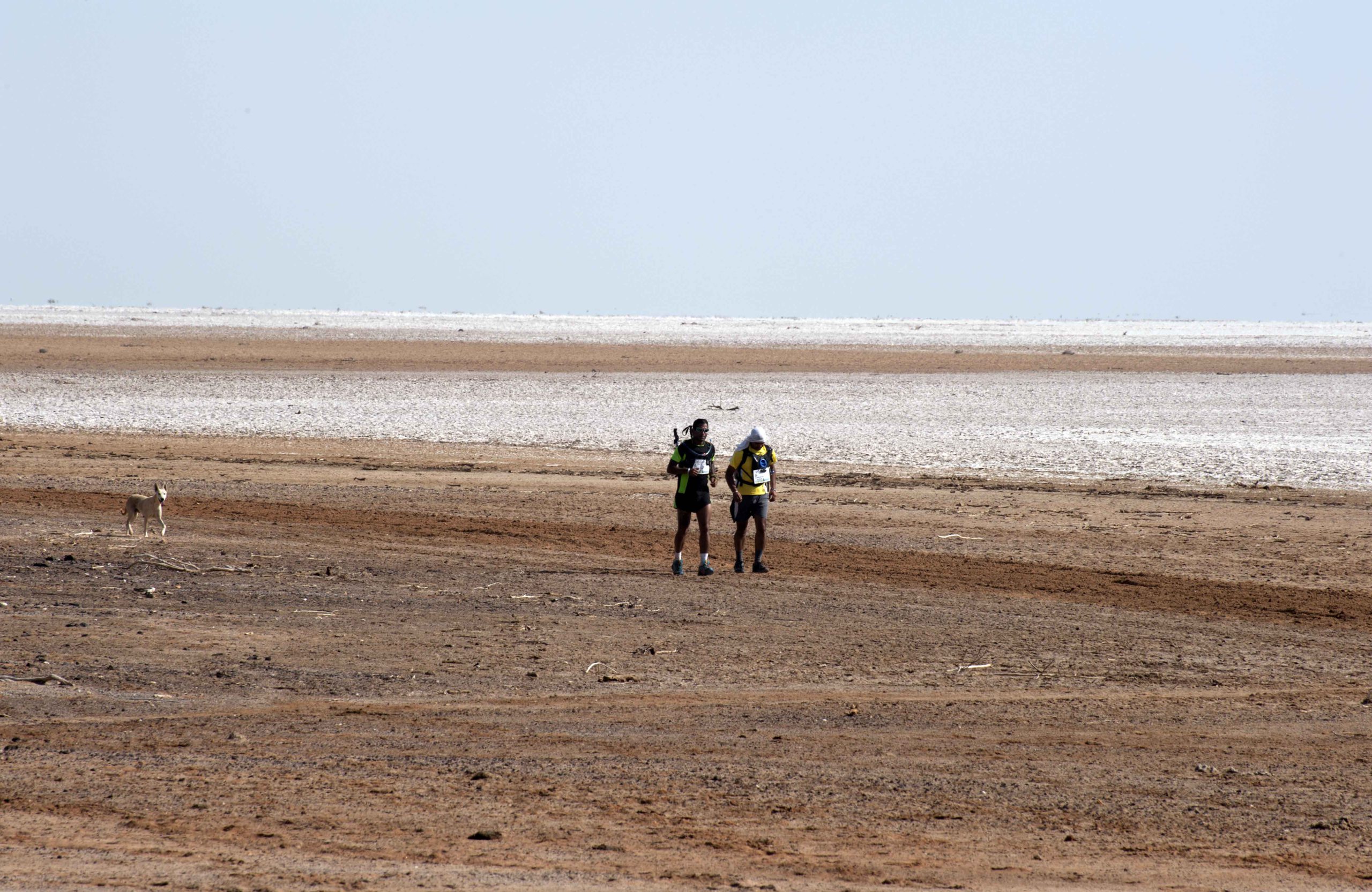
Running in the Rann of Kutch (Photo: courtesy Globeracers)

Running in the Rann of Kutch (Photo: courtesy Rashmi B N / Globeracers)

While Bhatti Lakes is possibly the flagship ultramarathon for Globeracers, what has been fetching it buzz of late is an ultramarathon in the Rann of Kutch. The Rann is a vast expanse of salt marshes located in the Thar Desert bio-geographic area in the Indian state of Gujarat with some portions in the adjacent Sindh province of Pakistan. According to Wikipedia, its total area is around 10,000 square miles. For knowing more about this location and the trails it held for running, Kavitha enlisted the help of a friend, Vijay Bariwal from Ahmedabad, who had run the Bhatti Lakes Ultra earlier. Together, they reached Bhuj in Gujarat’s Kutch district and proceeded to meet officials of the Border Security Force (BSF), the organization entrusted with guarding the India-Pakistan border in these parts. The BSF took some time warming up to the idea but once they did, they dispatched a team of runners to accompany Kavitha and her friend during the recce. For the 100 km-recce, she ran with the soldiers from one border post to the next. They completed the recce in two days. The course was finalized – it stretched from Lakhpat to Dhorodo. “ The response to this race has been amazing. One thing is, you get to see these parts of the country only if you sign up for the race.’’ Being a border area, for the organizers, it is also a race entailing considerable documentation and paper work. “ There is a lot of process that goes into it but the procedure once followed is efficient. The BSF has been a great support,’’ Kavitha said. The first edition featured 20 civilians and 100 BSF runners. The event has been repeated every year since. To keep logistics manageable and efficient, Kavitha said she had requested the BSF to cap their participation at 60 personnel. “ On the average, around 20 civilians have turned up for the event every year,’’ she said.

Mid 2016, Kavitha was back in Bengaluru and gearing up for a fresh season in India with Globeracers, when she spared time to talk to this blog. “ There are many facts about Globeracers that are little known,’’ she said. For instance, it was the first to organize UTMB-qualifying races in India with the Bhatti Lakes Ultra. Similarly, Globeracers was the first to hold RAAM (Race Across America) qualifying cycle races in India; the Ultra BOB held every year since 2012. There have also been personal challenges Kavitha faced in the race environment. Most people come to a race wanting to achieve something. In that mode, runners can be touchy folks. Lapses in organization won’t be easily forgiven. At the same time, when a race is viewed from an organizer’s perspective, there are rules to be observed and concerns to be addressed. Disqualification and DNF (Did Not Finish) are hard to handle. They can occasionally become nasty episodes. Being an insider – a part of the larger environment – helps.

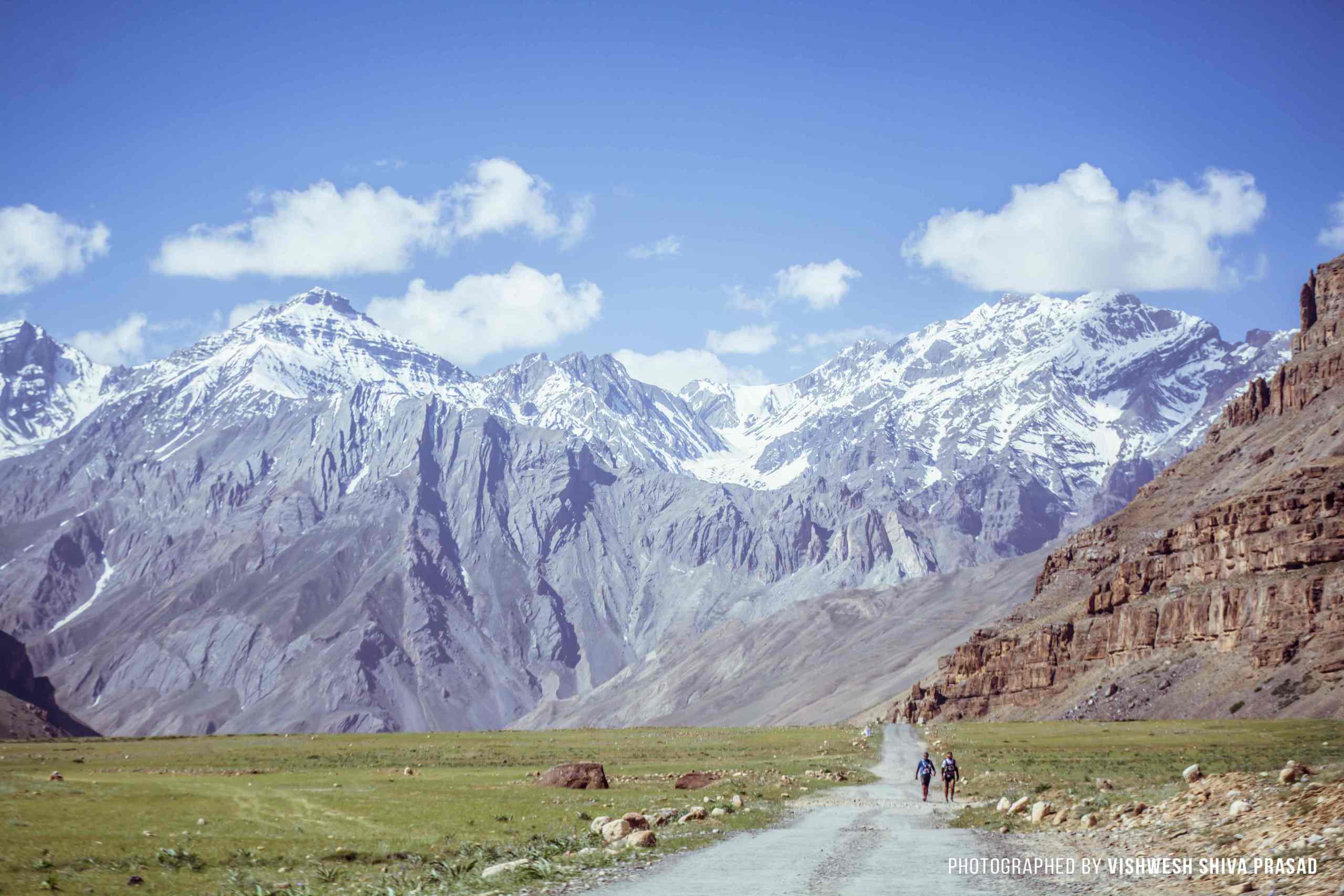
Himalayan Crossing (Photo: courtesy Globeracers)

Himalayan Crossing (Photo: courtesy Vishwesh Siva Prasad / Globeracers)

Kavitha said she has frequently experienced being an outsider to the Indian environment, something that doesn’t work to her advantage when tackling difficult issues. In a mail subsequent to the meet-up in Bengaluru, she said, “ I find myself looking in from the outside quite often than not. It also reflects in how Globeracers has been thus far received. They don’t understand me, much less know me. I am not from anywhere here, do not have a base of friends I can lean on (though that has changed considerably over the years on the personal front), and no peers who will spread the word for me and sign up for races. The camaraderie is missing and I find myself at times missing it. There are misconceptions that have led to personal confrontations, which is a completely undesired flip side of being an outsider though I refuse to attribute it to I being a woman at the helm and making decisions that some may not be able to live with or comprehend. Cases of disqualification have been that much harder on me as a person than it would have been on a male race director.’’ She wishes that athletes understood her side of things better. “ Emotions run high in India when it comes to race day preparations. Runners refuse to read through information and it taxes an organizer to keep answering simple questions via email and messages when the same can be found on the event website and mails already sent. Athletes need to follow rules and guidelines. That is one major difference I find between racers in the US and here,’’ she said.

Asked what plans she has for the future, she mentioned a Rain Ultra in Assam, hopefully by July 2017. She wanted to design an event around the backwaters of Kerala and hinted at the first overseas foray for Globeracers – an ultramarathon in Costa Rica. Post 1997, soon after graduation, Kavitha had started a company called Design Net in the New Jersey / New York area. It did well, but in 2000, she shut it down “ for personal reasons.’’ In 2002, she set up an IPO for Kafin Consulting in India. Everything went well till the company’s listing was delayed by a controversy then gripping the stock exchange in Mumbai. “ We incurred severe losses due to time lags,’’ Kavitha said. The next phase was the potential government job in US. But that lengthy phase of litigation in Bengaluru which prolonged her stay in India denied her that job. “ Building Globeracers has been my salvation,’’ Kavitha said.

(The author, Shyam G Menon, is a freelance journalist based in Mumbai.)    

VIEW FROM THE 16TH FLOOR

Praveen C. M (Photo: Jyothy Karat)

Praveen C. M (Photo: Jyothy Karat)

Bengaluru’s Clarence Public School has a reputation locally in sports.

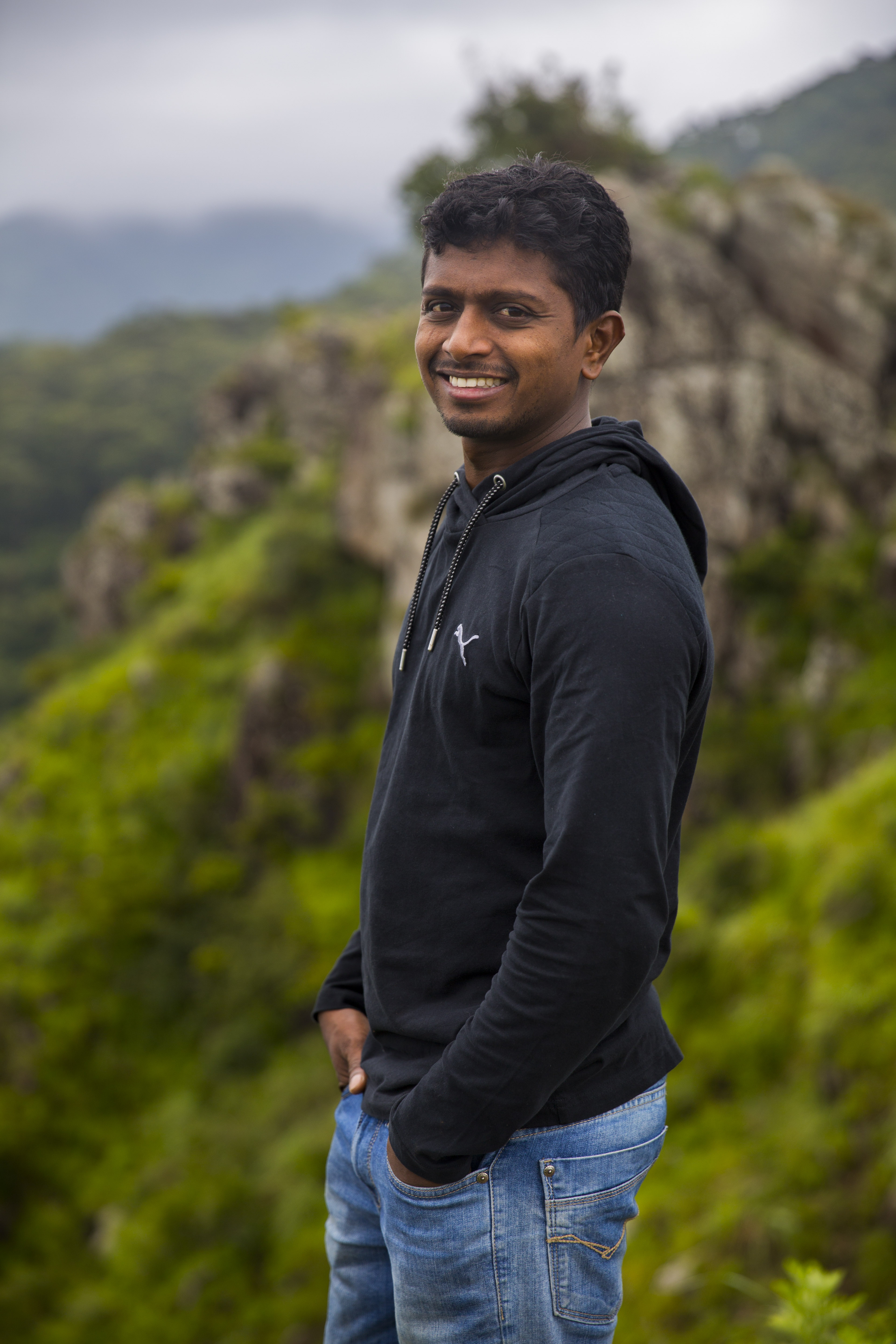
Years ago, a seventh standard student with affection for running, jumping, throwing – in short, all that qualified to be the active school life – found himself on an excursion to Bannerghata, a little over 20 km from the city. By then his interest in sports had already harvested a collection of trophies – “ you know, the small ones indicative of everyone’s school days’’ – displayed at home. The student group was headed to Tulips Resort. En route, they stopped for a rappelling session. Hariprasad, the instructor, went beyond rappelling and showed some primary climbing moves and techniques to the students. Later, at the resort, there was a challenge to climb a eucalyptus tree; the prize was a box of chocolates. Praveen C.M bagged the prize. Intrigued by the boy’s natural talent, Hariprasad made him climb a couple of trees around. That paved the way for Praveen reporting to Yavanika, a state agency dealing with youth services and empowerment. Yavanika managed a 15 m-high plywood climbing wall on its premises, the only such wall in Karnataka state at that time.  “ At a certain point, the wall was eight feet wide. In that width, we had four top ropes; in the portion of the wall below the top roped climbers, others bouldered. And of course, there were the belayers. It was congested but managed well. Looking back, I feel those were the days when climbing actually grew in Bengaluru,’’ Praveen said. We were at a coffee shop on the city’s MG Road. Close by was a branch of Canara Bank. In the days Praveen discovered climbing, his father worked as a head clerk at Canara Bank.

On his second visit to Yavanika, Praveen found a state level climbing competition underway. He said he wanted to try one of the routes. Indulging the school boy’s request, the organizers put him on the climbing route for women. The youngster topped it. Muniraju, who was a good climber then, saw this. He asked Praveen to climb again. Soon thereafter, Praveen began frequenting the wall and climbing with Muniraju. In the first state level competition he attended following this phase, he finished third in his age category. In the next zonal competition he placed second. By 1998, he was at his first national level climbing competition, held at New Delhi on the old wall of the Indian Mountaineering Foundation (IMF), the apex body for matters related to mountaineering and sport climbing in India. “ I still remember the crux on the climbing route in that competition. It was a move requiring considerable reach; it was at the third or fourth clip. Of the eight minutes available to climb, I spent seven figuring out what to do at this point. Eventually in desperation, I jumped for the next hold but couldn’t make it. It was a move that was tough for short people,’’ Praveen said. He is a well-built climber of modest height.

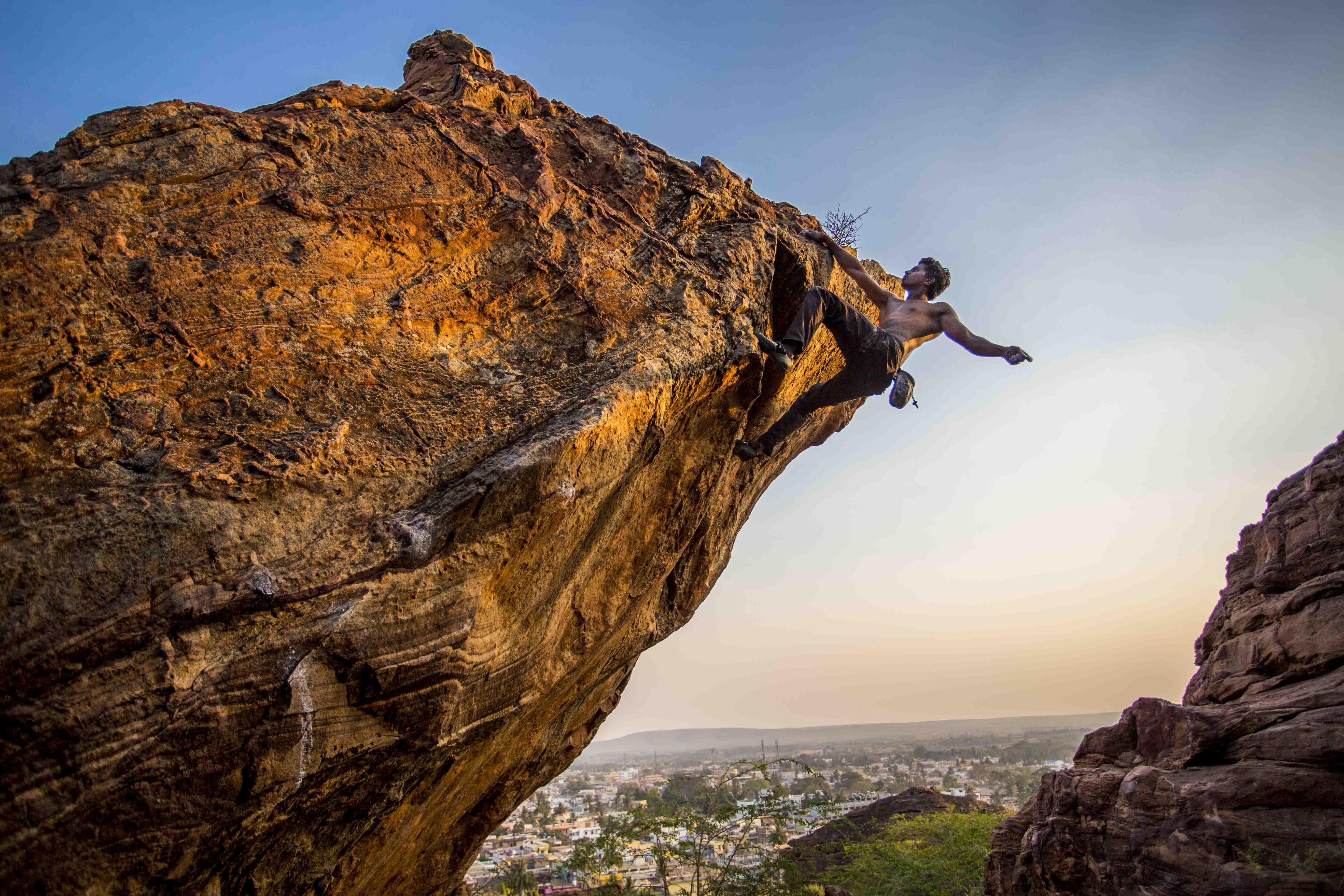
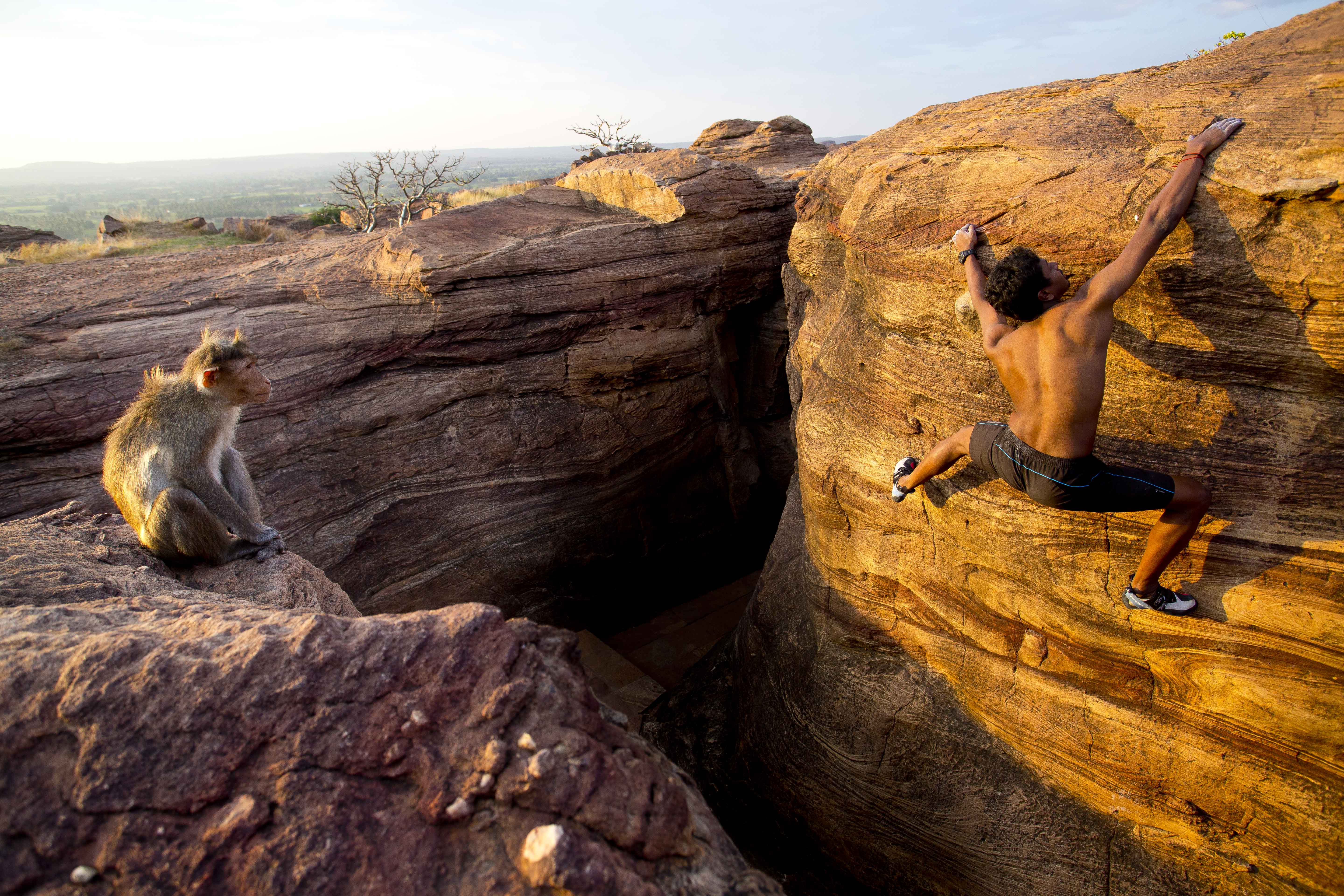
Praveen, climbing in Badami (Photo: Jyothy Karat)

Praveen, climbing in Badami (Photo: Jyothy Karat)

That issue of inadequate reach would survive as fuel to navigate his way through climbing. It triggered two responses – first, in due course, it forced Praveen to be a dynamic climber on sport routes, resorting to lunges and leaps wherever he was challenged for want of reach. Second, it made him notice an often overlooked aspect of climbing – route setting. In India, a country with relentless rat race, the popular instinct of any alpha male is to shape environment according to his convenience. When it came to climbing routes, they were typically designed to showcase the climber who did it. In the outdoors for example, bolting wasn’t an inclusive art that took into account different body sizes and climbing styles. What’s the fun in climbing if it is to merely have rat race endorsed and one’s failures magnified? The route at the national competition intrigued. On the one hand, Praveen was encouraged by the fact that he had reached the third or fourth clip; on the other hand, his progress thereon was challenged by a move, he thought, was rather unfair given his shorter reach. It impressed upon him the importance of route setting as an art. It seemed the heart of sport climbing’s capacity for challenge and enjoyment.

Soon after his first national competition, Praveen joined the group of climbers being trained by Keerthi Pais. The group was called `Manav.’ It was a tightly knit group, perhaps too tightly knit to be easily accepting of newcomers. “ It took me almost a year to be trusted and counted,’’ Praveen said. But the persistence was worth it for the climbers Keerthi trained, turned out to be good. It was also an interesting time in India’s sport climbing map. The north zone was dominant; their climbers were ahead of the field. Keerthi was set to tilt the balance. “ The first medal for Manav – this one within the state – was won by Geetha,’’ Praveen said. Slowly, the group made its presence felt at the nationals through such climbers like Karthik, Archana and Vatsala. Keerthi’s group trained with commitment. Praveen recalled his life from that phase; those were the years of transitioning from Clarence Public School to Bengaluru’s National College. He stayed 18 km away from the climbing wall used for training. Those days, the city’s nascent metro rumbling overhead every few minutes near where we sat on MG Road, was not even a plan on the horizon. Buses to town from where he stayed were not many; certainly none very early in the morning. He left home at 4 AM and waited on the main road nearby for a lift. Sometimes the travel was managed in one vehicle all through to town. At other times, it was a series of lifts availed. The objective – report at the wall by 5.30 AM for the morning training session. Once training was finished, he went to college straight from the wall. College over, he returned to the climbing wall. The evening training session lasted till around 7 PM. He reached home by 9 PM. “ Buses plying on the route home would be packed with people. After a day of climbing at the wall, I would again be hanging on to something, except it was on the footboard of a bus. The routine was such that I didn’t know night and day,’’ Praveen said. He trained almost every day at the wall.

Praveen (Photo: Jyothy Karat)

Praveen (Photo: Jyothy Karat)

In 2000, Praveen secured top honors in the junior category at the national climbing competition held in Darjeeling. With Keerthi’s wards beginning to perform well, it was now increasingly evident that the center of gravity in competitive sport climbing was shifting to Bengaluru in south India. Sport climbing was small in the country but its aficionados had a rather even geographic spread. In 2003, Mumbai’s oldest mountaineering club, Girivihar, organized an open sport climbing competition – the first time it did so. The small annual event would grow to be a much loved one, held without break thereafter for over a decade. It became the seed for the 2016 IFSC World Cup held in Navi Mumbai. The geographic distribution and prevailing status of sport climbing in India was clear in the turnout of the competition’s initial years; climbers came from Delhi; Bikaner, Darjeeling, India’s north eastern states, Kolkata, Mumbai, Pune, Davengere and Bengaluru with Bengaluru as rising powerhouse.

Around the time Praveen won his first medal in the junior category at the national climbing competition, speed climbing made its debut. In 2001, at a competition (not the national one) held in Delhi, Praveen won in both lead and speed climbing disciplines. From roughly the next year onward he proceeded to become a regular fixture among toppers at the national climbing championship. According to him, he placed first for 16 years in one discipline or the other, including in one or two years, first place across all three disciplines – lead climbing, speed climbing and bouldering. Praveen said he does not view these disciplines as disparate and instead sees them as interlinked and synergic. Helping this embrace of all three disciplines, was the solution he had evolved to compensate for his physical size in climbing – his affection for dynamic moves. In his years in competition climbing, Praveen has represented India at international climbing competitions in several places; among them – Malaysia, China, Macau, Korea, Indonesia and France. His most recent appearance at the national climbing championship was in 2015, where he placed second in bouldering, fourth in lead climbing and qualified for the final in speed but didn’t take part. The names you hear as he recollects his years as a competition climber spans the who’s who of Indian sport climbing – Mohit, Karthik, Pranesh, Prashant, Norbu, Ganesh, Ravinder, Archana, Vatsala, Shanti Rani, Dasini, Kala, Vaibhav, Mangesh, Sandeep, Aziz, Tuhin, Somnath; all names that strike a chord with anyone who has known the sport in India for a while. He has also noticed how the larger environment in which the sport nestles, has changed.

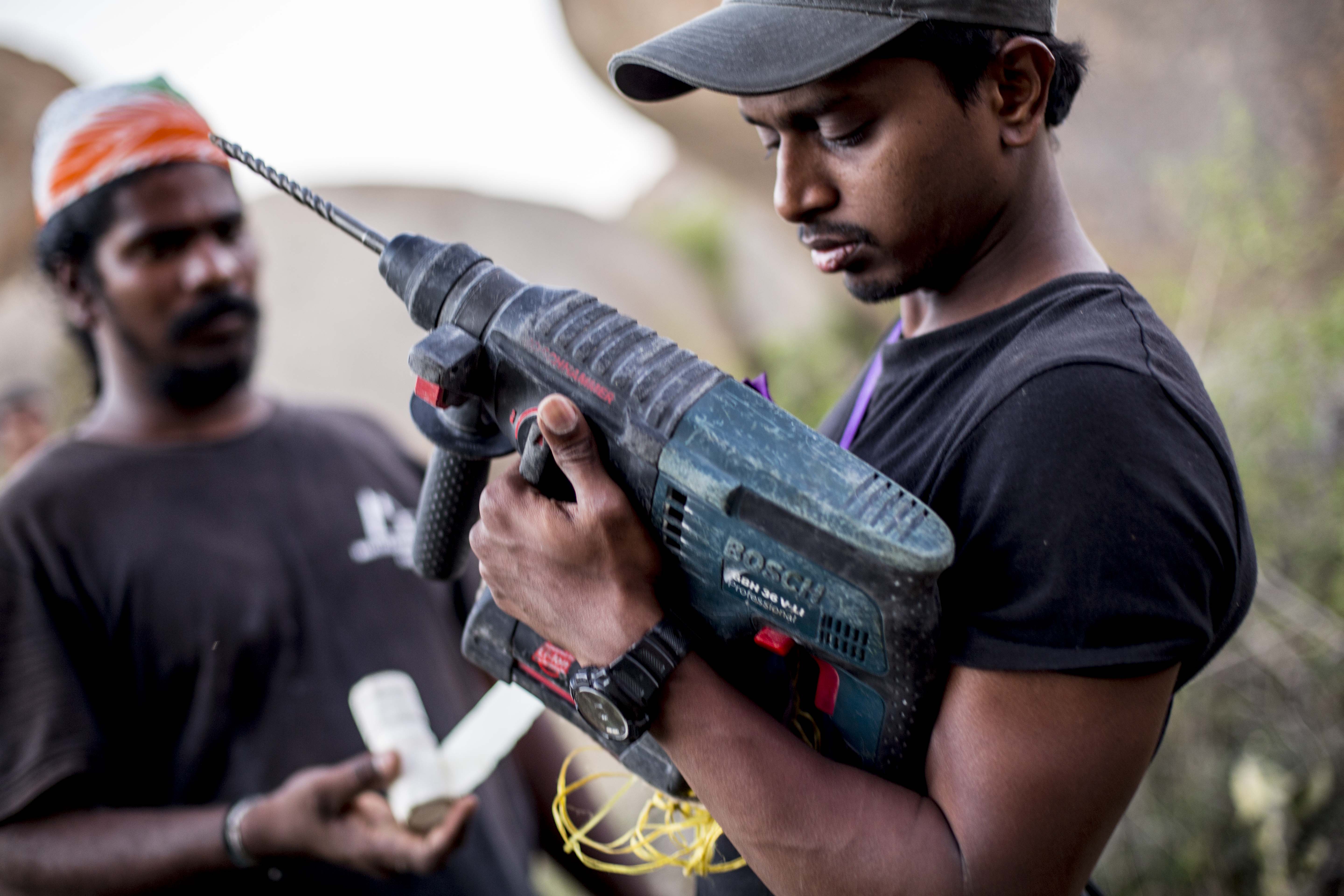
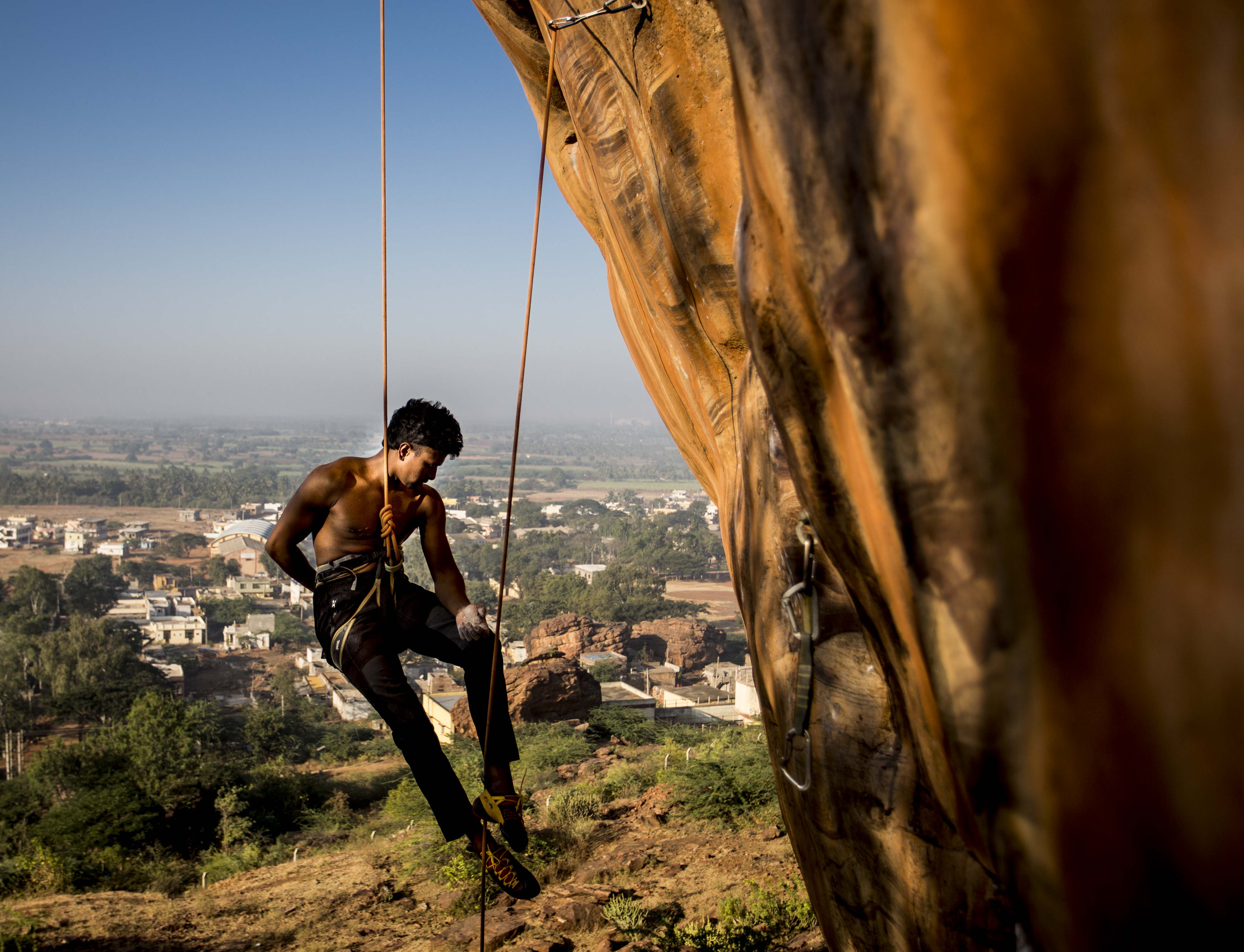
At work, setting up a route on natural rock (Photo: Jyothy Karat)

At work, setting up a bolted sport climbing route on natural rock (Photo: Jyothy Karat)

Recalling the time when potential candidates for an Indian team headed to compete in Macau were shortlisted and training was underway, he said, “ if I finished climbing a route, I would think of how I can make you do that route. Each person used to think of helping the other build competence. Such bonding is much less at present. The team spirit has faded although we have strong individual climbers,’’ he said. Distractions have also multiplied. With everyone competing to attract sponsorship, social media has become important. The emphasis is on advertising oneself, not climbing. In the process, you have more and more attitudes and impressions / illusions of self to deal with. “ I never had a sponsor. As part of a national team, yes you got the support of whoever sponsored the team. But as an individual climber, I never had a sponsor; there was nobody for the long haul,’’ Praveen said.

There were also other trends, which Praveen touched upon as he reflected on the nearly two decades he has been in climbing, 16 years of that as regular topper at the national climbing championship. In Indian competition climbing, he said, both authorities and athletes have gone wrong in equal measure. “ When you go abroad to compete in an international competition, you are initially overwhelmed by what all you have heard about foreign climbers. You may also be a bit rattled by first impressions. But on closer look and after climbing with them at a competition, you come back realizing that you can bridge the gap. You also set for yourself what must be addressed to bridge the gap,’’ he said, adding, “ a big problem is – in India, we don’t invest long term. We support sports from event to event or we support an individual for one event expecting the world from him or her. When we don’t get that performance immediately, we say the person has failed; we discard that person and take someone else. That is not how it should be. Support must be sustained and long term. The result of this erratic approach is that by the time we manage to get back to an international competition, the overseas climbers have progressed by leaps and bounds from where they were when you first met them. They have a continuous calendar for competing and systematic training to back it up. We don’t.

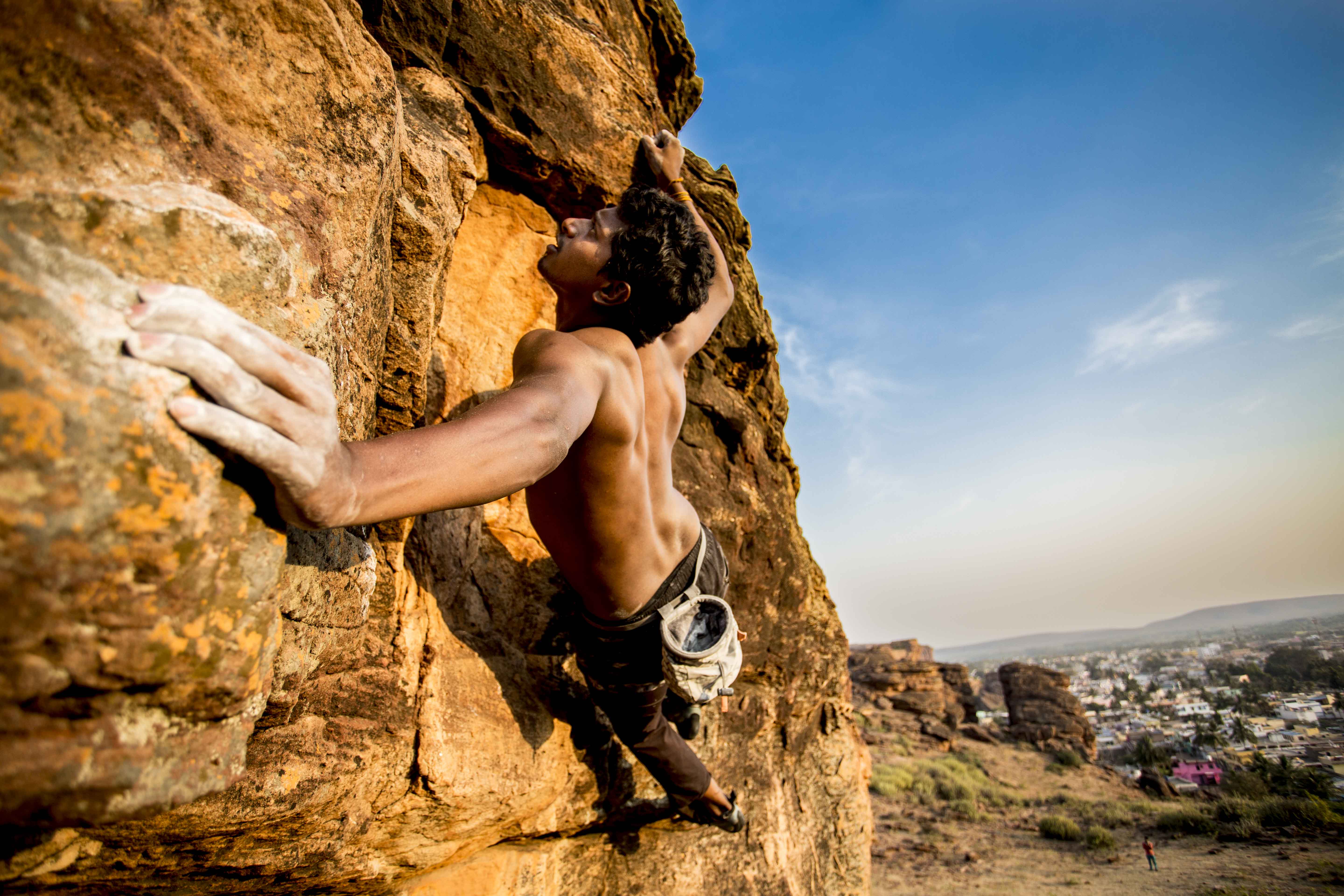
In Badami (Photo: Jyothy Karat)

From Badami (Photo: Jyothy Karat)

“ The other thing is we don’t strive to make a good impression. Making a good impression is important for an athlete’s self-confidence. If let’s say, your home federation is so indifferent that they send you to an international competition in ill-fitting dress or don’t adequately back you up in paperwork, support and facilities, you automatically come across to event organizer and other competitors as disowned by your own people. Why would anyone else then give you a damn? That should not be the case. In one of the international competitions organized years ago, I remember, each overseas competitor had a chauffeur driven car for the ride from Delhi to the venue, some 380 km away. The Indian team went to the local bus terminus in Delhi, boarded a regular state transport bus, ate at dhabas along the way and reached the venue. I am not demanding special treatment; all I am saying is – if you don’t respect your athletes, none of them will respect you in return. Rather sadly, in the competition climbing set up in India, the ones who count the most are the judges. It must be appreciated that the people who create a competition are the athletes and the route setters. One climbs; the other challenges the climber with climbing routes. That is the basic competition climbing ecosystem. Judges intervene, when you have a tough decision or choice to make. Theirs is perspective meant to provide clarity in crunch situations. When imagining sport, it should be the sport and its ecosystem first, only after that, how to decide outcome. Please remember – if athletes are not there, none of the others will be there.’’

According to Praveen, athletes too have their share of emergent faults. The old dedication in training has become less. The bonding between athletes is less. Earlier, climbing was in focus. It was the only thing that mattered. Now, climbing as sport struggles to preserve its priority for athlete, in the growing matrix of smartphones; social media, fame and head-strong attitudes. Success goes to the head too quickly these days. Praveen is among those who felt disappointed by how the Indian team fared at the 2016 IFSC World Cup in Navi Mumbai. He believes that the attitude of some of the athletes and the impact that had on training, played a role in the outcome. An angle often discussed by rock climbers and sport climbers is whether the IMF with its greater familiarity of mountaineering, has what it takes to empathize sufficiently with sport climbing. Praveen said that in all these years, he came across only one senior official at IMF, who grasped the nuances of competition climbing and understood what support the athletes were looking for. Yet for all its flaws Praveen believes it is still the IMF that is best placed to manage sport climbing matters. Internationally, sport climbing moved out from the erstwhile umbrella body for all types of climbing (the UIAA) and formed its own distinct federation (the International Federation of Sport Climbing – IFSC). In India, there have been suggestions to mimic this move domestically. “ The problem in anyone trying so here is that, as yet, I have no reason to conclude anyone else has a better agenda than the IMF or will be different,’’ Praveen said.

On the subject of a vigorous domestic calendar for competition climbing, he welcomed more competitions including those driven by prize money. A series of local competitions (instead of one zonal competition), strong zonal teams and all of it feeding into a national championship or a rolling series of national competitions felt wonderful to his imagination. I asked if hypothetically, leagues – on the lines of what is happening in other sports with teams composed mostly of local athletes and a few foreign athletes to improve standards, made sense. He was supportive of the idea of a league but not as supportive of foreign athletes because the gap in climbing competence between here and overseas is at present, significant. Too glaring a gap and support for domestic athletes may wither. “ What makes greater sense for me is spending the money you have for these fancy competitions, on excellent training overseas. That way you bring up the quality of local talent and reduce the gap in competence before featuring any league with foreign climbers alongside. I have a dream in sport climbing. One in which, India has a good sport climbing team that athletes wish to get into and to do so, they compete in the sport. Once they are in the team, they should feel they are part of it and that they are set to perform well. I say this because I experienced the pain. Aside from the ecosystem Keerthi created which I was fortunate to be part of, I didn’t have a dedicated coach or a sponsor despite being on the podium at the national level for 16 years,’’ Praveen said.

In Badami (Photo: Jyothy Karat)

From Badami (Photo: Jyothy Karat)

Some time back, Praveen decided to address the old questions he had grappled with about climbing routes. He went to do a route setter’s course in Kazakhstan but on arrival there, found that the course had been cancelled. However he helped out with the Asian youth championship in climbing, which Kazakhstan was hosting. The competition’s route setter was impressed and invited him to join the route setting team for a competition in Korea. Following this stint, he did his international route setter’s course in Iran. For the two stints of work he had to mandatorily put in thereafter as aspirant route setter, he worked with a competition in Indonesia and later in May 2016, as part of the route setting team for the IFSC World Cup in Navi Mumbai. Some years ago, he also floated a company – Sportclimbing India. As of now it builds climbing walls; it is also distributor for Flat Holds, a Swiss manufacturer of climbing holds and Discovery, the Korea-based manufacturer of climbing walls. Additionally, he is training a team of climbers from Badami, Hubli, Davangere and Chitradurga. According to him, they are good, strong climbers who should soon be securing podium finishes. He is training them at his own expense.

Now 31 years old, Praveen hopes that at some point his climbing wall / holds business and the team he is grooming, become synergic; that a mutually complementing ecosystem in climbing, forms. Asked why he did not explore a regular job in some other more predictable, stable field, Praveen said, “ I was so much into climbing that I didn’t know anything else. I didn’t have a back-up plan.’’ There have also been forays into other branches of climbing. In 2015, Praveen had embarked on an expedition to climb Mt Everest. He was on the mountain when the devastating earthquake of that season struck Nepal killing thousands, including damage and casualties at Everest Base Camp. The expedition had to be aborted. The seed for this digression from sport climbing into a mountaineering expedition came from a little known trip in 2012. According to Praveen, that year, a 10 member-team composed of eight army personnel and two civilians and led by a civilian – Keerthi Pais – had recorded the first ascent of a rocky peak called Zambala on Ladakh’s Siachen Glacier. “ I was the only one who climbed all through. It is now a bolted climbing route at altitude,’’ Praveen said.

Sixteen floors up, Praveen’s tryst with climbing continues.

(The author, Shyam G Menon, is a freelance journalist based in Mumbai. Details of competitions are as recollected by the interviewee. All the photos used in this article are taken by Jyothy Karat. They were provided for use with this story, by Praveen.)     

LIVING THE INTERESTING LIFE

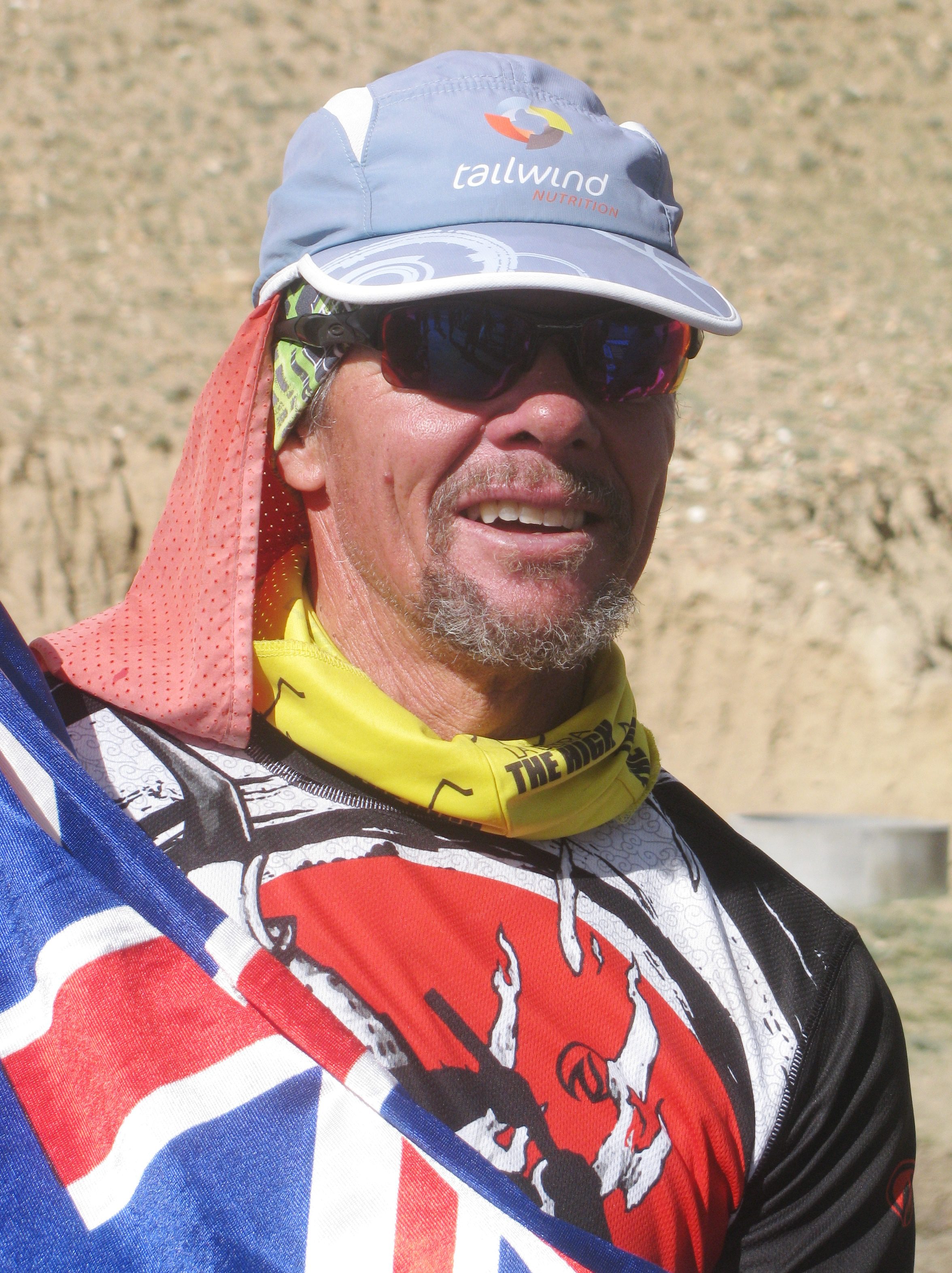
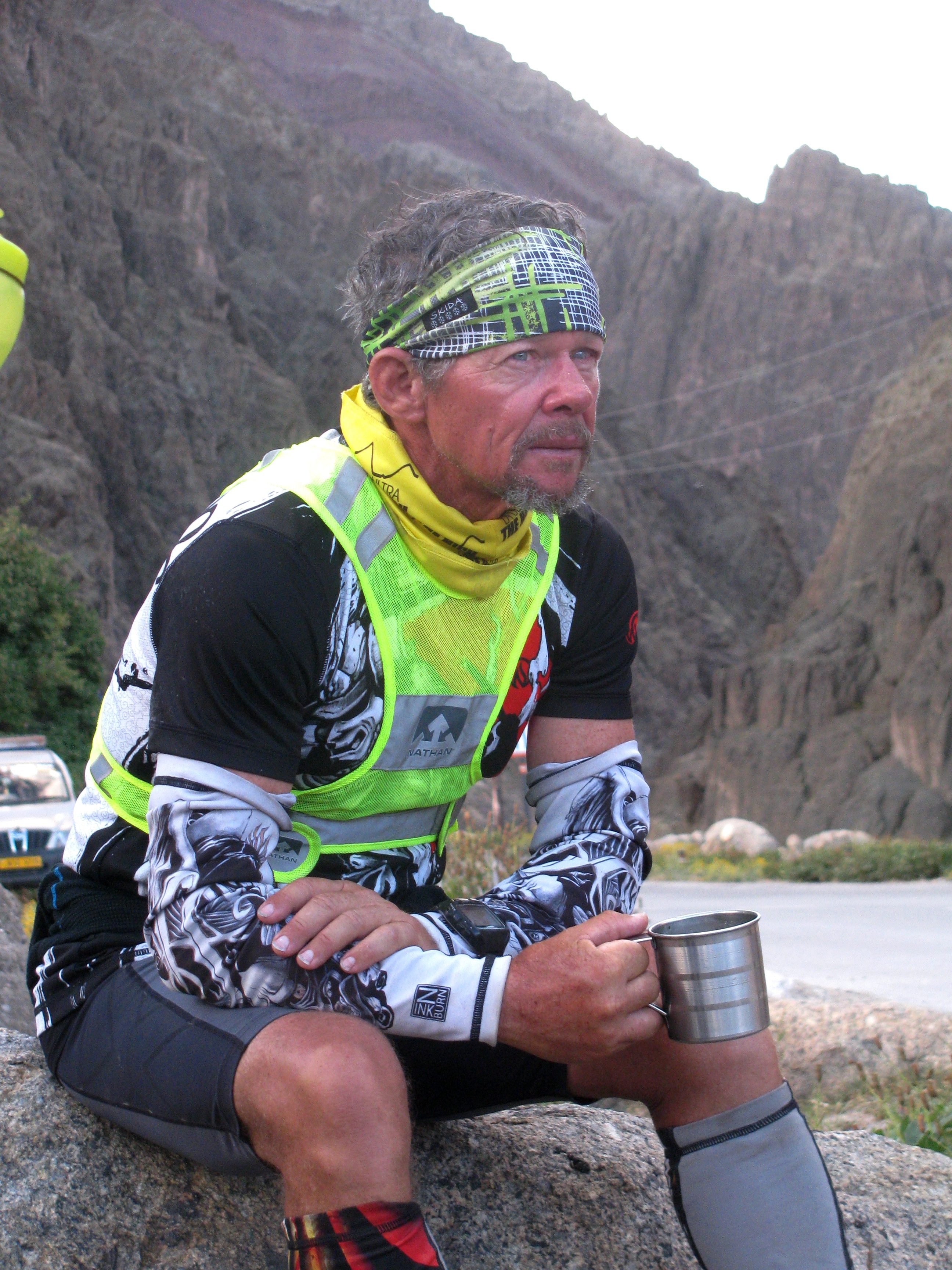
Grant Maughan (Photo: Shyam G Menon)

Grant Maughan (Photo: Shyam G Menon)

“ I am just trying to fill my time with life and keep it all interesting’’

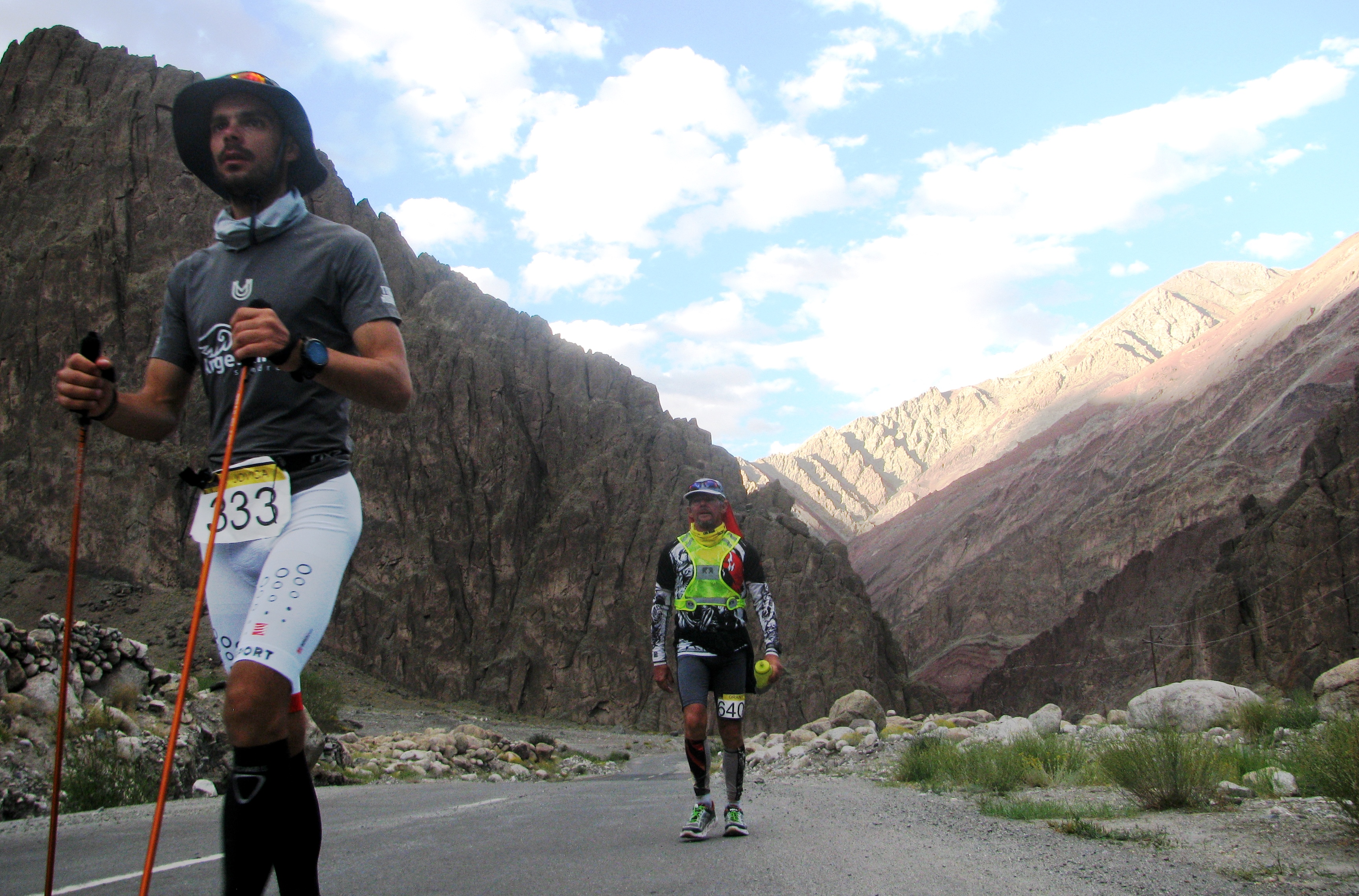
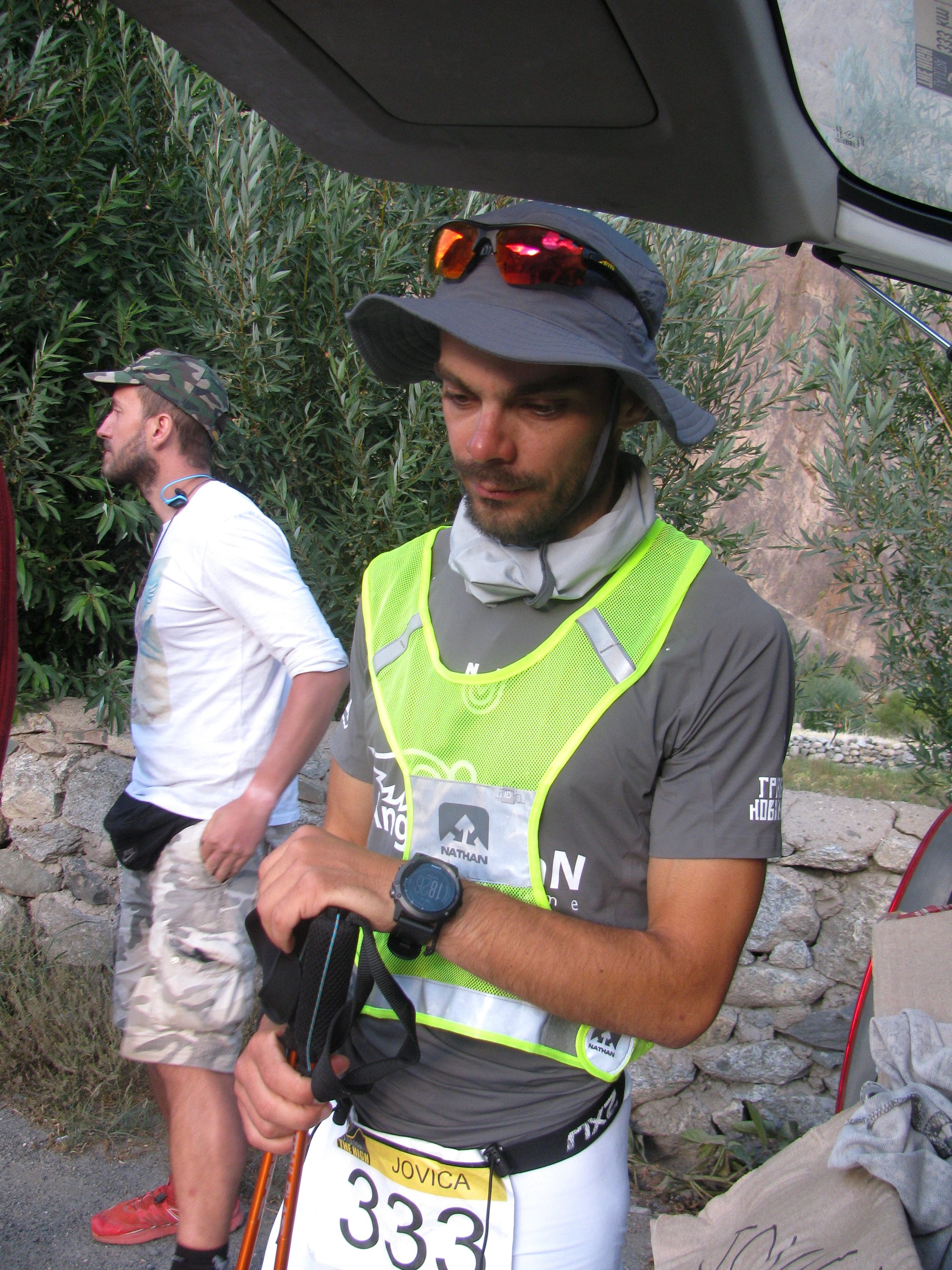
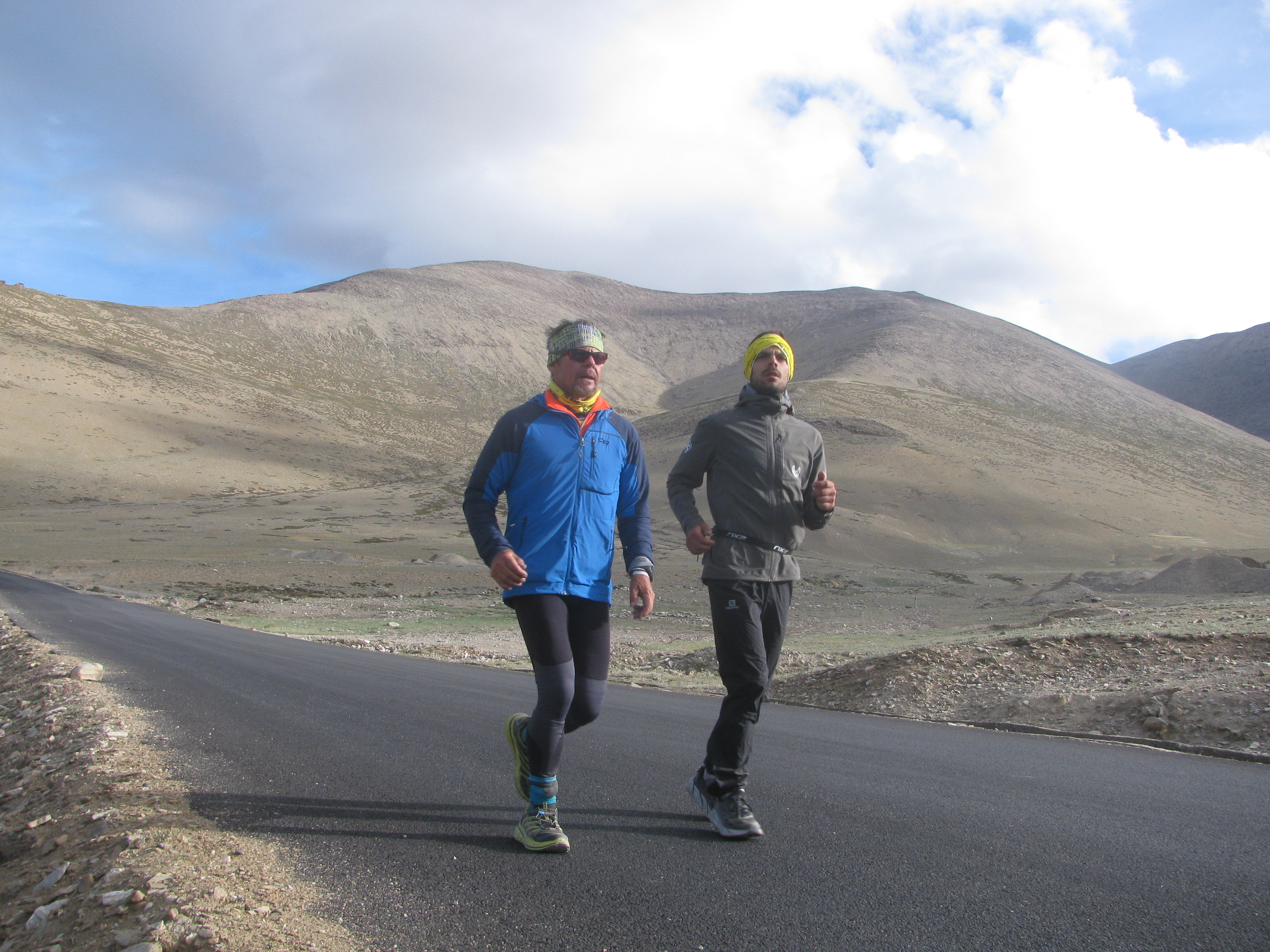
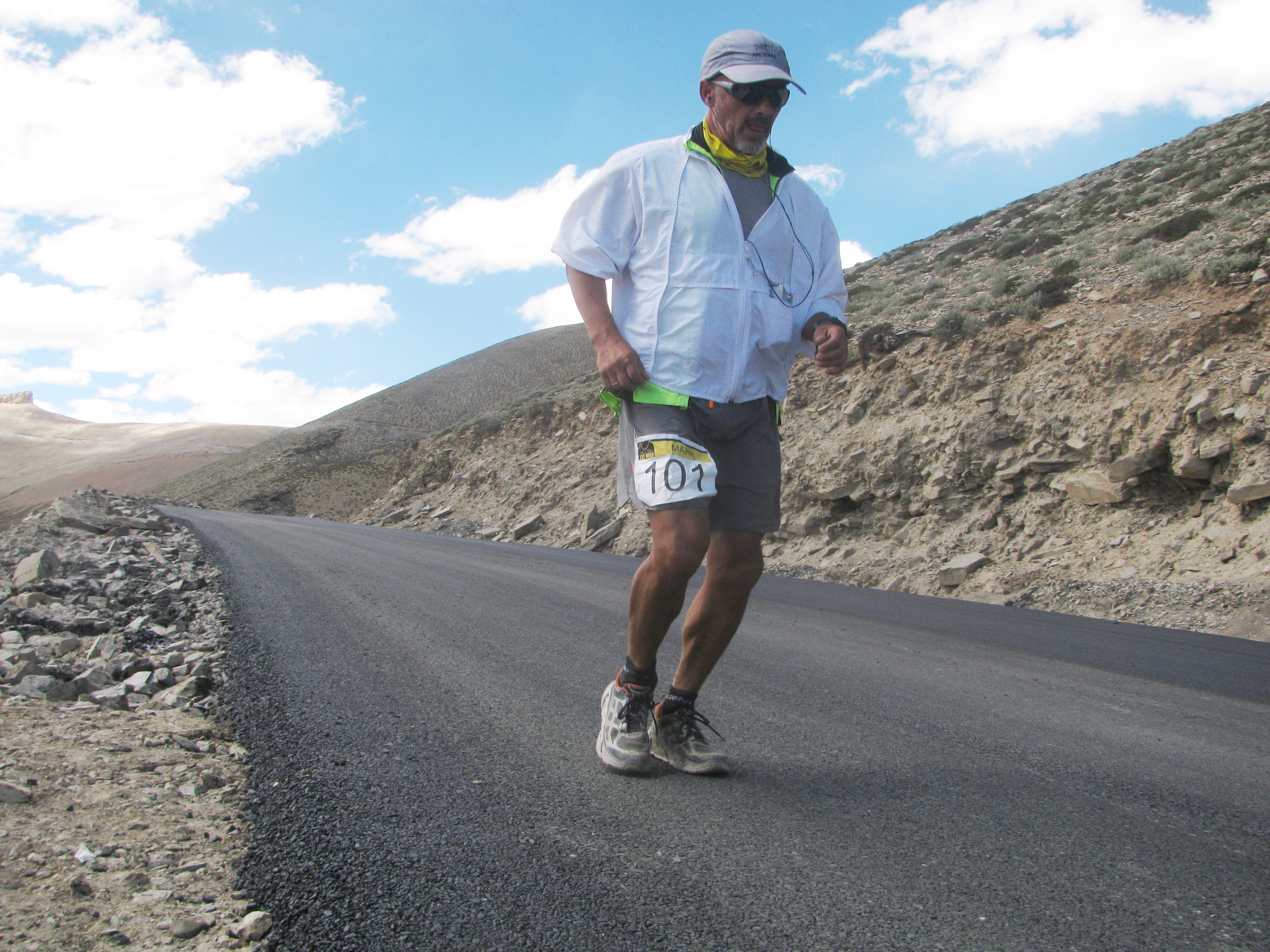
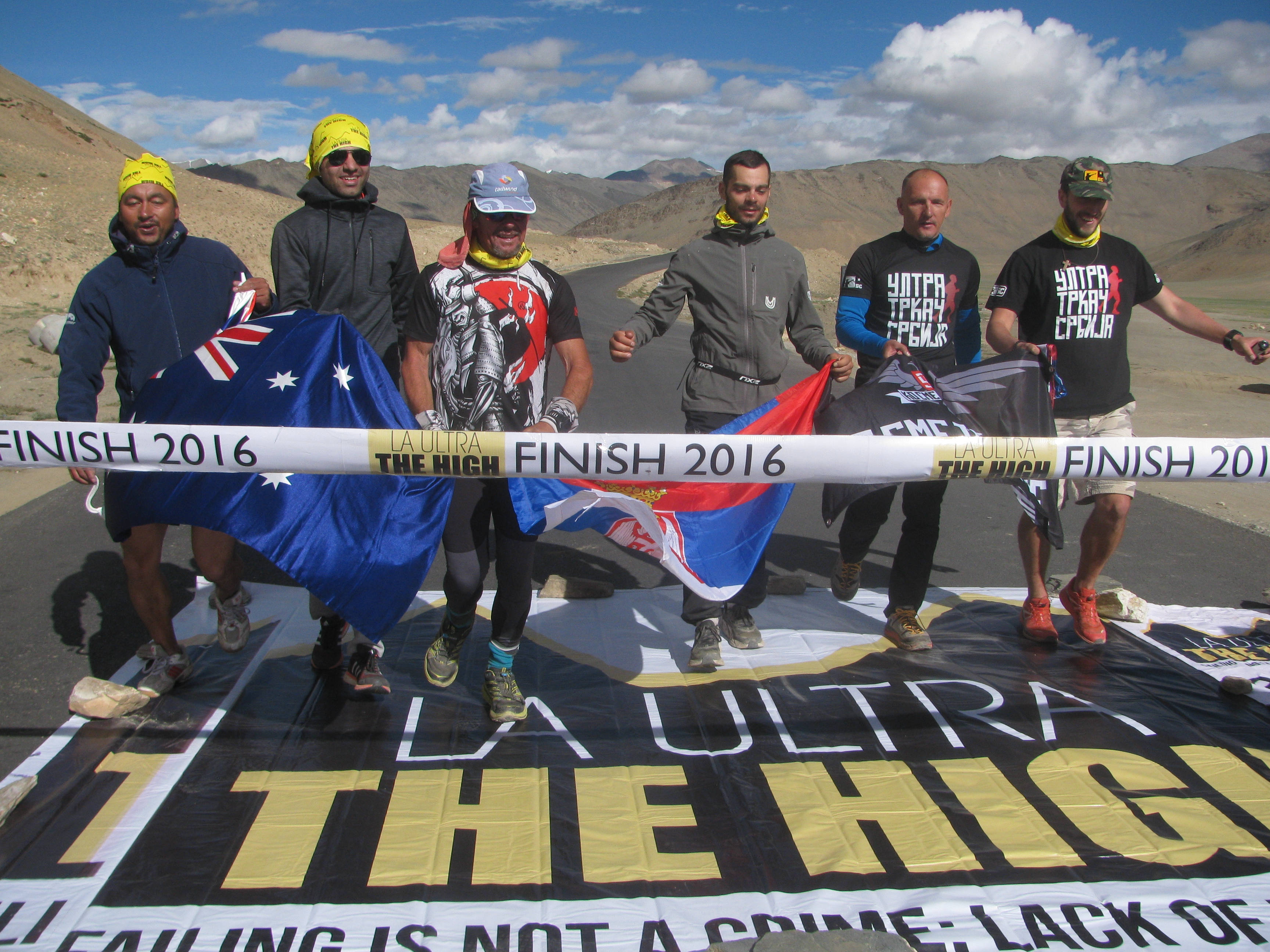
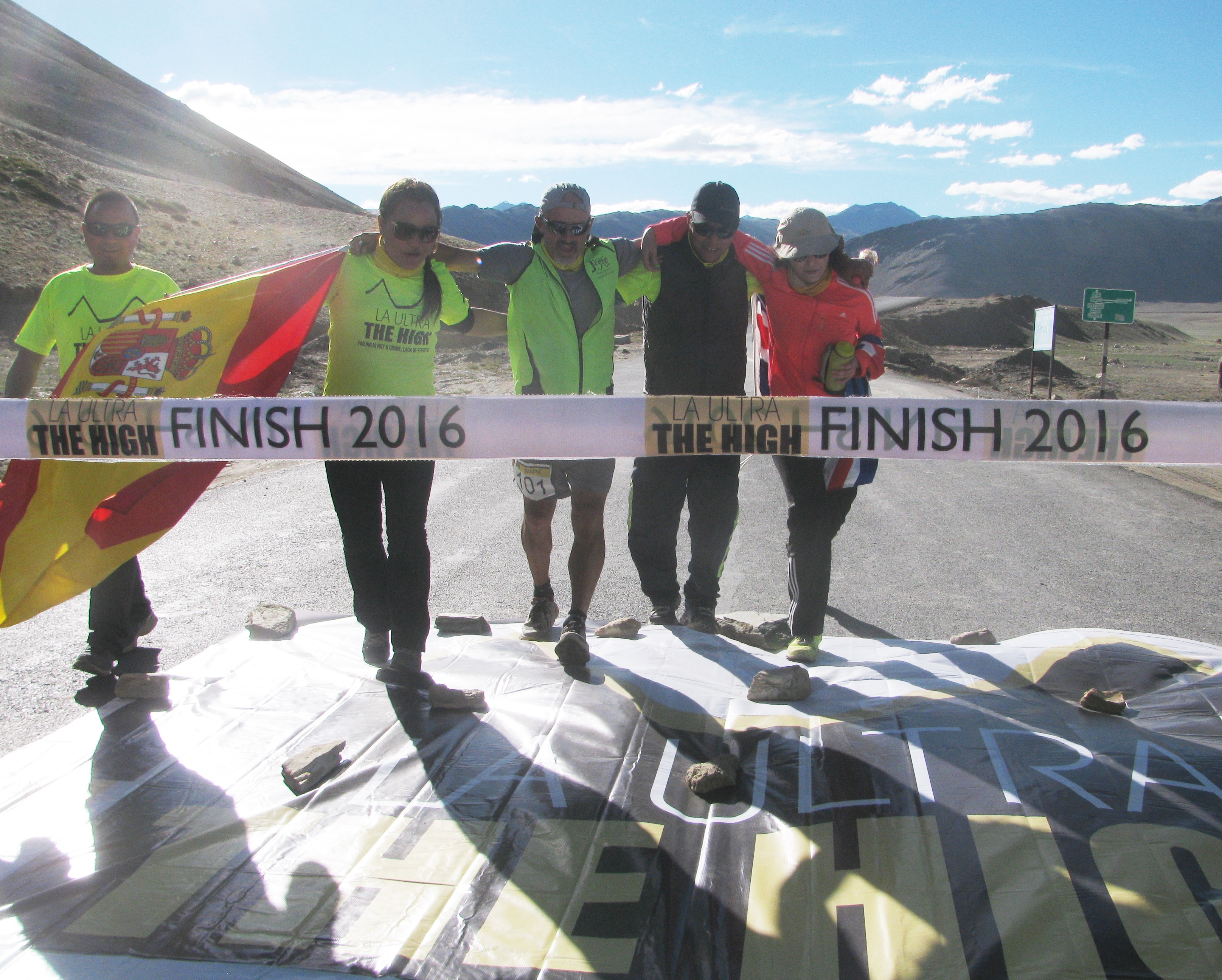
Grant Maughan, 52, is among the top endurance athletes and adventure racers in his age category worldwide. A seafarer from Australia, he took to running rather late. But in the time since, he has run nearly 60 races including some of the world’s toughest ultramarathons (a few of them several times), a clutch of triathlons and a much smaller number of marathons. He is also into surfing and mountaineering and loves to ride long distance on his motorcycle. In August 2016, he was joint winner in the 333 km-race of La Ultra, held in Ladakh (for that story please try this link: https://shyamgopan.wordpress.com/2016/09/16/the-captain-the-teacher-the-warrior-and-the-businessman/). 

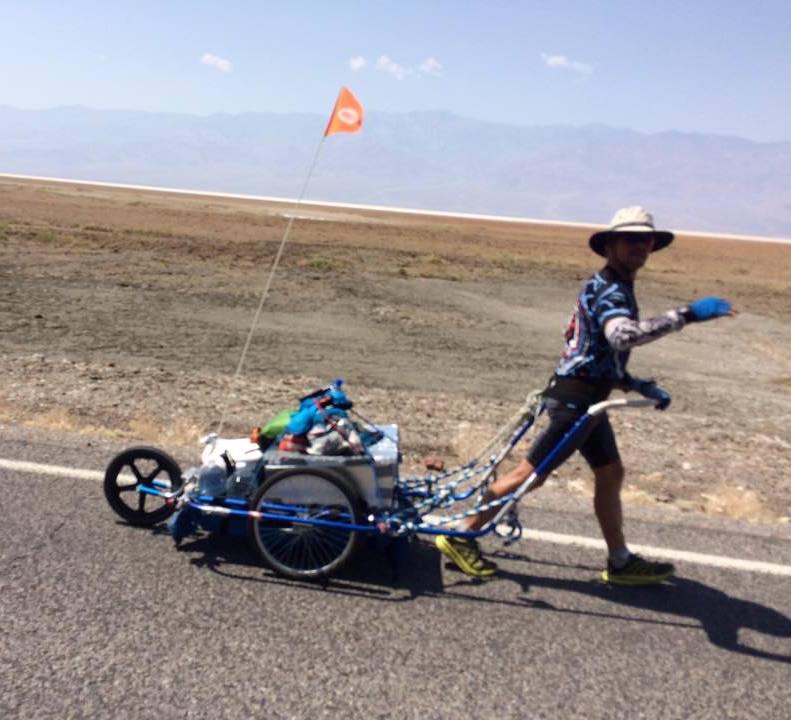
This interview, done by email in October, was triggered by Grant’s penchant for a packed calendar in running, in particular the July-September 2016 period when he completed the Badwater Ultramarathon in California in sixth place overall, completed La Ultra in record time in Ladakh, completed the Leadville Trail 100 in Colorado, did a solo self-supported crossing of Badwater (from Death Valley to Mt Whitney Portal, pulling a trolley filled with supplies) in record time and completed Spartathlon, the famous ultramarathon in Greece. Why does he follow a packed schedule? Does it always work? What is its impact? Grant explains in this Q&A:    

Is the packed calendar one saw during July-September 2016, a regular pattern for you or is this stretch tad unusual?  Can you explain what drives you to do this?

It has been a regular pattern over the last couple of years; mainly because there have been a bunch of events I wanted to participate in and they happen to be around the same time. Last year, I had a similar schedule with Keys 100 in May, Ronda Del Cims (Andorra Ultra Trail) in June, Badwater in July and UTMB in August, finishing with Spartathlon in September. My main reason for doing this is that I love to race and cannot wait to spread events out over years. So I just get in and do them.

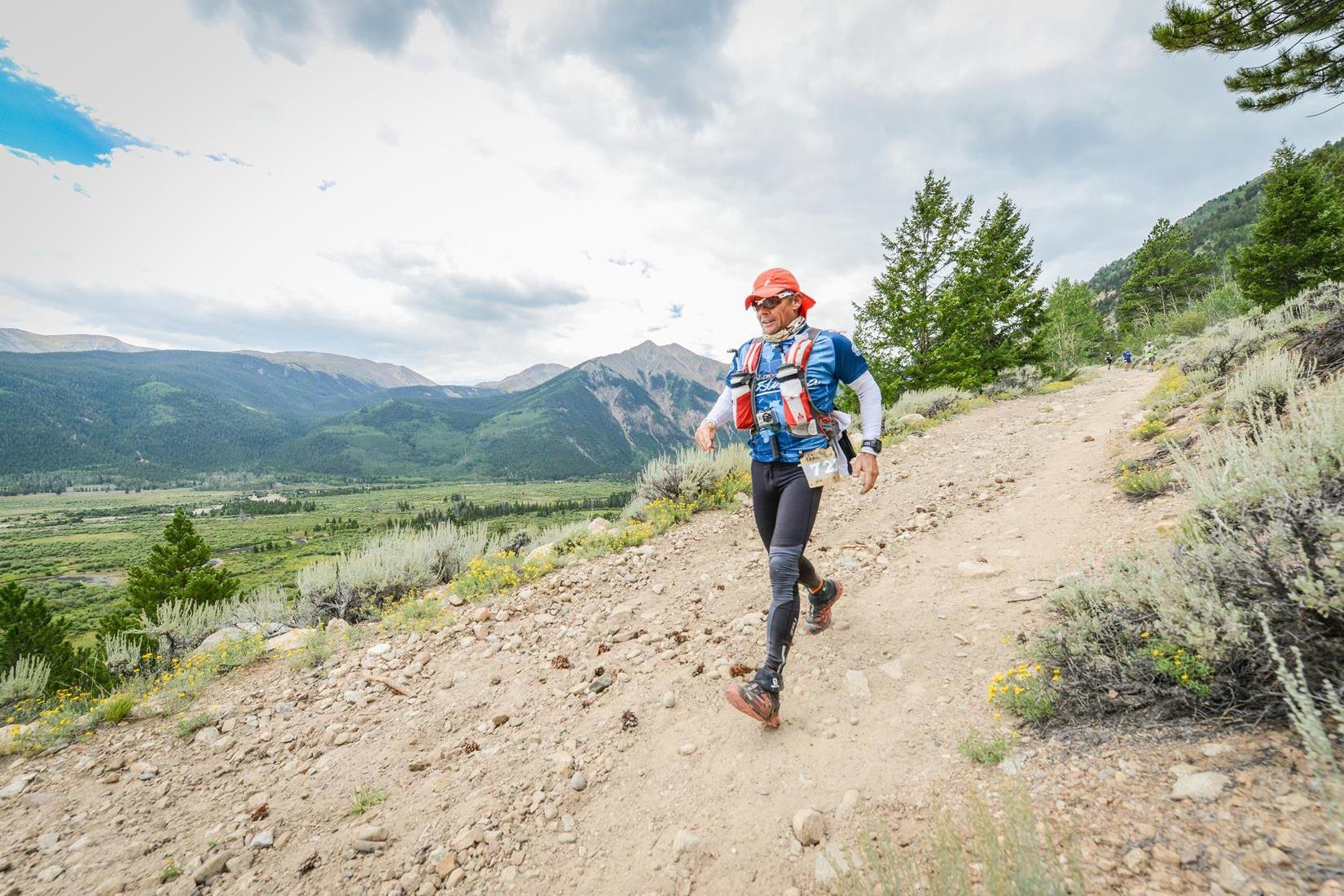
From the Leadville Trail Invitational (Photo: courtesy Grant Maughan)

From Leadville (Photo: courtesy Grant Maughan)

Some people argue that the other side of maintaining a packed calendar is that you may not have optimum performance at every event you participate in. Is this true? If it is true, does that matter to you?

I would imagine this is very true. I have felt tired and worn out in many events that I probably could have performed better at. However, sometimes I am more intent on seeing if I can get through this sort of grueling schedule as an endurance event within itself. Some people do a Grand Slam in the US containing a number of tough 100 milers. I think my self-made Grand Slams are way tougher. I certainly like to do as well as I can at any event. But I always say that I don’t go out looking for the podium. I prefer to put in a performance that I can be proud of.

Would you say you were fully recovered from each event for the races you ran in the 2016 July-October period? What are the consequences of poor recovery in races of this magnitude? How do you handle it?

Definitely not fully recovered. However I find that doing these tough races back to back helps keep me on some fitness plateau. It allows me to keep going. If I stop too long in between events, then I seem to lose some fire. So it’s better for me to keep on attempting challenges. Generally, poor recovery is outlined by sickness from immune system breakdown, lethargy and / or injury. I have had great success with keeping my crazy schedule, but like anyone, I have occasionally suffered bad flu type of sickness, which I could also associate with a heavy travel schedule, flying and not getting enough rest. My immune system has been definitely tested but I think I would have also gotten sick at times, racing or not. Generally, if I get sick, I stop all physical activity and try to nurture myself with good diet and rest.

From Iditarod (Photo: courtesy Grant Maughan)

From Iditarod (Photo: courtesy Grant Maughan)

From Iditarod Trail Invitational (Photo: courtesy Grant Maughan)

From Iditarod (Photo: courtesy Grant Maughan)

This blog is familiar with La Ultra including its 2016 edition. Its 333 km-segment, which you ran and completed in record time (along with Jovica Spajic), is a demanding race involving distance, a range of temperatures and above all, altitude. How tired were you after that? How long did it take for you to recover?

That was a tough race. No doubt about that. Just the distance alone with no other factors would be enough to require a long rest period afterwards. I felt beat down after the race but not to the point of not being able to continue my schedule. I think the incident on Khardung La when I got pulmonary edema slowed me somewhat but I didn’t feel any residual effects that would make me stop. When I got to Leadville, Colorado, I felt tired for want of sleep. My body actually felt okay but I knew I would feel fatigue during the race. I was determined to take it easy and just make it through. Eventually during the race my body seemed to come back alive somewhat and I managed to do a sub-24 hour finish. I think during this whole period from July to September I didn’t recover at all but just maintained a level of fitness and health that allowed me to pull it all off. Now after Spartathlon, I am taking a few months off from running (or impact at least). I will maintain a fitness base by doing other things like biking, swimming and other outdoor activities.

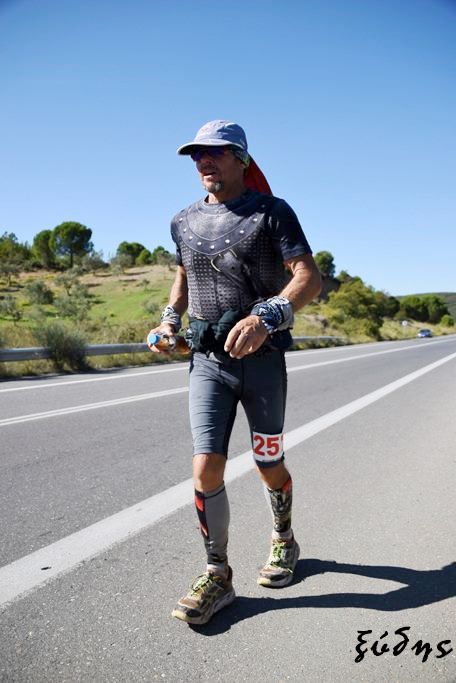
Grant, during Badwater 146 mile solo, self supported crossing he did in the days after the 2016 edition of La Ultra (Photo: courtesy Grant Maughan)

Grant, during Badwater 146 mile solo, self supported crossing he did in the days after the 2016 edition of La Ultra (Photo: courtesy Grant Maughan)

From the 333 km run at altitude in La Ultra you moved to Leadville and then, the Badwater solo crossing, which you did, pulling a trolley laden with the supplies you need, all the way from Death Valley to Mt Whitney Portal. While physical recovery is one thing, how do you handle your mind, moving from one demanding experience to another? What happens to your mind in the middle of any of your endurance events? Does it speak, rebel or does it switch off?

I don’t have any issues with my mind on these types of things. In fact, part of my mind is looking forward to all the pain and suffering of trying to get through to the end. I think I get this type of strength from being a loner, a hard worker and deep thinker. Like anyone I have my moments during these events when I ask myself: why am I bothering to put myself through this type of purgatory? But it’s usually fleeting and is always overridden by other parts of my mind urging me to go on and complete the job at hand. Other times, the mind just switches off. I seem to have the capacity to do that, sort of like a self-imposed meditation.

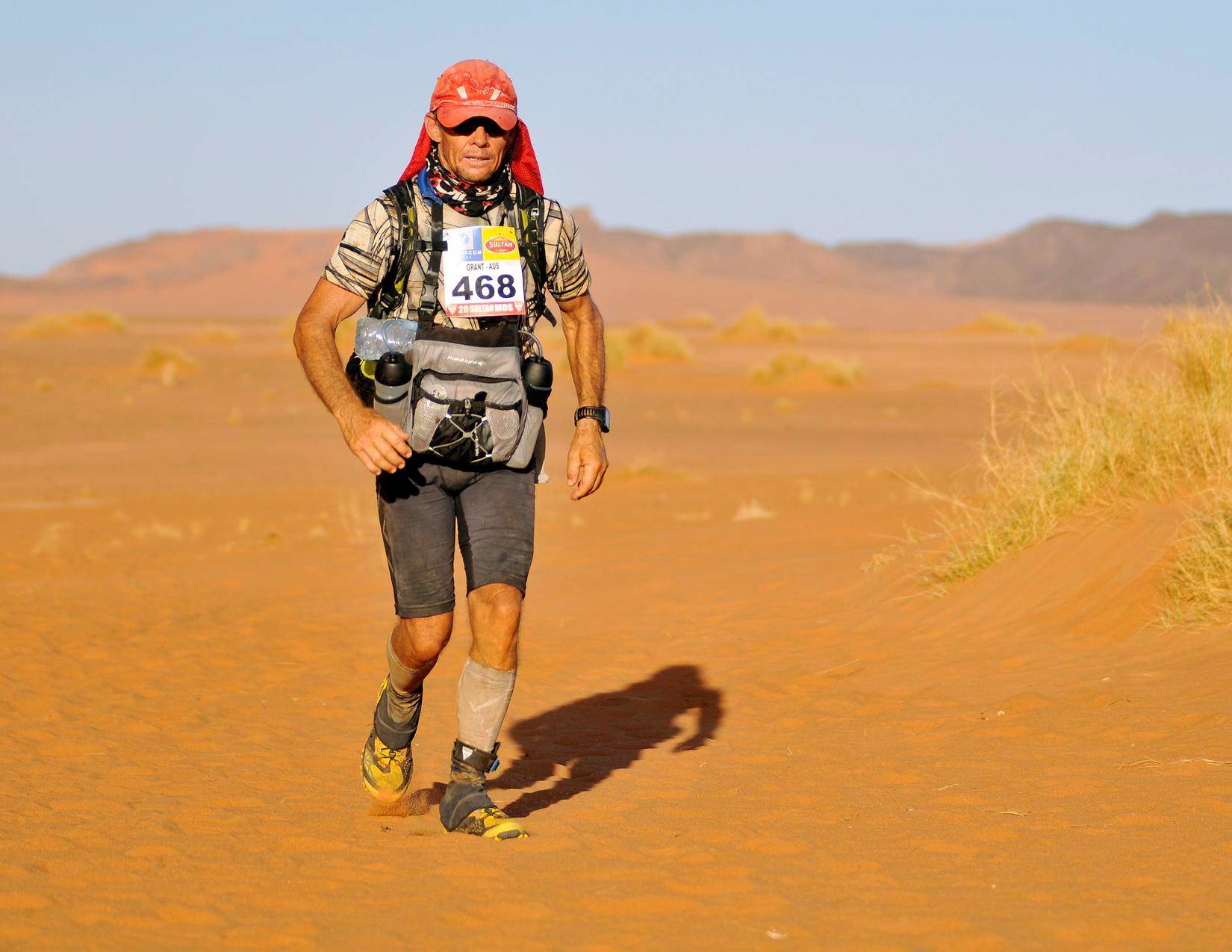
From Marathon Des Sables (Photo; courtesy Grant Maughan)

From Marathon Des Sables (Photo: courtesy Grant Maughan)

People always ask what I think of out there and I tell them that I think of many things and sometimes, absolutely nothing. I believe that the toughest thing for some people while trying to finish an ultramarathon or such events is the time. When they look at the watch and realize they may be out there for another 10, 15, 20 hours or more, I think that is the hardest part for some to accept; the actual measurement of time and how much longer they need to keep moving and feeling uncomfortable. It happens to me sometimes. But I can just shut off my mind to let the time go by. I can do this driving or riding a motorcycle long distance. I can drive across a country non-stop without a problem by just shutting off time perception to deal with the boredom of holding on to the wheel or handlebars, hour after hour. It is similar to working at sea, when you are crossing a featureless ocean for weeks at a time. The horizon is just a line with the sky and water. I believe seafaring has really helped me do long distance endurance events.

From Spartathlon (Photo: courtesy Grant Maughan)

From Spartathlon (Photo: courtesy Grant Maughan)

You had posted on the Internet that your 2016 Spartathlon experience was quite trying. You went into the race unwell and then endured some really hard moments. Can you tell us what happened? Do you suspect that your packed race schedule may have had something to do with your condition ahead of the race? Is Spartathlon reason enough for you to rethink your affection for packed schedule?

I actually wasn’t looking forward to doing Sparty. I ran it last year and wasn’t that impressed with the course; smog filled Athens and then industrial areas. When I got out into the country, I thought it would be pristine but it was garbage strewn and that really disappointed me. Last year, I turned up tired from another heavy schedule and battled through it even though I had run that distance before in the Coast to Kosci race in Australia in under 27 hours. This year, I again turned up after my crazy amount of races and felt tired of course but additionally, the day before the race, got swollen glands and tight larynx that made swallowing very painful. On the morning of the race I had a lot of mucus and felt very under the weather. I knew I shouldn’t start and should go back to bed but as happens, the vibe makes you want to have a go anyway. I figured on taking it easy and really didn’t have a choice. I wanted to quit so bad at the 50 mile checkpoint and at 100 miles but for some reason left the checkpoints before my saner side could take over. In the end I finished, passing many runners on the last big mountain range before going down to Sparta like last year, but my overall pace was slow. It was a very miserable experience getting through the race. I just didn’t feel like being there but I like to finish what I start; so I made myself go on.

In such physical states, time does seem to get elongated. An hour seemed like ten. So I really needed to put my brain to bed during the race and shut it off from reality. I can’t describe how relieved I was to stop at the finish line. Spartathlon is not a race you should finish a heavy season of events with. It is a fast, long ultra with no-compromise time cut-offs along the way. Sometime in the future, I may like to turn up there fresh and fit and see what time I can pull of when in a better physical state than the two times I have run it.

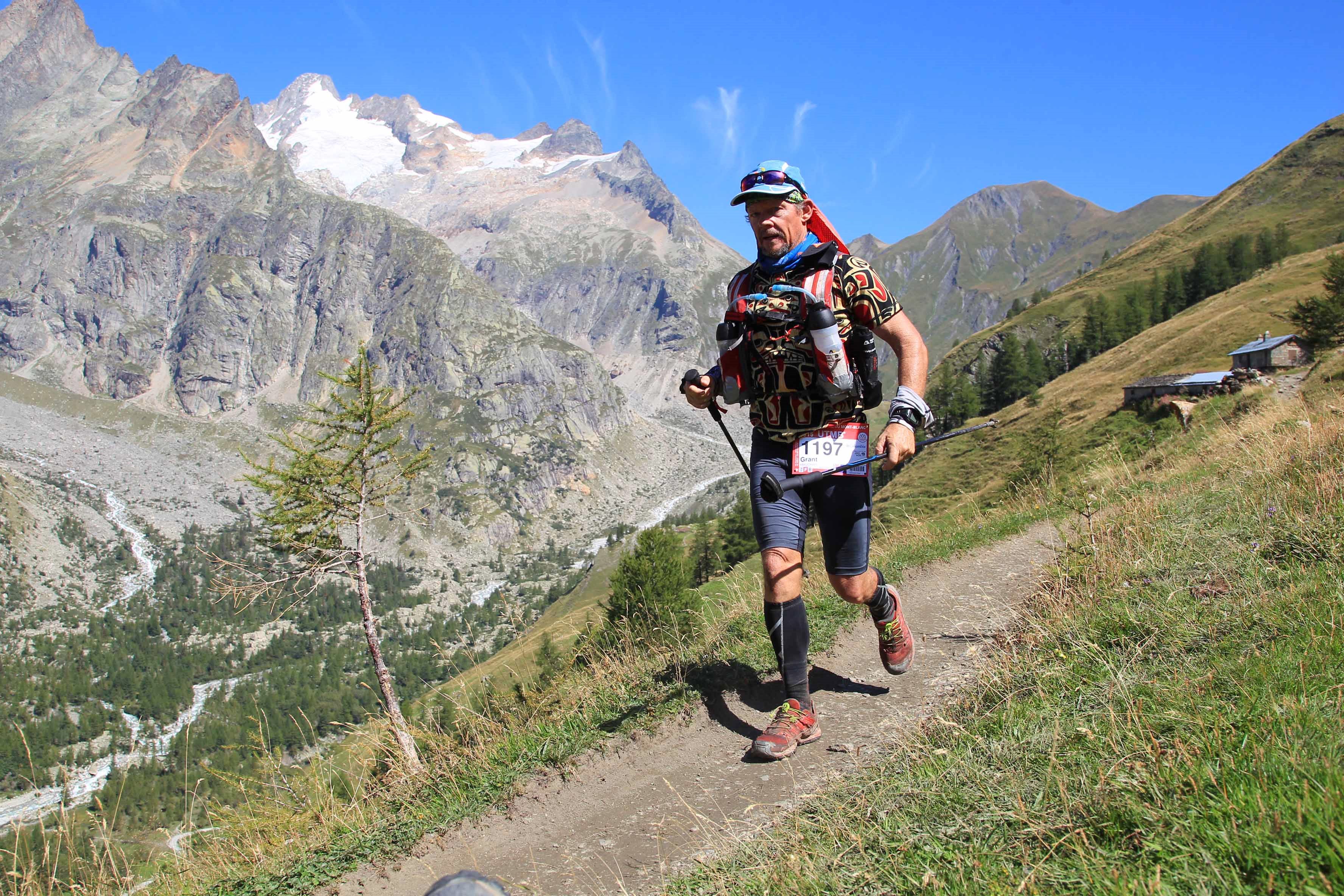
From Ultra Trail du Mont Blanc - UTMB (Photo: courtesy Grant Maughan)

From Ultra Trail du Mont Blanc – UTMB (Photo: courtesy Grant Maughan)

What are you seeking in all this? Is there anything you seek from universe through what you endure? Given you have experience of mountaineering, seafaring and love surfing and riding motorcycles, not to mention good enough at music to be a one man band, what do you describe yourself as?

Some people have described me as a renaissance man. I like that. I enjoy many variables in my existence. I think it keeps me alive and kicking. I also like the hybrid nature of all my hobbies. I feel they cover a wide span of things. I think of myself as a doer. I like to try new things and become competent at them. I don’t feel I am searching for anything or running away from anything. I am just trying to fill my time with life and keep it all interesting. I am very curious about many things and like to see the world in colour; not black and white.

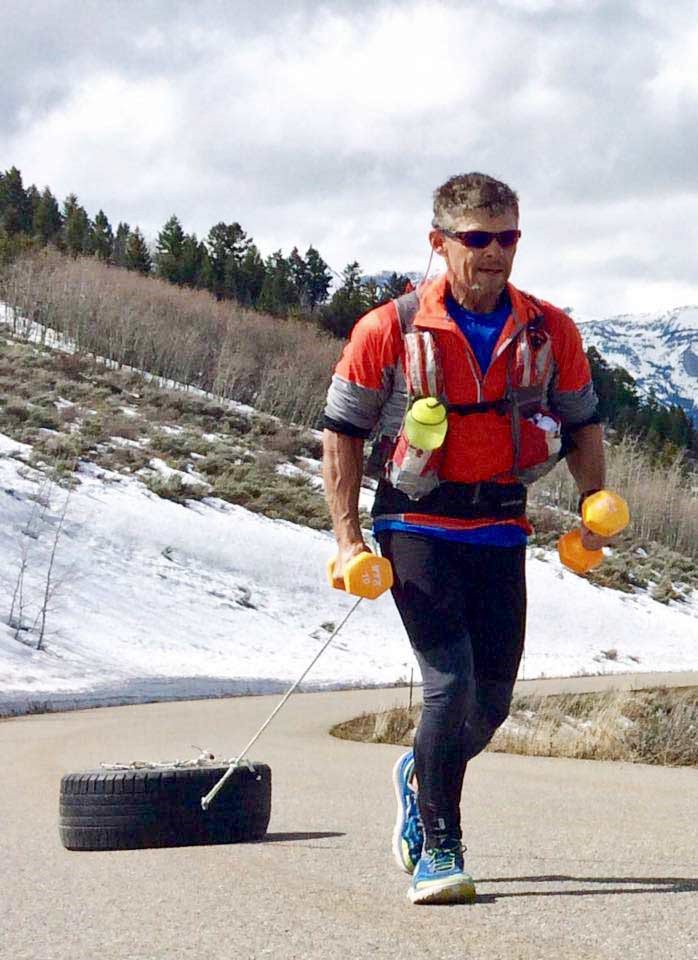
Training, pulling a tyre (Photo: courtesy Grant Maughan)

Training, pulling a tyre (Photo: courtesy Grant Maughan)

How do you relax after your races? What do you do to unwind?

I am as good as anyone at lounging around, drinking a beer or eating chocolate while watching movies, playing guitar or just looking at the sky.

What are your next plans?

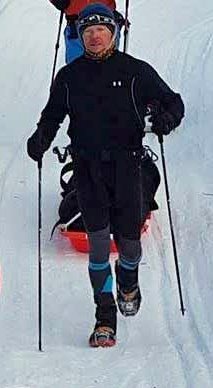
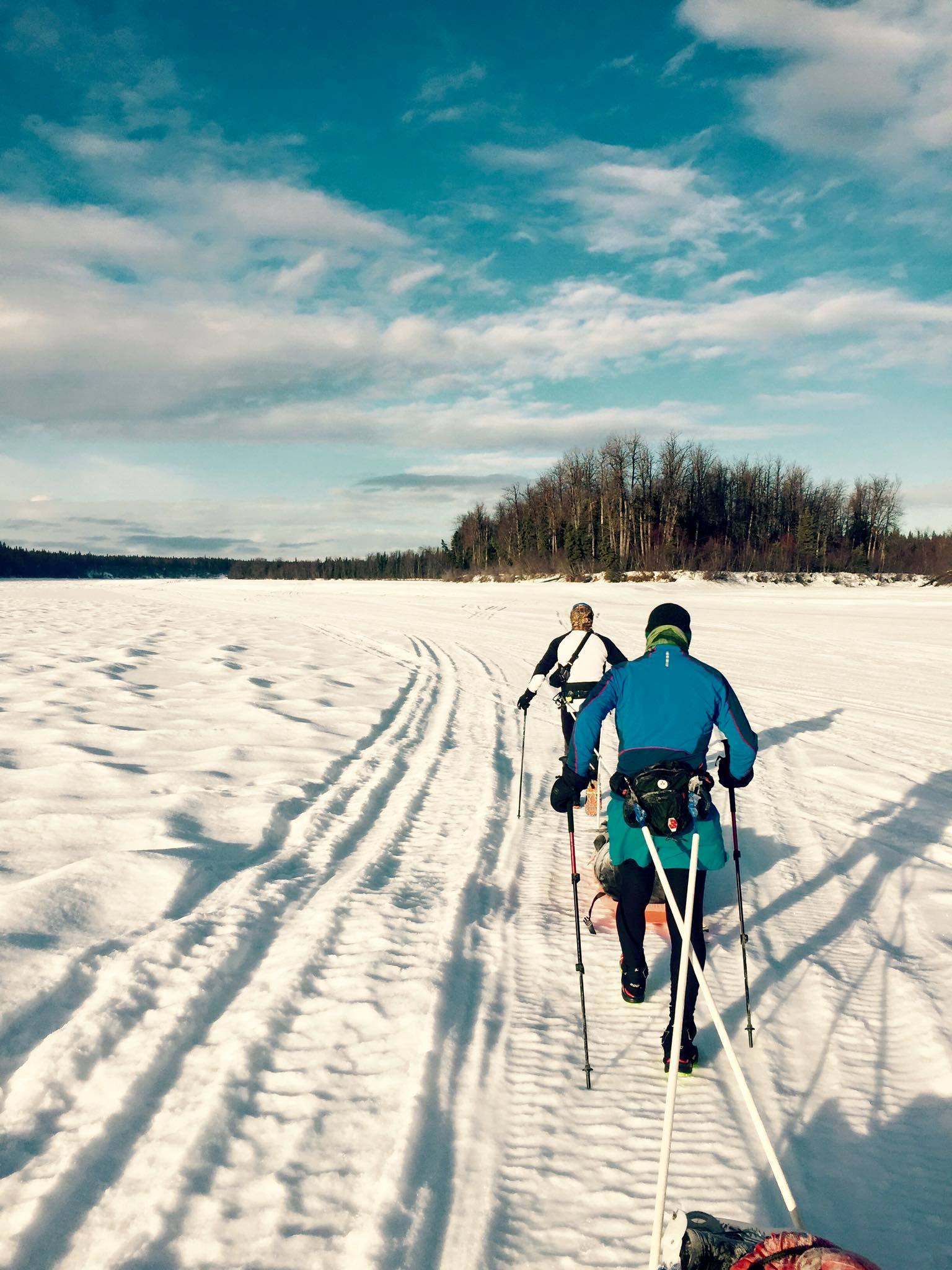
The next few months will be dedicated to recovery of my body and immune system before 2017, when I hope to start another year of exploring, traveling and racing. I have applied for the Arrowhead 135 in northern Minnesota in January (I did this event a couple of years ago). It is a winter race pulling a sled with mandatory survival gear in it. There are usually only three aid stations along the route, so you must carry a lot of fluids and calories. This year, they may be offering an unsupported class, which means you cannot stop at aid stations. I am interested in this. Then, in February I have the Iditarod 350 mile winter race in Alaska, which is a similar format though it also requires some navigation. I don’t have any firm plans after that but intend to keep busy.

(The interviewer, Shyam G Menon, is a freelance journalist based in Mumbai.)


“ AGE IS WHAT YOU MAKE OF IT’’

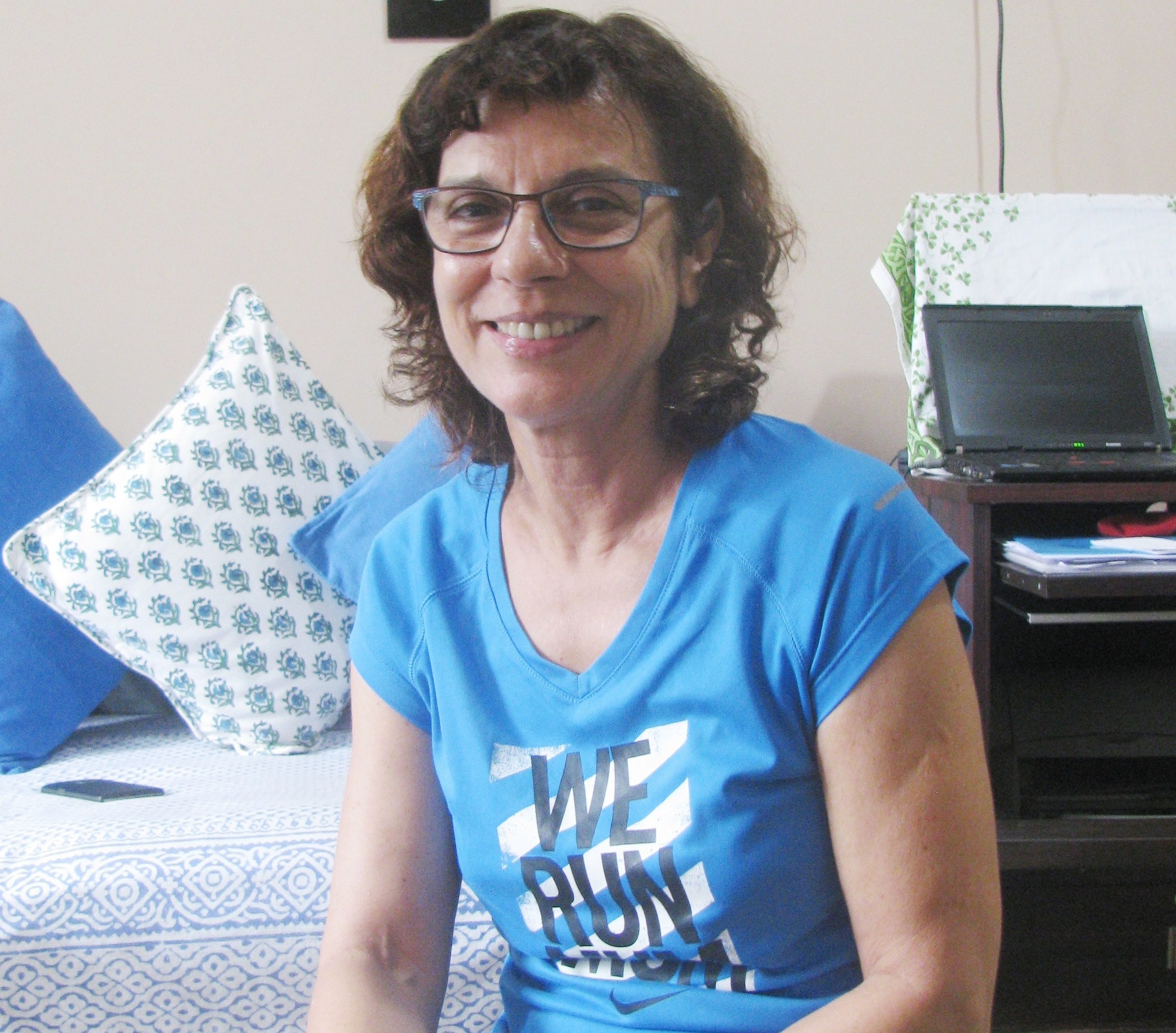
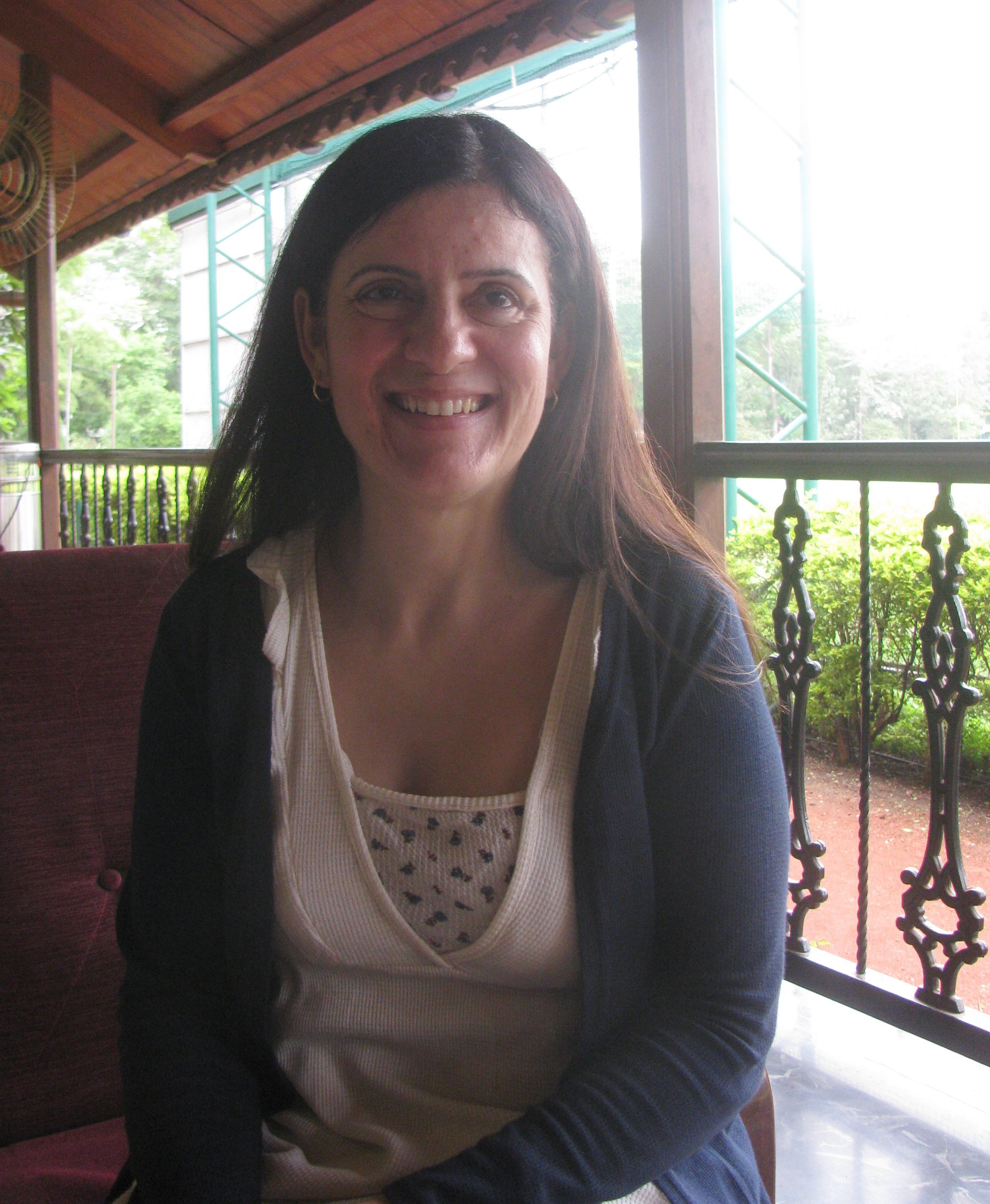
Pervin Batliwala (Photo: Shyam G Menon)

Pervin Batliwala (Photo: Shyam G Menon)

“ I did everything late. At the age of 40 I started going to discos. I got married at 45. At 50, I started running and at 60, I ran my first ultramarathon!’’ Pervin Batliwala said laughing.

We were at her house, in a quiet residential area that a newcomer to Mumbai wouldn’t suspect existed. As you ascended the hillside next to Babulnath temple and walked into the colony of houses belonging to the Parsi community, a tinge of quaint personal space took hold. Yet Marine Drive and the access to Peddar Road and suburban Mumbai beyond were all close by. As combination of long flat road with plenty of ups and downs at tangents, this part of Mumbai would be prized real estate for any runner. It came in handy for some of Pervin’s training runs. For the bulk of her life however, Pervin who will be 62 in October 2016, didn’t think much of running.

She was born and brought up in Mumbai in a very middle class family. Her father worked in a bank, her mother stayed a housewife. Schooling was at Bai Ruttonbai F D Pandey Girls High School in Tardeo; for college she attended Burhani College of Arts and Commerce at Mazgaon. Finally she studied law at Mumbai’s Government Law College. Then, she commenced work at Hindustan Unilever Limited (formerly Hindustan Lever Limited – HLL), the Indian arm of Unilever. HUL is an iconic company in the Indian corporate world. Not only are its products ubiquitous in India but working there was considered prestigious particularly in the early years of life by MBA in India. The company’s Indian headquarters sat tucked away in a sheltered lane in South Mumbai, on the edge of the city’s well known business district – Nariman Point.  Pervin worked at this office as well as at premises in suburban Andheri. Many of her years at HUL were spent as executive assistant to top officials. Like others of her generation, she stuck on at the first company she joined. She remained with HUL till retirement.

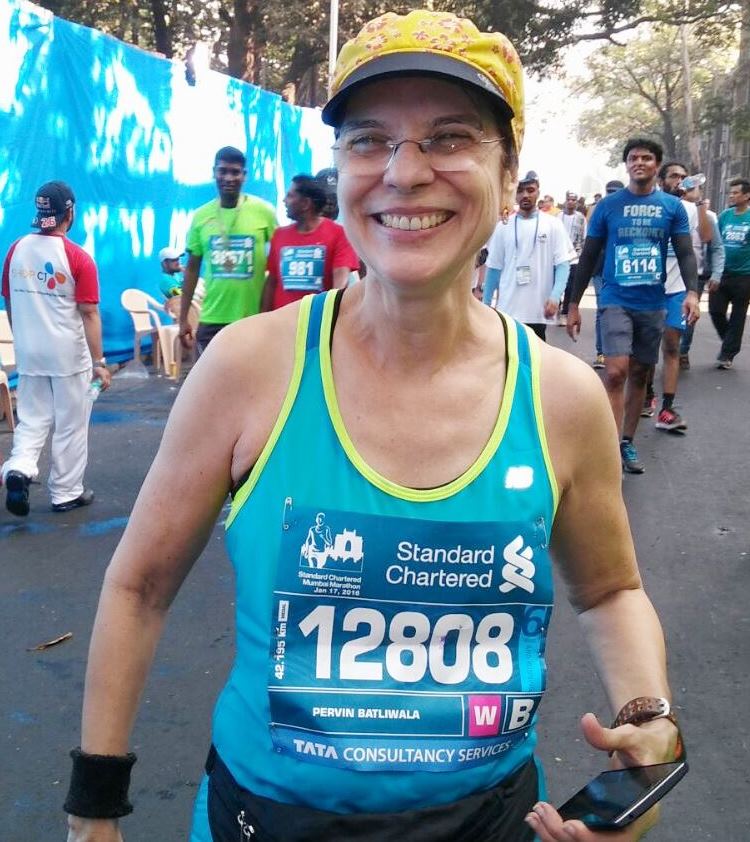
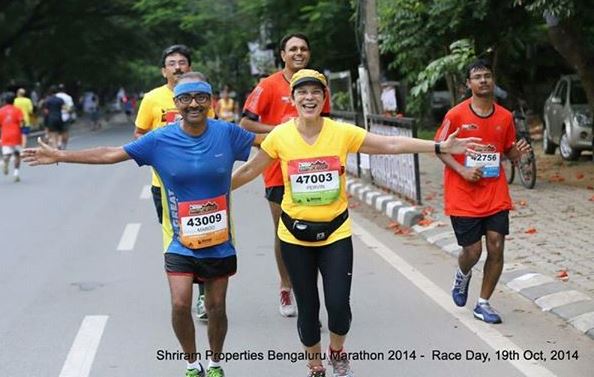
At the Standard Chartered Mumbai Marathon - SCMM (Photo: courtesy: Pervin)

At the Standard Chartered Mumbai Marathon – SCMM (Photo: courtesy Pervin)

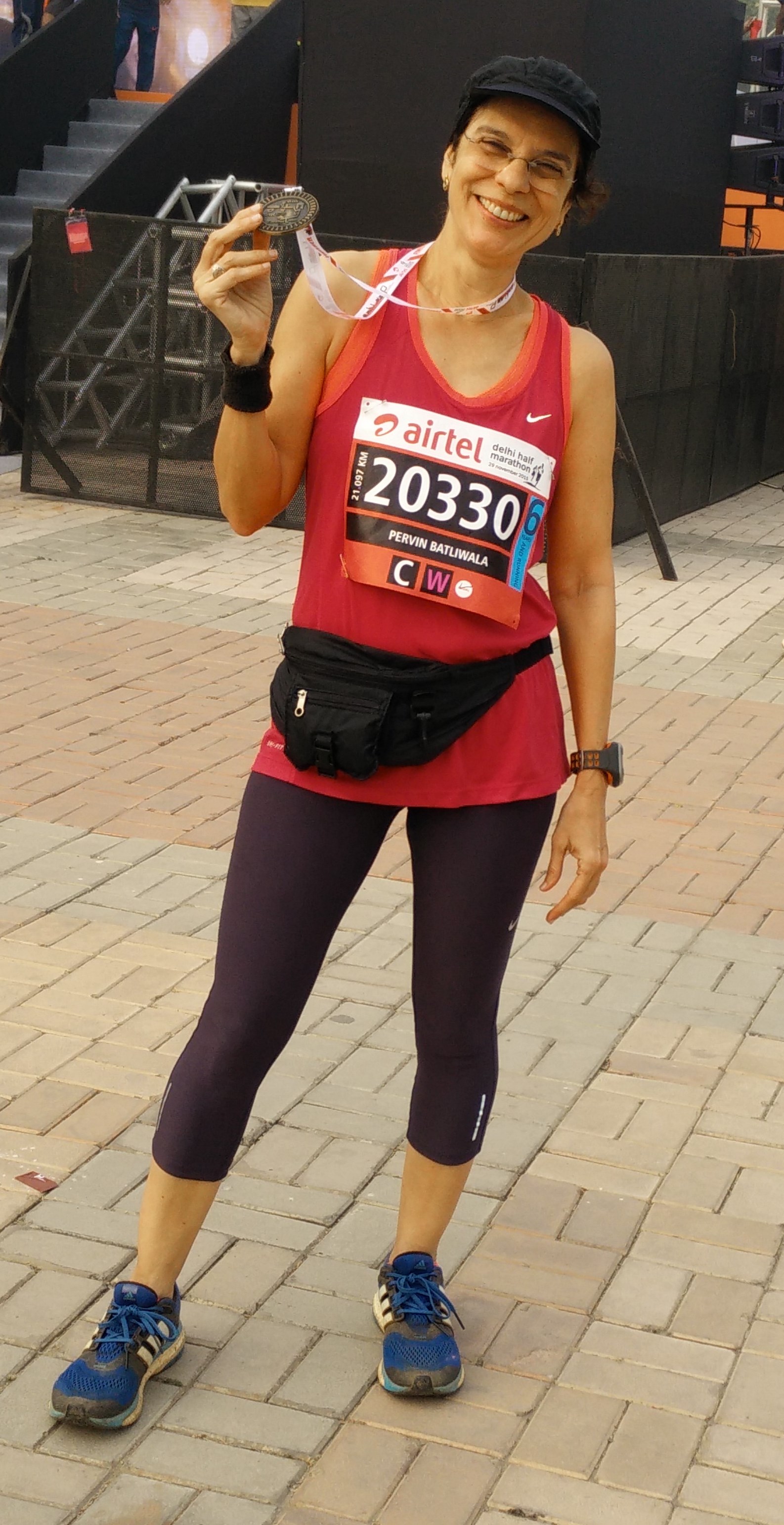
At the half marathon in Delhi (Photo: courtesy Pervin)

At the half marathon in Delhi (Photo: courtesy Pervin)

In school Pervin hadn’t been into athletics or games in the fashion expected of those seeking identity in such pursuits. She was an active person – that description suited her. From what she said, she appears to have always floated on a reservoir of energy and appetite to do many things. When she got around to doing something she had plenty of drive to dig into. On her visits to the city’s discos, she would dance through the night, all the way into the early hours of the morning. There appears to have been two other trends too. There was a turnover of activity in terms of variety plus, once something caught her fancy, she went after it diligently. “ I would take up something – like swimming, yoga, gym, Shiamak Davar dance classes – and go crazy about it,’’ she said.

During her years at HUL, the company decided to invest in some level of daily activity for its employees, from a fitness point of view. Very close to HUL’s South Mumbai office was that Mumbai landmark – Oval Maidan. It is a vast playground, home to several simultaneously played cricket matches with a jogging track all around. In monsoon, when the cricket pitches become muddy and overgrown, football takes over. Amid city notorious for its ever hungry real estate lobby, this patch of land for play and exercise has survived, thanks to citizens who fight to protect it. HUL had stretching exercises and walk-jog routines for its employees at Oval Maidan. Among those who joined this group was Debasis Ray, currently Head – Public Affairs at Tata Trusts, who at that time worked in the corporate communications wing of HUL. He recalled, “ When Standard Chartered announced the Mumbai Marathon, many of us got enthused. The result – typical of HLL style – was a gym in the basement and a trainer who would train us at the Oval and Race Course. Pervin was part of the group. I too joined in. I recall Nitin Paranjpe, Prasad Pradhan and many others. Pervin, I think, found out that running is her passion.’’ The person HUL entrusted with overseeing the training was Savio D’Souza, a former national champion in the marathon and one of Mumbai’s best known coaches for running. According to Pervin, one day, Savio suggested that the group go onto the road. That brought them formally to Marine Drive and its many runners. Pervin’s tryst with running had begun.

Pervin with Chitra Nadkarni and Vaijayanthi Ingawala after a race (Photo: courtesy Pervin)

Pervin (left) with Chitra Nadkarni and Vaijayanti Ingawale after a race in Thane (Photo: courtesy Pervin)

Her first official participation in a run was the short ` Dream Run’ component of the annual Standard Chartered Mumbai Marathon (SCMM). The following year, she attempted the event’s half marathon. Well into the race, she ran out of energy. She “ hit a wall.’’ She couldn’t move. “ I was a gone case,’’ she said. Those days, you could get a refund on the timing chip but that had to be done immediately after the race. “ I wanted my money back,’’ Pervin said. Not to mention, finishing what she had begun was also important. She convinced Kushru – her husband – that she should somehow finish the race, walk if she must and get that refund. She did just that. Savio would later tell her that she had committed the mistake many do – she ran the first half of her race, too fast. But the coach told her that she would do well for she seemed to enjoy what she was doing. “ I was disappointed but I took it well. Savio said you will be able to do it, nothing to worry. That half marathon was a learning for me,’’ Pervin said. Savio’s observation was correct. That same year, Pervin ran the Airtel half marathon in Delhi. She won in her age category. In many ways that’s the Pervin Batliwala, Mumbai runners have come to know. She is a frequent podium finisher in her age group. So much so that Pervin honestly admits that in her retired years with ample time to train and attend races, she picks events where she has a chance for a podium finish. She enjoys getting prize money.

At the Goa marathon (Photo: courtesy Pervin)

At the Goa marathon (Photo: courtesy Pervin)

At the Bengaluru marathon (Photo: courtesy Pervin)

At the Bengaluru marathon (Photo: courtesy Pervin)

Runner born, Pervin trained regularly. She ran early in the morning, a schedule she stuck to even when her work shifted to premises in Andheri entailing daily commute. The mileage she put in every day was modest. “ I used to do very limited mileage at that time,’’ she said. One reason for the measured approach was the findings of a medical test done ahead of joining the fitness-group at HUL. Pervin hails from a family with a history of arthritis. The test showed that her bone density was poor. However what subsequently played out was encouraging. According to Pervin, although she stayed cognizant of the need for caution, fact was – the more she kept running, the better she seemed to do at bone density. In all this time since getting into running, she hasn’t been laid low by any major injury. Slowly she transitioned to the full marathon. Such shifts, usually well thought out and momentous for others, appeared to be a breeze in her case. She doesn’t recall getting stressed by such transitions. Her first full marathon was at SCMM. “ I like 42. You don’t have much tension over timing in that distance. In 21, I feel the pressure,’’ she said. For several years after that win in Delhi, Pervin maintained an annual diet of races in Mumbai, Goa, Bengaluru and Delhi. The races spanned half and full marathon. By now she was also largely training on her own. “ Five days of running every week, one day rest, one day for cross training or working out in the gym. I don’t do too much of core and all that. I don’t believe in it. If I exercise too much, it goes into injury for me,’’ she said.

Pervin and Kushru at a Mumbai Road Runners (MRR) awards function (Photo: courtesy Pervin)

Pervin and Kushru at a Mumbai Road Runners (MRR) awards function (Photo: courtesy Pervin)

Abbas Sheikh is part of Savio’s team. “ Pervin is a very good runner. She is absolutely inspiring. I have paced her on a few runs and I enjoyed running with her,’’ Abbas said. One of the interesting aspects about Pervin’s running is that she is gregarious in this activity too. She likes running in a group. “ She always has a big gang of runners with her,’’ Parul Sheth, runner and author, said. A person who loves to chat, Pervin’s description of running and the affection she has for it included, talking and running. “ It’s fun,’’ she said of running as a group. Contrary and simultaneous to this is another trend in her – once she gets her fill of something, she moves on. When you have known what the half and full marathon are it is time for ` what next?’ Beyond both these distances lay a distance category, typically described by its inhabitants as discovery of personal space and extended dwelling in it – the ultramarathon. It was Amit and Neepa Seth who introduced Pervin to Comrades, the famous ultramarathon – the world’s oldest – run annually in South Africa. “ Once I hear of something, I try to get more details,’’ Pervin said. In March 2006, Doug Baille from South Africa had assumed charge as CEO of HUL. A keen runner, he had run the Comrades before. Pervin spoke to him to get an idea of the race. She also spoke to Savio, who planted an idea: run Comrades, the year you retire. She planned accordingly, registering for the race in the final phase of her tenure at HUL. However at the SCMM full marathon, which preceded Comrades, she had an absolutely tough time. It cast a cloud on her ability to run the ultramarathon in South Africa. Comrades being significant, her family had also planned to fly to South Africa and cheer her. Now everyone suggested she postpone going for the race. Pervin was determined to go. She said she will proceed alone.

Two of her friends – Sandeep Bhandarkar and Parul Sheth – came forward to help. Parul had first met Pervin when she joined Savio’s group. “ Pervin was already an accomplished runner. She encouraged me a lot in my running,’’ Parul said.  Sandeep had created a weekly training programme. Parul’s job was to help execute it. Pervin’s first block of training, specifically for Comrades, was at Lonavla. That 56 km-run went off smoothly. “ From that day I didn’t look back,’’ she said. Savio’s group supported her wholeheartedly. “ I would put up my daily plan on WhatsApp and people would volunteer to run with me,’’ she said. Parul put the preparation in perspective. “ Pervin was determined to do an ultramarathon. She was ready for it. Her training was tough but she meticulously followed it. If she was supposed to log a certain mileage on a given day she would do that or more, never less. Seeing her train, I got to see another side of Pervin,’’ Parul said. As one’s interest in running grows or races become more demanding, eating the right type of food assumes importance. Rupali Mehta, dietitian and runner, planned Pervin’s diet. It also appears to have been training with a characteristic twist; that natural sociability was always around. “ I have to talk and run. You are running because you are happy, no tension, no thinking of anything, you are with friends – that’s how it is for me. I don’t like running alone,’’ Pervin said.

Pervin (left) at Comrades, with Kashyap Modi (Photo: courtesy Pervin)

Pervin (front, second from left) and Kashyap Modi at Comrades (Photo: courtesy Pervin)

In South Africa, the 89 km-race went off well for the now retired Pervin Batliwala. The ultramarathon – alternatively an uphill or a downhill depending on which year you run – is always spoken of for its several cut-offs and how they are stringently enforced. Pervin’s run went smoothly through it all. “ There is a saying at Comrades that if the winner is announced when you are half way through the course, then you will make it comfortably to the finish line. That’s exactly what happened for me,’’ she said. She liked the ambiance at Comrades and the way people turned out to cheer. “ Cheering is important. It gives you energy,’’ she said. Her friend to talk to while running Comrades, was Kashyap Modi. Savio’s group and her family tracked her progress on WhatsApp. She finished the race in approximately 11 hours 34 minutes. Then, in classic Pervin style she decided that having run Comrades and known what it is she must now look for something else. We asked if her continued appetite for challenge and podium had anything to do with conditioning by corporate life. Pervin dismissed that for the bulk of her employed years had been as executive assistant to senior officials; it is hard to get addicted to corporate instincts that way. What she does have is – she expects the best from herself.  “ When I run, it is my race, my rhythm, my timing. I never try to catch up with anybody,’’ she said. She attributes her nature and the desire to challenge herself, to her own wiring. After Comrades what? The question hung around.

From the 2016 Khardung La Challenge (Photo: courtesy Pervin)

From the 2016 Khardung La Challenge (Photo: courtesy Pervin)

“ I speak from the heart. I don’t think of what others may say,’’ Pervin said. There is a video of her, tired and happy, seated by the roadside talking her heart out. “ Comrades is nothing!’’ she shouts happily to the interviewer who had asked what she thought of that race, having completed her most recent one. The location is Leh in Ladakh, the high altitude desert just north of the main east-west axis of the Himalaya. Several years ago, Pervin had run a half marathon there, part of Zendurance. In 2012, Rimo Expeditions started organizing the annual Ladakh Marathon. It had four disciplines, one of which was the ultramarathon called Khardung La Challenge. As a race it was tad shorter than Comrades, being 72 km overall. But with Khardung La (17,582 ft) included in the course, there was weather and altitude for challenge. Used to Mumbai, its warm weather and urban comforts, Pervin had her concerns. The Ladakh Marathon had a stall at the SCMM expo. She met the organizers and told them of her interest as well as worries. They said they would take good care of her. She registered for the Khardung La Challenge due in September 2016. New challenge found, she trained for it. The ups and downs of the hillside around Babulnath and Malabar Hill became training ground. To learn more about the race, she spoke to Khushboo Vaish, Nishant Desai, Dr Arun Nayak and Commander Sunil Handa, all of who had run the Khardung La Challenge before. She put herself on a regimen of Diamox and reached Leh 15 days before the race to acclimatize. In that time, she did a three day-trek to the Gandala Pass, drove up Wari La for a further taste of altitude, proceeded to Nubra and returned to Leh via Khardung village and Khardung La.

On race day, the run from Khardung village started at 3 AM. She approached the pass at brisk walking pace, a departure from her regular credo of never walking at any of her races. Thanks to good acclimatization, she had no problem breathing at Khardung La. Downhill was a chore. Pervin finished in 13 hours 15 minutes, placing third overall among women. She was the only one in her age category. There were reasons for that comment on video. At Comrades, Pervin had stayed close to the starting line in a comfortable hotel. The race began at around 5 AM, which is usual for most races. Khardung La Challenge was a different experience compared to Comrades. The 2016 race was well organized, it had adequate support staff and as the organizers – Chewang Motup and Yangdu Gombu – had promised in Mumbai, they took good care of her, Pervin said. Further, till noon, race day features a Khardung La road free of traffic, something runners appreciate. The difference she found was in how you reported for the race, which was a natural outcome of location. The runners headed the day before the race to Khardung village. They stayed in functional accommodation and endured a 3 AM-start. That was new for her. “ I was running on tired legs,’’ Pervin said. All that made the successful finish, sweeter. Comrades seemed a world away. It was time for: what next?

In Ladakh, after the Khardung La Challenge (Photo: courtesy Pervin)

In Ladakh, after the Khardung La Challenge (Photo: courtesy Pervin)

In January 2016, on the return leg of the big loop that is the SCMM full marathon, somewhere near Churchgate, Pervin had suddenly sensed a truth that crept up unnoticed. With not much distance left to the finish line, she stood a good chance of making it home within the qualifying time assigned for her age category at the Boston Marathon. She gave that last bit of the race all she had and qualified. That’s her next project – the 2017 Boston Marathon. There is room for plenty of slip between the cup and the lip here – she has narrowly qualified and a lot of luck is therefore required to feature in the list the organizers announce. But Pervin hopes for the best. As for other dreams – she wants to attempt the Two Oceans race, try for a sub two hour-finish at the half marathon in Delhi, run one of the two ultramarathons in the Rann of Kutch and someday, attempt an Ironman. As yet, she has done a duathlon, a fun race with her running group. “ Age is what you make of it,’’ she said.

Pervin has no sponsors. She wouldn’t mind such support. But she is also aware that she is too evolved in life to dance to anyone else’s tunes or mouth lines suitable to sustain sponsorship. Such stages in her life are over. “ After I retired I had many offers to work, return to corporate life. But I said no,’’ she said.

This phase – the current one – is her chance to be free.

(The authors, Latha Venkatraman and Shyam G Menon, are independent journalists based in Mumbai.)         


THE PURSUIT OF DEFINITION

Michelle Kakade (Photo: Shyam G Menon)

Michelle Kakade (Photo: Shyam G Menon)

It was a Sunday.

The monthly Bandra-NCPA run in Mumbai had just concluded and the runners were beginning to disperse from Marine Drive. First Girish Mallya and then Kutty Krishnan Nambiar informed that they were headed for the Gateway of India, to witness the conclusion of a landmark run. We had originally met this run as a stall at the expo preceding the 2016 Standard Chartered Mumbai Marathon (SCMM), nearly four months earlier. Gateway of India wasn’t far from Marine Drive.

The reception for arriving runner was over by the time we reached. From Colaba’s Regal circle onward, we encountered runners who had been part of the receiving team, returning. The immediate precincts of Gateway of India too were relatively empty, it being a Sunday morning and as yet early for the regular inflow of tourists and hangers on.  A runner directed us to a small, compactly built woman standing to the side, away from any attention lurking around. That’s how we met Michelle Kakade.

She was born Michelle Rocque in Bhopal, year 1968. Her grandparents were British. Michelle’s father worked in the merchant navy. They were five children in all – she has an older sister, two younger sisters and a brother. She was the middle child. For seven years, from third standard to the tenth, the siblings studied in Nainital, Uttarakhand. “ From a very young age, we were pretty independent,’’ she said. After completing that stint at boarding school, she returned to Bhopal. She was there in the city, when the infamous gas tragedy struck. Post eleventh grade, she secured admission to a catering course in Mumbai but didn’t find herself comfortable in the big metro. So she moved to nearby Pune, where her sister was pursuing an MBA; Michelle joined St Mira’s College to study humanities. After completing her twelfth, she studied English literature. Through school and college, she was into sports but not in the manner, where one pursues it diligently. Her participation in sports had much to do with sports and games being mandatory in school. “ It wasn’t because I had any special calling in anything,’’ she said. She was good at the throws – like discus. But there was no running. She got married early, at age 20; children and family life followed, equally early. Her husband, Anil Kakade, runs a successful construction business in Pune. A couple of months after that first meeting near the Gateway of India, it was at Poona Club that we sat down for a conversation with Michelle.

From the race in the Sahara desert; part of 4 Deserts (Photo: courtesy Michelle Kakade)

The race in the Sahara desert; part of 4 Deserts (Photo: courtesy Michelle Kakade)

Running in the Gobi desert (Photo: courtesy Michelle Kakade)

Running in the Gobi desert (Photo: courtesy Michelle Kakade)

Post marriage and well into family life and membership at Poona Club, she began frequenting the club’s gym. The club had a ritual every Republic Day (January 26). It hosted a run featuring 26 loops of the adjacent ground. The trainer put her name down for it and as it turned out, she emerged first in the run. “ More important, I liked the experience,’’ she said. Michelle also mentioned something else, something we have since heard some extreme runners articulate and suspect, remains unarticulated in many others. “ I get bored very fast,’’ she said. According to her, she tried a lot of things but very few interests sustained. In running, her interest hasn’t diminished. “ After that first run, I began to get more and more involved,’’ she said. Those were early days for running in Pune, particularly with regard to women in running. The city was home to the Pune International Marathon, one of India’s oldest marathons. When she decided to participate in its half marathon segment and was training for it, there were few women running on Pune’s roads. At the event itself, women runners in the discipline she chose were four or five of which, two or three were foreign runners. Michelle finished her first half marathon in 2 hours 15 minutes. There was no timing chip then and the certificate issued at run’s end was a certificate of completion. When she pointed out that the slots meant to show timing were vacant, she was told to fill it herself. “ As time went by, my timing improved. I now do a half marathon in under two hours,’’ she said. The event whetted her appetite. A few more half marathons done, she set her eyes on the Standard Chartered Mumbai Marathon (SCMM). One reason for this shift to Mumbai was that in Pune, the full marathon was considered a male preserve with very few women participating. She did three full marathons in Mumbai; according to her, on the average she runs a full marathon in around five hours.

During one of those SCMM editions, in the holding area for runners, she met a lady from Germany who was preparing to run with a backpack. As the two got talking, Michelle learnt that the German runner was in training for the Marathon Des Sables (MDS), which takes place in the Sahara desert. With Germany cold in January, the lady had elected to run in Mumbai. “ I was blown away. This sounded very interesting,’’ Michelle said. On return to Pune, she wasted no time browsing the Internet for more information on MDS. Although the event seemed challenging, what encouraged Michelle and hinted at the possibility of her doing it, was news doing the rounds (eventually it was denied) of a 51 year old-Madonna (the singer) deciding to run the 2010 edition. However, the trigger to participate came from an unfortunate, unexpected incident. At that time, the president of Poona Club was Manoj Malkani, who was a friend and relative. A play was due to be put up at the club and a discussion was on about it. “ He got up to leave and a while later, in the car park of the club; he suffered a sudden heart attack and died. That incident was reason enough to introspect. I asked myself – if something like that was to happen to me, what is the one thing that would define Michelle Kakade? I didn’t have an answer. We tend to procrastinate about a lot of things in life, we just keep delaying,’’ Michelle said. Manoj Malkani passed away in August 2009. In September 2009, Michelle signed up for the April 2010 edition of MDS.

From the the Atacama desert of South America (Photo: courtesy Michelle Kakade)

From the the Atacama desert of South America (Photo: courtesy Michelle Kakade)

From the race in Antarctica (Photo: courtesy Michelle Kakade)

In Antarctica (Photo: courtesy Michelle Kakade)

The Marathon Des Sables is a multi-day stage race – six stages over seven days. Altogether the distance entailed exceeds 250km and includes one long stage of over 80km. Given its location in the Sahara desert, daytime temperatures can be very high.  Michelle’s training for MDS was very sketchy. In Pune, she approached the Army Sports Institute for help. But she was told that they train only army personnel. “ Sometimes ignorance is bliss. When you don’t know what you are getting into, everything seems rosy,’’ Michelle said. She trained at the Poona Club. Taking a leaf from the German lady she met at SCMM, she stuffed a backpack, put it on and ran with it. “ It was also a case of not knowing oneself. I was unprepared because I was unaware of what I can do,’’ she said. Reporting for the MDS in North West Africa, she discovered that she had got her equipment wrong. “ My equipment; food, backpack – everything was wrong. But you have to make the best of a bad situation. The atmosphere was super charged. The euphoria carries you on,’’ she said. During the race Michelle was bothered a lot by her inappropriate backpack. Then, she was hit by diarrhoea and a bunch of painful blisters on her feet. After the race’s long stage, she passed out. “ There were moments when I thought of giving up,’’ she said. But the people around were supportive. The MDS, like many ultramarathons, carries no prize money. That alters the competitive spirit and the company you find at the race. Further, there was something about an ultramarathon that addressed one of the problems Michelle had spoken of – the tendency to get easily bored. Unlike a typical road race, an ultramarathon – road or trail – is so long and pushing runner to his / her limits that you course through a variety of situations and experiences. “ You don’t know what is in store for you. I can’t keep doing the same thing over and over again. The newness appeals to me,’’ Michelle said. She completed the 2010 MDS.

As at SCMM earlier, MDS introduced her to a potential next project. She saw a runner who was wearing gaiters with `Four Deserts’ printed on it. As she found out, it denoted the driest, coldest, windiest and hottest deserts; and there was a race – 4 Deserts Race – embracing all four attributes. According to Wikipedia, the 4 Deserts Race was recognized as the world’s leading endurance footrace by Time magazine in 2009 and 2010. At the time Michelle heard about it, the race entailed running in Chile’s Atacama Desert (driest), China’s Gobi Desert (windiest), the Sahara (hottest) and Antarctica (coldest). There is a three month-gap between each race. At each of these locations you have to run 250km. The run in Antarctica is by invitation; to become eligible for it you have to run in at least two of the other deserts. If you do all four you become part of the 4 Deserts Club. Back from MDS, Michelle was immediately into planning the four deserts trip. To start with, she signed up for the Atacama race. Eventually she did all four. She ran three of the races in 2011; the Antarctica leg which is dependent on the availability of a window, she completed it in November 2012. However, after the Antarctica race she was hit by a case of severe shin splints and plantar fasciitis. Given she was not resting adequately, the condition worsened till she could do nothing and was forced to take a whole year off in 2014. At its end, getting back to running was like a start all over again, albeit a quicker process.

Running the Golden Quadrilateral (Photo: courtesy Michelle Kakade)

Running the Golden Quadrilateral (Photo: courtesy Michelle Kakade)

It was on January 6, 1999 that former Prime Minister A. B. Vajpayee laid the foundation stone for India’s Golden Quadrilateral project. It was a massive project envisaging a highway network spanning almost 6000km and linking some of India’s biggest cities. It was India’s biggest highway development project and the world’s fifth biggest. In the years since, the Golden Quadrilateral has become a reality. Wikipedia pegs the total available length of highway under the scheme currently, at 5846km. With her ability to tackle distances proved, Michelle had thought of running from Kashmir to Kanyakumari. But while she was toying with the idea, Delhi based-Arun Bhardwaj who is among the best known ultra-runners from India; did it. This made her think about the Golden Quadrilateral instead. If you run it, the distance is also more than the distance from Kashmir to Kanyakumari. “ It would be a huge jump in mileage for me. The planning of the run alone took about a year,’’ Michelle said, adding, “ the biggest challenge here is not the running but repeating the monotony for days.’’

She did a trial run from Pune to Mumbai in July 2015. During this run she did three days of more than 50km each. It was a valuable input to decide what would be the optimum distance to run daily on the Golden Quadrilateral, such that a backlog does not pile up. “ Backlog in this type of extended runs can be a killer,’’ she said. She decided on 35km as optimum daily distance to run. It increased cost but appeared safe and sustainable. She also engaged Raj Vadgama as personal trainer. “ Raj’s previous experience was very vital. From him, we got to know relevant details for running everyday on India’s roads,’’ she said. Michelle had earlier secured a place in the Limca Book of Records for running on a treadmill. For the Golden Quadrilateral run, she decided to approach the Guinness Book of Records. Michelle commenced the run on October 21, 2015, from Mumbai’s Gateway of India. Typically she ran seven days and then rested on the eighth. The longest stretch she did without such rest was 12 days. Her days on the road began usually at 3.30-4 AM. She would run for two to three hours and then take a break for breakfast. In that period, she would have covered a little over 20km. Then she ran the balance of a day’s planned mileage. The maximum mileage she ran on a day was 42.5km. As the run progressed, she was treated to a range of response from the regions she was passing through. According to her, she found support from fellow runners almost every day in Maharashtra. In Karnataka, she found support in Bengaluru and Hubli. There wasn’t much support in Chennai but Kolkata, provided “ very good response.’’ There was little support on the stretch between Kolkata and Chennai. There was little support for her in North India. However as a woman running on the road, Michelle had this to say, “ in the entire six months, I had no instance of anyone infringing on my personal space.’’  Michelle ran the Golden Quadrilateral from October 21, 2015 to May 1, 2016. That day when we met her at Mumbai’s Gateway of India, at the end of the run, she had covered 5968.4km.

From the Golden Quadrilateral run (Photo: courtesy Michelle Kakade)

From the Golden Quadrilateral run (Photo: courtesy Michelle Kakade)

It was now noon and Poona Club was beginning to gets its lunch time rush of members. Some of them said hello to Michelle. The folks at Guinness Book have ratified her record setting run. Her record is for “ the fastest time to travel the Indian Golden Quadrilateral on foot (female).’’ She had no new projects in running planned. It was one of those in between periods to take stock of what all happened. Michelle concedes she has been fortunate. She was able to pull off overseas runs and big projects because she had resources. From what we understood, the bulk of the cost for running the Golden Quadrilateral was borne by Michelle and her family. Despite her position and connections in life, she too had difficulty finding sponsors. Every now and then, somebody writes to her about running the Golden Quadrilateral or some other pet project, something big and life-changing. Too many dreams lay unfulfilled for want of resources. Her simple, straightforward question is – why burn your fingers attempting projects beyond your pocket? Why run the Golden Quadrilateral and lose what money you have? “ Till you get a sponsor don’t attempt it,’’ she said.

(The authors, Latha Venkatraman and Shyam G Menon, are independent writers based in Mumbai.)

THE CAPTAIN, THE TEACHER, THE WARRIOR AND THE BUSINESSMAN

Diskit's Maitreya Buddha statue (Photo: Shyam G Menon)

Diskit’s Maitreya Buddha statue (Photo: Shyam G Menon)

An article in long form, on the 2016 edition of La Ultra-The High

August 10, 2016.

My hotel room has a fan and I can’t believe it.

The temperature didn’t warrant using it. Equally, if I turned it on I wouldn’t be very cold. The fan harked of early entrant whose time will come. As in the Bob Dylan song: the times, they are a changing. The food served at Hotel Siachen, amazed for the variety of vegetables in it. The hotel was in Diskit, Nubra Valley, Ladakh. “ The vegetables used were grown here,’’ the employee standing behind the buffet table informed. He said that weather patterns had been changing slowly in Ladakh. Winters aren’t as severely cold as before and in land famous for being high altitude cold desert, rain was getting through. That has its problems. The powdery soil of Ladakh’s mountains dislodges quickly with water. Rain makes people nervous. On the other hand, the rising warmth and occasional wetness has meant improved scope for home-grown vegetables on Siachen’s table.

Next day, around noon, a very light rain manifested briefly. The forecast, as available from a couple of days ago, wasn’t good. August 11 evening; there is a mass of dark grey gathering in the skies behind Diskit. A cold wind blew. The massive Maitreya Buddha statue on a hill near the Diskit monastery faced the approaching grey in peaceful meditation. It rained. Dr Rajat Chauhan looked past the statue to the clearer skies it guarded. Hope is a good word. It was still raining when the convoy of cars left Diskit. Ladakh’s roads are a study of curves and straight lines; curves on mountainsides, straight lines on vast, open flat land. The starting line was on a straight road below Diskit, close to the flood plains of the Shyok River. The vehicles bearing runners parked here, one behind the other. A small hamlet of headlamps took shape. The countdown had begun.
August 11, close to 8 PM, start line of the race. In the foreground are some of the 111km-runners including members of the Indian Navy team (Photo: Shyam G Menon)

August 11, close to 8 PM, start line of the race. In the foreground are some of the 111km-runners including members of the Indian Navy team (Photo: Shyam G Menon)

In 1992, director Ridley Scott made a movie: 1492: Conquest of Paradise. Garnering mixed reviews, the movie wasn’t commercially successful. Its theme music ` Conquest of Paradise,’ by the Greek composer Vangelis, however became popular, including as the preferred music at the start of the Ultra Trail du Mont-Blanc (UTMB) in Europe. A powerful, evocative musical composition, it played on the mobile phone of Dalibor, part of Jovica Spajic’s support team. Rain and cold notwithstanding, Jovica looked ready for action. By now the other runners too had got out from their vehicles – Grant Maughan, Mark Steven Woolley, Alexander Holzinger-Elias, Dariusz Strychalski, Nahila Hernandes, Dunya Elias, the team from the Indian Navy, Saachi Soni, Rahul Shukla, Ramanand Chaurasia and Kieren D’Souza. August 11, 8 PM, they set off. Minutes into the 2016 edition of La Ultra-The High, they tackled the first problem: a portion of the road submerged in ice cold water, thanks to an overflowing stream. That done, one by one, they drifted into the inky blackness of Nubra’s night, a series of headlamps making steady progress on the road. Kieren led the group. There was a ring of expectation around Kieren. He was a young Indian ultramarathon runner born in Nagpur, brought up there and in Bengaluru, now living in Faridabad. His well-wishers presented him as someone who had grasped the nuances of the sport. In 2014, he had participated in the 111 km race of La Ultra and failed to complete it; according to the official website of the event, his race ended at kilometer-48, a Did Not Finish (DNF). Two years later, he had elected to return with considerable training at altitude done. Besides races in India, he had been to UTMB. That night on the road leading to Khardung La, Kieren showed no lack of confidence. He ate up the miles, opened up a long lead and chugged steadily on to Khardung La.

La Ultra-The High is an ultramarathon composed of three separate races on the same course – 111 km, 222 km and 333 km. As the distance increases, so do difficulties. The average elevation of Ladakh is around 10,000 ft. The race is held on the road. Its highest elevations are mountain passes with roads through them. In the 111 km segment, you get Khardung La (17,582 ft), in the 222 km segment, you get Khardung La and Wari La (17,200 ft), in the 333 km segment you get both the earlier mentioned passes and Tanglang La (17,480 ft). Running this course, a runner will experience temperatures varying from 40 degrees centigrade to minus 10 degrees centigrade. Depending on altitude, atmospheric pressure will reduce to 50 per cent of what it is at sea level. This affects oxygen intake. Add to it progressive fatigue and susceptibility to adversities brought on by the elements – that’s what makes La Ultra particularly challenging. It currently ranks among the toughest ultramarathons in the world. It is also an expensive proposition given the mandatory acclimatization schedule. You have to be in Leh, days in advance. That makes it, a commitment.
Night of August 11; Grant Maughan crossing the waterlogged stretch of road (Photo: Shyam G Menon)

Night of August 11, Grant Maughan crossing the waterlogged stretch of road (Photo: Shyam G Menon)
August 11th night. En route to Khardung La, Mark Woolley gets a quick refill of water from one of the support vehicles (Photo: Shyam G Menon)

Night of August 11, en route to Khardung La, Mark Woolley gets a quick refill of water from one of the support vehicles (Photo: Shyam G Menon)

As some of the foreign athletes gathered to run the 333 km segment said, the race is little heard of in the global ultra-running circuit. Discerning runners are attracted by the fact that not everyone finishes it. Appreciated in this context, was how the organizers have preserved race parametres without diluting it to attract higher number of participants. Broadly speaking, this purity is a function of distance and cut off time. The whole race of 333 km is run at one go with runners moving through the night. They have to cope with sleep deprivation, planning their rest as they wish. However within this large single stage, there are cut offs (time limits within which sub sections must be run) to respect. This introduces a sense of constant momentum. Rest is typically eyes shut for some time. The whole course is covered in a mix of running and power-walking, rarely dipping below that in pace. Seventeen runners reported for the 2016 edition, twelve of them (two foreigners, rest Indians) for the 111 km race.

Very important for a race of this sort is the medical team. The Race Director (indeed its founder) is Dr Rajat Chauhan, who is a leading specialist in sports medicine. The 2016 medical team was composed of Tim Berrow and Nick Dillon, experienced in dealing with medical emergencies in remote locations. As they explained, a difference when working with an ultramarathon wherein athletes push their limits is, gauging how far a runner can push his / her limits safely and monitoring that appropriately. You don’t terminate his / her race without providing room for stretch.
Cdr. Sunil Handa of the Indian Navy gets back into running shoes after crossing the waterlogged stretch of road (Photo: Shyam G Menon)

Cdr. Sunil Handa of the Indian Navy gets back into running shoes after crossing the waterlogged stretch of road (Photo: Shyam G Menon)

At a medical briefing for volunteers and support crew, Tim and Nick put their approach in perspective. While altitude is the most obvious challenge in La Ultra, the solution for altitude related complications like High Altitude Pulmonary Edema (HAPE) and High Altitude Cerebral Edema (HACE) – is as obvious. The best treatment for altitude issues is descent. With the race being held on the road and vehicles present for support, treatment was available at hand – get the patient down as quickly as possible. The medics were more worried about heat related complications – the consequences of losing heat or heating up. La Ultra debuted in 2010 as a 222 km race. Given its emphasis on adequate, prior ultra-running experience, it was partial to foreigners. Indians who attempted it, struggled to get past the race’s early stages. For a country getting used to the ultramarathon, 222 km at altitude with cut-off time alongside, was probably too big a first step. At the same time, some of the foreign runners who completed 222 km felt that a return to attempt the same distance wasn’t engaging. They sought greater challenge. That’s how the 111 km sub-race and the extension of overall length to 333 km happened. 2016 was special for the 111 km segment. The Indian Navy dispatched a team of six runners for the 111 km race. Their team leader Captain Rajesh Wadhwa had been podium finisher (along with Ramanand Chaurasia) at an ultramarathon in Garhwal, which serves as qualifier for La Ultra’s 111 km category. When he sought permission to participate in La Ultra, the navy, noticing the uniqueness of the race at altitude, recommended a team.
Kieren on the ascent to Khardung La (Photo: Shyam G Menon)

Kieren on the ascent to Khardung La (Photo: Shyam G Menon)

If you want to know how fast runners can be – even in the hills – all you need to do is, eliminate traffic. Night does that for you. With nothing else around moving for distraction, running’s pace shines forth. An ultramarathon is slow. But even that seems a determined, consistent lapping up of distance when ultra-runners are the only ones moving in the frame. Past midnight, the slopes of Khardung La were pitch-dark. Kieren’s headlamp would bob in the distance and then slowly, unfailingly wind up the road’s curves to where one stood. As I prepared to ask “ all okay?’’ he quipped, “ are you okay?’’ On the road, the first half of the string of runners included Kieren, the 333 km-pack, some of the navy runners, Rahul and Ramanand and Dariusz (Darek) Strychalski of Poland. Darek had enrolled for the 222km segment. He runs mainly with one side of his body; the other side having been paralysed in an accident in childhood. The mishap affected his vision too. Recovering, he lived a lonely life. Running was accidental and testing. He used to run very early in the morning to avoid being seen as his gait was awkward; one leg and side of the body does most of the work, the other supports as best as it can. Initially people looked at him like an oddity. He persisted. Slowly he regained the company of people. After two years of running, he ran his first marathon. His best timing yet in the full marathon was 3:07. He also ran the Badwater Ultramarathon. “ In Poland he is called the Polish Forrest Gump,’’ Anna, Darek’s friend said. Darek, who spoke no English, had been to La Ultra before. In 2015, attempting 222 km, he had to pull out at kilometer-35. That time he had been unable to continue his run because of a leg injury. In Leh, in the run up to the 2016 edition, he had experienced return of the old leg injury. Running steep uphill sections challenged the man who counted on one good leg to do the bulk of the work. Darek never let the strain show. His face was always calm.
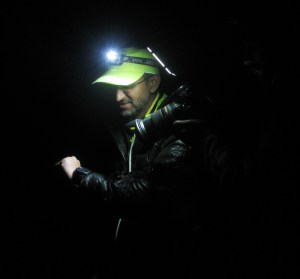
Early morning August 12; Race Director Dr Rajat Chauhan counting down to cut-off at North Pullu (Photo: Shyam G Menon)

Early morning August 12; Race Director Dr Rajat Chauhan counting down to cut-off at North Pullu (Photo: Shyam G Menon)

For the medics and the Race Director, the 111 km segment is the busiest section of the route as the number of runners is more and it includes the less experienced. At the first cut-off, a little over 20 km from the start, two runners missed the stage cut off time and had to withdraw. Punctuating the ascent and descent on Khardung La are South Pullu and North Pullu. They are check posts, both at approximately 15,500 ft. On the ascent from the Nubra side, you hit North Pullu first. The medics gave everyone a check-up here. Two more runners retired from the race at North Pullu as they failed to reach on time. Darek arrived at North Pullu before the cut off time. He was very cold and having low oxygen saturation. “ His lungs was clear, his pace had slowed down. He was okay but feeling very, very cold,’’ Nick Dillon, one half of the medic team, said. Darek was warmed up. He was the last one to leave North Pullu for Khardung La. Nick followed in his vehicle; he kept reassessing the runner’s condition. Not just Darek’s but as he put it – into a race, the back of the pack is where the ones needing help are.
Dariusz (Darek) Strychalski - seen in yellow jacket - exits the 2016 race. Medic Nick Dillon (kneeling) next to him; also seen are Dr Rajat Chauhan and Darek's friend, Anna. Although his race stood terminated, Darek returned to cheer other runners (Photo: Shyam G Menon)

Dariusz (Darek) Strychalski – seen in yellow jacket – exits the 2016 race. Medic Nick Dillon (kneeling) next to him; also seen are Dr Rajat Chauhan and Darek’s friend, Anna. Although his race stood terminated, Darek returned to cheer other runners (Photo: Shyam G Menon)

Between North Pullu and Khardung La. Nick Dillon grew worried about Darek. The runner’s lungs were clear, his mental clarity was good. His pace was very slow. At one point his oxygen saturation was 55 while that of everyone else in the medic vehicle was around 70 (these figures must be read in the context of altitude). What made Darek’s diagnosis difficult is that his medical history featuring partial paralysis, created a case for weak circulation. Even looking for ataxia (loss of balance, it is a symptom of altitude sickness) was difficult because Darek’s natural gait had a wobble to it. He was allowed to proceed because he seemed neurologically sound. But when the runner’s pulse slowed down and ataxia became strongly suspect, Nick decided to consult Dr Chauhan, the Race Director. The latter spoke to Darek who resolved to press on. About 50 metres from the Race Director’s vehicle, with Nick and Anna present, Darek stumbled pronouncedly. It was curtains for his second attempt at La Ultra. The Race Director pulled him off the race and Nick administered oxygen. “ It was a combination of factors and several things building up over time that resulted in this intervention,’’ Nick said. It was also a text book case of what the medics had promised – that they would assess, provide room for stretch, keep monitoring and if required, pull the runner out. Darek bore it stoically. He and Anna returned to the race to encourage and applaud fellow runners.

On the map of Europe, Slovakia lay to the south of Poland, south of Slovakia is Hungary and to Hungary’s south is Serbia. Straddling the junction of European and Asian cultural influences, East Europe has a tradition of being Europe’s powder keg; the world wars of the twentieth century were sparked by events in these parts. In the closing decades of that century, as the erstwhile Iron Curtain crumbled, the Yugoslav Wars broke out (Wikipedia describes them as conflicts spanning 1991-2001). Jovica Spajic was born in Priboj in Serbia in 1987. He grew up with his grandparents; he used to help his grandfather with work in the forest. “ These memories bring so much peace in me. I liked to talk about the future with my grandfather,’’ he said. His father worked in the police and following his basic education, Jovica attended secondary police school. Then he moved to Belgrade for “ real’’ police school to join the special-forces. For someone with that background, Jovica speaks passionately, emotionally. “ Till I turned 14 years old, we had war. That is too much for young people. Maybe it matured us with experience. You learnt to survive with little; a piece of bread and a glass of water. We enjoyed small things. Life was tough and beautiful at once,’’ he said. His grandparents died some years ago. “ There is a lot of empty space in my heart because of that,’’ he said. If there was a well-tuned running machine at the 2016 La Ultra, it had to be Jovica. A black belt in judo and jujitsu, he seemed energy reined in. He came to Leh with two close friends, Dalibor and Alex. Jovica met Dalibor much before his running career took off; at a “ small’’ run in Belgrade, “ a six hour-race for which I had arrived in walking shoes and jeans.’’ In the stipulated six hours, Jovica covered over 60 km. Dalibor encouraged him to take up running. “ That was the start of a voyage,’’ he said. Later, back in Belgrade after a mission in the mountains with the special-forces team, he chanced upon a magazine article on a race in the Sahara. He decided to go for it. He was the first Serbian to attempt the race and completed it in seventeenth position.
Jovica Spajic (Photo: Shyam G Menon)

Jovica Spajic (Photo: Shyam G Menon)

On return, he and Dalibor formed a group called: Ultra-runners Serbia. “ It is like a community. There are people from age 15 to 55. It isn’t just about running; it is about life, friendship, progress. Each of us, have some talent, we express that in our community; we try to motivate others to find their strong point. There is nothing aggressive. We don’t judge anyone. That is not our purpose. The elder generation talks with sorrow and pessimism about world and war. We try to be different. We want to tell positive stories to the next generation and create in their head, space for forgiveness. We don’t blame anyone. We must put a full stop and move on; there is no use staying in the past,’’ Jovica said dipping into the many things ultra-running seemed, in his life, the first 14 years of it, affected by war. “ Ultra-running is like a river. It is like life, flowing along. Life is a synonym for ultra-running,’’ he said. According to him, Serbia’s ultra-running community has the quality of an oasis. “ It is our space. We don’t make huge plans. We take small steps. In big space you can’t make a difference; in small space you can,’’ he said. Following the race in the Sahara, Jovica started to regularly participate in races and push his limits. He ran Italy’s longest road race, the ` Ultra Milano San Remo’ and the ` Race of Titans’ in the Italian Alps. In due course he became the national record holder in running for 24 hour-runs, 48 hours, 72 hours and six day-races. Then he entered the Guinness Book of World Records for the maximum number of sit-ups – 30,000 repetitions in 24 hours. In 2015, he was accepted to run the Badwater Ultramarathon in California’s Death Valley, one of the hottest places on Earth. Training for it in Serbia with its nice weather, was tough. Jovica trained with several jackets piled on to create a very hot environment. “ It was odd doing so in the centre of town,’’ he said. In Death Valley, he had just one day to acclimatize. “ I had no strategy or tactics, I ran with my heart,’’ he said. Jovica completed the iconic race in about 29 hours to secure eighth position overall, the highest place that year for a European. On the final climb to Mt Whitney Portal, he had the best split timing; all that growing up in the forest and hills of Serbia must have helped, he said. Among those Jovica met at Badwater was, Grant Maughan. “ When you say Badwater, you think of Grant and a few other runners. It is like his playground,’’ Jovica said. Fifteen to 20 miles into the run in Death Valley, Jovica saw Grant struggle with stomach issues. He asked Grant if he needed help. “ He just laughed and said: everything is okay mate; this is normal, this is ultra-running. That’s one thing about Grant – one moment he is like near dead, 15 minutes later, he is full of energy,’’ Jovica said. Grant, who has been a podium finisher at Badwater, ended the 2015 race in ninth position overall, just after Jovica. In conversations that followed, Jovica said he would like to run with Grant sometime.

In Leh, Mark Woolley and I knocked on Grant’s door at the Leh-Chen hotel, to see if the 52 year-old would speak to freelance journalist. An athletic weather beaten man of medium height opened the door wondering why his sleep had been disturbed and yet ready for whatever the interruption held. Let me start the profile backwards, beginning with what I discovered last, long after the 2016 La Ultra had ended, Grant was in the US and I was in Mumbai. Grant Maughan is an excellent one man-band. Sometime amid his travels to run races, he should cut a disc. One of his songs is about the Australian Antarctic explorer Sir Douglas Mawson, who like Ernest Shackleton, had endured an epic story of survival. If you decide to compose a song for somebody, there must be much empathy therein and when the subject is exploration and Antarctica, you can imagine what the heart identifies with. Growing up in Australia, Grant liked the active life; he liked surfing, he also liked motorcycles becoming at some point in his life the owner of a KTM 640 (one of his travelogues is about an 8500 km-motorcycle trip around Scandinavia, including a visit to Murmansk in Arctic Russia). Travel and adventure appealed much to Grant. He became a sailor. He was skipper aboard yachts, ships and fishing trawlers. The world’s oceans taught him to cope with solitude and sleep deprivation; he also became familiar with the uncertainties of weather, how cold and icy things can be. Somewhere along the way, while helping to unload cargo that had been lashed down to the ship’s deck, a mishap occurred leaving him blind in one eye. Grant took to running only in 2011. He quickly moved through his first marathons to embrace the ultramarathon, which he felt was his calling. The portfolio of runs he has been to, is diverse – there are desert runs, runs in arid terrain and runs in snowbound terrain pulling sledges. He has a twin brother, who – according to Grant – is quite unlike him. Grant was married for 19 years. When he took to running, his wife joined the support crew for one of his races. “ It was nice of her to do so,’’ he said. He has no children. “ My wife and I, we made a conscious decision not to have children,’’ he said. The couple later separated because they weren’t getting much time together. They remain “ best of friends.’’
Grant Maughan (Photo: Shyam G Menon)

Grant Maughan (Photo: Shyam G Menon)

Grant seemed to keep a packed calendar. As of late August, his race history, available on the Internet, had been updated till February 2016 with the last event being the Alaskan winter classic, the Iditerod Trail Invitational. The list was an eclectic mix – many ultramarathons, a handful of marathons and a bunch of triathlons including Ironman; altogether 52 races, since 2011. In mid-July 2016, he successfully completed yet another edition of the Badwater Ultramarathon (finishing it in sixth position overall), by July end he was in Leh to acclimatize for the 333 km-La Ultra and race done in mid-August; he was expected within days thereafter in Colorado to run the Leadville Trail 100, a demanding 100 miler and among the world’s best known ultramarathons. “ I tend to recover well,’’ he said. Interestingly, Grant also said he gets bored very easily and needs activity. Further he is on a trip to stay healthy and get the most out of as little training as possible – the best option therefore, was to make running a lifestyle, hop from one race to another (one of the gathered runners pointed out that the flip side of this approach, is you may run some events sub-optimally). He found the people in ultra-running agreeable company. On the small lawns of Leh-Chen, on the eve of leaving for Diskit, he quipped how different the people around would be had it been a gathering of triathletes or marathon runners and not those into the ultramarathon. “ I find ultra-runners a quieter lot. They are an interesting bunch of people,’’ he said. Besides running, seafaring and surfing, Grant is also a mountaineer who has climbed in North and South America. He heard of La Ultra from among others, Mark Woolley. He registered for the 2016 race. Reaching Leh – a town he had visited decades ago as a young traveler – he rested and then progressively set out to acclimatize for the race. One of the things he did was go up Stok Kangri, the peak climbed by many for a shot at 20,000 ft. He felt good. For race bib number, he had chosen `640,’ after his bike. Coincidentally, another runner the organizers reached out to was his young admirer from the 2015 edition of Badwater, Jovica Spajic. The opportunity the latter had dreamt of – to run with Grant – materialized. Reaching Leh, Jovica and his team, after spending some time in town, moved to Wari La, the pass that sits in the middle of the La Ultra course, to train. August 11, from the start of the race in Diskit, Jovica and Grant ran together.
Tim Berrow (Photo: Shyam G Menon)
Tim Berrow (Photo: Shyam G Menon)

Nick Dillon (Photo: Shyam G Menon)

Nick Dillon (Photo: Shyam G Menon)

The night of August 11, medics Tim and Nick were at North Pullu when the runners reported for their check-in. It had rained along the way and with elevation, it had got quite cold. The small café at North Pullu was where the runners were assessed and warm drinks had. The personnel of the local ambulance service, was also present. Jovica’s entry into the café made heads turn. He resembles Virat Kohli, India’s cricket sensation. At North Pullu, the medics did a quick assessment of Grant. “ He was okay, there was nothing out of the ordinary,’’ Tim said. Past North Pullu, problems began. Tim was by now tracking and checking the first lot of runners for although they led the pack, that very fact meant they were ascending fast. Gaining altitude quickly can be dangerous. As the medics put it, broadly speaking the vanguard of the runners’ column where the strong racers are, runs the danger of coming up too fast; the middle is usually alright, the caboose is slow for valid reasons. So their eyes were on the front and the rear of the column. Up ahead, Tim posed simple questions to the runners. “ What I was looking for was: can they answer me in a full sentence, a quick inspection of how they were running or walking…such things,’’ he said. At roughly 15,800 ft Grant who had slowed down, said he was finding it hard to breathe. Tim had noticed changes. So he kept monitoring. At Khardung La, he once again caught up with Grant. By now Grant’s difficulty in breathing was clear. “ It was obviously pulmonary edema. I didn’t have to get my stethoscope out, I could hear the crackling,’’ Tim said. The treatment for HAPE is descent to lower altitude and administering oxygen if needed. Inhaling bottled oxygen disqualifies a runner. So Tim walked with Grant till he descended to 15,800 ft on the other side. Tim’s vehicle followed with oxygen cylinder aboard. At 15,800 ft, Tim checked Grant once again. He seemed able to continue without medical assistance. “ This was a case of quick onset and quick recovery,’’ Tim said. Something else – something very central to the 2016 edition of La Ultra – happened at Khardung La. When Grant struggled, Jovica waited. Grant told the young Serbian runner to continue and not waste time. Jovica not only waited for Grant’s medical assessment to be done but on the descent thereafter, he carried Grant’s small backpack till he felt sufficiently well. Abhinav Sharma, one of the members of Grant’s support crew, was waiting for the runners at South Pullu on the Leh-side of Khardung La. “ It was a humanizing instance,’’ he said of the moment Grant reached South Pullu, the effects of Khardung La visible on him.
Kieren D'Souza (Photo: Shyam G Menon)

Kieren D’Souza (Photo: Shyam G Menon)

Towards noon, August 12, Kieren D’ Souza reached the finish line of the 111 km race. It was a new course record – 15:30 hours. The August 19, 2015 issue of Hindustan Times has the story of the previous course record; 17 hours and 57 minutes. It was set by Parwez Malik a scrap dealer from Dehradun in Uttarakhand. Parwez was the first Indian to complete the 111 km race of La Ultra. While Kieren placed first in the 111km segment in 2016, the second position was secured by Rahul Shukla, an engineer from Bhubaneshwar. Third was Hari Om of the Indian Navy. Kieren’s timing is considered to be very good for that distance, in a high altitude environment. “ Under similar conditions, the best we can expect internationally is just over 14 hours. However, we must appreciate that we got extremely lucky this year. We started off with poor weather conditions, which cleared very soon. Best conditions in the last seven years. Let’s not make too much of these timings as they can’t be compared from year to year for the earlier mentioned reasons,’’ Dr Chauhan said. In September, Kieren was scheduled to travel to Greece for Spartathlon. “ Give him 2-3 years, he will be right up there,’’ Dr Chauhan said. A remarkable story from the 111 km race would be that of Nahila Hernandez. Born in Azerbaijan and now a Mexican national, she is one of Latin America’s top female ultramarathon runners. Among other milestones in her career, she was the first woman to cross South America’s Atacama Desert. Nahila’s baggage arrived late in Leh upsetting her acclimatization plans. Then, a day before setting out for Diskit, she fell ill with food poisoning. Till the time of leaving for Diskit, she was under the care of the medics. Nahila had originally registered for La Ultra’s 222 km race. She switched to the shorter 111 km and essayed a wonderful run, surviving on just fluids. But what should interest amid all this is that the ones who immediately followed Kieren were those from the 333 km-pack; they had over 200 km more to go and yet their pace wasn’t terribly slow compared to Kieren’s.

Mark Steven Woolley was seated nearby when I interviewed Grant. They were of the same age. At one point, Mark couldn’t help intervening, hearing Grant’s views on running – it was so similar to his own. Yet as the two runners explored that similarity further, disparities emerged. Grant said he is a loner. Mark wasn’t, indeed among the gathered foreign runners he was the one who mixed with others the most. Grant didn’t think much of competing; Mark admitted to occasionally drawing energy from it. Late evening, on August 12, several kilometres away from Leh, the headlights of our car picked up a runner, paced by a member of his support crew and proceeding diligently to Sakti. It was Mark. He was in many ways the real hero of La Ultra’s 2016 edition. While people blaze their way to the finish line or complete strenuous races on their first attempt, Mark had been denied the satisfaction of completing the 333 km stretch twice before. Mark is an accomplished ultra-runner with races like UTMB, Badwater and Spartathlon under his belt. He was also into martial arts. Mark is an Englishman, living and running in Spain. He is a school teacher; he teaches Physics. Elena, his wife who was part of his support crew for the first time on the 2016 edition of La Ultra, is a photographer. Mark had previously completed the 222km version of the race successfully. According to La Ultra lore, his disinterest in coming back was among reasons that spawned the longer 333 km race.
Mark Steven Woolley (Photo: Shyam G Menon)

Mark Steven Woolley (Photo: Shyam G Menon)

A new race born, in 2014, Mark attempted it. That first time at La Ultra’s 333 km race, he overtook his nearest competitor and led, till at kilometer-317 – past Tanglang La – he collapsed. He went into shock. The descent from Tanglang La to Dibrung, in its early portion, is a mix of sharply contrasting ambiances. Depending on the time of day, just after the pass, you get a sunlit mountain face. The road then proceeds to a gully, takes a U-turn and straddles the opposite mountain face, which is in the shadow and hence cold. “ Up there, the big issue is high altitude but sometimes you have the more common problems like hypothermia and hypoglycemia. Mark was extremely low on energy and suddenly the temperature dipped because he was in the shadow region,’’ Dr Chauhan said of what triggered collapse and shock. That year was weird. Probably because 2014 was the inaugural year for La Ultra’s 333 km-challenge, of nine people running the distance, eight ended up DNF. Only one – Kim Rasmussen of Denmark – finished. Mark’s was the last of the DNFs, which had begun from kilometer-48. On the second occasion, in 2015, Mark ran up and over Khardung La in good time but then began worrying if he had done it too fast. He wondered whether such an approach to altitude would elicit a toll later in the race. Next day, when he experienced difficulty breathing, a rather convincing notion that he was unwell, took hold. With memory of previous collapse alive in mind, he lost much time insisting on being checked by the medics when the medics couldn’t find anything wrong. Eventually he finished the race 52 minutes after the cut off time for the whole course. 2016 was his third attempt. “ I like to finish what I started,’’ Mark had said ahead of the 2016 race. If there was any runner, everyone wanted to see finish the race successfully – it was Mark. You have to have a big heart to return three times for La Ultra’s 333 km-ordeal. I had asked him if three times on the same route may deny runner’s mind a sense of motivation. “ No, you start with an empty head. Every race is new. Besides this is the Himalaya,’’ Mark said.
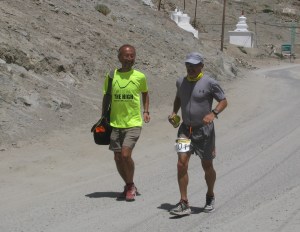
August 12. Ryoichi Sato and Mark on the approach to Goba Guest House, Leh (Photo: Shyam G Menon)

August 12. Ryoichi Sato (left) and Mark on the approach to Goba Guest House, Leh (Photo: Shyam G Menon)

Morning of August 12, as they came off Khardung La and South Pullu, the 333 km-runners were free to halt at the Goba Guest House in Leh, which served as the race organizers’ base camp. Waiting for Mark there was Ryoichi Sato. In La Ultra circles, everyone spoke of the Japanese runner with respect. His visiting card offered a glimpse of the races he had run: among them were the Marathon Des Sables, Spartathlon, 24 Hour World Endurance Marathon, Annapurna 100, Mustang Mountain Trail Race and a clutch of races in Japan. In 2013, he required a pacemaker to be attached to his heart. Two months later, he completed La Ultra in its 222 km-avatar. “ I got to know of his pacemaker only after I reached Leh. That year’s medical director almost had a fit when she learnt of it. Sato has some crazy runs in some amazing times. The pacemaker wasn’t something that bothered me. I did tell him that he needed to listen to his body a bit more now and not be as reckless as he would have been a couple of years ago,’’ Dr Chauhan said. In 2014, Sato had attempted the 333 km-version of La Ultra along with Mark. “ Sato San’’ met Mark a little away from the guest house and ran a short distance with him. A while later, refreshed and rested, Mark left the guest house on the next leg of the race. That was hours ago. Now a blazing afternoon and much of an evening later, on the run up to Sakti, he seemed to have slowed down.
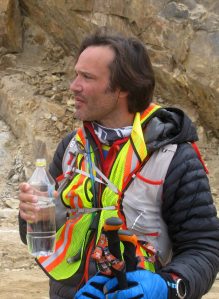
Alexander Holzinger-Elias (Photo: Shyam G Menon)

Alexander (Alex) Holzinger-Elias (Photo: Shyam G Menon)

Gone past Mark was Alexander (Alex) Holzinger-Elias, a German businessman based in Bahrain. Both Alex and his wife Dunya are into running. Alex, who has been a regular at The Comrades in South Africa, had completed the 111 km race of La Ultra in 2015. That year, he placed second, behind Parwez Malik. He had then taken a leap of faith and opted for the 333 km category in 2016, skipping progression through the intermediate 222 km option. Training was a problem. Bahrain is a hot place with neither mountains nor altitude. Alex opted to run long hours early in the morning and after work, besides making the best use of the treadmill and the stair-master. With Dunya as coach and manager, he also did a couple of races, which he thought may prepare him for La Ultra. Dunya’s bid at the 111 km race in 2016 ended quite early. She missed the North Pullu cut-off by 15 minutes. It was her second DNF; in 2015, she had stopped at kilometer-54. On August 12, she joined Alex’s crew. The least experienced of the 333 km-field, Alex kept a steady pace. He was the last of the four runners to reach Leh from Diskit, but by Karu, on the approach to Sakti, he had overtaken Mark. That was the pecking order August 12 evening; past Mark and his crew we came across Alex and his team. Ahead lay a small guest house – Solpon Camping & Home Stay – and beyond that, the 17,200 ft high-Wari La.
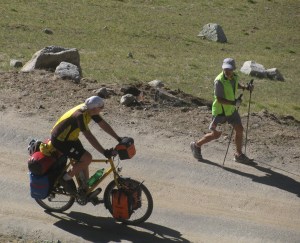
On the ascent to Wari La; Mark and Peter, the cyclist (Photo: Shyam G Menon)

On the ascent to Wari La; Mark and Peter, the cyclist (Photo: Shyam G Menon)

Jovica and Grant had already reached Sakti and Solpon Camping & Home Stay. They rested for about an hour and 45 minutes. Late night, they set off for Wari La. Grant had to exercise caution. They were moving into high altitude. But Jovica was prepared for Wari La; this was where he had trained ahead of the race. The duo made brisk work of the pass. “ Their initial target was to reach the top of Wari La in about eight hours. They did so in six hours,’’ Dhanush K. N, who was part of Jovica’s support crew, said. Meanwhile very late at night, Alex and Mark too reached the guest house. Early morning as the sun revealed the beauty of Wari La and the view from there; all four runners were once again in the same region. Jovica and Grant were returning from the top while Alex and Mark were on their way up. Grant seemed fine after Wari La. Tim and Nick had an observation about the Jovica-Grant partnership. It worked to mutual benefit. The tough older runner had the drive of the younger one to draw motivation from; the younger one avoided the folly of heading too fast to altitude thanks to older runner around. It kept both in a stretched but mutually beneficial, relatively safe zone, aware of potential complications yet avoiding it. On the ascent to Wari La, Mark kept a slow, steady pace. He had chosen his crew carefully. Two of his crew members had been with him on his previous attempts; the third was Elena. “ For me, the most important thing in a crew is absence of conflict,’’ he said. He had that peace in his team; Mark’s was a happy, relaxed crew. It graced runner too. Mark was never beyond a “ hi’’ or a “ hello’’ on the road.
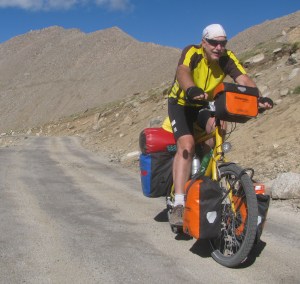
Peter (Photo: Shyam G Menon)

Peter (Photo: Shyam G Menon)

Unlike cities, mountains are quiet. From a couple of bends above, I heard Mark say hello to Peter. The cyclist had slowly caught up with Mark. Peter was a police officer from Germany. His touring bicycle – a Velotraum – had pannier bags at the rear and up front. Loaded, it was heavy. “ I like my independence,’’ he told me. For a while, cyclist and runner seemed side by side, a moment Elena tried to capture on camera. Then the cyclist pulled ahead. On Wari La, Peter watched from the side as Mark reached the pass and turned back. The Wari La portion of the La Ultra course, is an up and down along the same road. As Mark left, we went looking for Jovica and Grant. Peter stayed on alone at the pass, enjoying his rest, before cycling on to Nubra.
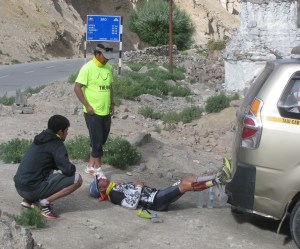
Grant rests for a while (Photo: Shyam G Menon)
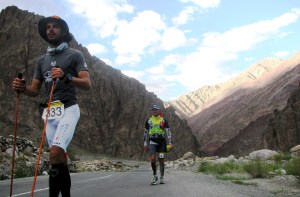
Grant rests for a while (Photo: Shyam G Menon)

Jovica and Grant on the road to Rumtse (Photo: Shyam G Menon)

Jovica and Grant on the road to Rumtse (Photo: Shyam G Menon)

The road to Sakti and Wari La branches off from Karu on the Manali-Leh highway. Jovica and Grant were not at Karu; they had already gone past the junction. The sun was now blazing; it was hot, close to noon. We met them at Upshi, where the duo had decided to break for lunch. Jovica sat in his support vehicle. Grant sat on a chair in a dhaba (a roadside eatery), dressed in racing attire amid a bunch of tourists. Few looked up from their banter, food and selfies. The road from Upshi to Rumtse was testing. Not only was it the hottest part of day, there was vehicular traffic and in Ladakh’s still air, every molecule of smoke invades one’s nose and lungs. The runners proceeded carefully on this section. By all accounts, it was Grant who kept the steadier head on these hot, irritating sections of road with traffic. Exhaustion was slowly creeping in. Jovica paused to rest. Grant walked considerably ahead and decided to take rest himself. The support crew created a chamber within their vehicle for him to rest, windows masked with dark fabric. He chose to lie down on the road, legs up on the vehicle’s bumper. Before the start of the race, Grant had mentioned that he would like to keep his breaks for rest, not full-fledged but partial. Bare earth was perfect; neither here, nor there. Late at night, after a two hour-halt at the guest house in Rumtse, Grant and Jovica set off for the last high pass on the La Ultra course – Tanglang La.
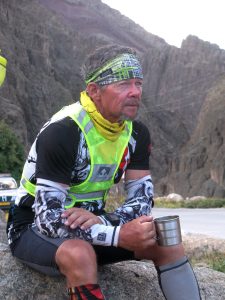
Grant, evening of August 13; Rumtse is still some ways off and beyond that lay, Tanglang La (Photo: Shyam G Menon)

Grant, evening of August 13; Rumtse is still some ways off and beyond that lay, Tanglang La (Photo: Shyam G Menon)

Probably because it is the highest and most publicized, when it comes to mountain passes in Ladakh, Khardung La is everything. Tourists in cars, bikers, cyclists – all want a photo or selfie there. When you run La Ultra from Diskit, things are different. As the first test by altitude along the way, Khardung La takes its toll. But a seasoned runner is still fresh and able to tackle the challenge. Next night, it is a tired runner who reaches Wari La. However Wari La is overall gentle unless the weather plays truant. Picturesque and tucked away, it pulls the visitor in without a mission mode in the frame. August 13 night, as Jovica and Grant began the ascent to Tanglang La, they were not only tired from being on the road (almost continuously) for more than two days, they were sleep deprived and the approach to the pass was long and winding. The dimensions of these mountains hit you. The frustration is perhaps more at night, for in the darkness you can’t see the far bends or estimate how much more distance is left to reach your objective. Headlamps show you the way; they don’t show you the world.
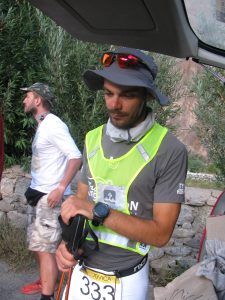
Jovica, evening of August 13 (Photo: Shyam G Menon)

Jovica, evening of August 13; the 333 km-runners have been on the road from August 11, 8 PM, onward (Photo: Shyam G Menon)

The unending climb took its toll on Jovica. He grew tad irritable. At one point he asked me if I knew exactly how many kilometres remained to the pass. He seemed searching for an answer better than the regular Indian reply of: it’s just over there. Although I had been on that road before as a traveler, I hadn’t observed it well enough to estimate distance, particularly at night. My response was disappointingly vague. Another time Jovica wondered if this combination of endless ascent and their tired selves was “ some sort of scientific experiment.’’ Grant assured in a composed voice that their problems stemmed from the night denying them perspective to gauge distance. Grant was however battling other worries – it was cold, exhaustion had been creeping in and Tanglang La was once again, a return to elevation. Not far from the pass, the medics came by checking on the duo. The runners asked if the medic’s car could be driven slowly so that they could follow its lights to the pass. That’s how Jovica and Grant reached Tanglang La. It was bitterly cold.
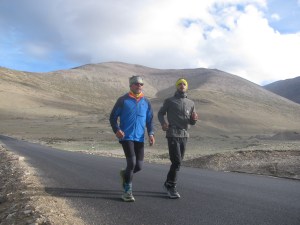
Morning of August 14; Grant and Jovica on the final stretch to Dibrung (Photo: Shyam G Menon)

Morning of August 14; past Tanglang La, Grant and Jovica on the final stretch to Dibrung (Photo: Shyam G Menon)

The medics assessed Grant. “ Jovica was tired. But Grant was not engaging mentally. He wasn’t responding. We quickly took him to the vehicle and turned the heating on. His oxygen saturation was 65 while everyone else was at about 75. He was told that medically he is unfit to continue for the next ten minutes. He accepted that,’’ Nick said. During the ten minutes that followed, Grant had a litre of water and two chocolate bars. He was reassessed. His oxygen saturation was now around 85. His lungs were clear. He was allowed to continue the race. According to Nick it was a case of exposure exhaustion. Jovica once again waited till Grant was back on his feet. Tanglang La, appearing late in the race when runner is exhausted, has always been the real challenge in La Ultra. “ The pass is 309 km into the race. That’s a lot of running by any standards even if it is in the plains. Now add high altitude and extreme cold to it. This year’s medics pushed my extreme approach too. They are thorough professionals who appreciate what runners are doing and what it means to them. As a support team, they were the find of the event. We are still learning how the human body responds to endurance events in such extreme conditions,’’ Dr Chauhan said.
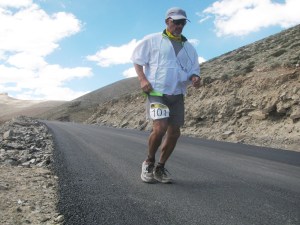
Mark on the final stretch to Dibrung (Photo: Shyam G Menon)

Mark on the final stretch to Dibrung (Photo: Shyam G Menon)

At the 2016 Badwater Ultramarathon where Grant finished sixth, completing the race in seventeenth position was Ray Sanchez. In 2011, Ray, running La Ultra in its then 222 km-avatar, had a memorable tryst with Tanglang La. It was there, delirious and disoriented, that he lost his lead to Sharon Gayter who went on to win that edition of the race. I didn’t specifically ask the runners but I suppose, crossing Tanglang La is a psychological threshold in La Ultra. You know you are now on the home stretch albeit still with work to do for someone racing against time, as there is one final cut-off – 333 km in 72 hours – to meet. The lead duo of 2016 had however made it to the pass with much time to spare. The peaks around wore a crown of early morning sunshine as Jovica and Grant jogged down the descent from Tanglang La. A little over a half marathon now remained. Their passage to Dibrung was largely uneventful. Sixty hours and 37 minutes after they commenced their run in Diskit, Jovica and Grant crossed the finish line in Dibrung, together. It was a new course record. Grant later described his partnership with Jovica during the race, as akin to a “ father-son relationship.’’
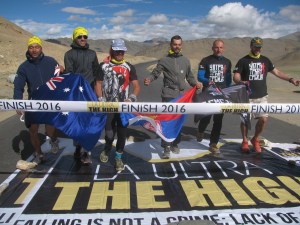
Grant, Jovica and their support crew at the finish line (Photo: Shyam G Menon)
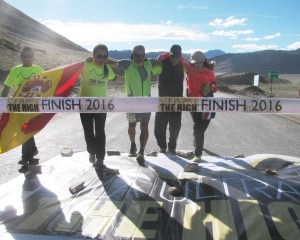
Grant, Jovica and their support crew at the finish line (Photo: Shyam G Menon)

Mark and his crew reach the finish line in Dibrung (Photo: Shyam G Menon)
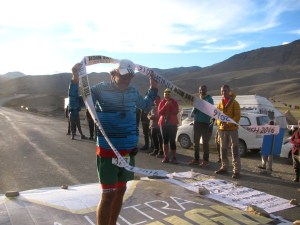
Mark and his crew reach the finish line in Dibrung (Photo: Shyam G Menon)

Alex at the finish line (Photo: Shyam G Menon)

Alex at the finish line (Photo: Shyam G Menon)

The previous morning, Alex had reached Wari La before Mark. On the way down, Alex decided to rest some time at the guest house in Sakti. Mark didn’t. He regained his lead. But at Karu he rested and Alex went ahead. The latter, reaching Rumtse ahead of Mark elected to rest for about two hours. Mark reached Rumtse late but kept his rest short. Some hours after Jovica and Grant had crossed the finish line, it was Mark we met first on the Dibrung side of Tanglang La. Alex was still a bend or two below on the other side of the pass. At one point, as he walked down the sunlit face of Tanglang La, Mark said, “ my energy level is fine. My legs feel like blocks of concrete.’’ If you run your hand on the bone above Mark’s ankle, you can feel a line of screws beneath the skin. There’s a rod in there. On the knee of his other leg, to the side, is the scar of a surgery gone by. Both are joints that have seen much work. “ The ankle holds up but the knee tends to hurt,’’ he had said in Leh ahead of the race. Elena walked with him for a while on the home stretch to Dibrung. Just before the finish line he was joined by his whole team. That last bit, they walked together. On his third attempt at the 333 km race of La Ultra, Mark Woolley succeeded, completing it in 68 hours and 57 minutes. The finish is significant. Mark, 52, has been working on a book on his life in running. He can now write the chapter on La Ultra. It was evening by the time Alexander Holzinger-Elias reached the finish line. He had taken a chance at 333 km and cracked it in the very first attempt. He completed the race in 70 hours, 39 minutes. V.S. Ramachandran was part of Alex’s support team for the first half of the race. “ I was sure from start that Alex would complete the run,’’ he said.
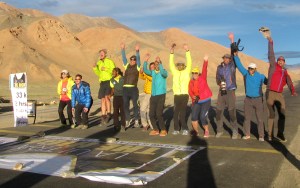
Some fun at the finish line (Photo: Shyam G Menon)

Some fun at the finish line while waiting for the runners (Photo: Shyam G Menon)

The thing about La Ultra is that because it is an extended commitment, it forges bonds. “ I think we are all sad that it’s over,’’ Alex said after the awards ceremony on August 15. “ Post-race blues,’’ Grant said smiling. Mark felt Grant is among the toughest adventure racers in his age category at present in the world. Grant thought of himself as a gypsy. This life – hopping from one race to another, encountering different cultures, enjoying the company of ultramarathon runners – suited him. He hadn’t worked the past six months. He had invested his earnings such that he could keep race-hopping. But resources were running out and he knew he would have to skipper a boat or two to further the gypsy life. I asked him if he had anticipated his troubles at Khardung La. “ I thought I went in good considering I acclimatized well and the distance seemed doable. It surprised me that the altitude got to me. There are quite a few bits and pieces of the race that I can’t remember,’’ he said. About Jovica he said, the Serbian is a talented runner, somebody to watch out for. As for La Ultra itself, Grant felt “ it is really, really extreme.’’ But describing any race as `toughest in the world,’ more than one runner cautioned, would be incorrect, for at day’s end perceptions are personal. I asked Elena if she would return to being on the support crew for Mark, now that she had made her debut at the job in Ladakh. A photographer, she didn’t consider herself a sportsperson. She wasn’t sure she would repeat the experience. People are different; some are into sports, some are creative. What each one is should be respected. She said of Mark, “ if he is angry or upset, you give him his running shoes. He goes out for a run, he is calm again.’’ Late August 2016 – I searched for Grant Maughan on the 2016 Leadville Trail 100 results. A week after La Ultra, he had finished second in his age category at Leadville.
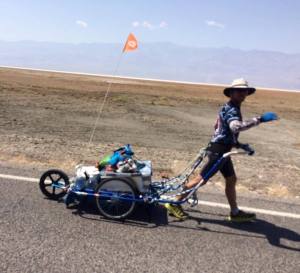
Grant, during Badwater 146 mile solo, self supported crossing he did in the days after the 2016 edition of La Ultra (Photo: courtesy Grant Maughan)

Grant, during the Badwater 146 mile solo, self supported crossing he did in the days after the 2016 edition of La Ultra (Photo: courtesy Grant Maughan)

Postscript: One month after the 333 km race in Ladakh, Grant wrote in with a small synopsis of what he had been up to. He wrote: a few days after finishing La Ultra “ I was back in Colorado to run the Leadville 100 mile trail race which I managed to do in sub-24 hours. Then I drove for two days back to Death Valley and completed the Badwater 146 mile; solo, self supported crossing and broke the record by about six hours (49 hours 42 minutes). Solo means you have to carry enough water, food and gear to get from Badwater Basin in Death Valley all the way to the summit of Mount Whitney (highest mountain in lower 48 states of the US). I pulled all the stuff in a three wheeled cart. It weighed about 85 kilo at start because of all the water you need to carry. You are not allowed to resupply along the way or even get rid of garbage. Pretty cool!”

(The author, Shyam G Menon, is a freelance journalist based in Mumbai. The altitudes of mountain passes are as mentioned in the race route map. The details of DNF from earlier editions are taken from the race’s official website. There is an article on the 2011 edition of La Ultra available in the blog archives. At that time the race was of 222 km and it started from Khardung village. The organizers have been talking of increasing the distance of the race to 555 km and 666 km, making it multi-stage alongside. An article on that too can be found in the blog archives.)     


THE INDIAN NAVY’S FIRST ULTRAMARATHON TEAM

The Indian Navy's ultramarathon team (Photo: courtesy La Ultra / the navy team)

The Indian Navy’s ultramarathon team (Photo: courtesy La Ultra)

In May 2016, a set of events underway since February that year resulted in a message dispatched from headquarters to all the commands of the Indian Navy.

It sought volunteers to represent the navy in an ultramarathon.

For a force used to life at sea and deployed at bases along the seashore, the ultramarathon in question was at elevation; its altitudes ranged from 10,000 ft to 17,500 ft.

The person responsible for this situation was Captain Rajesh Wadhwa. Since 2004, he had been into running, progressing through a clutch of half marathons and full marathons to the ultramarathon. “ I used to think the full marathon is the longest distance around for running. It was an eye opener learning of the still longer distances people run,’’ he said. Capt. Rajesh’s first proper ultramarathon was a run of 80 km near Delhi, part of the 2014 Bhatti Lakes Ultramarathon. “ The dream was to run those races where fewer people queued up,’’ he said. Among the things he liked about the ultramarathon was its demographic profile – it was a mix of ages; not the brute dominance by youth you typically associate with sports. Further, as the distance to run grew with rising need for endurance alongside, the older, experienced runner wasn’t a push over. He / she clearly had something to bring to the table in an ultramarathon.  Having successfully completed the Bhatti Lakes 80 km run (he completed it in 12:33 hours to finish third), Capt. Rajesh did a couple of shorter ultramarathons. But the euphoria was short lived. His attempt at a longer distance – 100 km – at the next edition of Bhatti Lakes ended in Did Not Finish (DNF). Unwell, he had to withdraw from the race at around kilometer-60.

In February 2016, he found himself in Mussoorie, running Garhwal Runs, a 76km uphill of a race from Mussoorie to Dhanolti. The event was also a qualifier for the 111 km-category of La Ultra, the ultramarathon in Ladakh with three race categories –111 km, 222 km and 333 km. The overall cut off time for the Garhwal Runs-76 km was 12 hours. But if you did it in 10 hours, you qualified for the 111 km-segment of La Ultra. “ I started the race with no expectations. When I got tired, I walked fast. I kept moving. After several hours, I realized I was running second. That was when I asked: oh my God, what’s happening? A little later I caught up with the leader. He was walking. Seeing me, he picked up pace. I gave the guy a good chase. He was a youngster, as old as my son. Then at some point, I turned the last corner and there was the finish line. I crossed it bang on the tenth hour. That was fantastic!’’ Capt. Rajesh said. He was not only podium finisher; he was eligible to run the 111 km-category in La Ultra. On return to office in New Delhi, he applied for permission to participate in the ultramarathon in Ladakh, representing the Indian Navy. Intrigued by ultramarathon, the navy’s adventure cell recommended a team. Until then, the navy’s officers and employees had participated in ultramarathons in their personal capacity. Procedure required that the event organizers extend an invitation to the Indian Navy, so that the invitation to an organization – as opposed to an individual – would create sufficient grounds to float a team. The organizers of La Ultra invited the Indian Navy to participate in the event’s 111km race. Invitation secured, the navy dispatched its message of May 2016, seeking volunteers.

Cdr. Sunil Handa's collection of mementos from the races he participated in (Photo: Shyam G Menon)

Runner in the house; Cdr. Sunil Handa’s collection of mementos from the races he participated in (Photo: Shyam G Menon)

Running is a common human activity and in the forces, it is a tradition from training days. But there is a huge difference between those training runs, the later runs to stay fit and an ultramarathon. Not many realize this. In response to the navy’s call for volunteers, some 20-25 persons stepped forward. More interesting and rather revealing of how little understood the ultramarathon is – there were applicants enthusiastic to run La Ultra’s 222 km and 333 km races as well. The navy realized it had a job on its hands. The number of volunteers had to be trimmed to about 6-8 persons and the selection process required to mimic some of the challenges of an ultramarathon so that the volunteers stayed aware of what they were getting into.

In Mumbai, Commander Sunil Handa – he and Capt. Rajesh had run together before in Vizag – had earned a reputation in the city’s running circles as an ultramarathon runner. He is also a mountaineer. In 2015, he had run the Khardung La Challenge – an ultramarathon of little over 70 km, held every September in Ladakh. Focusing on the challenge offered by the pass, the route spans Khardung village, up and over Khardung La, on to Leh. While preparing for the ultramarathon, Cdr. Sunil ran the 2015 Mumbai Ultra, an annual 12 hour-endurance run held on a stretch from Shivaji Park to Worli sea face, in the city. Impressed by this and seeking to run with him thereafter, was Petty Officer Hari Om from the Indian Navy. He was also a mountaineer. The following September, both Cdr. Sunil and Hari Om completed the Khardung La Challenge, Hari Om finishing just outside the cut off time. Familiar with mountains and mountaineering, the two had followed an acclimatization schedule ahead of the run, which included an ascent of the 20,182 ft-Stok Kangri, albeit a cheeky and not to be recommended fast ascent of the peak. Rajesh knew that he could count on these two runners from Mumbai to be part of the proposed team.

Cdr Sunil Handa; August 12 morning, just past South Pullu (Photo: Shyam G Menon)

Cdr. Sunil Handa; August 12 morning, just past South Pullu (Photo: Shyam G Menon)

Problem was with selecting the others. Getting all the volunteers to assemble in one place for selection was difficult as they had their official responsibilities to attend to. It was decided to take the selection to them; have the trials where the volunteers are. With those overseeing sports at the various commands struggling to comprehend what they should look for in a potential candidate for this little known discipline called the ultramarathon, Cdr. Sunil was tasked with the selection in areas under the Mumbai based-Western Naval Command. For the rest of the commands, Capt. Rajesh decided to do the selection himself. As he was based in Delhi, he counted on technology and his knowledge of the running routes at the various commands, to oversee the process. On the average, Cdr. Sunil said, the volunteers ran 70-80 km during the selection trials. Where possible, they ran on routes Capt. Rajesh suggested (for instance, he knew the routes in Vizag very well, including how to combine inclines and flats for a route offering a miniature experience of what an ultramarathon entails). The runners used WhatsApp to update him real time. “ Since I wasn’t there in person, there was a lot of trust involved,’’ Cdr. Sunil said. It was a selection process that saw navy runners tackle long distances amid official duties, family responsibilities including children’s exams and even the monsoon (the trial run in Kochi had to be postponed owing to heavy rain).  Late July, a team of six runners met up in Delhi and proceeded to Leh. Captain Rajesh Wadhwa, Commander Sunil Handa, Commander Navneet Nagi, Lieutenant Commander Kanishka Chandel, Lieutenant Amit Kumar and Petty Officer Hari Om, – they became the first official team from the Indian Navy headed for an ultramarathon.

Hari Om, on the home stretch from South Pullu (Photo: Shyam G Menon)

Hari Om, on the home stretch from South Pullu (Photo: Shyam G Menon)

Taking a leaf from the previous trip of Sunil and Hari Om to Ladakh for the Khardung La Challenge, the team decided to do the Markha Valley trek with a climb of Kang Yatse II for acclimatization. The navy’s adventure cell arranged required gear. After the mandatory rest period in Leh, the team commenced its trek. One of the highlights of this hike to get used to altitude was doing yoga at elevation. However, the day they set out for the summit of Kang Yatse II, Capt. Rajesh had to make a choice. Except for Cdr. Sunil and Hari Om, none of the others were mountaineers. On the other hand, they were all runners and they had all come to Ladakh to run an ultramarathon. It raised a simple question: does the team climb Kang Yatse II all the way to the top or does it focus on the need to acclimatize and save its energies for the ultramarathon? On the mountain, when they were as high as Khardung La (the highest point on the La Ultra course), Capt. Rajesh posed the question to his team: what is the best option? Eventually Hari Om went on to summit the peak while everyone else proceeded back to camp. That reminder about running made sense, for the next day, in the vast, relatively flat terrain of Markha Valley, the team members spent their time doing yoga and running. Armed with these preparations and a team song they had composed during the hike, they returned to Leh for a few days of proper rest. On August 9, there was a meet up of all those participating in the 2016 edition of La Ultra.  Capt. Rajesh introduced the navy’s ultramarathon team with characteristic humour.  Referring to the team and its mix of varied age and experience, he said, “ I am the team’s daddy, Sunil, the uncle and Amit, the kid.’’ The next day everyone proceeded to Diskit, where the start line of the ultramarathon was. Amid the short walks around Diskit to get used to the environment, Capt. Rajesh remembers getting several messages from friends and supporters, wishing the team luck. He also had an infected blister on his hand – got from using an ice axe on Kang Yatse – lanced, drained and dressed by the race medics.

Race Director Dr Rajat Chauhan (right) looks on as Capt Rajesh Wadhwa (left) reaches South Pullu in the nick of time (Photo: Shyam G Menon)

Race Director Dr Rajat Chauhan (right) looks on as Capt. Rajesh Wadhwa (left) reaches South Pullu in the nick of time (Photo: Shyam G Menon)

The race began on the night of August 11. According to Cdr. Sunil, although he and Hari Om had run up and over Khardung La before, the La Ultra version of the experience with start in Diskit, made the run more challenging. It increased the distance and overall height gain to Khardung La and with the race commencing at night, he was forced to cope with something he hadn’t tackled before in a run or trained for – sleep deprivation. “ Between North Pullu and Khardung La, around two kilometers from the top, I was really in need of sleep,’’ he said of that passage through elevation and cold. Pass done and descent to Leh commenced, his condition improved. Meanwhile, in the distance between Diskit and North Pullu, two runners from the navy team had failed to meet stage cut-offs. They were eliminated from the race. Capt. Rajesh – Hari Om with him – was having a tough time. The initial portion of the race had gone off well for him.  Past kilometer-30, the two even did some yoga. But somewhere on the approach to North Pullu, Capt. Rajesh had sensed the pace slackening. There was a sense of daunting task, growing. At the same time, the 52 year-old knew that the onus of the team’s performance rested on him for he was skipper. He pushed on as best as he could. He reached North Pullu tired and out of breath. The race medics hovered around him. They checked on the runner. Before Khardung La, two to three bends below the pass on the North Pullu side – at the spot where Polish runner Dariusz (Darek) Strychalski was taken off the race – the Race Director spoke to Capt. Rajesh. There was concern that he was pushing his limits a bit too far. The naval officer told Hari Om to carry on. Then he explained how as a military man he cannot give up, how much he owed to those who had wished him well for this run. A little later, he resumed his trudge to the pass.
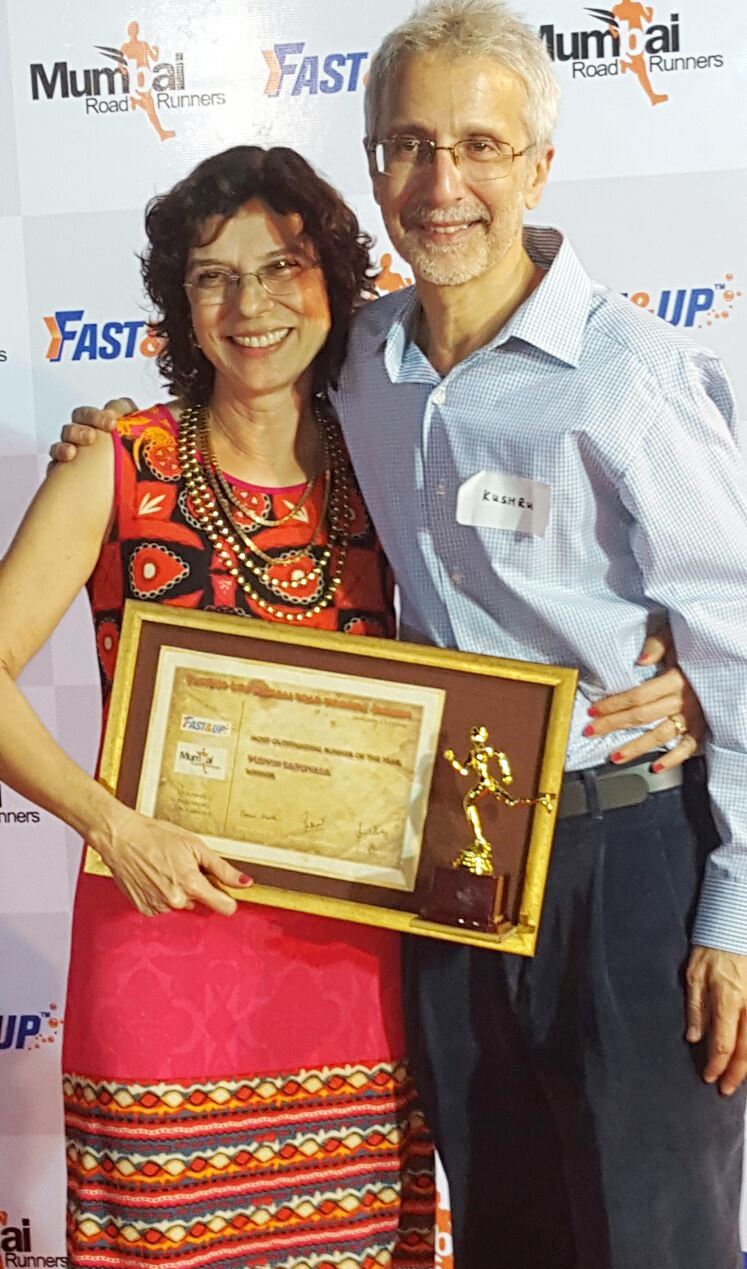
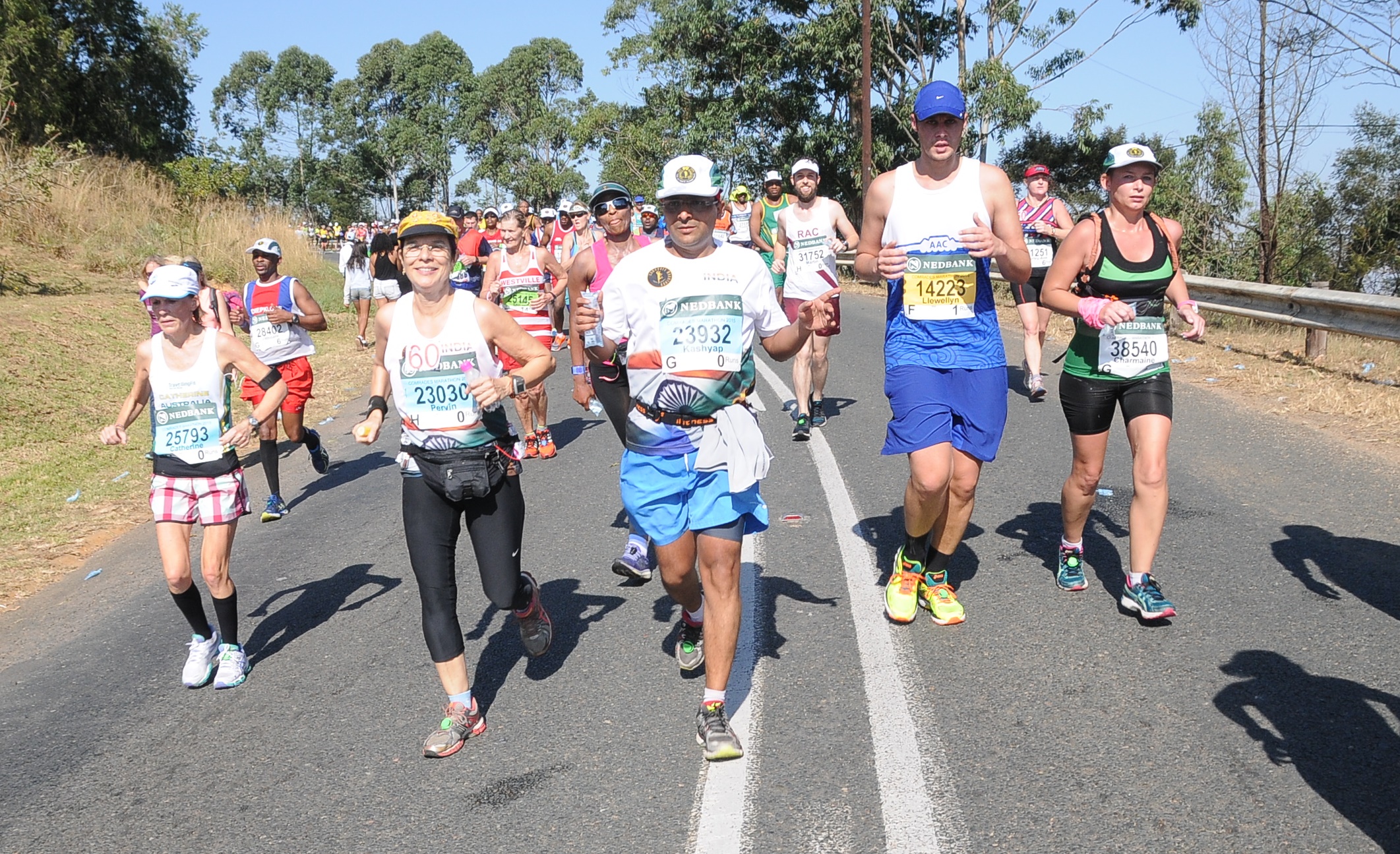
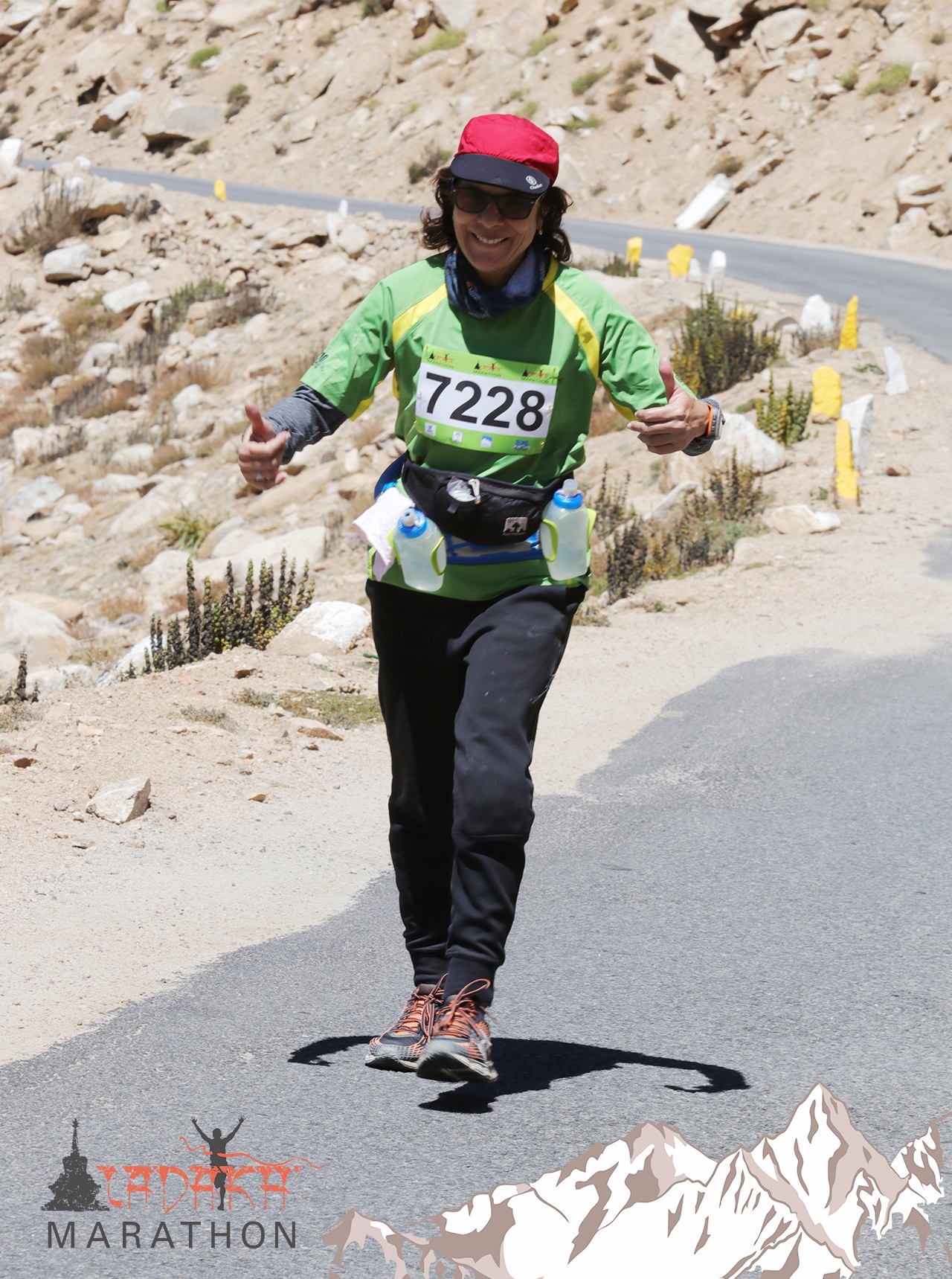
In retrospect, that was a turning point.

Cdr. Sunil, Hari Om and Capt. Rajesh (Photo: courtesy La Ultra / navy team)

Cdr. Sunil, Hari Om and Capt. Rajesh (Photo: courtesy La Ultra)

As a new day dawned and Ladakh’s sun revealed the surrounding topography, the runners diminished to minor detail on big mountain. Some hours later at South Pullu on the other side of Khardung La, Race Director, Dr Rajat Chauhan took his position to count down the stage cut off for that section. Enforcing stage cut off is a heartless job; it is door shut and no looking back. Making it home with minutes to spare was Capt. Rajesh. Before South Pullu, with about 15 minutes left for stage cut-off, he had given that portion of the race all he had. “ That third cut-off – that was the toughest stage for me,’’ Capt. Rajesh would say later. Right then it meant, the navy had successfully preserved its surviving quartet. Ahead on the race’s final stretch, proceeding to a comfortable finish were Lt. Amit, Cdr. Sunil and Hari Om. Nick Dillon and Tim Berrow, the race’s medical team, were impressed. “ Capt. Rajesh Wadhwa was a concern. He was exhausted. He was just very, very tired. But he wasn’t medically unfit to continue. I gave him one chance to continue. He took that chance and made the most of it,’’ Nick said.

Earlier, when Capt. Rajesh halted before Khardung La to chat with the Race Director, a small but significant step occurred. He told Hari Om to go ahead. While young ultramarathon runner, Kieren D’ Souza smashed the course record to finish 111km in 15:30 hours, Hari Om, tapping into some new found energy, finished a creditable third giving the Indian Navy a place on the podium. Altogether, four members of the Indian Navy team – Hari Om (19:04 hours), Cdr. Sunil (19:20), Lt. Amit (19:30) and Capt. Rajesh (19:33) – completed the 111km-race, the navy’s first official participation as a team in an ultramarathon.

Now that they have a team in place, the navy plans to run more ultramarathons. For starters, they have their eyes on attempting one of the two ultramarathons in the Rann of Kutch. “ This is the beginning of a journey,’’ Capt. Rajesh said.

(The author, Shyam G Menon, is a freelance journalist based in Mumbai. The photos credited to La Ultra were provided by the navy team.)