INDIAN NAVY AIRCRAFT SIGHTS THURIYA

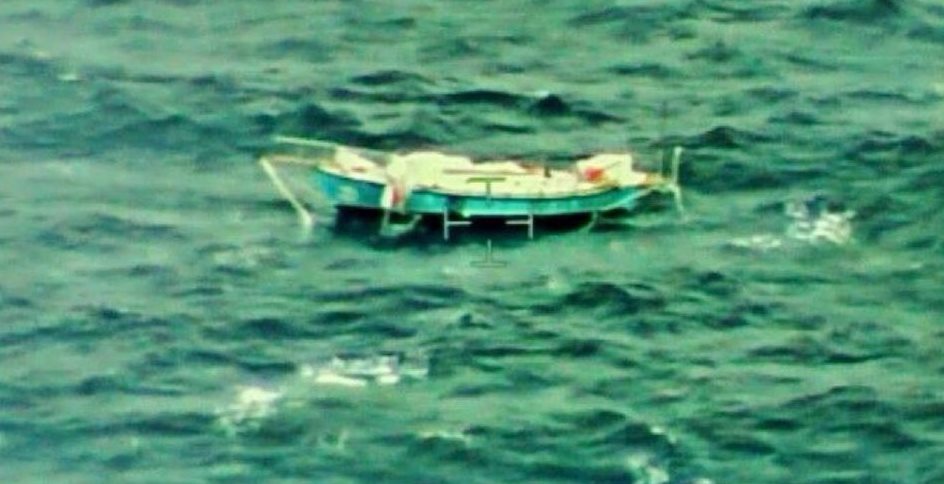
Thuriya adrift in the Southern Ocean; mast broken (This photo was downloaded from the Twitter handle of Indian Navy and is being used here for representation purpose only.)

An Indian Navy P-8I long range maritime reconnaissance aircraft has located Commander Abhilash Tomy’s sailboat, Thuriya, in the Southern Ocean, reports in the national media said today (September 23).

It may be recalled that the vessel was rolled and dismasted in a recent storm. Abhilash had subsequently reported severe back injury and inability to move around.

He has activated the Emergency Position Indicating Radio Beacon (EPIRB) and efforts have been underway to locate and rescue him. Thuriya and Abhilash were participants in the 2018 Golden Globe Race (GGR) entailing solo nonstop circumnavigation of the planet in a sailboat. It was Abhilash’s second such voyage. In 2013 he became the first Indian to do a solo nonstop circumnavigation in a sailboat.

Reports quoting an Indian Navy spokesperson said that the naval aircraft saw Thuriya adrift in the Southern Ocean, its mast broken and hanging alongside.

Further the official website of GGR informed that Australian authorities have dispatched an executive jet to the coordinates of the stricken boat. The aircraft will also overfly the boat of Irish skipper and GGR participant Gregor McGuckin, which too was rolled and dismasted in the storm. Notwithstanding an unreliable engine (likely due to fuel being contaminated when the boat was rolled and dismasted in the storm), loss of self-steering (he has to hand-steer now) and finding that the spinnaker pole he used to improvise a jury rig was bending in the strong wind, Gregor is attempting to motor-sail his way to Abhilash. The two are only 80 miles apart, the latest update on the GGR website said. Also expected to head Abhilash’s way is Estonian sailor and GGR participant, Uku Randmaa, who was 400 miles west of both Gregor and Abhilash.

Additionally, the French fisheries patrol vessel Osiris is heading to help Abhilash. Osiris has medical facilities onboard. Although he cannot move around and appears confined to his bunk due to the back injury, Abhilash has confirmed to race organizers that he can move his toes. In first responder circles, when assessing injury, the ability to move one’s body extremities is usually taken as a positive sign. Abhilash has indicated that he may need a stretcher when help arrives. Quoting Abhilash’s latest message to race organizers, the GGR website informed on September 22 (as an update to what it reported earlier the same day) that he can move his toes but is feeling numb and cannot eat or drink. The grab bag containing more emergency communication equipment remained difficult for him to access.

As per information on the GGR website, Australian authorities are also repositioning a search and rescue plane to Reunion Island to assist with the rescue efforts; this is in conjunction with the Anzac class frigate HMAS Ballarat, preparing to leave Perth for the area where Thuriya is. The Indian Navy has already sent INS Satpura and the tanker INS Jyoti to the southern Indian Ocean, where Abhilash is.

(The author, Shyam G Menon, is a freelance journalist based in Mumbai. Please scroll down or select from archives for more on Abhilash, Thuriya and GGR.)        

2018 GGR UPDATE / THURIYA ROLLED AND DISMASTED IN STORM, EFFORTS ON TO RESCUE ABHILASH TOMY

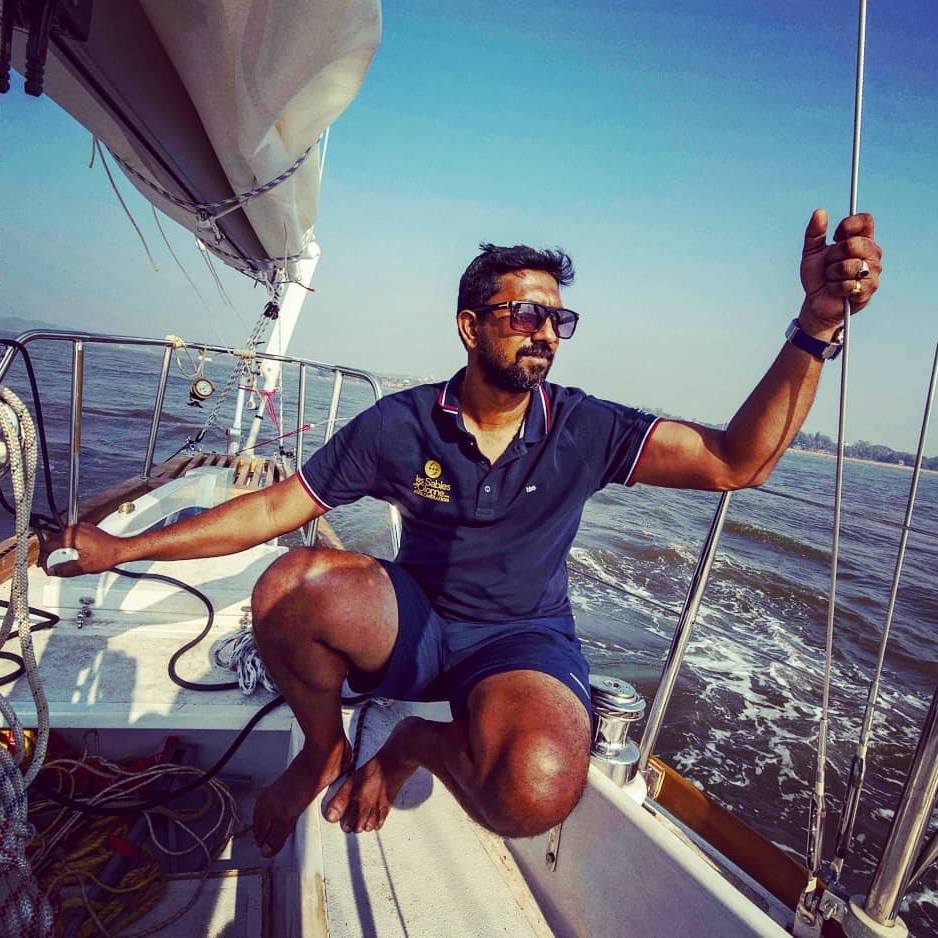
Commander Abhilash Tomy KC (This photo was downloaded from the Facebook page of Commander Abhilash Tomy and is being used for representation purpose. No copyright infringement intended)

Efforts are on to rescue Commander Abhilash Tomy KC, participant in the 2018 Golden Globe Race (GGR), after his boat, the Thuriya, was rolled and dismasted in a severe storm in the Southern Ocean.

According to information available on the GGR website, the incident has left Abhilash injured.

In a communication to race organizers on September 21, he said that he has a severe back injury and cannot stand up. At that time the Thuriya was 1900 miles south west of Perth, Australia.

In a subsequent update on September 22, GGR has quoted Abhilash confirming activation of the emergency beacon (EPIRB). The boat’s external YB3i unit continues to provide tracking information but the power line to the boat’s batteries has been damaged. The update which said Abhilash is on his bunk in the boat, said that he was using the portable YB3 texting unit – which is a back-up – for messaging.

The boat’s primary satellite phone has been damaged. There are additionally an aviation hand-held VHF phone, a second satellite phone and a second YB3 unit in Abhilash’s Emergency Grab Bag.

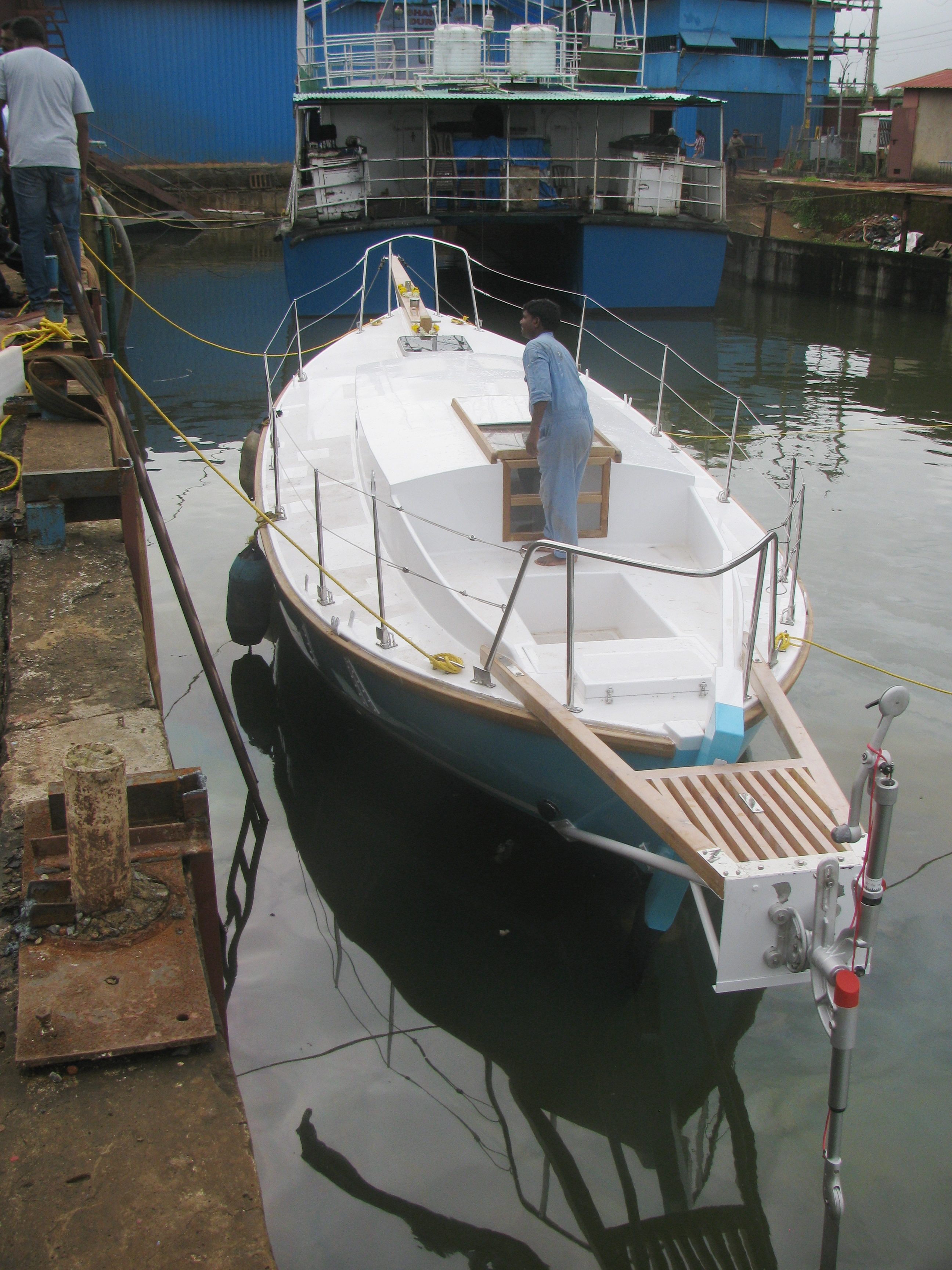
The Thuriya, soon after the boat was launched last year; view from aft. At this stage her mast wasn’t fitted; that happened later(Photo: Shyam G Menon)

But he cannot reach it given the state he is in, the update on the GGR website said.

Last reported on this blog, Abhilash was in fourth position in the race. He had subsequently improved to third position. Besides Thuriya, the powerful storm rolled and dis-masted the Hanley Energy Endurance, the boat in which fellow GGR participant, Gregor McGuckin was sailing. However Gregor is otherwise alright and following emergency repairs, was slated to sail towards Abhilash’s coordinates. He was reported to be 100 miles south west. Another GGR participant, the Estonian sailor Uku Raandma was also in range; he was reported to be some 450 miles away from Thuriya.

According to the media, the Indian Navy and Australian rescue authorities have swung into action to rescue Abhilash.

(The author, Shyam G Menon, is a freelance journalist based in Mumbai. For more on the 2018 GGR please scroll down or select from archives.) 

VEDANGI’S QUEST / CANADIAN LEG NEARS COMPLETION

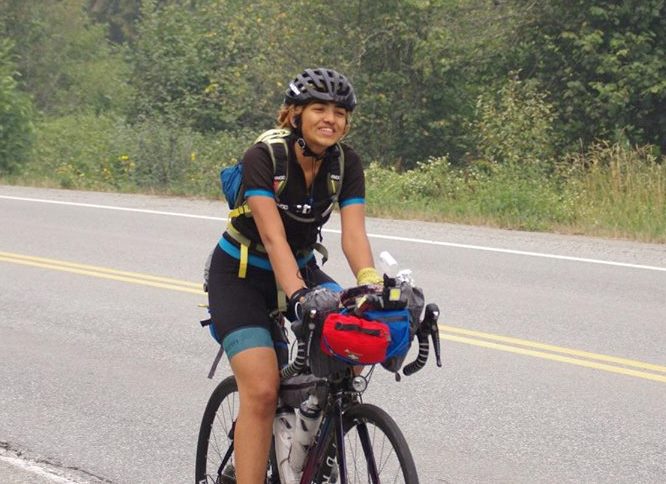
Vedangi Kulkarni (This photo was downloaded from the cyclist’s Facebook page and is being used here for representation purpose only.)

Having completed the opening Australian chapter and New Zealand after that, Vedangi is close to wrapping up the Canadian leg of her journey, cycling around the planet.

Vedangi Kulkarni, who is attempting to be the fastest woman cyclist to go around the planet unsupported, has covered more than three fourths of the Canadian leg of her journey.

On September 9, her father Vivek Kulkarni informed that Vedangi had reached Ottawa, the capital of Canada. At that point she had covered 9020 miles (14516 kilometers) since commencement of her trip in Perth, Australia. This approximates to half the distance required for circumnavigation. It took her 54 days and some hours (but less than 55 overall, as per Vivek) to cover the distance.

On her Facebook page, the young cyclist wrote: How do I feel? Grateful! I feel grateful for the colourful sunrises and sunsets, the mountains and the flat lands, the tarmac and gravel paths, the beautiful trees, creeks, rivers and lakes, the howls of the wolves and close wildlife encounters, the pleasant temperatures and freezing cold, the thunderstorms and stormy winds and tailwinds, and above all, to the PEOPLE who have supported me however and whenever and wherever I’ve needed – family, friends and absolute strangers! You’re my invisible peloton and I value every single one out there wishing well for me.

The record Vedangi seeks to improve upon is the one held by Italy’s Paola Gianotti. In 2014 she completed circumnavigation unsupported on a bicycle – although not in consecutive stages – in 144 days.

According to Vivek, Vedangi had to attend to work concerning her Schengen visa for Europe, in Ottawa. For some reason in the journey so far, this particular visa had proved tough to obtain. On September 15, in a post on Facebook, Vedangi confirmed receipt of Schengen visa. She will now proceed to Halifax in Nova Scotia to complete the Canadian leg, Vivek said.

Vedangi began her passage across Canada in Vancouver. Earlier she had cycled from Perth to Brisbane in Australia (5631 kilometers) and put in an additional 1000 kilometers or so, in New Zealand.

As per information available on Vedangi’s website, her journey of 18,000 miles (approximately 29,000 kilometers) will be attempted in four stages. The first stage will see her cycling through Australia and New Zealand. The second stage will see her cycling across Alaska and Canada. The third stage spans Europe, Scandinavia, Russia and Mongolia. The fourth and last stage covers China and the trip back to where she started in Australia. Given the fact that all required visas cannot be applied for and obtained well in advance, the exact route of Vedangi’s expedition has to stay open to adjustments as her journey progresses.

Vedangi, 19, is currently a student at Bournemouth University, UK. She spent some part of her early childhood in Panvel (not far from Mumbai); later she attended Jnan Prabodhini school at Nigdi near Pune. Her family now resides in Kolhapur. The circumnavigation plan assumed shape sometime in September-October 2017. Vedangi’s circumnavigation attempt will take her across 14-15 countries, the final number depending on how the route is affected by visa availability. A film is being made on her journey. There will be a film crew meeting her at various points on the way.

(The author, Shyam G Menon, is a freelance journalist based in Mumbai.)

2018 GGR / RACE PASSING THROUGH INDIAN OCEAN

Commander Abhilash Tomy KC (This photo was downloaded from the Facebook page of Commander Abhilash Tomy and is being used for representation purpose. No copyright infringement intended.)

The 2018 GGR, which began July 1 from France, is now passing through the Indian Ocean, albeit way down in the southern hemisphere. The race with technology levels pegged back to what prevailed during the 1968 GGR entails a solo, nonstop circumnavigation of the planet in a sail boat. It is adventure, refined.

More than two months since the 2018 Golden Globe Race (GGR) commenced from Les Sables-d’Olonne in France, the race leaders are past Cape of Good Hope and Madagascar. They are well into the Indian Ocean; the region they are in qualifies to be Southern Ocean. As of September 13, 2018, they lay far out at sea in the southern hemisphere, south-south west from the Indian peninsula.

Among the world’s great capes, the next one for them to rendezvous with is Cape Leeuwin, Australia. Well past this cape at Storm Bay in Hobart, Tasmania, the participants will have a brief meet up with race officials and media. According to race rules, the participants will pass through a `gate’ and drop all sail on the boat if it is safe to do so. The entrant may moor, anchor, motor or drift but may not re-cross the gate to continue to Cape Horn until at least 90 minutes has elapsed. During this time when the nonstop, unsupported character of the race will continue to remain intact, the participants can pass on any photos, films, letters they may have. They will also have to display their `safety pack’ for inspection. The pack – it contains a portable GPS chart plotter – is meant for use in emergency and a broken seal (indicating the pack was opened) denies the participant any official ranking in GGR or GGR trophies. He / she can however continue in the event under `Chichester Class.’ Further instances of stopping anywhere or breaking the seal of the pack, will disqualify the participant from the event, altogether.

As of mid-September, of 18 sailors originally participating in the 2018 GGR, seven had retired from the race while one stood relegated to Chichester Class. Commander Abhilash Tomy KC of the Indian Navy – he is the sole participant from India and only invitee from Asia – was among those still in the race. At the time of writing he was in fourth position. He had made some significant gains in the preceding days. The race leader by sizable margin was Jean Luc Van Den Heede of France. He was followed by Mark Slats of Netherlands, Gregor McGuckin of Ireland and Abhilash in that order.

The 2018 GGR features solo nonstop circumnavigation of the planet in a sail boat. It is a repeat of the original GGR of 1968, which produced the first solo nonstop circumnavigation in a sail boat; the distinction went to Sir Robin Knox-Johnston of UK, who accomplished the voyage in the India built-Suhaili. The 2018 edition is unique for pegging technology aboard participating sail boats, to the same level as in 1968. No digital devices have been permitted. Navigation is done using a sextant. Abhilash is the first Indian to do a solo nonstop circumnavigation in a sail boat. The 2018 GGR is his second attempt at solo nonstop circumnavigation. For the race, Abhilash is sailing in the Thuriya, a replica of the Suhaili built in Goa at Aquarius Shipyard (for more on the Thuriya please click on this link:  https://shyamgopan.com/2017/08/11/2018-golden-globe-race-ggr-meet-the-thuriya/).

(The author, Shyam G Menon, is a freelance journalist based in Mumbai.)

THE OUTDOORS AND THE LURE OF THE HIVE

Illustration: Shyam G Menon

A recent Court order that bans camping on Uttarakhand’s alpine and sub-alpine meadows has left trekkers and the outdoor industry confused. Confusion can be clarified. Of worry is trends inspired by commerce, noticeable in some of the responses to the ruling. As life becomes hive, the question is: to bee or not to bee?

Recently a friend needed assistance in articulating what the outdoors means and I found myself writing so:

Wilderness and open spaces are not merely part of human heritage. They are fundamental to the evolution of our aesthetics. One manifestation of such aesthetics inspired by nature is our idea of freedom. For some inexplicable reason, open spaces and wilderness with few humans in it, remind us of freedom; alternatively whenever we think of freedom, we imagine open space. We periodically yearn to be away and alone in the outdoors because we wish to reconnect with dimensions of existence denied us in the human cluster. Thus much before the outdoors is industry or industry to be regulated, it must be acknowledged as a side of us we are bound to go seeking, allowed or not.

To mindsets like the above, regulation is self-regulation and that is inextricably linked to education and awareness. The goal should be to create better informed practitioners of outdoor sports and adventure activity.

I reproduce the above here because of a recent Court order in the Indian state of Uttarakhand and responses to it I noticed on the Internet; in fact, with reference to my opinion on the matter, less because of the Court order and more because of the responses. Towards the end of August 2018, the High Court ruled that camping should not be allowed on alpine meadows, sub-alpine meadows and bugyals. It put a question mark on trekking in Uttarakhand because many treks – particularly long ones – require camping overnight. The order also set a limit on the number of visitors allowed at these locations.

News reports following the Court order said that the Uttarakhand government will challenge the ruling in the Supreme Court.

I leave it to the experts to decide what should be done.

What distressed me was some of the reactions in the wake of the Court order.

One big player in the outdoor industry lost no time in positioning large companies as environmentally responsible and small groups and individual trekkers as potentially irresponsible. To me, such posturing is unacceptable because there are exceptions to every generalization. There are lone trekkers and small groups of hikers who conduct themselves responsibly. Similarly, there have been big tour operators who defiled destinations by running hikes with large number of people or handled their garbage irresponsibly. Second, this argument of big operators as the most responsible ones around and therefore ideal model to support flies in the face of why we choose to be in the mountains in the first place.

My gut reaction when I saw the tour operator’s observation was: don’t compulsorily push me into a group. I come to the mountains for relief from the human hive and you are simply extending the reach of the hive when you insist I be in a group. That is not to say I am averse to groups. I am a meek fellow. Except on a handful of occasions, all my treks and climbs were with at least a friend or two. I have also hiked with groups and been on commercial treks; in the latter case, enjoying the comforts provided for I can’t handle frugality perennially. All through my life I have picked and chosen from a basket of options. What I wish to underline is that there is an element of getting away in most outdoor adventures. Outdoors, wilderness, open spaces and such have historically been a valuable counterpoint – even source of counter narrative – to life by clustering. What is the fun then, in forcing everyone into groups in the outdoors too? Why limit our choices?

The unsaid truth is – hive and group are good for business (not to mention – they are also politically fashionable these days). Companies love seeing us arranged in silos and seeming ready-made market. Before we know, the silo is swung by capital, technology and social media to the convenience of those controlling it. Such hijack of individual is overlooked. The danger implicit in this imagination resembles the tussle between personal freedom and nationalism. If you are going to put resources behind empowering anything, it should be personal freedom because that is innately fragile and typically, stands alone. Even a school student, aware of bullies and bullying, knows which side to support as a matter of principle. Somewhere in life as adults, we seem to forget this. However – and thankfully so – not everyone forgets.

Years ago, when I was introduced to hiking and climbing in Mumbai, my seniors at the climbing club talked of a book that was deemed essential reading. Its name – rather aptly I would think – was Freedom of the Hills. I didn’t read this book (it is there still on my shelf) but I read similar others. More than reading I was lucky to be with friends who liked the outdoors and respected it. Point is – nobody recommended an Outdoor Industry Handbook or How to be Hive and in the Hills At Once as essential reading for novice. My seniors were clear – the hills meant freedom. And because they are precious as abode of that freedom, you tread responsibly, you care for it. We went in small groups / expeditions and years before the Court order of 2018, were already carrying our trash back. It is my request to policy makers that individual hikers and small groups should not be automatically branded as irresponsible. Sometimes we hike alone or in small groups because we can’t afford commercial hikes or we simply wish for our own space. What you should emphasize instead, is good education about the outdoors so that anyone – traveling alone or traveling in group – is motivated as individual, to be responsible visitor in wilderness.

A commercial trek should not be anything more than an option. Much the same way, going alone or in a small group, should always be there as option. You can’t impose one option on everybody. The solution should be – no matter what option we choose (and the option we choose will vary depending on our state and stage in life), the environmental standards (and safety norms) expected of a trek must be met. Educate and train – that should be the way ahead. The hive will always tempt us with business models suiting its logic. But remember this – you will know the value of freedom only when you lose it. Even as I am yet to read it, I just can’t get over the name of that book: Freedom of the Hills. So apt. But for how long? – I wonder.

(The author, Shyam G Menon, is a freelance journalist based in Mumbai.)         

WHEN A YEAR DOESN’T FEEL ENOUGH

Grant Maughan (Photo: Shyam G Menon)

This is an article by invitation. The author, Grant Maughan, is a freelance super yacht captain and endurance athlete. Here, he provides us an overview of how 2018 shaped up for him and then takes us ringside to three ultra-running events he was at recently – The Last Annual Vol State, Badwater 135 and Angeles Crest 100. Hailing from Australia, Grant lives in the US. He maintains a packed schedule.

Sometimes a year just doesn’t seem like enough time.

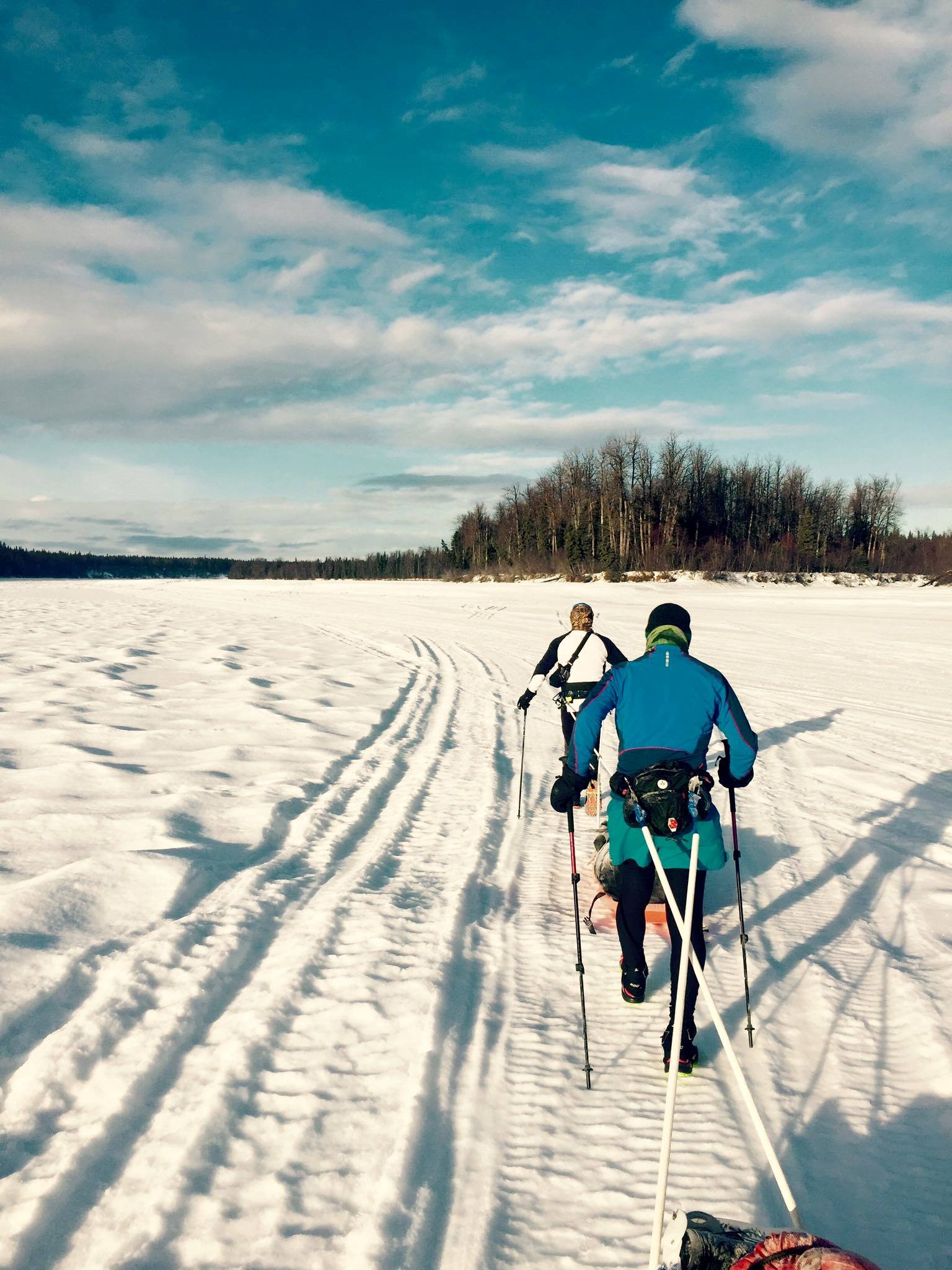
After working on a ship in Antarctica for four months in late 2017 / early 2018 and doing no training I found myself north of the equator about a week after finishing in Cape Town. I was back in Alaska for the Iditarod trail Invitational 350 mile winter race, hooked up to my sled and a little gun-shy after my withdrawal from the event the year before at around the 200 mile mark with frost bite to my fingers and nose. This year, with a conservative approach I managed to finish the event in third place and qualify for the 1000 mile attempt along the entire Iditarod Trail to Nome in 2019.

Not two weeks later I had flown to Australia to renew my passport, then back to Florida, changed equipment and driven to Frozen Head State Park in Tennessee for my first attempt at the infamous Barkley Marathons. Considered one of the most difficult ultras in the world, in its 32 year history only 15 people have managed to finish the five loops, collect all the correct book pages hidden out in the mountains and returned in time to the “Yellow gate.” This year’s weather was some of the worst on record with bucketing rain, cold temps and mud like butter. I managed to finish one loop with all the pages in the required time. Doesn’t sound like much of an achievement but I beg to differ.

From Iditarod (Photo: courtesy Grant Maughan)

A week after I had driven back to Florida, exchanged equipment again and was on a bus being shaken to bits on a mountain road through the Himalayas to Everest base camp in Tibet where I spent the better part of the next two months acclimating and working on climbing the North Col / North East Ridge route of the tallest mountain on earth. After a harrowing summit on May 19, I thanked my lucky stars to be back at base camp and packing for departure.

Not two weeks later I had flown back to Florida, changed equipment out and driven again to Tennessee for my first attempt at the Last Annual Vol State 500km road race. This event is also brain child of Barkley Race Director, Laz Lazarus and is considered an adventure across “small town America”. The route crosses the entire State and winds through country roads and quaint towns that most travelers would bypass on super highways.

Last Annual Vol State

What is the Last Annual Vol State race? Well, to begin with, it’s unlikely to be the last annual anything. Every year, more and more runners sign up for the 500k (314-mile) challenge. This year, 114 ultra-runners gathered for what is mostly a race across Tennessee — although it starts with a ferry ride across the Missouri River, zigzags across the Kentucky and Alabama state lines, and ends at a “rock” on top of Sand Mountain in Georgia. “That’s crazy… and confusing!” you might say to yourself. And you would be right.

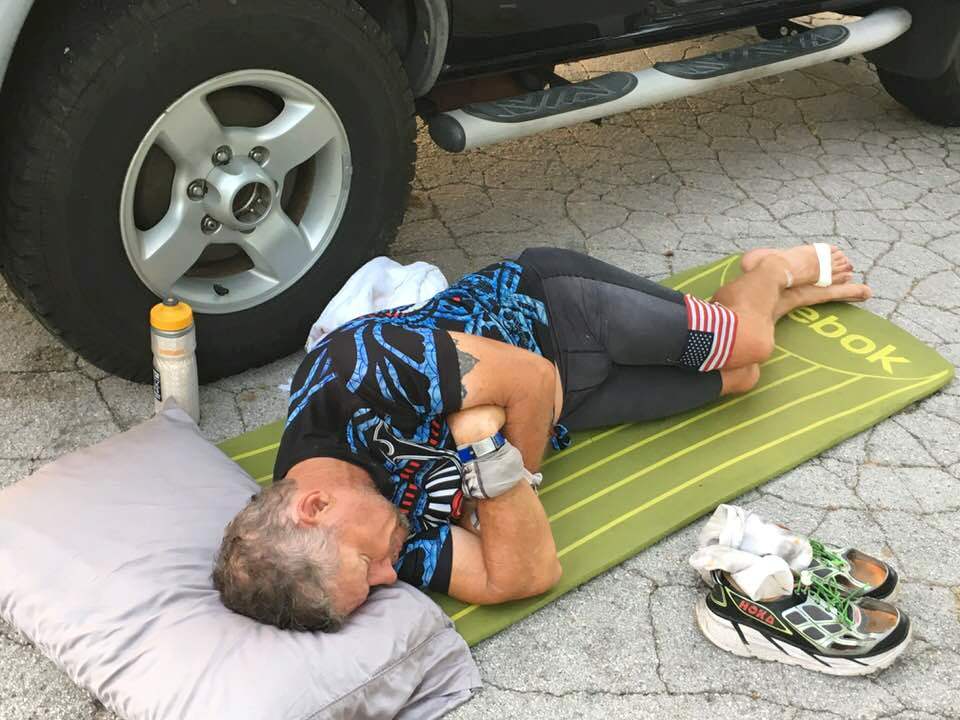
Taking a nap during Vol State (Photo: courtesy Grant Maughan)

Runners follow a labyrinthine course through small towns and farmlands, along backcountry roads and busy highways — and all at the height of a sweltering, sticky, bug-infested Tennessee summer (know what sweat bees are? If you don’t, you will!). The people are super friendly; the farm dogs, not so much. Runners have 4-10 days to finish, although the record holder did it in 3 days 7 hours. You can be crewed or “screwed” (which means un-crewed). There are no aid stations, although some kind-hearted locals took pity and set up “angel stations” along the way to offer food, water and a place to bed down (that MIGHT be chigger-free, if you are lucky). Screwed runners carry what they need or buy it along the way. Unscrewed runners have their crew do it for them.

All runners are free to check into a motel for sleep and a chance to test just how bad their chafing is in the shower. Many just sleep on the ground, where they drop. No fancy trackers — runners are required to call in twice a day with their position on the course. There are not many other rules, except you can’t ride in a car (unless a police officer makes you), and if you leave the course for food or a room, you have to go on your own two feet (no matter how much they hurt) and return to the course exactly where you left it.

King of the Road – that’s the title given to the first to reach Castle Rock by the Tennessee legislature (true story) on completion of the Last Annual Vol State 500km ultra.

Even though I was the first to get there, and proud of it, all of us who endured that long hot road across small town America at some point felt like a truck wreck. We came unstuck, went off the rails, strayed from our minds and asked ourselves questions too big to answer. But in the end we held that wheel in a white knuckle grip and kept on trucking.

Titles are not bestowed they are earned, and “King of the Road” will cost you more than a pound of fat.

I was more than a little relieved to finally make it to “The Rock” and the finish in 3 days 22 hours and 2 minutes.

At the finish line of Vol State (Photo: courtesy Grant Maughan)

After 500 km of running across Tennessee under a relentless sun and humidity, cranky dogs and the close proximity of speeding big rigs on country roads I finally dragged my putrid body to a stop. One of the difficulties of this event is living in saturated clothing and shoes for days. It’s very difficult to stop blisters, heat rash and horrid chaffing…and that’s besides the endless miles of soul crushing tarmac.

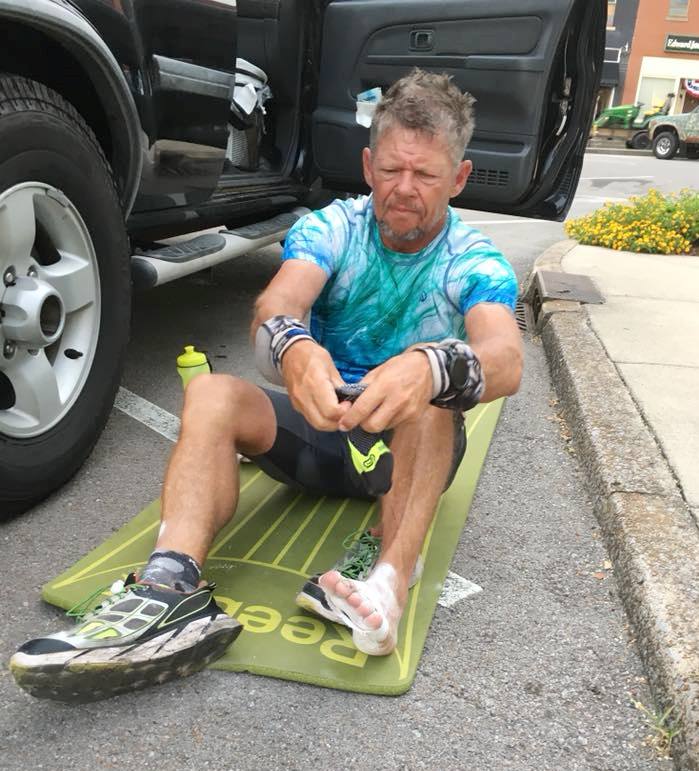
My wife, Susan Jobe who was my solo crew, suffered as much sleep deprivation, stinky clothes and bleary vision as the runner. We traded the front seat of the car and a yoga mat for occasional cat naps on the side of the road, shunning the comforts of a hotel for reasons unknown – but could have something to do with my stubbornness?

I literally saved seven angry dogs by either running to the opposite side of the road to stop them running in front of traffic to come harass me, or standing on the road waving frantically to a high speed vehicle to stop before it vaporized a small girl’s dog in front of her as she screamed from the front yard.

I finished early in the day. So we slept the rest of it in a local hotel before packing the car and heading West for another 2800 miles to Death Valley, California for this year’s Badwater 135.

Badwater 135

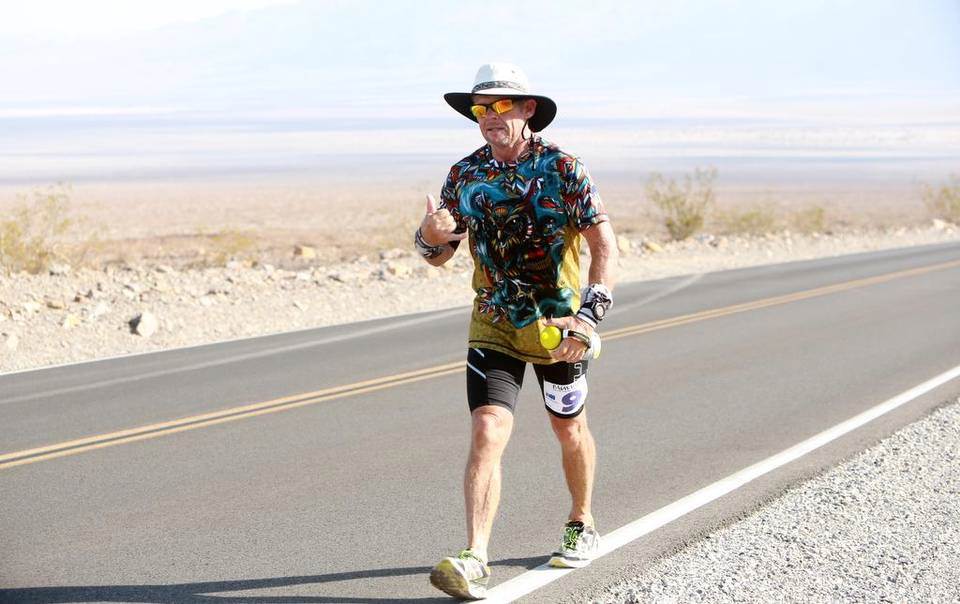
This was Badwater number six for me and I can only describe it as the toughest finish I have experienced at this race.

With record setting temperatures this year it was brutal to say the least and took a heavy toll on racers. I was obviously fatigued from Vol State only about a week earlier and my feet were in serious disrepair.

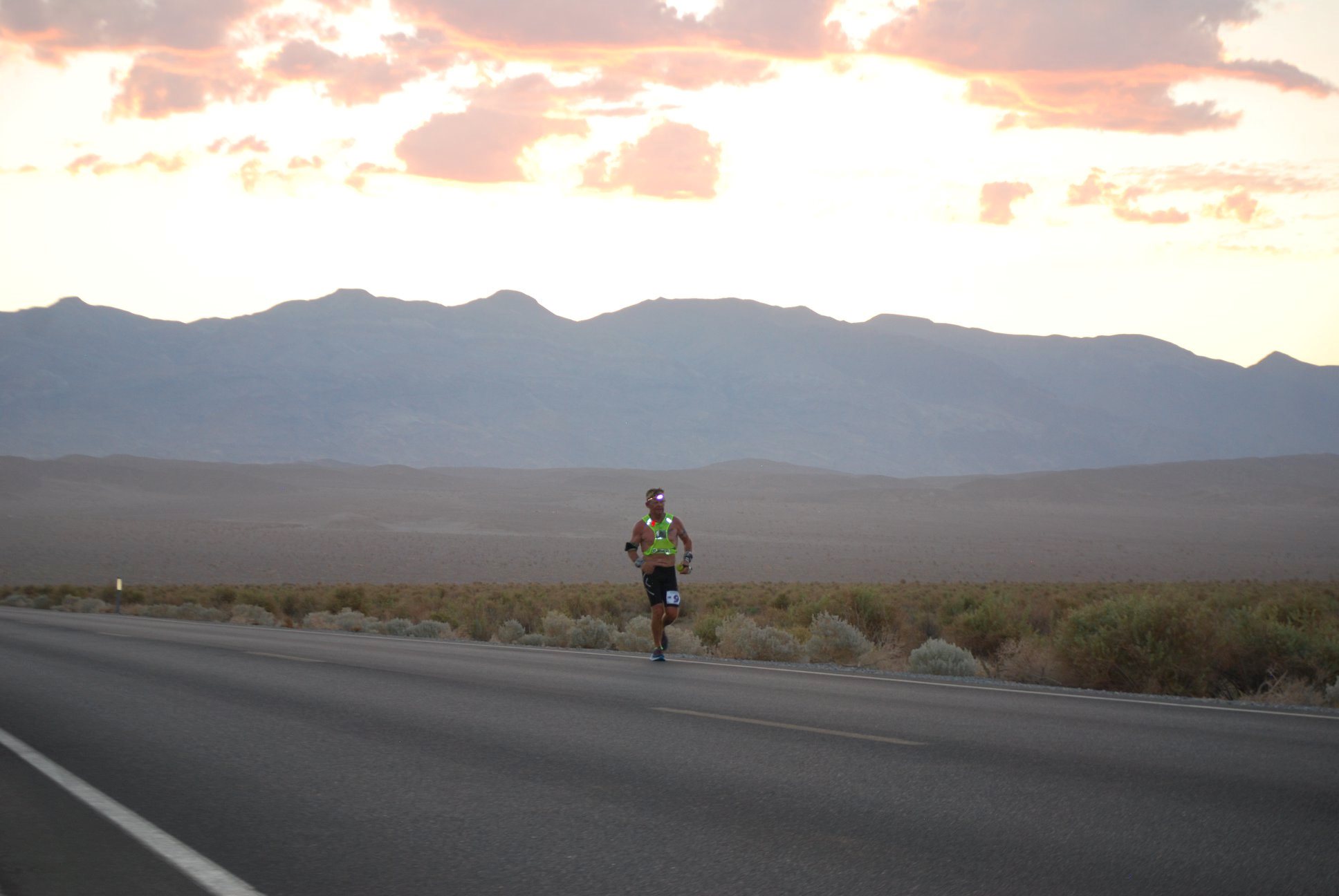
At Badwater 135 (Photo: courtesy Grant Maughan)

My slowest time ever at 34:52:30 and 22nd place didn’t bother me, heck I was just happy to finish this year. With about 30% drop out rate from the extreme heat it was one for the ages.

Whenever someone asks me what they need to know to run Badwater I always tell them they need to respect the first 41 miles between Badwater Basin and Stove pipe Wells. The arid atmosphere is going to suck every drop of moisture out of your body. You have trouble drinking enough to replace the loss and your stomach cannot process it all quickly enough. This year I saw total carnage along that section. Someone was throwing up only five miles from the start. After Furnace Creek I saw a female runner, totally unconscious, being carried to her crew car. A minute later the woman in front of me had a wobble, went off into the gravel and hugged a road post. Not a minute later a guy was projectile-vomiting a ten foot stream of fluid in great heaving growls that echoed off the landscape. It looked like a scene from the trenches of the Somme and we were only about a marathon into the 135 miles. I chugged along in idle, drinking like a fish and gladly peeing frequently.

Heading up Towne Pass my own problems started with my feet that had been taped up after last week’s race but started to fall apart. Blisters under the ball of the left foot started to fill again and the pad started to slew off the bottom. At the summit I had the foot taped up with blue painters tape so I could make the downhill section without the pad on the ball of the foot falling off. It was a slow, painful and unhappy trip down. Then the abominable heat rising out of the Panamint valley made me feel faint and out of it. At times when only a few hundred feet from the car I wasn’t sure if I would make it and thought I would collapse on the sizzling tarmac. It took many hours to get to Panamint Springs where I lay on a yoga mat fitfully for a couple hours.

Badwater 135; heading up Towne Pass (Photo: courtesy Grant Maughan)

Unfortunately our crew had to resign here due to heat problems and I thought my race was over until serendipity arrived in the form of the famous Bob Becker*. The runner he had been crewing had just dropped. He quickly slipped into the program and I hobbled away to climb Father Crowley in a heat haze. When we arrived at the top I tried to start running and to my surprise ran many of the miles to Darwin. The 30 miles section to Lone Pine is very amenable to running and with the sun down I gritted my teeth from the foot pain and trotted along for most of those miles, sending the crew ahead to take cat naps.

A big problem I had during this year’s race was falling asleep: day and night. It was like my body’s protection mechanisms were just shutting me down. I spent untold 15 minute cat naps trying to alleviate it. Caffeine did nothing except make me drowsier.

It was a great feeling to arrive in Lone Pine at day break and get on the Portal Road for the final climb to the finish line. Susan and Bob each paced me up the laborious climb to the finish.
It was an epic year out there and total respect to everyone who was out there – runners, crew and staff.

Badwater 135 continues to be a benchmark of the ultimate grind-fest of road racing….whew!

Angeles Crest 100

After Badwater I decided that I probably wouldn’t run AC100 because my feet were falling apart and incredibly painful to walk on.

I did some Epsom salt soaks, cut off lots of dead skin, filed nails and applied rehydration crème.

From Vol State; time for some foot-care (Photo: courtesy Grant Maughan)

To my surprise only a few days later we had driven north to a remote National Park in Nevada to hike climb a 12,500 feet peak and my feet felt “not bad”. We continued the sojourn by climbing another 12’ver near Las Vegas and I decided that though tender I might be able to make it through the 100 miles of trail in the San Bernadino Mountains near Los Angeles. So we redirected the car and eight days after Badwater I was at the start line of the AC100.

I took it easy and enjoyed the beautiful mountain and forest scenery. The trails were well maintained and I was surprised how good I felt. I made a huge mistake though just as the sun was getting higher and hotter. Some of the aid stations are 8-12 miles apart and just before the biggest climb of the race I filled only one water bottle instead of all three and suffered very bad dehydration coming down the other side. My mouth was so dry I could hardly open it.

At the next aid station I sat for half an hour drinking a couple of litres of fluid as I knew it would be difficult to get through the intense heat of the afternoon without trying now to catch up on hydration. The next aid was only five miles away and I did the same when reaching it. The next 30 miles felt okay but it was getting hot on the trails and with no breeze it was stifling. A couple of miles before the hallway point aid station I started to slow down, feeling overheated and faint whilst in heavy bush where the air was not moving. It felt heavy and pressing down on me. I sat at the check point and drank as much as my stomach could tolerate, filled every bottle and got going on a long eight mile section down in a valley.

The terrain was more complicated with a lot of rounded river rocks to navigate and sizzling temperature. About a mile from the aid station I felt totally drained and started wondering if I might have to drop. A final rock staircase up to the checkpoint had me wondering if I could even get up it. I knew I would have to stop for a while and get calories and a lot of fluid into me to be able to go on. I sat on a chair and the hard working volunteers fed me and replenished drinks. After more than an hour it was dark, I was chilly from wet clothes and I knew I had to either get going or call it quits. I started walking down the dirt road which led eight miles to the next aid. Eventually I loosened up and came out of my low point. I walked many miles though and kept drinking and eating.

After the 65 mile point the trail became more technical and there were some long downhill single tracks followed by more big climbs. At one point I lay down for ten minutes to try and stave off my sleepiness. My head was nodding lower and lower before I would stumble, just before I fell asleep. It was very annoying and again, even caffeine wouldn’t buck me up. I kept going though until the sky began to lighten and as the sun came up I felt a new surge of energy on reaching the 90 mile-mark. I ate and drank quickly at the aid station and headed off on a very long downhill with new vigour, going faster and faster.

I was amazed I was running so well after all the races and had no idea where the energy was coming from but I didn’t question it too much. I had another finish line to reach. I ran the entire ten miles and passed more than a dozen runners. I kept going hard all the way to the finish before collapsing in the shade with a cold drink and was extremely pleased with the way it ended. I came in 31st in 27 hours 46 minutes. Around 150 runners had dropped out from the heat; that left about 100 finishers!

Badwater 135; crossing Devils Cornfield (Photo: courtesy Grant Maughan)

We ate and slept at a local hotel before again packing the car to drive over 3000 miles back to Florida. I lost more skin and toenails but that is the price you pay for ultra-running.

I have a few weeks to rest before flying to Italy to try the Tor des Geants 330km mountain race on September 9. I started this race last year but only made it 50 km because of a bad flu two days before race start. Let’s see what happens this year.

It’s been a big year but I feel good and haven’t suffered any injuries from all the activities. I have hardly done any training for anything, mainly because I haven’t had the time to. It amazes me what the human body can do.

(The author, Grant Maughan, is a freelance super yacht captain and endurance athlete. * In 2015 Bob Becker, then 70 years old, had become the oldest runner to complete the Badwater Double.)

SKIPPER’S TAKE / FIRST CIRCUMNAVIGATION BY A CREW OF INDIAN WOMEN

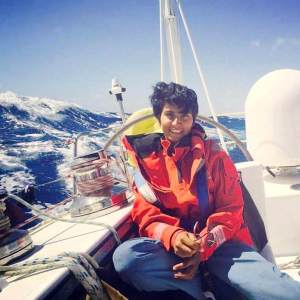
Lt Cdr Vartika Joshi (Photo: courtesy Lt Cdr Vartika Joshi)

On May 21, 2018, after 197 days at sea and 254 days away from home, the first Indian all women-crew to circumnavigate the globe returned to Goa. This article is based on a conversation with the skipper of INSV Tarini, Lieutenant Commander Vartika Joshi.  It gives an idea of the countdown to circumnavigation and how the voyage actually unfolded, out at sea.

The Laser phase

Bruce Kirby was originally a journalist.

He worked with the Ottawa Journal and later, the Montreal Star. Having gained competence at sailing during his childhood and youth, he represented Canada in sailing at the 1956 Olympics, finishing eighth in a field of 24. Two years later, he tried his hand at boat designing. His designs worked well. In 1965, he moved with family from Montreal to Chicago and assumed charge as editor of a magazine called One Design, which would later become today’s Sailing World. Around this time, he was asked by a friend in Montreal to design a boat, compact enough to be transported on top of a car. The result was – the Laser; it hit the market in 1971 and proved useful to popularize sailing.

According to the website of Bruce Kirby Marine, there are an estimated 182,000 Laser boats worldwide. The model’s success inspired Bruce Kirby to resign his position at the magazine and become a full time sailboat designer. One of the highlights of the Laser is that it has strict one-design class rules, meaning a boat – today’s or older – is near similar, allowing for distinction in performance to be narrowed down to sailors’ competence. The Laser has a presence in India’s sailing scene. Over 40 years after the model first hit the market, it was on a Laser that Lt Cdr Vartika Joshi learnt the fundamentals of sailing. The location was Visakhapatnam, home to the Indian Navy’s Eastern Command.

Hailing from Rishikesh, Uttarakhand, Vartika did her BTech in aerospace engineering. In 2010, she joined the Indian Navy. “ I joined the navy because I liked the idea,’’ she said. The navy trained her to be a naval architect. At the back of her mind, she wished for a taste of the sea. Upon being commissioned as a naval officer, her first appointment was at Visakhapatnam. Selections were on for the inter-command sailing competition. It was open to women as well. “ Among women officers around, I was junior and relatively free. So I availed the opportunity,’’ she said. That was her introduction to sailing. It included a brief spell of training in Mumbai; all of it more or less restricted to the immediate need at hand. One weekend in Visakhapatnam, she decided to head to the navy’s sailing club and try out a Laser boat on her own.  The staff ashore showed her some of the knots she would use, fitted her out in a life jacket, put her on the boat and pushed her out into the water. She capsized multiple times that day and had to be eventually rescued and brought back to shore. But something engaged about sailing. For one, a sail is not much different from the wings of an aircraft; something she had studied in college. Although their respective axis is different – one is positioned vertically, the other horizontally – both harness wind energy provided you know how to do it. The following weekend, she returned to the club to try out the Laser again. Gradually, over several such visits, she learnt how to sail the boat.
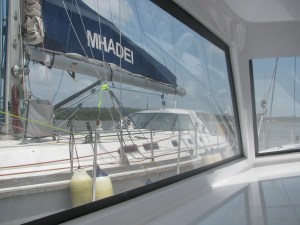
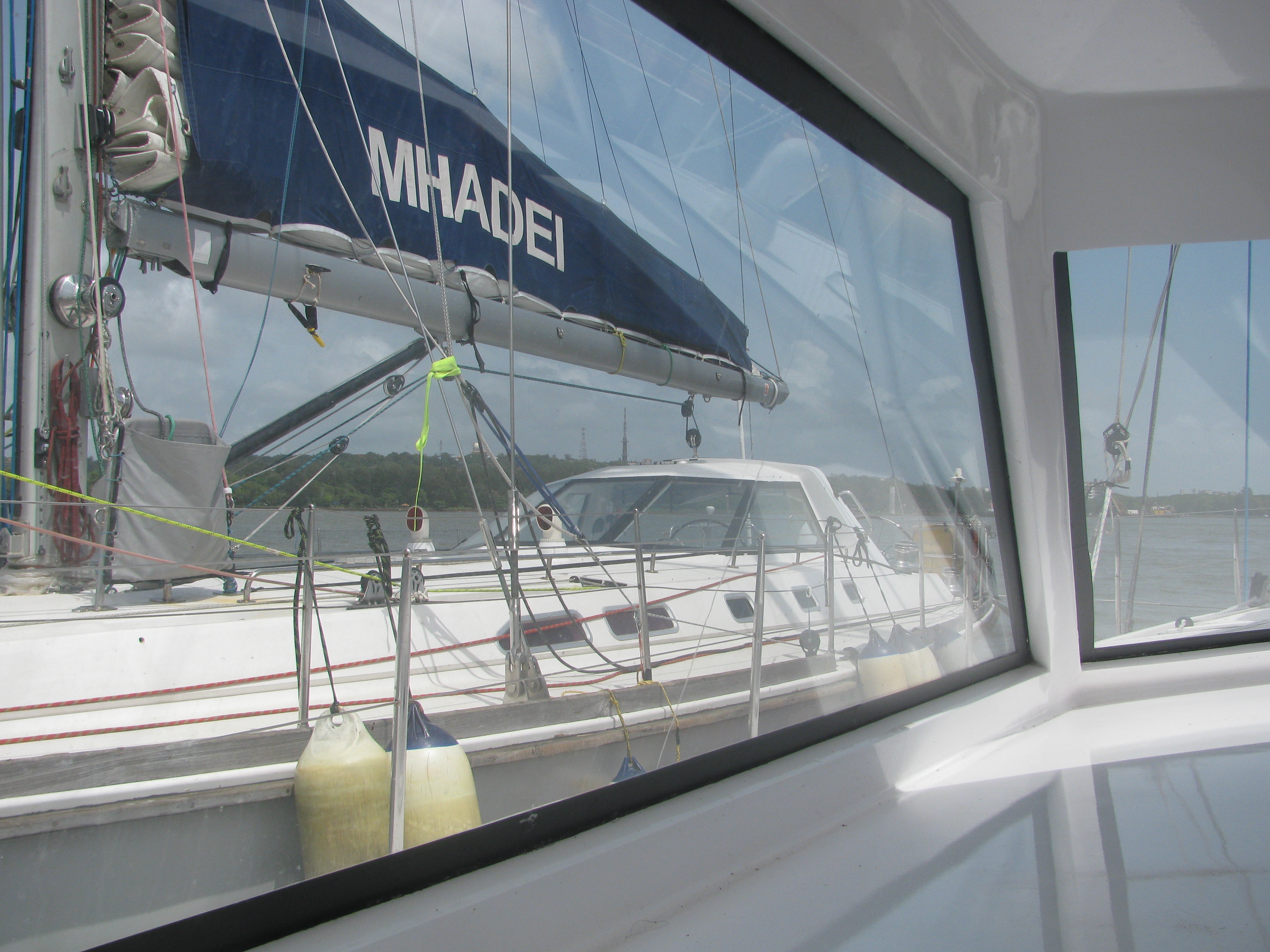
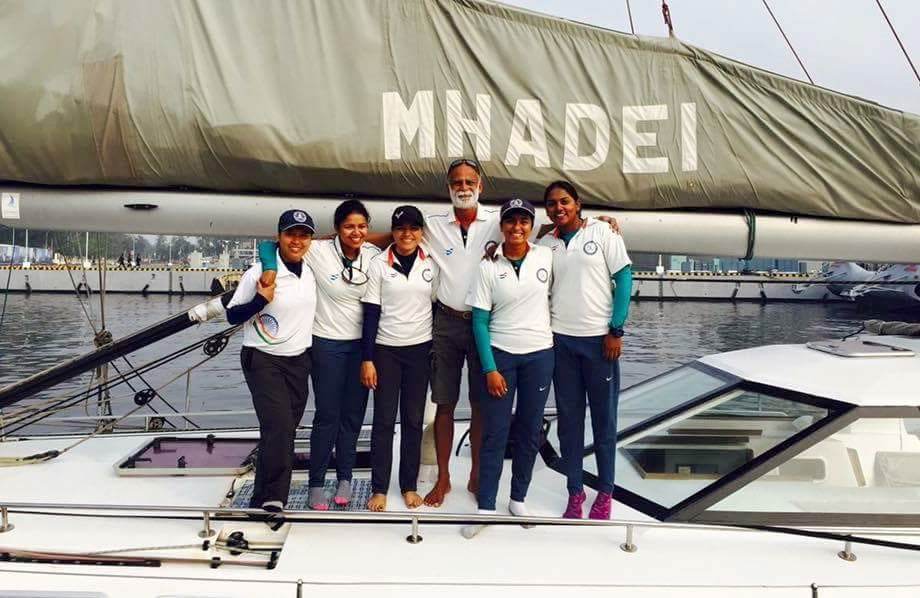
The Mhadei; seen from inside the Tarini. They are sister vessels, near identical to each other; Mhadei being the older. This photo was taken in Goa (Photo: Shyam G Menon)

Atlantic with Mhadei

By this time, more than a thousand kilometers away on the Indian west coast, Goa had become home to a small boat with a giant reputation. In a fleet of vessels ranging in size from aircraft carrier to small boats, the INSV Mhadei should be among the smallest vessels in the Indian Navy’s possession. But she had completed two circumnavigations. Thanks to her the Indian Navy had the distinction of having done solo circumnavigation and solo nonstop circumnavigation in a sail boat. Besides the two circumnavigations, the Mhadei had done several long voyages in the Indian Ocean area, particularly across the Bay of Bengal and the Arabian Sea. She was also a regular participant at the annual Cape to Rio yacht race, the longest such intercontinental race in the southern hemisphere. In 2014, when the Indian Navy sent out a signal seeking volunteers from among its women officers for the Cape to Rio Race, Vartika did not hesitate to sign up. She was selected to be part of the Mhadei’s crew on the return leg from Rio de Janeiro in Brazil to Cape Town in South Africa. This was her first open ocean voyage.

For sailor coming aboard the Mhadei, skills honed on a Laser in Visakhapatnam, open ocean voyage in the Atlantic was an eye opener. When it came to the Laser, it was all about the basics of sailing in protected environs, not far from land. In contrast, the Mhadei in the ocean was a case of several subjects – ranging from the nuts and bolts of a yacht to sea conditions and atmospherics and how the yacht behaved through it all – converging. She was a world by herself. For Vartika, that initiation in the Atlantic was rough but the journey it promised, attracted. “ I continued to volunteer for more expeditions on the Mhadei,’’ she said. The call for women volunteers had always been part of the agenda at Sagar Parikrama, the Indian Navy’s circumnavigation project. Vice Admiral Manohar Awati (Retd), who played a major role in imagining and implementing Sagar Parikrama, had told this blog in an interview in October 2013 that he wished to see the project present India its first woman circumnavigator. When the signal seeking volunteers for an all women crew to do circumnavigation appeared, Vartika didn’t hesitate to grab the opportunity.
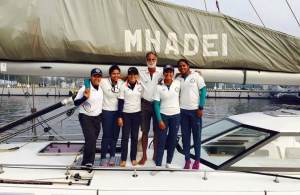
From training days; some of the all women-crew with Capt Dilip Donde (Retd) (Photo: courtesy Lt Cdr Vartika Joshi)

On September 10, 2017, the much awaited circumnavigation by women officers commenced from Goa. There were six crew members aboard. Lt Cdr Vartika Joshi was skipper. Her team included Lt Cdr Pratibha Jamwal (from Kullu, Himachal Pradesh); Lt Cdr Patarlapalli Swati (from Visakhapatnam, Andhra Pradesh), Lt Cdr Aishwarya Bodapatti (from Hyderabad, Telangana) Lt Cdr Vijaya Devi (from Kwakta Santhong Sabhal Leikai, Bishnupur district, Manipur) and Lt Payal Gupta (from Dehradun, Uttarakhand). Pratibha had her first sailing aboard the Mhadei on a run from Goa to Port Blair. In 2015, she became part of the all women crew. Swati had her debut in open ocean voyage in 2014, on the Cape Town-Goa sailing leg of a Mhadei returning from the Cape to Rio Race. Aishwarya joined the crew on their second training sortie – from Goa to Mauritius – aboard the INSV Mhadei. Vijaya Devi has been a podium finisher among women at yachting and Laser boat championships. She became part of the crew in December 2016. Payal joined the crew on the team’s first independent sortie from Goa to Karwar; she also took part in the 2016 Cape to Rio Race. The crew’s training had started with various courses on basic seamanship, navigation, communication, meteorology and basic boat handling taught at the navy’s training schools in Kochi and Mumbai by Cdr Abhimanyu Patankar and Cdr Abhilash Tomy. That was followed by hands-on training aboard the Mhadei under Capt Dilip Donde (Retd). The team’s first independent sortie was from Goa to Karwar. Later the team sailed with Dilip to Visakhapatnam for an International Fleet Review. At Visakhapatnam, Dilip disembarked and the all women crew sailed the Mhadei around the Indian peninsula, back to Goa, on their own.
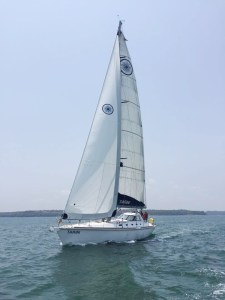
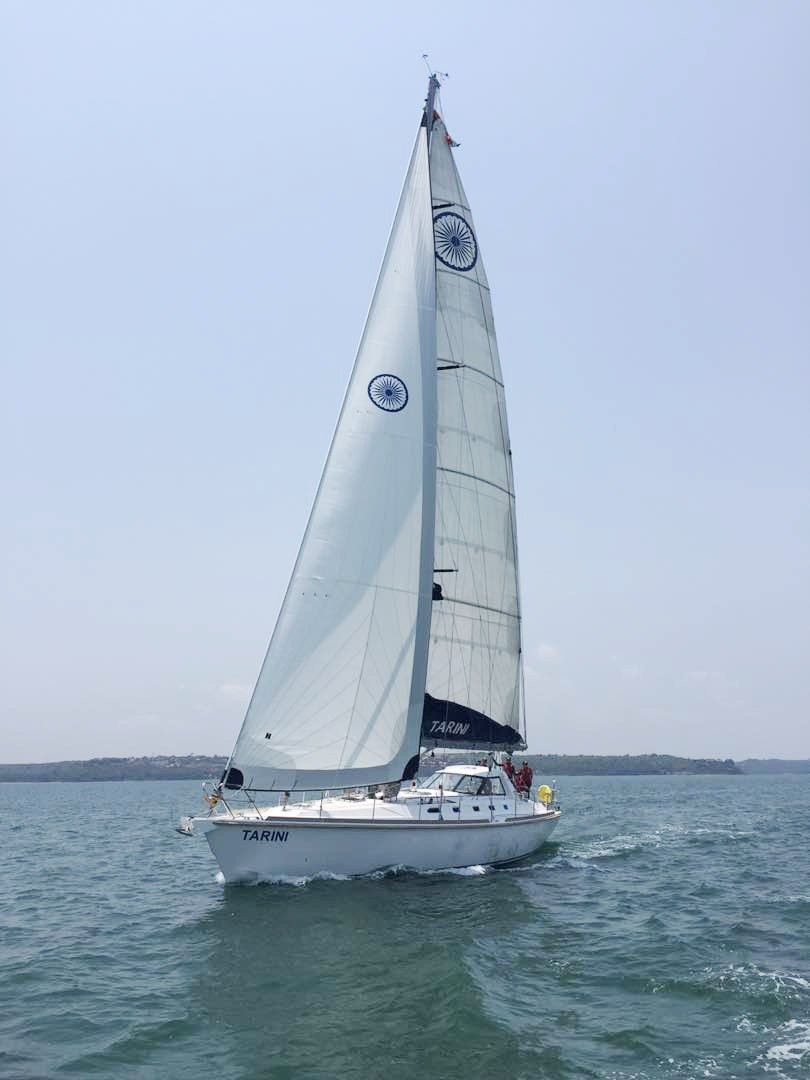
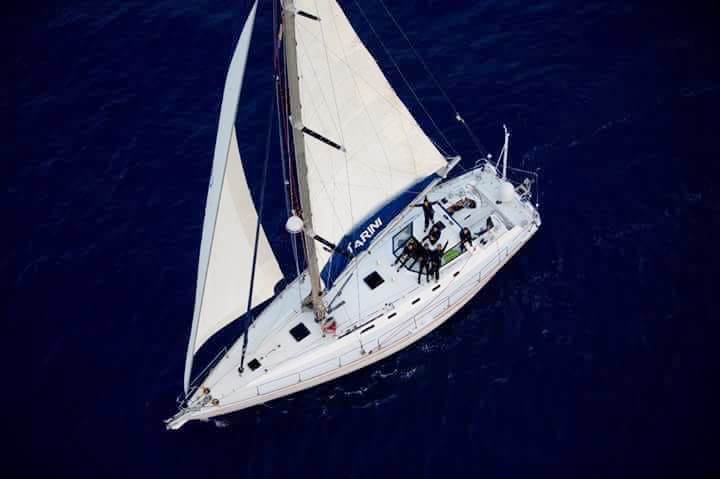
INSV Tarini (Photo: Shyam G Menon)

Tarini enters the frame

Goa’s capital Panjim, is adjacent to the Mandovi River. Upstream from the riverine jetty where the navy’s sailboats are berthed, is Aquarius Shipyard, which built INSV Mhadei. While the all women crew trained on the Mhadei, Aquarius was building an identical sister vessel. This new yacht was to be the all women crew’s vessel for circumnavigation. Having the boat under construction in Goa itself was a boon for the crew; they could go over to the yard and see it assume shape. It is important familiarization given circumnavigation entails months of stay aboard a boat, which is all that stands between you and the ocean. Knowing your boat properly is essential for long voyages. “ I was with the new boat right from the time her keel was laid,’’ Vartika said. Another advantage of construction happening nearby was that some of the crew’s suggestions – related to ergonomics – could be incorporated in the design. On February 18, 2017, the new boat was inducted into the navy as INSV Tarini. The crew took her out on trial runs to Mumbai and Porbandar followed by a longer voyage to Mauritius. In addition to acquiring skills and getting boat in place, there were a few other details too to be addressed. When you are at sea, your boat is everything. As your floating home, it must be looked after well and kept in fine fettle. There is plenty of work to do on a boat tackling long voyage. This work engages the upper body adequately. But given the human being needs a surface to walk on to engage the legs and walkable surface area is limited on a sailboat, the lower body runs the danger of wasting. Ahead of voyage, the crew trained to improve and sustain their lower body strength.

Planning and preparation are very important for the success of a voyage, Vartika said. By the time they cast off on circumnavigation, the crew knew their boat well. Thanks to the sorties they did together, they also knew each other well. One of the less highlighted angles of expeditions is coexistence. While expeditions definitely mean the relief of getting away from life as we know it, they brew their own stress. Despite best efforts to stay on good behavior, stress can make people abrasive and fragile. In daily life there are multiple avenues to destress. Such options reduce on an expedition. On a mountain side, you can take a walk perhaps. What do you do on a boat? “ Our training for the expedition began in 2015. The idea of subjecting the entire team to a long training experience was to not only learn about sailing the boat but sail it together. This aspect was going to be as important as the sailing itself especially when sailing for long duration,’’ Vartika said. According to her, initially, adjusting to each other’s lifestyle was tough for the crew. Living together and seeing each other’s faces in seven meter by five meter living space, 24 x 7 made them quite vulnerable to each other’s emotions and actions. Amid this they were required to tackle all that nature threw at them. “ My training at sea with others of the crew helped me become more receptive towards the rest and also look at the larger picture. Our training phase helped me understand the crew better and be in sync with their nature and reflex towards any given situation,’’ she said. The team took to circumnavigation only after they were convinced that they were ready for what lay ahead. Circumnavigation of the planet by sea is punctuated by the three capes the route passes through and the challenges posed by the Southern Ocean. The three capes are Australia’s Cape Leeuwin, Cape Horn at the tip of South America and Africa’s Cape of Good Hope.
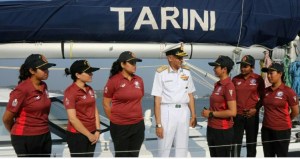
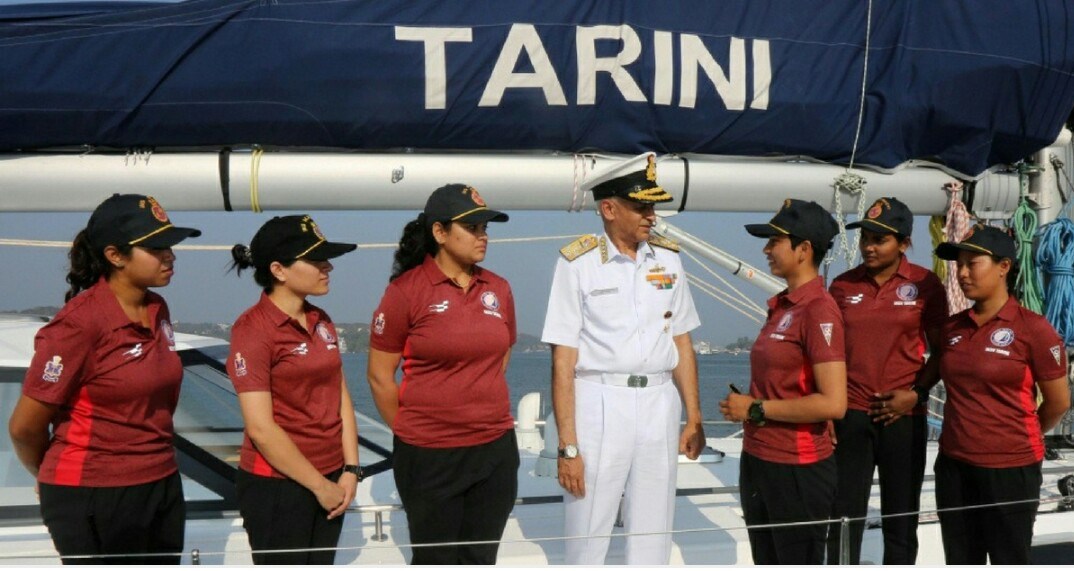
The all women-crew of INSV Tarini with the Chief of Naval Staff, Admiral Sunil Lanba (Photo: courtesy Lt Cdr Vartika Joshi)

The Southern Ocean

Located at 32.03 degrees south latitude Fremantle is a port city in Western Australia; it is part of the Perth metropolitan area. The Indian Navy’s Sagar Parikrama, in its version of circumnavigation with stops, has traditionally had its ports of call at Fremantle, Lyttelton, Falkland Islands and Cape Town. For the Tarini and her all women crew, the first leg from Goa to Fremantle was initially slow progress. Two weeks out from Goa, as the boat crossed the Equator, a challenge loomed. The trade winds in the southern hemisphere blow in from the south east. That was also the direction the Tarini wished to proceed. To harness the wind, the boat therefore sailed at an angle – in south-south west direction. But that course had to be endured for 20-22 days before favorable winds appeared and course to Fremantle had. The course correction to Fremantle occurred at around 32 degrees south latitude. In this phase there were winds of over 45 knots with accompanying wave heights of 5-6 meters. Thus welcomed to the Southern Ocean, the Tarini proceeded to a 12 day-halt at Fremantle, during which time it underwent minor repairs, maintenance checks and stocked up for the next leg of the journey to Lyttelton in New Zealand, a port town that lay further south on the map at latitude 43.6 degrees. “ This was a short leg. But it was in the Roaring Forties,’’ Vartika said of the voyage to Lyttelton. The Roaring Forties refer to strong westerly winds found in the southern hemisphere, generally between 40 degrees and 50 degrees south. It was one of the reasons why the Tarini got a good check-up at Fremantle. These are not seas you take chances with.

The first landmark to cross on this leg was Cape Leeuwin. The Tarini enjoyed good winds till the Great Australian Bight, that massive arc on the southern coastline of Australia, you see on the map. Then the boat got stuck in a big high pressure weather system that was forming in the area. According to Vartika, such weather systems; more precisely the frequent birth and demise of weather systems, is characteristic of the Southern Ocean. It is a zone of tireless churn. Thanks to this, the seas here appear confused. You can have instances of short-lived calm with little wind above deck and choppy waters below, all at once. Both Dilip and Abhilash had faced rough weather in the waters off southern Australia during their circumnavigation voyages. Forewarned of the high pressure system, the Tarini skirted it; that’s what sail boats moving under the power of wind do when beset with obstacles made of the same energy driving it. The tactic worked. It was a smooth passage. Not long after they tackled this weather system, while sailing through the Tasman Sea, the Tarini’s crew had their first glimpse of the Southern Lights (Aurora Australis). “ It was a memorable experience,’’ Vartika said. Twenty five days after she left Fremantle, the Tarini neared Lyttelton. The actual entry to harbor was delayed, thanks to the shifty weather changing gear again. The 12 days (that was standard duration for the Tarini’s scheduled stops) halt at Lyttelton was well used to check the boat and replenish supplies. Ahead lay the longest phase of the journey – the crossing of the South Pacific Ocean and the dip to as south as it gets during circumnavigation: at almost 56 degrees south, the tip of South America; Cape Horn.

The Pacific Ocean is a huge expanse of water. It represents 46 per cent of the Earth’s water surface; it is bigger than all land combined. It is also the stuff of human heritage for humanity’s migration to lonely islands tucked deep in these parts have to be fantastic narratives in ocean crossing. Especially when you consider what boats and navigation technology, people living centuries ago, had. On the world map, a line east from Lyttelton to Cape Horn would appear straightforward with a gentle southern tilt. But that’s not how voyages in the Southern Ocean pan out, particularly that of a sail boat dependent on wind. As Tarini left Lyttelton, there was news of several weather systems forming in the southern latitudes. Those advising caution included a couple on a sail boat journeying east to west and who were reaching New Zealand from Falkland Islands. Given the general direction of Cape Horn and the weather systems ahead, it was once again imperative for sail boat to dip south to skirt these systems and then proceed east. After some days spent sailing south, the Tarini found favorable winds for the passage eastward. The breeze was steady and the going, good.

Illustration: Shyam G Menon

The approaching storm

According to information on the Internet, South Pacific weather – traditionally described as tropical with its northern latitudes close to the equator being warmer than those farther to the south – has been impacted by global warming. The official rainy season may end up dry and the dry season, wet. The region’s hurricane season – November to April – isn’t as reliable as before. In 1997, Hurricane Keli became the first South Pacific hurricane of June. Close to January 2018, it became evident that there was a major storm brewing in Tarini’s path. Preparation of boat and crew for rendezvous with the weather system commenced days in advance. The movement of the storm’s frontal system was studied on a daily basis and plans devised on how best to avoid it. The Chilean weather agency provided regular updates; the Tarini’s crew also kept Chile’s maritime rescue coordination center updated on the boat’s daily position. This was in addition to the weather data and updates provided by the Indian Navy. All this, along with daily observations of weather from the boat, sufficed to give skipper and crew a fair idea of what lay in store and how to proceed. They started preparing themselves and boat for the worst.

Vartika commenced her preparations, checking every detail of the boat, making sure that nothing, which could possibly give away, was loose. All potential sources of water ingress were sealed and all underwater valves closed a day before the storm was predicted to hit. Laptops and phones aboard were charged following which, power was switched off to sockets and equipment consuming much electricity. Hours before the storm, the batteries aboard were charged so that the generator wouldn’t have to be operated during the storm. Skipper and crew then discussed how they should stay ready at a personal level. They decided to keep their life jackets on and stay hooked (clipped in) to the boat at all times. All winter gear and foul weather gear was kept accessible for use. Meanwhile the temperature dropped to sub-zero and there were frequent hailstorms. The wind and the sea rose quickly and the barometer level dropped. “ There used to be squalls. The wind, blowing at 30-35 knots would suddenly speed up to 45 knots. Adjusting the sails accordingly became frequent,’’ Vartika said. The main sail-area was dropped to the last reef to prevent the boat from getting overpowered. Some mornings, there was snowfall. Safety drills were memorized and shore authorities, informed. On a sail boat, the crew takes turns being on watch. Those not on watch rest, cook or address various maintenance jobs. Typically, two crew members are on watch; each watch lasting four hours. As the storm drew closer, the number of people on watch was raised to three and the duration of watch shortened to two to preserve quality of response. They worked wearing harnesses with slings attached that kept them tethered to the deck.

The Drake Passage is the body of water between South America’s Cape Horn and the South Shetland Islands of Antarctica. It connects the southwestern part of the Atlantic Ocean with the southeastern part of the Pacific. For ships sailing between the two oceans, conditions will be rough in the Drake Passage although not as bad as they tend to be in the narrower and sometimes icebound Strait of Magellan and Beagle Channel. Besides for a proper appreciation of Cape Horn – something circumnavigators look forward to – a boat has to be in the Drake Passage. Geologically, this 800 kilometer wide-span of water (the shortest route from Antarctica to any other landmass) is significant. According to Wikipedia, till about 41 million years ago, the Atlantic and Pacific were not connected in the south. Antarctica was warmer than today and it had no ice cap. It was once the two oceans joined via the Drake Passage that the Antarctic Circumpolar Current commenced and the continent cooled significantly. In January 2018, roughly a week before the Tarini entered the Drake Passage, the storm hit her in the Pacific. The wind speed picked up to 70 knots. The waves were huge. “ For the first time, we felt scared,’’ Vartika said of the waves.

Illustration: Shyam G Menon

A wave to remember

The storm had the little boat in its maw for around 20 hours. On the Tarini’s deck, to the aft, are two steering wheels, one each on the port and starboard side. A sailor on deck steering the boat is exposed to the ocean ambiance through which, the boat is sailing. At one point in the passage through the storm, Vartika was at the wheel of the boat, when a huge wave rising up from aft crashed on the boat’s deck. Unlike a big ship, a sail boat uses the energy of wind to propel forward. It is a delicate equation for although nature provides the required energy, nature’s scale is humongous compared to size of sail boat. It takes little by way of excess nature to tip the balance and damage a boat or endanger a voyage. That’s why in the run up to storm, the sail areas were frequently adjusted and as the winds gathered speed, utterly minimized. As sensitive as sails to the wind, is a boat’s steering mechanism to the sea around. The sea is a lot of water; it is medium we underestimate for the force it can wield. Sailor on deck handling the wheel can sense through the steering column the fury of ocean being tackled. Unlike big ships, on a sail boat this feel is real. “ I could feel the power of the ocean on the wheel,’’ Vartika recalled. As the giant wave reared up behind Tarini and crash on deck was imminent, she shouted to the crew within to prepare for impact and get into `brace position.’ She let the wheel run free allowing the boat to naturally turn into the wind. If you fight the ocean under such circumstances and attempt steering, you risk breaking the steering column. As the boat turned into the wind, it slowed down significantly. The wave crashed on the deck.
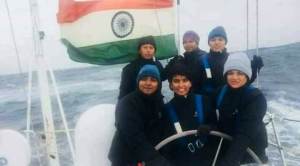
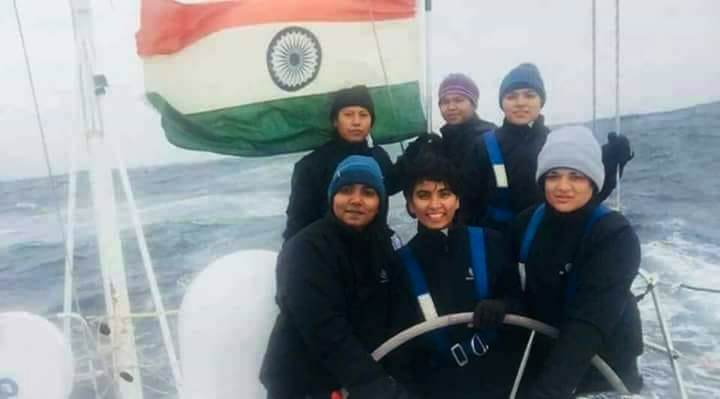
Passing Cape Horn (Photo: courtesy Lt Cdr Vartika Joshi)

The impact was severe enough to throw the crew inside, from one side to the other. On deck, Vartika was in the grip of the wave. “ When the wave hit I remember having one hand on the wheel to keep myself in place. But with water all around, for a few seconds I didn’t know where I was – on the boat or in the ocean,’’ she said. When the wave receded, Vartika found herself not at the wheel but close to the boat’s guard rail, half in, half out. Luckily her tether had held. Although the crew was tossed around, there was no major injury. The storm left its stamp in another way – the wave had crashed at a time when the door, which sealed living quarters from deck, was still tad open to allow passage for crew members. Result: everything inside got wet. Water entered the engine compartment too. It was a drenched Tarini sorely in need of sunshine to dry things up that sailed into Drake Passage and rounded Cape Horn, every sailor’s prized claim to fame on circumnavigation. It was a foggy day. The Indian tricolor was hoisted aboard to mark the moment. They were now in the Atlantic. Vartika’s thoughts were elsewhere. She knew the only point of completion in circumnavigation is when you are back where you started. Goa was still long way off.

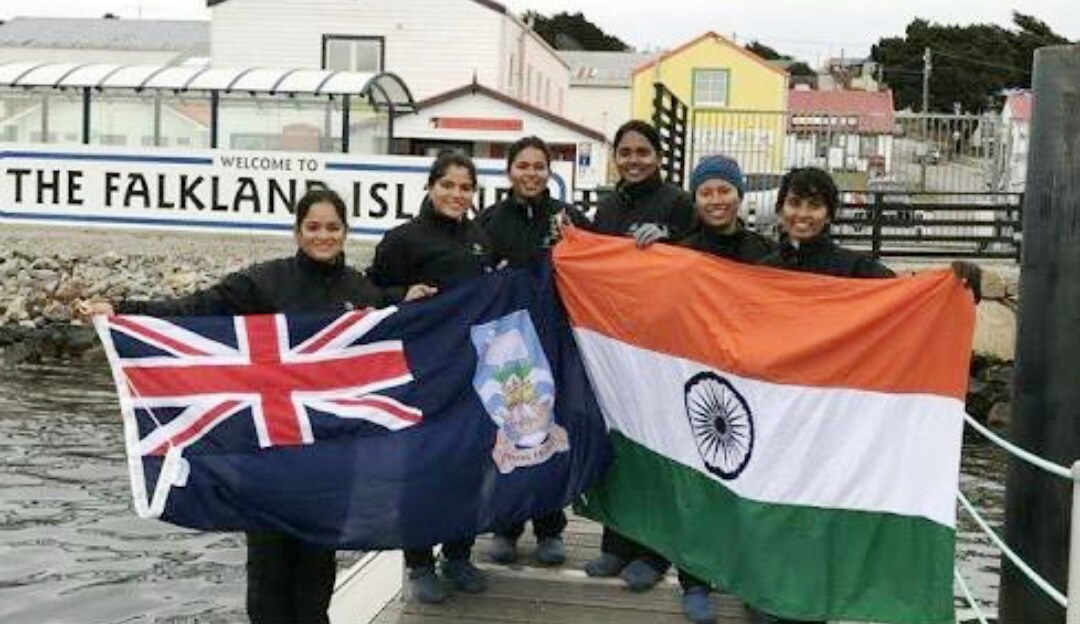
Upon rounding Cape Horn, the Tarini sailed north for Falkland Islands at latitude 51.8 degrees south. A lot of repair and maintenance work awaited in the 12 day-lay over scheduled there. The boat’s engine had packed up in the flooding that followed the storm in the Pacific. Sail boats – including those doing circumnavigation under circumnavigation rules – use their engines to maneuver in harbor. With her engine gone, the Tarini was devoid of such power. At Falklands, this posed a new challenge. The crew somehow managed to make it to berth without using the engine and solely with the help of wind. Needless to say, getting the engine back to working condition was one of the things addressed at Falkland Islands.
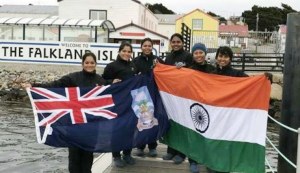
At Falkland Islands (Photo: courtesy Lt Cdr Vartika Joshi)

A feast of latitudes and then, a broken steering column

Leaving Falkland Islands, the Tarini made for Cape Town in South Africa. A distinguishing feature of this leg of the voyage is the passage through several latitudes. As the boat does so, the ambient temperature changes; from cold southern hemisphere, it grows warmer towards the tropics. Twenty five days after leaving Falklands, the crew reached Cape Town. Cape Town was a familiar port; some of the Tarini’s crew had been there previously while participating in the Cape to Rio race. Following another 12 day-halt, the boat departed on the last leg of its journey – the trip back to Goa. “ The wind was not supportive in the beginning but we managed to sail around Cape of Good Hope,’’ Vartika said.

They stayed more than 100 nautical miles away from shore to avoid the powerful Agulhas Current that courses down the south east coast of Africa. Agulhas is speculated to be the strongest western boundary current in the world’s oceans; it is on the western boundary of the Indian Ocean. “ Despite the precautions we took, we could still feel the pull of the current,’’ Vartika said. The boat crossed Madagascar, taking a while – thanks to weather patterns – to strike the proper north east course to Goa. Then near Mauritius, a major setback occurred. The boat’s rudder slipped from its position and in the process the entire steering column broke down. The Tarini could no longer be maneuvered. The sails were lowered to keep drift in check. “ Every attachment of the rudder stock had broken down,’’ Vartika said.
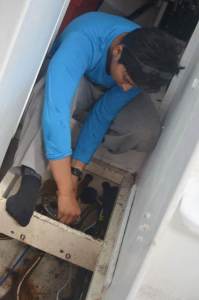
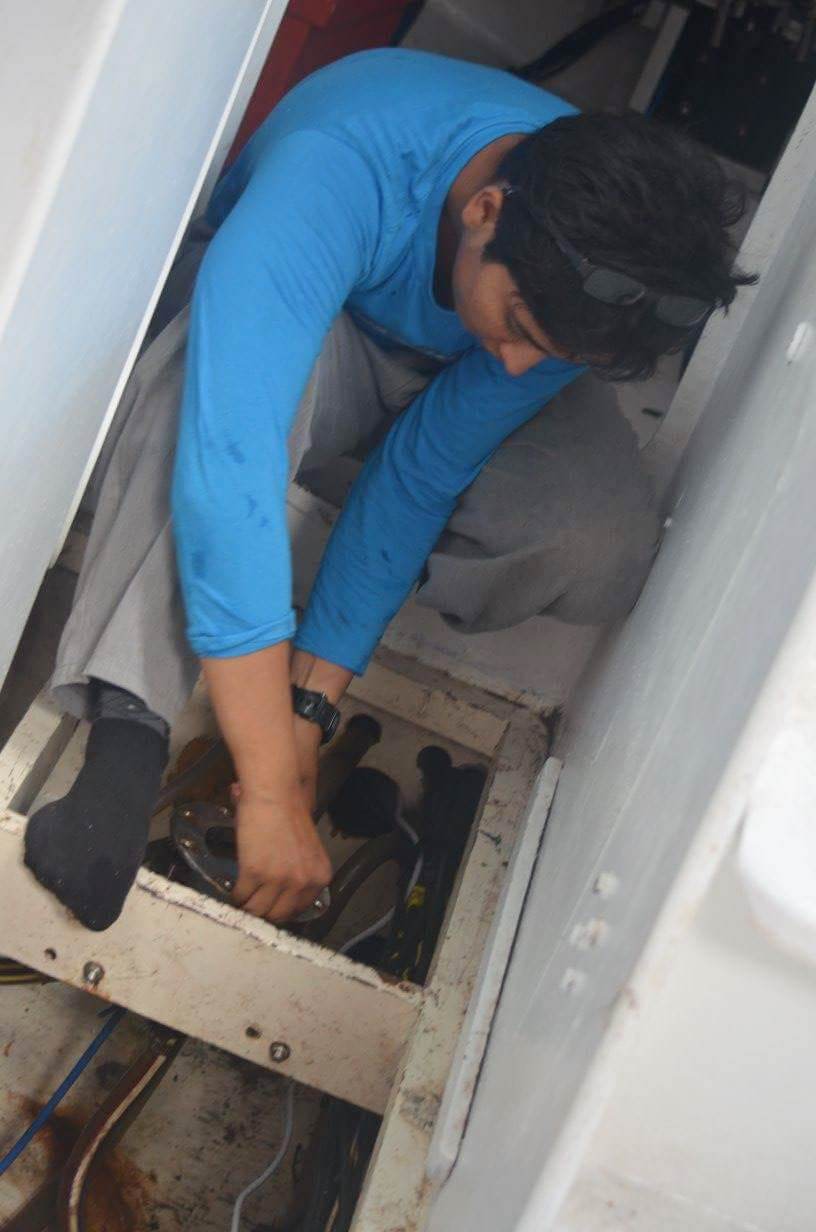
At work inside the boat, repairing a malfunctioning sea water filter (Photo: courtesy Lt Cdr Vartika Joshi)

At first the crew used muscle power to keep the rudder in place; then they lashed it in place with ropes and put their heads together to figure a way out. Twelve hours later, they had managed to partly operationalize the system. A boat like Tarini has two steering wheels. To partly restore the steering mechanism, the crew had to cannibalize parts from one of the steering columns to repair the other. The boat could now be steered to an extent. But it was restricted to one wheel and it was touch and go because they had to be very careful not to stress the fragile system by overloading. Sails had to stay down; progress was slow. They were 180 nautical miles off Mauritius. The crew informed higher ups in the Indian Navy of their predicament. They supported the crew’s decision to head to Mauritius. The navy flew in the parts required for repairing the Tarini, to Port Louis. Given the urgency, the parts were taken from the Mhadei; the Tarini and Mhadei are identical, sister vessels. Respecting the rules of circumnavigation, the work at Port Louis was kept restricted to the repair work at hand. Repairs done, the Tarini cast off for Goa. The slow progress from Cape Town, had however taken a toll. Rations were low. Fresh water was starting to deplete.

Home

Post Mauritius, the vessel was gripped by doldrums. Wind was hard to come by. The boat was crawling, moving very slowly towards her destination. As the Tarini was about to enter Indian waters, the Indian Navy dispatched one of its warships to welcome her in. But the little boat struggled to keep meaningful pace with the ship, powered by powerful engines. There was little wind around for Tarini’s sails. Eventually, the Tarini reached Goa on May 20, 2018. They stayed put at Mandovi Harbor for a day; the official flag-in happened a day later on May 21.
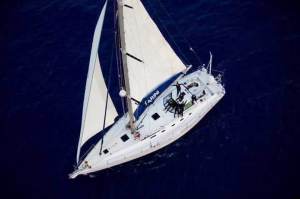
INSV Tarini (Photo: courtesy Lt Cdr Vartika Joshi)

For Vartika, the circumnavigation had been opportunity to see some of the theories she learnt in aerospace and naval architecture, put to practice. There was also the satisfaction of becoming circumnavigator despite beginning as utter novice in sailing. Not to mention the experiential impact of six people in a boat and a planet’s girth circled. There was no room to hide anything from each other. “ I became dead honest with myself and also with the rest of the crew. I think the best bonds I made have been at sea,’’ she said of herself and her team. Vartika does not hail from a military family. Nor was she a member of the National Cadet Corps (NCC), among regular avenues to military and adventure for many young people in India. On August 14, 2018 – eve of Independence Day – the media reported that the President of India, Ram Nath Kovind, had approved gallantry awards for the all women-crew of INSV Tarini. “ With the successful completion of the project, the navy would now be opening up opportunities to others also to participate in upcoming sailing expeditions. We are currently manning the navy’s ocean sailing boats at the Ocean Sailing Node in Goa and might take on training and preparing future crew for voyages that some of us who volunteer may also be part of,’’ Vartika said,

(The author, Shyam G Menon, is a freelance journalist based in Mumbai.)

SRINIVAS GOKULNATH COMPLETES RACE AROUND AUSTRIA

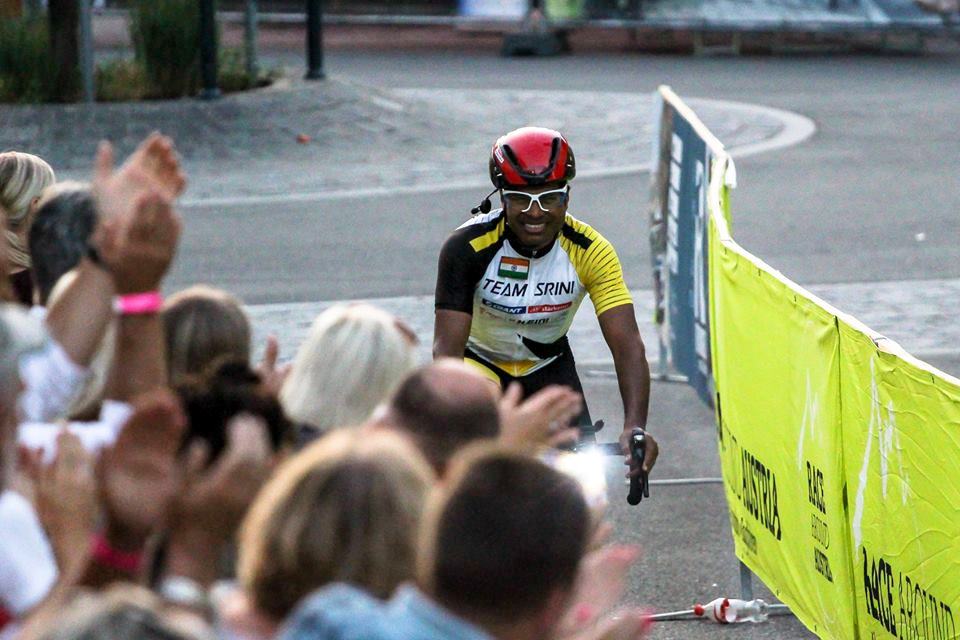
Srinivas Gokulnath finishing the 2018 edition of Race Around Austria (RAA) in the solo category (This photo was downloaded from the Facebook page of RAA and is being used here for representation purpose only. No copyright infringement intended)

Earlier this month, Srinivas Gokulnath finished Race Around Austria (RAA) successfully in the solo category. RAA is among Europe’s premiere endurance races in cycling.

Srinivas Gokulnath has completed the 2200 kilometer-long Race Around Austria (RAA).

Participating in the solo category (officially called: extreme race around Austria), he finished it in five days, 10 hours and nine minutes.

The 2018 edition of the race was held over August 13 to 18.

As per tweets by the race organizers, the winner in the solo category for men (extreme RAA) was Patric Gruner of Austria (three days, 16 hours, 24 minutes) followed by Germany’s Markus Hager (three days, 19 hours, 30 minutes) and Michael Kochendorfer (four days, three hours, 24 minutes). Among women, the winner was Anna Bachmann of Austria (four days, 13 hours, 31 minutes). Switzerland’s Isabelle Pulver (four days, 14 hours, 17 minutes) placed second.

Last year Srinivas had become the first Indian to complete Race Across America (RAAM) in the solo category.

RAA is not new to Indian cyclists.

In 2017, Bharat Pannu and Darshan Dubey had completed RAA in the two person team-category.  They rode the distance in 99 hours, 53 minutes.

Srinivas’s is the first solo finish at RAA by an Indian cyclist. According to a report in the Pune Mirror, the successful completion was despite an accident he had while training just days before the race, resulting in injuries to cyclist and damage to the bicycle he was using. Srinivas’s technical team had to assemble a new bicycle for the race using a new frame.

As its name suggests, the race route at RAA roughly tracks the outline of Austria on the map. It is a single stage race with some time cut-offs in between. “ In terms of length, RAA is shorter than RAAM. But it is a challenging race because there are steep gradients involved,’’ Bharat Pannu said when contacted. Austria is a largely mountainous country. According to Wikipedia, of Austria’s total area, only about a quarter can be deemed low lying and only 32 per cent of the country is below 500 meters in elevation.

For more on Srinivas Gokulnath please click on this link: https://shyamgopan.com/2017/08/25/after-raam-there-is-race/

(The author, Shyam G Menon, is a freelance journalist based in Mumbai.)  
THE DOT IN THE APP

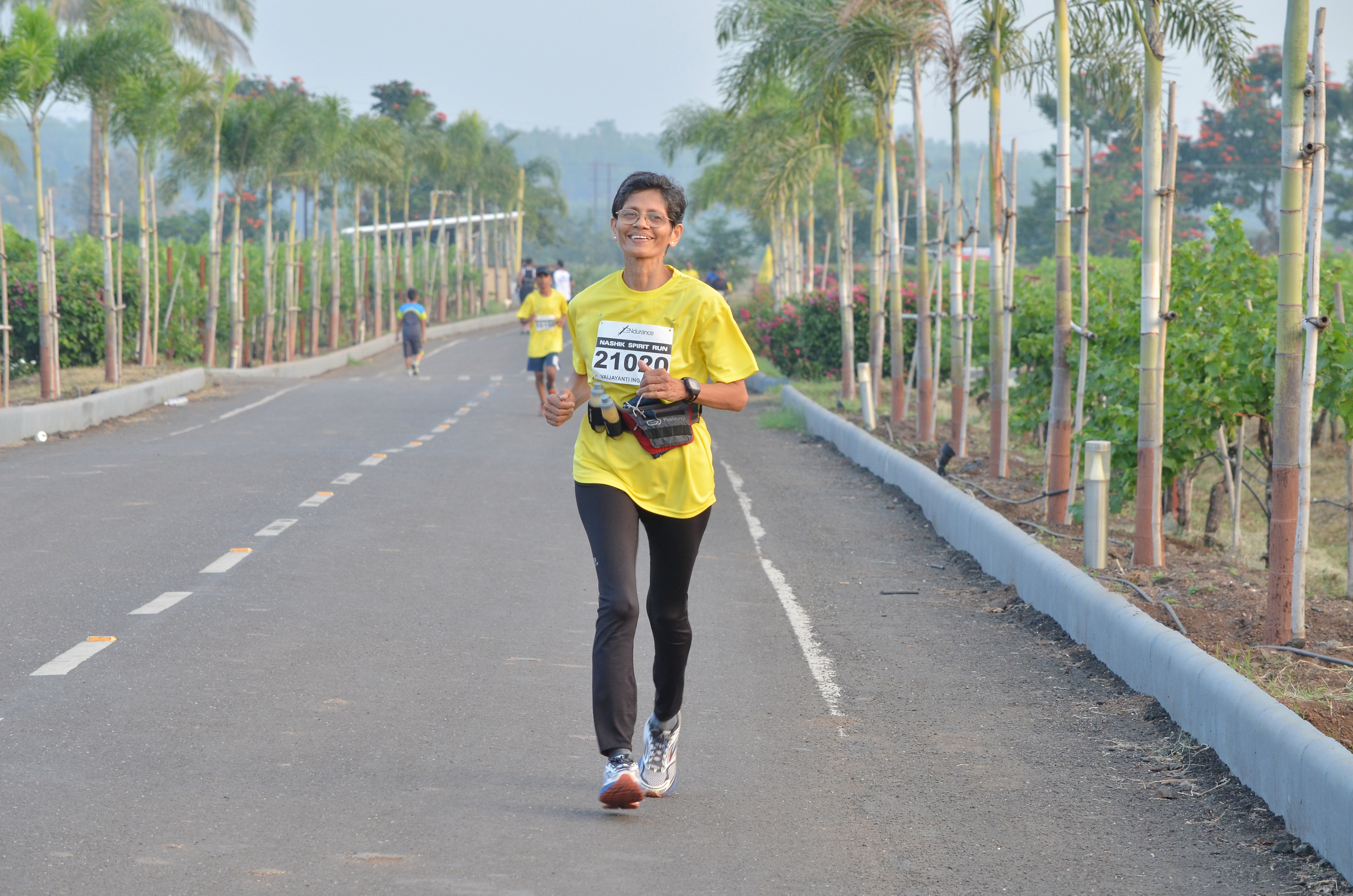
Vaijayanti Ingawale; from the 2015 Nasik Spirit Run (Photo: courtesy the Ingawales)

Vaijayanti Ingawale, 60, recently completed Comrades Marathon in South Africa. This is the story of the doctor and her retired banker husband, both now loving their hobby of running marathons at different locations worldwide.

It was December 2012; start line of a five kilometre-run organised by Rotary Club in Thane, the district neighbouring Mumbai on India’s west coast. One of the contestants stood out from the rest of the field that had come prepared to run.

Clad in jeans, she had no clue about the sport of running. The event was her introduction to a running movement spreading across Mumbai ever since the city’s annual marathon commenced. A paediatrician – a busy one at that – Dr Vaijayanti Ingawale, had little time for sports and hobbies, zipping as she did across two clinics and one hospital, managing patients and at the end of a day, home as well.

Till that run in Thane, Vaijayanti’s exposure to sport had been limited to the occasional chance to play badminton and hockey back in her school and college days. “But yoga was very much a part of my life. I started yoga practice from childhood,” she said. It was her grandfather who introduced her to yoga. He had been an associate of Mahatma Gandhi.

Born in Solapur, Vaijayanti’s family shifted to Pune. During her school and college years, sports was nowhere on the radar. But yoga continued. Once through with her medical studies, she got married. Post-marriage, Vaijayanti moved to Ahmedabad where she did her post graduate studies in medicine, specializing in paediatrics. Her husband, Deepak Ingawale, worked at that time with State Bank of India (SBI). In tune with Deepak’s transfers, the couple moved to Umbergaon, Hyderabad and Mauritius. The family grew; they had two sons. During these years, Vaijayanti continued to work as a paediatrician at hospitals in the places she found herself in except in Mauritius where she worked instead on completing an advanced diploma course in yoga from the Indira Gandhi Cultural Centre.

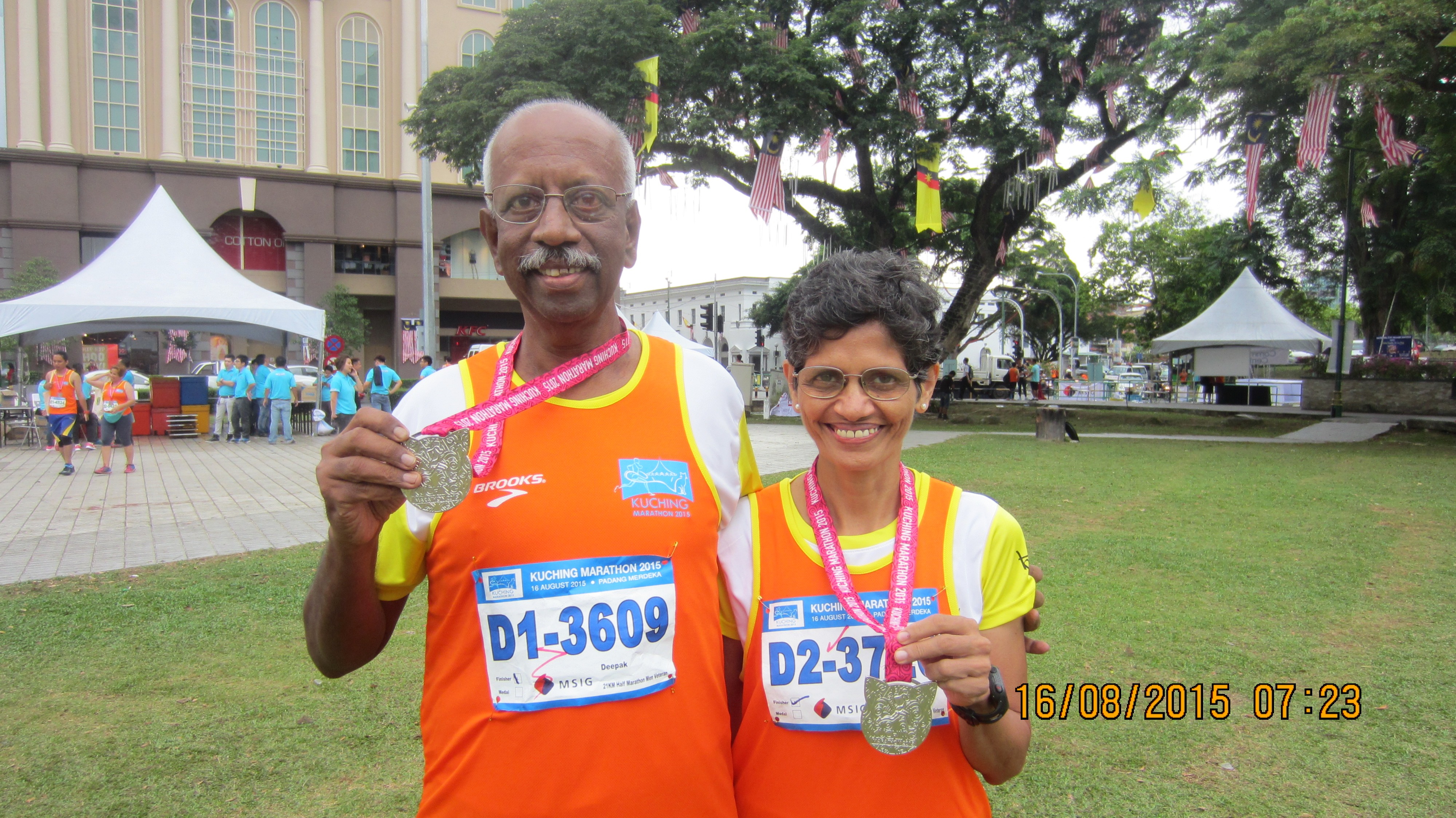
Deepak and Vaijayanti Ingawale (Photo: courtesy the Ingawales)

Early 1997, the Ingawales returned to India. In 2000 they decided to settle down in Thane. Deepak quit his job at SBI and opted for a position at the Mumbai branch of Antwerp Diamond Bank, a bank that caters primarily to the diamond industry. By then after an initial stint as junior doctor at Singhania Trust Hospital, Vaijayanti had set up her own paediatric practice. Soon, she was managing two clinics and dashing around hospitals as a consultant paediatrician. Alongside, she also commenced teaching yoga, initially conducting classes at home.

In 2012, Dr Neeta Saboo, also a paediatrician, introduced the idea of running to Vaijayanti. “Rotary Club was organising a five kilometre-run sometime in December that year. In fact, she registered me for the event,” Vaijayanti said.

She turned up at the start line of the run in jeans. “I didn’t know a thing about the right attire for running,’’ she said. Nevertheless, Vaijayanti finished the run in approximately 32 minutes.

The very next month was Mumbai Marathon, then under the lead sponsorship of Standard Chartered Bank. “ My friend Neela Ghate asked me to try and participate in the Dream Run segment of the event. Below my clinic was a branch of Standard Chartered Bank. She persuaded me to register for the event,” Vaijayanti said. In February 2013, she enrolled for the Thane Hiranandani Half Marathon to run the half marathon distance. The same year, her husband Deepak Ingawale – by then three months into retirement – also decided to make his foray into running. He enrolled for the five kilometre-run at the same event.

A civil engineer by education, Deepak had some exposure to football and tennis during college years. After his engineering studies, Deepak ended up in a bank job at SBI. “For the next 37 years I had absolutely no physical activity. I had breathlessness and weighed about 87 kilos,” Deepak said. He had central obesity (excessive fat around the stomach and abdomen) and found it difficult to walk.

Having registered for Thane Hiranandani Half Marathon, they had barely three weeks to train for the event after Mumbai Marathon. Both their sons were away in other cities for their studies. “This was a good opportunity for us to get into some activity like running,” Vaijayanti said adding that her sons were happy with their involvement in running. Vaijayanti was already into running in a small way. Sometimes while waiting for the operation theatre to get ready, Vaijayanti would nip across for a 20 minute-run at the nearby Upavan Lake or Yeoor Hills.

Vaijayanti; at an event in Pune (Photo: courtesy the Ingawales)

Despite this scattered training with no plan or focus, Vaijayanti completed the half marathon with a timing of 2:40:33. After the 2013 Thane Hiranandani run, she decided to take running a bit more seriously. Like many others, she turned to Internet and Google to find out what was needed for the journey.

She started doing 20 minute runs on weekdays and an hour of running on Sundays. In the same year, she and Deepak enrolled for the Goa River Marathon. It was also a chance for the Ingawales to travel to another location and run a marathon there. Vaijayanti attempted the half marathon and Deepak did the 10 k.

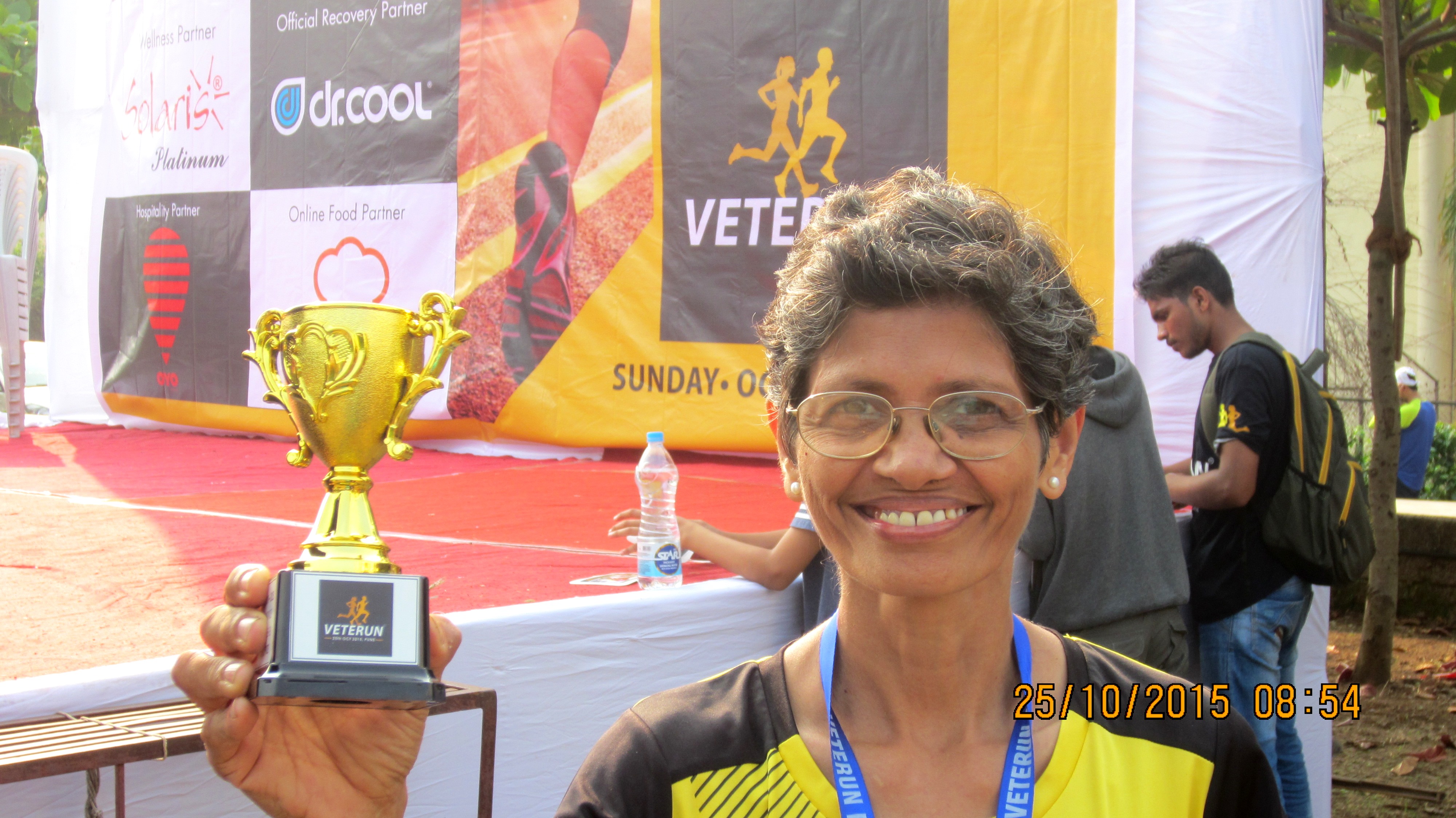
After they finished the run, they left the venue and went on to stay in Goa as part of a holiday they had planned, little knowing that Vaijayanti had got a podium finish in her age category with a timing of 2:23:25, bettering her timing in Thane.

She followed the Goa run with the 2014 edition of Mumbai Marathon. In the same year, the Ingawales enrolled for Wipro Chennai Marathon with Vaijayanti opting for the half marathon and Deepak the 10 k distance. In the months preceding this run, Vaijayanti stepped up her training with some help from articles and videos on the Internet. “I did hill training coupled with regular runs, yoga to improve flexibility and pranayam,” she said. At Wipro Chennai Marathon, not only did Vaijayanti improve her half marathon timing to 2:07:40 but she also ended up winner in her age category.

By now the Ingawales were enjoying the idea of running marathons at various locations. In 2015, they participated in marathons in Jim Corbett (Uttarakhand), Bangalore and the Buddh International Circuit in Noida besides their first foray overseas for running – a half marathon in Malaysia. In 2016, in addition to running half marathons in Satara, Pune, Nashik and Ooty, they travelled to Hawaii in the US and Bhutan to run at events there.

By this time, Deepak had also graduated to running the half marathon; his first in the genre was the 2015 Thane Hiranandani Half Marathon. As his running grew, he was able to get rid of his health problems. In August 2015, he gave up smoking after four decades with the habit. Proof that running had helped Deepak was evident in his heart rate. It was 90 in 2013. By 2018 it was 55.

Vaijayanti; from Tata Ultra (Photo: courtesy the Ingawales)

At the 2017 edition of Mumbai Marathon, Vaijayanti decided to graduate to the full marathon. She finished third in her age category with a timing of 4:39:22 and followed that up the same year with yet another full marathon in Sydney, Australia. “We had a lot of friends among runners with whom we could share and gather information about running,” Vaijayanti said outlining the ecosystem that was helping her. It was through those communication channels that the buzz about Comrades Marathon in South Africa, reached her.

Vaijayanti’s performance in most of the events she had participated in once she took to running in a serious way had been good. At many events she had secured podium finish in her age category. Further, her timing seemed to be improving. It was good enough premise to consider Comrades. She felt she had to attempt it. The tipping point was a Camaraderie run organized by the running community hear Thane to wish success to those heading for the 2017 Comrades.

Promoted as the “Ultimate Human Race”, Comrades Marathon is an 87-89 kilometre ultramarathon that is run between the cities of Durban and Pietermaritzburg in South Africa. The race alternates each year between uphill and downhill and between the cities of Durban on the coast and Pietermaritzburg. There are a number of big and small hills in between and six intermediate cut-off points.

The number of Indian runners participating in this race has been increasing over the years. The race, which draws runners from several countries, was first held in May 1921. Years ago, when Deepak was working at the Mumbai branch of Antwerp Diamond Bank, Amit Sheth, the brand ambassador for Comrades Marathon in India, had visited the bank for a talk on the famous ultramarathon in South Africa. “I don’t think I paid much attention then as even walking, let alone running was nowhere on my horizon. But years later we procured his book, Dare to Run,” Deepak said.

Comrades Marathon is usually held early June every year. For runners attempting Comrades Marathon, the most important aspect is the training, the timing of which usually coincides with India’s summer months. Those who have been through this grind say that the camaraderie among runners during the training phase is what eventually makes the race special to run. Twice in the three month training period, runners from Mumbai and places close to the city head to the hills of Lonavala nearby, for 65 kilometer and 56 kilometer-training runs. These runs typically start a little after midnight and last seven to eight hours. They bond through both the training and the arrangements that have to be made, which among others spans transport to the training destination, hydration, food and support vehicles.

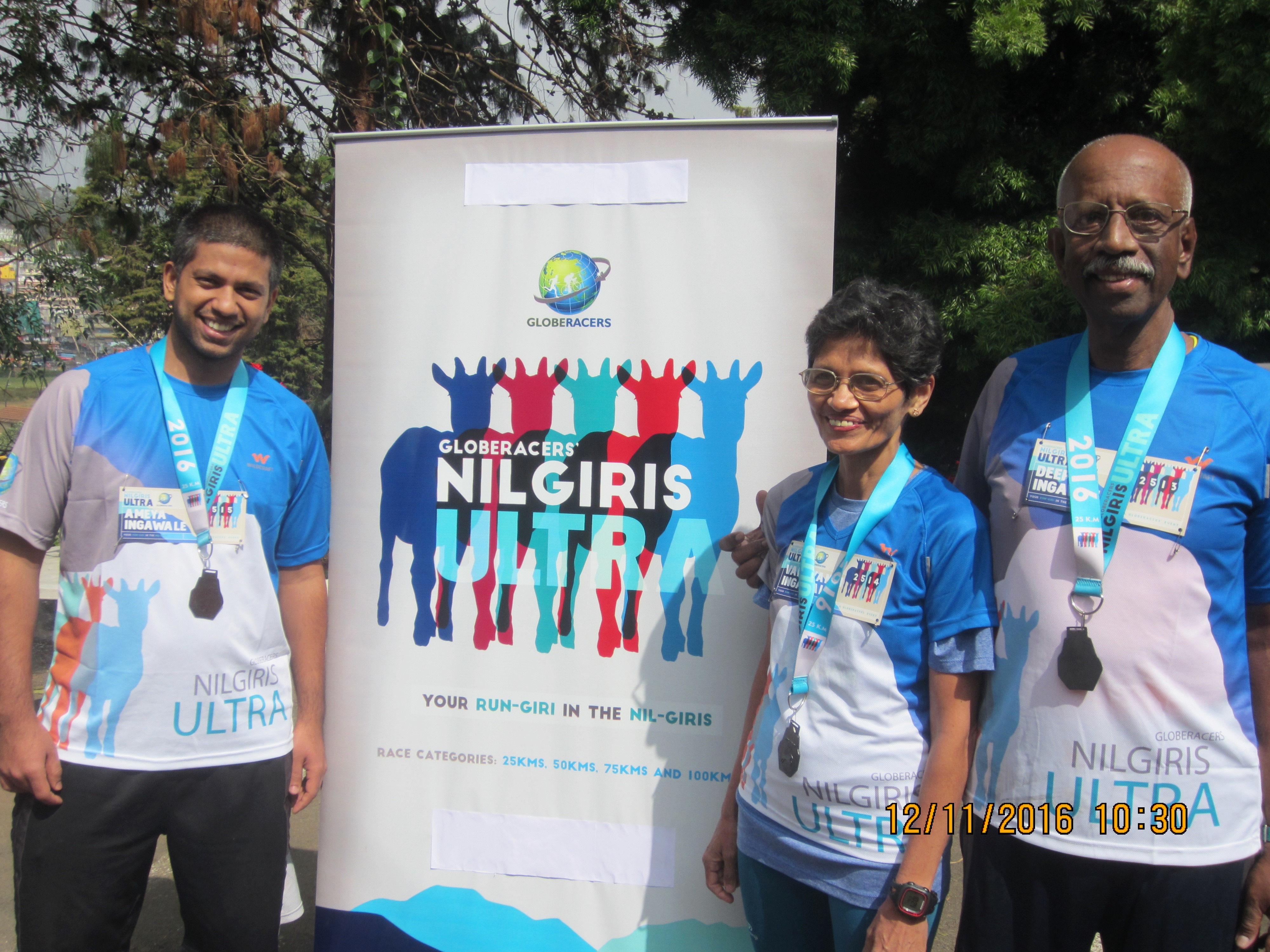
At the 2016 Nilgiris Ultra in Ooty (Photo: courtesy the Ingawales)

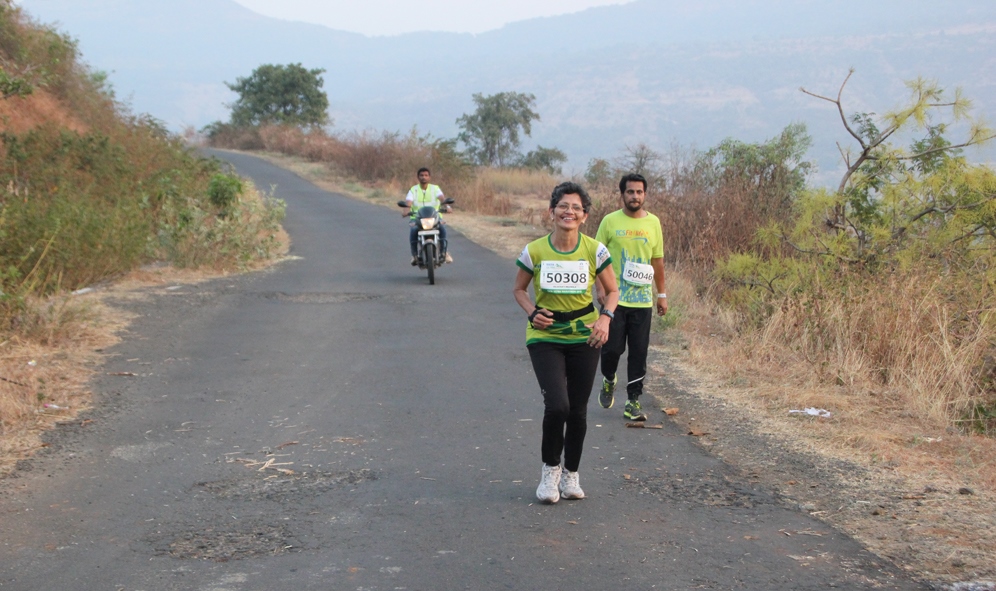
Vaijayanti put in place her own training plan as well. She joined the gym a year ahead of going to Comrades to step up her strength training. In January 2018, she cut down her clinic hours not so much to focus on her training for Comrades but to spend time with her grandson. However cutting down on her work did give her much needed rest as hours at the clinic sometimes extended close to midnight. In January 2018, at the annual Mumbai Marathon, Vaijayanti completed the full marathon in 04:19 hours. This helped improve her seeding at the start line at Comrades. The Mumbai Marathon also threw up an unexpected partner for the long training runs preceding Comrades – Deepak. He managed to complete the full marathon and joined Vaijayanti on her training runs for Comrades, in Lonavala and elsewhere. Amid the Comrades training season, there was a 50 kilometer-ultramarathon at Lonavala sponsored by Tata. Vaijayanti secured a podium finish at this event. This race outcome boosted her confidence. She also got valuable advice from veteran runner Satish Gujaran, who has run Comrades multiple times.

Vaijayanti’s training was progressing quite well when with six weeks to go for Comrades, she had a fall during the last 56 km training run at Lonavala. Following that fall, Vaijayanti had to abandon all running to help the healing process.

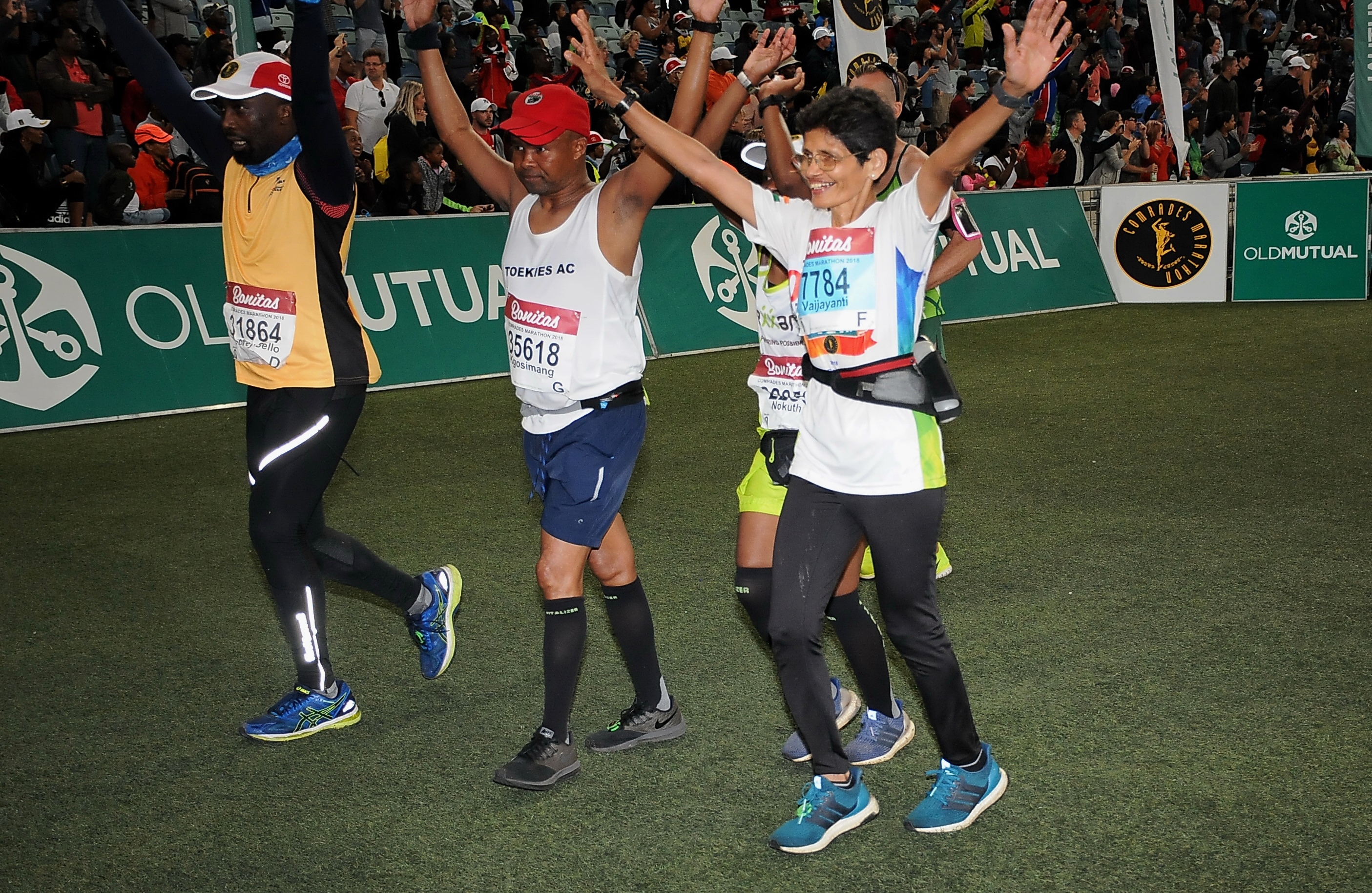
Notwithstanding this setback, she was at the start line of Comrades Marathon at Pietermaritzburg. “In the first 500 meters itself I had a fall,” she said adding that she was going quite fast, not a good thing for a run like Comrades. At 44 kilometers, she had her second fall. “I fell down quite badly and could not get up. I had severe cramps. I passed out for a brief while,” she said. After about ten minutes she got up and proceeded to run.

For Vaijayanti, it was not easy to run after the fall at the halfway mark. For the next 10 kilometers she walked. Then she attempted running but she was assailed by cramps in her hamstrings. Every now and then Vaijayanti resorted to running but had to fall back to walking because of cramps. “At this point, my mind game started. Be positive – I kept telling myself. I had cleared the fourth, fifth and sixth cut-offs. The crowd support was superb and the positive energy was infectious,” she said. The miles kept going by and suddenly in the distance she noticed the stadium lit up. The end was near.

Vaijayanti; at the finish line of 2018 Comrades (Photo: courtesy the Ingawales)

At the finish point at Moses Mabhida Statium in Durban, Deepak and their second son Ameya, an ophthalmologist, were tracking Vaijayanti’s progress. They were alarmed to find that the dot she was on the tracking app, had failed to move. Anxiety set in. “Ten minutes later, the dot started to move slowly but the suspense was almost killing till the end, till we saw her cross the finish line barely seven minutes before cut-off,” Deepak said. Vaijayanti crossed the finish line in 11:53 hours. A subsequent tweet by Procam, organizers of the annual Mumbai Marathon, complimented her on being the only Indian woman aged over 60 to complete Comrades 2018. She did so, on the first attempt.

Many runners who cross the finish line of Comrades Marathon wish to follow it up with back-to-back attempts primarily to complete both the uphill and downhill versions of the ultramarathon. But Vaijayanti wants to move on. On the cards – besides a desire to attempt some of the big five international marathons if possible – is a plan to attempt the Barcelona Marathon in Spain. The Ingawales’ older son, Myshkin, an engineer by training, lives in Girona near Barcelona.

Running marathons in different locations, combining it with sightseeing and socializing with friends and relatives, is something that fascinates the Ingawales. At the time of writing this article, the Ingawales were on the verge of 50 officially timed runs completed together. They wish to continue running together for as long as they can.

(The author, Latha Venkatraman, is an independent journalist based in Mumbai.)
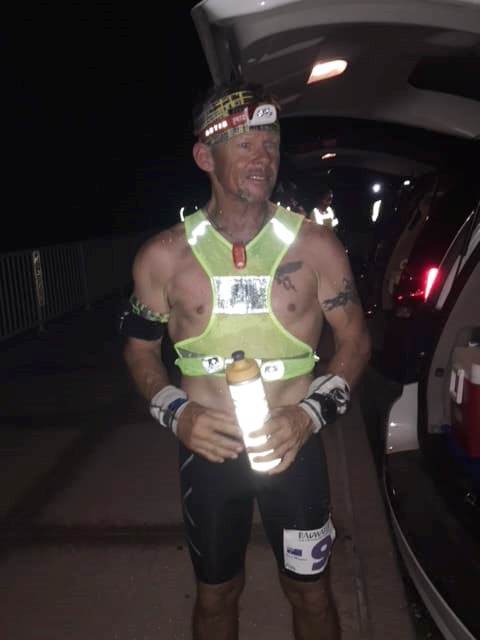
“ IT’S DONE” / AMIT SAMARTH COMPLETES 2018 TRANS-SIBERIAN EXTREME

Amit Samarth (This photo, taken at an earlier stage of the race, was downloaded from the Facebook page of Amit Samarth)

The first Indian finish at Trans-Siberian Extreme has become a reality. Not just that – it has been accomplished in the first attempt.

Amit Samarth has successfully completed the 2018 Red Bull Trans-Siberian Extreme.

He ranked fourth overall.

The race concluded in Vladivostok today (Friday, August 17).

“ It’s done,” Amit messaged those following the race in India.

The overall winner of the 2018 edition of the race was Pierre Bischoff of Germany.

Initial flush of race data showed that he completed stage 15 – the last stage – in 26 hours, 37 minutes, 52 seconds. Overall he took 315 hours, 45 minutes and 26 seconds to reach the finish line. Bischoff had previously won Race Across America (RAAM) in 2016; he was also ultra-cycling’s world champion in 2017.

At the just concluded race in Russia, Michael Knudsen of Denmark placed second (26:43:55 for stage 15 / 333:13:04 overall) while Marcelo Florentino Soares of Brazil took the third spot (26:51:56 / 346:19:00).

Amit finished stage 15 in fifth place. He took 32 hours, 35 minutes and 27 seconds to finish the stage; overall he took 379 hours, 51 minutes and 44 seconds.

The 2018 Trans-Siberian Extreme began on July 24 in Moscow, roughly 9100 kilometers away to the west. The race route was along the southern portion of Russia, eventually climbing north in the country’s east and then dropping south again into Primorsky Krai where Vladivostok is.

There were six racers in the fray at start.

Russian cyclist Vladimir Gusev wasn’t there for the fifteenth stage as he had a DNF (Did Not Finish) for the third time in the event in stage 14, exceeding the permitted numbers of DNF. Earlier in stage 13 – the longest and perhaps the toughest of the race – Patricio Doucet of Spain had also ended up DNF.

Retirement in two stages is permitted under race regulations. However, post the first DNF, the cyclist in question continues in a minor classification and not the main race.

DNF by Vladimir and Patricio reduced the overall competitive field to four cyclists.

Amit is the first Indian to participate in Trans-Siberian Extreme and complete it. He is also the first Indian cyclist to complete Trans-Siberian Extreme and RAAM (Amit finished it in 2017) in the very first attempt. Trans-Siberian Extreme is nearly double the length of RAAM. Late Friday night, the race organizers confirmed to this blog that Amit is also the first Asian to complete Trans-Siberian Extreme.

In a conversation with this blog ahead of Trans-Siberian Extreme, Amit had mentioned that distances beyond the length of RAAM would be new experience for him.

To his credit, Amit had no DNF.

He finished every stage of Trans-Siberian Extreme within cut-off and was there to attempt the next.

Amit (right) with support crew; in the middle Devnath Pillai and Chetan Thatte (This photo, taken at an earlier stage of the race, was downloaded from the Facebook page of Amit Samarth)

He does not seem to have chased a podium finish in any stage. Instead, he seems to have foreseen the effort of tackling 9100 kilometers in advance and hung in there determinedly, typically finishing each stage in the fifth or sixth slot. Assuming that was the strategy, it seems to have paid off for not only has he completed the race, but at some points of the last stage (according to conversation among his well-wishers), he was also zipping along at an average speed of close to 27 kilometers per hour.

Amit, who is a doctor by profession and a cyclist and triathlete to boot, hails from Nagpur. He had a two-person support crew for the entire race – Devnath Pillai and Chetan Thatte. Towards the concluding stages, Nagpur based industrialist and well-wisher of Amit, Jeetendra Nayak (and his wife Renuka), also flew to Russia to support and cheer the cyclist’s progress.

For more on Amit Samarth please click on this link: https://shyamgopan.com/2018/06/26/the-unusual-doctor/

(The author, Shyam G Menon, is a freelance journalist based in Mumbai.)