Aparna Choudhary also crosses existing national record
Sarah Webster of Great Britain sets new 24-hr world record for women
Geeno Antony tops among Indian men
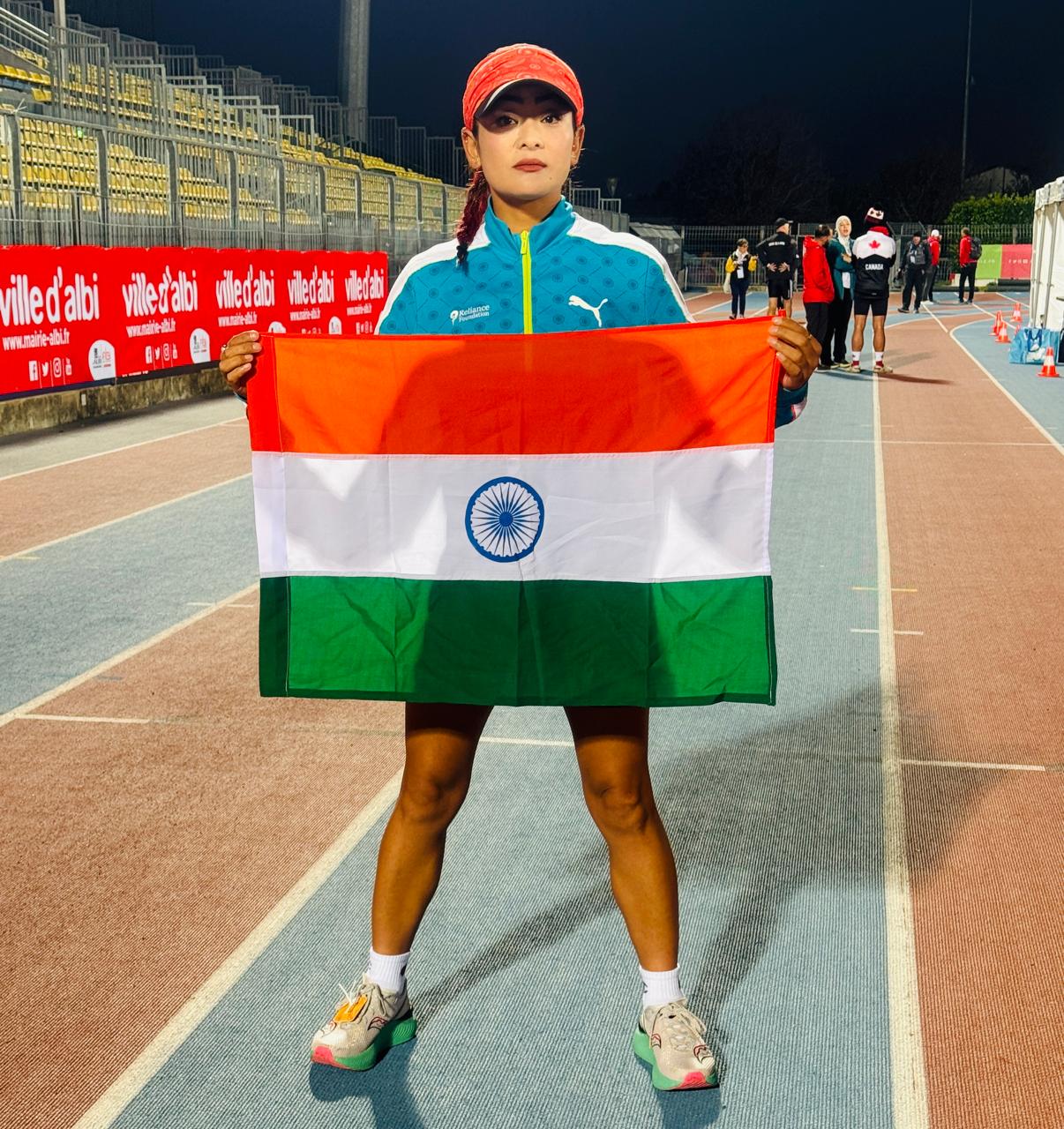
India’s ultrarunner Sunita Subba shattered the current national record at the 2025 IAU 24 Hour World Championships held in Albi, France on October 18-19.
Sunita covered a distance of 217.327 kilometers during the stipulated 24 hours, surpassing the national record by a huge margin. The existing national record was held by Anju Saini who had covered 204.314 km during the IAU 24 Hour Asia & Oceania Championships held in Bengaluru in 2022.
Aparna Choudhary also surpassed the existing national record notching up a distance of 210.537 km finishing second behind Sunita among Indian women. She improved her personal record by a huge margin. Her previous best was 192 km.
Photo by Ashok Daniel
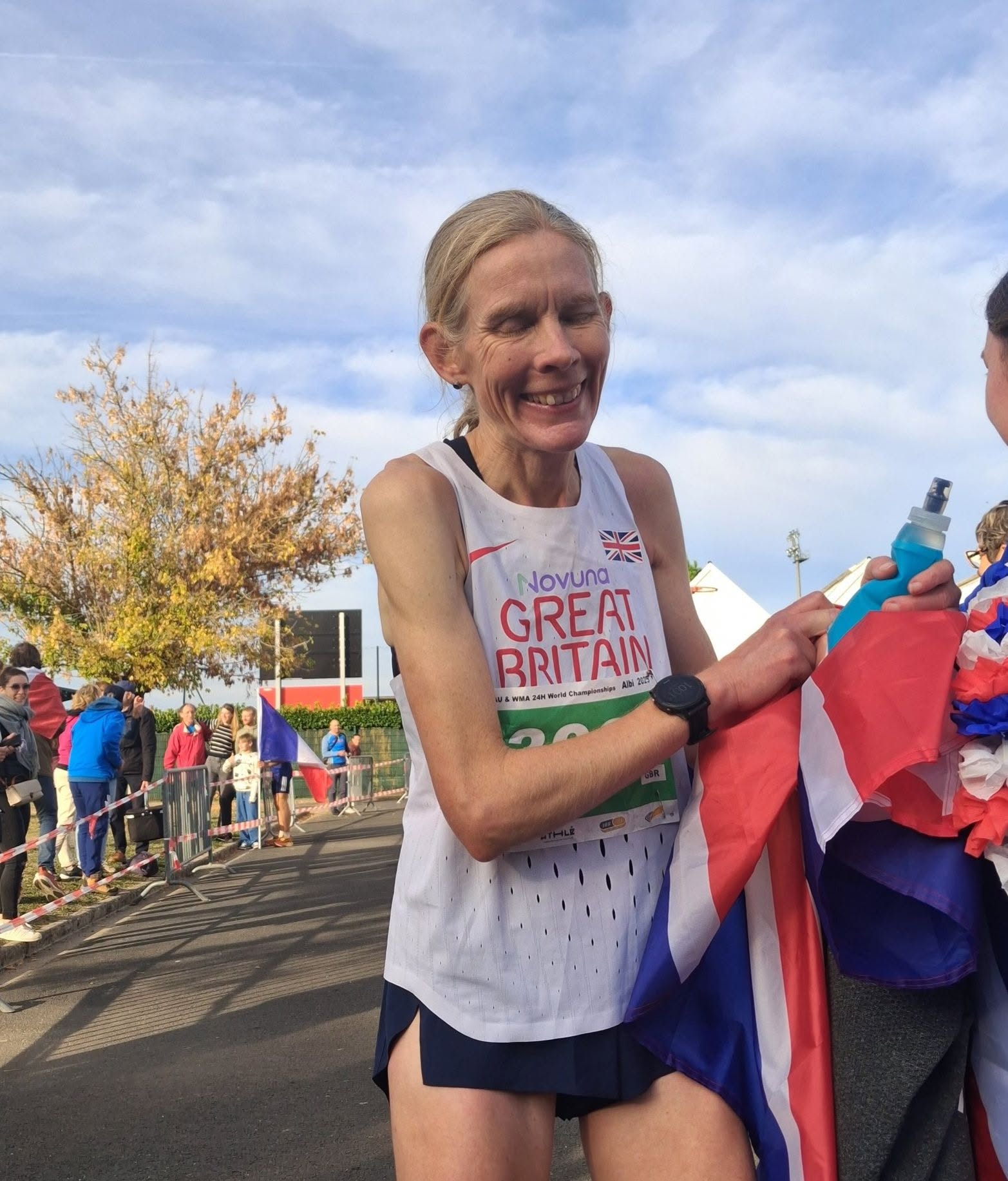
Sarah Webster of Great Britain and Northern Ireland won the gold in the women’s race of the Championships with a new world record distance of 278.622 km, surpassing the existing record of 270.363 km set by Miho Nakata of Japan.
Sarah Webster – Photo downloaded from IAU’s Facebook page
Holly Ranson of Australia won the silver with a distance of 273.058 km and Miho Nakata ended with the bronze (271.557 km). All three women ran further than current World Record.
Among Indian women, finishing in third position was Bindu Juneja with a distance of 202.164 km. She improved her personal record by a huge margin of 17.2 km at this race.
“I was initially training alone in Darjeeling, where I stay. Then I was asked to shift to Bengaluru temporarily so that Santhosh Sir could monitor my training (Santhosh Padmanabhan is the manager of the Indian ultrarunning team). Many others lent support of various kinds to help me do this event,” she said. Sunita had recently secured the overall third position in the women’s race of Wipro Bengaluru Marathon 2025 and first in her age category of 18 to 35 years.
Sunita Subba
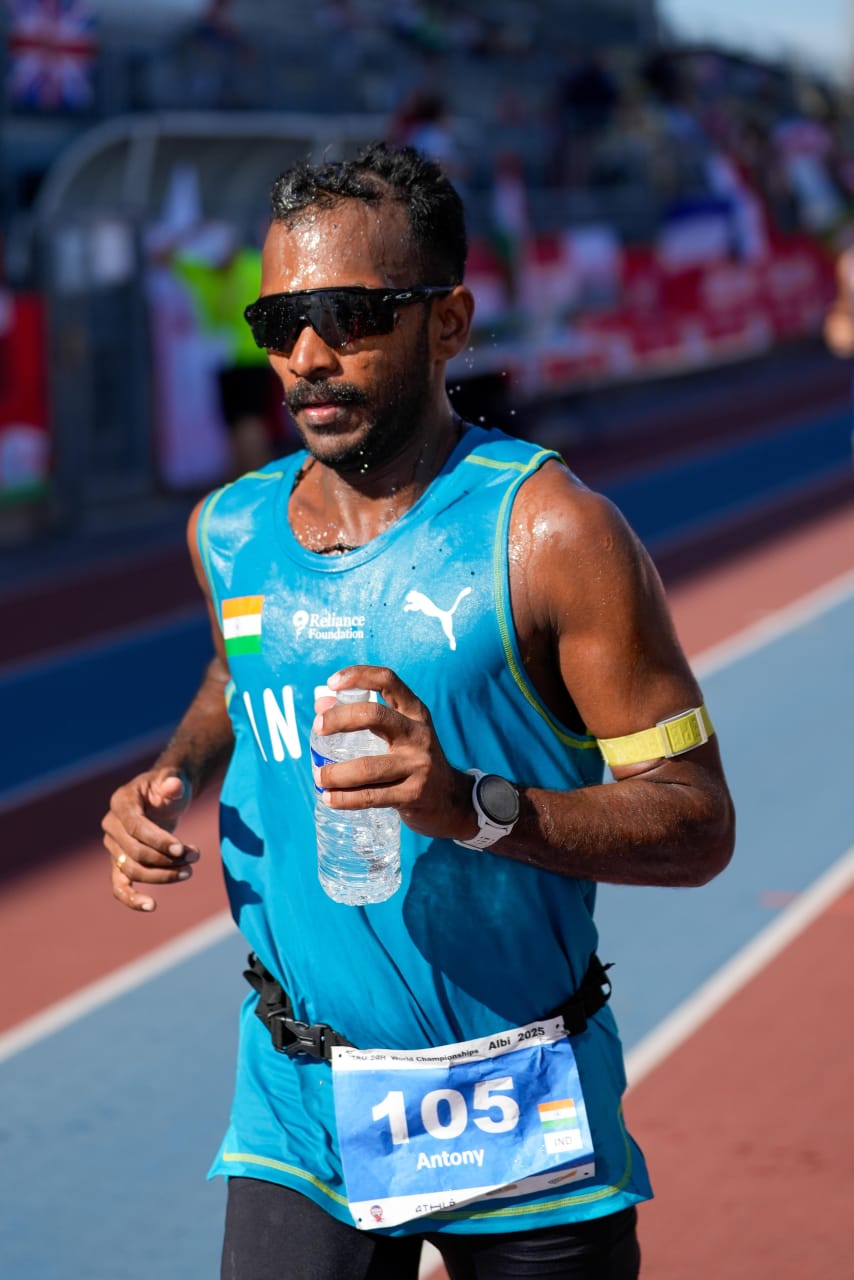
Indian men’s team was led by Geeno Antony, who covered a distance of 265.198 km, improving his own personal record by a staggering 26.5 km. In second position was Sugourav Goswami with a distance of 245.158 km and in third position was Ullas Narayana (229.779 km).
Amar Singh Devanda, the national record holder for 24-hours, fell back to fourth position with a distance of 225.048 km. He said he ran well for about 15 to 16 hours but could not keep up after that. However, his national record of 272.537 km set in April 2024 remains unbroken.
“My race went off very well. The effort that went into the training helped me immensely during the run,” Geeno said.
“My presence at the championship is not because of me alone. It’s the result of many sleepless nights, endless effort, and the silent teamwork behind me. Every step I took in the 24 Hours World Championship was powered by their support,” Geeno said.
Geeno Antony
At 245.158 km, Sugourav also bettered his personal record by a substantial margin. His previous best was 226 km set in March 2025 at the 24-hour Bengaluru Stadium Run. Nevertheless, he was not happy with his performance. “I could have done better but fatigue pulled down my performance. My conservative target was 150 km. I struggled a lot in the last three hours of the race,” he said.
A team of people including Nagaraj Adiga of Energiva and NEB Sports, Santhosh Padmanabhan, coach and team manager, Vivek Gopi (strength and conditioning), Samanivita (nutritionist), Abhishek Jagan (Sports Scientist), Hemant (race crew support for Geeno) among many others were responsible for the entire Indian team and made it possible for the runners to be there in Albi to represent the country, Geeno said.
In the men’s overall race, Andrii Tkachuk of Ukraine won the gold with a distance of 294.346 km. Silver was secured by Jo Inge Norum of Norway (285.513 km) and bronze by Matti Jonkka of Finland (283.699).
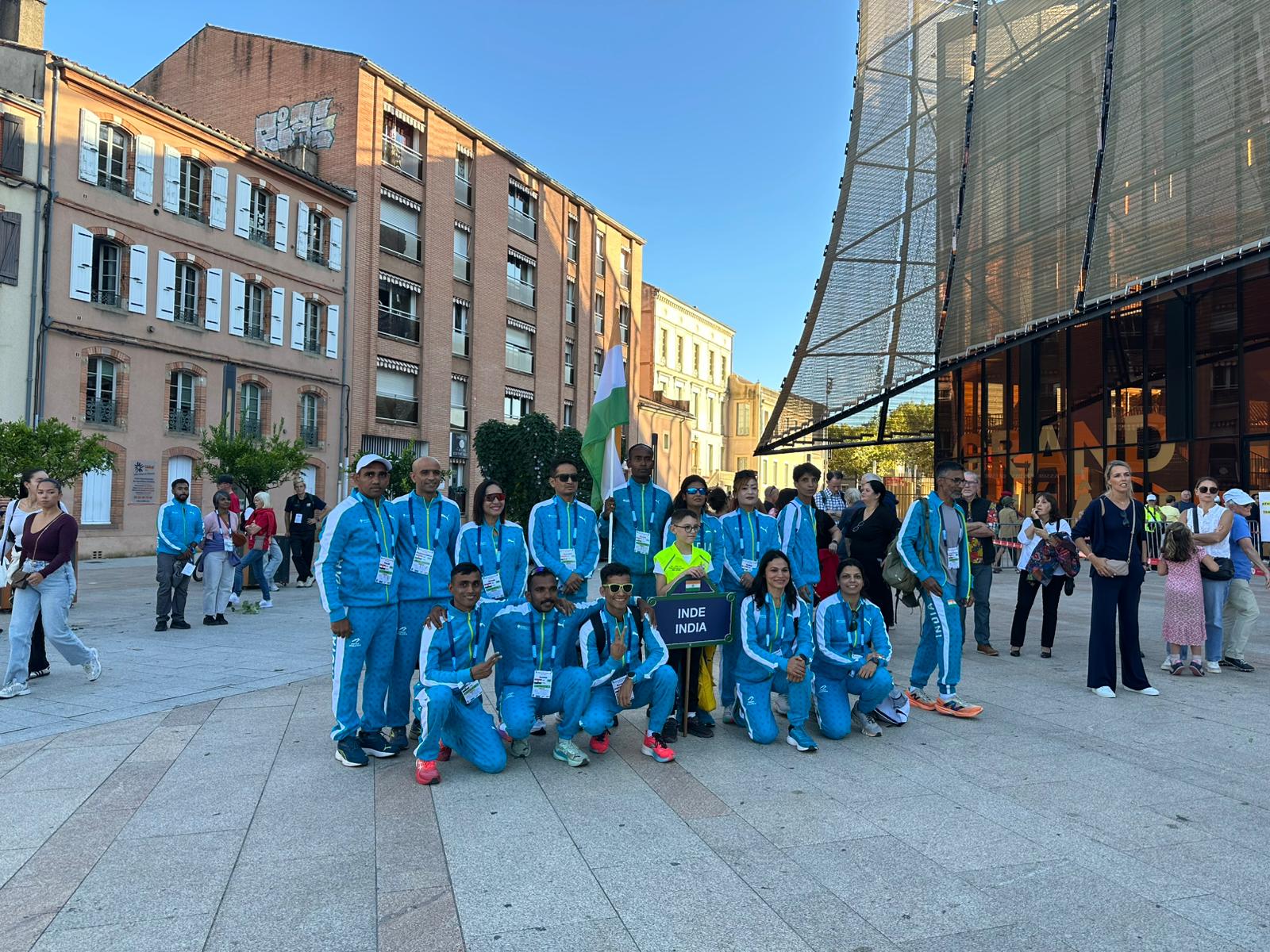
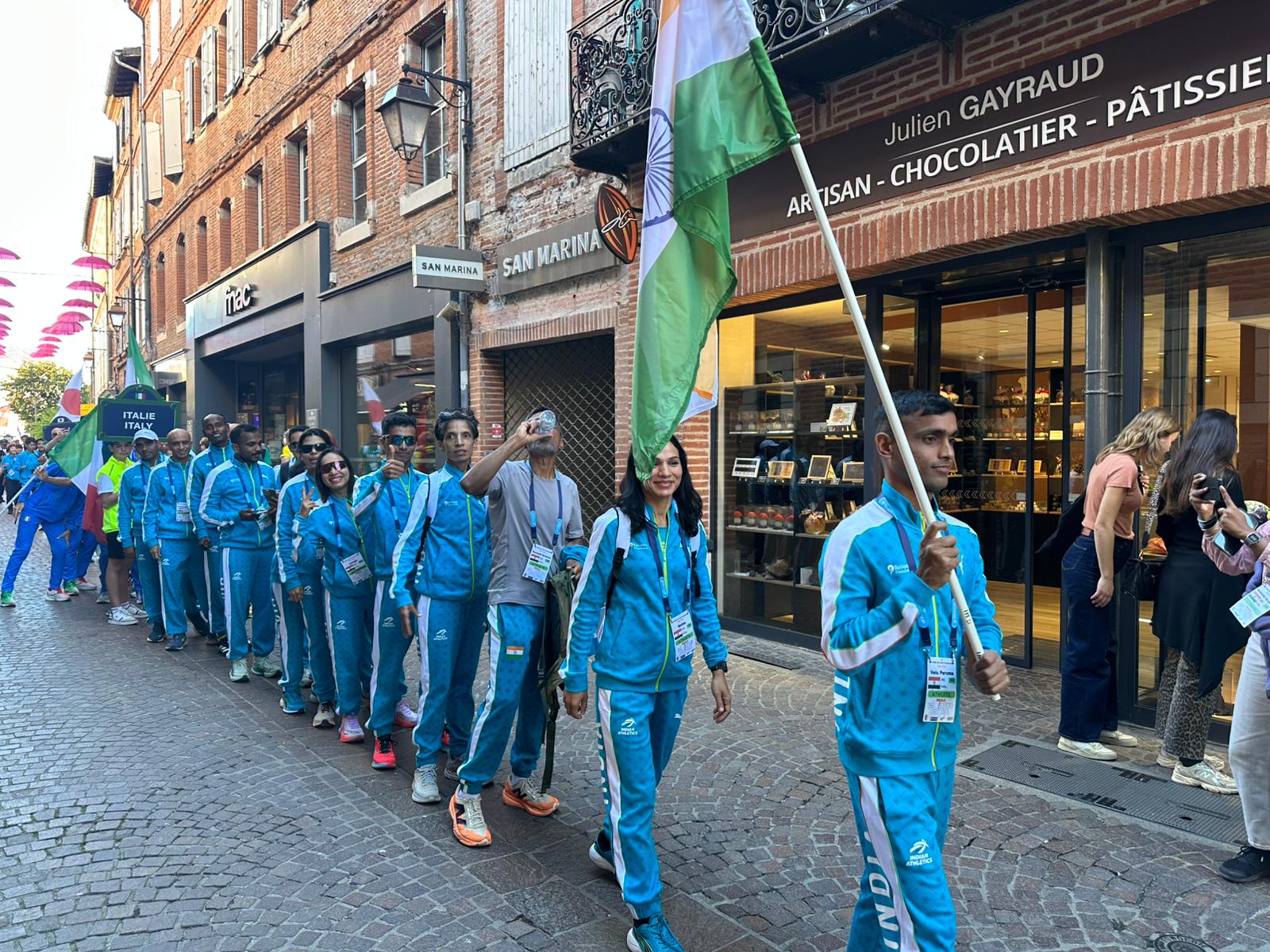
Indian team – Photo by Ashok Daniel
Team Standings
Among the women’s team, Great Britain and Northern Ireland won the gold (768.641 km), followed by Australia (744.601 km) and Japan (726.983).
The men’s team event was won by Finland (797.030 km. France secured silver (791.195) and Poland finished in bronze position (780.651 km).
Runners are required to run in a loop of 1,500 meters for a period of 24 hours starting October 18, 2025.
The author, Latha Venkatraman, is an independent journalist based in Mumbai.
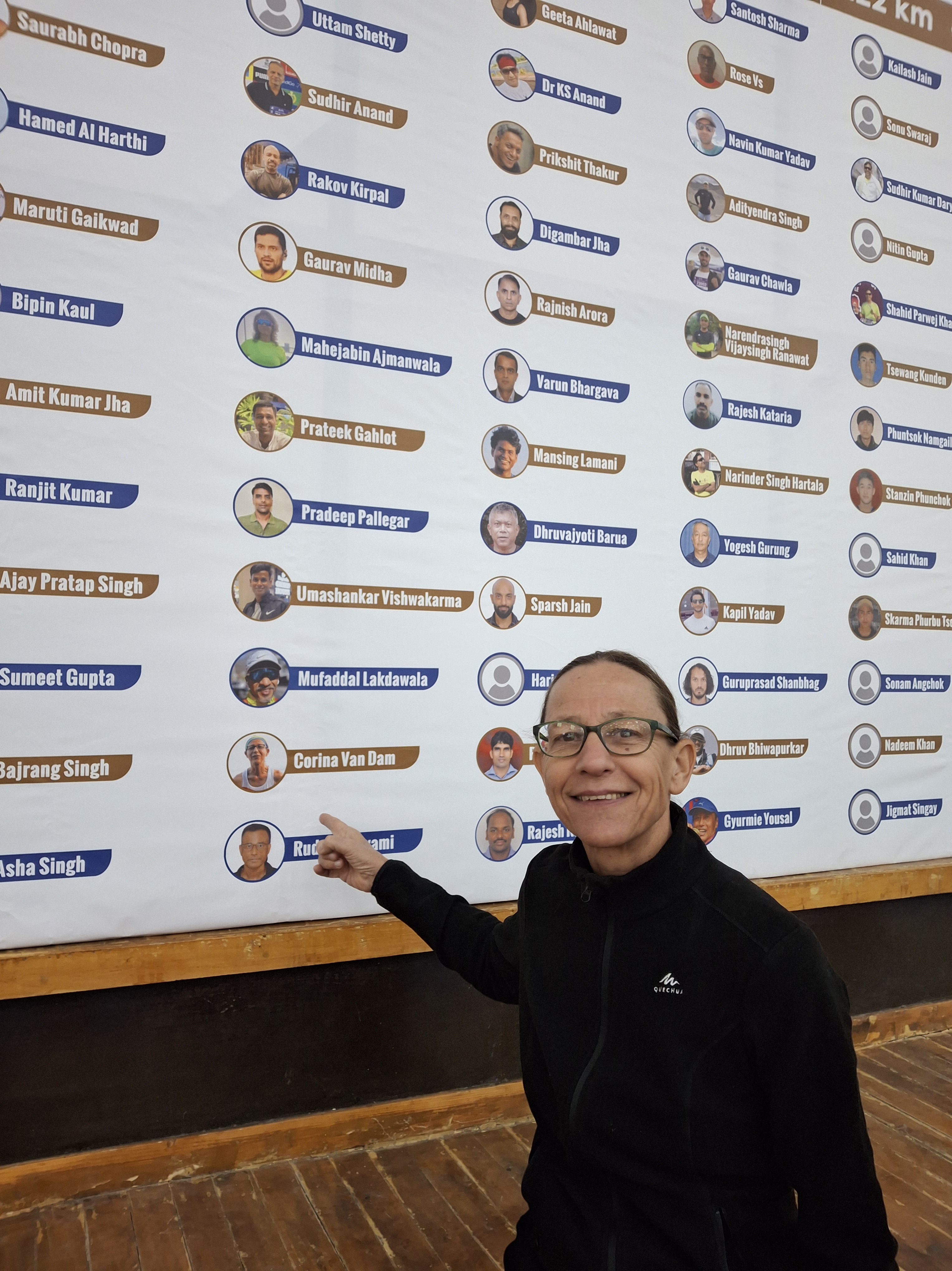
Corina Van Dam, or Cocky, as she is popularly known in Mumbai, is a football coach and an endurance athlete involved in ultra and long-distance running, long distance swimming and triathlons. In September 2025, Cocky crossed the finish line of the 122 kilometre-long Silk Route Ultra in Ladakh, securing a third position among women finishers. This was her second attempt. In 2024, she had to DNF (did not finish). In a first-person account, Cocky writes about her experience at the event.
This was my second time at the Ladakh Marathon’s Silk Route Ultra and this time I finished…..!
In 2024, I DNF’ed (DNF = did not finish) when my body started leaning to the right during my descent to Leh. After South Pullu (19 kilometers before the finish) I decided to drop out after I realized that I was not able to observe my body was tilting. You can read more about that experience in the article that I wrote for Outrigger last year. With the experience and knowledge that I gained from many runners and coaches, I tried to prepare myself better this time around.
Initially, I was not even planning to participate in the 2025 edition of the Silk Route Ultra (SRU). I had qualified for the Ironman 70.3 World Championships in Marbella, Spain in November 2025 and I wanted to focus on that. But I just love ultra running and felt butterflies when the registration for SRU opened. So, after enjoying the Hell Race White Sand Ultra 100 km, I immediately signed up for SRU especially since I met the criteria for qualification. With Mr Motup (the organizer of the event) ‘threatening’ us every year that he will make qualification more difficult, I thought I should take my chance this year. It also helped that I was about to turn 60 and thought that soon I would be too slow to run a 100km within 14 hours.
From June onwards, I started to increase my running mileage, with a six-hour night run, a 50 km monsoon run and the 12-hour Mumbai Ultra as main training events while I also continued swimming and a bit of cycling. My plan was to spend a few days more on acclimatizing than in 2024 and therefore planned to take a bus to Manali and from there to Leh. However, the weeks before, rains lashed across Himachal Pradesh, Jammu and Kashmir and Uttarakhand. Villages disappeared under mud; people lost their lives. Traveling by road became an uncertain and risky endeavor. Especially with the hard rule that participants have to be physically present during the bib collection in Leh to ensure the acclimatization before an ultra-run at high altitude. I made the decision early enough to secure a place on a plane and reached Ladakh in time. Others were not that lucky as flights got canceled. Runners got stuck and many missed the opportunity to participate despite the one-day relief granted by the organization for those with verified reasons for delay.
I had just arrived in Ladakh when I got the message that Shyam G. Menon had died. I had met him only a few times, but he has always been very interested in my stories. With Outrigger, he has given me a platform to share my first Ironman Goa experience, my race in the Ironman 70.3 world championships in 2023 and last year’s DNF in the Silk Route Ultra in my own words. I consider Latha a friend and could only imagine the pain that she felt. I’m writing this with gratitude to Shyam and hope that it will be what he expected it to be. May he rest in peace.
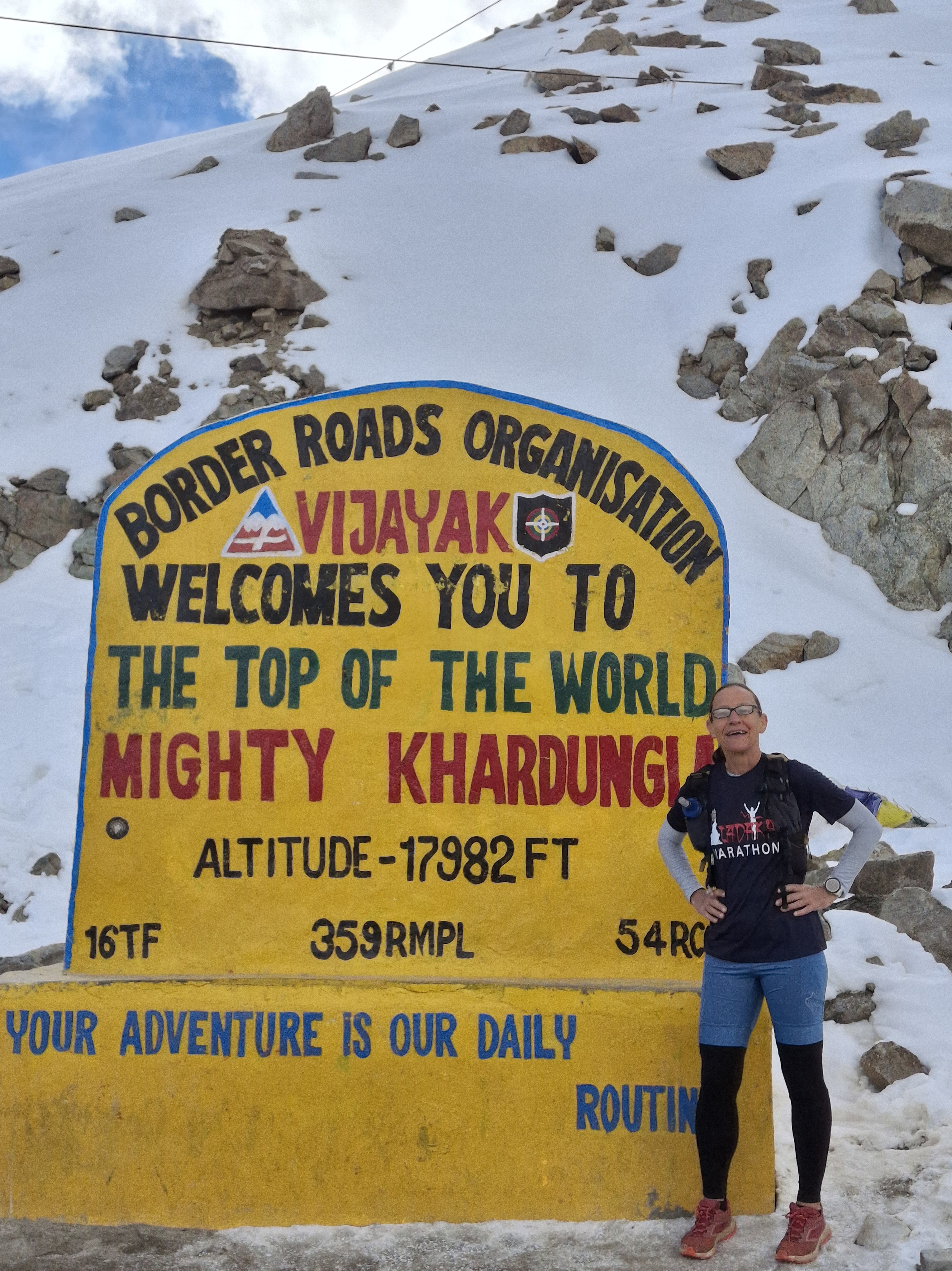
The days in Leh are always pleasant with a select group of ultra runners in the first week who do their morning runs, work a couple of hours and meet in the afternoon for coffee and banter. In the second week, there was an influx of running groups with many traveling for the first time to the Land of High Passes. I enjoyed the morning runs with friends and Ladakhi chai and flat bread with butter afterwards, and my afternoon walks, apricot pie, thukpa…! Two trips to Khardung La helped me to prepare for the race. The weather was not great on my first few days in Leh. It rained and it was cold. It snowed at K-top. I was mentally not prepared for ascending more than 50 kilometers in bad weather. My first assignment was to visualize walking a night in the snow and think about how I would face it. Being born and having grown up in the Netherlands its unpredictable weather probably helped me in the process and perhaps I’m better equipped than many other participants to deal with the cold. When I walked up the pass twice, I felt lightheaded and a sense of carelessness. This made me realize that when I cared about my tilting last year, this was actually a sign that I was psychologically aware. I was also confident that I would recognize this ‘state of carelessness’ during the race.
Finally, the day came and we traveled to Kyagar, the start line of the race. You would sign up for the race, just for this….! Mr Motup gives instructions, warns us and flags the busses off. Running friends came to see us for the journey and the race, akin to a school trip. I almost felt like crying. The journey was – of course – breathtaking – even when you have traveled it a few times. Some of the bends and inclines I remembered from previous years. Now I could see the mountains, the valley, the river. We settled into our hotel – comfortable rooms with a peaceful garden. Sufiya and I shared a room, again. We know each other’s habits and follow our own routines. That helped because increasingly we were becoming nervous! The cultural evening deflected our thoughts and kept us busy in between snacks and meals.
There was only one moment that I thought:’ I’m never going to do this again’ and that was when we were waiting for the mandatory blood pressure check. In 2024, it was a traumatic experience as I had to get tested three times, drink glasses of lukewarm water and eat raw garlic. This time I succeeded after two times and taking some wonder medicine on doctor’s advice that I refused last year.
The first part of the race goes through rolling hills and follows the river. It was pleasant, my legs were fresh, villagers cheered us on as if we were already close to finishing. Children gave us high fives and ran with us. There was some pressure to complete the first 27 kilometer in four hours but with last year’s experience, I knew I could do it. From Khalsar, the run becomes a walk. And to be honest, I love this part. I enjoyed walking alone in the night, the route lit by the moon and under a sky full of stars. I recognized the road, the route and knew that when I saw the lights of Khardung Village it would take a long time to get there….! Although I was walking mostly alone, I met ‘everyone’ at the SRU breakfast where we could fuel and get our warm jackets for the ascent to Khardung La. I left the village before the participants of Khardung La Challenge started their race. It was enjoyable to see the lights behind me meandering through the mountains. North Pullu (at17 kilometers) looked further this time but K-top (another 15 km) seemed closer. On my way to the top, I noticed another runner and I thought ‘he walks like a robot’. That was my sign to look closer at myself. I was still straight up.
I never spend much time at the top and didn’t even see the garlic soup stall…! I had tried to eat and drink at every 7km aid station and also use my own gels, Enerzal and snacks in between. But at some point, I was no longer thirsty and hungry. And how many dates and bananas can you eat? I was able to run a bit towards South Pullu where I was enthusiastically welcomed and told I was strong running in third position. Shortly after that I noticed that I now really started tilting again. Based on last year’s experience, I knew that this was because of low oxygen level, and probably dehydration due to which there are changes in the spinal cord fluid which cause the ‘leaning’. I don’t know if the leanings happen on the stronger or the weaker side of the body. I knew I had enough time in hand to complete the race walking. I didn’t care about finishing third or last. I thought: ‘This time I’m going to collect that finisher’s medal and jacket’. Confident, with optimism and songs in my head, I took off. Soon I could see Shanti Stupa, knowing that it was still far away but that it would come closer with every step I took. I made repeated calculations as the kilometer signs on the road were not in synch with the details that Garmin was giving me. The sun was relentless and where was this Mendak Mor, our last cut off point, a question in my mind. On the road behind me I saw many other runners. I was not the last. I reached Mendak Mor with an hour in hand.
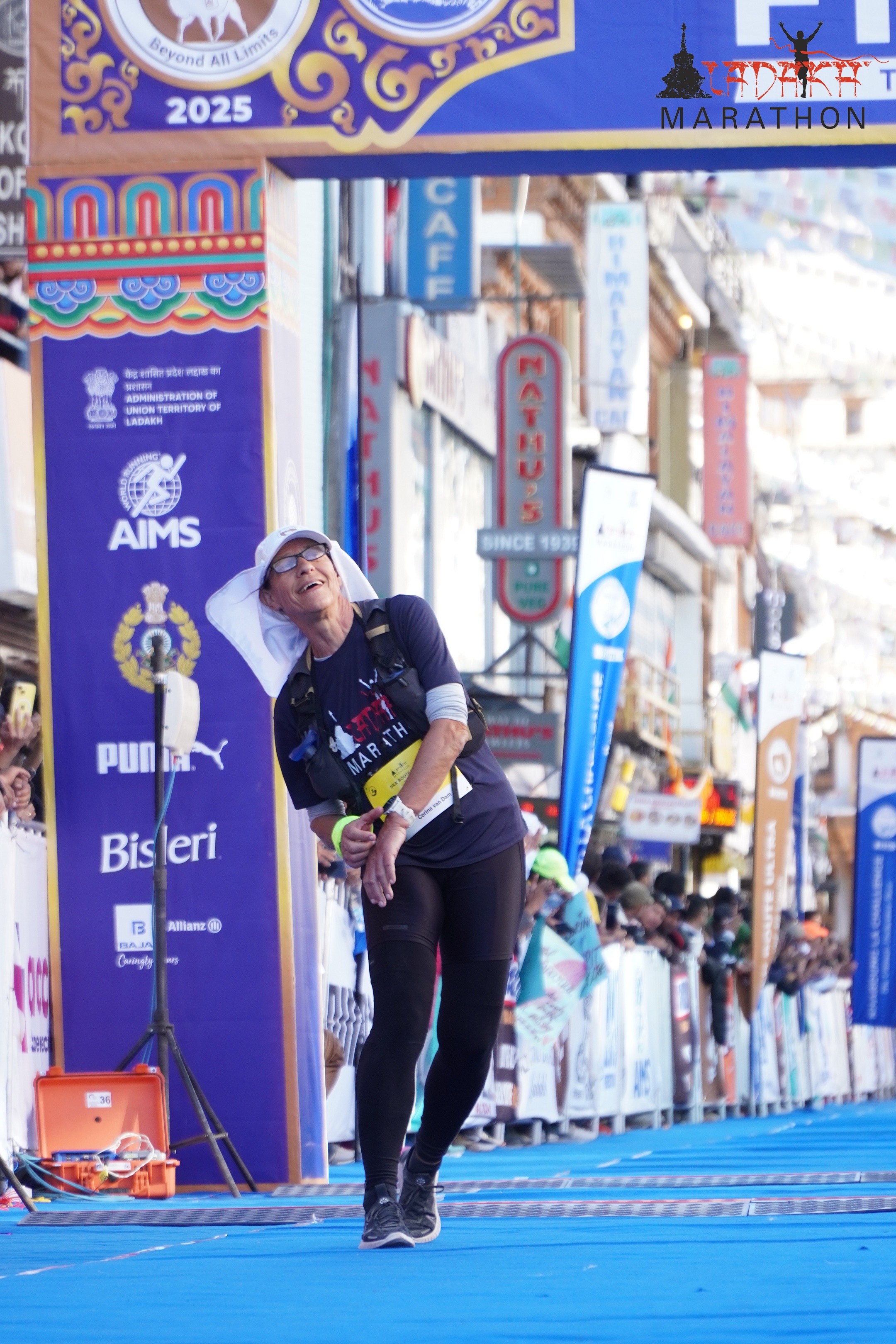
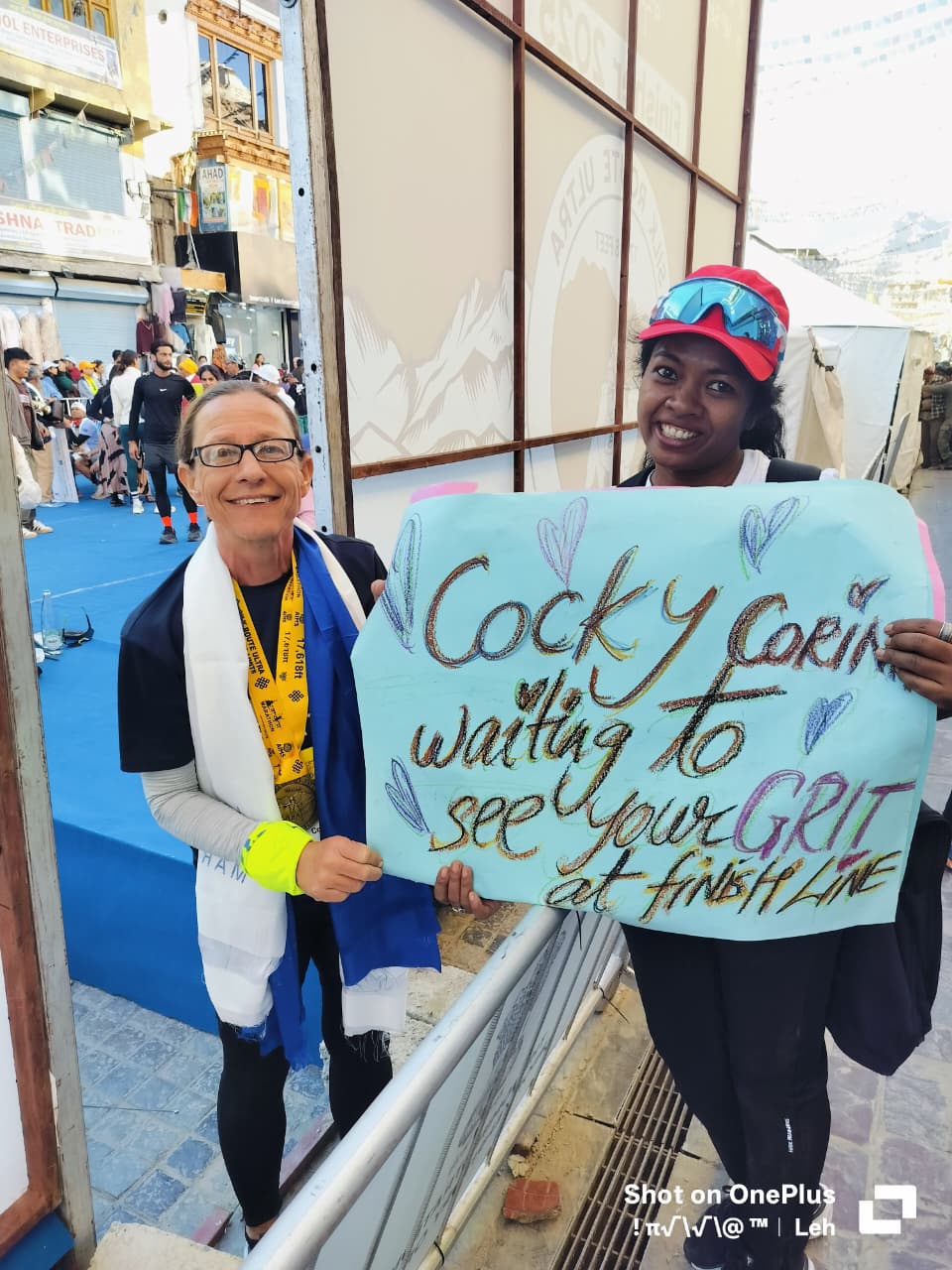
Once you reach Leh, there is this extra loop through the city. I knew I was tilting, a lot. People told me to take it easy. I thought (and probably told them) ‘this is a race, isn’t it?’ and moved on. Someone gave me Coca Cola. I didn’t know him, I opened my mouth and he just poured it in. The garden walls along the road were very helpful to rest a bit. The hotel staff was sitting in front of Reeyork House, my home in Leh. They cheered me on and I tried to lean to the other side pretending that nothing was ‘wrong’ (when I reached the hotel later, they gave me coffee, made me noodles, so it was clear that my theatre act had failed…). When I reached Leh Market, I thought one moment: ‘I don’t want to finish like this’. I knew what it looked like. I told myself to ‘(wo)man up’ and finish ‘the bloody thing’. I don’t think I will be ever cheered on like this again. People shouted my name, applauded, smiled. I saw friends, a placard with my name, I high fived with those who had been standing there for hours. They were so happy and proud.
After the finish, I went straight to a stretcher for a powernap. Apparently, I had finished third. I couldn’t care less. Friends were peeping through the window of the recovery tent. I just waved at them, closed my eyes and only stood up for the award ceremony. The gifts were amazing: finishers shawl, medal and token and then a winners’ shawl, bronze medal and a trophy and prize money….! My main concern was, how to get this to the hotel with those four race bags. The Stride With Girish Bindra group – the loudest in Leh – helped me.
People ask me if I’m ‘okay’, even now, weeks later. I realize that some of them were happy, others proud, worried, inspired, intimidated, felt sorry for me, thought that it must have been painful (it was not). After a few hours of sleep my spine was straight again. The next morning at 7.00 am, I led the warming up for the Athlos shake out run and directly after, I went to the airport to catch my flight back to Mumbai.
A week later I swam Dusk to Dawn, Mumbai Sea Swimmers’ endurance swimming event, in which I completed 23,1 kilometer in its 12-hour race.
Abhishek Pal, Seema top finishers among Indian runners
Kenyan runners Alex Matata and Lilian Rengeruk won the men’s and women’s half marathon race at the Vedanta Delhi Half Marathon, held on October 12, 2025 in the capital city.
Alex Matata finished the race in 59.50 minutes to claim the men’s half marathon crown.
In the women’s race, Lilian Rengeruk, also of Kenya, completed the distance in 1:07:20 hours.
This was the second time in the 20 years of the race’s history that Kenyans were winning the men’s and women’s title. The previous double win by Kenyan runners came in 2006.
Finishing second behind Matata was Ethiopia’s Bayelign Teshager (1:00:22) and third was Kenya’s James Kipkogei (1:00:25).
In the women’s race finishing behind Rengeruk was Melal Biratu in second position (1:07:21) and Mulat Tekle (1:07:29) in third position, both from Ethiopia.
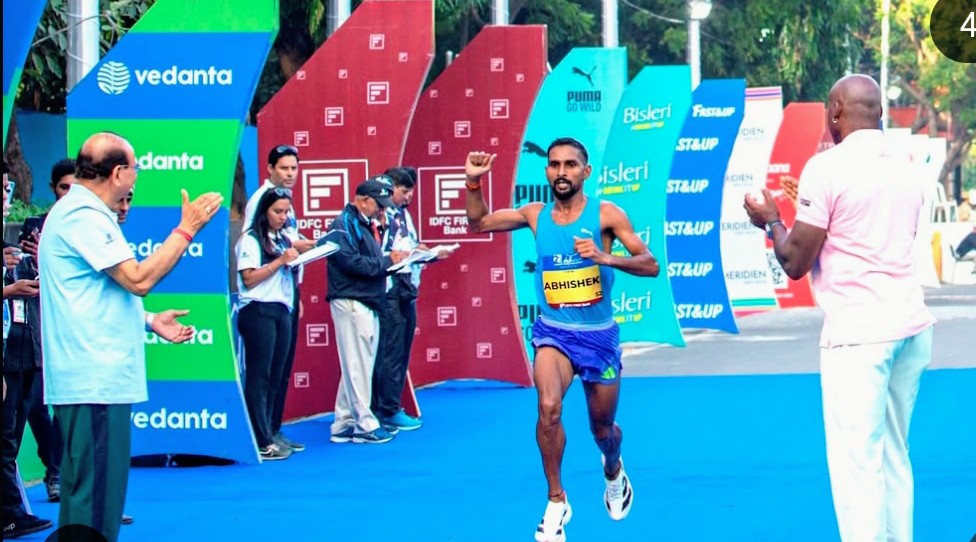
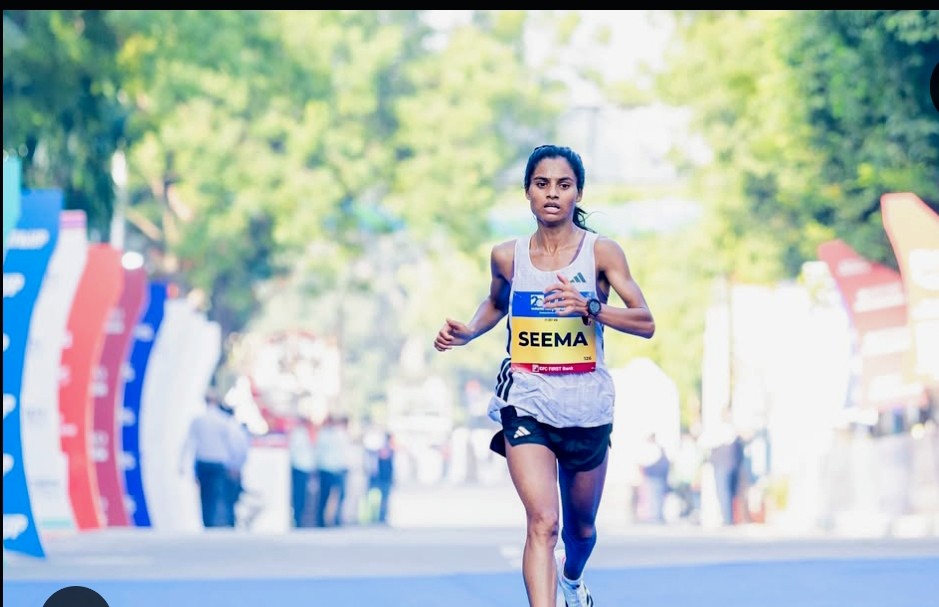
The Indian title was clinched by Abhishek Pal (1:04:17) in the men’s race and Seema (1:11:23) in the women’s race.
Abhishek Pal had previously won the Delhi Half Marathon in 2018 and 2023. In April 2025, he was the Indian winner of TCS World 10 K Bengaluru and finished overall seventh with a timing of 29:12 minutes.
“I was happy with my training and my race. But I could have done better if I had company during the race. Pacing with another runner always helps improve our timing,” Abhishek said.
Indian team for 100 k IAU Asia Oceania Championships 2025 chosen
The Ultra and Trail Running Selection Committee of AFI has chosen the team of ultrarunners to represent the country at the 100 k IAU Asia Oceania Championships to be held in Bangkok, Thailand on November 23, 2025.
Male ultrarunners include Vipul Kumar, Amar Singh Devanda, Saurav Kumar Ranjan, Binay Sah, Geeno Antony, Velu Perumal, Devarao Choudhari, Sanap Jagannath and Jayadrath Singh.
Women runners chosen to participate include Jayalakshmi Balakrishnan, Aarti Zanwar, Sindhu Umesh, Rajni Singh, Tenzin Dolma and Namgyal Lhamo.
(The author, Latha Venkatraman, is an independent journalist based in Mumbai)

 Outrigger