
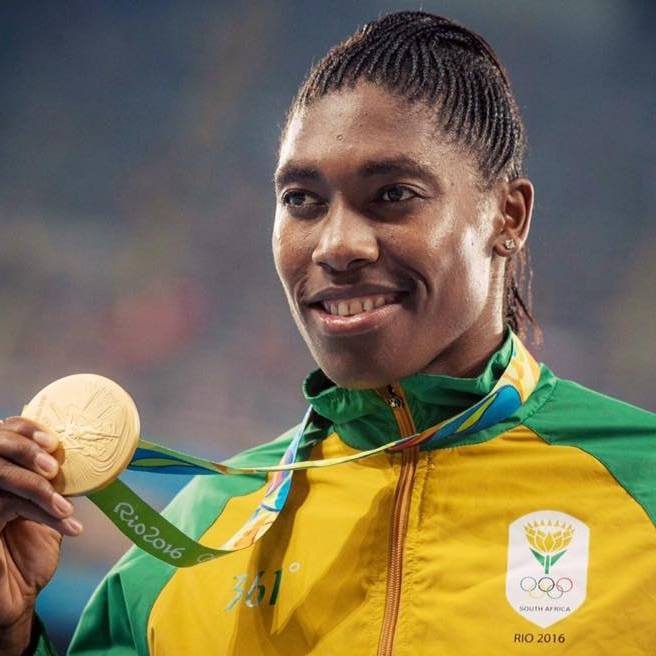
Caster Semenya (This photo was downloaded from the athlete’s Facebook page and is being used here for representation purpose only. No copyright infringement intended)
Caster Semenya case: Swiss apex court supports earlier CAS ruling
South African Olympic champion Caster Semenya, saw her options shrink further as Switzerland’s top court ruled in favor of the regulations that bar her from continued participation in certain race categories for women. The ruling, early September 2020, may have shut the doors on her defending her title in the 800 meters at the upcoming Tokyo Olympics.
Semenya has a rare genetic condition that significantly elevates her testosterone level. It made her participation in the female category at races, controversial. World Athletics had decided in 2018 that intersex athletes with disorder in sexual development and having both X and Y chromosomes would require lowering their testosterone levels to compete in women’s events ranging from quarter mile to a mile, distances demanding both speed and endurance. Semenya had challenged such reduction requiring intake of medicines. In 2019 after the Switzerland based-Court of Arbitration for Sport (CAS) ruled in favor of the restrictions, Semenya had approached the Swiss Supreme Court. Early September, 2020 the Court said that CAS had the right to rule as it did.
In a press release dated September 8, 2020, available on its website, World Athletics said, “ for the last five years World Athletics (formerly IAAF) has fought for and defended equal rights and opportunities for all women and girls in our sport today and in the future. We therefore welcome today’s decision by the Swiss Federal Tribunal (SFT) to uphold our DSD Regulations as a legitimate and proportionate means of protecting the right of all female athletes to participate in our sport on fair and meaningful terms.’’
It added, “ World Athletics fully respects each individual’s personal dignity and supports the social movement to have people accepted in society based on their chosen legal sex and/or gender identity. As the SFT specifically recognised, however, the DSD Regulations are not about challenging an individual’s gender identity, but rather about protecting fair competition for all female athletes. The Swiss Federal Tribunal acknowledged that innate characteristics can distort the fairness of competitions, noted that in sport several categories (such as weight categories) have been created based on biometric data, and confirmed that ‘It is above all up to the sports federations to determine to what extent a particular physical advantage is likely to distort competition and, if necessary, to introduce legally admissible eligibility rules to remedy this state of affairs.’
“ The Court of Arbitration for Sport (CAS) agreed with World Athletics in its 30 April 2019 award and now the SFT has also agreed that ‘In some contexts, such as competitive sport, biological characteristics may, exceptionally and for the purposes of fairness and equal opportunity, trump a person’s legal sex or gender identity’.
“ The SFT concluded: “Based on these findings, the CAS decision cannot be challenged. Fairness in sport is a legitimate concern and forms a central principle of sporting competition. It is one of the pillars on which competition is based. The European Court of Human Rights also attaches particular importance to the aspect of fair competition. In addition to this significant public interest, the CAS rightly considered the other relevant interests, namely the private interests of the female athletes running in the ‘women’ category.’’
Semenya has said that she will continue to fight against the restrictions. In a statement from her published in the report by New York Times (dated September 8, 2020) on the latest update to her case, Semenya says, “ I am very disappointed by this ruling, but refuse to let World Athletics drug me or stop me from being who I am. Excluding female athletes or endangering our health solely because of our natural abilities puts World Athletics on the wrong side of history.” The report in the New York Times pointed out that Semenya’s supporters include the World Medical Association (WMA), which has requested doctors not to implement the World Athletics regulations. WMA has questioned the ethics and potential harm in requiring athletes to take hormone therapy not based on medical need.“ The Office of the United Nations High Commissioner for Human Rights has also called for the regulations to be revoked. Human Rights Watch has called the regulations “stigmatizing, stereotyping and discriminatory,” saying they amount to “policing of women’s bodies on the basis of arbitrary definitions of femininity and racial stereotypes,” – the report said.
AFI seeks priority for Olympics-bound athletes in vaccination plan
The Athletics Federation of India (AFI) has sought priority for Olympics-bound athletes in the government’s COVID-19 vaccination plan.
According to a report from Press Trust of India, published September 16, 2020 in leading dailies, discussions in this regard have already happened. “ We have already discussed this with the government and told them we will need it (vaccine) for our athletes going to the Olympics,” AFI President Adille Sumariwalla was quoted as saying in the report “ We need to make sure once the vaccine comes out, they (Olympic-bound athletes) should be amongst the first batches to get it and the discussion regarding that has already happened,” he added. The AFI chief was speaking at a webinar.
Duplantis vaults past Bubka’s record
Swedish athlete Armand Duplantis has broken Sergey Bubka’s longstanding outdoor world record in the pole vault.
A report dated September 18, 2020, available on the website of World Athletics, said that he cleared 6.15 meters at the Wanda Diamond League meeting in Rome, a day earlier.
According to it, in February this year, Duplantis had set world records of 6.17m and 6.18m on the World Indoor Tour. “ But no one had ever jumped higher than 6.14m in an outdoor stadium. Sergey Bubka’s 6.14m monument from 1994 had stood inviolate for 26 years, but it has been under siege from Duplantis this season,’’ the report said, adding, “ before last night, he had taken 13 attempts at 6.15m after cutting a swathe through the world’s best pole vaulters in this short, sharp competition season.’’

Illustration: Shyam G Menon
Boston Marathon organizers postpone registrations for 2021
Boston Athletic Association (BAA), organizers of the Boston Marathon, has announced that registration for the 2021 Boston Marathon will not take place in September. The registration process has been postponed, BAA said in a statement dated September 3, 2020, available on its website.
Every year, registrations for Boston Marathon open in September of the previous year. According to Tom Grilk, CEO, BAA, COVID-19 has affected mass participation road races in ways that could never have been imagined. “ September is usually a time for the BAA to begin opening registration for April’s Boston Marathon and planning for an already established field size. We know, however, that we cannot open registration until we have a better understanding of where the virus may be in the spring,” he was quoted as saying.
To guide it on the path ahead, BAA has formed a COVID-19 Medical & Event Operations Advisory Group consisting of medical, public safety, and race operations experts, as well as city and state officials.
“ The Medical & Event Operations Advisory Group will recommend strategies that address the health and safety of participants, volunteers, staff, and community members. Recommendations will be developed in accordance with the most current guidelines issued for large-scale events by the World Health Organization and Centers for Disease Control. The group will develop framework for the B.A.A. that addresses risk factors specific to the Boston Marathon including size and other local and international considerations for the pandemic. Outcomes, including an updated registration timeline for the 125th Boston Marathon, will be shared,’’ the related statement available on the race website said.
“ We seek to determine with some specificity how and when large-scale road running events organized by the B.A.A. may be able to reasonably resume, while also providing input on which operational aspects will change as events are organized and managed,” Dr. Aaron Baggish, Co-Medical Director for the BAA and Boston Marathon, Director of the Cardiovascular Performance Program at the Massachusetts General Hospital Heart Center, and co-chair of the advisory group, was quoted as saying.
Boston Marathon is usually held on Patriots’ Day, which falls on April 19 in 2021.
This year’s, Boston Marathon was cancelled owing to the COVID-19 pandemic. It will be held in virtual format.
World Athletics road running season restarts
World Athletics’ 2020 road running season will recommence this month backed by a strong anti-doping program. However, the race calendar is subject to changes due to the ongoing COVID-19 pandemic.
According to a press release dated September 1, 2020, available on the website of the apex body overseeing athletics globally, “ the schedule begins with the Vidovdanska Trka 10km (Bronze Label) on 6 September and still features the Virgin Money London Marathon (Platinum Label) on 4 October, the same day as the venerable Kosice Peace Marathon (Silver Label) in Slovakia, as well as a host of other Gold, Silver and Bronze events in various countries. This schedule does remain subject to change, due to the ongoing uncertainty created by the progress of the Coronavirus pandemic around the world.’’
The calendar for the rest of the year will be supported by a strong anti-doping program. “ Road athletes will be able to register Olympic qualifying entry standards from 1 September to 30 November, but only in preidentified, advertised and authorized races being staged on World Athletics certified courses, with in-competition drug testing on site. The Athletics Integrity Unit (AIU) has confirmed it will have appropriate anti-doping systems in place for all qualifying races,” the release said.
In late July, World Athletics had agreed to lift the suspension on the Tokyo Olympic qualifying process for the marathon and race walk events from 1 September 2020, due to concerns over the lack of qualifying opportunities that may be available for road athletes before the qualification period finishes on 31 May 2021. The original suspension period, from 6 April to 30 November 2020, was introduced due to the competition and training disruption caused by the global pandemic, and remains in place for all other track and field events. The accrual of points for world rankings and the automatic qualification through Gold label marathons / Platinum Label marathons remains suspended until 30 November 2020.
Last year, the AIU had reached an agreement with the Abbott World Marathon Majors wherein the organization agreed to provide additional funding for intelligence-led anti-doping investigation and testing program, which would allow the AIU to monitor a larger pool of elite road runners. The said program has been expanded this year with contributions from other key stakeholders of the road running community – the organizers of all Label races, athlete representatives and shoe companies. Three major shoe companies – ASICS, Adidas and Nike – have agreed to contribute to the AIU’s Road Running Integrity Programme, the release said.
The ongoing commitment of all these key stakeholders means that more than 300 Platinum and Gold Label athletes will be monitored and tested during the coming season. The AIU expects to be able to create individual intelligence profiles for all of these athletes this year, establishing baseline parameters for each athlete’s biological passport, ahead of target testing in 2021.
(The author, Shyam G Menon, is a freelance journalist based in Mumbai.)




 Outrigger