AN INTERVIEW

The book `Freedom Climbers.' (Photo: Shyam G Menon)

The book `Freedom Climbers.’ (Photo: Shyam G Menon)

The man before me was of average height.

He was in good shape, shoulders thrown back, legs set firm to the ground.

His eyes were the sad-calm of someone who had seen a lot.

He spoke English, choosing words carefully yet amusingly for he had a sense of humour.

We sat down for an interview that I never published because I didn’t know enough of his incredible life. Just the previous day, I had heard him lecture at the Himalayan Club in Mumbai. It was funny, peppered with jokes despite the gravity of his exploits and the people he knew in his chosen field, famously called `the art of suffering.’. I could ask questions that make him repeat his lecture. That would be stupid. His life and that of his friends were central to a book. But with that book not yet out when this meeting happened months ago, my homework was zero.

What do I ask?

I set my notepad on the table and carefully kept my pen alongside.

Then I looked at his face, smiled and took a deep breath.   

Oxygen is good for the brain.

And what’s good for the brain may help birth a question – I thought.

The man before me was one of two people who climbed Everest for the first time in winter. That was in 1980. Long before that, when the first climbing expeditions approached Everest in the early part of the twentieth century, it had been via Darjeeling. I remembered previous visits to Darjeeling and Ivanhoe. Not Sir Walter Scott’s novel but a quaint heritage hotel with the same name. At its reception, the hotel kept a synopsis of its history, counting among past guests, the famous Hollywood actress Vivien Leigh and George Mallory, the British mountaineer who famously disappeared on Everest. However Darjeeling’s signature view is the giant massif of Kanchenjunga, India’s highest mountain and the world’s third highest. Years ago, my first trek had been to Dzongri in nearby Sikkim, from where you got a closer view of this peak.

Wanda Rutkiewicz was among the greatest woman mountaineers. She fought everything from unyielding mountains to male domination in climbing, all this while her own personal life was sufficiently tumultuous to cripple any of us. Akin to Everest’s first ascent coinciding with the coronation of Queen Elizabeth II in England, Wanda’s ascent of Everest coincided with the installation of Pope John Paul II at the Vatican. He hailed from Poland, where Wanda was born. On a quest to be the first woman to ascend the world’s fourteen 8000m peaks, she was last seen high up on Kanchenjunga. Wanda and four others – Jerzy Kukuczka, Wojtek Kurtyka, Krzysztof Wielicki and Andrzej Zawada – dominate the narrative of `Freedom Climbers’ written by Bernadette McDonald. The book I should have read before the interview I was attempting, it focused on a phase in the 1970s and 1980s, when Polish climbers roamed the Himalaya establishing difficult climbing routes and winter ascents. They were the toughest climbers in the Himalaya. 

Speaking in Mumbai in early 2013, Bernadette said that the book had been a challenge to publish as it was perceived as a niche within a niche. She traces the Polish assault on Himalayan peaks to a Poland invaded by Germany and Soviet Union, the brunt of World War II in Poland and eventually the oppressive Communist regime that ruled the country after the war. It shaped the psychology of a people. The country’s mountaineers cut their teeth on the Tatra Mountains. In pure altitude terms, this may seem very modest for the highest point is only 8710 feet up from sea level. Except, the Poles were putting up tough routes and winter climbs. Their quest for higher mountains brought them to Afghanistan adjacent to the erstwhile Soviet Union. Afghanistan was then under a regime friendly to the Communist Block. Slowly, they advanced to Pakistan, India and Nepal. By the time, the Poles reached the Himalaya most of the major peaks had been climbed by other European countries. To leave a mark uniquely their own, the Poles started climbing some amazingly tough routes besides transplanting to the Himalaya, their habit of winter ascents. Interestingly, the Polish reign in the Himalaya – when they climbed as though to compensate for what history had denied them – was strong during the times of controlled market and politics. It faded as Poland moved to free market and democracy. Today, Polish teams are still at work completing some of the mountaineering agendas born in that past, like climbing all the 8000m peaks in winter. But the mantle of ferocious climbing has moved on as though the country found peace yet turned soft with free market economics.

Does the state of its economy influence a country’s alpinism?

Good question.

One day in 1996, at the end of climbing season, my subject for interview had arrived alone at the base of Nanga Parbat (8126m) in Pakistan and asked some villagers for directions to a particular line of ascent up the peak, often called `The Killer Mountain.’ The villagers thought he was crazy. Famous for speed ascents in his generation, the man heaved a rucksack to his back and another to his front and climbed the peak solo. Nanga Parbat completed his climb of all the fourteen 8000m peaks. He was the fifth person globally to do so.

Krzysztof Wielicki smiled encouragingly as I struggled for the right question to start the interview.

(The author, Shyam G Menon, is a freelance journalist based in Mumbai. A slightly abridged version of this article was published in The Hindu Business Line newspaper.)

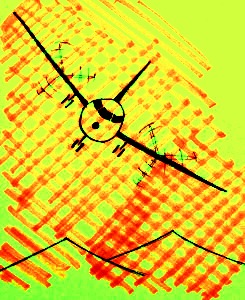
SHILLONG AIRPORT

Illustration: Shyam G Menon

Illustration: Shyam G Menon

Ten minutes before touchdown, the ATR was tossed around in air pockets.

It complemented the essence of leaving metro life.

The turbo-prop was flying as it used to be before technology stole aviation.

The airport below was similar.

It was a small building.

The arrival area was a single room as small as a Mumbai apartment, with attached toilet.

You waited for the baggage, picked it up and left. No conveyor belt, no sitting around.

Nearby a new terminal of glass and steel was being constructed.

A few taxis lay parked outside for the 32 kilometer-ride from Umroi to Shillong.

I got into a state transport bus. It charged less.

There was a brief wait for the plane to take-off, the airport staff to pack up and the bus to leave with everyone – staff included.

It was the end of a working day at Shillong airport.

Its only flight had come and gone.

Days later, my work done, I was ready to fly back to Kolkata.

At Shillong’s bus depot, I waited for the bus to the airport.

Nothing drew up.

Seeing one of the airport staff from my earlier trip, I asked her about the bus. She guided me to the assigned vehicle. We spent the next ten minutes discussing Meghalaya.

“ I wish I was busy but there is only so much work here,’’ Saira Khar Karang said. Many years ago, the government owned-airline, Vayudoot – it disappeared without proper successor for its invaluable role – flew small aircraft to Shillong. Later the ATR came. Flights used to be cancelled for want of passengers. During rains the plane may skip Shillong and proceed to the more reliable Guwahati airport. Passenger traffic had since improved but the monsoon’s grip remained.

Yet, Saira didn’t wish to leave Shillong.

“ Khasi people are open hearted,’’ she said, wary of big cities.

Every small city eventually becomes a big city.

 It’s the phenomenon of our times.

 “ Who knows what Shillong will be?’’ I asked.

Some more of the airport staff trickled in.

“ Flight is one hour late,’’ a young lady said.

En route to the airport, we picked up others I recognized from the bus ride, the day I arrived.

It was a small world.

The security personnel at airport were a mixed bunch speaking languages of the North East, Hindi, Kannada and Malayalam. A lone X-Ray machine sat in the departure lounge, which had aluminum window frames for modernity. No air conditioning. Next to the X-Ray machine was Air India’s ticket counter, a kiosk. Ground service had been outsourced to a local travel agency. A weighing machine with attached electronic meter checked for excess baggage. Once some passengers had gathered, the officials ran the X-Ray machine, weighed the baggage, tagged it and issued boarding passes. All hand written, no computer print-out.

A TV provided passengers taste of impending metro inanity: the program quizzed Indian film stars on size zero while the streamer said Jennifer Aniston had denied she was on baby foods to stay thin. An announcement over the PA system informed that the delay had risen to near two hours. The TV channel switched to Doordarshan, screening a Hindi film – an Indian Tarzan with Ruby for Jane.

Then Shillong’s daily power cut struck.

Somewhere a generator hummed, fans whirled again and Ruby, Tarzan and elephants returned.

There was fuss around the VIP room as a politician arrived.

Half an hour later, we queued before a room marked `Security Hold.’ The CISF personnel took us through security check then joined the airport staff in inviting us for tea and snacks. The manager apologized for the delay and the time it took to fetch snacks, the airport being distant from town. A CISF jawan took an elderly passenger’s water bottle and filled it for her.

Shortly thereafter, the lone plane for which the airport existed landed.

A quick frisking before boarding, seats taken and we were off like clockwork.

As Meghalaya receded to green hills kissed by fluffy white clouds, I imagined an airport below closed for the day and a bus with staff and passengers headed back to Shillong.

Someday, that politician or another would inaugurate the new terminal, jet planes would land and Saira would turn busy.

Where next for the turbo-prop?

I wonder.

(The author, Shyam G Menon, is a freelance journalist based in Mumbai. This article was written following a visit to Meghalaya several years ago. An abridged version was published in The Hindu Business Line newspaper. Shillong’s new terminal was inaugurated in 2011, reports on the Internet said.)

NO SPACE FOR BMX

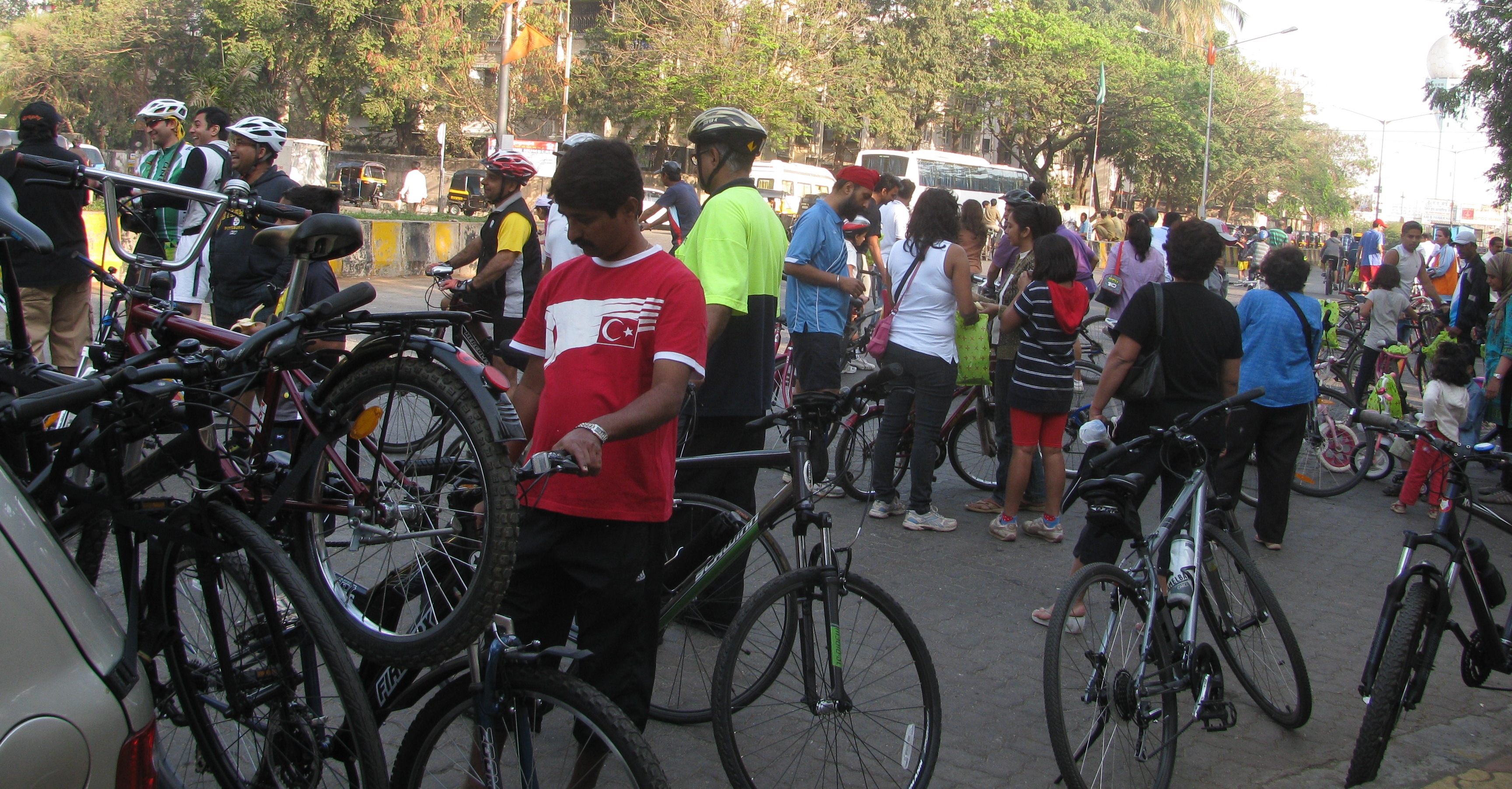
On Relief Road (Photo: Shyam G Menon)

On Relief Road (Photo: Shyam G Menon)

Above Relief Road, jet planes from the nearby Santa Cruz airport surged like unstoppable arrows.

Beyond the adjacent wall, at Juhu’s helicopter base servicing offshore oil platforms, the slower choppers hovered and took their time to decide direction before heading seaward at casual pace.

On the road a large collection of exotic cycles were parked – road bikes, mountain bikes, hybrids, folding bikes, children’s bikes and bikes with digital gizmos and gadgets that begged the brand name of cycle to be changed from classic cycle company to cell phone or computer brand.

Disinterested in that crowd were the BMX lot. Absorbed in their own stunts, they waited for the cycling community to finish its socializing and focus attention on the simplest, barest bikes around. 

Ten minutes later as they performed, the crowd seemed enthralled. What none realized and which outlined the character of BMX was that few of those BMX addicts considered themselves cyclists in the popular sense of the word.

A couple of them owned commuting cycles.

All lived at the deep end of an obsession for BMX.

Whatever else cycling meant, didn’t interest them.

They were BMX riders.

Starting in the US in the 1970s, BMX was a full medal discipline at the 2008 Beijing Olympics.

People, cycles, BMX, vehicles, Mumbai (Photo: Shyam G Menon)

People, cycles, BMX, vehicles, Mumbai (Photo: Shyam G Menon)

Mumbai has a small but dedicated BMX group.

The lot I met in mid-February 2012 included Dipak Panchal, Ronald Chudasama, Rajas Naik, Bharat Manjrekar, Shailesh Sawant, Hasmukh Parmar and Shahbaaz Khan. The youngest was 17; the oldest around 26-27. The oldest had taken time to mature in the sport. The youngest was maturing faster. They were among the city’s second wave of BMX bikers. The pioneers rode in the eighties. Rahul Mulani, respected by the new generation bikers for his continued commitment to the sport, was one of them. He started a cycle store, subsequently well known in Bandra, called Gear. It wasn’t his choice of business but there wasn’t another way to survive in a sport that consistently thrashed bikes amidst poor availability of spare parts. For some years, Rahul also organized an event called Gear Hang Five Series, which drew bikers from other regions – Pune, Chandigarh and Manipur – to compete.

The Mumbai competition was usually followed by a jam session permitting bikers to share their skills, ride and just enjoy BMX.

If you ask around in the extended Indian cycling community, Mumbai is remembered for its BMX groups.

However despite their interest the city’s BMX bikers had no place to practice. Some missed social acceptance. “ We are treated like clowns,’’ Dipak said. Several years ago his attempt at college education had ended as college drop-out and emergent BMX biker. Television with its programmes on extreme sports and X-Games played a role in shaping his passion.

After a stint working at a cycle store, he now advised the wealthy on what cycles to buy, how to maintain them and waited for someone to offer space for stunts.

“ Our biggest problem is space to practise,’’ Ronald said.

At his housing society, he was used to hard found space usurped by car come back to park and owner insisting that his vehicle on four wheels was more important than the youngster on two wheels.

BMX! (Photo: Shyam G Menon)

BMX! (Photo: Shyam G Menon)

“ Why can’t they convert one of the many cricket grounds into a BMX park?’’ Rajas, who specialized in stunts on flat surfaces, quipped.

“ No need for that,’’ Ronald intervened, “ an old dance hall or one of those unused basket ball courts would do. Can’t they allow us a few hours every day?’’ 

Not having a place to do stunts hurt.

Not having a place in society because they do BMX stunts hurt more.

At least two or three in the group had been picked up by the police and spent time in lock-up for doing stunts on the road.

“ The police think we are akin to those motorcyclists racing in traffic. We are not,’’ Dipak said.

Further, when foreigners performed stunts on BMX cycles in the city, people watched and clapped. “ We don’t receive such support from the same citizens,’’ Ronald said. Ask Rahul and he would tell you that right from his days as pioneer, space to practise had been genuine challenge. Even roads with less traffic are few in Mumbai. “ The Bandra-Kurla Complex (BKC) is good on Sunday. But that’s just one day,’’ he said of the city’s new financial district.

The contrast amused.

Money minded-Mumbai prayed for busy BKC bustling with people and money.

The BMX bikers liked it as built-up space bereft of people.

Different things fascinate different people.

Where did all this place Mumbai’s BMX community when compared to foreign bikers of the same age?

“ They are a thousand times better,’’ Ronald said ruefully.

After all, practice makes perfect.

Elsewhere in India changes were happening.

Chandigarh apparently had a dirt park now. But Mumbai – the city of abject congestion and severe population pressure – simply had no space to spare for irrelevant pursuits like BMX although it didn’t mind legions of new cars further congesting its streets. And where nothing but survival, rat race and success dominated, empathy for irrelevant pursuits withered.

BMX riders (Photo: Shyam G Menon)

BMX riders (Photo: Shyam G Menon)

Dipak said he cannot convincingly articulate his fascination for BMX.

BMX is what BMX does.

How can a practitioner communicate the intensity of engagement?

That also appeared to be what limited this community in interactions with resident cycle companies and new ones entering India. Talking to companies for support was a challenge because as Dipak put it, “ I am only a biker. I understand BMX, I don’t understand marketing.’’

Conversation over, I left them to their search for space.

Above, jet planes soared to meet limitless sky.

Below, those young men, their BMX cycles and Relief Road – all merged into crowded Mumbai.

(The author, Shyam G Menon, is a freelance journalist based in Mumbai. An edited version of this article was published in The Hindu Business Line newspaper in July 2012.)


DZOMSA

When Sonam Dorje was a child, Leh was still village.

“ Every home had access to a stream for water and there were rules on how to protect it. Then the place grew, it became a mess. Small was nice,’’ he said.

In the cold desert, water is precious commodity. Unable to accept the contamination of streams through laundry, Dorje started Dzomsa over a decade ago. That was the name he gave his shop – it meant `meeting point’ in Ladakhi. Dzomsa accepted clothes for washing, washed away from streams and the used water was not returned to streams but spread out in the desert.

Laundry at Dzomsa was a simple idea implemented without studying business prospects. Most homes and hotels around were already tied to traditional laundries in a land beginning to risk environment. However foreign tourists, hailing as they did from economies that had seen the many sides of urbanization and industrialization, responded.

Sonam Dorje (Photo: Shyam G Menon)

Sonam Dorje (Photo: Shyam G Menon)

It was the summer of 2010. We chatted at a second floor cafe, snow capped peaks visible in the distance. Bespectacled and with scarf to his neck, Dorje looked a poet or artist; even traveller. The last thing he seemed was a businessman. He used to be a photographer. “ I am not obsessed with tradition. I am concerned about the survival of society. More than other places, Ladakh’s is a society made by human beings. Elsewhere nature is so much that you can perhaps have the luxury of abusing it. Here, you can’t,’’ the post graduate in Economics said. Dzomsa was the name Dorje originally used for his photo exhibitions.

After laundry, Dzomsa entered into local products including food. Like most Ladakhis, Dorje was himself a farmer owning apricot trees and barley fields. But he progressively outsourced farm produce to near 60 per cent of raw material intake. All the processing to jams, juices and packaged products was done by Dzomsa.

His final product line was the simplest idea of all – drinking water.

Clean water is a problem everywhere. In the plains, they assure quality by bottling and selling it. In high altitude Ladakh that cannot be recommended for disposing plastic is a bigger headache than finding water. Plastic is synonymous with tourist spots in India; it arrives with people and accumulates behind when they leave. Ladakh’s main industry is tourism. The knife edge it walks balancing people and plastic can be imagined. Dorje’s contribution through Dzomsa was utterly simple. He began offering boiled water at his shop. When you run out of drinking water, don’t go and buy bottled water; head for Dzomsa instead for refill.

According to Dorje, starting Dzomsa was a lonely experience. “ Some people asked – are you going to start a caste of launderers in Ladakh? People ridiculed again when we got into drinking water,’’ he said. Dorje’s original idea was to progressively convert Dzomsa into a co-operative and hand it over to the people. But those who joined and acquired people skills would leave for a government job. “ A government job is like getting enlightenment,’’ he said laughing. It was a tendency being discussed that June at the well known Students Educational and Cultural Movement of Ladakh (SECMOL) as well. Its founder Sonam Wangchuk is Dorje’s brother. In Ladakh, entrepreneurship was considered unethical. “ One of the challenges therefore is to bring respectability to entrepreneurship,’’ Wangchuk said on the sidelines of a workshop at SECMOL exploring job opportunities for Ladakhi youth.

When I met him, Dorje owned Dzomsa with no funding from any other source. He never tried bank loans. “ Somehow I wanted this whole experience to be organic. There is a bit of romanticism in it. I don’t recommend it for others!’’ he said. Besides the shops’ three main services it also did a unique recycling and disposal role. Dzomsa stores – Leh had three then – had a bin for people to drop off used batteries. They were collected, wrapped in plastic and buried out in the desert so that the contaminants didn’t leak into glacial streams. Paper waste went into compost heaps. Glass jars were thoroughly washed and reused. In Leh, where every tourist operator complains of inadequate civic infrastructure, this would seem a small, private municipal service. Yet as far as I could see, there was neither recognition nor support from government for Dzomsa although the idea made eminent sense anywhere. 

Problem is – ideas can be ahead of the times and the market. On an average 200-300 people walked into its shops daily during tourist season for Dzomsa’s services. Most came for water. Foreign clients dominated. Unfortunately for 90 per cent of Indian tourists, the growing component in Ladakh’s tourism inflow, these outlets were yet to make sense. They walked past the store ignoring the wisdom within. On the other hand, scaling up wasn’t a Dzomsa priority. He may be too much of a romantic to be ambitious businessman but Dorje knew the hazards of stretching enterprise. “ We have been extremely careful about the quality of our products,’’ he said. 

(The author, Shyam G Menon, is a freelance journalist based in Mumbai. This article was published in The Hindu Business Line newspaper in August 2010.)

READING TILMAN

“To some the Himalaya may be only a name vaguely associated perhaps with a mountain called Everest: to geologists they provide a vast field for the starting and running of new hares; to other learned men, glaciologists, ethnologists, or geographers, the Himalaya are a fruitful source of debate in which there is no common ground, not even the pronunciation of the name; while to the mountaineer they furnish fresh evidence, if such were needed, of the wise dispensation of a bountiful Providence. For lo, when the Alps are becoming too crowded, not only with human beings but with huts, the Himalaya offer themselves to the more fanatical devotee – a range of fifteen hundred miles long, containing many hundreds of peaks, nearly all unclimbed and all of them so much higher than the Alps that a new factor of altitude has to be added to the usual sum of difficulties to be overcome; and withal to be approached through country of great loveliness, inhabited by peoples who are always interesting and sometimes charming. Here seemingly is a whole new world to conquer, but it is a world which man with his usual perversity, flying in the face of Providence, has reduced to comparatively small dimensions: for what with political boundaries, restrictions and jealousies, the accessible area is less than one-third of the whole. And though European travellers and climbers may grouse about this state of affairs, Europeans are, I suppose, largely to blame. For with the present state of the outside world before their eyes the rulers of Tibet, Nepal and Bhutan can scarcely be blamed, and might well be praised, for wishing their own people to have as little as possible to do with ourselves.’’

The paragraph struck home for two reasons.

First was the nature of perspective, different from that of the typical climber and describable as only that of a seeker – maybe, explorer? Second, the paradigm the Himalaya was trapped in. It remains unchanged today. Likely writing between the great wars of the twentieth century H.W. Tilman points to a state of the world that the kingdoms of Asia couldn’t be blamed for wishing to keep away from; limited access to the Himalaya and the Alps getting crowded. This picture hasn’t changed much although the actors therein and the direction of trading blame, probably have. Compared to today’s crowded South Asia and the as populous-China, between which lay sandwiched the Himalaya, Tilman’s reference to the “ crowded’’ Alps would seem lost. June 2013; the scale of human presence in the Indian Himalaya was betrayed when thousands of pilgrims died following heavy rains in Uttarakhand. We live in an era of exploded human numbers. Not to mention, the Himalaya as strategic boundary.  

When Tilman climbed Nanda Devi and found reason to write an account – mentioning therein of limited access to the Himalaya – the Great Game played out between the British and Russian empires, was well past its peak. Despite the passage of time, political games similar to the Great Game, featuring a new set of players, continue to be waged around the Himalaya leaving swathes of it still subject to the stuff of military strategy, territorial dispute, mutual suspicion and a regime of bureaucratic permits.  Not a day passes without disquieting news reports from India’s mountainous borders with Pakistan and China. While the whole thing may be a legacy of erstwhile management by foreign powers, not to mention the legacy of cocooned kingdoms in remoteness, it is a moot question what new generations and governments have done since to enhance peaceful coexistence and enjoyable access across the Himalaya.

That may seem childish.

If so, the thoughts evoked by the image of Earth Rise must be the most childish of all.

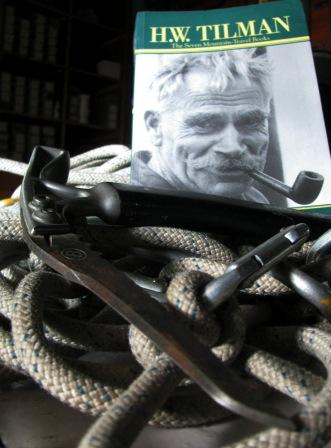
Tilman's book (Photo: Shyam G Menon)

Tilman’s book (Photo: Shyam G Menon)

Harish Kapadia, India’s best known explorer of the Himalaya and author of many books on the subject calls Tilman his favourite explorer of these ranges. He sent in a brief synopsis on the man, written with inputs from Rajesh Gadgil, Honorary Editor of the Himalayan Journal:

“ Harold William Tilman a.k.a. Bill Tilman, was one of the most prolific adventure writers and great explorers of the Himalaya and Karakoram, of the twentieth century. Originally a tea-planter in Kenya, he began his climbing in the company of another great explorer, Eric Shipton and climbed many peaks in Africa. Their partnership proved so successful that today they are remembered together as ‘Shipton-Tilman’.  Well known for his taciturn nature and simple but sound organization in the mountains (he used to say that any worthwhile expedition can be planned on the back of a post-card), Tilman achieved many firsts during his career. In 1934, with Shipton, he was the first to penetrate the Rishi Ganga gorge to find a way to the heart of the Nanda Devi Sanctuary. As if they were still not satisfied by one venture, the pair turned their attention to another challenge and by following an ancient myth, they were successful in connecting Badrinath with Kedarnath by a direct route via Panpatia Bamak for the first time in known history.  They barely survived, fighting for food with bears! After a great physical survival story he wrote, ‘we were experiencing a tiredness which only a very fit body can experience’! Subsequently Tilman joined and then led expeditions to Everest but his heart was in small scale exploratory trips to the then unknown mountains and valleys. Many exploratory episodes followed. In 1936, he led the first ascent of Nanda Devi in collaboration with the Americans and after reaching the summit, he describes that they were so overwhelmed by the beauty around that, ` I believe we so far forgot ourselves as to shake hands on it.’ Nanda Devi remained the highest summit attained by man till 1950. And humility was his trait too – he said that he was sorry to find the head of the proud goddess now trampled.

In the same year, he trekked and explored the areas around the Zemu Gap in Sikkim, of which he subsequently completed the first successful traverse in 1938. In 1937, with Shipton, he made a detailed reconnaissance of the little known areas of Karakoram, notably recorded in Blank on the Map. In the following year, Bill explored the Assam Himalaya around Gorichen but could not reach the mountain’s summit. In later years he explored and climbed extensively in the Karakoram, Hindu Kush and Xinjiang. Some of his notable attempts were Rakaposhi, Muztagh Ata, Bogda Feng and Chakragil. He also led an expedition to explore Langtang, Jugal and Ganesh Himal in Nepal. In that expedition Tilman was the first to ascent Paldor (5896m) and found the pass named after him beyond Gangchempo. In 1950, he led the British expedition to Annapurna where they could reach very near the summit of Annapurna IV. In the same year, he was one of the first persons to explore the Southern approaches to Mt Everest.

He has a place as a great explorer in history and his books narrate his exploits with wit. He kept exploring as his philosophy was – appetite grows with what it feeds upon, not by waiting…!”

It was Kutts Bommanda, then proctoring a fall season-semester course at the India branch of the US headquartered-National Outdoor Leadership School (NOLS), who told me of Tilman in the library and the reading it held. I was doing my internship then at NOLS India, Ranikhet. The book in the library was a compilation – `The Seven Mountain-Travel Books,’ published by Baton Wicks and The Mountaineers. Rather aptly for Tilman’s work, this section of NOLS India’s modest library was at the deep end of the equipment issue room stacked with mountaineering boots, ice axes, ropes, crampons and compasses. The chapter on Nanda Devi, I reckon, should be interesting for any NOLS student as also anyone who drove up to Ranikhet from the Kathgodam railway station because it talked about the mountain widely recognized as Kumaon’s presiding deity. It also provided a glimpse of the Ranikhet of many years ago for Tilman’s expedition to the mountain had passed through the town.

“ Ranikhet, whither we were now bound, is a hill station in the United Provinces. From Kathgodam, thirty six hours’ journey by train from Calcutta, it is reached by a good road of fifty miles. Numerous buses ply on this fifty mile stretch of road and competition is so fierce that the fare is only three shillings, luggage included.’’ Further, “ Ranikhet is 6000ft above sea level and the relief on reaching it and breathing the pine-scented air, after a journey by rail through the sweltering plains, has to be felt to be believed.’’ Tilman noted that the relief “ is intensified by the sight of over a hundred and more miles of snow peaks; distant, it is true, but near enough to stagger by their height and fascinate by their purity.’’ Beholding this scene today from the road above the town’s market, you get the same feeling.

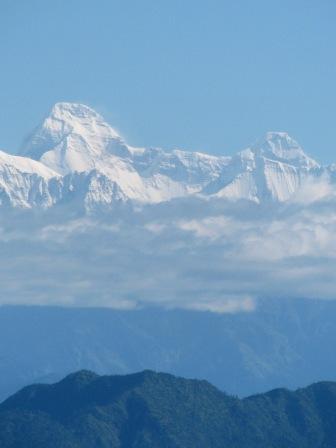
Among the peaks you see from Ranikhet is the 7816m-high Nanda Devi. Dwell on this mountain scenery awhile; you would agree with the observations recorded in the book on the view from far. Nanda Devi was and still remains, a tough peak to ascend, including the approach to the mountain, which took years for mountaineers to find. Some expeditions had as their highpoint, merely eliciting further progress on the approach while the mountain beyond stayed untrammelled. It was unexplored terrain. In fact, a major change since Tilman’s days is that following complaints of environmental damage by successive mountaineering expeditions and growing appreciation for the fragile ecology of the Nanda Devi Sanctuary, the mountain was closed to climbing expeditions.

The onward road Tilman’s expedition took from Ranikhet, was via ` Garul,’ likely modern day Garud; from there to Gwaldam, then over the Kuari Pass to Joshimath and eventually the village of Lata.

Nanda Devi, as seen from Ranikhet (Photo by Shyam G Menon)

Nanda Devi, as seen from Ranikhet (Photo: Shyam G Menon)

About the mountain’s summit, gained several weeks later, Tilman wrote:

“ The summit is not the exiguous and precarious spot that usually graces the top of so many Himalayan peaks, but a solid snow ridge nearly two hundred yards long and twenty yards broad. It is seldom that conditions on top of a high peak allow the climber the time or the opportunity to savour the immediate fruits of victory. Too often, when having first carefully probed the snow to make sure he is not standing on a cornice, the climber straightens up preparatory to savouring the situation to the full, he is met by a perishing wind and the interesting view of a cloud at close quarters, and with a muttered imprecation turns in his tracks and begins the descent. Far otherwise was now. There were no cornices to worry about and room to unrope and walk about. The air was still, the sun shone, and the view was good if not so extensive as we had hoped. Odell had brought a thermometer and no doubt sighed for the hypsometer. From it we found that the air temperature was 20 degrees F, but in the absence of wind we could bask gratefully in the friendly rays of our late enemy the sun. It was difficult to realise that we were actually standing on the same peak which we had viewed two months ago from Ranikhet, and which had then appeared incredibly remote and inaccessible and it gave us a curious feeling of exaltation to know that we were above every peak within hundreds of miles on either hand.’’

After gaining the summit, the expedition crossed over to Martoli near Milam and reached Kapkote via Tejam.

Tilman’s remarks on Bageshwar probably reflected the times.

“ Bageshwar is not the prosperous market town that it once was when its traders acted as middlemen between the Bhotias and the plainsmen. Now the Bhotias deal directly with the banias of Haldwani, Tanakpur and Ramnagar at the foot of the hills. The bazaar consists of solid well-built houses with shops on the ground floor, but it was sad to see so many of these shut up.’’

Anyone visiting today’s Bageshwar would find this surprising for the town is clearly the biggest commercial settlement between Almora and Pindari or Milam. One reason for this change could be the cessation of the old Indo-Tibet trade along the high passes of the Kumaun Himalaya, which dimmed the stature of mountain settlements like Munsiyari and made bigger, the names of towns closer to the bustling plains.    

My affection for Tilman’s world stems from the fact that increasingly I dislike competition. It is not that his generation didn’t compete. They did. What else was the race to the North Pole, the South Pole and that Third Pole – Everest – all about? Tilman himself uses words like `victory.’ But I live enduring its legacy multiplied by population and market. In a million ways, thanks to our rising tide of people and the need to survive, practically everything around has got tainted by the competitive spirit. This is the day and time of the branded warrior when the quest is to somehow brand one’s individual life for visibility in the crowd. Even harmless day to day conversation betrays the words, defences and posturing of competition. Years ago, learning about Darwin’s theory – survival of the fittest – was engaging inquiry about world. Now quoted by every Tom, Dick and Harry in and out of context, you switch off the moment somebody mentions it and its grandfather – competition. It is a widespread schizophrenia. Tilman’s ilk, what you call explorers, could walk in the Himalaya doing just that – exploring. They may have sought personal embellishment. But the grandeur of the Himalaya and its vastness was intact, for human beings were fewer than today. The media, which magnifies human life, prioritises it by achievement and implants it in our brain, was also far less. Achievement wasn’t yet an industry. With that, life was probably still life and nature ruled larger than human life. Compulsive competition has since killed fascination save of course, fascination for the self and promoting the self.

Seeking refuge in bygone eras is escaping the harsh present for what one assumes was a less harsh past.

I admit it.

I was hiding in that library.

I find it liberating to read about exploration in the early age of conquest and not conquest in times of exploration lost.

Photographing Tilman’s book in the gear issue room, I had to conclude that my efforts were a pathetic compromise. This book deserved to be on snow, ideally on that high ridge above the Kafni stream and near the peak of Salgwar (that’s a ridge providing good memories of friends and NOLS courses I have been out with), from where on a clear day, alongside other Himalayan giants, two sheer rock faces crowned by snow and joined by a knife edge ridge, can be seen over the tops of lesser mountains. That’s Nanda Devi and I clearly remember how that sight from the high ridge, one early morning, had emerged the most memorable experience for at least one NOLS student from the spring 2012 Himalayan Backpacking course. Snow on the ground, Nanda Devi in the backdrop – that would have been perfect for Tilman’s book.

But I was in Ranikhet.

The snow was yet far. 

(The author, Shyam G Menon, is a freelance journalist based in Mumbai. This article was originally written when he was the fall season intern at NOLS India in 2012. It was published on the NOLS India Facebook Page. It has since been rewritten for this blog.)

SIGNALS

It was past ten at night.

Our camp had found a strange peace.

It was trifle cold, windy and in the moonlit night, the tents occupied by the students stood like chunks of grey against the darker backdrop of the hillside. Life is never quiet when teenagers are around. We knew for a fact that the peace was deceptive. Over time the whispered activity inside the tents died down. There were a few last minute rustles as huddles on the sly broke up and people stole back under presumed cover, back to their allotted tents.

It looked like sleep had set in.

A couple of instructors walked past the tents to make sure.

That was when I noticed a small square screen, all lit up and working in stealth mode. Cell phones were not allowed at camp, except with instructors for use in an emergency. They were deemed an intrusion from the urban world interfering with the students’ outdoor experience. It wasn’t hard to figure out the culprit for we had been playing host to three boys desperately seeking return to city life. One of them had valid reason – he seemed to be physically weak; another who was his friend had managed to acquire a weak look that hung unconvincingly on his robust self. The third being neither close friend to the genuinely weak nor capable of feigning weakness for long had become a bag of tricks ranging from sickly appearance to assertive arrogance. He was all itchy to escape back to a world of pizzas and French fries and furious that none of his games were succeeding. Using the phone he had smuggled in, he messaged his mother.

Couple of days later, a man from the city bearing a letter from the camp organizers, arrived to take away the other two boys.

“ What about me?’’ the desperado angrily asked.

I put him on to my senior, the camp chief. He had been firmly told by the boy’s mother on receipt of those nightly text messages that her son required to stay put in wilderness and burn some flab. That was it. The young man had to pack himself off on a multi day trek like everyone else. At one point on the trail, so the accompanying instructor later told me, the boy had threatened to call his rich businessman father.

“ He will send his helicopter,’’ he declared.

“ Fine, tell him,’’ the instructor said.

Slowly the boy noticed where he was – the mountainside, the rock faces, the forest – and realized it was hopeless. Having hiked reluctantly and dreaming of dad’s helicopter, he couldn’t even articulate where he was. How would he then give the co-ordinates for a chopper to land? On the one hand that shut him up. On the other hand, I hope it was an invitation to learn.

He was quiet for the rest of the hike.

??????????????????????????????? The first time my phone calls home got challenged was when I went for my mountaineering course.

The institute had one phone booth from where you could call after training hours. However ten days or so into the program the time came to pack up for training at high altitude and that meant saying goodbye to the phone. All of us in the batch, lined up to make a last call home. Next morning, we pushed off for that glacier by now well known to hundreds of people – Dokriani Bamak.

I don’t quite recall how being away from a phone was but I am certain it focused my attention on the work at hand. It also made me see the people in my batch for like it or not, that was my world for the ensuing weeks. I was happy to reconnect with my people, on return. I went back to Mumbai, fumed over the average grade I got for the mountaineering course and lost myself in newspaper work.

In about a year’s time, my first mountaineering expedition cropped up.

It was a happy, enjoyable experience for notwithstanding the reverses we suffered subsequently on the Barani Glacier it was a fun team. On that 2002 trip to Zanskar, for most matters concerned, Manali was the place for the last phone call home. Slipping in one more call from Keylong would have been tempting but the group was enjoying itself so thoroughly that at least I was not in a mood to look back and linger. I wanted to look ahead. I also wanted to emulate the other climbers who seemed to get better and happier as we disappeared into the mountains. We stopped for tea at Keylong. I kept my urge to call under check. Later, there was a sign board announcing a public phone at Jispa that flashed by. Then I entered radio silence for almost a month. It must have been trying for my people at home. I never asked them. It is pointless to ask and waver for being in the mountains is a conscious decision and once made, the terms are not yours. Nature decides your life.

That trip, particularly the point when we crossed Keylong, was the moment I really learnt to look away from home. I was well into my thirties then. Maybe that boy with a father who had a helicopter fared better, for he was denied signals earlier. But there was a difference in the way in which we were both challenged. I belong to a generation that saw the cell phone enter India. When I did my mountaineering course and went on my first expedition, phone for me, was always a land line. That boy was born into a cell phone wielding culture.

On return to Mumbai from my first expedition, I sank into the daily rat race of being a journalist.

I also bought the device which would soon become part of the human anatomy – the cell phone. I worked it furiously. I had to; journalism was such. By the time of my second mountaineering expedition in 2004, I knew fully what to expect in terms of radio silence. However, weaning me off the phone was a tougher exercise for two reasons – I had grown used to the cell phone and the team was faintly less enjoyable than the first, prompting reluctance to part with the familiar. I said my usual goodbyes at Manali but a missed call that washed up on my cell phone atop Rohtang Pass suddenly made Keylong critical. For proper closure to the matter, I took time off to call a couple of numbers from Keylong, irritating my team mates. Then that old radio silence set in and the geography of Zanskar surrounded me like an impregnable fortress. One month later, at the first return of cell phone signals on the southern slopes of Rohtang, I excitedly dispatched a text message of successful expedition. I had climbed my first peak in the Himalaya.

For years thereafter, the reply of congratulations I got was preserved in my phone.

By the time I reached the Tons Valley on work, I was at home with switched off phones, even seeing the attraction in keeping them switched off for it kept a different world at bay. The comfort in this silence was not wholly an outcome of extended visits to the Himalaya. It had been gathered in small doses in the Sahyadri, for in those days of comparatively early mobile telephony in the country even a day at the climbing crags or a hike of few days away from Mumbai entailed radio silence. Cell phone towers in rural areas and certainly towers in remote mountain villages were a rarity.

All this has changed.

On one commercial trek in the Himalaya, where one of our clients had to make an early exit and we needed to position a car suitably on the closest accessible road, we navigated ourselves to a ridge facing a small village with a tower and bingo! – We had a travel agent at the other end of the line. Nothing had physically changed around us to facilitate that conversation. It was remoteness, snow capped mountains some miles away, a tiny settlement with a lone telecom tower way below – I may hate those gadgets in the hands of students coming to experience the outdoors, but I sure don’t grudge the technology.

Convenience however has other sides.

On the trail to Pindari Glacier in the Kumaon Himalaya, WLL phones had made it as far as the village of Khati (this was some years ago; now cell phones work in Khati). We were on an expedition to attempt a peak called Baljuri. The phone at Khati’s Jai Nanda restaurant appeared attractive opportunity to call home. The phone call faithfully went through save for one major problem; nothing you said could be heard at the other end. As we kept shouting to each other my mother luckily resorted to the best option possible. Realizing that I deserved a peaceful trip with a head cool enough for the mountains, she said loud and clear, “ there is nothing to worry. We are alright.’’

Two months later I passed through Khati for a trek toward the Kafni Glacier and across the Kafni River.

The phone at Jai Nanda was working properly but it authored the following story.

???????????????????????????????

Bhagwat Singh succumbed to Khati’s phone.

It was nearing late November; my second visit to the village in as many months. We planned to veer off from the main Pindari trail towards the Kafni glacier, wade across the Kafni River and use contour maps to navigate a route over high ridges to the village of Gogina. Third day, late evening, our soft spoken guide gazed anxiously at the sky and generally hung about camp bursting to say something. Finally Bhagwat Singh found his voice, “ I must go home sir. I called up my village and got news that my wife is sick. She has toothache. I will be back early tomorrow.’’

We let him go, not exactly expecting to see him again.

But he returned as promised.

The wife had been treated by the local sorcerer.

In our minds that loomed worse than toothache but Bhagwat Singh stayed confident of recovery through “mantravaad.’’

We took off for wilderness and the biting cold of winter at altitude.

As we proceeded, matching contour line to actual ridge, it became clear that our guide was well versed with terrain, ably stitching up segments on the map using shepherds’ trails. Crucially, he also knew where streams froze last, something vital for winter treks and camps melting snow for water. The crux portion of our route – a feature resembling a high pass – seemed unwise to attempt at close quarters. So at 14,000ft, we postponed that for early summer, altered course and reached Jhuni, Bhagwat Singh’s village.

It was a week since Khati.

Dinner was at Bhagwat Singh’s house. That was when we noticed the wound on his wife’s jaw. It was deep, seemed to go right through to her mouth. Even though I suspected it was externally inflicted, a quack’s remedy for toothache, I was assured the disease had drilled its way out. We started her on a course of antibiotics and cautioned the family as best as we could that a wound to the face was not to be trivialized. Bhagwat Singh must take her to a doctor, which he had many days ago but with neither follow-up nor appreciation for the emergent gravity. The next day at the village festival to Nanda Devi, I came across a man with similar wound, albeit healing. Amidst oracles and dancers in trance, he insisted that the infection had been inside-out. Jhuni’s only doctor seemed the mysterious sorcerer. When his magic failed, the patient was carried in a chair to the primary health center at Supi. “ There is no guarantee that a doctor would be there,’’ Amar Singh, the village pradhan said.

When we walked the route, it took us at least two hours to reach Supi, a good part of that being steep terrain. And what do you do if the doctor is missing? Well, you continue carrying the patient towards wherever the road to hospitals, start. Technically, that road touches Supi but since the last rains and its accompanying landslides, the road lay ruined, as if it wasn’t ever used. Initially, it appeared a case of neglect with small to medium sized boulders and swathes of gray earth as reminder for nature’s fury. Then we encountered portions resembling a moraine, where the climb over boulders went as high as five or six feet. While we explored the unsure road, a group of women wisely followed the mules’ path in the scrub forest above.

It was more than three hours since leaving Jhuni. The sun was now blazing. On clear days in the mountains it is a harsh orb of light, not so much heat. At its heaviest, my rucksack wouldn’t weigh as much as a human being. Imagine carrying a patient this far, for that long. The walk along the blocked road towards its motorable part, continued for another hour. Finally from a thousand feet up, we saw the settlement of Munar, a winding road and two parked jeeps. Needless to say, the descent along the short-cut trail would make any of our regular doctors plotting America and Europe in the head, take flight. Hopefully at Munar, the patient gets a jeep or an ambulance for onward travel to the town of Bageshwar.

No wonder that sorcerer finds business in Jhuni. At Munar as we bid goodbye to Bhagwat Singh, I reminded him to take his wife to the doctor at Bageshwar.

I hope he did.
 In my wilderness experience, there were two instances of bizarre phone calls made.

It wasn’t so much the content of the call as the way you made it that made them bizarre. One of them was at an outdoor camp at Nilshi near Pune. The time I was there cell phone connectivity was vaguely defined bursts of energy that manifested randomly at some corners of the campus and more predictably at one edge of the local water tower. On the ground it was common to find people in frozen postures hurriedly talking on the phone, snapping up a conversation in the seconds between one fidgeting of the body and the next for a millimeter change in body position seemed to alter Mumbai to Madrid on the cell phone map. And when the body held perfectly still, something as diffuse in form as a gentle breeze seemed to blow the signals off track. That’s utterly unscientific but such was room for imagination given the vagaries around. People joked that the signal blew away in the wind!

Then somebody remarked that a point higher up would be better option. That search took us atop the local water tower via a steel ladder on the side. There the signal blessed us with its presence but to avail the blessing you had to stand straight on the edge of the tank, rest your shin bone on the tubular railing and lean forward a bit like Kate Winslet and Leonardo DiCaprio in `Titanic.’ In that position with eyes locked on the dusty horizon and not glimpsing the ground far below, we talked business with head office. Looking at the horizon was required, for despite all my climbing, vertigo and I can occasionally be as close as shadows. So it was quite a challenge to my head standing up that way without climbing’s grammar of three-point contact for comfort. To climb safe, you should have a stance that allows you perch on rock with two hands and one leg or one hand and two legs, leaving one limb free to make the next move. On the edge of the water tank I was standing on, there was nothing for the hands to hold and only a tubular railing barely touching shin between you and Icarus reborn.

Even more bizarre had been a phone call to a taxi driver from a pinnacle called Telbaila. A few of us had arrived to climb this slightly remote rock structure that sat on a hot plateau about an hour and half from Lonavla. We had taken a bus – it plied that route twice a day or so – to come in. Returning in time was crucial for the next day was the day the Union Budget would be tabled in Parliament. As a financial journalist I had a lot of work to do while my climbing partner was then a dealer in the debt market, which like the stock market responds to the budget. A jeep driver in Lonavla had promised to come and pick us up at climb’s end. “ Give me a call,’’ he had said. There was however one problem. None of our cell phones was catching a signal either on the isolated plateau or the base of the pinnacle. There was only one thing to do – run an errand as we climbed. And so from the belay station at the end of the first pitch of the climb, some seventy feet up on rock and a few hundred feet up from the plateau, we tied in to our self anchors and studied our cell phones. They showed adequate connectivity.

We made the call to Lonavla.

Some hours later, an old, battered jeep arrived for the trip back to town.

By 2012, things would be even more different.

I was working with an outdoor backpacking course in Kumaon, when near the village of Sorag, a case for potential evacuation cropped up. The chief instructor required proper medical opinion to back his decision. In the ensuing hours, a conference call was patched through to his cell phone linking him on the field with the student’s father and their family physician.

We soon had a decision and, an evacuation.

(The author, Shyam G Menon, is a freelance journalist based in Mumbai. A portion of this article was published as an independent story in The Hindu Business Line newspaper.)         

A VILLAGE OF RIVER GUIDES

The river guides of Sirasu (Photo: Shyam G Menon)

The river guides of Sirasu (Photo: Shyam G Menon)

The many camps bordering the Ganga on the Rishikesh-Badrinath road form the unofficial capital of the river rafting industry in India.

This is where the tourism of staying in riverside camps and enjoying white water runs on a river, started in an organized fashion in the country, many years ago. In 2010, close to 35 camps dotted the 36 kilometre-long regularly rafted stretch of the river.  This length of river was considered to be one of the busiest worldwide in the rafting industry in terms of concentration at one spot. Both Indian and foreign river guides worked there. Two villages in the neighbourhood, Sirasu and Shivpuri, were said to have approximately 50 of their people working as trained river guides in these camps. Folks from Shivpuri were already guiding on the Ganga when Sirasu started its foray into the industry. However, Sirasu, a big village located half way up one of the hills bordering the Ganga, had the greater share of river guides – about 30.

Photographs of white water rafting and life in the armed forces dominated the living room of Satya Singh Rana’s house. The nearby shelf was stacked with prizes won for rafting. Now retired, he used to work at Indian Drugs & Pharmaceuticals Limited. His eldest son, Dhruv Naresh Rana became the first formally trained river guide from Sirasu; the younger one joined the National Security Guard. When Dhruv Naresh Rana (or simply Rana as he is known at the camps) decided to become a river guide around 1994-95, there were just 4-5 camps along the Ganga. He trained at the Indian Rafting Company, started by the late Avinash Kohli, who had been a pioneer in the sport. He spent three years at that outfit, then moved to a company called Wanderlust and in 2001 finally settled at Aquaterra, where the ethic of running various rivers and not just the Ganga, seemed to agree with his personality.

As Rana proved his competence, eventually participating in international competitions, others from Sirasu took to the profession. There were approximately 15 camps in operation along the Ganga, when Sanjay Singh Rana became the second person from Sirasu to be a river guide. By then river running had also found legitimacy as an occupation in the village predominantly given to farming, joining the army or looking for employment elsewhere. The third man to be a river guide from Sirasu was Jeetender Singh Rana who entered the field in 2003. His elder brother joined the army but a younger one became river guide eventually joining the same firm, where the first, second and third person from Sirasu into rafting, worked. 

Although thanks to its river guides Sirasu’s name got attached to white water rafting, its representation in camp ownership was yet tiny. In fact, that was all of one. Rajinder Singh Rana was studying in the ninth standard, when he chanced to witness the 1977 `Ocean to Sky’ jet boat expedition up the Ganga led by the late Sir Edmund Hillary. He even got to give the great man a piece of cool cucumber to eat. Since then river running had been on his mind. Years later, after a stint in the army, Rajinder got into partnership with a person from Shivpuri to start a small riverside camp. He was the only person at Sirasu to do so. Similarly, according to Dhruv Naresh Rana, despite 30 odd men engaged in river running, the village had only one woman – Sunitha Rana (now Chauhan) – who trained to be a river guide.    

The Rana surname was pretty common in Sirasu and according to Satya Singh Rana, they were originally from Rajasthan, moving this side a few hundred years ago. One small settlement above Sirasu was said to have the rather displaced name of Kota while another was pronounced “ Pulani,’’ reminiscent of Pilani.

Rana’s father chose to give the professional choice of his son and several others from the village, a spiritual twist. Like many people around, the Ganga for Satya Singh Rana was “ Gangamaa’’ and a son’s calling to guide on the river was most acceptable. It wasn’t just him. Others, like Jeetender’s father, also welcomed their sons’ choice of vocation. From Sirasu, one can see the Ganga below. On a fine day, any of its river guides would be visible to their families in the village as they guided clients down the foaming rapids and the fast moving swells. Youngsters in these parts had grown up diving into and swimming in the Ganga. That water was in their blood, which was perhaps why the sole worry Satya Singh Rana had, dealt with his son guiding on rivers elsewhere. “ Who knows how those rivers are?’’ he asked, much the same way a family would worry about a son travelling abroad for higher studies.  The cream of Sirasu’s river guides now guide on a range of Himalayan rivers, among them – Zanskar, Ganga, Tons, Alaknanda and Brahmaputra.

Much has changed in India since the time Dhruv Naresh Rana became Sirasu’s first river guide. In many sectors, Indians now work abroad. Bhupinder Singh Rana from Sirasu epitomized the emergent trend. Almost ten years after the village got its first river guide he started out on the Ganga with Himalayan River Runners in 2003, then worked at Himalayan Outback and in 2010 (when I visited Sirasu to do this story) was freelancing for Aquaterra besides working the summer overseas guiding on rivers in Norway and Uganda.

(The author, Shyam G Menon, is a freelance journalist based in Mumbai. This article appeared in The Hindu Business Line newspaper in January 2011.)


THE SHORT CUT

On Dhakoba (Photo by Siddhanath Sathe)

On Dhakoba (Photo: courtesy Siddhanath Sathe)

The moment the chairman said Everest and pointed to a man now standing few rows behind me, the dreary annual general meeting came alive in my mind.

Over time, a company AGM in Mumbai had come to mean a very boring experience. It was usually a parade of compliant shareholders. The eagerness to see their long held stocks multiplying in value somehow, rendered their arguments tame and awash in sycophancy. Beneath the praise they showered on management and the poetry they recited to indulge the board’s ego, you could sense that living, breathing love for wealth. Occasionally a shareholder or two, carried away by the luxury of microphone and audience, would transform into a two-minute business consultant and fling angry advice at the CEO and his team. That was fun for the media. I don’t know what the board thought of it.

With real news happening only when the company chairman spoke and that restricted typically to five minute-slots separated by a dozen shareholders speaking, it was the entertainment that kept journalists awake. We lay sunk in the auditorium seats like bodies in cryogenic preservation. Indeed some AGMs resembled inter-galactic flight. From their commencement to end through three dozen speeches, poetry and business advice, it took a couple of light years. Doodle dominated reporters’ notepads. Everest however brought me alive. The sycophants, the poets, the eulogists – all of them blurred out of focus in that massive hall. The only person in focus was Surendra Chavan, a company employee, who had reached the summit of the world’s highest peak in 1998.

Days later I interviewed him at his workplace – an automobile showroom full of spanking new vehicles in Worli.

That was the first time I heard of Dhakoba.

Chavan had climbed its high rock face in the years before his Everest ascent.

I left Chavan and the showroom to report on a successful expedition to Everest but what stuck in mind was that name with a ring to it – Dhakoba. Some hill names are quite personal; some get personal. If Ajoba in the Maharashtra Sahyadri meant `grandfather’ and seemed to convey something as approachable, Dhakoba sounded as though it would kick me out – dhak! I found it in the local guide book for trekking, impressively tall for a Sahyadri hill, a difficult hike along the regular trail with everybody cautioned to carry water as that was hard to come by. Some months later I got to see it. We – Satinder and I – were returning from an easy hike to a pinnacle-shaped hill called Gorakhgad. The road in front of the hill caught my attention. Probably it was courtesy the sheer relief of being in the outdoors and away from Mumbai’s teeming population – but I couldn’t help gazing in awe at this empty road which ran flat out on the plains and had one side totally walled up end-to-end by impressive hills. That’s how I first saw it in the distance, a sheer rock face lurking in the shadow – Dhakoba.

For some reason, none of my outings took me to Dhakoba although I was many times in the neighborhood, even seeing the hill again from far. Then one day, my club – Girivihar – announced a three day-trek to the 4148 ft high-Dhakoba and its neighbor, Durga Killa, I told my friends to count me in. A minor detail worried – I hadn’t trekked for some time. These people trek hard. They had already commenced the trekking season and wanted to go up by a demanding route, come down by an even more demanding route. Descents particularly are difficult. Pushed beyond a point would I succumb to its not-so-elegant versions? It would be hugely embarrassing if I slid down on my butt unable to handle the exposed heights or the granular scree that visits Sahyadri trails in the dry season. At the pre-hike meeting in Dadar’s Café Colony, they had a potential solution for it – something akin to the Karjat-Pune railway line where trains have engines at both ends. It was the club joke and the club solution for people panicking and crumpling on a trail. At that point in time, given my hiatus from trekking which had lasted some months, I was worried that I may end up a candidate for Karjat-Pune treatment.

A late October eight of us with heavy loads on our back, trekked up the Darya Ghat trail from Ishtyechiwadi to the shoulder of Dhakoba, next to the rock face Chavan had climbed. Somewhere on that huge expanse of rock plastered vertical to the ground, was the route he took. I was reminded of my cousin telling me of his visit to Yosemite in the US. The huge rock faces there are the stuff of legend in the history of rock climbing. Climbing comes in different styles and packages. Several nationalities have left their stamp on the sport, spinning their own unique obsessions. The first major US stamp on climbing, until then a largely European domain, came in the middle of the twentieth century with big wall climbing. The cradle for taking this climbing format to the heights it touched along with accompanying techniques was the Yosemite Valley.

The top prize in this vertical challenge was a towering rock face weathered by glacial action.

It was called El Capitan and stood 3000 ft high.

In the thick of the competition to be the first up new routes on the imposing cliff Warren Harding, a pioneer of American big wall climbing, proceeded to bolt a route that has since come to be called as The Nose. Drilled and fitted into the rock these metal aids and the equipment you could attach to them, helped you secure climbs otherwise denied on difficult, featureless surface.

While pitons were already in use in climbing, the expansion bolt went beyond mere placement on rock to adding a touch of technology. At the tip of every expansion bolt is a chip of alloy that expands to fill the space inside a hole that has been drilled in rock to accept the device. It positions itself in firmly. You can attach a rope ladder to a bolt, stand on it to fix the next bolt further up and keep proceeding thus or as more aesthetically inclined climbers do, use the bolt only for a patch that is too tough for other means of climbing. You can also rappel down a selected line of climb – in which case you are descending from the top of the cliff, having accessed the apex otherwise – examine the rock with climbing movements in mind and place bolts accordingly at the right places. Bolts have since come to stay in climbing. Alongside the debate on whether they erode the purity of a climb has refused to die.

Those days however, the debate was boiling hot.

Warren Harding was an iconoclast. He used bolts. Royal Robbins, Harding’s main competitor, was a purist who did not even like a removable piton being driven into rock. Books on the history of climbing describe how Harding and his team, climbing in an “expedition style’’ reminiscent of laying siege to the rock face, bolted their way up El Capitan’s Nose route to record its first ascent on November 12, 1958. They used 675 pitons and 125 expansion bolts to complete the task. Seven days later, Robbins and his friends repeated the climb using the same bolts.

The two climbers sharply etched the divide guarding their respective approaches in 1970, when Harding in a much publicized climb of El Capitan’s Dawn Wall resorted to heavy bolting again. This time around, Robbins while repeating the climb chopped off the bolts rendering them useless for climbing by others. He was that opposed to diluting the purity of a challenge. Some versions of the story say that he allowed the bolts higher up to remain in place for the grade of aid climbing was quite tough. Either way, bolted or otherwise, those Yosemite walls are formidable to the eyes of a novice like me looking it up in a book or on the Internet. El Capitan; El Cap as it is often called by climbers, has since become the benchmark for big wall climbing. A lot of practices that evolved in the valley found their way into mountaineering to tackle the challenge of climbing huge rock faces at altitude.

After that first ascent of the Nose, subsequent climbs up El Capitan and other similar faces in the Yosemite region have been measured in terms of style adopted, purity of climb and even the speed of ascent. What once took people several days to complete and even now takes two to three days to do, is polished off by super athletes within hours. They plan and rehearse their efficiency to perfection and then zip up the route. For most of us, used to inheriting the ground, all that fine tuning of erstwhile records set in vertical wilderness is meaningless. The climb itself is stunning. What my cousin saw was just that – high up on the rock wall, a couple of people patiently picking their way up in a vertical world of granite. Photos of El Capitan usually show granite that sports a pale cream color. It reminds you of the coat of a lion in its prime.

Dhakoba in contrast was a brooding black in color. Its rock was most likely volcanic in origin. The hill faintly peaked at the centre into a mild triangle. That was probably enough to qualify it for one of those popular names evoking a cobra’s hood – nagphani. Yet it was called Dhakoba and, its rock face was huge. In the local dialect, the word ` dhak’ meant cliff or hill and Dhakoba was the name of the presiding deity. Chavan said that his team had climbed the face alpine style in six days. Their route along the main rock wall made sure it exited at the peak’s highest point. Some bolting was resorted to. But the face was mostly free climbed in the traditional style using equipment that you removed as you climbed past each stage.

Our trail was a steady, stiff ascent especially with load on the back. From the shoulder Of Dhakoba you tackled an exposed rock patch to gain access to the hill’s upper plateau. Thus far so good, I thought. It hadn’t been as bad as I feared it may be. Night halts on these local treks were usually in a cave, fort or temple. There was a small temple waiting for us on this hike. But failing to locate it, we proceeded straight to Durga Killa. That ten hour-trek, brought us earlier than scheduled to our site of descent, the Khuntidar Ghat. Direct and simple, like the outstretched tongue of an angry Hindu goddess it slipped off Durga Killa’s edge into the void; a short cut. My friends were excited seeing it. I was reminded of Shelby Tucker’s book on his walk across Burma with the Kachin Independence Army. A short cut, he had noted in that fashion so characteristic of the English language, was what the Kachins called a difficult deviation from an easy gradient. In these hills, my friends from the club were like guerilla fighters on home turf they knew like the back of their palm. The more they knew it, the more was the perception that nothing could go wrong and so wilder became their choice of trail.

I wasn’t a senior citizen like Tucker but an affinity for melancholic reflection and backdrop as a journalist, gave me a mind that worked overtime with imagination. I nervously gazed at the trail, rather what was supposed to be the trail for descent. All I could see at the edge of the hill I was on was a little patch of flattened grass, the sort that betrays a spot where somebody fell or slid off and you later installed a plaque remembering the late so and so, who was a good person, great family man, wonderful husband, friend, philosopher and guide till he slipped on a tiny round stone here and went skidding off to the blessed next life. Coming to think of it, I haven’t seen such plaques in the Sahyadri but there are a few I know of in the Himalaya. Beyond where I stood was an airy amphitheatre of rock and space. It seemed more a place to base-jump with parachute or use as ski ramp to take off and kiss the sky goodbye, than walk down on two legs. I mean – where does the next step go? I walked up and down the edge of the precipice hoping to see a better spot for descent; there was none.

Illustration: Shyam G Menon

Illustration: Shyam G Menon

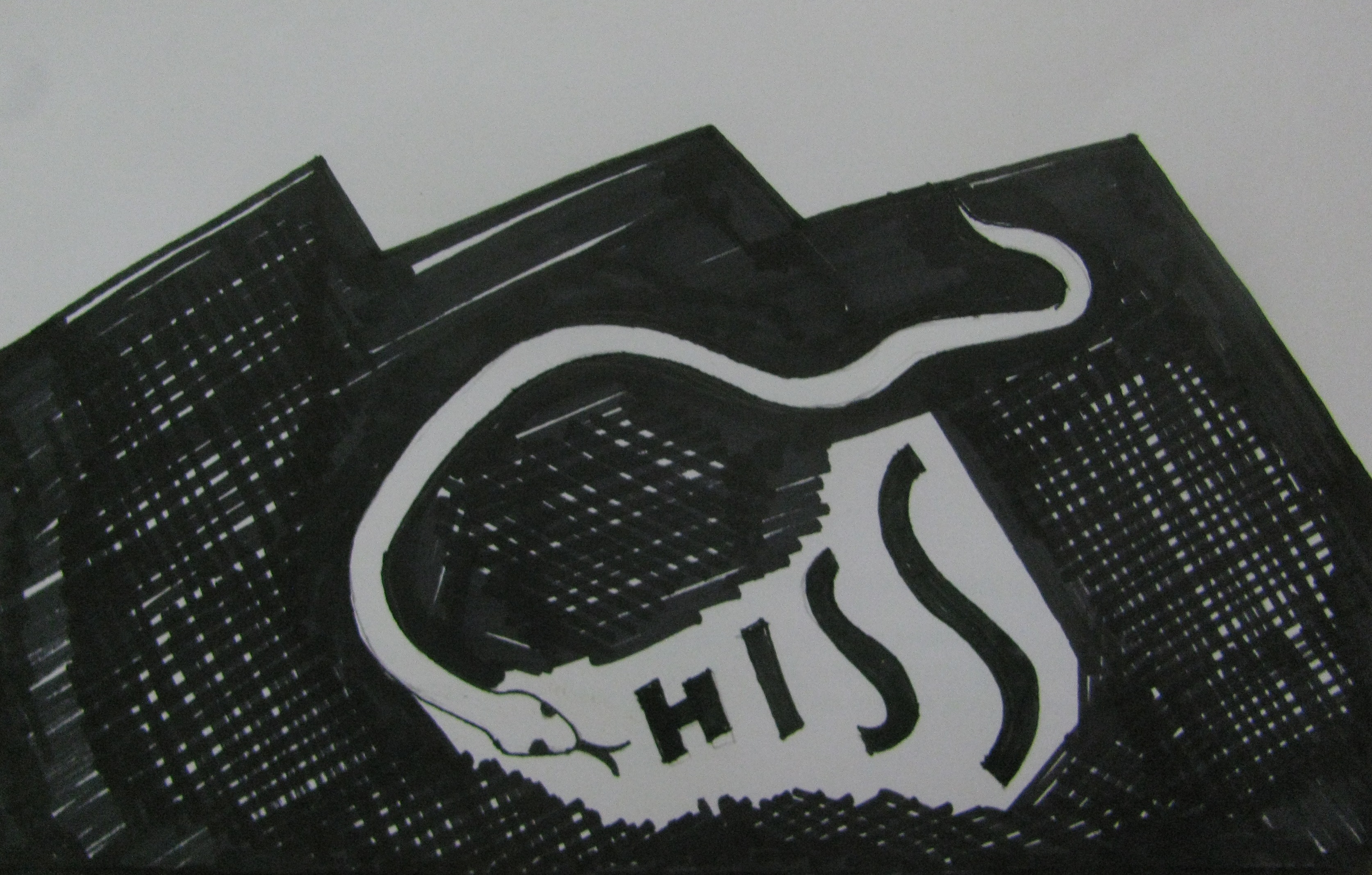
“ Tomorrow,’’ the trail hissed, studying me with anticipation.

An eagle soared blissfully in the void.

Lucky bird, it was at peace and enjoying the scary locale.

If only I had wings.

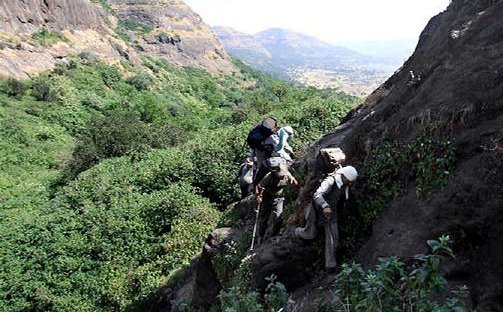
Hill trails are varying blends of the same constituents. The easy ones meander at leisure over gentle gradients; take a pinch of the occasional gully for a quick height gain, relapse to a thoughtful ridge and on the whole exhaust you within scope of revival. For a decent trekker, that’s a nice way to stretch one’s legs. The tougher trails dispense with gentle gradients and thoughtful ridges and head straight for a steep ridge or gully. They betray impatience and are naturally, unkind to novices. There are plenty of these stiff routes – stiff, is the right word – in the Sahyadri, Darya Ghat being one of them. No room for thought on these paths; you just sink into a rhythmic ascent in a world shrunk gully-size. God knows what urgency drives man to refine this paradigm, but the Khuntidar model was a shorter version of the gully-short cut. The trail, like a serpent slithering down from the top, made for a ridge below, bridging the gap between the top of the ridge and the top of the hill with zigzag lines on the rock wall. The relevant ridge from the Rampur side of Durga Killa rose to perhaps half the height of the rock wall. That serpent of a trail ruled the balance portion. How nice.

All hills on this Siddhagad-Nane Ghat stretch offer a panoramic view as they mark the plunge of the Desh plateau to the Konkan plain. Harish Kapadia’s guidebook had noted – Dhakoba’s wall dropped 1100 meters and that of nearby Jivdhan, 1000 meters. Durga Killa’s elevation was in between. I gazed at the void and imagined a perch on the rock wall. No, it wouldn’t be so tenuous, for most rock walls betray gentler gradients up close and no pathway would really court the vertical. This was a walk; a descent that bordered the realm of climbing. It was probably a similar, albeit graver, situation on UK’s Scafell that earned Samuel Taylor Coleridge the distinction of doing what the West considers, the first rock climb in August 1802. As with Asian amusement over the claim that the Himalaya was explored first by the Europeans, I suppose this claim around Coleridge raises eyebrows in the UK. But keep that aside for Robert Macfarlane’s book, ` Mountains of the Mind,’ which mentions this is a brilliant piece of writing. According to him, Coleridge’s ethic entailed picking a mountain; reaching its top and then instead of descending by the easy way down he would choose the first possible candidate for a route and follow it blindly. It was a gamble. Descents are hard and on Scafell, Coleridge ran into trouble. Eventually, he was forced to literally climb down. What a crazy character this man was, I thought, suddenly visualizing his predicament given where I stood. A tingle of vertigo ran down my spine. I drew back from the edge of the precipice and returned to the derelict building on Durga Killa that we had made our camp.

Early next morning we eased ourselves into the short cut. The trail was extremely narrow at start with the rock wall on one side and the airiness of the void on the other. As it descended, the narrowness remained but it avoided the absolute edge, hugging slightly better slopes hidden from above and equally unseen from afar. My hunch had been correct; they wouldn’t pass off a vertical climb as a trail. Probably that was the secret attraction in doing these delicate, tip toe hikes – they are like life itself, making you choke and suffer one minute, then greeting you with relief the next. In between, the trail was lost to a landslide, still unsettled. It was one of the trickiest slides I had seen, not so much for the slide per se but the little real estate around to arrest a slip. The hungry void was a mere fifty feet away. It reminded me of my careless finances with no investment done for comfortable retirement. No safety net. We moved Karjat-Pune style, out-of-form hikers in the middle, seasoned folks ahead and behind. Nothing lived, except the next step. Risk distraction and you rode scree off the hill. Compared to scree, the rock faces were safer to tread. They had man-made cuts and wooden pegs to hold while descending; hence the name Khuntidar Ghat, which indicates the use of those pegs.

A couple of youngsters appeared, they were villagers on their way up to Durga Killa and the settlement there. Barefoot and lightly loaded, they were on an enjoyable walk up the express way to their homes. I am sure at some other times they would as nonchalantly balance a load on their heads and patiently pick their way up the same path. I have seen that scene before – I would be holding my breath, hiking down heart in mouth over some precipitous scree slope selected by my wonderful friends when at this turn on the path would be a thin villager. Spindly legs, load on the head and chewing a blade of grass; he would stand to the trail’s edge and gaze at us curiously. Occasionally he would make an anxious sigh or two as I slipped on some rolling ball bearing of a stone; then he would chuckle in appreciation as I succeeded in temporarily arresting the slide. Next he would focus with a sort of what next-expression as I slowly, delicately unwound myself from that extremely awkward frozen position of balance to the next step on the hike. Tackling such trails was an art, in my case each move was a masterpiece in sculpture.

By the time the final ridge of Khuntidar Ghat ended my knees were jelly. For hours together, they had served as hinges for piston-legs. My friends looked very satisfied. The hike had been a smashing success. It bore every sign of that – the heart had been eaten alive in the mouth; the stomach was aflutter, the body had sweated buckets of sweat, the muscles were aching and them bones, it seemed amazing that there was something holding up the body after all. Around me, people smiled, exchanged grins. I was relieved to reach the village. At Rampur, all of us, villagers included, strained to read the route.  High on the rock face, like a suspended tear drop was the landslide we had crossed. But none could trace the full line of descent. A line drawn this way seemed as good as that way and there was plenty of rock face laughing at us to scribble as many lines as we wished.

The serpent had simply vanished.

(This trek was done some years ago. An abridged version of this article was published in The Hindu Business Line newspaper in December 2007. )

A FORGOTTEN STORY

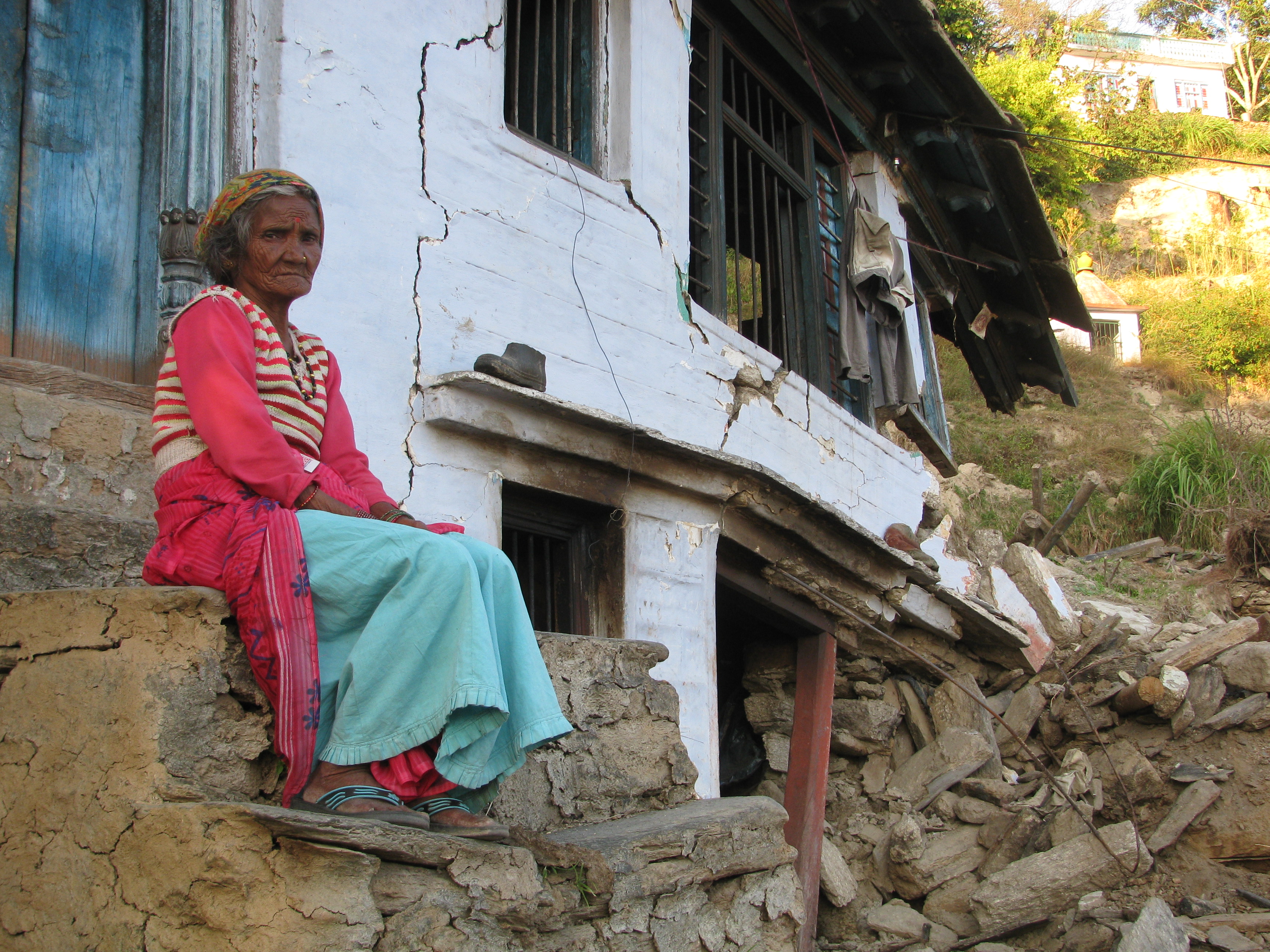
In 2010, I happened to reach Kumaon a month after heavy rains caused widespread damage in Almora and Bageshwar. I wrote a small article from that trip, hoping it would engage a newspaper or magazine to publish. None I contacted carried it. Reading about the 2013 tragedy in Kedarnath, Garhwal, triggered by heavy rains, I remembered this old article. In the age of climate change, maybe there is something to remember from it still:

 Morning of September 18, 2010.

It was raining heavily.

Dhanuli Devi stepped out to check on her neighbour.

Water had collected inside houses at Dewali in Uttarakhand.  The previous day, in another part of the village, continuous showers had brought water into the house of Kamla Khulia, the gram pradhan. Authorities were informed and the affected portion of the building vacated. Suddenly as Dhanuli Devi watched, her neighbour’s house and some more nearby were swept off in a gush of gooey mud. Also lost was half of her own house; what remained as of late October was a cracked structure with a gaping hole on one side and a large mudslide next to it that had killed ten people. While compensation had reached those who lost their houses, Dhanuli Devi, who has no family, was yet to get relief. Technically, her house was only damaged. “ She should get the money in the next round,’’ Kamla Khulia said.

Besides lives lost, Uttarakhand’s road infrastructure took a beating in the rains. Travelling from Mussourie to Champa, Uttarkasi, Rishikesh, Shivpuri, Nainital, Ranikhet, Almora and Munsiyari – the road had sections to be carefully tackled. There had been massive landslides leaving buildings on edge, parts of the road had sunk and fallen off or developed cracks. Small stones kept rolling down from the top as traffic negotiated repaired segments. The road from Khairna to Almora, used by trucks, was shut for long. When it opened, it was half a road in some places and delicately poised with the river Kosi flowing below. In September, the bloated Kosi either directly washed off kilometres of this road or ate the hillside from below causing the road above to collapse. Vehicles were spectacularly trapped on isolated fragments of still intact road. “ The rains must have set us back by at least eight years,’’ a senior government official said. 

Dhanuli Devi in 2010 (Photo: Shyam G Menon)

Dhanuli Devi in 2010 (Photo: Shyam G Menon)

Some 200 people died in Uttarakhand, in the monsoon of 2010.

It was worst at Almora, where besides Dewali, there had been similar landslide and death at Balta. There were 44 monsoon related deaths in Almora district; 38 of that on September 18. Official figures say 323 houses were totally damaged; 3099, partially. In the wake of calamity, 178 relief camps were opened accommodating 4015 persons. The damage to Almora was billed at Rs 723.10 crore. It included both loss and what it would take to rebuild. On September 22, the Centre gave Rs 500 crore as interim assistance to Uttarakhand. Late October 2010, the Almora administration had received only Rs 40 crore for relief work. It may have changed since. On November 18, media reports said the Uttarakhand government had disbursed Rs 372 crore. It expected the balance to be exhausted in another month and wanted the Centre to expedite the relief package it had demanded.

Ironically in the recent past, Almora had been in the news for depleting rain and falling water levels. It was feared that the ground water fed-Kosi, which originates in the region, may soon dry off. Last monsoon, the Kosi was anything but that. The local office of the National Informatics Centre (NIC) had data for September 2010. To start with, from June 1 to September 23, Almora got 1263.4mm of rainfall as opposed to the normal 854.7mm. Within that it was: June – 78.2mm, July – 359.4mm, August – 292.2mm and September – 507.6mm. If you go years back to 1962, then the spread of rainfall is even: June – 302.51mm, July – 321.56mm, August – 321.82mm and September – 321.82mm. Take September alone: 1970 – 436.1mm, 1994 – 467.4mm, 2010 – 507.6mm. Now sample 2010 rainfall deficiency (or in this case, excess): June 1 to August 31 – +8 %, June 1 to September 23 – +48%, September 1 to September 23 – +275%.  The figures highlight two trends – a progressively uneven rainfall and shift in heaviest rainfall to September. Of the 507.6mm received in September 2010, 177.4mm happened on September 18. Four days – September 16, 17, 18 and 19 – were days of heavy rain.

Although September 18 was widely reported as “ cloudburst,’’ Prof J.S. Rawat of the Department of Geography, Kumaon University, said, “ it was an unprecedented long spell of unusually heavy rain.’’ The rain filled up the region’s underground aquifers causing external overflow. When land saturates, sub-surface flows also happen. Both Dhanuli Devi and Kamla Khulia said the muddy water that carried away homes and families at Dewali had erupted from the ground. Technically, the calamity at Dewali and Balta was called `slumping.’ However the rainfall of 2010 was yet considered an aberration in the otherwise declining average annual rainfall and water levels of the Almora region. The key to this paradox, it would seem, is the intensity of rainfall. In a healthy ecosystem, the natural rate of ground water recharge for these parts of the Himalaya is said to be 31 per cent. Against this, the Kosi area has a recharge rate of 12 per cent; in Almora town, it is two per cent. Senior residents, including Prof Rawat, remember a phenomenon called `satjhar’ that used to be there years ago. It featured a week-long spell of low intensity rain, which was the best way to recharge ground water. That’s why the intense rain of September and the deluge of September 18 mean nothing, except continued worry.

According to Prof Rawat there is a need to study how these trends affect Almora, which is in Seismic Zone 4. The professor maintained that many of the buildings that collapsed in the rain or were severely damaged had been new ones built on “ superficial deposition.’’ Result – water gets below the foundation. “ We don’t have a Master Plan yet that tells which areas to build on and which, to avoid,’’ he said.

Uttarakhand is a state trapped in mythology and natural beauty. The Himalaya made it scenic. It became the backdrop of epic, folklore and fairy tales. People flock there in large numbers. They seek God and a sense of space their own numbers have denied them in the plains little understanding that their moving en masse in a different direction, merely carries the lack of space also over. A young mountain chain like the Himalaya will be restless and its sides far less settled than the terrain through which roads and highways have been built elsewhere. Mix this with climate change’s ability for catastrophic weather – the consequences are a handful to deal with even under normal conditions with only the local people to take care of, leave alone the thousands who invade from the outside. In the media, Uttarakhand’s tragedies unfold in predictable fashion typically with shrill emotional note struck by focusing on what is happening to places of worship. It works as spellbinding visual on television for some people. It did in 2010 with much hysteria whipped up around a temple on the banks of the Kosi. It did again in 2013, which was anyway all about pilgrimage. On the ground too, people are quick to highlight to the reporter what happened to a place of worship even as their own lives are in tatters. 

In Uttarakhand, I suspect, this dovetails neatly into an existing tradition of staying mythological for the rest of India. Such perspective obfuscates the real story, which is one of geology, geography, human presence, rising population, climate change and the impact of economic growth featuring construction projects and such. This – especially business and projects – would be brought to sharp focus as the tragedy of 2013 got analyzed. Reports appeared of ill advised construction and ones that may have obstructed the natural flow of rivers – not much different in principle, from what Prof Rawat mentioned in a different context about lacking a Master Plan. Not to mention, detailed studies of rainfall pattern in the age of climate change and what that holds for pilgrimage seasons established by the realities of bygone eras. It is absurd to expect 2013 to be the same as a year from millennia ago.

In Dewali I remember asking Dhanuli Devi where she would go. She indicated a relative down by the road she could seek shelter with for the time being. But otherwise; she just looked into the distance, tears welling up in her eyes.

(The author, Shyam G Menon, is a freelance journalist based in Mumbai. This article was modified towards the end to tie into the developments of 2013.)        


KATPUDIA

The best thing about some places is its insignificance.

Stop there and time stops with you.

That merciless inner clock doesn’t know why you stopped or how long you will be there. A whiff of worry seizes you, both place and pace being unfamiliar. Then, like fumes from an unseen opiate, the slow times take possession of your mind. You surrender to the world you fell into. The door shut on distant Mumbai; there was nobody to go back to in Ranikhet, Almora was a co-ordinate 30 kilometers away and Sitlakhet, if the jeep turned up, was a potentially reachable destination.

What was immediate and around was Katpudia. I put my rucksack on the bench in front of a grocery shop, gazed back at the faces studying my presence and pretended to be at home. It was a T-junction; once in a while a vehicle appeared on the Ranikhet-Almora road, the one towards Sitlakhet, where I was headed, remained empty. A dozen shops, three to four jeeps and a temple to the side of the junction. Praveen, who had just come off work at the children’s camp in Sitlakhet, appeared at the grocery shop. He emerged from inside, even sold a few things and put money in the cash box, but did not own the place. “ I stay down there, ‘’ he said, pointing to the shop’s rear and a gully beyond. A dark, heavy doorway framed the sunny descent. I couldn’t see a house, so like he said it must be “ down there.’’ In the hills, distance and location are always approximate. The shop owner came; he had a squint, one weak arm and a limp. He loved his Philips radio. Praveen vacated the shop and hung around near me. “ You must be headed for the camp. That’s the jeep but it won’t move for another couple of hours,’’ he said pointing to the taxi, battered and rooted inactive to the ground as Katpudia was to its laid back ways. His slit eyes kept darting from me to the lonely junction and back; a young James Coburn, tall for his age with a face that held much yet gave off little. For a second, I thought of `Magnificent Seven.’

Katpudia had cell phone connectivity. I messaged a friend in Mumbai, “ am in Katpudia.’’ Wonder what she would make of it – people travel to Alaska and Mongolia; I was in Katpudia. Katpudia what? Katpudia where? In today’s competitive environment, even time spent away from ` work’ has to stand out; grab attention, trigger conversation. “ On this expedition to Everest’’ or “ at this café in Casablanca’’ sound more impressive than “ I was sitting on this bench in Katpudia.’’

Anyway who cares?

Deep down, I was beginning to enjoy my time away from the world. And this lonely junction, very un-exotic and so plain Jane as a place, the sort you would never find in travel brochures, embodied that personal revolt. Slam the door shut on the times and choose instead your own time zone. The shop next to me had done precisely that! It was old, worn out and had wooden shelves stacked with notebooks. Hill shops usually stock a variety of goods, the market being too small for specialization. In the digital age, this shop stood out defiantly, stocking mainly one thing and of all things – notebooks. One shelf also held a clutch of Hindi publications – there was the `Uttaranchal Jnaan Rashmi’ with Subhash Chandra Bose on the cover – another, bottles of `Master’ writing ink. There was nobody in the shop. I was the only one around jotting down things in a small diary. So, who does the shop stock all those notebooks and inks for? Two school kids appeared at the junction clad in navy blue trouser and blue shirt. May be if you comb the sprawling hillside you would find their friends and thereby the shop’s mysterious clientele.

People travel to Alaska and Mongolia; I was in Katpudia. Katpudia what? Katpudia where? In today’s competitive environment, even time spent away from ` work’ has to stand out; grab attention, trigger conversation.

In the quietness of Katpudia, David Niven’s cough rang out loud and clear; down to the last droplet of crackling sputum. He was locally called “ Sethji,’’ resembled the Hollywood actor every bit, appeared at the junction to keep a tin bucket under the public tap and promptly forgot about it. The conversation at his smoky café was more absorbing. The grocery shop owner kept calling “ Sethji, Sethji,’’ as the bucket overflowed but with Sethji busy entertaining his customers, limped across himself to close the tap. A pressure cooker hissed angrily at one of the dhaabas; the cook calmed it and continued talking to Praveen standing on the road. The youngster was restless; he wanted to revive his attempts to work in Delhi. He had been there once, found it too hot. That itchy, restlessness likely explained his arbitrary excursions around the junction, into one shop and the next. Tie a ball of thread to his legs and you could weave a cobweb from one doorstep to the other. Suddenly Praveen got into a parked jeep, fiddled with the controls, ran his hands along the steering and momentarily lapsed into a childhood that he had just left. A middle aged woman and her son, both of them bound for Sitlakhet, watched Praveen’s antics patiently, hopefully. Was he the chosen one to resurrect that dead vehicle?

From afar, Praveen points to the jeep, lightning streaks from his index finger and the engine roars to life. The old vehicle finds a surge of youth it hadn’t imagined in its wildest dreams, lurked within. All of us Sitlakhet-bound bow in respect to The Chosen One.

Nice dream.  

The first time I was in Katpudia was probably a year before this rumination on the shop bench. That time, I hadn’t quite noticed the place. As it happens on all first visits you are more aware of an eventual destination, not the smaller details passing you by on the way. It is a tad like life. You begin to notice life through compulsion, when you have made a chore of everything and are desperately seeking enjoyable details to breathe life into the chore. That first time at the children’s camp had been a training session to sensitize potential outdoor educators to the world of young students. I was petrified. That became pure terror when Ravi who was a trainer started acting weird, flapping his arms around like a turkey flapping it’s wings and walking hesitantly like one including neck movements et al. Right through the camp and the many sessions later to loosen up our stiff attitude, I kept reflecting on the contrast between the serious news bureau I was coming from and these turkey rituals I was engaged in. Okay, I resigned my journalist job and was trying to be an outdoor educator on the side. But climbing and mountaineering were also serious stuff with graded routes and judgments on performance to fear – that’s the Indian way. What has turkey got to do with it? I could visualize my climber friends turning their backs on me and returning their attention to what mattered – difficult rock. Some may even laugh. Yet it puzzled for Ravi was a fine climber and mountaineer. So if he could loosen up and others like him assembled there could follow suit, why not I?  And somewhere, somehow that turkey was also beginning to beckon like a climb; like a route not attempted yet.

This was change unknown.

I began flapping my arms and clucking like a turkey.

My trainers must have eventually felt I was worth taking a chance with, for a couple of months after this camp I got a call to report for work in the field. I barely survived that outing with a bunch of high school students. But after a few more camps, I seemed to find adequate rhythm to at least ensure personal survival and well, even enjoy the educator bit.

A rustle nearby returned me to Katpudia.

The owner of the notebook shop! He was old, as weathered as the wooden shelves; yet strangely for a man in the service of writing, betraying impatience. He lit a beedie, took stock of his sleeping business and strode out to join the laughter at Sethji’s café. Owner gone, the shop returned to its old self. So much like life – you, at times others, perceive a vacuum. And when you finally fill it, the picture of completion is all too fleeting. Which one are you – that moment of completion or the eternal vacuum?

Almost two years later, I would see another shop – as bleak in ambience and even lonelier in location – at Song, from where you start the trek to Pindari Glacier. It however had an owner who sat inside enjoying the local gossip, drumming his fingers, occasionally poking his head out from the shop for a glimpse of the antics at the adjacent tea shop. It was tea on the board outside; a heady brew inside, heady enough for patrons to swear eternal loyalty and undying friendship through this life and the next. I peered into the book shop. It was more modern than Katpudia’s, the shelves were steel racks stacked liberally with notebooks and writing material. There were pens of a dozen variety, pencil sharpners, erasers, glue sticks, high-lighters, and instrument boxes. I concluded without asking the owner that the clientele had to be the area’s school children. But it was clearly scant clientele for at past five in the evening the owner nonchalantly closed shop and started his trek home.

It had reminded me of Katpudia. 

More than two hours after I came to the junction, a flicker of life graced the jeep assigned for Sitlakhet. Eventually it filled up; the driver put his finishing touch squeezing the thirteenth person in and we were off. Not exactly, for we made the first of our several stops to discuss the world, just fifty meters away. Katpudia’s gravitational pull was strong. It would take a very determined driver or a bunch of grossly irritated commuters to make this shuttle break free. We were anything but that.  We loaded chicken mesh from a hardware store, stopped frequently for gossip, unloaded kerosene drums, craned our heads to look at “ Suresh’s new wife,’’ greeted a sarpanch and reached Sitlakhet an hour before darkness. As I bought some `bal-mithai’ at the local sweet shop, the owner realizing I was from Mumbai said, “ whenever the weather is good here, we say Mumbai is happening.’’ Content, he gave me a broad smile. The next three days we had bad weather. I was happy for it. I was happy to be at a little known dot on the map.

This was several years ago.

In the winter of 2012, I was back on a bench in Katpudia.

This time I was at the dhaba where the pressure cooker had hissed. I was cycling from Ranikhet to Sitlakhet and back. Katpudia was where you turned off the road to Almora and made for Sitlkahet. That section featured a stiff ascent for the first quarter or so. I thought I will rest a while before tackling it. I had tea and snacks, filled up my water bottle and headed off. When I reached Sitlakhet, I found that I could recognize some shops but there were several that seemed new. Or maybe, like my first trip to Katpudia, I hadn’t adequately noticed Sitlakhet on my earlier visits. In the hills, having tea is a nice way of taking in place and people. I settled down to that ritual; picked up a conversation with others at the shop. A few hours later, on the way back to Ranikhet, I stopped at the dhaba in Katpudia for a quick meal of noodles.

Katpudia seemed the same as it had been the first time I halted there.

I didn’t see Praveen anywhere. 

Maybe he made it back to Delhi.

Maybe he simply grew up and didn’t need to walk restless about that junction, any more.

(The author, Shyam G Menon, is a freelance journalist based in Mumbai. An abridged version of this article was published in The Hindu Business Line newspaper.)