A FORGOTTEN STORY

In 2010, I happened to reach Kumaon a month after heavy rains caused widespread damage in Almora and Bageshwar. I wrote a small article from that trip, hoping it would engage a newspaper or magazine to publish. None I contacted carried it. Reading about the 2013 tragedy in Kedarnath, Garhwal, triggered by heavy rains, I remembered this old article. In the age of climate change, maybe there is something to remember from it still:

 Morning of September 18, 2010.

It was raining heavily.

Dhanuli Devi stepped out to check on her neighbour.

Water had collected inside houses at Dewali in Uttarakhand.  The previous day, in another part of the village, continuous showers had brought water into the house of Kamla Khulia, the gram pradhan. Authorities were informed and the affected portion of the building vacated. Suddenly as Dhanuli Devi watched, her neighbour’s house and some more nearby were swept off in a gush of gooey mud. Also lost was half of her own house; what remained as of late October was a cracked structure with a gaping hole on one side and a large mudslide next to it that had killed ten people. While compensation had reached those who lost their houses, Dhanuli Devi, who has no family, was yet to get relief. Technically, her house was only damaged. “ She should get the money in the next round,’’ Kamla Khulia said.

Besides lives lost, Uttarakhand’s road infrastructure took a beating in the rains. Travelling from Mussourie to Champa, Uttarkasi, Rishikesh, Shivpuri, Nainital, Ranikhet, Almora and Munsiyari – the road had sections to be carefully tackled. There had been massive landslides leaving buildings on edge, parts of the road had sunk and fallen off or developed cracks. Small stones kept rolling down from the top as traffic negotiated repaired segments. The road from Khairna to Almora, used by trucks, was shut for long. When it opened, it was half a road in some places and delicately poised with the river Kosi flowing below. In September, the bloated Kosi either directly washed off kilometres of this road or ate the hillside from below causing the road above to collapse. Vehicles were spectacularly trapped on isolated fragments of still intact road. “ The rains must have set us back by at least eight years,’’ a senior government official said. 
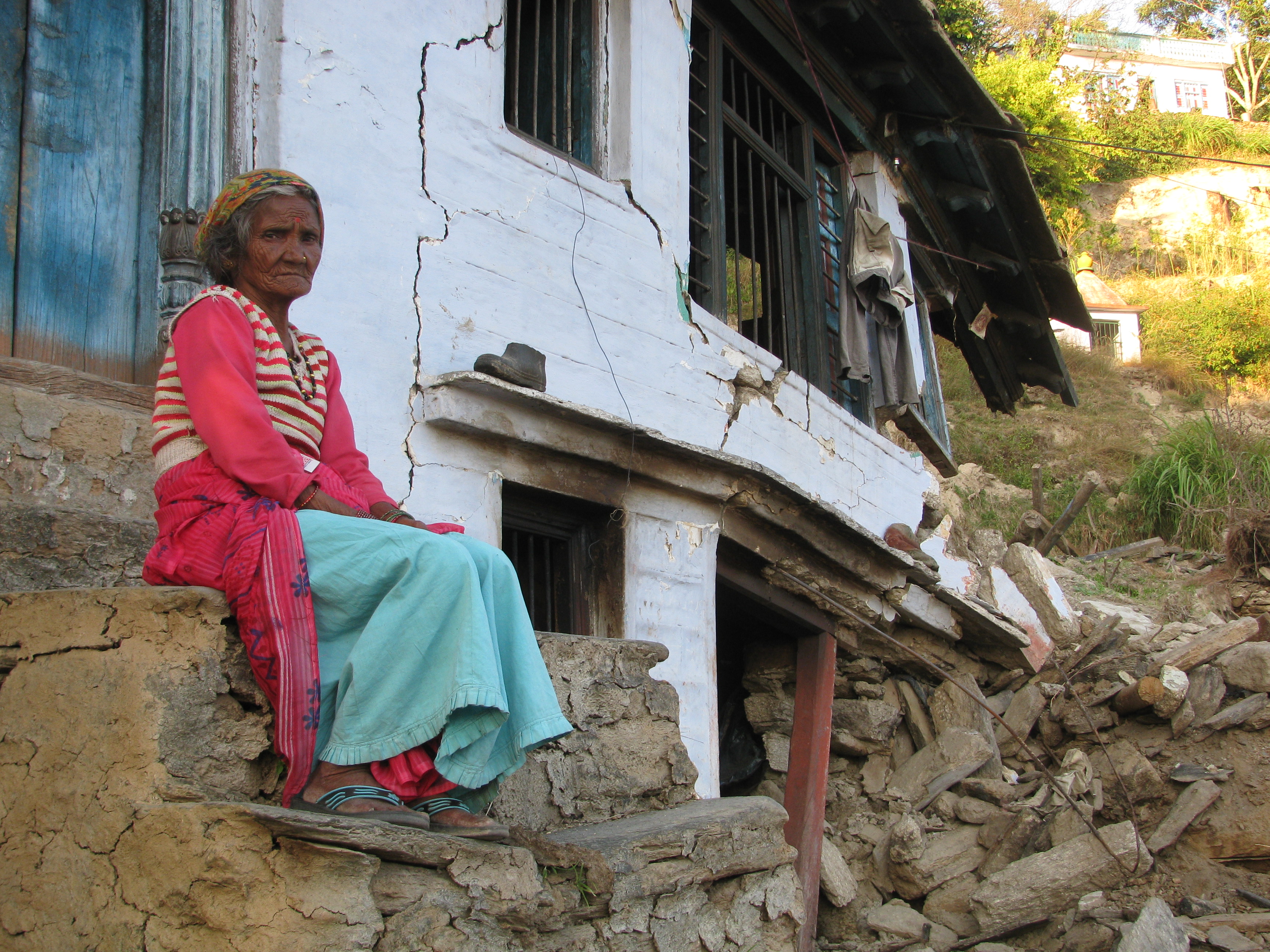
Dhanuli Devi in 2010 (Photo: Shyam G Menon)

Dhanuli Devi in 2010 (Photo: Shyam G Menon)

Some 200 people died in Uttarakhand, in the monsoon of 2010.

It was worst at Almora, where besides Dewali, there had been similar landslide and death at Balta. There were 44 monsoon related deaths in Almora district; 38 of that on September 18. Official figures say 323 houses were totally damaged; 3099, partially. In the wake of calamity, 178 relief camps were opened accommodating 4015 persons. The damage to Almora was billed at Rs 723.10 crore. It included both loss and what it would take to rebuild. On September 22, the Centre gave Rs 500 crore as interim assistance to Uttarakhand. Late October 2010, the Almora administration had received only Rs 40 crore for relief work. It may have changed since. On November 18, media reports said the Uttarakhand government had disbursed Rs 372 crore. It expected the balance to be exhausted in another month and wanted the Centre to expedite the relief package it had demanded.

Ironically in the recent past, Almora had been in the news for depleting rain and falling water levels. It was feared that the ground water fed-Kosi, which originates in the region, may soon dry off. Last monsoon, the Kosi was anything but that. The local office of the National Informatics Centre (NIC) had data for September 2010. To start with, from June 1 to September 23, Almora got 1263.4mm of rainfall as opposed to the normal 854.7mm. Within that it was: June – 78.2mm, July – 359.4mm, August – 292.2mm and September – 507.6mm. If you go years back to 1962, then the spread of rainfall is even: June – 302.51mm, July – 321.56mm, August – 321.82mm and September – 321.82mm. Take September alone: 1970 – 436.1mm, 1994 – 467.4mm, 2010 – 507.6mm. Now sample 2010 rainfall deficiency (or in this case, excess): June 1 to August 31 – +8 %, June 1 to September 23 – +48%, September 1 to September 23 – +275%.  The figures highlight two trends – a progressively uneven rainfall and shift in heaviest rainfall to September. Of the 507.6mm received in September 2010, 177.4mm happened on September 18. Four days – September 16, 17, 18 and 19 – were days of heavy rain.

Although September 18 was widely reported as “ cloudburst,’’ Prof J.S. Rawat of the Department of Geography, Kumaon University, said, “ it was an unprecedented long spell of unusually heavy rain.’’ The rain filled up the region’s underground aquifers causing external overflow. When land saturates, sub-surface flows also happen. Both Dhanuli Devi and Kamla Khulia said the muddy water that carried away homes and families at Dewali had erupted from the ground. Technically, the calamity at Dewali and Balta was called `slumping.’ However the rainfall of 2010 was yet considered an aberration in the otherwise declining average annual rainfall and water levels of the Almora region. The key to this paradox, it would seem, is the intensity of rainfall. In a healthy ecosystem, the natural rate of ground water recharge for these parts of the Himalaya is said to be 31 per cent. Against this, the Kosi area has a recharge rate of 12 per cent; in Almora town, it is two per cent. Senior residents, including Prof Rawat, remember a phenomenon called `satjhar’ that used to be there years ago. It featured a week-long spell of low intensity rain, which was the best way to recharge ground water. That’s why the intense rain of September and the deluge of September 18 mean nothing, except continued worry.

According to Prof Rawat there is a need to study how these trends affect Almora, which is in Seismic Zone 4. The professor maintained that many of the buildings that collapsed in the rain or were severely damaged had been new ones built on “ superficial deposition.’’ Result – water gets below the foundation. “ We don’t have a Master Plan yet that tells which areas to build on and which, to avoid,’’ he said.

Uttarakhand is a state trapped in mythology and natural beauty. The Himalaya made it scenic. It became the backdrop of epic, folklore and fairy tales. People flock there in large numbers. They seek God and a sense of space their own numbers have denied them in the plains little understanding that their moving en masse in a different direction, merely carries the lack of space also over. A young mountain chain like the Himalaya will be restless and its sides far less settled than the terrain through which roads and highways have been built elsewhere. Mix this with climate change’s ability for catastrophic weather – the consequences are a handful to deal with even under normal conditions with only the local people to take care of, leave alone the thousands who invade from the outside. In the media, Uttarakhand’s tragedies unfold in predictable fashion typically with shrill emotional note struck by focusing on what is happening to places of worship. It works as spellbinding visual on television for some people. It did in 2010 with much hysteria whipped up around a temple on the banks of the Kosi. It did again in 2013, which was anyway all about pilgrimage. On the ground too, people are quick to highlight to the reporter what happened to a place of worship even as their own lives are in tatters. 

In Uttarakhand, I suspect, this dovetails neatly into an existing tradition of staying mythological for the rest of India. Such perspective obfuscates the real story, which is one of geology, geography, human presence, rising population, climate change and the impact of economic growth featuring construction projects and such. This – especially business and projects – would be brought to sharp focus as the tragedy of 2013 got analyzed. Reports appeared of ill advised construction and ones that may have obstructed the natural flow of rivers – not much different in principle, from what Prof Rawat mentioned in a different context about lacking a Master Plan. Not to mention, detailed studies of rainfall pattern in the age of climate change and what that holds for pilgrimage seasons established by the realities of bygone eras. It is absurd to expect 2013 to be the same as a year from millennia ago.

In Dewali I remember asking Dhanuli Devi where she would go. She indicated a relative down by the road she could seek shelter with for the time being. But otherwise; she just looked into the distance, tears welling up in her eyes.

(The author, Shyam G Menon, is a freelance journalist based in Mumbai. This article was modified towards the end to tie into the developments of 2013.)        


KATPUDIA

The best thing about some places is its insignificance.

Stop there and time stops with you.

That merciless inner clock doesn’t know why you stopped or how long you will be there. A whiff of worry seizes you, both place and pace being unfamiliar. Then, like fumes from an unseen opiate, the slow times take possession of your mind. You surrender to the world you fell into. The door shut on distant Mumbai; there was nobody to go back to in Ranikhet, Almora was a co-ordinate 30 kilometers away and Sitlakhet, if the jeep turned up, was a potentially reachable destination.

What was immediate and around was Katpudia. I put my rucksack on the bench in front of a grocery shop, gazed back at the faces studying my presence and pretended to be at home. It was a T-junction; once in a while a vehicle appeared on the Ranikhet-Almora road, the one towards Sitlakhet, where I was headed, remained empty. A dozen shops, three to four jeeps and a temple to the side of the junction. Praveen, who had just come off work at the children’s camp in Sitlakhet, appeared at the grocery shop. He emerged from inside, even sold a few things and put money in the cash box, but did not own the place. “ I stay down there, ‘’ he said, pointing to the shop’s rear and a gully beyond. A dark, heavy doorway framed the sunny descent. I couldn’t see a house, so like he said it must be “ down there.’’ In the hills, distance and location are always approximate. The shop owner came; he had a squint, one weak arm and a limp. He loved his Philips radio. Praveen vacated the shop and hung around near me. “ You must be headed for the camp. That’s the jeep but it won’t move for another couple of hours,’’ he said pointing to the taxi, battered and rooted inactive to the ground as Katpudia was to its laid back ways. His slit eyes kept darting from me to the lonely junction and back; a young James Coburn, tall for his age with a face that held much yet gave off little. For a second, I thought of `Magnificent Seven.’

Katpudia had cell phone connectivity. I messaged a friend in Mumbai, “ am in Katpudia.’’ Wonder what she would make of it – people travel to Alaska and Mongolia; I was in Katpudia. Katpudia what? Katpudia where? In today’s competitive environment, even time spent away from ` work’ has to stand out; grab attention, trigger conversation. “ On this expedition to Everest’’ or “ at this café in Casablanca’’ sound more impressive than “ I was sitting on this bench in Katpudia.’’

Anyway who cares?

Deep down, I was beginning to enjoy my time away from the world. And this lonely junction, very un-exotic and so plain Jane as a place, the sort you would never find in travel brochures, embodied that personal revolt. Slam the door shut on the times and choose instead your own time zone. The shop next to me had done precisely that! It was old, worn out and had wooden shelves stacked with notebooks. Hill shops usually stock a variety of goods, the market being too small for specialization. In the digital age, this shop stood out defiantly, stocking mainly one thing and of all things – notebooks. One shelf also held a clutch of Hindi publications – there was the `Uttaranchal Jnaan Rashmi’ with Subhash Chandra Bose on the cover – another, bottles of `Master’ writing ink. There was nobody in the shop. I was the only one around jotting down things in a small diary. So, who does the shop stock all those notebooks and inks for? Two school kids appeared at the junction clad in navy blue trouser and blue shirt. May be if you comb the sprawling hillside you would find their friends and thereby the shop’s mysterious clientele.

People travel to Alaska and Mongolia; I was in Katpudia. Katpudia what? Katpudia where? In today’s competitive environment, even time spent away from ` work’ has to stand out; grab attention, trigger conversation.

In the quietness of Katpudia, David Niven’s cough rang out loud and clear; down to the last droplet of crackling sputum. He was locally called “ Sethji,’’ resembled the Hollywood actor every bit, appeared at the junction to keep a tin bucket under the public tap and promptly forgot about it. The conversation at his smoky café was more absorbing. The grocery shop owner kept calling “ Sethji, Sethji,’’ as the bucket overflowed but with Sethji busy entertaining his customers, limped across himself to close the tap. A pressure cooker hissed angrily at one of the dhaabas; the cook calmed it and continued talking to Praveen standing on the road. The youngster was restless; he wanted to revive his attempts to work in Delhi. He had been there once, found it too hot. That itchy, restlessness likely explained his arbitrary excursions around the junction, into one shop and the next. Tie a ball of thread to his legs and you could weave a cobweb from one doorstep to the other. Suddenly Praveen got into a parked jeep, fiddled with the controls, ran his hands along the steering and momentarily lapsed into a childhood that he had just left. A middle aged woman and her son, both of them bound for Sitlakhet, watched Praveen’s antics patiently, hopefully. Was he the chosen one to resurrect that dead vehicle?

From afar, Praveen points to the jeep, lightning streaks from his index finger and the engine roars to life. The old vehicle finds a surge of youth it hadn’t imagined in its wildest dreams, lurked within. All of us Sitlakhet-bound bow in respect to The Chosen One.

Nice dream.  

The first time I was in Katpudia was probably a year before this rumination on the shop bench. That time, I hadn’t quite noticed the place. As it happens on all first visits you are more aware of an eventual destination, not the smaller details passing you by on the way. It is a tad like life. You begin to notice life through compulsion, when you have made a chore of everything and are desperately seeking enjoyable details to breathe life into the chore. That first time at the children’s camp had been a training session to sensitize potential outdoor educators to the world of young students. I was petrified. That became pure terror when Ravi who was a trainer started acting weird, flapping his arms around like a turkey flapping it’s wings and walking hesitantly like one including neck movements et al. Right through the camp and the many sessions later to loosen up our stiff attitude, I kept reflecting on the contrast between the serious news bureau I was coming from and these turkey rituals I was engaged in. Okay, I resigned my journalist job and was trying to be an outdoor educator on the side. But climbing and mountaineering were also serious stuff with graded routes and judgments on performance to fear – that’s the Indian way. What has turkey got to do with it? I could visualize my climber friends turning their backs on me and returning their attention to what mattered – difficult rock. Some may even laugh. Yet it puzzled for Ravi was a fine climber and mountaineer. So if he could loosen up and others like him assembled there could follow suit, why not I?  And somewhere, somehow that turkey was also beginning to beckon like a climb; like a route not attempted yet.

This was change unknown.

I began flapping my arms and clucking like a turkey.

My trainers must have eventually felt I was worth taking a chance with, for a couple of months after this camp I got a call to report for work in the field. I barely survived that outing with a bunch of high school students. But after a few more camps, I seemed to find adequate rhythm to at least ensure personal survival and well, even enjoy the educator bit.

A rustle nearby returned me to Katpudia.

The owner of the notebook shop! He was old, as weathered as the wooden shelves; yet strangely for a man in the service of writing, betraying impatience. He lit a beedie, took stock of his sleeping business and strode out to join the laughter at Sethji’s café. Owner gone, the shop returned to its old self. So much like life – you, at times others, perceive a vacuum. And when you finally fill it, the picture of completion is all too fleeting. Which one are you – that moment of completion or the eternal vacuum?

Almost two years later, I would see another shop – as bleak in ambience and even lonelier in location – at Song, from where you start the trek to Pindari Glacier. It however had an owner who sat inside enjoying the local gossip, drumming his fingers, occasionally poking his head out from the shop for a glimpse of the antics at the adjacent tea shop. It was tea on the board outside; a heady brew inside, heady enough for patrons to swear eternal loyalty and undying friendship through this life and the next. I peered into the book shop. It was more modern than Katpudia’s, the shelves were steel racks stacked liberally with notebooks and writing material. There were pens of a dozen variety, pencil sharpners, erasers, glue sticks, high-lighters, and instrument boxes. I concluded without asking the owner that the clientele had to be the area’s school children. But it was clearly scant clientele for at past five in the evening the owner nonchalantly closed shop and started his trek home.

It had reminded me of Katpudia. 

More than two hours after I came to the junction, a flicker of life graced the jeep assigned for Sitlakhet. Eventually it filled up; the driver put his finishing touch squeezing the thirteenth person in and we were off. Not exactly, for we made the first of our several stops to discuss the world, just fifty meters away. Katpudia’s gravitational pull was strong. It would take a very determined driver or a bunch of grossly irritated commuters to make this shuttle break free. We were anything but that.  We loaded chicken mesh from a hardware store, stopped frequently for gossip, unloaded kerosene drums, craned our heads to look at “ Suresh’s new wife,’’ greeted a sarpanch and reached Sitlakhet an hour before darkness. As I bought some `bal-mithai’ at the local sweet shop, the owner realizing I was from Mumbai said, “ whenever the weather is good here, we say Mumbai is happening.’’ Content, he gave me a broad smile. The next three days we had bad weather. I was happy for it. I was happy to be at a little known dot on the map.

This was several years ago.

In the winter of 2012, I was back on a bench in Katpudia.

This time I was at the dhaba where the pressure cooker had hissed. I was cycling from Ranikhet to Sitlakhet and back. Katpudia was where you turned off the road to Almora and made for Sitlkahet. That section featured a stiff ascent for the first quarter or so. I thought I will rest a while before tackling it. I had tea and snacks, filled up my water bottle and headed off. When I reached Sitlakhet, I found that I could recognize some shops but there were several that seemed new. Or maybe, like my first trip to Katpudia, I hadn’t adequately noticed Sitlakhet on my earlier visits. In the hills, having tea is a nice way of taking in place and people. I settled down to that ritual; picked up a conversation with others at the shop. A few hours later, on the way back to Ranikhet, I stopped at the dhaba in Katpudia for a quick meal of noodles.

Katpudia seemed the same as it had been the first time I halted there.

I didn’t see Praveen anywhere. 

Maybe he made it back to Delhi.

Maybe he simply grew up and didn’t need to walk restless about that junction, any more.

(The author, Shyam G Menon, is a freelance journalist based in Mumbai. An abridged version of this article was published in The Hindu Business Line newspaper.)