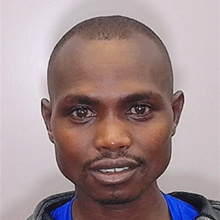
Joshua Belet (this photo was downloaded from the athlete’s profile available at World Athletics. It is being used here for representation purpose. No copyright infringement intended)
Gopi T finishes in his second-best timing to date
Kenyan athletes swept the podium in the men’s category while Ethiopians dominated the women’s, at the 2023 TCS Amsterdam Marathon held in the Dutch capital on Sunday, October 15.
As per results available on the website of World Athletics, top honours among men went to Kenya’s Joshua Belet. The 25-year old covered the distance in a personal best (PB) of two hours, four minutes and 18 seconds. As per Eurosport’s race report (available on YouTube), it was his first victory at a major marathon. He was followed to the finish line by compatriots Cybrian Kotut (2:04:34) and Bethwel Chumba (2:04:37).
The women’s race was won by Meseret Belete of Ethiopia (2:18:21). It was a PB. Her compatriot Meseret Abebayehu (2:19:50) placed second while Kenya’s Dorkas Tuitoek (2:20:02) placed third. There were seven Ethiopian athletes and two Kenyans in the top ten women finishers. On the men’s side, the share of the two African nations in the top ten was – three Kenyan runners and five from Ethiopia. The finishing time of winners in both the gender categories was also the third fastest time in those segments recorded yet in the Dutch capital, World Athletics said in its report.
India’s Gopi T completed his race in 2:14:55, making Sunday’s outing in Amsterdam his second fastest marathon to date. In March 2019, Gopi had clocked 2:13:39 at the year’s Seoul Marathon. It remains his PB and best performance yet by an Indian male marathoner since the late Shivnath Singh’s national record of 2:12:00 (still unbroken) set in 1978.
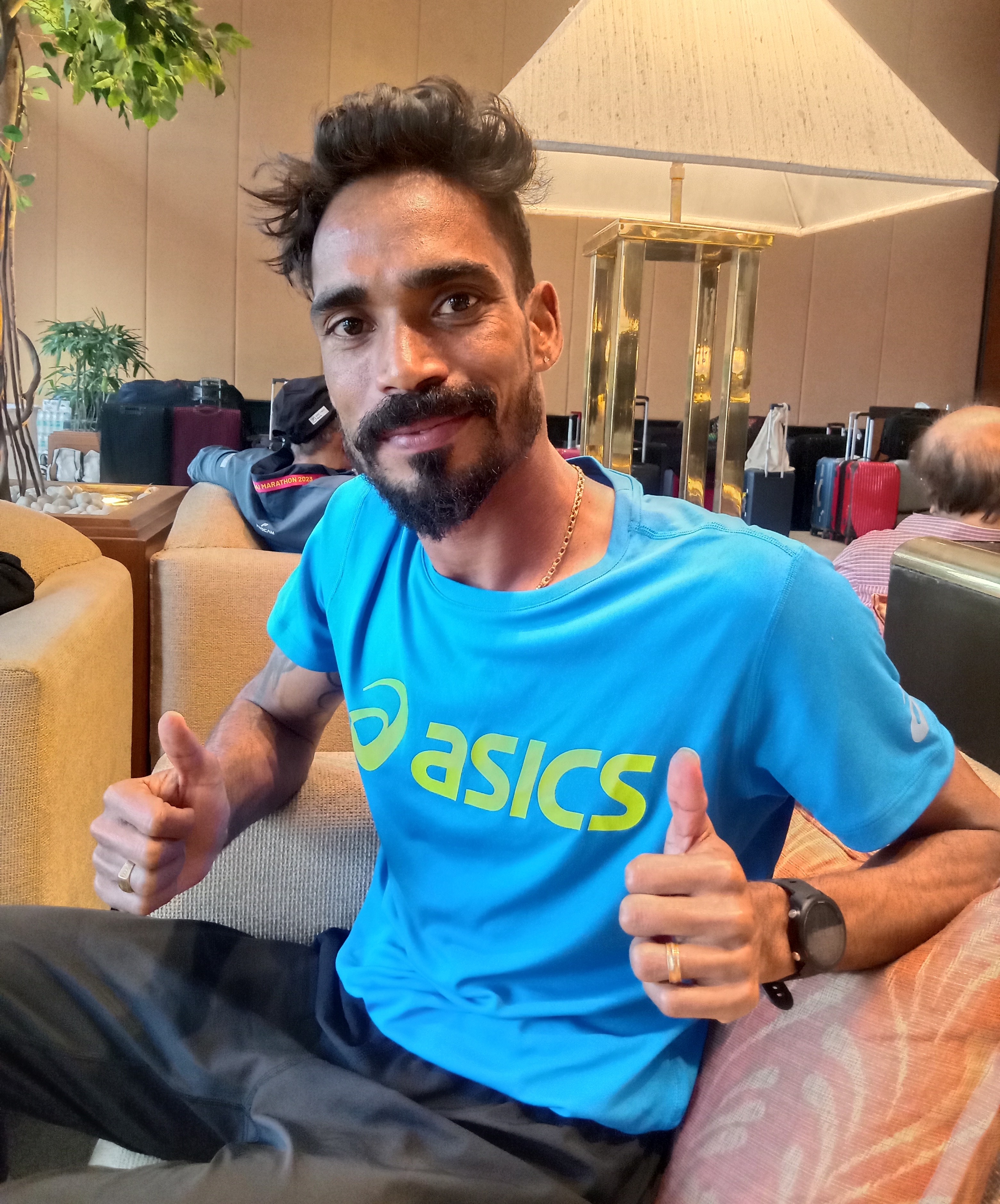
Gopi T (Photo: Shyam G Menon / this picture was taken in early 2023, after the year’s Tata Mumbai Marathon)
In a post-race interaction with this blog Gopi said that given the circumstances, he was happy with his performance in Amsterdam on Sunday. It was cold during the beginning of the race and while the run was on, there was rain. “ My timing was good till about 30 kilometres. After that, there was rain and I had this feeling of my legs, calf muscles and all, getting jammed. The last 10 kilometres ended up slow. Still, I am happy I ran in this weather condition because this is my second-best timing. I am happy about that. If there was no rain, perhaps the timing could have been better. It was cold in the morning; the start was in eight degrees or so. All that may have contributed. But it’s okay even though there are improvements required. After all, one has to be able to run in all types of weather conditions. Many runners reported slower timing and cramps. One tended to slip. Overall, I feel I did well under the circumstances,’’ Gopi said.
The elite marathoner has been attempting a comeback to form since knee surgery and the months of reduced activity in the sporting calendar due to COVID-19. In January, he had been the winner among Indian elites at the 2023 Tata Mumbai Marathon with timing of 2:16:41, his first major victory in a while. However his March rendezvous with the 2023 Seoul Marathon ended up a 2:18:53 because after the 32nd kilometre, he experienced a catch in his hamstring that demanded stopping, stretching and a jog to the finish thereafter. Sunday’s outcome (2:14:55) in Amsterdam, was another milestone in Gopi’s ongoing efforts to return to fine timings.
Link to video on the 2023 TCS Amsterdam Marathon, posted by Eurosport on YouTube
(The author, Shyam G Menon, is a freelance journalist based in Mumbai.)
The Indian team for the upcoming IAU 50K World Championships (due November 5, 2023 in Hyderabad) has been announced.
According to an official statement available on the website of the Athletics Federation of India (AFI), the men’s team includes Bangriya Vikram Bharatsinh, Anish Thapa Magar, Mohit Rathor, Dhanavat Pralhad Ramsing, Akshay Saini and Arjun Pradhan with Iraan Ali and Pradeep Singh Chaudhary as stand by. The women’s team includes Jadhav Ashvini Madan, Jyoti Gawate, Kavitha Reddy and Prachi Raju Godbole.
The 50K (50 kilometres), while just a shade longer than the regular marathon, is an important distance in the ultramarathon because in the emergent scheme of things, it is the distance currently pitched for potential inclusion in the Olympic Games. The ultramarathon has so far not featured in the Olympics and the quadrennial sporting spectacle, influenced as it is by the compulsions of the broadcast industry, may not warm up to the long distances and long duration of running that characterize ultramarathons. Given this, the 50K – particularly on scenic trail (trail running) – is seen to attract as it is technically an ultramarathon and yet not significantly longer than a marathon.
During their visit to India for a 100K championship held earlier this year in Bengaluru, senior officials of the International Association of Ultrarunners (IAU) had told this blog that the typical 50K team selection process studies marathon runners as opposed to those focused on long ultramarathons. Herein, top performing marathon elites who specialize in that discipline and wish to continue so may not want to come off the 42K distance and adapt to the 50K. Besides deeming the 50K an avoidable distraction from what they are focused on, they may also see training for the 50K as capable of temporarily hurting their performance in the marathon. You therefore need people who may find the transition sensible or interesting to try. Those in the marathon, who are a notch below the top elites and wish to adapt to the shortest ultramarathon around or take a shot at it, are the ones potentially capable of satisfying the blend of speed and endurance that the 50K is all about, the officials had explained.
In September, the AFI had informed via a circular that it planned to select six men and six women to be the Indian team for the IAU 50K World Championships scheduled in Hyderabad. It assigned a qualifying cut-off time of two hours, 50 minutes in the marathon, for men and three hours, 20 minutes for women with the timings submitted being from races held between November 5, 2022 and August 10, 2023. It is understood that the circular received good response from runners, especially for the men’s category. The bigger the pool of applicants to choose from, the better the chances of forming a team with good marathon speeds to prepare for the 50K.
The current world record in the men’s 50K is held by C. J. Albertson of the US – 2:38:43 set in 2022 (source: Wikipedia; as per the online encyclopaedia, the record awaits ratification). According to irunfar.com, Albertson used to hold the all-surface 50K record – 2:42:30 – set on track in 2020. That was improved upon by Ethiopia’s Ketema Negasa (2:42:07, set in 2021). In 2022, Negasa’s mark was bested by South Africa’s Stephen Mokoka (2:40:13). The world record in a women’s only 50K race was held by South Africa’s Irvette Van Zyl (3:04:24). Desiree Linden of the US holds the word record for 50K in a mixed gender race – 2:59:54, set in 2021 (source: Wikipedia).
Incidentally, three of these records (as well as a fourth world record – 3:00:29 set by Ethiopia’s Emane Seifu Hayile in February 2023; she broke Van Zyl’s mark) happened at the Breaking Barriers 50km (aka Nedbank Runified Breaking Barriers 50km), held annually in South Africa. The event features a 10 kilometre-loop, repeated five times. IAU officials had mentioned South Africa as an emergent centre of activity for the 50K, which bridges the marathon and the ultramarathon.
(The author, Shyam G Menon, is a freelance journalist based in Mumbai.)
Kenyan athlete, Kelvin Kiptum, at the finish line of the 2023 Chicago Marathon (this photo was downloaded from the Facebook page of the event and is being used here for representation purpose. No copyright infringement intended)
Sifan Hassan wins the women’s race, sets new course record
Kelvin Kiptum shattered the men’s marathon world record by a considerable margin on October 8, 2023, winning the year’s Chicago Marathon in two hours and 35 seconds.
This is the first time, the time to finish in a marathon has dipped below the two hours and one minute mark in a record-eligible race. The previous world record (2:01:09) was in the name of Kenyan legend Eliud Kipchoge, set at the 2022 Berlin Marathon.
On Sunday, Kiptum, also from Kenya, lowered that by 34 seconds, quite an accomplishment given the level of performance one is talking of at these timings. The new mark is subject to ratification by World Athletics. According to Runner’s World, Kiptum ran 1:00:48 for the first half of the race and 59:47 for the second half. In its report, World Athletics noted that Kiptum passed 40 kilometres in 1:54:23 – after a 27:52 ten kilometre-split – and sped up further to finish in 2:00:35.
As impressive as Kiptum’s margin of improvement in the world record, was his margin of victory from the rest of the elite field in Chicago. His compatriot Benson Kipruto, who finished second, was nearly three and a half minutes behind at 2:04:02. Bashir Abdi of Belgium (2:04:32) placed third. Kipruto was the defending champion, coming into the race.
Sifan Hassan (this photo was downloaded the athlete’s profile page at World Athletics and is being used here for representation purpose. No copyright infringement intended)
In the women’s category, the winner was Sifan Hassan of Netherlands (2:13:44). Her timing, a new course record, was also the second fastest marathon by a woman, so far. She was followed to the finish line in Chicago by the defending champion, Kenya’s Ruth Chepngetich (2:15:37) and Ethiopia’s Megertu Alemu (2:17:09). Hassan is one of the most versatile and illustrious distance runners in her gender category. Her competence has spanned all the way from 1500m to the 10,000m on track (she has been the world champion and the Olympic champion in some of these disciplines) and the half marathon and marathon in road races.
Sunday’s race was only the third major marathon event, 23-year-old Kiptum had participated in. Prior to coming into the marathon, Wikipedia’s page on Kiptum shows him winning the Eldoret Half Marathon in Kenya in 2018, in 1:02:01. He was 18 years old then. He started participating internationally in the half marathon in 2019. He has a personal best of 58 minutes, 42 seconds in the discipline.
Kiptum made his debut in the marathon, at the 2022 Valencia Marathon, winning the race in 2:01:53. This was followed by his victory in the 2023 London Marathon, where he timed 2:01:25, just 16 seconds shy of Kipchoge’s erstwhile world record. That was in April. Less than six months later, in October, he had become the new world record holder in Chicago. Interestingly at both Valencia and London, his performance was noted for running a quicker second half of the race, something he repeated in Chicago.
“ A world record was not in my mind today… but I knew one day, one time I would be a world record holder,” Kiptum said at the finish line, adding that he is “very happy.’’ – NBC Chicago noted in its report on the record-breaking run. According to Runner’s World, Kiptum earns $ 100,000 for the victory plus $ 50,000 course record bonus.
While he may no longer be the world record holder, Eliud Kipchoge remains the first person in recorded history to have run a sub-two hour marathon. He did that in October 2019, touching 1:59:40.2 at the Ineos 1:59 Challenge held in Vienna. It wasn’t an open event and with standard competition rules for pacing and fluids not followed, the run did not count as a marathon record.
Link to video posted by NBC Chicago on YouTube showing Kelvin Kiptum finishing the 2023 Chicago Marathon.
(The author, Shyam G Menon, is a freelance journalist based in Mumbai.)
On September 8, 2023, Amit Gulia achieved the first sub-17-hour finish by a non-Ladakhi runner in the 122-kilometre Silk Route Ultra. Here’s a look into the approach he adopted for the race at altitude.
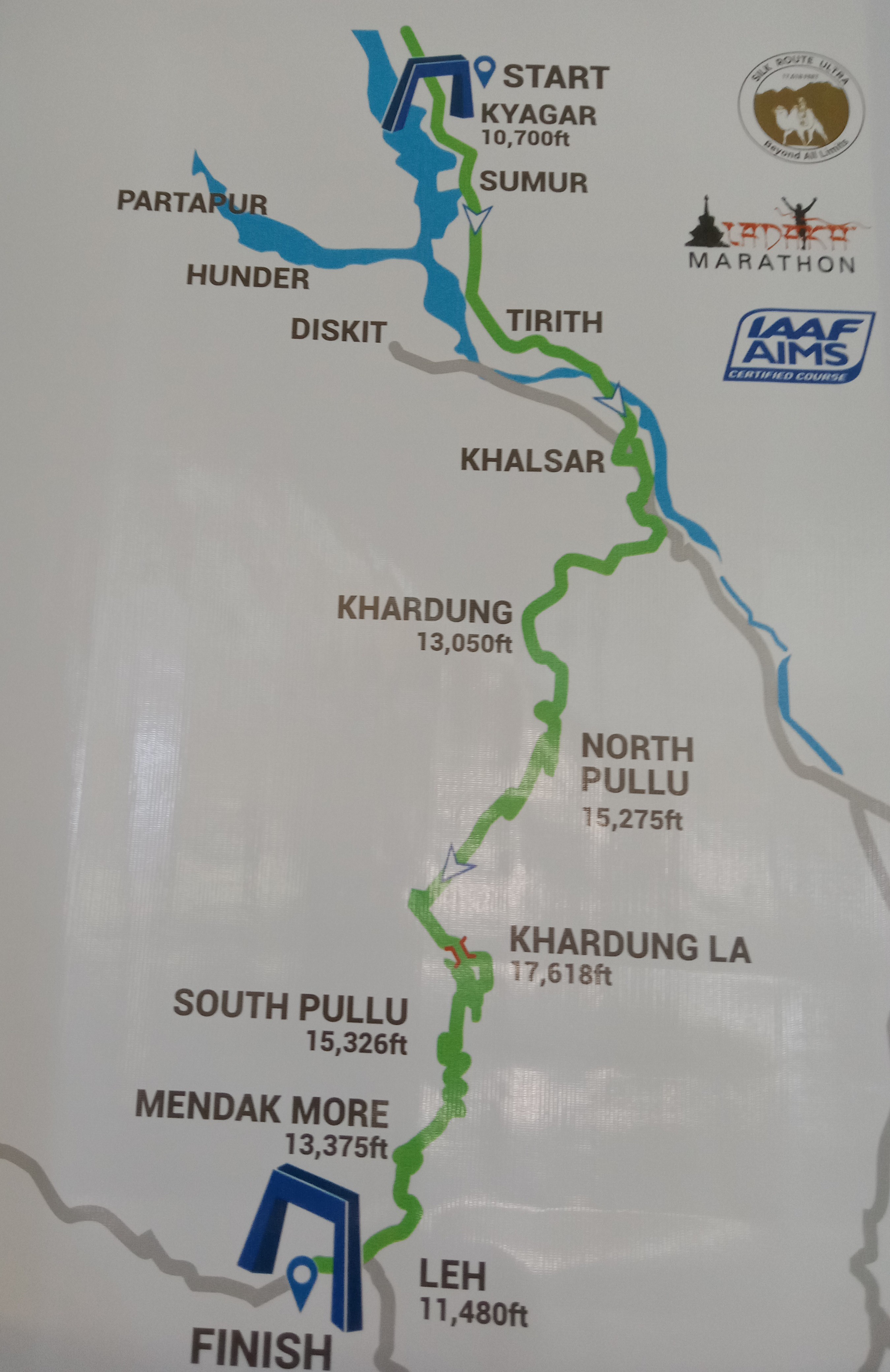
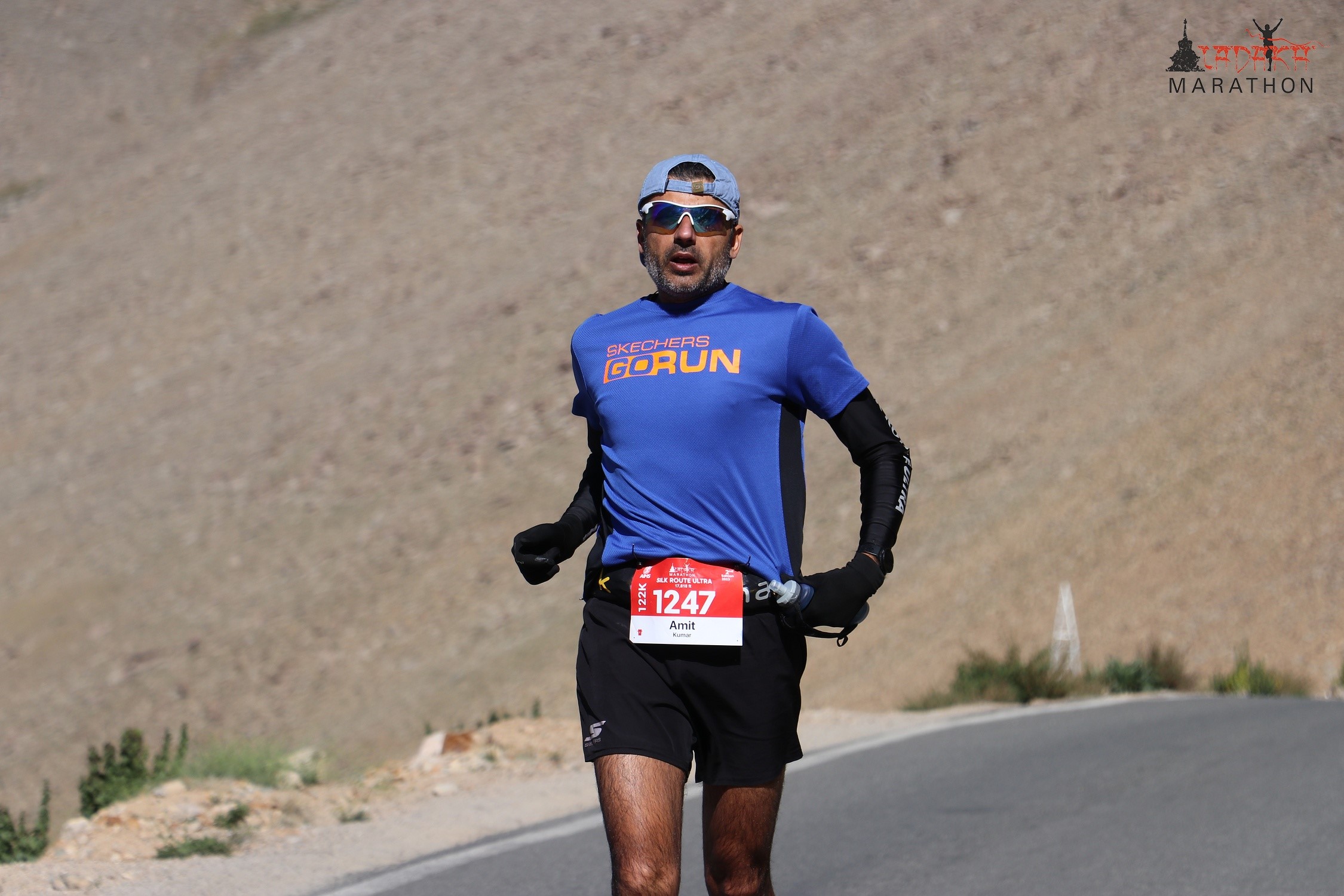
On the morning of September 8, 2023, much before the winner of the year’s Silk Route Ultra (SRU) crossed the finish line, another runner had completed the race. He would settle for fourth place as he belonged to the first batch of runners that set off the previous evening to tackle the 122-kilometre distance from Kyagar to Leh, up and over the 17,618 feet high-Khardung La. Judged by net timing, the Ladakhi runners of the second batch were faster. They would sweep the podium; first, second and third. Still, Amit Gulia’s timing was no small achievement. The 16 hours, 21 minutes and 25 seconds he took to place fourth was the first sub-17-hour finish in the race by a non-Ladakhi. In the ecosystem of the Ladakh Marathon, an event with altitude as its biggest challenge, non-Ladakhi runners are the outsiders taking the brunt of elevation.
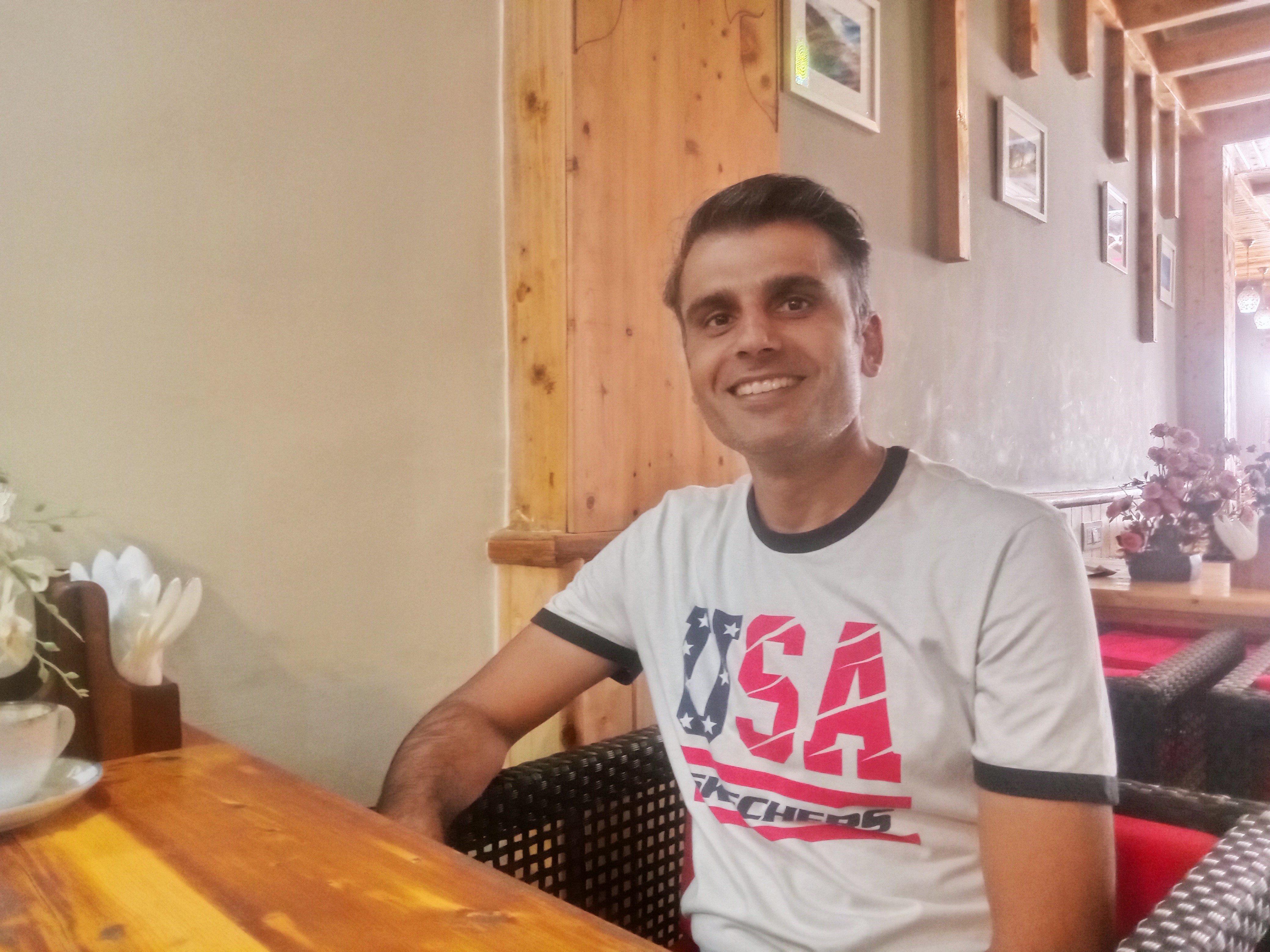
Amit’s journey to that September finish had commenced five years earlier. Based in Chandigarh, Amit, 40, has a background in medical research He is a medical writer and since the past one year, he is also chief coach at Skechers Go Run club in Chandigarh. A runner since the age of 32-33, he has never run a marathon officially. He did so in training and the one thing he liked to do as runner, was to run long distances. That was how his drift to the ultramarathon happened. He found himself completing a marathon in training with others and still having room for more mileage. His first ultra was the popular event at Bhatti Lakes; a pucca start to his innings.
Thanks to their long distances, ultramarathons demand preparation, strategy and support. When Amit attempts races requiring support crew, that role is typically taken up by two people close to him. There is his wife Gurjeet Kaur, who like Amit, is a runner and a medical researcher. She takes much interest in his running. Then there is Vijay Pande, an engineer and runner based in Bengaluru, who Amit often consults to devise approach and strategy for the projects he undertakes. The two had met at a past edition of the Mashobra Ultra, which was among Amit’s first official forays into distances exceeding the length of a marathon. It was Vijay who introduced Amit to training with the altitude mask.
A December 2022 article by Ashley Mateo in Runner’s World explains what the altitude / elevation mask does. How it works is very different from training at altitude. When one trains at altitude, there is increased production of a hormone called erythropoietin (or EPO). It triggers the body to produce more red blood cells and form new blood vessels. This enables the body to deliver more oxygen to the muscles which in turn means faster and more efficient running, particularly when one returns to sea level. Altitude masks have valves or vents that regulate air intake. They can alter the quantity of air getting in but they don’t affect the mix of gases in the air inhaled. Consequently, when used while training at low altitude, one does not get the same benefits as when training at elevation. It is not an exactly similar situation. However, restricting the air intake contributes to something called inspiratory muscle training. It increases the strength of the respiratory muscles which can eventually translate to the ability to bring more air into one’s lungs. That’s potentially more oxygen that can get into the bloodstream. More oxygen in the muscles means one finding it easier to exercise. In other words, the mask-route is not precisely the same as training at altitude but it has an oblique benefit by way of strengthening the respiratory muscles.
The route of Silk Route Ultra with elevation of starting line, finish and key points in between (photo: Shyam G Menon)
Amit’s use of the device started during his preparations for the 2017 edition of La Ultra The High, an event with a basket of ultramarathons happening in Ladakh. Initially, the mask was difficult to use. But given the event he had signed up for, Amit had no other option; he persevered. That year, he won the 222 km-category of La Ultra The High, the first Indian to do so (archived results of the event show the winner’s timing as 38 hours, 20 minutes). It was Amit’s first ultramarathon at altitude; the route of the 222 km-race touched both Khardung La and Wari La (over 17,400 feet high). The template for acclimatization he fashioned for that race, has remained thereafter his rule book for races in Ladakh. Besides regular training at low altitude and the use of the altitude mask for some of the sessions therein, the other noteworthy aspect was Amit’s protocol for pre-race days in Leh. Unlike the typically anxious participants of these races who continue running at elevation or make last minute dashes to high altitude in a bid to get familiar with the environment, Amit focused on rest. In the fortnight he reserved for acclimatization before the 2017 La Ultra The High, he rested in Leh and walked around locally. There weren’t any runs, car or bike trips to still higher altitude as preparation for the race and its high passes. What is generally overlooked in such cases is that for people coming to high altitude from the outside, post-exercise recovery and healing in activities done during the acclimatization period, misses the richer oxygen levels of lower elevation. “ In my opinion, visits to high altitude and exerting oneself during the acclimatization phase before a race, inflicts damage without adequate time for healing and recovery. I stayed off such practices. Consequently in 2017, when the race started, I was feeling as though I was running in the plains. I have been repeating this protocol ever since. I prepare in the plains and rest ahead of a race at altitude,’’ Amit said.
Following the first-place finish at the 2017 La Ultra The High, in 2019, he was the top finisher among non-Ladakhi runners in the 72 kilometre-Khardung La Challenge (KC). He covered the distance in 9:22:50 to place eleventh among men. The next two years were claimed by COVID-19. Sports events came to a halt worldwide or were reduced to a trickle. In 2022, when the Ladakh Marathon returned after the pandemic, Amit and his friend Rakesh Kashyap, decided to attempt the inaugural edition of SRU. They planned to do it like a training run ahead of attempting the year’s Spartathlon in Greece. Joining them were Munish Jauhar and Anmol Chandan, also from Chandigarh, who had signed up to attempt the SRU and KC respectively. Amit followed the same acclimatization pattern as he did for the 2017 La Ultra The High. The race started well for him. At the 60 kilometre-mark, he was comfortably positioned in the pecking order, when he began having problems consuming the energy gels he had brought along. In the biting cold of altitude, the gels had become thick in consistency and when consumed, got stuck in his throat. He wanted hot water to wash it down. But at the aid stations, he passed, hot water was not available. He was told that he may get it further up on the way to Khardung La, at the aid station in North Pullu. But Amit sensed it was becoming a choice between pushing his luck and preserving his well-being for Spartathlon. He opted for the latter; he withdrew from the race. As did Rakesh, sometime later. Munish and Anmol had fine outings. Munish finished SRU in 19:47:40 to place seventh among 19 men in the fray; Anmol completed KC in 9:34:51 to place seventeenth among the 140 men in his category (source: 2022 Ladakh Marathon / SRU and KC results). Back in Leh and his throat condition addressed, Amit ran the event’s full marathon. In the weeks that followed, both he and Rakesh flew to Greece and completed Spartathlon.
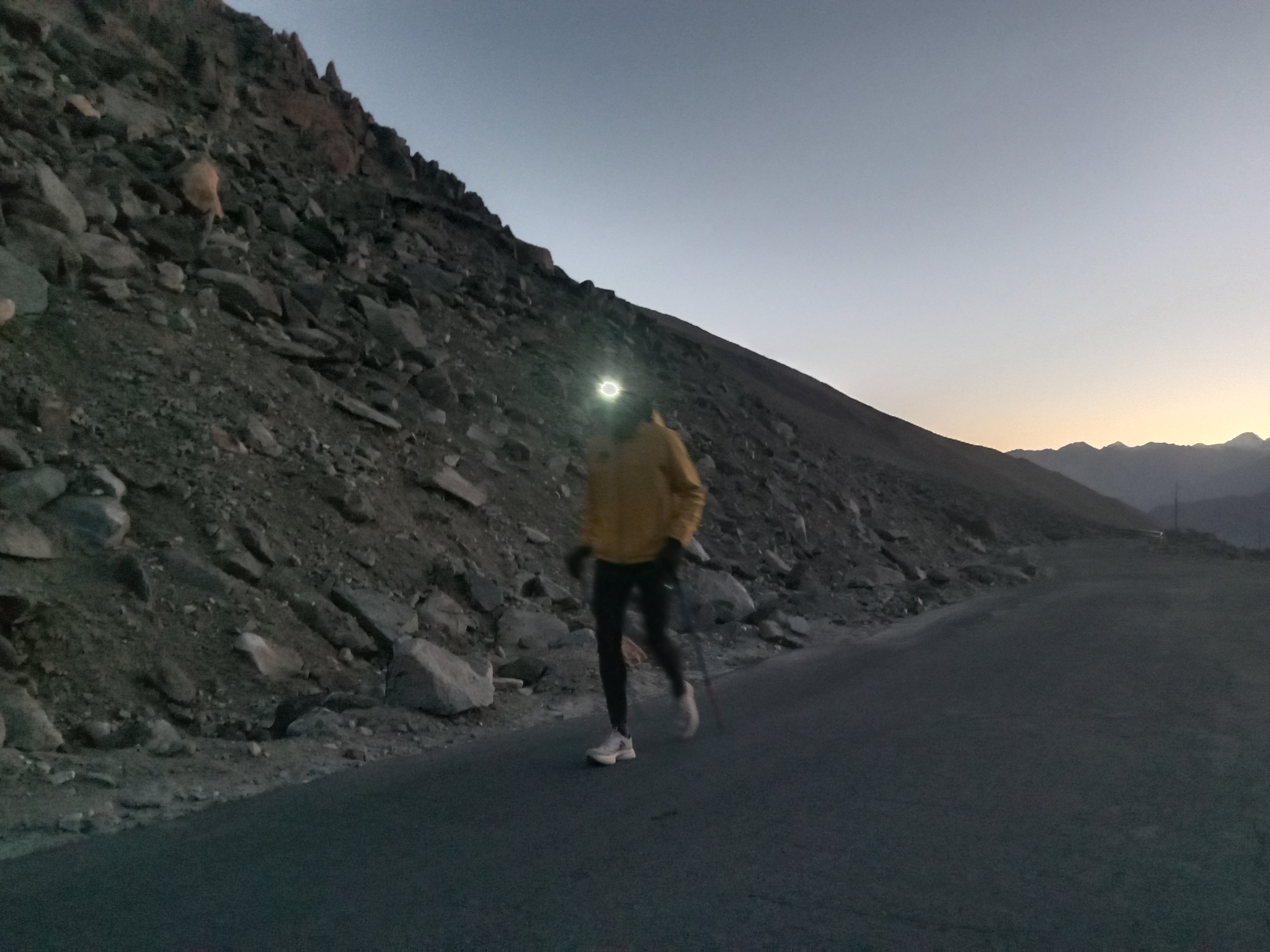
Early morning September 8. Amit Gulia at the very front of the 2023 Silk Route Ultra; location: between North Pullu and Khardung La, not far from the pass (photo: Shyam G Menon)
By now Amit was sure that he would return to Ladakh for SRU. For the 2023 edition of SRU, he commenced training in mid-June. Besides his training runs, he worked out using the altitude mask. At the gym he frequented, he kept the treadmill at a good incline and walked with the altitude mask on. Each session with the mask lasted between 40 minutes to an hour. He did this twice a week. Once again Rakesh and Anmol joined him on the trip to Leh; this time all three would be running SRU. As the event drew close, Amit was sure that he was going to complete it within the stipulated cut-off time of 22 hours. Within that expectation, he set himself three options. The first was aggressive – cover the 122 kilometres in 15 hours to 15 hours and 15 minutes. Second, keep it sub-16 hours. In case both of the above proved tough, then do a sub-17. Third – complete the race at any cost. “ I have a habit of challenging myself,’’ Amit said over coffee at a café in Leh on September 11. Besides his goals in terms of overall timing for 2023 SRU, he divided the race into sections – Kyagar to Khardung, Khardung to North Pullu, North Pullu to Khardung La, Khardung La to South Pullu and South Pullu to Leh – to evolve a strategy and assign expectations. He planned to cover the first 50 kilometres in five hours and was happy when on race day, the stretch was actually done in five hours, 20 minutes. From Khardung to North Pullu, he had estimated a duration of three hours. It too was managed in and around the planned time. By now he had 50 per cent of the race in the bag and was the race leader. But the section from North Pullu to Khardung La proved tough.
The group of runners Amit was in – the first batch of the race – had left Kyagar, late evening on September 7. Aside from the odd street light at settlements like Khalsar and Khardung, the road wound on and uphill in utter darkness. By the time Amit commenced tackling the uphill from Khardung village to Khardung La, it was past midnight. The North Pullu-Khardung La portion came some hours after that. Sizable gaps separated the runners. Some proceeded alone; some stuck together. With traffic suspended for the duration of the race, it was quiet. One heard the sound of athletes breathing, the swishing of wind cheater fabric and the sound of shoes on gravel, as person passed by. An occasional nuisance were dogs, some of them, territorial. Race officials, moving up and down the road, chased the animals away. Viewed from far, sole stamp of runner’s presence in that vast, dark mountainous landscape was, each person’s headlamp. In between, one saw the brighter solar lamps of aid stations. Amit was ahead of everyone else, all by himself. “ I was feeling exhausted. I was shivering like hell. I had on, two pairs of gloves, three jackets and two caps. I was finding it difficult to drink water from the bottle,’’ he said. Amit reached the 17,618 ft-pass almost an hour later than what he had planned. The pass is a tricky place. Given the stretch spanning North Pullu to Khardung La as the place where many people withdraw due to exhaustion, reaching the pass in SRU, represents a milestone achieved. But with that can come a loss of appreciation for where exactly one is. The pass is high in elevation and bitterly cold. There is an aid station at Khardung La, where one can hydrate, get some nourishment and also rendezvous with drop-bags positioned in advance. Runners like Amit treat Khardung La carefully; they don’t let the milestone bit get into their head. Hanging around unnecessarily at the highest part of the race does nothing useful to the body. The emphasis is on shedding elevation. With the environment quite cold, oxygen level at the pass known to be lower than at sea level and his body feeling fatigued, Amit picked up a glass of hot soup from the aid station at the pass and quickly moved on. Ahead lay the long descent to Leh.
Amit does strength training thrice a week. He had trained for long descents. He was prepared for the downhill that follows Khardung La. But even he miscalculated what his needs may be, that September 8 dawn. It was a miscalculation on the logistics front. Layering and de-layering is how athletes functioning at altitude manage their attire to stay efficient. It is an act that seeks to strike a balance between protection from the elements, the temperature of one’s surroundings and the warmth, the body naturally generates as it works. Amit forgot to keep a drop-bag in advance at Khardung La so that he could de-layer in anticipation of the descent and the need of such faster movement to have less layers getting in the way. Minus drop-bag to leave his layers in, he stayed imprisoned in piles of clothing and gear that had served its purpose. So even as he exited Khardung La without wasting much time, he was bulky and hauling weight. He had on his upper layers, two layers on his legs, two pairs of gloves, two caps, hydration pack and trekking poles. Simply put, he couldn’t take advantage of the descent and run. He had kept his next drop-bag at South Pullu, several kilometres away on the Leh side. When on tired legs, every ounce of weight is acutely felt. Try running with too many layers on and one’s cocoon of clothing risks becoming unbearably warm. Till South Pullu, he moved inefficiently.
Amit Gulia on the final stretch from South Pullu to Leh (photo: courtesy Amit)
Meanwhile behind him, on the northern slopes of Khardung La, Amit’s friends were coping with a vastly different experience. Neither Rakesh nor Anmol own altitude masks. They had trained for SRU without it. According to Anmol, he compensated for the absence of such a gadget by resorting to high repetition interval training in the plains, which has the effect of improving respiratory efficiency. All that seems to have gone well. In retrospect, what happened after their training in Chandigarh was hugely different for the trio. In the pre-race acclimatization phase in Leh (11,500 ft), Anmol’s path and that of Rakesh, diverged sharply from Amit’s. Rest is very important in acclimatization. “ Amit does not do anything before a race at altitude. He rests. I reached Leh on August 28 and from then till around September 5, I piled on 70 to 80 kilometres in training. I don’t know why; that’s my style and it had worked for me in 2022,’’ Anmol said adding, “ Rakesh also put on similar mileage.’’ This time, the approach didn’t work. When this writer met Amit, Anmol and Rakesh in Kyagar, they appeared relaxed and in good spirits. But according to Anmol, at the start line of SRU late evening September 7, he was on tired legs. He realized he hadn’t recovered from all that running around in Leh.
The night of September 7, for about 30-35 kilometres since race commencement, Anmol and Amit were together. Then Amit pushed ahead. Around 60 kilometres covered and on the long ascent to Khardung La, Anmol began experiencing dizziness. He tuned into the sensation and decided to get it checked. Near North Pullu, he consulted the medical team that was present there with ambulance alongside. His oxygen saturation had dropped. He was otherwise feeling alert. It was very cold and so he was asked to try walking some more to see if the oxygen saturation level improved. Anmol figured that may not be viable. Such a walk would only be uphill given Khardung La was still some distance away. The terrain and direction of travel wouldn’t allow an improvement in his oxygen saturation unless he stopped or lost elevation. “ I told myself this is not a Kumbh Mela, something that happens only once in several years and therefore having to be done right now at any cost. I can always come back to try SRU again. I decided to quit the race there,’’ Anmol said.
Rakesh too gave up. But in his case, he may have misjudged his predicament. Rakesh’s exit from SRU was reportedly after some more distance (than Anmol) covered and it manifested as a collapse. Around the time of this incident, there was a bus carrying the baggage of KC runners (at 3AM that day, KC had commenced from Khardung village) and some runners who had retired from SRU, coming from North Pullu. Two of the runners in the bus helped this writer, recreate the scene. It was the morning of September 8. There were both KC and SRU participants running and walking on the road. The bus had just passed an ambulance parked by the roadside, when some distance away, one of the (above mentioned two) runners witnessed Rakesh collapse to his right side. Another runner, who was still in the race, stopped to tend to him. Upon reaching the scene, the bus driver halted the vehicle and honked to alert the ambulance behind. The runners from the bus stepped out to help. They told the racer who had stopped to assist Rakesh, to carry on as they were available. By then, the ambulance had arrived. Four people were required to help Rakesh into the ambulance. He kept saying that he was capable of continuing. But the doctor in the ambulance pointed to Rakesh’s collapse, put his foot down and said the race was over for him. “ It was between North Pullu and Khardung La, I would think 70 kilometres or so overall, from the start line of SRU,’’ one of the runners said. Rakesh received medical attention. He recovered. “ He is fine now,’’ Anmol told this blog on September 29. While on the SRU course, Amit knew nothing of what happened to his friends. He got updates only after he finished the race.
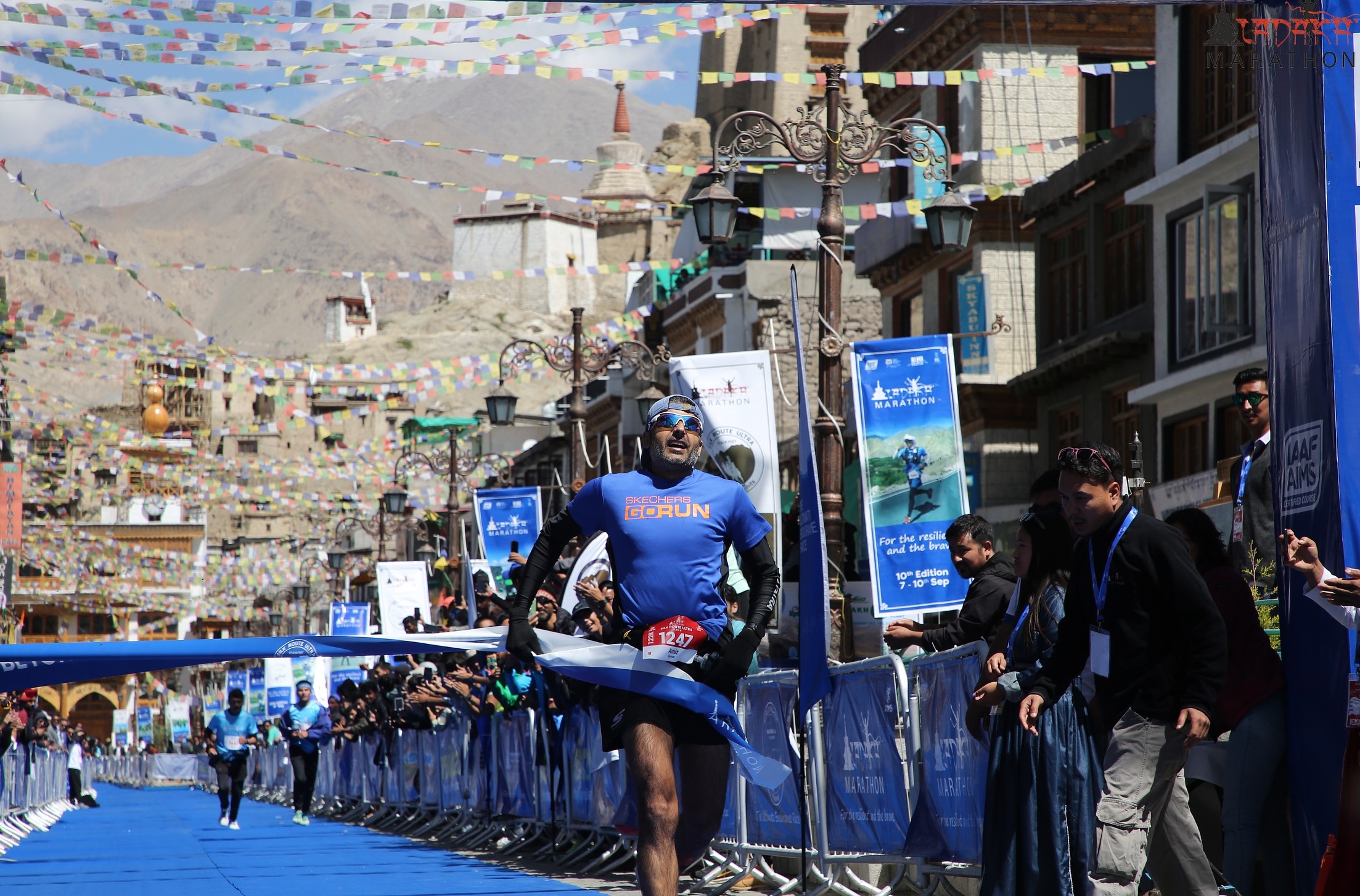
Amit Gulia crossing the finish line of the 2023 Silk Route Ultra in Leh (photo: courtesy Amit)
At South Pullu, Amit took 20-25 minutes to de-layer and have a warm cup of tea. Thus revitalized, he did a decent jog from there to Leh. “ I even pushed myself a bit,’’ he said, adding with a smile of satisfaction, “ if I remove all the time I lost to resting, and just aggregate the time spent moving, I clocked around 15 hours, 20 minutes and 10 seconds.’’ In all, over the 122 kilometres covered, Amit took three major breaks – at Khardung village, North Pullu and South Pullu. End to end, including any rest he may have availed, Shabbir Hussain of the Indian Army’s Ladakh Scouts regiment (he started the race one and a half hours after Amit did, in the second batch), won the 2023 SRU in 15:27:53. Amit would like to come back to Ladakh and improve his timing at SRU. “ There are some races, which are close to my heart. SRU is one of them. The finish line, located in Leh’s main market, is a fantastic experience. When I crossed the finish line, besides the spectators, there were people coming out from nearby shops to congratulate me. The congratulations in town continued the next day too,’’ he said.
(The author, Shyam G Menon, is a freelance journalist based in Mumbai. While the running community knows Amit as Amit Gulia, his official name – and the way it appears on race results – is Amit Kumar. At La Ultra The High, his name appears as Amit Chaudhary.)
Avinash Sable after his win at the Asian Games (this photo was downloaded from the event’s Facebook page and is being used here for representation purpose. No copyright infringement intended)
Asian Games: Sable gets gold in 3000m steeplechase, three days later adds a silver in 5000m
Avinash Sable has become the first Indian man to win a gold medal in the 3000m steeplechase at the Asian Games.
On October 1, 2023 (Sunday), at the ongoing edition of the Games in Hangzhou, China, he completed the race in eight minutes, 19.50 seconds, a new Asian Games record. The previous record of 8:22.79 was set by Iran’s Hossein Keyhani at the 2018 Jakarta Games. Following Sable to silver and bronze respectively were Japan’s Ryoma Aoki (8:23.75) and Seiya Sunada (8:26.47).
“ Unlike his energy conservation strategy at the Budapest World Championships, Sable raced ahead to build a distance between himself and the rest of the field and won the race by a massive distance. In the final 50m, Sable turned around to see no one close to him as he approached the end and celebrated as he crossed the finish line,’’ Sportstar noted while reporting Sable’s win.
Three days later, on October 4, Sable treated himself to a silver in the men’s 5000m. Defending champion, Birhanu Yemataw Balew of Bahrain, won the competition by in a new Asian Games record of 13:17.40. Sable followed in 13:21.09 while Dawit Fikadu Admasu of Bahrain secured the bronze in 13:25.63.
Sable holds the national record in the 3000m steeplechase – 8:11.20. That mark was set at the Commonwealth Games in Brimingham in 2022, where Sable took silver. The first Indian to win a gold medal in the 3000m steeplechase at the Asian Games was Sudha Singh. She struck gold at the 2010 Guangzhou Games.
In addition to his prominence in the steeplechase, Sable holds the national record in the men’s 5000m (13:19.30). He also holds the national record in the half marathon – one hour, 30 seconds (1:00:30) set at the 2020 Delhi Half Marathon.
Parul Chaudhary (this photo was downloaded from the athlete’s profile at World Athletics and is being used here for representation purpose. No copyright infringement intended)
Parul Chaudhary gets gold in women’s 5000m and silver in women’s 3000m steeplechase
India’s Parul Chaudhary secured the gold medal in the women’s 5000m at the Asian Games in Hangzhou, China.
On October 3, 2023, she clocked 15 minutes, 14.75 seconds to win the race. She was followed to the finish line by Japan’s Ririka Hironaka (15:15.34) and Kazakhstan’s Caroline Chepkoech Kipkirui (15:23.12) who took silver and bronze respectively. This was the second track medal for Parul at the current edition of the Games.
Earlier on October 2, 2023, she had won the silver medal in the women’s 3000m steeplechase competition. She finished the race in nine minutes, 27.63 seconds (9:27.63).
Parul holds the women’s national record (9:15.31) in the event. Her compatriot Priti Lamba (9:43.32) placed third in the women’s steeplechase in Hangzhou.
The gold medal went to Bahrain’s Winfred Yavi (9:18.28). The reigning world champion, her timing was a new Asian Games record.
Among India’s versatile distance runners, Parul has a portfolio of disciplines that spans the women’s 3000m steeplechase, 5000m, 10,000m and the marathon.
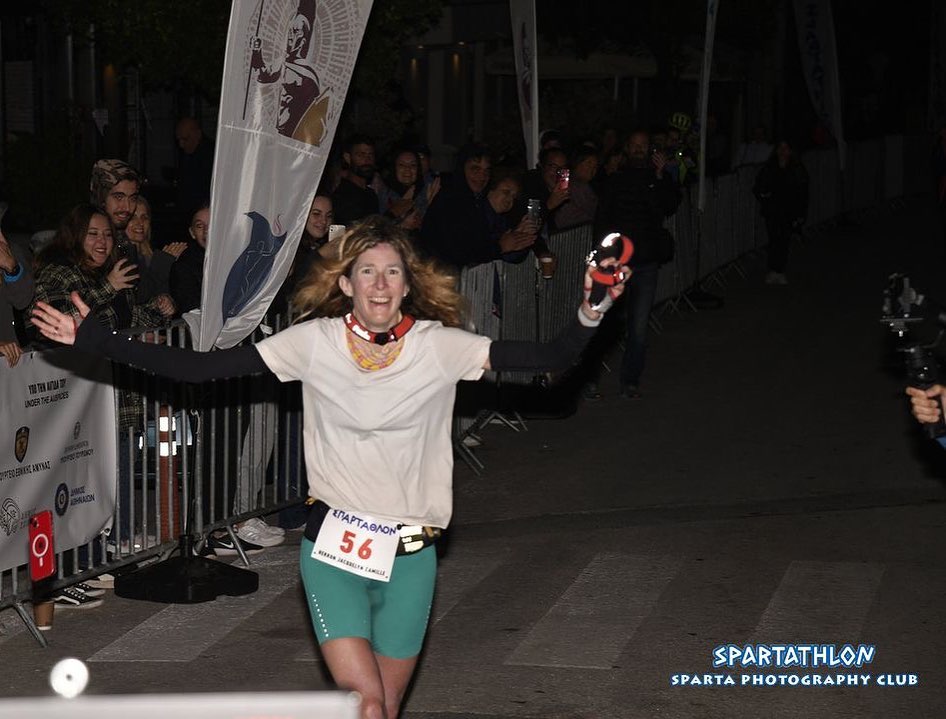
Camille Herron at Spartathlon (this photo was downloaded from the athlete’s Facebook page and is being used here for representation purpose. No copyright infringement intended)
New course records at 2023 Spartathlon
The 2023 Spartathlon witnessed new course records in both the women’s and men’s races.
American ultrarunner, Camille Heron, who won the women’s race finished in 22 hours, 35 minutes and 25 seconds. This was an improvement in the women’s course record by over two hours, Canadian Running Magazine informed. The previous record was held by Patrycja Bereznowska; 24:48:18 set in 2018. Finnish runners Noora Honkala (23:22:56) and Satu Lipiainen (23:48:28) finished second and third respectively.
In the men’s section, Fotis Zisimopoulos (19:55:02) won with a new course record. The previous record was in the name of Yiannis Kouros (20:25:00) set in 1984, the magazine said. Second place went to Simen Holvik of Norway (22:17:17). Uruguay’s Andres Fernando Roman Martinez (23:32:53) placed third.
Held annually in Greece, Spartathlon has a course length of 246 kilometres.
(The authors, Latha Venkatraman and Shyam G Menon, are independent journalists based in Mumbai. The 2023 Spartathlon timings quoted herein have been taken from the results provided on the race website.)
After five podium finishes in the 72 km-Khardung La Challenge (including a hat-trick) and two podium finishes in the 122 km-Silk Route Ultra, Shabbir Hussain wishes he had more opportunities in the ultramarathon
An ultramarathon at altitude, is a bit like a mountaineering expedition.
As the race approaches, each participant withdraws into a cocoon, unique to one’s wiring. By September 6, 2023, the day of departure from Leh to Kyagar in Nubra Valley, it was clear that an element of imminent rendezvous with reality was beginning to wash over those set to attempt the 122-kilometer-long Silk Route Ultra (SRU). In Kyagar, some rested in their hotel rooms and stayed unseen. Some walked around, conversed and chatted, ostensibly to ease the gravity of the countdown. Among the less visible was Shabbir Hussain. He must be resting. Tomorrow is his, isn’t it? – although not verbatim, that was the tenor in response from his colleagues in the military and paramilitary; at least three of them – Stanzen Phuntsog, Tsewang Kundan (from Ladakh Scouts) and Phunchok Tashi (from the Indo-Tibetan Border Police [ITBP]) – stayed in circulation, playing the occasional game of table tennis to keep themselves occupied and distracted. The day before an important race and the hours leading to it, can be testing. Staying relaxed is easier said than done. Shabbir appeared only on and off. Would the ones to watch out for tomorrow be the ones seen the least today? – I wondered.
Several hours earlier, at the NDS Stadium in Leh, a small fleet of buses had manifested to transport the runners. I had chosen my bus for Kyagar at random and discovered a self-effacing runner conscious of his importance and yet wishing to be away from the glare it fetched, take his place in the seat in front. His credentials in running were clear from his physical appearance. Here comes the winner. Take us also up the pass along with you, Shabbir – that, yet again not verbatim, was however the substance of the greeting he received from the other runners in the bus. From different parts of India, some of them attempting the race again after being unable to complete in 2022, they all knew Shabbir as the man to watch out for. With Kundan, Stanzen and Tashi too in the same bus, our vehicle felt special. Turbo-charged?
Shabbir Hussain’s significance to the two ultramarathons – Khardung La Challenge (KC / 72 km) and SRU – that are part of the family of races constituting the Ladakh Marathon, may be understood from the event’s archived results. Both these races come up and over the 17,618 feet-high Khardung La, among the world’s highest motorable passes. It is an altitude with less oxygen; running becomes quite difficult. Additionally, the SRU has a start that is 50 kilometers farther away from the start line of KC. In other words, a SRU participant is more than a marathon old in terrain gaining elevation towards Khardung La by the time he reaches the village of Khardung, start point of KC. The 72 kilometer-KC made its debut in 2012. Shabbir started running KC in 2014. As per results available on Wikipedia (at the time of writing, the KC results of 2012, 2013 and 2014 didn’t feature on the Ladakh Marathon website), he finished first in six hours and 35 minutes. In 2015, Shabbir finished fourth with timing of seven hours, 16 minutes and 13 seconds. The winner in 2015 was Tsewang Tokdan (6:33:41). By 2016, Shabbir was back on the podium at KC, he placed second (6:53:35.04); the results indicate a photo-finish with Tokdan (6:53:35.04). The next year was clearly Shabbir’s; he finished first (6:23:50.26) in KC. He stayed first (6:50:38) at KC, in 2018. In 2019, he made it a hat-trick of triumphs, securing the top position with timing of 6:53:34. In 2022, he shifted to competing in SRU. He finished second (14:57:57) in the race.
View of Darket (photo: courtesy Shabbir Hussain)
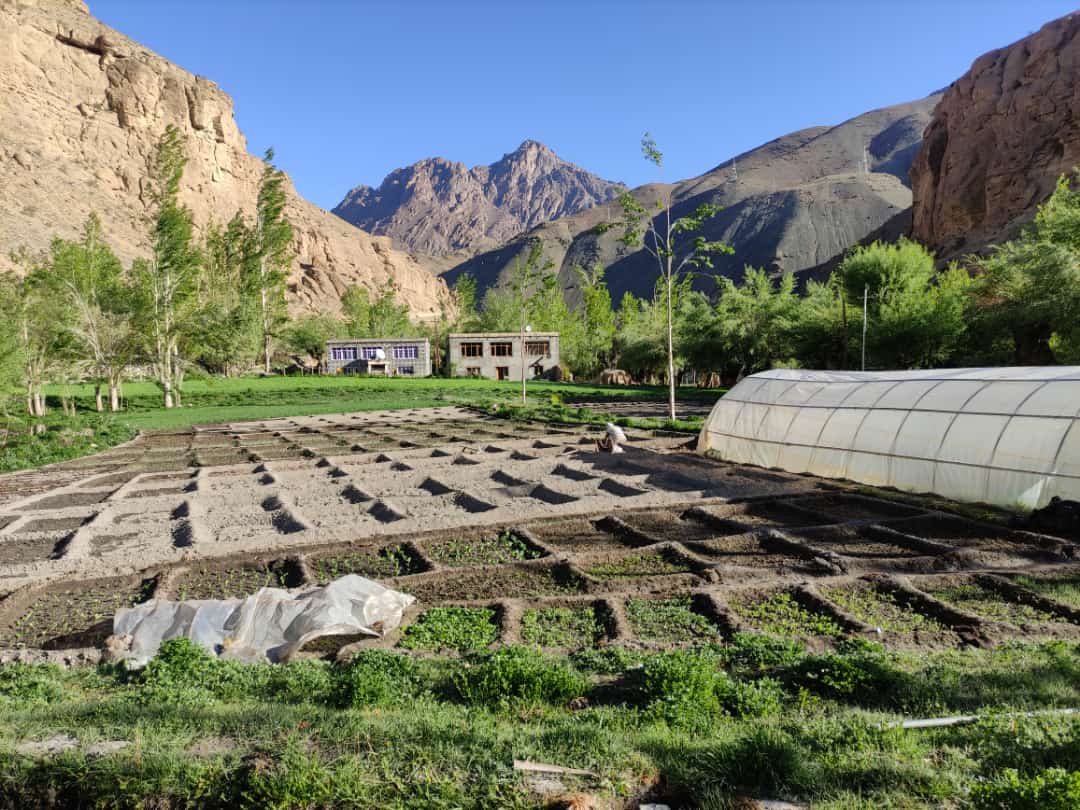
Shabbir was born and raised in Darket, a village roughly 20 kilometers away from Kargil towards the Leh side. Kargil is about 2700 feet lower in elevation compared to Leh (11,500 feet); it has an altitude of around 8780 feet (source: Wikipedia). He has three brothers and two sisters. Shabbir’s father worked as a laborer. The boy studied till tenth standard. As is widespread practice in Ladakh, he later joined the Ladakh Scouts regiment of the Indian Army. According to Shabbir, during his days in school, there wasn’t any indulgence in sports worth mentioning. However, soon after his acceptance into the Scouts, his ability to run was recognized. That was how he started landing up at the races of the Ladakh Marathon.
The event commenced in Leh, in 2012. That year, the men’s marathon (42 km) was won by Tsering Gyatso (3:36:18). In 2013, archived results show the men’s marathon sporting a new winner – Shabbir Hussain (3:25:33). “ I just ran the marathon and ended up first,’’ he said. In 2014, he shifted from the marathon to KC. Outside of Ladakh, Shabbir’s participation at races has been very limited and he has enjoyed no podium position. He travelled a couple of times with the team of Ladakhi runners Rimo Expeditions sent to the marathons of the plains. Away from the Ladakh Marathon, he also participated once in the 111 kilometer-race of La Ultra The High (also held in Ladakh) and secured a third place. “ When we train, we don’t think of podium position. We think of improving our timing. If you lost a position but gained in timing – it is fine. Similarly, a good position without good timing does not enthrall,’’ he said.
At Kyagar, Shabbir explained why he progressively drifted away from the marathon and stuck to KC and SRU. “ My forte is stamina. I find speed tough to generate,’’ he said. That was a day before the 2023 SRU set off late evening September 7 and Shabbir, running in the second batch of runners (the Ladakhi elites started one and a half hours after the rest of the field), showed that even in the ultramarathon, his pace – and that of the other runners from Ladakh Scouts – can be hard to match. They headed off into the night at a steady pace. Villagers who had lined up at road junctions to cheer the first batch, stayed back to encourage the local heroes. Shabbir felt that Ladakhi athletes like Jigmet Dolma and Nawang Tsering, who have embraced the marathon, have actually taken the tougher challenge of chasing speed. In comparison, he chose the path of less resistance – pursuing stamina. And yet that doesn’t totally sum up Shabbir for he digs a good challenge. In both the shift from the marathon to KC and the subsequent shift from KC to SRU, the main motivation he conceded, was “ challenge.’’ It’s probably why after winning the 2023 SRU, it isn’t a return to the same race that is playing on his mind. He wonders whether he should try the shorter KC next time, for in 2023, the KC winner, Rigzin Gyurmeth (6:31:41) of the army’s special forces, had come close to Shabbir’s timing from 2017 – 6:23:50.26. “ I would like to keep the course record,’’ Shabbir, 29, said smiling. He will take a decision on KC or SRU for 2024, closer to the event.
Shabbir Hussain finishing first in the 2023 Silk Route Ultra (photo: Shyam G Menon)
Morning of September 8. Fifteen hours, 27 minutes and 53 seconds after he set off from Kyagar, Shabbir crossed the finish line of SRU in Leh to win the 2023 edition of the race. Easily among the most iconic runners emerging from Ladakh Marathon, Shabbir would like to compete in ultramarathons outside Ladakh. Although news of races elsewhere now reaches Ladakh’s runners, Shabbir has to date not participated in an ultramarathon outside the union territory. “ I would like to attempt 100 km-races and 24-hour stadium runs,’’ he said. Top notch competitions in these disciplines, held under the auspices of the International Association of Ultrarunners (IAU), now happen in India. There are Indian teams participating. Many civilian runners also regularly take part in high profile road and trail-based ultramarathons overseas. A serving soldier, Shabbir’s future in the sport depends much on seniors empowered to take decisions. Hope they are listening.
(The author, Shyam G Menon, is a freelance journalist based in Mumbai.)
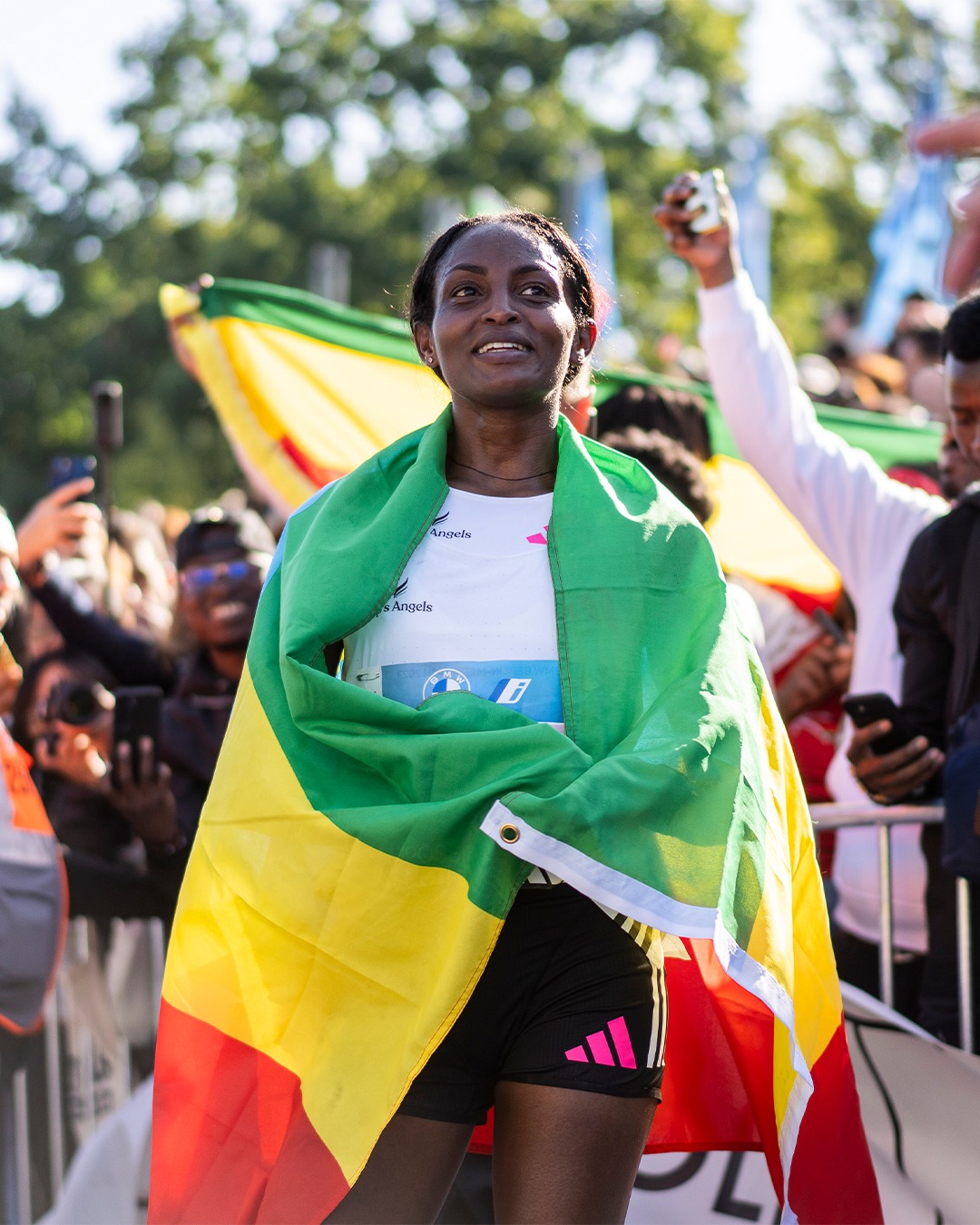
Tigst Assefa (this photo was downloaded from the Facebook page of Berlin Marathon and is being used here for representation purpose. No copyright infringement intended)
Kipchoge wins men’s title for the fifth time
Defending champion, Tigst Assefa of Ethiopia won the women’s section of the 2023 Berlin Marathon with a new world record of 2:11:53.
The timing is a considerable improvement over the previous world record of Kenya’s Brigid Kosgei (2:14:04), set at the 2019 Chicago Marathon. A year ago, at the 2022 Berlin Marathon, Tigst had finished first in a personal best of 2:15:37.
A former 800 metres-specialist, she started running marathons only in March 2022. A September 2022 profile in Runner’s World magazine, soon after her victory in the 2022 Berlin Marathon, pointed out that an Achilles tendon injury with consequent difficulty in training in spikes, had seen the talented middle distance runner shift from the track to road races. After a two year-break to recover from the injury, Tigst worked her way through the 10K and the half marathon to the marathon. She debuted in the marathon at the March 2022 Riyadh Marathon, where she finished seventh (2:34:01). Six months later, she was the winner at Berlin and a year thereafter, the world record holder.
“ I didn’t expect to run this fast that is to say to break 2:12, but it is the result of hard work. As for being now a favourite for the Olympic Marathon next year, it is up to the National Committee to select me for the team.’’ Tigst was quoted as saying on the X handle of Berlin Marathon. In Berlin on Sunday, second place among women went to Kenya’s Sheila Chepkirui (2:17:49); Tanzania’s Magdalena Shauri (2:18:41) placed third. It was an exceptional showing by Ethiopian women runners as they cornered seven of the top ten finishes in their gender category.
Link to video posted by BMW Berlin Marathon on YouTube, showing Tigst Assefa’s finishat the 2023 edition of the event.
Among men, the winner of the 2023 Berlin Marathon was yet again, Eliud Kipchoge of Kenya, albeit with timing that was the slowest from the gallery of his five wins at the event since 2013. A decade ago, in 2013, Kipchoge had placed second in the year’s Berlin Marathon, with timing of 2:04:05. In 2015, he chopped that to 2:04:00 and a win. It was 2:03:32 by 2017, 2:01:39 in 2018 and down to a spectacular 2:01:09 in 2022 (all of them, first place). On Sunday, the 38-year-old crossed the finish line of the 2023 edition of the event, in 2:02:42 to place first again. Kenya’s Vincent Kipkemoi (2:03:13) placed second while Ethiopia’s Tadese Takele (2:03:24) placed third. “ I always learn from every race and every victory. I’m very happy to win for the 5th time in Berlin. And I shall use these lessons in my preparation for the Olympics,’’ Kipchoge was quoted as saying on the X handle of Berlin Marathon.
Within the world of city marathons, the race in Berlin is much-coveted for its flat, fast course. It has witnessed several world records. Reporting on 29-year-old Tigst Assefa’s run, Reuters noted, “ She clocked an hour six minutes 20 seconds at the halfway mark and was one of six women to be on world record time at that stage as the Berlin marathon lived up to its reputation as one of the world’s fastest. She had no problem maintaining her pace and at the 37km mark she was just three seconds per kilometre slower than Kipchoge’s time at the same stage, cruising to a sensational world record.’’
Host country, Germany saw one of its runners finish in the top ten at Berlin Marathon for the first time since 2008; Amanal Petros (2:04:58) finished ninth in the race.
(The authors, Latha Venkatraman and Shyam G Menon, are independent journalists based in Mumbai. The name Tigst Assefa may be found spelt so and also as Tigist. We have gone with the spelling as available at Berlin Marathon and World Athletics.)
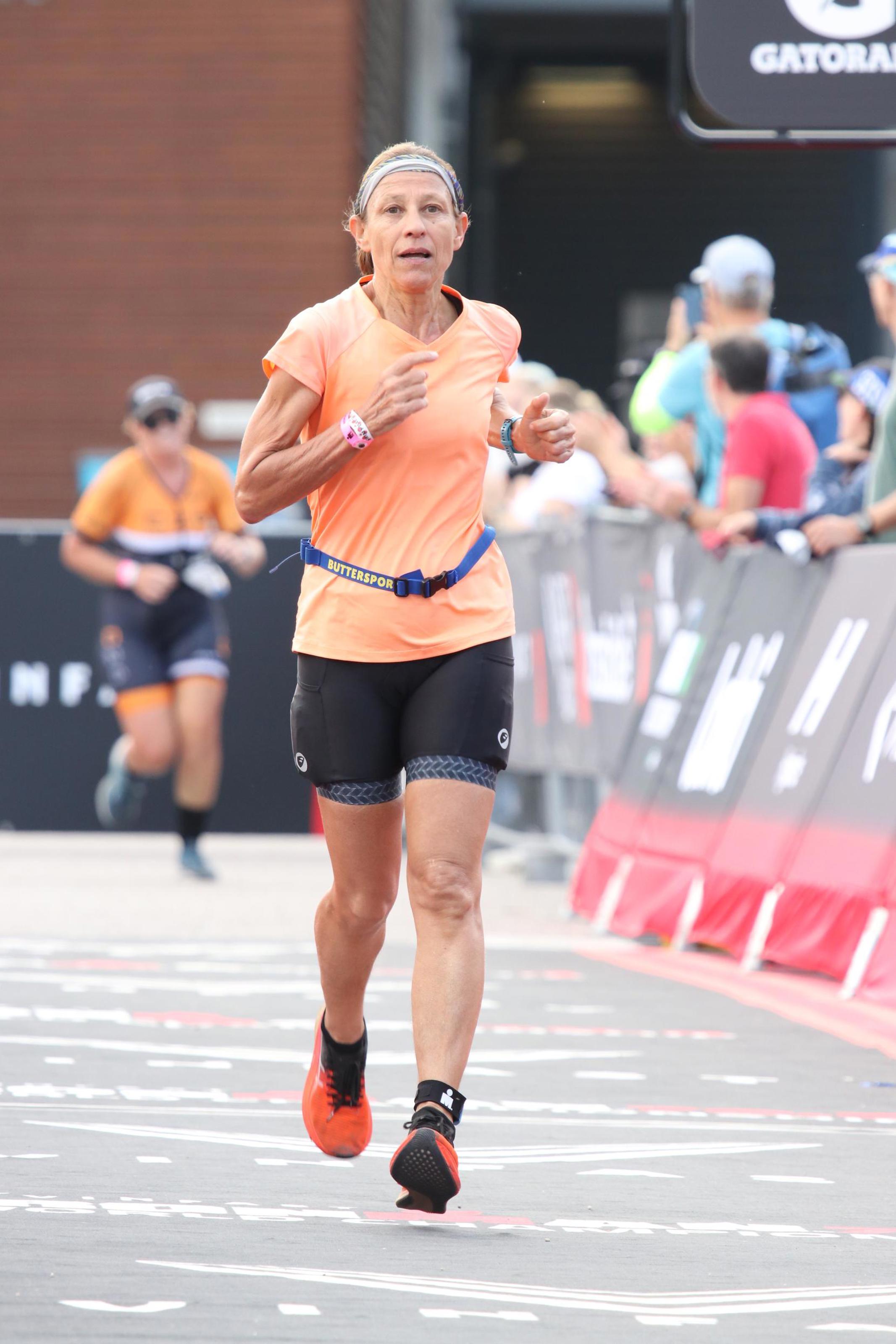
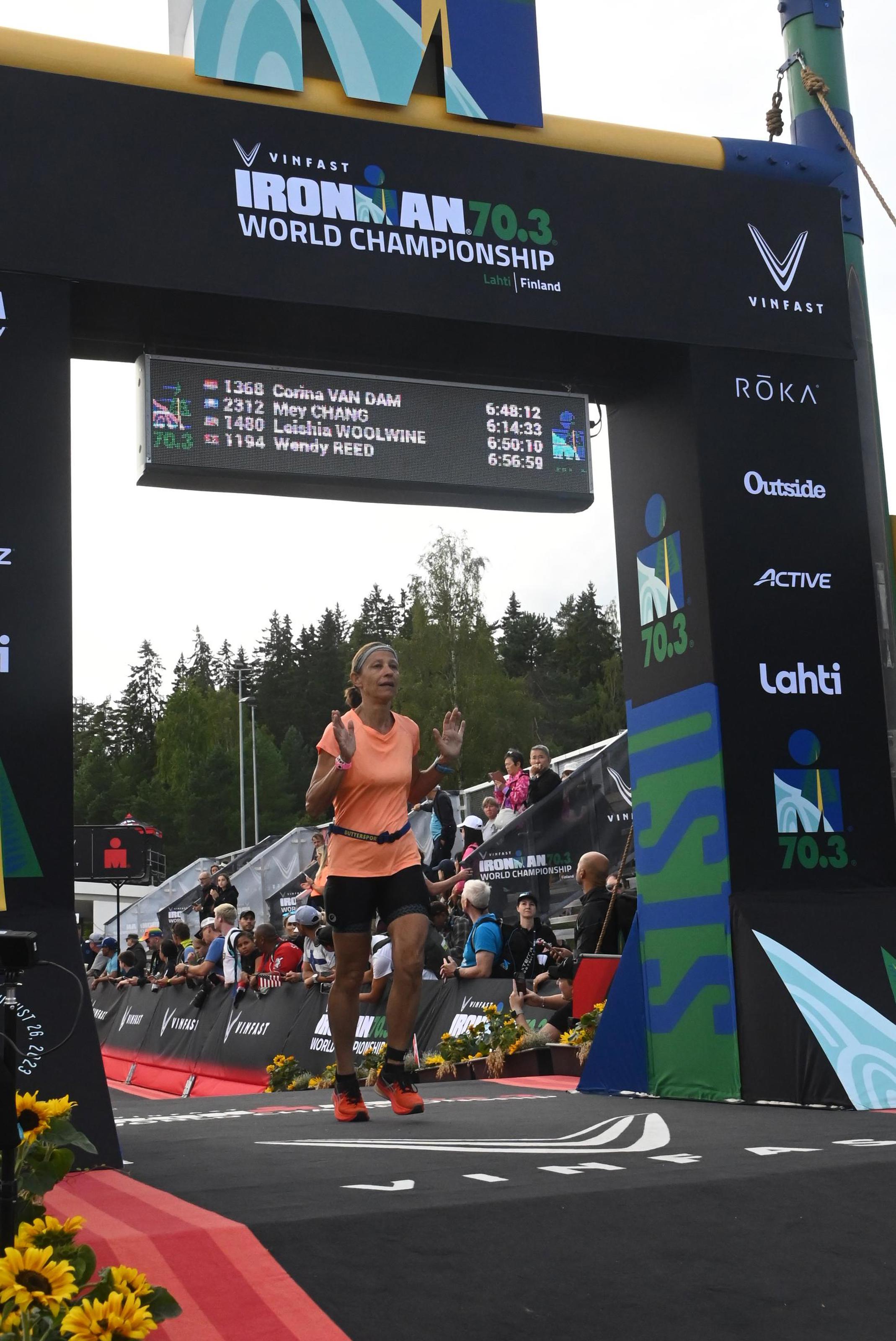
Corina (Cocky) Van Dam; at the Vinfast Ironman 70.3 World Championship 2023, in Lahti, Finland (photo: courtesy Cocky)
This is an article by invitation. Corina Van Dam, or Cocky as she is popularly known in Mumbai, is a football coach, a long distance runner and a triathlete. She has participated in a number of races and triathlons across India. She has also taken part in endurance swimming events. She was recently at the Vinfast Ironman 70.3 World Championship 2023 at Lahti in Finland. Here, she writes about her experience at the event.
As age category winner in Ironman 70.3 Goa in 2022, I was eligible to register for the Vinfast Ironman 70.3 World Championship 2023 in Lahti, Finland. I dreamt of participating in a world championship when I was a young girl but never thought that this dream would come true at the age of 58…!
My development from athlete to triathlete has been an organic one. I have always loved sports and through the years (and the accumulation of age) I had increasingly started loving the volume of work-outs rather than the intensity. The longer a practice or race, the more interesting I found it to be. However, in order to not finish last in the world championship (which was my goal!), I had to increase the intensity of my workouts and speed / pace in the different elements. To cut a long story short…, though I had an excellent cycling coach in Abishek Avhad, I had not been able to cut a substantial chunk of my race time when it mattered. But the success that I celebrate is that I finished as nr. 141 out of 161 in my age category (mission accomplished!). And although I feel a bit ashamed that `my fans’ celebrate me as if I am the world champion, I am proud that I have been able to finish in a world championship surrounded by excellent athletes while enjoying the event to the fullest.
The challenges that I had to overcome prior to the race, were ‘swimming in a wetsuit’ and the thought of swimming in ‘cold water.’ With my Ironman (IM) travel mate Ritesh Thakkar, I took advantage of the public open water swimming spaces in Helsinki, where residents of the city dip in the water for their morning swim. I was so relieved when the water appeared to be ‘only’ 19.5 degrees Celsius cold. The Ironman practice swim in Lahti gave me the confidence that I would manage this leg. It seemed easy: no loops, no mass start, buoys with numbers and a finish line that could be seen from a distance. However, I was seriously intimidated by all those athletic bodies in shiny black wetsuits. The three women from Singapore said to me what I thought of every other athlete present: “ We hope you’re not in our age category…!’’ I received another shock during the bike check-in, the day before the race. While I checked the simplest Scott road-bike in, the poor thing was surrounded in Transition 1 (T1) by equipment from a different family: TT bicycles, carbon frames with disk wheels, aerodynamic helmets….
Corina (Cocky) Van Dam; from the Vinfast Ironman 70.3 World Championship 2023 (photo: courtesy Cocky)
As we were commuting from Helsinki to Lahti by train, we tried to do as many of the activities on the day of our registration, such as the welcome dinner and the Parade of Nations, so that we could meet other participants. I represented the Netherlands and I joined the group of Dutch people lining up behind the red-white-blue flag. As during an Olympic Games opening, we walked through Lahti Stadium which is situated at the bottom of three spectacular ski jumping hills (with a swimming pool at the landing) and waved at everyone who wanted to wave at us. The commute also gave us a chance to talk to ordinary Finnish travellers, IM participants and their families from different countries. During one of the trips – a special morning train from Helsinki on event day (like the Tata Mumbai Marathon train but only with triathletes) – we sat with the family of Steven McKenna, one of the professional triathletes. We could not get enough of listening to stories about his preparations and attitude towards the sport.
The world championship was held over two days. The first day was for us, women. From my first step in Helsinki Central Station to the last in the evening, I was surrounded by vibrant female concentration, power and energy. Countless were the moments that I felt emotional.
Not the least, when the professionals were being introduced to the audience and lined up for the race. After the Finnish national anthem, we could hear a pin drop in anticipation of the race start. And there they went… the pros, our role models, kicking off the long-anticipated event.
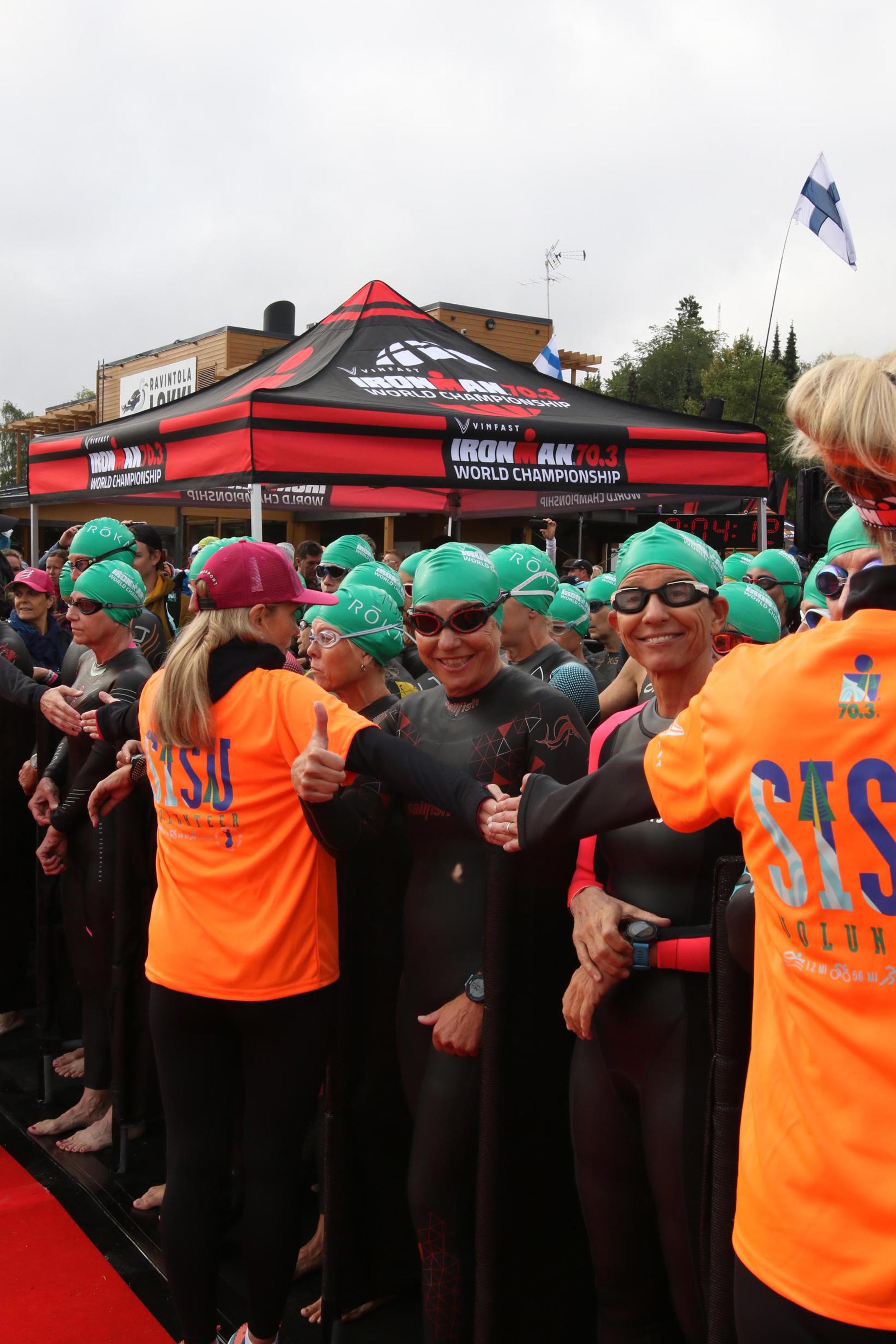
I was thrilled to participate with 2000 other participants in a women’s only race. As female triathletes in India, we are always surrounded by male participants. Often, there are only a few women present and I have been in races where I was the only one registered in my age category. I cannot describe how exciting it was to stand at the starting line with 160 women of my own age: wrinkles, grey hair peeking out from under our green swimming caps and singing and dancing to the music in our tight wetsuits that showed our trained and toned bodies in all their glory. Of course, I panicked when the swim started, as I always do. This time my contact lens moved when I jumped into the water. I immediately realised that if I lost it, I would not have any replacement or glasses for the rest of the race since the start / finish (the ‘Finnish finish line’) / Transition 1 and Transition 2 were all in different places. Shubham Vanmali, one of India’s great ultra swimmers and a recipient of the Tenzing Norgay National Adventure (sport) Award once told me that cold water amplifies fear. I did not allow this to happen. I managed to control myself and started enjoying the swim though my timing was not as it could have been.
Corina (Cocky) Van Dam; from the Vinfast Ironman 70.3 World Championship 2023 (photo: courtesy Cocky)
The cycling route was one loop through a rolling landscape. We crossed forests, meadows, and a few villages. The roads were closed and we just had to pedal without fear for upcoming traffic or potholes. Of course, there are always too many hills and there is too much head wind. After 30 kilometres of cruising, the road made a sharp bend and an awful hill showed its ugly face. At the sudden start of the climb, I approached another athlete and joked: “ I did not see this coming.” It happened to be Maitreyi Bokil and we both laughed. I managed to overtake a few triathletes but have especially learnt to recognize the sound of TT bikes closing in on me from behind. After the race, I kidded that I had overtaken 10 cyclists and had been overtaken by 100. Since there were many (younger) age categories that started behind us (the 55–59-year-olds), it did not matter. But of course, it always hurts.
With the run, in sight, I was relieved that I had completed the riskier activities (being caught by fear / cold during swimming – one female triathlete died during the swim – or a mechanical issue while cycling) which can end one’s race prematurely. The half marathon was fun. As on the cycling route, the residents of Lahti were sitting in front of their houses with their families, cheering us on. They sat in their foldable chairs, ringing cowbells or banging pots and pans with spoons. The run was two laps and it was painful to see athletes keeping right and head towards the finish while we had to start our second loop. When I used a hill to consume one of my LEAP gels, I heard my name and Ketaki Sathe flew past me. Wow! My running time was the same as during my last triathlon event and my overall timing was a carbon copy of Ironman 70.3 Goa in 2022.
It is a good practice during Ironman races that every athlete is as welcomed as the winner among the professionals is. With 15,000 volunteers, all 6000 participants received the support that we needed. After the race, no idlis or upma but pizza, hotdogs, ice cream, muffins, chips and Coke….! Race day was party time.
Corina (Cocky) Van Dam; from the Vinfast Ironman 70.3 World Championship 2023 (photo: courtesy Cocky)
The next day, I had a chance to watch the 4000 men racing. I thought I would have a quiet day but as it happened, I had to run up and down Lahti to see the professionals start their swim, run to T1 to see them finish and start cycling, run back to see Ritesh start his swim 2.15 hours after the professionals started (take pictures for his family at home), run to the road to see the professionals heading to T2, run back to watch Ritesh finish his swim and transition in T1 (another picture), and in a hurry run to the finish to watch the pros completing their case… I walked 23 kilometres as recovery, the day after my race. But it was great to watch without pre-race day tension, cheer the Indian participants on and experience the race as spectator from the first to the last finisher.
I had an unforgettable time as amateur / tourist, but it became clear that I am in no position to compete with the best in my age category at a world championship. Participating has been a humbling experience. It has shown me how privileged I am that I had learnt swimming, cycling and running from a young age so that I could participate in a race like this. I could also afford to pay for the registration, flight and accommodation which is not the case for many of the age group winners in India and others in the Global South. For now, the Ironman World Championship remains an event for the privileged ones. And this privileged one needs to step up if she wants to be more than just a tourist at another Ironman 70.3 World Championship.
(The author, Corina [Cocky] Van Dam works with an NGO. She lives in Mumbai.)
The data in the phone-camera gives the time of the photograph as 8.42AM.
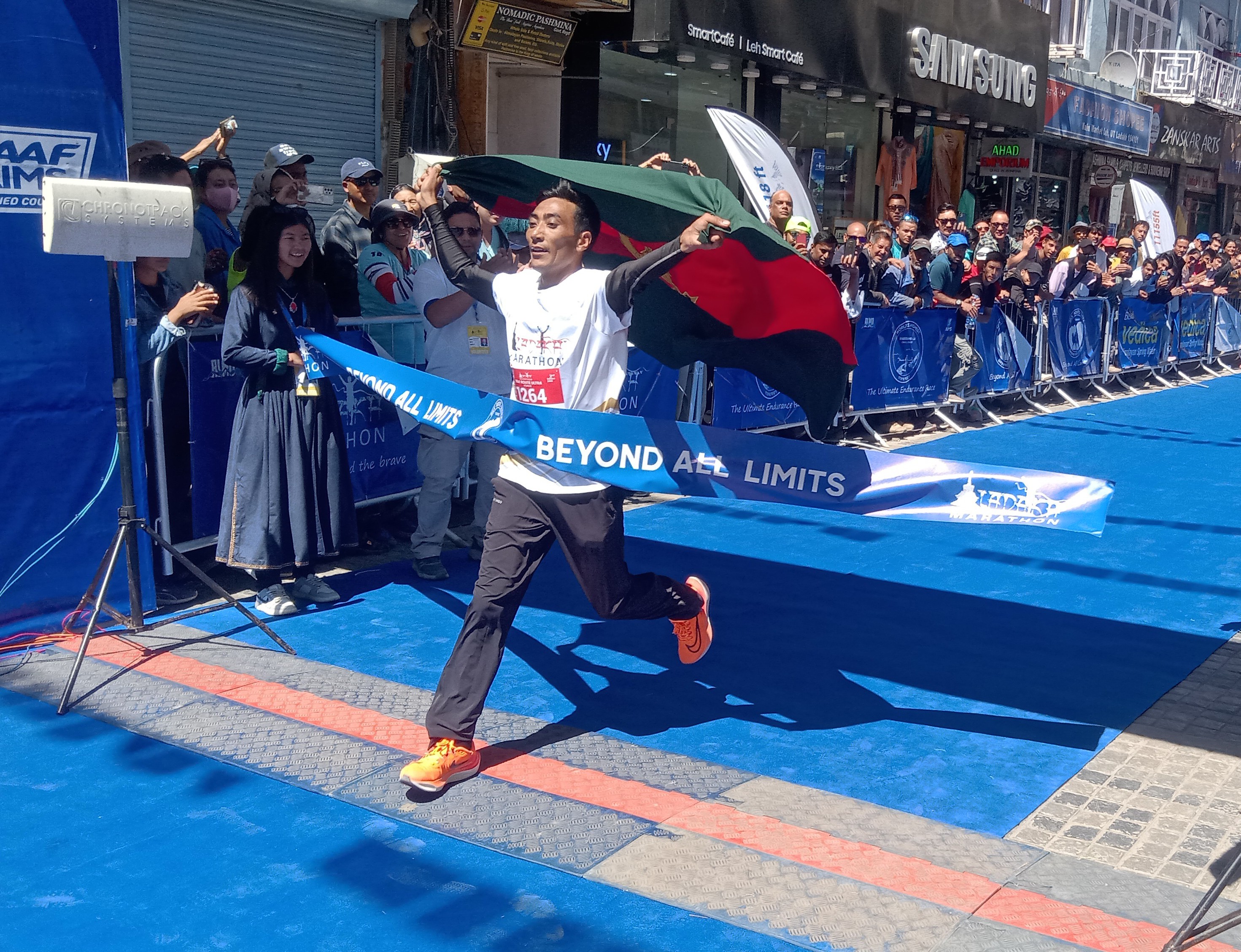
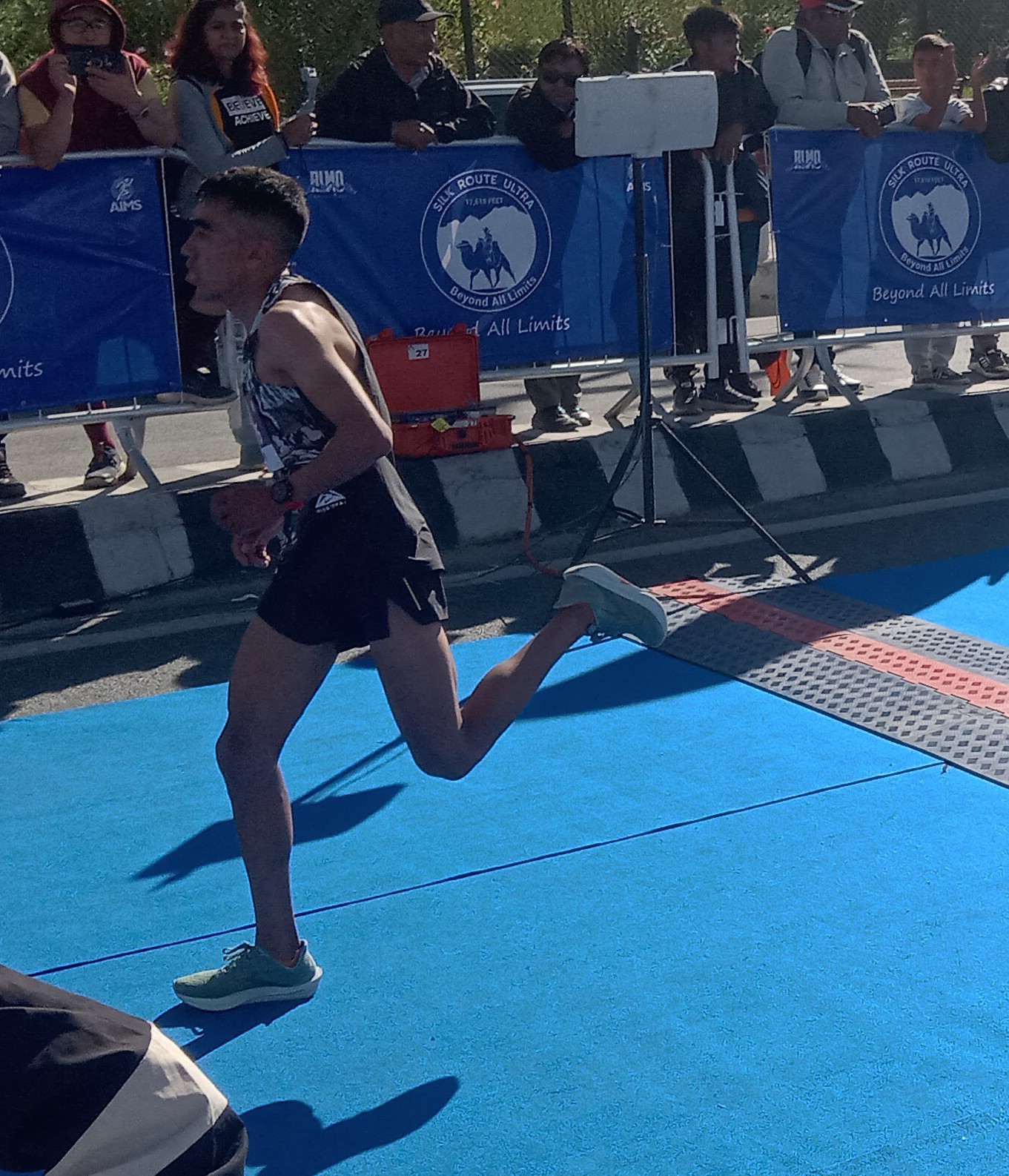
That was when on September 10, a wiry runner blew past the finish line of the 2023 Ladakh Marathon and won the race. A few steps past the finish, he lay down exhausted. Helped up by volunteers, he then picked his way to Leh’s NDS Stadium nearby, where the awards presentation was due.
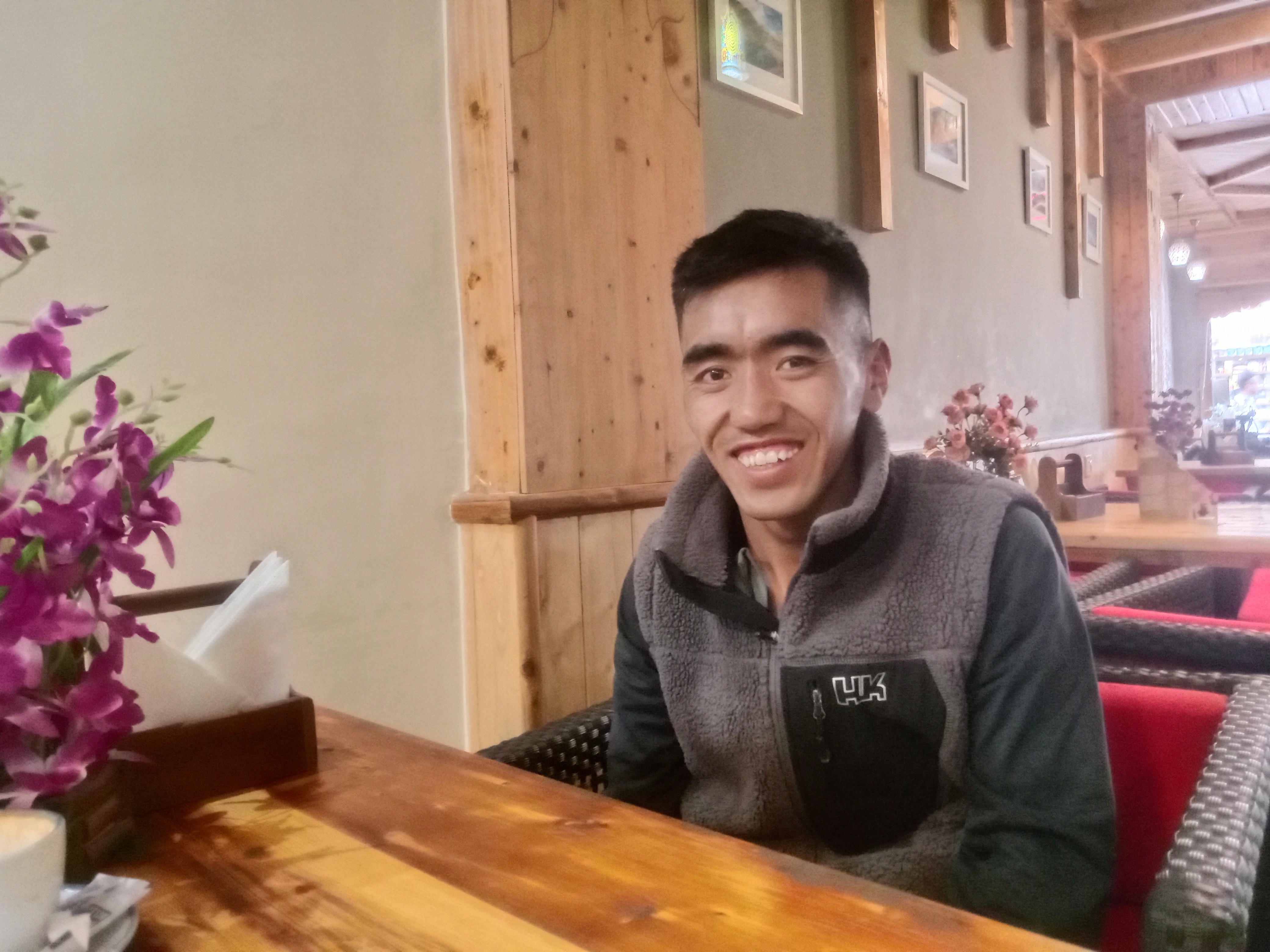
A couple of days later, when this writer met him at a café in Leh, he still seemed a light, breezy presence on the planet. Soft spoken, mostly answering to the point and if a wind blew – likely to float off. Meet Nawang Tsering or as at 8.42AM on September 10 – two hours, 42 minutes and two seconds. And for this spectator from Mumbai, such timing at 11,500 feet elevation, where many of us find it difficult to jog!
Still when Nawang won the 2023 Ladakh Marathon, it wasn’t his best timing so far. He was marginally short of his own course record in Leh; 2:41:42, set in 2022. His personal best was 2:39:39, set at the 2022 New Delhi Marathon. At that time, it (2:39:39) appeared the best timing yet by a Ladakhi marathon runner (source: Administration of Union Territory of Ladakh, press statement dated March 29, 2022). However, it’s a long way off from the timings reported by top Indian marathon runners (for comparison: Shivnath Singh’s longstanding national record is 2:12:00 and Gopi T of the Indian Army who has since been the closest to that mark, clocked a personal best of 2:13:39 at the 2019 Seoul Marathon [source: World Athletics]). On the bright side, Nawang is 24 years old and only getting started. Besides, just as runners from the plains may be stretched doing a sub-three hour-marathon at altitude in Ladakh’s dry weather, a Ladakhi runner like Nawang, takes time to adjust to the heat and humidity of lower altitudes. All of which points to engaging discoveries and twists and turns ahead, in India’s marathon story.
Nawang hails from Lingshet, a village in the Sham region of Ladakh. It is a long way from Leh, to the south west. Although technically a part of Leh district, enquiries in Leh revealed that culturally, Lingshet used to be closer to Zanskar. For long, Lingshet was a remote place. There wasn’t a road leading right up to the village. Nawang’s father worked as a labourer. His mother died when he was in the third standard. He has two brothers and a sister. Nawang studied at Leh’s Lamdon Model Senior Secondary School. Even after he competed his twelfth standard some years ago, the school continues to be second home. He stays in the school hostel.
In his early childhood, Nawang recalled, it took three days to reach home from Leh. And in winter, passage to Lingshet entailed trekking on the frozen Zanskar River. Known as the Chadar Trek, it was until recently a much-coveted objective in adventure tourism with people paying a lot of money to experience walking on the frozen river in sub-zero temperatures. Global warming and consequent unreliability around the strength of the ice cover and problems associated with too many people arriving for the bragging rights of having walked the frozen river, have since taken the sheen off the trek. For Nawang though, the Chadar Trek was a winter reality. It was the only way he could go home during vacations (in Ladakh, the winter school break is longer than the summer one). As he grew up, the visits home appear to have dwindled. During the ninth and tenth standards, tuitions kept him in Leh. In the following years, it was running. Lingshet is now connected by road. But the boy, since become a man and devoted to a life in running, rarely goes home. Leh and Lamdon have become his address.
For much of his years in school, Nawang wasn’t into running. The bug bit in the eleventh standard. His inspiration was his friends – Tsering Stobgais and Jigmet Norbu – who had been to Mumbai (home of India’s biggest city marathon) and on their return begun to train. There was even a running club operated by his friends; they called it Cosmos. According to Stobgais, Cosmos was one among clubs of that sort, formed by the inmates of the school hostel to have informal tournaments. “ Back then, Leh did not have many sports tournaments. We had to devise our own,” Stobgais said, adding efforts are now afoot by former Cosmos members to recast the club into a body that spans both competitions at school and outside. At the time Nawang first saw his friends train, he didn’t have running shoes. His friends had visited Mumbai as part of the running team sponsored by Rimo Expeditions. The company provided team members new pairs of shoes. When his friends’ shoes became old, Nawang got to borrow a pair for his training runs. Then in 2014 or so, when the year’s edition of the Ladakh Marathon was due, Nawang bought his friend’s old running shoes – a pair of Kalenji from Decathlon. At the event in Leh, he participated in the half marathon and finished eighth. From 2015 onwards, he started getting podium finishes at the Ladakh Marathon; he opened his account with a second position in the half marathon in the open category. Archived results show his 2015 timing as 1:23:26.
A view of Lingshet (photo: courtesy Nawang Tsering)
That year he made his first trip to Mumbai as part of the team dispatched annually by Rimo Expeditions to participate in the Mumbai Marathon. Thereby, he got his first pair of new running shoes – a pair of Nike. In Mumbai, he trained under coach Savio D’Souza (Savio also visited Leh periodically to oversee his wards’ training). Contacted in mid-September 2023, after Nawang’s latest victory in Leh, the coach remembered the youngster he met in 2015 as a hardworking, good runner who was short on big race experience. Nawang’s first half marathon in Mumbai didn’t yield any podium finish. He found the heat and humidity challenging. But it was the beginning of a pattern in life – start the running season with the Ladakh Marathon in September and spend the winter months running the marathons of the plains with Rimo. In 2016, he successfully defended his second place in the half marathon in Leh and while he travelled with Rimo to Mumbai, Goa and Delhi and improved his timing, he could secure no podium finish anywhere outside of Ladakh.
Next year – 2017 – he became the winner (first place) of the half marathon in Leh with timing of 1:21:23 and followed that up with a second place in his age category at the Tata Steel 25K in Kolkata, his first podium finish outside Ladakh. However, his participation in the 2017 Airtel Delhi Half Marathon and the 2018 Mumbai Marathon yielded no podium finish, Nawang said. It was a spell of no encouraging results. Through the 2019 Tata Mumbai Marathon and the New Delhi Marathon, he continued to run the half marathon to no memorable finishes outside Ladakh. Barring exceptions, his timing in the half marathon was stuck in the range of 1:20 to 1:21. There were some near podium finishes but no real podium. His performance at home too, seemed unsteady. At the 2018 Ladakh Marathon, he completed the half marathon in 1:18:48 to secure first place. But in 2019, it was 1:22:34 and a third place on the podium. Then COVID-19 struck. The world slipped into pandemic and lockdown. Races were cancelled globally.
The intervening period till the resumption of races, was a period of reflection. Nawang had to figure out how to break free from entrapment in a plateauing half marathon performance and dearth of podium finishes. “ I was stuck in the 1:20 – 1:21 range,” Nawang said, portraying the frustration. It was from the consequent churn that the switch to the full marathon happened. Savio explained the logic and process. According to him, two angles counted. First, there were limitations in Ladakh to improving athletes’ speed because the required number of short distance races were not yet a major part of the region’s running ecosystem. Second, what runners like Nawang required was not merely speed but “ speed-endurance.’’ Or simply put, sustaining what speed they could whip up over a longer distance, which in turn helped them when running the the shorter distance races too. A kind of benign, synergic loop. “ For me, it was logical that Nawang should increase the distance of his long runs,’’ Savio said of the drift to full marathon. In his estimation (the whole thing viewed as developing speed-endurance), Nawang learning to be good at the marathon would have beneficial impact on his performance in the half marathon as well.
In Leh, Nawang did some of his training runs for the full marathon with Ladakh’s leading woman marathon runner, Jigmet Dolma (another of Savio’s Ladakhi students), and also with her fellow marathon runners, Tsetan Dolkar and Disket Dolma (they were all part of Rimo’s team). “ He did some of the easier runs with us. Beyond a point, our respective pace is different,’’ Jigmet said. In training, Nawang’s long runs typically touched 35 to 38 kilometres. “ In 2021, there was a marathon in Delhi. That is where I competed in the full marathon for the first time. I had timing of two hours, 42 minutes,’’ he said (the reference here is most likely to the 2021 New Delhi Marathon, where Nawang timed 2:42:49 to place sixth among men in the open category). The next event he recalled, was the 2022 New Delhi Marathon, where he got his personal best of 2:39:39. In September that year came his course record at the Ladakh Marathon.
Then the impact of the switch to full marathon, on the half, also manifested. At the 2022 Vedanta Half Marathon in Delhi, Nawang narrowly missed a podium position in his age category (in the half marathon) but gained a personal best of 1:14:45. In December 2022, he ran the Tata Steel 25K in Kolkata and placed third in the 18-24 years age group with timing of 1:31:28. Roughly a month later, at the 2023 Tata Mumbai Marathon, he placed fourth in the men’s 18-24 years age category of the full marathon with timing of two hours, 39 minutes, 49 seconds. What effect, better circumstances of training and being with runners of matching and superior ability can have on Nawang, is anyone’s guess.
Going ahead, Nawang wishes to alternate between the full and half marathon. He plans to improve his timing. Many Ladakhi runners concede that while they have faith in their endurance, they find themselves challenged for speed in the races of India’s plains. Nawang trains as his coach, Savio, tells him to. He does his training runs, does free hand exercises and has generally avoided gyms. “ I have only one weight in my hostel room. Four kilos, that’s all,’’ Nawang said laughing. The bulk of his training is a composite of warm-up, running and stretching. Asked what he thought were essential to get closer to the timings reported at marathons elsewhere, he thought for a while and said: an improved diet, coach close by and perhaps access to some strength training. But what sets Nawang apart from the regular crop of Ladakhi runners is how he has imagined his life’s work.
Nawang crossing the finish line at the 2023 Ladakh Marathon (photo: Shyam G Menon)
Nawang currently holds a temporary job with the Ladakh Police. He also helps out at Rimo. Most male runners in Ladakh, once they become proficient in the sport, join the Ladakh Scouts or get picked up by this regiment of the Indian Army (the Scouts are known to treat their podium finishes at races in Ladakh as a regimental honour). According to Nawang, he was approached. But he held back for two important reasons. First, he is clear that whatever job he does should provide him room to train and grow further in running. It cannot be job above running; it should be a job that enables his future in running. To that extent, within the gamut of government jobs (including jobs in the military and paramilitary), he prefers establishments with a clear-cut sports quota and equally clear provisions for sportsperson to train. Second, he would like to contribute to running’s growth in Ladakh. “ I want to popularize running amongst my people,’’ he said. Outside the café, there was a quiet calm descended on Leh’s main market, also its much loved meeting spot; with the annual marathon over, the last flush of tourists to town had departed. Conversation completed, Nawang left for Lamdon.
“ Nawang Tsering is a star of Lamdon School. In fact, he is a Ladakh-star. He belongs to a very humble family. At an early stage itself, we saw his potential in long distance running. He has stayed on in the school hostel even after passing out. For Lamdon’s boarding school students, he is like an elder brother. He coaches and mentors students,” Dr Stanzin Dawa, principal, Lamdon Model Senior Secondary School, said when contacted. According to him, the Leh-based institution has its own imprint on the annual marathon with many who finish in the top ranks of the Ladakh Marathon’s various races, belonging to the school or its alumni.
The weekend after this writer met Nawang, it was the Sunday of the 6th Kargil International Marathon 2023. Nawang was due to run there. He did and secured the first place, covering the 42 kilometre-distance in a new personal best of 2:38:47 on September 17, 2023. That 2:39:39 from 2022, had become history. The union territory’s administration may need to put out a new press statement.
(The author, Shyam G Menon, is a freelance journalist based in Mumbai.)
Nawang Tsering has won the 6th Kargil International Marathon 2023 in a new personal best (PB) of two hours, 38 minutes and 47 seconds.
Ravi Dass (2:39:20) took second place. Jigmet Namgial (2:43:48) placed third. The timing (provisional) is as published on the website of Sports Timing Solutions.
Among women, the first place in the marathon, held on September 17, went to Agnes Mueni Mutua (3:02:47). Second and third places went to Diskit Dolma (3:36:13) and Jyoti Gawate (3:52:43), respectively.
In the men’s half marathon, Ritik Sharma (1:17:59) secured the first place followed by Kulbir Singh (1:19:21) and Tsewang Nangdan (1:21:52). Among women, the first place went to Tashi Ladol (1:26:43). Stanzin Chondol (1:27:09) placed second while Stanzin Dolkar (1:30:18) placed third.
Kargil has an average altitude of 8780 feet (source: Wikipedia), lower than the 11,500 feet of Leh, where just seven days earlier, Nawang had won the 2023 Ladakh Marathon in 2:42:02. Asked about the race in Kargil, Nawang said, “ it was a bit challenging because I was yet to recover fully from the marathon in Leh. The competition was also tight.”
On March 29, 2022, the Administration of Union Territory of Ladakh had issued a press release mentioning the timing of 2:39:39, which Nawang earned at the 2022 New Delhi Marathon, as the fastest by a Ladakhi male marathon runner. The wording in that statement (it was on the performance of Ladakhi runners at the 2022 New Delhi Marathon) had been, “ Nawang Tsering clocked 2 hour 39 minutes and 39 seconds which is so far the best timing by any Ladakhi Marathon-Runner (Men) breaking his own record which was 2 hours 42 minutes and 49 seconds of last year.”
Assuming the above observation is not restricted to the universe of the said event and going by the provisional timing from Kargil on Sunday, the 2022 mark would seem improved.
Besides Nawang Tsering, the names of Jigmet Namgial, Tsewang Nangdan, Diskit Dolma, Stanzin Chondol, Tashi Ladol and Stanzin Dolkar had featured among podium finishers at the 2023 Ladakh Marathon. They have all registered an improvement in timing in Kargil, which is roughly 2700 feet lower in elevation compared to Leh.
(The author, Shyam G Menon, is a freelance journalist based in Mumbai.)







 Outrigger