MUMBAI-GOA ON A KAYAK

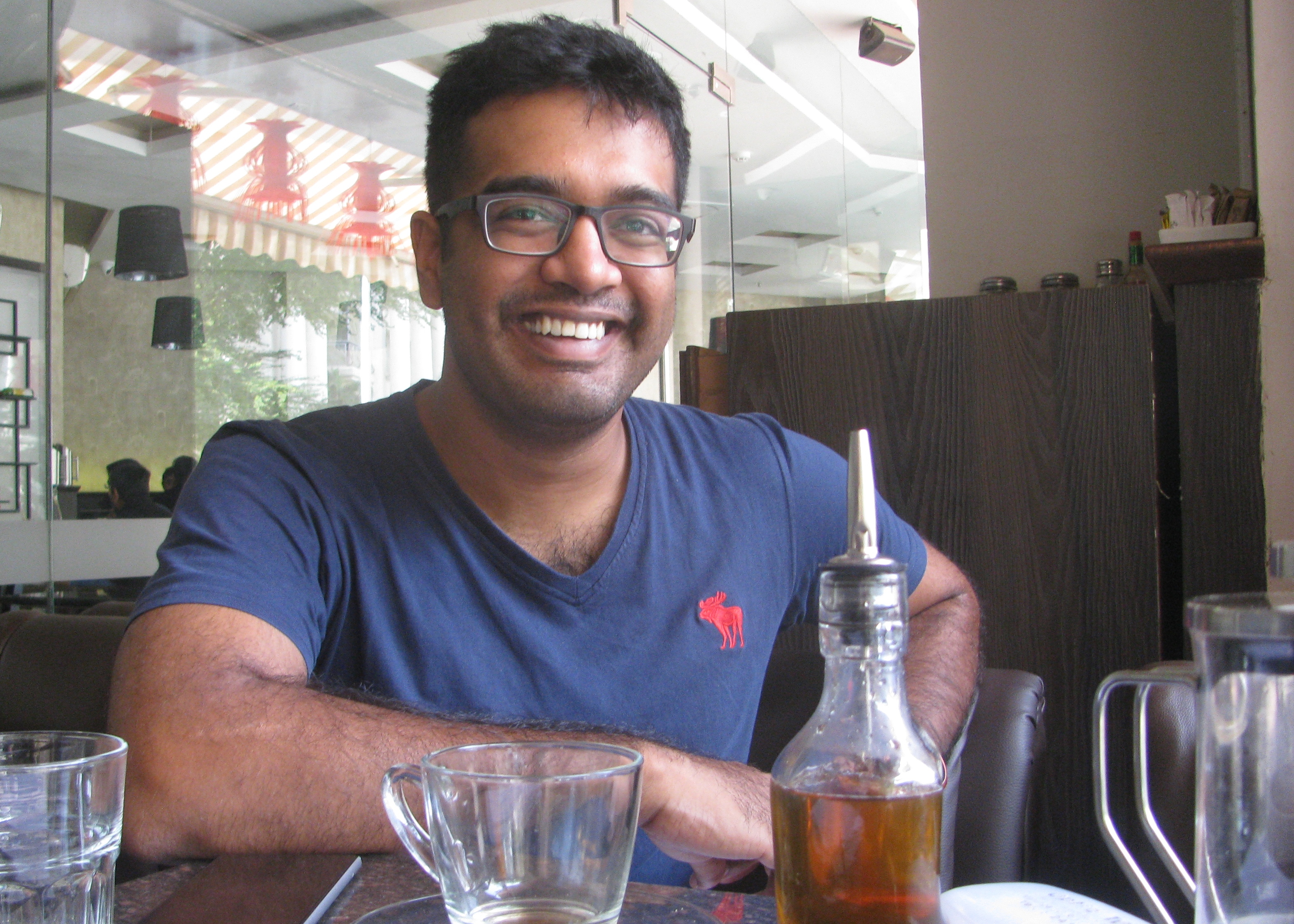
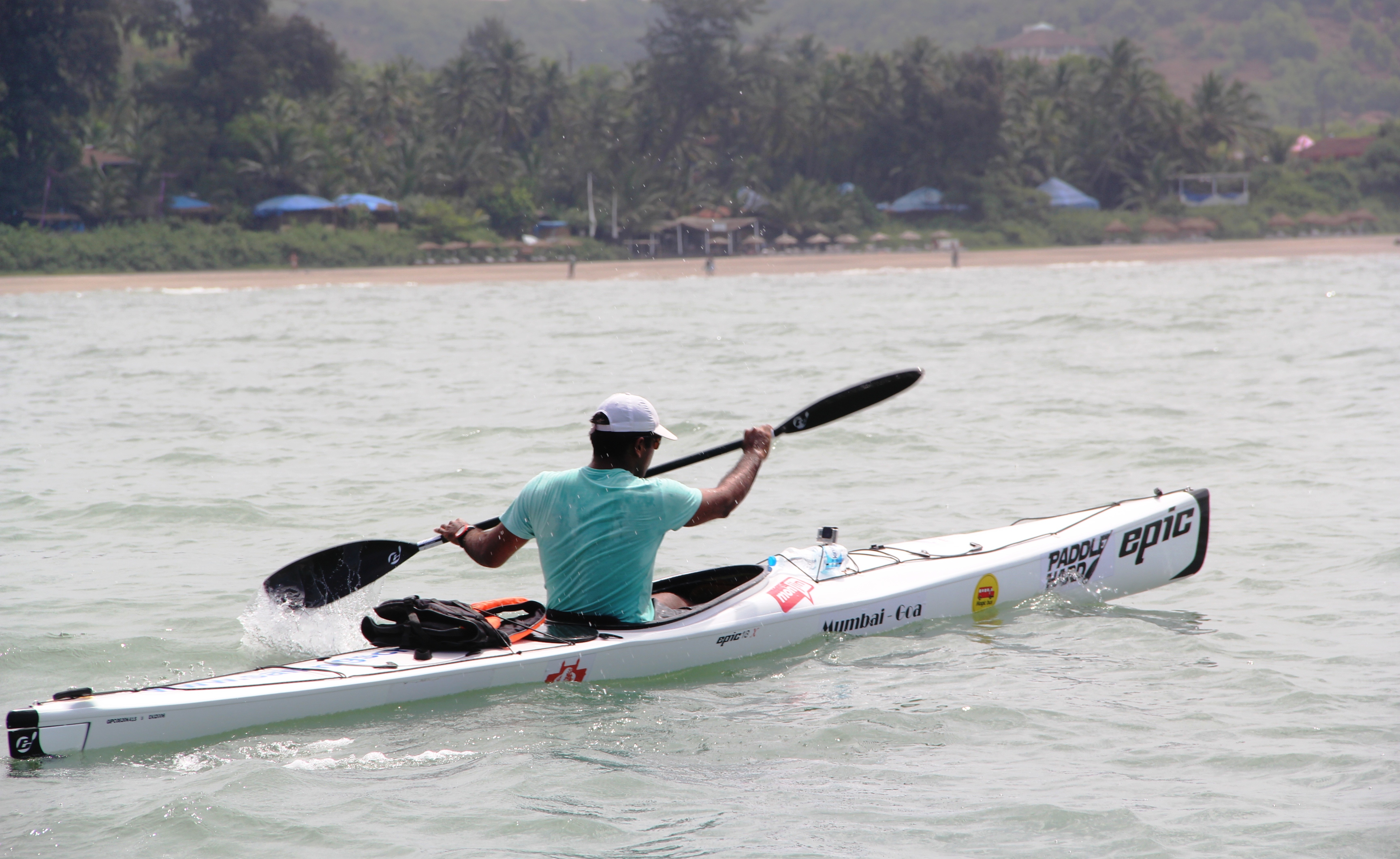
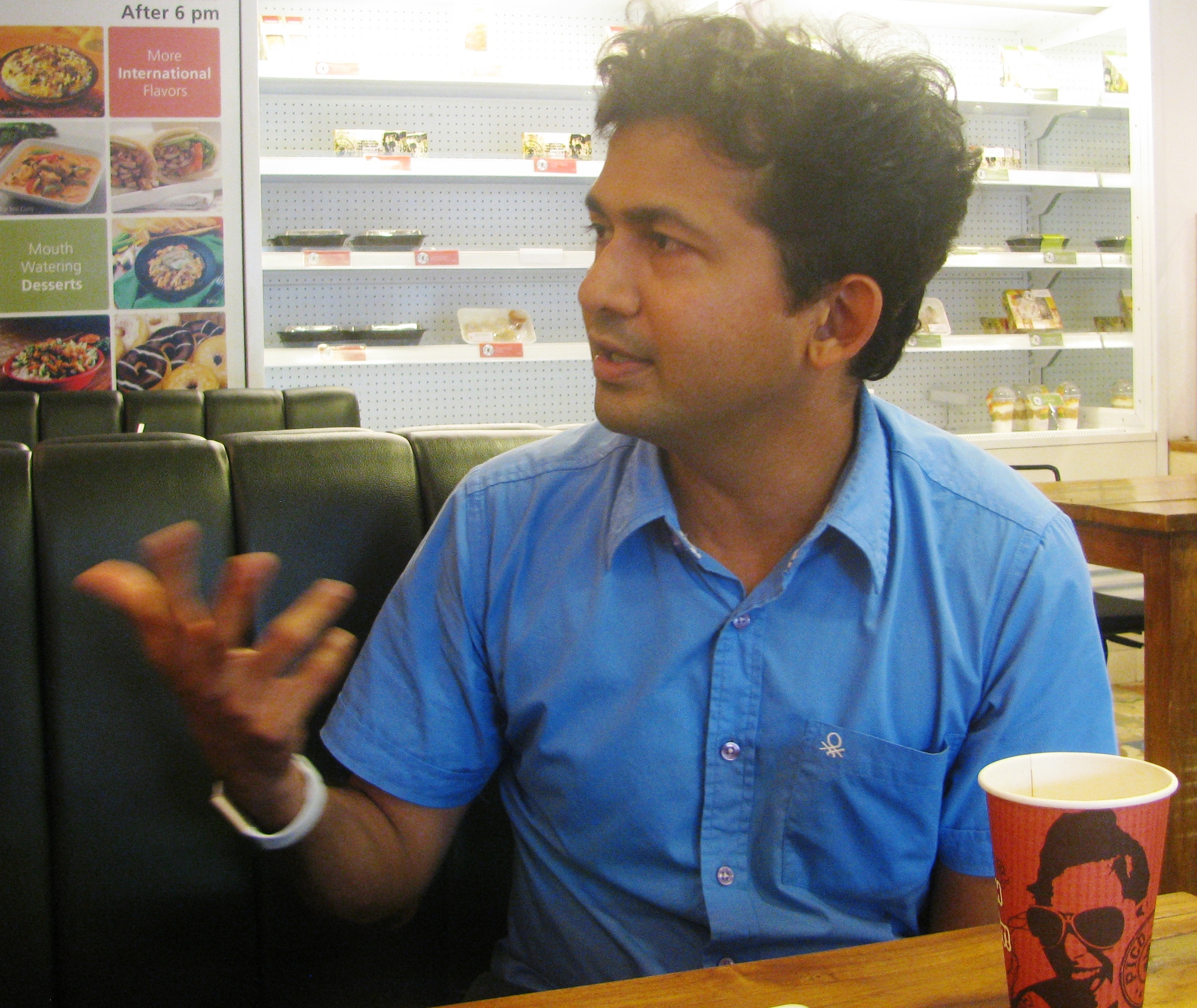
Kaustubh Khade (Photo: Shyam G Menon)

Kaustubh Khade (Photo: Shyam G Menon)

Mid November, 2015.

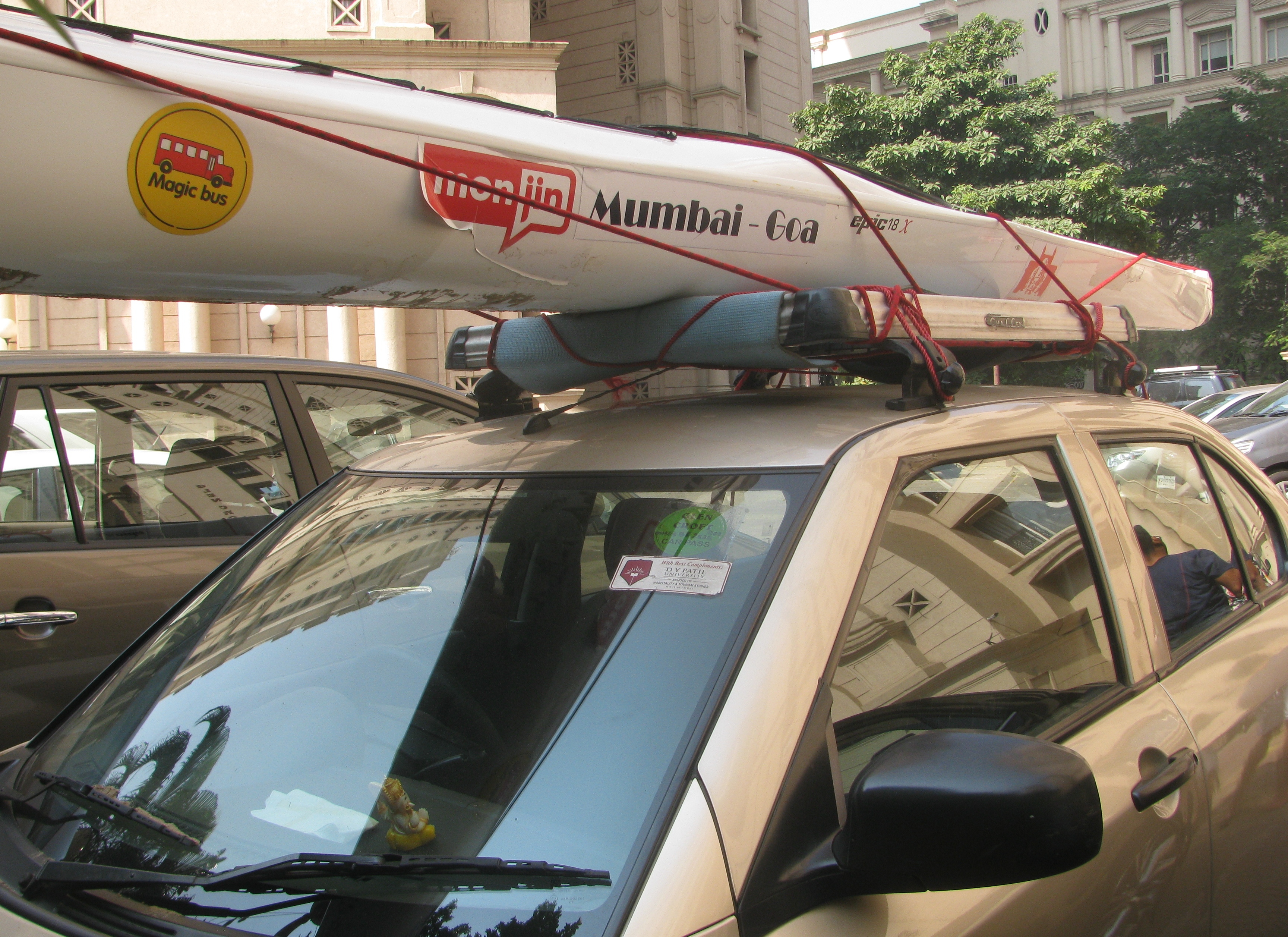
Secured atop the car was a long, narrow kayak.

The car was in the parking lot of a set of apartment blocks in Powai, best known as location for the Indian Institute of Technology (IIT), Mumbai. In some other countries, a car with a kayak on top would be common sight. Mumbai is a metro by the sea. But it shares India’s inertia for water sports, puzzling given the country’s 7,500km-long coastline. There are thousands of fisher folk, who venture out to sea for livelihood. There is the navy and the merchant navy too. But recreational sailing, canoeing, kayaking – all these are still evolving in India. It contrasts an ancient past in which, Indians engaged with the sea. Some, who investigated the phenomenon, have attributed the Indian preference for terra firma to religious strictures that discouraged ocean voyages. It may also have much to do with a heavily populated country’s insistence that everything people do in manic rat race make sense. Livelihood makes sense. Sport for livelihood may also make sense. Sport for sport sake makes no sense. Who knows? What Kaustubh Khade does know is that the drive from Powai in Mumbai’s north east to South Mumbai’s Chowpatty, with kayak on top of his car, attracts attention in island city surrounded by sea. Cops, curious about both kayak and its length exceeding Kaustubh’s mid-sized sedan, stop him and question regularly. “ I am now used to it,’’ the computer engineer said. His is a white kayak, an EPIC 18X model; the names of his sponsors and `Paddle Hard’ – a brand and concept he is promoting, posted on it.

Kaustubh expected none of this.

He has a couple of dolphins in Goa to thank for the turn his life took.

Born 1987 to parents who are doctors, Kaustubh grew up in Mumbai. He has an elder sister. By 1991, the family was in Powai. During his days at the Hiranandani Foundation School (HFS), he was an athlete into sprinting. He also played rugby and football. After tenth, he shifted to the Kendriya Vidyalaya at the IIT campus, a phase associated strongly with sports. “ We played football at least half an hour to an hour every day,’’ he recalled. Next stop was the IIT itself, but in Delhi. Kaustubh and his sister, who elected to pursue engineering, stood out in their extended family dominated by doctors. “ At a very young age, I saw my father give an injection to a kid. The kid was howling. I decided to do engineering,’’ he said laughing. At IIT Delhi, he continued his passion for football but it was marred by recurrent knee problems. Passing out from the elite institute, he secured his first job via campus placement. He was back in Mumbai.

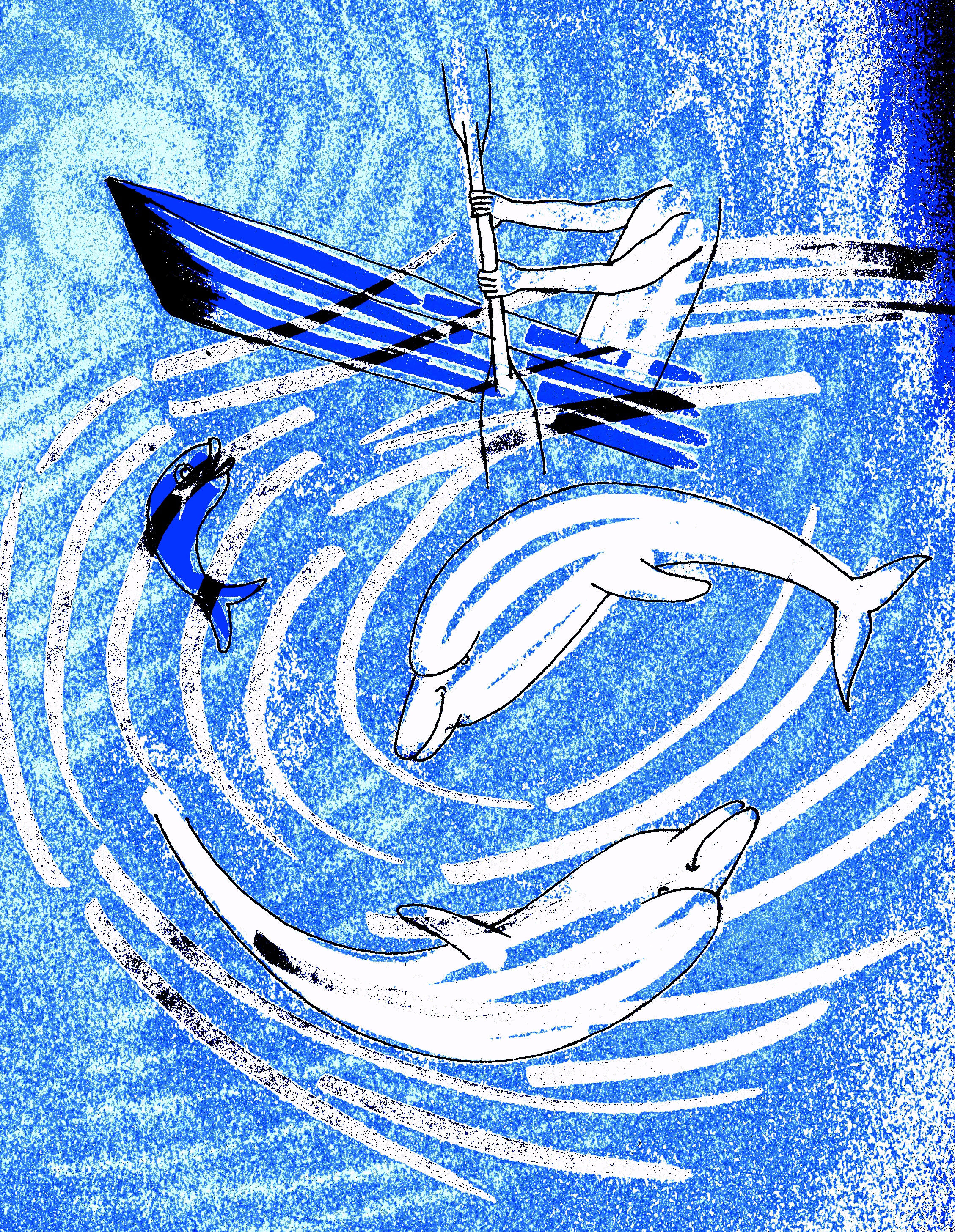
Illustration: Shyam G Menon

Illustration: Shyam G Menon

In 2010, Kaustubh went on a dolphin safari in Goa with his friend, Sarang Paramhans. They noticed that the motor boat they were on was scaring away the dolphins. To be less invasive and closer to nature, they decided to shift to a two person-kayak. Kaustubh had briefly kayaked before on the Ganga in Rishikesh. That hadn’t stuck in mind. But being out at sea on a kayak with curious dolphins for company was a life altering experience. So strong was its spell that on the way back to Mumbai, Kaustubh stopped at a boat shop at Panjim in Goa, to buy a kayak. Rajiv Bhatia, who owned Rae Sport Goa (the company is headquartered in Mumbai), quizzed Kaustubh for previous experience in kayaking. The young man confidently quoted Rishikesh and Goa; Bhatia brought him down to earth. He asked Kaustubh: why don’t you train properly in kayaking first and then if you still wish, buy a kayak from Rae Sport?

Kaustubh signed up for a kayaking course with the company in Mumbai. He pursued the sport diligently. Over time, he graduated from the regular kayak to the surf ski variety, a pretty fast kayak, narrower and longer than its brethren. In 2012, Rajiv asked Kaustubh whether he wished to participate in the national championship for dragon boat racing, due in the city under the auspices of the Indian Kayaking & Canoeing Association (IKCA). It was designed to select a national team in the sport. Unlike kayaks, the dragon boat featured 10 rowers in five rows of two each. Additionally, there was a person to steer and a person to drum, which was the means to set a rhythm for the rowing. In some ways, it was a miniature version of Kerala’s famous snake boats. Weighing 200-300kilos each, the dragon boats were imported canoes. Kaustubh was interested. Rajiv Bhatia set about building a team. At one end of South Mumbai’s Marine Drive, on Chowpatty, is an organization that goes by the name: Pransukhlal Mafatlal Hindu Bath & Boat Club. Strong paddlers existed there. So a team including these paddlers was formed. Then, the unexpected occurred. Maharashtra, the state of which Mumbai is capital, decided not to participate in the national championship. Where would the Mumbai team go? An engaging solution was found: they would represent Goa! “ Our team was a melting pot,’’ Kaustubh said. It was a good team; they trained regularly for three and a half months.

Fourteen states turned up for the nationals held at Marine Drive. Team Goa did well in the time trials based on which the national team was announced. Kaustubh found a place in it. The new team trained for a week in Mumbai. A highlight of 2012 was the training Kaustubh received in Mumbai, from Oscar Chalupsky, twelve-time world champion from South Africa. He taught the fundamentals of kayaking. “ Unlike popular perception, kayaking is not an upper body sport. It actually uses the whole body. Oscar taught me that,’’ Kaustubh said. The Asian Championship was due at Pattaya in Thailand around March-April 2013. Kaustubh would report for practice at Marine Drive from 7AM to 9.30AM; then attend office, report for practice in the afternoon, go back to office and then report after work for evening practice. The balancing act was tough; he was under review at work. His office wasn’t appreciative of the national team and Asian Championship-bug. One day he was asked: what will the office get from this craze? “ Following that exchange it became easy to quit the company,’’ Kaustubh said.

The kayak on top of the car (Photo: Shyam G Menon)

The kayak on top of the car (Photo: Shyam G Menon)

Thirteen countries participated in the Asian Championship. Across events for men and women, India won six silver medals and three bronze. In the races Kaustubh participated in, India won two silver medals and one bronze. “ We participated in every race. At one stage, we had just got off a race requiring 10 paddlers, when the coach came and said we had to rush for the race featuring 20 paddlers,’’ he said. The championship lasted three days. On return, Kaustubh resigned his job. He would move on to attempting unsuccessfully to start his own business in Bengaluru and transit through employment at a second company before signing up for the firm he currently works at; a start-up commenced by youngsters fresh out of IIT. Start-ups can be hectic. Kaustubh spoke of his life, one eye on his cell phone. We were at a cafe in Powai.

After the 2013 Asian Championship, Kaustubh decided to focus on sea kayaking with emphasis on surf skis. Back in Goa, he had fallen in love with kayaking for the way it allowed the paddler to experience what he was doing with that sense of being close to the elements. Kaustubh explained his later transition to the surf ski, “ what I experienced in Goa is also why I moved to surf skis. Compared to the surf ski, sea kayaks and leisure kayaks are more stable. They kill the joy in every wave.’’ A precise instrument, the unstable surf ski is the most technical kayak in the larger sea kayaking discipline. He decided to participate in the next edition of the Asian Championship in Thailand on surf skis. He started training for the event’s 22 km-run over December-January at Mumbai’s Marine Drive. With the bay not long enough, he managed the required distance by doing laps. However things went wrong in Thailand. The surf ski issued there was a lot more unstable type than what he had trained on. Realizing the futility in racing in that kayak class, he switched disciplines and raced in sea kayaking. He finished fifth out of 17 participants in the 13km-sea kayak race. After this episode, Kaustubh stopped competing. “ Training for competitions had become difficult given the pressures of office and working life,’’ he said.

Around this time, he read the book, “ Fearless’ by Joe Glickman. It was about German kayaker Freya Hoffmeister’s 2009 journey, paddling around Australia. The book left him wondering if something similar was possible in India. He visualized a long term plan: kayak around the Indian peninsula from Mumbai to West Bengal with the Mumbai-Goa leg as first portion to attempt. On the globe, the ocean is a huge mass of seemingly similar blue. In reality, depending on the scale of one’s expedition, it is a collection of different weather patterns – seasonal and unseasonal, underwater geographical features, dissimilar coastlines and a different culture beyond each shore. As Kaustubh found out, navigating the limited distance of Mumbai-Goa itself entailed consolidating 17 separate maps. Complicating matters, threats to India’s security have robbed the surrounding seas of their innocence. This enhanced the importance of official clearances for kayakers trying to paddle personal dreams to success in the waters around India. Getting approvals and stitching the logistics together as efficiently as possible is half the work done in any expedition.

Sanjeev Kumar (in front) and Dev Dutta; from their 2005 expedition (Photo: courtesy Sanjeev Kumar)

Sanjeev Kumar (in front) and Dev Dutta; from their 2005 expedition (Photo: courtesy Sanjeev Kumar)

Kaustubh’s idea was not new. Almost ten years before, on December 25, 2005, two kayakers – Sanjeev Kumar and Dev Dutta – had cast off from Mumbai on a voyage around the Indian peninsula to Kolkata. As per their log, they were forced to terminate the trip 28 days later, at Kannur in Kerala. The log mentioned suspicion among the locals of two strangers in a kayak pulling in from the sea. Pestered for two days and worried that the trend could continue along the entire Kerala coast, the duo decided to stop the Kerala leg and resume in Tamil Nadu. However, according to the log, the Tamil Nadu government had just then begun a search for Tamil Tiger operatives, who had earlier clashed at sea with the Indian Coast Guard. Given the circumstances, they concluded, Tamil Nadu waters too may be risky to venture into and wrapped up the expedition for the time being. One thing was clear from this testing of the waters – proper official backing and approvals, make a difference.

With a view to meet an official from the state’s tourism agency, Kaustubh attended a seminar in Navi Mumbai. The Maharashtra Tourism Development Corporation (MTDC), which has resorts along the Maharashtra coast, decided to support his kayak trip. According to Kaustubh, the MTDC coming aboard made things easier with others in the approvals-frame. The Maharashtra Maritime Board extended support and soon thereafter, the Indian Coast Guard cleared the trip. A few private sponsors stepped in to support the expedition. As a NGO to support through the expedition, he picked Magic Bus, which uses sports and games to work with underprivileged children. It was an ideal fit; Kaustubh loved this NGO’s work. In October 2014, Kaustubh applied for sabbatical from work. He also ordered a kayak – the EPIC 18X, we saw strapped to the top of the car. It is a hybrid of the sea kayak and the surf ski with chambers to hold gear and supplies. He had thought of a December departure. But that didn’t happen. The kayak reached Mumbai on January 26, 2015.

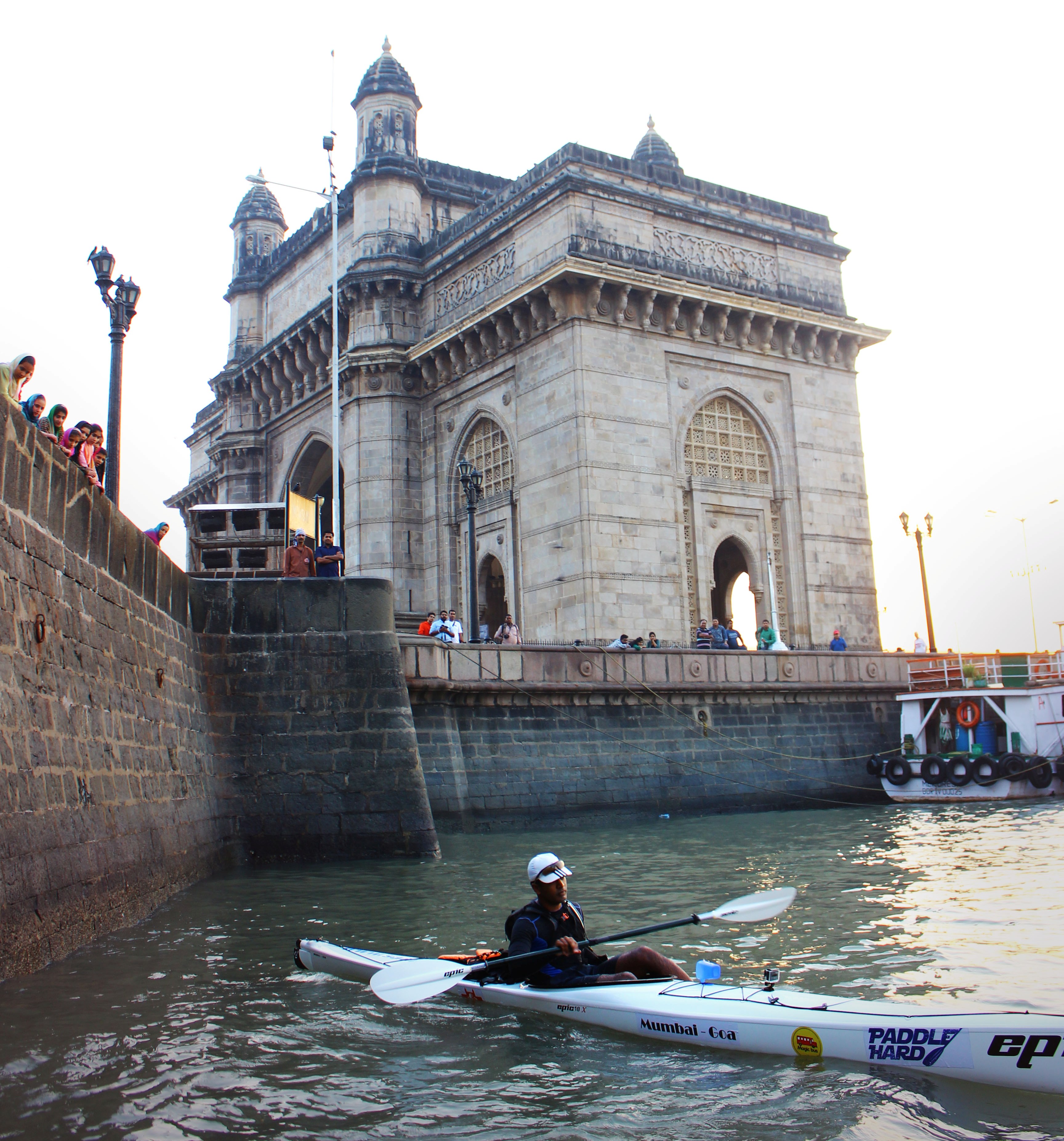
Kaustubh casting off from near the Gateway of India, Mumbai (Photo: courtesy Kaustubh Khade)

Kaustubh casting off from near the Gateway of India, Mumbai (Photo: courtesy Kaustubh Khade)

Meanwhile, the expedition’s challenges hit home. Although experienced kayaker, Kaustubh’s experience to date had been in protected waters. The sea off Mumbai’s Marine Drive has a reef that acts as natural breakwater. Compared to the outer sea, the bay is calm. Paddling from Mumbai to Goa, Kaustubh wouldn’t be way out at sea as in a sea crossing but he would definitely be beyond natural protective barriers close to the coast. And he would be on a matchstick of a craft, bobbing out of sight in the slightest of ocean swells. His parents Monita and Kisan Khade had been supportive of his foray into kayaking. For them, anything except football, which would have damaged Kaustubh’s knees further, was welcome. To contain the risk, they stepped in. One of the sponsors had recommended a support vessel accompanying the kayak at sea. He now offered to fund it. Monita elected to be on the support vessel; Kisan would drive along the coast meeting up at every halt. Kaustubh concedes, sponsors and support vessel may have taken off some of the spontaneity otherwise inherent in adventure. Halts weren’t a case of pulling in from the sea and camping self-supported; support vessel additionally meant, searching for a suitable jetty, something a kayaker wouldn’t think of.  Further, the easily visible support vessel attracted attention. Kaustubh spoke of the police occasionally coming out to inspect. “ The letter from the Coast Guard, which we had in the support vessel, always worked. What was interesting was how the police would come to check, looking all serious and later, after we had showed them the requisite papers, take photos of the kayaker paddling on,’’ he said.

Kaustubh embarked on his trip from Mumbai’s Gateway of India, on February 14, 2015. Waking up every day at 5.30 AM, he would enjoy a fine spell of kayaking from 6.30 AM to 9.30 AM. Then the sun blazed. His worst hours would follow. The paddling would go on till about 1 PM, when he would draw ashore. The remaining part of the day, he rested and blogged, something he had to do as per the modern paradigm of expedition, sponsors and media. Dinner was at 7.30 PM; lights out by 9 PM. It went on so, relatively smooth except for Day 12.

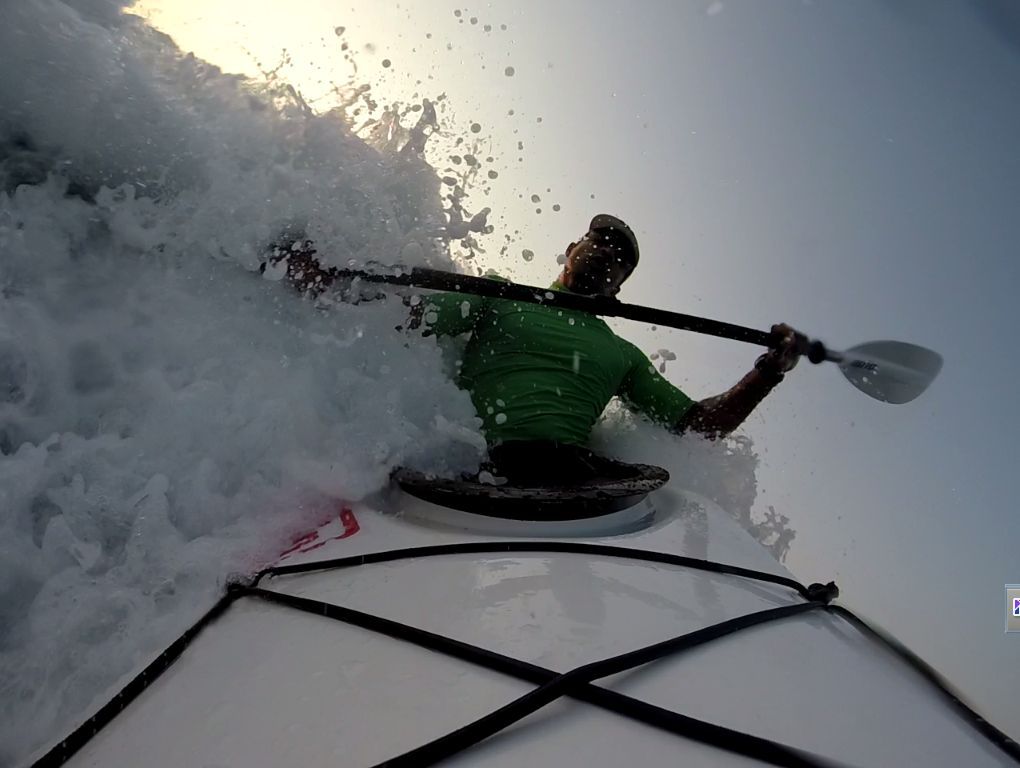
Paddling on Day 12 (Photo: courtesy Kaustubh Khade)

Paddling on Day 12 (Photo: courtesy Kaustubh Khade)

On Day 12, fresh out from a rest day, Kaustubh was paddling on to Ratnagiri. Two thirds of the Mumbai-Goa journey had been completed. Spirits were up although it was a pretty hot day. The plan was to stop en route at Pawas. But the support vessel wanted to look for a jetty at Purnagad further south. It added another ten kilometres to the day, already trying due to the heat. When the team reached Purnagad, they found that while the place did have a jetty, Purnagad was tucked a bit inward and away from the sea. It raised concerns on how the tide may impact locally. Therefore the team paused for lunch at Purnagad and around 3.30 PM set off again with a plan for the kayak to hit shore at Godavne, with night halt for everyone at Ambolgad. Kisan Khade would come to fetch Kaustubh and take him to Ambolgad, dropping him back at Godavne the next morning, to recommence his paddling. That was the idea. However, after the support vessel pushed off for Ambolgad, the weather turned nasty and the sea became rough. Three to four kilometres out at sea, Kaustubh’s kayak almost capsized. He nevertheless managed to crash-land at Godavne, the culmination of a particularly long day spent paddling. He was exhausted. The wave that crashed him onto the beach had also swept off the contact lens in his right eye leaving him half blind. Godavne turned out to be completely different from what the team had imagined. It was an isolated beach surrounded by steep hills. There was no way Kaustubh could haul the kayak singlehandedly to the road. With no prominent path coming down to the beach, his father wasn’t also around. Bereft of any communication device (the cell phone was on the safety boat), a new worry started – was his father not here because something happened to his mother who had proceeded ahead in the safety boat?

Tired, Kaustubh lashed his kayak to a small tree stump and set out to find a way up. It was late evening; darkness was approaching.  Packing up the items he could carry, he walked six kilometres along the beach. He ran into four men high on liquor. Somehow he convinced them that he needed to use their cell phone. Finally, he got through to his girlfriend in Mumbai who assured him that his parents were fine. By then two people on motorbikes came looking for him. They took him to the assigned guest house for the night, where he rejoined his parents. Earlier in the day, Kisan Khade had come to Godavne. He had found a goatherd’s path down to the isolated beach but not finding Kaustubh anywhere went back. It hadn’t seemed a place to land. Meanwhile, the locals informed that leopards frequented the Godavne area. After a brief rest, the team returned to Godavne, somehow scouted a path down to the beach and hauled the kayak up. The following day they rested in Ambolgad. The next leg of the trip was commenced away from Godavne. Tough times persisted. The Tarkarli-Vengurla stretch should have gone smoothly but stiff headwinds slowed progress. Finally after 14 days of paddling (excluding rest days), Kaustubh reached Morjim in Goa, the end of his journey. He had kayaked 413km; the expedition was admitted into India’s Limca Book of Records as the longest ` solo’ kayaking by an Indian paddler in the shortest time.

Reaching Morjim, Goa (Photo: courtesy Kaustubh Khade)

Reaching Morjim, Goa (Photo: courtesy Kaustubh Khade)

Kaustubh has his eyes on the larger trip around the peninsula. “ This was clearly a pilot,’’ he said of Mumbai-Goa. He imagines that the remaining journey, slated for 2016-2017, would happen in two phases – one to kayak down the west coast and another to kayak up the east coast. The two coasts are different in character.  The east can be rougher, not to mention – its capacity for extreme weather. That aside sponsorship will be the biggest challenge. And somewhere amid all this, he also wants to participate “ at least once’’ in Hawai’s Molokai Race. As for that kayak atop the car, still oddity in India’s financial capital surrounded by the sea, it rests when ashore in a garage owned by a friend who stays in the same building as Kaustubh.

(The authors, Latha Venkatraman and Shyam G Menon, are independent journalists based in Mumbai.)    
THE COMRADE

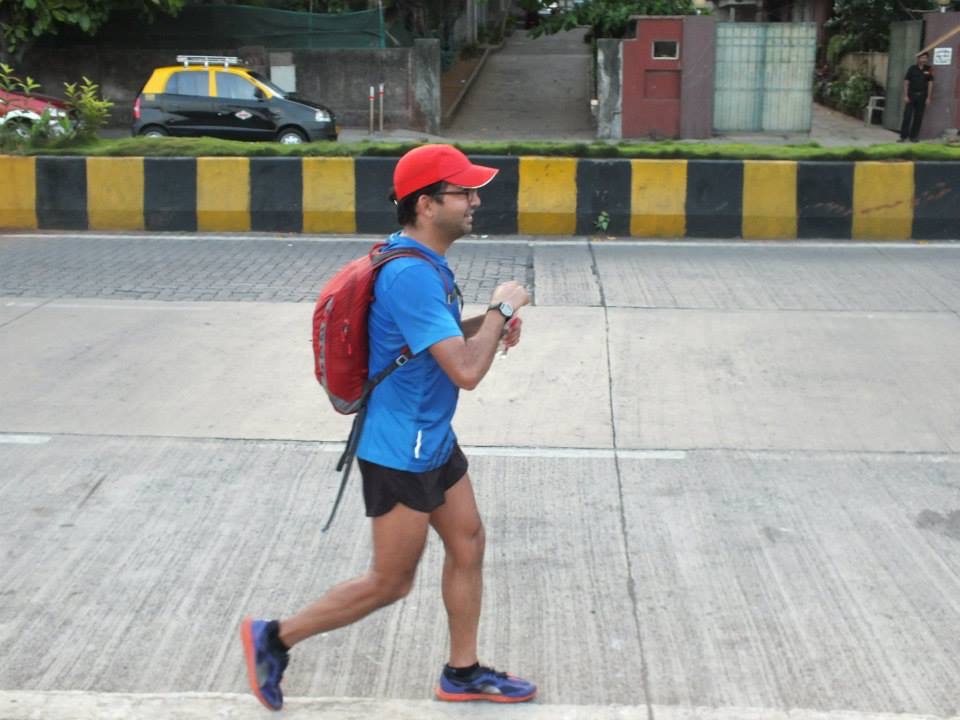
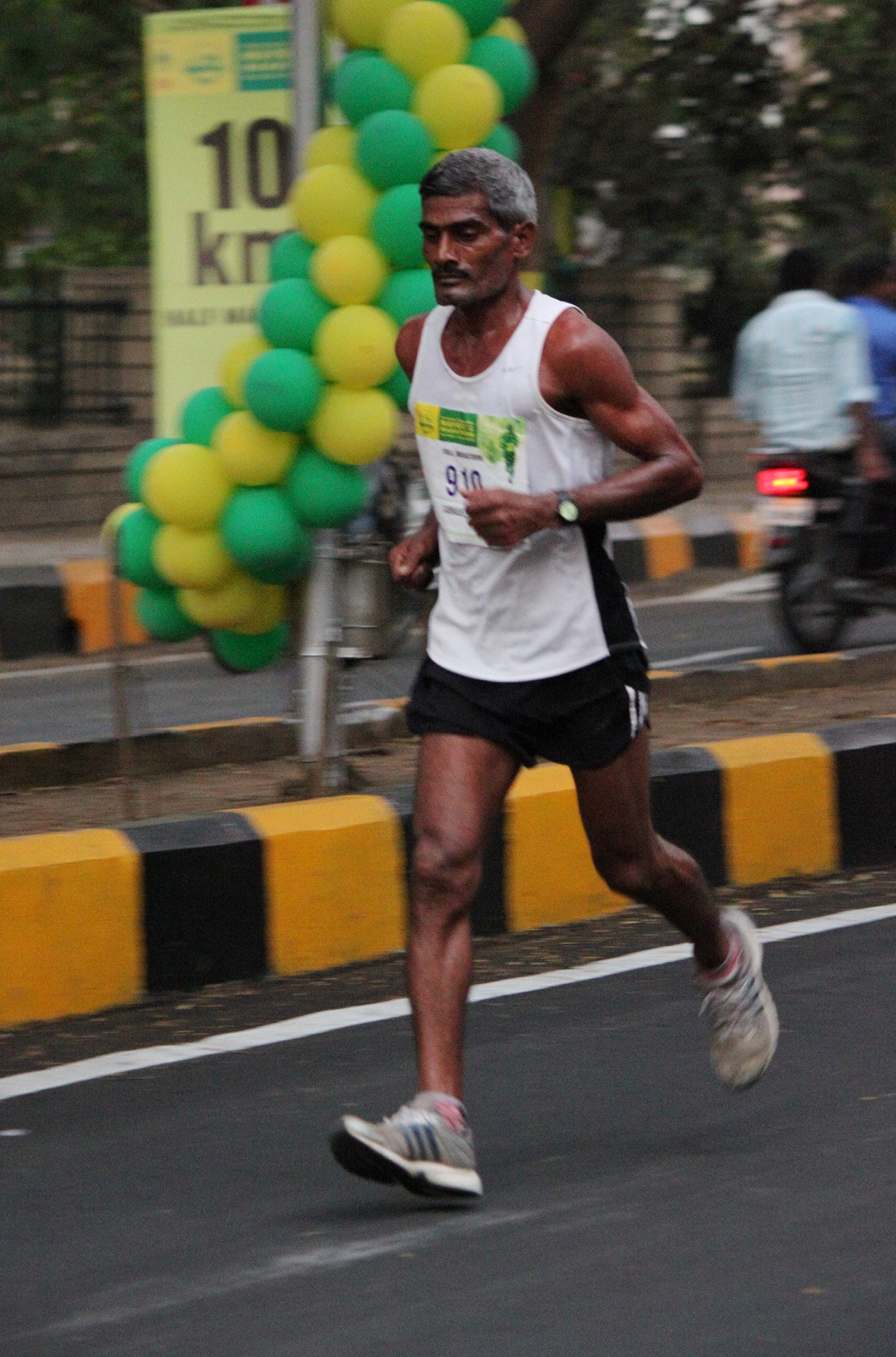
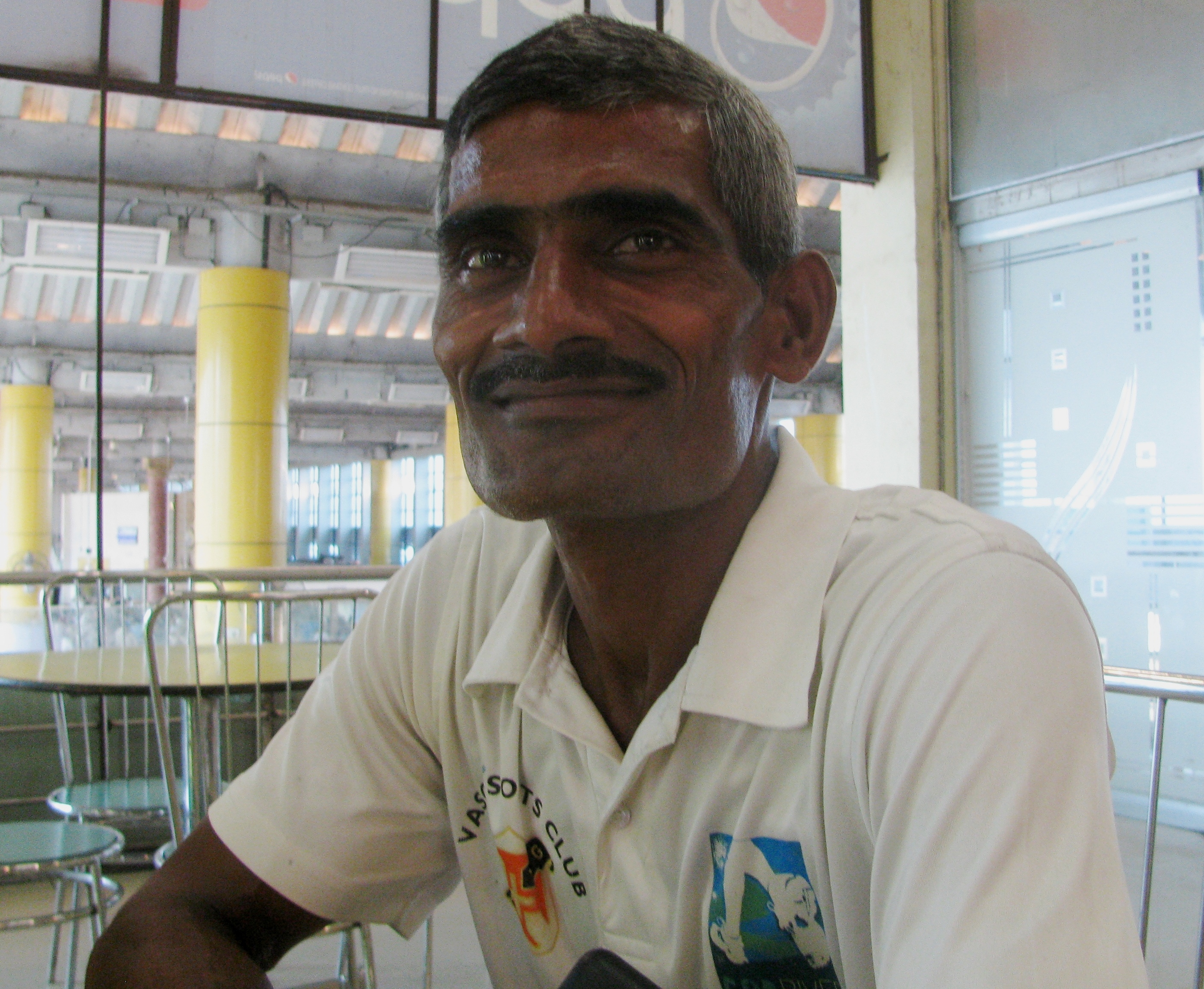
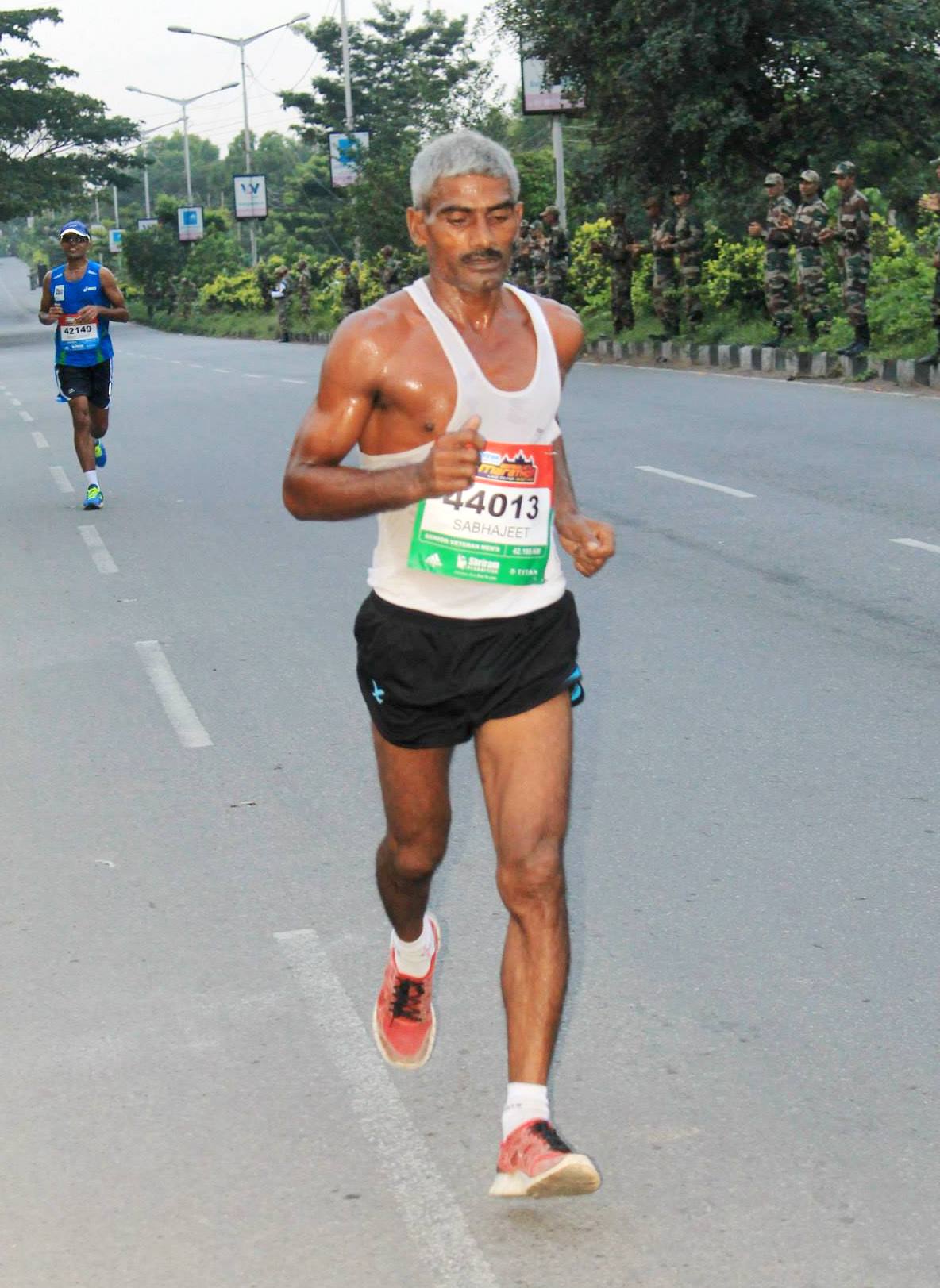
Satish Gujaran (Photo: Shyam G Menon)

Satish Gujaran (Photo: Shyam G Menon)

Most people reach Shirdi by road or rail.

Some choose to walk.

Sanjay Shankar Shinde, the founder of the running club Ramesh Nair trained with walked every year to the temple town from Mumbai. It is a distance of close to 250km as per the Internet. Curious, Ramesh, an engineer turned businessman, walked to Shirdi with Sanjay’s group in 2012. He did so again in 2013. Thinking of a repeat in 2015, he shared the idea with Satish Gujaran. The two lived close by in Mulund. They hadn’t met before, till running put them in touch. Satish had been training largely alone and mostly on the city’s Eastern Express Highway. What amazed Ramesh was the mileage he piled on daily and the dedication he showed to running. When Satish heard of Shirdi and the walk on Ramesh’s mind, he suggested: why not run from Mumbai to Shirdi?

July 25, 2015, 6AM; three runners – Ramesh, Satish and Nilesh Doshi – supported by a car stocked with essentials and driven by Sanjay Gawade, a driver whose many outings with runners has made him adept at the task, set off for Shirdi from Mumbai. Nilesh elected to return on the second day. He had some work to attend to; he also felt his body temperature was rising unreasonably. Satish and Ramesh pushed on; the former, a bachelor and experienced ultra marathon runner, the latter, a family man, regular runner of marathons and someone who prefers to run respecting the boundaries of well being. “ I run within my comfort zone,’’ Ramesh said. Satish seemed a runner moulded by exploration and experience. Ramesh reposed faith in systems and research. For both runners, it was their first multi-day run. In his mind, Ramesh had studied the distance to Shirdi and worked out how much he should run daily based on his experience at marathons and the annual Mumbai Ultra, a 12 hour-endurance run. He had it all chalked out. Satish was battling a private worry; the classical Indian worry – leave of absence from office. They had started on a Saturday. He had to report for work Wednesday morning. Will they reach Shirdi before that?

Satish and Ramesh during the Mumbai-Shirdi run (Photo: courtesy Ramesh Nair)

Satish (left) and Ramesh during the Mumbai-Shirdi run (Photo: courtesy Ramesh Nair)

“ Satish can keep on going. He is a frugal runner whose needs are few. I am not, ’’ Ramesh said. In tune with their experience in distance running and differing styles, a gap opened up between the two. And proportionate to the widening gap on the road, Satish’s worry about Wednesday grew. Ramesh recalled the situation. “ The car was supposed to halt every three kilometres or so. I was running slowly. After I had reached the car and hydrated, Satish would tell the driver to proceed and wait after the next three kilometres. Then I noticed – he was saying three and indicating four with his fingers!’’ Ramesh said laughing. In the end, it all worked out well. Around 2.30PM on Tuesday, July 28, the two runners reached Shirdi. After a quick visit to the Sai Baba temple, they returned to Mumbai. Satish was back at work, Wednesday morning.

Exactly 100 years before from the day the duo reached Shirdi, an event occurred in Europe that would leave its mark on the world of running as well. On July 28, 1914, a month after the assassination of Archduke Franz Ferdinand in Sarajevo, Austria-Hungary declared war on Serbia, officially commencing the First World War. The cascading events that followed sank Europe into one of the bloodiest conflicts of human history. In four years of fighting, more people would die than in the wars of the preceding 100 years. Almost 70 million military personnel were mobilised; of them, over 8 million died. The survivors bore scars in the mind. Happening in the age of empire, the theatre of war exceeded Europe; those fighting and getting killed included many from outside Europe. Among people caught in the tentacles of empire and therefore pushed to fight, were the South Africans. They fought on the side of the Allied forces, in Africa and Europe. The war in Africa, a long distance from the trenches of Europe, was triggered by the German plan to keep the Allied force’s Africa based-military assets engaged in Africa itself.

Vic Clapham was one of the South Africans who saw action and survived. He was born in London on 16 November 1886 and immigrated to the Cape Colony in South Africa with his parents. When the Anglo-Boer war broke out, Vic aged 13, worked in an ambulance team. Later he moved to Natal and worked as an engine driver with the South African Railways. During the First World War, he signed up with the 8th South African infantry, fighting and marching long distances through the savannah of eastern Africa. The hardships he and his friends endured left a lasting impression. Above all, he remembered their camaraderie. As peace returned in 1918, he sought a memorial to commemorate the South African soldiers who had died; a memorial that highlighted human endurance.

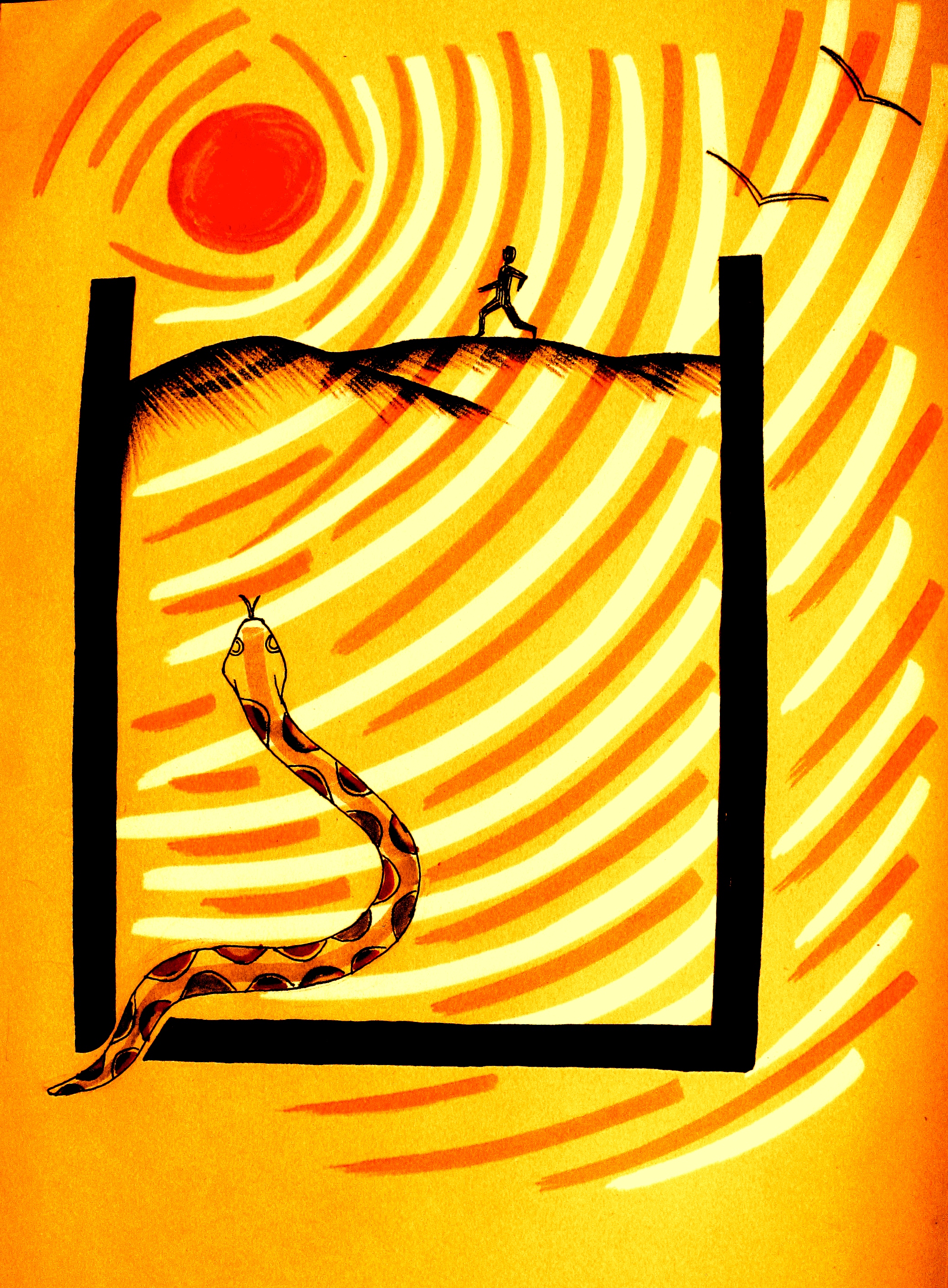
Illustration: Shyam G Menon

Illustration: Shyam G Menon

Clapham’s home town was Pietermaritzburg. He visualized a foot race from there to Durban. If soldiers could cover vast distances and endure it as they did in the war, Clapham averred, trained athletes should be able to do the same. This in mind, he approached the athletics administration in Natal for support. They declined. Then he approached The League of Comrades of the Great War, a body representing ex-service persons. Initially turned down, Clapham persisted. In 1921, the league yielded. It gave its assent. Clapham founded The Comrades, the world’s oldest ultra marathon race and now it’s biggest. First run on May 24, 1921, the route links Pietermaritzburg in the mountains with Durban on the coast. Forty eight runners enrolled for the inaugural race. Of that, 34 set off; 16 finished. Many of these runners were earlier infantrymen who had fought in Africa. At present, nearly 20,000 people run this ultra marathon every year. They come from different countries. The race alternates every year between uphill and downhill with the former measuring 87km and the latter, 89km. Founded as a war memorial, over time, The Comrades has acquired the reputation of being a fantastic event, remembered for the bonhomie, crowd support and cheering.

Satish never expected his life to get mixed up with The Comrades. He was born at Udipi in southern India on March 27, 1963, pretty close to the May-June period hosting South Africa’s iconic race (throughout its history The Comrades has been run in either May or June). Coincidentally in May 1963, a record was set at The Comrades. South African runner Jackie Mekler, who at five wins overall is tied with three others for the second highest number of wins at The Comrades in the male category, set a new record (5:51:20) in the ` down’ version of the run. With that he became the first runner since 1954 to hold the record for both the `up’ and `down’ versions. In 1960, Mekler had run the `up’ in 5:56:32. Those days there was no ultra marathon in India, likely no awareness about The Comrades. South Africa existed in the shadow of its apartheid policies. For many years, resultant sanctions denied the country participation in international sporting events. Sanctions prevented other countries from touring South Africa. In cricket crazy-India, once in a while the press published a photo or carried an article about South African cricketers. The names of Barry Richards, Mike Procter and Kepler Wessels floated around. Once in a while, the media mentioned Zola Budd, the legendary runner. Else, compared to what South Africa is in sports today, little was known of sports from Africa’s southern tip. Anything South Africa was usually about its politics. The country however featured prominently in Indian awareness. There was an Indian community in South Africa and the names of South African cities and towns had featured in history text books at Indian schools, especially in the context of Mahatma Gandhi and India’s freedom struggle. Pietermaritzburg was where, in June 1893, Gandhiji was forced off a train; an incident that made him determined to fight the racial discrimination against Indians and played a major role in shaping his future thoughts. Today, long after India’s independence and the end of South Africa’s apartheid laden-policies, a statue of Mahatma Gandhi stands on Church Street in Pietermaritzburg.

Satish (centre) with Dereck Mahadoo and his wife Shereen (Photo: courtesy Satish Gujaran)

Satish (centre) with Dereck Mahadoo and his wife Shereen (Photo: courtesy Satish Gujaran)

Far away from South Africa and The Comrades, in India, school for Satish was 3-4km distant from home. Neither the distance to school nor the walking conspired to craft the outline for a future story in running. On the other hand, the youngster was more interested in games than running and athletics. Of his three sisters, two played badminton at the district and state level. The years went by largely nondescript. It was a regular life. Satish attended college in Bengaluru (Bangalore) graduating in commerce. “ There was nothing significant in my life, concerning sports then,’’ he said. The eldest child in the family and thereby expected to work, Satish travelled to Mumbai seeking employment. He did odd jobs for a while. Then, still no runner and given to smoking heavily, he moved to South Africa.

The person, who made this shift possible, was a friend – Dereck Mahadoo. He owned a construction company in South Africa and was looking for a supervisor. In due course, Satish joined Dereck’s company. He stayed with Dereck and his family in Durban, one of the two end points linked by The Comrades route. The new supervisor from Mumbai smoked like a chimney. The boss on the other hand, was a runner. Dereck had already run The Comrades six times. “ One day, he asked me to go along and walk with him while he ran. That became my first attempt at running,’’ Satish said. It was difficult. To start with, he hadn’t run before in his life, definitely not with a view to be runner. To complicate matters, he had spoilt his chances of enjoying a run through becoming a chain smoker. The duo persisted. Helping them was the local environment; South Africa had plenty of running events. There was a race every weekend, including several distances in the link category that helped those newly into running, nudge up their ability to cover distances. The year was 2004. Forty one year-old Satish picked up running pretty fast. Encouraged by the progress, he entered for his first formal half marathon. It ended up a DNF – Did Not Finish. “ By the twelfth or thirteenth kilometre, my knees were in utterly bad shape. An ambulance drove up and a lady said: get in, you have your whole life to run,’’ Satish recalled. That DNF was a lesson. It brought home an immediate war to declare in his journey to distance running – Satish had to confront his habit of smoking. “ It was tough giving that up,’’ he said. Dereck it appears, left an impression on Satish. According to Ramesh, when he was struggling on the uphill at Kasara en route to Shirdi, Satish stepped in to help. He broke down the ascent into smaller goals marked by sign boards along the road. “ From here to there, you walk. Then from there to there, you run. So on. When he broke the challenging section into small portions it helped me greatly. Apparently that is something he learnt from Dereck,’’ Ramesh said. Satish’s stint in South Africa also included some crazy contests, which may explain the reservoir of energy, others say, he digs into. For instance, he won a competition that challenged people not to sleep. He didn’t sleep for a few days.

In 2006, Satish returned to Mumbai. The Standard Chartered Mumbai Marathon (SCMM) was by then a couple of years old. The spirit of running was catching on in the city. For two to three years, Satish ran the SCMM; he did no other major runs. On the average, he could run a full marathon in about 3 hours 40 minutes. Then in 2009, he picked up talk in Mumbai’s running circles, of The Comrades. Along with his affection for South Africa and memories of good times had there, the idea of running the famous ultra marathon tempted. But he was still a smoker. Between smoking and lessons from the old DNF, smoking had prevailed. The war was far from over. Satish nevertheless registered for the 2010 Comrades. There was a small group of people going. They heard of each other and met up. To train for The Comrades, they followed training regimens found on the Internet. Training started some time after February 2010. In addition to running in Mumbai, they ran in Lonavala, the popular hill station on the way to Pune. As part of preparations, they did two 56km-runs, a full marathon and one run of 65km. Each was apart by 20 days. Some of the runs commenced early; the 65km-run used to start at 2 or 3AM. A car with driver provided support. Satish’s first Comrades in South Africa, was the ` down’ version from Pietermaritzburg to Durban. Around the 65-70km mark, Satish suffered cramps in his calf muscles. He managed to handle it but the problem kept repeating. Life was forcing a decision on him. It was clearer than ever – you run healthy or you don’t run at all. Back in India, following The Comrades, Satish joined the `Inner Engineering Course’ offered by Isha Foundation. “ There I stopped smoking. By November-December 2010, I was free of the habit,’’ he said.

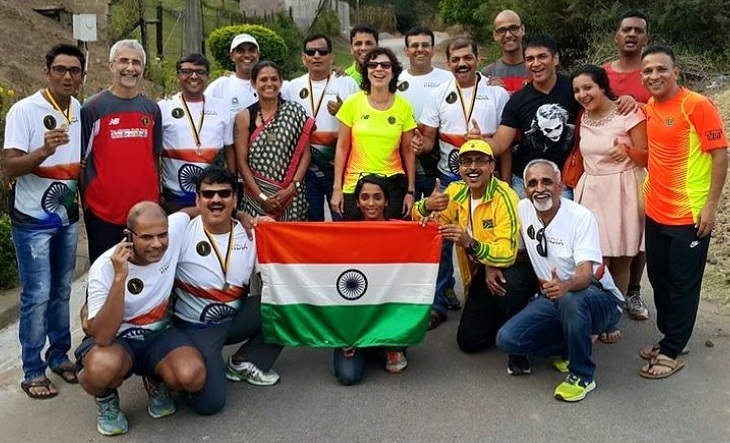
Satish (far right) with fellow Indian runners on the occasion of the 2015 edition of The Comrades. (Photo: courtesy: Satish Gujaran)

Satish (far right) with fellow Indian runners at the 2015 edition of The Comrades (Photo: courtesy Satish Gujaran)

Since 2010, Satish hasn’t missed a single edition of The Comrades. Every year he flies to South Africa to run the race. Running in 2011, on the heels of his debut at the 2010 edition, he qualified for an additional medal given to those who do two Comrades back-to-back. By October 2015, he had run and finished the iconic race six times becoming in all likelihood, the runner from Mumbai with the most number of finishes at The Comrades. Satish plans to run The Comrades at least 10 times. “ If you run it 10 times, you will get a green number, a bib number that is permanently yours. It is given by that year’s race winner,’’ he said. Satish explained why he loves The Comrades so much. “ The atmosphere is electrifying. The crowd support is fantastic and runners come from everywhere. The event is well organized. It is like a carnival. The route is challenging, it engages the runner. Finally, Durban has a sizable population of Indians and people of Indian origin. Indian runners get cheered,’’ he said. According to him, completing an ultra marathon like The Comrades is as much about strategy as it is about training. He spoke of veterans who have been running the race for years, taking it slow and keeping their energy in reserve for the course’s strenuous sections. “ Planning is important for good timing at The Comrades. To run slowly, you need courage. It comes only with experience and maturity,’’ Satish said. Over time, his training style also changed. In years gone by, he used to train 5-6 days a week. Now he trains 3-4 days. “ Quality matters more than quantity,’’ he said. Ramesh highlighted one more angle – discipline. Each night during the Mumbai-Shirdi run, while Ramesh took his time to get over the day’s exhaustion, Satish would clean up and finish his chores like clockwork.

Satish (right) with Arun Bhardwaj, India's best known ultra marathon runner. (Photo: courtesy Satish Gujaran. For more on Arun, please click this link: https://shyamgopan.wordpress.com/2015/06/21/the-connoisseur-of-distances/

Satish (right) with Arun Bhardwaj, India’s best known ultra marathon runner and a pioneer in the genre for the country (Photo: courtesy Satish Gujaran) 

Although he has run The Comrades six times, until the Mumbai-Shirdi run with Ramesh, Satish hadn’t run an ultra marathon in India except the annual Mumbai Ultra and those long training runs for The Comrades. One reason for this was work and the commitments at work, which accompany life as employee. The Indian environment, arguably, has two prominent drawbacks. First, the pressure of high population and rat race is such that appreciation of human existence has narrowed to self worth by position and possessions. In this, sport is easily dismissed as irrelevant unless a person’s position in the sports pecking order is such that he is supremely successful. Life is all about success. Second, growing economies gift busy lifestyles to their citizens. Over the past six decades as various Asian economies gathered momentum, this shift has been documented in their respective populations. In India, the shift has occurred within a matrix already rendered crushing by other factors. The business of survival is too tiring at Indian cities to attempt anything else. “ I don’t think I have exploited my full potential,’’ Satish said, explaining his predicament. He sounded a bit sad. Yet at 52 years of age, he toys with the idea of shifting full time to running. He wonders if he will find supportive sponsors; somebody who would both ensure a certain income for sustenance and back his running. Indian youngsters are beginning to articulate such plans; they are getting support from sponsors eyeing the Indian market qualified by the high dose of young people shaping it. But therein lay another challenge – being middle aged and pursuing one’s dream in an India that is now overwhelmingly young, is no easy task. The old – particularly the old and eccentric as distance runners tend to be – are not a priority for commercial support.

Satish with fellow runners who pitched in to support during the Mumbai-Surat run. (Photo: courtesy Satish Gujaran)

Satish (back row, near centre, in yellow T-shirt) with fellow runners who pitched in to support during the Mumbai-Surat run (Photo: courtesy Satish Gujaran)

Satish however finds a way. In September 2015, a marathon was held in Surat. Satish approached the organizers with an idea – as an expression of support for the event, why not have him run from Mumbai to Surat? They agreed and provided the required infrastructural assistance. Early morning September 10, with a vehicle carrying essentials trailing him and periodically met up en route by fellow runners, Satish set off for Surat. He reached his destination – the event venue – by the end of the third day, having run an estimated 264km. On the day of the event, he polished off his effort by participating in the half marathon. Now he thinks of a Mumbai-Pune run. Also slated for the future, hopefully with the support of the Isha Foundation, is a run from Mumbai to Coimbatore.

It takes a zone of discomfort to make us aware of our capacity for endurance. Limits explored and the self spent, all is peaceful. Imagined differently, you can keep the peace if you remember to engage and exhaust yourself every once in a while, which is what opportunities to run and ultra marathons are all about.  It is about finding peace. “ Running is now a part of me. If I don’t do it, I feel uncomfortable,’’ Satish said.

Update: At the 2015 Vasai-Virar Mayor’s Marathon held in November, Satish finished third in his age category in the full marathon with a timing of 3:49:00.

(The authors, Latha Venkatraman and Shyam G Menon, are independent journalists based in Mumbai. The story of Vic Clapham and the early history of The Comrades have been collated from various sites on the Internet including the ultra marathon’s official website, Wikipedia and http://www.unogwaja.com/ For more on Arun Bhardwaj, please try this link: https://shyamgopan.wordpress.com/2015/06/21/the-connoisseur-of-distances/)

THE SMART LIFE

Illustration: Shyam G Menon

Illustration: Shyam G Menon

When I was young, the media engaged as access to wider world.

Now it sticks crowded world into everything. No quiet moments of solitude anymore. It is an epidemic of others in your head. My old phone has no Internet; I only text and answer calls. No apps, no Facebook, no anything else I don’t yet know of. Not having a smartphone, my friends assure me, condemns me to oblivion. The world’s business, they warn, is being swept into smartphones by a tsunami of money. Being one with the swarm is the smartest option in life reduced to beehive. It puzzles. `Smart’ owes much to apartness. By which yardstick, thinking independently should be smart. Perhaps there isn’t anything called independence in consumerist world. You go where business goes.

Every time I step into a Mumbai commuter train, I feel disappeared. Everyone has a smartphone. I used a cassette player when train commuters shifted to CD player; a CD player when they moved to MP3 player and now, a MP3 player as they do finger tip-magic on their all-in-one smartphone – it takes calls, types, plays music, screens movies, makes payments, plays games. What doesn’t it do? I hang on to my old phone for the relief of what it doesn’t do. “ What matters is the music and how well you listen to it. Smartphone, MP3, CD or cassette – that’s irrelevant,’’ I argued. My friend was unimpressed. “ How long will you be like this?’’ he asked. Working in a bank, he knows the tsunami has started. They are jamming whole banks into the smart phone. When he speaks so, I picture myself in deep space, waving good bye to planet Earth. You have seen that scene many times in movies – the actor reaches out to you like a drowning individual and then slowly recedes, becoming smaller and smaller (all the while reaching out) till he disappears into inky blackness. I am hurled towards Pluto. Cut! Actually, I should be grateful for having a friend who is concerned. What he told me was for my own good. I was thinking of all this when I boarded the train for my daily rendezvous with fading.

Early evening-trains usually bring a rush of college students. This was a Saturday. The youngsters were there but not many. I took my seat and pulled out my MP3 player from the bag. The young man next to me moved closer to the window; he kept his bag between us. Another of the tech-savvy, keeping distance from the obsolescent, I thought. Relax man, I don’t infect and even if I do it is just this harmless disease called hyposmartivity, entirely curable with a prick to the ego – I wanted to tell him. Then he returned his phone to the bag and pulled out a book. That was when I noticed his phone, very similar to mine. Unable to contain myself, I told him, “ you know I thought I am the only one still walking around with a phone like that.’’  He laughed. “ Yeah, I carry an old one,’’ he said tad sheepishly as nerds do when confronted with their lack of mainstream cool. As he spoke, he glanced around nervously at some of the other seats, where smartphone-totting youngsters sat, glued to their screens.

“ I don’t want a smartphone. I am happy with what I have. But they say I will have to upgrade because our money is going to be managed using smartphones,’’ I said. Despite my guard, my cynicism showed through. It always does, for I feel angry that life is increasingly about swimming with one tide or the other. Those who won’t, should seek exile – that’s the emergent logic. Makes me wonder – what happened to interesting people? You know the sort who felt life by exploring the universe alone. Stay positive, stay positive – I pinched myself. The college student smiled – a sorry you lost but don’t tell me you weren’t warned-smile. “ In my case, I know what smartphones can do. But if I carry one, I won’t study. It is a distraction. So I don’t keep one,’’ the youngster said. What? – I was stunned. For a second, I must have looked like Utpal Dutt’s Bhawani Shankar beholding Amol Palekar’s Ramprasad Dashrathprasad Sharma in Hrishikesh Mukherjee’s wonderful film, Gol Maal. I looked at the young man, eyes open wide in admiration. “ Appreciate that, your ability to know what you want and choose accordingly,’’ I said. It was as much encouragement to the other as it was discreet pat on the back for my own eccentricities. That evening on the train, I didn’t hide my MP3 player. I let myself be.

I think that young man will find his way abroad to a fine university. He seemed studious, hard working and committed enough to do that. Having dodged the smartphone to study well, go overseas and make his mark, what will he do next? Side with the swarm and sell me a smarter smartphone? To uncle with love – free ticket to Pluto. Who knows? A few days after this train journey, a good friend, concerned about my obsolescence, put her foot down and said I am getting her old smartphone as she is upgrading. God bless her. But the eccentric devil in me can’t help feeling amused – a device with so many functions to manage freelance writer’s paltry income? It is overkill. Still, I will go with it; be smart for a change.

(The author, Shyam G Menon, is a freelance journalist based in Mumbai.)

FORGET, REMEMBER

Photo & imaging: Shyam G Menon

Photo & imaging: Shyam G Menon

The other day I woke up unable to recall the one song I have loved all these years.

It was a frantic moment; almost as if I had lost myself.

The first time I heard that song, I had immediately fallen in love with it for the journeying groove in which it couched its truth. Everything about it moved except for its core; what’s more, everything moved because its core recognized the futility of staying put.

So I thought. So I choose to continue believing for I don’t usually latch on to songs by their lyrics. I don’t read music. The times I memorized lyrics and sang, I felt surrendered to a purpose. Music, for me, has no purpose. It just, is; much like life. You can snuff out life just as you turn off the music. But when you are alive, can you question consciousness? It is what it is. Similarly, you like music. Don’t try explaining why your atoms and molecules rearranged to happiness, hearing the sounds. Don’t try explaining why you swayed to music. Let it be. And from that, some songs stay. Those that stay long, you may opt to work your way back from musical impression to the lyrics. It is a bit like finding a good friend. You know each other with time. You think you explained the other having unravelled the lyrics. Then, just when you thought you had it all explained, a whole new mystery starts! The cosmos is restless.

“ I Still Haven’t Found What I’m Looking For’ – the line meant little to me when I first heard U2’s song, way back when their album ` The Joshua Tree’ was nominated for the Grammy Awards. The nominated songs and the award presentation used to be telecast as a half-hour capsule on national television those days in India. I fell for the song’s structure and progression right away. For me, its seminal line was merely a name to remember it by. What attracted was the whole thing.

Years passed. Now working away from home and my room with a music system, music transformed to small portable audio player and headphones. Eventually when I failed to keep pace with technology, it transformed to tunes in the head. I even liked returning from a month of self imposed ban on the media, to my music – hearing it with renewed freshness. My affection for the song was perhaps a sign of things to come, for my sense of life as adult has always been out-of-body, as though peering at passing sights from the confines of a self limiting-shape. Every time that procession of passing sights took hold, the song would fill my head. Indeed U2 was especially talented in creating such imagery through their music; many of their songs possess the feeling of travel. Wind in your hair, self on a comet streaking through the cosmos, the clarity in un-belonging. I could go on.  Larry Mullen Jr, Adam Clayton and The Edge – that’s a trio of talented rock musicians. They build the musical ambiance, the journeying spirit that bears forth the band’s lyrics and Bono’s vocals.

As the years passed, my affection for their music outgrew the one song I loved, to the many embodying that journeying spirit which the band captured in its work beautifully. But it was when one’s failures in life multiplied amid world inspired by media to worship perfection and success that I really understood (in my own way) why the words ` I Still Haven’t Found What I’m Looking For,’ mattered. My daily life had become a clash of two trends – the comet-rider wanted to move on; earthly life, gripped by money, wanted to stagnate so that life’s explained ways can be milked for income.

What is life if it gets explained?

What if we found what we are looking for; what next?

Are we wired to find and settle down or are we wired for the journey?

I remember the first proper length of time I spent camped on a glacier surrounded by snow clad peaks. The remoteness of Zanskar, the whiteness of the peaks in the dark of the night – all stayed in mind. I am a very average climber. Rest assured, if I can do something, anybody can. I hiked, climbed rock, ran and cycled – in everything I did, I was very average. But I came off understanding why I liked doing those things or being in remote places away from people. Life is a quest; I still haven’t found what I’m looking for. Equally, if I found what I am looking for, what happens to the quest? It ends? Even the idea that there is no quest and only this life to endure as the wise love to tell you – how would you like it delivered; as a truism at start that denies the journey or as discovery in life lived as a quest?

A lot of people these days emphasize the importance of looking inward.

They have a point. It is augmented by the fact that the ancients advised so, which suggestion I am not a fan of for I like being alive to my times. I am not a yogi to feel rested and peaceful within the walls of my being, universe internalized.

Photo & imaging: Shyam G Menon

Photo & imaging: Shyam G Menon

I like my journey.

I felt alarmed when I couldn’t remember U2’s song.

My comet seemed stalled.

I spent the next couple of hours listening to U2’s songs and concerts; and in that, my old song.

I shed tears of joy.

Middle aged engine restarted.

I felt a gentle breeze kiss my face as journey recommenced.

So we traveled, till one day something else happened.

Out of the blue, a tune surfaced in my head and kept going on and on.

It wasn’t a song that latched on to my mind the first time I heard it years ago.

But the way it resurfaced, I could sense urgency.

As with U2, I got on to the Internet and spent much time listening to Sting, possibly the most gifted singer-musician out there. The song in question was ` If I Ever Lose My Faith in You’ from his 1993 album ` Ten Summoner’s Tales.’ The funny thing about suddenly having this song in my head is that it wasn’t as imprinted in my brain as some of Sting’s other compositions. But that day, the song about losing faith wouldn’t leave the head. It wasn’t totally surprising for I had been experiencing a sense of loss, something slowly vanishing. I don’t know exactly what I am losing faith in. Like I said before the precise cause for a song’s lyrics don’t engage me. Over analyzed and over articulated, world by technical mind has become boring. Often a song strikes a chord for no better reason than that it did. It is like finding curves in world made monotonous by grids and pixels. I know I am losing faith in something. Don’t ask me to describe it as if my saying so will help you fix it. How can the problem find the solution? In bits and pieces, the song offered imperfect words for the predicament. Above all, it swept me with its swaying music, hinting in its moments of wordless fluidity a refuge for the un-belonging I know is mine.

Un-belonging and universe are the same.

(The author, Shyam G Menon, is a freelance journalist based in Mumbai. This article is the expanded version of a piece that appeared in The Economic & Political Weekly.)

THE SPECTATOR

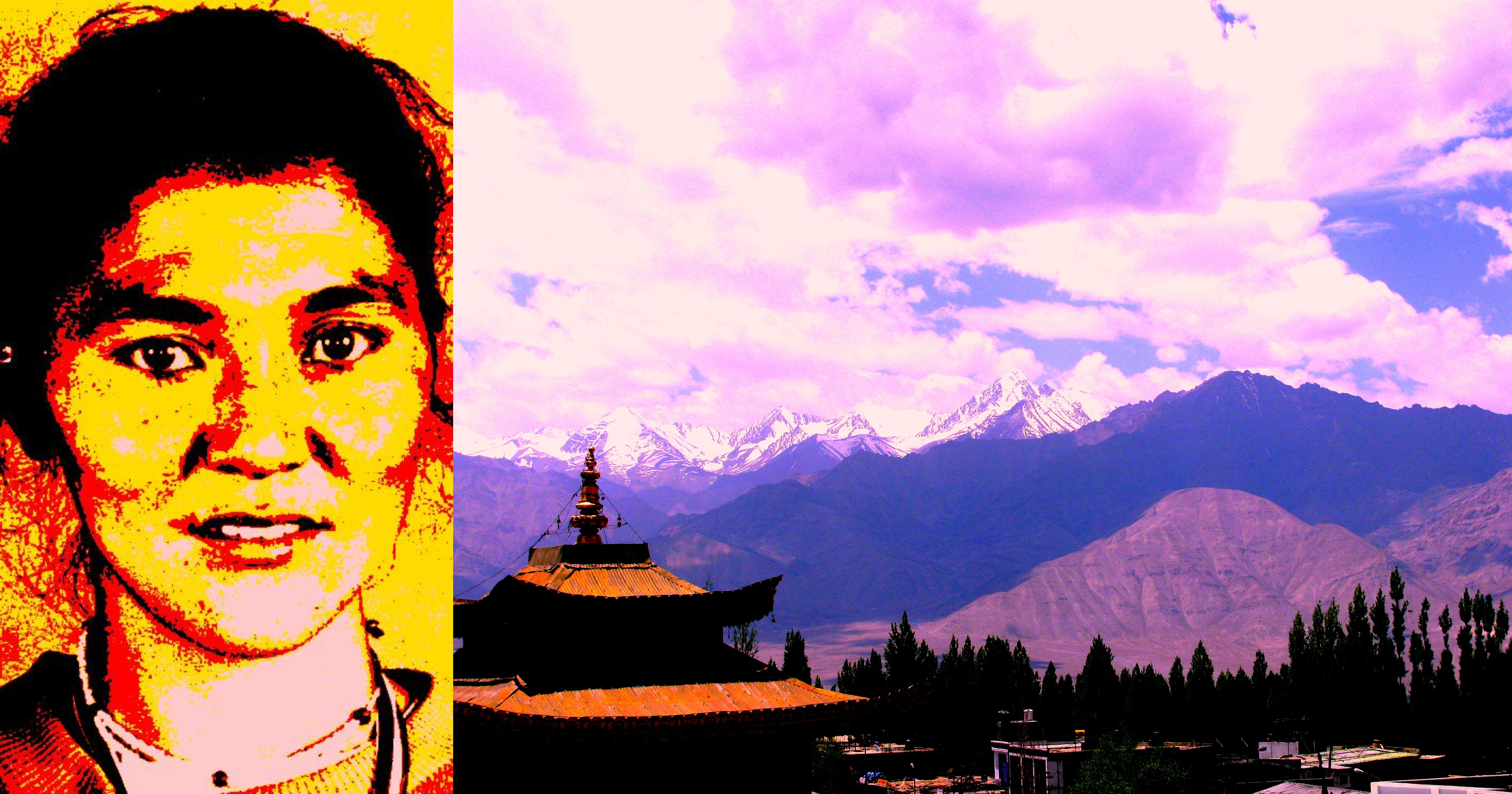
File photo of Rigzen Angmo: by arrangement; photo of Leh: Shyam G Menon. Imaging of both: Shyam G Menon

File photo of Rigzen Angmo: by arrangement. Photo of Leh: Shyam G Menon. Imaging of both: Shyam G Menon

Meeting Rigzen Angmo

Early morning September 13, as the fourth edition of the Ladakh Marathon got underway in Leh, Rigzen Angmo couldn’t help calling up those she knew to find out how the run was progressing.

She had to work that day and wasn’t in a position to participate even for fun. In fact, it wasn’t just 2015; the Ladakh Marathon has been on since 2012 but a combination of commitment to work, reluctance and maybe a desire not to revisit a chapter in her life put firmly behind, kept Rigzen away from participating.

Sometime after she confirmed that the race was on, she left her house and reached the roadside to have a glimpse of the runners. “ By the time I got there, those in the lead had already gone past. You can make out a good runner from how he or she uses the feet. The ones I saw must have been the recreational lot,’’ she said, tad disappointed. Later, she switched on the radio to listen to the race report. This September (2015), Ladakhis once again dominated the marathon. Rigzen however, wasn’t happy with the timings she heard. “ Ladakhis can do better than this,’’ she said, adding, “ my respect is more for the timing reported from the Khardunga La Challenge. I thought that was good.’’ The annual event is a composite of four sub-events – a seven kilometre-run for fun, a half marathon, a full marathon and a 72 km-ultra over the high Khardunga La pass called the Khardung La Challenge (for more on the 2015 Ladakh Marathon and the region’s quest to have a good running team, please visit this link: https://shyamgopan.wordpress.com/2015/08/07/ladakhs-running-team/).

This September when I reached Leh, all I knew was that Rigzen Angmo was now a senior officer with the Central Reserve Police Force (CRPF). Paramilitary personnel can be posted anywhere in India. Even if she was elsewhere in the state of Jammu & Kashmir, it would be difficult for freelance journalist on tight budget to pursue. That’s what journalism has become – a race judged by strength of resources. Media organizations have tons of it; freelancers, none. Where is Rigzen Angmo? – I thought.

When in doubt, have a cup of tea – that’s my recipe for clarity in the mountains. Kunzes served a cup of hot ginger tea. I rolled out my query, explained it. She stopped the work she was doing at the cafe in Changspa and listened carefully. “ Yes, I have heard of her. I think she has a house in Leh. Perhaps if you go there and ask, you may be able to locate her,’’ she said. To my luck, at the said house, I learnt that Rigzen had just been moved on work from Srinagar to Leh. When I finally met her, Rigzen Angmo wasn’t the talkative type. It was obvious that the chance to revisit running as a topic of discussion, made her happy. But her own past, it appeared, was something she had retired from. In 2004, she exited the central athletics team of the CRPF. Thereafter it has been regular office work.

“ Why don’t you come back to running?’’ I asked. For a second or two, Rigzen seemed undecided like somebody on a threshold. Then she replied, “ for years I pushed myself to settle for nothing but the best I can be. It is too deeply ingrained. At the same time, my body is no longer what it used to be, all that running has taken a toll.’’ It was the classic dilemma of erstwhile high performer. Over the couple of times we met to discuss her life in running, Rigzen Angmo hovered around that threshold.

Rigzen Angmo after winning the Kuala Lumpur Marathon in 1994 (photo: by arrangement).

Rigzen Angmo after winning the Kuala Lumpur Marathon in 1994 (photo: by arrangement).

She gave freelance journalist a file of old paper clippings to read and glean her story.

This is a compilation of that and a few rounds of conversation had.

Rigzen was born in March 1969 at Skarbuchan village, roughly 125 kilometres away from Leh. She was the third child of her parents; they were in all five brothers and four sisters. Her parents were farmers. Her mother died when Rigzen was still young. Life changed with the Indian government’s Special Area Games (SAG) scheme under which, talent from remote areas was spotted and groomed. The website of the Sports Authority of India (SAI) describes SAG currently as follows:  Special Area Games (SAG) Scheme aims at scouting natural talent for modern competitive sports and games from inaccessible tribal, rural and coastal areas of the country and nurturing them scientifically for achieving excellence in sports. The Scheme also envisages tapping of talent from indigenous games and martial arts and also from regions/ communities, which are either genetically or geographically advantageous for excellence in a particular sports discipline. The main objective of the Scheme is to train meritorious sports persons in the age group of 12-18 years, with age being relaxed in exceptional cases. The disciplines covered include archery, athletics, badminton, basketball, boxing, canoeing, cycling, fencing, football, gymnastics, handball, hockey, judo, kabaddi, karate, kayaking, netball, rowing, sepaktakraw, shooting, swimming, taekwondo, volleyball, weightlifting, wrestling & wushu.

Picked up under this scheme when she was in the ninth standard, Rigzen moved to Leh’s Lamdon School for her matriculation. SAG selected her for running middle and long distance races. In the file, there was an old newspaper photograph from the district level selection race that placed her with SAG. It showed a young Rigzen racing, clad in salwar kameez and wearing normal footwear. She finished first. Rigzen said she owed a lot to SAG, in particular its director B.V.P. Rao. “ Whatever I am today is because of him,’’ she said. Years later, Rao would be one of the founders of Clean Sports India, a movement for corruption free-sports in the country. Amarnath K Menon, writing in a May 1988 issue of India Today (available on the Internet), described Rao as “ an IAS officer who stays at the Nehru Stadium and is building up a pool of sports medicine specialists, social anthropologists, ex-international sports competitors and sports promoters. The article said, “ the greatest advantage of the Special Area Games Programme (SAGP) is that it takes all round care of the trainees, including their schooling, unlike other government supported schemes. Its provisions of food, clothing and education, besides the prospects of winning a medal, are its main attraction.’’ Rigzen’s visit to Delhi happened “ one August,’’ as part of a team of 18 trainees from Ladakh. They received coaching for 15 days at the capital’s Jawaharlal Nehru stadium. It was her first taste of formal training. Following this, on return to Ladakh, she was coached regularly as part of the SAG scheme. She trained in the morning and in the evening, attending school in between. After matriculation, Rigzen completed her twelfth standard through open school. Later she graduated with a degree in physical education.

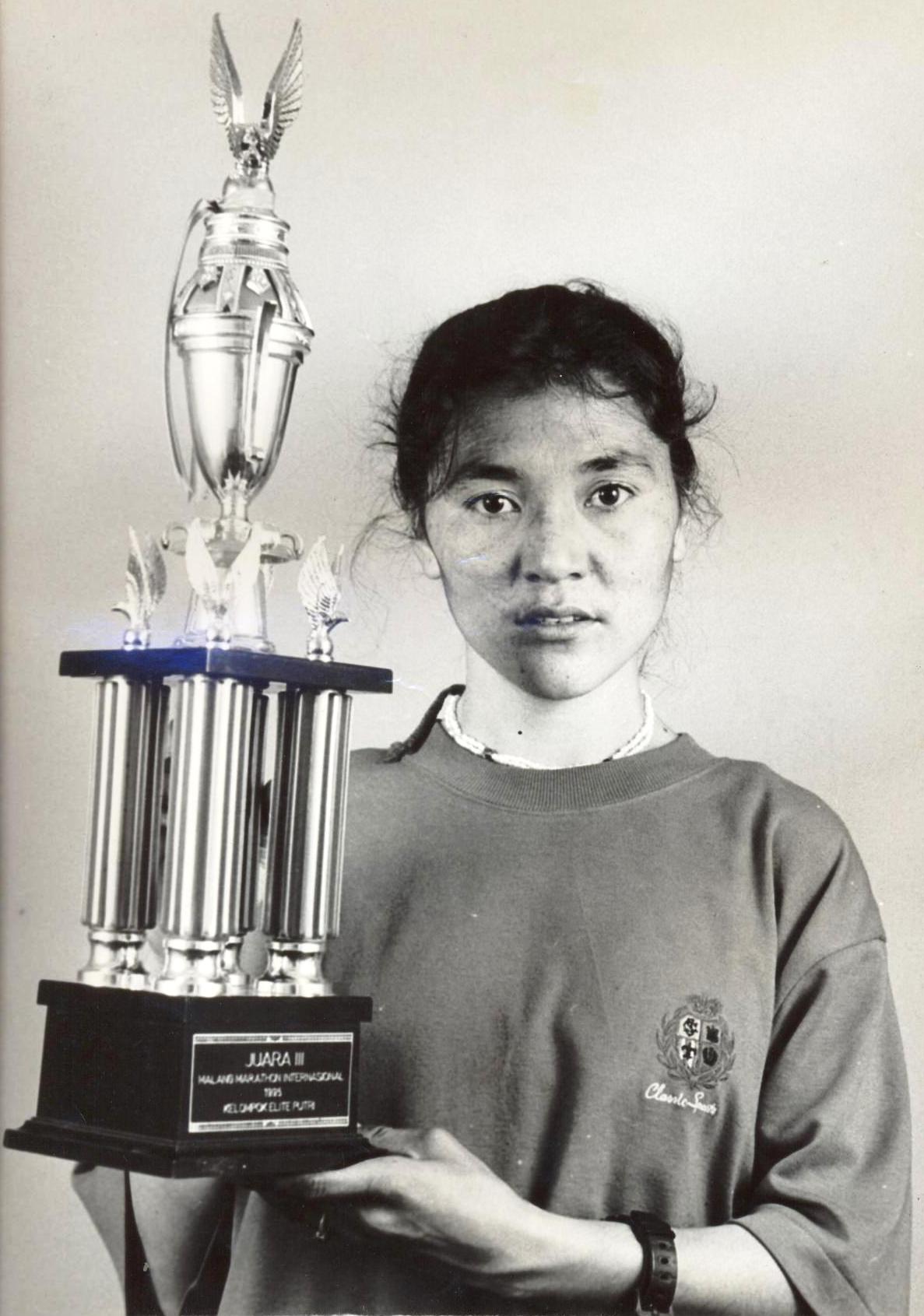
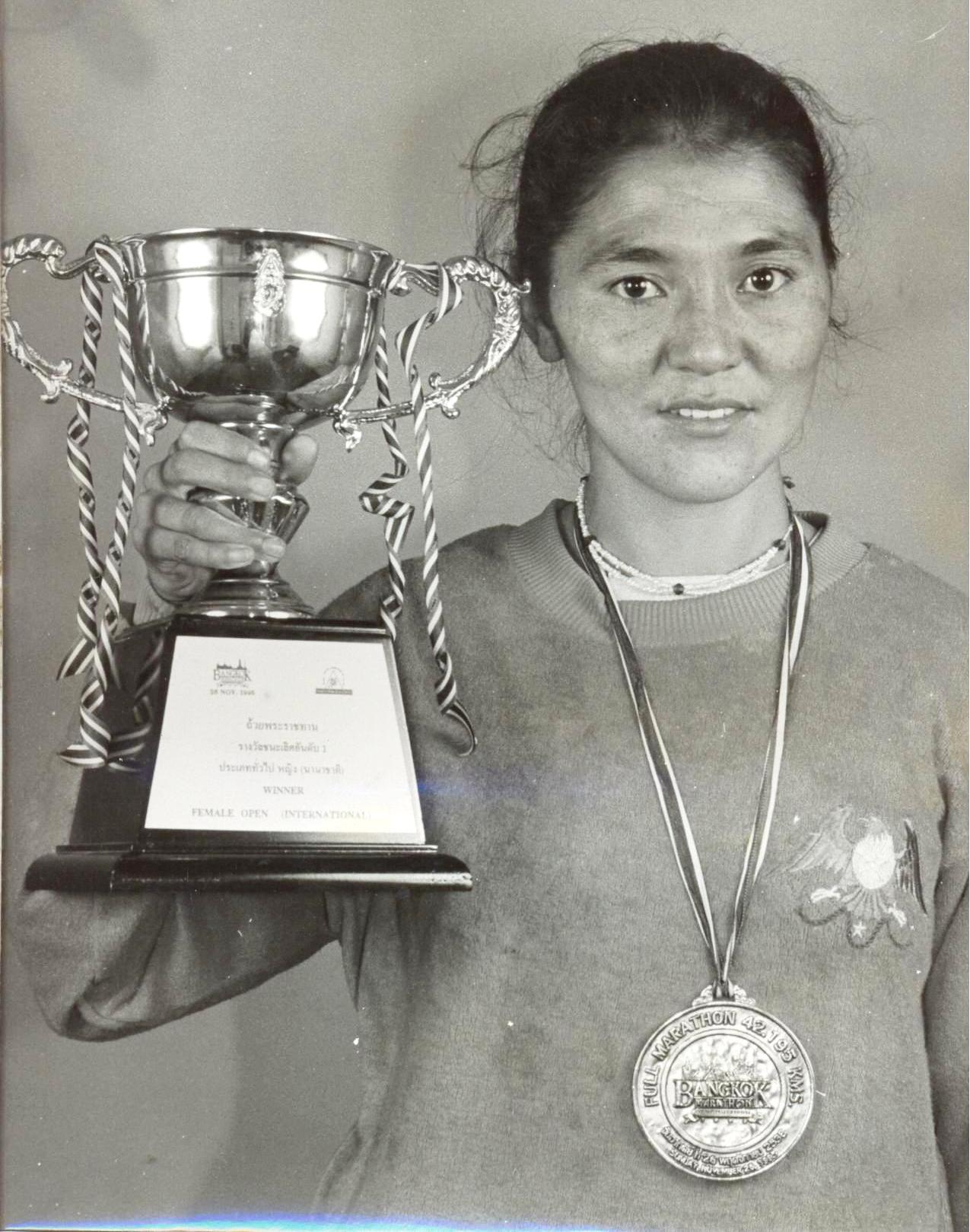
According to Rigzen, nobody pushed her towards the marathon. The shift was something she decided more or less on her own by observing how she performed. A high altitude dwelling-Ladakhi, she seemed to do well in long distance runs requiring endurance. In 1987, she ran the 10,000m race at the senior nationals, winning a silver medal. “ I felt I could do better at still longer distances,’’ she said. In 1989 she ran her first half marathon at the Rath India Open Marathon in Delhi, finishing fourth. In 1990-91 she ran her first full marathon at the same event. P.K. Mahanand, writing in the Economic Times in February 1995, said this of Rigzen’s performance, “ when she took part in the Rath Marathon in 1991, she became the first Indian woman to return a time of under three hours for an athlete on a marathon debut – she clocked 2 hours, 53 minutes.’’  From these beginnings, Rigzen Angmo went on to be among India’s top woman marathon runners, in the same league as Asha Agarwal (the first Indian woman to win an international marathon – the Hong Kong marathon), Sunita Godara and Suman Rawat. The highlights of her career would include podium finishes in international marathons at Bangkok, Kuala Lumpur and Kathmandu. Rigzen believes that she could have done more had it not been for the problem of talent in India restricted by the politics at the country’s sports organizations.

Rigzen Angmo after winning the 1995 Bangkok Marathon (photo: by arrangement).

Rigzen Angmo after winning the 1995 Bangkok Marathon (photo: by arrangement).

In her time, India’s woman marathon runners were a force to reckon with on the Asian stage. “ If there was enough encouragement, we could have made a mark at the global level,’’ she said. But that was not to be. To start with – the discipline wasn’t any of the fast and powerful sprint events which captivate audiences, it was the marathon, that too, women’s marathon in an India awash in male chauvinism. Second, sports bodies, usually manned by politicians and the politicking types, never backed talent fully. Rigzen recalled how after being permitted to run a race overseas, the Indian sports body in question declined any kind of support. They approved her participation but how was she to fly abroad if they won’t give her an airline ticket? She wasn’t a rich person. Somebody then pointed out that a gentleman she kept passing by at a park in Delhi during her regular training runs was a Member of Parliament. She sought his help. He arranged free airline tickets. She flew overseas, participated in the event and earned a podium finish. That was merely one example. In the file, a magazine article by Ranjit Bhatia dwelt on Rigzen’s participation at the London Marathon (consequent to her impressive showing at the Rath Indian Open Marathon) not being cleared by authorities. “ Her recent selection to represent the country in the IAAF World Marathon Cup in London on April 21, came almost simultaneously as the rejection of her trip was announced,’’ he wrote.

Rigzen wasn’t the only one navigating choppy waters.

A February 1997 article in the Hindustan Times by R.M.S. Atwal on India’s woman marathon runners (Rigzen among them) mentioned Asha Agarwal’s predicament. Asha, often deemed the first lady of women’s marathon in India, had quit her job with the Railways on an assurance that she would be appointed as an Assistant Director (Sports) in the Delhi administration after three months spent in a junior position. That didn’t happen. Result – she not only stagnated career-wise but got demoted, the report said. It quoted her, “ I have got nothing on assurances from successive governments while people (other athletes) with top connections are rising and rising. I think nothing materializes without a godfather in this country.’’ In India, athletes are on their own in more ways than just the motivation to excel and the commitment to train.

This general trend of navigating a politics ridden, rat race-ambience was besides the issue of being a woman training for the marathon, in the India of those days. For Rigzen, hailing from the closely knit, mountain community of Ladakh, training at home was challenging. Driven, she maintained a rigorous training schedule. Very few in the mountains could fathom the eccentricity of it all. Why would a woman want to run 42km? Why would a woman log close to 200km a week as training in an attempt to run 42km at a race? You stood out as an odd ball pretty easily. “ The problem wasn’t so much in my village where I was known; it was more towards town. Being a woman it was difficult to practise. I used to avoid being seen practising in public, preferring instead, places where people were few,’’ she said. When away from Ladakh, the bulk of Rigzen’s training happened in Delhi, Patiala and Bengaluru (Bangalore). Athletics was better known in the cities and for the girl from the mountains, training here made more sense. “ Everything outside Ladakh was new and different for me. I looked at it as encouragement. I still miss the stadiums I trained in,’’ she said. There was one thing though about ` outside.’ People in the plains and cities therein, knew nothing about Ladakh. “ They would ask: where is Leh?’’ she said laughing. There were other valid reasons for Rigzen training outside Ladakh. The training window in Ladakh is small; no more than four months a year given the region’s reputation as cold desert. The training window is bigger in the plains. She feels Ladakh is too high an altitude to develop all that goes into the making of a competitive endurance athlete. She found mid-altitudes like Shimla, better suited for the purpose. Further, back in her days, a good, consistently available diet for the competitive athlete was more possible at training centres in the plains or well established towns in the hills, than in Leh.

Rigzen Angmo (photo: by arrangement).

Rigzen Angmo (photo: by arrangement).

As other articles in the file showed, those days it wasn’t easy anywhere in India for a woman marathon runner. In February 1995, The Pioneer published an article by Neena Gupta on India’s woman marathon runners. It quoted Sunita Godara, “ mind you, every outing, each road-run for me is a lesson in the cultural heritage of India and women’s place in it.’’ The article added that in small towns, Sunita had an escort with her while running. In Patiala, she had an army subedar accompany her. It also quoted Asha Agarwal, “ since I could not run alone, I had to be accompanied by my father or brother on a cycle.’’ This report mentioned that Asha had sought a transfer from being Welfare Inspector in the Railways to being Supervisor (Physical Education) in the Delhi Administration so that she can stay around the Delhi University campus where the atmosphere was more congenial for her practice. “ However she was reportedly demoted to the non-gazetted post of a senior sports teacher. The discrimination did not end there. The post was abolished in July 1994 and consequently, her salary stopped,’’ the article said.  More than one report cited women having to prove that they are capable of marathon distances before being taken note of. As if that wasn’t enough, they witnessed their races shortened to smaller distance owing to low participation or pressured to conclude early for taking longer time than men. Such practices wouldn’t be tolerated overseas where a discipline is a discipline. Of interest for freelance journalist reading these articles in 2015 was that 15 years after they were published at least one of the officials quoted therein defending the sports federation’s side in allegations related to inadequate support for women’s marathon, became an accused in India’s Commonwealth Games scam. In such time span, athletes come and go. Officials, stay forever. That is India’s sports. “ After the SAG phase, I reached wherever I did on the strength of my personal effort. My husband Tsewang Morup supported me,’’ Rigzen said.

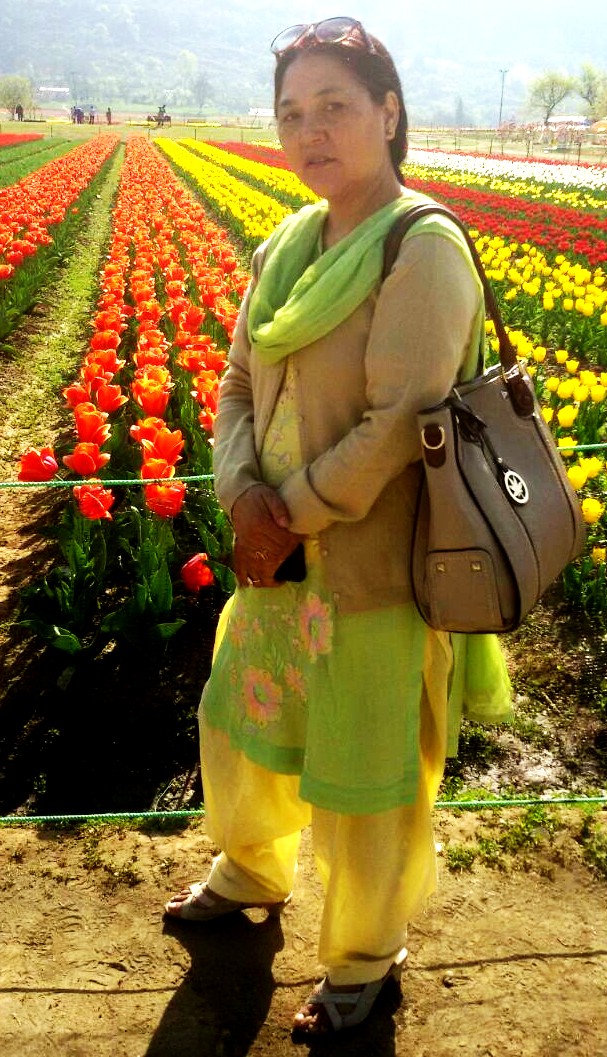
On September 13, barring some of the runners from Ladakh, it is unlikely anyone running the Ladakh Marathon would have recognized the small woman watching them from the side of the road. Fewer still would know the times in which she ran for India or the fact that she is the only runner from Ladakh so far to earn podium finishes at international level. Born to the mountains and focussed on her job as a Deputy Commandant, Rigzen Angmo has not been in touch with any of her contemporaries from the pioneering lot in India’s women’s marathon. She admitted that staying away from each other may also have much to do with the competitive environment in which they all originally met and raced. As the topic of running revisited her life – even if only as discussion – she said, there was a question she had often asked herself: why hasn’t Ladakh produced another Rigzen Angmo despite greater interest in sports and improved prospects for youngsters?

“ What do you think is the reason for that?’’ I asked.

“ I don’t know. There is ample talent in Ladakh. Further, these days, more young people travel out from Leh for studies than used to before. So it is not lack of exposure. Perhaps they should appreciate that good education isn’t all about studies. It includes sports too. You need to be sufficiently interested and committed to practising. You must also aim high. Only then will you reach at least half way. If you don’t aim at all, then where will you reach? To succeed in the marathon, you need perseverance, hard work and will power. Anyway the fact is – I haven’t been able to spend a lot of time with Ladakh’s young people and those among them, who like running. Only if I do that can I say anything for sure,’’ she said. Then she dropped a hint; a SAG-sort of hint, one that is known in Indian sports: “ we must go to the villages…it is in the villages that you will find good runners.’’

Rigzen said she would like to help train young runners. But she has zero appetite for politics and given her past knowledge of the politics at India’s sports bodies, she fears that engagement with sports may reopen the Pandora’s Box. “ I don’t want to go into any situation that entails politics,’’ she said. According to her, she has thought of starting a running club or something similar in Leh, after retiring from the paramilitary. “ I can’t do that alone. I will need help. I also can’t do it alongside my work, which is why it will have to be after retirement. In the meantime, it is good that Rimo Expeditions has begun work on grooming a team of competent, young Ladakhi runners,’’ she said.

(The author, Shyam G Menon, is a freelance journalist based in Mumbai. Please note: the dates of events and timings at races are as provided by the interviewee. Where photo credit says `by arrangement,’ the photo concerned has been sourced from Rigzen Angmo.)

BRIDGING THE GAP

bridge-4

Everybody likes a supported event.

A run with adequate water stations en route attracts us all.

A supported event is however different from an event that is supportive.

Photo & imaging: Shyam G Menon

Photo & imaging: Shyam G Menon

While ` supported’ sails strong courtesy its natural drift to commercial format, ` supportive’ rings of relevance that is more central to what you set out to do. The idea of a supportive run acquires dimensions of aiding passage in a way that is directly related to the act you are engaged in. All the support – from gear and facilities to human encouragement – dovetails to enabling the chosen challenge comprehensively. A good mountaineering expedition exceeds being merely supported to being supportive of the quest. `Supportive’ has a touch of attempting experiment; it empathizes with the core pursuit.

From a participant’s point of view, the annual Mumbai Ultra, for instance, could be called a supportive run. Even as it is supported with water stations and snacks like regular organized events, it is additionally set up so that it supports runners seeking to experience an ultra marathon. With medical teams at hand and mandatory check-up after every loop, it provides you a relatively safe environment in which you can conduct the personal experiment of discovering how far you can push your body. And should the ego override common sense and the fool in you take over, somebody assigned the job of remaining sensible stops you. The Mumbai Ultra is thus useful hand-holder. It provides people already into running, an idea of what it means to run for a long time covering long distances. Critically, it does not subject you to stage cut-off times or prefixed ultra distance. Apart from an overall 12 hour-duration, it leaves you to explore.

One good question doing the rounds in the context of ` supportive’ is the relevance of having supported runs across distances other than the regularly heard 10km, half marathon and full marathon. The 10km is a tidy distance; the half and full marathon are known, defined entities. But from 10km to 21km is a leap; it is another leap from 21km to 42km. While purists may have it no other way, are these prefixed distances the only respectable way to graduate from short distance to long? Won’t intermediate distances be a fine way of hand holding aspiring runners in their progression of choice?

Well known ultra runner, Satish Gujaran mentioned this during a recent conversation. According to him, when he was introduced to running in South Africa and starting out as a distance runner, the context he found himself in was rich in a variety of distance races. There were plenty of organized outings offering intermediate distances bridging the gap between the better known, established distances. Further, many events in running also featured an associated event in walking. Back in Mumbai, Satish felt, such bridges were missing or at the very least, not adequately represented in the races / events / simple outings the running community has. While training for long distance runs, Mumbai’s runners have evolved private runs in which atypical, odd distances, which are suitable stepping stones to an eventual long distance in mind, are run with support. However as organized events, these odd distances – or bridge distances – rarely find fancy despite their relevance to the running community. Some events exist but they are a minority compared to the twenty ones and forty twos.

How about some bridges?

(The authors, Latha Venkatraman and Shyam G Menon, are independent journalists based in Mumbai.)
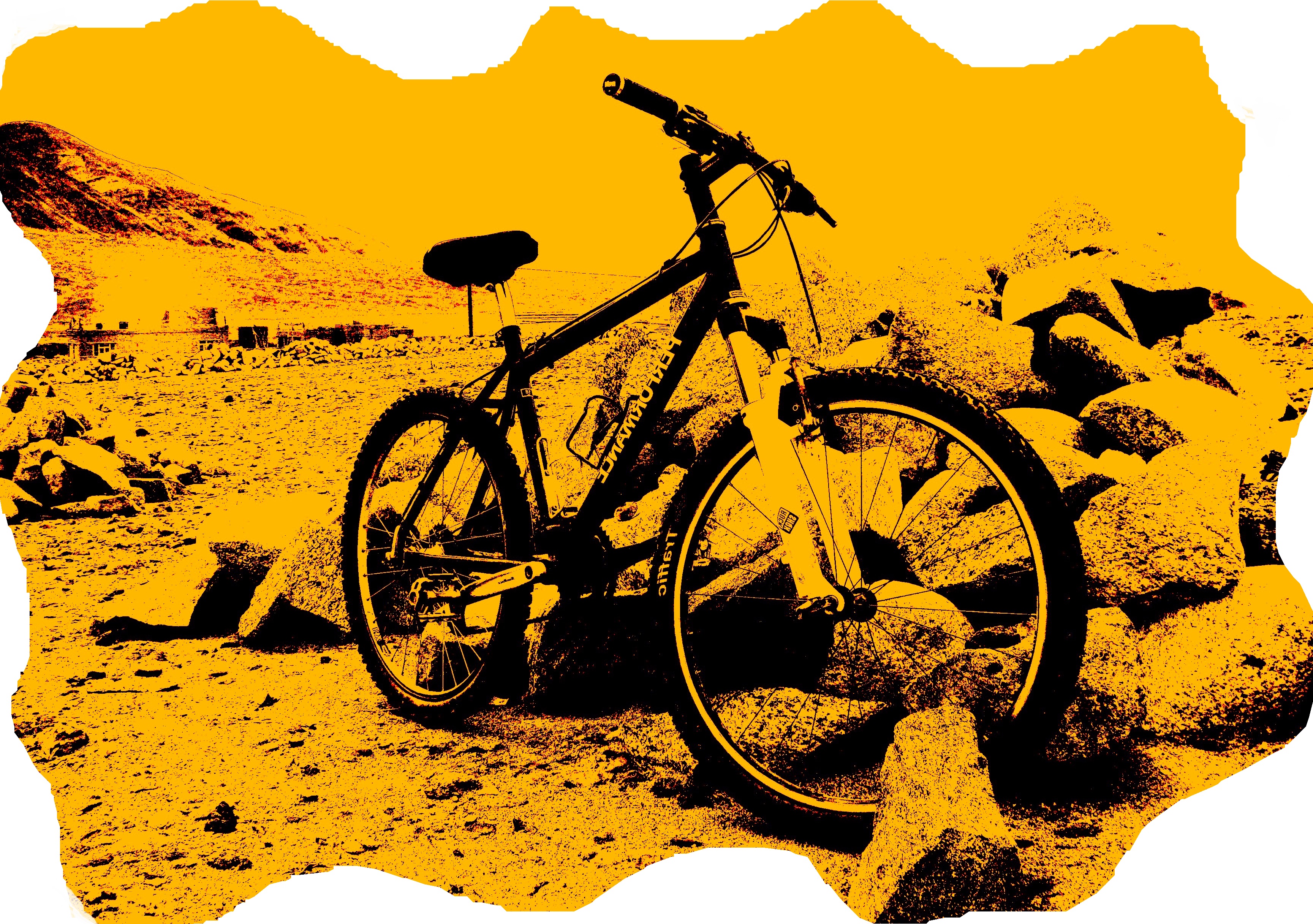
IN LEH: A STORE FOR PREMIUM BICYCLES

Photo & imaging: Shyam G Menon

Photo & imaging: Shyam G Menon

The shutters of the shop window went up.

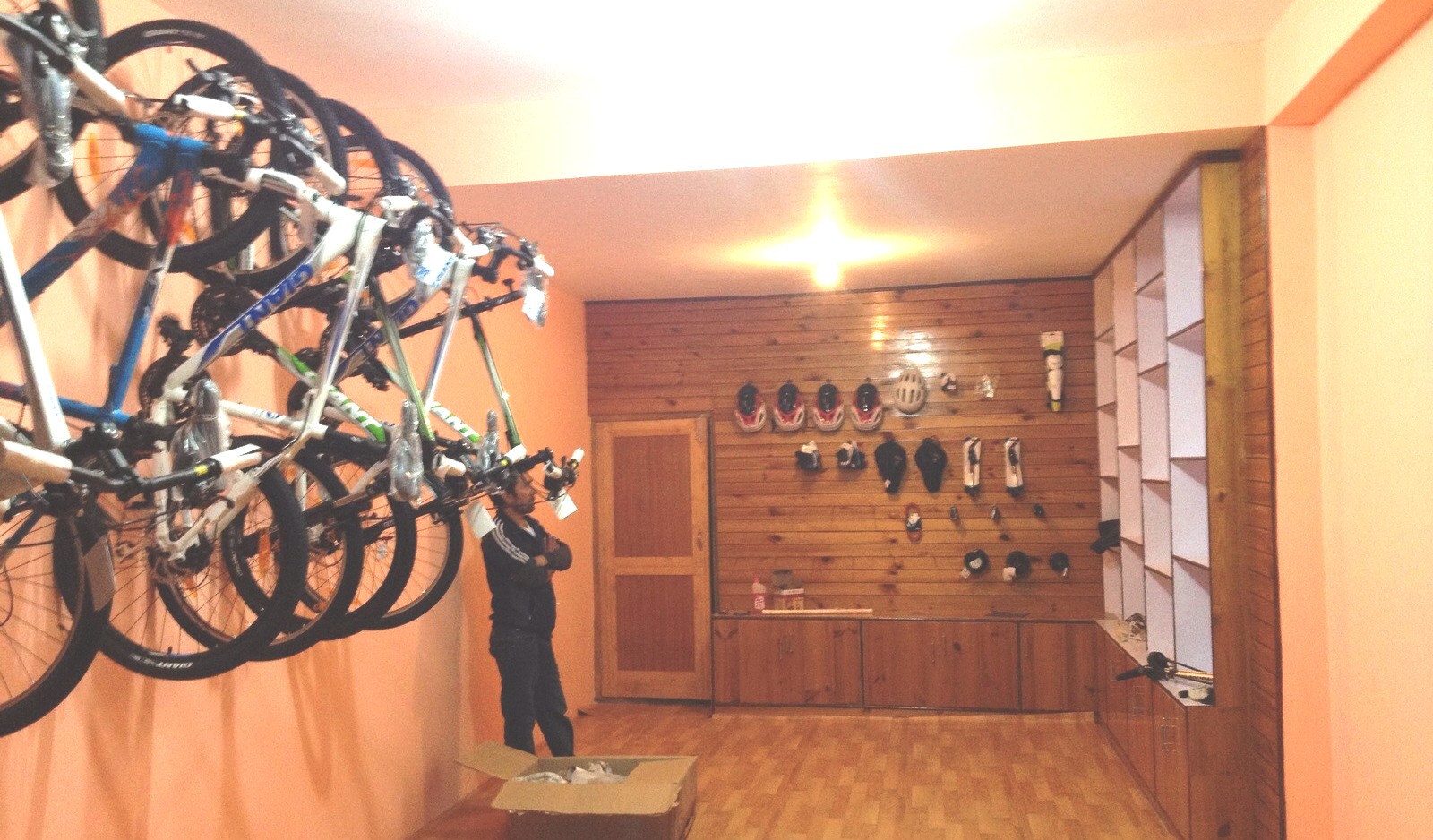
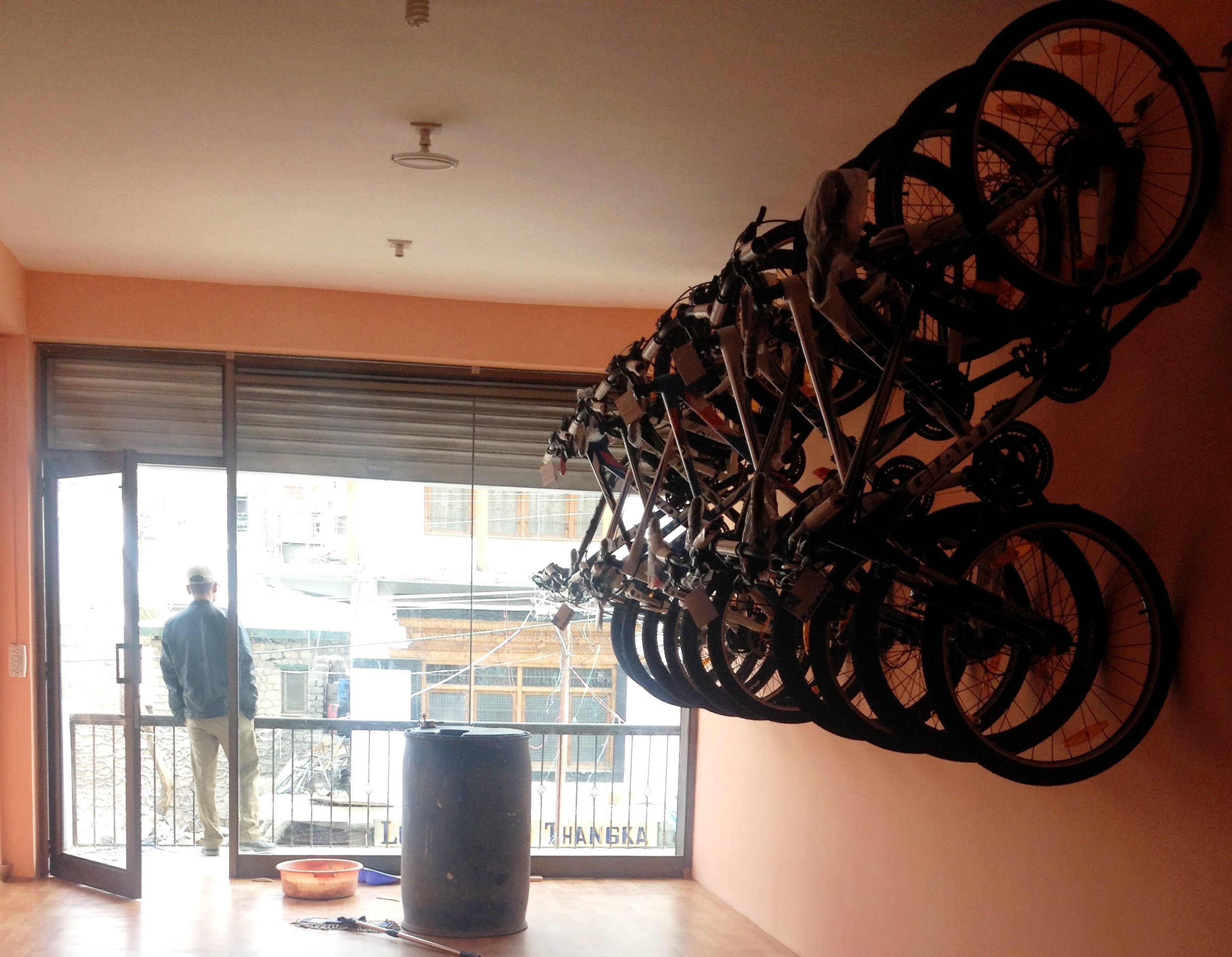
Ladakh’s pure sunshine lit up a modestly big space within. There were shelves to stock things and on the wall was a line of hooks to hang bicycles. One could imagine a counter for the manager and space around to park more cycles.  “ What do you think?’’ Tsering Sonam asked.

Besides trekking, mountaineering and river rafting, Ladakh is identified with cycling.

The Manali-Leh cycle trip is a much sought after attraction. Cyclists wishing to be off the beaten path explore less known, equally engaging routes. Tourists to Leh, especially those into the active lifestyle, often hire cycles from the town’s clutch of shops renting out mountain bikes. For a daily fee, rather stiff by the standards of yore (but then you are on a geared bicycle), you get a pair of wheels to go around town the healthy way. If you are serious cyclist who left his bike behind and travelled light to Ladakh, you can hire a mountain bike for a long trip across the region, including auxiliary services like camping gear, mechanic and support vehicle. Leh’s bike rental shops help you with that.

By the end of the 2015 tourist season, a missing link in the town’s cycling infrastructure will be addressed. Leh is set to get its first shop that will retail modern, premium bicycles. The town has a couple of shops that sell cycles manufactured by the traditional Indian bicycle companies. The new shop will deal in premium bicycles, essentially the imported brands finding favour with those into the active lifestyle. These are also the bicycle types defining Leh’s cycle rental business.

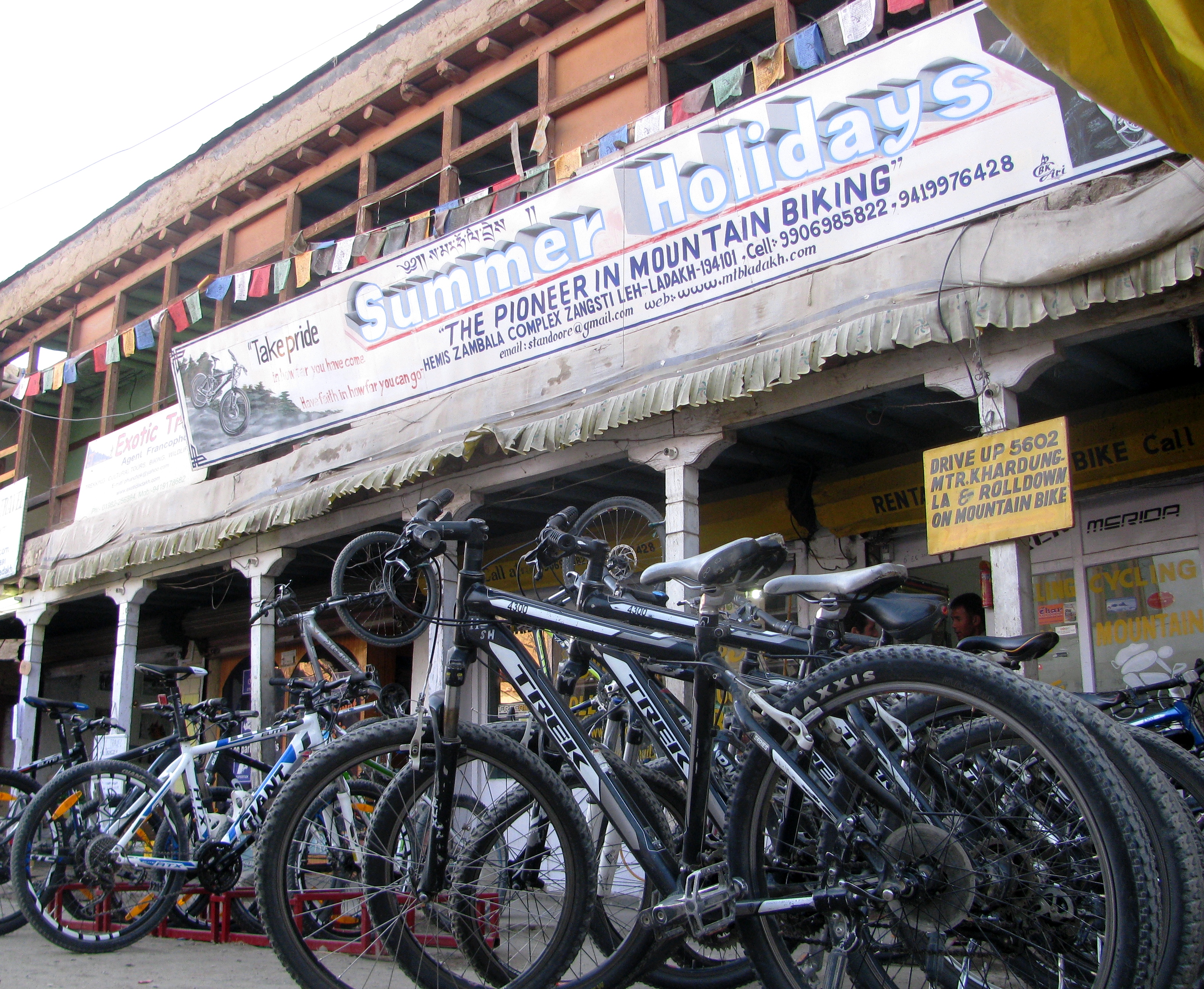
Summer Holidays, Leh (Photo: Shyam G Menon)

Summer Holidays, Leh (Photo: Shyam G Menon)

Leh’s cycle shops have gone through their ups and downs. The first to come up was Summer Holidays, in June 2006. It was begun by Stanzin Dorje, who had long been associated with the travel business. Joining him was his nephew Konchok Namgial. The initial fleet was a dozen or so used mountain bikes brought from Delhi. It was a phase fraught with teething troubles. Abused by customers in Ladakh’s rough terrain, the bicycles frequently broke down. Complicating matters was the issue of maintaining these bikes, quite different from the regular Indian-made bicycles. Neither did many in town know how to repair these relatively complicated models nor were spare parts easily available. It was a learning curve. Sumer Holidays was helped by two factors. First, Stanzin Dorje, who during his earlier times with the travel industry (he worked for a Delhi based-company) had led cycling groups elsewhere in India, was familiar with some of the work. Even today, he is one of the go to-persons in Leh for the skilled job of wheel-balancing. Second, Konchok Namgial began learning the craft of maintaining bicycles. To catalyse the process, Summer Holidays brought a mechanic from Delhi to Leh. However the market presence of premium bicycles in India at that time was so limited that the mechanic turned out to be inadequate in skills. The route ahead was clear – it will be learning by doing. Namgial soldiered on. According to Tsering Sonam, Namgial’s brother, in the wake of Summer Holidays opening shop several other similar establishments had commenced in Leh. But the ability to maintain a fleet proved a force of natural selection. Some shut shop; a few survived. Summer Holidays was among those that made it through.

The new bicycle store gets ready (Photo: courtesy Tsering Sonam)

The new bicycle store gets ready (Photo: courtesy Tsering Sonam)

As the market picked up, the shop’s fleet changed. In 2007, a foreign tourist gave a Trek 3900. Encouraged by the bike’s performance, Summer Holidays bought a clutch of Trek bikes from Delhi. This was followed by a handful of Merida cycles. The shop’s business was also helped by a product in Leh’s cycling experience it popularized. India has many high mountain passes. But Khardung La, near Leh, is distinct as the highest pass with a road through it. After coming to Leh, it is common for tourists to drive up to Khardunga La. Motorcyclists and SUV enthusiasts drive all the way from the plains to be at Khardung La and have it recorded for posterity in a video or photograph. Needless to say, Khardung La attracts cyclists. The product Summer Holidays popularized will irk the purist among cyclists but it caught the fancy of the recreational lot and the tourist seeking fun. The proposition offered was simple – drive up to Khardung La and then roll down the road on a bicycle, all the way to Leh. A mix of this product, daily rentals for cycling around town and long trips, kept Summer Holidays going. Today, in tourist season – essentially the months spanning Ladakh’s summer – Summer Holidays is a busy shop. “ In peak season, at least 20-25 people hire cycles every day,’’ Tsering Sonam said.

Summer Holidays now has an inventory of over 80 premium bicycles of which around 50 are in business. The balance is victim of a problem faced acutely in Leh given its remote location and if the cycling enthusiast elects to dig deep enough, likely elsewhere in India too – availability of spare parts. In fact, the idling cycles are sometimes cannibalised for spare parts to keep the rest of the fleet functional. This is one of the reasons inspiring commencement of a new, proper multi-brand bicycle store. Besides selling bicycles, the shop will stock spare parts and offer servicing to those in need of it after cycling to Leh from far. Tsering Sonam described an arrangement whereby the sale of cycles and spare parts happens from the new shop and the business of renting bikes and servicing of bikes continues from the old Summer Holidays location.

Photo: courtesy Tsering Sonam

Photo: courtesy Tsering Sonam

Some other factors too fuel the plan. In the decade since Summer Holidays opened shop in 2006 the Indian market for premium bicycles has evolved considerably. This evolution of the market shows in Summer Holidays’ fleet, which has both added brands (Giant being the new addition) and grown diverse in terms of bicycle specifications. Besides the regular sieving (which we are all used to as customers) based on thoroughly used cycles and the relatively new ones, the fleet for rent can be differentiated on the strength of number of gears, quality of derailleur, V-brakes, mechanical disc brakes, hydraulic disc brakes, adjustable suspension, suspension that can be locked out, suspension that can be remotely locked out etc. Intended application – whether local riding, going to Khardung La or cycling long distance – influences the quality of bicycle chosen and likely thereby, the hire charge. Unlike before customers nowadays are cognisant of technical subtleties. From a pure business perspective, there are people now willing to spend for acquiring a good geared bicycle. Such market evolution plus the profile of tourist visiting Ladakh – typically a person loving the active lifestyle – prompts the shop’s promoters to think that somebody may elect to buy a good bicycle in Leh. More relevant for business plans: over time, as the town’s bicycle shops grew, they not only enhanced their fleet size but also sold ageing cycles locally contributing to a rising base of used premium bicycles in Leh. Adding to this growing mass has been the occasional sale by the foreign cyclist passing through, who after a long journey done, chooses to sell or gift his / her bicycle. This local base of bicycles provides a captive market for spare parts, not to mention, potential aspiration by their owners to upgrade.

Photo & imaging: Shyam G Menon

Photo & imaging: Shyam G Menon

Finally there is the truth that cycling is an environment friendly way of getting around, anywhere. Ladakh at an average elevation of over 9800ft is the deep end of the need to maintain a clean environment. Already in its thin, still air, vehicle exhaust and the smoke from shop generators are sensed by the human nose with a clarity that is more profound than how you sense the same in the plains. In Ladakh, vehicle fumes stand out. According to Tsering Sonam, the town’s renovation plans currently underway have it that once the main street and market have been done up, it will become a traffic free zone. Such moves provide oblique encouragement for cycling and highlight its environment friendliness. The proposed new bicycle shop in Leh, near Axis Bank and opposite the local office of the Life Insurance Corporation (LIC), hopes to tap into all this. Like other towns, Leh has a cycling club now and Tsering Sonam envisioned something similar attached to the new shop as well.

(The author, Shyam G Menon, is a freelance journalist based in Mumbai. Please note: in the Indian bicycle market geared bikes, MTBs, hybrids – they all fall in the premium category. For an overview of the market please try this link: https://shyamgopan.wordpress.com/2013/08/24/cyclings-second-youth/ )       

IRONMAN 13 TIMES AND COUNTING

Dr Kaustubh Radkar (Photo: Shyam G Menon)

Dr Kaustubh Radkar (Photo: Shyam G Menon)

We were at the PYC Gymkhana on Pune’s Bhandarkar Road.

Our mutual introduction and subsequent conversation had one shared quality – Dr Kaustubh Radkar spoke to the point. Except in places, he didn’t seem one for long sentences or the sort for whom, one sentence leads to many. You gauged pretty early, a penchant for brevity in the interviewee; the likely legacy of having been for long a competitive swimmer and after that, Ironman.

Kaustubh was born May 1982 in Pune, coincidentally the year Julie Moss fired popular imagination in the US with the mantra that finishing an Ironman is as good as victory. Moss, a college student then, had collapsed near the finish line. She crawled the rest of the way to complete her race. She didn’t give up. The incident was widely telecast in the US. It is unlikely anyone in India would have seen that telecast, now available on YouTube. In 1982, India was still a government monopoly in television broadcast and colour television commenced only that year, thanks to the New Delhi Asian Games. Ironman was probably unheard of. Indeed, according to the website of the Indian Triathlon Federation (ITF), the first triathlon in the country was held eight years later, in 1990.

The Radkars were a family of four; besides Kaustubh, there was his father, Sunil, who was a lawyer, mother, Nilima, a trained violinist and PhD in music and a sister, Deepti, three years elder to him, who was into swimming. She was a good swimmer who used to win medals at swimming competitions. At seven years of age, the boy followed his sister into swimming. It wasn’t a move with any aim in mind. He just followed. Nevertheless two years later, he was competing at swimming competitions and by the age of 11-12, he was winning medals at Pune level.

From Kaustubh's early days in the pool (Photo: by arrangement) Kaustubh

From Kaustubh’s early days in the pool (Photo: by arrangement)

We met Deepti at a cafe in suburban Mumbai. According to her, Sunil Radkar was a keen sportsman, particularly interested in baseball. He encouraged his children to take up sports. The family stayed not far from Pune’s iconic Tilak Tank. That is where Deepti and Kaustubh were introduced to swimming. Those days Tilak Tank was completely fed by subterranean springs, `L’ shaped and at 100 yards on its longer side, slightly less than double the length of an Olympic-sized pool. Today it is a modern swimming complex with only a portion retaining spring water, the old way. The siblings had diverse tastes in swimming – Deepti preferred the breast stroke and longer distances; Kaustubh took to freestyle and sprint. She recalled two coaches in particular – S.N. Karandikar and Srinidhi Sakharikar. Karandikar also organized swimming camps during the holidays. A day at one of these camps typically entailed a hill run, a few hours of swimming in the pool and lectures by sportspersons, nutritionists and motivational speakers. This was the environment in which Kaustubh’s swimming evolved. In 1995, at the national level school swimming championships held in Kolkata (Calcutta), he secured gold. Then based on his performance at the open nationals, where he was in the 15-17 age-group, in 1997 he got his first chance to represent India for races at the Asia-Pacific level. Speaking about the progression, Kaustubh said, “ initially I did not like swimming. It is a solitary pursuit, anti-social in a way and I wasn’t winning any medals. It was often serious practice, long practice sessions and few results to show. I was working as hard as any of the other kids and not getting anything. But at 13 years of age or so, the difference between talent and hard work started to show. That is when I started getting results and began enjoying it.’’

At the finish of Ironman, South Africa (Photo: by arrangement)

Finishing Ironman South Africa (Photo: by arrangement)

Apart by 150km, Mumbai and Pune are cities with different character and in sport, arguably different trajectories. Set by the sea, mercantile and open to the world, Mumbai was first off the mark in sporting greatness. Up and over the hills, located on the high Deccan Plateau and regarded as a sentinel of local culture, Pune took time catching up. Nowadays, Mumbai is the laggard in sports and adventure activity. In swimming, Kaustubh recalled, his years in the pool at school and university level, was the period Pune emerged from the shadow of Mumbai, Maharashtra’s erstwhile powerhouse in swimming. “ We were not afraid anymore,’’ Kaustubh said. Representing Pune University at the national university meet in Thiruvananthapuram (Trivandrum), he won six gold medals; one silver and a bronze in swimming. “ I was a specialist in the 100m, 200m and 400m-freestyle events,’’ he said. The Radkars were a family of lawyers. Although she made it to the nationals at university level, Deepti progressively found her calling in the arts and slowly veered off swimming. Kaustubh’s future, the family realized, may be in sport. “ The two of us not becoming lawyers was a major departure,’’ Deepti said.

Things weren’t rosy in India for a career in competitive swimming. Characteristic of Indian sports, there was much politics in swimming. Kaustubh started looking for opportunities to study and train overseas.  He wrote to American universities seeking to represent them in swimming. He was accepted at Indiana University of Pennsylvania, initially with 50 per cent scholarship. Later, after seeing his performance, another 10 per cent was added to the scholarship component and he was included in the Dean’s List. His chosen line of academics was: BSc in Exercise Science & Pre-medicine. Deepti felt that there was an experiential link between the solitary progression of the competitive swimmer and Kaustubh’s academic journey. Several colleges in the US have a sizable Indian student population. But as a student with strength in sports and seeking to grow in it, Kaustubh was at colleges overseas that didn’t always have a large Indian student population. He became more independent; his circle of friends was diverse. “ He is an excellent cook,’’ she said.

Judy and John Collins, at their induction into the USA Triathlon Hall of Fame in 2014. Triathletes from California, they introduced the triathlon to Hawaii on February 18, 1978 by creating and staging the first endurance tyriathlon, The Hawaii Ironman Triathlon, a swim/bike/run course that circled the island of Oahu. The Ironman course linked the minimum 2.4mile Waikiki Roughwater Swim, an estimated 112 miles of the 115 mile Round Oahu Bike Course and the 26.2 mile Honolulu Marathon (Photo: courtesy Judy and John Collins)

Judy and John Collins, at their induction into the USA Triathlon Hall of Fame in 2014. Triathletes from California, they introduced the triathlon to Hawaii on February 18, 1978 by creating and staging the first endurance triathlon, The Hawaii Ironman Triathlon, a swim/bike/run course that circled the island of Oahu. The Ironman course linked the minimum 2.4mile Waikiki Roughwater Swim, an estimated 112 miles of the 115 mile Round Oahu Bike Course and the 26.2 mile Honolulu Marathon. This is how Ironman started. (Photo: courtesy Judy and John Collins)

Training in the US was a remarkably different experience. The Indian approach to being a better swimmer was to swim, swim and keep on swimming. The coach postured as a know-it-all. In the US, approach to sport was a convergence of different streams ranging from practising the sport to strength training and nutrition. There were separate teachers for each stream and none posed as a know-it-all. “ If you compare it hours for hours, you probably spend fewer hours in the pool there. But the recovery time is productively used for a lot of related training,’’ Kaustubh said. Another major difference was – the Indian approach focussed on the individual; training in the US focussed on teams. The entire team travelled together, trained together and cheered each other. Every weekend there was a swimming meet where Kaustubh’s university competed with some other university from the region. The daily training spanned 6AM to 8AM and 3.30PM to 6PM. There was only one session on Saturday. After two years of such training, he was either the best or second best swimmer on the team. He finished his programme by May 2003. “ I was pretty burnt out from swimming by then,’’ he said.

Kaustubh joined the University of Wisconsin to do his Masters in Cardiovascular Physiology with specialization in rehabilitation of people with heart and lung disease. This was an intense course with hospital-internship; it lasted till December 2005. During this period, he swam little. But he began running. Although from the same stable of endurance, swimming and running are two entirely different animals. Running is a high impact sport; swimming is not. One is partial to upper body-engagement; the other is wholly lower body-engagement. “ The transition from swimming to running was challenging initially. The good thing was I already had the required endurance,’’ Kaustubh said. Starting with 5km and 10km runs, he slowly graduated to distance running.  In 2006, he ran the New York City Marathon. His participation at this prized event was a matter of luck. The daughter of one of his patients worked with the Road Runners Club. They gave him a slot to run the marathon.

In 2007, Kaustubh shifted to Boulder, Colorado. He was now in the outdoor capital of the US. As he put it – in other cities people talk of which party they went to on a weekend; here they talked of the running, cycling or climbing they did. While in Boulder, he joined a Masters Swimming Programme, marking a return to swimming. By 2008, he had placed fourth in the US Masters Swimming Championship in the 200 and 400 yards freestyle events. He also took part in the Denver Marathon of 2007. His swimming coach at the Masters Programme was a triathlete; almost 90 per cent of the trainees at the programme were triathletes. It wasn’t long before curiosity set in. His friends mentioned Ironman. It seemed like a good challenge. Started in Hawaii in 1978 and since staged at various locations worldwide, the Ironman is essentially an extended triathlon. The full Ironman entailed 3.8km of swimming, 180km of cycling and 42km of running, all of it back-to-back. According to Kaustubh, full Ironman races in America have 17 hours as overall cut-off time. Within 17 hours, 2 hours 30 minutes is cut-off time for the swim, 8:10 for cycling and 6:30 for running. In comparison, the Olympic format of the triathlon features a 1.5km-swim, 40km of cycling and a 10km-run. He signed up for his first Ironman – a full Ironman – due in Arizona in six month’s time. As part of training, in 2008 June, Kaustubh did a half Ironman in Lubbock, Texas. He finished in 5 hours 59 minutes.

Kaustubh finishing the 3.8 km-swim at Ironman Brazil (Photo: by arrangement)

Kaustubh finishing the 3.8 km-swim at Ironman Brazil (Photo: by arrangement)

“ Arizona was really nice. The water was cold and I had to borrow a wet suit for the day. I had the fastest time in the swim segment at 47 minutes and 37 seconds. The cycling was okay. I had two punctures, the first at 120km and the second at 170km. I fixed both myself as you lose time waiting for the mechanics. The run went as planned. Overall I finished in 11 hours, 41 minutes. I was very happy,’’ Kaustubh said. He had overcome the main challenges – training the lower body for the strength and endurance demanded by running and cycling and surmounting the mental barrier in cycling, the sport – among triathlon’s three – he felt least connected to. The outcome at Arizona was also despite the fact that he was working full time. “ Kaustubh’s shift to the triathlon was completely unexpected. The Ironman was a surprise for us. It was only when he shared the timing he had in Ironman and details like you are doing the three disciplines back to back, that the enormity of it hit us,’’ Deepti said. In December 2008, Kaustubh moved to the East Coast, to Baltimore and Johns Hopkins, where he commenced work at the hospital’s cardiology department. Between 2008 and 2013, he did four full Ironman races. This included races in Canada (2009), Lake Placid, New York (2010 & 2012) and Idaho (2011). “ I was doing an Ironman every year,’’ he said. Amid this, he enrolled for a MBA programme in Health Care at Johns Hopkins and then halfway into the MBA, added a PhD programme also to the list. These commitments were among reasons that kept his participation at Ironman to one race per year.

In 2013, with a few Ironman races now in his kitty, he designed a goal for himself – do a full Ironman in every continent. “ It was just something I came up with. Two other people had done it till then and it seemed a nice thing to aspire for,’’ Kaustubh said. The new goal entailed some specific challenges. Different locations come with different peculiarities, most important being difference in weather conditions. Then there is the issue of resident weather condition at one’s base – how much training one can do and how much training in those conditions may be relevant to the location you are planning to go. His new pursuit in the Ironman fold started off in May 2013, with the race in Port Macquarie, Australia. This was followed up with a full Ironman in Wisconsin, where he registered his personal best – 11:03 hours. That year – 2013 – also became the first year in which he did two full Ironman races. In December 2013, Kaustubh returned to India. He had always wanted to start something of his own in his line of work.

Cycling at Ironman Zurich (Photo: by arrangement)

Cycling at Ironman Zurich (Photo: by arrangement)

Meanwhile his pet project continued. In July 2014, he went for the Ironman in Frankfurt completing it in 12:11. In September, he was at Langkawi, Malaysia, finishing the event there in 13:24. In November, he did the Ironman at Fortaleza, Brazil in 13:49. If in 2013, he did two Ironman races, he ended 2014 with three races done in a year. In March 2015, went to Port Elizabeth, South Africa for the Ironman there, completing it in 13.22. With that Kaustubh had done an Ironman event on all the six continents it is held. In July 2015, he raced at Zurich, Switzerland, finishing the race there in 12:32. It was the first time he coached four others to participate; two did, the others couldn’t get visas in time and so hoped to do an Ironman later in Malaysia. Two weeks after Zurich, Kaustubh completed the Ironman in Boulder, Colorado in 12:31. “ I don’t advise that,’’ he said pointing to both the need for time to recover between races and that fact that Boulder is at an elevation of over 5000ft. He now has a new goal coming up. After you have finished 12 Ironman races, you gain entry into the Legacy Programme. Under this provision, you get a slot for the Ironman World Championship held annually at Kona, Hawaii. Kaustubh has so far participated in and completed 13 Ironman races. He hopes that his slot for the World Championship will come in 2017. “ The World Championship is always a big dream for anyone who has done an Ironman. That’s the birthplace of Ironman,’’ he said.

In the years since he returned to India, Kaustubh began Radrx, a clinic that attends to people with heart and lung diseases, cancer and also deals with sports medicine. Additionally, he is associated with two hospitals (going on to three) in Pune. Of direct relevance to sport, he started Radstrong Coaching which specializes in coaching for running and triathlon. In January 2015, he got married; his wife, Madhuvanti, is a PhD in Pharmacology. He estimates that around 20-25 people from India have so far finished the full Ironman. He has set a goal for Radstrong: coach 100 Indians to finish an Ironman by 2020. At some point, he would also like to bring Ironman to India. This is not an easy task for multiple reasons.

With others at a triathlon training camp (Photo: by arrangement)

With others at a triathlon training camp (Photo: by arrangement)

Most locations hosting the Ironman have a sizable resident community already into the triathlon. This is crucial because an event cannot survive by banking wholly on foreign visitors. India’s triathlon-community is yet small. At present, the Indian hotspot in terms of people interested in the Ironman is Bengaluru (Bangalore). Pune, Mumbai and Delhi are catching up. In Chennai and Hyderabad, local clubs have organized races sporting Ironman-distances. But there is a long way to go. Then there are India’s infrastructural challenges. The Ironman event requires the portion of road used for running and cycling to be closed for the whole duration of the event. That means a road being closed to traffic for 17 hours. Ironman events happen outdoors. The swimming segment needs a suitable water body and while the water body can be a river, lake or a portion of sea, it could be a challenge finding a water body in India that is presentable at the international level. “ For now, Goa looks promising,’’ Kaustubh said. There is also another angle to India’s relation with water. While abroad, swimmers turned triathletes are common, in India those moving to the triathlon are mostly from running and cycling. As in sailing, the country’s engagement with swimming smacks of reluctance despite its shores graced by major seas and water bodies available inland (for an idea of India’s evolving relation with sailing, please see the series on Sagar Parikrama at this link: https://shyamgopan.wordpress.com/2013/10/27/sagar-parikrama-part-one/).

The question plays on the lips of the curious: will there be an Ironman race in India?

(The authors, Latha Venkatraman and Shyam G Menon, are independent journalists based in Mumbai. Where photo credit says ` by arrangement,’ the photo concerned has been sourced from Dr Kaustubh Radkar. The authors would like to thank Judy and John Collins for allowing the use of their photograph.)    

IMAGINING A UNIVERSITY FOR LADAKH

SECMOL, Phey campus (Photo: Shyam G Menon)

SECMOL, Phey campus (Photo: Shyam G Menon)

An old story revisited; new chapters unfold:

The pile of twigs spoke little of the story. As did a couple of long pipes, collapsed over the heap. Prayer flags, still fluttering, indicated hope; a hope that had lived through the winter. Now it was summer. Whatever was in that pile, had gone, escaped. A few tiers below on the hillside, rows of saplings planted months ago provided a touch of green to bare earth. I was near the pile of twigs, on a piece of flat land between the lower reaches of Phyang village and its monastery further up. Behind me were brown hills and somewhere behind them, snowcapped mountains. Before me, Ladakh seemed a vast expanse, all the way to the Leh-Srinagar highway in the distance. Connecting Phyang to the highway was a straight road, so impressive for its straightness that it resembled an airstrip. To one side of the road lay vast tracts of unused land.

An hour or so before, we were on an unpaved road between the SECMOL Alternative Institute in Phey and the Leh-Srinagar highway, a little less than 20km from Leh. We were cycling to Phyang from Phey. It was past noon; hot. The bike below my writer self held up well. That morning in Leh, I had hired the best bicycle I could find within my budget. The bike had 24 gears, front suspension, water bottle carriers and 26 inch-wheels. My sea level lungs were not born for exertion at altitude. Multiple gears helped. The front suspension soaked up the bumpy passage to an extent and the 26 inch-wheels devoured a fine length of terrain for each rotation of the crank. I looked at the gentleman cycling alongside. He was perched peacefully on a small folding bicycle. The wheels may be small but the size of crank and apt gear ratios made the small bike adequate for commutes in Ladakh, he explained. I can cite the excuse that he was Ladakhi; born and brought up at altitude with lungs to match. That would be childish. Not to mention, it missed the point. I had impulsively chosen the sturdy looking-mountain bike, the SUV of the bicycle family. He used his head to imagine, analyze, attempt; match me on bigger set of wheels with his small ones. Very Sonam Wangchuk I thought.

The first time I met Wangchuk was in 2010. At that time, many people in Ladakh believed that the character of Ranchoddas Shamaldas Chanchad aka Phunsukh Wangdu, in the film 3 Idiots was loosely based on Wangchuk, a founding member of the Students Educational and Cultural Movement of Ladakh (SECMOL). That may or may not be true. Ahead of making the movie, the producers are said to have met him. But there has been no confirmation on whether the film’s main protagonist was modeled on anyone. After 3 Idiots was released to box office success, tourists however, went seeking Wangdu in Ladakh’s cold desert. A few discovered SECMOL; most followed the tourist trail to The Druk White Lotus School where portions of the film were shot. Others washed up on the shores of Pangong Lake. When I met him in 2010, Wangchuk was in Ladakh after a series of events that could hardly have been pleasant for the mechanical engineer and the then 22-year-old SECMOL.

Sonam Wangchuk (Photo: Shyam G Menon)

Sonam Wangchuk (Photo: Shyam G Menon)

SECMOL’s genesis can be traced to coaching high school students in a region notorious for its abysmally low pass percentage in the matriculation exams. The system was flawed. Textbooks lacked local themes. The medium of instruction till Class IX for Ladakh was Urdu, switching suddenly to English. In 1991, SECMOL’s pilot project on educational reform with village and government support, in Saspol, clicked. It saw other villages seeking the same. With Operation New Hope of 1994, planning better education for Leh district in league with local government and village communities, SECMOL graduated to a popular movement. Its work spanned redesigning textbooks and training teachers to monitoring schools through village councils. Later the newly set up Ladakh Autonomous Hill Development Council (LAHDC) accepted Operation New Hope as its educational policy. From 5 per cent pass at matriculation exams in 1996, Ladakh’s pass percentage increased to 55 per cent by 2004.

Then a rash of problems surfaced. Some disgruntled schoolteachers protested. When the executive councilor in charge of education at LAHDC — he was formerly associated with SECMOL — was shifted, Wangchuk’s observation on the matter was seen as interference. SECMOL’s media wing published a magazine called Ledogs Melong. It played the role of a watchdog, the exposes of which may have displeased some, while its patronage of colloquial Ladakhi, as opposed to the classical Bodhi of scriptures, ruffled feathers. The exact spark is unclear. The administration’s Deputy Commissioner hauled up NGOs over issues like funding and then zeroed in on SECMOL. Among other things, Wangchuk was accused of being a spy and his organization was virtually banned. This was despite SECMOL’s work earning national respect. The Ladakh model of the Sarva Shiksha Abhiyan programme had been inaugurated by the then President, A.P.J. Abdul Kalam.

In the following months, after protests far and wide, SECMOL’s freedom was salvaged to some extent and the Deputy Commissioner, transferred. Wangchuk moved to Nepal to work in the educational sector there. SECMOL hibernated, keeping a few activities alive. Ladakh’s matriculation results began to dip again. For most observers, the story was puzzling. It wasn’t the ugly moments that rankled. It was the vendetta. Why did that happen? The answer probably lay in a variety of factors. Wangchuk’s father Sonam Wangyal was a politician who became state minister; that may have made the son’s rising stature worrisome. SECMOL’s work benefited those struggling in Ladakh’s educational mess; that may have endeared Wangchuk to one side of a class divide, something likely in the magazine’s language controversy, too. Ladakh is a small society glued together by mountain life; anyone stepping out of line is instantly noticed. Wangchuk and his unconventional work were likely out of line. Were these the reasons? Nobody knows. In 2010 in Leh, I had met people who were critical of Wangchuk. But none disputed SECMOL’s contribution.

The pile of twigs (Photo: Shyam G Menon)

The pile of twigs (Photo: Shyam G Menon)

With no higher education available at home, young Ladakhis travelled to Jammu; Chandigarh, Delhi and elsewhere to study. Many of them children of Operation New Hope, they knew SECMOL. They discussed it in cyber space. In December 2009, 3 Idiots was released. Over May-June 2010, interest in SECMOL revived. Ladakhi students invited the reluctant Wangchuk to address them in Jammu. On June 15, a meeting at Leh’s Polo Ground brought together a wider cross-section of Ladakhi society. According to those who attended, Wangchuk said he would resume SECMOL’s work if the LAHDC passed a resolution welcoming the organization. “Why did he leave and why does he want a resolution to return?’’ one of his fans who was also once a student at SECMOL had asked me. In Phey, where SECMOL is, I had posed the questions floating around, to Wangchuk. He said that both his withdrawal from Ladakh and the request for a resolution were because he wanted the idea of SECMOL to live in the people. If they enshrine it, neither authorities nor politicians can derail education. Good education would become systemic.

That was 2010.

Five years later, Wangchuk wasn’t anymore in Nepal, he was back in Ladakh. My first halt to meet him this July 2015 was the eco-friendly SECMOL campus in Phey. The road leading to it was in better condition than before. Previously it used to be rough with a particularly rough patch near and above a culvert just ahead of the school. Couple of years ago, a patch of ice surviving here in the shade of the culvert had become trigger for Wangchuk’s latest project, which in turn drew much from the work of Chewang Norphel. In 2015, 78 year-old Norphel was awarded the Padma Sri (India’s fourth highest civilian award) for an innovative idea implemented in Ladakh. A civil engineer, he retired from the state’s rural development department and joined a NGO, helping with watershed development. He introduced the concept of creating artificial glaciers as a means to overcome water shortage in the cold desert. The basic principle was simple. He diverted streams and small rivers to fill a large excavated area with water. The water’s flow was slowed down using check dams. In winter, the water body froze becoming an artificial glacier at lower elevation. According to Wikipedia, the artificial glacier helped increase groundwater-recharge, rejuvenate springs and provide water for irrigation. As they melted earlier thanks to location at lower altitude, the artificial glaciers helped extend Ladakh’s growing season. These artificial glaciers were created in several villages.

The ice-stupa; Phyang monastery in the backdrop (Photo: by arrangement)

The ice-stupa; Phyang monastery in the backdrop (Photo: by arrangement)

Norphel’s work caught Wangchuk’s fancy. Upon study, he felt the artificial glaciers had a few shortcomings. Although at elevations lower than natural glaciers, artificial glaciers were still far from the villages they serviced. This meant added labor cost and at times, inadequate attention. More important, they melted fast in Ladakh’s harsh sun. Wangchuk’s questions were two – can artificial glaciers be brought to still lower elevation; can they be made to last longer? That’s why the ice below that culvert in May had intrigued. SECMOL was close to the Indus, the drainage basin for Ladakh’s streams and therefore among the region’s lowest points (it is still around 10,000ft in elevation). Ice in May, under a culvert not far from the Indus, proved that ice can survive that long at lower elevation, provided it was shaded as under the culvert. But where do you get shade big enough for an artificial glacier, in cold desert open to the elements? To overcome this, Wangchuk altered the shape of the artificial glacier from being flat and spread out to being conical. The cone may resemble a structure rising upward, almost seeking out the sun. But as he explained, it isn’t an Icarus-situation. “ Cones and hemispheres are the geometric shapes that have the smallest surface area to given volume,’’ Wangchuk said. Used as shape for artificial glacier, it meant: the lesser the surface area exposed to the sun, the lesser the melt rate of frozen water within.

The stupa is a structure identified strongly with Buddhism. Wikipedia describes it as a mound-like or hemispherical structure containing relics, typically the remains of Buddhist monks or nuns. Buddhism has long held sway in Ladakh; the stupa is a commonly seen structure. The first ice-stupa (as Wangchuk’s artificial glacier concept was called given its shape) came up as a pilot project at SECMOL. Roughly two storey-tall, it did well, lasting till May 18th that summer. Among those impressed by the ice-stupa were the authorities of the Phyang monastery. They invited Wangchuk to put up a bigger one at Phyang. The second ice-stupa, implemented over the winter of 2014-2015, was significantly bigger in size, almost as high as a four or five storey-building. It was designed with an ante chamber that could be accessed via a narrow tunnel. Water was brought using pipes and tubes from a far off stream with the sourcing point adequately high so that gravity would ensure a high fountain at the ice-stupa’s lower elevation. No pumps were used; it was all gravity at play. From inside the chamber, the pipe dispersing water as a spurt or fountain could be raised higher and higher as needed. The fallen water froze all around in the shape of a cone. Ladakh’s winter temperature is low enough to ensure that the water sprayed out, froze quickly to ice. The eventual stupa was several floors high. The chamber within the structure served as test for the possibility of an ice hotel in Ladakh (a boutique hotel made of ice). Post winter, the ice-stupa melted fully only by early July underscoring the merit in the conical design. The entire project was crowd-funded. Contributions came from all over the world. The twigs I saw had once rested on the ice as a deterrent to quick melting. Ice gone, a pile of twigs remained. “ Next year, the ice-stupa will be five times bigger,’’ Wangchuk said.

The ice-stupa (Photo: by arrangement)

The ice-stupa (Photo: by arrangement)

The success of the ice-stupa inspired plans for the open space sprawling to one side of that airstrip of a road leading to Phyang. In the ice-stupa, Wangchuk has a potential means to green tracts of Ladakh’s desert, something already underway on a large patch of land not far from the location of Phyang’s ice-stupa. Here, 5000 saplings had sprung root, the initial water for their survival having come from the melting ice-stupa. If there are many more ice-stupas around, more areas of the cold desert can be greened. Wangchuk has dovetailed this possibility to a dream project. It is a known fact that he is critical of India’s educational system. In a television interview, where Norphel was also present and both spoke of artificial glaciers, I heard Wangchuk describe the exam-obsessed Indian approach and the tendency of the system to destroy self esteem in young people. In Phyang, elaborating on his desire to see Ladakhis solve their own problems and the problems of mountain people elsewhere, he told me, “ we are not just a linguistic and cultural minority. We are also a technological minority. Nobody innovates for Ladakh.’’ Wangchuk now wants to set up a university on the vast tract of unused land in Phyang. The land is currently with the Phyang monastery and the LAHDC.

Wangchuk visualized the university as an eco friendly campus featuring mud buildings, quite like SECMOL. The SECMOL campus has often been praised for its eco friendly architecture, its use of solar energy for daily needs and the use of simple materials to provide dwellings that are warm even in Ladakh’s winters. Concept papers for the university have been drawn up. According to it the new university – Ladakh’s first – is meant to address a few basic issues. The absence of a local university so far has meant students seeking college education leaving Ladakh for cities in the Indian plains. This education is very much the sort Wangchuk is critical of. But a handful of other factors add to the concern. One of the concept papers quoted an estimate by the Ladakhi Students Union: roughly 10,000 Ladakhi students currently study away from Ladakh. The expense incurred by parents for this is quite high; the paper pegged it as almost equivalent to the region’s annual earnings from tourism. Further, the majority of these students – the paper said: 80 per cent – were apparently on correspondence courses that don’t actually require them to be away from Ladakh. “ Unfortunately, Ladakhi people are caught in this social game where it has become stigma if a son or daughter is not away in some far away city after grade 10th or 12th. In fact, it seems to be this social pressure rather than the quest for knowledge that drives the exodus,’’ the paper said, adding, “ it is important to emphasize here that all this is not the fault of students or their parents; it is society that attaches so much value to pieces of paper called ‘a degree’ that has led to thousands of youth becoming educational refugees.’’

The saplings grown with melt water from the ice-stupa in the foreground and beyond to the right, tracts of open land, potential site for the university (Photo: Shyam G Menon)

Saplings grown with melt water from the ice-stupa in the foreground and beyond to the right, tracts of open land, potential site for the university (Photo: Shyam G Menon)

The Ladakh People’s Alternative University was proposed as a panacea for this problem. Wangchuk wanted the project to grow organically. Maybe, there will be a pre-university phase featuring no more than hutments – “ something like well appointed, solar heated, mud igloos or a university made of tents’’ – with the bigger, solid structures kicking in later. Eventually the solid structures take over. SECMOL has expertise in construction using natural materials, especially in Ladakh’s context of cold desert. The institute has a programme called ` Natural Building Apprenticeship.’ One of the interesting angles in the suggested educational approach was to conceive the project as a university township replete with resident enterprises, where the students gain practical training alongside theoretical studies. Day to day management of the university campus will be in the SECMOL-style. SECMOL has managed a much smaller campus in Phey – it is run by students – for the last 25 years.

Wangchuk admitted that formal recognition of the university’s courses will need the stamp of a ` degree.’ For this, the project was hoping to tie up with the Indira Gandhi National Open University (IGNOU), already home to a variety of studies and therefore hopefully amenable to the unconventional themes of the alternative university. The concept of the Ladakh People’s Alternative University had been launched with the patronage of His Holiness Drikung Kyabgon Chetsang Rinpochey. It was to be run jointly by SECMOL and the Drikung Kagyu Cultural and Welfare Society Phyang. Wangchuk estimated the total area of available land near Phyang at roughly 500 hectares. Of this, he felt, the university will need about 50 hectares. In the works was a design seminar for imagining the university. The overall cost of the university-project was estimated at Rs 40 crore (400 million) and Wangchuk was banking on the same crowd funding approach that worked for the ice-stupa to generate the funds.

(The author, Shyam G Menon, is a freelance journalist based in Mumbai. A portion of this story – the part from 2010 – was published that year in The Telegraph newspaper. Where photo credit has been mentioned as `by arrangement,’ the photo concerned has been sourced from Sonam Wangchuk.)

A SCHOOL TEACHER IN KAZA

Kaza (Photo: Shyam G Menon)

Kaza (Photo: Shyam G Menon)

The story of the first Indian to climb six 8000m-peaks.

Sometime in the concluding portion of the bus ride from Reckong Peo, the Spiti valley assumes shape and begins to impress by its dimension. After much distance covered in the valley’s folds, the wait for Kaza melds into a small township in the distance, on the banks of the river which gave the valley its name. The bus passed through a gateway next to premises operated by the Border Roads Organization (BRO) and a while later rolled to a halt at the local bus depot.

I was in Kaza, Spiti; eastern part (tad north too) of Himachal Pradesh. The terrain was quite similar to that of better known Ladakh. Except – Leh is at 11,500ft; Kaza is close to 12,000ft up. The Ladakh link shouldn’t surprise for both Ladakh and Spiti share the same Buddhist culture and in times gone by, the two provinces were administratively linked. Kaza felt like a quieter version of Leh, an older version of its northern sibling before the world arrived and made Leh the Leh of today. The world hasn’t poured as much into Spiti, yet.

Getting off the bus I pulled out my cell phone. There was a story to do. We – my subject and I – had promised to connect as soon as I reached Kaza. Too lazy to hunt for my specs, I held the phone away from my eyes and checked its screen. One stick; two sticks….? There was zero connectivity on my Mumbai-phone. I had thought the bigger operator I shifted to, would deliver network in Kaza. Damn! I looked around for somebody who could be the person I was looking for. There was no anticipation on anyone’s face. A few people calmly conversed. Some others went about their daily work. A monk stood sipping tea before a teashop; quintessentially monk, alive to the moment, to the sip. Nobody seemed to be expecting anyone. On the other hand, it was becoming increasingly clear from my nervousness that I was looking for somebody. From the depth of a beedi or a cup of tea being enjoyed, eyebrows rose casually to survey my presence.

“ Excuse me,’’ I said, stopping a person passing by. I explained my predicament and sought the use of his phone. “ Sure,’’ he said extending me his phone. I dialled the number and introduced myself. “ You have reached? Give me five minutes, I will be there,’’ the voice at the other end said. I returned the phone, said thank you. The evening was slowly fading to dusk. It suddenly occurred to me that I had given no clue regarding how I looked or the colour of T-shirt I wore. I wondered how two people who had not seen each other before would meet in Kaza’s bus depot. A few minutes went by. A middle aged stocky man of short to medium height with a day pack slung on his shoulder, appeared. “ Mr Shyam?’’ he asked loudly to nobody in particular. It was like a query to the winds; rather befitting, I thought, given surrounding geography of mountains and passes with the wind as timeless spectator. We shook hands. I had found the school teacher. Next morning, in a classroom overlooking the school and beyond that, the town, the teacher narrated his story.

Bodh, on the summit of Phabrang (Photo: by arrangement)

Bodh, on the summit of Phabrang, his first expedition (Photo: by arrangement)

Bodh on Longstaff Col; seen behind is Nanda Devi main summit (Photo: by arrangement)

Bodh on Longstaff Col; seen behind is Nanda Devi main summit (Photo: by arrangement)

Chhering Norbu Bodh was born in May 1969 in the village of Lalung, a cluster of about a dozen houses then, not far from Kaza. The fourth child of his parents they were in all two brothers and four sisters; now only Bodh and a sister remain. With his father sadly caught in a dispute over family property, life was a struggle. His early school education was at Rama village and Lalung. In 1976, the family shifted to Chobrang, a village roughly six kilometres away from Lalung. After the fifth standard, he shifted to Kaza’s high school, 20km away. He stayed at the government hostel. He was good at his studies. In 1985, the uncle who bore the expenses of his education, died. A year later Bodh cleared the tenth standard. But he had none to fund onward studies. He was now an angry young man earning a livelihood doing odd jobs. Around this time, he worked for about two to three months at the local branch of the State Bank of India (SBI) as a ` water carrier.’ His responsibilities included cleaning the office premises and fetching water.

Courtesy the region’s severe winter, the pattern of life in Spiti was six months of work followed by six month of rest. Although of late climate change has been making its presence felt here too, traditionally Spiti winters have been harsh. In this remote mountain scenario with premium on usable land, the person who owned land and cultivable fields was affluent. That was the old order. Over time, as links to the outside world became more, government jobs became an alternative option for survival. In 1988, Bodh recalled, at a public function in Kaza, an official of the Indian Army’s Himachal Scouts (part of the Dogra Regiment) informed that recruitment was due to happen.  Bodh had no idea what a career as soldier entailed. He nevertheless joined the army. He trained for nine months during which time he was adjudged best student in weapons training. In 1993, he volunteered to train at the army’s High Altitude Warfare School (HAWS) in Gulmarg, Kashmir. It was on his return from HAWS that he got called for his first mountaineering expedition – an army expedition to climb Phabrang (6172m) in Himachal Pradesh. Losing his goggles after reaching the summit, the trip gifted the young climber his first taste of snow blindness.

In 1994, he was part of the army expedition to Kabru (7412m), located on the Indo-Nepal border. A year later, Bodh was in Kumaon, attempting Nanda Devi East (7434m) with an international army expedition. Their objective was to traverse the ridge linking Nanda Devi’s twin summits. But following an accident after gaining the east summit, the traverse was called off. Being part of the second summit team, Bodh didn’t get a chance to climb the peak. Following this expedition, Bodh travelled with his regimental team to climb Gya (6794m). Gya has a reputation for foxing climbers, directing them to a false summit. That turned out to be the case on this expedition; the team climbed Gya Gaar. In 1998, Bodh did his advanced training at HAWS (he was best student); he also did his basic and advanced courses in skiing (best student again). He secured instructor grading. From 1999 onward, he was posted in Kashmir. A year before this, in 1998, he was part of an expedition by the cadets of the National Defence Academy (NDA) to Kedar Dome (6940m). Twenty cadets reached the summit on that expedition, he said.

On Everest, south east ridge as seen from near the Hillary Step (Photo: by arrangement)

On Everest, south east ridge as seen from near the Hillary Step (Photo: by arrangement)

In 2000, Bodh was a Lance Naik posted at HAWS as instructor. That year in June, he was in Kaza on leave, when he got the call to report for selection to climb Everest. The selection was done on Mana Peak (7274m). Bodh couldn’t summit owing to dehydration. However he made it into the Everest team after some others, who had been selected, dropped out. Selection done, the team proceeded to Manali for winter training. In March 2001, the team was flagged off by the then Chief of Army Staff, General S. Padmanabhan. The army was returning to Everest after tragedy and death on a previous 1984 expedition to the peak, when five team members had died. Bodh was tasked with overseeing the 2001 expedition’s equipment. On May 24, 2001, Kaza’s future school teacher reached the top of Everest (8850m). As on Nanda Devi, he had been part of the second summit. “ Almost always, I have been part of the second summit team,’’ Bodh said. Soon after the Everest expedition, talk began of attempting Annapurna (8091m). In 2002, the army team proceeded for Annapurna. Yet again, part of the second summit team, Bodh had descended to Advance Base Camp on the mountain when he was informed of the first summit team’s failure. On May 6, 2002, Bodh reached the summit of Annapurna.

According to Bodh, on his way down from the summit, he met the British climber, Alan Hinkes, who was going up. Hinkes would become one of the people to climb all the fourteen 8000m peaks. As of August 2015 Wikipedia still listed his claim as ` disputed’ owing to lack of clarity on his ascent of Cho Oyu.  The world’s fourteen 8000m peaks are Everest (8850m), K2 (8611m), Kanchenjunga (8586m), Lhotse (8516m), Makalu (8485m), Cho Oyu (8201m), Dhaulagiri 1 (8167m), Manaslu (8163m), Nanga Parbat (8126m), Annapurna I (8091m), Gasherbrum  I (8080m), Broad Peak (8051m), Gasherbrum  II (8035m) and Sishapangma (8027m). Climbing all the fourteen 8000m peaks is prized in mountaineering. The first person to do so was Reinhold Messner, who hails from South Tyrol in Italy.  The second person to do so was the legendary Polish climber Jerzy Kukuczka. As of August 2015, on Wikipedia, there were 33 verified ascents of all the fourteen 8000m peaks and five disputed ones. No Indian mountaineer featured on the list. One reason for this is that five of these high peaks lay in Pakistan Occupied Kashmir, territory illegally occupied by Pakistan. From South Asia, home to the Himalaya, only Mingma Sherpa and Chhang Dawa Sherpa of Nepal, figured on the list. Unknown to Bodh, while Hinkes proceeded for the summit on Annapurna, Kaza’s would be school teacher, returning from Annapurna’s summit, was commencing a new journey.

On Kangchenjunga (Photo: by arrangement)

On Kangchenjunga (Photo: by arrangement)

After Annapurna, Bodh was due to leave HAWS for his unit, when he got a message directing him to report to Delhi. There was to be a joint Indo-Nepal expedition to Everest to mark the fiftieth anniversary of the first successful ascent of Everest. Of interest to Bodh was that the agenda included an attempt of Lhotse. The selection was held on the Gangotri group of peaks in Garhwal. The eventual team was a big one, Bodh said. It was drawn from the armies of both India and Nepal. The Lhotse climb was a smooth affair with not much of the up and down shunting that typically happened on expeditions. In all, 12 people including Bodh reached the summit in May 2003, he said. With it, Bodh became the first Indian to summit three 8000m peaks. He didn’t go to attempt Everest on this expedition because he had already climbed the peak once. Celebrations were muted for the joint team suffered the loss of one member from a crevasse-fall. In December 2003, Bodh was in Delhi in connection with the army tableaux for the Republic Day parade, when he was informed of an upcoming expedition to Kangchenjunga by the Dogra Regiment. In May-June 2004, he underwent selection procedures at Beas Kund near Manali. Asked why he consistently reported for selection despite rising stature as mountaineer, Bodh replied, “ when a man thinks he is too big for his shoes, he becomes a problem for his team.’’

The Kangchenjunga expedition was set for the post-monsoon phase, a cold period. The ascent of the 8586m-high peak happened in cold conditions. At 10AM on October 10, 2004, Bodh reached the summit of Kangchenjunga after a steady climb of twelve hours. For the Indian Army, it was its second ascent of the peak. On return, Bodh enjoyed a brief holiday and was then posted to Srinagar. Just when he got to the transit camp in Jammu, he got a call from Delhi; he had been deputed to go to Everest as part of the support team for the army women’s expedition. On that trip, which put four climbers on the summit, Bodh once again oversaw the management of the expedition’s gear. Back in Delhi from this expedition, he was told to join the team going to Nyegi Kangtsang (6983m) in Arunachal Pradesh. The expedition failed. The approach was very difficult; the weather was bad, there was heavy rain. As it turned out, the trip served as selection process for an upcoming expedition to Cho Oyu. Bodh became part of the 2006 army expedition to Cho Oyu. Not a very technical peak, all 12 team members reached the summit of Cho Oyu. Bodh’s tally of 8000m peaks climbed was now at five. He spent the next few months on UN peace keeping duty in Lebanon, attached to 15th Punjab, also known in the army as First Patiala.

Tackling Saser Kangri I (Photo: by arrangement)

Tackling Saser Kangri I (Photo: by arrangement)

Bodh got back to India from Lebanon, in July 2007. He was home on holiday when he got instructions to report to Delhi in a few days time. He was deputed to a joint Indo-Australian army expedition attempting Mt Shivling (6543m), among the most beautiful peaks in the Himalaya. It is also quite technical. Up on the mountain, the team had just finished fixing ropes, when a big ice wall broke. Additionally weather turned bad; it was bad weather across much of the surrounding Himalaya. Despite the conditions, four climbers reached the summit in that expedition. Bodh wasn’t one of them. Returning to Delhi, he was dispatched to Siachen Glacier becoming part of the team that helped raise the Army Mountaineering Institute. The institute has played an important role in commencing civilian treks to the glacier. Meanwhile, the 8000m-story continued.

In 2008, the selection process for an expedition to Dhaulagiri was done on a trip to Saser Kangri I (7672m). While the Saser Kangri climb had to be aborted midway owing to avalanche (there was one from nearby Plateau Peak that rolled in close to camp) and bad weather, Bodh reluctantly got included in the Dhaulagiri team. He wasn’t keen on going as he had much work to do at his given posting. In April 2009, the team reached Dhaulagiri Base Camp. That day, a Polish climber died in a crevasse-fall between Camp 1 and 2. The lower part of the mountain is heavily crevassed. The team leader put Bodh in the second summit team. The first summit team returned from Camp 2 as it snowed hard. The second summit team went forth. Between Camp 2 and 3, it was mostly blue ice. The newly dumped snow, helped in the climb. Bodh set out for the summit from Camp 3 at 8PM. He climbed through heavy snow. At 11.30AM on May 8, 2009, he reached the summit of Dhaulagiri, sixth 8000m peak in the bag. By the time he got back to Camp 3, he had been out on the mountain for 23 hours at a stretch. A second summit attempt by the first team was called off due to persistent bad weather.

From Dhaulagiri (Photo: by arrangement)

From Dhaulagiri (Photo: by arrangement)

Bodh considers all the mountains he climbed as challenging in their own way. But he remembers especially the descent from Dhaulagiri in a raging storm. He feels he would have died that day and was saved by the grace of God. The storm began when the team was on the summit and kept hammering periodically all the way back to Camp 3. “ Due to the storm, there was much electricity in the atmosphere on top of the peak,’’ Bodh said.

In November 2009, Bodh was promoted to Subedar Major. In the period following the promotion, he helped train an army women’s team heading to Indira Col at the apex of the Siachen Glacier; did a stint with the National Cadet Corps (NCC), was posted back to HAWS, was part of an army delegation to Alaska and was part of a Dogra Regiment trek through Zanskar following the old campaign route of the famous Dogra general, Zorawar Singh. In January 2013, Bodh was made an Honorary Lieutenant and in August that same year, he was made Honorary Captain. On September 30, 2013, he retired from the army. Bodh’s awards include a Shaurya Chakra, the Tenzing Norgay National Award for Adventure in 2006 and the gold medal of the Indian Mountaineering Foundation (IMF) in 2012. Besides being thankful to his battalion for the support he received, Bodh remembered three individuals as important to his journey. They were his spiritual guru the 19th T.K. Lochen Tulku Rinpoche, head of the Kye monastery, Colonel S.C. Sharma (Retd) of the Dogra Regiment and Brigadier K. Kumar (Retd) of the Madras Regiment, both of them mountaineers.

Retirement is tough on the army man if he has nothing to do. It wasn’t long before Bodh reached that stage in Kaza. Luckily for him, the state government had begun vocational education courses at its schools and there was a module on security related studies at the local school. The ex-army man became a teacher. A devout Buddhist, Bodh now splits his time between work at school and prayers. Whenever we met in the evening, he had his prayer beads with him and arrived at my door wrapped in a cocoon of soft chanting. Mostly staying in Kaza, he visited family in Chobrang, once in a long while. Aside from knowledge that he worked in the army, he does not think his parents knew anything of his mountaineering or how far he reached in the field.

C.N. Bodh, July 2015, Kaza (Photo: Shyam G Menon)

C.N. Bodh, June 2015, Kaza (Photo: Shyam G Menon)

At six 8000m peaks climbed, Bodh is the Indian with the most number of 8000m peaks to his credit. He recalled two other army men, close on his heels. There was Neelchand of the Dogra Regiment, who joined the army and retired from it on the same day as Bodh. Neelchand climbed five 8000m peaks. Then there was Rajinder Singh of the Kumaon Regiment, who was still serving when I met Bodh. Theoretically, keeping aside the peaks in Pakistan Occupied Kashmir, three other 8000m peaks – Shishapangma, Makalu and Manaslu – could have been attempted by Bodh. That is three peaks, critical for an Indian to reach the nine peaks tally when chasing 8000m peaks. Bodh revealed a hint of lingering regret. As against the three peaks he did not climb, he was thrice on Everest expeditions and climbed the peak only once. Having climbed it once, he wasn’t interested in attempting Everest again. On one occasion (as mentioned earlier in this story) he went on an expedition trying both Everest and Lhotse and climbed Lhotse. If only one of those Everest expeditions had been to any of the said other three peaks. Maybe one more 8000m peak would have been in the bag?

The army is a massive organization; it is a world in itself. One thing about retiring from the army is that the soldier – particularly soldier-mountaineer – leaves supportive ecosystem behind. Bodh knew that his days of back to back expeditions ended when he left the army. Born in 1969 and already retired, he was yet middle aged when I met him in July 2015. For a climber, the forties are still within his / her mountaineering-years. Bodh’s retirement happened in tune with army regulations. Having got his promotions well in time and reached as far as he can in the ranks, there was only so much time he could serve. Retired and now civilian, will he go for a Shishapangma, Manaslu or Makalu if resources and sponsors are available?  “ Why not? It is worth thinking about,’’ he said, a smile on his face as the subject returned to mountains and mountaineering.

(The author, Shyam G Menon, is a freelance journalist based in Mumbai. This article is based on interviews with the subject. Where photo credit has been mentioned as `by arrangement,’ the photo concerned has been sourced from C.N. Bodh.)