2020 VIRTUAL LONDON MARATHON / THE INDIAN EXPERIENCE

Illustration: Shyam G Menon

For the virtual format of the 2020 London Marathon, 45,000 runners ranging in age from 18 to 87 had signed up to run at various locations worldwide. As per the commentary from the physical race held around St James Park in London, outside the UK, participation in the virtual run was highest in the US, Taiwan and Hong Kong. India too had its share of amateur runners who registered for the virtual run of October 4. We spoke to some of them – including those who had featured in an article on this blog ahead of the virtual run – on how things panned out.     

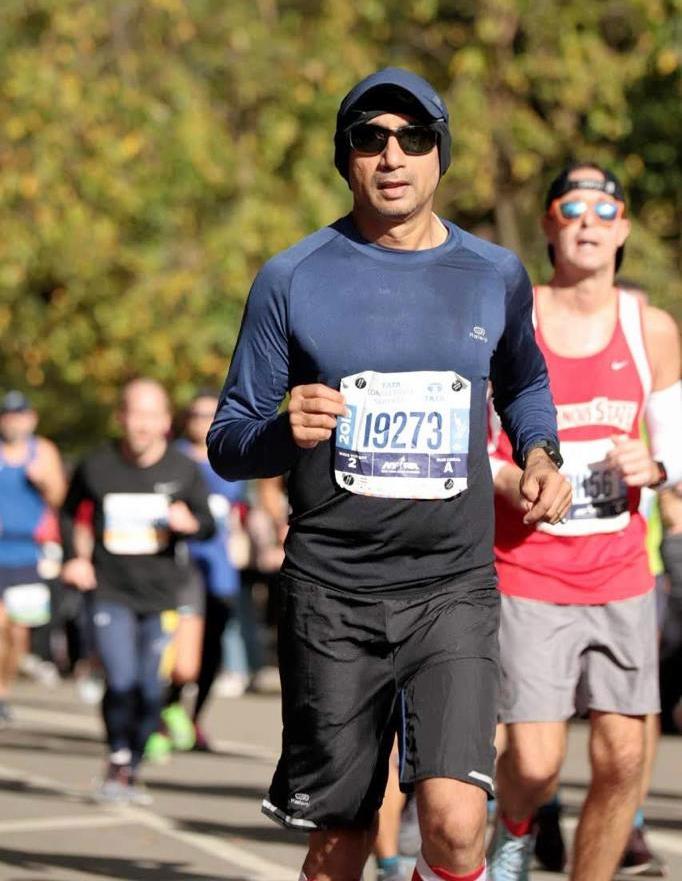
In Mumbai, Himanshu Sareen had initially planned to take the virtual London Marathon as a training run with no targeted timing in mind. He had done the virtual Boston Marathon, a little over a fortnight ago and it seemed apt not to push. But 10 kilometers into the run of October 4 he realized that he could push his pace in pursuit of a better timing. This time around, he started his run at around 5.40 AM, earlier than he had for the virtual Boston Marathon. Rains during the night and continuing drizzle that morning helped keep the weather pleasant.
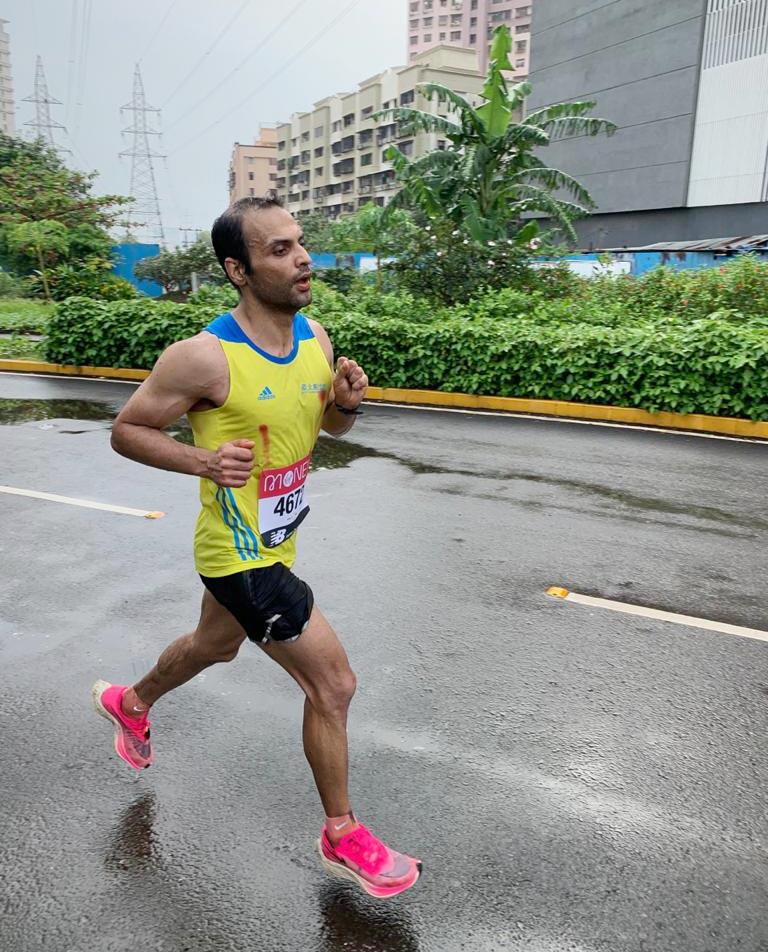
Himanshu Sareen (Photo: Shweta Sareen)

“ I started at a slow pace because in my mind this was not a race. After the first 10 kilometers, I decided to increase my pace,” Himanshu said. For the first 18 kilometers he ran in a 500 metre loop and then expanded that to a loop of about one kilometer till the 26th kilometer. “ The stretch between 26 and 35 kilometers is often tough for me,” he said adding that he in this phase he stretched his loop to about 10 kilometers. This worked well for him and he was able to maintain a good pace throughout. His wife Shweta was the sole person providing support for his run; during the virtual Boston Marathon several other runners and the security staff of his apartment complex had pitched in to help with hydration.“ As I was not planning to run the virtual London Marathon like a race, I did not inform anyone,” he said.

Himanshu finished with a provisional timing of 2:52:35. Although tad short of his personal best, Himanshu believes this is his best performance in running, to date. He is now due to run the Virtual New York City Marathon. He may consider the option of traveling to New York to run this virtual marathon.
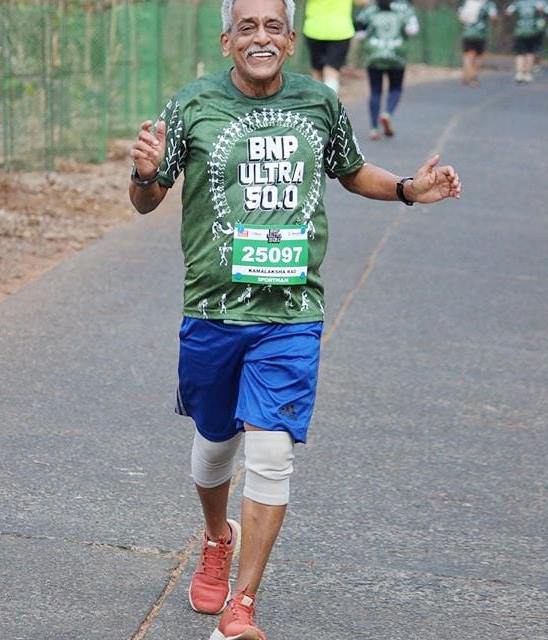
Kamalaksha Rao (Photo: courtesy Kamalaksha)

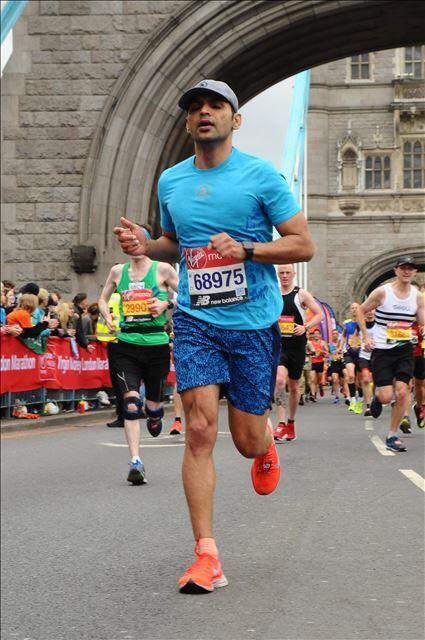
Elsewhere in the city, Kamalaksha Rao was attempting the virtual London Marathon after recovering from COVID-19 infection.  “ I started my run at 4.40 AM. It was raining quite heavily then. The weather stayed pleasant for some time but soon the heat and the humidity began rising,” the 73 year-old said. He ran the first half of the marathon and walked the next 21 kilometers. “ I had a target of finishing in eight hours. I finished in 7:20 hours,” he said.

Kamalaksha had placed water bottles for hydration at two places along the loop he had chosen to run on. He managed to hydrate but at some point during the virtual marathon he realized that one of the bottles had gone missing. Thankfully there were shops along the route where he could buy bottled water. “ It was a self-supported run. I had carried a bag. During the run, I had two gels and two nutrition bars,” he said. He plans to do recovery walks over the next few days.
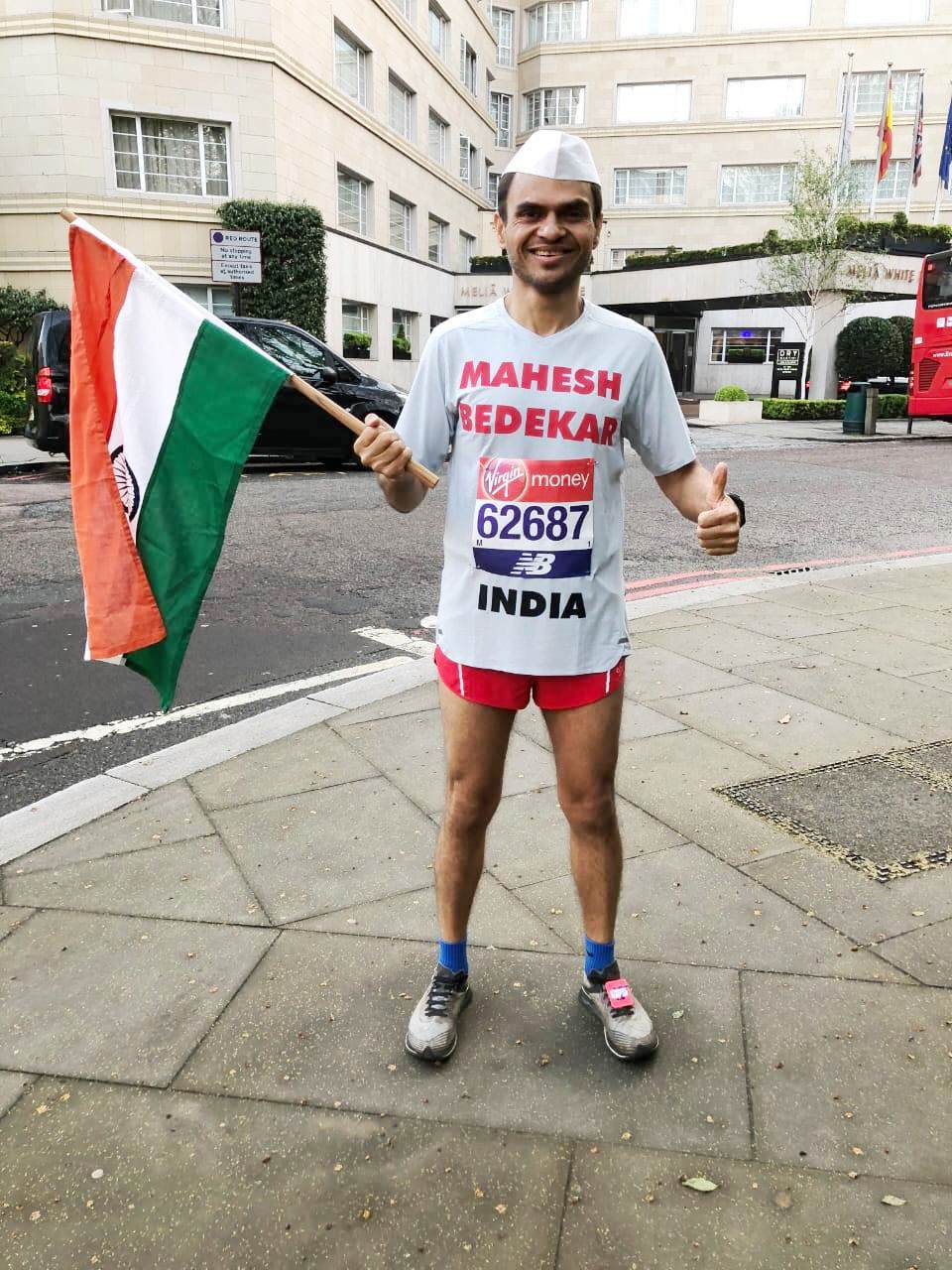
Mahesh Bedekar (Photo: courtesy Mahesh)

In neighboring Thane, Dr Mahesh Bedekar opted to run the virtual London Marathon primarily as motivation to keep the momentum of his regular runs, going. A gynaecologist, who runs his own hospital in Thane, Mahesh has been running for the past seven years. He has participated in many marathons and half marathons. Along the way, he also did five of the six World Marathon Majors – Tokyo, London, Berlin, Chicago and New York City. He is yet to do the Boston Marathon but has managed to qualify for the event, in his age group of 45-49 years.

“ Normally, one needs to put in four to five months of training to run a marathon. We had only about two and a half months of time to train for the virtual London Marathon,” Mahesh said. Striders, his marathon training group, offered him a training plan keeping in mind the limited time available. He was accompanied by six other runners for the virtual London Marathon. They chose to run the distance in Thane, which offers undulating terrain. “ We started at around 4.30 AM. The rain helped keep temperatures at bay for the initial 25 kilometers,” Mahesh said.

Support was arranged at every five kilometers with the runners who volunteered for the task also lending some cheering. Mahesh finished the run in 3:33:08. His personal best is 3:15. “ It is quite challenging to run a marathon without the normal elements of a race,” Mahesh said.

In Bengaluru, Bhadresh Shivashankar was happy with the route chosen for a small group of runners attempting the virtual London Marathon. “ The weather was good and Pacemakers had arranged for a cyclist to accompany each of the runners,” he said. Pacemakers is a Bengaluru-based marathon training group built around coach K.C. Kothandapani.
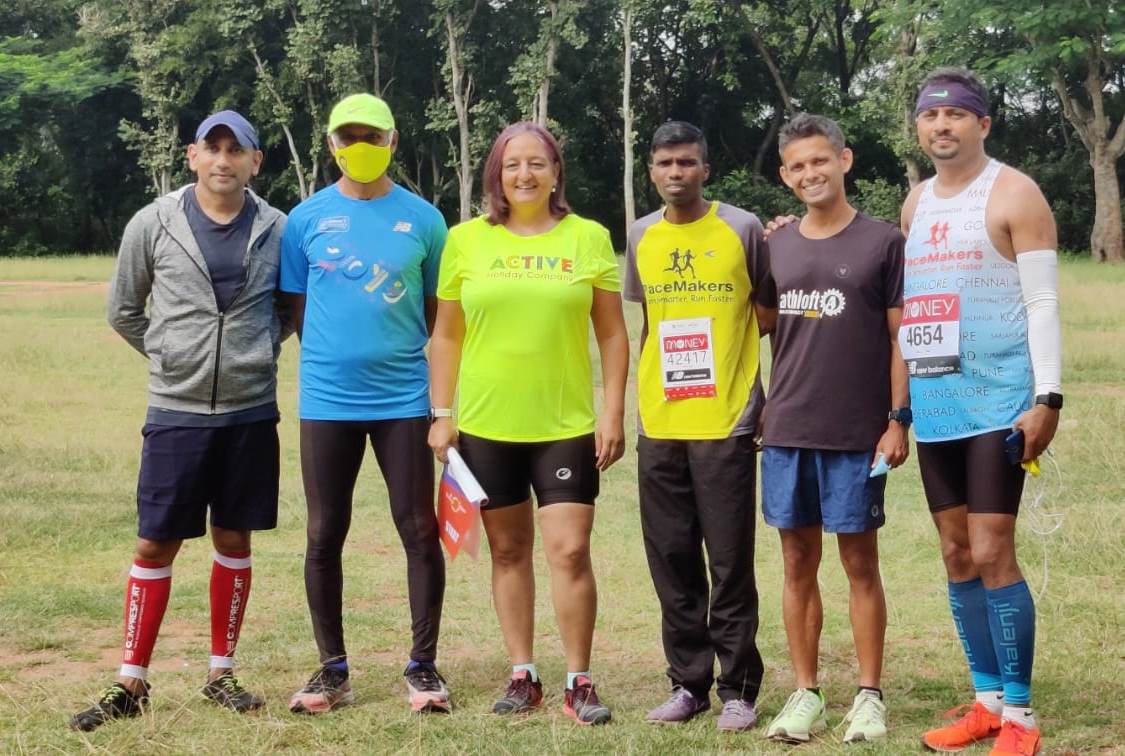
From left: Harish Vasista, coach K.C. Kothandapani (Pacemakers), Gauri Jayaram (Active Holidays), M.Nanjundappa, Anubhav Karmakar and Bhadresh Shivashankar (Photo: courtesy Bhadresh)

The runners commenced their run at 5 AM. “ I managed well for the first 30 kilometers but the final stretch was tough,” Bhadresh said. He finished his run in 4:47:16. Running alongside was M. Nanjundappa, one of Bengaluru’s best amateur runners. Nanjundappa finished his run in 2:37:10, data on the London Marathon website showed.

Harish Vasista also ran the virtual London Marathon at the same venue. “ My running went as per plan. I started my run at 5.30 pace and then improved it slightly, on and off, till around 30 kilometers. Thereafter, my pace eased a bit,” he said. Harish finished his marathon in 3:48:11. He appreciated the support for the runners provided by Pacemakers and Active Holidays.

The physical race of the 2020 London Marathon – as held in the British capital – was restricted to elite athletes. It was only the second World Marathon Major (of the six in that league) being held this year; the rest got cancelled owing to the ongoing COVID-19 pandemic. Indeed a fallout of the pandemic has been the widespread cancellation of city marathons. In Mumbai, Kranti Salvi and her husband Pramod Salvi opted to run the virtual London Marathon as a means to stay motivated in times with no mass participation events. “ We had originally registered for the 2020 edition of the London Marathon and booked our hotel and air tickets. It was postponed to October and later the organizers converted the race for amateurs into a virtual event. That’s when we decided to register for the virtual version,” Kranti said.
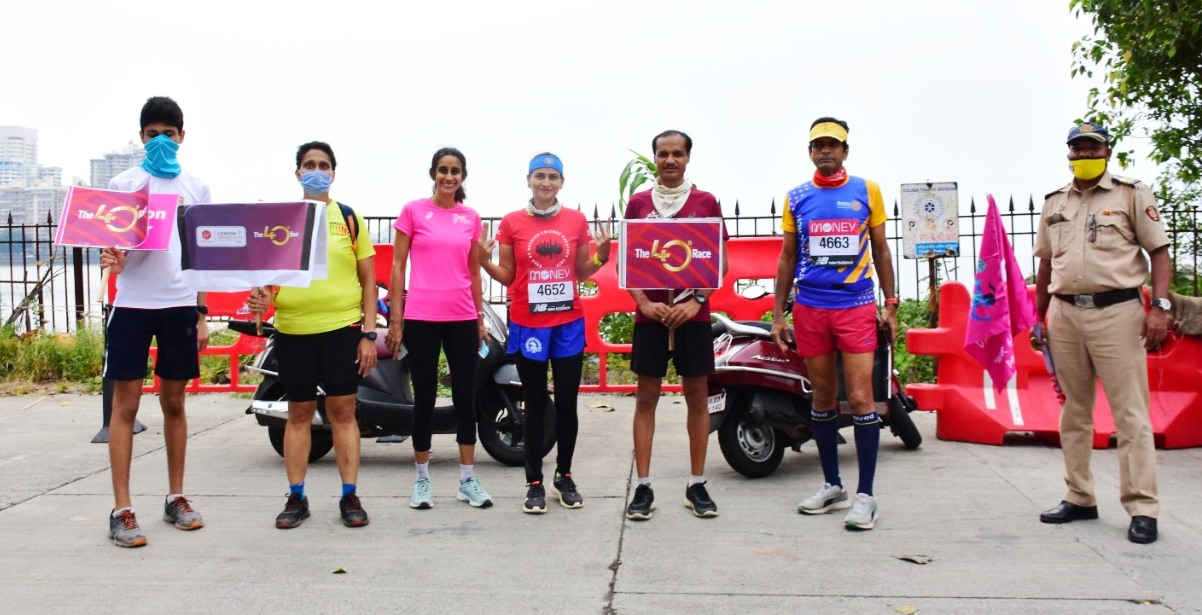
Kranti and Pramod Salvi (sporting bibs on their T-shirts) with friends, Abbas Sheikh and the policeman who flagged off their run (Photo: Tashi Ongya)

The duo’s plan was to commence the run at 4.30 AM on October 4, 2020. They woke up to find heavy rains; the forecast indicated that the showers would continue for a few hours. “ We had made a lot of preparations for the run. We had printed banners and posters. Some friends were to come and cheer us as well,” she said. Kranti and Pramod decided to cancel the plan to run the marathon in the morning. Instead, they decided to give it a go in the evening.

“ By evening, I was quite tired from household work. We started the run at 5.30 PM from the NCPA end of South Mumbai’s Marine Drive promenade,” Kranti said, adding, “ we were a group of 4-5 runners at the start point. We decided to ask a policeman to flag off our run.” Their route was mostly along Marine Drive up to Chowpatty. Kranti wanted to do one loop across to Gateway of Mumbai. “ It was difficult running in the evening. Marine Drive was crowded. There were many people, children jumping and playing across the entire stretch. The weather was warm and humid and the air quality was bad,” Kranti said. Marathon runner Abbas Sheikh ran the entire distance with her. As per data on the London Marathon website, Kranti finished her run in 4:37:39 and Pramod in 5:31:08.
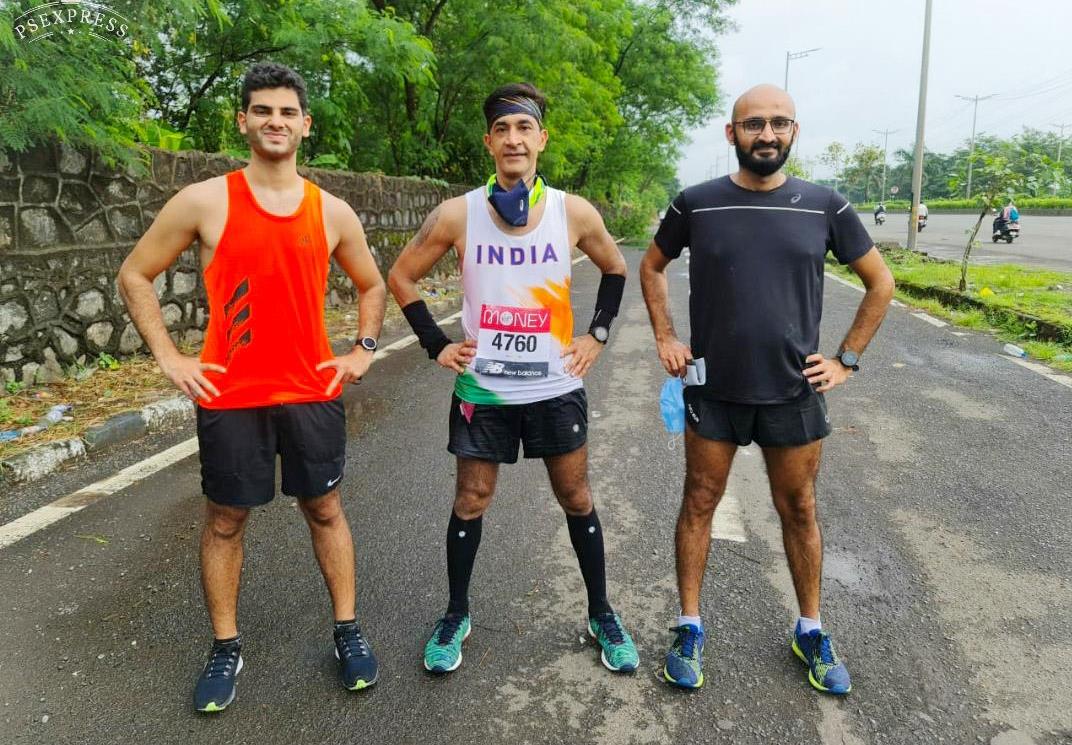
From left: Pawan Punjabi, Girish Bindra and Yash Shekatkar (Photo: courtesy Girish)

At its height, the lockdown in Mumbai had been quite strict. It was prolonged in some areas. For those returning to running after the consequent disruption to training, it meant that mileage build-up had to be done slowly. When lockdown measures commenced easing, Girish Bindra and his team of runners were in the process of slowly enhancing mileage when they learnt of the virtual London Marathon. “ On August 10, 2020, we registered for the virtual London Marathon. We had all of five weeks to train and that included the tapering period,” Girish – he is also a coach for Asics Running Club (ARC) – said. Joining him for the virtual run were Pawan Punjabi and Yash Shekatkar.

Soon after registering for the run, they stepped up their training. Still the preparation fell short of the ideal training required for a marathon. “ Although, it was a crunched training plan, there was a lot of learning in those five weeks,” Pawan said. According to Yash, on the Friday before the date of the virtual London Marathon (October 4, 2020) they finalized the route – it would be as loops on the service road that runs parallel to the city’s Eastern Express Highway.

On race day, the trio was to start the run at 4.30 AM. Unfortunately, there was heavy and it prompted them to delay their start. “ Eventually, we began our run at 4.55 AM. The downpour resumed and along the route there was much water logging,” Girish said. “ Within the first 45 minutes of the run, our shoes were soaking wet,” Yash added. However, the rain progressively eased off and thereafter the weather stayed pleasant.
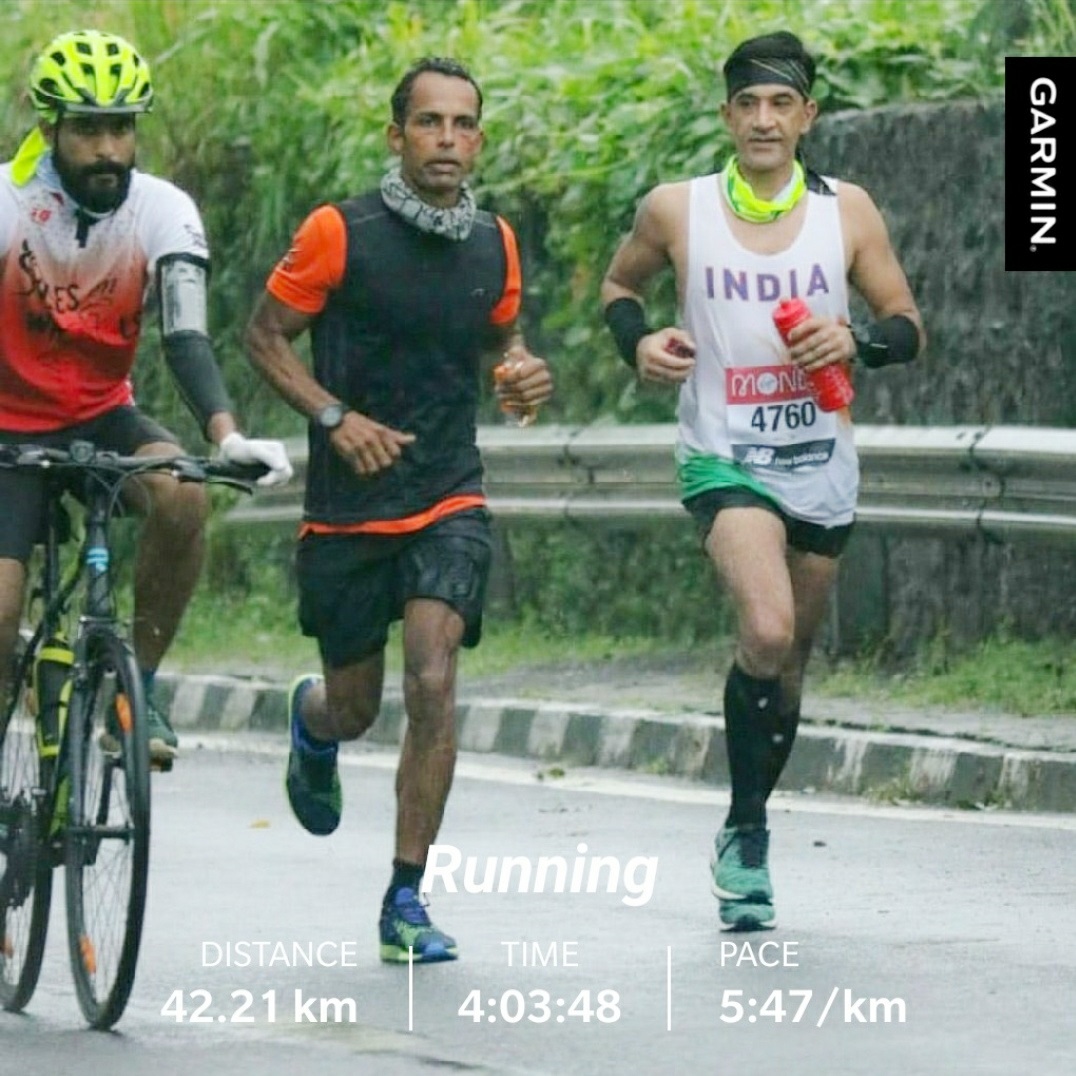
From the virtual run; Arun Nambiar (on cycle), Harish Salian and Girish Bindra (Photo: courtesy Girish)

Many of the runners of ARC chipped in to assist the three runners. “ Support from our runner friends was incredible. At every three kilometers, we had access to sports drinks, salts and dates among others. The support and cheering were very well planned,” Pawan said. “ They also arranged for breakfast besides tea and coffee at the end of the run,” Girish said adding that all the safety norms pertaining to the pandemic were followed. Cyclist Arun Nambiar accompanied the three runners throughout on his cycle to lend support. Further, fellow runner Harish Salian ran the entire distance of the marathon as support, Girish said.

Girish finished his run in 4:03:48, Pawan in 3:59:08 and Yash in 3:58:51. For Yash, the timing he got in the virtual London Marathon was a personal best. Pawan fell tad short of his personal best of 3:54:51 set at the 2019 edition of Tata Mumbai Marathon but is happy to have managed a sub-four-hour finish as he was returning to running after a shin splint problem. The trio will now attempt the half marathon distance in the virtual events of the Chicago Marathon, Amsterdam Marathon and New York City Marathon.

(The author, Latha Venkatraman, is an independent journalist based in Mumbai.)
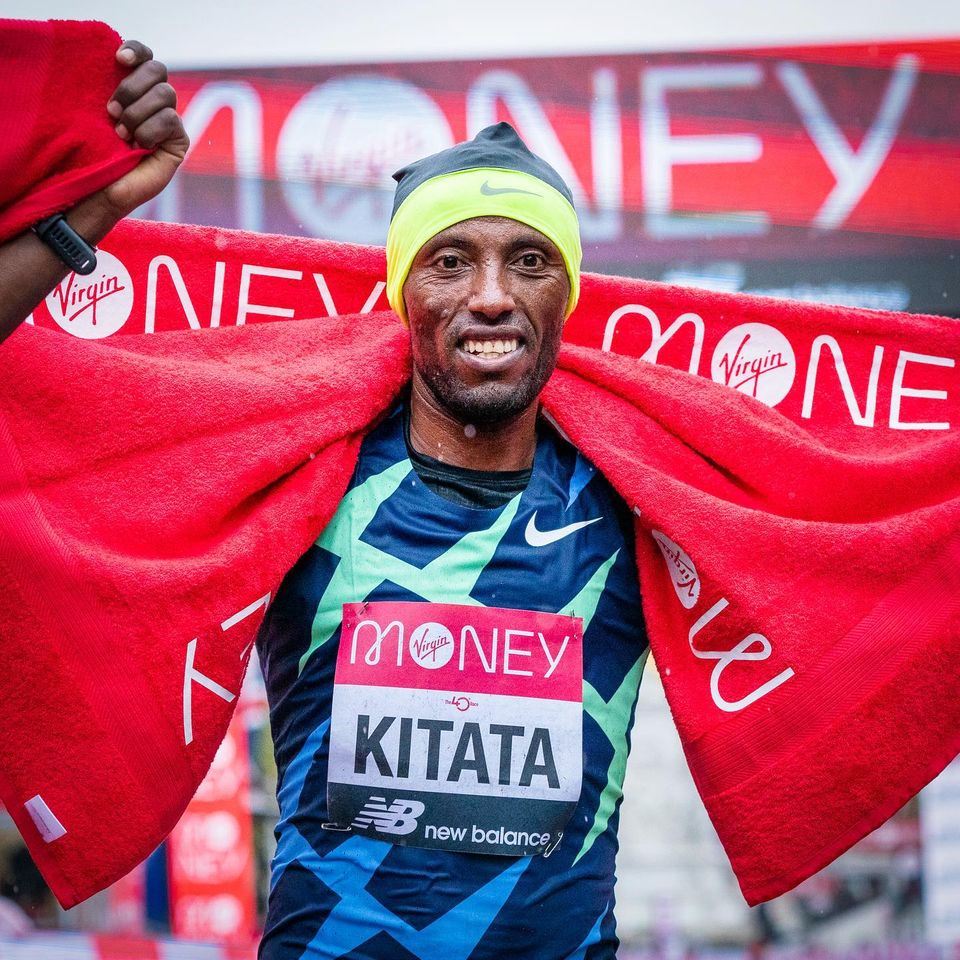
LONDON MARATHON: SHURA KITATA WINS IN NAIL BITING FINISH

Shura Kitata of Ethiopia. This image was downloaded from the Facebook page of London Marathon and is being used here for representation purpose. No copyright infringement intended.

Kipchoge dethroned

Brigid Kosgei defends her title

Close contests decide top two positions among men, and second and third positions among women

Although Ethiopia’s Kenenisa Bekele, the athlete billed as his closest competitor pulled out ahead of the race, world record holder and defending champion, Eliud Kipchoge of Kenya, was not his usual self. He seemed to struggle and came in much after the podium finishers; he finished eighth in 2:06:49. The 35 year-old Kenyan great was trying for his fifth London Marathon title; He had won the event previously in 2015, 2016, 2018 and 2019. The crown eventually went to 24 year-old Kitata, who two years earlier had finished second behind Kipchoge at the 2018 London Marathon. The course record for men in London is 2:02:37, set by Kipchoge in 2019.

Defending champion, Brigid Kosgei of Kenya won the women’s race covering the distance in 2:18:58. Her compatriot and 2019 marathon world champion, Ruth Chepngetich placed third, while Sarah Hall of the US finished second. The top ten women athletes finished within 2:28:30, the race commentators said; the qualification mark for the women’s marathon at the Tokyo Olympics due next year is 2:29:30. Kosgei’s performance in less than ideal conditions in London compares to the world record she holds of 2:14:04 – for women running in a mixed sex race – set at the 2019 Chicago Marathon. The course record for women in London is 2:15:25, set by Paula Radcliffe in 2003.

Going by the commentary, the early laps in the women’s marathon was fast but the pace reduced later. An hour and 33 minutes into the race, the commentators observed that the pace was close to world record requirements and yet not quite there.  Potential reasons spoken of included pandemic, cancellation of events, lockdown and the impact of these developments on athletes’ training, especially opportunities to train with others. Distance runners are known to periodically train in the company of fellow runners, an arrangement that allows them to push each other’s abilities. Further, race day in London followed a spate of heavy rains. The course was visibly wet and at one point during the women’s race, there was a hint of hail. Such conditions typically force runners to tread with caution especially at the corners, details which matter when it comes to performance in the elite category where every second counts.

Ruth Chepngetich (left) and Brigid Kosgei – both in orange vests at the 2020 London Marathon. This image was downloaded from the Facebook page of the event and is being used here for representation purpose. No copyright infringement intended.

Notwithstanding the general pace, by 1:44 hours into the women’s marathon, Kosgei was clearly leading Chepngetich and a sizable gap had opened between them and Ethiopia’s Ashete Bekere (winner among women at the 2019 Berlin Marathon), who was in third place. The 35 kilometer-mark went by in approximately 1:55 hours.  By around 1:58, Lily Partridge and Steph Twell, among the top British contenders, had dropped off the race. By 2:04, even as Kosgei cemented her lead further, the gap was progressively reducing between Bekere and Sarah Hall following her in fourth place.  Around 2:12, Kosgei betrayed a smile as she neared the last lap; she eventually finished in 2:18:58. But it was Sarah Hall who turned in a truly inspiring performance. Having overtaken Bekere, she ran past Chepngetich in the last 100 meters or so to finish a brilliant second with new personal best to boot.     

Probably taking a cue from the women’s race, which was held first, the men’s race too maintained a momentum that was slower than what was expected of the talent crammed into it. At 44:50 the commentator said, “ it is not going to be as fast as we would have normally expected from Eliud Kipchoge.’’ At just past the half way mark, the pace was still steady and not yet showing signs of stepping up. In retrospect this may have played to the disadvantage of Kipchoge. He was older compared to those around him in the lead formation and as the defending champion and the only runner in history to have managed a sub-two hour-marathon, albeit unofficially, there was much riding on his shoulders. As the commentators pointed out, the slower pace wasn’t Kipchoge’s regular style. In the past he has displayed the habit of breaking away past the half way mark and striking out on his own. On Sunday, he appeared either struggling or hemmed in by the larger formation settled into a slightly slower pace with prospects of a sprint finish gradually opening up. On more than one occasion, the commentators pointed out that at a slightly higher pace in the early stages, Kipchoge may have shrugged off some of the runners keeping him company.  

An hour and 36 minutes into the race, Kipchoge discarded his cap and there was anticipation that he may be preparing to break free. Around 1:43, the lead runners were still huddled together; there hadn’t been anyone breaking free yet. “ This is relatively slow for the standard these men have run before,’’ the commentator said. By 1:51, Kipchoge had drifted to the back of the lead group; a slight grimace showed up on his face. Around 1:52:50, the commentator said that Kipchoge could possibly be in trouble in the race. By 1:53:46 there was a clear gap between him and the leading lot. “ There is something quite not working for Kipchoge today,’’ the commentator said. By 1:57:30 it was fairly certain that Kipchoge had lost the race and the people to watch out for were the runners nobody had focused on in the days preceding the event when top billing was assigned for a Kipchoge-Bekele face off. As the second hour of running commenced, the lead group stood whittled down to three Ethiopian runners – Kitata, Mosinet Geremew, Lemma and a lone Kenyan, Kipchumba.  Around 2:04, Geremew who had been the most fancied of the lot dropped back. “ There are casualties all around this two and a quarter kilometer-course,’’ the commentator said. It then boiled down to a potential sprint finish between the remaining three and Kipchumba seemed to gain the upper hand briefly before Kitata firmly surged ahead to breast the tape.  It was a final stage with much drama for in those waning moments, few expected Kitata to sustain a sprint given he had often led the pack from the front in the preceding laps and seemed ideal candidate to be tired.

In a post race tweet, Kipchoge said that after 25 kilometers his ear had got blocked and wouldn’t open anymore. “ But this is how sport is,” he said, pointing out that defeat should be accepted and the focus should now be on winning the next race. He hopes to return for the next edition of the London Marathon and the Olympics, Runners World reported in their article on what happened to Kipchoge.

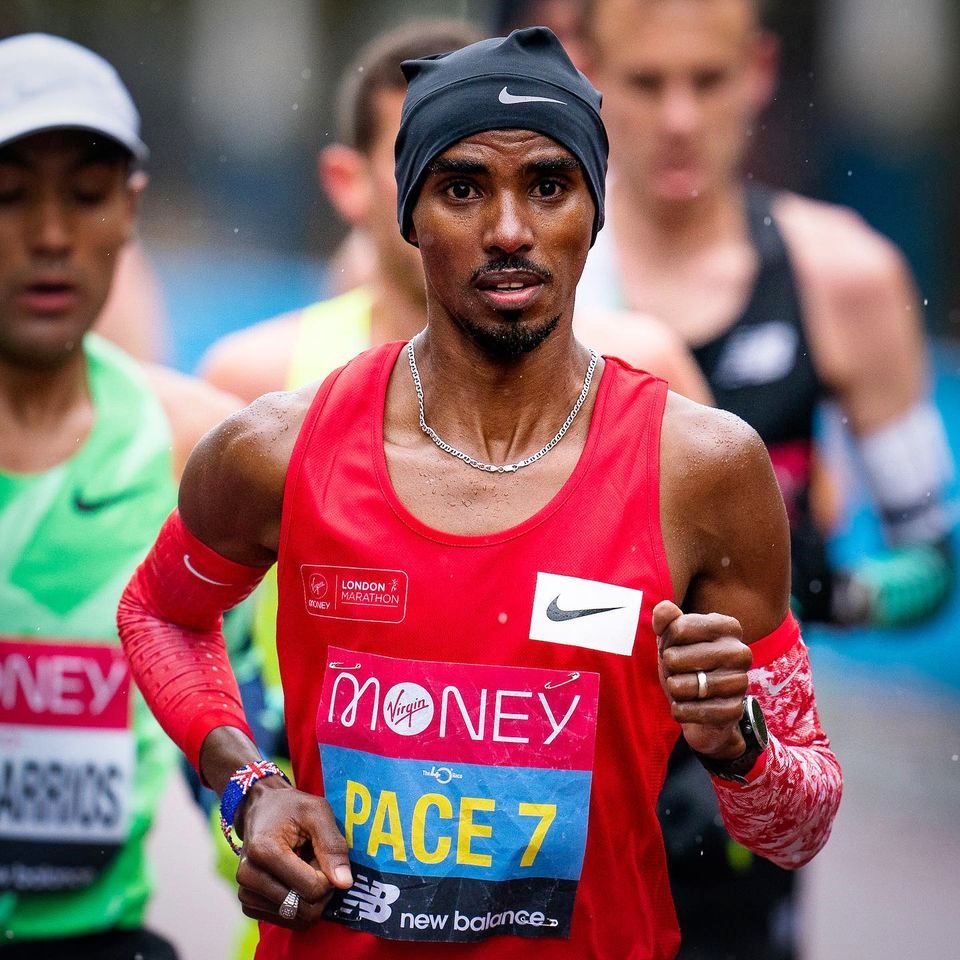
The 2020 London Marathon was run on a specially selected course around St James Park. Athletes ran several loops. According to the race commentators, the said course was considered for the sub-two hour project Kipchoge had executed in 2019. That event finally took place on a special course in Vienna, wherein he achieved an unofficial time of 1:59:40 for the marathon. The London course was quite flat and therefore theoretically, fast. However because the run was happening on a special course due to the pandemic, even if a new course record was set in the 2020 edition, it wouldn’t be counted officially, the commentators said. The pacers for the men’s race on Sunday included Mo Farah.

Mo Farah doing duty as pacer at the 2020 London Marathon. This image was downloaded from the Facebook page of the event and is being used here for representation purpose. No copyright infringement intended.

The 2020 London Marathon will definitely trigger curiosity in terms of what the model – a blend of physical race and larger virtual participation – holds for the business of running worldwide. An estimated 45,000 runners were due to participate in the virtual format of the 2020 London Marathon. Outside of the UK, the highest number of runners participating in the virtual version of the event was in USA, Taiwan and Hong Kong, the race commentators said. At the physical race in London on Sunday, there were no spectators and only the elite athletes running loops on a secure course. As an event then accessed through television and digital media, the physical race showcased elite running as pure performance with no other distractions in the frame. In other words, there was no life around. It is possible that some viewers may have found such running a cold, clinical experience with only the commentary providing warmth. Under the circumstances this blend appears the most viable model (there is however the problem of shrinking free access to streaming and sometimes, overpriced access) and London may provide impetus for managers of events elsewhere in the world, to follow suit. Races in Valencia and Abu Dhabi have already been spoken of in this context particularly because there is a real thirst out there with elite marathoners for events to run at and qualify for the Olympics. The marathon at the 2019 World Athletics Championships in Doha, which was one of the opportunities to qualify so before pandemic struck and the 2020 Olympics got postponed to 2021, was held in very warm, humid conditions. Timings reported there, had been slow.

As is the norm these days, the London Marathon was also watched from the perspective of shoe technology and what advanced shoe design brings to the table at races. It was only the second World Marathon Major this year to physically happen, after the Tokyo Marathon in March. Kipchoge, who has in some ways been the face of new developments in shoe technology, was running the race in London in a version of the Nike Alpha Fly with his timing from Vienna – 1:59:40 – written at the back of it, the commentators said.

(The author, Shyam G Menon, is a freelance journalist based in Mumbai.)

KENENISA BEKELE WITHDRAWS FROM 2020 LONDON MARATHON

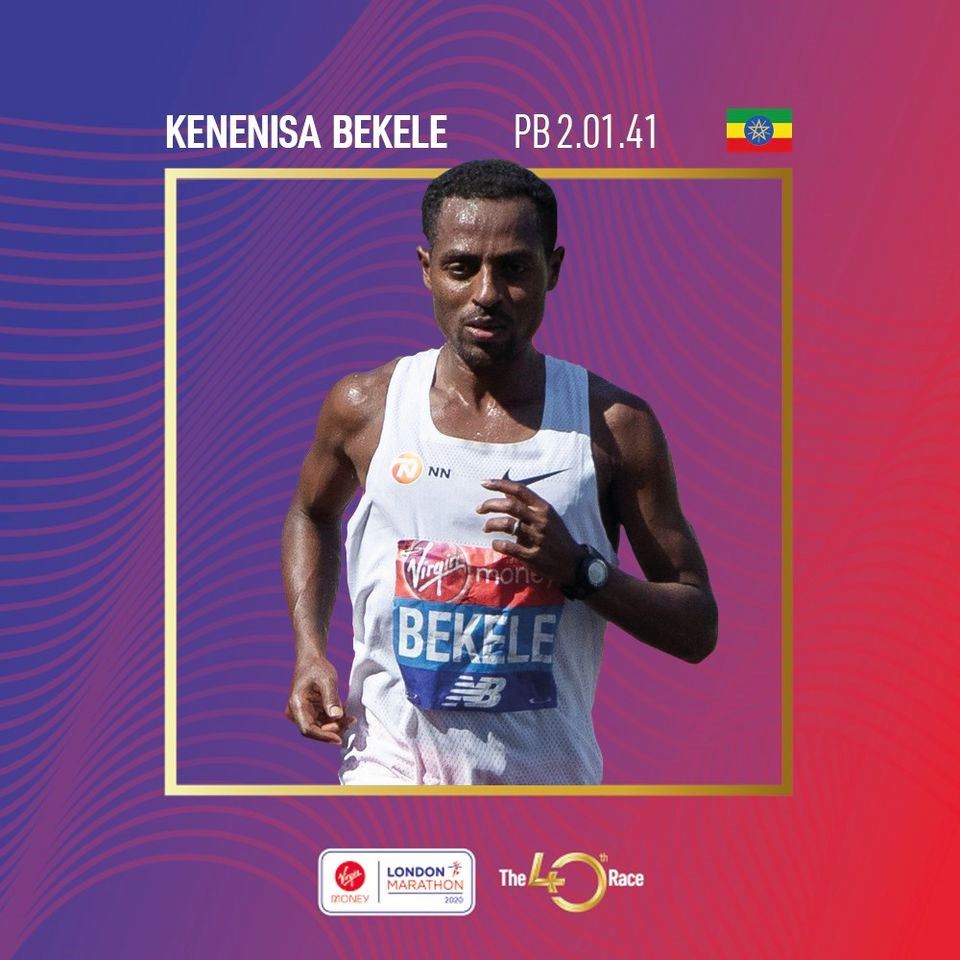
Kenenisa Bekele. This photo was downloaded from the Facebook page of London Marathon and is being used here for representation purpose. No copyright infringement intended.

Top marathon runner, Kenenisa Bekele, will not be participating in Sunday’s London Marathon.

He has pulled out of the event owing to a calf injury, information available on the website of London Marathon, said.

In a related video, the Ethiopian athlete who holds the second fastest time yet in the discipline can be heard saying that he picked up a minor injury two weeks earlier. “ We had really good training and more or less at the end of two weeks, I really pushed a little bit hard in training and I had some feeling in my left calf; a little bit. I feel like over-trained and after my physio checking about this, we tried to solve it but it’s really difficult to get enough and it’s really impossible to race on Sunday. I am not ready because of not solving these minor issues,’’ he says, adding, “ I am really disappointed for my fans; people who waited for this race. I am really disappointed too. I will come back next year. For now, I will not race on Sunday.’’

World record holder, Eliud Kipchoge of Kenya and Bekele sharing the same field was supposed to be the main attraction of this year’s London Marathon. According to a press statement on the event’s website, Sunday would have been the first time Bekele raced since clocking 2:01:41 to win the 2019 BMW Berlin Marathon in September 2019. “ It has been a tough preparation time with lockdown when I couldn’t have my NN team around me. I was in good shape but then I picked up a niggle in my left calf after two fast training sessions too close together in the last weeks of preparation. I have been having treatment every day since then and I truly believed I would be ready but today it is worse and I now know I cannot race on it,’’ the statement dated October 2, quoted him as saying.

Hugh Brasher, Event Director of the Virgin Money London Marathon, has said, “ the world has been waiting to see this head to head between Kenenisa Bekele and Eliud Kipchoge but it will now not happen this Sunday. We know how disappointed he is and we wish him a speedy recovery. This was never likely to be just a two-man race as we had four of the top ten fastest marathon runners ever and six men in the field who have broken 2:05, including Mosinet Geremew and Mule Wasihun, second and third last year, and 2018 runner-up Shura Kitata.” All the three runners mentioned herein – Geremew, Wasihun and Kitata – are from Ethiopia. Kipchoge holds the current course record in London – 2:02:37 – set in 2019.

(The author, Shyam G Menon, is a freelance journalist based in Mumbai.)     

RBG

This image was downloaded from the Facebook page of the film and is being used here for representation purpose. No copyright infringement intended.

Very rarely has the demise of a judge assumed such proportions of loss and anxiety over what next, as the recent passing of Ruth Bader Ginsberg, Associate Justice of the US Supreme Court.

RBG, as she was popularly known, was a champion of women’s rights and her work in the field, sustained for decades, was instrumental in ensuring gender equality before the law, in the US. In 1980, President Jimmy Carter appointed her to the US Court of Appeals for the District of Columbia Circuit; in 1993 President Bill Clinton nominated her as an Associate Justice of the Supreme Court. Her demise in September 2020 has left liberal political groups nervous given both the nature of conservative politics visible since the last US presidential elections and attempts to enhance the conservative element in the country’s Supreme Court. The latter assumes importance because in the system of checks and balances that is democracy, the judiciary plays a major role – it is often the final corrective force – and its dominance by any particular social, cultural or political flavor provides scope to change the character of a country temporarily. On the other hand, judges are human too.

Uniquely, the exploration of what makes judges what they are is as much fleshed out as the life of Ruth Bader Ginsberg in RBG, the 2018 documentary film on her, currently available on Netflix. It is an excellent film about a journey in law and women’s rights, commencing in times when American law firms rarely hired a woman lawyer and the approach of law reflected society’s treatment of women, as subservient to men. This was despite the constitution promising equality. Starting with the case of a woman air force officer denied housing allowance for no reason other than her gender; RBG worked her way through several cases – including those seeking gender equality for men – to help lay the legal framework for a more just society. The documentary sheds light on her personal life; family, the professional rapport she shared with colleagues holding opposing political views and her eventual rise in old age to the status of an icon, a strong supporter of equality. We learn of not merely the cases she won but also the cases in which her opinion was minority and she registered her dissent. The words of dissent help us understand her position. Don’t miss this film. There is no better time to watch it than now when world over, the gains of liberal politics and diverse society are being undermined by conservative forces. Not to mention – it doesn’t matter if the subject is from another country; when it comes to democracy, the experience of one democratic nation is lesson for itself and others.

(The author, Shyam G Menon, is a freelance journalist based in Mumbai.)

COMING UP: 2020 LONDON MARATHON, REAL AND VIRTUAL

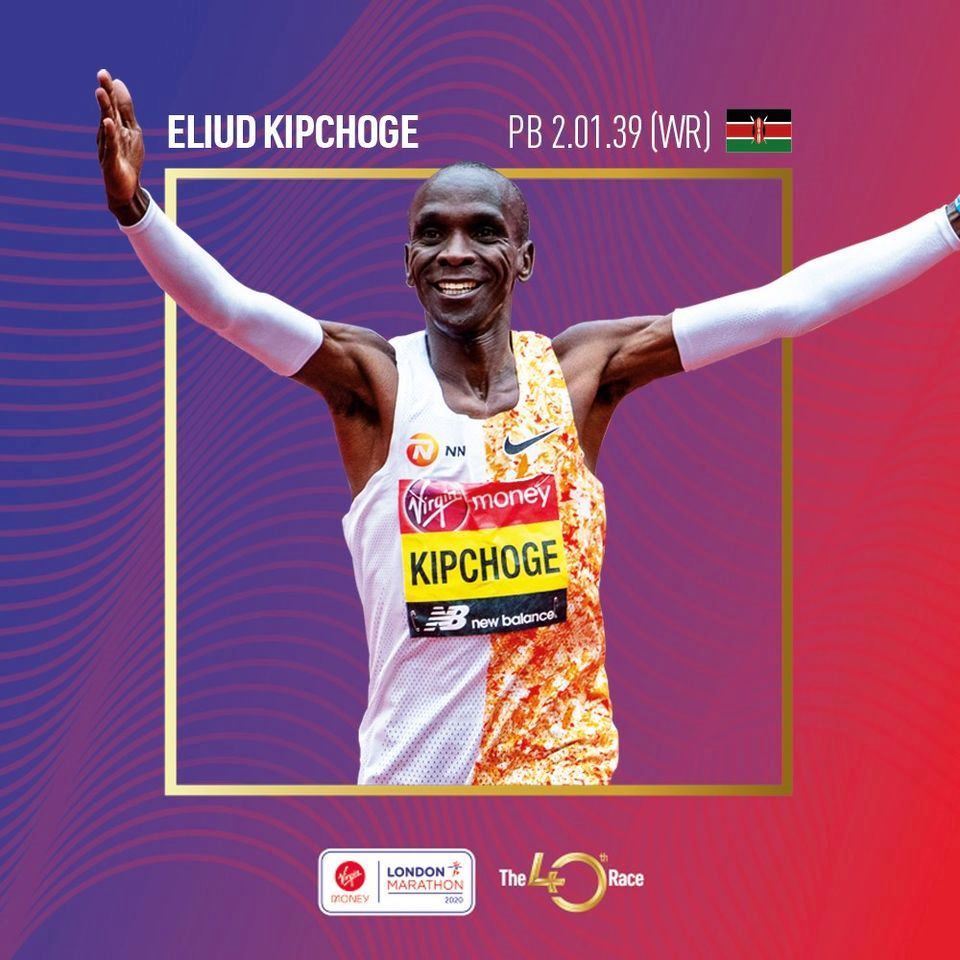
Eliud Kipchoge. This photo was downloaded from the Facebook page of London Marathon and is being used here for representation purpose. No copyright infringement intended.

Although scaled down to an elites only affair, this year’s London Marathon, due October 4, promises engaging action as it pits the world’s fastest marathon runner, Eliud Kipchoge of Kenya against the second fastest, Kenenisa Bekele of Ethiopia and a host of other top runners. In the women’s race, world record holder, Brigid Kosgei of Kenya will be participating.

On September 29, The Guardian reported that race director, Hugh Brasher, believed records may fall on the fast course selected for the 2020 London Marathon provided weather stayed supportive. According to the report, all Kenyan and Ethiopian runners arrived for the race cleared COVID-19 tests, save a runner (Degitu Azimeraw) and a coach (Haji Adilo) – both from Ethiopia – who tested positive before boarding the flight to London. There are COVID-19 tests before athlete leaves his / her country, tests before checking into the hotel in London and tests ahead of actual race.

Kenenisa Bekele. This photo was downloaded from the Facebook page of London Marathon and is being used here for representation purpose. No copyright infringement intended.

This year’s edition of London Marathon, originally scheduled to be held on April 26, 2020, was postponed to October 4, 2020 due to the COVID-19 pandemic. Later, it was changed to an elites-only race. London Marathon is the second event to be held this year from the clutch of races constituting the World Marathon Majors. In March, the Tokyo Marathon was held as an elites-only race. The London Marathon course will also be markedly different this time with runners racing along a contained course around St. James Park. Participants will do 19.6 laps of this loop.

For the large number of amateur athletes who had signed up for the event, this year’s London Marathon will be accessible as a virtual event. Participants of the virtual 2020 Virgin Money London Marathon have 23 hours, 59 minutes and 59 seconds to complete their marathon. They will have to enter their race details on the official race app, London Marathon said on its website.

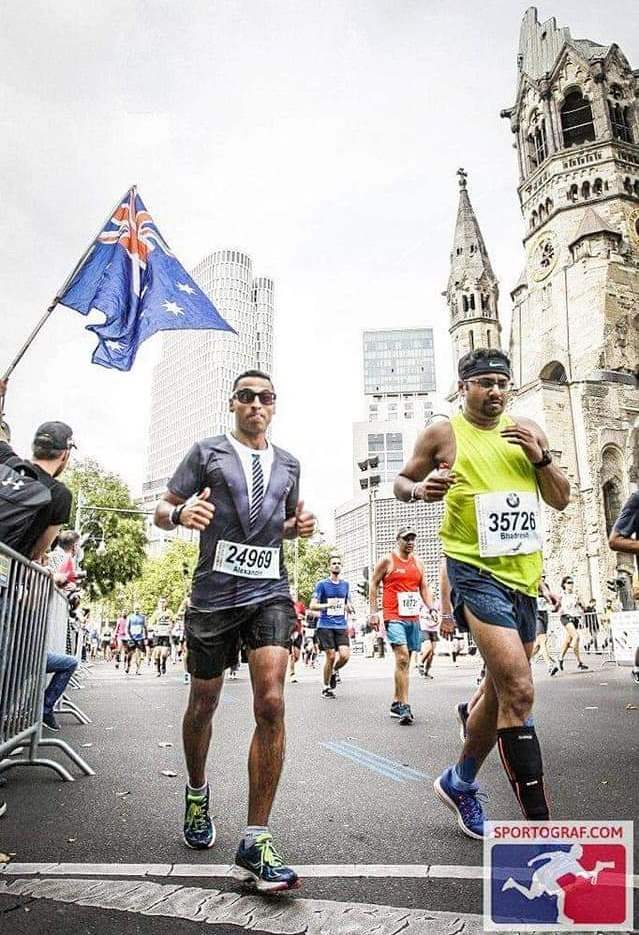
Bhadresh Shivashankar; right, in yellow vest (Photo: courtesy Bhadresh)

Some of the amateur runners participating in the virtual event in India

In India, runners registered for the virtual London Marathon will be running in their own cities in small contained loops as lockdown norms still prevent any gathering of people.

In Bengaluru, Bhadresh Shivashankar will be running the virtual London Marathon at Hesaraghata, on the outskirts of the city. Bhadresh was on course to do the six World Marathon Majors having already run Berlin Marathon in 2018 and Chicago Marathon in 2019. This year, he had registered for London Marathon. Following outbreak of COVID-19 worldwide, he joined the ranks of those running the event’s virtual format. Bhadresh has been running for over 15 years now. Beset with health issues, he took to running when he was working in Dubai. Over the years, he has participated in many races of varying distances, including several marathons.

Harish Vasista (Photo: courtesy Harish)

“ On Sunday, I will be running on a loop of 15 kilometers at Hesaraghata. Support will be provided by the marathon training group, Pacemakers and Active Holidays, a travel company that organizes trips to run marathons,” he said.

Harish Vasista, also from Bengaluru, will be running the virtual London Marathon at the same venue as Bhadresh. Training with Pacemakers, Harish has been following his coach K.C. Kothandapani’s customized training plan. “ My training for the virtual run has been good although I could have done better,” he said. Harish too was on course to do the six World Marathon Majors, having already done New York City Marathon and Berlin Marathon. This year, he was to do London Marathon and Chicago Marathon. While London Marathon was postponed and later changed to the virtual format, Chicago Marathon’s 2020 edition has been cancelled. “ I plan to start at a slow pace for the first 20-22 kilometers. Depending on how I feel, I will step up my pace for the rest of the run,” he said. Weather in Bengaluru has been quite good these past few days.

Himanshu Sareen (Photo: courtesy Himanshu)

In Mumbai, recreational runner Himanshu Sareen will be running the virtual London Marathon barely a fortnight after he ran the virtual Boston Marathon.  He plans to run along the same route that he chose for Boston Marathon, a route close to his place of residence. Each virtual marathon appears to have its own unique approach to overall rules. The virtual Boston Marathon held over September 5 – 14 was amenable to the use of treadmill. The virtual London Marathon is not. Himanshu had initially thought of running 30 kilometers outside and 12 kilometers on the treadmill at home. He had arranged for a foot pod to ensure seamless transition. A foot pod is a device that is tied to the foot and is very accurate in measurement while running indoors as well as outdoors. He has since abandoned the plan and decided to keep his run fully outdoors.

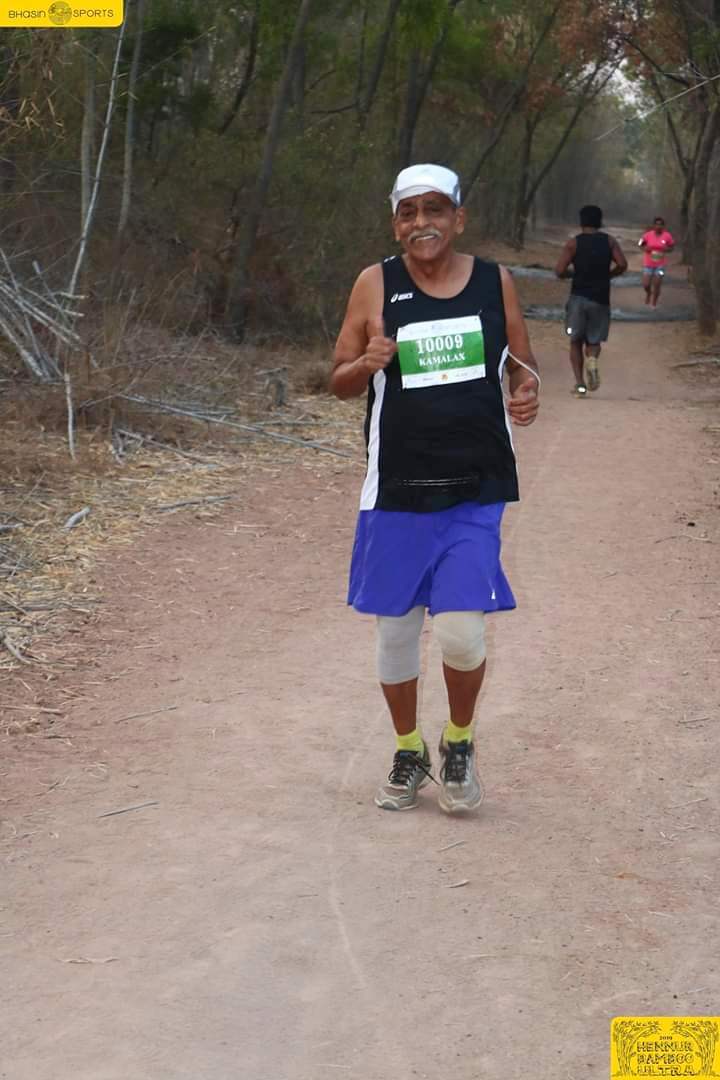
Kamalaksha Rao (This photo was downloaded from the Facebook page of Hennur Bamboo Ultra)

Kamalaksha Rao, also from Mumbai, will be attempting his virtual London Marathon on a route close to his place of stay. “ I will be carrying water and some nutrition bars. There are shops along the route. I can buy water from these shops to replenish my supplies,” the septuagenarian said. Kamalaksha will be running at a very slow pace as roughly two and a half months earlier, in July, he had come down with COVID-19. Both Kamalaskha and Himanshu hadn’t originally registered for the London Marathon. They registered later for the virtual format. The virtual version of major running events has been finding acceptance in India. Amidst lockdown blues and life that continues to be hemmed in by COVID-19, it has provided goals that runners can focus on. Not to mention – in their own small way, amateur runners deprived the ambiance of running events by the pandemic, tweak these virtual events to create a microcosm of enjoyable event. During the virtual Boston Marathon for example, running groups in India had created special loops, banners and finishing tape, provided hydration support and even some cheering – all this with safety protocols in place.

A backdrop of inspiring performances despite virus hit-world

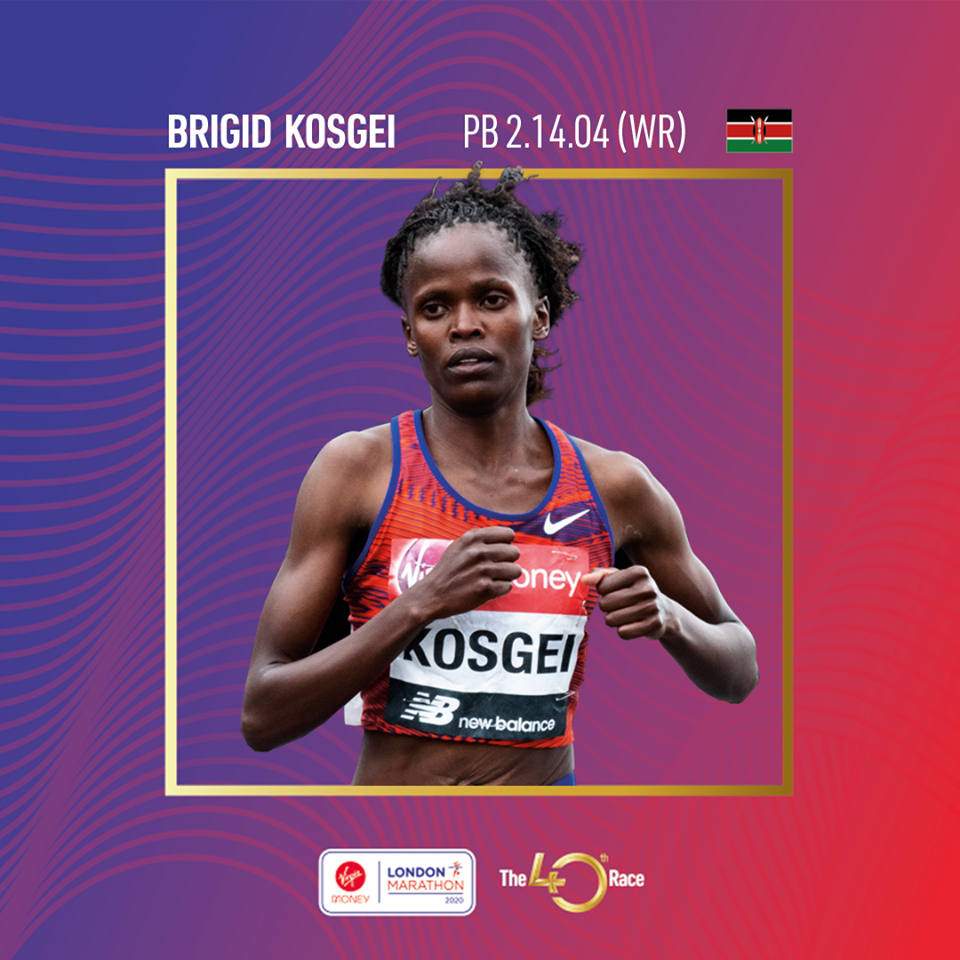
Brigid Kosgei (This photo was downloaded from the Facebook page of London Marathon and is being used here for representation purpose. No copyright infringement intended)

This year’s London Marathon is happening against the backdrop of an unexpected improvement in distance running by some elite athletes despite circumstances still plagued by COVID-19. The spread of COVID-19 worldwide, the lockdown it caused and the way in which it upset athletes’ training plans (not to mention, how the pandemic caused the 2020 Olympic Games to be postponed) were expected to impact athletic performance. While that may be the general trend, on August 14, Joshua Cheptegei of Uganda stunned the world when he scripted a new world record in the 5000 meters on track. Later, over September 4 – 5, three world records tumbled. Elite runners, Mo Farah of UK and Sifan Hassan of Netherlands set one hour-world records in their respective gender categories while Peres Jepchirchir of Kenya broke the “ women-only race world record in the half marathon.’’

The attention now shifts to the London Marathon of October 4. Eliud Kipchoge, 35, holds the official world record in the men’s marathon: 2:01:39 set in September 2018 in Berlin. In October 2019, he was in the news for covering the same distance in 1:59:40 at a special event in Vienna (it did not count as a new record). Kenenisa Bekele, 38, has a personal best of 2:01:41 in the marathon, set at the 2019 Berlin Marathon. Brigid Kosgei’s world record in the women’s marathon is 2:14:04; it was set at the 2019 Chicago Marathon.

(The authors, Latha Venkatraman and Shyam G Menon, are independent journalists based in Mumbai.)

UNLOCK 5 EXTENDS RELIEF TO ELITE SWIMMERS

Illustration: Shyam G Menon

Notwithstanding the central government’s recommendation, the final decision will be by the state governments

The central government has allowed select swimming pools to reopen as part of the phased relaxation of lockdown in India, the media reported on September 30, 2020.

This would be as part of Unlock 5, effective from October 1 and the reference to pools has been qualified as those used to train “ sportspersons.” It has been interpreted in swimming circles as meaning competition swimmers.

In its report on Unlock 5, the Hindustan Times wrote,“   Swimming pools being used for training of sportspersons will be permitted to open, for which the standard operating procedure (SOP) will be issued by Ministry of Youth Affairs & Sports (MoYA&S).” Notwithstanding the relaxation of lockdown norms by the central government, given the continued growth of COVID-19 infections, the final decision at ground level will be taken by the state authorities concerned.

In the world of sports, the lockdown to contain the spread of COVID-19, first enforced in late March, had been felt most severely in swimming. While other endurance sports like running and cycling progressively regained a semblance of activity at both amateur and elite levels (races and events are still not permitted) with every move to relax lockdown, swimming continued inaccessible as pools remained shut. This had naturally put pressure on elite swimmers for who, every day of training lost, makes it that much harder to recoup their form and ranking in competition.

The inclusion of swimming pools meant for training “ sportspersons” in the latest unlock guidelines from the center, is the first green signal to swimming in a long while. But as mentioned, the final decision even with regard to reopening facilities for competition swimmers will be that of the state government. In Maharashtra for instance, the state’s Unlock 5 guidelines (announced September 30) continues to have swimming pools in the banned category. At the time of writing, there was no mention yet of local exemptions in line with the central government’s recommendation.

(The author, Shyam G Menon, is a freelance journalist based in Mumbai.)

ALL IN: THE FIGHT FOR DEMOCRACY

This image was downloaded from the Facebook page of the film and is being used here for representation purpose. No copyright infringement intended.

In the initial portion of the 2020 documentary film All In: The Fight for Democracy, you see Stacey Abrams, politician, lawyer and voter rights activist speaking at a function after her loss by a slender margin to former Secretary of State of Georgia, Brian Kemp in the 2018 gubernatorial election.  The election was marked by accusations that Kemp resorted to voter suppression.

As a development in the US, the scene is arguably irrelevant to India although the US and India are among the world’s biggest democracies. But as a piece of articulation, what Abrams says in the film is priceless for its healthy blend of fact and emotion. Besides serving as spine for the documentary which deals with the suppression of voting rights in the US, the speech shines for its choice of words.  Her address has been spliced into parts that appear at various points in the narrative.

In the portion affixed near the beginning – it eases us into the film – she says, “ to watch an elected official who claims to represent the people and the state, boldly pin his hopes for the election on the suppression of the people’s democratic right to vote has been truly appalling. So let’s be clear – this is not a speech of concession, because concession means to acknowledge an action is right, true or proper. As a woman of conscience and faith, I can’t concede that.’’ Later, towards the movie’s end, there is this portion, “ pundits and hyper-partisans will hear my words as a rejection of the normal order. You see, I am supposed to say nice things and accept my fate. They will complain that I should not use this moment to recap what was done wrong or to demand a remedy. You see, as a leader, I should be stoic in my outrage and silent in my rebuke. But stoicism is a luxury and silence is a weapon for those who would quiet the voices of the people. And I will not concede because the erosion of our democracy is not right.’’

As said, this film is rooted in the American context. At a time when political and economic inequality is a burning issue globally and the Black Lives Matter movement has been gaining traction in the US, it shows us how the voting rights of the African American community (and other minorities) were hemmed in by a series of regressive laws and practices in the US, even after the country officially embraced democracy and diversity. Notwithstanding its story born in the US, the film holds much value for democracies everywhere, including India, the world’s biggest democracy. These are times when democracy is facing multiple challenges and the vast majority of us cannot even explain what is going wrong although we are dead sure of the rot by subversion. We know the fault isn’t democracy’s; the fault lay in how it got subverted by powerful forces. Yet many of us have begun dodging the subject and more dangerously, commenced justifying it and even trashing democracy for its inherent imperfection and lack of industrial efficiency. For nothing but the clarity resident in the words from her speech, Abrams appeared worth listening to in these times rendered murky by storms of mistruths and misinterpretations.

That said, this film is not about her; it is about the larger and older problem of voter suppression and the subject has been beautifully explored with the story of Abrams as contemporary backbone holding things together. The film exhorts us to value our democratic right to vote and back that simple act constituting the bedrock of democracy with considerable awareness. Above all, it warns us to be vigilant of the many ways in which the right to vote is systematically weakened by well entrenched forces seeking a world cast to their convenience.

The film is available on Amazon Prime. Don’t miss it; especially, if you live in a democracy.

(The author, Shyam G Menon, is a freelance journalist based in Mumbai.)

ENOLA HOLMES

This image was downloaded from the Facebook page of the film and is being used here for representation purpose. No copyright infringement intended.

If you are a fan of Sherlock Holmes, then, you wouldn’t want to miss the movie, Enola Holmes.

I hadn’t read any of Nancy Springer’s books and that meant no prior knowledge of her series featuring Enola Holmes – the younger sister of Sherlock Holmes. Enola is Springer’s contribution to the Sherlock Holmes universe; the original world of Holmes by Sir Arthur Conan Doyle mentioned only his elder brother, Mycroft.

Springer’s series falls in the genre of pastiche. Wikipedia describes pastiche as “ a work of visual art, literature, theatre, or music that imitates the style or character of the work of one or more other artists. Unlike parody, pastiche celebrates, rather than mocks, the work it imitates.’’  The film based on the series, has young British actor Millie Bobby Brown in the title role of Enola Holmes; the actor is also one of the film’s producers.

In terms of narrative style, I felt the film borrows from the post Jeremy Brett versions of Sherlock Holmes, presenting us with a sister whose nature and operational style harks of Holmes by Robert Downey Jr and Benedict Cumberbatch. There is a lot of intelligence, action and a liberal dose of smart. It should go down well with the audience and age group the film is aimed at. Yet for all the smartness showcased, there is also a degree of vulnerability, the loneliness of growing up in a family of eccentric people; not to mention two elder brothers who have firmly traded emotional warmth for cold reasoning. The sister has to navigate her life pretty much on her own, something presented as ambiance essential to mold a Holmes.

The film occasionally loses its grip. But I shouldn’t judge or blame the film because an emergent problem with the universe of Sherlock Holmes is the existence of too many interpretations and related works that judgement comes easier than empathy. There is the true to the old, gold standard of Jeremy Brett and the more contemporary versions of Holmes portrayed by Johnny Lee Miller and Cumberbatch – you keep revisiting these like pilgrimage. It squeezes room in your mind for interpretations by others to breathe easy.

Two things in particular engaged about Enola Holmes. Henry Cavill as Sherlock Holmes had the same impression on me as Daniel Craig’s James Bond when compared to the actors who preceded him in that role. It is an interesting bit of casting. It left me wondering what would happen if Cavill continued as Holmes. Second, given the Sherlock Holmes saga is now very much off on its own trajectory distinct from how Conan Doyle conceived it originally, the sibling chemistry between Cavill and Millie Bobby Brown’s Enola appeared heartwarming and holding potential for the future. Going by Wikipedia’s page on the film, these hints of brotherly concern shown by Holmes appears to have invited a law suit, for display of emotion by Sherlock Holmes is restricted to works between 1923 and 1927 and the copyright for stories from that period still rests with the Conan Doyle Estate.

But as I said, if you are a fan of Sherlock Holmes, you would want to check out every new twist and turn and Enola Holmes is one. A sharp, independent youngster in an era yet to treat women as equal to men, Enola doesn’t disappoint. She has a life of her own. Sherlock Holmes merely looks on, a sort of just in case-protective shadow.

This 2020 film is available on Netflix. Check it out.

(The author, Shyam G Menon, is a freelance journalist based in Mumbai.)   

POGACAR WINS 2020 TOUR DE FRANCE

The winners of the 2020 Tour de France (this photo was downloaded from the event’s Facebook page and is being used here for representation purpose. No copyright infringement intended)

Tadej Pogacar of Slovenia has won the 2020 Tour de France.

According to a related CNN report, he is the youngest winner of the iconic race since 1904. He turned 22 on September 21, 2020, the day after the 2020 Tour concluded in Paris.

Coming into the 2020 edition of Tour de France, Pogacar wasn’t as fancied as his fellow countryman Primoz Roglic, who rides for Team Jumbo Visma.  En route to victory this year in France, Pogacar won three stages of the Tour; the clincher was his performance in the race’s penultimate stage which was a time trial in the mountains. Roglic finished second overall while the third place in this year’s Tour went to Australian cyclist Richie Porte of Team Trek-Segafredo. A report by the Associated Press, pointed out that the Slovenian sweep of the first and second positions at the Tour was the first such predicament since British cyclists Bradley Wiggins and Chris Froome took top honors at the 2012 edition of the race.

A rising talent, Pogacar served notice of his potential last year when he became the youngest winner of a UCI World Tour, triumphing in the 2019 Tour of California. He was 20 years old then. In his debut Grand Tour, he finished overall third in the 2019 Vuelta a Espana. “ After his remarkable third place in last year’s Vuelta a Espana, Pogacar was definitely someone that was felt could get on the podium; though his countryman Roglic was the favorite and Roglic’s team, Jumbo Visma, were seen as the strongest,’’ Nigel Smith, Head Coach of the India based-Kanakia Scott Racing Development Team and someone who tracks the Tour every year, said. Although Europe is the epicenter of global cycling in terms of events, talent and devotion to the sport, Slovenia – it is home to the top two cyclists from this year’s Tour – hasn’t traditionally ranked among Europe’s cycling powerhouses.  The situation is similar to how Slovakia wasn’t regarded as a cycling powerhouse “ when Peter Sagan was winning for fun,’’ Nigel said.

Going by media reports, Pogacar’s win has triggered the angle of a new generation rising in global cycling. “ The past two Tour winners, Pogacar and Egan Bernal, have been among the youngest in history,’’ Jeremy Whittle noted in his report on the 2020 race in The Guardian. “ The kids – from the irrepressible Pogacar to Van Alert and his teammate Sepp Kuss, to Marc Hirschi of Team Sunweb, Enric Mas of Movistar and Neilson Powless and Dani Martinez of Education First – have all made their mark,’’ he wrote. Asked for his view, Nigel said, “ Yes, you could say there has been a small shift in the age of successful riders; last year Egan Bernal and Remco Evenepoel had been winning all over the place, to name but two. It’s for a variety of reasons – sports science has improved; talent identification and youth development programs are much better and possibly, most importantly, the sport is much cleaner now.’’

Pogacar’s victory also puts the spotlight on his team: UAE Team Emirates; the Slovenian cyclist’s contract with them is till the end of the 2023 season. Top teams like those participating in Tour de France are a convergence of multiple abilities ranging from talent in cycling to money and resources. According to a September 20, 2020 report by Alaric Gomes in Gulf News, the team’s origin can be traced to Lampre-Merida founded in August 2016 by former Italian cyclist Giuseppe Saronni.  A while later, it was informed that its world team licence was being transferred to the Chinese company TJ Sport Consultation with the resultant entity set to become the first Chinese World Tour team in 2017.

At this point it was indicated that the project was being monitored by the Chinese government with a view to developing Chinese cycling and riders. However in November, TJ Sports’ application came under review by UCI’s Licensing Commission.  It was attributed to developments at TJ Sport causing delay in funding. The team then rebranded as UAE Abu Dhabi and the UCI confirmed a new World Tour licence in December. In February 2017, the team announced that airline major Emirates had become its sponsor with team name revised to UAE Team Emirates. The new team was launched in Abu Dhabi in January 2017, the report said. According to Wikipedia’s page on him, Saronni is currently an advisor to UAE Team Emirates.

In the past, cyclists from India have spoken of their desire to see a similar Indian experiment at the top races in cycling (for more on this, please click on this link: https://shyamgopan.com/2018/10/12/from-a-cafe-in-bengaluru-dreaming-a-world-class-bicycle-racing-team/).

(The author, Shyam G Menon, is an independent journalist based in Mumbai.)
ANJALI SARAOGI, DEEPAK BANDBE WIN 2019-2020 AFI ULTRA AND TRAIL RUNNING AWARDS

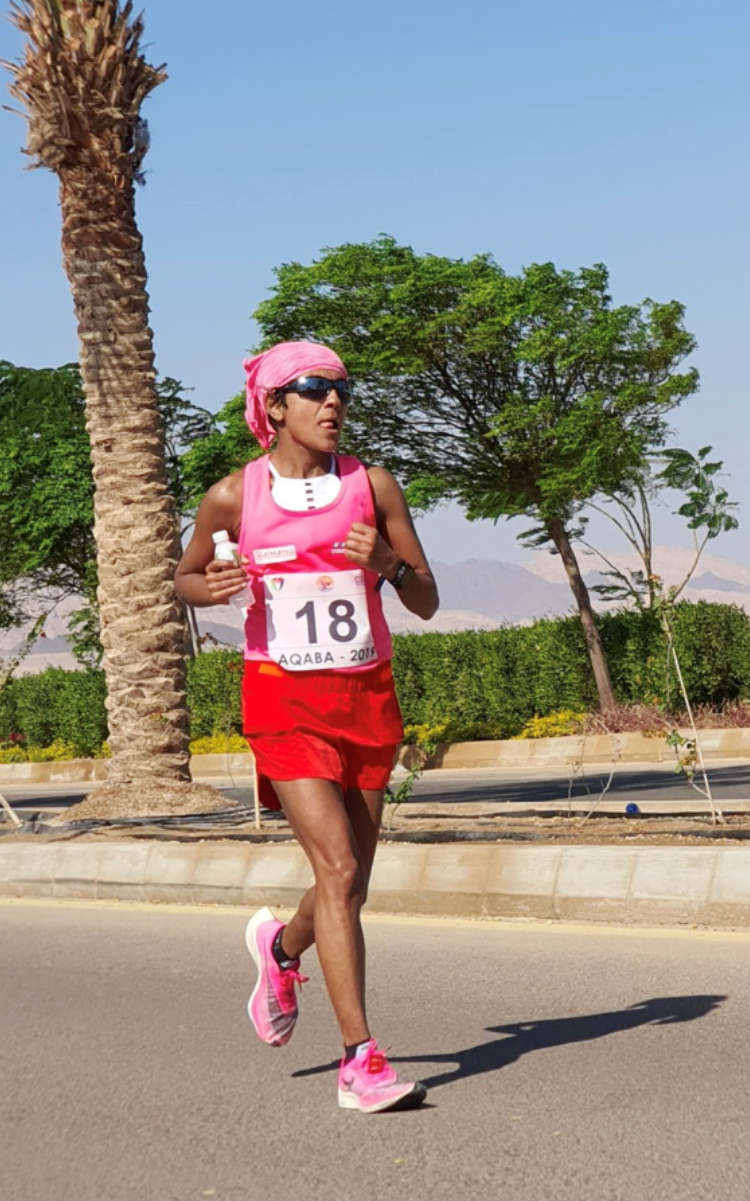
Anjali Saraogi; from the Asia Oceania 100K Championships in Aqaba, Jordan (Photo: courtesy Anjali)

Kolkata-based ultra-runner, Anjali Saraogi, has won the AFI Ultra and Trail Running award for women, for the second year in a row, this time for 2019-2020.

Anjali’s performance at the 2019 IAU 100 km Asia & Oceania Championships held in Aqaba, Jordan, in November 2019, came up for mention at the awards function held in virtual format by the Athletics Federation of India (AFI) on September 19, 2020.

In Aqaba, Anjali had completed the 100 km race in nine hours, 22 minutes and three seconds securing fourth place among women and breaking her own national record for that distance category.

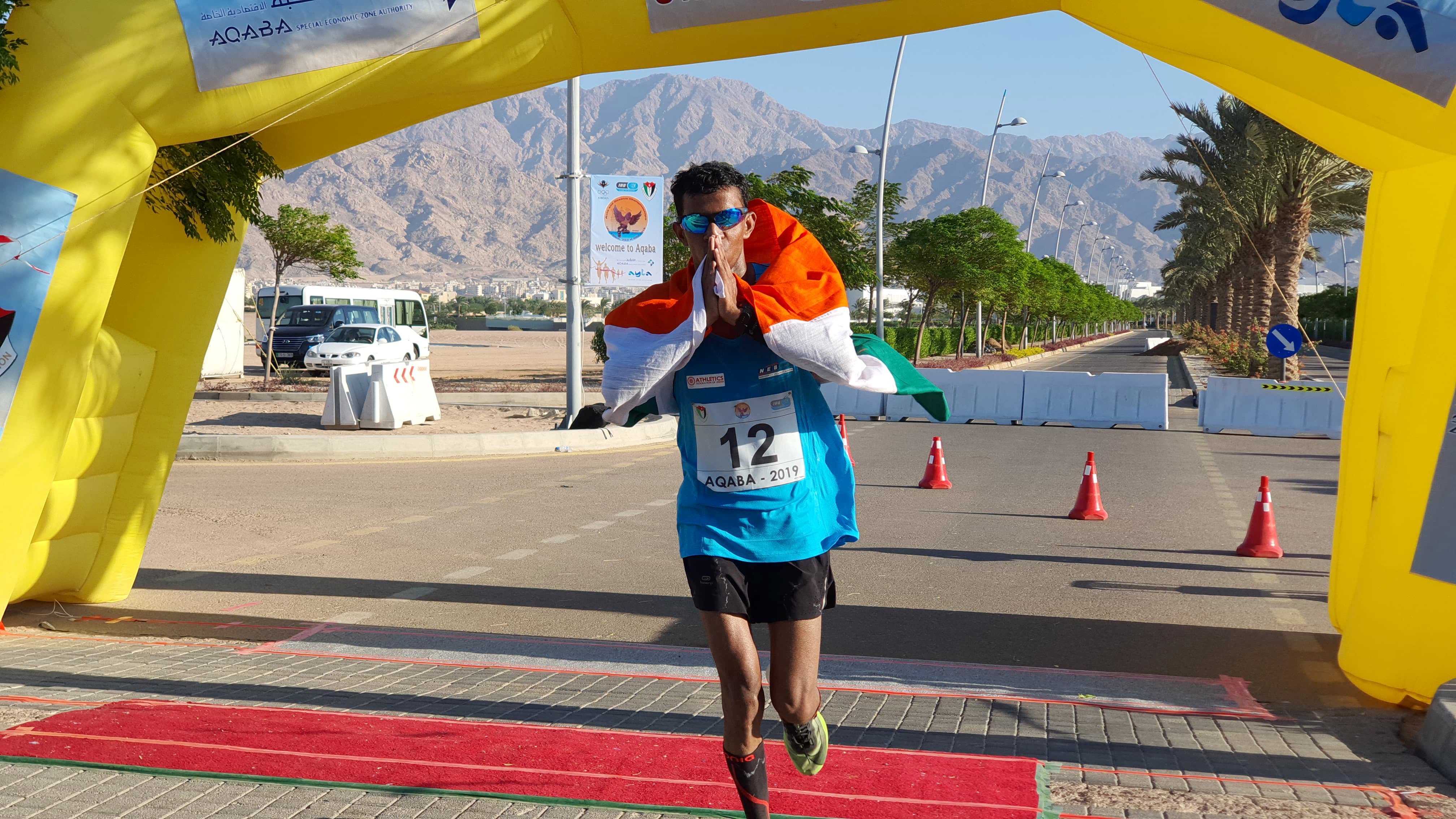
Deepak Bandbe from Mumbai won the AFI Ultra and Trail Running award for male runner of the year (2019-20). He had won the bronze medal at the IAU 100 km Asia & Oceania Championships in Aqaba. He covered the distance in 8:04:16 hours, setting a new national record in that category.

Members of the Indian women’s and men’s team, who represented the country at the Aqaba event, were given cash awards for their performance. The men’s team had won the gold medal and the women’s team, silver, at the event. The gold medal winning men’s team members were given cash awards of Rs 10,000 each and the silver medal winning women’s team members received Rs 7500 each.

Nadeem Khan, president of the International Association of Ultrarunners (IAU) and AFI president Adille Sumariwalla participated in the virtual awards function. They pointed out that Indian athletes’ progress in ultra-running has been spectacular.

Deepak Bandbe (This photo was downloaded from the Twitter feed of IAU)

“ Over the last three to four years, the progress of ultra-running in India has been amazing,” Nadeem said. “ India is a growing market for us, an important market,” he added.

“ I am pleased to note the rapid progress of Indian athletes over the last few years,” Adille said. He emphasized the need to get back to events. AFI’s focus is on protecting athletes given the ongoing COVID-19 pandemic.

“ It’s a huge honour. My award belongs to every girl child in my country who will dare to dream and persevere to follow them,” Anjali told this blog after her second consecutive AFI award (for more on Anjali please click on this link: https://shyamgopan.com/2020/08/07/perfection-is-making-the-best-of-what-you-have/).

Sunil Chainani and Peteremil D’Souza, both members of AFI’s committee that oversees ultrarunning, managed the meeting.

(The author, Latha Venkatraman, is an independent journalist based in Mumbai.)