Indian ultrarunner plans to attempt Bob Graham Road
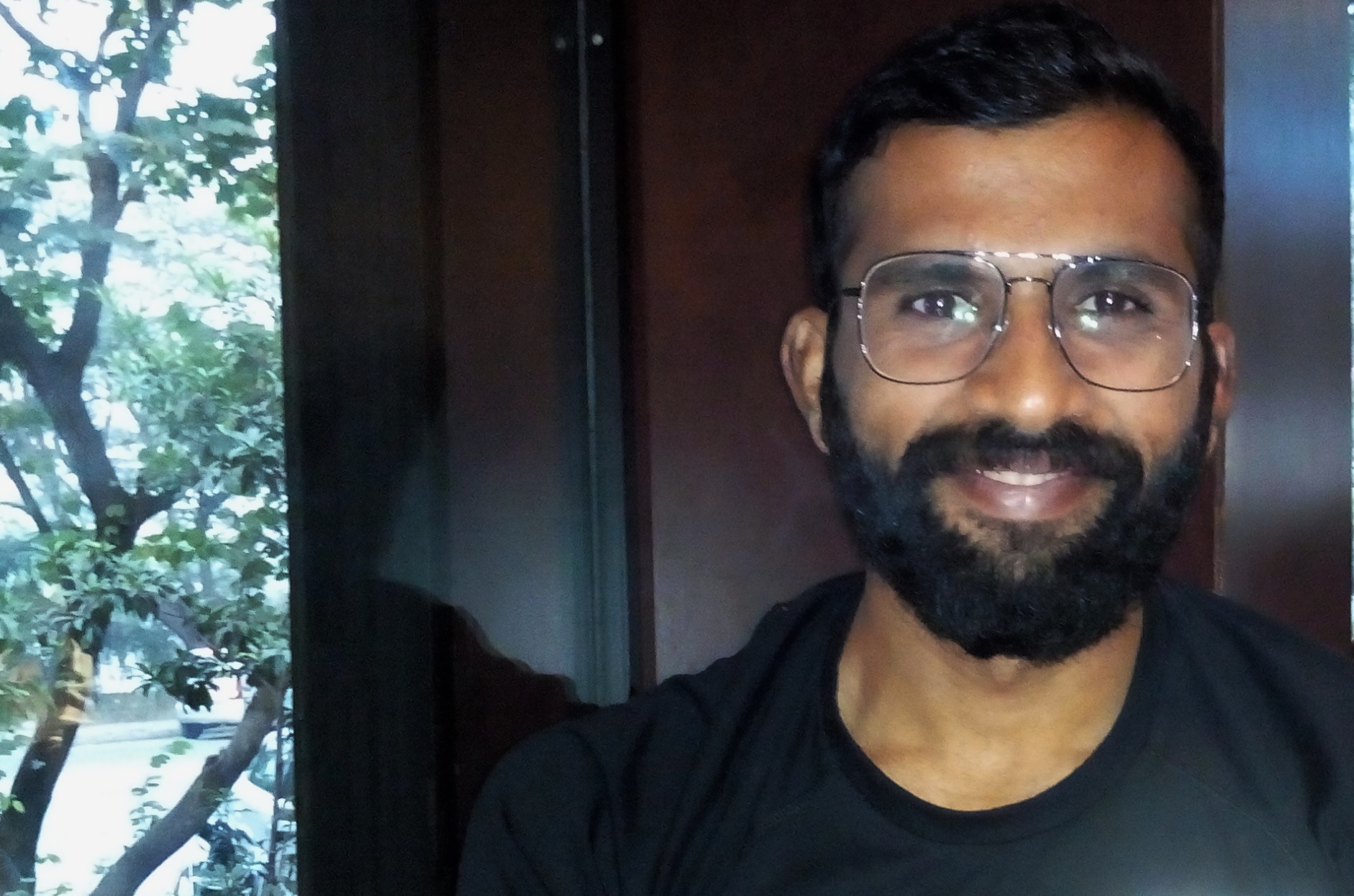
Jeevendra Singh, an Indian ultrarunner based in the United Kingdom, is planning to attempt the Bob Graham Road, a fell running challenge in England’s Lake District, next month.
Runners are required to cover the round in 24 hours, traversing through 42 fells (hills) covering a distance of 106 kilometres with 27,000 feet of elevation.
Jeevendra hopes to be the first Indian to attempt and complete it.
His journey will be filmed in a documentary titled, To Cumbria with Love.
The filmmakers, Summit Fever Media (Matt Green and Ellie Green), are doing a crowdfunding campaign to raise funds for the film.
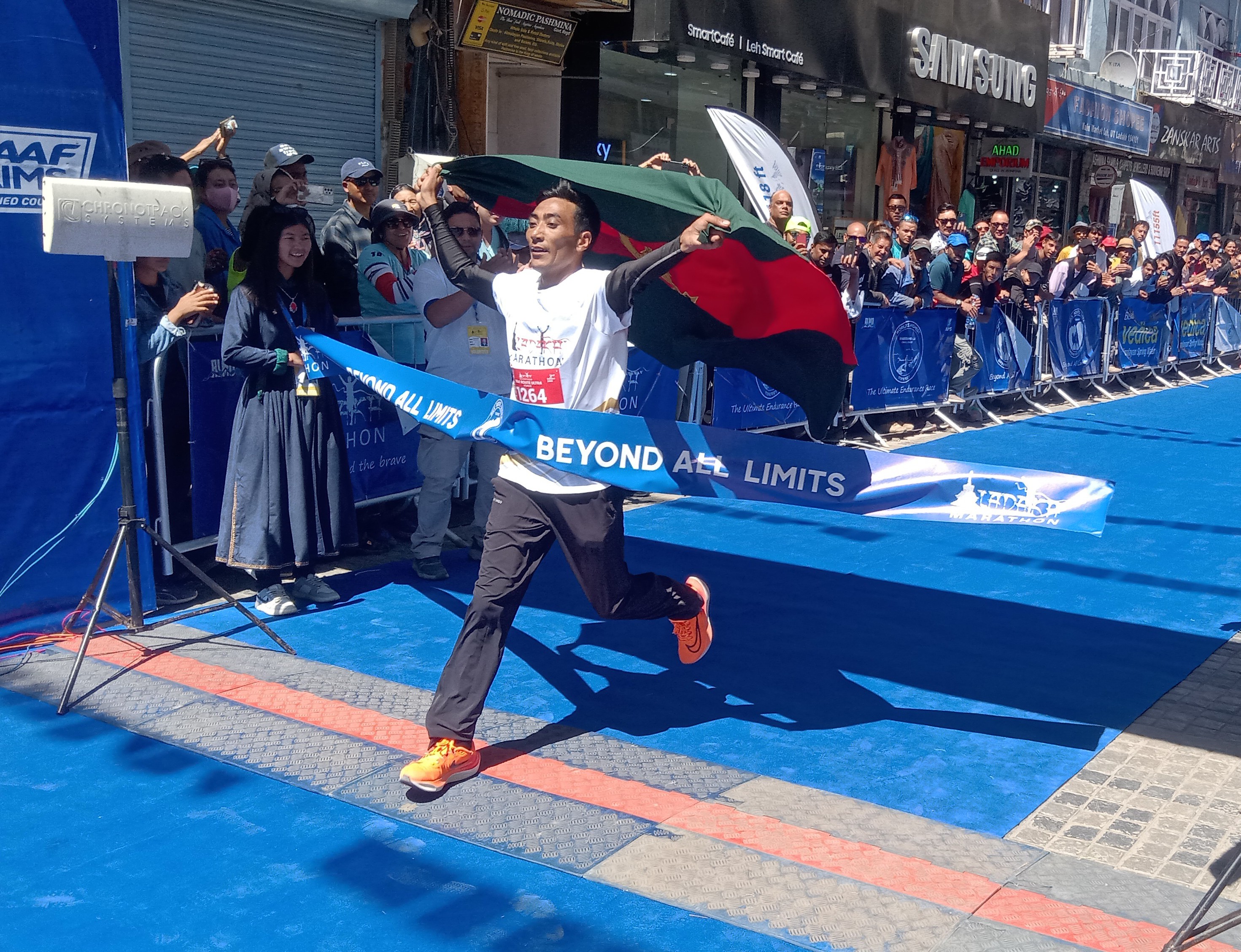
Shabbir Hussain, winner of Silk Route Ultra (photo: Shyam G Menon)
Shabbir Hussain wins 2023 Silk Route Ultra
A dramatic victory for Tsering Yangzam
Rigzin Gyurmeth wins Khardung La Challenge; Namgyal Lhamo tops among women
Amit Gulia is first non-Ladakhi runner to secure sub-17 hours-finish in Silk Route Ultra
The evening of September 6 was a reality check for the runners gathered at Kyagar in Ladakh’s Nubra Valley, ahead of commencement of the 2023 Silk Route Ultra (SRU).
In store was 122 kilometres of running over one of the world’s highest motorable passes along a road that has more gradients than flats, the whole thing set in an ambiance of unpredictable mountain weather and the effort of working at high altitude. Prior to leaving Leh for Kyagar, the local weather had shown signs of the season beginning to switch. After weeks of pretty warm weather, there had been a shift to slightly cool evening breeze with grey clouds gracing the peaks of the nearby Ladakh Range. People in Leh said it hinted of the weather beginning to change. In Kyagar, the evenings additionally featured strong, chilly winds. There was worry on what it may hold for the late evening race-start scheduled for September 7 and more critically, how the weather may be, as one ran up the several kilometres of gradient to Khardung La (17,618 feet).
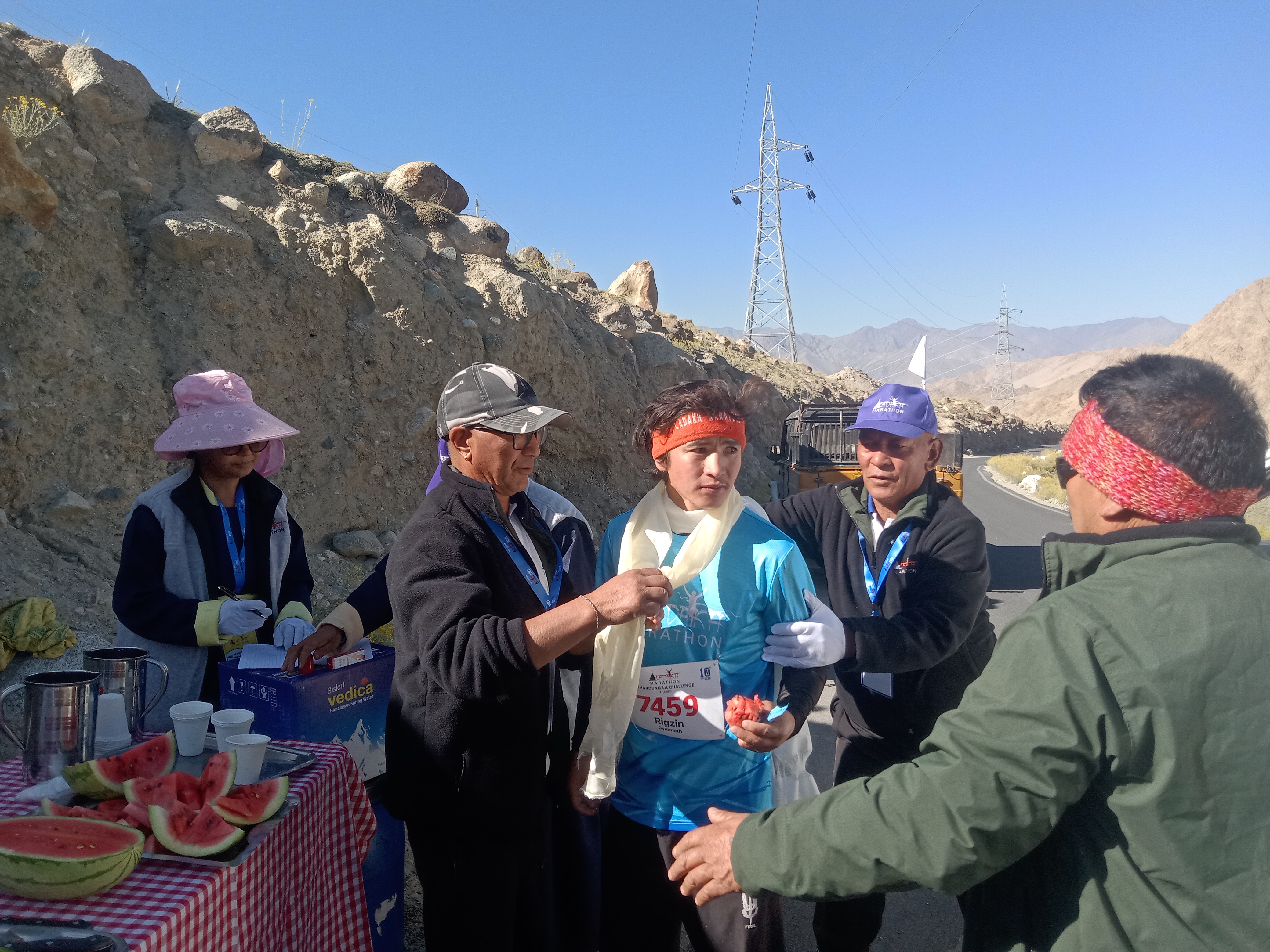
Rigzin Gyurmeth who won the Khardung La Challenge being welcomed at an aid station on the approach to Leh (photo: Shyam G Menon)
Held as they are at altitude, most races within the Ladakh Marathon (the 122 km-SRU and the 72 km-Khardung La Challenge, are part of it) tend to favour Ladakhi athletes who are naturally efficient at handling altitude. For those coming from outside, the attraction is precisely that of being an outsider, preparing well to handle hill runs, acclimatizing patiently to Ladakh’s high altitude and finding out how well one tackles the test of endurance taken up. Partly due to the natural advantages the hosts possess, the commencement of the Silk Route Ultra (it was into its second edition in 2023) was done in two stages. The race’s elite contingent, typically comprising of Ladakhi runners (mostly serving in the military) began their run one and a half hours after the rest of the field set out at 7PM. The logic was that if everyone ran together, the Ladakhis would open up too big a gap with the rest of the field for logistics, race management and monitoring to be done properly. While this may seem just, the truth is, the Ladakhi runners don’t quite enjoy the late start. As more than one of them said, it is boring to be race-ready and wait in a small group for the run to commence after everyone else has left.
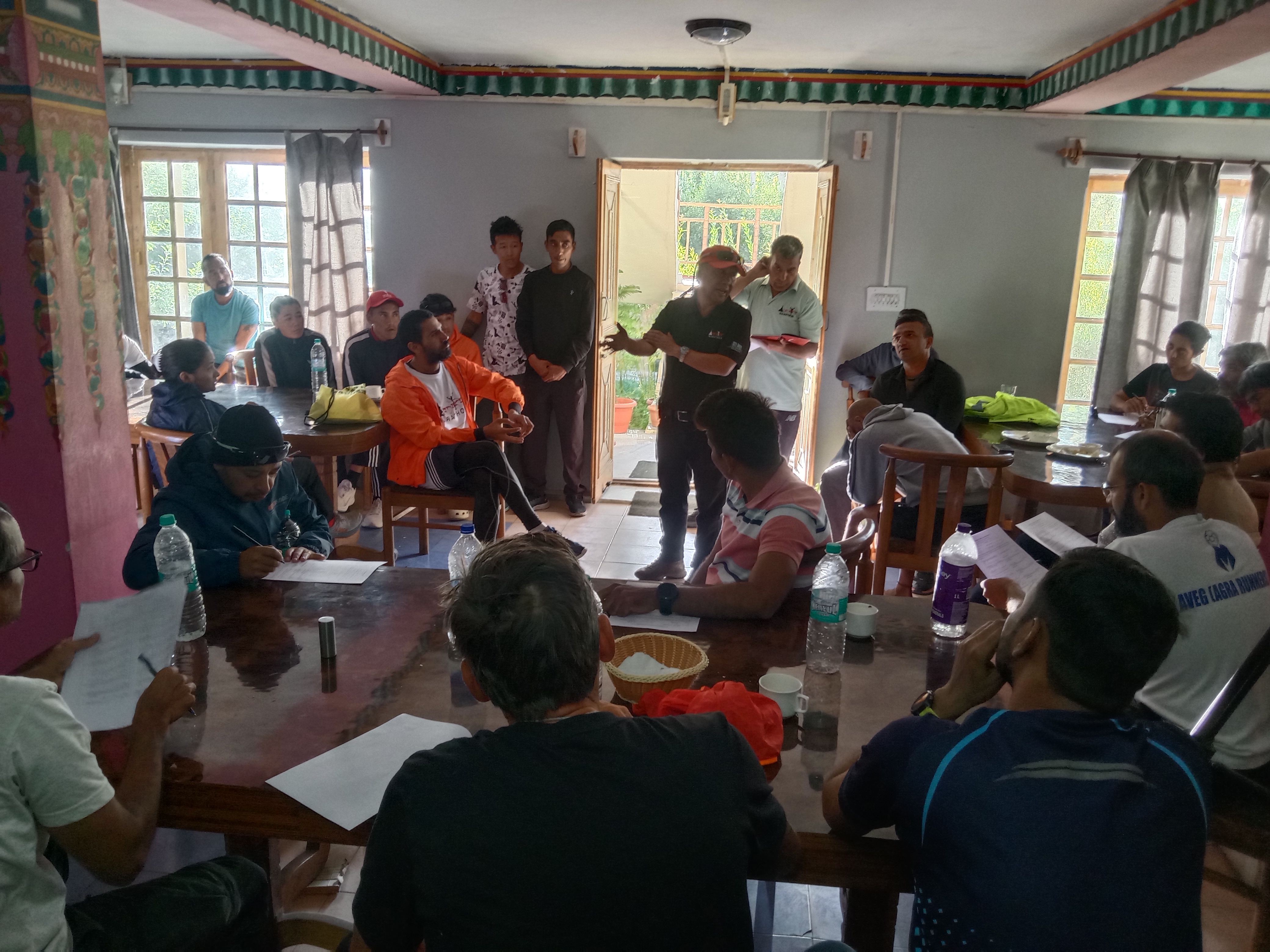
SRU; pre-race briefing at Kyagar (photo: Shyam G Menon)
Hakim, who was part of the organizers, was due to trail the elite team till SRU merged into the much larger flow of Khardung La Challenge (KC) runners starting the race from Khardung village. KC was slated to commence at 3AM on September 8. This writer found a seat in Hakim’s vehicle. The 2023 SRU was happening with a backlog of improvements to make. As mentioned in an earlier article, it is not an easy race. Although, it is only 122 kilometres long (not very long for an ultra) and is merely an extension of KC from its start line by another 50 kilometres, given altitude and mountain terrain, that additional distance suffices to tire people. Many wither away. Runners themselves told this blog that fairly easy eligibility to participate and a misconstrued perception of SRU as just an extension of KC, caused mismatch in expectation and actual outcome, provoking disappointment. For some, this is what happened in the inaugural edition of the race in 2022. At least a few, had come back in 2023 to try their luck again. Raj Vadgama had committed the error of running the early portion of the 2022 race, fast. Amisha Jain had experienced altitude sickness.
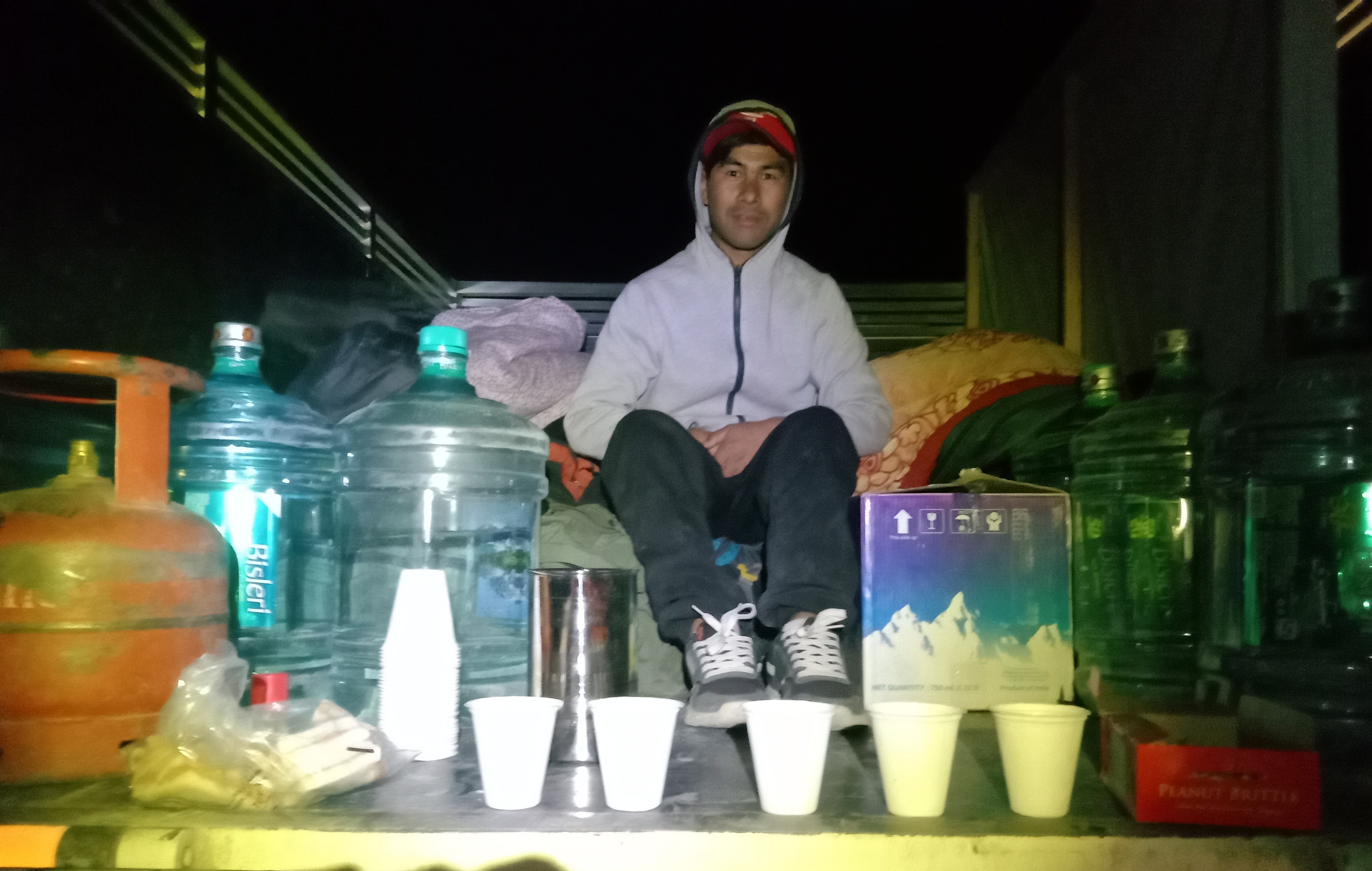
Midnight, September7-8; a villager manning an aid station on the cold northern slopes of Khardung La. This facility operated from the back of a pick-up truck (photo: Shyam G Menon)
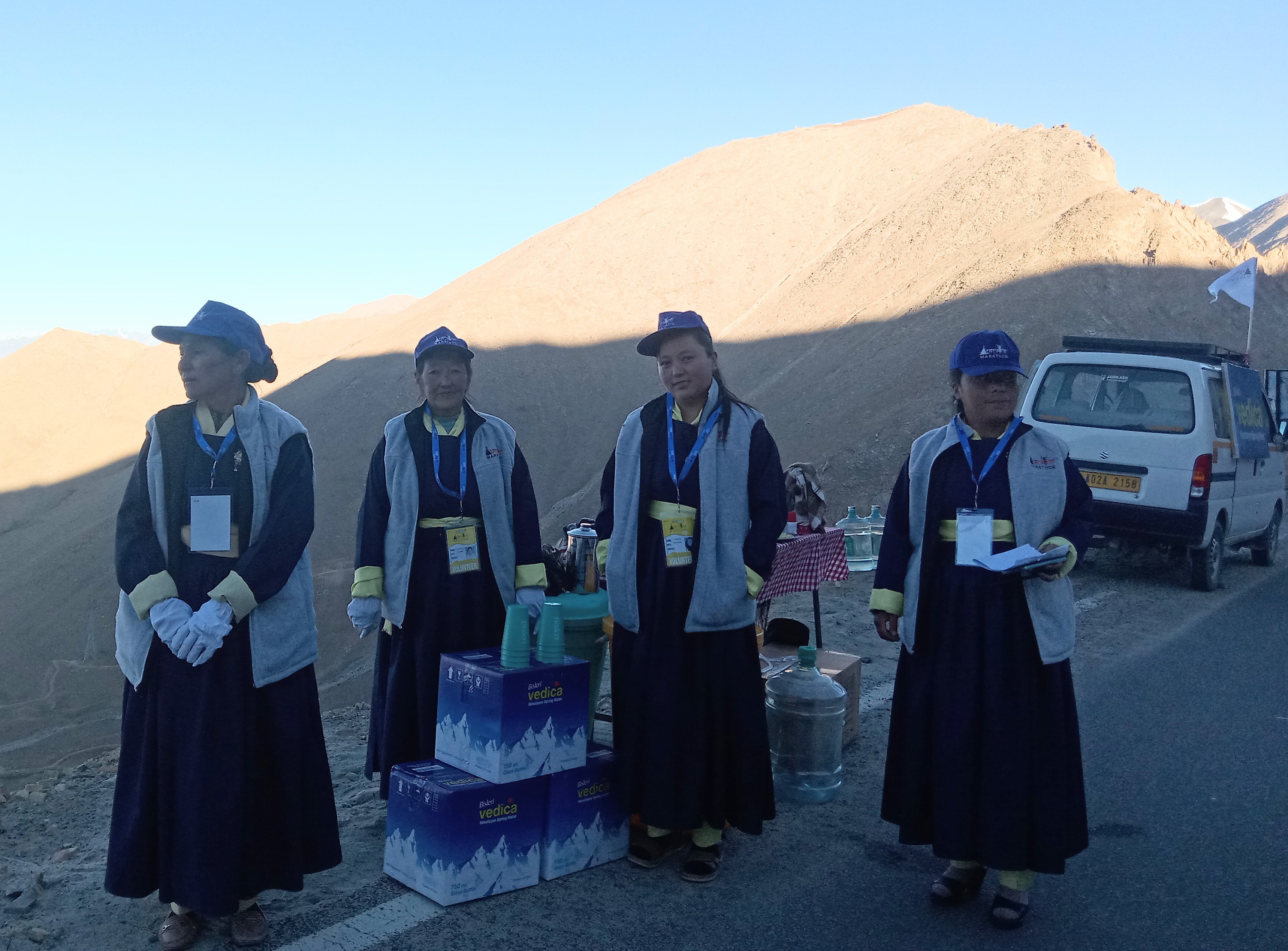
Morning of September 8; an all woman aid station on the sunnier southern slopes of Khardung La (photo: Shyam G Menon)
That year, there were also complaints of aid stations being too spaced apart and some items the runners would have loved to see included (warm water being one), absent in the support on offer. In 2022, Amit Gulia had seen the energy gels he brought along for SRU, thicken in consistency in the bitter cold of high altitude. Consumed during the race, the gel stuck to his throat. He wanted warm water to wash it down. But it wasn’t available. Amit who completed the 2022 Spartathlon after his aborted run at the year’s SRU was back for the 2023 edition. Kyagar and the accommodation facilities provided ahead of the 2023 race offered the calm any participant would seek prior to a race. The runners headed into the race spent time differently. Some appeared to prefer self-time and were rarely seen. The more gregarious lot indulged in conversation and banter. The runners from Ladakh Scouts and the Indo Tibetan Border Police (ITBP) walked around, indulged in the occasional game of table tennis and rested. Ace runner, Shabbir Hussain, rested a lot. Notwithstanding this portrait of life from Kyagar, the countdown to the race’s start on September 7 was laced with avoidable uncertainty. The culprit was the pre-race medical check-up. It got delayed. There was also confusion on the timing of the pre-race lunch at one of the hotels. The runners sorted it out. At 5PM, there was a race briefing where Chewang Motup, race director of the Ladakh Marathon, informed that the distance between SRU aid stations had been reduced and items like warm water would be made available at some of the stations. The aid stations had also been provided bright solar lights; it lights up the immediate surroundings and makes the stations visible from far. Motup emphasized safety in terms of managing altitude and asked the runners to be mindful of sections featuring road-work in progress.
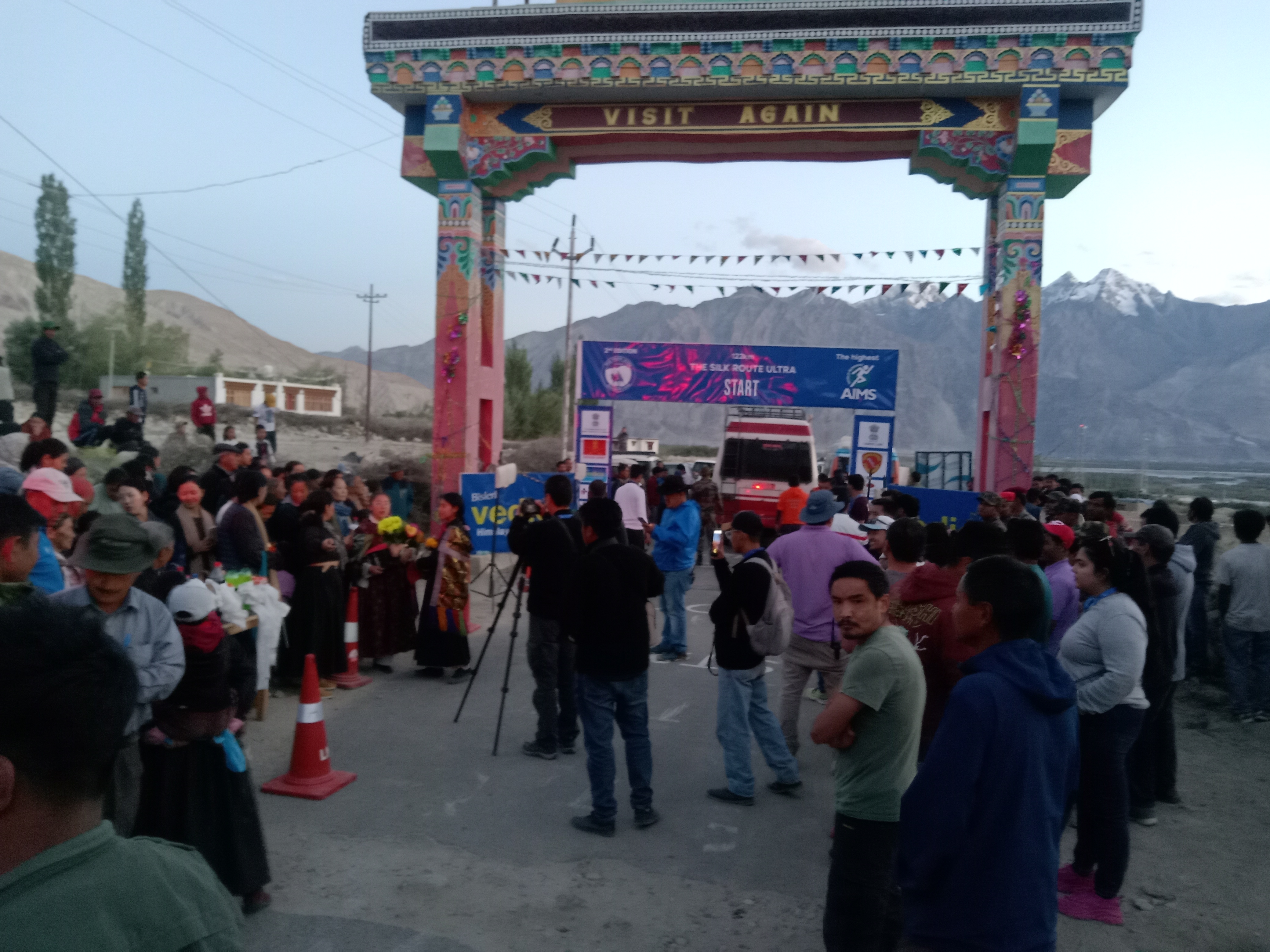
September 7 evening; SRU start line at Kyagar (photo: Shyam G Menon)
At 7PM, it seemed to be a positive, upbeat lot of runners who commenced running from Kyagar as the first SRU batch. Phunchok Tashi, runner from ITBP, who at 47 was among the older participants (and a fine person to talk to), had to sit out the race because his blood pressure was found to be high. He had placed sixth among men in the 2022 inaugural edition of SRU. Tashi, who hails from Sakti village near Leh, felt the potential outcome of the 2023 race couldn’t be predicted with absolute certainty. Shabbir Hussain, 29, was the strongest runner in the elite field. He was also the more experienced, having run and got podium finishes in KC multiple times before and placed second in the 2022 SRU. But both Stanzen Phuntsog, 26, and Tsewang Kundan, 23, had age on their side. Stanzen was the bronze medallist from 2022 SRU while Kundan was bronze medallist from 2022 KC.
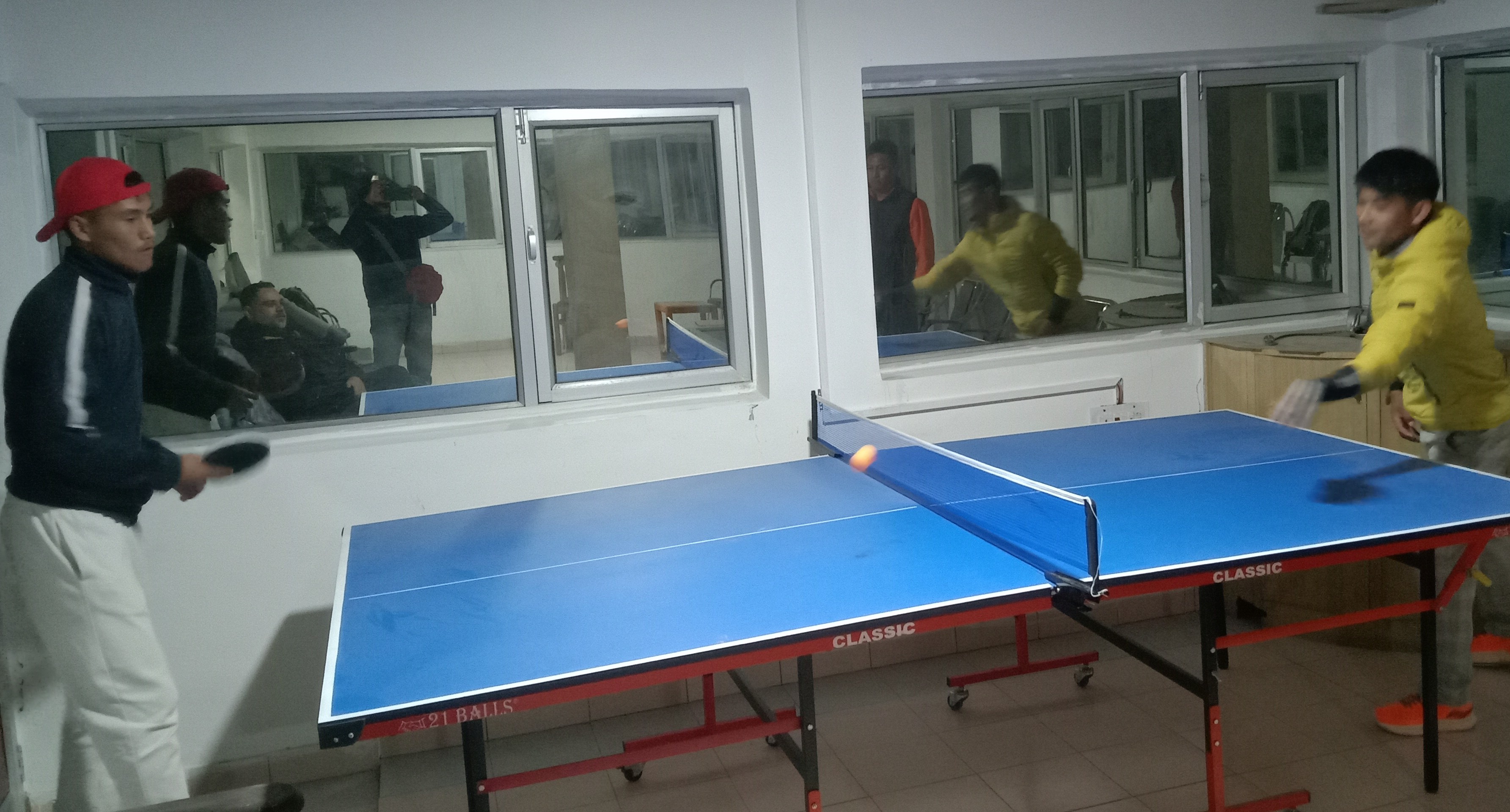
September 6 night; Kundan and Stanzen relax over a round of table tennis at Kyagar (photo: Shyam G Menon)
All three of them represented a unique Ladakhi opportunity in running and also an ongoing dilemma; a glass ceiling to break. As denizens of altitude, Ladakhis enjoy good endurance. Comparatively weak in speed, their showing in the classical marathon – it is a blend of speed and endurance – has been a mixed bag. While outsiders struggle to run in Ladakh’s rarefied atmosphere (high altitude means lower oxygen level), the Ladakhis have their own struggle coping with the heat, humidity and intense competition of the Indian plains. The partiality to endurance appeared reflected in Shabbir’s choice. Years ago, he ran Ladakh’s annual marathon just like that and had won it. His preference thereafter wasn’t to stick to the marathon; he shifted to the longer, endurance-busting ultramarathon. Asked if Ladakhi female athlete, Jigmet Dolma, who elected to focus on the marathon had done a brave thing, Shabbir said yes. Her decision is a shift away from the Ladakhi (maybe mountain) choice of endurance over speed. But therein lay a problem.
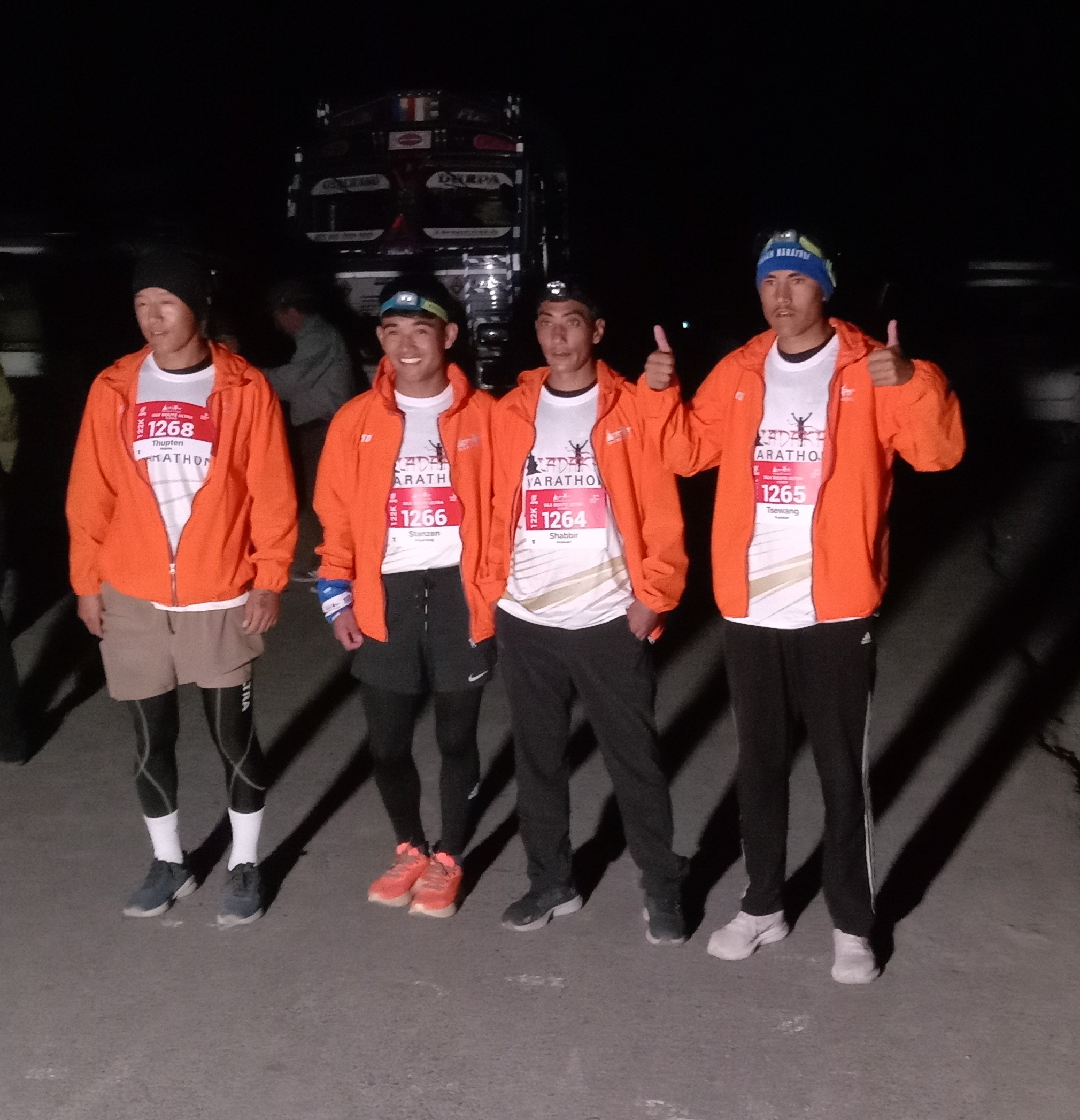
The four person-elite team for the late-start at Kyagar; from left: Thupten Nyima, Stanzen Phuntsog, Shabbir Hussain and Tsewang Kundan (photo: Shyam G Menon)
Thanks to the compulsions of media and broadcasting (which generate millions in revenues for broadcasters and sport organizers worldwide), the appetite of huge sporting spectacles like the Olympics is limited to the marathon when it comes to endurance events in athletics. Television will not risk boring audiences with extended formats of sporting events. It is a paradigm that has only grown tighter thanks to the onset of our generation of impatient audiences demanding quick results. The Olympics in turn shapes choice of sports and training, at national level. It is a known fact that the ultramarathon which can span several hours, does not enjoy the same patronage as the marathon, in India’s sports establishment. Consequently, even within institutions encouraging sports, like the military, the ultramarathon is an outlier in imagination dominated by focus on disciplines at the Olympics. Many, enamoured by the Ladakhi capacity to handle altitude, suggest that they embrace the marathon. But they overlook the nature of the marathon and its history of sterling athletes found in the mid altitudes. It is a transition the Ladakhis used to high altitude must figure out, how to bridge. Shabbir, who works for the army, has a training calendar that revolves mainly around one event – the ultramarathons of the Ladakh Marathon. He is not seen at other ultramarathons in India although ultramarathoners from elsewhere have a tough time running in Ladakh’s high altitude environment. Which also means, they find it tough to beat this Kargil athlete in his home ground. Shabbir trains mostly by himself with inputs gleaned from his own ultrarunning experience. With no particular interest in their abilities shown by the Army Sports Institute and other similar organizations, Ladakhi elite runners seem to rise and fade in Ladakh itself. It is an existence in running without a proper road map. An exception was the decade-long support for local runners extended by Rimo Expeditions, organizers of the Ladakh Marathon; they fund and send Ladakhi runners to compete in the marathons of the plains.
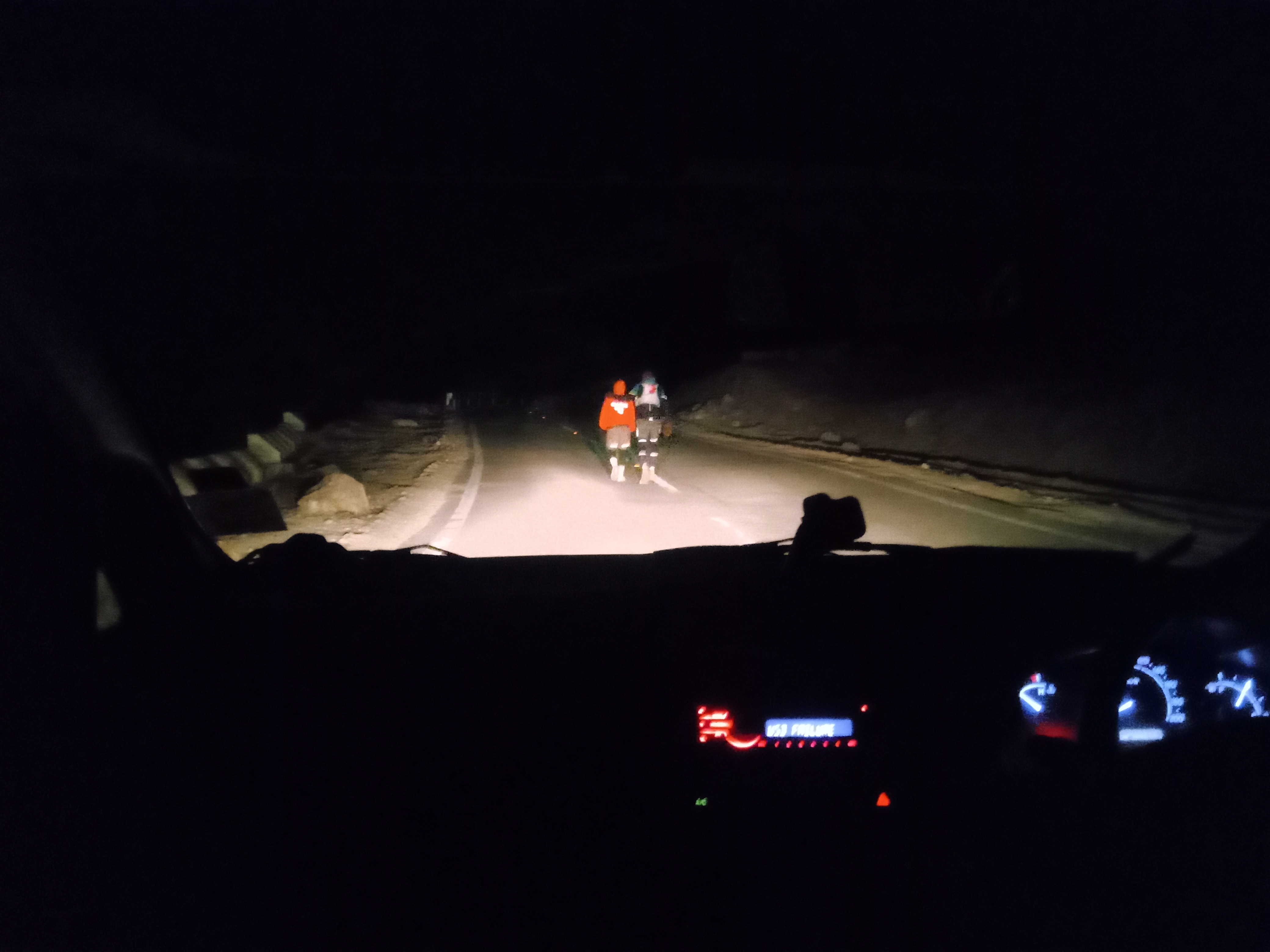
Runners on the road; the view from within the official vehicle (photo: Shyam G Menon)
At 8.30PM on September 7, there were four elite runners assembled at the SRU start line in Kyagar. There was the race favourite, Shabbir. Giving him company, were the two younger runners – Stanzen and Kundan. All three were from Ladakh Scouts of the Indian Army, the regiment that has traditionally dominated the podium at the Ladakh Marathon. The fourth person at the start line, was Thupten Nyima of the Special Frontier Force (SFF), a regiment composed mostly of Tibetans living in India. In 2022, Thupten had finished eighth among men in SRU. Interestingly, the 2023 edition of the Ladakh Marathon was accompanied by the buzz of various regiments of the army with its runners enrolled in the event, likely to put up keen mutual competition. In pre-race conversations, Shabbir had said when asked, that the Ladakhi runners usually stick together till the final phase of SRU. Into the final stretch, competition amongst them picks up. Within the first 10 kilometres or so of the elites taking off in the 8.30PM late-start, Shabbir and Stanzen set a fast pace with Thupten matching it. This went on for about an hour. Thereafter, Thupten appeared to tire from the fast pace and fell back. Kundan who had kept his own sustainable pace and was trailing the lead group by a sizable margin, slowly narrowed the gap with Thupten. He caught up with the SFF runner, overtook him and thereafter proceeded to close the gap with Stanzen and Shabbir. Eventually, Thupten was left all alone; he looked tired and his pace dropped drastically. For a long time, Hakim in his vehicle moved slowly with Thupten, making sure the runner wasn’t left alone in the pitch black mountain environment. It had been an unexpected development for the race official, one that limited him from proceeding at the pace of the lead pack. He kept checking in with Thupten to gauge how he was feeling. A kilometre or two before Khalsar, Hakim went ahead and dispatched another team back to check on the tired runner. By then, Thuptan had quit the race; he reached Khalsar in the very same vehicle sent to accompany him. SFF’s continued presence in the men’s category of the race, now stood restricted to 48-year-old mountaineer-runner, Kunchok Tenpa, who in the tradition of senior runners (including locals) running with the 7PM batch, was at that point in time, way ahead.
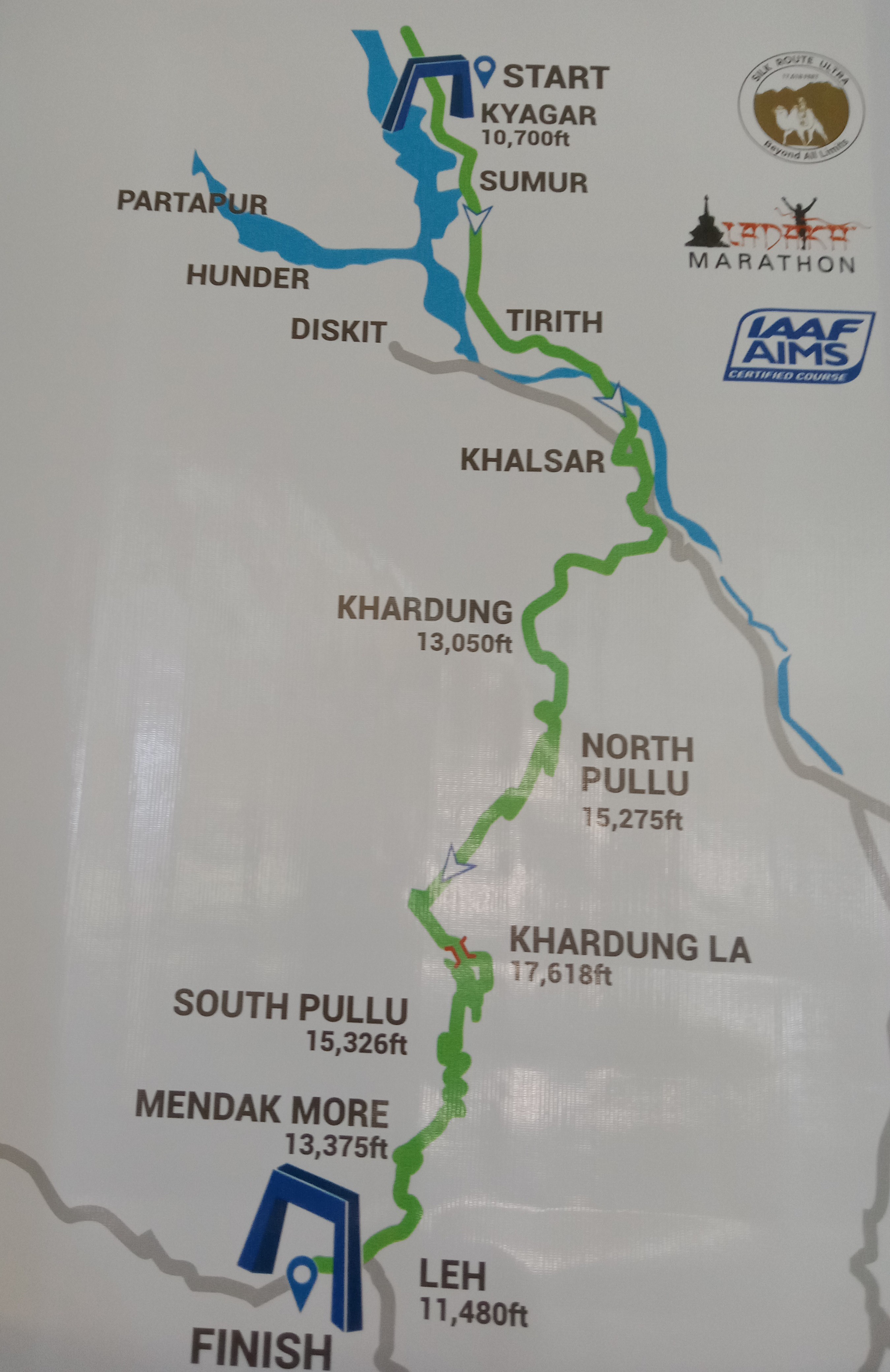
The SRU route (photo: Shyam G Menon)
While Hakim was moving slowly with Thupten on the pre-Khalsar stretch, word had been received that the 7PM batch was making good progress. Past Khalsar, the vehicle began encountering the tail end of this batch. On the climb towards Khardung village, a monasticism characteristic of ultramarathons had come to settle on the runners. Each was in a private cocoon. Some familiar faces – Ashwini Ganapathi, Shikha Pahwa, Brijesh Gajera, Anmol Chandan – went by. In the middle of this long line of runners dispersed on the road in that vast, dark mountain environment, one found the Ladakhi runners. They had caught up with the 7PM batch. Still ahead in the leading portion of this line were the likes of Suman Chettri and Swiss ultrarunner, Maik Becker, and further ahead, Tsering Yangzam, who represented the SFF in the women’s category. As we reached the start point of KC at Khardung village, our assumption till then was that Yangzam signified the head of the line of SRU runners. Hakim’s responsibility was to stay with the race leader and over time shepherd the lead runners of KC (it was bound to move faster than the longer ultramarathon coming in from Kyagar) into Leh. Consequently, when the vehicle left a Khardung getting ready for the start of KC, it was to Yangzam that it gravitated for SRU-leader.
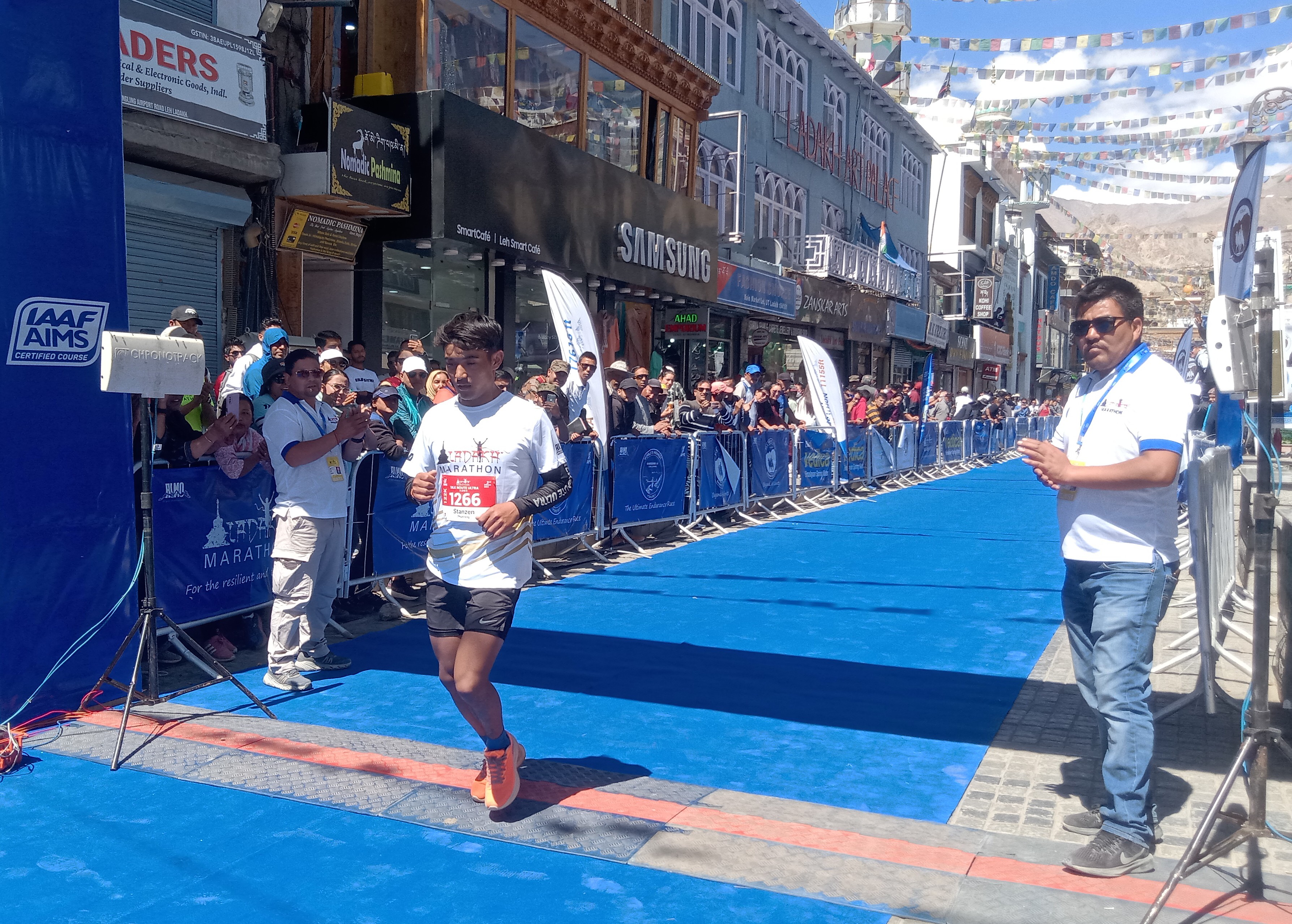
Tsewang Kundan at the finish line (photo: Shyam G Menon)
By now, it was quite cold and the course, unrelentingly uphill. Yangzam was moving strongly; mostly jogging with the occasional stint of brisk walking. It seemed an efficient progress. In 2022, Yangzam had been silver medallist among women doing KC and so, her chances in SRU were respected. It was 50 kilometres from Kyagar to Khardung. It meant that past Khardung, somewhere on the approach to North Pullu, Yangzam would be close to the 72 kilometres she had covered for KC. Would that matter? Unfortunately, around the said mark, things began going wrong. Her leg started to hurt and she complained of cramps. Although she kept up the brisk walking, her overall pace slowed down. She hydrated at an aid station, pain-relief spray was used and she also accepted some food. She was in no mood to give up. On the other hand, her halts to relieve the pain were increasing and everything about how she struggled to keep running, pointed to a potential DNF (Did Not Finish). In that time, at least two male runners overtook her. Others were catching up. Here, mention must be made of how local runners (and the SFF lot including Yangzam) approached SRU and KC. None of those born to altitude and competing for regimental glory seemed to like hydration packs. They saw it as an irritating load, a burden weighing them down. Running free and tackling the ultramarathon as they would a marathon, these runners counted on aid stations for hydration and nutrition. On the other hand, most outsiders arrived to run SRU and many in KC, kept themselves self-supported with hydration packs. They used aid stations but carried their own supplies too, as back-up. As Hakim’s vehicle drew into North Pullu, the medical station there manned by the military, was apprised of the struggling SFF runner. From the vehicle, this writer saw military personnel speak to Yangzam but she seemed determined to continue her walk-run to the high pass above. After a chat with folks from the army at North Pullu, she moved on.
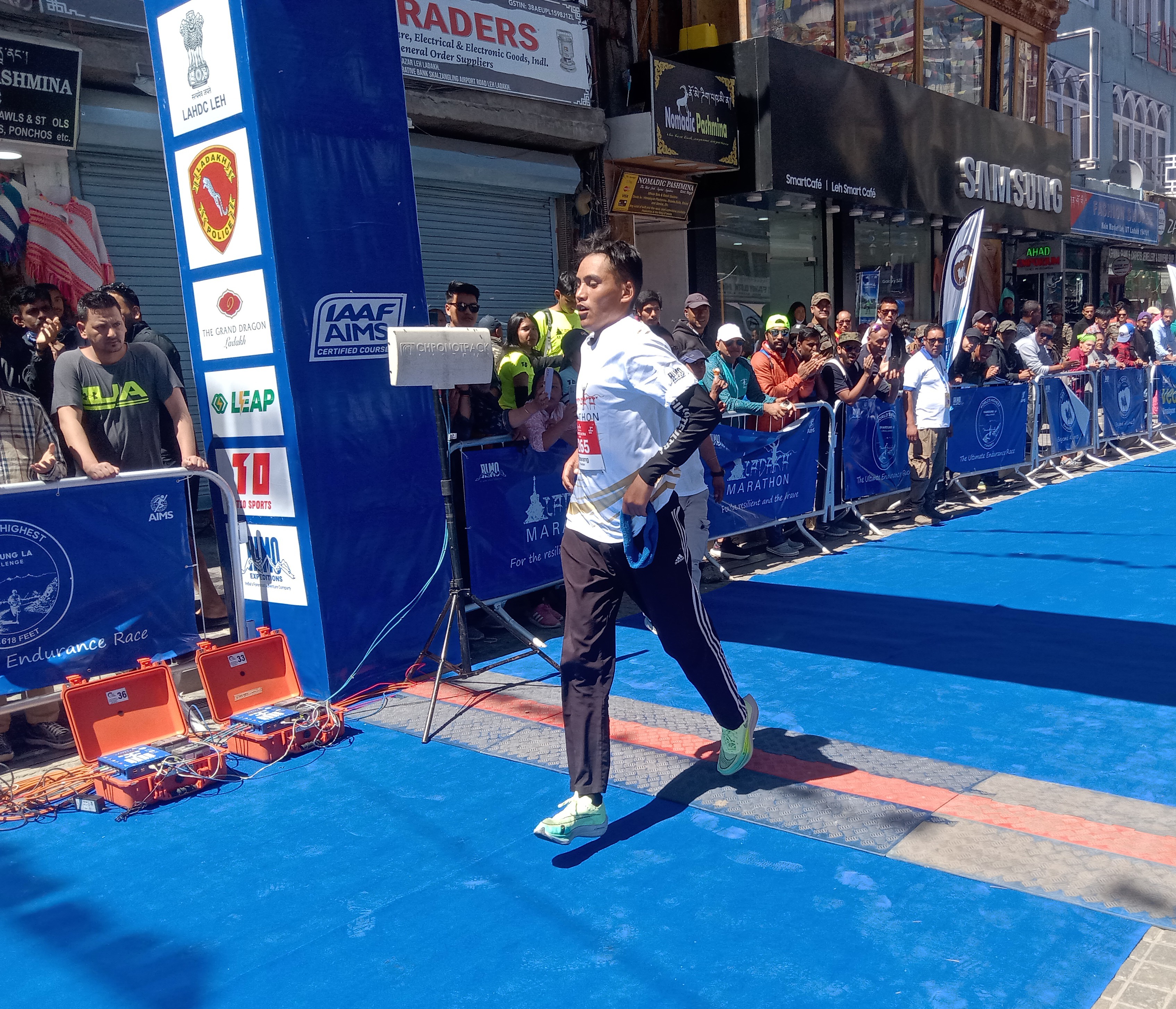
Stanzen Phuntsog at the finish line (photo: Shyam G Menon)
The general belief at this time in our vehicle was that the SRU race leader (as measured by being at the head of the column of runners) was Maik. Somewhere around this time, we had seen a faster moving line of headlamps work its way up the slopes near North Pullu and eventually overtake our parked vehicle. It was the lead pack of KC, an event long dominated by Ladakhi runners, especially personnel from Ladakh Scouts. Starting their race from Khardung village at 3AM, they had caught up with SRU. It was time for us to move further up towards Khardung La. Doing so, along the way, we passed the tall figure of Amit Gulia and realized we had incorrectly assumed for quite some time that Yangzam and thereafter Maik, was the SRU race leader. Amit had opened up such a lead that he held not even a stretched link to the SRU runners behind him. He was off on his own. Much before in the race, when the vehicle was keeping Thupten company in the Kyagar-Khalsar section, we had been informed of Amit being the first to go past Khalsar. Hours later, when we met him in the heights above North Pullu, he was still doing a steady but slightly tired pace and most importantly, distinctly ahead of the rest from SRU’s 7PM and 8.30PM batches. Assuming he kept that lead and finished first in Leh, he would still be up against the 8.30PM-batch of elite runners and their net time to finish. Past Amit, we found the leaders of KC working their way up.
Namgyal Lhamo who topped the women’s category in Khardung La Challenge (photo: Shyam G Menon)
At Khardung La, we paused to talk to Amir Shandiwan, partner at Sports Timing Solutions. He was there in the biting cold of 17,618 feet, with his team and their timing equipment. We learnt there that there was a KC runner further ahead. On the downward slope to South Pullu, we saw him – a runner from the Ladakh Police. His lead was however short-lived; a couple of bends on the road later, we looked back and saw Rigzin Gyurmeth of the army’s special forces catch up with him and grab the lead. Continuing to Leh at a consistent fast pace, Rigzin would win KC in six hours, 31 minutes and 41 seconds. Jigmet Stobdan (6:57:09) secured second position while Sewang Namgyal (6:57:28) placed third. Among women at KC, the first place went to Namgyal Lhamo (8:12:42). Kunzang Lamo (9:29:36) and Tenzing Dolma (9:46:09) followed in second and third positions respectively. But it was two other results – both from SRU – that stood out.
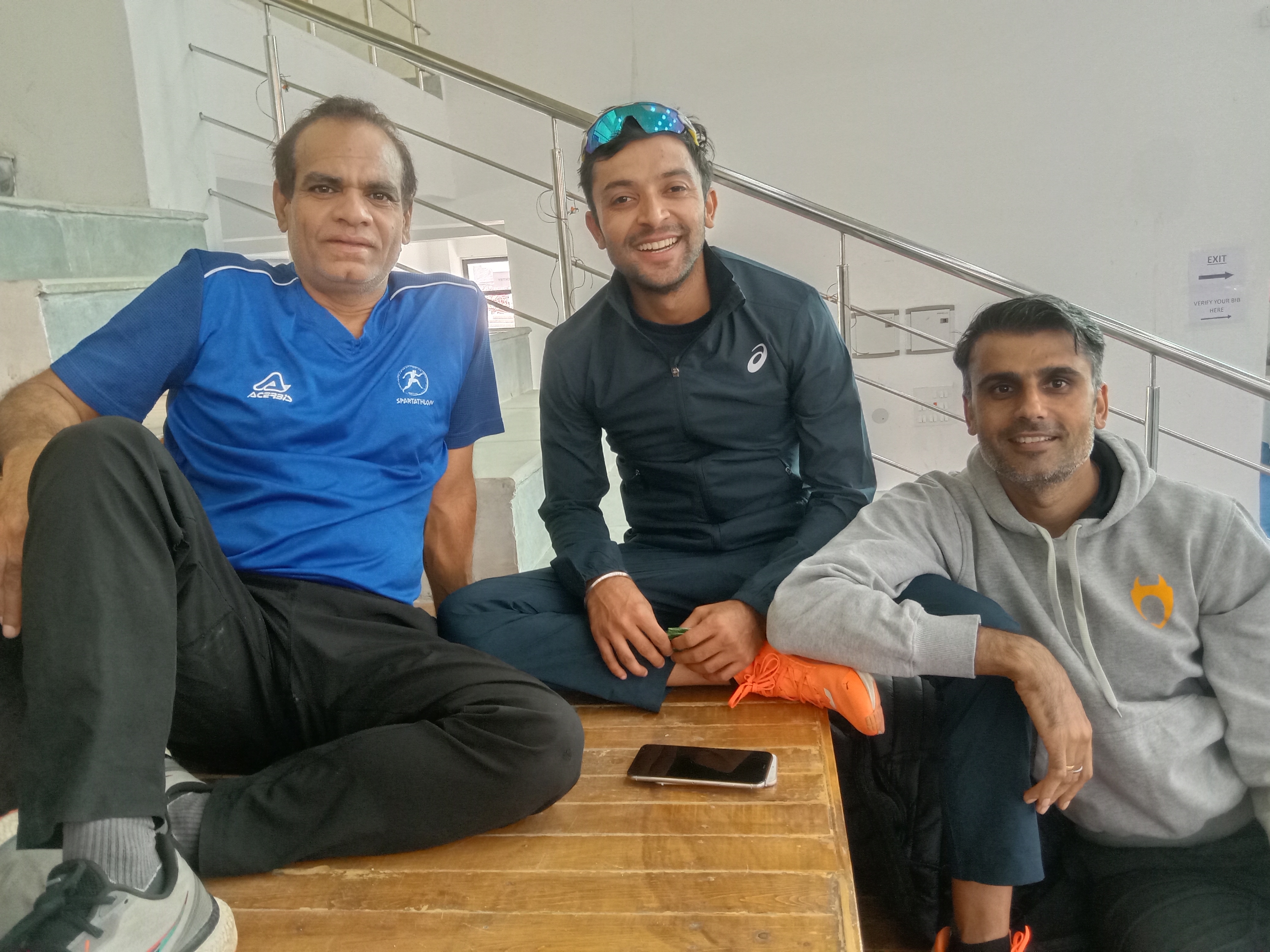
From before the race; Amit Gulia (right), who topped among non-Ladakhi runners at 2023 SRU, with his friends Anmol (centre) and Rakesh Kashyap at the Ladakh Marathon expo (photo: Shyam G Menon)
The organizers of SRU and KC deserve credit for one of the most impressive and enjoyable finish lines in India. It is set in Leh’s main market area, which is closed to traffic and is a much loved, well-maintained spot featuring quaint buildings sporting Ladakhi architecture. Adding to the ambiance is the backdrop of being in the mountains and a long blue carpeted alley guiding runners to the finish. It is well done and with the alley lined by cheering people and friends and relatives of the finishers, the final stretch is quite lively and intimate. As the runners crossed the finish line and the medical / recovery tent gained activity, a familiar face was seen helping exhausted athletes. Elevated blood pressure may have prevented Phunchok Tashi from competing in SRU but the ITBP runner volunteered at the finish line, helping fellow runners in the medical / recovery tent. In line with expectations, the winner among men at 2023 SRU, was Shabbir Hussain (15:27:53). Second place went to Kundan (15:53:46) and third to Stanzen (15:57:46). It was a sweep by Ladakh Scouts. Much before this army trio crossed the finish line, another SRU finisher in the male category had arrived – it was Amit Gulia. With a timing of 16:21:25 and fourth place overall, Amit’s was the first sub-17 hours finish by a non-Ladakhi in SRU. It was without doubt an amazing performance and a benchmark to remember for outsiders reaching Ladakh to try their hands at the race. Incidentally, Amit too had reached Leh as part of a trio. He, Rakesh Kashyap and Anmol Chandan were three friends participating in the SRU. Despite his best efforts, Anmol couldn’t complete the race. Beset with a decline in oxygen saturation level, he had to DNF after 66 kilometres. According to him, Rakesh too had to pull out. Still, the most impressive story of the 2023 race lay elsewhere.
Tsering Yangzam, winner among women in the 2023 Silk Route Ultra (photo: Shyam G Menon)
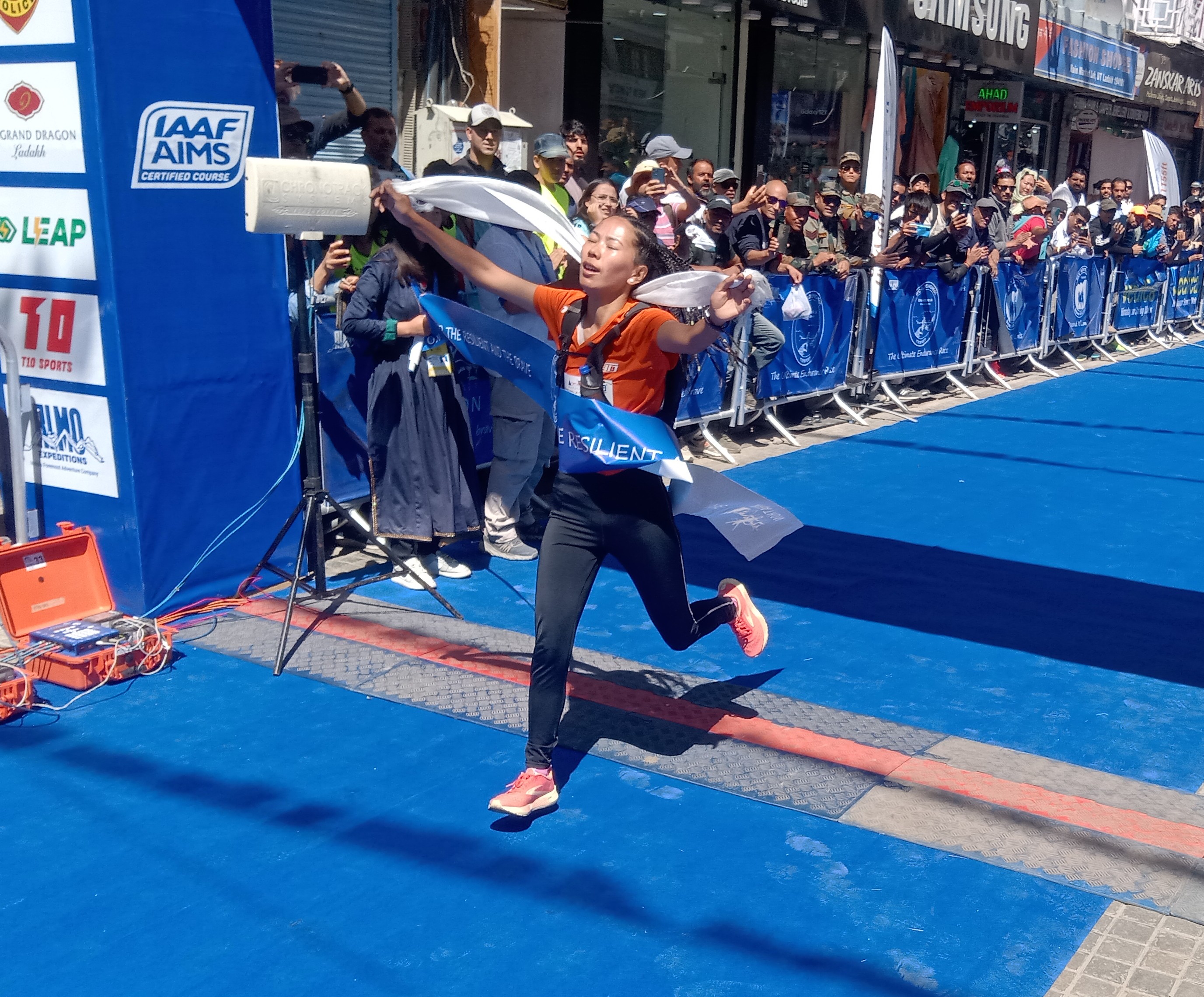
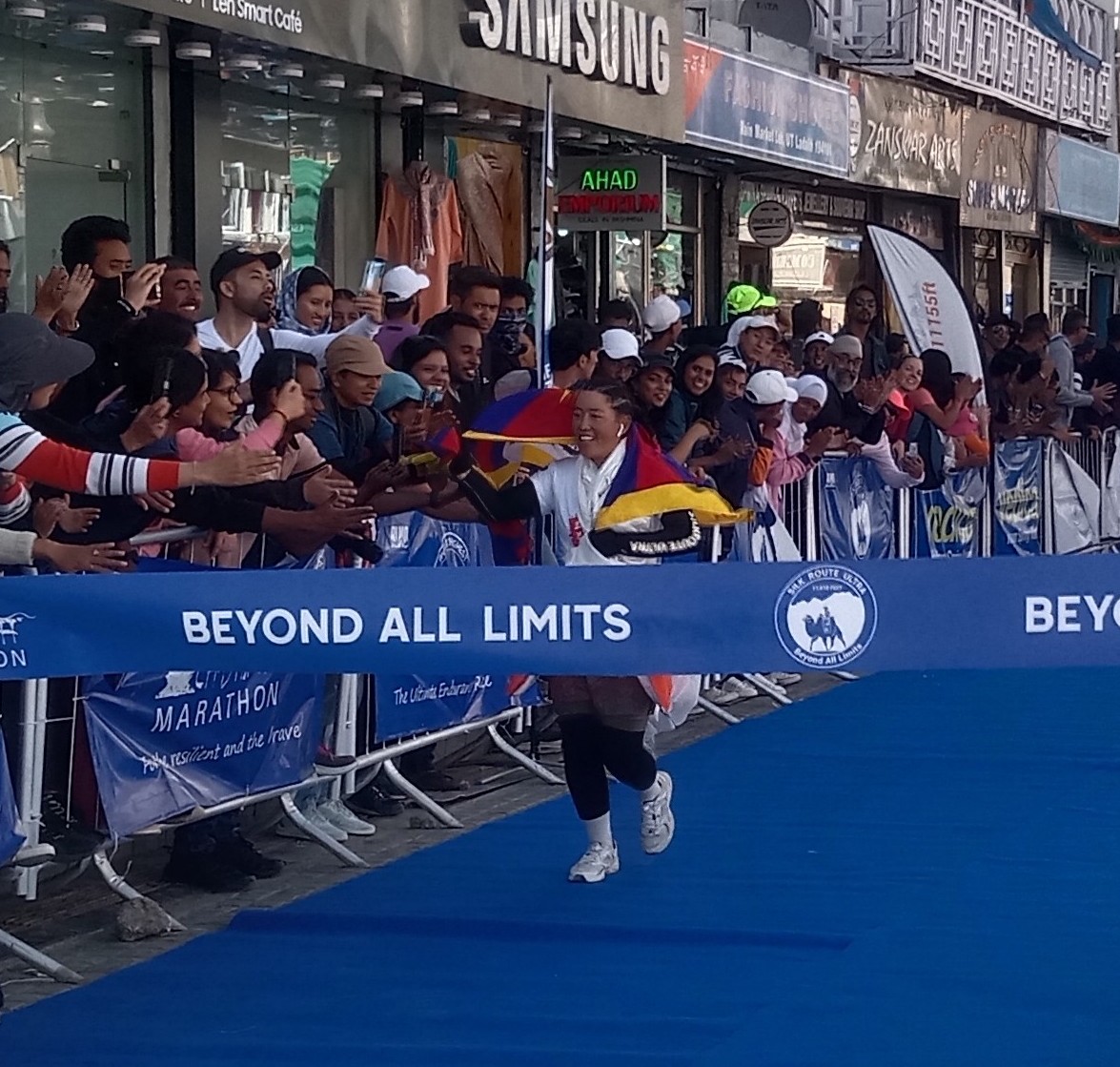
As a couple of hours went by at the finish line in Leh without a female finisher for SRU arrived yet, this writer checked with race officials to see if any woman from SRU had passed Mendak Mor, where the race had its penultimate set of timing devices before the finish line in Leh. The young man at the counter went through the data on his laptop and said yes, one female participant of SRU had gone past the time station at Mendak Mor. Incredibly, it was Yangzam. The SFF runner hadn’t given up. Sometime later, she crossed the finish line of SRU in Leh, an utterly happy person. As she sat afterwards in the medical tent, one couldn’t help walking up to her and offering congratulations. From a runner with the odds stacked against her, she had completed SRU, won in her gender category with timing of 19:26:17 and placed eighth overall. Shikha Pahwa (20:12:57) placed second among women and tenth overall. “ The arrangements were very good. No problem at all. Before we reached the start point of KC itself there were about seven aid stations offering water, bananas, sandwiches and electrolyte. Also, there were vehicles linked to the event, moving up and down. During the first stretch only the Silk Route Ultra runners, were there. This stretch was well covered by volunteers. Once the Khardung La Challenge started there were a lot more runners. After Khardung village, all the way up to the top, it was quite a challenge, quite a struggle. The last five to six kilometres were a push. The downhill stretch was also not easy but definitely easier than the uphill stretch. I resorted to walk-run all along. There were no women finishers after me. Of the 47 runners for Silk Route Ultra, only 19 finished the race. It was a well-organized race. Just the blocking of traffic was a major advantage for the runners because we did not have to worry about traffic at night. I had no time for recovery. I finished the race on the evening of September 8 and had to take a flight back to Delhi next morning. My recovery will start now. My calves are swollen. They were very tight right from the beginning. I had to stop a couple of times during the race to get help from volunteers to release the tightness. By the end of the race, they were quite swollen. I guess, it will take a few days for the swelling to ease,’’ Shikha said.
Dinesh Heda (extreme left) with friends at a post race celebration (photo: courtesy Dinesh)
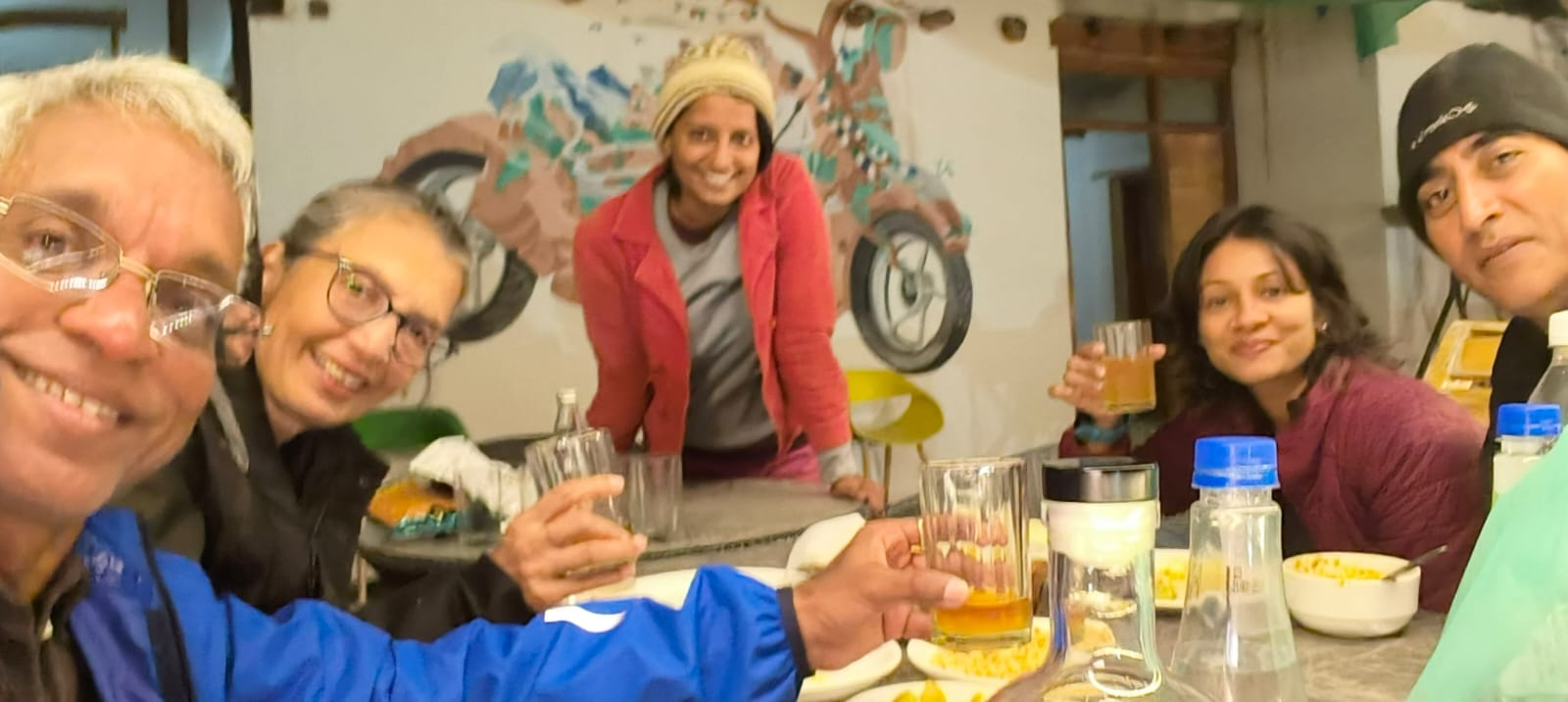
Among those who had to give up, was Ashwini Ganapathi. “ I didn’t finish the race. I stopped at 65 kilometres. I got my periods the previous day. I started the race and was doing okay. Just one and a half hours into the race, I started getting a lot of cramps. I managed to run until Khardung village and by then I had severe cramps. My back also was cramping a lot. I took help from the doctors at the aid station. I continued for some time interspersing the run with some rest. But the doctors asked me to take a call as I had a long way to the finish. I stopped about one and half kilometres before North Pullu. My periods arrived five days ahead of schedule. It may have been because of the exertion. I have been here in high altitude for a long time now. When we get periods, we get bloated. I could not drink much water and that’s not a good thing at altitude. If one is not hydrated adequately there could be other issues. I am a passionate amateur runner and I do not want to push myself beyond a point and jeopardize my health. I saw two runners doing the Silk Route Ultra collapse along the way. I have now registered for Ladakh Marathon. I am feeling fine now,’’ she said. By night September 8, Leh’s roads sported the odd person with a tired, vacant, contented look; the tell-tale signs of trial by endurance. There were celebrations. Dinesh Heda, senior runner from Goa, who had earlier told this blog that he would celebrate no matter what the outcome of his participation in KC, kept his word.
(The authors, Latha Venkatraman and Shyam G Menon, are independent journalists based in Mumbai. Shyam was in Ladakh to report on the race. Latha spoke to some of the people quoted herein, on the phone. Our thanks to the organizers of this event for the support they provided to write this article. Our thanks to all the runners and aficionados of running who spoke to us.)
Among Indian runners, Gunjan Khurana and Kartik Joshi were the fastest in their respective gender categories
At the 2023 edition of the Comrades Marathon held annually in South Africa, the Indian contingent represented the largest participation from outside the host nation. Over 400 runners from India registered for the race and a little under 400 of them turned up to run.
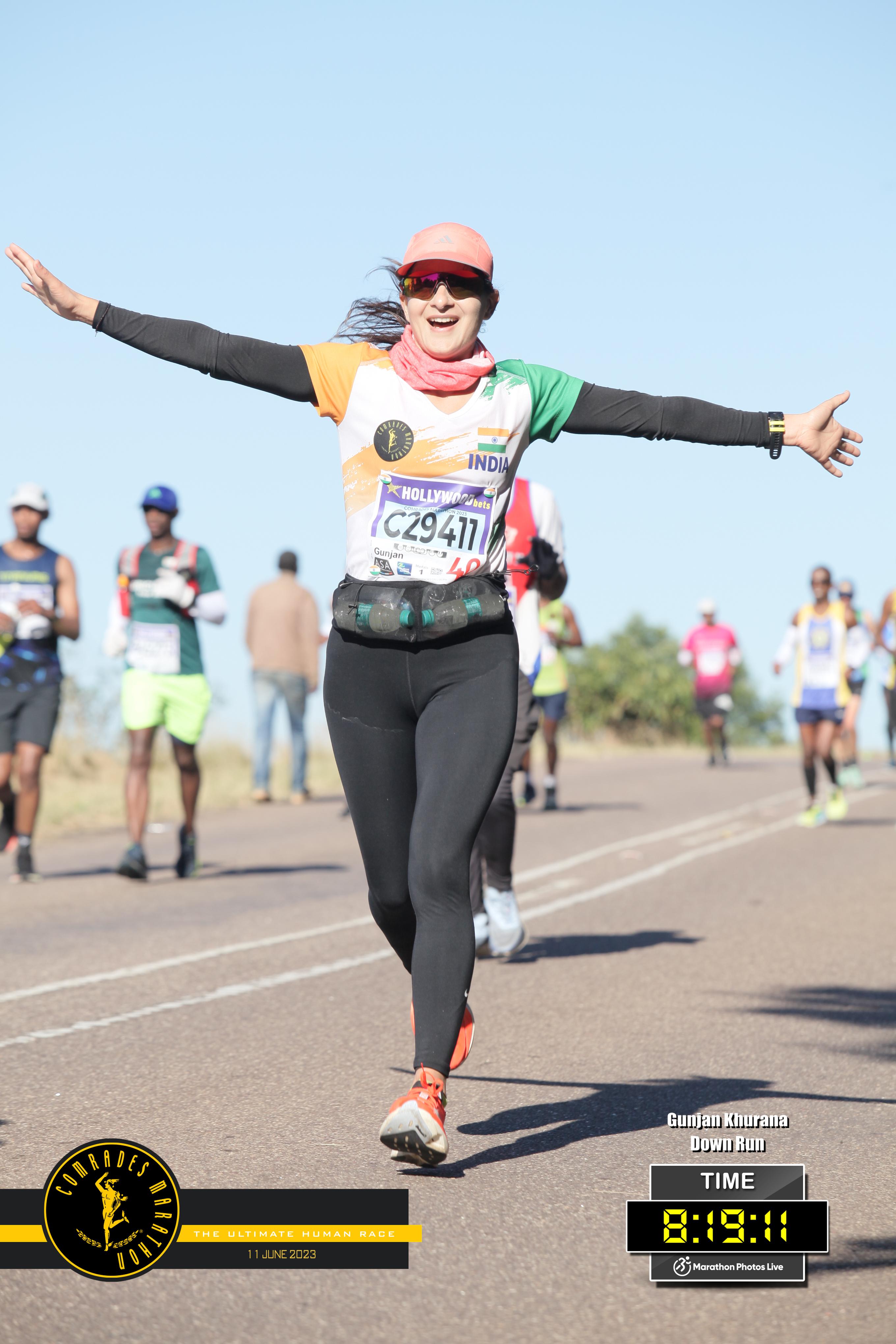
Gunjan Khurana, ultrarunner from Surat, was the fastest among Indian women at Comrades this time. She covered the distance of 87.701 kilometres in eight hours, 19 minutes and 12 seconds. Among Indian men, Kartik Joshi was the fastest with a timing of 7:26:34. Both these timings are the fastest yet for Indian men and women for Comrades but the distance this time was lower than previous years.
The official distance of this year’s Comrades Marathon was about 2.2 km shorter than last year’s 89.885 km. The official distance for Comrades Marathon varies slightly year to year. The Comrades route alternates between Pietermaritzburg to Durban (the downhill version) and Durban to Pietermaritzburg (the uphill version).
This year, the number of entries from India was the highest among international runners. Over 400 runners registered for the race from India. Media reports said about 300 of them finished the race.
The number of Indian entries are expected to increase further, according to Satish Gujaran, Mumbai-based runner and coach, who has completed more than ten Comrades marathon consecutively. “I think 2024 onward runners from tier two and tier three cities will register. I am seeing runners from smaller cities in Maharashtra such as Bhusawal and Sambhaji Nagar registering for this event,” Satish said.
Satish Gujaran (Photo: courtesy Satish)
Asked about the growing popularity of Comrades in India’s running community, Satish attributed it to two mutually linked and synergic factors. First, Indian runners feel welcome at the event; they get good crowd support. Second, any event that treats runners so, makes every participant an ambassador for the event. “ The feeling you get after running Comrades is hard to explain,” Satish said. Other factors like it being an ultramarathon and among major global races, perhaps the one located closest to India (and therefore accessed easier), also count.
In 2019, Gunjan, who represents India in ultrarunning events, had finished the Comrades Marathon in 9:47:42. This time around she trained quite well for the race. “There were 23 runners from Surat for Comrades this time,” she said.
Most Comrades runners do long hill runs as part of their training to prepare for the rolling hills along the route in South Africa. “We Surat runners did three long hill runs at Kalibel and Saputara of distances of 40 km, 45 km and 55 km. As it was very warm, we would start our run at 10 pm and finish in the morning,” she said.
Gunjan trained under runner and coach Hemant Beniwal. At Comrades, she did not want to focus on timing as that approach does not work well with her.
“Comrades is a very well-organized race with continuous cheering, ample hydration and nutrition support throughout the route,” she said. “When the race started, it was quite cold but as the sun came out the weather improved,” she said.
Gunjan has qualified for the IAU 100 km Asia & Oceania Championships to be held at Bengaluru on July 30, 2023. Post-Comrades, she has been focusing her training on this upcoming race. Gunjan and Kartik Joshi have been named by the Athletics Federation of India (AFI) to participate in this event.
Yogesh Satav (Photo: courtesy Yogesh)
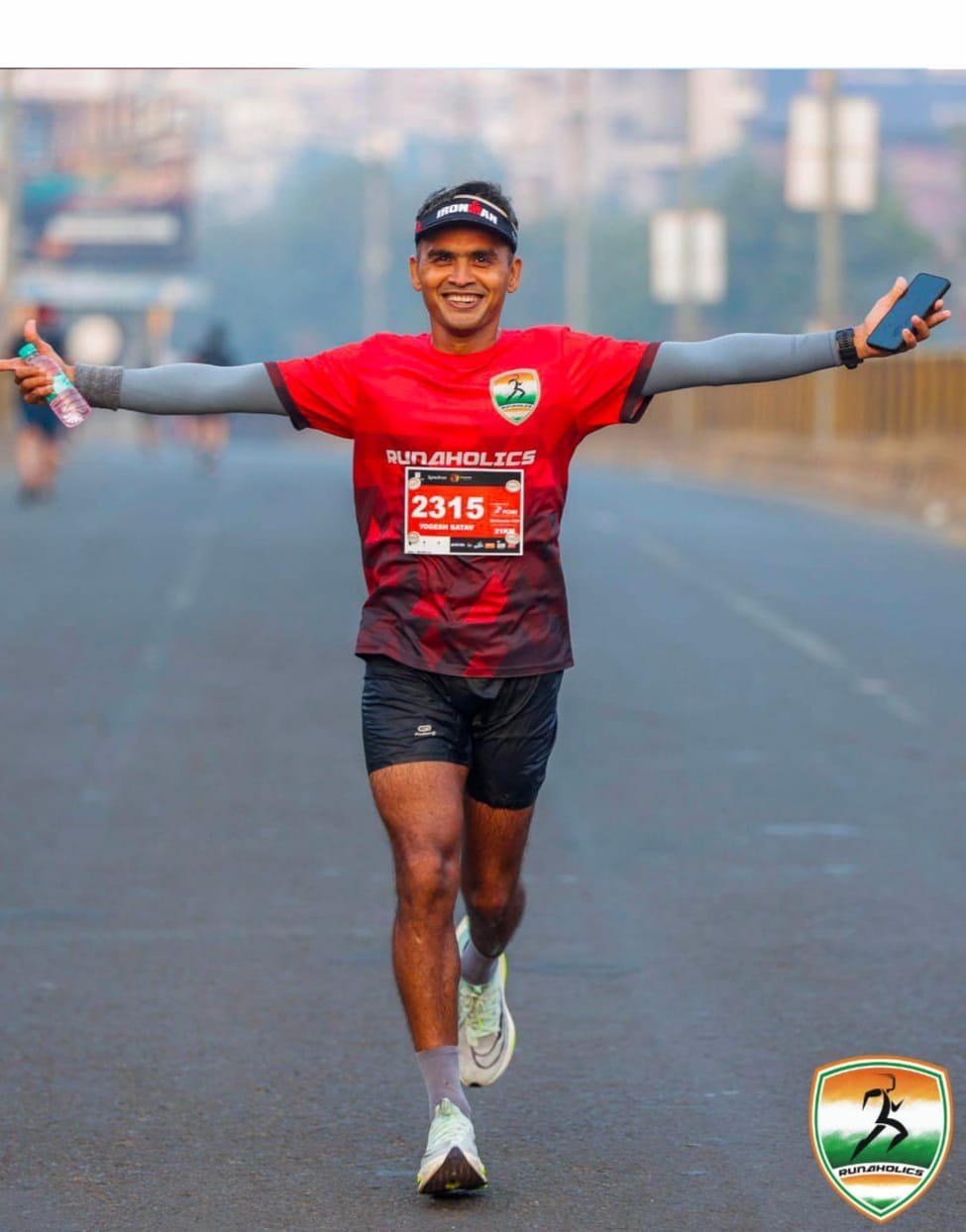
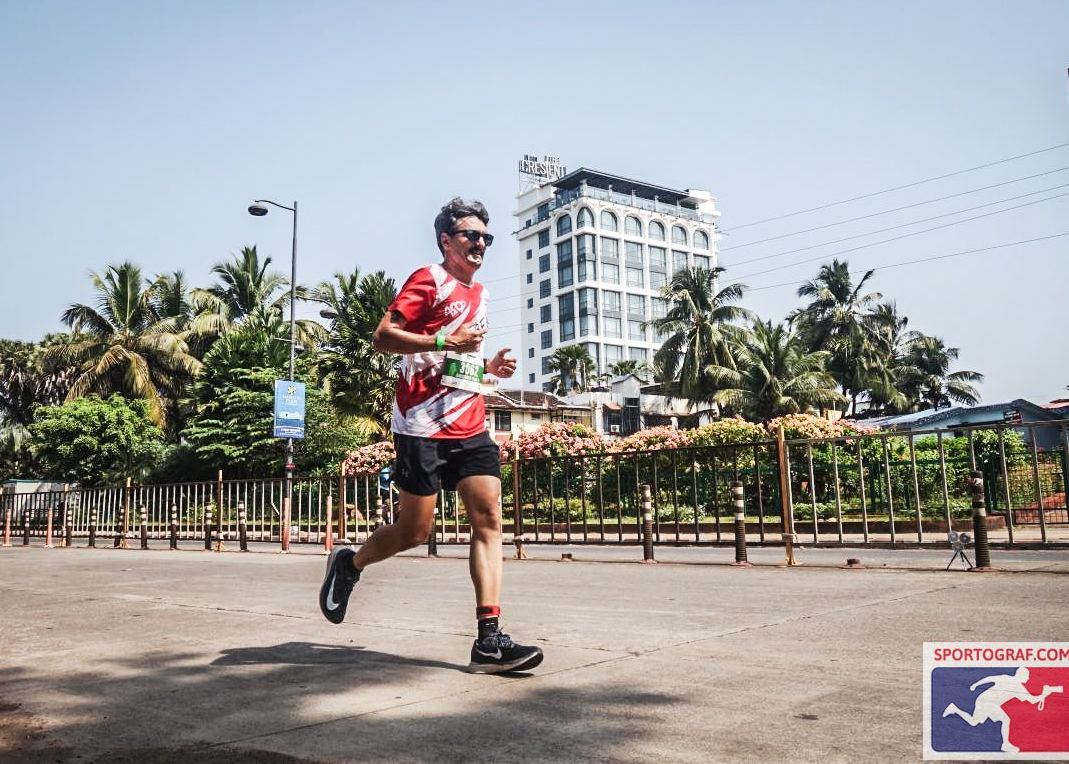
Pune-based Yogesh Satav has been running since 2015. This was his first Comrades run and he finished the distance in 7:48:44 earning a Bill Rowan medal.
“This was the first time I was racing a distance beyond the full marathon,” he said. Yogesh, also a coach, started training for Comrades after Tata Mumbai Marathon in January and Tata Ultra in February. “We did a four-month training for Comrades including three long runs of 56 km, 65 km and 70 km,” he said.
A paediatrician by profession, Yogesh had a pace target of 5:20 per km but ended up bettering it slightly to 5:18. “I had no physical problems during the run but had mental issues,” he said. During the race, he had to battle a low feeling but overcame it after a few kilometres.
Having done the downhill version of Comrades Marathon, Yogesh plans to go for the uphill version due in 2025. His wife Rashmi Satav also did the Comrades this year.
Yogesh is into triathlons as well. Last year, he did the Kazakhstan Ironman, originally slated to be held in 2021 but cancelled due to COVID-19 pandemic. He has done a number of triathlons including Kolhapur Triathlon 2018, Goa Ironman 2019, Bergman Kolhapur 2022, Ironman (full) South Africa 2022 and a few Olympic distance triathlons.
Next on the cards for Yogesh is Satara Hill Marathon 2023, slated to be held in early September. It will be followed by the Bergman Triathlon at Pune. “This time, 42 of my trainees are participating in this event,” he said.
He will then focus on training for the 2024 Mumbai Marathon. “I would like to improve my timing to sub-three hours,” he said.
Deepak Budhrani (Photo: courtesy Deepak)
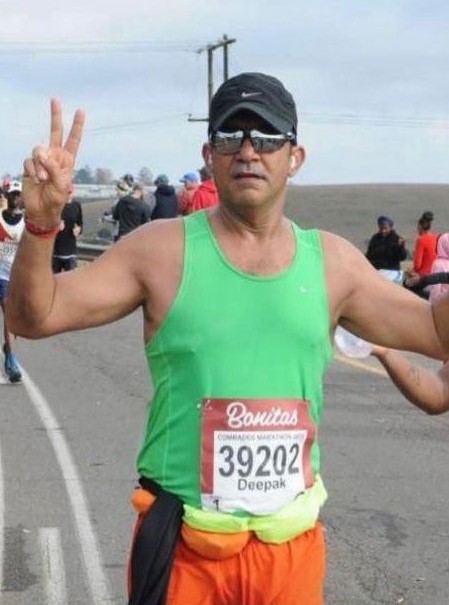
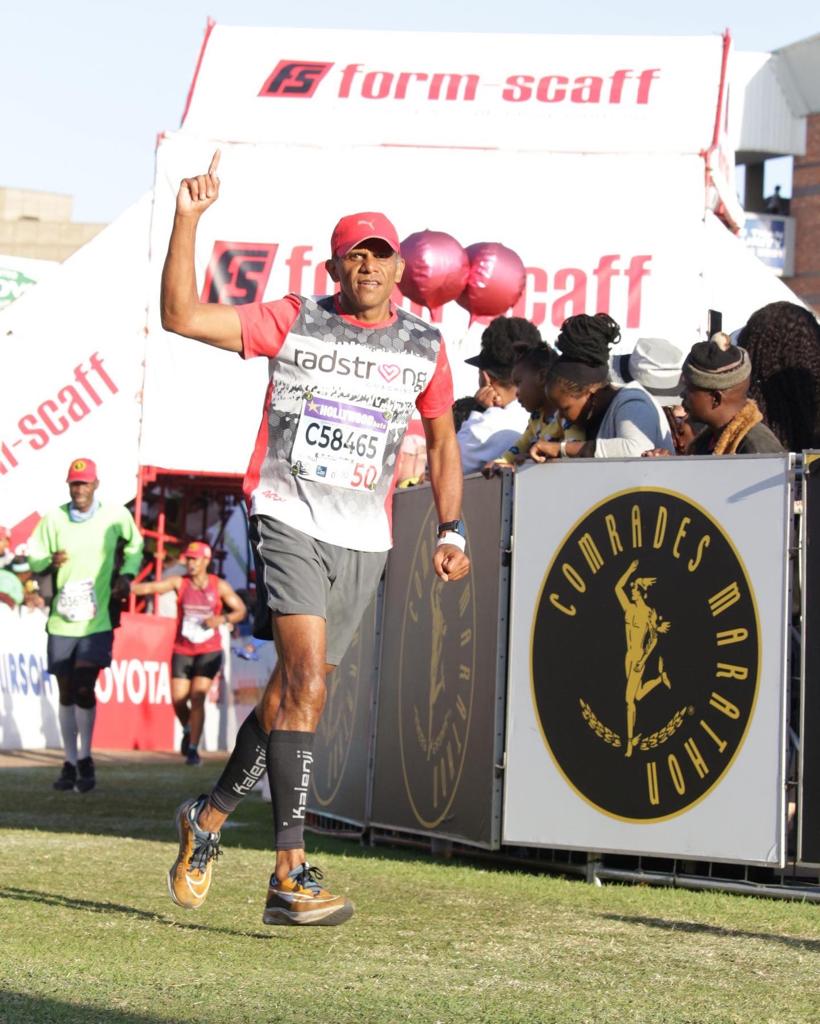
For Deepak Budhrani, the 2023 edition of the Comrades Marathon was his fifth finish. Of the five finishes, three were downhill versions and two uphill versions.
Deepak finished the run in 8:49:55. “This is the best timing among my five Comrades,” he said. With this finish, Deepak secured his second Bill Rowan medal.
The Bill Rowan medal was introduced in 2000. The medal is named after the winner of the first Comrades Marathon in 1921. The medal is awarded to runners finishing in 7:30 hours to sub-nine hours. “I am hooked to Comrades. I will continue to run it for many years as long as I can,” he said.
Dhanraj Helambe (Photo: courtesy Dhanraj)
Dhanraj Helambe, a doctor practicing in Pune, curated his own training plan for Comrades, his first attempt at this ultramarathon in South Africa.
He has been running for the past 5-6 years but he is also into cycling and swimming. According to him, his training went well with adequate mileage during weekdays and weekends. His hill runs were at Ghoradeshwar Hills along with long runs including the 50 km Tata Ultra at Lonavala, 65 km at Kaas and a 100 km at Pune Ultra.
Dhanraj completed his Comrades run in 9:13:54.
Once back, he has been cycling and swimming. These activities have helped in his post-run recovery.
Dhanraj wants to focus on triathlons. “I want to do the Durban Ironman, which is held one week before Comrades,” he said. He is also planning to do Ironman Kalmar in Sweden. “To train for these events, I plan to do some local triathlons including Goa Ironman, Kolhapur Triathlon and Bergman Triathlon,” he said.
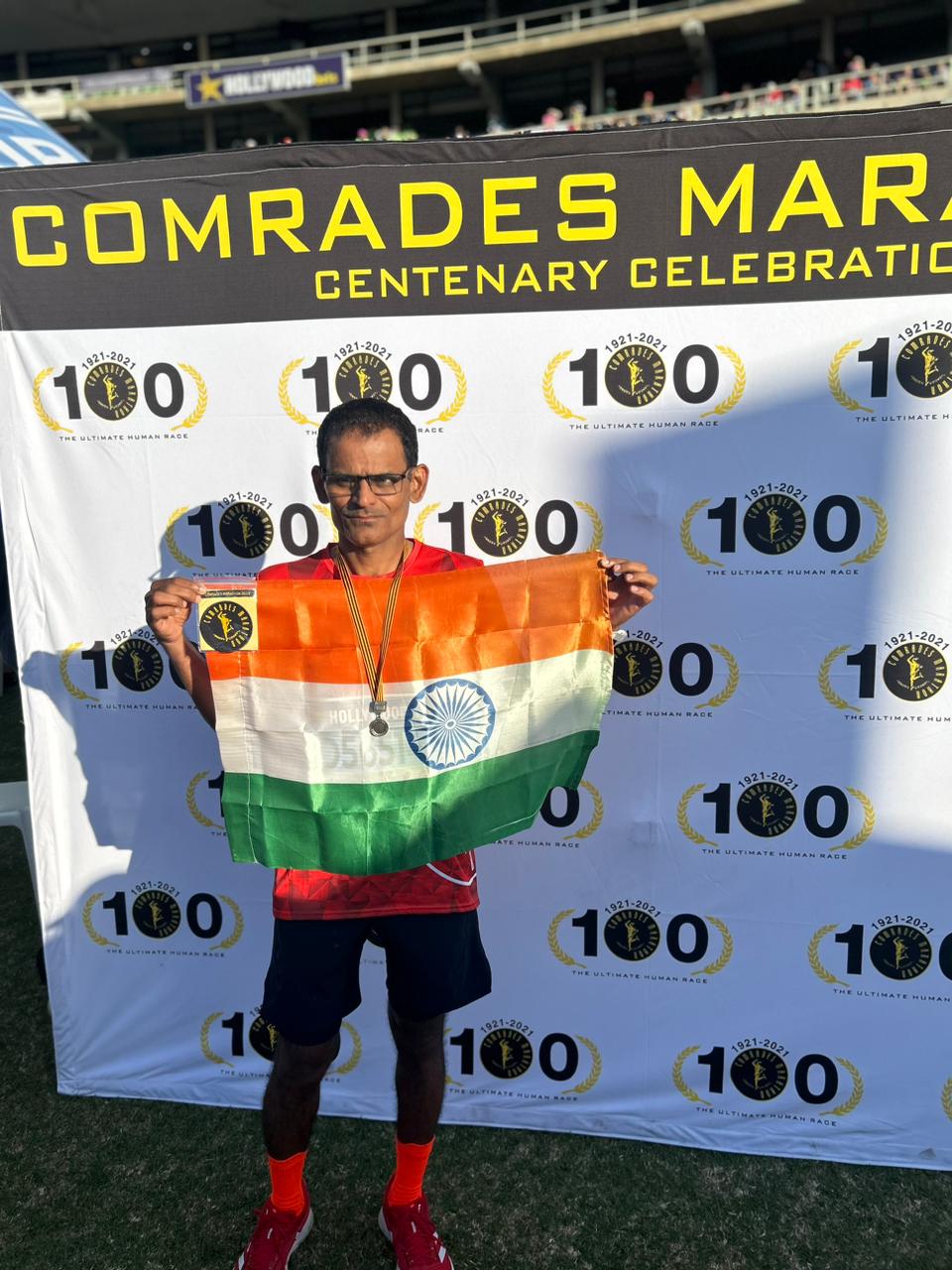
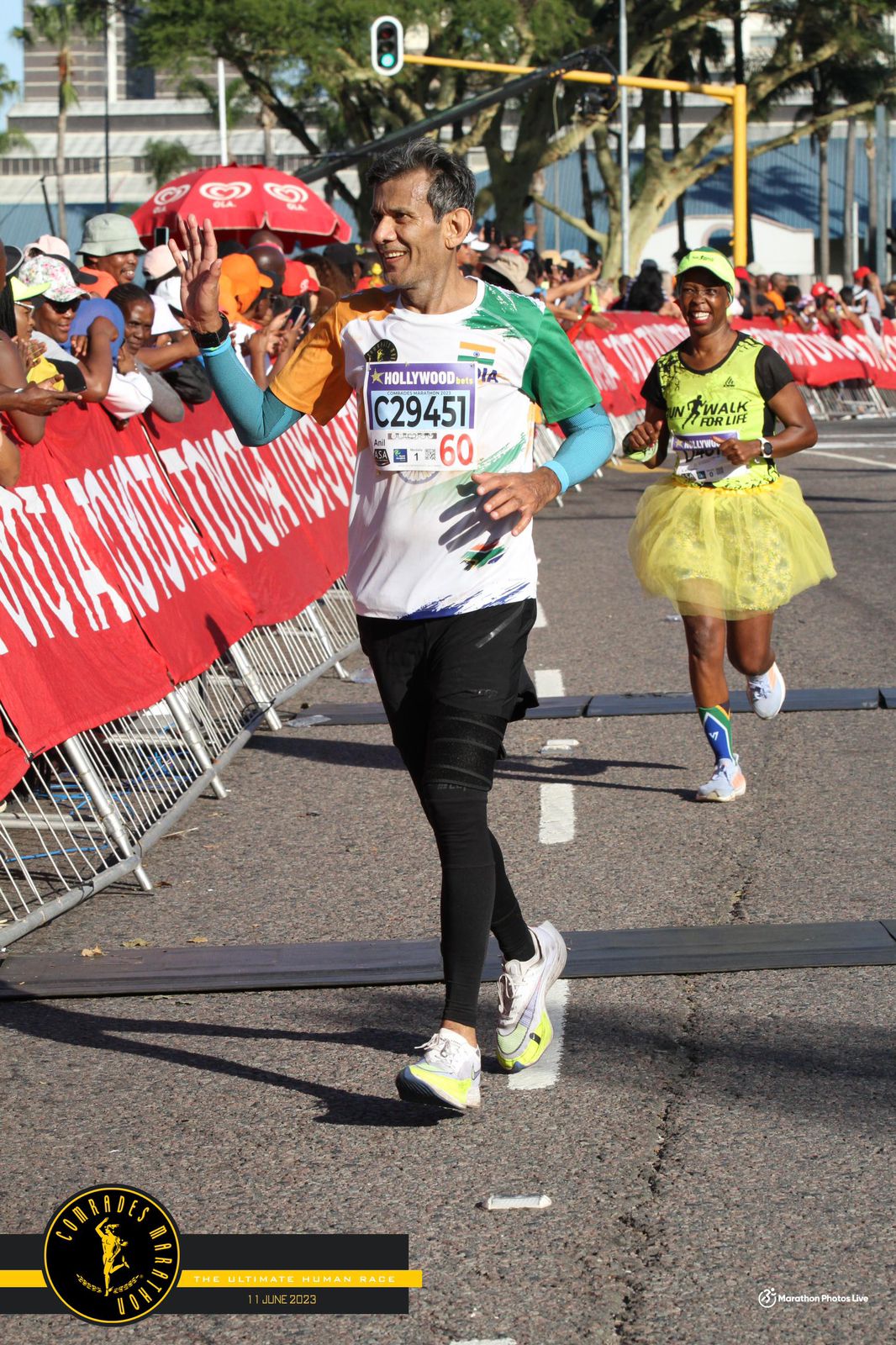
Anil Malik (Photo: courtesy Anil)
Anil Malik, 61, started running about 10 years ago when confronted with a health issue. Active in sports during his schooling and college years in Rajasthan, he ended up in a sedentary lifestyle routine until a health warning prompted him to take up some activity.
Soon he was running events, occasionally winning age category podium finishes. He is a regular at Mumbai Marathon, Tata Ultra, Vasai Virar Municipal Marathon among others.
In 2019, he completed the uphill version of Comrades Marathon.
“I train myself. My simple theory is to do varying speed runs for four to five days a week. There is no need for a huge mileage,” he said. His weekend long runs are also at target pace.
Anil went into the race at Pietermaritzburg with a target of 9:30 finish. “I took a conservative approach. For up to 75 km distance, I would run for three kilometres and take a two-minute walk break. In the last stretch, I took a one-minute walk break between every kilometre,” he said. Anil finished the ultra-distance in 9:33:37.
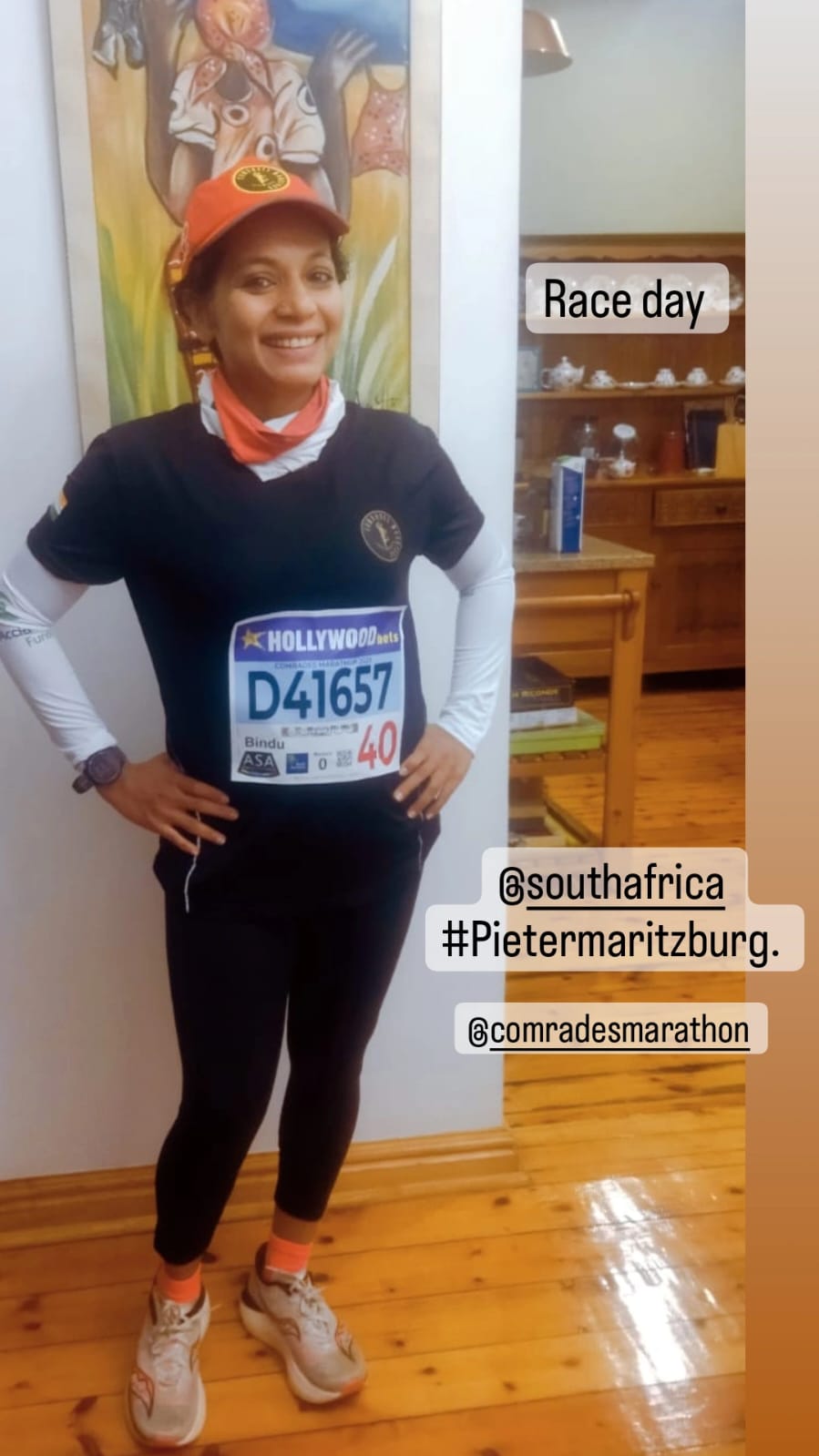
Bindu Juneja (Photo: courtesy Bindu)
For Bengaluru-based ultrarunner Bindu Juneja,the Comrades Marathon was long overdue. To qualify for this year’s Comrades, she did the Adani Ahmedabad Marathon in 3:46:08 and thereby secured a good corral.
“I wanted to train for Comrades from January onwards but I had to divert my attention to train for a 24-hour run that was due on March 23, 2023. I am keen to qualify and be part of the Indian team for the upcoming IAU 24-Hour World Championship (due to be held in December 2023 at Chinese Taipei),” she said. At the said race, she was unable to meet the qualifying mark.
“I was left with just one and a half months to train for Comrades. I had to first recover from the 24-hour run and that took time,” she said. She did a short, dedicated dose of training including a long run at Turahalli. She has to divide her time between training for ultramarathons, working as a teacher and managing her home.
She reached South Africa three days before the race but was plagued by glute and IT band pain. During the run, at around 55 km, she found she had a chafing injury in her inner thigh and that only got progressively worse as the kilometres went by. At the end of the run, she was in agony. Bindu completed the run in 9:57:20.
Two weeks later she was back to her training runs. Her training will now focus on the 24-hour run; one is due in September 2023. “I would like to take a shot at qualifying for the Chinese Taipei event,” she said.
Rahul Kulkarni (Photo: courtesy Rahul)
A fitness enthusiast, Pune-based Rahul Kulkarni and friends were into cycling and running and were happy doing short distances over weekends. But his curiosity got the better of him when he found runners training for the 2018 edition of the Mumbai Marathon. Unfortunately, the slots for half marathon were already full.
“We searched for events and found PRBM (Pune Running Beyond Myself) and registered for it. Later, I also did the Kolhapur Duathlon,” Rahul said. He started training with a coach and soon learnt about triathlon, mainly Ironman.
For somebody who was content doing short training runs and cycling sessions not long ago, he found himself moving from event to event (marathons and triathlons) including the Ladakh Marathon, Kazakhstan Ironman, Colombo Ironman, Langkawi Ironman and local triathlons.
Rahul is due to participate in Ultraman Florida in February 2024. Ultraman is an endurance triathlon event spread over three days. Ultraman Florida covers a distance of 517.5 km including a 10 km open water swim, a 423 km bicycle ride and an 84 km ultramarathon run. The bicycle segment is divided in two phases – 147 km held on the first day of the competition after the swim, and 274 km on the second day.
“After I completed Kazakhstan Ironman last year, I joined Kaustubh Radkar’s team to train for the upcoming ultraman,” Rahul said. A former national level swimmer, Kaustubh has competed in a large number of endurance events, mainly triathlons and marathons. He has completed 34 Ironman events, one Ultraman and earned the six-star World Marathon Major medal (which entails running six World Marathon Majors). Kaustubh has been coaching recreational runners and triathletes for the past few years.
Rahul’s training for Comrades went off well and he had a good run at the event with a finish of 10:14:04. “We were seven of us from Kaustubh’s team. I will definitely go back. It is such a celebratory event, akin to a carnival. People come from villages with food and drinks to the route and join in the cheering of runners,” he said.
Yasmin Gulab (Photo: courtesy Yasmin)
Yasmin Gulab, a resident of Coonoor, Tamil Nadu, took up running about five years ago as a means to lose the weight she had gained during her pregnancy. Her first run was a 10 km race at an event in Coimbatore sponsored by Information Evolution, a company she co-founded and is now president of.
She started enrolling for 10 km and half marathon runs, winning a few podium positions along the way.
The pandemic induced lockdown of the subsequent years prompted her to take up running seriously. She joined Kannan Sundarajan’s KaysFIT Academy for training. Coach Kay as he is known introduced Yasmin to Comrades. “I started training in 2021 but suffered an ankle fracture and had to stop running,” Yasmin said.
After recovering from her injury, she had to start all over again. “I had to get back to walking and then slowly progress from 5 km and 10 km to 21 km runs,” she said.
In January 2023, she ran the full marathon at Tata Mumbai Marathon to qualify for the 2023 Comrades. Her 4:15:09 finish at this iconic marathon helped her to qualify for the South African ultramarathon.
Her training for Comrades was executed with caution as she did not want to get injured. “My weekly mileage was quite conservative, around 80-90 km and my long runs were not in excess of 45 km. But I compensated my low mileage with strength training,” she said. As part of her training, she participated in the 60 km category at Ooty Ultra. She finished the distance in 7:52:11 winning the women’s race and in the process setting a course record for women.
“I even trained my gut. I would eat and immediately set out for a run. I managed to stay injury free throughout the training period,” Yasmin said. However, before she was to leave for South Africa, she fell ill. After recovering, she left for the race.
“The run went off quite well. As it was a downhill version, I did have some issues with my ankle but nothing unfortunate. I finished the run in 10:21:42 against my coach’s broad target of 10:30 hours,” she said.
Training for Comrades, according to Yasmin, was a life changing experience. “When I crossed the finish line at Comrades, I had a feeling of gratitude. My entire family (husband, son, daughter and her mother) were there at the finish line,” she said. Barring some soreness for a day, her recovery has been good.
The next race on the cards is Bengaluru Marathon 2023 in which she is doing a half marathon. “My focus will be Comrades and along the way I will do Tata Mumbai Marathon. I would like to improve my timing here,” she said.
Madhuri Palli (Photo: courtesy Madhuri)
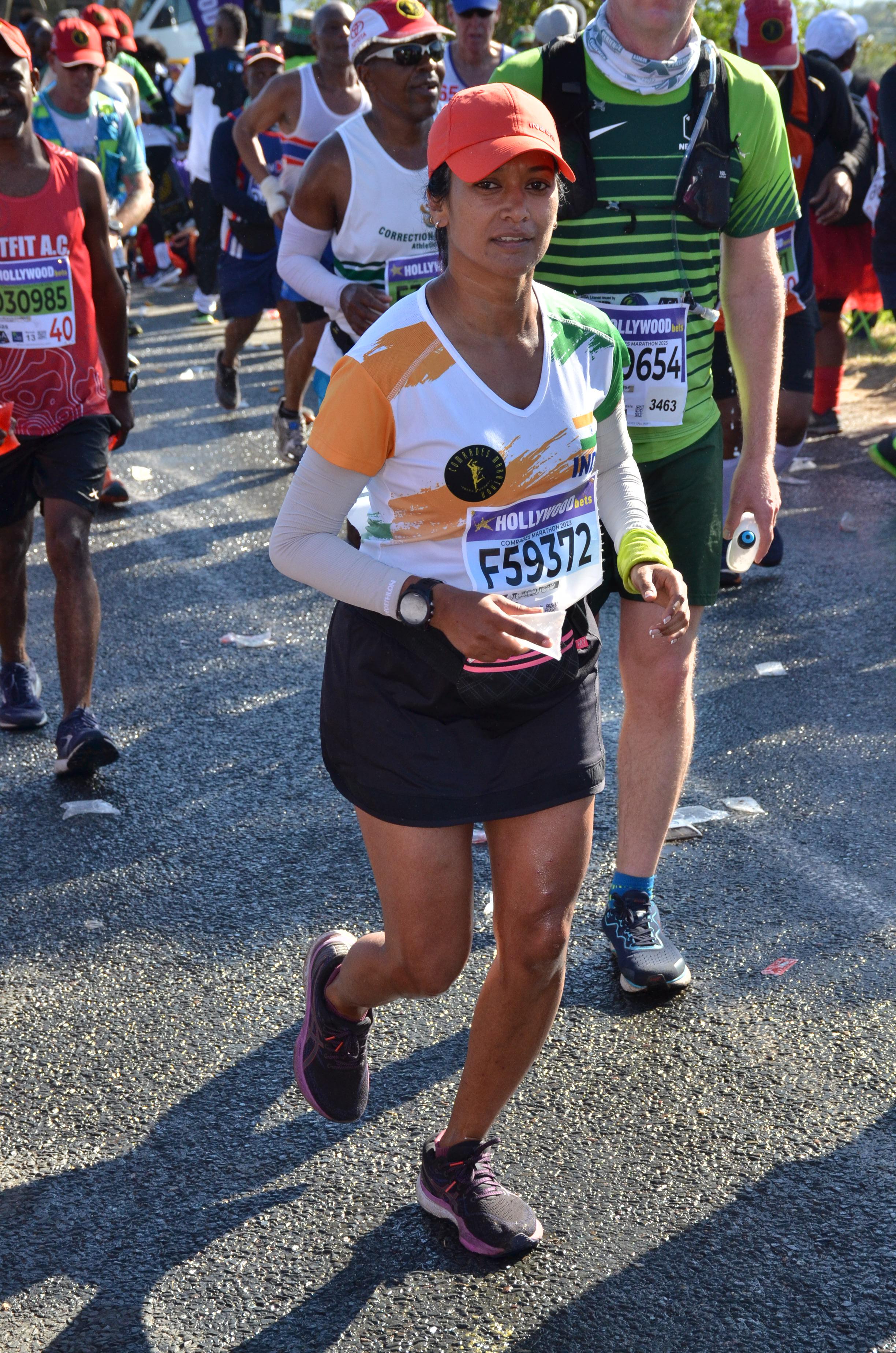
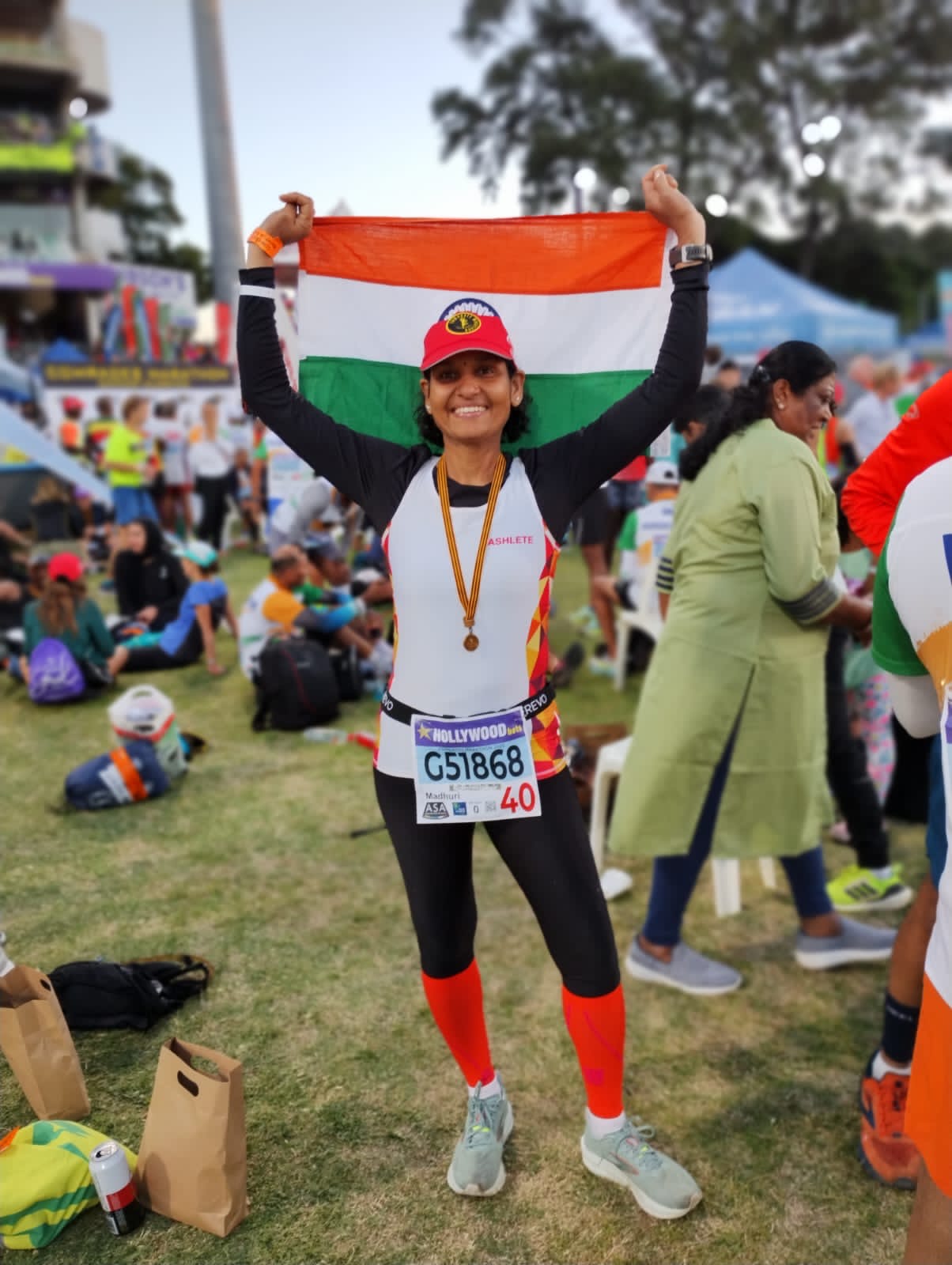
Vishakhapatnam-based Madhuri Palli, returning to running in 2023 after recovering from an injury, was keen to do a major event. She chose Comrades Marathon and after conferring with her coach Ashok Nath she commenced her training program, curated by her coach.
“The first six weeks of training focused on mileage at an easy pace. I participated in a 50 km event at Vizag Ultra but missed the qualifying time by one minute. I had to do Kolkata Marathon in February to qualify,” she said.
The second phase of her training entailed lowering mileage but stepping up the pace. This was followed by tranche training, in which a long run is split into many parts. Madhuri was asked to run four times a day – 5 AM to 7 AM, 9:30 AM to 10:30 AM, 12 noon to 1 PM and 3 PM to 4 PM. “It was aimed at strengthening our determination for the race. This training method is really a game changer,” Madhuri said.
Her hectic training had to be executed in the midst of her busy work schedule as a radiologist at a hospital.
At Comrades, the timing is calculated from the time the start gun goes off. By the time, Madhuri crossed the starting mat, she had already lost eight minutes. “When we started it was cold and my feet was numb. After about 15 kilometres when the sun came out, I started to feel better,” she said.
In most running events, the distance markers show the mileage covered for much of the route. But at Comrades, the markers indicate the number of kilometres left for finish.
“The Comrades route is a series of rolling hills. Although it was a downhill version, there are a number of uphills to tackle along with downhills,” she said. The best part of Comrades is the constant company of runners and the cheering from local residents all along the route. “You never feel alone during the entire 90 odd kilometres,” she said. Madhuri finished the run in 10:25:57. “The credit for finishing this run goes completely to Ash (Ashok Nath),” she said. Ashok Nath has been running for many years. He has run the Boston Marathon, Comrades and the World Marathon Majors.
Madhuri’s physical recovery was good though she had some swelling in her feet for a couple of days. “But mentally it took a while for me to recover. It took two weeks for the post-race blues to go,” she said. She now wants to attempt the triathlon, mainly Ironman.
Ashish Puntambekar (Photo: courtesy Ashish)
Ashish Puntambekar took to physical activity when confronted with the health issues that accompanied a sedentary lifestyle. An IT professional, Ashish was hemmed in by the pressures of the industry that he was associated with, resulting in health indices going off the normal range.
“The first 15-20 years of my career were hyper growth years for the IT industry leaving me with very little time for anything. That resulted in body weight issues and cholesterol going out of bounds,” he said.
Forced to take up physical activity, Ashish took to cycling inside the Pune University campus and running on a treadmill. He eventually took to running outside, initially doing short runs and gradually increasing the weekday and weekend mileages.
“After I joined Kaustubh Radkar’s team there was some structure to my training,” he said.
He went on to do Berlin Marathon, Chicago Marathon and Boston Marathon.
“I did five months of dedicated training for Comrades. I did two 50 km runs, one 65 km hill run, three back to back 30 km and three back to back 21 km along with strength exercises,” Ashish said.
He had a broad target of finishing within 10 to 11 hours. He finished in 10:31:24. “My priority was to complete the run and I did not want to focus on timing as it was my first Comrades. Kaustubh paced me for most of the distance barring the last few kilometres when I was able to push ahead towards the finish line,” he said.
He plans to do the uphill version of Comrades, which is due to be held in 2025.
He has an eye on triathlons but he needs to work on swimming as it is his weak spot in the triathlon.
Rashmi Satav (Photo: courtesy Rashmi)
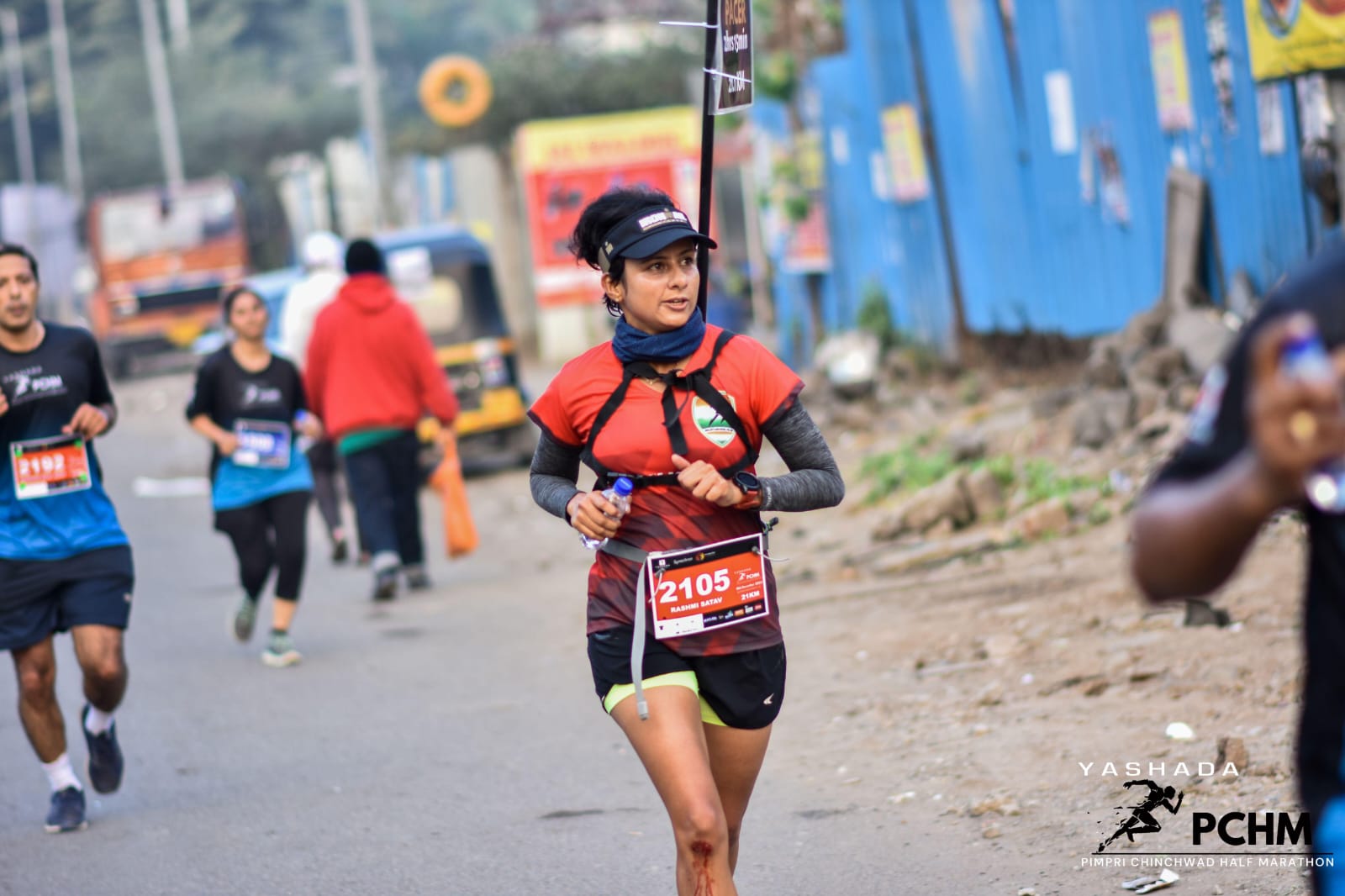
Pune-based Rashmi Satav is into running as well as triathlons. “I have been running since 2017 after my child was born. I initially started with local running events of short distances,” she said. Soon, she started running the half marathon, full marathon and got into the triathlon.
“I have a migraine issue. I cannot tolerate long hours in the sun. I was worried about doing a full Ironman,” she said. She completed the Kazakhstan Ironman in 14:19:31 hours.
She commenced her training for Comrades early though she had to intersperse it with racing the 2023 edition of Tata Mumbai Marathon.
“As part of Comrades training, I ran 50 km at Tata Ultra, did a few night runs at Lavassa and a few 30 kms,” she said. Just a few days before Comrades, she got injured and had to take physiotherapy sessions.
“The run was superb. You get to know why it is the best event. The vibe, the energy and the support are amazing. One is never alone along the entire route,” she said. Her injury did act up but with the help of physiotherapists along the route she was able to continue.
“The crowd just takes one through to the finish,” Rashmi said. She finished in 11:43:39.
Her next endeavour is to improve her marathon timing to reach the Boston qualifying mark for her age group. “My husband Yogesh has already qualified for Boston. I want to get to the qualifying mark so that we can register at the same time for Boston Marathon,” she said.
(The author, Latha Venkatraman, is an independent journalist based in Mumbai.)
Rosemary Wanjiru tops among women, Deso Gelmisa among men. Around 38,000 runners participate. Record 3033 runners get their six star medal.
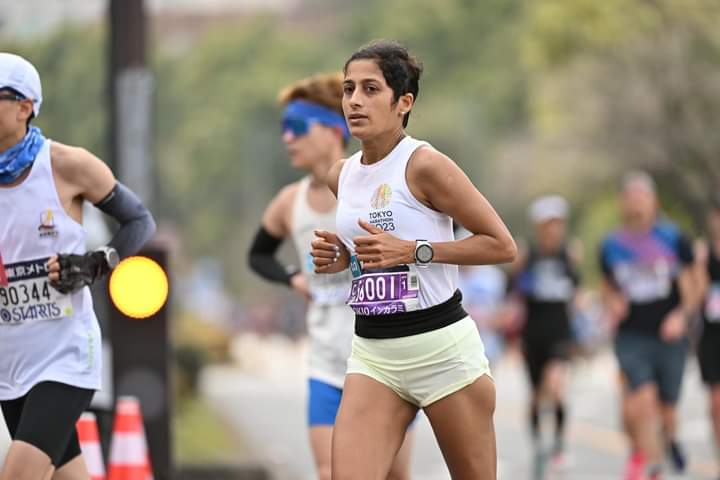
The full-fledged version of the Tokyo Marathon, one of the six World Marathon Majors, was held on March 5, 2023, after a gap of three years.
Rosemary Wanjiru of Kenya and Deso Gelmisa of Ethiopia won the women’s and men’s race respectively, at the World Athletics Platinum Label race.
In the men’s race it was an Ethiopian sweep with Gelmisa crossing the finish line in two hours, five minutes and 21 minutes. His compatriot Mohamed Esa finished alongside in the same timing to place second by the narrowest of margins. Tsegaye Getachew, also of Ethiopia, finished in third position, a mere three seconds behind the lead pair.
In the women’s race Rosemary Wanjiru won with timing of 2:16:28. Tsehay Gemechu of Ethiopia (2:16:56) finished second and her compatriot Ashete Bekere (2:19:11) finished third. According to Runner’s World, this was Rosemary Wanjiru’s second career marathon and her first major victory.
Japan is among countries where running is a very popular sport. About 38,000 runners from around the world participated in the 2023 Tokyo Marathon. Included in these numbers were those running to complete their six World Marathon Majors. Runners completing the circuit of these marathon majors are awarded a six-star medal at the end of their individual sixth marathon.
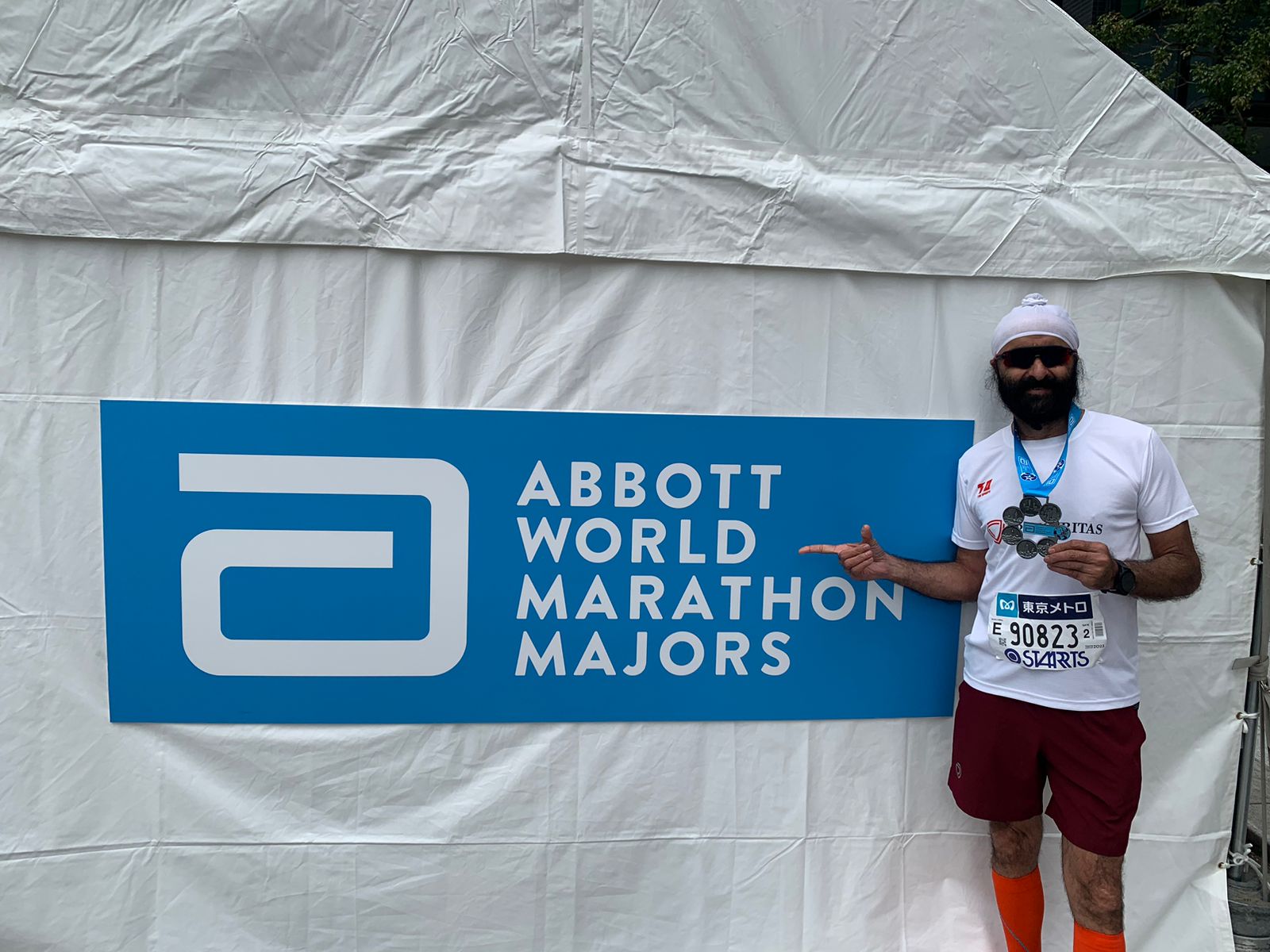
The 2023 Tokyo Marathon secured place in the Guinness World Records for having the highest number of runners finishing for a six-star medal at a single marathon. According to Abbott World Marathon Majors website, 3033 runners earned the six-star medal at Tokyo Marathon. This was a massive rise from the previous high of 732 runners at the 2019 edition of the Tokyo Marathon.
Runners who had finished five of the six World Marathon Majors in 2019 had to wait for three years until 2023 because of the COVID-19 pandemic and travel restrictions, to complete their sixth marathon.
Returning after three years, Tokyo Marathon had mandated that runners download a health app and upload temperature details daily for a few days in the run-up to the marathon. Also, they were required to do a couple of rapid antigen tests. They were also mandated to carry their smart phones to the start line of the marathon. This rule was tough for many runners as they do not normally train carrying their mobile phones. Runners were also disallowed from carrying their own water bottles during the run. The rule impacted the hydration plan of some runners.
Another rule that did not sit well with some runners was the requirement to avoid discarding layers along the marathon route. This is possible in many international marathons. Later, the rule was partially relaxed but runners were allowed to discard layers only at the start of the run.
We spoke to a few of the runners from India about their experience running the marathon and completing the six-star World Marathon Majors.
Kavitha Reddy / 2023 Tokyo Marathon (photo: courtesy Kavitha)
Pune-based marathon runner Kavitha Reddy was to participate in the 2020 edition of the Tokyo Marathon but the COVID-19 pandemic and the subsequent travel restrictions put a pause on her plan of completing the six-marathon cycle.
“A major challenge was to keep up the fitness level for at least one more year,” Kavitha said. At that point in time, the pandemic was an unknown entity and the world was clueless when it would end.
Overall, the lockdown and the absence of races helped runners to focus on their strength training. “I was able to keep up my fitness level throughout the three years. The lockdown period did help,” Kavitha said.
In October 2022, Kavitha ran the Melbourne Marathon finishing in 3:07:13 and also securing a second position in her age category.
“At Tokyo, my target was to maintain the same pace as Melbourne – 4:21 per kilometre. Instead of focussing on the finish time, I decided to focus on pace,” she said.
Although there were anxieties about the various rules that Tokyo Marathon had mandated there were no hitches on the day of the marathon. “From the point of entry to the race and the finish, everything was well-organised. It is an extremely disciplined country,” Kavitha said.
As it was quite cold, Kavitha approached the start line with layers, which she discarded at the start line. “Normally, I would have discarded the layers once I am two kilometres into the race. It was cold but during the race I was zoned out about the weather difficulties. Only after I finished the race, I realised that my shoulders had frozen. I could not lift my arms,” she said.
She finished strong with a new personal best of 3:05:08.
Going forward, her focus will continue to be on the marathon. She is confident about chopping some more minutes from her time to finish but at the same time is aware of limitations to potential improvements in timing.
Ambuj Kumar / 2023 Tokyo Marathon (Photo: courtesy Ambuj)
Bengaluru-based Ambuj Kumar started recreational running as recent as 2018. A year later, he commenced attempting the six Marathon Majors with the aim of completing all six within 365 days.
For him, the year 2019 entailed a schedule that packed in many marathons. The year started with Standard Chartered Dubai Marathon in January. This was followed by London Marathon in April, Berlin Marathon in September, Chicago Marathon in October and New York City Marathon in November.
“I wanted to be the first Indian to do all six Marathon Majors in a one-year period,” he said. The plan was to do Tokyo Marathon and Boston Marathon in 2020. But that was not to be because of the COVID-19 pandemic. Eventually, he completed Boston Marathon in 2022. “Two months before Boston, I contracted COVID-19. Nevertheless, Boston Marathon for me was a good race,” he said.
Ambuj ended up training for Tokyo Marathon three times – once in 2020, then in 2021 and finally in 2023.
Japan, according to Ambuj, is an amazing country. On race day, weather in Tokyo was quite cold prompting runners to wear layers ahead of the run.
“For me, it was a wonderful race. Though, my best experience was at the Boston Marathon,” Ambuj said. He finished Tokyo Marathon in 3:29:57.
Having completed his six-star World Marathon Majors, he may consider looking at distances beyond 42.2 km. In the meanwhile, he is due to run the 2023 edition of Berlin Marathon, his second time there.
Ramanjit Singh Oberoi / 2023 Tokyo Marathon (Photo: courtesy Ramanjit)
Ramanjit Singh Oberoi started casual running in 2009 when he found he had the time for it. In 2011, he heard about the Delhi Half Marathon and enrolled for his first half marathon in 2013 at the same event.
During the 2017 Mumbai Marathon, Ramanjit, 64, heard about the Boston Marathon and its stringent qualification norms. In 2018, he ran the New Delhi Marathon and qualified for Boston Marathon in his age category. This, set in motion the process to start the six-star World Marathon Majors journey.
In 2019, Ramanjit ran many races including Boston Marathon, Berlin Marathon, New York City Marathon and the Comrades Ultramarathon. After a two-year gap due to the pandemic, he did the London Marathon and Chicago Marathon in October 2022.
For Ramanjit, Tokyo Marathon went off quite well until the 34th kilometre. “After about 34 km I got a back ache and I had to take walk breaks to keep going,” he said. He finished the Tokyo Marathon in 3:40:24.
During the pandemic months, he also got into long-distance cycling, including one trip from India Gate in Delhi to Gateway of India in Mumbai and another from Delhi to Manali.
Ashoke Sharma (Photo: courtesy Ashoke)
Having lived in Japan for eight years, Ashoke Sharma, now a resident of London, was not unduly perturbed by the rules mandated by the Tokyo Marathon.
“Japan is a rule-based society but I know the psyche of the people of the country,” he said.
In 2018, Ashoke ran Berlin Marathon and in the process qualified for the Boston Marathon but he ended up doing the latter only in 2022. He followed it up with the New York City Marathon in the same year. In 2019, he completed the London Marathon and the Chicago Marathon.
In January this year, Ashoke shifted to London on work and took up residence near Kensington Park. “My training went off quite well. It was fantastic, running in the park and very safe,” he said referring to a recent incident in Mumbai when a runner was fatally knocked down by a speeding car.
In Tokyo, Ashoke suffered an ankle-twist around the 10th km mark. “Thereafter, it was tough, running. I had to walk the last 16 km. Nevertheless, I enjoyed it as it was my last one among the World Marathon Majors,” he said. He finished the marathon in 4:02:48.
Going forward, he may look at attempting a triathlon. “I am divided between focussing on the marathon and the triathlon. Now that I am based in London, I may opt to run some of the marathons in this part of the world,” he said.
Sunil Chainani (Photo: courtesy Sunil)
“In Tokyo, rules were strange but eventually everything worked out fine,” said Sunil Chainani, a Bengaluru-based runner.
He was one among the many runners waiting to finish his six-star World Marathon Majors. Some of the rules mandated by the Tokyo Marathon gave anxious moments to runners.
“We were asked to carry our mobile phones to the start line of the Tokyo Marathon. I don’t run with my phone normally,” he said adding that there were many issues such as crowded expo, cold weather and the requirement to fill out details in a health app.
Also, the course, though largely flat, had many U-turns and was constantly crowded with runners. Overall, the run went off quite well. “Japanese people are extremely helpful. There were many aid stations,” he said.
Sunil said his training for the Tokyo Marathon was inadequate. He finished the marathon in 4:22. “This was my fifth marathon in 10 and a half months,” he said. He plans to take a break from running marathons now.
He had run Berlin Marathon for the first time way back in 2008. He went back and ran the same marathon in 2018 to start his six-star World Marathon Major journey.
Pervin Batliwala / 2023 Tokyo Marathon (Photo: courtesy Pervin)
Waiting to complete the six-star World Marathon Major circuit, Pervin Batliwala, runner from Mumbai, trained quite well for the Tokyo Marathon.
Despite good training ahead of the race, some of the stringent rules mandated by the organisers of Tokyo Marathon did perturb Pervin. “The rule not allowing us to carry water bottles during the run was tough. I am used to taking gels during the run and I usually drink water after consuming gels. At Tokyo Marathon, I could not take as many gels as I had planned,” she said. Nevertheless, the overall experience of finishing the pursuit of the six World Marathon Majors and running a very well organised race in Tokyo was quite satisfying. She finished the race in 4:33:09.
Pervin had commenced her World Marathon Majors journey with her 2017 Boston Marathon race. In 2015, she ran the Comrades Ultramarathon and the next year she did the 72 km Khardung La Challenge in Ladakh.
Pervin now wants to attempt doing a triathlon and also focus on swimming events.
(The author, Latha Venkatraman, is an independent journalist based in Mumbai.)
Camille Herron (This image was downloaded from the athlete’s Facebook page and is being used here for representation purpose. No copyright infringement intended)
American ultrarunner Camille Herron sets new 48-hr world record
Camille Herron, ultrarunner from the US, set a new 48-hour world record at the 2023 Sri Chinmoy 48 Hour Festival held at Canberra, Australia from March 24 to 26, 2023.
Camille ran a distance of 435.336 kilometers (270.505 miles) during the stipulated period beating the record of 411.458 km set in February 2023 by UK’s Joasia Zakrzeski at the 2023 Taipei Ultramarathon.
Camille completed 1088 laps of 400 metres each at Canberra.
Only two athletes have covered distances more than Camille during 48 hours, both men.
Andrew Tkachuk, from Ukraine, has covered a distance of 435.466 km. Greek runner, Yiannis Kouros, holds the men’s world record of 473.495 km.
Following her record breaking-run, Camille noted on her Facebook page: “ Through all the pain, I found joy in knowing I was fulfilling a purpose in life. I had to keep going, keep pushing through every challenge and find out what’s possible…This was my 3rd try for 48Hrs. I finally got it right. Don’t give up on your goals and dreams, no matter how many times it takes.’’
Indian ultrarunners qualify for IAU 24-hr World Championships at Chinese Taipei
Several Indian ultrarunners qualified recently for the IAU 24 Hour World Championships to be held later this year in Chinese Taipei.
At a recent stadium run in Bengaluru, four male runners and two female runners qualified for the upcoming championships.
Amar Singh Devanda, Velu Perumal, Badal Teotia and Geeno Antony qualified with mileages in excess of 220 km, the qualifying mark set by Athletics Federation of India, during the 24-hour period. Amar won the race with a distance of 234 km. He was followed by Velu (232 km), Badal (223.6 km) and Geeno (222.8 km).
Among women, Shashi Mehta won the race with a distance of 196 km. The qualifying mark for women was set at 180 km. Aparna Choudhary also qualified with a distance of 180.8 km.
At the Sri Chinmoy 48 Hour Track Festival held at Canberra, Australia, on March 24-26, 2023, an additional two Indian runners qualified for the Taipei Championships. Running a 24-hour race, Ullas Narayana covered a distance of 220.636 km during the 24-hour period. Priyanka Bhatt of Mumbai covered a distance of 184.577 km during the stipulated period.
Record three finishers at Barkley Marathon this year
Barkley Marathons, a gruelling ultrarunning event held every year, typically sees few finishers or no finishers at all.
For the second time in its history, a record three athletes completed the 2023 edition of Barkley Marathons. The race is held every year in Tennessee, USA.
The three finishers were John Kelly from USA, Aurelien Sanchez from France and Karel Sabbe from Belgium. John Kelly was also a finisher in the 2017 edition of the race.
Barkley Marathons had three finishers in 2012.
The race held in Tennessee’s Frozen Head State Park is made up of five loops of about 20 miles through brushy mountains with an elevation gain of around 63,000 feet. The race is to be completed in 60 hours.
The race did not have any finishers for the past five years.
2022 Golden Globe Race / Race leaders complete their second equator crossing
The race leaders of the 2022 Golden Globe Race (GGR), Kirsten Neuschafer of South Africa and Abhilash Tomy of India, have completed their second equator-crossing of the race, this time on the way back to the start / finish line in France. GGR entails a solo, nonstop circumnavigation of the planet. On the event’s live tracker, as of March 31, Kirsten with 2840.1 nautical miles to the finish continued to be in first place; Abhilash with 3137.8 nautical miles left to cover, was in second position.
Interestingly, Simon Curwen of the UK, despite having halted in Chile for repairs and relegated thus to the race’s Chichester Class, had caught up with the race leaders and was in the same region of the Atlantic. He had 2927.4 nautical miles remaining to the finish line. Given the weather conditions known to characterise these parts, progress has been slow. It is hoped that the trio should now gradually exit the Atlantic’s doldrums.
For Gopi, a setback at 2023 Seoul Marathon
Elite Indian marathoner T. Gopi had a setback at the 2023 Seoul Marathon held on March 19. During the run, he experienced a problem in his hamstring. He finished in 26th place with timing of 2:18:53. According to him, the race was progressing well and he was maintaining a pace of around 3.12 when after the 32nd kilometre, he suddenly felt a catch in his hamstring. He had to stop, stretch and jog the remaining distance.
In January 2023, Gopi had won the Tata Mumbai Marathon in 2:16:41, signalling a return to good performance after knee surgery and months of the sporting calendar impacted by the COVID-19 pandemic.
(The authors, Latha Venkatraman and Shyam G Menon, are independent journalists based in Mumbai.)
Everyone needs a job. In India, `sports quota’ has often helped athletes find employment. But it isn’t a level playing field and among things altering parity in consideration is our obsession with the Olympics.This story from the world of ultramarathon in India, was published in mainstream media in August 2022. There have been changes since to world records quoted. The updated figures may be found in the post script.
At the heart of performance in sport lay the human body and mind, both of which, require maintenance. Livelihood, jobs – these are as important for sportspersons as anyone else. Perhaps more, because athletes often come from tough financial backgrounds.
Not long ago in Shillong, an ultrarunner who was part of an Indian team that secured silver at an international championship abroad, wished to apply for a job under sports quota. The person needed an official letter establishing association with the sport and a silver medal-winning team. The letter couldn’t be put together.
It is a predicament best understood obliquely.
For years, what enthralled us in running were the sprint events. Speed exemplified running. However, away from the sprints, a different beast took shape. By the time of the 2018 Berlin Marathon, the world record in the marathon had reduced to two hours, one minute and 39 seconds, courtesy Kenya’s Eliud Kipchoge. In 2019, at an unofficial event in Vienna, he broke the two hour-barrier and covered the 42.195 km in 1:59:40.2. Such performances showcased a fantastic pace of running sustained over a long distance. Kipchoge is regarded as the greatest marathoner. But some wonder – isn’t he the greatest runner? In select quarters, the Kipchoge debate has itself got challenged with the ascent of Lithuanian ultrarunner, Aleksandr Sorokin. He holds the world record for 24 hours (309.4 kilometres) and 100 miles (160 kilometres, covered in 10 hours, 51 minutes and 39 seconds).
Anything over a marathon distance, is an ultramarathon. Usually in the sport, ultra-distances start from 50 kilometres. India’s formal entry into ultrarunning happened late. It is not long since the country became a member of the International Association of Ultrarunners (IAU). All the same, India’s showing on the world stage has been encouraging. Over the past few years, the country had picked up a couple of individual bronze medals, a team gold (men) and a team silver (women) – all that at the continental level. In July 2022, at the IAU 24-hour Asia & Oceania Championships in Bengaluru, Indian ultrarunners not only maintained the team gold and silver they had won before, they also swept the podium in the men’s category as regards individual medals and rewrote the national best time for 24 hour-running in both the men’s and women’s categories.
Ultrarunning is a demanding sport. In Bengaluru, exhausted ultrarunners had to be helped on to the podium during the awards ceremony. They were a bunch, at once tired, sleepy and happy for they had been running or walking near continuously for the previous 24 hours. The winner – Amar Singh Devanda of India – covered 257.62 kilometres. That’s over six marathons at one go. Yet, between the marathon and the ultramarathon is a gulf of disparity in how sport is perceived.
Despite it showcasing extreme endurance, ultrarunning is not an Olympic sport (it is also not part of the Commonwealth Games and the Asian Games). Nadeem Khan, president, IAU, said recently in Bengaluru, “ the goal is always to be in the Olympics.’’ But there is a challenge to address. The Olympics prefers broadcast-friendly sports and sport formats. Ultrarunning – even as it is getting faster – is time consuming given the long distances covered. The reading is that to get into the Olympics, ultrarunning may have to showcase one of the smaller distances in its fold. In India, a sport that features in the Olympics acquires recognition for purposes like getting a job. The lack of such recognition for ultrarunning hurt the prospects of the Shillong based-ultrarunner, people familiar with the aborted attempt to get a job, said.
Notwithstanding the sport yet to feature in the Olympics, the Athletics Federation of India (AFI) showed the foresight to support ultrarunning. That is how India’s membership at the IAU happened. The AFI set up a committee for ultrarunning; the committee selects the national teams. The AFI also worked with race organizers to bring IAU events to India.
According to a former national level athlete who holds a government job and is familiar with the process followed to secure jobs for sportspersons, there is first and foremost a list of recognized sports available with the government, which is partial to the Olympics for a discipline to be included. In addition to this, several departments and companies now have their own list of sports to support, which includes disciplines that don’t feature at the Olympics. In ultramarathon’s case, although it may not be an Olympic sport yet, the AFI has shown the foresight to support it, pointing to an element of recognition too in place, he said.
Question is – will this suffice to convince employers in India that the ultramarathon is as much a sport as the other disciplines endorsed by inclusion in the Olympics?
Post script: In September 2022, Aleksandr Sorokin improved his own world record in the 24-hours category to 319.614 kilometres. Same month and year, Eliud Kipchoge slashed 30 seconds off his earlier world record in the marathon. At the 2022 Berlin Marathon, he covered the distance in 2:01:09.
Indian ultra-distance cyclist, Kabir Rachure, finished third in his age category of below 50 years at the 2022 edition of Race Across America (RAAM).
He took 11 days, 11 hours and 25 minutes (source: RAAM leader board) to cover the 3037.80 miles, the best time yet by an Indian cyclist in RAAM’s solo male segment.
When contacted, Sapna Rachure, Kabir’s sister and his crew-chief, confirmed the third place finish in the age category. “ Huge Congratulations to Kabir Rachure and all his crew team for amazing RAAM Solo Finish. Excellent 3rd position in under 50 Mens,” Spiegel Bikes said on their Facebook page.
RAAM is a single stage race with a cut-off period of 12 days. The course runs from the US west coast to the east.
This is Navi Mumbai-based Kabir’s second successful completion of RAAM. In 2019, he had completed the roughly 3000-mile span of RAAM in 11 days, 22 hours and 43 minutes to become the third Indian cyclist to complete RAAM in the solo category after Srinivas Gokulnath and Amit Samarth in 2017. Srinivas took 11 days, 18 hours and 45 minutes, Amit – 11 days, 21 hours.
The 2022 edition of RAAM witnessed a spate of DNFs. As per the race leader board, the under-50 age category in which Kabir featured had 13 cyclists at start, of which seven (as of 8PM [IST] on June 26) could not complete (DNF) and withdrew from the race at various points en route. The list of DNF included Bharat Pannu and Vivek Shah from India; Bharat covered 2396.80 miles (9 days, 21 hours, 58 minutes) while Vivek covered 602.90 miles (2 days, 9 hours, 44 minutes). In June 2020, Bharat had placed third in virtual RAAM (VRAAM); the format was adopted due to the COVID-19 pandemic.
(The authors, Latha Venkatraman and Shyam G Menon, are independent journalists based in Mumbai.)
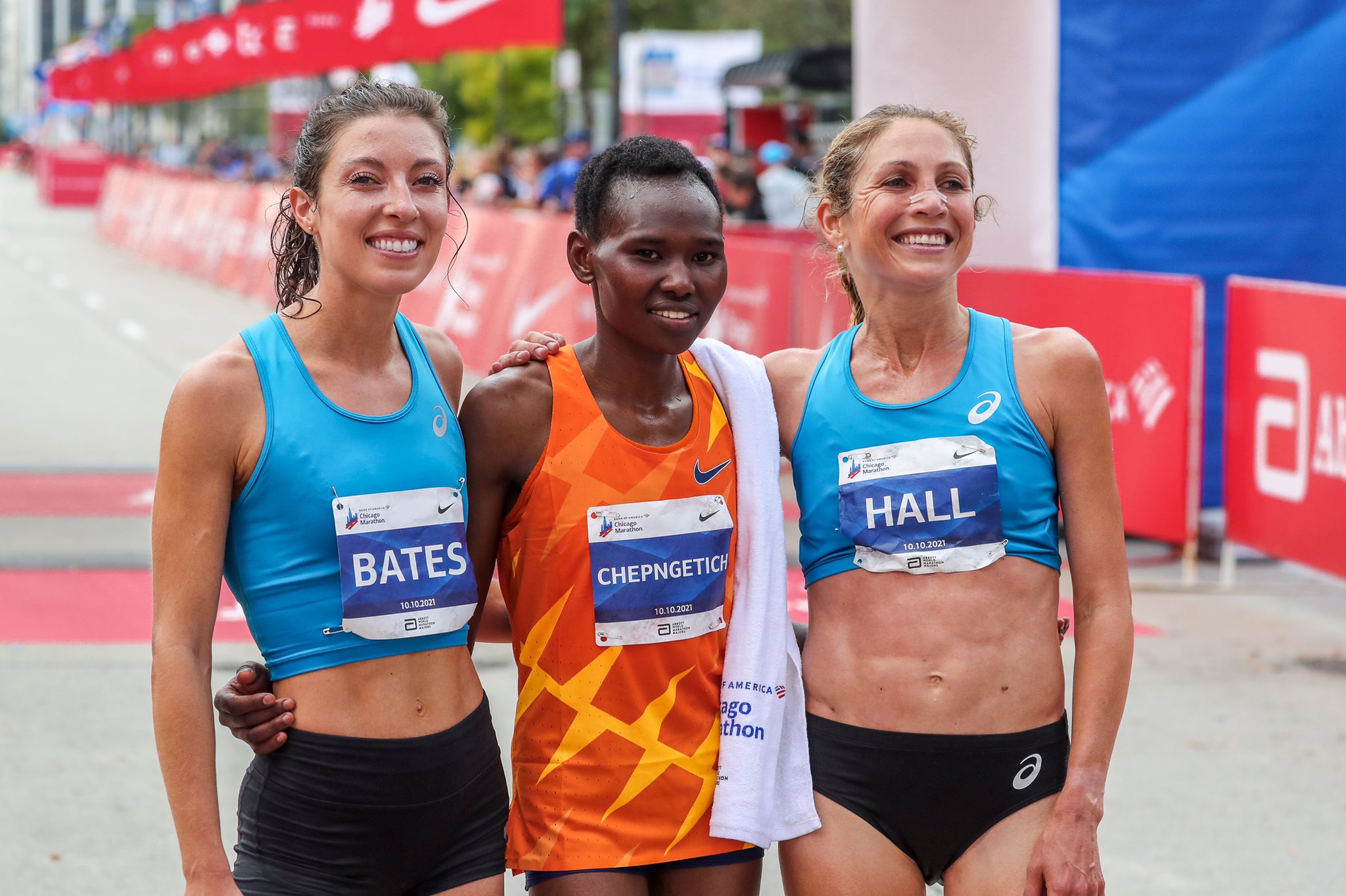
This image was downloaded from the Twitter handle of Chicago Marathon.
Ethiopia’s Seifu Tura and Kenya’s Ruth Chepngetich won the men’s and women’s race respectively at the 2021 Chicago Marathon, held on October 10.
Chepngetich, the former half marathon world record holder and first runner-up at the 2020 London Marathon, took an early lead in the women’s race and stayed ahead until the end, to finish in two hours, 22 minutes and 31 seconds.
Emma Bates of the U.S finished in second position with a personal best timing of 2:24:20. In third position was Sara Hall, also of the U.S., finishing in 2:27:19.
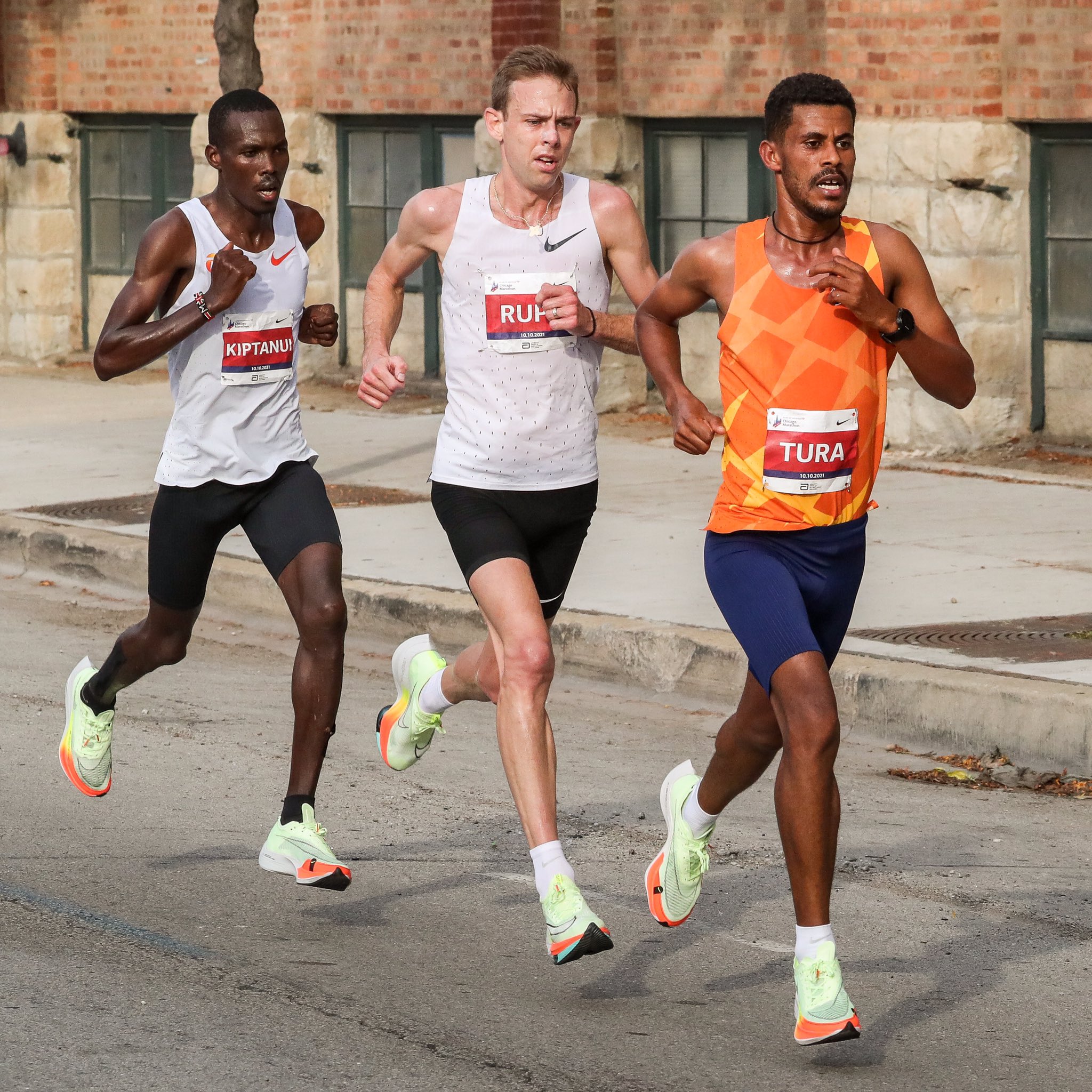
This image was downloaded from then Twitter handle of Chicago Marathon.
In the men’s race, Tura won after breaking away from Galen Rupp of the U.S. and Kenya’s Eric Kiptanui. Tura’s winning time of 2:06:12 came amidst warm, humid conditions. Rupp crossed the finish line in second position in 2:06:35 and Kiptanui in 2:06:51 to place third.
American runner, Shalane Flanagan, finished in 2:46:39, securing 34th place among women runners. Flanagan had announced plans to run six World Marathon Majors in 42 days. The 2021 Chicago Marathon was her third since she started with the year’s Berlin Marathon held on September 26.
(The author, Latha Venkatraman, is an independent journalist based in Mumbai.)