The owner of a small furniture shop in Aluva has been making a unique contribution to life in Kerala.
A land of backwaters, rivers and seacoast, accidents involving boats have been several in the state. In May 2023, 27 people died when their boat capsized in Tanur. That was merely the latest at the time of writing. What set Saji Valasseril thinking was an incident 21 years ago, when 29 people lost their lives after their boat traveling from Muhamma to Kumarakom, capsized in the Vembanad Lake. “ There were other mishaps too that made me want to do something,’’ Saji, a resident of Aluva, said. In 2007, 15 students, two teachers and an employee were killed when their boat sank in Thattekkad. In 2009, there was the Thekkady boat tragedy when 45 people died after their boat sank in the Periyar National Park. For Saji, it just didn’t make sense that people should die so. He felt that if people knew how to swim; at the very least if they could stay calm and afloat till rescuers arrived, lives could be saved. Saji had a background relevant to imagine so. His late father, V. Thomas Mani, had been a champion swimmer during his days in the army’s Madras Regiment. He taught Saji to swim in the river Periyar.
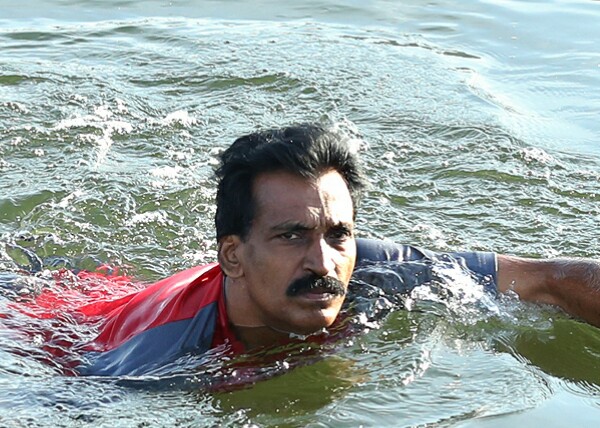
In March 2010, Saji decided to address the subject of drownings in Kerala, starting with his own family. His two children – Merin and Jerin – and the children of a friend, commenced learning to swim under his tutelage in the Periyar. On the map, Aluva, located on the banks of the Periyar, is a little before the river splinters into a complex estuarine geography ahead of its rendezvous with the backwaters and the Arabian Sea. The Periyar is Kerala’s biggest river in terms of volume of water carried. Because he was imagining back from all those boat accidents and survival in such contexts, Saji oriented his swimming lessons towards an eventual river-crossing. Merin did just that on the 39th day of her training; aged 13, she swam across the Periyar. The younger Jerin followed suit; he took two to two and a half months of training.
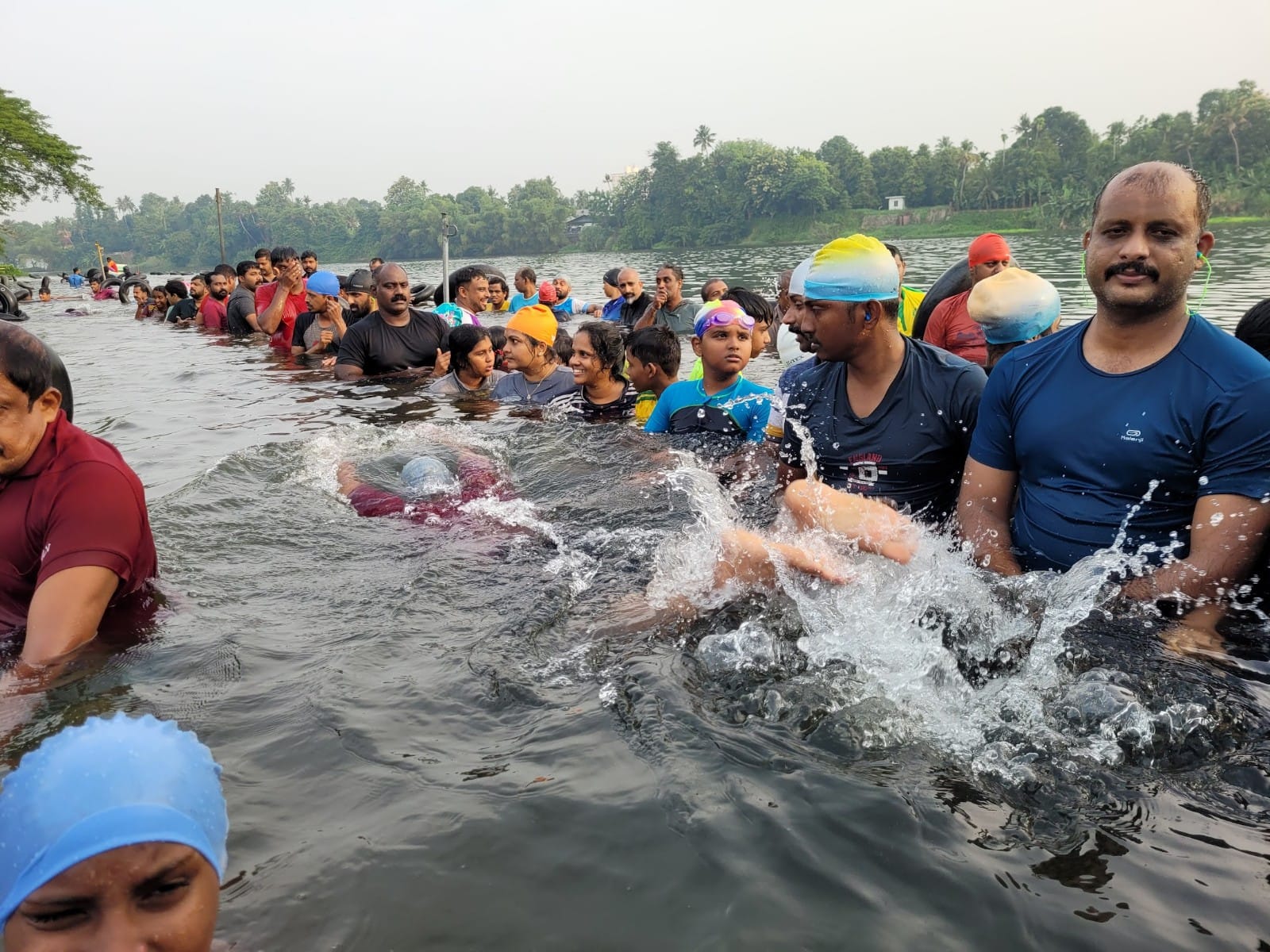
A training session in progress in the Periyar (photo: courtesy Saji)
Around 2012, Saji named his endeavour, ` Valasseril River Swimming Club.’ By 2013, the number of people crossing, rose to 38. “ About one third to a quarter of a batch reach the competence level where they become eligible to try a crossing. The rest, learn swimming and go,’’ Saji said, adding against the backdrop of his syllabus that he estimates a trainee to acquire basic skills in 16 days. In 2014, 76 people swam across the Periyar. In 2017 the number touched 87 and in 2019 it rose further to 91. After a spike in response during the COVID phase, when almost 240 people crossed each year in 2020 and in 2021; in 2023, 1620 people trained, of who, 140 crossed. “ In all, I estimate, about 8000 people have by now learnt swimming from us,’’ Saji said leafing through files of entry forms submitted over the years. He has since become a regular subject of interest for the local media. According to Saji, the current length of the club’s crossing is approximately 750 metres as the route is to and fro. Maximum depth should be 30-40 feet.
Saji’s swimming sessions also attracted a clutch of differently abled individuals and senior citizens. Media reports cited a double amputee, a boy born without hands, a girl who underwent neurosurgery and was weak in one leg and a septuagenarian lady – Arifa – who swam with her hands tied, among those who crossed the Periyar. On August 14, 2023, Arifa spoke to this blog. In 2018, Aluva, where she resides, was among places affected by the heavy rain and floods that hit Kerala. She was not in town when calamity struck but her children told her of what happened including the tales of rescue. Arifa didn’t know how to swim. But she quickly realized that to be useful in times of flood and be part of relief work, swimming was an essential skill. That’s how at 68 years of age, she connected with Saji. Having grown up near a river, Arifa wasn’t an utter stranger to water. But that was 55 years earlier in her childhood. The year she attended Saji’s training session and learnt to swim, she couldn’t cross the Periyar because the day for swimming across coincided with her period of fasting. Then the lockdown induced by COVID-19 intervened. Eventually, she swam across the Periyar in 2022. Two months later with a week of training devoted to the new challenge assigned her, she swam across with her hands tied. “ The message I’d like to share from this attempt is that all should learn how to swim,” she was quoted as saying in the New Indian Express. In its early days, Saji’s program was focused on children. In 2016, very unexpectedly, a parent swam along in the crossing. He died of a heart attack. Following this, an ambulance became a constant presence at the program site and on the day of crossing, a safety-boat was engaged. More importantly, Saji began training adults as well. Nowadays, no adult gets to the crossing stage without the trainers being convinced that they are up to it, Saji said. Aside from his commitment to the journey he has embarked on, what engages about Saji’s project is the manner in which he built up scale.
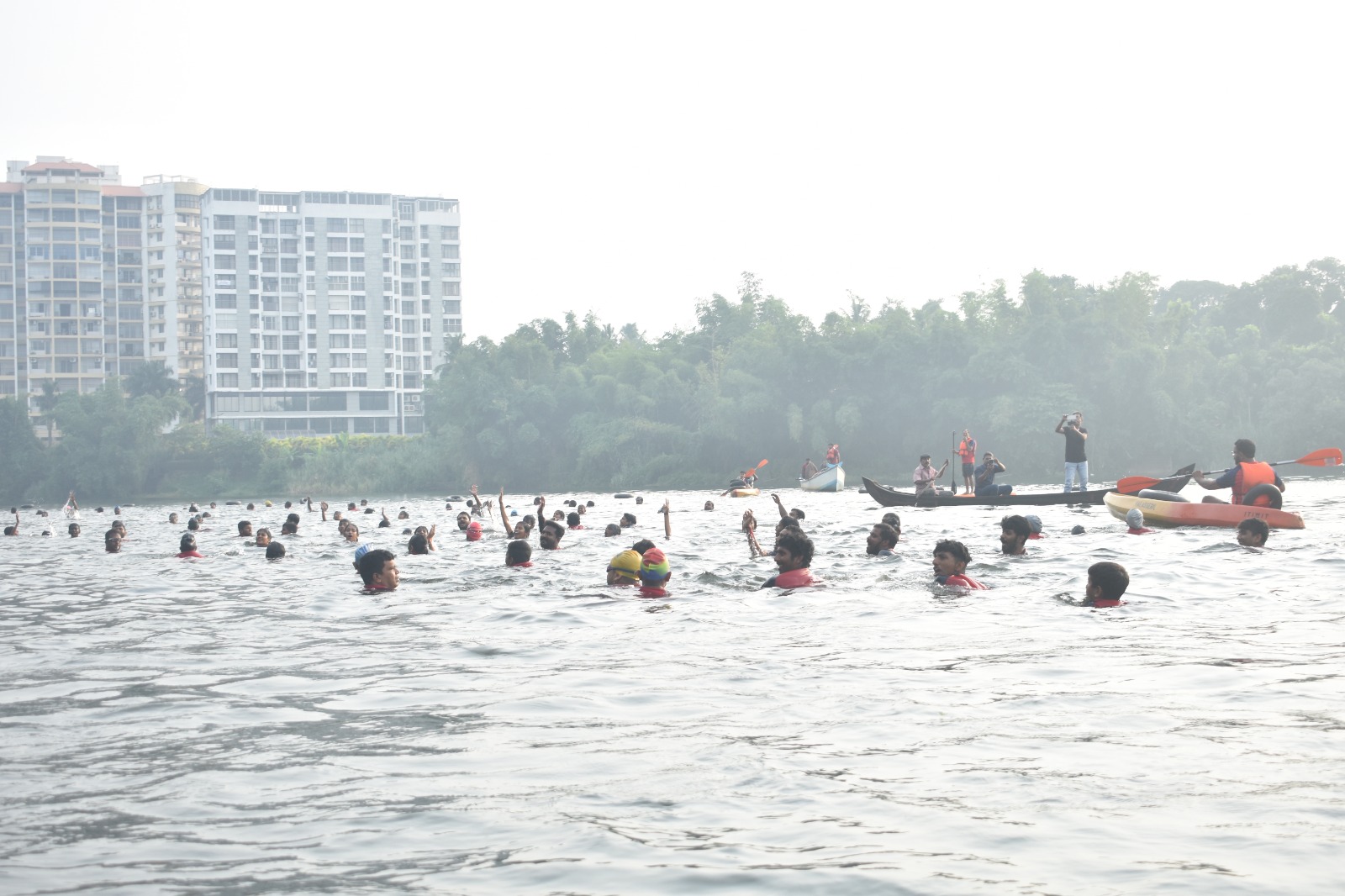
A crossing underway in the Periyar (photo: courtesy Saji)
A state, where many houses once sported private ponds, the declining engagement of the average Malayali with swimming, is a product of altered lifestyle. Greater construction has meant the old ponds levelled and built over. Overwhelming emphasis on academics meant the school and college-going became distanced from swimming or they learnt it as a skill paid for and acquired at any of the state’s modern but expensive swimming pools. Simply put, the numbers of those in newer generations who were acquainted with water, shrank. As these shifts happened, the Periyar’s kadavu or bathing ghats grew neglected and with it, familiar places on the river with gradual progression in depth and ideal to teach swimming, dwindled. Compounding the issue has been the problem of sand mining (it plagues many rivers in Kerala), which creates places with sudden variation in depth.
A May 2022 report in Mathrubhumi said, “ As per the records of the Fire and Rescue Department, on an average, three people drown in the state per day. ‘’ According to it, in 2021 alone there were 1102 reported cases of drowning, up from less than 1000 the year before. Many people drowned in rivers and ponds when visiting such places in groups. Even if one knew swimming, being able to tackle natural water bodies with currents in them, was an issue contributing to the fatalities, the news report said. When this writer contacted M Naushad, Director (Technical) of Kerala Fire and Rescue Services, he said that while knowing how to swim is always a good thing, people not heeding instructions to desist from swimming when and where conditions are not ideal, was a worry.
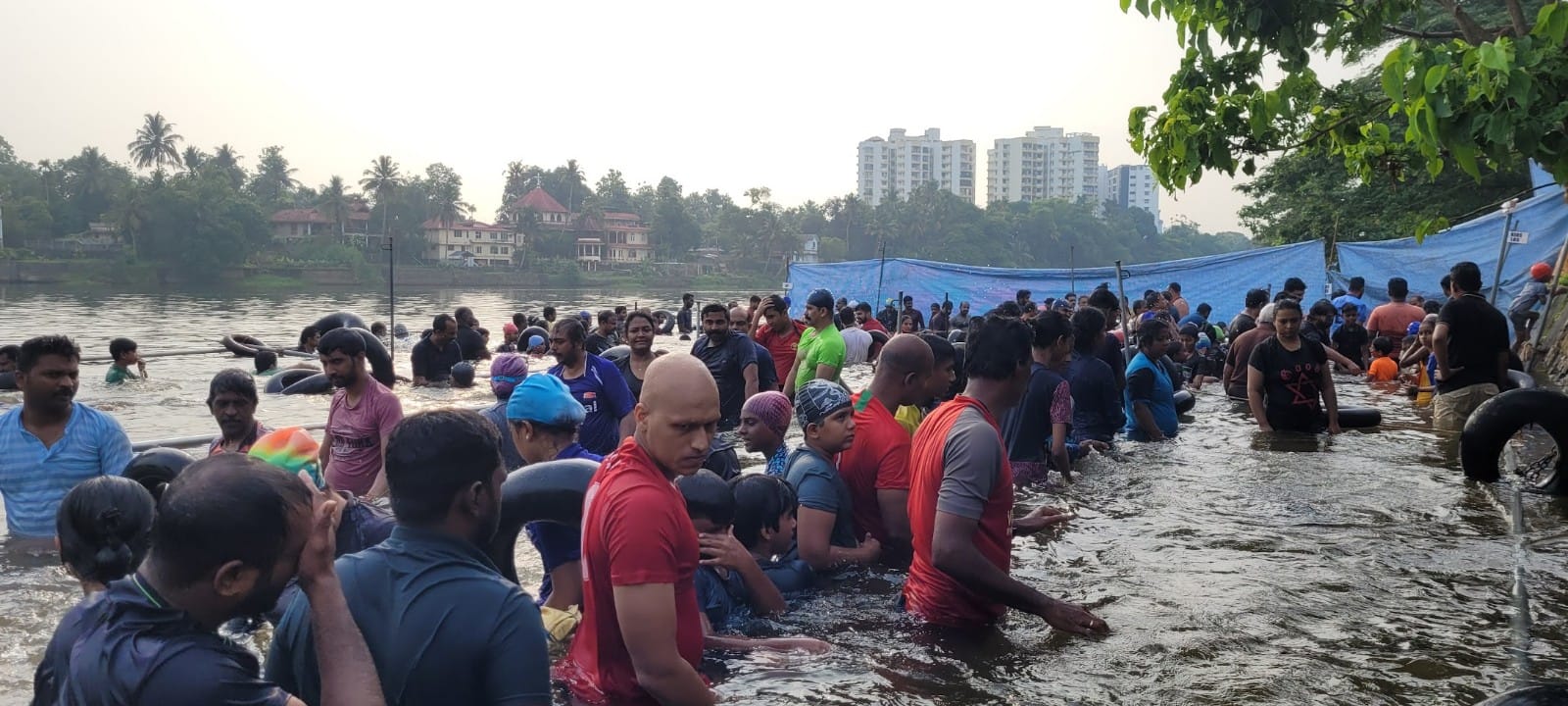
Saji, who is clear that his job is not to create champion swimmers but impart a survival skill, hosts his training at Manappuram in Aluva, a place by the Periyar famed for a Shiva temple and which has a gradually sloping approach into the waters. Here, Saji came up with an ingenious device (his fabrication skills came of use); a removable, collapsible structure of GI pipes, 70 feet by 40 feet in dimension. He currently uses four such structures. Each of them, anchored and kept afloat by an array of inflatable rubber tubes, separates the area within used for training, into seven lanes of varying water-depth. The trainees work their way from the shallows to the deep lane. This graduation takes weeks. It is only after such progression entailing 50 days, that the best of the lot, get a shot at the crossing monitored by expert swimmers with a kayak in tow. For Saji, this method has worked well so far. More importantly, since his mission commenced in the need to teach a state how to save itself in water, he considers the model replicable for use at other locations. “ If you look at where all people are drowning these days, you will be amazed. There is the case of a large temple pond, which was cleaned and beautifully redone only to have people drown in it later. My device can be built to required scale and all it needs is the shallows of these ponds. If people are trained using the device in such ponds and they venture to the deep only after they are properly skilled, fatalities can be minimised,’’ Saji said.
A training session in progress in the Periyar (photo: courtesy Saji)
Thanks to the four structures in the water, Saji said, the club can train close to 1000 people at a time. As a concept, scaling up won’t be appreciated by discerning trainers because of the inbuilt danger in something going wrong. For instance, trainers’ attention risks being spread thin as the number of trainees rise. Health issues is another. But against the backdrop of Kerala’s emergent equation with water (there is the newfound reality of floods to cope with during rains plus those recurrent boat tragedies) Saji merits a hearing. According to him, municipal authorities and elected representatives have supported him in the ongoing project in Aluva. To aid scale and reduce risk related to the natural variabilities of a river, he wishes for a large tank with powerful pumps, built at Manappuram, which mimics the water depth of the Periyar’s banks and its flow. It will cost money; sponsors will be needed. But if by now, you are thinking that training plus scale should be fetching this man good money; hang on. According to Saji, he charges nothing except for expenses around safety. His main income remains the small shop: Valasseril Furniture.
(The author, Shyam G Menon, is a freelance journalist based in Mumbai. This is the slightly extended version of an article written by the author and published in The Telegraph on July 10, 2023.)
India’s Vipul Kumar finishes fourth in men’s 100km race
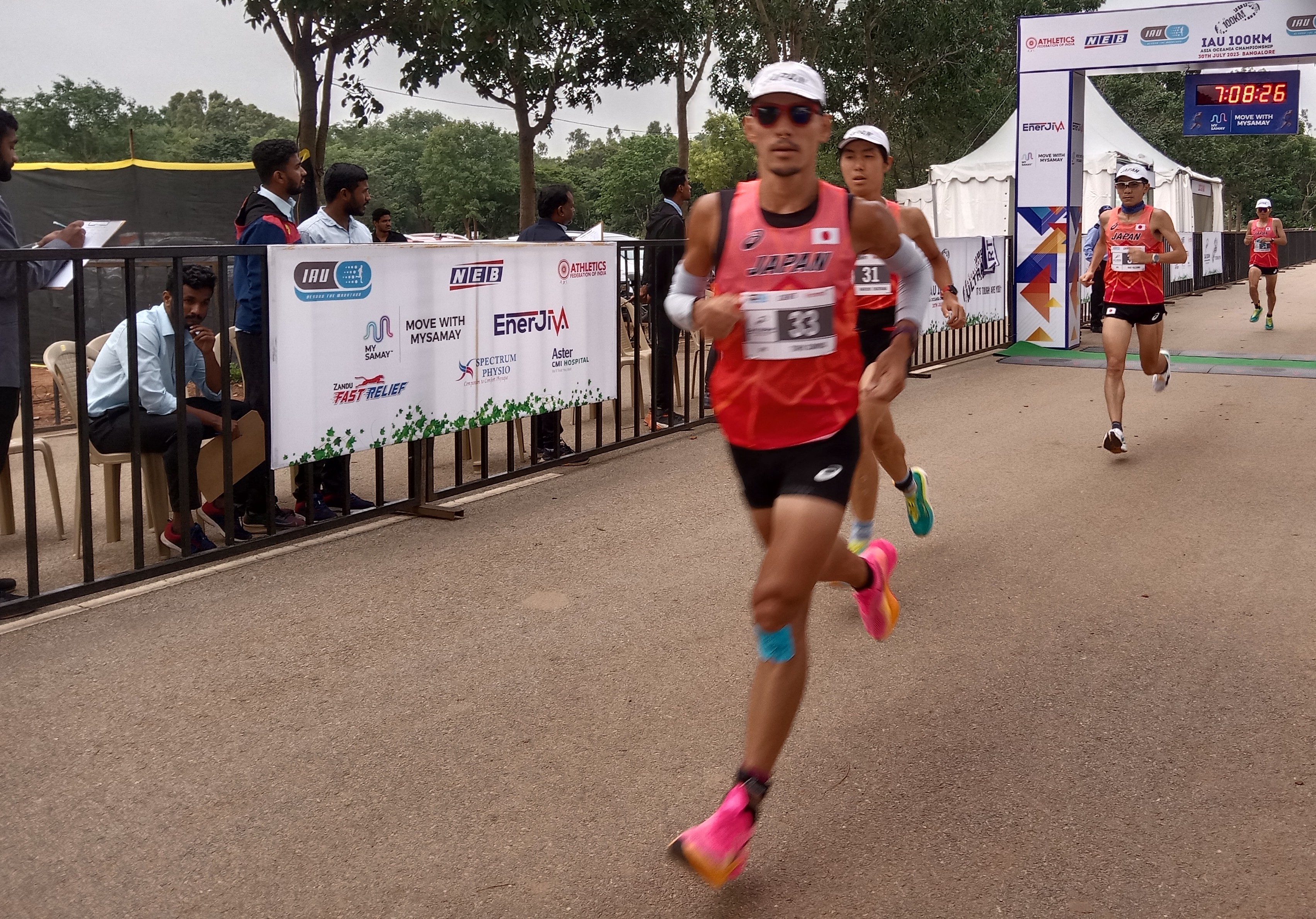
Japanese runners swept the podium in both individual and team events at the 2023 IAU 100km Asia and Oceania Championship held in Bengaluru on Sunday, July 30.
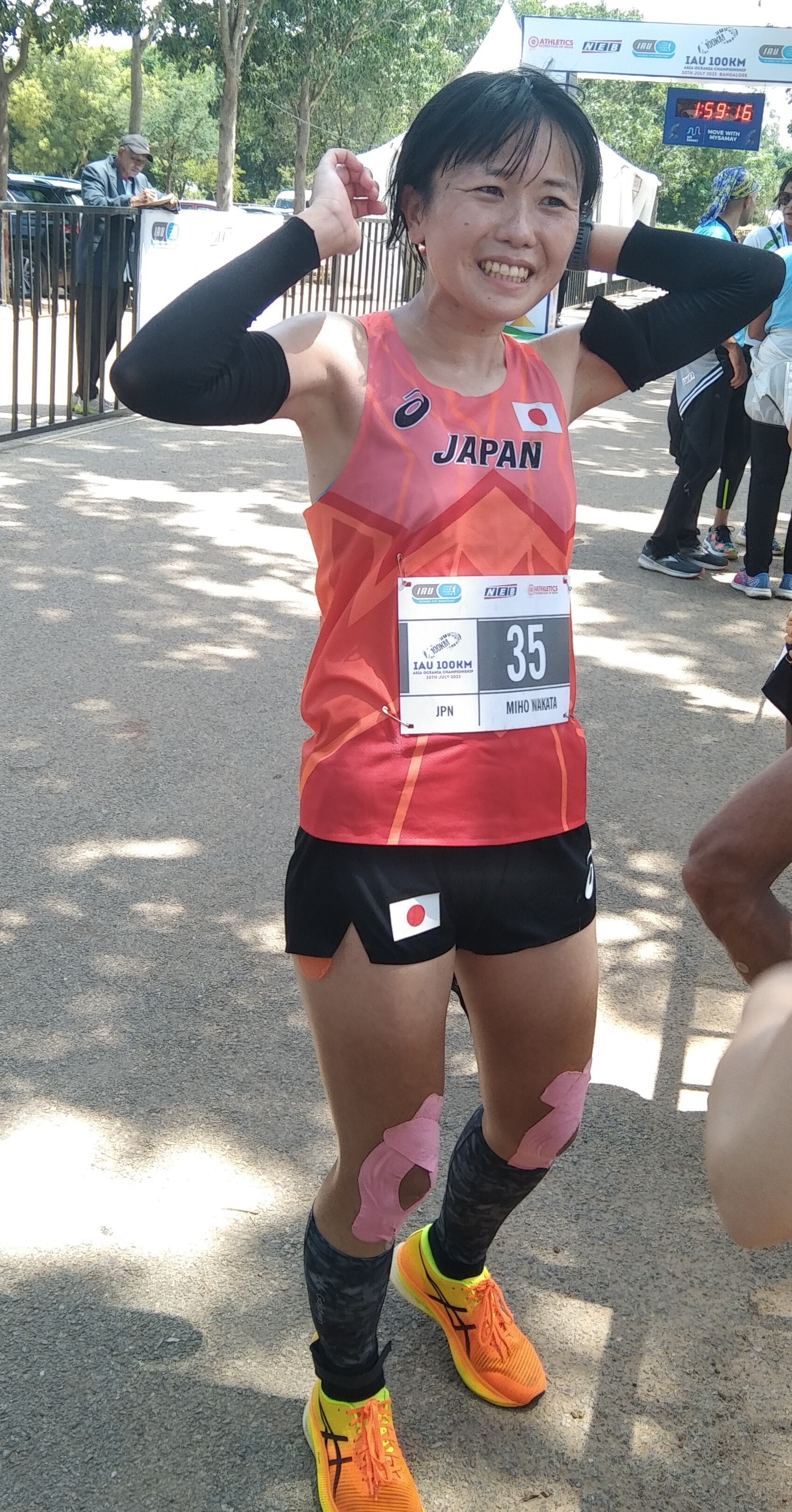
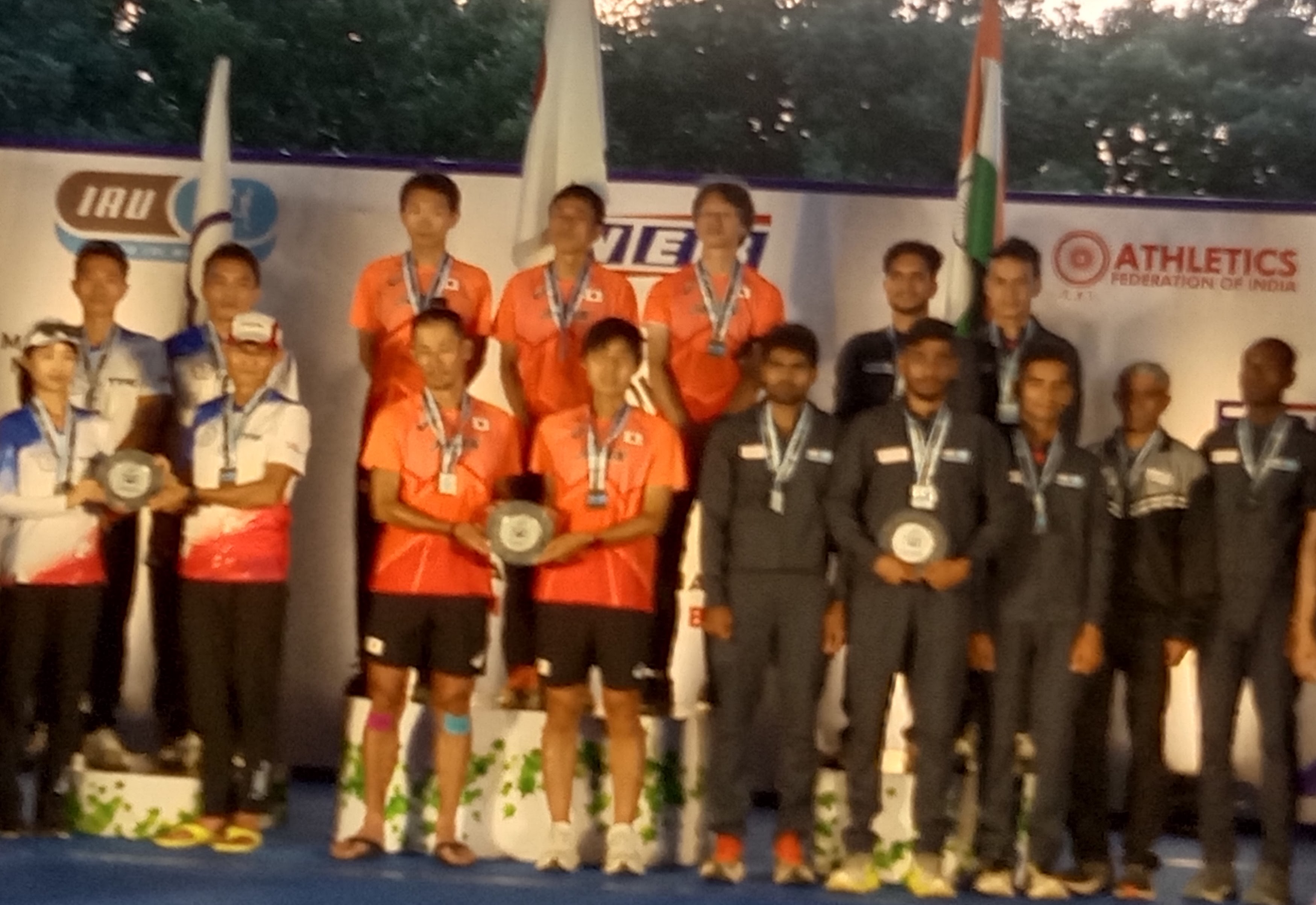
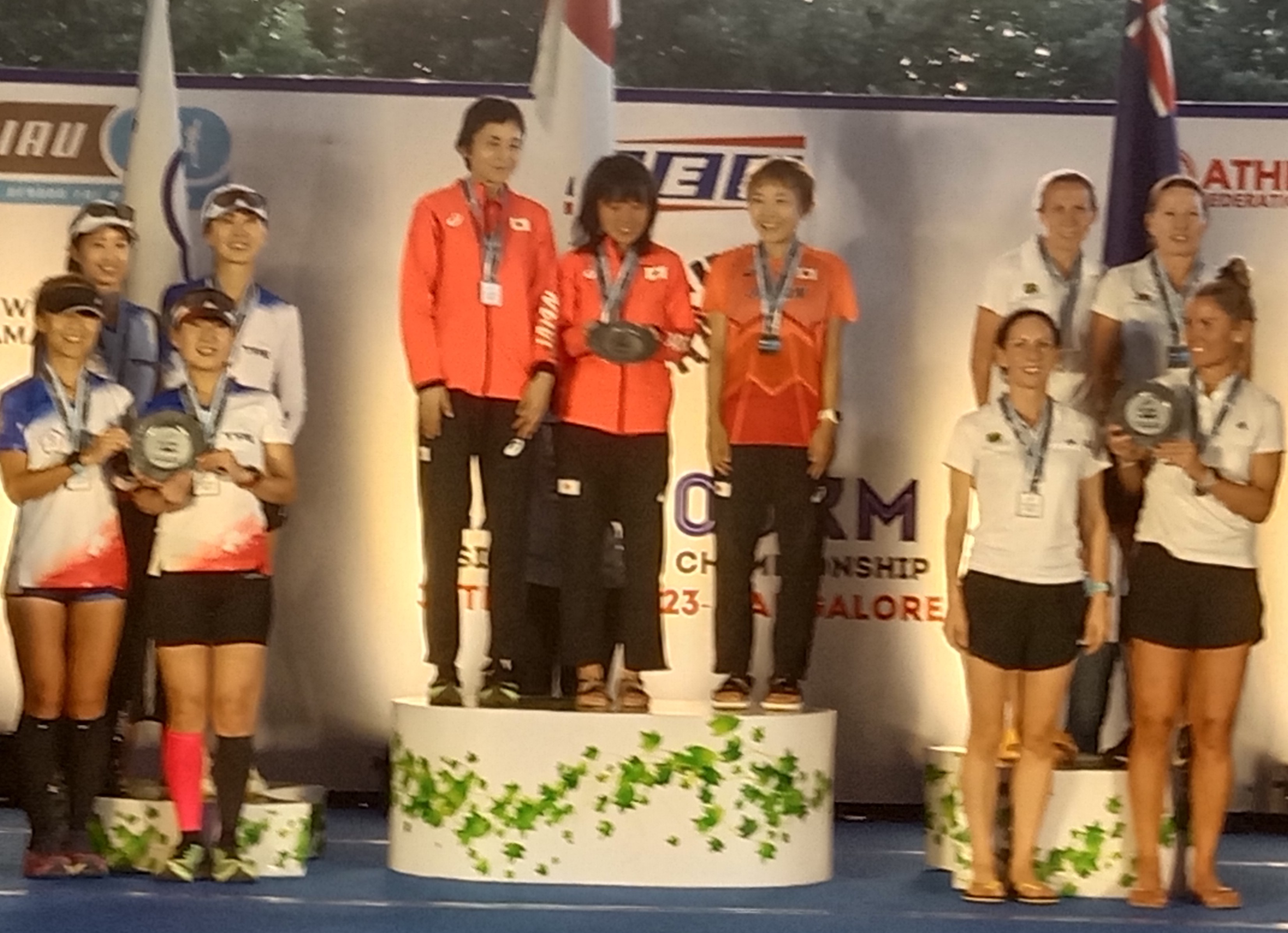
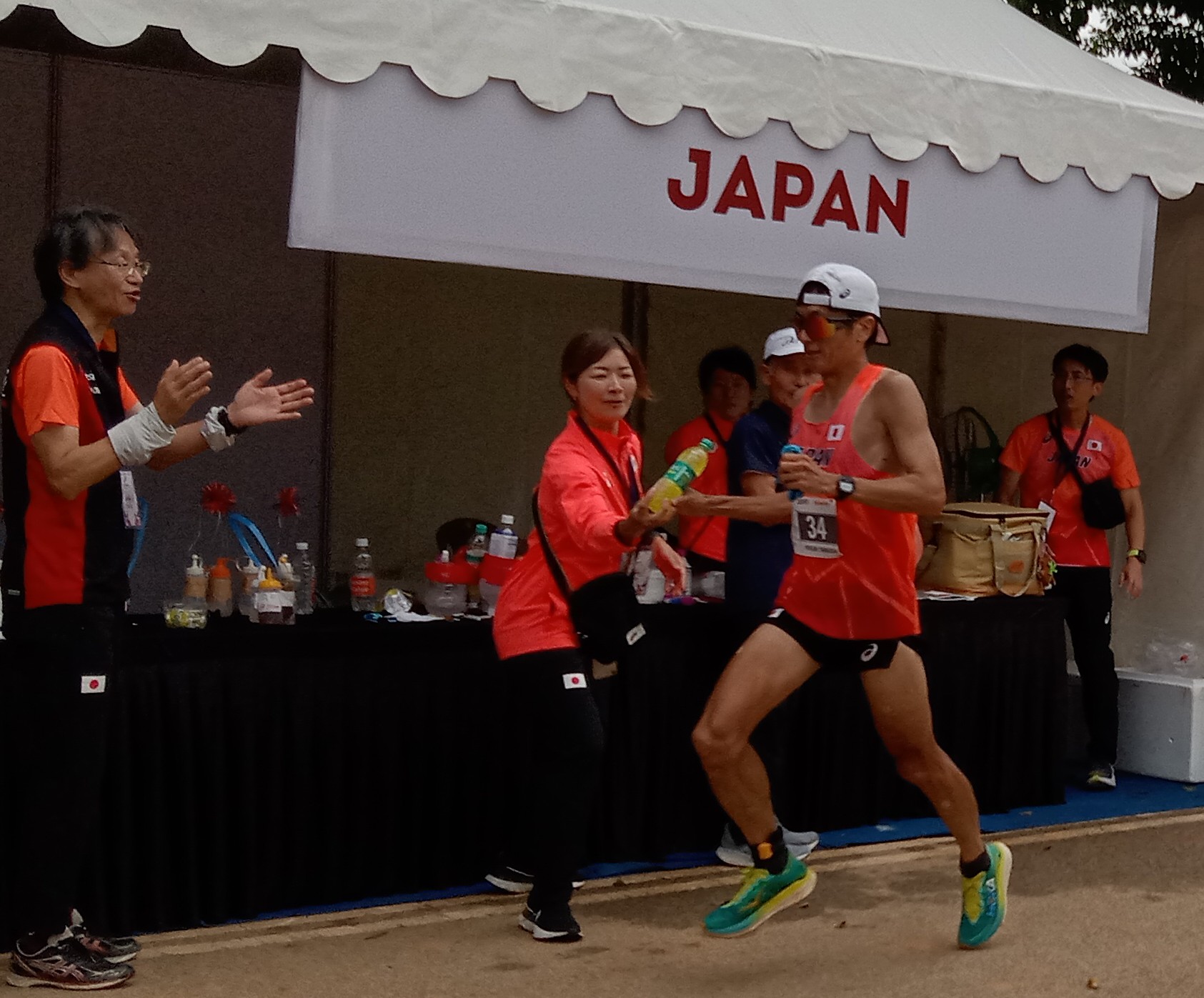
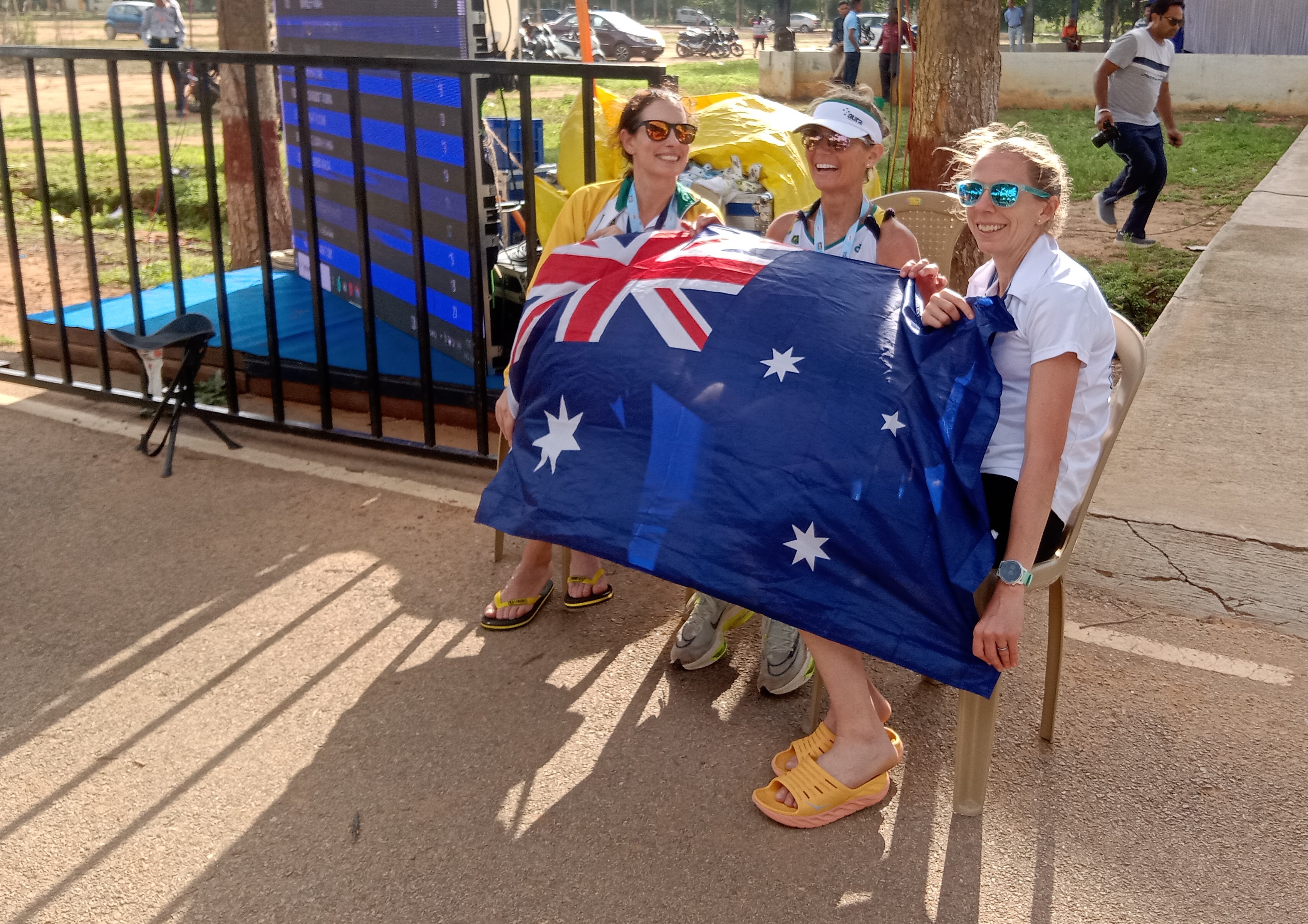
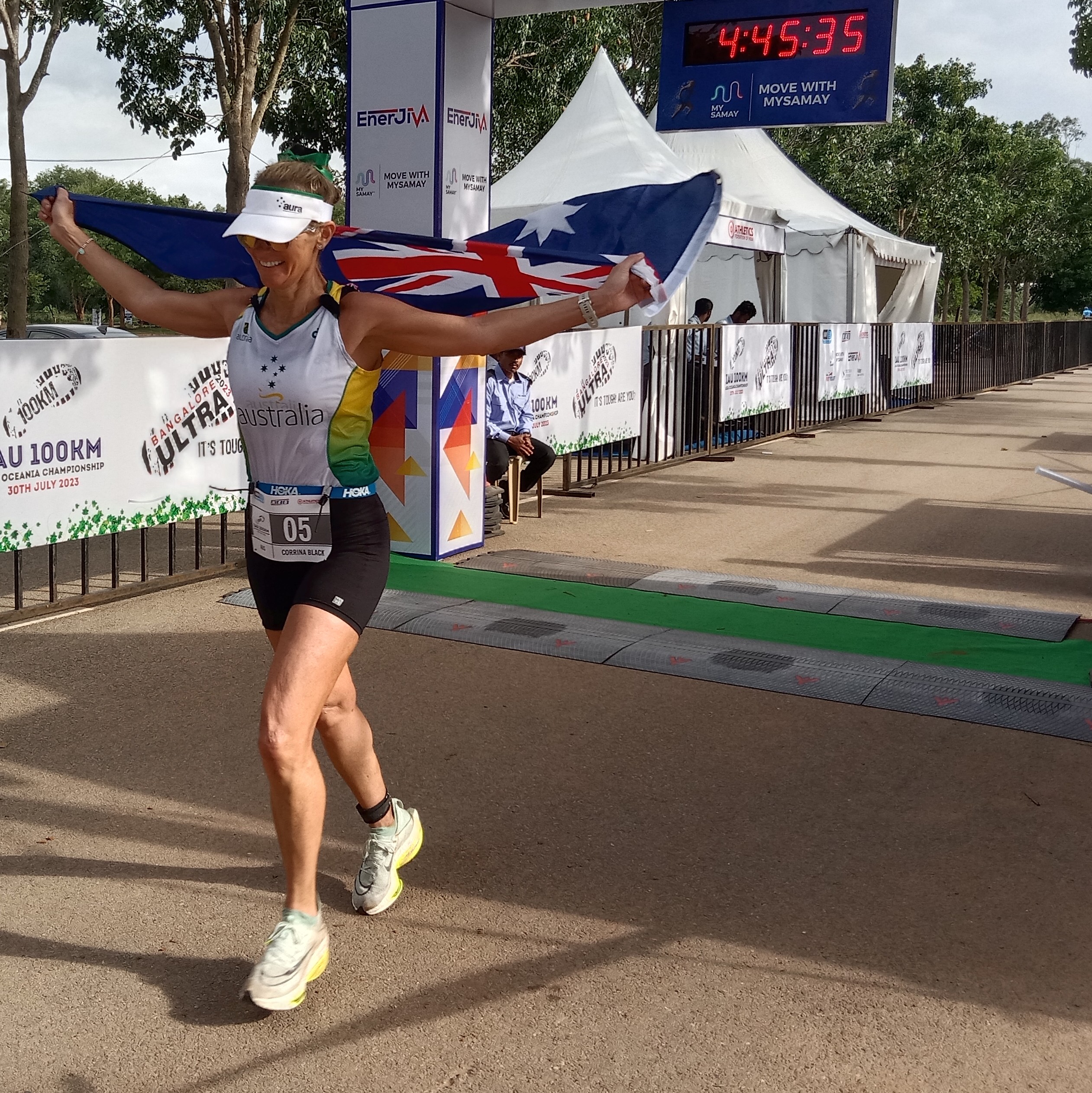
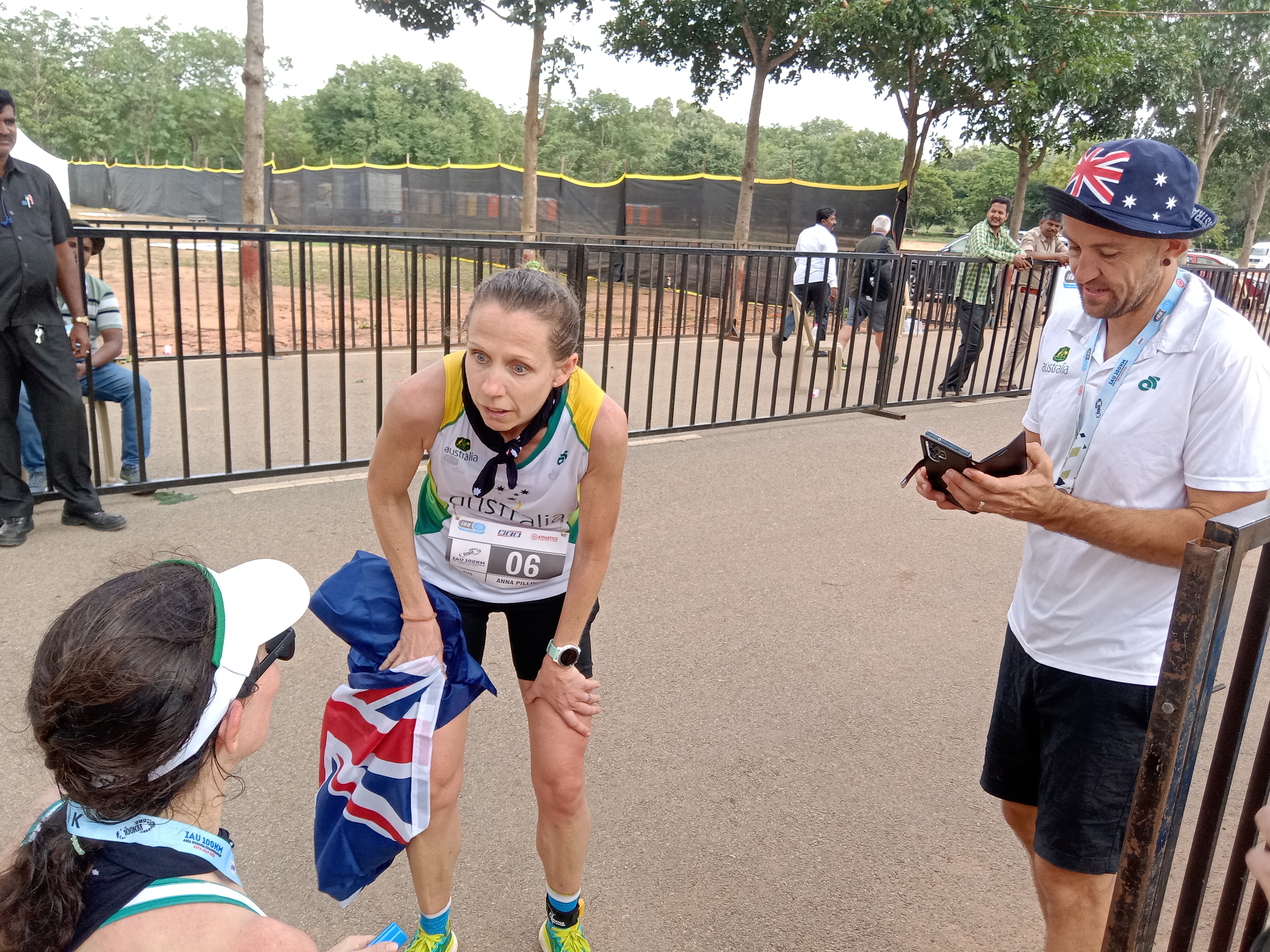
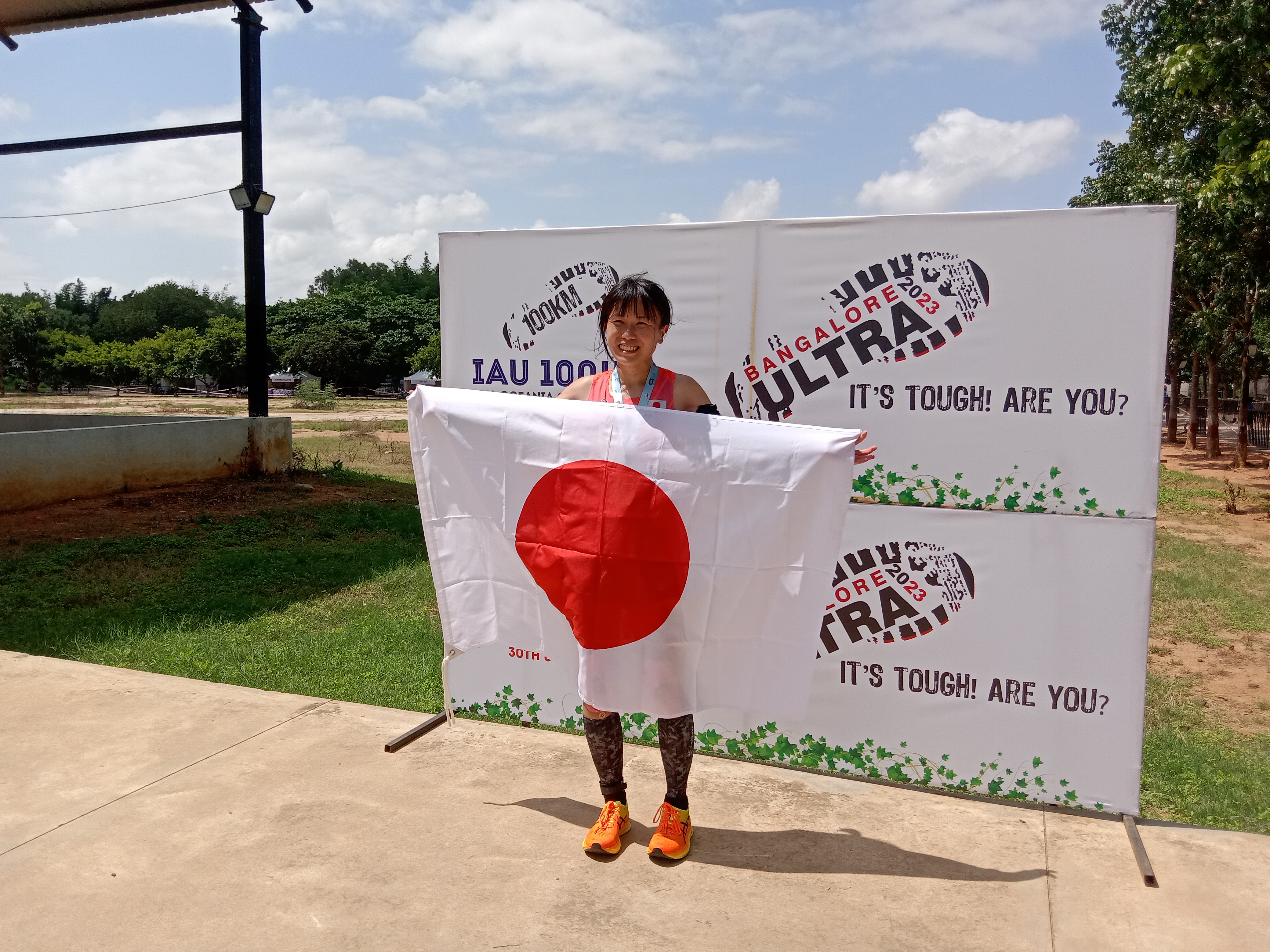
In the men’s race, Toru Somiya of Japan won by a good margin covering the distance in six hours, 39 minutes and 38 second, ahead of fellow compatriots Haruki Okayama (second place at 6:50:42) and Hideaki Yamauchi (third at 6:55:51). The outcome in the women’s race was similar with Japan’s Miho Nakata (7:27:44) placing first followed by her teammates, Mai Fujisawa (7:45:49) and Mikiko Ota (7:54:33) in second and third respectively. In the team championship, the men’s category was easily won by Japan; its best three runners had an aggregate time of 20:26:11. India placed second with an aggregate of 22:21:13 and Chinese Taipei, third, with 29:25:54. In the women’s category, the team championship went to Japan with a total of 23:04:06. The second and third positions went to Australia (27:48;03) and Chinese Taipei (32:25:07) respectively.
Miho Nakata (Photo: Latha Venkatraman)
Going into the race, expectations were high for the former world record holder Nao Kazami (he had a personal best of 6:09:14 for 100km) and Okayama (PB of 6:12:10). On race day, Kazami completed the first 11 laps of the five kilometre-course in 3:25:28 compared to 3:29:05 for Somiya. They completed 13 laps in 4:05:05 and 4:08:27 respectively. However, somewhere past the middle of the race, Kazami who was running strongly began to struggle and fade. Somiya completed his 18th lap in 5:53:52. Kazami took 6:02:37 to finish 17 laps. Somiya steadily consolidated his position and emerged winner by a wide margin (Kazami eventually finished in 7:22:10).
According to his team manager, this was Somiya’s first appearance in the national running team. His work schedule is such that he works during the night and trains during the day. On the other hand, the winner among women, Miho Nakata, has been a member of Japan’s national team before. All in all, the Japanese team drove home the message that its participation raises performance levels at running competitions, comprehensively (India’s previous taste of an IAU championship – the 2022 IAU 24 Hour Asia and Oceania Championship, also held in Bengaluru – hadn’t featured participation by the Japanese). Japan is among countries where running enjoys a great following.
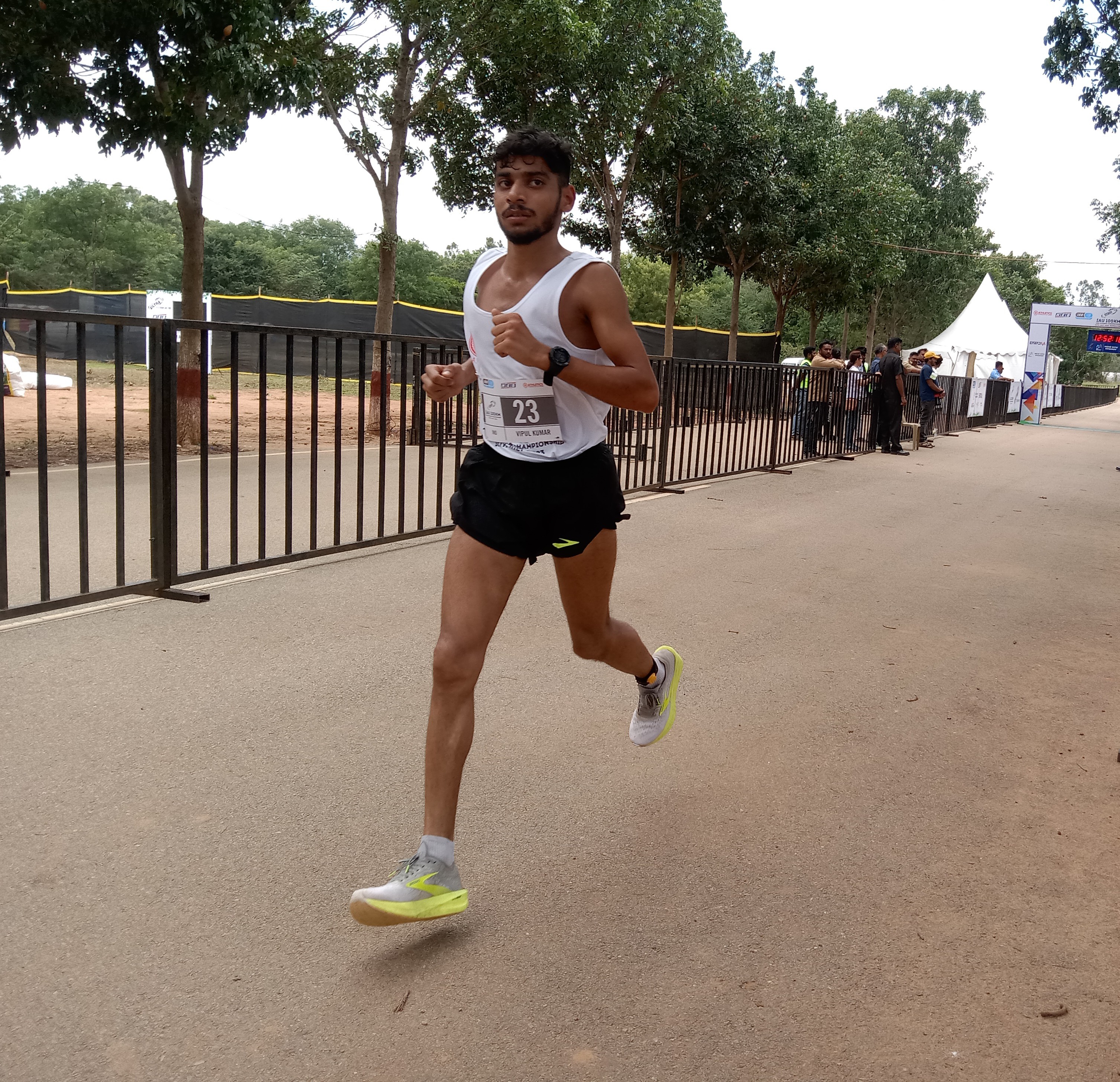
Vipul Kumar (Photo: Shyam G Menon)
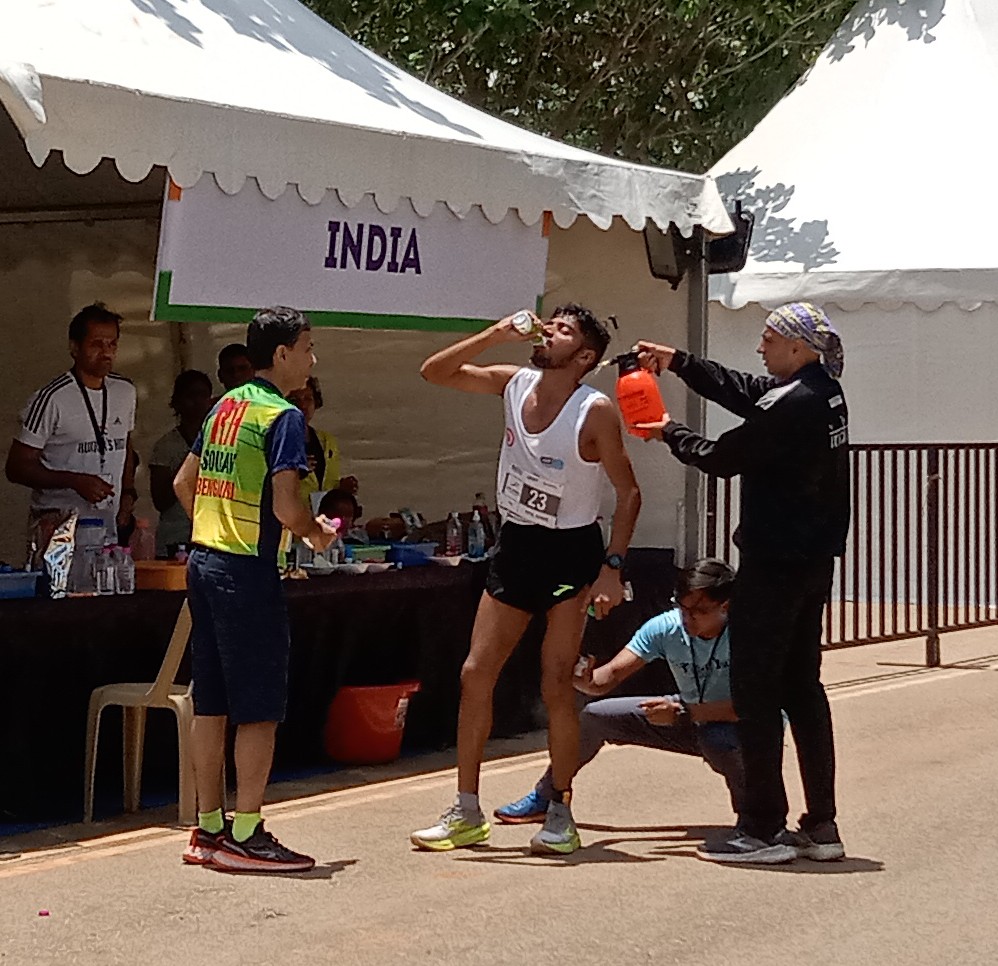
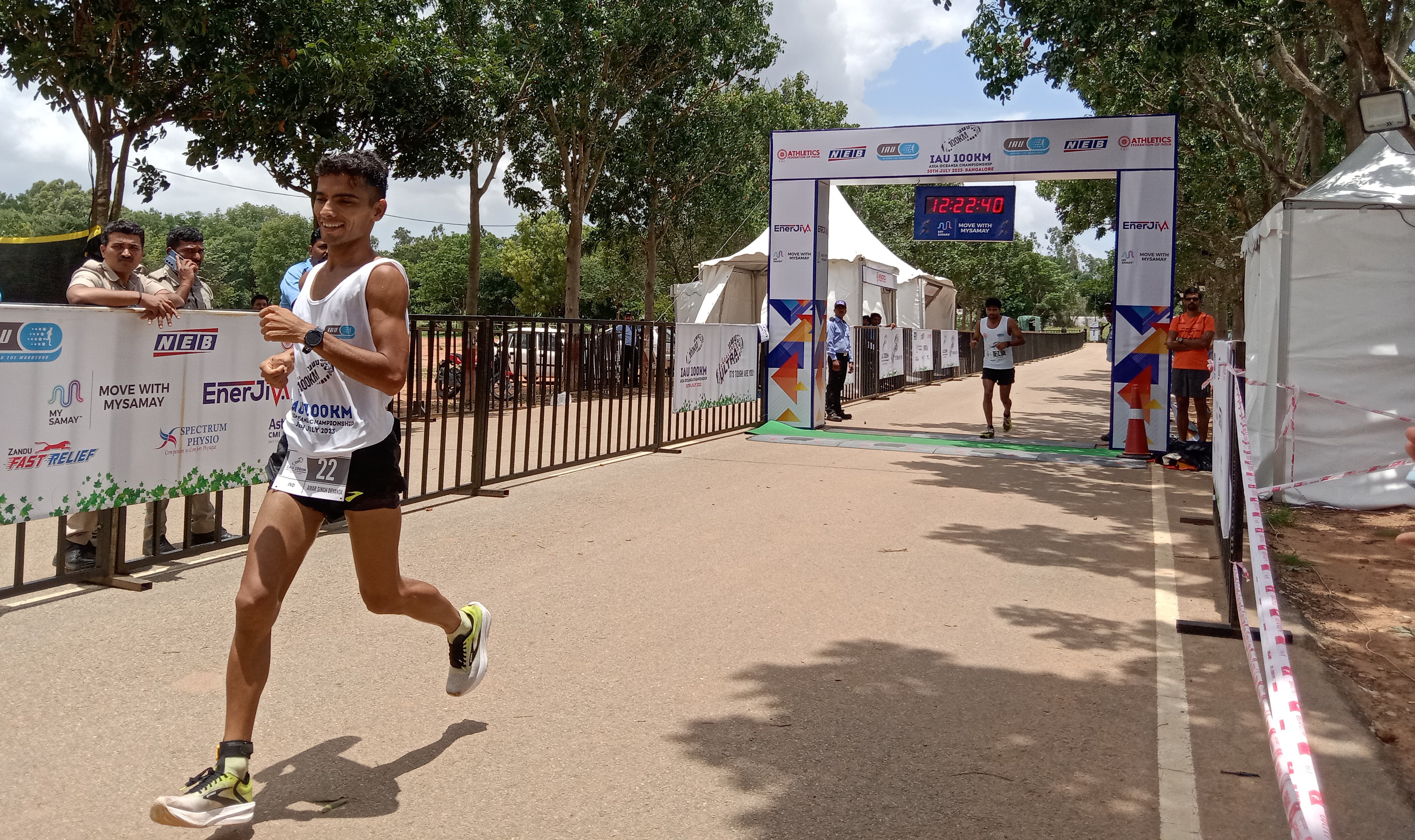
Having said that, on Sunday, finishing fourth in the men’s category (behind the top placed Japanese trio) was India’s Vipul Kumar. His gritty run took 7:06:10 to complete. He fell short of improving his national best (7:04:00) by a narrow margin. “Although the weather was an issue, I am very happy with my performance,” he told this blog. The second and third fastest Indian runners were Amar Singh Devanda (7:27:48) and Saurav Kumar Ranjan (7:47:06). These three runs taken together, earned the Indian men’s team a second place in their gender category.
In the women’s section, the Indian team suffered an unexpected setback when its top runner Jyoti Gawate (she holds the national record for women in 100 km – 8:20:00) was forced to pull out due to severe cramps. Between her 14th and 15th laps, there was a long gap in her appearance on the course, those watching the race from the side-lines noticed. It was the outcome of a break she had to take to address her situation. Jyoti completed 16 laps before deciding to discontinue. Coming into the race, Jyoti had the sixth best personal timing in 100km among the gathered women athletes. On Sunday, the fastest Indian woman to 100km was Shashi Mehta (8:52:38). She was followed by Gunjan Khurana (10:24:50). The race was held on a five kilometre-loop with a successful completion entailing 20 laps of the circuit. Unfortunately, the Indian women couldn’t deliver three successful completions from their ranks, to be considered for the team championship.
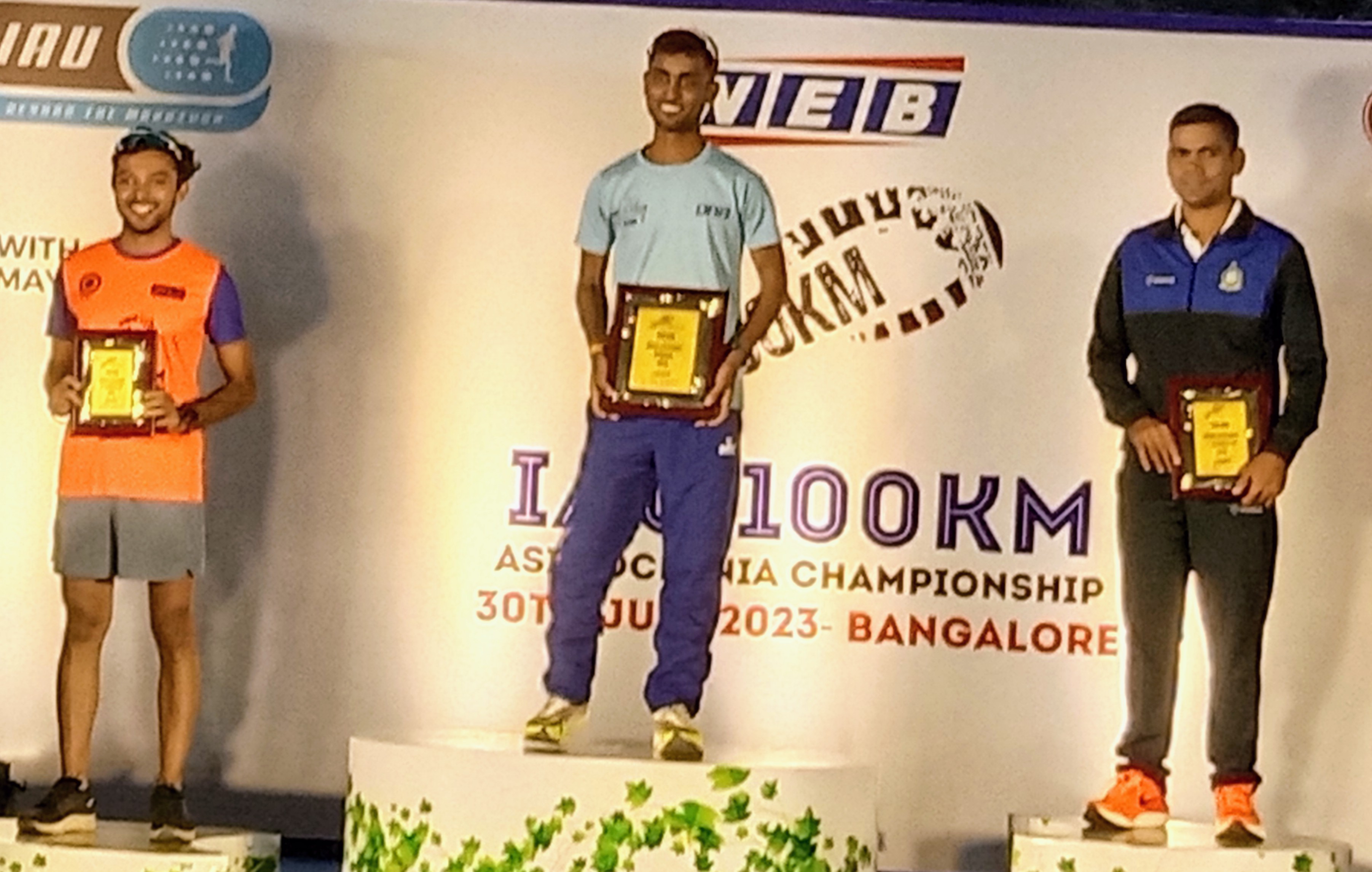
The podium finishers in the open category (Photo: Shyam G Menon)
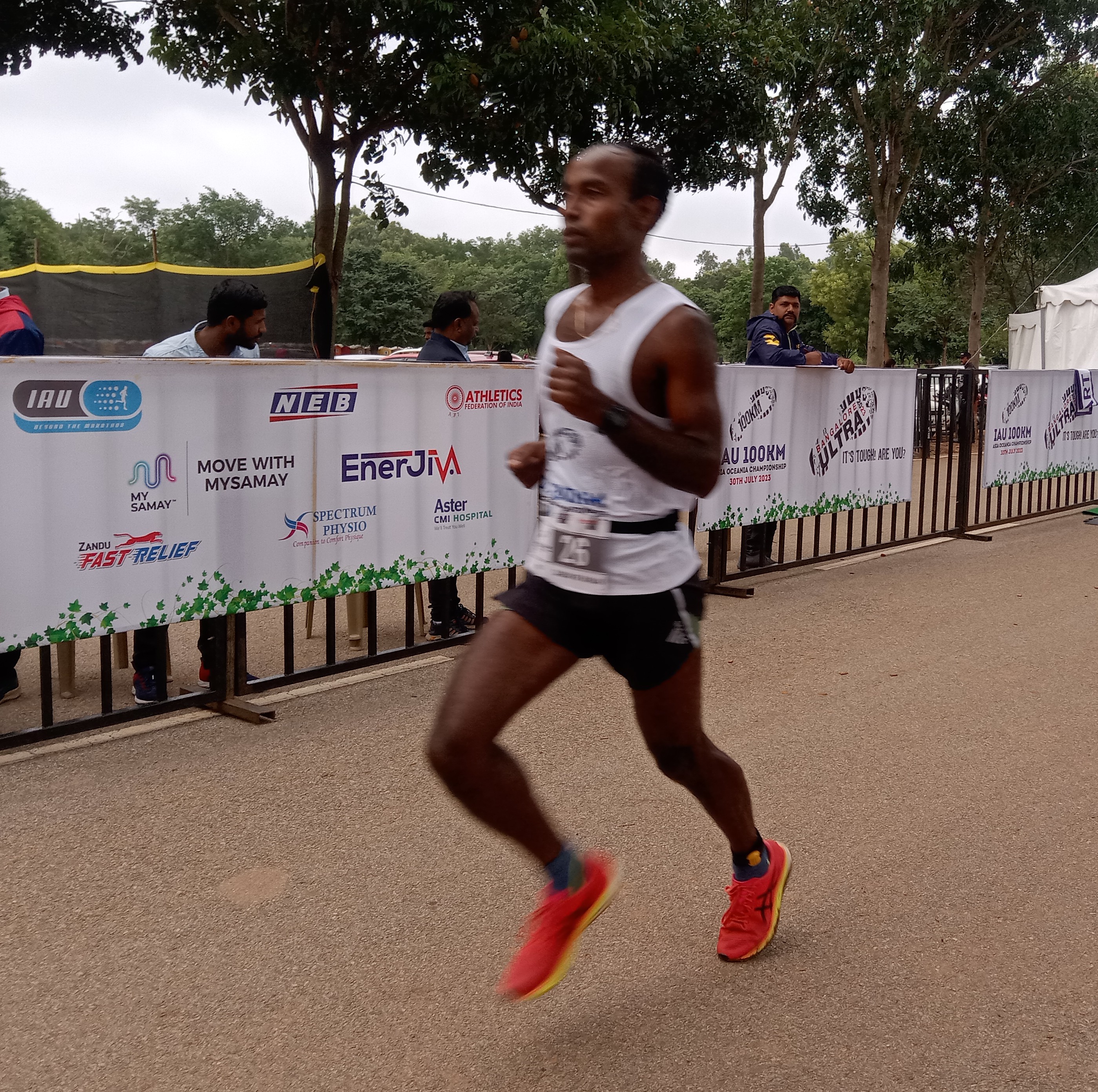
In the 100km open category, Velu Perumal was the winner; he covered the distance in 7:55:50. The second runner to finish was Gorkha Ram Beniwal with a timing of 8:15:22 and in third position was Anmol Chandan who finished in 10:02:39. There were no women runners in the open category. There were eleven male runners; all from India. Both Velu and Gorkha Ram pointed out that their diligent training helped them to stay strong on the course. Velu had been part of the Indian team which took part in the 2022 IAU 24 Hour Asia and Oceania Championship, held in Bengaluru.
The 2023 IAU 100km Asia and Oceania Championship was organized by NEB Sports.
Lkhagva-Erdene Namkhaidorj and Alan (Photo: Shyam G Menon)
On Sunday, many runners spoke of the weather as a suddenly emergent challenge. In the days preceding the race, Bengaluru had seen rain and experienced a generally cool weather. The day before the race, at the time of the event’s opening ceremony, there was rain. It kindled hopes that the cool weather would continue. Race day commenced with cool weather. But a few hours later, the sun came out and the coolness gave way to heat and humidity. Add to it portions of the course described by some of the runners as less shaded or hosting an incline. From the hours merging morning to noon onward, the struggle was evident across the assembled runners. Thus, although they won the race by a fantastic margin when compared to the rest of the field, the timings of even the Japanese runners were not close to their personal best. A team manager explained the situation as being as much physical as it was psychological. According to him, there was so much confidence in the weather being good that when it turned otherwise, the carefully placed calculations and motivation levels of some of the athletes may have got upset. There were exceptions. India’s Amar Singh Devanda, Saurav Kumar Ranjan, Binay Sah (7:55:21) and Shashi Mehta managed new personal best.
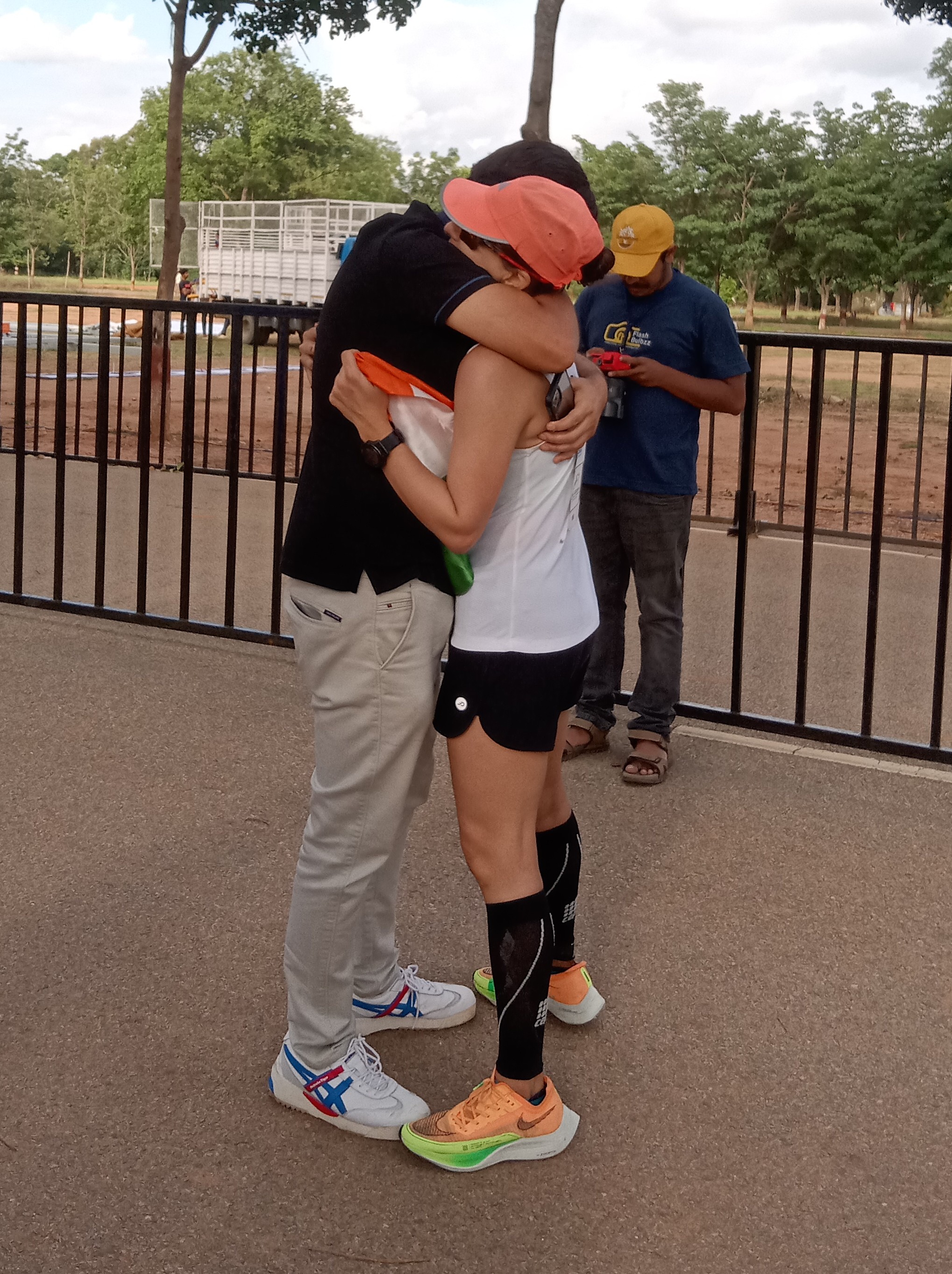
Amidst all the competition, there was a lovely example of cooperation and sharing. In ultrarunning, each team’s support crew plays a crucial role; they make sure they know their runners well, cater to each athlete’s needs on race-day and support them with nutrition and hydration. Mongolian ultrarunner, Lkhagva-Erdene Namkhaidorj, out on her first international event and only the second 100km-race of her life, had reached Bengaluru without anyone to support her during the run. Alan, who was supporting Shannon-Leigh Litt of New Zealand, decided to support the Mongolian runner too. The two teams shared one tent offering the required support facilities. As Lkhagva-Erdene Namkhaidorj completed her race, it was Alan who showed up to greet her at the finish line, Mongolian flag in hand for her to wrap herself in.
(The authors, Latha Venkatraman and Shyam G Menon, are independent journalists based in Mumbai.)
It will be the first IAU world championship to be held in India
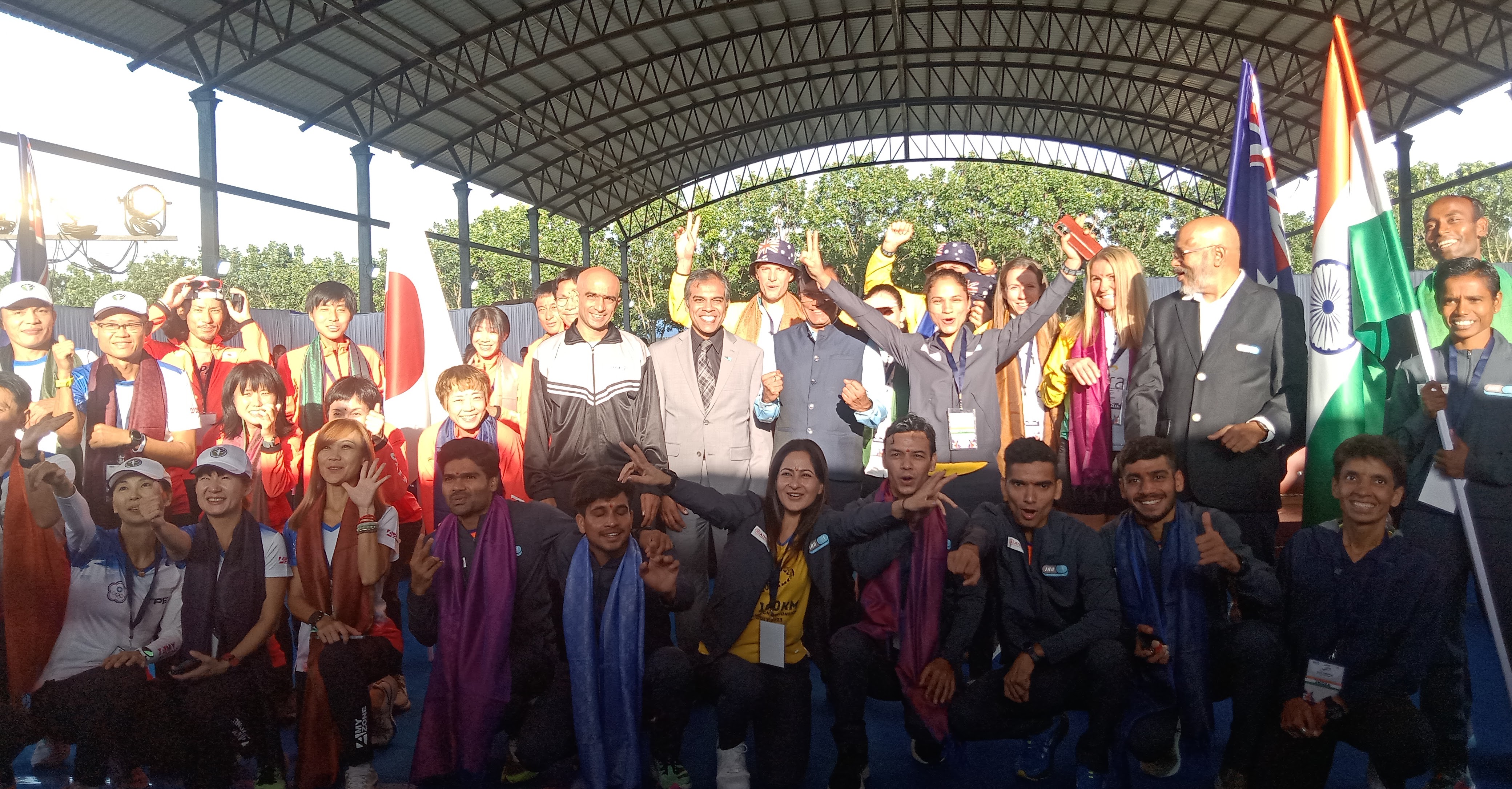
Athletes and officials assembled in Bengaluru for the IAU 100km Asia & Oceania Championship (Photo: Shyam, G Menon)
India will host its first world championship under the auspices of the International Association of Ultrarunners (IAU) in November this year.
“ It will be the 50k world championship and will be held in Hyderabad,’’ Dr Nadeem Khan, president, IAU said in Bengaluru on Saturday (July 29, 2023). As yet IAU championships held in India have spanned 24 hours and 100k and been in the Asia-Oceania championship category.
Dr Khan was in the city in connection with the IAU 100km Asia & Oceania Championship, which gets underway on Sunday (July 30). The event – it is the first IAU 100k championship being held in India – is scheduled to take place on a five kilometre-loop at the GKVK (Gandhi Krishi Vigyana Kendra) campus. The championship was formally declared open at a ceremonial function, Saturday evening.
Nao Kazami (Photo: Shyam G Menon)
Haruki Okayama (Photo: Shyam G Menon)
The event has participants from Australia, Chinese Taipei, New Zealand, Japan, Mongolia and India. It is being held in association with the IAU, Athletics Federation of India and is being organised by NEB Sports. The presence of Japan and Australia add to the competition on show. Of the top five male athletes ranked as per their personal best, the top four are from Japan and one, from Australia. This includes former world record holder Nao Kazami of Japan, who has a PB of six hours, nine minutes and 14 seconds for the 100k. Expected to give him tight competition is his teammate, Haruki Okayama (6:12;10). All the aforementioned five athletes have sub-seven-hours PBs. Going into the race, the composition of the top five ranked according to their PBs was the same for women with the top four hailing from Japan and one from Australia. The best PB among women belonged to Miho Nakata (7:19:12).
The previous edition of the 100km Asia and Oceania Championship was held in Jordan in 2019. In 2022, the 100km World Championships were held at Bernau-Berlin where India’s Vipul Kumar and Jyoti Gawate set new national bests (7:04:00 and 8:20:00) in the distance. Both Jyoti and Vipul are part of the Indian team running at Bengaluru on Sunday (July 30, 2023).
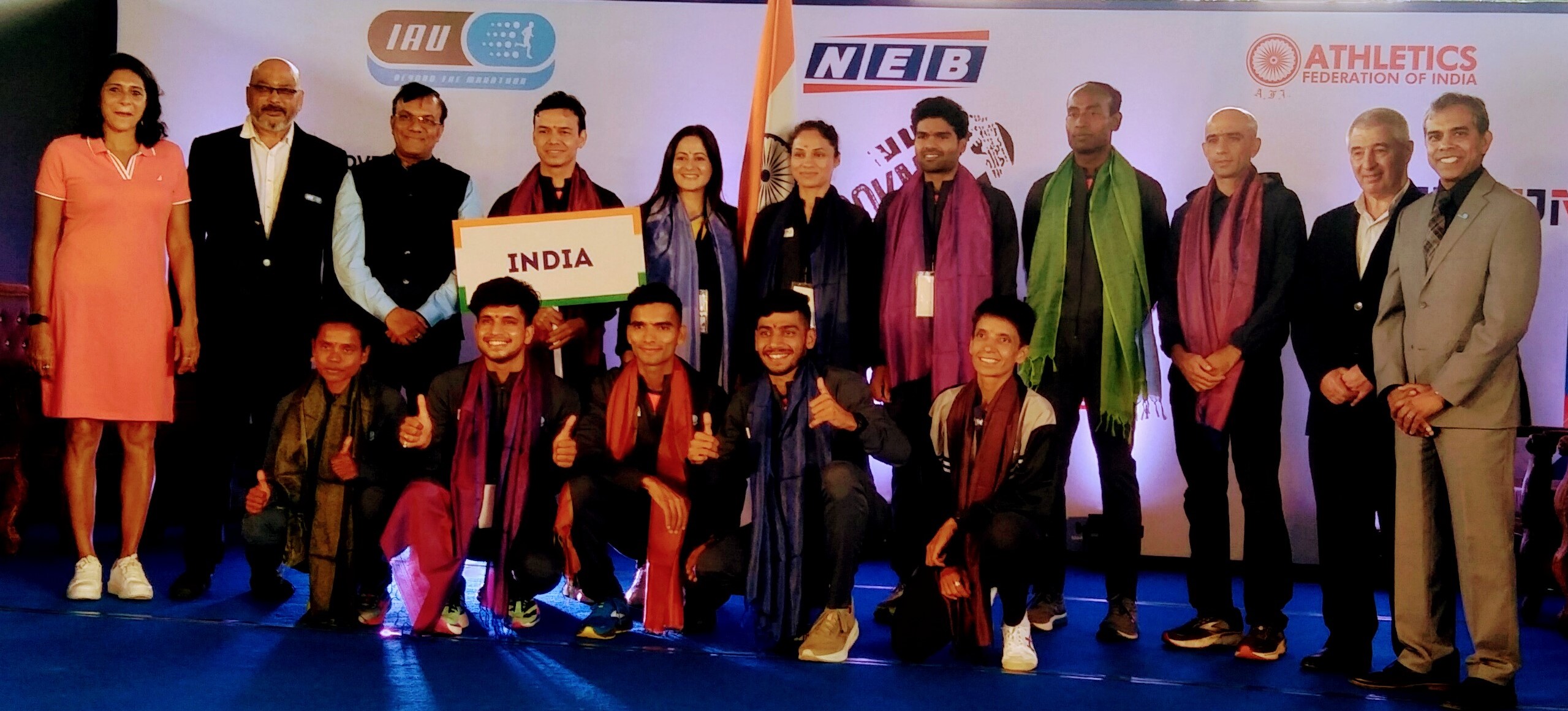
The Indian team with IAU president, Dr Nadeem Khan (far right), race director Nagaraj Adiga (second from left) and others (Photo: Latha Venkatraman)
“ The hosting of IAU 100 km Asia & Oceania Championship will give us visibility and reach in ultrarunning,” a related press release said quoting Dr Rajender Kataria, an IAS officer and president of the local organizing committee of the championship in Bengaluru. “ The championship coming to India is a culmination of several years of hard work. We are very excited to bring this event to India and appreciate the fact that this will further elevate the sport in the country,” the release said quoting Dr Khan.
India will be represented by ten ultrarunners – four women and six men. They are Vipul Kumar, Binay Sah, Saurav Kumar Ranjan, Nishu Kumar, Amar Singh Devanda, Karthik Joshi, Jyoti Gawate, Gunjan Khurana, Shashi Mehta and Aparna Choudhary.
(The authors, Latha Venkatraman and Shyam G Menon, are independent journalists based in Mumbai.)
Months after the 2023 Brazil 135 and almost two weeks since the year’s edition of Badwater 135 concluded, one of the most remarkable performances by an ultrarunner hailing from India, has stayed little-known.
Sonia Ahuja grew up in Gurgaon near New Delhi. That’s where her journey began. Her parents were teachers. “ My father and I walked a lot. We would walk miles and miles to go to various places. I remember walking a lot as a kid,’’ she said mid-July 2023. It was past 2PM in India, hour of sleep in Los Angeles but as the ultrarunner put it, alright for a chat and just an hour shy of the regular commencement of a running day. Following her post graduate course in computer application (MCA), Sonia joined Tata Computer Services (TCS) and within months, reached the US. “ I was a generally ambitious person,’’ she said about her tendency to work hard and excel. In due course, she did her MBA from College of William and Mary in Williamsburg, Virginia. She also got married (to Sameer Nayyar), started a family and focused on raising her daughter (Rhea).
Aside from all the walking she had done with her father in India, Sonia had not participated in sports through her years in school and college. Emphasis was on academics. Running entered her life in the period that followed her joining Wells Fargo, and her taking on increased responsibilities at work. The appetite for more work induced stress. To address it, she jogged daily. To her delight, she found it not only good for physical fitness but also mentally refreshing. “ I became less anxious and thought more clearly,’’ she said. Eventually, running became a habit. “ I couldn’t work if I hadn’t run,’’ she said. It wasn’t long before, somebody suggested that she try a marathon. And so, in 2014, Sonia who lived then in San Diego, ran her first marathon – the Rock `n’ Roll San Diego Marathon. To everyone’s amazement, she returned a sub-four-hour timing. In the years that followed, she participated in several events; among them the Los Angeles Marathon and the iconic marathons in Boston and Chicago. She wasn’t a devotee of systematic training and big events. She wasn’t also into racing and running for medals. She preferred instead to run for her own enjoyment, set her distances accordingly and generally opted for low profile events where the pressure to chase targets and be around thousands chasing targets, was less.
What intrigued Sonia wasn’t as much these marathons as how she felt after running them. At the end of a 42 kilometer-run, she felt quite energetic. There was little exhaustion or sense of collapse. It prompted her to run more. Soon it became a trend with her – she would participate in a marathon and while others rested the day after or did short recovery runs, she would do a half marathon. In turn, that ability for sustained running, provoked her curiosity for distances longer than the marathon; the ultramarathon. Four years after her marathon debut in San Diego, she did her first 50 miler in Avalon, California, in 2018. “ It went off well. I felt great after completing it,’’ Sonia said. But further exploration of her boundaries in running was checked by work. She had become the chief operating officer of a private equity backed company; the job entailed considerable travel and the schedule affected her running.
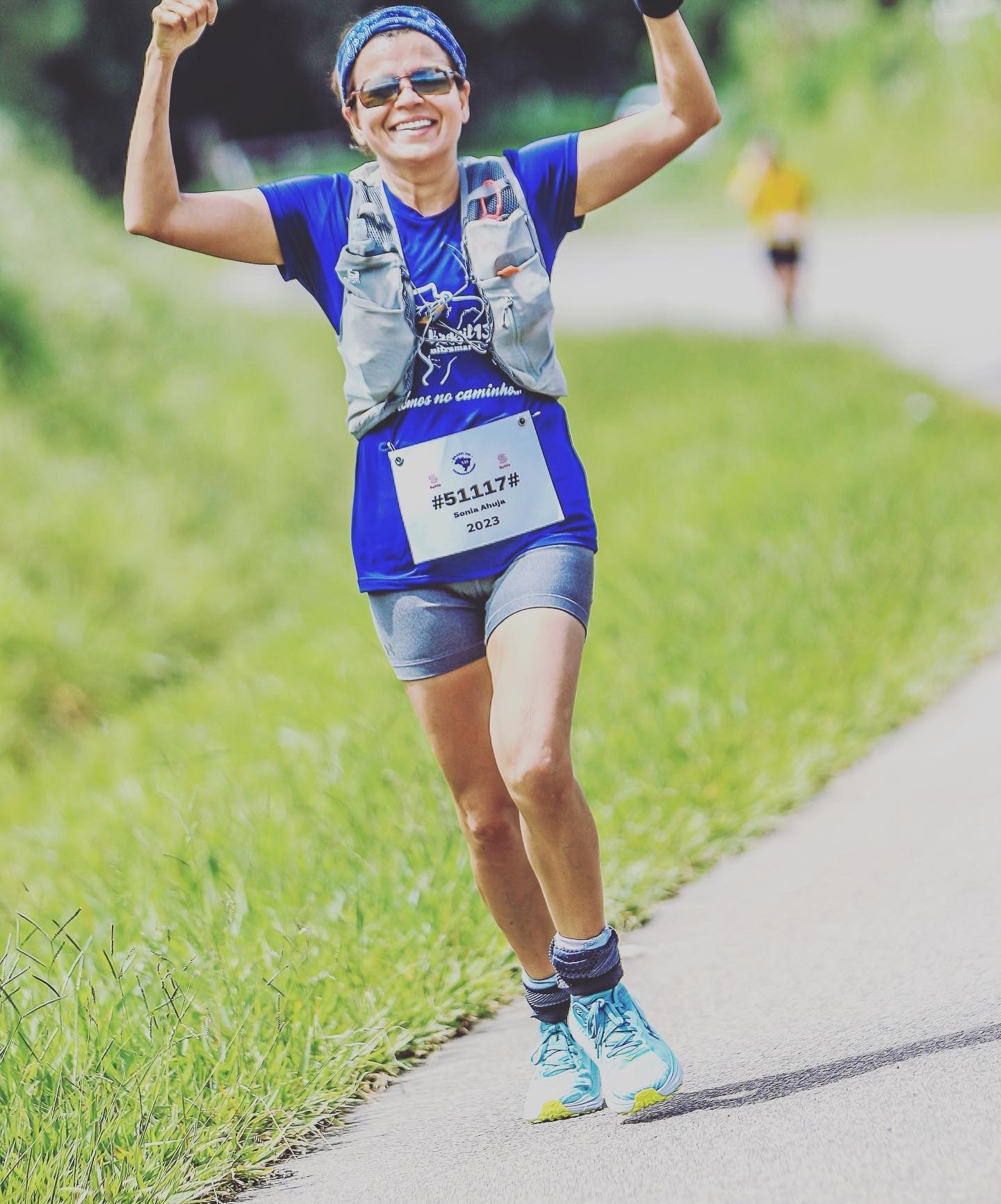
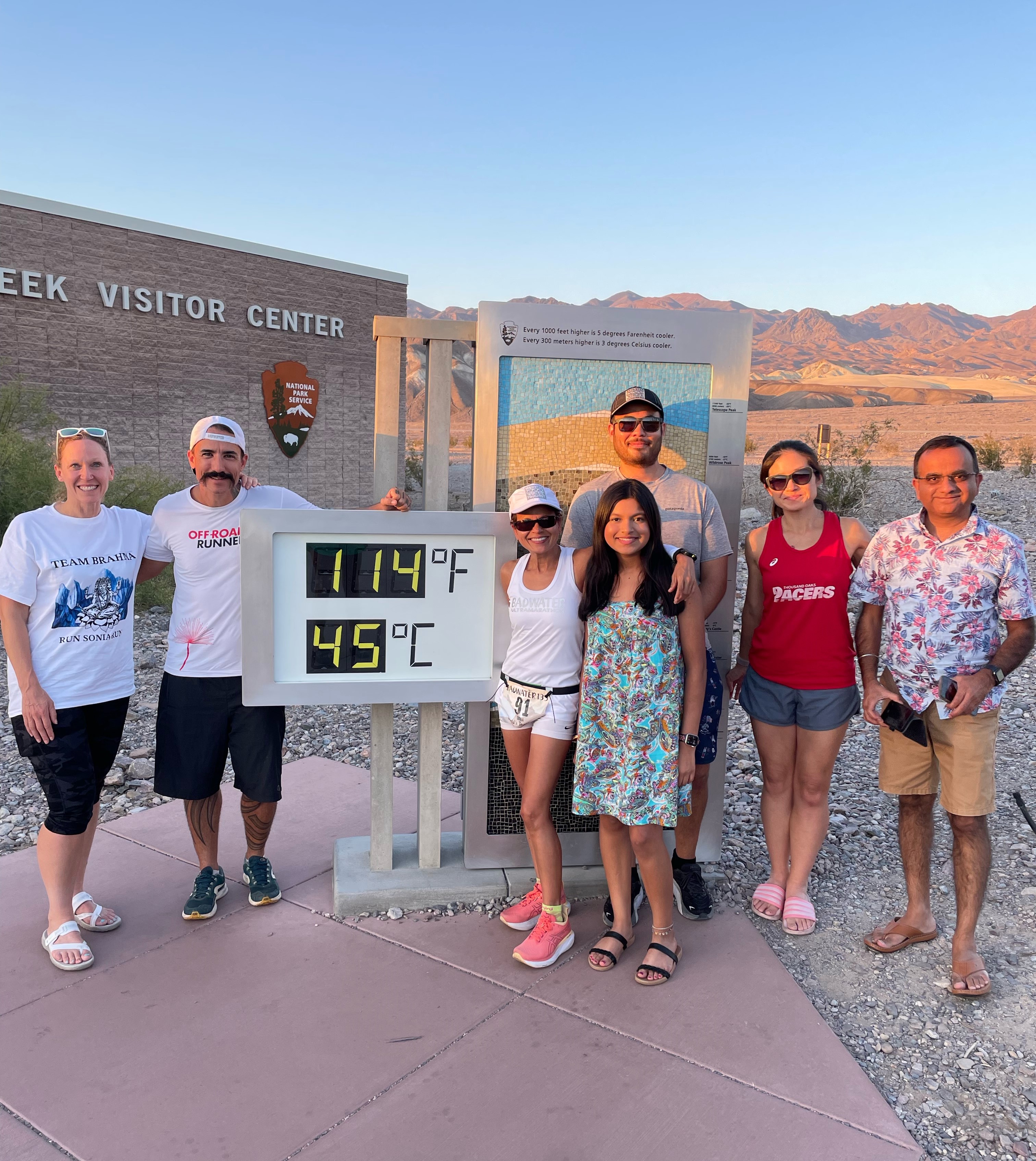
Sonia Ahuja (centre) with her family and her support crew for Badwater 135 (Photo: courtesy Sonia)
In 2020, COVID-19 gripped the planet and the world sank into a period of lockdown and restrictions. The onset of pandemic put on hold, Sonia’s traveling. It freed up time; time that she could use to run. Although running events worldwide went into a hiatus, in a US that believed in the physically active lifestyle, Sonia was able to push her running and pile on mileage. She was doing weekly mileage of 80-100 miles. There were days when she hid her Strava data from public view so that her eccentricity wouldn’t be noticed. Her distances were now moving steadily from marathon to ultramarathon territory. It was partly fueled by the fact that she found the greater distances “ calming.’’ She also liked running on trails and during this time indulged in a lot of hiking. “ I went to Switzerland and ran and hiked in the Swiss Alps,’’ she said. In 2020, she signed up for her first 100 kilometer-race. It was a small event. Days before the race, she realized that she was feeling very good. “ So I changed the 100k to a 100 miler,’’ Sonia said. She placed second among women in the race. Once again, what stood out for her was the comparative lack of exhaustion. She had run (no walking) the whole distance and aside from a few blisters, she was absolutely alright. She continued to do many 50 kilometer-runs.
Around this time, another revelation occurred. She had struck up an annual tradition of hiking up and down Mt Whitney (one way is 11 miles); all in a day’s time. Whitney (14,505 feet) is the highest mountain in the contiguous United States and Sierra Nevada. On one occasion, she did the single day-hike up and down Whitney and ran a marathon the next day. She posted this on social media and among the responses she got was a suggestion that she attempt Badwater 135, the grueling ultramarathon through California’s punishingly hot Death Valley with a finish at over 8000 feet-elevation at Whitney Portal, the trailhead to Mt Whitney. “ I looked it up on the Internet and it seemed like the Holy Grail of ultrarunning,’’ Sonia said. In the ultrarunning world, completing Badwater is a coveted benchmark. As Sonia studied the details including race results, it struck her that no Indian woman had yet completed Badwater in the solo category. According to Sonia, in September 2022, she contacted Chris Kostman, the race director of the Badwater ultramarathon and spoke to him of her wish to participate. Given ultramarathons push people to their limits and can therefore be risky, the major events out there usually insist on prequalification. Kostman asked Sonia about the races she had been to. It was soon evident that her resume was weak. He told her that she should have done at least three 100 mile-races before thinking of Badwater.
That didn’t deter Sonia. Given applications for the 2023 Badwater 135 had to be submitted in January, she knew she had very little time to wrap up three races and deliver a performance good enough for consideration by Badwater. In October 2022, she emerged the overall winner at the Miami 100 ultramarathon with a run that nearly broke the course record. In December 2022, she completed the Rio Del Lago 100 miler in 22 hours. The final of the trio of qualifiers she picked was in Brazil – the Brazil 135, much respected by ultrarunners for its difficulty. An April 2017 article by David Green in Trail Runner magazine described the race so: “ The Brazil 135, a realization of race director Mario Lacerda’s dream, features 135 miles and 35,000 feet of climbing.’’ According to it, the race takes place on “ a storied trail—the “Caminho de Fé,” also known as the “trail of faith”—whose history goes back hundreds of years as a religious pilgrimage. Each mountain climb is rewarded by a descent into each unique village, a church and folks who whole-heartedly support the ultrarunners.’’
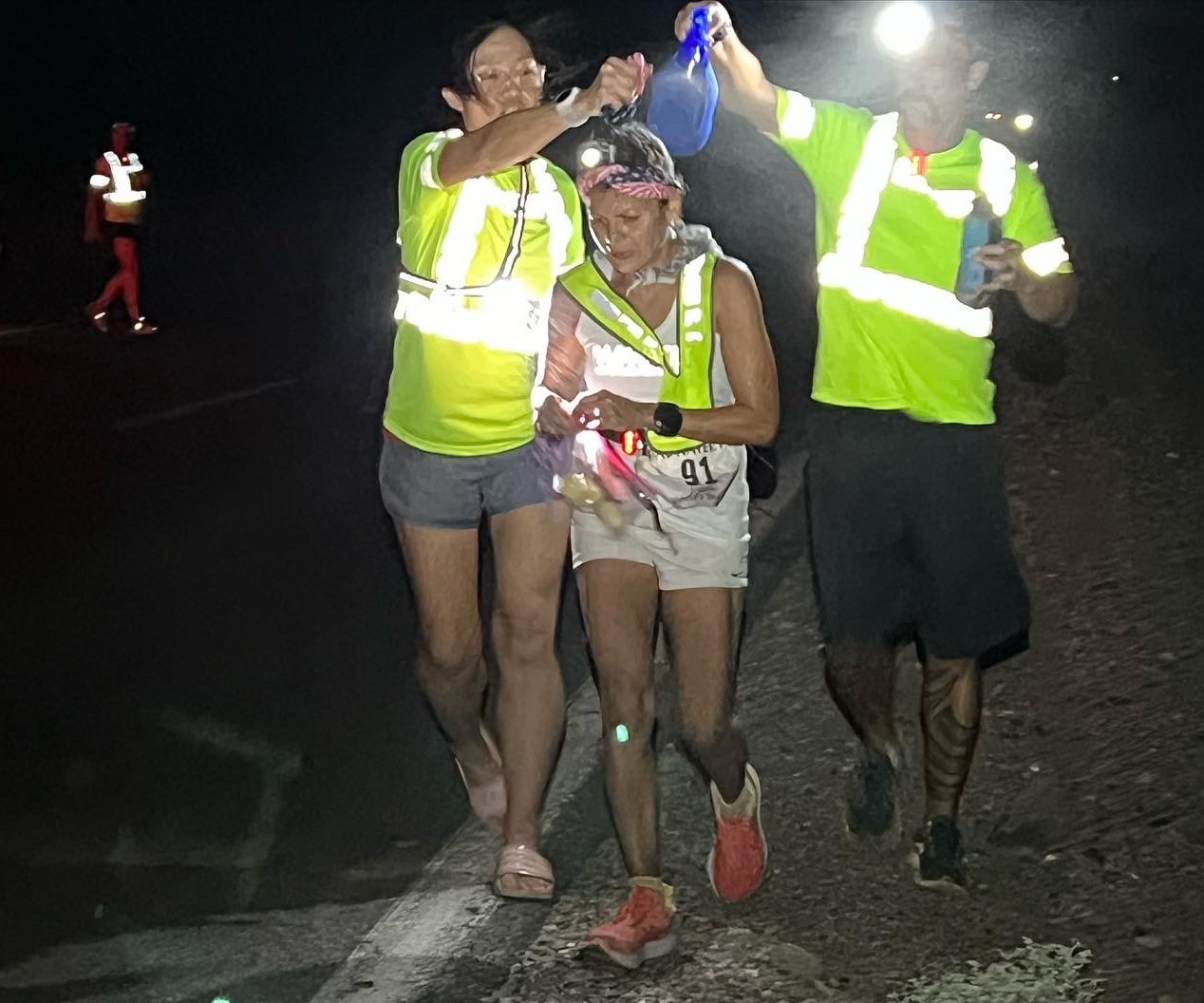
Running Badwater 135; Sonia Ahuja (centre) and members of her support crew (Photo: courtesy Sonia)
For Sonia there was a first; Brazil 135 was a race that required the runner to have a support team. Sonia describes herself as “ minimalist’’ in approach and “ low maintenance.’’ That lightness of being had been her attitude towards races too. During her races, she refuelled at aid stations. Brazil was going to be different. And yet, it shouldn’t break the relaxed approach to racing she was comfortable with – that was the thought. Sonia sounded out her best friend, Ekta Ranjan, about a vacation in Brazil with an ultramarathon on the side. Ekta did some homework and understood that Brazil 135 was no run in the park. It gave her an idea of how to prepare. By now members from Sonia’s running club (Mari Iwasaki and Crystal Alexander) were keen to crew; there was also a backpacker (Brian Matsuyama) headed to Brazil who joined in. Local knowledge was critical for the race in Brazil and so they recruited a person from there (Marcelo Bo) as well for the crew. The overall tenor was still one of vacation. The style hid a crucial detail.
Brazil 135 was terribly important for Sonia – a win there ensured runner an entry to Badwater. As it turned out, Sonia finished first among women in the race and third overall. It was remarkable. Besides the intrinsic difficulty of Brazil 135, she had done three 100 milers as best as she could in the period spanning October 2022 to January 2023. And she completed Brazil 135 without injuries, blisters and stomach issues. It was a strong finish. “ I now knew I was going to run Badwater,’’ she said. Of the six persons, who crewed for her in Brazil, four formed her support crew for Badwater (the rest turned up to support). For the event in California, she tweaked her approach and made it more target-oriented. She did additional strength training. For ease of crewing and monitoring her progress, the team visualized the upcoming race as five marathons. Sonia set a best-case scenario of covering the 135 miles in 24-25 hours (she later revised that to attempting a sub-24-hours pace); worst case was 28-29 hours. Plus, some serious planning went into hydration and nutrition; the conditions at Badwater are not to be trivialized with (Death Valley is among the hottest places on Earth. On July 17, 2023, The Guardian reported that the temperature at Furnace Creek in the valley had touched 53.3 degrees centigrade the day before. Furnace Creek is also where the hottest temperature yet recorded on Earth, happened: 56.7 degrees centigrade in July 1913).
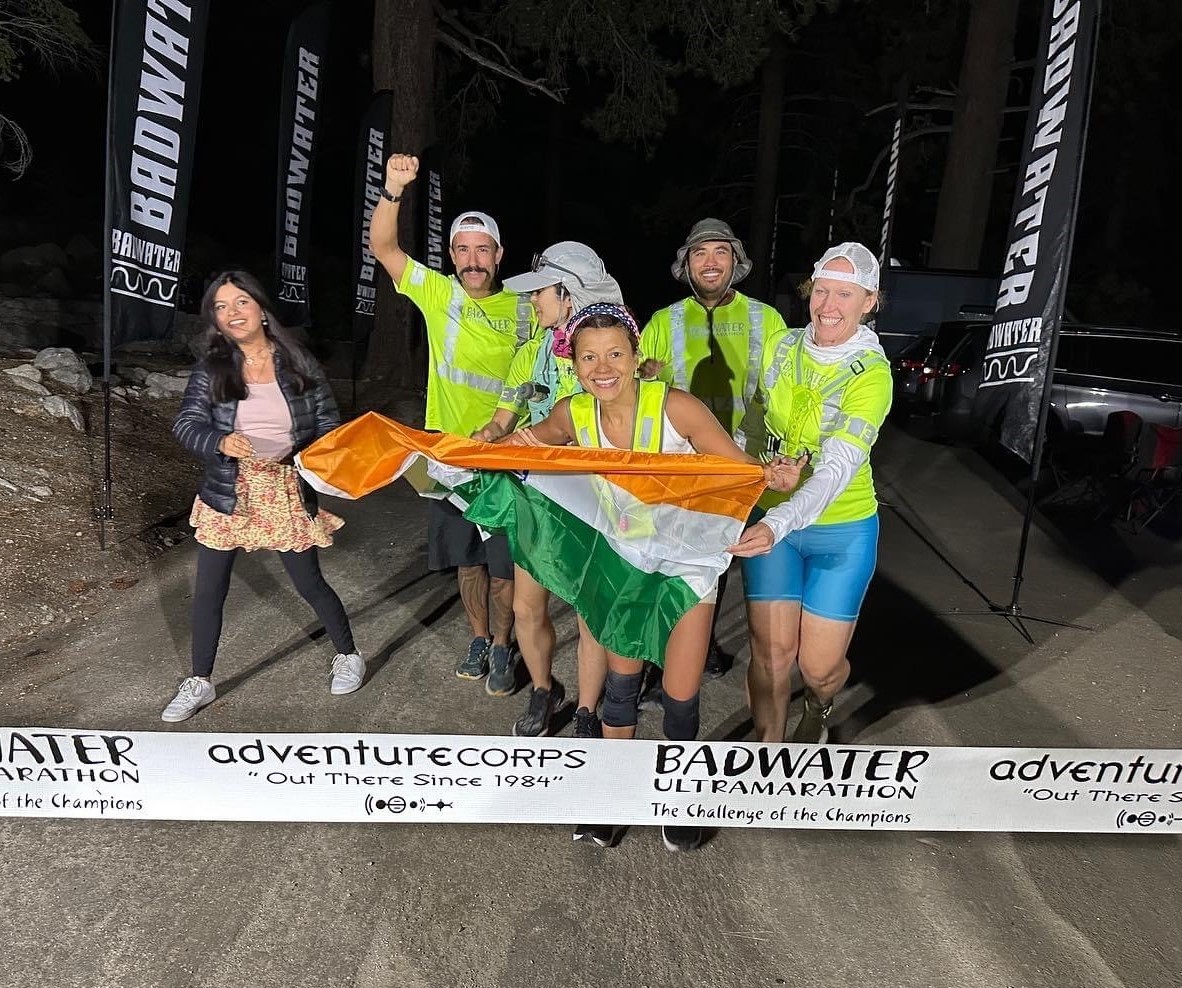
From Badwater 135; Sonia Ahuja (centre with flag) and her support crew (Photo: courtesy Sonia)
On race day in early July, Sonia who commenced her run as part of the second wave of runners (there were three in all), covered the first marathon segment in sub-four hours. Some from her crew expressed concern at the pace. It was the early stages of the race and there was a lot of distance left to cover. The second segment went by in 4:15 hours. By the end of the fourth segment, she was still ahead of her personal target. Then came a section, where runners were advised a roughly 20 minute-ride in the crew car to get past a flooded portion. Sonia had thought of catching some sleep in the car. In her urge to secure a fine finish for India, she iced her legs hoping it would make them fresh for the last stretch. Her confidence was also bolstered by the fact that a month before, she had done a dry run of some sections of the race and in that, she had covered the last portion pretty fast. Inexplicably on race day, the last section proved agonizing. Her legs kept giving away and she had to almost crawl to the finish line (it is suspected, the icing of the legs may have caused the problem). Still, the first woman hailing from India to finish Badwater solo placed second in her gender category and fourth overall. According to Sonia, at 25 hours and 42 minutes, hers was the third fastest time to finish among women, in the history of the race. “ It’s insane. Absolutely fantastic,’’ Ashish Kasodekar, well-known ultrarunner from Pune, who has completed both Brazil 135 and Badwater 135, told this blog of Sonia’s performance.
News of Sonia’s podium finish created a buzz among runners in India. Badwater is one of the world’s toughest ultramarathons. People associated with India’s national ultrarunning team reached out to Sonia. But her work and life in the US had seen her take US citizenship; she was now technically a Person of Indian Origin. What the 47-year-old wishes for most, is to see her podium finish inspire female ultrarunners from India to attempt races like Badwater.
(The author, Shyam G Menon, is a freelance journalist based in Mumbai. This article is based on a conversation with Sonia Ahuja.)
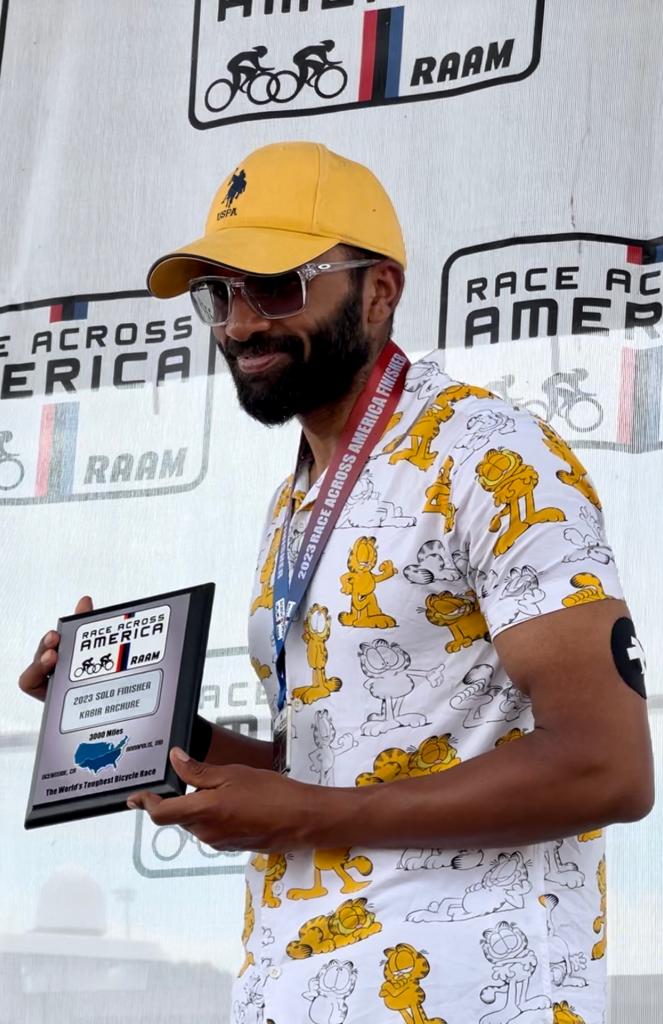
Kabir Rachure soon after his successful completion of 2023 RAAM in the solo category (Photo: courtesy Sapana Rachure)
Secures second place in age category
Amit Samarth and Srinivas Gokulnath complete RAAM for the second time
Results are provisional
Kabir Rachure got his third successful finish at Race Across America (RAAM) on Saturday, June 24, 2023, with a second place in his age group to boot.
He finished on the tenth day – 10 days, 19 hours, 21 minutes – from race commencement, a much-valued objective among Indian aspirants. The result is an improvement on Kabir’s timing from the 2022 RAAM, when he had completed the race in 11 days, 11 hours and 25 minutes and placed third his age category of men under 50. That was his second finish in RAAM’s solo segment. Earlier in 2019, his first successful completion of RAAM had been in 11 days, 22 hours and 43 minutes.
Hours after Kabir crossed the finish line at 2023 RAAM, Amit Samarth and Srinivas Gokulnath registered their second successful completion of the race. Amit completed in 11 days, four hours and 38 minutes; Srinivas in 11 days, six hours. In 2017, Srinivas had been the first Indian to complete RAAM in the solo category. He took 11 days, 18 hours and 45 minutes. Amit followed Srinivas to the finish line in 11 days and 21 hours, giving India two solo finishers that year.
At the time of writing, the 2023 race results were provisional. According to some of those tracking RAAM from India, there was an incident of forest fire en route due to which, participants were advised travel in vehicles between two time-stations (TS 8 and TS 9). Subsequently, as the race continued, there appears to have been two notes to participants on the subject. In their first communique, race organizers informed that solo riders may see time adjustment of nine hours post-race. Later, a note of June 22, while not mentioning nine hours, said (among other things), “ Cut offs remain as they are in the rules and this adjustment taken after the fact will not affect your official finish status but will affect your final speeds and race data.’’ It added that until the final adjustment is made, “ all awards and records will be provisional.’’ As per this note, the shuttle of 102.8 miles (165.44 kilometres) between time-stations 8 and 9 reduced this year’s course length to 2934.09 miles (4721.96 kilometres).
RAAM normally spans a little over 3000 miles (4800 kilometres), from the west coast of the United States to its east. The cut off time to complete RAAM solo, is 12 days. “ Finishing RAAM itself is a Herculean task,’’ Bharat Pannu, among leading ultra-cyclists in India and a RAAM aspirant, said on Kabir’s performance and how it would be a new benchmark for those set to follow. The 2023 RAAM was won by Isa Pulver of Switzerland. She covered the distance in nine days, 12 hours and 16 minutes; only the second instance of a woman winning RAAM’s solo category overall, after Leah Goldstein of Canada in 2021.
(The author, Shyam G Menon, is a freelance journalist based in Mumbai. This report will be updated if there are any changes to the performance data quoted as a consequence of the post-race time adjustment.)
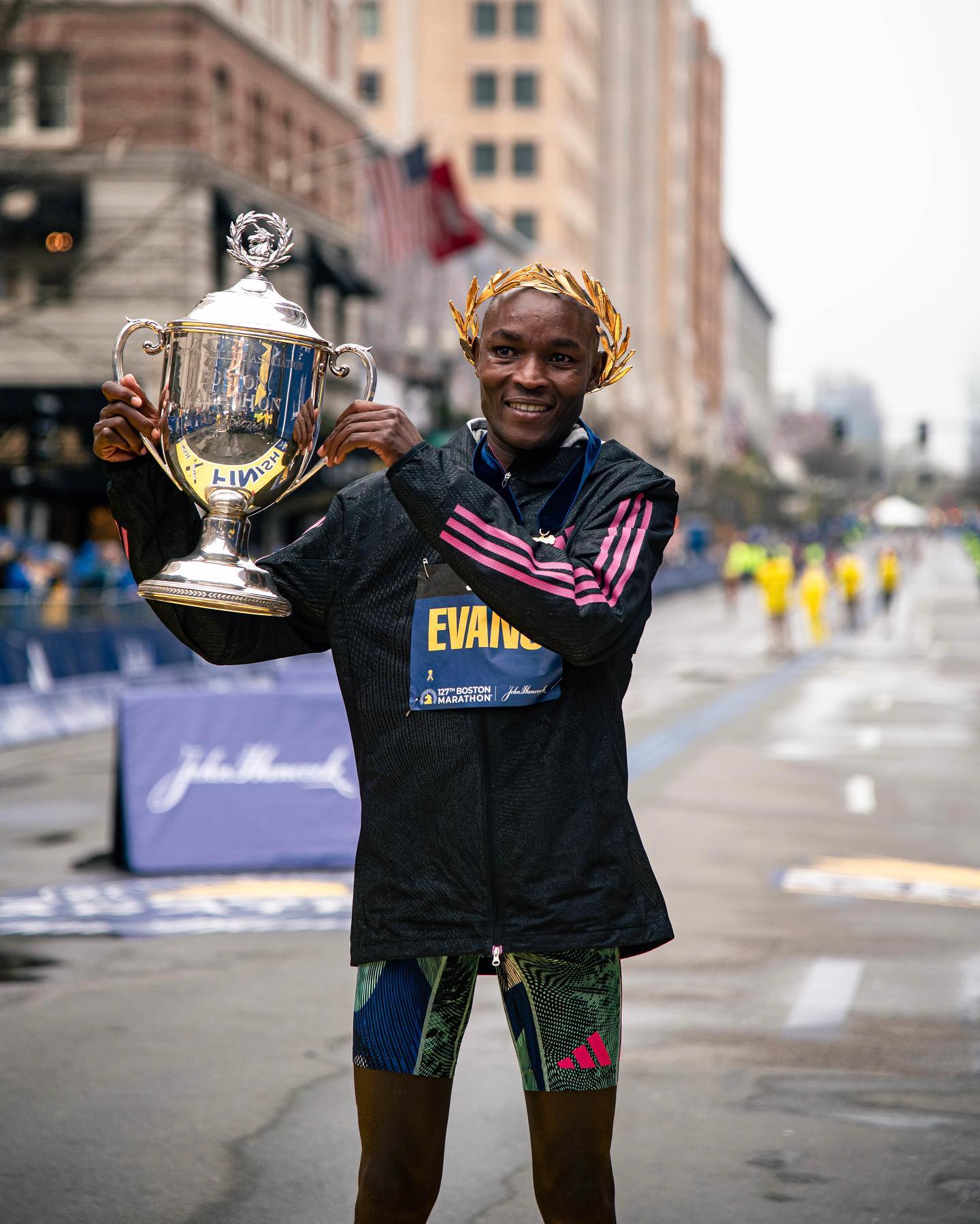
Evans Chebet (this image was downloaded from the Facebook page of Boston Marathon and is being used here for representation purpose. No copyright infringement intended)
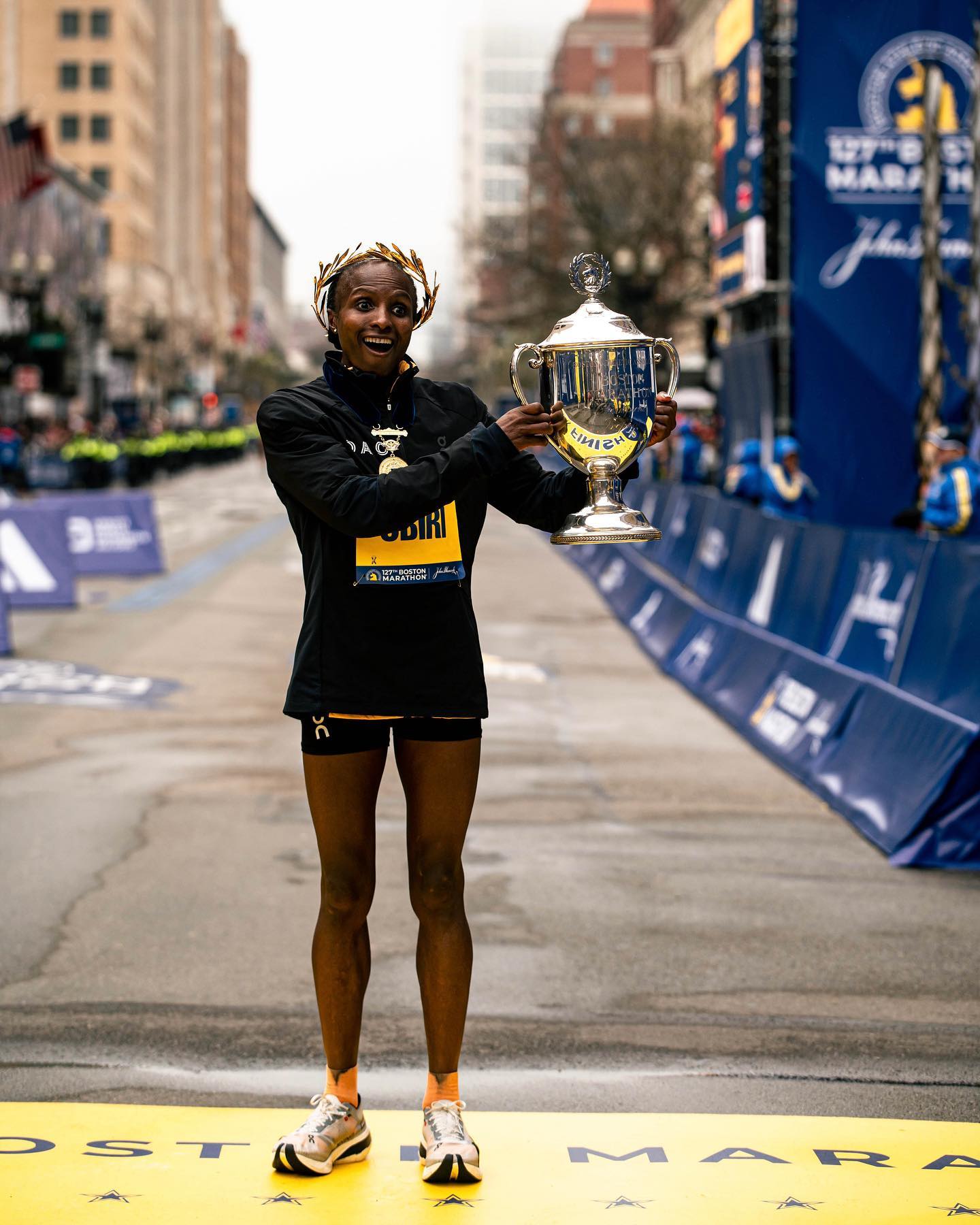
Hellen Obiri (this image was downloaded from the Facebook page of Boston Marathon and is being used here for representation purpose. No copyright infringement intended)
It wasn’t Eliud Kipchoge’s best outing. But that didn’t stop Kenyan runners from dominating the elite category of the 2023 edition of the Boston Marathon.
Defending champion Evans Chebet won the men’s race while Hellen Obiri, both from Kenya, won the women’s race. World record holder and the race favourite, Kipchoge, started strong but fell back at the 20th mile and had to settle for sixth position.
Chebet won the men’s race in two hours five minutes and 54 seconds. Hellen Obiri covered the distance in 2:21:38. It was her first victory at a race that is part of the World Marathon Majors. She had made her debut in the marathon in 2022, at the New York City Marathon, where she finished sixth. The 2023 Boston Marathon was only her second such event.
“ I live for the moments where I get to challenge the Limits. It’s never guaranteed, it’s never easy. Today was a tough day for me. I pushed myself as hard as I could but sometimes, we must accept that today wasn’t the day to push the barrier to a greater height,” Kipchoge tweeted the day after the event. He holds the world record in the marathon with a timing of 2:01:09.
Over 30,000 runners participated in this year’s Boston Marathon, held on April 17, 2023.
Less than a week later on April 23, 2023, the year’s edition of the London Marathon was held. The World Marathon Major saw some dramatic performances by top athletes.
Renowned middle-distance runner, Sifan Hassan, posted a stunning victory in the women’s race in her first ever marathon despite suffering an injury in the early miles. She finished in 2:18:34. The top three women runners were bunched together till the final 150 meters or so, which was when Hassan accelerated to finish first in her debut marathon. The strong finish was classic Hassan.
Kelvin Kiptum of Kenya won the men’s race at the London Marathon in 2:01:25, setting a new course record and coming very close to Kipchoge’s world record. In 2022, at the Valencia Marathon, he had marked the fastest debut in a marathon becoming the third man in history to break two hours and two minutes.
The Abbott World Marathon Major circuit entails running six marathons – Boston Marathon, Chicago Marathon, New York City Marathon, Berlin Marathon, London Marathon and Tokyo Marathon.
We spoke to a few Indian runners who participated in these two World Marathon Majors – the 2023 Boston Marathon and London Marathon.
B. J. Vikram (photo: courtesy Vikram)
Training for London Marathon, B J Vikram, a Bengaluru-based runner, was mindful of stepping up his mileage in the run up to the marathon. “I build my mileage gradually combining it with strength training,” he said, aware of the fact that increasing mileage suddenly often leads to injury. He is not new to sports. Vikram is a skater and has represented India in many championships.
Vikram commenced long-distance running about 10 years ago. He heard about Boston qualification from co-runners and obtained details about it. He qualified for Boston Marathon in 2019 but was able to run it in 2022 as the intervening years were lost to the COVID-19 pandemic and running events around the world were either cancelled or postponed or limited to elite runners.
He started his World Marathon Major journey with Boston Marathon and went on to do Berlin Marathon with a sub-three-hour finish in 2022.
“ Five weeks before London Marathon, I did a few long, fast runs. I also did time-based runs instead of mileage-based runs,” he said.
Weather is always an issue in international marathons. To cope with cold weather, Vikram resorted to taking ice baths. These also help with quick recovery after hard training runs. Vikram finished London Marathon in 2:57:28.
Karthik Anand (left) with Tilak Dutt and Suneel Kumar Koyi, both of who registered sub-three hours-finish at the 2023 Boston Marathon (photo: courtesy Karthik)
Bengaluru-based runner Karthik Anand completed the six-star World Marathon Major circuit way back in 2019.
He was repeating Boston Marathon to help his wife Deepti to complete the World Marathon Major circuit. She was on her fourth race in the World Marathon series at the 2023 Boston Marathon.
“ My training for Boston Marathon was quite good. I was clocking on an average 100 km every week during the four-month training period. I interspersed my training with long runs, tempo runs and intervals,” he said adding that he mainly followed a training schedule curated by his coach K.C. Kothandapani, who also ran the 2023 edition of the race.
Karthik’s run went off quite well until the 34th kilometre when he began to suffer hamstring cramps. “ For about 400 meters I had to walk before I could resume jogging,” he said. Karthik, usually a sub-three-hour finisher, completed the race in 3:04:32.
Subhojit Roy (photo: courtesy Subhojit)
For Subhojit Roy of Pune, the 2023 outing at Boston Marathon was his third time at the iconic marathon. “ I am not focused on the World Marathon Majors. If I get to complete the World Marathon Majors, it’s great,” he said.
In December 2022, Subhojit ran Valencia Marathon in 3:09:53. On February 26, 2023, he ran the New Delhi Marathon and secured a personal record of 3:06:47.
“ I took a week off after New Delhi Marathon and that left me with just six weeks of training for Boston Marathon,” he said. Subhojit was experiencing a left hip ache, which often surfaced after training runs. “ I was in a dilemma. If I train hard, I may risk worsening the injury,” he said. On the other hand, he couldn’t land at the start line of Boston Marathon without adequate training.
For Subhojit, the experience was worth it. “ This time around I handled the hills much better,” he said. Subhojit finished in 3:13:37, his best timing in his three outings at the Boston Marathon so far.
“ It was cold and damp. It was drizzling throughout and at the 28 km mark it poured quite heavily but I enjoyed the weather. My hip injury started to act up at around the 35th km. Nevertheless, I finished strong,” he said.
Subhojit trains under Nihal Ahamad Baig.
Vandana Arora (photo: courtesy Vandana)
Vandana Arora was the fastest women runner from among Indians at the 2023 edition of Boston Marathon. For the Bengaluru-based recreational runner, the 2023 Boston Marathon was her third marathon in this calendar year. She ran the Tata Mumbai Marathon in January this year just after recovering from COVID-19 infection in December 2022.
But a month later at the 2023 New Delhi Marathon, she secured a personal record, covering the distance in 3:24:28.
The 42-year-old recreational runner started her six-star World Marathon Major journey four years ago with the New York City Marathon.
Training under Bengaluru-based Coach Ashok Nath, she was clocking a weekly mileage of 110-115 km, sometimes running twice a day, in the run-up to the New Delhi Marathon. Thereafter, her weekly mileage was lowered. “Ash’s (Ashok Nath) training is uniquely crafted for the various segments of the Boston Marathon course. I did some of my runs at 11 AM because I was scheduled to run around that time at Boston,” Vandana said.
The second part of the training, according to her, was brain training. “ Ash told me that one is often tempted to run fast at the start of the race as the course is downwards. He asked me to restrict my pace for the first 10 kilometres,” Vandana said. She ran as per his plan and completed with a 4-minute improvement in her personal timing. She finished the marathon in 3:20:54.
Deepa Nayak (photo: courtesy Deepa)
Bengaluru-based Deepa Nayak did this year’s Boston Marathon and London Marathon, back-to-back. “Normally, I wouldn’t advise runners to do back-to-back marathons. But I decided to take on this challenge personally,” Deepa said. She is a personal trainer and coach at Asics Running Club and Runners 360.
Her interest in running commenced in 2011 when she took up jogging for health reasons. In a couple of years, the interest deepened and she joined training groups. She got serious about running and after having joined Reebok Running Squad in 2015, she decided to take up the ACE certification course.
She heard about Boston qualification even before she heard about Boston Marathon. “I then learnt about the World Marathon Majors. At the 2020 edition of Tata Mumbai Marathon, I qualified for Boston Marathon,” she said. She registered for the 2020 Berlin Marathon but the race was not held because of COVID-19 pandemic. She did Berlin Marathon in 2022.
Having missed registering for the 2022 Boston Marathon 2022, Deepa had to get a Boston qualifying time afresh to register for the 2023 edition. She ran the 2022 Jaipur Marathon and qualified for Boston with a finish of 3:22:49.
Post Berlin Marathon, Deepa took a break before she started training for Boston Marathon and London Marathon. “I had good training for a month in November 2022,” she said. In December, Deepa lost her father to cardiac arrest. “I came back from my hometown in Siddapur but was emotionally drained to do any training,” she said. She ran the 2023 Tata Mumbai Marathon without any training. Her running continued to suffer in the weeks after TMM. But she focused on strength training and nutrition. A week before she was to leave for Boston, Deepa fell ill. On the day, she was to take her flight out, her friend was admitted to hospital with cardiac issues. “Are these signs that I should not do Boston Marathon? I wondered,” she said.
Finally, she found herself at the start line of Boston Marathon but with very little mileage training.
“At Boston, the first 34 km went off very well but the last eight km was tough because of rain and cold weather,” she said. She finished the run in 3:22:40.
“I started to focus on London Marathon only after I finished Boston. My plan was to give it my best shot but if I fail, I wouldn’t fault myself,” Deepa said. She finished the marathon in 3:23:21. “I was quite surprised with my timings at Boston and London.
Having done three marathons in 2023, Deepa plans to do shorter distance races this year. “I am in the process of completing my nutrition certification. I also want to focus on coaching,” she said.
Gitanjali Lenka (photo: courtesy Gitanjali)
The 2023 Boston Marathon was Gitanjali Lenka’s first World Marathon Major. The Thane-based runner has been a podium finisher at events in India. She was the fastest runner among Indian women at the 2022 Comrades Marathon.
Gitanjali had two months training for Boston Marathon, despite losing a few days to a viral infection.
“The weather was a challenging factor. On Monday morning (day of the race), it started raining. It was very cold. My hands were frozen and I found it difficult to take the gels out. The route was also quite challenging. The route from 24th km to 34th km was very tough. But crowd support and cheering were excellent and kept the runners going,” she said.
Gitanjali finished the marathon in a personal best timing of 3:36:25.
She is now headed to her second World Marathon Major – Berlin in September 2023. She has already commenced training for the marathon. She trains under Ashok Nath.
Ranjini Gupta (photo: courtesy Ranjini)
The 2023 London Marathon was Ranjini Gupta’s fifth World Marathon Major. The Berlin Marathon was her first marathon in the six-marathon circuit, followed by Chicago Marathon in 2017, Tokyo Marathon in 2018 and New York City Marathon in 2019.
Ranjini’s training for London Marathon was quite good. In November 2022, she ran the half marathon at the Ahmedabad Marathon and finished it in 1:45:28. “My timing gave me confidence. I commenced my training for London Marathon in December. I had good months of training up to March and I was able to do speed workouts and long runs of 30 km and 32 km,” she said.
At London Marathon, weather was an issue. “ The rain started just when our race was starting. My shoes were heavy as they were wet. Also, roads along the course were narrow. But I was able to hold on to a 5:14-5:15 per kilometre pace,” Ranjini said. She finished the marathon in 3:41:58. “ I went to London with a lot of apprehensions,” she said. Though not close to her personal best (3:28), she was happy with her finish.
“ I will plan my marathon training after my registration for the 2024 Boston Marathon goes through,” she said. Boston will be the last of her six World Marathon Majors.
Sunmbul Rahman (photo: courtesy Sunmbul)
Sunmbul Rahman did not have any target for the 2023 London Marathon as she was fasting for the holy month of Ramzan. Yet, she surprised herself with a personal record of 3:48:30.
The Kolkata-based runner was not into sports during her school days at La Martiniere. She went through the motions of life and many years later faced a personal tragedy when she lost her husband to cancer. With two small children and restaurant that wasn’t doing too well, Sunmbul found her life spinning out of control. Sometime in 2011, she decided to join a gym for physical fitness. Coincidentally, the gym was organizing a 5 km walk. “ I took part in the walk and I surprised myself with a win,” Sunmbul said. That walk and the podium finish were triggers that propelled her into running. Soon, she found herself running the marathon. “ I also got into mountain climbing and have done four 6000 meter-plus peaks,” she said.
London Marathon was her second World Marathon Major, the first one being Chicago in October 2022. “ London Marathon for me, was an experience. I was fasting for Ramzan until two days before race day. It was a tough run with pouring rain, cold weather and huge crowds all along the course. Because I had to jostle through the crowds, I actually ended up doing 43.3 km,” she said. Her timing has helped her to qualify for the Boston Marathon.
“ For now, I have put a pause on my mountaineering activity. I want to finish the World Marathon Majors first,” Sunmbul said. Given interest in mountaineering, she may also look at ultra running, especially on trails.
Bajrang Singh and Asha Singh (photo: courtesy Bajrang and Asha)
Asha Singh and Bajrang Singh, the runner couple from Lucknow, have been running varied distances, including ultra-running events. Asha also represented India in IAU 24-hour Asia and Oceania Championships held at Bengaluru in July 2022.
The husband-wife couple trained well for Boston Marathon. They landed in the city a few days ahead of the event. “ On Sunday, a day before the marathon, we checked out the route. Monday morning was cold, rainy and windy. We had to put on layers,” Bajrang Singh said. By the time they walked to the start line their shoes got drenched in the rain.
“ When we started our run, the course was very crowded and we had to juggle our way through the crowds. Boston Marathon course is a series of rolling hills. We wanted to run together but Asha had a hamstring problem and she had to slow down her pace,” Bajrang said.
After the 25th kilometre, Bajrang Singh decided to go ahead. “ I ran really fast in the last mile of the race,” he said. Bajrang Singh finished in 3:51:40 and Asha in 4:04:19. “ We are quite happy with our performance here,” he said. They are scheduled to run the 80 km Tuffman Shimla Ultra at Mashobra on June 24, 2023.
“ We plan to do the Berlin Marathon this year if we manage to get into it. If not, we may do the 72 km Khardung La Challenge in Ladakh,” Asha said. Currently in the U.S., they are due to come back to India in June. “ We are right now at Charlotte in North Carolina. The undulating terrain helps us to train for the Mashobra event,” he said.
Neelam Vaid (right) with her brother Tarun Gulati (Photo: courtesy Neelam)
Pune-based Neelam Vaid has been running seriously since 2013. An ENT surgeon, Neelam has been climbing mountains in the Himalaya over the past few years. Having done her first marathon in 2014, she decided to go ahead and try the World Marathon Majors.
Training for the 2023 London Marathon was tough for Neelam. “ The heat and pollution in Aundh, where I stay, was quite high making long runs quite a challenge,” she said. Her training was inadequate. “ I missed runs and I often never reached my target pace,” she said. She trains under Coach Atul Godbole.
But her run at London Marathon was “amazing”. “ Words can’t describe the experience of running the London Marathon. Weather was bad. It was pouring at the start. My shoes were wet and my hands froze. But the crowd support carries you through from the first kilometre to the last,” she said.
London Marathon, according to Neelam, has the best crowd support among the World Marathon Majors that she has competed in – Boston Marathon and Berlin Marathon (both in 2022). “ Parts of the course are narrow and get crowded but the vibe from runners and crowds keeps one going,” she said. Neelam finished the marathon in 3:58:20, a new personal best and within the Boston Marathon qualifying time.
“ This was a special run for me. My brother Tarun Gulati also ran the marathon. Together, we raised 6000 pounds for Alzheimer’s Research UK, against the target of 5000 pounds,” she said.
After a short break, she plans to resume training for the 2023 Chicago Marathon, due in October this year.
Ashish Agarwal (photo: courtesy Ashish)
Ashish Agarwal started running just about four years ago. The Nagpur-based tax lawyer led a largely undisciplined life leading to obesity. “ Some of my friends were into running. They asked me to start running. In August 2018, I enrolled for a 3 km run,” he said. In 2019, he ran a half marathon at the Pondicherry Marathon. The following year at Tata Mumbai Marathon, he did the full marathon.
The COVID-19 lockdown came as a boon as he could run in the morning and cycle in the evening. With running events resuming in 2022, Ashish was able to run the Jaipur Marathon. The benefits of working out during the lockdown period paid off as he was able to get a personal best timing of 3:38:25 at this marathon. In September 2022, he was able to do the Berlin Marathon.
He signed up for the 2023 London Marathon but three months prior to the event he met with an accident. “ Window shutters fell on my hands and I was required to go in for surgery. I stood at the start line of London Marathon without any practice,” Ashish, 41, said.
He finished the marathon in 4:01:47. “ This run was entirely a mental game. It turned out to be a good run. It was raining throughout. All along the route there were so many volunteers cheering,” he said. Qualifying for Boston is certainly on the cards, he said.
Kaustubh Radkar (photo: courtesy Kaustubh)
Way back in 2006 when India was just beginning its journey into recreational runner, Dr Kaustabh Radkar ran the New York City Marathon. In 2010, he once again ran the same marathon. A former national level swimmer, Kaustabh had, in the meanwhile, started his journey in the Ironman triathlon.
Even as he continued his foray into triathlon and running events, he decided to persist with his participation in the World Marathon Major circuit. After a long gap he ran the Berlin Marathon in 2017. Two years later, he ran the Chicago Marathon. When events resumed post-pandemic in 2022, he was able to do the London Marathon. Early March 2023, he did Tokyo Marathon.
“ At Boston, I just wanted to soak in the experience. It was raining and very cold but the crowds were out in full support,” Kaustabh said. He was due to do Texas Ironman five days later. “ My goal was to finish Boston Marathon comfortably as I had to do Ironman in less than a week,” he said. The Texas Ironman was his 34th Ironman triathlon.
With his run at the 2023 Boston Marathon, he earned his six-star World Marathon Major medal. By the end of that week, he had also finished his 34th Ironman.
Mukesh Yeole (photo: courtesy Mukesh)
Pune-based Mukesh Yeole commenced his six-star World Marathon Majors in 2017 when he ran the Berlin Marathon. A real estate developer, Mukesh started running in 2014 with a 10 km run.
Following the Berlin Marathon, he participated in the New York City Marathon in 2018. In 2019, he completed Tokyo Marathon and Chicago Marathon. In 2022, he did London Marathon.
At the 2023 edition of Boston Marathon Mukesh got his six-star World Marathon medal. The trains with Radstrong Coaching. Mukesh said that he enjoyed the Boston Marathon. “ It was a very nice environment in Boston, some rain, some wind. Support was very good,” Mukesh said. He completed the Boston Marathon in 4:16:31.
Having completed with the six World Marathon Majors, Mukesh now aims to do one international marathon every year.
A triathlete, Mukesh has enrolled for Tallinn 70.3 Ironman but is likely to skip it. “ I won’t be participating in this Ironman because of some urgent work,” he said.
Deepti Karthik (photo: courtesy Deepti)
The 2023 Boston Marathon was Deepti Karthik’s fourth World Marathon Major. In 2019, she had completed three World Marathon Majors – London Marathon, Chicago Marathon and New York City Marathon.
Following the years lost to the pandemic, Deepti was hoping to resume her running but an injury put paid to her plans. She enrolled for the 2023 Tata Mumbai Marathon and New Delhi Marathon 2023 but decided not to do these as she did not want to jeopardize the recovery. “ When I resumed my training, I had to start afresh but was able to do long runs,” she said.
Travelling to Boston one niggling worry remained, that of weather. Boston is known for fluctuations in weather. The 2018 Boston Marathon had challenging weather with temperatures dipping to the coldest in 30 years combined with rain and heavy winds. That year, Deepti’s husband Karthik Anand had participated in Boston Marathon.
“ We kept track of the weather. When we landed in Boston it was very hot. We did a short run. But by Saturday it cooled down and by night it started drizzling. We had registered for a 5 km-run held on Saturday. It went off well,” she said.
On the morning of race day, the drizzle continued. “ While I waited in the holding area, at around 11 AM, the rain ceased briefly and the sun came out. But along the course at around 18 to 25 km it started raining again. The route was challenging and I had to stick to a slow pace,” she said. Deepti finished the run in 4:30:55.
She is due to run the Berlin Marathon in September this year.
(The author, Latha Venkatraman, is an independent journalist based in Mumbai)
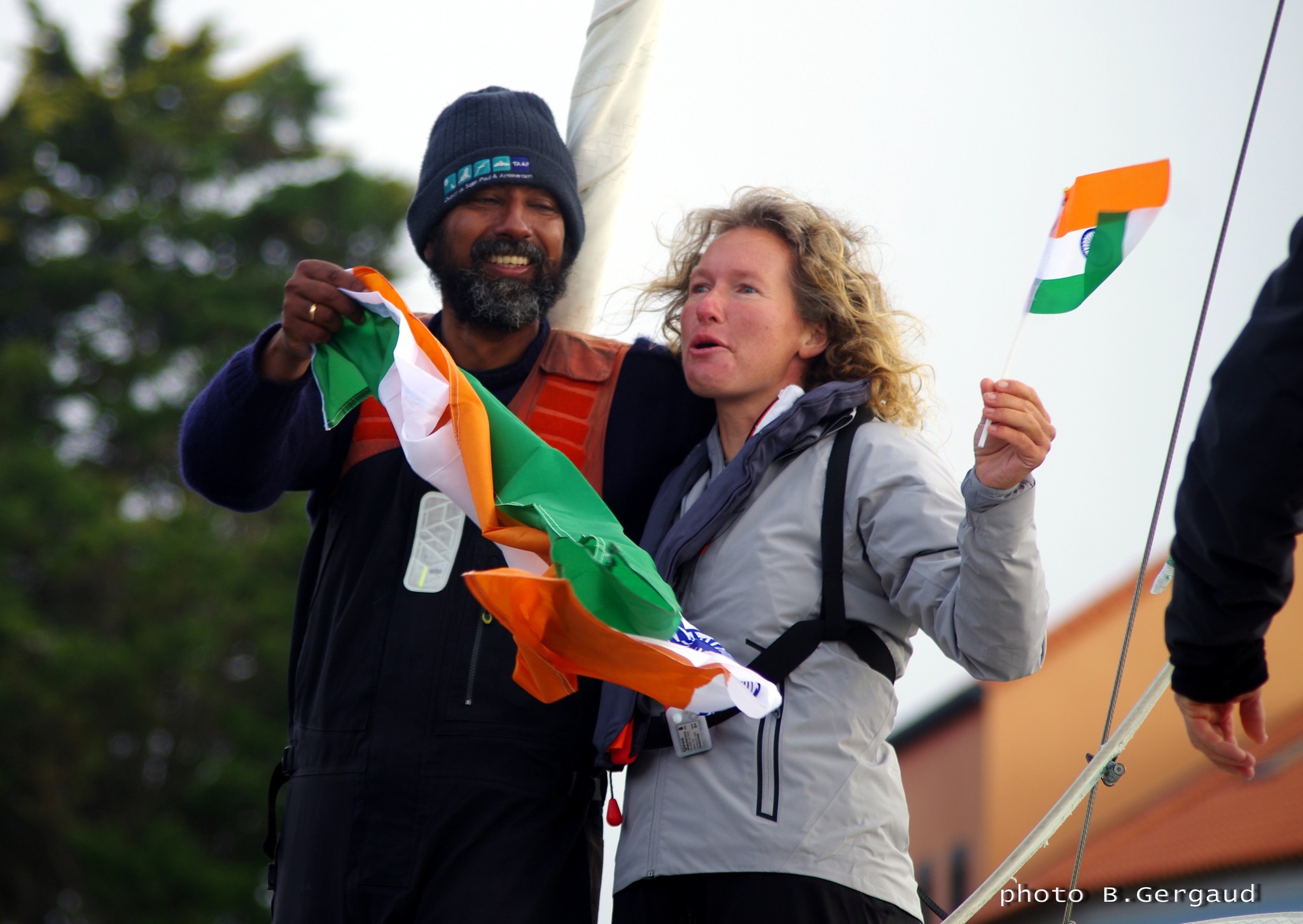
Abhilash Tomy and Kirsten Neuschafer (this photo was downloaded from the Facebook page of 2022 GGR and is being used here for representation purpose. No copyright infringement intended)
An overview, till early May 2023, of the 2022 edition of a fantastic race
Like some who watch the David Lean classic ` Lawrence of Arabia’ finding the desert the film’s real hero, the actual hero of GGR is the sea – its known tendencies and its unpredictability. None, not even the world’s best sailors, are spared.
As of late April, of the 16 sailors who commenced the 2022 Golden Globe Race (GGR), only three were left in the main race category. Two stood pushed to the Chichester Class. The rest had retired. This included two major accidents – a case of a boat sinking in the Indian Ocean in November 2022 and another of a boat rolled and dismasted in the southern Atlantic Ocean in April 2023. Nothing captured the sea’s effect on a race and those tracking it, as well as this comment posted on GGR’s Facebook page after the world was informed of Kirsten Neuschafer being seven nautical miles from finish and without wind to push her on, “ All of us on the YouTube live chat are pointing hairdryers, leaf blowers out windows and waving towels and beach blankets towards coastal France!’’ By afternoon, April 28, the situation must have felt similar for Abhilash Tomy and his fans too. He was expected at Les Sables-d’Olonne that day but thanks to prevailing weather conditions, the ETA (Expected Time of Arrival) stood revised to late morning April 29.
Over four and a half years after a storm in the Indian Ocean left him badly injured, Abhilash Tomy finished second in the 2022 Golden Globe Race (GGR). According to the event’s live tracker and Facebook page, he crossed the finish line at Les Sables-d’Olonne in France after completing the race’s mandated solo, non-stop circumnavigation of the planet, at 04:46 hours Universal Time Coordinated (UTC) on Saturday, April 29, 2023. The race was won by Kirsten Neuschafer of South Africa. Sailing in the Minnehaha, she reached Les Sables-d’Olonne at 19:44 UTC on April 27, 2023. The 2022 GGR had got underway on September 4, 2022.
Simon Curwen (this photo was downloaded from the Facebook page of 2022 GGR and is being used gere for representation purpose. No copyright infringement intended)
The first among the 2022 GGR participants to reach Les Sables-d’Olonne after a full circumnavigation done, was Simon Curwen of United Kingdom. He had led the race by a considerable margin for much of the voyage before the need to repair his boat forced him to deviate to coastal Chile, relegating him to the Chichester Class (sailing with one stopover) of the race. With that he stopped being one of the contenders for a podium finish in the main GGR, which requires solo, non-stop sailing. However, Simon caught up with the competitors who had gone past him during that halt in Chile, overtook them and finished ahead of all in the early afternoon (10:38 UTC) of April 27, 2023.
By evening the same day, the winner of the 2022 GGR, Kirsten Neuschafer of South Africa, reached Les Sables-d’Olonne becoming in the process, the first woman to win a round-the-world race by the three great capes across the solo / crewed and solo / non-stop categories. She is also the first South African sailor to win such an event. Her voyage as part of the 2022 GGR was remarkable not just for the quality of sailing she showed but also the rescue of fellow GGR participant, Tapio Lehtinen. The rescue happened in November 2022. Lehtinen’s boat sank suddenly in the Indian Ocean forcing him to transfer to a lifeboat. Neuschafer was awarded the Rod Stephen Seamanship Trophy by the Cruising Club of America for the rescue. The intervention, also fetched her time-credit in the race, as compensation.
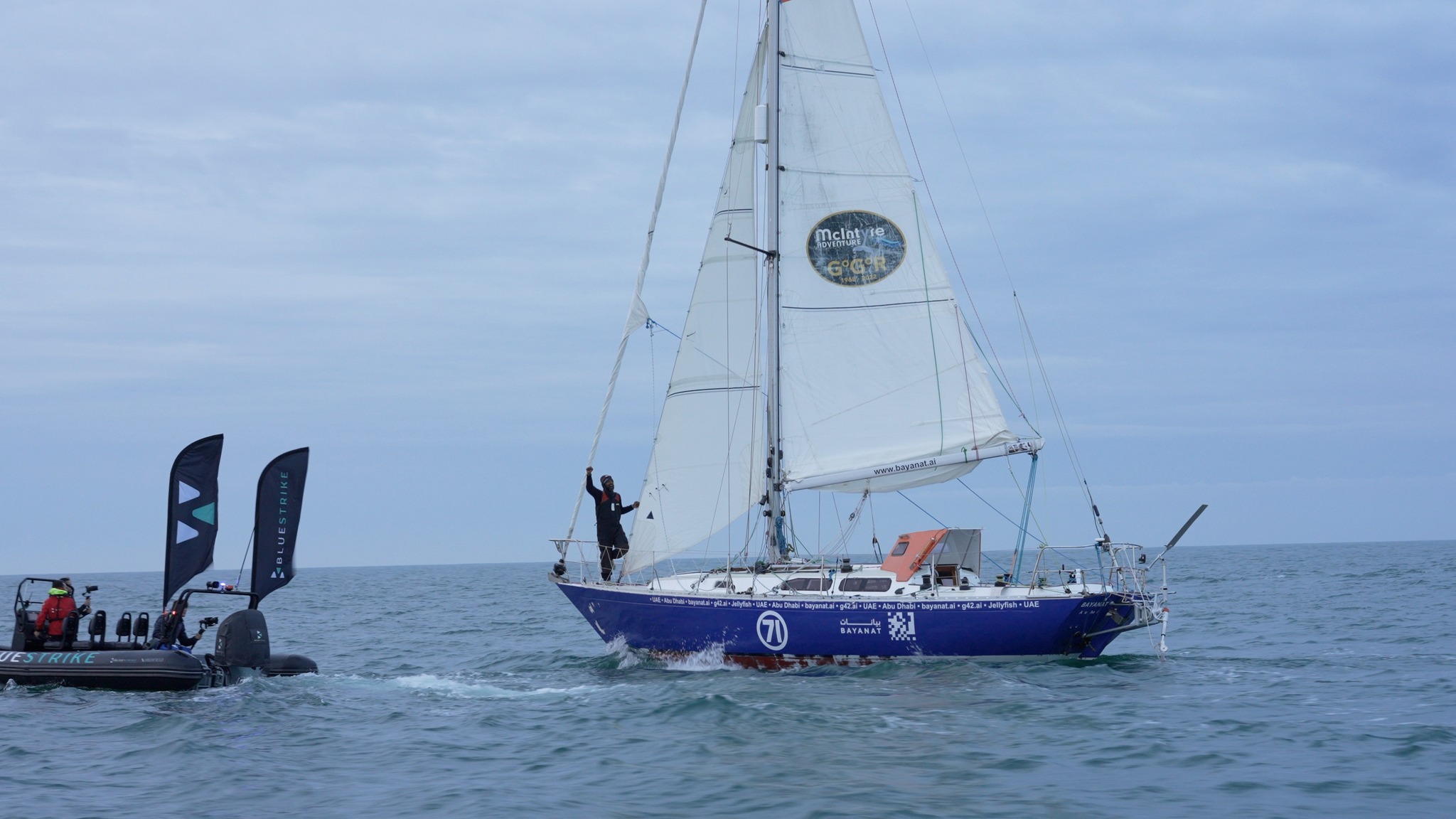
Two things set the GGR apart from other races involving circumnavigation of the planet. Given it has the flavour of a retro-sailing event, some aspects of technology and access to technology permitted for the race have been pegged back to what prevailed a few decades ago. Second, a non-stop voyage around the planet takes a massive toll on both sailor and boat. This is where Abhilash’s story becomes special. In 2013 he had become the first Indian to complete a solo, non-stop circumnavigation in a sailboat (INSV Mhadei) as part of the Indian Navy’s Sagar Parikrama project, conceived and overseen by the late Vice Admiral Manohar Awati. A few years later, in 2018, he had participated in that year’s GGR only to end up with serious injury to self and his boat (Thuriya) dismasted, following a severe storm in the southern Indian Ocean. But he fought his way out from that reversal of fortune; he underwent surgery and rehabilitation and eventually got back to flying and sailing, the activities that defined him as a naval aviator and one of the all-time greats of Indian sailing. He then signed up for the 2022 edition of the GGR and returned to the race with the Bayanat; the boat was named after his main sponsor for the voyage, a company from the United Arab Emirates (UAE) specializing in AI-powered geospatial intelligence.
This video posted by the 2022 GGR is from the segment spanning Cape Town to Hobart. Starting with the days around Tapio Lehtinen’s rescue, it provides a feel of what being at sea is. Also, Abhilash was under considerable stress in the portion of the race leading to the location of his 2018 accident in the southern Indian Ocean; a conversation with race organizers near Cape Town revealed this. By the time he got to the check point at Hobart, he was past that rendezvous, relieved and in a cheerful mood.
Now retired from the Indian Navy, Abhilash’s passage in the 2022 GGR wasn’t easy. Although he kept himself in the pack of race leaders, the position probably revealed little of what he was actually enduring. He knew the sea, the challenges pertaining to weather and maintaining the boat. But in 2022, there was a new ingredient in the mix – his mind, still living the memories of the September 2018 accident. It was clear to those tracking the 2022 race and reviewing videos posted from the periodic rendezvous with sailors at check points that Abhilash was battling anxiety in the portion of the GGR leading to the southern Indian Ocean, where in 2018, he had been battered by a storm. This was vindicated by his admission (in communications with the race organizers) of a peace finally found after he got past the site of the 2018 accident. Thereafter, it was a different Abhilash. His worries from that point on, seemed mostly about addressing the needs of his boat which kept developing a litany of complaints. But he responded creatively and found solutions for the problems without resorting to a stopover for repairs. He improvised with what he had aboard. This approach kept him alive in the main, competitive segment of the race featuring solo, non-stop circumnavigation. Amidst this struggle, he coped with his old injuries acting up as a consequence of long hours of work, steering and maintaining the boat. What reached Les Sables-d’Olonnes on April 29, should therefore be a package of Abhilash and Bayanat that captures single handed sailing over an extended period of time. Saturday (April 29, 2023) was the 236th day since commencement of the race.
Abhilash and Bayanat (this photo was downloaded from the Facebook page of 2022 GGR and is being used here for representation purpose. No copyright infringement intended)
For a race of this dimension, the boat matters. During the 2018 GGR, Abhilash’s boat had been the Thuriya, a replica of the Suhaili, in which Sir Robin Knox-Johnston had completed the world’s first solo, non-stop circumnavigation and won the original Sunday Times Golden Globe Race of 1968-1969. The Suhaili was bult in Mumbai; Thuriya in Goa. To compete in the 2022 GGR, Abhilash bought a Rustler 36 type of yacht in France; it was then renamed Bayanat. The boat had been used in the 2018 GGR by Philippe Peche of France. As per information on Wikipedia, of the 16 sailors who commenced the 2022 GGR, four – including Abhilash – had boats of the Rustler 36 type. Kirsten Neuschafer’s Minnehaha is a Cape George Cutter (CG36) while Simon Curwen’s Clara and Michael Guggenberger’s Nuri are both Biscay 36. At the time of writing, Guggenberger (he is from Austria) was in third place with roughly 488 nautical miles left to finish. South Africa’s Jeremy Bagshaw sailing in the Olleanna (OE32 type of yacht) was second in Chichester Class and 1621 nautical miles away from Les Sables-d’Olonne.
In a video posted on the GGR Facebook page, Abhilash could be seen saying soon after his arrival at Les Sables-d’Olonne in France that this is the first time an Asian is securing a podium finish in a round-the world race of any format. “ It’s a big moment for me,’’ he said. Responding to a message from Admiral R. Hari Kumar, chief of the Indian Navy, congratulating him on his achievement, Abhilash recalled the support he had received from the senior officer when in 2018 he put in his resignation because he wished to attempt the GGR and was unsure he would be able to do that through the navy. The admiral was at that time, head of HR in the navy. “ He understood the importance of GGR and he pushed the boundaries of a lot of rules to make sure that I was here,’’ Abhilash said, adding that when he had the accident in the 2018 GGR (his boat, Thuriya, was dismasted and he suffered serious injury in a storm in the southern Indian Ocean), the admiral had been in the operations room directing the rescue.
“ I am happy to have completed the circle. The stigma of losing a boat…I didn’t want to, you know, once is an accident, twice is a habit! So, I really wanted to get Bayanat back and I can tell you, Bayanat got me back,’’ Abhilash said. Asked about the impact of his podium finish in India, Abhilash pointed out how small the number of yachts in all of India was. From that backdrop, if he could think of a circumnavigation race and complete it, it meant the youngsters of India can do a lot. Comparing the two solo, non-stop circumnavigations he has done so far, Abhilash said that the INSV Mhadei was a big boat, one that kept you safe as long as you made sure that nothing happened to it. It didn’t demand a lot. “ But a small boat with wind pilot and no GPS is a hundred times more difficult. But at the same time, I want to say that if that circumnavigation had not happened, I would not have dreamt of coming for GGR. So, they are important in their own places but a GGR is a hundred times tougher than what I did in 2013.’’
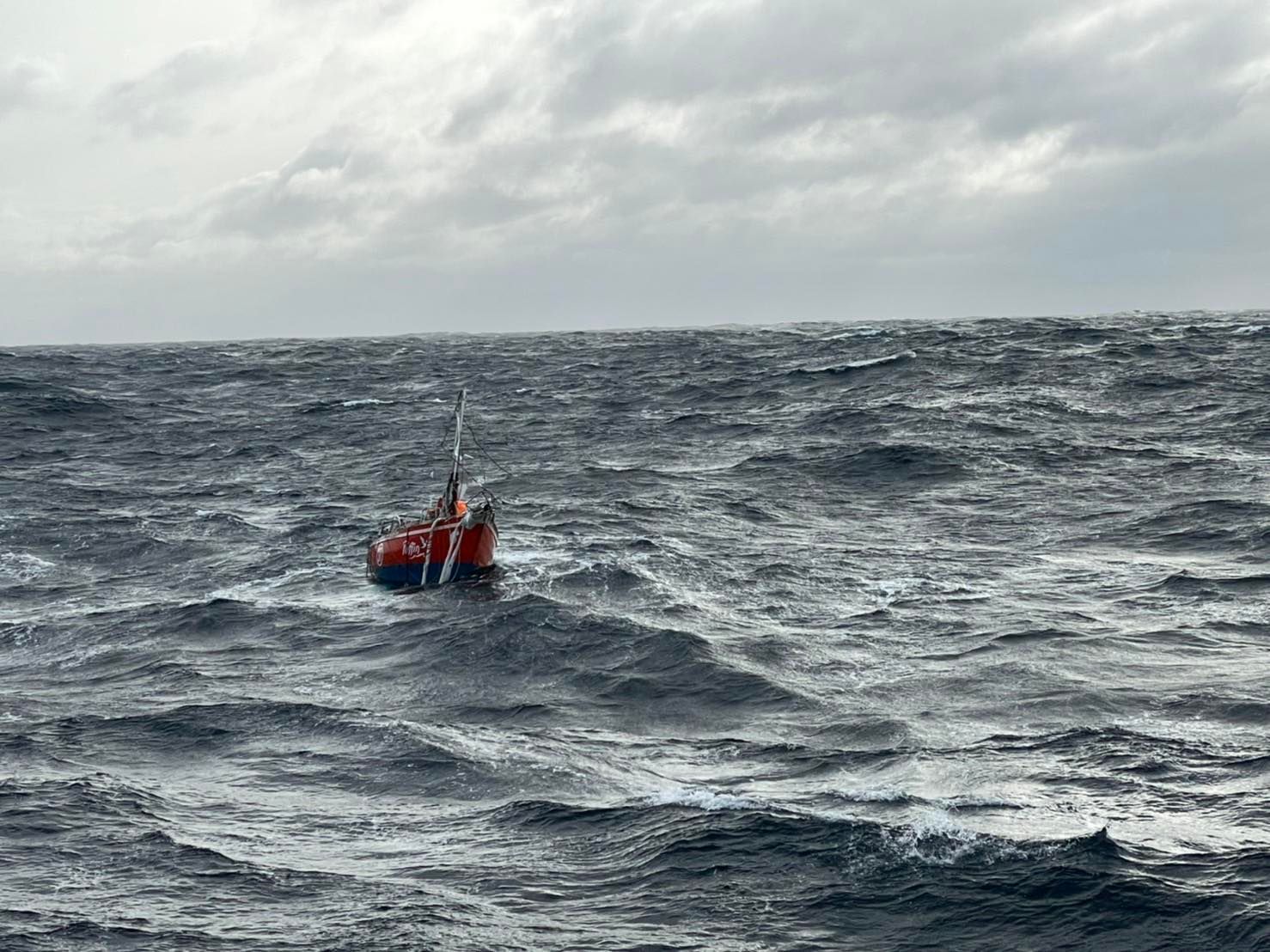
The Puffin adrift at sea following the rescue of Ian Herbert Jones (this photo was downloaded from the Facebook page of 2022 GGR and is being used here for representation purpose. No copyright infringement intended)
The second major mishap of the 2022 GGR happened on day 218 of the race (around April 10, 2023) in the Atlantic Ocean. According to the first report on the incident on the GGR website, Ian Herbert Jones of the United Kingdom and his boat Puffin, found themselves in `extreme weather and confused seas.’’ Ian was unable to launch his drogue (a conical / funnel shaped-device towed behind a boat that is used to reduce speed and improve stability) to keep the boat stern to the waves and avoid being rolled. In the extreme conditions, he had been washed out of the cockpit twice. With communication, including via satellite phone, rendered erratic by the prevailing conditions, Ian had activated his Emergency Position Indicating Radio Beacon (EPIRB). Things appear to have escalated fast. A few hours later, the Puffin’s distress alert button was activated and with it the rescue coordination centre in Argentina was informed of the emergency at sea. Soon thereafter, a text message from the Puffin said that the boat had been rolled and dismasted, there was two feet of water within and its skipper, having injured his back was finding it “ hard to move.’’ Ian got the water ingress under control but by then, he had also gashed his head. On day 219 of the race, Ian was rescued by the Taiwanese fishing vessel Zi Da Wang.
Storms and freaky weather conditions aren’t the only things that trigger retirement in endurance races. In solo, non-stop sailing, the boat he / she is in, is every sailor’s floating house. It is what shields sailor from the elements. Its maintenance is a constant job. Equipment aboard may malfunction or break down. The hull may gather barnacles and slow down the boat’s progress in water. Monitoring, cleaning and repairing – it keeps going on. Depending on what is available and what isn’t, one may require to be creative on the repairs. The paradigm of a race, enhances the importance of these aspects. In solo sailing, all this has to be done by oneself. Limits reached on any of these fronts or quite simply the mind declining to sustain its appetite for such life, can lead to people pulling out.
A summary of the race would be incomplete without a picture of the finish. A circumnavigation is a hell of a lot of distance covered, long enough for people to be separated by vast margins at sea. Yet by the time, Abhilash and Kirsten Neuschafer entered the Atlantic for the second time in their long voyage (this time on the way back to Les Sables-d’Olonne), it was clear that a tight finish was on the cards. Around the equator, the lead separating the two had reduced considerably. At times, they seemed almost parallel to each other on the race’s live tracker. Eventually, Kirsten finished first, Abhilash placed second. For most observers, given a whole planet circumnavigated, both represent endurance sailing at its best.
(The author, Shyam G Menon, is a freelance journalist based in Mumbai. This wrap-up is the extended version of two articles by the author published in Telegraph and Rediff.com)
Abhilash Tomy (this photo was downloaded from the Facebook page of GGR and is being used here for representation purpose. No copyright infringement intended)
Abhilash Tomy has completed his voyage as part of the 2022 Golden Globe Race (GGR).
He and his boat Bayanat crossed the finish line at 04:46 hours Universal Time Coordinated (UTC), on Saturday, April 29, 2023 to place second in the race. The GGR entails a solo, non-stop circumnavigation of the planet.
In a video posted on the GGR Facebook page, Abhilash could be seen saying soon after his arrival at Les Sables-d’Olonne in France that this is the first time an Asian is securing a podium finish in a round-the-world race of any format. “ It’s a big moment for me,’’ Abhilash, a former officer with the Indian Navy, said. April 29 was the 236th day since the commencement of race on September 4, 2022. Responding to a message from Admiral R. Hari Kumar, chief of the Indian Navy, congratulating him on his achievement, Abhilash recalled the support he had received from the senior officer when in 2018 he put in his resignation because he wished to attempt the GGR and was unsure he would be able to do that through the navy. The admiral was at that time, head of HR in the navy. “ He understood the importance of GGR and he pushed the boundaries of a lot of rules to make sure that I was here,’’ Abhilash said, adding that when he had the accident in the 2018 GGR (his boat, Thuriya, was dismasted and he suffered serious injury in a storm in the southern Indian Ocean), the admiral had been in the operations room directing the rescue.
“ I am happy to have completed the circle. The stigma of losing a boat…I didn’t want to, you know, once is an accident, twice is a habit! So, I really wanted to get Bayanat back and I can tell you, Bayanat got me back,’’ Abhilash said. Asked about the impact of his podium finish in India, Abhilash pointed out how small the number of yachts in all of India was. From that backdrop, if he could think of a circumnavigation race and complete it, it meant the youngsters of India can do a lot. Comparing the two solo, non-stop circumnavigations he has done so far, Abhilash said that the INSV Mhadei (in which he did his first circumnavigation) was a big boat, one that kept you safe as long as you made sure that nothing happened to it. It didn’t demand a lot. “ But a small boat with wind pilot and no GPS is a hundred times more difficult. But at the same time, I want to say that if that circumnavigation had not happened, I would not have dreamt of coming for GGR. So, they are important in their own places but a GGR is a hundred times tougher than what I did in 2013.’’
The 2022 GGR was won by Kirsten Neuschafer of South Africa. She reached Les Sables-d’Olonne at 19:44 UTC on April 27, 2023 becoming the first woman and the first South African to win a round-the-world race. Kirsten, Abhilash and Michael Guggenberger of Austria (he is yet to finish) were the only sailors remaining in the event’s solo, non-stop category. The rest had retired or slipped to the race’s Chichester Class featuring one stopover. Simon Curwen of England, sailing in Chichester Class, was the first GGR participant to get back to Les Sables-d’Olonne with circumnavigation of the planet done. He arrived at 10:38 UTC on April 27.
(The author, Shyam G Menon, is a freelance journalist based in Mumbai.)
Kirsten Neuschafer (this image was downloaded from the Facebook page of GGR and is being used here for representation purpose. No copyright infringement intended)
Kirsten Neuschafer of South Africa has won the 2022 Golden Globe Race (GGR).
She reached the finishing line of the event at Les Sables-d’Olonne in France (from where the race entailing a solo, non-stop circumnavigation of the planet had commenced months ago), at 19:44 Universal Tine Coordinated (UTC) on April 27, 2023. In the process, she became the first woman to win a round-the-world race by the three great capes across the solo / crewed and solo / non-stop categories. She is also the first South African sailor to win such an event. Her voyage as part of the 2022 GGR included the rescue of fellow GGR participant, Tapio Lehtinen. The rescue happened in November 2022. Lehtinen’s boat had suddenly sunk in the Indian Ocean. Neuschafer was awarded the Rod Stephen Seamanship Trophy by the Cruising Club of America for the rescue.
The 2022 GGR had got underway on September 4, 2022. The first among the 2022 GGR participants to reach Les Sables-d’Olonne after a full circumnavigation done, was Simon Curwen of England. He had led the race by a considerable margin for much of the voyage before the need to repair his boat forced him to halt in Chile, relegating him to the Chichester Class (sailing with one stop) of the race. Simon nevertheless caught up with the competitors who had gone past him during the halt, overtook them and finished ahead of all at 10:38 UTC on April 27, 2023.
Checked at 17:55 hours Indian Standard Time (IST) on April 28, Abhilash Tomy of India was 78.8 nautical miles from the finish line. As per an update on the Facebook page of the event, he was expected in Les Sables-d’Olonne in the late morning of April 29. Abhilash is currently in second place.
As per information available on the GGR website, Kirsten Neuschafer (she has been ““sailing dinghies since her childhood) has been sailing since 2006, as a profession. From training people to sail to delivering sailboats, she has built a diverse set of skills and experiences, the website said in its profile on her. According to it, her longest single-handing prior to GGR was a delivery from Portugal to South Africa.
Please find below the link to a video shared by GGR celebrating the arrival of Kirsten and her boat Minnehaha in Les Sables-d’Olonne; solo, non-stop circumnavigation done. The song in the video – On the Minnehaha – has been written and performed by Lennie Gallant.
(The author, Shyam G Menon, is a freelance journalist based in Mumbai.)











 Outrigger