File photo:Kelvin Kiptum, at the finish line of the 2023 Chicago Marathon (this photo was downloaded from the Facebook page of the event and is being used here for representation purpose. No copyright infringement intended)
Marathon world record holder and his coach were killed on the spot
As abruptly as his world record burst on to the planet’s marathon scene, Kelvin Kiptum is gone.
The world record holder in the men’s marathon and his Rwandese coach, Gervais Hakizimana, were killed in a road accident in Kenya on February 11, 2024, news reports said. The Kenyan athlete was driving the vehicle when he appears to have lost control. The two men were killed on the spot. A third passenger – a woman – was injured and rushed to hospital.
According to the Kenyan edition of The Nation, Kiptum was driving the Toyota Premio with Gervais and a lady identified as Sharon Kosgey aboard. They were headed to Eldoret. The accident happened at 11 PM, Sunday, in the Kaptagat area along the Elgeyo Marakwet-Ravine Road. The local police commander said that Kiptum lost control of the vehicle, veered off the road and hit a big tree before landing in a ditch 60 metres away. Sharon escaped with serious injuries.
Kiptum, 24, was the only person so far to run the marathon in a timing below two hours and one minute in a record-eligible race. He had achieved the feat at the 2023 Chicago Marathon, covering the 42.2 kilometre-distance in two hours and 35 seconds. The previous record of 2:01:09 was set by Kenya’s Eliud Kipchoge at the 2022 Berlin Marathon. In the process, he also improved the course record at Chicago by over three minutes. Kiptum’s world record was ratified by World Athletics just two days ago.
At the time the new global mark was set at the 2023 Chicago Marathon, it had been a bolt from the blue for most elite and amateur marathoners and followers of the sport, used as they were to the discipline’s domination by Kipchoge. Kiptum, who owns three of the seven fastest timings in the marathon, also held the record for the fastest ever marathon debut (2022 Valencia Marathon). News reports in the wake of his demise said that Kiptum had been hoping to become the first man to run the marathon in under two hours in race conditions at the upcoming Rotterdam Marathon.
Both Kiptum and Kipchoge had been named in Kenya’s provisional marathon team for the 2024 Paris Olympics. It would have been Kiptum’s debut at the Games. In its report, BBC quoted Sebastian Coe, president, World Athletics, saying that Kiptum was “ an incredible athlete leaving an incredible legacy, we will miss him dearly.”
Please find above the link to a video of Kelvin Kiptum setting his world record at the 2023 Chicago Marathon
(The author, Shyam G Menon, is a freelance journalist based in Mumbai)
Following the 2024 Tata Mumbai Marathon (TMM), we spoke to some of the podium finishers. We also spoke to leading coaches. This article will stay a work in progress for a while, harvesting synopses of runners’ experience at 2024 TMM.
Srinu Bugatha
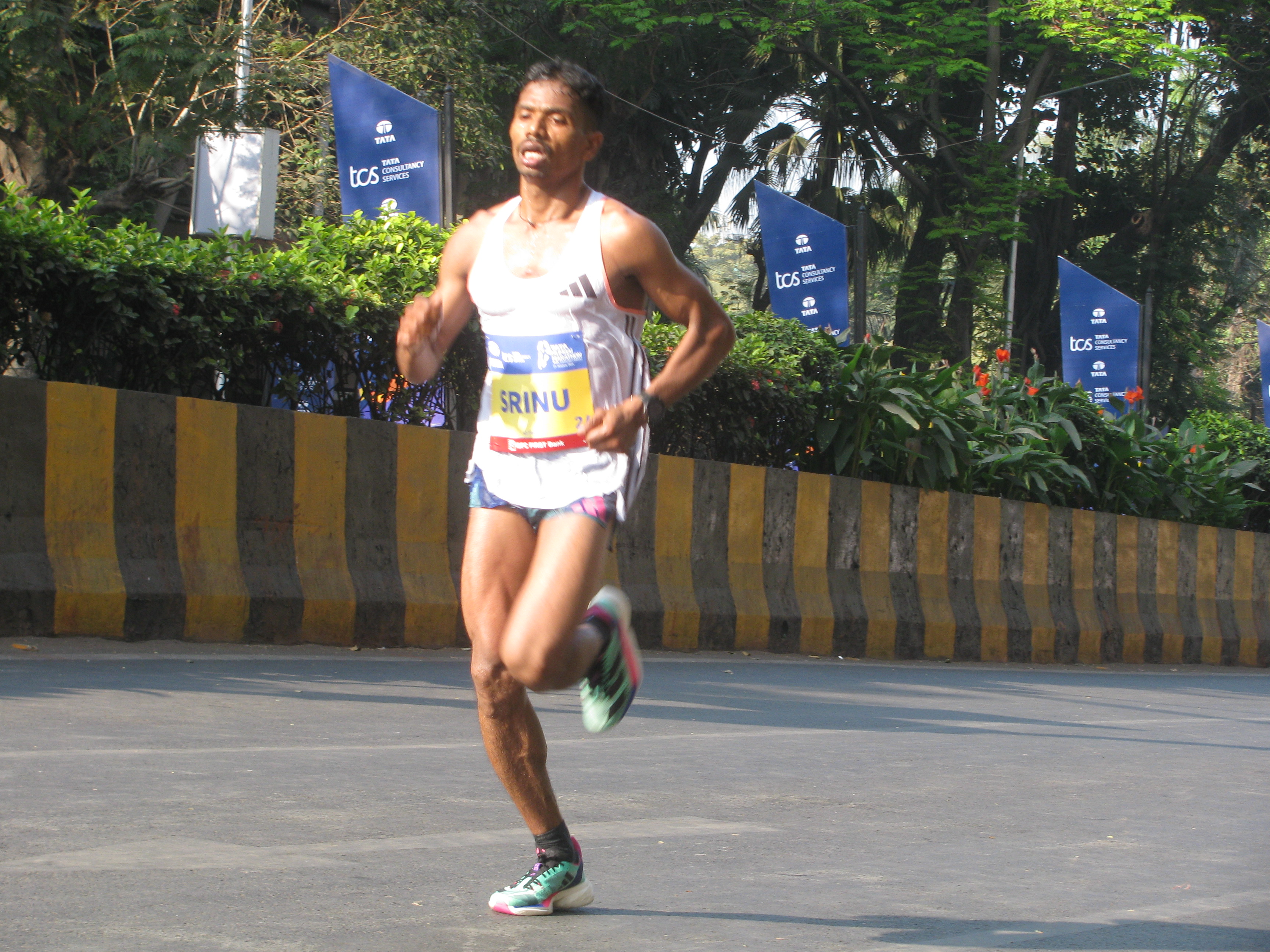
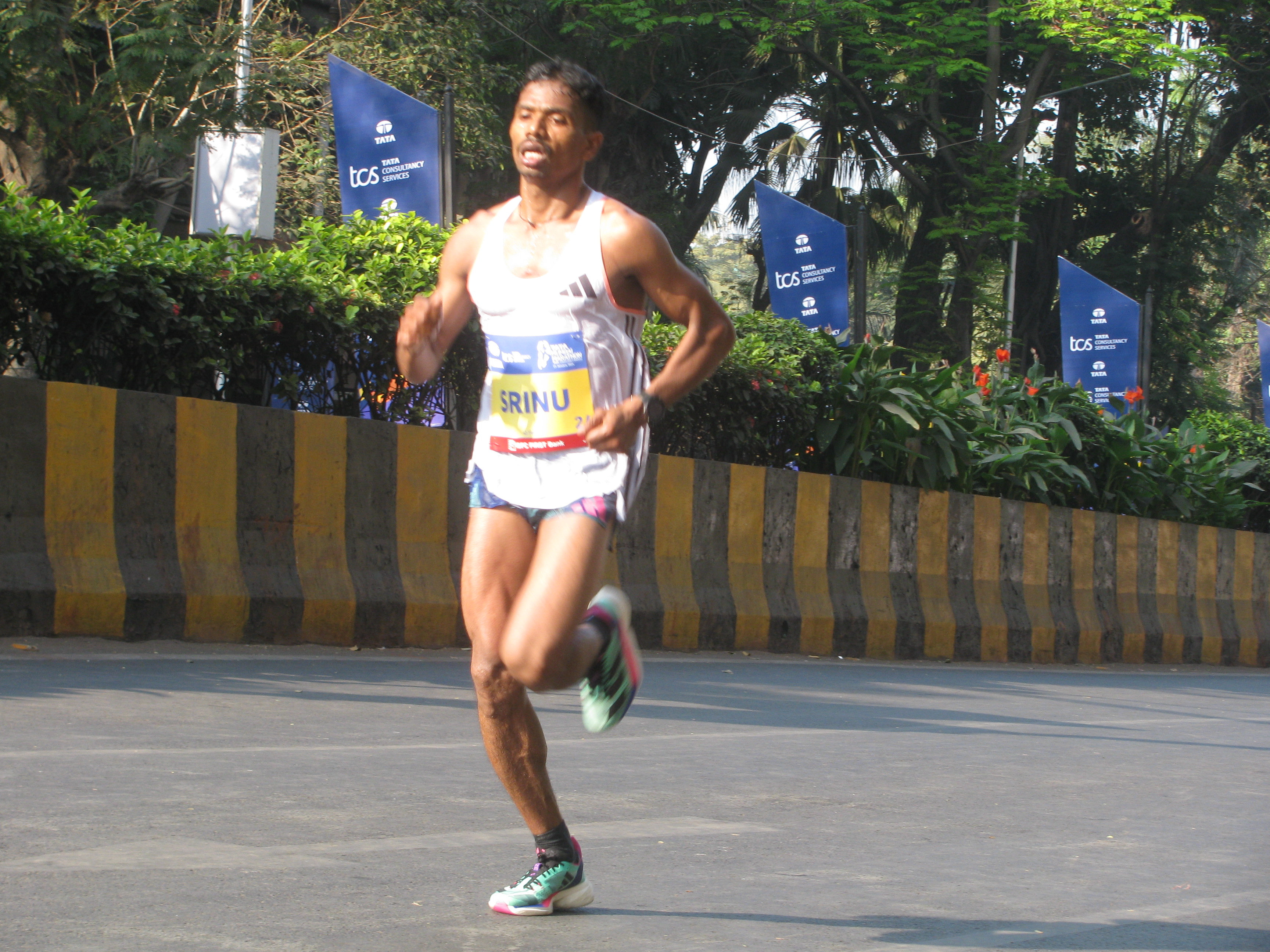
Srinu Bugatha on the final stretch of the 2024 Tata Mumbai Marathon (photo : Shyam G Menon)
Sunday’s run signified a return to podium finish in Mumbai, for Srinu Bugatha. A former winner among Indian elites at the Tata Mumbai Marathon (TMM), in 2023, he had however finished fifth among Indian elite men with a time to finish of 2:23:05. Speaking to this blog a couple of days after the 2024 race, Srinu said that he had suffered from a hamstring injury for much of the previous year. He had October, November and December and events therein to get ready for 2024 TMM. According to him, on January 21, race day of the 2024 edition of TMM, he started off well and could maintain a pace that was designed to cover the distance in two hours 15 minutes, till around the 35th kilometer. The weather was cooler than usual and supportive. However, over the final three to four kilometers of the course, Srinu’s pace declined. It showed in his splits – 18.7 kilometers per hour, 18.8, 18.7 and 18.5. He emerged winner among Indian elites with timing of 2:17:29. The elite athlete is now focused on improving his timing further and has his eyes set on suitable races overseas.
Gopi Thonakal
Gopi Thonakal (photo: Shyam G Menon)
For Gopi Thonakal, the Indian marathoner with the best timing since the late Shivnath Singh’s still standing national record from 1978, the 2024 Tata Mumbai Marathon (TMM) didn’t play out as planned. In December 2023, he had run the Tata Steel 25K in Kolkata. At that race, he developed stomach cramps after 21 kilometers and had to give up. It was a Did Not Finish (DNF). From that race to the 2024 TMM wasn’t a long while and Gopi had to train within safe parameters, one of which was that his long runs in training didn’t exceed 31-32 kilometers. “ It affected my endurance,’’ he said. On January 21, 2024, race day in Mumbai, Gopi found the weather quite supportive. Knowing from previous experience the nature of the course, including the construction work of Mumbai’s metro being on, he had no complaints in that department. It was to be expected; he was ready for all that. However, even as the race started well for him, at around 27 kilometers, his calf muscles began to cramp up. The situation was bad enough for him to require stopping and stretching. By then, the gap between him and the race leaders had increased and those immediately behind had caught up or got past. While stretching eased the pain, the cramps recurred multiple times over the next 15 kilometers. “ I had to stop and stretch some 5-6 times,’’ Gopi told this blog after the race. His splits tell the story – 18.8 kilometers per hour, 18.8, 18.6 and 18.3. Eventually he finished second among Indian elite men with timing of 2:18:37. Gopi said that he had come to Mumbai, hoping to run a 2:15.
Sher Singh Tanwar
Sher Singh Tanwar (photo: Shyam G Menon)
Hours after the 2024 TMM, Sher Singh was a picture of happiness as he voluntarily donned medal and head gear to pose for a picture. In the run-up to the event, the Rajasthan Police sub inspector had seen his focus distracted and his training nudged sideways a bit as he was forced to participate in a cross-country competition. Cross-country events span shorter courses compared to the marathon and typically due to that, entail more speed. That upset the sort of training he would have liked to have for TMM. He found the conditions in Mumbai on race day, quite agreeable. It wasn’t very warm. His run proceeded well for about 30-34 kilometers. Then he started to get cramps in his hamstrings and calf muscles. Unlike Gopi, Sher Singh didn’t require stopping and stretching. But his progress was slowed down. Sher Singh’s splits were – 18.8 kilometers per hour, 18.8, 18.6 and 18.2. He finished third among Indian elite men with a timing of 2:19:37. Sher Singh said that he would like to participate in races overseas.
Aasa T.P.
Aasa T. P (photo: courtesy Aasa)
Aasa T.P. started running in 2018 after doctors asked her to take up this activity as a means to combat stress. She commenced with a 6 km road race and then moved on to 10 km, half marathon and the full marathon.
In the absence of races during the COVID-19 pandemic Aasa’s running suffered a setback. A certified nurse, Aasa worked at Mumbai’s Bhatia Hospital. In January of 2023 she quit her job and decided to focus on training. She came in touch with Kenyan athletes and found help in terms of training plans as well as financial support. To focus on her training, she shifted to Bengaluru staying in a rented pad at Whitefield.
In May 2023, Aasa ran the Federal Bank Kochi Marathon. She finished overall third with a timing of 3:18:58, behind Jyoti Gawate and Ashvini Jadhav, both elite runners representing India in marathon and ultra-marathon events. A single mother, Aasa is now dependent on the money she earns from podium finishes at running races. Originally, a resident of Thalakode, Kothamangalam in Kerala’s Ernakulam district, she travels around for her races. “ My son lives with my parents and my siblings. Initially, my parents were not keen about my running activity but now they support me fully,” she said.
At Vasai Virar Municipal Marathon (VVMM) 2023 held on December 10, 2023, Aasa won the marathon in the open category with a timing of 2:55:18. “ A day before the VVMM race, I was trying to repair my running shoes when an Ethiopian runner offered me her running shoes. I ran VVMM in those shoes but they were small for my feet. By the end of the race, my feet were full of bruises,” she said. Aasa ran the 2024 Tata Mumbai Marathon also in those shoes but after having cut out some gaps to make it easier for her to run in them. Given her financial constraints, she is not able to afford performance shoes.
“ My training for Mumbai Marathon was quite good. Weather, route and support were excellent. If I had better shoes, I would have been able to run better,” she said. Aasa was the overall winner among women in the open category. She finished TMM in 3:08:08. She also won in her age category (35-39 years).
Next on the cards is the New Delhi Marathon of February 2023.
Kavitha Reddy
Kavitha Reddy (photo: courtesy Kavitha)
In the past four months, Kavitha Reddy had four major outings in the word of running. Starting with the Melbourne Marathon in October 2023, Kavitha then represented India at the IAU 50 km World Championships in Hyderabad in November 2023, followed by the Antarctic Ice Marathon in December and Tata Mumbai Marathon in January 2024.
In the intervening period, Pune-based Kavitha had been largely focussed on recovering from each of these events. “ I had very little time for proper training. My training for the last three events were far from adequate,” she said. Kavitha’s original plan was to focus on training for the marathon at TMM 2024 but she was suddenly swamped with events including the 50 km world championships and the Antarctica Ice Marathon. The 50 km world championship was an opportunity for Kavitha to go beyond the marathon distance. Additionally, she was representing India in the event. The Antarctica Ice Marathon, on the other hand, was a completely different experience. The travel, weather, running on slippery snow and the extremely strong winds were quite challenging. “ It was a great experience,” she said.
Once back in Pune, she barely had a month before TMM 2024. “ I managed one week of good mileage and some decent speed workout,” she said. At the 2024 Tata Mumbai Marathon, she ran at a consistent pace and stayed strong throughout the run. “ After 2017, I had not run a full marathon here. I was looking forward to run the marathon this time. It was a good race for me,” she said. Kavitha finished in third position overall among women runners and secured a first position in her age category of 45-49 years. Her timing was 3:12:13. She is now due to participate in the 2024 Boston Marathon this April, her third time at the World Marathon Major.
Team Meghalaya
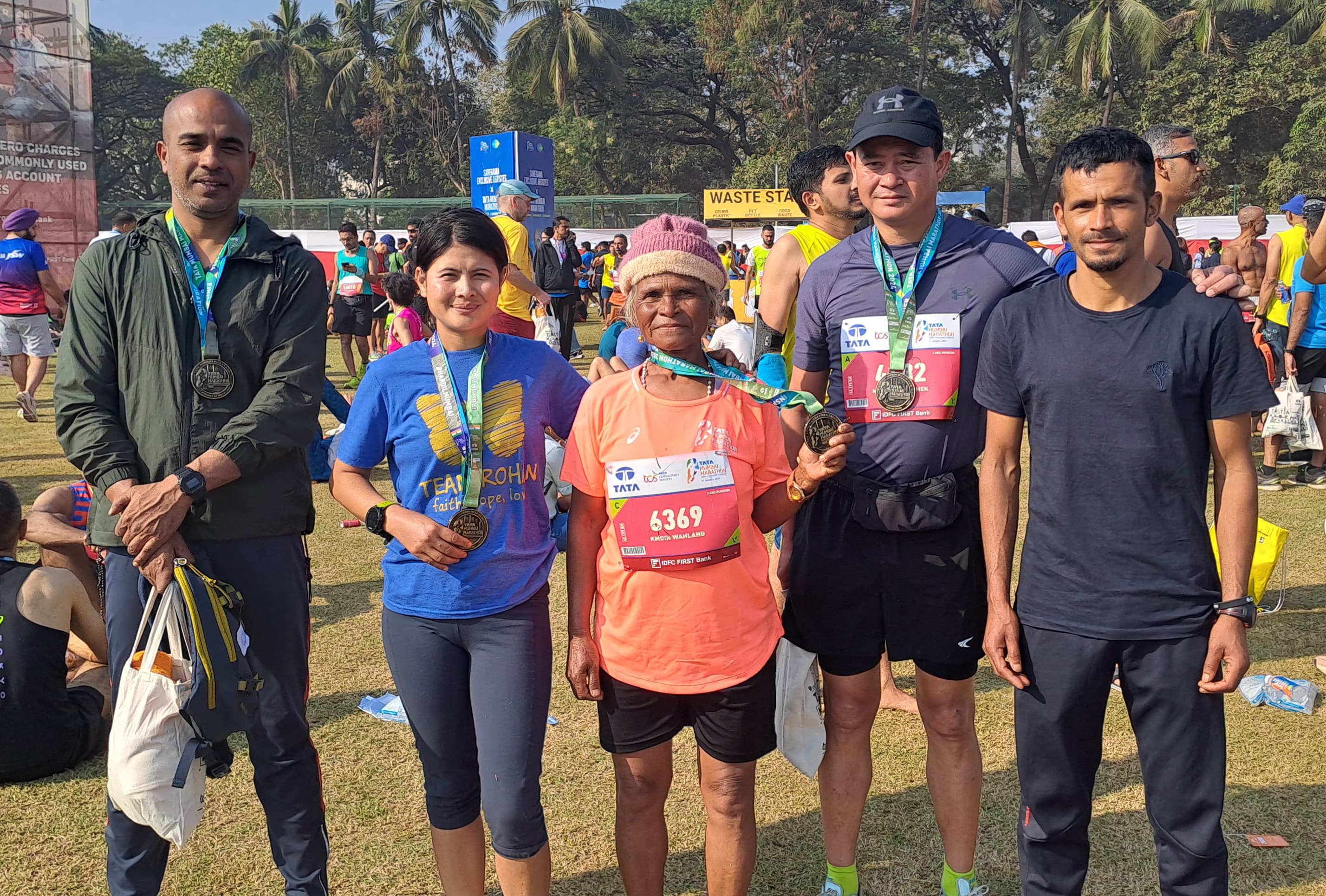
Some of the members of Team Meghalaya: (from left) Gerald Pde, Darishisha Iangjuh, Kmoin Wahlang, Dr K. G. Lynrah and Tlanding Wahlang (photo: courtesy Darishisha).
At the 2024 Tata Mumbai Marathon (TMM), Kmoin Wahlang ran in the age category of 75 years and above for women. Hailing from Mawkyrwat in Meghalaya, she farms, has a dozen children and nearly two dozen grandchildren. Kamoin ran the marathon at TMM at an average pace of 9.4 kilometers per hour to complete the 42.2 km-distance in 4:29:24. Her first split was at 8.9 kilometers per hour; the fastest split (the third one) was at 9.7 kilometers per hour and her final split (the sixth) was at 9.5 kilometers per hour. Needless to say, she stood first in her age category. The story of Kmoin’s performance doesn’t end there. At the 2023 TMM, when too she had placed first in her age category of 70 years and above, she had finished in 4:48:10. In other words, a year older and into the 75 plus age category, the grandmother from Mawkyrwat had become almost 19 minutes faster! Her timing in 2020 at TMM was 4:44:09 and in 2019, it was 4:33:56. Speak to the team of runners from Meghalaya who annually visit Mumbai for the marathon and it is Kmoin that they now unfailingly talk of. From the rest of the team, Tlanding Wahlang who has been a dependable performer at TMM, secured first position in his age category with timing of 2:44:18. Snora Lyngkhoi (4:09:44) finished seventh in her age category of 50-54 years and Darishisha Iangjuh (3:29:37) placed third in her age category of 25-29 years. Sustaining a constant pace Gerald Pde, covered the distance in 3:38:43 while Dr K.G. Lynrah, one of the main sponsors of the running team and participating in the 55-59 years age category, finished in 6:19:01.
Dixon Scaria
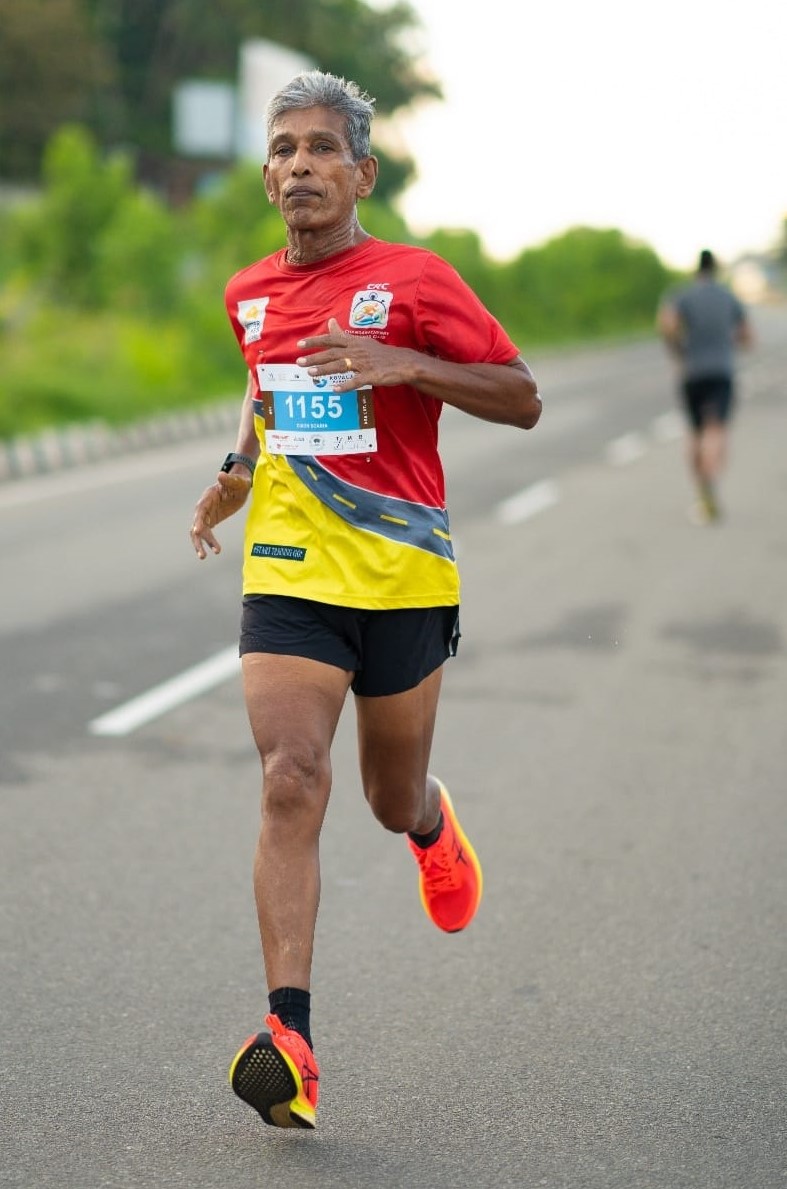
Dixon Scaria (photo: courtesy Dixon)
Years ago in Kerala, Dixon Scaria used to participate in athletics in school. He kept up his running, even after he shifted to Abu Dhabi on work. “ Most days, I used to run for an hour,’’ he said. Following his retirement and return to Changanassery, he and others around, started a running club. The first city marathon he participated in, was in Bengaluru. From then on, he has participated in several events. In 2023 for instance, Dixon estimates he must have run 3-4 marathons and 10-15 half marathons at various locations. This included a first place in his age category of 70 years and above at the 2023 Tata Mumbai Marathon (TMM); he covered the 42.2 kilometre-distance in 3:52:29. In Changanassery, he trains six days a week. According to him, this includes a day to run 10 kilometres, another for 30 kilometres, one day for interval training and high intensity workouts and at least three days devoted to strengthening exercises and recovery, with one off-day. Dixon said that he approached 2024 TMM with his regular training done and without any special preparation. “ This year’s marathon went off smoothly for me. I faced no problems. One good thing was that the hydration support was excellent; they provided water in small bottles, which you could carry along. I didn’t feel very tired at the finish line,’’ he said. He maintained a steady, consistent pace. Dixon improved his timing; at 2024 TMM he clocked 3:49:00 and placed first in his age category of 70-74 years. Gong ahead, among races he is scheduled to participate in, is the 2024 Boston Marathon in the US. It will be his first World Marathon Major. However, he has run in the US before including a first place secured in a 10K at an event in Atlantic City.
Sabhajeet Yadav
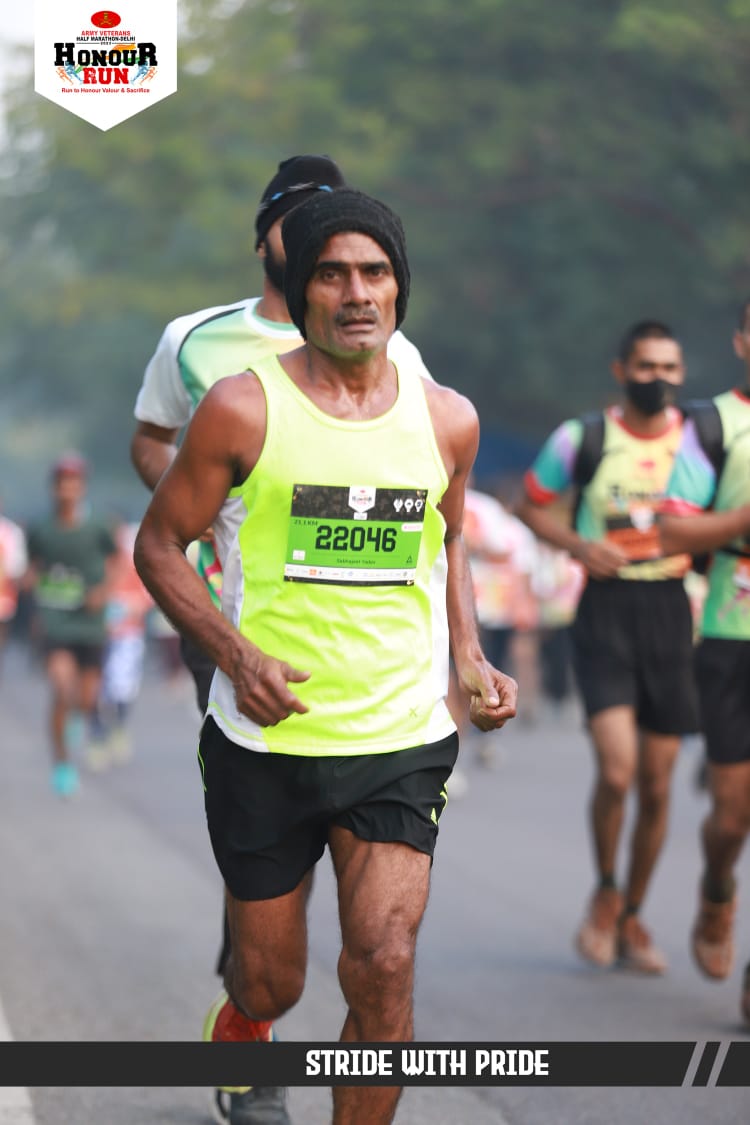
Sabhajeet Yadav (photo: courtesy Sabhajeet)
Sabhajeet Yadav, farmer from Dabhiya village in Jaunpur district of Uttar Pradesh, is well-known among recreational marathon runners. He has been running marathons for several years, very often securing a podium finish in the process.
In recent years, he is also known as the father of the promising national level javelin throw-athlete, Rohit Yadav. Rohit has represented India in international events. Every year for the Mumbai Marathon, Sabhajeet travels from his village to Maharashtra’s capital by train. In the initial years of the event, he used to sleep at the railway station, get up in the morning, run the race, secure a podium finish and head back. For the past couple of years, New Vasantashram Hotel, a boarding hotel near CSMT (Mumbai’s main railway station), has been hosting Sabhajeet free of cost.
Sabhajeet was not able to train ahead of the 2024 Tata Mumbai Marathon as it was very cold in his village. But his race went off quite well. I ran quite easily throughout without any trouble,” he said. He finished the marathon in 3:23:51, winning in his age category of 65-69 years. He said his pace suffered during the last few kilometres as the cool weather started to wane. `` Also, this time around there were too many runners,” he said. Nearly 56,000 people participated across categories in the 2024 Tata Mumbai Marathon. Once a regular at many running events, Sabhajeet has reduced his outings now, to a select few.
Deepa Nayak
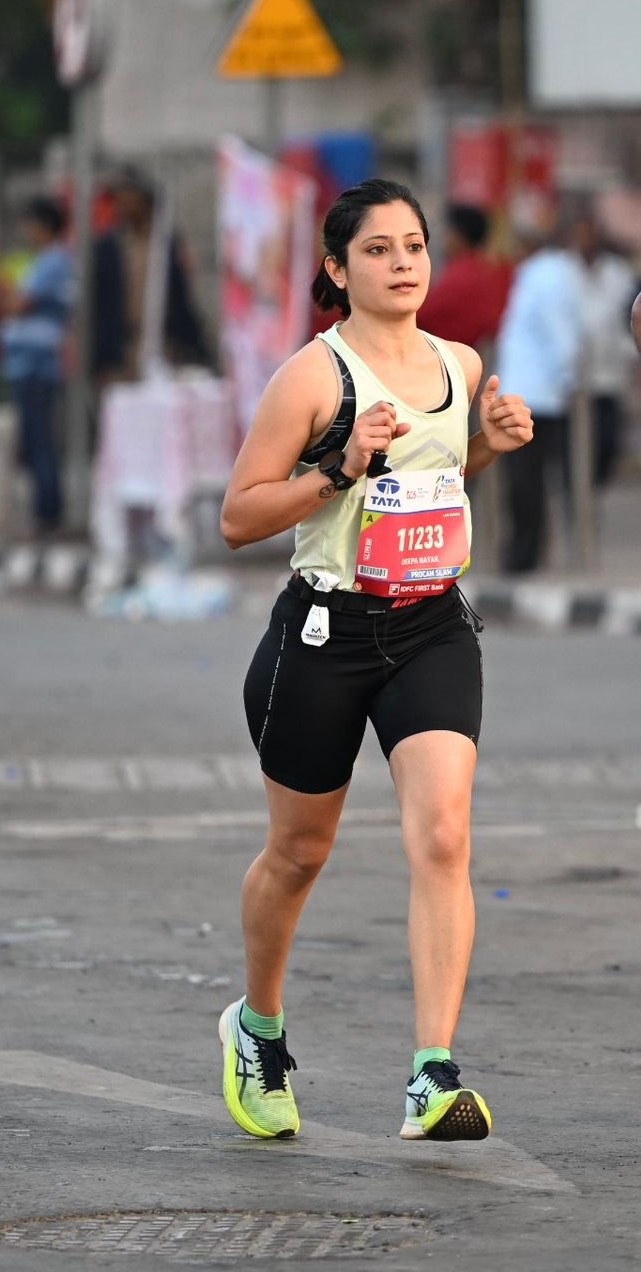
Deepa Nayak (photo: courtesy Deepa)
Having signed up for the Tokyo Marathon, Deepa Nayak’s training was focussed on that race. “But I did not want to miss TMM. I decided to take it as a training run,” she said.
The Bengaluru-based runner and coach has been into running for the last 12-13 years.
“ My training went off quite well. I commenced my training in November. Everything went as per the plan. It was a well scripted run,” she said. She was able to maintain her pace comfortably throughout the run, helped partially by the weather conditions in Mumbai on race day.
She finished the marathon in 3:20:31 securing a fourth position among women in open category; she was also winner in her age category of 30-34 years.
She will now focus on training for the Tokyo Marathon. Last year, she did Boston Marathon and London Marathon back-to-back.
Team Ladakh
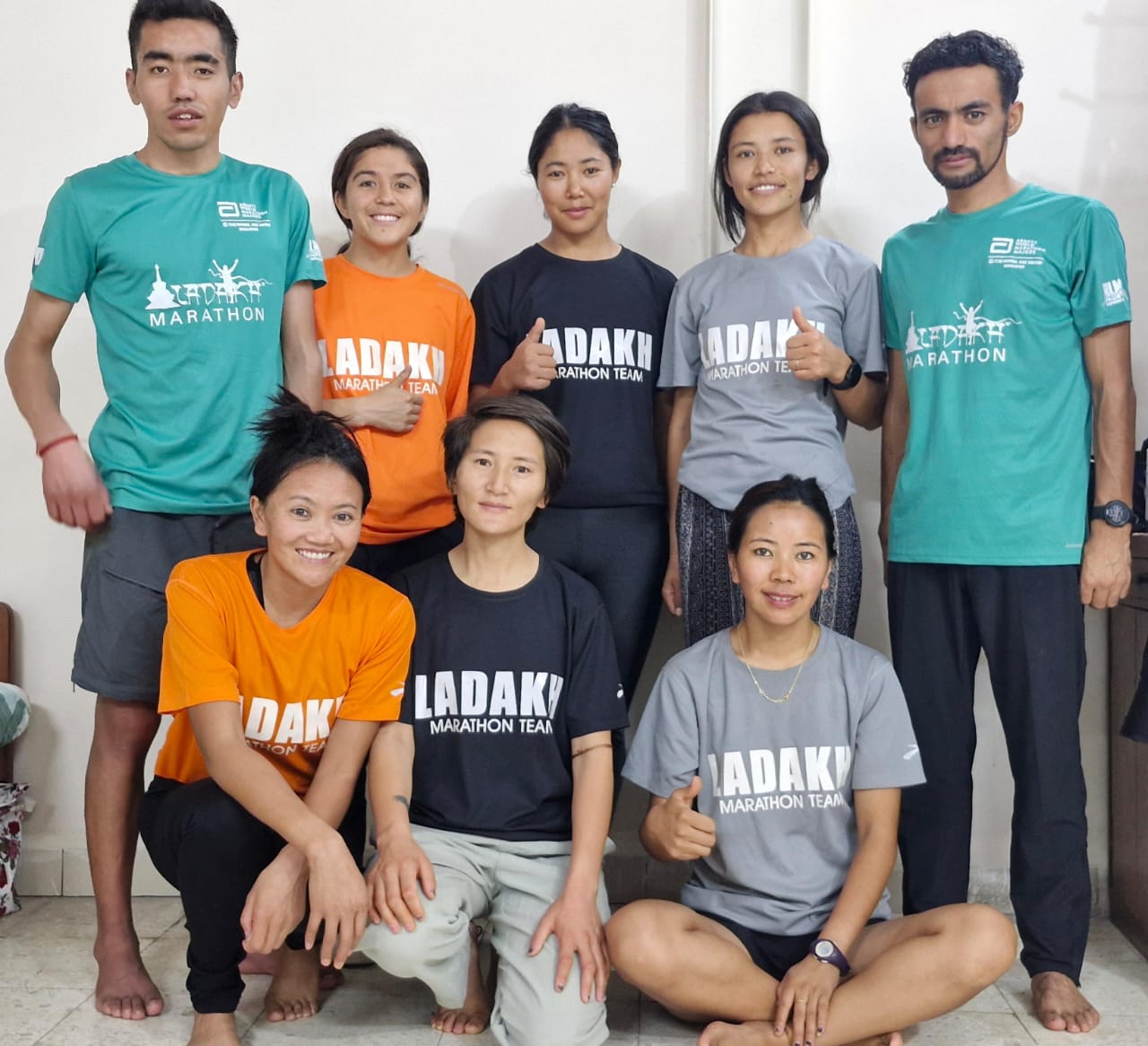
Team Ladakh. From left, front row: Jigmet Dolma, Disket Dolma, Namgyal Lhamo; back row: Nawang Tsering, Tashi Ladol, Stanzin Chondol, Stanzin Dolkar and Manzoor Hussain (photo: courtesy Jigmet)
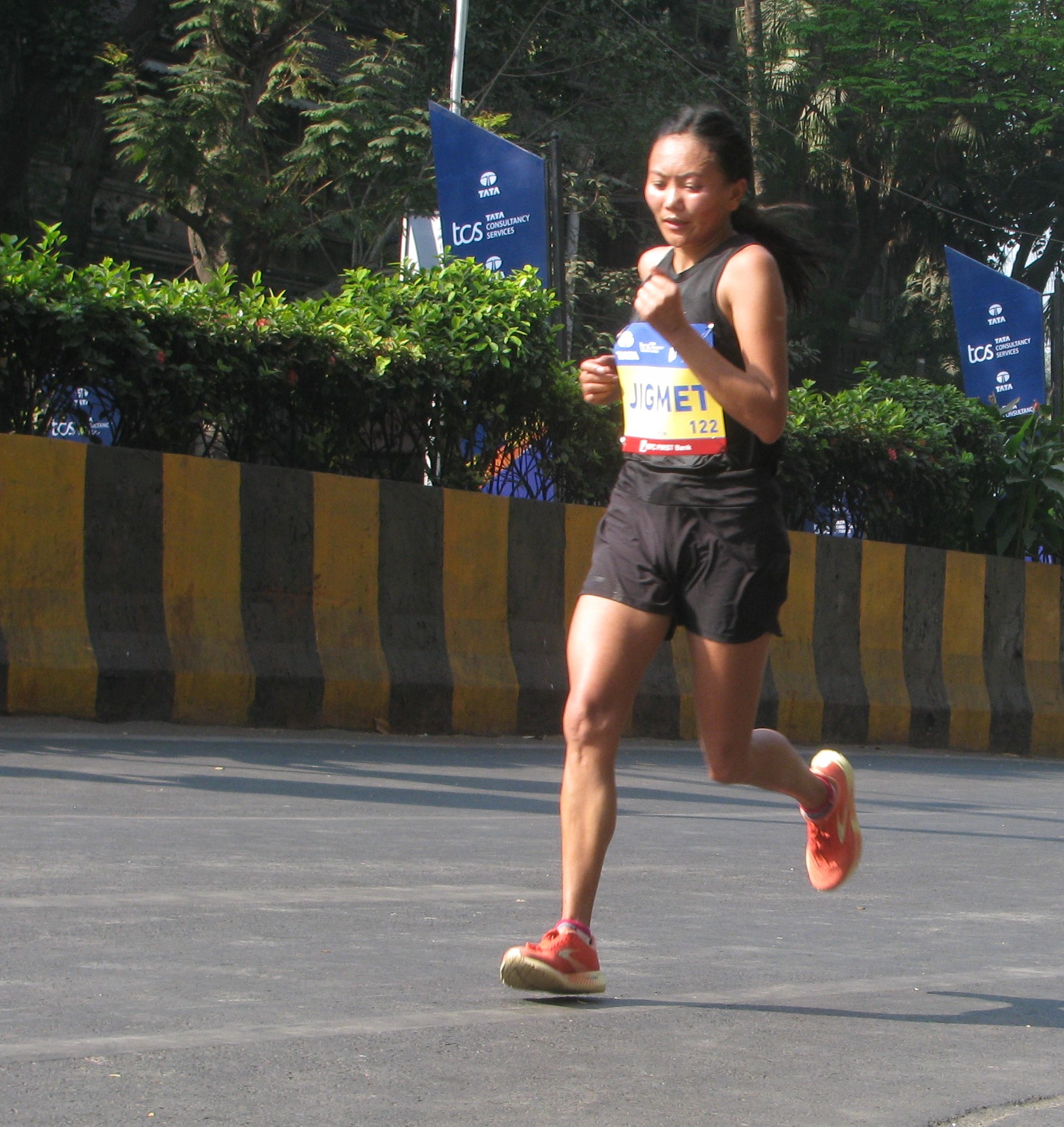
The team of Ladakhi runners that come to Mumbai annually for the Tata Mumbai Marathon (TMM) is now well-known to the city. This year’s edition of the event was however not exactly among their best outings in Mumbai. Jigmet Dolma, their elite runner with a personal best of two hours and 56 minutes in the women’s marathon, was a bit challenged preparing for the event. Part of Ladakh’s traffic police, she had to be on duty in the evening hours. This meant that unlike the regular elite athlete, who trains both morning and evening, Jigmet had only the morning hours to train. In Mumbai, the weather on race day was better than usual. Unfortunately, at around 31-32 kilometres covered, she started to get pain in her shoulder and hamstring. It reached a point, where she felt it wise to stop and walk a bit. “ I tried my best but there was no other alternative,’’ she said. Jigmet finished sixth among Indian women elites with timing of 3:14:09. Another major hope for Ladakh was Nawang Tsering, the young runner who has churned out some remarkable timings in the marathon at Leh’s high altitude. However, according to Jigmet, he was nursing an injury. He finished in 2:43:56 to place seventh in his age category of 25-29 years. But the team did get two podium finishes. With timing of 3:22:08, Disket Dolma topped her age category of 25-29 years for women in the marathon while Stanzin Chondol (1:28:42) placed second in her age category of 25-29 years in the half marathon. Post-TMM, the team was set to train for the marathon in Delhi due in February.
Gitanjali Lenka
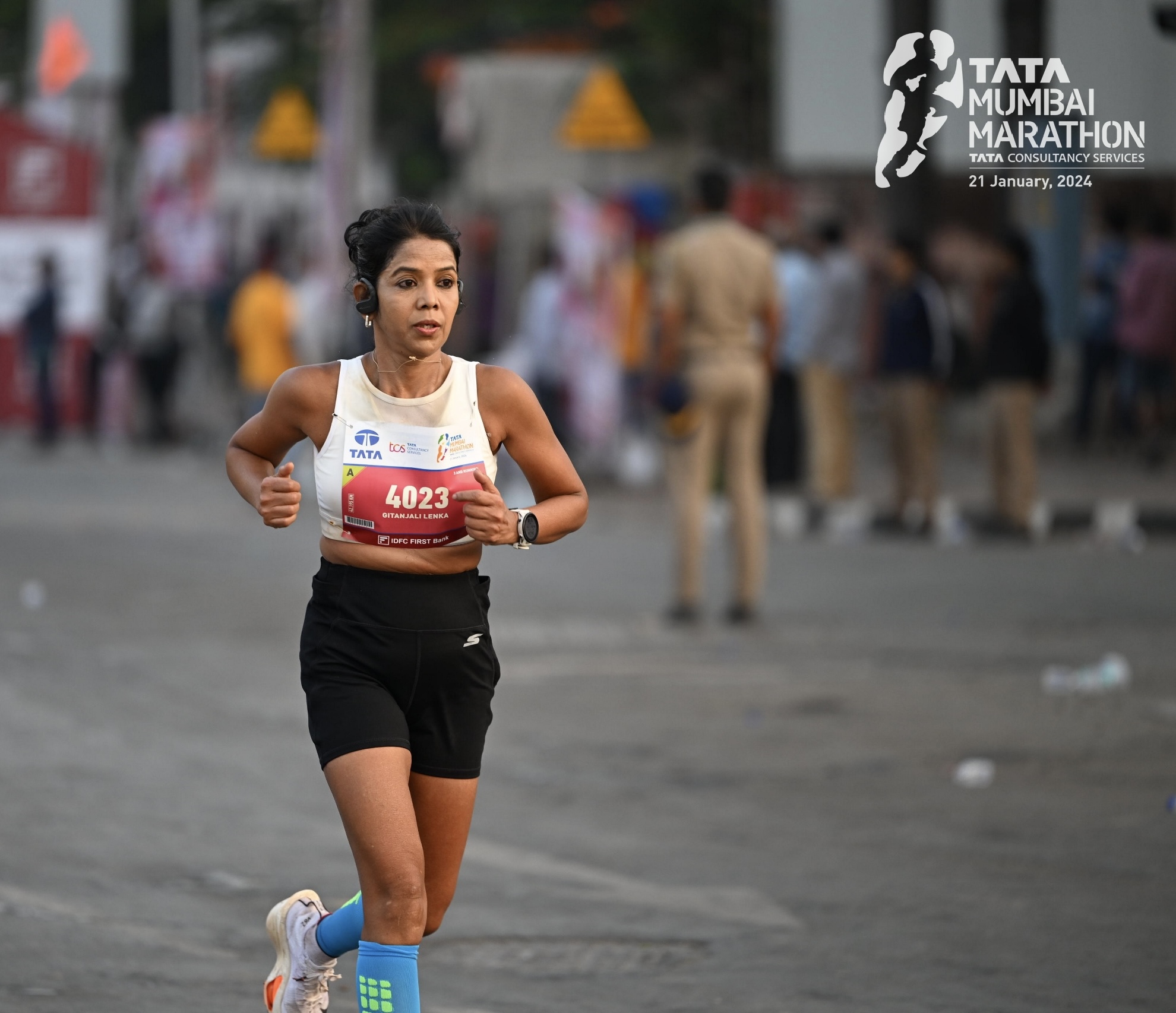
Gitanjali Lenka (photo: courtesy Gitanjali)
Race after race Thane-based Gitanjali Lenka has been improving her personal best in the marathon.
At Tata Mumbai Marathon 2024, she finished the 42.2 km-race in 3:28:42, a new personal best. She also won in her age category (50-54 years) and finished eleventh overall among women runners. “ My training was good. I had planned to do a sub-3:30. I achieved my target,” she said. Pleasant weather helped along the way. “ I had an effortless run. I am quite amazed that my fitness level has been improving,” she said. She trains under coach Ashok Nath.
A month ago, at the Vasai Virar Municipal Marathon Gitanjali had secured an age category (50-59 years) win in the half marathon category with timing of 1:44:22. Post-TMM, she will be running the Thane Hiranandani Half Marathon and the 50 km race at Tata Ultra. Following these races, Gitanjali plans to focus her training on the upcoming London Marathon, slated to be held on April 21, 2024.
Avik Pal
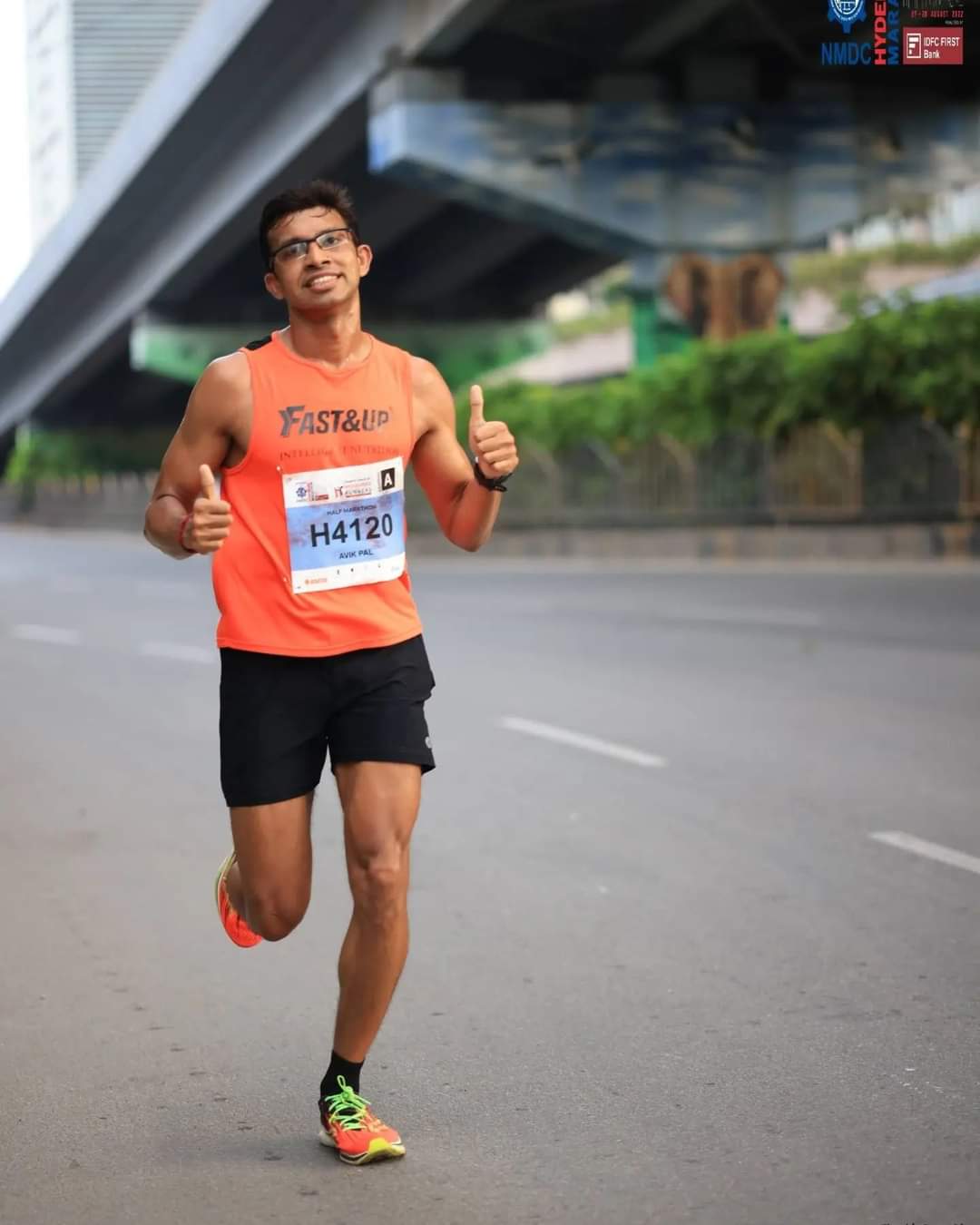
Avik Pal (photo: courtesy Avik)
During his schooling days in West Bengal Avik Pal was into the 100 metres sprint. He also participated in team sports. His mother Ratna Pal was a sprinter and long jumper. She had represented the state in these events. “ She was the one who encouraged me to take up sports,” Avik said.
However, over the years his focus on sport diminished to some extent. He joined Wipro in Hyderabad in 2011. In 2015 he resumed running by chance at the Spirit of Wipro run that year. “ I just landed at that run wearing jeans and t-shirt. The idea of running five kilometres was too much because I was used to the 100-metre dash,” he said. He took to running after this event in a slow manner; he ran only on Sundays. The next year he trained for the Spirit of Wipro run. Soon, he was running 10 kilometres and half marathon races.
At the 2017 Tata Mumbai Marathon, Avik ran the full marathon without any training. He finished in 3:50:38. The same year, he started training with Bengaluru-based Coach K.C. Kothandapani, (popularly referred to as Pani Sir). The remote training (Avik was based in Hyderabad and Kothandapani in Bengaluru), helped him improve considerably.
Over the years, besides his coach’s inputs, Avik came up with his own strategies. It started to show in his timing. At the 2022 Ahmedabad Marathon, he touched his best timing yet for a marathon (2:37:50).
For the2024 Tata Mumbai Marathon, Avik, 34, started training in November 2023. Having suffered a bout of COVID-19 infection earlier in the year, Avik said he took a long time to get back to feeling fit. “ By November I started to feel fine,” he said. “ At TMM 2024, my run went off quite well until I hit a wall of 10 km runners at the tail end of the marathon route. I had to slow down because I just could not get past the crowd of runners,” he said.
He finished in 2:40:07, securing a ninth position overall in the open category and second place in his age category of 30-34 years.
Nirupma Singh
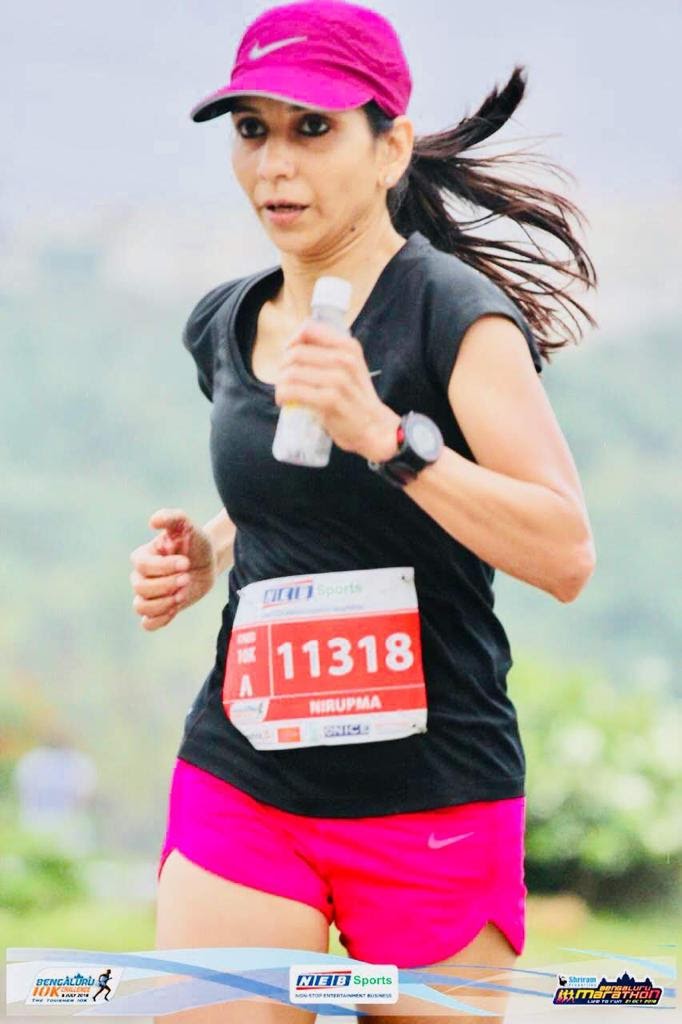
Nirupma Singh (photo: courtesy Nirupma)
Nirupma Singh, a runner and coach, has been into fitness and running for over 20 years. “ I took to fitness to lose weight and combat depression,” she said. Over the years she went on to certify as a fitness trainer.
In 2009, she ran her first race – the Airtel Delhi Half Marathon. “ Within a year, I did the full marathon,” the Bengaluru-based recreational athlete said. Nirupma has secured many podium finishes.
Her personal best in half marathon in terms of timing efficiency has been the Delhi Half Marathon of 2017, when she finished in 1:34. She set a personal record in full marathon during the 2023 edition of Berlin Marathon with a finish of 3:32.
Running the marathon at TMM 2024, Nirupma finished in 3:39:34 securing a second position in her age category (50-54 years). “ My training for TMM was good but my performance on race day did not justify my training,” she said.
Within a few kilometres from the start line, Nirupma realised that she could not keep up with her plan. “ I went for plan B as I wanted to finish gracefully. It was a blissful run for me,” she said.
This year she plans to do the Chicago Marathon. She has also registered for the Boston Marathon but may opt to sit out. “ I have been qualifying for the Boston Marathon for the past six years but I am not too focussed on the World Marathon Majors,” she pointed out.
Her goal in running now is to improve her timing efficiency to around 3:22-3:23. “ Once I achieve this, I may look at a 50 km-run,” she said.
Anil Korvi
Anil Korvi (photo: courtesy Anil)
A resident of Ambarnath, a suburb on the outskirts of Mumbai, Anil Korvi has been running since his college days. His initial races were short distance ones and cross-country events.
“ In 2011, I ran a full marathon but a friend advised me against it. I was just 21 years old then. I took up full marathon in 2016,” he said. Anil has been getting podium finishes in many of his outings across the country.
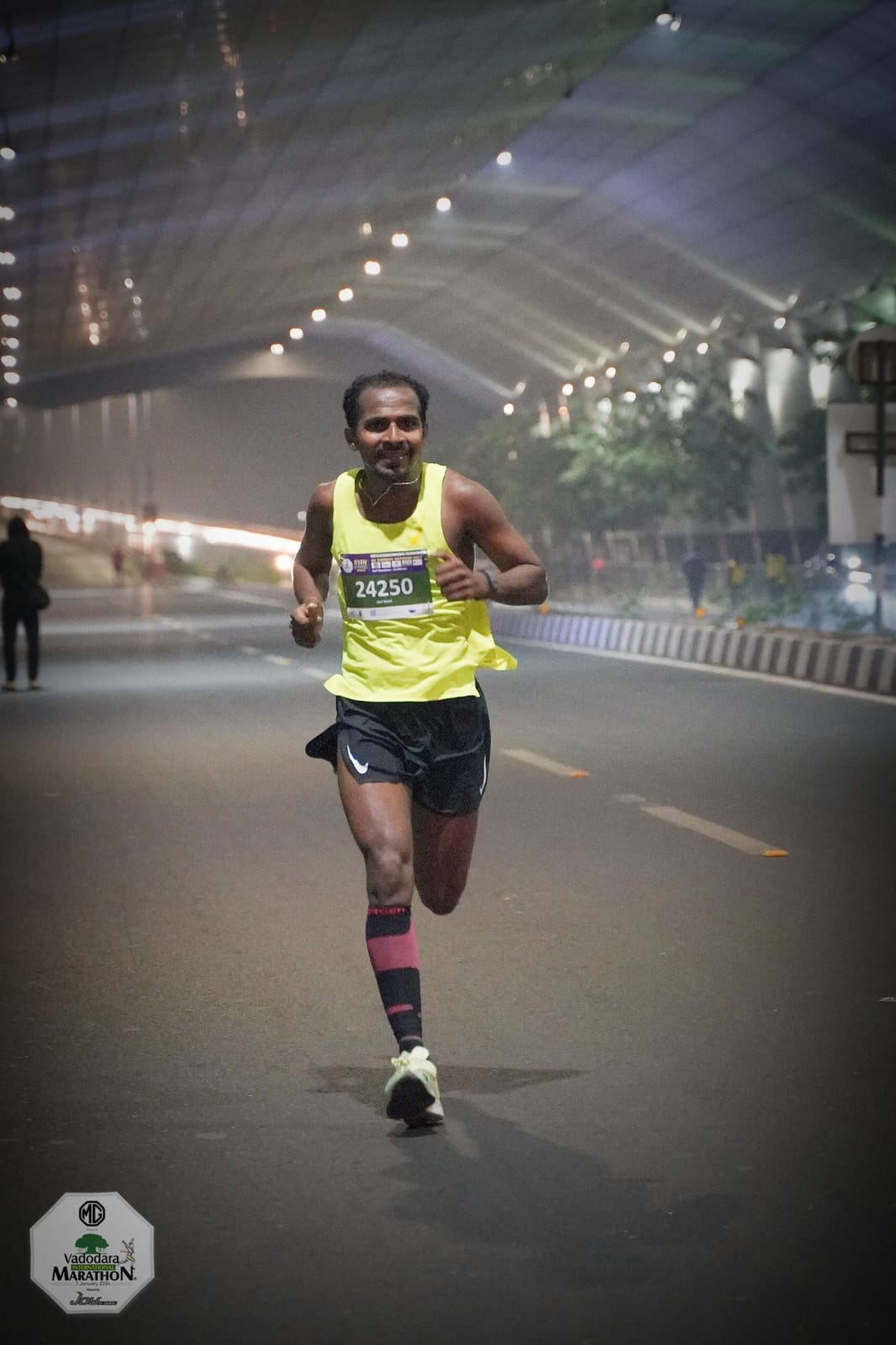
At TMM, he chose to run the half marathon as he was nursing an injury to his shin. He ran the distance in 1:12:46 securing an age category win (30-34 years). Two weeks ago, Anil ran the half marathon at Vadodara Marathon with a timing of 1:15:14. He finished overall fourth and secured a win in his age category of 30-34 years.
Anil Korvi has been chosen to run at the world railway marathon championships and is awaiting official communication in this regard. His training will now focus on that event, he said.
Pervin Batliwala
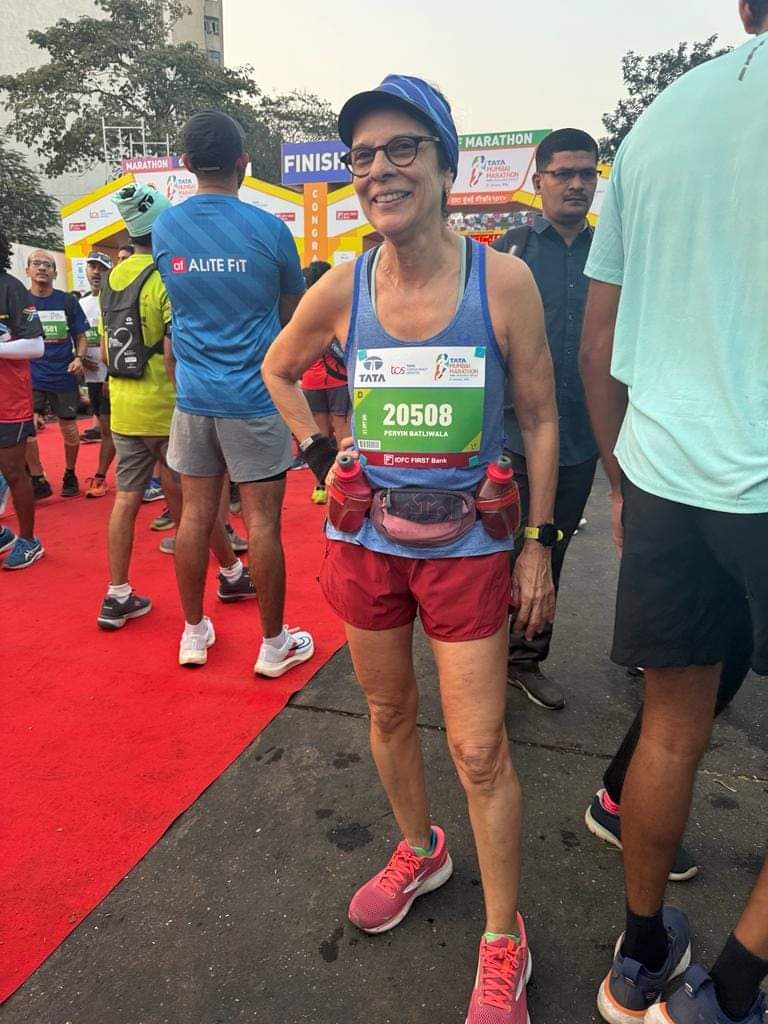
Pervin Batliwala (photo: courtesy Pervin)
For the last two years, Pervin Batliwala has opted to run the half marathon. In 2023, she was training for Tokyo Marathon and therefore chose to do the half marathon instead of her preferred full marathon. The 69-year-old recreational runner had completed her six-star World Marathon Major circuit at the 2023 edition of Tokyo Marathon.
This time around at the Tata Mumbai Marathon (TMM) she was able to race as per her training plan. “ Whatever I trained for, I got,” she said of her 2:12:28 finish, which gave her a second place in her age category of 65-69. Earlier at the Vasai Virar Municipal Marathon, Pervin had secured a second place podium in her age category of 60 years and above.
“ At TMM 2024, I enjoyed the run. Weather was quite good but there were too many runners this time,” she said. Pervin arrived late at the start line because of logistics issues and she commenced her race without any warm-up.
In February 2024, Pervin will be doing a one km swim at the Goa Swimathon 2024. Following this swimming event, Pervin plans to take a break and restart when the running season commences with the arrival of the rainy season.
Thomas Pallithazhath
Thomas Pallithazhath (photo: courtesy Thomas)
Thomas Pallithazhath, a resident of Wayanad, Kerala, has been running for many years and often secures age category podium positions. Working as a driver he has managed to carve out time for training in between his strenuous work schedule. Thomas now works at Aramaia International Residential School at Wayanad as a clerk but his job entails driving and running errands.
“ I wanted to run the full marathon this time but I am not able to find time for training,” he said. His work at the school keeps him busy for long hours. He stays 9 km away from the school. “ My training for the half marathon at TMM 2024 was not consistent. I would every now and then run to my school early morning, shower there and get to work,” he said, adding, “ the days I run, I wake up at 4 AM and set out for a run in my running clothes till the school. Once at school, I shower and change into work clothes,” he said.
The night before the run at Tata Mumbai Marathon 2024, Thomas said he did not sleep well. “ My run was however very good; the route was superb and the weather was awesome. Had I slept well the previous night I would have been able to do better,” he said. Thomas finished the half marathon in 1:32:03, securing a second position in his age group of 60-64. “ The only problem along the route was coping with the rush of runners. It was too crowded this time,” he said.
He will now be participating in Manipal Marathon 2024, due to be held on February 11, 2024.
Illustration: Shyam G Menon
The other side of 56,000
Having 56,000 participants (the overall numbers registered for 2024 TMM, as per media reports) is one thing. Making the experience enjoyable for runners is another. Given it has been a pioneer of sorts in India’s city marathon space, it will probably fall to the Tata Mumbai Marathon (TMM) to imagine how the event should be when participant numbers rise. Based on the chats we had with coaches and runners, there could be a fork in the journey approaching. It starts with two realizations and the courage and grace to accept those realizations.
First, given the nature of the course in Mumbai and the weather conditions, TMM lacks the profile of an event tracked for fantastic performance from elite athletes. It offers good prize money but it is not associated with great elite timings when compared to other international city marathons. For runners, its core attraction lay in overall size, that Mumbai spirit, crowd support (this year the crowd support was less, likely due to the cool weather) and positioning as India’s premier marathon.
Second, as the number of participants and the number of distance categories in races at TMM have risen, so has the congestion experienced by runners. The numbers are highest in the Dream Run, which is among TMM’s charity events. The congestion is felt in the second half (return half) of the marathon when multiple races and at least one charity walk converge on to the same path. As one senior coach pointed out, although personal bests are still recorded and the event remains a great outing for amateurs at large, the emergent congestion has become a challenge for any amateur capable of three hours and thereabout, less than three hours or hoping to run such marathon timings in Mumbai. What makes the challenge particularly so, is the ongoing construction work which has resulted in roads getting narrow in places. There is the impact of the city’s coastal road project and the construction of a section of its metro rail system.
Of these two projects pinching the marathon route, work on the coastal road is expected to be largely over by the next edition (2025) of TMM. “If the number of participants continues to rise, then 2025 could be a litmus test as we will get to know how the numbers fare with much of the route unclogged. If it stays congested still, then we likely have a real problem,’’ one coach we spoke to, said. The alternative most frequently cited in the conversations we had, was to split the event into at least two days so that the experience of running stays undisturbed. “ The flagship category of the event is the marathon. So, maybe have the marathon and the Dream Run on one day; the half marathon and the 10K – which will remain races gathering more numbers – on another,’’ said one of the coaches. Needless to say, this will call for greater cooperation and understanding from civic authorities but that’s how the world’s great city marathons have evolved. “ Boston for instance, does not mix up races,’’ a senior coach said. Perhaps we should consider the following thought. Mumbai showed the way for a great city marathon in India. Maybe its time for the city to host a multi-day festival of running?
Meanwhile, on a more practical note, one of the coaches we spoke to had a suggestion. “ The half marathon and the marathon now start very early to take advantage of the cooler weather. Unfortunately, some of the portions of the route were poorly lit this time. It would be good if the race organizers ensured there is proper lighting all along the route for lack of adequate light compounds the challenge of running on narrow roads maintained to typical Indian standards,’’ he said.
(The authors, Latha Venkatraman and Shyam G Menon, are independent journalists based in Mumbai. Our thanks to everyone who spoke to us)
Breaking the national record in the marathon has become a matter of no other option left
The longest standing national record in Indian athletics at present, the late Shivnath Singh’s 2:12:00 for the men’s marathon set in 1978, has become the target in mind for Indian elite marathoners.
The reason for the emergent urgency in addressing the national record is that unlike before, when qualifying standards for major international championships were short of the Indian national record, performance levels globally now are such that qualifying standards require to complete the marathon in timing that is faster than India’s national record. So, breaking the national record has become the only way forward for Indian elite marathoners. As one elite marathoner put it, “ there is no other option. The city marathons of Delhi and Mumbai will keep happening and the best among us at that given instance, will get a podium finish. But the national record has to be surpassed for the sport to move forward.’’
Most elite marathoners one speaks to admit to breaking the national record being a private and a larger, shared project but they say it such that it doesn’t weigh on their mind like a burden capable of dampening current performance. The goal has to sit lightly; a goal and yet not an obsessive, heavyweight one. Nobody sees breaking the national record as an impossible task because in today’s marathon environment with Kelvin Kiptum’s world record standing at 2:00:35 and timings by foreign elite runners at nodal Indian events itself being less than 2:10, a timing of 2:12:00 is nothing. As an athlete this blog spoke to put it (tad philosophically perhaps), India sits geographically in the middle with the centres of African running like Kenya, Uganda and Ethiopia to the west and Asia’s power house in running – Japan – to the east. So, it should be possible to improve. And yet, the wait has been long and there is evidently a puzzle to crack.
At least one coach of Indian elite athletes told this blog that a challenging aspect in the marathon was nutrition, especially dietary supplements. Elite athletes have to be very careful when it comes to their nutrition; they have to get the best nutrient intake for their sport without courting any prohibited substance. Such sports related food technology is considerably developed abroad. As example, the coach pointed to how Indian athletes in some disciplines other than the marathon elect to train overseas for long periods of time. This angle found empathy with some elite marathoners too. In fact, a common factor one finds when talking to Indian elite athletes, post-race at major events, is this trajectory of them performing well till 30-35 kilometres and struggling thereafter. “ I don’t know why. We do well for three fourths of a race and then lose out,’’ an elite runner said.
To an extent, this may be seen in the difference between the Indian national records in half marathon and the full, and their respective counterparts at the world level. The Indian national record in the half marathon is 1:00:30 (Avinash Sable in 2020) while the world record is 57 minutes and 31 seconds (Jacob Kiplimo of Uganda in 2021). Double the distance to 42.2 kilometres and the difference in timing between the national and world records is almost four times higher. Training in environments linked to a culture of endurance sports is another option. There is talk of at least a few elite marathoners potentially training in north Africa ahead of the next Olympics.
While all these are possible steps to improve, it still doesn’t answer why 2:12:00 has stayed so difficult to break. After all, as anyone would argue, the late Shivnath Singh had very few of the present-day technological advantages, sponsors and launch pads and even if the national record per se is taken off the equation, 2:12:00 is nowadays no big time in the larger marathon world. Among Indian athletes, the closest anyone has got to, to that mark, is Gopi Thonakal with his 2:13:39 at the 2019 Seoul Marathon. However, there are two other points that appear to hold relevance for India’s 2:12:00 journey, if one were to make it a pilgrimage.
First, although India has hundreds of marathons happening annually, an event that is a proper confluence of weather conditions, excellent course and race support is still hard to find. Where a flat, fast course is available, the weather may be tough; where the weather is good, the course still twists and turns or has gradients – so on. Indeed, for many observers of the sport, it is a puzzle why event organizers in India haven’t sculpted one perfect, fast course. Or, why no city appears to pride itself in having such a course to its credit with a race in the best part of the year. Or why not even a superb, flat, fast paced loop of modest mileage hasn’t been devised and maintained for a 42.2 kilometre-annual race that is a celebration of improved timing.
Second, elites are typically groomed from a pool of top-notch talent. By that logic, to breach 2:12:00 and improve further, there has to be first a big enough pool of people who run 2:20:00 and faster. It is by grooming this pool and competition within the pool that still better timings may be had. The argument even today is that such a pool, in India, is only growing. It is not big enough. Still, the coach this blog spoke to, said that he has the minimum number of elite runners required at hand, and was confident of producing results. Elite athletes were even more confident. Somebody just has to crack the record. Once that is done, they viewed getting past 2:12:00 like a longstanding collective mental block, flushed open. “ I am sure we have people who will do 2:07 and 2:08,’’ one of the elite athletes this blog spoke to, said.
There is one more reason – an unconfirmed but certainly speculated one – why breaking 2:12 has gathered a bit of urgency. Besides the fact that 2:12:00 is now slower than the qualifying mark for top international competitions, there is the fear that a sport which struggles for so long to break said barrier may wane in priority for national selectors piecing together teams for major competitions. Indian marathoners can’t risk having that happen to the marathon.
(The author, Shyam G Menon, is a freelance journalist based in Mumbai)
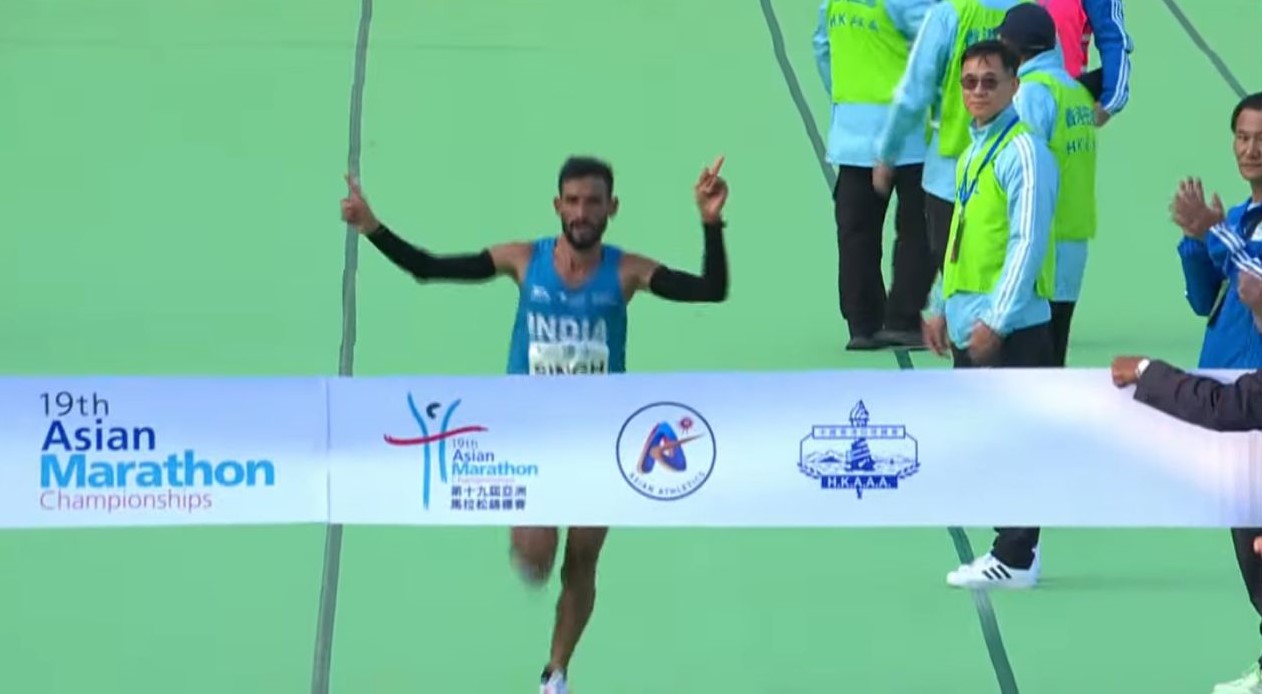
Man Singh; at the finish line of the 2024 Asian Marathon Championships in Hong Kong (photo: courtesy Man Singh)
In his early years as a runner, Man Singh was mainly doing five and ten-kilometre events and cross-country races.
At the 2023 edition of Tata Mumbai Marathon (TMM), he shifted to the full marathon distance and won the silver medal from among Indian elite men. A year later he won the gold medal at the Asian Marathon Championships held on January 21, 2024 at Hong Kong.
A Naib Subedar in the Indian Army, Man Singh had a focussed training plan curated by his coaches with an eye on the 2024 Tata Mumbai Marathon. “ I was training for TMM but then I learnt about the 2024 Asian Marathon Championships, which was being held on the same day as TMM in Hong Kong,’’ he said. Man Singh was one of the four athletes chosen to represent India at that event; the others being A. B. Belliappa, Jyoti Gawate and Ashvini Jadhav.
A native of Pithoragarh, Uttarakhand, Man Singh is posted at Ganganagar, Rajasthan. But he is more often in Pune and Ooty for training as decided by the Army Sports Institute (ASI).
At Hong Kong, Man Singh’s plan was to get close to the national marathon record of 2:12. “ The route was tough with too many inclines and declines. Also, the winds were quite strong,” he said.
A. B. Belliappa (photo: courtesy Belliappa)
He however sustained his lead to win the gold medal, covering the 42.2 kilometre-distance in 2:14:19, tad short of his personal best, which he had achieved at the 2023 edition of the New Delhi Marathon (2:14:13). He was more than a minute ahead of his nearest competitor, the athlete from China, who finished second.
“ I am happy with my timing at Hong Kong considering the toughness of the route,” he said. He now plans to attempt the marathon at the 2024 edition of New Delhi Marathon due to be held on the last Sunday of February.
Man Singh is the second Indian athlete to win the gold medal at Asian Marathon Championships. Gopi Thonakal had won the gold medal in 2017 with timing of 2:15:48.
For A. B. Belliappa too, the Asian Marathon Championships wasn’t originally on his plans for 2024. As of late 2023, he was in training for an event overseas in February 2024, when he was reassigned to the race in Hong Kong on January 21. The decision was taken in mid-December and there was a hitch in between – his marriage was set for late December. The function resulted in some distraction but Belliappa trained as best as he could despite his domestic obligations. “ On the whole, my preparation for Hong Kong wasn’t as good as it should have been,’’ Belliappa said. Weather on race day was generally alright; it wasn’t humid but it was quite windy. The course was tough with ups and downs. Belliappa said that he was in third place till the 38th kilometre. After that, the return of gradients took a toll and he slowed down. He finished sixth in the men’s race with timing of 2:20:19.
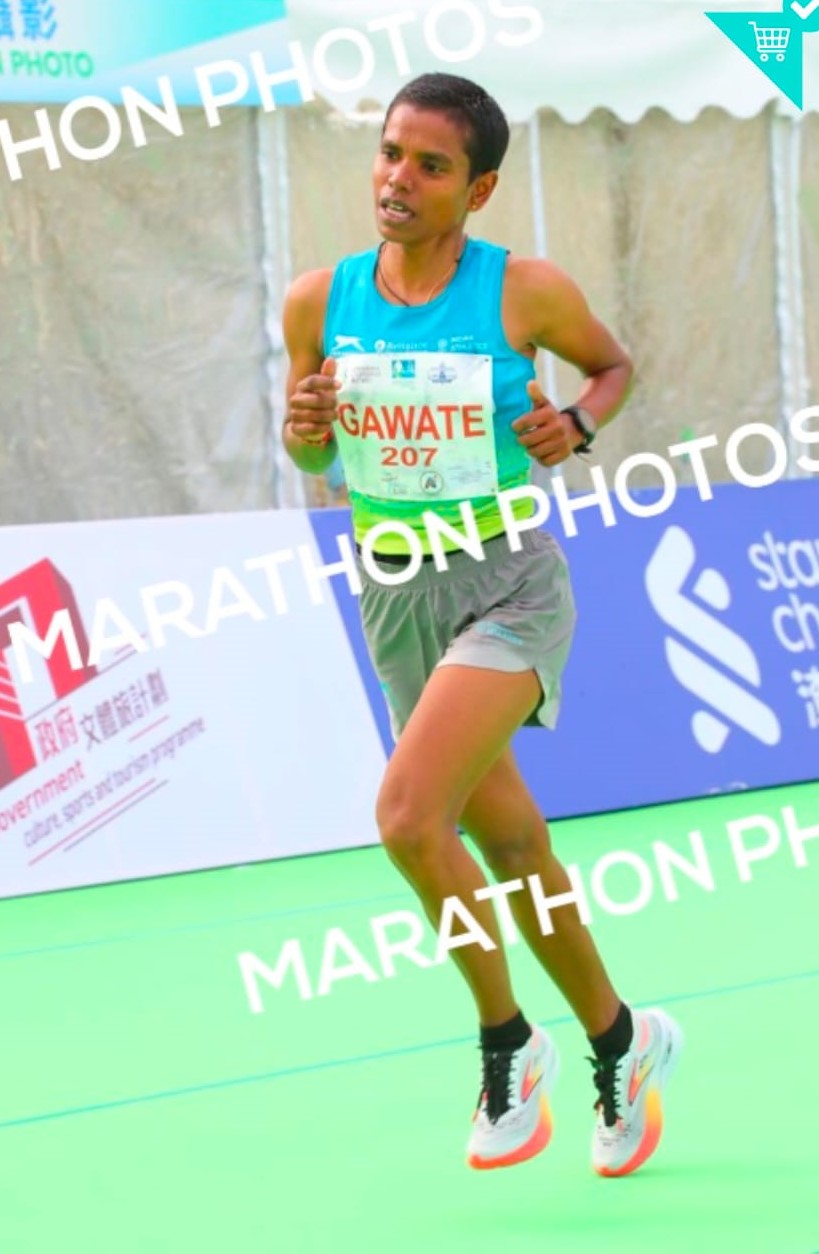
Jyoti Gawate; from the 2024 Asian Marathon Championships (photo: courtesy Jyoti)
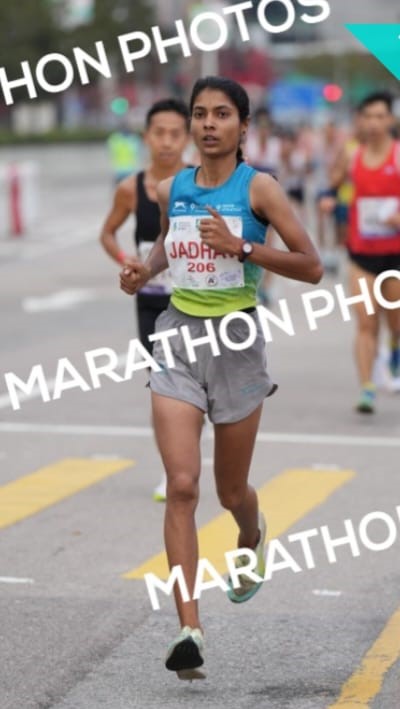
Ashvini Jadhav; from the 2924 Asian Marathon Championships (photo: courtesy Ashvini)
Ashvini Jadhav said her training was quite good. She trains with Jyoti Gawate at Parbhani, Maharashtra. “We got to know about the Hong Kong race quite late. At Hong Kong, weather was good but the route was tough,” she said. She finished in 2:56:41. Her personal best in marathon is 2:53, which she achieved at NDM 2023. Ashvini finished eighth among women at the Asian Marathon Championships.
Jyoti finished eleventh among women with a timing of 3:06:20. “My timing suffered because I had some issues with my shoes. My plan was to get close to 2:50,” she said. Both Jyoti and Ashvini were part of the IAU 50 km World Championship held at Hyderabad in November 2023.
The Asian Marathon Championships was held as part of the Standard Chartered Hong Kong Marathon 2024.
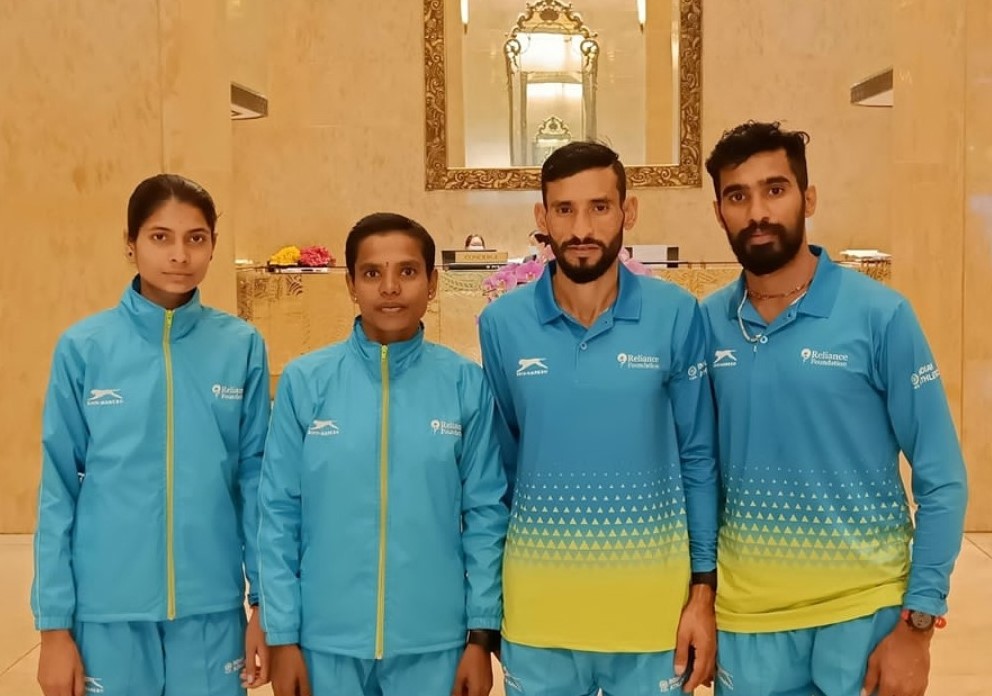
The Indian team that went for the 2024 Asian Marathon Championships (from left: Ashvini Jadhav, Jyoti Gawate, Man Singh and Belliappa A. B (this photo was downloaded from the Instagram account of Athletics Federation of India [AFI] and is being used here for representation purpose. No copyright infringement intended)
Belliappa finishes sixth among men, Ashvini eighth and Jyoti eleventh among women
India’s Man Singh secured the gold medal at the 2024 Asian Marathon Championships held in Hong Kong on Sunday, January 21, 2024.
He completed the 42.2-kilometre distance of the marathon in two hours, 14 minutes and 19 seconds, over a minute ahead of China’s Huang Yongzheng (2:15:24). In third position was Tiapken Ilia of Krygysthan (2:18:17).
His finish at Hong Kong was just short of his personal best of 2:14:13, which he secured at the 2023 edition of the New Delhi Marathon.
Last year at the Tata Mumbai Marathon (TMM), Man Singh had secured a silver medal among Indian elite runners with a finish in 2:16:58. Incidentally, the 2024 TMM was also held on Sunday (January 21), the same day as the event where Man Singh struck gold in Hong Kong. In 2017, Gopi Thonakkal who took the silver medal among Indian elite men in Mumbai on Sunday, had been the Asian Marathon Champion covering the distance in 2:15:48. At that time, the event was held in Dongguan, China.
India was represented by a four-member team at the Asian Marathon Championships 2024. The other three members apart from Man Singh were Jyoti Gawate, Ashvini Jadhav and Belliappa A.B.
Belliappa finished in sixth position with a timing of 2:20:19.
In the women’s race of the Asian Marathon Championships, Ashvini finished in eighth place, with a timing of 2:56:41 and Jyoti at eleventh, with a timing of 3:06:20.
The Asian Marathon Championships were held as part of the 2024 Standard Chartered Hong Kong Marathon.
(The author, Latha Venkatraman, is an independent journalist based in Mumbai)
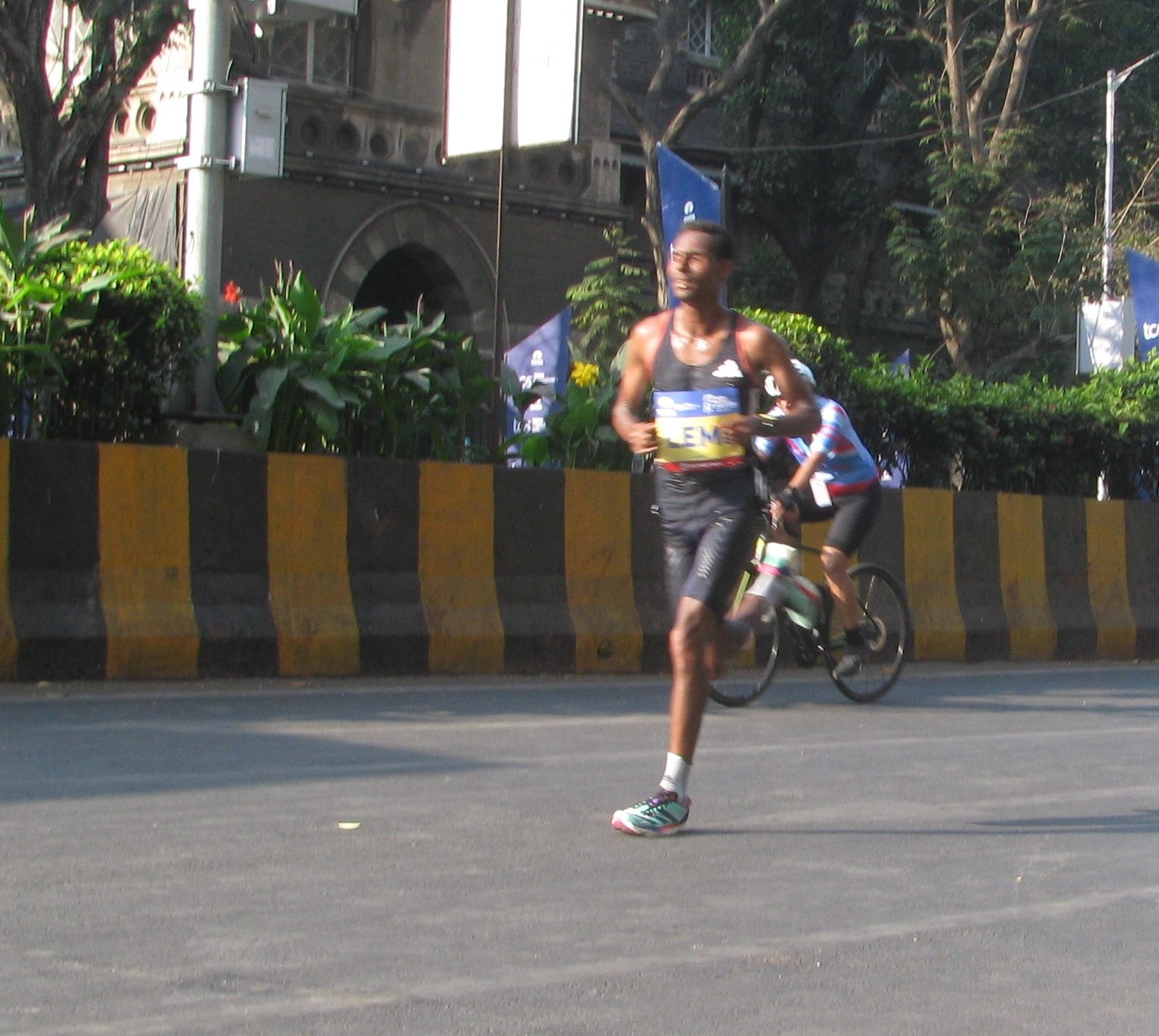
Hayle Lemi on the home stretch (photo: Shyam G Menon)
On a rare race day of agreeable weather in the city, the 2024 Tata Mumbai Marathon (TMM) podium was swept by half a dozen Ethiopian runners, who between them, cornered the top three positions in the male and female gender categories.
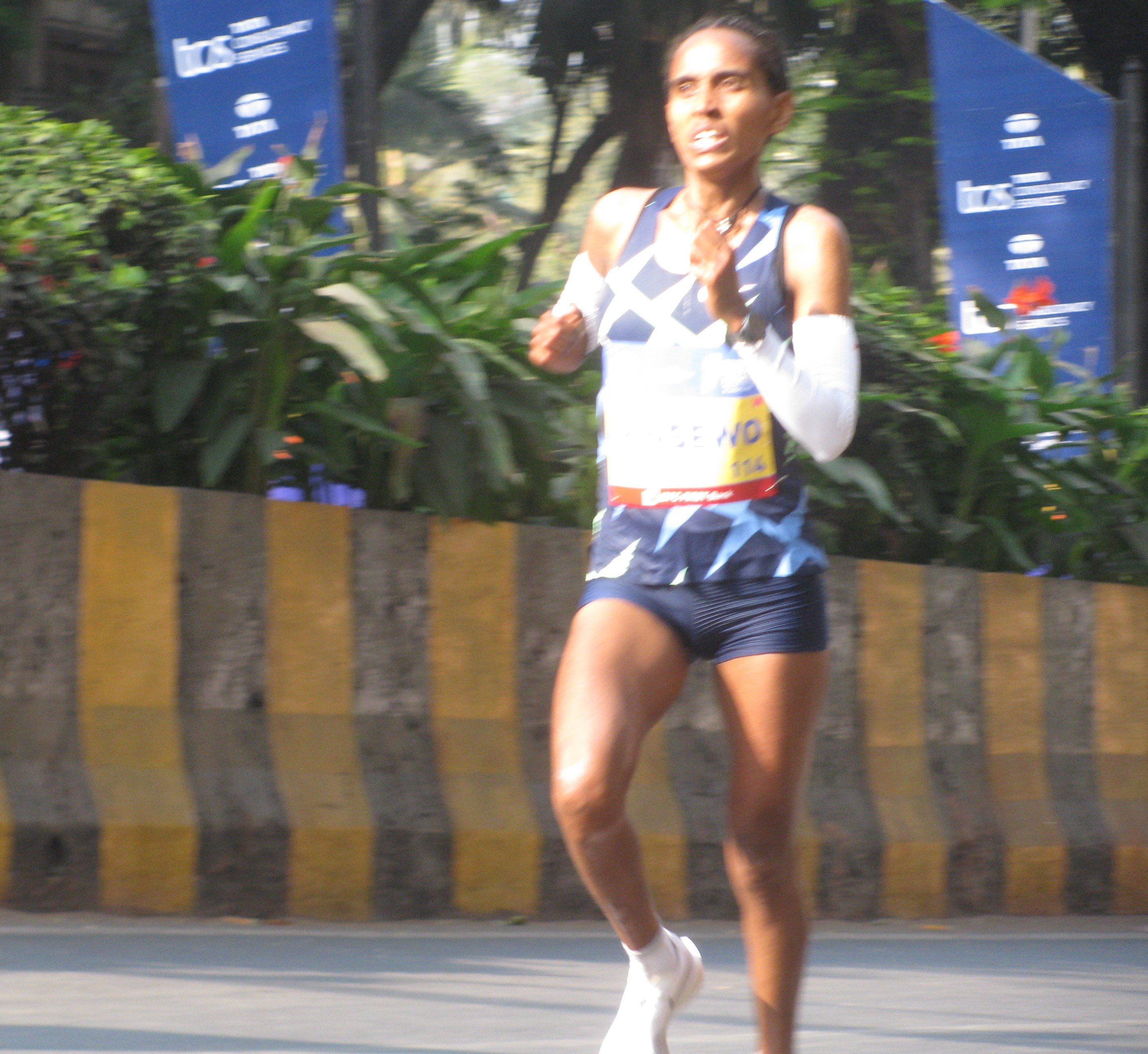
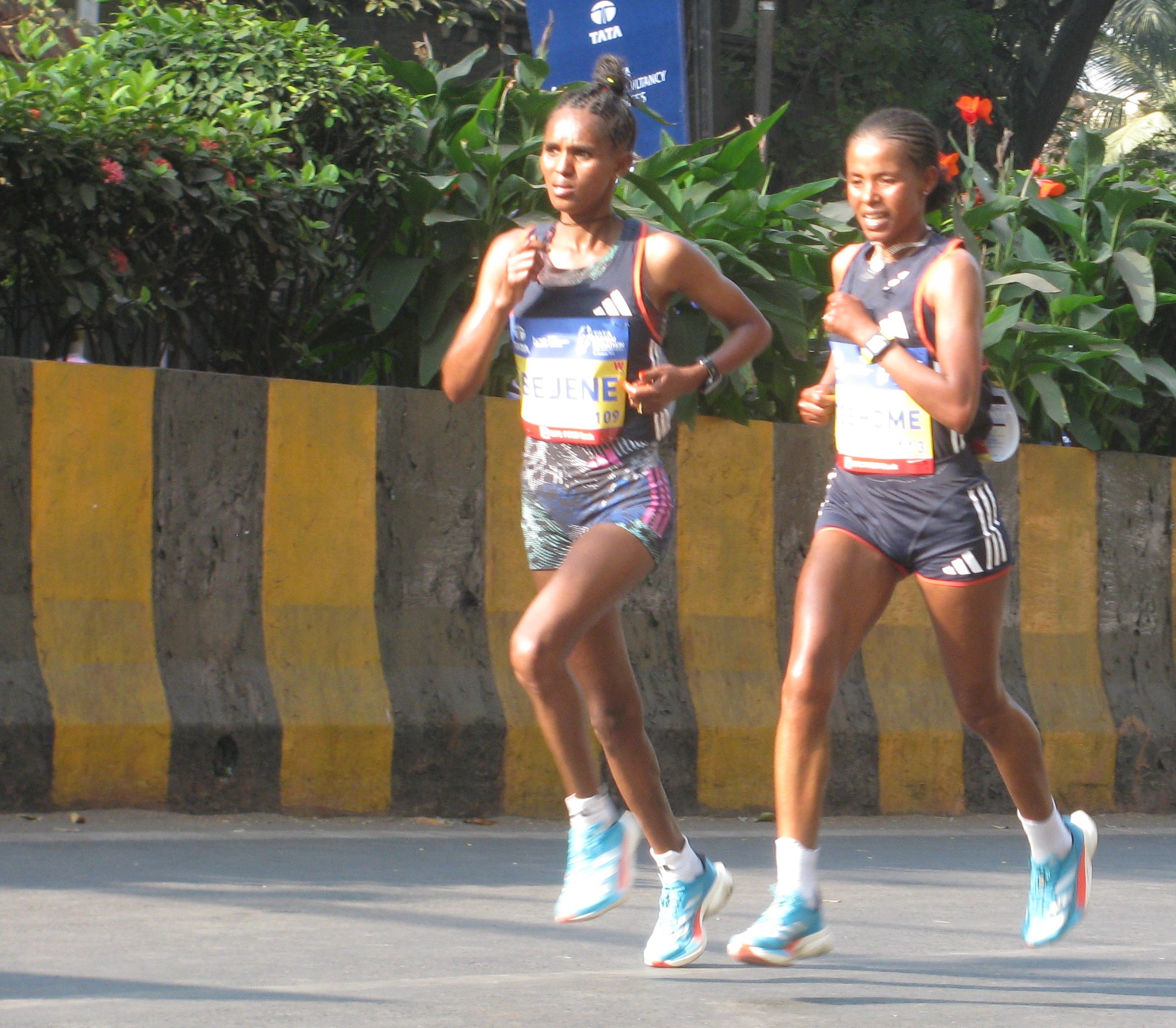
Defending champion Hayle Lemi regained his crown in the men’s segment, covering the distance in two hours, seven minutes and 50 seconds (in 2023, he had clocked 2:07:32). He was followed to the finish line by compatriots Haymanot Alew (2:09:03) and Mitku Tafa (2:09:58). Among women, the first to grace the finish line was Aberash Minsewo, who clocked 2:26:06. In second and third position were fellow Ethiopians Muluhabt Tsega (2:26:51) and Medhin Bejene (2:27:34). Incidentally, Sunday’s race was Aberash’s debut in the marathon.
Aberash Minsewo (photo: Shyam G Menon)
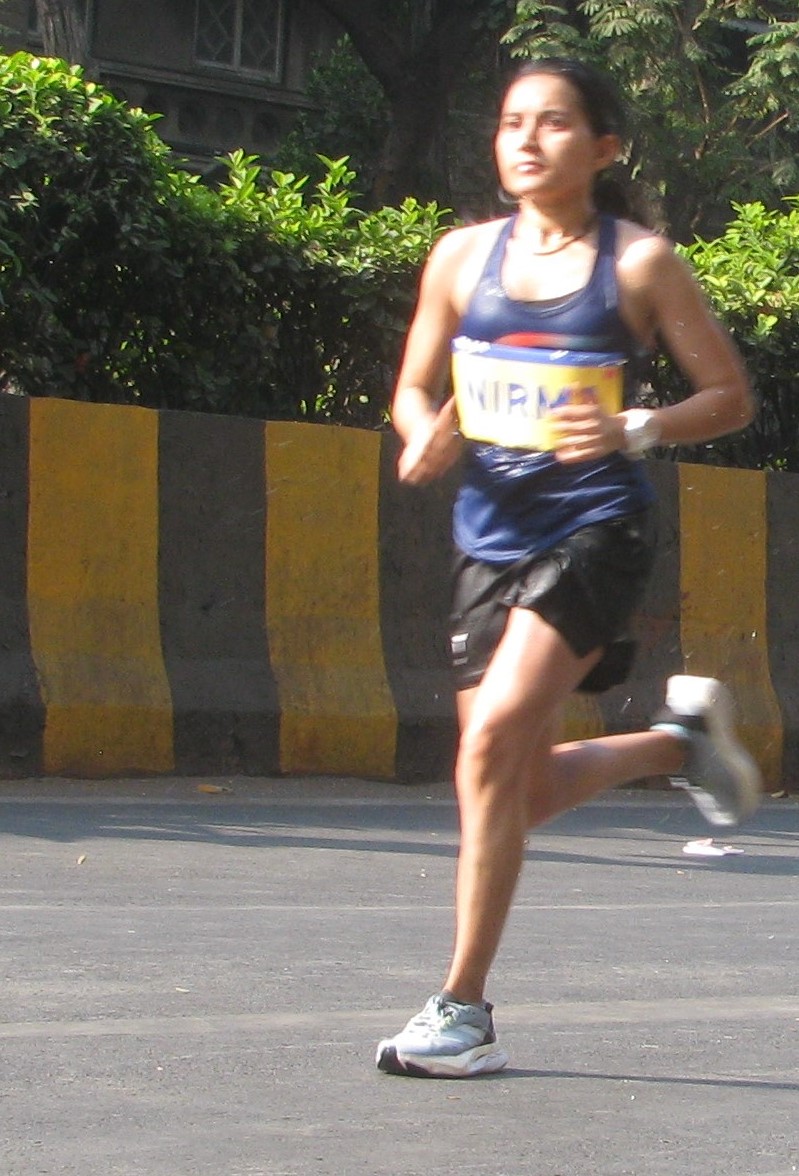
In the Indian elite category, the men’s segment was topped by Srinu Bugatha (2:17:29). Last year’s winner, Gopi Thonakal (2:18:37), had to settle for second place while Sher Singh Tanwar (2:19:37) placed third. In the corresponding women’s segment, the winner was Thakor Nirmaben Bharatjee (2:47:11). Reshma Kevate (3:03:34) and Shyamali Sing (3:04:35) finished second and third respectively. In 2023, when Gopi had won the Indian men’s elite category in 2:16:41, Srinu had finished fifth among Indian men and fifteenth among male elites overall with timing of 2:23:05.
The top three podium finishers in the half marathon for men in 2024 were Sawan Barwal (1:05:07), Kiran Matre (1:06:23) and Mohan Saini (1:06:55). The same in women were Poonam Dinkar (1:19:18), Amrita Patel (1:19:18) and Kavita Yadav (1:20:44).
Srinu Bugatha (photo: Shyam G Menon)
This year’s TMM featured close to 56,000 participants across its various categories. A report by moneycontrol.com said 10,711 runners had registered for the marathon and 15, 218 for the half marathon. Additionally, there was an open 10K, a senior citizens’ run, a Champions with Disability segment and the Dream Run. The last-mentioned category at 20,590-strong, fetched a big portion of the event’s numbers.
Meanwhile a statement from TMM said that two runners – Suvradeep Banerjee (40) and Rajendra Bora (74) – died during the event. The event’s medical partner is Asian Heart Institute (AHI). Rajendra Bora “ was found in a collapsed condition at the petrol pump, near Pizza by the Bay, he was attended to by an AHI doctor, who performed CPR on him and immediately shifted him to the Bombay Hospital Casualty ward, via the ambulance standing nearby. In transit, they continued the resuscitation but, were unable to revive him.
Thakor Nirmaben Bharatjee (photo: Shyam G Menon)
“ Suvradeep Banerjee, a full marathoner was found collapsed by the police, near Haji Ali junction. The police informed the ambulance at Nair Hospital, which reached the site shortly. We are given to understand that the runner was unresponsive at the site and during transit. We await the statement from Nair Hospital authorities,’’ the press release said.
According to it, a total of 1820 runners needed medical assistance. The majority of the cases were muscle cramps, sprains, minor injuries, bruises, exhaustion and dehydration. There was a total of 22 hospitalizations and 19 runners have been discharged. “ In general, the majority of the cases were of muscle cramps, dehydration, hypoglycaemia and minor injuries. The number of casualties over the years is coming down. The races starting earlier at 5.00 am and the temperature being conducive (for the full and the half marathon) has helped the runners in a big way. The weather this year was cool and that has aided the runners in completing their run smoothly,” the statement quoted Dr Vijay D’silva as saying.
(The author, Shyam G Menon is a freelance journalist based in Mumbai)
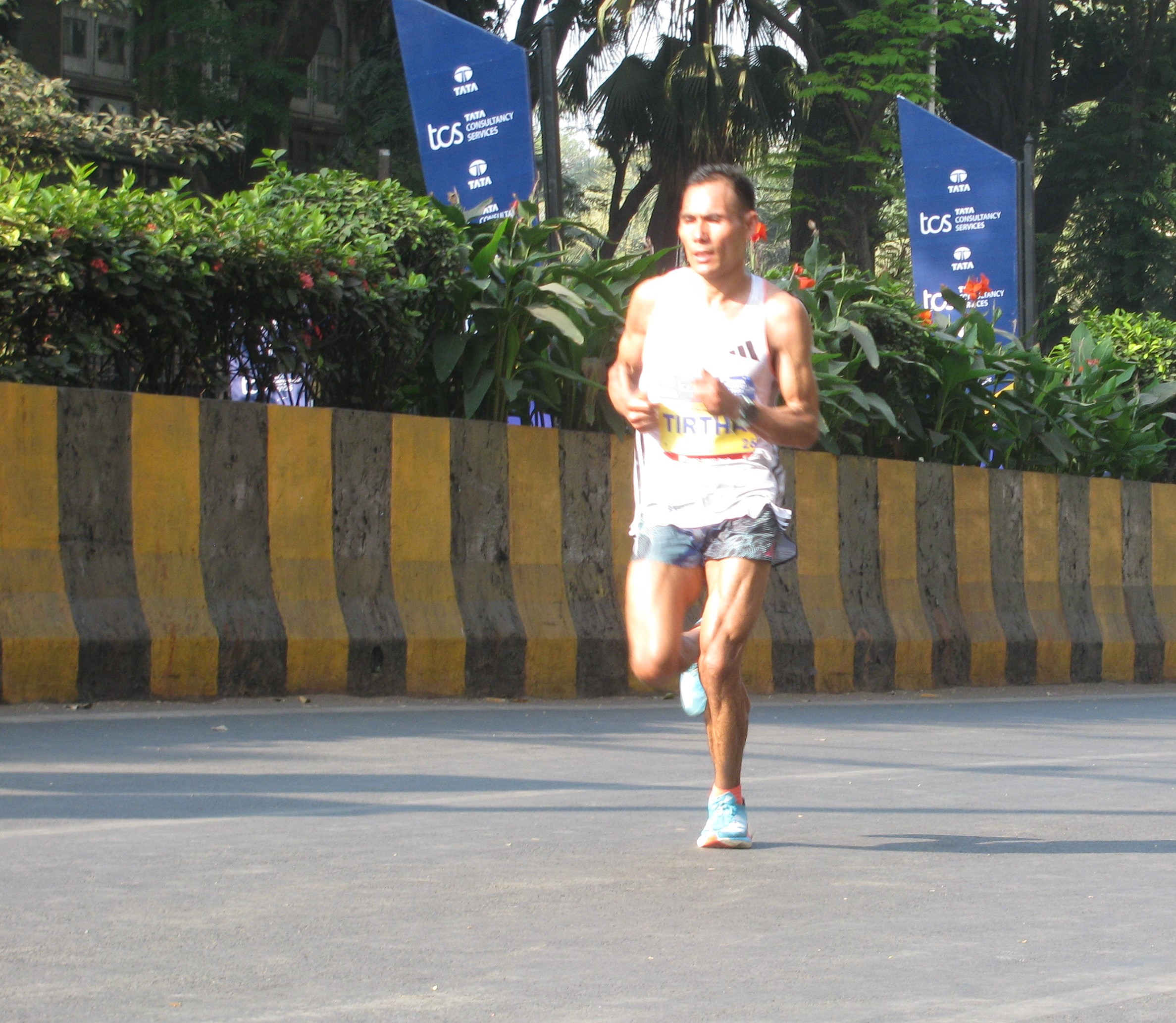
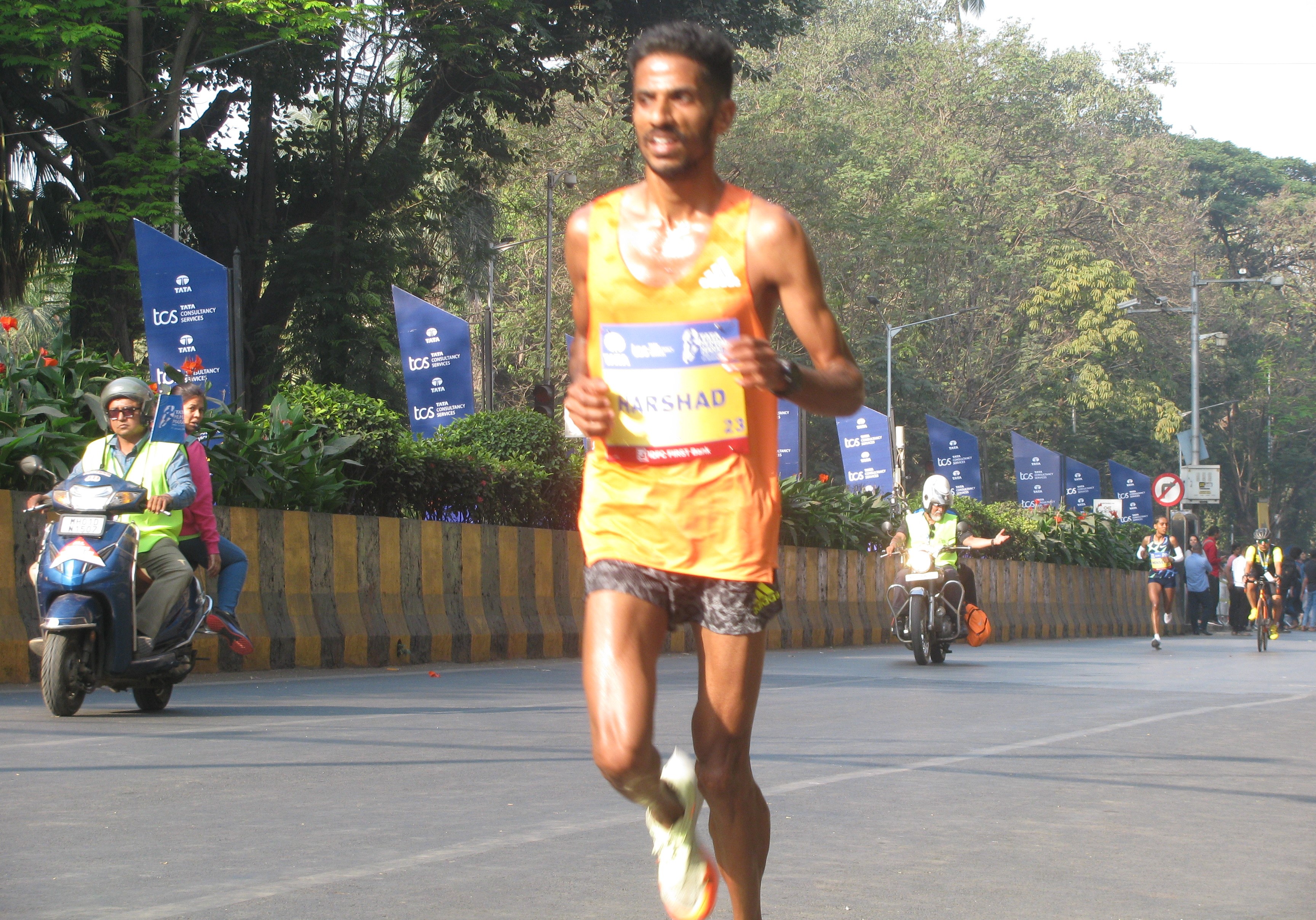
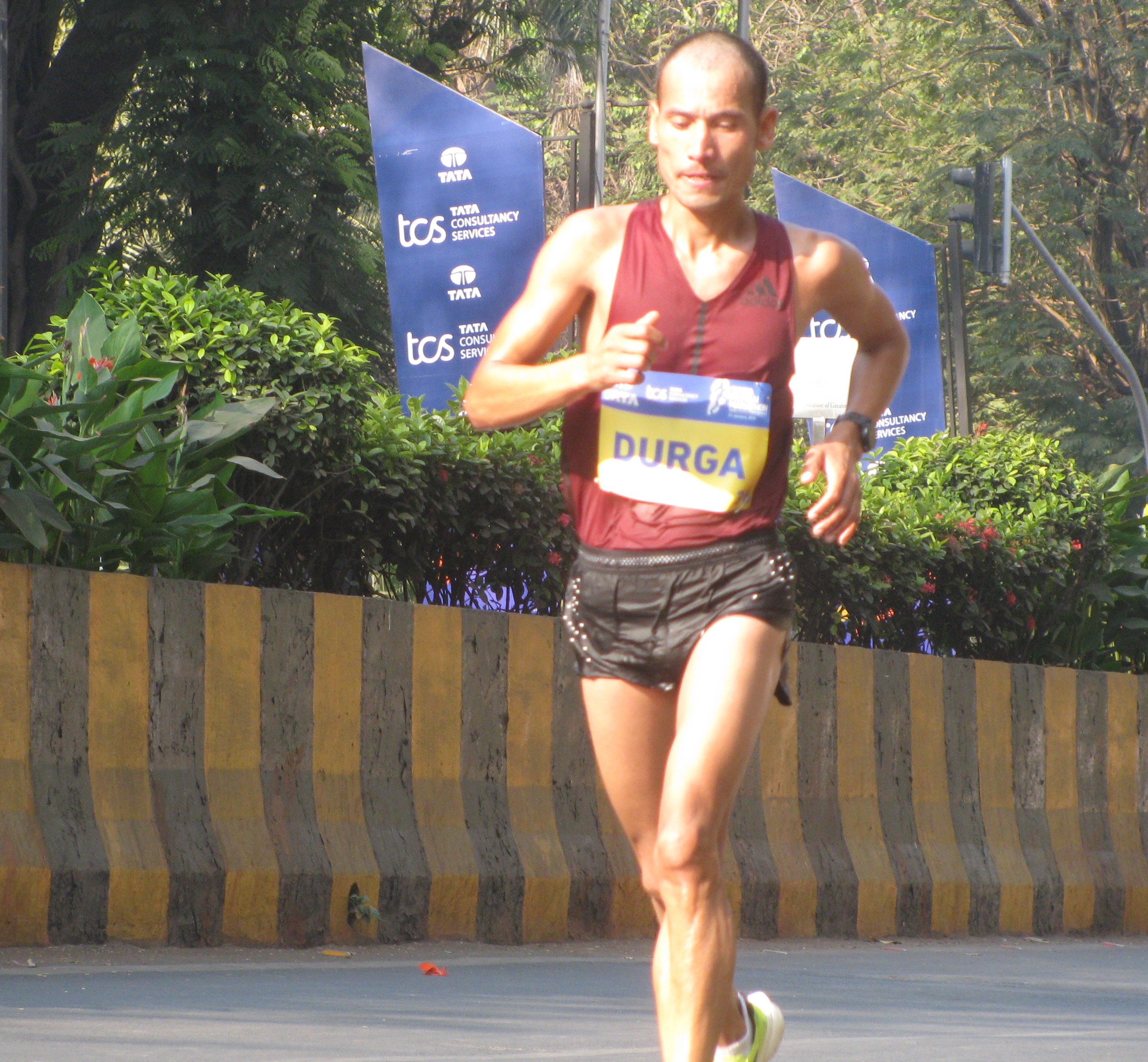
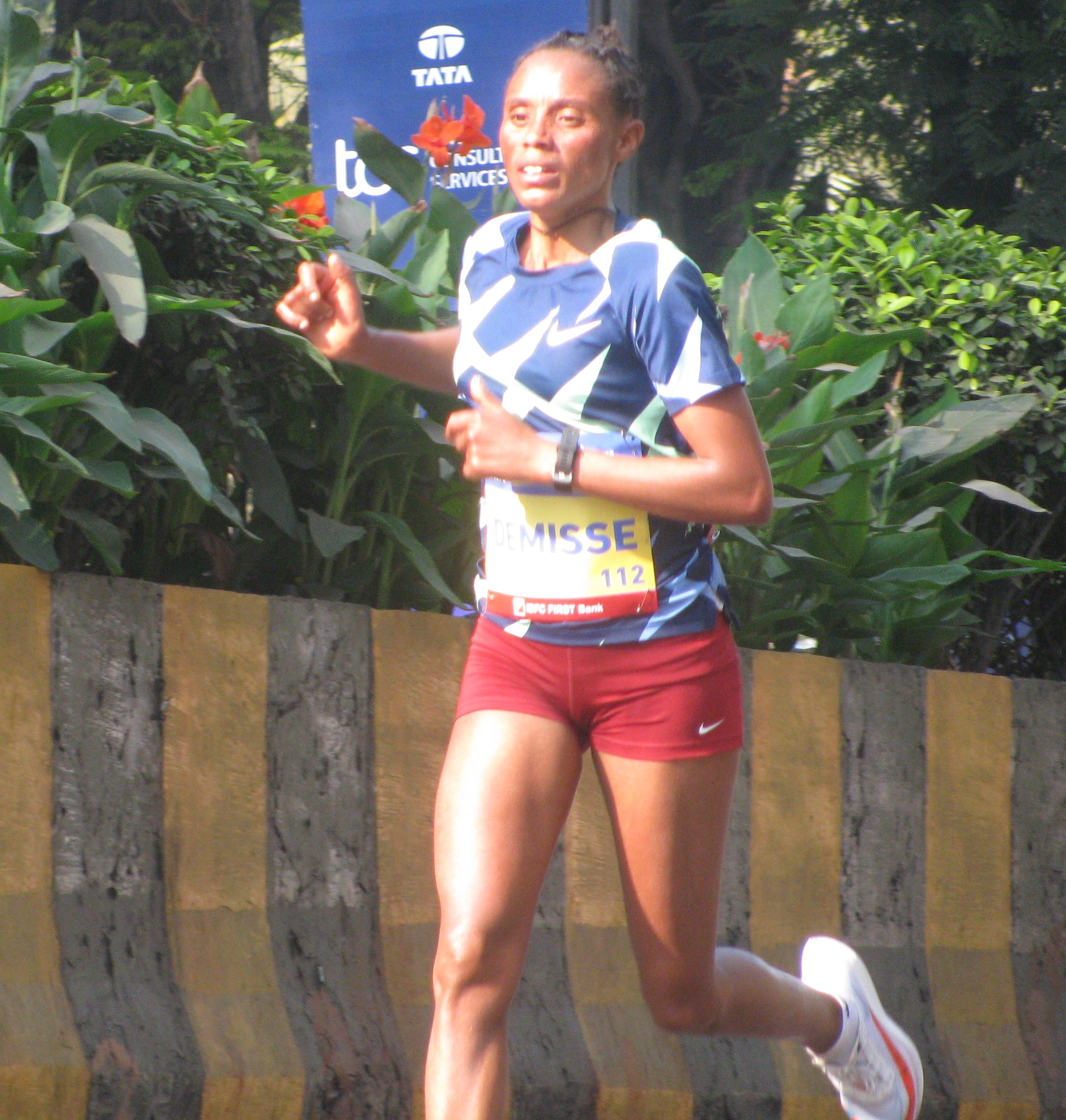
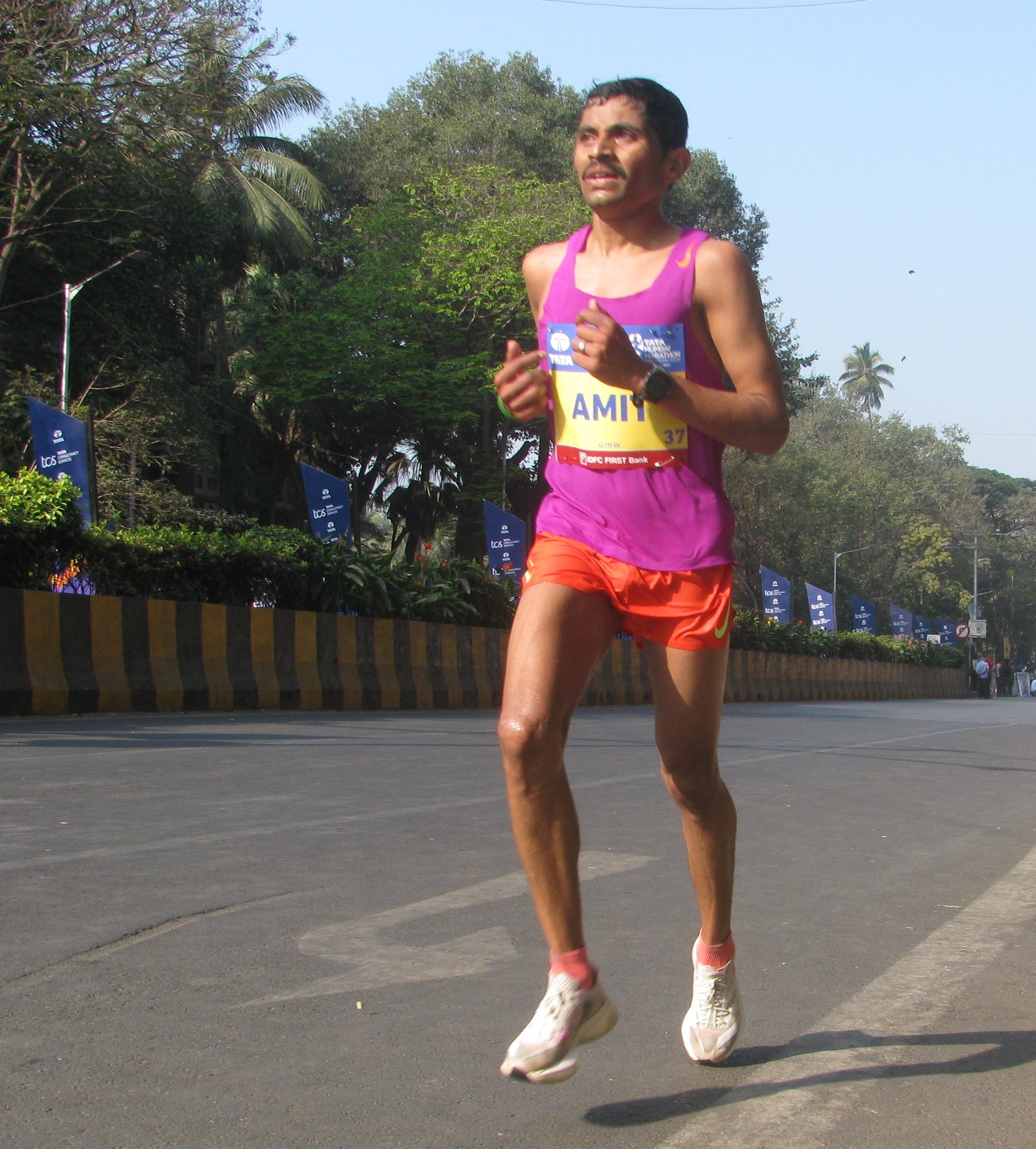
Please find below more photos from the elite race / all photos taken by the author:
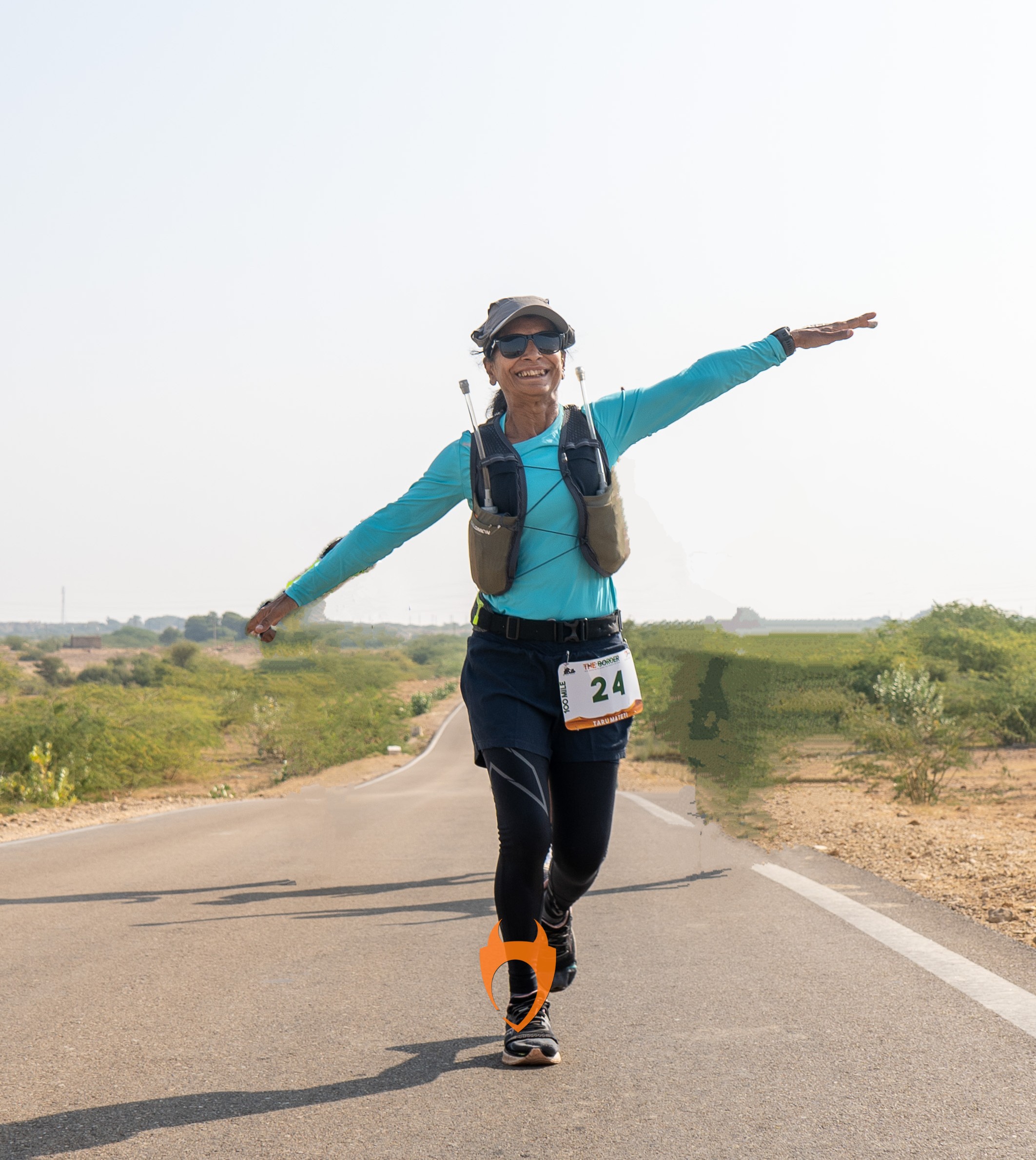
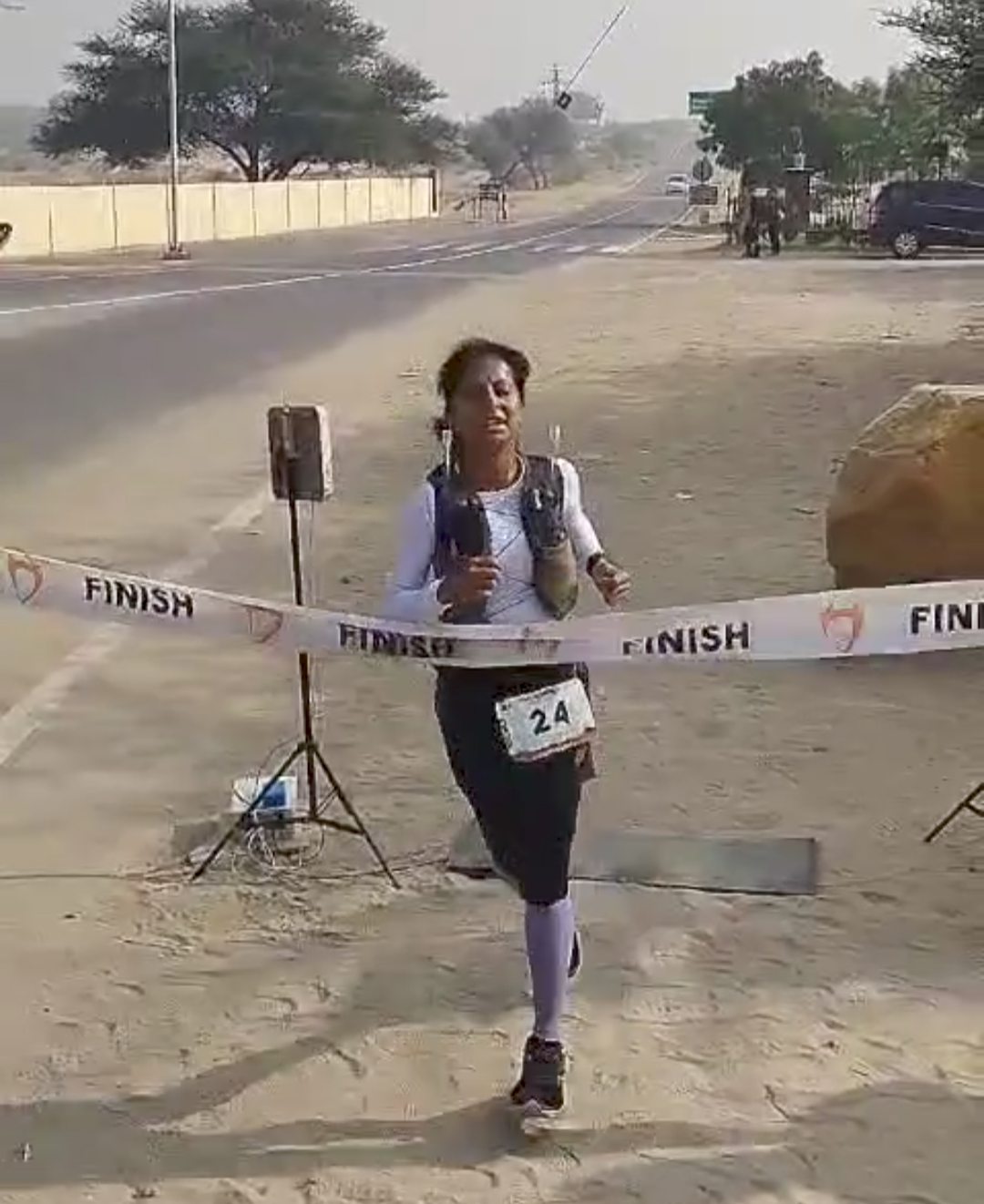
Taru Mateti; from the 100-miler at Border Ultra (photo: courtesy Taru)
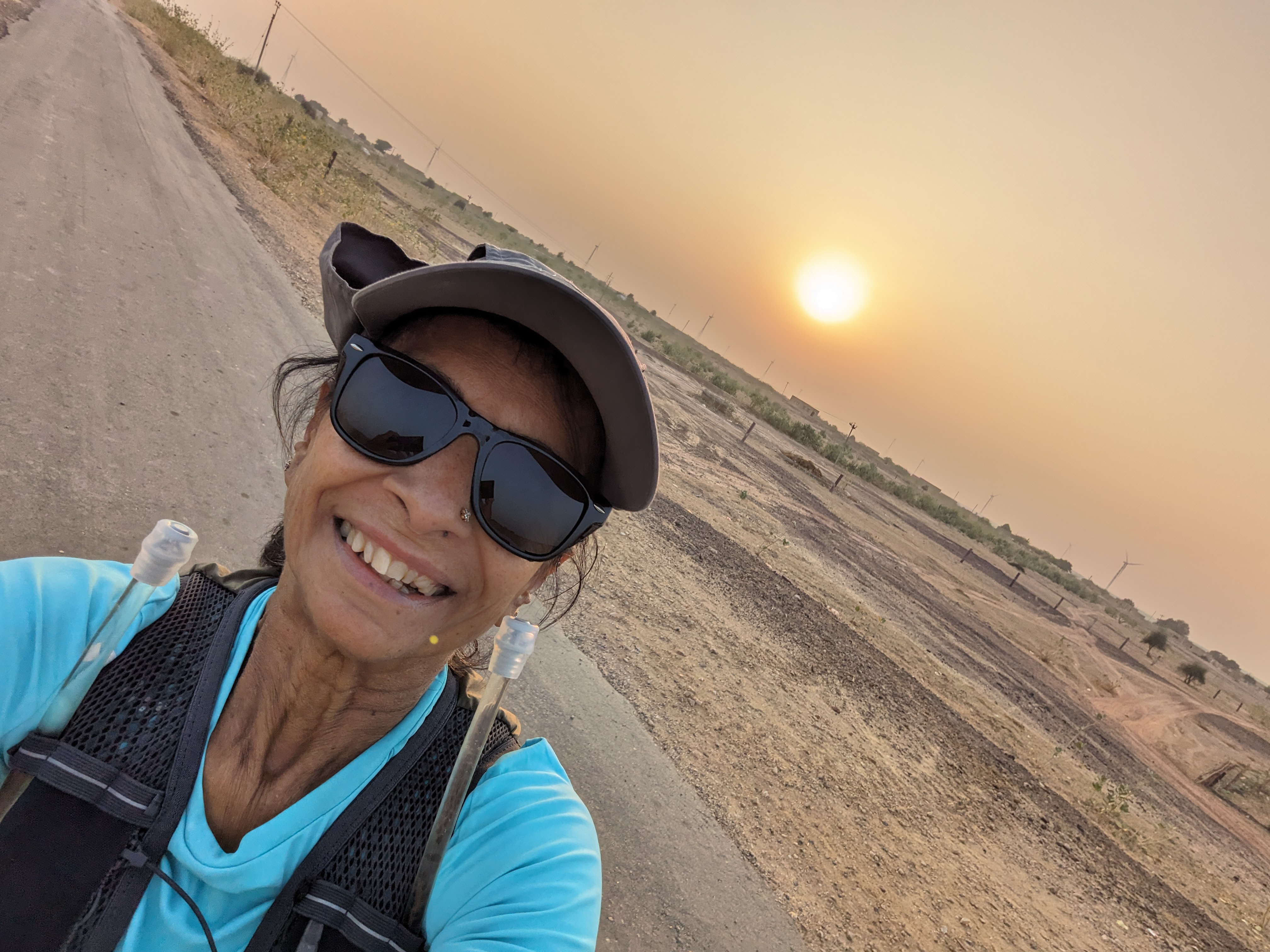
This is an article by invitation. Taru Mateti started running in her 50th year in 2013. A senior IT professional, she quit her job as a Delivery Head (Department Head, eLearning and Documentation) in 2017 to pursue her passion for running and fitness. Her hobbies include dot mandala painting, learning Spanish and reading. Her fitness regime includes running, strength training, yoga, spinning and occasionally, Pilates. Her fitness mantra is “Age no Bar.’’ She has run a 100-miler, two 100k ultramarathons, three 12-hour stadium runs (85k, 90k and 95k), back-to-back Comrades Marathon (90.2k and 87.4k), two 80k ultras, one 60k ultra, eleven 50k ultramarathons and one 12-hour Mumbai Ultra. She has also run sixteen full marathons and more than 100 other races of shorter distances. She has secured over 75 podium finishes (including wins in her age category). Herein, she writes about her first 100-miler, completed in splendid fashion in December 2023.
My first ultra was in 2015; a 50 kilometre-run (50k) at Pune Ultramarathon. In 2017, I ran a 100k at the same event.
Four years later, in December 2021, I ran the 100k at Border Ultra in Rajasthan. It was a good experience and I was charmed by the route and its challenges including the change in weather conditions (over the duration of the race) and the aid stations set 10 kilometres apart. I also met some inspiring runners who were running the longer 100 mile-race. My conversations with them sowed the seeds of attempting the 100-miler exceptional for being a run from one point to another and not a loop. The run also had a link to history. It was a tribute to the 120 jawans of the 23rd Battalion Punjab Regiment who held their post successfully the entire night of December 4, 1971 (Battle of Longewala) till they were reinforced the next day. The Indian side had 120 soldiers and the support of four Hunter aircraft; the Pakistanis had 2000-3000 men and 30-40 tanks. To my mind, if we (my husband and I) were to attempt a 100-miler, it had to be this one.
Although I had run 100 kilometres at the same place, the route was set to change a lot in 2023. Besides, even as I had trained earlier for the 100K on my own, I had no clue how to train for a 100-miler. So, I consulted Subham Mishra from Hyderabad who had already done the 100-miler of Border Ultra three times. He was one of the persons who influenced me to try the event. I had a bad August with some downtime followed by a vacation in September. My training for the 2023 edition of the 100-miler at Border Ultra, therefore started only from September 15 and Subham sent me a training plan from October 1 leading up to the actual event on December 16.
Taru Mateti; from the 100-miler at Border Ultra (photo: courtesy Taru)
A few things changed from the training phase itself. I started running five days a week instead of four earlier. Also, the week day runs became longer. The mileage progressively peaked to about 130 kilometres in a week. I ran through all times of the day to get exposed to the sun and learn to cope with sleep deprivation. The longest run was a 12-hour stadium run at night, three weeks before the event. Yoga and strength training were also an important part of the preparations.
For nutrition, I followed what I generally do for long runs, dates and gels alternated at 5-6 kilometres, salt tabs every 12 kilometres or so besides water and electrolyte. I mostly run solo; so, relied on my hydration pack and roadside teashops for water. A couple of times, I also took bananas and potatoes to get used to them because I knew that a 100-miler is a totally different ballgame from a 100k, wherein I could survive on dates, gels, and oranges. For pre-run nutrition I experimented more with peanut butter and toast and not just banana / sweet potato (during the actual race, I even had a few spoons of rice, dal and potatoes at 50 kilometres and a few spoons of Maggi noodles at 130 kilometres as advised by Subham. It was something I had never done in any run before).
Mental preparation was a by-product of the excellent training plan. Strides after long runs mid-week were a new thing for me in my training plan and they helped not just physically but also mentally. I also read many blog posts by other runners. Subham kept encouraging me with his timely messages along with the weekly / biweekly training program. Pushing through the very long runs on weekends, especially the ultras that I ran as part of training helped considerably in mental preparation. Positive self-talk and affirmations in yoga classes as well as pranayam in each yoga class helped both physically and mentally.
I was nervous about running five days a week because I believed it would take me longer to recover. But it is amazing how the human body adapts. It wasn’t easy, but by rehashing my other activities, I could get started with the new agenda. Slowly, as the mileage increased, the fatigue also increased. To handle this, I became more regular with yoga and also got massages and physiotherapy for my hamstring every fortnight and did foam rolling every alternate day. Food and especially sleep are always a challenge for me. So, I consciously developed practices to have better control on them. I had to make a lot of sacrifices on the personal front, but that’s what it takes to achieve something like this.
Some days I just didn’t feel like getting out of bed. I would then pull myself up thinking I would do as much as possible and finally end up completing the run or any other session. Doing two of the longest training runs at organized events also helped. I followed the training plan 99 per cent and that is what gave me a lot of confidence.
Taru Mateti; at the finish line (photo: courtesy Taru)
On Saturday, December 16, the 100 mile-race started at noon in extreme heat, under a harsh sun. The course for the first 50 kilometres was more of a rolling one and with the route changed this year, there were headwinds too! I kept a steady pattern of running three kilometres and then walking 100 metres. For steep inclines, the mix was 80 metres of running followed by 20 steps walked. The Border Ultra 100-miler is an engaging package. You get photo-worthy beautiful sunsets, stretches on the road with sand blown over, a rolling route that is pronouncedly so towards the final phase, harsh sun, headwinds and extreme cold at night with total darkness and just one’s headlamp to show the way.
I had taped a corn on my toes. The first issue I faced was that the tape started blistering the adjoining toe. I had to stop by the roadside and remove the tape. I continued to run in a rhythmic run-walk pattern that changed as the distance progressed. The break at the 50 kilometre-aid station was a long one because it took time to change in the dark although just having a tent to change in was really helpful. I had got one blister by then despite my special shoes and it kept getting worse until the end! I thought positively at each step, remembering the training runs that I had done to tackle each problem that I was facing and that gave me strength. The mantra was – one step after the other and keep moving with focus on the markings on the road denoting route to take. At about 70 kilometres, my left hip flexor started becoming tight and gradually the pain increased. So off and on, while walking, I hit it with my fists to release the tightness a little. The pain however increased and until the end of the run, this was the only bothersome thing for me. I even took a pain killer at 100 kilometres, something I neither do normally nor advocate.
I continued to run conservatively because there are so many unknowns in such a long ultra. Fortunately, because of the rhythm that I set, the going felt easy. Singing songs, talking to myself, and most of all, counting steps helped. I looked at the watch when it buzzed at the end of each kilometre. The criterion after 110 kilometres was that each kilometre should be at a pace lesser than 10 minutes per kilometre, other than the aid station stops, of course. I was happy to see the bank of time that I was building with my pace being around 8:30. After 130 kilometres, I revised that to 12 minutes per kilometre but to my surprise, I could continue the same way as before.
Then suddenly after 141 kilometres my watch buzzed; it said: saving something, something…, and died. I took out my mobile phone but that was already dead. I continued running by feel. I had no clue about the total time I had taken to get where I was because I had last checked total time at 100 kilometres and mentally registered that it was my personal best so far, for the 100k. Also, I knew in advance that 140 kilometres was where one hit the extremely rolling section of the course, which continued till the end. I kept on running by feel, not having a clue about my pace or the anticipated time to finish. I wasn’t even sure I would do a sub-24-hours, which anyway wasn’t a target. In my mind, I just wanted to finish sub-26 after doing well until 100 kilometres. In the end, I was pleasantly surprised to find that I had finished in 23:29:04, less than six minutes short of the course record! And I had done it by running conservatively and enjoying the ultra without the desire to give up or curse myself even once. Happy to have finished strong and injury-free. It was a dream come true in my sixtieth year on the planet and an outcome I hadn’t expected – an overall win in the women’s category at my first-ever 100-miler at The Hell Race Border Ultra!
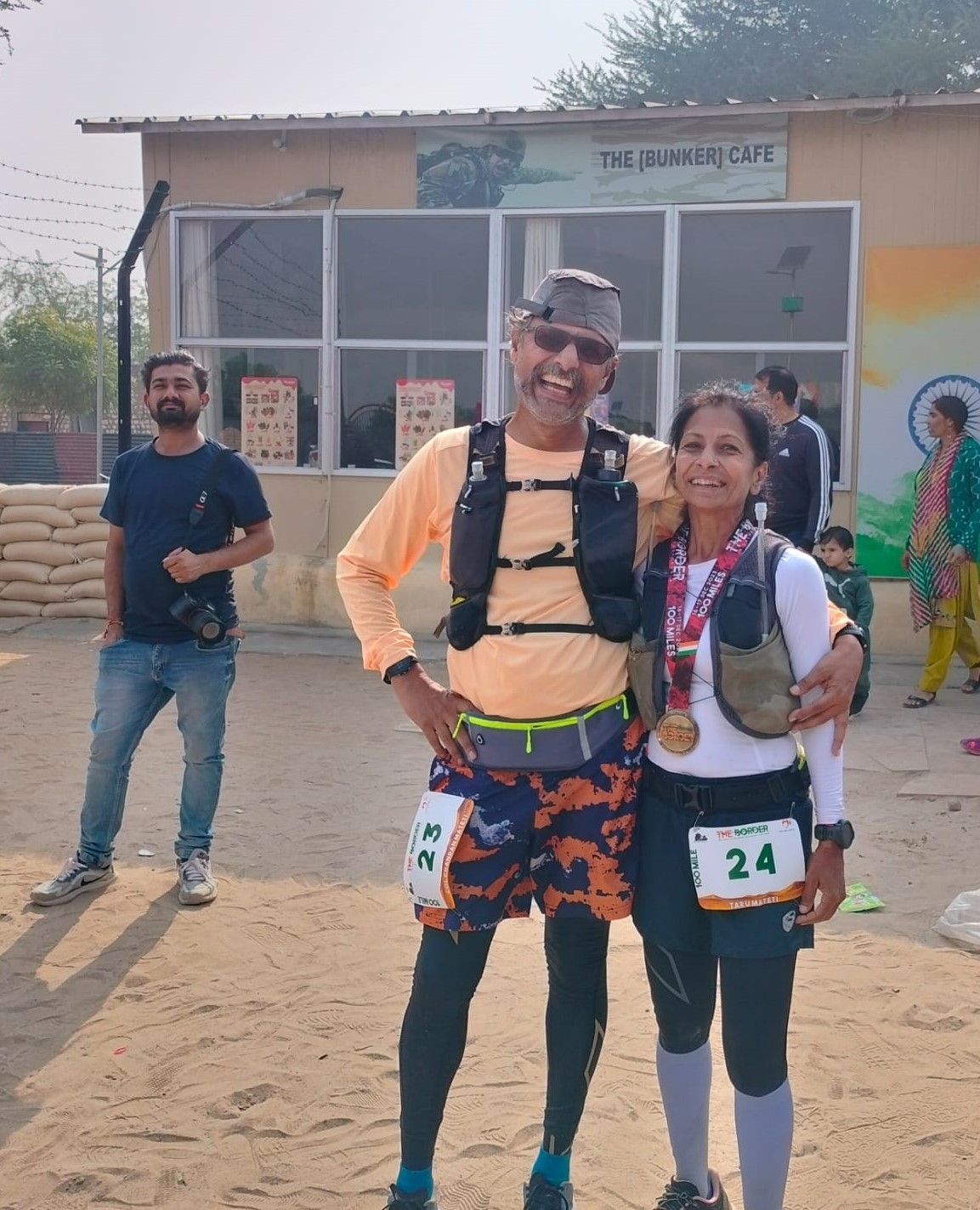
Taru and Chandan Kumar Mateti (photo: courtesy Taru)
After the run, I waited at the finish line for my husband, Col Chandan Kumar Mateti (retd), to finish. I kept walking around and cheering other finishers as well as meeting those stationed at the finish line. I can’t eat much after a run but had a bit of rice, dal and paneer. Then I walked some more to see the Longewala memorial and Tanot temple. The following four days were spent running and climbing forts, doing touristy stuff and other short walks. Sleep was much needed, but despite one full missed night of sleep, I could sleep less than five hours the next three nights…I was probably still on a high. One thing I missed was bringing along my protein supplement. But I made up for it by eating chicken and eggs, something I normally avoid. I also took my regular supplements and a boosted dose of Vitamin C and soaked my feet in Epsom salt once.
Two days after the run, I did a five kilometre-walk and did extensive stretches. The Friday after the ultra, I did a 7.5 kilometre-recovery run and found that all systems were okay. Recovery was thus basically a lot of movement, rest, and good food. Strength training and yoga from Monday and easy, short runs for another week and I was ready to slowly get back to my regular life.
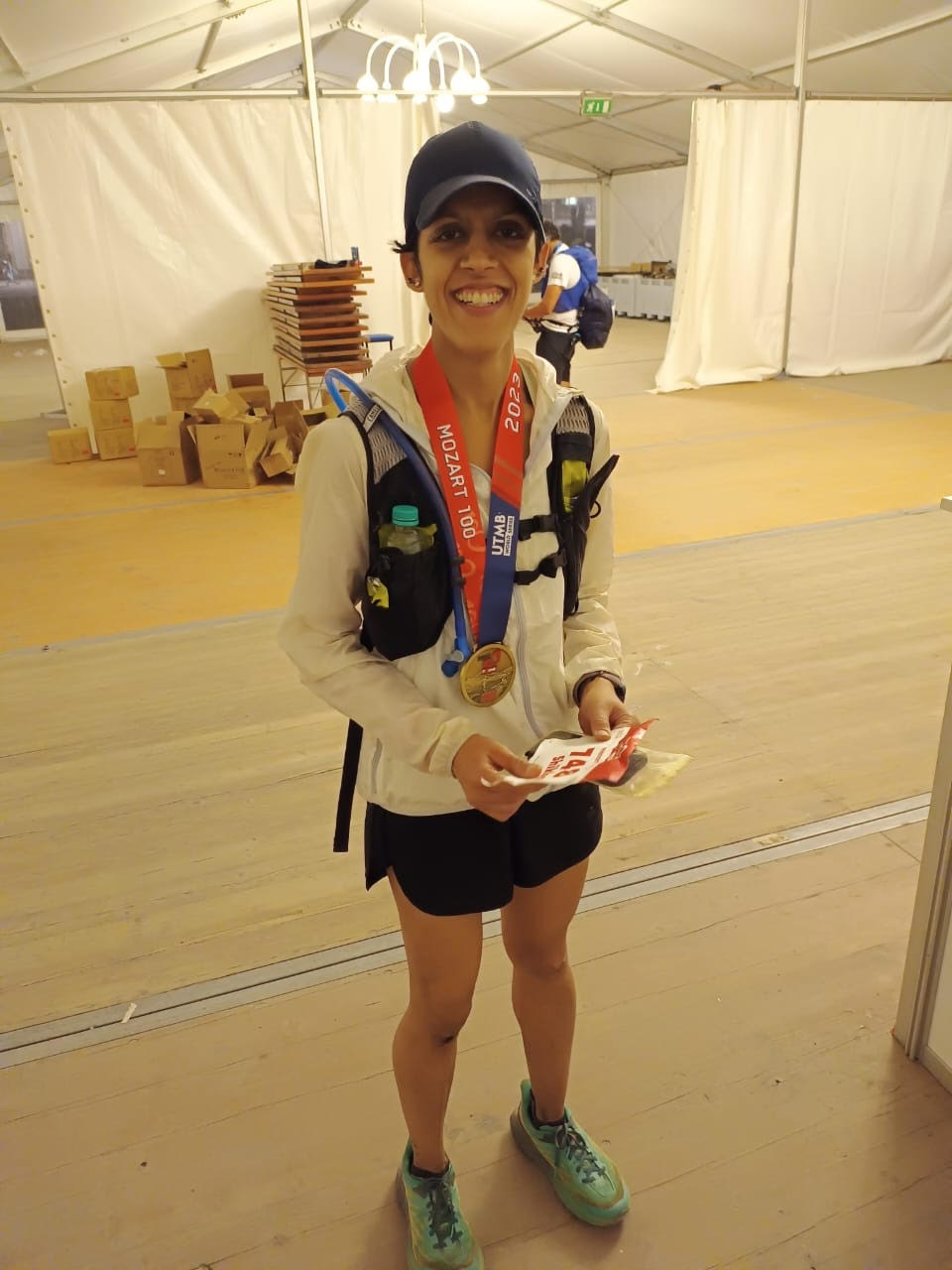
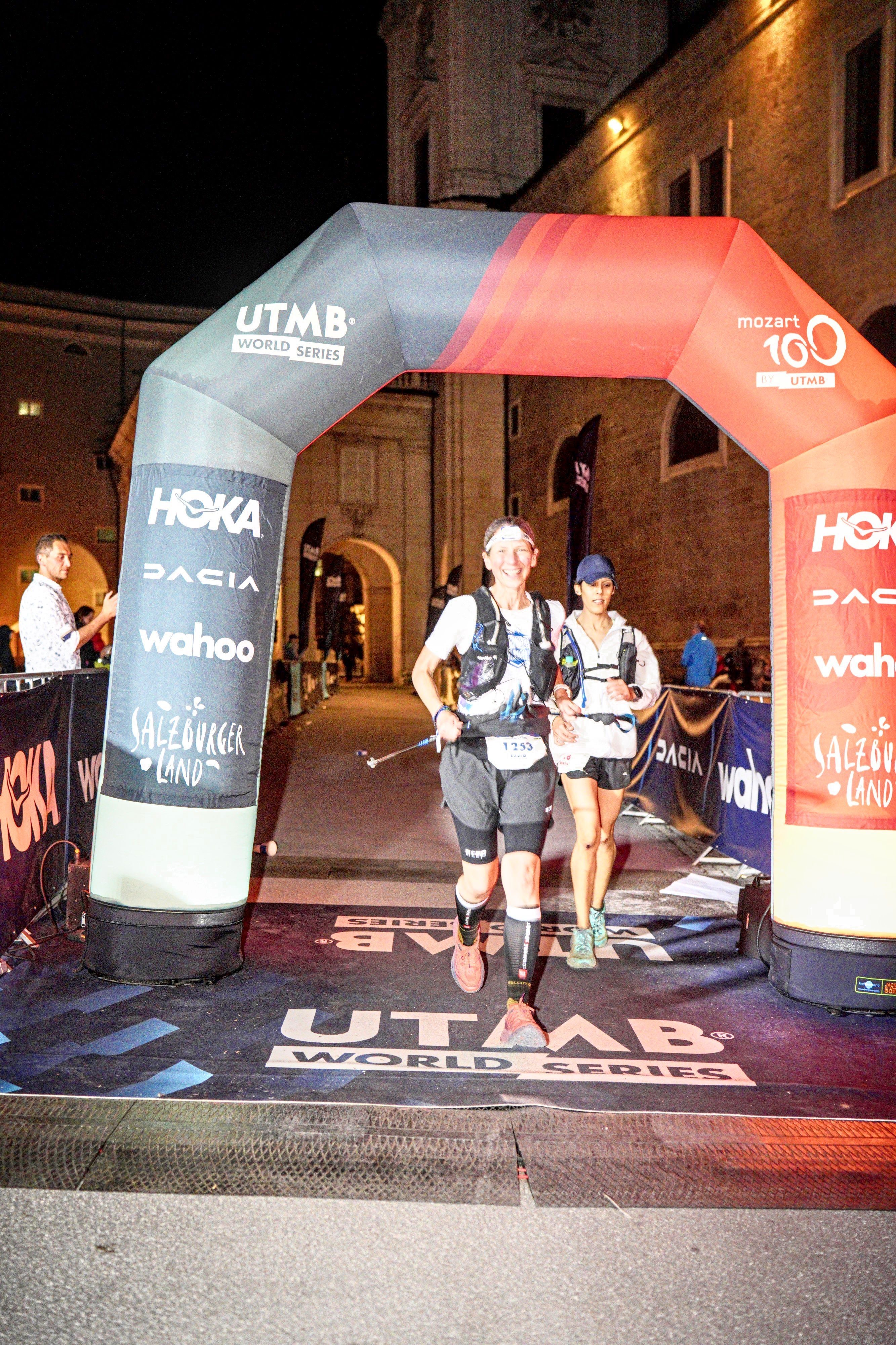
This is an article by invitation. In June 2023, Delhi-based ultrarunner, Shikha Pahwa, participated in the year’s edition of UTMB Mozart 100. She was the lone participant from India and completed the race in 19 hours, 56 minutes and 39 seconds. Herein is Shikha’s account of the run; in her words:
The UTMB Mozart 100 was not on my radar.
It happened by chance.
My plan was to go to Italy and I was looking for a race in or around Italy on very specific dates. The only one I found was Mozart 100 in Salzburg, Austria.
Seen on the race website it looked like an extremely scenic run (this was where The Sound of Music was shot after all). City roads, mountains, river, vast green fields, it had it all; enough to tempt me. Plus, the date was perfect. Looking at the distance options, as usual, I scrolled down to the longest one; 105k it said. Doable I thought. The cut-off was 22 hours which should have made me curious as it seemed liberal compared to some other races but I took it at face value. I knew this was a race with some crazy elevation but what I ignored or rather didn’t understand was the extent of trail and the grade of trail involved. I signed up. It appeared a done deal.
I started training around three months before the race with focus more on mileage. Since Delhi is flat, training for elevation is a challenge. My trainer Krishan Tiwari trained me like he had for the Ladakh runs of the past. There was a lot of resistance training to give the climbing feel, some walking-running with a weighted jacket, in addition to strength training and consecutive long runs. All this in the Delhi summer was completely draining and combined with my regular work, it exhausted me 100 percent. But that’s how ultrarunning (and training) is – never-ending runs irrespective of time, weather and terrain.
Fast forward to race day. I reached the start point at 4:30AM (5AM start). With 700 participants arrived, the place looked like a festival! None of my earlier ultra runs had witnessed such a big crowd and they all looked like experienced trail runners. I was very intimidated and what got me really worried was the one common thing all of them had – trekking poles (the ones used for trail running are light and collapse to really small dimension for ease of carrying).
Photo: courtesy Shikha Pahwa
That was when it hit me that I may have got myself into something I wasn’t ready for. Forget getting poles, I had never used them! I was a 100 per cent road runner, so poles had never been needed. The one trail run I did attempt had featured a technical trail and it had ended up with me injured and a DNF to my credit. I therefore had no fond memories of trail. But now, I was at the start line of my first international race and there was no turning back. The race began and the first few kilometres were flat. It seemed to go well until I saw an arrow indicating a turn into the bushes. And there it began – not flat, not straight…just pure rocky trail.
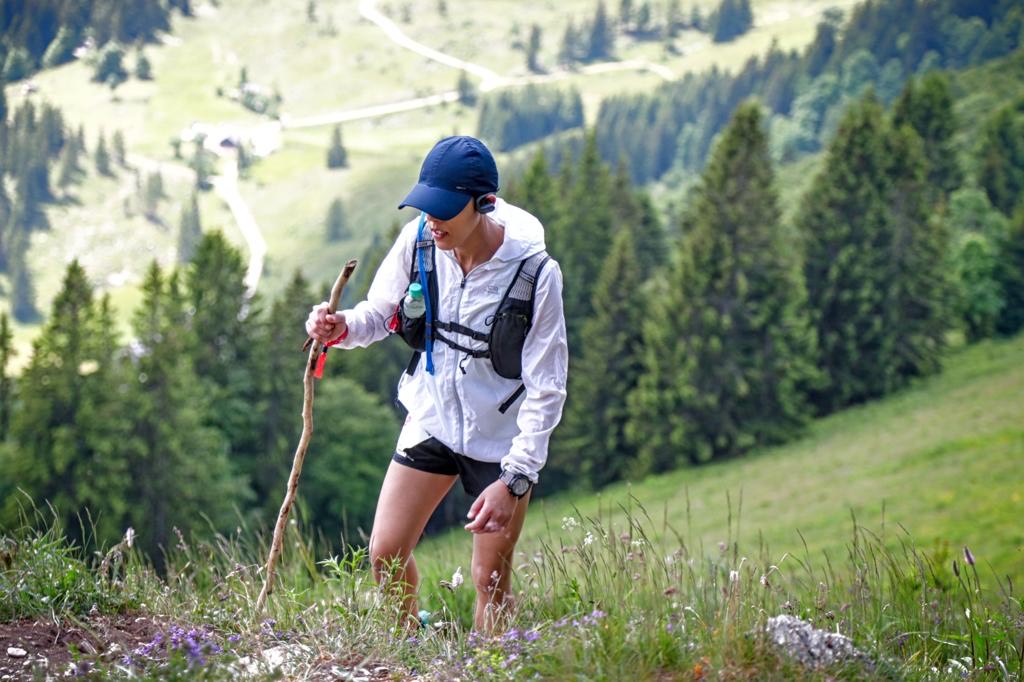
It was a narrow path and the whole lot of us going up on it. So, we had to form a queue. Wherever there was the tiniest space on the sides, some runners would overtake. Gradually the fast runners disappeared from view. Still, more and more people kept overtaking. Their training showed in the way they moved; smooth steps, almost without much thought. Me on the other hand watched every step, holding on to branches to pull myself up where the step was too high. Around four or five kilometres into the trail I realised that I couldn’t keep using my hands for support. I needed to find my version of trekking poles. I picked a stick fallen on the ground. It took me a few attempts to find the right one; right height, weight and grip. It wasn’t perfect but helped. My free hand was still used for extra support of course.
Given 5000 meters elevation for the race, the climbs were intense. This was just the first one, there were eight or nine more. In my mind I assumed there were five in all. I don’t know how I got that but it threw me off when they just kept coming.
Climbing up was hard and although there were faster runners, there were many around me proceeding at a pace similar to mine. So, I wasn’t all that slow. Where I did really feel disadvantaged was in the downhill sections. Usually, downhill is where I make up for lost time (and that’s because I had done mostly road runs). But here it was much slower than the climbs. It was also terrifying as one wrong step could send me rolling down the rocks or into the rocks or worse. The other runners just ran down as I would on road. It showed how experienced they were. I took my time and went as slowly as I needed to go. Others overtaking me at this stage, didn’t matter at all. I was quite okay coming in last as long as I finished without injury. Besides, somehow, I was managing to catch up with the same people on the next climb. It showed, my training did work after all.
A slower pace in this race was not a concern, I just needed to be fast enough to reach the various cut-off points along the course within the set deadline. Failure to do so was an immediate disqualification from the race. So it had to be planned in advance and I had asked my everything-ultrarunning guide Dr. Rajat Chauhan (founder and race director of La Ultra The High) for help. Everything-ultrarunning because he had answers to all the questions, I had about long distance running in the past few years, especially when it came to the whole “ mental preparation’’ bit. He was kind enough to go through the route map in detail and advise on how to pace myself to make it to the finish line in time.
Photo: courtesy Shikha Pahwa
Going one step at a time and pushing myself mentally, I kept moving ahead. Because of the terrain my feet kept twisting to the side. Luckily no injuries there. I did trip three times along the way which gave me bruises on both knees and hands but no internal damage. The bigger problem came once it got dark. Finding my way with just the headlamp required a lot more focus but the fatigue and bruises weren’t allowing me to do so. The downhills looked even more dangerous in the dark. I was left alone after everyone ran down. To make it worse, my headlamp started acting up. It suddenly got dim and I had no backup. It looked like it could die at any point, so I quickened my steps and hoped for the best. Once I got down, there were some people around so I could see better.
The official race distance was 106 kilometres and according to my watch it wasn’t far. Then I spied a road ahead and an aid station; I could feel the finish coming up. Looking for signs of finish, I started to jog. The road turned into the trees again and up we went! Some more up and down and we returned to a road again. The GPS was off because 106 kilometres was already done for me. Now I could see some signs of finish and hear some people in the distance. Finally, I was closing in on the last stretch and some twists and turns in the road. I found a place to put my stick down. Then, I saw my sister cheering for me, then running behind me and I finally saw the finish line. My watch showed 109 kilometres. It wasn’t a distance I hadn’t done before but this terrain made it ten times harder. It was more of a mental race for me, especially since I wasn’t prepared for it. I was way out of my comfort zone, so a rank of 420 out of 700 and being the only Indian participant felt great.
(The author, Shikha Pahwa, is a Delhi-based entrepreneur and ultrarunner)
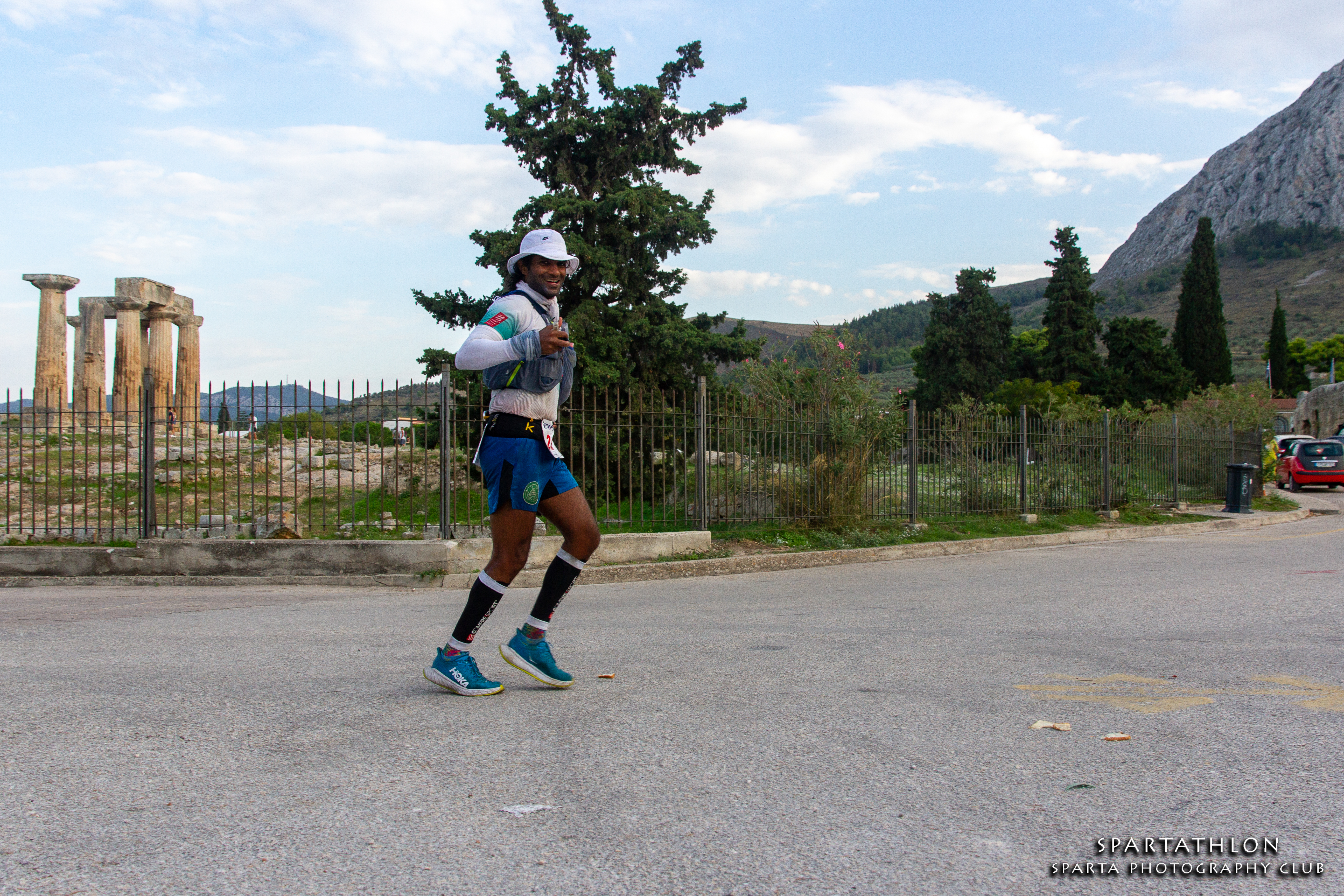
This is an article by invitation. Earlier this year, Jeevendra Singh completed the 2023 Spartathlon, a footrace traversing a mix of road, trail and mountain path for 246 kilometres. The race held in Greece follows in the footsteps of the Greek messenger Pheidippides, said to have run from Athens to Sparta to convey news of the Greek victory over the Persians, at the Battle of Marathon in 490 BC. The race is among the most famous ones around. It is also a challenging race. Jeevendra completed it in 32 hours, 49 minutes and 16 seconds. The following is his personal account:
I grew up in a village near Agra. My father worked with Indian Railways and he was posted at Tundla. Growing up in a village meant living an outdoorsy life. I was into sports during my schooling years. I did my engineering degree from Lucknow and through campus placement found myself at the Pune office of UBS. From there I moved to Singapore, Poland and finally to UK, in 2015. Initially, I lived in London. I was following an unhealthy lifestyle. My health deteriorated mainly because of the stress that accompanies work at an investment bank. I piled on a lot of weight.
I decided to take charge of my life and took to running. The solitude of running helped me heal and gave me much-needed ` me time.’ My running was largely recreational. I started participating in running events with the aim to raise funds for causes such as cancer research and the fight against domestic violence, among others. I did a few marathons including the Athens Classic Marathon, marathons in Marrakesh, Peru and San Francisco. I even ran a marathon wearing full cricket gear to raise funds. My aim was to run a marathon in every continent but I gave up that idea when I became aware of climate change and realised that flying just to run a marathon, was not the correct thing to do.
I then embarked on trail running, starting with a half marathon in the south of England. I moved to ultra distances in trail running, attempting a few trail races in the mountains of Lake District. I love trail running and since 2018 I have done only trail running. Living in London and running around on roads and pavements takes a toll on you. Don’t get me wrong, London is one of the beautiful cities in the world with lot of green areas. Yet the city running was becoming monotonous for me. So, when I stumbled on to trail running and did my first trail race, which was the Beachy Head half marathon in the beautiful Seven Sisters Cliffs near Eastbourne, I was hooked to it. Purely because being in nature triggered the genetic memory, we all have in us. Being in nature, moving on your foot for hours in these beautiful landscapes gives our body and mind that experience which our ancestors naturally had thousands of years ago. Also, for me being in the country side triggered the happy childhood memories I had with my grandparents and uncles in my village back home in India. Slowly I wanted more and more of this. Moreover, I believe in continuous progression. Therefore, I wanted to see if I can run longer than a marathon in these landscapes. That’s when I decided to do my first ultramarathon, the Grand Tour of Skidaw, which happens in Lake District, UK. It was a 70km-long race in challenging terrain but the views and scenery were breath-taking. I never looked back after that. From there i moved to 50milers (I did three of those) and then to my first 100 miler in 2021.
In 2020, the world came to a halt due to the COVID-19 pandemic. Once the lockdown was lifted, I did a run from Buckingham Palace to Windsor Castle, a distance of over 50 km. In 2021, I did the South Downs Way 100, a 100 miler. There were many elite athletes at the start line and that was quite inspiring. I wanted to do well. I ended up in the top 20, covering the distance in 19:10:39 hours. In August of the same year, my mother passed away. I hit a low and lost my motivation to run. Slowly I resumed running and realised that it was helping me heal. I wanted to take on something challenging. I decided to do Spartathlon. To my mind it was a journey that would help me go inward and deal with my grief. I had the South Downs Way 100 as a qualifying race. The qualifying time required to enrol for Spartathlon was a 100-miler race done in 21 hours. For Spartathlon, I did much of my training on the pavements, roads and parks of London. For exposure to trails, I travelled to Lake District where I ran in the lower mountain ranges. But the days leading to Spartathlon were extremely stressful. My wife’s father was ill and I nearly contemplated missing the race. But my wife asked me to go to Greece while she flew to India to be with her parent. Radhika, my wife, is a lifestyle and nutrition consultant. She helps with my nutrition plan for day to day living and also for races. She is a qualified yoga teacher and mental health coach. Except my running, she coaches me for everything else.
I flew to Greece. The race day started well after Radhika called me to say that her father had improved and was likely to be discharged from the hospital. At the start line of Spartathlon, I was the only Indian runner. It felt good to be around super-fit elite athletes. I did have a few minutes of doubts but quickly brushed them aside. Over its first few miles, the race leaves Athens, traversing through the city’s suburbs and stretch of factories. After 13 miles, we hit the coastline. There are 75 check points along the route. Every check point has a cut-off time. We were expected to hit the 50-mile mark in nine and a half hours. The start of the run was tough as temperatures were quite high and I got dehydrated leading to stomach issues. I reached the 50-mile mark with just 15 minutes to spare and that was not good. I felt stressed and doubts began to creep in. I kept saying the words: stay calm and cool. I was doing this race solo without any crew. I reached the 100-mile mark. I desperately needed a reset. At that point I ran into Graeme Boxall, an accomplished ultra runner and one of the nicest fans of the sport in the UK. He is ever present at track ultras volunteering or crewing for runners. He has given so much of his time and energy to the sport. I had met Graeme at a few track ultras earlier and got to know him. When he met me around the 110 km-point in the Spartathlon race, I was in a pretty bad shape. His encouragement was just what I needed to come out of that bad patch. He was crewing for another runner. Graeme gave me a recovery drink and helped me reset. I changed my clothes and set out.
Jeevendra Singh (photo: courtesy Jeevendra)
As I progressed into the race, my stomach situation improved. Also, the temperature started to lower. Further, the buffer between my arrival time and the cut-off time, started to increase. The night was clear and running through the vineyards and olive farms laden with silhouettes, was like a dream. For nutrition and hydration, I switched to soup and Coke. Then came the uphill mountainous stretch. It was quite tough but at the top I felt a connection with my late mother. The descent was tougher than the ascent. The path downhill was laden with loose rocks and scree. I decided to walk down instead of running it. As I started to descent, I began to feel better. For the next 20 miles my pace was quite good. I crossed many runners along the route. At dawn I was running through vineyards in Tegea. The route was headed to Sparta. It started to get warm. This time, I was careful with my hydration. The last stretch was mostly downhill. At Sparta, people were very passionate about the race. As I kept running, I heard them shout: Bravo. The city was packed with supporters cheering for each and every runner. There were children and youngsters running or cycling with us. I met a woman who had been volunteering for the race for the past 41 years. Just before the finish line, I stopped before the statue of King Leonidis and then, finally hit the finish line. In my mind, the 246 km race was split into three phases. The first phase was Be Calm, the second phase was Curious (it was mostly through the night) and the third phase was Confident and Belief.
The Swedish team was very helpful and friendly with me. They kept a seat for me at dinner, among many other friendly gestures. I am right now in the process of recovering both physically and emotionally. The race was quite demanding. I want to continue doing trail and mountain runs. More importantly, I want to be a much better athlete.
(The author, Jeevendra Singh is a runner who works with an investment bank in the UK)
Miho Nakata (This picture was downloaded from the website of International Association of Ultrarunners (IAU) and is being used here for representation purpose. No copyright infringement intended.
Lithuania’s Aleksandr Sorokin triumphs in the men’s segment
Poland wins women’s team gold, Lithuania in men’s
Indian men’s team finishes ninth, women fifteenth
Japan’s Miho Nakata set a new world record for the 24-hour run at the 2023 IAU 24-Hour World Championships held at Taipei, Taiwan over December 1 and 2.
She covered a distance of 270.363 kilometers during the stipulated 24 hours, breaking the previous record of 270.116 km (provisional) set by Camille Herron in 2019.
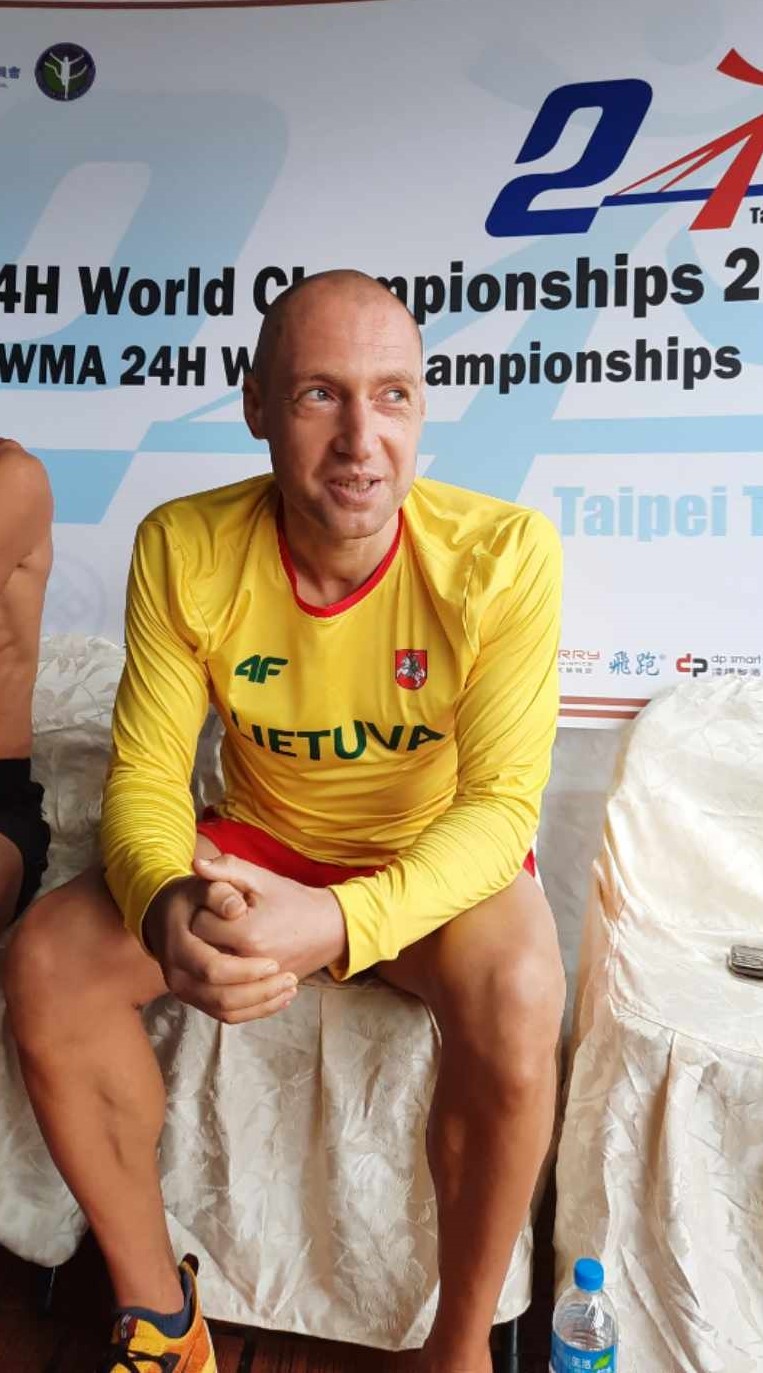
Aleksandr Sorokin of Lithuania defended his world champion title winning in the men’s category with a distance of 301.790 km covered. Europe dominated the podium in both team and individual segments.
In team ranking, Poland won the gold in the women’s race with a combined distance of 726.552 km covered. Japan earned silver with a total distance of 702.911 km while Czech Republic took the bronze with an aggregate distance of 697.275 km covered by its best performing three runners during the 24 hour-period.
In the men’s race, Lithuania won the gold with a combined distance of 813.368 km followed by Poland (787.964 km) and Great Britain and Northern Ireland with a distance of 771.794 km.
In the women’s individual category, Olena Shevchenko of Ukraine (254.463 km) finished second to win silver and Partycja Bereznowska (249.541 km) of Poland, the bronze.
Aleksandr Sorokin (this photo was downloaded from the website of IAU and is being used here for representation purpose. No copyright infringement intended)
In the men’s individual category, Fotios Zisimopoulos of Greece (292.254 km) took the silver and Andrii Tkachuk (284.540 km), the bronze.
The Indian men’s team finished in ninth position with a combined distance of 691.849 km. The women’s team finished fifteenth with a total distance of 540.964.
Amar Singh Devanda was topped among Indian runners covering a distance of 236.800 km in the assigned 24 hours. Saurav Ranjan was second with a distance of 228 km and Ullas Narayana, third with a distance of 226 km.
Among Indian women, Anju Saini topped with 186.252 km covered in 24 hours. Anju holds the national record for the 24-hour segment. She had set that record of 204.314 km at the IAU 24 Hour Asia & Oceania Championships, 2022, held at Bengaluru. Shashi Mehta was second among Indian women with a distance of 182.632 km. Priyanka Bhatt was third with a distance of 172.080 km.
“ My race usually starts in the last six hours of the 24 hours. But here in Taipei, the weather took a turn for the worse. At the start of the race, it was windy. The sun was hidden behind a thick layer of clouds. After a few hours it started drizzling but humidity stayed high,” Anju told this blog.
By the evening of December 1, the rains turned heavy and were accompanied by strong winds. “ I started to get fever and body ache. It was very tough for most runners. Many runners gave up the race,” she said.
Anju herself considered quitting many times but was convinced by the team manager to keep going. “ I also had blisters on my feet as my shoes were wet. I changed my shoes twice but to no avail,” she said.
“ We had trained for a completely different weather scenario in Taiwan,” she said.
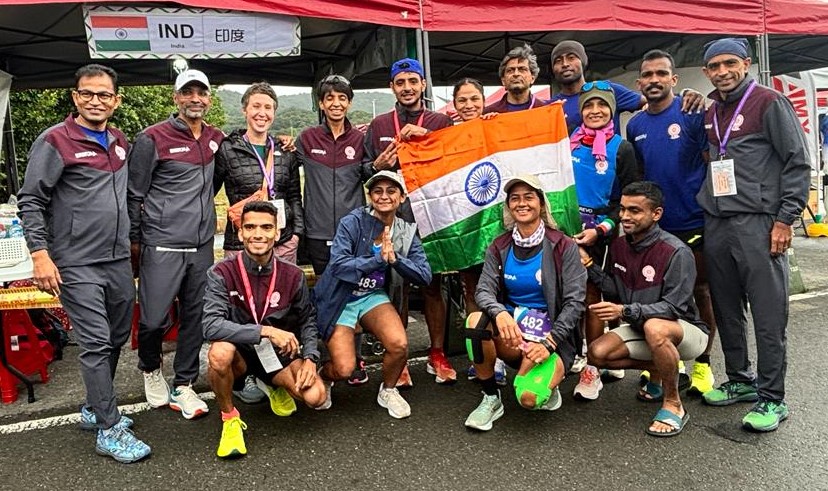
The Indian team (photo: courtesy Santhosh Padmanabhan)
According to the Indian team manager Santhosh Padmanabhan, the weather conditions were tougher than expected. “ It was cold and windy with rain while we came prepared for heat and humidity,” he said.
The Indian team’s performance – both men’s and women’s – was historic as the men’s team broke into the top 10 and the women into the top 15 at a world championship, he said.
“ The best part of the Indian team’s performance was that none of the runners gave up despite difficult conditions,” Anju said.
“ This is a big learning experience for us. We will take the learnings from this race and come back stronger,” Santhosh said.
(The author, Latha Venkatraman, is an independent journalist based in Mumbai. All distances given are provisional)






 Outrigger