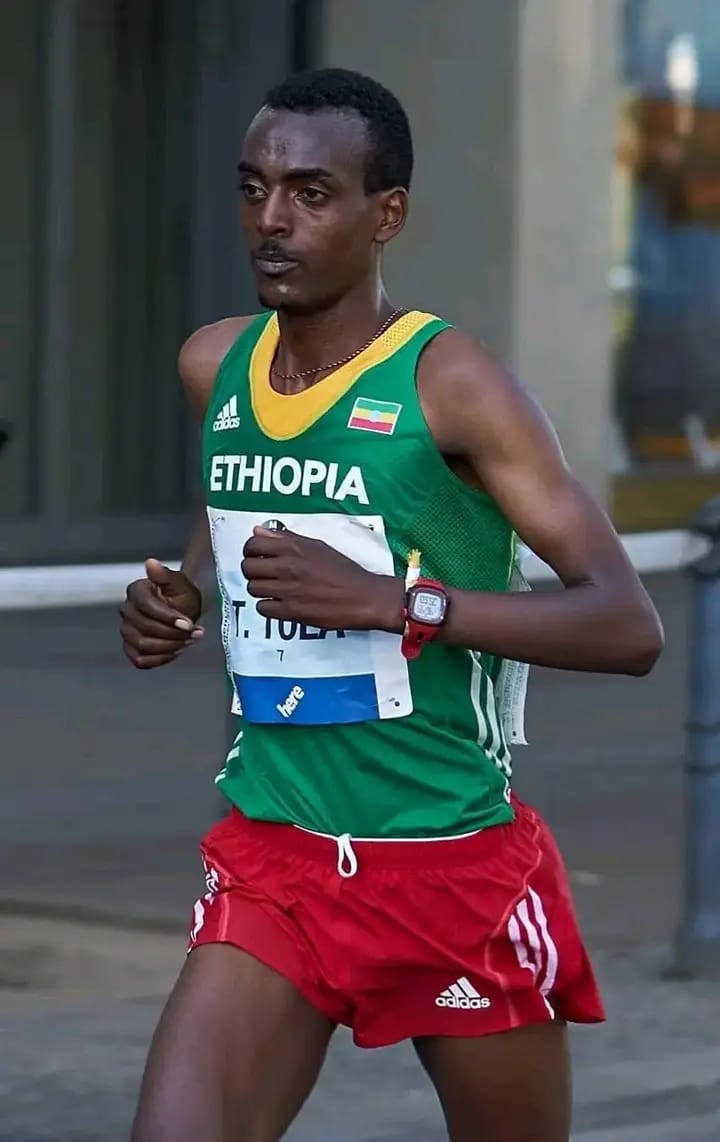
Tamirat Tola (this image was downloaded from the Facebook page of the athlete and is being used here for representation purpose. No copyright infringement intended)
TamiratTola, Sifan Hassan win in men’s and women’s categories. Both set new Olympic records
The 2024 Paris Olympics will be remembered for its two memorable marathons. Certainly therein, an unforgettable women’s marathon.
The men’s race was won by Tamirat Tola of Ethiopia in a new Olympic record of two hours, six minutes and 26 seconds (the previous Olympic record of 2:06:32 held by the late Kenyan athlete, Samuel Wanjiru was set in 2008). He was followed to the podium by Bashir Abdi of Belgium (2:06:47) and Benson Kipruto of Kenya (2:07:00). Tola who had come with the Ethiopian team as a reserve runner and subsequently replaced injured teammate Sesay Lemma, took a decisive lead past the 35 kilometres-mark. According to olympics.com, Tola is the fourth Ethiopian to win the men’s marathon title at the Olympic Games. For most fans of running, the biggest news coming out of the men’s marathon at Paris was possibly the failure of Kenyan legend Eliud Kipchoge to complete the race. He dropped out just after 30 kilometres following what appeared to be discomfort around the waist (it was later attributed to backpain). Olympics.com reported that the athlete, described often as the greatest marathoner ever, had told the website that he won’t be running at another Olympics. Paris was his last. As yet, Kipchoge is one of only three men to win the Olympic men’s marathon twice.
As the Kipchoge chapter appeared to fade in the men’s marathon, a similar imprint was opening up in the field of middle and long distance running for women. For many watching the Paris Olympic Games, the experienced Dutch middle-distance runner, Sifan Hassan, had seemed to disappoint winning bronze medals in the women’s 5000m and 10,000m events. At the 2020 Tokyo Olympics, Sifan had won gold in the above said two disciplines plus a bronze in the 1500m to complete a unique triple. She is a former world champion in the 5000m and 10,000m besides being the owner of a basket of current and former records, including world records. Sifan made her debut in the women’s marathon only last year, in April 2023, when she won the year’s London Marathon in 2:18:33. That victory was despite stopping twice amidst the race to stretch her legs, during which time, she was left behind by the leading pack of runners.
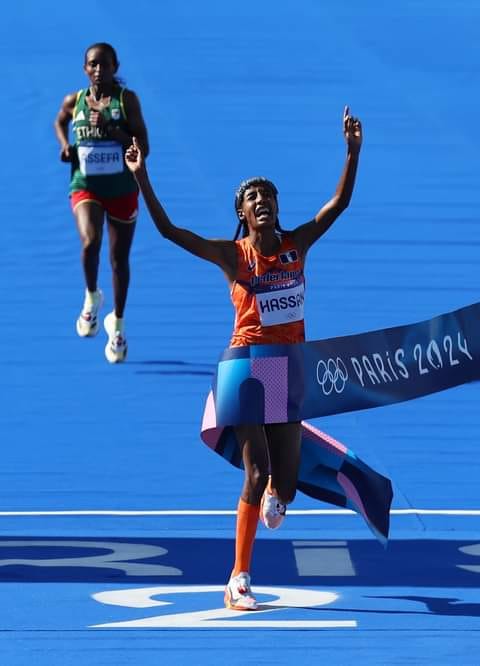
Sifan Hassan winning the women’s marathon at the 2024 Paris Olympic Games (this photo was downloaded from the athlete’s Facebook page and is being used here for representation purpose, No copyright infringement intended)
On Sunday, August 11, Sifan, born in Ethiopia and currently representing the Netherlands, stuck to the leading pack of runners tenaciously in the final quarter of the marathon in Paris and eventually snatched victory from Ethiopia’s Tigst Assefa with a track-like sprint to the finish. Not far from the finish line, Sifan even appeared to stumble as Tigst sought to deny her a chance to over-take on the inside and in doing so, almost crashed the Dutch athlete into the barricades. Sifan however stayed unrattled and forged ahead; she covered the 42 kilometre-distance in 2:22:55, a new Olympic record (the previous Olympic record of 2:23:07 held by Ethiopia’s Tiki Gelana was set in 2012). Tigst Assefa finished in 2:22:58 and Kenya’s Hellen Obiri in 2:23:10. With this victory, Sifan became the first woman to have won gold medals in the 5000m, 10,000m and the marathon. Not to mention – she has cemented her place as one of the all-time greats of women’s middle distance and long distance running with a repertoire of top-notch performances spanning 1500m to the 42 km-marathon. With marathon specialists around, Sifan’s greatness in that discipline may continue to be debated. What’s beyond dispute and totally deserving our admiration is the range of distances she is good at. One couldn’t immediately recall a matching name on the men’s side claiming similar breadth of competition and excellence.
(The author, Shyam G Menon, is a freelance journalist based in Mumbai)
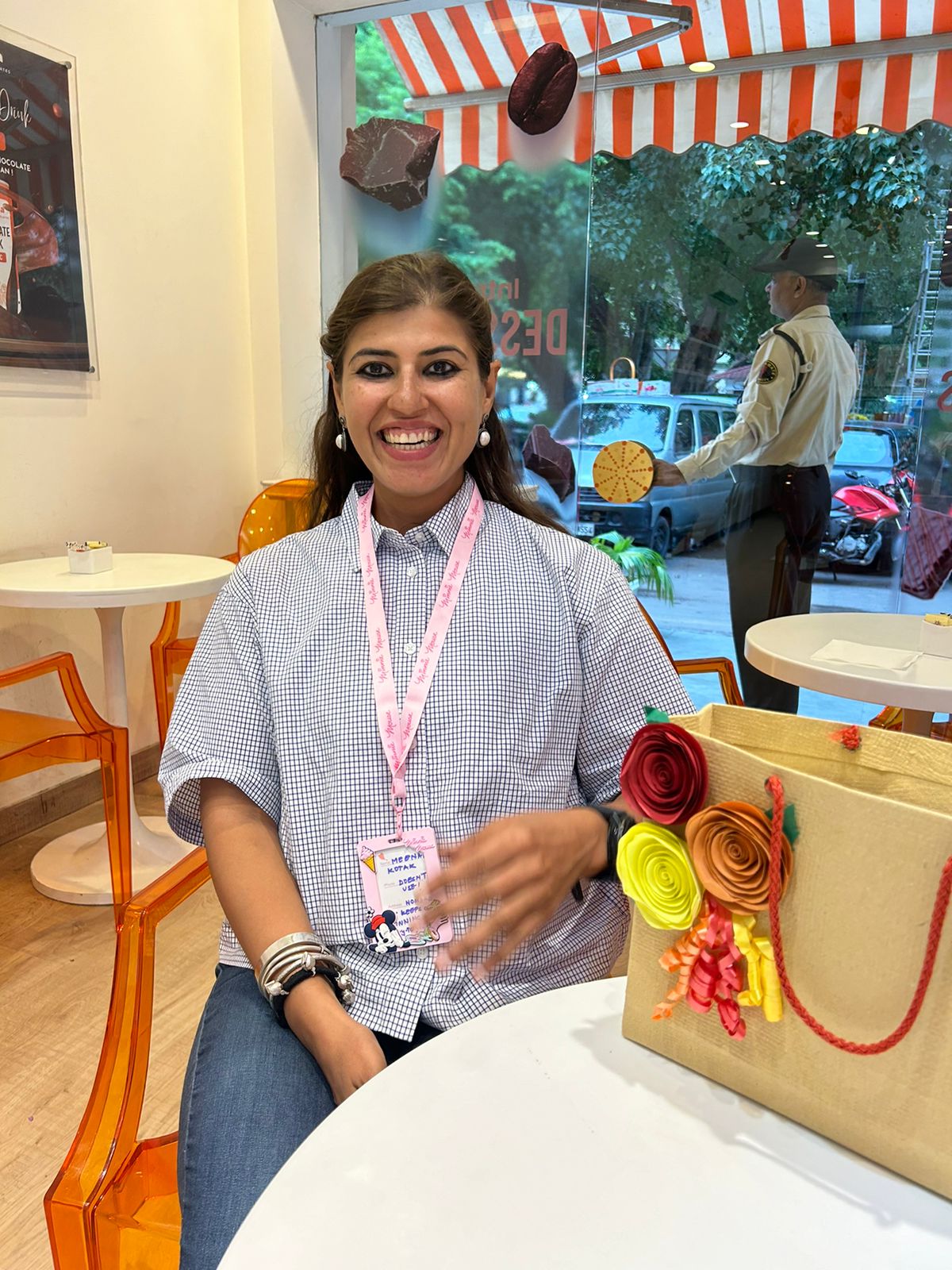
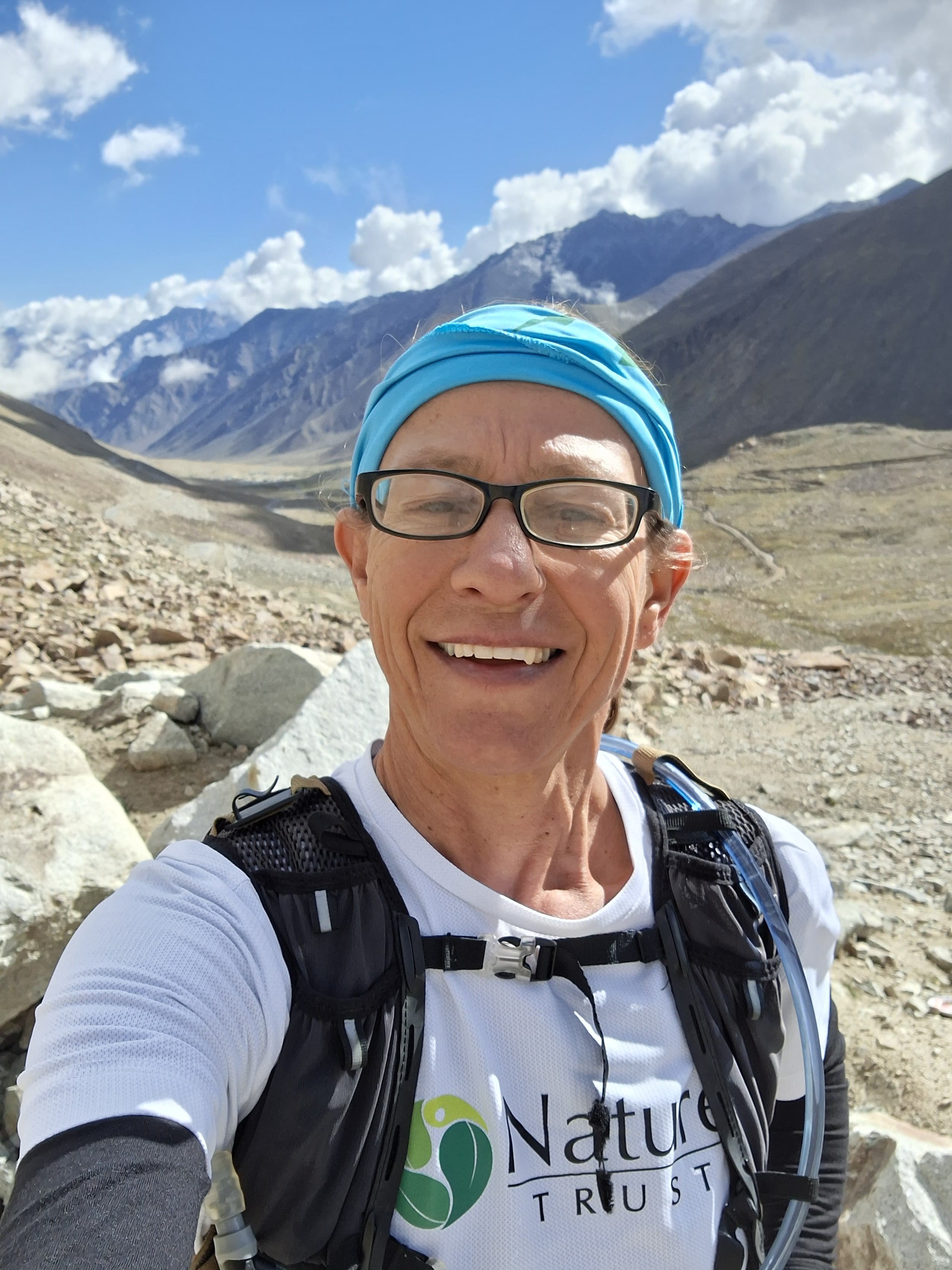
On June 23, when Indian ultrarunner Meenal Kotak set a new national mark of 680.2249 kilometres covered in the six day-race category of the Six Days in the Dome event in Milwaukee, USA, it was her best performance yet since an injury saw her stay off running for over eight months in 2019.
That year, Meenal was diagnosed with a painful case of slip disc in the L4 and L5 vertebrae and advised bed rest. There was no running. She remained indoors, life largely limited to her room and bed. It was a testing period. Besides the lack of physical activity, her mind went for a toss. Runners, especially ultrarunners, are known to pile on miles in training. The regular training helps them stay positive; in a high-endorphin, motivated zone. When such levels of physical activity get suddenly pulled off, the mind may progressively slip into depression. Meenal had cause for worry. Based on her prior performance in the ultramarathon, the Athletics Federation of India (AFI) had drafted her into the Indian team due to attend the 2019 24-hour world championship. That wouldn’t be possible now. Unable to run thanks to her slip disc problem, she grew acutely aware of the competition in the sport and the blunt truth that there is no shortage of new talent. No one is missed for long if they drop off the radar. Somebody else comes along and fills the vacancy. That is how it should be in the best interests of a team but when viewed from the individual runner’s perspective, it is precious chance missed. Meenal’s mind kept generating questions. Why am I injured?Why are things going well for others but not for me? When will AFI give me another chance? – she sank into a mental morass thinking so.
To compound matters, that known side effect of physical inactivity and mental depression manifested – she started to gain weight. “ My pacifier in this period was food. I ate. It was getting up, eating and taking medicines – that was my life,’’ she said. A major relief was the support she got from her husband, Sachin. True, the sight of others leaving for work and getting on with life was a downer. But the fact that she had somebody to talk to, meant she didn’t need to access any external assistance to tackle her depression. Then a leveller of sorts happened. By the first quarter of 2020, COVID-19 started to grow in India. Along with the pandemic, came lockdown. It dispatched everyone indoors, sporting activity came to a grinding halt worldwide and events were cancelled. Talking to this blog in early July, 2024, Meenal provided an honest overview of her bed-ridden predicament in times of pandemic. As lockdown took hold, suddenly, after months of finding herself inactive at home and left out from the active lifestyle-community, she felt a distinction crushed as people everywhere hunkered indoors. Everybody was in the same boat. Strangely, it was around this period when a whole world was hurting that Meenal began to heal.
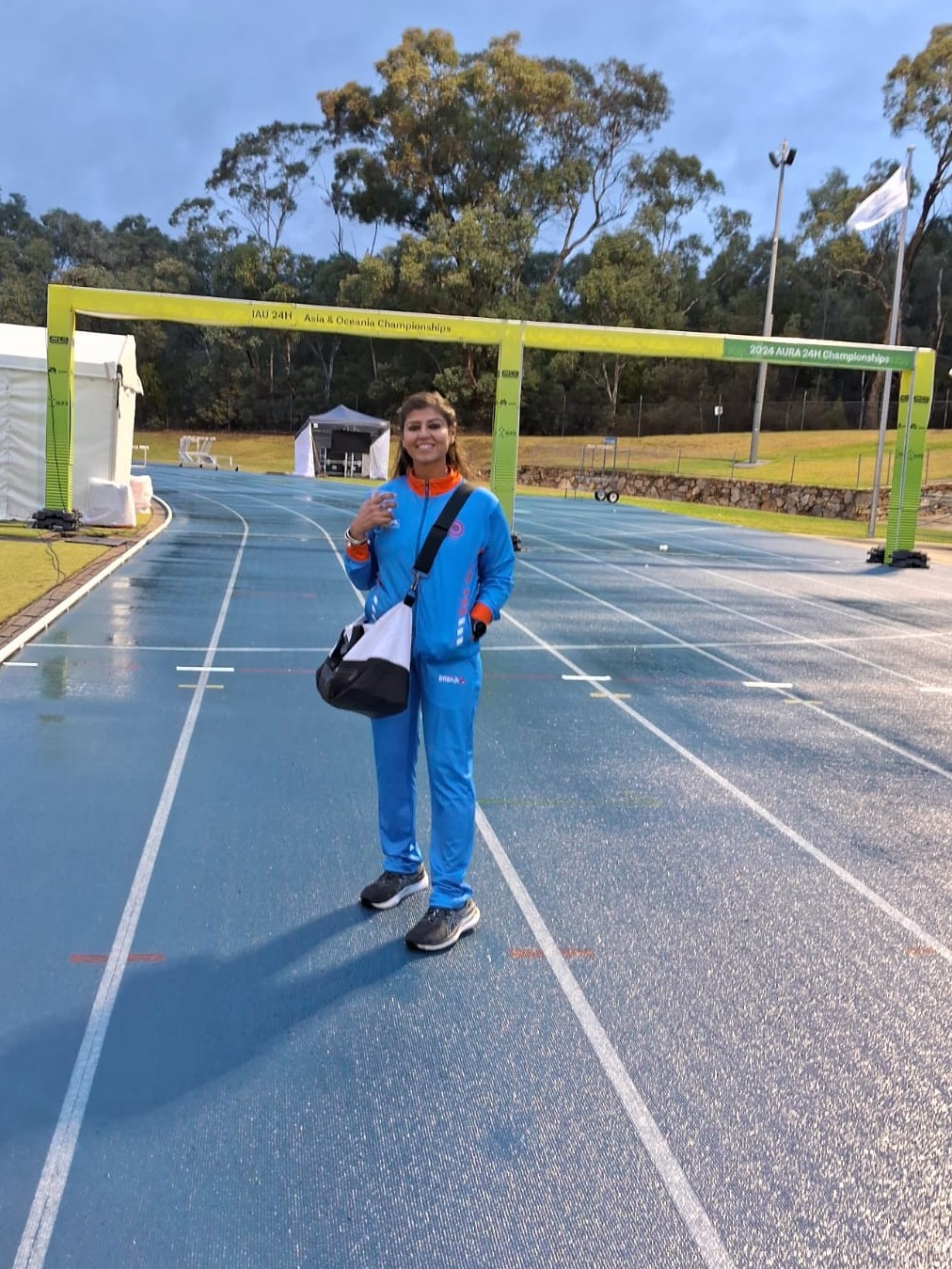
Meenal Kotak; at the 2024 IAU 24H Asia-Oceania Championship in Australia (photo: courtesy Meenal)
Her residential complex in Gurgaon – where she had moved to from Vasant Kunj in neighbouring Delhi – hosted a long loop of close to two kilometres within its premises. Once she resumed walking indoors, she took the stairs down from her flat and walked longer distances on that loop. Sachin pitched in to help. With a view to encourage her on the comeback trail, he had taken to running during the time she was bed ridden and now with him for company, Meenal slowly worked her way up from running one kilometre to covering five kilometres. “ It took me a month to accomplish this,’’ she said. The loop within her residential complex was a genuine blessing to facilitate this progression. It meant she could run at night as well, something difficult for a woman to do in Delhi. For many people, five kilometres run in a day would seem enough. Not when you are a national level ultrarunner trying to return to where one was before slip disc felled the athlete. Meenal persevered. In all, she estimates, she would have taken 14-15 months to reach close to her old levels of mileage in training. And it wasn’t a simple reset; it was a reset with significant changes.
Prior to her injury, Meenal’s idea of training for the ultramarathon had focused mainly on accumulating high mileage. She used to run 600 to 650 kilometres every month and her weekend training included long runs of eight hours and 12 hours. It was just running and running. Post injury, on the comeback trail, that homogeneity transformed to a blend of strength training, stretching and training runs. Of these, strength training became the most important new ingredient as regards the body. She now works out with weights; her strength training session lasts one hour and is repeated thrice a week. Alongside, she settled for a slightly reduced mileage in her training runs. Her current monthly mileage is around 580 kilometres and her long runs range from six hours to eight hours. But the most significant tweak lay elsewhere; it was a tweak in her approach to races.
In April 2022 she registered for her first event in many months – a 12 hour-race in Bengaluru. She completed the race covering 90 plus kilometres in the stipulated time. What stayed in mind was the lightness of being she felt. “ When you enter an event after three years, the pressure is off. Unlike before when I was a known competitor tracked for my performance, thanks to the three year-gap, people seemed to have forgotten about me. It was good to have no pressure. That was a real upside. The downside was that my old friends in running had graduated to a different league and I didn’t know anyone around to say hello to,’’ Meenal said, adding, “ it was a good learning – change is the only constant in life. Records and achievements are meant to be broken.’’ Somewhere in that mix of altered scenario and the maturity of an older self, she realized that one better run for oneself rather than any glory. Even if there is some greater glory to chase, for the athlete, focus has to be on giving one’s best and forgiving oneself if things go wrong. It makes no sense to groom setbacks into dark moods that are difficult to climb out of. Roughly two years later, that realization would prove very useful in connection with her participation in events in Taiwan and Australia.
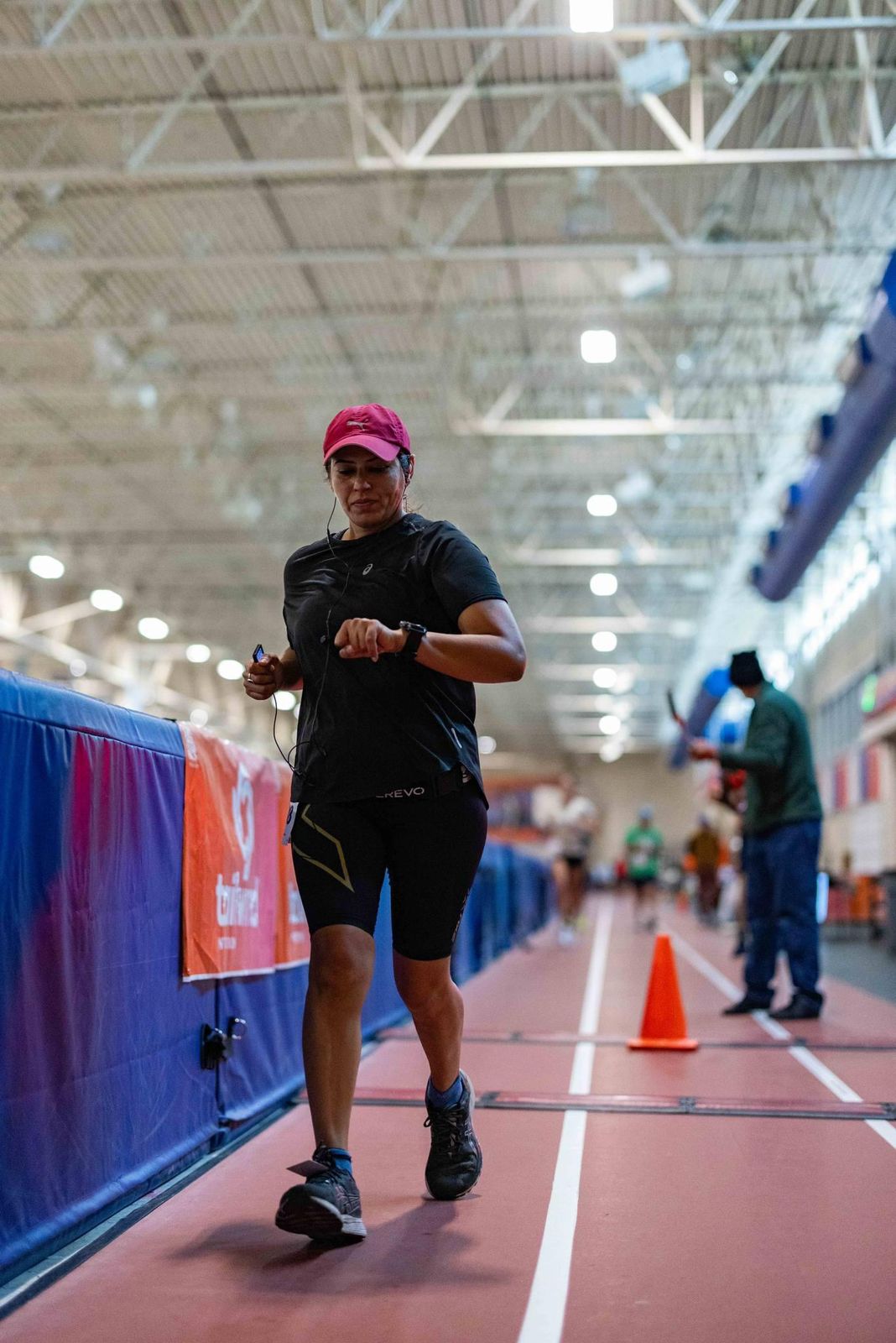
Meenal Kotak; from the event in Milwaukee, USA (photo: courtesy Meenal)
Meanwhile in 2022, in order to set a steady and systematic journey to her old endurance levels, she didn’t immediately vault from the 12 hour-race at Bengaluru to a 24-hour one. Instead, she did in all, three 12 hour-races that year to establish a solid foundation. In 2023 she participated in the Tuffman 24-hour race in Chandigarh and set a new personal best (PB) of 187 kilometres covered, an improvement over her earlier PB of 175 kilometres. Meenal is not a fast runner. Her forte is endurance; sustaining an effort for a longer period of time. And in this category, she had known for a while that her heart was in attempting multi-day events. It meant attempting runs of duration exceeding 48 hours, which was the maximum she had done till then. With this in mind, Meenal looked overseas for good opportunities and came across the event titled Six Days in the Dome in Milwaukee, USA. It had a 72-hour race, which although not well recognized as race-duration in the multi-day running fraternity was still a sensible bridge for her between the 48 hours she was familiar with and Milwaukee’s flagship six-day event, which she hoped to try at some point. She registered for the race. Sachin joined her as support crew (he does so for most of her races and Meenal finds the arrangement a big morale booster). The race turned out to be good for Meenal; in the stipulated 72 hours, she covered 379 kilometres. “ I really enjoyed those three days. It motivated me to explore deeper, the multi-day format,’’ Meenal said.
Likely taking note of her performance at Chandigarh and Milwaukee, the AFI included her in the Indian team for the 2023 IAU 24H World Championships and the 2024 IAU 24H Asia-Oceania Championships. Man proposes, God disposes. While training for the world championship (it was to take place in Taipei in December 2023), she sensed a niggle in her back. The old slip disc problem, although improved, hadn’t totally disappeared. She pulled out of the event in October. Under normal circumstances such withdrawal would demoralise any athlete. It may spark brooding and visitations to the dark zone in the head. But the post injury, new Meenal took it philosophically. She took the next 2-3 months, easy. From January 2024, she started her training for the six day-race in Milwaukee, scheduled for June. It was around this time that she got the call from AFI seeking her participation in the IAU 24H Asia-Oceania Championships. She had to accept the offer but there was a challenge. In her new cycle of training with Milwaukee in mind, until March 2024, Meenal hadn’t done a 12 hour-run, often considered vital to get ready for a 24 hour-race. She located two 12 hour-events – in Ahmedabad and Delhi – and participated in them to reacquaint herself with the experience and understand where she stood. “ I knew thereafter that I was good for 12 hours. But I couldn’t guarantee how things would be beyond that,’’ Meenal said. The Asia-Oceania championships in Australia didn’t play out well for Meenal. “ I was hoping to cover 185-190 kilometres. But I ended up with 168 kilometres. It wasn’t my day,’’ she said. Importantly, she didn’t let the reversal in fortunes, lead her into a pit of despair. She reverted her focus to the upcoming six day-race in Milwaukee.
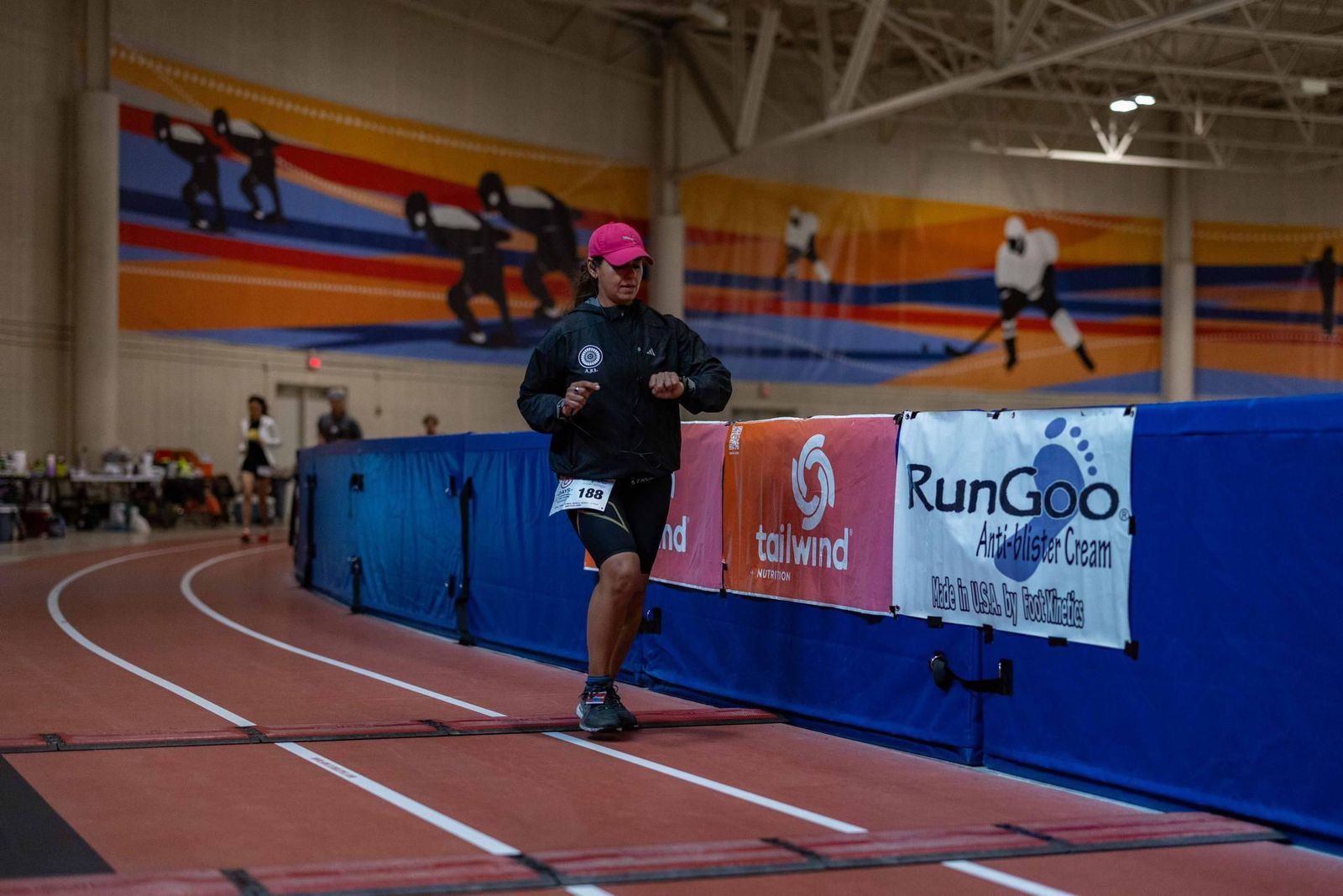
Meenal Kotak; from the event in Milwaukee, USA (photo: courtesy Meenal)
June 2024; the race in Milwaukee featured several strong runners. “ I didn’t look at the entry list, which was displayed there. I didn’t want any pressure on myself,’’ Meenal said. The event in the US was set within an indoor stadium that held an ice-skating rink. It was therefore cold; a constant low temperature. Indoor stadium meant, there was no sunlight. On the other hand, precisely because of the synthetic setting, it was a controlled ambiance. The first day of the race went off well for Meenal. In line with her expectations, the second and third days proved to be tough. She neither ran nor slept properly. On the fourth day, things began to look up. On that day, the fifth and the sixth, she had her first taste of hallucination. There was a display board in the stadium featuring a woman’s image on it. Meenal felt the woman touch her on her shoulder, running with her and conversing with her. Some others around had more serious hallucinatory issues. “ One runner started hallucinating about a murder,’’ she said. Eventually, Meenal completed the race with a new national best for women. She thinks Indians have a talent for resilience. They can take a lot. It’s part of the South Asian package. Now 44 years old, Meenal’s wish is that somewhere on the way to her fifties or in her fifties, she should try the 52 day-Sri Chinmoy Self-Transcendence 3100 Mile Race.
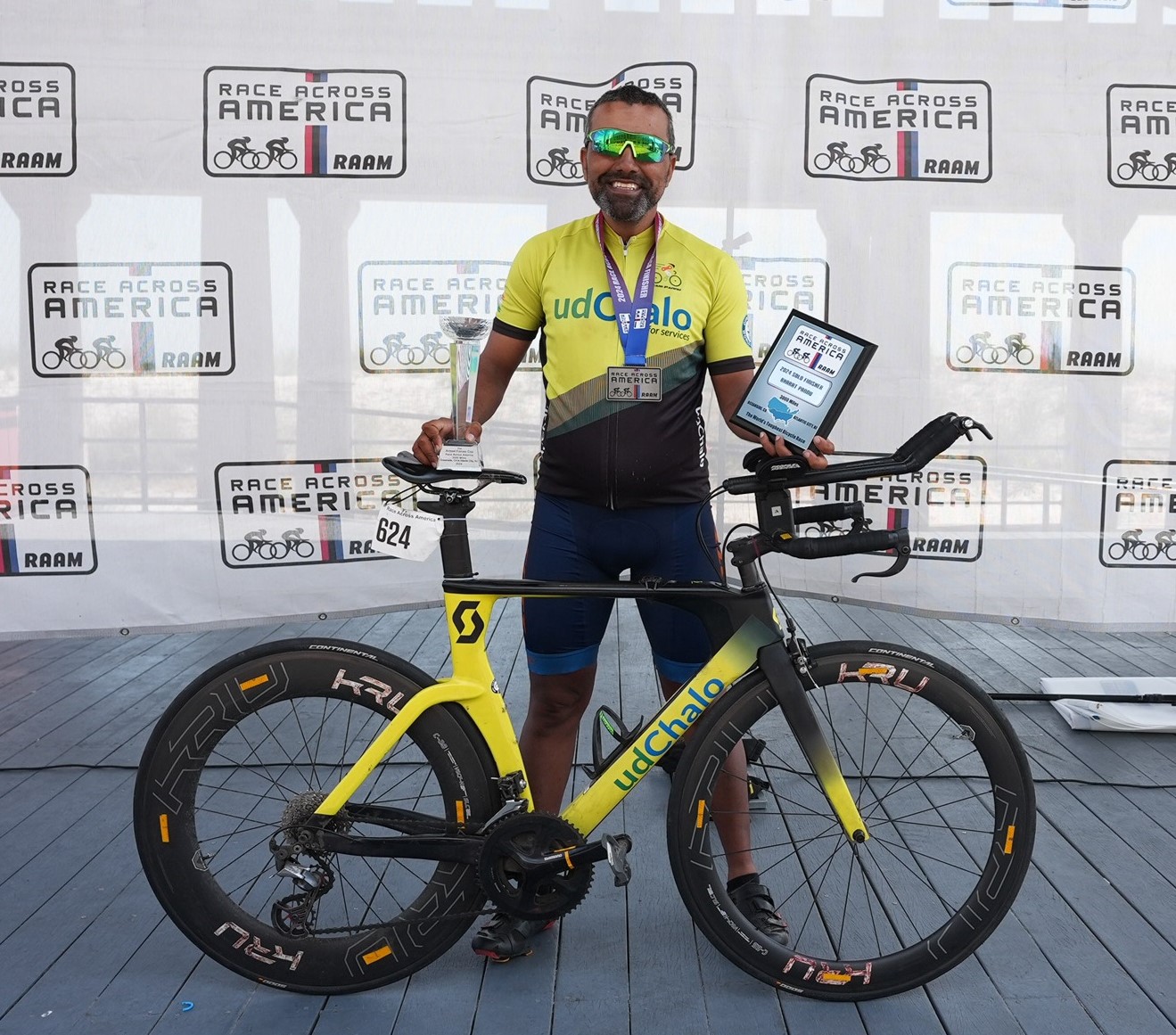
Lt Col Bharat Pannu; at the finish line of 2024 RAAM (photo: courtesy Bharat)
Determined army officer finally achieves his goal
For Lieutenant Colonel Bharat Pannu, it was third time lucky.
Long fascinated by Race Across America (RAAM), his engagement with the event is a study in perseverance.
Bharat is among the top endurance cyclists from India. Many people from the world of ultracycling in India, gravitate towards RAAM, which is a gruelling ride across the continental United States. RAAM tests both rider and his / her support crew. To get a ring side view of the race, Bharat served as a member of the support crew for one of the teams (Team Sea to See) in the 2018 edition of the event. He also acquired a US-based coach – Tracy McKay, who had completed RAAM as part of a two-person team in 2002 and been team strategist / crew chief for Chris MacDonald, who cycled solo and finished second at RAAM in 2005. After qualifying for RAAM at races in India, Bharat – he was posted in Nashik at that time – made his first attempt in 2019. That year, while in the US for RAAM, he suffered an accident just ahead of the race and broke his collar bone. He had to pull out of the race.
Less than a year later, the world was in the grip of COVID-19. As the pandemic spread, lockdown enveloped the world, sporting activity came to grinding halt worldwide and events were cancelled. There was no RAAM in 2020. Fed up of being indoors and inactive, humankind kicked off the virtual version of sports like running and cycling. RAAM hosted a virtual version of the race (VRAAM) in June 2020. Bharat participated in the event. He cycled at an apartment in Pune; his bike fitted to a smart-trainer. After 12 days of cycling, on June 28, Bharat emerged winner in his age category and third overall in the race. It was a major milestone in his career in cycling.
The 2020 virtual RAAM was followed by two rides – one along India’s Golden Quadrilateral highway system and the other from Manali to Leh – both ending up in Bharat finding a place in the Guinness Book of World Records for the timing he obtained. Meanwhile, the pandemic’s grip on the world continued into 2021. It made traveling overseas for RAAM and participating in the race, difficult. In July 2021, the aeronautical engineer working with the Indian Army’s aviation wing, was transferred from Bengaluru (where he had moved to, from Nashik) to Ahmednagar and put in charge of the Indian Army’s cycling and rugby teams. Although what he loved to do became the stuff of office work, this phase may have deprived Bharat the ultracyclist, of the personal attention he deserved. He had many things to take care of. He made the best of what was available, trained and reached the US in time for the 2022 physical edition of RAAM for a second shot at the race. Unfortunately, yet again, it wasn’t to be a successful outing.
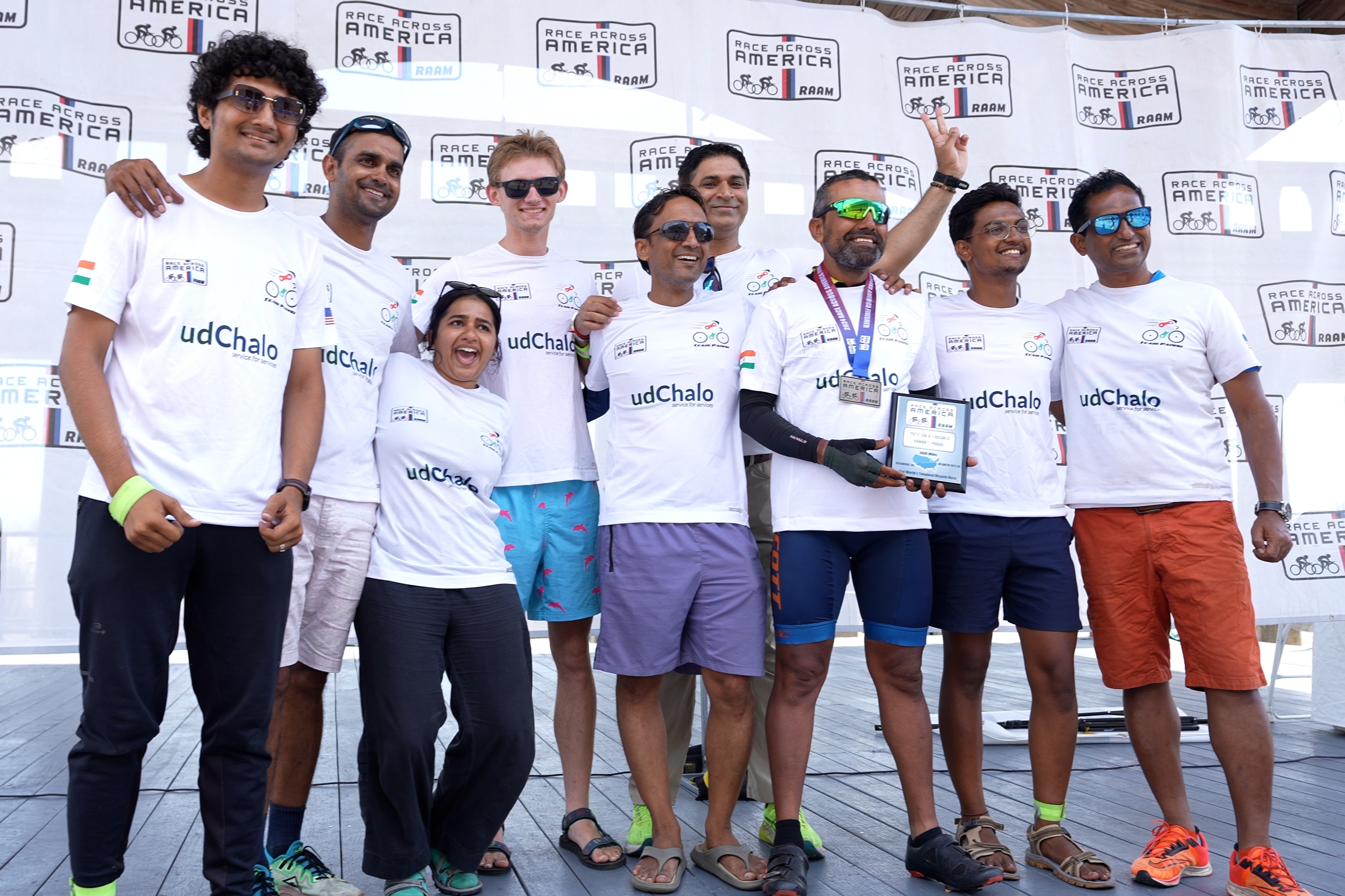
Team Bharat Pannu at the finish line of 2024 RAAM (photo: courtesy Bharat)
RAAM has a cut-off of 12 days. That’s the time allotted to cover the nearly 4900 kilometres long, west to east span of the US from Oceanside in California to Annapolis in Maryland. Bharat is known to be a strong cyclist in the second half of the races he participates in. So, when the 2022 RAAM commenced with Bharat not doing too well, he and his crew took it in their stride. Alarm bells however started ringing on the fifth day, for by then the lag Bharat had grown had become tad serious. He and his team hunkered down and covered some of the lost ground. But on the tenth day of the race in June 2022, Bharat experienced fever and along with it, chills and shivering. The crew felt he risked damaging his health if he continued. The decision was taken to pull out. Once back in India, Bharat decided to take a break from ultracycling. He had been training and racing at events for several years. Body and mind sought rest. Further, races like RAAM, which are set overseas, require a support crew with transport infrastructure. These events also have a dedicated, long training period. Simply put, RAAM consumes resources. Bharat knew that his purse needed replenishment. Rest made sense. He stayed off competitive cycling for much of 2023.
In June 2023, Bharat’s posting to the army’s cycling node in Ahmednagar concluded and shortly thereafter, he was transferred to Suratgarh in northern Rajasthan. Freed of his responsibilities at the cycling node and returned to his regular schedule (the sort in which, he used to train for ultracycling), the idea of attempting RAAM again, returned. Suratgarh is part of the northern reaches of the Thar desert. According to Bharat, Suratgarh is predominantly flat. Perfect for cycling. More important, summer temperatures run quite high and winter is cold. “ These extremes made it a good ambiance to train for an endurance race like RAAM,’’ Bharat said. One approaches RAAM through stages of preparation and with smaller races in ultracycling done. In October 2023, Bharat decided to participate in the annual Indian ultracycling race, Ultra Spice. “ I met the targets I set for myself at this race,’’ he said. Following this, the decision to participate in RAAM 2024 was taken.
Bharat trained under the guidance of Tracy. As mentioned earlier, participating in RAAM is a resource-intense exercise. Bharat’s tickets to the US were sponsored by a Pune-based travel company. He had no other sponsors. He used to have an association with bicycle manufacturer, Scott. But it had ended. So, the rest of the expenses for 2024 RAAM, he bore it himself. He had a support crew of nine people; seven from India and two from the US. He reached the US, four days before the race. In the time available, he did the necessary final preparations, including two trial rides that totaled about 100 miles. For RAAM, he banked on three bicycles – a Scott Foil (lightweight road bike), a Scott Plasma (time trial bike) and a Trek Emonda (endurance bike).
For Bharat, RAAM 2024, started off better than in 2022. “ The initial phase went off quite smoothly. We reached the half way point of the race in five days and nine hours,’’ he said. Then things began to get challenging. For two days continuously in Kansas, he faced cross winds and pedalling in such conditions drained his energy. Within RAAM’s ecosystem, Kansas is notorious for its weather-related challenges. Thanks to this predicament, Bharat’s average speed reduced. Compounding the challenges was a second problem. Noticing his strong cycling in the early part of the race, his crew had allowed him to cycle for longer hours with resultant less downtime for sleep. In that phase, his sleep pattern used to be 15-20 minutes once or twice during the day and 45 minutes to 90 minutes at night. Compared to this aggregate, the original plan had been to get at least three hours of sleep. But then, Bharat had been cycling well and allowing him to eat the miles had appeared the sensible thing to do in that early part of the race (particularly given the experience of 2022). Consequently, the planned three hours of sleep in the original race strategy, got overlooked. For body and mind, sleep denied doesn’t disappear. It accumulates.
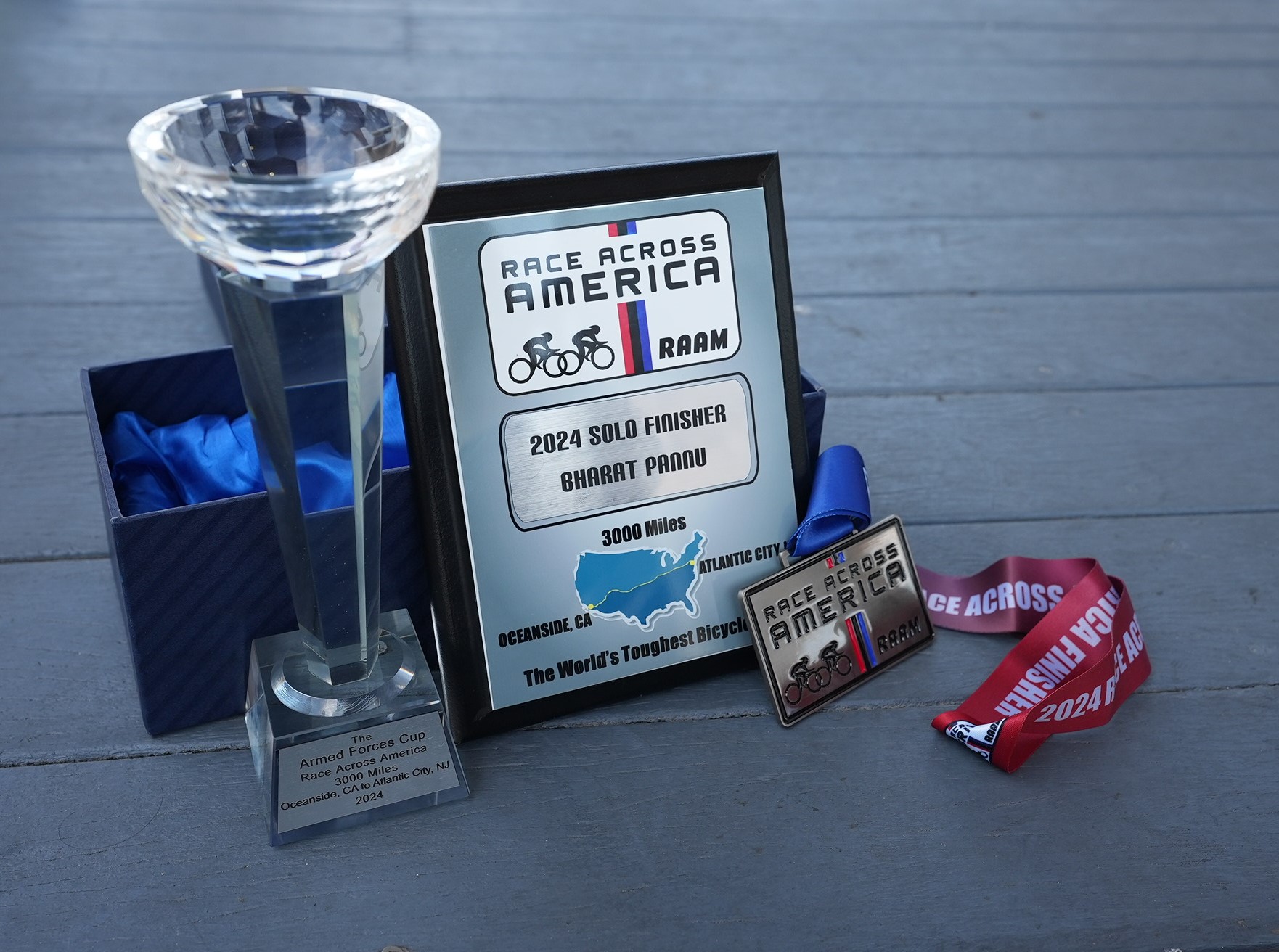
The Armed Forces Cup, finisher’s plaque and medal from 2024 RAAM (photo: courtesy Bharat)
Sleep deprivation is one of the known challenges in ultracycling. Especially so in races like RAAM, which run like a single stage from start to finish, leaving sleep management entirely the onus of rider and crew to manage. For Bharat, past the half-way point, sleep deprivation began to make its presence strongly felt. “ The tenth and eleventh days were pretty bad,’’ he said. However, to his luck, although cycling at night continued to stay challenging, things improved as regards his daytime cycling. He was fine when the sun shone. “ The period between midnight to 6 AM remained very difficult,’’ he said. Eventually, Bharat made it to the finish line in Annapolis within the stipulated cut-off period of 12 days; he covered RAAM’s 4928 kilometres in 11 days, 23 hours and 36 minutes. The final figure included an hour added as penalty for a impeding traffic. Besides completing RAAM successfully on his third attempt, Bharat also won the race’s Armed Forces Cup. “ It took me three attempts and more than five years to achieve this. I feel content, satisfied,’’ Bharat said. In retrospect, he believes that had things gone well, he could have completed the race in 2019 or 2022. But then, such is endurance cycling, such is RAAM.
Many people who finish RAAM nurse the hope of returning to improve their timing. Bharat shares the aspiration. It is on the cards although he hasn’t decided when it should be. Closer to the present, he intends to participate in Dunes, an ultracycling event set to debut in Rajasthan this December.
(The author, Shyam G Menon, is a freelance journalist based in Mumbai)
At 808 ITRA points earned, Nimsang Limboo now tops among Indian ultrarunners in this regard
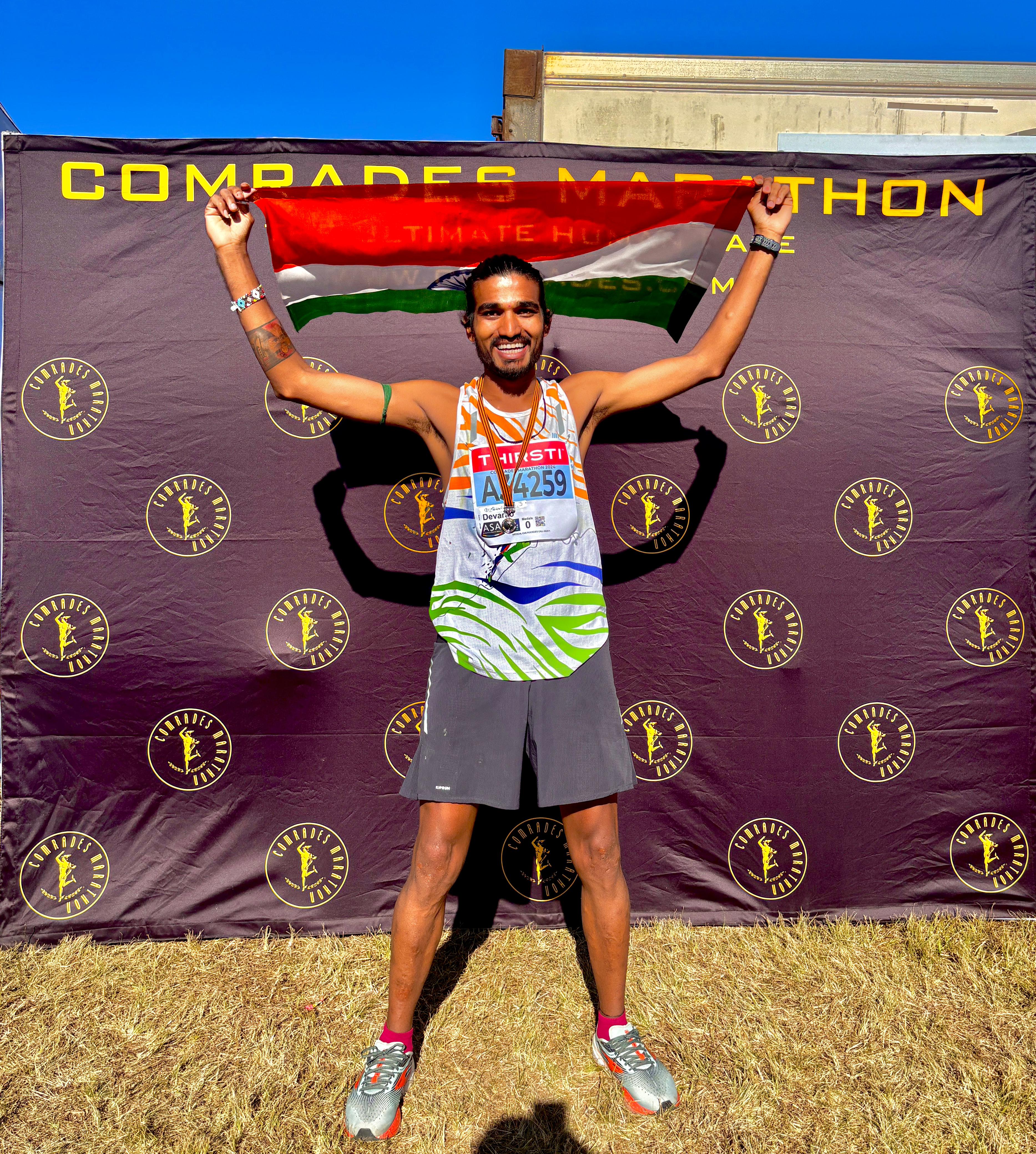
Devarao Choudhari finishes Comrades with the fastest timing yet by an Indian runner
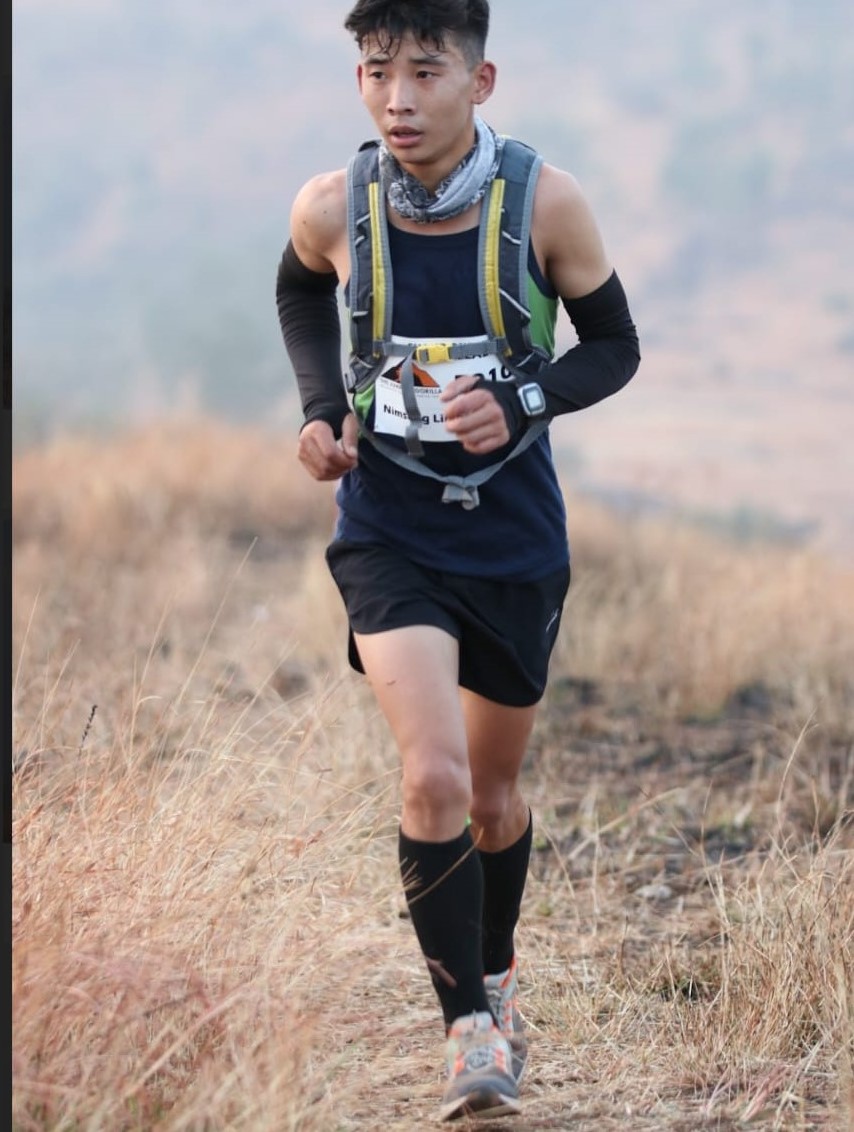
On April 6, 2024, Nimsang Limboo, an ultrarunner from Sikkim, ran his first international trail race of 54 kilometres at the Manjushree Trail Race in Nepal.
He finished in second position with a timing of seven hours, 18 minutes and 11 seconds, less than a minute behind the winner of the race, Harilal Singh of Nepal (7:17:25). By the end of the race Nimsang had secured the highest ITRA (International Trail Running Association) score among Indian runners. He had accumulated 808 points.
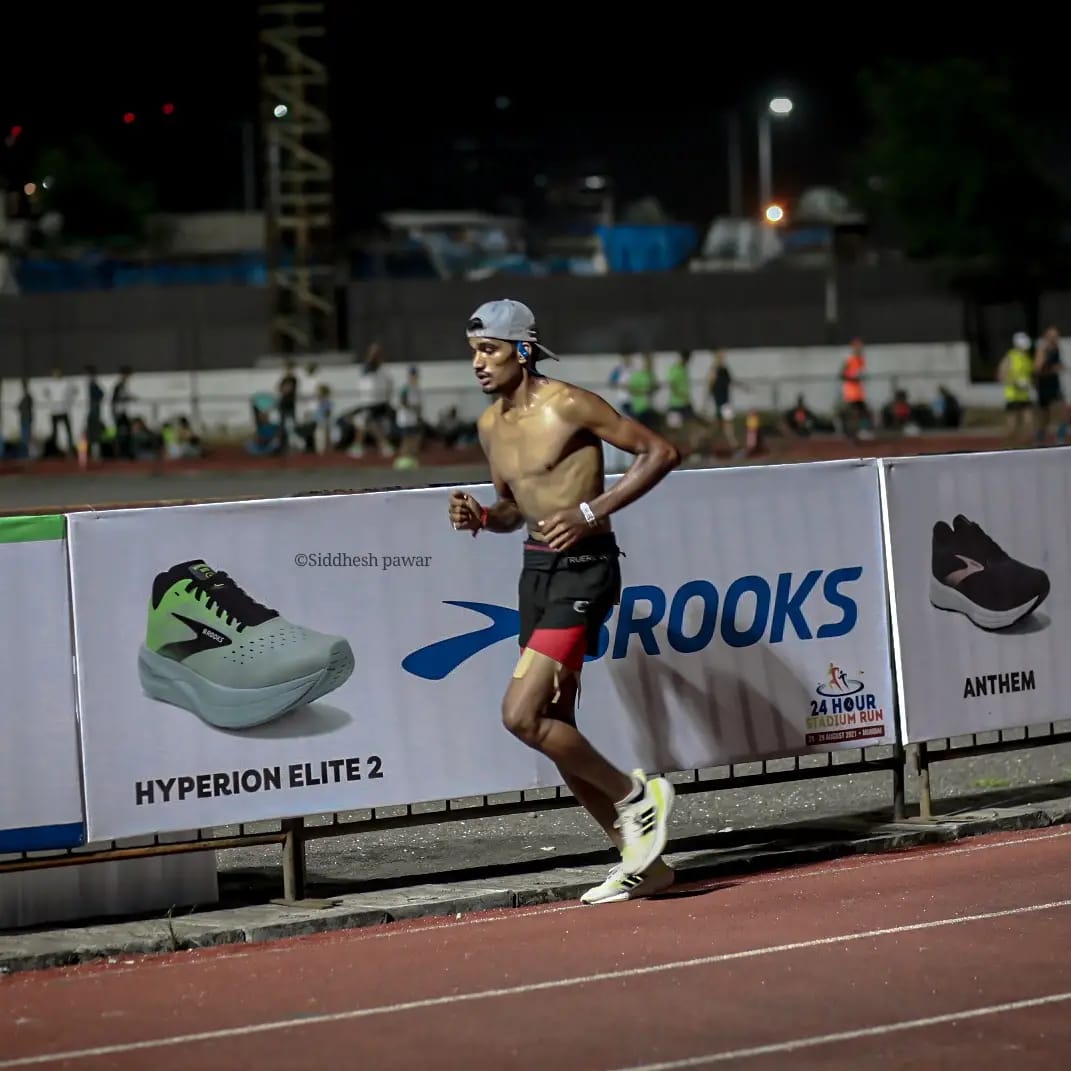
On June 9, 2024, Devarao Choudhari ran the Comrades Marathon, an ultramarathon held annually in South Africa. He smashed existing Indian timings at the event to record a new high. He finished the 88 km race in 7:04:10.
Nimsang (22) has been running for the last three years. His journey in running commenced with a six km race for which he practiced six days. “ I finished the race in 46 minutes,’’ he said. Soon, he began to discover the world of running, especially trail running.
Nimsang comes from a village in West Sikkim known as Darap. The terrain is mostly hilly. “ The area where I stay is full of trails. I am quite used to running on trails,’’ he said. He also does the occasional road race. In 2023, he ran the Kolkata Full Marathon and secured fourth position overall and first in his age category with a timing of 2:47:56.
Devarao Choudhari (photo: courtesy Devarao)
“ My focus is trail running, at the moment,’’ he said. He has also been doing the Jumping Gorilla events, which include trail races in the Sahyadri Ranges, the Buddha Trails in West Bengal and BRUTE (Basar Running Ultra Trail Experience) in Arunachal Pradesh.
Manjushree Trails, according to Nimsang, was quite challenging. “ The route was tough with some parts of it being technical. Support along the route was very good. There were aid stations every 6 km,’’ Nimsang said.
Devarao, who hails from Pusad in Maharashtra, started running in 2017. “ I used to see young boys preparing for enrolment in the police and armed forces. I took a cue from them and started running,’’ he said.
In 2017, he ran the half marathon at the Amravati Marathon and finished in 1:32:38. “ At the end of the race, I noticed that some of the runners who finished ahead of me were in a bad shape but I was absolutely fine. I realised that I could do better,’’ he said. At the 2019 Vasai Virar Mayor’s Marathon, he met Anil Korvi, often a podium finisher in marathons and half marathon races. “ I started to take guidance from him,’’ Devarao said.
Following the COVID-19 pandemic lockdown, he took to trail running and started participating in trail races including the Jumping Gorilla, Mahabaleshwar Endurathon and SRT Ultra among others. Alongside he was also doing road races. As may be inferred from the events mentioned, Devarao and Limboo know each other; their paths have crossed.
Devarao Choudhari (photo: courtesy Devarao)
Having finished his graduation, Devarao helps his father in farming. The family cultivates oilseeds, pulses, soyabean and other crops. “ I had heard about Comrades and was quite keen to do it,’’ he said. As he was a podium finisher in many of the local running races, he found support in certain quarters. “ Financial help to enrol for Comrades, travel to South Africa and participate in Comrades came from local institutions and people,’’ he said.
“ In South Africa, food was an issue. I am not used to eating food other than Indian cuisine,’’ he said. He normally has a tendency to start the race aggressively. But at Comrades, he took a conservative approach. “ Hydration was quite good along the route. I consumed five GU gels. I also had oranges, potatoes and Coke during the run. My run went quite well until the 67th kilometre when I saw some runners collapsing from exhaustion. I slowed down my pace but eventually I felt strong and went for it,’’ he said.
Devarao, 26, felt he could have done better. He was hoping for a sub-7-hour finish but lack of proper food to his liking in the run-up to the race may have impacted his plan. “ I had not followed any systematic training or diet plan for this run. Therefore, I am happy with my performance,’’ he said. Following the run, his recovery has been quite good.
(The author, Latha Venkatraman, is an independent journalist based in Mumbai)
Meenal Kotak; from the event in Milwaukee, USA (photo: courtesy Meenal)
Meenal covers over 680 kilometres in 6-day category, finishes second at event in US
Arun Bhardwaj (810 kilometres) finishes fourth in 10-day category
Delhi-based ultrarunner Meenal Kotak has set a new mark in ultrarunning for India. She covered a staggering 680.2249 kilometres over the stipulated six-day period (144 hours) at the Six Days in the Dome event held at the Pettit Centre, Milwaukee in Wisconsin, USA. The event was held from June 13 to 23, 2024.
She finished second among women in the six-day event behind Megan Ekbert of USA. Megan was also the overall winner covering a distance of 846.9994 km. In overall ranking, Meenal finished fourth in the six-day event. David Johnston of USA finished second with a distance of 740.5702 km and Tatsunori Suzuki finishing third with a distance of 713.5194 km covered.
India’s Arun Bhardwaj placed fourth position overall in the 10-day category at the same event covering a distance of 810.1927 km.
Meenal has been running since 2013. Starting with 10 km, she progressively upped her distance and finally got into ultrarunning.
“ I had earlier done the three-day event at Milwaukee. The next practical move was to do the six-day event,’’ she told this blog after the race.
Training for a multi-day event does not entail merely increasing mileage and working on strength training. It is a lot more. It requires managing a whole lot of things – training, mental conditioning, overall fitness, recovery, sleep, nutrition and hydration – in the run-up to the event.
“ I did a lot of endurance runs, hour-based runs, mileage-based runs. But more than all these, doing a multi-day event is understanding the challenge mentally and physically and hoping that one’s gut works properly,’’ she said. “ There are many aspects to consider – when to take a nap during the run, when to eat, taking measures to prevent chaffing injuries, blisters,’’ she said.
In April 2024, Meenal was one of the Indian ultrarunners representing the country in the IAU Asia & Oceania Championships held in Canberra, Australia.
“ I was not able to do well in Australia. But coming to Milwaukee I was in a much better place, both fitness wise and mentally,’’ she said.
For Milwaukee, she had worked out a plan. “ I went according to the plan perfectly for the first two days. But on the third day, I went into a low phase due to lack of sleep. I could not sleep and I could not run either. If I was giving 100 percent of mine in this event, my husband as my support was giving 200 percent. I finally managed to get some sleep and felt some sanity returning,’’ she said.
As a seasoned ultrarunner, she was aware that the second and third days of multi-day events would be excruciatingly difficult.
The Pettit Centre is an indoor ice-skating facility. The course was open for the entire 144 hours with temperatures maintained at 6 degrees Celsius throughout. Runners were required to run on a 443 metre-track.
“ It was quite cold for the runners and doubly so for the crew supporting the runners. Because of the enclosed space it was claustrophobic. We don’t get to see the sun or skylight and that can take a toll on our sanity,’’ she said.
Meenal Kotak (photo: courtesy Meenal)
Many runners, she said, were hallucinating and cracking under pressure.
“ I ensured that I took breaks, sometimes short ones and sometimes for a couple of hours to catch up on the sleep. I ate proper food. My husband arranged for Indian food at least once a day, other times I ate food available for the runners. Hydration and nutrition were well-taken care of,’’ she said. Physically, she faced some niggling issues but the worst aspect of the multi-day running was lack of sleep.
“ It was great running alongside Megan, the winner. She was so full of energy. On the first day she took a lead and then never looked back,’’ Meenal said.
Of the 144 hours, Meenal ran most of the time but resorted to walking in the last 5-6 hours of the event.
In her ultrarunning journey, Meenal lost three years to a back injury. “ It was tough getting back. I had to start with 5 km runs and progress to ultrarunning events. I owe a lot of gratitude to my husband, my family, friends and the running community,’’ she said.
Meenal’s physical recovery following this event has been quite good. “ I am good to go. I am now in New York and have been walking around the city quite a lot. But mentally, I continue to feel the circling motion, especially when I sleep. I guess, it will take some days to recover,’’ she said.
She plans to take a break of a couple of months before resuming running.
(The author, Latha Venkatraman, is an independent journalist based in Mumbai)
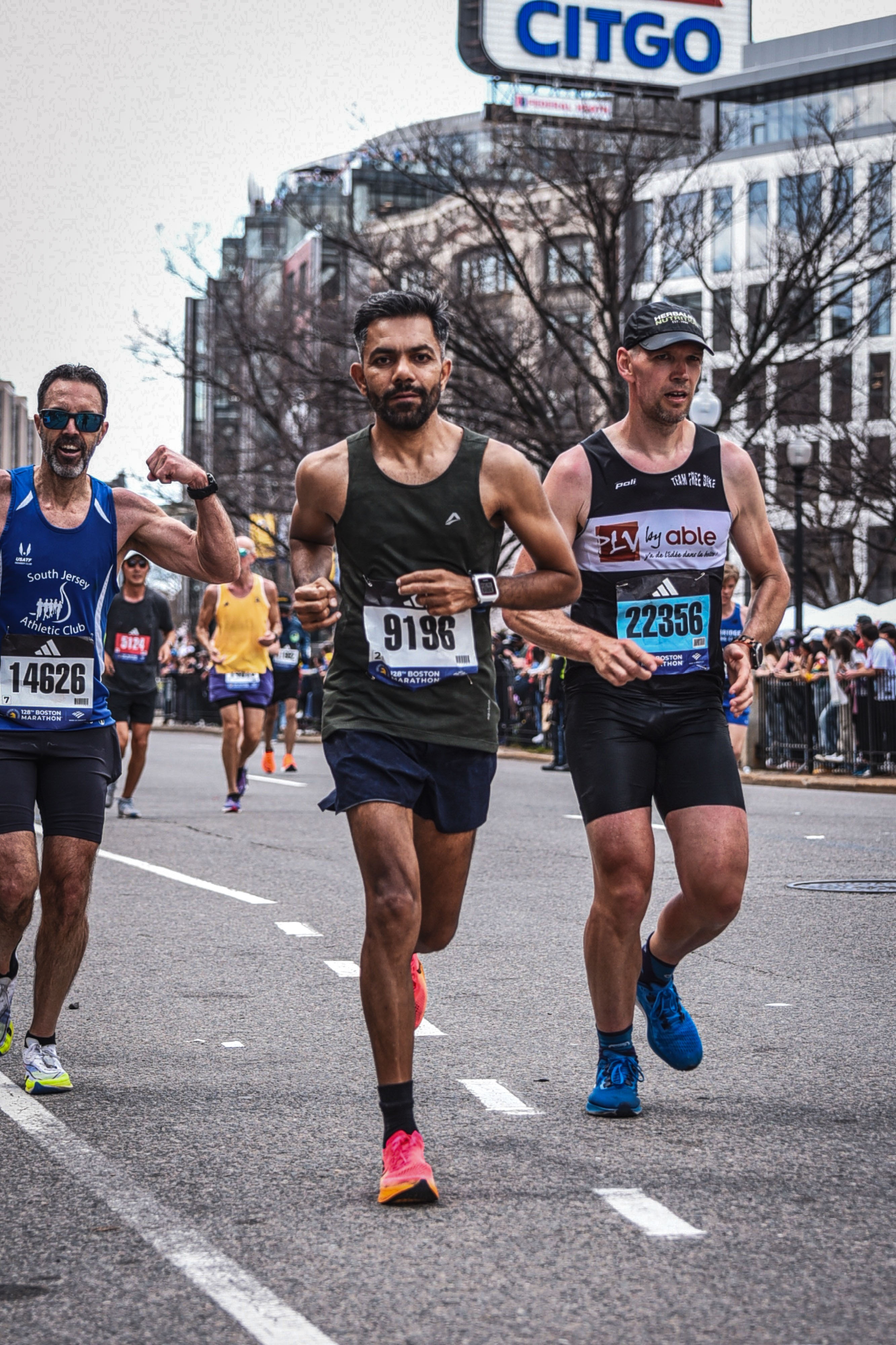
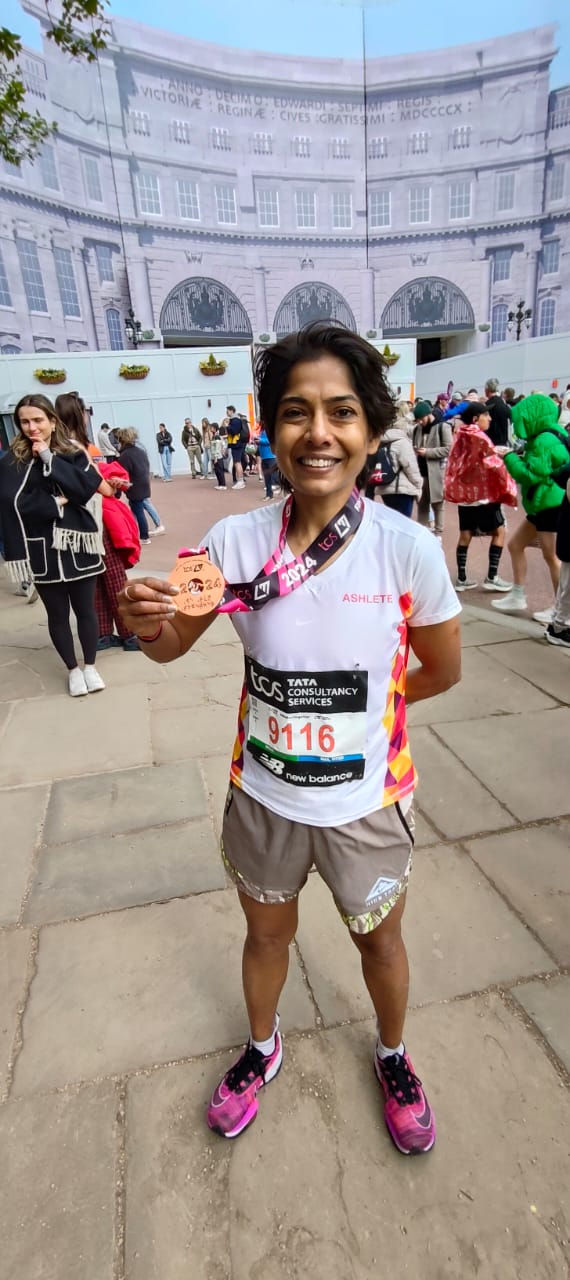
April is the month of two World Marathon Majors happening back-to-back. Boston Marathon is often held on Patriot’s Day, which falls on the third Monday of April. The London Marathon takes place on the following Sunday. This year, Boston Marathon was held on April 15, 2024 and London Marathon on April 21, 2024.We spoke to a few Indian runners who ran these two World Marathon Majors.
Dhruv Trivedi (photo: courtesy Dhruv)
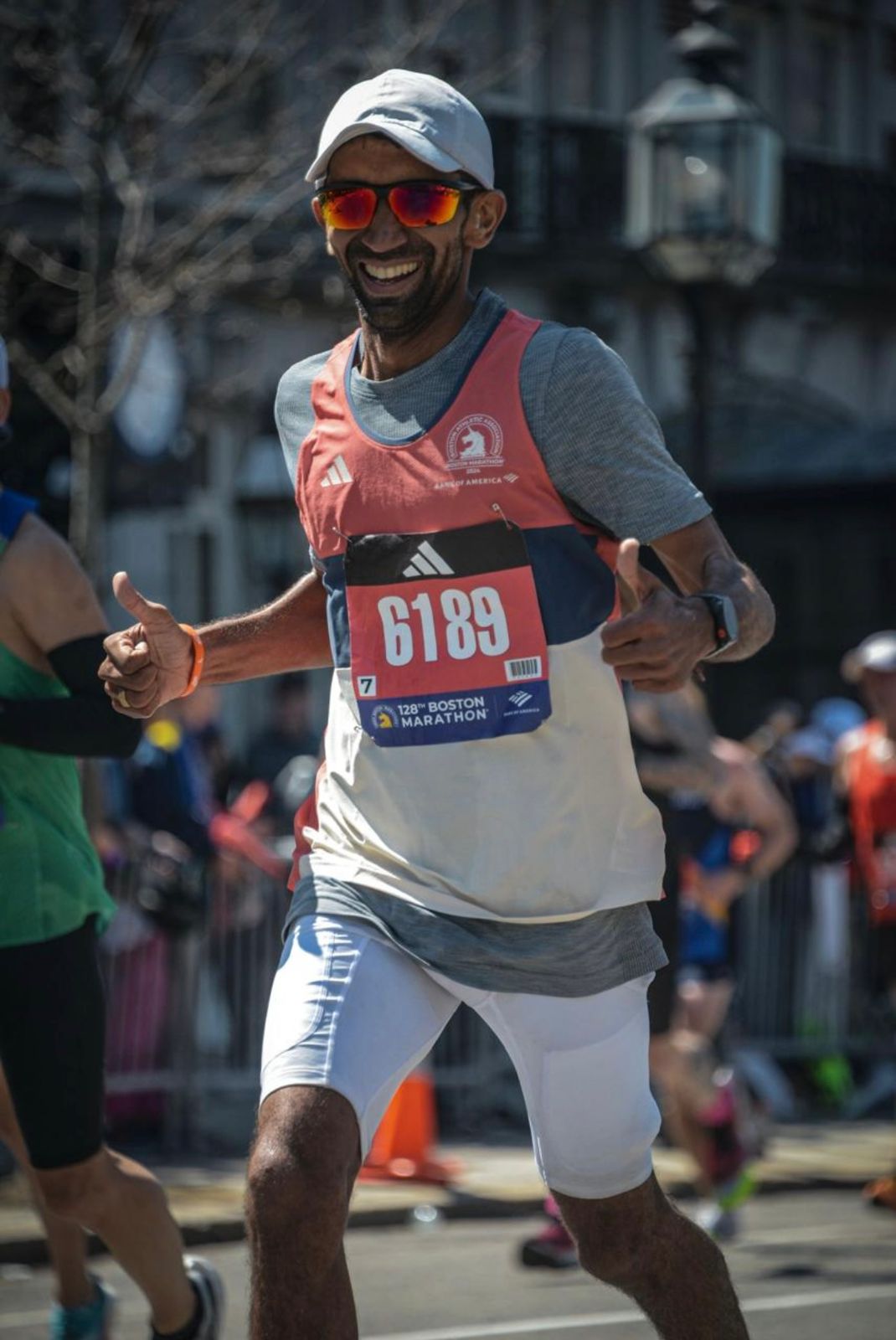
For Surat-based Dhruv Trivedi, Boston Marathon 2024 was his first World Marathon Major. His training for this event spanned six months during which period he did the Ahmedabad Marathon and the Tata Mumbai Marathon apart from Boston Marathon.
He curated a training schedule that comprised hill runs, interval training, long runs, strength training and one day of swimming and cycling.
Dhruv has been running since 2015. An ayurvedic doctor by profession, Dhruv soon realized that he was getting into a bad lifestyle. “I started walking. Soon after I heard about a 10 km night run and registered for it,’’ he said. He then pursued it with diligence. In 2016, he did the Comrades Marathon, the downhill version of the ultramarathon held every year in South Africa.
Thereafter, in 2018, he ran the 12-hour stadium run in Mumbai. In 2022, he finished in second place in the 60 km Ooty Ultra.
His training for Boston Marathon was with an eye on a finish timing of 2:48-2:50. He had run the Tata Mumbai Marathon this year in 2:50:53, his personal best.
“ First, the Boston route is quite brutal. Second, the whole process of dropping off the bag at the finish line and then hopping on to a bus that heads to the start line is quite irritating and tiring,’’ he said.
He commenced the race well but after 6 km he realized he could not meet his target of 2:50. “ The second half of the race is much tougher. There was a huge crowd throughout but the overall experience was very good. The hydration support was excellent,’’ he said.
He finished Boston Marathon in 2:59:21.
Uday Bobhate (photo: courtesy Uday)
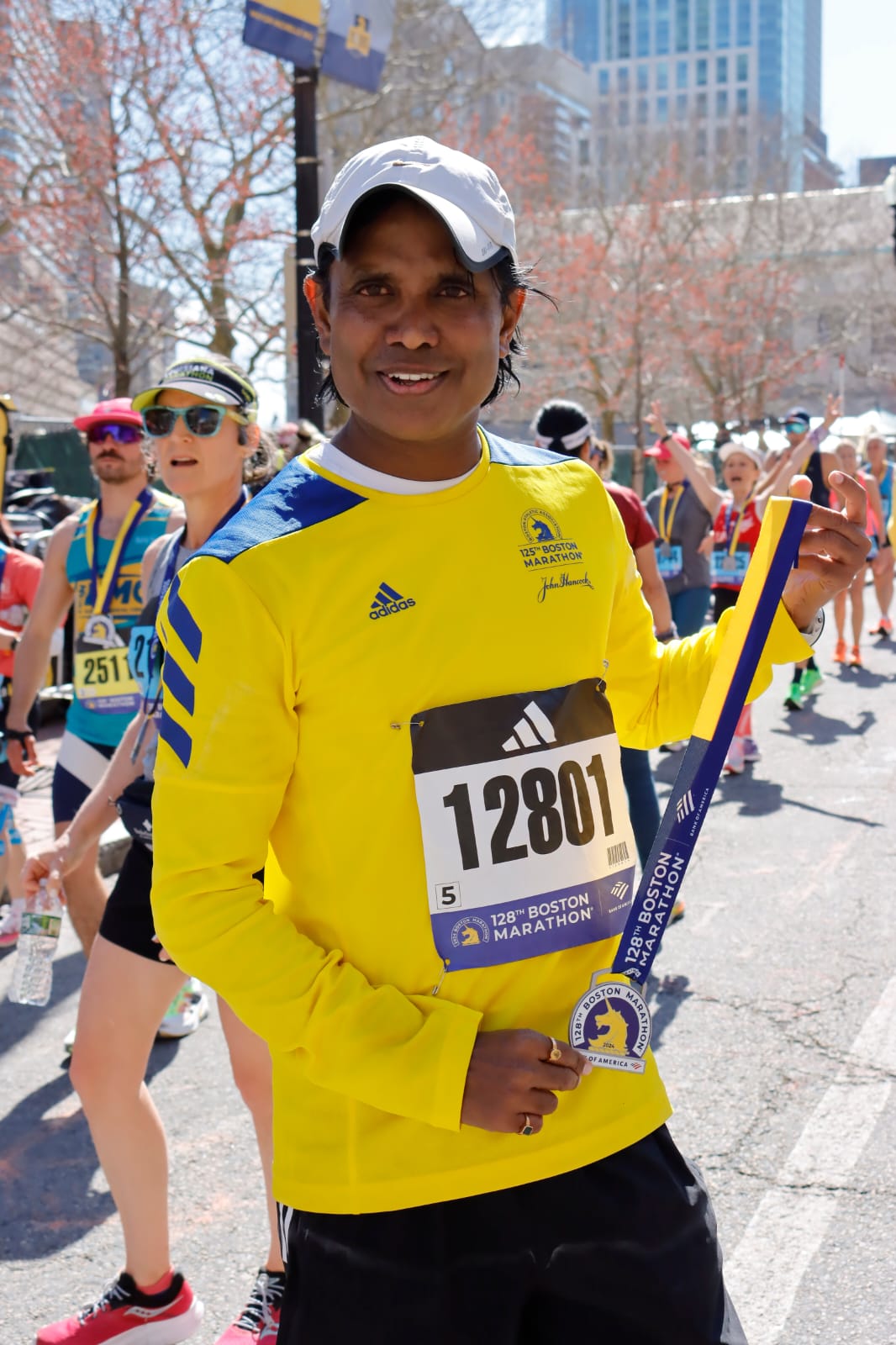
Mumbai-based Uday Bobhate has been running for over 40 years, having started in 1984. “ Those days, I would run a distance of 3 km, 5km or 7 km, mainly for fitness,” he said.
In 2004, the year when Mumbai Marathon made its debut, Uday had registered but could not run because of injury. “ In 2005, I straight away went for the full marathon,’’ he said.
The 2024 edition of Boston Marathon was Uday’s first World Marathon Major. His training was not up to the mark as he suffered an injury during a fall in a race in the run up to Boston Marathon. “ I lost 8-10 days of practice because of this fall,’’ he said.
Uday left for the US two weeks before the marathon, which was on April 15, 2024. “ My sister lives in Westborough, very close to Hopkinton, the start line of Boston Marathon,’’ he said. This gave him a chance to acclimatize to the weather conditions there.
“ I started the race very fast. Soon I realized I was lacking stamina. By the time I reached Heartbreak Hill I had to walk. My strategy was wrong, I should have started slowly,’’ he said. He finished the run in 3:20:39. His personal best is 3:14:56, which he set during the 2024 edition of Vadodara Marathon.
Krishna Sirothia (photo: courtesy Krishna)
Krishna Sirothia, a Pune-based recreational runner, got to know of Boston Marathon sometime in 2016. He had started running in 2013.
“ In 2018, my goal was to qualify for Boston Marathon. I qualified in 2021. But the absence of a window for visa interviews for travel to the US made it difficult to travel for a couple of years,’’ he said. In 2019, he completed the Berlin Marathon. The following couple of years were lost to the COVID-19 pandemic when races around the world were either postponed or cancelled.
His training for Boston Marathon was well planned, according to him. He opted for six days of running, combining easy runs, interval training, long runs and recovery runs. But mid-way through his training, an injury in his tendon prompted him to go for some physiotherapy sessions and also change his schedule. Krishna has been running full marathons since 2015 when he did the Standard Chartered Mumbai Marathon.
On race day, he had a good run for 21-22 kilometers. Following that, his injury started to act up and he felt the pain. “ I had to slow down,” he said. Krishna finished the race in 3:40:52, against his target of 3:10. His personal best in the full marathon is 3:02:46 achieved at the New Delhi Marathon, 2021.
“ I am not in a hurry to do World Marathon Majors. I want to do them with proper training,’’ Krishna said. He plans to resume running sometime in mid-May as he wants to give time for recovery from the injury.
Sunmbul Rahman (photo: courtesy Sunmbul)
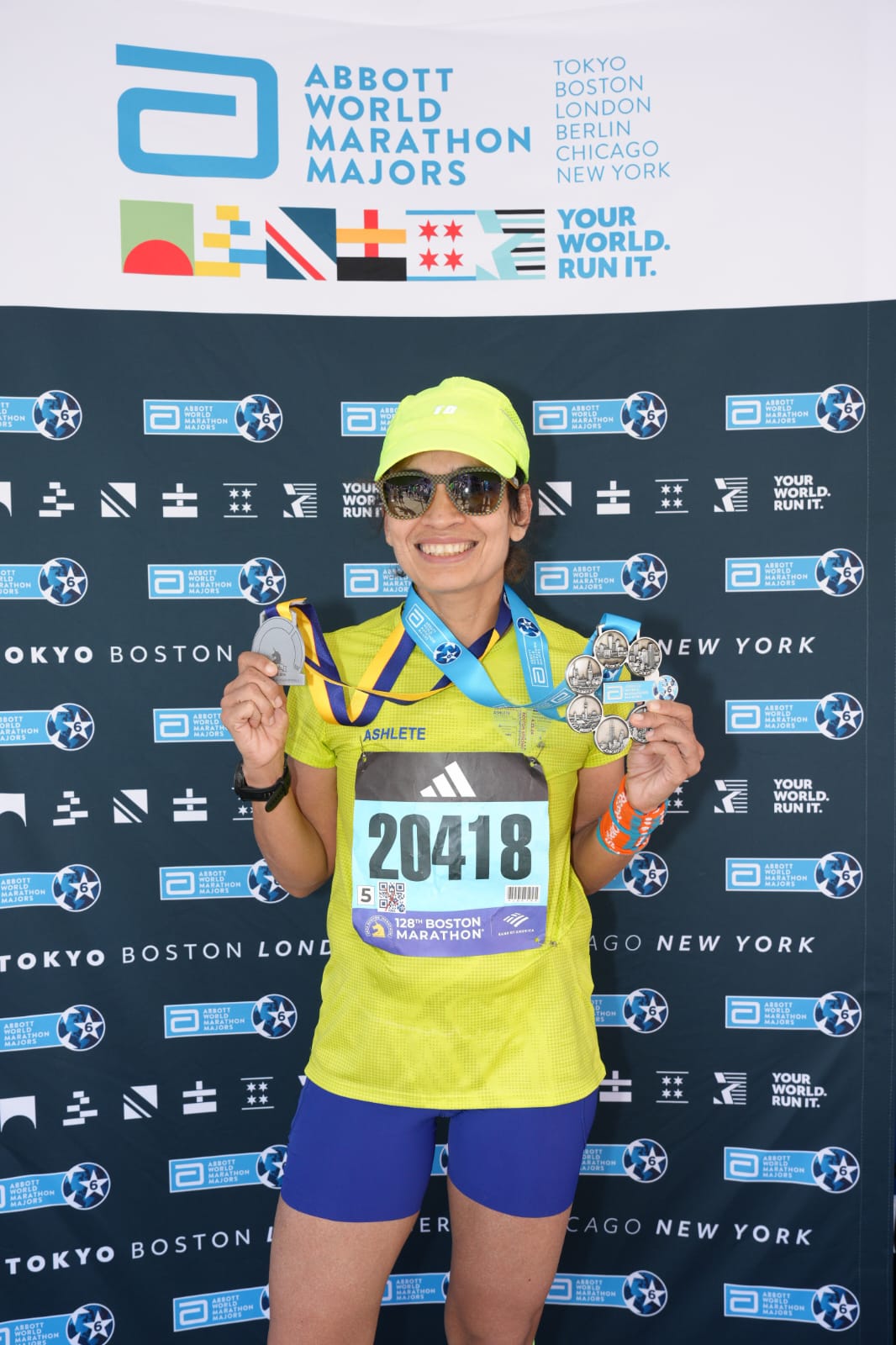
On March 3, 2024, Sunmbul Rahman ran the Tokyo Marathon. She had six weeks between Tokyo Marathon and Boston Marathon. The intervening period also coincided with the Ramzan month of fasting.
“ It was quite a challenge training under fasting conditions,’’ she said.
Her coach, Ashok Nath, tweaked the training program to suit her fast. That included running on a treadmill with an incline.
“ The first half of the Boston Marathon course is downhill and the second half is hilly terrain. We have to approach the run very mindfully,’’ Sunmbul said.
“ My run started at 11 AM. It was quite warm with no shade along the route. Many runners were in bad shade because of the heat. At Newton Hill, I felt strong. But I had to take many water breaks,” she said adding that her timing suffered during the second half of her race. Sunmbul finished her run in 3:44:03. With this she has completed her six World Marathon Majors.
Kolkata-based Sunmbul started her World Marathon Major journey with the 2022 edition of the Chicago Marathon. In about one and a half years, she has completed her mission.
Following the 2024 Boston Marathon, Sunmbul headed to Yosemite National Park for solo hiking. Walking and hiking can be a very good way to recover from the fatigue of road running, she said. She now plans to focus on hiking and climbing, and getting more fit.
Dixon Scaria (photo: courtesy Dixon)
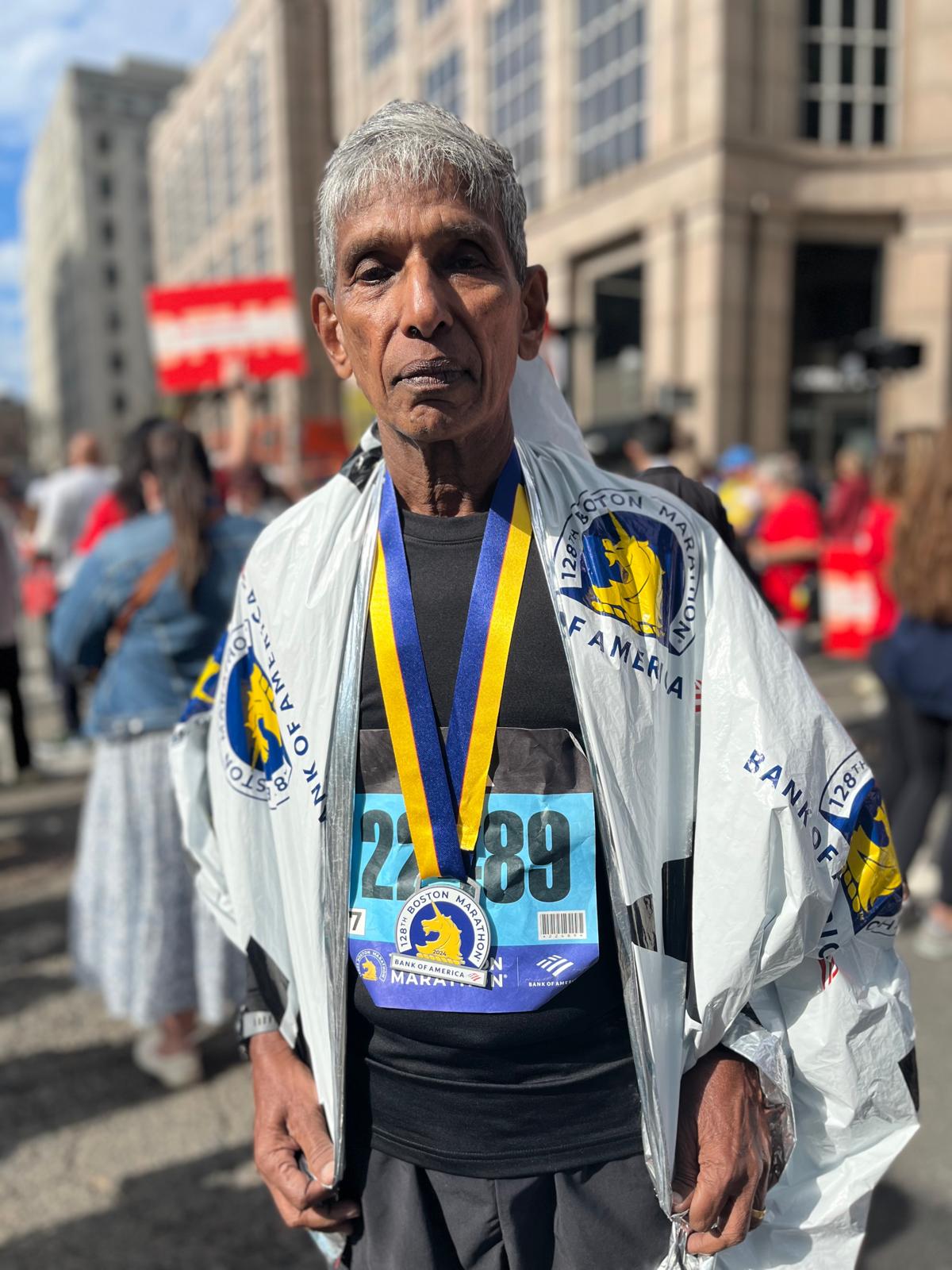
Dixon Scaria, the 71-year-old runner from Changanasseri, Kerala, was quite happy with his training for the Boston Marathon.
He follows a strictly formulated training plan that includes six days of running and one day rest. “ I do one day long run, one day interval training, one day tempo run and three days of recovery run. I follow this plan all year around,” he said.
While most Indian runners found the Boston weather warm, Dixon found it quite cold. “ Also, the route was quite hilly. I had a finish target of 3:45 but could not meet it,’’ he said. He finished the race in 4:25:35. Boston Marathon was his first World Marathon Major.
Dixon has been running for several years. At Tata Mumbai Marathon 2024, he secured an age category (70-74) podium win with this 3:49 finish.
He will be running some of the key marathon races later this year including the Hyderabad Marathon, Tata Steel Kolkata 25 km and Delhi Half Marathon.
R. K. Murthy (photo: courtesy Murthy)
Two marathons in less than a week. R.K. Murthy ran the Boston Marathon as well as the London Marathon, held just five days apart from each other.
Murthy’s training was well planned but in retrospect, he felt he was less prepared for the Boston Marathon. “ Boston requires proper training as the second half is completely rolling hills,” he said.
At Boston, the weather was a dampener. “ It was very warm. During the second half of the race, I got severe cramps and had to resort to walking. It was a real struggle,’’ he said. Murthy finished in 4:21:03, a relatively slow finish compared to his personal record of 3:12:04.
However, the London Marathon proved to be a much better race for Murthy. He finished the marathon in 3:26:34. “ London was quite cold. And there is an ocean of people all around you,’’ he said.
Qualifying for and completing the Boston Marathon offers a satisfying feeling, according to Murthy. Having done both Boston Marathon and London Marathon within a week, Murthy is of the opinion that such a feat should be avoided.
Subhojit Roy (photo: courtesy Subhojit)
Subhojit Roy had tried getting a berth for the London Marathon six times via the ballot route but never made it. Eventually, he decided to go through the tour operator route to experience the London Marathon.
His training for London Marathon was well charted out and executed fairly diligently. But a month before the race, Subhojit’s father fell ill and passed away after a few days. That was a setback and his training had to be stopped. “ I wasn’t even sure I wanted to go and do the race. I eventually decided to go,’’ he said.
At London, the cold weather conditions made things tough. Subhojit did not hydrate well fearing that he may lose time at the mobile toilet stops. “ My plan was to run under 3:05. I was on track for this target until the 32-33 km but could not maintain the momentum after that,’’ he said. He finished the run in 3:13:47.
“ I was ready to do well and am therefore disappointed with my timing. I had a better performance timing wise at New York City Marathon,’’ Subhojit said. At the 2023 edition of NYC Marathon, he had finished in 3:12:31.
Subhojit is yet to do Tokyo Marathon to complete the World Marathon Major six-star circuit.
Vandana Arora (photo: courtesy Vandana)
Vandana Arora, Bengaluru-based recreational runner, completed her six-star World Marathon Major (WMM) journey at the 2024 edition of the London Marathon.
Earlier this year, she did the Tokyo Marathon. Her WMM journey commenced in 2018 at the New York City Marathon.
Last year after Chicago Marathon, she came down with a hamstring injury. This impacted her training for the Tokyo Marathon as well as for the London Marathon. Ashok Nath, her coach, had already charted out a training program with the injury in mind.
“ I wasn’t pushing too hard. I had reduced my mileage during training,’’ she said.
At London Marathon, Vandana took a shot at improving her personal record. “ Weather was perfect but the course was gently rolling. I did the first half of the distance in 1:37 but during the second half, the injury started creeping up,” she said. Vandana finished in 3:22, a little over a minute over her personal best (PB) of 3:20:54, which she had set at the 2023 Boston Marathon.
“ I was able to get close to my PB because of my coach. Only he could make an injured athlete race close to her potential and fulfil her dreams,” Vandana said.
Tamali Basu (photo: courtesy Tamali)
Tamali Basu, originally from Kolkata, now in Mumbai, began her fitness journey in 2013 when she enrolled at a gym. “ There is an obesity problem in my family. I was also gaining weight. At home, there was no concept of exercise,’’ she said.
At the gym she heard about somebody starting a running club and also about a 5 km run.
“ In 2019, I enrolled for a 21 km in Salt Lake. I struggled to finish within three hours. I spoke to a runner about my inability to improve my speed in running. He asked me to do blood works to check by hemoglobin levels. My test showed that I was deficient in iron. After I started iron supplements, within a month I could see a difference in my speed,’’ Tamali said.
Soon thereafter the world entered a lockdown due to the COVID-19 pandemic. Tamali started ramping up her mileage during this period doing around 120-130 km on a weekly basis. The long mileages did help her improve her timing but also resulted in injury. In March 2021, Tamali ran the Kolkata Marathon and finished overall second among women with a timing of 4:01:51, against her normal finish of 5:15.
Subsequently, she decided to look for a coach to train under. Initially, she trained under Amit Yadav. While under his training, she ran Comrades Marathon, an ultramarathon that takes place in South Africa. She did this consecutively for two years.
Later, she joined Bengaluru-based Ashok Nath for training.
London Marathon was her first World Marathon Major. “ I trained as per Ash’s (Ashok Nath) plan. But I could not meet his target of a 3:45 finish,’’ she said. She finished in 3:48:14.
“ At London, I found the cheering very good. There were spectators all along the route. But the hydration support could have been better,’’ she said.
She has enrolled for the Berlin Marathon, which is due to be held on September 29, 2024.
Atul Godbole (photo: courtesy Atul)
After Tokyo Marathon this year, Atul Godbole ran the Boston Marathon as well as the London Marathon.
“ There was very little time between Tokyo Marathon and Boston Marathon. During this period, my focus was mainly to maintain the fitness levels I had attained during the training for Tokyo Marathon,’’ he said.
Atul’s plan was to race Boston Marathon and run London Marathon at an easy pace. “ But Boston did not go as per my plan. I had set a target of 3:20 but I could not meet it. The weather was quite warm and not conducive to racing. I lost it both mentally and physically,’’ he said. He finished Boston Marathon in 4:09:54.
“ It is a privilege to run the Boston Marathon. It is a goosebump moment when you cross the finish line,’’ Atul said.
Six days later Atul ran the London Marathon. “ The vibe at London Marathon is very good. There is loud cheering all through the course. The course does have some rolling hills and the roads are sometimes narrow,’’ he said of London Marathon. Weather, according to him, was perfect for racing.
He finished London Marathon in 3:34:39. He has two more World Marathon Majors to finish – Berlin Marathon and New York City Marathon.
In under a month Atul will be heading to South Africa to run the Comrades Marathon. “ I won’t be doing any intense training for Comrades. I am hoping for an easy finish,’’ he said.
(The author, Latha Venkatraman, is an independent journalist based in Mumbai)
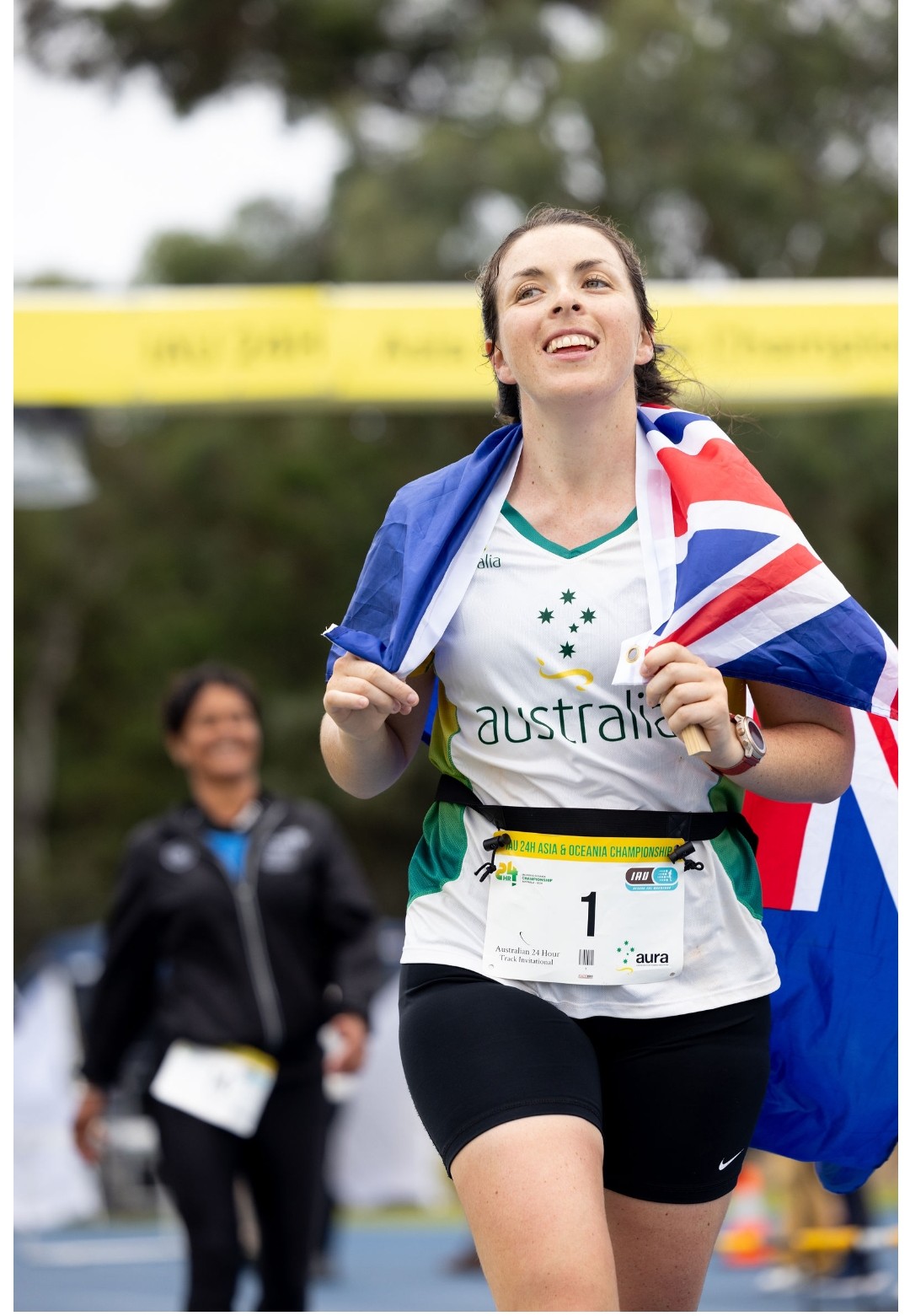
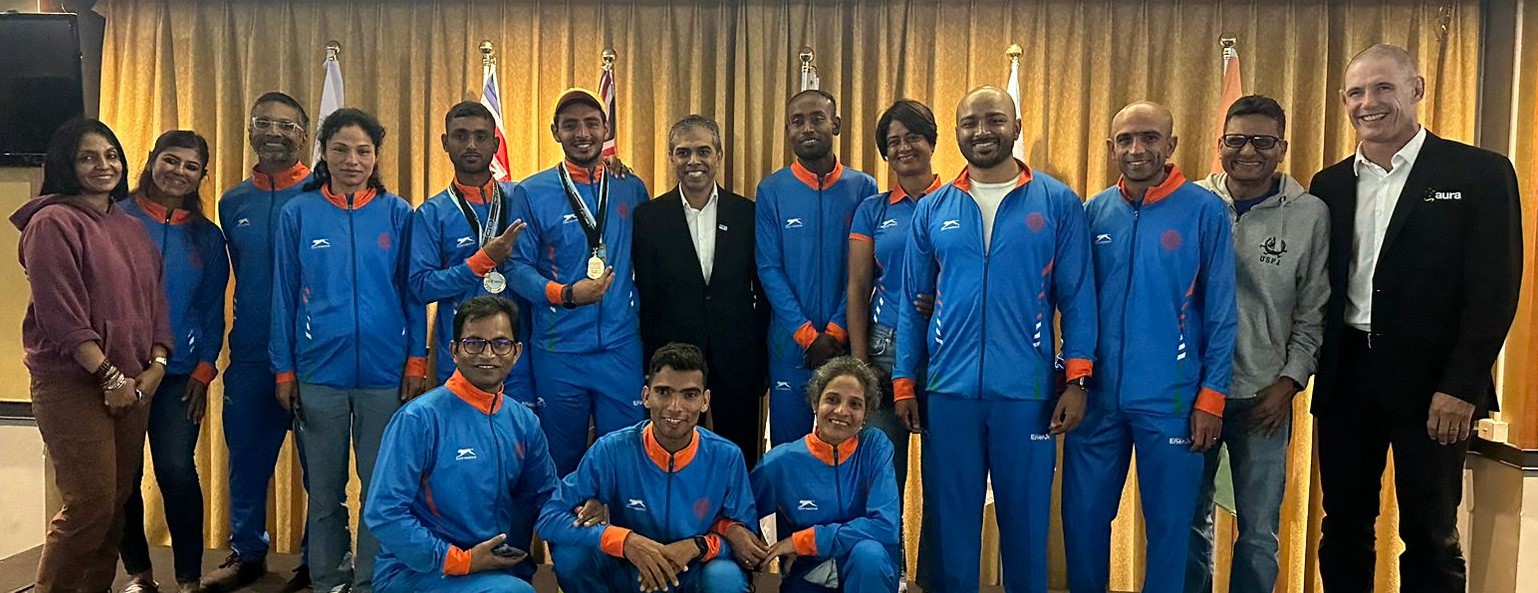
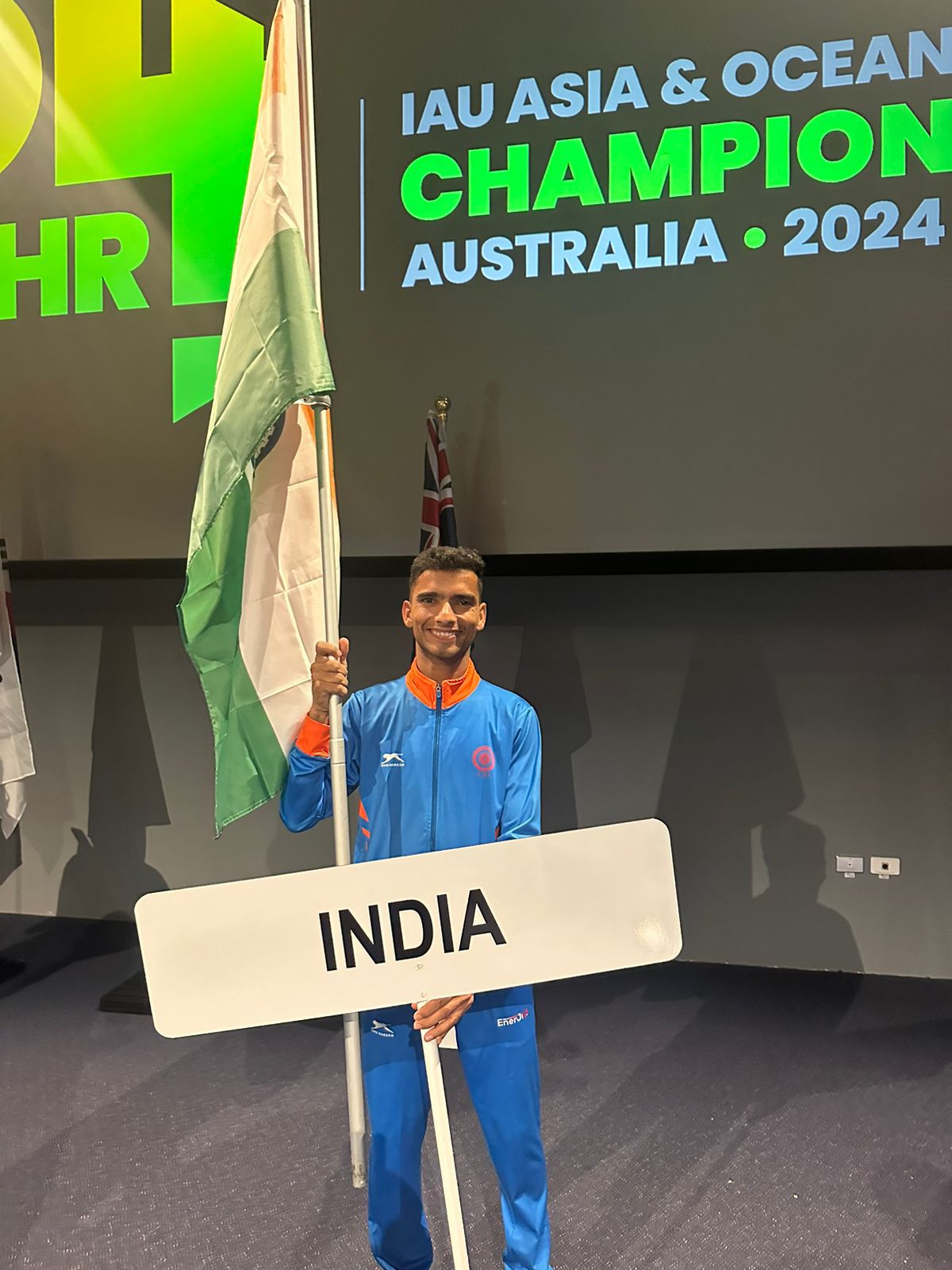
Members of the Indian team with Nadeem Khan, president IAU (centre).
Amar Singh Devanda sets new national record
Four Indian men in top ten
Indian ultrarunners stole the limelight at the Canberra (Australia) IAU 24-hour Asia & Oceania Championship held over April 6 and 7, 2024.
The India’s men’s team put up a sterling performance with a combined mileage of 758.248 kilometres for the three leading Indian runners at the event.
This is the second consecutive team gold for India in IAU 24 Hour Asia & Oceania Championship. The Indian men’s team had won the gold and swept the individual men’s podium positions at the 2022 Championships held in Bengaluru.
Amar Singh Devanda, already a national record holder for the 24-hour category, bettered his performance substantially in Canberra. During the allotted 24-hour period, Amar ran a distance of 272.537, breaking his own national record of 257.62 km set at the IAU 24-hour Asia & Oceania Championship held at Bengaluru in July 2022. He had also won an individual gold medal at that event.
In the men’s team performance, Australia earned the silver with a combined mileage of 719.560 km and New Zealand bronze with a mileage of 636.679 km.
In the individual race for men, finishing behind Amar was Phil Gore of Australia with a mileage of 265.653 km. In third position was India’s Ullas Narayana with a mileage of 245.574 km.
Amar Singh Devanda
In the women’s team category, home team Australia outshone other teams to win the gold medal with a combined mileage of 666.580 km for its top three athletes. New Zealand women finished second with a mileage of 568.401 km and Chinese Taipei took third position with a mileage of 551.686 km.
In the women’s individual performance, it was an Australian sweep. Australia’s Cassie Cohen won honours with her mileage of 227.803 km. She was followed by Maree Connor (221.347 km) and Jennifer White (217.430 km).
Runners were required to run on a 400-metre synthetic track inside AIS stadium, Canberra.
According to Amar, weather did pose some worries initially. “ Our race started in rain and we had to wear raincoats for the initial period. We were tense about the rain situation. But rains eased after about four hours,” Amar told this blog.
Amar ran continuously for 17 hours without taking a break. “ This time the race went off quite well. I did not face any major issues. Nutrition and hydration went off well, though I did feel quite sleepy after 18 hours of running,” he said.
This time around he had trained differently, stepping up mileage considerably. In the last three months ahead of the race, his training mileage topped 2,700 km. “ I did a lot of long night runs and also 12 hour runs. This time, I did time-based training instead of mileage based,” Amar said.
Following the IAU 24 Hour World Championships held at Taipei in December 2023, the team met to discuss some of the weak areas in running this format of ultrarunning, according to Santhosh Padmanabhan, Indian team manager.
“ As a team manager I got involved with their training closely and observed where they needed to change and what they needed to do differently. We worked on longer runs for more mileage and also night runs to deal with the fatigue,” he said.
The training approach was scientific.
“ As we progress, more runners will understand that training for an ultrarunning event is not the same as training for marathon distances,” Santhosh said.
For Cassie Cohen, the Australian ultrarunner who won the women’s race at Canberra, the race went off better than her expectations.
“ I was hoping to make the podium, but to come first was a dream come true,” she said in response to this blog’s queries.
“ My personal best coming into the race was 214 km. I was hoping to run somewhere between 225 and 230 km. Very happy to get to 227.8 km,” she said.
Cassie Cohen
Her training helped her, she said. “I was doing pretty high volume, nine consecutive weeks of runs in excess of 100 km. I was also running to work and doing more strength workout including Pilates and gym work which seem to have helped,” she said.
Cassie, a resident of Canberra, had the home advantage. Also, ahead of the December 2023 World Championships held in Taiwan, she lived in Tonga. “ Tonga is much hotter and more humid. Also, training was not allowed on Sunday (as per Tongan law exercises are not allowed on Sunday). At the Bengaluru IAU meet, Cassie had finished with a silver medal covering a distance of 214.990 km during the stipulated 24 hours.
Four Indian male runners were in the top ten. Saurav Ranjan (240.137 km) finished fourth, Badal Teotia (220.80 km) finished ninth and Velu P (211.611 km) finished in 11th position.
Shashi Mehta had the highest mileage among the Indian women runners. She covered a distance of 190.772 km, finishing in eighth position. Meenal Kotak finished in 13th position and Preeti Lala in 14th position, both doing a mileage of 168.291 km.
Leading six male runners
Amar Singh Devanda (IND) – 272.537 km
Phil Gore (AUS) – 265.653 km
Ullas Narayana (IND) – 245.574 km
Saurav Ranjan (IND) – 240.137 km
Luke Thompson (AUS) – 231.753 km
John Bayne (NZL) – 229.447 km
Leading six women runners
Cassie Cohen (AUS) – 227.803 km
Maree Connor (AUS) – 221.347 km
Jennifer White (AUS) – 217.430 km
Shannon Leigh-Litt (NZL) – 213.609 km
Carol Robertson (NZL) – 209.642 km
Allicia Heron (AUS) – 203.531 km
(The author, Latha Venkatraman, is an independent journalist based in Mumbai)
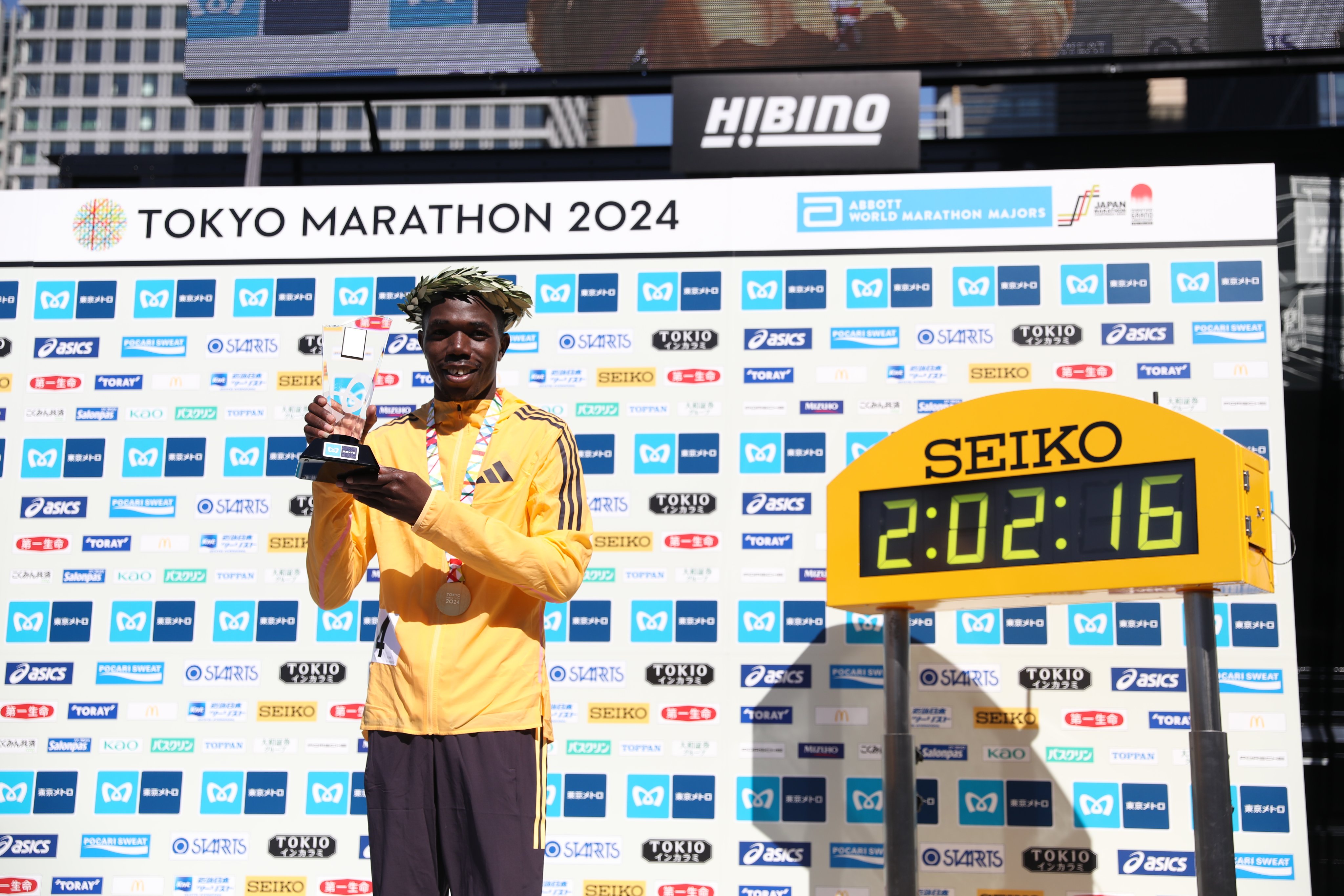
Benson Kipruto (this photo was downloaded from the X page of Tokyo Marathon Foundation and is being used here for representation purpose. No copyright violation intended.
The 2024 edition of the Tokyo Marathon saw course records for men as well as women, broken.
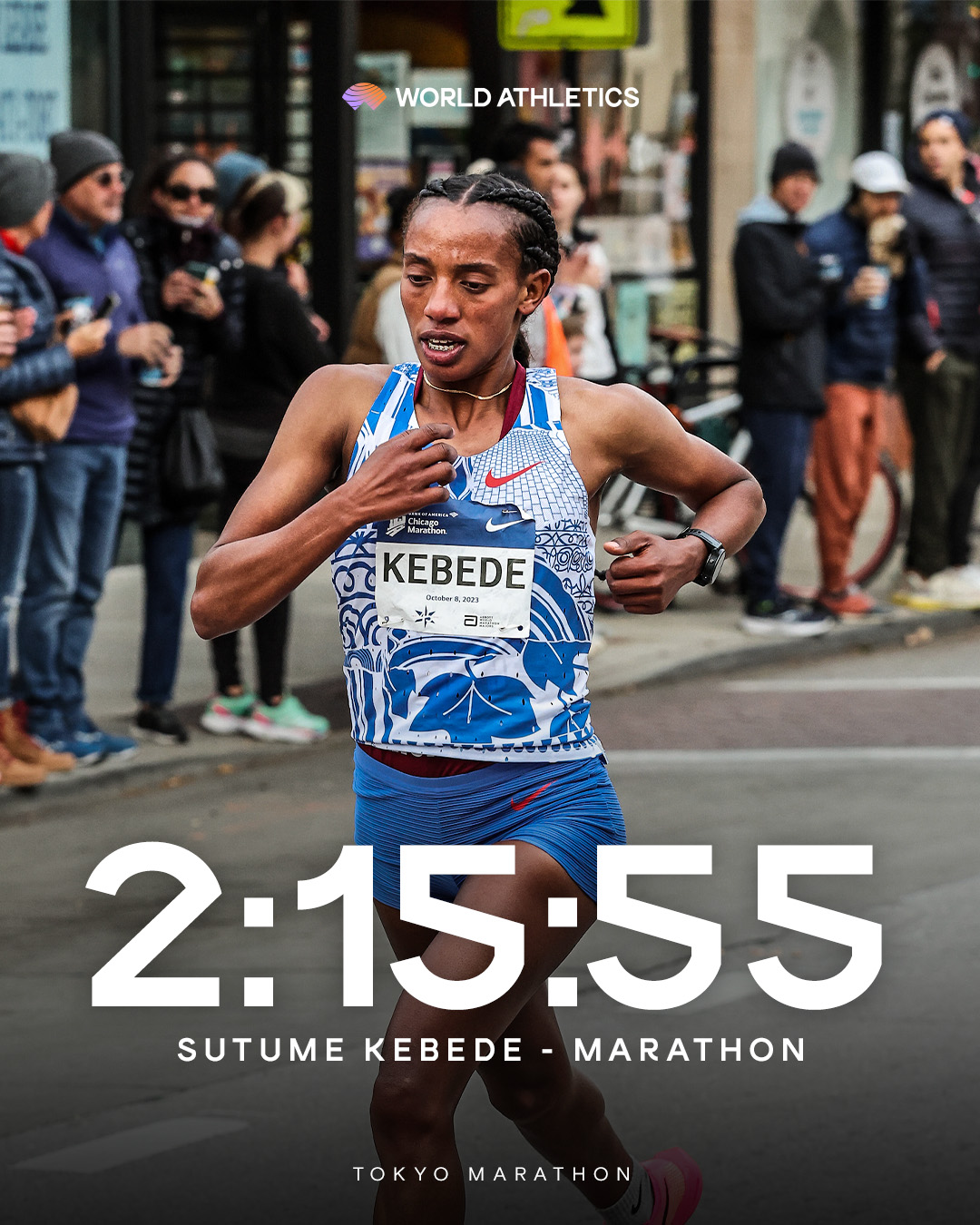
Kenya’s Benson Kipruto won the 2024 edition of the race in two hours, two minutes and 16 seconds breaking the course record set by legendary Kenyan runner Eliud Kipchoge in 2022. The women’s race was won by Ethiopia’s Sutume Asefa Kebede with a timing of 2:15:55, also a course record. She beat the defending champion, Rosemary Wanjiru.
Reports said Kipruto surged ahead of compatriot Timothy Kiplagat during the last few kilometres to finish 39 seconds ahead of him (2:02:55). This victory makes him the fifth-fastest marathon runner of all times in events approved by World Athletics, according to a Reuters report.
Sutume Kebede (this photo was downloaded from the X page of World Athletics and is being used here for representation purpose.
Former world champion Kipchoge finished 10th with a timing of 2:06:50.
In the men’s race, Vincent Kipkemoi Ngetich also of Kenya, finished third with a timing of 2:04:18. In the women’s race, Wanjiru finished second in 2:16:14. In third position was Ethiopia’s Amane Beriso Shankule (2:16:58).
The World Marathon Major race was held on March 3, 2024.
We spoke to a few Indian runners who participated in this year’s Tokyo Marathon. Most agreed on one aspect – Tokyo Marathon is one of the best organised races in terms of hydration support and disposal of waste. Here’s what they had to say:
Over the last one year, Vijayaraghavan Venugopal, a sub-three-hour marathon runner, tweaked his training plan bringing in more mileage to his runs and adding mandatory sessions of strength workout and conditioning. Coming off an injury, Vijayaraghavan felt the need to focus on strength training and conditioning as well as recovery. He had registered for the 2023 edition of Tokyo Marathon but had to defer it by a year due to his injury.
He now trains with Canada’s Malindi Elmore, an Olympian middle-distance runner, triathlete and a marathon runner. “ She is a 2:23 marathoner. She brings in fresh perspective,” Vijayaraghavan said.
Chief Executive Officer of Fast & Up, a sports nutrition brand, Vijayaraghavan’s previous marathon training was largely focussed on low mileage. “ My weekly mileage would be around 60 km a week maximum. But over the last one year, I have stepped up my mileage. For four to five weeks during my Tokyo Marathon training, my weekly mileage topped over 100 km,’’ he said.
Vijayaraghavan believes in travelling early for overseas marathon races. “ I landed in Tokyo on Tuesday evening (four days ahead of race day). This helped me to adjust my sleep and get used to the weather conditions,’’ he said. For the next two to three days, he did some easy runs to get a feel of what kind of running attire he would require.
Tokyo Marathon is an extremely process oriented running event. Water bottles are not allowed once runners enter the holding area, he said. “ I entered the gate at 7:45 and my race started at 9:10. The first 3-4 km is extremely crowded. After a while as runners begin to disperse, the race becomes easy,’’ he said. Tokyo’s marathon route is unique in the sense that it has three U-turns. The aid stations are well laid out. The race organisers offer Procari Sweat, an electrolyte drink, manufactured by a Japanese company.
When he started the race, the temperature was around 7 degrees Celsius. By the end of the race, it had edged up to about 12 degrees. For an outsider, seeing a large number of Japanese runners on the course is unique to Tokyo Marathon. Japanese runners are among the fastest marathoners.
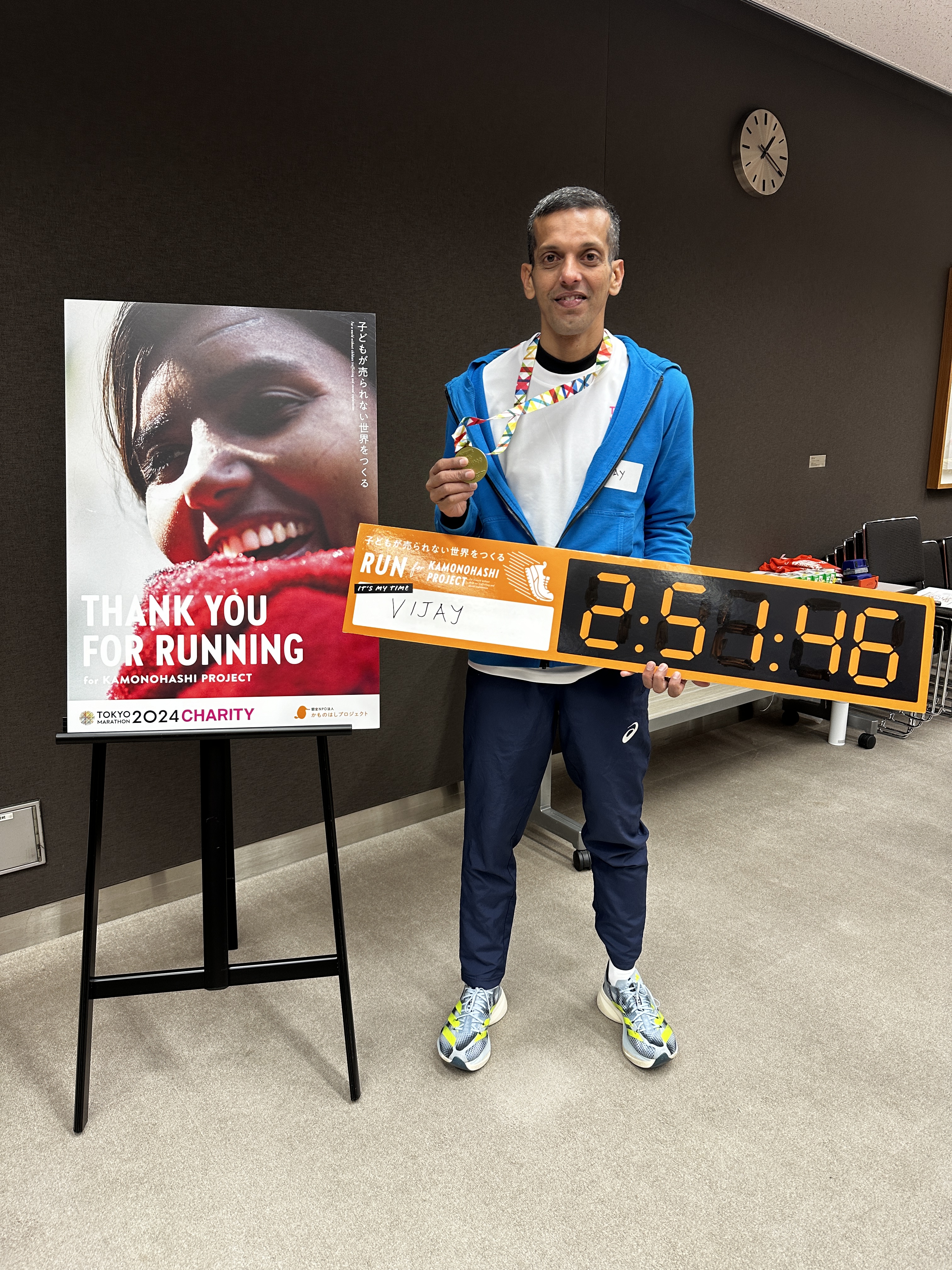
Vijayaraghavan finished the Tokyo Marathon with a personal record of 2:51:46, a three-minute improvement from his previous record of 2:54:56, achieved at the 2019 New Delhi Marathon. He believes his 20-day trip to Kenya last year helped him refashion his thinking towards running. “ Prior to Kenya, I had never run on dirt roads,” he said.
Running in Tokyo was an amazing experience, he said. Vijayaraghavan started his World Marathon Major pursuit in 2016 when he ran the Berlin Marathon. His recovery post Tokyo Marathon has been good. “My carbon-plated shoes also helped in recovery,” he said.
Deepa Nayak (photo: courtesy Deepa)
For Bengaluru-based coach and runner, Deepa Nayak, the current marathon season has been a long one with three major races – Adani Ahmedabad Marathon, Tata Mumbai Marathon and Tokyo Marathon – in quick succession.
“ My training plan went off quite well, taking care that I do not overtrain. I did a 50-55 kilometer-weekly mileage with focus on strength training and some key runs,” Deepa said. Overall, she felt mentally and physically strong. However, a week before the Tokyo Marathon, she experienced a sharp knee ache during one of her short runs. “ I had to stop my run and massage my knee. The ache recurred during the next run. I wasn’t sure if it was an injury or tightness but there was nothing I could do as I was all set to leave for Tokyo,” she said. At Tokyo, she again did a short run. This time around she did not feel the pain.
“ The Tokyo Marathon course is largely flat with very good support but it is all about the city, not a scenic route,” she said. Deepa had a target of completing the race in 3:15 but she was a tad ahead of her target. She found that the race’s official kilometer-markings and her GPS device did not match. “ I followed my GPS device up until 40th kilometer and then followed the race markings. She finished the race in 3:13:10, a new personal record.
A little over a month earlier, Deepa had run Tata Mumbai Marathon finishing in 3:20:31, securing a fourth position among women in the open category and a win in her age category of 30-34 years. “ My Tokyo finish timing helped me qualify for the New York City Marathon,” she said. Tokyo Marathon was her fourth World Marathon Major. She is set to participate in the Chicago and New York City marathons but is yet to decide which of these she should opt for, this year.
A break is due after what has been a prolonged marathon training season. “ I have signed up for TCS 10 k but have decided to do it without any time target,” she said.
Atul Godbole (photo: courtesy Atul)
A runner for many years, Atul Godbole commenced his role as a coach ten years ago. A well-known coach based in Pune, Atul took to running way back in 2005, a year after the Mumbai Marathon started. Atul had an active life throughout his childhood. But along the way with studies taking up much of his time, time for physical activity dwindled and Atul found himself slightly heavy and out of shape. “ This got me into running, mainly to get fit again and lose some weight,” he said. More recently, Atul has been focussing on 10 kilometre-running events and ending up with podium finishes in them. At the Tata Mumbai Marathon too, Atul chose to do the shorter half marathon.
“ As part of training for the Tokyo Marathon, I did a few long runs at easy pace,” he said. “ On race day, all stars aligned. The oncourse hydration was excellent. I had a few gels. I finished the run in 3:18:08, surpassing my own expectation,” Atul said. Though not his personal best, he was happy with his performance as his last couple of marathon outings had been disappointing.
“ My recovery has been quite good. I now plan to slowly build up training for the Boston Marathon, due next month,” he said. This is his third time at Boston. Tokyo Marathon was Atul’s third World Marathon Major, the other being the Chicago Marathon.
Ashish Puntambekar (photo: courtesy Ashish)
The 2024 edition of Tokyo Marathon was Ashish Puntambekar’s fourth World Marathon Major. He had done his first WMM in 2018 when he ran the Berlin Marathon.
During the three-month training plan, Ashish was able to do two 32 km-runs and two 28 km-runs. “ My training plan was absolutely perfect. I did long runs interspersed with tempo and speed workouts,” the Pune-based runner said.
Race day, according to him, was amazing. “ Initially, it was cold for at least about 15 to 20 kilometres. After that temperature started to edge up and by the time we ended, it was around 11-12 degrees Celsius. I had five gels and around four salt tablets. Route support was great,” Ashish said. The first 10 kilometres of Tokyo Marathon’s course is a gentle decline. This is followed by a flat stretch of 20 kilometres. The last 10 kilometres is slightly undulating.
His coach Kaustubh Radkar had devised a plan to complete the marathon in 3:25. He finished the race in 3:23:25, the second-best performance of his running career, the best being a 3:17 finish at Boston Marathon in 2020.
He chose to focus on recovery in the first two weeks after Tokyo Marathon, following which he commenced training for the London Marathon, slated for April 2024.
Vandana Arora (photo: courtesy Vandana)
The 2024 edition of Tokyo Marathon was Vandana Arora’s fifth World Marathon Major, the first one being New York City Marathon in 2018.
As the world paused for COVID-19 pandemic, running events went off the radar. Vandana was able to pursue her WMM journey again in 2022 when she ran the Berlin Marathon. In 2023, she did the Boston Marathon, where she got her personal best of 3:20:54, and the Chicago Marathon where she came very close to her record with a timing of 3:21.
“ After Chicago Marathon I was all set to focus on training for Tokyo Marathon. But I ended up with a hamstring injury and my coach Ash (Ashok Nath) had to change my training plan,” she said. She has been training under Ashok Nath for the last two years.
Two weeks before Tokyo Marathon, Vandana ran the Chandigarh Fast Marathon and secured a podium finish (second position overall among women). It boosted her confidence for Tokyo. “ At Tokyo, the race was perfect, a very well-organised running event, different from the other World Marathon Majors,” she said. She finished the race in 3:29:16. “ I was happy with my finish timing,” she said.
Having recovered from the race, Vandana has already commenced her training for the London Marathon. She may opt later to do the Comrades Marathon, an ultramarathon held annually in South Africa.
Sunmbul Rahman (photo: courtesy Sunmbul)
Kolkata-based Sunmbul Rahman commenced her World Marathon Majors pursuit in 2022 when she ran the Chicago Marathon in October of that year.
Tokyo Marathon was her fifth WMM event. Completing the six World Marathon Majors – Berlin Marathon, Boston Marathon, Chicago Marathon, London Marathon, New York City Marathon and Tokyo Marathon – helps runners earn a six-star medal.
Sunmbul commenced her training mid-December starting with building the base, endurance and then working on pace. She now trains under Bengaluru-based Ashok Nath. “ I signed up with Ash (as Ashok Nath is known) in June 2023. My marathon timing was hovering around 3:40-3:50. I wanted to go below this timing and I needed some guidance,” she said. Sunmbul was able to execute Ashok Nath’s training plan to a large extent. “ I had some niggling issues with my calf and shin. Ash reduced my pace training as well as mileage,” she said.
When she landed in Tokyo there were apprehensions about the weather and what attire to wear on race day. “ But on race day, weather was perfect. After some time, the sun came out and I like running in the sun. It lifted my mood,” she said. For the first six to seven kilometres, she was unable to get her desired pace because of the crowd of runners. “ The best part of the race for me was seeing Eliud Kipchoge (former marathon world record holder) running. The sheer beauty of his running takes your breath away,” she said. Sunmbul finished the race in 3:35:20, a new personal record.
Her recovery has been quite good. “ I travelled to Kyoto and there I walked a lot. Nothing like walking for recovery,” she said.
Deepti Karthik (photo: courtesy Deepti)
Deepti Karthik’s World Marathon Major pursuit commenced in 2019 and in that one year she did three of the WMM marathons. But a long pause ensued following that phase of marathon running due to the COVID-19 pandemic, which put a stop to running events world over.
In 2023, she did Boston Marathon and Berlin Marathon. With Tokyo Marathon, she completes the six-star World Marathon Major circuit.
“ My training was fine but I had an injury leading up to the marathon. I had doubts because of my injury. I did a few physiotherapy sessions before heading to Tokyo,” said. At Tokyo, the weather and the organisation were perfect. “ It was a fantastic course and the weather was ideal,” she said.
Tokyo Marathon organisers do not allow water bottles. The aid stations are very well laid out and water is served in tall cups so there is very little sloshing around if runners chose to run with these cups. Also, the electrolyte drink offered there was quite good, she said.
The organisers are very strict about littering. Volunteers all along the route collect trash including used gel tubes and other waste. “ Nobody was breaking the rules,” Deepti said. She finished her run in 4:14:20.
“ Now, my plan is to run shorter distances and try and improve my timing in these. Full marathon will take a backseat for a while,” she said.
(The author, Latha Venkatraman, is an independent journalist based in Mumbai)
A long-distance runner for the past several years, Mumbai-based Pervin Batliwala, is often a podium finisher in many of the races that she participates in.
Her list of successful completions includes the 88 to 90-kilometre-long Comrades Marathon, held in South Africa every year, the 72-km Khardung La Challenge in Ladakh and the six-star World Marathon Major circuit (Berlin Marathon, Boston Marathon, Chicago Marathon, London Marathon, New York City Marathon and Tokyo Marathon).
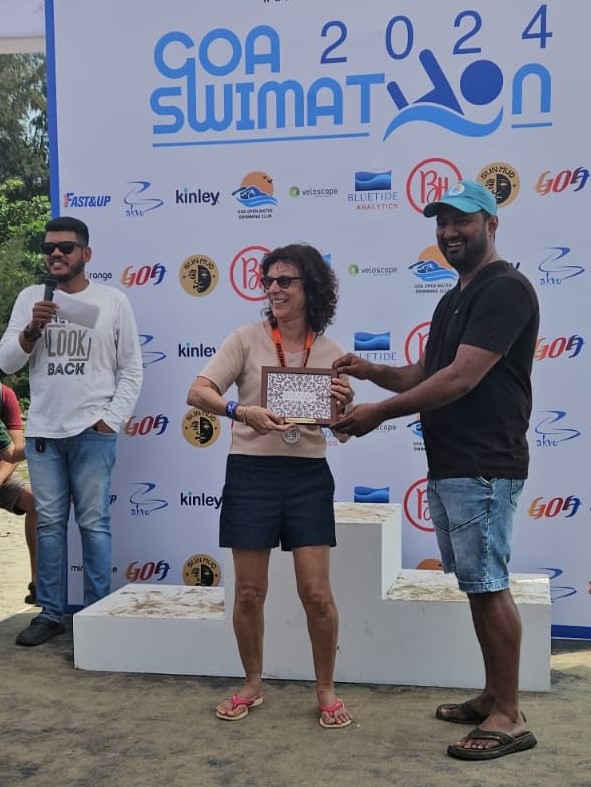
A few years ago, Pervin took up swimming also as a recreational sport. In 2019, she attempted her first race in open water. At that time, she had signed up for a two-kilometer swim at the Goa Swimathon, organized by Enduro Sports. She completed the swim but outside the assigned cut-off time. In February 2024, Pervin opted to do the one-kilometer swim and this time she finished with an age category podium. She writes about her experience at this event.
I started swimming during my college years. About five years ago, the interest acquired a more serious tone. That said, training for a swimming race was difficult in Mumbai as I am not a member of any of the pools.
I had to depend on friends to sign me up for a session or two at their respective pools. Most often it was my friend Zarir Baliwalla. An excellent swimmer, he would ask me to accompany him for training sessions at the Breach Candy pool of which he is a member. Besides such access to pools for training, the 2024 Goa Swimathon posed another challenge. Unlike in 2019, the gap between the Mumbai Marathon and the Swimathon was less; just two weeks. I therefore opted for the one-kilometer race. I was however confident that with minimum training I would be able to do this distance.
Pervin Batliwala; from the 2024 Goa Swimathon (photo: courtesy Pervin)
I like open water swimming and am quite comfortable with it. In 2019, a few days before the race, Zarir had taken us into the water at Goa to help us get acquainted with swimming in the sea. I enjoyed it thoroughly. This year, I landed in Goa a couple of days before the event. The race was at the Miramar beach where the Ironman triathlon race is also held. I had signed up for a 45-minute training camp to help me acclimatize to the event and the waters. I had not done any open water training for the 2024 race. But like I said, I am comfortable with the medium.
At Goa, I opted for basic swim wear and not the rash guard as most swimmers were wont to. I got bitten by a jelly fish; though nothing serious. Nevertheless, my race went off quite well. I enjoyed my time in the sea thoroughly. I finished the one-kilometer distance in 30 minutes,34 seconds, significantly better than my timing during my training sessions which used to range from 39 to 41 minutes. I finished with a second-place podium in my age category of 60 years and above. I was quite stoked by the time I took to finish. With minimum training I was able to pull of this timing. It prompts me to attempt the two-kilometer race again, next year. I want to train in freestyle swimming. Right now, I do the breaststroke. Freestyle swimming will help me further with timing efficiency.
(The author, Pervin Batliwala, is a retired corporate executive based in Mumbai)
File photo:Kelvin Kiptum, at the finish line of the 2023 Chicago Marathon (this photo was downloaded from the Facebook page of the event and is being used here for representation purpose. No copyright infringement intended)
Marathon world record holder and his coach were killed on the spot
As abruptly as his world record burst on to the planet’s marathon scene, Kelvin Kiptum is gone.
The world record holder in the men’s marathon and his Rwandese coach, Gervais Hakizimana, were killed in a road accident in Kenya on February 11, 2024, news reports said. The Kenyan athlete was driving the vehicle when he appears to have lost control. The two men were killed on the spot. A third passenger – a woman – was injured and rushed to hospital.
According to the Kenyan edition of The Nation, Kiptum was driving the Toyota Premio with Gervais and a lady identified as Sharon Kosgey aboard. They were headed to Eldoret. The accident happened at 11 PM, Sunday, in the Kaptagat area along the Elgeyo Marakwet-Ravine Road. The local police commander said that Kiptum lost control of the vehicle, veered off the road and hit a big tree before landing in a ditch 60 metres away. Sharon escaped with serious injuries.
Kiptum, 24, was the only person so far to run the marathon in a timing below two hours and one minute in a record-eligible race. He had achieved the feat at the 2023 Chicago Marathon, covering the 42.2 kilometre-distance in two hours and 35 seconds. The previous record of 2:01:09 was set by Kenya’s Eliud Kipchoge at the 2022 Berlin Marathon. In the process, he also improved the course record at Chicago by over three minutes. Kiptum’s world record was ratified by World Athletics just two days ago.
At the time the new global mark was set at the 2023 Chicago Marathon, it had been a bolt from the blue for most elite and amateur marathoners and followers of the sport, used as they were to the discipline’s domination by Kipchoge. Kiptum, who owns three of the seven fastest timings in the marathon, also held the record for the fastest ever marathon debut (2022 Valencia Marathon). News reports in the wake of his demise said that Kiptum had been hoping to become the first man to run the marathon in under two hours in race conditions at the upcoming Rotterdam Marathon.
Both Kiptum and Kipchoge had been named in Kenya’s provisional marathon team for the 2024 Paris Olympics. It would have been Kiptum’s debut at the Games. In its report, BBC quoted Sebastian Coe, president, World Athletics, saying that Kiptum was “ an incredible athlete leaving an incredible legacy, we will miss him dearly.”
Please find above the link to a video of Kelvin Kiptum setting his world record at the 2023 Chicago Marathon
(The author, Shyam G Menon, is a freelance journalist based in Mumbai)