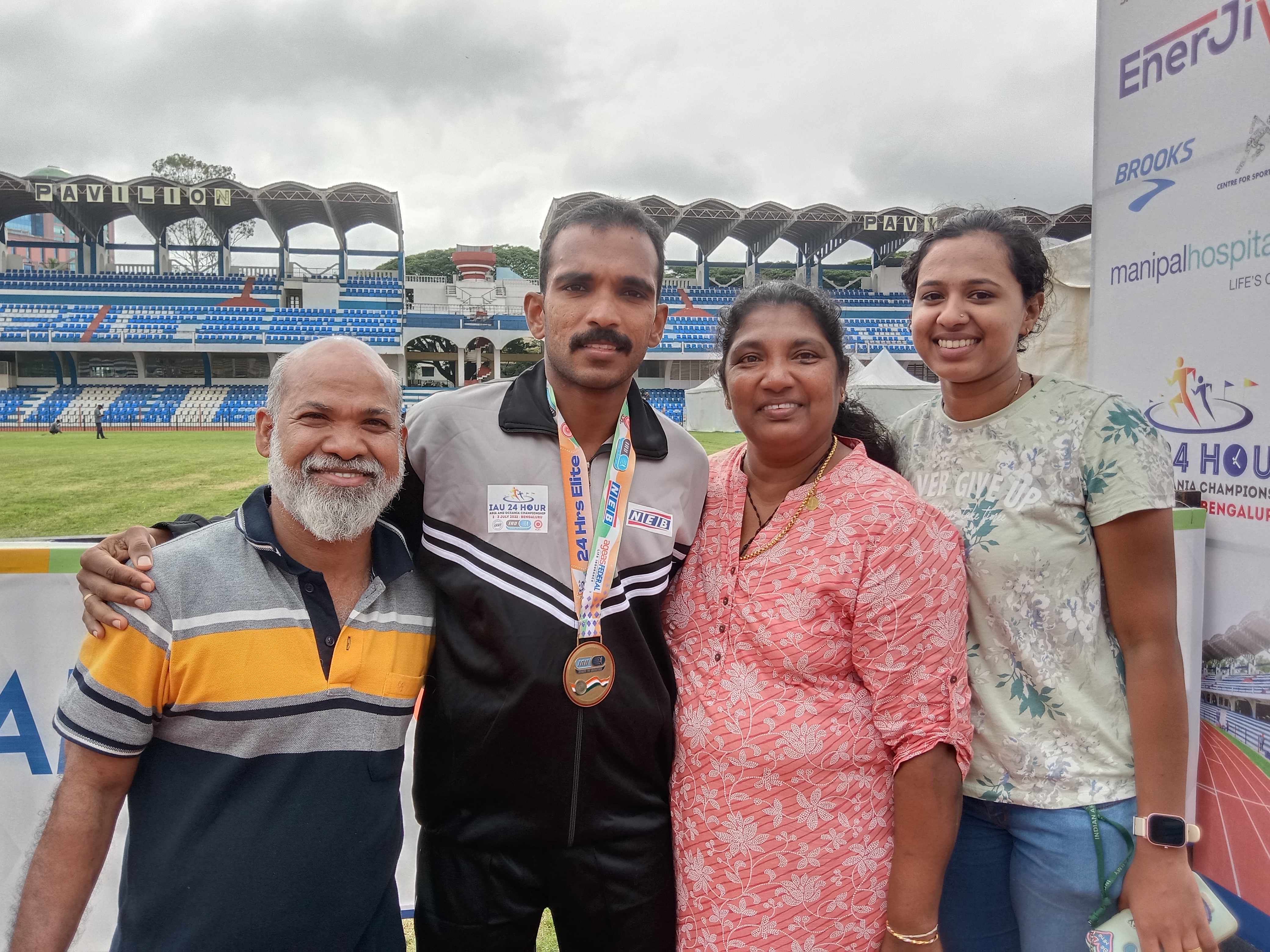
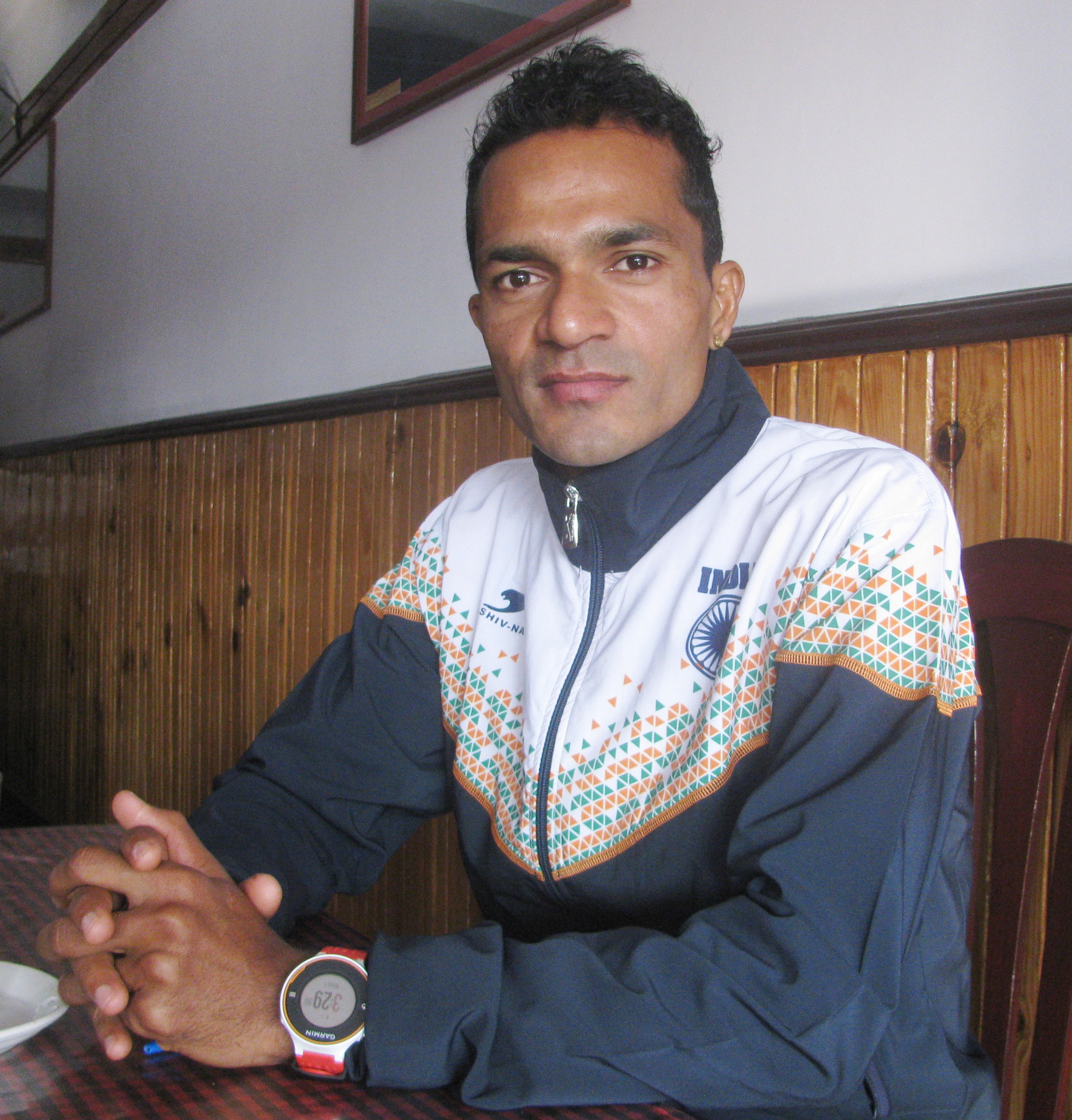
Geeno Antony and his family at Kanteerava Stadium, Bengaluru (Photo: Shyam G Menon)
Thumba in Thiruvananthapuram has reason to celebrate.
On the morning of Sunday, July 3, while Kerala’s capital witnessed its usual share of morning walks and jogs, Geeno Antony finished third in the men’s category at the IAU 24H Asia & Oceania Championships, in Bengaluru.
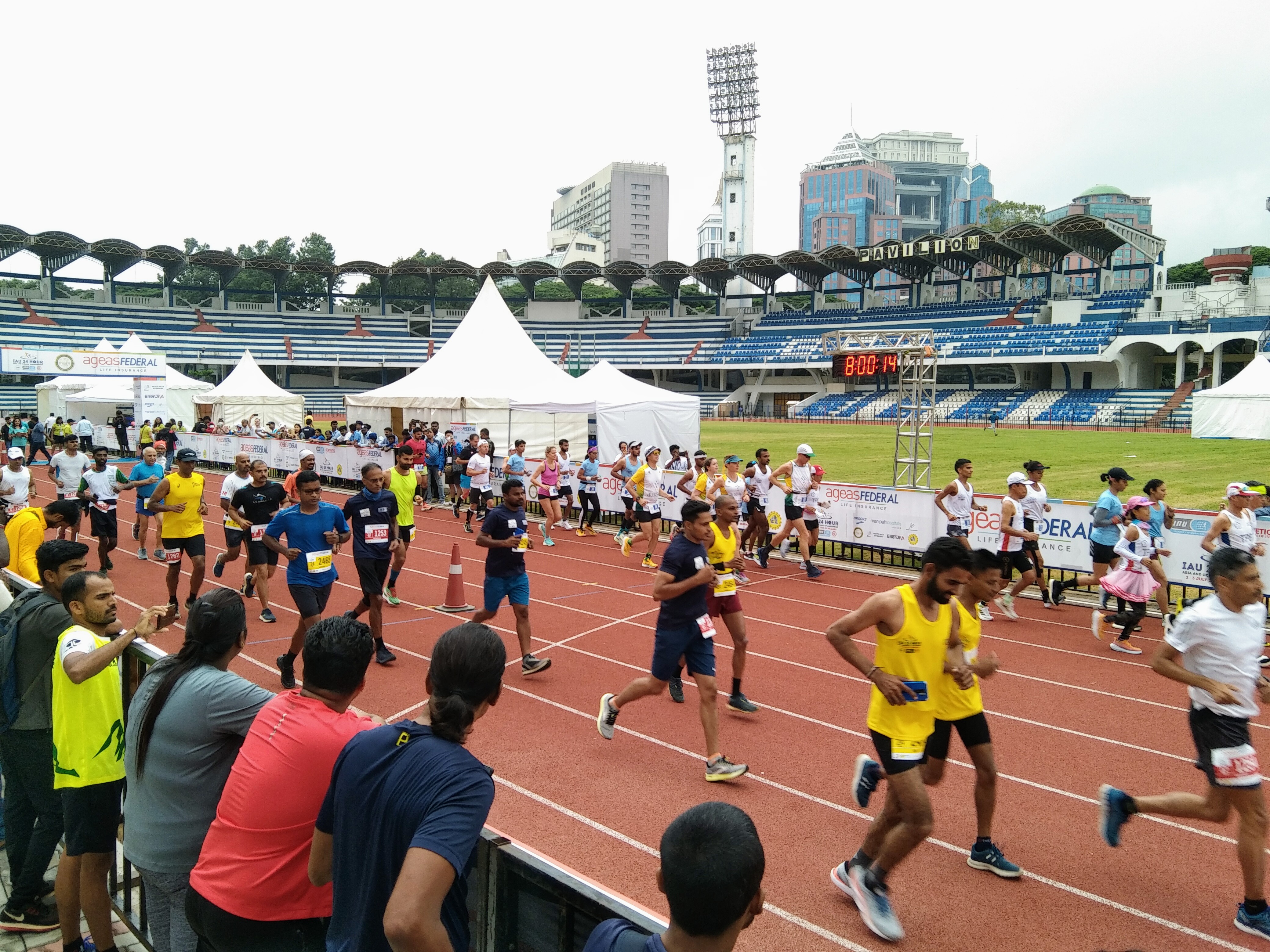
Geeno, who hails from Thumba, was part of the Indian men’s ultrarunning team which won the gold medal (team medals are awarded on the strength of the aggregate mileage of each team’s top three runners). Runners did repeated laps on the 400-metre-synthetic track of Bengaluru’s Kanteerava Stadium, for 24 hours, from 8 AM on July 2 to 8 AM on July 3.
Geeno logged 593 laps translating to 237.2 kilometres covered. “ The first half was tough for me. The second half was better,’’ he said. It was in the night hours of July 2 that Geeno moved up from fourth position to the third. But it was a lead by a fragile margin and he had Joe Ward of Australia snapping at his heels. The situation was different by next morning. The final results for men showed fourth placed Matt Griggs of Australia at 581 laps and Joe Ward (he finished fifth) at 551 laps.
Geeno’s family was present at the stadium to witness the Indian team’s performance. Employed with the Indian Army, Geeno may sometimes be seen doing his long runs on the bypass linking Kazhakkoottam and Kovalam, when on leave and visiting home in Thiruvananthapuram.
(The author, Shyam G Menon, is an independent journalist based in Mumbai.)
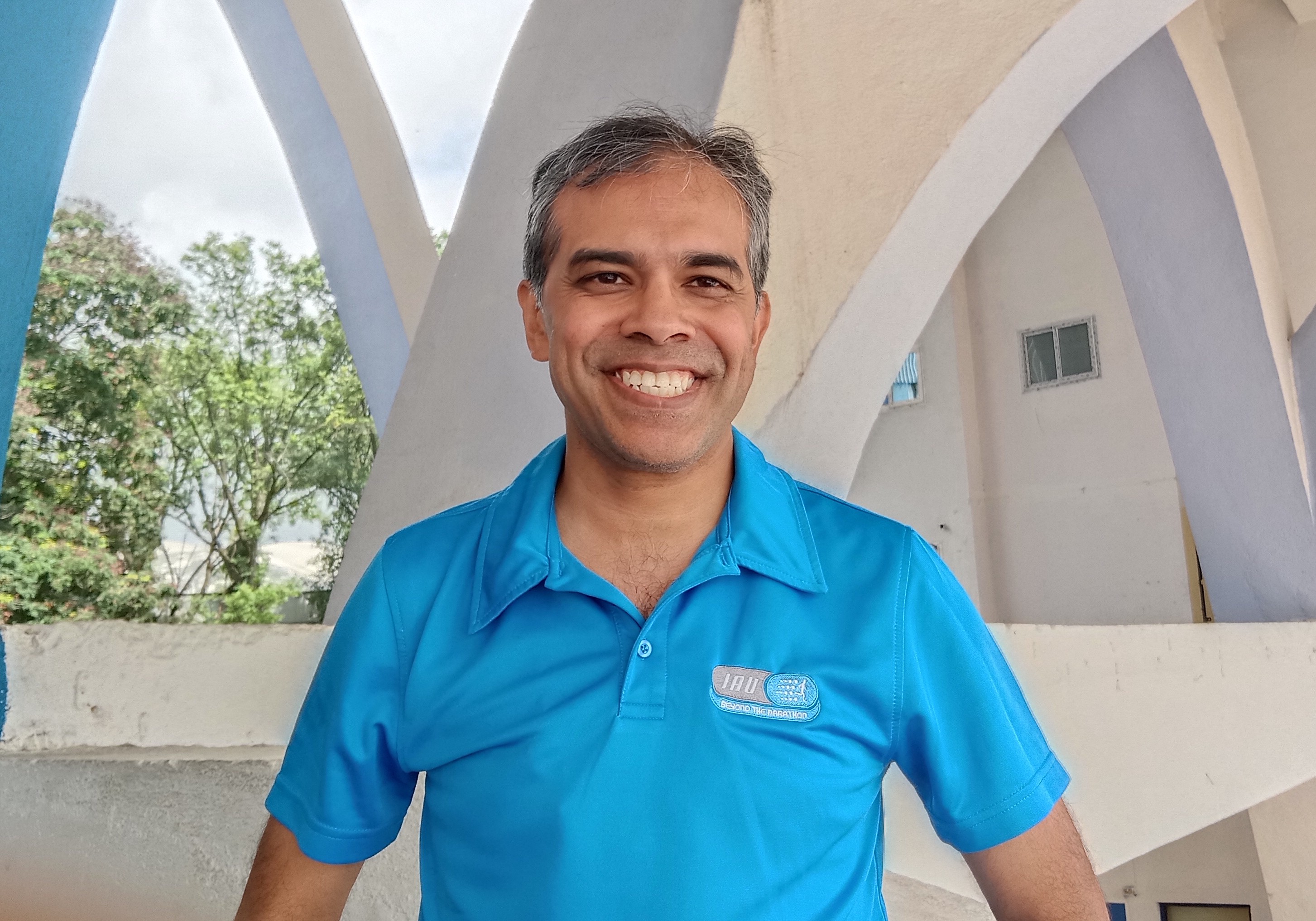
Nadeem Khan, president, International Association of Ultrarunners (IAU) (Photo: Shyam G Menon)
Nadeem Khan is the president of International Association of Ultrarunners (IAU). Over July 2-3, 2022, India hosted its first IAU event – the IAU 24H Asia & Oceania Championships. During his visit to Bengaluru in connection with the championships, Nadeem spared time to talk to this blog. Excerpts:
How has the pandemic affected the world of ultrarunning and how is the recovery panning out?
It has affected quite a bit. Speaking from the point of view of the IAU, we did not have championships for two straight years. We don’t like cancelling events but it was important to cancel in these times given what the world was going through. And also, for the safety of athletes, officials and federations. Its bouncing back now. This event in Bengaluru is the first one we are hosting after the pandemic. So, it’s a big event for us. As you can see, some of the countries are not here because they are not allowed to travel right now or they have huge quarantines when they go back. As the year goes on, I am hoping that the world is going to open up a lot more. We are going to see a lot more athletes come back. A lot of the races under our labelling have started going back out again. They have begun organizing races and all of them are suffering from numbers because the athletes do not feel comfortable going out and running. The hope is – as the year goes by, things are going to open up a little bit more and more athletes are going to start participating in these events.
In the early stages of recovery, one would assume there would be challenges in qualifying for events owing to the shortage of races….
Qualification is handled by the national federations. Every country has its own qualifying standards, whether it’s the time frame they will go back to or the performances; the minimum distances and times they will accept. I am sure some of the federations have made some allowances when it comes to that just because of the lack of events out there. It’s up to national federations to decide that.
Has the two years of pandemic and issues like long COVID, altered the traditional views we have on entry level fitness for sports requiring extreme endurance? Is there a case to revisit the established benchmarks?
A lot of our runners took a back seat and said, our health is important (much like people who had had previously taken their visits to the physician lightly, changed their approach due to the pandemic); let me re-evaluate my life and see where I am at. So, we see a lot of people re-evaluating where they are. I know most of them are aching to come back on the roads and start running ultras and things like that. We as an organization, just had our first online medical seminar. It was held a couple of months back. We got good participation. It was all about exercise, health, fitness, shoes – things on those lines. It was really critical that we put something out there particularly during the pandemic times. Hopefully, once the pandemic settles down, we can talk more about it and do some research seminars. So, I will say: to be continued, for that? (Nadeem said, issues like long COVID does interest as potential topics of research for in the end, “ lungs are a very important part of this sport.’’)
What is your take on India’s performance in ultrarunning? It is not long since the country became a member of the IAU.
I have seen ultrarunning in India from its infancy. I was there when they joined the IAU, I was there when they came to their first championship and I am here when they are organizing the first championship in India! So, it’s been interesting to see how they progressed over the years. One of the main things I have seen is the changed performance level and the perception of the selectors on how they pick their athletes. We got two very, very close events now – between the 24-hour continental championships here and the 100K world championships and one of your top runners, who is a 240K in the 24-hours is also your best 100K runner. But they picked him to run here. So, its strategy. Because there are chances of getting a medal here. They brought their best team out. So, the AFI (Athletics Federation of India) and other selectors are applying that mindset, which they usually adopt for track and field athletics. That is nothing but the very best for ultrarunning.
You have disciplines like the 100K and the 24-hour race which make ultrarunning containable in a certain sense and at the same lend themselves for potential inclusion in large sporting events like the Olympics. Is it something that the IAU is thinking of – would you like to see disciplines of this sort featured in the Olympics at some point?
That has always been the game plan. I have been on the council since 2008. Prior to being President of IAU I was the Director of Communications for eight years. Yes, the goal is always to be in the Olympics but we are also very mindful about which event has to go to the Olympics. It has to be media-savvy, it has to be popular, it has to grab attention. The media wants events that will cater to a worldwide audience. We feel that trail may be a very good option for that. We have combined forces with World Athletics and ITRA, the trail running organisation and WMRA (World Mountain Running Association). We are putting up a trail championship together, which this year happens to be in Thailand. World Athletics is going to be part of it. We hope that this will be the stepping stone in taking an ultrarunning event into the Olympics. The other events we have are the road events, track events such as 24-hour, 100K and 50K. Any one of these can also make it to the Olympics but just now we are hopeful that trail makes it. It is still a work in progress. We are a lot closer to it now than we were previously. There is still quite a bit of work to do to get into the Olympics.
From your standpoint how do you see the distinction between the marathon and the ultramarathon. Geographies that have traditionally birthed marathoners don’t seem to churn out ultramarathoners. The latter currently hail from various other parts of the world…
That’s great, isn’t it? That’s the inclusiveness of the sport. The ultramarathon is not exclusive to any area. My goal as president of IAU has always been to take the sport where it is not present. I would not have come to India if the bid (for the championship in Bengaluru) wasn’t good. The bid was excellent. Taking the sport to a new geography is also developing the sport. Though there is only an eight kilometre-difference between a marathon and an ultramarathon of 50 kilometres, they are miles apart when it comes to the popularity of the sport and things on those lines. The reason we started with the 50K is that we wanted to offer a launching pad, something for marathoners who were done with their marathon careers and wanted to move into something different and be competitive. We see a lot of African nations joining this discipline. The current record for 50K in both the genders are held by athletes from South Africa. There are some very fast events over there. Next year’s world championships in the 50K is being held in South Africa. I am hoping that’s going to jumpstart the sport in the continent. But there have been some amazing events there including the Comrades and the Two Oceans. I am hoping that the upcoming world championships will take the sport to a new level.
Right now, what are the priorities before IAU regarding the sport?
First is to get back safely after the pandemic. That’s a huge concern right now. At the end of the day, IAU events are organized by the community; we are very athlete-centric. So, we want to make sure that they get the platform they deserve in a safe and secure manner. Second, we want to develop the sport. We are organizing events on different continents and the goal is to continue that trend. We had an initiative some time back, wherein we took the sport to many parts of the world. Unfortunately, due to the pandemic, the momentum stopped. But we are picking up where we stopped and we are building that out again. The third goal is – how we get into the Olympics. Its not an immediate goal, it is an ongoing one. The upcoming trail championships will be a good testament on how our past efforts have worked out and where we can go in the future.
From day 1 of the IAU 24H Asia & Oceania Championships in Bengaluru; elites on the inside track. This photo was clicked just after the competition formally commenced (Photo: Latha Venkatraman)
Years ago, the sprint events used to be the central piece of running at major events like the Olympics. Now with the likes of Eliud Kipchoge around, the marathon has emerged as a fantastic showpiece of running. Sustaining oneself at speed for that much time and over that much distance is no small matter. Somebody like Aleksandr Sorokin is redefining the paradigm further by taking on traditionally held times in the 100K. Do you think that these endurance events have come to represent running better than the sprint events of yore?
It’s an age-old question, right? Its about the time. Back in the days, you had people like Carl Lewis, Ben Johnson – it was exciting watching them. I grew up watching them. I am not saying, that isn’t exciting anymore; it is super exciting. I have been at world championships where Usain Bolt’s race is going to happen and the stadium just fills up like crazy. Its exciting to see those athletes sprint across the line. And then, Eliud Kipchoge – how many of us were glued to the TV when he was breaking the two hour-barrier, right? It’s all about the time. I am sure if Usain Bolt were to step back on the track, some of the attention would be diverted that side. With our events, the interest has to be there for a longer period of time. Aleksandr Sorokin is friend of mine; I have seen him grow over the years as an athlete. I don’t think I have ever come across an ultra-athlete, who is redefining the sport like him. I mean, you can imagine someone break the record in the 24 hours; you can imagine someone else breaking the record in the 100K. You can never imagine the same person holding both the world records. He is really redefining the sport. He is putting our sport in the spotlight. People are going to take an interest in it. They are interested in what the human body can accomplish. (Nadeem also pointed out that what Sorokin is doing will inspire other athletes to try the same resulting in an ambiance in which they push each other to greater levels of performance. He sees growing the sport globally without it losing its intrinsic camaraderie and sense of community as among his goals, going ahead.)
Ultrarunning is a very participatory sport. If you want to understand the mechanics and taste the experience, then, you have got to try the sport yourself. From an IAU point of view which would be the greater priority — taking the sport towards a structured ascent like going to the Olympics or popularising it laterally, gifting it a greater following?
If I was a wishful man, if I could be offered anything in the world, I would ask – why can’t I have both? Why can’t I go up and go lateral as well? It is true that it is getting to be a very popular sport. I find that they go hand in hand. If it becomes popular, people are going to take note and ask what is ultrarunning and how can we incorporate it into our mainstream athletics? I will use 50K as an example. We started with the world trophy races, wherein we had a bunch of races across the world. Then we had a final race in one location where all these winners from different races, ran. Six or seven years ago, we felt, this format is not working as we want it to but we have brought the sport to where we wish it to be. So, why not make it into 2world championships standard? Now, we have world championships in 50K. World Athletics has begun recognising the record in 50K as a world record. Same thing goes the other way around. If it grows vertically and gets into the Olympics, a lot more people would wish to participate.
There was a mention that India may want to bid for the World Championships. Are there any criteria that countries like India need to satisfy?
I am here, participating in these championships but I am also an observer to see what is the potential of this sport in this country. That’s important because the support needs to grow worldwide and to grow it in a place like India where the population is pretty huge and people are getting involved into healthy lifestyle – that will be amazing. We are coming back here for the 100K Asia and Oceania Championships and in the meantime, we are going to evaluate this championship. I am going to have some discussions with AFI and NEB Sports and see where we can take this sport in this country. Obviously at this juncture we don’t have a bid or anything but it’s a discussion we need to have. From what I have seen so far, it’s been a great experience.
Between the Asia & Oceania Championships and the World Championships would it be required for India to host any intermediate championships to reach that level?
Absolutely not. We do ask the federations to organise at least a continental championship to get that experience but it is a recommendation rather than a mandatory requirement. If India puts an application forward it will be exciting. We will definitely look at it and see how we can evaluate it and develop the sport.
(The authors, Latha Venkatraman and Shyam G Menon, are independent journalists based in Mumbai.)
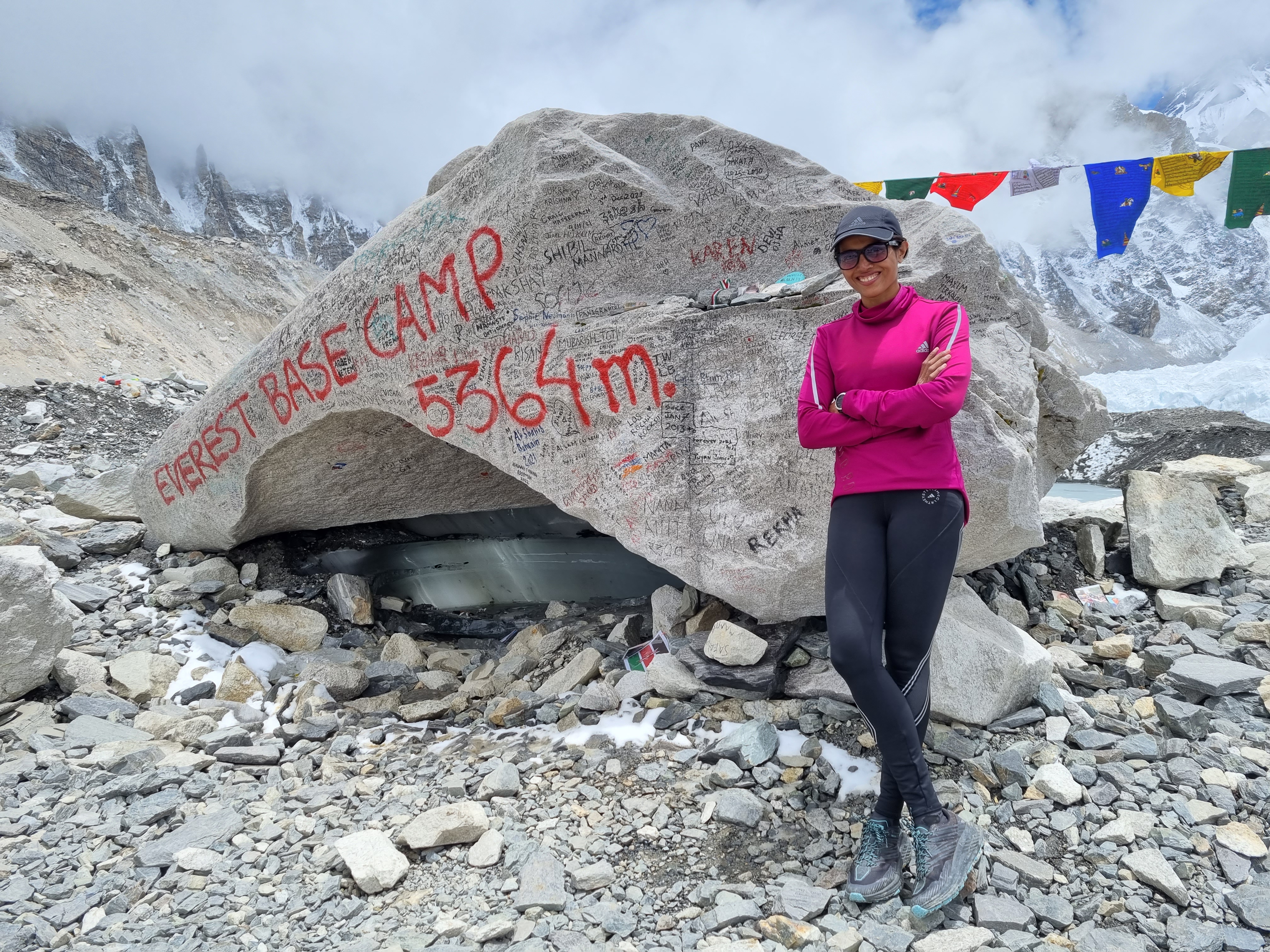
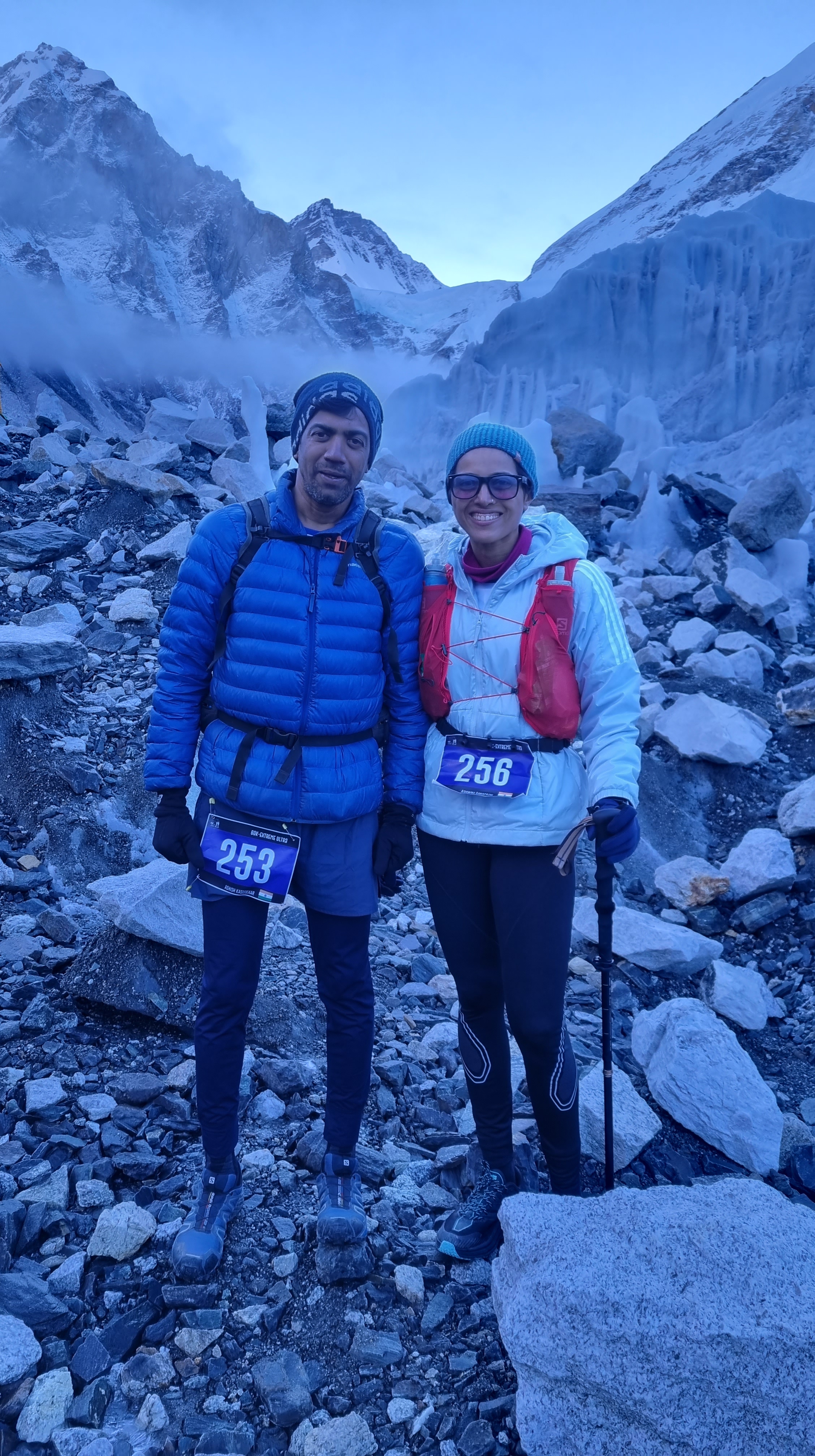
Ashwini Ganapathi; at Everest Base Camp (Photo: courtesy Ashwini)
“ It was the toughest race of my life, yet worth the suffering! I shall cherish those four weeks spent hiking and racing,’’ Ashwini Ganapathi said of her experience at the 2022 edition of the Everest Marathon in Nepal.
The sole woman participant this year in the event’s ultramarathon segment, she finished ninth in a field of 15 (with one DNF). According to Ashwini, as per the organisers’ communication, the time she took to cover 60 kilometres – 15 hours and 40 minutes – seems to be the fourth best by a woman from outside Nepal, to date. Across both genders, the overall winner of the ultramarathon was Arjun Rai Kulung of Nepal who covered the distance in seven hours and four minutes. Of the top ten finishers, six were Nepali runners; the remaining were one each from Poland, Romania, USA and India. Besides Ashwini, the only other Indian runner in the 60 km-race was Ashish Kasodekar. He placed 11th, a few seconds behind Ashwini.
For Ashwini, the opportunity to run in Nepal represented a convergence of personal priorities. In 2019, she had run the Khardung La Challenge and followed it up with the Ladakh marathon. She had podium finishes in both. Comfortable with altitude and hiking up there, she had always wanted to do the trek to Everest Base Camp (EBC). Combining it with an opportunity to run the Everest Marathon appealed.
In 2022, there was also an additional reason prompting her to make the choice. A few weeks prior to the race in Nepal, she had learnt of her selection to the Indian team for the 24-Hour Asia & Oceania Championships 2022 scheduled to be held in Bengaluru in early July. A stint at altitude appeared an ideal component of the training. The Everest Marathon happens on May 29, which is the date on which the world’s highest peak was first ascended by Edmund Hillary and Tenzing Norgay in 1953. The event seemed well-placed in Ashwini’s training calendar for the championships in Bangalore. She consulted the officials in charge of the Indian team. They approved her participation in the Everest Marathon but reminded her not to push herself too much for she had to preserve herself for the championships.
While there were different packages on offer to participate in the Everest Marathon, in tune with her longstanding desire to do the EBC trek, Ashwini trekked solo and unsupported to EBC. “ I started my hike on 12th May and took the Gokyo Lakes route to reach EBC, covering 135 km, including four acclimatization and training days enroute. According to Wikipedia, the Gokyo Lakes, located at an altitude of 4700-5000 metres, form the world’s highest freshwater lake system. “ Climbing Gokyo Ri and crossing Chola Pass allowed me to further prepare for the race,’’ she said. Both the peak and the pass are at an elevation of over 5300 metres. One of the highlights of her EBC trek was that being a runner scheduled to participate in the Everest Marathon, upon reaching her destination, she got to stay at EBC, something typically enjoyed by climbers attempting Everest. During the two days of further acclimatization at EBC, the weather did throw up some concerns. There was snowfall and verglas, both of which made some of the runners worried about how the run would pan out.
Luckily, May 29 – race day – hosted good conditions. It was a clear day. “ Probably because they are so used to the environment, the local runners just shot off leaving the rest of us behind,’’ Ashwini said of the race’s start. The course was engaging and at around the 10th or 12th kilometre, there was a stiff climb. There was also a cut off at around 23.5 kilometres; that distance was required to be covered in five hours. Ashwini cleared it in approximately four hours and 20 minutes. Of the time she took to finish the race – 15 hours and 40 minutes – Ashwini said that she would have shaved-off some time had she pushed herself, which in this case, she had consciously decided not to. She dedicated her participation in the Everest Marathon to her mother, who has been ailing for the past few months.
From Everest Marathon; with Ashish Kasodekar (Photo: courtesy Ashwini)
Ashwini holds the national record in the 12-hour ultra-run. She set the record in February 2020, at Tuffman Chandigarh Stadium Run. She covered a distance of 111.78 km in the prescribed time period. Ashwini was active in sports during her school days, playing most sports and getting to state-level hockey tournaments. But during her time in engineering college, all sporting activity stopped.
In December 2014, she ran her first race, a 10 km-midnight event. Later, she came in contact with Pinkathon, a community that promotes running among women. Hooked to running, she signed up for several events in 2015. While scouting for races, she came across the Chennai Trail Marathon. She did a half marathon and followed it up with a full marathon in the following year. “ I was not focussed on timing at all. After my first marathon, I decided to go for structured training,” she said.
At the end of one of the marathons she ran, she realised that she could go on for some more distance. It prompted her to do her first ultra-running event, a 50 km-race at Yercaud Ultra. Soon after that, her first 12-hour stadium run happened at NEB Sports 36-Hour Bengaluru Stadium Run 2018. “ My aim was to just finish it. I covered a distance of 86 km,” she said. In the same year, she ran another 12-hour run at NEB Sports 24-Hour New Delhi Stadium Run. Here, she covered a distance of 93 km, finishing second among women.
At the 2019 edition of the 72km Khardung La Challenge in Ladakh, Ashwini finished second among women with a timing of 10:39:25 hours. She also completed the 90km trail race at Vagamon ULtrail in Kerala, emerging second runner-up. Running in Malnad Ultra in the same year, she set a course record in 110 km finishing it in 17.52 hours. She enjoys trail running and prefers it over other formats. In Dec 2019, she was the sole participant in the INS Shivaji Platinum Jubilee Celebration 75km run at Lonavala and finished fifth among 29 participants.
Indian ultra-runners were forced to pause their outdoor training when the country went into repeated lockdowns, starting with the first wave of COVID-19 in March 2020. Most ultra-runners used the time to step up their strength workout and focus on diet and rest, which are important elements of training. Ashwini was also forced to suspend her training every now and then.
In January 2021, running the 24-hour category race for the first time at the NEB Sports 24-Hour Bengaluru Stadium Run, Ashwini covered a distance of 180.8 km. Although, she missed the podium as she finished fourth among women, her performance came up for appreciation. In February 2022, Ashwini heard about Basar Running Ultra-Marathon Trail Experience (BRUTE) from two of her friends, Rajesh Narayana and Kushagra Sharma, who were organising the event. They got together to organise this ultra-running event, the first of its kind in Arunachal Pradesh. Basar is the headquarters of Lepa-Rada district of Arunachal Pradesh. Its average elevation is around 600 meters above sea level. There were 16 runners registered for 60 km, 10 runners for 30 km and about 300 for 5 km.
“ Five of us travelled from Bengaluru to the race venue. We took a flight from Bengaluru to Dibrugarh in Assam & after a arduous taxi ride, reached by evening. The organisers put us up in a homestay. Many of these homestays belonged to people who were associated with the non-governmental organisation (NGO), Gumin Rego Kilajo (GRK) that was involved in organising this event,’’ Ashwini explained. In the 60 km-race she had chosen, there were all of three women participating.
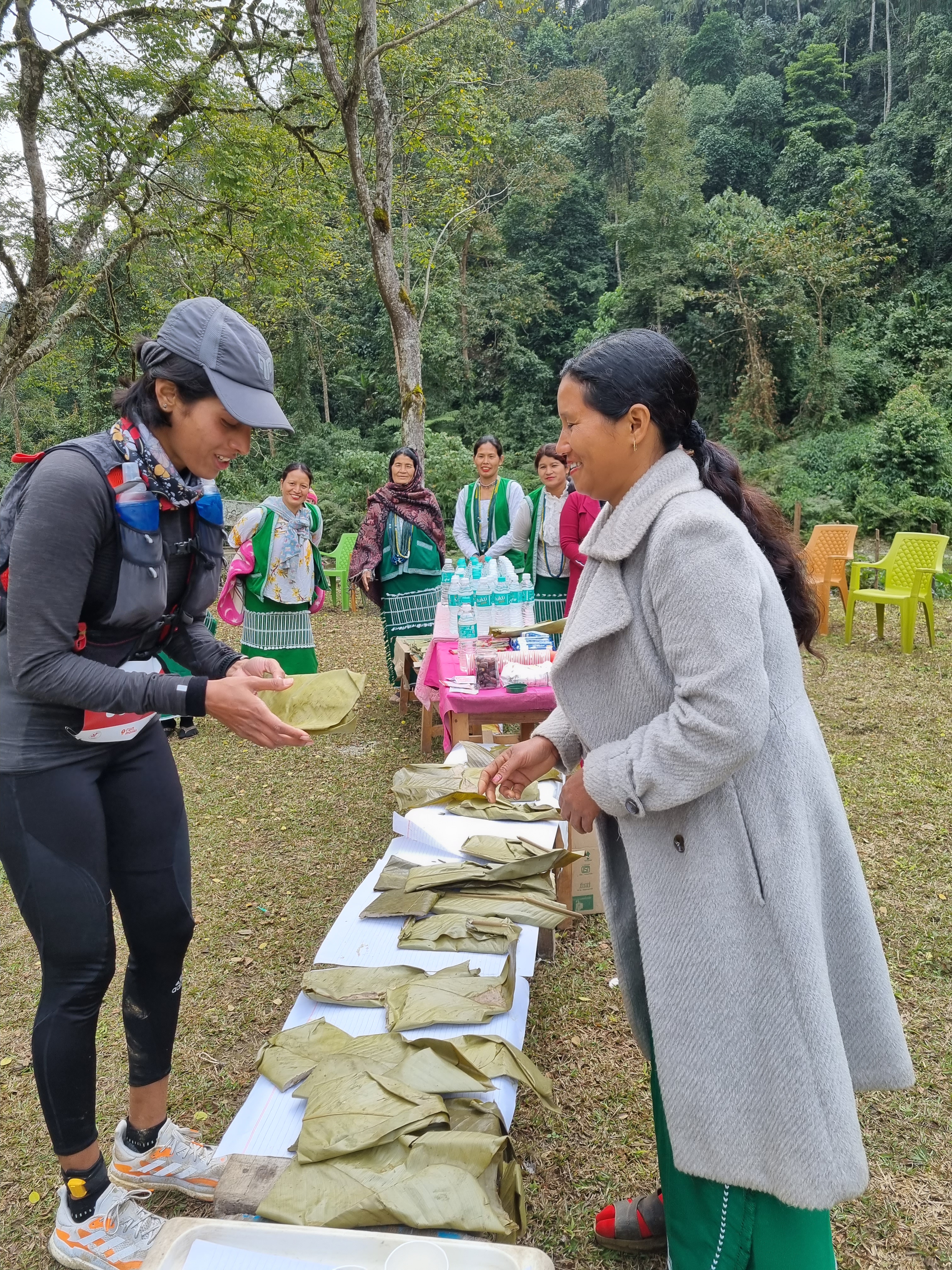
From Basar Running Ultra-Marathon Trail Experience in Arunachal Pradesh (Photo: courtesy Ashwini)
On Saturday, March 5, 2022, the runners were transported to the starting point of the race. The cut-off for Ashwini’s race was 10 hours. The route was a mix of forest trails, both uphill and downhill, village roads and a small portion through roads. Of the total course, about 60-70 percent was primarily trail. The runners had to cross two streams towards the end and also cross using suspension bridges. “ Running on these suspension bridges was quite scary as the bridge kept bouncing up and down with the runners stomping through it,’’ she said. It was quite a challenging route and some parts were a bit technical. “ I decided to take it easy and enjoy the run, chatting with villagers along the route and taking photographs. There were a few aid stations along the route where water was being served in bamboo. Also, villagers were serving us locally grown oranges and pitha, a local rice flour preparation steamed in bamboo. The villagers volunteered enthusiastically and cheered the runners. We passed through many villages along the route. I finished the race at 3:45 pm covering the distance in eight hours and 50 minutes. Although the cut-off for 60 km was 10 hours, the organisers indicated that no one would be stopped from running despite crossing the cut-off time as it was the first edition of the event,’’ she said.
Following the ultra in Arunachal, Ashwini was part of the IAU 6-Hour Virtual Global Solidarity Run. On 30th April,2022 she took part in the 12-Hour Stadium Run organised by NEB Sports, as part of training and qualification for the 24 hr-Indian Team. She covered 96 kms and finished second in the race.
With the EBC project done and now back in Bengaluru, Ashwini has returned to her training for the upcoming championships in July.
(The authors, Latha Venkatraman and Shyam G Menon, are independent journalists based in Mumbai.)
The podium finishers from the women’s 100K; Nupur Singh, Jyoti Gawate and Manisha Joshi (Photo: by arrangement)
Two ultra-runners broke the national record in the women’s 100-kilometre race at the Ageas Federal Life Insurance 24-hour Stadium Run, Bengaluru, held over April 30–May 1, 2022.
Both Nupur Singh and Jyoti Gawate, finished with timing better than the previous national record of nine hours, eight minutes and 18 seconds, set by Gunjan Khurana at the Tuffman 24 Hour Stadium Run held on March 13 and 14, 2021 in Chandigarh.
Nupur finished the distance in 8:44:27 and Jyoti in 8:57:07 hours. The new national record now stands with Nupur Singh. Manisha Joshi finished third with timing of 9:11:01.
Nupur, an ultrarunner, was running her second 100 km race at Bengaluru. She had participated in the IAU Asia & Oceania 100 km Championships held at Aqaba, Jordan, in the open category and not as part of the Indian team. She had finished the race then in 9:36:15.
“ My plan, this time, was to finish in under nine hours. I intended to keep to a steady pace for the first four to five hours and that went as per plan. I did my first 50 km in four hours and 15 minutes. I took it slightly easy after that for a while,” she said. Aware that Jyoti Gawate was ahead of her, she again picked up her pace. Once she went ahead of Jyoti, she slowed down her pace to finish in a new record timing.
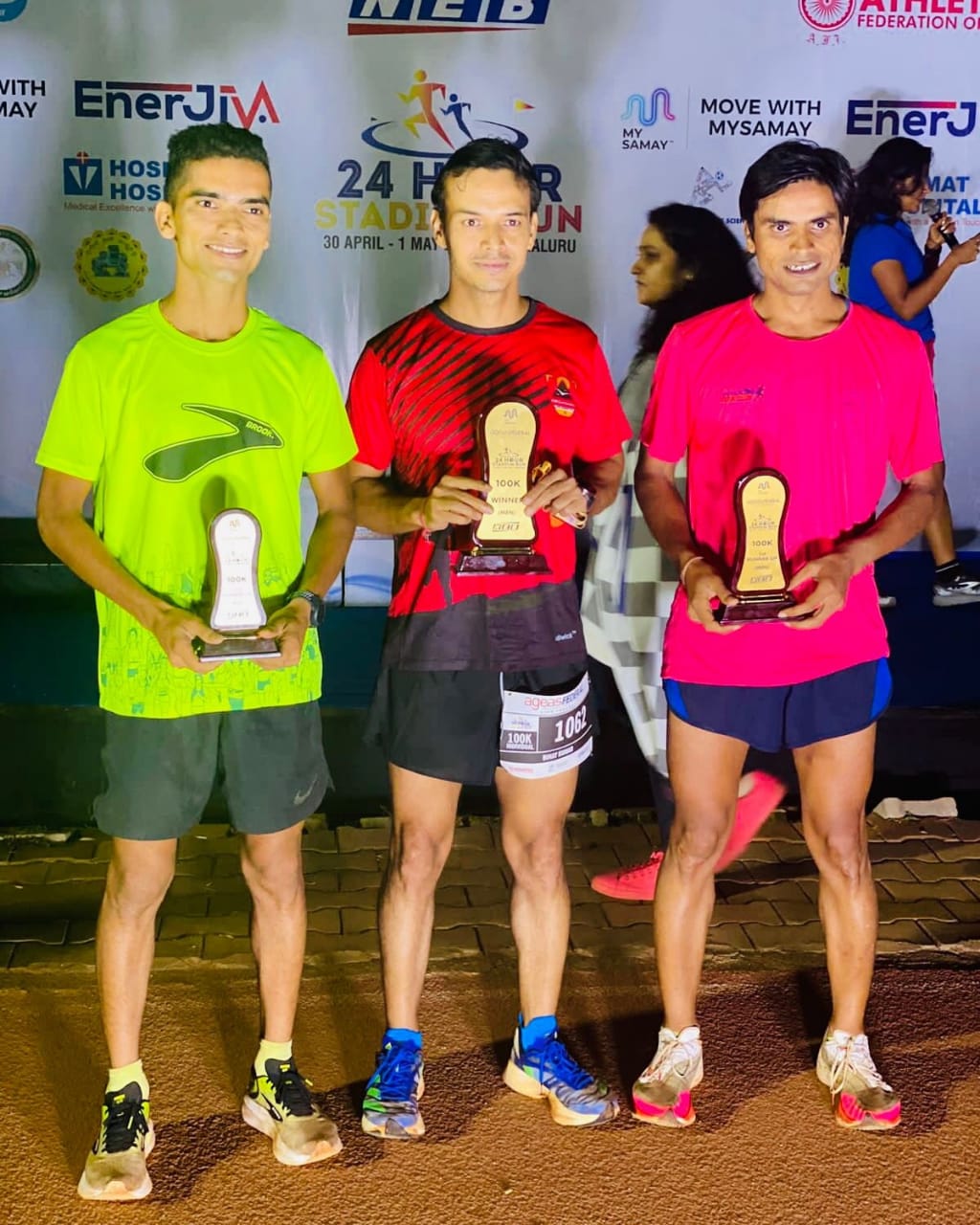
Amar Singh Devanda, Binay Sah and Sandeep Kumar (Photo: by arrangement)
“ The weather was much better than I expected. The race started at 8 PM and it was quite warm until 10 PM. Later some drizzle helped cool down temperatures,” Nupur said, adding, “ I took 10 gels through the run. I also had oranges, beet juice and water.”
“ I think I could have done better but I did not want to push any further mainly because I want to be fit for the upcoming IAU 100 km World Championships, slated to be held in Berlin on August 27, 2022,” Nupur said.
For Jyoti Gawate, an elite marathon runner, this was her second attempt at an ultra-running event. She is yet to get used to running these extended distances. “ The maximum mileage in my practice was a marathon, which I did just a few days before this event. My first 50 km went off well,” Jyoti said adding that she is new to stadium running and is yet to get used to it.
Among men, Binay Kumar Sah finished first in 100 km with timing of 7:56:59. Sandeep Kumar came in second with timing of 8:04:21 and Amar Singh Devanda third, in 8:14:07.
Amar Shiv Dev (Photo: by arrangement)
No records were broken in the men’s 100 km. Amar Singh Devanda holds the record of 7:32:43 in this category, set at the Tuffman 24 Hour Stadium Run at Chandigarh in March 2021.
In the 24-Hour category, Amar Shiv Dev was the winner. He covered a distance of 218.8 km during the scheduled time. “ The conditions were tough. Running the first half was quite difficult as it was very hot,” he said. Subhash Chandra came in a distant second covering 172.8 km while Manendra Kumar Tripathi finished third with a distance of 169.6 km covered.
“ The heat was impacting our running. Many runners were taking frequent breaks. I kept running but fell ill and had bouts of nausea at least four times,” Amar Shiv Dev said.
Among women, Ritu Bhatia Gupta was the leader with mileage of 143.2 km followed by Aparna Choudhary at 139.6 km covered and Anuradha H.K. at 135.2 km.
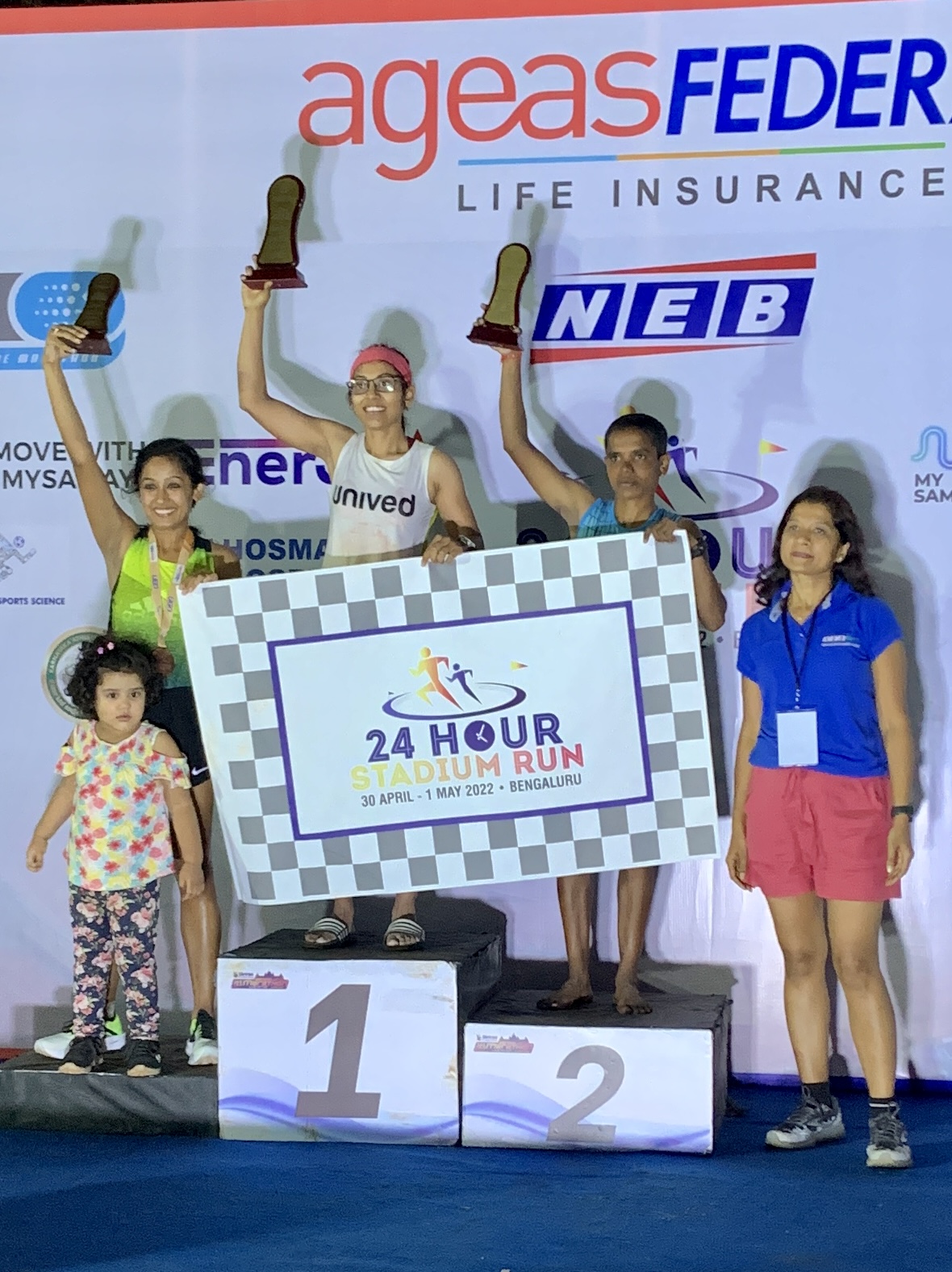
Podium finishers from the women’s 12-Hour run; Anju Saini, Ashwini G and Meenal Kotak (Photo: by arrangement)
In the 12-Hour category, Pritam Rai finished first among men with a distance of 109.6 km covered, followed by Mahesh M (107.2 km) and Sugourav Goswami (99.2 km). Among women, Anju Saini covered a distance of 104.8 km during the scheduled time to come in first. Ashwini G finished second with a distance of 96 km and Meenal Kotak (93.6 km) came in third.
In the absence of adequate training, Ashwini decided to take the 12-Hour run as a training run. Ashwini holds the national record of 111.78 km for 12-Hour run having set it at the 2020 Tuffman Stadium Run at Chandigarh.
“ I decided to take this run as a confidence building exercise. It was fun running along with many good runners. My run started at 8 PM. There were many runners on the track including the 100 km athletes, the relay runners,” she said. Ashwini has often consumed natural foods during her ultra-runs. This time around, she tried Unived gels, she said.
(The author, Latha Venkatraman, is an independent journalist based in Mumbai.)
It was a Kenyan sweep at the 2022 Boston Marathon, which returned to its Patriot’s Day schedule after two years affected by the coronavirus pandemic. Over 30,000 runners participated in the 126th edition of the event in which Kenyans athletes won the men’s and women’s race.
Olympic champion Peres Jepchirchir of Kenya won the women’s race at Boston Marathon. Peres finished the race in two hours 21 minutes and one second. Evans Chebet, also of Kenya won the men’s race in 2:06:51. This year, the weather, a crucial factor at Boston Marathon, was very supportive.
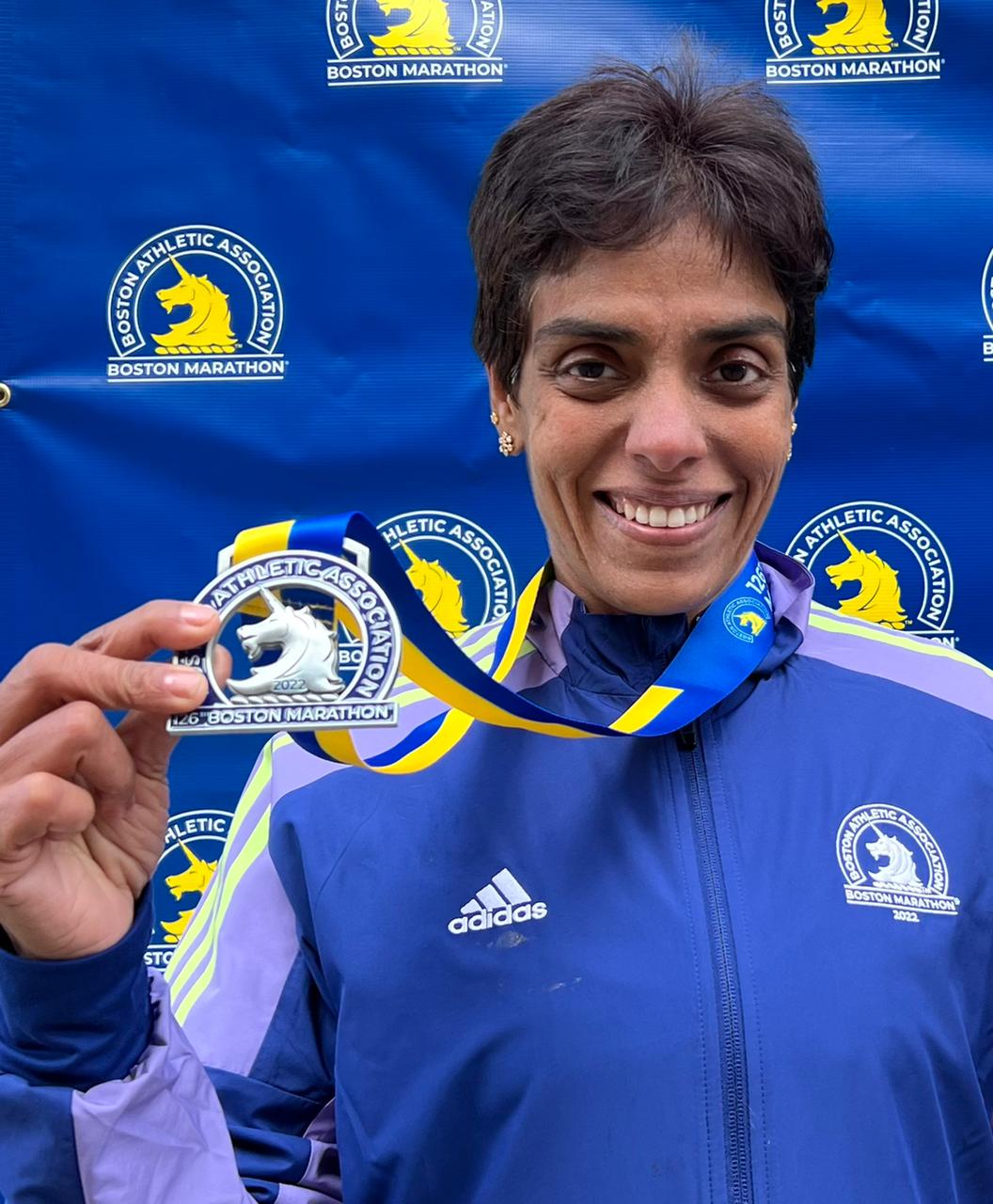
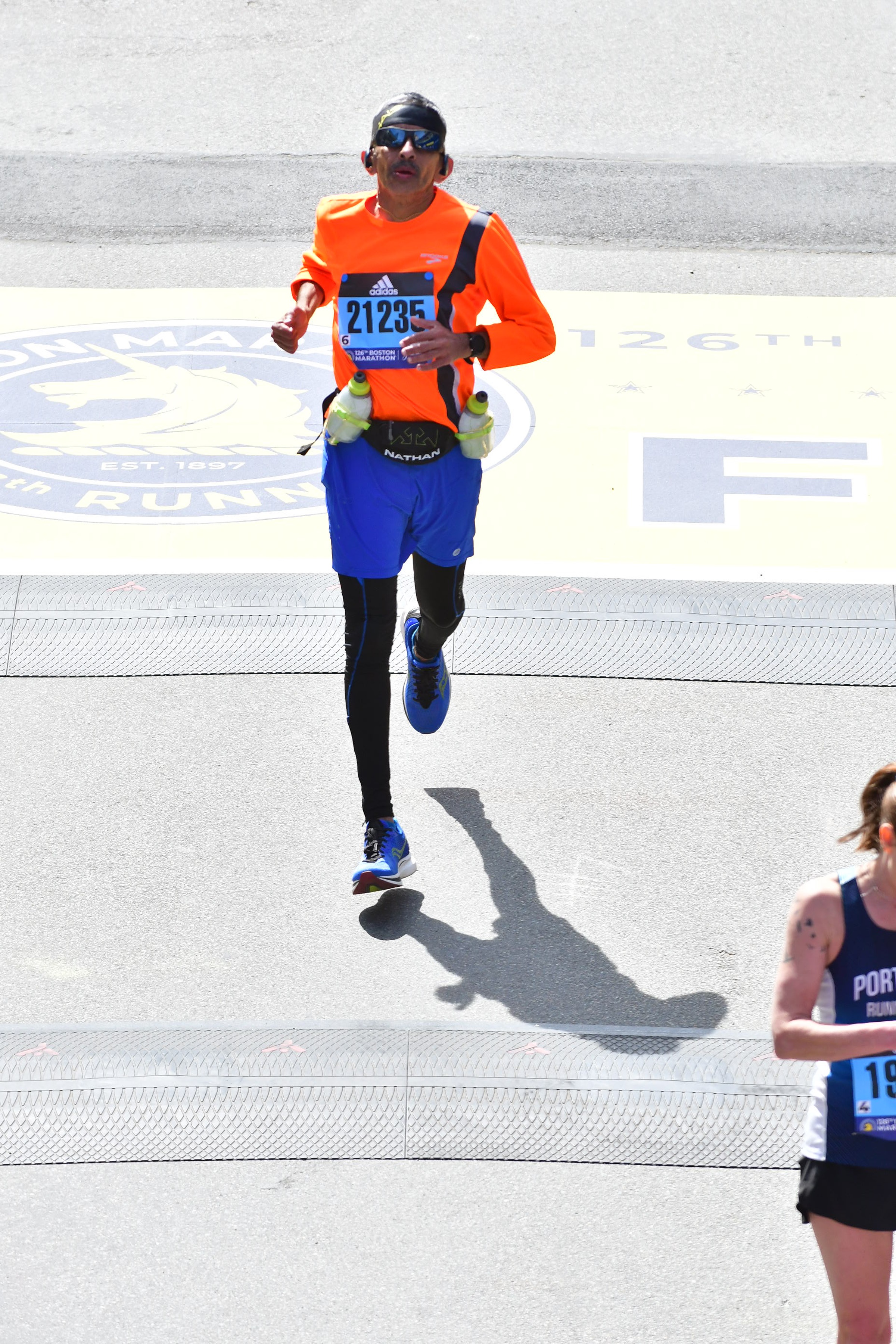
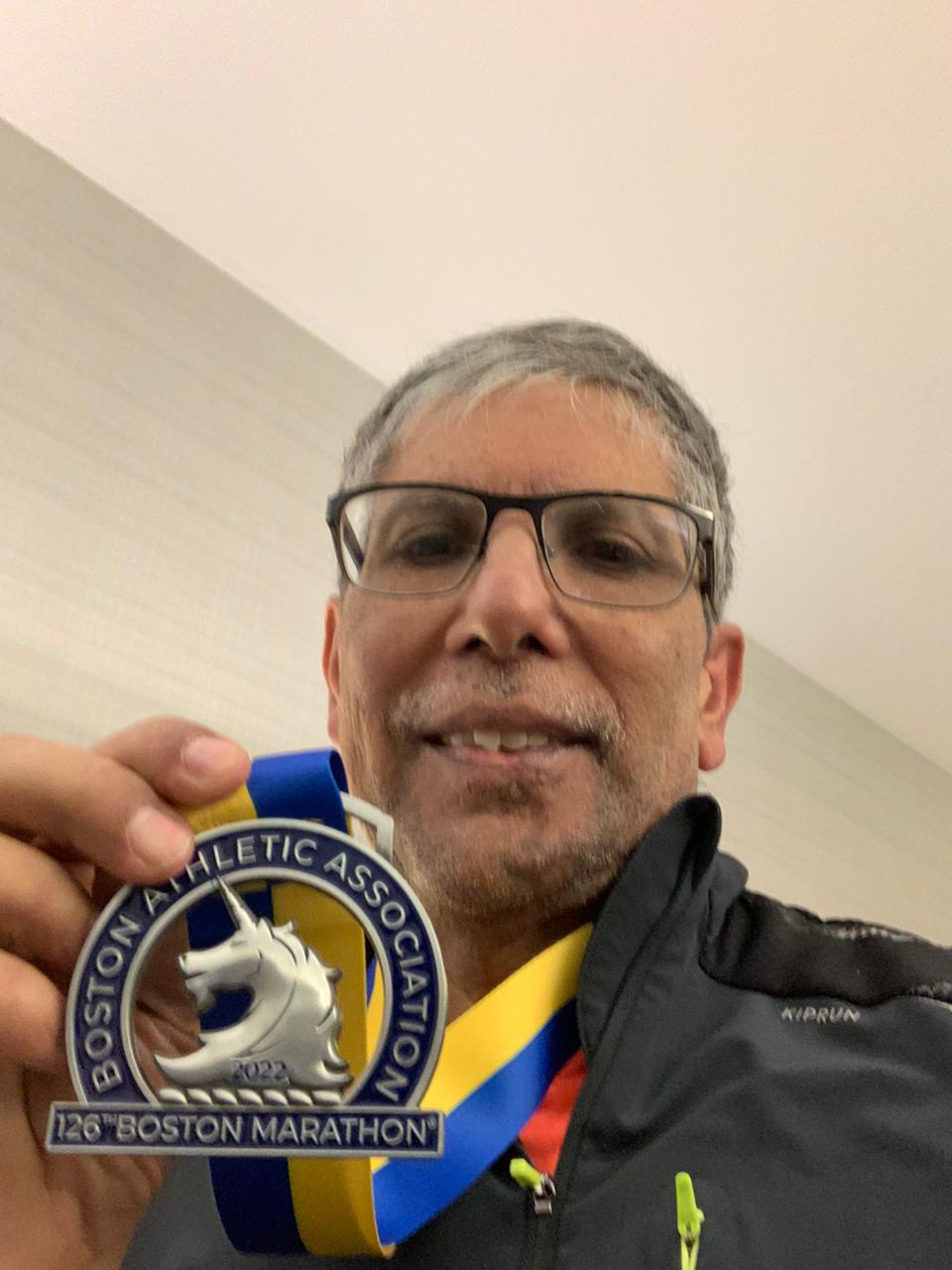
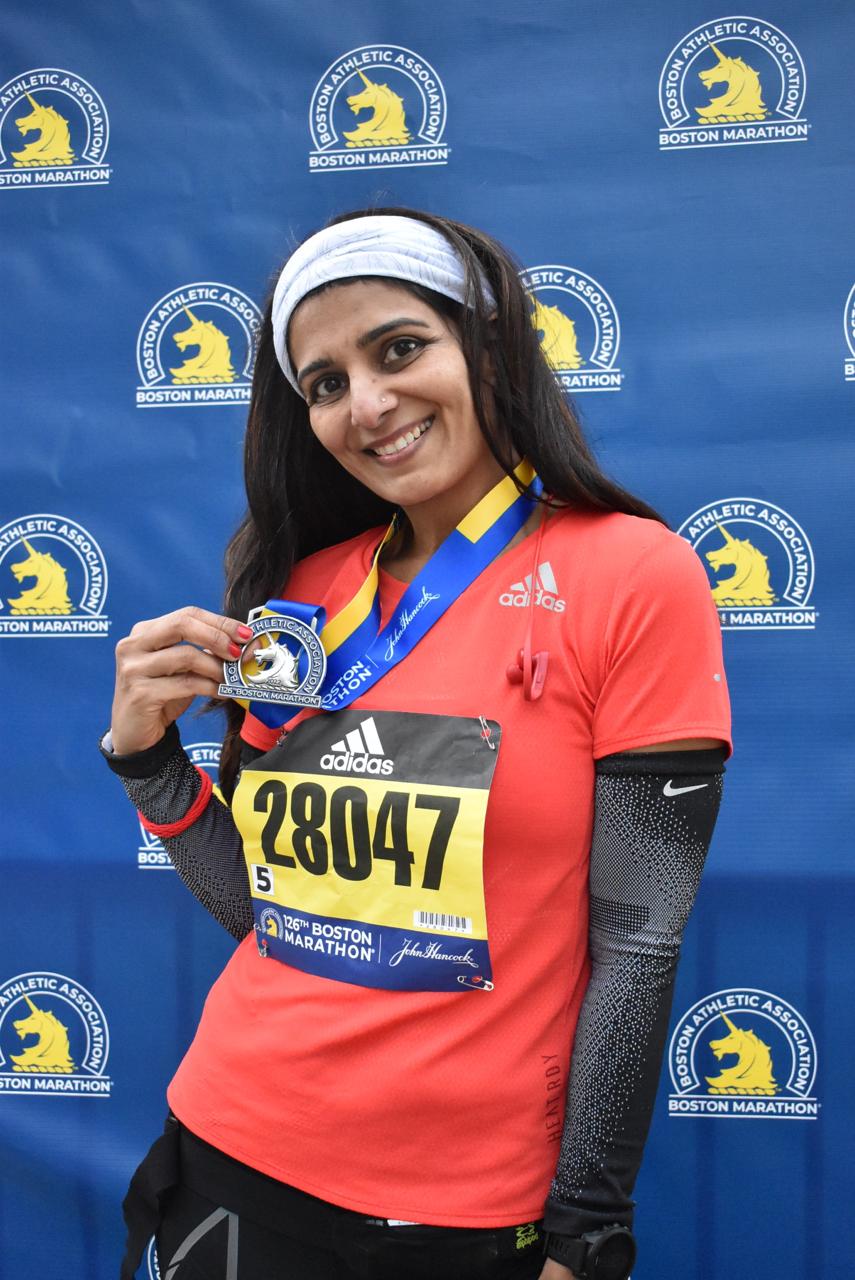
This blog spoke to a few Indian runners who travelled to Boston to run the marathon. Most of them were happy to get back to racing. Boston Marathon is known for being a well-organised event with excellent arrangements and fantastic cheering. Many runners aspire to run the Boston Marathon multiple times as no other city marathon generates such a festive ambiance around running as this city in the US.
Sharath Kumar Adanur (Photo: courtesy Sharath)
Sharath Kumar Adanur
Sharath was running the Boston Marathon for the third time.
In the days preceding the 2022 Boston Marathon, Sharath focussed on target-based training. His target was to finish the marathon in around two hours and 45 minutes. He had secured a personal best of 2:46:06 at the 2019 edition of Chicago Marathon. This time around Sharath trained with his friend Shreenivas Naik.
“ I was in good shape and landed in Boston a week ahead of the race. But I got a toothache and had to go on painkillers and antibiotics,” he said. Race day however took off well and he was on target until the 30th kilometre, when the hills commence. “ I started to go off target with the hills. I tried to salvage the situation but could not meet my desired timing,” Sharath said. He finished in 2:48:54. “ I am happy with my timing considering my toothache and the pills,” he said.
Sharath had run Boston Marathon in 2018, the year when weather was brutal, and in 2019. He had finished with a timing of 3:17 and 2:51 respectively.
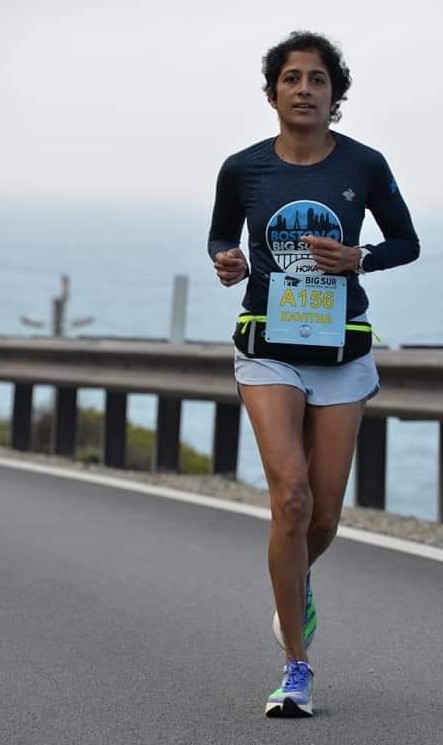
Kavitha Reddy; from Big Sur, which she ran after the 2022 Boston Marathon (Photo: courtesy Kavitha)
Kavitha Reddy
Kavitha Reddy was returning to Boston with memories of the 2018 edition when heavy rains, strong winds and low temperatures made for one of the worst weather conditions to run in.
“ It feels good to be back to racing,” she said referring to the break of two years caused by the coronavirus pandemic, which led to cancelling or postponement of running events worldwide. Having trained well in the weeks ahead of the race, Kavitha reached Boston early to recover from jet lag and get used to the weather.
“ The weather on race day-morning was perfect. My run started well. At the start, the course was very crowded but the crowds of runners helped me check my pace. The first half of the race was on target,” she said. Boston’s initial course is downhill and runners are often tempted to go at a fast pace.
“ The real game starts when the hills commence. It is challenging to hold on to your pace in the hills. There are many rolling hills and our hamstrings and quadriceps take a beating,” she said.
Running the 2022 edition of Boston Marathon, Kavitha felt she was discovering the course afresh. During the 2018 edition of the event, surviving the brutal weather conditions had been upmost on her mind.
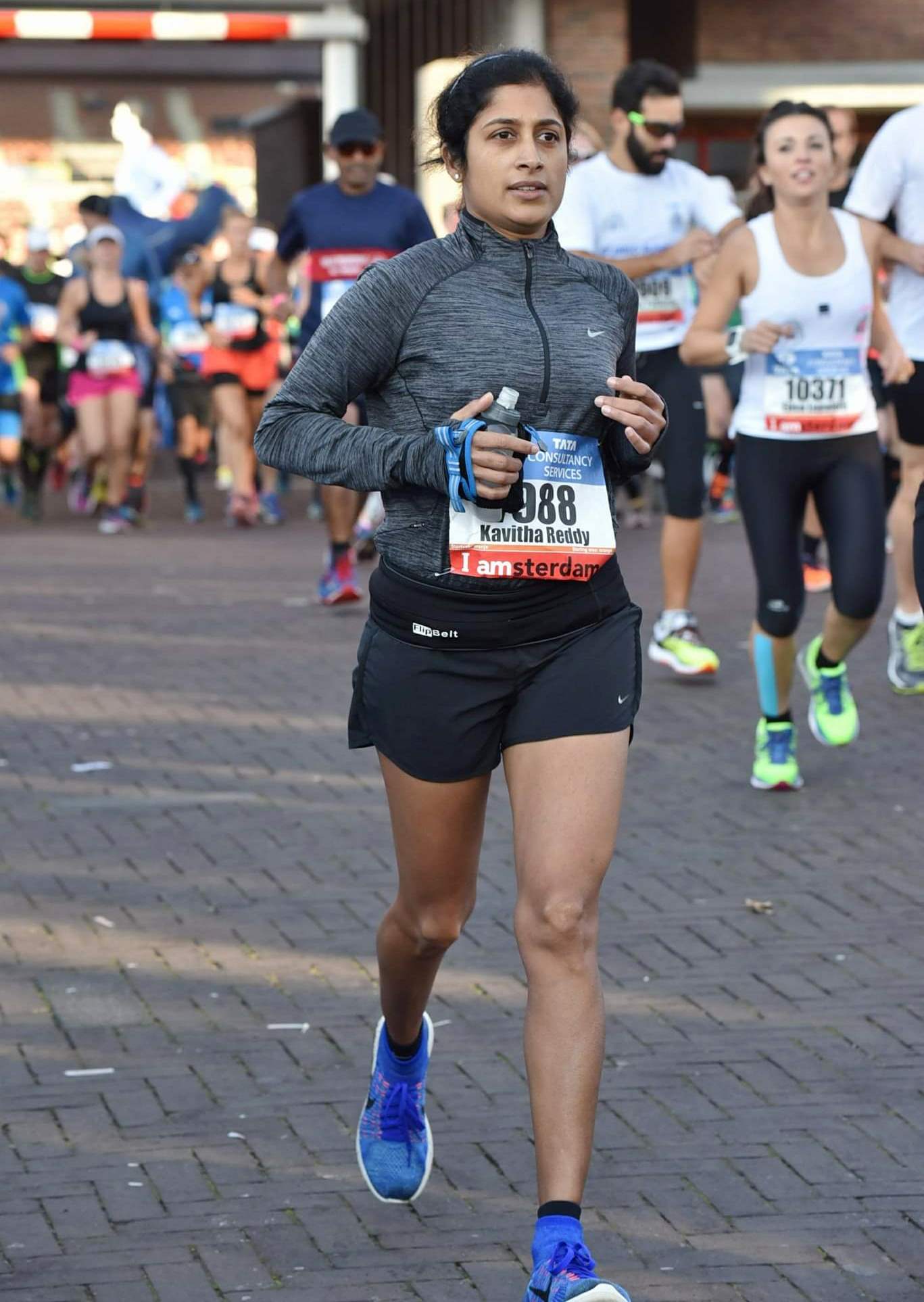
Kavitha, 47, finished the 2022 Boston Marathon with a personal record of 3:12:05, an improvement over her previous timing of 3:14:19 secured at the 2019 edition of the Chicago Marathon.
She followed up the 2022 Boston Marathon with Big Sur International Marathon, which was held on the following Sunday in California. “ I plan to run it as a fun run,” she had said before the event. She finished Big Sur in 3:51:34.
Srividya Ramnath (Photo: courtesy Srividya)
Srividya Ramnath
A resident of Navi Mumbai, Srividya Ramnath diligently followed the training plan of her coach, Ankita Gaur, for about four months.
She arrived in Boston early to get used to the conditions there. “ The first 25 kilometres of the race went by like a breeze. The tough stretch starts after that. The hills don’t stop. They keep coming relentlessly,” she said. After a long stretch of flat comes Heartbreak Hill, the steepest of the series of rolling hills along the Boston Marathon course.
“ I lost my speed in the hills. Mentally it was a challenge. In the last seven kilometres, I had to pull every ounce of energy,” she said. Srividya finished the race in 3:51:51, slightly off her personal best of 3:47:29, achieved at the 2021 Berlin Marathon.
“ I am definitely going to qualify and come back to Boston Marathon again. The experience was completely overwhelming. The arrangements were awesome and the route was beautiful. As for the cheering, it never stops,” she said. Despite rain on the previous day, on the day of the race, Boston had lovely weather. “ For a small stretch there was strong headwinds. Otherwise, the weather was God-send,” she said.
Srividya said she is in the process of understanding how she can improve her performance for her next attempt at Boston. She may require a relook at her strength training, agility workout and fuelling strategy.
Kiran Kapadia (Photo: courtesy Kiran)
Kiran Kapadia
The 2022 edition of Boston Marathon was Kiran Kapadia’s second time at this iconic marathon. He ran the 2021 edition, which was held in October.
“ This time around I enrolled with US-based Luke Humphrey Running. It is a different kind of approach. There are not many long runs, not more than 30 km but I have to run six days a week, primarily to get used to running on tired legs,” Kiran said. He landed in Boston with reasonably good training put in.
“ My race started at 10:45 AM. It was quite cold in the morning. At Boston, both the uphill and downhill stretches are tough, testing our quadriceps as well as hamstrings,” he said.
Running in the 60-64 years age-group, he finished the marathon in 3:45:51, an improvement over his previous Boston Marathon timing of 3:48:56.
Sunil Chainani (Photo: courtesy Sunil)
Sunil Chainani
For Sunil Chainani it was his first time at Boston Marathon.
“ It is fantastic to be able to think of doing an event, especially the Boston Marathon, after a break of two years,” he said. He thought he trained well, running through the months of February and March, but in retrospective he feels he could have put in more hill workouts.
“ I ended up with cramps in the last five kilometres. I should have done more downhill running,” he said. In the last stretch of the course, Sunil had to resort to walking.
The weather, according to him, was perfect for running. “ There was a little bit of headwinds along some stretches. The forecast was of colder weather but it wasn’t that cold,” he said.
He finished Boston Marathon in 4:25:49. With this marathon, he has completed four of the World Marathon Majors – Berlin, London, New York City and Boston. He is yet to do the Chicago and Tokyo Marathons.
“ The crowd support is absolutely unbelievable. The hydration, crowd support and the overall organising of the race were excellent, barring very small hitches,” he said.
Binita Choksi (Photo: courtesy Binita)
Binita Choksi
Mumbai-based Binita Choksi had qualified for Boston Marathon at the 2020 edition of the New Delhi Marathon. With two years lost to coronavirus pandemic and subsequent travel difficulties, Binita found herself a berth in the 2022 edition of the iconic race.
A recreational runner for the past over 12 years, Binita put in just about two months of training for the Boston Marathon. “ At Boston Marathon, I was in the last wave. For the first 10 kilometres I had to weave through the crowds. At the end of the race my GPS device showed a distance of 44 kilometres,” she said. Once the crowd of runners thinned, she was able to pick up pace and run well for the rest of the distance.
“ The arrangements, the hydration support and the atmosphere were extremely good. I enjoyed my run thoroughly,” she said. Binita finished the marathon in 4:10:30.
Subhojit Roy (Photo: courtesy Subhojit)
Subhojit Roy
In 2019, Pune-based Subhojit Roy ran the Boston Marathon, finishing it in 3:14:33, his personal best at that time. A month later he ran the TCS 10 km in Bengaluru. Soon after that, Subhojit went off serious training owing to an injury. In the following months, the stringent lockdown announced by the Indian government actually came as a boon as he was forced to go off running completely resulting in the injury healing.
“ By the end of 2020, I resumed serious training,” he said. He ran the marathon at the 2021 edition of the New Delhi Marathon. “ I ran this mainly because I wanted to see if I could come back to marathon running,” he said.
Although, Subhojit returned to marathon running, training kept getting interrupted with periodic surges in coronavirus infections in India that caused curbs in the movement of the public. He enrolled for the 2021 Amsterdam Marathon held in October but could not make it as he tested positive for coronavirus. He then participated in the Valencia Marathon in December 2021. Here, Subhojit achieved a personal best (PB) timing of 3:09.
Following the third wave of infections, Subhojit resumed his running and managed to get a little under two months of training before the 2022 Boston Marathon. He was helped in his training by runner and triathlete Nihal Ahamad Baig.
Travelling all the way to Boston is not always easy on runners because it means getting adjusted to new sleep schedules and weather conditions. “ Thankfully, I had a good sleep during the night before the marathon,” he said.
According to him, although, the Boston Marathon route is mostly downhill, the uphill stretches that commence during the second half of the route were relentless. “ Even after Heartbreak Hill, there are many small hills that keep coming,” he said.
Over the last 2-3 km, he took short walk-breaks. Subhojit finished the Boston Marathon in 3:16:37. Analysing his performance later, he realised that fast-paced downhill running, crucial to tackle the Boston route, was inadequate in his training. “Also, I had used a relatively new gel. After the 33rd kilometre, I felt full and could not take another gel. This was probably why I slowed down,” he said.
He was happy with his finish. “ My son and wife were there at the finish line. The race atmosphere in Boston is amazing. In is one reason why runners like to return to this marathon,” he said.
Tanmaya Karmarkar
Tanmaya Karmarkar (Photo: courtesy Tanmaya)
Pune-based Tanmaya Karmarkar was heading to the 2022 edition of Boston Marathon (her second outing to this marathon), with fairly adequate training done.
Happy to get back to a real road race, as opposed to the virtual ones of the pandemic months, Tanmaya decided not to push too much but stay comfortable through the race.
“ It was a good race. The weather was perfect. My performance was pretty much in line with what I expected,” she said. Tanmaya finished the Boston Marathon in 3:18:44, a new personal record. Her previous best was at the 2019 Chicago Marathon where she secured a timing of 3:23:32.
“ I fuelled well before the start of the race. But in the second kilometre itself I dropped my bottle. My water intake as well as gel consumption was lower than what I had planned for,” she said.
Zia Chaney
Zia Chaney (Photo: courtesy Zia)
In December 2019, Zia Chaney ran a personal best (PB) of 3:47:34 at the California International Marathon. It helped her qualify for the Boston Marathon.
However, in the months following her run, the world slid into a pandemic that led to the cancellation and postponement of running events worldwide. Zia, a cancer survivor, had to wait for two years to make it to the entry list of the Boston Marathon.
“ I was really excited about getting accepted for the Boston Marathon and wanted to start my training immediately,” Zia said. She requested her coach Ashok Nath to offer her a light training schedule as she is prone to injuries. “ I was not running for a personal best; I wanted to finish strong,” she said. According to her, Ashok commenced her training with basic workout, strength and agility exercises and mileage-based running.
With barely three weeks left for Boston Marathon, Zia started to feel a sharp pain in her ankle. She tried dry needling but found no relief. “ I contacted Ash (Ashok Nath) and explained the pain to him. He asked me to stop running and instead do cross training such as elliptical, cycling and swimming,” she said. With rest, vitamins and cross training, Zia started to feel confident. “ I began to enjoy my training again,” she said.
When she reached Boston, she found the city completely alive in anticipation of the race. The weather on race day was quite good. “ It was very crowded at the start. Over 30,000 runners were running the marathon. The initial course is downhill but we could not run fast because of the crowd of runners,” she said. The support along the route was excellent with mile markers, aid stations, fuelling counters very well placed, she said.
Around kilometre-25, Zia started to get a pain in her hip. With every passing kilometre her pain kept worsening. It forced her to slow down. She finished the marathon in 3:56:33. “ I was very surprised with my sub-4 hour-finish,” she said.
Kumar Rao (Photo: courtesy Kumar)
Kumar Rao
In 2019, Kumar Rao ran the Boston Marathon and followed it up with Big Sur International Marathon less than a week later. After a two-year break, Kumar decided to run both the marathons in 2022.
“ For me, 2019 was a great year in terms of running. At Boston Marathon I ran a personal best of 3:59:33 and at Big Sur I finished in 4:03:25, securing second position in my age category of 70-74 years,” he said.
In November 2021, he travelled to France to run the Deauville Marathon and finished in 3:57. “ I could travel to France as the country only mandated vaccination,” he said.
His training for the Boston Marathon was on track until January 26, 2022 when during weightlifting, he hurt his back. He went off training for a week but when he returned to running, he started to experience pain all along his leg. “ Running became impossible. I consulted a doctor and found that I had suffered a spinal injury which resulted in sciatica,” he said. He lost five weeks of training because of this problem. With physiotherapy he was able to resume training mid-March.
At the 2022 Boston Marathon, he decided to run for two miles and take a walk-break for 30 seconds. He cruised along fine until the 25th kilometre. Then, he started to experience a leftward tilt in his body. Also, the walk-breaks increased. He finished the run in 4:20:54. He later found out that the leftward tilt was due to the spinal injury.
This was the third time that Kumar was running the Boston Marathon. “ The atmosphere in Boston is so amazing. I enjoy running there,” he said.
The following Sunday, he ran Big Sur International Marathon, finishing in 4:28:36, securing a fourth position in his age group. “ I now plan to take a break from running to address my spinal injury,” he said. As things stand, he is enrolled to run the 2022 edition of New York City Marathon.
(The author, Latha Venkatraman, is an independent journalist based in Mumbai.)
A former Indian Army officer, Chandan Kumar Mateti started running in 2013 and over the years participated in events of varying distances including 50 km, stadium runs and both the versions of the Comrades Marathon, an ultra-marathon held annually in South Africa.
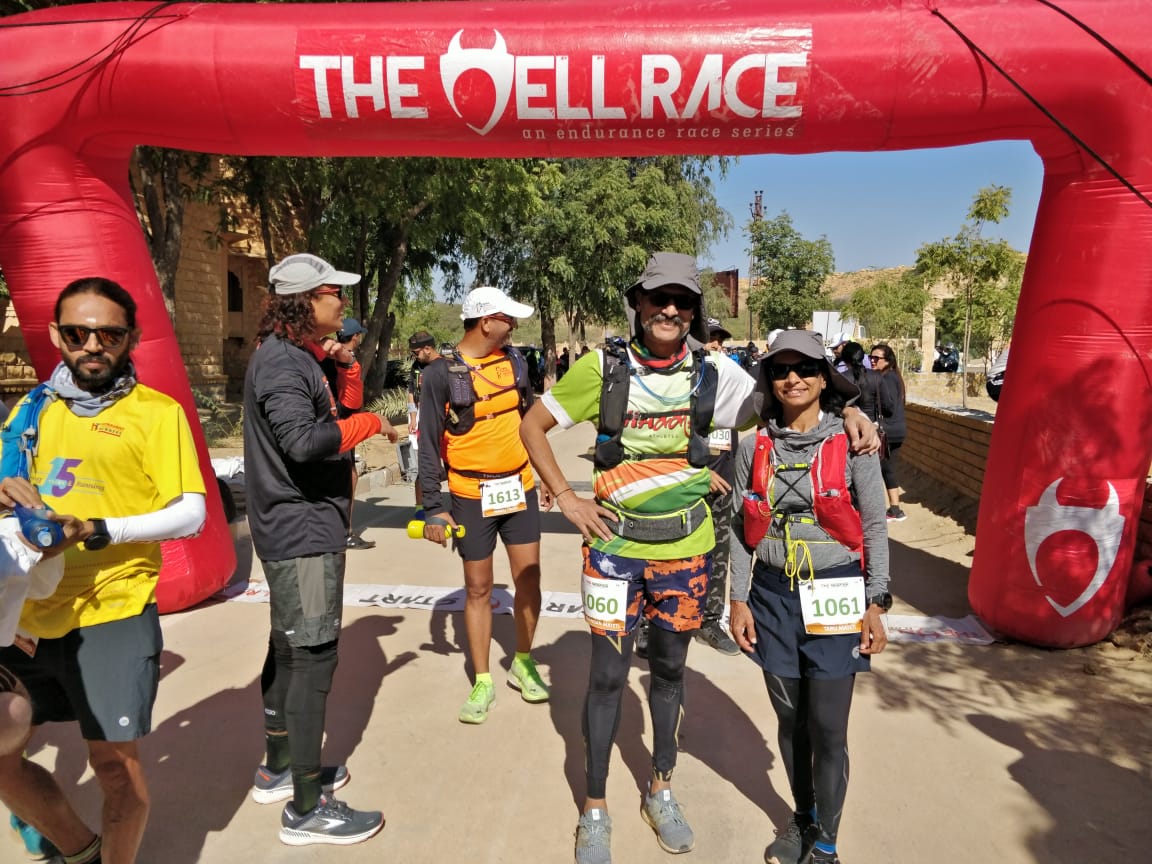
In December 2021 the Pune-based runner ran his first 100-kilometre event: The Hell Race-The Border 100. He was not new to ultra-distances but until then, had not touched the magic distance of 100 km.
Chandan writes about how he accomplished his first 100 km-run.
For the first three years my runs were restricted to short distances as my target was to complete a half marathon (21.1 km) in under two hours. This I achieved in due course.
In 2017, my wife Taru decided to run the Comrades Marathon, the ultra-marathon held every year in South Africa. She had been training and had run a number of full marathons by then.
As I was funding the trip and also planning to travel to South Africa, I thought: why not give it a shot? However, I had to run a marathon first and complete it in under five hours to qualify. Just to test myself, in 2017, I participated in Mumbai’s 12-hour run and was able to cover a little over 60 kilometres, far short of expectation. I had some time for the qualifier full marathon (it was due in Dec 2017). So, I decided to attempt one more ultra-event and registered for the 50 km-category at Pune Ultra. I trained with Taru for this run and managed to finish it in 5:55 hours.
With that, I got hooked to ultra-running. I qualified for Comrades in 2018 and went on run both the uphill and downhill versions of the race.
I continued running 50 km distances. But now there was this newfound desire to run a 100 km ultra-distance event, mainly to find out if I can sustain myself for such long hours. To test physical and mental abilities, both of us enrolled for two 12-hour stadium runs (the first of them in February 2021 in Bangalore and the second one in Hyderabad in August of the same year). Having covered a distance of 85 km and 94 km respectively, I was confident that I could survive a 100 km run.
We opted to enrol for the The Hell Race-The Border 100, to run 100 km. Scheduled for 18 and 19 December, 2021 at Jaisalmer, it was an extremely challenging race. One would be running in the desert between Jaisalmer and Ramgarh, with temperatures varying from a maximum of 30 degrees Celsius to a minimum of 6 degrees. It had to be completed within a cut-off of 16 hours.
Preparing for 100 km
Taru had already run a 100K a few years ago. The experience and the training requirements were there for us to work with.
We started by increasing our monthly mileage to around 200-250 km from April 2021 onwards. This was going to help us run the 12-hour stadium run at Hyderabad in August. We also needed to do one ultra-distance training run of 50-60 km every month from August onwards – the first one was built into the 12-hour run at Hyderabad itself. We needed to add afternoon runs in high temperatures, because the Border Ultra was starting at 12 noon (when temperatures were expected to be over 30 degrees). So, we planned a few runs of 3-4 hours on some Sunday afternoons. Next, we would need to run through the night into the early hours of morning; for that, we incorporated some night runs of 5-6 hours, starting late night and going into the wee hours of the next day.
Photo: courtesy Chandan
Next on the training agenda was being self-supported (as aid stations during the Border Ultra were 10 kilometres apart), especially for water – so we started training with hydration packs (something we had never done before). As single practice runs beyond 60 km was a major administrative challenge, we started doing back-to-back long runs on Saturdays and Sundays with the aim of getting used to running on tired legs.
As I was into a corporate job (post-retirement), timings and running schedules were getting haphazard. It meant we could not train with other running groups and buddies – so it was mostly me and Taru, running self-supported. This, in a way, helped us to mentally tackle the 100 km run.
My biggest concern was that I had developed vertigo and I had started getting attacks of severe dizziness and nausea during long runs. I had to abandon my 50K ultra in Pune halfway, due to a severe attack of the same. Similar attack during one of the night runs led me to cut down my planned training run from 50 km to 35 km. I realized there was nothing much I could do about it. I just decided to ignore it and stay focussed on training, taking things as they come.
The next concern was staying fit and reaching the start line injury-free. Therefore, alongside long runs, the focus was on strength training, yoga and icing two to three times a day. I always cut corners here. We tried out and realized that compression hoses and bottoms were of great help. We started training in them. I have a problem with my knees; so, I started `Sujok Therapy’ (activation of acupressure points) regularly, which I believe really helped me manage my pain.
For mid-run fuel, we found that dates and oranges (besides gels – we were using Leap Gels) worked for us. So, we started carrying salted dates with us, to consume en route, while oranges would be available at aid stations. Pre-race fuel for us was sweet potatoes and peanut butter sandwiches.
The 100 km-race
A major challenge we were going to face in this run was the weather. The race was starting at a time when temperatures spanned 30 degrees Celsius to six degrees. We would have to start lightly clothed and finish with warm clothing. This meant we had to carry layers of clothing and keep adding as the temperature dropped.
We started in our running Tee and carried a long-sleeved dry fit, one warm over-wear, one windcheater, bandana, mobile and our mid-run fuel. A down jacket, gloves, woollen cap, torch etc was kept in a tote bag which we could access at 50K.
My run strategy was: first 30 km – run 3 km and walk 100 metres. For the next 30 km – run 2 km and walk 100 metres. For the rest of the distance – run 1 km and walk 100 metres and take it as it comes.
I commenced the race well and was cruising along, comfortably maintaining my planned pace, when at the 50 km aid station, what I feared happened. I got an attack of vertigo and I could feel the spinning sensation. I rested for about 10 minutes until the feeling subsided. I had to take a call on what next, as it had turned dark and the runners were scattered across varying distances along the route. I knew I would have to run alone and be on my own. I decided to keep moving slowly. After all, the worst-case scenario would be that I would fall flat and be out of the race. I decided to cross that bridge when it comes and started running again.
Photo: courtesy Chandan
My problem was that if I looked down even a bit longer, I would feel the vertigo hitting. Fortunately, we were running on good roads with minimum traffic and that helped me keep my head straight and neck steady.
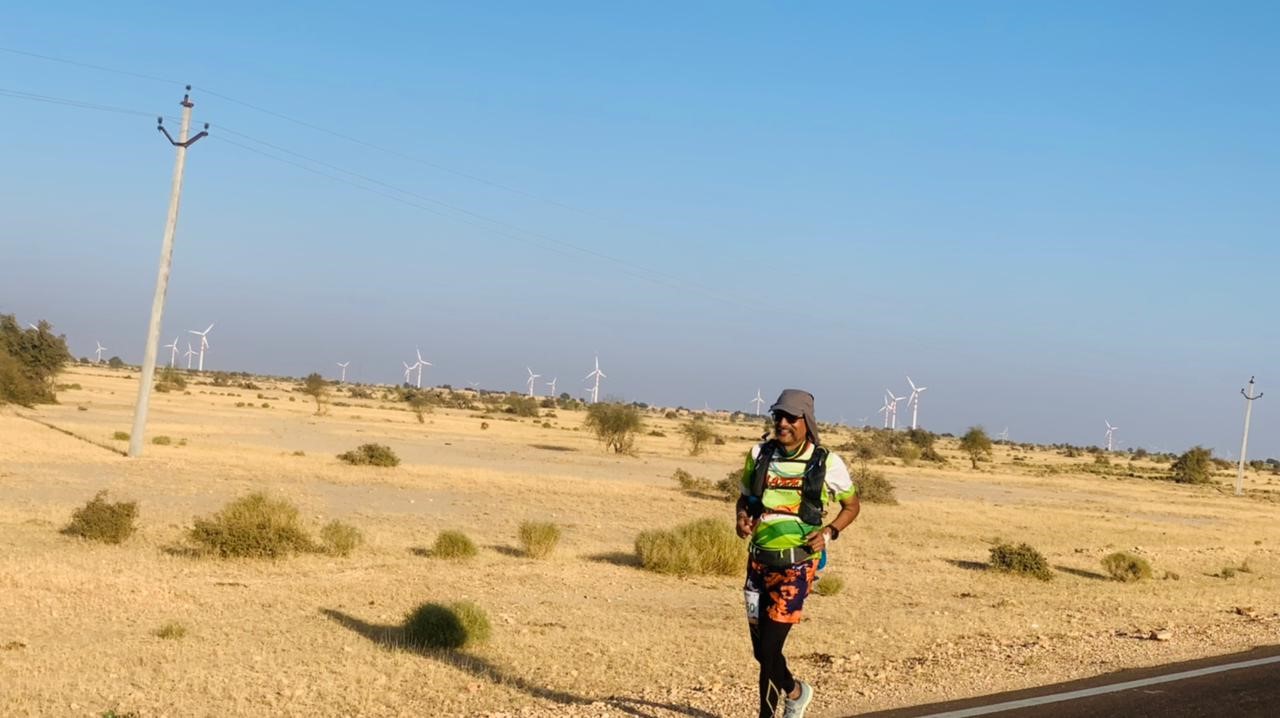
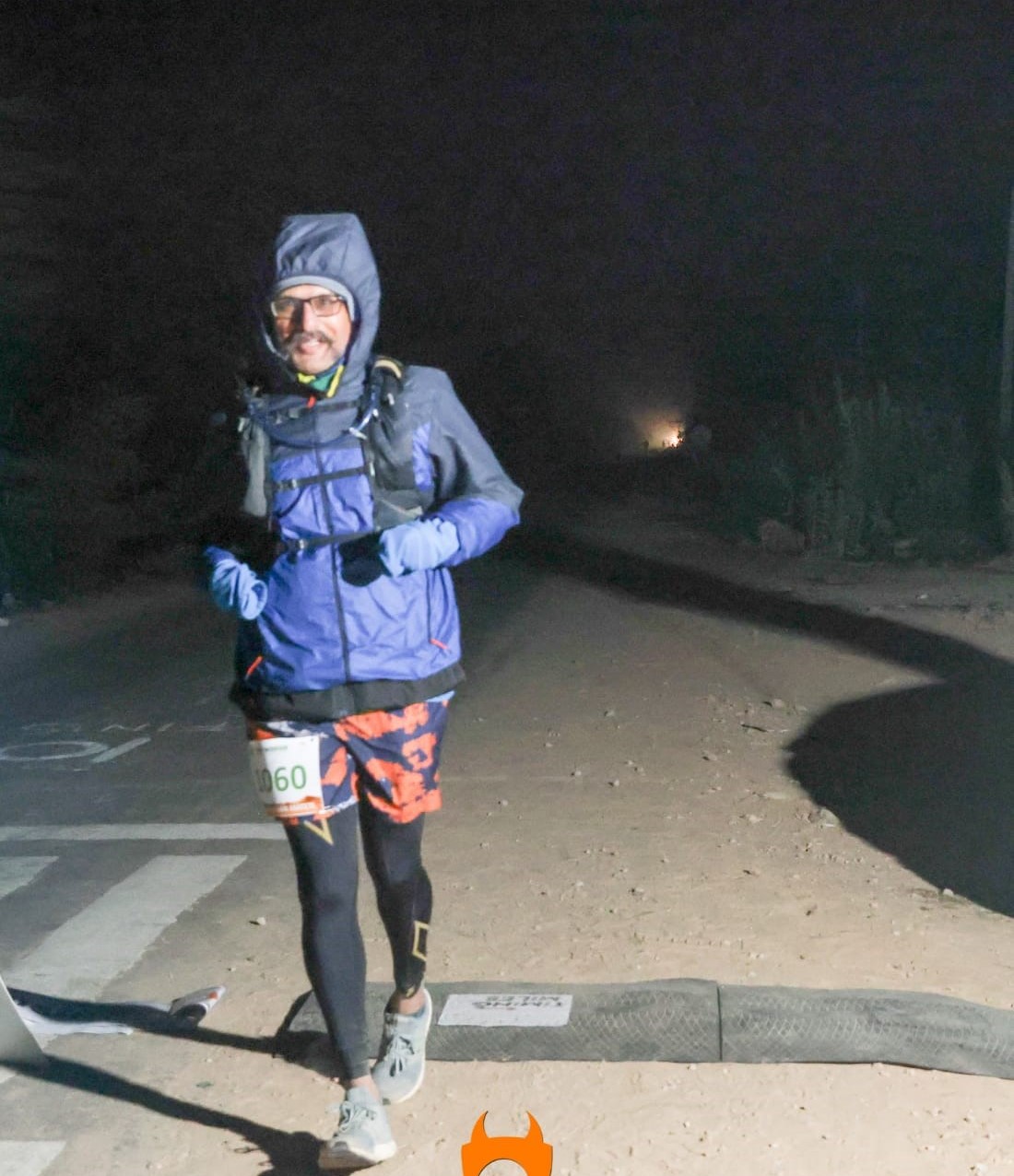
The experience of running absolutely alone, in the middle of a moonlit desert, with just the seemingly never-ending black road snaking into oblivion in front of you, was an ethereal experience. At around 75 km or so, someone from behind, who was overtaking me, asked me if I was alright. He thought I was kind of weaving while running. While I told him I was fine, I realized I might be looking at another vertigo attack – so I immediately stopped, steadied myself and decided that from then onward, I would walk more and run less. I had sufficient time in my kitty and was pretty confident that I would make the 16 hrs cut-off, provided I didn’t collapse.
My motto during my Special Forces days came to my mind: “ who dares, wins.’’ So, I again decided to go for my planned time of completing the 100 km in 15 hours, and started cutting down on the walks and running more.
I finished my first 100 km in 15:59:04 hours. Now that I have completed my first 100 km, I am looking forward to running a 100 miler by the end of this year.
(The author, Col Chandan Kumar Mateti, is a retired army officer based in Pune.)
Few races represent running like the Boston Marathon does.
As the 2022 edition of Boston Marathon returns to its April schedule, long-distance runners around the world are getting ready to travel for international road races. They hope the upcoming race – it is being held on the race’s traditional date – signifies the return of normalcy to running events worldwide after the calendar of races was upset by the COVID-19 pandemic.
The Boston Marathon, in its 126th year, is scheduled to be held on April 18, 2022, its first rendezvous with Patriot’s Day in three years. Held every April, the event inspires hundreds of runners around the world to qualify for it and participate. The 2020 edition was cancelled due to the coronavirus pandemic and was held in a virtual format later in the year. The 2021 edition was held in physical format in October 2021 with Kenyan elite runners taking top honors.
This year, over 100 runners from India have found a place in the entry list and are travelling to Boston to participate in the event, which is a World Marathon Major and among the globe’s most iconic races. “Getting back to international running events is something to look forward to after two years of pandemic,” said Pune-based Kavitha Reddy. She couldn’t think of a better way to execute the return than to run the Boston Marathon.
Hemant Beniwal (Photo: courtesy Hemant)
Kavitha had participated and completed the Boston Marathon in 2018, the year the marathon encountered its worst weather in 30 years. Faced with howling winds, rains and snow and the weather deteriorating as the race progressed, many runners had to quit, including the African elite contingent.
Memories of the 2018 race continue to engage her as variations in weather conditions is an issue with the Boston Marathon. All the same, her training went off quite well especially in the final stages. She lost a couple of weeks in January 2022 to coronavirus infection. “When I got back to training after COVID, it was tough initially. But slowly I got my energy back,” she said. On March 13, 2022, she ran a half marathon at the Jaipur Marathon, finishing in one hour, 30 minutes and 47 seconds. Kavitha is one of the best recreational runners in India in terms of time efficiency.
Gurgaon-based Hemant Beniwal, is headed to Boston for his first attempt there. In 2019, he ran the Berlin Marathon, finishing it in 2:59:30, as per data on the Berlin Marathon website. “It is a privilege to run the Boston Marathon as the bulk of the runners are chosen on merit. Also, the energy level in Boston is incomparable to any other running event. The city celebrates every runner’s presence,” said Hemant. He had qualified for Boston Marathon in 2018 but did not make it. He attempted another qualifying run in 2021 to secure the timing required for his age group (35-39) and make the cut. This was even as the time for qualifying got tougher.
Hemant is also an ultra-marathoner. He represented India at the 2019 100 km IAU Asia & Oceania Championships held at Aqaba in Jordan. The Indian men’s team had secured gold at the event. Hemant finished the distance in 8:12:11.
Rajeev Singh (Photo: courtesy Rajeev)
Srividya Ramnath from Navi Mumbai has already done two of the World Marathon Majors – Chicago Marathon and Berlin Marathon. She has been training diligently for the Boston Marathon for the past four months, helped by a training plan designed by her coach, Ankita Gaur. “I resorted to speed runs even during my long runs and that approach has helped,” she said. She has been an age-category podium finishers in some of the events in India.
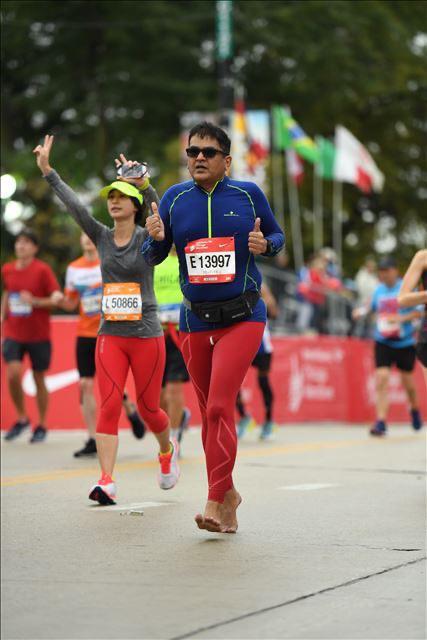
Rajeev Singh, also from Navi Mumbai, has run several international races. This will be his second outing at Boston, the first one having been in 2019. Rajeev has been running barefoot for about six years. But recently he shifted to minimalist footwear. “I have been running quite regularly. My preparation, I think, has been good,” he said.
(The author, Latha Venkatraman, is an independent journalist based in Mumbai.)
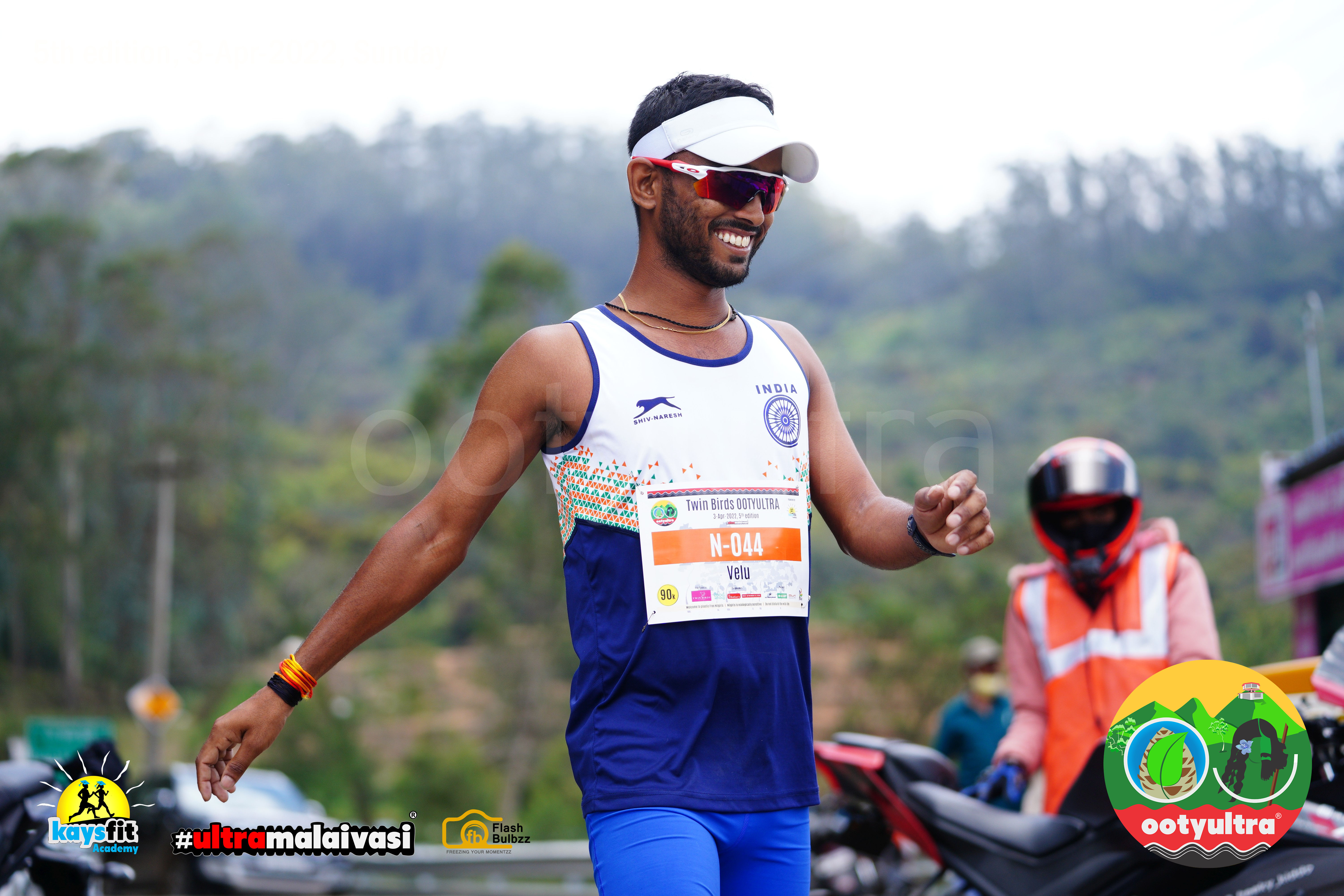
Ultra-marathoner, Velu Perumal, won the 90 km-OotyUltra road race held on April 3, 2022 in Tamil Nadu.
The ultra-marathon, held on the streets of Ooty, was challenging with substantial elevation gain and long stretches of downhill. But it was supported well by race organisers and volunteers, runners this blog spoke to, said.
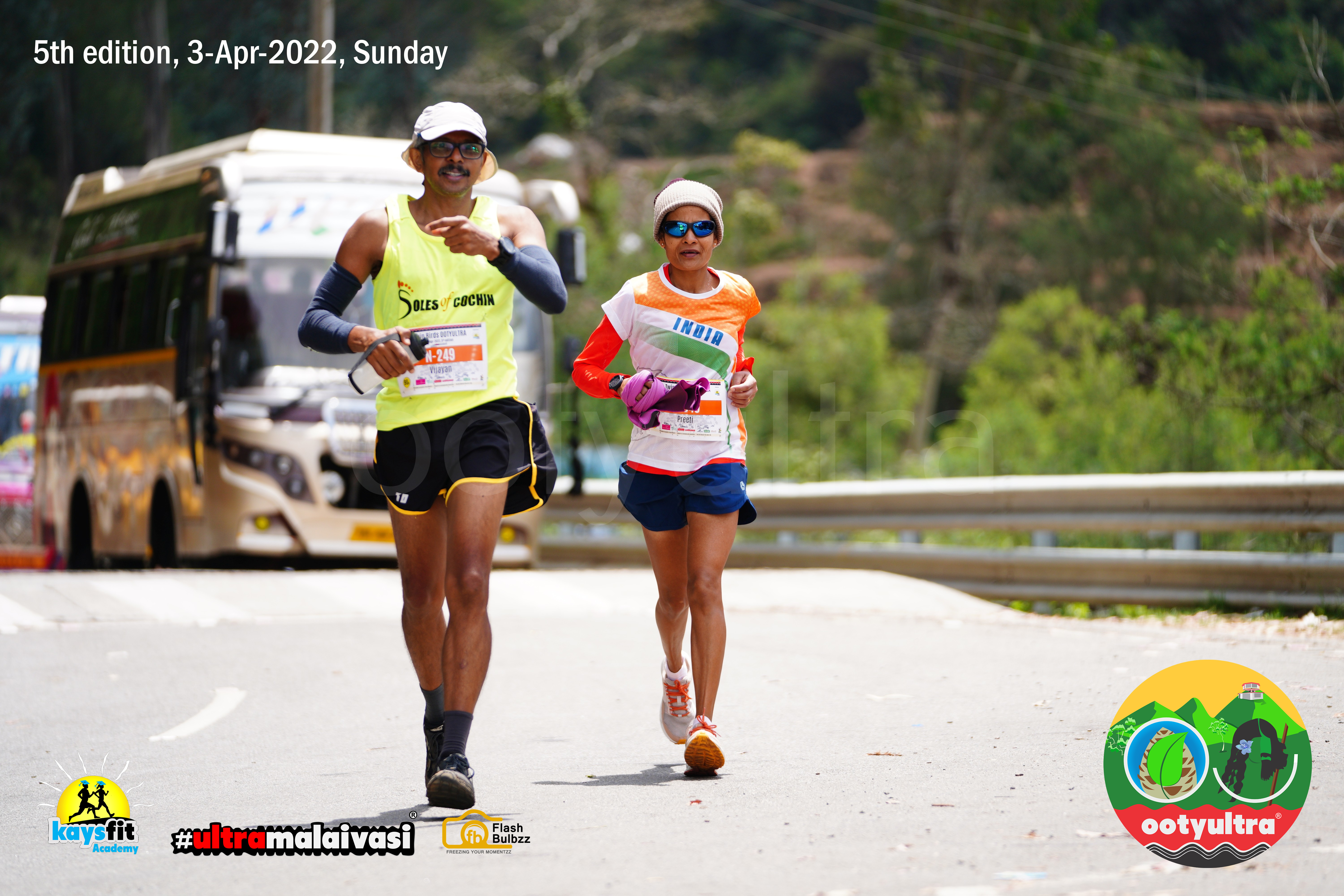
Of the six runners at the start line of OotyUltra’s 90 kilometre-race, held on April 3, 2022, three finished the race. Velu Perumal was the winner followed by Preeti Lala from Mumbai and Vijayan Pillai from Kerala.
OotyUltra has four events – 90 km, 60 km, 30 km and 15 km. The 90 km race, which was by invitation, has a cumulative elevation gain of 2600 metres. There are extended sections of uphill and downhill, with the route touching Dodabetta Peak, winding through Kothagiri and ending at Tea Park.
The event was organised by KaysFIT Academy, founded by Kannan Sundarajan, known as Coach Kay in running circles; it was its fifth edition. In its physical form, Ooty Ultra was in its third edition, having lost two years to the coronavirus pandemic. Coach Kay, originally from Ooty, commenced running in 2011, starting with marathons. He later moved to ultra-marathons.
“It was quite a tough route, quite challenging, requiring us to put in a lot of effort,” Velu, the winner of the 90 km-race, said. He finished it in ten hours, 48 minutes and 31 seconds. Velu is a regular participant and podium finisher in many ultra-running events. He has also represented India in ultra-running events overseas held by IAU. The 31-year-old, who works with the Indian Army, has been coached by Subedar Pawan Kumar from Army Medical Corps.
Mumbai-based Preeti, who placed second among the three finishers, refers to the 90 km-race at Ooty Ultra as “ Indian Comrades.’’ Comrades Marathon is an ultra-marathon held every year in South Africa. “This is a must-do event for those running the Comrades Marathon,” she said. She finished the race in 11:38:27. She was the only woman participant in the 90 km-category. Preeti is due to go to South Africa to take part in the Comrades Marathon, scheduled to be held in August 2022.
Vijayan Pillai, who came in third, managed to finish within the 12-hour cut-off; he clocked 11:52:55. Preeti and Vijayan ran together for a long distance but somewhere around the 84 km- mark Vijayan started to develop cramps and had to slow down. His first time at OotyUltra, Vijayan found the event well organised. According to him, the first part of the run led to Dodabetta Peak and on the return, took a deviation to Tea Park (also the eventual finish point). The second and third parts, “ followed a different loop but in opposite directions.” “The aid stations were well-placed and the volunteering was great. The youngsters, who were recruited to do the volunteering, did a great job,” he said. Vijayan commenced running eight years ago and over time got interested in ultra-running, particularly trail running.
Weather was quite good at the start of the race in Ooty but the afternoon stretch turned quite warm. “The hydration and nutrition support by the organisers and the villagers helped us get by during this tough period,” Preeti said. On offer were watermelons, energy drinks, curds, jaggery, bread and butter. The hydration points were positioned at intervals of 3-4 km along the route.
Vijayan Pillai and Preeti Lala (Photo: Flashbulbzz Photography)
Preeti has finished on the podium before, at ultra-running events. Running the 24-hour race at NEB Sports Mumbai Stadium Run in February 2021, she had emerged the overall winner with a distance of 193.60 km covered. It was the second best by an Indian woman in the category.
At OotyUltra, Dr C. Selvaraj chose to run the 60 km-race. He did it barefoot. This was his second ultra-running event, the first one being the Yercaud Hills Ultra, where he completed the 50 km-race.
“Running barefoot was tough during the hot, sunny hours. I had to run by the side of the road,” he said. Overall, the race was tough with a total elevation gain of 2000 metres, he said. A neurologist, Dr Selvaraj started running for health reasons. Over time, he grew more and more interested in long-distance running.
(The author, Latha Venkatraman, is an independent journalist based in Mumbai.)
Jyoti Gawate and Nitendra Singh Rawat secured top honours at the 2022 edition of the Ageas Federal Life Insurance New Delhi Marathon held on March 27.
Nitendra completed the men’s marathon in two hours, 16 minutes and four seconds. Jyoti, an elite runner from Maharashtra, covered the distance in 3:01:19 to win the women’s race.
The event was an opportunity for athletes to qualify for the year’s Commonwealth Games and Asian Games.
The marathon-qualifying time for the Commonwealth Games (CWG) to be held in July-August 2022 in Birmingham is 2:18:40 for men and 2:38:19 for women. The same for the Asian Games to be held in Hangzhou, China in September 2022, is 2:18:48 for men and 2:39:28 for women.
File photo / Jyoti Gawate (Photo: courtesy Jyoti)
Anish Thapar Magar got the second position in the men’s race, finishing 36 seconds behind Nitendra with a timing of 2:16:40. In third position was Anil Kumar Singh (2:16:46). In the men’s marathon, finishers up to the fourth, fifth and sixth place – Ashish Kumar (2:17:03), Belliappa A.B. (2:17:08) and Kalidas Laxman Hirave (2:18:12) – joined the podium finishers in the list of those qualified for the CWG and the Asian Games.
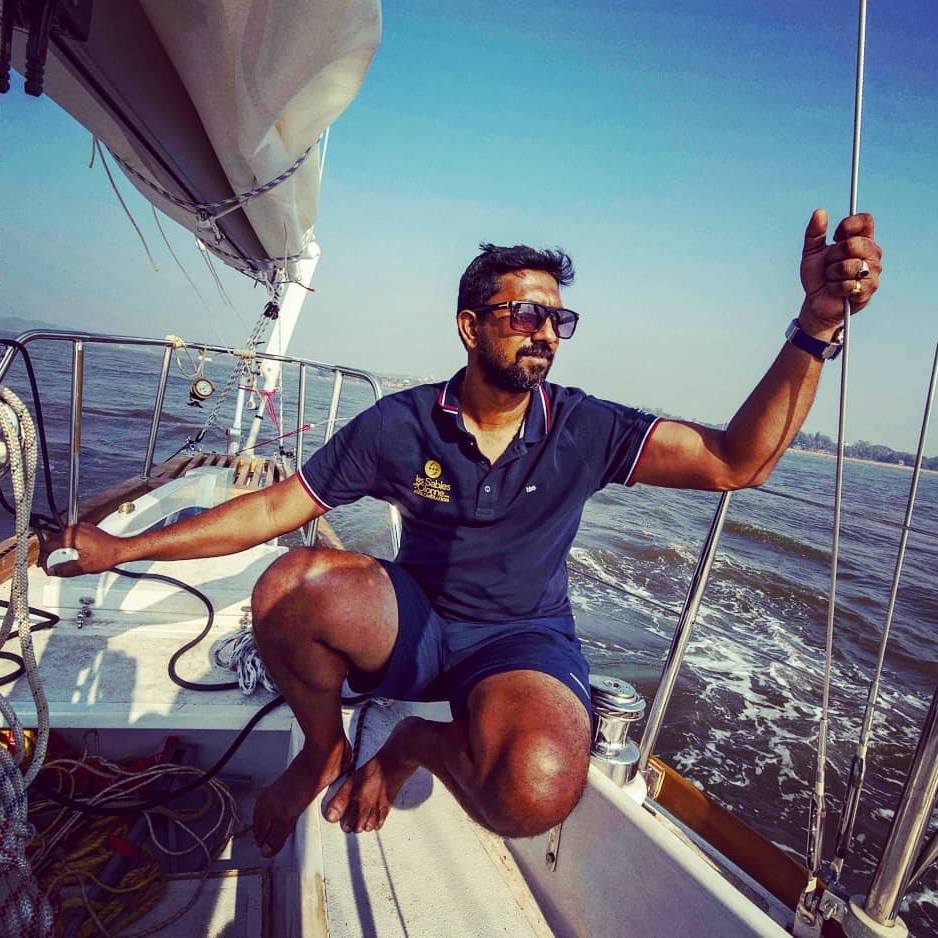
Commander Abhilash Tomy KC (This photo was downloaded from the Facebook page of Commander Abhilash Tomy and is being used for representation purpose. No copyright infringement intended.)
He has five months to complete a full refit and sail a 2000 miles solo voyage to qualify for the GGR.
Well-known Indian sailor, Abhilash Tomy, will be participating in the 2022 edition of the Golden Globe Race (GGR).
The former naval officer, will sail in a UAE-registered sailboat named ` Bayanat’ which will race under the number 71, the year in which the United Arab Emirates was formed. The announcement was made at the ongoing Dubai Expo.
In 2018, Abhilash – he is the first Indian to sail solo nonstop around the world – was a participant in the 2018 GGR. Following a severe storm in the southern Indian Ocean that damaged his boat and left him injured, he had to be rescued. At that time, he was sailing in the ` Thuriya,’ a replica of the ` Suhaili,’ which Sir Robin Knox Johnston had used to complete the first solo nonstop circumnavigation in 1968. The ` Suhaili’ was built in Mumbai; the ` Thuriya,’ in Goa. Following his rescue, Abhilash endured surgery and a challenging road to recovery.
In his Facebook post confirming participation in the 2022 GGR, Abhilash provided a synopsis of the 2018 accident and explained why taking part in the 2022 GGR “ is a big thing” for him. Excerpts: “ After 82 days we were lying in third position when the storm overtook us. My boat was dismasted and destroyed, and I suffered a huge fall which left me with multiple spine fractures. And with pretty functionless legs. The remoteness? Couldn’t have been worse. The Antarctic was the nearest continent. We were exactly between Australia and South Africa, and south of India.’’
The situation triggered an international rescue effort. Four nations contributed – Ireland (Irish sailor Gregor McGuckin, a fellow competitor in the race made a heroic effort to reach Abhilash), India, Australia (both countries dispatched their naval assets) and France (it’s fisheries patrol vessel ` Osiris’ was the first to reach Abhilash). The injured sailor was shifted to a small island in the French Sub-Antarctic Territories where he was provided primary medical care. He was brought to India on the 16th day of the accident.
Excerpts continued: “ An MRI revealed the fractures in the spine. Two days later I was operated upon. Titanium rods were inserted in my spine and 5 vertebrae were fused into one. My legs were so badly off that I had to learn to walk again. But I did learn to walk, and then got into a cockpit and got back to flying, and sailing! 3 and a half years later, I am heading back into the same race that almost got me killed. Wish me luck !”
Abhilash’s boat for the 2022 GGR bears the name of his sponsor – Bayanat, a G42 company specializing in AI-powered geospatial intelligence. According to a report on the GGR website, Bayanat has said that during the race Abhilash would aid in ongoing scientific work, “ including the collection of water samples which can be analysed for up to date insight on the presence of microplastics in the world’s oceans.” Additionally, a small section of the yacht will be painted with a special coating which will serve as a reflectance target for satellites, “ representing a one-of-a-kind opportunity to collect calibrated data during the race.”
As per the report dated March 22, 2022, available on the GGR website, Abhilash purchased a Rustler 36 in France, and named it “ Bayanat.” The boat was previously raced in the last Golden Globe by Philippe Péché with PRB sponsorship (he retired from the race on August 25, 2018 due to a broken wind vane and put in to Cape Town). “ He has five months to complete a full refit and sail a 2000 miles solo voyage to qualify for the GGR,’’ the report said adding that with Abhilash’s entry, the total number of competitors in 2022 GGR stood at 23 sailors from 13 countries.
GGR’s list of skippers for 2022 also includes Gaurav Shinde (originally from Mumbai), who will be representing Canada in the race. “ Such great news! Can’t wait to share the start line with this legend.” – Shinde responded on Facebook to the news of Abhilash’s participation, confirmed.
The 2022 GGR is scheduled to commence from Les Sables-d’Olonne in France, on September 4. “ Whilst the proven formula of the 2018 Notice of Race will remain substantially the same, there are some additions for this third running of the Golden Globe. Sailors must show prior ocean sailing experience of at least 8,000 miles and another 2000 miles solo before applying to compete. Two new film drop points have been added to the course: Cape Town and Punta del Este. An extra 2000 miles non-stop solo qualifying voyage in the GGR entered yacht, using only celestial navigation, is required on top of the previous minimum 8000 ocean miles and a further 2000 solo miles. Thus, a total experience of 12000 miles at the start of the race,” the GGR website said.
(The author, Shyam G Menon, is a freelance journalist based in Mumbai.)


 Outrigger