“ THE IMMUNE SYSTEM IS VERY RESPONSIVE TO EXERCISE’’

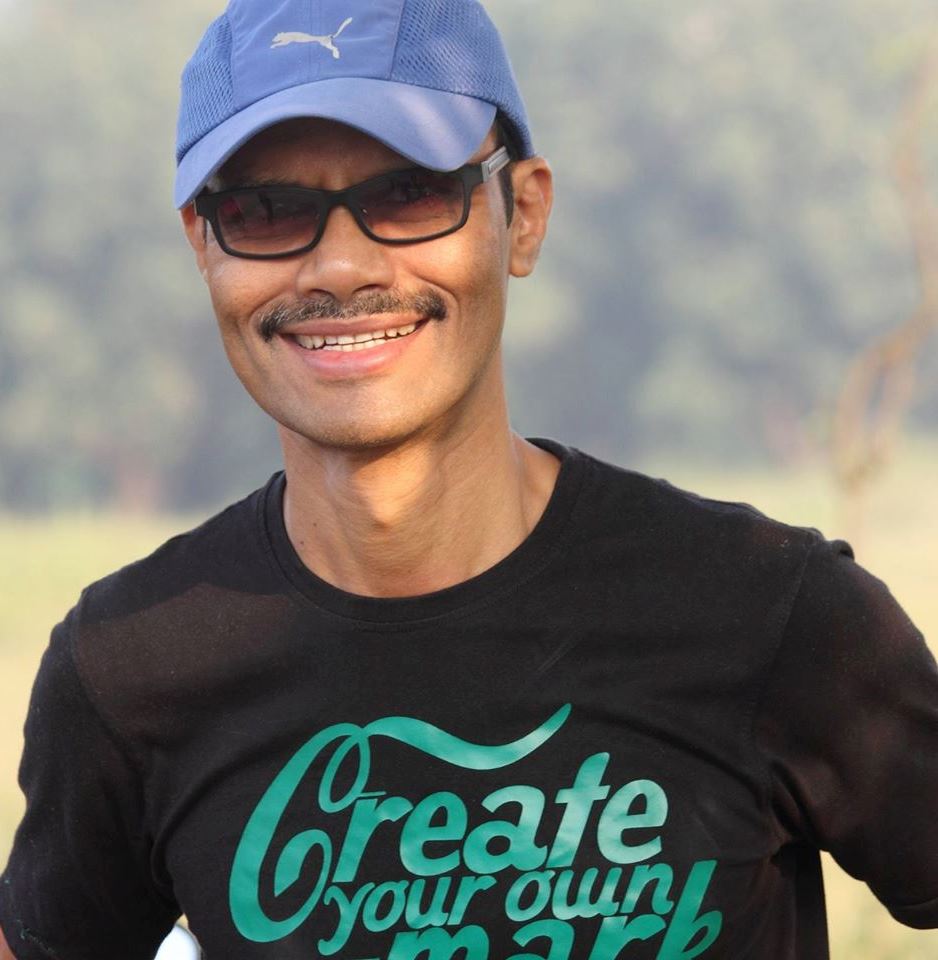
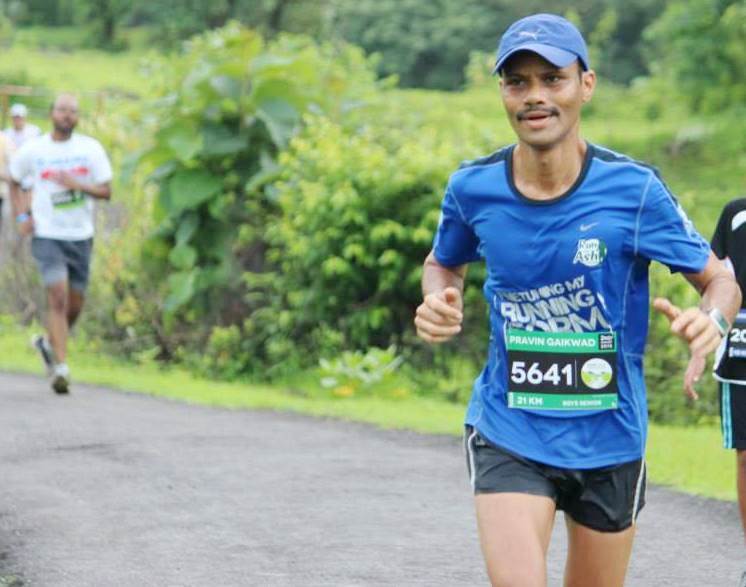
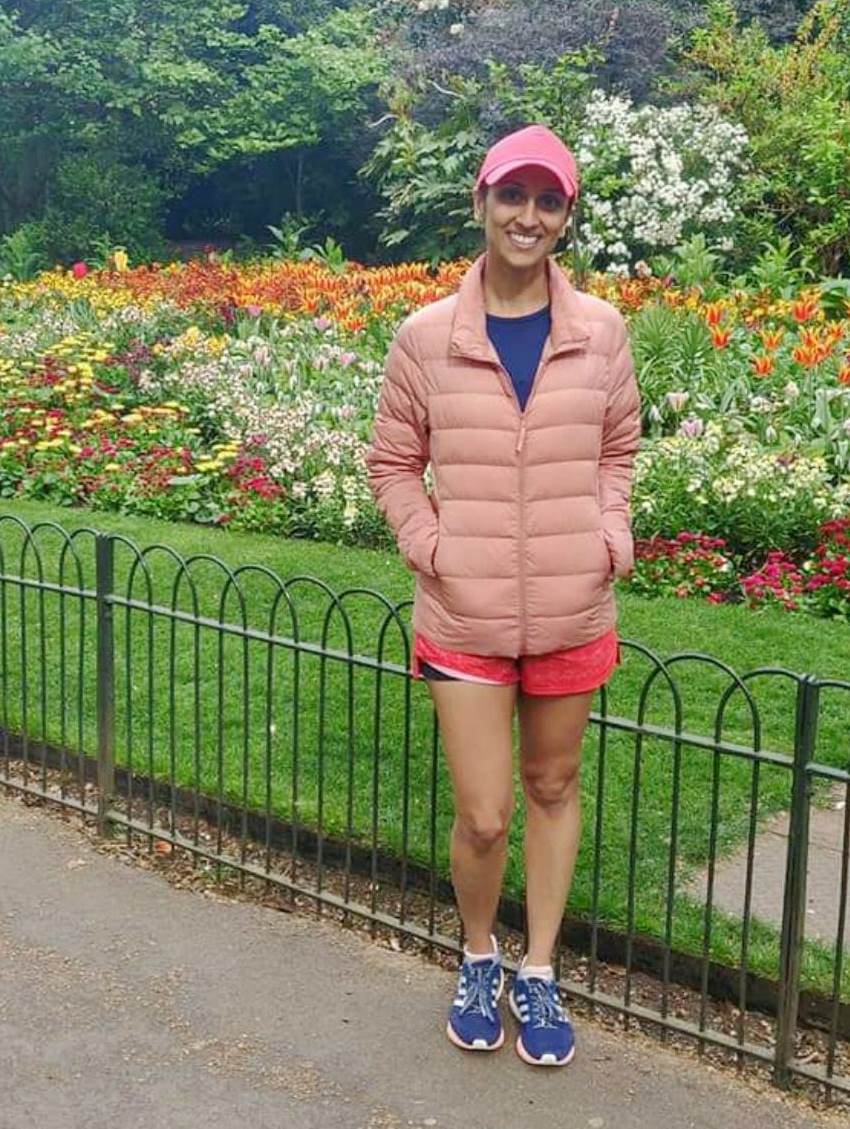
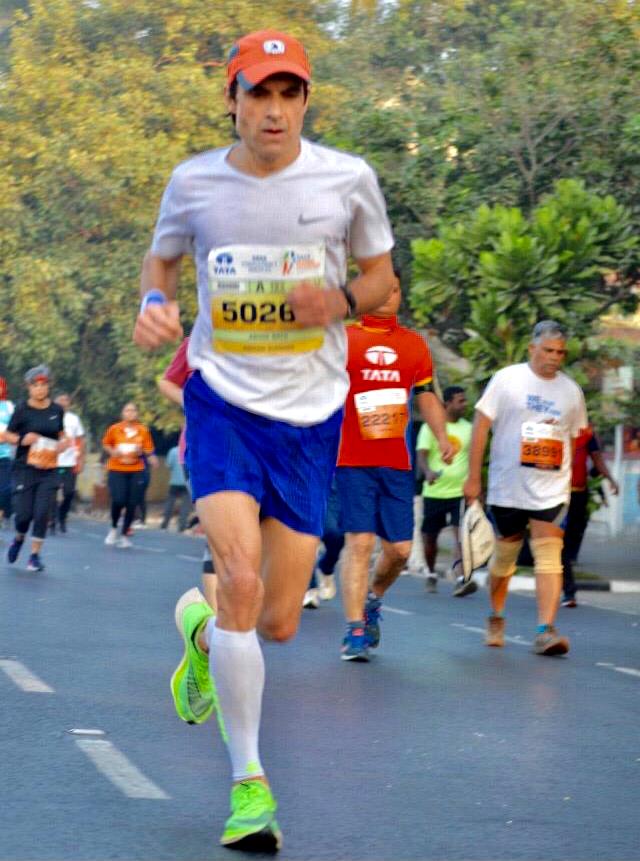
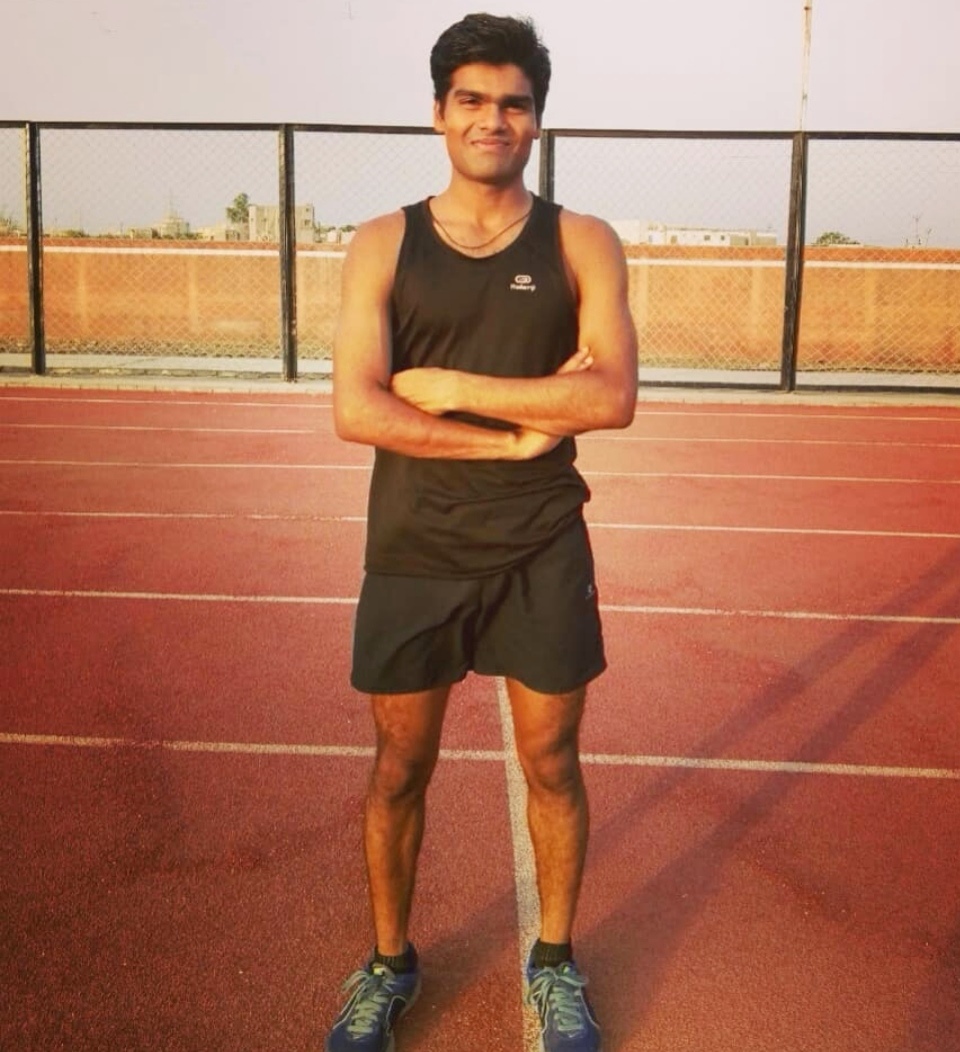
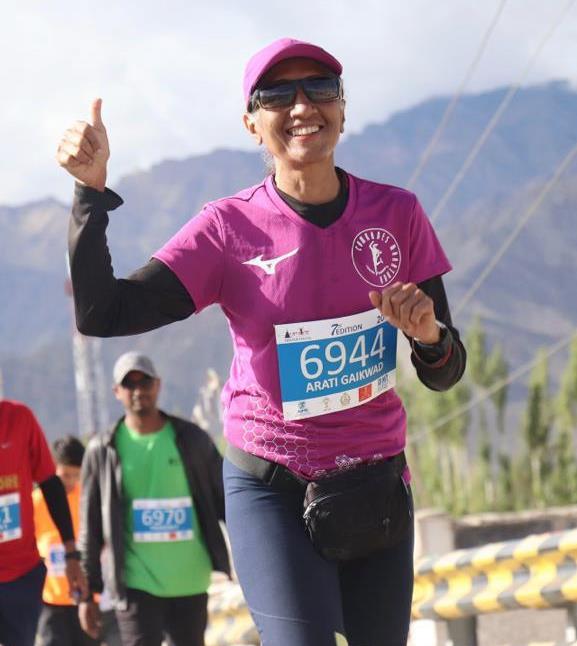
Dr Pravin Gaikwad (this photo was downloaded from the doctor’s Facebook page)

Dr Pravin Gaikwad is a well-known pediatrician in Navi Mumbai. He and his wife Arati, also a doctor, have been running a clinic in the Navi Mumbai suburb of Nerul for the past several years. The two are longstanding distance runners and triathletes. They have been frequent podium finishers in their age category at various events. In addition to being a doctor, Pravin heads coaching and mentoring at Lifepacers, a Navi Mumbai-based fitness group composed mostly of runners. On March 6, 2020, this blog spoke to Pravin on the importance of exercise and balanced lifestyle in maintaining good health, central to which is a strong immune system.

Is it possible to strengthen our immune system naturally? What should we do for that?

Very simply put, immunity is your defence against invading bacteria and toxins. It is the system involved in defending your body. There is still much to be known in this regard. The main organs involved include thymus, spleen, liver, lymph nodes, bone marrow; cells include T-cells, B-cells, some cytokine proteins, phygocytes – they are like scavenger cells, then those that are anti-inflammatory in function – there are so many things involved. Even the bacteria in the gut – microbiota – they help in immunity to a great extent. So, from a bird’s eye view, a lot of things are involved.

In Marathi, there is a saying: sainya pothavar chalta; it means an army runs on food. Similarly, the easiest way to strengthen immunity is nutritious food, naturally cooked and visually having a range of colors. There are of course more detailed technical specifications but the typical balanced diet we were all taught in school – in India we are fortunate that our ancestors have been following it for ages – if you follow that, the immune system will be good. Along with good nutrition, sleep is an important thing. If you compromise on sleep, you risk compromising your immunity due to factors like hormonal imbalance; so sleep and rest are vital. Third, physical activity is important for maintaining a healthy immune system. Stress is capable of compromising immunity and therefore ability to withstand stress – which physical activity can contribute to – helps strengthen immunity. Among things to avoid: smoking definitely impacts immunity. Alcohol beyond a limit also has the same effect. These habits have to be cut. Smoking is a big no; alcohol only in moderation if somebody wishes to have it. To my mind, these would be the natural ways of maintaining a healthy immune system – nutritious food, adequate rest and sleep, developing ways to withstand stress and avoiding bad habits.

Can you explain how regular exercise helps to fortify the immune system?

The immune system is very responsive to exercise.

The initial perception was that exercise causes problems in immunity. That view was based on studies of endurance athletes; it was found that their immunity can be a bit low. Later, it was found that immunity was better in these people while performing acute short term exercises. Research and data showed that generally less than 90 minutes of endurance activity a day, is definitely helpful. More than 90 minutes could also be useful but there are other angles to consider. Next would be the number of days. There is no mention that you should do this all days of a week. If you refer the recommendations of the World Health Organization (WHO) for maintaining a healthy lifestyle, what they say is: 150 minutes in a week plus two strength training sessions. That last recommendation – the strength training sessions – is something most of us neglect. My view of this is: the 150 minutes typically ends up as moderate physical activity because it will include warm-up and cool down. So the real overall time for exercise will exceed 150 minutes per week, I feel. You cannot increase your heart rate to 80 per cent of your maximum heart rate just like that. It has to be gradual. Otherwise there will be repercussions of not warming up properly. So to sum up, regular physical activity genuinely helps in strengthening immunity. It serves as adjuvant (a substance that strengthens the body’s immune response) to strengthening the immune system.

When there is earlier mentioned physical activity of less than 90 minutes the count of anti-inflammatory proteins, cytokines, neutrophils, phygocytes, NK (natural killer) cells, cytotoxic T-cells, immature B-cells – all this goes up. After a certain time, it comes back to normal. But what is important is that a summation effect occurs (summation effect in medicine is described as the process by which a sequence of stimuli that are individually inadequate to produce a response are cumulatively able to induce a nerve impulse). Over a period of time, immunity is found to be better.

The basic concept of any disease is inflammation. Acute inflammation is useful to the body; chronic inflammation is not. Inflammation can be caused by three things. First is trauma, second is infection and third is allergy. Chronic inflammation is caused by stress. Acute inflammation is caused by acute exercise; that is beneficial, over a period of time it develop the ability of the body to withstand the stresses properly. The body becomes stronger. Ultimately, that is immunity. Then, there are different patho-physiologies. One is that thanks to the summation effect, the immune systems itself becomes more active and capable of adapting better. Another thing to mention here is the microbiota. One third of these beneficial bacteria are the same in you and me. Two thirds is different. Initially it was learnt that the more diverse the bacterial flora, the better is our immunity. Then it was found that athletes have more diverse bacterial flora. One reason for this is that once you are into regular physical activity you tend to address your nutrition intake better. Besides diverse bacterial flora, good diet also leads to optimum vitamin levels.

One of the effects of regular exercise is that it helps reduce instances of obesity. In obesity, the fat cells can contribute to chronic inflammation and chronic inflammation can compromise immunity. Another angle is that of ageing; with age, immunity reduces. The process is called immunosenescence. When you age, the immune system gets progressively dysregulated. It raises susceptibility to various diseases. When there is regular exercise, there is delayed immunosenescence through improved regulation of the immune system. There is something called telomeres in our chromosomes. With ageing its length reduces. However in the case of those with regular physical activity, their telomere length has a better chance of staying normal. That is part of the anti-ageing effects of regular physical activity.

If you exercise or you run – especially run – everything else falls into place. You automatically give up smoking; limit your alcohol intake, take care of your nutrition, sleep and body composition. Just being into fitness, puts the other components into place. Having a goal catalyzes it.

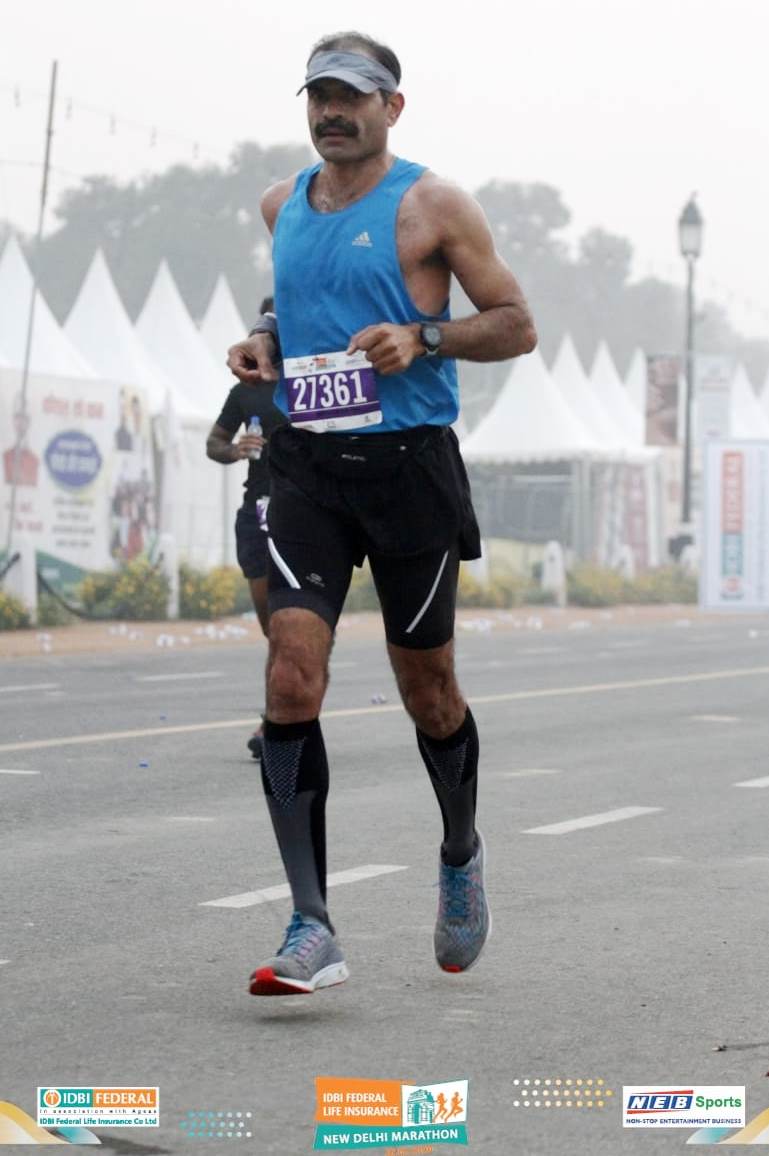
Dr Pravin Gaikwad (photo: courtesy Pravin)

You mentioned about the WHO prescribed norms for exercise. You have rich personal experience as swimmer, runner and triathlete. What would you say is the apt quantity and quality of exercise for an average individual?

I would definitely insist on strength training sessions; at least twice a week. As we age our growth hormone levels decline. Testosterone level declines. Your muscle mass is going to decline. The fat mass will increase. Ultimately, the muscle is a furnace. This means that with the same diet, the same exercise – aerobic without strengthening – you still gain weight. When you strengthen your muscles, not only do you get the popularly known advantages like reduced chances of injury, improved balance and improved bone density; you also slow down the growth hormone decline. Talking of growth hormone, sleep and growth hormone is related. When you have good sleep, there is good growth hormone secretion. All this gives you that anti-ageing effect, more energy and combined with better muscle mass, the potential for a higher level of activity. So do strength training at least two days a week. It should be for the whole body. It can’t be that you are a runner and therefore you strengthen only your legs. Aerobic physical activity can be anything – running, swimming, cycling. I think, 30-40 minutes of such activity – as WHO says, moderate physical activity – with warm-up and cool down and with heart rate rising to 80-85 per cent of maximum heart rate, is good enough.

Now, there are those who wish to challenge themselves. Let’s take the marathon as example. One study showed there was 2-18 per cent increase in sickness level – particularly respiratory tract infections – was found in marathon runners two months before a race and 15 days after a race. We are subjecting ourselves to multiple stresses during those months leading to a race. After running a marathon, there are a lot of chronic inflammatory changes which occur in the body. In my own case, after a marathon I usually do HSCRP (Highly Sensitive C-Reactive Protein) test. The figures are usually high. Then it settles down. I generally run only one full marathon a year. I rarely run half marathons but I do quite a few 10-kilometer runs. It is those speed runs that are more important from a health point of view. Fast for one minute, then slow for one minute – like that some 6-8 times in one particular run, that will be enough exercise. Running for two hours, three hours – that is not really required; it can cause chronic inflammation. Studies show that when you start exercising, in the initial stage, you are contributing to improving your immunity. As you elevate exercise, the risk increases. In heavy exercise, the risk can go up by two to six-folds.

How do you decide severity of exercise? If you take any of the amateur athletes who are pushing themselves, how can they know if they are exercising beyond acceptable limit or not?

Let us talk of the elite athletes. They do severe exercise. But their bodies have adapted gradually to that level of exercise. This is what amateur runners often miss. Good coaches don’t increase mileage by more than 10-20 per cent a week. Every fourth week, you try to incorporate a cutback-week. Follow these routine things. Let me give you the example of Comrades Marathon. I did Comrades in 2018; myself and my wife, Arati. We did not do Comrades back-to-back. I might do it once more when I turn 60. Given Comrades entails lengthy training of 4-5 months, if you are doing it regularly, you may be erring on the side of greater inflammation. Overtraining may also not give you enough sleep. So to return to your question of what qualifies to be severe: if you are not getting up fresh, if you are not sleeping well, if you don’t have enough energy for the day, if your appetite is less, if you are falling ill, if your immunity is declining – those are all signals from the body telling you to cut down. A new runner, for three years at least, he should not run a full marathon. Also remember – running is a muscle-shortening exercise. With age and with constant running – it’s going to affect your speed. Some of the elite runners in the later part of their life, become triathletes. Swimming has the ability to restore muscles to their original length. Plus it involves a different muscle fiber; it also improves breathing.

I think, accepting your declining pace helps you sustain the act of running and enjoy it for more years. Throw off your watches and measuring devices and run. Go with the flow. Except when training for a race, I don’t resort to these gadgets. The longevity of physical activity and fitness is more important than results delivered by great pace. Unfortunately we are fascinated by that pace.

You spoke of the importance of mixing fast and slow running for meaningful work out. There are many people who prefer not to run and are instead into walking. Can they too leverage this blend?

It can be done. In terms of evolution, we are born to run. Once we get used to a certain level of activity, it is normal for the body to learn to use less calories to deliver the same outcome. You do a particular activity, you get some benefits. But later, you don’t. I have been running for years in Navi Mumbai. In that time I have seen many people walking religiously in the morning. But some of them are also gaining weight. That’s because their bodies have got adapted to the routine. They are no longer getting the benefit of walking. You can get the benefit by challenging yourself. There are simple things you can do. For example, you can change the time of your walk; sometimes walk in the morning, sometimes walk in the evening. That way, the body gets a bit shocked. Second, change the terrain. Go to the hills for a change; the body gets challenged in a different way. You can try brisk walking. People try aerobic walking too; you walk like you run. Normal walking burns 4-5 calories per minute. Aerobic walking will burn 8-10 calories per minute. You can introduce the Fartlek concept in walking. Or keep an app that collects data about your walking, if data is a source of motivation for you. Anything that can be measured can be improved upon. I feel somebody who can walk for 30 minutes should be able to run. And if you have been running regularly for three months, you can become a runner. The point is – whatever physical activity you are engaged in, you should challenge yourself a bit. Plus, don’t forget strength training. That helps you walk faster too.

What kind of effect does stress have on the immune system?

Stress impacts the immune system. Stress is of two types. There is the psychological type. Then there is the physico-chemical type which encompasses environmental stress, food, toxins we inhale etc. The body has a tenacious ability to adjust to the challenges in the environment. But if your immune system is compromised or you are under so much duress that the resultant stress is beyond your capacity to cope with, then it can manifest as disease. It can give rise to chronic infections, auto-immune diseases, inflammations and even cancer. I remember a study on anti-depressants used in the treatment of cancer. They don’t address the cancer per se; they address the stress factor. Beta blockers are medicines used to tackle the higher levels of hormones like adrenalin that can be triggered by stress. Prolonged chronic stress can result in more pro-inflammatory cytokines and health conditions thereof.

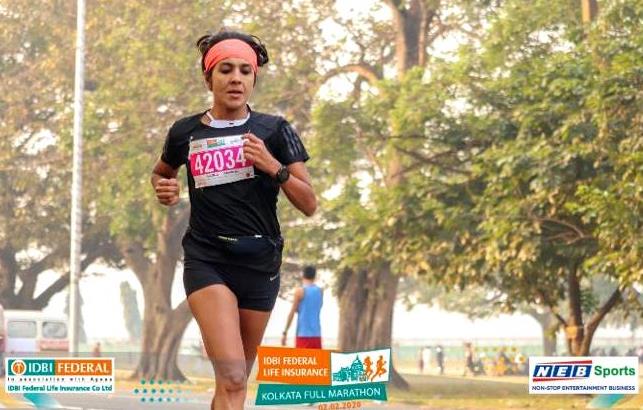
Dr Pravin Gaikwad (Photo: courtesy Pravin)

How important is rest and recovery in the scheme of things?

Seven to nine hours of sleep will maintain your growth hormones properly. Memory consolidation also happens during sleep. This is important for children. There was a time when school used to be from seven in the morning till twelve noon. You come home and sleep. That consolidates memory. Evening you play. Then you study, eat and sleep. You find something similar in elite runners. They train twice a day. For them, their sleep consolidates their training. Amateur runners, who hold down jobs and pursue their passion, are probably at a disadvantage here. If you can catch a nap some time in between, it helps. It should also be mentioned in this context that use of alcohol and excessive use of mobiles disturbs sleep pattern. If you want good performance, eventually it is about TNR – Training, Nutrition and Recovery. Recovery is where our muscles actually get trained. Then they perform better. On partially trained muscles if you exert, they will be prone to injury. Rest and recovery are the same things. It is very important. I can give you an instance from personal experience. My personal best in the marathon is three hours 38 minutes, which I got at the 2017 Mumbai Marathon. Some days before the event I developed pain in my left calf muscle. So I stopped everything. After 15 days of rest, a Thursday night, I ran around six kilometers to see how the leg held. On Sunday, I got my PB. That forced rest of 15 days helped. The body always gives you a signal of how it is feeling. You just have to listen to it. I also strongly believe in the seasonality of endurance activities. We were typically expected to peak in the winter months because that is when most of the events were held. But now there is an event every weekend. People participate. I feel we should not. Constant racing is not going to improve your performance. You have to give your body time to recover.

Herein, on the nutrition front, one study found that 30-60 grams of carbohydrates per hour for a marathon or any activity beyond 90 minutes, helps reduce the post-race inflammation. Polyphenols – found in fruits – also help similarly. Banana and good carbohydrate intake is thus good for your recovery.

There is the observation that you are good in-season depending on how well you trained off-season. What do you recommend for the off-season?

Mileage has to be less. I would put emphasis on agility, strength training, nutrition and making sure your weight does not increase too much. Don’t compromise on sleep. One hour of physical activity in this period is good enough.

In terms of the quality of running you do in the off-season: take it easy – would that be correct?

Take it easy. But then don’t run easy every time. Do simple things like – open up your strides for 20 seconds, recover for a minute and then open up again. Do that six to eight times. Cool down. Or you can do Fartlek with your friends around; that is enjoyable. Keep long runs fewer in number than when you are training for a race. Similarly reserve tempo runs for the time you are training towards a race.

(The author, Shyam G Menon, is a freelance journalist based in Mumbai.)

A PHASE OF UNCERTAINTY

Illustration: Shyam G Menon

In mid-February 2020, the organizers of the Tokyo Marathon announced that the event would be restricted to elite athletes. This followed the outbreak of COVID-19 and its spread to multiple nations including Japan. Some days later, news appeared of the 2020 Seoul Marathon being cancelled.

At a press briefing of March 11, the Director-General of the World Health Organization (WHO) characterized COVID-19 as a pandemic. At the time of writing, the number of cases was over 220,000 worldwide. Nearly 9000 people had died. Among precautionary measures recommended has been restricting mass participation events. Contributing their bit to contain the disease outbreak, organizers of major marathons started announcing cancellation or postponement of events.

In the second week of March, the organizers of the Boston Marathon announced postponement of the event to September 14. Soon afterwards, London Marathon made a similar announcement, postponing the race to early October. Both these World Marathon Majors are usually held in April. Other major cancellations included the 56-kilometer Two Oceans Marathon in South Africa, Athens Half Marathon, New York Half Marathon. Several other marathons in Europe and the US have also been rescheduled. On March 16, the organizers of Swimathon Goa, an open water swimming race, decided to cancel the event. It was originally scheduled to be held over March 28-29.We spoke to some of those who had planned to attend the above said events; we also spoke to some currently training amid lack of clarity on what may happen to the event they are due to go for.

Deepti Karthik (Photo: courtesy Deepti)

Bengaluru-based Deepti Karthik was scheduled to run the Tokyo Marathon of March 1, 2020. Mid-February, the World Marathon Major, announced that it was restricting the race to elite athletes. Recreational runners were informed that their registration would be carried forward to the next year. Post 2020 Tata Mumbai Marathon (TMM) Deepti had stepped up her mileage in training aiming to go for the Tokyo Marathon. Notwithstanding the financial loss due to arrangements already made for travel and stay in Tokyo, once news of the cancellation sank in, Deepti decided to take a short break from her training.

She shifted her attention to the 2020 Boston Marathon. “ I was putting in a lot of mileage. I was running 80-85 km each week,” she said. But then, Boston got postponed. Forced to refocus her efforts and recalibrate her training schedule, she has now in her sights the TCS 10 K, slated for May 17, 2020 in Bengaluru. But past that event she is staring at a small pile-up on her plate. Deepti had also signed up for the 2020 Berlin Marathon. With the postponement of Boston Marathon, Deepti will now have to do two World Marathon Majors in two weeks.  Boston Marathon has been rescheduled to September 14 and Berlin Marathon is set for September 27.

Col Muthukrishnan Jayaraman (Photo: courtesy Muthukrishnan Jayaraman)

“ I have no choice but to run both the marathons. I guess I will take Boston Marathon as an easy run and go strong at Berlin. Boston has a tougher route while Berlin is flat,” she reasoned. If the situation does not worsen, Deepti hopes to resume her training for the two international marathons by early June. So far, she has completed three of the six World Marathon Majors – London, Chicago and New York City Marathon. This year a good number of recreational runners from India were slated to go for the Tokyo Marathon. The news of its cancellation came as a disappointment particularly because some of them were hoping to complete the World Major Marathon series in Tokyo.

Col Muthukrishnan Jayaraman, an endocrinologist with the Indian Army, was at the peak of his preparations for the Boston Marathon, when the year’s running calendar started to come apart. Now with news of the Boston Marathon being postponed to September, he is taking a break. “ I will go back to building my foundation and focus on strength training,” he said. “ My coach Ashok Nath has asked his mentees to do a self-assessment of their strong and weak points. Based on that we will have to work out our training plan,” he said. The army doctor hoped to resume his training in May and do one domestic marathon – either the Airtel Hyderabad Marathon or the AFMC Marathon in Pune, both scheduled to be held in August this year.

Apoorva Chaudhary is scheduled to run the 2020 24-hour Asia & Oceania Championships to be held in July in Bengaluru. Based in Delhi, Apoorva commenced her training sometime in mid-March. So far, thanks to the disease outbreak, her training has been muted. She plans to ramp it up from April though that would depend on how COVID-19 impacts the environment. “ I run solo and most of my training runs are done very early in the morning when there are few people on the road,” she said.

Anjali Saraogi (Photo: courtesy Anjali)

Kolkata-based Anjali Saraogi had qualified for the inaugural Abbott World Marathon Major Age Group Championships, which was to be held as part of London Marathon. She is also one of the runners representing India at the 2020 IAU 100 km World Championships to be held in the Netherlands on September 12, 2020. With London Marathon getting postponed to early October, Anjali has decided to give it a miss as her main event is the World Championships. At the 2019 IAU 100 km Asia & Oceania Championships, Anjali had set a new national best with her finish in 9:22 hours. “ I have decided to opt out of London Marathon as I will not be able to recover well after the World Championships and do justice to it,” she said. She plans to resume her training for the World Championships in April.

Sunil Chainani was in the midst of his training for Boston Marathon when the news of postponement came in. Now with the date of Boston Marathon moved to September 14, Sunil will have to participate in two marathons in a period of four weeks – Boston and Chicago. Chicago Marathon is slated for October 11, 2020. He has gone back to minimum essential training. “ I run for fun. Right now my focus is to stay fit,” Sunil, who lives in Bengaluru, said.

Zarir Baliwala (Photo: Latha Venkatraman)

It was not long ago that Zarir Baliwala, Mumbai-based businessman and recreational endurance athlete, decided that he will focus on swimming for a change. He decided to temporarily stop running and cycling and get ready for the Goa Swimathon, scheduled over March 28-29. He had just made the decision in his mind when the Maharashtra government acting to contain spread of COVID-19, announced closure of Mumbai’s swimming pools till further notice. Zarir was forced to reassess. Subsequently, the organizers of Swimathon also announced the cancellation of the event in Goa. “ I will now go back to running and cycling,” Zarir said.

For many Indian runners and triathletes focusing on national events, the current phase represents the quieter part of the calendar. Major domestic events have concluded and the new season will commence in three months. However for runners attempting international events – especially events under the World Marathon Majors – the calendar has turned topsy turvy. Between September and November, there are now five World Marathon Majors: Boston Marathon, Berlin Marathon, London Marathon, Chicago Marathon and New York City Marathon.

Ashok Nath (Photo: courtesy Ashok Nath)

Bengaluru-based runner and coach, Ashok Nath had signed up for the 2020 Boston Marathon. Subsequently, he also qualified for the inaugural Abbott World Marathon Major Age Group World Championships to be held as part of the 2020 London Marathon. Having completed Boston Marathon multiple times, he opted to give its 2020 edition a miss and focus instead on the London Marathon. The new revised schedule has cast a fresh spin. He feels there is a manageable gap between Boston and London but the Berlin Marathon, given it is too close to the London event may have to be run another year – that is, for those planning to attempt more than one of these events.

“ The running season in India concludes by end-February and the focus shifts to rebuilding the basics until it is time to commence race specific training. The first major race on the new calendar is the TCS 10 K in Bengaluru, in May,” Ashok said. Following that, India’s season of long runs and the now revised schedule of international marathons will unfold. Depending on how the virus outbreak plays out it may cast a shadow on how you prepare for the year ahead. The critical word is immunity. In these times, training has to be within manageable limits so as not to compromise one’s immunity, Ashok said. “ Long runs will lower immunity. Is that the right thing to do in the current situation?” he asked.

Samson Sequiera (left) with Poonam Bhatia (Photo: courtesy Samson)

The Comrades Marathon, the ultramarathon held annually in South Africa, is among major events in the running calendar. It has been steadily gathering a following in India. The organizers of the event are scheduled to review the situation on April 17, 2020, an official Comrades Marathon press note said. Indian runners attempting the 2020 edition of Comrades Marathon have been pressing ahead with their training. “ Training for Comrades is going on full steam so that we are not found lacking the training mileages required,” said coach Samson Sequiera, who heads a large Mumbai-based marathon training and fitness group called Run India Run.

Training for Comrades Marathon is strenuous. It includes three or four long runs spanning distance of 45 km, 55 km and 65 km. According to Samson, runners are practising self-restraint. They are taking care of their hydration and paying attention to rest given the current situation caused by COVID-19. A total of 35 runners from Run India Run have registered for Comrades Marathon (downhill version) this year. In all, approximately 330 runners from India have registered to run the 2020 Comrades Marathon. The race is scheduled to be held on June 15, 2020.

Satish Gujaran (Photo: courtesy Satish)

“ Runners slated to do Comrades are quite confused on how to take their training forward. Normally, April is the peak month of training for Comrades. We are scheduled to do the longest run of 65 km during the second week of April,” ultramarathon runner, Satish Gujaran, who completed Comrades for the tenth time in 2019, said. He felt, it would be better if the organizers announce their decision early so that runners can stop training and go back to basic fitness routine.  “ One option is to scale the training down now and pick it up after April 15 depending on what the situation is on the pandemic,” Satish said.

According to Ashok, it would be prudent to cancel all sporting events including those two months away such as the Comrades Marathon and TCS 10 K. Given the training for these events happen now, postponing or cancelling them will prompt amateur athletes to stop race-training and focus on fitness-based training.

Septuagenarian Kumar Rao was well into his training for the Boston Marathon, when COVID-19 began upsetting schedules.  He was aiming for a 3:50-3:52 hour finish, an improvement over 3:59, his time to finish last year in Boston. “ I was doing 85-90 km per week. Now, I have decided to scale back. This week I plan to do 35 km. I will eventually settle for 60 km per week,” he said.

Kumar Rao (Photo: courtesy Kumar Rao)

It also appeared practical; apt for these times. “ Considering my age, I think it is better for me to scale down. Initially, I was cavalier about this and continued training. I even did a glycogen-depleted training run,” Kumar said. Boston wasn’t the only major race overseas, on his plate. He had also registered for the New York City Marathon. “ I may have to go to the US twice; once for Boston Marathon in September and then again for NYCM in November. If my wife agrees to come with me, I may stay back in the US with my son for the period between these two marathons,” he pointed out.

Although he shuttles between India and the US, Kochi-based recreational runner Ramesh Kanjilimadhom hadn’t signed up for any major international event in 2020. He did think briefly of running in Paris but then didn’t pursue it. He felt that the shifting of major races to the September-October period could make for a crammed fall season calendar, particularly in the US. On the bright side, provided the disease outbreak tapers, the additional choices emergent for the fall season may prove interesting to runners.

For now, a whole planet of major events in sport is at the mercy of the virus.

(The author, Latha Venkatraman, is an independent journalist based in Mumbai.)

OUR REFLECTION IN PETER

Peter Van Geit at the talk in Navi Mumbai (Photo: Shyam G Menon)

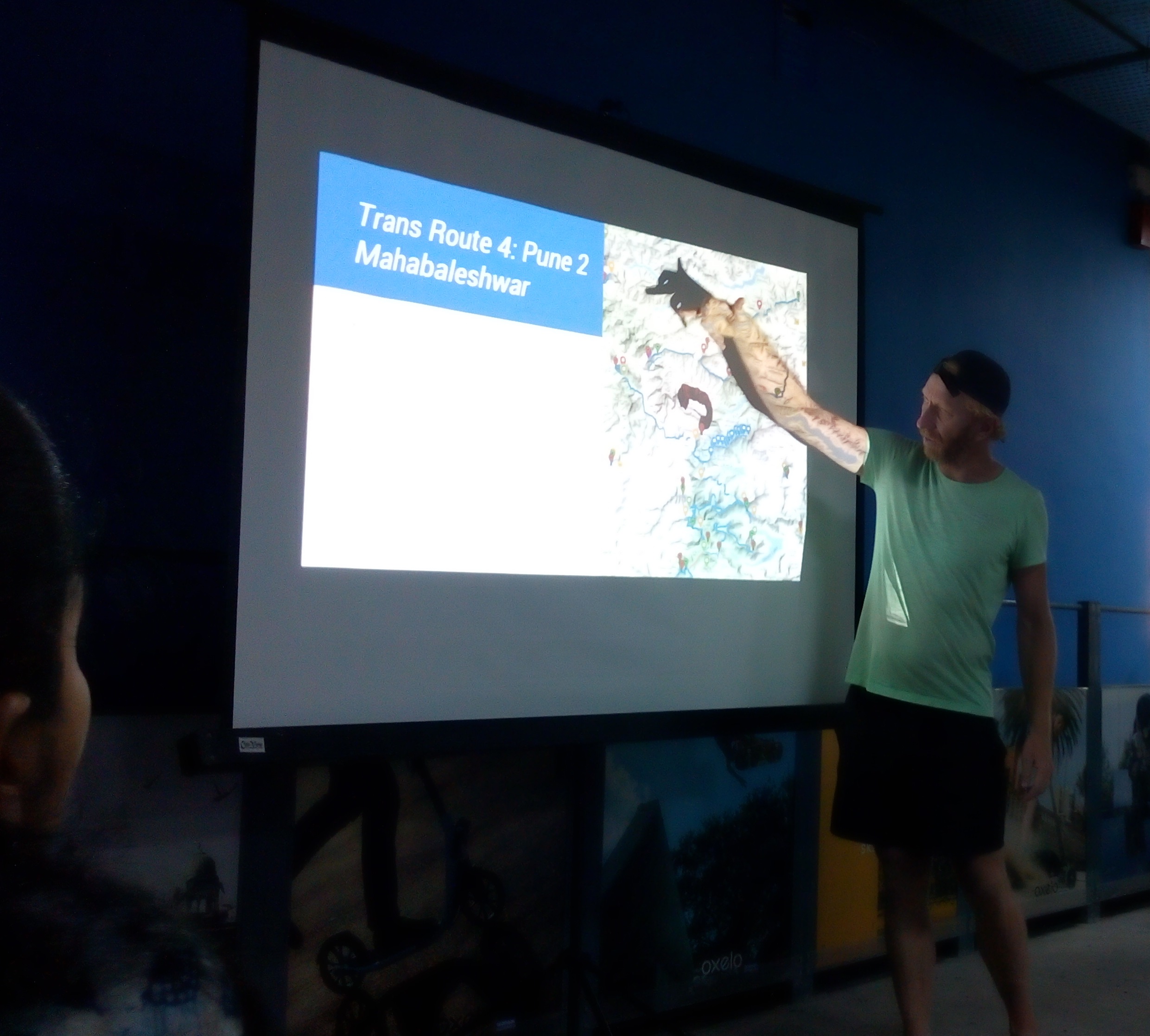
It was a small gathering, just outside the shop floor of a major sports goods retailer in Navi Mumbai. Maybe 15-20 people at best; a couple of them were the retail chain’s staff. But that didn’t stop Peter Van Geit from speaking passionately about what he had been doing the past several months.

A Belgian national and former employee of tech giant, Cisco, Chennai-based Peter is well known in the Indian outdoors. He was among prime movers at the Chennai Trekking Club (CTC), contributed much to promoting the active lifestyle, helped clean up the city’s beaches, did excellent relief work during the Chennai floods and then got villainized when an unexpected forest fire killed several trekkers in Theni. That last incident from March 2018 was a tense chapter.

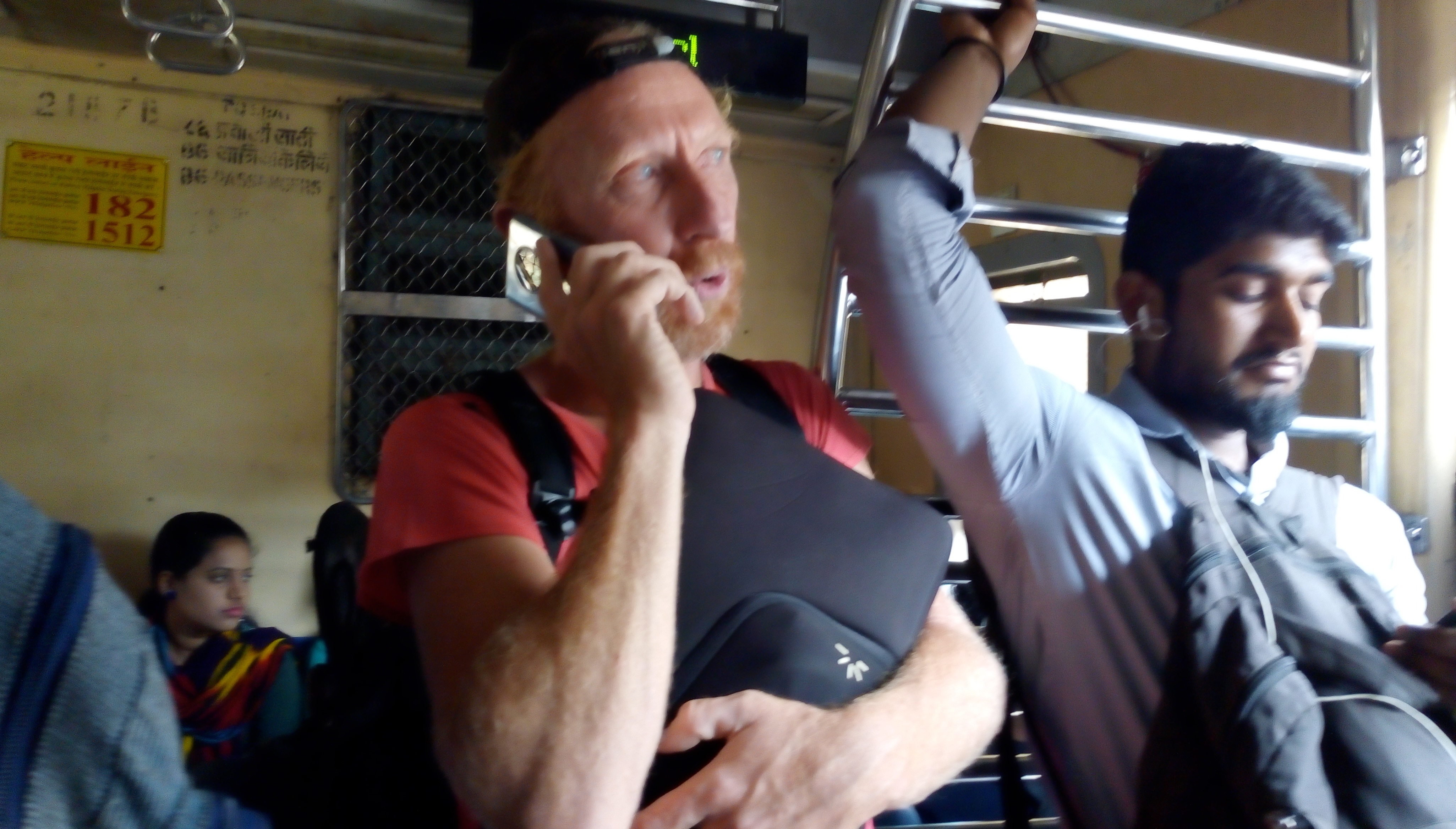
At CTC, one of the activities Peter and others embraced was ultrarunning. They would run for a few days covering a couple of hundred kilometers. In 2018, Peter commenced a personal project. Over 75 days, he ran (the right term would be fast-hiked) 1500 kilometers along trails and across some 40 high mountain passes in Himachal Pradesh and the then state of Jammu & Kashmir. This venture followed an earlier one in Vietnam, wherein he ran close to 2000 kilometers over hilly terrain. Then in 2019, running from the Uttarakhand-Nepal border towards Himachal Pradesh and Zanskar, he crossed 120 passes. The number includes little known routes taken by shepherds, who incidentally are his frequent refuge for food and shelter on these trips. Later that year, in a foray to the Maharashtra Sahyadri and the Konkan coast, he ran or cycled linking some 200 forts. Active on social media with his travel posts, Peter has a fan base. In January 2020, when Peter was in Mumbai to speak at the Himalayan Club, this writer shared a suburban train journey with him. He was quickly recognized by co-passengers and selfies taken.

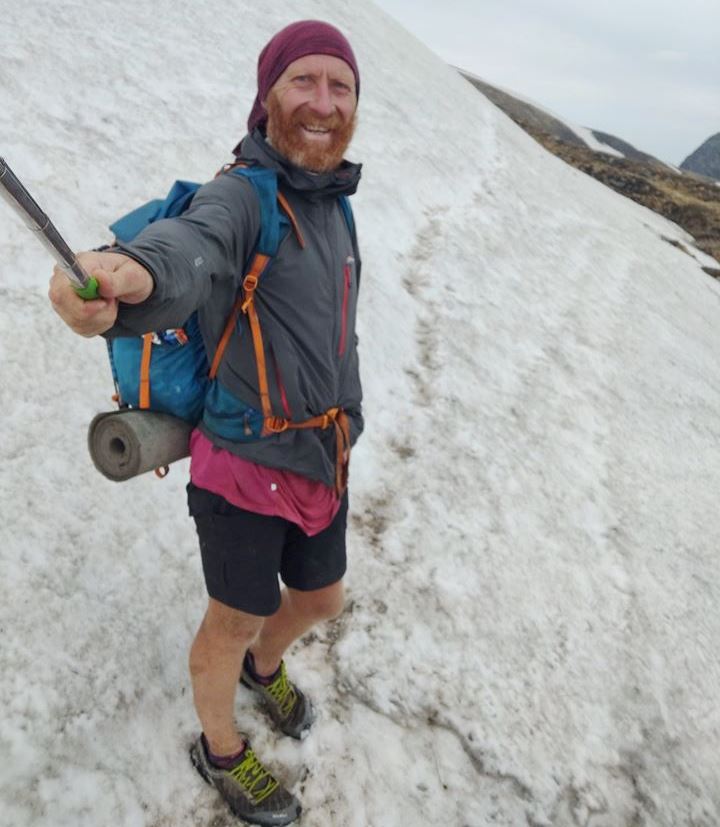
At two presentations I attended this year, there was a slide that always drew laughs. It showed a small child sitting naked on a beach. “ That’s me. I was minimalist even then,’’ Peter would quip. He says traveling light makes him fast. On the trail, that means less stuff hauled around as he manages to either reach known shelter or camp light at lower elevation having already got past the high crux. That’s utter contrast with the regular. Consider this: a typical photograph of Peter from the Himalaya shows him in running shorts, a small backpack, a thin T-shirt and a pair of running shoes. The backdrop is high altitude; steep, snow clad, at times glacier, clearly cold. Other speakers at the same venue may have just presented slides of them and others in similar environment clad in multiple layers, armed with gear and heavy backpack. That would be the Himalayan experience of most in the audience too.

In the mutual admiration society we are, people flock to similar others. Peter gets applause but you wonder – was he accepted into the tribe? Much of the establishment sitting in judgement came up in a more structured fashion with outdoor courses done and rigid views of what defines a particular sport. They seem organization-builders; lovers of hive and the politics of the hive if we were all bees. Corporate – you could say, for imagery. Peter seems an activity-lover, happiest outdoors, happy to be afloat afterwards in a people’s durbar. In his heart warming short film, Peter stumbles, slips, gets his face liberally licked by a buffalo, does some sketchy river-crossings. Those formally trained in outdoor techniques will question some of his actions. Yet there he was, up in the mountains, doing a hybrid of running and high altitude hiking, most of the time solo. Solo is something few Indians like. Indians are all about groups. Further, where most of us make a whole annual trek out of one pass, he was polishing off a pass a day. For now in India’s world of hiking-mountaineering and running, the Peter-way is an outlier.

Here’s another vignette – Peter is a runner but now nurses little appetite for the organized marathons, ultramarathons and stadium runs that the majority of runners favor. He likes to be away from cities and crowds. When out in the Himalaya, he lives and eats with shepherds and at houses along the trail; he likes that simpler life. He navigates with digital map and GPS co-ordinates on his smartphone used offline and set to battery saving-mode. On the Konkan coast, confronted with the fort of Suvarnadurg located on an island a kilometer out in the sea, he just swam across to access it. The central values of his excursions appear freedom, solitude and living the life he wants. Accessible and easy to talk to, Peter may impress as anything from celebration of the outdoor spirit to bull in a china shop unintentionally smashing our gear laden surrogate commando self-image, with his minimalist approach.

Peter, in a Mumbai suburban train, en route to a lecture (Photo: Shyam G Menon)

To be fair, Peter’s journeys in India fell in a list of projects headed to the body of work he achieved. Long before digital became commonplace in India, in 1997, a team of Indian women completed a trans-Himalayan trek from Bomdila in Arunachal Pradesh to the Karakorum Pass. They crossed 39 passes above 3000m, 15 passes above 2000m and covered 4500 kilometers in 198 days. In the years that followed, at least one seasoned outdoorsman anchored a project seeking to thread a hiking route from Ladakh to the Uttarakhand-Nepal border, replete with GPS co-ordinates for independent hikers to use. More than five years ago, when the Himalaya was yet to be run as Peter did, this writer spoke of the project in waiting to an Indian ultrarunner. Nothing happened. Over August-October 2018, a team of three young Indian mountaineers hiked from Ladakh to the Uttarakhand-Nepal border crossing 27 passes (please try this link for their story:  https://shyamgopan.com/2018/11/13/a-long-walk-traversing-the-western-himalaya/). Then over 2018 and 2019, in two tranches, Peter crossed around 160 passes in the western part of the Indian Himalaya, visited 200 forts in Maharashtra and made the journeys available as digital resource. His own project, Peter has said, was initially spurred by data from a blog by Bengaluru-based trekker Satyanarayana; in the blog Satya used to document with GPS logs, the passes he visited.

It was two years ago that Peter resigned his job, did an Airbnb with his house and embarked on a new life of running around. At the February 2020 talk in Navi Mumbai, he spoke of young Indians he met during his long stay in the country, who were stronger athletes than him but whose promise faded with marriage and corporate life. The young people in the audience laughed. Peter’s face remained expressionless. “ It is not a laughing matter. Life is short and you live only once,’’ he said.

(The author, Shyam G Menon, is a freelance journalist based in Mumbai. For more on Peter please try these links: https://shyamgopan.com/2017/02/28/i-dont-have-time-isnt-a-valid-excuse/; https://shyamgopan.com/2019/03/22/running-in-the-himalaya-75-days-1500-km-40-mountain-passes-talking-to-peter-van-geit/)             

“ IT MAKES YOU FEEL ALIVE, COMPLETELY OPPOSITE OF DAILY ROUTINE’’

Photo: courtesy Peter Van Geit

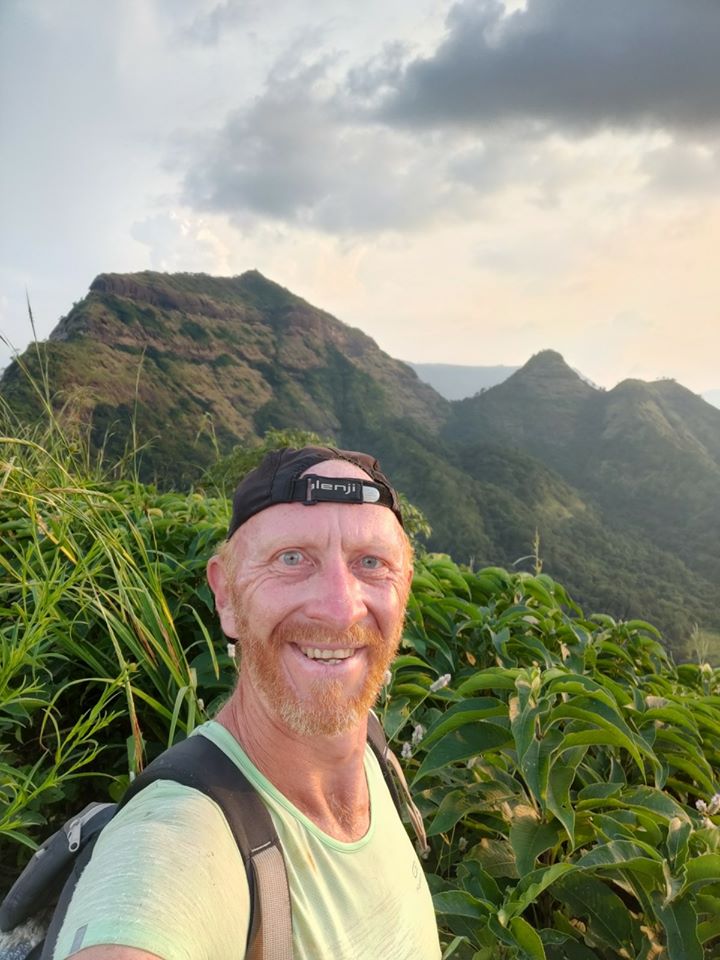
It was in 2018 that Chennai-based ultrarunner, Peter Van Geit, first stitched together several passes in the Himalaya, doing an extended spate of fast-hiking. In 2019, he took that up another notch, journeying across 120 passes in about as many days. Then he shifted his attention to the state of Maharashtra and ran or cycled to some 200 forts. In January 2019, Peter was in Mumbai for a talk. He spared time to speak to this blog. Excerpts:

How was your trip of 2019 to the Himalaya different from the one of 2018?

This was longer. I was there for almost four months – from May until September – covering about 120 passes in four months, almost doing one pass a day. This time I had to plan more carefully because in the month of May you still have snow in areas above 4000 meters. I started from the Kumaon-Nepal border and worked my way towards Himachal Pradesh. During the whole of May I was traversing from east to west in Uttarakhand. In the beginning of June the snowline started retreating. At that time I was in Himachal, where I spent some time in the Great Himalayan National Park; very dramatic landscape with steep slopes. From there I proceeded to the Dhauladhar and the entire range from Dharamshala to Palampur, which separates Kangra plains from Chamba valley. By the end of June, monsoon kicked in. I had to retreat and cross the Pir Panjal range towards Lahaul. I crossed over to Zanskar, Ladakh and Lahaul where I spent all of July and August. I went to Hemis National Park, where I covered many passes. I had to plan it carefully as there was lot of snowfall last winter and much meltwater in the summer that followed. In peak summer there were strong currents in the streams, it was very difficult to cross these streams. In 2019 too, probably due to climate change, sometime in mid-August there was flooding in parts of the Himalaya – Chamba, Manali. Manali-Leh Highway saw heavy landslides. At that time I was somewhere in Zanskar and got stuck. I managed to come down and for another couple of weeks explored a lot of valleys around Bada Bhangal and places like Kalihani Pass. I explored the Chamba valley fully. It was an amazing journey.

In the first phase you had been minimalist traveler with little gear. This time did you make any alternations to your gear?

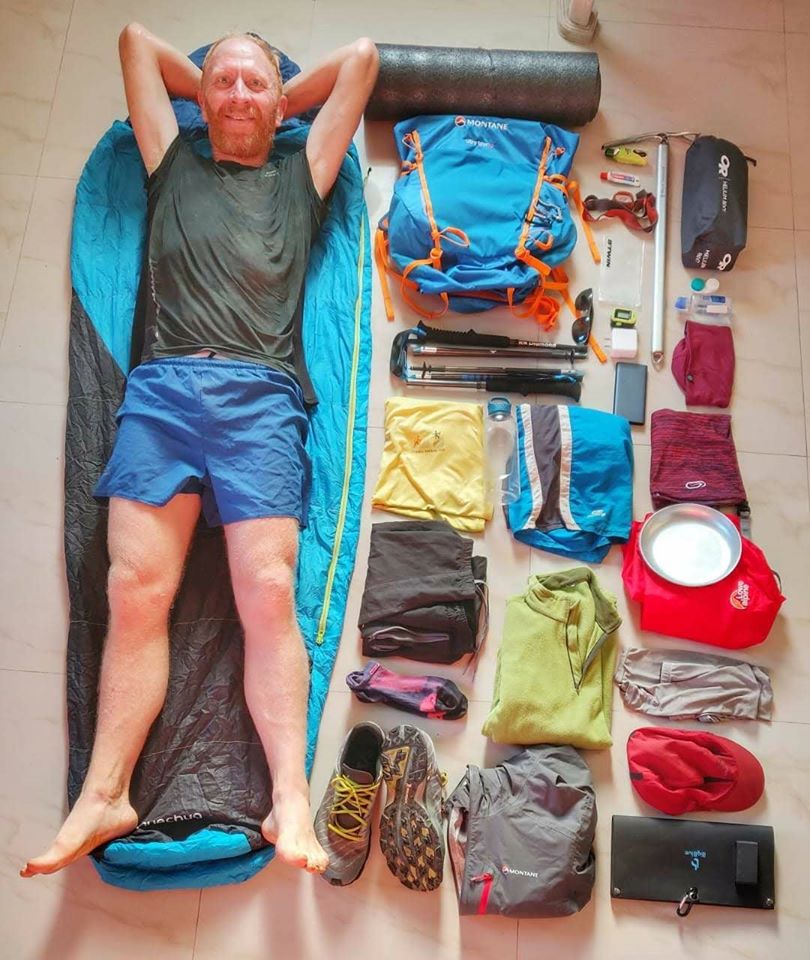
Actually this year I reduced my gear further. I did not carry any tent, just a small bivy sack. Also, I had a light weight sub-zero sleeping bag, which was very comfortable. My ration plan was minimalist and optimum. I would just carry enough food to get to the next village. First few days I mostly carried fresh food. But then in Ladakh-Zanskar where you have 5-6 days trek, I had to cook some food. I carried a very minimalist stove. But I decided to give up that stove. Instead, I would collect dry cow dung and yak dung and horse dung and sprinkle that with kerosene and make a cooking fire. I would cook white oats which is easy to prepare with some water. That way I only carried a 4-5 kilogram backpack.

Photo: courtesy Peter

You mentioned taking an ice axe in 2019. Was that only for a portion of the trip?

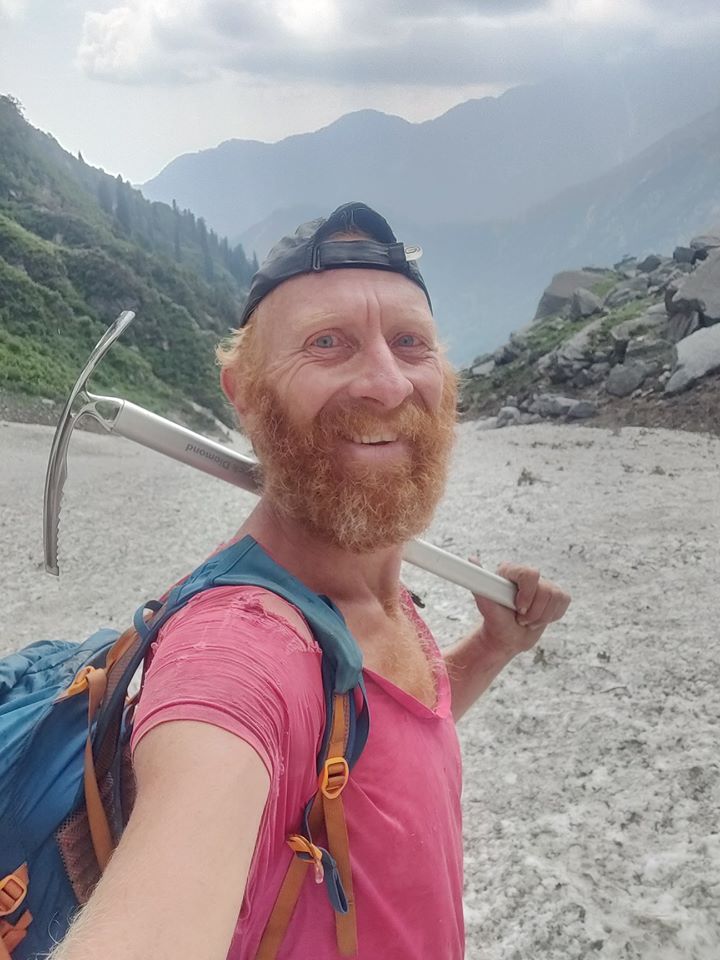
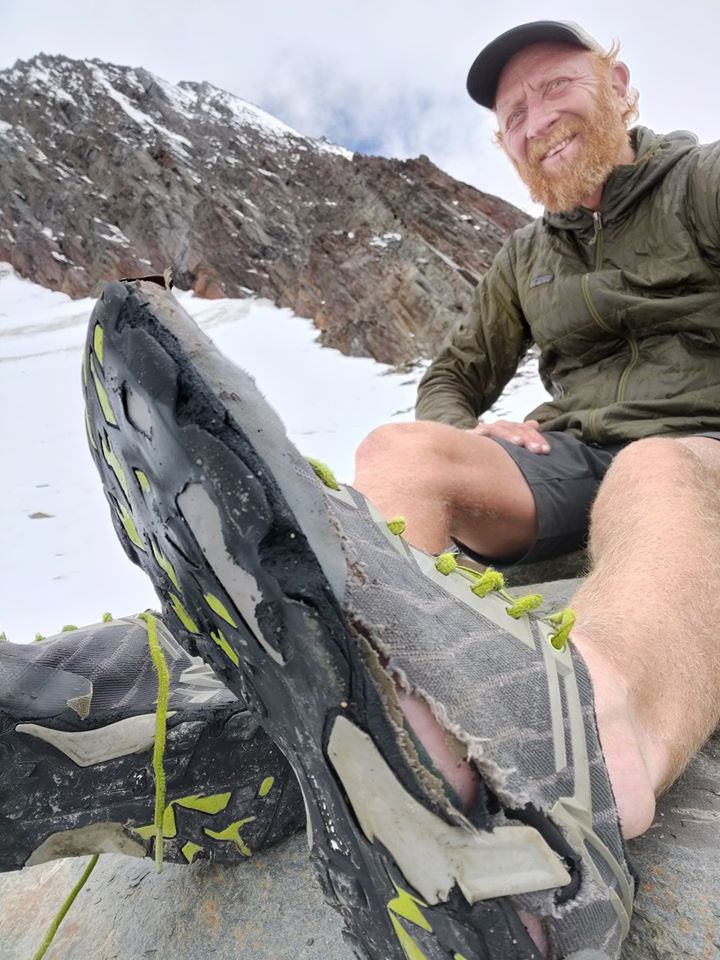
Snow and ice were new to me. Previously, I had only gone in the months of July and August. In Uttarakhand I did not carry an ice axe. I just had some light carbon hiking poles, which were very useful. Snow is easy to tackle if it is on a flat surface but when it’s on a gradient, then you need poles. Poles are also essential for stream crossing especially over uneven river bed. Stream currents in some of the canyons in Ladakh can be dangerous. In July I was near the Dhauladhar. There I was lucky I met a person who had an ice axe. We trekked together for a week. It was a light weight Black Diamond axe. That became my main tool. By mid-August the ice axe was not required. But I continued to carry it because I was going to new places.

Are you going back again this year?

In addition to the May-September period, I am planning a new mission. I am planning a winter mission from February till April not to the passes but some remote valleys. Some of the valleys have beautiful hamlets. I want to go in winter and experience how it is. But I will have to be careful. I know snow can be dangerous. I will have to see how I can optimize my luggage. I will have to carry warmer stuff.

Will you be attempting a higher elevation this year than what you have done so far?

More than elevation, I would say traversing shepherd routes across Pir Panjal, Waru and the Kali-Cho Pass. In 2019, many passes opened late because of the heavy winter. Across many of the lesser known passes I was able to follow the shepherds; otherwise it is impossible to know these places. These are not regular hiking routes.

Is east of Nepal on your cards?

Nepal and Arunachal Pradesh are there on my mind.

When you chose places do you prefer to go to places which are not frequented by people?

The contrast between commercial versus unknown is striking. Visiting an unknown place is so much more enriching, both in terms of natural beauty and the absence of plastic waste and garbage. You don’t meet visitors there and the shepherds who are there – they also don’t see many people. They are surprised to run into me, a solo traveler. They receive you with such heart-warming hospitality. In commercial places you are treated as a customer and in other places they see you as a guest.

Photo: courtesy Peter Van Geit

What took you to the Sahyadri?

The Sahyadri was unknown to me. This place is unique; almost 300 ancient forts, many of these are in ruins now. That; combined with the unique geography. Last February when I was this side for a talk at the Himalayan Club, I stayed with a couple of guys in Pune and they took me on a trek. That’s how I got a feel of it. I did about 20 forts. After my 2019 Himalaya trip, I was looking for a place where I could spend a couple of months. I considered the southern states of Andhra, Karnataka and Kerala. But access to places here is restricted by the forest department. Both the Himalaya and the Sahyadri are like paradise, you are not restricted by anyone. I was already following a couple of people on Instagram who would post beautiful pictures of the Sahyadri. I started searching for names of forts and checking with Google maps, GPS logs. There were some specific websites which gave detailed information. I was able to get proper routes for almost 200 forts. For other forts I started studying satellite maps, finding the trails myself. Then I started to work on how I could do this in the quickest way. I was in that ultra-running mode – light and fast. I visited many of the hill forts, running or fast-hiking. The forts of the Konkan coast – those I visited on my bicycle.

That way I was able to wrap it up within two months. I used to put up photos on Instagram and within no time my followers grew from 6000 to 20000. For many people, I was not visiting forts but temples of Chhatrapathi Shivaji who fought invaders.

What do you hope to do with all the information you have gathered?

I am a little bit privileged in the sense that people can hardly take a week or a weekend off. For somebody like me who has quit his full-time job I feel privileged to spend an entire month out. In the Himalaya, I acclimatise once and then go very fast. Those 120 passes were done in four months, which is roughly 120 days. Planning these long journeys is not simple because you have to spend quite a few weeks to put together a 3500 kilometer-route with so many passes which in my case includes many non-touristy places that are remote.

There was a lot of study. All the data I collect and the maps I create by studying the terrain are compiled in my blog www.ultrajourneys.org to make it easy for people to follow in my footsteps.

So, is it possible for those who want to do a few passes to just download the digital information and proceed with GPS co-ordinates?

Yes. I have documented all the passes; I rate them on the basis of elevation, distances, duration and scale of difficulty. Novices can start with easy passes. I also have a column for dangers. Some passes are risky in terms of stream crossing. People can start with conservative, safer options.

Photo: courtesy Peter Van Geit

The same digital information is available for the Sahyadri too?

Yes.

You had a full-time job at Cisco and now you are a full-time explorer, runner etc. How do you sustain this activity monetarily?

I have a home in Chennai. When I am not in Chennai I do an Airbnb with it. Financial is one aspect. If you live in cities you end up spending a lot of money. When I get to a remote place, I cannot spend money anymore. I carry my tent, I don’t stay in hotels, don’t use private transport, always commute in buses. In the end I eat two meals a day which is like Rs 60 per plate of momos in the Himalaya, Rs 50 per plate of bhakris in the Sahyadri.

Are your social media accounts fetching you anything monetarily?

I am not looking at that. Now I have some 22,000 people following me. I am giving talks and doing some workshops. I am not looking at monetizing them. I feel very uncomfortable charging people for it. This is my passion and I want to inspire as many young people as possible. In every talk I am able to reach out to 200-300 people.

While you were doing the passes you were burning a significant amount of calories. Is it possible for you to match the two – significant burn of calories and frugal lifestyle?

I have done it now for two years. In the Himalaya, the elevation gain and very challenging terrain can be exhausting and you can easily burn 6000-8000 calories a day. These need to be replenished. Many times you end up with members of the Gujjar community and other mountain people. They cook fresh food. They typically source local organically grown stuff. You get a lot of nutrition from their food. High altitude cereals are high in nutrition. Also, living in these remote places is like detoxing your body because the air and water are unpolluted. All of these keep you in good shape. Also in the mountains your sleeping pattern gets aligned with the solar cycle. You will always settle down by sunset. You get up automatically when sun hits your face. That rest makes you mentally and physically fit to do the next day’s traverse. Further when you are exploring new places you are mentally engaged.

Photo: courtesy Peter Van Geit

At the start of the season when you have drawn out plans to do a certain number of passes, it is a task sustaining yourself that long. Does the goal feel formidable at the start of the season?

I never think of the numbers, I just take one day at a time. Although you plan your journey the actual journey can be different because you could get stuck somewhere due to some unexpected snowfall. Of the 120 passes, 2-3 of them were quite dangerous to traverse and I have had to take a mature decision and make a U-turn. Some of them are quite technical. Sometimes you get on top of the pass and then you realise that it is impossibly steep to get down on the other side. You don’t want to take unwanted risk. Sometimes it is like trial and error. You have to take a call.

Why do you do this?

People ask that question. I don’t have an answer for that. It is more like an internal drive. I have always been very excited and feel very alive when I go there. Even when I was working I used to go to such places and feel the freshness of nature, waterfalls, streams, jungles, birds and wildlife. The forest gives you so much of positivity, both physically and mentally. Also, it gives you internal peace. Climbing up 3000 meters and not seeing anybody for two days, there is total peace all around you. It makes you feel alive, completely opposite of daily routine. Probably that connection is what drives me.

(The authors, Latha Venkatraman and Shyam G Menon, are independent journalists based in Mumbai. All the photos used with this interview were downloaded from Peter’s Facebook page; they have been used here with his permission. For more on Peter please try these links: https://shyamgopan.com/2019/03/22/running-in-the-himalaya-75-days-1500-km-40-mountain-passes-talking-to-peter-van-geit/ and https://shyamgopan.com/2017/02/28/i-dont-have-time-isnt-a-valid-excuse/)

THE WORLD CHAMPION WE OVERLOOK

Manikandan Kumar (Photo: Shyam G Menon)

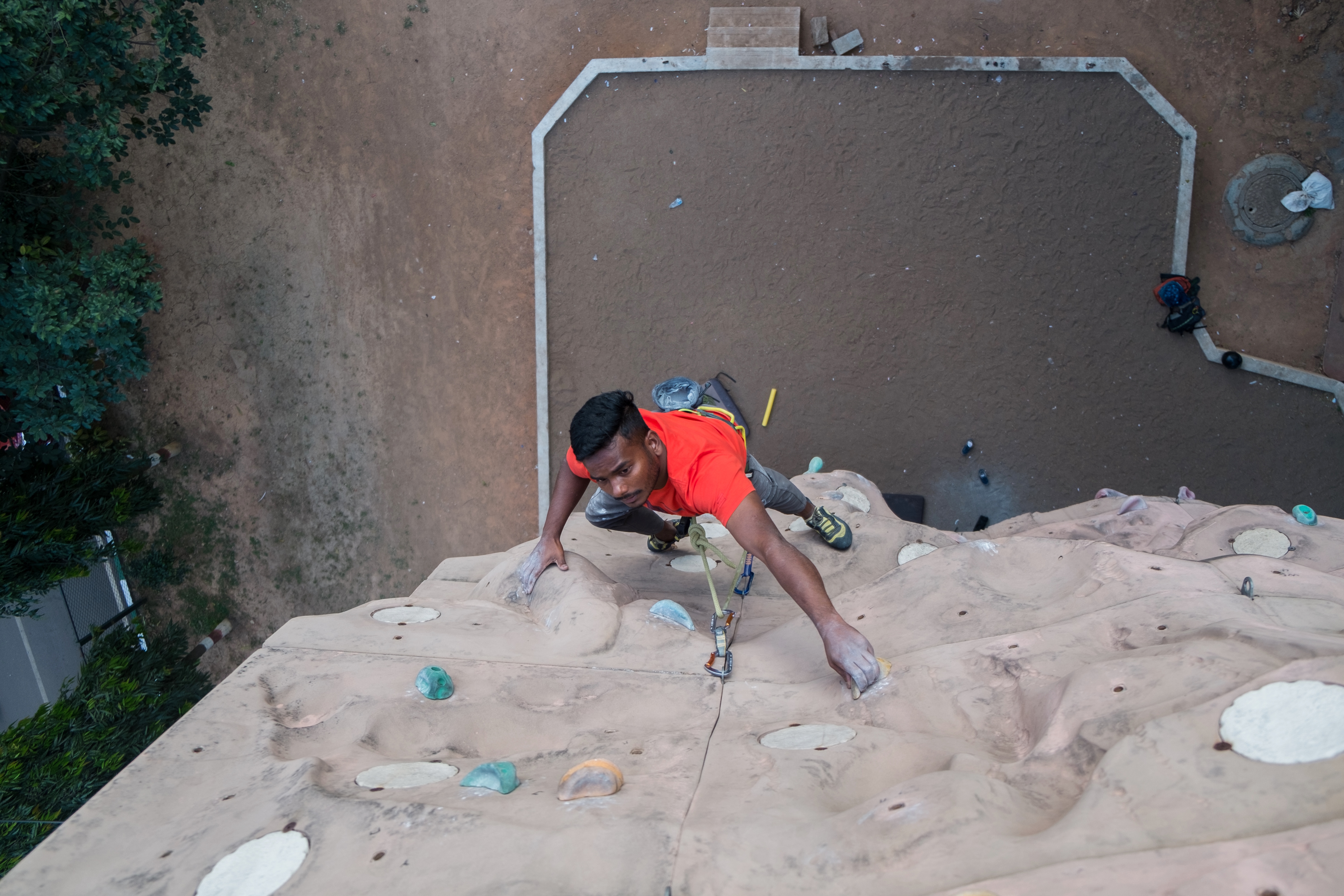
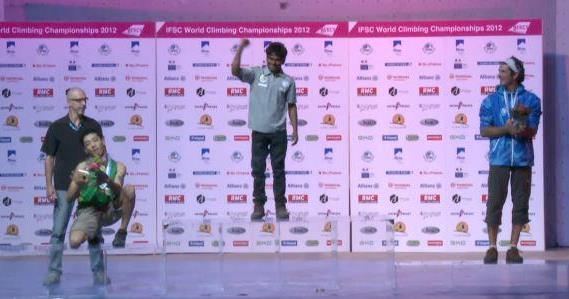
When this blog met him, Manikandan Kumar’s triumph at the 2012 IFSC Paraclimbing World Championships was over seven years in the past. He hasn’t been idle. There have been other podium finishes including three more at the world championships. What have been less than ideal are our system of encouragement and the resource-rich we call: sponsors.

There was palpable imperviousness to the negative and the pessimistic, in how Manikandan Kumar spoke. “ I believe in myself. I grew gradually in climbing. It wasn’t easy. You can ask anyone – I never complain,’’ he said. It was now years since Mani, as he is popularly called, burst on to the scene. For this writer, that moment happened one night at an outdoor school in Ranikhet, when Kuttappa (Kuttss) Bommanda showed up for dinner apologizing for his late arrival. “ I was watching Mani’s climb at the Paraclimbing World Championships on my laptop. He has won it!’’ Kuttss, an outdoor instructor from Bengaluru, said enthusiastically. The year was 2012. Mani had become India’s first world champion in paraclimbing; the country is otherwise a relative unknown in the top echelons of competition climbing. Aside from fellow climbers and officials linked to that circuit in sports, practically none in India knew him.

Seven years since, the environment for Mani and his ilk in climbing wasn’t much different. Sport climbing was slated to debut at the Summer Olympics in Tokyo by mid-2020. But the discipline wasn’t yet on the list of sports for the Paralympics that would follow. That meant, Mani, a former world champion and still among the best in his category worldwide, wouldn’t get a shot at the Paralympics. Why blame the Olympic movement? Seven years since Mani’s triumph at the Paraclimbing World Championships, India was yet to have a distinct paraclimbing program. “ I would like to change that,’’ Mani said, sipping coffee. It was November 2019. We were at a café on MG Road in Bengaluru.

Photo: courtesy Mani

Born 1986, Mani is the eldest of three brothers; their father worked as a carpenter, mother remained a home maker. He grew up in Malleshwaram, a suburb of Bengaluru. When he was around five years of age, Mani had an attack of typhoid. “ That was when my parents realized that my right leg had been affected,’’ Mani said. He began limping. General literature on the disease, available on the Internet, speaks of typhoid as fever caused by bacterial infection. However, you also find mention of rare neurological complications that impact a patient’s limbs and movement. In Mani’s case, the affected leg stayed weak in terms of musculature and strength. The boy loved sports, particularly football. Limp notwithstanding, he plunged in and played. “ I faced no discrimination. I played without thinking of my disability,’’ he said. Those years, climbing wasn’t at all in the frame.

In 2002, aged 16, Mani found himself at an outdoor camp in Ramnagaram organized by The Association of People with Disability (APD). Located roughly fifty kilometers away from Bengaluru, Ramnagaram has historically been a climbing hotspot. The camp participants were introduced to bouldering and rappelling. “ We climbed two to three boulders. I liked the experience. One of the instructors suggested that I try out climbing at the office of GETHNAA, which had a climbing wall right behind their building,’’ Mani said. GETHNAA stood for General Thimayya National Academy of Adventure. At this point, the climbing wall adjacent to the city’s Sree Kanteerava Stadium was still a couple of years away; GETHNAA’s was the only wall around. Mani’s opening stint at the GETHNAA wall was encouraging. “ I climbed three routes. I felt I should take up the sport,’’ he said. He started attending the climbing sessions there regularly. Among the instructors he met there was Keerthi Pais, who would become India’s best known trainer in the discipline. Not long after this foray into climbing, Mani also participated in a state level competition, in the regular category; there was no separate category for the physically challenged. “ I remember doing a dyno at that competition. I did it using my better leg. Everyone was appreciative,’’ Mani said laughing. The right leg was still quite weak. He was at the threshold of an engaging format of progression with that limb, for climbing by nature is a sport demanding three-point contact with the rock or wall being ascended.

Photo: courtesy Mani

In the sharp divide between staying perched or falling, there is little room to spare a limb to haul up a weak one. Yet in the initial days, that, was exactly what Mani often had to do – he had to lift his right leg with his hand and place it on the next foothold. None of this stopped him from making the first major decision of his life. Mani completed his tenth standard and gave up studying. “ I had no interest in studies. I wanted to make a career out of climbing,’’ he said. He did not have the benefit of money and wealthy parents. His family was struggling financially. He had no sponsors or well-wishers. All he had was self-belief.

In 2002, Mani went to Delhi to watch the national climbing competition. It left him wanting to qualify for the next edition of the event. At an open competition held thereafter at Ramjas near Delhi, he was the only climber making it to the final in his age group. “ I got an appreciation letter for that,’’ he recalled. Now the desire to excel was picking up. That year was noteworthy for something else too. Mani was among those featured in a documentary film on climbing. “ Facing the camera, I blurted out that one day I want to be a world champion. It’s still there in that video,’’ he said. In 2003, he participated in the zonal competition and ended up seventh or eighth, narrowly missing selection for the national competition.  However, he got a wild card entry, the condition being he would have to do a trial climb and prove his worth before the senior official overseeing sport climbing. That done and initial rounds too cleared, Mani found himself among four climbers from the South Zone who featured in the final. He finished last but won the best climber award.

In 2004, he was back in the final. In 2006 also, he qualified for the national competition (in India, the national competition is at the apex of a series of zonal competitions arranged below it in the hierarchy). That year, he started working as a coach under Keerthi Pais, reporting every day to the new climbing wall that had come up near Kanteerava Stadium. In 2007, Mani didn’t qualify for the final at the national competition; it was the case in 2008 too. But the coaching continued, including accompanying his wards (they were in the junior category) who had made it to the national competition, to their respective events. The coaching assignment brought with it a small salary. Additionally Mani worked at outdoor adventure camps. The income he thus made was useful for his family.

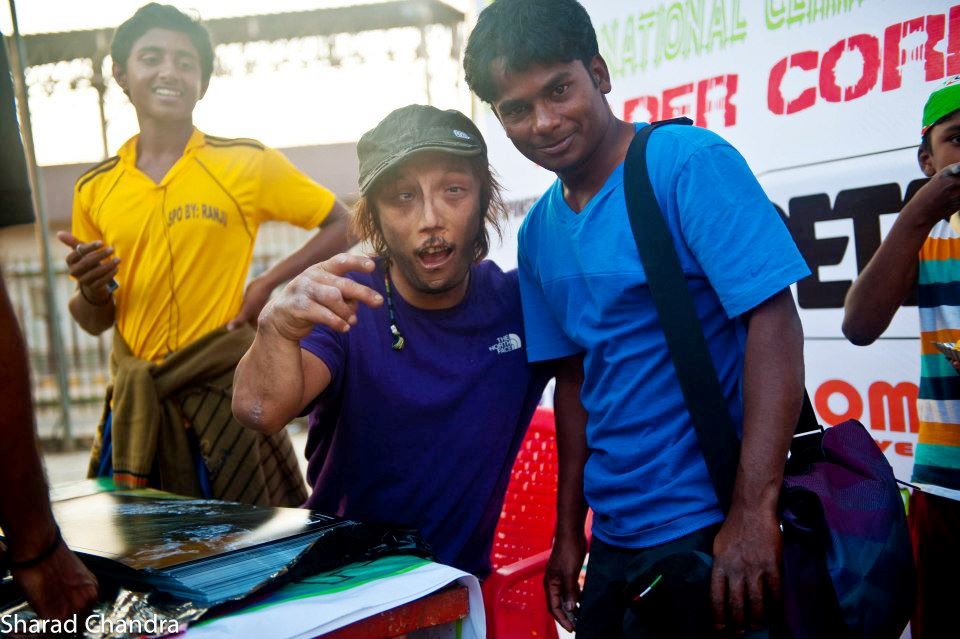
Mani with Philippe Ribiere at one of the editions of Girivihar’s open sport climbing competition at Belapur in Navi Mumbai (Photo: Sharad Chandra)

For over a decade in Mumbai, the city’s oldest mountaineering club, Girivihar, ran an open climbing competition. It would eventually lead to two editions of the IFSC World Cup in Bouldering (IFSC – International Federation of Sport Climbing) being held in Navi Mumbai in 2016 and 2017. Mani had been to these events. Among foreign climbers visiting the open competition held in Belapur was Philippe Ribiere from France. “ He is someone I respect,’’ Mani said. At age four Philippe was diagnosed with Rubinstein-Taybi Syndrome and has excelled at climbing despite that. He started climbing at six. To others climbing so having overcome physical challenges, he is important not merely as example to follow but also as among those inspiring the first international paraclimbing competition held in 2006 at Ekaterinburg, Russia. More such competitions were held in the years that followed. Then in 2011, the first paraclimbing world championships were held in Arco Italy, under the auspices of IFSC. Mani had been following these developments. He had faith in himself and there was also that old statement to camera: one day I want to be a world champion, which had come out naturally, to explore.

“ Between 2009 and 2011 – that is when I realized, this is my chance. I watched all relevant videos of paraclimbing. I used to take note of participants at these competitions. After the 2011 paraclimbing world championships in Arco, I decided that no matter what, I am going,’’ Mani said. He didn’t tell anyone of his resolve. He commenced preparations in January 2012. Sometime in July-August 2012, he had a conversation with the zonal chairman overseeing sport climbing in South India. He agreed to forward Mani’s candidature. The venue for the 2012 paraclimbing world championships was Paris. Registration done, Mani’s next challenge was finding sponsors to cover the expenses of his trip. Karnataka State Housing Corporation covered the cost of his flight tickets. For the rest, friends, students, the parents of his students – they chipped in. “ Somehow I managed,’’ Mani said. It was his first time overseas; Mani traveled alone. “ The process of flying out made me resolved – it is now or never. There is no way I will complain,’’ he said.

Photo: courtesy Mani

Given the variety of physical disabilities and the way they impact human performance to different extents, paraclimbing has several cub-categories for participants. The categories are awarded on the basis of medical documents and examination. In 2019, there were as many as eight sub-categories in the men’s section at the world championships. In 2012, only the second year of the paraclimbing world championships, there were four sub-categories – Amputee Leg PD, Arthritis + Neurological PD1, Visual Impairment B1 and Visual Impairment B2. Mani was in the second segment – Arthritis + Neurological PD1. Mani reached Paris two days earlier. He stayed alone in a dormitory and on competition day, took a train to the venue. The competition featured lead climbing. Mani cleared the qualifying round (he estimated the climbing grade therein at around 7b) and made it to the final. Philippe Ribiere was among the competitors; he didn’t reach the final that year, Mani said. The final featured six climbers: two from France and one each from Italy, Brazil, Hungary and India. Each climber had one shot at the route on the lead climbing wall.

“ I almost made it to the top. I fell short by four holds. After the climb, I knew I was in the top three but didn’t know I had won. It was the Brazilian coach who told me that. I dropped whatever I had and ran to the notice board to check. It was true. I was over the moon. I had achieved my dream,’’ Mani said. He spent another two days in Paris; he wanted to see the Eiffel Tower. Then he returned to Bengaluru. Family; friends, the media – they all turned up at the airport to receive him. “ It was the biggest thing that happened for India in competition climbing,’’ Mani recalled. A country hardly mentioned in sport climbing suddenly had a world champion in paraclimbing. Mani has since had podium finish thrice at the world championships – second place in 2014, third place in 2018 and third place again in 2019. He is typically lone participant from India. “ India and Hungary – we don’t have teams. Other nations send large teams supported by sponsors and funds to the paraclimbing world championships. France is really big in paraclimbing,’’ Mani said. In August 2019, he was among recipients (in the land  category, for the preceding year: 2018) of India’s annual Tenzing Norgay National Adventure Award.

Photo: courtesy Mani

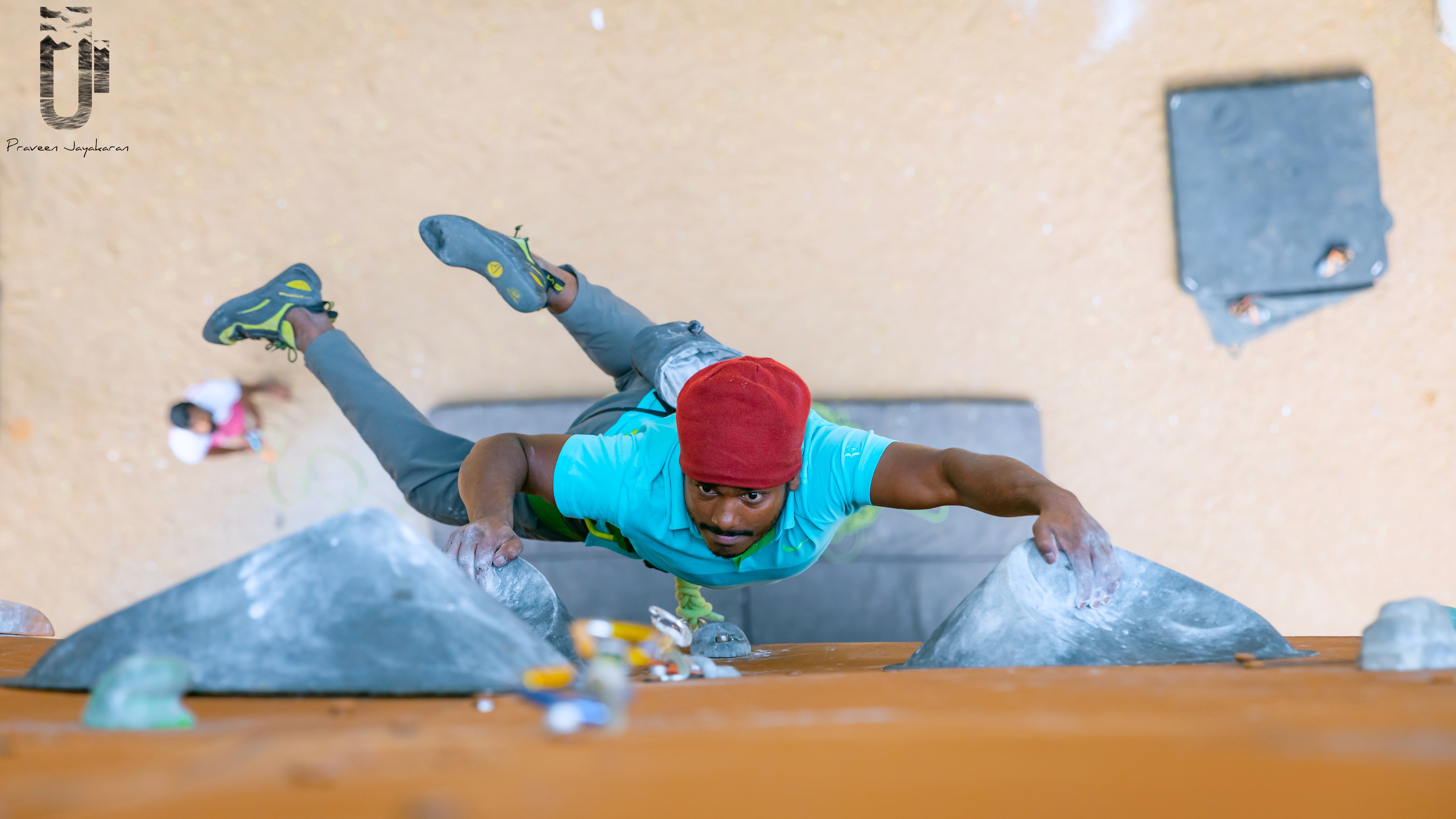
One of the legacies of Philippe Ribiere’s push to hold a paraclimbing competition and the IFSC world championships that followed has been the emergence of more competitions – you could call it a circuit – where paraclimbers can participate. Mani has been active here and there are several podium finishes earned so. But it has indisputably been a pattern of ups and down; he won some, lost some and sometimes a setback or series of setbacks made him feel very bad. On the other hand, as Mani put it – even his idol, tennis great Roger Federer has had to deal with inconsistency in performance. “ If it can happen to him, it can happen to me. I just need to calm myself down,’’ Mani said. He does bouldering and lead climbing but his strength is in lead. The categories and rules of the sport have also got revised going ahead. At the world championships of 2018 and 2019, his category for participation was RP2. He continues to limp when walking but sustained climbing and pushing one’s limits has meant he no longer needs to free his hand and haul up that right leg. It is responding better. That said; his body strength is distributed differently from that of the average climber.

Mani has good upper body strength. One of the exercises used to train climbers features the campus board. It is usually installed at a slight overhanging angle and requires climber to ascend using handholds (typically horizontal wooden sections fitted on the board) with no footholds to support body weight. Climbers train to move sequentially, using one hand and the next; they also train to move explosively wherein they launch off using both hands and go for the next hold. “ My ability to campus is stronger than that of many normal climbers,’’ Mani said explaining how he compensates for the weak right leg. But his own success aside, he worries for paraclimbing in India because although there are physically challenged people who speak to him of foraying in that direction, few of them turn up later to climb. If they don’t turn up to climb and train, how can there be Indian paraclimbers? For now therefore, it is just Mani on the global map. He has been to five world championships so far (winning medals on four occasions). He would like to make that ten. He is also the first Indian climber to win gold medals in the US when he topped his category – neurological / physical impairment – at the 2017 and 2018 Adaptive National Championships conducted by USA Climbing. “ My ultimate goal is a medal at the Olympics. I am hoping that paraclimbing gets included in the Paralympics. I would like to keep competing till the 2028 Los Angeles Olympics. One way or the other, people always encouraged me. That was motivating. Further, if anyone says I can’t do it, that is bigger motivation for me,’’ Mani said. Aspiration is one thing; as is personal commitment. What about the means?

Photo: courtesy Mani

So far – notwithstanding four podium finishes at the world championships and several medals on the paraclimbing circuit – Mani has no steady sponsor. For his trips overseas, he now taps crowd funding. “ Funding has improved with each year. But it worries me that despite so many medals won, I still have to struggle to get backing,’’ he said. It felt strange hearing that for Bengaluru is home to wealthy IT companies (with CSR accounts to their credit) and IT professionals have been big in the pursuit of adventure sports like climbing. Adding to Mani’s frustration was that able bodied climbers of less achievement in competition climbing found sponsors in India. The anger was clear in his tone. He was willing to explore more zones of discomfort as regards his climbing but that question puzzled: why aren’t sponsors interested in him, a paraclimber? “ Why should I seek their sympathy? Will you sponsor me only if I seek your sympathy? I am not complaining. Why don’t you appreciate my hard work instead?’’ Mani asked on the subject. It was the only time in our conversation his wall of optimism showed cracks. Meanwhile his coaching continues and he lays much hope on two of his wards; the prayer is that at least one of them secures a podium finish at a world cup in the future. “ I want some able bodied climber to win a medal at a world cup or the world championships. It is a big task for Indian climbers. But with the right approach, it is possible,’’ Mani said.

(The author, Shyam G Menon, is a freelance journalist based in Mumbai. Please note: the years of participation at national and zonal climbing competitions and podium positions earned therein, are as stated by the interviewee.)             

ZIA

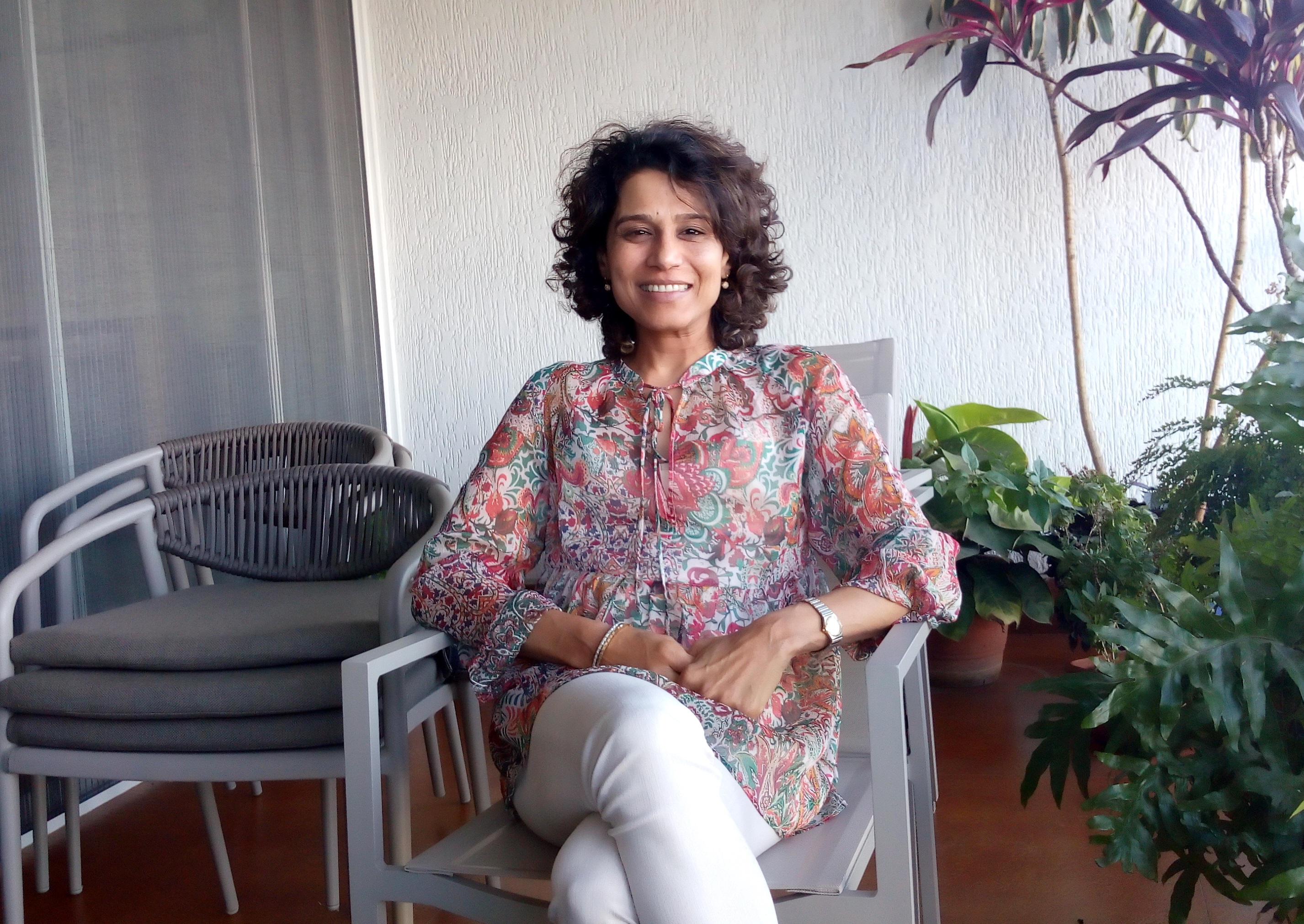
Zia Chaney (Photo: Shyam G Menon)

With a December 2019 personal best of 3:47:34, Zia Chaney has the eligibility to participate in the 2021 edition of Boston Marathon. Hers isn’t the regular running story. It is one of overcoming setbacks, not just once but thrice, all of them the physically and mentally draining sort.

Zia Chaney was used to the physically active life.

Born into a family settled in Pune for decades and growing up in the city, she had been into sports right from her school days. She was focused on the sprints – 100 and 200 meters – and hockey. Following studies, she moved to Mumbai and worked with Sony Music India as a product manager. Unable to pursue the sports she was already into, she turned to visiting the gym for alternative. She was committed to fitness; committed enough to make time for it despite busy work schedule. “ I found time to hit the gym during work hours,’’ she said, a pleasant winter afternoon in Pune.

Her love for the physically active life gained momentum after she moved to Chicago following her marriage in 2000. “ My husband Vishal Jain is a fitness enthusiast. I joined a gym in Chicago. We were there for five years. After I returned to Pune, I joined a local gym,” she said. We were on the balcony of her apartment, tucked into a quiet road in Pune. Unusually for the city located at an elevation of 1837 feet on the Deccan Plateau, the winter of 2019-2020 felt mild.

Photo: courtesy Zia

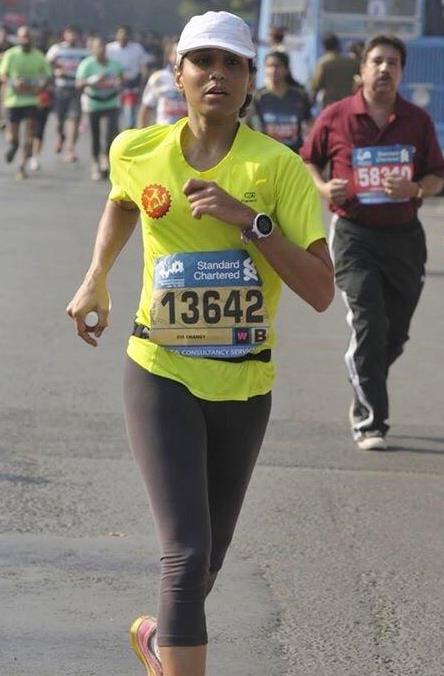
In 2010, Zia was detected with first stage breast cancer. She had to undergo mastectomy followed by chemotherapy and radiation sessions. Both these types of treatment can be physically exhausting. To rebuild her strength, she tried running on the treadmill. “ A friend suggested I run outside instead of indoors,” Zia said. Thus began her journey in running.  She started running in 2011 and a year later was training with a group of runners in Pune informally organized under Pune Marathoner’s Club. “ We were around 30 people in that group. Michael Francis, who was overall leader, encouraged us to train and enroll for the full marathon at the 2013 edition of Standard Chartered Mumbai Marathon. He ensured that we covered every facet of marathon training – hill repeats, short runs, long runs, strength training,” she said. Michael Francis – he is no more – was a name one came across in the story of some good amateur runners from Pune, among them Kavitha Reddy. Zia crossed the finish line of her first marathon – the 2013 edition of SCMM (now Tata Mumbai Marathon) – in four hours, 40 minutes and one second. “ It was a great feeling to finish that first major run,” she said. Running became an integral part of her life.

Wikipedia describes cancer as a group of diseases involving abnormal cell growth with the potential to invade or spread to other parts of the body. According to the website of the US based-Centers for Disease Control and Prevention (CDC), over 100 types of cancers affect humans, among them – breast and ovarian cancer. About five to 10 per cent of breast and 10-15 per cent of ovarian cancers are hereditary. It means cancer runs in your family and may be caused by change in certain genes that you inherited from your parents. A gene is the basic physical and functional unit of heredity. It acts as instruction and contains information to build and maintain cells. A gene is made of DNA; it tells the body what traits will be passed on from parent to child. As per the Human Genome Project information archive, the current consensus is that humans have between 20,000-25,000 genes. But the number has fluctuated a lot since the project began. BRCA1 and BRCA2 are tumor-suppressor genes critical to fighting cancer. “ When they work normally, these genes help keep breast, ovarian, and other types of cells from growing and dividing too rapidly or in an uncontrolled way. Sometimes a change or mutation occurs in the BRCA genes that prevent them from working normally. This raises a person’s risk for breast, ovarian and other cancers,’’ the CDC website said.

Photo: courtesy Zia

In 2013, not long after Zia completed her first marathon in Mumbai, medical tests provided discouraging news. She tested positive for anomalies in the BRCA gene. “ It turned out my father was a passive carrier,’’ Zia said. It put her earlier encounter with cancer as product of condition likely built-in and capable of return. She underwent her second cancer related-surgery in August 2013; this time her ovaries were removed as precaution. The test result and subsequent medical procedures affected Zia, who had begun enjoying running and had just completed her first marathon. Needing time to recover, she was forced to miss the 2014 edition of SCMM. But she refused to succumb to her predicament. There was a new fascination growing, one that also sought to harness the power of two other sports she liked – swimming and cycling; the triathlon. According to Zia, she likes activities that are goal oriented. It is known that training for the triathlon and getting down to actually doing one, entails discipline and adherence to goals. By the end of 2014 Zia attempted her first Olympic distance triathlon in Hyderabad. “ It went off very well,’’ she said. She secured a podium finish in her age category.

In 2015, a rejuvenated Zia was back at the start line of SCMM. The goal now was to progressively improve her timing. She finished the 2015 race in 4:05:52. She continued her appearance at SCMM the next year and in 2017 secured second place in her age group of 45-49 years, covering the 42.2 kilometer-distance in 4:05:05. Same year, she signed up for a workshop on running conducted by Bengaluru based-coach and mentor, Ashok Nath. Soon after that workshop, Zia left for Berlin to attempt the marathon there.  In September 2017, she ran the Berlin Marathon crossing the finish line in three hours, 57 minutes and 30 seconds. Her determination was paying off. The progress was clear – from four hours, 40 minutes and one second at 2013 SCMM to three hours, 57 minutes and 30 seconds at 2017 Berlin. Then cancer struck again.

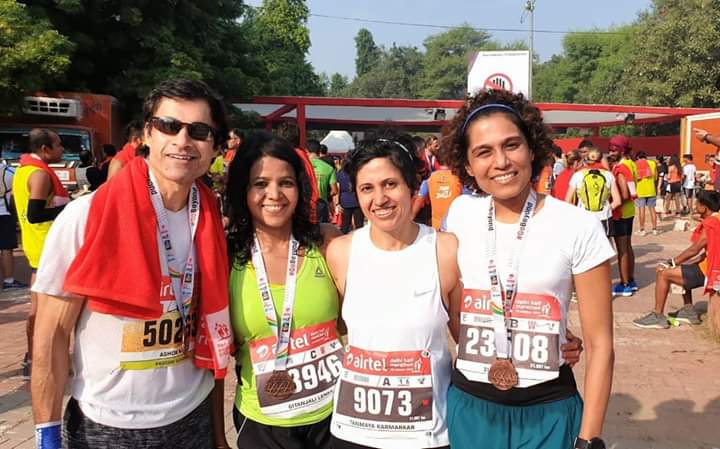
Zia (far right) with from left: Ashok Nath, Gitanjali Lenka and Tanmaya Karmarkar (This photo was downloaded from Zia’s Facebook page and is being used here with her permission)

On her return to Pune, Zia went for her annual check-up. “ I had noticed lumps on my breast over the preceding few months but thought nothing of it. During the check-up, I pointed them out to the doctor. He too thought it would be nothing. Nevertheless, we scheduled a biopsy and my worst fears were confirmed,” Zia said. The relapse meant several rounds of chemotherapy and radiation, this time more in number and with greater intensity than the treatment she had endured before. According to the website of American Cancer Society, radiation therapy uses high energy particles or waves such as X-rays, gamma rays, electron beams or protons to destroy or damage cancer cells. Cancer cells grow and divide faster than normal cells. Radiation makes small breaks in the DNA inside cells preventing them from growing and dividing and causing them to die. Advances in radiation physics and computer technology during the last quarter of the 20th century have made it possible to aim radiation precisely. Radiation therapy however carries a risk. There is a small chance that it may cause another cancer. Consequently, use of radiation is a well thought out decision. Chemotherapy, on the other hand, employs powerful chemicals to destroy fast-growing cells in the body. It can have side effects during the treatment phase and for some time afterward. “ The first time cancer struck, I had to do four rounds of chemotherapy. The second time around, I had to do 16 rounds of chemotherapy and then follow that up with doses of radiation,” Zia said.

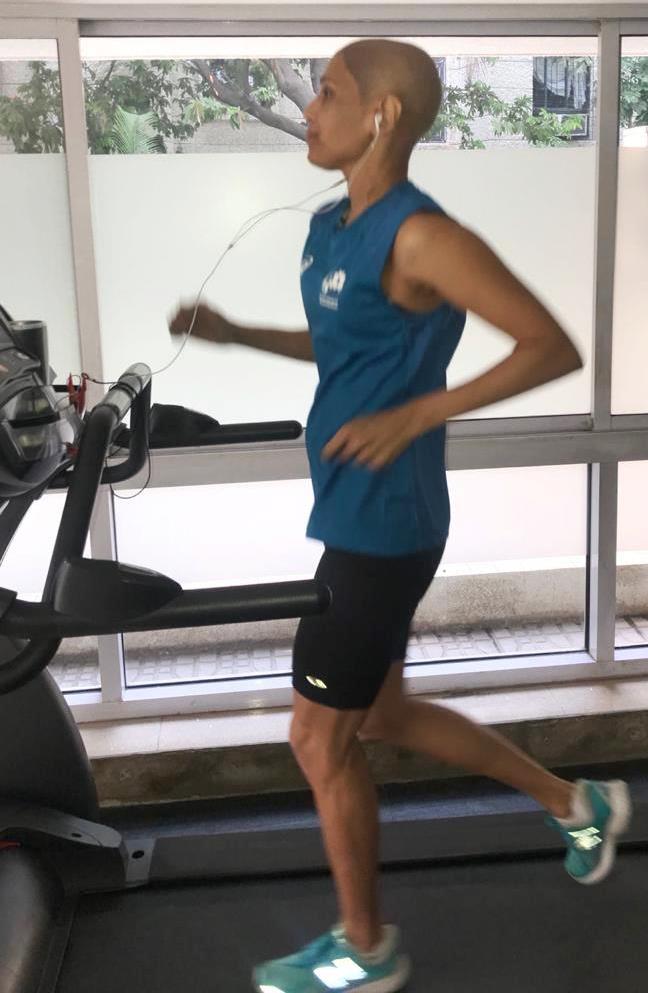
Between chemotherapy and radiation, Zia felt, the latter was more energy-sapping. She drove herself to the radiation sessions but was usually fatigued by the time a round of treatment got over. She persevered. The chemotherapy sessions started in January 2018 and continued till May. She lost all her hair. “ I needed to be strong to take the impact of chemotherapy and radiation,’’ she said. So in between, the chemotherapy and radiation, Zia worked out at the gym in her apartment complex. It was an abject challenge because each time the illness struck and treatment protocols kicked in, her fitness dropped drastically requiring her to work her way back from scratch. “ When your base line fitness falls steeply even a few minutes of running on a treadmill becomes a struggle,’’ she said. Zia found huge support from her family – husband, two daughters and her parents – and her friends. “ I never felt emotionally weak. Children don’t allow you that luxury. In fact, they helped me focus. My elder daughter took care of me during my relapse,” she said.

Photo: courtesy Zia

There were no races for Zia in 2018. Following her treatment, she spent a brief while with her husband and children in the US, convalescing. There she restarted her running. Then in August 2018, after she got back to Pune, Zia commenced training under Ashok Nath. He put her on a plan building basic fitness. She also continued with her swimming sessions; they worked as cross training compatible with her interest in running. At the 2019 edition of Tata Mumbai Marathon (TMM), Zia decided to opt for the half marathon. She secured second place in her age category of 45-49 years, completing the run in one hour 53 seconds. Training under Ashok Nath was helping her improve her running economy. That year at the Airtel Delhi Half Marathon (ADHM), Zia bettered her half marathon timing to 1:48:34. The performance boosted her confidence. Could she aspire for a Boston Qualifier (BQ) time, which makes runner eligible to participate in the iconic Boston Marathon?

In history, 1848 is sometimes called the Year of Revolution for the spate of political upheavals that swept across Europe. Across the Atlantic however, that year opened on a slightly different note. On January 24, James Wilson Marshall, a carpenter and sawmill operator, discovered gold at Coloma on the South Fork of the American River sparking the California Gold Rush. According to information on the Internet, the resultant rush of miners pursuing fortune, produced some 750,000 pounds of gold worth an estimated 14 billion dollars in 2014 but also left behind deep environmental scars. The river at its center – American River – is 30 miles long, stretching from origin in the Sierra Nevada Mountains to its confluence with the Sacramento River in the Sacramento Valley. Music lovers would remember it for Folsom Dam, in turn linked by name to the town of Folsom and Folsom Prison, inspiration for Johnny Cash’s hit song from the 1950s: Folsom Prison Blues. Today, the river is the main source of drinking water for Sacramento, capital of California and the seat of Sacramento County. Every year, the Sacramento Runners Association organizes the California International Marathon. According to Wikipedia, its course “ follows a historic gold miners’ round beginning at Folsom Dam, passing through suburban Sacramento and ending at the State Capitol.’’ The race starts at an elevation of 366 feet and concludes at 26 feet.

Photo: courtesy Zia

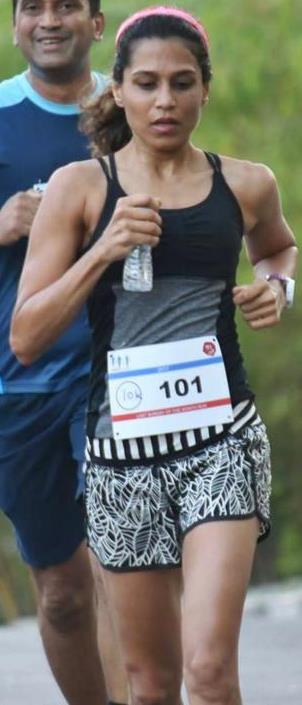
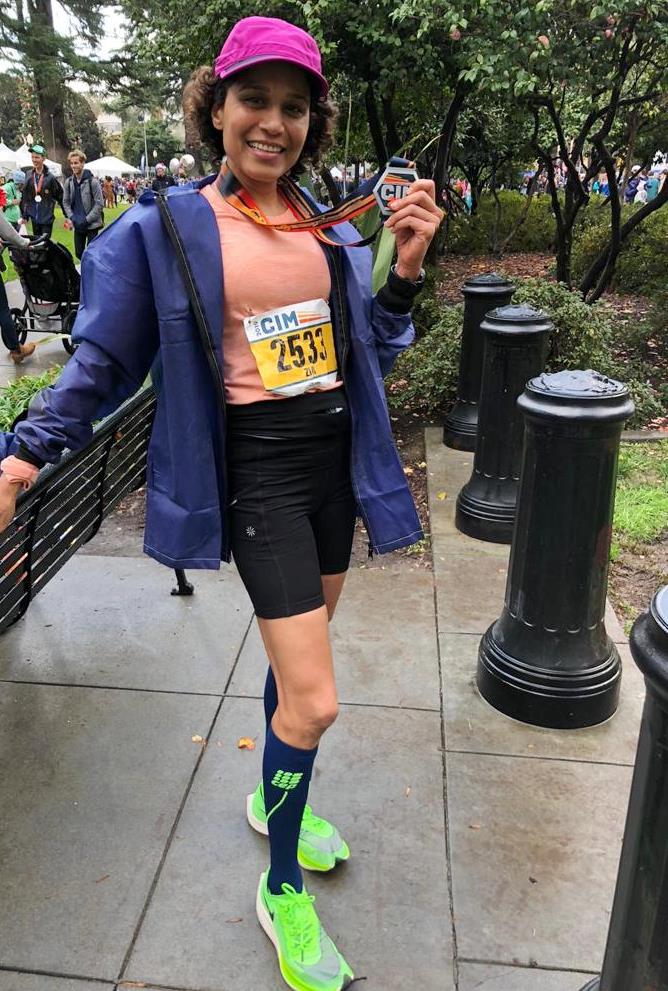
Zia decided to attempt her BQ time at the 2019 California International Marathon. “ Although the marathon’s course is net downhill, it has a lot of rolling hills,” Zia said of the race in December 2019. The weather was in the range of 8-9 degrees Celsius and route passed through picturesque countryside. “ The crowd support was very good,” she said. Sole cause for concern was her knee, which started hurting over the final 10 kilometers. Zia finished the run in 3:47:34. It was a BQ in her age group. Not to mention – a personal best for her. At the time of writing, she planned to register for the 2021 edition of Boston Marathon.

Given the emergent knee injury and requirement to rest the joint, Zia opted to stay out of the 2020 Tata Mumbai Marathon. At the door to her apartment, a lemon yellow Cannondale hybrid bicycle was parked. It seemed well used and well looked after, a stance of readiness to move in the machine betraying the attributes. The bike and swimming appeared her training for now and potential way out of knee injury. In fact against the backdrop of the knee issue, the triathlon appeared more sustainable to Zia. “ I will continue to do triathlons. But my heart is in running. The feeling after a run is amazing. I feel strong after running. It balances me completely,” Zia said, adding, “ as regards physical activity, there is no giving that up.’’

(The authors, Latha Venkatraman and Shyam G Menon, are independent journalists based in Mumbai.)

A LIFE OF HER OWN

Kavitha Reddy (Photo: Shyam G Menon)

In 2019, Pune-based marathon runner, Kavitha Reddy, ran two World Marathon Majors – the London Marathon in April and the Chicago Marathon in October. She finished London Marathon in 3:23:01, a new personal best. Six months later, at the Chicago Marathon, she surprised herself with a finish of 3:14:19, yet another personal record. With these two runs Kavitha has qualified for the inaugural Abbott World Marathon Majors Wanda Age Group Championships, slated to take place as part of the 2020 London Marathon on April 26, 2020. Its the latest chapter of a story that commenced in 2013 with jogging around an apartment complex.

April 16, 2018. Hundreds of runners wearing several layers of clothing were struggling to cope with the elements in the holding area of Boston Marathon. The weather was dismal. There was lashing rain and strong wind. It was the worst weather in 30 years. Ahead lay 42.2 kilometers of the iconic race. Among the runners assembled, was a homemaker from Pune, getting her first taste of genuinely cold weather.

Born 1974, Kavitha Reddy is currently among the fastest woman full marathon runners in the amateur category in India. Her progress has been impressive considering she had no previous exposure to sports during her years in school and college at Anantapur in Andhra Pradesh. Studies were soon followed by matrimony and Kavitha became a homemaker, traveling with her husband Deepak and residing in various places – Chennai, Hyderabad, Bangalore, Gurgaon, Mumbai and finally Pune.

Photo: courtesy Kavitha Reddy

Her foray into fitness happened eight years ago in Pune. It was driven by health reasons. She had a thyroid condition; it ran in the family. “ My mother suffered a lot on account of arthritis and thyroid problem. I did not want to go through that. I therefore enrolled at a gym to keep myself fit,’’ Kavitha said. Life chugged along. Kavitha stayed engaged in her role as homemaker, taking care of Deepak (he currently heads the HR department at Bajaj Finserv) and their two sons. But she longed for something that would be her own, giving her distinct identity apart from the homemaker she already was. When one of her husband’s friends chanced to mention a half marathon in Malaysia, she decided to give it a shot. “ I did not even know the distance. I just felt I should give it a try,’’ Kavitha said.

A half marathon is roughly 21 kilometers. Kavitha wasn’t a runner; she would have to start from scratch. The year was 2013. She started jogging around the apartment complex she stayed in. Next she checked online and found that groups of runners were meeting at Pune’s race course. “ It was sometime in September. Training had commenced in the running community for the annual Mumbai Marathon. I met the runners at the appointed place and time. They were getting ready to do a five kilometer-warm-up run. They asked me to join. I ran the distance and found myself feeling quite comfortable,’’ Kavitha said. She was encouraged to run another loop. “ I went ahead. I didn’t know that someone starting out shouldn’t run so much on the first day,’’ she said. The bug latched on. Running became a part of her routine. She ran with the group once or twice a week; over time she began joining them for Sunday long-runs. Like the popular Bandra-NCPA run in Mumbai held on the first Sunday of every month, Pune has a monthly counterpart reserved for the last Sunday. In January 2014, running in that event, Kavitha covered 19 kilometers. Her first race was a half marathon in Goa in February 2014, availed when there on a holiday. She crossed the finish line in two hours and four minutes, timing that would generally be considered very good for a first time racer. By now, she was training regularly with the runners she had met at the race course. They called themselves Pune Marathoners Club. Started by the late Michael Francis, it has since changed name to Pune Road Runners.

Photo: courtesy Kavitha Reddy

As the 2014 running season progressed, Kavitha attempted her second half marathon – this one organized by Running and Living – at Aarey forest in Mumbai in June. “ There I heard about Hyderabad Marathon. I asked Michael Francis if I would be able to do the full marathon there. I was keen also because Andhra Pradesh is my home state. Michael didn’t say no but he warned me that it would be tough,’’ she said. Kavitha commenced her preparations with a modest training schedule of running three days a week. But she diligently put in the mileage Michael had recommended she do. “ On race day in Hyderabad, up until 30-35 km, the run was good. I had the company of a fellow runner. However the last 10 km was lonely as he had to move ahead,’’ she said. Kavitha finished the run in four hours, 19 minutes and 38 seconds, a fairly good time for somebody running a full marathon for the first time. Although attracted more and more to running, Kavitha had continued her strength workouts, hitting the gym thrice a week. That year, after the Hyderabad Marathon, Kavitha’s foray into running got deeper and toward the latter half of 2014, she participated in four races – Pune Running Beyond Myself, Pinkathon, Pune International Marathon and Goa River Marathon.

The relentless series of races was to prove her first major lesson in running. She completed Goa River Marathon in 2:02:29 hours. “ At Goa River Marathon, I ran the first 16 km well. Then I felt pain in my Achilles tendon and had to walk,’’ she said. Kavitha understood that overdoing things extracts a toll. She had to stop running for two and a half weeks after that incident. She resumed her training for the full marathon as the 2015 edition of the Standard Chartered Mumbai Marathon (now Tata Mumbai Marathon) approached. She did her first run post-injury, in the first week of January 2015. She finished that year’s SCMM in 4:13:06 hours. Now back in the game, her training continued unabated. Her next major outing was the 2015 edition of Bengaluru Marathon, which she completed in three hours, 53 minutes, her first sub-four-hour finish. That race was important from other angles too. It was here that Kavitha first heard about `BQ’ (Boston Qualifier) timing. Bengaluru Marathon was also where she first heard of Pune-based runner and coach, Atul Godbole. The very next month she joined Atul’s Motiv8 Coaching with the aim of getting her BQ, which at that time, was 3:45 hours for her age category. The coaching helped (she has been with Motiv8 since November 2015) but at the 2016 SCMM, she finished in 3:48, missing the BQ narrowly.

Photo: courtesy Kavitha Reddy

In 2016, Kavitha enrolled for the Amsterdam Marathon due that October, aiming to run it alongside a family holiday in Europe. “ Here, I got my BQ with timing of 3:38. That was a new high. I never had any goals. Things just kept happening. I was also learning something new, each time I ran a marathon,’’ she said. By the time she had her BQ in place registration for the 2017 edition of Boston Marathon had closed. So she decided to give New York City Marathon 2017 a try. It would be the first of her World Marathon Majors. This time Deepak’s office pitched in for her; Bajaj Finserv forwarded her application to Tata Consultancy Services (TCS), main sponsor of the New York City Marathon. Life as runner has its ups and downs. Kavitha’s outing at the 2017 Mumbai Marathon failed to meet her expectations. She experienced cramps; she completed the race in 3:53. But there was improvement coming up. In November 2017, running in New York Kavitha completed the annual city marathon in 3:33. She followed it up with the half marathon at 2018 TMM where she finished first among women in the age group of 40-44 years (since 2018, she has been running the half marathon at Mumbai Marathon). It was now time to attempt Boston’s iconic marathon. That was how on April 16, 2018, she found herself among the many fighting off the bitter cold at the start line of that year’s Boston Marathon.

At the 2018 Boston Marathon. Photo: courtesy Kavitha Reddy

As the race progressed, many runners gave up. The bleak weather not only forced the large African contingent out of contention but resulted in the slowest winning time of three decades. That year, completing the race was a test of human endurance. Japanese marathon runner, Yuki Kawauchi, was the winner among men; American Desiree Linden topped among women. Kavitha stepped on the race course with several layers of clothing and yet she felt chilled to the bone. She had no previous experience of cold weather conditions apart from India’s winter. “ The wind and the rain were so bad that I actually felt like I was running in the same place and not moving forward. The last mile felt like a marathon in itself. Even though I could see the finish line, strong winds kept pushing me away,’’ she had told this blog then.

Kavitha finished the race with a timing of 3:34:26, a little over a minute slower than her personal best of 3:33:05 set at the New York City Marathon of November 2017. Most runners finished the race way behind their personal best. Many were forced to quit. Kavitha not only completed the race but also got close to her previous best timing. Later that year, she ran the Berlin Marathon, finishing the race in 3:28:29 hours, a new personal best. The streak didn’t end there.

Photo: courtesy Kavitha Reddy

In April 2019, Kavitha ran the London Marathon completing it in 3:23 hours, a further improvement in timing. Roughly six months later, in October, it was time for the Chicago Marathon. She had trained well under Atul Godbole for the race. Her target was 3:15-3:17 hours. During the Chicago Marathon, GPS devices do not function well because the route passes through the vicinity of tall buildings. Kavitha trusted her intuition and internal clock. She had prepared for it. In fact, before leaving for Chicago, her coach had made her run a half marathon in Pune without looking at her watch. In Chicago, till the 27th kilometer, she ran fast and in the process set a new personal record for the half marathon distance, covering that segment of the course in 1:36 hours. “ I felt strong even after I crossed the 35 km mark. I continued at the same pace. The last 600 meters were my best,’’ she said. She completed the run in 3:14 hours, yet another improvement to her PB.

Kavitha acknowledges that the road ahead in terms of running economy will be difficult, though not impossible. “ She is extremely dedicated, focused and disciplined in her approach to running. She follows the training plan diligently, to complete perfection,’’ Atul Godbole, her coach, said. A resident of Pune, Atul was exposed to sports, primarily football, during his school years. He took to running and triathlon in 2003 following his return to Pune from the U.S. He coached amateur runners initially on an informal basis before he set up Motiv8 Coaching in 2014. Atul’s training plan for amateur runners tracks their fitness levels and goals. He also trains runners for the ultramarathon. Atul, 39, believes Kavitha can improve her running economy further. “ She will definitely improve her timing. The progress from here onward may be slow but it is not impossible,’’ he said.

Photo: courtesy Kavitha Reddy

On her part, Kavitha chooses her races carefully. “ I try and ensure that I race only two full marathons every year. After my Achilles tendon injury, I don’t race at all the events. I treat many of them as training runs. I am able to control myself. Podium finishes are not my focus. I don’t want to jeopardize my running career,’’ she said. Of all the distances out there, the marathon is her favorite. She doesn’t think much of the ultramarathon given the decent spot she finds herself in, in the marathon. At the same time, she knows that further improvement in her timing may now happen in frugal increments. Although her personal best is up there with the best woman amateur runners from India, she isn’t young. At the time of writing, Kavitha was gearing up for the Tokyo Marathon of March 2020. Once done with the World Marathon Majors, her next goal would be running marathons on all seven continents. “ I have already covered some of the continents in the process of running the World Marathon Majors,” she said.

(The authors, Latha Venkatraman and Shyam G Menon, are independent journalists based in Mumbai.)

2020 TMM / PODIUM MUSINGS

Tata Mumbai Marathon (TMM) is the biggest event in India’s calendar of running events. The 2020 edition was held on January 19. The weather on race day this year was perfect. However the number of runners was high. Soon after the 2020 TMM got over, we spoke to some of those who got podium finishes at the event.
Prahlad Singh. This photo is from the Vasai Virar Mayor’s Marathon (Photo: courtesy Prahlad)

Prahlad Singh

Originally a resident of Pali, Rajasthan, Prahlad Singh took up running as sport to focus on, after he joined the Indian Army.

He has been running regularly for the past four years. The 2020 Tata Mumbai Marathon was his first attempt at the full marathon. “ I had a target of finishing in 2:30-2:32. I managed the first half of the race very well finishing in 1:16:51 but could not repeat the performance in the second half because of the crowd of runners. There were too many runners on the course,” he said. This year over 55,000 people were expected to participate across categories in TMM including 9660 runners in the full marathon, 15,260 in the half marathon and 8032 runners in the 10 km-race (actual numbers on race day are usually less than the numbers registered).

Prahlad finished in 2:35:32. He won the amateur category for men and also secured the top podium position in his age category of 30-34 years. Prahlad trains with his army colleagues. His coach is his teammate, Vijender Malik, who completed the full marathon in 2:54:50 to place third in his age group of 40-44 years.
Preity Rai (Photo: Chetan Gusani; photo provided by Preity)

Preity Rai

Twenty-two-year-old Preity Rai, a resident of Darjeeling, West Bengal, had previously participated in half marathon and 25 kilometer-races.

The 2020 edition of Tata Mumbai Marathon was her first attempt at a full marathon. She had worked out a rough plan on how to tackle the race, a new distance for her. Her idea was to do the first half in one hour and 25 minutes. “ I started too fast and then had to slow down. About half way through the race, I found somebody racing ahead of me. That propelled me to push my way through,” Preity said.

Towards the end of her race she looked at her watch and found that three hours and 10 minutes were already past and she had 1.5 km still to cover. “ Volunteers on motorcycles encouraged me to speed up,” Preity said. She finished the race in 3:16:26, emerging overall winner among amateur women.

Preity participates in races primarily for the prize money. “ I was working in a showroom but the long hours impeded my training,” she said. She lives in Dilaram, Darjeeling, with her father. Her only other sibling, a sister, is married and stays away with her family. Preity plans to return to Mumbai to participate in the Maharashtra Police International Marathon to be held on February 9, 2020.
Deepak Bandbe (Photo: courtesy Deepak)

Deepak Bandbe

On November 23, 2019 Mumbai based-ultramarathon runner, Deepak Bandbe, had secured a bronze medal at the IAU 100 kilometer Asia & Oceania Championship held in Aqaba, Jordan. Thereafter returning to India he had been running easy short distances with a view to eventually commence training for the 2020 Tata Mumbai Marathon.

However, in December he came down with dengue and ended up spending a week in hospital. “ I was in hospital from December 12-18,’’ Deepak said. That was exactly a month before 2020 TMM. Dengue typically leaves people feeling weak. It takes a while to recover.

Deepak’s preparation for TMM was therefore making the best of what he had. In the brief period he had to train, he could manage only one long run – a run of 37 kilometers. “ I felt I can give TMM a shot and so decided to go ahead,’’ he said. He kept a target of 2:35-2:37 hours. On race day, he had a decent run for much of the course and along the Bandra Worli Sea Link. “ The last eight kilometers was tough. It was additionally rendered difficult by the fact that the number of runners this time was high and I had to weave in and out of crowded situations,’’ Deepak said. He completed the race in 2:43:52 to place first in his age group of 25-29 years and tenth overall in the amateur category.  In 2019 he had placed third overall in the amateur category and first in his age group with a slightly better timing of 2:41:38.

Going ahead Deepak will be running the half marathon at the IDBI Federal Life Insurance Kolkata Marathon of early February. After that he will be seen running the 50k at Tata Ultra in Lonavala. He also plans to attempt this year’s Comrades Marathon (despite the name it is an ultramarathon) in South Africa.
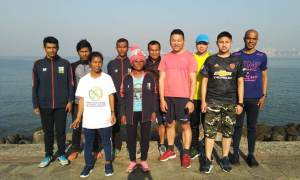
The Run Meghalaya team with friends in Mumbai (Photo: courtesy Gerald Pde)

Run Meghalaya

Going home with four podium finishes from the 2020 Tata Mumbai Marathon, was the six person team from Run Meghalaya. Tlanding Wahlang finished first in the 40-45 years age category of the full marathon for men. With timing of 2:39:09, he was winner by handsome margin. In the 45-50 years age category for men, Gerald Pde secured second place; he finished in 3:01:04. Swonding Mawlong (3:22:30) finished fourth in the 55-59 years age category for men. Snora Lyngkhoi (3:55:14) finished third in the 45-49 years age category for women while 72 year-old grandmother, Kmoinlang Wahlang (4:44:09) retained her first position in the 70-74 years age category for women. Last year, Kmoinlang had completed the race in 4:33:56. Except Gerald, all the runners are from Meghalaya’s Mawkyrwat region, which plays host to the annual Mawkyrwat Ultra. “ This time owing to funding issues we had a small team come to Mumbai. But the performances have been quite encouraging,’’ Gerald said. For Gerald, 2020 marked return to the Mumbai Marathon after a gap of eight years. In 2011, when he first ran it, he had covered the 42km-course in approximately three hours 23 minutes. In 2012, he brought that down to 3:03. “ Sunday’s 3:01 is a personal best,’’ Gerald said adding he seemed to have finally figured out what training and diet worked for him in long distance running. According to him, upcoming races for the runners from Meghalaya include the marathon in Kolkata and February’s Tata Ultra in Lonavala. At the latter, a team of six runners from Meghalaya is expected to participate. For more on Gerald Pde and Run Meghalaya, please try this link: https://shyamgopan.com/2018/03/30/run-meghalaya/
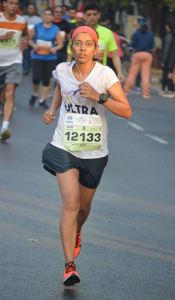
Nupur Singh (Photo: Chetan Gusani)

Nupur Singh

On January 6, 2020, Nupur Singh crossed the finish line of Vadodara International Marathon in a personal best (PB) timing of 3:10:22. She won the women’s open category race.

She was expecting to get close to that timing and maybe even improve it at the 2020 Tata Mumbai Marathon (TMM). But that was not to be. “ The first 18 kilometers went off very well. But soon after fatigue took over and I had to slow down my pace,” she said. She completed the marathon in 3:20:59, securing second position overall among amateur women runners and topping her age group of 30-34 years.

In November 2019, returning to running after a short hiatus, Nupur had participated in the 100 km IAU Asia and Oceania Championships at Aqaba, Jordan, in the open category. Following that, she was racing back to back for four weekends before TMM. During the weekend prior to TMM, Nupur attempted the 60km race at The Vagamon Ultrail in Kerala but she had to quit the race at the 32nd kilometer after she lost her way.

“ This was my first experience at TMM. I had heard so much about this event. It was absolutely spectacular with so many people – volunteers, supporters and runners. I have never enjoyed a race so much as this one,” Nupur said.

Over the next two weeks, Nupur will take on the role of an organizer. She will be busy with Deccan Ultra, a trail based ultra-running event organized by Grand Indian Trails (GRIT), of which Nupur is an integral part. In terms of running events, her next attempt will be the 50km race at Tata Ultra on February 23, 2020. For more on Nupur, please try this link: https://shyamgopan.com/2019/12/14/an-aqaba-to-remember/
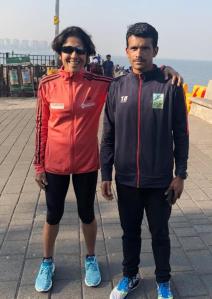
Anjali Saraogi (left) with Tlanding Wahlang, ultra runner from Meghalaya who was also podium finisher in his age category at 2020 TMM (Photo: courtesy Anjali)

Anjali Saraogi

Anjali Saraogi stood at the start line of the 2020 Tata Mumbai Marathon with barely two and half weeks of training done for the race. Less than two months earlier, in November 2019, the Kolkata-based long-distance runner had set a national record in 100 kilometers at the 2019 IAU Asia and Oceania Championships held in Aqaba, Jordan.

Beset with health issues, her overall training had suffered through much of 2019. Still, 2019 turned out to be a major year in Anjali’s running career with personal best (PB) timing of 3:14:33 at the Boston Marathon, a robust comeback in the Berlin Marathon after setbacks caused by health and injury and a national best in 100km at the 2019 IAU Asia and Oceania Championships.

“ I had not done any long runs for Mumbai Marathon. I had a target of 3:20-3:25. I was strong till the 22nd kilometer; after that I suffered,” Anjali said. She finished in 3:24:53, emerging first in her age category of 45-49 years and fourth overall among amateur women runners.

“ Mumbai Marathon is my favorite event in India. The atmosphere here is absolutely astounding with so many people on the streets, music bands and live music. The arrangements were excellent and the volunteers did awesome work,” she said. Anjali will be participating in a few running events over the next couple of months until her next major race – the 2020 London Marathon.
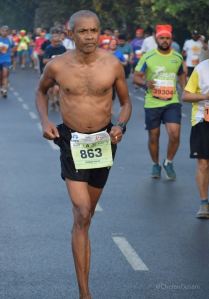
Thomas Bobby Philip (Photo: Chetan Gusani)

Thomas Bobby Philip

In 2019, Bengaluru-based amateur runner, Thomas Bobby Philip, had topped his age category for men at the annual Tata Mumbai Marathon, covering the 42 kilometer-course in 2:59:52. In 2018, he had placed second in his age category with timing of 2:57:17.

Bobby’s focus for a while now, has been maintaining the streak of sub three-hour finishes he has enjoyed in the past few years. As with chasing any target, there is an element of favorable circumstances converging for this to happen. The weather in Mumbai on January 19, 2020 – race day – was perfect. Unfortunately for Bobby, a week before TMM, he started experiencing cold, chest congestion and throat irritation. “ I was not keeping well. Things improved a bit by Thursday-Friday and I decided to proceed with my plans for Mumbai. But I wasn’t recovered fully,’’ he said. Result – he finished first in the age category of 50-54 years for men but with timing of 3:07:49. “ When you look at a race, there are two aspects – there is the quality of organization and your personal experience. At a personal level, I didn’t get that sub-three. But the race organization was done well. The overall experience was very good,’’ he said.

Notwithstanding Sunday’s outcome, Bobby believes that maintaining sub-three is a reasonable goal for him. He does not take part in many races. He has been relatively injury-free. “ If all goes well, there is nothing to stop me from pursuing sub-three as goal,’’ he said. Right now however, given the bout of ill health he faced ahead of 2020 TMM, his coach has advised him against participating in the next marathon he had signed up for – the 2020 IDBI Federal Life Insurance New Delhi Marathon.  He will be giving that a miss and instead focusing on regaining his health. Once recovered, Bobby’s attention will revert to the annual calendar he has traditionally kept – Bengaluru’s TCS 10K in May followed by a bunch of half marathons to steadily work one’s way up to the annual TMM; and along with that, chasing sub-three. For more on Thomas Bobby Philip, please try this link: https://shyamgopan.com/2016/03/10/in-the-right-sport/
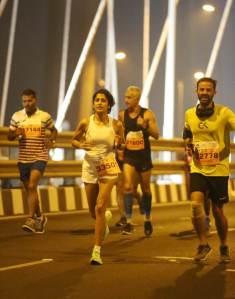
Kavitha Reddy (Photo: courtesy Kavitha)

Kavitha Reddy

Given she is heading for the 2020 Tokyo Marathon, Kavitha Reddy chose to take the Mumbai Marathon of January 2020 as a training run. The Pune-based runner did not have a time target for the race. She also chose to do the half marathon instead of the full. “ I decided to go by feel. It was a good run. I was comfortable throughout the run,” she said.

Kavitha crossed the finish line in 1:36:11, a new personal best (PB) and securing the top podium position in her age group of 45-49 years. “ I deliberately decided to not race this one as I did not want to jeopardise my training for Tokyo Marathon,” she said. In October 2019, she had participated in the Chicago Marathon, where she secured a finish timing of 3:14:19 in the full marathon.

According to her, the arrangements this time in Mumbai were good but there were too many runners at the finish line. “ The finish line shouldn’t be the same for runners of various distances. The organisers need to segregate the finish line for 10 km and half marathon runners,” she said.
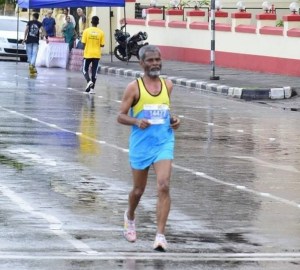
Mahipati Sankpal (Photo: courtesy Mahipati)

Mahipati Sankpal

After he turned 45, Kolhapur-based Mahipati Sankpal, turned to walking as means to stay fit. “ I was doing it only for fitness,” he said. Soon, he found a way to make walking more interesting. Every Sunday, he would walk from Kolhapur city to the well-known and popular Jyotiba temple, a distance of 19 kilometers by road and 13 kilometers via a dirt track through undulating terrain.

Over time, he got introduced to race walking and participated in a few local and international race walking events of five kilometers. Some of these were Masters Athletics Association events. Race walking is a technical sport and the rules specify that the athlete must have one foot in touch with the ground at all times so that the action does not become running. Mahipati spent some time understanding the rules of the sport. Done well, race walking speeds are comparable to the progress of amateur marathoners. Along with his race walking Mahipati also started running distances of around five kilometers.

In 2013, Mahipati did his first 10 km race at the Satara Hill Marathon. In the following year, he did a half marathon at the same event. On both occasions he secured top podium position in his age category. In 2015, Mahipati attempted his first marathon at the Bengaluru Marathon. “ I made a major mistake during this race. I did not drink a sip of water or energy drink during the entire 42.2 km. I also did not eat anything. When I crossed the finish line, I was in a completely dehydrated state,” he said. Nevertheless, he finished second in his age category of 55 years and above.

With that edition of the Bengaluru Marathon, Mahipati learnt a lesson about the importance of nutrition and hydration. In 2016, he again participated in the Bengaluru Marathon and finished in top position in his age group of 55 years and above with timing of 3:24:54. That year, he took part in the full marathon at the Vasai Virar Mayor’s Marathon (VVMM) and finished third in his age group of 50-60 years; there was also a slight improvement in his timing to 3:24:25). Retired from Maharashtra State Electricity Board (MSEB), Mahipati continued with his appearances at Satara Hill Marathon, Bengaluru Marathon and VVMM.

Thanks to his growing experience, at the 2020 Tata Mumbai Marathon (TMM), Mahipati was well-prepared in terms of nutrition and hydration. He decided to tackle the race in four segments with the aim of covering each of these segments in 50 minutes. He covered the first segment in 45 minutes and covered the half marathon length of the course in 97 minutes. “ I usually get tired after 30-35 kilometers while running a marathon. But this time I did not feel any tiredness. The weather was also much better. I kept sipping water, eating oranges and pieces of jaggery. I finished the last five kilometers very well,” he said. He crossed the finish line in 3:24:16, a new personal record ensuring top podium position in his age group of 60-64 years.

Mahipati, 61, is now well settled into the rhythm of marathon running. However he is unsure whether to continue his journey in running or not. His family is not very keen that he continue racing.
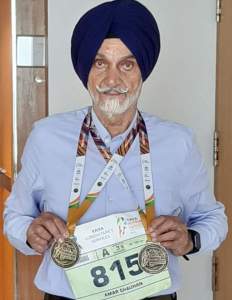
Amar Chauhan (Photo: courtesy Amar Chauhan)

Amar Chauhan

Septuagenarian Amar Chauhan is a regular podium finisher in his age category at running events across India, including the Tata Mumbai Marathon.

He divides his time between Chandigarh and Canada, where his sons live. He arrives in India sometime in September, in time to be ready for the Airtel Delhi Half Marathon. After a string of races across India, including the annual Mumbai Marathon, he heads back to Canada where he participates in a few races.

At 2020 TMM, Amar Chauhan completed the marathon in 5:04:54, winning his age category of 75 years and above. This time, he finished the run nearly an hour later than his 2019 timing at TMM (4:12:03). “ I ran slowly this year because of health problems. Sometime in December 2019, I had faced heart palpitations and had to undergo treatment,” he said.

Worried that he may run fast, his wife had arranged for a pacer from Chandigarh to ensure that Amar ran slowly. “ The pacer kept asking me to slow down and take breaks at some places. I could have finished the run in 4:30,” Amar – now 77 – said, seemingly amused at the idea of running with a pacer. He had no complaints about the arrangements at 2020 TMM. He carried dates and picked up water and energy drinks along the route from volunteers. This was his fifth age category win at Mumbai Marathon.
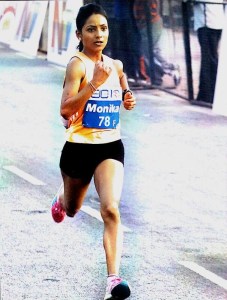
Monika Athare (Photo: courtesy Monika)

Monika Athare

Elite athlete Monika Athare, was out of action for over a year due to knee injury. She has just resumed racing. At the 2020 Tata Mumbai Marathon, she finished third in the women’s half marathon segment. She also placed first in her age group of 25-29 years. A national level athlete, Monika crossed the finished line in 1:18:31. It was not her best timing but was she happy to be running and back in contention. “ My performance at TMM 2020 has helped me regain my confidence. I was laid low by a serious injury in my knee,” Monika said.

The Nashik-based athlete has been actively involved in sports from childhood. She commenced her journey attempting 400 meters and 800 meters. She later moved to 3000 meters, 5000 meters, 10,000 meters and eventually shifted to the half marathon and the marathon. She represented India at the 2017 World Athletics Championships in London.

It was in December 2018, that she was hit by severe knee injury and was put out of action completely. “ I have been actively involved in sports for the last 18 years. Marathon training entails a lot of running,” Monika said. She was advised strengthening exercises as remedial measure. “ Strength workout helped me a lot and I have been able to get back to running,” she said. Monika trains at Ekalavya Athletics and Sports Institute in Nashik.

She will now focus on training for the Federation Cup National Senior Athletics Championships to be held in April 2020. She will be attempting the 5000 meters and 10,000 meters at the competition.
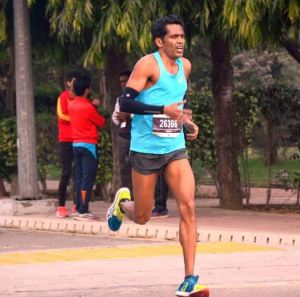
Mohamed Idris (This photo was downloaded from the runner’s Facebook page)

Mohamed Idris

“ The weather was fantastic. Coming from Chennai, I really felt it,’’ Mohamed Idris said of race day at the 2020 Tata Mumbai Marathon. In 2019, he had topped his age category for men (50-54 years) in the half marathon with timing of 1:24:38. This year he covered the distance in 1:24:33 but placed second, three seconds behind the category winner. “ It was a good race. I was feeling strong. Running the half marathon in Mumbai is always a privilege,’’ he said. Someone known to race a lot every year, Idris has a few races coming up in Chennai. But he is making a change to his aspirations. “ I want to focus on the triathlon. I did one in 2010 and haven’t gone back to it since. I plan to attempt the newly introduced Melbourne Ironman in November this year,’’ Idris said. For more on Idris, please try this link: https://shyamgopan.com/2016/12/30/life-retired-and-reinterpretted/
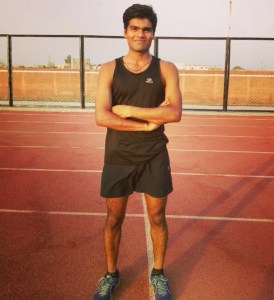
Nishu Kumar (Photo: courtesy Nishu)

Nishu Kumar

Twenty-four-year-old Nishu Kumar was a bit late to start his first full marathon at the 2020 edition of Tata Mumbai Marathon.

“ I got caught behind a big crowd of runners at the start of the race,” Nishu, a resident of Vadodara, Gujarat, said. At 2020 TMM, Nishu had a target of 2:36 hours for finishing time. But he ran into a wall of runners at the end of the race too and completed the run in 2:42:55. He won top honors in his age group of 18-24 years and eighth position overall among amateur male runners.

Nishu got into running about five years ago and has mostly been running 10km and 21km races. He was into cricket during his school years and later took up sprinting, participating in 100 meter and 200 meter-races. He trains under ultra-runner Sandeep Kumar, who has represented India in a couple of international ultra-running events. Having finished his graduation in electrical engineering, Nishu wants to do his MBA in sports management.
Dnyaneshwar Tidke (Photo: Chetan Gusani; photo provided by Dnyaneshwar)

Dnyaneshwar Tidke

Towards the end of October 2018, Dnyaneshwar Tidke felt discomfort in his right knee after a training run. An initial diagnosis had indicated the problem as ACL (Anterior Cruciate Ligament) injury. MRI scan later identified it as a meniscus tear and Dnyaneshwar had to undergo surgery in November 2018.

In January 2019, he started jogging slowly and over the next few days slowly increased his mileage. “ In February 2019, I did a 20 km run and felt quite comfortable. I decided to attempt the 2019 edition of Boston Marathon as I had already registered for the event,” But shortly thereafter, Dnyaneshwar met with a road accident resulting in a fractured scapula. He was out of action again.

“ I resumed my jogging in May. It was not easy as I had gained some weight due to lack of physical activity. It was a difficult phase for me. During my runs, I could feel niggling pains and aches,” he said.

Although he resumed his running, the overall volume was low. Despite that he got a podium finish in the 10k run at the 2019 Navy Half Marathon, held in November. A month later, he ran a half marathon in Pune and felt fairly confident to go into a full marathon.

“ At 2020 TMM, I had no target. I just wanted to go by feel. I ran the first half of the race comfortably in 1:29 hours. But during the second half I felt tired. I was low on energy,” he said. Dnyaneshwar finished in 3:06:56, getting third position in his age group of 45-49 years. “ It was overall a satisfactory performance as it was my first full marathon after surgery and fracture,” he said. For more on Dnyaneshwar, please try this link: https://shyamgopan.com/2015/04/11/the-constant-runner/
Kamlya Bhagat (Photo: Shyam G Menon)

Kamlya Bhagat

We are back at Visava Restaurant opposite Panvel bus depot, a longstanding assembly point for hikers and for this blog, venue to catch up with Kamlya Bhagat and his story in running. It is the Monday following the 2020 Tata Mumbai Marathon (TMM). According to Kamlya, he has run the half marathon at the event four times and ended up on the podium on all four occasions; twice first and twice second in his age category. The latest on January 19 saw him place second in the 35-39 years age category for men. Hailing from financially challenged circumstances and running to make additional money, Kamlya – he now works at a local school – races 3-4 times a month.

Race day this year began at roughly 2.30AM, which was the time he left home 10-12 kilometers away from Panvel town to join his friends driving to Worli in Mumbai for the half marathon’s start. They reached the venue around 5AM; Kamlya did a little warm-up and at the appointed time of 5.15AM commenced running. On his feet was his trademark improvised footwear – a pair of socks, each with an insole inserted inside. Kamlya had a good start. He recalled being out front for some time before a runner from a younger age group joined him. Together, they struck a fairly fast pace. Past 13 kilometers, Kamlya’s pace began to slacken. At around kilometer 16, a runner from his own age group caught up and progressively took the lead. Kamlya finished in 1:18:25 placing second in his age category. “ The race was good. The weather was apt for running and the new start time 15 minutes earlier than before worked well,’’ Kamlya said. The timing was an improvement over the 1:23:09 he registered in 2019, when he had placed second in the 30-34 age category. His personal best (PB) in the half marathon is 1:10, which he earned at a race in 2010 in Kharghar, Navi Mumbai.

Going ahead, Kamlya will participate in the 2020 edition of Tata Ultra Marathon in Lonavala, where he will run in the 35km race. He ran at Tata Ultra in 2018 and 2019. Both times, he got a podium finish in the 35km race; he was first (2:34:50) in 2018 and third (2:30:44) in 2019. Running in the 35km segment, Kamlya is slowly addressing a long held fear that his competence in the shorter distances (where he earns his prize money) may be compromised if he transitions to the longer races. While training for 35km, he puts in a few runs of 30-32km. But he is still hesitant to touch 40km although he suspects he is developing a desire to eventually try a full marathon. He holds himself back because committing to the full marathon typically entails greater expense. “ It calls for good training and a better diet. I eat what is made at home. I have no special diet; I don’t go to the gym. So far, whatever racing I have managed is within the parameters of what I can afford,’’ he said. Still, having come as far as 35km, who knows what the future holds? Meanwhile he is on the lookout for minimalist footwear (size 8) for running; something like Vibram Five Fingers. “ Regular running shoes weigh me down,’’ he said. For more on Kamlya, please try this link: https://shyamgopan.com/2016/01/19/kamlya-runs-his-first-scmm-and-gets-a-first/
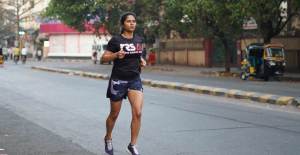
Tim Tim Sharma (Photo: courtesy Tim Tim)

TimTim Sharma

Before she got into running, Bengaluru-based fitness trainer TimTim Sharma was into equestrian sports.  Starting at the age of nine, she stayed in the sport for ten years including participating in the Junior National Equestrian Championships. She lost her connection with sports when she moved to New Zealand for studies. A victim of unhealthy lifestyle – erratic eating and lack of physical activity – she had to take control of her life when laid low by digestive issues and multiple stress fractures.

Once she embraced fitness, it was running that helped her get back on track. But she ramped up distances too fast moving from 10k to half marathon and full marathon in a very short period, resulting in injuries. That put her out of action for some time. She chose that time to get into organizing sporting events as a consultant at Neb Sports. She also got involved in cycling and swimming, participating in bicycling events and Olympic distance triathlons.

TimTim is also into traveling. During a journey along the course of River Teesta, she got to spend time at Gangtok. “ From the place where I was staying I could see Kanchenjunga. There was something fascinating about the mountains. I ended up doing my basic mountaineering course from the Himalayan Mountaineering Institute in Darjeeling,” she said. She followed it up with the advanced course in mountaineering.

She resumed running with the 2019 edition of IDBI Federal Life Insurance New Delhi Marathon. She topped her age category (30-35 years) in the half marathon with timing of 1:39:11. In May, she ran the TCS World 10k in Bengaluru and secured a second position in her age group of 35-39 and overall 11th place among women runners with timing of 44:54 minutes.

At TMM 2020, she completed the marathon in 3:30:21 winning her age category (35-39 years) and finishing overall eighth position among women runners. In the weeks ahead, TimTim is likely to participate in the Maharashtra Police International Marathon and Tata Ultra, both events slated for February 2020.
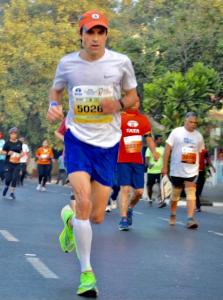
Ashok Nath (Photo: courtesy Ashok)

Ashok Nath

Based in Bengaluru, runner and coach Ashok Nath is a regular podium finisher at races. At 2020 TMM Ashok finished the marathon in 3:13:34 securing second position in his age group of 55-59 years. “ I neither train too much nor do I push too hard in a race,” he said. Given his responsbilities as coach and the time that role consumes, it is not always possible to put in the apt mileage and effort in his own training.

Ashok has been running for several years and has participated in the Boston Marathon and Comrades Marathon multiple times. He has already earned the six-star World Marathon Majors medal. At 2020 TMM, Ashok was not affected by the crowd of runners cited by many as a problem. “ At the start of the race, I did find some crowding and may have lost a minute negotiating passage between slow runners. But I did not face unusual crowds through the route until the last 500 meters. It was extremely crowded after the finish line,” he said.

The post-race management was executed badly, he pointed out. “ So many runners were finishing at the same time. The organizers should have foreseen this and managed accordingly,” Ashok said adding that such arrangements were totally unacceptable at a World Athletics Gold Label race.

Ashok is likely to attempt the New Delhi Marathon in February. Following that he will head for the London Marathon as he has qualified for the Abbott World Marathon Majors Wanda Age Group World Championships.
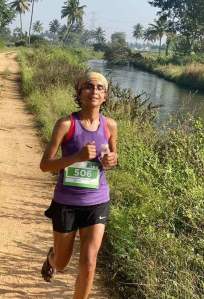
Shilpi Sahu (Photo: courtesy Shilpi)

Shilpi Sahu

A barefoot runner, Shilpi Sahu commenced her race at the 2020 Tata Mumbai Marathon, at a slow pace. She did so because of the big crowd of runners. “ Once midway I picked up speed as I felt quite good,” she said.

The Bengaluru-based runner had a target of 3:30 hours but well into the race she realized that she would not be able to achieve it. She finished the race in 3:32:21, a personal best (PB) for her. It fetched her the top podium position in her age group of 40-44 years and tenth place overall among amateur women runners. “ I also managed a four minute negative split,” Shilpi said. As a barefoot runner, she did find the road surface tough because of the ongoing metro construction work.

According to her, the organization of the race was very good but the use of plastic remained high. “ I hope TMM organizers think seriously about reducing single use plastic bottles for the 21 km, 10 km and the Dream run by at least 50 per cent and by 100 per cent at the venue. I saw many runners take a sip and throw away the bottle. In the process, there is plastic being dumped and water being wasted,” she said.

The refill option should be encouraged, she said.
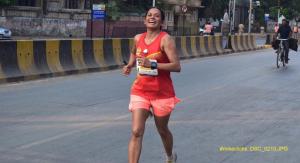
Chitra Nadkarni (Photo: courtesy Chitra)

Chitra Nadkarni

At the Adani Ahmedabad Marathon held in November 2019, Mumbai-based Chitra Nadkarni had secured top podium position in the age category of 51 years and above with timing of 4:09:11.

For 2020 TMM, she decided not to have a timing target as the race she is focused on is the 2020 Tokyo Marathon to be held in March. “ At TMM, I decided to run between the 4-hour and 4:15-hour pacers. The 4-hour pacer, Anirudha Athani, was very good. I kept pace with him for most part but could not manage to do so during the last two to three kilometers,” Chitra said. She finished in 4:01:12; it fetched her top podium position in her age group of 55-59 years.

“ I had a good run but the post-race arrangements were bad. It was chaotic and crowded at the finish line,” she said. She will now head for the Tokyo Marathon – it is one of the six World Marathon Majors – to be held on March 1, 2020. “ I am looking forward to my six-star medal,” she said. For more on Chitra Nadkarni, please try this link: https://shyamgopan.com/2017/04/08/starting-line-50/
Kumar Rao (Photo: courtesy Kumar Rao)

Kumar Rao

Kumar Rao, 70, chose to make the 2020 TMM 2020 a training run for his upcoming participation in the 2020 Boston Marathon.

“ My plan was to run the first five kilometers as warm up, the next 30 as tempo run divided into three segments of 10km each and the last 7.2km as cool down run. Of the three segments of tempo run, I ran one of them at Boston target pace,” Kumar said.

He stuck to the plan for most part but stepped up the pace during the last two km.

Kumar had set a target of 4:15 as per his plan but finished in 4:12:28, securing the top podium position in his age group of 70-74 years. “ The podium has come as a bonus. I did not expect it,” he said. In December 2019, Kumar Rao had participated in Tata Steel 25k and won an age category podium with timing of 2.12.39. “ With TMM 2020, I have completed the Procam Slam,” he said.

In April 2020, Kumar will be running Boston Marathon for the second time. Last year, Kumar secured his personal best timing of 3:59:33 at Boston Marathon. He had followed it up with Big Sur International Marathon in California. Later, in September, he secured his six star World Marathon Majors medal after he completed all six marathon majors at Berlin Marathon.
Tanmaya Karmarkar (Photo: courtesy Tanmaya)

Tanmaya Karmarkar

In the run up to the annual Mumbai Marathon, Tanmaya Karmarkar’s training was largely focused on the 2020 Tokyo Marathon. Nevertheless, she managed to put in some dedicated training for TMM. “ For the last one month, I focused on half marathon training,” the Pune-based runner said.

At Mumbai, she hoped to finish in around 1:38 hours, her personal best in the half marathon. She finished tad outside that mark in 1:39:26 and secured second position in her age group of 40-44 years. Her run progressed well but at the seventh kilometer she lost the cap of her water bottle and got distracted managing a bottle with water splashing out of it.

“ I could have done better but I goofed up a bit on hydration,” she said. Tanmaya found the arrangements at 2020 TMM fairly good and did not have the difficulties that many runners, who finished later, faced at the finish line. She will now focus her attention on training for the Tokyo Marathon.
Dr Arati Gaikwad (Photo: courtesy Arati)

Arati Gaikwad

Sometime in May 2019, Dr Arati Gaikwad felt a tingling numbness in her left leg. “ I could not get up from my bed the normal way. I had pain in my right hip and a tingling feeling in my leg. I knew that the tingling feeling was not a good sign. It meant some nerve was getting pinched,” she said.

Arati and her husband, Dr Pravin Gaikwad, pediatricians and amateur runners (Pravin is also a coach; he is prime mover at Navi Mumbai based-Life Pacers), decided to consult an orthopedic surgeon for correct diagnosis of the problem. Following x-ray and MRI, it was diagnosed as congenital spondylolisthesis of L4 over L5. This is a spinal disorder in which the vertebra slips forward on to the bone below it.

Arati was distraught as she had to stop running. “ The first half hour after waking up was torture for me. I was worried if this problem would completely impact my physical activity,” she said. Thankfully, she was allowed to go for walks.

Typically, this condition is diagnosed in the thirties. The fact that Arati’s condition came to the fore in her fifties is a measure of her fitness level. Arati has been quite focused on physical fitness since her medical college days and has been actively involved in endurance sport including running, triathlon, cycling and swimming for the past several years.

The recommended line of treatment for this condition was strength training, core workout, stretching and a healthy lifestyle. “ Initially, I had to do half hour of stretching while lying on the bed before I got up,” she said. With consistent strength training, Arati was able to mitigate her pain.

“ At the time of registering for Mumbai Marathon, I was not sure if I could run a half marathon. That’s the reason I registered for the 10km race,” Arati said. She finished the 10km race at 2020 TMM in 58 minutes and 20 seconds, securing top position in her age category of 50-54 years.

“ I decided to go by feel and I enjoyed the run immensely. At some point during the race, I was overtaking many runners,” Arati said. To feel confident for 2020 TMM, she had attempted the 10km race at the Navy Half Marathon and a half marathon race in Navi Mumbai in December. She secured age category podium positions in both these races. For more on Arati and Pravin Gaikwad, please try this link: https://shyamgopan.com/2017/02/12/the-diligent-and-the-fun-loving/
Seema Yadav (Photo: courtesy Seema)

Seema Yadav

In October 2019, Seema Yadav was the first runner-up in the amateur women’s category at the 2019 edition of Airtel Delhi Half Marathon. Already plagued by injuries, Seema’s condition worsened after the Delhi run.

In April 2019, Seema had run the Boston Marathon with several injuries. She finished the race with a personal best timing of 3:26:46 but had to go off running for a while and focus on healing. Through most of 2019, Seema was battling injuries in her glutes, hamstrings and abductor muscles. She also suffered from extensor tendonitis. Her training for TMM 2020 was far from adequate. Tracking the advice of her physiotherapist, it was also intermittent.

“ I had to take this run easy so as not to aggravate my injuries any further,” Seema, a resident of Faridabad, said, adding. “ I ran at a very comfortable pace. I did not push my pace at any point during the entire distance of 42.2 km.” She finished in 3:32:38, securing second position in her age group of 40-44 years and finishing overall 11th among amateur women runners.

Seema believes she has potential to do much better in terms of timing. She also pointed to the emergent difficulty in Mumbai, navigating one’s passage through a sea of runners towards the last part of the race. “ The number of runners for the full marathon also increased this time,” she said.
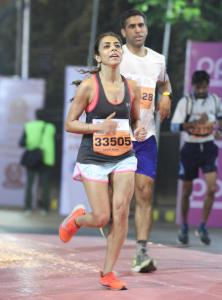
Sheran Mehra (Photo: courtesy Sheran)

Sheran Mehra

Sheran Mehra prefers to run the full marathon but her coach, Ashok Nath suggested that she opt for the half marathon in Mumbai and treat it like a training run for her upcoming race at the Tokyo Marathon.

“ I don’t like to run with targets. I just decided to go by feel. I started running comfortably and kept going on with a consistent pace,” she said. She was able to execute the second half of the race much better than the first half at TMM 2020. Sheran crossed the finish line in 1:43:24, a new personal best for her in the half marathon. She placed second in her age category of 45-49 years for women.

Sheran has been running for over 12 years. She was into sprinting during her schooling days at Bhopal and participated in district level events. “ I was active in sports through my school and college years,” she said. For a brief while sports came to a grinding halt because of injuries.

She resumed her fitness pursuit by joining a gym. “ My husband, Chandramohan Mehra, who is also a runner, is a fitness freak. Both of us were gym junkies,” she said. Her foray into running commenced when a colleague at her workplace prompted her to join him for a training run. “ I ran a distance of 7.5 km then. That’s how I got into running,” she said.

For many years she trained with Striders, a training group for long-distance running. Recently she also signed up with Bengaluru-based runner and coach, Ashok Nath. “ Initially, my focus was just running. Ashok Nath’s approach is more holistic. The accent is on overall fitness with adequate attention to strength training and nutrition,” she said.

She and her husband Chandramohan will be participating in the Tokyo Marathon in March this year.
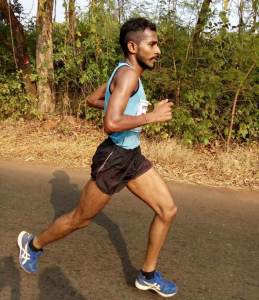
Anil Korvi (Photo: courtesy Anil)

Anil Korvi

Anil Korvi, an employee of Indian Railways, has been running for over 12 years. He started running during his college days commencing with cross country races. Later he moved to running the marathon.

His best timing in the marathon was 2:39:28, set in 2017 at the IDBI Federal Life Insurance New Delhi Marathon. “ I had a target of achieving sub-2.40 here at TMM. I started well and continued strong until about 33-34 kilometers. But I started to feel weak even before Peddar Road,” Anil said. He finished the marathon in 2:46:39, securing third position in his age group of 25-29 years and finishing overall 11th among amateur male runners. Over the last four to five kilometers, he too ran into a crowd of runners, a problem many sub-three-hour marathon runners faced this time.

Anil’s training for TMM was not adequate. “ I was training for a 10 km cross country race and followed it up a week later with the Vasai Virar Mayor’s Marathon,” he said. Anil has got Boston Qualifying (BQ) timings at the past few marathons that he has participated in but has not been able to travel overseas for a run. “ I have not yet found a sponsor who will support my travel for the Boston Marathon,” he said. That aside, he has been supported by brand HRX and more recently by Unived, a vegan sports nutrition brand.

Next month, Anil will be participating in the IDBI Federal Life Insurance New Delhi Marathon.
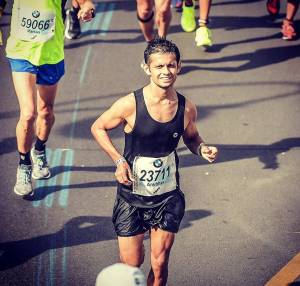
Anubhav Karmakar (Photo: courtesy Anubhav)

Anubhav Karmakar

Two days prior to Tata Mumbai Marathon 2020 Anubhav Karmakar sprained his ankle. He was in pain. He was not sure about joining the starting line of runners on the morning of January 19. Eventually he decided to go ahead.

Anubhav finished the marathon in 2:38:41, missing his goal of 2:36. He also missed the podium by 30 seconds. His overall position among amateur runners was fourth.“ I wanted to run faster splits in the final few kilometers. But I was not able to. There was a wall of runners and it was quite frustrating dodging between people through the last part of the course,” he said.

At the finish line, Anubhav did not feel spent as he had not been able to push as much as he wanted to because of the crowds. “ I am shocked that the organizers did not pay attention to this aspect,” he said.

For Anubhav, running a marathon helps him grow as a runner. He trains meticulously, tweaking his training plans as he nears race date. “ I am at that stage of running and training when I can definitely expect more gains in my timing economy,” he said. His attention will now turn to IDBI Federal Life Insurance New Delhi Marathon and later to the Boston Marathon, where he will be making his second appearance.

(The authors, Latha Venkatraman and Shyam G Menon, are independent journalists based in Mumbai.)

SRINU BUGATHA: A COMEBACK STORY

Srinu Bugatha (Photo: Shyam G Menon)

Meeting Srinu Bugatha, winner among Indian men at the 2020 Tata Mumbai Marathon

At his hotel room, Srinu Bugatha and his training partner A. B. Belliappa studied the former’s splits.

Hours earlier on Sunday (January 19), Bugatha had emerged victor among elite Indian men at the 2020 Tata Mumbai Marathon (TMM). He had clocked 2:18:45. The course record for Indians held by fellow army runner Nitendra Singh Rawat is 2:15:48. Paced by two Kenyan runners, Bugatha had commenced his run hoping to have a crack at the course record. Mumbai’s annual marathon is not exactly record-friendly. Its course includes an uphill segment and the weather can be warm and humid. On Sunday however, the weather was supportive and early start for the amateur categories appears to have ensured relatively smooth progression for the elites. It could have been a day of new course record for the Indian elites. Overall for the race, Ethiopian runner Derara Hurisa did set a new course record of 2:08:09.

Armed with his findings from the splits, Bugatha turned to his mentor and motivator, Vickrant Mahajan seated nearby. He had run at fine pace for most of the way. By his own account till around 35 kilometers he was targeting the course record. But the Peddar Road uphill took a toll. Past that, his leg muscles felt tight. “ I was very slow over the last two kilometers,’’ he said, the realization overshadowing his sense of accomplishment.

“ Don’t forget, we nevertheless have several positives in there,’’ Mahajan reminded.

“ Still, it’s like getting out on 93 or 94,’’ Bugatha said resorting to cricket for metaphor.

A middle distance runner specialized in 5000m, 10,000m and cross country for most part of his career, the Bugatha of 2020 TMM is a comeback story. In 2018 he had placed third behind Gopi T and Nitendra Singh Rawat with timing of 2:23:56. His timing of 2020 is therefore a new PB (personal best). What makes it interesting is that those are the only full marathons he has run. He had been on the podium in half marathons and 25K runs but that 2018 podium in Mumbai was the only precedent in the full marathon before Sunday’s victory. In 2018, Bugatha was in the national camp for marathoners ahead of the Commonwealth Games. The training then had timing of 2:12 hours (Shivnath Singh’s still standing national record) in mind with weekly mileage sometimes hitting 220 kilometers. That proved tough for Bugatha to handle and he came off believing track events – the middle distance disciplines he was used to – were his forte.  He stopped running marathons. According to Mahajan (he is the person behind Superchampions Foundation), in April 2019, he chanced to give motivational talks at the Army Sports Institute (ASI), where Bugatha trained. Slowly Bugatha warmed up to him and started to share his thoughts. The subsequent drift back to the marathon, Mahajan said, was “ partly’’ Bugatha’s decision.

In December 2019, Bugatha participated in the 5000m at the South Asian Games in Kathmandu. As per information on the website olympicchannel.com, he placed fifth. At the 2019 Tata Steel 25K (an event where he has had several podium-finishes before) held on December 15, he topped among Indians with timing of 1:18:31. From December 18, 2019 onward he started training for TMM. In other words, the first place finish and PB of January 19, 2020 was the product of a mere month of preparations, in which time the longest training run he did was a 40km-run on January 2. “ Imagine what someone like him can do with proper training. I believe today’s win is the beginning of a journey,’’ Mahajan said on Sunday. Both he and Bugatha outlined the changes already put in place. A typical middle distance runner’s weekly mileage (that is, over six working days) aggregates to around 120 kilometers. As he geared up for TMM, weekly mileage went up to 180-200 kilometers, Bugatha said. Then, there has been the instilling of self-belief that targets like Shivnath Singh’s national record in the marathon are not beyond chasing; “ mental calibration’’ as Mahajan put it. Finally, there was the weeding out of distractions. For the past six months, Bugatha hasn’t been using a smartphone.

A. B. Belliappa (Photo: Shyam G Menon)

Hailing from Vizianagaram in Andhra Pradesh, Bugatha’s career in running started after he joined the Indian Army in 2010. “ I have been running for the last five years,’’ he said. After a long time spent tackling the middle distances, he said, he is now resolved to focus on the marathon. Joining him in the transition is his training partner, third place winner among Indian men in the half marathon at 2020 TMM and a familiar face at half marathons and 25K runs in India – Belliappa. On Sunday, Belliappa was racing after a phase of injury. Although targeting course record and since introspecting where he got it wrong, Belliappa’s finish in 1:06 hours wasn’t far off his PB of 1:04. Like Bugatha, he was thinking of focusing on the marathon now on. It seemed mutually supportive. Mahajan believed that a reasonable target in the marathon for Bugatha, 27, would be qualifying for the 2024 Olympics. Given qualifying for the 2020 Tokyo Olympics requires breaking the longstanding Indian national record in the marathon, the qualifying mark for 2024 will be likely stiffer. Mahajan said that there may be an attempt to qualify for Tokyo too; towards that end Bugatha hopes to participate in the Barcelona Marathon of March 2020.

(The author, Shyam G Menon, is a freelance journalist based in Mumbai.)  
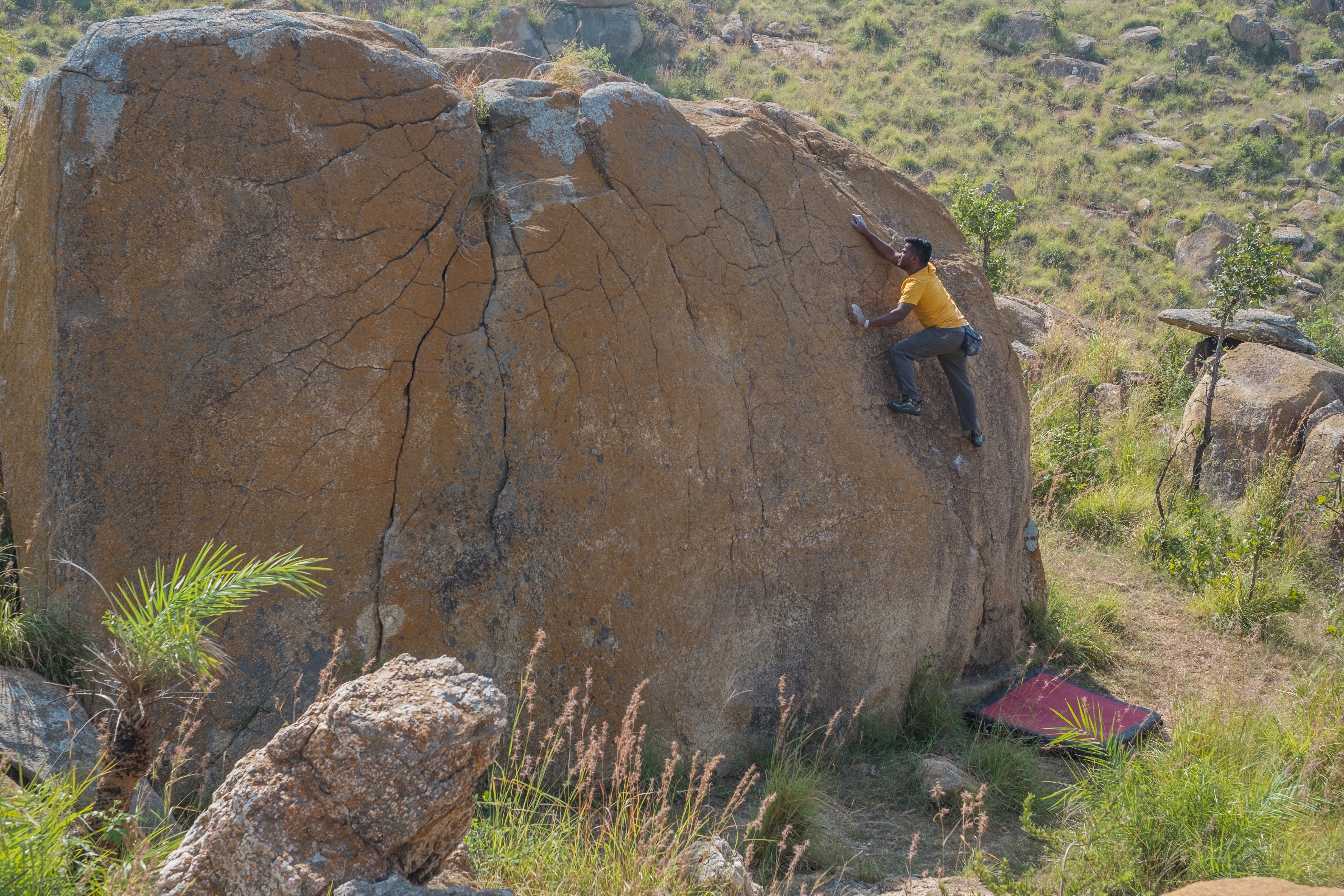
LADAKH RUNNERS: A SUNDAY THAT COULD HAVE BEEN BETTER

Jigmet Dolma (left) and Tsetan Dolkar; after 2020 TMM (Photo: Shyam G Menon)
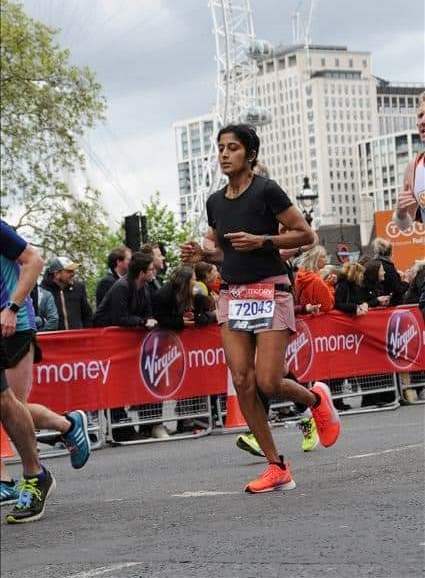
Sunday could have been better for the runners from Ladakh visiting Mumbai every year for the annual marathon.

However even as podium finish eluded them at the 2020 Tata Mumbai Marathon (TMM), the team’s outing of 2019-2020 has been fruitful overall with Jigmet Dolma’s participation in the 2019 South Asian Games, Tsetan Dolkar’s triumph at the 2019 Vasai Virar Mayors Marathon (VVMM) and the duo’s fifth and sixth place finishes in the Indian elite women’s category at this year’s TMM.

The two runners’ performance at 2020 TMM is a repeat of tradition; not only are the timings close to each other (Jigmet -3:05:10; Tsetan – 3:05:14) but the splits are also very close right through. With PBs (personal best) of 3:01 hours and separated by mere two seconds, both have been on a quest to go sub-three. They came to Sunday’s race in Mumbai with a plan in place but unfortunately its execution wasn’t to the dot. “ Our strategy was to run the first 21 kilometers in about 1:27. But we were a bit slow and it became 1:30,’’ Jigmet explained. In a race, particularly when chasing a mark like sub-three, the seconds and minutes count. Otherwise, 2020 TMM was “ a good run.’’ They faced no difficulties, the weather was much better than what it was last time and their training had been good in the run up to race day.

Aside from Jigmet and Tsetan in the elite Indian women’s category of the full marathon, the team had one participant in the men’s marathon and the rest in the half marathon for both gender categories. This year, according to Jigmet and Tsetan (who this blog spoke to), they return without a podium-finish in any segment at TMM. In 2019, Jigmet (3:10:43) had finished third among Indian women and Tsetan (3:13:13) had placed fifth. On the bright side, there is improvement in the timing of both runners at TMM, from last year to now. Further within the space of their 2019-2020 outing, Jigmet’s timing at 2020 TMM is better than the timing she returned at the South Asian Games of December 2019 (3:07) while that of Tsetan is an improvement over her timing at VVMM (3:10:27), also from December 2019.

They now have the IDBI Federal Life Insurance New Delhi Marathon as last event to attend before heading back to Ladakh. They hope they are able to get that sub-three in Delhi. Asked if the mark seemed formidable, Jigmet said, “ it is not a big challenge. It is possible.’’

(The author, Shyam G Menon, is a freelance journalist based in Mumbai.)