WILDCRAFT – THE EVOLUTION OF AN INDIAN OUTDOOR BRAND

A Wildcraft showroom; this one is at the Inorbit Mall, Navi Mumbai (Photo: Shyam G Menon)

A Wildcraft showroom; this one is at Inorbit Mall, Vashi, Navi Mumbai (Photo: Shyam G Menon)

This is the updated version of an article originally published in 2011.

Over a decade ago, we were fast approaching the departure date for a mountaineering expedition.

The experienced team members had imported backpacks.

The rookies lacked anything comparable.

We headed out to meet a gentleman near Churchgate in Mumbai, who had brought to town large backpacks made by Wildcraft. Those days, Mumbai had no Wildcraft dealer; this man was an aspirant. A black and green `Zanskar’ by Wildcraft – that became my first serious expedition size-backpack. Months later, I made the journey to Bengaluru and the garage-shop in Jayanagar, Wildcraft functioned from. I was merely doing what many did. For us, Wildcraft was the backpack we heard of, searched for stores selling it and eventually made the pilgrimage to Bengaluru to buy.

That was years ago.

Now Wildcraft has over 100 exclusive stores nationwide and many more shops that retail its products without being exclusive to the brand.

Wildcraft’s genesis almost 25 years ago was similar to how many outdoor gear businesses started. There were these folks addicted to outdoor sports; they scouted around for gear, found little and instead of complaining, decided to make it. Dinesh K.S, Co-Founder, Wildcraft, belongs to that league. He is an engineer given to rock climbing and mountaineering. It wasn’t long before he was forced to choose between his job at an electronics company and, expeditions. Those days the economy was just opening up. Bengaluru was a hot spot for garment-outsourcing. The basic raw materials for making outdoor gear could be chased down locally or traced to suppliers overseas. Enter Wildcraft.

Photo: Shyam G Menon

Photo: Shyam G Menon

Wildcraft’s first product was a chalk bag born from climbers’ needs. Its first major product was a dome tent. The tent wasn’t for sale but it gave the company’s founders a taste of the Indian market, which had neither volumes in outdoor gear nor viable price points. The company shifted to backpacks; everyone in the outdoors needed one.

Born from hands-on experience, Wildcraft products were relevantly engineered. They were also well designed unlike some of the other competing indigenous products, which were functional without much attention to aesthetics. Using outsourced manufacturing facilities, the company made backpacks, sleeping bags and a modest range of outdoor clothing besides selling imported climbing hardware. It also had a services wing catering to outdoor activity and management programs. A small garage was office and shop.

However the struggle for scale continued. With the country very low on active lifestyle, the Indian market for outdoor gear was abysmally small. Help came from an unexpected quarter. The IT boom provided relief. As software engineers poured into Bengaluru, the demand for laptop bags and smart daypacks rose. A product line thus opened up which was sufficiently big for the iconic but small-volume outdoor gear business to piggy back on. Dinesh recalled a specific instance. Wildcraft makes a sleeping bag that packs really small. Whenever Bengaluru faced a bandh (shutdown called by political parties) and IT companies wanted staff to overnight on premises, they placed a large order for this sleeping bag. Alongside, orders for daypacks continued. Still, brand Wildcraft lacked a road map as visited manufacturers in any overseas market with well entrenched outdoor lifestyle.

Around this time, Dinesh became a mountaineering instructor with the US-based National Outdoor Leadership School (NOLS), splitting his time between courses in India and the US. Wildcraft drifted. There was a churn in the original set of three partners running Wildcraft. Two new faces joined, whose actions have redefined Wildcraft. Although not from the outdoors, Gaurav Dublish and Siddharth Sood were MBAs working overseas. After studying the business and drawing up plans, they invested, joining Dinesh as directors. In a nutshell what they seem to have done is harness Wildcraft to ambition, forcing the brand to articulate what it wants to be thus checking that drift. The services wing was shut down. Between services and products, when viewed through the prism of scalability, products appealed more.

Photo; Shyam G Menon

Photo; Shyam G Menon

Globally, outdoor brands broadly fall in two categories – strong activity-based niche brands associated with a few products and large brands straddling a range of products. Wildcraft’s initial phase was the former. Could it have continued there? “ Numbers matter when it comes to sourcing and negotiating better prices. Numbers are everything today, so you must have more sales counters,’’ Dinesh had said in 2011, when this article was first written.

By early February 2015, the once reclusive Wildcraft had 100 branded retail showrooms in India. There were 20 franchised outlets. Most of these 120 outlets were profitable save five to six outlets, which opened recently. Approximately 25 per cent of company turnover came from its owned and franchised outlets. The balance 75 per cent was from distribution, large format stores, online portal sales and institutional sales. In 2011, its top five showrooms were already past Bengaluru-centric; they were Jayanagar (Bengaluru), NOIDA, Kochi, Chandigarh and Vashi (Navi Mumbai). By 2015, the same mix was Lucknow (opened in October 2014), Mumbai Linking Road, Vashi (Navi Mumbai), NOIDA, Jayanagar and the outlet at Mantri Mall, Bengaluru. Wildcraft became a one crore-company in 2007. It crossed the Rs 100 crore-mark in turnover in 2013-2014. “ We should be Rs 160-165 crore by the end of 2014-2015 fiscal year and sail past Rs 250 crore by 2015-2016,’’ Gaurav said. Over the past few years, the company grew at a CAGR of 60-70 per cent, which over the next three to five years should settle to around 40-50 per cent. “ Basically, we grew by 100 times in seven years and plan to grow by ten times from where we are now in five years,’’ Gaurav said.

From the new range of Wildcraft backpacks (Photo: Shyam G Menon)

From the new range of Wildcraft backpacks (Photo: Shyam G Menon)

As Dinesh pointed out in 2011, the transition attempted is towards becoming a big brand, retailing a variety of Wildcraft products founded in outdoor DNA. Gaurav had tweaked it slightly for better perspective – as yet there is no global outdoor brand from the tropics. The company now has its own factories – two in Bengaluru; the other in Himachal Pradesh, Speaking of the old Bengaluru facility and the then new factory in Himachal, Gaurav and Dinesh had said in 2011 that both facilities were cost-competitive despite location in India. In manufacturing, the challenge then was raw materials, which players in China and the Far East had better access to. Asked for an update, Gaurav said that Wildcraft had manufacturing costs that matched those prevailing in China. However more recently emergent manufacturing locations like Vietnam and Bangladesh would be hard to beat.

The Indian market too is changing. In the past several years albeit in small volumes, brands like La Fuma, Millet, Quechua (from Decathlon, which has a major presence in India), Berghaus, Petzl, Beal, Camelbak, CAMP, Cassin, Rock Empire, Boll, Evolv, Boreal, HEAD, Coleman, Coghlan’s, Deuter, Lowe Alpine, Columbia, RAB and Hi-Tec, became available in India, not to mention standard fixtures like Victorinox. Some brands entered and quit or withdrew to study the market better; others continued. Fact is – thanks to growing momentum in the sports segment (across sport categories) and the progressive adoption of active lifestyles, the market has grown. Although price point and which sport will grow are still a matter of debate – and within each vertical’s story, an often inconsistent narrative – the Indian market is firmly past the stage of being ignored. Running, the most visible symptom of active lifestyle, now spans urban India. From tryst with two or three large Indian brands, the domestic bicycle market now hosts the who’s who of international cycling. Things have changed. Gaurav estimated the total market relevant to Wildcraft at two billion US dollars annual sales. He pegged the outdoor gear segment at $ 500-600 million; outdoor apparel at $ 800 million-1 billion and outdoor footwear at $ 800 million-1 billion. The `outdoor’ reference used here is defined on the basis of product design, materials used, construction and intended application for sports and outdoorsy activities.

Needless to say, two product segments Wildcraft was studying in 2011 (and which it has since acted upon) were shoes and apparel. By early 2015, the company had a line of outdoor clothing and footwear. These lines of business separate the big brand from the small one. Internationally, big outdoor brands get 60-70 per cent of revenue from apparel sales. The company now has a design team which conceptualizes products and lays down the specs. Depending on the product, there is an element of outsourcing; for example, the company’s footwear is sourced from China and Indonesia. “ Around 95 per cent of what we sell is made by us,’’ Gaurav said. None of Wildcraft’s expansion can happen without money. Gaurav’s primary concern in 2011, as regards future plans, had been funds. Private equity may be an option, he had said.
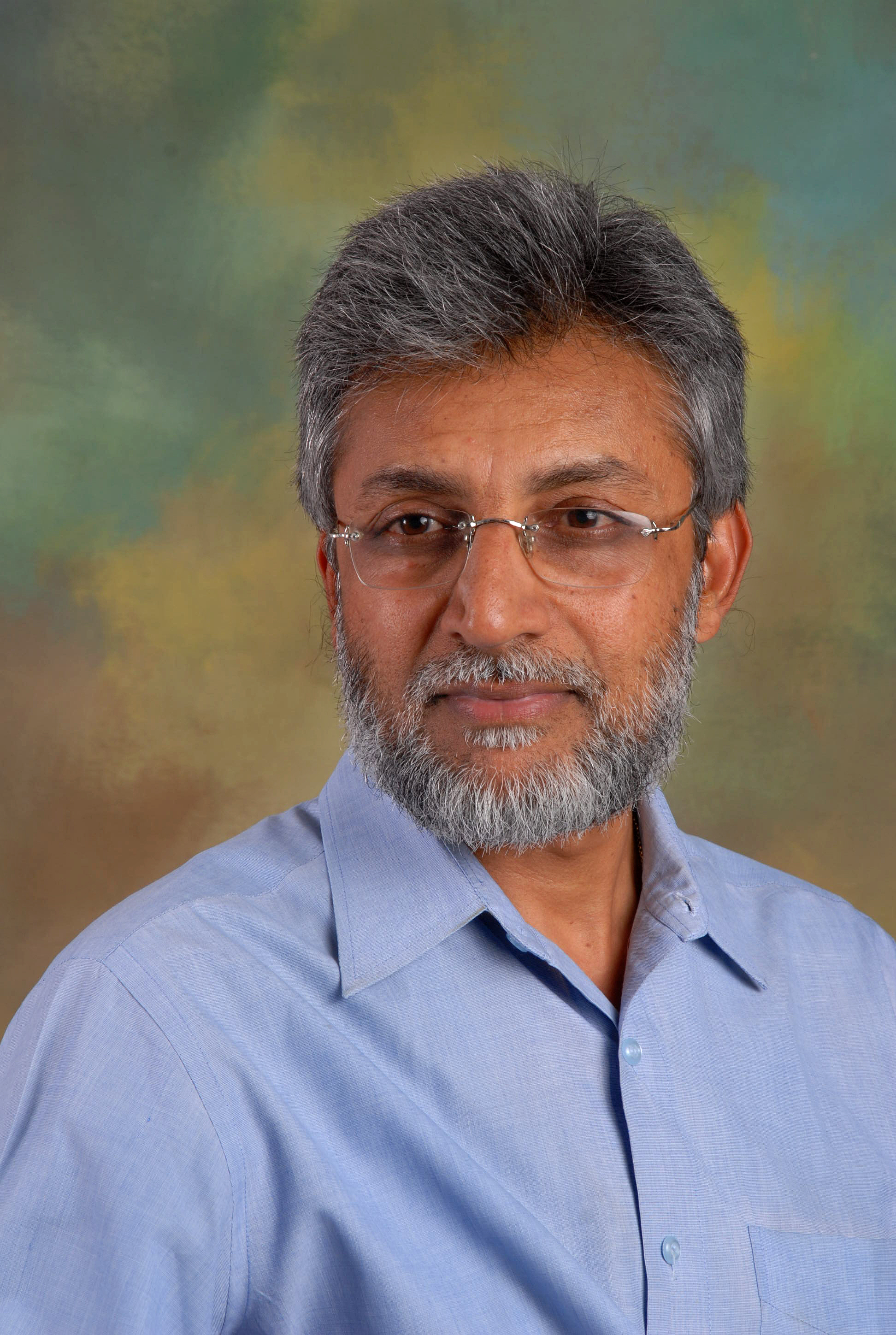
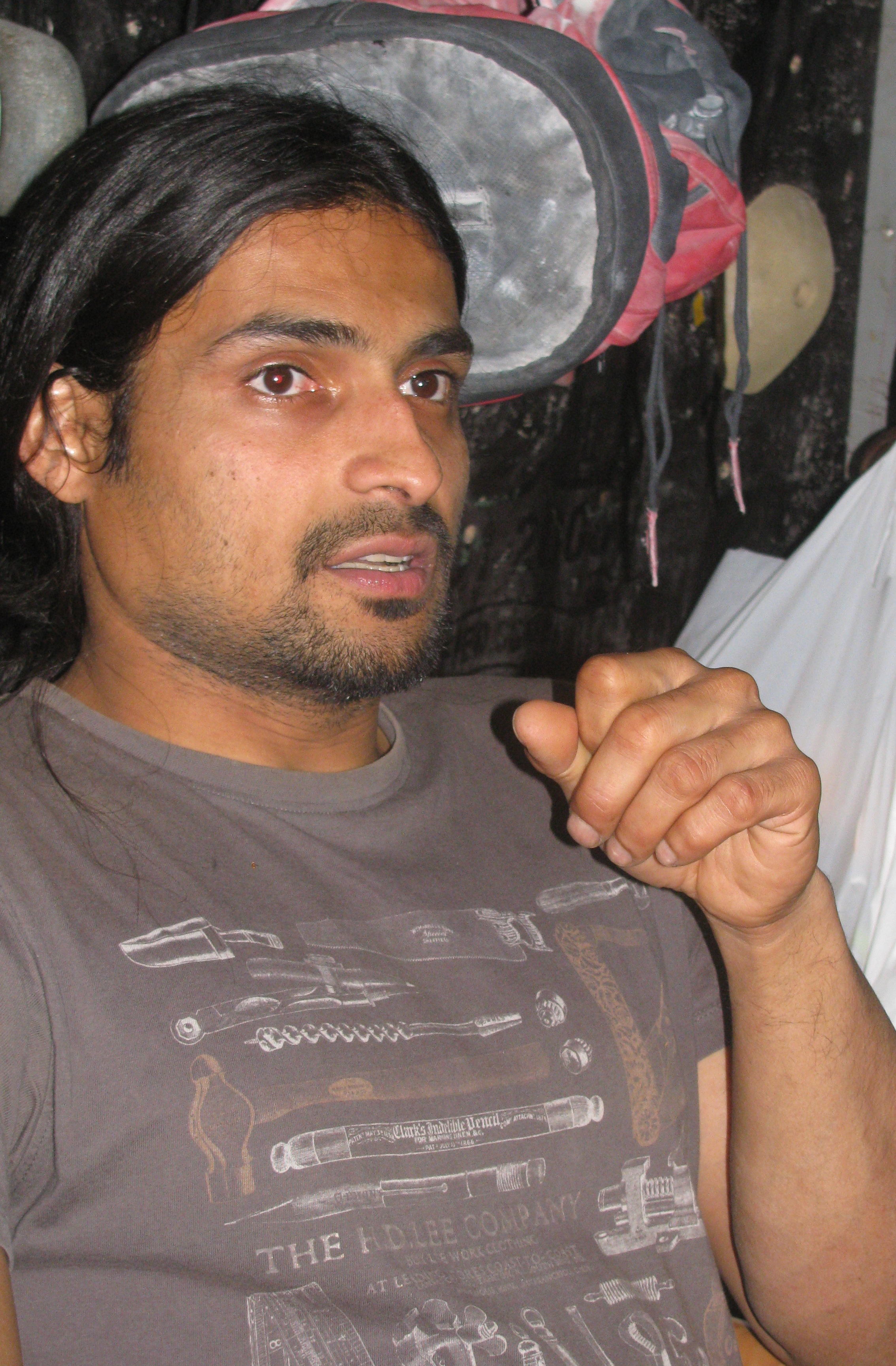
Dinesh K. S, Co-Founder, Wildcraft (Photo: by arrangement)

Dinesh K. S, Co-Founder, Wildcraft (Photo: by arrangement)

In mid-2013, news reports first emanated of an upcoming deal. Silicon Valley based-venture capital fund, Sequoia Capital, invested Rs 70 crore in Wildcraft. The money, Gaurav said, should take care of the company’s need for funds till 2017. It would be used to pay down debt, enhance production capacity, expand retail footprint, meet working capital needs and generally reduce the leverage of the company. The most visible aspect in the Wildcraft story is a brand grown big – especially the push in the physical retail space. Is that wise when e-tailing is exploding? According to Gaurav, 15-20 per cent of Wildcraft’s revenues come from e-tailing. He believes that seen from the brand’s viewpoint, all channels have a role to play. E-tailing gives exceptional convenience and choice to customers. At the same time, it is typically being fuelled by discounts and Wildcraft, he said, does not wish to discount. Second, he said, “ in the lifestyle space, touch, feel and fit will continue to remain an intrinsic part of the buying experience.’’ There is also the fact that the growth numbers recently reported in the Indian e-tailing segment are from the industry’s initial growth phase; its steady sailing will be at more settled growth rates.

While all this provides vignettes of the Wildcraft story from a business and financial perspective, what may matter for the Indian outdoor enthusiast – the type who made the pilgrimage to Bengaluru years ago to buy Wildcraft’s backpacks – would be something else.

The Indian market has a devil in the details. It impresses with it numbers and capacity for volume. The more important question is what do you do and where do you go with these numbers because the nature of these numbers has a tendency to shape the personality of your business to what the Indian market is. This may not work well in the adventure / outdoor products space. To provide a metaphor – when you climb and your risk levels rise (with commensurate expectation from your gear), you have already bid goodbye to the bulk of brands out there and reposed faith in a few, which deeply matter as the ones you trust your life with. For an outdoor company, treading the volume market is a balancing act because in as much as it enjoys proximity to top athletes and access to testing gear in the world’s greatest wilderness spaces, it must be careful not to dilute that DNA as it sells more and more. In India, this challenge is even more unique for although you run into potentially promising business volumes, the country was never traditionally a hotspot for authoring outdoor DNA, something Wildcraft itself realized when it searched for good designers. Outdoor talent is hard to come by in India overwhelmingly wedded to the settled life.
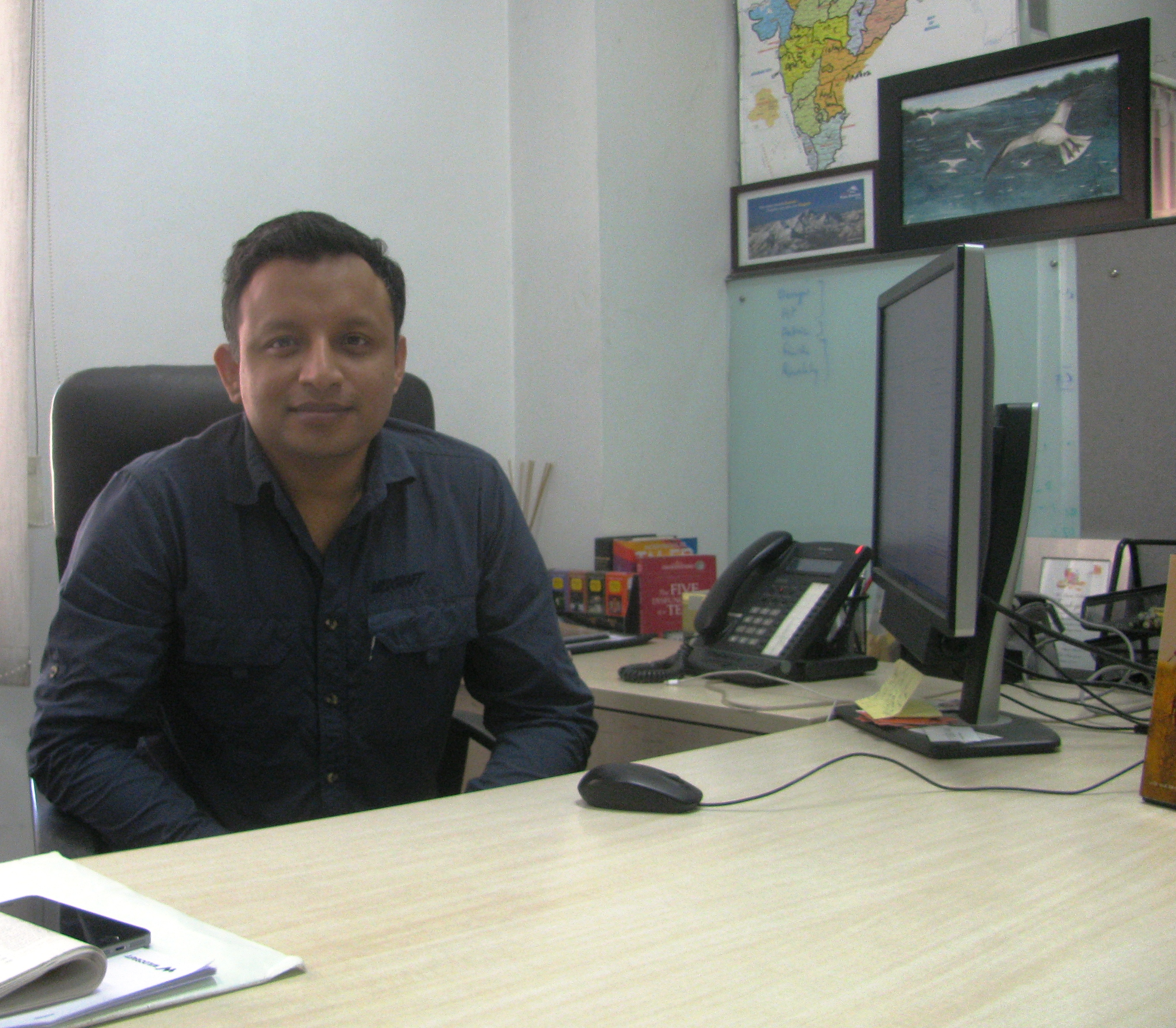
Gaurav Dublish, Director, Wildcraft (Photo: Shyam G Menon)

Gaurav Dublish, Director, Wildcraft (Photo: Shyam G Menon)

Wildcraft articulates its growth thus – between the two potential business verticals of addressing the head-to-toe needs of the outdoor enthusiast and being an activity specialist, it has chosen the former. “ You can be one of the two,’’ Gaurav said, February 2015 in Bengaluru. This is fine strategy (the company already has apparel and footwear usable for the all the Indian seasons) especially when coupled with Wildcraft’s emergent desire to grow competence around the outdoors of the tropics. The bulk of the world’s outdoor gear companies groomed their DNA on experiences straddling the geography between the poles and the Tropic of Cancer / Capricorn. The equatorial belt and activities therein, didn’t attract as much. Addressing it will be engaging. But it will be a challenge, fitting such transition into the existing global narrative and perception of outdoor DNA. As Wildcraft courts business, some shifts are already showing. For example, the company is a large manufacturer of backpacks by volume. It has products devoted for rugged outdoor use, which have been recently improved as well. But the numbers-chase in the market has the centre of gravity in this business firmly in the small backpack category, especially in daypacks used by youngsters and such. You suspect a similar drift in the preference to go with head-to-toe as opposed to being activity specialist.

Wildcraft’s current strategy is fetching it revenues; in fact its revenues have grown sharply. That in turn, probably enhances its faith in the new strategy. But how can it stay convincingly ` outdoor’ despite the realities of the relatively non-outdoorsy Indian market where people buy outdoor stuff to seem outdoorsy than actually be out? Can volume play mislead an outdoor company into preferring the softer product segments? – This will be what any observer from the outdoors will track in Wildcraft’s evolution. Viewed thus, specialization in activity has its value. The reason you buy clothes for running from a shop that sells running gear or clothes and footwear for hiking / climbing from a shop that sells gear for the same, is because the irreplaceable and most wanted are also around. They add to the discerning customer’s conviction when buying related or more peripheral stuff. The outdoor DNA is actually all about zeroing down on the irreplaceable, the pure core. If you move away from that ethic, you sell more but in the eyes of the outdoor enthusiast, you just became the mainstream. It then becomes only a matter of time before the mainstream picks up the buzz from the hard-core and a brand loses its aspiration-value.
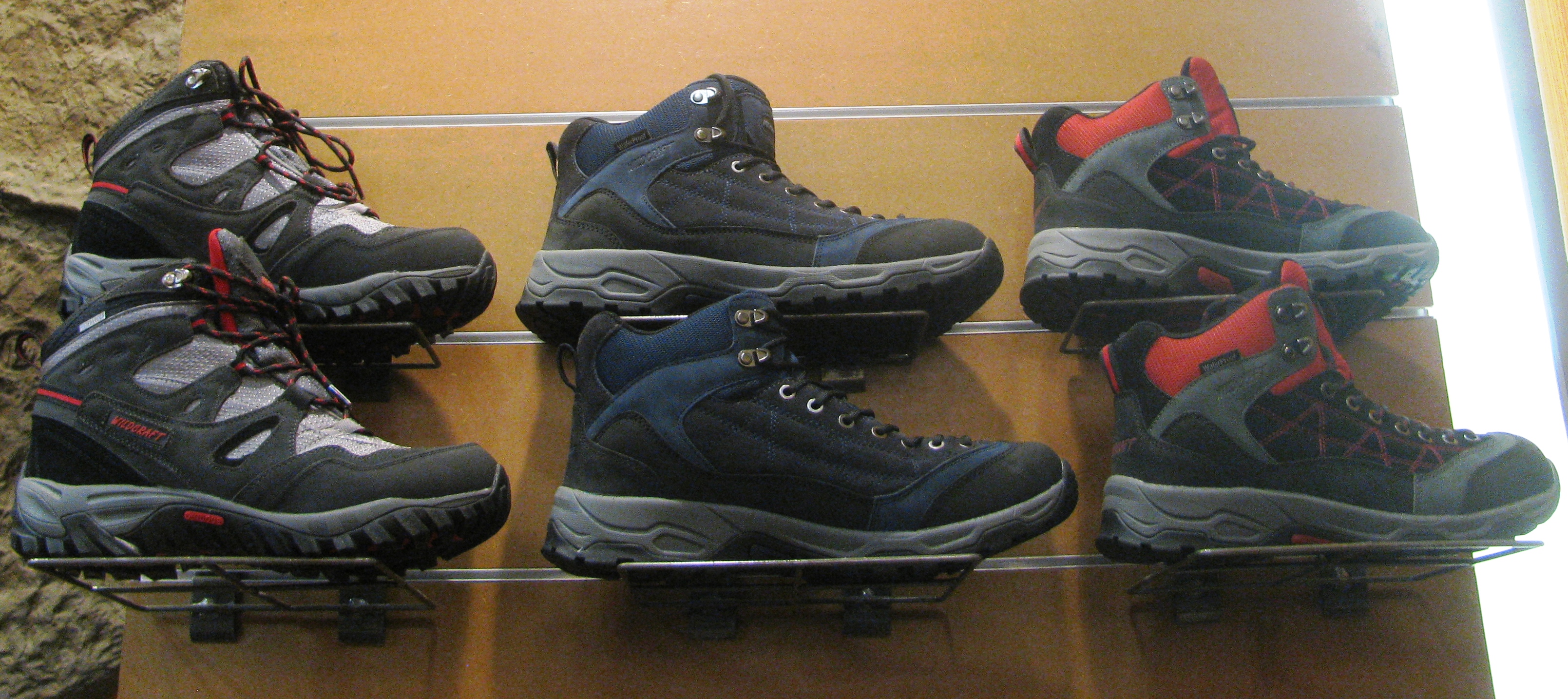
Photo: Shyam G Menon

Wildcraft shoes (Photo: Shyam G Menon)

Some years ago, when the global outdoor products industry went through a spate of realignments, a few well known outdoor gear brands were acquired, while others joined larger coalitions – all of it meant to put together a comprehensive outdoor product-range under one roof. With over 100 branded outlets, Wildcraft has opened up a wide reaching physical retail presence and distribution pipeline. It wishes to be strong as head-to-toe outfitter assisting people to take up outdoor pursuits; it does not wish to be one-activity specialist. Will it use its channels for activity-specific gear that complements its head-to-toe business? In 2011, Wildcraft had not closed options as regards multi-brand retailing at Wildcraft shops, co-branding and joint venture manufacturing. In co-manufacturing there has to be tangible technology gains for Wildcraft. Quizzed further on this topic, particularly the potential for inorganic growth, Gaurav explained in 2015, “ we have not shied away from inorganic growth. We are open to it.’’

The market is not only buying Wildcraft products, it is also watching it. In the local trade with its share of stores begun by trekkers and climbers, Wildcraft’s strategy is often debated for departing from the typically cautious outdoor approach driven more by passion than appetite for business. The old school understands the organic, home-grown business model. Did the team take a real risk by scaling up? On the other hand, if Wildcraft succeeds, that would be a measure of the market. That is when the action would commence for businesses run by its critics as well. “ We welcome competition. The more the competition, the better the market buzz around outdoor products,’’ Gaurav had said in 2011.

(The author, Shyam G Menon, is a freelance journalist based in Mumbai. This article is a composite of two conversations with Dinesh and Gaurav, the first in 2011, the second in February 2015. The financial and business data given herein are from Wildcraft; it is a privately held company. A crore is 10 million; one crore rupees is 10 million rupees. At the time of writing this article in February 2015, a dollar was worth little over 62 rupees. An article based on the 2011 chat appeared in The Hindu Business Line newspaper.)
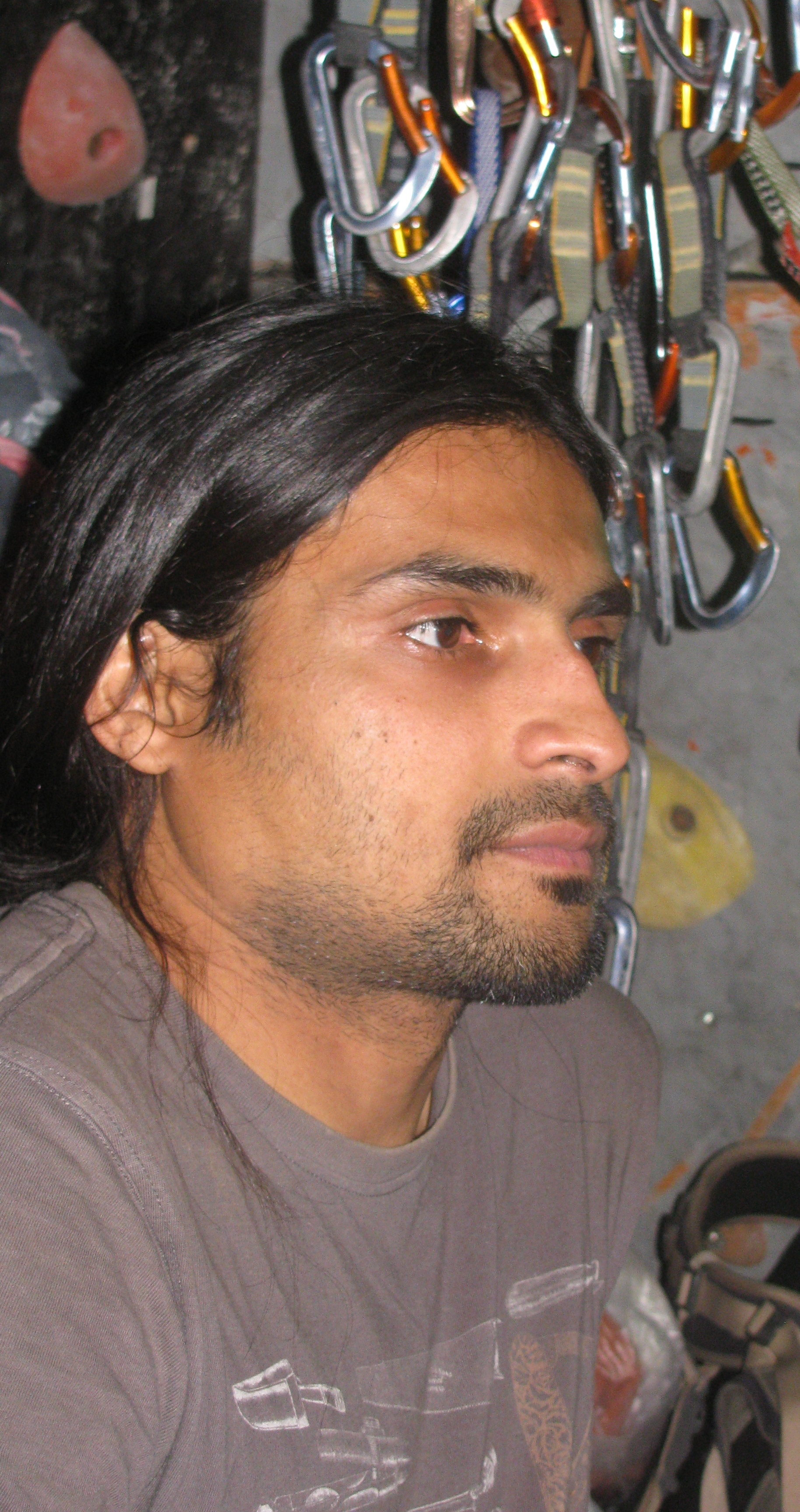
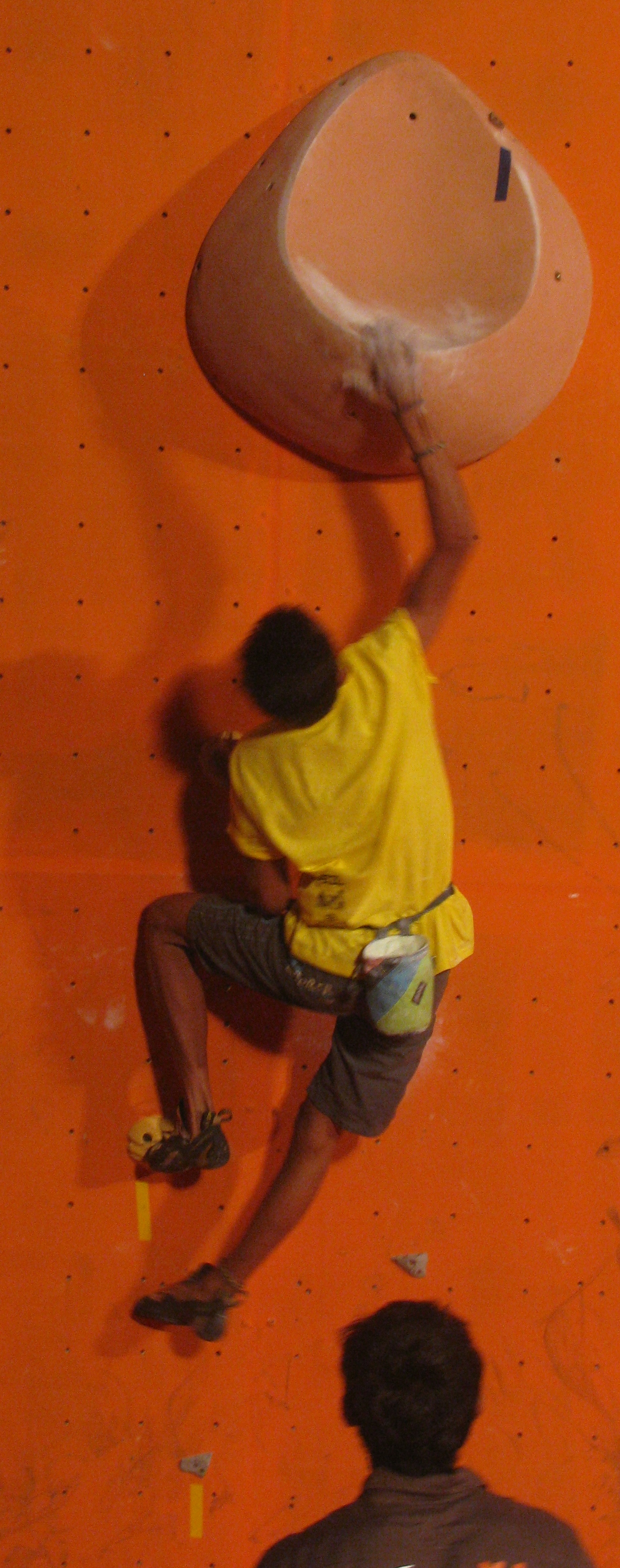
“ WE AS CLIMBERS, HAVE TO MAKE IT MATTER.’’

Vaibhav Mehta (Photo: Shyam G Menon)

Vaibhav Mehta (Photo: Shyam G Menon)

Speaking to Vaibhav Mehta on the proposed World Cup in bouldering, India’s first:

Vaibhav Mehta has been associated with Girivihar’s annual climbing competition at Belapur, Navi Mumbai, since its inception. He is the technical brain, route setter and in many ways, the raison d’être of the competition. It is hoped that next year -2016 – Navi Mumbai will host a World Cup in bouldering. Subject to the receipt of all required clearances from authorities, the event, once official, will be organized by the same team which worked behind the annual competition. Vaibhav – he works and lives in France now – was in Belapur recently. During two days spent discussing the World Cup project and catching up on climbing at the local crags with his friends, Vaibhav spared time to talk to this blog.

Excerpts:

The annual climbing competition organized at Belapur, Navi Mumbai, won’t be happening in 2015. Can you explain why this is so?

The whole idea of not having the competition this year is to move toward our longstanding goal – the World Cup. We have already done leg work in terms of meeting officials, preparing plans and creating initial documentation. Had we conducted the annual competition this year, then our efforts to put up the World Cup would have been compromised. It made sense to step back and think about the goal. The other thing is that even after conducting the competition for eleven years, resources remained a problem. Every year as the competition approached, it was a fire fight. We need to address resource-raising comprehensively. On account of all this a break was warranted.

In the world of climbing, we hear of World Cup and World Championship. How are the two different?

The World Cup in bouldering, which is what we are interested in, happens every year. It falls within a season of three to four months and includes six to seven World Cup events. The World Championship happens once every two years. The format is the same. Some venues strongly associated with the climbing culture, like places in Europe and within that, places from countries like France and Germany, tend to repeat more than other venues. That said, I would think that the International Federation of Sport Climbing (IFSC), is keen to promote the sport and would look at venues in regions where climbing is catching on. I am sure they are aware of India on the rock climbing map thanks to internationally known climbing locales like Hampi and Badami. They are aware of the potential.

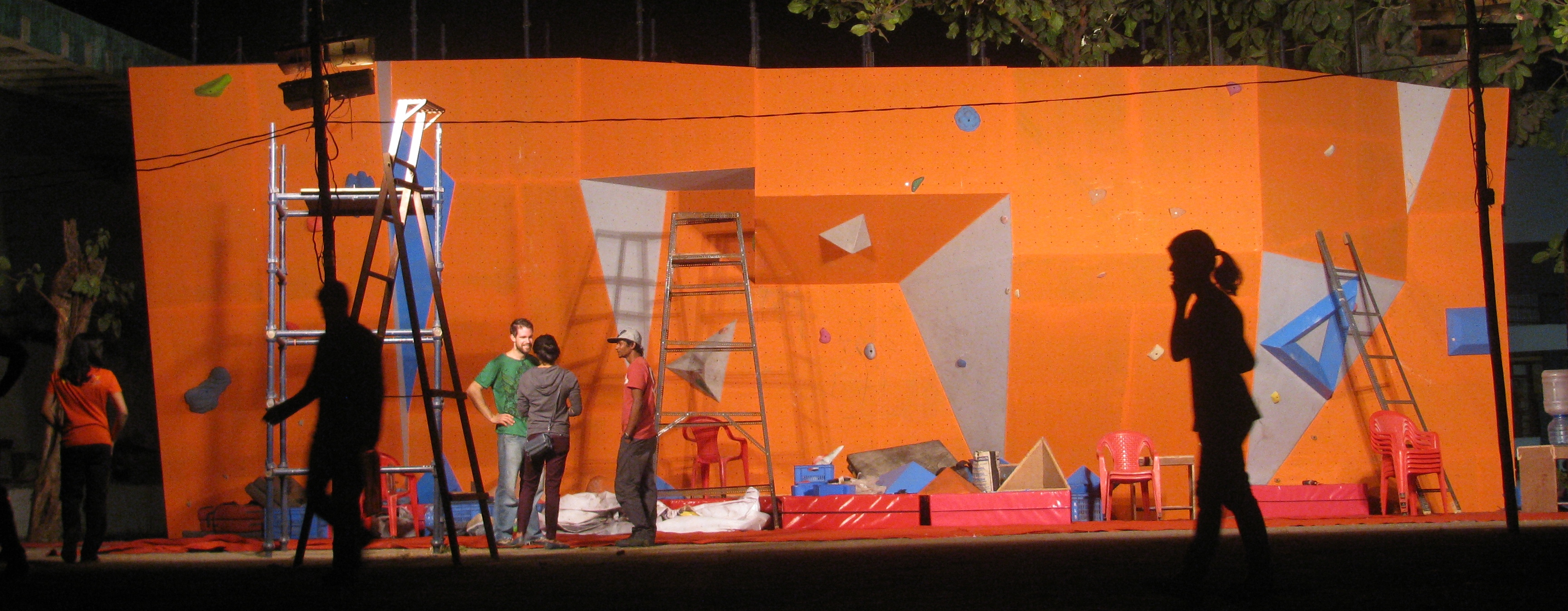
File photo of the 2014 Girivihar competition (Photo: Shyam G Menon)

File photo of the 2014 Girivihar competition (Photo: Shyam G Menon)

At what stage are the efforts to bring a World Cup to Navi Mumbai? What specific disciplines will it cover?

The World Cup will feature bouldering. In terms of how far we have reached – we secured approval from the Indian Mountaineering Foundation (IMF); they have said they are willing to collaborate with Girivihar for the World Cup. The venue will be in Navi Mumbai. All the preliminary papers have been submitted to the IFSC. We are now awaiting their word. Should it be a go-ahead, then the real work towards organizing the event will commence.

One of Girivihar’s internal mailers on preparations for the World Cup spoke of selecting a team of Indian climbers and training them to participate in the event. Can you elaborate on what you have in mind?

When the IFSC awards you a World Cup, the host country typically gets a quota of ten climbers to participate in the event. We will try to find young, promising climbers and train them to compete with the best, at the World Cup. Most likely, the team will be jointly decided by the IMF and Girivihar. There is a reason for my saying so. At eleven editions old and a well documented exercise at that, the Girivihar competition has data on the performance of many climbers who participated, some of them repeatedly. I am not aware of similar data for bouldering, spread across so many years, with any other event in India. This is data that can be used as valuable reference material. And it must be used in conjunction with other relevant factors, like a climber’s ability to handle the stress and competitive spirit you find at elite competitions. We know from experience that we have some good candidates. If this approach is unacceptable, then another method would perhaps be to go by the performance of eligible candidates over the preceding three years, including how much the climber has improved. We could have a selection trial, a simple test where you set up a few boulder problems to gauge how the candidate climbs, the climbing style shown, the person’s attitude and very importantly, how the candidate reads the route and uses the available time. All this is critical from the perspective of a World Cup. What I will emphasise is that this selection should not ideally be only about a climber’s performance. It should also dwell on the climber’s promise and potential to improve for we are complementing team selection with a training process.

File photo of preparations for the 2014 Girivihar competition (Photo: Shyam G Menon)

File photo of preparations for the 2014 Girivihar competition (Photo: Shyam G Menon)

For training, we would love to send the selected team overseas, provided we have the money. I may be able to set the routes for selecting a team but I have no illusions about my abilities – at this stage, I am not good enough to be a coach. I can only guide. For the initial phase of training, we can possibly have an Indian coach. Or, we can have a foreign coach for the whole duration of training as the expertise of grooming climbers to world standards is anyway more overseas than here. The World Cup in Navi Mumbai is planned for May 2016. We hope for an intense training schedule and training camp that peaks for the World Cup. Ideally, the team selection should happen as soon as we get the IFSC clearance for the World Cup. The initial training should continue till mid-2015. After that, the team should focus on training specifically for the World Cup.

An event of this nature needs sponsors. They like to know what their support can translate into for a given sport. Can you explain what the proposed World Cup can mean for competitive climbing in India? Why does this World Cup matter?

Why this World Cup matters? I think we as climbers, have to make it matter. We have to make full use of this opportunity. It is fine to say that we organized a World Cup but it is even more important to clearly communicate the whole package, including its transference as inspiration to youngsters to get involved with climbing. There is definitely the promise of the World Cup having a multiplier effect on the popularity of climbing in India. If you have noticed, there is a climbing culture slowly growing. For example, in whatever modest way it may be, a lot of indoor climbing walls have come up. Imagine what can happen if these climbing enthusiasts also got to see the best in the world, in action. And the best in the world will come if you have a World Cup. As I said, there are around six to seven World Cup events every year. As you participate in each, you accumulate points in accordance with how you finish at each event and by year-end you have climbers with the most number of points. As this final tally matters, usually, the best climbers arrive for every competition. So far you saw them only on video. Now you see them climbing in real life. This should add to the potential multiplier effect of the World Cup on Indian climbing. Not to mention, the ringside view of top athletes that aspiring climbers here will get.

Vaibhav (Photo: Shyam G Menon)

Vaibhav (Photo: Shyam G Menon)

Can you tell us how the typical World Cup feels like?

Most of the countries hosting World Cups so far are well known in climbing. In these countries, a World Cup generates much interest in the local community. They take pride in hosting such a competition; they also wish to see their home team do well. In India, we will have to create that curiosity and interest. The question is – how well will the local community beyond the climbers themselves, respond? For that we are looking at specific events. Certain events during the World Cup and some that will continue after the World Cup to sustain the impetus. We are also looking at associated events that can happen during the World Cup; acts linked to BMX, skate boarding and slack lining.

You have been part of the Belapur competition’s organizing team for over a decade now. How useful will that experience be, particularly when it comes to organizing the World Cup?

Organizing the Belapur competition for eleven years has been a valuable experience. It has been trial and error but we have rectified our mistakes and improved considerably over time. This experience will definitely helps us in organizing the World Cup. Looked at differently – the upcoming event will be called a World Cup but at heart it remains a competition, which is what we organized for the last eleven years. However there will be challenges. The main one will be – scaling up the resources required to match the size and expectations of the World Cup. The overall budget is much bigger and within that details matter more than before. For example, previously we used to host half a dozen foreign climbers during the annual open competition. At a typical World Cup, there will be 20-30 of them and standards to be followed. We can’t compromise on standards.

(The interviewer, Shyam G Menon, is a freelance journalist based in Mumbai)

BEYOND GANESHA / THE OPEN PROJECT

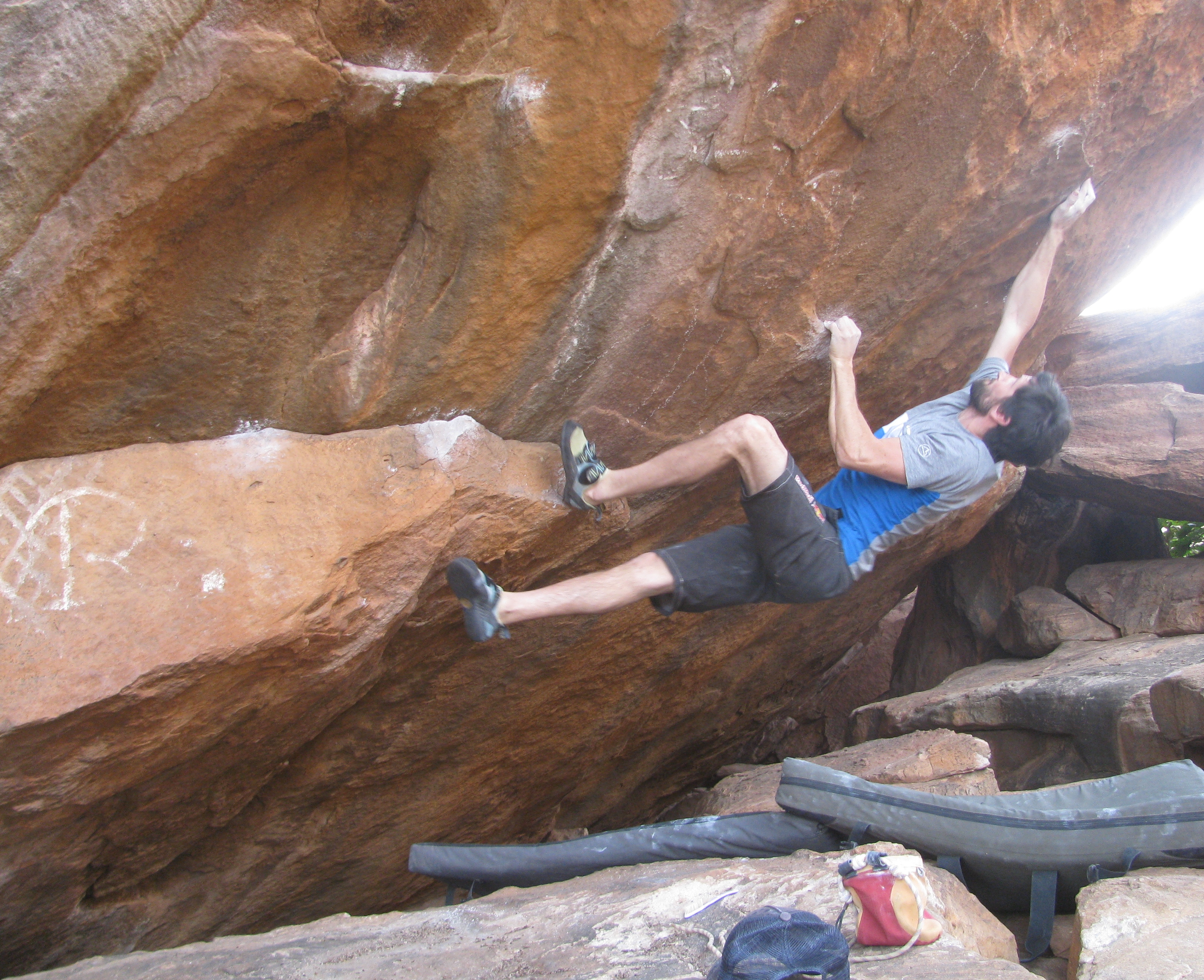
Kilian bouldering in Badami (Photo: Shyam G Menon)

Kilian bouldering in Badami (Photo: Shyam G Menon)

Badami, January 2015.

Things hadn’t worked out as well as he wanted for Kilian Fischhuber.

Kilian is a multiple winner at bouldering World Cups; he has also been European Champion. Besides bouldering, Kilian climbs sport routes.

Last year, as reported earlier on this blog, Kilian had opened two routes on the edge of Badami’s Temple Area crag. Both held potential to exceed Ganesha (8b+) as the toughest sport climbing route around. One route, next to an established line called Samsara, was nearly climbed by Kilian in 2014. The second, an overhanging route on the prow of a nearby rock face, seemed epic with two very hard moves as firm hurdle to overcome.

A year later in January 2015, Kilian was back in Badami with Pune based climber and fellow Red Bull athlete, Tuhin Satarkar. Etched clearly on their agenda were the pending routes. “ This time I came specifically to try one of them. Last year I was pretty close to climbing it. This time I came to finish the unfinished business. But it didn’t happen,’’ Kilian said.

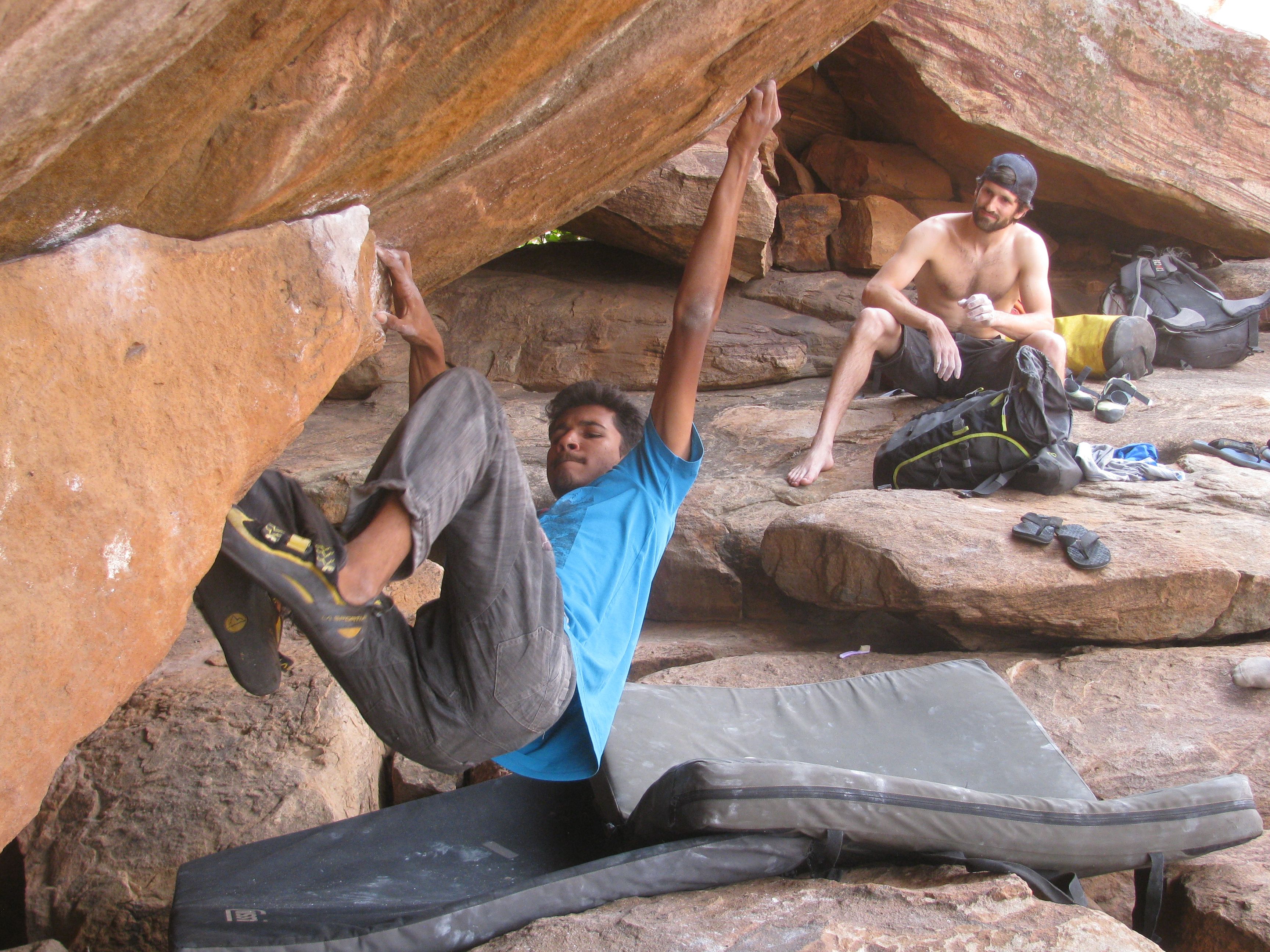
Tuhin climbs as Kilian watches (Photo: Shyam G Menon)

Tuhin climbs as Kilian watches (Photo: Shyam G Menon)

Unfortunately, a chunk of time was lost ridding the said route near Samsara of a beehive. Days were lost thus. Then when the actual climbing started after the initial distraction, the route challenged. “ The moves involved are hard and powerful. The main aspect is friction. Downside is that the route bakes in the sun for many hours daily,’’ the Austrian climber, used to cooler climes, said.

Fifteen degrees, he felt, may have been ideal temperature for him. “ Now I can’t climb it. But if conditions are ideal and somebody climbed it, I think the grade would be 8c+,’’ he said. The route on the prow had been speculated last year as tougher still; the sort an Adam Ondra may be interested in should he choose to.

Comparing the route – the variation of Samsara – to Ganesha, Kilian said, Ganesha featured more powerful moves and was endurance-based. This new route had hard moves but mixed in as main ingredient – friction. It also meant, there was nothing particular that Kilian could train for while preparing to tackle it. He spent eight days trying the route in 2014. “ In all that I have climbed before, the longest was like six days. I am pretty impressed by the stubbornness of this route,’’ he said, an evening in Badami, this January.

“ In a way, I really want to climb it. I came in good shape this time. But I didn’t know if the conditions would be any better. I don’t know if a one degree variation in temperature can make any difference. I don’t know,’’ Kilian said. According to him, really tough climbing routes are typically attempted in more hospitable, cooler temperatures.

Kilian and team with other climbers in Badami. From left: Martin Hanslmayr, Kilian, Tuhin, Kumar Gaurav, Bharat, Madhu and Sharad Chandra (Photo: Shyam G Menon)

Kilian and team with other climbers in Badami. From left: Martin Hanslmayr, Kilian, Tuhin, Kumar Gaurav, Bharat, Madhu and Sharad Chandra (Photo: Shyam G Menon)

“ The route is an open project now. I will be glad to hear if someone successfully completes it. It will be great,’’ he said, accepting the situation.

About the route on the prow, Kilian said, “ the two challenging moves are more than midway up the route and should be 8a+ or 8b boulder moves. The preceding portion tires you a bit but for someone who can do it, it shouldn’t be a problem.’’

As they are unclimbed, both routes have no name yet.

2014 had been Kilian’s first visit to Badami and India.

“ The special thing about Badami is the quality of rock. However as good as the rock is, as challenging are the conditions. You have to cope with heat and humidity. Climbing at your limit in Badami is really challenging. That also makes climbing routes in Badami special. For those who do it, it becomes memorable,’’ Kilian said.

(The author, Shyam G Menon, is a freelance journalist based in Mumbai)

THE KUMAR GAURAV STORY

Kumar Gaurav (Photo: Shyam G Menon)

Kumar Gaurav (Photo: Shyam G Menon)

“ I owe you an apology for not writing this story before. You will have to speak to me all over again,’’ I said sheepishly.

The face before me hadn’t changed a bit.

That wonderful wall-to-wall smile, almost a hearty laugh, slowly took shape.

“ No problem,’’ the young climber replied.

Occasionally I have missed writing a story despite working on it.

Kumar Gaurav’s fell into that category.

The first time we met was at Belapur in Navi Mumbai, where he had come to participate in Girivihar’s annual climbing competition. He took time off to speak to me. Then, in the midst of other engagements, my notes stayed just where they were. A journalist’s notes are like skeleton to the body. They offer structure. Flesh and shape – for that, you have to write when the memory is still fresh. I didn’t. To compound matters, middle aged neurons, I suspect, shed detail quickly.

It was now exactly a year since that last instance.

Late January 2015.

Kumar Gaurav (Gaurav) was in Badami.

So was I.

A second chance materialized.

Kumar Gaurav (Photo: Sharad Chandra)

Kumar Gaurav (Photo: Sharad Chandra)

Gaurav, 20, among India’s promising young climbers, is from Delhi. He is the third child of four, the others being two sisters and a brother. His mother is a housewife. His father works as a driver. “ Class seven in school….that’s when I got into climbing,’’ Gaurav said. Selections were held at school for the upcoming north zone climbing competition. The boy got selected. At the north zone competition however, he lost in the qualifying round itself. “ Back then, I had no idea what climbing is,’’ he said.

Next year, the same story repeated.

The year after that, in 2010, he placed third in the north zone competition making him eligible to compete in the national competition. There, he finished eighth in the junior category. Following this he was selected to participate in the training camp for the 2011 Asian Youth Championship. He didn’t make it to the eventual team as he was not adequately experienced in the sport.

But then something else happened.

Gaurav got genuinely interested in climbing.

From being someone who had found himself in it, he now wanted to be intentionally in it.

Gaurav in action (Photo: Sharad Chandra)

Gaurav in action (Photo: Sharad Chandra)

It was also the beginning of the young climber’s association with Badami. Located in north Karnataka, South India, at a historic junction of ancient kingdoms and cultures, Badami is among India’s hotspots for rock climbing. Home to wonderful, beautifully textured sandstone, it hosts some of India’s toughest sport climbing routes. The 2011 training camp organized by the Indian Mountaineering Foundation (IMF) and in which Gaurav had been a participant, was held here.

When in 2012, Gaurav wasn’t selected for the training camp he hauled himself to Badami and started climbing on his own with a bunch of local climbers belaying him. The latter were beginners; they had been initiated into the sport by foreign climbers visiting Badami. For young Gaurav, staying at the town’s Vinayaka Lodge (his regular halt right up to 2014) and climbing most days, the partnership worked well. In what seems like a cat and mouse game, he trained out of sight from the official training camp and its participants. Gaurav climbed early in the morning with full focus on making it to the selection process. Later in Delhi, he got selected for the Asian Youth Championship team on the first day of the trials itself. At the championship, held in Iran, he finished eleventh.

Gaurav climbing Ganesha in Badami (Photo: Sharad Chandra)

Gaurav climbing in Badami (Photo: Sharad Chandra)

Soon thereafter, he participated in the north zone competition, securing first place in lead climbing in the senior category. At the ensuing nationals, he won bronze. “ That boosted my confidence,’’ Gaurav said. By 2013, he started thinking of climbing as a profession. He also decided to pursue climbing outdoors. His visits to Badami increased. “ I prefer Badami to other places for climbing. I think it is the best place in India for the purpose,’’ Gaurav said. His choice was shaped by two technical factors. First, Badami’s rock is sandstone. It is not only great texture for climbing, at Badami, the sandstone is well formed. Second, Gaurav was clear that he wanted to do long sport routes entailing lead-climbing. About 150km from Badami is Hampi, perhaps internationally the best known rock climbing spot in India and as wound up in history and old architecture as Badami. But within the world of climbing, Hampi is identified with the sport of bouldering, wherein individual rocks / boulders usually not exceeding 20-25 feet in height are climbed with minimal equipment (rock shoes, chalk powder and crash pad) and no rope. Gaurav’s game involved longer routes, more equipment and rope. The address for that was firmly Badami. In one year – 2012 – Gaurav visited Badami three to four times, eventually clearing the 7b grade in terms of how challenging or difficult a climbing route is. These climbs were mostly done in the company of local climbers. Gaurav remembered such names as Ganesha, Raj andShivu.

The hard work paid off.

Gaurav climbing Ganesha in Badami (Photo: Sharad Chandra)

Gaurav climbing Ganesha in Badami (Photo: Sharad Chandra)

At the North Zone competition of 2013, Gaurav finished first in both lead climbing and bouldering. At the nationals, which followed, he was unfortunately laid low by food poisoning. Still he secured sixth place in lead climbing. Between these two events, Gaurav participated in two competitions overseas, a World Cup at Mokpo in South Korea, an open international climbing competition at Haiyang in China and yet another World Cup at Wujiang in China. It was a totally new experience with grades of almost 8a and 8a+ to overcome for qualifying. At Mokpo, he didn’t qualify, at Haiyang he ended last. At Wujiang, Gaurav said, given low participation, all participants sailed straight into the semi final and competition featuring 8b+ route. Gaurav was utterly new to such grades. He finished second last in the semi final.

While all this learning was happening in Korea and China, back in Badami, a new chapter had commenced in the town’s rendezvous with climbing.

For much of the year, Badami is a hot, dusty town set against a backdrop of magnificent sandstone rock walls. In 2008, at one end of this rock formation, a climbing route was opened by Alex Chabot, a champion climber from France. Eventually named Ganesha, this route was climbed for the first time in 2010 by Gerome Povreau, also of France. Ganesha’s grade was decided as 8b+. It became India’s toughest sport climbing route and a prized challenge for climbers, Indian and foreign.

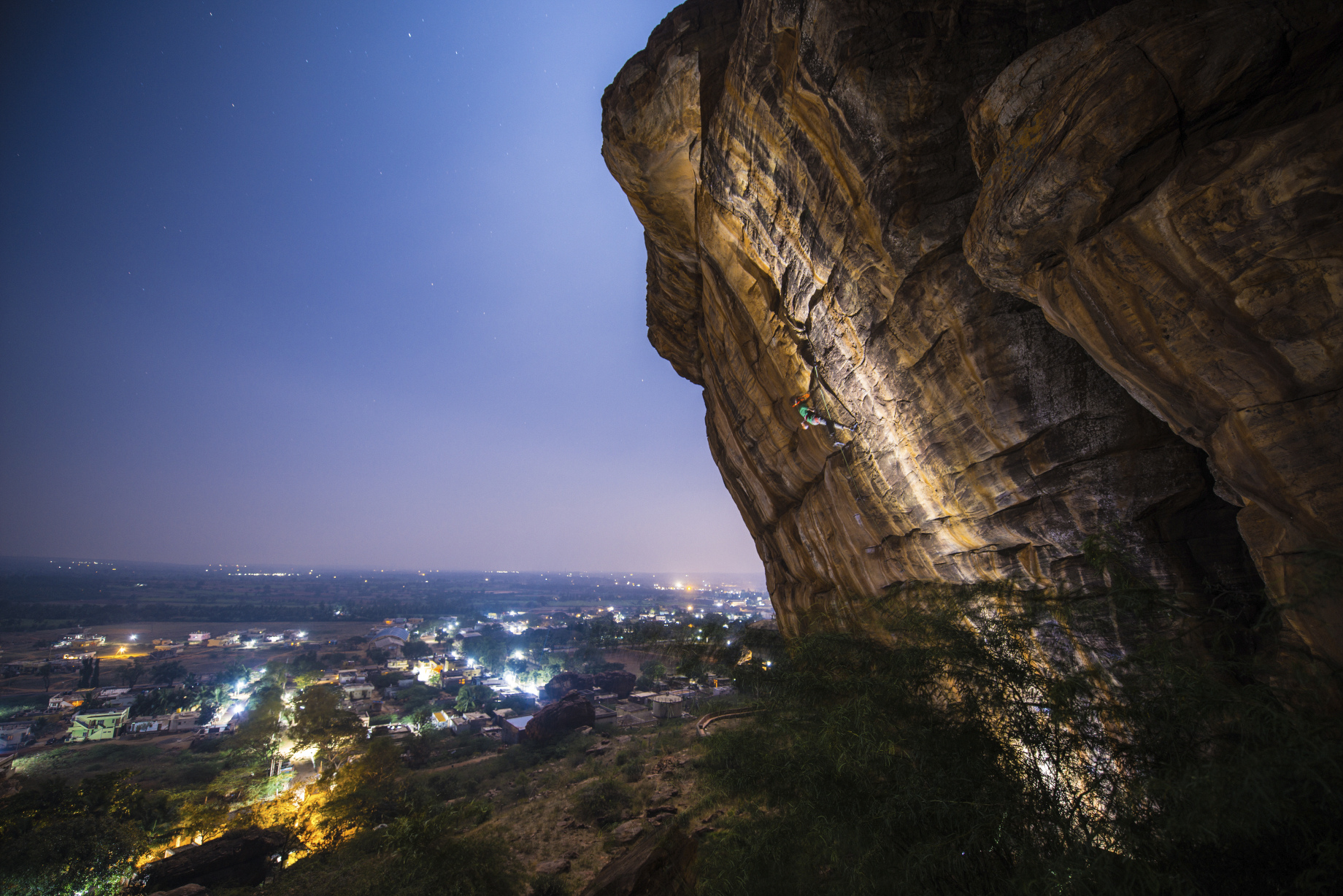
Gaurav on Ganesha; the view with Badami in the backdrop (Photo: Sharad Chandra)

Gaurav on Ganesha; the view with Badami in the backdrop (Photo: Sharad Chandra)

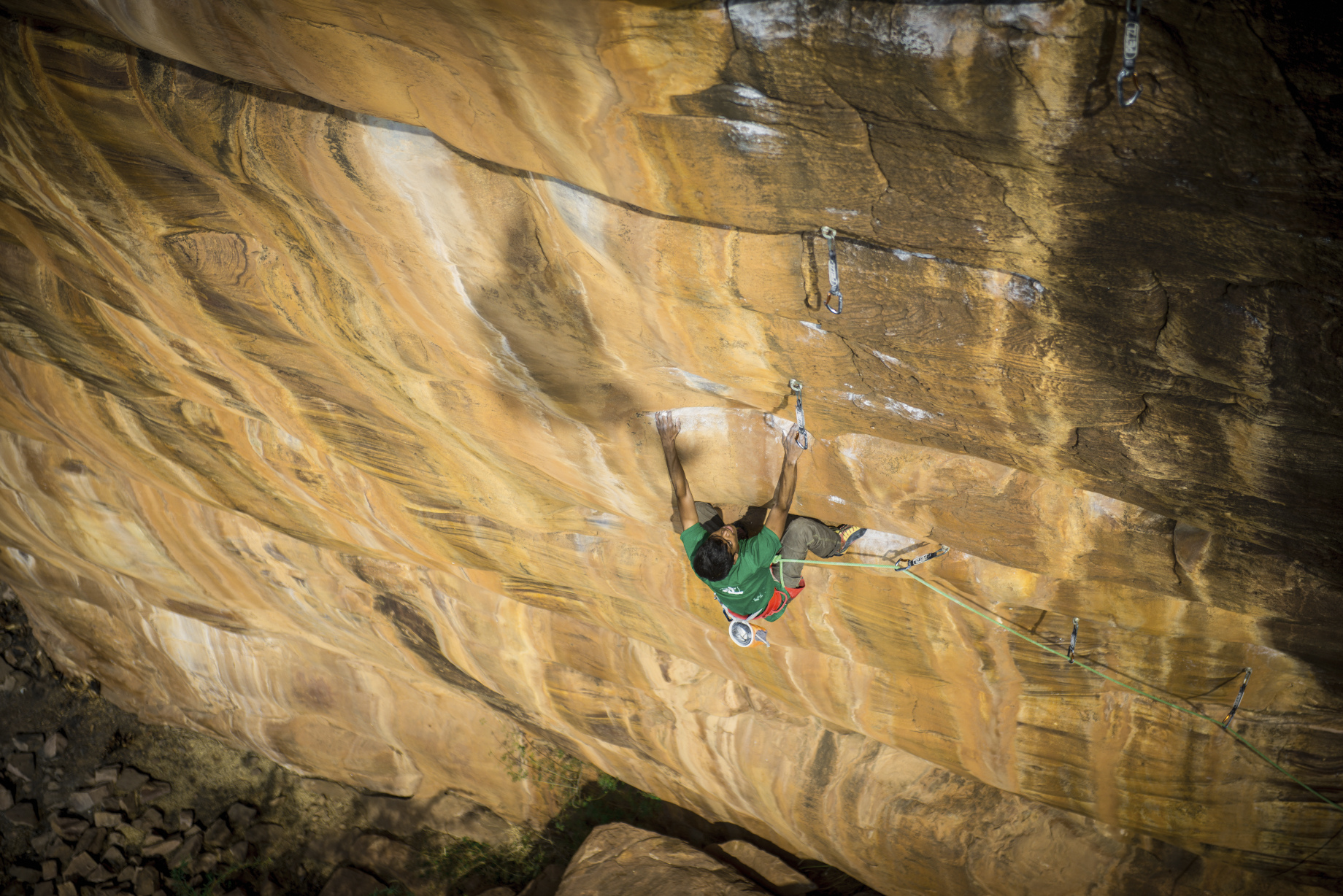
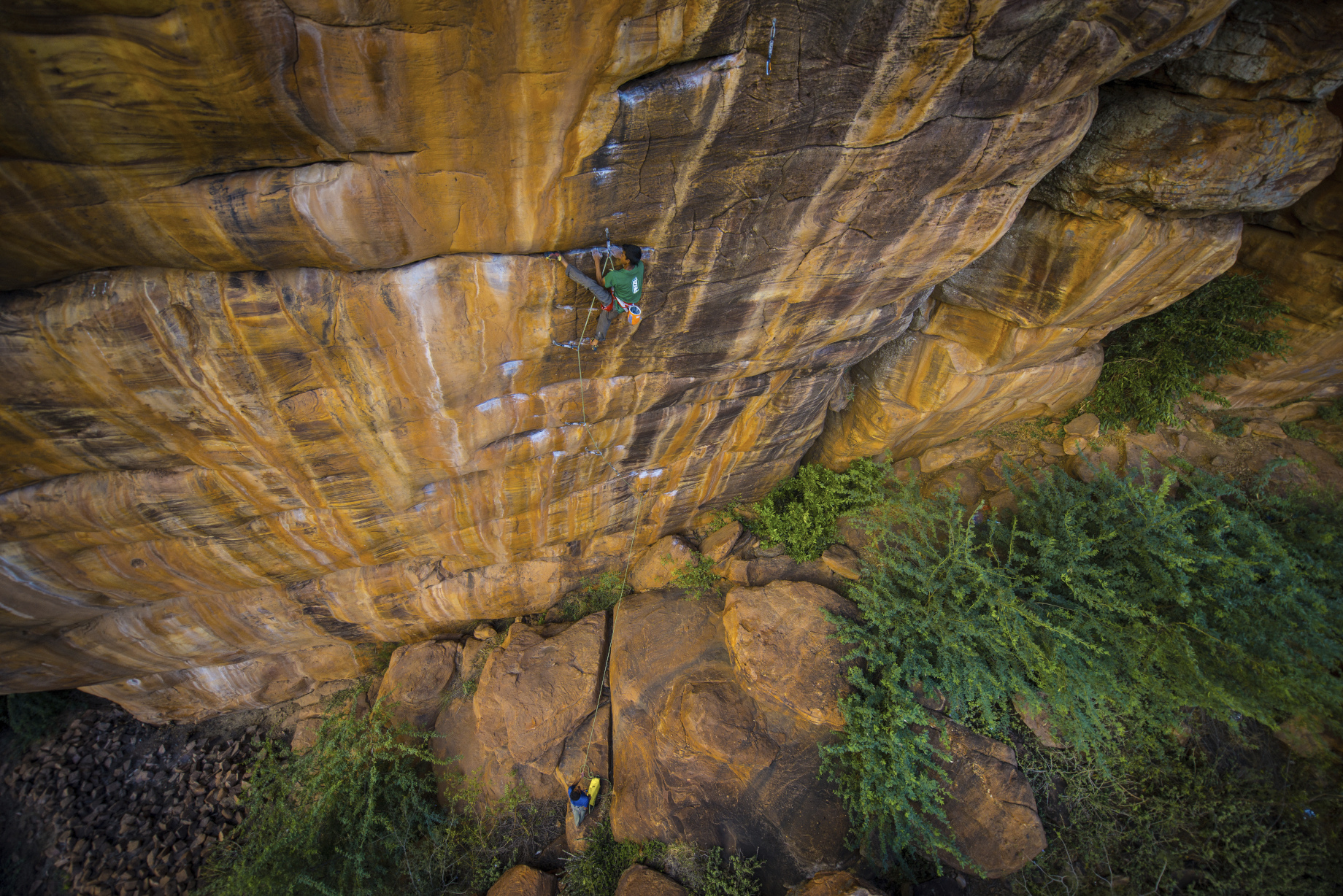
The first Indian to climb Ganesha was Tuhin Satarkar from Pune. He did the climb in December 2013. At the same time in Badami, Gaurav climbed his first 7c+ route (Indo-Japan), following it up with his first 8a (Samsara). His partner on this trip was Madhu C.R, a young climber from Bangalore. They attempted Ganesha but failed. Gaurav couldn’t go past the second move on the demanding route. Roughly a year later, in October 2014, Gaurav climbed Ganesha, the second Indian ascent of the route. Two days later, he polished off an 8a+ (Badami Killer) as well, for good measure. Post Ganesha, Gaurav found regular sponsors. His main supporters, he said, include Adventure 18, Big Boulder and Mad Rock India. He has also been helped by Wildcraft and Petzl. Try this link to see Gaurav in action: https://www.youtube.com/watch?v=l26MCcY28xk

Like climbing, one’s fortunes in life don’t move from one good hold to another. Crimps, slippery slopes and slips lurk in between. Having finished second in the north zone climbing competition of September 2014, Gaurav appeared for the nationals in December. He was disqualified on a technical point. According to Gaurav, the route had clip-in points for the climber’s rope at rather short intervals and he missed one clip-in. By the time he realized the error and tried to correct, his ankle was already above the missed point. That apparently, was sufficient to disqualify him. It seems to have left some bitterness and increased his resolve to focus on climbing outdoors on natural rock. “ Outdoors allows you to have your style. The feeling of freedom is more and there is none to judge,’’ he said. After the nationals, held in Bangalore, Gaurav headed straight to Badami. There he stayed climbing, through New Year and well into January 2015, which was when I met him for the second time.

“ So your New Year was in Badami?’’ I asked.

“ Climbing is important. New Year comes every year anyways,’’ he said laughing.

Climb outdoors on natural rock – to that decision, Gaurav added a wish.

He would like to try a 9a route somewhere in the world.

(The author, Shyam G. Menon, is a freelance journalist based in Mumbai. He would like to thank Sharad Chandra for permitting the use of some of his photographs.)

THE OTHER GANESHA

Ganesha Waddar (Photo: courtesy Ganesha)

Ganesha Waddar (Photo: courtesy Ganesha)

In India, the climbing route Ganesha (8b+) in Badami, is a pilgrimage for addicts of sport climbing.

As of January 2015, its reign as the hardest sport climbing route around was continuing albeit insecurely, for two other routes had emerged and their complete ascent was all that stood between them and the crown.

En route to Ganesha (aka Ganesh), before the path winds up to the crags of the Temple Area, in a house, the last one on the left and opposite the Mallikarjun School lives the other Ganesha.

The first time I met Ganesha Waddar showcased the strange coincidence of two similar names in the neighbourhood.

It was early 2014 and I was in Badami to write about the climbing around Ganesha 8b+.

As I approached the Temple Area, a youngster said hello.

“ Are you a climber?’’ he asked.

I laughed and gave him the accurate answer: I was once climber, now a shadow of it.

He introduced himself as a climbing guide of sorts and asked where I was headed.

“ I am going to Ganesha,’’ I said.

He smiled and pointed up the hill, to the side, “ right there.’’

He seemed a good sort to talk to.

“ What’s your name?’’ I asked.

“ Ganesha,’’ he replied.

That chance encounter stuck in my mind.

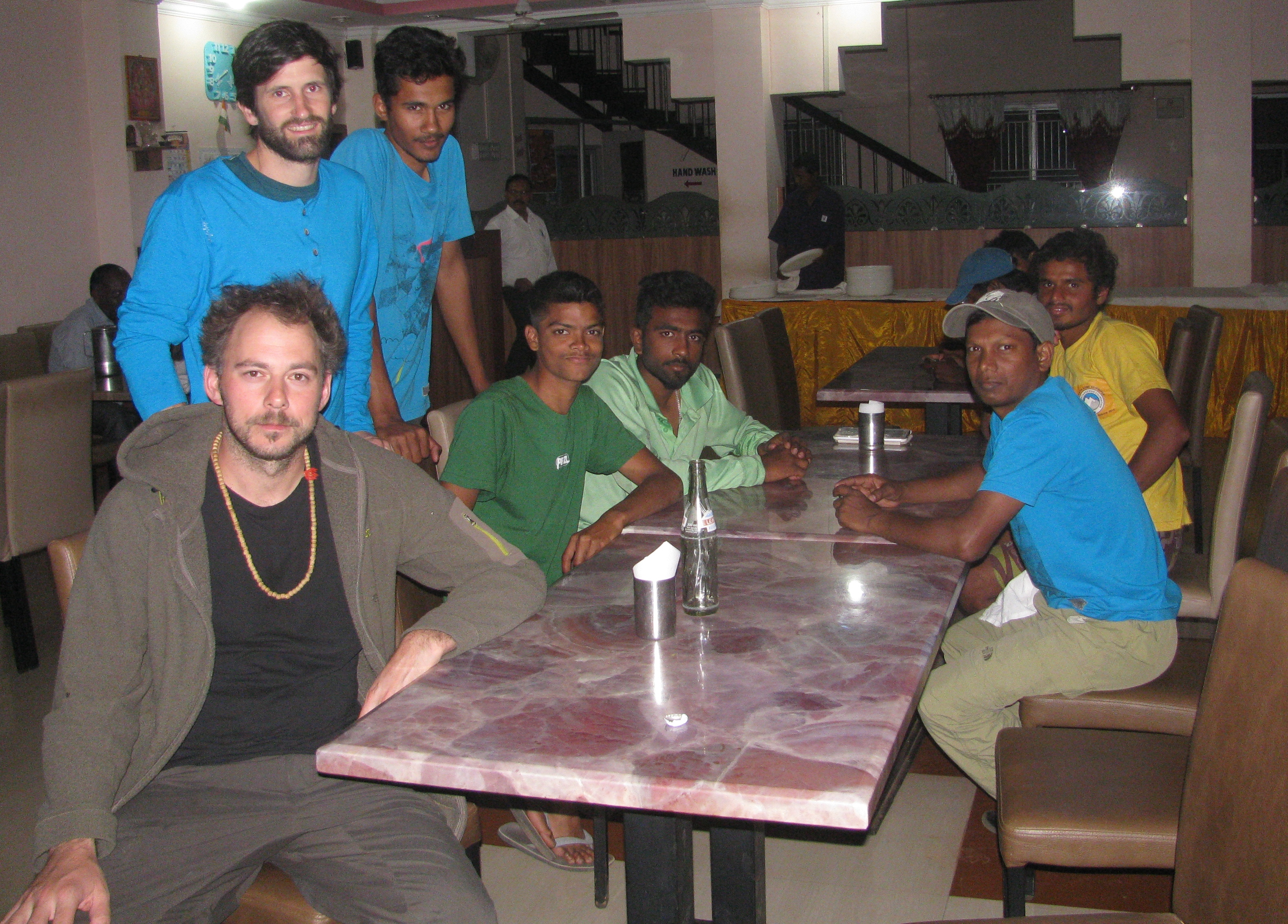
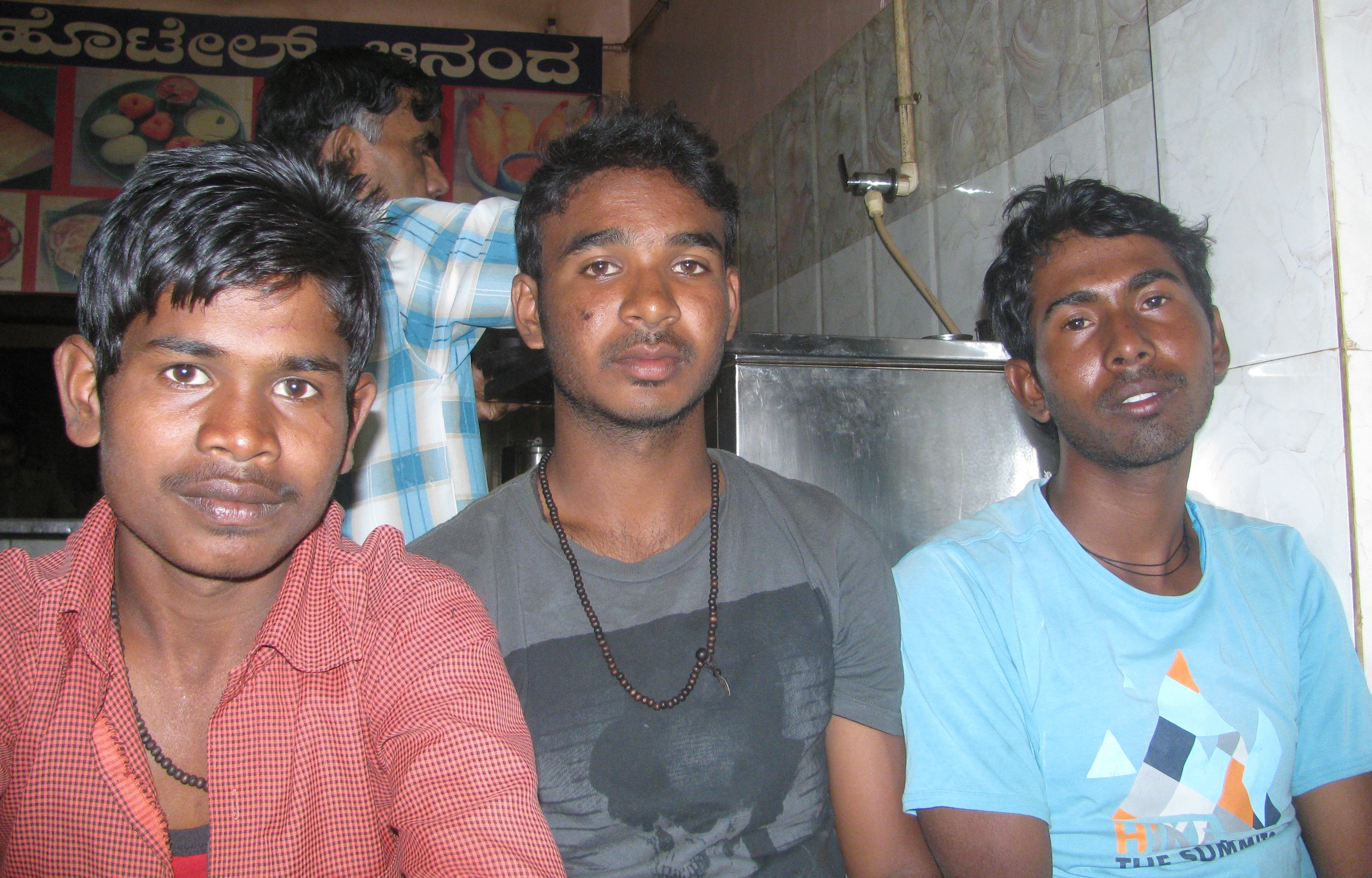
Manju, Shivu and Ganesha (Photo: Shyam G Menon)

Manju, Shivu and Ganesha (Photo: Shyam G Menon)

It was now January 2015; time to hear the story of the other Ganesha.

We were in a small, busy restaurant in Badami.

It was noisy outside; noisier inside. Not a great place for coffee, except, the coffee was really good.

Ganesha and Shivu Waddar, both 19, sipped the piping hot brew.

Ganesha is the youngest of four brothers. His father, who Ganesha said used to be a small time contractor doing civil work, died a year and half ago. The youngster, having completed studies till the tenth standard was technically into first PUC (pre-university course). However he had been away from studies for the past two years.

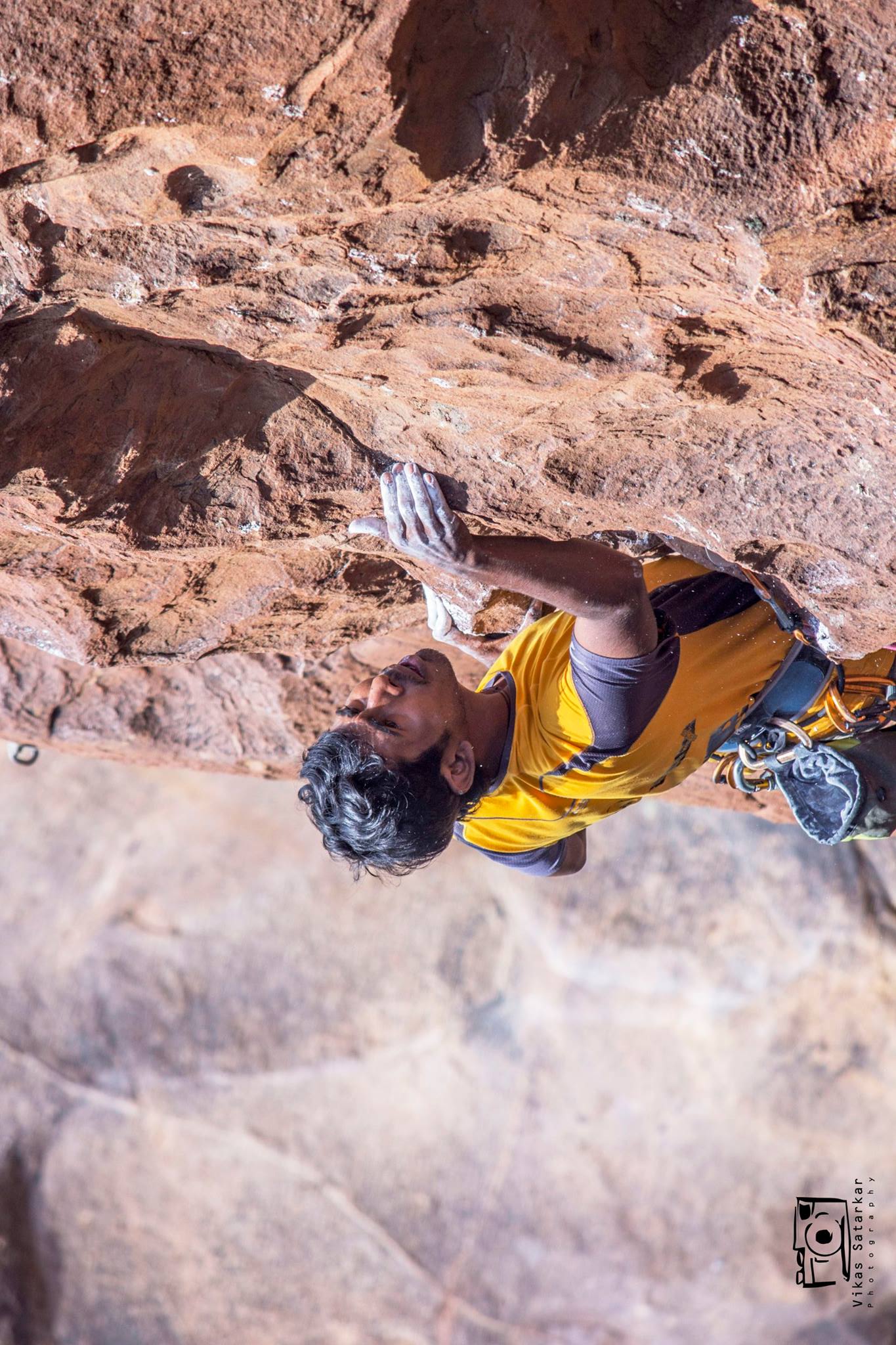
Ganesha in action (Photo: courtesy Ganesha)

Ganesha in action (Photo: courtesy Ganesha)

Situated as his house was on the local stairway to climbing’s heaven, Ganesha grew up seeing climbers. He used to follow them and watch what they did. “ Back then, my English was very bad. I couldn’t communicate. Eventually I managed to tell them of my desire to climb,’’ he said. The first climber who indulged this wish and got him started on climbing was an American. This was over three years ago. As I learnt late in the day, for better climbers knew it earlier than me, Badami has its crop of young, home grown talent. During a conversation with Kumar Gaurav, one of India’s best upcoming climbers, he had mentioned of Ganesha and Shivu, among others, as those he had climbed with during his training trips to Badami. They belayed Gaurav while he was visiting Badami and training alone.

It was evening and the restaurant was crowded. Ganesha had been trifle fidgety as though waiting for somebody. He now relaxed. A small, light youngster approached and sat down, the third person on the restaurant bench before me. Meet Manju Waddar.

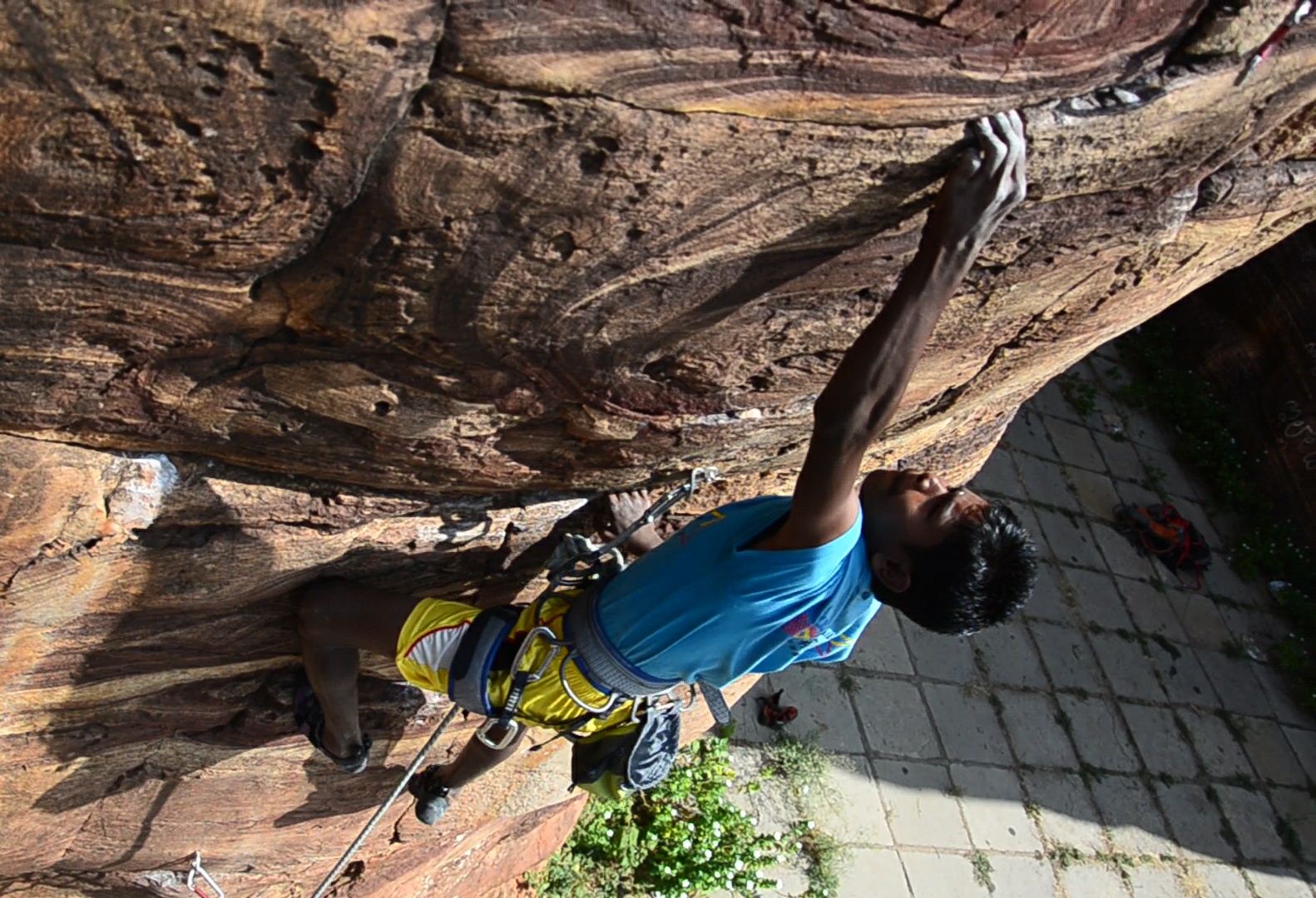
Manju climbing (Photo: courtesy Ganesha)

Manju climbing (Photo: courtesy Ganesha)

By the time I reached Badami in 2015, Jyothi Raj’s film – Jyothi Raj alias Kothi Raj – had come and gone. Some of the climbers in town had seen it too. Based in Chitradurga and a regular sight climbing the fort walls there, Jyothi Raj’s story is well known in Indian climbing circles. According to Ganesha, it was Joythi Raj who advised him to participate in the south zone climbing competition, a move that at the very least would get the youngster out of Badami and into a bigger world. He competed in the 2012 south zone competition and finished a creditable fourth, sadly just outside the selection level for the national competition. The experience was slightly different for Manju.

He had moved to a house some distance from Badami. Manju, 16, used to be Ganesha’s neighbour; that’s how he got into climbing. His father too is engaged in civil construction work. Manju studied till ninth standard; his education has been erratic owing to financial strain. To make ends meet, he works in the construction line. Apparently, Manju was also nudged into participating in the south zone competition by Jyothi Raj. Manju finished third at the south zone competition and ninth at the nationals. He has a lingering fancy for competition climbing while Ganesha prefers a non competitive format.

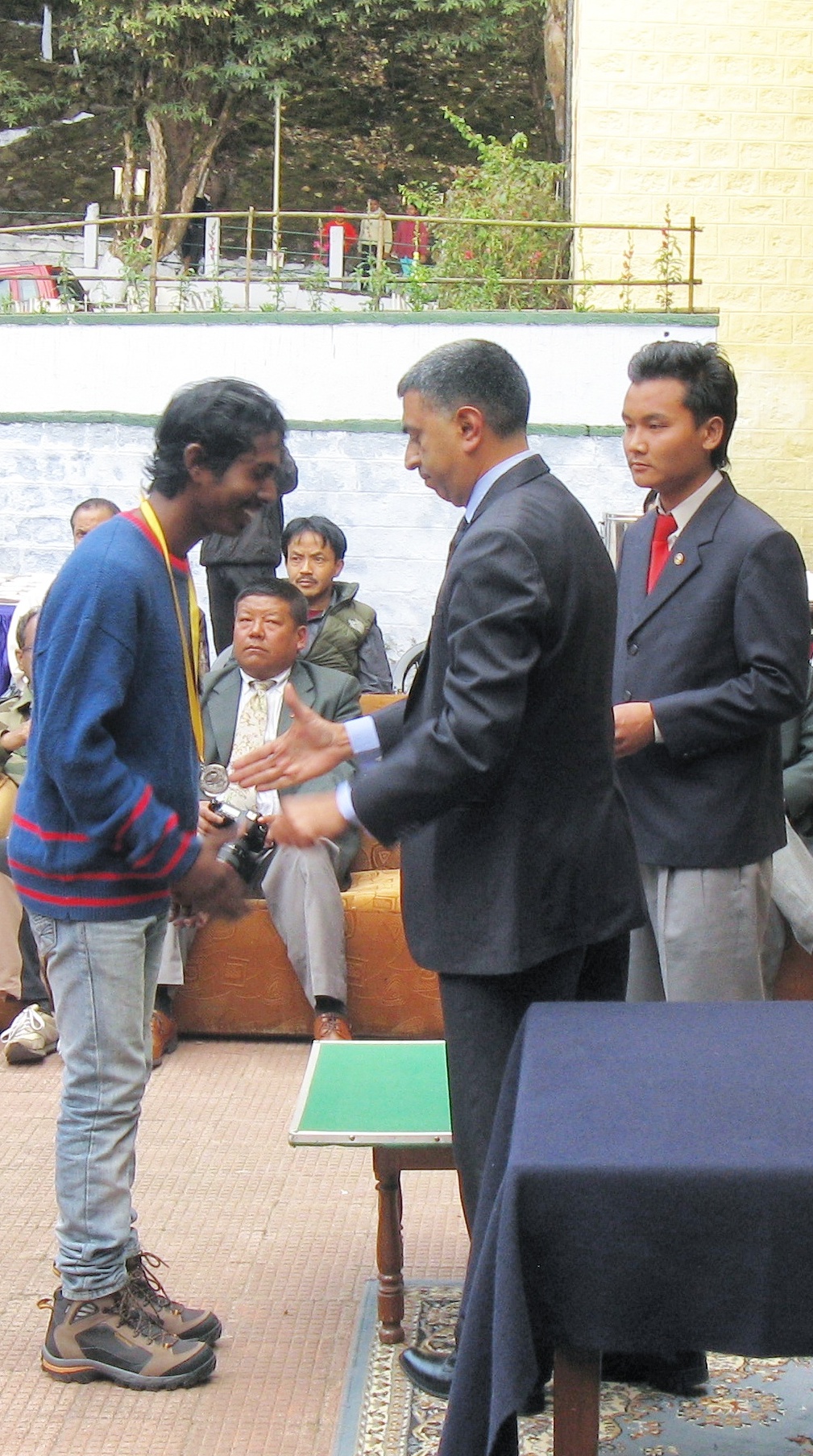
Ganesha, during his course at HMI (Photo: courtesy Ganesha)

Ganesha, during his course at HMI (Photo: courtesy Ganesha)

In 2014 Ganesha did his Basic Mountaineering Course from the Himalayan Mountaineering Institute (HMI), Darjeeling. Poonacha Madappa, a well wisher then based in Bangalore, filled in his application form and provided funds. Foreign climbers provided trekking shoes and backpack. He finished his course with an `A’ grade. He would like to do the Advanced Mountaineering Course. He and Manju now feature on a website (http://climbingbadami.in/) offering help to visitors wishing to climb in Badami. It was set up two months ago (which would mean the closing part of 2014) by a Swedish couple who are into climbing. In Badami, Ganesha had helped them. Indeed days after I first met him in 2014, I saw him climbing with a visiting group of young climbers from India and overseas, leading a route and then setting up a top rope for them. The hardest route Ganesha has led was a 7a. He felt that Manju, who is a strong climber, should be around 7b. They often work together as a team. Shivu, 19, also helps Ganesha.

Over time, foreign climbers passing through have given Ganesha a small cachet of used equipment – some ropes, quick draws, helmets, harnesses. He would like to add to it some new equipment. Money remains an issue, although Ganesha periodically works, including work away from Badami.

Ganesha, early 2014 (Photo: Shyam G Menon)

Ganesha, early 2014 (Photo: Shyam G Menon)

Shivu would like to continue his studies.

Manju wouldn’t mind more competition climbing and hopefully, a job in climbing or one linked to it.

At my question on what he wished to do, Ganesha thought a while.

“ Two years back I didn’t have money. Now it is a little better. I wish to study and also improve my climbing,’’ he said.

That’s the story of the other Ganesha.

(The author, Shyam G Menon, is a freelance journalist based in Mumbai)

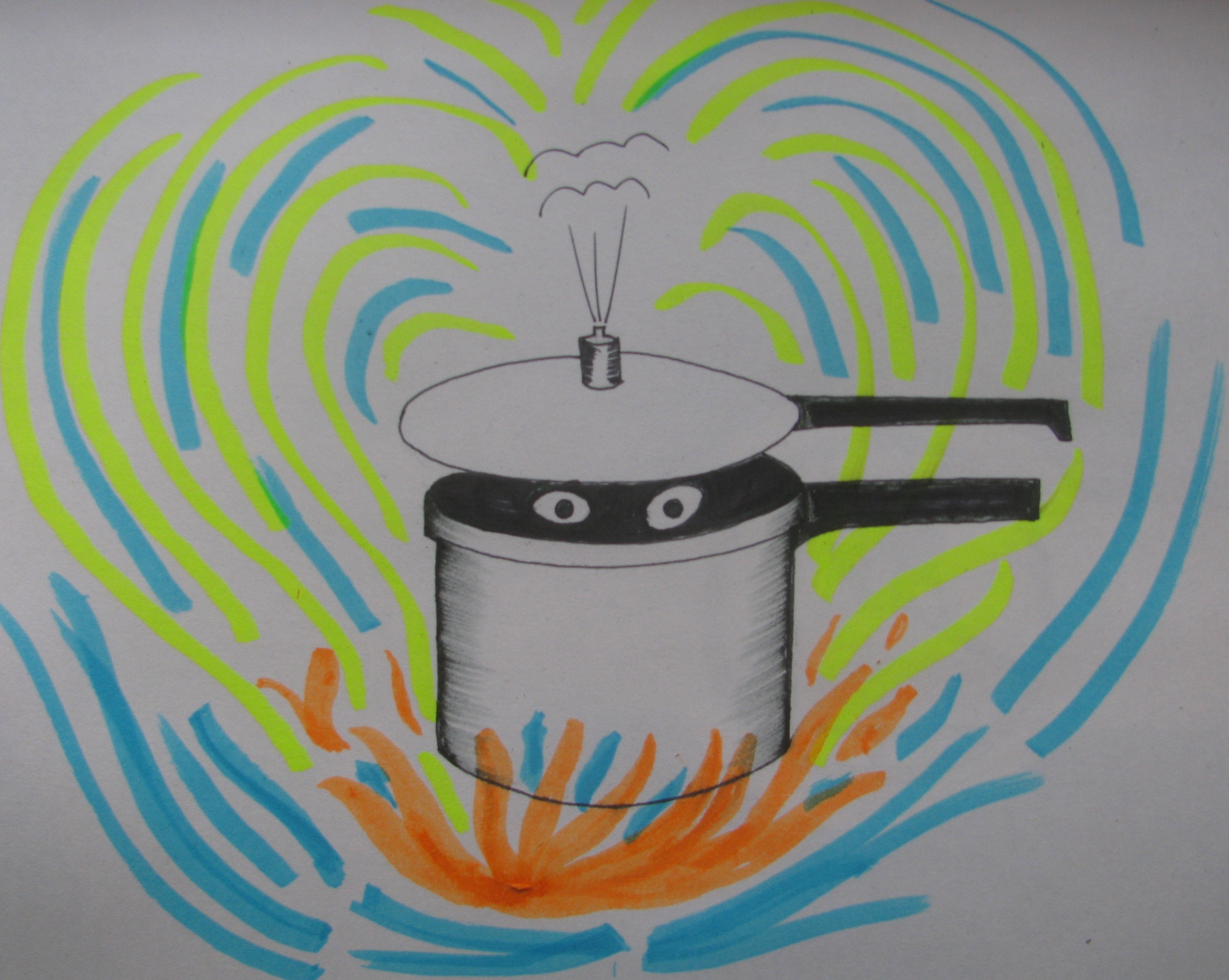
THOUGHTS FROM A PRESSURE COOKER

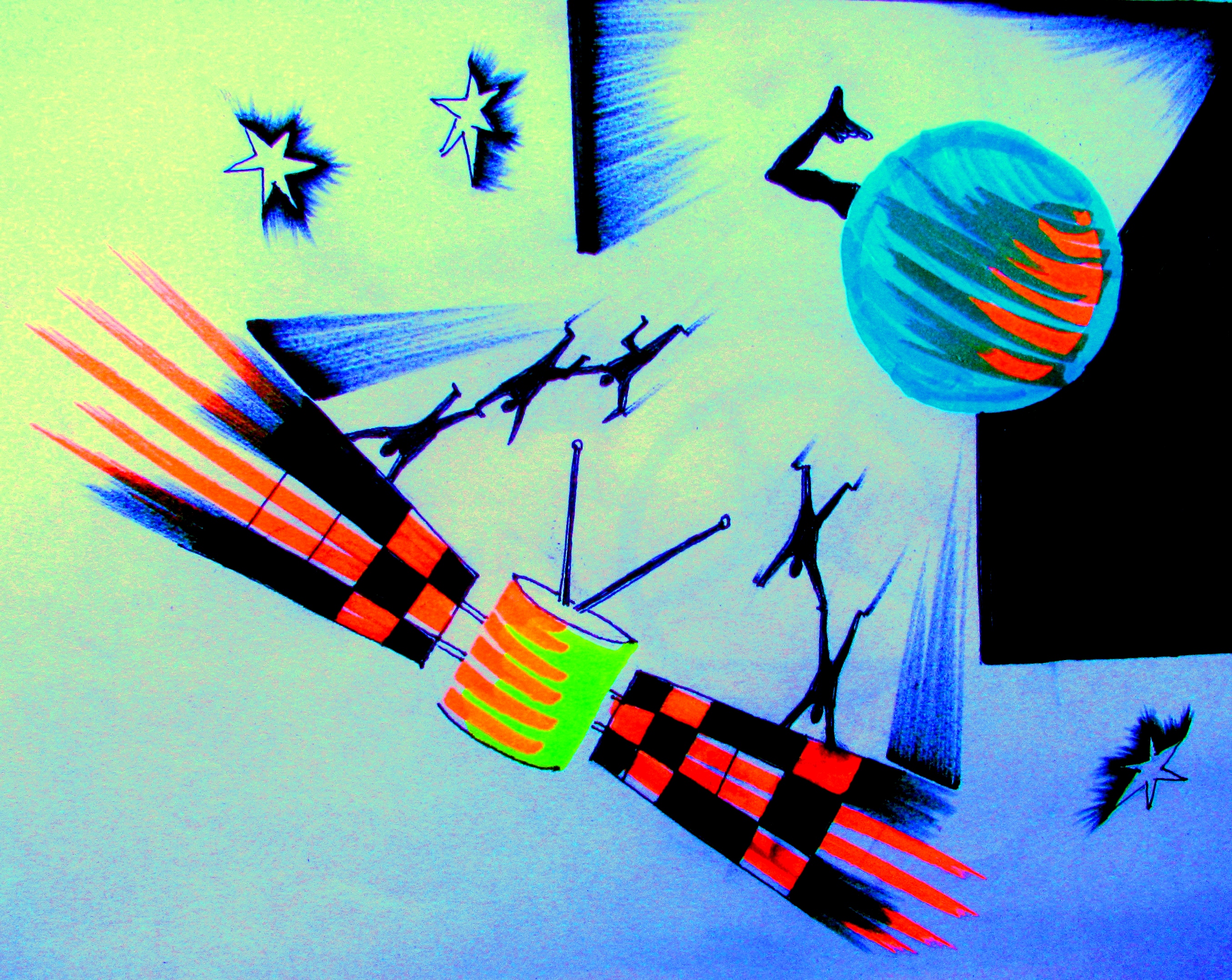
Illustration: Shyam G Menon

Illustration: Shyam G Menon

Among the rewards for being out in the mountains, is the night sky, occasionally clear enough to reveal a zillion stars.

Beyond one or two, I can’t identify the constellations. I like more, the immensity of Earth’s ceiling.

Sometimes I feel, the best news these days relate to that vast expanse above us – space.

Space attracts in a way different from before.

There is first the immediate reason – Indian endeavours in space have been generally rewarding in recent times. At a global level, the Rosetta mission’s landing on a comet was reported as the premier scientific achievement of 2014. Then there is the ` other’ reason, less spoken of but major hook for admiring space – space contrasts terrestrial life. Space exceeds measurement while the planet is real estate ruining imagination. Space engages body and soul. If you have no appetite for the trends shaping life on Earth, the stars are fine refuge.

It took a while for space to regain the limelight; and differently so. In the decades following the July 1969 moon-landing, the accomplishment of the Apollo 11 mission was never matched. Scientists and engineers may disagree. They may cite other achievements of equal or greater importance. But like the first ascent of Everest despite the many that followed, our fascination rests with Neil Armstrong & Co (as indeed Yuri Gagarin in 1961). I can recall only two other perspectives from exploration, triggering comparable imagination – the picture of Earth as seen from far (subsequently called Earthrise) and the many fantastic images science obtained for us by gazing into deep space. Home from far and ` the far’ from home. It put Earth and humanity in context. Much of what happened in space exploration since the first human footprint on the moon can be termed as consolidation. Far seeing telescopes, reusable vehicles and space stations were the dominant themes. As we consolidated our efforts in space, as we tested our capabilities in orbit around Earth for journeys longer than Apollo 11, the planet below steadily drifted into a morass, a sort of manmade social gravity and a terrible one at that. The closest I can describe its effect on the imagination is compare it to sticky glue; its main ingredient – insecurity.

Photo: Shyam G Menon

Photo: Shyam G Menon

In a mere 100 years or less from the first decade of the 20th century, human population increased seven fold. That is old news as is India’s eminence as the deep end of population. The danger is – it stayed news we refused to acknowledge adequately, triggering the bizarre tragedy of continued self inflicted damage. Consequently, in a case of bloated human predicament overshadowing the universe, nature remains multidimensional but our sense of self worth and happiness has shrunk to few dimensions, courtesy the pressure to survive. To compound matters, even as we notice the danger in our numbers, we still enshrine fertility, family, property ownership, success and such as proof of life well lived. It vitiates the rat race born from numbers. Add to this competition, violence, terrorist attacks, regressive religions, conservative communities and rampant consumerism taking its toll as pollution and climate change. It is a crisis of the imagination. Neither do we concede that our habits and social structures were born in less pressured times and hence likely unsuited now, nor do we wish to recalibrate our ways to changed environment. Isn’t zooming from one billion people to seven billion plus in a hundred years with all the corresponding social noise alongside, sufficient change in our environment to deem it fundamentally altered? And if it is fundamentally altered why are we still navigating it with old traditions? The problem in our approach is that our continued indifference to population and what population does, merely adds to the planet’s and this country’s collective insecurity. Our talent for seeing the obvious, for reasoning – are all increasingly countered by the insecurity and unreasonableness spawned by our numbers. What next?

That’s why it is important to tell people that more of us mean trouble for all in terms of a sense of life. Not hearing a word uttered so by anyone in a leadership role, I have given up hoping for a renaissance of the imagination. My world is awash in concerns of survival and money. Looked at as a product of human numbers, in 1969, we were around halfway to this situation. Even 1977, the year Voyager-1 left the planet, was some distance from where we find ourselves in. In direct proportion to how beleaguered terrestrial life seems, space appears the stuff of a freedom denied on Earth (I speak metaphorically). If you are a seeker, then you dream of freeing one’s imagination from humanity’s collective insecurity. Get rid of this manmade gravity, like a rocket breaking free from the Earth’s pull.

Slowly but steadily, there has been news of the post-Apollo 11 consolidation in space, giving way to hints of similar journeys and perhaps, longer ones. There is a pattern emerging. The established big players are pushing farther; new entrants are following where the pioneers went and the easier tasks are fetching interest from commercial players. At the still lower terrestrial level of popularizing science and science fiction, the media gave radical edge to its legacy baked by ` 2001 – A Space Odyssey,’ `Cosmos,’ `Star Trek’ and `Star Wars.’ Alfonso Cuaron’s 2013 film `Gravity’ was gutsy enough to depict space as it is. At $ 716 million earned (as of late January 2015, source: Wikipedia), Gravity is some distance still from the list of the world’s top 50 box office hits led by `Avatar,’ itself a story from another planet. The Star Wars franchise has three films in the list, including the oldest from 1977, incidentally the year Voyager-1 was launched.

Illustration: Shyam G Menon

Illustration: Shyam G Menon

In 1990, Voyager-1 took Earthrise leagues ahead by giving us the ` pale blue dot,’ an image of Earth from six billion kilometres away. Our farthest probe, Voyager-1 is now in interstellar space. That is a long way off. Wikipedia’s page for the probe fascinates with its estimation of where it may be 300 years from now. Sample this sentence: “ Voyager-1 will reach the Oort Cloud in about 300 years and take about 30,000 years to pass through it.’’ Thirty thousand years is older than human civilization; our earliest cave paintings are 35,000 years old. Imagining Voyager is a nice way to escape the troubles and insularity of terrestrial existence.

Perhaps the resurgent space exploration we are witnessing now (even the popularity of India’s Mars mission) is apt, for never before have we felt as pressing a need to question the human situation, maybe even escape it, as we do now. Ironically it is also true, decades spent worshiping the stomach probably makes the pursuit of the beyond possible. As the frontier of exploration, space technology stands on the shoulders of more mundane developments within the human rat race, to reach that far. Much like the heart; although located lower down, it is what supplies blood to the brain. Either way, we seem closer to appreciating the vastness above us for what it is.

1969 to now has been long enough time in the terrestrial pressure cooker.

Reading about what lay beyond the cooker’s lid or glimpsing it, is relief these days.

Latch on in your imagination, to a space craft and be borne out.

Seeing ourselves from far and the far from where we are, help restore humility and context.

(The author, Shyam G Menon, is a freelance journalist based in Mumbai. An abridged version of this article appeared in the Economic & Political Weekly)

ESSENTIAL READING FOR MOUNTAIN GUIDES

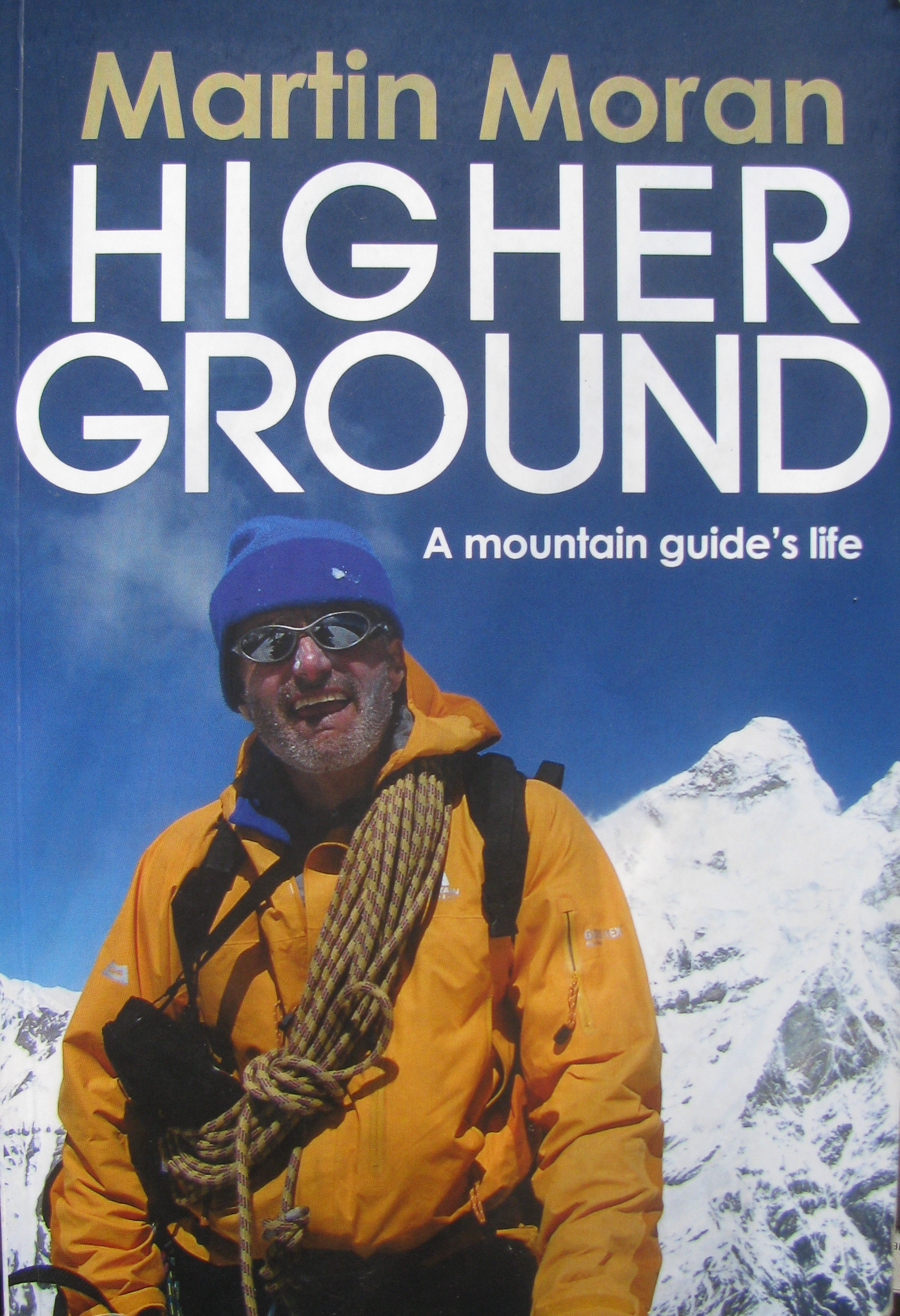
???????????????????????????????The first time I heard of Martin Moran was in the Pindar valley.

Couple of villagers mentioned his name.

I started frequenting Munsyari.

I heard his name mentioned there too.

Later when the first Indian ascent of Changuch happened, Martin’s name was firm reference point for his expedition had recorded the peak’s first ascent. That in turn, was the fallout of a climbing trip to Nanda Devi East, which he chose to abort and redirect towards Changuch. Before Nanda Devi East, Martin had been up Baljuri and Panwali Dwar.

These are not just engaging mountains.

They fall at a junction in geography and spirituality that is important to Garhwal and Kumaon, particularly the latter. Knowing who Martin is and what his body of work is, appeared essential. When the chance to review his book emerged, I was delighted.

`Higher Ground – A Mountain Guide’s Life’ was a mixed package.

Its strength is that it gives much insight into the subtitle. It is required reading for anyone aspiring to be a mountain guide. If you are imagining a book with details on a plethora of knots and anchor systems – a sort of technical manual; you are mistaken. Martin’s book is his life in guiding, shared. It does not unduly play up the usual lot of technical information, which the term `mountain guide’ evokes. Instead, it provides a taste of how the guide sets up business, works with clients, how much the envelope is pushed for achievement on trips and most important – how even a guide of considerable experience like Martin, won’t hesitate to turn back if conditions on a mountain are bad. If I may say so, there is much relevance in India to reading this book because in the Indian rat race, admiration for being superhuman and the compulsion to be superhuman are both high. They are among sentiments shaping our perception of climbing. Ahead of being comfortable with climbing, it is unfortunately seen as achievement. Martin’s book, although unashamedly nurtured on a diet of climbing, does not hesitate to talk of mistakes, accidents, long days that he and clients got away with and mountains that seemed wiser to behold from far.

High altitude isn’t everything. There is much to keep you busy at the lower heights. Martin’s book introduced me to peak bagging in Scotland; of clients returning to accomplish the ascent of a cherished number of these peaks. Equally, the book also lays bare how the mountains of Scotland and the Alps of Europe can be laboratory for eventual success in the Himalaya. You don’t find this said as such; you glean it. Nearly three quarters of the book obsesses with specific routes and climbs in Europe, something that can tire a reader unfamiliar with these environs. But in the end, you see the organic link, the making of competence. You can definitely do the same in the Himalaya (as many from Nepal and India’s mountain states do) but the point is – there is no substitute to being out and climbing. In the outdoors, you are only as good as how frequently you are out. Indeed Martin’s book is a freight train of personal climbs and climbs done with clients. So much so, it is sparse on his personal life.

From a reader’s perspective, the book is a challenge given three quarters of the book dwelling on the Scottish highlands and the European Alps (with some mention of Norway in between) and the difference in character between narratives from there and the Himalaya. It is a tough contrast to bridge smoothly. Europe’s mountains, heavily climbed and well known, bristle with technical information. Despite best effort to tell a story, accounts of climbing feel dry. I felt the book’s first three quarters was a stiff narrative that could have been made gentler for folks like me. I started enjoying the book from the last quarter. That’s when Martin reaches the Himalaya. With its unique matrix of mountain dimension, altitude, spirituality and people amid it all, narratives from the Himalaya are by nature different from stories from Europe. Couldn’t Martin have kept the style of narration uniform – either the texture of Scotland and Alps all the way or the texture of the Himalaya all the way (as I would prefer)? Or, mixing up the chapters in a non linear fashion? I wonder. All I will say is – I laboured through the first three quarters of the book and enjoyed the last quarter.

The book’s other weakness is exactly what it delivers as its strength. If you prefer the non commercial context as ideal window to the mountains, then this may not be your cup of tea. It shows in the rather limited ruminations on life and life’s questions that dot the narrative. This book is about work.

It is worth reading, especially if you are mountain guide or aspiring to be one.

(The author, Shyam G Menon, is a freelance journalist based in Mumbai. This is a slightly longer version of a review originally written for the Himalayan Club Journal Volume 70)

AND NOW, A WORLD CUP

Illustration: Shyam G. Menon

Illustration: Shyam G. Menon

Girivihar, Mumbai’s oldest mountaineering club, hopes to hold a world cup in bouldering, in 2016.

The event will be in Navi Mumbai.

India has never hosted a world cup in climbing, before.

Moves for a world cup here have been on for some time.

The idea can be linked to Girivihar’s track record in conducting an annual sport climbing and bouldering competition in Navi Mumbai for the past over ten years.

This event grew steadily; it attracts climbers from India and overseas.

Although it started as a bouldering and sport climbing event on natural rock, it progressively transformed to being a bouldering competition on artificial climbing walls.

An overview of this competition can be had at https://shyamgopan.wordpress.com/2013/08/15/a-competitions-solo-climb/ & https://shyamgopan.wordpress.com/2014/01/24/2014-girivihar-climbing-competition-daily-report/

“ We are aspiring to host the 2016 IFSC Bouldering world cup,’’ the club’s latest circular said.

According to it the Indian Mountaineering Foundation (IMF) granted provisional clearance for the project in November 2014. Should Girivihar’s application be confirmed by the International Federation of Sport Climbing (IFSC), then it will have to submit the required application fees.

Alongside, the club has disclosed plans for an Indian national bouldering team that will participate in the 2016 world cup. This plan includes a comprehensive training program for the team.

Needless to say, such steps like the application process, training of the team, a proposed road show to publicize the world cup, prize money and the event itself, will entail considerable expense.

The circular mentions a fund raising effort.

Earlier, it was separately understood that the annual bouldering competition which used to be held every January at Belapur in Navi Mumbai, won’t be there in 2015 as the organizers have shifted their attention to the planned world cup.

(The author, Shyam G Menon, is a freelance journalist based in Mumbai)

THE GHOST WHO WRITES

Photo: Ravi Kumar

Photo: Ravi Kumar

It was winter, 2013.

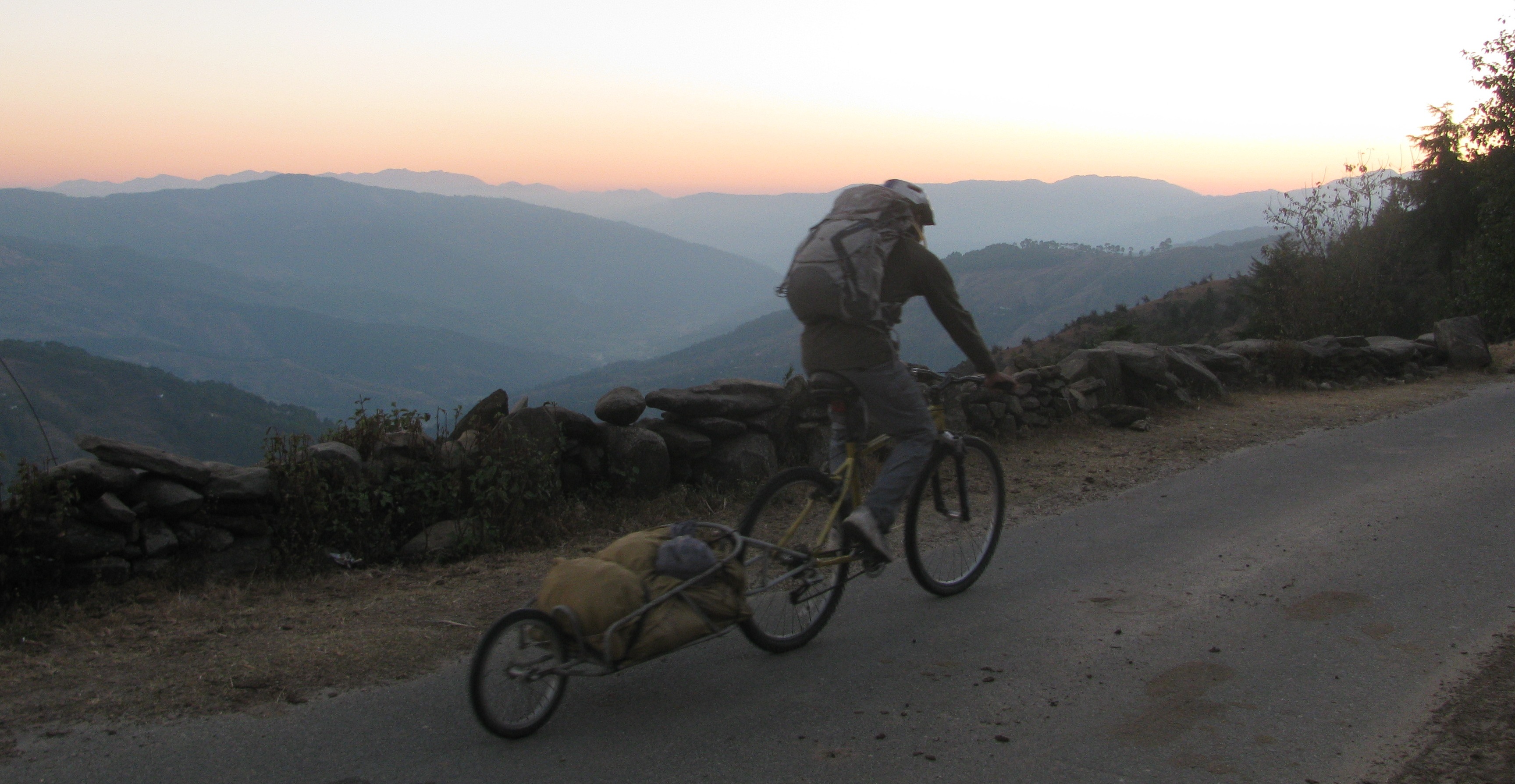
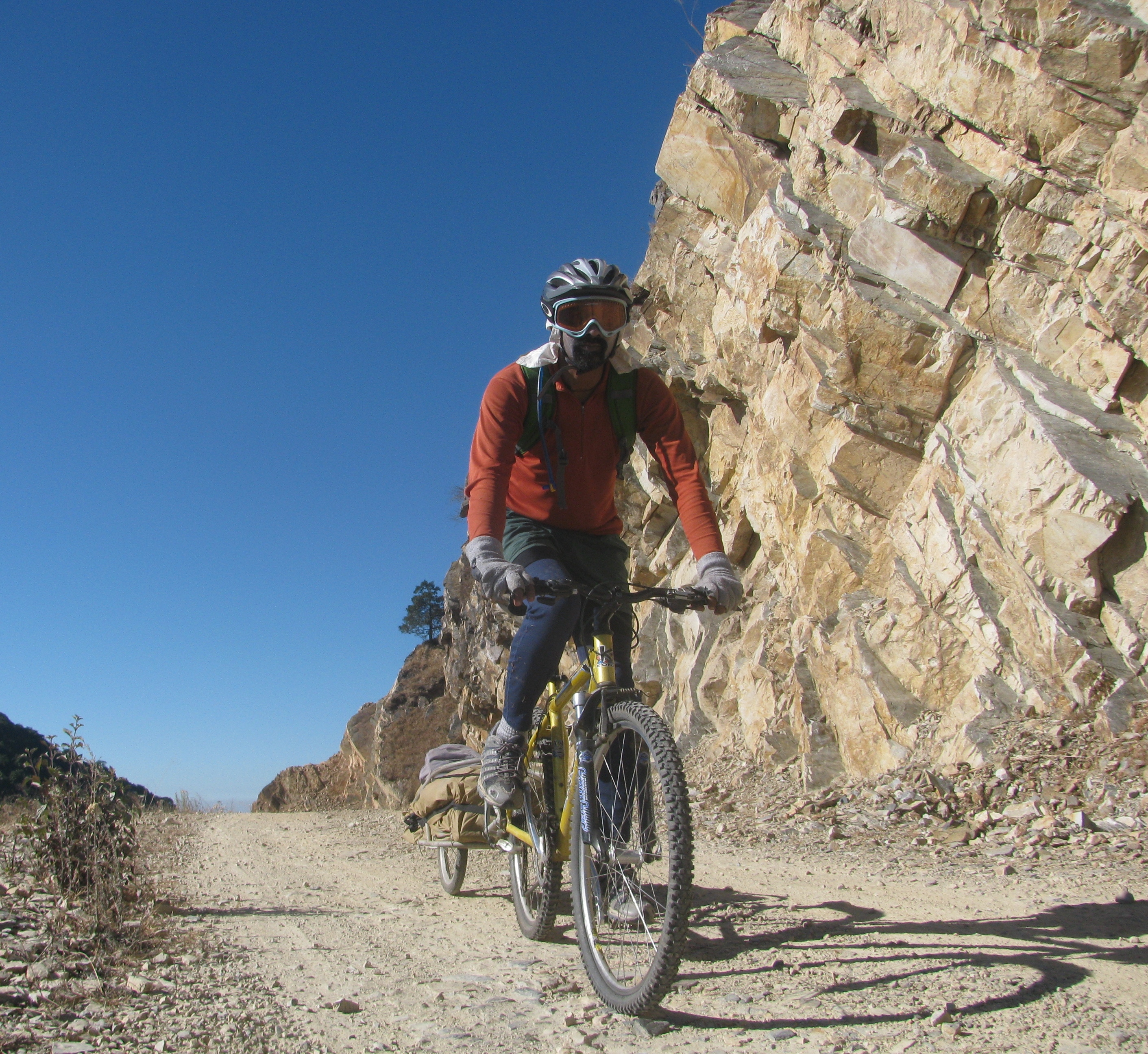
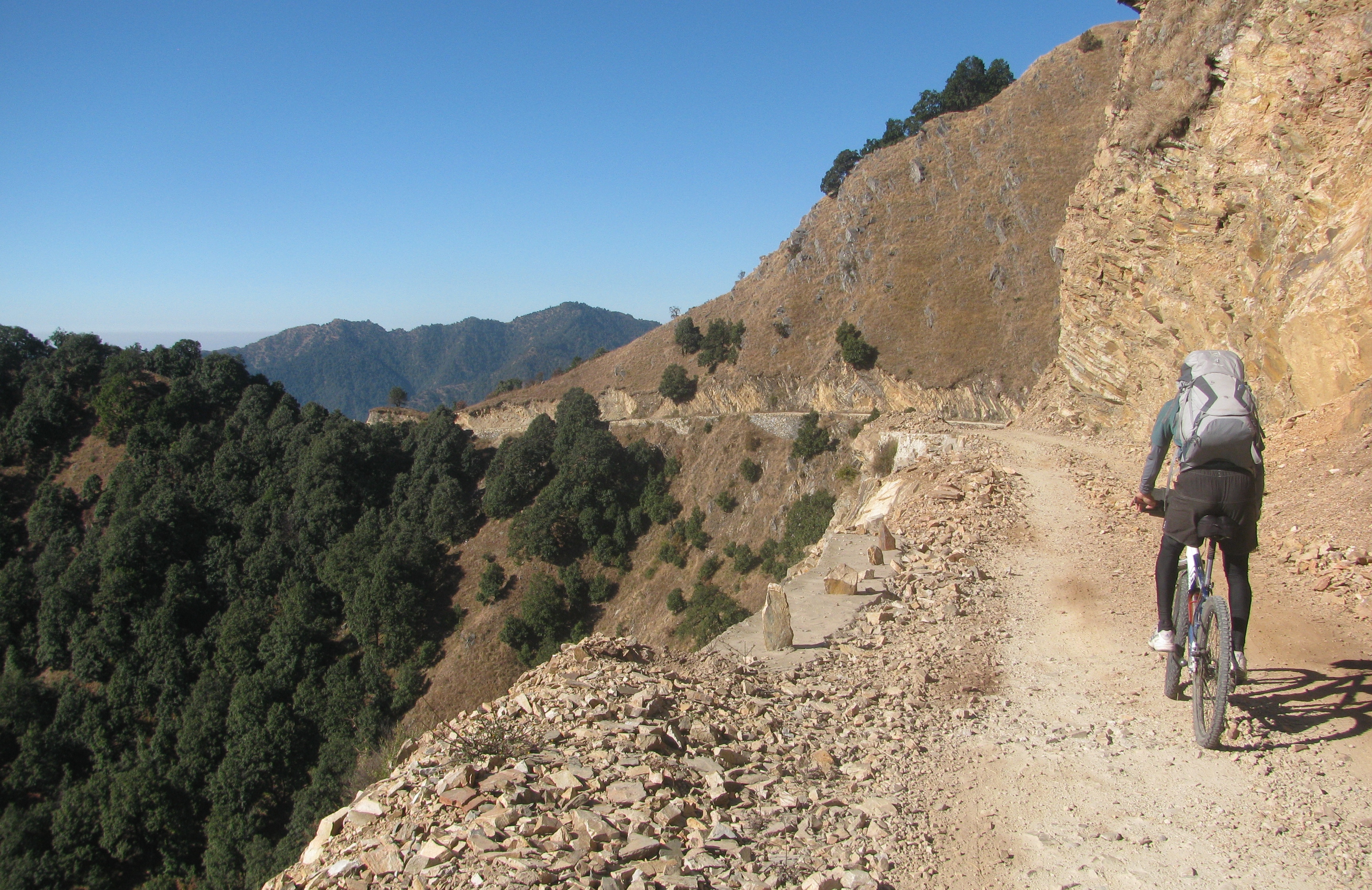
Cycling with trolley attached, is tough in Uttarakhand’s hills.

You have long uphill sections.

They seem a breeze when tackled in a car, jeep or bus.

To know what those roads actually are, you have to either run or cycle.

We took turns cycling the Kona, which hauled the trolley.

Ahead of Lansdowne we were having a particularly long day. As evening settled in, everything about our condition indicated that we had best halt somewhere. Problem was – there wasn’t any good place to stay or a clearing, quiet and sufficiently out of the way, for us to camp. We felt we might turn lucky if we pushed on. This we did on a very long ascent, half way up which, day transitioned to night and we found ourselves cycling with our headlamps on. Now that – is a very unwise thing to do in the mountains where the road-edge plunges hundreds of feet down. We knew this well. Eventually, at a turning on the road, we found a temple. But we had either run out of food or were exhausted enough to wish that somebody would feed us. We could see lights on a hillside some distance away. Ravi waited at the temple while I went ahead to look for a house and hopefully, a hospitable family who will cook us dinner.

I found both.

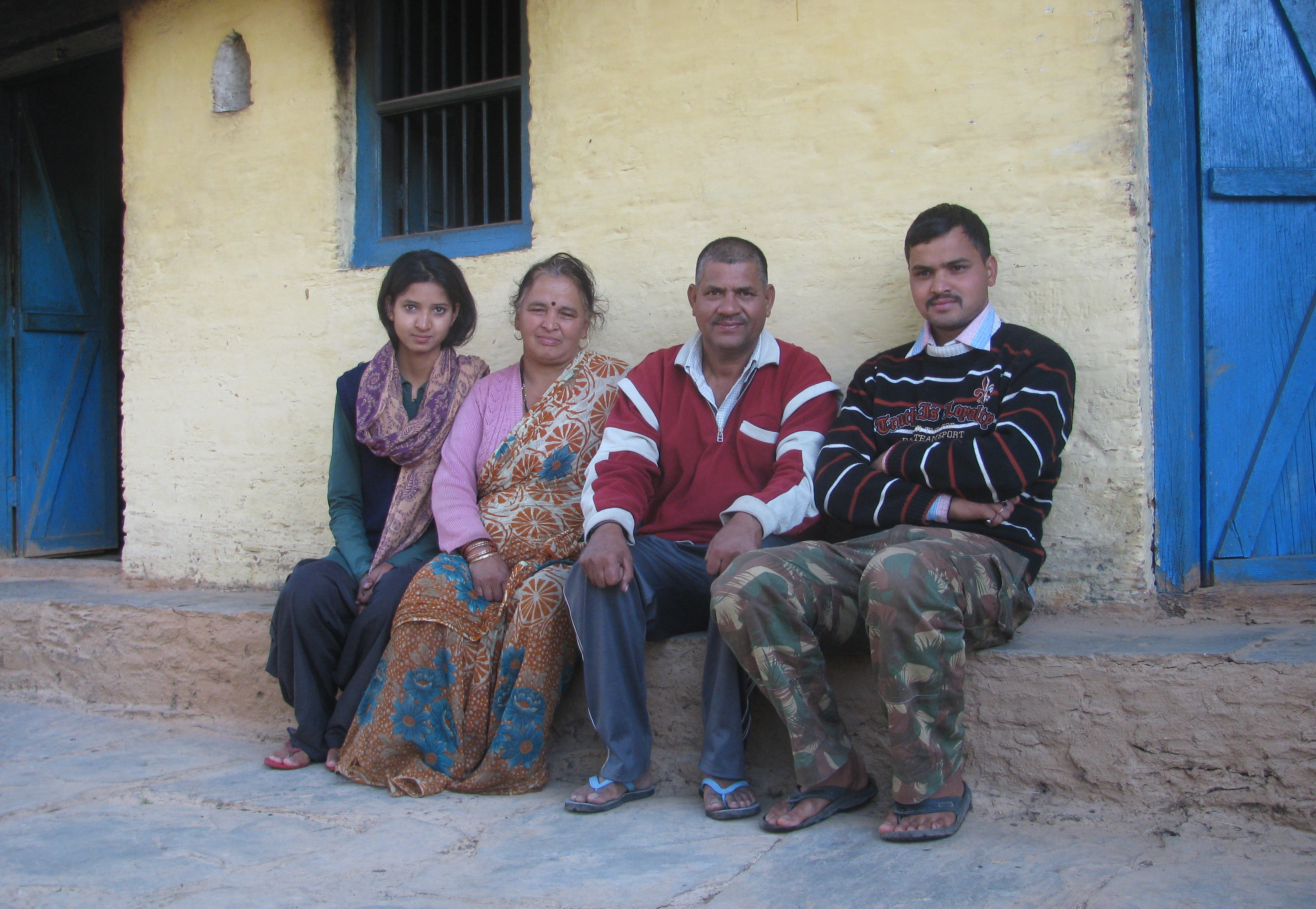
The family we stayed with (photo: Shyam G Menon)

The family we stayed with (Photo: Shyam G Menon)

Roughly a kilometre on from the temple, about fifty feet up from the road was a house with its light still on. I asked if there was anyone around. A dog barked. Then a man emerged from the house. He listened to my request. I knew it was unexpected and tabled too late. He initially offered dinner cautioning that there was nothing special available and we would have to eat what the family had. “ That’s very kind of you. It is more than what we wanted,’’ I said. After ten minutes of quizzing to make sure that we were genuine travelers, he offered us food and a room to stay in. He urged me not to stay at the temple and instead, stay in the spare room at his house. I fetched Ravi. We parked our cycles in the courtyard of the house. We had dinner, conversed with the family and slept soundly. After a hearty breakfast, we offered to pay. The man, a former soldier, accepted nothing. I remember what he told me when I first asked for food, “ you are travelers. I have also traveled on work. I know what it is like to be in an unfamiliar place. Get your friend, you can eat what we have.’’

God bless that family.

Photo: Shyam G Menon

Photo: Shyam G Menon

Sometimes a trip happens that is so enjoyable that you don’t remember to keep a diary and you can’t subsequently recall where you had been. This cycle trip was in that league. Not more than ten days. Approximately 350-400km covered in the hills; two mountain bikes, one trolley (attached to a cycle) with camping gear, stove, spare clothes, repair kit and food (essentially tea and coffee for the morning), two small backpacks on us. We didn’t have panniers. So this arrangement seemed best. Real cyclists may call us crazy. But we weren’t that real in cycling. We had no goals; we just wished for a nice, winding hill road with camping spot and tea shops en route. Besides, I suspect when one’s grounding is in hiking and mountaineering, some weight to haul, getting roasted by the effort, grinning through it and then laughing at the eccentric fool one is – it all adds to life. When the sun was unbearably hot, we stopped and slept in the shade. When a place seemed particularly beautiful, we stopped to marvel at it. When the road was well-made and there was no traffic, we relaxed into the ride. When a terribly rough side road assured to host great Himalayan views beckoned, we ventured forth thankful that our cycles had suspensions. We had destination but none so iron clad that we couldn’t let an instance lead to another – that seemed our trip.

The route was based on recommendations from Punit Mehta, a friend with abundant love for hiking. He had also travelled much on his motorcycle; the roads and side roads on our itinerary were his inputs. I am not a great navigator but I suspect we may have ended up adding a couple of sub-routes of our own. Anyways, the journey was from Ranikhet in Kumaon to Lansdowne in Garhwal and then through a forest road open to traffic, to Maidavan. If I remember correct, we went via Dwarahat, Thalisain and Peersain. The exit wasn’t quite near Ranikhet; it was a day’s drive away. Both cycles – a Kona and a Mongoose – old and well used, performed splendidly. They belonged to Ravi, whose collection in Ranikhet included recumbent bikes and unicycles as well.

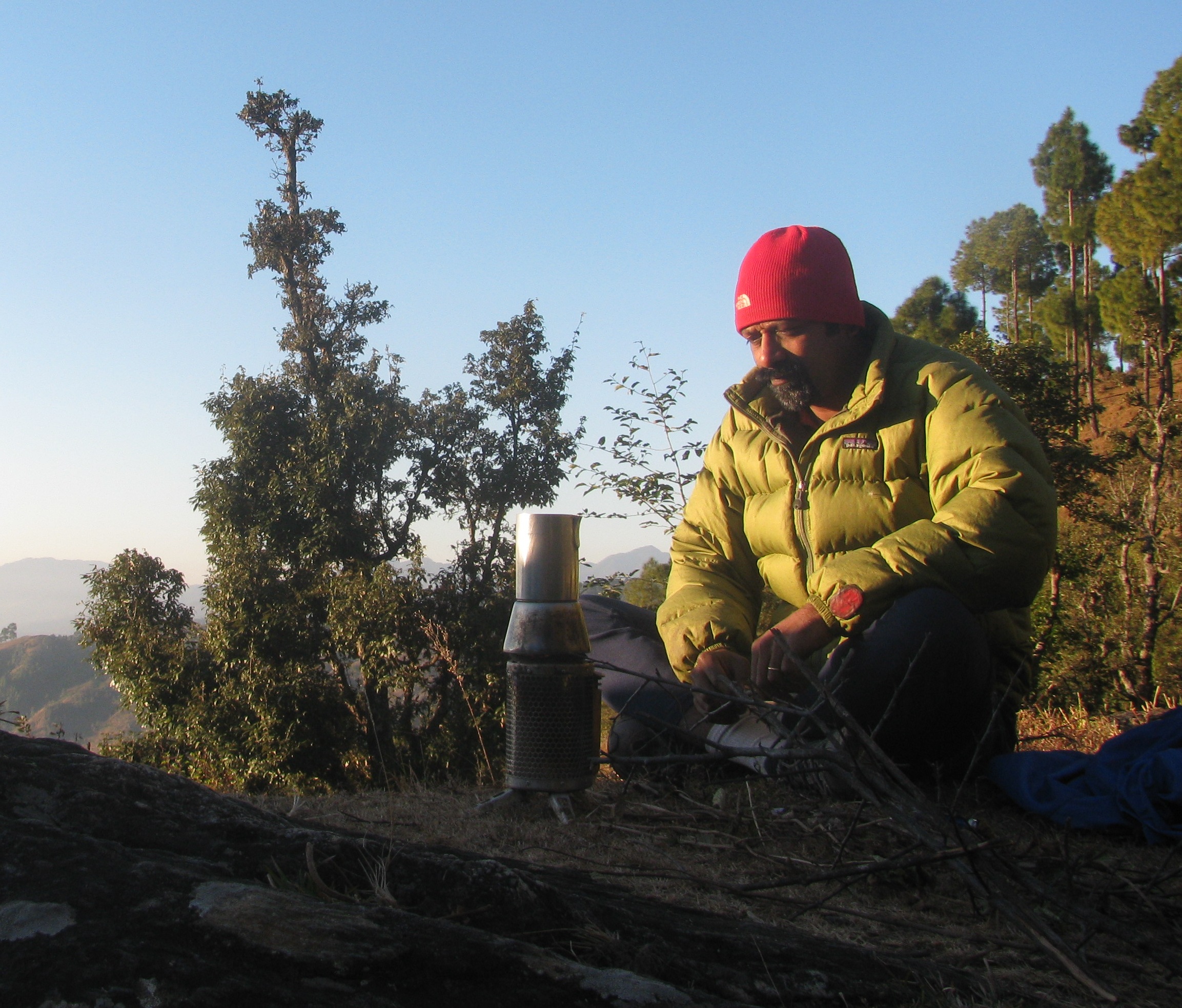
Coffee and Ravi (Photo: Shyam G Menon)

Coffee and Ravi (Photo: Shyam G Menon)

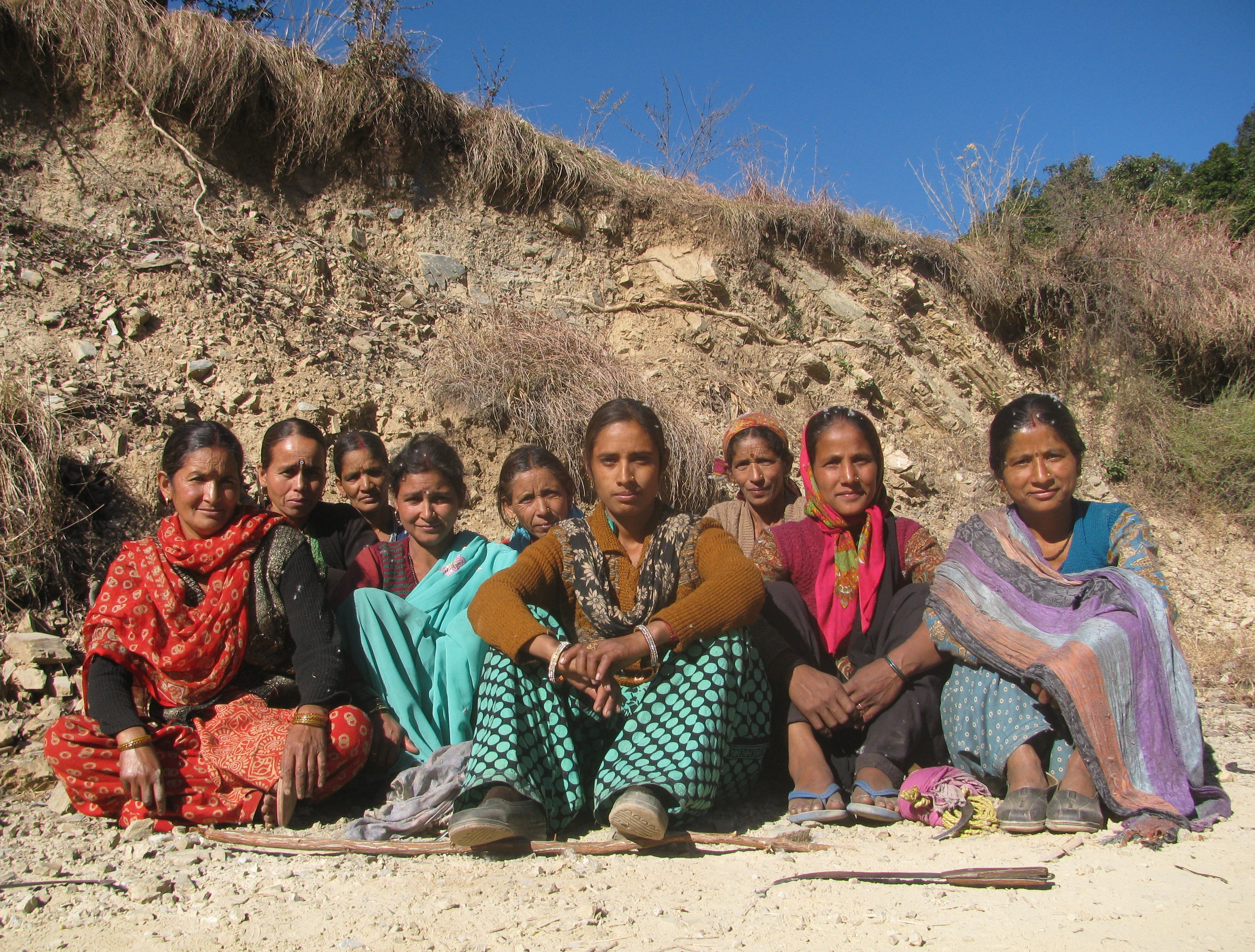
Self supported travel has two advantages. First it keeps cost low, provided nobody minds you camping around. Second, it lets you know places and people. Independence lets you explore and the moments of dependence – because you know clearly you are dependent and why – makes you grateful for help received. Good behaviour is half the job done on any trip or expedition. We had a couple of wonderful camps and tea shops that served us food. At some places we slept on a veranda or in a shed. In remote areas, the local shop may also be tea shop and traveler’s lodge. We caught up on news chatting with shop owners. In their lodge rooms, we met traveling salesmen and got a sense of rural marketing. We met women out cutting grass; seeing us they halted, struck up a conversation, inquired about our journey and sought a group photograph. We passed a hillside featuring many people trudging up to a local temple; got invited to the festival, got our share of sweets. An interesting aspect for me was that the two major towns linked by our route were the homes of Uttarakhand’s army regiments – the Kumaon Regiment and the Garhwal Rifles. The former is headquartered in Ranikhet, the latter in Lansdowne.

Our disappointments on the trip were probably just two. One fine day, Ravi decided that we would ask for a large citrus fruit called malta and get one free from somebody’s tree. It was to be the memorable postcard experience of tourism – you ask, a smiling face generously gives. We found two men seated near a cluster of malta trees. They pointed us to the owner, an old lady. Unfortunately she was in a grumpy mood. “ NO,’’ she said firmly. We dropped the malta plan. The other, was the curious case of some young men who looked at a pair of cyclists as a threat to their importance. While it was common to have youngsters quip that they had done similar trips or more, I was nearly unseated once when a youngster thrust his leg into my way as I cruised downhill. The people we could confidently engage with were retired military personnel. They had moved around the country on work and were at ease with strangers. I have always believed that the true gift of travel is how it takes you away from family and familiarity and makes you vulnerable. That state, bereft of ego, is when you know life.

The women we met, out cutting grass (Photo: Shyam G Menon)

The women we met, out cutting grass (Photo: Shyam G Menon)

There was one memorably amusing episode from the trip.

We were camped in a field just below a rough, unpaved road.

All around were hills.

There had been little traffic on the road the previous evening, when we arrived. So we had had dinner at a shop some distance off in town (a small junction to be precise) and cycled back to the relative isolation of the field. We put up our tent and fell asleep quickly; it had been a long tiring day.

Late in the night, an individual or two, walking along the road had shined a torch in our direction. It is not always that you see a tent in the adjacent field.

Early morning was tad different.

We heard approaching conversation and then an abrupt cessation of talk as the passersby discovered the tent. Both Ravi and I, were feeling too lazy to stir out so early and engage the visitors. So we stayed put in our sleeping bags, hoping that they would go by as the others before did.

But the sound of walking had stopped.

There was a brief silence.

Then voices were heard.

“ You see that – a tent!’’

“ Must be the cyclists who were having dinner at the shop last night.’’

Photo: Ravi Kumar

Photo: Ravi Kumar

The sound of soles on sand and gravel emanated as the visitors shuffled down the side of the road to the little clearing where the tent stood. There were mumbled comments and grunts, the usual accompaniment of checking things out.

I was now wide awake, half wondering whether I should step out and say hello, which is the best way to avert too nosey an inspection. The worry in such situations isn’t the inspection per se. It is the potential damage to camping gear, not to mention – our cycles kept outside. If someone can guide the curiosity it helps.

But I didn’t want to get out early on a winter morning. Besides it was that sweet spot when the cold of a night bidding goodbye met a hint of the sun. Both day and night were languorously mixed. I stayed put in the sleeping bag.

We could sense people close by, our worlds separated by mere tent fabric.

Then somebody said clearly, “ woh Keralawala thhand se mar gaya hoga (that person from Kerala must have died due to the cold weather)!’’

There was a round of laughter after it.

The sound of shoes started moving away.

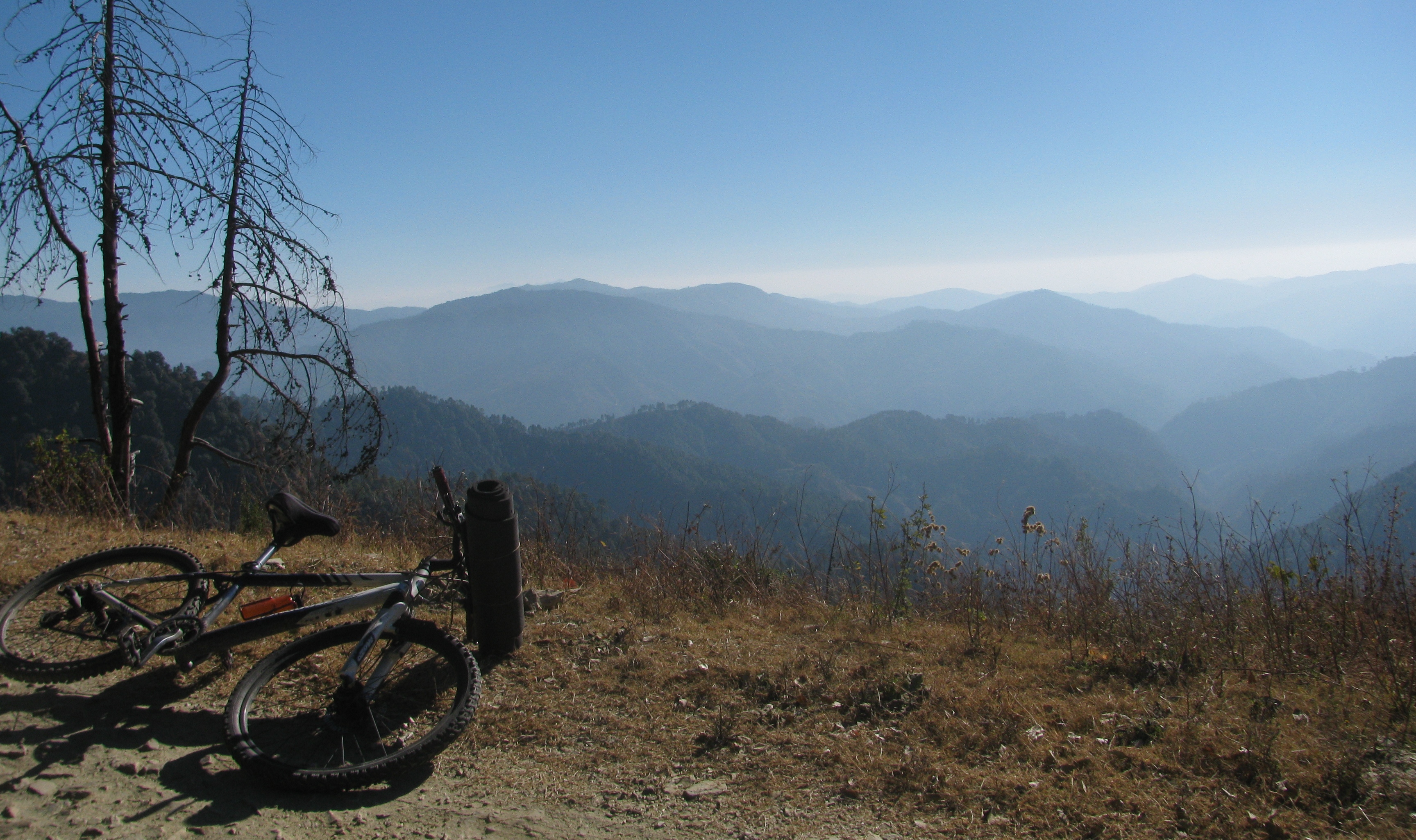
Mongoose and the mountains (Photo: Shyam G Menon)

Mongoose and the mountains (Photo: Shyam G Menon)

It crunched sand and gravel climbing back up to the road.

Then it slowly faded as rhythmic strides.

Within the tent both of us had stifled our laughter at the comment till the visitors left. Now we got out of our sleeping bags and the tent laughing our heads off. Pronounced dead, I felt like a ghost, a happy ghost. Ravi got the stove going for the morning coffee. I took a photo of him at work; then stood there savouring the morning chill. That comment about me, hailing as I do from tropical Kerala (Mumbai where I live is also hot and humid), was my take away from this trip.

It’s nice to be still alive.

Once in a while I pinch myself to make sure I didn’t die in that tent.

Or maybe – I am the ghost who writes?

(The author, Shyam G Menon, is a freelance journalist based in Mumbai)