A TREK AND A TEA STORY – PART 2

On Ponmudi (Photo: Shyam G Menon)

On Ponmudi (Photo: Shyam G Menon)

The story of these southern Kerala tea estates go back several decades. It showed up on the Internet in a 1914 edition of Southern India: Its History, People, Commerce and Industry; a book compiled by Somerset Playne, J.W. Bond and edited by Arnold Wright. As I found out later the book which details the initial phase of South Indian estates had become essential reference for plantation companies in the Ponmudi region to establish their origin.

According to it, The Ponmudi Tea and Rubber Company Ltd was formed in 1900. The property consisted of three estates – Ponmudi, Bon-Accord and Braemore, all of which were in the district of Ponmudi in the native state of Travancore. The estates spanned an area of 3276 acres with the cultivated portion totaling 1710 acres, featuring tea and rubber. Mr J.S. Valentine, the managing director, had arrived in India in 1875. At that time, the area was planted with coffee but all that coffee was lost in the blight that hit Kerala’s coffee. Subsequently in 1884, tea was planted in Ponmudi and in portions of the other properties. The climate was good for tea; the rainfall of almost 160 inches experienced annually was heaviest in June, July, August, October and November. The yield of tea was highest in Ponmudi followed by Bon-Accord and Braemore in that order. In January 1915, when these observations about the estates were penned, the region had about 1510 acres under tea and 200 acres under rubber at the three estates. There were tea factories at all three properties and the produce was shipped under the company’s brand through the ports of Kochi and Tuticorin for sale in London. Two thousand laborers worked in the plantations; they were drawn equally from Malabar, south Travancore and Tinnevely, the Tirunelveli district of present day Tamil Nadu. Mr Valentine lived in Ponmudi, Mr R. Ross with Mr David Welsh, assistant, was in charge at Bon-Accord and Mr I.R.N. Pryde looked after Braemore. The company’s registered office was at 4 Lloyd’s Avenue, London.

The three estates are now separate. They draw their lineage from the Ponmudi Tea and Rubber Company. When I was a school student in Thiruvananthapuram, the Ponmudi area was identified with tea and as I understood in retrospect from my inquiries, foreign managers were still there. They were present in Ponmudi till the late 1970s. It was also from these parts that I first heard the name Birla. Jayasree Tea, a company belonging to the B.K. Birla group and a leading tea company in India, had come to own a plantation called Merchiston in Ponmudi. But there was trouble brewing, scripted possibly by paradigm problems visiting the tea business in the state. In fact, while I was still living in Thiruvananthapuram and yet to be journalist, reports had commenced of labor problem and slow decay at the tea estates.

Gangs of forest workers were preparing the trail for the upcoming season. Here and there, they had set fire to dry grass in a controlled fashion. Our guides stopped to talk to their colleagues. On one such occasion, we had walked ahead and paused to pick up a hollow plant stem, hacked and lying on the ground. It was a fascinating object, like a green telescope tube. Just then the guides appeared. “ Did you cut it?’’ Raju asked a tad belligerent in tone.

Neither the query nor the tone should have surprised us. The forests around Agastyakoodam have been known for long as a treasure trove of medicinal plants. Years ago, it used to be casually explained; people would link the incidence of medicinal plants in the region to the apothecary traits of sage Agastya himself. But the present day global pharmaceutical industry has no appetite for either myth or nature. For it, the undiscovered potential of the plant wealth of Agastyakoodam posed clear commercial value. Its exploitation could be restrained or properly administered only by the rule of relevant laws, something quite distant to the tribal world of the Kani community. Rumors abounded of plants smuggled out for analysis.

Even the comparatively successful story of the endurance drug Jeevani was not spared controversy. The discovery of its existence or rather that suspicion of something like it which precedes all real discovery, had been in circumstances very similar to what we found ourselves in. A group of scientists were out in the Agastyakoodam forests, their guides like ours, walking briskly ahead mile after mile. The guides were hardly tired while the team behind was getting progressively exhausted. They noticed that the Kani men were chewing something, which on inquiry turned out to be the leaf of a plant locally known as Aarogyappachcha. From it, scientists of the Tropical Botanical Garden and Research Institute near Thiruvananthapuram created the medicine, Jeevani. Although the Jeevani business model was eventually recognized internationally as a role model in its category, sharing the profits from manufacturing the drug with the Kani community, whose natural home land the Agastyakoodam forests were, there was controversy later when a US company patented the drug in that country. The tribal community – as evidenced by the attitude of our two guides – appeared to have learnt the value of cautious dealings with the outside world. “ We were ignorant,’’ Binu said.
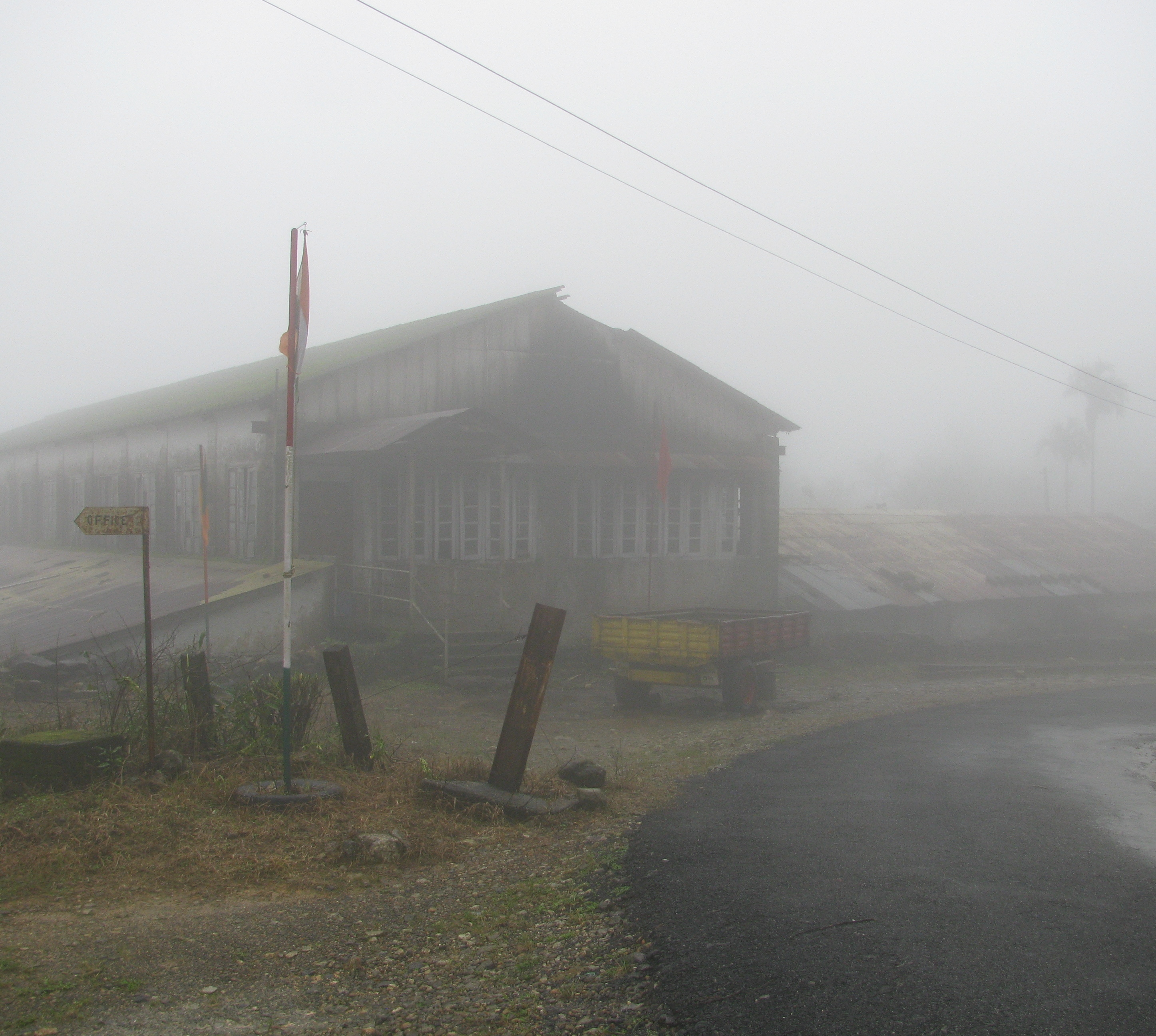
The office of the old tea factory at Ponmudi (Photo: Shyam G Menon)
The office of the old tea factory at Ponmudi (Photo: Shyam G Menon)

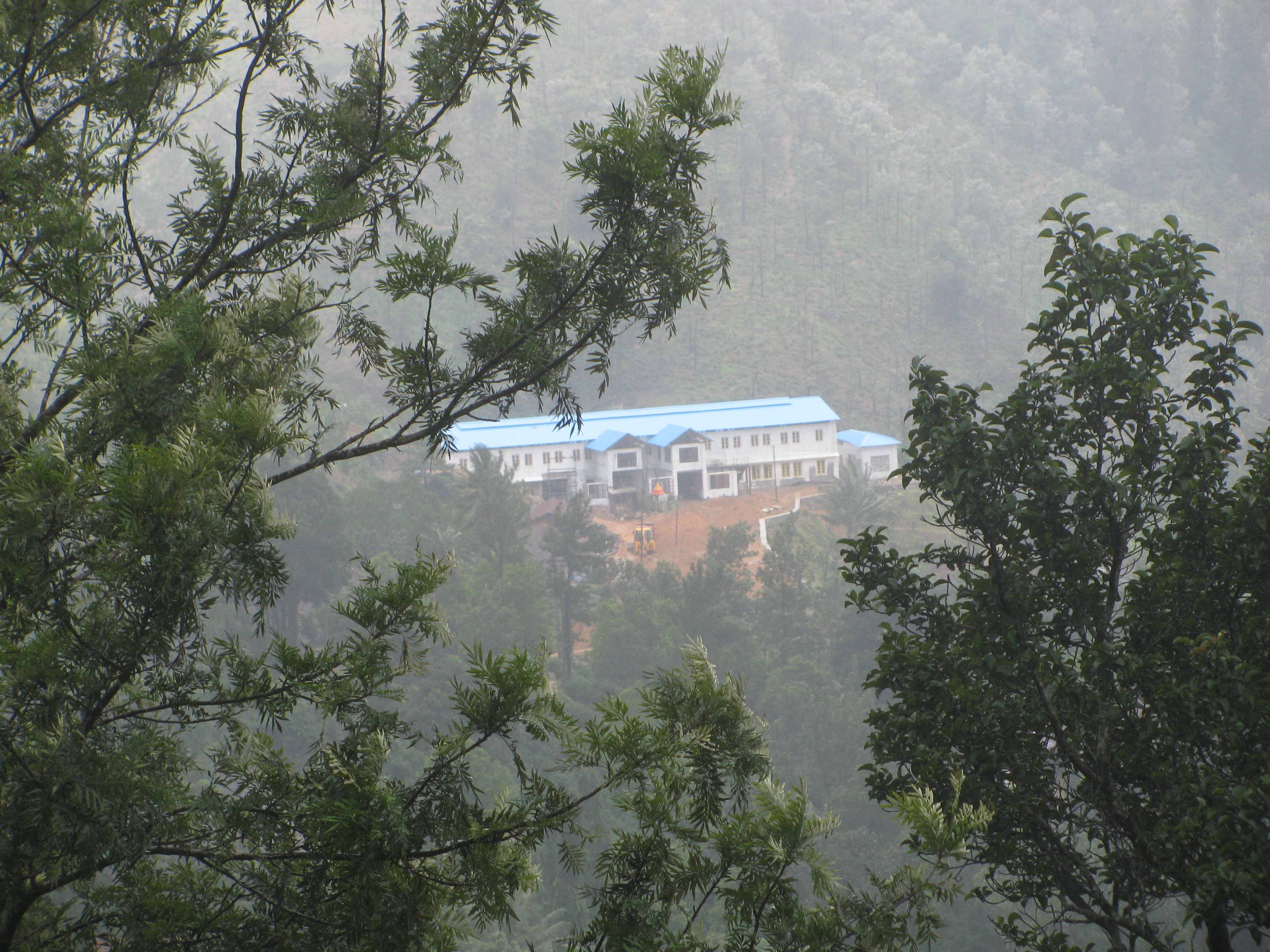
The Merchiston factory near Ponmudi (Photo: Shyam G Menon)
The Merchiston factory near Ponmudi (Photo: Shyam G Menon)

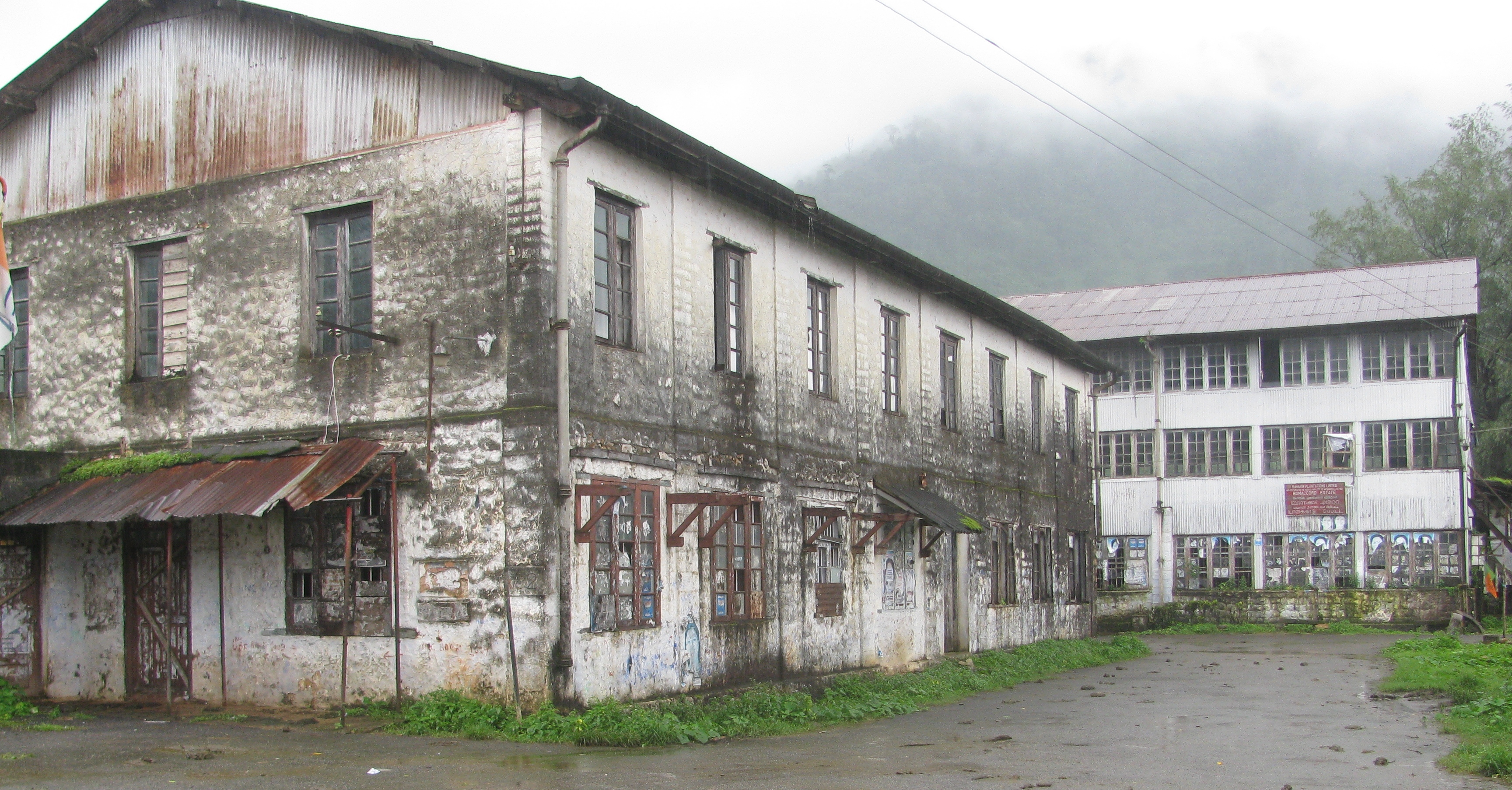
The Bonaccord factory (Photo: Shyam G Menon)

The Bonaccord factory (Photo: Shyam G Menon)

At the root of the tea estates’ problems was Kerala’s entry, some seventy five years after tea plantations reached the state, into an era of turbulent politics and social upheavals. One of the lasting legacies of this trend, ironically a byproduct of increased awareness, has been a level of politicization often deemed excessive for the common good. In this atmosphere, the plantation industry was one of the state’s largest tax payers and also one of its biggest employers. Political parties with their compulsion to cultivate vote banks rarely saw beyond these two obvious attributes – one of the largest tax payers and one of the biggest employers.

The mood in January 2009 at the plantation offices I visited in Thiruvananthapuram was hardly upbeat. Tea prices were down; input costs – a chunk of that labor cost – had gone up and labor productivity was low. Within labor cost, the argument from the planters was that the fixed components had risen handsomely while the variable parts, linked to productivity, moved up sluggishly. Also traceable in the economics was a logic rooted in the very nature of tea and mentioned at the time of its arrival in Kerala – the regular human intervention warranted for its cultivation demanded economies of scale alongside for affordability. The south Kerala plantations were neither very big nor was their produce high on the pecking scale at tea auctions. A cursory inquiry with tea brokers in Kochi in 2009 revealed that in general the teas from Munnar ruled the top in local auctions while the south Kerala estates stayed at the bottom in terms of price and quality. It was not hard to comprehend why the pincer bit hard at Ponmudi.

In 2009, of the big names in the Thiruvananthapuram region, only one tea plantation company seemed to be working normally, free of controversy. Its focus was organic tea, something the others were yet to deem commercially viable although improving end product price through imaginative value addition seemed the only way out from prevailing predicament. But this company too had temporarily run into a glitch courtesy the Forest Department whose office was situated not far from that of the plantation company’s in the city. In rules produced some years ago to define forest lands, the department had drawn survey lines through estate tracts befuddling the owners. For the company it suddenly became questionable to weed its contested plantation for that could amount to deforestation. That was the dilemma in 2009 at what seemed the less troubled tea company of the lot.

About three hours into the hike, we broke free of dense forest into a patch of tall grasses with scattered trees. From here the Agastyakoodam peak towered in the distance; its long flanks made us wonder if the goal of reaching the top by evening was feasible. It was now noon and the sun was harsh. Just then the walk entered open terrain with nothing for shade. It was only after half an hour slogging through the heat and glare that the trail reentered shaded forest. When it did the going was suddenly steep. The combination of heat and steepness was rather dehydrating and it was a tired group that hit the forest rest house by late afternoon. We would be staying here for the night. Right in front of the building, the peak loomed big, that same perfect triangle as seen from Neyyar Dam. Now you could see it in detail and if you were given to climbing, read that rock face for vertical lines to the top.

Bags lightered, we decided to push on and reach the top by evening. Getting back through forest at night may be difficult but we had torches and our guides appeared confident of navigating. You could say that the real climb up Agastyakoodam is the hike beyond the rest house, whatever had been traversed till then was the stuff of foothills. Binu pointed to a distant streak of red on the peak’s rock face. He claimed that the ooze, locally called kanmadam, held medicinal properties. What he said next was hard to swallow – that the king cobra loved to taste it. It was a fantastic image – mysterious red ooze from rock as favored food for the world’s longest poisonous snake. Wasn’t it a bit too fantastic? I left it at that.
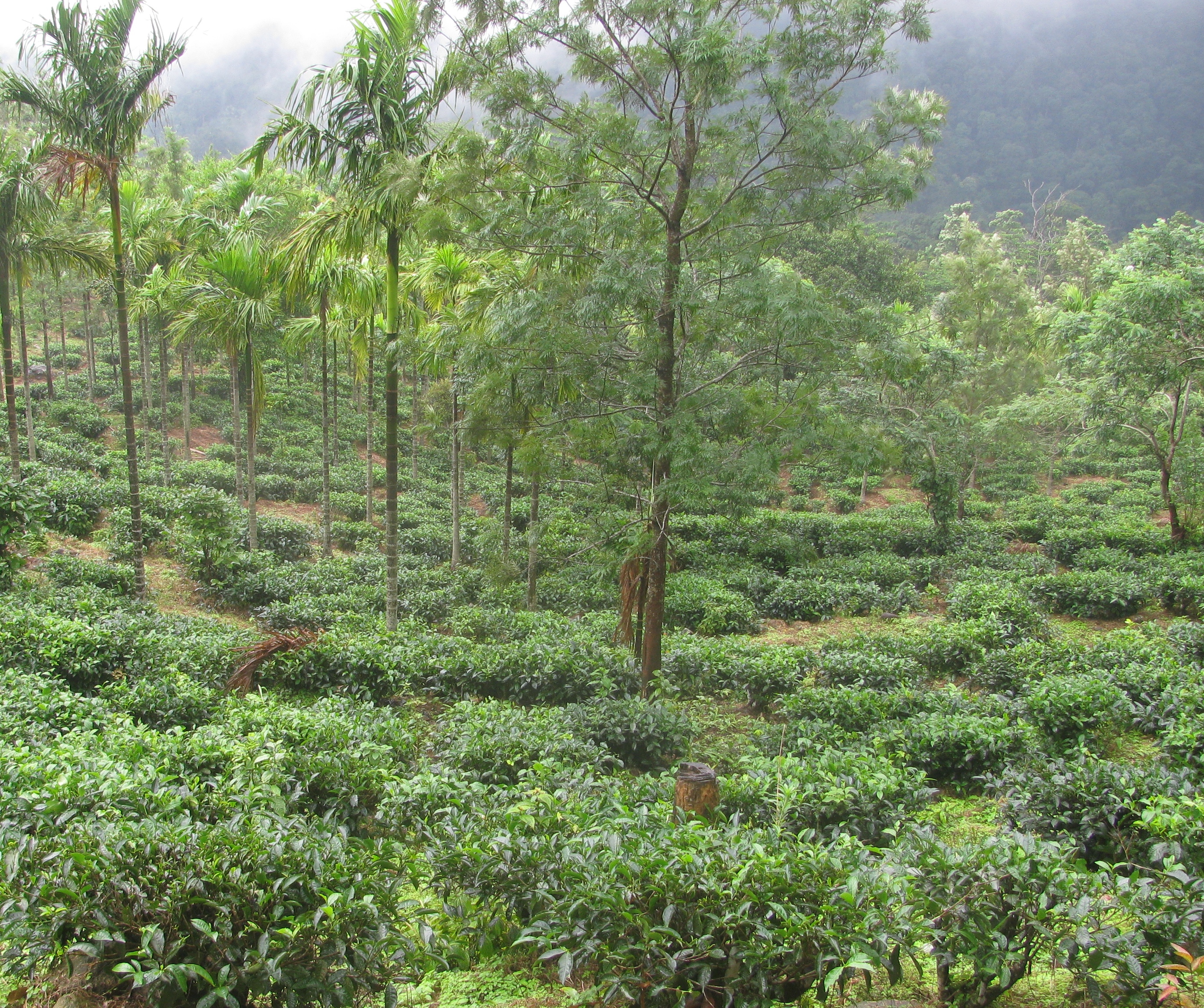
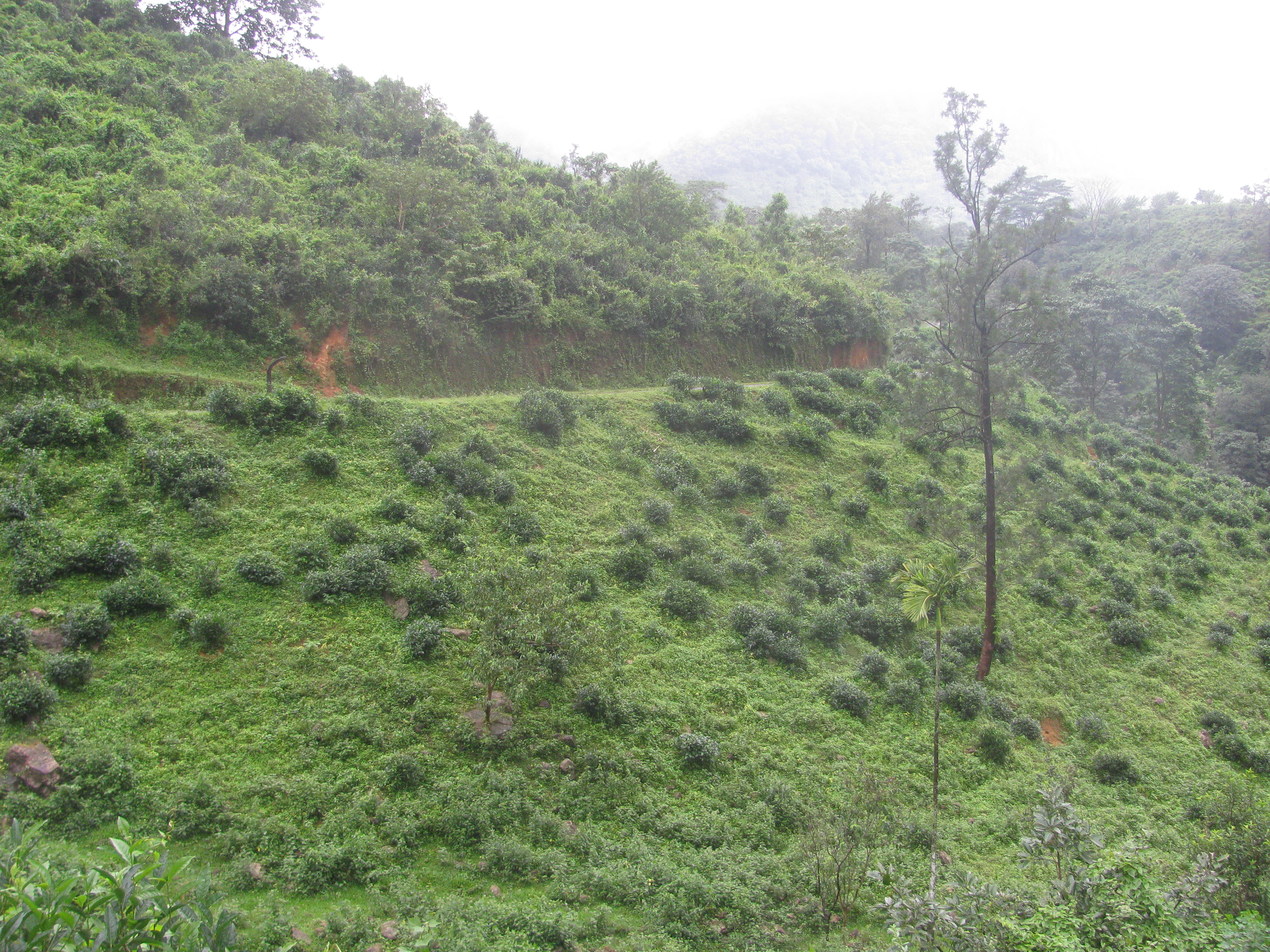
Tea gardens near Ponmudi (Photo: Shyam G Menon)

Tea gardens near Ponmudi (Photo: Shyam G Menon)

The trail was now getting steep and narrow featuring stray deposits of elephant dung. The watchman at the rest house had warned that a few elephants were present in the locality. An hour later, we were at the mountain’s shoulder, its rocky apex sat like a solid hump to the right; it was a sheer drop on the side facing the rest house below. The boundary line separating the states of Kerala and Tamil Nadu ran along the mountain’s ridge. It was carved into the rocks, these separate loyalties – the sea shell emblem of Kerala and a sort of arrow mark for Tamil Nadu, which the two Kani men called “ kozhikkalu’’ or chicken leg. Back in Thiruvananthapuram, this arrow mark failed to convince learned people for they said the Tamil Nadu emblem had traditionally been the temple tower; unless the tower got simplified to an arrow mark. From the mountain’s shoulder you could comfortably gaze into Tamil Nadu, the nearest town that side being Ambasamudram. The path up from the shoulder was a mix of rock strewn gully and a steep, narrow path.

Half way up the path, we saw fresh elephant dung. The contrast it presented was hard to ignore. How could such a massive beast pick its way up so small a path? Elephants are capable of some gingerly done walking but this appeared to indicate a truly nimble specimen. Binu however treated it as normal. As we prepared to tackle the rock patches above, we heard some trumpeting in the distance. The rock patch was fun; it is bound to be so for anyone acquainted with climbing. There was a stout rope fixed to a thicket but if you are familiar with walking on angled rock and have a trekking pole for friend, then the rope is not required there or anywhere on the final ascent. On the other hand what you feel while walking up on two legs on that slab is a notion of poise and fresh air, a sense of freedom, a sense of having finally broken through dense vegetation and being able to see unhindered for miles.

The peak here has two neighbors – Athirumala, located in line with the boundary dividing the two states and having a name derived from the Malayalam word athiru, meaning boundary. The other was a fierce mountain with five summits all of them sharp pinnacles. The entire formation stood like an arrogant upward thrust from the forest floor. The Kani men called it Anchilappothi and it reminded me of those spires in Patagonia and Karakorum that the world’s best rock climbers go to attempt. Perhaps a smoother version for these tall pinnacles didn’t seem as jagged or rugged. “ Nobody goes there,’’ Binu said, as we stood looking at those pointed peaks, from the top of Agastyakoodam. There was nothing on the summit of our peak save a couple of more rock engravings to denote the state boundary, a solitary idol of the sage Agastya and items of worship replete with left over offerings. The idol matched the description of the sage in Hindu mythology as a small, stout person. Agastya though, was a powerful sage, one of the most powerful in the list of Indian hermits. Two things characterize his story – a fantastic birth and continued mention across the ages, making him some sort of an eternal being. In between was the tale of him taming a fast growing mountain in central India, the Vindhya. When Vindhya threatened to exceed the Himalaya in height, the gods sought Agastya’s help – so goes the story. The sage who was proceeding south asked the mountain to reduce its height for him to cross and keep it that way till he returned. Agastya never returned; he stayed south. The belief is that he built his hermitage in the forests around the Agastyakoodam hill. As for Vindhya, it remains to date a set of hills, smaller than even the Western Ghats.

…..to be continued

(The author, Shyam G Menon, is a freelance journalist based in Mumbai)
A TREK AND A TEA STORY – PART 3

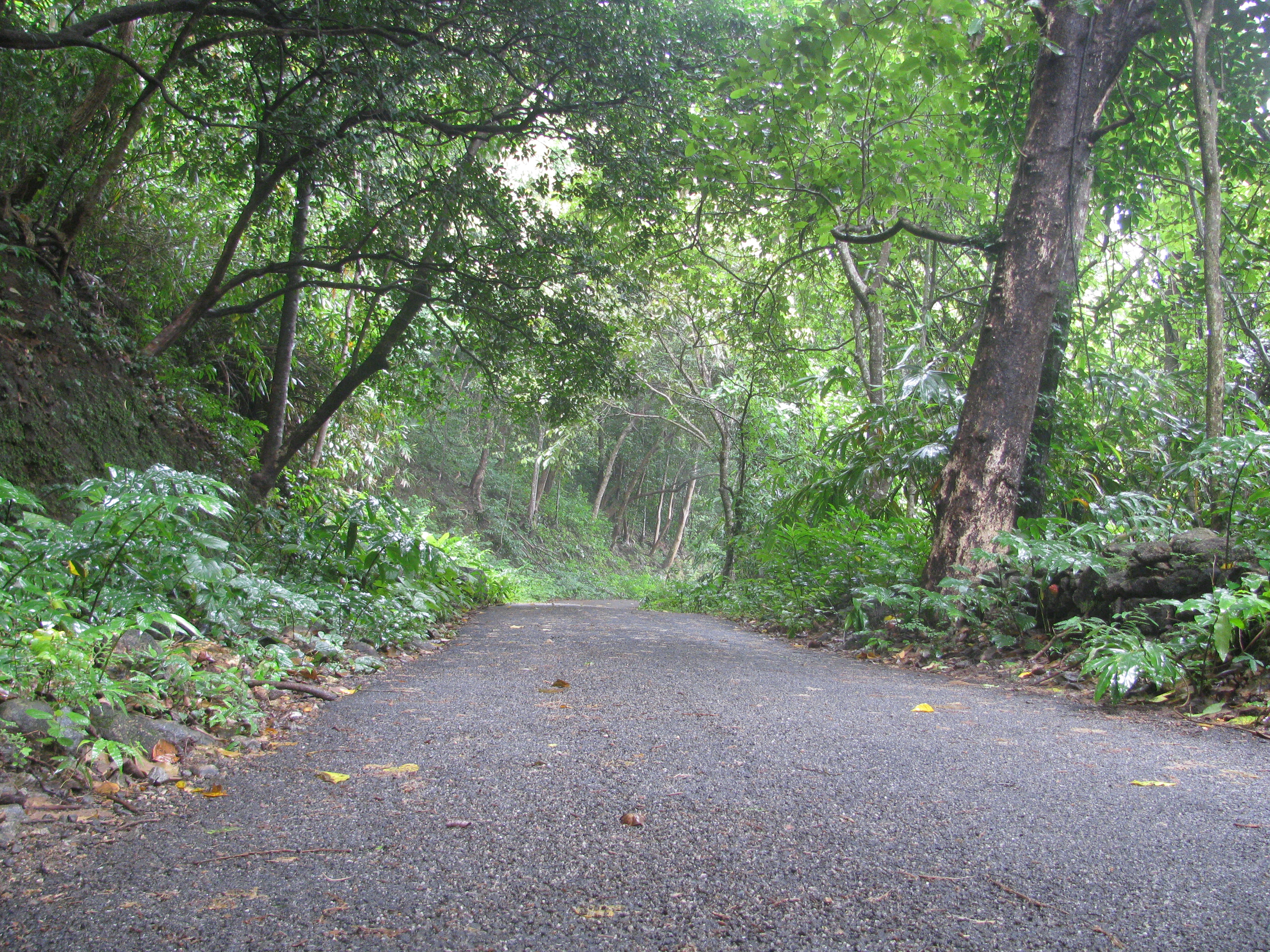
The road to Bonaccord (Photo: Shyam G Menon)

The road to Bonaccord (Photo: Shyam G Menon)

The Merchiston estate was sold off by the Birlas.

In 2009, its new owner was embroiled in controversy for agreeing to sell a portion of the estate to the Indian Space Research Organisation for the proposed Indian Institute of Space Science and Technology. Away from its newly acquired place in politics, the estate had other interesting angles to offer. If you search for the Merchiston name on the Internet, one of the links would take you to a historical castle in Edinburgh, Scotland, likely built in the 1450s and home to the Clan Napier. Of relevance to Kerala’s capital city, Lord Napier of Merchiston was a title in the peerage of Scotland. The Merchiston castle was the birthplace of John Napier, most famous Napier of the lot, Eighth Lord of Merchiston and famous Scottish mathematician with major contributions to the subject, including logarithm. He was also interested in theology, predicting an end for the world around 1700. The world and Merchiston survived that year. The Tenth Lord Napier was Francis Napier, a prominent diplomat who served as the Governor of Madras Presidency and was for a brief while, acting Viceroy to India. The beautiful museum building at Thiruvananthapuram was named after him. Does that angle matter anymore for anything Merchiston in Thiruvananthapuram? I don’t know; history and heritage rarely count these days.

The Bonaccord estate had been through trying times. According to a September 2007 news report in the local edition of The Hindu, “ the laborers said that the 450 employees of the estate were rendered jobless after the management abandoned the estate and left the state five years ago. ` Following a government sponsored settlement in April this year, the management agreed to resume operations. But they failed to honor the agreement. The leaders of some of the trade unions appropriated the returns from the estate, leaving the workers in the lurch,’ they said.’’ Some degree of activity had since returned to Bonaccord; it was there to see in the few people at work and the tea leaves gathered for transport to the market in Vandiperiyar. Binu who did all kind of casual jobs for a living had occasionally worked on the tea estates. He corroborated the story of unions at Bonaccord demanding a slice from a poor worker’s pay. Pasted on the walls, in a Bonaccord starved of work and income, was a poster demanding contributions for building a brand new trade union office in the nearby city. The starkness of its demand was vivid in that air pregnant with the silence of unemployment.

From the management of the Braemore estate, a more relevant and believable argument on the future of the southern plantations appeared. The young chief executive, having illustrated the ills ailing the industry, chose to work within them for a short term gaze at the future. When I met him in 2009, his tea operations at Braemore had been suspended since 2003 owing to lack of skilled hands and poor economics. With city nearby and educational facilities and better work opportunities to be had, people continuing in estate work, had dipped in that region. Tea, for sure in its non-mechanized form in Kerala, would remain labor intensive and costly. Rubber on the other hand, was easier to grow and required less attention. It can’t go to the altitudes inhabited by tea but certainly its acreage could increase, progressively replacing tea in lower belts. The south Kerala plantations are anyway at lower altitudes compared to Munnar.

Tea bushes seen lost to weeds and undergrowth on the approach to Bonaccord (Photo: Shyam G Menon)

Tea bushes seen lost to weeds and undergrowth on the approach to Bonaccord (Photo: Shyam G Menon)

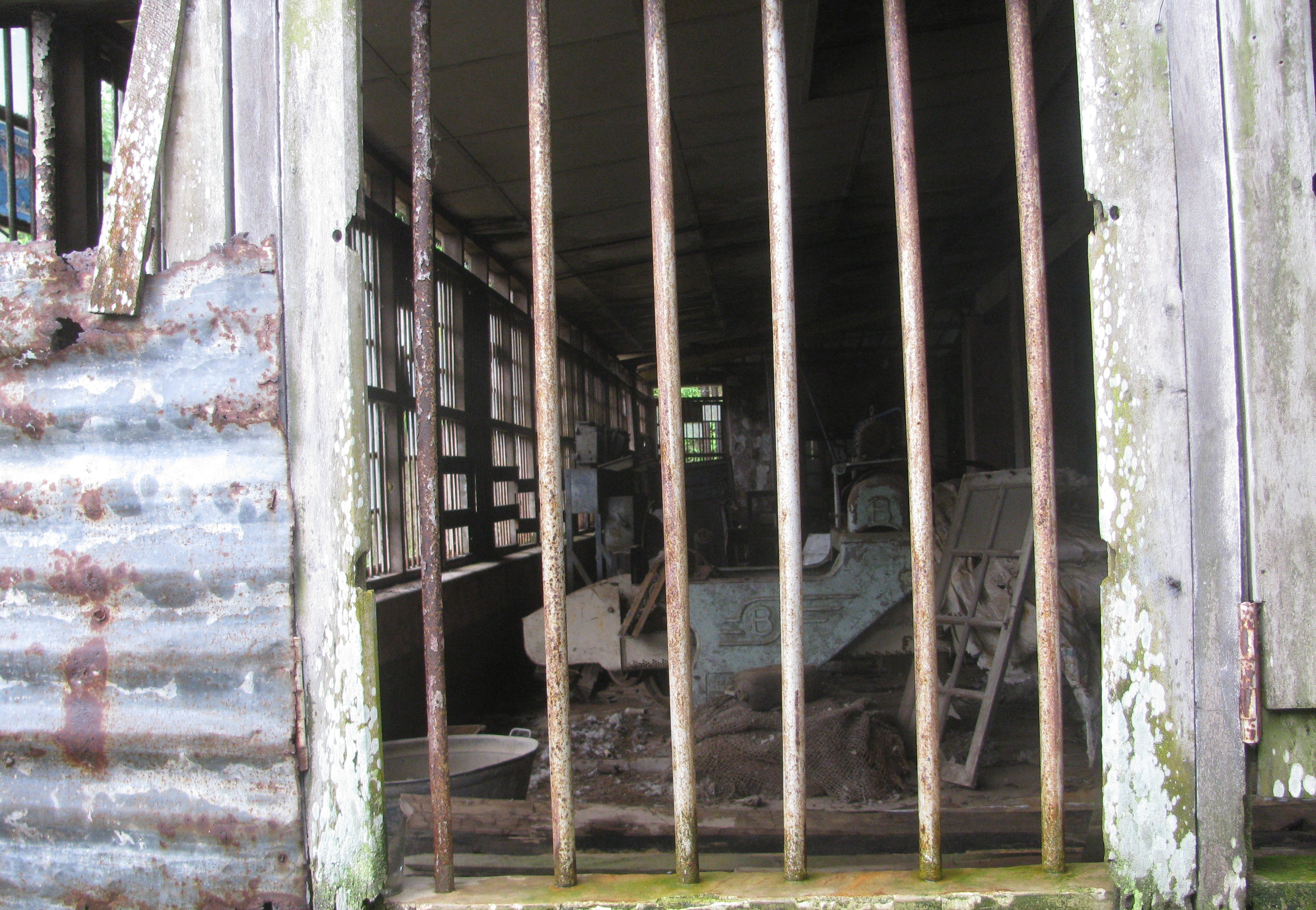
The old tea factory at Bonaccord (Photo: Shyam G Menon)

The old tea factory at Bonaccord (Photo: Shyam G Menon)

According to Binu, elephants wandered right up to the windy top of Agastyakoodam. I looked astonished at him and then towards the rock slab we had come up by. Was it that king cobra talking again? “ Elephants have their routes for coming up. Reaching here is not beyond them,’’ he said. But there was a catch – it wasn’t the normal elephant; it was a smaller, more compact one. Back in Mumbai, I searched for information on the small, hill dwelling elephant Binu had talked about and was treated to a surprise. Pygmy elephants have been reported from both Africa and Asia. The sole claim in India, unsubstantiated yet, was from the forests around Peppara, exactly where Agastyakoodam stood. The claim had come from the Kani tribe and the animal in question was locally called Kallaana. In Mumbai, a visit to the Bombay Natural History Society [BNHS], which has its team of wildlife experts, served to merely underscore the unsubstantiated nature of the claim. The whole argument about pygmy elephants, an official at BNHS felt, may be a case of mistaken identity. Juvenile male elephants are often kicked out from herds. Seen during their wanderings they would be both smaller in size and seemingly of a different type given their isolated life. Was the nimble kallaana then just a juvenile aana or elephant on its way to being a regular, big pachyderm?

Late afternoon, the next day, we were back in the smoky teashop at Bonaccord. It was tea, bread and omelet for everyone for a three day hike completed in a day and a half. It was also a return with vengeance to urban ways. Raju, searching for his mobile number to give me, got confused with the numbers of three SIM cards that he owned. More than a week later, one quiet night in Kozhikode, over four hundred kilometers north of Thiruvananthapuram, my phone came alive with a triumphant voice from near Agastyakoodam, “ sir, this is my number!’’

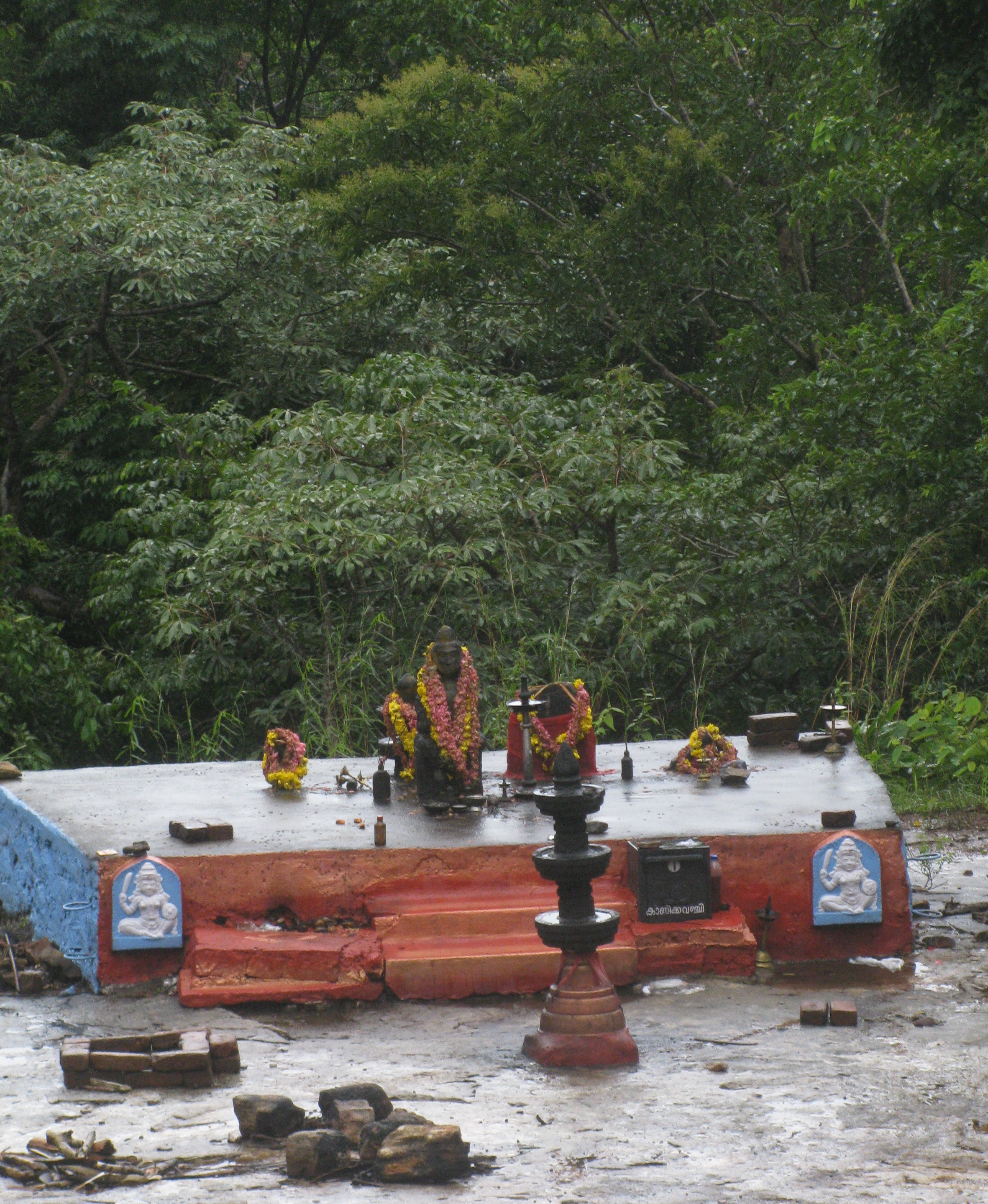
Small temple near Bonaccord (Photo: Shyam G Menon)

Small temple near Bonaccord (Photo: Shyam G Menon)

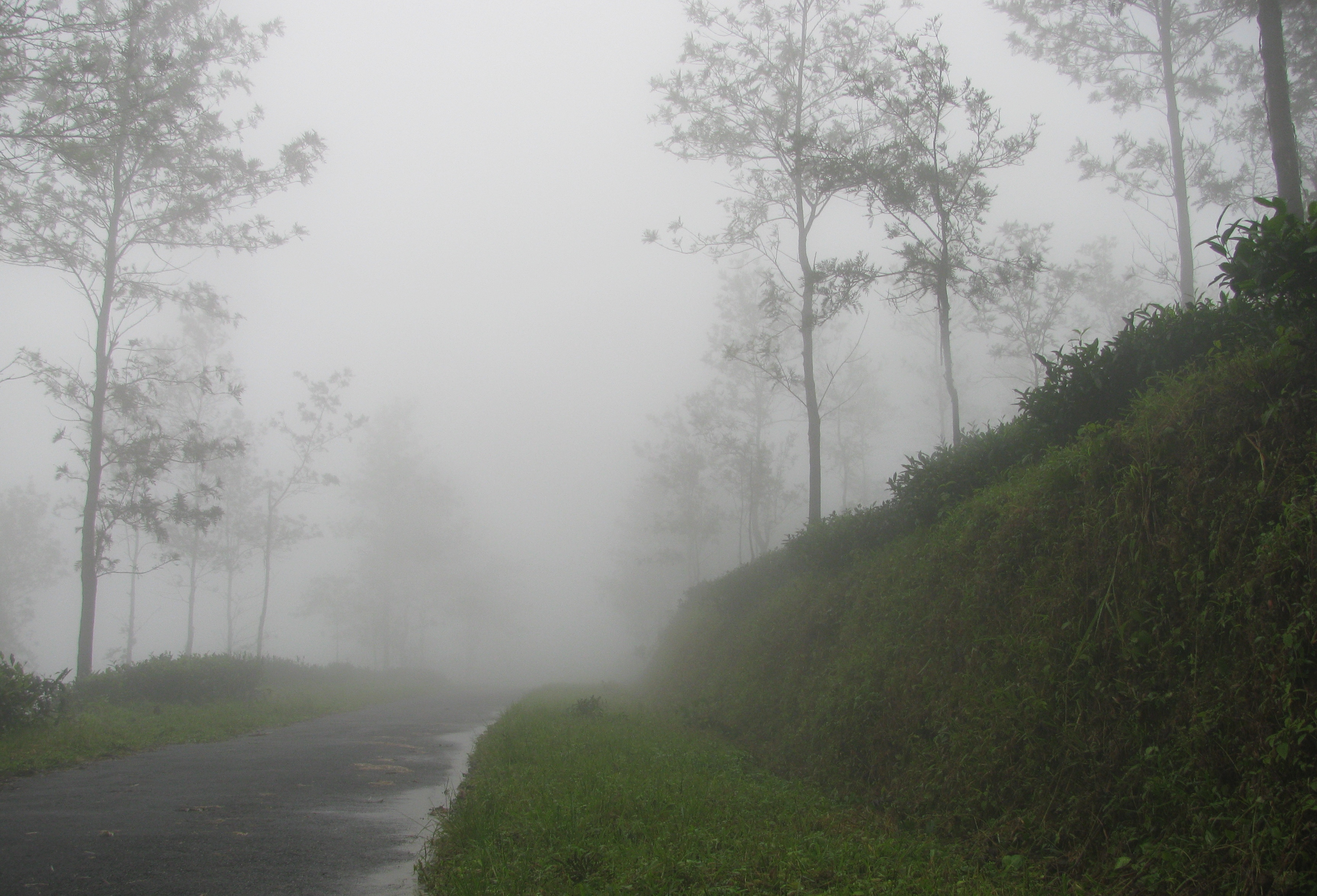
Post Script: The above was written in 2009. In the months that followed I misplaced the photographs I took during the trek. I have no photo of Agastyakoodam with me. In August 2014, while on a visit home, I decided to revisit the story and the tea estates, mainly for pictures. I didn’t have the time to meet officials at tea companies in the city but one very rainy day in early August (not the ideal time for photography I concede) I did find myself back in the tea estate-foothills. No trek; just looking around. Ponmudi was enveloped by dense fog. In that ambience, the office of the old tea estate emerged like a vision from the misty past. Kutty, who worked at the Merchiston estate and who I met on the road, told me that a new factory was being built at Ponmudi. If so, I never reached that far for up until the old office all I saw was that office and attempted new construction so lost to vegetation that it seemed abandoned. According to Kutty, Merchiston was running well. We stood at a bend on the road and watched its factory. It had a fresh coat of paint and blue sheets for roof. It was easily the most visible building around. I didn’t go to Braemore. The only time I was there was many years ago, when a walk to a beautiful stream found me standing not far from its tea factory.

Bonaccord in August 2014 was old story with new twists. Private vehicles on the road to the tea factory were being discouraged, probably due to the problem of revelers and drunken picnickers, the perennial headache of the Indian outdoors. We are a people with zero affection for solitude. At the old teashop, I met 62 year-old Soman who had commenced work at the estate as a temporary hand when he was 17. He said that years ago itself, some of the heavy machinery at the tea factory was removed and taken off. Work continued in fits and spurts, the whole area steadily sliding alongside to being museum piece. In one of those classical vignettes from colonial stories, Soman said that the daughter of a former European manager had come to visit the place of her childhood. She reached Bonaccord with old photos to locate names and faces. “ They met some of the old timers, took new photos and left,’’ he said. Right then in August 2014, the dispensation was – workers had assumed responsibility for small parcels of land. They plucked tea leaves and brought it to the factory, from where, as in 2009, it traveled to Vandiperiyar. That fetched some earnings. Not far from the teashop, tea bushes stood grossly neglected with thick intervening vegetation. The shop owner served me black tea. From worry over lack of work and entrapment in unemployment, Bonaccord seemed to have drifted to indifferent listlessness. Soman said that hearing of the workers’ condition, people – including those from overseas – had offered assistance. Some came with food, others brought clothes. “ Why should we leave? Here we have good drinking water; there are no mosquitoes, somebody helps once in a while. We get by,’’ he said. Soman claimed he did not own a house. But he could stay at the workers’ quarters. Amazingly he said that he swallows his complaints before the tea factory owners for they seemed to him, a class apart. “ You don’t feel like saying anything,’’ he said.

Outside, the rain fell steadily on that hill side with forgotten tea bushes and equally forgotten buildings, its crowning glory being a tea factory with shattered windows and rusted machinery.

It was quiet, peaceful world.

Concluded

(The author, Shyam G Menon, is a freelance journalist based in Mumbai)
MEDIA, MONEY AND ADVENTURE

Photo: Shyam G Menon

Photo: Shyam G Menon

Some months ago, in Mussoorie, I asked a senior experiential educator from the UK, why the simple experience of being outdoors wasn’t deemed as good an education as contrived outcomes delivered from the same. Why is it team-building and leadership; why isn’t it plain nature, just being there? He said I was overlooking the genesis of outdoor education in Europe in the shadow of the continent’s wars. That’s the imagination at work.

If I visit my understanding of the world I was born to, the legacy of war is more than boot camps teaching camping skills and mountaineering expeditions primed for conquest. The 20th century is the bloodiest century known to man. We fought two world wars and several local wars and battles. I recall novel after imported novel read during my college years and foreign movies watched, in which the hero was fashionably ex-army. There were lots of wars a protagonist could be veteran of – World War II; Vietnam, Korea, not to mention Afghanistan and Iraq for more recent heroes (I understood only later the tremendous psychological impact of World War I on mountaineering). Service in the armed forces or exposure to war was also there in the non-fiction realm with the biographies of some noted civilians mentioning military service.

Post World War II, our world changed drastically as the consumerist age with its giant industrial systems, and eventually the age of information technology, took off. In the century of war, corporate culture popularised the idea of war among companies and preparedness for battle within. Corporate officials are soldiers in another uniform. Indeed, once when I went to assist at an outdoor management development (OMD) program, I was intrigued to see an Outdoor Expert – OE as they are called in the business – attired in military fatigues, even as the program never left a resort’s lawns. Very likely, had he been dressed differently, he wouldn’t have seemed adequately outdoors to the clients training to demolish rivals in the market place. The world hasn’t really been at peace in the last hundred years or more; it has always been plotting war in the head. Even the media carries this tenor. Not only are large media corporations the stuff of corporate and competition, the media – especially business media – loves to see a war in tussles for market share and company acquisitions. I understand now why it is so unglamorous to be out in nature just for the heck of it without achieving something. I understand why no runner worth his / her salt will run without looking at the watch. Achievement has become proof of existence.

As the perceptive would say, nowadays such conflict also arises from straddling two different cultures – indoors and outdoors. If you want to make sense (and sense is compulsory for money), then you have to be relevant to indoors for that culture has the world’s money. Go outdoors to be poor and spiritual; go indoors to be rich and materialist – that would seem the case. Like generals at war strategising from safe zones, money likes to stay safe while its extended fingers explore the unknown. Reports reach headquarters from the field informing of challenge and progress. Occasionally, the indoors is borne outdoors in great comfort. Most important perhaps – unless you are achieving outdoors, you outdoor ventures don’t get support from indoors. It is the old arena mentality. Over time, a certain quality of contemplation has exited the outdoors. Triumph by well funded expedition and reduction of activity to action have become dominant. It reflects the world’s ways. First, success matters. You do what it takes to be successful including success guaranteed through commercial contract. Second, if you think habitually, you will probably wander off into avenues of imagination that are counterproductive to becoming successful. Equally, it is a noisy world and adding noise in your head through thought when world outside is already a din, seems invitation for disaster. Why think when we can dull thought through action? A climbing video – its dialogues, its editing style, its attitude – is often lifeless despite the action in it. We try to compensate with stunning visuals but there is only so much CPR can do to breathe life into dead video. Besides, we are tired of seeing the same CPR over and over again. Increasingly the stuff of smart packaging, the longevity of each media fad and format is shrinking. Few people talk of it – we are gradually exhausting our appetite for media, especially synthetic media.  

At the recently concluded 2014 annual seminar of the Himalayan Club, both the guest speakers – Marko Prezelj (leading alpinist from Slovenia) and Jim Perrin (climber, well known author from UK) – mentioned world addicted to media. From what I could glean and adding my thoughts as well, I believe, the problem works at several levels. First, there is the declining value of first hand assessment. As Marko pointed out, many people are experts ahead of being on their chosen mountain, thanks to Google Earth. A tool can help but a tool shouldn’t replace a whole mountain. If that is acceptable, then why venture out to be on the mountain? Don’t forget, climbing and mountaineering are tactile pursuits. Second, at the retail level, many of us – and that includes climbers – are hooked to social media, trusting its response to validate our existence. What is a great climb? The one that gets most likes on Facebook? This media circus can become questionable distraction. Joke or not, one of the greatest young alpinists of our times is said to have attempted a dangerous mountain face solo with more batteries for his media / radio equipment than food to eat. When he got stuck, the suffering became great media. On the other hand, amid the seductive blend of adventure and publicity, it has become common habit to climb something – anything – and put it on social media because an established motor response to lauding climbs gives anything vertical the licence to seem massively adventurous. The applause becomes an endorsement of adventurer although the vast majority of us are doing tame stuff and even the great climbs we do are routes already done by others. No matter how far we go the relation between us and everyone else – our social world – trails us like a conspiracy brokering means to fame in the head.

Marko appropriately wove into his presentation a clip on mountaineering from Monty Python (http://www.youtube.com/watch?v=9U0tDU37q2M), the British comedy series. If we climbers take ourselves a little less seriously, we will notice the element of conquest and drama we strive to introduce into an account of even the smallest hump climbed. Over the years, technological innovations and improved climbing styles have actually reduced the risk on many climbing routes. Yet a video of climbing Everest via the normal route with all frills and bells attached, still labours to create a Hillary and Tenzing of everyone following in their footsteps.

Photo: Shyam G Menon

Photo: Shyam G Menon

Perhaps the reason for such media is because we want to make ourselves impressive and saleable. Saleability is imperative for the funding models of climbing and mountaineering. Welcome to the third point – in a strange mirror-like situation, the expedition model resembles a triangular peak. Only a few people reach the mountain summit to hog all the attention. For that, many unnamed others and plenty of resources are used. If the supporters / sponsors have to be incentivized to contribute, they must get a piece of the final glory. It is return on investment, bang for the buck. As demands for mileage multiply, climbing narratives converge to similar idiom. It is less mountain, more compulsions of business model. Worse – everybody is still mesmerized by old stories of blood and gut. What do you do if you didn’t grunt, groan and spill blood? It is a sad state of affairs – the sponsor wants mileage; even first time trekker wants mileage and hunts for mountaineering-like moment on flat land to put on Facebook. I know it myself – it is hard to write what you did on a mountain in simple language devoid of drama, when the urge within is to sound like true blue adventurer. Vanity interferes. With the funding models we have, that vanity not only got institutionalised, it also got condoned as necessary ingredient for without imagery of vintage adventure, who wants a narrative in the media and without media where is sponsor’s bang for his buck? We have condemned ourselves to the limited world of the permanently extraordinary. To me, one of the greatest moments in Marko’s presentation was when he described a very long period spent in the mountains as – it was becoming too much. At that point on the mountain, he wishes to be back home with family. Not surprisingly, in Marko’s presentation, his family and their house, appear as fulcrum periodically. My learning here is not family or house but a senior alpinist like Marko, acknowledging “ too much.’’ At heart, the outdoors is an aesthetic. It is that simple. Let me add something here on the media, an animal I am familiar with. Many reasonable headlines I gave the outdoor articles I submitted for publishing were replaced with headlines suggesting `top,’ `summit,’ `conquered,’ `peak’ and such in them. It was as though anything happening on the mountains couldn’t be seen differently. It had to be conquest. Another regular is the word `tough.’ A lot of imagination in the media about climbing revolves around this word. The reason this happens is clear – the media’s patrons are all indoors. The far opposite of indoors will hence attract. Now think – what would happen if this media got embedded in our brain? Marko offered an aesthetically extreme view but one that definitely engaged. How solo is solo climbing if next to the climber there is a cameraman dangling from a rope filming everything? For Marko, solo means `alone.’ I call that an extreme view because it could mean no media, no freelance journalist. I however concede – that is a ` pure’ view.  

For the heck of climbing’s philosophy – and everybody agrees that the core philosophy of anything in climbing is a drift to the pure ethic – can we have a seminar to debate viable expedition models that preserve freedom and mountaineering in the real sense? Can there be sponsors who don’t seek return on capital? People who give because they find something intrinsically valuable in adventure? Maybe even adventurers who are happy to do what they can with just available resources and sponsors who have means other than traditionally imagined ` mileage’ for returns? How about a sponsor who says – I don’t care for summit but give me a completely environment friendly expedition? How about someone who says – I believe in mountaineering as human heritage, so here’s the money? If there is reformed ethic in the tail and the tail wags the dog, won’t expeditions be different? I therefore won’t say that the outdoor community should court the extreme of declining help from those with capital to preserve purity of ethic; I submit for consideration – have we conveyed what the outdoors means, well enough, to those having capital? And for that, do people in the outdoor community have a genuine understanding of the outdoors in the first place?

Think about it.

(The author, Shyam G Menon, is a freelance journalist based in Mumbai)
THE STORY OF `PSYNYDE’

Here’s a story from 2013.

It has been updated to include developments till January 2014.

Vinay in action.

Vinay in action.

Vinay is rarely on the ground.

In photographs, he is usually cyclist airborne.

Either that or, he is a streak of dust gathering speed as he rolls down an  inclined hillside, probably prelude to a launch. When I met him in early 2013, Vinay Menon’s reputation could be summed up as – he is forever jumping off things. That’s how he described himself, “ I am always jumping off something or the other.’’ On the Internet he had a following. He was considered to be the best `free rider’ in India. Mountain biking has several disciplines under it – Dirt Jumping, Slope Style, Trials, Cross Country, Four X, All Mountain, Endurance, Street and Free Riding among them. Of these, free riding values self expression and creativity, being a demonstration of what the rider can do with his bicycle, skills and terrain. Although he respects all disciplines and indulges in several, Vinay’s forte is free riding.  As yet there didn’t seem to be anyone around in India who was pushing the sport as Vinay did. Driven, his efforts had got him travelling overseas, meeting and interacting with international cyclists that he looked up to – names like Brett Tippie and Dan Cowan. Closer to my world of writing, Vinay was also Deputy Editor of the Indian cycling magazine `Free Rider.’ I first met him in Mumbai, when he was passing through town, part of a long, north-south ride with clients.

During the brief chat, I heard of Praveen.

Welcome to the story of Psynyde.

We shift to Pune, western India’s adventure capital. Like Bangalore further south, it has that change effecting-matrix of educational institutions with students from all over and a young mobile workforce at engineering companies and IT outfits, exposed to trends elsewhere and open to trying out new things. Praveen picked me up around lunch time. He drove his car slowly to a Subway outlet. We found ourselves a table. Then, Praveen sat nervously, his eyes on the bicycle mounted on the car’s back, the car visible through the eatery’s glass doors. That bicycle was seriously precious. It was the reason for our conversation. The road outside was busy. It doesn’t take much to flick a light road bike off a car’s back or do something to damage it. Praveen’s nervousness was understandable. A little later, if I remember correctly, he managed to keep the bicycle in safer territory, near a security guard. That done, he relaxed.

Praveen and Vinay

Praveen and Vinay

Vinay got interested in mountain biking in the mid-1990s. By then, Praveen Prabhakaran, was already an established addict of the sport in Pune. Both mentioned Sameer Dharmadhikari, then at Mumbai IIT, who was committed to mountain biking and was a pioneer of sorts. A complete idea of the sport was yet evolving. The youngsters used Indian cycles and existing trails on nearby hills. They banked on overseas mountain biking magazines, the occasional video and TV program for a sense of what to do. But as Praveen and company rode hard, jumped and abused their bikes in an effort to be like the foreign riders, one constant prevailed – they frequently damaged their cycles which were not designed for such riding or such levels of abuse. Needing spare parts frequently, Praveen sold old newspapers to raise funds. Naturally, there was a limit to such funding. On the other hand, there seemed to be no end to how much a dedicated cyclist could push his cycle to repair. Slowly Praveen’s interest drifted from pushing the ante in his chosen sport to tinkering with cycles. How do you make them suited for the sport; how can they stand up to abuse?

In his first experiment, Praveen took a rigid frame Indian mountain bike (MTB) and made it into a dual suspension cycle, subsequently named (perhaps aptly) `Frankenstein.’ Then, the story gets wilder. In his second such modification – this time a friend’s Indian dual suspension-MTB that wasn’t compressing properly – he outfitted the cycle with Bajaj M80 suspensions altering the whole cycle in the process. “ It worked!’’ he said. And as things got wilder like this, he understood the interdependence of bicycle dimensions, engineering and components. A bicycle is a wholesome organic unit; you don’t simply take one element out and stick another in. A commerce graduate into 3D animation but no backdrop in engineering, Praveen steadily moved to making bicycles – in the literal sense of making; that is, manufacturing them – his life’s aim. When in his animation career, he got laid off at one of the biggest companies around, he said enough is enough and launched headlong into what he always wanted to do – make performance bicycles.

The Subway was now busy with office goers come to eat. Vinay had joined us. We seemed misfits in the suddenly emergent purposeful corporate-ambiance of the restaurant – the restless dreamer who makes cycles, the long haired-cyclist whose sense of career may puzzle regular office goers and freelance journalist, who may be fashionably free but is forever short of money.  Back to the story – Vinay’s trajectory had progressed differently from Praveen’s. He was hard core mountain biker, very much into riding and skills. Unlike Praveen he hadn’t shifted focus to obsessing with the mechanics of bikes although that day in 2013 he owned nine cycles, some of them top notch. But having pushed bikes to the limit, he too had a feeling of what they were and could be. Praveen’s craze to craft performance bikes appeared synergic with Vinay’s hard riding. They seemed an ideal combination of designer-craftsman and tester.

What next?

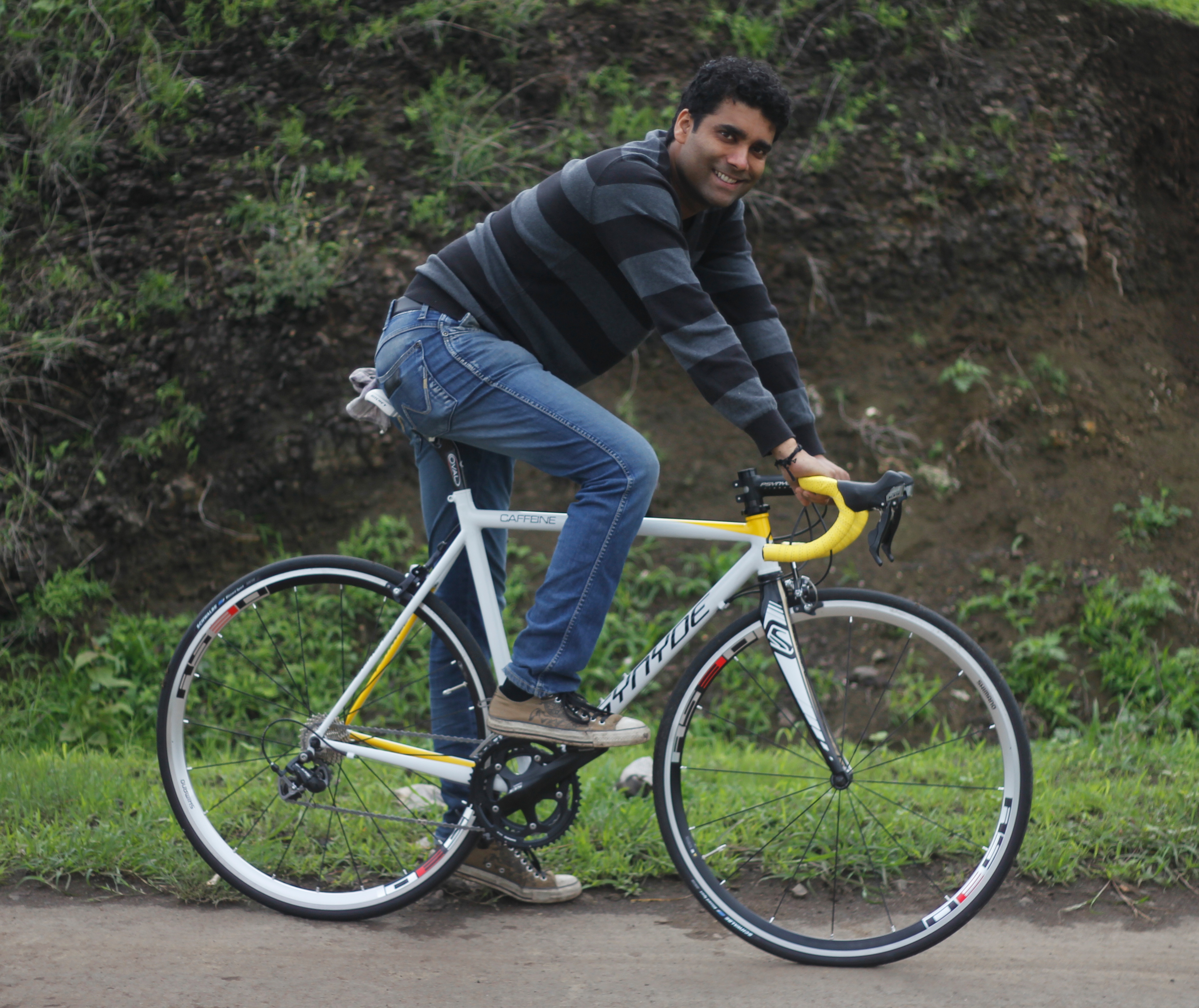
Praveen with the Psynyde Caffeine.

Praveen with the Psynyde Caffeine.

Enter `Psynyde’ – that’s what the two named their fledgling enterprise. To start with, Praveen underwent customized training in Computer Aided Design (CAD) and focussed his initial manufacturing efforts on bicycle components like stems, seat clamps and bash rings. Vinay tested it. He also gave it to his cyclist friends overseas for testing. Feedback was encouraging. While this was on, Praveen began designing a bicycle. The two friends agreed that their first hand built-Psynyde bike should be a road bike because mountain biking was yet in its infancy in India. Not to mention, MTBs are more complicated to make. Praveen did considerable homework. There was the research on materials, sourcing the materials (triple butted niobium steel alloy from Italy), selecting tubes of the right strength, relating tubes to preferred ride quality, learning frame geometry, adapting the geometry to suit rider dimensions and mastering the art of joining tubes to make the frame. If required, the erstwhile 3D animator also makes the cycle’s fork from 4130 chromoly (chromium molybdenum alloy) steel. The bike debuted in July 2012. Two cycles made so far and two underway it had found customers in Pune, Bangalore and Andaman and Nicobar islands. Save some specialized tasks like brazing, Praveen did most of the work. Home doubled up as workshop. And in case you hadn’t guessed it yet – that was a Psynyde mounted to the back of Pravin’s car. The specific model, which he had chosen to retain for personal use, was called `Caffeine.’

The typical customer in this niche category is a serious cyclist, who knows the difference that right sized frame, correct geometry and good quality materials bring to performance. “ I believe we are the first in India to custom-build high performance bikes using high quality materials,’’ Praveen said. The Psynyde bike costs more than a similar looking off-the-shelf bike but is cheaper than comparable custom built cycles overseas. If all goes well, from measuring the customer for optimum frame size to delivering the bicycle, it takes approximately 1-2 months. The ` performance’ segment that Praveen referred to was his chosen differentiator’ there were others also building bikes. A March 2010 news report mentioned Zubair Lodhi and Faisal Thakur in Mumbai, who made customized, sometimes theme based-bicycles. In 2011 and 2012 The Hindu reported about Bangalore based-Vijay Sharma who made eco-friendly cycles using bamboo. Psynyde, Praveen said, customized for high performance. That’s the underlying philosophy. Vinay as tester, emphasized the intended direction.

Traditionally in India, the bicycle models produced by a handful of mass manufacturers have been staple diet. The companies making these cycles owed their DNA to controlled economy, not DNA in performance biking. It was mass manufacturing. Simply put, it meant – they made, you bought unquestioningly. Slowly – and perhaps one should say: reluctantly, for portions of the market were far ahead of the companies in terms of imagining cycling – that has changed. The leading bicycle companies have introduced new indigenous models besides importing cycles from overseas (please see the story: Cycling’s Second Youth posted in August 2013 on Outrigger, for an overview of the Indian bicycle market / industry). Still, a company can rarely match the deep end experience that enthusiasts cobble together. At Psynyde, you have two young cyclists using their knowledge and field experience to build performance cycles. Overseas such teams have birthed strong brands. Dig into bicycling history and you will stumble on brands whose genesis can be traced back to small enterprises, often founded by cycling enthusiasts. However small these early Indian attempts in the niche maybe it’s hard to ignore the passion. Before me was a young man, old enough to be as well employed as anyone in Pune’s corporate crowd. He could have been one of those breezing into the Subway outlet and eating a meal over corporate gossip or plotting next move in corporate career. Yet he had made cycling his life. The other person had chucked up his last job and walked into a crazy dream of making bicycles that had somehow lingered eternal in the head. I repeatedly asked Praveen how he, a 3D animator, learnt about materials, fabrication and welding techniques, normally seen as the turf of bicycle factories. He said if you are determined, you learn. Perhaps I also overlooked the nature of the bicycle – it is technology and simplicity at once. Years ago, the first bikes pedalled by these two Pune cyclists had been Indian makes. Those cycles are the guinea pigs that triggered a journey, which from another perspective is a measure of how different the new market is, compared to the old one. Not surprisingly, a news report from April 2012 said that the two dominant domestic players – Hero and TI – planned to introduce customization. But no matter what big companies do, the beauty I found in this story of two cyclists was quite simply that they did what they liked. They pursued it diligently, seriously.

The Psynyde Alchemist

The Psynyde Alchemist

January 2014.

Praveen and I met in Pune for an update on the old story. As said, the first bike model – a road bike – was called Caffeine. I remember it as precious strapped to car’s back. The second model was a cyclocross (looks like a road bike but can go off road too) called `Hammerhead’ and sold to the client in Andaman & Nicobar. The new models due – thanks to orders received – included the track bike `Alchemist,’ fashioned from stainless steel. There is the planned touring MTB named `Jaisalmer,’ which will be a mix of MTB frame in steel and touring essentials like rack mounts at the front and back for luggage. Also planned is a rather ambitious dual suspension MTB, which Praveen reckons will be his toughest assignment yet. It will be partly made of aluminium, the first time Praveen will work with that material. The designer and builder of cycles had also got himself a new job as photographer; something he said was necessary for income even as he kept building cycles.    

That’s the story of Psynyde.

(The author, Shyam G Menon, is a freelance journalist based in Mumbai. This is the expanded version of an article previously carried in The Hindu and Man’s World. The photos used herein were provided by Vinay and Praveen.)      

HUBLI-DHARWAD: LIFE AFTER THE LEGENDS

BEST WISHES FOR 2014.

HERE’S A STORY, ORIGINALLY WRITTEN IN 2011. IT HAS BEEN UPDATED TO PROVIDE LINK TO MORE RECENT TIMES.

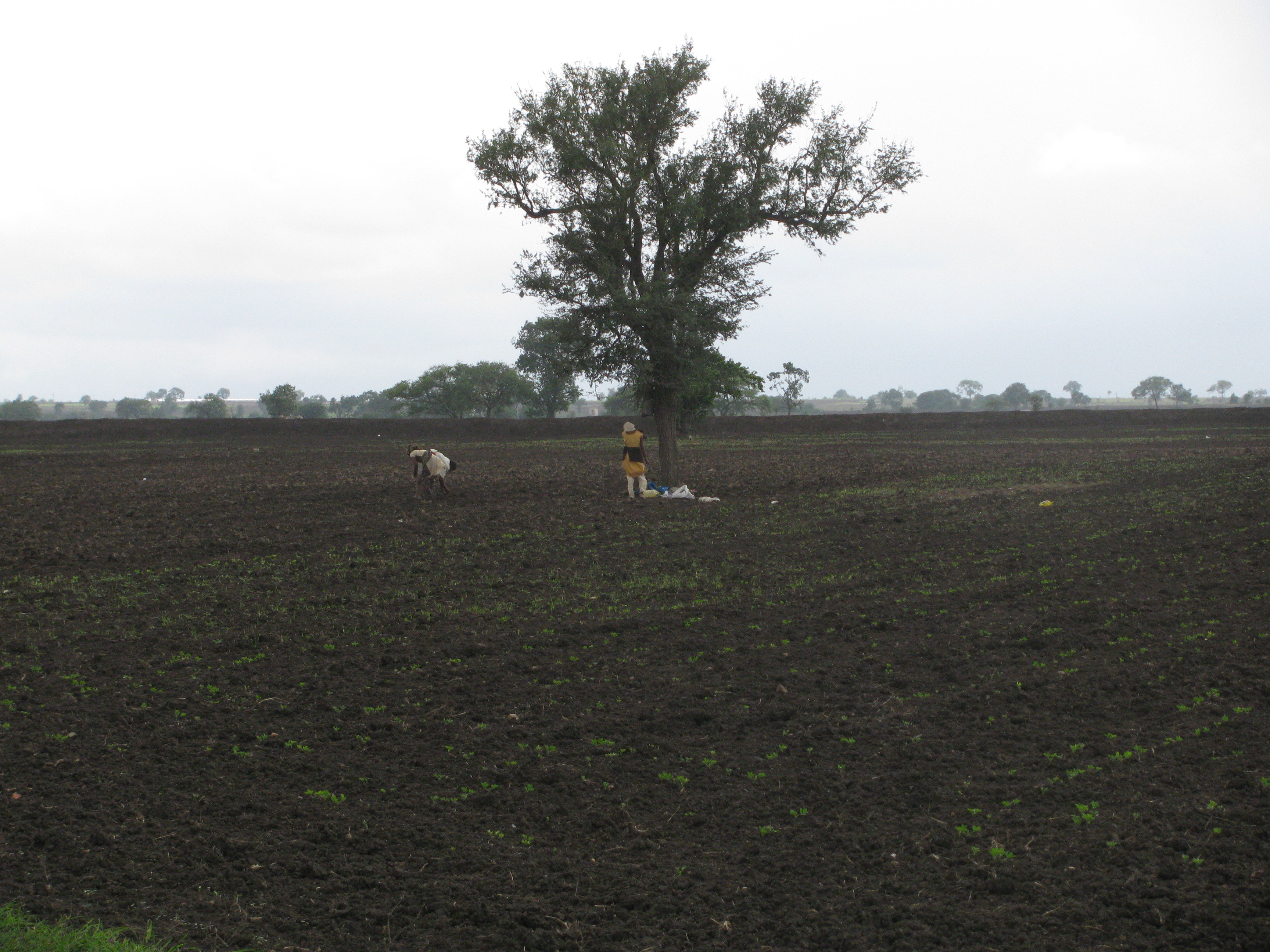
Landscape: fields of North Karnataka (Photo: Shyam G Menon)

Landscape: fields of North Karnataka (Photo: Shyam G Menon)

End October 2013.

At a concert organized by the Mumbai-based Khayal Trust, Pandit Venkateshkumar took the stage. A Hindustani classical vocalist, he was assertive, subtle, strong and delicate, the discerning use of these abilities making his interpretation of compositions, engaging. I can’t identify raagas; I simply like or dislike music – any music – as aural experience. In the outdoors, I have tracked rivers – from relatively calm flow in the foothills to turbulent upstream and almost inaudible trickle at source – noticing how their character changes. Venkateshkumar’s singing had something of that. He seemed to be singing from a bigger understanding of subject and not merely indulgence in the specific; it wasn’t a section of the river amplified ignoring the whole, it was the whole. On stage, neither was his support crew behaving like sycophants unto him nor was he synthetic in his encouragement of them. A singular chemistry prevailed – chemistry by music. No drama, no playing to the galleries – the proof of the pudding was my brain, soothed to peace; a connection to its home – the universe – made.

This was the second time I heard Venkateshkumar and the first time I was inside the auditorium when he sang.  The previous occasion had been a well attended modest sized gathering in the Mumbai suburb of Chembur. The venue, mere hall and no sophisticated auditorium, was filled to capacity. Chairs outside had also been taken. People stood patiently; listening as attentively as they would, had they been on a seat within. I joined them. Why should anything else matter if the music is good?

The first time I met Venkateshkumar was before I heard him sing.

It was 2011.

Along with good friend Latha Venkatraman, a journalist who has learnt classical music for many years, I was exploring a story in northern Karnataka, way south of Mumbai.    

On January 24, 2011, Pandit Bhimsen Joshi passed away.

With that India lost its most famous voice.

His was a mad, rough edged-reaching out; different from other contenders to be India’s voice and certainly quite apart from that other tradition of Indian classical music – Carnatic. I like to let go (it is also what I find most challenging and what I do the least). In contrast, Carnatic seemed perfect and deliberate, a sort of antidote to madness. Bhimsen Joshi hailed from Gadag, next door to Hubli-Dharwad in North Karnataka. Born there, he was bitten by the music bug, travelled through India in search of a guru and was finally directed to Sawai Gandharva in nearby Kundgol itself. The rest is legend amply conveyed by the great man’s music. What intrigued me was Hubli-Dharwad. Music lovers there sometimes called the place a LOC (Line of Actual Control) between Hindustani music and Carnatic. Yet within Hindustani classical, it is unique for not only being the southern outpost of the tradition but also, a reclusive, defiant, academically inclined ambience that cares more for dedication and purity than the market.

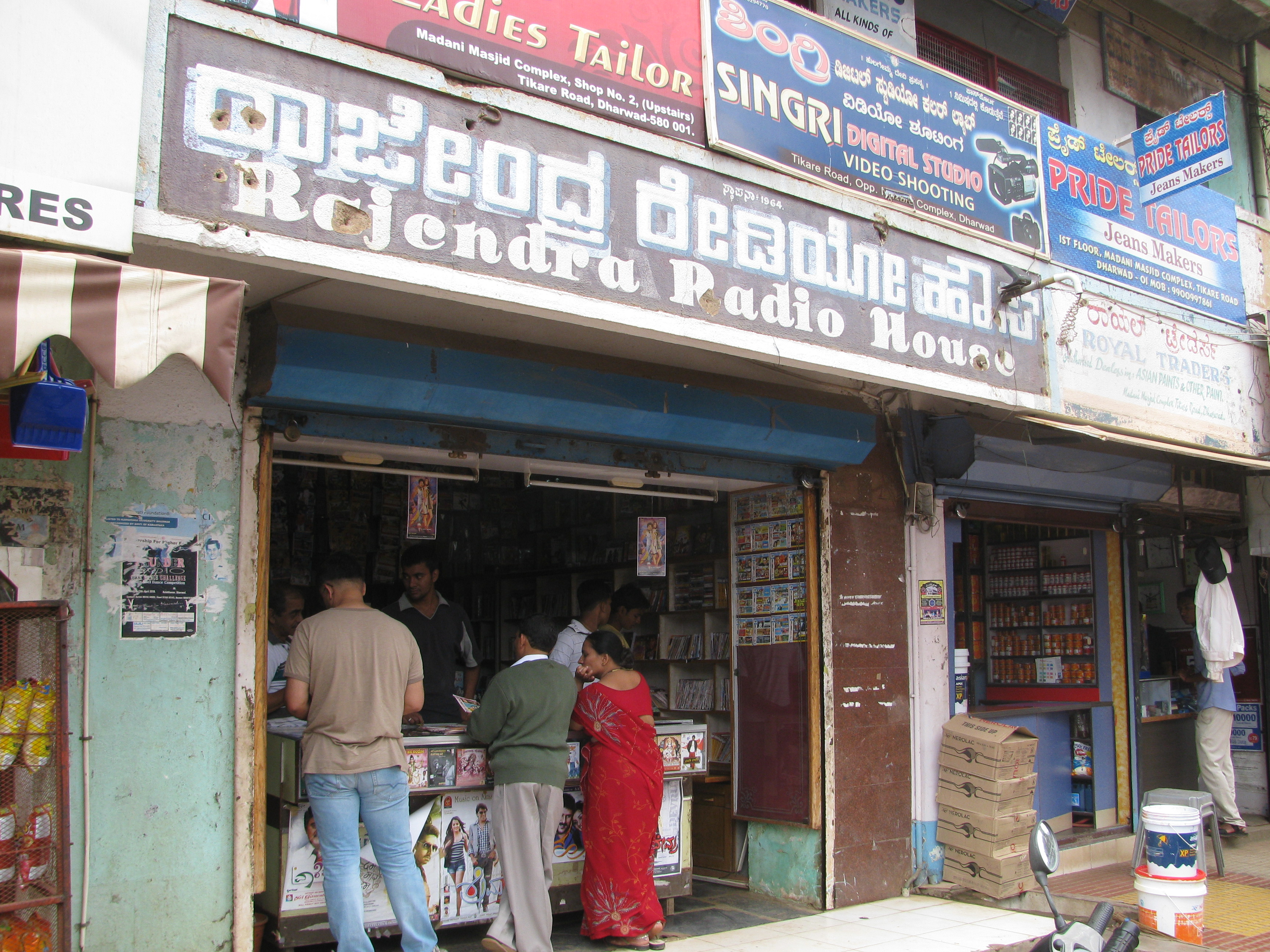
Rajendra Radio House, Dharwad (Photo: Shyam G Menon)

Rajendra Radio House, Dharwad (Photo: Shyam G Menon)

Geographically the region bridges that portion of Karnataka which is home to the wet, green hills of the Western Ghats and the start of the Deccan plateau with its imposing flatness. To one side, in the rainy season, the lush vegetation is so pronounced that it contrasts crops like cotton and chilli, typically associated with frugal water intake, grown on the other side. The Hubli-Dharwad region, once part of the Vijayanagar Empire, was subsequently in the possession of rulers from both Karnataka and   Maharashtra. Until 1955, it was part of Bombay Presidency. Hubli, the commercial hub of North Karnataka, is a major cotton market and centre for a variety of agricultural produce. At the vegetarian restaurant of Ananth Residency hotel, I asked for North Karnataka food. It wasn’t available; recommended instead was “ Veg Rajasthani,’ something possibly evocative of the region’s place in trade. The leading brands of Dharwad pedha were Thakur and Mishra, neither of them surnames indigenous to the area yet now synonymous with pedha. Hubli was also where the typical motifs of Indian urban life were taking hold. There were shopping malls, stores with walls of flashing TV screens, ATMs and hotels. Then another LOC of sorts divided it from Dharwad, 20 kilometres away. The local transport bus took you through a busy road with 40 kilometre-speed limit. Approximately three quarters of this travel done, at Navalur as people would later tell me, the atmosphere changed to charming old world flavour. You entered Dharwad.

Ramakant Joshi (Photo: Shyam G Menon)

Ramakant Joshi (Photo: Shyam G Menon)

As pronounced as Hubli’s commercialism, was Dharwad’s conservative, academic tenor. Its prominence in history was as an educational hub, the place where people from North Karnataka, Goa and Southern Maharashtra came to study. According to Ramakant Joshi, Editor-Publisher, Manohara Granth Mala, it was Dharwad’s educational backdrop along with an existing culture of theatre and literature that provided a fertile substratum for Hindustani classical music to flourish. The office of this publishing house founded on August 15, 1933 (those days August 15 signified the birthday of Sri Aurobindo) was lined with Kannada books and located in an old room above Subhas Road. Ramakant Joshi is Bhimsen Joshi’s cousin. Unlike in Hubli, in Dharwad, you found shops that hadn’t changed for decades. You bought classical music CDs at Rajendra Radio House, run by Basavaraj V. Kotur, who informed that the shop started in 1964 had been one of the first four music stores in Karnataka. Only two shops from that four remain. There was also relevant change – the Srujana auditorium, where many concerts are held, had been refurbished with help from Nandan Nilekani, former CEO of Infosys and currently chairman, Unique Identification Authority of India (UIDAI). Dharwad looked peaceful, there was plenty of greenery and the people you spoke to had a conservative demeanour but amazed by their quiet erudition on chosen subjects. Here a musician or music lover might confidently tell you that he or she is known in the neighbourhood. As we discovered, that wasn’t always true but it was a measure of how comfortable you could be, pursuing the classical arts in this town. Neela Kodli was easy to talk to. In between she went to the kitchen to make tea. Like many of us she hummed a tune, except it was a classical composition. Neela Kodli is the daughter of Mallikarjun Mansur. A singer in the shadow of a famous father, she was modest about her abilities.

Neela Kodli (Photo: Shyam G Menon)

Neela Kodli (Photo: Shyam G Menon)

There were few concerts in Dharwad that June. It was the rainy season. Otherwise, we were told, you found one or two every week. The vast majority of these concerts were free. “ There is no problem doing an early morning practice session here. In fact, if they don’t hear me practise, my neighbours ask – didn’t you practise today?’’ Vijaykumar Patil, an upcoming Hindustani vocalist said. With so many singers and musicians around, it was possible for a music lover to strike a rapport and sit in on their evening training sessions even if all he had was a love for music. `Kansens’ (those with good ear for music) have always been as important as `Tansens’ in Dharwad. This coupled with resident music gurus and new music schools helped create an audience for Hindustani classical music. In turn, that made performing in Hubli-Dharwad, a prized opportunity for visiting artistes. You knew you were singing to those who knew the subject. Applause here became highly valued. Raghavendra Ayi, Secretary, Sitar Ratna Samiti, provided an example of how Dharwad responded to music. Following Bhimsen Joshi’s demise, it was decided to organize an eight day music programme from February 27 to March 6 that year, in his memory. Many of the performers were young artistes. With expenditure projected to touch two lakh rupees (Rs 200,000), the organizers made an appeal for contributions. The amount thus collected exceeded a lakh, most of it donated by individual music lovers. “ To survive, any art requires janaashraya. The days of rajaashraya are over,’’ he said. (Jana in Indian languages refers to people; Raja refers to king and Aashraya means dependence or in the context of art, patronage.)

The Vijayanagar Empire had a strong role in the evolution of South India’s Carnatic music. The famous composer Purandara Dasa was born in modern Shivamoga district and spent his final years at Hampi, next door to the Hubli-Dharwad region. His compositions are sung by Hindustani classical vocalists. One version has it that Swami Haridas, teacher of Tansen, was a disciple of Purandara Dasa. Thus music was always around in these parts. Hubli-Dharwad’s ascent in Hindustani classical music happened with the decline of the Mughal Empire up north. As the empire weakened, the singing tradition of its court moved first to princely states in North India. Then as British influence gained in those princely states, the drift to the south started. Abdul Karim Khan was a famous singer of the Kirana Gharana, one of the schools of singing within Hindustani classical music. He was court singer in Baroda state. On his way to the court of the Mysore kings, who were patrons of classical music, he regularly halted in Hubli-Dharwad. In his book `Karnataka’s Hindustani Musicians,’ author Sadanand Kanavalli has particularly noted the role of the Mysore king, Krishnaraj Wodeyar IV. Mysore continues to this day as a major centre for Carnatic music. It was that less known intermediate halt en route, Hubli-Dharwad, which developed into the southern outpost of Hindustani classical music. Through the years music researchers have wondered what worked to Hubli-Dharwad’s favour. In a November 2009 issue of `Sangeet Natak,’ a newsletter from the Sangeet Natak Akademi, Tejaswini Niranjana, outlining her proposed research into these questions noted that some of  “ the common and (uncommonsensical) answers’’ included Abdul Karim Khan’s visits, the pleasant weather in Dharwad, the large number of Maharashtrians there who were music patrons, the influence of  Marathi culture in the form of Marathi plays having Hindustani music with Kannada plays subsequently derived from them and even the chillies and spicy food of North Karnataka that cleared the throat. “ The answers are inadequate even on their own terms. If Abdul Karim Khan’s final destination was Mysore and he went there frequently, why did he not teach disciples there?’’ she asked.

Nadgir family house, Kundgol (Photo: Shyam G Menon)

Nadgir family house, Kundgol (Photo: Shyam G Menon)

Among the most important institutions that patronised Hindustani classical music was an old house at Kundgol, once part of the princely state of Jamkhandi. Not far from Hubli, Kundgol and several other surrounding villages used to be under the control of the land-owning Nadgir family, who were patrons of music. Abdul Karim Khan visited here. More importantly for North Karnataka’s music, Abdul Karim Khan’s most famous student Ramachandra aka Rambhau Kundgolkar was born in Kundgol. Later called Sawai Gandharva, he had a pivotal role in the history of North Karnataka’s Hindustani music. His life was entwined with the Nadgir family. He taught music at the old house; this was where Bhimsen Joshi and Gangubai Hangal learnt. We met Babasaheb Nadgir and his son, Arjun Nadgir, who live there. Every year since 1952, the family has been organizing a music festival currently

Babasaheb Nadgir and Arjun Nadgir (Photo: Shyam G Menon)

Babasaheb Nadgir and Arjun Nadgir (Photo: Shyam G Menon)

called the Nanasaheb Nadgir Smrithi Sangeeth Utsav. Hundreds of people turn up to hear this 24 hour-performance, which lasts through the night. The house is as it used to be, so much so that an entire audience crammed onto its many floors to hear the concert has triggered worries of the 400 year-old building collapsing. The architecture is typically old fashioned featuring a courtyard within. The musicians practise in an inner chamber and then perform on stage inside the house, adjacent to the courtyard and below a bust of Sawai Gandharva. It is tradition kept alive purely through family initiative and at considerable cost. The Nadgir family and a few close friends spent up to one and a half lakh rupees (that was the figure when I visited); they didn’t seek donations. Arjun was working on proper institutional shape for the funding so that it self-sustained. The family had dreams of starting a music school. Kundgol also had another music festival in Sawai Gandharva’s memory.  Several noted Hindustani classical artistes – Bhimsen Joshi, Basavaraja Rajguru, Gangubai Hangal, Kumar Gandharva, Mallikarjun Mansur, Pandit Jasraj, Prabha Atre, Feroz Dastur, Puttaraj Gawai – they have all performed at Nadgir Wada. For many who go to sing there, the very act of performing in a house where legends lived is overwhelming. The artistes are paid for travel cost; they get nothing else. “ The ambience is special,’’ Jayateerth Mevundi, a prominent vocalist from the younger generation, said.  

Jayateerth Mevundi (Photo: Shyam G Menon)

Jayateerth Mevundi (Photo: Shyam G Menon)

Given Abdul Karim Khan as the historical prompter for Hindustani music’s arrival in Hubli-Dharwad, the region became the southern home of the Kirana Gharana, a style with origins in Uttar Pradesh. But you also find in Hubli-Dharwad other styles like the Jaipur Gharana and the Gwalior Gharana. They co-exist. From Abdul Karim Khan down, we hear of several important names. Broadly speaking, they can be divided into two categories – the legendary performers from Hubli-Dharwad and the great teachers like Sawai Gandharva. For a tradition of music to grow you need both these categories. As you ask around, you realize that great performers were not necessarily great teachers just as great teachers were not necessarily great performers. The great performers were five – Gangubai Hangal, Bhimsen Joshi, Mallikarjun Mansur, Kumar Gandharva (he was born near Belgaum and later moved to Madhya Pradesh) and Basavaraj Rajguru. Of them, one – Gangubai Hangal – was a phenomenon. Her influence exceeded the world of music. In Hubli, we just had to ask for the late singer’s house and the autorickshaw driver knew where to go. Her house had become part museum. Gangubai Hangal had to overcome many social challenges to become the renowned singer she was. In later years, she did not hesitate to be a social activist for causes she believed in. It was exceptional in that, it took a classical vocalist out from the conventional image of exclusivity and singing for patrons, to being one with the masses. Consequently if anyone from the legendary five has become close to an institution in Hubli-Dharwad, it ought to be Gangubai Hangal. There was however one problem. With Bhimsen Joshi’s demise, the last of those five greats passed away. Further, except for Basavaraj Rajguru, none of the others were credited with robust teaching.  They left behind few disciples. That’s why Hubli-Dharwad was suddenly important for anyone interested in Hindustani classical music, like me. The phase of the legends was over. Will the region continue to maintain its strong position in musical tradition?

Veereshwar Punyashram, Gadag (Photo: Shyam G Menon)

Veereshwar Punyashram, Gadag (Photo: Shyam G Menon)

The Veereshwar Punyashram in Gadag appeared a blend of religion, community and music; an official brochure informed that the presiding pontiff was seen by devotees as “ a walking God on the Earth.’’ Looking past its prime when I was there in 2011, this institution was founded by Panchaxari Gawai, a blind prodigy in classical music. Over the years, the ashram accepted many poor, often visually and physically challenged children and trained them in classical music. Basavaraj Rajguru was Panchaxari Gawai’s student. Following Panchaxari Gawai’s death in 1944, Puttaraj Gawai took charge. He became blind through treatment for an eye problem in his childhood but later amazed as vocalist and musician.

Venkateshkumar (Photo: Shyam G Menon)

Venkateshkumar (Photo: Shyam G Menon)

Venkateshkumar – he teaches at a music college in Dharwad and is acknowledged to be among the finest Hindustani vocalists today – was Putturaj Gawai’s student. Born in Lakshmipur village near Bellary, Venkateshkumar was thirteen years old when he was brought to the ashram in 1968. He studied there for eleven years, maintaining a rigorous training schedule and learning 25-30 raagas from his guru. Even after Venkateshkumar left the ashram his interaction with his guru continued till Puttaraj Gawai was ninety years old. Puttaraj Gawai died in 2010. In 2011, across the school and the college on its premises, there were nearly 800 students.       

Kalkeri Sangeet Vidyalaya (Photo: Shyam G Menon)

Kalkeri Sangeet Vidyalaya (Photo: Shyam G Menon)

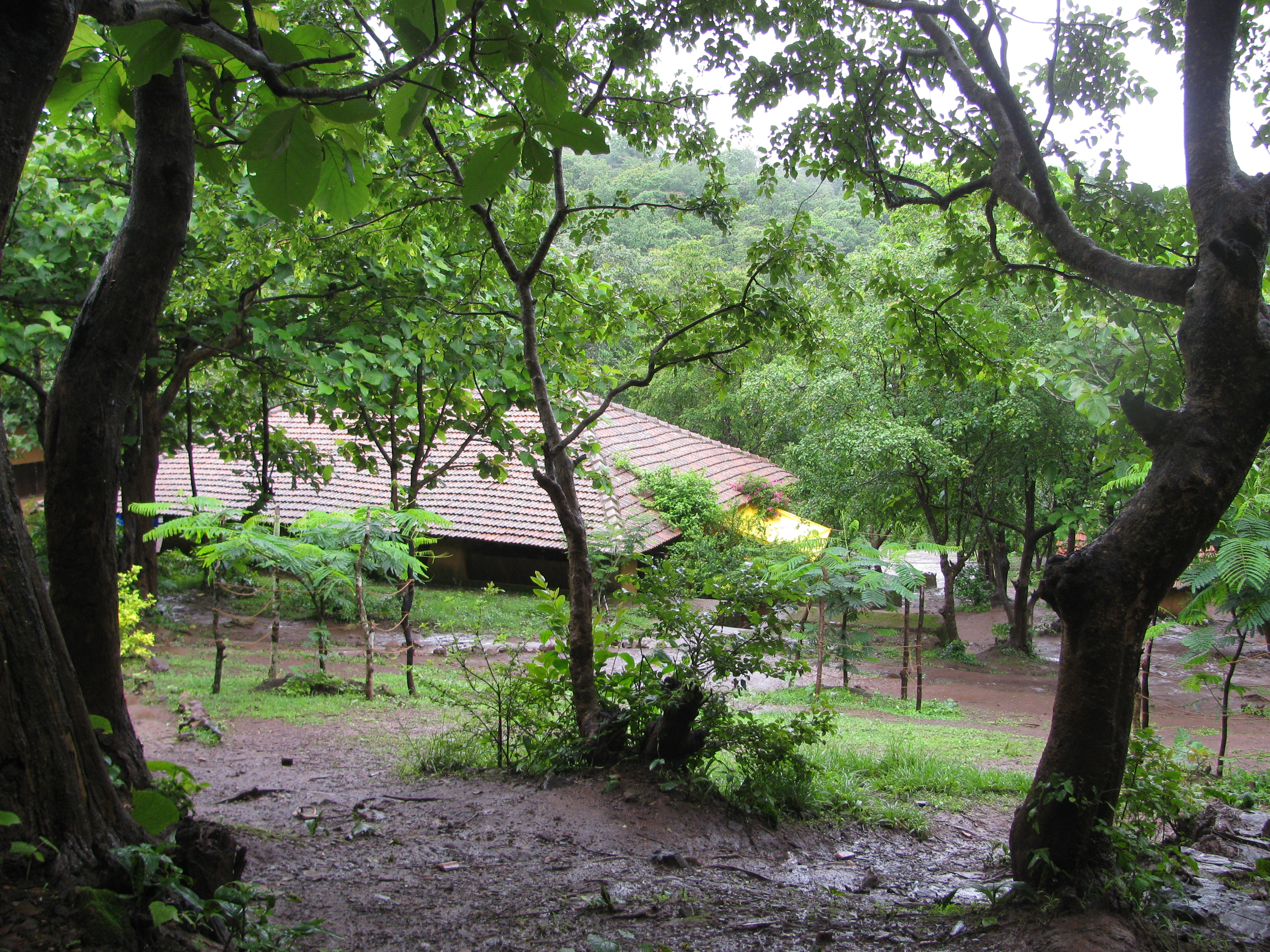
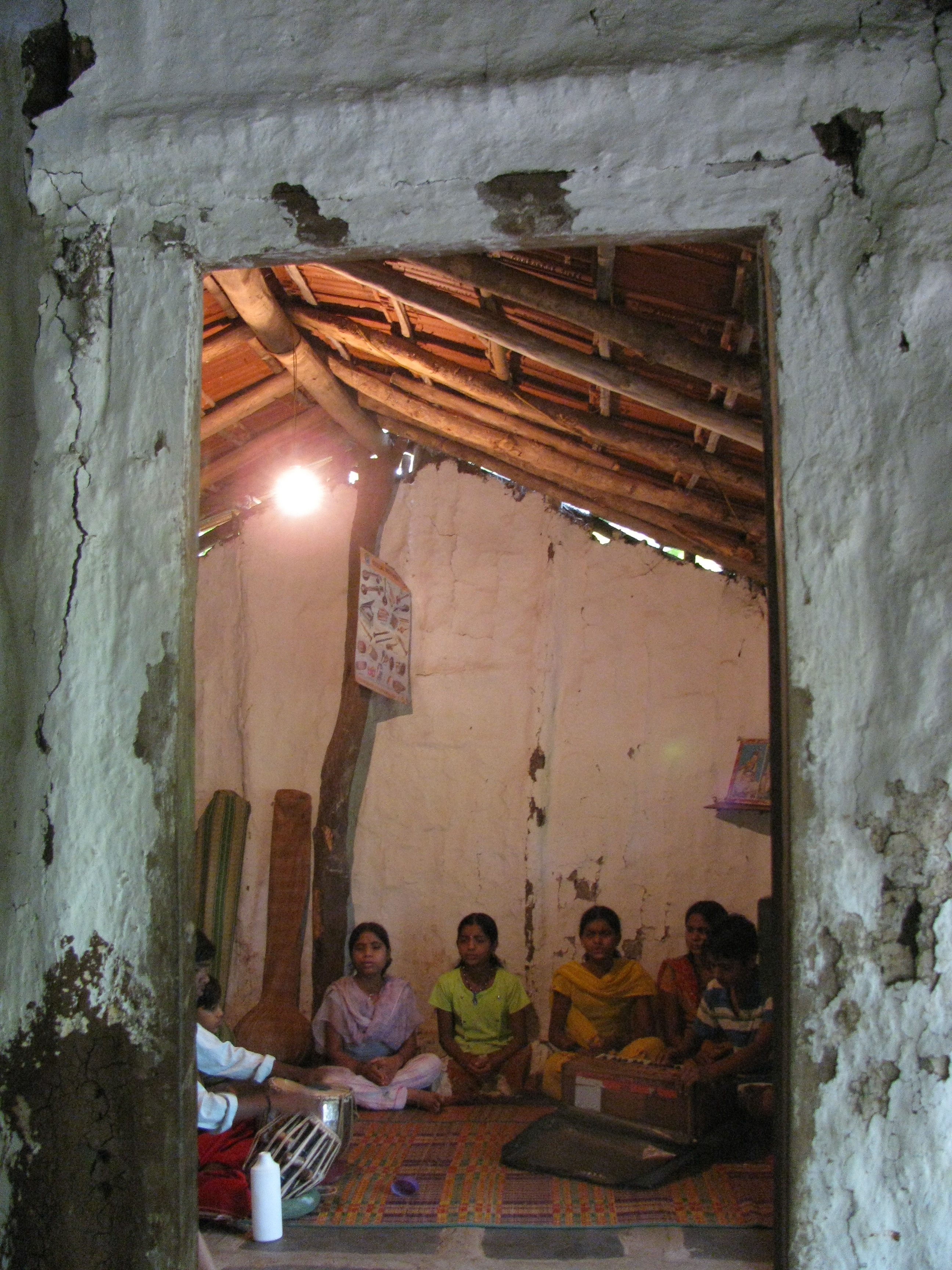
Following their studies, some students of the ashram had become teachers at the Kalkeri Sangeet Vidyalaya. Begun by Agathe and Mathieu Fortier, a Canadian couple who liked India and its tradition of Hindustani classical music, the school was located almost an hour away from Dharwad in geography that was the exact opposite of the Gadag-Kundgol belt. Here the land was hilly with red earth muddied by heavy rains and densely vegetated to the point of seeming forest. The school was in the woods, a collection of eco-friendly structures with 185 students and 43 full time staff. According to Adam Woodward, Director, the admission process tried to ensure that only the neediest students got through. The students paid no fees. They did a mix of music, dance and formal studies. Many of the children we met spoke Hindi and English (at any given time the school has about a dozen

Students singing at the Kalkeri Sangeet Vidyalaya (Photo: Shyam G Menon)

Students singing at the Kalkeri Sangeet Vidyalaya (Photo: Shyam G Menon)

volunteers from overseas), something useful to link training in classical art forms to the outside world. Its present location was second stop for the school. Previously it was at a leased farm in Kalkeri. The owner wanted to sell the property. Seeing its good work, the local village authorities granted it the current land. With time and growth, this had become inadequate and the school was looking for bigger, more permanent premises in the region. The Kalkeri Sangeet Vidyalaya is part of a unique organizational structure authored by its founders. Mathieu and his brother Blaise set up Young Musicians of the World (YMW) in Canada. Every year, as of 2011, it managed two fund raising concerts abroad to collect funds for the school in Kalkeri. This aside, the objective was to open similar schools elsewhere in the world; there were ongoing talks in France to start a music school for the Romany gypsies. Another location interesting YMW was, Mali in Africa. The eventual idea was to have music exchange programmes and concerts. To enable this, YMW required the Kalkeri school, indeed any school it started, to slowly become self reliant in funding. Moves were afoot to make this happen.

The third institution we saw was expected to formally start work from July 1, 2011. Named after Gangubai Hangal it was a modern gurukul set up by the Karnataka government on the outskirts of Hubli. It could accommodate 36 students and their teachers. The gurukul pattern finds considerable respect among musicians in Hubli-Dharwad as one of the ingredients separating the performing artiste from the merely trained artiste. As many people pointed out, the music schools and colleges were important to create a learned audience for Hindustani classical. The performing artiste however needed a guru who knew him or her well; understood the student’s abilities, role modelled and confronted them with challenges. It was one-on-one education, an apprenticeship. According to Manoj Hangal, Gangubai Hangal’s grandson, the government announced five crore rupees (Rs 50 million) and five acres of land for the project in 2005. “ All approvals came within three days,’’ he said. Six gurus of different gharanas were each planned to teach six students for 3-4 years. The teachers expected at the gurukul included Prabha Atre and N. Rajam. There would be visiting faculty from other universities. The emphasis was on creating performing artistes; that meant a student cannot enrol for any other academic programme. Total government expense for the impressive campus had touched eight crore rupees (Rs 80 million) and there would be recurrent expenditure of Rs 15 lakhs (Rs 1.5 million) to maintain it. “ We want public access to the gurukul,’’ Manoj Hangal said pointing out how that only fit in with the reputation and legacy of Gangubai Hangal in Hubli-Dharwad. 

Manoj Hangal (Photo: Shyam G Menon)

Manoj Hangal (Photo: Shyam G Menon)

So would these training schools, music colleges and the large number of students, ensure that Hubli-Dharwad continued to generate fantastic performing artistes?

Between talent and recognition lay the market.

Hubli-Dharwad is an intriguing symbiosis of dedicated training away from market forces and giants born from that discipline who became icons in the far away markets of Mumbai, Kolkata and Delhi. With Bhimsen Joshi’s demise, the days of those legends had seemingly ended. There was a robust new generation in Hubli-Dharwad. “ I am confident we will be able to fill the vacuum,’’ Kaivalya Kumar Gurav, an established vocalist and teacher, said. But for many others, with so much of change authored by not just music, the market loomed in the distance like an inorganic entity speaking a different language. If you looked back to the previous three generations or so of Hindustani classical performers, each generation had found the proverbial wind beneath the wings in factors ranging from royal patronage to the ascent of radio and recorded music. The first now belongs to a bygone era; the latter two are now past their prime. What survives is the impact of all this on the market – better awareness of classical music with the masses and support of music by the `classes.’ Opportunities are available. Question is – who gets them in these years of survival through smartness? Does smartness constitute music and how smart should Hubli-Dharwad be when its beauty, perhaps uniqueness, is that it has been distant from the market?

One problem you hear is how major public performances have got dominated by the same, few names. Sponsors rule the big concerts in the metros (although Hubli-Dharwad has a tradition of concerts organized by aficionados willing to contribute for the purpose, sponsorship has arrived here too). Big ticket sponsors, seek the maximum bang for their buck and it often means, correspondingly less concern for upcoming talent within the music world. Result – they plonk for the established names, setting in motion a vicious cycle of promoting the same names, even their children. Travelling through Hubli-Dharwad, this new age networking and success by successful networking saddened me because North Karnataka not only produced great musicians in the past but some of them – like Gangubai Hangal –  questioned tradition and confronted the social networks and privileges of their era. The citation for the 1989 Ustad Hafiz Ali Khan Award, given to Gangubai Hangal, began with this sentence, “ you are among the legendary group of women who braved social scorn and ridicule in establishing classical music as a noble profession for women in modern India.’’ Now as we celebrate the age of the social network and as the social network becomes the new tradition, talent has become secondary again. We haven’t changed; we seem to simply reinvent the old. At Gadag, we ran into young Ayyappaiah Halagalimath who learnt classical music at the Veereshwar Punyashram and went on to complete his MA in Music with top honours. A student of Venkateshkumar, he was guest lecturer at the same college where the maestro worked. Like many who studied at the ashram, Ayyappiah hailed from a poor family. He has performed in big cities. But lacking good Hindi and English, he was hemmed in by his inability to tap the social network. That worry was writ large on his face. Between talent and recognition, there is the market; there is that network. It plagues every field and as the network grows in importance, I wonder – are the best in every field necessarily what the commercial network showcases as the best, the most successful? 

The gurukul named after Gangubai Hangal, in Hubli (Photo: Shyam G Menon)

The gurukul named after Gangubai Hangal, in Hubli (Photo: Shyam G Menon)

A common way of introducing upcoming music talent to the market is by clubbing their performance with that of a big brand musician. So you have that half hour or one hour at start by a mid-level artiste and then a performance by the big brand who the sponsor thinks is the real talent. According to musicians, although intended to help, this practice simply institutionalises upcoming talent as secondary to established names. Because it is presented as upcoming talent requiring a walking stick (the established big musician), it reinforces the paradigm of sponsor deciding talent as opposed to the audience doing the same. Differently put, in the name of the market we may be belittling the intelligence of the audience in the age of janaashraya. Why not let the audience choose? But then how perfect are choices by audience? At stake amidst sponsors and the market compulsions of media formats (like reality TV shows) claiming to represent popular tastes, are entire crafts. “ One of my students topped a reality show. Now all his singing is for the channel. Reality programmes make you a success prematurely,’’ a senior artiste and teacher, said. Arguably, all media – including this blog – is imperfect, to the extent that an article or a photograph or a TV programme is usually a slice of something, never the evolving whole or the whole in the context of everything else. And if, for alternative, you choose to merely stream real life as media, you miss intellect – which is a serious drawback in today’s media filled-world. Reduced by media to voyeurism, abject competition and consumerism, we succeed more and more with lesser and lesser dimensions in the head. We become dumb? I suspect so.

Prof Vasant Karnad (Photo: Shyam G Menon)

Prof Vasant Karnad (Photo: Shyam G Menon)

A point that frequently surfaced in discussions on what shaped the performing artiste was how the legends became what they were despite few raagas taught by their gurus. The rest was dedicated, hard work. Over eight years, Abdul Karim Khan taught Sawai Gandharva just three raagas. His rationale was – if the student understood those three well, he would pick up the rest. Sawai Gandharva taught Bhimsen Joshi three raagas. Nothing happens without personal drive. “ There can be many students but there is only one disciple,’’ Professor Vasant Karnad, well known musician, music critic and teacher, and elder brother of Jnanpith Award winner-Girish Karnad, said. Legends are not born from a market state of anything. How long will it be before the next Gangubai Hangal or Bhimsen Joshi?

Between the two, the next Gangubai Hangal would be a litmus test for Hubli-Dharwad. It was a question nobody could offer convincing explanation for – why haven’t there been great women singers from Hubli-Dharwad other than the legendary Gangubai Hangal? Some cited marriage, family responsibilities et al. At least one school official that we spoke to confirmed that convincing families in villages of the practical use of an education in music was difficult and within that, getting the girl child enrolled was more so. It seemed the other side of conservative society, which by virtue of its conservatism steels an individual’s resolve to pursue his or her talent but also leaves many in the dust. Finally, there was the concern over where the general drift in the world was headed and what that meant for Hubli-Dharwad. “ With the growth of industry, the cultural milieu will fade. Formerly we used to say that food and knowledge should never be bargained or sold. Today, they have become the most important items of business,’’ Ramakant Joshi said.  

I got back to Mumbai. Freelance journalist’s article was published. In August 2011, Professor Vasant Karnad passed away. He had been a delight to talk to during the brief while we met him. We remain grateful for that conversation, the opportunity to meet him. End-October 2013; backstage in Mumbai, Pandit Venkateshkumar recognized us from the old visit (in 2011, we had gone to his house in Dharwad). We exchanged greetings. Established singers, aspiring ones and students of music had already flocked to him after the concert. I am none of that. I identify with his music thanks to what is at once a restlessness and peace, found in the outdoors. It inhabits many fields and I suspect that the word in English which comes closest to describing the condition is – seeking. A mind cast so finds peace in sense of universe.

Music, the outdoors – it is all One.

(The author, Shyam G Menon, is a freelance journalist based in Mumbai. He would like to acknowledge the help provided by Latha Venkatraman, journalist and student of Hindustani classical music, towards writing this article. A portion of this article pertaining to the Kalkeri Sangeet Vidyalaya was published as an independent piece in The Hindu Business Line newspaper. A slightly abridged version of the entire story was published in Man’s World magazine.)  

THE CAVES OF MEGHALAYA

This story is written weaving two streams of thought.

One is in normal text; the other is in italics.

PLEASE READ FOOTNOTE AS WELL FOR UPDATE.

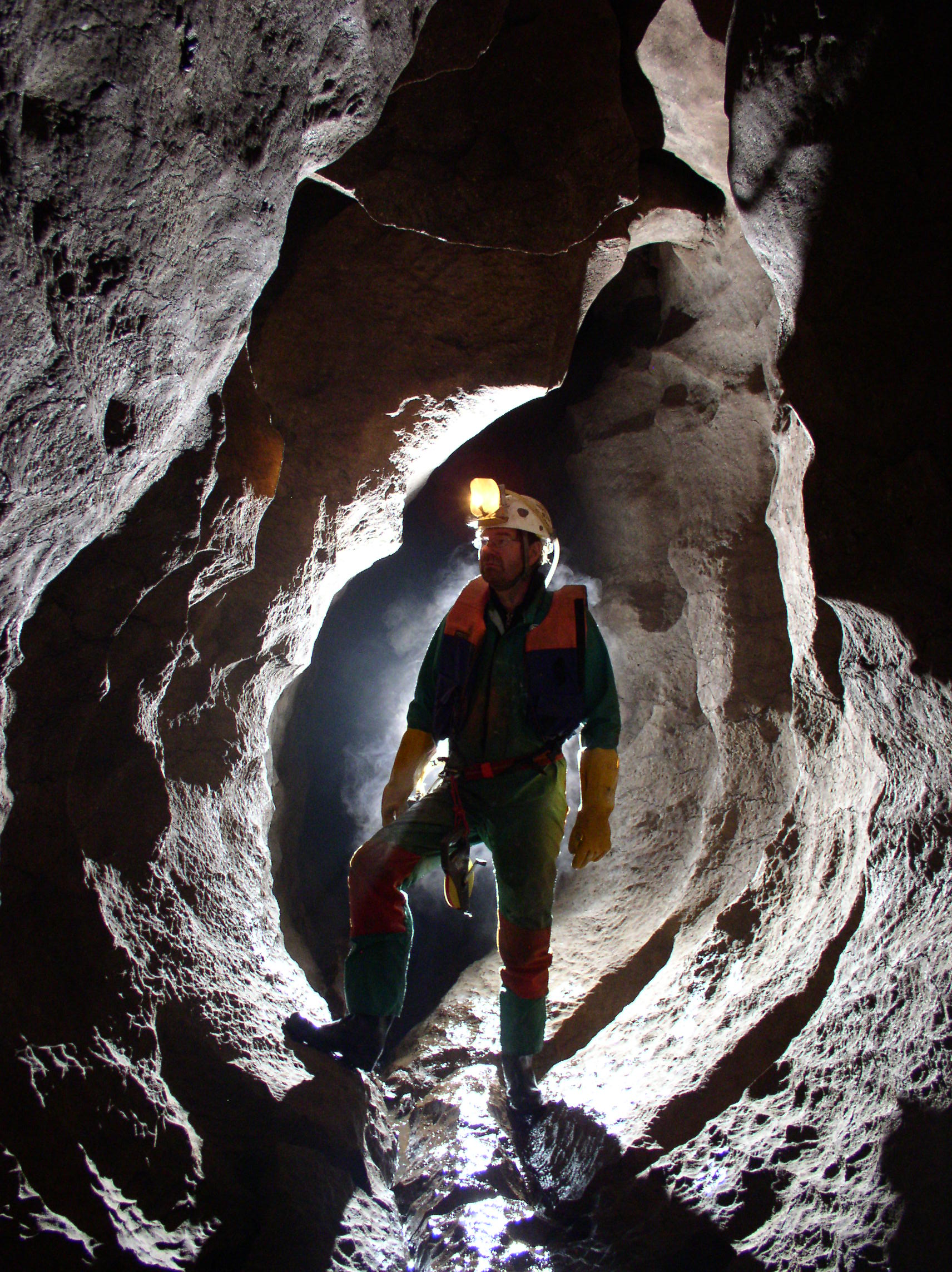
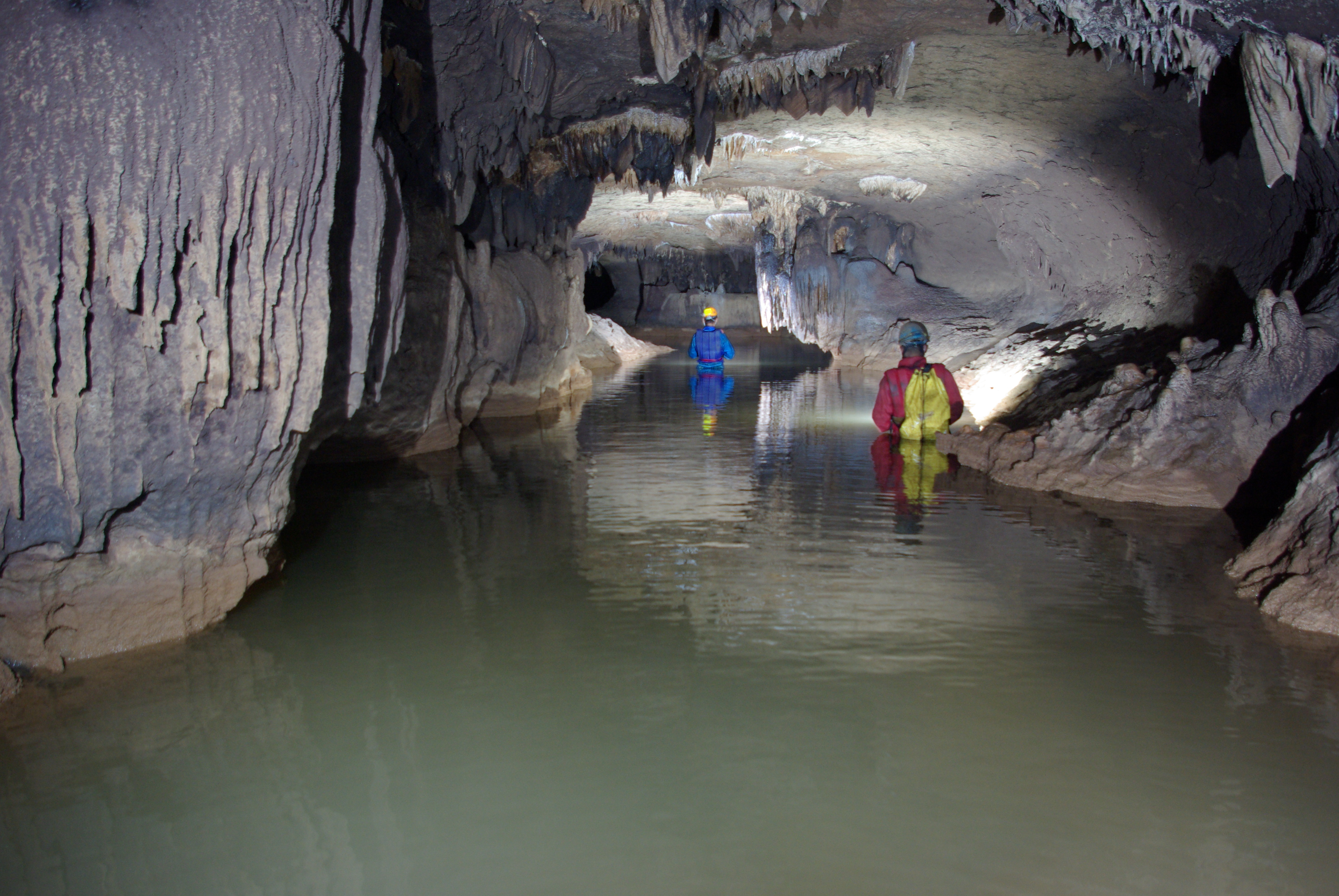
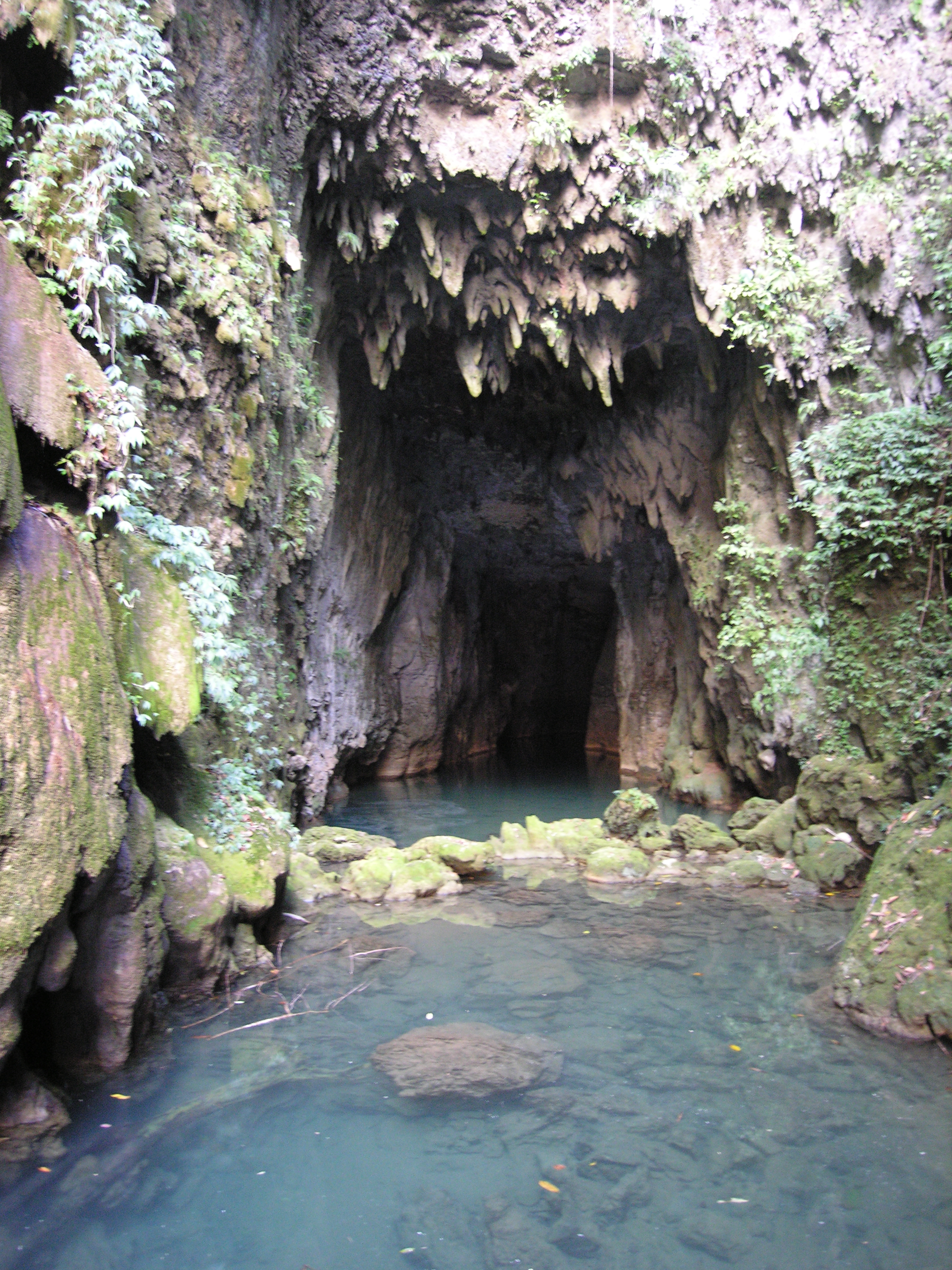
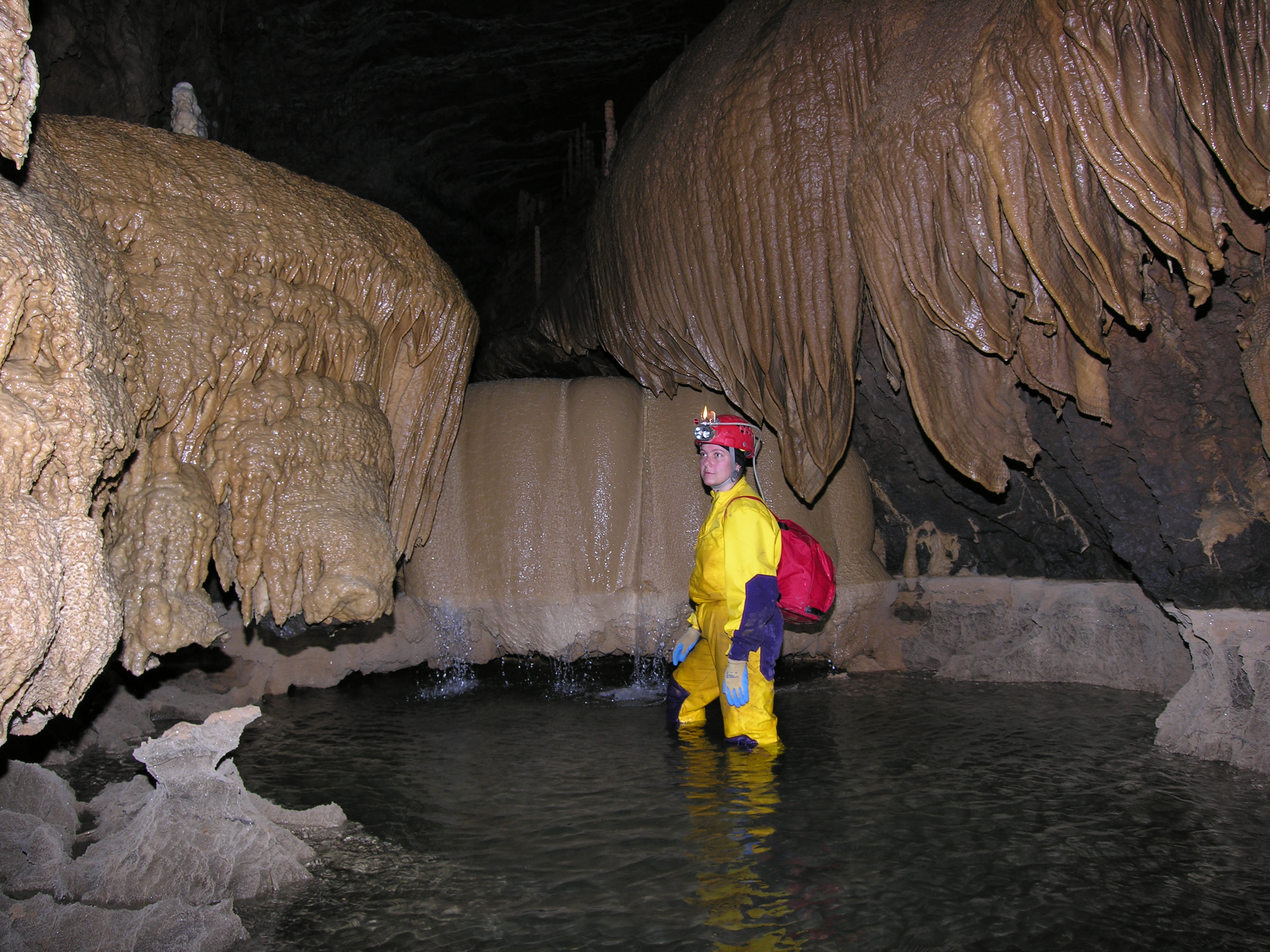
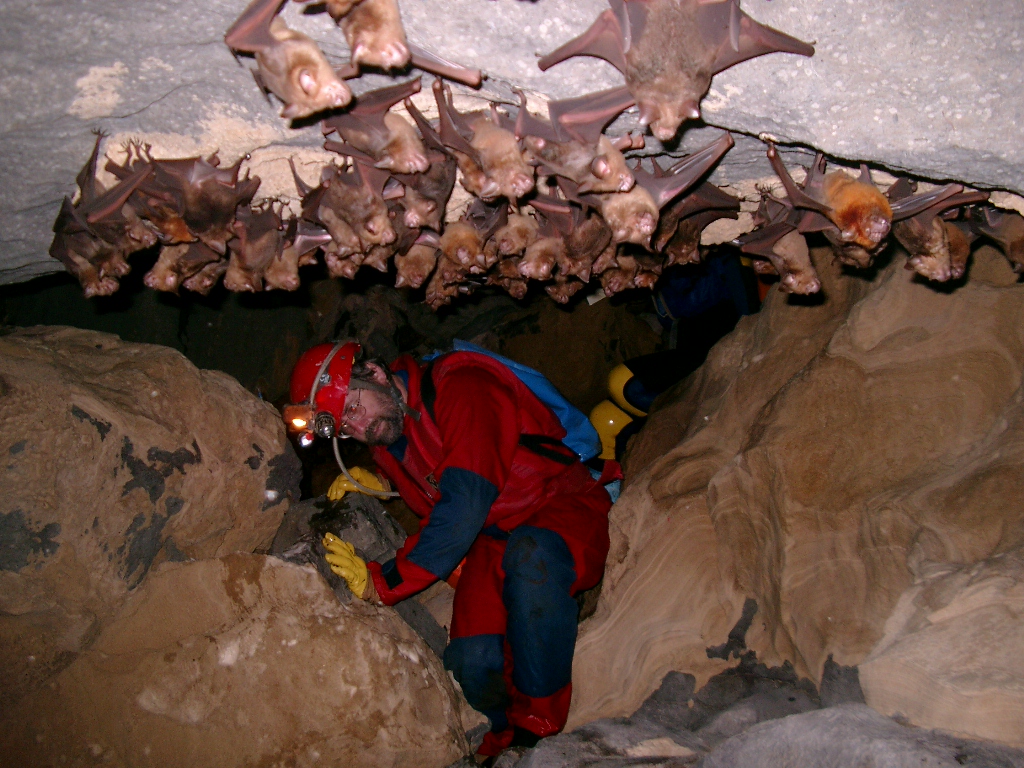
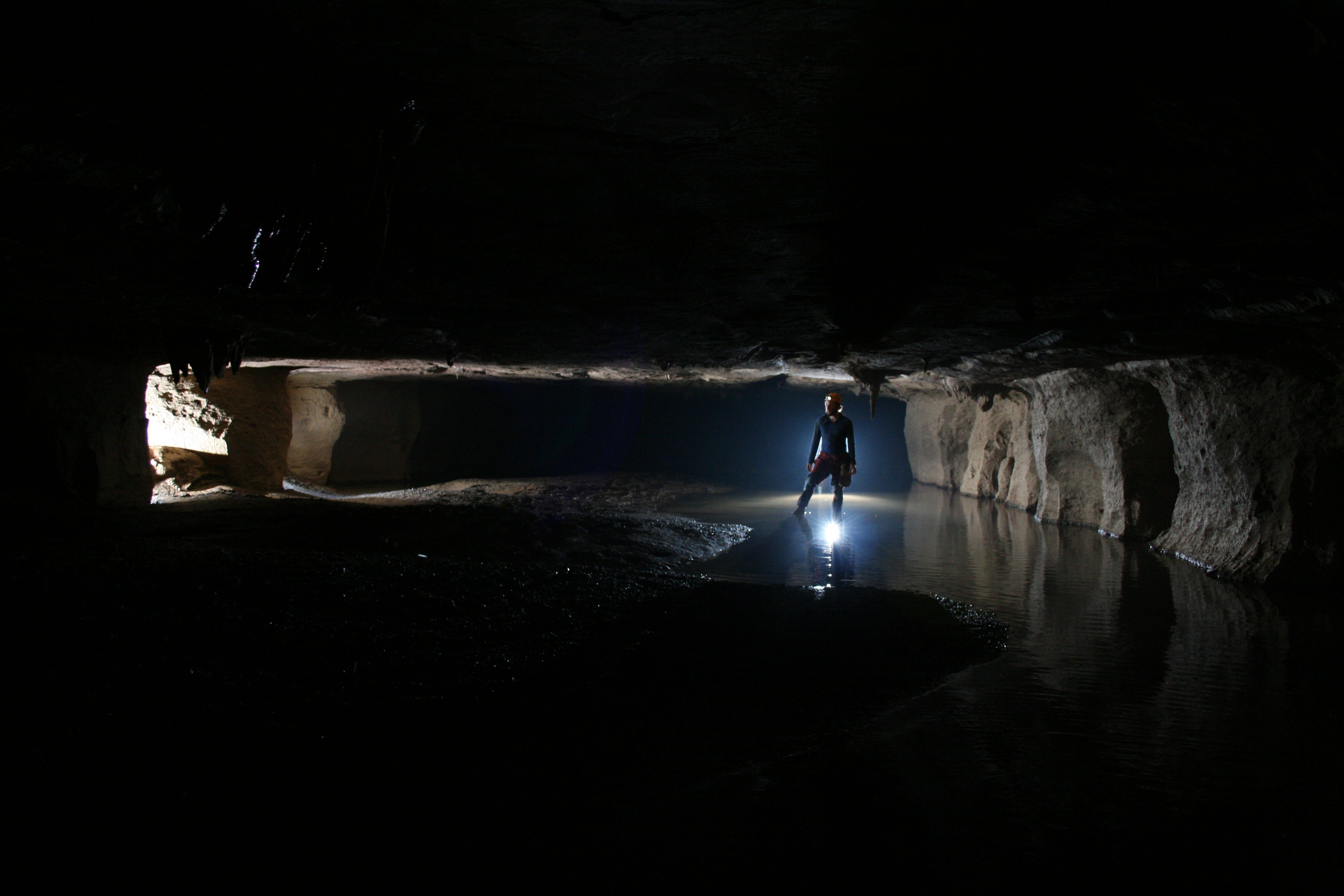
Below the ground in Meghalaya (Photo: Simon Brooks)

Below the ground in Meghalaya (Photo: Simon Brooks)

Many years ago in Meghalaya, North East India, a group of school students from Shillong were in Cherrapunji on a picnic.

Those days, Cherrapunji was famous for having the highest annual rainfall in the world.

Nearby was a large cave.

One of the boys, eager to explore the dark passage, sought company from his friends. None were ready. Dejected, he hung around. Given to reading, he was unhappy to be denied an adventure of the sort books talked of. Just then two boys from the locality turned up offering to lead him in. They made a crude hand held flame torch, walked the entire length of the cave and exited through a small shaft at its end to the other side of the hill. The boy finished schooling, graduated in physics from the local college, gave his bank test and became an employee of the State Bank of Mysore (SBM). For several years he worked in various parts of distant Karnataka, removed from family and friends in Meghalaya.

His appeals to be near home fetched him a transfer to SBM’s branch in Kolkata. But that didn’t satisfy for although Kolkata was closer to Shillong on the map than Karnataka, as a journey, home was still long way off. He sought to quit but the bank was reluctant to let him go for he was a good officer. Staying alone, work was his life. Eventually his relieving order came, just the day Prime Minister Indira Gandhi was assassinated. Back in Shillong, his qualifications and background could have got him a high profile job. Instead of that he accepted the post of CEO at a local bank passing through difficult times. Decades later, the Shillong Co-operative Urban Bank was in fine shape and Brian Dermot Kharpran Daly, 63, although of retirement age, continued to get extended tenure. It may have seemed SBM all over again, but then Shillong was home.

It was May, 2010.

Inside a cave in Meghalaya (Photo: Simon Brooks)

Inside a cave in Meghalaya (Photo: Simon Brooks)

Meghalaya is home to the longest cave passages in India.

They run for several dark kilometers under the beautiful, green carpet of this land of hills and rains. “ Three factors – limestone, heavy rains and elevation – work in unison here to make these caves,’’ Brian, the state’s best known cave explorer, said. Limestone is easily eroded by water. Meghalaya still receives some of the heaviest rainfall in the world. Additionally, the hilly state has sufficient slopes for water to develop the kinetic energy needed to sculpt and carry off debris, leaving behind marvelous limestone caves. The caves now find mention on the state’s tourist brochures although entry into complicated systems is possible only with expert guides. At the time of writing this article, some 1200 caves had been reported, around 800 of them explored and roughly 360 kilometers of cave passages had been mapped, including India’s longest cave – Krem Liat Prah-Um Im-Labit System – as yet estimated to be 31 kilometers.

The exploration was continuing.

In India, Andhra Pradesh, Madhya Pradesh, Chattisgarh, Mizoram and Uttarakhand also found mention for caves. However when it came to the ten longest caves in India, all ten were in Meghalaya. Ranked for depth, nine were in Meghalaya and one was in Mizoram. That was how much North East India dominated in the subject. The study of caves or speleology was yet in its infancy in India. There was no university department or chair dedicated to the topic including at the North Eastern Hill University (NEHU). A few dedicated and seemingly networked scientists scattered nationwide maintained interest. The only institutional names in the field were the Raipur based-NGO, National Cave Research and Protection Organization headed by Dr Jayant Biswas and the Shillong based-MAA. Every year during Meghalaya’s dry months, expert cavers from overseas reached the state to explore its caves in league with the MAA. That’s how the underground map of the region evolved. Both the Indian Army and the Indian Navy had links with the MAA to partake in the adventure.

The entrance to a cave in Meghalaya (Photo: Simon Brooks)

The entrance to a cave in Meghalaya (Photo: Simon Brooks)

There is more to caves than adventure and geology. Darkness coupled with other changes to environment as one went deeper and deeper into caves, molds exclusive cave life, the study of which is called bio-speleology. Cave fauna typically falls into three categories: (1) Trogloxene – species which visit or take shelter in caves but do not complete their whole lifecycle there (e.g. bats, frogs, lizards) (2) Troglophile – species which live permanently in the dark zone but some of which can also survive in a suitable environment away from the cave. They could be called future troglobites (e.g. fish, salamander, crayfish and millipedes) (3) Troglobite – species which live wholly and permanently in the dark zone of caves. They are mostly blind, albinic and having extra sensory organs (e.g. same as for troglophile). Ilona Khar Kongar, scientist with the Zoological Survey of India (ZSI), said that there had been reports of fauna unique to Meghalaya’s cave systems. They awaited further study.

Caves are also known to hold fossils and in Meghalaya’s case, marine fossils going all the way back to a prehistoric age when the land was submerged by sea. Additionally, the region’s caves had become academically interesting from another angle – the several thousand year-old stalactites and stalagmites possessed details of past climate. For any curious mind therefore, these caves may seem the stuff of heritage. In Meghalaya however there was no such official declaration in favor of the caves and cavers like Brian were defending before authorities why this underground network of pitch dark passages was fascinating.

Inside a cave in Meghalaya (Photo: Rainer Hoss)

Inside a cave in Meghalaya (Photo: Rainer Hoss)

Somewhere in the early 1990s, Brian sought to spice up his life in Shillong with adventure. He thought of treks. But nothing really attracted. Born and brought up in Meghalaya, he knew there were caves around. He floated an organization called the Meghalaya Adventurers Association (MAA). The group started to explore caves. Shortly after the activity began, at one location, villagers spoke of a team of foreigners who had come looking for caves. Since caves were sculpted on rock that yields itself to shaping by water, tracking the distribution of such minerals helped locate cave-rich zones. Limestone is a fantastic cave-building medium. Deposits of soluble rock are called karst and in Meghalaya karst exists at the state’s southern portion, in an east-west line, curving to the north at the eastern end. The foreigners had done their homework. Brian’s inquiries showed that the British team included respected names from international caving. The MAA tied up with them and soon expeditions to explore the caves of Meghalaya began in right earnest.

The results would amaze anyone fascinated by the planet. Deep under Meghalaya are subterranean passages; gushing rivers, crystal clear ponds, natural rock dams and vast chambers you can only crawl into. “ People now come and tell me of caves,’’ Brian said. In 2004, he was awarded the Tenzing Norgay National Award for Adventure in the land category. However, leaving aside the cavers’ battle with the mining lobby, he wished that the younger generation responded more enthusiastically to caving. The reason for the low key response he saw till then probably lay in the nature of the challenge.

Near Lad-Rymboi (Photo: Shyam G Menon)

Near Lad-Rymboi (Photo: Shyam G Menon)

Mining was a well entrenched industry in Meghalaya.

H.H. Mohermen had lived in the thick of it.

Following a stint in London studying theology, he became a lone crusader for environment in the much mined Jaintia Hills. “ A relative who had served on the local hill council once told me that coal mining was allowed to grow unfettered because it resembled a cottage industry,’’ Mohermen said.

For a taste of Meghalaya’s mining country, I passed through Lad-Rymboi. Here pastoral Meghalaya took a hiatus. There was heavy truck traffic, the roads were awash in slush, grease stained automobile workshops repaired vehicles and a labor force of strangers roamed the town with numerous wine shops. Closer to Shillong, on the periphery of mining country one found the smallest unit of the coal business – tiny bunks typically managed by local women, selling excess coal dumped by passing trucks. Few years ago, the color of some rivers in the Jaintia Hills changed, dead fish turned up and in places, water became undrinkable. Hydroelectric projects complained that the water was corrosive. While activists attributed it to pollution from unchecked rat hole-mining, an official of the State Pollution Control Board said that given the high sulphur content of Meghalaya’s coal this was bound to happen even naturally.

Cave formation is a million year-old chemical process.

Indeed you can call a cave, a laboratory, with processes running at terribly slow pace. But it is undeniably chemistry; tamper with ingredient, quantity or concentration and you altered the experiment. According to Brian, that’s what mining did. To start with it deforested, causing soil erosion, sending soil down into caves and altering the cave’s drainage pattern. Coal mining also impacted indirectly – that same acidic water worrying humans on top, got down into the caves changing cave chemistry. With resident mining culture and wanting the modern motifs of economic growth, Meghalaya leveraged its limestone deposits to attract the cement industry.

That had direct impact on caves.

According to Brian, the attraction he felt for caving was that it wasn’t any one activity but a convergence of many – there was the adventure, the exploration, the science, the mapping, the planning, the skills and finally, the philosophy and literature you indulged in even away from caves. Brian had authored many articles on the subject; written books and compiled poetry. All this pointed to the need for an evolved mind; something rare in today’s world of adventure where everything is the stuff of snapshot success.

Negotiating bats; inside a cave in Meghalaya (Photo: George Baumler)

Negotiating bats; inside a cave in Meghalaya (Photo: George Baumler)

Further caving had its anxious moments. Once, Brian was injured by falling rock in a vertical shaft. Some caves didn’t have horizontal entrances; they had a shaft plunging into them. There was little room for escape should anything fall from the top. Shafts could be deep; India’s deepest at Krem Shrieh in Meghalaya was 97 meters (320 feet), several times longer than a single rope length and therefore requiring `pitches’ as in rock climbing. Lowering yourself into one of these passages could be tricky because they typically have narrow mouth and wider bottom. That meant a rope anchored at the top progressively stayed off the side leaving the abseiling caver wholly dangling on rope in a growing void.

On another occasion, in a cave with multiple entrances, a few cavers having entered through different passages met at a point. There, an experienced woman caver decided she wasn’t feeling well and retraced her steps. Somewhere she got lost in the labyrinth of passage ways. Her absence was noticed only after everyone had exited the cave complex. A search was launched and after several hours, she was located sitting crouched to preserve body heat, in utter darkness. Her headlamp was broken; the consequence of a fall. “ Hypothermia is a real danger in caves, particularly those with water and streams inside,’’ Brian said.

Limestone formations near the quarry in Lumshnong (Photo: Shyam G Menon)

Limestone formations near the quarry in Lumshnong (Photo: Shyam G Menon)

At Shillong, there were visible signs of the cement industry’s status in the North East.

`Times change, Taj does not’ – said a hoarding for Taj Cement. Another one sponsored by Star Cement featured well known personalities like Bhupen Hazarika, Mami Varte, Sourobhee Debbarma and Lou Majaw, the Shillong singer famous for his devotion to Bob Dylan. Meghalaya’s cement companies were not big names nationwide; they were local giants. The lone cement multi-national that entered the state made a conveyor belt to ship the mined limestone to adjacent Bangladesh. Lumshnong, over 100 kilometers away from Shillong, was a couple of curves on the highway with a few shops and houses. Home to cement plants, a large limestone quarry loomed next to the highway here. If you looked at the stray rock formations behind the adjacent houses, you got an idea of what the quarry must have looked like originally – fluted, termite nest like outcrops of limestone. Now all that remained was a large crater. Jack hammers drilled away on its sides and trucks carried away the raw material. The crater floor was soggy mud. At one end, atop a rocky cliff, a worker was demolishing rock. Directly below, thirty feet or so, hugging the pit floor was a three feet high horizontal gash in the rock from which a stream flowed to the outside world. That, I was told, was one of the access points to the Kotsati-Umlawan System, at 21 kilometers explored till then, India’s second longest network of cave passages and its second deepest. At the other end of the pit, closer to the highway, piled up debris soaked and shifted by rains, had sealed off a claimed large entrance to the cave. Gregory Diengdoh from MAA hunted futilely for a third entrance, a vertical shaft, known to be somewhere around.

The fourth, an erstwhile `show cave’ for tourists where we went in, had become inexplicably muddy. Behind us, the sunlit entrance gradually diminished to button-size and at the first fork, altogether disappeared. We navigated with headlamps in pitch darkness. A thick film of slippery, gooey mud covered the floor, the cave’s boulders and its sidewalls. It was very slow, slippery going. Deep within, you heard the roar of the underground river. Not far inside the cave, I decided to wait for a dry month to progress further. It didn’t make sense to load the risk and risk at day’s end, was a personal assessment. The cavers though had a different explanation – although we were just weeks from monsoon and hence into sporadic showers, the excessive mud inside the cave could be due to river water periodically backing up as a consequence of blocked passages, courtesy the overhead quarrying.

Unproved, that was yet speculation.

The quarry at Lumshnong. The stream, I was told, was one of the entrances to the Kotsati-Umlawan System (Photo: Shyam G Menon)

The quarry at Lumshnong. The stream, I was told, was one of the entrances to the Kotsati-Umlawan System (Photo: Shyam G Menon)

“ Somewhere thousands of miles away, not too far from the nation’s capital

A little posh town rose up from the desolate and barren land

It grew in width and length, it steadily grew in height

Where once the land was flat, today a mountain of flourishing complexes

A miracle indeed unfolds

As the buildings of Gurgaon tower to the sky, the limestone hills of Meghalaya

Leveled to the humble ground.’’

          Extract from a poem Brian wrote imagining the journey of Meghalaya’s limestone.

My visit to Lumshnong was in May 2010.

As of then, for a state so much into mining, Meghalaya which saw 24 chief ministers in 38 years did not have a Mining Policy. “ Every time we ask, they say it’s getting ready,’’ Patricia Mukhim, Editor, Shillong Times, said. In its absence, officials acknowledged that unorganized coal mining was subject to few restrictions, while limestone quarrying by large companies followed Central Government norms. At least that was the official explanation.

There was a Mining Policy taking shape.

The urgency for it was partly fuelled by Public Interest Litigation (PIL).

In 2006, realizing that it was only a matter of time before unbridled mining destroyed Meghalaya’s caves Brian approached Subhas Dutta of Kolkata, who had filed PILs before. With his help the MAA moved the Supreme Court. Such litigation was not new for Meghalaya. Local journalists recalled a previous lawsuit against the logging business. However unlike in logging, there was no interim stay on mining till the case was disposed of. The journalists and activists I spoke to attributed this to Meghalaya lacking an environment movement and the state’s peculiar land holding pattern; land was owned by the tribes. Protection of environment may work in a specific area (Samrakshan Trust in Garo Hills found mention as successful example). But another stretch of land was another tribe’s property and therefore their headache. This inhibited a larger environment movement.

While activists may want a movement, the mining industry – they said – dealt with specific tribal leadership. Theoretically, this appeared participative industry and the way forward. Two and a half months later, in August, even the central government, responding to the Maoist issue (extreme left movement largely based out of the forests and hill tracts of Central and East India), was recommending a participatory model that advocated sharing 26 per cent of a mining company’s profit with tribal communities. Yet it wasn’t that simple because to work properly, any model needed a learned, holistic view of development. That included a tribe knowing how much they were losing irreversibly and how much should be mined.

From inside a cave with headlamp switched off. The faint light in the distance is the entrance (Photo: Shyam G Menon)

From inside a cave with headlamp switched off. The faint light in the distance is the entrance (Photo: Shyam G Menon)

In Meghalaya, some of the stories I heard wasn’t pretty. There were occasions, I was told, when villagers seeing mines on their land exhausted, tried to encroach on someone else’s. Then, there was the story of villages with gates to fend off likely fights. One story was generic to the problem of land exploitation in India – that when the potential of a land was revealed, powerful people began to amass real estate anticipating profit.

I could not independently verify any of this background talk.

Nevertheless so much was clear – in a state with few opportunities, mining was prime opportunity. A casual perusal of academic studies on the state, available at Shillong’s book shops, underscored this point. Mining was a major source of livelihood in the state. When information spread of his opposition to mining, Brian’s caving expedition was once threatened with disruption.

Devoid of support by powerful masthead, `freelance journalist’ fell to the bottom of the media heap. When I called up a senior official in the state government requesting for an appointment, I was initially shouted at. Then he cooled down and gave me a time with cautionary advice – there was a Cabinet meeting and I may have to wait. I waited from 3PM onward at the secretariat. By 5PM or so, the visitors and staff left. The officer’s peon and I sat sharing jokes in an empty building. Around 6PM, the power failed plunging us into utter darkness, quite like being in a cave. I thought of my visit to the Kotsati-Umlawan System; how it had been pitch dark inside the cave with our headlamps switched off. An hour later, power returned to the secretariat. The peon and I laughed, seeing each other’s faces again. Close to 8PM, the official arrived. He was tired but spared time for the freelancer.

Entrapped in government bureaucracy, struggling to balance ecology and economic development, he vehemently insisted that caves could not be surveyed as the MAA had done. This was when caving had for long been an international pursuit and modern instruments permitted cave passages to be plotted (right up to 3D images if required) as the cavers proceeded. It illustrated the tenor of divide in Meghalaya in the name of mining. The same Brian had authored the book on cave systems published by the state’s Directorate of Information and Public Relations and one of his essays on caves was included as chapter for study in the state’s Class XII syllabus.

Still the MAA irked officialdom.

“ Shouldn’t we have economic development?’’ the government official asked.

I had no answer.

In the years following my Shillong-visit, this question would become a national dilemma. The matrix for viewing it at macro level was simple: India’s high population, the emergent scale of human needs and the scale based-model of global industry couldn’t do without exploiting minerals. At micro level, this combination of interests cut formidable imagery before anyone living in the lands due for exploitation by mining. Tribes and marginalized communities, living on those lands, hit back becoming villains in the eyes of those advocating industry from rich cities.

I knew why interest groups like cavers irritated government and industry. They were not even the owners of the land in question. They espoused interest in science, adventure, even aesthetics – all irrelevant to the daily reality of survival by money. But which was the higher philosophy and ethic – deciding human lifestyle by ownership of planet or doing so by fascination for planet?

Brian Kharpran Daly (Photo: Shyam G Menon)

Brian Kharpran Daly (Photo: Shyam G Menon)

While the lay individual may presume that cavers go in leaving physical traces to identify the trail back that wasn’t always the case. “ I advise people to periodically look back and remember cave features for navigation because entry and exit points in subterranean chambers appear different when the direction changes,’’ Brian said. It was also important to never break team (there may be several independent teams exploring different parts of a cave, but each team should stick together) and systematically map the passage as one went along so that the data for navigation was available right there. A typical cave survey kit would have nyloflex tape measure, compass, clinometer (for measuring gradient), plastic coated cave survey book, pencil and GPS. Back at camp, a day’s survey data was processed with specialized software to generate a detailed map. A lot of this work had been rendered easier by the Disto-X, a device that measured distance, direction and inclination at one stroke. It could be linked to the cartographer’s PDA inside the cave itself, to make a detailed map. Interestingly, the cave explorer’s credo was not to always retreat but proceed with the faith that multiple entrances and exits existed For Brian, it was like a spiritual quest. A vast underground chamber glistening with cave pearls (sand particles covered in calcium carbonate) was like an audience with God.

State authorities, I spoke to, insisted that the mining industry followed Central Government guidelines preventing such work from anywhere near archeological sites. But then as of May 2010, none of the caves had been declared `heritage.’ Following the PIL, the state government commissioned studies by agencies like the Indian Bureau of Mines and the Central Institute of Mining and Fuel Research. From the documents I was shown, the first had given a clean chit to the impact of mining near the Mawmluh cave in Cherrapunji while the other said the Umlawan cave hadn’t collapsed and there was no adverse effect to caves in the Lumshnong area from blasting. In a paper on the Mawmluh cave published in Current Science (April 10, 2009 issue) Dr Biswas observing the influx of mining effluents into the cave through the river at its entrance had said, “ It could be presumed that the cavernicoles (cave organisms) belonging to the twilight zone of the caves are already under extinction.’’

Brian had the conservationist’s approach.

The ideal model in his eyes was to absolutely protect some caves in the interest of science and exploration. In the case of other caves, villagers could protect them as heritage with revenue from well managed tourism for upkeep. To the journalist tuned in to both sides, what stood out was the unbridgeable divide – the MAA sought strict conservation; the government responded with the language of mining standards. The reason for opposing Brain was comprehensible – how can human livelihood and economic development be held to ransom by a bunch of exotic caves hosting strange life? In their separate worlds, both sides cut logic. Somewhere in between was the sheer joy of beholding mammoth caverns underneath, their spectacular beauty and the world of trogloxenes, troglophiles and troglobites – inhabitants of a fragile ecosystem. Government officials said that a Central Empowered Committee of the Supreme Court had recommended the installation of an Expert Group to look into Meghalaya’s caves.

Cave exploration in Meghalaya (Photo: Hugh Penny)

Cave exploration in Meghalaya (Photo: Hugh Penny)

With a copy of the 2006 PIL not available, I asked Brian what his demand was. According to him, his wish was for a prioritization of the caves, listing out those that were important from an exploration and scientific point of view. They should be protected. As for the rest – he thought – local villagers could protect some caves and manage them as tourist attractions. He knew that the going would be tough even then because the Shnongrim Ridge in the Nongkhlieh area where caves proliferated was prized by industry for its limestone.

“ Wherever you mine in Meghalaya you are going to destroy caves. It is like Swiss cheese,’’ he said.

All this was in May 2010.

In September that year, it was reported that the Court had dismissed the PIL.

The news reports cited mining bodies in the state, welcoming the Court decision.

Brian’s son and daughter have joined him on caving expeditions. His son, a trained mountaineer, worked then with a leading Indian private bank at their branch in Jowai. Besides his passion for caves, Brian made one of the best homemade wines in Shillong. Strangely, here too, he learnt the ropes late, worked systematically at improving his craft and took the art to a superior level.

(The author, Shyam G Menon, is a freelance journalist based in Mumbai. He visited Meghalaya in 2010 to do this story. A slightly abridged version of this story was published in Man’s World [MW] magazine. A smaller story on Brian was published in The Hindu newspaper. The photos taken by Simon Brooks, Rainer Hoss, Hugh Penny and George Baumler were provided by Brian and have been used here with his permission. An April 2013 news report from Shillong, quoting Brian, said that 19 new caves had been discovered in the Jaintia Hills, taking Meghalaya’s total to 1350 caves with 887 caves spanning 387 kilometers explored. When contacted late August for this blog, Brian said that Meghalaya’s Mining Policy was passed by the state government in 2012. However its specific rules and regulations were still awaited. Aside from official mention of the need to protect caves, they haven’t been declared heritage yet. Brian retired at work in 2012. He became honorary Vice Chairman of the Shillong Co-operative Urban Bank, where his son also now worked. Brian’s new book on caves has been published. An overview of it can be accessed at http://sbpra.com/briandkharprandaly/) 

TALKING TO DR GEORGE SCHALLER

Dr George Schaller (Photo: Shyam G Menon)

Dr George Schaller (Photo: Shyam G Menon)

`GS’that was all I knew of Dr George B. Schaller.

GS was the finest field biologist in the world, one of the founding fathers of wildlife conservation and author of several books. He was additionally Vice President, Panthera, Senior Conservationist at Wildlife Conservation Society and Adjunct-Professor, Centre for Nature and Society, Peking University.  He had also received many awards.

Early October, 2010, as I awaited my chance to interview him on the sidelines of the Mussoorie International Writers’ Festival, Peter Matthiessen’s book `Snow Leopard,’ about a journey to Crystal Mountain in the Himalaya with GS, was all I had for reference.

I explained my position.

The man didn’t disappoint one bit.

He kept the conversation simple.

Excerpts:

Conservation and the problem of over-consumption

Conservation basically from our selfish standpoint means human survival on this planet. The last century in many ways was easy. People thought in terms of reserves, as for instance with the tiger. But remember population growth. There are three times as many people in India today when compared to the early sixties when I was first in India. All of them want to make a good living. So it is not just population growth; the consumption has grown at a much more rapid level. Where do the resources come from? If you are talking about sustainability – don’t use more than what can be replenished – it has been calculated that the world is already at minus thirty per cent. In other words, the environment is going down steeply because of over-consumption of everything. What can you do? You need to be more inventive; you need to be more efficient, you need to be more productive, so that you don’t waste resources. Which state in India has a decent land use plan? People develop, develop, develop and nobody thinks of what it is going to be like at the end of this century. It is thinking ahead and planning that is the responsibility of governments, corporations and communities.

I get so frustrated when I see the lack of planning, the lack of care – for example in the United States. How much money has been raised for wars and armaments that could go for the benefit of people and environment; for the long term good of the country? I consider it highly patriotic to think of the future of one’s country and not fritter away money and resources because you are greedy now. The question is – how can you change the perception of wanting to consume more and more of things that you don’t need?

The finite system we know little of

People think that technology will solve their problems. Well, it can solve various problems. But you have a finite system of which, we know very little. We don’t know much about the ecology of rainforests, woodlands and so forth. How many species can a system lose before it collapses? We don’t know how all the species in a forest – from the microbes in the soil, little worms to big trees – interact to function as a system. We don’t know that. If it collapses because we killed too many species, directly and indirectly….then what happens? This concerns me because yet again, looking at it from a selfish human perspective – we need medicinal plants. At present we know only a few. What plants are out there, which in the future can produce food for a starving planet? The way things are going now we have famines somewhere in the world all the time. The countries that grow a lot of grain like Canada and others – they don’t have enough to feed the world, they have to feed their own people. Countries have to seriously think now what to do. China has a good logging act. No more big, commercial logging of forests because the watersheds are being depleted causing huge floods that kill thousands of people. Alright, the country needs wood. Where is it going to get it from? You go to Congo in Africa; you go to Indonesia – get timber elsewhere. So to keep a good lifestyle countries are pillaging each other. The United States is the principal culprit. The United States has five per cent of the world’s people and it uses roughly 25 per cent of the world’s resources. Is this morally acceptable? It isn’t for me. I don’t know what to do about it.  Now China is expanding, India is growing rapidly and expanding – but unless countries co-operate more; become self sufficient, waste less – what to do? 

Photo: Shyam G Menon

Photo: Shyam G Menon

Big worries; small solutions

Conservation in the final analysis is politics. I can go to China, I can come to India, I can co-operate with local scientists in studying the issue. From the information that we collect, we write reports, we make suggestions – those go to government. Then it is in the hands of government if they want to do something or not. You can prod a little bit but I cannot do conservation myself. I can go to a community, hold a community meeting, listen to their problems and make suggestions, may be even find funds so that they can start – but again it is up to the community and the local politics to implement something on their own behalf.  I can’t come into a country and say you have to change your agricultural practices, you have to stop polluting. That is too big an issue for an outsider. The government and the corporations have to get together and handle that. Personally, I set my own limited goal where I feel I can do something positive for the environment. Everybody should work together on this. If you have a serious land use plan, retain it – then you have a goal. But the only economic measure you see right now is our Gross Domestic Product grew by eight per cent, four per cent etc! What kind of measure is that? It doesn’t measure your environmental loss. You have to measure – to gain that (GDP growth) how much have you lost as resources? You can put economic values on resources lost and I guarantee you that every single country would be in the minus column. They are worse off than they were. If you look at it in economic terms, the world is living off its capital rather than the interest. How many businesses can do that for long? So I have big worries but I focus on trying to do something small and useful.

His message to future conservationists

In one word, that would be – persistence. If you see that something is essential for the good of society, humankind and you have set yourself a goal – keep at it. You won’t necessarily get results immediately but keep emotionally involved, scientifically involved. Learn the politics to some extent because unless you have the backing of the local forest department or whatever that you are dealing with, you won’t get anywhere. And that – being an environmental politician, is something one has to learn whether one likes it or not.

(The author, Shyam G Menon, is a freelance journalist based in Mumbai. This interview was published in The Hindu Business Line newspaper in February 2011.)

CYCLING’S SECOND YOUTH

March 2012.

A month earlier, in mid-February 2012, Hero Cycles, the Indian player described as the world’s biggest manufacturer of bicycles, had announced a carbon fibre model called Red Dot, priced at less than Rs 50,000. Traditionally, cycles sporting carbon fibre-frames sell at the top of the heap. On the other hand, Hero’s offering was positioned at the top end of its just unveiled range of premium cycles called Urban Trail with prices spanning Rs 10,000 to Rs 43,000. “ It is important that we adapt ourselves to the changing times. The customer is also changing. The market is slowly shifting from livelihood oriented cycles to lifestyle oriented models,’’ Pravin V Patil, President, Urban Trail, Hero Cycles, said.

Photo: by arrangement.

Photo: by arrangement.

Hero Cycles showcased the traditional business of the larger group helmed by the Munjals. Patil described the company as closely held and cash rich. Around it a vast business empire had grown focused on India’s automobile revolution. Amidst that saga in motorcycles spanning the Hero Honda CD-100 to the Hero Impulse and much auto ancillaries in between, the cycle business had remained relatively low profile except for a heavy weight parameter – the tag of being the world’s biggest cycle manufacturer.

About a year before Hero announced Red Dot, TI Cycles – the other big name in India’s cycle industry with a 25 per cent domestic market share – launched its own premium brand called Montra. Compared to Red Dot, the Montra Techno carbon fibre bike was priced at Rs 71,000. Both outlined capability and purpose. As motifs shaping company profile in the media, these developments impressed.

But did they cut ice with the new Indian market, especially its discerning portion?

In a repeat of India’s automobile industry story, there were two contradictory yet convergent themes playing out. Big domestic manufacturers were attempting to convince a new generation of customers that they had what it took to capture the premium market’s imagination. The customers of this segment owed no particular loyalty to Indian companies. A sketch of this customer could be had from Internet chat rooms around cycling. The product ownership profile of several participants kicked off with Indian brand, followed by a churn of foreign brands. As with many things, when you aspired, made-in-India failed to keep pace.

The synopsis of a 2010 sector report prepared by Global Industry Analysts (GIA), available then on the web said that the world’s market for bicycles should exceed $ 77.7 billion by 2015. Asia-Pacific would be the largest growing market therein. According to TI Cycles, the entire Indian bicycle market was estimated at around 17 million units. The industry had 9 per cent growth rate in 2010-2011 on account of rising individual incomes and the higher aspiration level of the middle income group. Four players – TI, Hero, Atlas and Avon – accounted for 90 per cent of this market.

In that, the premium bicycle segment priced between Rs 7500 and Rs 15,000 was estimated at around 350,000 units per annum; the super premium segment – above Rs 15,000 – at 16,000 units. “ These segments are growing at a phenomenal level compared to the industry growth rate,’’ K.C. Ramamoorthy, General Manager (International Business), TI Cycles said. Although companies spliced the market differently, the reading was similar. In a presentation, Hero put the bulk of the domestic market in the Rs 2000 to Rs 6000 range with upward of Rs 6000 being the `mass premium’ and `super premium’ segments.

It was in these upper tiers of the market that the capabilities of Indian companies were getting tested. For decades the major players chasing volumes and catering to customers’ livelihood needs saw these categories as commercially irrelevant because the market was price sensitive. With volumes becoming habit for companies, another twist set in – large players wouldn’t venture into a business unless there was assurance of critical volumes. Simultaneously, as a new generation of customers grew up on a diet of rising affordability and access to information, the Indian brands seemed prisoners of their business model and stuck with traditional cycles while brand appeal shifted to the stuff of passion, performance and aspiration.  

Shiv Inder Singh (Photo: Shyam G Menon)

Shiv Inder Singh (Photo: Shyam G Menon)

Shiv Inder Singh, Managing Director, Firefox, was to the Indian bicycle industry what Maruti was to the Indian automobile sector – the wake up call to think differently. “ Where the Indian automobile industry was 20 years ago, that’s where the Indian bicycle industry is today,’’ he said over tea, February 2012, in Delhi. He provided an uncomplicated picture of the market. Broadly speaking, the Indian cycle market fell into two categories – a standard segment and a fancy segment. Anything unlike the standard cycle was called fancy although even in the fancy bracket, the components were typically standard. The fancy segment had grown to be roughly 50 per cent of the market with its real creamy layer composed of CKD imports.

Singh studied at Doon School and later at the Indian Institute of Technology (IIT) and the Indian Institute of Foreign Trade (IIFT). He worked in the export sector, mostly in textiles. From 1980 to 1983 he worked in Taiwan, in the clothing business of a Hong Kong based-group, sourcing from Taiwan, Korea, Hong Kong and Philippines. Then he shifted back to Delhi working for another Hong Kong based-company. In 1996, when that company shut down he started a partly owned outfit in league with the Kapoor Group, exporting lamp shades. He ran this for eight years till 2004. It was during his tenure in Taiwan that he met his current partner Pradeep Mehrotra. The latter sourced cycle components from Taiwan and China and had a manufacturing unit in Sri Lanka which assembled cycles and shipped them out. Those days, Mehrotra owned the Muddy Fox and Silver Fox brand of cycles in the UK market.

In 2005, Singh and Mehrotra started Firefox.

Firefox was launched with 36 models, ready and in stock. These imports were better looking and more contemporaneously designed than models in the Indian market; they were also costlier in a market described by its biggest players as price sensitive and range bound. To sell these bikes, a new retail experience was created. Stores had their interiors designed, store locations were carefully chosen. There were dedicated company outlets at Delhi, Chandigarh, Pune and Bangalore. Firefox also gave its dealers higher commissions. The dealerships had to subscribe to company approved retail design and stock only Firefox cycles. Several dealership enquiries were rejected. “ We didn’t do a market survey before all this because there was no precedent yet in the market on these lines,’’ Singh said. Further with a focus on children and young people, the company’s products and product details were displayed online. That had its problems too. Any shortcoming with the cycles got highlighted in Internet chat rooms and sometimes the fire-fighting took long to be effective.

Competition waited for Firefox to fold up.

It didn’t.

Couple of years later, Firefox began distributing Trek bicycles as well. That was probably the validation the industry needed. It was now time for the Hyundais, Fords, GMs, Toyotas and BMWs of the cycling world to arrive. Not to mention – time for the Tatas and Mahindras of the domestic bicycle industry to shape up.

Indeed one interesting thing when talking to senior executives from the cycle industry in India was how much they borrowed imagery and examples from the automobile sector. Historically several automobile manufacturers have marketed bicycles under their brand; among them – BMW, Mercedes Benz, Peugeot, Jeep, Hummer, Ducati and Honda. While I can’t speak for times gone by, the most likely reason for this in recent times – aside from the fact that a cycle with vehicle brand stamped on it provided cheaper, surrogate ownership of the automotive brand – was that the cycle showcased an automobile brand’s design and engineering ability with minimum clutter, not to mention environment friendliness. Compared to the automobile, the cycle was an easier accessed, tangible experience. Unlike automobiles, it was pollution-free.  Peugeot however enjoyed distinct reputation in bicycles. This French company, producing cycles since the late 19th century and winner of a record ten Tour de France titles, briefly relinquished its cycle business to Cycleurope. It appeared to be returning. In India, Firefox – a bicycle company – participated in the Delhi Auto Expo. That wasn’t wholly puzzling for the costliest cycles sold in India cost as much as an entry level mid-size car and the act of buying and selling at the upper end of the domestic bicycle market was being decided increasingly by customer and retail experience.

As of 2012 first quarter, customers from Pune and Hyderabad appeared to head the list for the most expensive bicycles bought in India. A Cannondale Jekyll Ultimate was believed to be at the top of the pile. In January 2011, a buyer in Pune paid Rs 650,000 for this model. One of the lightest bikes in the world, it was a versatile mix of uphill and downhill cycling capabilities. The rider could change from one mode to the other, in the process altering the geometry of the frame and his position on it. From Hyderabad, a customer dished out Rs 450,000 for a Trek Remedy 9.9. Early March 2012, a Scott Genius LT 10 worth Rs 425,000 was scheduled for delivery. All these models were full suspension carbon fibre frame-MTBs with top notch components. Earlier Scott India had sold an aluminium frame-Spark 40 full suspension MTB priced at Rs 216,000. Industry officials said that it would be erroneous to dismiss customers of this ilk as merely moneyed because some of the bikes bought had strength in specific applications. 

Lifecycle in Pune was probably India’s biggest multi-brand showroom for high end cycles. It had three floors of cycles; brands like Cannondale, Trek, Scott, Orbea, Bergemont, Merida, Giant, Firefox, Axis, GT, Schwinn, Bianchi, Fuji, Mongoose, Dahon and Huffy. Altogether 24 brands, said its owner. The walls had cases stocked with cycling accessories; at one end was a TV showing a video on cycling. Differently from Lifecycle but around the same DNA of passion for cycling, there were other such shops blossoming elsewhere in India too.

At the time of writing this article, TI Cycles was due to open a large Track & Trail Cafe – their version of high end retail experience – in Chennai. There was Rohan Kini’s shop with its delightfully irreverent name – Bums on the Saddle (BOTS) – in Bangalore. There was the hard core cyclist community around Venkatesh Shivarama in Bangalore. There was the first Track & Trail Cafe in Bangalore. There was Nachiket Joshi and Lifecycle in Pune. In Mumbai, there was Rahul Mulani and his shop Gear and Prabodh Keny, assembling cycles at his home.

Nachiket Joshi (Photo: Shyam G Menon)

Nachiket Joshi (Photo: Shyam G Menon)

Two cities in particular defined the Indian market for high end bikes – Bangalore and Pune. Both places were blessed by a matrix of old and new India. There was sufficient continuity of old fashioned commitment and passion plus a healthy dose of contemporary, youthful enterprise. Unlike Mumbai, real estate cost had not mono-cropped business imagination. Ideas stood a chance. Not to mention – disposable income, cycling clubs, communities and regular calendar of events around. Roughly similar across Bangalore and Pune, although not exactly so, was the local climate and topography. Bangalore had bearable climate year round. Pune had a harsh summer and distinct winter. At both cities, you could cycle off onto roads with less traffic and if it interested you, court hilly terrain.

The current drivers of cycling in Pune and Bangalore included those who were passionate about cycling when Hero and TI dominated what used to be a seller’s market. They struggled in that environment, first putting Indian bikes to punishing use and then researching and sourcing bikes unavailable in India to feed their passion. Consequently they didn’t bring to the table automatic respect for India’s big cycle manufacturers. They were not in awe of them. Across the new age cycle retailers I spoke to, there was a cool, guarded approach to Indian brands pushing carbon fibre cycles as motif of new found technological advancement. The manufacturer may be pushing something genuinely valuable but the point was – this market had questions, access to information and knew cycling. It chatted, discussed; there was even an Indian mountain bike magazine, `Free Rider.’ It was clearly not the old market. True, there will be those who buy to match peers or because they have money to splurge. Like this customer who called up asking for a bike costing over one hundred thousand rupees. The purchase was approved with photo of the bike dispatched via cell phone. The cycle was picked up by the customer’s driver. But even for this customer, rich enough to buy without seeing the cycle, it mattered who guided his choice. In this case, advisor had been an enterprise begun by cycling enthusiasts. That shift caused all the difference.

Bangalore's Track & Trail cafe (Photo: Shyam G Menon)

Bangalore’s Track & Trail cafe (Photo: Shyam G Menon)

Not surprisingly therefore, as much as a good product in this upmarket segment created a reputation for manufacturer, a bad product or a good product abandoned to bad after sales service created ill repute where there was none previously. The old approach to bicycle sales wouldn’t work. Bangalore’s Track & Trail Cafe stocked all the cycle brands that TI Cycles imported and distributed through its network. The best part of it was that it recognized a cycle as a creation and surrounded it with space to appreciate its design, geometry and engineering. You could take in all this with a cup of coffee in your hand, sip it and walk among the cycles, gaze at the posters on the wall or browse through the many books on cycling and magazines on the subject kept on the racks. The cafe served as a point of sale, played host to bicycle maintenance workshops and organized cycle rides. “ The Track & Trail Cafe serves as a platform for engaging like minded community members to make cycling a way of life through active company participation. The concept encourages users to browse leisurely,’’ Ramamoorthy said. Hero had planned Urban Trail showrooms. According to Patil, the top 200 dealers from Hero’s 2200 dealerships nationwide would sell Urban Trail models. There would be additionally, 30 company owned outlets, 30 franchise dealers and three experience centres for the Urban Trail brand in Delhi, Pune and Bangalore. That was the plan, when I met him.  

Rohan Kini (Photo: Shyam G Menon)

Rohan Kini (Photo: Shyam G Menon)

What interested was how the cycling community hadn’t yet (at the time of writing this piece, that is) migrated in strength to these new company sponsored platforms. It was early days. The shift was expected. Both Hero and TI already sponsored major cycling events. But as of then, the cycling community in places like Bangalore and Pune, clustered around individuals and clubs passionate about cycling. Notably, they remembered being under-served by Indian industry and drew people to them without necessarily having on offer all the material frills that the company spaces held.

The best known cycling community in Bangalore was around BOTS. Rohan Kini saw his main job as managing the community and being an evangelist for cycling. Very different from the modern showroom space BOTS had acquired, was the first floor shop of Venkatesh Shivarama. It was packed with cycles. Imagine that – a first floor shop for something that runs on wheels? Yet the faithful arrived, for Venkatesh was perceived as an experienced, technically sound cyclist, an evangelist for cycling in his own way. He anchored a reputed cycling team and the assistants helping him at the shop were committed cyclists into racing. In Pune, Nachiket Joshi was crystal clear – his top priority was the community he had built around Lifecycle.

What was opening up in India in the form of a market for high end cycles was a classic chicken and egg situation. New product and market making were debuting side by side. To sell these cycles you required a culture that enjoyed cycling, understood what modern cycles did and wished to buy or promote them. That culture, starting with spreading the joy of cycling, was possible by nurturing communities. Unlike the old cycle shop owner who sold available products brusquely, the new age retailer of bicycles in India noticed customers. The premium segment’s growth rested on everyone’s evangelism for cycling. If cycling turned boring, they knew, the business would fail.

Rahul Mulani, who pioneered BMX in Mumbai years ago and started a cycle shop subsequently, provided a different yet equally involved view. He didn’t want to run a cycle shop. That wasn’t his aim. His aim was BMX. But what do you do when in BMX you were always thrashing your cycle and spare parts were so hard to come by in an India that ignored cycles for niche markets like his? He became an importer. More than one devoted cyclist and at least one dealer told me of cycles in the garage that served purely to be cannibalized for spare parts because import duties and exchange rate fluctuations hampered parts availability.

Venkatesh Shivarama (Photo: Shyam G Menon)

Venkatesh Shivarama (Photo: Shyam G Menon)

Of India’s two biggest cycle manufacturers, TI which claimed leadership in the special cycles-segment had in addition to its own product line-up opted to distribute imported cycles. Hero wanted to go it alone. “ I may at best seek a good designer, I have all the other capabilities,’’ Patil said. According to him Hero was targeting 35 per cent domestic market share in the premium bikes category to start with. Over time, the definition of indigenous cycle had become hazy. The standard cycles hailing in origin from the days of controlled economy, had fully localized production. As you moved up the pecking order and this machine called bicycle grew more complicated, the anatomy of the cycle became an international assembly. It transformed from a product wholly made at a factory in India or built with components from India to a product that was assembled from imported components. Uniquely in the global bicycle industry, some components were strongly associated with a handful of manufacturers. Example – Shimano and SRAM in gears. Aircraft manufacturers obsess with the design of planes’ wings for that is the critical piece of technology. Similarly, in cycle manufacturing, the bicycle brands controlled the geometry and technological specifications of the bike frame which was the heart of a given model of bicycle. The frames were unique for their rigidity, measurements, angles, thicknesses, welding and materials used. These attributes altered with intended application of bicycle. Thus the frame of a mountain bike was different from that of a road bike by more than just appearance. To the frame, components matched to performance and price point, were attached. The manufacturer then grew the brand DNA through a diet of field testing and performance. Dig deeper and you found that there was respect for independent designers, fabricators, testers and like. As you moved up the value chain in cycles, you encountered products defined more by design, engineering, build-quality and application.  Theoretically, these segments could be cost competitive in manufacture at modest volumes. If the volumes of such cycles in the Indian market slowly gained, that could eventually mean reason to manufacture them locally, which would be an interesting departure from the well entrenched worship for sales volume. In these categories defined more by performance than price, a critical, modest volume would do. What mattered was engineering excellence and craftsmanship. “ That would be an interesting development to watch out for,’’ Jaymin Shah, Country Manager, Scott India, the local arm of leading international bicycle brand, Scott, said.

Photo: by arrangement

Photo: by arrangement

The country to beat in this game was China. They manufactured the cycles sold by leading international brands and they did it efficiently at low cost. In early 2012, there was talk of South East Asian countries emerging as new manufacturing locations. Was this an exploitable crack? China itself had become low cost manufacturing destination for cycles on the back of Taiwan’s rising cost in cycle manufacture. It was only natural that cost-stories should migrate as economies prospered. According to an article on the Earth Policy Institute website, from 1995 to 2005, China’s bike fleet actually declined by 35 per cent to 435 million units while private car ownership doubled. Yet in 2008, China was still producing almost four fifths of the 130 million bicycles produced worldwide. If in 2012, names like Vietnam cropped up as cheap production bases, it shouldn’t surprise. Will Indian bicycle companies blessed with domestic market and gaining scale in niche segments, catch up and marry scale to technology for a swing at things? (As I edit this article for my blog, the rupee is at 64-65 against the dollar, begging an export culture.)

Patil said that scale was his primary asset. As the world’s largest producer of bicycles with 45 per cent market share in India, Hero had the capacity to source globally. That however begged a question in the eyes of observers – precisely because of faith in scale and because the cycle is increasingly an assembled product with brand identity divorced from manufacturing location, there needn’t be urgency for Indian manufacturers to produce high end cycles in India. Till costs compel otherwise (the sharp rupee depreciation of 2013 could be one), why not outsource, assemble the product and push the brand?  As said, such assembly was established industry pattern. It made no sense to keep reinventing the wheel. Except, the foreign bicycle manufacturers came across as more experienced and tested for unlike in India, they built brands around credible performance and not scale. You may be buying a mass produced brand. But it was traced to company with strong DNA in performance. Indian companies were yet far from acquiring such link. This made attempts in that direction very important, for unless you evolved by aspiration and imagination, the product – no matter how dominant the brand – would remain an unconvincing shell. The market never failed to argue – every year the foreign brands were at the races and something from those outings should be rubbing off on the brand as learning. DNA by performance – the market valued that in a bicycle brand.  

When I mentioned Indian carbon fibre cycles to one of the new age dealers, he quipped, “ do you know what grade and quality of carbon fibre that is?’’ How much of everything on the cycle is carbon fibre and how much isn’t? Evidently, the young man knew the material and its use on cycles well enough not to be felled by a claim. In contrast, he pointed out that many of the foreign brands newly into India had been at least once to Tour de France, not to mention won it. And just in case you thought that dealer’s quip was spot on, here’s another observation from another dealer – why can’t an Indian manufacturer be successful and iconic when many of the foreign brands despite their heritage and reputation have ended up being made in probably the same factories in China? Are you sure the old care and personalized attention which makes products distinct are still there in the foreign names?

It showed the possibility open to Indian manufacturers if they wished to genuinely try.

Photo: by arrangement

Photo: by arrangement

As of early 2012, the impact of all this was visible in select home brand-products near the Rs 10,000-price level in the domestic market, where design and quality had improved. “ Indian bicycle manufacturing had been bogged down on the price and mobility platform and had not made any investments as made by international manufacturers. We are slowly building capacity for alloy and carbon frame bikes and eventually other materials also,’’ Ramamoorthy said. Alongside new approaches to the market may be tried. TI Cycles for instance, was examining the scope to start a rental business for performance bikes at its Track & Trail Cafes. Its well located bike stores may also host this business, which provided the market an easier option to experience the new bicycles besides allowing cycling aficionados to continue their lifestyle when travelling on work.

Then on March 16, 2012, a game changer happened.

The premium cycles segment found mention in the Union Budget with the customs duty on imported cycles and bicycle-parts going up. Very broadly, this move spelt impact from price points like Rs 5000 – 6000 and upward in the market because models, right from children’s bikes, used imported components. What survived untouched was the mass market livelihood-cycle category, which incidentally wasn’t the growth segment of the market. The growth segment and what was evolving to be the next centre of gravity for the bicycle market, was the beginning level of the premium category taking to the market concepts like alloy frames and gears, which were not mass produced in India. Suddenly the very fun centre of the market had been choked by the Finance Minister! The budget was speculated to trigger two to three trends – the cost of imported cycles and cycles with imported components would go up; there was the likelihood of down-trading to cheaper technology as models strived to preserve price points and finally, there could be greater manufacturing in India to get over the higher import cost. None of this would have pleased cyclists left wondering why cycling – an activity that burns no imported oil or contributes to pollution – was penalized.

Photo: by arrangement

Photo: by arrangement

The budget left many cyclists angry. But in the months since, room to complain steadily eroded for it was life by game changers. The rupee at 64-65 against the dollar would have further reinforced protective barriers. The currency’s real exchange rate, some said, was yet away. Every generation has its challenges. The last one capped its imagination at ordinary bicycles. New generations defined by consumerism alone don’t make for a great generation. They must create convincing products. On the bright side, indigenous models in the premium segment have grown. TI’s Montra brand for instance, has spawned models at a pace not seen before in the market.

The field is wide open in Indian cycling’s second youth.

UPDATE: Mid September 2015, media reports said that Hero Cycles had acquired Firefox Bikes in an all cash transaction. The deal included distribution rights for Trek and other brands. 

(The author, Shyam G Menon, is a freelance journalist based in Mumbai. This article was written in mid-March 2012. Some rewriting and updating was done for this blog. However minutiae in context, as well as officials and product prices quoted herein may have changed since. Serious readers are requested to note that. The blog’s intent is – perspective.  A very abridged version of this article was published in Man’s World [MW] magazine. A portion of this material was also used for an article in The Hindu Business Line newspaper soon after the Union Budget of March 2012.)

SHILLONG AIRPORT

Illustration: Shyam G Menon

Illustration: Shyam G Menon

Ten minutes before touchdown, the ATR was tossed around in air pockets.

It complemented the essence of leaving metro life.

The turbo-prop was flying as it used to be before technology stole aviation.

The airport below was similar.

It was a small building.

The arrival area was a single room as small as a Mumbai apartment, with attached toilet.

You waited for the baggage, picked it up and left. No conveyor belt, no sitting around.

Nearby a new terminal of glass and steel was being constructed.

A few taxis lay parked outside for the 32 kilometer-ride from Umroi to Shillong.

I got into a state transport bus. It charged less.

There was a brief wait for the plane to take-off, the airport staff to pack up and the bus to leave with everyone – staff included.

It was the end of a working day at Shillong airport.

Its only flight had come and gone.

Days later, my work done, I was ready to fly back to Kolkata.

At Shillong’s bus depot, I waited for the bus to the airport.

Nothing drew up.

Seeing one of the airport staff from my earlier trip, I asked her about the bus. She guided me to the assigned vehicle. We spent the next ten minutes discussing Meghalaya.

“ I wish I was busy but there is only so much work here,’’ Saira Khar Karang said. Many years ago, the government owned-airline, Vayudoot – it disappeared without proper successor for its invaluable role – flew small aircraft to Shillong. Later the ATR came. Flights used to be cancelled for want of passengers. During rains the plane may skip Shillong and proceed to the more reliable Guwahati airport. Passenger traffic had since improved but the monsoon’s grip remained.

Yet, Saira didn’t wish to leave Shillong.

“ Khasi people are open hearted,’’ she said, wary of big cities.

Every small city eventually becomes a big city.

 It’s the phenomenon of our times.

 “ Who knows what Shillong will be?’’ I asked.

Some more of the airport staff trickled in.

“ Flight is one hour late,’’ a young lady said.

En route to the airport, we picked up others I recognized from the bus ride, the day I arrived.

It was a small world.

The security personnel at airport were a mixed bunch speaking languages of the North East, Hindi, Kannada and Malayalam. A lone X-Ray machine sat in the departure lounge, which had aluminum window frames for modernity. No air conditioning. Next to the X-Ray machine was Air India’s ticket counter, a kiosk. Ground service had been outsourced to a local travel agency. A weighing machine with attached electronic meter checked for excess baggage. Once some passengers had gathered, the officials ran the X-Ray machine, weighed the baggage, tagged it and issued boarding passes. All hand written, no computer print-out.

A TV provided passengers taste of impending metro inanity: the program quizzed Indian film stars on size zero while the streamer said Jennifer Aniston had denied she was on baby foods to stay thin. An announcement over the PA system informed that the delay had risen to near two hours. The TV channel switched to Doordarshan, screening a Hindi film – an Indian Tarzan with Ruby for Jane.

Then Shillong’s daily power cut struck.

Somewhere a generator hummed, fans whirled again and Ruby, Tarzan and elephants returned.

There was fuss around the VIP room as a politician arrived.

Half an hour later, we queued before a room marked `Security Hold.’ The CISF personnel took us through security check then joined the airport staff in inviting us for tea and snacks. The manager apologized for the delay and the time it took to fetch snacks, the airport being distant from town. A CISF jawan took an elderly passenger’s water bottle and filled it for her.

Shortly thereafter, the lone plane for which the airport existed landed.

A quick frisking before boarding, seats taken and we were off like clockwork.

As Meghalaya receded to green hills kissed by fluffy white clouds, I imagined an airport below closed for the day and a bus with staff and passengers headed back to Shillong.

Someday, that politician or another would inaugurate the new terminal, jet planes would land and Saira would turn busy.

Where next for the turbo-prop?

I wonder.

(The author, Shyam G Menon, is a freelance journalist based in Mumbai. This article was written following a visit to Meghalaya several years ago. An abridged version was published in The Hindu Business Line newspaper. Shillong’s new terminal was inaugurated in 2011, reports on the Internet said.)