IN LEH: A STORE FOR PREMIUM BICYCLES

Photo & imaging: Shyam G Menon

Photo & imaging: Shyam G Menon

The shutters of the shop window went up.

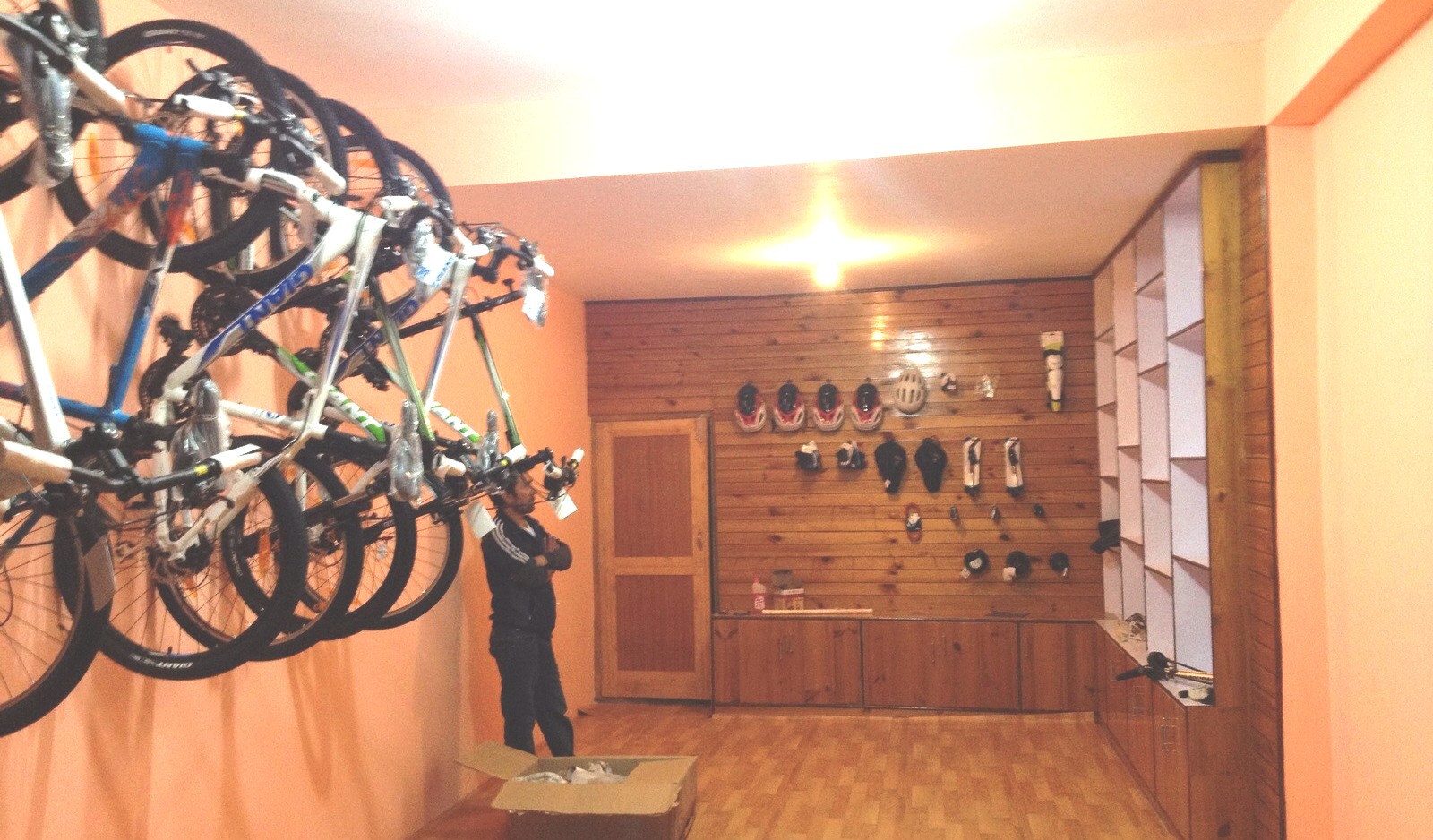
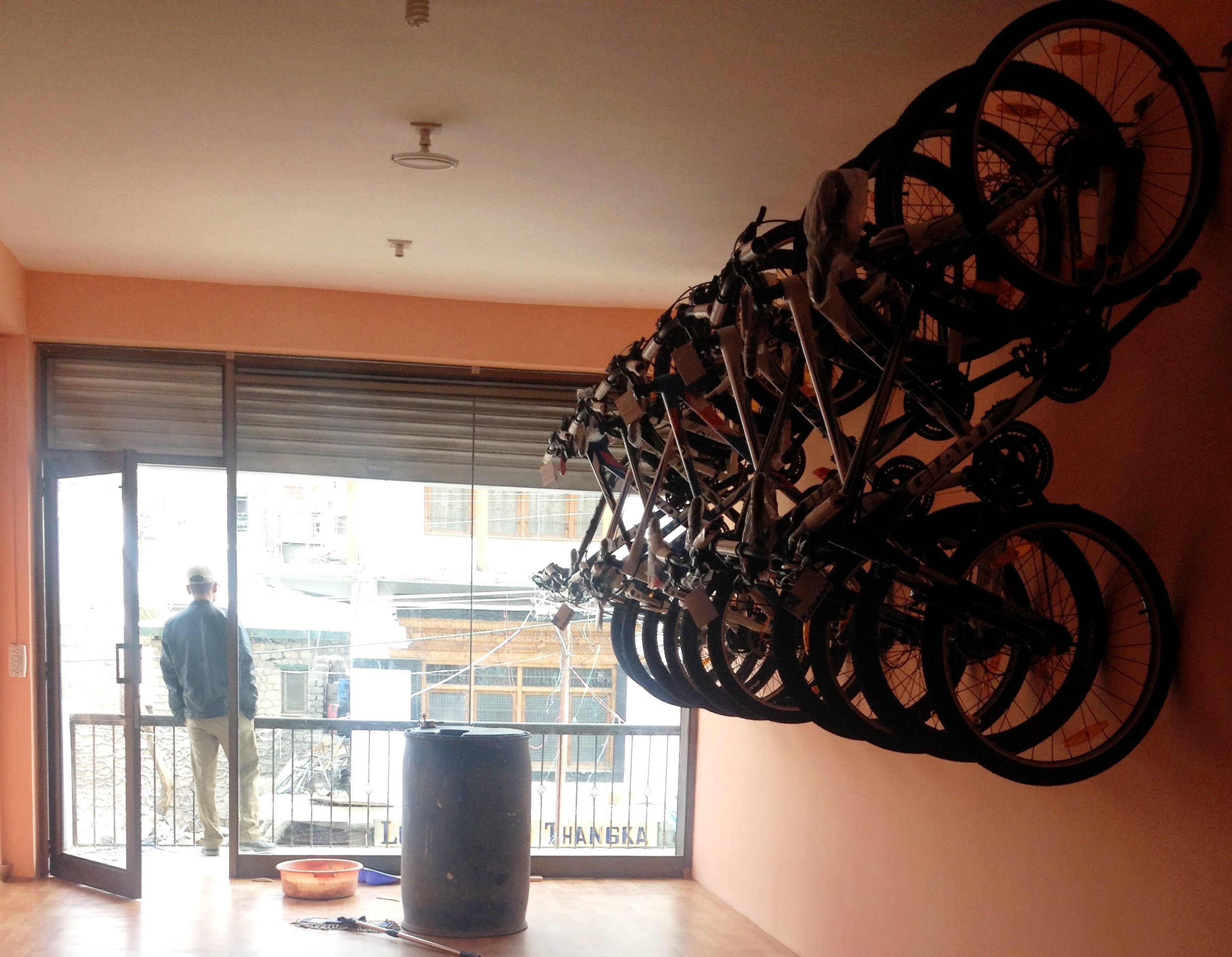
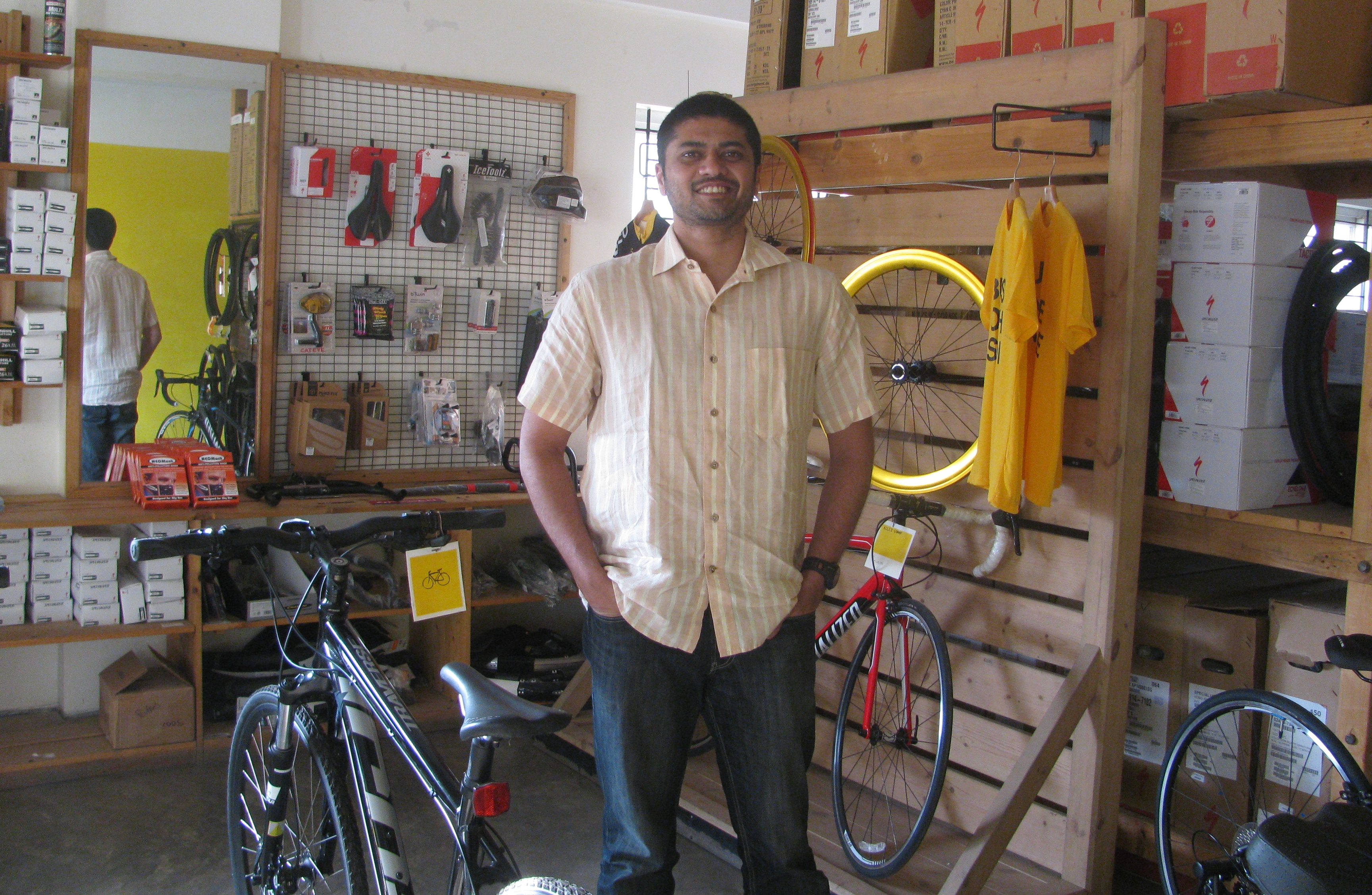
Ladakh’s pure sunshine lit up a modestly big space within. There were shelves to stock things and on the wall was a line of hooks to hang bicycles. One could imagine a counter for the manager and space around to park more cycles.  “ What do you think?’’ Tsering Sonam asked.

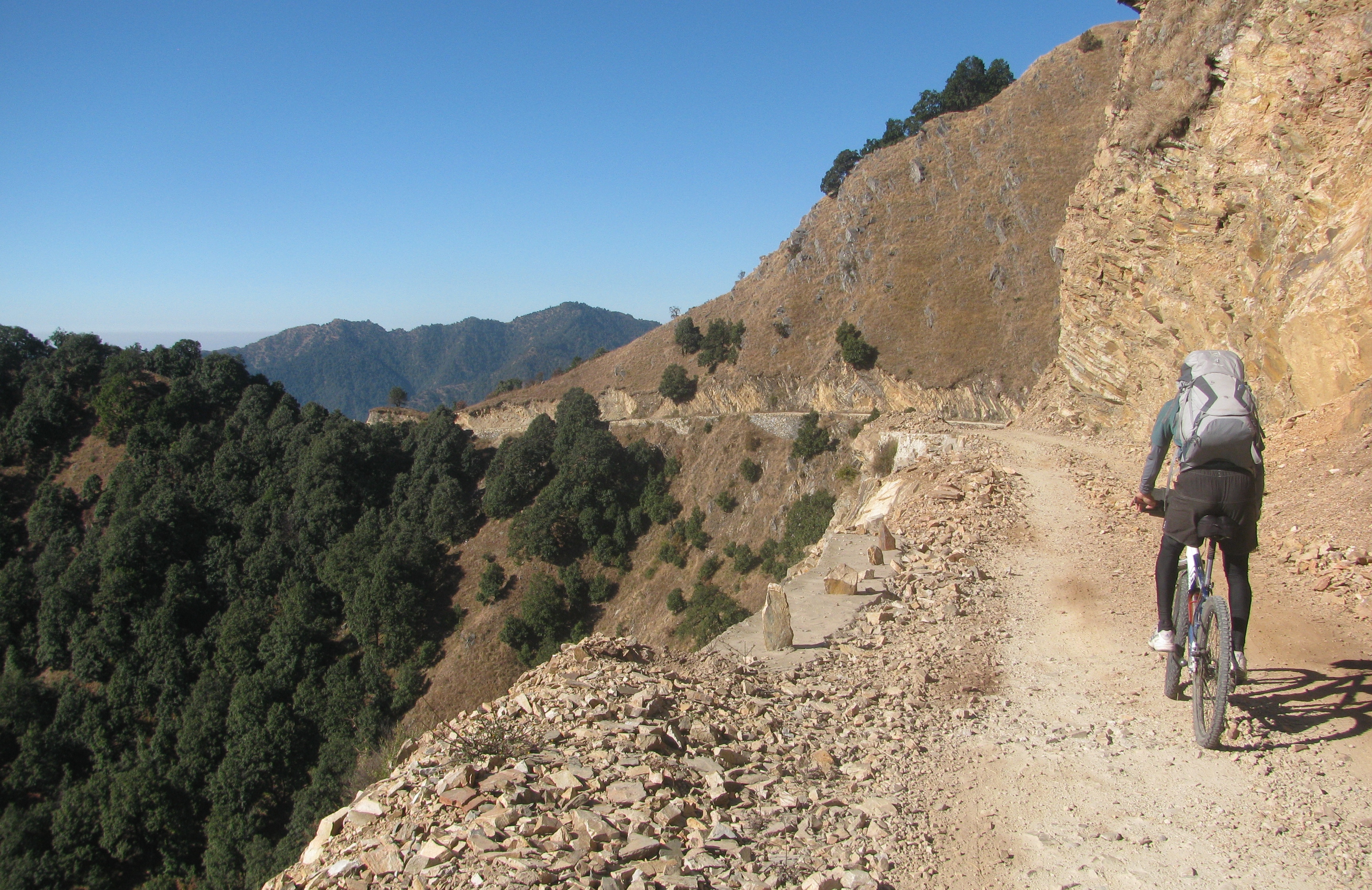
Besides trekking, mountaineering and river rafting, Ladakh is identified with cycling.

The Manali-Leh cycle trip is a much sought after attraction. Cyclists wishing to be off the beaten path explore less known, equally engaging routes. Tourists to Leh, especially those into the active lifestyle, often hire cycles from the town’s clutch of shops renting out mountain bikes. For a daily fee, rather stiff by the standards of yore (but then you are on a geared bicycle), you get a pair of wheels to go around town the healthy way. If you are serious cyclist who left his bike behind and travelled light to Ladakh, you can hire a mountain bike for a long trip across the region, including auxiliary services like camping gear, mechanic and support vehicle. Leh’s bike rental shops help you with that.

By the end of the 2015 tourist season, a missing link in the town’s cycling infrastructure will be addressed. Leh is set to get its first shop that will retail modern, premium bicycles. The town has a couple of shops that sell cycles manufactured by the traditional Indian bicycle companies. The new shop will deal in premium bicycles, essentially the imported brands finding favour with those into the active lifestyle. These are also the bicycle types defining Leh’s cycle rental business.

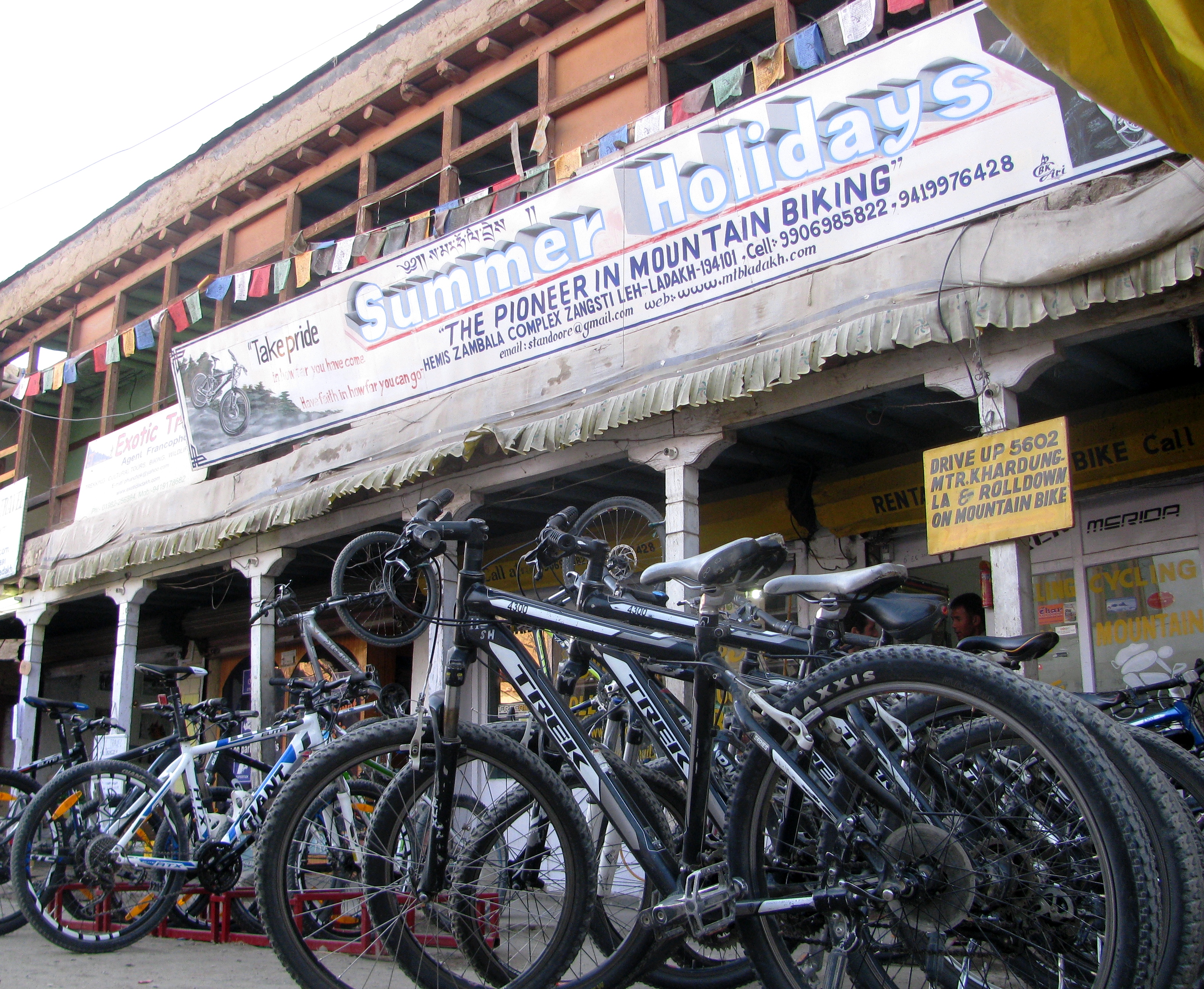
Summer Holidays, Leh (Photo: Shyam G Menon)

Summer Holidays, Leh (Photo: Shyam G Menon)

Leh’s cycle shops have gone through their ups and downs. The first to come up was Summer Holidays, in June 2006. It was begun by Stanzin Dorje, who had long been associated with the travel business. Joining him was his nephew Konchok Namgial. The initial fleet was a dozen or so used mountain bikes brought from Delhi. It was a phase fraught with teething troubles. Abused by customers in Ladakh’s rough terrain, the bicycles frequently broke down. Complicating matters was the issue of maintaining these bikes, quite different from the regular Indian-made bicycles. Neither did many in town know how to repair these relatively complicated models nor were spare parts easily available. It was a learning curve. Sumer Holidays was helped by two factors. First, Stanzin Dorje, who during his earlier times with the travel industry (he worked for a Delhi based-company) had led cycling groups elsewhere in India, was familiar with some of the work. Even today, he is one of the go to-persons in Leh for the skilled job of wheel-balancing. Second, Konchok Namgial began learning the craft of maintaining bicycles. To catalyse the process, Summer Holidays brought a mechanic from Delhi to Leh. However the market presence of premium bicycles in India at that time was so limited that the mechanic turned out to be inadequate in skills. The route ahead was clear – it will be learning by doing. Namgial soldiered on. According to Tsering Sonam, Namgial’s brother, in the wake of Summer Holidays opening shop several other similar establishments had commenced in Leh. But the ability to maintain a fleet proved a force of natural selection. Some shut shop; a few survived. Summer Holidays was among those that made it through.

The new bicycle store gets ready (Photo: courtesy Tsering Sonam)

The new bicycle store gets ready (Photo: courtesy Tsering Sonam)

As the market picked up, the shop’s fleet changed. In 2007, a foreign tourist gave a Trek 3900. Encouraged by the bike’s performance, Summer Holidays bought a clutch of Trek bikes from Delhi. This was followed by a handful of Merida cycles. The shop’s business was also helped by a product in Leh’s cycling experience it popularized. India has many high mountain passes. But Khardung La, near Leh, is distinct as the highest pass with a road through it. After coming to Leh, it is common for tourists to drive up to Khardunga La. Motorcyclists and SUV enthusiasts drive all the way from the plains to be at Khardung La and have it recorded for posterity in a video or photograph. Needless to say, Khardung La attracts cyclists. The product Summer Holidays popularized will irk the purist among cyclists but it caught the fancy of the recreational lot and the tourist seeking fun. The proposition offered was simple – drive up to Khardung La and then roll down the road on a bicycle, all the way to Leh. A mix of this product, daily rentals for cycling around town and long trips, kept Summer Holidays going. Today, in tourist season – essentially the months spanning Ladakh’s summer – Summer Holidays is a busy shop. “ In peak season, at least 20-25 people hire cycles every day,’’ Tsering Sonam said.

Summer Holidays now has an inventory of over 80 premium bicycles of which around 50 are in business. The balance is victim of a problem faced acutely in Leh given its remote location and if the cycling enthusiast elects to dig deep enough, likely elsewhere in India too – availability of spare parts. In fact, the idling cycles are sometimes cannibalised for spare parts to keep the rest of the fleet functional. This is one of the reasons inspiring commencement of a new, proper multi-brand bicycle store. Besides selling bicycles, the shop will stock spare parts and offer servicing to those in need of it after cycling to Leh from far. Tsering Sonam described an arrangement whereby the sale of cycles and spare parts happens from the new shop and the business of renting bikes and servicing of bikes continues from the old Summer Holidays location.

Photo: courtesy Tsering Sonam

Photo: courtesy Tsering Sonam

Some other factors too fuel the plan. In the decade since Summer Holidays opened shop in 2006 the Indian market for premium bicycles has evolved considerably. This evolution of the market shows in Summer Holidays’ fleet, which has both added brands (Giant being the new addition) and grown diverse in terms of bicycle specifications. Besides the regular sieving (which we are all used to as customers) based on thoroughly used cycles and the relatively new ones, the fleet for rent can be differentiated on the strength of number of gears, quality of derailleur, V-brakes, mechanical disc brakes, hydraulic disc brakes, adjustable suspension, suspension that can be locked out, suspension that can be remotely locked out etc. Intended application – whether local riding, going to Khardung La or cycling long distance – influences the quality of bicycle chosen and likely thereby, the hire charge. Unlike before customers nowadays are cognisant of technical subtleties. From a pure business perspective, there are people now willing to spend for acquiring a good geared bicycle. Such market evolution plus the profile of tourist visiting Ladakh – typically a person loving the active lifestyle – prompts the shop’s promoters to think that somebody may elect to buy a good bicycle in Leh. More relevant for business plans: over time, as the town’s bicycle shops grew, they not only enhanced their fleet size but also sold ageing cycles locally contributing to a rising base of used premium bicycles in Leh. Adding to this growing mass has been the occasional sale by the foreign cyclist passing through, who after a long journey done, chooses to sell or gift his / her bicycle. This local base of bicycles provides a captive market for spare parts, not to mention, potential aspiration by their owners to upgrade.

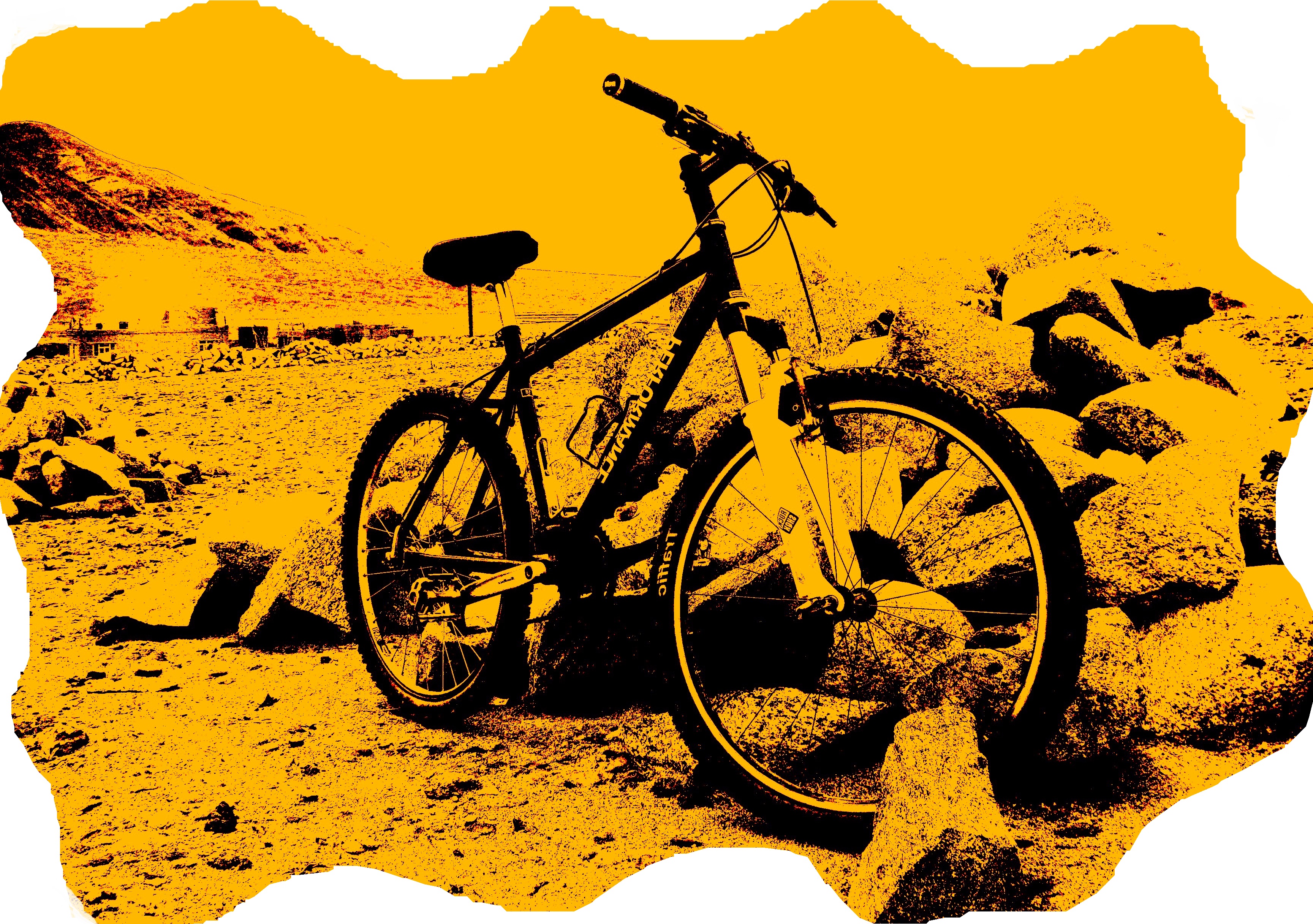
Photo & imaging: Shyam G Menon

Photo & imaging: Shyam G Menon

Finally there is the truth that cycling is an environment friendly way of getting around, anywhere. Ladakh at an average elevation of over 9800ft is the deep end of the need to maintain a clean environment. Already in its thin, still air, vehicle exhaust and the smoke from shop generators are sensed by the human nose with a clarity that is more profound than how you sense the same in the plains. In Ladakh, vehicle fumes stand out. According to Tsering Sonam, the town’s renovation plans currently underway have it that once the main street and market have been done up, it will become a traffic free zone. Such moves provide oblique encouragement for cycling and highlight its environment friendliness. The proposed new bicycle shop in Leh, near Axis Bank and opposite the local office of the Life Insurance Corporation (LIC), hopes to tap into all this. Like other towns, Leh has a cycling club now and Tsering Sonam envisioned something similar attached to the new shop as well.

(The author, Shyam G Menon, is a freelance journalist based in Mumbai. Please note: in the Indian bicycle market geared bikes, MTBs, hybrids – they all fall in the premium category. For an overview of the market please try this link: https://shyamgopan.wordpress.com/2013/08/24/cyclings-second-youth/ )       

TOO ULTRA FOR SPONSORS?

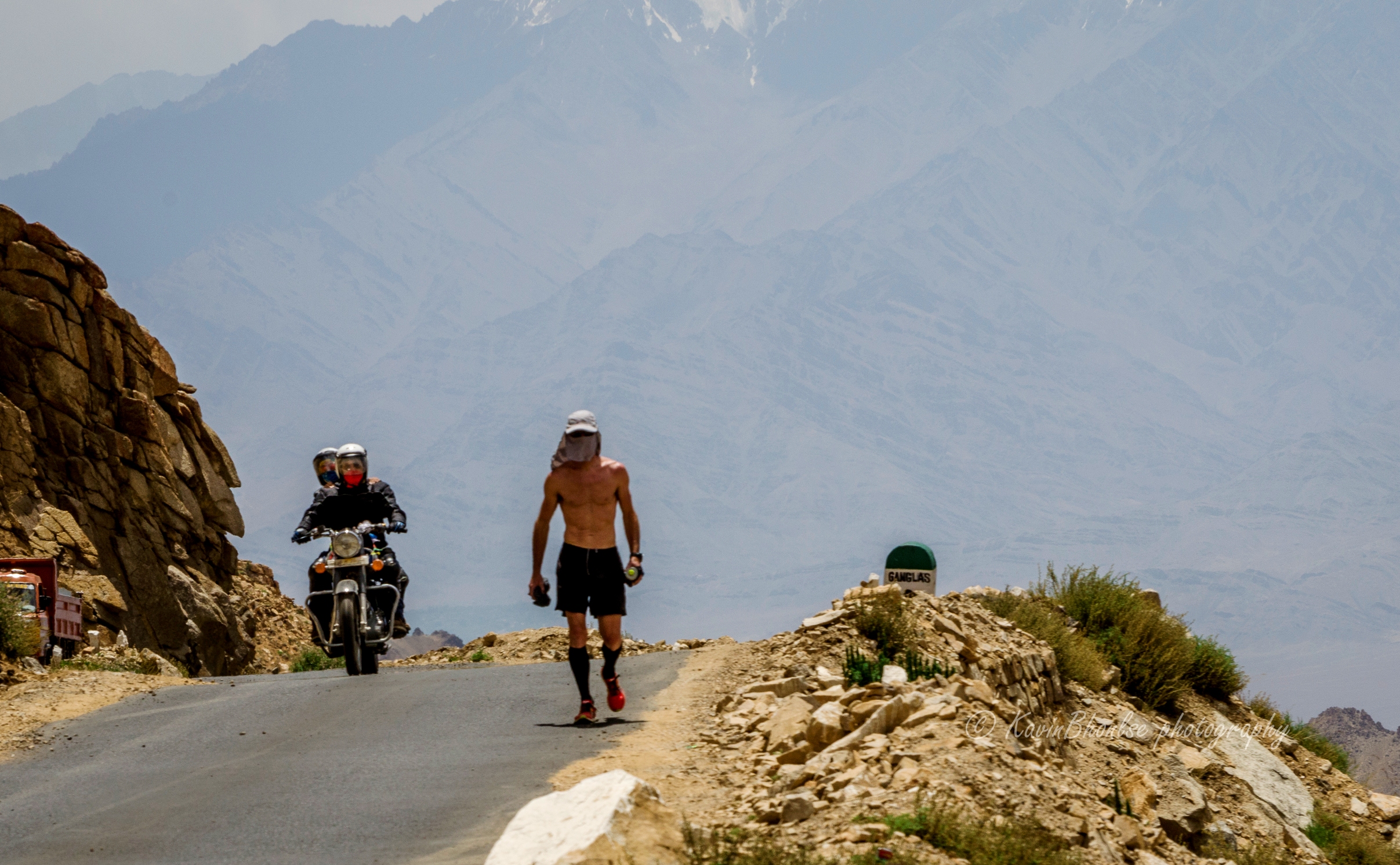
From a previous edition of La Ultra (Photo: by arrangement)

From a previous edition of La Ultra (Photo: by arrangement)

How extreme can extreme be when it comes to ` extreme’ marketing itself?

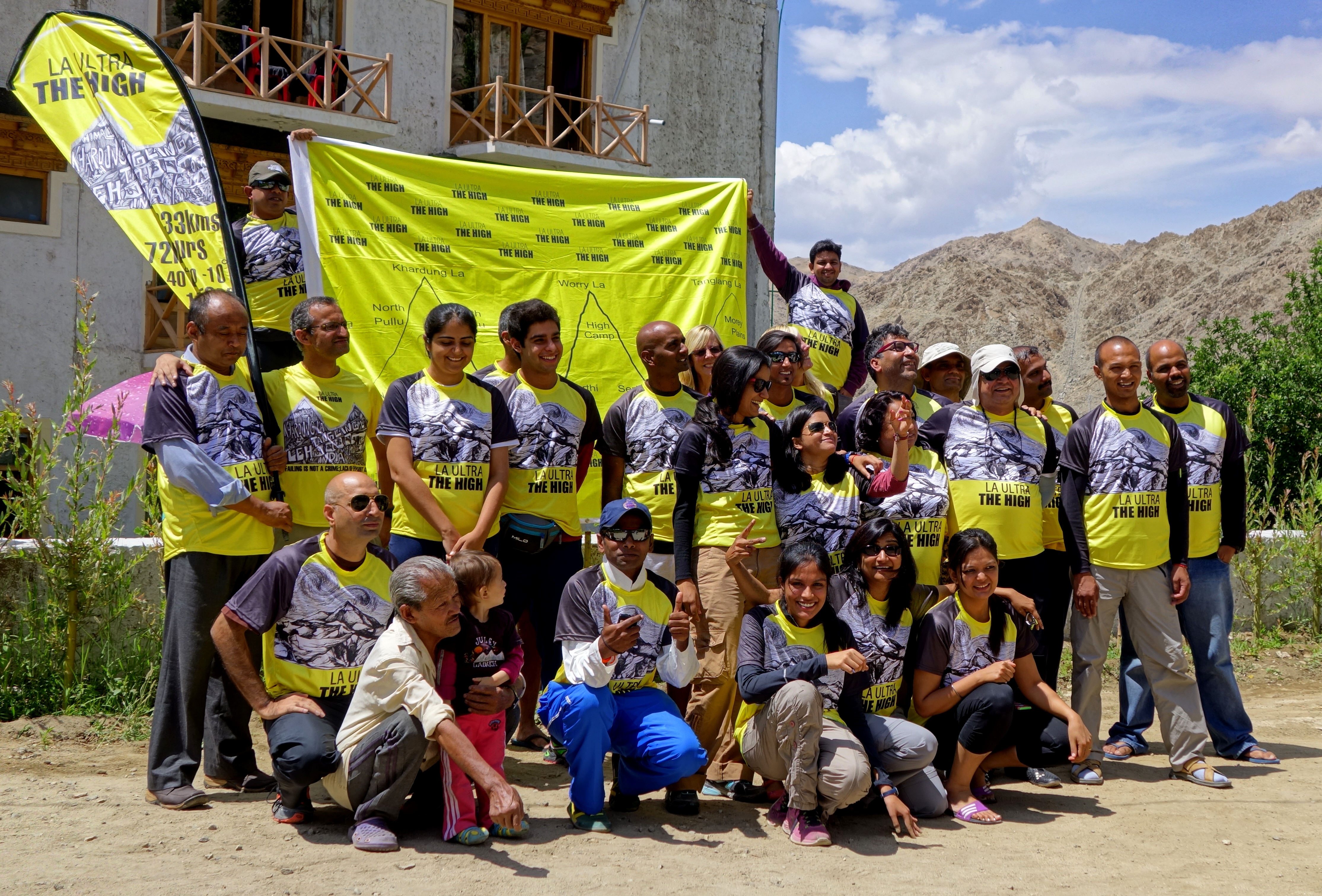
Ladakh is home to one of the world’s toughest ultra marathons, ` La Ultra-The High.’ Its architecture straddles a few extremes – average elevation of over 13,000ft going up to 17,700ft (Khardung La); day temperatures of up to 40 degree centigrade (thanks to the unfettered sun of altitude), night temperatures as low as minus 10 degrees (at high elevation), oxygen content that is 60 per cent of what you would find at sea level and a long distance to run enduring all this. When it started, La Ultra was pegged at 222km. Last year (2014) it grew to 333km. At present, there are three distances on offer for those enrolling to test themselves – 111km with Khardung La included, 222km with two passes over 17,400ft to cross and 333km with three passes over 17,400ft to get across (for an article on the 2011 edition of the race please try this link: https://shyamgopan.wordpress.com/2013/10/19/an-ultra-marathon-from-the-sidelines/).

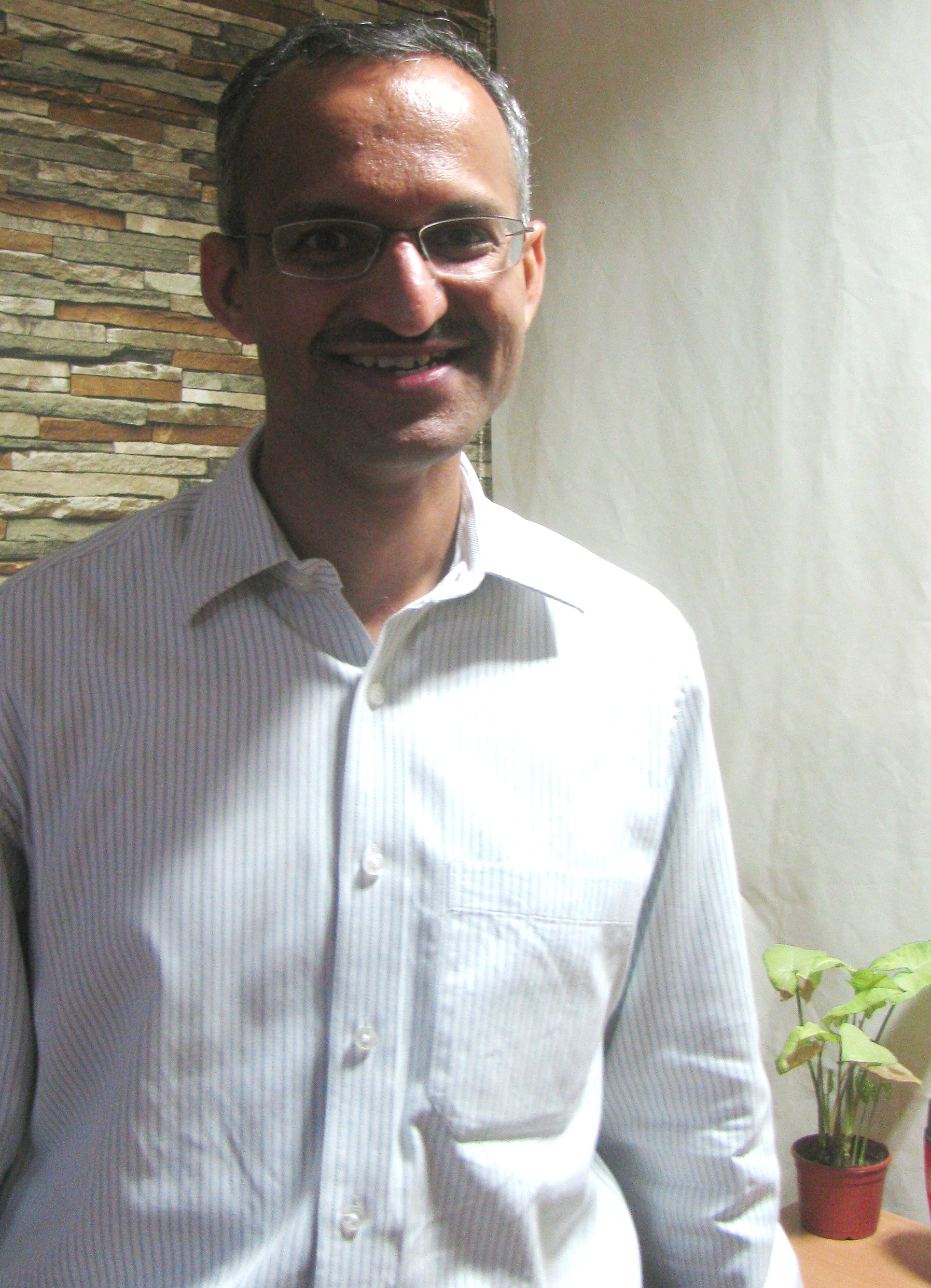
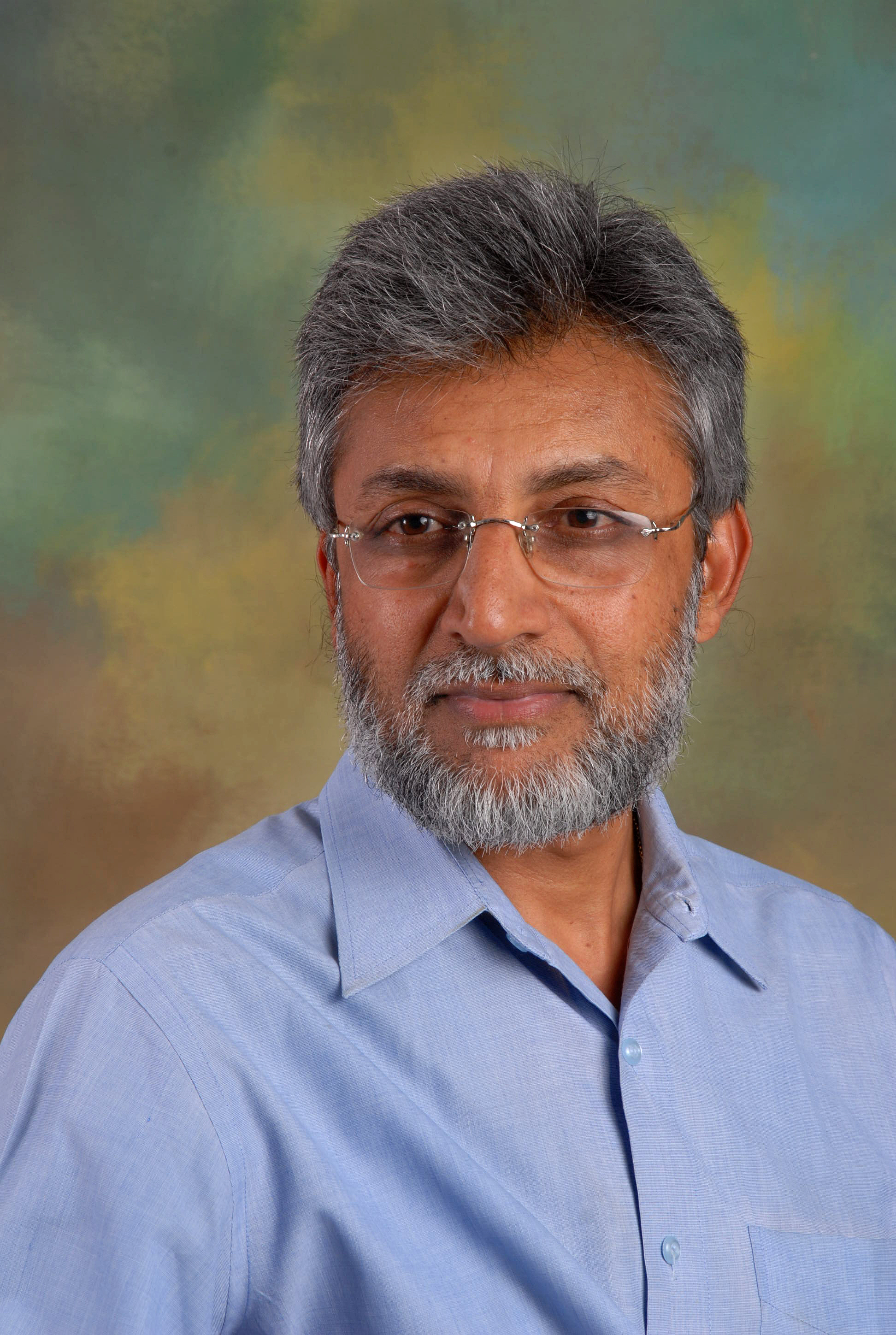
La Ultra’s prime mover is Delhi based-Sports Medicine physician and ultra runner Dr Rajat Chauhan who runs Back 2 Fitness. “ I am clear Back 2 Fitness is my work. Ultra running on the other hand is my passion, what I like to do,’’ he said mid-July at his Delhi office. Over time, the race he pioneered has come to rest in an entity, distinct and apart from his main income earning business. There is also a manager now to oversee race arrangements. The structure for sponsors to come aboard is thus available. Except – to date, no big sponsor has fully stepped in. The annual organization of the event continues to be done by Dr Chauhan and his team and the expenses are borne by them.

Dr Rajat Chauhan (Photo: Shyam G Menon)

Dr Rajat Chauhan (Photo: Shyam G Menon)

According to Dr Chauhan, in 2014, a leading SUV manufacturer very nearly joined as sponsor. There was convergence of what the SUV brand stood for and what La Ultra showcased through the demanding ultra marathon. But that was it. The deal didn’t materialize. Going by what Dr Chauhan and observers said, there are a few things worth noting from a sponsorship angle.

La Ultra-The High is a niche product both in terms of the type of athlete it attracts and the enrolment it sees. From the start, Dr Chauhan was quite sure about what sort of race he was creating. He wasn’t looking for a crowd-puller. He wanted to push human limits marrying the physical strain of functioning at altitude to long distance running. One of the key aspects here is acclimatization. This phase is included in the La Ultra participation-tenure, which is a composite of eleven days to acclimatize plus three days of the actual event. Nobody is allowed to run without undergoing the acclimatization phase. Needless to say, this duration of event spells a long stay in Ladakh plus the costs pertaining to race arrangements. This has made the cost of participating in La Ultra, quite high; it is well over a lakh of rupees (ie more than Rs 100,000) per head. You have to be accomplished and motivated to enrol. The number of participants in this race has consequently remained small. It has always been less than 20.

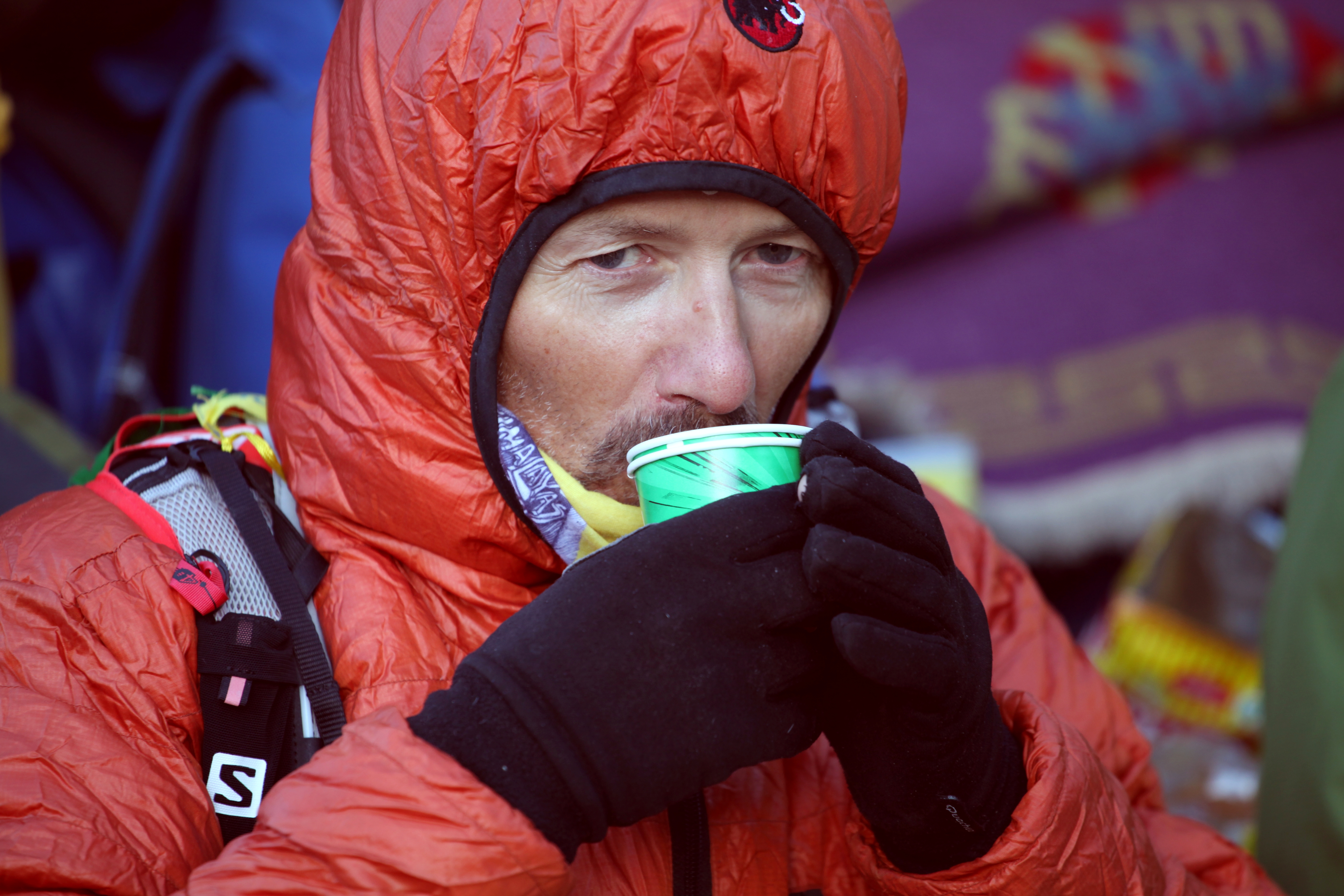
From a previous edition of La Ultra (Photo: by arrangement)

From a previous edition of La Ultra (Photo: by arrangement)

By design too, Dr Chauhan said, he does not want more than 20 people running in a race that genuinely pushes people to their limits in an environment known to challenge physical activity. “ The runner’s health comes first to me,’’ Dr Chauhan said. Both the medical team and the Race Director monitor the progress of each participant and when needed, Dr Chauhan said, he has not hesitated to prevent a runner from continuing. In fact, he saw the stage cut off times (111km-24 hours, 222km-48 hours, 333km-72 hours) less as parameters celebrating performance and more as safeguards to prevent mishaps. For such monitoring to be effective, right down to the documentation needed to support a decision, too many runners are not ideal along the race’s 333km-long course. For a sponsor, that’s perhaps the first challenge La Ultra poses – how do you draw mileage from an acclimatisation plus three day-event that does not take more than 20 runners? From that ensues other questions – what type of audience would wish to see it; how big is that audience, how can the race be relevant to a larger audience, how can a brand benefit from sponsoring it?

In the first edition of La Ultra (when the course length was 222km), there was only one finisher. That has improved since. Dr Chauhan said it was this improvement in performance that made him both trim the finishing time for each stage in the race and also increase the total course length to 333km. Initially a race featuring only foreign runners, there is now a trickle of Indian participation for the shorter ultras. But as challenge levels rise in terms of tighter stage timings and 333km-overall distance, observers say, La Ultra has invited upon itself a second handicap – it probably looks too daunting for people to participate.

From a previous edition of La Ultra (Photo: by arrangement)

From a previous edition of La Ultra (Photo: by arrangement)

Dr Chauhan does not wholly agree with this, especially the distance part.

“ There have been people who came back to participate,’’ he said. Further, he thinks that the race is daunting for the less experienced as the ultra opens with the first 63km of running leading up to the Khardung La pass, which as things stand now is only a fifth or so of the total distance to be covered. So far, no Indian runner has got past the 48km-first stage of the race, except in the race’s third or fourth edition when one Indian runner carried on despite disqualification for missing the seven hour-cut off at the 48km-mark. “ For elite ultra runners, 333km is not a big deal. Mix it with altitude, that makes it punishing,’’ he said. Fact remains however – La Ultra is not something the average marathoner or ultra marathoner would look to. It denied the race popular appeal, making it challenging to market. Is there in marketing a sweet spot, an apt distance between ability and fascination, that makes an event marketable and worthy of sponsorship? Something like far and yet within reach, within the realm of attempting by the viewer?

There are races with gentler attributes – either a lower elevation or lesser distance – that fetch more participants, including in Leh. La Ultra, in comparison, sits aloof at the extreme. It is different enough to be radical but it is too radical for the difference to be marketable. That’s a tricky predicament for a race to be caught in, when it seeks sponsorship. Can there be a compromise-sweet spot, should a potential sponsor insist? Dr Chauhan said he likes such engaging problems. Left to him, it appeared, he would like the race’s shape to continue. What makes the puzzle even more engaging is that according to Dr Chauhan the expense a prospective sponsor may incur to sponsor the event and thereby bring down the cost of participation for runners, is not much, particularly if it happens to be a big company. Such sponsorship and not a sponsor negotiating changes to race parameters, is what he would like. But then, where is that elusive sponsor? As he gears up for the race’s sixth edition – yet another year with no big sponsor – Dr Chauhan said, “ each year it has been a struggle. But I get a kick out of it.’’

The next edition of La Ultra-The High is due in Ladakh this August.

Fifteen people had enrolled as of mid-July 2015; seven to attempt 111km, four for 222km, the rest for 333km.

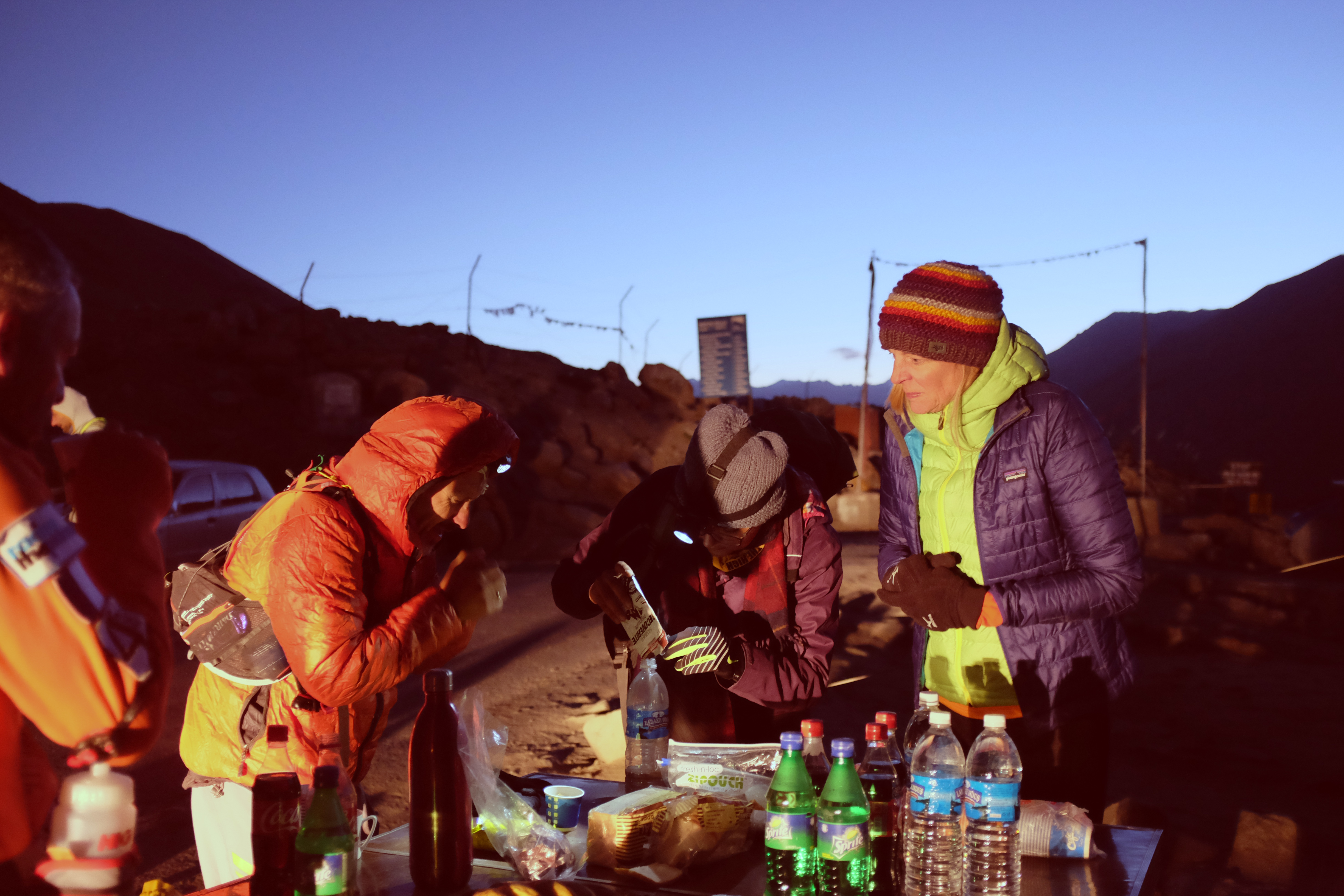
From a previous edition of La Ultra; the crew (Photo: by arrangement)

From a previous edition of La Ultra; the crew (Photo: by arrangement)

Dr Chauhan had the last word. In the final stages of editing this article, he wrote in, “ the other day my nine year old son suggested that from next year we run a bit longer, ie 555km. I pitched the idea of 555km (with five passes) to runners who have participated in La Ultra-The High. After a bit of deliberation – less than an hour – we agreed on 666km (with six passes) next year, possibly over seven, seven and a half or eight days. I already have eight participants for it. I will possibly get 15. And for once, I will run my own race. Most people who do such things don’t try to make too much sense of the return on investment. They just do it. From the beginning, I had thought of La Ultra-The High as the Tour de France of running. It is only a matter of time before the rest realize that.’’

(The author, Shyam G Menon, is a freelance journalist based in Mumbai. Where photo credit has been denoted as `by arrangement,’ it means the picture concerned was obtained from the organizing team of La Ultra.)

EVEREST – WHEN THE EARTHQUAKE STRUCK

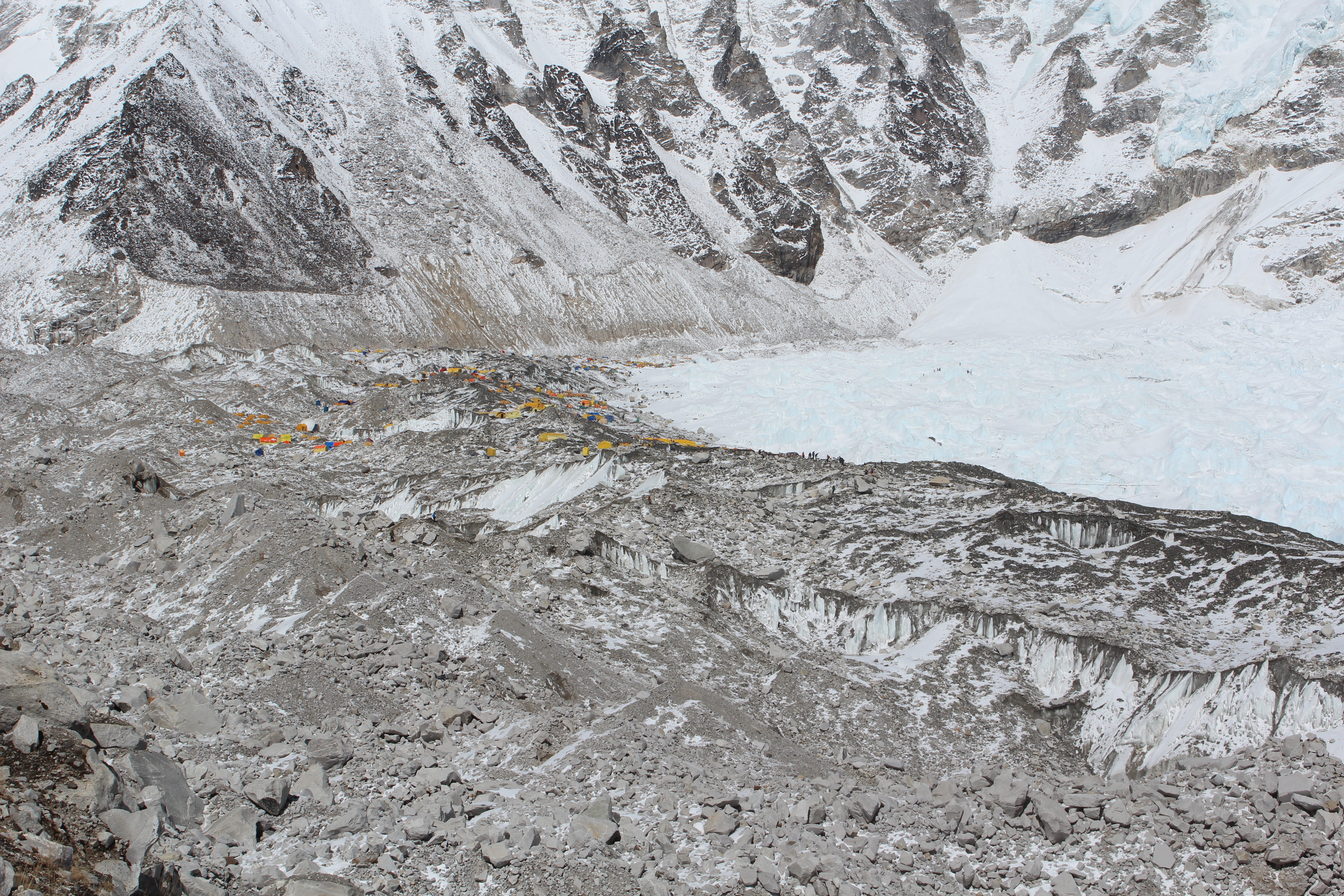
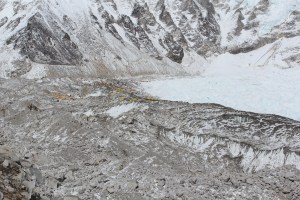
Overall view of the location of Everest Base Camp. The tent clusters can be seen as small coloured specks (Photo: courtesy Love Raj Singh Dharmshaktu)

Overall view of the location of Everest Base Camp (EBC). The tent clusters can be seen as small coloured specks (Photo: courtesy Love Raj Singh Dharmshaktu)

For Love Raj Singh Dharmshaktu it was his eighth visit to Everest and if all went well, a potentially successful climb to the summit for the sixth time. With five ascents already in the bag, he was the Indian to have climbed Everest the most number of times. In love with the peak, he had become associated with regular returns to Everest to try climbing it yet another time.

His 2015 expedition had been difficult to put together. Everest is an expensive affair and sponsors had been hard to find. “ This time it wasn’t as determined an effort. I decided to go if I secured some support,’’ Love Raj said. In the end, some financial assistance did materialize. But it wasn’t enough and so Love Raj, tweaked the details of his passage up the mountain such that he did all the climbing and cooking by himself to save cost (for a report on the run up to this trip, please see https://shyamgopan.wordpress.com/2015/04/04/going-for-a-sixth/). He left for Kathmandu on April 4 to join the Eco Everest Expedition organized by Asian Trekking, among best known organizers of expeditions to Everest. Their annual Eco Everest Expedition, besides climbing the peak contributed its bit to bringing down trash from the mountain. The team this year had 14 climbers including those from UK, South Africa, Australia, Belgium and India.

Love Raj’s flight from Delhi to Kathmandu was delayed by several hours. On April 4, there was a storm in Nepal’s capital city. It was midnight when Love Raj reached his friend’s house there. The next day was normal in Kathmandu. Everything seemed fine. It was a busy day for Love Raj; he had to meet his team and also complete the final preparations for the expedition. The next day, April 6, the team left Kathmandu in fine weather for Lukla. “ From Lukla onward, there was something funny about the weather,’’ Love Raj said. The local people spoke of snowfall. Usually, bad weather in Namche Bazaar in the season of Everest climbs, meant three to four inches of snow on the ground. But this time, it was as much as half a foot. For the next few days – April 9, 10, 11 – on all those days, it snowed. There was a pattern to it. Morning dawned clear. By nine or ten, clouds gathered. Afternoon, it snowed. The consistency of this cycle marked these spells apart from typical bad weather. On April 12, it snowed at Dingboche (14,800ft)). On April 13 too, it snowed. The team walked into Lobuche (16,210ft) that evening, amid snowing. The next day, April 14, the team reached Everest Base Camp (EBC/ 17, 598ft).

According to Love Raj, the first set of tents at EBC, typically belong to trekking groups whose trip is limited to reaching the base camp. Beyond these are the tents of the mountaineering expeditions hoping to climb Everest. EBC is basically located on a glacial ridge. Having grown in size over the years, the camp’s tents can nowadays be found on both sides of the ridge and its crest. At its apex lay the heavily crevassed Khumbu Icefall, one of the most difficult sections on the climber’s passage up the mountain. To one side of EBC are Pumori (23,410ft), Lingtrense (21,972ft), Khumbutse (21,785ft), Changtse (24,780ft), the west shoulder of Everest and Nuptse (25,791ft). Of these Changtse lay in Tibet. A saddle in this array of peaks forms the Lola Pass. The main bulk of Everest (including its summit) and its adjacent high peak, Lhotse (27,940ft), are not visible from base camp. Pumori, Lingtrense, Khumbutse, Changtse, Lola Pass – roughly put, these physical features ran parallel to EBC on its side. There was a depression between EBC and the commencement of these mountains. Pumori is eight kilometres west of Everest. Named by the late British climber George Mallory, Pumori means ` unmarried daughter’ in the Sherpa language. The mountain is often deemed the daughter of Everest. It is a popular climbing peak with significant avalanche danger. Kala Pathar (18,513ft), well known among visitors to EBC as a high perch to view Everest, is an outcrop below the southern face of Pumori.
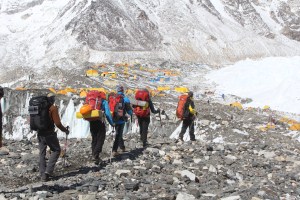
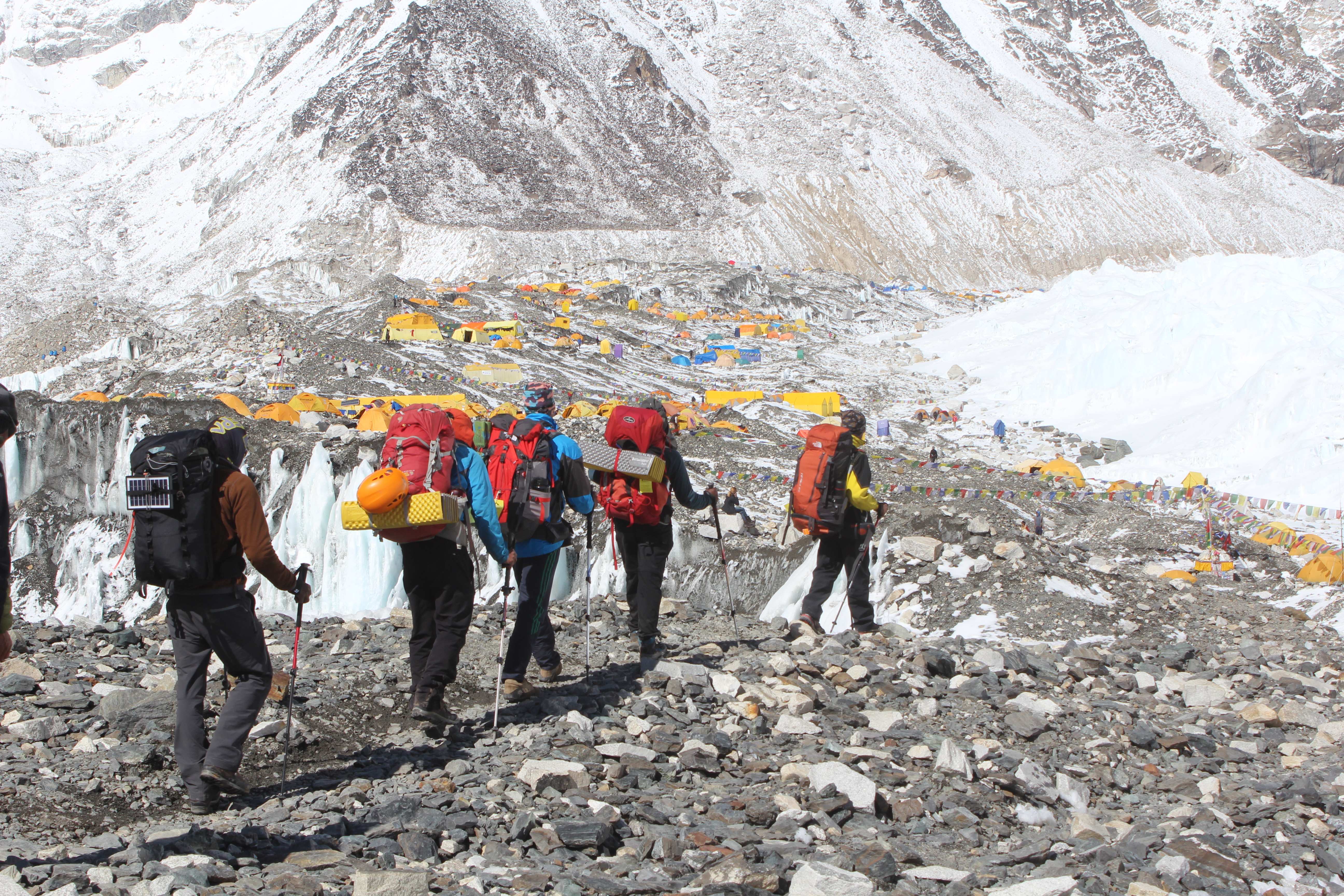
Reaching EBC (Photo: courtesy Love Raj Singh Dharmshaktu)

Reaching EBC (Photo: courtesy Love Raj Singh Dharmshaktu)

The Eco Everest Expedition had its tents located just above the trekkers’ tents and at the beginning of the mountaineering lot’s share of camp. It was thus 20-25 minutes away from ` crampon point,’ which is from where crampons become essential for travel on ice. This is tad different from the usual thinking of climbers who like to be close to a climb. But that distance meant the Eco Everest Expedition was removed from the thick of tents at EBC. Significantly (significant from the angle of later events), the Eco Everest Expedition was away from the depression between EBC and Pumori. From the depression, you would have had to ascend the slope to the ridge and then descend to reach the team’s tents. Love Raj said, when he arrived at EBC, there was already a strong contingent of tents and climbers in place. “ A lot of people were there,’’ he said.

One possible reason for the many people at EBC was an accident that had occurred a year ago. On April 18, 2014, a large chunk of ice broke off from a serac band at 20,200ft triggering an avalanche. On the National Geographic website, the ice chunk that broke off is estimated as 113ft high with a top area slightly in excess of a NBA basketball court. At that dimension, its maximum weight in ice was estimated as the equivalent of 657 buses or 31.5 million pounds. The broken chunk and the avalanche it triggered barrelled down on Nepali mountain workers in the Khumbu Icefall, who were preparing a safe route for clients that season. Sixteen of them were killed in the avalanche. Following this accident and the outburst in its wake of inadequate protection and welfare schemes for mountain workers, several outdoor companies had cancelled their expeditions. Some of the clients and climbers who missed climbing the mountain in 2014 would have returned in 2015, contributing to the robust camp Love Raj saw at EBC. According to old reports on the Internet, the authorities had said that ascents in 2015 would take a slightly different route given the damage caused by the 2014 avalanche to the old approach. That 2014 avalanche had been responsible for the highest numbers of deaths on Everest in a season, till then. Indeed among the 8000m peaks, Everest has claimed the most number of lives largely due to the high number of people congregating every season to attempt the world’s highest peak. People die climbing and assisting climbing expeditions. As per information on the Internet, around 250 people have died thus on Everest, so far.
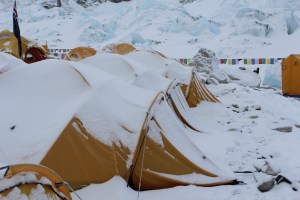
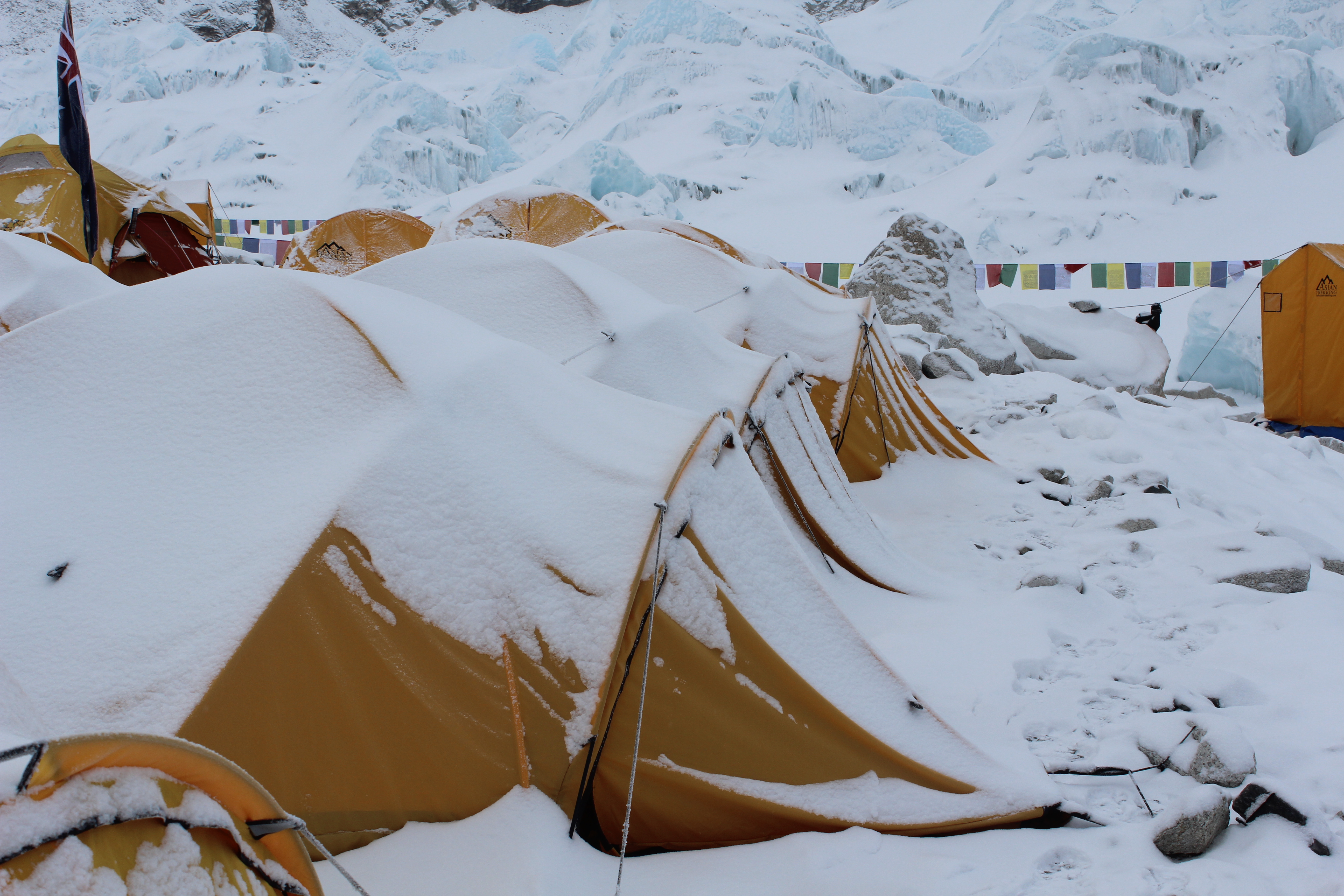
EBC, before the earthquake and avalanche (Photo: courtesy Love Raj Singh Dharmshaktu)

EBC, before the earthquake and avalanche (Photo: courtesy Love Raj Singh Dharmshaktu)

On April 15, the Eco Everest Expedition had its team puja (prayers), a ritual ahead of formally starting the peak’s ascent. After the puja, some of the newcomers were provided time to train and check gear. Typically the day after the puja, the team members go up the mountain a little bit; the accompanying mountain workers climb up to Camp 1 and return. This time the Eco Everest Expedition decided to try Lobuche East (20,193ft) as pre-Everest climb. On April 16, they moved from EBC to Lobuche, where Asian Trekking had a hotel. The next day, they shifted to the upper base camp on Lobuche East. On April 18, they were on the summit. “ Weather was bad all through. The Sherpas who came with the team said they had never seen so much snow on the summit before. There was almost two feet of snow on top,’’ Love Raj said.

On April 19, the team returned to EBC. The next two days – April 20 and 21 – were devoted to acclimatization walks and training on the glacier. On April 21, the team’s support staff went up to Camp 1 and came back. April 22 and 23 were rest days. On April 24, some of the team left early morning for higher camp. The plan was to stay two nights at Camp 1; the first day, proceed to Camp 1 from EBC, the second day go from Camp 1 to Camp 2 and return to Camp 1. On April 25, according to Love Raj who was at EBC, two members returned early to Camp 1 from the climb to Camp 2. They had reached Camp 1 and not yet got into their tents. The rest of the team was in the Western Cwm. Named by George Mallory, the Western Cwm is a large bowl shaped glacial valley at the foot of the Lhotse face of Mt Everest. It is reached via the Khumbu Icefall and is notorious for how its shape combined with the vast amount of snow and ice around, reflect sunlight to gift the climber rather hot days despite the significant altitude of the location.

Noon, April 25, 2015 – Nepal’s devastating earthquake struck. News reports on the Internet peg the exact time of the event as 11.56AM local time. At EBC, Love Raj noted it as 12.06. With epicentre in the village of Barpak in Gorkha district (as per reports in April), the quake’s intensity was estimated at 7.8 on the Richter scale. Subsequent reports would say that the ground beneath Kathmandu may have shifted up to ten feet south in the temblor. The whole Everest region was also shaken up. Up on the mountain, top Indian sport climber, Praveen C M (he has been national champion several times), was one of the two people from Love Raj’s team who had returned to Camp 1. They were roughly ten minutes away from their tents when the earthquake struck. According to him, visibility was poor. But they could hear avalanches in the neighbourhood. “ Avalanches happened to our right and left. There was also a third one,’’ he said. Luckily the camp site was spared a direct hit and only the smaller debris rolled in. Down at base camp, Love Raj, the team’s doctor and a Sherpa were in the dining tent discussing something when the earth started to shake. It was initially mild. They stepped out of the tent. By then the tremors were strong. EBC is on a moraine slope atop a glacier. There were sounds of things falling and breaking up. Glaciers are live environment. Even on a normal day, when camped on or near a glacier, mountaineers hear the sound of ice cracking deep within. There is also the sound of chunks breaking and falling off from mountains in the neighbourhood. Mountain environment is dynamic. This time it was more pronounced; the sounds were loud. The three men held on to each other. Just after this, from all sides, the sound and fury of avalanche set in.
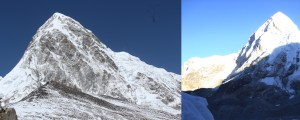
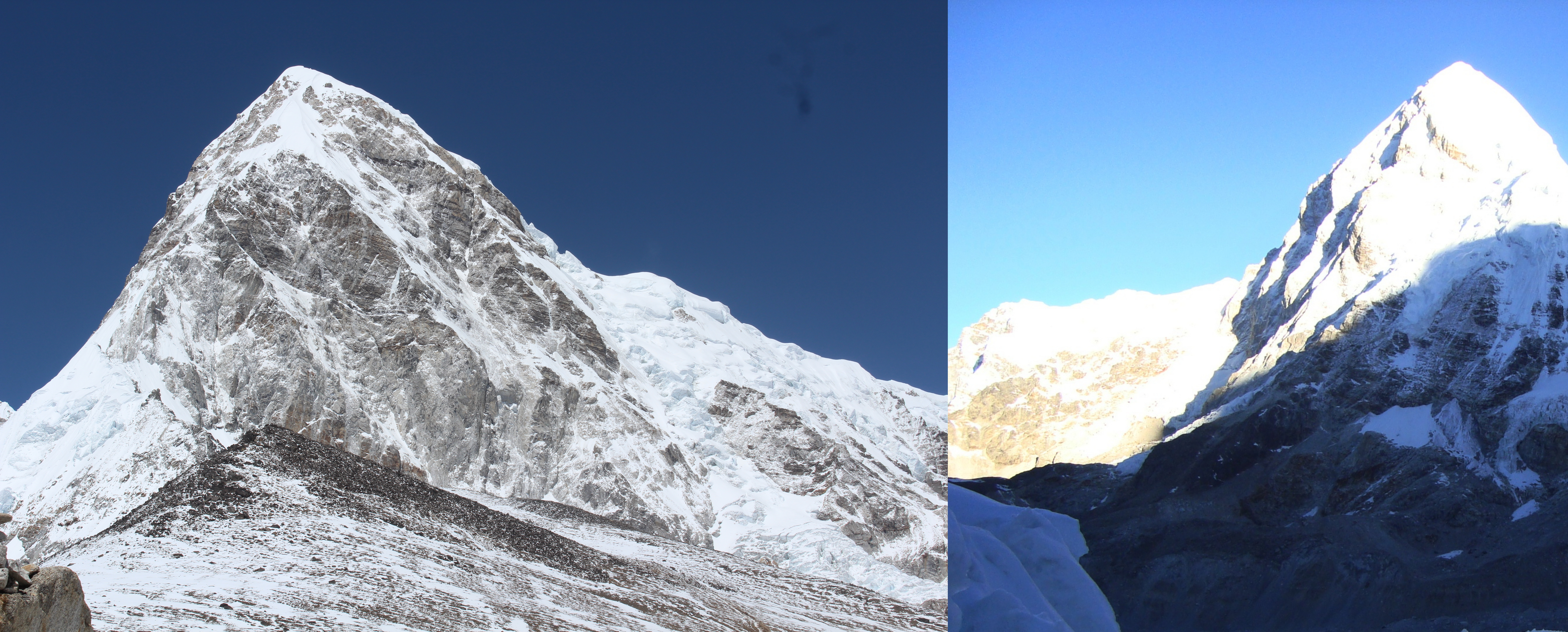
File photos of Pumori, the mountain from which the avalanche that hit EBC in 2015, came. These photos are from expeditions in previous years (Photo: left pix, courtesy Love Raj Singh Dharmshaktu; right pix, courtesy Dr Murad Lala)

File photos of Pumori, the mountain from which the avalanche that hit EBC in 2015, came. These photos are from expeditions in previous years (Photos: left pix, courtesy Love Raj Singh Dharmshaktu; right pix, courtesy Dr Murad Lala)

In Latin, ` ava’ means earth. `Lanche’ means: breaking down of. Wikipedia describes avalanche as a rapid flow of snow down a sloping surface. Further, after the process starts, avalanches usually accelerate rapidly and grow in mass and volume as they entrain more snow. If the avalanche moves fast enough, some of the snow may mix with air forming a powder snow avalanche, which is a type of gravity current. From past experience in the mountains, Love Raj knew what was coming. Within no time he felt the approaching gust of wind followed by the spectacle of powder snow billowing 30-40 ft in the air, rearing up behind the camps on the ridge between EBC and Pumori. The avalanche, coming down from Pumori had hit the depression, powered up the next slope to the ridge and was looming like a cloud for the onward journey. In the process it had already flattened camps on the slope immediately above the depression.

Seeing the cloud of snow, Love Raj and his companions ran their separate ways. Love Raj and two Sherpas took shelter behind a rock. The avalanche swept by. They were behind that rock for a couple of minutes. Love Raj described the period. “ When an avalanche arrives, there is severe wind chill. That and the powder snow flying around make your breathing laboured. The snow gets into your lungs. You are in a cocoon of heavy breathing. That’s what I heard when I took shelter. Later when I got up, everything was covered in snow. I was breathing hard as though I had run a 100m sprint,’’ he said. Since avalanches come from above and the whole area had been shaking, their first instinct was to check on climbers up the mountain. They immediately contacted the team members who were at Camp 1 and above. They replied they were safe but couldn’t see anything as visibility had plummeted. One of the members had been on a ladder placed across a crevasse when the quake happened. He was immediately pulled back, averting grave consequences. Love Raj and others at EBC, advised them to stay put on the mountain. Be at either Camp 1 or Camp 2. At both camp sites, across the many expeditions attempting the peak, there were approximately 100-120 people. No major tragedy was reported from the higher camps. Unknown to Love Raj, it was EBC that took the brunt.

As visibility improved at EBC, the devastation became clear. The injured started coming in. Most injuries were to the face; head, limbs – the consequence of being hit by flying debris or being flung around by the avalanche on the rock ridden-moraine. While some people fled after the quake, the others commenced rescue operations within about 15 minutes of the incident. The tents that hadn’t collapsed were immediately made into treatment zones for the injured, including designated tents for the seriously injured and the less seriously injured. Love Raj said that a chain of command took shape organically and pretty soon a rudimentary medical facility was in place. Mountaineering expeditions travel as self sustained groups. They anticipate accident and are prepared for it. Teams now pooled their medical kits. Kitchen staff got the stoves going; hot drinks and food was prepared. In terms of impact of disaster, those camped on the ridge slope facing Pumori were the worst hit. Those on the ridge and on the other side were less affected. In all 19 people would die in this avalanche making it the worst season on Everest. A year and six days after the 2014 avalanche, its reputation as the worst season on the peak had been surpassed.
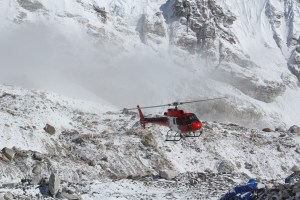
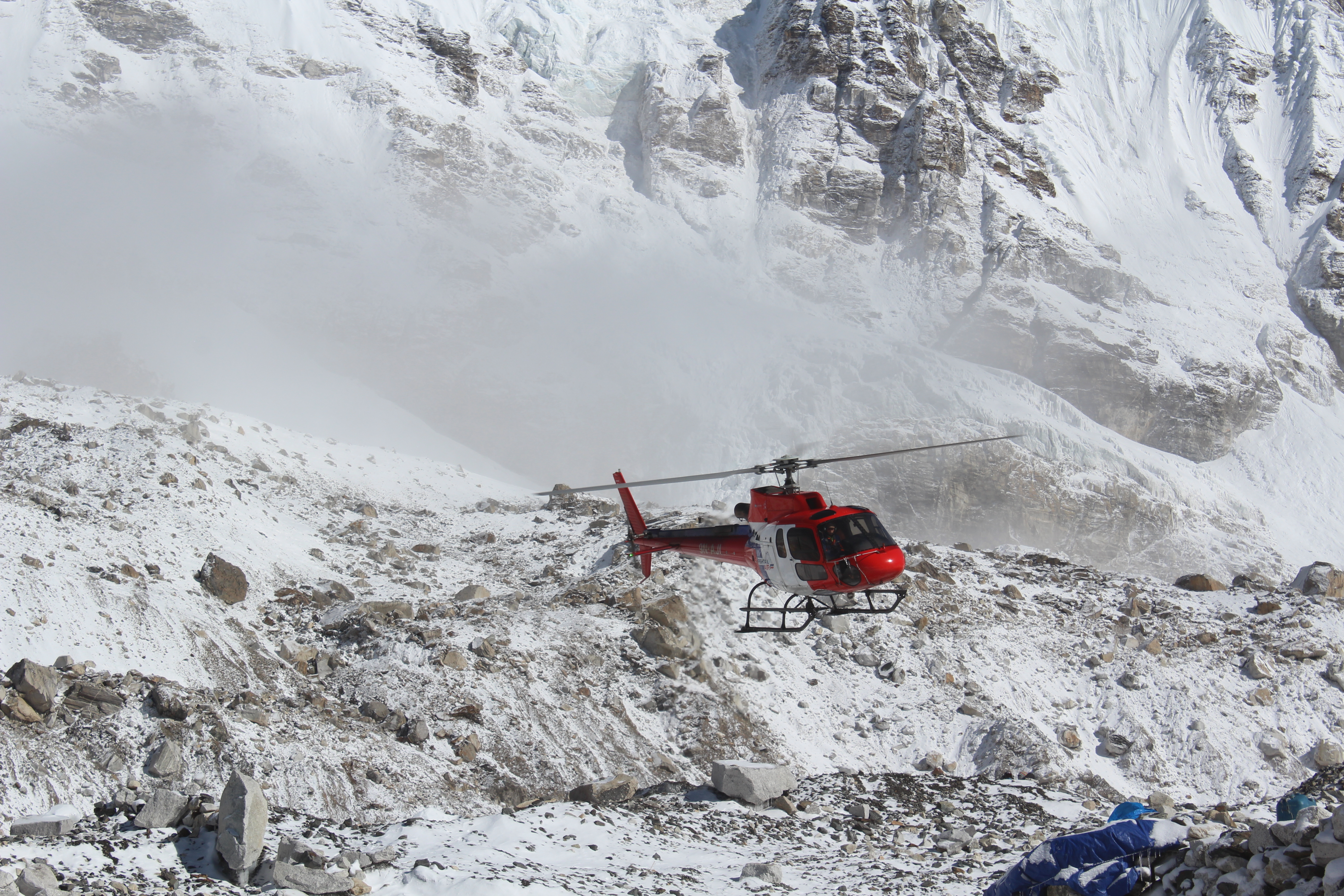
After the avalanche; a helicopter at EBC (Photo: courtesy Love Raj Singh Dharmshaktu)

After the avalanche; a helicopter at EBC (Photo: courtesy Love Raj Singh Dharmshaktu)

Some argue that the high incidence of tragedy on Everest is prompted by the number of people on the mountain and the varied nature of that people spanning seasoned climber to abject amateur. Makalu (27,838ft) is a beautiful sight from Everest and Lhotse. Eighteen kilometres east of Everest, it stands apart from other mountains. There were people on Makalu and at Makalu’s advance base camp (which serves as base camp for the peak), when the temblor hit. But nobody died. Arjun Vajpai, who some years ago became briefly the youngest person to ascend Everest, was at Makalu. Arjun had managed to climb Everest (29,029ft), Lhotse (27,940ft) and Manaslu (26,781ft) in his first attempt. He then decided to try Cho Oyu (26,906ft) and Shishapangma (26,335ft). Attempting these mountains in spring, he ran into bad weather. He temporarily suffered a partial body paralysis and had to be brought down from Cho Oyu. Following this reversal he decided to attempt Makalu. His first attempt in 2013 failed because the team ran out of rope; the second attempt saw much further progress on the mountain but again succumbed to rope related issues. His April 2015 trip to the mountain for a third attempt, was a “ really calm’’ one. The description fit the state of affairs till noon April 25.

Arjun reached Makalu’s advance base camp (ABC) on April 22. At 19,500ft, this is the highest base camp for any mountain. Both the approach to Makalu and the ABC don’t have any of the heavy traffic or frills one finds on the Everest trail. “ There is no impressive infrastructure here,’’ Arjun said. In 2013, there were just two teams on the mountain. In 2014, there were three to four teams. What he saw in 2015 was the highest number of teams he had seen so far on his visits to Makalu. But it was still nothing compared to EBC. Arjun too noted the snow he saw en route. “ There was a lot of snow. I hadn’t seen so much snow in the previous two years,’’ he said. The topography and lay of Makalu ABC is different from that of EBC. The main peak sits recessed and away. What is closer to ABC is rock ridden-ridges from which, even on normal days, stones can roll down. Around noon on April 25, the earth shook. “ We started hearing noises all around,’’ Arjun said. Fifteen minutes later, there was an aftershock. Till then there had been no major avalanche. According to Arjun, the aftershock felled a big serac with a lot of snow behind it, at Camp 2. Also, ahead of Camp 1 on Makalu, there is a 150m steep ice wall. A climber was rappelling down it when the wall split from the very centre. That climber and his team were rattled. One of them left the next day. The quake caused injuries at Makalu base camp. There were no fatalities. The approach trail to the region was badly damaged. Although Arjun managed to call home and say he was fine, for the first day or two, he said, there wasn’t a clear idea of the dimension of the earthquake. Then it slowly filtered in; first came news of EBC, then news of lands beyond all the way to Kathmandu. With the trail leading to Makalu damaged, Arjun and his team were ferried out by helicopter from Yanglekharka, a village some distance from base camp.
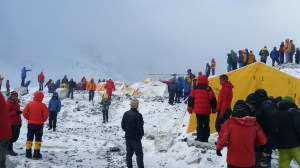
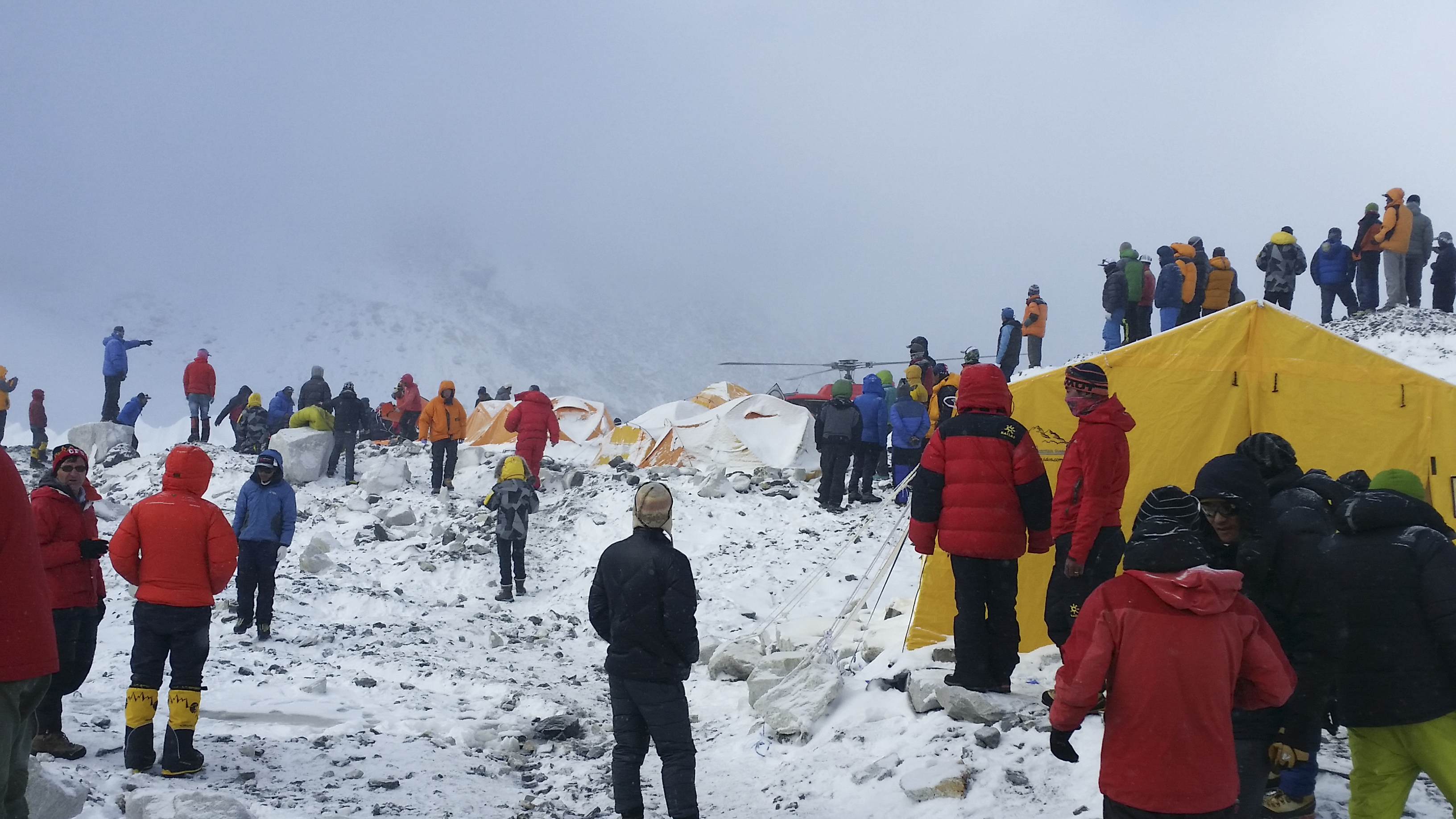
Mt Everest, April 26, 2015 : Helicopters arrive at the base camp of Mt Everest to airlift injured persons from the camp after an avalanche killed 16 people on Everest on April 25, 2015. (Photo by Praveen C M )

EBC after the avalanche; helicopters arrive to airlift the injured (Photo: courtesy Praveen C M )

At EBC, Love Raj said that news of the scale of the tragedy was available within an hour or so after the quake. There was panic initially. Some of the local people left wanting to know what had happened back home. “ But a lot of them stayed back. The rescue operation was actually carried out well. There was no particular panic in that department despite everyone affected by the temblor and traumatized by it,’’ he said. A makeshift helipad was made at EBC. By next morning, helicopters began arriving. Up on the mountain, people successfully reached Camp 1 from Camp 2. But reaching EBC from Camp 1 proved difficult; a group of mountain workers tried it but they retreated to Camp 1 as many of the ladders in the Khumbu Icefall were gone. Eventually they were brought down by choppers. The immediate rescue operations at EBC were more or less completed in the first three hours after the quake. There was little need to dig out anyone from the snow. The dead and the injured were on the surface. By April 28-29, the dead were removed from the scene, Love Raj said. According to him, on the first day, 14 were confirmed dead. That night, two people died. The next morning, three more bodies were recovered; altogether 19 (Wikipedia lists 22 dead including two who died in Kathmandu following injuries sustained at EBC).

By the evening of April 26, word came that China had closed access to Everest from the Tibet side. It wasn’t yet known what would happen for Everest ascents in Nepal. Every year, the initial part of the climbing route to Everest is opened by personnel from the Sagarmatha Pollution Control Committee (SPCC). Their team – often called the Icefall Doctors – open the route till Camp 2. With the SPCC camp at EBC among worst hit by the quake, their personnel were no more around. Despite tragedy, climbers – those who had reached EBC after investing much money in 2015 and those who had come after their trips got cancelled in 2014 – would have wished to proceed. But there were problems. One of the large expedition groups decided to retreat fearing more aftershocks. Then there was the issue of adequate mountain workers as support staff. They had suffered personal tragedies back home. Some had gone back; those still around were there despite the suffering. Around April 30, Love Raj said, Himalayan Experience, which along with Asian Trekking typically opens the route above Camp 2, decided to pull out (Himalayan Experience is an interesting company. As early as 2012, it had warned about impending disaster on Everest due to a bulge of hanging glacial ice on the climbing route and actually pulled out its expeditions that year. It was criticized. In 2014, after the year’s deadly avalanche, that decision was seen in a totally different light). On May 2nd or so, SPCC personnel reached EBC by chopper. By next evening, it was decided to shut down the climbing season. The reason available at EBC was – even if the SPCC opened the route till Camp 2, the route further up can’t be opened because some of the important expedition companies had decided to retreat. Love Raj made his way back to Delhi. In all, the April 2015 earthquake killed over 8000 people in Nepal and injured more than 19,000.
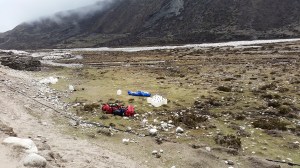
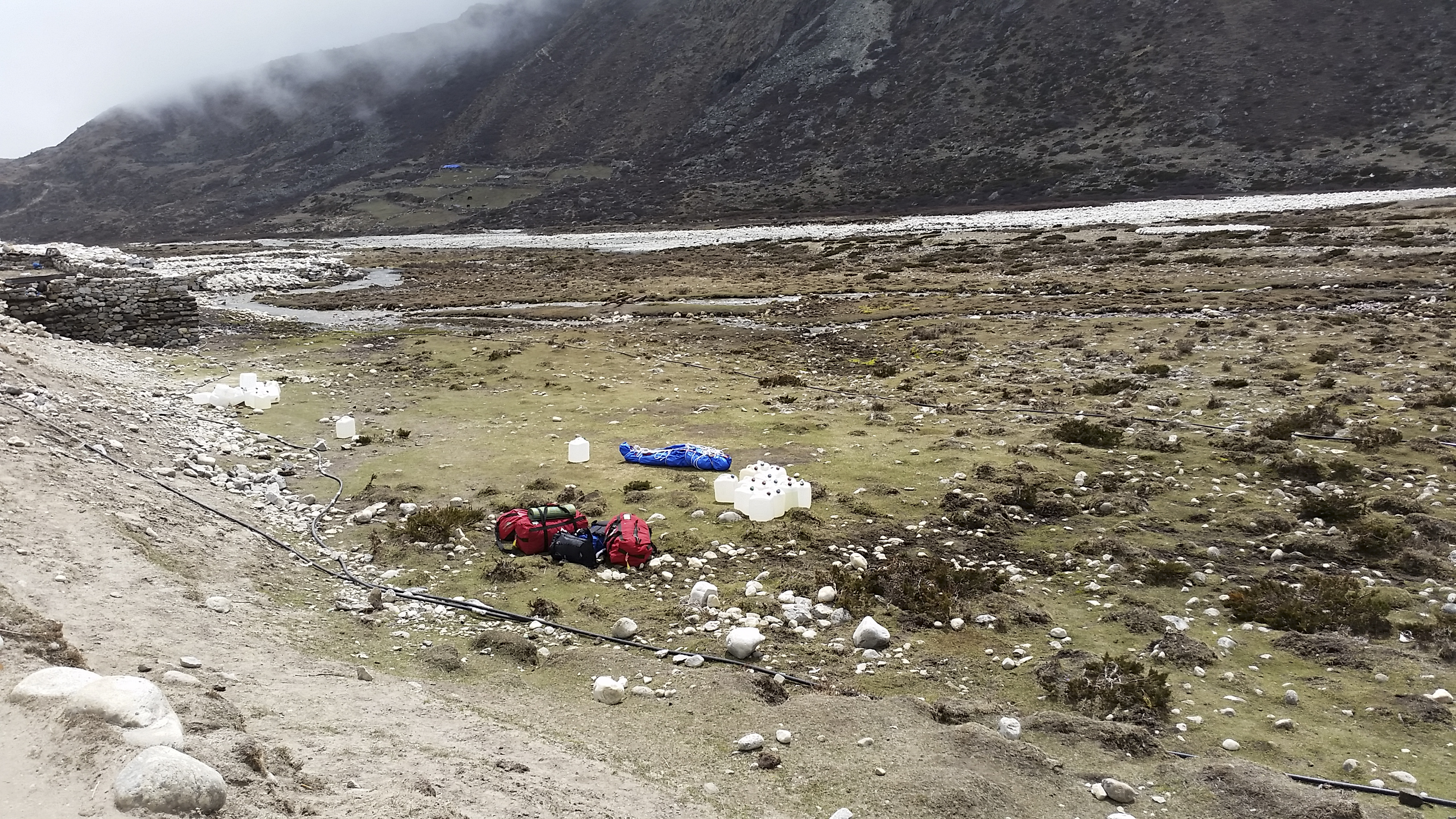
At EBC after the avalanche; the body of a climber, wrapped in polythene, ready for airlift to Kathmandu (Photo: courtesy Praveen CM)

At EBC after the avalanche; the body of a climber, wrapped in polythene, ready for airlift to Kathmandu (Photo: courtesy Praveen C M)

Two major tragedies, two seasons in a row – may leave a psychological mark on Everest climbs. Nobody can forget the lives lost. But from a mountaineer’s perspective, the climb – for the climb it is – can be viewed rationally. I asked Love Raj what the earthquake could mean for future climbs. What if the route on Everest has altered? “ Isn’t that how mountain environments are?’’ Love Raj asked. Mountains are dynamic. News reports quoting Chinese studies (China has a satellite monitoring system on the peak since 2005) have said that as part of the continuing collision of the Indian tectonic plate with the Eurasian plate – which is how the Himalaya was formed – Everest had been moving four centimetres northeast and growing 0.3 centimetre annually. In the April 2015 temblor, Mt Everest shifted three centimetres southwest with no alteration to height. In the aftermath of the earthquake, it is possible that the icefall on the mountain may have freshly cracked; new crevasses may have opened up, existing crevasses may have grown wider (at the time of writing this article little information had emerged on whether the climbing routes were affected and if so, how). But as Love Raj said, there are the winters and their snows which bridge and compact things afresh. It is the earth’s natural cycle. Mountaineers will find a way through. It was a sentiment shared by Arjun, albeit differently. He pointed out in the context of various types of people congregating in high mountain camps and then panicking when calamity strikes that trained mountaineers know how to cope with such situations.

Love Raj was worried less about climbers. He was worried more about the mountain workers whose houses were destroyed in the earthquake, not to mention, their source of livelihood literally shaken up. “ For them, there is a big gap in earnings between working on Everest and working on other peaks,’’ Love Raj said. In Nepal, Everest is a small economy in itself. When it shuts down, it affects the lives of those dependent on it. Or differently put, you may not be able to keep it shut for long.

(The author, Shyam G. Menon, is a freelance journalist based in Mumbai. Please note: this article is based on events reconstructed from conversations. The author has not been to EBC. A slightly abridged version of this article appeared in Mans World (MW) magazine. For more on Love Raj Singh Dharmshaktu please click this link: https://shyamgopan.wordpress.com/2014/07/10/everest-to-the-east/)

SIX YEARS. 100,000 NAUTICAL MILES.

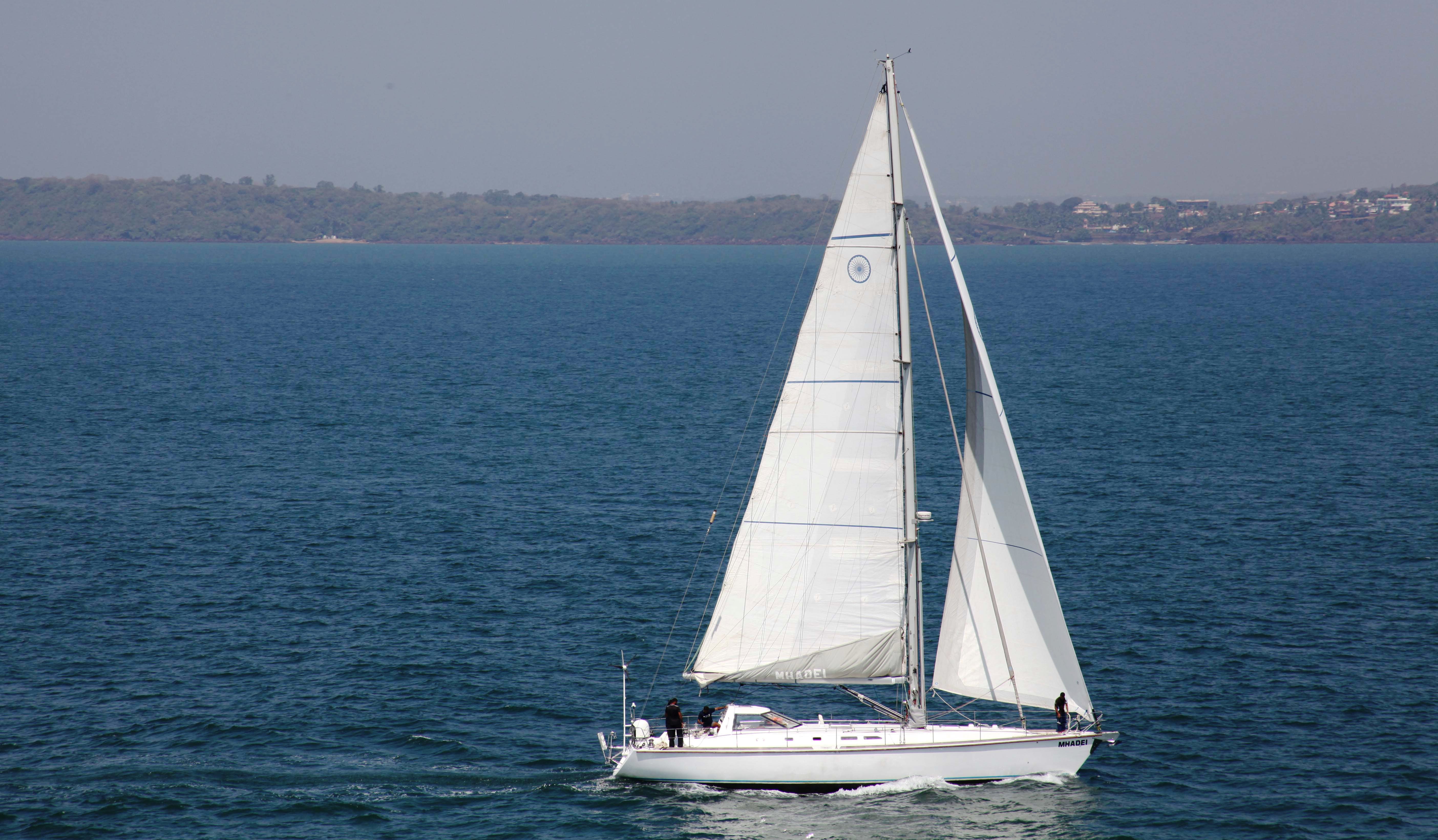
The INSV Mhadei (Photo: courtesy Indian Navy)

The INSV Mhadei (Photo: courtesy Indian Navy)

The sail boat at the centre of India’s two solo circumnavigations to date, recently celebrated a milestone.

In six years, the INSV Mhadei travelled over 100,000 nautical miles on the world’s oceans.

Given a single circumnavigation is around 23,000 nautical miles, what the sail boat has aggregated exceeds four journeys around the world.

“ One hundred thousand nautical miles is a lot of sailing,’’ Commander Dilip Donde, the first Indian to do a solo circumnavigation, said.

His long voyage was followed by Commander Abhilash Tomy’s solo nonstop circumnavigation, another first for the country.

The full story of building the Mhadei and her two nationally significant voyages can be read on this blog under the ` Sagar Parikrama’ category (https://shyamgopan.wordpress.com/category/sagar-parikrama/; please scroll down). It also includes an interview with Vice Admiral Manohar Awati (Retd), who was the architect of the Indian Navy’s solo circumnavigation project.

The Indian Navy’s only yacht, the Mhadei is a tough little boat.

If you go through the Mhadei’s voyages so far, you will see it – generally speaking – as oriented towards a major voyage by way of significant objective with plenty of long voyages in between for preparation. Ahead of the first solo circumnavigation voyage for instance, there had been sailings to Colombo and Mauritius. Commander Donde sailing her alone from Mauritius to India became the first instance of such solo sailing by an Indian.

The naval officer embarked on his circumnavigation voyage in August 2009 and returned in May 2010.

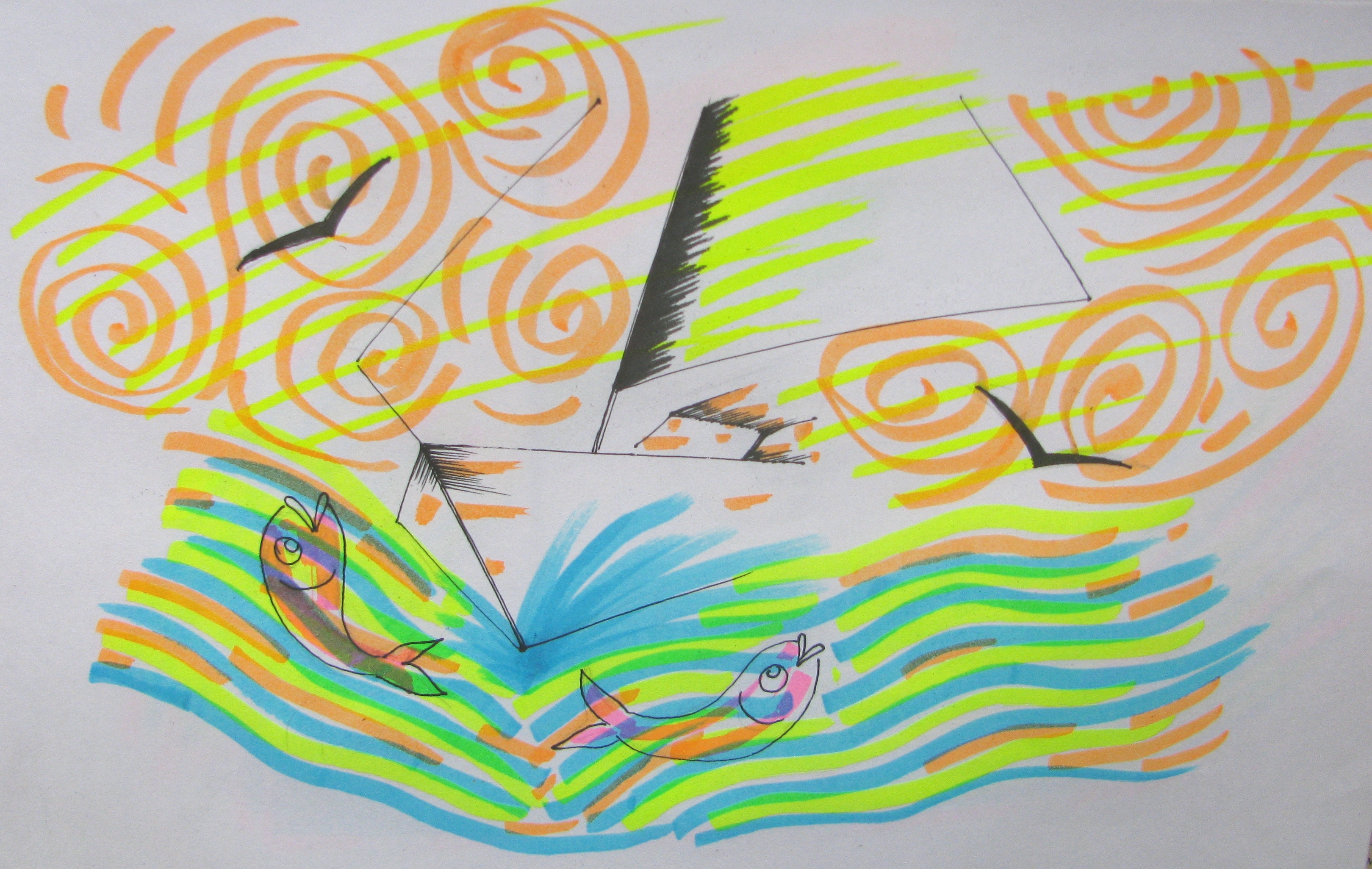
Illustration: Shyam G Menon

Illustration: Shyam G Menon

The Mhadei is a 56 feet long-sloop designed by the Dutch firm Van de Stadt. Her model name is `Tonga 56.’ When Commander Donde finished his voyage, the Mhadei became alongside the first Tonga 56 to do a solo circumnavigation, not to mention the first India built-Tonga 56 to do so. Commander Abhilash Tomy’s first solo voyage was in the Mhadei from Cape Town to India ahead of his upcoming major trip. He sailed out from Mumbai in November 2012 and returned five months later with the first solo nonstop circumnavigation by an Indian, done.

The navy then shifted attention to familiarizing its women officers with long distance sailing.

In April-May 2013, soon after she completed the solo nonstop circumnavigation, the Mhadei sailed from Mumbai to Kochi and back to her base in Goa. In November 2013, she sailed out from Goa to Cape Town and then took part in the Cape to Rio Race in January 2014, which entails crossing the Atlantic from Africa to South America. This time she had one woman officer aboard. After returning to Goa, the Mhadei, in November 2014, sailed from Goa to Kochi, Port Blair, Vishakhapattanam, Chennai, Kochi and back to Goa. On the Chennai-Kochi leg, the Mhadei had a crew composed mostly of women. On February 12, 2015, the sail boat celebrated her sixth birthday. Two days later, it was an official celebration of her birthday and 100,000 nautical miles sailed, attended by the union defence minister. “ If you add up the point-to-point distances of all her big trips, it actually works out to more than 100,000 nautical miles,’’ Commander Abhilash Tomy said.

A few aspects help put the 100,000 nautical miles in perspective.

First, the Mhadei’s near continuous sailing and 100,000 nautical miles crossed in six years compares with the general average of most cruising boats spending no more than 10-20 per cent of their time away from home moorings. “ Nobody sails like this,’’ Commander Donde said. Second, the Mhadei’s voyages have been remarkably different from that of bigger ships, other naval vessels included. Because she has so far been a yacht courting adventure, the Mhadei has sailed through some really rough seas testing crew and boat alike. Not to mention, pitting its small size against vast, rough seas. Each long voyage entailed its share of punishment. For example, on the last Cape to Rio Race, following the onset of a tropical cyclone, of 35 boats that started, as many as 10 returned within the first two days. The Mhadei had her sails torn but she was among vessels that finished the race. Third, in her six years of existence so far, the Mhadei spent no more than two to three months per year in maintenance. In some cases, the time taken for maintenance was courtesy, the time required by Indian procedures ashore. Twice – after each circumnavigation – she had her mast taken down and checked. Typically in a sail boat, the parts requiring periodic attention are the sails, the mast, the rigging, ropes, the rudder bearing and electrical wiring (effects of salt water). “ The hull gets damaged only if you bang it up,’’ Commander Donde said. According to him and Commander Abhilash Tomy, a sail boat that is frequently sailing is better positioned to have a healthy hull than one staying in harbour. Except for the regular repainting, the Mhadei has had no major work done on her hull. “ She is built very well,’’ Commander Donde said.

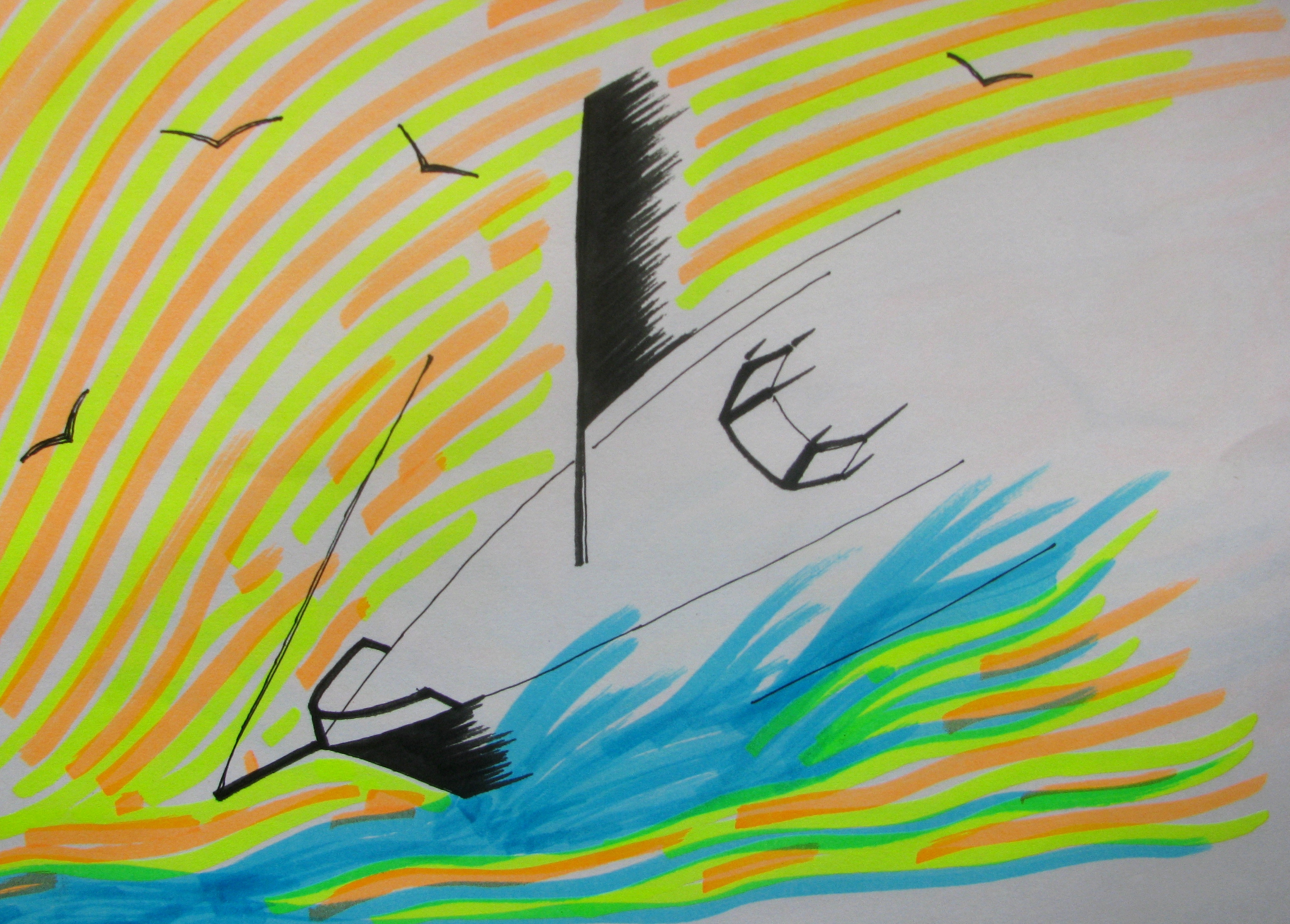
Illustration: Shyam G Menon

Illustration: Shyam G Menon

The Mhadei was built in Goa at Aquarius Fibreglass, a company owned by Ratnakar Dandekar, an unassuming boat builder. For the Mhadei’s skipper, Dandekar is usually the point man to call when any technical glitch occurs. In a nutshell therefore – Dandekar has built a sturdy boat that sailed over 100,000 nautical miles and on top of it, supported it technically from ashore over two full solo circumnavigations. That is a lot of experience. It is understood that the Aquarius Fibreglass boatyard has grown much since the days of building the Mhadei. “ The real hero of this 100,000 nautical miles-story is the builder. In the same breath, if the navy wants to have the Mhadei sailing for long, then she has to keep sailing,’’ Commander Donde said.

A boat’s life span is a very relative subject for there are many variables involved. In general, two important factors therein would be the quality of construction and how well the vessel is maintained and handled. On handling aspect, admiration for the Mhadei rises because as both Commander Donde and Commander Abhilash Tomy said, she had to deal with the learning curve of the sailors she took aboard.

Incidentally, it is worth remembering at this juncture that the world’s first solo nonstop circumnavigation by Sir Robin Knox-Johnston in 1969 was aboard the `Suhaili,’ a sail boat made of teakwood and built in Mumbai. The Suhaili is still sailing.

The idea of Sagar Parikrama started with Vice Admiral Manohar Awati (Retd) picking up a copy of Captain Joshua Slocum’s book on a London street decades ago. Slocum was the first person to do a solo circumnavigation. “ The Mhadei which made my Project Sagarparikrama possible epitomises modern India’s determination, as a first determined step, to return to her old habit of sea-friendliness, if that is the correct word. One hundred thousand nautical miles in six years is evidence of both, her sturdy design and construction, as well as India’s and the Indian Navy’s commitment to make India’s presence at sea evident to the world. My hope now is that this first step may lead to Young India taking to the waves which surround their country, for regular recreation and sport in ever larger numbers in search of both sport and adventure, learn a few lessons from the sea. The sea is a great tutor. Both a Rider of the Waves and a Rider of the Horse develop character and courage, two invaluable qualities for a citizen of a would-be great nation,’’ Vice Admiral Manohar Awati (Retd), said.

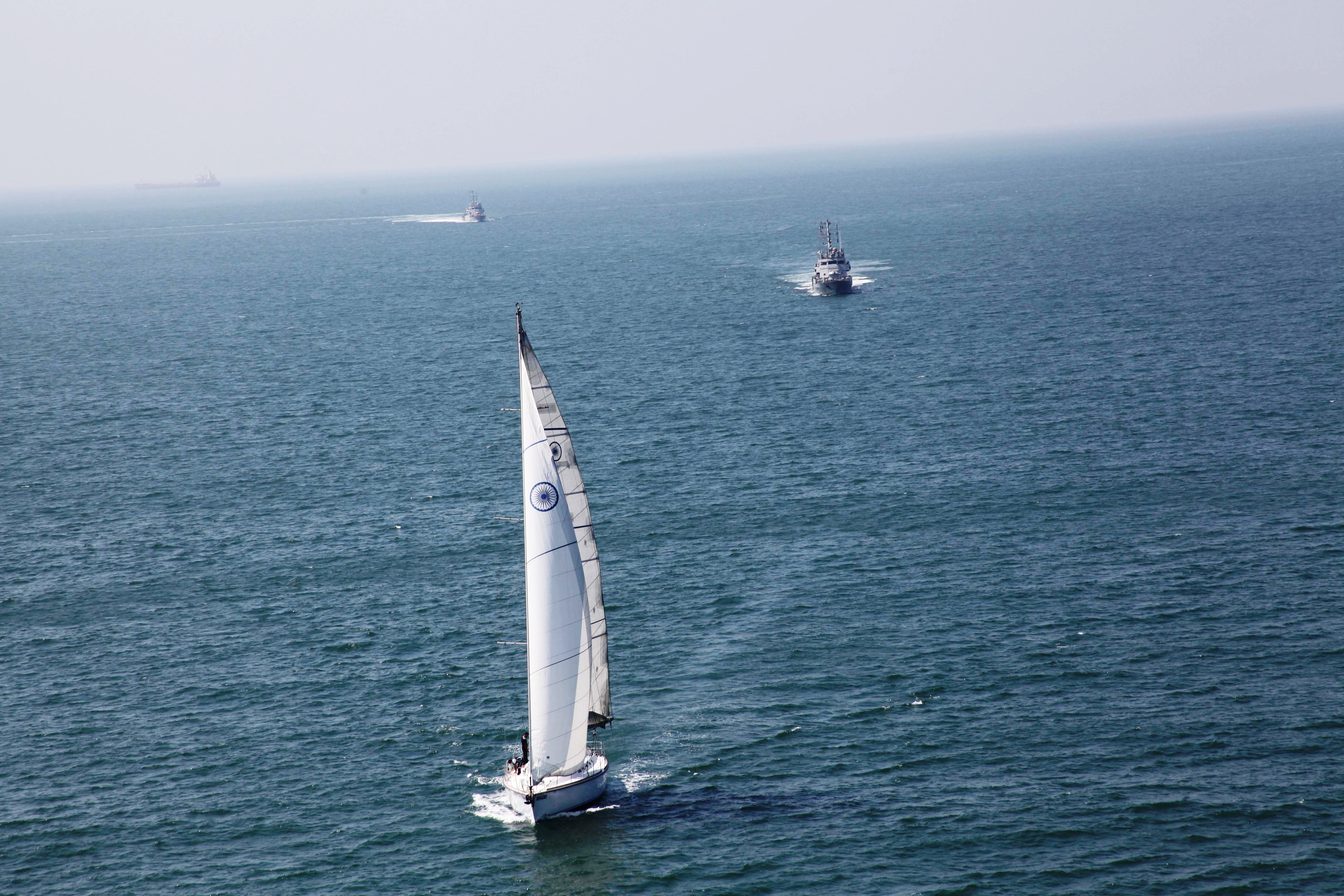
The INSV Mhadei (Photo: courtesy Indian Navy)

The INSV Mhadei (Photo: courtesy Indian Navy)

It took a while to secure a response from Ratnakar Dandekar. The reason was simple – his work load had increased. Aquarius Fibreglass now has a dry dock; it has diversified into building with aluminium, is starting out with steel, is into rubber-inflatable boats and has nearly completed its first boat built using PVC foam core with vacuum infusion-construction process (this technology provides for light, sturdy, strong boats). Simply put – its building ability now straddles a much wider spectrum in small boats. The Mhadei didn’t directly improve the company’s business. What it did in Aquarius’s context, was remove customer concerns over whether the company can deliver on demanding projects. “ We derived a lot of confidence from the experience of building and supporting the Mhadei,’’ Ratnakar said. Aquarius currently has an order for a sail boat – slightly smaller in dimension than the Mhadei – from a Mumbai based-client. It is scheduled for delivery in 2017.

“ The Mhadei means everything to me. She represents that point in my life as boat builder when I took the biggest step towards building better boats,’’ Ratnakar said.

At present, the Mhadei is the Indian Navy’s only yacht.

There has been talk of making a sister vessel to share duties.

Nothing has been finalized yet.

(The author, Shyam G Menon, is a freelance journalist based in Mumbai)

AVI INDUSTRIES – THE FORTITUDE OF THE LONE SHOP

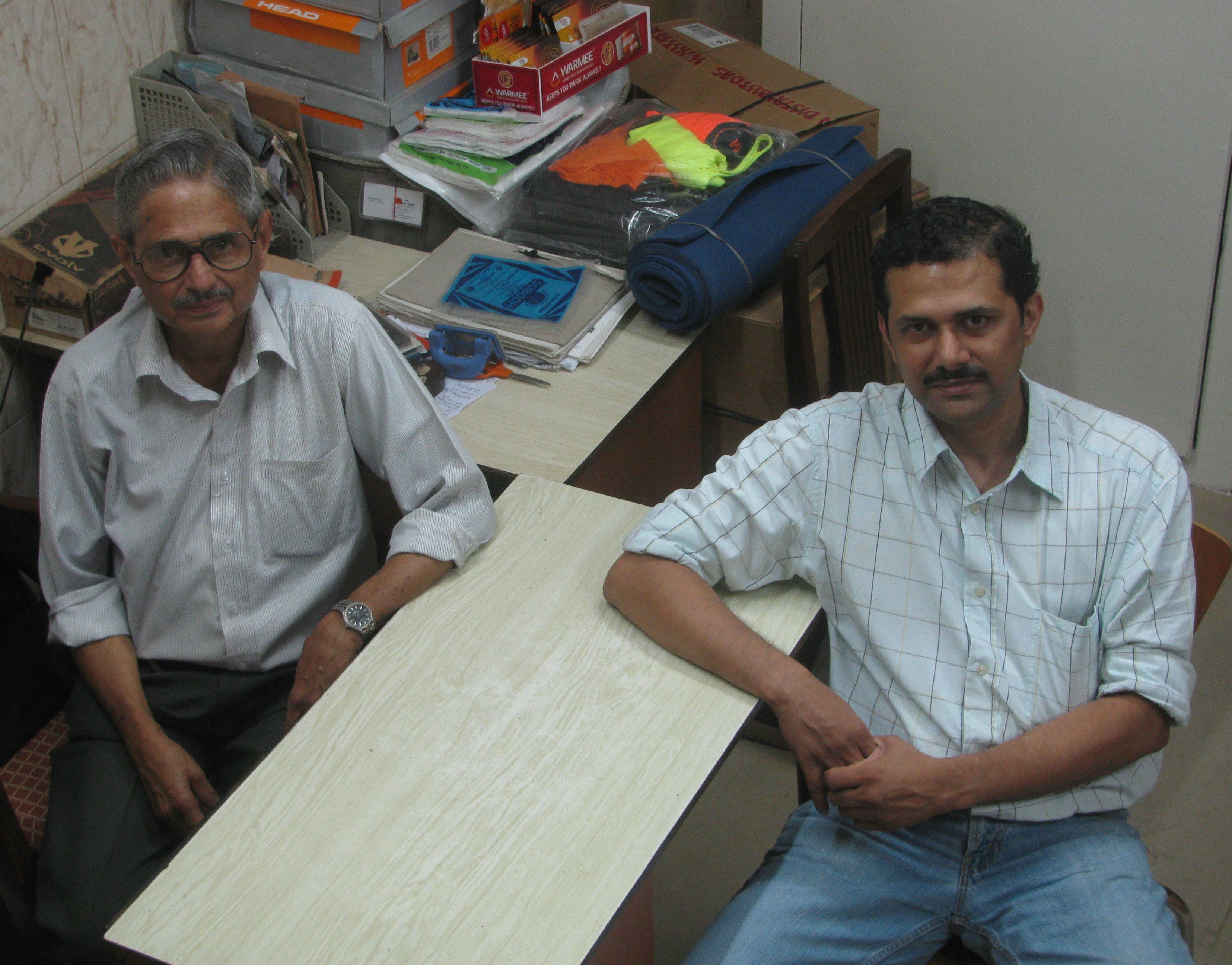
Ravi Kamat and his son Avinash at the shop in Matunga, Mumbai (Photo: Shyam G Menon)

Ravi Kamath and his son Avinash at the shop in Matunga, Mumbai (Photo: Shyam G Menon)

This is the updated version of a story originally written in 2010.

In the age of retail chains – including in the outdoor gear business – AVI Industries engages for being the exact opposite.

The business is run by 73 year-old Ravi Kamath and his son, Avinash. The small shop in the Mumbai suburb of Matunga is older than the father. Despite the enterprise being well known in the Indian outdoor industry network AVI Industries operates no other shop. It is a distributor of carefully chosen products with a characteristic outdoors-aversion for the glitz of retail. The locality, near the Matunga railway station, is crowded and congested. The shop is housed in an old building close to the busy road. The old building is the sort of place where stories lurk and Ravi Kamath’s at AVI Industries, is an interesting one.

Kamath grew up in Udupi. His best memory of childhood is a sand pit with parallel bars and Roman rings, where every evening a volunteer-instructor trained children. Looking back, he felt that may have contributed to his emergence as a climber when the opportunity first came his way in January 1968. He had by then moved to Mumbai where his father lived. Kamath enrolled for a training camp announced by Climbers’ Club. The teachers at the camp were all Sherpa instructors from the Himalayan Mountaineering Institute (HMI) Darjeeling. Kamath who was assisting his uncle in a dyes business became a frequent rock climber at the city’s old crags – Wagle Estate in Thane, Kalwa, Mumbra and Borivali – some of which have since faded. “ The general public was quite disinterested in us,’’ he said of Mumbai’s early crop of rock climbers.

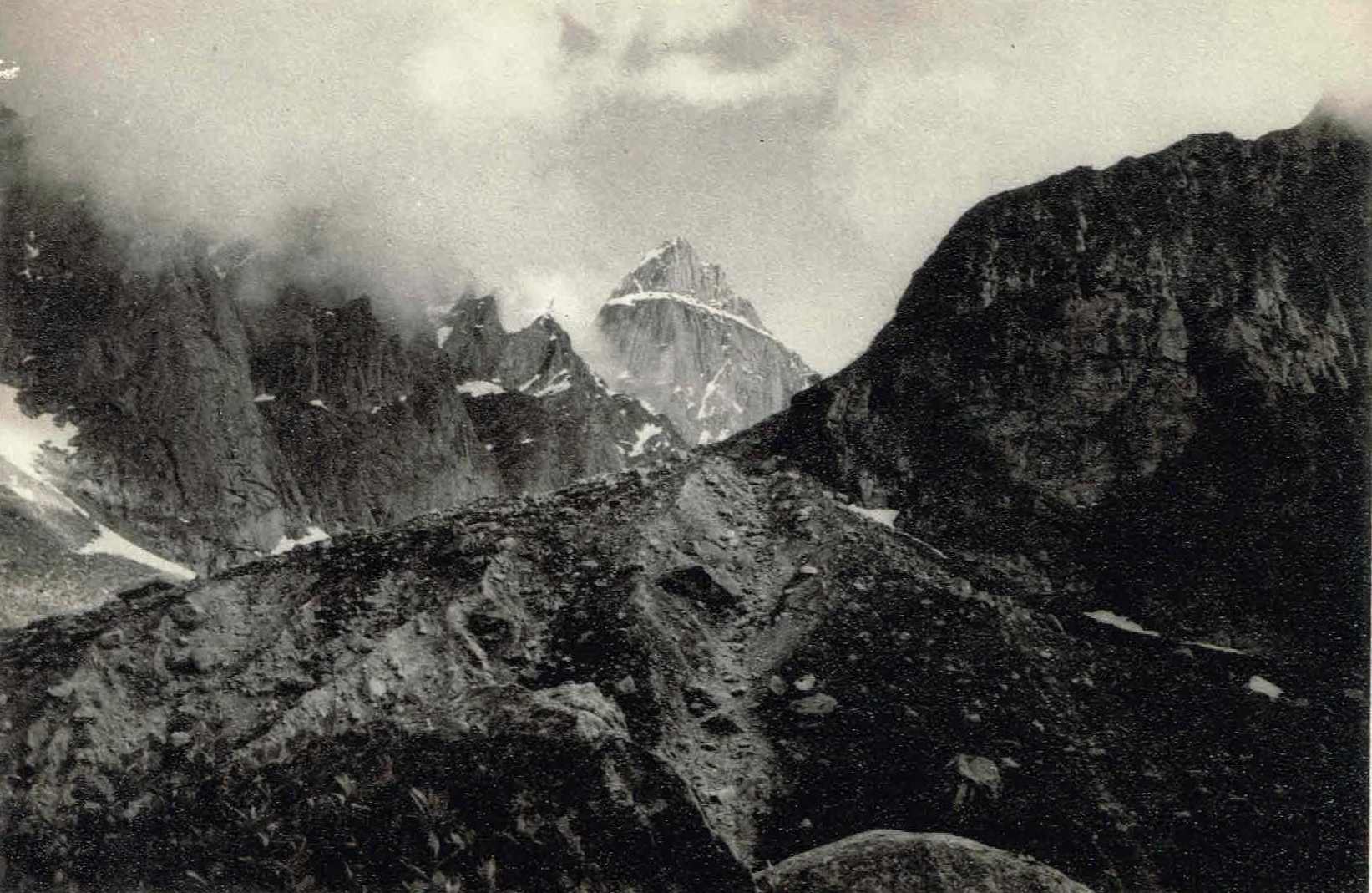
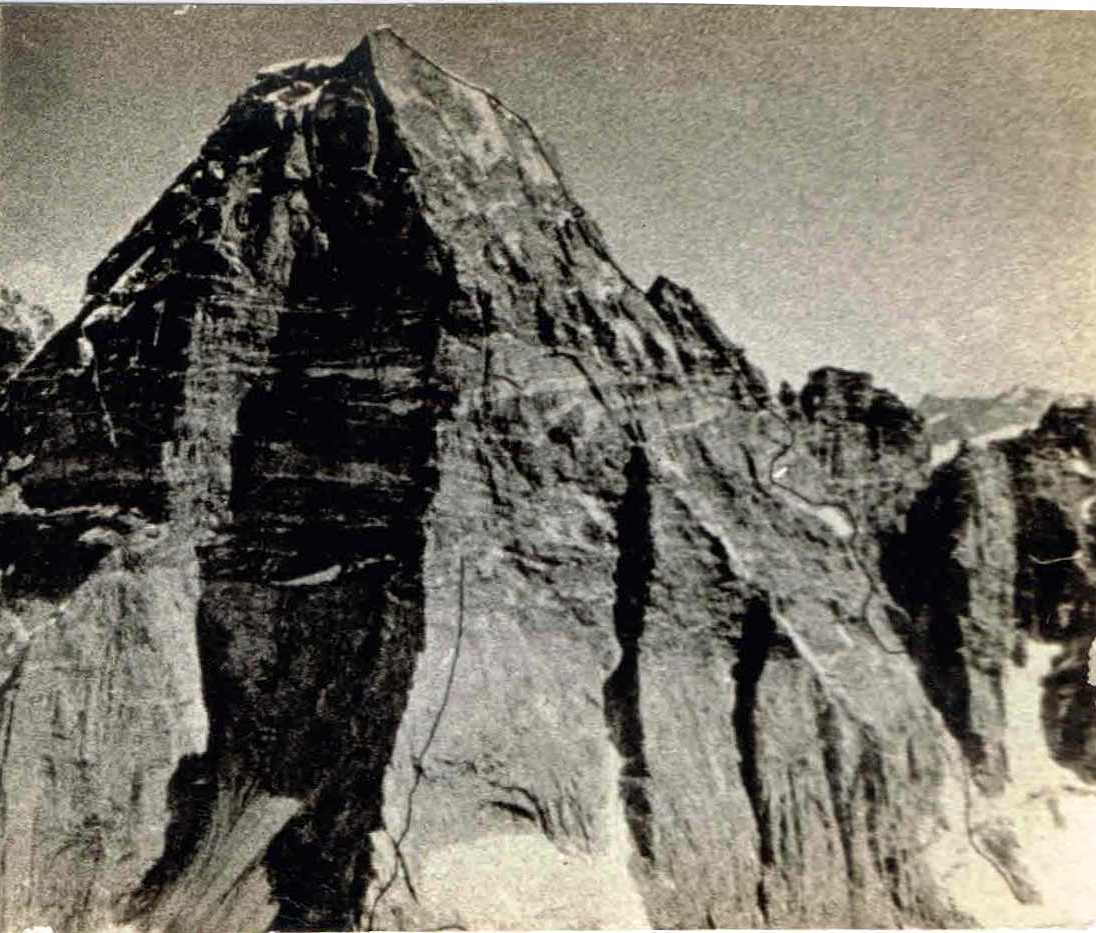
Ali Ratan Tibba, the peak with a band of snow across it in the distance. As seen during the 1978 expedition ( Photo: courtesy Ravi Kamat)

Ali Ratan Tibba, the peak with a band of snow across it in the distance. As seen during the 1978 expedition (Photo: courtesy Ravi Kamath)

In November-December 1968, he and two other climbers from Mumbai attended HMI’s 35 day-Basic Mountaineering Course. In 1972, he went on his first Himalayan trek, to Muktinath in Nepal. In 1976, he did his Advanced Mountaineering Course from the Nehru Institute of Mountaineering (NIM), Uttarkashi. There he met climbers from the Indian Institute of Technology (IIT), something that opened up possibilities for meaningful collaborations on climbs. One of the immediate outcomes of this was the first ascent of a rock pinnacle in Mumbra, among early climbs of this sort in Maharashtra, where the ascent of pinnacles has remained a traditional favourite. Pinnacle-climbing bloomed after expansion bolts were introduced. Expansion bolts work as permanent anchors; they reached the Western Ghats of Maharashtra in the 1980s reportedly first on a pinnacle called Hadbi-chi-Shendi near Manmad. In the days preceding expansion bolts when the early pinnacle-climbs happened, removable pitons were used for protection. Although HMI instructors gifted them some foreign pitons, pitons in general were too expensive for Mumbai’s pioneers and the stuff made in Delhi was unreliable. This issue of cost was real for although Kamath now ran a business selling liquid soap, he was married. Lifestyle was frugal.

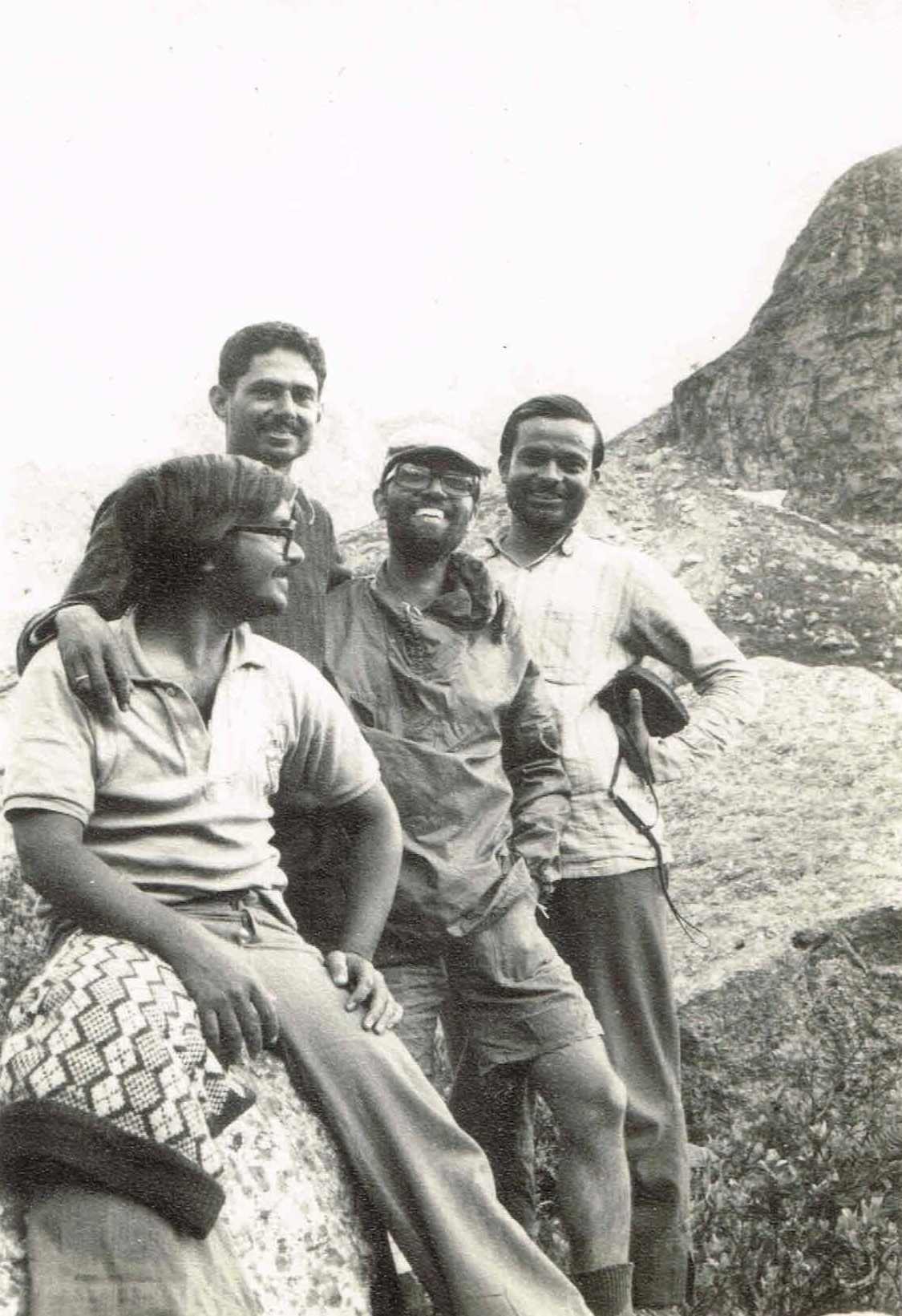
The 1978 Ali Ratan Tibba expedition-team (Photo: courtesy Ravi Kamat)

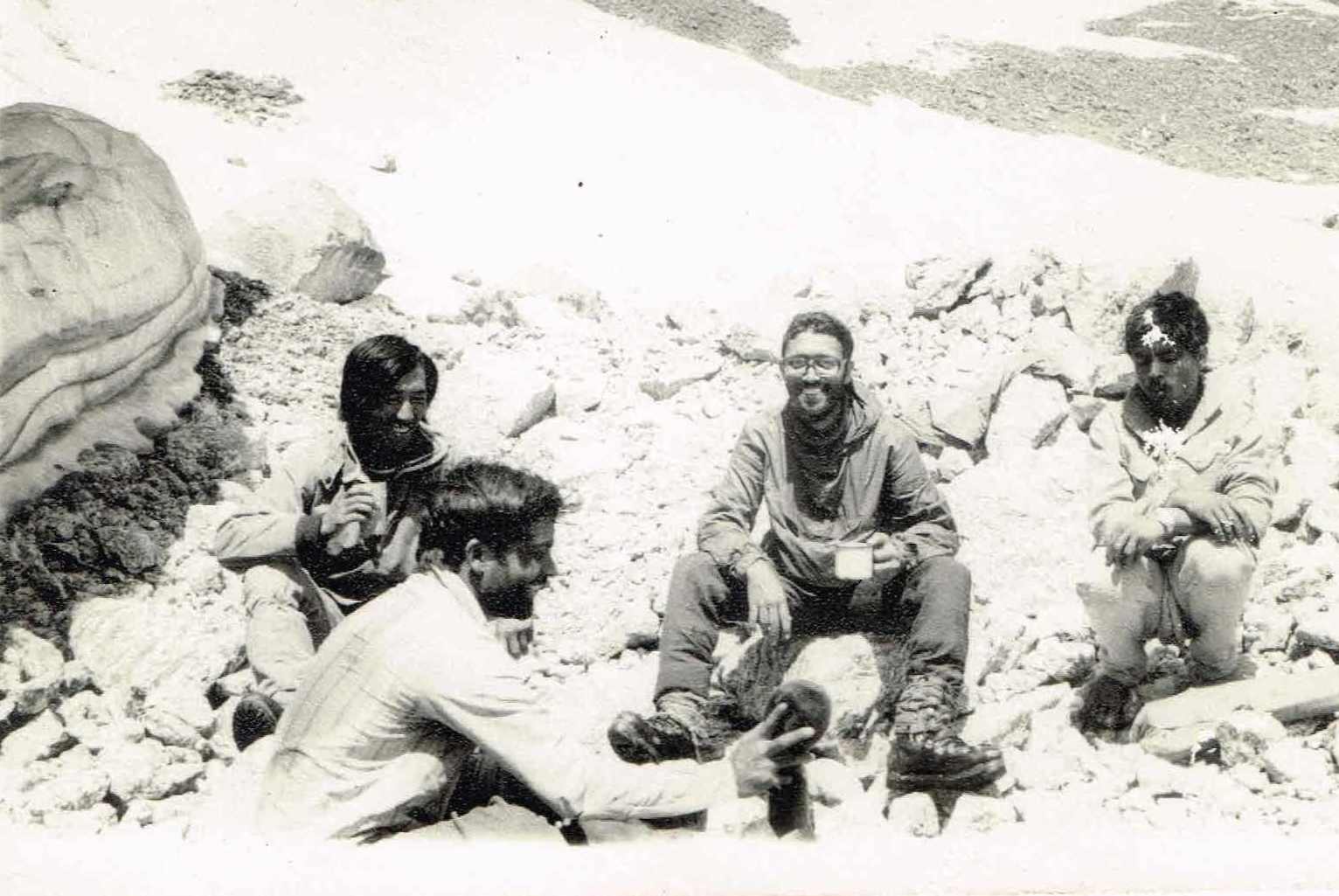
Some of the team members of the 1978 Ali Ratan Tibba expedition. From left: Dr Agrawal, Ravi Kamath, Jamshed (Jimmy) Homiar, Jayant Khadalia (Photo: courtesy Ravi Kamath)

With IIT trained-Mukund Bhagwat, who had been part of the Mumbra pinnacle-ascent team, Kamath addressed the piton problem. The climbers first opted for rigid retrievable pitons over the malleable variety that can’t be removed from rock once hit in. Then they realized that spring steel was the best material for such a piton and started making pitons from the leaf springs of cars. Kamath’s business, as said, was making liquid soap. The success with pitons started leading him elsewhere. Encouraged by the locally made pitons, he soon began manufacturing `figure of 8’ descenders and choke-nuts, part of the hardware used in climbing. He also reverse engineered the classic Don Whillans climbing harness. Because climbers trust their life to it, climbing gear must be tested. Testing labs and certification agencies existed overseas. In India, they were either absent or where present, were very expensive. So the climbers, who were making the gear, tested it themselves.

What genuinely changed Kamath’s destiny were rucksacks. Initially cloned from an American design and subsequently improved for local use, the sacks made at home by his wife and sister soon became the reason for outdoor enthusiasts dropping by at the Matunga shop. None of it radically altered his financial struggle though. He was busy reconciling the seemingly irreconcilable – business, family and climbing. It pushed self and family into tough times.

Meanwhile climbing continued.

In 1977, Kamath was part of a team that attempted Makar-bey in Himachal Pradesh. It was the next climb in 1978 that cemented his reputation in Mumbai’s mountaineering circles. He led a successful expedition to Ali Ratan Tibba, a rocky peak in Himachal Pradesh, an objective much sought after by discerning climbers. Even today it is not always successfully ascended. Kamath’s expedition was the first successful Indian ascent of Ali Ratan Tibba. Much preparation had gone into this expedition; the team climbed with loaded packs in Mumbai, they also practised climbing at night. The next memorable trip was to Peak 20,101 in Himachal Pradesh where the summit team had to retreat following a slip in an ice gully, successfully arrested by a homemade-choke nut. “ That nut must still be there,’’ Kamath had said laughing when this article was first written in 2010.

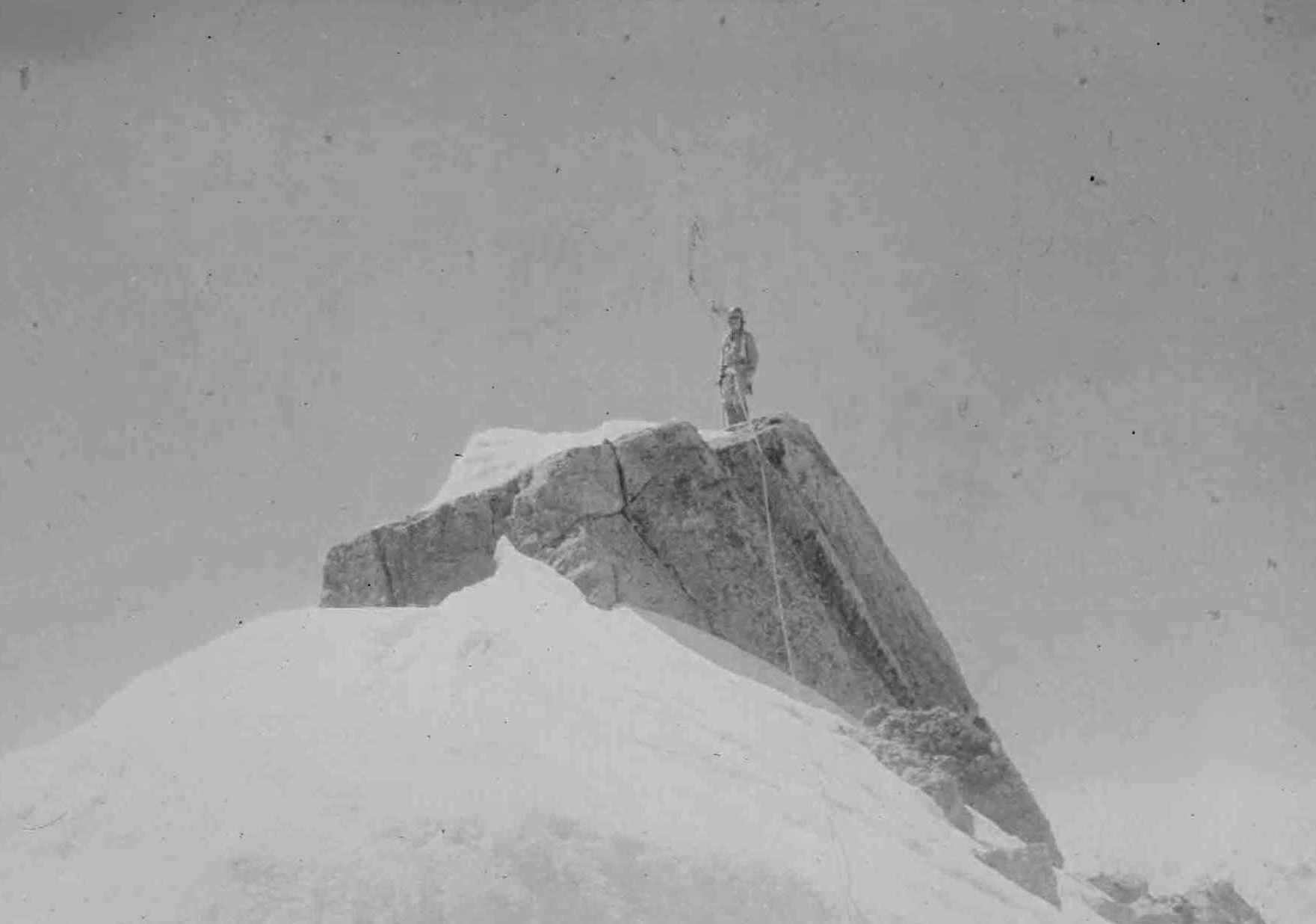
Jamshed (Jimmy) Homiar on the summit of Ali Ratan Tibba (Photo: courtesy Ravi Kamat)

Jamshed (Jimmy) Homiar on the summit of Ali Ratan Tibba (Photo: courtesy Ravi Kamath)

Back in Mumbai, the liquid soap business suffered when he was away in the mountains and atop that, he had to pay for a business assistant. Still there was no surrendering his passion for climbing. By now disillusioned with club culture and large expeditions, Kamath began favouring small teams. After 1981, there was a successful attempt on Koteshwar, a failed attempt on Jogin-II and a successful climb of Lion Peak. In 1990, there was an attempt on Brahma in the Kishtwar Himalaya with a group from Bengaluru. He also did the Roopkund trek, crossing over to the Shila Samudra Glacier on the other side. Since the early 1990s, every other year he has been climbing rock with friends in Pachmarhi, Mt Abu and Pawagad.

Kamath narrates his experiences with no show biz traits. No social media, Instagram or Facebook influence on this man. He has a dispassionate approach to climbing; he talks with deep respect for method and precision, something you see when he sells a product too. Discussing the story of an ill prepared big wall expedition from Mumbai and the story of others who didn’t succeed on Ali Ratan Tibba, Kamath said, “ we took the easiest route we could find to the summit. That’s what we always did in those days when we had to find our own route. We climbed within our limitations. Plus, we used to do a lot of homework before heading out.’’ The route of the 1978 Ali Ratan Tibba expedition for instance, was based on a route originally indicated by British mountaineer, Bob Pettigrew. The photo he took of the relevant face of the mountain was available in the Himalayan Club journal. Of course by 1978, things had changed on the ground; mountain terrain is dynamic. But studying what Pettigrew recommended was helpful homework for the actual route-finding that followed. Surprisingly, despite much advancement in climbing, the clarity of the obvious and the easiest often eludes present day climbers. Route-finding has become an art lost in the haze of greater availability of resources and success advertised.

Pasang Namgial and Jamshed (Jimmy) Homiar on their return from the summit of Ali Ratan Tibba (Photo: courtesy Ravi Kamat)

Pasang Namgial and Jamshed (Jimmy) Homiar on their return from the summit of Ali Ratan Tibba (Photo: courtesy Ravi Kamath)

Post 1980s, the business in homemade rucksacks and outdoor gear, gathered momentum. Lacking money, Kamath trained tailors for the task and outsourced manufacturing. Around 1997, when I first visited AVI Industries, it was among Mumbai’s best known shops to pick up rucksacks, sleeping bags and other items required for the outdoors. In 1998, Kamath’s son Avinash joined the business (Kamath has three sons. Besides Avinash, the others are Ashwin who is in the US and Aanand who is in Bahrain. All three have sat at the shop at some time or the other). A commerce graduate, Avinash started taking a slightly different view of the business. He convinced his father that the soap business – which had been the family’s bread and butter at one point in time – was best shut down. Chemicals in the neighbourhood were not good for outdoor gear (particularly fabric), payment was rarely prompt for liquid soap sold and there seemed to be a future in the outdoor gear line. Within the outdoor gear segment, the duo continued making products like rucksacks, sleeping bags and the occasional piece of winter clothing. Locally made climbing hardware, harnesses – they were all stopped. Avinash (aka Avi) worked the Internet and soon enough, secured the first external brands to be distributed by AVI Industries – Faders and Lucky, both making climbing hardware. Next they briefly sold Singing Rock climbing harnesses before settling down to sustained business with Rock Empire. Imported hardware and harnesses made sense because they came tested and certified. Today the brands distributed by AVI Industries include Rock Empire, Evolv, Boll, Trimm, HEAD, Mund, Wind Extreme, Vertical, Tendon and Makak. If you thought the father-son duo made a splash with this array of brands and products, you got it wrong. AVI Industries continues to avoid making a splash.

Avinash and his brothers have been out many times with their father on hikes and climbs. In 2002, Avinash did his Basic Mountaineering Course from the Nehru Institute of Mountaineering. As he got into the family business, he also made sure that he attended the national climbing competition as a spectator. “ I went for every edition of that competition from 2003 to 2012,’’ he said. Avinash used the opportunity to talk to climbers, get acquainted with their perspective. The homework didn’t end there. His choice of brands to distribute, were all mid-level brands, not the big ones. Their products enjoyed the same certification as the big brands except the brand profile was modest. The choice was deliberate. He was seeking companies he could grow with. One great story in this regard would be Evolv. When AVI Industries became distributor for their rock climbing shoes in India, Evolv – co-founded by a designer who once worked for Five Ten – was new overseas. But their shoes were good and with well known climber Chris Sharma participating in the design process the brand rose to being among the top ones.

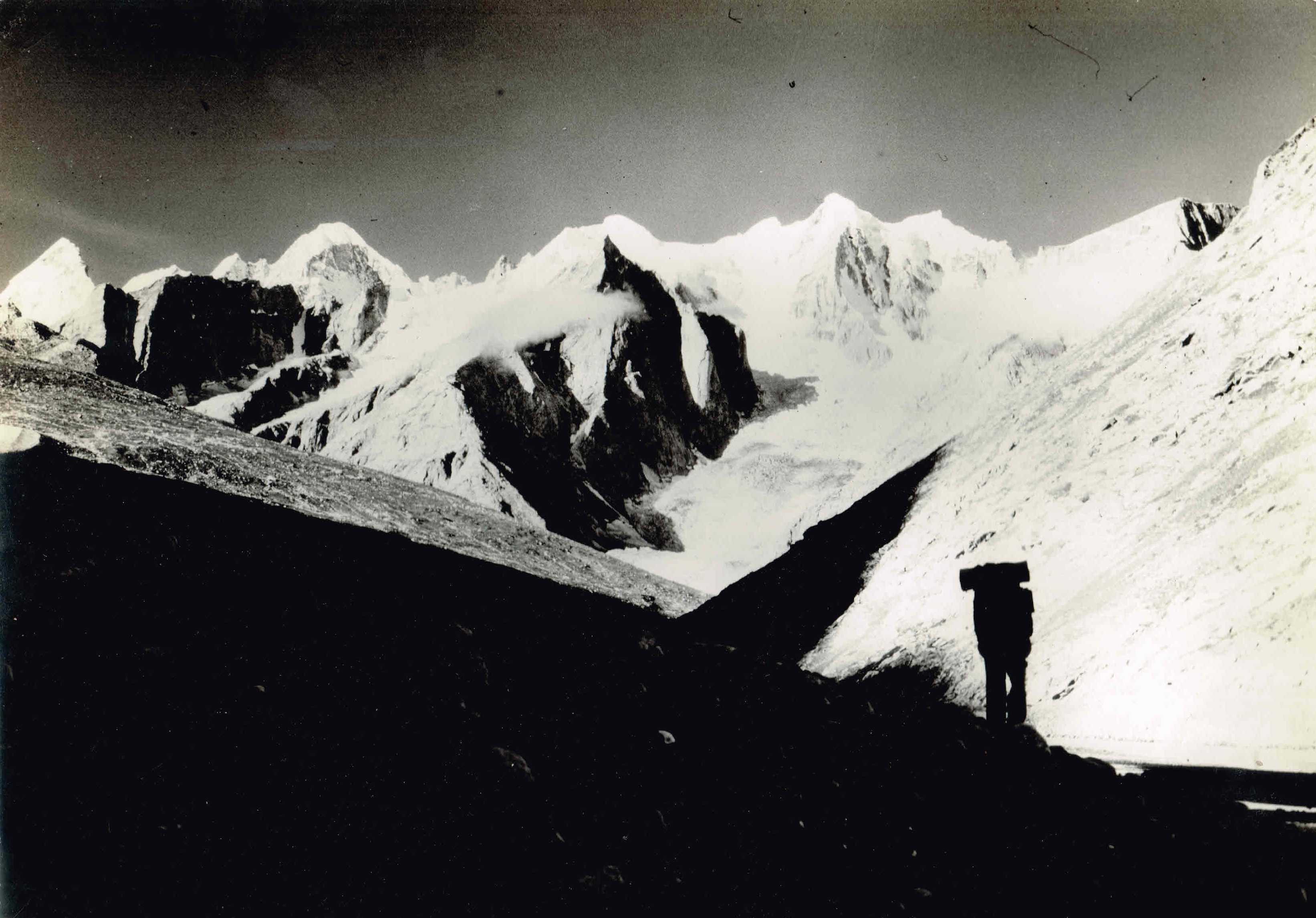
Peak 20,101 (Photo: courtesy Ravi Kamat)

Peak 20,101 (Photo: courtesy Ravi Kamath)

Other details interest. Two geographies that have periodically dominated as import source for AVI Industries are East Europe (particularly Czech Republic) and Spain. East Europe has produced some great climbers; they make reliable products at prices that are cheaper than elsewhere in the western world. This aside, the fact that AVI Industries has a bunch of East European brands they distribute, provides scope to save on shipment cost. If planned and co-ordinated well, everybody’s products can be shipped in one go to India. While most of the above brands were accessed by Internet and distribution commenced with all paper work done from Mumbai, some years ago Avinash started becoming a regular at outdoor industry fairs in Europe. That has been valuable experience – exporter and importer got to meet, put a face to everyone’s names. But it is Avinash’s reading of the domestic market that truly engages.

According to him, the Indian market for outdoor gear may have grown but it is not at all an easy one to be in. Import duties and tax rates are high. Almost half the selling cost of an imported product is taken up by duties and taxes. Avinash says he is not big on supplies to the defence forces, which has traditionally formed a major part of business for Indian suppliers of outdoor gear. He focuses more on the industry segment, where there are several instances requiring the use of ropes and equipment designed for vertical terrain. On this bedrock, runs the smaller retail business servicing climbers, hikers and such.

Aloke Surin during the Lion Peak expedition (Photo; courtesy Ravi Kamat)

Aloke Surin during the Lion Peak expedition (Photo: courtesy Ravi Kamath)

However, the low level of awareness in the market is a problem. “ Meeting an aware customer is like coming across a needle in a haystack,’’ Avinash said. Consequently, it is hard to impress upon people what is quality or why it counts. This matters in the Indian outdoor gear market, where all players are not equally big. Some very big players with deep pockets tend to discount mesmerizing retail customers. “ The issue is not discount per se. We all know there can be seasonal discounts and discount to clear stocks. But year round-discounts finish off other players. Further, to show a discount, a seller displays two prices – the original price and the discounted price. It may seem value for money but it also spreads the message that quality and low price go hand in hand. In such a market, where people think they can always get the best for less, it becomes progressively difficult to create a case for good quality gear,’’ he said. Consequently, as he feels stalked by the discounting deep pocket-types, Avinash has chosen to operate nimbly, constantly churning his product portfolio weeding out what may not sell and retaining what will. He keeps an eye on what products are getting discounted by the deep pocket-types. Planning is short to medium term. “ You cannot be emotional in this business,’’ Avinash, 42, said.

He has also consciously adopted another business practice – he prefers to sell products that are more towards the climbing end of the market; essentially gear that is application-specific and used in technical situations. The reason is simple. All the obfuscation of quality is happening in the low risk trekking / hiking portion of the market where details on quality don’t matter that much. Climbers and those engaged in similar high risk activity on the other hand, don’t compromise for they know they are playing with their lives. You can’t fool them.

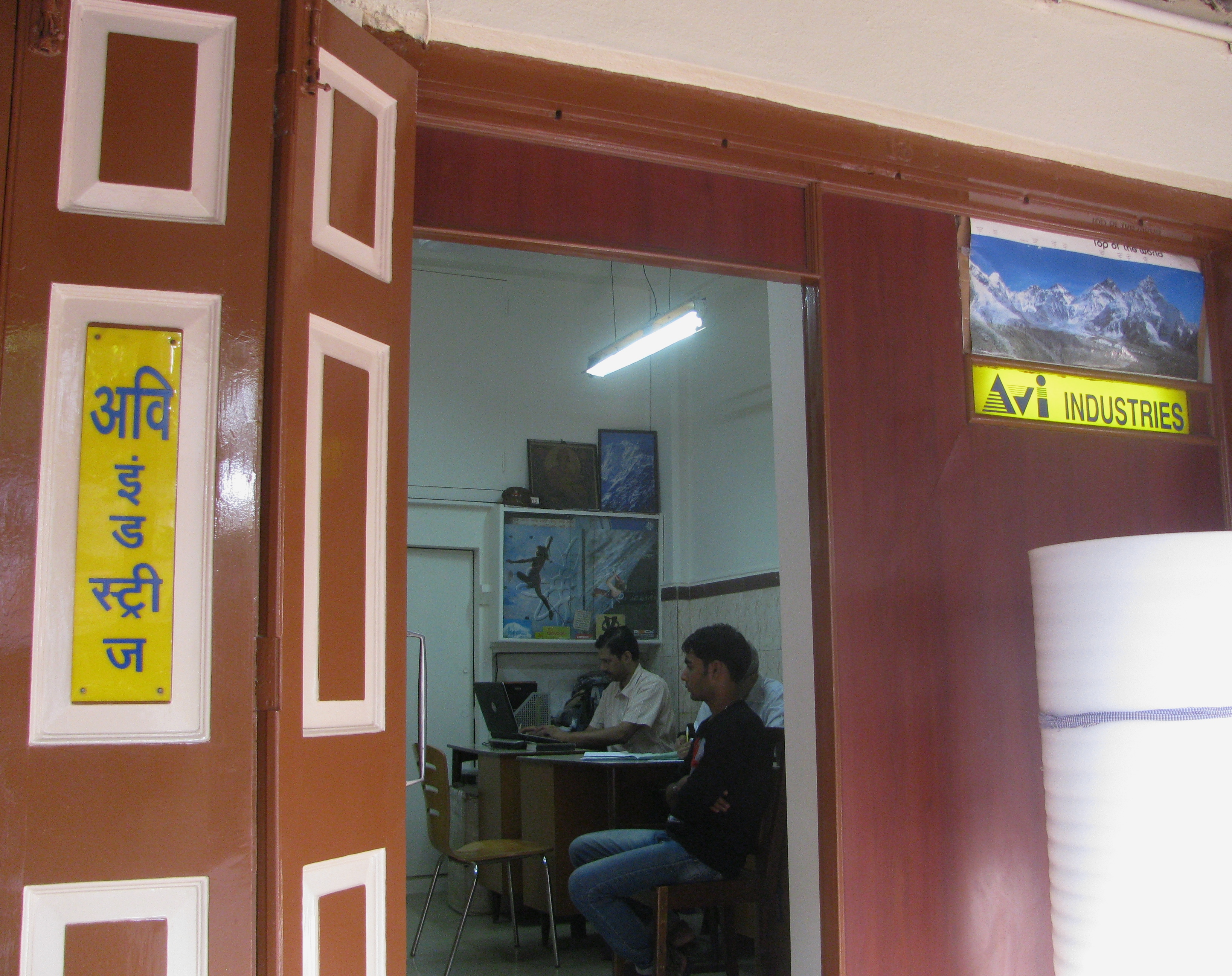
The shop, as seen from the outside (Photo: Shyam G Menon)

The small shop, as seen from the outside (Photo: Shyam G Menon)

It had been a long chat in a room in the old building in Matunga.

Below, the small shop was receiving a fresh coat of paint.

“ And it will be just this shop for retail presence?’’ I asked.

“ Just this one for now,’’ he said.

(The author, Shyam G Menon, is a freelance journalist based in Mumbai. This story was originally written and published in The Hindu Business Line newspaper in 2010. It has been updated to include developments till mid-February 2015.)

BOTS: THE SPECIALIZED PHASE

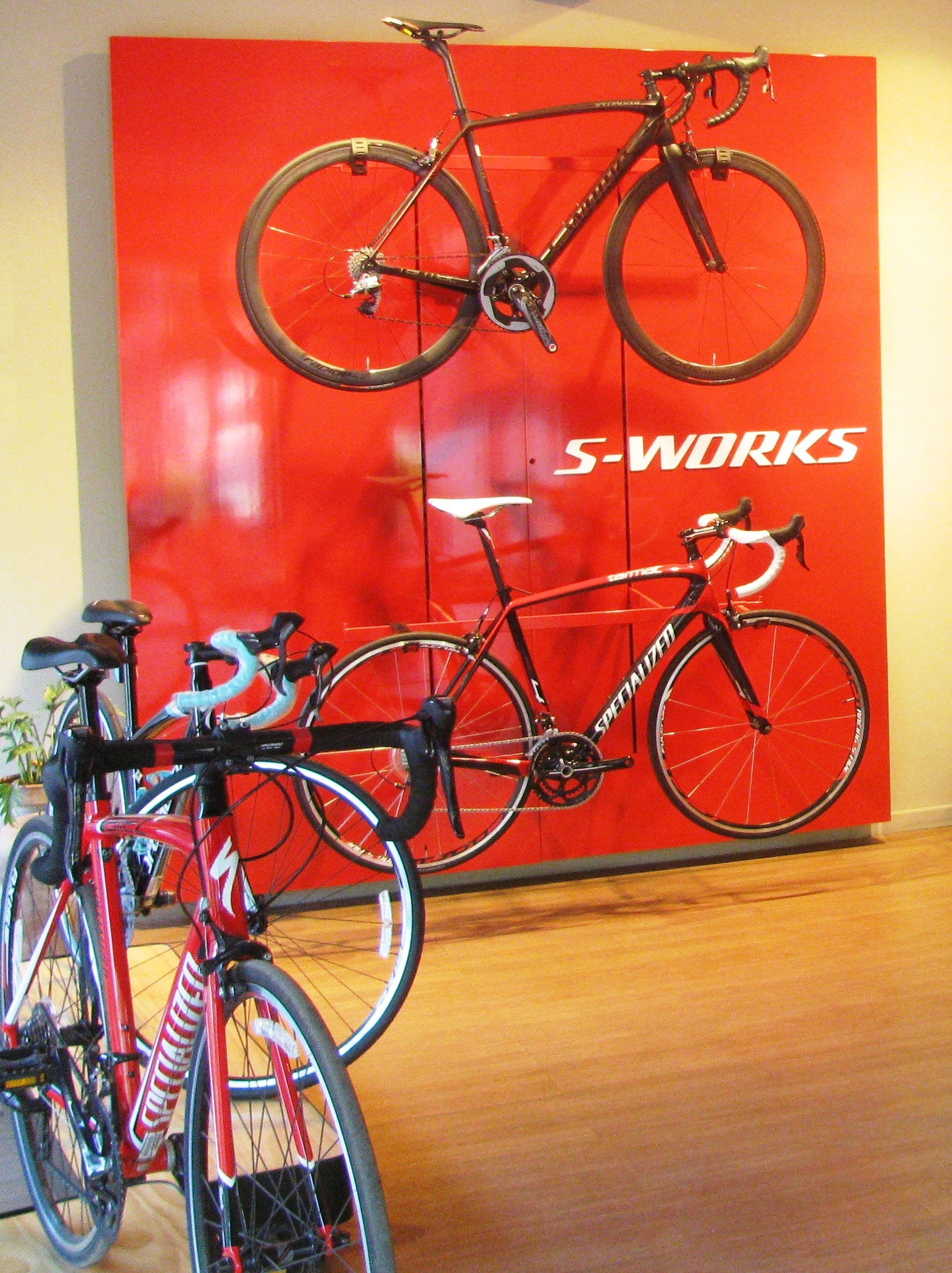
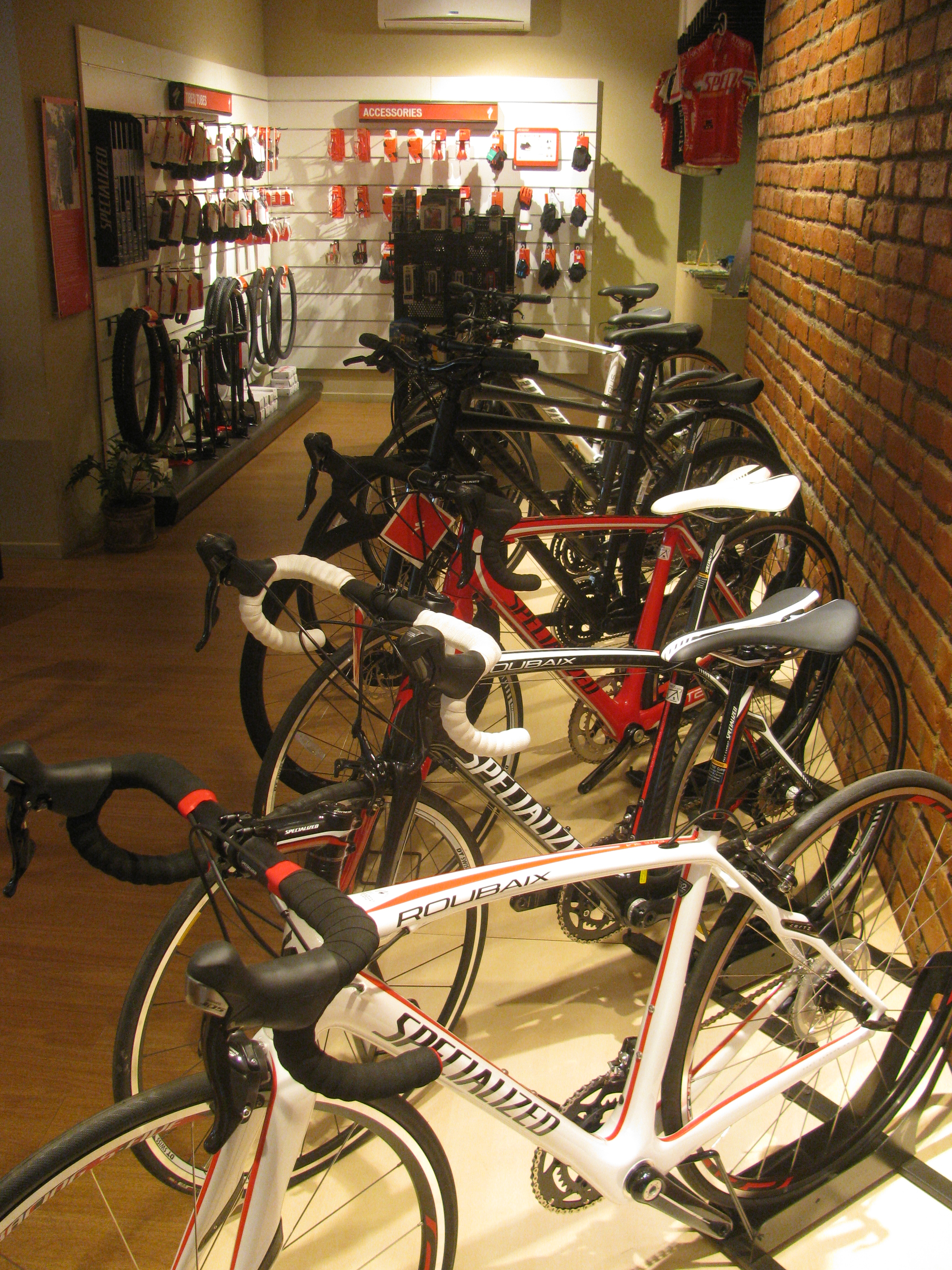
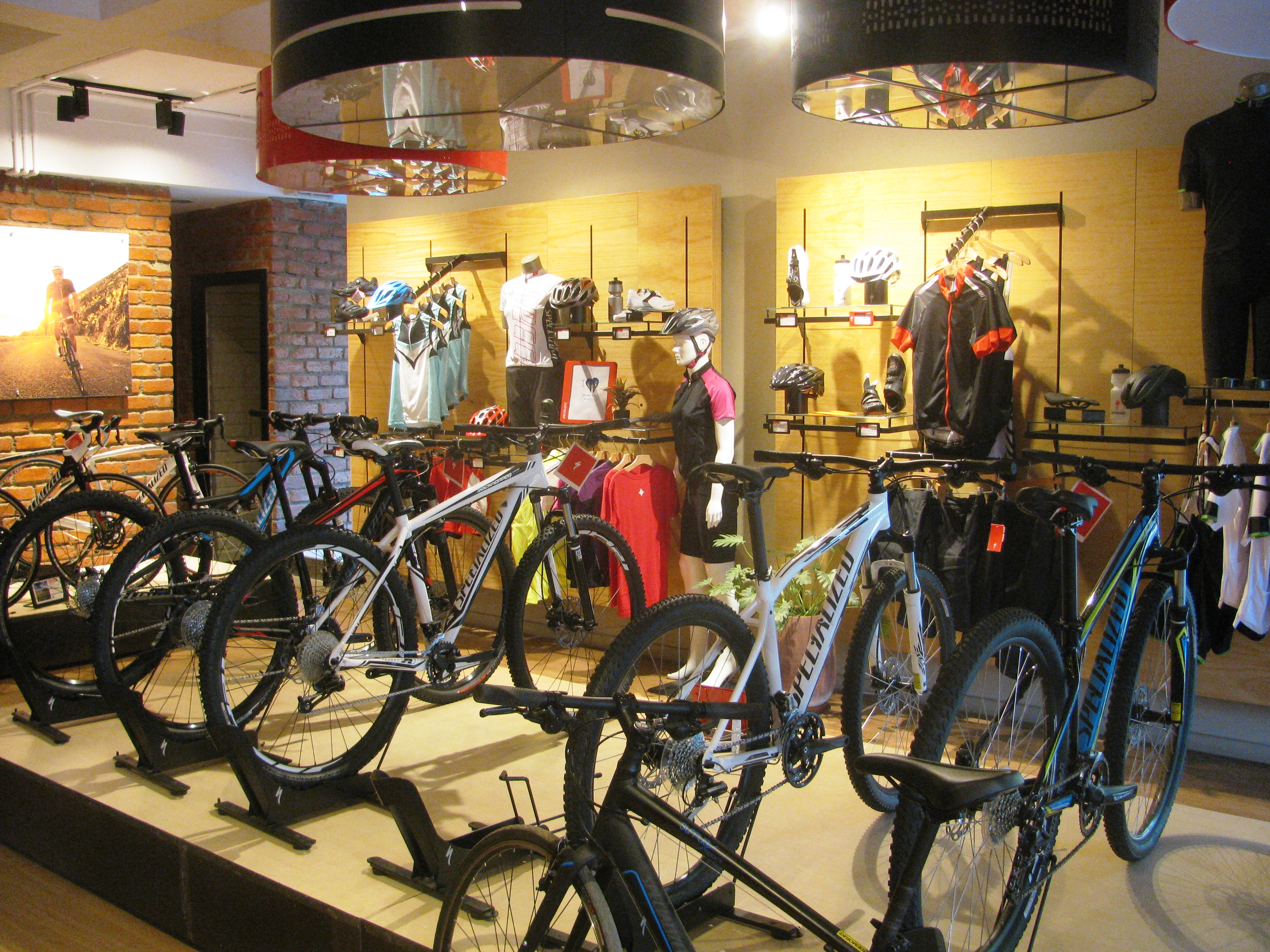
The Specialized store on Infantry Road, Bengaluru (Photo: Shyam G Menon)

The Specialized store on Infantry Road, Bengaluru (Photo: Shyam G Menon)

The first time we met at the Jayanagar showroom of BumsOnTheSaddle (BOTS), Rohan Kini described himself and the shop as evangelists for cycling.

That was couple of years ago.

February 2015.

BOTS is now three shops big.

There is the old BOTS facility and two new ones – one in Bangalore and the other in Pune – devoted to selling ` Specialized’ bicycles. There is a new one planned for Chennai and Rohan was excited about discussions to open showrooms in Hyderabad and Thiruvananthapuram. “ The industry has grown from infancy to something bigger. I refer to the whole Indian cycling community with all the related businesses therein,’’ Rohan said.

BOTS is remembered as a pioneer in community-building. It used to be a single, multi-brand outlet with committed fan following. Specialized, which BOTS has elected to distribute, is among the top bicycle brands worldwide.

“ How did you pick Thiruvananthapuram?’’ I asked.

Even as it has changed, Kerala continues to carry the cross of erstwhile business unfriendly politics. It attracts less buzz than some of the popular investment destinations of this country. Not that Kerala lacks money. Thanks to traditional businesses, cash crops, tourism, a growing IT industry and a tonne of remittance in its banks from people working overseas, Kerala is wealthy. It has a literate, mobile population. It is a state with longstanding interest in athletics and sports, including cycling. Small still on the cycling map, its teams have nevertheless performed well at the national level. New bicycle retailers have opened shop in the state. Still, a shop there in the early stages of a brand’s growth In India is unusual. What gave BOTS the confidence to bridge that last gap; that bridge across the questions the state provokes?

Photo: Shyam G Menon

Photo: Shyam G Menon

Uniquely, it ties in with BOTS’s own story.

“ Why did you start a blog?’’ Rohan asked.

“ I guess it is to write as I wanted to; compensating for what I miss or am denied in the regular publishing space.’’ I said.

“ It is the same in business. As a company, I can achieve what I seek only by having my personal space. We defined that space developing a community around BOTS. Having worked on developing that exterior perspective, we are now growing the company from within. We are looking at the business from a long term perspective and building a strong foundation,’’ Rohan said.

BOTS began operations from a terrace in Bengaluru.

“ That did not stop Shiv Inder Singh of Firefox Cycles from allowing us to sell the Trek bicycles they were distributing,’’ he said, highlighting the importance of passion for what you are doing.

Shiv Inder Singh himself had been the outsider who authored a quiet revolution in the Indian bicycle market, introducing modern bicycles and proper bicycle showrooms where none of that sort existed before.

BOTS grew, eventually moving to larger premises. Rohan admits that even then, amid all the commitment and passion for being in the bicycle industry, BOTS was still nebulous when it came to long term business plan. They ran a multi-brand bicycle shop with a robust cycling community around it, the whole thing enveloped in evangelical fervour for cycling.

Photo: Shyam G Menon

Photo: Shyam G Menon

Some time back, much after other American brands like Trek, Cannondale, Mongoose, GT and Schwinn had entered the market Specialized came to India scouting for a potential partner. One of their halts was BOTS. “ We had no expectations. Specialized visited many people and various establishments but for some reason they came to this enterprise run by four people. They spoke mainly of their philosophy. That matched with our thinking. It was unexpected that they would make us distributors for their products and yet, somewhere, it wasn’t totally unexpected either. The reason we took up Specialized is because it would be more impactful in terms of what we wish to do,’’ Rohan said. To sustain a business, he said, you have to be passionate about it.

The first discussions between the two sides happened in December 2012. The new Bengaluru store devoted to selling Specialized bicycles commenced operations in August 2013. Pune followed. Both stores are 100 per cent owned by BOTS.

The two shops in Bengaluru have distinct character.

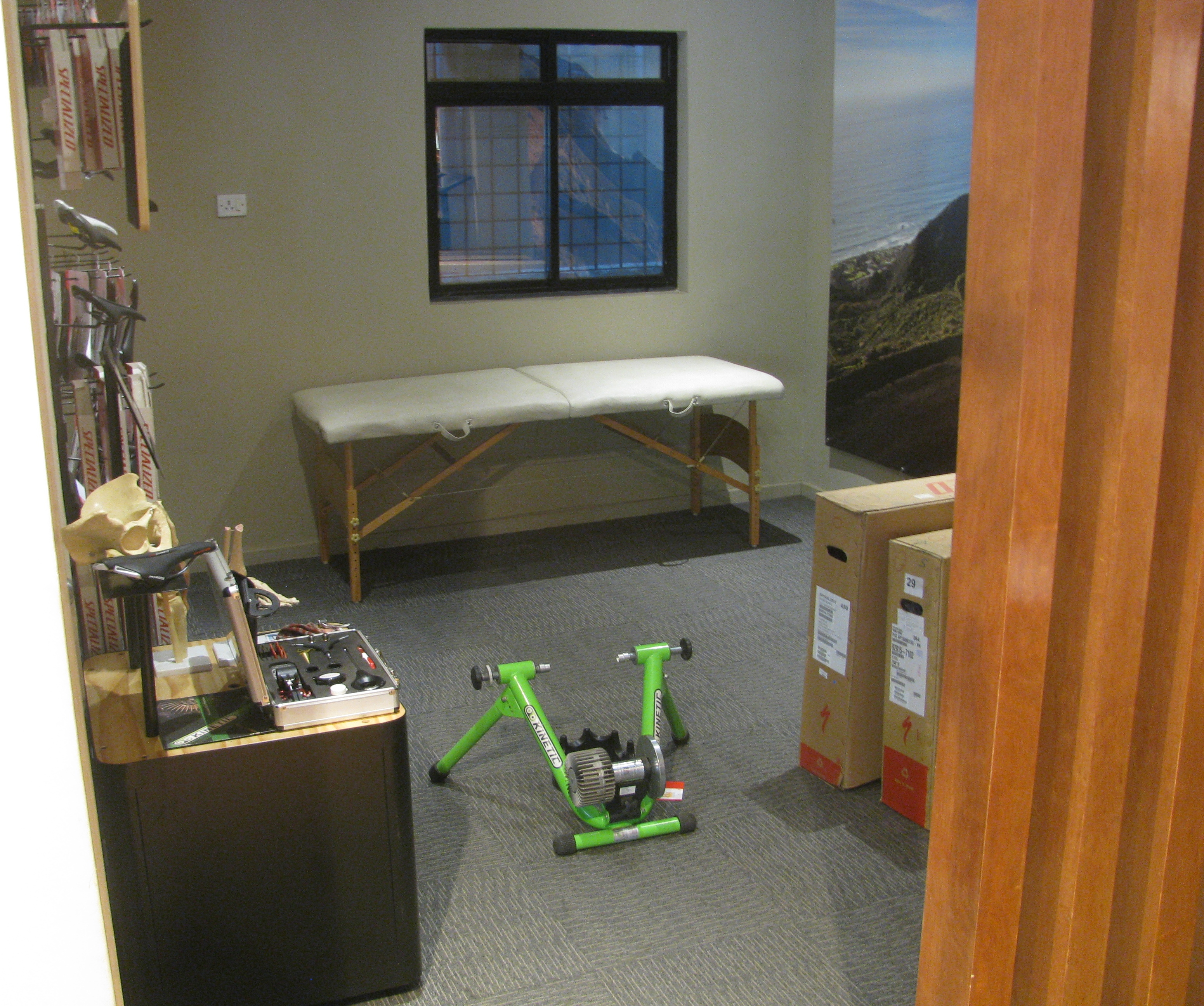
The Bike Fit-facility at the shop (Photo: Shyam G Menon)

The Bike Fit-facility at the shop (Photo: Shyam G Menon)

The Specialized store on Infantry Road caters to a customer who is buying a bicycle as a conscious option and not a necessity. The bikes are expensive. Specialized has been positioned as a brand to aspire for in India. “ What the Specialized store is good at is delivering the experience a rider is looking for with product and service to match. In the store cycling feels immediately elevated,’’ Rohan said. The store has a facility alongside called the Specialized Body Geometry Bike Fit program that addresses fitting the bike to the customer’s body size and his / her needs in cycling. The bike fit section is headed by Naveen John, who is the current national time trial champion.

The store was designed by Specialized. Store design, Rohan said matters, especially in India where retail is expensive and often not profitable. “ You need to be smart on how much less space you can have and how much more you can get out of it,’’ he said. The American manufacturer also has what is called Specialized Bicycle Components University (SBCU), with SBCU professors whose main job is to work with riders. They talk to the riders; the feedback goes all the way back to the design team. Vivek Radhakrishnan who owns, manages and races as part of the Specialized KYNKYNY Cycling Team is the SBCU professor in India.

Where does this place the old BOTS?

We are at the Jayanagar showroom; large, roomy with glass windows and bicycles of various brands within.

The chat with Rohan hinted at the following.

Retailing in India is not easy.

It is expensive.

Rohan at the BOTS showroom in Jayanagar, Bengaluru (Photo: Shyam G Menon)

Rohan at the BOTS showroom in Jayanagar, Bengaluru (Photo: Shyam G Menon)

BOTS, which is multi-brand, provides its promoters a pulse of the larger market for premium bicycles. The Specialized stores may likely be in comparison, a high end, low volume-game. But in that business BOTS is also distributor. That brings us to the community which has grown around BOTS – what about it? This may be viewed as an internal transferable competence for community-building, BOTS merchandise and cycling workshops. “ We could have a BOTS desk at every Specialized store,’’ Rohan said.

Like the Specialized stores in Bengaluru and Pune, the proposed one in Chennai is BOTS-owned. However, the showrooms in Hyderabad and Thiruvananthapuram will be dealer run-stores.

In the case of Kerala’s capital, Rohan said the enquiry for dealership had come from Thiruvananthapuram and while BOTS studied the case, the entrepreneurs in question went out and secured an initial order. “ They have signed on, are super stoked to be part of the Specialized India family and are excited about launching the brand in Thiruvananthapuram,’’ Rohan said recently in an emailed reply after this blog requested for an update on the new store.

According to him, the DNA of the story fitted in with how BOTS itself was considered positively by established players despite debut on a terrace and little to show for sustenance at start except passion and commitment.

Passion works.

(The author, Shyam G Menon, is a freelance journalist based in Mumbai)

EVEREST MAY GET COSTLIER

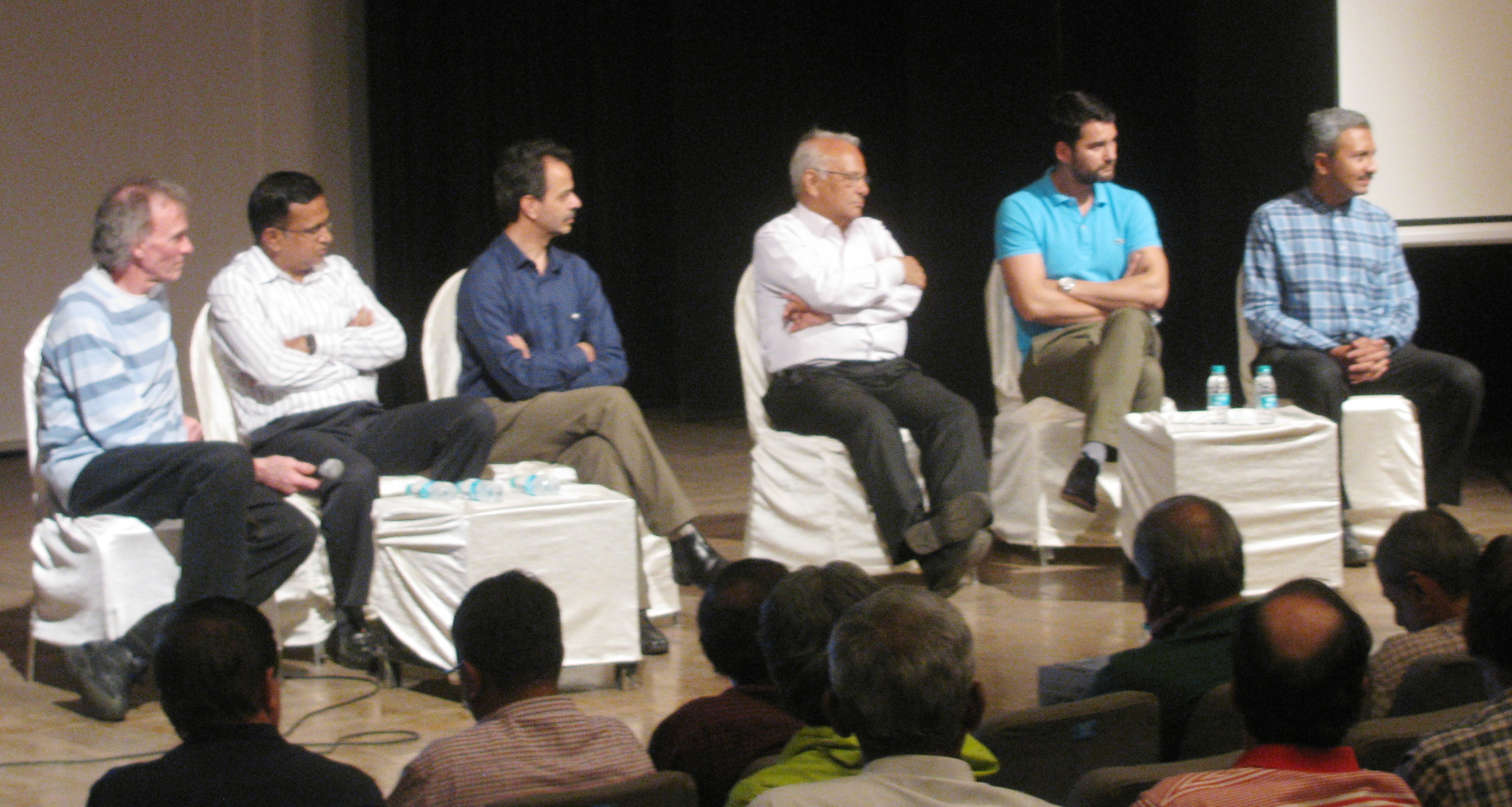
The Himalayan Club's panel discussion on Everest. From left: Lindsay Griffin, Umesh Zirpe, Dr Murad Lala, Harish Kapadia, Dawa Steven Sherpa and Divyesh Muni (Photo: Shyam G Menon)

The Himalayan Club’s panel discussion on Everest. From left: Lindsay Griffin, Umesh Zirpe, Dr Murad Lala, Harish Kapadia, Dawa Steven Sherpa and Divyesh Muni. Victor Saunders spoke via Skype, from England (Photo: Shyam G Menon)

Expeditions to climb Everest may become costlier in the future, Dawa Steven Sherpa, Managing Director of the Kathmandu based-Astrek Group, said.

The Astrek Group has in its fold, Asian Trekking, one of the best known names in organizing Everest expeditions.

Dawa based his views on the emergent need for better regulation on the mountain, underscored by recent events. A safer passage, which any regulation aspires for, could eventually mean more expensive expeditions.

In April 2013, there was an ugly episode when a small group of elite mountaineers climbing by themselves and a team of Sherpa mountain workers fixing ropes for many other climbers, had an altercation that led to a clash ( for that story, please see http://www.thehindu.com/todays-paper/tp-features/tp-sundaymagazine/whose-rite-of-passage/article4936209.ece). In April 2014, a year after the previous incident, there was a terrible avalanche on Everest that killed 16 Sherpa mountain workers on the spot with another person dying later.

According to Dawa, the first incident reported widely as a clash of conflicting climbing styles (unsupported alpine style versus commercial climbing format) actually had roots in the progressive evolution of the Sherpa mountain worker to someone conscious of his role and contribution to expeditions on the mountain. “ They no longer see Western climbers as above them,’’ Dawa said. It was a clash of egos; both sides saw themselves as elite in what they do. (Later he told this blog, news reports on the April 2013 incident were one sided and not sufficiently empathetic to Sherpa mountain workers because the community was not media savvy.)

At the same time, there is an element of accumulated grievance providing tinder. There is the competitive pressure of almost 2000 trekking companies in Nepal, all of them eligible to arrange Everest expeditions if they meet some basic criteria and very little of that criteria examining competence or accrued experience on the mountain. In the resultant race to quote low and secure clients for a shot at Everest, mountain workers’ salaries and working conditions take the hit. Thus, there are disgruntled mountain workers, mostly from the smaller companies. “ There needs to be a better way of deciding who is eligible to conduct expeditions on Everest and who is not,’’ Dawa said. The existing situation harbours danger. Besides, he pointed out, “ bad operators who treat their people badly are bad for the industry.’’

He said options that could be explored include positioning service providers in distinct tiers based on such factors as years of experience, nature of work done, staff strength, extent of training for staff, equipment quality etc, following which, a given agency in given tier could be matched with a suitable expedition. You could also create a structure to move up the ladder. However, completely questioning commercial expeditions for being a business or frowning down upon them is ill advised because many important shared services like search and rescue, availed by alpine style climbers too, are supported by the richer revenues from guided ascents. The two climbing styles co-existing together made sense.

Earlier Dawa had asked which expedition on Everest couldn’t be labelled commercial for under prevailing laws everyone climbing had to be associated with a trekking company and even alpine style climbers used porters to reach loads to the base of a mountain. One way to distinguish between the two would be to acknowledge as commercial, that expedition which wants every paying member or most paying members on the summit.

According to Dawa, surveys had shown that a majority of the Sherpa mountain workers lacked formal training but all of them had informally picked up skills as their mountain work was hereditary. With better industry regulation looming and logical at that, mountain workers have begun acquiring formal qualification to guide. Dawa said that 33 Sherpas now possessed international mountain guide certification; in another month at least seven more workers would similarly qualify. On the other hand, a qualified professional won’t work for a low salary. Also, some of the qualified mountain workers prefer to work as guides in the proper sense of the word. They decline to carry clients’ loads.

All this – from the likely shake-up within the 2000 odd trekking agencies to mountain workers improving their technical qualification – point to more expensive Everest expeditions in the future. On the client side, this weeding out could mean a drift back to technically competent climbers on Everest as opposed to anyone who can pay.

Fuelling the trend further is the frustration from accidents like last year’s avalanche. When the avalanche occurred and people died, of the more than 50 Liaison Officers who should have been around (they could have helped coordinate with government), only three were present. The concerned government minister visited eight days later, for which event some of the liaison officers made sure to be present. These actions were noticed by the community of mountain workers, provoking anger, Dawa said.

Dawa was speaking mid-February 2015, at the annual seminar of the Himalayan Club in Mumbai.

Providing an overview of the concerns of Sherpa mountain workers, he said that they saw their job on Everest as traditional and hereditary. They felt that risk rose with price war; the industry’s rules and regulations were not known well to its rank and file, government decisions were sometimes ad-hoc and not including mountain workers in the process, a professional rescue squad is absent, priority in rescue goes to foreigners, the mountain workers wanted a bigger share of the royalty collected from mountaineering to be ploughed back into the industry and there should be better employment conditions and better monitoring by government of the conditions on expeditions.

A panel discussion on what Everest climbs had come to be – featuring Victor Saunders, Lindsay Griffin, Umesh Zirpe, Dr Murad Lala, Harish Kapadia, Divyesh Muni and Dawa – witnessed heated debate around Zirpe’s successful leveraging of Everest’s popularity to raise resources for climbing 8000m peaks and Kapadia’s contention that many technically challenging climbs existed, often unexplored, in the less expensive smaller peaks of the Himalaya.

Interestingly, costs are lower to attempt Everest by routes other than the much climbed normal route; costs are also lower for climbs in the off season. There are few takers.

(The author, Shyam G Menon, is a freelance journalist based in Mumbai)

WILDCRAFT – THE EVOLUTION OF AN INDIAN OUTDOOR BRAND

A Wildcraft showroom; this one is at the Inorbit Mall, Navi Mumbai (Photo: Shyam G Menon)

A Wildcraft showroom; this one is at Inorbit Mall, Vashi, Navi Mumbai (Photo: Shyam G Menon)

This is the updated version of an article originally published in 2011.

Over a decade ago, we were fast approaching the departure date for a mountaineering expedition.

The experienced team members had imported backpacks.

The rookies lacked anything comparable.

We headed out to meet a gentleman near Churchgate in Mumbai, who had brought to town large backpacks made by Wildcraft. Those days, Mumbai had no Wildcraft dealer; this man was an aspirant. A black and green `Zanskar’ by Wildcraft – that became my first serious expedition size-backpack. Months later, I made the journey to Bengaluru and the garage-shop in Jayanagar, Wildcraft functioned from. I was merely doing what many did. For us, Wildcraft was the backpack we heard of, searched for stores selling it and eventually made the pilgrimage to Bengaluru to buy.

That was years ago.

Now Wildcraft has over 100 exclusive stores nationwide and many more shops that retail its products without being exclusive to the brand.

Wildcraft’s genesis almost 25 years ago was similar to how many outdoor gear businesses started. There were these folks addicted to outdoor sports; they scouted around for gear, found little and instead of complaining, decided to make it. Dinesh K.S, Co-Founder, Wildcraft, belongs to that league. He is an engineer given to rock climbing and mountaineering. It wasn’t long before he was forced to choose between his job at an electronics company and, expeditions. Those days the economy was just opening up. Bengaluru was a hot spot for garment-outsourcing. The basic raw materials for making outdoor gear could be chased down locally or traced to suppliers overseas. Enter Wildcraft.

Photo: Shyam G Menon

Photo: Shyam G Menon

Wildcraft’s first product was a chalk bag born from climbers’ needs. Its first major product was a dome tent. The tent wasn’t for sale but it gave the company’s founders a taste of the Indian market, which had neither volumes in outdoor gear nor viable price points. The company shifted to backpacks; everyone in the outdoors needed one.

Born from hands-on experience, Wildcraft products were relevantly engineered. They were also well designed unlike some of the other competing indigenous products, which were functional without much attention to aesthetics. Using outsourced manufacturing facilities, the company made backpacks, sleeping bags and a modest range of outdoor clothing besides selling imported climbing hardware. It also had a services wing catering to outdoor activity and management programs. A small garage was office and shop.

However the struggle for scale continued. With the country very low on active lifestyle, the Indian market for outdoor gear was abysmally small. Help came from an unexpected quarter. The IT boom provided relief. As software engineers poured into Bengaluru, the demand for laptop bags and smart daypacks rose. A product line thus opened up which was sufficiently big for the iconic but small-volume outdoor gear business to piggy back on. Dinesh recalled a specific instance. Wildcraft makes a sleeping bag that packs really small. Whenever Bengaluru faced a bandh (shutdown called by political parties) and IT companies wanted staff to overnight on premises, they placed a large order for this sleeping bag. Alongside, orders for daypacks continued. Still, brand Wildcraft lacked a road map as visited manufacturers in any overseas market with well entrenched outdoor lifestyle.

Around this time, Dinesh became a mountaineering instructor with the US-based National Outdoor Leadership School (NOLS), splitting his time between courses in India and the US. Wildcraft drifted. There was a churn in the original set of three partners running Wildcraft. Two new faces joined, whose actions have redefined Wildcraft. Although not from the outdoors, Gaurav Dublish and Siddharth Sood were MBAs working overseas. After studying the business and drawing up plans, they invested, joining Dinesh as directors. In a nutshell what they seem to have done is harness Wildcraft to ambition, forcing the brand to articulate what it wants to be thus checking that drift. The services wing was shut down. Between services and products, when viewed through the prism of scalability, products appealed more.

Photo; Shyam G Menon

Photo; Shyam G Menon

Globally, outdoor brands broadly fall in two categories – strong activity-based niche brands associated with a few products and large brands straddling a range of products. Wildcraft’s initial phase was the former. Could it have continued there? “ Numbers matter when it comes to sourcing and negotiating better prices. Numbers are everything today, so you must have more sales counters,’’ Dinesh had said in 2011, when this article was first written.

By early February 2015, the once reclusive Wildcraft had 100 branded retail showrooms in India. There were 20 franchised outlets. Most of these 120 outlets were profitable save five to six outlets, which opened recently. Approximately 25 per cent of company turnover came from its owned and franchised outlets. The balance 75 per cent was from distribution, large format stores, online portal sales and institutional sales. In 2011, its top five showrooms were already past Bengaluru-centric; they were Jayanagar (Bengaluru), NOIDA, Kochi, Chandigarh and Vashi (Navi Mumbai). By 2015, the same mix was Lucknow (opened in October 2014), Mumbai Linking Road, Vashi (Navi Mumbai), NOIDA, Jayanagar and the outlet at Mantri Mall, Bengaluru. Wildcraft became a one crore-company in 2007. It crossed the Rs 100 crore-mark in turnover in 2013-2014. “ We should be Rs 160-165 crore by the end of 2014-2015 fiscal year and sail past Rs 250 crore by 2015-2016,’’ Gaurav said. Over the past few years, the company grew at a CAGR of 60-70 per cent, which over the next three to five years should settle to around 40-50 per cent. “ Basically, we grew by 100 times in seven years and plan to grow by ten times from where we are now in five years,’’ Gaurav said.

From the new range of Wildcraft backpacks (Photo: Shyam G Menon)

From the new range of Wildcraft backpacks (Photo: Shyam G Menon)

As Dinesh pointed out in 2011, the transition attempted is towards becoming a big brand, retailing a variety of Wildcraft products founded in outdoor DNA. Gaurav had tweaked it slightly for better perspective – as yet there is no global outdoor brand from the tropics. The company now has its own factories – two in Bengaluru; the other in Himachal Pradesh, Speaking of the old Bengaluru facility and the then new factory in Himachal, Gaurav and Dinesh had said in 2011 that both facilities were cost-competitive despite location in India. In manufacturing, the challenge then was raw materials, which players in China and the Far East had better access to. Asked for an update, Gaurav said that Wildcraft had manufacturing costs that matched those prevailing in China. However more recently emergent manufacturing locations like Vietnam and Bangladesh would be hard to beat.

The Indian market too is changing. In the past several years albeit in small volumes, brands like La Fuma, Millet, Quechua (from Decathlon, which has a major presence in India), Berghaus, Petzl, Beal, Camelbak, CAMP, Cassin, Rock Empire, Boll, Evolv, Boreal, HEAD, Coleman, Coghlan’s, Deuter, Lowe Alpine, Columbia, RAB and Hi-Tec, became available in India, not to mention standard fixtures like Victorinox. Some brands entered and quit or withdrew to study the market better; others continued. Fact is – thanks to growing momentum in the sports segment (across sport categories) and the progressive adoption of active lifestyles, the market has grown. Although price point and which sport will grow are still a matter of debate – and within each vertical’s story, an often inconsistent narrative – the Indian market is firmly past the stage of being ignored. Running, the most visible symptom of active lifestyle, now spans urban India. From tryst with two or three large Indian brands, the domestic bicycle market now hosts the who’s who of international cycling. Things have changed. Gaurav estimated the total market relevant to Wildcraft at two billion US dollars annual sales. He pegged the outdoor gear segment at $ 500-600 million; outdoor apparel at $ 800 million-1 billion and outdoor footwear at $ 800 million-1 billion. The `outdoor’ reference used here is defined on the basis of product design, materials used, construction and intended application for sports and outdoorsy activities.

Needless to say, two product segments Wildcraft was studying in 2011 (and which it has since acted upon) were shoes and apparel. By early 2015, the company had a line of outdoor clothing and footwear. These lines of business separate the big brand from the small one. Internationally, big outdoor brands get 60-70 per cent of revenue from apparel sales. The company now has a design team which conceptualizes products and lays down the specs. Depending on the product, there is an element of outsourcing; for example, the company’s footwear is sourced from China and Indonesia. “ Around 95 per cent of what we sell is made by us,’’ Gaurav said. None of Wildcraft’s expansion can happen without money. Gaurav’s primary concern in 2011, as regards future plans, had been funds. Private equity may be an option, he had said.

Dinesh K. S, Co-Founder, Wildcraft (Photo: by arrangement)

Dinesh K. S, Co-Founder, Wildcraft (Photo: by arrangement)

In mid-2013, news reports first emanated of an upcoming deal. Silicon Valley based-venture capital fund, Sequoia Capital, invested Rs 70 crore in Wildcraft. The money, Gaurav said, should take care of the company’s need for funds till 2017. It would be used to pay down debt, enhance production capacity, expand retail footprint, meet working capital needs and generally reduce the leverage of the company. The most visible aspect in the Wildcraft story is a brand grown big – especially the push in the physical retail space. Is that wise when e-tailing is exploding? According to Gaurav, 15-20 per cent of Wildcraft’s revenues come from e-tailing. He believes that seen from the brand’s viewpoint, all channels have a role to play. E-tailing gives exceptional convenience and choice to customers. At the same time, it is typically being fuelled by discounts and Wildcraft, he said, does not wish to discount. Second, he said, “ in the lifestyle space, touch, feel and fit will continue to remain an intrinsic part of the buying experience.’’ There is also the fact that the growth numbers recently reported in the Indian e-tailing segment are from the industry’s initial growth phase; its steady sailing will be at more settled growth rates.

While all this provides vignettes of the Wildcraft story from a business and financial perspective, what may matter for the Indian outdoor enthusiast – the type who made the pilgrimage to Bengaluru years ago to buy Wildcraft’s backpacks – would be something else.

The Indian market has a devil in the details. It impresses with it numbers and capacity for volume. The more important question is what do you do and where do you go with these numbers because the nature of these numbers has a tendency to shape the personality of your business to what the Indian market is. This may not work well in the adventure / outdoor products space. To provide a metaphor – when you climb and your risk levels rise (with commensurate expectation from your gear), you have already bid goodbye to the bulk of brands out there and reposed faith in a few, which deeply matter as the ones you trust your life with. For an outdoor company, treading the volume market is a balancing act because in as much as it enjoys proximity to top athletes and access to testing gear in the world’s greatest wilderness spaces, it must be careful not to dilute that DNA as it sells more and more. In India, this challenge is even more unique for although you run into potentially promising business volumes, the country was never traditionally a hotspot for authoring outdoor DNA, something Wildcraft itself realized when it searched for good designers. Outdoor talent is hard to come by in India overwhelmingly wedded to the settled life.

Gaurav Dublish, Director, Wildcraft (Photo: Shyam G Menon)

Gaurav Dublish, Director, Wildcraft (Photo: Shyam G Menon)

Wildcraft articulates its growth thus – between the two potential business verticals of addressing the head-to-toe needs of the outdoor enthusiast and being an activity specialist, it has chosen the former. “ You can be one of the two,’’ Gaurav said, February 2015 in Bengaluru. This is fine strategy (the company already has apparel and footwear usable for the all the Indian seasons) especially when coupled with Wildcraft’s emergent desire to grow competence around the outdoors of the tropics. The bulk of the world’s outdoor gear companies groomed their DNA on experiences straddling the geography between the poles and the Tropic of Cancer / Capricorn. The equatorial belt and activities therein, didn’t attract as much. Addressing it will be engaging. But it will be a challenge, fitting such transition into the existing global narrative and perception of outdoor DNA. As Wildcraft courts business, some shifts are already showing. For example, the company is a large manufacturer of backpacks by volume. It has products devoted for rugged outdoor use, which have been recently improved as well. But the numbers-chase in the market has the centre of gravity in this business firmly in the small backpack category, especially in daypacks used by youngsters and such. You suspect a similar drift in the preference to go with head-to-toe as opposed to being activity specialist.

Wildcraft’s current strategy is fetching it revenues; in fact its revenues have grown sharply. That in turn, probably enhances its faith in the new strategy. But how can it stay convincingly ` outdoor’ despite the realities of the relatively non-outdoorsy Indian market where people buy outdoor stuff to seem outdoorsy than actually be out? Can volume play mislead an outdoor company into preferring the softer product segments? – This will be what any observer from the outdoors will track in Wildcraft’s evolution. Viewed thus, specialization in activity has its value. The reason you buy clothes for running from a shop that sells running gear or clothes and footwear for hiking / climbing from a shop that sells gear for the same, is because the irreplaceable and most wanted are also around. They add to the discerning customer’s conviction when buying related or more peripheral stuff. The outdoor DNA is actually all about zeroing down on the irreplaceable, the pure core. If you move away from that ethic, you sell more but in the eyes of the outdoor enthusiast, you just became the mainstream. It then becomes only a matter of time before the mainstream picks up the buzz from the hard-core and a brand loses its aspiration-value.

Photo: Shyam G Menon

Wildcraft shoes (Photo: Shyam G Menon)

Some years ago, when the global outdoor products industry went through a spate of realignments, a few well known outdoor gear brands were acquired, while others joined larger coalitions – all of it meant to put together a comprehensive outdoor product-range under one roof. With over 100 branded outlets, Wildcraft has opened up a wide reaching physical retail presence and distribution pipeline. It wishes to be strong as head-to-toe outfitter assisting people to take up outdoor pursuits; it does not wish to be one-activity specialist. Will it use its channels for activity-specific gear that complements its head-to-toe business? In 2011, Wildcraft had not closed options as regards multi-brand retailing at Wildcraft shops, co-branding and joint venture manufacturing. In co-manufacturing there has to be tangible technology gains for Wildcraft. Quizzed further on this topic, particularly the potential for inorganic growth, Gaurav explained in 2015, “ we have not shied away from inorganic growth. We are open to it.’’

The market is not only buying Wildcraft products, it is also watching it. In the local trade with its share of stores begun by trekkers and climbers, Wildcraft’s strategy is often debated for departing from the typically cautious outdoor approach driven more by passion than appetite for business. The old school understands the organic, home-grown business model. Did the team take a real risk by scaling up? On the other hand, if Wildcraft succeeds, that would be a measure of the market. That is when the action would commence for businesses run by its critics as well. “ We welcome competition. The more the competition, the better the market buzz around outdoor products,’’ Gaurav had said in 2011.

(The author, Shyam G Menon, is a freelance journalist based in Mumbai. This article is a composite of two conversations with Dinesh and Gaurav, the first in 2011, the second in February 2015. The financial and business data given herein are from Wildcraft; it is a privately held company. A crore is 10 million; one crore rupees is 10 million rupees. At the time of writing this article in February 2015, a dollar was worth little over 62 rupees. An article based on the 2011 chat appeared in The Hindu Business Line newspaper.)

THE GHOST WHO WRITES

Photo: Ravi Kumar

Photo: Ravi Kumar

It was winter, 2013.

Cycling with trolley attached, is tough in Uttarakhand’s hills.

You have long uphill sections.

They seem a breeze when tackled in a car, jeep or bus.

To know what those roads actually are, you have to either run or cycle.

We took turns cycling the Kona, which hauled the trolley.

Ahead of Lansdowne we were having a particularly long day. As evening settled in, everything about our condition indicated that we had best halt somewhere. Problem was – there wasn’t any good place to stay or a clearing, quiet and sufficiently out of the way, for us to camp. We felt we might turn lucky if we pushed on. This we did on a very long ascent, half way up which, day transitioned to night and we found ourselves cycling with our headlamps on. Now that – is a very unwise thing to do in the mountains where the road-edge plunges hundreds of feet down. We knew this well. Eventually, at a turning on the road, we found a temple. But we had either run out of food or were exhausted enough to wish that somebody would feed us. We could see lights on a hillside some distance away. Ravi waited at the temple while I went ahead to look for a house and hopefully, a hospitable family who will cook us dinner.

I found both.

The family we stayed with (photo: Shyam G Menon)

The family we stayed with (Photo: Shyam G Menon)

Roughly a kilometre on from the temple, about fifty feet up from the road was a house with its light still on. I asked if there was anyone around. A dog barked. Then a man emerged from the house. He listened to my request. I knew it was unexpected and tabled too late. He initially offered dinner cautioning that there was nothing special available and we would have to eat what the family had. “ That’s very kind of you. It is more than what we wanted,’’ I said. After ten minutes of quizzing to make sure that we were genuine travelers, he offered us food and a room to stay in. He urged me not to stay at the temple and instead, stay in the spare room at his house. I fetched Ravi. We parked our cycles in the courtyard of the house. We had dinner, conversed with the family and slept soundly. After a hearty breakfast, we offered to pay. The man, a former soldier, accepted nothing. I remember what he told me when I first asked for food, “ you are travelers. I have also traveled on work. I know what it is like to be in an unfamiliar place. Get your friend, you can eat what we have.’’

God bless that family.

Photo: Shyam G Menon

Photo: Shyam G Menon

Sometimes a trip happens that is so enjoyable that you don’t remember to keep a diary and you can’t subsequently recall where you had been. This cycle trip was in that league. Not more than ten days. Approximately 350-400km covered in the hills; two mountain bikes, one trolley (attached to a cycle) with camping gear, stove, spare clothes, repair kit and food (essentially tea and coffee for the morning), two small backpacks on us. We didn’t have panniers. So this arrangement seemed best. Real cyclists may call us crazy. But we weren’t that real in cycling. We had no goals; we just wished for a nice, winding hill road with camping spot and tea shops en route. Besides, I suspect when one’s grounding is in hiking and mountaineering, some weight to haul, getting roasted by the effort, grinning through it and then laughing at the eccentric fool one is – it all adds to life. When the sun was unbearably hot, we stopped and slept in the shade. When a place seemed particularly beautiful, we stopped to marvel at it. When the road was well-made and there was no traffic, we relaxed into the ride. When a terribly rough side road assured to host great Himalayan views beckoned, we ventured forth thankful that our cycles had suspensions. We had destination but none so iron clad that we couldn’t let an instance lead to another – that seemed our trip.

The route was based on recommendations from Punit Mehta, a friend with abundant love for hiking. He had also travelled much on his motorcycle; the roads and side roads on our itinerary were his inputs. I am not a great navigator but I suspect we may have ended up adding a couple of sub-routes of our own. Anyways, the journey was from Ranikhet in Kumaon to Lansdowne in Garhwal and then through a forest road open to traffic, to Maidavan. If I remember correct, we went via Dwarahat, Thalisain and Peersain. The exit wasn’t quite near Ranikhet; it was a day’s drive away. Both cycles – a Kona and a Mongoose – old and well used, performed splendidly. They belonged to Ravi, whose collection in Ranikhet included recumbent bikes and unicycles as well.

Coffee and Ravi (Photo: Shyam G Menon)

Coffee and Ravi (Photo: Shyam G Menon)

Self supported travel has two advantages. First it keeps cost low, provided nobody minds you camping around. Second, it lets you know places and people. Independence lets you explore and the moments of dependence – because you know clearly you are dependent and why – makes you grateful for help received. Good behaviour is half the job done on any trip or expedition. We had a couple of wonderful camps and tea shops that served us food. At some places we slept on a veranda or in a shed. In remote areas, the local shop may also be tea shop and traveler’s lodge. We caught up on news chatting with shop owners. In their lodge rooms, we met traveling salesmen and got a sense of rural marketing. We met women out cutting grass; seeing us they halted, struck up a conversation, inquired about our journey and sought a group photograph. We passed a hillside featuring many people trudging up to a local temple; got invited to the festival, got our share of sweets. An interesting aspect for me was that the two major towns linked by our route were the homes of Uttarakhand’s army regiments – the Kumaon Regiment and the Garhwal Rifles. The former is headquartered in Ranikhet, the latter in Lansdowne.

Our disappointments on the trip were probably just two. One fine day, Ravi decided that we would ask for a large citrus fruit called malta and get one free from somebody’s tree. It was to be the memorable postcard experience of tourism – you ask, a smiling face generously gives. We found two men seated near a cluster of malta trees. They pointed us to the owner, an old lady. Unfortunately she was in a grumpy mood. “ NO,’’ she said firmly. We dropped the malta plan. The other, was the curious case of some young men who looked at a pair of cyclists as a threat to their importance. While it was common to have youngsters quip that they had done similar trips or more, I was nearly unseated once when a youngster thrust his leg into my way as I cruised downhill. The people we could confidently engage with were retired military personnel. They had moved around the country on work and were at ease with strangers. I have always believed that the true gift of travel is how it takes you away from family and familiarity and makes you vulnerable. That state, bereft of ego, is when you know life.

The women we met, out cutting grass (Photo: Shyam G Menon)

The women we met, out cutting grass (Photo: Shyam G Menon)

There was one memorably amusing episode from the trip.

We were camped in a field just below a rough, unpaved road.

All around were hills.

There had been little traffic on the road the previous evening, when we arrived. So we had had dinner at a shop some distance off in town (a small junction to be precise) and cycled back to the relative isolation of the field. We put up our tent and fell asleep quickly; it had been a long tiring day.

Late in the night, an individual or two, walking along the road had shined a torch in our direction. It is not always that you see a tent in the adjacent field.

Early morning was tad different.

We heard approaching conversation and then an abrupt cessation of talk as the passersby discovered the tent. Both Ravi and I, were feeling too lazy to stir out so early and engage the visitors. So we stayed put in our sleeping bags, hoping that they would go by as the others before did.

But the sound of walking had stopped.

There was a brief silence.

Then voices were heard.

“ You see that – a tent!’’

“ Must be the cyclists who were having dinner at the shop last night.’’

Photo: Ravi Kumar

Photo: Ravi Kumar

The sound of soles on sand and gravel emanated as the visitors shuffled down the side of the road to the little clearing where the tent stood. There were mumbled comments and grunts, the usual accompaniment of checking things out.

I was now wide awake, half wondering whether I should step out and say hello, which is the best way to avert too nosey an inspection. The worry in such situations isn’t the inspection per se. It is the potential damage to camping gear, not to mention – our cycles kept outside. If someone can guide the curiosity it helps.

But I didn’t want to get out early on a winter morning. Besides it was that sweet spot when the cold of a night bidding goodbye met a hint of the sun. Both day and night were languorously mixed. I stayed put in the sleeping bag.

We could sense people close by, our worlds separated by mere tent fabric.

Then somebody said clearly, “ woh Keralawala thhand se mar gaya hoga (that person from Kerala must have died due to the cold weather)!’’

There was a round of laughter after it.

The sound of shoes started moving away.

Mongoose and the mountains (Photo: Shyam G Menon)

Mongoose and the mountains (Photo: Shyam G Menon)

It crunched sand and gravel climbing back up to the road.

Then it slowly faded as rhythmic strides.

Within the tent both of us had stifled our laughter at the comment till the visitors left. Now we got out of our sleeping bags and the tent laughing our heads off. Pronounced dead, I felt like a ghost, a happy ghost. Ravi got the stove going for the morning coffee. I took a photo of him at work; then stood there savouring the morning chill. That comment about me, hailing as I do from tropical Kerala (Mumbai where I live is also hot and humid), was my take away from this trip.

It’s nice to be still alive.

Once in a while I pinch myself to make sure I didn’t die in that tent.

Or maybe – I am the ghost who writes?

(The author, Shyam G Menon, is a freelance journalist based in Mumbai)

A TREK AND A TEA STORY – PART 1

On Ponmudi (Photo: Shyam G Menon)

On Ponmudi (Photo: Shyam G Menon)

This article weaves two narratives – the one in normal text focuses on a trek; the other in italics, talks about tea estates.

It is an old story said in three parts. A lot may have changed since it was first written in 2009. A quick reality check was done through return to context in August 2014, which is appended as `Post Script.’ However, it is a limited update. Readers are requested to keep that in mind.

In the beginning of the nineteenth century, the plantation industry reached Kerala on India’s south western coast.

First in was coffee in Wayanad, the north Kerala district bordering Karnataka. This area used to belong to the erstwhile Madras Presidency. There were three potential sources of manpower for the estates. Of them, the tribal people flatly refused to work on the plantations seeing it as an invasion of their forests. The people from the Malabar region were averse to such work. Imported labor from Tamil Nadu provided the solution.

By 1866 more than 200 coffee estates were operating in Wayanad, two thirds of that owned by Europeans, the rest by investors from the coastal towns. Twenty two years later, news came of blight on the coffee plants in Kerala. It was believed to have arrived from plantations in Sri Lanka; in any case, much of the state’s coffee was destroyed by 1876. Experiments with other crops like cinchona, as replacement for coffee, proved discouraging. Eventually tea moved in; coffee continued to have a presence in Wayanad. Although the British East India Company’s first foray into tea in South India happened in the 1840s, large scale production of tea in Kerala commenced only after the coffee blight. Tea had to be necessarily large scale compared to coffee. As a crop it required regular human intervention. These interventions were affordable only if the scale of cultivation was large. The heart of the state’s tea country then was Peermedu. Later it was the undulating hills of Munnar.

The last major cash crop to reach Kerala and its hills was rubber at the turn of the twentieth century. With this, save the apex portion which was off limit by law, it was theoretically possible to clothe a Kerala hill in estates – rubber at low altitude, coffee at mid altitude and tea at high altitude. One definite casualty of this was the traditional forest aesthetic. From natural and heterogeneous, the idea of greenery became acceptable even if it was manmade and homogenous.

When my cousin Rajeev comes home on vacation from the US, we usually go on a hike. That’s how Agastyakoodam entered the frame.

At Neyyar Dam near Thiruvananthapuram in Kerala I got my first real look at Agastyakoodam peak. The face it presented to Neyyar Dam was beautiful, a perfect triangle. Agastyakoodam had always been there in the backdrop at Thiruvananthapuram, spoken of in hushed tones of respect. To see Agastyakoodam you had to be on the terrace of an ideally located house in the city and have a clear day. Slightly foggy or sky laden with rain clouds – you missed it. For the child in you, that added to the myth. I grew up in Thiruvananthapuram. So the myth was a big deal.

In the late 1980s, I remember listening in awe as a friend who was senior to me, prepared to join the annual pilgrimage up the 6237 ft high-peak. Nobody called it a trek; indeed there was no trekking in popular perception then. You went up a hill for pilgrimage. Then in January 2009, three of us – Rajeev, his nephew Gokul and I – decided to do the Agastyakoodam hike ahead of the annual pilgrimage. Booking the trek through the forest department turned out to be a small expedition. It was a whole day’s trip to Peppara and back; that was where we had to pay the fees and register our names.

Half way along the narrow forest road to the Peppara Dam and its warden’s office, Shahajad who was driving our hired three-wheeler stopped the vehicle to put some money in a box kept in front of a temple. It was one of the most beautiful sights. Besides the small box and a multi-tiered, soot-stained traditional lamp fixed to the ground, there was nothing to mark a temple there. But the atmosphere was exceptionally divine in a quaint, primeval way. It was set by four to five lovely trees called chempakam in Malayalam. They have a sprawling shape, the trunk acquires a silver color and in full bloom, has dainty white flowers. A week later at the botanical gardens adjacent to the Thiruvananthapuram zoo, I could gather the actual name for the tree – Eezhachempakam, Plumeria rubra Linn also called Temple Tree. In that small clearing filled with white sand, by the road in Peppara, the trees had woven a magnificent aura – if one’s gaze turned heavenward in the temples of the plains, then in the temples of the hills and forests, I felt a sensation of being embraced by nature.

The road to Ponmudi (Photo: Shyam G Menon)

The road to Ponmudi (Photo: Shyam G Menon)

Early next morning, all geared up for the multi-day hike, we met our guides – Binu and Raju; both from the Kani community. They were adivasis; tribal people, initially stiff and quiet but soon warming up to conversation after a round of hot tea at a smoky restaurant opposite the Bonaccord bus stop. That was in fact the end of the winding road. Nearby were tea estates. I knew at least one another similar road, leading to Ponmudi (3609ft), which highlighted a little known dimension of Thiruvananthapuram – you could land in tea country, less than two hours from Kerala’s capital city.

By 2009 (actually earlier), Thiruvananthapuram’s tea estates, likely the southern-most in India, were in trouble. It was a picture of neglect. Bonaccord epitomized it. The resident tea factory was in a state of disrepair and the tea bushes in their neglected condition had reverted to being an extension of jungle.

Bonaccord appeared trapped in a time warp on the peripheries of Thiruvananthapuram. It had sat there while the lands way below went through political upheavals rendering the area likely unviable for commercially successful tea cultivation. Now the tea factory was a ghost of its former self. Three floors high and the length of three tennis courts, it sported shattered glass panes and rusting metal; at one end was a room full of silent machinery that had ground to a standstill long ago. The day I was there, four to five officers sat settling accounts in a sun-lit room on the ground floor. The floor of the adjacent hall featured a spread of freshly plucked tea leaves. The company owning the estate no more worked the processing factory; it simply transported the leaves to distant Vandiperiyar and sold it.

For quite a while on the well marked trail, the plantation culture from the foothills of Agastyakoodam lingered. There were minor trails once used by Englishmen to move around, places where they used to rest and long forgotten horse trails with water halts for the animal. Raju and Binu proceeded at a brisk pace; like a pair of men out on work or going to the market. They had appeared clad in shirt and lungi, rubber slippers on the feet and crucially no rucksack for either. For guides everything else was forgivable but unprotected feet and no rucksack was questionable. So I had taken most of our provisions away from them and put it in my rucksack. In due course the duo laundered my lack of protest at the additional labor into a desire for carrying load. “ Sir likes to carry all the weight,’’ Raju said. Binu nodded his head approvingly. Ever heard that – a paying client who loves to haul load?

This was typical Kerala and the contrast the situation posed with treks up north where clients walked swinging their hands while porters lugged massive loads, was rather stark. But then on the other hand I reasoned, just as cuisine is different from state to state, so had to be the people and their mentality. There was nothing in this duo that betrayed a willingness to genuflect or be servile. Lungi tucked high to keep it out of the way they conversed about the world and set an impatient pace that soon had me, my rice and my vegetables frying in the heat and sweat. The trail, pounded by several years of pilgrims’ passage, was firmly etched into the hill slope. We passed a prominent stream en route – it was the beginning portions of the Karamana River which flowed downstream through the heart of Thiruvananthapuram city. A sole leech made its presence felt on Rajeev’s leg; the blood sucker had quenched its thirst long ago, bloated and fallen off, leaving behind a tiny bleeding wound. In days to come, that wound would itch. A leech bite is like a love affair. It can take a few days to get over the visitation – you bleed, you scratch, you reopen the wound, you scratch, till all that imprints the leech into your memory.

…..to be continued

(The author, Shyam G Menon, is a freelance journalist based in Mumbai)