MANY RUNNERS BUT FEW ATHLETES – EXPLORING A MUMBAI PARADOX

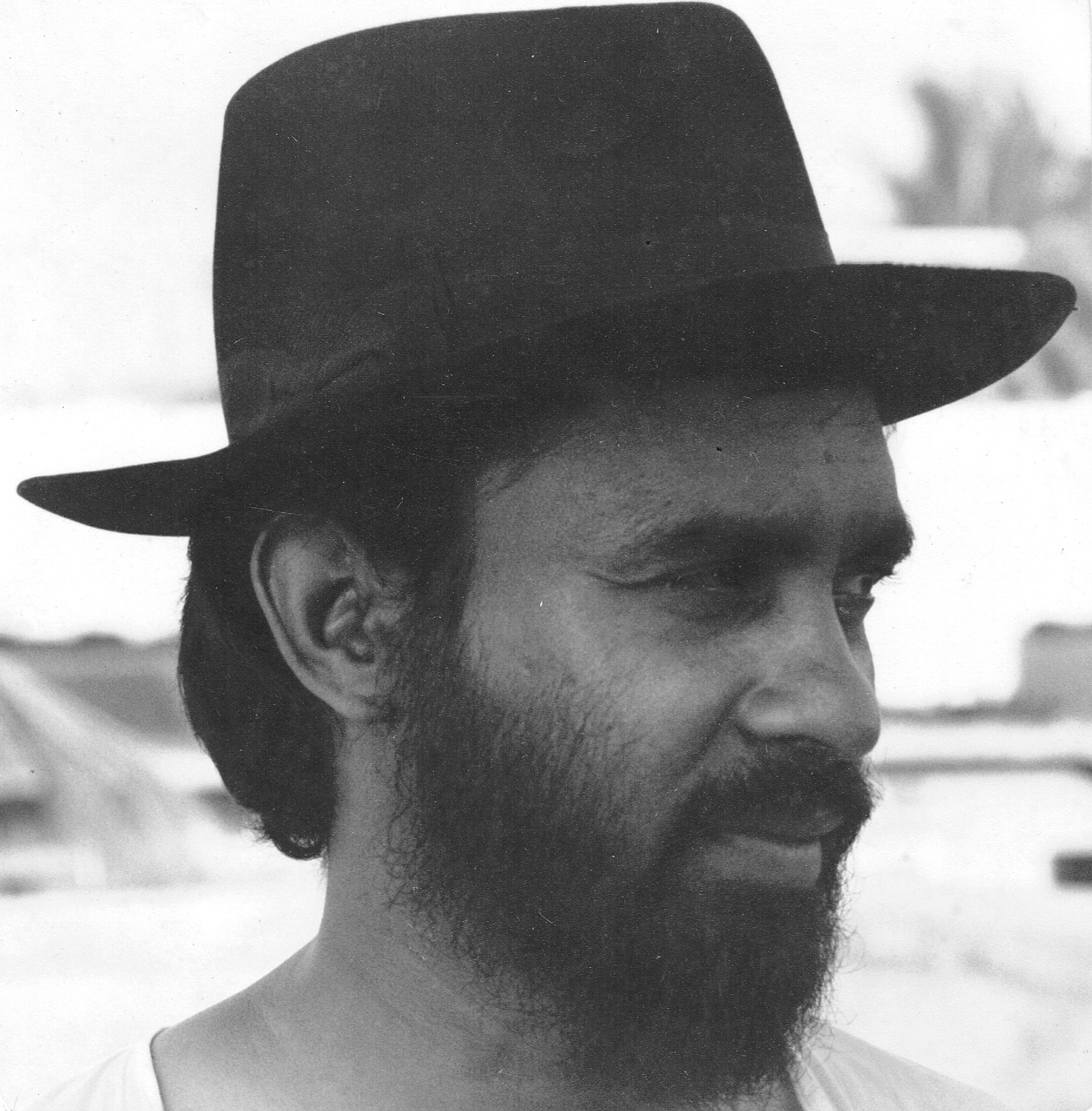
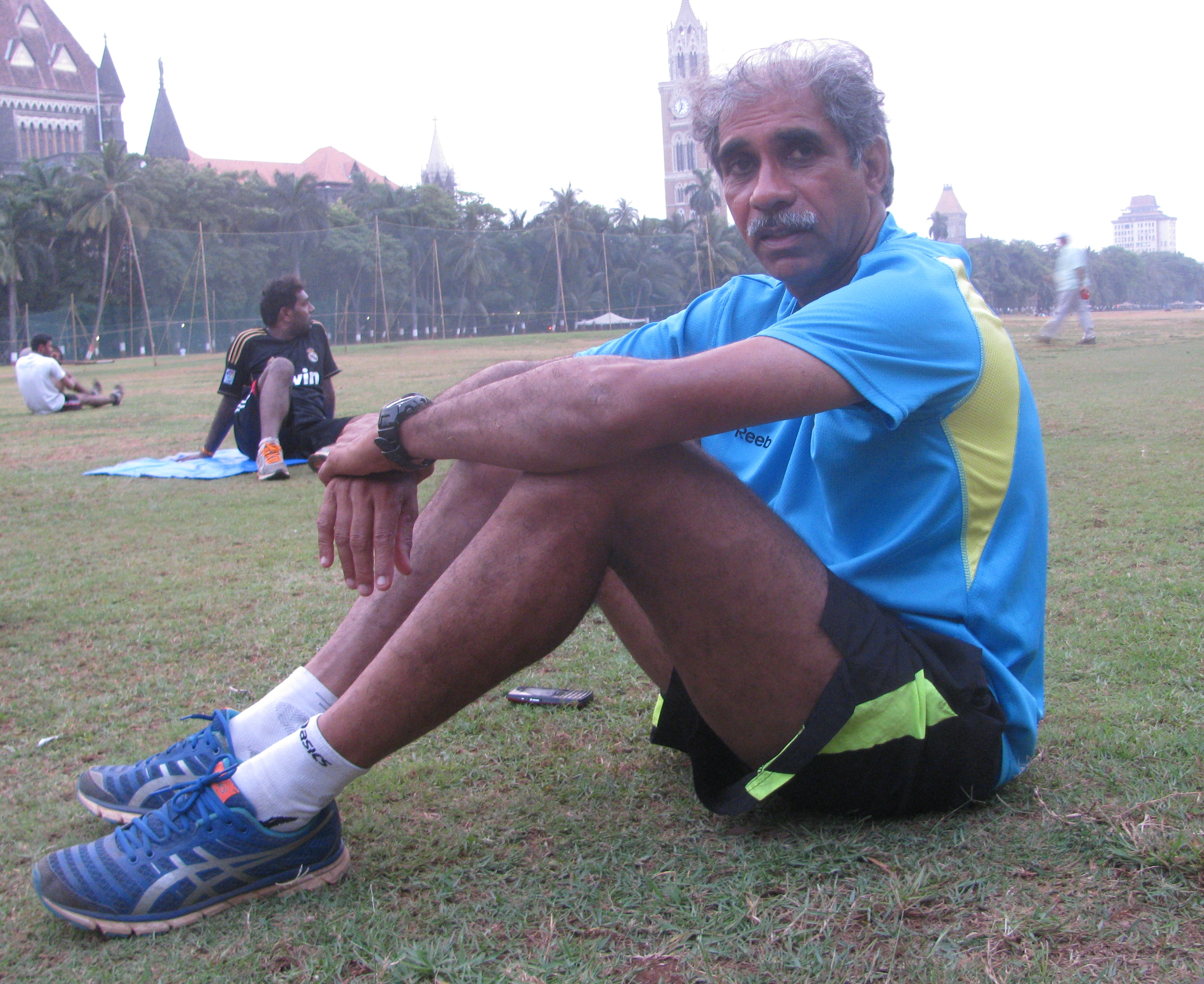
Savio D'Souza (Photo: Shyam G Menon)

Savio D’Souza (Photo: Shyam G Menon)

“ This is all I have. Make sure you don’t lose anything,’’ Savio said, handing us a small file.

It contained old issues of Mid-Day, Sportsweek and The Daily plus a plastic sleeve with a few photos stained by age.

The former national champion in the marathon used to have more photos from his life in running.

Many have been lost.

The file opened a window to a Mumbai no more there.

Sixty one years old, Savio D’Souza, is today a busy coach, training runners in a city that has become India’s running capital thanks to the iconic Standard Chartered Mumbai Marathon (SCMM). That would seem a fine situation to be in except for two points Savio made in his characteristic in-your-face fashion. The SCMM started in 2004. While the annual marathon got many people into running, those latching on to the sport from Mumbai largely belonged to the 30 plus age group. Because of it, Savio said, there were no timings significant to Indian athletics, to report from the Mumbai lot. In 2015, the women’s national record in the marathon was broken by Kerala’s O.P. Jaisha at SCMM. But timings by runners from Mumbai were nothing significant. On the one hand, running had become a movement in Mumbai. On the other hand, it was far from being cutting edge performance by any Mumbaikar. “ We have a large body of recreational runners. But where are the real athletes? There was a time when Mumbai and Maharashtra produced great track and field athletes. Now the city doesn’t feature anywhere in that department. States like Kerala, Manipur – they have all gone ahead,’’ Savio said. And paradoxically, none of the states which overtook Mumbai and Maharashtra to prominence in athletics have an event comparable to SCMM in size or such a large body of recreational runners around.
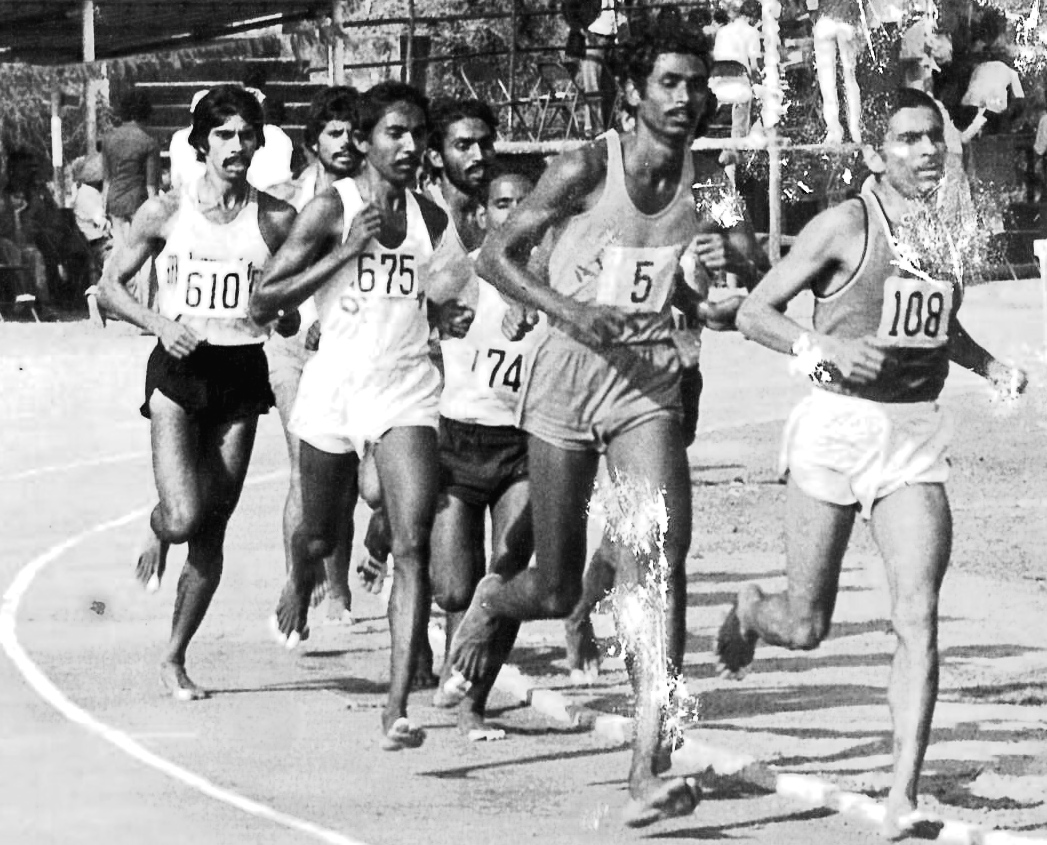
From an old race; Savio at far left, the late Shivnath Singh at far right (Photo: by arrangement)

From an old race; Savio at far left, the late Shivnath Singh at far right (Photo: by arrangement)

The paper clippings in Savio’s file dated to the early and mid-1980s. As fragments of media from the past they told a story. There was a report from November 24, 1986, about Savio winning the Pune International Marathon, beating Stephen Marwa of Tanzania to second place. Marwa had been winner of the event in 1984. The 1984 Pune International Marathon (the second edition) had been Savio’s first major marathon, wherein he finished first at the national level and third internationally (Marwa was first). In his second marathon – the Singapore International Marathon – Savio finished 18th, reducing his timing by a wide margin. Later at the Hong Kong International Marathon, he was placed 13th (profiles on the Internet say he placed ninth in Hong Kong at the 1986 edition of the event). Savio had his beginnings in the 1500m, 5000m and 10,000m disciplines. He said his best timing to date for the full marathon is around 2:25. That would make him at his peak the equivalent of being sixth among Indian full marathon runners at the 2015 SCMM. And 2015 is around 30 years since Savio’s heydays. “ That’s what I am telling you – that many years ago with much less money and facilities in Mumbai, we had timings in long distance running that matches the timings reported today or were better,’’ Savio said. Indeed the late Shivnath Singh’s national record in the men’s marathon – 2:12:00 – set way back in 1978, still ruled at the time of writing this article, almost 37 years after the timing was reported.

The Mumbai athletics ecosystem of Savio’s time seems to have been different.

From his file, a November 1983 edition of Sportsweek reported on the Runathon, a 12 km-run through Central Mumbai, won by Savio. Other reports spoke of the annual Sportsweek Road Races, five in number, with an overall winner at the end of the series. If media be window to given times, it is interesting to note that most of these reports are detailed and although cricket is dominant news by a wide margin, athletics gets a fair amount of space. Uniquely, unlike contemporary news reports on running which tend to be event-focussed, highlighting the spectacle of event, these old reports dwell more on athletes and less the event. There is an intimacy in the reportage. Savio was national champion from 1984-1988. According to him, in addition to Sportsweek lending its name to running events, many of Mumbai’s private and public sector companies maintained teams in athletics. Mafatlal – the company Savio worked for – had teams in football, cricket and athletics. The city had several athletic meets in a calendar year and each of those races saw the best turn up. Mumbai had a fine share of India’s best for the local ecosystem was breeding and grooming talent. Athletics saw the city’s senior officials arrive to encourage and support. Shashi Kumar Nair, former athlete who is now a senior government counsellor and lawyer at the city’s High Court, recalls S.K. Wankhede (former president of the Board of Control for Cricket in India), O.V. Kuruvilla (former chairman of the Central Board of Direct Taxes) and R.R. Chari (former commissioner of Income Tax) as among those who regularly visited the University Ground to support athletic events. On its part, the public turned up to cheer for they knew they were in for a treat as Mumbai had good athletes. All that community engagement either dried up or similar events continue but without the overall social interest. “ Now we don’t have good long distance runners. Maybe some in Pune and Nashik, but Mumbai – no,’’ Savio said.
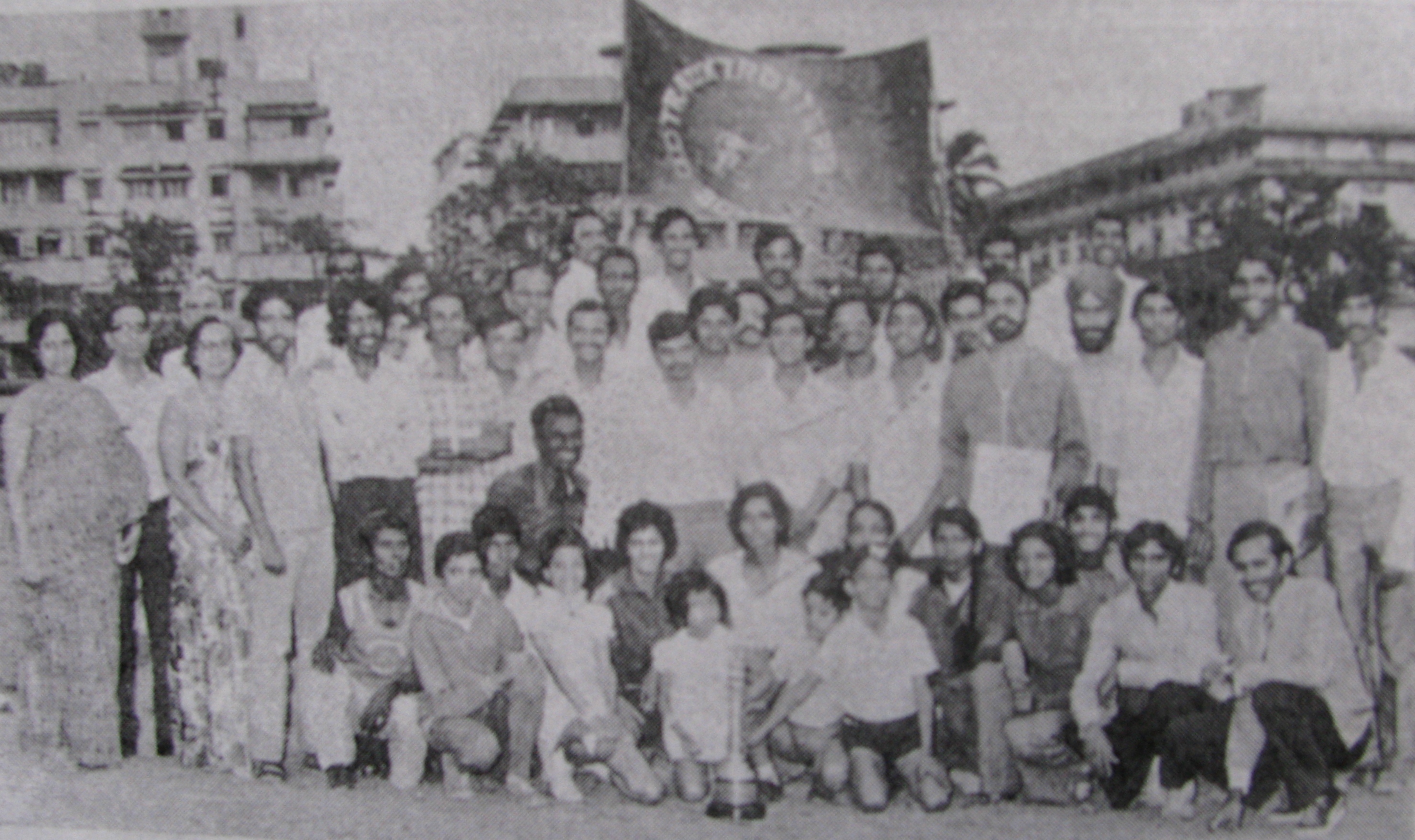
Tracktrotters athletes and some of their parents with th Jameson Trophy in 1975 (Photo: copied from the club's 16th anniversary souvenir)

Tracktrotters athletes and some of their parents with the Jameson Trophy in 1975 (Photo: copied from the club’s 16th anniversary souvenir)

Two fantastic sports clubs, committed coaches, an accessible track to train on and roads shut down for people to run – these seem to have been old Mumbai’s magic potion to create athletes. For Edward Sequeira aka Eddie, the centre piece of old Mumbai’s infrastructure for athletics was the track at the Bombay University Sports Pavilion, popularly called University Ground. Essentially a track and field facility in the city belonging to the local university, this ground in South Mumbai was where Mumbai’s athletes – from state level to Olympian – converged to train. University Ground had a 400m-oval shaped track, two curves and two straights. “ This is the standard track,’’ Eddie said. The convergence of athletes here was courtesy two sports clubs possessing an evangelical fervour for promoting athletics – Tracktrotters (that is how the name is written) and Juhu Sports Club. Eddie – he is an Olympian, Arjuna Award winner, former Asian record holder in the 1500m and former national record holder in the 1500m, 5000m and the mile – is one of the founding members of Tracktrotters. Both clubs were near similar in what they wished to do and did, although some people cited a distinction by economic flavour with Tracktrotters being very middle class and Juhu Sports Club having a relatively well to do crowd.
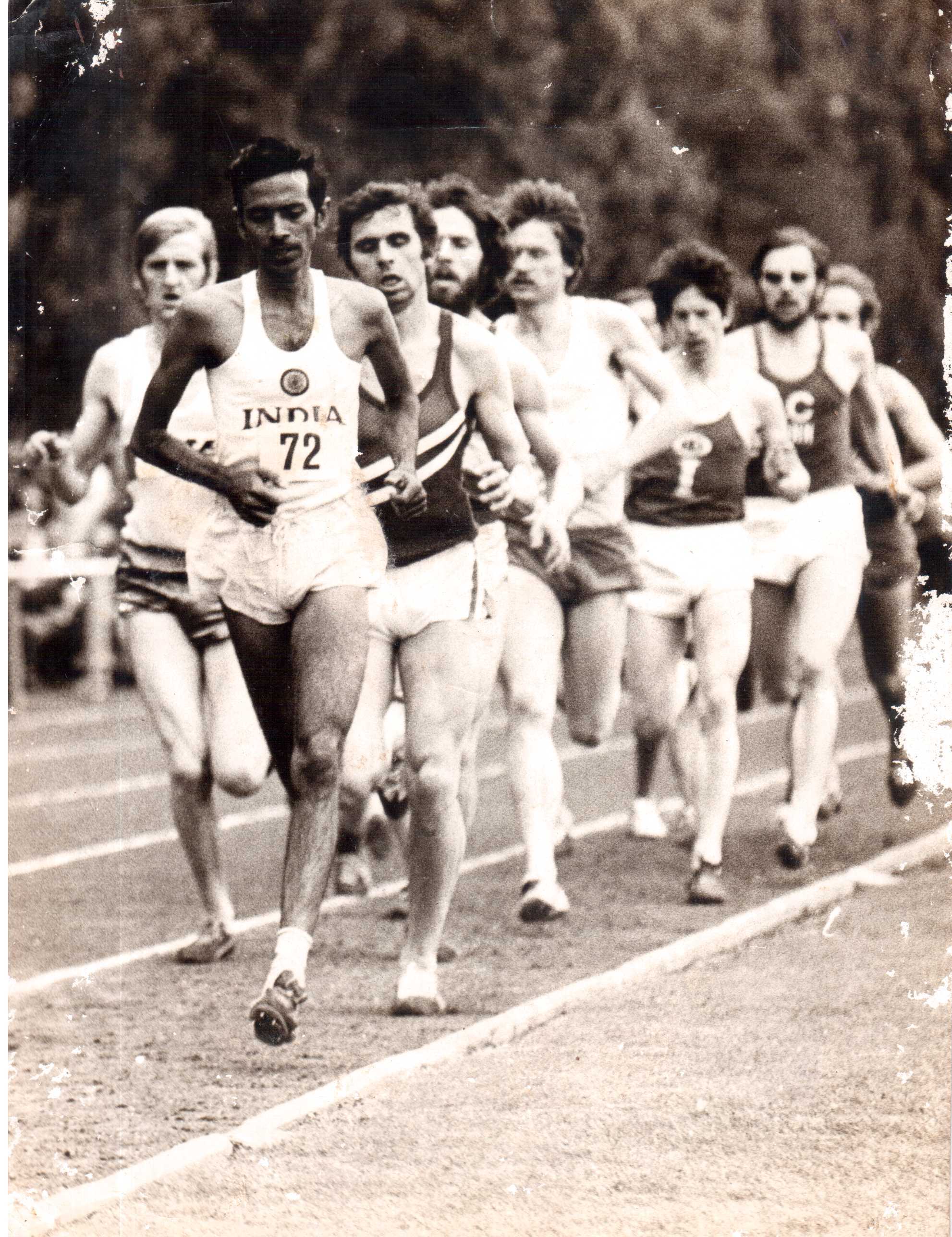
Edward (Eddie) Sequeira (in front) at a race in Germany (Photo: by arrangement)

Edward (Eddie) Sequeira (in front) at a race in Germany (Photo: by arrangement)

Tracktrotters’ origin goes back to the late 1950s, to a group of senior athletes training together at the St Xavier’s Gymkhana, Parel. In 1962, they became Tracktrotters. The club charged nothing for its coaching. Parents brought their children for prospective training or youngsters approached on their own. “ We would sometimes test the candidate. That was all,’’ Eddie, 75, said. From 1969 onward, Tracktrotters’ regular training was at the University Ground. Although neither the two clubs nor all their trainees belonged to the university, the authorities supported their endeavour. Both clubs maintained boxes on the premises to store gear and equipment. Their coaches, training free of cost, were passionate and committed about what they did. Tracktrotters coaches included Eddie, Mervyn Jacobie, Alex Silveira, Philip Silveira, Vasant Kumar, Prithviraj Kapoor and Peter Rodrigues. The best known from Juhu Sports Club was Bala Govind, who now works in Nashik. He confirmed, training at the Juhu Sports Club also happened free of cost. “ Those days, the concept of charging money wasn’t there,’’ he said. And they produced results – many of Mumbai’s leading athletes from the period had links to these clubs and University Ground; among them – Eddie and Savio. A friendly competition prevailed between Tracktrotters and Juhu Sports Club. This was the athletics ecosystem then. “ Those are the days I will never forget,’’ Eddie said.

Mervyn Jacobie is remembered as a great coach by many. An evening in April 2015, at the playgrounds of Five Garden, Wadala, we met Ashok Shetty, an official at the Mumbai Port Trust and former state champion in the 400m, 800m and 1500m. Born into a poor family residing in Parel, his ability in sports was first spotted by Oliver Andrade, a well known coach in the city those years. Ashok’s first rendezvous with competition earned him no podium finish. With a friend who fared better in athletics, the boy landed up at Tracktrotters. At that time, the club practised at the premises of Khalsa College. “ Anyone could join for training. It was free. The first thing Mervyn did was catch me by the ear, tell me to cut my long hair short and report for training regularly,’’ Ashok recalled.
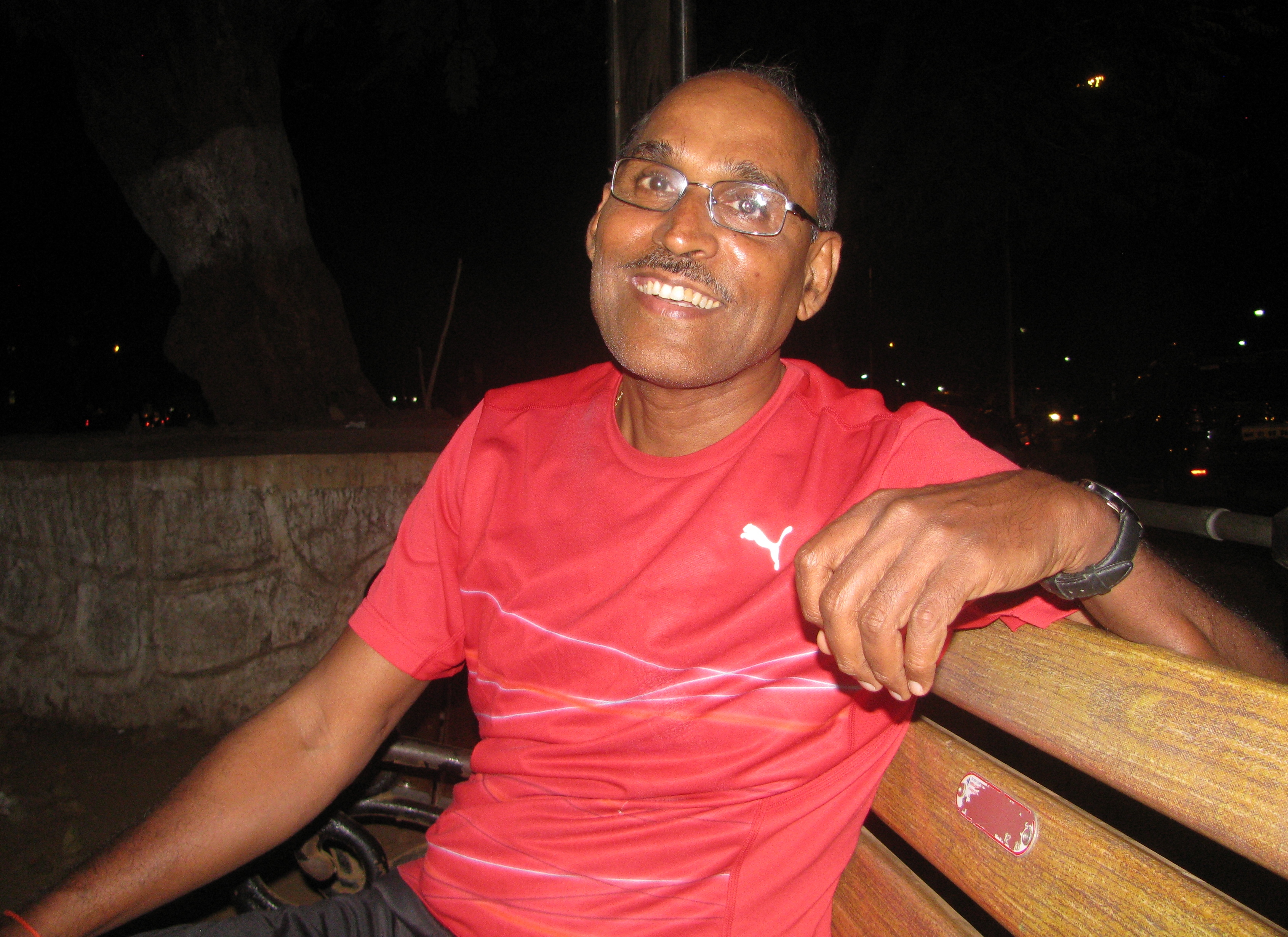
Ashok Shetty (Photo: Shyam G Menon)

Ashok Shetty (Photo: Shyam G Menon)

By all accounts Mervyn’s methods won’t sustain in today’s environment. Back then, it delivered results. He was a man of medium size, very strict, insisting on punctuality and completely committed to his work as coach. On Sunday, he took a break from coaching to attend church. Mervyn worked with Central Excise; he retired as Superintendent. In due course, Tracktrotters shifted from Khalsa College premises to the University Ground. Every evening, training began at 5PM and went on till 7.30PM. As coach, Mervyn was hard to please. Those who trained under him got whacked – that seems to have been a Mervyn trademark. Once, Savio, on winning a race, went up to Mervyn to share his glee. “ I got a whack and was asked: why did you look back and run? He told me, you could have run faster had you not looked back, ’’ Savio said. Ashok, after a victory went to Mervyn with trophy and some youngsters inspired to join Tracktrotters. Another whack and pointed advice on how to improve. “ I picked up the trophy, which had fallen from my hands and looked around for the youngsters. They had all disappeared!’’ Ashok said laughing. But Mervyn wasn’t this strict perfectionist alone. Unable to afford a railway pass, Ashok used to walk from Parel to University Ground when Tracktrotters first shifted to the South Mumbai ground for practice. An angry Mervyn would whack Ashok for repeated late arrival. Then he learnt that the boy didn’t have money for the daily commute. Mervyn got him a railway pass. When the pass expired, he gave him money to renew it. Similarly, every Saturday, the whole Tracktrotters team assembled at Santa Cruz and travelled to Juhu to run on the beach. The cost of everyone’s travel was borne by Mervyn. “ For Mervyn, coaching was his life,’’ Ashok, 59, said.
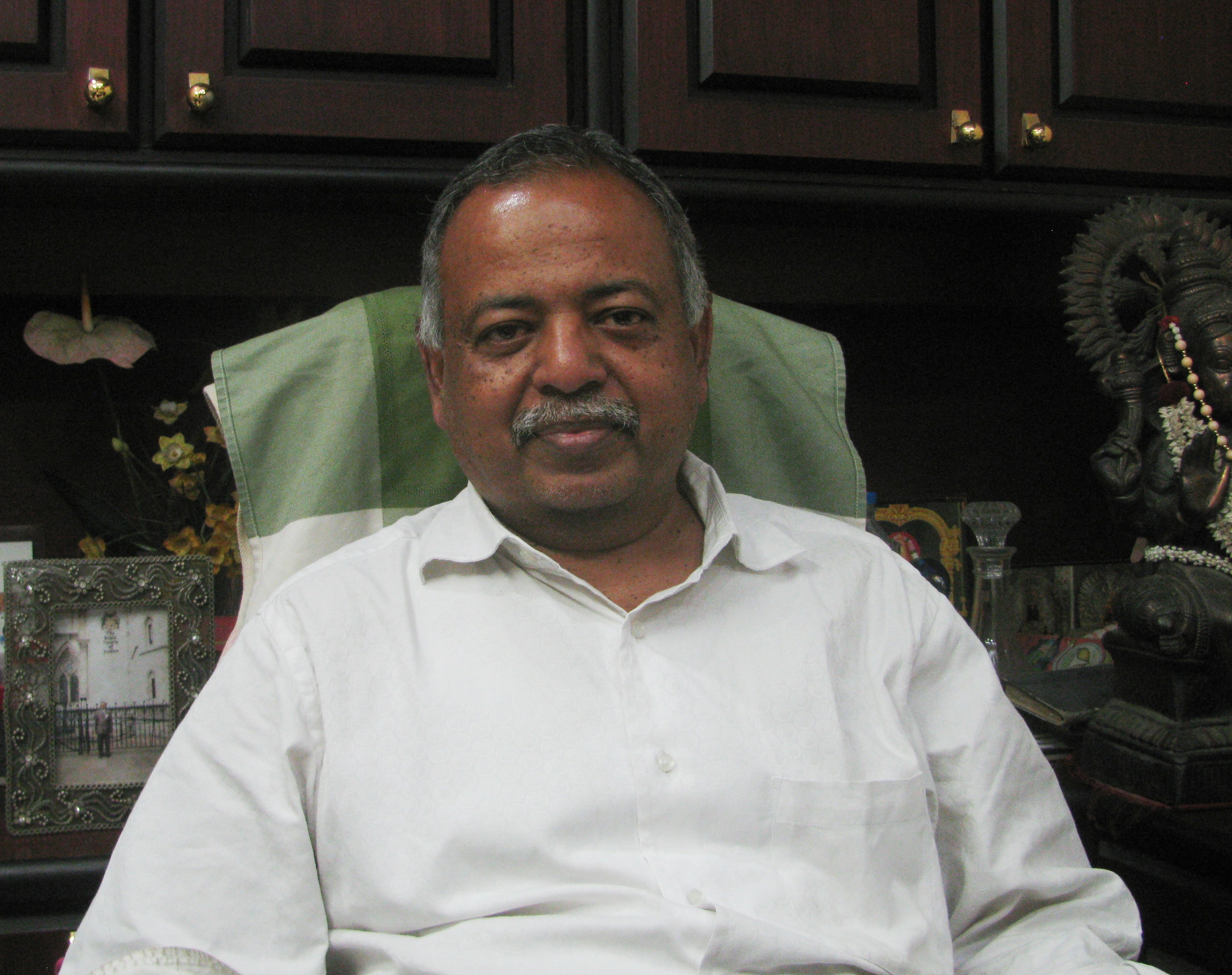
Shashi Kumar Nair (Photo: Shyam G Menon)

Shashi Kumar Nair (Photo: Shyam G Menon)

At his office in an old building at Mumbai’s Flora Fountain area, Shashi Kumar Nair, 60, opened a shelf and pulled out some documents. “ This shelf is now the Tracktrotters’ office,’’ he said. In a souvenir marking the club’s 16th anniversary, Mervyn Jacobie, wrote, “ Humble as the beginning was, this club had sworn to train young and enthusiastic boys and girls throughout the year, both in and off season, free of cost without any entrance fee, membership or any such formalities, irrespective of religion, caste or creed, to attain standards in athletics. Besides providing training, these athletes are entered without any entry fee for all major athletic meets in the region; track shoes, track suits and spikes are issued to the deserving athletes, from donations received from sports lovers and friends.’’

Major Shashi Tiwari, 50, served with the Indian Army’s Bihar Regiment. He now works with Tata Power. Years ago, he was the national junior champion in 800m and 1500m; he was an athlete at Tracktrotters. “ I spent nine years of my life there,’’ he said. According to him, the main benefit of being at Tracktrotters was that it took anybody in and then put that person through the coaching of a dedicated individual like Mervyn. “ People like Mervyn are hard to find in today’s world,’’ he said. Incidentally, that old Tracktrotters souvenir concluded with a “ list of members – past and present.’’ They numbered around 352. Of them, 239 – that is 68 per cent – had won medals at regional, state or national levels or been participant at international level competitions. Some of them qualified for all four levels of honour.
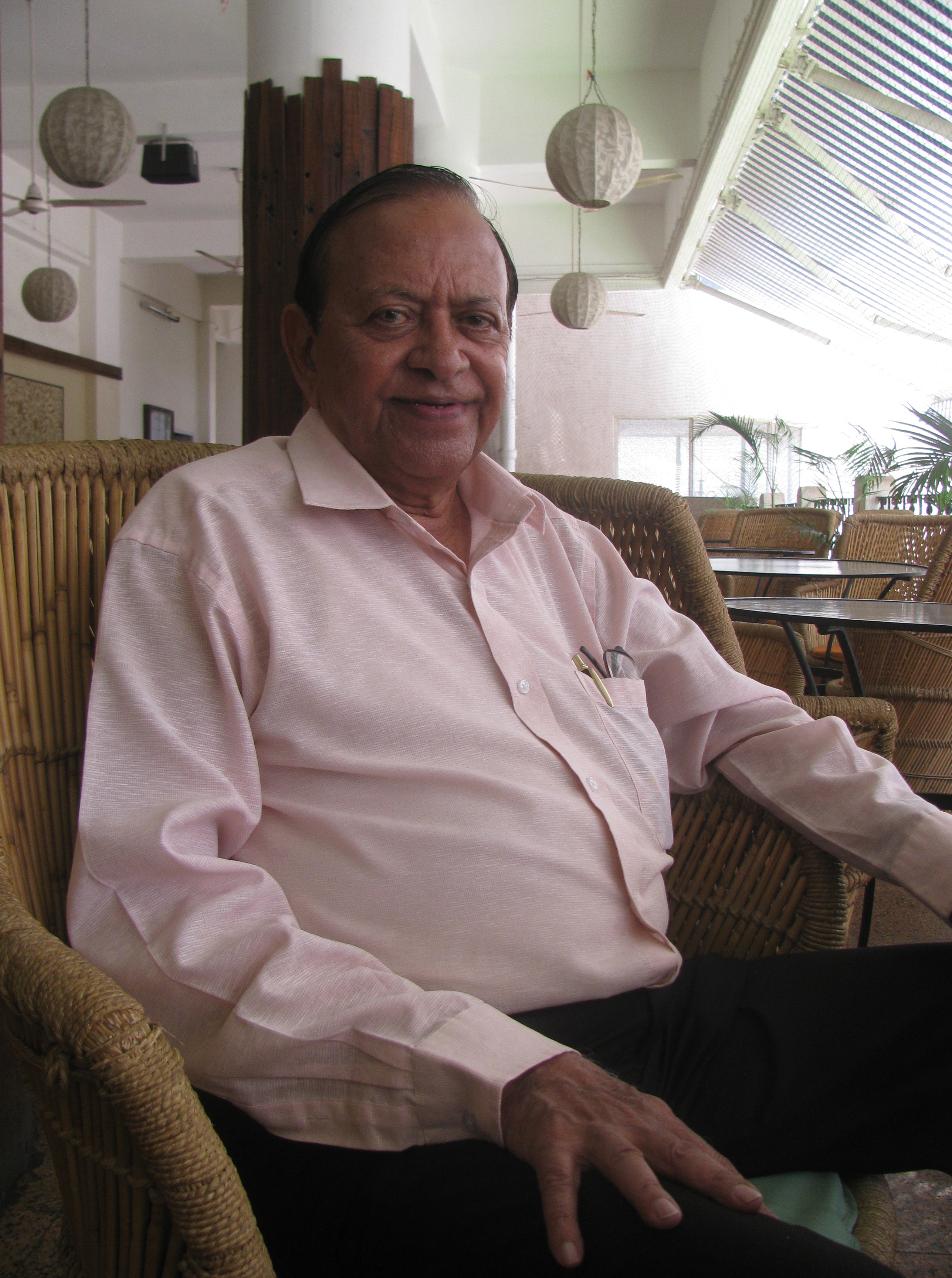
Edward (Eddie) Sequeira (Photo: Shyam G Menon)

Edward (Eddie) Sequeira (Photo: Shyam G Menon)

According to Eddie, the decline in Mumbai athletics started about twenty years ago when the university refused permission for outsiders, including the clubs and their wards, to train at University Ground. The exact reason for this development is unclear. Eddie loved this ground, which had built him into the sportsman he came to be. In 1982, after the Asian Games in New Delhi, Mumbai’s University Ground had also been venue for a six nation-athletic meet organized by Tracktrotters. So in 2011, when India’s decision to host the cricket World Cup saw its organizers seek space to expand the Wankhede Stadium and think of encroaching on the nearby University Ground, Eddie put his foot down. He and Shashi Kumar Nair drummed up enough support to prevent any such move. Today the ground survives. It even has a new synthetic track. Access however isn’t as free as before (an official at the office adjacent to the stadium said that the ground is mainly meant for university students; others get to use it if their application is approved). Besides, a new road leading to the cricket stadium has allegedly eaten into what used to be the old athletes’ warm-up area.

Can a giant city’s position in athletics decline simply because a ground shut its doors to the public? Eddie explained it. The question is not the ground per se but what it did and how it worked in combination with the two clubs. The University Ground is perfectly located. Although in South Mumbai, it is accessible by road and rail. It had the city’s only good running track years ago; it has a new synthetic track now. What it did as part of the matrix offered by the clubs and their training, qualified the years gone by. In those years, Mumbai was catching its athletes young. Unlike most games, athletics is an individual sport. Physically demanding, you peak early in it. “ You can be a national champion at 16 or 18 years of age. That is why you have to catch them young,’’ he said. Old Mumbai was interested in sports; it scouted for young talent and found it. Still restoring a ground to regular public use is only part of the panacea. If you want a revival in athletics, the issues to address are several.

To start with, today’s children – including Mumbai’s children – lead lives dramatically different from the children of the 1960s, 70s and 80s. Thanks to contemporary lifestyle, interest in the active life has dipped. A procession of distractions exists – particularly the mobile phone. “ When we trained, we were not allowed to speak to each other or have any distractions,’’ Major Tiwari said. According to him, people from economically challenged backdrops and those hailing from rural areas may still have that required discipline. “ Mumbai has lost it,’’ Major Tiwari said. Veteran coach, Bala Govind, 73, felt that once motivated adequately, today’s children are good. But there is the issue of distraction and how naturally motivated children are toward sports. “ Those years – 30 to 40 years ago that is – were totally different. The children of that time were motivated differently. They saw sports as fun and once motivated, they had no distractions,’’ he said. Currently, even if a child managed to be in sports despite distractions, a major hurdle looms by tenth standard. Studies squeeze out sports. “ In competitive sport, you take a break and come back, your contemporaries have surged ahead,’’ Savio said.

With studies stifling sports, another old trait also began drying up.

Savio was born in Goa in 1953. After finishing his SSC, he moved to Mumbai in 1972. He was a footballer but didn’t enjoy it. He used to train at the University Ground and got admission at Maharashtra College near Byculla in the city, on the strength of his performance in sports. By 1976, he was representing Bombay University in the 5000m and 10,000m. “ I was noticed. Those days we had talent scouts and a system that provided sustenance to dedicated sportspersons,’’ Savio said. Schools and colleges looked around for good talent. Scholarships were provided. If your athletic abilities earned you a seat at college, your continued performance was noticed by companies who gave you employment. “ Such employment matters. I used to be away seven to eight months a year, training and competing. But my employers gave me a regular monthly salary,’’ Eddie said of Tata Steel. According to him, as per an old estimation of 1982, the Tata Group had in its fold then, six world champions, five medal winners at the Olympic Games, four Commonwealth Games medal winners, 36 Asian Games medal winners, 33 Asian Championship medal winners, 41 Arjuna Award winners, 51 Olympians, 57 sportspersons who had participated in the Asian Games, 54 people who had participated in the Asian Championships, one Padma Bhushan and 11 Padma Sri recipients for contribution in sports. He also said that in those days, Tata companies recruited a sportsperson once every two years.
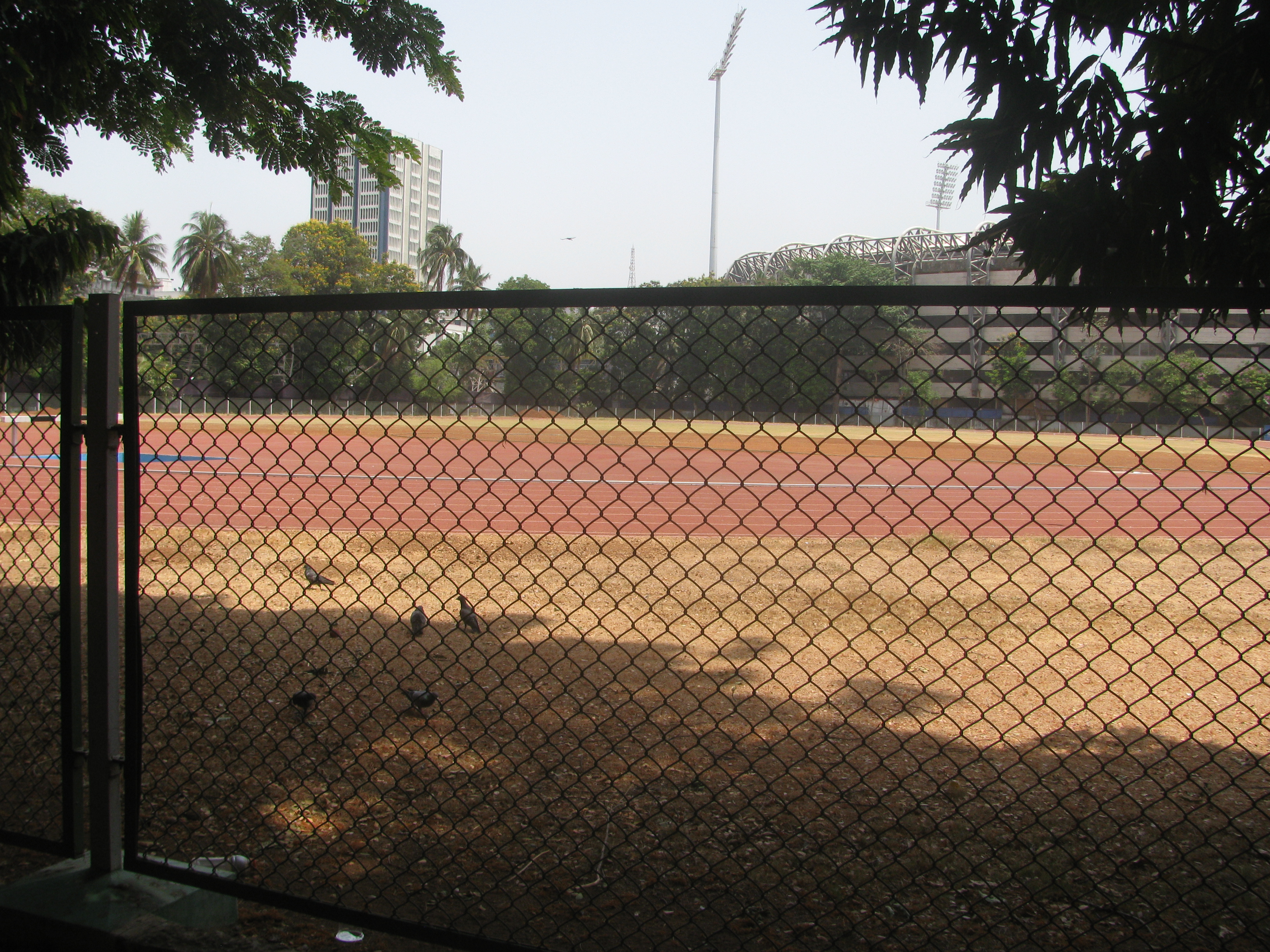
University Ground (Photo: Shyam G Menon)

University Ground (Photo: Shyam G Menon)

Some public sector companies still persist with the policy of supporting sports through employment. But a lot has changed in the private sector. There may have been snaps in continuity of support for sports in the city, when the old textile mills – Savio used to represent Mafatlal – restructured, slipped into hard times or plain died out. Mumbai’s new generation industry and the old that survived are more market focussed, preferring to see results and then support, that too in sports enjoying visibility. Exceptions exist. In conversations around recent athletes we had, the Mittals, Jindals and ONGC found mention as patrons of athletics. But that is not how it used to be. In times gone by, being a sportsperson was on par with being good at studies in terms of prospects in life. Today, nobody wants to know your struggle to succeed. They will support you once you are successful. It would be tempting to justify this trend with that approach loved by market and GDP – survival of the fittest. Actually it isn’t that simple. Most coaches know that to find good, hardy talent you have to cast your net wide and not everyone spotted so can survive without a supportive ecosystem. This is true even in the recreational running of today’s Mumbai. Some of the best timings are from people who came up the hard way and whose passage in sports was assisted by supportive others. Ecosystem matters. One comment from the conversations we had about years gone by remained embedded in the brain as a classic synopsis of what our world calls change. Somebody we spoke to said, “ we were doing a good job in athletics and coaching. What we didn’t have was a Power Point presentation like today’s market savvy folks.’’

“ The required change has to happen from school level onward. Without it there is no chance,’’ Savio said. He felt, the system of coaching at schools must be changed with sportspersons taking over the task. “ If the coach is a sportsperson, then he or she will make sports happen no matter what the challenge, because they enjoy sports,’’ he said. An interesting aside here is that when Eddie got his first job as a mechanical apprentice at Central Railways, sports was compulsory for railway employees. According to him, a Mumbai revival in athletics could start with training the resident coaches properly; send them abroad so that they get to know what good coaching is and bring it back to the city. He pointed out that unlike the salaried government coaches of today, the city’s old coaches – the ones who blazed a trail at Tracktrotters and Juhu Sports club – were devoted to sports and coaching for the love of it. They charged nothing. And they produced results if Mumbai’s past in athletics is anything to go by. Such passion must return to the city. There has to be more athletic meets. “ Bring back the old road races. Rain or no rain, the Oval Maidan is there; the University Ground is there, Marine Drive is there. Don’t have just one meet in a year – of what use is that?’’ Eddie asked. Finally “ forget about seniors; focus on juniors.’’ He wanted corporate sponsors for junior teams. “ My suggestion is that every big company should have at least one athletics meet for juniors,’’ he said, emphasizing alongside that the habit of pushing in over aged persons into junior categories to win prizes, should stop. According to Eddie and Shashi Kumar Nair, Tracktrotters is hoping to make a comeback. The club held a general body meeting in this regard attended by 50-60 old members. “ From the club’s side, we are giving the commitment that we will return the old glory to Mumbai athletics,’’ Nair, vice president, said.
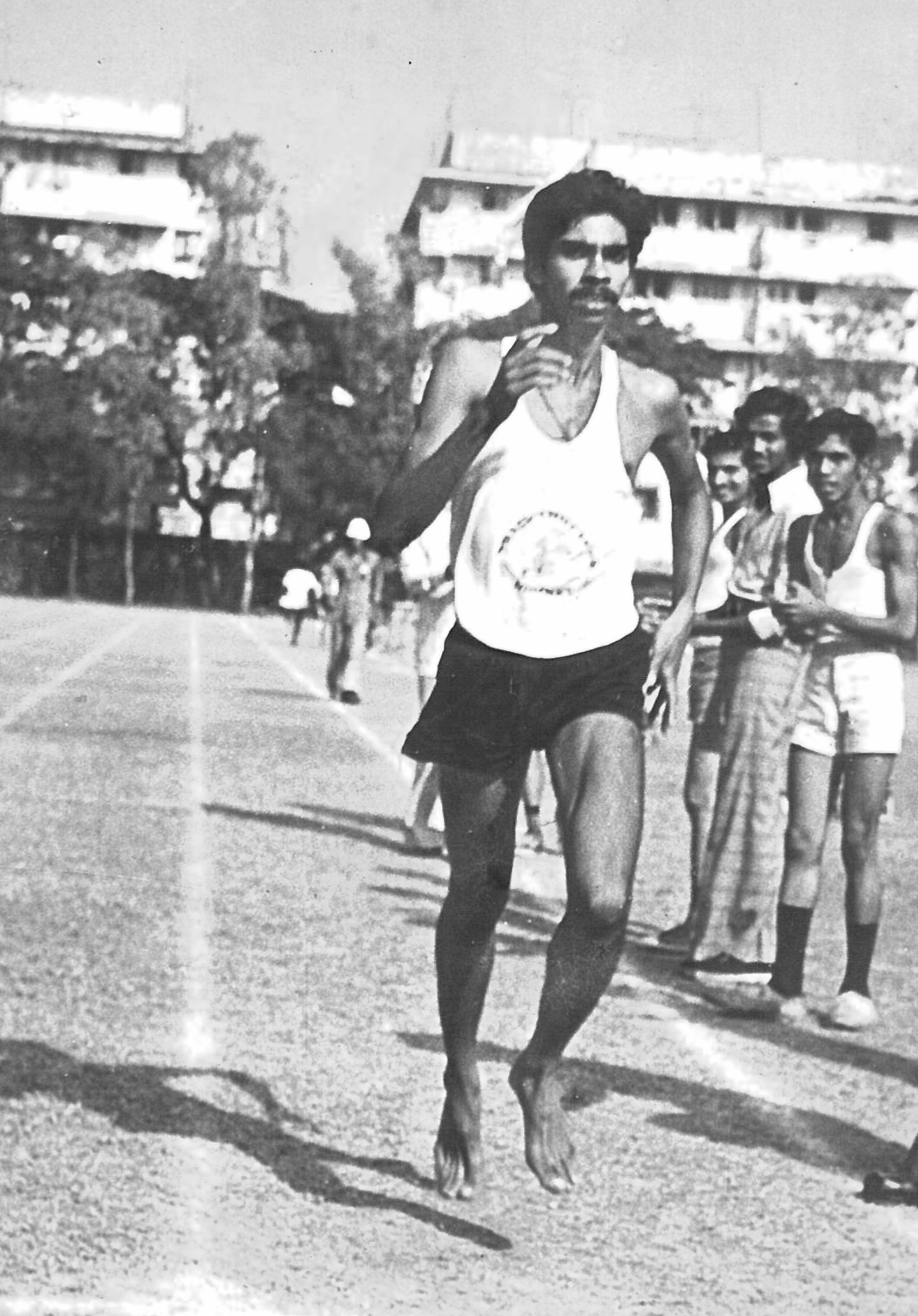
Savio (Photo: by arrangement)

Savio (Photo: by arrangement)

We leave you with a vignette of old Mumbai; an edited abstract from the old Sportsweek report on the Runathon:

“ Police Commissioner Julio Ribeiro in a dashing Bombay Police track-suit set the big field (491 to be exact) off from Shivaji Park at 7AM. Though the start was together in the classic Boston Marathon style, for the different groups, the race was terminated at different stages of the course. At one stage, the runners were strung out from Dadar, down to Parel and Lalbaug, over Currey Road and Lower Parel bridges and into the homestretch. The traffic police and the Naigaum police co-operated throughout in keeping the roads reasonably clear for the runners. Savio D’Souza, Bombay’s and Mafatlal’s ace runner led the field right through, at first a few lengths ahead, then more, finally striding almost alone, king of the road. There were runners from Track Trotters, Atomic Energy Central School, St Sebastians of Dabul, Young Athletic Club, Customs and Income Tax. Captain Reza Beg of Air India was there. The day before, he was jogging in Tokyo. On Sunday, he took off with the rest of the runners from Shivaji Park. Course completed, he carefully logged his personal time in a logbook. The regular early morning Shivaji Park joggers and walkers joined in, including a 76 year old-veteran. Later a special prize was announced for him but he had disappeared. The prizes ranged from sports scholarships to silver cups, Hot-Shot cameras and other items. Bombay has started running for fun. Perhaps a little behind the rest of the world, but it has started.’’

The year was 1983.

(The authors Latha Venkatraman and Shyam G Menon are independent journalists based in Mumbai. The timings at races are as provided by the interviewees. Where photo credit says ` by arrangement,’ the picture concerned has been sourced from Eddie or Savio.)
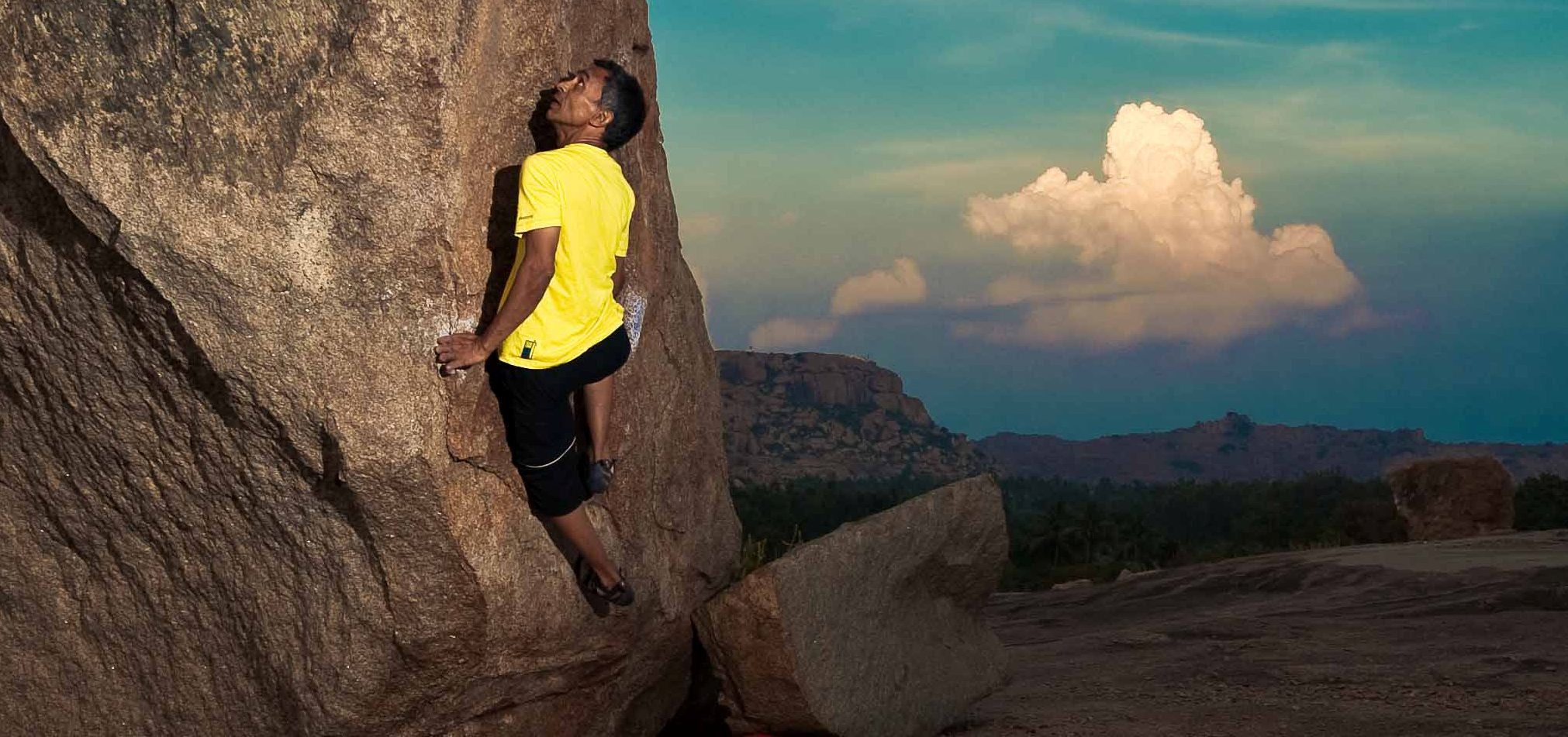
7a @ 65

Franco Linhares (Photo: courtesy Sharad Chandra)

Franco Linhares (Photo: courtesy Sharad Chandra)

Tucked away in the crags of Belapur in Navi Mumbai, is a small boulder with a tricky move on it called, `Franco’s Warm up.’

A name given by young climbers, it speaks much about the older gentleman whose name features in it.

Like all of us, Franco Linhares is inevitably growing old in life. But as he does so he is getting younger in climbing. You see him every evening at the small climbing wall at Podar College, first showing youngsters new to the sport the basics of climbing and then, doing some hard routes with the seasoned addicts. On weekends he turns up at Belapur, where the house of Abhijit Burman (aka Bong) has long been assembling point for climbers heading to the nearby crags. At 65 years of age, Franco is Mumbai’s most consistently active rock climber. He has been climbing for over three decades. That boulder in Belapur was aptly named. Warm-up is a sign of things to come and Franco in climbing is proving to be a bit of a Benjamin Button.

In the early 1950s, Franco’s father was stationed at Abadan in Iran, location then to one of the world’s biggest oil refineries. Franco was born in Abadan in 1950. The refinery belonged to the Anglo-Iranian Oil Company (AIOC). In 1951, Iran nationalized oil properties. Refining ground to a halt at Abadan and riots broke out (a settlement was reached in 1954, which lasted till 1973 when the National Iranian Oil Company [NIOC] took over all facilities. The period from 1951 to 1954 is called The Abadan Crisis). Franco’s family moved to Mumbai and onward to Seria in North Borneo, South East Asia, where the oil company, Shell, had a refinery. Seria became Franco’s next home. In 1960, given his father’s desire that the children be educated in India, Franco shifted to Mumbai with his sister.

The Linhares family hails from Goa. Among Indian communities, Goans are noted for their love of sports. Franco attended the St Sebastian Goan High School at Girgaum in South Mumbai. His days there were filled with sports and games. “ My love for sports came from this school. Those were my formative years,’’ Franco said. Later he majored in Microbiology from Mumbai’s St Xavier’s College. By 1967, his family was also back in Mumbai for good. To keep himself occupied, his father worked at the United Services Club in Colaba, at the Archbishop’s House and eventually served a long stint at the Victoria Church in Mahim handling administrative matters. While looking for a job after graduation, Franco chanced to do a course at Bharat Laboratories in laboratory testing procedures. Course done, he commenced working for the company. He kept applying for jobs alongside; ` medical representative’ being much fancied those years. In 1973, Franco found long term employment at Hoechst Pharmaceuticals with a job in their quality control department. Every evening after work, he played hockey. This was on the road in front of his house in Mahim. Roads then were relatively free of traffic. They were playgrounds at hand. He also played for Hoechst in the company’s hockey and football teams, playing up to the senior division in hockey.

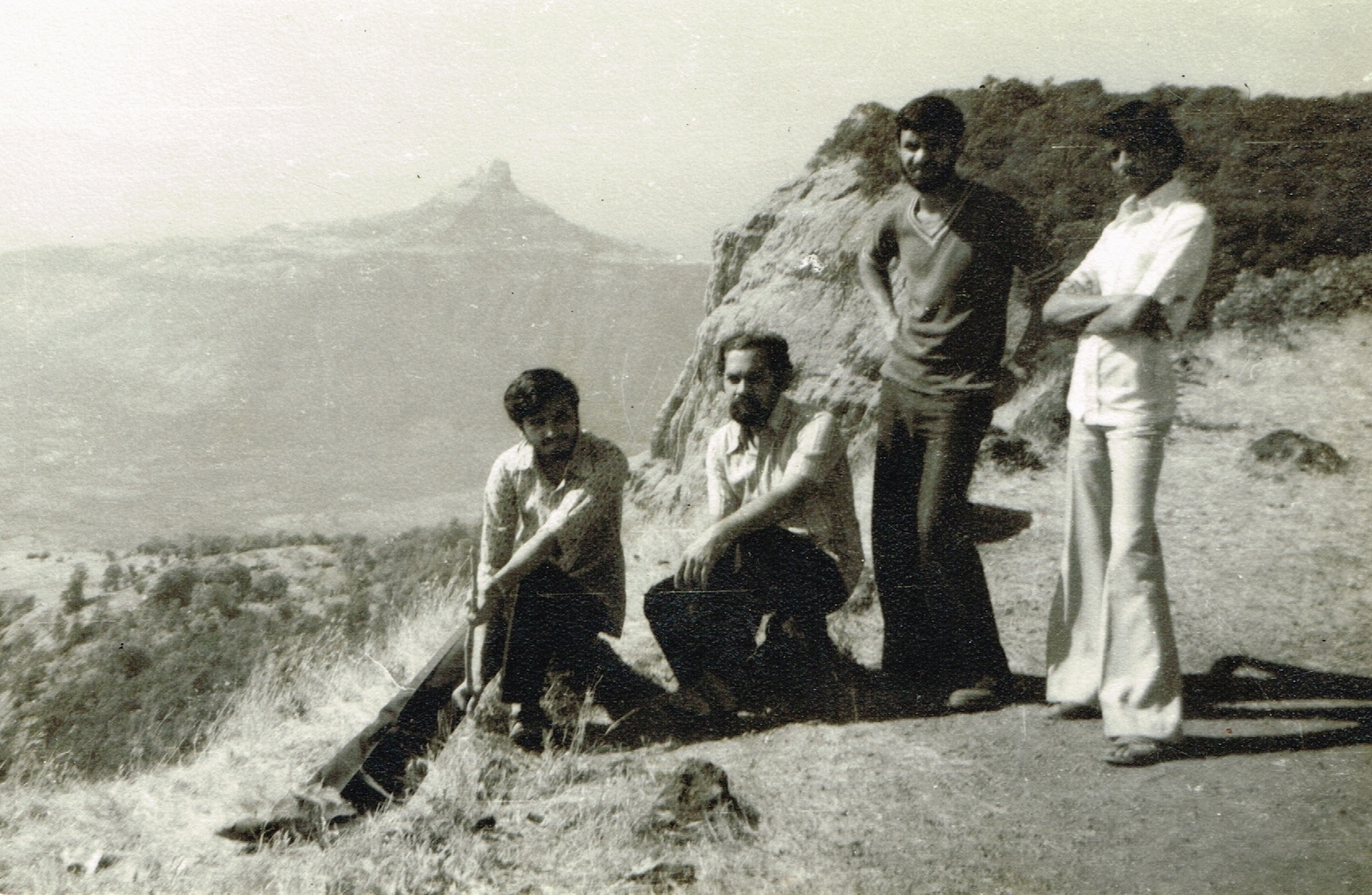
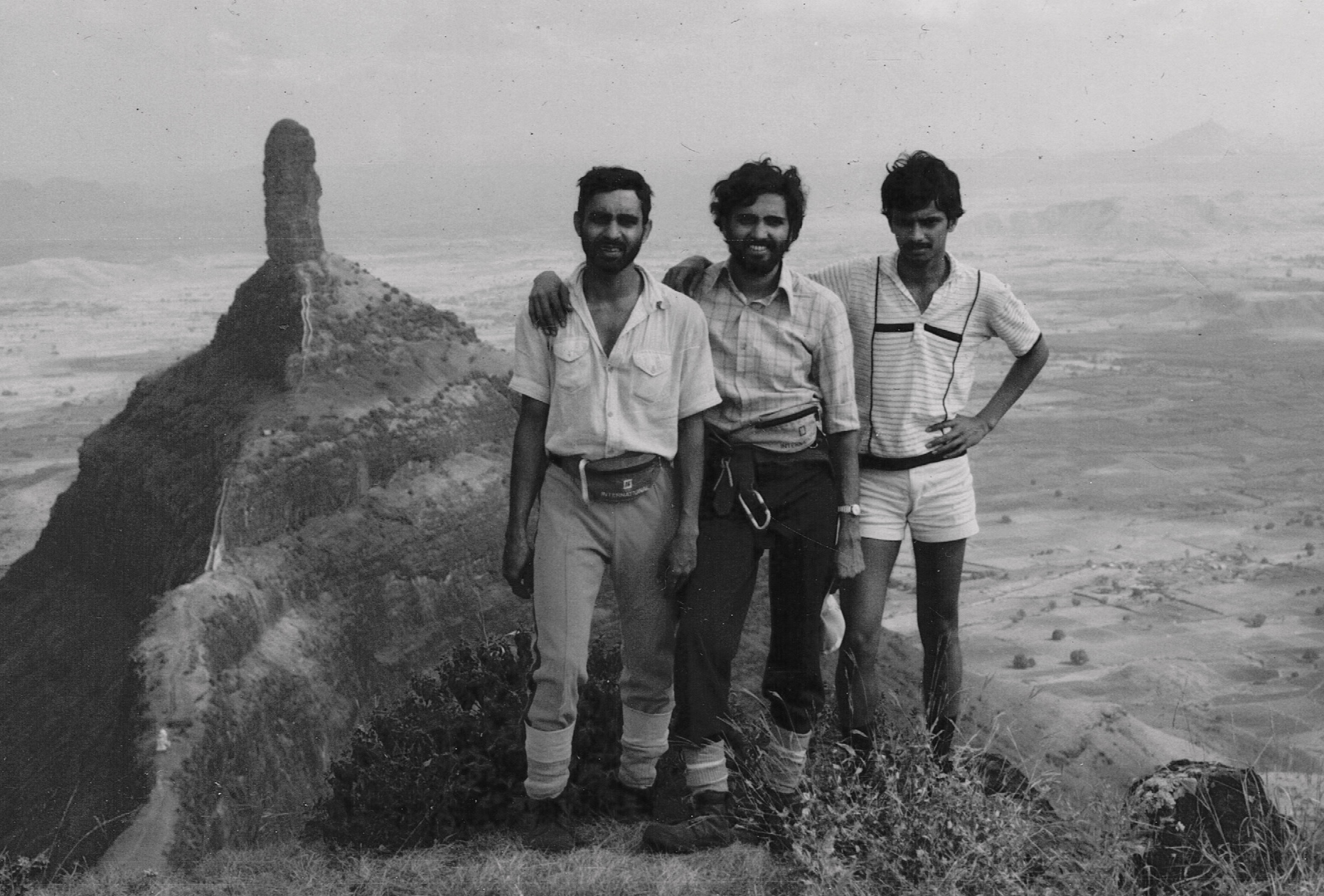
On Mangi pinnacle; Tungi in the backdrop

On Mangi pinnacle; Tungi in the backdrop

From the old Matheran hike

From the old Matheran hike (Photos: courtesy Franco)

Purists in climbing and hiking, look down their nose at commercial trips. Yet it is through such visits that many Indians begin their engagement with the great outdoors. In 1979, Franco reached Kashmir as a tourist on a trip arranged by the Mumbai based-Lala Tours and Travels. On return he realized one thing – he visited Kashmir, yes; he saw nothing of its high mountains and wilderness. So the following year he went on a trek to western Sikkim. His companion on the journey was the late Roque D’Souza, a maths major from St Xavier’s working at Ciba-Geigy (subsequently merged with Sandoz to form Novartis) and a regular at the evening hockey matches. Franco’s first Himalayan trek was initially challenging. On the first day he had a tough time adjusting to the altitude. Then everything was fine. In 1981, he went to Chanderkhani Pass in Himachal Pradesh. The next year, he trekked to Sandakphu. On this trek, most of the camp leaders were from the Mumbai based-club, Girivihar. They used to discuss climbing. It was Franco’s introduction to both the subject of climbing and the club he would eventually come to be identified with. Girivihar is Mumbai’s oldest mountaineering club. Soon afterwards, Franco trekked to Matheran and Kalsubai (at 5400ft, Maharashtra’s highest peak) in the Western Ghats (Sahyadri), with Vijay Athawale, a colleague at Hoechst.

Vijay quickly became Franco’s partner in outdoor adventures. Their friendship, strong to this date, can be gauged from Vijay’s recollection of events past, starting with “ 1st September, 1977’’ – the date he met Franco for the first time at the Quality Control Lab of Hoechst. Mumbai and Hoechst were new worlds for Vijay, hailing from a distant place, educated in the vernacular language and not even fully done with his degree course. He wrote in, “ I was obviously afraid of everything around. Franco was my role-model. Calm, soft spoken, a thorough gentleman and at the same time, mischievous, ready to participate in all sorts of picnics and parties! Our chemistry matched from day one.’’ According to Vijay, one of Franco’s friends pulled Franco out on a monsoon outing and Franco in turn, pulled Vijay in. That’s how their partnership began. The outdoor bug got them and then, others at office. “ What started as monsoon outings, slowly changed to one day treks and later to overnight hikes,’’ he recalled. Vijay had heard of the annual rock climbing camp conducted by Girivihar, wherein rock climbing skills were taught. Franco and Vijay attended the camp held at Kanheri Caves inside the Borivali national park. It lasted three to four days. From then on, for several years, Vijay and Franco went for every trek and climb organized by Girivihar. “ We just liked it. It was great to be out,’’ Franco said. With Harish Kapadia’s guidebook for trekking in these ranges available in the market, the Sahyadri became playground for Mumbai’s outdoor enthusiasts.

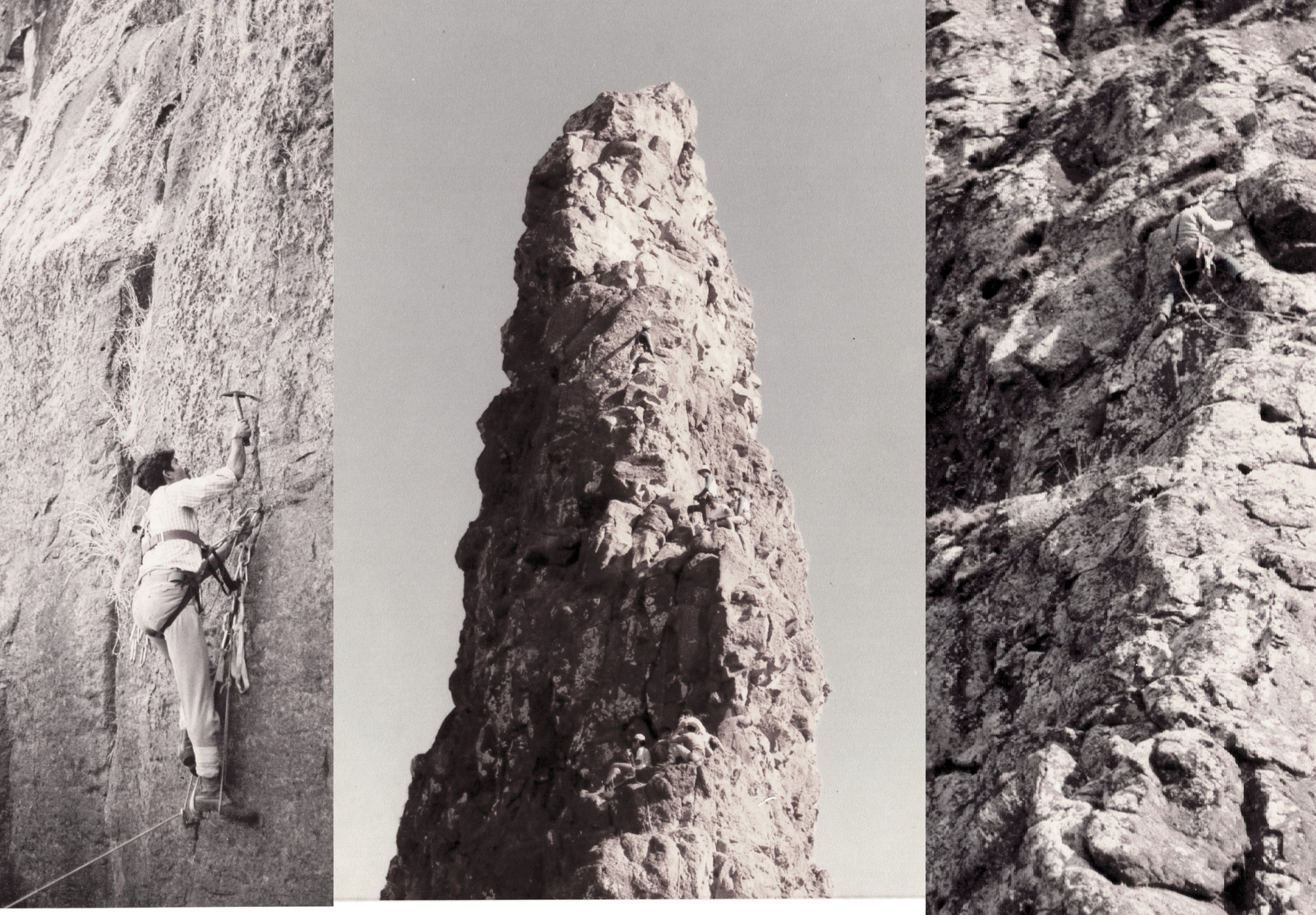
From old Girivihar climbs (Photos: courtesy Franco)

Scenes from old Girivihar rock / pinnacle climbs. The climber seen in the photo at left is the late Anil Kumar, during his time one of the best climbers at Girivihar (Photos: courtesy Franco)

Given their regular attendance at club activities, Franco and Vijay were quickly co-opted into Girivihar’s management. Vijay was made secretary straight away. “ I was in the management committee as a sort of assistant secretary to Vijay,’’ Franco said. Those were the days of cyclostyle; the days preceding email. The schedule of outdoor activity for a specific period of time would be drawn up. It would be cyclostyled and posted to club members. Franco recalls doing this after his daily work at Hoechst. The Girivihar rock climbing camp had been Franco’s initiation into climbing. Besides Borivali national park, the other climbing crags in the Mumbai region then were at Mumbra and Kalwa. Unlike today, very few people had climbing shoes. Climbing was mostly done in `Hunter’ shoes, a model of canvas shoe with ankle guard and rubber soles made popular by Indian shoe companies. Occasionally, a climber or two seeking better grip on rock, pasted a strip of high friction rubber to the soles. Climbers set out early in the morning and climbed as much as they could.

The club’s climbing itinerary was mixed – it also included ascents of pinnacles, a pursuit that enjoyed considerable popularity in Maharashtra, where the Western Ghats are enmeshed in local history. Much of the climbing happened on weekends. That meant, major Girivihar climbs like the first ascent of the Khada Parsi pinnacle near Nane Ghat, took the club a few weekends to accomplish. The climbing style on rock was trad, that too within the limits of available climbing equipment. Right up to the early 1990s, India was a protected economy. Good climbing gear was hard to obtain and expensive. This did not impede the climbers of those days from choosing bold objectives. Their approach to climbing was however different from today; in particular, you read a route keeping in mind one’s competence and available equipment, before you climbed. Some of the pinnacle-climbs were personal projects. The club had a published itinerary of activity but was open to the private initiatives of its members.

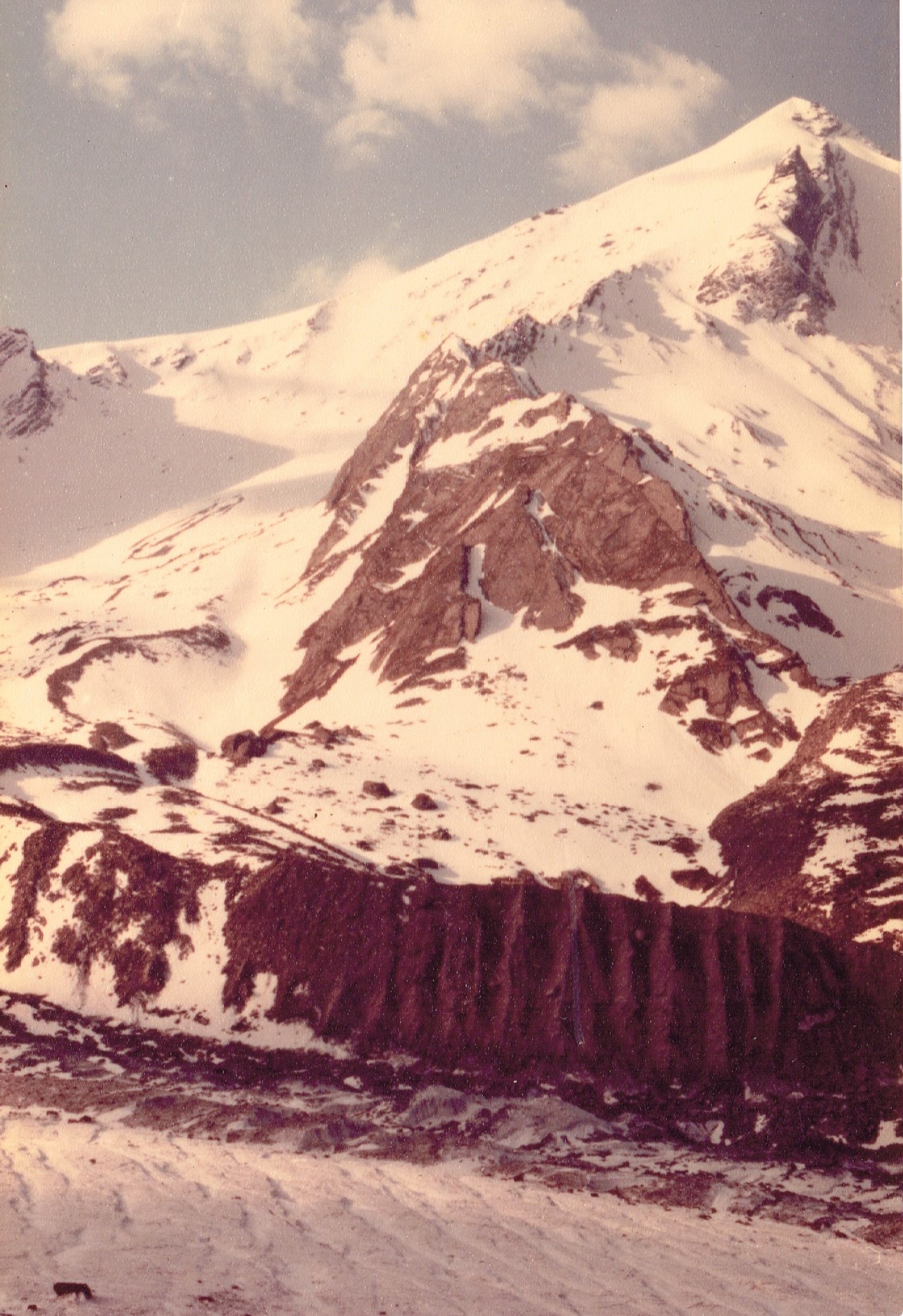
Ruinsara (Photo: courtesy Franco)

Ruinsara (Photo: courtesy Franco)

In 1984, Franco was part of a team of friends who trekked to Annapurna Base Camp in Nepal. “ We went self supported, carting along 40 kilos of stuff only to find that everything was available along the way,’’ he said. In 1985, he got into his first Himalayan mountaineering expedition with a seat aboard Girivihar’s trip to climb Swargarohini and Black Peak in Garhwal. He hadn’t yet done his mountaineering course but he was taken along as he had been regular at rock climbing in Mumbai. Black Peak was assigned as potential climbing objective for the club’s ` junior team,’ while the seniors attempted Swargarohini I and III. On this trip, Franco and two others climbed Ruinsara. He had until then never held an ice axe, never worn a plastic mountaineering boot. However, he didn’t find the transition from climbing on rock to climbing on snow difficult. An engagement with the outdoors, begun in the fallout of a commercial trip to Kashmir in 1979, was now assuming serious proportions.

In October 2013, I chanced to witness a climbing competition at the Podar College-wall (for details please visit https://shyamgopan.wordpress.com/2013/10/04/bouldering-competition-at-podar-college/), organized by Girivihar. Quietly standing by, watching the proceedings was Pio Linhares. During a brief conversation at his house in Mahim, Pio, 93, recalled some of his own old adventures – among them travelling with a convoy of trucks during the beginning of World War II, from Mumbai to North East India and across the border through Myanmar and Thailand to Singapore. That was when he worked for the Ford Motor Company’s Mumbai office. The Abadan years were after this phase. I asked him what he thought of his son’s affection for climbing and the outdoors. Was he prepared for the dimensions it acquired? “ I allowed him to do what he wanted. I did not hold him back. It is when you restrict somebody that they get frustrated and you need to worry,’’ Pio said.

In 1986, Girivihar decided to attempt Kamet (7756m). Franco couldn’t find the required leave to join the team. He helped reach the expedition’s gear all the way to Malari and then returned to Mumbai. Away in the Himalaya, on the Kamet trip, the idea of another expedition was born – an attempt on Kanchenjunga (8586m), the world’s third highest peak. According to Franco, Kanchenjunga wasn’t the first choice. The club’s first choice was Everest (8850m). Everest via its normal route was already booked and the available opportunity was a climb via one of the harder faces. That’s how Kanchenjunga entered the frame. The club’s junior team was told clearly – they needed to do their basic mountaineering course. By now the `junior team’ – it had the likes of Franco, Vijay, Sanjay Chowgule and Amod Khopkar – had been climbing regularly. In 1986, Franco did his basic course from the mountaineering institute in Manali then called the Western Himalayan Mountaineering Institute (WHMI). Attempting a big mountain like Kanchenjunga requires preparation. The club’s junior team was told to select a peak and plan an expedition. They decided on Hanuman Tibba (5900m) in Himachal Pradesh. The team led by Vidyadhar Joshi, included Franco, Amod and Milind Bhide. But it turned out to be a challenging trip with the team’s progress halted by heavy snowing. Eventually Vidyadhar climbed Friendship peak nearby as a consolation. “ Eighty per cent of my trips to the high mountains ended up living in inhospitable conditions and then coming back,’’ Franco said.

The post Kanchenjunga look

The post Kanchenjunga look

Franco, from a 2002 mountaineering expedition in the Zanskar Himalaya

Franco, from a 2002 mountaineering expedition in the Zanskar Himalaya (Photos: from the collections of Franco and Abhijit Burman)

The Kanchenjunga expedition happened in 1988. Having secured from Hoechst the needed leave of three and a half months, Franco went with an advance party to the mountain’s Base Camp in Nepal. Their role – carry in the expedition’s gear and supplies. The advance party had 300 porters or so. The rest of the team flew to Taplejung and proceeded to Base Camp. Franco’s trek began from Hille, ahead of Taplejung and entailed 14-15 days walk to reach Base Camp at around 18,000ft. This included a three day-walk on the glacier ahead of camp. After reaching Base Camp, the team set out to establish Camp I. Kanchenjunga was a powerful influence on Franco. That expedition shaped the reputation he would subsequently have at Girivihar. He went up to Camp 4, at around 24,000ft on the mountain. He spent two nights there. There were suggestions that he proceed further up. He declined the offer. Didn’t a potential shot at the summit interest you? – I asked him. After all, the summit is where every mountaineer wants to be. “ I was completely exhausted and hyperventilating like mad. I was at the end of my tether. Saying no wasn’t a difficult decision for me,’’ Franco said. Girivihar’s Kanchenjunga expedition – it was the first Indian civilian expedition to an 8000m-peak – failed by a thin margin. It saw two climbers – Charuhas Joshi and Uday Kolwankar – reach above 8000m. It also saw the tragic demise of a team member, the expedition’s deputy leader Sanjay Borole.

Amid this, Franco ended up spending 28 days above Base Camp on the mountain, a significant altitude for someone to stay that long at a stretch. When the expedition was wound up, he volunteered to go with the party carrying down the body of the deceased member and proceed onward to Mumbai. This trip included another duty en route – he was deputed to meet Elizabeth Hawley, the legendary American journalist who kept a record of expeditions and climbs in the Nepal Himalaya. He also spent some time wandering about Kathmandu with his newly gained mountain-look. One of Franco’s memories of Kanchenjunga is the huge beard he acquired during the expedition. He roamed all around Thamel sporting the beard and kept it on till he got back to Mumbai. Franco considers the Kanchenjunga expedition as having been very important for Girivihar’s junior climbers like him. They climbed high on Kanchenjunga, spent much time on the mountain and worked in several camps. He recalled the case of Shantanu Pandit, who was also an upcoming climber like him at that time. Shantanu became one of those who worked the most, having walked in with the advance party and leaving only after expedition’s wrap-up. Vijay had accompanied the expedition’s film crew to Base Camp. “ It was a three month-long strenuous, tragic expedition and very few team members returned home in sound mental and physical condition like Franco did,’’ he said. The very next year after Kanchenjunga, four club members including Franco, went to attempt Menthosa (6440m) in Himachal Pradesh. They reached Camp II pretty quickly and could have gone for the summit, except – there was heavy snowfall. The team stayed put at Camp II for three days and then returned. In a second attempt on the peak, some years later, Franco would reach only till Camp I.

In Zanskar (Photo: from the collection of Abhijit Burman)

Franco, during the Zanskar expedition (Photo: from the collection of Abhijit Burman)

For Franco, the Himalaya was an on-off affair. “ I used to come off the Himalaya saying – no more of this. But after about a month of being in Mumbai, I would start planning the next trip,’’ he said. In that stage of his life, Franco had an expedition almost every year. Over time however, the zest began dipping. His problems were two – the cold and the altitude. Twice he experienced chilblains. His capacity to acclimatize smoothly also seemed to progressively fade. On an expedition to Shivling (6543m), he had his first bout of nausea at Tapovan (4463m) itself. During another trip to Kang Yatze (6400m) in Ladakh, he chose to halt his ascent short of the summit as he felt exhausted. In comparison, the Western Ghats of Maharashtra (called Sahyadri locally) stayed playground. “ I have been to many places, many times in the Western Ghats and yet enjoyed it every time. I never had that attitude of wanting to visit a place just for the heck of saying I was there. For me, every venture into the outdoors is different even if it be a repeat visit to the same place,’’ Franco said.

Franco is strongly associated with Girivihar’s annual rock climbing camp as an instructor and is possibly the best remembered of all club members for his generally supportive, nonintrusive ways. His calm, uncomplaining disposition often saw club responsibilities dumped on him. Vijay remembered an adventure camp from years ago, wherein the camp’s lady instructor had to leave after a few days. The question was – who will replace her? The choice was unanimous – Franco. “ Whenever others were reluctant to accept a responsibility, he would take it up without any hesitation,’’ Vijay said. But that didn’t mean Franco was without preferences. There was a phase when he worked for the outdoor industry. It didn’t last because he knew his calling in the outdoors was of a different sort. However he did nudge others into the outdoor line. Manohar D’Silva is a senior instructor with the US based-National Outdoor Leadership School (NOLS). Years ago, his introduction to rock climbing had been through a Girivihar camp (the 32nd camp held by the club), his batch of trainees becoming much loved at the club under the acronym, RC-32. Manohar wrote in about Franco, “ besides being super impressed by this fifty plus-year old person easily climbing rock faces, I was deeply influenced by his fitness routine. It greatly contributed to me losing close to thirteen kilos in eleven months. More than ten years later, I continue to be impressed by Franco’s increasing level of fitness and his love for rock climbing. Franco came across as a genuine human being who connected with others and was concerned about their well being. His teaching style was patient and encouraging. Franco was directly responsible for me switching to the outdoors as my vocation. I vividly remember the conversation over tea in an Irani cafe in Mahim where Franco laid to rest my apprehensions of making ends meet through work in the outdoors. That conversation was a turning point for me. I will always be indebted to him for that.’’

A typical evening at the Podar College-wall (Photo: Shyam G Menon)

A typical evening at the Podar College-wall (Photo: Shyam G Menon)

Shyam Sanap, 32, is a talented climber. At his peak, he was often called the best boulderer in Mumbai. He has known Franco for at least 15 years. According to him, Franco’s climbing has steadily improved. At 65, he is doing some of his best climbing. “ At the wall and at the crags, Franco not only does his share of climbing, he also attempts problems being tried by stronger climbers, much younger to him in age. He does not waste any opportunity to climb that comes his way,’’ Shyam said. Aniruddha Biswas (Aniruddh) reached Girivihar through RC-32. Franco credits Aniruddh for much of the improvement in his climbing that happened in his later years. Time spent in the US saw Aniruddh’s climbing improve dramatically. “ Aniruddh used to keep on encouraging me. I now climb hard. I try to play tag with all the youngsters around. I enjoy it. I don’t care if I can’t do the hard stuff they do. Just attempting it makes me happy. Over time I have realized that I can also do it,’’ Franco said. At the Podar College-wall, I suspect there is more to the young company Franco finds himself in these days, than meets the eye. It speaks of his adaptability. In 2003 Vijay moved to Goa. As they aged, the climbers of Franco’s generation faded, transformed to being organizers or became high priests and commentators of the sport. Franco soldiered on, climbing. Long ago, it was the old black and white photo from Matheran; later – Girivihar’s classic climbing years, today – the Podar College-wall and Belapur’s crags. The one constant has been climbing and the outdoors; connections with visitors to life built around these experiences. As the clock ticks, the crowd around him has been getting younger. The Podar College-wall is the deep end of such youth. “ It is awesome what he is doing at this age,’’ Anuj Naik, 28, climbing since the past one year at the Podar College-wall, said. Besides many years spent climbing around Mumbai, Franco has climbed rock in various places in India – from Badami, Hampi and Yana in Karnataka, to Pachmarhi in Madhya Pradesh and the Miyar Nallah area in Himachal Pradesh. He has also climbed in Sicily, Italy. “ Now I am thinking of a climbing trip to Greece,’’ he said. Along the way he took voluntary retirement (VRS) from Hoechst, served as president of Girivihar and stayed a bachelor. He is also a devout Catholic who likes his periodic visits to the church.

“ I hope I can climb as long as the body permits. I just want to climb rock. I have always loved rock climbing. With all the modern climbing that has taken off, I wish to lead a 7a someday. That is my goal. As regards big mountains, I find altitude and cold challenging. So that is a bit difficult,’’ he said. In the pantheon of climbing grades, 7a is arguably the beginning of truly difficult, demanding climbs. This author is a very average – probably bad – climber. The hardest route he ever led was a 6b or near about. Stand in the author’s shoes, add Franco’s age and say lead climbing – 7a acquires a different hue; it is an engaging challenge. It may seem a bit puzzling – this courting of climbing as pure physicality (which is the image sport climbing evokes) after beholding climbing on a much larger canvas in the Himalaya. In disciplines like bouldering for example, the equivalent of a whole mountain at altitude to tackle, will be a tricky move or two, utterly strenuous but rarely exceeding 20ft in height. Compared to bouldering, bolted sport routes are longer but as predetermined, pre-protected routes they can be said to be partial to highlighting the physicality and edginess of climbing than the art of figuring out an ascent. Franco concedes this. On the other hand, he avers, he has a high tolerance for pure action, physicality and game formats thanks to his old school days. He doesn’t mind the perceived loss of thought and grandeur when world reduces to action filled-sport climbing in finite space. Is there something of a life simplified, a return to old days and St Sebastian Goan High School in erstwhile mountaineer hanging out at the Podar College-wall or dreaming 7a at 65? One wonders.

Franco (Photo: Shyam G Menon)

Franco (Photo: Shyam G Menon)

When I first met Franco in the late 1990s, he had just acquired a pair of green classic climbing shoes called Kamet, his first pair. Then a black and purple Boreal Laser was added to the collection. Thereafter as climbing acquired intensity among the devout in Mumbai, climbers – Franco among them – burnt rubber fast. Now he carries an Evolv Pontas, a Five Ten Galelio amd Anasazi to the crags. I asked Franco if he had set out to be a climber. “ I think the story of my life is that I just drifted. I kept doing things, meandered to wherever the current took me, stopped where the current stopped and then, carried on again from there,’’ he said. In Franco’s case this would seem to have become a unique strength. Unlike the average rock climber / mountaineer who bristles with achievement or loves to add arrows to his / her quiver of achievements, Franco has remained a very approachable person. With three decades of climbing under his belt, he has memories and stories. But the way he recollects – akin to taking out an old volume from the shelves and blowing the dust off it – you get the impression that he lives in the now and here. Those who have climbed will agree – that’s one of the experiential imprints of climbing, especially its increasingly young, action filled-genres like sport climbing. At Mumbai’s crags, at the Podar College-wall – that is how people and Franco are. It is a celebration of one move, the next move and the now in both. Along the way, in the many hours accumulated climbing, you notice a passing number – 65.

(The author, Shyam G Menon, is a freelance journalist based in Mumbai. He would like to thank Sharad Chandra for allowing the use of one of his photographs.)

THE GREEN MANGO

Photo: Shyam G Menon

Photo: Shyam G Menon

“ People say that mangoes remind them of their childhood,’’ Gaytri said.

We were at her farm in Onde, a long drive from Mumbai.

It was mid-April.

A day could be described in one word – hot.

Towards afternoon, a palpable stillness settled on Vrindavan Farm.

No breeze; just the heat, like sticky ointment on the skin.

Both the dogs snoozed.

Gaytri took a nap.

I am stretched out on a bed in the veranda. My eyes rested on my toes; I discovered them, said hello toes, I counted them, I rediscovered them, said hello toes again, I counted them once more – so on. From a corner of my eye I could glimpse the surrounding green. I knew mangoes lurked in that green. An old taste surfaced in the brain. A craving grew. “ Shall we?’’ a little boy within, enquired.

There is a rule at the farm.

If you want to eat mango, you pick one that has fallen to the ground.

It was a bit like being lost at sea – water, water everywhere but not a drop to drink.

I remembered the times I had thrown sticks, sent it spinning so that it slashes a mango’s link to a tree branch and drops it earthward. I remembered negotiating long bamboo poles with stick tied to their end like a slanted `T,’ through the dense foliage of a tree, up to a cluster of mangoes and bringing them down. I remembered clumps of leaves – the nests of fire ants – that came down along with the mangoes. You ran off seeing it come down and dashed in to collect the mangoes and move off to safety. Sometimes you climbed a tree, careful not to disturb an ants’ nest, stretched your hands out for the mango and oh hell – the ants got you! I remembered disloyal trees that grew in our compound but extended its fruits to the neighbour. How do you make sure those fruits could be hooked and brought down towards your side and not the equally eager neighbour’s?

Late afternoon, unfailingly that week in April, the breeze revived. Lying in the veranda, I never used the fan during those hot afternoons. It made the arriving breeze distinct. Delightful licks of relief. I saw the mangoes Gaytri had collected and kept on the veranda. I succumbed to temptation. I examined them. They were slightly soft, specks of yellow on their skin like grey hairs of wisdom to a human being. In fruits, they call it approaching ripeness. I come from a family split down the middle in terms of how it liked its mango. No, not the middle, more like lopping off the bulge of a mango, a side – I am that lopped off piece, the minority. Everyone liked their mango ripe and within that, many wanted it so oozy ripe that they loved squeezing and sucking the juice out of it. A ripe mango was often dessert after meals.

Kids loved to squeeze the ripe mango, authoring many a funny moment at the dining table. It is an art that gets perfect with practise and the rookie typically sent fruit juice shooting like a mini fountain toward someone engaged in serious discussion. You know what the Prime Minister should do? Psshhht….patch of yellow fruit juice on the nose. At least once, a cousin managed to send the mango’s seed flying. The adults would glare; the children would try to hush up their laughter and be poker-faced, all serious. The more they did so, the more they laughed. My cousin Manju – she was the queen of such infectious laughter.

I liked that fun. But my preferred style of mango was in minority; in retrospect, a sign of things to come in adulthood, for most of my tastes – from politics to social and cultural tastes – have reduced to minority. I liked the ripe mango on my plate to be firm when sliced. I liked it best when it wasn’t altogether sweet but bore a dash of the sour taste of its wild childhood. And I liked it best – as in best among best – when it was still green; firm, sour, white within and served with salt and chilli powder mixed in oil. The whole idea of climbing up a mango tree was to anticipate this marvellous, simple dish. The vast and sometimes overgrown environs of the house where my father’s younger sister lived, was favourite hunting ground. It had a few mango trees. We – our aunt included – knew exactly when to pluck the mango of such childhood dreams.

At Vrindavan Farm, from gate to farm house, I had seen mango trees. It was all green, green mangoes. I was beginning to feel like a fruit eating T-rex in a paradise of potential prey. Viewed from above, maybe atop the farm’s water tank, you see a procession of violently shaking trees as mango eating T-rex slices through the area. “ Great shot,’’ Steven Spielberg tells me as we discuss my role atop the water tank.

I applied for permission.

Gaytri Bhatia is a NOLS instructor; friend and colleague from work in the outdoors.

Friend, colleague – maybe rules bend? – I thought.

Her rules stayed firm.

It had to be fallen fruit.

She had a valid reason for it – each green mango plucked from the tree, is one ripe mango less by harvest.

I couldn’t be T-rex in a mango version of Jurassic Park.

So T-rex lowered its head to earth and walked around like a cow. The first couple of pickings were so-so. And terribly agitating, for just as you straightened from picking up the best you could find on the ground, your eyes encountered at nose level the choicest green mango still attached to tree and well, laughing in your face. You hoped you had high mental powers to bring the guy down without you physically doing anything that broke Gaytri’s rules; maybe in another lifetime when I am God. The slightly ripe ones I found on the ground, however returned a decent dessert after dinner that night.

The next day, the Gods smiled.

The farm had cashew trees. What all can you do with cashew fruit? – That had become an engaging question. With a kitchen at hand, I was determined to experiment and get a Nobel Prize even if it meant working with a gas mask on to handle the fruit’s pungent odour. In a world winning awards left, right and centre for all the silliest reasons, it is a long time since I got one. So why not – say, the award for surviving the most testing culinary experiment goes to…..?

Out collecting fallen cashew fruit and keeping an eye open for the one thing guaranteed to have me outrun Usain Bolt – the snake, I came across a perfect green mango fallen to the ground. It was wholly legal as per the farm’s rules to pick up and bang on in terms of required hardness. My heart danced and sank all at once. I was in tears. It was a moment of melodrama befitting the dreariest soap on TV. The mango was perfect! In the end the T-rex in me, won. The stomach and its enterprising ambassador upstairs – the taste buds, triumphed over sensitivity and philosophy.

I spent the evening relishing the mango with salt and chilli powder.

Did it remind me of my childhood?

Yes it did; fleetingly.

Then, I turned my back on years gone by and looked the other way, joining an army of people conditioned to do so.

I suspect it is because I am scared.

I fear the mango will take me back to a place I love too much to return to the present.

(The author Shyam G Menon is a freelance journalist based in Mumbai.)

THE CONSTANT RUNNER

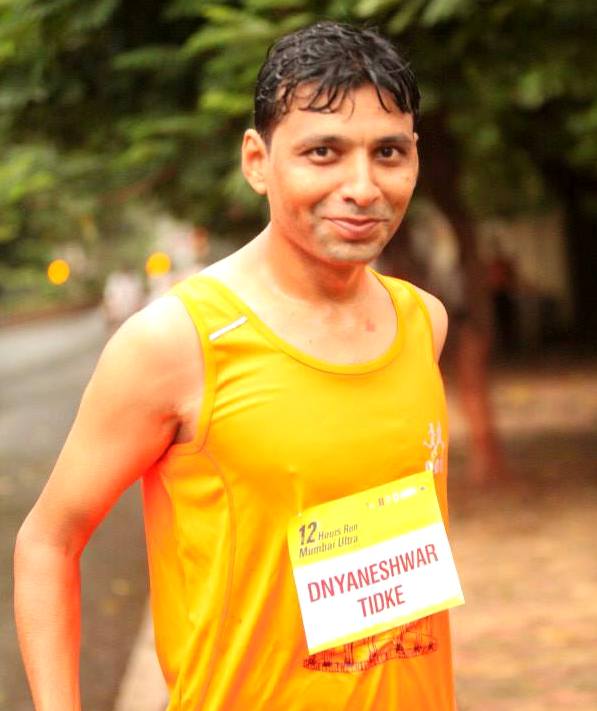
Dnyaneshwar Tidke

Dnyaneshwar Tidke

Entering the housing colony in New Panvel, we asked for the house we wished to go to.

“ Tidke?’’ the woman said inquiringly, turning to face us from the conversation she had been having at the kitchen window of her neighbour.

“ Haan…over there, see the cycle? That door,’’ she said.

By now a big black dog had begun barking at our intrusion into the quiet environs. Two other dogs, closer by, raised an eye brow to glance at us and then went back to sleep. Reaching the door near the parked bicycle, we rang the door bell. A man dressed in track pant and T-shirt opened the door. He had the light build of a dedicated runner; his eyes seemed tired and peaceful at once. We were ushered into a frugally furnished, neatly kept room. Meet Mumbai running’s “ Don.’’

Dnyaneshwar Tidke was born in March 1974 at Malakoli village in Nanded in the Marathwada region of India’s Maharashtra state. His father Dhondiram Tidke was a farmer. Life was tough. Agriculture in these parts depended on timely rains and the monsoon had its vagaries. Dnyaneshwar studied up to the tenth standard at the village school. A generally quiet person, he was neither exceptional at studies nor was he pronouncedly into sports. Then something happened. He failed in the tenth standard. Although he cleared this hurdle in his second attempt, the failure and his subsequent ability to pass through hard work stayed engraved in his mind. When it came to his twelfth standard exams at school in Ahmedpur, Dnyaneshwar secured 96 per cent marks in physics, chemistry and mathematics, a high enough score to be admitted for chemical engineering at the Laxminarayan Institute of Technology (LIT) in Nagpur. College was his first time away from Malakoli. “ It was a different experience,’’ Dnyaneshwar said. He developed a penchant for physical activity. He frequented a gym. The college was on a hill. He used to run loops around it. Crucially he developed a craving for physical exertion and exhaustion. It was the beginning of the first half of Don’s life. Its credo – life’s problems solved by a simple solution founded in how he cleared his school exams and the physically active life that followed: if you can’t get something, then, hard work should help you get it. When you work hard you become tired. So, if you are tired it also means you did the required hard work to get what you want.

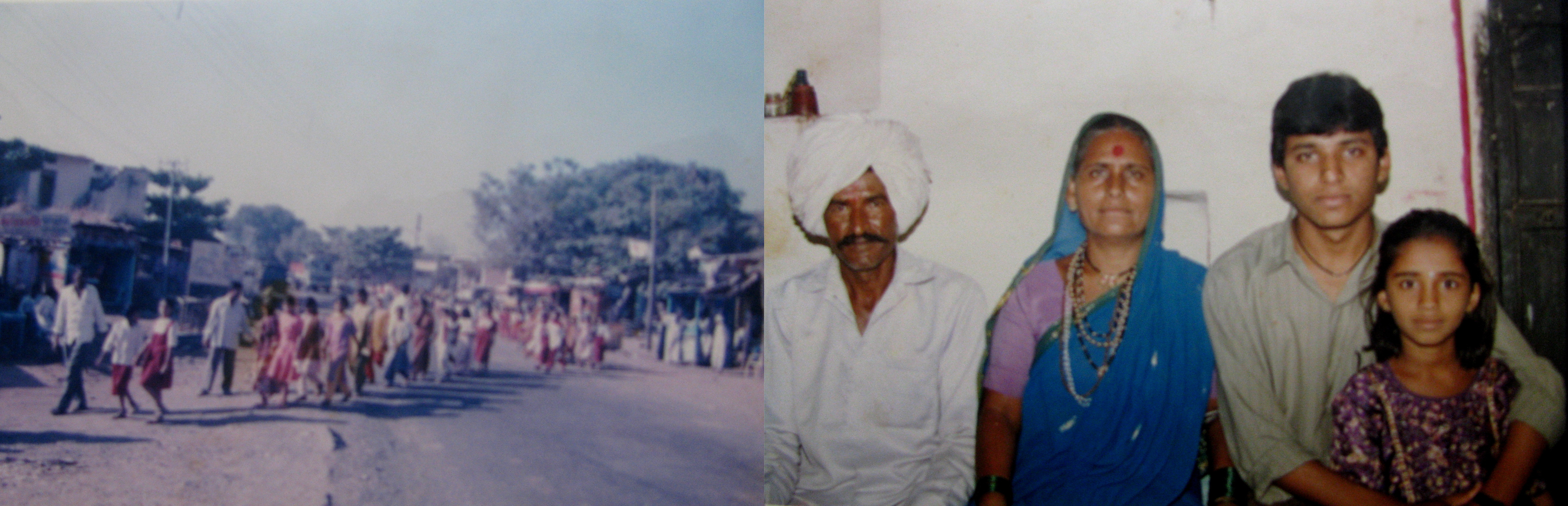
(Left) An old photo of Malakoli (Right) Dnyaneshwar (second from right) with his father Dhondiram Tidke, mother Bhivarabai and sister, Neetha (Photos: courtesy Dnyaneshwar. Photo montage: Shyam G Menon)

(Left) An old photo of Malakoli (Right) Dnyaneshwar (second from right) with his father Dhondiram Tidke, mother Bhivarabai and sister, Neetha (Photos: courtesy Dnyaneshwar. Photo montage: Shyam G Menon)

Following his BTech, Dnyaneshwar’s first job was as temporary lecturer for a year at the government polytechnic in Mumbra on the peripheries of Mumbai. Once the stint was over, he returned to Malakoli. In 2000, he got married. For the next few years he stayed put in Malakoli, in what he described as some sort of funk, the bright spot therein being a daily 10km-run with a swim thereafter in a distant village-pond. That faith in physical activity as means to find equanimity, groomed in college, was slowly evolving into a daily discipline. He would in between come from Malakoli to Kalina in Mumbai, where he stayed at a friend’s place and hunted for a job. The everyday running continued; this time it was from Kalina on the eastern edge of the city’s western suburbs, to Juhu beach on Mumbai’s west coast. Around this time, he worked for two to three months at a logistics company near the Jawaharlal Nehru Port Trust (JNPT) in Navi Mumbai, India’s premier container port. While there he saw the advertisement for the 2006 Standard Chartered Mumbai Marathon (SCMM). He enrolled for the full marathon with no proper idea of what it entailed. Luckily even as he enrolled for the marathon with insufficient grasp of the subject, he secured his first proper job – Assistant Production Officer with Modhera Chemicals, a company in Turbhe, Navi Mumbai, manufacturing specialty chemicals for the textile industry. The family moved to rented accommodation in Panvel, Navi Mumbai. He chose Panvel both for its proximity to where he worked and also its proximity to industrial zones, just in case he was forced to seek employment afresh.

Dnyaneshwar trained for his first SCMM, sticking to his daily 10km runs. Then, prompted by the 42 km-length of the marathon and its disparity with his daily runs, he ran 35 km three days ahead of the event. In a personal madness, likely traceable to challenges in high school and the habits he picked up in college, he didn’t want to merely run, he wanted to win. On race day, he reached the starting line late. Wanting to win, he commenced running without sparing time to pin his bib. He held it in his hand instead. Half way through, he was stopped by the police who mistook him to be an intruder running without the official bib. He showed his bib and continued. But no matter how hard he tried the pack leaders remained way ahead while Dnyaneshwar got progressively exhausted. He was still struggling to reach the half way mark, when he saw the leaders going in the reverse direction after the half way-turn. He noticed their pace and efficiency. Past the half way-mark, at Shivaji Park, Dnyaneshwar quit. His first SCMM was a DNF (Did Not Finish).

Dnyaneshwar Tidke

Dnyaneshwar

To confront the challenge of preparing for his next SCMM, he applied his longstanding credo – work harder. What he overlooked was that he was employed and working long hours. “ I used to get tired from work and then go for a run,’’ he said. This routine plus the daily running strained him. Then in a repeat of 2006, in 2007 too, just ahead of the year’s SCMM, Dnyaneshwar ran 35km to be ready for the marathon he badly wanted to do. Fortunately, he completed the race in 4:30 hours. But he found his energy dipping past the 30km-mark. He was in a trap, a vicious cycle. He didn’t want to run the half marathon; he wanted to run the full. He wanted to win and the only thing he knew to win was to work harder. The harder he worked, the more he got tired. The more he tired himself, the less he could run. In 2008, his timing at SCMM exceeded five hours. He was ill for almost a month before the run. He had none to advise him, no friends in running. Meanwhile, another problem was hot on his heels – he wasn’t eating properly. With too much running and long hours at work to somehow balance, he was ignoring food intake not to mention, nutrition. “ My thinking then was – to run a marathon well, you must run a marathon every day,’’ he said. Eventually medical complications caught up with him – among them, fall in his platelets count. Dnyaneshwar was hospitalized soon after the Mumbai marathon. To complicate matters, his elder son had been diagnosed with a heart problem.

Whatever the problems in his life, Dnyaneshwar’s recipe for cure remained the same – running. “ Exhaustion felt good. It cleared the head,’’ he said. In 2009, he missed registering for the SCMM. Although he didn’t run at the event, he stayed in training. Asked whether he consulted his doctor on how to recover, he said he resorted to self administered recovery. The hospitalization had however tempered the old blind faith in furious activity. He was being watchful. Overall across these years, a Dnyaneshwar-day went somewhat like this: wake up at 4.30AM; run till 7.30AM, leave for work at 8AM, be back home by 7PM. That was a typical day; repeat it every day. There have been atypical days too. When he commenced formal training with a coach, there were days when he got back home at 11PM before starting the crushing routine all over again. The most engagingly atypical one was this – he would run in the morning from his house in Panvel to Sanpada roughly 25km away. At a shop selling fruit juice in Sanpada, where he would have kept a change of clothes stashed, he would change and proceed to office. “ No matter what, everyday he will go for a run,’’ his wife, Surekha, said. At the 2010 SCMM, he got his first genuinely encouraging result. He finished the full marathon in 3:58, his first sub-four hours-timing.

Dnyaneshwar at the 2014 Bengaluru Marathon

Dnyaneshwar at the 2014 Bengaluru Marathon

Arguably, it was in 2011 that Dnyaneshwar’s life in running began to change. That year the second half of Don’s life started. Some 20 days before that year’s SCMM, while out on a practice run in Navi Mumbai, he met Praveen Kumar, a runner from Bihar. Praveen was in the city specifically to run the SCMM. He was being supervised by a coach. Dnyaneshwar talked to them and in the process got his first taste of formal, structured training for a marathon. Despite a dose of unexpected confusion in the following days for distraction (Praveen apparently went missing and was found only after the SCMM), Dnyaneshwar returned a timing of 3:21 at SCMM. He was also able to do this without any stop in between. “ I felt good,’’ he said. But through the preparation for the race and the running itself, he had aggravated a case of shin splints. Following this race, he chanced to post his timing on the website of Runners for Life. As runners took note of his timing and one runner spoke to the other, word reached Navi Mumbai Runners (NMR) of the promising runner in their midst. According to Dnyaneshwar, M.K. Srivatsan and Vignesh Eashwar of NMR put him in touch with the well known coach, Daniel Vaz, who recommended rest and icing for the shin splints. Later Dnyaneshwar joined one of Mumbai’s regular Bandra-NCPA runs and met Giles Drego, another coach. Eventually he settled for Savio Dsouza as coach, his first formal training arrangement for long distance running. As he stayed in Panvel far off from the city, he would meet his coach one day of the week and keep him posted of his activity, over phone, the remaining days. “ I learnt to give food and nutrition the required importance,’’ Dnyaneshwar said of lessons from this phase.

In August 2011, he raced under Savio’s guard for the first time at the Hyderabad marathon, returning a timing of 3:11. He placed third in the open category. It was Dnyaneshwar’s first podium finish. He got Rs 15,000 as prize money. “ It felt good,’’ he said. Then in December 2011, he ran at the Pune International Marathon completing it in 2:53, his first sub three hours-performance in the full marathon. It was also his personal best. However at the 2012 SCMM, his timing increased to 3:04. It was in part due to the congestion caused by half marathon runners as at some point their route merged with that of the full marathon.

Meanwhile a new set of problems arose. His parents had been ailing for some time. With only a younger sister for sibling and nobody to really take care of his parents in Malakoli, Dnyaneshwar moved them to Panvel. The circumstance prompted him to shift from rented premises to owned premises. To do so, he sold a portion of his land in the village and used the receipts to purchase a house. “ Amid all this, in 2012, my training suffered,’’ he said. Aside from SCMM, the only other event of note he participated in was a marathon in Mumbai’s Borivali National Park where he came first. At the 2013 SCMM, he returned a timing of 2:56, something he managed because he was allowed to run in the elite category and avoid the growing congestion of runners. Months later, in May 2013, both his parents passed away within a week of each other. In June 2013, Dnyaneshwar suffered a motorbike accident with injury to his left ankle. It forced him to rest for 2-3 months. Finding it difficult to sit still, he turned to swimming for relief. Dnyaneshwar rebounded from the accident with the Vasai-Virar marathon (3:12); the Goa half marathon (1:23), the 2014 SCMM full marathon, which he finished in 2:58, placing sixth in the amateur category and the Bangalore marathon where he placed sixth at 3:00. On the injury list, he dealt with a groin injury that year and a second motorbike accident.

Surekha and Dnyaneshwar (Photo: Shyam G Menon)

Surekha and Dnyaneshwar (Photo: Shyam G Menon)

Savio was national champion in the marathon from 1984 to 1988. We spoke to Savio for his assessment of Dnyaneshwar. “ When Dnyaneshwar approached me he was already clocking a timing of 3:15-3:20 hours in the marathon. I made a few changes to his workout for running such as adding speed workouts and increased distance among others. The training helped him. In the first event he participated in after he began working with me, he was able to complete the marathon in improved timing. He has the potential to improve further in terms of timing. I think he can touch 2:45-2:42 hours. He is a strong runner and works quite hard. Unfortunately he had a motorbike accident last year. After he recovered, he had to start his training all over again,’’ Savio said. Besides acquiring a sustainable running format through formal training, the other major change is that Dnyaneshwar has found friends. They gave him a nickname – Don. That’s how he is known in Mumbai’s running circles. “ I don’t know how that name came about. I suspect it is because of my pace, ‘’ he said laughing and alluding alongside to the popular Bollywood movie by that name with its famous dialogue saying it is not just hard to capture its hero, a don, it is impossible to catch him. The real highlight of 2014 was something else. A group of runners – among them a wealthy businessman – saw him run and broached the question: why not Boston? The qualifying time for Dnyaneshwar’s age group for the 2015 Boston Marathon was 3:15 and he had a finishing time at SCMM that was well within the limit.

“ I don’t have the money,’’ Don replied.

Both money and help have since arrived. When we met him on April 10, Don was set to fly to Boston on April 16 for the 2015 Boston Marathon, his passage put together by friends and well wishers in running, including that businessman. This is Dnyaneshwar’s first visit abroad. He said he had also spoken to Bhasker Desai, who ran the Boston Marathon thrice, for tips on how to prepare (for more on Bhasker Desai please visit https://shyamgopan.wordpress.com/2015/04/06/from-zanzibar-to-boston-the-bhasker-desai-story/). Most important, unlike the mad days of before when he ran hard close to race days, Dnyaneshwar was in the taper down phase of his preparation. “ For good result, systematic training is required,’’ he said, hard earned wisdom resonant in the words.

UPDATE / April 21, 2015:

According to race results available on the Boston Marathon website, Dnyaneshwar Tidke completed the full marathon in 3:00:57 hours.

He was ranked 404 among men in his age group of 40-44 years. His overall rank was 2839 and within the men’s category, 2679.

Don’s best timing to date for the full marathon is 2:53, which he achieved at the Pune International Marathon in December 2011.

The winner in Don’s age group at the 2015 Boston Marathon, Danilo Goffi of Italy, had a timing of 2:18:44, which translated to 15th place overall and 15th within the men’s category.

The top finisher overall in the men’s category, Lelisa Desisa of Ethiopia, had a timing of 2:09:17. The top finisher overall in the women’s category was Caroline Rotich from Kenya at 2:24:55.

On the event’s website, as per numbers quoted under the category ` countries of citizenship represented,’  India had 19 runners enrolled of which, 18 started the race and 17, completed it. Corresponding figures for India under the category `countries of residence represented’ were 10, 9 and 8 respectively.

Altogether the 2015 edition of the event had 30,251 runners on its rolls. Of the lot, 98 per cent finished the race.

October 2015: Running the full marathon, Dnyaneshwar Tidke finished third in his age category (40-45 years) at the Sriram Properties Bengaluru Marathon 2015. His timing was 03:00:38.

(The authors Latha Venkatraman and Shyam G Menon are independent journalists based in Mumbai. The timings quoted are as provided by the interviewee. Where photo credits have not been shown, the photos have been downloaded from the Facebook page of Dnyaneshwar Tidke and used with his consent. )

FROM ZANZIBAR TO BOSTON / THE BHASKER DESAI STORY

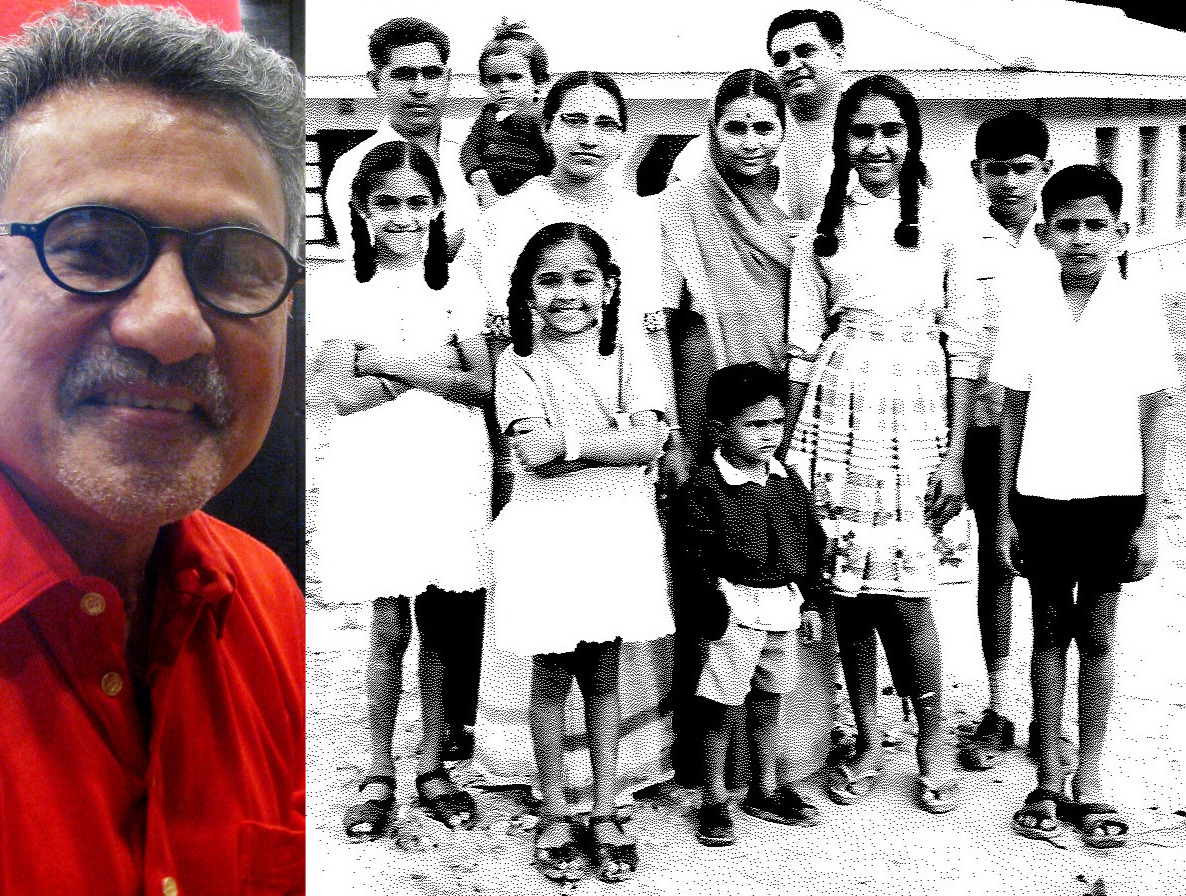
Left: Bhasker Desai (Photo: Shyam G Menon) Right: Photo taken likely in 1962, showing Bhasker at far right with his family on Pemba Island, Zanzibar. His eldest sister Sudha went to a boarding school 30 km away from home and the family had gone to see her off (Photo: courtesy Bhasker).

Left: Bhasker Desai (Photo: Shyam G Menon) Right: Photo taken likely in 1962, showing Bhasker (far right) with his family on Pemba Island, Zanzibar. His eldest sister Sudha went to a boarding school 30 km away from home and the family had gone to see her off (Photo: by arrangement).

“ It was a medical issue that got me into running,’’ Bhasker Desai said.

March 2015. We are at a cafe at the Inorbit Mall in Malad, a Mumbai suburb.

Bhasker was born in November 1952, in the town of Wete, on Pemba Island, Zanzibar. Pemba Island is the second biggest island of the Zanzibar archipelago. The famous channel which separates the islands from the coast of Tanzania (of which Zanzibar is now a part), got its name from Pemba. The Pemba Channel is rich in marine life and is considered today one of the world’s best preserved spots for game fishing. Zanzibar, ruled in the past by Omani kings, has historically hosted a non-resident Gujarati trading community. Bhasker’s grandfather was the first from his family to settle in Zanzibar, in 1905. Bhasker studied till the fifth standard in Africa. Given the growing political unrest in the archipelago preceding its formal union with Tanzania, Bhasker’s studies post-fifth standard happened at a boarding school in Nargol, South Gujarat. He went on to do his textile engineering from IIT Delhi and worked for Bombay Dyeing and Mafatlal, both big names in the Indian textile business.

In 1994, he quit his senior position at Mafatlal to commence his own business straddling three lines – garment export to Europe, supplying linen to five star hotels and being an agent for imported high density and low density polymer powder. Bhasker’s wife, a senior executive with the Tata Group, was based in the US from 1999 to 2005. With their son also studying and later working in the US, Bhasker managed the business in Mumbai and shuttled between India and the US.

In his years at IIT Delhi, Bhasker had run the 1500m at inter-hostel competitions. He also liked playing football. However life as businessman in Mumbai was decidedly sedentary.

Bhasker’s triglycerides level exceeded 900.

Illustration: Shyam G Menon

Illustration: Shyam G Menon

Triglycerides are a type of fat (lipid) found in our blood stream.

The Mayo Clinic website offers an easy-to-understand explanation. When we eat our body converts any calories it doesn’t need immediately into triglycerides, stored in our fat cells. Later, hormones release triglycerides for energy between meals. If you eat more calories than you burn – especially easy calories like carbohydrates and fats – you may have high triglycerides, a condition called hypertriglyceridemia. The American Heart Association recommends that a triglycerides level of 100 milligrams per decilitre (100mg/dL) or lower may be considered as optimal. The Mayo Clinic website deems 150-199mg/dL as ` borderline high,’ 200-499mg/dL as ` high’ and 500mg/dL and over as ` very high.’ High levels of triglycerides increase the risk of heart disease. To lower triglycerides level, change in diet and lifestyle, including physical exercise, is the usual approach.

Bhasker started frequenting Mercury Gym in the Mumbai suburb of Goregaon, doing weights and running on the treadmill. Without medication, the triglycerides receded to 450. One of the gym members noticed that he ran well on the treadmill and suggested that he train for the upcoming edition of the Standard Chartered Mumbai Marathon (SCMM). Bhasker enrolled for the half marathon with roughly 40 days to prepare.

In 2005-2006, when high triglycerides got Bhasker thinking of exercise, the sprawling mall we were in wasn’t yet part of Malad’s landscape. It was vacant land bordering the nearby creek. That’s where Bhasker started training for the 2006 SCMM. On event day, he finished third in his age category with a timing of 1:45 hours. By the time he was thus initiated into long distance running and liking it, his triglycerides level had dropped through consistent physical activity to 200-250.

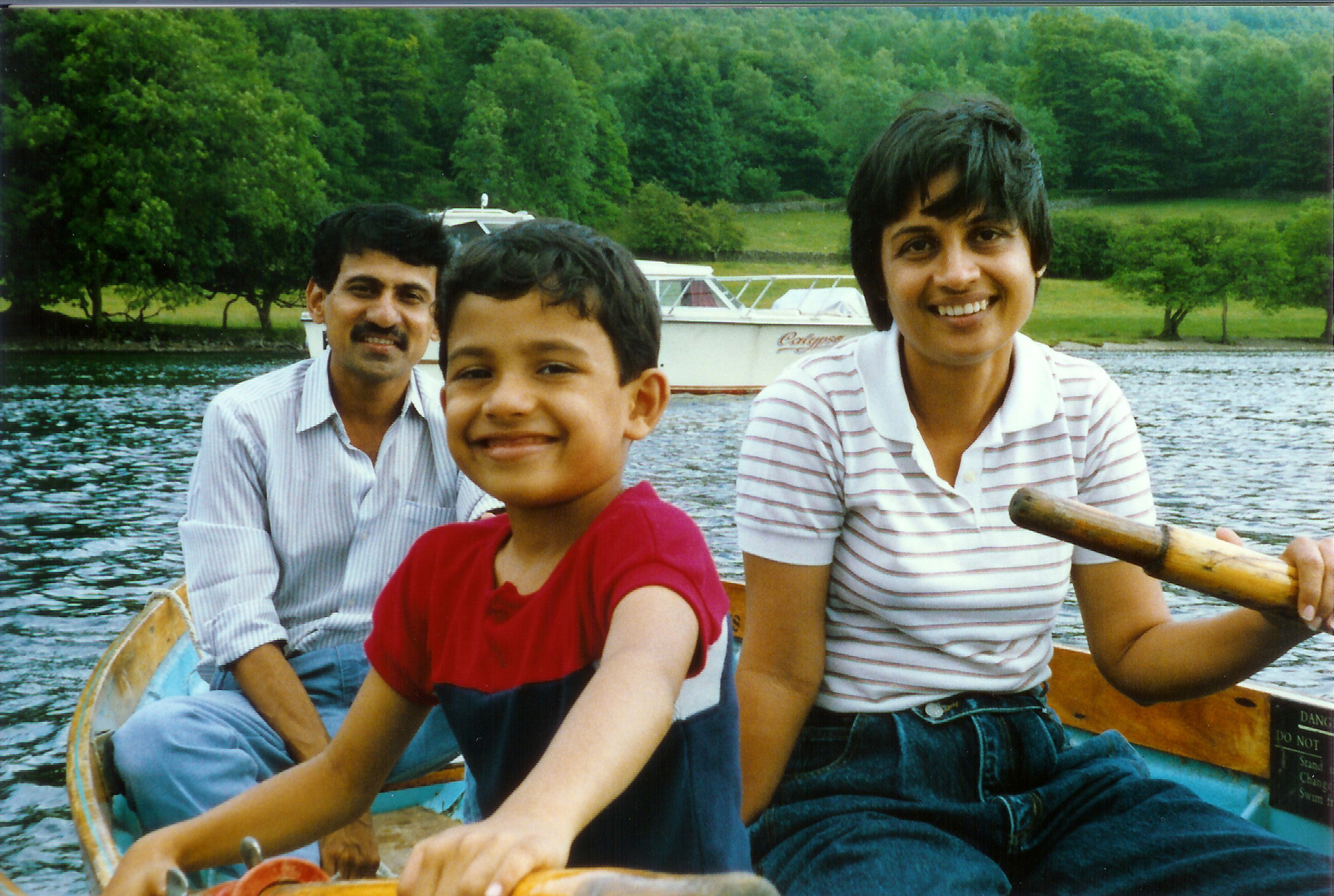
Bhasker with wife Nina and son Neeraj, Lake District, UK, 1990 (Photo: courtesy Bhasker)

Bhasker with wife Nina and son Neeraj, Lake District, UK, 1990 (Photo: by arrangement)

Bhasker’s son Neeraj lived in Charlotte, North Carolina. Newly married, he worked as an Assistant Vice President with the Bank of America. He was also passionate about the environment and was the youngest director of a NGO called Carolinas Clean Air Coalition. Roughly seven months after Bhasker ran his first SCMM, in August 2006, Neeraj died in a road accident. With her son now no more, Bhasker’s wife Nina, moved back to Mumbai. She also secured a job in the city with the Tata Group. The family had been adding two new floors to their house in Goregaon; the construction had been temporarily stopped because their future, when Neeraj was alive and Nina was working in the US, had seemed more US-headed than India-based. With Neeraj gone, Nina lost interest in the construction. With some coaxing from Neeraj’s friends in the US, Bhasker and Nina resumed work on the house.

January 2007 and yet another SCMM, approached. Bhasker had registered for the half marathon. On January 17, Nina passed away in hospital, the result of a slip and fall she suffered while supervising work at the house under construction. Three days later, Bhasker ran the half marathon; he decided to run the race for his wife and son, finishing it in 1:47. It took Bhasker all of 2007 to come to terms with the personal loss he had suffered. “ It wasn’t that I was crying or anything. It was more that my wife and son had given me so much of a sense of direction in life. That was suddenly gone,’’ he said. There were other losses too in 2007 – his mother-in-law, his brother-in-law, his uncle’s son, they all passed away. “ It was a terrible year,’’ Bhasker said.

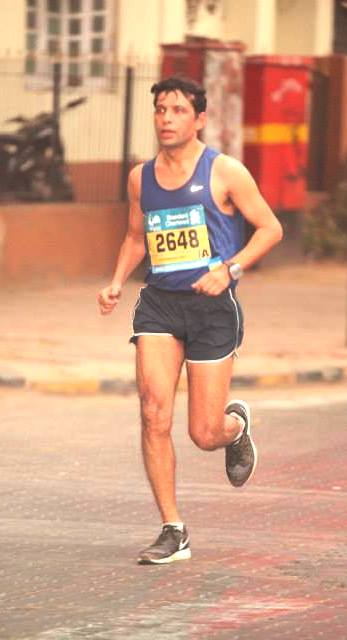
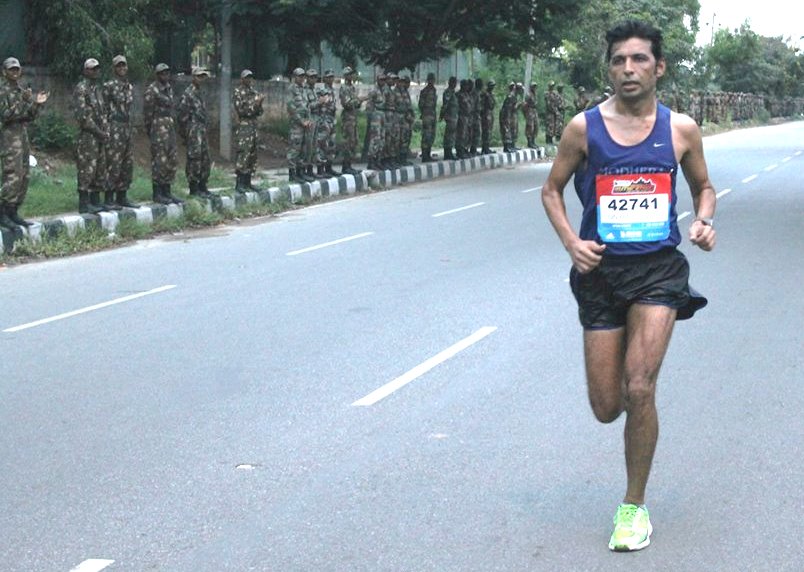
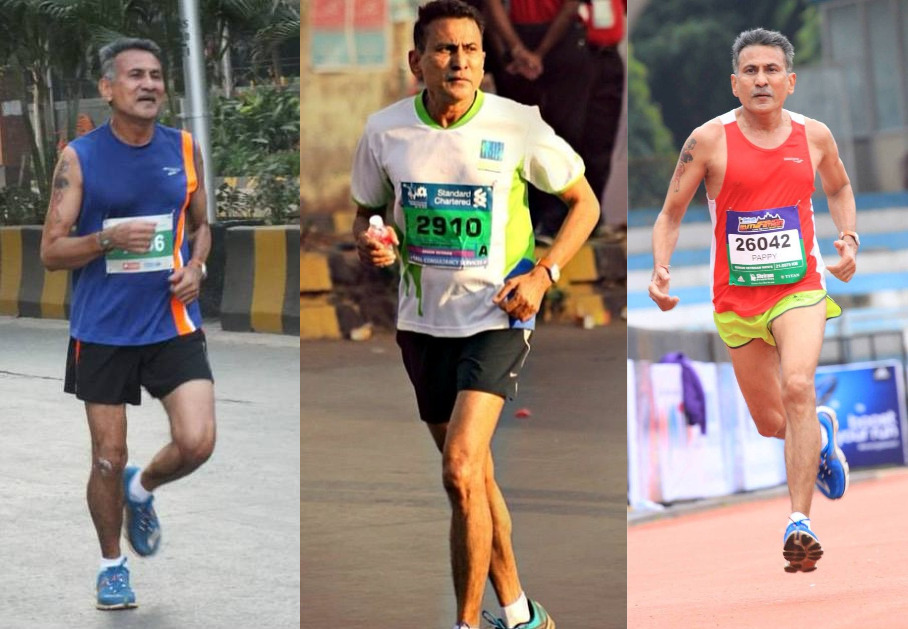
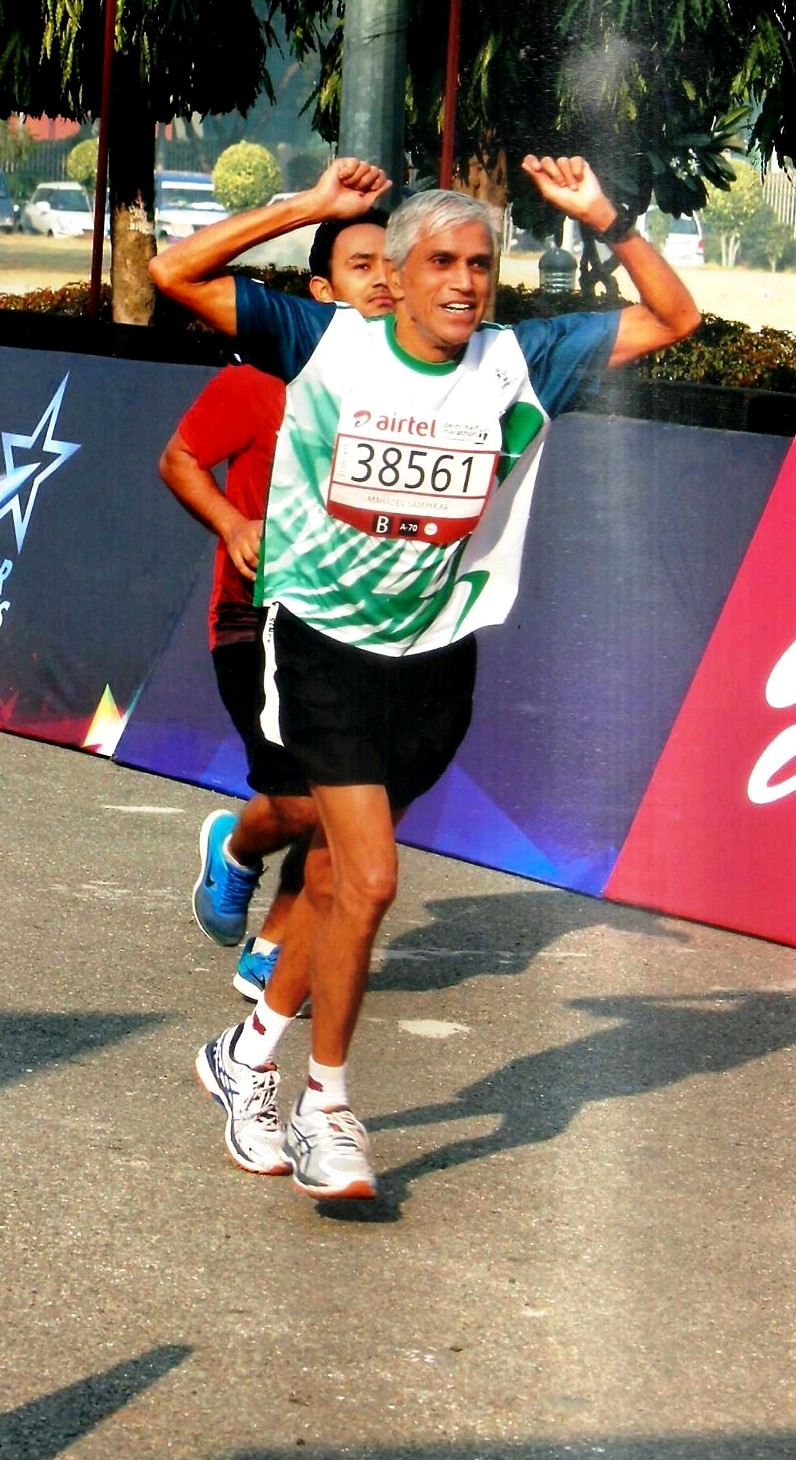
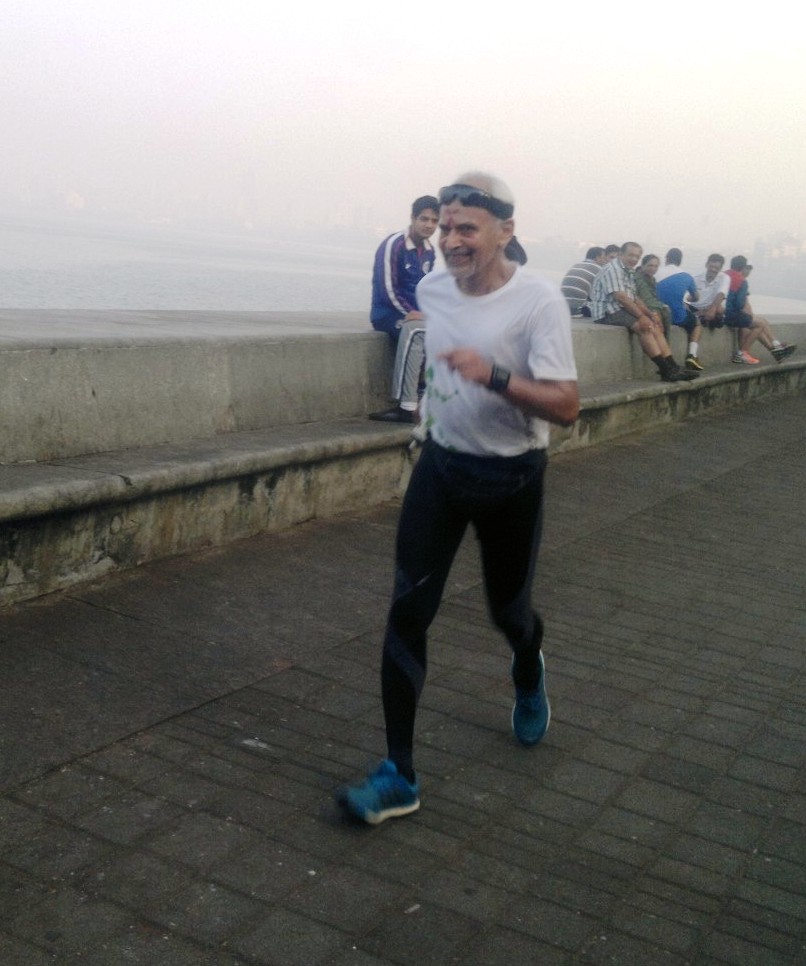
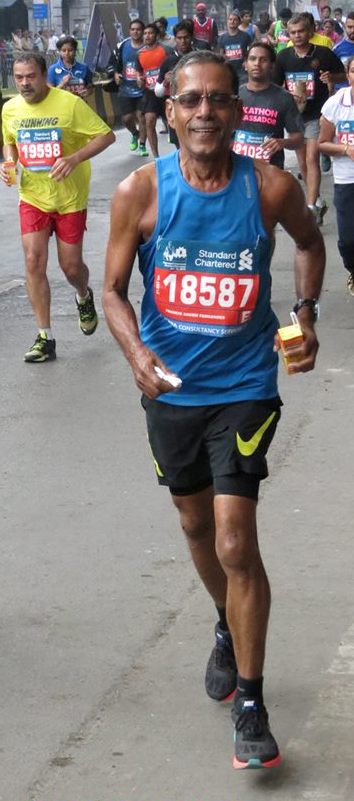
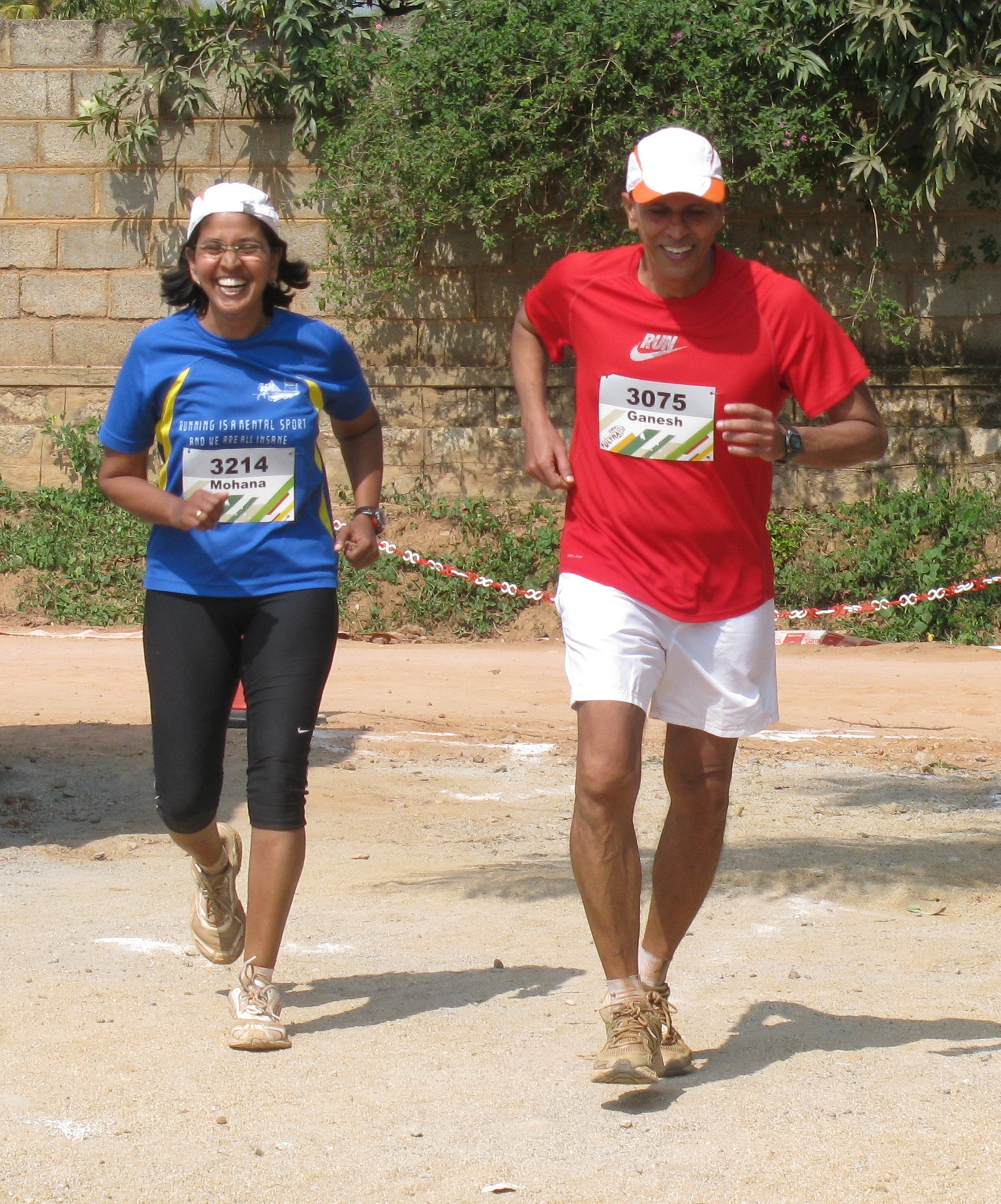
Bhasker running at events in Mumbai and Bengaluru (Photos: courtesy Bhasker)

Bhasker running at events in Mumbai and Bengaluru (Photos: by arrangement / Photo montage: Shyam G Menon)

Once again, SCMM provided leverage for a restart. Bhasker resumed his running with another half marathon in the 2008 SCMM. He ran a half marathon in Delhi. The running calendar then wasn’t as busy as it is nowadays. There weren’t as many events. 2009 was Bhasker’s first busy year in running. It started as usual with SCMM. Then he ran a half marathon – part of an event called Tibetan Marathon – at Leh in Ladakh, the very northern part of India, tucked in the high mountains of the Karakoram and the Himalaya. In Leh, he met Ken Skea, one of the foreign runners enrolled for the race. Ken encouraged Bhasker to attempt the Boston Marathon in the US. It is the world’s oldest and best known annual marathon, one of the six World Marathon Majors (Tokyo, Boston, London, Berlin, Chicago and New York City). You cannot participate unless you meet the assigned qualifying time for your age category. The qualifying time for Bhasker’s age group at the Boston Marathon was 3:45 and the then 56 year-old Bhasker hadn’t yet run a full marathon. Much work was in order.

Around this time, some other changes were happening. Born into a traditionally enterprising family that had ventured out two generations ago and made its wealth in farming, Bhasker had also put in several years working at companies and founded his own business. After the demise of his son and wife, he slowly started taking a backseat at work. The business tapered to just one line of work; his company is still supplier of linen to one of India’s biggest chain of luxury hotels. The company became more a source of income for its few employees. On his part Bhaskar did not hesitate to use his resources to help less privileged runners. Gradually the Bhasker known to Mumbai’s running circles – the man given to running, enjoying it and inspiring others by his enthusiasm for it – began taking shape.

Ken Skea and Bhasker (Photo: courtesy Bhasker)

Ken Skea and Bhasker (Photo: by arrangement)

Bhasker’s performance at the 2010 SCMM full marathon was affected by a calcareous heel spur problem. He finished in 5:05. Boston demanded 3:45, which meant he should ideally finish at some noted event in at least 3:40. Bhasker turned to Giles Drego, one of Mumbai’s leading coaches in distance running, for guidance. In September 2010, he started following the training chart Giles provided. Ken Skea also pitched in to help with a training regimen for Bhasker. In October 2010, at Ken’s suggestion, Bhasker ran the full marathon at Athens completing the course in 4:05. “ The half marathon is a journey, the full is a destination. That is the difference,’’ he said of his learning. In December he ran the full marathon at Sabarmathi (Ahmedabad), bringing down his time to 3:45. Then he registered for the March 2011 full marathon in Washington DC.

In February 2011, Bhasker decided to hike up Kilimanjaro in Africa. The group he was with was doing the normal route. Feeling fit and with upcoming major marathon events in mind, Bhasker ran between one camp and the next. But he had overlooked an important aspect. High mountains are home to sickness caused by altitude. While its onset varies from person to person and with how well a person is acclimatized on given trip, it is not to be trivialized. Acclimatization – ideally gradual acclimatization – is important. At 19,341-height, Kilimanjaro is a high peak. It is the world’s highest free standing mountain with a history of unsuspecting trekkers, moving up fast because the passage is manageable and then ending up with mountain sickness. That’s what happened to Bhasker. Eventually he reached the summit. But he was in a bad shape. After return to Mumbai, he ran the half marathon in nearby Thane. “ It was a bad run. Kilimanjaro had knocked me out,’’ Bhasker said. Now he was worried about Washington DC.

Bhasker with Bill Rodgers. To the left and right are  brief autographed messages from Rodgers (Photos: courtesy Bhasker. Photo montage: Shyam G Menon)

Bhasker with Bill Rodgers. To the left and right are brief autographed messages from Rodgers (Photos: by arrangement. Photo montage: Shyam G Menon)

Ahead of the run in Washington DC, Bhasker put in time at his sister’s place in California. He joined a gym and regularly ran ten kilometres. In Washington DC, he met the running legend, Bill Rodgers who is a former American record holder in the marathon and has won the Boston Marathon and the New York City Marathon four times. Bhasker waited in queue to meet him and was delighted when Bill Rodgers wrote “ Lets run forever’’ on his photo and “ Bhasker – see you in Boston,’’ on his bib. Bhasker completed the Washington DC marathon in 3:41:16. That gave him his ticket to Boston. He remembers with gratitude a young pacer for the 3:40 time-category, who encouraged him at times of struggle. “ That young man and Bill Rodgers – they made Boston happen for me. I was very happy,’’ Bhasker said. He is believed to be the first person from Mumbai in his age group, to qualify for the Boston Marathon.

According to Bhasker, though he embraced structured preparation in the early stages of his journey to the Boston Marathon, he has by and large been an unsystematic runner. “ There are the serious runners. I am the unserious runner!’’ he quipped, adding, “ I don’t advise what I am doing for others. It works for me. It needn’t work for others.’’ He claimed there was no method to his madness. There are interesting details – for example, despite podium finishes in India and participating in major events overseas, Bhasker runs quite technology-light. He straps on a watch – that’s it. It would seem a free bird-attitude amid the growing tide of gladiators. But at another level it helps lighter one’s concerns, enjoy the journey and trust a good journey to deliver a decent result as opposed to a pressing need for result deciding the quality of the journey. Is the apparent absence of method then Bhasker’s madness? He smiled, played with the question and let it slip away.

Bhasker (center) at the 2014 Boston Marathon (Photo: courtesy Bhasker)

Bhasker (center) at the 2014 Boston Marathon (Photo: by arrangement)

The real Bhasker, it seemed, hovered in the space between contrasting points in his observations on running. “ On a race day I like to give my best. There is no denying that. I don’t glorify being the last runner; I don’t glorify the podium finish either,’’ he said. He also said, “ I wish people would run for the fun of it, the health and the happiness. I feel very relaxed after every race.’’ Close to a decade in running and now in his sixties, Bhasker also admitted he was beginning to appreciate the merit in systematic training. Yet he stopped short of wholeheartedly embracing the approach and the possibilities systematic training may open up. “ I will never go for the ultra marathon. That requires rigorous training. I am not ready to compromise my lifestyle for it,’’ he said.

In Mumbai, Bhasker is noted for his popularity with young runners. Austin Dsouza, 30, who works as manager at an MNC, has been running for the past two and a half years. He has known Bhasker for around two years. “ Pappy is a fierce competitor and will never give anything less than 100 per cent. At the same time he will be easy going and humorous. He will go great distances to care for us puppies, always adding zing to every occasion. People like him, who inspire others, are rare. I remember when he was asked to speak to a bunch of MBA aspirants at an institution that had partnered for a race he was the only one on the panel who made the kids laugh and believe running is fun and for everybody. He inspires people on the track and off the track. Often after a race, we have at least five runners walk up to him and thank him for being an inspiration,’’ he said. According to Austin, he and his friends call Bhasker `Pappy,’ Bhasker calls them back, `puppies.’

Bhasker’s first Boston Marathon in April 2012 was eventful. He reached the city in good shape, ready to run. On race day, Boston recorded high temperatures. Bhasker did well up to the half marathon-mark; then he cramped up. He finished with a timing of 4:20. He fainted twice and was eventually carried off for medical attention. In 2013, by when he had moved to the 60-64 years age group, Bhasker completed the Boston Marathon in 3:46. In terms of qualifying to run at Boston, he did so in 2012, 2013 and 2014 and his eligibility remains for 2015 and 2016. But having run the Boston Marathon three times, Bhasker believes it is time to move on. Between 2011 and 2013, he must have run about 15 formal marathons including much running overseas. In 2013, the tragic bomb blasts at the Boston Marathon happened 20-25 minutes after Bhasker had finished his run. That year in Boston, he was placed 205 out of 950 runners in the 60-64 years age category. Back home Bhasker has been a podium finisher on many occasions. “ Podium finishes are always in India,’’ he said illustrating how an Indian podium finish compared to runners’ performances overseas. Meanwhile continuing with his running, Bhasker ran the marathon in New York in 2013 and the one in Istanbul in 2014. He ran in Pattaya, Phuket, Philadelphia, Geneva, Lausanne (Bhasker considers Lausanne a fine marathon destination – small town, great weather, great cheering) and Kuala Lumpur. Back home he ran the much loved Vasai-Virar marathon near Mumbai and the marathon in Dholavira, Gujarat. By February 2015, Bhasker had notched up on the average 15 marathons in 15 months; in some months there were more than one. When we met Bhasker in March 2015, the next major run on his itinerary was a marathon in Utah, scheduled for June.

Bhasker Desai, March 2015, at the cafe in Malad (Photo: Shyam G Menon)

Bhasker Desai, March 2015, at the cafe in Malad (Photo: Shyam G Menon)

Was it three cappuccinos or four? The exact count escapes memory. It had been a long time chatting at the cafe. Somewhere along the way, Bhasker had mentioned and it was there in the journalists’ notes, a key to understanding the man and his affection for running, “ I think running makes you a better person. Running is a great way to socialize. I am a one man-family. Running has been a nice way to increase my family; have a group which connects with you.’’

Ram Venkatraman has been a runner for long. He is one of the founding members of Mumbai Road Runners (MRR) and a person who knows Bhasker well. “ Bhasker is a mindless, aimless runner in the sense that he does not run for personal glory like personal best, podium finish etc. He has the same passion for running that we all have. He is an inspiration to many. He also does his bit for underprivileged runners by helping them with shoes, accommodation and race fees without making a fuss about it. He is truly a legend in the running world of India,’’ Ram said.

(The authors, Latha Venkatraman and Shyam G Menon, are independent journalists based in Mumbai. Please note: the timings mentioned are as given by the interviewee.)

THE ELEPHANTS I NEVER SAW

Illustration: Shyam G Menon

Illustration: Shyam G Menon

The only time I ran on a trek was when a lone elephant gave chase.

Elephants provide a touch of drama to hikes and outings in South India.

If you are not quite the naturalist, field biologist-type, then long before you see one, you make your exit if you have seen signs of one.

I realized this when I was very young and out with extended family on a road trip in the Western Ghats of the Kerala-Tamil Nadu border. En route to Gudalur, on a quiet forest road with no other vehicle or human being in sight, our hired van halted and its occupants tumbled out to stretch their limbs. Deep breaths are part of stretching and it wasn’t long before an odor, familiar and tad worrisome, reached the nostrils. Someone spotted fairly close by, a sizable deposit of steaming hot, fresh elephant dung. We peered into the forest, looked at each other and did the most sensible thing – got back into the van and made haste for our destination.

The years between that trip and my thirties were a distraction. If being alive to the moment is what attention is all about, then those years of school, college and pursuit of career were distraction hankering after a future. In my thirties, I started seeing Kerala in a different light. Now a hiker, climber, wanderer-type, I began noticing the state’s geography. None of it had featured in my efforts years ago to educate myself. The only geography that mattered then was the route to well settled-life, which as it turned out, wasn’t meant for me. Fallen flat, humbled and with ego on vacation, I must have let the universe into my head. A visit home began packing in a hike as well. That’s how a hike through the forest, to Ponmudi near Thiruvananthapuram (for more on Ponmudi please see https://shyamgopan.wordpress.com/2014/08/09/a-trek-and-a-tea-story-part-1/), happened. It wasn’t the proper thing to do (you need permission) but I had met this retired forest guard, who knew of a quiet path. We met up with him and were soon off on a nice little trek; a pretty stiff one too if I may say.

The first hour or so was through tea estates.

Beyond that it was forest with plenty of bamboo in it.

Fed by recent rains, the surrounding vegetation was rich and lush green.

Rain also meant stuffy atmosphere.

Whenever the sun appeared, we sweated profusely.

Suddenly, deep inside the bamboo forest our guide froze like a pointer dog.

He then sniffed the air.

“ I am getting the smell of elephant,’’ he said, “ we have to ensure that the wind is not blowing from us towards the herd.’’ Whatever it’s other properties or the consequences it warned of, the odor worked well as a magic potion for choreographed progress on the hike. A dozen steps, then freeze; dozen steps, then freeze – of course, I am exaggerating, but with a dash of imagination what we did can resemble a contemporary dance. Luckily, the herd stayed as odor; it didn’t physically appear on our trail or near it. But the periodic halts necessitated by worries over elephant odor, was enough time for leeches to attach themselves by the dozen to our shoes. That was only to be expected for it was still rainy days. We reached Ponmudi amid thick mist. My cousin Rajeev and I were delighted to discover such a hike in the neighborhood of a city we had grown up in and never bothered to know as nature or geography.

Our relationship with Elephas Maximus continued.

If it was an unseen herd en route to Ponmudi, then two years later, a lone ambassador turned up to scare us on a hike inside the Neyyar Dam sanctuary near Thiruvananthapuram.

We knew there were elephants around and the guides kept us on edge pointing to freshly trampled vegetation, steamy dung and tree bark still oozing sap where a tusk had scraped it. According to the sequence of events as described by those behind, my cousin Vipin and I walked past a lone elephant standing in the shadows. Neither of us saw it. Not paying ones respects to something so large and obvious must have punctured the elephantine ego. If that was the case the ego must have been punctured several times over for none of us saw the elephant. Further, one of those bringing up the rear of our small group, paused to photograph a machan or platform built high on a tree by the local foresters.

I don’t know exactly what happened. I suppose, the camera flash went off. The animal charged. That was when everyone nearby, including the photographer, saw the animal. People ran. At the sound of scampering feet approaching from behind, I looked back and saw Rajeev running in. As he, his two friends and the two forest guards (they were the guides as well) caught up with me, I also ran sharing the general panic but not knowing the specific cause. We soon caught up with Vipin, who too joined the group run. Actually it was amusing – a bunch of people running, a couple of us pretty confused from not knowing what had happened. Somewhere along the way, amid the sprinting, I recall asking what was going on. “ Elephant!’’ – I heard; I don’t remember who said it, the word said it all. Thankfully we were spared harm, a strenuous full body work-out being the only price for our carelessness.

I never saw the elephant. We ran from the machan to the forest guards’ outpost on the edge of the Neyyar Dam reservoir, not too far away. We were on safe ground. We sat down to take stock.

“ That was Kolakolli, wasn’t it?’’ our guide asked his colleague, commencing an animated discussion about the encounter.

It was the first time I heard the name.

Interesting play of words – that name.

Kola in the Malayalam language can colloquially refer to a bunch of fruits or flowers – it is often used to describe a bunch of bananas. Kola also means murder. In this case, the name with an action slant for emphasis in its second half appeared to indicate a vicious killer. Whether that was deserved or not, it was the reputation the elephant in question had acquired in the region. From their conversation, I didn’t feel that the guards established beyond doubt that the animal which chased us was Kolakolli. Not knowing who or what Kolakolli is or why the name emerged, I also suspected that the guards were playing up our encounter with an elephant I had still not seen.

A few months went by.

One night in Mumbai, while surfing television channels, I came across a news report of a lone elephant called Kolakolli captured near Thiruvananthapuram. The animal with a weakness for liquor had damaged property and killed people in the area. Penned in a specially made enclosure of tree logs, the elephant was shown on camera rearing up on its hind legs in a futile attempt to scale the walls. It subsequently died in captivity. A June 2006 report in The Hindu newspaper pointed out that while the 30 year old-elephant was said to have killed a dozen people in the preceding seven or eight years, there was little evidence linking it to the deaths. There was speculation that the animal suffered from tooth infection and indigestion leading it to raid crops. In fact, much before it acquired the title Kolakolli, the elephant was called Chakkamadan after its weakness for ripe jackfruit (jackfruit is called chakka in Malayalam). Trapping the tusker had become imperative to rid the region of lingering fear. A video of Kolakolli in that tight pen is there on Youtube. I am not providing the link; it is a depressing sight. Kolakolli has a page on Wikipedia too.

More months went by.

While on a visit home, Rajeev and I visited the Peppara Dam, not far from the Neyyar wildlife sanctuary. We had to meet forest officials there to secure permission for a hike to the 6237 ft high-Agastyakoodam peak (https://shyamgopan.wordpress.com/2014/08/09/a-trek-and-a-tea-story-part-1/).

We hired a three-wheeled autorickshaw to take us from Vidura to Peppara. Shahajad, who drove the vehicle on that lonely road, kept talking of elephants showing up. I asked him about Kolakolli and he said, the tusker had been penned not far from where we were. Shahajad’s version of the story and indeed the versions I heard subsequently from people in the area, featured a twist to the tale. They all highlighted Kolakolli’s love for liquor. The animal which regularly raided brewing dens deep in the jungle had become addicted to it. In captivity it couldn’t get the brew, experienced withdrawal symptoms and grew violent. To calm it, tranquilizer shots were used. But somewhere along the line, they said, the addict’s body had proved too weak to withstand the chemicals. The elephant died. That was the locals’ take on the turn of events. According to Wikipedia, the captured elephant was sent for training but died a few days later “ reportedly due to cardiac arrest.’’ Kolakolli seemed to have died a legend for apart from the media attention it garnered, there was at least one person – a man we picked up on that lonely road from Vidura to Peppara – who claimed that the hunters had captured the wrong animal.

The real Kolakolli is still alive, he declared sarcastically.

Suddenly the vehicle’s engine sounded like isolation personified in my head.

It was a narrow, winding road with long stretches of potholes and not one vehicle had passed us in a long time.

On both sides, it was forest.

I knew the man was joking. He was probably a cynic. In India, condemned to the matrix of too many people, undying feudalism and everyone wanting to be somebody just to show off power, the tradition of bad administration quickly makes cynics of people. So many problems haven’t ended despite repeated official pronouncements that they will. Why should Kolakolli be exception? I suspect that’s the rut that man fell into. But the thing about elephants is that their behavior is so unlike their obvious size. They are capable of subtlety, quietly standing by and watching in that tradition of the jungle itself while man – so full of the self – will walk by as I did on that hike or drive past as I was doing now. I could call this the ` Kolakolli metaphor’ for at various stages in my life, spanning career as journalist to wannabe climber, I noticed the world well only at times of ego crushed. As they say, everyone sees but to notice, the mind must have room for it.

Somewhere along the way, our three-wheeler paused to let the man get off.

After he had vanished into the wooded surroundings – as characters always do in such stories – Shahajad turned around and said, “ that man is much older than me, so I couldn’t talk back. Kolakolli is dead. No doubt about it.’’

(The author, Shyam G Menon, is a freelance journalist based in Mumbai. The incidents mentioned in this article happened some years ago.)
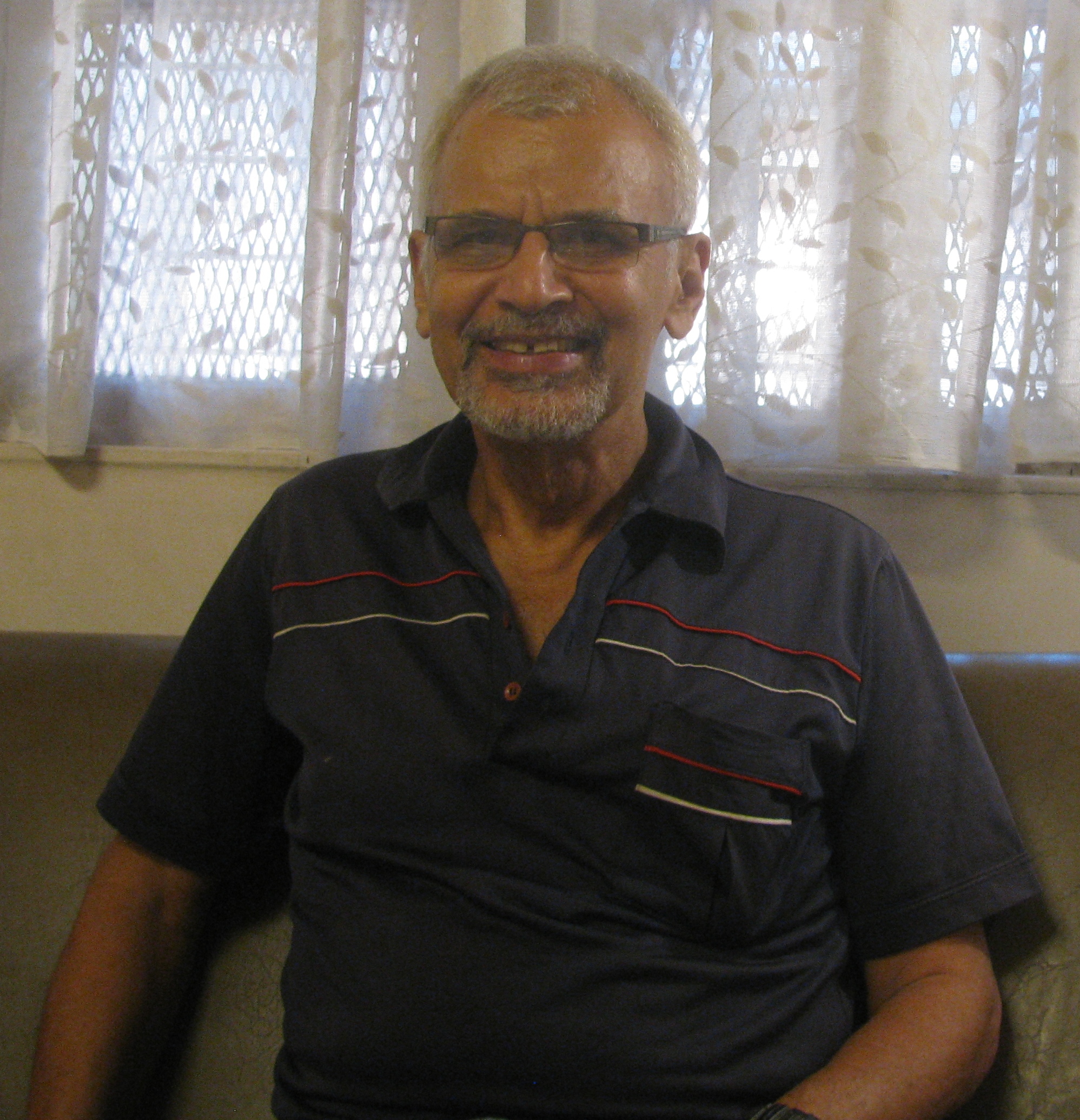
THE AGE OF RUNNING – PART 1

Talking to some of Mumbai’s senior runners; how they got into running, what it means to be senior and running, their concerns, their approach.

A story in three parts:

Kutty Krishnan Nambiar (Photo: by arrangement)

Kutty Krishnan Nambiar (Photo: by arrangement)

Kutty Krishnan Nambiar remembers searching for something to stay active in when he shifted from Abu Dhabi to Mumbai.

He had just retired from employment.

“ I was in a situation where I had to do something,’’ he said.

Nambiar studied in Kozhikode, Kerala. He used to participate in athletics in school. Following his education, he worked initially with Air India in Mumbai and later with Air France in Abu Dhabi. There in his forties, the bug got him – he started running. It was no more than two to three kilometres a day. In 2003, grappling with the retired life in Mumbai and looking for something to stay engaged in, Nambiar picked running. Soon he was running four or five days a week, totting up four to five kilometres a day. At start, he was a bit nervous about running on the road. The worry faded when he found that running kept him physically fit and mentally happy.

While running in a park not far from his apartment complex in Andheri, Nambiar met Mumtaz Qureishi. The younger Qureishi talked the older man into seriously pursuing running. From a weekly mileage of 20-25 kilometres, Nambiar slowly hiked up his running to 40-50 kilometres. Alongside, his training became more systematic. Sample this – the 73 year-old regularly runs from Andheri to the National Centre for Performing Arts (NCPA) in South Mumbai, a distance in excess of 25 kilometres. On the way, he meets other runners, young and old. Nambiar described the predicament of being senior citizen in sport dominated by young people, light heartedly. “ I am like the old steam engine. The young run much faster. But they also wait for me,’’ he said of how he catches up with those doing the run from Bandra in the western suburbs to NCPA, the first Sunday of every month. Andheri, from where Nambiar commences his run, is further north of Bandra.

In the first phase of his post retirement interest in running, Nambiar ran many of the lesser known races in Mumbai. The city, widely considered India’s running capital thanks to the well known Standard Chartered Mumbai Marathon (SCMM) which happens annually, has a plethora of smaller running events spread throughout the year. It was on these events that Nambiar cut his teeth as a senior citizen into running. In 2012 he ran his first SCMM in the half marathon category. Among other events, he ran the Vasai-Virar Mayor’s Marathon organized in the said region on the outskirts of Mumbai and much appreciated by the running community for the residents’ cheering.

Kutty Krishnan Nambiar (Photo: Shyam G Menon)

Kutty Krishnan Nambiar (Photo: Shyam G Menon)

In January 2015, Nambiar ran his first SCMM-full marathon. Running slowly but determinedly, he finished it. He was very happy for himself. He just wished the race atmosphere had stayed so till the last runners crossed the finish line. By the time the slow runners got home, the finish line was devoid of cheering and anyone welcoming. “ Even the traffic resumed when I was still on the road,’’ Nambiar, said. Although he didn’t say it as such, it was apparent that this part of the SCMM experience had left him trifle sad for with the finish line into wrap up-mode by the time he reached, his timing wasn’t officially recorded. “ That’s okay, I am running for my satisfaction,’’ Nambiar said.

Running changed Kutty Krishnan Nambiar. There was the improved physical fitness and sense of well being. Bad habits vanished – in Nambiar’s case, his chain smoking. “ Had I not got into running, I would have been another old retired person. Running has given me a lot of confidence,’’ he said, February 2015 at his apartment in Andheri. His family never objected to his running at an advanced age. He was also lucky that his family physician approved of his decision to stay active and keep running. “ If I were to give credit to anyone for my running, I guess it would have to be the family doctor and Mumtaz Qureishi,’’ Nambiar said. Overall he has enjoyed the journey. Hailing from an age devoid of social media, he found himself doing well in running, an activity with considerable presence on social media. “ Somebody put me on Facebook. I didn’t know any of that before. Now I actually like it. People encourage you, congratulate you,’’ he said.

When running, Nambiar adopts a mix of running and walking. “ I am not running to race. I am there to finish what I am doing, eventually reach the goal. I wish to improve my timing. But I don’t want to struggle for it,’’ he said. His pace is slow and steady, mostly like fast walking. “ Once I cross the first five to six kilometres, I feel nice. I feel so nice after 10 kilometres. Sometimes I feel I am flying,’’ he said. Nambiar’s preferred nature of route was a linear one he can settle into and strike a sustainable rhythm.

For the 2016 SCMM, Nambiar wished to do the full marathon again. But before that, he wanted to try an ultra marathon.

From the 2014 SCMM (Photo: Shyam G Menon)

From the 2014 SCMM (Photo: Shyam G Menon)

He was toying with an idea Qureishi had set loose among his friends – run from Mumbai to Goa.

Nambiar felt he could try portions of it.

These days, early morning-Mumbai is incomplete without runners on the road.

SCMM changed Mumbai.

It is the flagship event in the city’s running calendar.

Over 2010-2015, the number of participants for its full marathon grew by 39.38 per cent, from 3103 runners to 4325. In the half marathon category, the increase was by 30.19 per cent, from 11,000 runners to 14,321. This annual race encouraged many people to embrace running in Mumbai.

ENROLLMENT AT SCMM FOR THE FULL AND HALF MARATHON:

                           SCMM 2010   SCMM 2011   SCMM 2012   SCMM 2013   SCMM 2014   SCMM 2015

Full Marathon      3103                 2800                2728                4127                  3600               4325

Half Marathon     11000               11213              13945             12808                14200             14321

Source: Procam

Neeta Ramakrishnan (Photo: by arrangement)

Neeta Ramakrishnan (Photo: by arrangement)

Neeta Ramakrishnan was tackling the blues of having left a hectic working life when the advertisement for the first SCMM appeared in late 2003.

She had been working at R&S Electronics, a company co-founded by her husband and well known as suppliers of quality audio visual equipment. When she left that job, the sudden onset of inactivity had been unnerving.

Despite having no formal background in sports, she was a generally fit person. She registered for the SCMM-half marathon. She didn’t know what it entailed. Running wasn’t as popular as it is now. In 2003, there weren’t many running groups; in fact there weren’t many runners on the road. Neeta trained by herself following a schedule that Procam, the organizers of SCMM, recommended. Four months later, in February 2004 (the first SCMM was in February), she completed the run in under three hours. “ After that I can say for sure I was back to being myself. Running gave me back my life,’’ she said.

Neeta is one of those SCMM veterans in the true sense, who have run most editions of the event (barring one or two owing to personal illness / inconvenience) and seen it change from a curiosity in the city to crowded running. She admitted that sometimes she felt she shouldn’t run it any more. But every time she finished it, she yearned for the next. In 2012, she ran her first SCMM-full marathon finishing third in her age category. Training with Giles Drego helped her graduate from the half to full marathon distance in two months, she said. In 2014, she finished third in her age category for the half marathon. She has also run at places other than Mumbai – in Hyderabad, Goa, Ahmedabad, Chennai and Satara. As podium finisher, she once collected a cheque for Rs 10,000. “ Trophies and cheques – it is a beautiful feeling. At school or any other juncture in life, I never went on stage to collect a prize,’’ she said reflecting on the moments running had gifted her in her senior years.

Neeta Ramakrishnan (Photo: Shyam G Menon)

Neeta Ramakrishnan (Photo: Shyam G Menon)

Neeta mentioned a few goals. She wanted to stay injury free as far as possible. “ My age does scare me. If anything happens it takes longer to get back to normal,’’ she said. She wanted to run a half marathon every two months; she was also open to trying an ultra marathon. “ An ultra will discipline me more. My mind will have to be more focused. That is a challenge. That is the attraction,’’ she said, adding, “ at the end of a run I am very happy with myself.’’ When we met her, Neeta Ramakrishnan was an energetic 61 year-old, talking about her life in running in a lovely, brightly painted old apartment with much music and films around.

Neeta’s emphasis on avoiding injury merits highlight.

Most of the senior runners we spoke to cited the need to listen to one’s body and push limits judiciously.

Besides change to the individual, aging always included the dimension of changing environment.

Arguably, that dimension is a bit extreme nowadays.

India is now an overwhelmingly young country.

According to the website of the National Commission on Population, by 2016, while the numbers of those below 15 years age of is projected to dip from 35 per cent to 28 per cent, the share of people in the age group of 15-59 years will rise to nearly 64 per cent by 2016. By then, the numbers of those over 60 years of age is projected to rise from seven per cent to nine per cent. That is nine per cent in an ocean of the remaining age groups. Even if you took 50 years as separating line, the 50-plus group will still be dwarfed by the young.

Runners on Mumbai's Marine Drive after the monthly Bandra-NCPA run organized by Mumbai Road Runners (Photo: Latha Venkatraman)

Runners on Mumbai’s Marine Drive after the monthly Bandra-NCPA run organized by Mumbai Road Runners (Photo: Latha Venkatraman)

Needless to say, the demographic transition the country is going through influences public and social life. The sheer size of youth makes sport inevitable in India. The market knows it. The sheer size of youth also makes sport partial to the characteristics of youth. Much before being enjoyable activity, sport is performance and spectacle of achieving. The market loves it so. Except, sport – as anyone who has been long enough in sport will tell you – is not only about raw performance or trading the old for the young. Sport embarks you on a journey; it speaks its own language, breathes its own life. You feel it as participant in activity. At its best, sport is an avenue to self discovery and self awareness. It is a valuable dimension to human existence. Senior runners likely find themselves on this quieter, lonelier more profound track quicker than others, for they are past distraction by market and society.

Well before his foray into distance running Shyam Sunder, now 69 years old, was competing and winning prizes in walking.

He took to running short distances participating in SCMM’s Dream Run and Senior Citizen Run. Now living with his son at Vashi in Navi Mumbai, Shyam Sunder is out at 6AM every day of the week either going for a brisk walk or a run. He kept to small distances but things changed when Swaminathan Subramanian, a long distance runner, spotted him and urged him to attempt a half marathon. Encouraging words from Swaminathan and M.K. Srivatsan, another long distance runner from Navi Mumbai prompted Shyam Sunder to attempt the half marathon in 2009. “ I was 65 years old when I attempted my first half marathon,” he said. He did it in 2:25 hours. The following year, he improved his timing to 2:16 hours. His timing kept getting better and in 2013 in a Chennai racing event he got his personal best of 1:57 hours.

Shyam Sundar (Photo: by arrangement)

Shyam Sundar (Photo: by arrangement)

Shyam Sunder has been a podium finisher in his age category in most of the events that he participated in. He is not into scientific training as is the trend among younger runners. “ I enjoy my run and I never push myself beyond my limits. That’s why I have been able to keep injuries at bay,” he said. He has devised his own method of training and often works backward from a running event. He also believes that opting for minimalist footwear helped him keep injuries at bay. “ I do my practice runs with regular shoes but switch to minimalist shoes during events,” he said.

During his younger, working years, Shyam Sunder played cricket. A student of IIT Chennai and VJTI Mumbai, he worked at IBM. “ In my thirties I did no activity. Later I took up walking,” he said. Shyam Sunder’s diligent approach to running, his love for recreational sport and his performance in events has prompted not only his son and daughter but also many of his neighbours and morning walk-friends to take up running. “ My son and daughter are convinced that running is what is keeping me happy and healthy,” he said.

He travels out of Mumbai to participate in running events but mostly to cities where he has family and relatives. He has thus run in Bangalore, Mysore, Chennai and Pune. He also participated in a three-mile run in Portland, Oregon when he was visiting his daughter who was then living in the U.S. Having run several half marathons, Shyam Sunder was contemplating running the full marathon in the 2016 edition of SCMM.

(….continued)

(The authors, Latha Venkatraman and Shyam G Menon, are independent journalists based in Mumbai. They would like to thank all the runners who spoke to them as well as Procam, organizers of SCMM, for the data shared. Please note: timings and podium finishes are as mentioned by the interviewee.)
THE AGE OF RUNNING – PART 2

Runners on Marine Drive after the monthly Bandra-NCPA run (Photo: Latha Venkatraman)
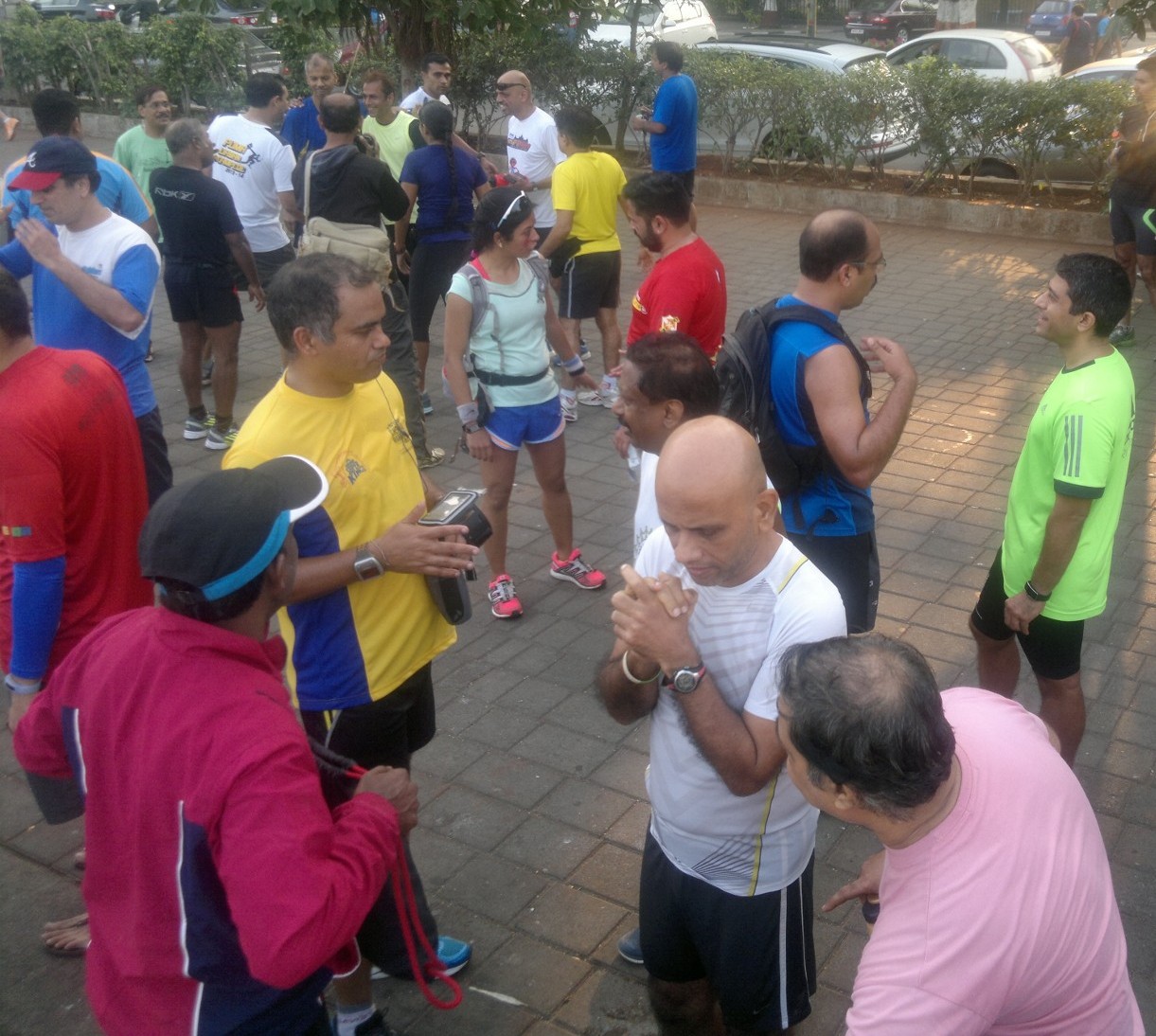
Runners on Marine Drive after the monthly Bandra-NCPA run (Photo: Latha Venkatraman)

Mumtaz Qureishi described himself as a 45 year old-ordinary person from Muzaffarpur, Bihar, who works in the telecom industry in Pune. Every weekend he travelled to Mumbai to be with his family.

Qureishi has been a regular jogger for many years. In 2004 he registered for the full marathon at SCMM with little idea of what it entailed. That and his next SCMM full marathon of 2009, ended as unfinished business. In 2010, he completed his first full marathon, improving his timing to 4:16 hours in 2011. He prefers to run the full marathon and the ultra marathon. In Mumbai, he is best remembered for a 100km-run within the city. Later he did a 105km-run from Balewadi in Pune to Panvel on the outskirts of Mumbai. He credits these milestones in his life to a long list of friends in running and his coach, Giles Drego. We asked Qureishi what he thought of the senior lot.

“ The 3Ds (Daring, Discipline and Dedication) and patience, which are the basic qualities needed for running long distances are rarely found in my age group or groups younger still. You find these qualities in both of them (Nambiar and Patel). Actually I didn’t do anything for them. They always talked positively. I just told them, don’t bother about the timing. Doing a full marathon at your age, will itself inspire a lot of people like me. These two are more powerful and energetic runners than me and I still have much to learn from both of them,’’ Qureishi emailed. You could possibly stretch his response based on specific knowledge of two individuals, to include the senior lot as a whole. They have qualities that the younger lot don’t bring to the table. Qureishi confirmed the plan to do a Mumbai-Goa run. “ Since this distance requires more practice we will probably do it next year. And yes Kushru sir and Kutty sir will be running to make it more interesting, exciting and memorable,’’ he wrote.

Mahadev Samjiskar (Photo: by arrangement)

Mahadev Samjiskar (Photo: by arrangement)

Mahadev Samjiskar, 72, always believed in staying active.

His resolve to stay active was further strengthened when he saw his parents suffering in their old age.

After retiring from Indian Airlines in 2001, he took to brisk walking.

In 2003, he came across an advertisement in the newspaper about the first Mumbai Marathon (held in 2004).

“ I did not know the ABC of running but I decided to register for the half marathon,” he said.

Samjiskar finished the distance in 2:51 hours by resorting to brisk walking.

He continued his brisk walks and in September 2004 he attempted a hill run inside the city’s Sanjay Gandhi National Park. Thereafter, he took to running and his performance kept on improving year after year.

In the 2005 edition of SCMM, Samjiskar finished the half marathon with a timing of 2:10 hours.

His best in terms of timing was in the 2007 edition of SCMM wherein he completed the half marathon in 1:56:34 hours. He was fourth in his age category.

Of the 25 half marathon events that he has participated in, Samjiskar has been a podium finisher in many of these. In the 2009 edition of SCMM, Samjiskar was the winner in the age category of 65 and above. He was second in the 2011 SCMM. He came second in the 2012 edition of the Airtel Delhi Half Marathon. He remembers it as being a tough race because of the low temperature. In 2014, he won in his category at the Goa River Marathon; same year he also finished first in his age group under the open category at the TCS World 10k in Bengaluru. At the 2015 edition of SCMM, he finished the half marathon in 2:05 hours.

Samjiskar is not new to attempting things that defy his age profile.

When he was 63 years old, he had enrolled to train in karate.

Seven year later he got his black belt.

People around him including his family had been sceptical of his move to learn karate.

“ I enjoy karate. It has helped me a great deal in running,” Samjiskar said.

He felt karate was akin to cross training which is very essential for any sport.

Runners stretching on Marine Drive after the monthly Bandra-NCPA run (Photo: Latha Venkatraman)

Runners stretching on Marine Drive after the monthly Bandra-NCPA run (Photo: Latha Venkatraman)

At the age of 65, Samjiskar went on a month long-Kailash Mansarovar trek. At the age of 67, he participated in an athletic event, in the 800 metre-run, 1,500 metre-run, 5,000 metre-run and the 5,000 metre-walk. At the time of writing this article, he was slated to attend the national championships in Haryana where he will participate in the above mentioned four events. Should he qualify there, he will head to Australia later this year. Samjiskar was very confident of qualifying. He had been training on synthetic track for the past few weeks.

Years ago, Samjiskar had suffered a major setback in his life. He lost his wife to a fire-accident, very early in his marriage. He had to take care of his three young children. His parents helped with that responsibility.

“ I went into depression after this episode. Then I read somewhere that books are great companions,” Samjiskar said. He joined Parle College to do a Bachelor’s in Economics. “ I was not able to study past SSC because of my financial position. Here was an opportunity to take up studies all over again,” he said. He finished his BA in 1978. The degree helped him get promotions at Indian Airlines.

Interestingly, Samjiskar’s first employment was with the navy. He left it following a transfer to Karanja Island. He then found a job with Indian Airlines as a typist and slowly climbed the ladder through his hard work and resolve, which is so evident in his running as well. He retired as an executive.

Samjiskar is a regular at the Sanjay Gandhi National Park. He runs at least five days a week, interspersing the running schedule with swimming and karate.

He pays attention to the messages from his body. “ I listen to my body. I do not have the right to torture it,” he said.

For that reason he did not want to move up to the full marathon.

Khusru Patel (Photo: by arrangement)

Khushru Patel (Photo: Latha Venkatraman)

When we met him at his house in Bandra, Khushru Patel was past 75 years of age.

Courtesy Mumtaz Qureshi, the Mumbai-Goa bug had got him.

According to the Internet, the distance involved is around 600 kilometres.

We asked Patel what he thought about it.

“ What’s there to think about it?’’ he replied laughing.

In January 2015, Patel ran his first official marathon; the full marathon of SCMM. He finished with an officially recorded timing of 6:14:49 hours.

It was a major transition for the former Air India staffer who began running seriously at age 47 but possessed the benefit of an active background in sports during his school and college days. The credit for getting him started years ago – he said – should go to a friend’s son who brought him the enrolment papers of the Mumbai Monsoon Marathon, an event older than SCMM. It had a 10km-run for those aged 45 and above. Patel had just ten days to sign up and do a few practice runs. The actual event was tough and he recalled a fellow runner, older and remembered only as Taraporevala, running alongside and egging him on. Patel finished tenth and earned one hundred rupees as prize money. Then somebody told him of the existence of the Masters’ category in athletics. As disciplines to participate in, he chose the 5000m and the 10,000m in running and the 20km-walk. It was the beginning of a career in running and walking at Masters category-events that saw him get podium finishes at national and international level.

Walking may seem a step down from running. “ For me, walking is tougher. There is more pressure on your arms and hips, you have to lock your knees, the pain factor is more and chances of disqualification while competing, are higher,’’ Patel said. On the other hand, he runs very slowly, loyal to the technique that defines running but at a pace that is about as same as his walking. In his opinion, walking, running, cycling and swimming are synergic and ideal for cross training. In the past therefore, he has competed in triathlons and duathlons. He remains a weak swimmer and had to wait until the organizers of triathlons treated each discipline equally, to be able to finish well. In the early days, local triathlons were partial to swimming. When Patel got into long distance running and the SCMM, he elected for the half marathon as space to be in. For the 2016-SCMM, he said, he will enrol again for the full marathon. This year (2015) aside from the occasional cramps tackled by due stretching, he didn’t face any problems. Having tasted the full marathon and sensed room for improvement, that’s where he wants to return. “ I want to bring my timing to under six hours,’’ he said.

Amid all this running, a major change happened. Patel loved to drink. He would enjoy a drink with somebody the night before and run the next morning, battling much lethargy in the run’s initial phase. Serious running (not to mention a near accident that a close relative who had had a drink with him got into) helped him give up hard drinks totally. Now, it is just the occasional beer or wine. “ It is amazing how much it changed my running and my timing,’’ he said.

Khusru Patel (Photo: Shyam G Menon)

Khushru Patel (Photo: Shyam G Menon)

Patel has much insight into what it means to be an older athlete in India. He recalled two instances. Years ago, when in his sixties, he participated in a two kilometre-walk held under the aegis of a sports meet exclusive to the Zorastrian community he belongs to. When he appeared on the field and limbered up, the young people around chanted, “ uncle, uncle…..’’ The competition started and all the cheering was for the young. As Patel edged ahead, a silence descended. Then one of his friends turned to the spectators and shouted, “ come on guys, he is over 60 years old!’’ That’s when they started cheering him. Patel won that day. He broke the existing record. Next year, he broke his own record!

In another event – a run; he was running, keeping himself focused by slowly catching up with young runners ahead. One of them always pulled away as he caught up. When he finally overtook the runner, the young man just stopped. Sensing that something had gone wrong, Patel ran back to him and inquired what happened. “ If an old man like you can pass me by, what’s the point in my running?’’ the youngster asked dejected. Like Taraporevala before, Patel then ran with the young man for some time and when he took off for the final stretch, he elicited a promise from the youngster that he will finish the race. Years later, he met the same young man at the close of another run. “ Do you remember me?’’ he asked. Patel took a while recollecting. “ I still remember what you told me that day,’’ the youngster said.

Patel thinks age is not an issue; there is encouragement out there for senior citizens. However, it is a different matter if you expect encouragement from the market as outlined by the world of products, money and sponsors. For them, only the young exist. Companies and product manufacturers don’t care for old athletes.

During his days with Air India, Patel used to run at all the overseas cities he flew to. He enjoyed doing that. After leaving Air India, he worked with SOTC and Cox & Kings. He had ageing relatives to care for. Yet for all he had to do in life, there was something infectiously positive in Khusru Patel’s perspectives on running. Asked how he approached his first full marathon, he said, “ I just decided to try. If it happens, it happens. If it does not, it is not the end of the world.’’ Patel’s preferred running route was straight and open and ideally some place new. Else, it gets monotonous. We quizzed him some more on what it is like to be old and running. Eventually he said, “ I think distances daunt the young. The senior guys are mentally tougher.’’ He narrated an incident stemming from his regular visits to Joggers Park in the Mumbai suburb of Bandra. A young man who had seen him run there many times asked how many rounds he ran at the park. “ Fifty,’’ Patel said. In the ensuing conversation, he asked Patel why he was pushing himself so hard. He said his friends often passed unkind remarks on the runner. “ What remarks?’’ Patel asked. “ They say one day this old man will collapse here only,’’ the youngster said anxiously. Patel laughed telling us this story. “ What better way to go than doing what you like,’’ he quipped.

Running and walking have taken a toll on his knees. They hurt sometimes. But the spirit perseveres. Patel’s run up to his first full marathon had been particularly rough. Just months before the event, he had to undergo a hernia operation. Recovering from it, he started training. His family was worried. But the day he ran, they were there at the finish line to welcome him.

Patel knew he will have to crank up his experience with distances before trying something as challenging as a Mumbai-Goa run, which demands daily medium to long distance running, back to back for maybe a month. Having reached the marathon distance, will he try an ultra marathon next? Patel smiled knowingly. An ultra is among logical progressions to attempting Mumbai-Goa.

(….continued)

(The authors, Latha Venkatraman and Shyam G Menon, are independent journalists based in Mumbai. They would like to thank all the runners who spoke to them as well as Procam, organizers of SCMM, for the data shared. Please note: timings and podium finishes are as mentioned by the interviewee.)

THE AGE OF RUNNING – PART 3

Ramachandra Rao (Photo: by arrangement)

Ramachandra Rao (Photo: by arrangement)

Ramachandra Rao’s initiation into running happened way back in 1978 when he was living in the U.S.

Returning to Mumbai, he found that he could not keep up the activity.

“ Those days it was very odd to run on the streets. I ran for a couple of days and then gave it up,” said Rao, now 67 years old. India’s financial capital also left him with no time after his daily work at Ciba Geigy, a pharmaceutical company. Atop that he had his family responsibilities.

His second foray into running happened in 2010. By then he had moved to Kharghar in Navi Mumbai. He took to accompanying his wife on walks, covering distances of 5-6 km so. He found he could not resist running. Consequently there were those occasional days when he would run briefly for a few meters. He discovered that he enjoyed running and gradually, over time, increased the distance.

Runners on Marine Drive after their monthly Bandra-NCPA run (Photo: (Latha Venkatraman)

Runners on Marine Drive after their monthly Bandra-NCPA run (Photo: (Latha Venkatraman)

His first event was the Pune Half Marathon in November 2011. He completed it with a timing of 2:06 hours. Encouraged by this performance Rao decided to plunge headlong into more such events. But he could not run the half marathon at the 2012 edition of SCMM as registration for the same had already closed. He opted for the 4.3 km-Senior Citizen Run. In 2014, he finished the half marathon segment of the Vasai-Virar Mayor’s Marathon in less than two hours (1:55:38).

Having commenced his journey into distance running, Rao prefers the lone road to self improvement when it comes to training. He runs 4-5 days a week. He trains on his own doing the long runs on the weekends while interspersing the week day runs with interval training and time trials. His training regimen, often drawn up by himself, typically commences three months ahead of a running event. Most of his training was confined to Kharghar but M.K. Srivatsan periodically reached out to him to facilitate moving out of Kharghar for a run. “ He knew of my inability to go out of Kharghar for a run as I do not own a car,” Rao said.

A reserved person, Rao has nevertheless managed to inspire people to take up running and participate in running events. “Commander Om Prakash Sindhu approached me to inquire about running. We used to see each other during our walks but had never greeted one another,” Rao said, adding that he lent him tips on how to commence running and scale up to half marathon distance. “ He has since started running the half marathon at SCMM,” Rao said.

Both Rao and Shyam Sunder feature in the list of those with podium finishes in their respective age groups, at the 2015 SCMM.

Rao aimed to keep running.

He felt that racing was progressively taking the fun away from the activity.

Francis Xavier Fernandes (Photo: by arrangement)

Francis Xavier Fernandes (Photo: by arrangement)

A recent resident of Vashi in Navi Mumbai, Francis Xavier Fernandes, used to manage Bombay Book House, a book store started by his father way back in 1932. He joined the store in 1964 and ran it until 1999 when he took a decision to close down the business. He then took up a two-year part time course in interior designing and also acquainted himself with 3D Max and AutoCad.

Now 68, Francis has seriously taken to distance running. He has participated in the half marathon at SCMM and other running events. Francis used to be a heavy smoker. He kicked the habit in 1988. His entry into running was in 2010 when he enrolled for the 4.3 km-Senior Citizen Run at SCMM.

“ Initially I could not even run 15 metres without panting,” he said. He realised that it would be some time before the damage caused by years of smoking would diminish. He did not give up. He kept the momentum going taking his mileage to 30-35 km every week. Sometime in 2011, Francis’ sister alerted him about a free training program run by Nike Run Club (NRC) at one of the grounds near Mumbai’s iconic Marine Drive. Francis was then staying in Andheri. His coaches at NRC referred him to the Hal Higdon Training Program besides recommending core workout. His best timing in the half marathon so far is 2:28 hours.

Running has transformed Francis.

It has made him a very happy person, said his wife Estee.

Francis, like Shyam Sunder, was contemplating moving to the full marathon.

Mohana and Ganesh Krishnan (Photo: by arrangement)

Mohana and Ganesh Krishnan (Photo: by arrangement)

“ When people talk of senior citizens, the first concerns are typically doctor and hospital. Why should it be so?’’ Ganesh Krishnan asked.

Years ago, Mohana and Ganesh Krishnan used to be support team for Ganesh’s Bengaluru based-sister, Chandra Gopalan, whenever she ran at SCMM. From that, progressing to running at SCMM was not just natural, it was probably preordained for both had a background in sport lost somewhere in the typical patterns of settled life. Ganesh, born and brought up in Mumbai played football and hockey in college. Mohana, growing up in Kolkata, did her courses in Basic and Advanced Mountaineering and was once even short listed for an expedition to Mt Kamet. They began their journey to running, by walking – they walked from Sion to CST (one of the city’s main railway termini) to make sure distance won’t be a problem and the body is willing. In 2009, the couple started running seriously. That year they also enrolled with the Nike Run Club (NRC), a link they have preserved since. In 2010, they ran their first SCMM-half marathon. “ It has since been the half marathon all through,’’ Ganesh, 63, said. As of now, he and Mohana, 57, have run more than twenty formally conducted half marathons in various places.

Looking back to his younger days in football and hockey, Ganesh felt that running is more of a mental game. Your initiation these days may be through a group. But the activity itself, when taken seriously, tends to draw you out into a personal space. Further, from the perspective of a senior citizen, groups can be too competitive for the older individual wanting to sustain the activity longer, injury-free. “ Age teaches you not to be rash,’’ Ganesh said. He enjoyed his visits to NRC and various events where one met fellow runners. Over time you gravitate towards company that works for you based on one’s own personal matrix of what works and what doesn’t. “ For instance, before a race, many people ask – what is your target? I sometimes find that disappointing,’’ he said.

The Krishnans (Photo: Shyam G Menon)

Ganesh and Mohana (Photo: Shyam G Menon)

For now committed to the half marathon, Mohana and Ganesh nevertheless outlined an engaging route to potentially running the full marathon. It helped put in perspective the fancy for the ultra marathon we found in some of the senior runners we spoke to. Ganesh, a biochemist by profession, described the approach. “ The half marathon and full marathon are mainly aerobic activities. Short sprints, in comparison, are mainly anaerobic. One has to develop one’s aerobic capacity in order to run distance races better. When the aerobic capacity is not well developed, a person tends to use the anaerobic capacity which is not sustainable especially in elderly runners. Aerobic capacity is developed by running slowly over longer distances. With time the same distance can be run faster aerobically. Ultras are run slowly and its distances exceed the distance of a marathon. Running ultra marathons help develop the aerobic capacity, which may then help in running a marathon better,’’ he said.

The couple may therefore try running an ultra marathon.

“ You have to have a lot of patience,’’ Ganesh said.

At the time of writing this article M.K. Srivatsan, 43, was in Kolkata.

We sought his observations on senior runners.

“ I have noticed that senior citizen runners have a very even-handed way of dealing with success and failure in their running. They don’t gloat too much when they do well; they don’t sulk too much when they have had a bad race. They are willing to be patient for results to come and they understand their body much better than the younger lot. As a result, they are less likely to develop major injuries as compared to the younger lot. They tend to encourage other runners a lot more and are usually modest about their own achievements. They are usually not too keen on experimenting with newer developments in the science of running. Emphasis is more on the fun element of running than on the competitive aspects. If they are competitive, it is with respect to their own previous best than with other fellow runners,’’ he replied by email.

RUNNERS ABOVE 50 YEARS OF AGE AT SCMM FULL AND HALF MARATHON:

                   SCMM 2010   SCMM 2011   SCMM 2012   SCMM 2013   SCMM 2014   SCMM 2015

Full Marathon     198                   168                  228                  348                   347                  400

Half Marathon     546                  805                  996                 1033                 1283                1375

Source: Procam

At SCMM, the number of runners aged 50 and above participating in the full marathon rose by 102 per cent from 198 in 2010 to 400 in 2015. The same for the half marathon rose by 151.8 per cent from 546 in 2010 to 1375 in 2015. This rate of growth exceeds the growth rate in overall enrollment seen for the full and half marathon over the same years, which were 39.38 per cent and 30.19 per cent respectively. As percentage of overall enrolment in the full marathon, the 50 and above-age group constituted 6.38 per cent in 2010, rising to 9.24 per cent in 2015. In the half marathon category, it increased from 4.96 per cent in 2010 to 9.60 per cent in 2015.

In other words, roughly 10 per cent of all those running competitively in the full and half marathon categories at SCMM 2015 were aged 50 and above. The actual number of Mumbai’s flying seniors would be more for it should rightfully include those who run casually and those who run seriously but eschew competition. As the devout may say, competing is an option, the active lifestyle isn’t.

(….concluded)

(The authors, Latha Venkatraman and Shyam G Menon, are independent journalists based in Mumbai. They would like to thank all the runners who spoke to them as well as Procam, organizers of SCMM, for the data shared. Please note: timings and podium finishes are as mentioned by the interviewee.)

LOOKING BACK

Early February 2015, Ganesh Nayak, the cyclist I met in Ranikhet (https://shyamgopan.wordpress.com/2014/11/28/the-story-in-a-message/), reached home.

At this blog’s request, he wrote the following brief account of his trip overall:

Surly, Ganesh and a day from the trip (Photo: courtesy Ganesh Nayak)

Surly, Ganesh and a day from the trip (Photo taken by Leonie Palmer; provided to this blog by Ganesh Nayak)

I recently got 250 pictures, out of thousands, printed.

Arranging and organizing them gave me a sense of the journey that I had just completed.

I am home after riding around 8000km on a bicycle.

The main trip therein lasted from July 7, 2014 to Feb 5, 2015.

That journey first took me from Srinagar to Kathmandu. A mountainous / hilly stretch that I cycled over four months, it took me through the back roads of Ladakh, Himachal Pradesh, Uttarakhand and the Terai of Nepal. Then I returned to India from Kathmandu – riding through the villages and farmlands of Bihar, the Gangetic plains of Uttar Pradesh and the erstwhile badlands of Madhya Pradesh, eventually hitting the coast of Maharashtra before reaching home; Manipal in Karnataka.

Two years ago, I was an average engineer working a regular office job.

I was going through a personal crisis.

To this day I can’t reason why I decided to buy a bicycle.

I still remember those initial days, when a five minute-ride would leave me in so much pain that I loathed riding a bike again.

But I stuck to it and was soon cycling up the many hill roads around Manipal.

This gave tremendous boost to my confidence.

My self-esteem was slowly but surely recovering from the epic crash it had suffered.

Over the next six months, I rode that bicycle regularly come rain or shine.

In the evening, after work, I got myself involved in the technicalities of the bicycle by working alongside the mechanics at St.Antony bicycle works in Udupi.

By this time, I had three things working for me.

I had good aerobic fitness, sound working knowledge of a bicycle and enough money in the bank.

After quite a bit of research, I invested the money in a good touring bicycle – Surly Long Haul Trucker.

It opened up new avenues.

I was now planning and successfully executing three day solo-trips through the Western Ghats. These trips were not an end in themselves; rather, they were training for a ride of several months in the Himalaya that I was secretly planning.

I kept my grand plans low key.

My parents knew of it only three to four months before departure.

I’ve heard quitting one’s job is a difficult decision.

I’ve never heard of anyone quitting their job to ride a bicycle through the Himalaya.

For me however, after a year and a half of hard work this was one of the easiest decisions to make.

Once they heard me out, my boss and the CEO of the company I worked for, were very supportive.

Riding in the mountains has to be one of the most exhilarating experiences.

One day I am narrowly avoiding being wiped out by a landslide, the second day I am pushing my bike up a noodle width-trail to cross a 5000m-pass, the third day I am spotting a snow leopard in a gorge (this happened in Ladakh), the fourth day I am playing ` Jenga’ in the middle of nowhere with a couple of Sherpas, a beautiful Dutch girl and a couple of Australians.

The plains were no less exciting.

Here I was joined by Leonie (Leo) Palmer a British adventuress who I rode with from Varanasi to Goa. I first met Leo in October 2014, when we were part of the same first aid course (Wilderness First Responder) at NOLS India, Ranikhet. We did a short trek to Gaumukh thereafter and were thick as thieves by the end of it. She then went to Thailand and Laos to do some bike-touring before heading back to India.

Being partners in crime, we were able to suck the juice out of the many places we rode through – paan tasting in Allahabad, kite flying in Chitrakoot, trail walking in Mandu, scrambling and coasteering in Goa – it was a mad, mad, mad, mad ride all the way.

Along with her, I discovered a slice of India that I had never seen before.

But more importantly, I changed her view of India which had taken a bad hit following a brief visit 20 years ago.

It makes me happy.

The experiential learning that takes place on such journeys is inimitable.

My Hindi isn’t as appalling as it once was, my bargaining skills are polished and I revel in it now, my knots stay tied and I am proud to say that I can pack a bag well and complete a thorough bath using very little water. These are just some of my many super powers!

Lao Tzu says that a journey of a thousand miles begins with a single step.

I am home after a long trip.

Yet in many ways, it feels like my journey has just begun and I have only taken a few steps.

And WOW, what steps they’ve been!

The world is a different place for me now and there are challenges all around.

My father summed it up best.

He said, “ the world hasn’t changed. It’s still the same. What has changed is the way you see yourself.’’

(This blog is managed by Shyam G Menon. He would like to thank Ganesh for sharing his experiences.)