A FIFTH WIN AT SCMM

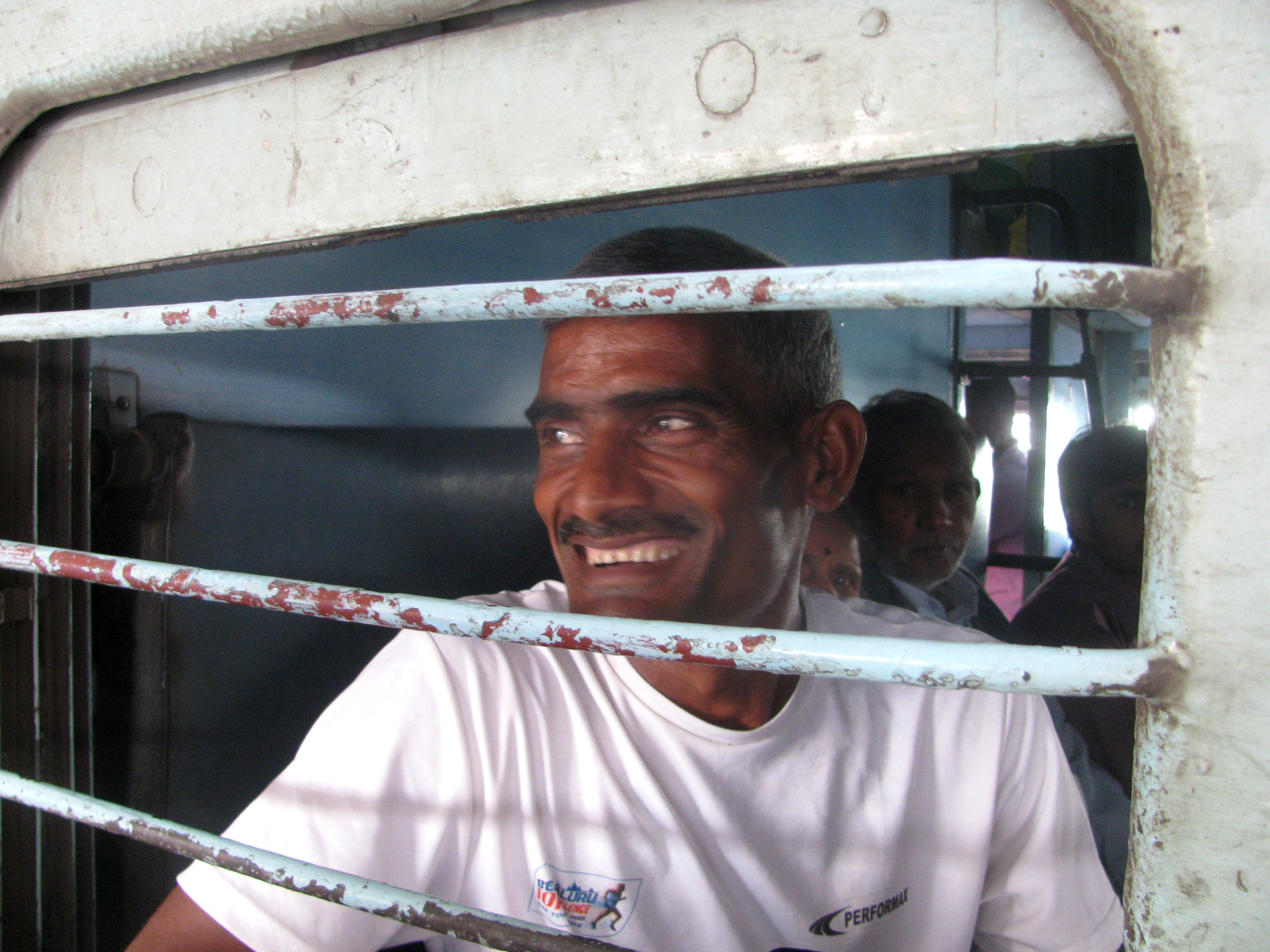
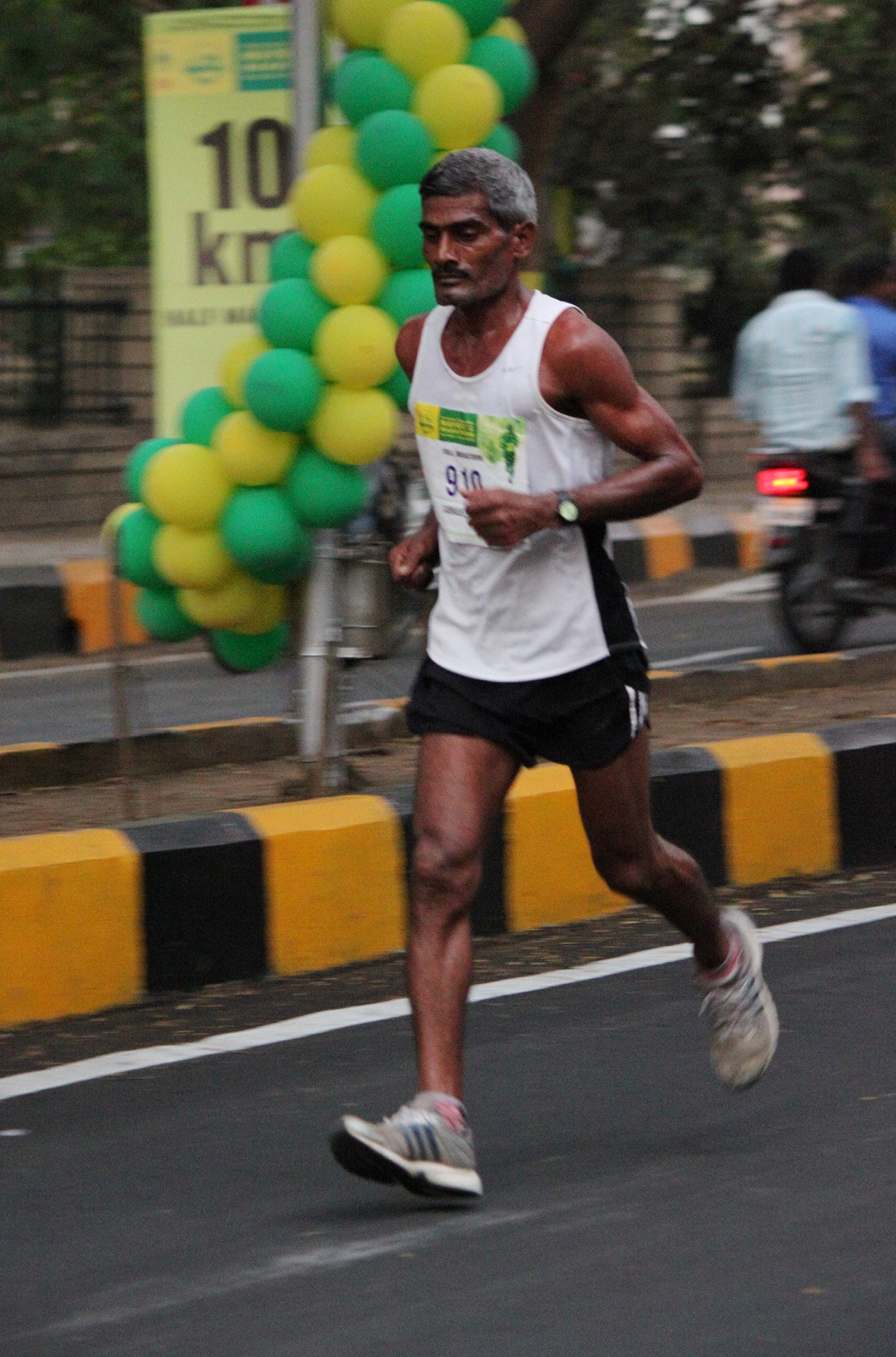
Sabhajeet Yadav (Photo: Shyam G Menon)

Sabhajeet Yadav (Photo: Shyam G Menon)

On the evening of January 15th, a person of medium height, athletic build and younger in appearance than his 60 years on the planet, got off a long distance train at Mumbai’s Kurla Terminus.

Hailing from a village in eastern Uttar Pradesh, he spent the night with village brethren staying in Sakinaka, a north Mumbai suburb. Next morning he made his way to South Mumbai where he collected his bib for the 2016 Standard Chartered Mumbai Marathon (SCMM). The following morning – early morning to be precise – SCMM’s full marathon was scheduled to commence from Azad Maidan near South Mumbai’s CST railway station. He had a title to defend and zero appetite for any potential vagaries in transport, should he attempt reaching the marathon venue from Sakinaka in the early hours of 17th. He asked around at the bib collection centre if there was some means to stay overnight at the venue or be accommodated close by. He was told there were no such arrangements for his category of runner. He returned to Sakinaka, picked up what he required and by evening, arrived at CST.

Sabhajeet Yadav then did what he had done before on some of his visits to Mumbai for SCMM – he slept at the railway station. On the night of 16th, as he spread out a bed sheet on the station floor he wasn’t the only runner doing so at CST. “ There were others,’’ he said. Most of them were like Sabhajeet, outstation runners finding hotel rooms an expensive proposition. Unlike those attempting sleep on its premises, a busy railway station never goes to sleep. “ I barely managed to sleep an hour. You are disturbed by people moving here and there. The police also kept waking us up,’’ he said. Early morning on the 17th, it was from CST that Sabhajeet reported for the SCMM full marathon. Three hours, 22 minutes and 30 seconds after he started his full marathon run, the farmer from Dabhiya finished first in his age category for a fifth time at SCMM (for more on Sabhajeet please click on this link: https://shyamgopan.wordpress.com/2015/11/28/a-farmers-dream/). He didn’t know right then that he had won. That was told him later in the afternoon by Bhasker Desai, the Mumbai-based businessman and runner who has helped Sabhajeet with event selection, registration and other details, for some years now.

Morning of January 19th; we were back at the cafeteria in Kurla Terminus. Sabhajeet’s return ticket on the Chhapra Express wasn’t confirmed yet and there were those passenger lists to check on the platform. But a chat on running couldn’t wait. Three cups of tea and a small snack quickly had, marked the minutes ticking by. “ This time the run went off smoothly. It was a very good run. I did not feel the distance at all. Only thing is I have been running a lot in the last few months. Perhaps if I had rested some more in between, my timing would have been better,’’ Sabhajeet said. As yet, his personal best was 3:15:38 at the 2014 Bengaluru (Bangalore) Marathon. All the same he was on the lookout for a couple of more races to run before the running calendar tapers off into the dead heat of the Indian summer. Then there was this brochure he was curious about – the Endurathon 54, due in February in Dadra & Nager Haveli. Sabhajeet had never run beyond a full marathon distance and 54 km was outside the marathon limit but not terribly so. It was eating his curiosity.

With a train to catch and a ticket to confirm before that, conversation had to be kept short. He rushed off to the platform while we rushed off for platform tickets. Minutes later, he phoned, “ S1, seat number 41.’’ It was a window seat; we found him there, in a crowded train with four people seated on most of the lower berths. “ I told the ticket examiner that I had come to Mumbai to run the marathon. He immediately marked me this seat,’’ Sabhajeet said. Some more conversation and then we took leave; until next time.

(The authors, Latha Venkatraman and Shyam G Menon, are independent journalists based in Mumbai.)    

KAMLYA RUNS HIS FIRST SCMM AND GETS A FIRST

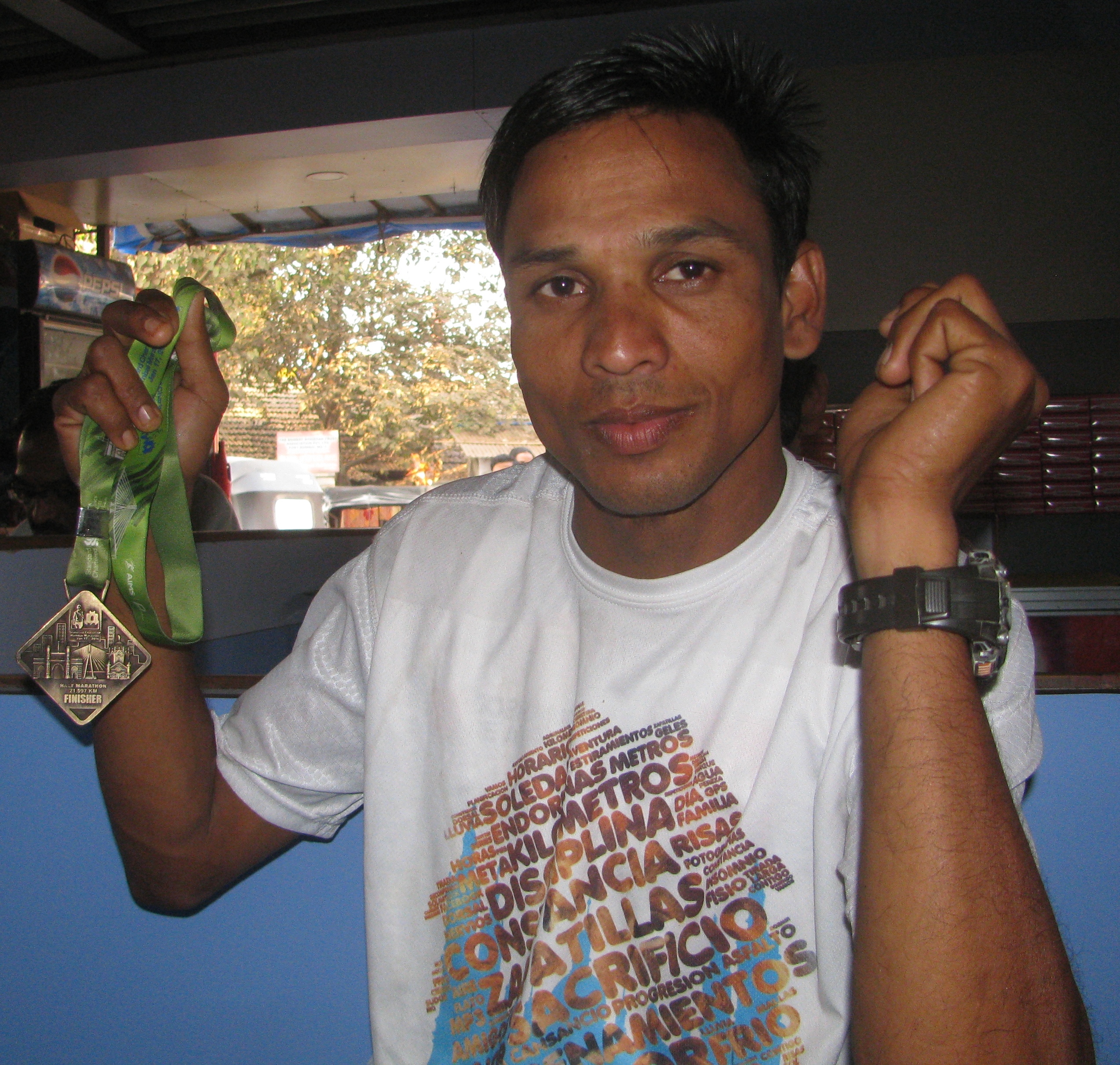
Kamlya Joma Bhagat , January 18. 2016 (Photo: Shyam G Menon)

Kamlya Joma Bhagat (Photo: Shyam G Menon)

On the road opposite the bus depot in Panvel is a small restaurant called Visava.

During weekends, it is a well known meeting place for hikers headed to the nearby hills; a round of tea and snacks here is routine before boarding a bus to the drop off point for a hike. It was the day after the 2016 Mumbai Marathon aka Standard Chartered Mumbai Marathon (SCMM). We were in Visava, tucking into hot misal paav, discussing a piece of news that the staff and students of Namdev Bua Khutarikar Vidyalaya, a school in Taloja, were yet to know. For that matter, except runners in Panvel, nobody around probably knew what the school’s PT teacher had achieved the day before.

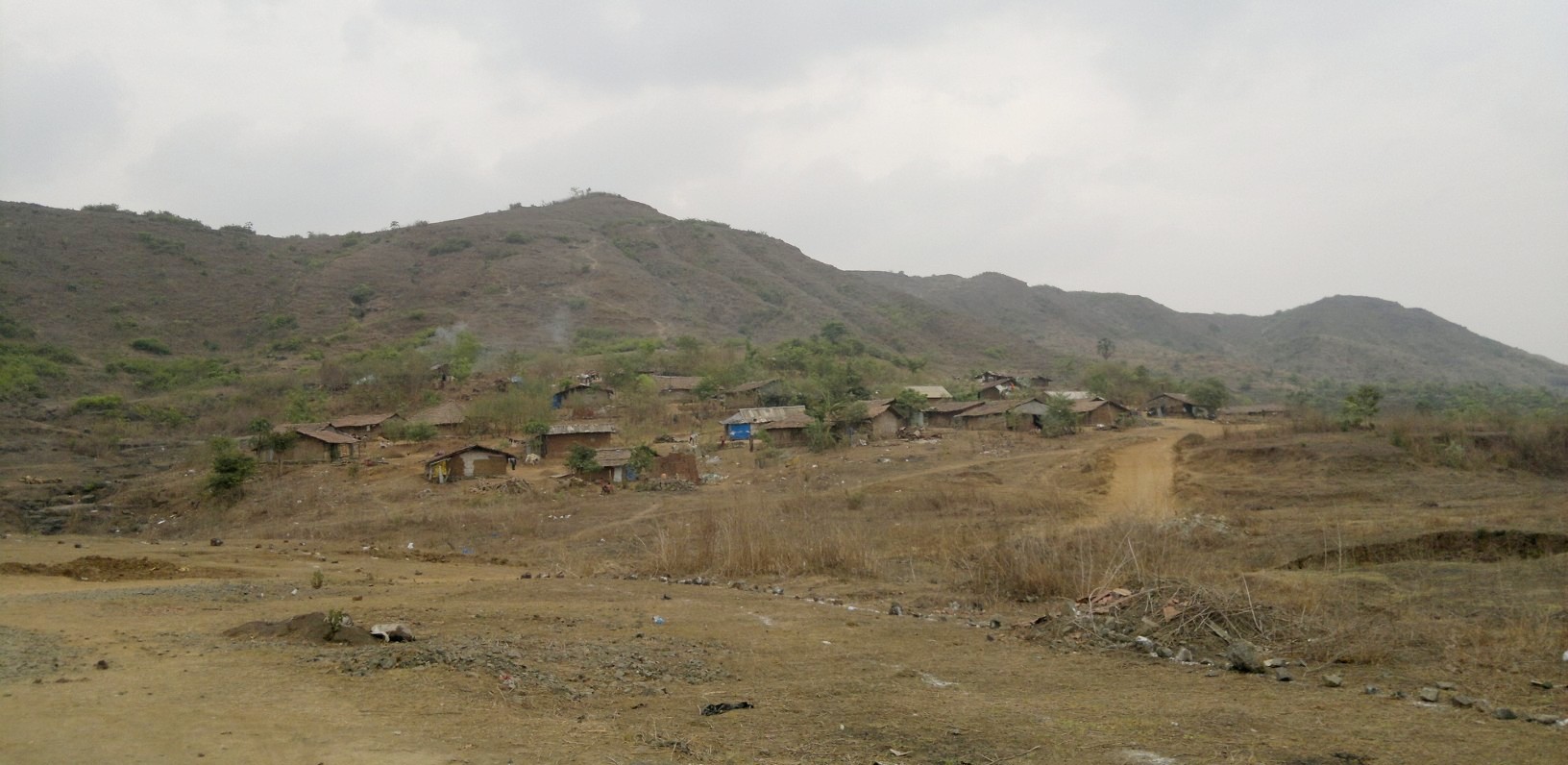
On Sunday, thanks to fellow runners who enrolled him for the event, Kamlya Joma Bhagat had run his first half marathon at SCMM. Not only had he not run at the event previously – SCMM is India’s biggest marathon and it’s richest in terms of prize money – he had also not seen it as a spectator. Panvel is slightly less than 50 km from South Mumbai, where much of the SCMM action is. Hailing from poor circumstances, Kamlya lived in Fanaswadi, a small village some distance from Panvel. His house when we visited him in the summer of 2015, was little better than a hut, composed of one room and a sit-out. Life had been tough. He ran despite the struggle and often, to address it, for races have prize money. Although 50 km is not a great distance, SCMM was peripheral to Kamlya’s predicament. Running is universal. But running events are typically in cities. Events are accessible for a registration fee; then there is the cost entailed in physically accessing the venue, staying in distant towns and cities. Most runners take this expense for granted. These days urban India has money. People regularly travel around running at various events. But what if – urban or rural – you don’t have that kind of money? “ This was my first time at SCMM. Others got me registered to run at the event, so I went,’’ Kamlya said of the 2016 edition (for more on Kamlya please see https://shyamgopan.wordpress.com/2015/06/12/half-or-full-thats-the-question/). From time to time, he has been supported by fellow runners; names mentioned in this regard included Chetan Gusani, Bijay Nair, Philip Earis and Dnyaneshwar Tidke.

Having been a runner since his high school and college days and having participated in some races, Kamlya knew that on a good day he could finish in the top 20 lot at an event. In fact, a couple of months earlier at the Bengaluru (Bangalore) Marathon, he had finished fifth in his age category in the half marathon. A regular runner averaging anywhere between 5-15km on his daily practice runs, Kamlya can run a half marathon at short notice. According to him, he is by nature a runner who is comfortable at speed; he has to consciously remind himself to run slowly when training. And because that is a conscious reminder, the moment he forgets it and drifts to comfort zone, he finds himself moving fast. That’s how Kamlya became a half marathon specialist. He wants to try running and finishing the full marathon. But not yet. He does not want focus on the full harming his ability in the half. Kamlya didn’t train specifically for the SCMM. There was nothing like months and weeks of preparation. “ With the SCMM in mind, I trained for two weeks, that’s all. Of that, during the second week, I trained only three days. The remaining days I rested,’’ he said.

Fanaswadi, June 2015 (Photo: Latha Venkatraman)

Fanaswadi (Photo: Latha Venkatraman)

On January 17, 2016, he left his house in Fanaswadi at 1 AM to reach Panvel and travel with other runners from there to Worli in central Mumbai, the starting point of the half marathon. Worli is close to the sea. Commencing there, the half marathon route goes over the Worli Sea Link – a beautiful bridge across a stretch of sea with SCMM being the only time of the year runners get to be on it – toward South Mumbai and the iconic CST Railway Terminus, near which the run concludes. “ I ran the first ten kilometres very well. Then I had to slow down a bit,’’ Kamlya said. Race details for bib number 18252 show that the first 5.5 km went by in 18:25 minutes; the 10.5 km mark was touched in 36:26 with an average speed of 17.3 kmph.

Grounded by injury and second time unlucky at running my first SCMM, I was walking toward Marine Drive early Sunday morning, when the first of the half marathon runners whizzed past near Ambassador Hotel. I took a couple of photos of the runners and then gave up for the sun hadn’t risen yet and my small camera wasn’t suited for photography in dim light; its flash was also too weak to throw a strong beam that far. I remember wondering: is Kamlya running this time? There was a point therein when I thought I saw him go by. Then I said: not sure if that is him. Kamlya said he concluded his race with a strong feeling that he had probably lived up to what he expected – a finish in the top 20. He left South Mumbai thinking so, no more, no less. Later that evening in Panvel, his friends broke the news: he had topped his age category (30-35 years) in the half marathon at SCMM with a finishing time (chip time) of 1:16:56. Event results show that he was first in his age category and 14th in a half marathon field of 11,805 finishers; 14th again among 9782 male finishers.

Kamlya said he is reluctant to talk about his milestones in running. For this reason, as of Monday, his colleagues and students at the school hadn’t been informed of what their PT teacher accomplished. “ I haven’t told them. I don’t like talking of these things myself. If others who appreciate running notice it and talk about it, that’s different, ’’ he said. “ Have you seen the earlier article we wrote about you?’’ I asked Kamlya. “ No, ’’ he said, “ I have no Internet.’’

 (The author, Shyam G Menon, is a freelance journalist based in Mumbai. This article has inputs from Latha Venkatraman.)

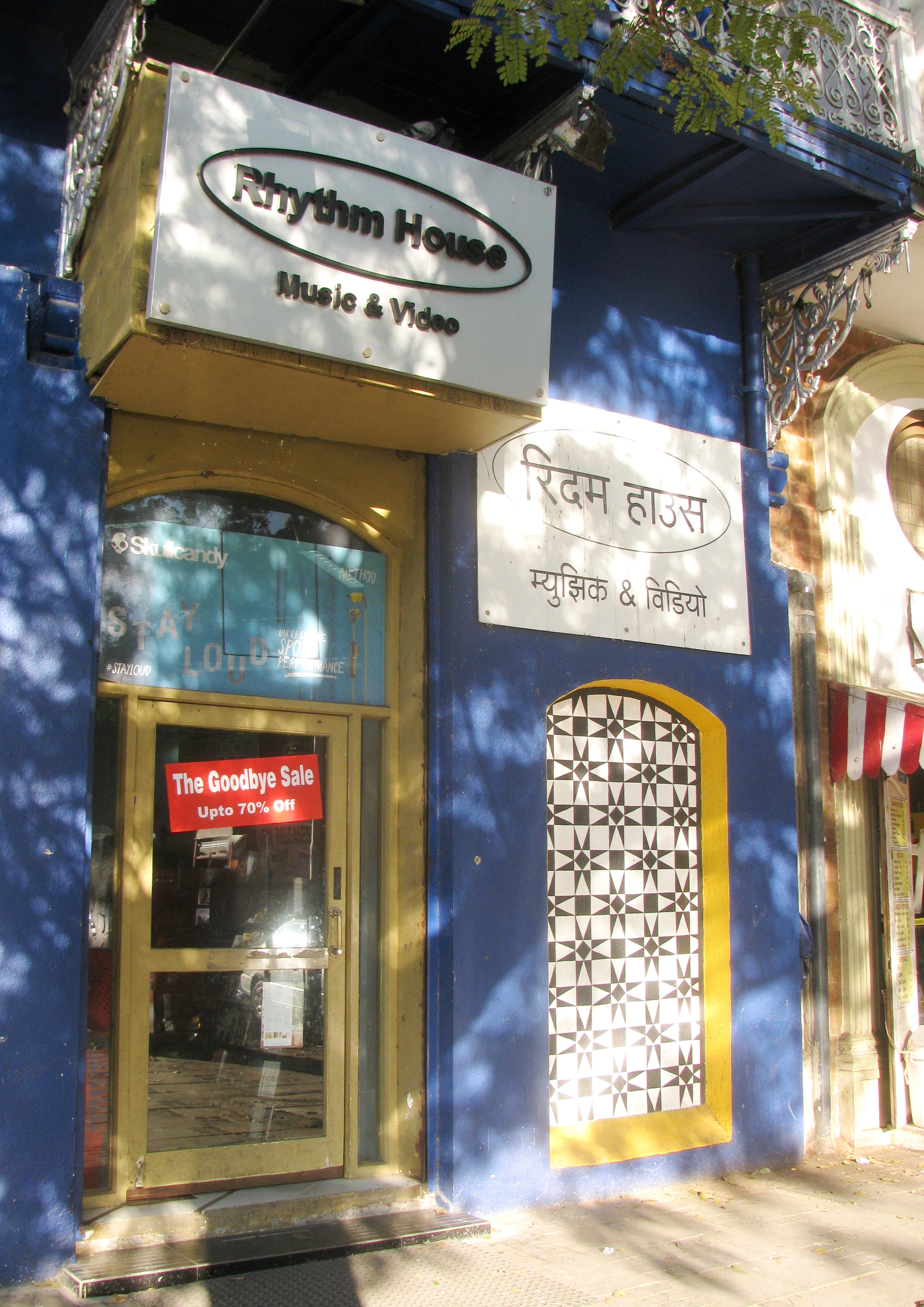
RHYTHM HOUSE DECIDES TO SHUT SHOP

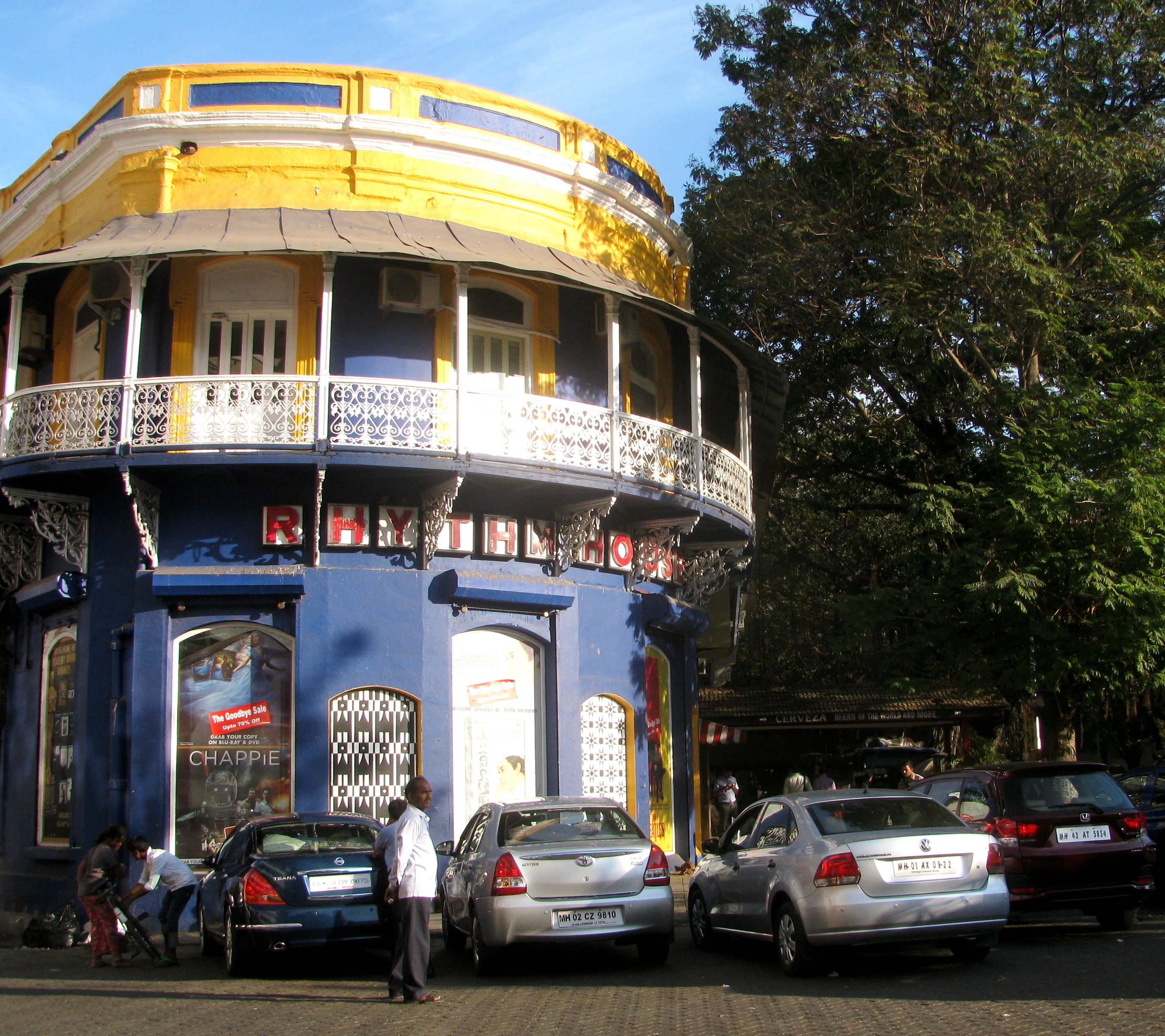
Rhythm House at Kala Ghoda, Mumbai (Photo: Shyam G Menon)

Rhythm House at Kala Ghoda, Mumbai (Photo: Shyam G Menon)

For many years, I worked in South Mumbai, close to Churchgate.

Sometimes too much typing on the computer got to me and I would step out of the newspaper office for diversion.

If I cut across the nearby Oval Maidan and its myriad cricket matches, then fifteen minutes walk away, was Rhythm House. It was a shop in an old building at Kala Ghoda, now the city’s art district thanks to the adjacent Jehangir Art Gallery, the pavement artists, the surrounding heritage architecture and an annual festival in the area with roads closed to traffic and open to arts and crafts. Compared to other shops selling music that arrived and closed during its time, Rhythm House was small. But it was packed with music and movie titles in the physical format. What you couldn’t find on the shelves, you ordered at the desk. I would spend some time here browsing through the collection, clear my head and return to work.

One day, I wrote about Rhythm House. The new century had arrived. Businesses overseas had witnessed massive change through Internet and digitization. The world of book shops for instance, was besieged by question marks. As book shops struggled, I wondered what was happening at Rhythm House. Hence that old story written and published in the newspaper I worked for. It failed to capture well the shop and its predicament. Maybe I hadn’t known Rhythm House long enough to tell a story. I acted in haste. But I remember the owners being concerned of what lay ahead in the fast changing market. Still, if there was anything challenging Rhythm House, it wasn’t visibly alarming for the shop was well stocked and it had customers. During festive season, the traffic built up. Besides, sales or no sales, everyone knew Rhythm House. It was a Mumbai institution.

At Rhythm House you met connoisseurs of music. Once in a while as I hung around the racks hosting music relevant to me, I would hear a customer or two ask the salesmen about specific albums or concert recordings. The salesmen would in turn indulge them in talk about the elusive recently sourced or, which can be sourced. The minor details bringing joy to collectors of music are fascinating. It is portrait by passion. You don’t sense these folks as palpably in cyberspace even though the digital side of everything is marketed as bigger meeting place. In the real world and its shops, you meet people in full and a person in full is person believable. I wrote that article on Rhythm House well over ten years ago. I subsequently became freelance journalist and in my less moneyed avatar, continued to visit Rhythm House but rarely purchased. I found relief just being there amid the music and films although I must admit, not being able to afford was progressively becoming a dampener.

Rhythm House; red board announcing Goodbye Sale (Photo: Shyam G Menon)

Rhythm House; red board announcing Goodbye Sale (Photo: Shyam G Menon)

January 1, 2016. Having decided that a multiplex ticket costing Rs 400-500 to see the latest Star Wars movie wasn’t worth the strain on one’s purse, my friend Latha and I decided to go for a walk instead. Decades ago, I had watched the first Star Wars movie at a theatre in Thiruvananthapuram and returned home a fan of Han Solo. I watched the first trilogy. Then I watched Harrison Ford in all those Indiana Jones movies. Those days you could afford visiting the theatre. Now the question isn’t whether you are interested in cinema but whether you can afford multiplexes. I was a fan of Star Wars quitting at a choke point in the system called costly multiplexes. Our evening walk brought us to Kala Ghoda and the Jehangir Art Gallery, which we wished to visit. I think when you age you realize you are a traveller in the universe and therefore entitled to perspective. You find it in art, that’s why the occasional visit to the art gallery engages. As we left the art gallery, we noticed Rhythm House, distinctly less celebratory in appearance despite the festive season. When we drew closer, we saw the red board on its door: Goodbye Sale. I was shocked. Powered by discounts, the innards of the shop had been cleared out in parts. Latha picked up a rare recording of a Hindustani classical vocalist. Bill paid we got out but couldn’t leave. An institution was shutting down. We had no proper camera. So in the dim light, Latha took a photograph of the shop on her cell phone.

Unknown to me, Rhythm House’s closure had been in the media since November 2015. The articles featured musicians, music lovers, music critics, authors and other residents of the city who shared their memories of the iconic establishment. A visit to the shop’s website showed a message. Excerpts: We are the last of our city’s large format music & video stores to yield to the challenges posed by new technologies and piracy. We are set to close for business end of February 2016. We have been in the music business since 1948 and in the video business over the past 30 years or so and closing down is therefore going to be an emotional wrench for us. Many of you have echoed similar sentiments and we thank you for being with us at this difficult time.

I returned the next day to click the photos accompanying this story.

Mumbai’s art district and its music scene won’t be the same without Rhythm House.

(The author, Shyam G Menon, is a freelance journalist based in Mumbai.)

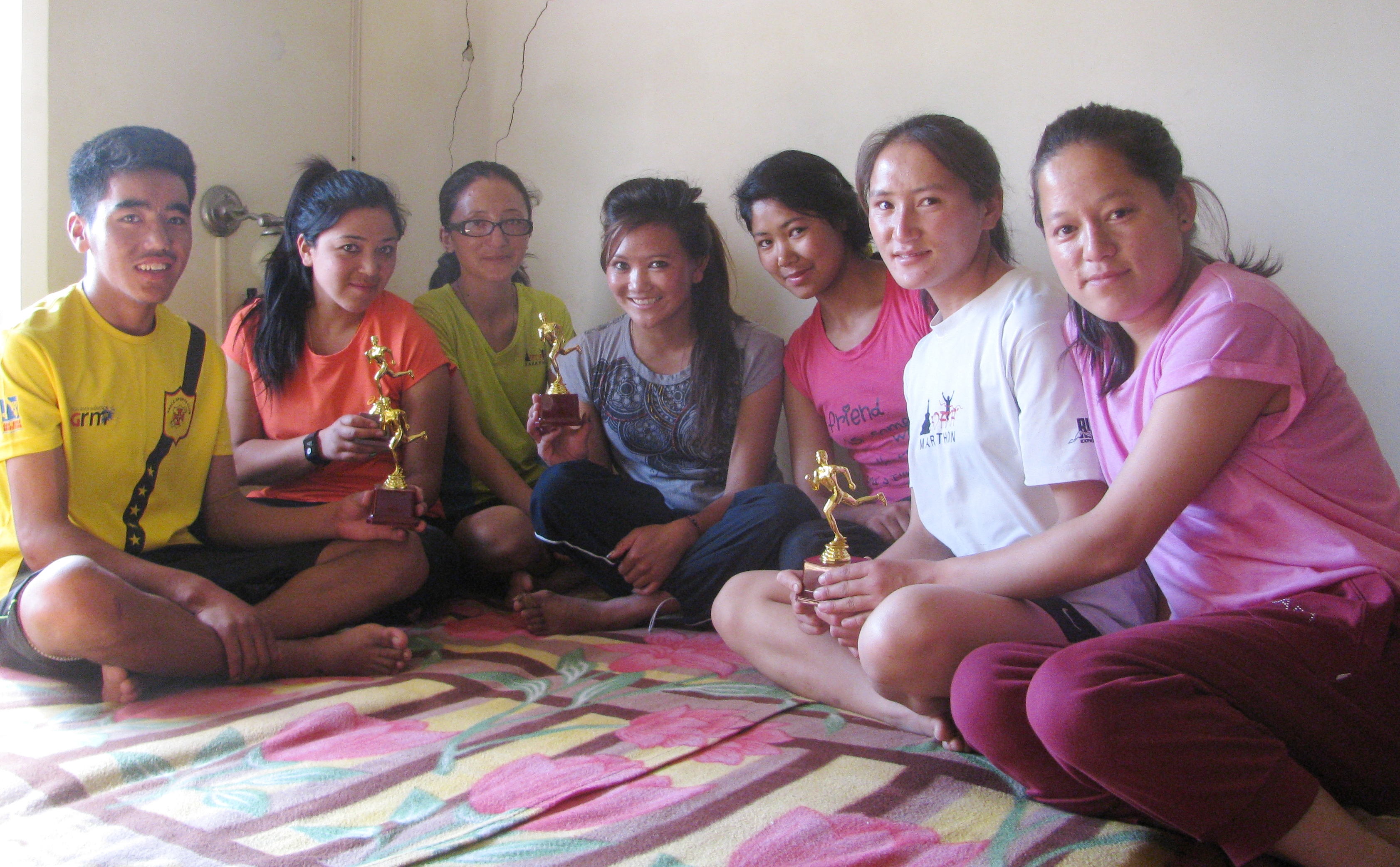
SUNSHINE RUNNING

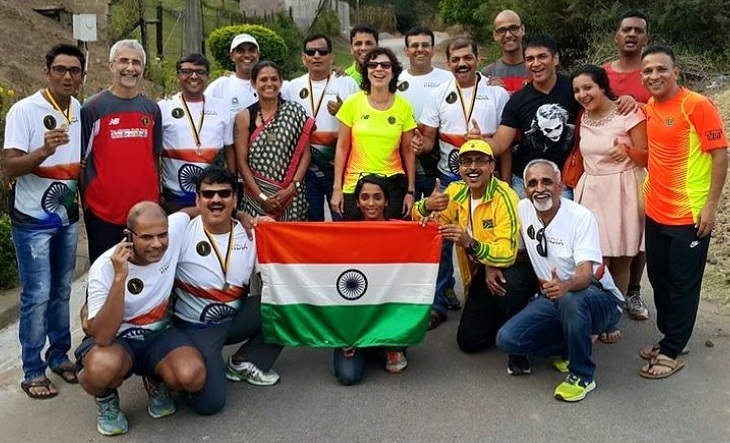
Some of the runners from Ladakh with the trophies they won at the Goa River Marathon (Photo: Shyam G Menon)

Some of the runners from Ladakh with the trophies the team won at the Goa River Marathon (Photo: Shyam G Menon)

It was Christmas day.

Not far from Mumbai’s CST railway terminus, traders selling woollen garments did brisk business. They have a temperamental December to thank. According to newspapers, on December 23, 2015, Mumbai recorded its second lowest temperature since December 1949; 11.6 degrees Celsius. The faint chill saw residents bring out their shawls and jackets.

“ Early mornings and evenings in Mumbai are now pleasant to run,’’ Skalzang Lhundup said. We were in a nearby apartment, where a team of young runners from Ladakh, in the city to train and get ready for the 2016 Standard Chartered Mumbai Marathon (SCMM), stayed. Skalzang was their manager. The whole team comprised seven civilian runners and 11 personnel of the Indian Army’s Ladakh Scouts regiment. The army runners were camped in Pune, where the military has its facilities, including training facilities for athletes. They were expected in Mumbai by early January.

On December 6th, when the civilian component of the team left Leh for Delhi en route to the marathons of the plains, Ladakh’s winter temperature was already sub-zero, nudging minus ten at its lows. Peak winter was yet to come. Following the September 2015 edition of the annual Ladakh Marathon, the civilians in the team – the 18 member contingent includes category toppers from the Ladakh Marathon and the Khardung La Challenge ultra marathon held alongside it – hadn’t had much time to train for SCMM or any other events in the plains. Two things intervened. First, winter break was approaching with school exams ahead of that. Some of the young runners still tackling their twelfth standard can’t overlook exams. Second, as winter took hold, training outdoors became a challenge. While the army runners have their own training regimen, from among the civilians, only the very determined may have managed to squeeze in a few practice runs outdoors, Skalzang said.

Every year since the 2013 Ladakh Marathon, its organizer Rimo Expeditions, has brought the winners of each edition to Mumbai to attempt the SCMM. The Mumbai marathon is India’s biggest and the richest in terms of prize money. On the previous two occasions, the team stayed at Bandra in suburban Mumbai. “ Our current location near CST is more practical,’’ Skalzang said. Early morning, the team walks to Nariman Point in South Mumbai, where the NCPA end of Marine Drive’s promenade is a popular assembling point for runners. In Mumbai the Ladakh team trains with Savio D’Souza, who is among the city’s well known coaches. He was in Leh earlier this year to train promising local runners ahead of the last Ladakh Marathon. Typically Ladakh’s team of runners travels to Mumbai, participates in the SCMM and returns to Ladakh. The 2015 trip is the first time the team has travelled out from Ladakh for what may hopefully be a brief season of running a few marathons in the plains; not just SCMM. If all goes well, they plan to be running in the plains, warm compared to Ladakh, till end-February, Skalzang said.

The team has already finished competing at its first event of the season.

On December 6th, the group had flown from Leh to Delhi and proceeded immediately by train to Mumbai and then onward to Goa for the annual Goa River Marathon (GRM). Arriving from high altitude to a sea level-location with not much training done to boot, they spent a couple of days running on Goa’s beaches. The heat and humidity of a December by the sea, was tough to cope with. “ Especially the humidity,’’ Skalzang said. On December 13, four days after they reached Goa, the race took place. The Ladakhi runners ended up with six podium finishes. The podium finishers in their respective categories were Jigmet Dolma (women full marathon / open / age: 18 plus, second, 3:59:02), Tsetan Dolkar (women full marathon / open / age: 18 plus, third, 4:05:42), Sonam Chuskit (women full marathon / Indian participant category / age: 18 plus, first, 5:01:10), Stanzin Norbu (men full marathon /  Indian participant category / age: 18 plus, second, 3:12:20 ), Tsering Dolkar (women half marathon / Indian participant category / age: 18 plus, second, 1:52:15) and Diskit Dolma (women half marathon / Indian participant category / age: 18 plus, third, 1:52:17). Stanzin Norbu is from Ladakh Scouts.

Skalzang said the youngsters in the team had instructions not to ignore their studies; a couple of them had exams to give on return to Leh. Amid training for the SCMM, the morning and evening practice runs and managing their temporary accommodation in the apartment (it is self supported life; the youngsters cook their food themselves), they find time for studies. They hailed from villages, near and far from Leh; villages like Igoo, Lamayuru, Saspol, Nether in Changthang, Lingshed, Pishu in Zanskar and Tamachik. A bigger event with many more participants, the competition at SCMM will be tougher than at GRM. Both Jigmet Dolma and Tsetan Dolkar said that they have slowly got used to Mumbai’s weather. According to Skalzang, Savio is exploring other events the runners can be at after SCMM, before they return home to Ladakh.

(The author, Shyam G Menon, is a freelance journalist based in Mumbai. Runners’ timings at the 2015 Goa River Marathon have been taken from the event’s official website. For more on the Ladakh Marathon and Ladakh’s running team please see, https://shyamgopan.wordpress.com/2015/08/07/ladakhs-running-team/)

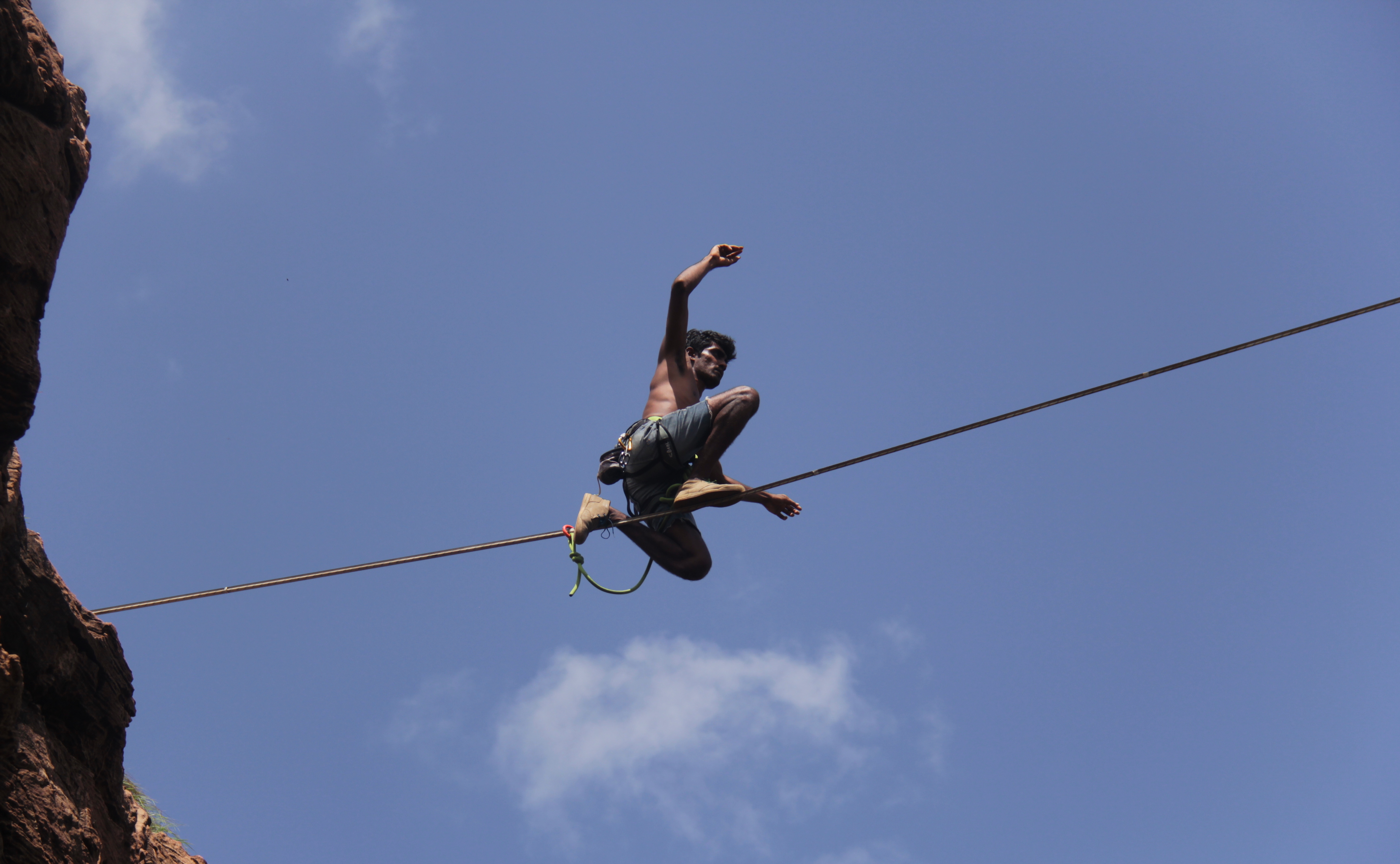
LIFE ON A LINE

Samar highlining in Badami (Photo: courtesy Samar Farooqui)

Samar highlining in Badami (Photo: courtesy Samar Farooqui)

Samar Farooqui was the last speaker at a recent conclave of experiential educators on the outskirts of Mumbai.

He had a Power Point presentation.

That soon slid to forgotten backdrop as Samar’s demeanour, moulded by slackline, took over.

Like the line – at times still, at times swaying and bouncing to provide momentum for a gymnastic trick – his talk was honest and focused, yet delightfully spontaneous.

Samar’s talk was capped at conclave’s end by a demonstration of his craft.

A day after the conclave, I called him up for an appointment to meet.

It was a chat on the move, beginning at Stadium Restaurant in Mumbai’s Churchgate and concluding on a segment of Marine Drive marked by two trees with a story to tell.

Born 1990 in Mumbai and brought up in the city, Samar grew up with affinity for sports and the outdoors. Staying at Haji Ali, as a child he used to go for morning jogs at the nearby Race Course. By the time he was in the sixth standard, he became the youngest participant in a 3000m race that year at his school. He was also active in cricket and football. His mother, a teacher who was active in the National Cadet Corps (NCC), introduced him to outdoor camps. When he was in the eleventh grade, Samar got to work at a camp run by a city-based outdoor company. “ It was the first time I got paid for such work. It wasn’t something I expected. It just happened. But it made me think, going ahead why not this for livelihood?’’ Samar said. He kept working for the company – Outbound Adventures, managed by Andre Morris. Through Andre, he met Jehan Driver and worked for Jehan’s company, Quest Adventures. Somewhere in the middle of all this, he finished his twelfth and joined college to graduate in mass media (BMM). He did not come across as very attached to classrooms and college; it wasn’t uncommon for Samar to bunk classes and take off on a hike or climb.
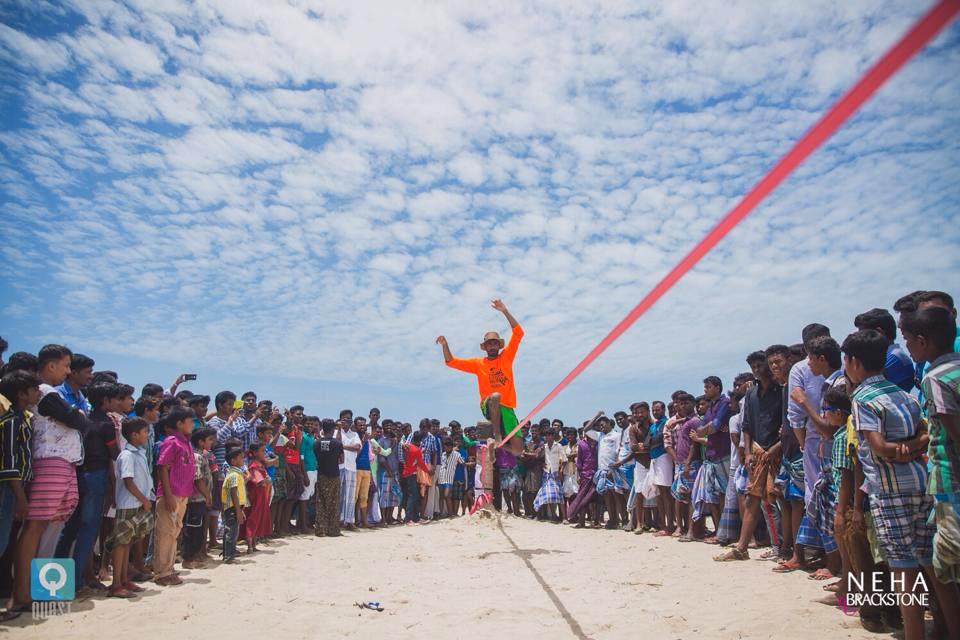
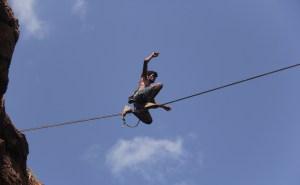
Samar slacklining in Rameshwaram (Photo: courtesy Samar Farooqui)

Samar slacklining in Rameshwaram (Photo: courtesy Samar Farooqui)

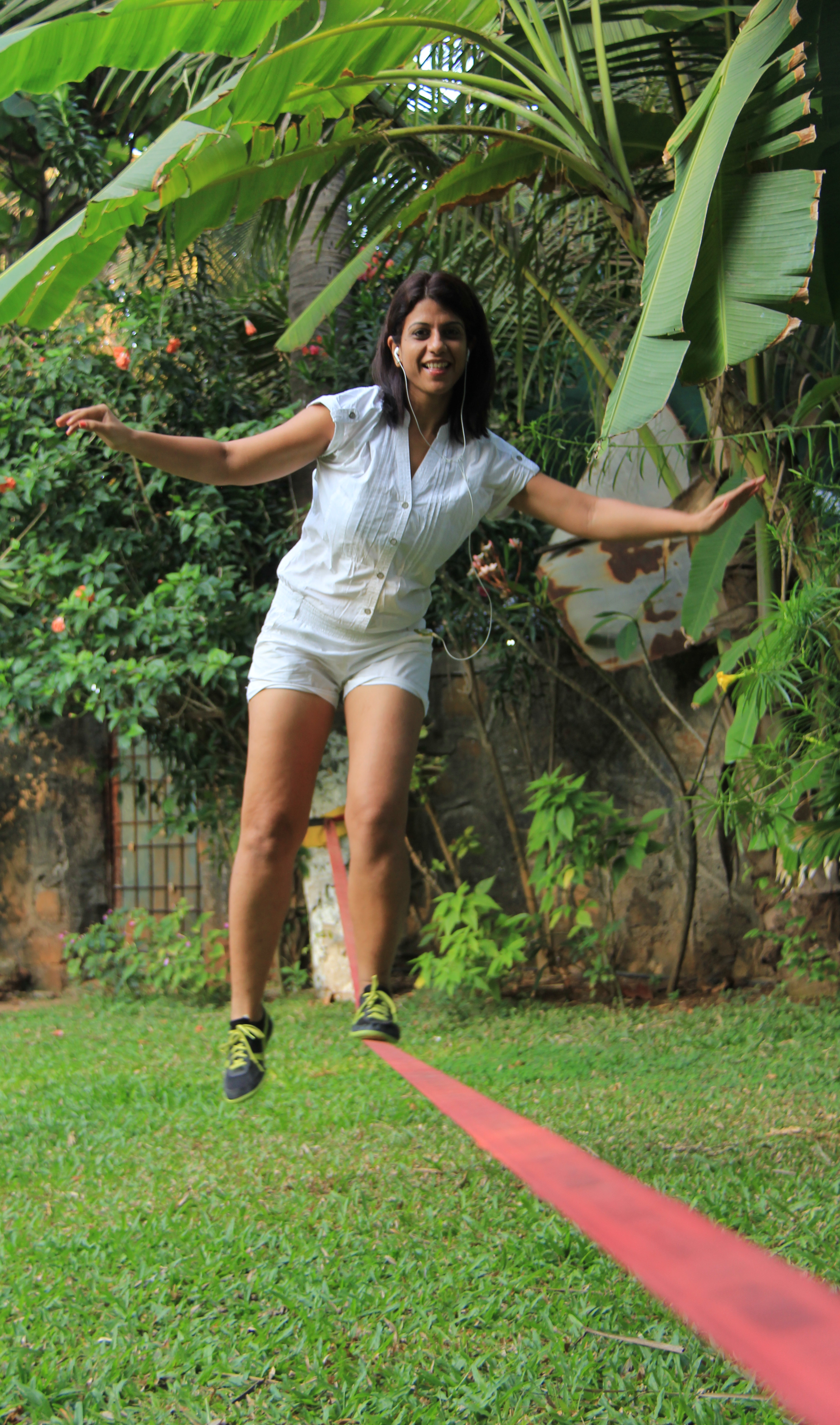
At Quest Adventures, Samar’s responsibilities included guiding inbound tourists on their exploration of India. In February 2010, his clients were two ladies from New Zealand. Ahead of this trip and as part of preparations, Jehan and Samar visited AVI Industries, the shop retailing outdoor gear in Matunga. There they were shown a slackline. Not knowing the sport at all, they still bought it for the core idea appeared very simple – a length of suitably designed webbing (unlike a rope, webbing is flat), which can be appropriately tightened and tuned to required tension between two points, usually two trees. Critically, the webbing used is dynamic, in other words – it stretches like an elastic band, providing the person on top the ability to generate adequate momentum for performing tricks. Once installed, you balance on the slackline, walk on it as in a tight rope act; you also do tricks on it as you get better. For safety, depending on the height and what he is doing, the slackliner stays attached to the line with a leash, one end of which is tied into his harness. If he falls at height, he does not get detached from the line. At Kashid beach, about 130 km from Mumbai, Samar, Jehan and the clients from New Zealand tried out the line. Samar was hooked. But it would be sometime before he devoted himself to the sport.  Although he had enrolled to study media management in college, a new idea gnawed at Samar.

Internet searches for alternatives in education had introduced him to adventure tourism studies in New Zealand. It was tough convincing his parents, who were justifiably concerned of Samar’s atypical choices. A close cousin worked on them; they soon came around. Funds were a problem but his family helped. In July 2010, he reached Queenstown in New Zealand’s South Island via Auckland. The flight from Mumbai transplanted Samar within hours from South Asia’s monsoon humidity to South Island’s cold. It was his first trip overseas. He presented himself at Queenstown Resort College for the 18 month-diploma course.
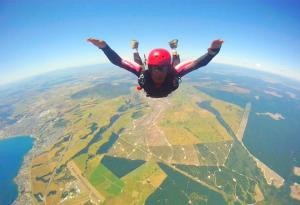
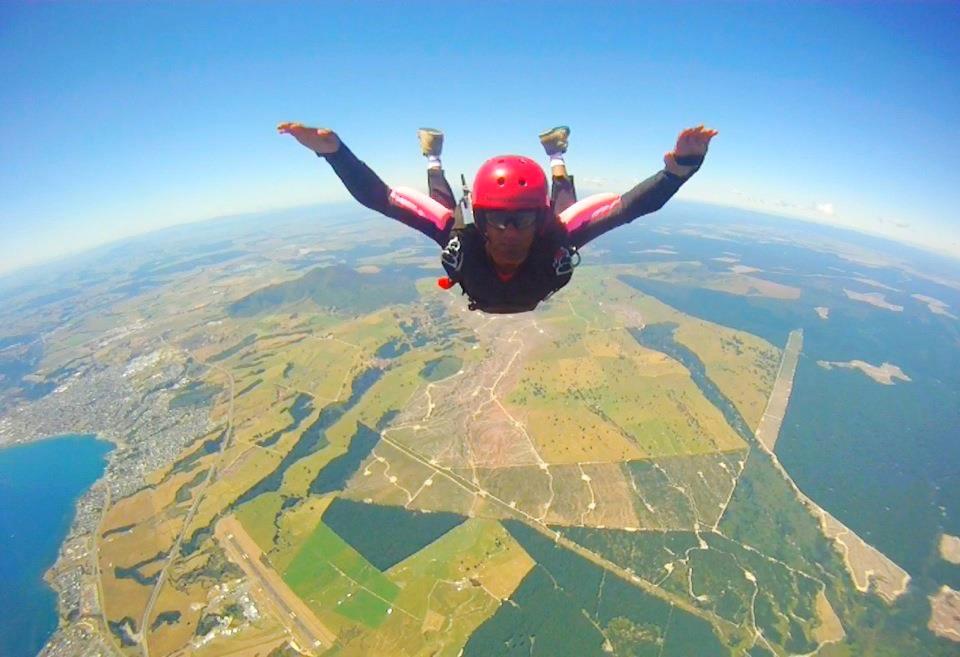
Samar skydiving in New Zealand (Photo: courtesy Samar Farooqui)

Samar skydiving in New Zealand (Photo: courtesy Samar Farooqui)

NZone Skydiving, one of the biggest operators in skydiving in New Zealand, had its office in Queenstown. Samar was enamoured by sky diving. Although the first six months at the college were devoted to theory, he started visiting NZone and connecting with them. “ I was ready to do anything to be around skydiving,’’ Samar said. In the second tranche of six months, his college directed him to a bungee jumping facility for internship. But he was set on skydiving and luckily, his passion and persistence from the preceding six months paid off – he secured an internship at NZone. But he had to settle for a compromise. The drop zone is where all skydiving action is. Samar secured the interview for work at the drop zone without his college involved in the frame. Result – he was placed on the shop floor, not at the drop zone he yearned to be at. Still, Samar benefited from the experience. One thing he learnt was the Kiwi style of presenting adventure to clients; you don’t conceal danger, you state it. “ That way the customer learns to be at peace with reality,’’ Samar said.

The last six months of his course were spent in reviews back in the classroom. Two days after he gave his exams, Samar was hired as Site Operations Manager by Magic Memories. He was located at Agrodome in Rotorua, North Island, which offered visitors an experience of farming in New Zealand. His job revolved around photos that tourists could take back with them. The job also saw him posted at the Waitomo Glowworm Caves, roughly 140km from Rotorua. He used his time on North Island to further his interest in skydiving. He dived with Taupo Tandem Skydiving, located about 82km from Rotorua and 150km from Waitomo. “ Different skydiving schools have different training methods. The deal at Taupo was that after 25 jumps you got an ` A’ licence. The first jump is a tandem jump, the ones thereafter are solo. I did about eight jumps, so I didn’t get a licence,’’ Samar said.
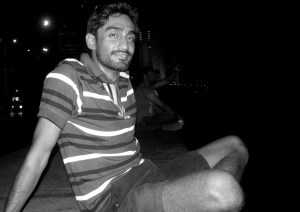
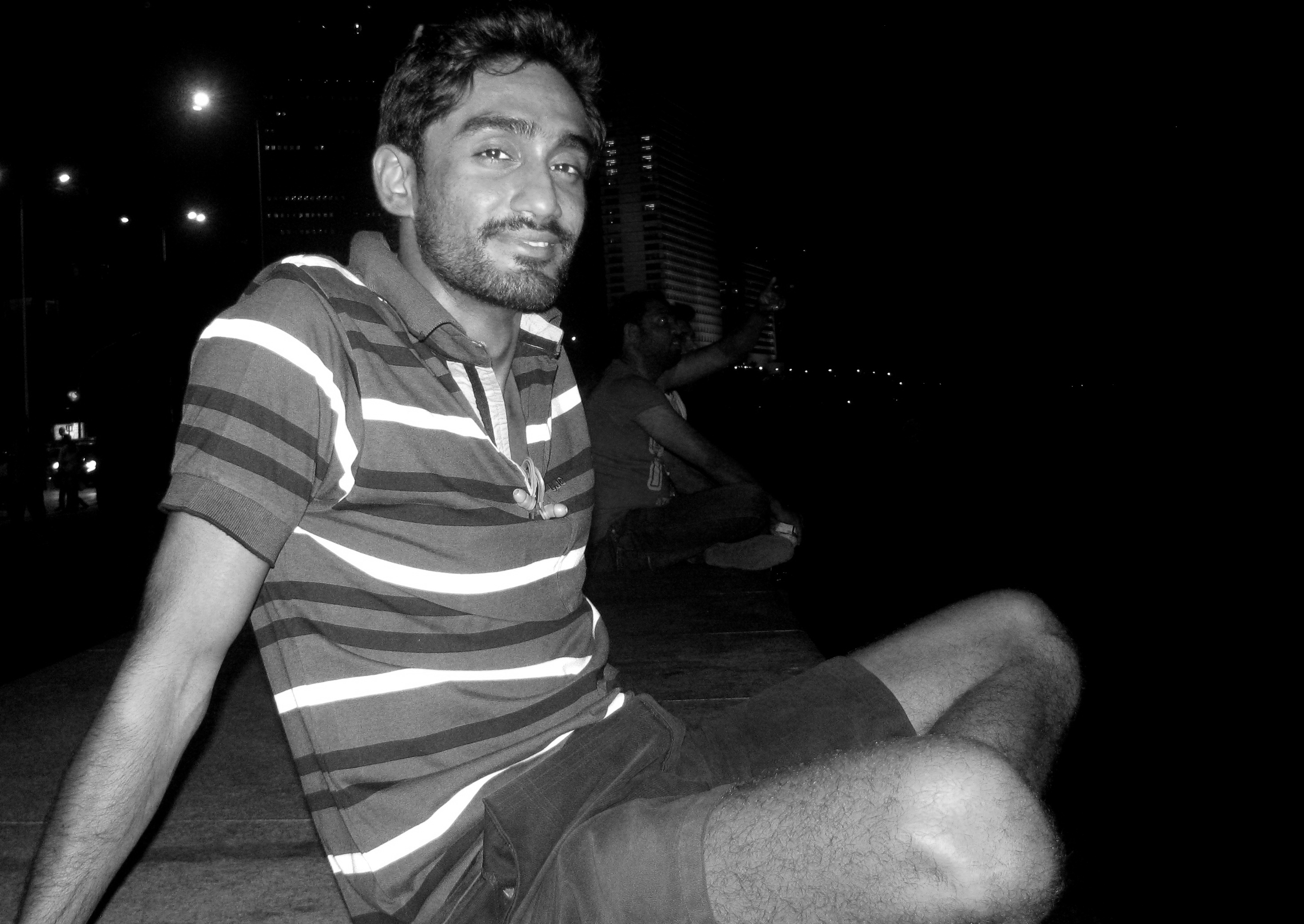
Samar Farooqui (Photo: Shyam G Menon)

Samar Farooqui (Photo: Shyam G Menon)

After Waitomo, his next major stop with Magic Memories was Milford Sound in South Island, about 290km away from Queenstown. But before Milford Sound, Samar paid a short visit to India; on this trip, he did some groundwork for popularizing slacklining. Milford Sound was an opportunity to reconnect with rock climbing. While studying in Queenstown, Samar’s close friends had been college mates Anton Westberg and Gustav Holmquist and a friend he met through them, Banjamin Lagermalm – all from Sweden, all rock climbers. It wasn’t uncommon for the quartet to bunk college and steal off on climbs. When Samar moved to Milford Sound, Anton and Gustav were also there working. In their company, Samar did his first multi-pitch rock climbs at Milford Sound. His stint with Magic Memories paid well. “ I did really well at this job, right after college this was good bragging rights,’’ Samar said. The money was useful; that’s how he had funded his skydives on North Island. The downside of his photography-job was that over time it became routine. “ I enjoyed sales and the idea of selling ice to Eskimos. But after a point in time I felt burnt out and tired of the paradigm,’’ Samar said. He didn’t feel good about that. The hope was – somehow this would all lead to more skydiving and hopefully, a job therein.  Sadly that proved tough.
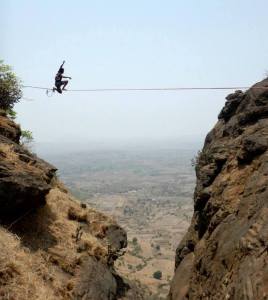
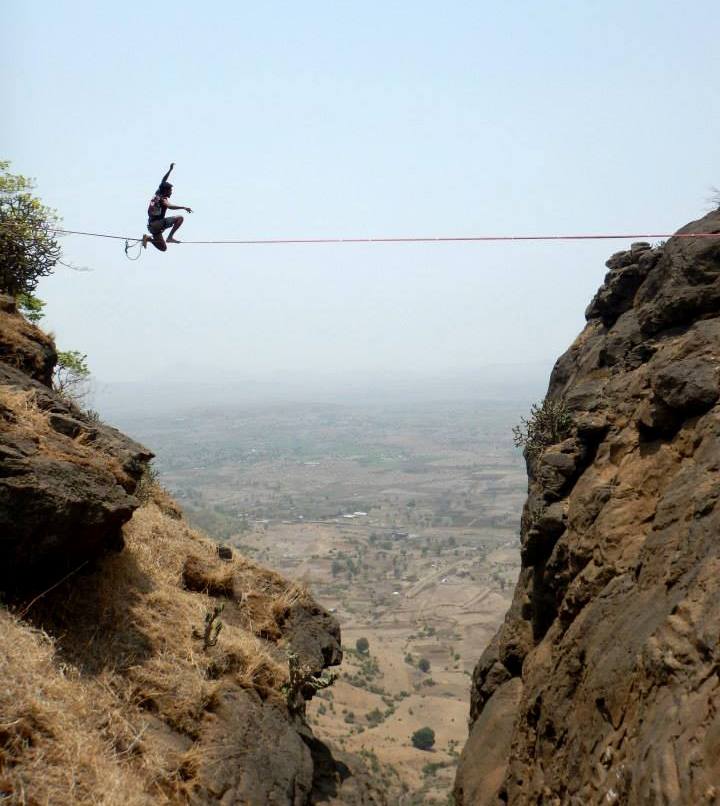
Samar highlining in Nashik (Photo: courtesy Samar Farooqui)

Samar highlining in Nashik (Photo: courtesy Samar Farooqui)

Following his stint with Magic Memories, Samar returned to Queenstown. He approached NZone and other skydiving companies. But it was the off season, job openings were limited. He was not only seeking work in skydiving, he wanted to be at the drop zone. That was a tall order. According to Samar, his final phase at Magic Memories and the futile search for vacancies in skydiving soon thereafter, was a trying period. Pleasant distraction was his constant companion – his slacklining kit. His skills on the line fetched positive comments. To recap, after that taste of slacklining on Kashid beach, Samar had continued practising. Slowly his skills developed. When he arrived in Queenstown for studies, the season was drifting toward winter; not the ideal time for slacklining outdoors. In the summer of 2011, he ran into some people slacklining on the beach. They became another community to hang out with, besides the rock climber friends from college. Free time, stolen time – it went into these pursuits. By the time he hit that post Magic Memories phase, he was a decent slackliner. To keep himself afloat, he worked at a call centre, did construction work and even worked as a bouncer. Samar calls this phase one of “ self discovery.’’ It was also a stage when he had more time on his hands. Samar started pursuing an intense slacklining routine. “ My favourite thing to do still is – plug in some music and go slacklining. I enjoy it, it channelizes my excess energy,’’ he said. Further, off late the airiness of the slackline has become a fine intermediate to two activities that fascinate Samar – skydiving and base jumping.

Queenstown was generally supportive of the small slacklining community Samar belonged to. As people realized that these youngsters were focused on growing their skills and lived a life around it, a social niche evolved. Samar and his friends began organizing meet ups for slackliners from elsewhere in New Zealand. At Samar’s initiative, the team set up slacklining for the American Express Queenstown Festival; they were covered on TV, they slacklined to collect funds for charity – a set of possibilities suddenly showed up. Then Samar got injured; a bad ankle-twist acquired while attempting a back-flip and trying to put a cap on at the same time. He was out of the sport for four weeks. It was May 2013. He decided he should head back to India and take his chances in life; grow awareness about slacklining and somehow figure out a way to earn a living from it. In July, he returned to Mumbai.
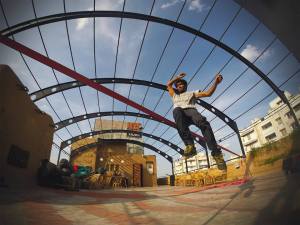
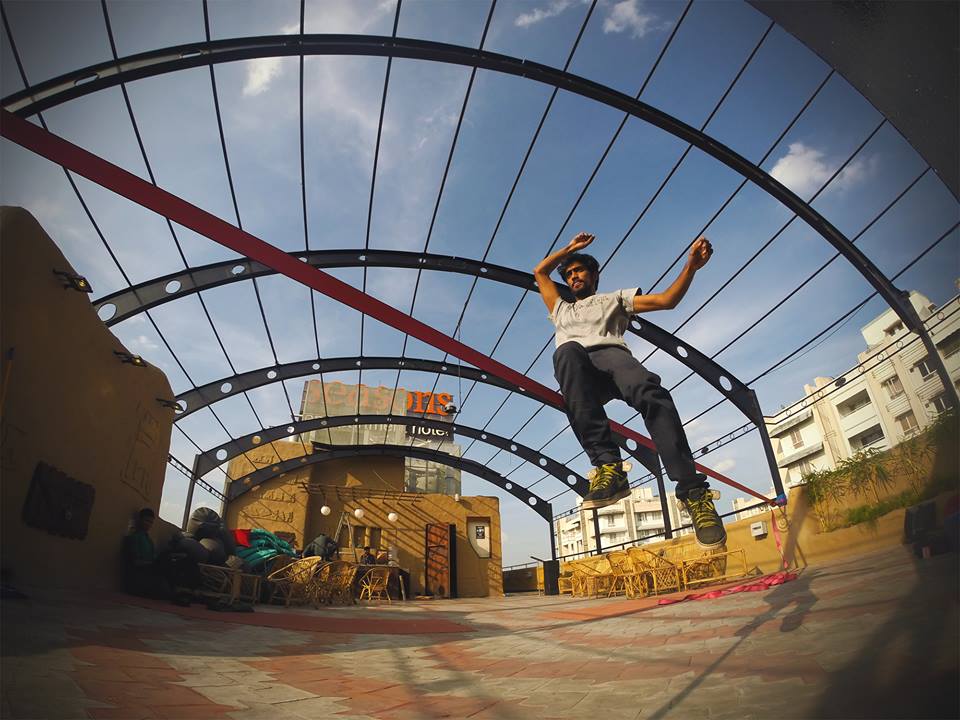
Samar slacklining in Pune (Photo: courtesy Samar Farooqui)

Samar slacklining in Pune (Photo: courtesy Samar Farooqui)

Mumbai’s Marine Drive, right next to the Arabian Sea, has always been a popular spot for people to catch the sea breeze, relax, cosy up, walk, jog, maybe just sit and wonder what one is doing in Mumbai, where one is in life. Samar liked to slackline at Marine Drive. On the promenade, opposite the small junction where the road from Wankhede Stadium meets the main road, are two trees. As was his routine, Samar set up a slackline between these two trees and commenced practising. While he was on the line he heard a noise across the road; something like a collision. Noticing that two motorcyclists had hit each other, he got off the line and went to help. It was a minor collision, the bikers said they were alright and went their separate ways. But as Samar was getting back to his slackline on the promenade, a policeman accosted him and said he was the source of what went wrong. Had slackliner not been there for distraction, the bikers wouldn’t have hit each other. Taken aback by the argument, Samar pointed out that although he had nothing to do with what happened across the road he had got off the line and offered assistance to the bikers. The policeman asked if Samar had taken permission to put up the slackline; the trees, he highlighted, were public property owned by the municipal corporation. Samar had no such permission. He had assumed that the simple sport he was pursuing was simple enough for others to accept it in an equally simple fashion. The regulars of Marine Drive, used to seeing Samar on his slackline, supported him in the argument. But the argument was fast devolving into a clash of perspectives. The slackline was removed. Samar was arrested and taken to the local police station. The cops busied themselves framing appropriate charges. At the same time, some policemen who had seen him slacklining before on the promenade complemented him on his skills. Eventually, when the matter moved to Court, Samar discovered that the charges against him included obstructing pedestrian movement and blocking sunlight. He was let off with a fine. By then however, Samar’s predicament had reached the media. The incident was reported and Mumbai slacklining, riding Samar’s arrest for blocking sunlight, found itself in the spotlight. Soon, Samar was back on Marine Drive, slacklining. The police, he said, have a better understanding of his craft now. They realize that he means nobody any harm; they let him be. There is however a sting in the tail he needs to be wary of. He was let off with a fine and the condition that the fine would double if he repeated the offense. Do you give up slacklining or stop popularizing it because of that? Samar has decided to take his chances.
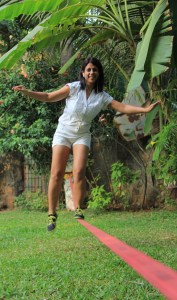
Pooja Mehra (Photo: courtesy Samar Farooqui)

Pooja Mehra (Photo: courtesy Samar Farooqui)

Pooja Mehra is a forty year old mother of two children who runs a cafe – the Cafe Bella Vita at Celebration Sports Club in Andheri. She has a background in sports; she played badminton for many years and is a trekker and distance runner. Two years ago she was running on Marine Drive when she came across Samar and his slackline. After seeing him on the line, she asked if she could try it. The experience hooked her curiosity. She looked up the Internet for more information on slacklining. Homework done, she called up Samar and asked if he would teach her to slackline. Since there was much distance between where they stayed, they set about looking for a place to set up a line at a mutually convenient location. Eventually they found a good spot on a footpath in Juhu. Pooja’s first lessons in slacklining happened there. Then they shifted to a spot on Juhu beach, adequately away from the eyes of crowds (that can cast pressure on someone learning something new). Pooja learnt to walk the line, turn on it and sit on it. “ I fell many times. But you pick yourself up and work hard to improve. It is not an easy sport,’’ she said. Overall, she took about 15 classes from Samar. Then with Samar’s help, she acquired a slacklining kit so that she can keep practising. The kit is portable; you can carry it around, take it wherever you go. But finding a place with good anchor spots for the webbing and enough safety should you fall is tough in Mumbai. Adding to the problem is low awareness of the sport. On the other hand, there are many places away from the city which are good for slacklining. Pooja carries the kit with her on family holidays. She sets up the line. Her children have tried slacklining and she said it is a nice way for the family to bond.
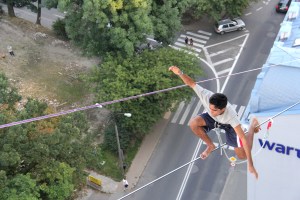
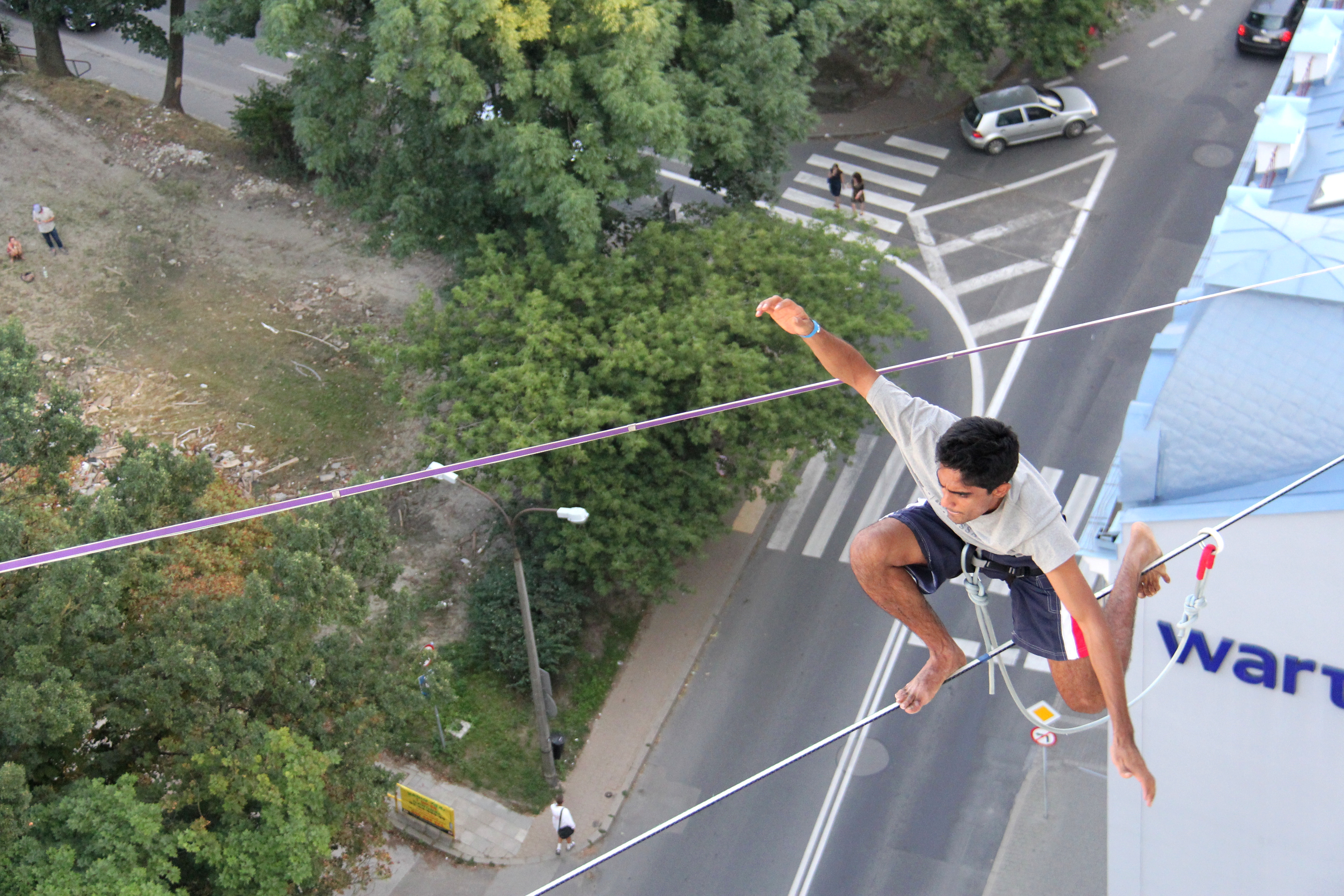
Samar at the highline festival in Poland (Photo: courtesy Samar Farooqui)

Samar at the highline festival in Poland (Photo: courtesy Samar Farooqui)

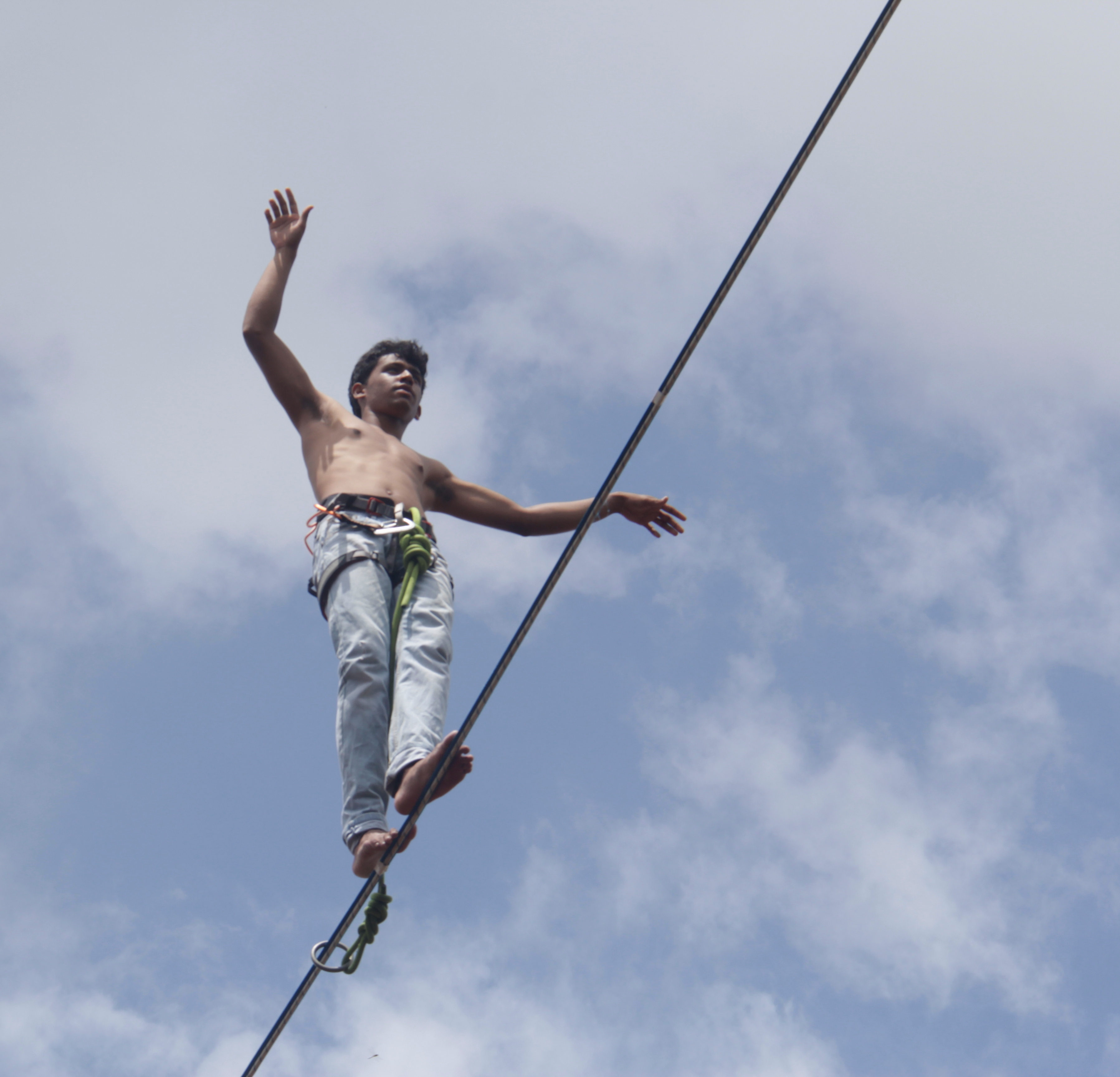
In July 2013, when Samar returned to India, there was a small slacklining community already existing in the country. The main two points for the faithful to gather were Slacktivism in Delhi and Slack.in, which hosted members from Bengaluru (Bangalore) and Pune. The whole community at that time must have been around 300 people-strong in India, of which about 10 per cent, Samar estimates, would have been active slackliners. Samar started Slacklife India in Mumbai. From a Facebook page it has since evolved into a company called Slacklife Inc. Along with that Samar has become a professional slackliner, someone whose income comes from practising and promoting the sport. Samar has appeared on Indian television, in such programmes as ` India’s Got Talent,’ ` I Can Do That’ and ` MTV HE Ticket.’ It helped promote the sport. Wikipedia’s page on slacklining mentions the sport’s many styles or categories.  For now, the styles relevant to India include the basic slack lining format; trick lining, mid lining and high lining. Trick lining involves the execution of tricks on a line while mid lining and high lining involve slack lining at various heights with room for tricks there too. Mid lining and high lining, because they need height, may be set up across buildings, structures, rock faces etc. As the sport grows, new lines are being set up. These are essentially places where a good line can be; a physical line materializes only when you actually put one up for your use. You have to have an eye for a possible line to put one up. Some of the high lines around Mumbai-Pune-Nashik are a line across a quarry in Pune (it was pioneered in September 2014 and that first line was called Jugad Line because it was improvised [jugad means: makeshift] for want of adequately long webbing and therefore sketchy. Samar emphasizes that such joined lines should be avoided), Mid Line Crisis in Taminighat and Life and Exposure in Nashik. One of Samar’s highpoints since returning to Mumbai was participating at the Urban Highline Festival in Lublin, Poland. At this event, he was the only slackliner the organizers had ever seen from India.
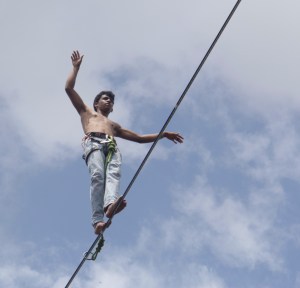
Bhupesh Patil on For Richie in Badami (Photo: courtesy Samar Farooqui)
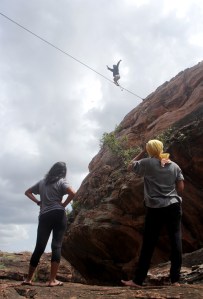
Bhupesh Patil on For Richie in Badami (Photo: courtesy Samar Farooqui)

Adarsh on For Richie (Photo: courtesy Samar Farooqui)

Adarsh on For Richie (Photo: courtesy Samar Farooqui)

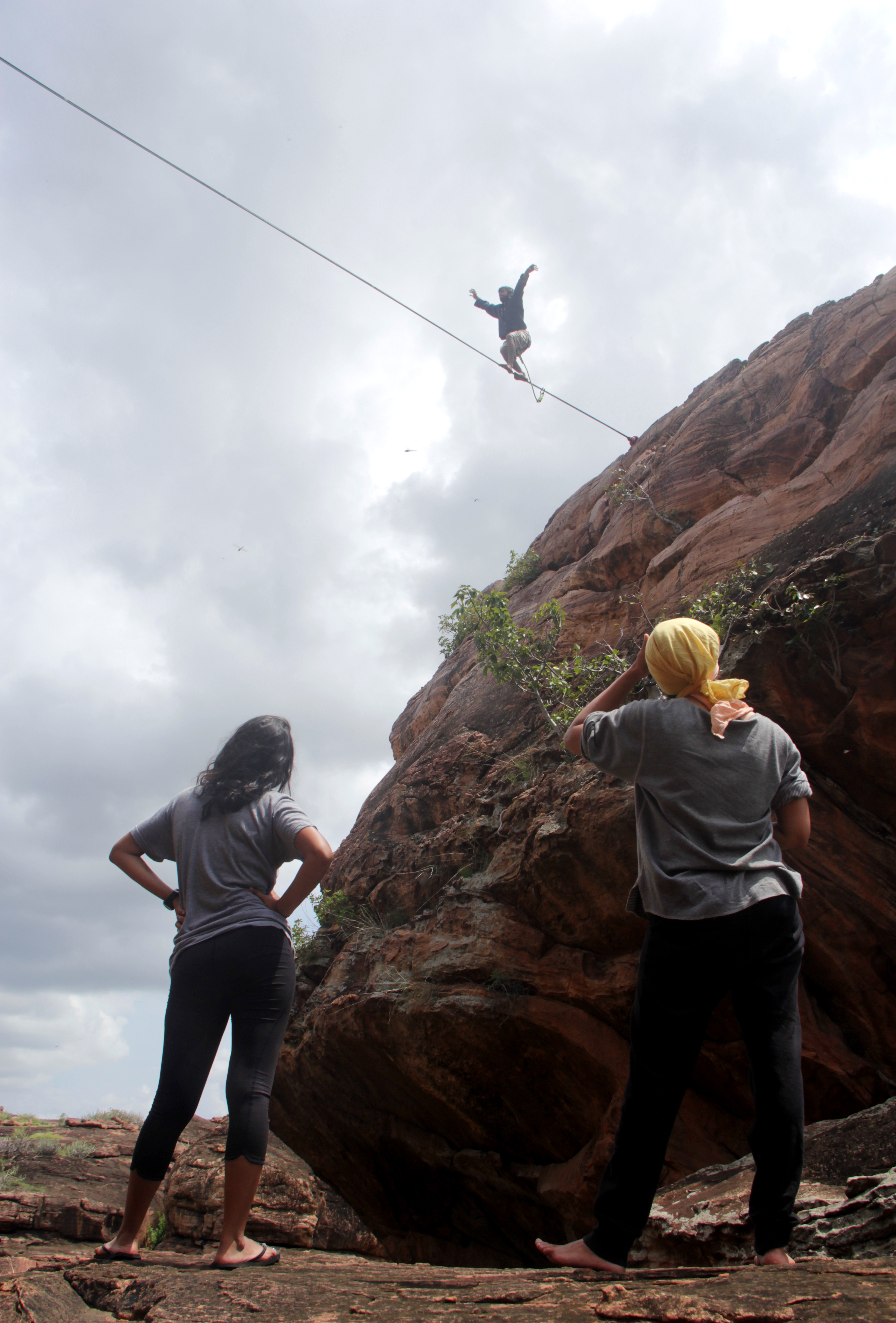
Bhupesh Patil is a young slackliner from Nashik. In May-June 2015, Bhupesh was at Naneghat where a crew of climbers from Omniterra, a company anchored by Mumbai based-climber Mangesh Takarkhede, was assisting the advertisement shoot of a popular soft drink. Here, Bhupesh met Richard Khear (Richie) from Mumbai, who was into rock climbing. Late August 2015, a tragedy occurred in Miyar Valley, Himachal Pradesh; an area now gaining currency for rock climbs at altitude. Richie who was part of a two person climbing team descending to base camp after a day out on one of the climbing routes on Castle Peak, suffered an accident while abseiling. He plunged a significant distance down and lay badly injured on a rock ledge that was still very high up from the ground. By the time rescue teams reached him, which was almost a week later, Richie was no more. The news rattled Mumbai’s climbing circles for Richie was well known and popular in the small, tightly knit climbing community. Rock climbers and slackliners are a similar lot. While tight rope walking has an old history (including in India), slacklining is relatively young and reportedly owes its origins to rock climbers (Wikipedia claims it was pioneered by a young rock climber in the US). The two sports are all about balance and heights, they share a relation with webbings and ropes and they bond in the realm of focused action or what some may call – mind over matter. Badami in North Karnataka is one of India’s major rock climbing destinations. On a trip here in 2015, slackliners had noticed the potential for a new line. The second time Bhupesh and Samar were in Badami in 2015, they set up this new high line. Bhupesh walked it first and named it ` For Richie,’ in memory of Richard Khear. Samar followed him on the same line.
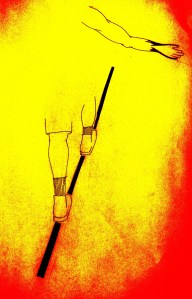
Illustration: Shyam G Menon

Illustration: Shyam G Menon

When you sit on Marine Drive facing the sea, you sense horizon and distance in a city that usually denies you both thanks to its numerous buildings and congested, trapped spaces. Depending on what you are, you may or may not have appetite for distance, horizon and the lure of exploration they inspire. I asked Samar what it is like being out on a slackline. He tried to explain; he failed, I failed. The whole thing is about narrowing down existence to life on webbing. If you are asked to explain such moments of nothing in the head, it challenges language. Slacklife and livelihood by slacklining occupies Samar’s time now. That’s what brought him to the experiential educators’ conclave. Experiential education is all about experiencing things and learning, processing the experience. Basic slack lining is an activity anybody can try and quite safely too, for the line is not very high from the ground. Won’t it sit well in the pantheon of activities experiential education leverages? Samar believes it will. Further there is promise in India for slacklining; the country is overwhelmingly young, the right demography for active lifestyle. The path he has chosen is promising; not easy. For now, it is pretty much like the seaward gaze from Marine Drive. There is the distance, the horizon and from self till horizon stretches one long, thin webbing exploring the unknown; life on a line.

(The author, Shyam G Menon, is a freelance journalist based in Mumbai.)  

THE FISH SAID IT ALL

Illustration: Shyam G Menon

Illustration: Shyam G Menon

A day out with fisherfolk 

In 2009 I found myself at Puthiyathura, a fishing hamlet on the outskirts of Thiruvananthapuram.

In my many years of knowing Kerala’s capital city, I had never ventured into these parts.

The fish reached the refrigerator in our home, carried all the way by a fisherwoman. You saw the fisherwomen all over town, hurrying along at a fast pace. What we never knew was why she hurried. She too had family; she had left home early and had that far to get back, before dark. Wanting to save the little she earned, she walked; a hurried walk.

The only time the fisherwoman’s home captured our concern was when the police resorted to firing to disperse clashing groups. In the days I attended school and college in Thiruvananthapuram, the city’s fishing hamlets witnessed clashes. When a fisherwoman came to our home after one such incident reported in the local papers, my mother would ask her about it. Some of them talked at length. It was, I guess, a venting, unloading one’s mind of life’s burdens to a fellow woman. Some others spared just a few words. As the crow flies, I lived maybe three to four kilometers from the sea. We went to the beach on weekends, enjoyed the sea breeze, wet our feet in the surf, had the hot, roasted groundnuts sold by vendors and returned home. Amid the silhouettes of fishing canoes drawn up on a sunset-beach, would be people relaxing over a chat or card game. Once in a while a kid or two came prancing down from the shadows towards the waves, jumped into the surf, swam about confidently and went back to the shadows. They were the people of my fish.

Years passed. I began catching up on things I didn’t do. I wanted to venture out to sea in a fishing boat; watch fishermen at work. My sister Yamuna, who had studied sociology and worked with communities, pitched in to help. She had worked before in the Puthiyathura area. She put me in touch with the fishermen. Several phone calls later, we had a trip scheduled. Then, Varghese who was to be my guide cut his arm and so the first attempt got called off. The second one saw us all on the beach staring at an angry sea. The water was grey, turbid toward the shore and the waves crashed with a dull resonant thud, which has always been the audio signature of a south Kerala beach. On that particular day, the thud was too strong for comfort. “ We won’t have a problem,’’ Johnson said referring to himself and his fellow fishermen, “ but a newcomer, if required to jump off the craft on the return may end up in trouble.’’ To put it in perspective, the coast towards the south of Kerala slopes steeply into the sea. You can find waist deep water within striking distance of the shore, neck deep trifle beyond and start swimming around where the nearest wave arches to crash. In contrast, beaches in Gujarat have extended shorelines; at low tide you can walk far out to sea. This is the secret to what was once the world’s longest stretch of ship breaking yards at Alang. You run the ship in on its last burst of energy and ram it into the shallows. At low tide, the steel hulk stands exposed for scavenging like a castle bereft of its moat.

Illustration: Shyam G Menon

Illustration: Shyam G Menon

Unlike Kovalam, which has a protected cove, at Puthiyathura the beach was a straight line exposed to the sea’s fury. Here, I may be able to launch off in a boat in rough weather but on the return, devoid of the skill to jump out of the boat in time and swim, risked getting hit by the craft, which would be tossing and pitching in the waves. “ The sea should be calmer,’’ Vincent said during moments stolen from his perennial focus on the auction happening on the beach. The auction was a miserable sight. On display was a meager collection of fish hardly echoing the famed plenty of the sea.  “ There is nothing left to catch there,’’ Vincent said.

The time I was at Puthiyathura, an advertisement for the Grand Kerala Shopping Festival in the newspaper announced up to forty kilos of gold to be won if anyone bought the precious metal during the festival period. That’s twelve kilos shy of my body weight and many, many times more in value than my person. In a country recognized as the world’s biggest gold importer, Kerala is one of the biggest retail consumers. I suspect Kerala’s love for gold has much to do with an underlying conservatism. The advertisement for the shopping festival dutifully highlighted the logic. It asked: which other investment is as secure as gold?

The image in the advertisement about the shopping festival showed five fishermen folding their nets on a beach. The sea braced itself into a wave in the backdrop; large, shining gold coins morphed into the photograph tumbled out from the nets – a haul of gold. The caption said: Swarna Chaakara. It was a play of words and imagery. Swarnam in Malayalam means gold. Chaakara is the phenomenon of mud banks that occur along the central Kerala coast bringing with it shoals of fish. Old timers distinctly remember it for the flurry of activity it brought on the beach. Years ago as a journalist in Kochi, I had traveled south to Ambalappuzha to witness a chaakara. Venu, my colleague from the Alappuzha bureau and the person who loaned me a wonderful collection of Hemingway’s essays to read, accompanied me on the trip. I reached the beach expecting festivities and jubilation. The mood though was matter of fact. More like – been there, seen it. I was the only one straining to see a great story for a new generation. Most people on the beach probably saw it as a stroke of luck to pay off debts. That was in the early 1990s. As an introduction to the economics of fishing that laconic attitude was the right initiation.

Illustration: Shyam G Menon

Illustration: Shyam G Menon

In the Malayalam language, chaakara has evolved to become an expression of plenty. And times of plenty are rare. Whichever way you look at it, fishing is a tough business; hardly the stuff of gold. For most of us landlubbers dreading the fury and unfathomable depth of that vast blue expanse, returning safe from the sea is accomplishment enough. For the fisherman though, returning alive and empty handed is an invitation to accumulate debt, suffer from it. Behind each outing into the sea is a string of expenses, ranging from the cost of nets and fuel to the cost of hiring a boat if you don’t have one. A simple inquiry on the beach would reveal that these costs are not tiny even for your wallet, leave alone a person struggling to make ends meet. In a low capital environment like the fisherman’s beach, these expenses are incurred and paid for with promised claims on the catch. Thus the first right on catch is rarely the fisherman’s; his is typically the last. The math at its core is simple – if you spent a thousand rupees and fetched catch worth six hundred, you paid off the equipment providers on the basis of a local ratio, kept a small portion and started your second voyage with debt in excess of four hundred rupees. That is not just simple; it is simplified for atop that debt would come the fresh investment for the second trip, which may be another round of borrowing. Until some time back, this atmosphere of frequent debt was accentuated by loans from money lenders arranged at high interest rate. The rise of self-help groups may have partly addressed some of these monetary difficulties but there has been no escape for the fisherman from the basic model of fishing. The sea loves its unpredictable nature.

It had anyway spoilt my chances that day of the second attempt to go fishing. Confined to the shore, Vincent and Kennedy, both activists for the fishing community, took me around to see the day’s catch. Prominent on the Puthiyathura beach were plates of normally overlooked cartilaginous fish, the sort seen hiding in the sands of the sea bottom on National Geographic. Also around was fish, dead in a different way – it was already dead and floating on the sea when the fisherman hauled it in. This was fish rejected at high seas as unwanted collateral catch by large trawlers. With few fish to come by, the trawlers’ refuse was also getting cleaned and sold. The woman cleaning the lot for sale stayed absorbed in her work. She didn’t look up at either Vincent delivering a commentary on her plight or me, clear stranger to the beach, standing there and listening to it. She seemed indifferent to the whole world.

Illustration: Shyam G Menon

Illustration: Shyam G Menon

Two days later, I made a final attempt.

This day and no more on this visit home, I had promised myself.

Bad luck threatened from the start. The global economy – certainly the US and Europe – was in recession; India was claiming to be free of the disease, yet showing signs of it in every business update. At that most blessed moment when thousands were losing their jobs worldwide, the country’s well paid oil company employees decided to go on strike. Simultaneously, by design or coincidence, a nationwide transport strike began. Soon fuel stocks at retail level reduced to a trickle. Long queues of vehicles appeared in front of petrol pumps. This was the situation at the city bus depot that morning, many buses were caught in queue for fuel, some trips were cancelled and some that ran were way behind schedule. That was the case on the route I was to take. Finally I got a slow bus.

We ambled along at leisurely pace, as these buses have always done in the city of my childhood. In due course the breeze became sea-tinged and the sky above the coconut palms betrayed that openness so characteristic of proximity to the sea. Christian churches frequented by the fishing folk appeared and in the courtyard of one, reflecting the charismatic brand of religion followed by many in these parts, a lone man walked around, gently dancing, swaying, and holding aloft a leafy tree branch. He seemed to have stumbled upon some blessing or may be as part of the blessed, he was blessing the world – who knows? He seemed happy anyway. “ It is a fine day,’’ Vincent said on the ocean’s edge, the big blue expanse looked sleepy, almost tranquilized and prayed to stay so for a novice to sail its bosom.

My friend Swarup had helped me secure a life jacket. I put that on. It was an effort pushing the wooden boat in. The moment it hit the water Johnson fired the outboard engine. We punched ahead through the waves and shot on for a long time, till all sign of shore disappeared and we were in the calm waters of beyond. Here, more than from ashore, you notice the bulk and immensity of the sea. I watched three men drop long lines to catch whatever fish they could. I had expected to see a net or two. There was none. I suspect my companions on the boat took the outing less as fishing and more as an assignment to satisfy my curiosity for their world. The lines dangled in the water, managed by sensitive fingers alert for the slightest tug or movement. Every few minutes a line would be drawn in; several hooks empty, a fish or two being all that was caught. The sea may have turned calm but the fortunes it held, hadn’t changed.

Illustration: Shyam G Menon

Illustration: Shyam G Menon

The few fish getting caught were all the slimy, grey type. A couple of them seemed painted at some art school but hardly the variety for eating. Save one type – red in color, with white spots that the crew said was tasty to eat. Yet none commanded value in the market. Here and there a creature resembling the seer fish or mackerel jumped out of the water but that was it; it wouldn’t be fooled to bite. Still in that highly diluted and watered down version of fishing’s thrills, I could sense the nature of engagement. As he drew up hook after hook where the fish had eaten the bait and escaped getting hooked, Gregory said aloud to himself, “ crafty characters.’’ By noon we were done. A small pile of low value fish lay on the boat’s floor. George, Clement, Johnson and Gregory sat pensive near the lone outboard engine. They had just concurred that given their life experience they would rather have their children educated and doing something else. “ In this profession, those who lost, outnumber those who gained,’’ the older, quieter, Gregory said. The sea slapped softly on the boat’s sides. Even at such gentle times, the swells resembled giant aquamarine saucers; you sank into one and crested at its edge like a two second-light house.

At one such cresting, I saw the most amazing sight – a man poised atop a slender catamaran, all alone and so far out. Had it been space, he would have been a planet all to itself. Here, he was a world on two logs drifting by, lost to the rhythm of a work getting longer and longer for want of fish. He would sit, stand, squat, and pull in a net – all on a foot-wide platform liberally washed by the blue sea. The minimalism of his life clothed him and two or three others like him that I could see scattered wide apart in that area; the briefest pair of shorts or a section of an old lungi wrapped around the waist and ending well above the knee. That bare existence on a fragile stick near submerged by the sea was apparently fundamental to anyone’s evolution as a fisherman. “ You start on a catamaran,’’ Gregory said.

In the boat Clement kept working, as though working against time, making good use of the little time, any time, he had. He was usually the last to draw in a line from a given spot, big hands reeling out the line and feeling it constantly for the faintest of tell tale tugs. Chaakara doesn’t happen this far south in the state, nor is plenty at sea anymore the plenty of old. Unless that is: some lucky fisherman borrowed money, bought gold and struck a Swarna Chaakara at a city jeweler’s shop. George would have liked that thought. Standing at fore with a hungry gaze seaward for any sign of fish, he seemed mad enough to indulge the absurd. He was getting restless. Suddenly, the placid sea and the hours spent fishing futilely, got to him. He whipped around, “ Let us go back to land, eat and get drunk! What do you get here?’’ My thoughts hung for a second on his last observation – what do you get here? I had heard that before in the mountains, where the sight of ocean is typically part of a lucky journey. Memory of the sea – if seen at all – is a good subject for conversation at mountain villages. There too, they ask with envious glance cast towards the plains – what do you get here in the mountains? Everybody wants to be somewhere else.

Illustration: Shyam G Menon

Illustration: Shyam G Menon

Johnson warned of low fuel. At the turn around point roughly eight kilometers out at sea, I gazed at the water all around and couldn’t resist taking a dip. I took off my life jacket and lowered myself over the boat’s side into the water. Then I pushed off. It was the least I could do as a puny statement of intent before the vastness of the surrounding blue, the length and breadth of it, the depth of it. “ Don’t go too far from the boat. The fish here is big,’’ Johnson said, half in jest. My conspiratorial mind immediately switched to National Geographic mode. Below me should be tiny teeth, big teeth, sharp teeth, suckers, stingers; there was a world of murderous characters lurking below. The quality and quantity of danger was directly proportionate to seventy per cent of the planet being water and that watery world being three hundred times – according to some estimates – bigger in volume than the land mass inhabited by terrestrials. With large bait splashing around in the water, all we needed on the boat was another aspirant for the World Press Photography award. The sea had been calm that day; the swim felt easy as though in a gigantic swimming pool, sole concerns being that sense of terrible depth and the inevitable drift of the boat away from you, away from you. For someone whose longest swim is a struggled lap in the swimming pool that specter of the boat slipping away evokes panic. In the ocean there is nothing to grab when starved of endurance, except water.

Vincent remembered a day some twenty years ago when the sea was far from calm. He had been out with a crew that included his father. They had just pulled in the net laden with catch, when the weather turned bad. The furious sea flipped the boat throwing everyone into the cold water. He reasons that things would have been different had they not pulled in the laden net as it may have worked as a stabilizing anchor. Each time they steadied the boat, the sea flipped it till over a series of capsizes, the net wound itself around the boat. It was a mess now, a tangle of men, boat and net in the deep waters of a furious sea. Night came. At some point during all that agony, the cold water proved too much to bear for one of the crew and he died. For a while they kept the body in sight, lashed to the remains of the boat. By day break, they had lost two people – the second being Vincent’s father. Luckily for the crew, they were discovered by a boat that had set out from the Tamil Nadu coast, further south from Puthiyathura. “ That boat just burst out from the surrounding swells,’’ Vincent said. He didn’t go back to sea for a year and when he did, the memory of the accident shadowed.

Back on land, Johnson rather apologetically, presented me with a bill for the fishing trip. In tune with the fluctuating fortunes of his work, he said, “ had the catch been good, I would not have insisted.’’ I couldn’t argue, the fish said it all. “ That’s alright Johnson,’’ I said.

Before I left Thiruvananthapuram for Mumbai, the local newspaper reported on one of the winners from the Grand Kerala Shopping Festival. It was a fisherwoman who had borrowed money to buy the coupon for the lucky draw.

(The author, Shyam G Menon, is a freelance journalist based in Mumbai. Please note: the economics of fishing outlined here are as perceived in 2009.)
A FARMER’S DREAM

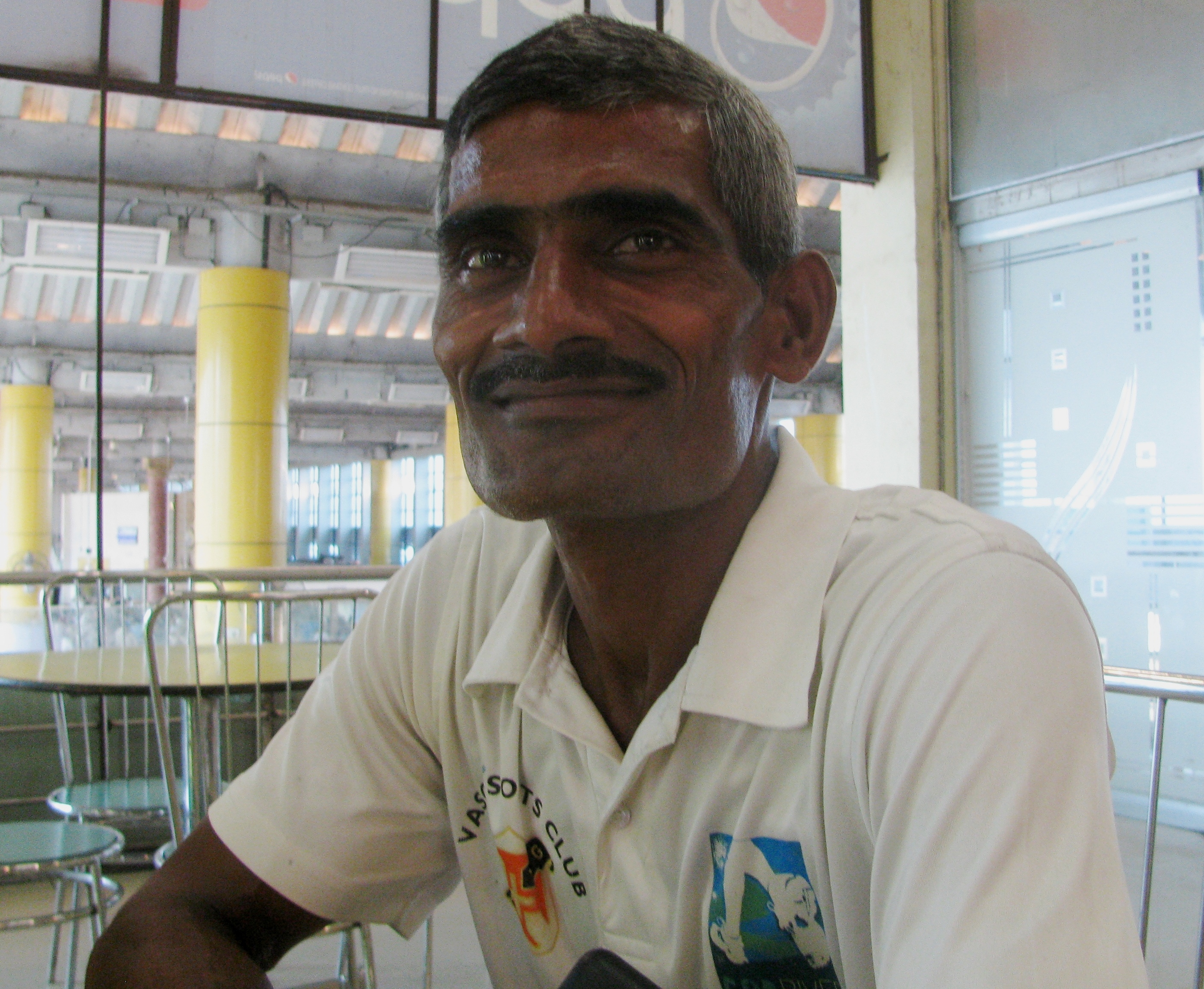
Sabhajeet Yadav (Photo: Shyam G Menon)
Sabhajeet Yadav (Photo: Shyam G Menon)

Mumbai’s Kurla Terminus resembled a bustling hive with long queues in front of ticket counters and people all around.

It’s the abject opposite of the solitude runners find in the depths of a run. Sabhajeet Yadav has to reach this station and then catch a train to Uttar Pradesh. In between, two independent journalists have sought time for a chat in the chaotic station.

Our allotted time shrinks as en route to Kurla Terminus, Sabhajeet is stuck in Monday morning traffic.

He calls on arrival.

The man is easy to spot – medium height, broad shoulders, lean build and taut face. You know an athlete when you see one. We head straight for the cafe above the ticket counters and queues, where he sits for the interview.

Twenty four hours earlier, Sabhajeet had just completed a full marathon at Vasai-Virar, a township on the northern edge of Mumbai. He finished second in his age category of 55 and above at the Vasai-Virar Mayor’s Marathon (VVMM), running the 42km-distance in 3:25:51. He is a regular podium finisher at races across India, travelling from one place to another to run during India’s marathon season. At the Standard Chartered Mumbai Marathon (SCMM), he bagged top honours in his age category in 2012, 2013, 2014 and 2015. He has been winner in his age category at the Airtel Delhi Half Marathon (ADHM) in 2011, 2012, 2013 and 2014 (please see compilation at end of story for an overview of his performance at various events). The 2016 SCMM is due in mid-January. But before that Sabhajeet, following a quick visit home will be at two to three other events including the 2015 ADHM. That’s a measure of his running calendar. The 60 year-old now dreams of participating in events overseas, at cities not too far from India’s shores and thereby costing less to access. All this thanks to others, who noticed the farmer from Dabhiya village in Jaunpur, Uttar Pradesh and decided to help him for Sabhajeet is running more for income than achievement or a quest to know oneself. The prize money he gets augments the returns he and family get from farming.

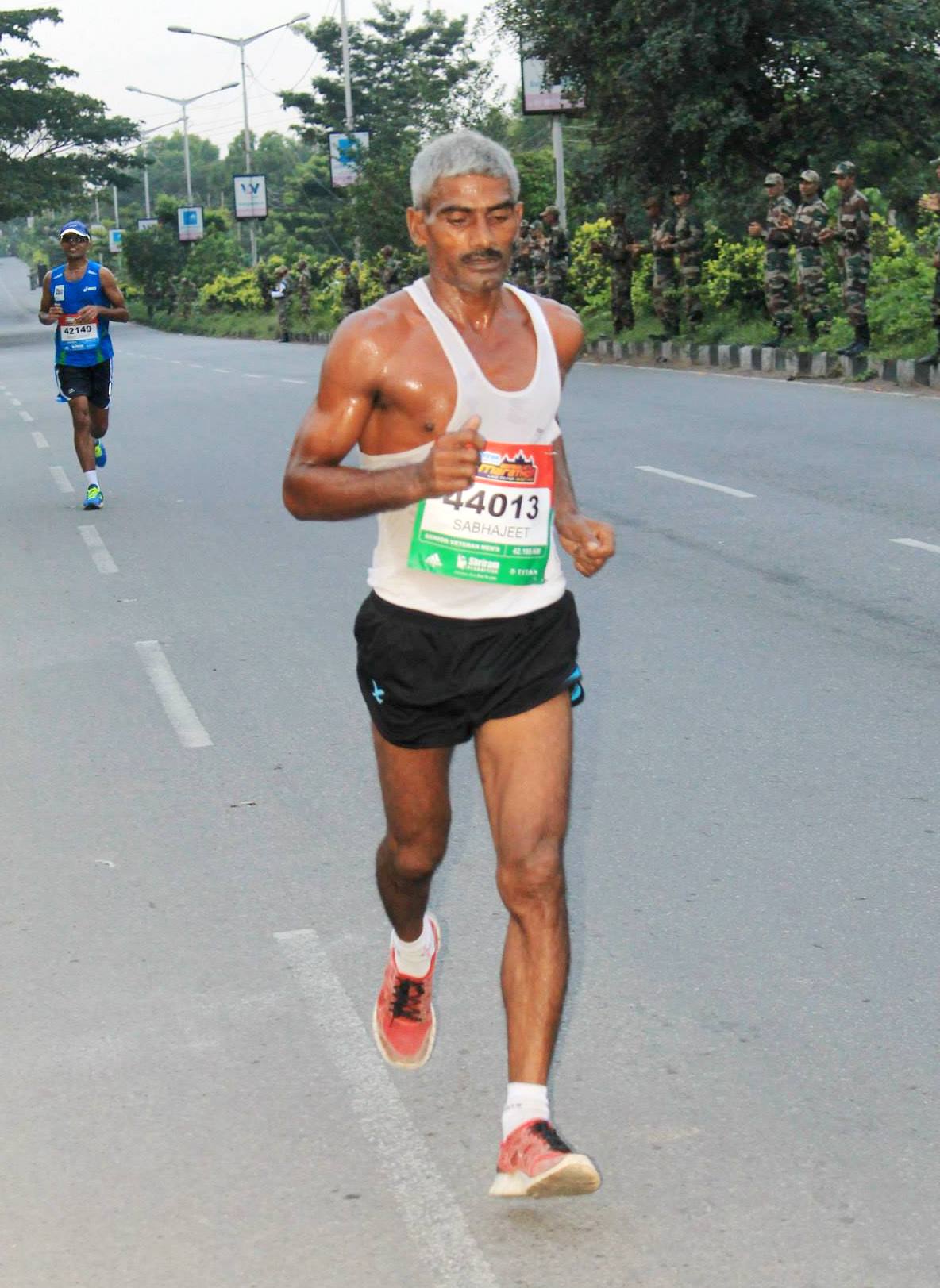
Sabhajeet Yadav (Photo: courtesy Bhasker Desai)

Sabhajeet Yadav (Photo: courtesy Bhasker Desai)

The central government’s web page on Jaunpur describes the district’s topography as a mix of flat plain and shallow river valleys. According to Sabhajeet, Dabhiya, where he and family live is “ up and down’’ with a river not far off – the Basuhi river. Crops grown include wheat, rice and sugarcane. Years ago, Sabhajeet had a background in athletics in school. But it wasn’t running. He was into javelin, discus and high jump. If you search the Internet, you will find a Rohit Yadav who placed third in javelin throw at the 13th National Inter District Junior Athletics Meet held in Visakhapatnam in 2015. Rohit is Sabhajeet’s second son; he has a daughter and three sons. His sons are into athletics, none of them are however in running. “ They are into the throwing disciplines, mainly javelin. I want them to do well,’’ Sabhajeet said. He reasoned that long distance running requires a touch of adequate years lived on the planet. You have to be a bit old and mature, he felt. Not to mention, have persistence and patience. These aren’t the strengths of youth. Among reasons Sabhajeet runs seeking podium finishes and prize money is to assist his children in their future in sports. From what we understood, the prize money takes care of family expenses allowing some of the other income streams to be used for the family’s future. Initially, his wife was not happy with his idea of travelling around for running events. But as he started to bring home a fair amount of prize money she learnt to accept his ways. “ With my prize money I was able to get my daughter married. It also helped me construct a house in my village,’’ Sabhajeet said. When he is away running, his sons take care of the family’s farming.

Sabhajeet started running seriously roughly six years ago. Between the half and the full, he commenced with the half marathon; then embraced the full marathon as well. He has no problem switching between the two disciplines, which in terms of pace and strategy are as different as chalk and cheese. Initially he had no running shoes. Shoes of any type – old, used, local and gifted – has featured only for the last three years. Practice sessions in Dabhiya are at a local ground. It affords a loop of 200m and whenever he can grab time away from work, the farmer is there, practising. “ I run almost daily. Sometimes for two hours, three hours, even four hours. Apart from farming there is nothing much to do. And there is no concept of a holiday. So I run almost daily,’’ he said. Along the way, he consulted a coach and acquired a few exercises to do that complement his running. As for food – Sabhajeet typically sticks to roti, rice, lentils and vegetables, the standard North Indian fare.

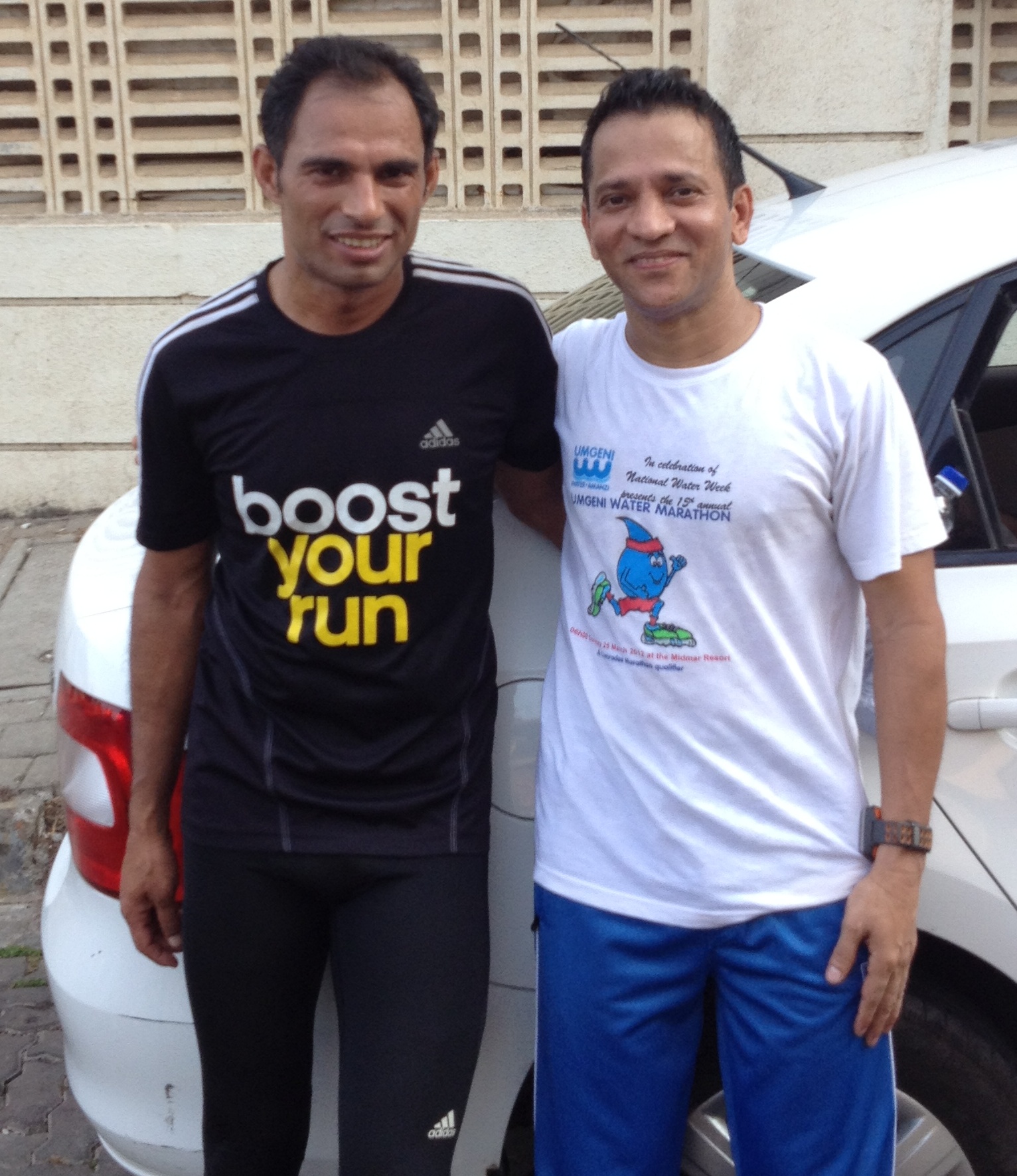
Around the time Sabhajeet took to running, Mumbai based-businessman and runner, Bhasker Desai, was in Ladakh to participate in an early edition of the Great Tibetan Marathon. “ I met this poor but cheerful and smiling 17 year-old schoolboy, Tenzing, a free spirited runner who won the full marathon race way ahead of competition. He was running in cheap worn out Bata canvas shoes and his race apparel that day, was his school uniform,’’ Bhasker recalled. One of Bhasker’s friends, who was with him, suggested that they sponsor Tenzing for the upcoming ADHM in Delhi. “ It felt nice that we could support a talented runner to fly Leh-Delhi,’’ Bhasker wrote in by email. With help from still others, they took care of the travel and stay in Delhi for Tenzing and his school sports coach. The Tenzing episode sparked a thought – why not support some older runners who are talented but constrained by lack of resources and wish to complement their paltry income with prize money? At the 2012 ADHM, Bhasker followed up on Sabhajeet who had completed the race splendidly despite being 55 years plus. “ That is how our friendship started,’’ Bhasker said (for more on Bhasker Desai please try this link: https://shyamgopan.wordpress.com/2015/04/06/from-zanzibar-to-boston-the-bhasker-desai-story/). When we met him after the 2015 VVMM, Sabhajeet mentioned Bhasker’s support in matters ranging from running shoes to identifying the right events and assisting with the registration process including paying the registration fees. For the farmer from Dabhiya, that meant a lot. But why do people choose to help him? It probably has much to do with his nature.

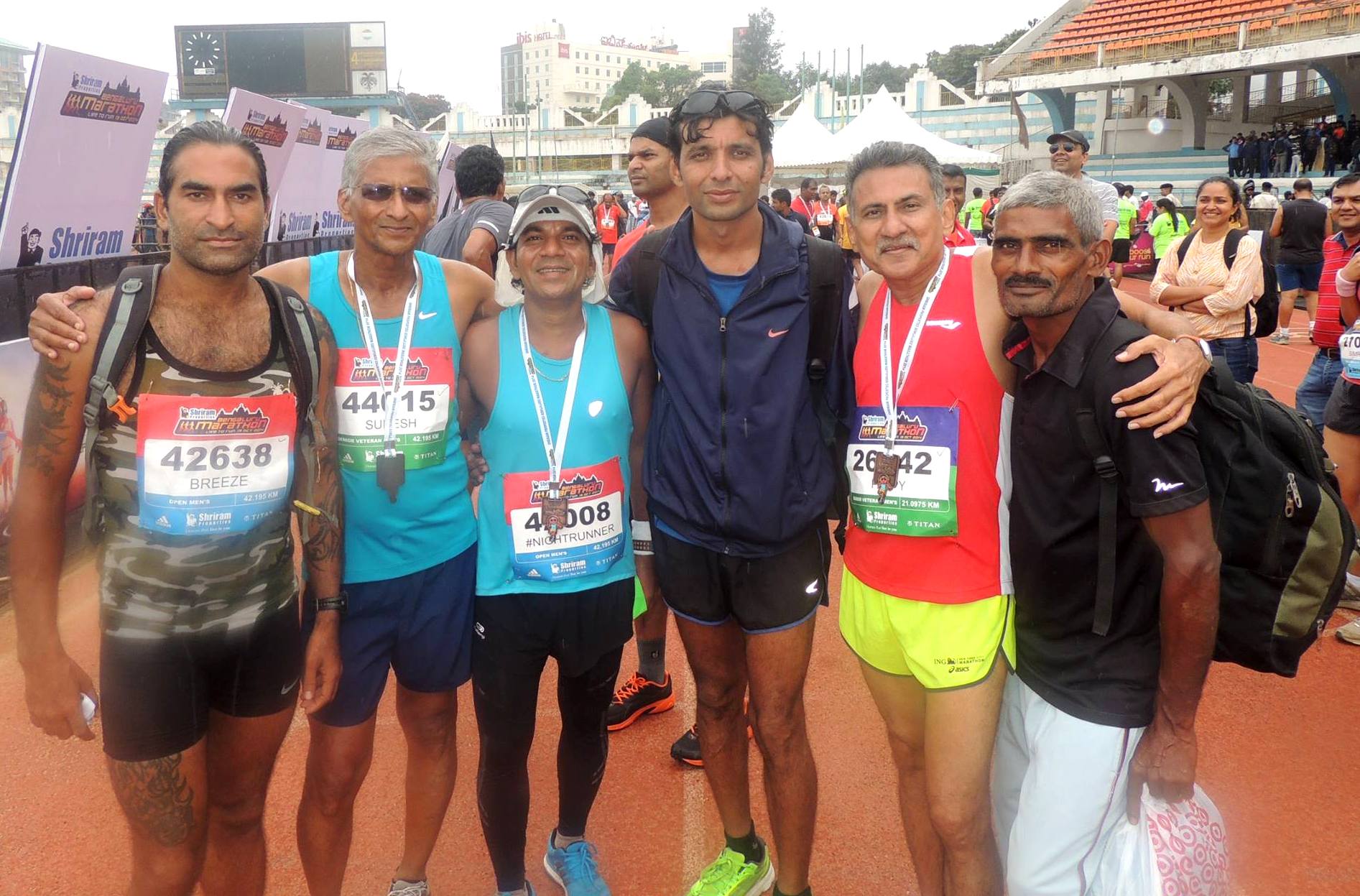
Sabhajeet (extreme right) with fellow runners; from left: Breeze Sharma, Suresh Pillai, Sanjay Bhingarde, Dnyaneshwar Tidke and Bhasker Desai (Photo: courtesy Bhasker Desai)

Sabhajeet (extreme right) with fellow runners; from left: Breeze Sharma, Suresh Pillai, Sanjay Bhingarde, Dnyaneshwar Tidke and Bhasker Desai (Photo: courtesy Bhasker Desai)

Sabhajeet reportedly began his running career with an eight kilometre-run for veterans, which promised Rs 5000 for the winner. At the time he came to know of this race he was a desperate man with debts to repay following his daughter’s wedding. “ That desperation must have played a role in whatever happened since, for one thing about Sabhajeet is that he is self-made. He is committed to running, has devised his own training regimen and needs nobody to remind him of the required discipline. His farm is small and what he earns from it is little. When there wasn’t enough money from farming, he used to work on daily wages. It was a hard life. Possibly as a legacy of such life, he has no notion of ideal conditions. At a race, he accepts whatever is available as how things are – very unlike many of us who blame poor running performance on this condition and that,’’ a well wisher who didn’t want to be named, said, adding, “ all that we did was help him with travel expense, registration and logistics. The rest is completely to his credit.’’

Sabhajeet is remembered in the running circles of Mumbai and Goa for the way in which he evolved a committed approach to sports, in a village, far away from the anyway poor talent-scouting India’s sports apparatus does. “ He hasn’t had a word of professional input from anyone,’’ the well wisher said. Sabhajeet designed his training regimen for running by himself; he designed the training for his sons, the javelin they use for practise is reportedly home-made and at least one news report said the choice of javelin throw for the sons was also because everyone could share the same javelin. Urban running is notorious for the corporate-inspired fussing over every tiny detail to improve performance. Dietary inputs from overseas; costly shoes, energy gels, gadgets to measure athletic performance, exotic workouts – the list is long. In comparison, Sabhajeet’s ecosystem is frugal. A runner in Goa recalled how Sabhajeet arrived for the local marathon by long distance train with food his wife had made and packed for him. Ahead of race, he stuck to his routine and rituals; ate the home cooked food. It was after the race had been run and he had won that he let himself partake in a meal with friends. Such was the focus; a quiet, rural version of the urban spectacle. At Kurla Terminus, he was light on his feet, whatever he needed in a small bag.

In January 2015, Sabhajeet had reached Mumbai for the annual SCMM with a badly pulled calf muscle. He was limping. “ We took him to a physiotherapist. But what can you do on the eve of a race? He nevertheless went on to win in his category. He is clear about that – he has to run, he has to win,’’ the earlier mentioned well wisher said. In an article in The Times of India, after the 2014 SCMM, V. Anand pointed out that in 2012 and 2013 Sabhajeet – a winner in both years – had slept on the concourse at Mumbai’s CST railway station as he could not afford a hotel room. In 2014, after this was brought to their attention, the organizers provided him accommodation. Those who know him believe a season of running pays Sabhajeet more than he can manage in a year of farming. Over the years, with debts repaid and house built, he has begun shedding some of the earlier desperation and started to enjoy his running. “ It is good to see that,’’ one of his supporters said.

Sabhajeet at the 2015 Vasai-Virar Mayor's Marathon (Photo: by arrangement)

Sabhajeet at the 2015 Vasai-Virar Mayor’s Marathon (Photo: by arrangement)

According to Sabhajeet he is still the only one regularly running in Dabhiya. Nobody else has taken to the sport despite example at hand of one among them travelling around and earning podium finishes. Do they know of his achievements? “ Yes they do. Once in a while, my name appears in the newspaper and they get to know,’’ Sabhajeet said. In the early days of his running, things weren’t so. The sight of him practising was amusement for others. With victories, an element of respect has emerged. Among things he must now attend to is getting a passport. He doesn’t have one yet and his aspirations include running overseas.

We are now terribly close to the assigned time of departure of Sabhajeet’s train.

The conversation is wound up.

A final photo is taken.

Interestingly, it is we who keep reminding Sabhajeet that his train will leave shortly. He is lost in talk about running. The subject evidently engages him.

As we descend the stairs to the ticket counters, the din rises.

A handshake, then a namaste and Sabhajeet joins those proceeding to the platform.

A few days after our meeting, Sabhajeet won in his age category at the 2015 ADHM.

Sabhajeet Yadav / some of the races he won with timings therein:

2011 – Airtel Delhi Half Marathon – 1:31:48 – senior veteran category

2012 – Full Marathon at Standard Chartered Mumbai Marathon – 3:25:08 – senior veteran category

2012 – Airtel Delhi Half Marathon – 1:33:41 – senior veteran category

2013 – Full Marathon at Standard Chartered Mumbai Marathon – 3:21:54 – senior veteran category

2013 – Airtel Delhi Half Marathon – 1:28:16 – senior veteran category

2014 – Full Marathon at Standard Chartered Mumbai Marathon – 3:25:39 – senior veteran category

2014 – Full marathon at Shriram Properties Bengaluru Marathon – 3:15:38 – age category of 55 years and above

2014 – Airtel Delhi Half Marathon – 1:28:29 – age category of 55-65

2015 – Full Marathon at Standard Chartered Mumbai Marathon – 3:28:40 – age category of 55 years to less than 60

2015 – Full Marathon at Shriram Properties Bengaluru Marathon – 3:20:34 – age category of 55 years and above

2015 – Airtel Delhi Half Marathon – 1:31:00 – age category of 60 years to less than 65

Source: Timing Technologies

(The authors, Latha Venkatraman and Shyam G Menon, are independent journalists based in Mumbai. Please visit https://shyamgopan.wordpress.com/2015/06/12/half-or-full-thats-the-question/ for the story of Kamlya Bhagat, a runner – albeit much younger – who, like Sabhajeet, runs to support his family.)

THE COMRADE

Satish Gujaran (Photo: Shyam G Menon)

Satish Gujaran (Photo: Shyam G Menon)

Most people reach Shirdi by road or rail.

Some choose to walk.

Sanjay Shankar Shinde, the founder of the running club Ramesh Nair trained with walked every year to the temple town from Mumbai. It is a distance of close to 250km as per the Internet. Curious, Ramesh, an engineer turned businessman, walked to Shirdi with Sanjay’s group in 2012. He did so again in 2013. Thinking of a repeat in 2015, he shared the idea with Satish Gujaran. The two lived close by in Mulund. They hadn’t met before, till running put them in touch. Satish had been training largely alone and mostly on the city’s Eastern Express Highway. What amazed Ramesh was the mileage he piled on daily and the dedication he showed to running. When Satish heard of Shirdi and the walk on Ramesh’s mind, he suggested: why not run from Mumbai to Shirdi?

July 25, 2015, 6AM; three runners – Ramesh, Satish and Nilesh Doshi – supported by a car stocked with essentials and driven by Sanjay Gawade, a driver whose many outings with runners has made him adept at the task, set off for Shirdi from Mumbai. Nilesh elected to return on the second day. He had some work to attend to; he also felt his body temperature was rising unreasonably. Satish and Ramesh pushed on; the former, a bachelor and experienced ultra marathon runner, the latter, a family man, regular runner of marathons and someone who prefers to run respecting the boundaries of well being. “ I run within my comfort zone,’’ Ramesh said. Satish seemed a runner moulded by exploration and experience. Ramesh reposed faith in systems and research. For both runners, it was their first multi-day run. In his mind, Ramesh had studied the distance to Shirdi and worked out how much he should run daily based on his experience at marathons and the annual Mumbai Ultra, a 12 hour-endurance run. He had it all chalked out. Satish was battling a private worry; the classical Indian worry – leave of absence from office. They had started on a Saturday. He had to report for work Wednesday morning. Will they reach Shirdi before that?

Satish and Ramesh during the Mumbai-Shirdi run (Photo: courtesy Ramesh Nair)

Satish (left) and Ramesh during the Mumbai-Shirdi run (Photo: courtesy Ramesh Nair)

“ Satish can keep on going. He is a frugal runner whose needs are few. I am not, ’’ Ramesh said. In tune with their experience in distance running and differing styles, a gap opened up between the two. And proportionate to the widening gap on the road, Satish’s worry about Wednesday grew. Ramesh recalled the situation. “ The car was supposed to halt every three kilometres or so. I was running slowly. After I had reached the car and hydrated, Satish would tell the driver to proceed and wait after the next three kilometres. Then I noticed – he was saying three and indicating four with his fingers!’’ Ramesh said laughing. In the end, it all worked out well. Around 2.30PM on Tuesday, July 28, the two runners reached Shirdi. After a quick visit to the Sai Baba temple, they returned to Mumbai. Satish was back at work, Wednesday morning.

Exactly 100 years before from the day the duo reached Shirdi, an event occurred in Europe that would leave its mark on the world of running as well. On July 28, 1914, a month after the assassination of Archduke Franz Ferdinand in Sarajevo, Austria-Hungary declared war on Serbia, officially commencing the First World War. The cascading events that followed sank Europe into one of the bloodiest conflicts of human history. In four years of fighting, more people would die than in the wars of the preceding 100 years. Almost 70 million military personnel were mobilised; of them, over 8 million died. The survivors bore scars in the mind. Happening in the age of empire, the theatre of war exceeded Europe; those fighting and getting killed included many from outside Europe. Among people caught in the tentacles of empire and therefore pushed to fight, were the South Africans. They fought on the side of the Allied forces, in Africa and Europe. The war in Africa, a long distance from the trenches of Europe, was triggered by the German plan to keep the Allied force’s Africa based-military assets engaged in Africa itself.

Vic Clapham was one of the South Africans who saw action and survived. He was born in London on 16 November 1886 and immigrated to the Cape Colony in South Africa with his parents. When the Anglo-Boer war broke out, Vic aged 13, worked in an ambulance team. Later he moved to Natal and worked as an engine driver with the South African Railways. During the First World War, he signed up with the 8th South African infantry, fighting and marching long distances through the savannah of eastern Africa. The hardships he and his friends endured left a lasting impression. Above all, he remembered their camaraderie. As peace returned in 1918, he sought a memorial to commemorate the South African soldiers who had died; a memorial that highlighted human endurance.

Illustration: Shyam G Menon

Illustration: Shyam G Menon

Clapham’s home town was Pietermaritzburg. He visualized a foot race from there to Durban. If soldiers could cover vast distances and endure it as they did in the war, Clapham averred, trained athletes should be able to do the same. This in mind, he approached the athletics administration in Natal for support. They declined. Then he approached The League of Comrades of the Great War, a body representing ex-service persons. Initially turned down, Clapham persisted. In 1921, the league yielded. It gave its assent. Clapham founded The Comrades, the world’s oldest ultra marathon race and now it’s biggest. First run on May 24, 1921, the route links Pietermaritzburg in the mountains with Durban on the coast. Forty eight runners enrolled for the inaugural race. Of that, 34 set off; 16 finished. Many of these runners were earlier infantrymen who had fought in Africa. At present, nearly 20,000 people run this ultra marathon every year. They come from different countries. The race alternates every year between uphill and downhill with the former measuring 87km and the latter, 89km. Founded as a war memorial, over time, The Comrades has acquired the reputation of being a fantastic event, remembered for the bonhomie, crowd support and cheering.

Satish never expected his life to get mixed up with The Comrades. He was born at Udipi in southern India on March 27, 1963, pretty close to the May-June period hosting South Africa’s iconic race (throughout its history The Comrades has been run in either May or June). Coincidentally in May 1963, a record was set at The Comrades. South African runner Jackie Mekler, who at five wins overall is tied with three others for the second highest number of wins at The Comrades in the male category, set a new record (5:51:20) in the ` down’ version of the run. With that he became the first runner since 1954 to hold the record for both the `up’ and `down’ versions. In 1960, Mekler had run the `up’ in 5:56:32. Those days there was no ultra marathon in India, likely no awareness about The Comrades. South Africa existed in the shadow of its apartheid policies. For many years, resultant sanctions denied the country participation in international sporting events. Sanctions prevented other countries from touring South Africa. In cricket crazy-India, once in a while the press published a photo or carried an article about South African cricketers. The names of Barry Richards, Mike Procter and Kepler Wessels floated around. Once in a while, the media mentioned Zola Budd, the legendary runner. Else, compared to what South Africa is in sports today, little was known of sports from Africa’s southern tip. Anything South Africa was usually about its politics. The country however featured prominently in Indian awareness. There was an Indian community in South Africa and the names of South African cities and towns had featured in history text books at Indian schools, especially in the context of Mahatma Gandhi and India’s freedom struggle. Pietermaritzburg was where, in June 1893, Gandhiji was forced off a train; an incident that made him determined to fight the racial discrimination against Indians and played a major role in shaping his future thoughts. Today, long after India’s independence and the end of South Africa’s apartheid laden-policies, a statue of Mahatma Gandhi stands on Church Street in Pietermaritzburg.

Satish (centre) with Dereck Mahadoo and his wife Shereen (Photo: courtesy Satish Gujaran)

Satish (centre) with Dereck Mahadoo and his wife Shereen (Photo: courtesy Satish Gujaran)

Far away from South Africa and The Comrades, in India, school for Satish was 3-4km distant from home. Neither the distance to school nor the walking conspired to craft the outline for a future story in running. On the other hand, the youngster was more interested in games than running and athletics. Of his three sisters, two played badminton at the district and state level. The years went by largely nondescript. It was a regular life. Satish attended college in Bengaluru (Bangalore) graduating in commerce. “ There was nothing significant in my life, concerning sports then,’’ he said. The eldest child in the family and thereby expected to work, Satish travelled to Mumbai seeking employment. He did odd jobs for a while. Then, still no runner and given to smoking heavily, he moved to South Africa.

The person, who made this shift possible, was a friend – Dereck Mahadoo. He owned a construction company in South Africa and was looking for a supervisor. In due course, Satish joined Dereck’s company. He stayed with Dereck and his family in Durban, one of the two end points linked by The Comrades route. The new supervisor from Mumbai smoked like a chimney. The boss on the other hand, was a runner. Dereck had already run The Comrades six times. “ One day, he asked me to go along and walk with him while he ran. That became my first attempt at running,’’ Satish said. It was difficult. To start with, he hadn’t run before in his life, definitely not with a view to be runner. To complicate matters, he had spoilt his chances of enjoying a run through becoming a chain smoker. The duo persisted. Helping them was the local environment; South Africa had plenty of running events. There was a race every weekend, including several distances in the link category that helped those newly into running, nudge up their ability to cover distances. The year was 2004. Forty one year-old Satish picked up running pretty fast. Encouraged by the progress, he entered for his first formal half marathon. It ended up a DNF – Did Not Finish. “ By the twelfth or thirteenth kilometre, my knees were in utterly bad shape. An ambulance drove up and a lady said: get in, you have your whole life to run,’’ Satish recalled. That DNF was a lesson. It brought home an immediate war to declare in his journey to distance running – Satish had to confront his habit of smoking. “ It was tough giving that up,’’ he said. Dereck it appears, left an impression on Satish. According to Ramesh, when he was struggling on the uphill at Kasara en route to Shirdi, Satish stepped in to help. He broke down the ascent into smaller goals marked by sign boards along the road. “ From here to there, you walk. Then from there to there, you run. So on. When he broke the challenging section into small portions it helped me greatly. Apparently that is something he learnt from Dereck,’’ Ramesh said. Satish’s stint in South Africa also included some crazy contests, which may explain the reservoir of energy, others say, he digs into. For instance, he won a competition that challenged people not to sleep. He didn’t sleep for a few days.

In 2006, Satish returned to Mumbai. The Standard Chartered Mumbai Marathon (SCMM) was by then a couple of years old. The spirit of running was catching on in the city. For two to three years, Satish ran the SCMM; he did no other major runs. On the average, he could run a full marathon in about 3 hours 40 minutes. Then in 2009, he picked up talk in Mumbai’s running circles, of The Comrades. Along with his affection for South Africa and memories of good times had there, the idea of running the famous ultra marathon tempted. But he was still a smoker. Between smoking and lessons from the old DNF, smoking had prevailed. The war was far from over. Satish nevertheless registered for the 2010 Comrades. There was a small group of people going. They heard of each other and met up. To train for The Comrades, they followed training regimens found on the Internet. Training started some time after February 2010. In addition to running in Mumbai, they ran in Lonavala, the popular hill station on the way to Pune. As part of preparations, they did two 56km-runs, a full marathon and one run of 65km. Each was apart by 20 days. Some of the runs commenced early; the 65km-run used to start at 2 or 3AM. A car with driver provided support. Satish’s first Comrades in South Africa, was the ` down’ version from Pietermaritzburg to Durban. Around the 65-70km mark, Satish suffered cramps in his calf muscles. He managed to handle it but the problem kept repeating. Life was forcing a decision on him. It was clearer than ever – you run healthy or you don’t run at all. Back in India, following The Comrades, Satish joined the `Inner Engineering Course’ offered by Isha Foundation. “ There I stopped smoking. By November-December 2010, I was free of the habit,’’ he said.

Satish (far right) with fellow Indian runners on the occasion of the 2015 edition of The Comrades. (Photo: courtesy: Satish Gujaran)

Satish (far right) with fellow Indian runners at the 2015 edition of The Comrades (Photo: courtesy Satish Gujaran)

Since 2010, Satish hasn’t missed a single edition of The Comrades. Every year he flies to South Africa to run the race. Running in 2011, on the heels of his debut at the 2010 edition, he qualified for an additional medal given to those who do two Comrades back-to-back. By October 2015, he had run and finished the iconic race six times becoming in all likelihood, the runner from Mumbai with the most number of finishes at The Comrades. Satish plans to run The Comrades at least 10 times. “ If you run it 10 times, you will get a green number, a bib number that is permanently yours. It is given by that year’s race winner,’’ he said. Satish explained why he loves The Comrades so much. “ The atmosphere is electrifying. The crowd support is fantastic and runners come from everywhere. The event is well organized. It is like a carnival. The route is challenging, it engages the runner. Finally, Durban has a sizable population of Indians and people of Indian origin. Indian runners get cheered,’’ he said. According to him, completing an ultra marathon like The Comrades is as much about strategy as it is about training. He spoke of veterans who have been running the race for years, taking it slow and keeping their energy in reserve for the course’s strenuous sections. “ Planning is important for good timing at The Comrades. To run slowly, you need courage. It comes only with experience and maturity,’’ Satish said. Over time, his training style also changed. In years gone by, he used to train 5-6 days a week. Now he trains 3-4 days. “ Quality matters more than quantity,’’ he said. Ramesh highlighted one more angle – discipline. Each night during the Mumbai-Shirdi run, while Ramesh took his time to get over the day’s exhaustion, Satish would clean up and finish his chores like clockwork.

Satish (right) with Arun Bhardwaj, India's best known ultra marathon runner. (Photo: courtesy Satish Gujaran. For more on Arun, please click this link: https://shyamgopan.wordpress.com/2015/06/21/the-connoisseur-of-distances/

Satish (right) with Arun Bhardwaj, India’s best known ultra marathon runner and a pioneer in the genre for the country (Photo: courtesy Satish Gujaran) 

Although he has run The Comrades six times, until the Mumbai-Shirdi run with Ramesh, Satish hadn’t run an ultra marathon in India except the annual Mumbai Ultra and those long training runs for The Comrades. One reason for this was work and the commitments at work, which accompany life as employee. The Indian environment, arguably, has two prominent drawbacks. First, the pressure of high population and rat race is such that appreciation of human existence has narrowed to self worth by position and possessions. In this, sport is easily dismissed as irrelevant unless a person’s position in the sports pecking order is such that he is supremely successful. Life is all about success. Second, growing economies gift busy lifestyles to their citizens. Over the past six decades as various Asian economies gathered momentum, this shift has been documented in their respective populations. In India, the shift has occurred within a matrix already rendered crushing by other factors. The business of survival is too tiring at Indian cities to attempt anything else. “ I don’t think I have exploited my full potential,’’ Satish said, explaining his predicament. He sounded a bit sad. Yet at 52 years of age, he toys with the idea of shifting full time to running. He wonders if he will find supportive sponsors; somebody who would both ensure a certain income for sustenance and back his running. Indian youngsters are beginning to articulate such plans; they are getting support from sponsors eyeing the Indian market qualified by the high dose of young people shaping it. But therein lay another challenge – being middle aged and pursuing one’s dream in an India that is now overwhelmingly young, is no easy task. The old – particularly the old and eccentric as distance runners tend to be – are not a priority for commercial support.

Satish with fellow runners who pitched in to support during the Mumbai-Surat run. (Photo: courtesy Satish Gujaran)

Satish (back row, near centre, in yellow T-shirt) with fellow runners who pitched in to support during the Mumbai-Surat run (Photo: courtesy Satish Gujaran)

Satish however finds a way. In September 2015, a marathon was held in Surat. Satish approached the organizers with an idea – as an expression of support for the event, why not have him run from Mumbai to Surat? They agreed and provided the required infrastructural assistance. Early morning September 10, with a vehicle carrying essentials trailing him and periodically met up en route by fellow runners, Satish set off for Surat. He reached his destination – the event venue – by the end of the third day, having run an estimated 264km. On the day of the event, he polished off his effort by participating in the half marathon. Now he thinks of a Mumbai-Pune run. Also slated for the future, hopefully with the support of the Isha Foundation, is a run from Mumbai to Coimbatore.

It takes a zone of discomfort to make us aware of our capacity for endurance. Limits explored and the self spent, all is peaceful. Imagined differently, you can keep the peace if you remember to engage and exhaust yourself every once in a while, which is what opportunities to run and ultra marathons are all about.  It is about finding peace. “ Running is now a part of me. If I don’t do it, I feel uncomfortable,’’ Satish said.

Update: At the 2015 Vasai-Virar Mayor’s Marathon held in November, Satish finished third in his age category in the full marathon with a timing of 3:49:00.

(The authors, Latha Venkatraman and Shyam G Menon, are independent journalists based in Mumbai. The story of Vic Clapham and the early history of The Comrades have been collated from various sites on the Internet including the ultra marathon’s official website, Wikipedia and http://www.unogwaja.com/ For more on Arun Bhardwaj, please try this link: https://shyamgopan.wordpress.com/2015/06/21/the-connoisseur-of-distances/)

THE SPECTATOR

File photo of Rigzen Angmo: by arrangement; photo of Leh: Shyam G Menon. Imaging of both: Shyam G Menon

File photo of Rigzen Angmo: by arrangement. Photo of Leh: Shyam G Menon. Imaging of both: Shyam G Menon

Meeting Rigzen Angmo

Early morning September 13, as the fourth edition of the Ladakh Marathon got underway in Leh, Rigzen Angmo couldn’t help calling up those she knew to find out how the run was progressing.

She had to work that day and wasn’t in a position to participate even for fun. In fact, it wasn’t just 2015; the Ladakh Marathon has been on since 2012 but a combination of commitment to work, reluctance and maybe a desire not to revisit a chapter in her life put firmly behind, kept Rigzen away from participating.

Sometime after she confirmed that the race was on, she left her house and reached the roadside to have a glimpse of the runners. “ By the time I got there, those in the lead had already gone past. You can make out a good runner from how he or she uses the feet. The ones I saw must have been the recreational lot,’’ she said, tad disappointed. Later, she switched on the radio to listen to the race report. This September (2015), Ladakhis once again dominated the marathon. Rigzen however, wasn’t happy with the timings she heard. “ Ladakhis can do better than this,’’ she said, adding, “ my respect is more for the timing reported from the Khardunga La Challenge. I thought that was good.’’ The annual event is a composite of four sub-events – a seven kilometre-run for fun, a half marathon, a full marathon and a 72 km-ultra over the high Khardunga La pass called the Khardung La Challenge (for more on the 2015 Ladakh Marathon and the region’s quest to have a good running team, please visit this link: https://shyamgopan.wordpress.com/2015/08/07/ladakhs-running-team/).

This September when I reached Leh, all I knew was that Rigzen Angmo was now a senior officer with the Central Reserve Police Force (CRPF). Paramilitary personnel can be posted anywhere in India. Even if she was elsewhere in the state of Jammu & Kashmir, it would be difficult for freelance journalist on tight budget to pursue. That’s what journalism has become – a race judged by strength of resources. Media organizations have tons of it; freelancers, none. Where is Rigzen Angmo? – I thought.

When in doubt, have a cup of tea – that’s my recipe for clarity in the mountains. Kunzes served a cup of hot ginger tea. I rolled out my query, explained it. She stopped the work she was doing at the cafe in Changspa and listened carefully. “ Yes, I have heard of her. I think she has a house in Leh. Perhaps if you go there and ask, you may be able to locate her,’’ she said. To my luck, at the said house, I learnt that Rigzen had just been moved on work from Srinagar to Leh. When I finally met her, Rigzen Angmo wasn’t the talkative type. It was obvious that the chance to revisit running as a topic of discussion, made her happy. But her own past, it appeared, was something she had retired from. In 2004, she exited the central athletics team of the CRPF. Thereafter it has been regular office work.

“ Why don’t you come back to running?’’ I asked. For a second or two, Rigzen seemed undecided like somebody on a threshold. Then she replied, “ for years I pushed myself to settle for nothing but the best I can be. It is too deeply ingrained. At the same time, my body is no longer what it used to be, all that running has taken a toll.’’ It was the classic dilemma of erstwhile high performer. Over the couple of times we met to discuss her life in running, Rigzen Angmo hovered around that threshold.

Rigzen Angmo after winning the Kuala Lumpur Marathon in 1994 (photo: by arrangement).

Rigzen Angmo after winning the Kuala Lumpur Marathon in 1994 (photo: by arrangement).

She gave freelance journalist a file of old paper clippings to read and glean her story.

This is a compilation of that and a few rounds of conversation had.

Rigzen was born in March 1969 at Skarbuchan village, roughly 125 kilometres away from Leh. She was the third child of her parents; they were in all five brothers and four sisters. Her parents were farmers. Her mother died when Rigzen was still young. Life changed with the Indian government’s Special Area Games (SAG) scheme under which, talent from remote areas was spotted and groomed. The website of the Sports Authority of India (SAI) describes SAG currently as follows:  Special Area Games (SAG) Scheme aims at scouting natural talent for modern competitive sports and games from inaccessible tribal, rural and coastal areas of the country and nurturing them scientifically for achieving excellence in sports. The Scheme also envisages tapping of talent from indigenous games and martial arts and also from regions/ communities, which are either genetically or geographically advantageous for excellence in a particular sports discipline. The main objective of the Scheme is to train meritorious sports persons in the age group of 12-18 years, with age being relaxed in exceptional cases. The disciplines covered include archery, athletics, badminton, basketball, boxing, canoeing, cycling, fencing, football, gymnastics, handball, hockey, judo, kabaddi, karate, kayaking, netball, rowing, sepaktakraw, shooting, swimming, taekwondo, volleyball, weightlifting, wrestling & wushu.

Picked up under this scheme when she was in the ninth standard, Rigzen moved to Leh’s Lamdon School for her matriculation. SAG selected her for running middle and long distance races. In the file, there was an old newspaper photograph from the district level selection race that placed her with SAG. It showed a young Rigzen racing, clad in salwar kameez and wearing normal footwear. She finished first. Rigzen said she owed a lot to SAG, in particular its director B.V.P. Rao. “ Whatever I am today is because of him,’’ she said. Years later, Rao would be one of the founders of Clean Sports India, a movement for corruption free-sports in the country. Amarnath K Menon, writing in a May 1988 issue of India Today (available on the Internet), described Rao as “ an IAS officer who stays at the Nehru Stadium and is building up a pool of sports medicine specialists, social anthropologists, ex-international sports competitors and sports promoters. The article said, “ the greatest advantage of the Special Area Games Programme (SAGP) is that it takes all round care of the trainees, including their schooling, unlike other government supported schemes. Its provisions of food, clothing and education, besides the prospects of winning a medal, are its main attraction.’’ Rigzen’s visit to Delhi happened “ one August,’’ as part of a team of 18 trainees from Ladakh. They received coaching for 15 days at the capital’s Jawaharlal Nehru stadium. It was her first taste of formal training. Following this, on return to Ladakh, she was coached regularly as part of the SAG scheme. She trained in the morning and in the evening, attending school in between. After matriculation, Rigzen completed her twelfth standard through open school. Later she graduated with a degree in physical education.

According to Rigzen, nobody pushed her towards the marathon. The shift was something she decided more or less on her own by observing how she performed. A high altitude dwelling-Ladakhi, she seemed to do well in long distance runs requiring endurance. In 1987, she ran the 10,000m race at the senior nationals, winning a silver medal. “ I felt I could do better at still longer distances,’’ she said. In 1989 she ran her first half marathon at the Rath India Open Marathon in Delhi, finishing fourth. In 1990-91 she ran her first full marathon at the same event. P.K. Mahanand, writing in the Economic Times in February 1995, said this of Rigzen’s performance, “ when she took part in the Rath Marathon in 1991, she became the first Indian woman to return a time of under three hours for an athlete on a marathon debut – she clocked 2 hours, 53 minutes.’’  From these beginnings, Rigzen Angmo went on to be among India’s top woman marathon runners, in the same league as Asha Agarwal (the first Indian woman to win an international marathon – the Hong Kong marathon), Sunita Godara and Suman Rawat. The highlights of her career would include podium finishes in international marathons at Bangkok, Kuala Lumpur and Kathmandu. Rigzen believes that she could have done more had it not been for the problem of talent in India restricted by the politics at the country’s sports organizations.

Rigzen Angmo after winning the 1995 Bangkok Marathon (photo: by arrangement).

Rigzen Angmo after winning the 1995 Bangkok Marathon (photo: by arrangement).

In her time, India’s woman marathon runners were a force to reckon with on the Asian stage. “ If there was enough encouragement, we could have made a mark at the global level,’’ she said. But that was not to be. To start with – the discipline wasn’t any of the fast and powerful sprint events which captivate audiences, it was the marathon, that too, women’s marathon in an India awash in male chauvinism. Second, sports bodies, usually manned by politicians and the politicking types, never backed talent fully. Rigzen recalled how after being permitted to run a race overseas, the Indian sports body in question declined any kind of support. They approved her participation but how was she to fly abroad if they won’t give her an airline ticket? She wasn’t a rich person. Somebody then pointed out that a gentleman she kept passing by at a park in Delhi during her regular training runs was a Member of Parliament. She sought his help. He arranged free airline tickets. She flew overseas, participated in the event and earned a podium finish. That was merely one example. In the file, a magazine article by Ranjit Bhatia dwelt on Rigzen’s participation at the London Marathon (consequent to her impressive showing at the Rath Indian Open Marathon) not being cleared by authorities. “ Her recent selection to represent the country in the IAAF World Marathon Cup in London on April 21, came almost simultaneously as the rejection of her trip was announced,’’ he wrote.

Rigzen wasn’t the only one navigating choppy waters.

A February 1997 article in the Hindustan Times by R.M.S. Atwal on India’s woman marathon runners (Rigzen among them) mentioned Asha Agarwal’s predicament. Asha, often deemed the first lady of women’s marathon in India, had quit her job with the Railways on an assurance that she would be appointed as an Assistant Director (Sports) in the Delhi administration after three months spent in a junior position. That didn’t happen. Result – she not only stagnated career-wise but got demoted, the report said. It quoted her, “ I have got nothing on assurances from successive governments while people (other athletes) with top connections are rising and rising. I think nothing materializes without a godfather in this country.’’ In India, athletes are on their own in more ways than just the motivation to excel and the commitment to train.

This general trend of navigating a politics ridden, rat race-ambience was besides the issue of being a woman training for the marathon, in the India of those days. For Rigzen, hailing from the closely knit, mountain community of Ladakh, training at home was challenging. Driven, she maintained a rigorous training schedule. Very few in the mountains could fathom the eccentricity of it all. Why would a woman want to run 42km? Why would a woman log close to 200km a week as training in an attempt to run 42km at a race? You stood out as an odd ball pretty easily. “ The problem wasn’t so much in my village where I was known; it was more towards town. Being a woman it was difficult to practise. I used to avoid being seen practising in public, preferring instead, places where people were few,’’ she said. When away from Ladakh, the bulk of Rigzen’s training happened in Delhi, Patiala and Bengaluru (Bangalore). Athletics was better known in the cities and for the girl from the mountains, training here made more sense. “ Everything outside Ladakh was new and different for me. I looked at it as encouragement. I still miss the stadiums I trained in,’’ she said. There was one thing though about ` outside.’ People in the plains and cities therein, knew nothing about Ladakh. “ They would ask: where is Leh?’’ she said laughing. There were other valid reasons for Rigzen training outside Ladakh. The training window in Ladakh is small; no more than four months a year given the region’s reputation as cold desert. The training window is bigger in the plains. She feels Ladakh is too high an altitude to develop all that goes into the making of a competitive endurance athlete. She found mid-altitudes like Shimla, better suited for the purpose. Further, back in her days, a good, consistently available diet for the competitive athlete was more possible at training centres in the plains or well established towns in the hills, than in Leh.

Rigzen Angmo (photo: by arrangement).

Rigzen Angmo (photo: by arrangement).

As other articles in the file showed, those days it wasn’t easy anywhere in India for a woman marathon runner. In February 1995, The Pioneer published an article by Neena Gupta on India’s woman marathon runners. It quoted Sunita Godara, “ mind you, every outing, each road-run for me is a lesson in the cultural heritage of India and women’s place in it.’’ The article added that in small towns, Sunita had an escort with her while running. In Patiala, she had an army subedar accompany her. It also quoted Asha Agarwal, “ since I could not run alone, I had to be accompanied by my father or brother on a cycle.’’ This report mentioned that Asha had sought a transfer from being Welfare Inspector in the Railways to being Supervisor (Physical Education) in the Delhi Administration so that she can stay around the Delhi University campus where the atmosphere was more congenial for her practice. “ However she was reportedly demoted to the non-gazetted post of a senior sports teacher. The discrimination did not end there. The post was abolished in July 1994 and consequently, her salary stopped,’’ the article said.  More than one report cited women having to prove that they are capable of marathon distances before being taken note of. As if that wasn’t enough, they witnessed their races shortened to smaller distance owing to low participation or pressured to conclude early for taking longer time than men. Such practices wouldn’t be tolerated overseas where a discipline is a discipline. Of interest for freelance journalist reading these articles in 2015 was that 15 years after they were published at least one of the officials quoted therein defending the sports federation’s side in allegations related to inadequate support for women’s marathon, became an accused in India’s Commonwealth Games scam. In such time span, athletes come and go. Officials, stay forever. That is India’s sports. “ After the SAG phase, I reached wherever I did on the strength of my personal effort. My husband Tsewang Morup supported me,’’ Rigzen said.

On September 13, barring some of the runners from Ladakh, it is unlikely anyone running the Ladakh Marathon would have recognized the small woman watching them from the side of the road. Fewer still would know the times in which she ran for India or the fact that she is the only runner from Ladakh so far to earn podium finishes at international level. Born to the mountains and focussed on her job as a Deputy Commandant, Rigzen Angmo has not been in touch with any of her contemporaries from the pioneering lot in India’s women’s marathon. She admitted that staying away from each other may also have much to do with the competitive environment in which they all originally met and raced. As the topic of running revisited her life – even if only as discussion – she said, there was a question she had often asked herself: why hasn’t Ladakh produced another Rigzen Angmo despite greater interest in sports and improved prospects for youngsters?

“ What do you think is the reason for that?’’ I asked.

“ I don’t know. There is ample talent in Ladakh. Further, these days, more young people travel out from Leh for studies than used to before. So it is not lack of exposure. Perhaps they should appreciate that good education isn’t all about studies. It includes sports too. You need to be sufficiently interested and committed to practising. You must also aim high. Only then will you reach at least half way. If you don’t aim at all, then where will you reach? To succeed in the marathon, you need perseverance, hard work and will power. Anyway the fact is – I haven’t been able to spend a lot of time with Ladakh’s young people and those among them, who like running. Only if I do that can I say anything for sure,’’ she said. Then she dropped a hint; a SAG-sort of hint, one that is known in Indian sports: “ we must go to the villages…it is in the villages that you will find good runners.’’

Rigzen said she would like to help train young runners. But she has zero appetite for politics and given her past knowledge of the politics at India’s sports bodies, she fears that engagement with sports may reopen the Pandora’s Box. “ I don’t want to go into any situation that entails politics,’’ she said. According to her, she has thought of starting a running club or something similar in Leh, after retiring from the paramilitary. “ I can’t do that alone. I will need help. I also can’t do it alongside my work, which is why it will have to be after retirement. In the meantime, it is good that Rimo Expeditions has begun work on grooming a team of competent, young Ladakhi runners,’’ she said.

(The author, Shyam G Menon, is a freelance journalist based in Mumbai. Please note: the dates of events and timings at races are as provided by the interviewee. Where photo credit says `by arrangement,’ the photo concerned has been sourced from Rigzen Angmo.)