
WINDOWS TO THE MIND

Illustration: Shyam G Menon

Illustration: Shyam G Menon

Many years ago, when studying in Thiruvananthapuram, I used to be active in a small society called Literary & Debating Forum. On days when the onus of organizing a debate fell on my shoulders, I would go to inform the college principal of the chosen subject, seek permission to use the auditorium and put up some posters for publicity. In the early part of my time at college, my father died. I suspect, the principal who saw some promise in me, kept a distant watchful eye on how I was faring. By my final year of graduation, I had both nose dived in academics and grown a beard. One day, I went to the principal’s office for the routine appraisal of upcoming debate. He heard me out without taking his eyes off my bearded face. Then he asked me, “ Shyam, what book are you reading now?’’

Those days, books were prime fertilizer for beards. Youngsters read books, beards grew and some years later, they were usually lost to navigating a confusion that the more pragmatic avoided and chose decent careers instead. The principal’s concern was spot on. In retrospect, I am glad somebody bothered to ask that question too. If my principal had any worries, they came true. For after college, I meandered for long in a maze of impractical ideas and idealism. I was never a fan of ideology. But ideas hook me easily and I am never above an impractical pursuit if there is a journey in it, even a short lived trip. I am therefore not the type anyone can use to build a nest or fiefdom. The moment I detect territory marked and stamped by ownership – which is the problem with ideology too – my trip ends. For I know well that the compulsion to defend turf will kill the original idea. It is not that this trait doesn’t bother me. It does. The world’s money lay in the family-fiefdom-kingdom-empire-country sort of social arrangement and to be useless for it is to embrace penury. Indeed any perspective that doesn’t make sense to people fetches no money for money is a human construct found only with people. Yet the thing is – the way of money is just one way to live and life was never all about one way. That old beard is no more there on my face. But as you can make out from my writings, its ghost lives!

The reason I brought up my principal’s question to me is because when I wrote on Madhavan Nair, who was a fine collector of music (please refer earlier post – Remembering Madhavan Uncle), I remembered that nobody asked me of the music I liked the same way they asked me of what I read. We think books are a window to people’s souls. We assess people by what they read. But why not by what music they listen to? And the thing is – for most people, the music they like is far more personal than the books they read, save of course the books you are told to read for salvation and such, like our religious books, where anyway it isn’t inquiry but blind faith. For me, someone who likes pop music is different from someone who likes classic rock as is that person from someone who likes film music. Or to dig into my own tastes and give a very Indian example – I like Hindustani classical for its seemingly unfettered exploration of universe and its reduction of life to a relation between self and universe. Carnatic music in comparison leaves me cold. I feel it emphasises laid down structure and appreciates in terms of loyalty to an established perfection. Maybe that’s because I don’t know enough. But that’s my aural perception and I usually don’t labour to understand music through explanation. Music is what it does to your atoms and molecules when you hear it. It is that simple. Take it or leave it, but PLEASE – respect what you leave too, for it is plain stupid to conclude that an arrangement of atoms and molecules as you are is the best arrangement nature could ever manage.

Perhaps somebody with an appetite for anthropology and social research can enlighten us on why we are conditioned to place appreciation / knowledge of words above appreciation / knowledge of music. For sure, the world has disseminated itself more on words. Sometimes I wonder if music’s comparative relegation is because our words are inadequate to articulate what unravels through music. For after all, the vibration of a drum or string appears closer to the wealth of vibrations that seems the universe itself. Are we paying the price for mastery over what is only a second or third language of the universe? Yet we never even give it the benefit of doubt. If you reach home lugging books everybody approves it as opposed to landing with headphones on your ears and spring in your step. No boss asks you in an interview, “ so, what music do you like?’’ leave alone celebrating a discovery of matching tastes, with a jig around the table. Maybe they should read Sherlock Holmes for one of the mysteries of his character is how that alchemy of astute observation, chemistry, the occasional drug and violin, converged to crack a case.

Commuting in Mumbai, a city of travel given its distances, my small backpack may or may not have a book to read. But it will rarely miss out on my old portable CD player (go ahead and say it: this man should be in a museum!). Right now some songs have to be at hand. They mean the world to me. None of them arrived at the same time and any such favoured playlist keeps changing. However some songs stay long. From the first time I heard the song `I Still Haven’t Found What I’m Looking For’ I was hooked. It was the very essence of journeying. In my opinion, journeying is different from journey. Many people go on journeys, but few actually journey in the sense that they allow what they are experiencing to come within and move them, shift existing patterns. This song and the album `The Joshua Tree,’ more than any other song and album I had heard till then, embodied seeking and they did so, as a wholesome body of music, not through recourse to lyrics. Through thick and thin, through the ups and downs of life this song by U2 and the album, `The Joshua Tree,’ have stayed with me. Although acquired much later `Dear Mr Fantasy’ quickly grew to be a permanent fixture on my playlist. Herein I am not referring to the song’s original version as recorded by the band, `Traffic,’ but the version performed by Eric Clapton and Steve Winwood at their 2008 reunion concert in Madison Square Garden. Hanging on in the periphery of these two songs and for now, rounding off my essential playlist are the songs, `Imagine’ by John Lennon, `Bridge over Troubled Waters’ by Simon and Garfunkel, ` Silent Lucidity’ by Queensryche, ` Closer to the Heart’ by Rush, `Maa Rewa’ by Indian Ocean, `Drive’ by REM, `So Much to Say’ by Dave Mathews Band, `Snow Flower’ by Anand Shankar, `Midnight Rider’ by Allman Brothers Band and `Farm on the Freeway’ by Jethro Tull. You don’t have to like them. They happen to be my choice for my current days in Mumbai. Days change; so does the playlist.

Music is one of the most under-estimated windows to what we are. It encroaches upon the terrain zealously guarded by the old fashioned, feudal question of who we are. That question is typically answered by disclosing names of parents, family roots and details from the circumstances of one’s birth. After holding forth on that, play the music you genuinely like, watch those swaying to it and you are left wondering – really? If the above mentioned songs are currently fundamental to my sanity then is an explanation of who I am by the circumstances of my birth adequate or inadequate? And if I am born in accordance with what answers who I am, to merely then cross over to the pleasurable confusion of what I am, then of what relevance is this question – who am I? And if I am happy with whatever musical tastes are compliant with my identity by birth, then does that bar me from whatever I can be by way of wider empathy for music? Chances are music will leave you belonging to bigger universe against which, the whole feudal rigmarole of who you are looks petty. Of course, you can cap the inquiry for convenient outcome or profit – that’s beside the point, not to mention being dishonest to the spirit of inquiry. 

Illustration: Shyam G Menon

Illustration: Shyam G Menon

My college principal, Fr Thomas Kottarathil, did the best he could. Except him no teacher ever asked me what books I read. Maybe someday in the future, a principal will ask students, in addition to what books they read, what music they listened to. In the more informal setting of outdoor experiential education courses, I have often seen this happen – we stand around in a circle and try to open a window to what we are by listing one or two songs and singers / bands we like. The effect is usually nice because music is not seen as part of our weaponry for mutual competition. Sadly however, that wonderful privilege is eroding. Attitudes encouraged by the industry of marketing, which sells by loading every product silo with attributes, is making music seem more physical than the fluid medium for journeying it actually is. Now that you read this article, why don’t you reflect on the songs and music you like and see what they tell you about yourself? A word of caution: they don’t tell you everything, they just tell you something.

When my principal asked me of the book I was reading, my answer was – James A. Michener. Thanks to good friend Rajagopal, who started the trend, we were both onto one Michener after another. To my mind, Michener and U2 or ` The Joshua Tree,’ aren’t exactly the same spirit by different names but they belong to the same region in imagination. Michener’s huge books, if you have the patience for it, engage for their vast canvas of people, history and times. It is a journey. But it also resembles a giant fresco that is all about reporting a million movements but needn’t really move you, for it is a frozen account. That’s where music scores over words. Starting with our heart beat and breathing, humans are naturally rhythmic. Music adds a dynamic dimension to words that words are simply bereft of. U2 captured the spirit of journeying with `I Still Haven’t Found What I’m Looking For’ and some other songs in `The Joshua Tree.’ That album moved. You felt wind in the hair, solitude and moments of utter standstill. The Madison Square Garden-version of `Dear Mr Fantasy’ too falls in the same league. It evokes imagery of journeying and multiple perspectives. Does that in turn provide a clue or two about me? I suspect it does.

There is however one danger, we should be aware of in this sort of profiling. The human being nowadays is way too intelligent for his / her own good. We reverse engineer like crazy. We ask ourselves what impression we need to strike and then arrange the required pointers in place. We quickly learn what music we should like to impress the boss; what books to read to impress a teacher, what degrees earned and from which university structure a great career, what picture of self indulges our own vanity for a blog. A few screeches on the violin, some time with the magnifying glass and a few puffs never made anyone Sherlock Holmes. Sadly that works in our world. Everything is bio-data for competition; not understanding a journey. It is success by formula, till the chemistry of pretention wears thin and reality emerges.

(The author, Shyam G Menon, is a freelance journalist based in Mumbai)
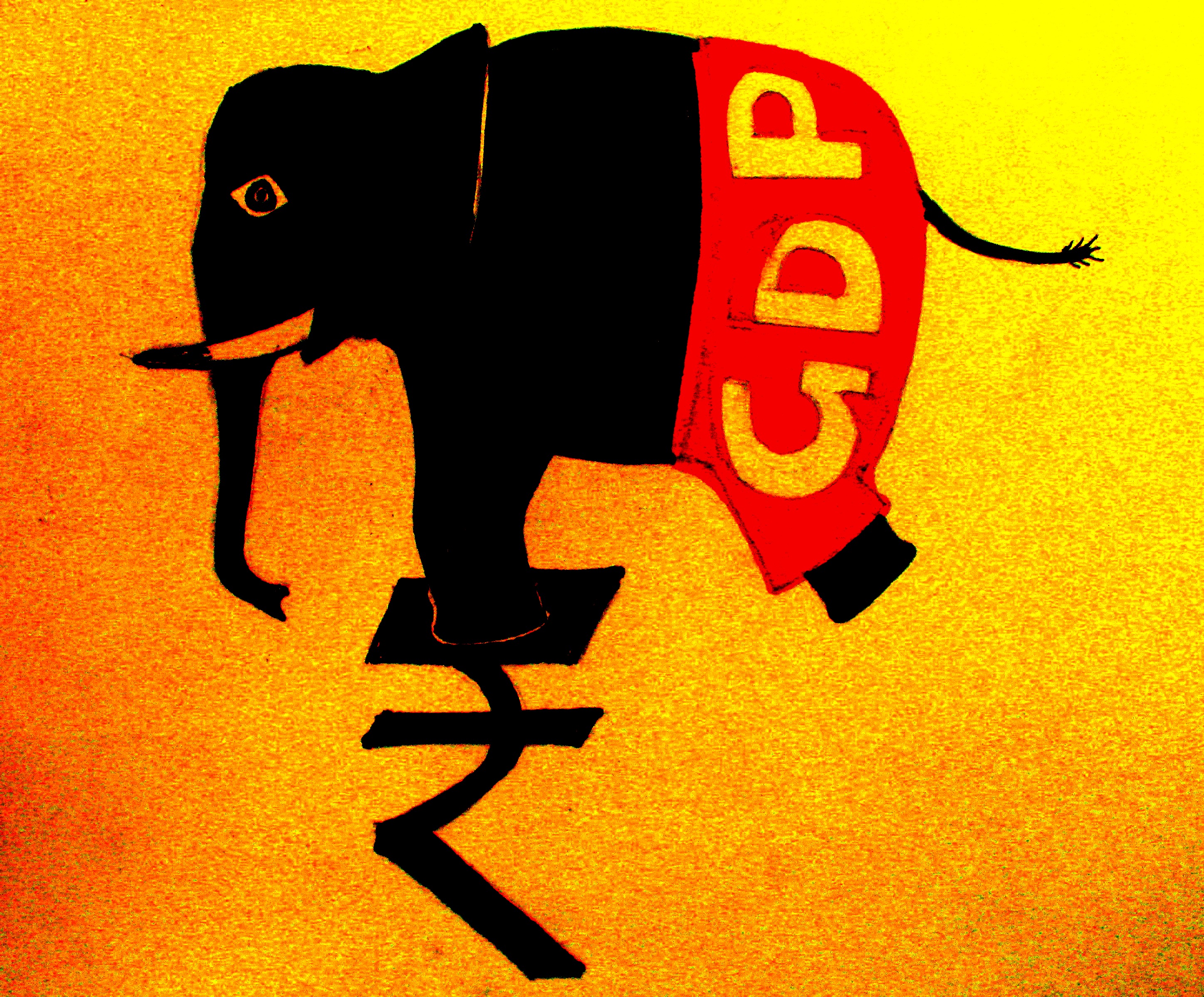
CAN’T SEE THE ELEPHANT

Illustration: Shyam G Menon

Illustration: Shyam G Menon

Call it market or future workforce there is no escaping the fundamental truth that large population challenges a country.

India’s current population is probably on par or close to what the world’s population was at the start of the 20th century.  Dwell on it. Such imagination is what we refuse to do amid our chalta hai (its’ okay) ways. Our numbers seriously impact. The country’s economic problems, described as math, may seem lifeless digits. But they dovetail to human want. With high population in place, even self reliance as solution for import-dependence, resembles a fig leaf for modesty because there are still fixed costs like steep real estate prices to face. Add to it, high salaries as solution to address rising living costs with its resultant inflationary impact down the line. It is a vicious circle. And, this is without mentioning the known decay caused by excess numbers – poverty, malnutrition, unequal access to health care, unhygienic living conditions etc. Perhaps the argument is – once the economy revs up, India will be superpower thanks to its workforce and market.

Truth is – population is the elephant we don’t wish to see.

Population as market and workforce, matters for trillion dollar GDP. That in turn, contributes to everyone’s income. It is all correct. But try imagining from the perspective of quality of life. We have delayed the good life by a long margin by producing so many people. It will take years for India’s per capita income to rise significantly.  Most likely, we will have terrible wealth-inequality. It is already visible. Other pitfalls abound. Not long ago, a visiting German delegation expressed concern about the quality of available manpower. Indian industry too has voiced worry on the quality of skills training. Wilder stories exist on the periphery of our future workforce.

India’s current population is probably on par or close to what the world’s population was at the start of the 20th century.  Our numbers seriously impact.

High population affects quality of human upbringing. Few days after the rupee hit 68 triggering a sense of outrage for the way it left us monetarily weak, many felt shocked by the punishment awarded to the juvenile involved in the infamous Delhi gang rape case. This article is not about that case. But a juvenile involved in such degree of brutality should worry us. Those arrested in the recent Mumbai gang rape are youth. Similarly, who are those people ready to drop everything and fight for religion, culture and language? They appear off and on in photos of mobs wielding sticks and swords. Ever thought if belligerence rises with cheap availability of directionless youth? There are solid sociological concerns in our giant population. As rape cases increased in number, several writers commented on the outmoded mindset of the Indian male.

Population’s impact is the sum of human numbers and human behaviour influenced by the ecosystem of high numbers. Indian life is a rat race because of this. Its external manifestation is disorder and administrative systems crippled by overload. Corruption oils the wheels, extracts movement. Anna Hazare’s campaign brought corruption to focus. But the elephant went unseen. We allege external hand when capital runs away. Arithmetically, even a portion of 1.2 billion people living and working like the developed world, would suffice to enthuse investment and stock market. Market indices and economic indices capture delivered value; they don’t show ground reality. Fact is – when it comes to the act of investing, Indians themselves seek avenues that aren’t as suffocating as Indian existence. What else is states` rolling out the red carpet for industry’? Our own companies demand special treatment. We know the political and operational gridlock by human numbers. Knowing it well, we prize life overseas more than life at home. What can economic reform mean when no government will enshrine the need to contain population as part of overall strategy? At least mention the subject periodically, so that the citizenry is aware of how much they are party to a mess that denies India quality?

Population’s impact is the sum of human numbers and human behaviour influenced by the ecosystem of high numbers. As human numbers rise quality of life crumbles.

Population is not simply more people born. Despite the 20th century being the bloodiest century in recorded history, global population rose seven times in the last one hundred years because new life was born and thanks to advancements in medicine, the new survived and the old survived longer. Thus the old are also around in India. In various fields, particularly politics, they have voice. Imagining to their convenience, they nudge country to life by old idiom. Ample availability of young people willing to latch on to anything for direction provides followers. But is the perspective of 2013BC valid for 2013AD? Impractical and irrelevant aspects of the old way of life must fade. But they don’t. Old school actors like religion and feudalism periodically elicit toll through riots. Caste thrives. Rituals proliferate. Wealth and happiness are measured by property, vehicles, money and children.  There are other examples too. Sample patriotism – it is a highly misunderstood subject in India. Its most popular interpretation imitates old fashioned fort with cannons mounted on walls and soldiers ready to die. Anything less, you are not patriot enough. You plant trees for a country losing trees – that isn’t enough. You take public transport to save oil for the nation – that isn’t enough. You do your job sincerely to contribute to nation’s reputation in quality – that isn’t enough. You teach those who can’t afford school – that isn’t enough. You are not corrupt and thus adding to nation’s efficiency – that isn’t enough. For patriotism to be felt blood must be spilled; wars must be fought. Only that image satisfies. Adding to it, there is no problem if the same self proclaimed patriots bring administration to a halt or destroy public property through violent strikes, fights around religion, language and such. From where and how does such behaviour find social approval?

Illustration: Shyam G Menon

Illustration: Shyam G Menon

Deep within heavily populated country, insecurity flourishes. Don’t think so? Then, what’s gold consumption by Indians all about? Put differently – we are forever insuring against insecurity. Why? What is our fear? What keeps compounding it? I have always suspected it relates to the nature and structure of our families. A family is never without worry about potential insecurity although being in family gives you sense of security. As rat race by population intensifies, so does the family’s perception of insecurity in the environment and its urge to move ahead at any cost. In the analogy of country as fort with cannons, family is the primary fort. The rich and well-connected get away with anything. The middle class, lacking such resources, battles differently. In big Indian cities, organized urban violence has approval traceable to families. That’s how violence became acceptable as a brand of urban politics. Violence in the name of religion and caste are all kept alive by families. It should highlight how insecure families have become thanks to exactly what they contribute to – high population. We consistently avoid this point. I say it not to load the dice in favour of lone rangers although I firmly believe that unless one realizes one’s vulnerability by standing alone, you won’t fathom the meaning of human respect, the need for it and the genuine merit in social values. Some Indian values are definitely good. Problem is – we are inheriting it without knowing why they exist because the family-trap is all about inheriting without the effort of knowing why. I merely wish to point out in this habitually marrying land, that neither family nor its larger groupings like community are implicitly states of grace. They edit out many crucial aspects of existence, particularly the individual as basic unit. They also do wrong. Remember honour killings, hit-and-run cases etc where family-imagination was either cause for crime or family ended up shielding the offender? In India’s instance, both family and community is also network of similar interests. Despite veneer of corporate governance on the surface, obfuscation of professionalism by family and community has often been a problem at Indian businesses. Long given to family, politics has become rule by dynasty. So what’s unquestionably great about family? In India, our family spaces badly need revision by new thinking.

As rat race by population intensifies, so does the urge with families to move ahead at any cost.

Thanks to giant population, we are the world’s biggest democracy. Our chosen method of administration requires plenty of efficient dialogue. India is chaotic in dialogue all the way up to state assemblies and Parliament, the very institutions expected to be examples of debate and governance for the rest. Why does dialogue fail? One reason has to be India’s caste system of several centuries that made the idea of inclusiveness alien despite our scriptures talking of world as family. The caste system was proactively attacked only after independence and adoption of modern constitution. The India from 1947 till now, is yet a dot on Indian history. Another reason could be that against the expanse of India’s history, its experience of inclusive, democratic administration is limited. We have a tradition of great minds and great debaters. But did they flourish in an inclusive environment? The larger question therefore is – how often in the past were we genuinely inclusive of us, all by ourselves, the way we have been forced to sit together and govern since 1947? I am not an expert on history. But it appears to me that our past trained us little for it; we are treading new ground. This traditional lack of inclusiveness is a huge handicap when administering 1.2 billion souls hailing from diverse backdrops. As yet, our instincts track old ways. The natural tendency of any exploded population averse to imagining differently and used only to old school feudalism will be to evolve smaller fiefdoms of the familiar old. It delivers power and money, which contemporary society by its conduct, showcases as essential. It also deepens known problems through reductionist models of the old – for example, splitting into more states. Better administration probably requires more states in India. Yet such models mean nothing if they are not accompanied by changed mindset for administrator. Will an administrator with changed mindset be winner or loser to the imagination of rat race by 1.2 billion? Is leadership perennial indulgence of community or does it include selling harder truths – like noticing that elephant to begin with?

Within two decades, India will be the world’s most populous country.

In early 2013, my cousin and I were trekking in the Himalaya, when at a village en route we met a young American woman, part of a group of foreign college students on a month long-hike in India’s wilderness. She said she was enjoying the experience but then added rather puzzled, “ you know, this is supposed to be wilderness. We are forty kilometres away from the nearest road. Yet there isn’t a day that went by when I didn’t meet people!’’  Population and its ways envelop us. Our challenges are not with this land, which provided for us for years and still yields what it does. Our problems are with what has replaced geography – ourselves; the equations between us, what all we do. Increasingly how well we manage this social space is what decides success. We are in the age of society as soil; the age of the social farmer, for the real soil is part of a fading planet overrun by people. It is also what leaves us exhausted and frustrated. On the one hand, people adept at self promotion and social networking rise to the fore. On the other hand, plenty of genuine human talent is wasted for want of networking skills. And all the time in the background, every family fueled by its protective parents and grandparents insist that their wards are the next Einstein, Bill Gates or greatest medical doctor alive.  There’s nothing we can do except suffer this noisy gridlock. It would be a tremendous loss if dysfunctional by population, we are forced to trade democracy for something more directive. To avoid it, we must comprehend what happened to us by noticing the most fundamental flaw in which everyone is invested – high population. We must notice our social organization also and inquire if it suits environment drastically altered by high population. This need is gathering urgency.

We must comprehend what happened to us by noticing the most fundamental flaw in which everyone is invested – high population. We must notice our social organization also and inquire if it suits environment drastically altered by high population. This need is gathering urgency.

(The author, Shyam G Menon, is a freelance journalist based in Mumbai.)