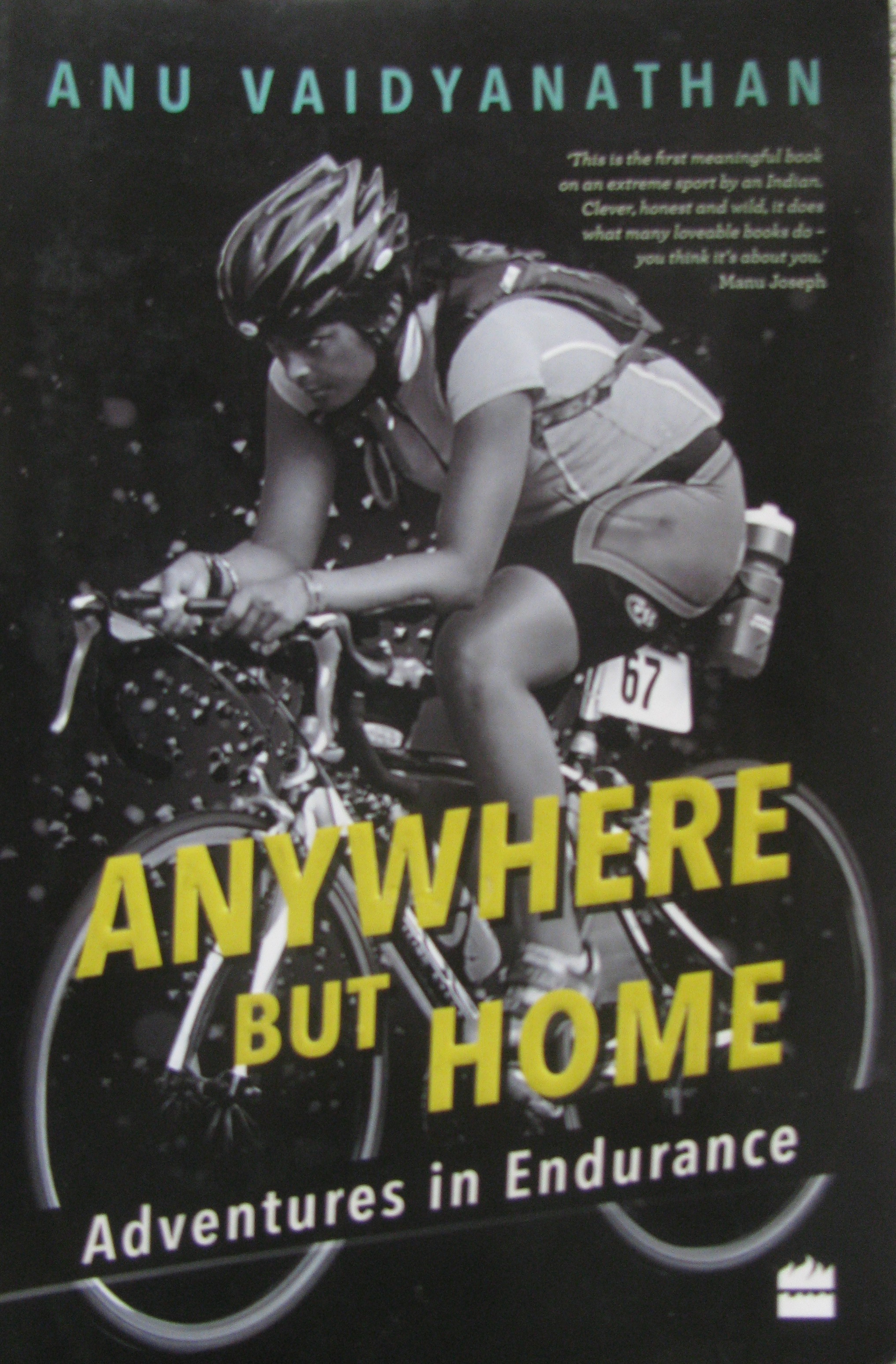
`ANYWHERE BUT HOME’ – A GOOD READ

anu-vaidyanathan-1Anu Vaidyanathan’s book, `Anywhere but Home,’ is an enjoyable read.

The language is simple and the narration, direct.

The author, who is a well-known triathlete, provides a breezy overview of her life. The choices made are stated as such without recourse to justification. Doing so, both triathlon and life in Anu Vaidyanathan’s book, are beautifully devoid of labored explanation. There is no manufactured heroism or manual on how to succeed, except perhaps what lingers obliquely as an idea of person (who is also triathlete). One of the great reliefs I found reading this book was its treatment of athlete’s life without making it seem extraordinary. The writing transcends given sport to underlying qualities.

The book spans growing up in India; studying overseas, the difference between here and there, managing a business, pursuing a PhD, the question of “ who am I?’’ and within all that – an engagement with the triathlon. It is a packed life; a triathlon of a life wherein the sport appears to have given physical expression to a person’s nature. Many outdoor and athletic pursuits inspire the need to progressively lighter one’s view to essentials. When `essentials’ becomes ink for writing, the pages turn. That’s so with this book.

Buy it, read it.

(The author, Shyam G Menon, is a freelance journalist based in Mumbai.)

TWO FILMS

Illustration: Shyam G Menon

Illustration: Shyam G Menon

I watched The Jungle Book for the first time in Bengaluru.

A successful animation film with several re-releases to its credit, I saw the movie in the early 1980s. It was screened at Rex Theatre on Brigade Road. I recalled this ahead of watching the film’s 2016 version at Mumbai’s Sterling Theatre, replete with 3D animation and contemporary movie stars providing voice to the characters. Further, keeping aside Jason Scott Lee’s Mowgli from the 1994 version, the main protagonist of Rudyard Kipling’s book was a human being on screen and not an animated character. While some people have said that the old 2D animated version is their preferred benchmark, things have changed for me – I embrace Jon Favreau’s creation as benchmark in my times with one difference: I thought Baloo’s song (The Bare Necessities) was more enjoyable in the earlier film. Maybe it’s because I was a lot younger then, less cynical, less critical and more spontaneous. Years later, as life took its twists and turns, among them bringing me to the outdoors and the mountains – I have often wondered: if not the bare necessities, what is it that I am seeking?

Image: courtesy Disney India

Image: courtesy Disney India

One knew that after Richard Parker, the tiger in Life of Pi, Shere Khan would be convincing despite animation. What one did not anticipate was Idris Elba. His Shere Khan remains for me, a force haunting Kipling’s jungle. From the menace Elba creates, flows the dark, ominous mood of the film, a trait that sets it apart from the more child friendly approach of the earlier version. But then, today’s child growing up with smartphone, is also arguably a more media immersed junior, for whom the earlier film may at best be fodder for a submission in class on how technology evolved. Of the people who voiced the characters in the earlier movie, only George Sanders was known to us at that time. In days preceding the Internet, old film magazines brought home Hollywood and Sanders was there in some of the issues I used to thumb through. Even then, a few of the voice actors in The Jungle Book, including Sanders, were no more by the time the curtain raised that evening at Rex Theatre. In the 2016 version, I could appreciate the main voices for these were actors of my time. I could also appreciate what seemed to me paradoxical choices that clicked beautifully. Thus for instance, Ben Kingsley’s voice – even and measured in how it registers aurally, seemed apt choice for Bagheera. Christopher Walken as King Loius – I wasn’t sure. Till I experienced it and felt the psychopath sort of terror – so not Shere Khan like – that Walken’s laidback, negotiator of a voice can bring. Bill Murray as Baloo was a breeze. What didn’t convince was Kaa, the python. It had one mesmerizing scene all to itself and then, was gone.

Above all, this will be for me a Neel Sethi movie. After seeing the earlier version, I was left with memories of Bagheera, Shere Khan and Baloo. With the 2016 version, Mowgli joins that list. Sethi does not essay his role harking of innocence. He brings an element of smart contemporary youngster to the frame, creating in the process, a bridge between city and jungle. I suspect, for a generation experiencing The Jungle Book in the age of reading’s progressive decline and walking as they do through its plot with Sethi’s Mowgli for company, Favreau and Disney may have replaced Kipling as creator of the story. In the business of making an impression, that is a measure of how effective you were.

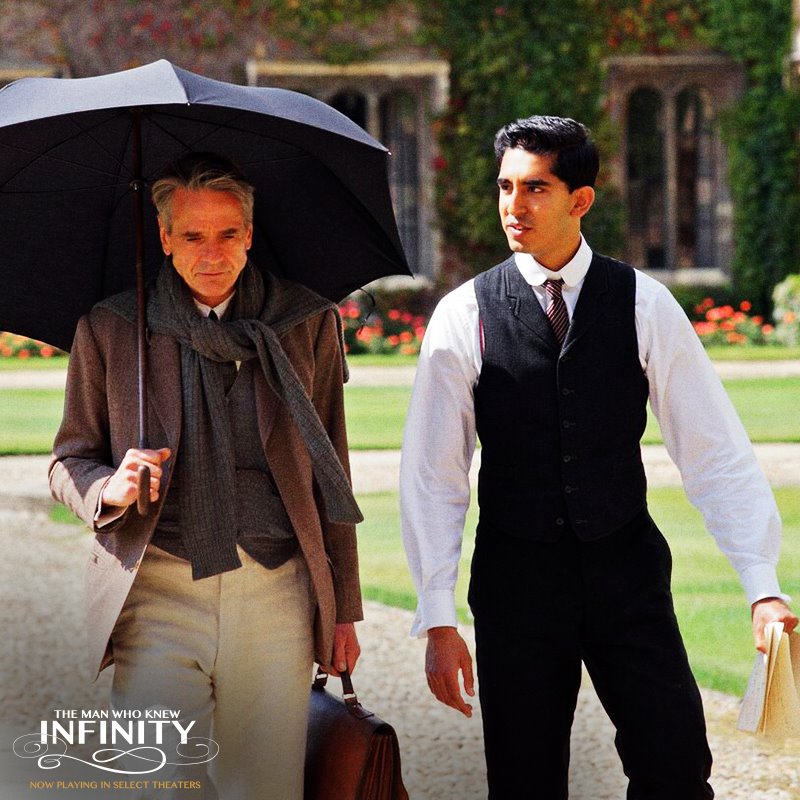
In the latter half of the 1980s, I saw a remarkable film at a film festival in Thiruvananthapuram. I went to see The Mission because of Robert De Niro but came off knowing the talents of Roland Joffe and Jeremy Irons as well. For me, Irons is among the great classically trained British actors of his generation; the sort with commanding screen-presence. Indeed in his case, that presence literally lurks in the frame waiting to explode. A few things define the Irons of cinema – an apparent discipline, intensity and voice. It is hard to have him in a supporting role and not lose the film to him. But if you are a film buff, you don’t mind that for losing a film to an actor of Irons’ calibre is rarely a bad experience. That’s what happened with Race; that’s what happened with The Man Who Knew Infinity. In the latter, it also helped flesh out and establish the respective characters of G.H. Hardy (played by Irons) and S. Ramanujan (played by Dev Patel), not just for the individuals they were but also the backdrops shaping them.

Jeremy Irons (left) and Dev Patel in The Man Who Knew Infinity (Please note: this photo was downloaded from the Facebook page of the movie.)

Jeremy Irons (left) and Dev Patel in The Man Who Knew Infinity (Please note: this photo was downloaded from the Facebook page of the movie.)

I do not know much about Ramanujan beyond what I gleaned of him from the film. In the movie, he comes across as gifted in an almost mystic way; his mathematics by intuition versus Hardy’s math by proof, his tendency to spontaneously get started on equations and that dialogue – that his goddess, Namagiri, puts numbers on his tongue. There is always a bit of struggle in how the visual arts and directors, actors therein, portray genius. A similar struggle exists in The Man Who Knew Infinity and Ramanujan occasionally felt contrived. At times the mathematician’s earnestness, isolation and genius seemed tad overboard in the portrayal. But then like I said, I don’t know how Ramanujan behaved in real life. Those who researched know best. Wikipedia describes Ramanujan as an autodidact, a person who is self-taught. A lacuna to my mind, in the film, was the dearth of material on how Ramanujan reached the level of proficiency in mathematics he had by the time he wished to publish. That proficiency may have drawn much from things deeply experiential, like the relationship between self and ecosystem with math embedded in its living traditions. Equally, in conservative society with life and lifestyle rigidly defined, the abstract world of numbers may become a liberating private refuge. All this went unexplored in the film, which starts with the adult Ramanujan finding a mentor in his boss, Narayana Iyer.

Matthew Brown’s movie was more about the Hardy-Ramanujan-Cambridge equation. Not for a minute am I saying that the Cambridge chapter is unimportant or uninteresting. The characters in that chapter have been presented well; the ambiance created by Hardy, J. E. Littlewood and Bertrand Russell is wonderful. Had it not been for them, we won’t have Ramanujan the way he is known today. Still, Cambridge is where the man was vindicated; he was formed elsewhere. Can a story of genius vindicated be complete if the formation of genius is not explored? This film deserves to be seen. Reports said that the movie was a challenge to make because funding was hard to come by. It is a good effort and as usual, Irons is a class act.

(The author, Shyam G Menon, is a freelance journalist based in Mumbai.)       

REVISITING 1936

Illustration: Shyam G Menon

Illustration: Shyam G Menon

On the poster of `Race,’ actor Stephen James looks you straight in the eye.

A front shot of the signature Jesse Owens pose, it is an expression of absolute focus; the edge of his palm in line with his nose, splitting his face and creased forehead into two halves. Each half is defined by a raised eyebrow with an eye below preying on a distant object – a finish line. The palm, the creased forehead, the eyebrows, the eyes – they emphasise his concentration to the expense of all else.

What that poster conveys is the strength of Stephen Hopkins’s film. It tells an uncluttered, linear story that is almost a documentary on Jesse Owens. Denied melodrama, the film lets sport and its main protagonist, be noticed. Despite the light physical build of the classical athlete, his position in script is secure. The casting is balanced. The acting is right sized; a powerful actor like Jeremy Irons shines in his role but doesn’t squeeze others out. Amid the simmering race relations in the US of that time, the racist views of the Nazis and the growing danger in Nazism, sport shines through. There is the relation between Coach Larry Snyder and Owens. But I remember more other instances. There is a dialogue in the film, one that speaks the perspective of sport: when you are running there is no black and white; there is only fast and slow. In age of propaganda, we see the equation between Joseph Goebbels and filmmaker Leni Reifenstahl. When Goebbels uses a construction project to bait builder and sports official Avery Brundage, in Berlin to evaluate whether American participation is possible in a Nazi run-Olympics, we see the colour of money (a 1999 article on the Berlin Olympics, in The New York Times, mentions a 1938 letter from Germany in the University of Illinois archives, indicating acceptance of the bid by Brundage’s construction firm to help build the German Embassy in Washington). There is the amazement America’s black athletes have in discovering no separate quarters for them at Berlin’s Olympic village. Then there is that conversation between Owens and Carl “ Luz’’ Long, the German long jumper Owens beat to second position. Long reveals his disapproval of racism under the autocratic Nazis and his belief that the democratic US system is better causing Owens to say reflectively that he isn’t sure. The scene sums up the predicament of individual in collective, then and now. Race is a good film. See it.

However, a linear narrative denies as much as it shows. Owens is an athlete at times of racial discrimination in the US. Across the Atlantic, Germany consumed by notions of racial supremacy, views the 1936 Olympic Games awarded to Berlin, as an opportunity to showcase country under Hitler. America contemplates boycotting the Berlin Olympics to display its aversion for the Nazis’ racist policies and anti-Semitism even as transport buses on its own roads kept separate seats for African American people. Amid this, in 1933 and 1935 (as per the Internet) , Owens equals the world record in the 100 yard dash, becoming one of the top sprinters on the planet. Whether he should participate in the Olympics or not – easily answered in his athlete’s mind – becomes a vexing question for the African-American community. He is confused. It is a web of charged histories with athlete entangled. The film doesn’t delve deep into these trends shaping Owens’s times, even his life. Although eventual outcome is a film I found more watchable than what Bollywood served up on India’s best known sprinter, it must be said that in as much as the Indian film traded sport for the muscular nationalism loved by prevailing market, Hollywood embraced sport and breezed over history, including personal history. You suspect a more creative script may have accommodated those times better. I wouldn’t mind it even if the resultant film was called `1936.’ As sport becomes event management and event becomes the hunting ground of those seeking power, sport isn’t sure anymore what happened to it. That perennial question of individual in collective isn’t just a social, political or business question; it is a question in sport too, a question of what you lose in sport when you want sport on grand scale or want sport to prove a point.

Race ends showing Owens and his wife taking the freight elevator to attend a reception in his honour because coloured people aren’t allowed entry via the hotel’s main entrance. This is in the US, soon after he won four gold medals at the Berlin Olympics. There is no hint, except as epilogue in text, of what followed. Owens returned to America from Berlin with no congratulatory message from the President of his own country. His sporting career ended early. Wanting to capitalize on his post-Berlin fame, he took up some commercial offers as a consequence of which, officials withdrew his `amateur’ status.  Denied participation in amateur events and unable to sustain his reputation, his commercial offers dried up. This forced him to run for spectacle, including racing against horses. He ran a dry cleaning business and even worked as a gas station attendant. He eventually filed for bankruptcy. In 1966 he was prosecuted for tax evasion. It was after this, that recognition and help came.

When you read this on Wikipedia, you realize how important it is for a biographical film to pick up those portions of a person’s life, which tell as much of his story as possible. In Owens case it is tough to do so for he packed much into his life, not to mention, his times was equally packed with social issues and political developments. How do you make a script of it all? Problem is – the moment one heard of a film on Owens, one thought of `Ray.’ The film on the singer-musician progressively built his character. You understood from where each brick came. The Owens of Race appeared parachuted into the movie, inhabiting it for a while and then disappearing with a scene, which is the last in the film but we know is the beginning of a tough phase for the athlete. If a man’s life is a reel of film, then Race with its linear narrative, has snipped and showcased the middle.

Owens merits a Ray.

That is still awaited.

(The author, Shyam G Menon, is a freelance journalist based in Mumbai.)

RHYTHM HOUSE DECIDES TO SHUT SHOP

Rhythm House at Kala Ghoda, Mumbai (Photo: Shyam G Menon)

Rhythm House at Kala Ghoda, Mumbai (Photo: Shyam G Menon)

For many years, I worked in South Mumbai, close to Churchgate.

Sometimes too much typing on the computer got to me and I would step out of the newspaper office for diversion.

If I cut across the nearby Oval Maidan and its myriad cricket matches, then fifteen minutes walk away, was Rhythm House. It was a shop in an old building at Kala Ghoda, now the city’s art district thanks to the adjacent Jehangir Art Gallery, the pavement artists, the surrounding heritage architecture and an annual festival in the area with roads closed to traffic and open to arts and crafts. Compared to other shops selling music that arrived and closed during its time, Rhythm House was small. But it was packed with music and movie titles in the physical format. What you couldn’t find on the shelves, you ordered at the desk. I would spend some time here browsing through the collection, clear my head and return to work.

One day, I wrote about Rhythm House. The new century had arrived. Businesses overseas had witnessed massive change through Internet and digitization. The world of book shops for instance, was besieged by question marks. As book shops struggled, I wondered what was happening at Rhythm House. Hence that old story written and published in the newspaper I worked for. It failed to capture well the shop and its predicament. Maybe I hadn’t known Rhythm House long enough to tell a story. I acted in haste. But I remember the owners being concerned of what lay ahead in the fast changing market. Still, if there was anything challenging Rhythm House, it wasn’t visibly alarming for the shop was well stocked and it had customers. During festive season, the traffic built up. Besides, sales or no sales, everyone knew Rhythm House. It was a Mumbai institution.

At Rhythm House you met connoisseurs of music. Once in a while as I hung around the racks hosting music relevant to me, I would hear a customer or two ask the salesmen about specific albums or concert recordings. The salesmen would in turn indulge them in talk about the elusive recently sourced or, which can be sourced. The minor details bringing joy to collectors of music are fascinating. It is portrait by passion. You don’t sense these folks as palpably in cyberspace even though the digital side of everything is marketed as bigger meeting place. In the real world and its shops, you meet people in full and a person in full is person believable. I wrote that article on Rhythm House well over ten years ago. I subsequently became freelance journalist and in my less moneyed avatar, continued to visit Rhythm House but rarely purchased. I found relief just being there amid the music and films although I must admit, not being able to afford was progressively becoming a dampener.

Rhythm House; red board announcing Goodbye Sale (Photo: Shyam G Menon)

Rhythm House; red board announcing Goodbye Sale (Photo: Shyam G Menon)

January 1, 2016. Having decided that a multiplex ticket costing Rs 400-500 to see the latest Star Wars movie wasn’t worth the strain on one’s purse, my friend Latha and I decided to go for a walk instead. Decades ago, I had watched the first Star Wars movie at a theatre in Thiruvananthapuram and returned home a fan of Han Solo. I watched the first trilogy. Then I watched Harrison Ford in all those Indiana Jones movies. Those days you could afford visiting the theatre. Now the question isn’t whether you are interested in cinema but whether you can afford multiplexes. I was a fan of Star Wars quitting at a choke point in the system called costly multiplexes. Our evening walk brought us to Kala Ghoda and the Jehangir Art Gallery, which we wished to visit. I think when you age you realize you are a traveller in the universe and therefore entitled to perspective. You find it in art, that’s why the occasional visit to the art gallery engages. As we left the art gallery, we noticed Rhythm House, distinctly less celebratory in appearance despite the festive season. When we drew closer, we saw the red board on its door: Goodbye Sale. I was shocked. Powered by discounts, the innards of the shop had been cleared out in parts. Latha picked up a rare recording of a Hindustani classical vocalist. Bill paid we got out but couldn’t leave. An institution was shutting down. We had no proper camera. So in the dim light, Latha took a photograph of the shop on her cell phone.

Unknown to me, Rhythm House’s closure had been in the media since November 2015. The articles featured musicians, music lovers, music critics, authors and other residents of the city who shared their memories of the iconic establishment. A visit to the shop’s website showed a message. Excerpts: We are the last of our city’s large format music & video stores to yield to the challenges posed by new technologies and piracy. We are set to close for business end of February 2016. We have been in the music business since 1948 and in the video business over the past 30 years or so and closing down is therefore going to be an emotional wrench for us. Many of you have echoed similar sentiments and we thank you for being with us at this difficult time.

I returned the next day to click the photos accompanying this story.

Mumbai’s art district and its music scene won’t be the same without Rhythm House.

(The author, Shyam G Menon, is a freelance journalist based in Mumbai.)

AN IMPRINT FOR NOVEMBER

Illustration: Shyam G Menon

Illustration: Shyam G Menon

Footprints are the stars of suspense and mystery.

Depending on context, a footprint can be much more than the trace of a foot or boot-sole on earth. A common contextual feeling among hikers for instance, is: I am not lost, I am not alone! Provided of course, whoever walked by is good company. Can you be sure of that? A footprint on earth is also imprint in restless brain. It is what it is and then, it is what you make of it. Or is it what it is because of what you make of it? Ha! – says Holmes, that solver of mysteries. Eyes closed; head thrown back, palms joined, a mocking smile on his lips, the triumph in needling Watson with his occasional barbed quips showing through.

One thing I know – I can’t be Holmes, for there is nothing as delightful as watching the character from far. Inhabit him and you trade that perspective for the hound’s nose glued to a trail. I’d rather be Watson capable of seeing Holmes or better still – the reader of a book or viewer of a TV serial showing them both, for Holmes with Watson alongside, is one of the finest character portrayals there is.

In my case, Holmes is an imprint in the brain.

Nobody means Sherlock Holmes more to me than the late Jeremy Brett.

I still remember my first meeting with Holmes. I was approaching middle school. Readers Digest was popular those days. Once in a while, the magazine sent out a list of the books it published, which readers could buy. There was a thick blue book with fiction abstracts and a red one. I ordered the red; my cousins procured the blue. The blue had chapters from Sherlock Holmes. Ours was a family appreciative of the creative arts. On weekends, the cousins gathered to indulge in some form of creativity. Initially it was painting; slowly that gave way to each one getting serious in some chosen passion – dance, music, reading, writing, painting, football, aero modelling, films etc. It continued till tenth standard, maybe some more. Then life, like water poured down a funnel, was recast in service of livelihood. It is like the story of mineral water; once was free, flowing water, now eminently saleable in bottle. By the time we finished college, we were just that – saleable.

Somewhere in the period partial to creativity, an evening at their house, Manju and Rajeev kept me spellbound by their narration of The Speckled Band. That was my first Sherlock Holmes story and it came from the blue book. Not exactly fond of snakes, the snake in the story left an impression, strong enough for me not to forget either the story or my cousins’ narration. For several years, Holmes stayed just that in the head – a story. I came across his collected adventures at other households in the extended family but the youngster in me wasn’t keen on a character set decades back in the past. My mother told me that Holmes was even a case of character brought back from the dead by popular demand. Such had been his impact. It failed to register for I wanted modern characters. Time passed by. The shape of Indian cars changed; the shape of household appliances changed – among them, the television. Colour TV arrived and with time, cable TV.

Among programmes telecast was the Granada TV series, ` The Adventures of Sherlock Holmes’ with Jeremy Brett as Holmes. It changed everything for me. I found myself keeping my appointment with the telecast that opened with unmistakable violin-notes. A simple, bare tune that resonated of an era gone by and told you clearly – get ready to be transported back in time. It was a fine series with good performances by not just the lead actors but also those making special appearances as important characters in each episode. In my opinion, the series was one of those productions in which the average quality across episodes stayed pretty high. Brett and his committed, intense portrayal of the detective grew on me. Above all, for someone sold on ` modern,’ I found myself enjoying the eccentricities of ` period.’ Everything, from conduct to language – it lingered distinct in the slower pace of the past, it cut a style. Holmes had style! When the series ended, I acquired a thick volume showcasing all the Sherlock Holmes adventures and set about reading it. There is still stuff I haven’t read, stuff I forget. I am glad it is so for it lets me get back.

Thanks to the Internet, I have sampled different actors as Holmes. None inhabited the character or created Holmes like Brett did. I don’t hold portrayals strictly accountable to what the author prescribed in every little detail. No, I don’t. That is probably why Brett impressed me so much. I was a blank slate for although I had read some of the detective’s adventures, characterization is picked up easier from an enacted piece than a written one. Brett provided a face to a figure, voice to a brain, life to a character and mannerisms, even arrogance, for recall; plus intensity. For all the logic Holmes attributes to his ability to deduce, Brett infused a crucial contrarian element to his Holmes – a touch of mystery. The sum total of what he offered as Holmes was a portrait of deduction as much enigmatic and enticing as a case delivered as question mark. It was the perfect package for imprint by image. The man was a genius; perhaps more accurately – it was acting genius unleashed by defining role. No Basil Rathbone or Peter Cushing for me and definitely no Robert Downey Jr or Benedict Cumberbatch; it has to be Jeremy Brett. Like imprint in mind authoring perception of footprint, Brett became Holmes for me. David Burke and Edward Hardwicke did an excellent job essaying Dr Watson in the series. I am partial to Burke. His Watson showed the spunk to stand up to Holmes, a sharp contrast to say, the rather bumbling Watson of Nigel Bruce.

I am not a researcher on Holmes or an academic knowing every detail of every story. I have also not been to London and Baker Street. I am sure learned discussions on Holmes and Brett may hold opinions different from mine. My journey with Holmes continues in occasional readings of the book, still enjoyed as return to character and language and every once in a while – recourse to YouTube where the old Granada series survives and Brett comes alive as Holmes to the fans he made.

Brett died in 1995.

He was born November 3, 1933, three years after Sir Arthur Conan Doyle, the creator of Sherlock Holmes, passed away.

This is a November.

(The author, Shyam G Menon, is a freelance journalist based in Mumbai.)

THE SMART LIFE

Illustration: Shyam G Menon

Illustration: Shyam G Menon

When I was young, the media engaged as access to wider world.

Now it sticks crowded world into everything. No quiet moments of solitude anymore. It is an epidemic of others in your head. My old phone has no Internet; I only text and answer calls. No apps, no Facebook, no anything else I don’t yet know of. Not having a smartphone, my friends assure me, condemns me to oblivion. The world’s business, they warn, is being swept into smartphones by a tsunami of money. Being one with the swarm is the smartest option in life reduced to beehive. It puzzles. `Smart’ owes much to apartness. By which yardstick, thinking independently should be smart. Perhaps there isn’t anything called independence in consumerist world. You go where business goes.

Every time I step into a Mumbai commuter train, I feel disappeared. Everyone has a smartphone. I used a cassette player when train commuters shifted to CD player; a CD player when they moved to MP3 player and now, a MP3 player as they do finger tip-magic on their all-in-one smartphone – it takes calls, types, plays music, screens movies, makes payments, plays games. What doesn’t it do? I hang on to my old phone for the relief of what it doesn’t do. “ What matters is the music and how well you listen to it. Smartphone, MP3, CD or cassette – that’s irrelevant,’’ I argued. My friend was unimpressed. “ How long will you be like this?’’ he asked. Working in a bank, he knows the tsunami has started. They are jamming whole banks into the smart phone. When he speaks so, I picture myself in deep space, waving good bye to planet Earth. You have seen that scene many times in movies – the actor reaches out to you like a drowning individual and then slowly recedes, becoming smaller and smaller (all the while reaching out) till he disappears into inky blackness. I am hurled towards Pluto. Cut! Actually, I should be grateful for having a friend who is concerned. What he told me was for my own good. I was thinking of all this when I boarded the train for my daily rendezvous with fading.

Early evening-trains usually bring a rush of college students. This was a Saturday. The youngsters were there but not many. I took my seat and pulled out my MP3 player from the bag. The young man next to me moved closer to the window; he kept his bag between us. Another of the tech-savvy, keeping distance from the obsolescent, I thought. Relax man, I don’t infect and even if I do it is just this harmless disease called hyposmartivity, entirely curable with a prick to the ego – I wanted to tell him. Then he returned his phone to the bag and pulled out a book. That was when I noticed his phone, very similar to mine. Unable to contain myself, I told him, “ you know I thought I am the only one still walking around with a phone like that.’’  He laughed. “ Yeah, I carry an old one,’’ he said tad sheepishly as nerds do when confronted with their lack of mainstream cool. As he spoke, he glanced around nervously at some of the other seats, where smartphone-totting youngsters sat, glued to their screens.

“ I don’t want a smartphone. I am happy with what I have. But they say I will have to upgrade because our money is going to be managed using smartphones,’’ I said. Despite my guard, my cynicism showed through. It always does, for I feel angry that life is increasingly about swimming with one tide or the other. Those who won’t, should seek exile – that’s the emergent logic. Makes me wonder – what happened to interesting people? You know the sort who felt life by exploring the universe alone. Stay positive, stay positive – I pinched myself. The college student smiled – a sorry you lost but don’t tell me you weren’t warned-smile. “ In my case, I know what smartphones can do. But if I carry one, I won’t study. It is a distraction. So I don’t keep one,’’ the youngster said. What? – I was stunned. For a second, I must have looked like Utpal Dutt’s Bhawani Shankar beholding Amol Palekar’s Ramprasad Dashrathprasad Sharma in Hrishikesh Mukherjee’s wonderful film, Gol Maal. I looked at the young man, eyes open wide in admiration. “ Appreciate that, your ability to know what you want and choose accordingly,’’ I said. It was as much encouragement to the other as it was discreet pat on the back for my own eccentricities. That evening on the train, I didn’t hide my MP3 player. I let myself be.

I think that young man will find his way abroad to a fine university. He seemed studious, hard working and committed enough to do that. Having dodged the smartphone to study well, go overseas and make his mark, what will he do next? Side with the swarm and sell me a smarter smartphone? To uncle with love – free ticket to Pluto. Who knows? A few days after this train journey, a good friend, concerned about my obsolescence, put her foot down and said I am getting her old smartphone as she is upgrading. God bless her. But the eccentric devil in me can’t help feeling amused – a device with so many functions to manage freelance writer’s paltry income? It is overkill. Still, I will go with it; be smart for a change.

(The author, Shyam G Menon, is a freelance journalist based in Mumbai.)

FORGET, REMEMBER

Photo & imaging: Shyam G Menon

Photo & imaging: Shyam G Menon

The other day I woke up unable to recall the one song I have loved all these years.

It was a frantic moment; almost as if I had lost myself.

The first time I heard that song, I had immediately fallen in love with it for the journeying groove in which it couched its truth. Everything about it moved except for its core; what’s more, everything moved because its core recognized the futility of staying put.

So I thought. So I choose to continue believing for I don’t usually latch on to songs by their lyrics. I don’t read music. The times I memorized lyrics and sang, I felt surrendered to a purpose. Music, for me, has no purpose. It just, is; much like life. You can snuff out life just as you turn off the music. But when you are alive, can you question consciousness? It is what it is. Similarly, you like music. Don’t try explaining why your atoms and molecules rearranged to happiness, hearing the sounds. Don’t try explaining why you swayed to music. Let it be. And from that, some songs stay. Those that stay long, you may opt to work your way back from musical impression to the lyrics. It is a bit like finding a good friend. You know each other with time. You think you explained the other having unravelled the lyrics. Then, just when you thought you had it all explained, a whole new mystery starts! The cosmos is restless.

“ I Still Haven’t Found What I’m Looking For’ – the line meant little to me when I first heard U2’s song, way back when their album ` The Joshua Tree’ was nominated for the Grammy Awards. The nominated songs and the award presentation used to be telecast as a half-hour capsule on national television those days in India. I fell for the song’s structure and progression right away. For me, its seminal line was merely a name to remember it by. What attracted was the whole thing.

Years passed. Now working away from home and my room with a music system, music transformed to small portable audio player and headphones. Eventually when I failed to keep pace with technology, it transformed to tunes in the head. I even liked returning from a month of self imposed ban on the media, to my music – hearing it with renewed freshness. My affection for the song was perhaps a sign of things to come, for my sense of life as adult has always been out-of-body, as though peering at passing sights from the confines of a self limiting-shape. Every time that procession of passing sights took hold, the song would fill my head. Indeed U2 was especially talented in creating such imagery through their music; many of their songs possess the feeling of travel. Wind in your hair, self on a comet streaking through the cosmos, the clarity in un-belonging. I could go on.  Larry Mullen Jr, Adam Clayton and The Edge – that’s a trio of talented rock musicians. They build the musical ambiance, the journeying spirit that bears forth the band’s lyrics and Bono’s vocals.

As the years passed, my affection for their music outgrew the one song I loved, to the many embodying that journeying spirit which the band captured in its work beautifully. But it was when one’s failures in life multiplied amid world inspired by media to worship perfection and success that I really understood (in my own way) why the words ` I Still Haven’t Found What I’m Looking For,’ mattered. My daily life had become a clash of two trends – the comet-rider wanted to move on; earthly life, gripped by money, wanted to stagnate so that life’s explained ways can be milked for income.

What is life if it gets explained?

What if we found what we are looking for; what next?

Are we wired to find and settle down or are we wired for the journey?

I remember the first proper length of time I spent camped on a glacier surrounded by snow clad peaks. The remoteness of Zanskar, the whiteness of the peaks in the dark of the night – all stayed in mind. I am a very average climber. Rest assured, if I can do something, anybody can. I hiked, climbed rock, ran and cycled – in everything I did, I was very average. But I came off understanding why I liked doing those things or being in remote places away from people. Life is a quest; I still haven’t found what I’m looking for. Equally, if I found what I am looking for, what happens to the quest? It ends? Even the idea that there is no quest and only this life to endure as the wise love to tell you – how would you like it delivered; as a truism at start that denies the journey or as discovery in life lived as a quest?

A lot of people these days emphasize the importance of looking inward.

They have a point. It is augmented by the fact that the ancients advised so, which suggestion I am not a fan of for I like being alive to my times. I am not a yogi to feel rested and peaceful within the walls of my being, universe internalized.

Photo & imaging: Shyam G Menon

Photo & imaging: Shyam G Menon

I like my journey.

I felt alarmed when I couldn’t remember U2’s song.

My comet seemed stalled.

I spent the next couple of hours listening to U2’s songs and concerts; and in that, my old song.

I shed tears of joy.

Middle aged engine restarted.

I felt a gentle breeze kiss my face as journey recommenced.

So we traveled, till one day something else happened.

Out of the blue, a tune surfaced in my head and kept going on and on.

It wasn’t a song that latched on to my mind the first time I heard it years ago.

But the way it resurfaced, I could sense urgency.

As with U2, I got on to the Internet and spent much time listening to Sting, possibly the most gifted singer-musician out there. The song in question was ` If I Ever Lose My Faith in You’ from his 1993 album ` Ten Summoner’s Tales.’ The funny thing about suddenly having this song in my head is that it wasn’t as imprinted in my brain as some of Sting’s other compositions. But that day, the song about losing faith wouldn’t leave the head. It wasn’t totally surprising for I had been experiencing a sense of loss, something slowly vanishing. I don’t know exactly what I am losing faith in. Like I said before the precise cause for a song’s lyrics don’t engage me. Over analyzed and over articulated, world by technical mind has become boring. Often a song strikes a chord for no better reason than that it did. It is like finding curves in world made monotonous by grids and pixels. I know I am losing faith in something. Don’t ask me to describe it as if my saying so will help you fix it. How can the problem find the solution? In bits and pieces, the song offered imperfect words for the predicament. Above all, it swept me with its swaying music, hinting in its moments of wordless fluidity a refuge for the un-belonging I know is mine.

Un-belonging and universe are the same.

(The author, Shyam G Menon, is a freelance journalist based in Mumbai. This article is the expanded version of a piece that appeared in The Economic & Political Weekly.)

ESSENTIAL READING FOR MOUNTAIN GUIDES

???????????????????????????????The first time I heard of Martin Moran was in the Pindar valley.

Couple of villagers mentioned his name.

I started frequenting Munsyari.

I heard his name mentioned there too.

Later when the first Indian ascent of Changuch happened, Martin’s name was firm reference point for his expedition had recorded the peak’s first ascent. That in turn, was the fallout of a climbing trip to Nanda Devi East, which he chose to abort and redirect towards Changuch. Before Nanda Devi East, Martin had been up Baljuri and Panwali Dwar.

These are not just engaging mountains.

They fall at a junction in geography and spirituality that is important to Garhwal and Kumaon, particularly the latter. Knowing who Martin is and what his body of work is, appeared essential. When the chance to review his book emerged, I was delighted.

`Higher Ground – A Mountain Guide’s Life’ was a mixed package.

Its strength is that it gives much insight into the subtitle. It is required reading for anyone aspiring to be a mountain guide. If you are imagining a book with details on a plethora of knots and anchor systems – a sort of technical manual; you are mistaken. Martin’s book is his life in guiding, shared. It does not unduly play up the usual lot of technical information, which the term `mountain guide’ evokes. Instead, it provides a taste of how the guide sets up business, works with clients, how much the envelope is pushed for achievement on trips and most important – how even a guide of considerable experience like Martin, won’t hesitate to turn back if conditions on a mountain are bad. If I may say so, there is much relevance in India to reading this book because in the Indian rat race, admiration for being superhuman and the compulsion to be superhuman are both high. They are among sentiments shaping our perception of climbing. Ahead of being comfortable with climbing, it is unfortunately seen as achievement. Martin’s book, although unashamedly nurtured on a diet of climbing, does not hesitate to talk of mistakes, accidents, long days that he and clients got away with and mountains that seemed wiser to behold from far.

High altitude isn’t everything. There is much to keep you busy at the lower heights. Martin’s book introduced me to peak bagging in Scotland; of clients returning to accomplish the ascent of a cherished number of these peaks. Equally, the book also lays bare how the mountains of Scotland and the Alps of Europe can be laboratory for eventual success in the Himalaya. You don’t find this said as such; you glean it. Nearly three quarters of the book obsesses with specific routes and climbs in Europe, something that can tire a reader unfamiliar with these environs. But in the end, you see the organic link, the making of competence. You can definitely do the same in the Himalaya (as many from Nepal and India’s mountain states do) but the point is – there is no substitute to being out and climbing. In the outdoors, you are only as good as how frequently you are out. Indeed Martin’s book is a freight train of personal climbs and climbs done with clients. So much so, it is sparse on his personal life.

From a reader’s perspective, the book is a challenge given three quarters of the book dwelling on the Scottish highlands and the European Alps (with some mention of Norway in between) and the difference in character between narratives from there and the Himalaya. It is a tough contrast to bridge smoothly. Europe’s mountains, heavily climbed and well known, bristle with technical information. Despite best effort to tell a story, accounts of climbing feel dry. I felt the book’s first three quarters was a stiff narrative that could have been made gentler for folks like me. I started enjoying the book from the last quarter. That’s when Martin reaches the Himalaya. With its unique matrix of mountain dimension, altitude, spirituality and people amid it all, narratives from the Himalaya are by nature different from stories from Europe. Couldn’t Martin have kept the style of narration uniform – either the texture of Scotland and Alps all the way or the texture of the Himalaya all the way (as I would prefer)? Or, mixing up the chapters in a non linear fashion? I wonder. All I will say is – I laboured through the first three quarters of the book and enjoyed the last quarter.

The book’s other weakness is exactly what it delivers as its strength. If you prefer the non commercial context as ideal window to the mountains, then this may not be your cup of tea. It shows in the rather limited ruminations on life and life’s questions that dot the narrative. This book is about work.

It is worth reading, especially if you are mountain guide or aspiring to be one.

(The author, Shyam G Menon, is a freelance journalist based in Mumbai. This is a slightly longer version of a review originally written for the Himalayan Club Journal Volume 70)

A BOOK ON MOUNTAINEERING’S HOLY GRAIL

???????????????????????????????Alan Hinkes’ book, ` 8000 Metres – Climbing the World’s Highest Mountains,’ should make a fine addition to the library.

Hinkes is the first British mountaineer to have climbed all the fourteen 8000m-peaks.

On the Internet, his achievement is sometimes qualified as “ disputed,’’ the ascent of Cho Oyu being case in point. Hinkes mentions reaching the mountain’s vast summit and walking around to ensure that there isn’t any higher to go. All this is in semi white out condition with reduced visibility. Views of other major peaks, useful to establish proof of summit, remain elusive. Hinkes is also alone at this stage of the climb. “ I did not bother to take any photos. There was nothing to see and I was more concerned with finding my way back before I became trapped in a full whiteout or deadly snowstorm,’’ he writes in his book.

Among the fourteen 8000m-peaks, Cho Oyu is often described as the easiest. Hinkes’ chapter on Cho Oyu begins thus: Categorizing any 8000m peak as `easy’ or referring to an `ordinary’ or ` normal’ route to the summit, is a contradiction in terms. There is nothing easy or normal about any 8000m mountain. Each of the fourteen giants represents a serious undertaking with different characteristics, dangers, difficulties and local weather patterns, and none should be underestimated.

In the eyes of the sport’s high priests, the situation on Cho Oyu may have inspired lack of precision in summit claimed. But it takes nothing away from Hinkes’ book, which strikes a fine balance between coffee table book and account of life in mountaineering, especially that recap of fourteen 8000m-peaks climbed over eighteen years, entailing twenty seven attempts in all. Towards the end of the book, Hinkes says that the fourteen 8000m-peaks are dangerous, that he climbed them for himself and not for money and therefore even guiding on those peaks for money isn’t worth risking his life again. The only mountains from the fourteen that he may consider climbing again are Everest (to which he returned) and Cho Oyu.

The book’s biggest strength is simplicity in the story telling. It is unpretentious. This is complemented by large and beautiful photographs backed by an uncluttered layout. The images give you a genuine sense of place without complicated camera work to distract from what is being shown. Hinkes’ photography is crisp and clean. The book has a nice architecture in terms of written content. Having devoted the introductory chapter to describing his affection for adventure and the evolution of his career in climbing, Hinkes keeps the accounts of his climbs straightforward and bereft of searching philosophy. He speaks matter of fact, mostly devoid of the dramatic, adding a touch of drama only where it seems relevant. Each story of climbing an 8000m-peak is followed by a smaller chapter on an interesting aside. The latter ranges from the photo of his daughter that he carried to mountain summits (it also gave him something to look forward to after the summit and kept him focused on descending safely), to profiles of Jerzy Kukuczka, Kurt Diemberger and Reinhold Messner, the correct clothing for high altitude mountaineering, his food habits on expeditions, ` the death zone’ as extreme high altitude is popularly called and dealing with death in a dangerous sport.

We live in an age, where mountaineering narratives are many. The media gaze has spared no landscape. Some would say – as early victim of media in adventure, the snowy, windswept heights of our planet suffer from a fatigued idiom of expression. If despite that, we still indulge media, then it must be conceded – content matters now more than ever before. Details like perspective, craft and lightness of handling, previously overlooked, have emerged differentiator for our tired senses. This book, at once serious for the subject it handles and enjoyably light in treatment, lives up to that more comfortable aesthetic.

For the average Indian like me, it is an expensive book.

(The author, Shyam G Menon, is a freelance journalist based in Mumbai. This is a slightly edited version of a review originally written for the Himalayan Club Journal, Volume 69)

OF WAR AND WARRIORS

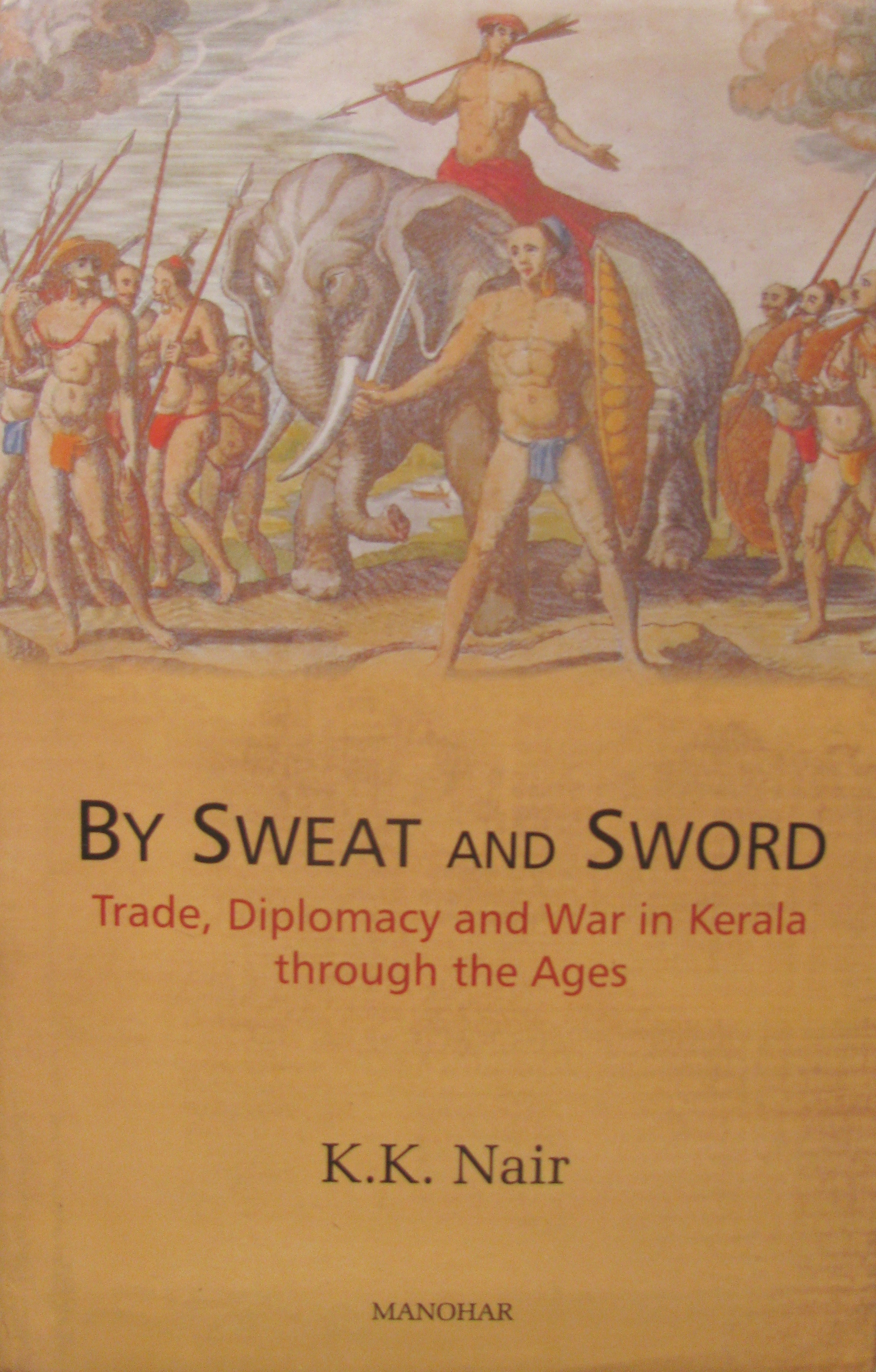
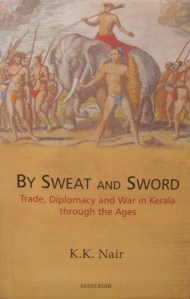
???????????????????????????????On the jacket of Wing Commander K.K. Nair’s book: By Sweat and Sword – Trade, Diplomacy and War in Kerala through the Ages, are observations pivotal to his work.

Colonial documents record that war was the natural state of Kerala. The region’s political climate was characterized by a variety of foreign and local powers fighting each other for economic and military ascendancy. Yet despite centuries of foreign contact and conflict, Kerala continued to thrive and retain its independence. The frontiers of Kerala were never redrawn. It did not suffer massive social or cultural dislocations. No foreign order or influence, especially those inimical to the populace, could be imposed until the traditional order was overturned. The influences Kerala absorbed were of its own choosing. The book “ hypothesizes that this remarkable achievement was a direct consequence of Kerala’s unique military, diplomatic, social and economic culture.’’

The book is an investigation of a state of war (internal and external), what that dynamic meant for defending Kerala and what it meant to external powers trying to subjugate the region or gain a toehold. Old Kerala transacted its business amidst a diet of military readiness. Actor across ages in this was a clan – the Nairs. The book isn’t community or clan history. It is what its title says, except, you can’t talk of war in Kerala without also talking about the Nairs. K.K. Nair’s book takes the reader from a likely foreign origin for the clan in tribes linked to the Scythians, their subsequent migration to India, movement within India along the south west coast to Malabar, their role in the wars of South India, wars within Kerala and wars with foreign powers trying to colonize Kerala.

The Scythian angle is founded on a couple of arguments. According to the author, there is no mention of the Nairs in the writings of the Sangam Age and earlier. The first mention in India is in the inscriptions of the Scythian king Nahapana who reigned from AD 78-125. His domain extended beyond the Gulf of Cambay, along the Gujarat and Konkan coast. The inscription talks of assisting the Nairs of Malabar. On the other hand, earlier in Europe, the Greek historian Herodotus (BC 484-425) noted that the Scythians had joined forces with neighbouring tribes, including one Slavic tribe called the Neuri, to stem the attack on Scythia by Darius of Persia. This happened around 500BC. Later as the restlessness of Mongolia and Turkestan took hold, the Scythians were further displaced. They began moving into Indo-Persian lands around 200BC. By this time the Neuri and other Scythian tribes no longer find mention around the Caspian Sea. At the same time, Megasthenes (BC 350-290) in his description of India, positions the like sounding Nareae tribe to the north of the Aravali Mountain. Putting two and two together, the author suggests a story of migration, initially towards India and later, within India.

Unlike North India, the South from ancient times was wrapped up in mutual warfare. The best known of this was the tripartite battles involving the Cholas, the Pandyas and the Cheras. Kerala was predominantly Chera territory. It was hill country; it was also numerically disadvantaged. Invading armies were typically bigger. This was the environment into which the warrior-Nairs arrived. A clan of dedicated warriors to oversee security and their lifestyle revolving around martial culture influenced Kerala. K.K. Nair observes, “ Kerala, unlike most of India, was not divided into Hindu villages but was divided into gradations of military divisions with every division and sub division being designated by the allotted quota of Nairs it was required to bring into the battle field.’’

A fallout of this arrangement was that rulers didn’t maintain large standing armies but they could marshal an adequately large army at short notice. It is possible to trace local customs, building architecture and lifestyle – including the culture of martial arts – to such a militarily styled society. The Nairs’ fighting style associated in martial history with the `Berserk or Mad Warrior’ style (wherein they forgo use of armour), would have got progressively challenged as technology gained currency with opponents. But on many occasions, it also stunned foes. The book explores the warrior mindset, including suicidal contests like `Mamankam.’ Needless to say, some fighting or the other seems to have been always on in old Kerala. Accounts are commensurately bloody. K.K. Nair’s book helped me put in perspective some of the idiosyncrasies of Kerala. History provides a window to understand people. Nair’s book served such purpose.

The book brings us all the way from ancient battles to Kerala’s colonial wars with the Portuguese and the Dutch, Tipu Sultan’s invasion and eventually the onset of British supremacy. We get an idea of the strategies and tactics of invader and defender. We see how frustrated some invaders may have been, weighing their incessant harassment on land and sea against the viability of their spice trade. For lay readers (like me) the book’s central character and its agent of continuity will be the Nair soldier. He is there in every conflict, be it in Malabar, Cochin or Travancore. However, despite being Kerala’s constant warrior through the ages, the Nair goes tad unexplained beyond his image as set in historical accounts of battle. But then, the book’s main intent isn’t investigation of clan or community. It is instead a study of trade, diplomacy and war in Kerala provoked by the curious case of a state that held its shape through the years despite active engagement with the outside world.

To sum up: By Sweat and Sword is an interesting book about a violent past.

INTERVIEW WITH WING COMMANDER NAIR
The author of the book, Wing Commander K.K. Nair.

The author of the book, Wing Commander K.K. Nair.

Wing Commander K.K. Nair is a serving Indian Air Force (IAF) officer. He is Joint Director, Operations (Space), at Air Headquarters, New Delhi. He replied by email to questions about the book:

Can you describe the circumstances that made you write this book? What attracted you to the subject?

I was coming from Geneva to New Delhi in 2007, when my French co-passenger Valerie, a part time scholar and full time hippie – as she put it, gave me a running commentary on Kerala in ancient times and the Nairs. My interest in the subject was sufficiently kindled. I became curious to know more. Thereafter, when I mentioned the subject to Gen Satish Nambiar, then Director of the United Services Institute (USI), he strongly encouraged me to do an in-depth research. It was the active support and encouragement from Gen Nambiar, Gen PK Singh, Squadron Leader RTS Chinna of the Centre for Armed Forces Historical Research and my colleagues in the military services that enabled me to sustain my attraction for the subject.

How did you go about collecting the material for this book? Would you like to share any interesting moments therein?

Most of my material for research came from the National Archives, the Travancore, Cochin state records, from the USI as also from the University library, Trivandrum and the late Travancore Maharajah’s private collection. Some material came from the Dutch records for which I am particularly indebted to Mr Tristan Mostert, Curator of the Rijksumuseum, Amsterdam. Material on the ‘Mad-Warrior’ style of Nair warfare came from Prof Michael P. Speidel of the University of Hawaii. Overall, a lot of effort went into collecting material for the book.

With regard to interesting moments, one of these was when during a meeting with the late Maharajah of Travancore, he read the draft account of the battle between Tipu’s troops and the Travancore Nair regiment on the Travancore Lines. He got so animated reading the account that he rushed in to get an old `ola’ (palm leaf document) showing grant of lands etc to the Garrison Commander Kalikutty Nair.

The next equally interesting moment was at Trivandrum’s University Library. There was some kind of a strike on and the library was forced to shut. I was returning disappointed when I saw some students striding up to me calling out, “Pattalam Saar, Major Saab” etc. They got the library reopened for me stating that strikes don’t apply to OUR military. I was truly overwhelmed.

You have attributed a Scythian link to the Nairs. How conclusive is that?

I have avoided being judgmental throughout the script. I leave the conclusions to the reader.

Having written this book, can you briefly explain why a state of war became Kerala’s dominant predicament?

An abundance of resources always brings in problems of management. These snowball into rivalries, conflicts and war. Kerala had enough agricultural produce, spices etc to feed itself and the world at large. Little wonder then that its shores attracted the Chinese, Arabs and Europeans. This ability to produce resources, trade resources and sustain prosperity across the ages was possible because a fine balance existed amongst the various communities in Kerala. Thus, though war was daily affair, trade and agriculture never suffered.

Is war and warrior a chicken and egg situation capable of contributing to a state of war?

Yes. Your observation is very apt. It certainly contributes.

(The author of this review, Shyam G Menon, is a freelance journalist based in Mumbai)