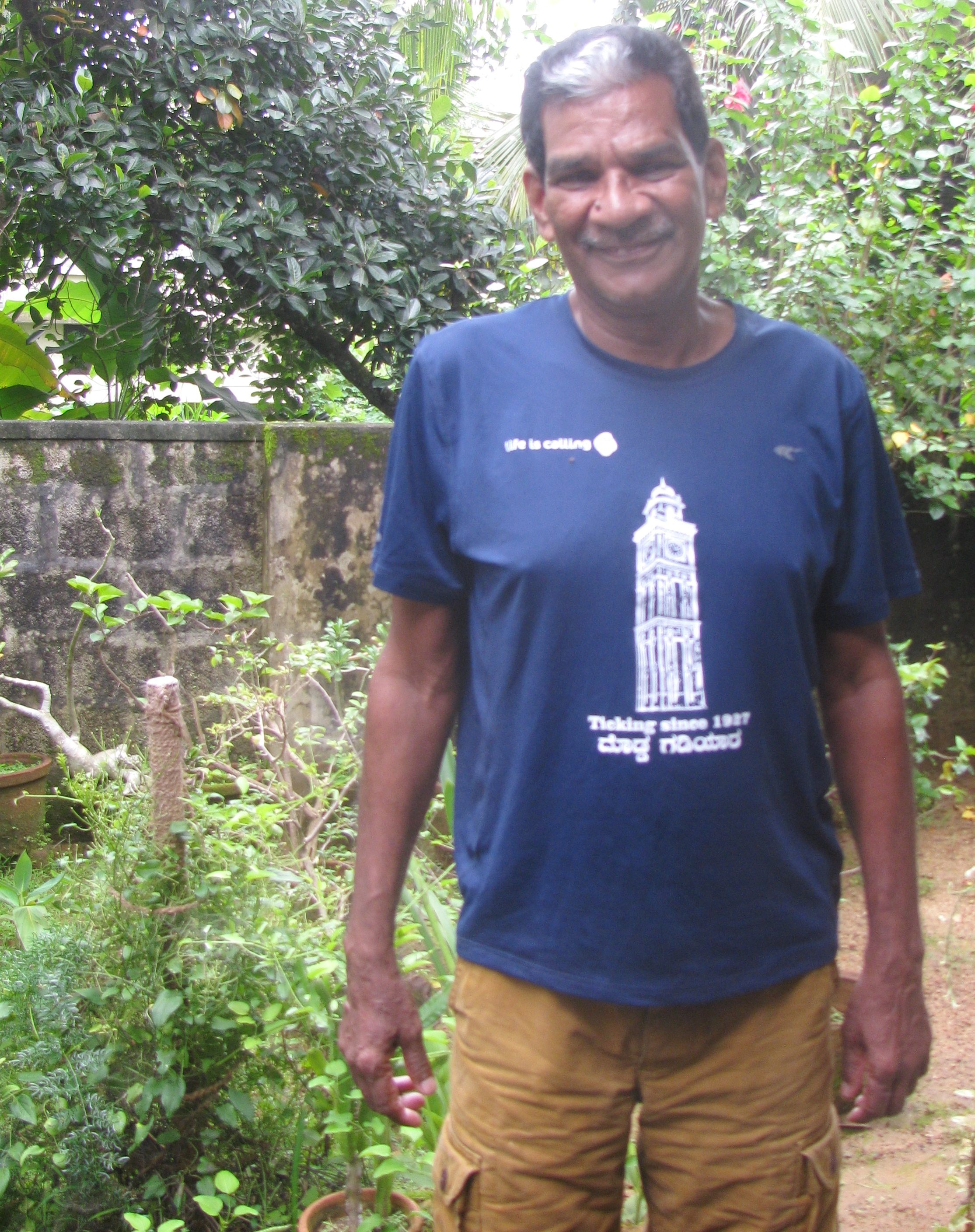
“ PAULETTAN’’

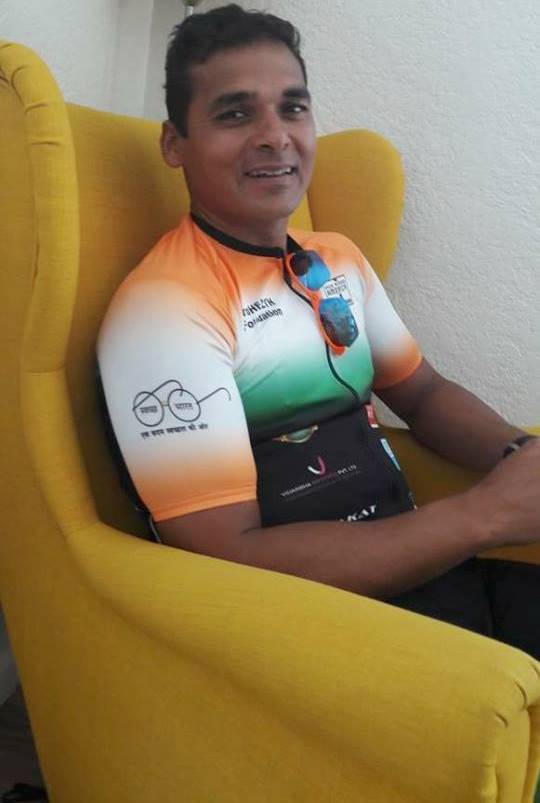
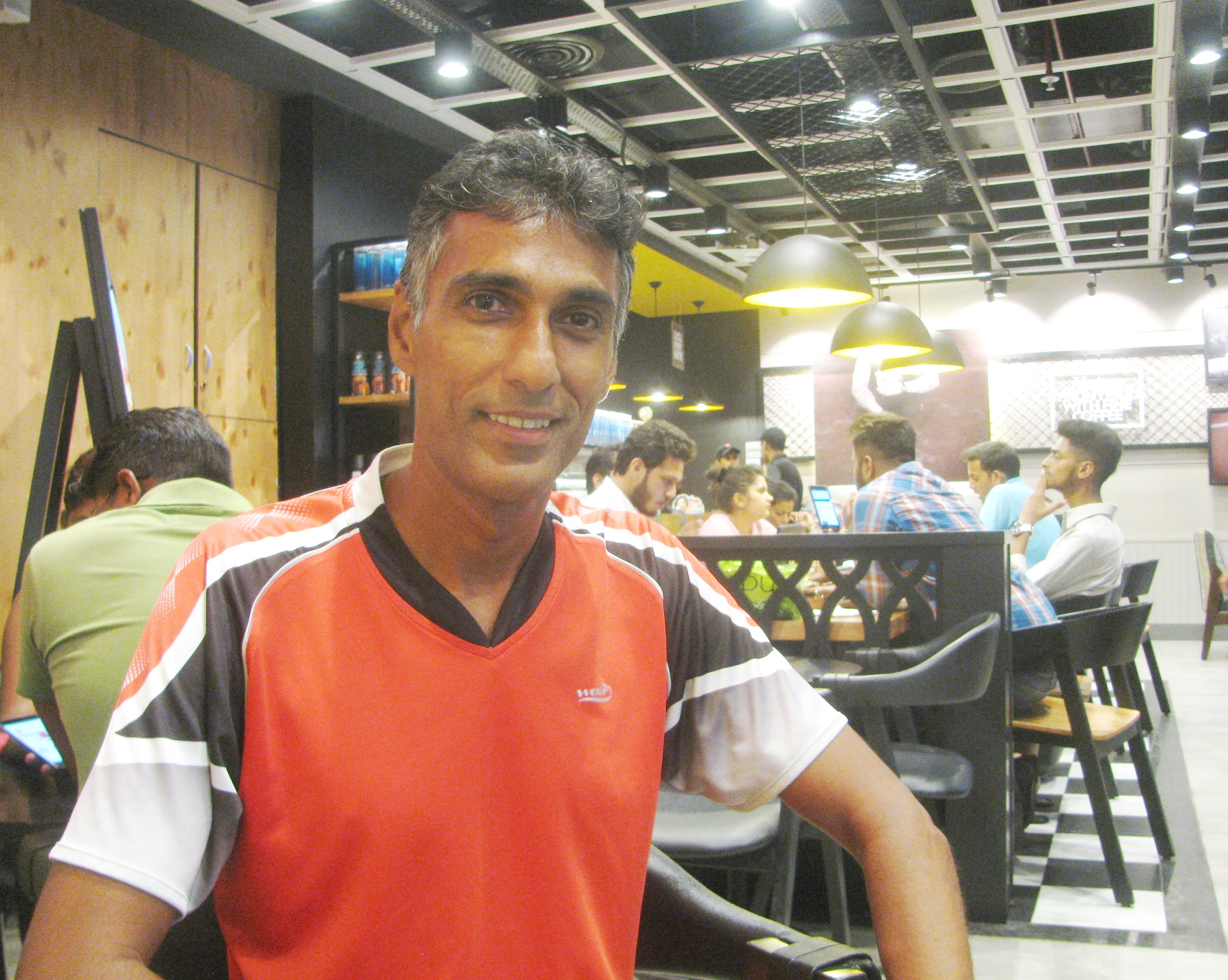
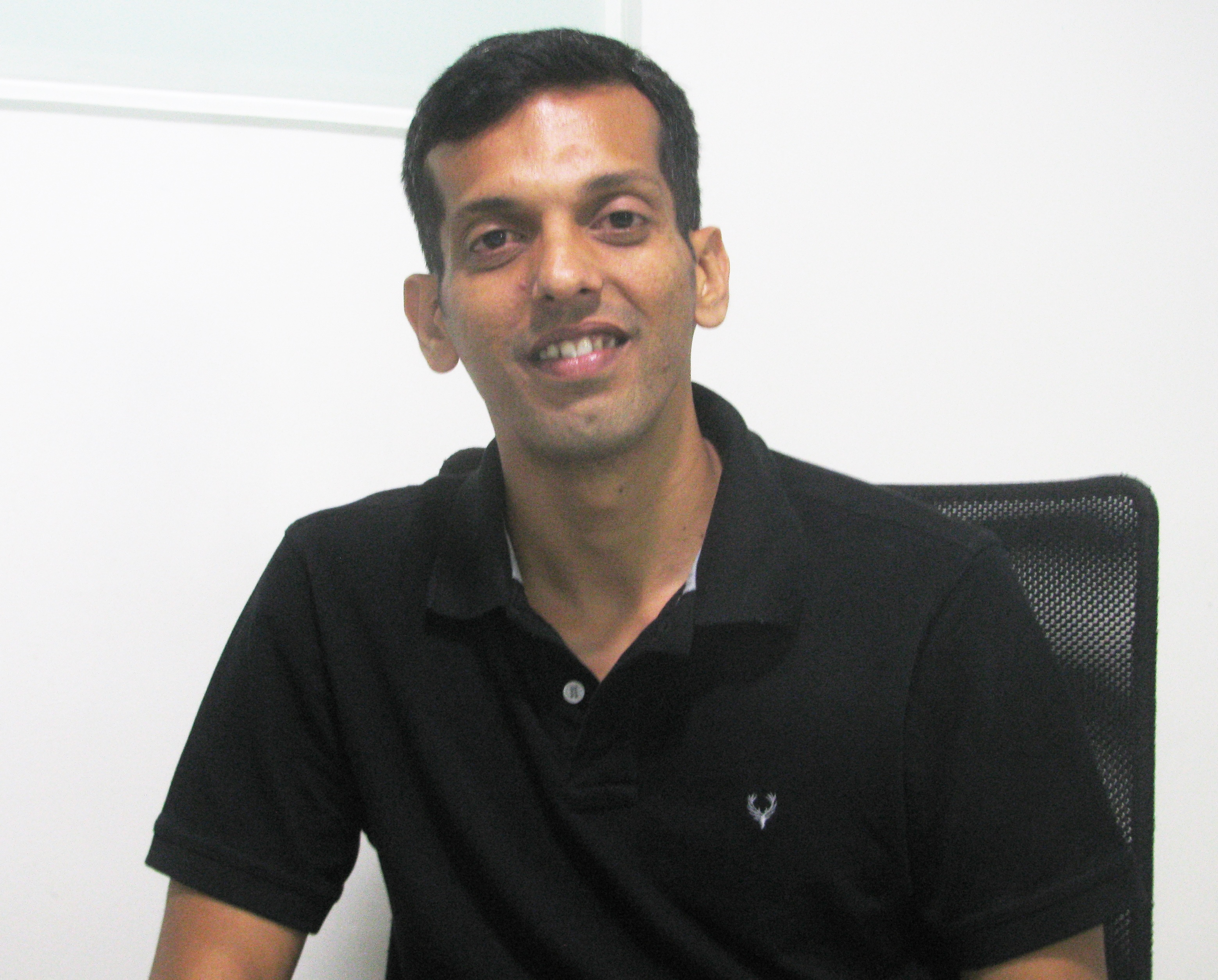
Paul P.I (Photo: Shyam G Menon)

For long, Kochi has been synonymous with Kerala’s major port, backwaters and the export end of the region’s spice trade.

Sitting in town you wouldn’t imagine hilly terrain in the distance, unless you notice the stuff of Kochi’s historically famous commerce as ` hill produce’ and venture to find out where it’s coming from. One aspect of Kerala’s uniqueness, little appreciated amid all the consumerist excess being stuffed in, is that it is a narrow strip of land sandwiched between the sea and a spine of hills, about 500 km long. Even at the state’s widest part, in a couple of hours of travel, you can be at modest elevation from sea level and vice versa. In tapering portions like Thiruvananthapuram district, the hills are still closer. The high ranges don’t manifest suddenly. Between the lower lands with their backwaters, and the highlands, there is the portion signifying transition. Tucked in the south east part of Ernakulam district (where Kochi is), Neendapara in Kavalangad panchayat is part of the geography signaling the higher hills of Idukki district beyond. In Kerala, the predominantly hilly districts of Idukki and Wayanad are known for their distance runners.
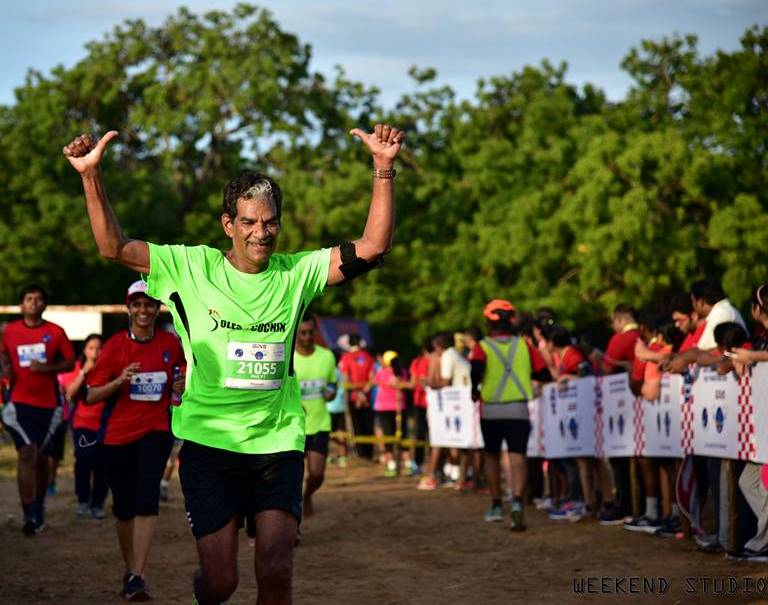
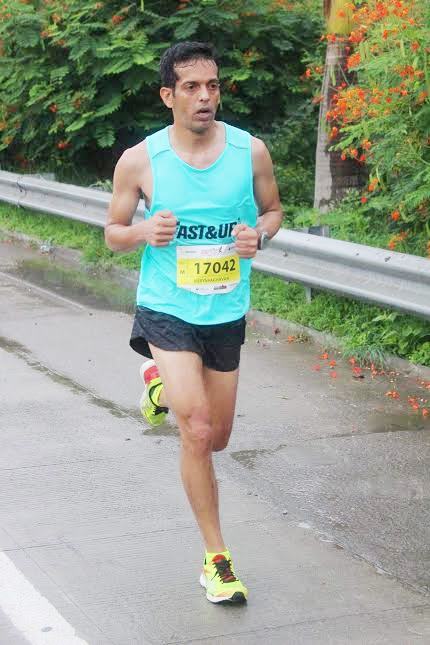
From the 2016 Dream Runners Half Marathon in Chennai (Photo: courtesy Paul P.I)

“ Neendapara – that’s where I grew up,’’ Paul P.I said at his house in Kundanoor in the Kochi suburb of Maradu. Our appointment had been fixed closer to noon for the retired Kochi port officer had a long run that morning. The directions to his house were precise, distances conveyed accurately as only runners do. Still I lost my way. How can I screw up despite such clear directions? Maybe my running days are over and I no more see like a runner? – I thought; wrong Mr Paul before me, listening to the description of person I sought. “ Sure I am Paul but Paul who runs, he stays over there,’’ the helpful man said. On the steps leading to the house I next went to, was a pair of Vibram Five Fingers. This is it – I knew. Paul was born one of six children; his father, a contractor, died 30 years ago in a road accident. Neendapara is a hilly place. Paul’s family owned land. Tending it was a team of agricultural workers. Given that the workers did their daily work at scattered locations on the land, Paul remembers walking up and down the terrain to give them food. Those were the late 1950s. Road connectivity in the state wasn’t as much as it is today and Neendapara tucked away from better known Kochi and on the approach to the hills of Idukki, wasn’t exactly priority for public infrastructure. Paul attended school in Neriyamangalam eight kilometers away. He recalled that his tenth standard exams were a further 12 km away. School was his introduction to athletics; he used to run in 100m and 200m races. For pre-degree, Paul turned to Nirmala College in Muvattupuzha, a major town in the region.
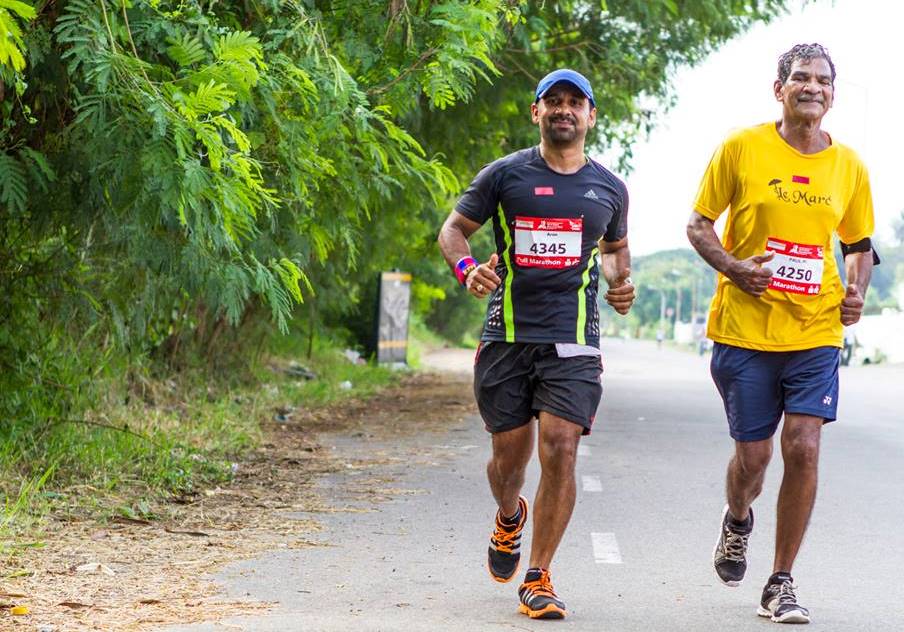
From the 2015 Spice Coast Marathon (Photo: courtesy Paul P.I)

His father wanted Paul to be an engineer. Unfortunately, the youngster failed to clear one of the subjects in college. That failure hit him hard. He desperately wanted to fulfil his father’s wish. “ I joined Thyagaraja Polytechnic near Thrissur. It was the only option available to me to stay close to the engineering line. At the polytechnic, I studied well,’’ he said. Alongside he also kept his interest in sports alive. He used to participate in 5000m and represented the institution at inter-polytechnic sports meets. An active person, he also played hockey, basketball and that game once very popular in Kerala and since near vanished – ball badminton. Probably because Indian polytechnics have always been a poor cousin to mainstream colleges with their academic halo, there was none to train him for the 5000m. He had no coach. He figured out his own path. “ I was crazy about hockey and by my third year was captain of the polytechnic team,’’ Paul said. Before hockey sessions, he would run several rounds of the playing field to keep both interests – hockey and running – happy. After securing his diploma from the polytechnic, he joined Cochin Port Trust (CPT) as a tracer, precursor to being draftsman. Alongside, he also enrolled for the AMIE course in engineering offered by the Institution of Engineers (India). He passed this program, specializing in civil engineering. Given his new qualification, Paul moved to being a junior engineer at CPT. However his further promotion was delayed and stuck in litigation. For seventeen years he stayed a junior engineer. Eventually he won the case and was promoted with all arrears paid. “ I retired as superintending engineer,’’ Paul said.
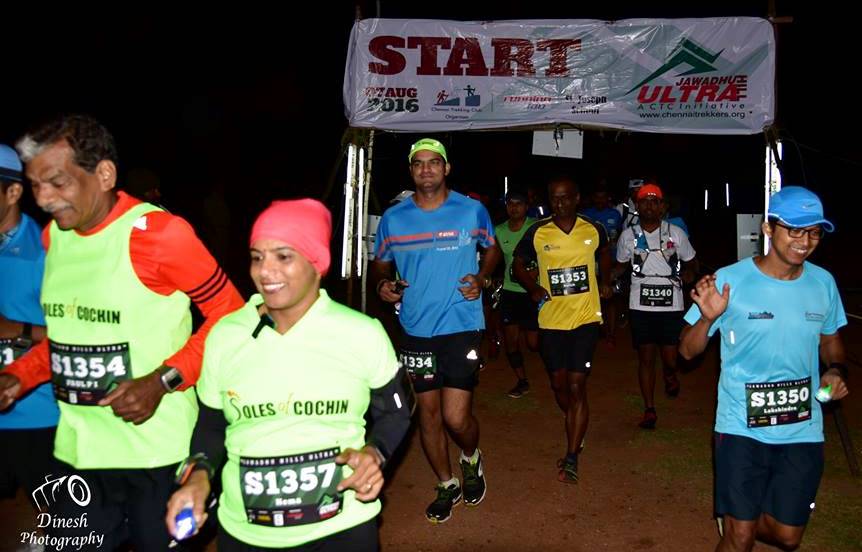
At the 2016 Javadhu Hills Ultra (Photo: courtesy Paul P.I)
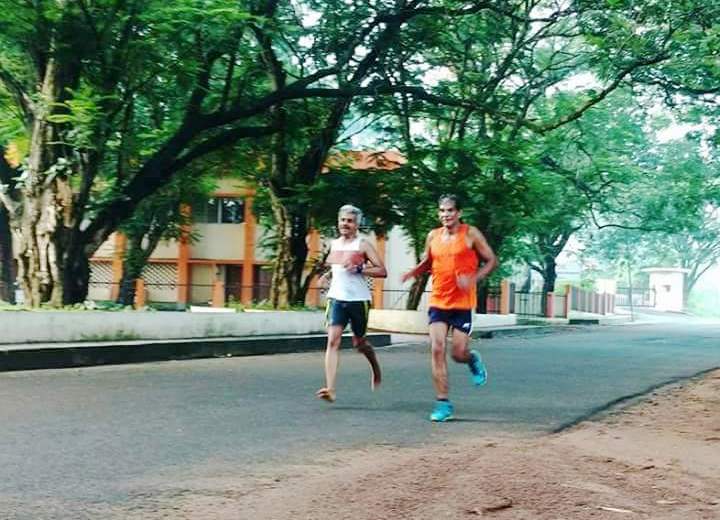
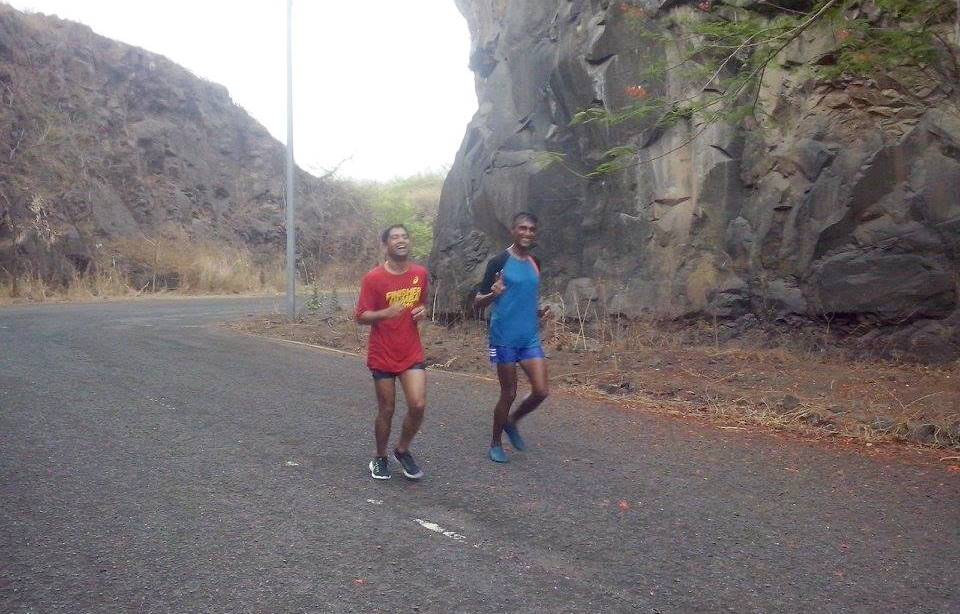
With Ramesh Kanjilimadhom; from a regular Soles of Cochin run near CUSAT in Kochi (Photo: courtesy Paul P.I)

Willingdon Island is the largest artificial island in India. Envisioned by Sir Robert Bristow, it is home to Kochi’s port and naval base. For many years, when he was with CPT, Paul stayed on Willingdon Island. He used to run every morning on the island. In 1999, he moved to Kundanoor on the mainland and took to running up and down the nearby bridge. Six years later, in 2005, he had a temporary setback. He suffered a road accident that left him with multiple fractures on one leg. Surgeries were needed and for a year till the rod that had been inserted into the shin was removed, he had to refrain from hard physical activity. Once the rod was taken off, he slowly got back to running. The legacy of that accident is still visible on Paul’s leg. In 2014, the Cochin Corporation organized the Cochin International Half Marathon. Paul was the only CPT employee running the half marathon besides the CPT Chairman. Paul completed the run in 2:35. Word got around of the port employee who completed a half marathon. Willingdon Island houses a whole port ecosystem. Not far from Paul’s office was the office of the Customs. Customs officers, Vijayan Pillai and Naushad Asanar were regular runners, who were also members of Soles of Cochin. They dropped by at Paul’s office to get him into Soles and enroll him for the first edition of the Spice Coast Marathon organized by the group. Paul enrolled for the marathon almost immediately. Naushad remembered that instance well. “ He enrolled offline. So I had to meet him later and collect the fee,’’ Naushad said. In November 2014, Paul ran the full marathon of the event, completing the course in 6:11. “ That was the first time I knew of such distances in running and distance runners who train dedicatedly to run the distance,’’ he said. Despite Kerala’s known strength in athletics at the all India level, Paul’s comment should not surprise. A peculiar aspect of the state’s athletics is the wall that exists between elite athletics and amateur pursuits, which are recreational in nature. Movements around the latter genre – like Soles of Cochin – are happening with considerable lag in Kerala compared to the pace at which the state earned a name in elite athletics.
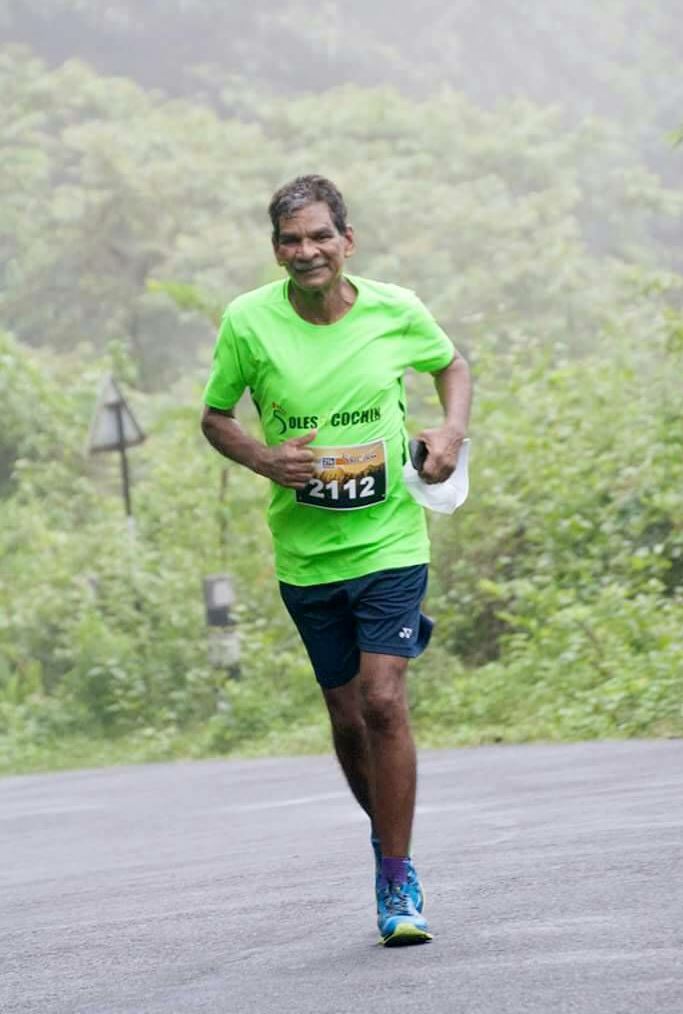
From the Moolamattom to Vagamon run, which Paul organized for Soles of Cochin (Photo: courtesy Paul P.I)

In December 2014, on turning 60 years of age, Paul retired from service. In July 2015, he formally joined Soles of Cochin where he would subsequently become popular as “ Paulettan,’’ `ettan’ being a quickly said version of the Malayalam word `chettan’ meaning elder brother. Upon joining Soles, Paul’s running became more systematic and regular. “ I started running at least 50 km every week,’’ he said. Paul described a typical week with Soles. Sunday would be a run of 8-10 km, from the Kadavanthara stadium to the Kaloor stadium and back. On Tuesday, they would run 10-12 km from Edappally to the Cochin University of Science & Technology (CUSAT) via Thrikkakkara. Thursday featured hill running; the runners would proceed from CUSAT to the HMT factory and onward to the local medical college before returning to CUSAT. “ That would be around 10-12 km,’’ he said. On Saturday, the runners would start at Edappally and proceed sometimes to Thrippunithura, logging a distance of 21-25 km. “ With all this, I now run 60-70 km every week,’’ Paul said. According to Naushad, Paul was initially reluctant to join a runners’ group. He shied away claiming he didn’t run much. Invited to come along for a Sunday run, he cited his Sunday appointment with the church for excuse. Then he turned up for a run but wasn’t seen thereafter. “ Once he returned, he has been a regular at the group’s runs. Not just that, Paul is a very good organizer. There was a run we planned at Moolamattom and Paul took care of it completely by himself. Almost 100 people enrolled for that run, of which, nearly 80 turned up to run,’’ Naushad said.
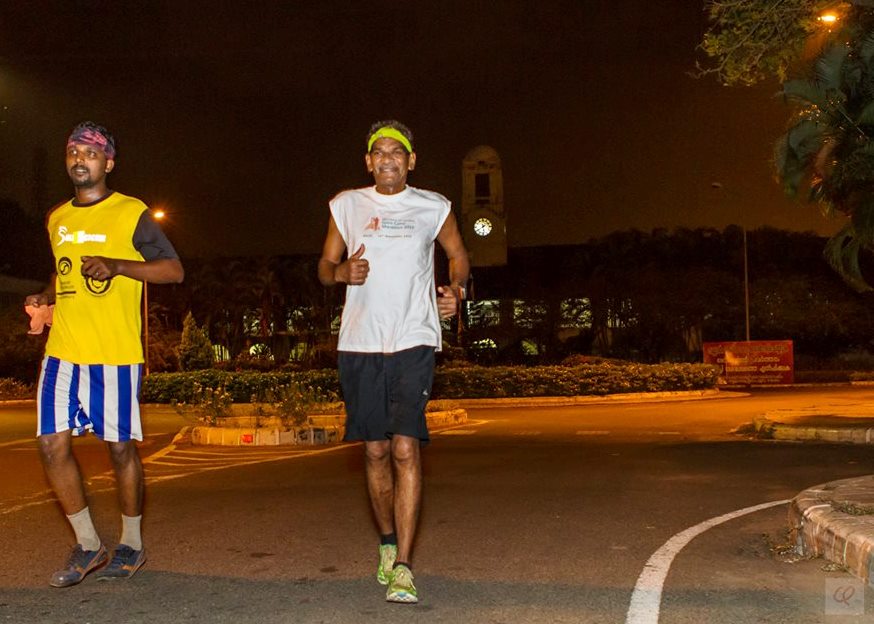
From the 2016 Night Owl; 12 hour-run on Willingdon Island organized by Soles of Cochin (Photo: courtesy Paul P.I)

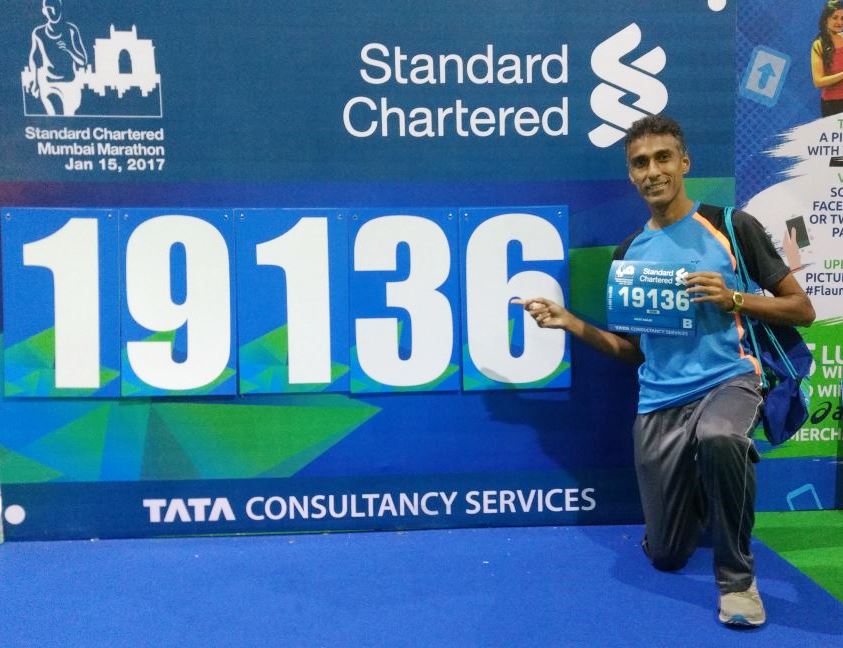
Shortly after he joined Soles, Paul ran the full marathon at Hyderabad finishing it in 5:35, a significant reduction in timing from the 6:11 of the 2014 Spice Coast Marathon. Then, “ Paulettan’’ began catching up on lost time. In 2016 he ran over a dozen full marathons, including an ultra. January 2016 was especially hectic. On January 3 he ran a full marathon in Salem. A fortnight later, he ran the full marathon at the Standard Chartered Mumbai Marathon (SCMM). Five days later, he was running the full marathon in Dubai and on January 31, he was in Chennai running the Wipro Chennai Marathon. Paul ran in the 60-65 years age category. He wasn’t getting any podium finishes; it was purely the love to run that kept him going from one event to the next. As of July 2017, the time we met for a chat, the retired engineer had run 19 full marathons since his first one in November 2014. He had also finished 24 half marathons. Of the 19 full marathons, three were ultramarathons – the Chennai Trail Ultra (50 km), the Javadhu Hills Ultra (75 km) and the Munnar Ultra (72 km). He said he owes much to the guidance he received from Ramesh Kanjilimadhom, among Kochi’s best known amateur runners and a founder member of Soles. In December 2016, Paul found mention in local newspapers for running 62 miles on his 62nd birthday, from the CPT office on Willingdon Island in Kochi to Neendapara, where he was born. “ It was fully backed by Soles of Cochin. There was a support car and other runners to keep me company,’’ he said. Running also gave him good friends. He remembered Hema Menon, at the time of writing this article, working in Thiruvananthapuram. Of the 19 full marathons he had run, 16 were with Hema, he said. Paul also ran `Night Owl’ a 12 hour-running event from 6PM to 6AM, organized by Soles.
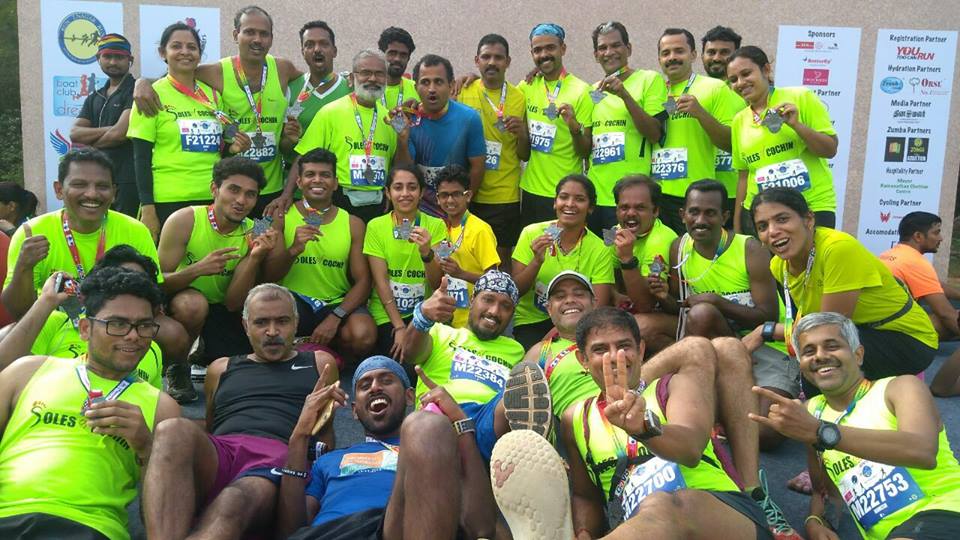
Paul (back row, fourth from right) with his friends from Soles of Cochin (Photo: courtesy Paul P.I)

Looking ahead, he was planning to run the 100 km race at Javadhu in August 2017 and the 110 km race at the Malanadu Ultra in Chikkamagaluru. There is also the Vagamon Trail Ultra, which Soles is organizing and hopefully, a shot at Globeracer’s ` Run the Rann’ in February 2018. He had also registered for full marathons at Hyderabad, Bengaluru, Goa and Chennai. Such a schedule naturally brings up the question of injury. Paul has so far been free of any major injury sustained through running, except for a sprain during a half marathon in Coimbatore, which he got over in two months. However, cure for that was not easy. Exercise didn’t work. Disappointment gathered as others ran and he couldn’t. Then he approached a kalari (kalaripayattu is Kerala’s traditional martial art) center in Thrippunithura. Given they deal with martial arts for which one’s body must be kept adequately flexible, kalari centers have long had a local reputation in healing.  “ They gave me an oil massage for one hundred rupees and asked me to run the next day and report back. I had no problems thereafter,’’ Paul said, adding, many runners still find his story hard to believe. “ He is not like the rest of us. He is quite a hardy person,’’ Naushad said. Paul is also into yoga. “ At Soles, we have a runner and yoga teacher in Rajappan. Once a week he takes classes for us. I do yoga thrice a week,’’ Paul said. He follows no special diet but makes sure to stretch after every run. “ I don’t remember when I last saw the doctor,’’ he said encapsulating what running had done for him. According to Paul, he, Rajappan and Mathew Mapram (based in the US but reaching Kerala every year to run with his friends) are a prominent trio of senior citizens into running at Soles. Paul’s personal best in the full marathon was 4:56, set at the 2016 Run of Raramuri Tribe (TROT) in Bengaluru. Along the way, a few podium finishes have been there – there was a second place in his age category at a half marathon in Mysore; there was a third in a 10 km-race in Mangaluru. But he doesn’t care about winning. Podium is not why he came into running. He likes to run; period.
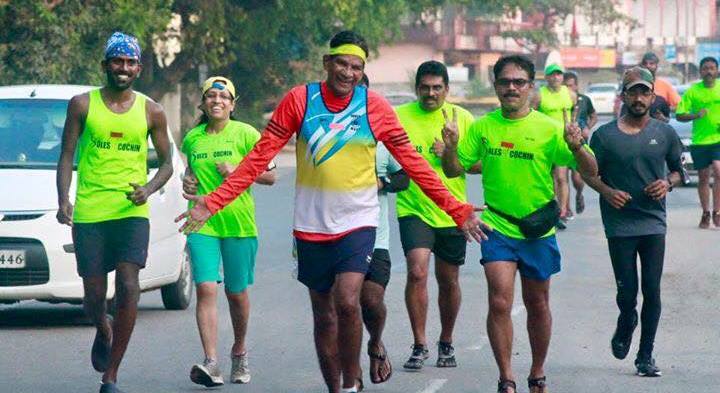
From the birthday run (Photo: courtesy Paul P.I)

Paul has three children; they live in Kochi and Bengaluru. Running the marathon in Bengaluru is a fine way of visiting his children settled there. However, as yet, he is the sole runner in his family. Initially they were opposed to his new found craze for running. Slowly the opposition faded and the family has since got used to the avid runner in Paul. In the way they initially reacted to running, his family wasn’t alone. It probably reflected a larger streak in Kerala, where doing something for no particular reason or achievement finds few fans. “ In the early days, people at large used to be critical of the amateur running scene. It was so till media made a difference,’’ Paul said. That 62 mile-run on his 62nd birthday was among things helping link people to runners. “ As news of the run was already out, I was offered cake by local people at several places I passed through,’’ he said. Asked why he was running, he would say that it was to spread awareness on distance running and to highlight the fact that age is just a number. That said, he conceded there is an unfortunate gap between serious athletics and the general population in Kerala. The state’s achievements in athletics hasn’t inspired a corresponding popular interest in the field that sees amateurs trying their hand at running, or those who do, being appreciated for the effort. Outfits like Soles of Cochin offer hope.

(The author, Shyam G Menon, is a freelance journalist based in Mumbai. Timings at races are as provided by the interviewee. Except the first photo, the rest have been provided by Paul or downloaded from his Facebook page and used with his permission.)                
“ I DON’T THINK THE COMBINED FORMAT IS A GOOD IDEA’’ – ANNA STOEHR

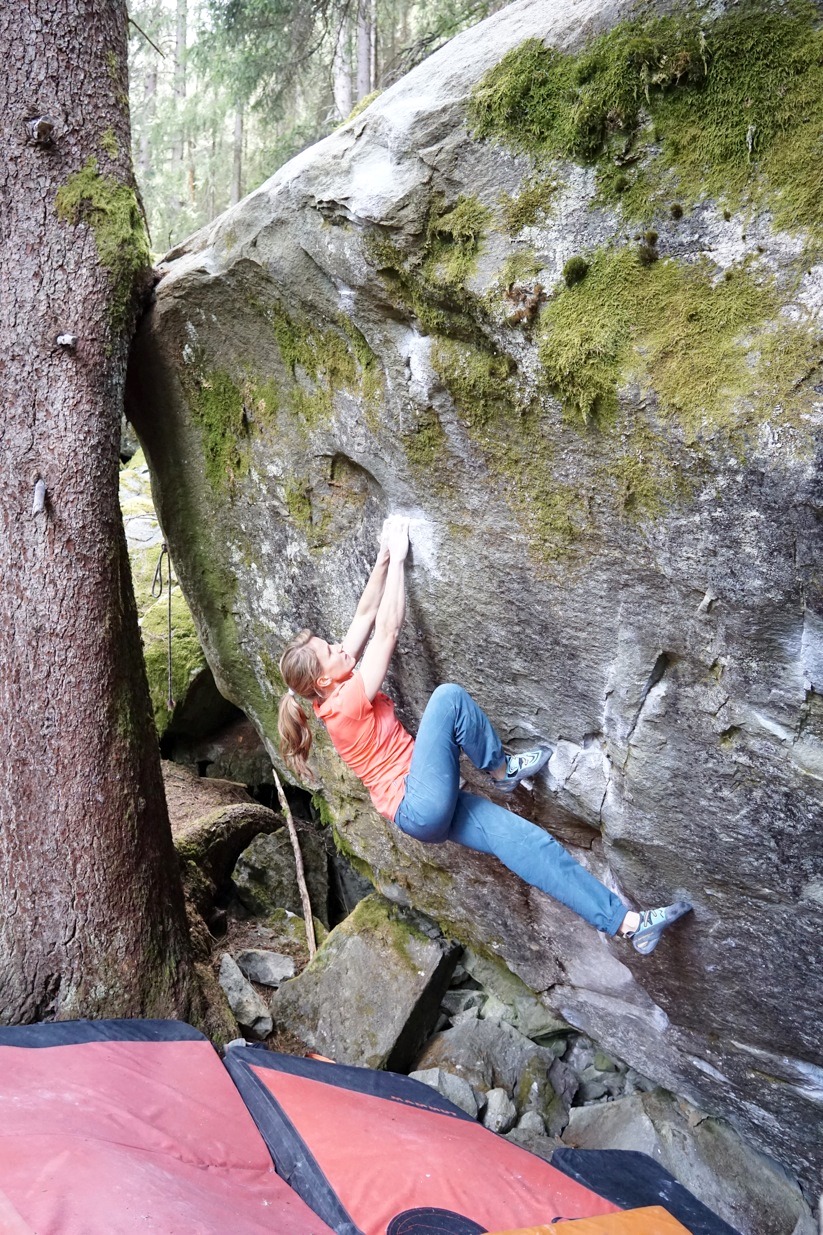
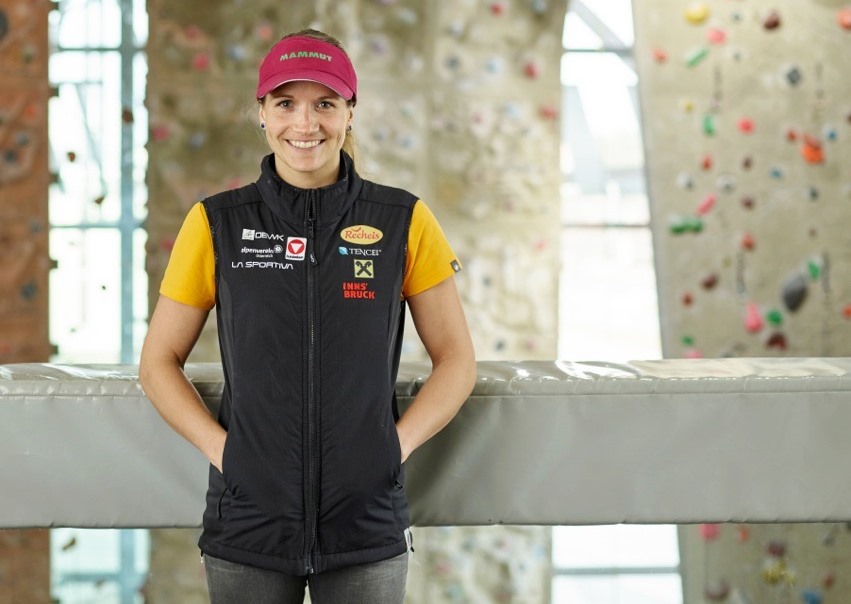
Anna Stoehr (Photo: courtesy Anna / photo credit: TVB Innsbruck)

You cannot talk of women’s climbing in recent years; be it competition climbing in general, the World Cup series of the International Federation of Sport Climbing (IFSC) or women in bouldering, without mentioning the name of Anna Stoehr. The Austrian climber, veteran of several wins at top climbing championships (she is a double world champion, double European champion and winner overall of the world cup in bouldering, four times), was away in South Africa, when this blog approached her with a request for interview in June 2017. That trip done, she responded: 

Can you tell us something about the recent climbs you did in South Africa?

We mostly climbed in areas that have been developed over the past years. My last visit was four years ago and a lot of development has happened since. We also brushed some boulders and did a couple of first ascents. Other than that I also climbed some classics which I had not done before, in already established areas.

You are one of the most experienced athletes on the competitive climbing circuit, including the IFSC World Cup and World Championship. What has kept you going in that circuit for so long? What do you like about it?

I always enjoyed competing- the excitement, thrill and nervousness are very special. I like the mental challenge of competitions as well as traveling the world with the Austrian climbing team and fellow competitors from all around the world.

Within the three main disciplines of climbing (lead, speed and bouldering), why did bouldering become your favorite? What attracted you to bouldering?

As a teenager I used to boulder, mostly outside. I was immediately quite successful in this discipline. But I also climbed at lead competitions and even did a few speed competitions when I was younger. In my opinion bouldering is much more creative than lead climbing. It is so complex and unique that you never find the same move again and you have to adapt very fast to different circumstances.

Games and team sports are more popular in India than individual pursuits like athletics or track and field. How popular is climbing in Austria? What brought you to climbing and did you have all required infrastructure to grow in the sport, available locally?

Climbing was not at all popular when I started. Nobody in my high-school class knew what it was. But that is exactly why I liked it so much from the beginning: It is not a mainstream sport and I always liked being outside. Climbing has become a way of life for me. Innsbruck has just opened a huge gym- so nowadays the infrastructure is perfect. Back in the days we may not have had the best infrastructure but we had the best team spirit and that is why we (Kilian, David, Jakob*, myself) were so successful.

Anna Stoehr climbing “ Steppenwolf” V13 (Photo: courtesy Anna / photo credit: Alfons Dornauer)

The perception in India is that without good climbing infrastructure here, we cannot hope to excel in the sport. For example: every year new types of holds and features are introduced overseas, which Indian climbers get to see for the first time only when they are at an international competition.  How do you address challenges like lack of familiarity with the latest trends in climbing infrastructure? If as you said, lack of world class infrastructure couldn’t keep you down, can you explain how you and your team mates used to work around that problem? 

I think it is definitely an advantage if you have good infrastructure. But it is not the only factor that matters. We worked around the lack of infrastructure by buying holds overseas. When we were at competitions in Japan or the USA, we always bought holds and brought them back to our gym. Even if big volumes were not possible due to the size of the wall, we brought holds and tried to adapt. We also made up for any inadequacy in infrastructure by having a big and very motivated climbing community, who pushed each other a lot.

If you were to be a talent scout looking for promising climbers who can be groomed for international competitions, what qualities would you look for in a prospective candidate? 

I think you can see a promising climber by the way he / she moves. There are differences in technique that can be seen from the outside, but of course there is a long way to go.

You have been winner of international climbing competitions and championships several times. Can you give us an idea of the level of commitment and dedication to the sport it took to reach you to the level of excellence you possess in climbing? When did you shift to being a full time climber, how many hours of training did you put in on a daily basis?

I have always been very dedicated. But I did not limit myself too much doing so because in order to be successful I need to be happy as well. I am not happy if I cannot see my friends because I am training too much or if I do not eat chocolate (for example). I became a full-time climber only one year ago, when I finally finished my university degree. I train five times a week, three hours per session if I climb inside. If I climb outside I climb all day.

You have had a fairly long and distinguished career in the sport, including in competition climbing. How did you sustain your enthusiasm for the format; how did you tackle injuries? When you did not perform well, what did you do?

For the past few years I have had problems with my fingers. That is why I am not doing the whole bouldering World Cup circuit anymore. It is too risky and I would not have enough time to climb outside. Nevertheless I am still competing because I actually like it a lot and I think it is fun! When I did not perform well I was upset at first, but then remembered why I was there in the first place. Competing is about joy – trying to solve a problem and being able to succeed eventually. You won’t be able to try and climb on world cup style boulders set by professionals every day. So it is better to enjoy the process.

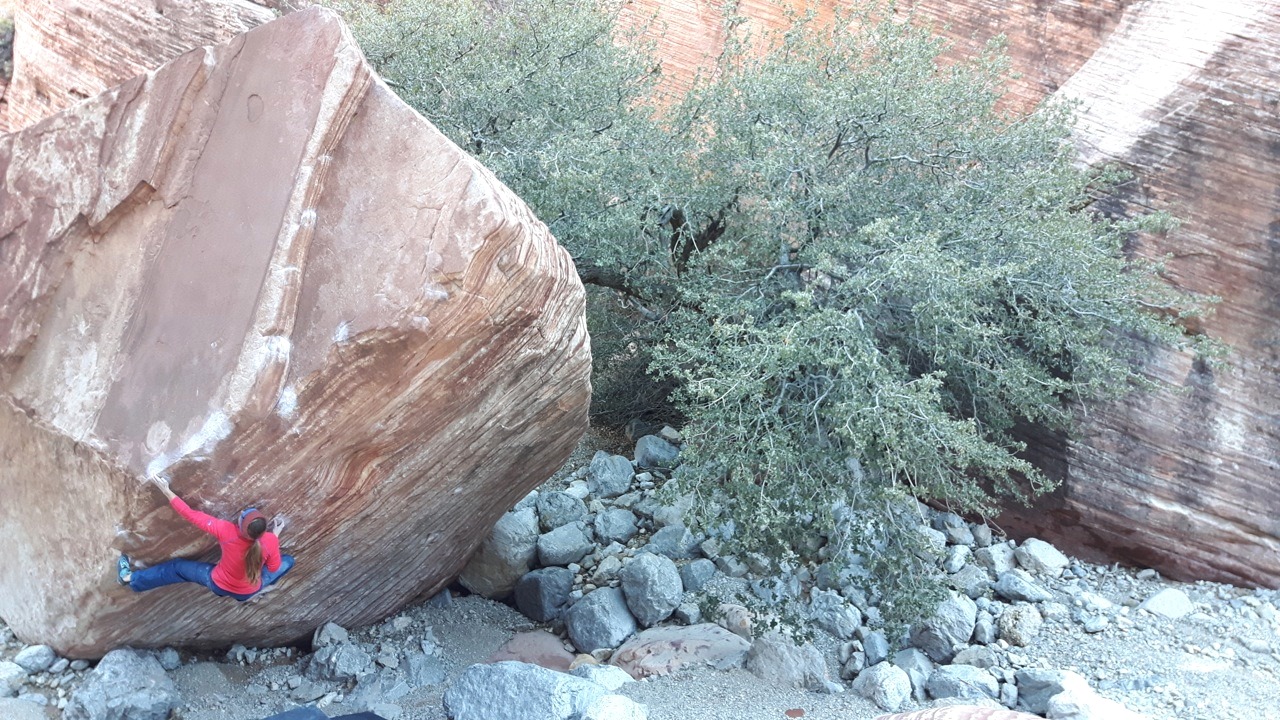
Anna climbing “Meadowlark Lemon” V13 (Photo: courtesy Anna / photo credit: Kilian Fischchuber)

Given you have spent so many years in the competition climbing circuit, would you care to name some of the strongest climbers you have been up against? Are there any names in particular that you choose to remember because you learnt something from them?

I think we can learn from so many people. They do not have to be the best. I really enjoy learning from people who climb well; people having great technique, coordination and a dynamic style of climbing. I have been able to compete with so many talented women, who inspire me; be it Akiyo Noguchi’s never-ending motivation, Miho Nonaka’s great style, Olga Bibik’s dedication, Jule Wurm’s pure joy, Melissa LeNevé’s ability to not let go or Shauna Coxsey’s flawless performance.

As climber on stage how do you handle the competition around you? From what do you draw the energy to perform and compete?

I think as a climber you compete against the wall. You have to climb well in order to place well and not look at other athletes’ performances.

Which has been your finest moment on the competition climbing circuit so far? Which was your real low point?

Finest moment was winning the European Championship title in 2013 alongside my partner Kilian Fischhuber. My real low was getting injured before the World Championship in Munich in 2014 and not being able to compete.

Which has been the toughest title you won and why?

My toughest title is yet to be won.

Are you happy with the format of climbing chosen for the Olympics, wherein the best athletes across all three disciplines of the sport get medals? What is the format you personally prefer?

No not at all. I don’t think the combined format is a good idea. I personally prefer to have three gold medals, one for each discipline.

Given you still participate in climbing competitions do you look forward to being part of an Austrian Olympic squad in the year climbing makes its debut at the Olympics? Do you plan to try and qualify for the Austrian Olympic team when the time arrives?

I will definitely not compete at the Olympics.

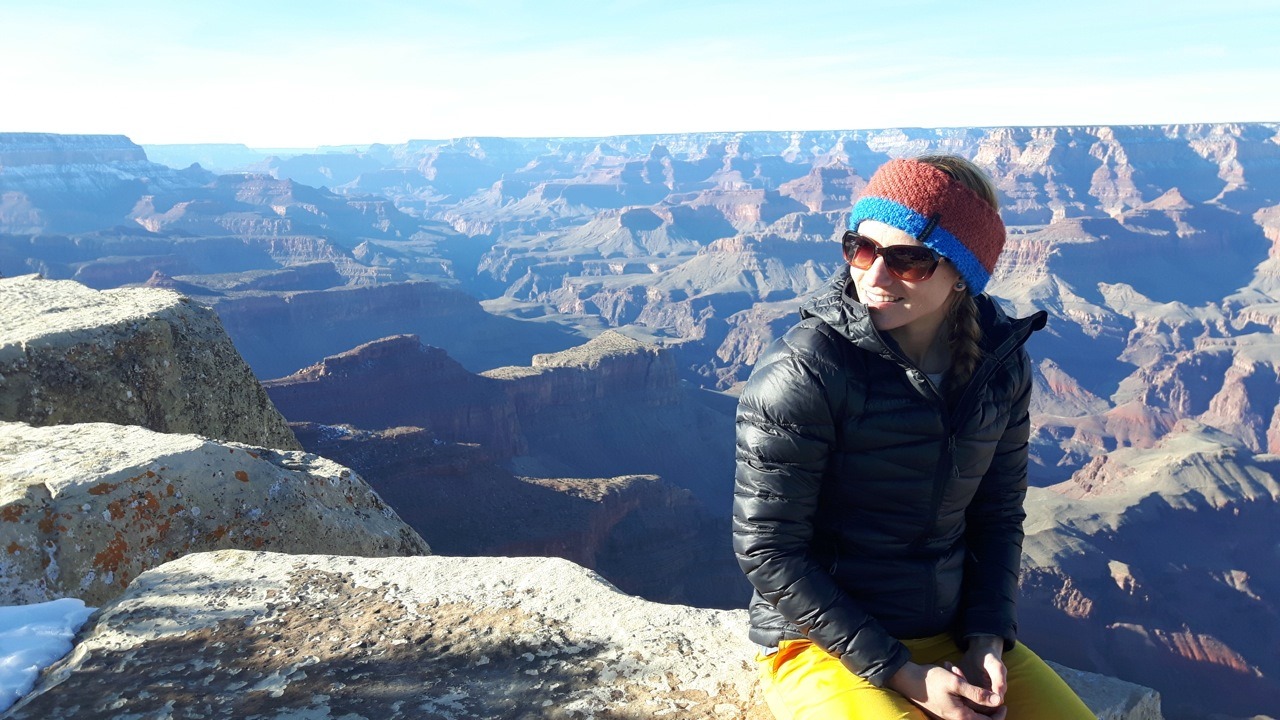
Anna Stoehr (Photo: courtesy Anna / photo credit: Kilian Fischchuber)

In your eyes is it important that sport climbing be included in the Olympics? Or, is the sport doing well the way it is?

I think for some federations and athletes it is very important. Public funding sometimes depends on being an Olympic sport. I think I was very fortunate that I was able to compete in the Austrian team, because our federation is doing well and was always able to support their athletes.

Would you like to channelize your experience in competition climbing to be a coach for youngsters aspiring to compete?

Yes I would definitely like to work with youth at some point. I find it very inspiring to see the younger generation.

Away from competitions, you have done tough climbs on natural rock. Going ahead how do you plan to grow this side of your life?

I always enjoyed climbing outside, be it bouldering or sport climbing. One day I will stop competing but I will always climb on rock!

Do you have any plans to visit India for climbing?

Not yet.

*Jakob Schubert was part of the Austrian team, which participated in the 2017 IFSC World Cup in Bouldering held in Navi Mumbai, India.

(The author, Shyam G Menon, is a freelance journalist based in Mumbai. Please note: in the caption of photos showing climbing, the name in quotes is the name given to the boulder by climbers and the alphabet and number following it immediately signifies the grade of climb / difficulty.)

RAAM: FIRST INDIAN SOLO FINISH BECOMES A REALITY

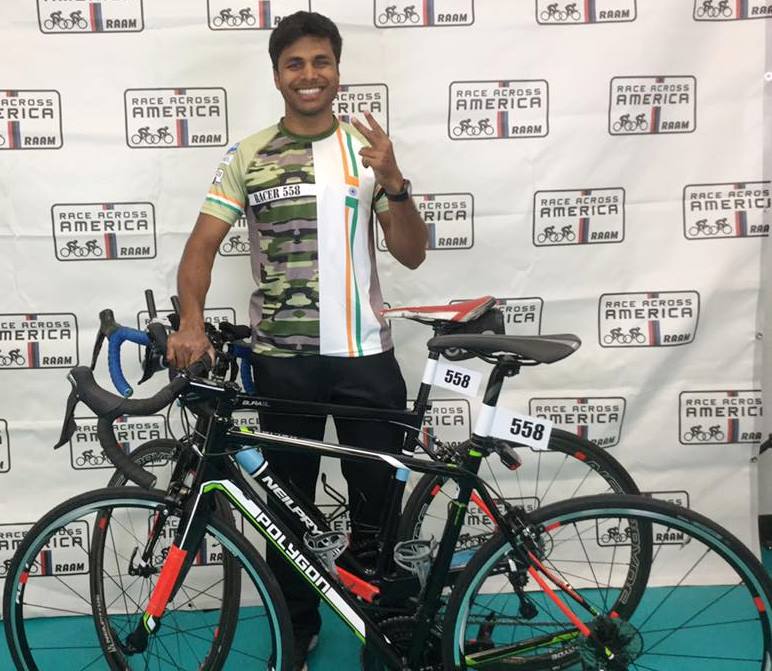
Srinivas Gokulnath (This photo was downloaded from the cyclist’s Facebook page / no copyright infringement intended)

Srinivas Gokulnath and Amit Samarth have completed the Race Across America (RAAM).

They are the first Indians to finish within the official cut-off time in the solo category. According to reports, Srinivas completed the race in 11 days and 18 hours while Amit took 11 days and 21 hours. Solo cyclists have to finish the race within 12 days.

The third Indian participant in the solo category, Samim Rizvi, unfortunately ended up Did Not Finish (DNF).

India had its first proper completion of RAAM in 2015, when Hitendra Mahajan and his younger brother, Mahendra Mahajan – both of them doctors from Nashik – registered a successful finish as a two person-team. This year – 2017 – is the first time the country has solo finishers at RAAM. In 2011, Samim had managed to cycle the whole distance of the race but finished just outside the official cut-off limit of 12 days. The 2017 attempt was Samim’s fourth time at RAAM (for more on Samim please try this link: https://shyamgopan.wordpress.com/2017/05/23/chasing-a-10-day-raam/)

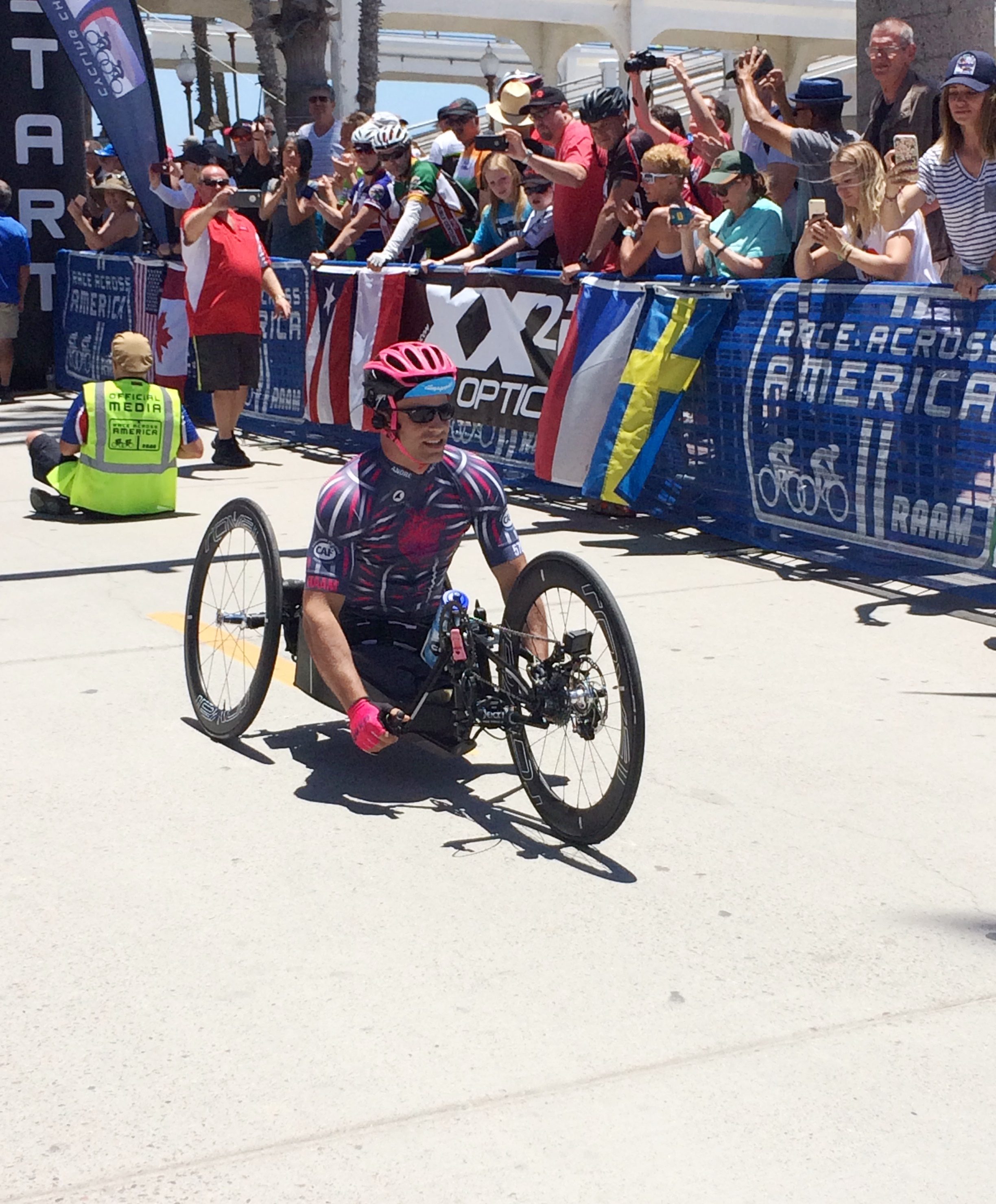
In the team category at the 2017 RAAM, one of the entrants was Sahyadri Cyclists. While the cyclists were four – Rajendra Nehete, Ramakant Patil, Sandeep Shewale and Pankaj Marlesha, the support crew included the Mahajan brothers with Hitendra Mahajan listed as crew chief. At the time of writing this article, they were past 3036.1 miles. Also continuing in the race was Andre Kajlich, the first handcyclist to qualify for the solo category in RAAM. He had covered 3021.9 miles.

RAAM is among the most punishing endurance races out there not just in cycling but across sports. Unlike the more popular Tour De France, RAAM does not feature daily stages. It proceeds at one go with the overall cut-off time, differences in terrain (the total climbing at RAAM aggregates to 170,000 ft), variations in weather and distance – a ride right across the United States – making it terribly challenging. Aside from riders managing their need for rest, there are no assigned rest days in this race. Simply put, RAAM is 30 per cent longer than Tour De France and has to be finished in roughly half the number of days (that said, Tour De France is a more intensely competitive athletic experience despite the lesser number of hours cycled every day. A reader of this blog pointed out, “ the athletic demands of a 3 week-Grand Tour are far greater, and intense, than those of RAAM, which whilst extremely tough is much more of a consistent effort dependent on managing one’s endurance resources.” There is thus, disparity in the physical demands of the two events making comparison difficult and potentially misleading). DNFs are common; even reputed cyclists including those with considerable experience at RAAM, succumb to it. This year one of those who had to DNF was 57 year-old Seana Hogan, among the most successful RAAM champions in history with six wins in the women’s category. She won it in 1992, 1993, 1994, 1995, 1997 and 1998 with timings that were at times better than what was registered by many in the men’s category. Her 1995 record of 9 days 4 hours and 2 minutes remains still the fastest solo finish among women. A RAAM legend, 2017 was Seana’s eleventh attempt. This year, the winner in the solo category for women was Sarah Cooper of the US.

Amit Samarth (This photo has been downloaded from the cyclist’s Facebook page / no copyright infringement intended)

The fatigue caused by near non-stop cycling could be felt by those remotely tracking RAAM via Internet. While the 1000 mile-mark was quickly reached by the leading group of cyclists – including Amit and Srinivas, the passage from 1000 miles to 2000 miles and beyond, seemed to take ages. An exception was Christoph Strasser who won the race this year. His progress was almost steady (for the update posted at the time Strasser crossed the finish line, please click on this link: https://shyamgopan.wordpress.com/2017/06/22/raam-christoph-strasser-wins-again-amit-and-srinivas-are-past-the-2250-mile-mark/).

When San Diego based engineer, G. Rajeev met Amit Samarth at the start of the 2017 RAAM as part of contributing a spot report for this blog, Amit had told him that he had previously crewed for Siena Hogan. In tough endurance races like RAAM, the support crew matters as much as athlete. A post on RAAM’s Facebook page said that Amit’s crew for 2017 appeared a family affair. The crew included his mother and wife; his seven year old-son was also along for the trip in the support vehicle, the post said. Besides being a cyclist, Amit is also a triathlete; in December 2016 it was reported that he had completed a full Ironman in Australia.

For Srinivas Gokulnath, 2017 was his second shot at RAAM. According to a 2016 news report ahead of his participation in the 2016 RAAM, Srinivas is a senior medical officer serving at the army’s artillery center in Nashik. A specialist in aerospace medicine, the Lt Colonel had earned a place in the Limca Book of Records by cycling from Leh to Kanyakumari in 15 days and 22 hours in 2014. His hometown is Bengaluru. In 2016, he gave up his attempt at that year’s RAAM at Oxford, Ohio after cycling 2460 miles (3959 km) in 11 days. As per information available on the Internet, his support crew for 2017 was headed by Chris O’Keefe (he completed RAAM, second in his category in 2016). Others in the crew included Srinivas’s wife Prafulla, his coach Alberto Blanco and Venkatesh Shivarama of the Bengaluru based-Wheelsports (for an earlier article featuring among others, Venkatesh, please try this link: https://shyamgopan.wordpress.com/2013/08/24/cyclings-second-youth/). A video featuring O’Keefe, on RAAM’s Facebook page, mentioned that Srinivas faced problems on day two of the race but had since clawed his way out of it.

Christoph Strasser, who won RAAM this year, is one of the best known cyclists associated with this event. He has won RAAM thrice before and holds the record for the fastest time – 7 days, 15 hours and 56 minutes. Away from RAAM, according to Wikipedia, he also holds the record for the maximum distance cycled on a road bike in 24 hours – 556.856 miles (896.173 km).

UPDATE: Team Sahyadri Cyclists has completed the race. They finished in 8 days, 10 hours and 16 minutes. At the time of writing this update, Andre Kajlich had covered 3106.9 miles.

(The author, Shyam G Menon, is a freelance journalist based in Mumbai. For the spot report from Oceanside, the starting point of RAAM, please click on this link: https://shyamgopan.wordpress.com/2017/06/17/2017-raam-gets-underway-a-spot-report/)

RAAM: CHRISTOPH STRASSER WINS AGAIN / AMIT AND SRINIVAS ARE PAST THE 2250 MILE-MARK

Christoph Strasser (This image has been downloaded from the cyclist’s Facebook page / no copyright infringement intended)

Austrian cyclist Christoph Strasser has won the 2017 Race Across America (RAAM).

This is his fourth win.

According to RAAM’s Facebook page, he completed the race in 8 days, 9 hours and 34 minutes, which would be the slowest timing in his quartet of wins at the race. The last time he finished on the eighth day was in 2011, when he reached the finish line in 8 days, 8 hours and 6 minutes. His other two wins were in seven days including the fastest solo timing at RAAM to date.

In second place at the time of writing this report, was Mark Pattinson of UK. He had covered 2698.8 miles and was still cycling. Others in the race’s vanguard were Guido Loehr, Marko Baloh, Tom McKenna and Brian Toone. They were at 2694.9 miles, 2615.1 miles, 2597.6 miles and 2582.5 miles respectively.

RAAM’s cut-off limit for the solo category is 12 days.

The Indian cyclists at RAAM have done well so far.

In the solo category, both Amit Samarth and Srinivas Gokulnath have made it past the race section spanning the 1000 mile-mark to 2000 miles of the journey; the middle one third. At the time of writing this report, Amit had covered 2259.2 miles and Srinivas, 2260.2 miles. No Indian cyclist has so far registered a solo finish within cut-off time, at RAAM. In 2011, Samim Rizvi from Bengaluru managed to cycle the entire distance but unfortunately he finished just outside the official cut-off. This year, as per RAAM website, Samim had to DNF (Did Not Finish) after 500.01 miles covered. DNFs have been several this year.

Sarah Cooper of the US was leading in the women’s section of RAAM.

She had covered 2377.3 miles.

Paratriathlete Andre Kajlich, the first handcyclist to qualify for the solo category in RAAM, was past the 2200 mile-mark. At the time of writing this report, he had covered 2224.9 miles.

In the team category, Sahyadri Cyclists, the four person cycling team from India attempting RAAM, had covered 1703.5 miles. They are still in the race.

RAAM proceeds from Oceanside on the US west coast to Annapolis in the east. It is approximately 3000 miles long and done in one go. There are no daily stages; there is only overall cut-off time. It is among the world’s toughest cycle races.

Strasser holds the record for the fastest time at RAAM: 7 days, 15 hours and 56 minutes, set in 2014. Away from RAAM, according to Wikipedia, he holds the record for the maximum distance cycled on a road bike in 24 hours – 556.856 miles (896.173 km). He also has to his credit the fastest crossing of Australia – from Perth to Sydney – in 6 days, 10 hours and 58 minutes.

Strasser’s progress at the 2017 RAAM was markedly different from others’. His momentum was steady. At the time of finishing, his lead over the second placed solo cyclist was over 400 miles.

Given those following Strasser still have several hundred miles to go, anything is possible in this race.

(The author, Shyam G Menon, is a freelance journalist based in Mumbai. The distances mentioned in this report are as per the race’s website including its live tracking system. For the spot report from Oceanside, the starting point of RAAM, please click on this link: https://shyamgopan.wordpress.com/2017/06/17/2017-raam-gets-underway-a-spot-report/ For a mid-race report / reflection please click on this link: https://shyamgopan.wordpress.com/2017/06/19/raam-mid-race-musings-will-it-be-first-indian-solo-finish-this-year/)

102 ATHLETES REGISTER FOR 2017 IFSC WORLD CUP IN NAVI MUMBAI

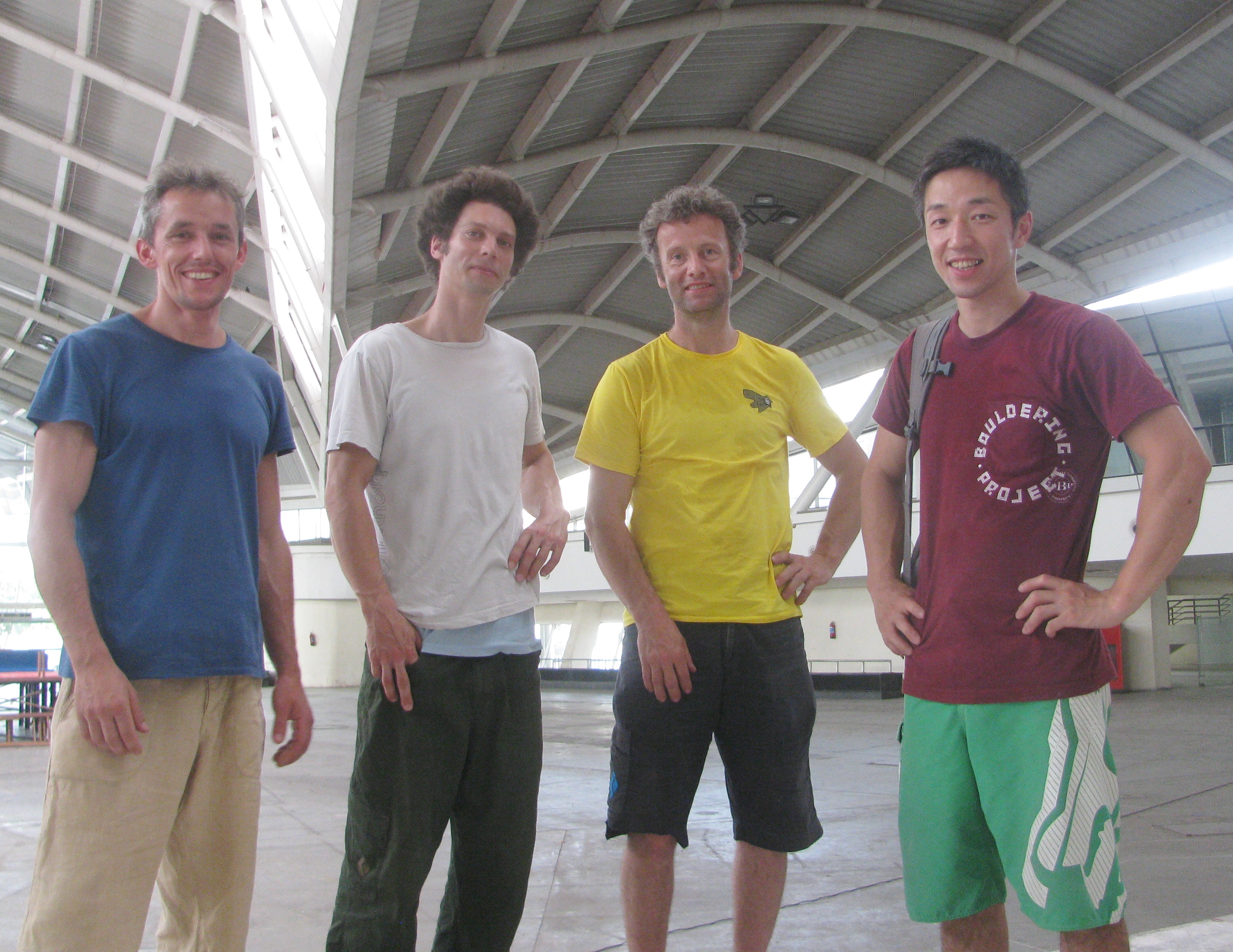
(From left) Julien Gras, Manuel Hassler, Percy Bishton and Gen Hirashima, the IFSC’s route setting team for the upcoming 2017 World Cup in Bouldering at Navi Mumbai (Photo: Shyam G Menon)

Please note: coverage of the 2017 IFSC World Cup in Bouldering at Navi Mumbai will be split between this blog and Outrigger 2, accessible at https://outriggerblog.wordpress.com/

Please follow Outrigger 2 as well.

As of June 19, the last date for athletes to register, a total of 102 climbers had registered to compete at the 2017 IFSC World Cup in Bouldering due at Navi Mumbai over June 24-25.

The countries represented include Australia, Austria, Belgium, Canada, Croatia, Great Britain, Germany, India, Iran, Japan, Korea, Latvia, Nepal, Russia, Singapore, Slovenia, Switzerland, Thailand and Taiwan.

The competition under the aegis of the International Federation of Sport Climbing (IFSC) is organized by the Indian Mountaineering Foundation (IMF) and Girivihar, Mumbai’s oldest mountaineering club.

Bouldering is one of the three main disciplines under sport climbing, itself an offshoot of rock climbing. Bouldering is climbing simplified. Use of gear is kept to a minimum. The climber uses climbing shoes for his feet and chalk powder to keep his hands dry. At the competition, climbing is done on indoor bouldering walls. The climber’s fall from the wall is cushioned using crash pads. In bouldering, the height of the climb is modest but the moves can be extremely difficult.

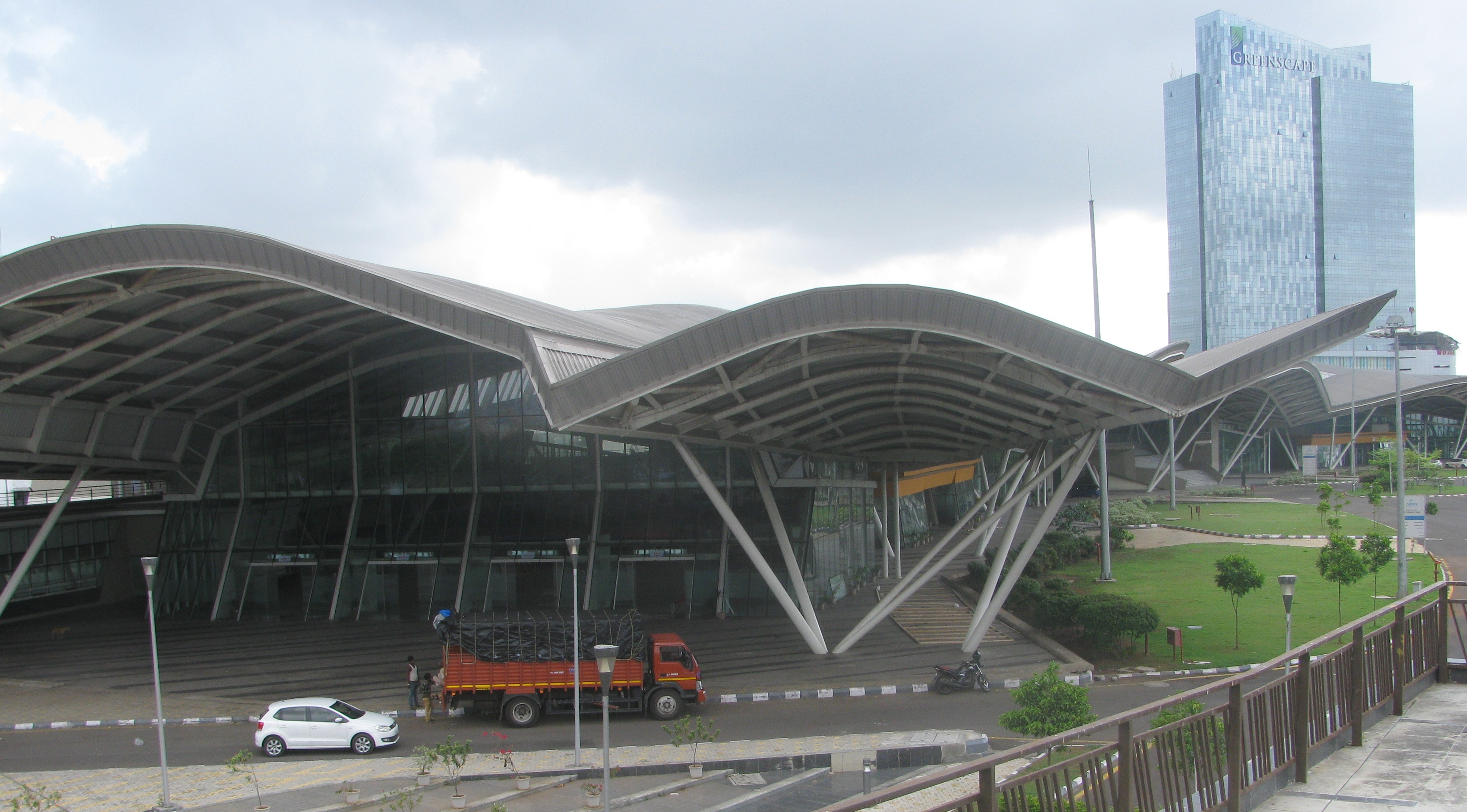
The venue of the World Cup; CIDCO Convention / Exhibition Center in Vashi, Navi Mumbai (Photo: Shyam G Menon)

This is the second time the World Cup is taking place in Navi Mumbai.

As per the IFSC website, last year at Navi Mumbai, there were 38 participants in the women’s category and 42 in the men’s making for a total of 80 participants. In 2016, the Japanese had secured four of the six positions on the podium in Navi Mumbai with Kokoro Fujii and Miho Nonaka winning top honours in the men’s and women’s categories respectively. The IFSC World Cup is a series of competitions held at various locations worldwide. It is similar to Formula One with winners announced for each World Cup and overall winners declared on the strength of points accumulated in a series.

By Sunday (June 18) evening, the route setters dispatched by the International Federation of Sport Climbing (IFSC) for this year’s event, were all in place. The team led by Manuel Hassler also includes Gen Hirashima, Percy Bishton and Julien Gras. Manuel and Gen were part of the route setting team in 2016. Julien is visiting India after a gap of 12 years. On his earlier trip this side exploring climbing destinations in India, he had climbed with Girivihar (for more on what route setters do at a competition, please click on this link:  https://shyamgopan.wordpress.com/2016/05/09/the-puzzle-makers/).

Unlike in 2016…. (to continue reading this article please click on this link: https://outriggerblog.wordpress.com/2017/06/20/102-athletes-register-for-the-2017-ifsc-world-cup-in-navi-mumbai/)

(The author, Shyam G Menon, is a freelance journalist based in Mumbai.)

RAAM / MID RACE MUSINGS: WILL IT BE FIRST INDIAN SOLO FINISH THIS YEAR?

Illustration: Shyam G Menon

On Monday, as Austrian cyclist Christoph Strasser stormed past the 2200 mile-mark well into his fifth day at the 2017 Race Across America (RAAM), it was turning out to be a memorable race for the Indian cycling community too.

Amit Samarth, a doctor from Nagpur, had by then cycled over 1520 miles. His fellow countryman Srinivas Gokulnath, a senior medical officer and lieutenant colonel with the Indian Army was just 100 miles behind at 1420 miles covered and narrowing the gap. The distances mentioned are approximate and rounded off for ease of narration. If they cover RAAM’s mammoth distance of roughly 3000 miles within the cut-off limit of 12 days, either of them could become the first Indian to complete the race in the solo category. The third Indian participant in the solo category this year, Samim Rizvi, unfortunately ended up Did Not Finish (DNF).

In 2011, Samim had managed to cycle the whole distance of the race but finished just outside the official cut-off limit of 12 days. The 2017 attempt was Samim’s fourth time at RAAM (for more on Samim please try this link: https://shyamgopan.wordpress.com/2017/05/23/chasing-a-10-day-raam/).

Also in the fray is Sahyadri Cyclists, a four person-team, which has in its support crew Hitendra Mahajan and Mahendra Mahajan who had completed RAAM in 2015 as a two person-team. Particular mention must be made of Andre Kajlich, the first handcyclist to qualify for the solo category at RAAM. By Monday evening he was past the 1550 mile-mark and was ahead of Amit. Andre is a double amputee. According to media reports, he lost his legs during his university days in Prague. On a night out with friends he was hit by a subway train. He survived but paid a steep price. Life in the aftermath of the accident brought him to endurance events. Kajlich is a top notch paratriathlete with several Ironman and Ultraman competitions under his belt.

In 2014, Strasser – he is hugely respected in the world of endurance cycling – had completed RAAM in 7 days, 15 hours and 56 minutes. Besides wins at RAAM he also holds the record for the maximum distance cycled on a road bike in 24 hours – 556.856 miles (896.173 km) and the record for cycling across Australia – 6 days, 10 hours and 58 minutes to pedal from Perth to Sydney.

Usually RAAM solo winners finish in 8-9 days. Given the varied challenges cyclists face in this race, ranging from sheer distance to cycling almost 22 hours every day, anything can happen in the days remaining to race completion.

(The author, Shyam G Menon, is a freelance journalist based in Mumbai. For the spot report from Oceanside, the starting point of RAAM, please click on this link: https://shyamgopan.wordpress.com/2017/06/17/2017-raam-gets-underway-a-spot-report/)

BORN AGAIN RUNNER

Ravi Kalsi (Photo: Shyam G Menon)

If you like the active lifestyle, then a hill nearby is an asset.

Navi Mumbai has two hill roads that are popular with runners. Both are on the local range called Parsik Hill. The shorter road of the two, near Nerul, goes up a finger of Parsik that got isolated from the main range thanks to a highway slicing through it; at least that’s the story the scars on the hillside indicate. The road then descends the other side to Belapur. The longer one winds up the Khargar end of Parsik; it is five kilometers one way, culminating at a village on top. Walkers, runners and cyclists love these two roads, still intact despite Mumbai’s real estate industry. Sundays are typically favored for long runs.

It was early morning, Sunday. Shorter hill road and passage through Belapur done, two of us pulled into the longer Khargar Hill Road, where the local running group – Navi Mumbai Runners (NMR) – was hosting a hill run. Quite a few runners had assembled; a briefing was on. Knowing our slow pace, we pushed on. I reached the village and had just commenced return, when the relatively fast vanguard of the runners who were being briefed when we passed by, emerged to the flat stretch of road on top. They had started much after us and had made it to the top in probably half the time we took. Leading the pack was a tall middle aged runner of lean build; his feet clad in cheap minimalist shoes sporting very thin soles. That outing was the first time I spoke to Ravi Kalsi. I had only seen him before on Mumbai’s Marine Drive, finishing point for the monthly Bandra-NCPA half marathon organized by Mumbai Road Runners (MRR).

From a run on the Kharghar Hill Road (Photo: courtesy Ravi Kalsi)

“ I was always very fond of sports. But I couldn’t cross that line between aspiration and getting into the school cricket team or anything like that,’’ Ravi said recalling years gone by. He put in 100 per cent into the effort. But in the eyes of others it was be like zero. “ Probably I wasn’t good enough to make it into a team,’’ he said. It was early June, 2017; well into the decades of India at its youngest with over 50 per cent of the country’s population currently below the age of 25 and over 65 per cent below the age of 35. We were at a café in a Navi Mumbai mall. The world around us swarmed with young people reeking of confidence. It was their world; the sheer luck of being born at the right time in demographics and economic growth to have a whole country singing your tune. That also made the new confidence tad synthetic. It smacked of being borne on the shoulders of time. In contrast, Ravi’s early disappointments at not being good enough appeared realistic. He was born October 1971, the son of an army officer from Gurdaspur who commenced a business in Mumbai following his short service commission and a Mumbai born-homemaker who briefly worked as a teacher. Growing up in Mumbai, Ravi attended Hansraj Morarjee Public School in Andheri, all the way to matriculation. Amid his attempts at getting counted in sports, the farthest he reached in this phase was – a third in doubles in badminton. “ My father on the other hand, had played cricket for Punjab University. He was an all-rounder. So it wasn’t lack of encouragement. I wasn’t good enough; it boiled down to that,’’ Ravi said. He was the only child of his parents.

Following school, he joined MMK College in the Mumbai suburb of Bandra, where he did his graduation in commerce. His experience at sports in school weighing him down, he stayed off sports altogether in college. “ It all died there,’’ he said. The state of mind must have taken a toll. Around this time, as a means to acquire confidence, Ravi enrolled for karate classes. He also joined a gym, hoping to fill out his lean frame a bit. Once again, the prevailing pattern in his life got the better of him. When it came to stretching as part of his karate classes, his flexibility wasn’t good enough. He attended martial arts training for about nine months and then drifted away from it. Silver lining was – that stint at karate left in him, an element of discipline. As for the gym sessions; with his body stubbornly refusing to sprout any visible musculature, Ravi lost interest in that too. College and life – both seemed a case of serving time with nothing to show for personal identity or flair. Uniquely and quite unlike the Indian trait of blazing through education in one determined haul, there was a gap of one to two years in studies after MMK. Ravi then did his MBA (Marketing) from Mumbai Educational Trust Institute of Management Studies. His first job thereafter was with Camlin, a much loved name in India for art and writing materials. In 1999, he got married. It didn’t work out well; the couple slowly drifted apart. In the café, reflecting on his life, Ravi would refer to these years of first job and marriage as directionless. The universe was simply not connecting.

Photo: courtesy Ravi Kalsi

In 2004, Mumbai saw the first of the annual marathons sponsored by Standard Chartered; the since well-known Standard Chartered Mumbai Marathon (SCMM). Thanks to SCMM, in 2010, Ravi’s life in the Mumbai suburb of Andheri began to change. That year, his neighbor signed up for SCMM’s shortest sub-event – a seven kilometer run, which over the years has slowed to a crawl thanks to a large number of participants. “ At that time seven kilometers seemed a lot for me. I was in a different league and admired my neighbor for what he had got into,’’ Ravi said. His neighbor’s participation in SCMM prompted one change – on October 4, 2010 Ravi decided to rejoin the gym. “ I needed to vent my frustration with life,’’ he said. The trainer set him up with a routine; warm up with a ten minute-walk on the treadmill, lift weights thereafter. This went on for two to three weeks. One day, Ravi inquired if he could run on the treadmill instead of walking. Permission secured, he ran. “ I felt different doing that, I felt good,’’ he said. He also realized it was the first time he was feeling so after physical exercise.

As the ten minute-running grew to fifteen minutes and then half an hour, he began looking forward more to the treadmill session than the rendezvous with weights. “ The more I ran, the more I liked it,’’ Ravi said. He formally requested the trainer to be spared weights and focus on just cardio work out. The next stage was – he put in 100 minutes non-stop on the treadmill one day and started thinking of shifting to running on the road. He kicked it off with small doses – running five to seven kilometers, from where he stayed in Andheri to Juhu. Then he ran from his home to his former college in Bandra, a distance of 10 km. “ It was a big psychological boost. It showed me I can get out of my comfort zone. Once I got to running on the road, I never went back to the treadmill,’’ Ravi said. In July 2011, he enrolled for the Thane Varsha Half Marathon. Given it was a formal event he bought a pair of good running shoes. Although training hadn’t been proper or systematic, his confidence was high – after all he had bought running shoes! He completed the race in 2:46. “ I felt like a champ,’’ he said. Then the learning started. When he told his friends that he had run a half marathon, they mentioned cut-off time. It was the first of many words and phrases from running that would guide Ravi in his self-managed progression through the sport.

From the 2015 MRR anniversary run (Photo: courtesy Ravi Kalsi)

Stretching on Marine Drive after the monthly Bandra-NCPA half marathon (Photo: courtesy Ravi Kalsi)

Cut off understood and burnt into mind as a parameter to watch out for, Ravi registered next for the half marathon in Hyderabad. On the train to Hyderabad he had the company of other runners. From their conversation, he gleaned another crucial word: strategy. Hyderabad’s was a tough run. However he completed it in 2:27, which was a faster time than what he had clocked in Thane. By now he was becoming more and more aware of the running ecosystem, including the sport’s ecosystem in Mumbai. One of the names he heard of was MRR. He also saw photos of their runs and was in awe of the group. “ I was reluctant to run with them. They were like Aamir Khan or Shah Rukh Khan for me. They were my heroes although they didn’t know of it. I wanted to be in but I was worried I might embarrass myself joining them for the monthly Bandra-NCPA half marathon. So I told myself, let me get better, then I will go for it,’’ he said. Next event in Ravi’s growing romance with running was a half marathon in Delhi. Gearing up for it, his learning was the term `sub.’ Specific to the half marathon, he heard of sub-two. On race day, the weather in Delhi was awesome. “ I finished the race in 1:57,’’ Ravi said. Sub-two in the bag gave him adequate confidence to try what he had long wanted – run Bandra-NCPA with MRR. From the first Sunday of January 2012, he started to run with MRR. “ That first Bandra-NCPA felt really good,’’ he said.

In the paperback version of Christopher McDougall’s book Born to Run, page 157 begins with Barefoot Ted’s Eureka moment inspired by the observations of Barefoot Ken Bob who led a community of barefoot runners:

Shoes block pain, not impact!

Pain teaches you to run comfortably!

From the moment you start going barefoot, you will change the way you run.

In February 2012, Barefoot Ted visited Mumbai. He was scheduled to run the Bandra-NCPA with MRR.

Ravi reached the starting point in Bandra, as usual, with shoes.

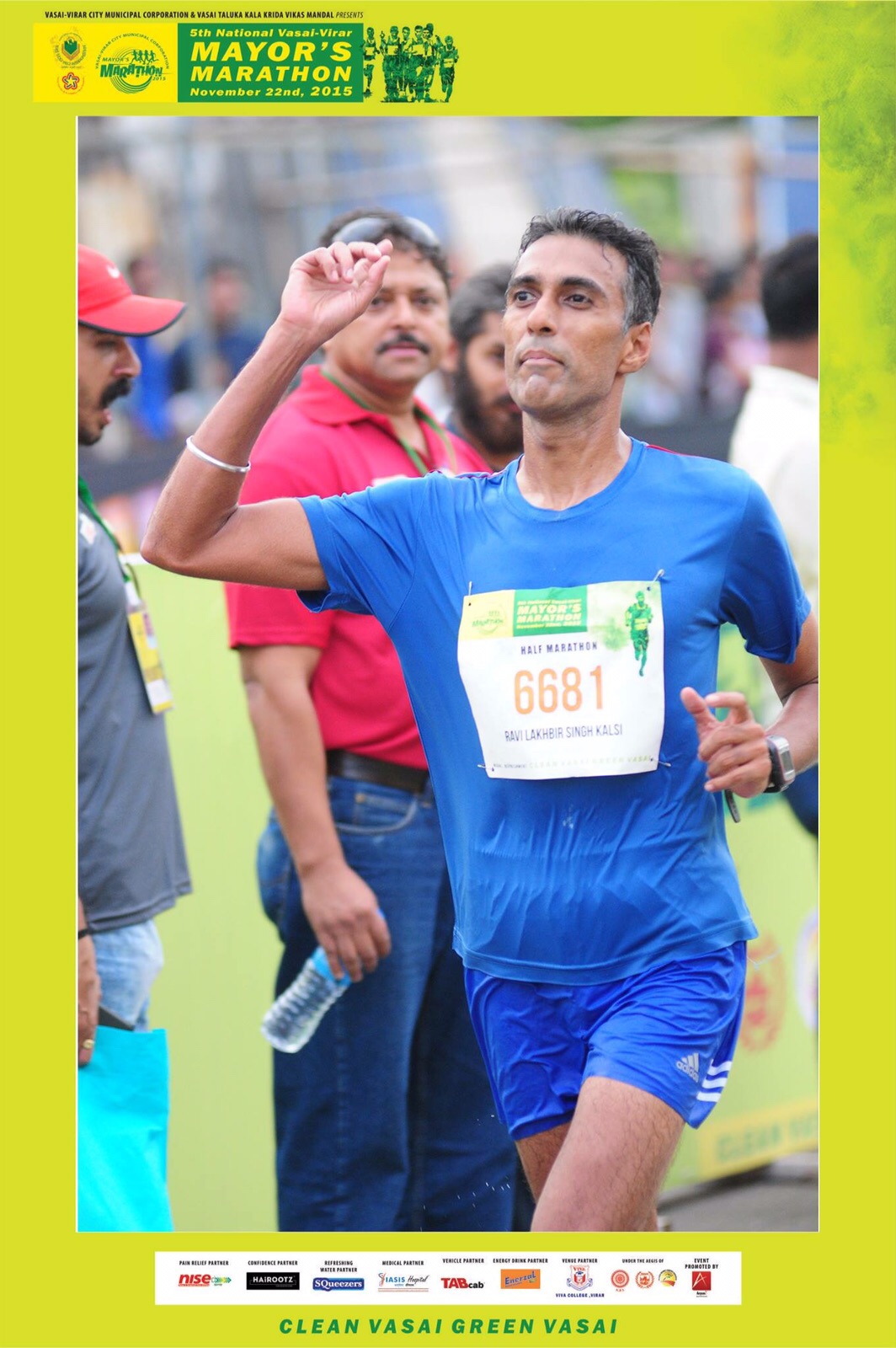
At the 2015 VVMM (Photo: courtesy Ravi Kalsi)

At the café in the Navi Mumbai mall, one of the employees hovered around our table, seemingly a bit concerned by the long conversation underway. It is a problem of our times – we go to cafes to chat over coffee but too much conversation and too little coffee is deemed bad for business in times more appreciative of money than life. Monetization – one day its seepage into every nook and cranny of human life will leave us with existence as exoskeleton and nothing human or lively within. Ravi has no particular interest in painting. But he appreciates it and responds to art on the strength of what personally appeals to him and what doesn’t. He was aware of M.F. Hussain as a great Indian artist. One thing that had always intrigued him about Hussain was – his aversion for footwear. The great artist was notorious for going barefoot. Artists sometimes lock on to details of life, others overlook. We stand on our feet. Yet it is the super structure our feet support, which gets all the attention and laurels. Who appreciates feet? Centuries ago in Europe, one of the most inquisitive minds of all time – Leonardo da Vinci – had lauded the design and bone structure of the human foot. “ To me, there seemed to be some connection between Hussain’s art and his tendency to go barefoot,’’ Ravi said. Beset with a chance to run alongside Barefoot Ted, it seemed the best opportunity for him to take off his shoes. He had never run barefoot before. But he could hear his mind nudging him to try it. So Ravi took off his shoes, tied one to each side of his hips and proceeded with Bandra-NCPA. “ My foot was hurting but the determination to complete the run saw me through,’’ Ravi said. Then came, the next flush of intuitive confidence in his progressive resurrection of the many instincts he had missed in school and college. Barefoot Ted was giving away autographed copies of his book and Ravi Kalsi felt damn sure that his name would be called out to merit one. The universe stood by him. Ravi’s name was called out. In his mind, it was an endorsement for running and barefoot running. “ It was destiny speaking: this is your stuff Ravi,’’ he said. Them feet were still paining. But what the heck, he had found his groove.

In January 2012, he ran his first SCMM in the event’s half marathon segment. He finished in 1:52. Running with MRR, he decided to attempt graduating from the half marathon to the full. He needed some handholding for the transition. Born in 1931 and 85 years old as of 2017, Hal Higdon is an American writer, runner and author of the bestselling book: Marathon: The Ultimate Training Guide. Ravi used Higdon’s training program for the transition. His personal idea was to combine full marathon and running barefoot. The venue selected was Hyderabad and its annual marathon. While packing for the trip, Ravi consciously left his shoes behind in Mumbai. It shut a door in the brain. There was no going back. It eliminated self-doubt; set him up to deliver. He ran the full marathon in Hyderabad barefoot, completing it in 3:56. “ A sub-four barefoot – that was really a big achievement for me,’’ he said. However given Hyderabad roads were good then and Mumbai roads, not so, when it came to the full marathon at the 2013 SCMM, Ravi reverted to using shoes. He finished that race in 3:46. It was ten minutes faster than how he had performed in Hyderabad but he wasn’t quite satisfied. He also noticed another thing – he was getting quicker. What should he focus on? Go longer and stay with the full marathon or go faster and be loyal to the half marathon? He decided on the latter. He hasn’t done a full marathon since. Not just that, he found that if in his pursuit of speed he curtailed distance to 10 km-races, he isn’t as comfortable as he is in a half marathon. He wasn’t a track athlete by grooming and thus well placed to run a fast 10 km-race. On the other hand, the half marathon, while being fast also allowed Ravi to find his rhythm and dwell in a zone. The half marathon appeared apt combination of speed and distance for him. With this the Ravi Kalsi Mumbai runners know now was born. By the 2014 SCMM, his half marathon timing dropped further to 1:31. At the 2015 SCMM, it was 1:35; an outcome of not being able to train much given 2014 was a busy year at work. By now, he was employed with a BPO.

Running at SCMM (Photo: courtesy Ravi Kalsi)

Ravi has never had a coach in running. He is self-taught. It wasn’t deliberate. It just happened that way partly propelled perhaps by the fact that his friends include coaches and he considers himself a good listener. “ I like to watch videos of elite athletes running. When you look at them running, you get to know what running is all about and what one’s own running is,’’ he said. On the surface it would seem all about beating the clock and returning a good timing. But at day’s end it is about making mind and body perform so and fact is – there is a way to run faster. “ Elite athletes get that timing because they run in a manner, which gets them such timing. My focus therefore shifted to running right. The 1:31 I got at the 2014 SCMM was not a case of running right. I am still a work in progress,’’ Ravi said. North of Mumbai and now an extension of the giant Mumbai-Thane-Navi Mumbai urban sweep, is the town of Vasai. Technically, it falls in Palghar district. Vasai and the adjacent township of Virar have for some years been nodal points of a much loved running event, particularly noted for its cheering – the annual Vasai Virar Mayor’s Marathon (VVMM). In 2015, running the half marathon at VVMM, Ravi notched his first sub 90 minute-finish in the discipline. Roughly two months later at the 2016 SCMM, he finished the half marathon in 1:29:55, narrowly breaking the 90 minute-barrier and ending up third in the event in his age category. It was his first podium finish at a major event. Ravi does not however give this result undue importance. “ Coming third is like being in the right place at the right time. It was luck, nothing else. I compared this result with results elsewhere in the world. Elsewhere, there are like 500 people better than this timing and I get a third place here? That doesn’t speak much,’’ Ravi said. According to him, he is still not running right. He continues to go wrong as regards running form. He is merely running faster without running in the manner that sustains fast running. “ If you get it correct, it becomes smoother, more efficient and faster,’’ he said adding that he is able to figure out the biomechanics involved by himself. The year though wasn’t smooth sailing. His training was inadequate for the IDBI Federal Mumbai Half Marathon in August and it showed; “ past the eighth or nine kilometer, things went downhill.’’ But less than three months later, at the Indian Navy Half Marathon of November 13, Ravi bounced back. This time it was a win in the veteran category of the race’s 10 km-discipline with a fifth place overall in the men’s segment alongside. His timing was 40 minutes, 16 seconds. Then, at the 2017 SCMM, he finished the half marathon in 1:25:29, once again placing third on the podium in his age category. “ I still have this feeling that I am nowhere. I need to improve,’’ Ravi said.

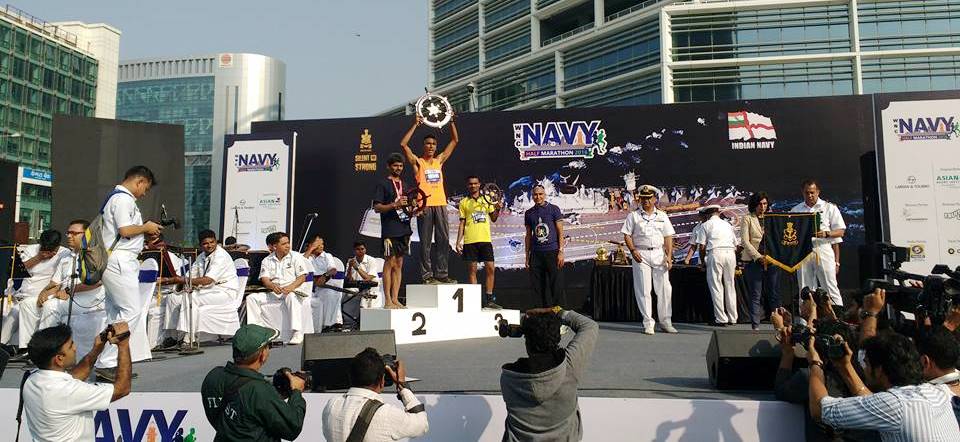
On the podium after winning the 10 km-discipline in the veteran category at the 2016 Navy Half Marathon in Mumbai (Photo: courtesy Ravi Kalsi)

When I met him, he believed he had improved a bit after the 2017 SCMM. He had experienced the improvement in his training runs. He wasn’t running a lot; he was averaging about 40-45 km per week. Closer to an event, he stepped it up a bit. “ I don’t run much. But when I run, I try to do it right,’’ he said. For him, rest was as good as a work-out. Rest is important. He was doing no cross training but admitted to consciously living life’s small moments, like climbing stairs, listening to feedback when running on sand, listening to a walk etc. One thing he made sure to take care of – his diet. He ate in moderation and ensured that what he ate provided nutrition. Plus, he didn’t attach a premium to competing in races. At events, he simply did the best he could. In 2004, Ravi and his wife were blessed with a son. I asked him if his son was aware of his interest in running and whether he had seen the medals and certificates; more importantly if he knew the happiness, running brought. “ I think he feels good about it. That is quite heart-warming,’’ Ravi said.

(The author, Shyam G Menon, is a freelance journalist based in Mumbai. This article is based on a conversation with the subject. Race timings are as provided by the interviewee.)

2017 RAAM GETS UNDERWAY / A SPOT REPORT

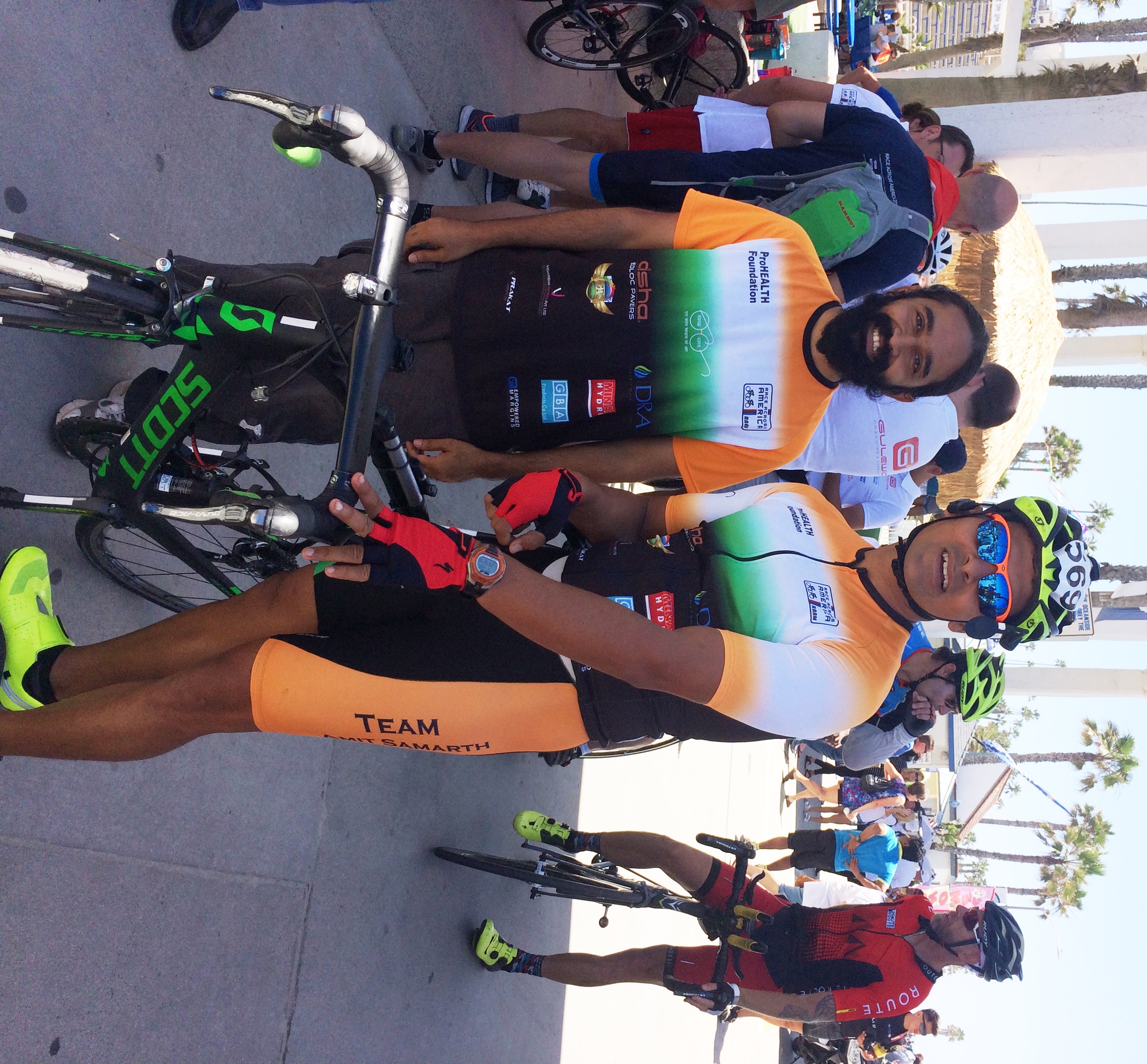
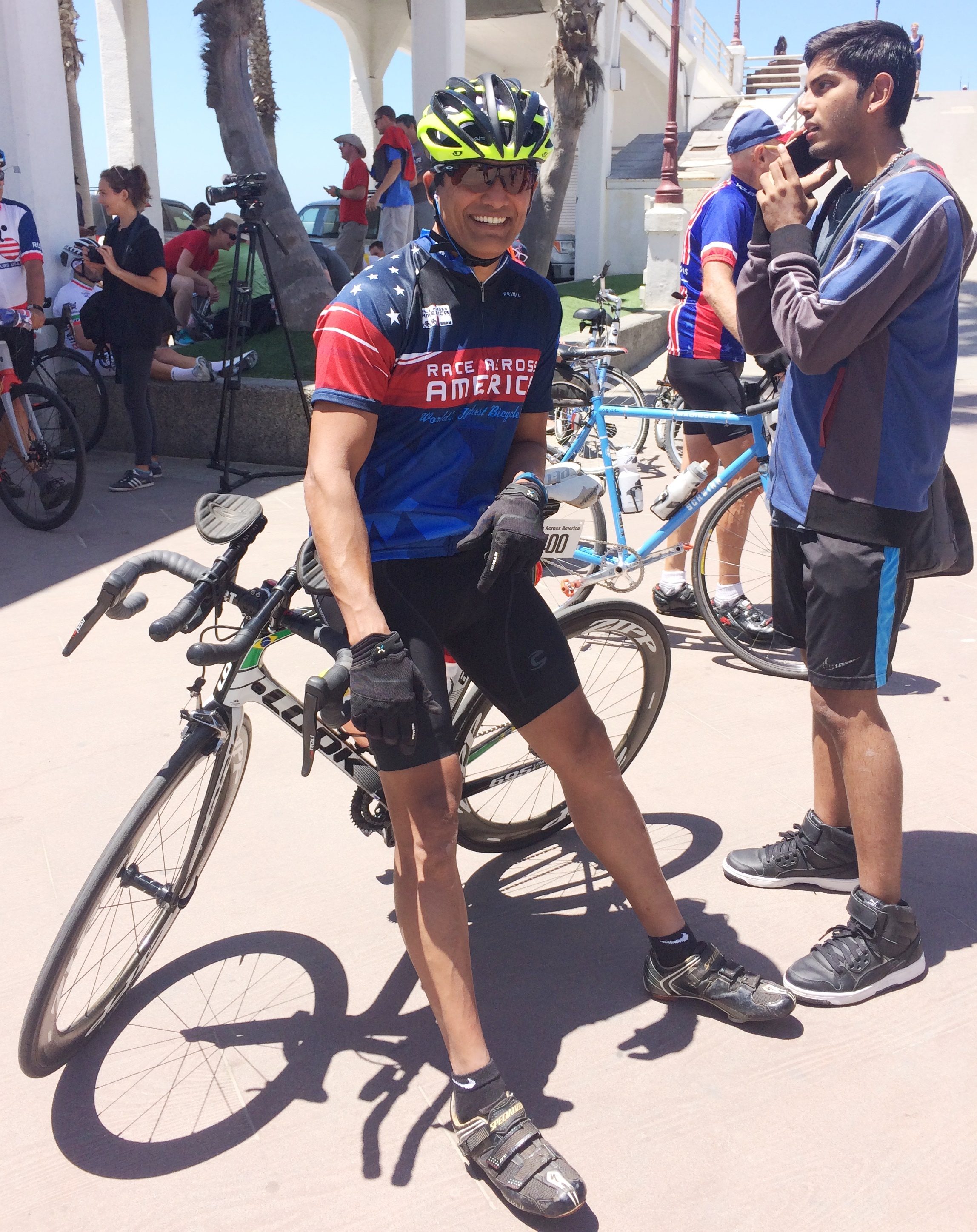
Amit Samarth just before the 2017 RAAM got underway in Oceanside, California (Photo: G. Rajeev)

Article by invitation:


On June 13, 2017, the year’s Race Across America (RAAM) got underway from Oceanside, California. One of the most grueling races in the world of cycling, RAAM sees participants cycle from the west to the east of the US, a distance of approximately 4800 km. People ride solo as well as in teams. The solo race ends in Annapolis, Maryland.


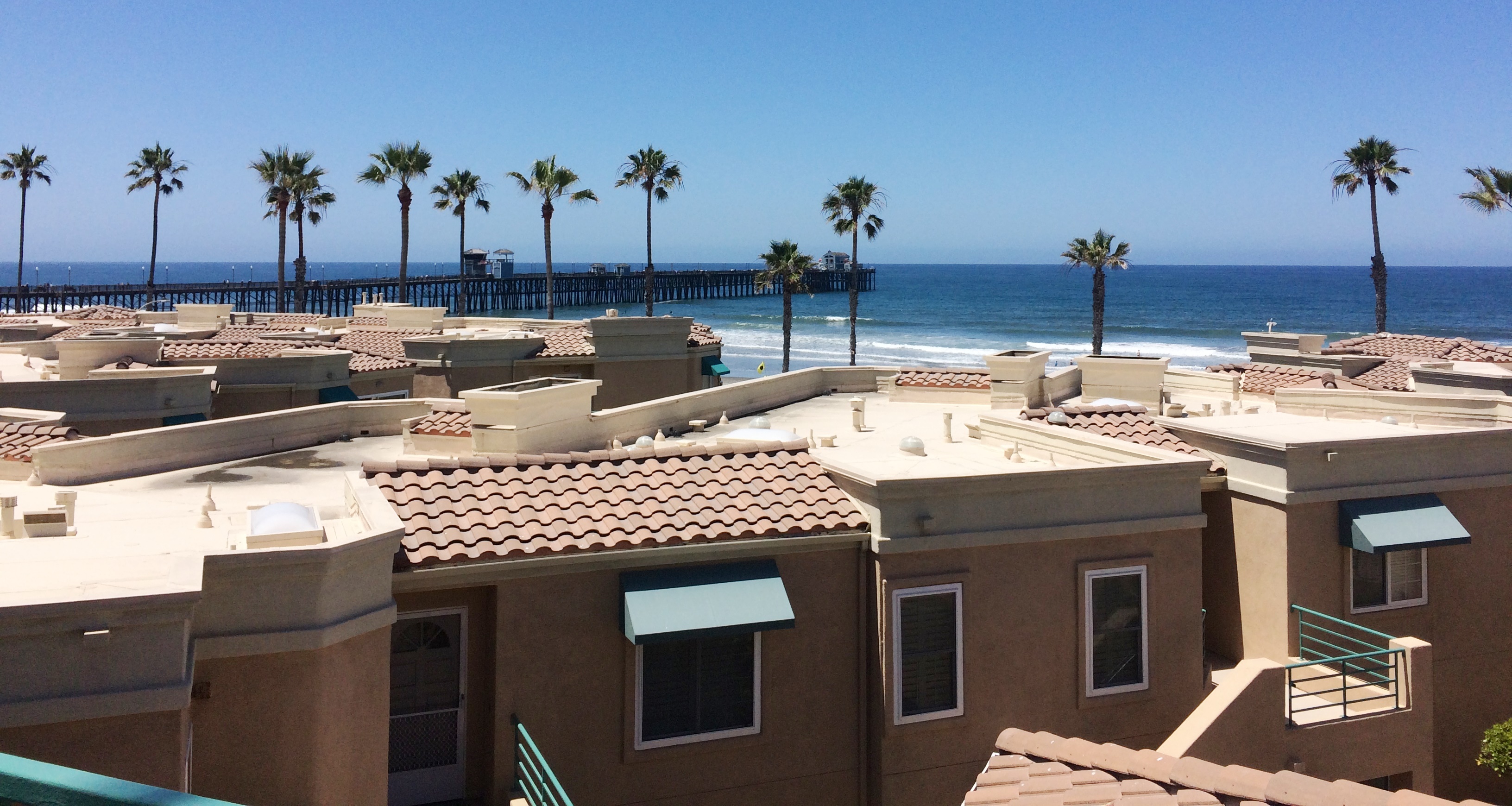
A view of Oceanside pier; starting point of RAAM (Photo: G. Rajeev)

According to Wikipedia, a RAAM winner usually finishes the race in 8-9 days, cycling roughly 22 hours every day. It takes a toll on cyclist and support crew. This year’s participants include Srinivas Gokulnath, Samim Rizvi and Amit Samarth from India. Sahyadri Cyclists – a team of four cyclists and their support crew – was also listed. 


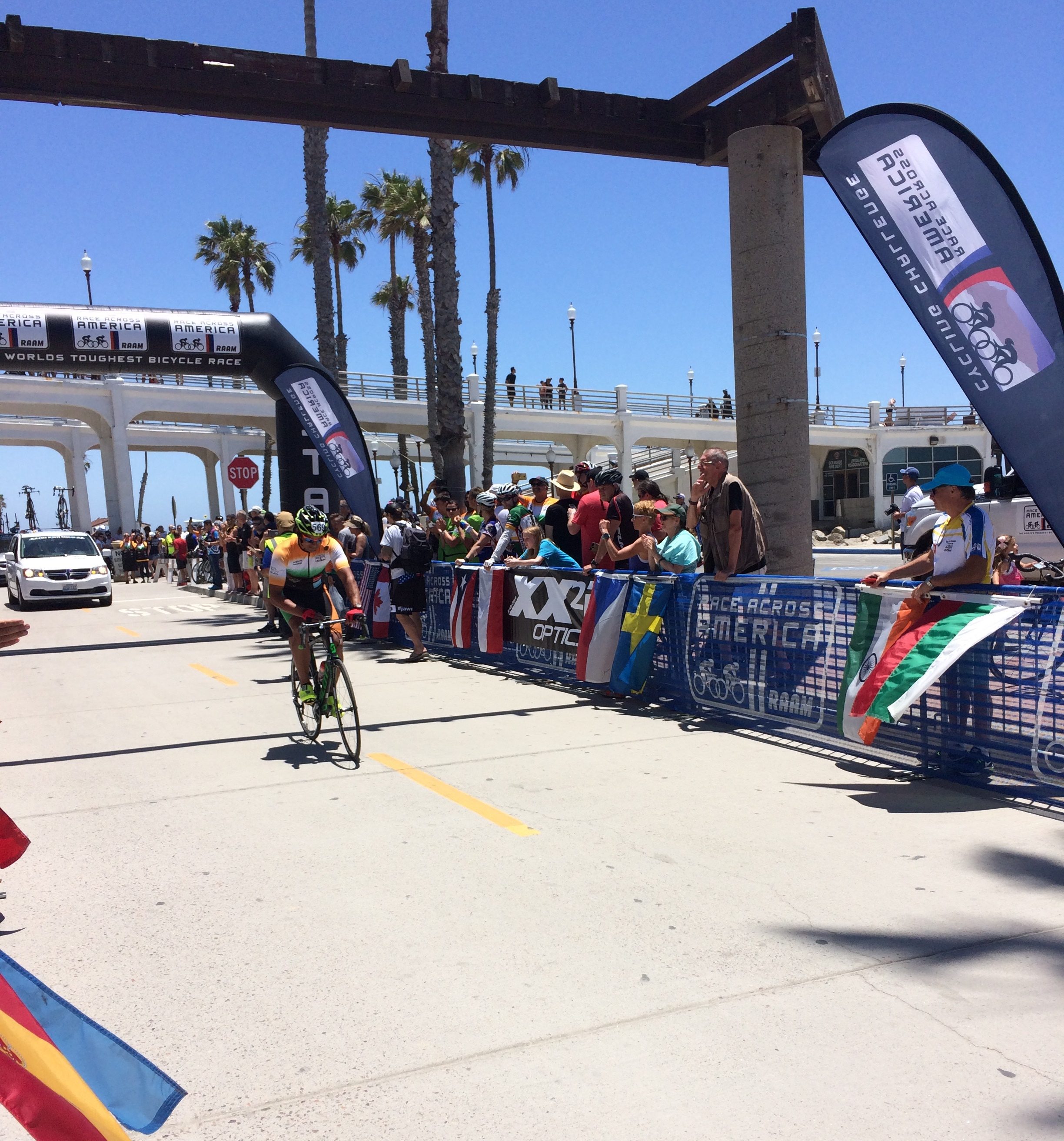
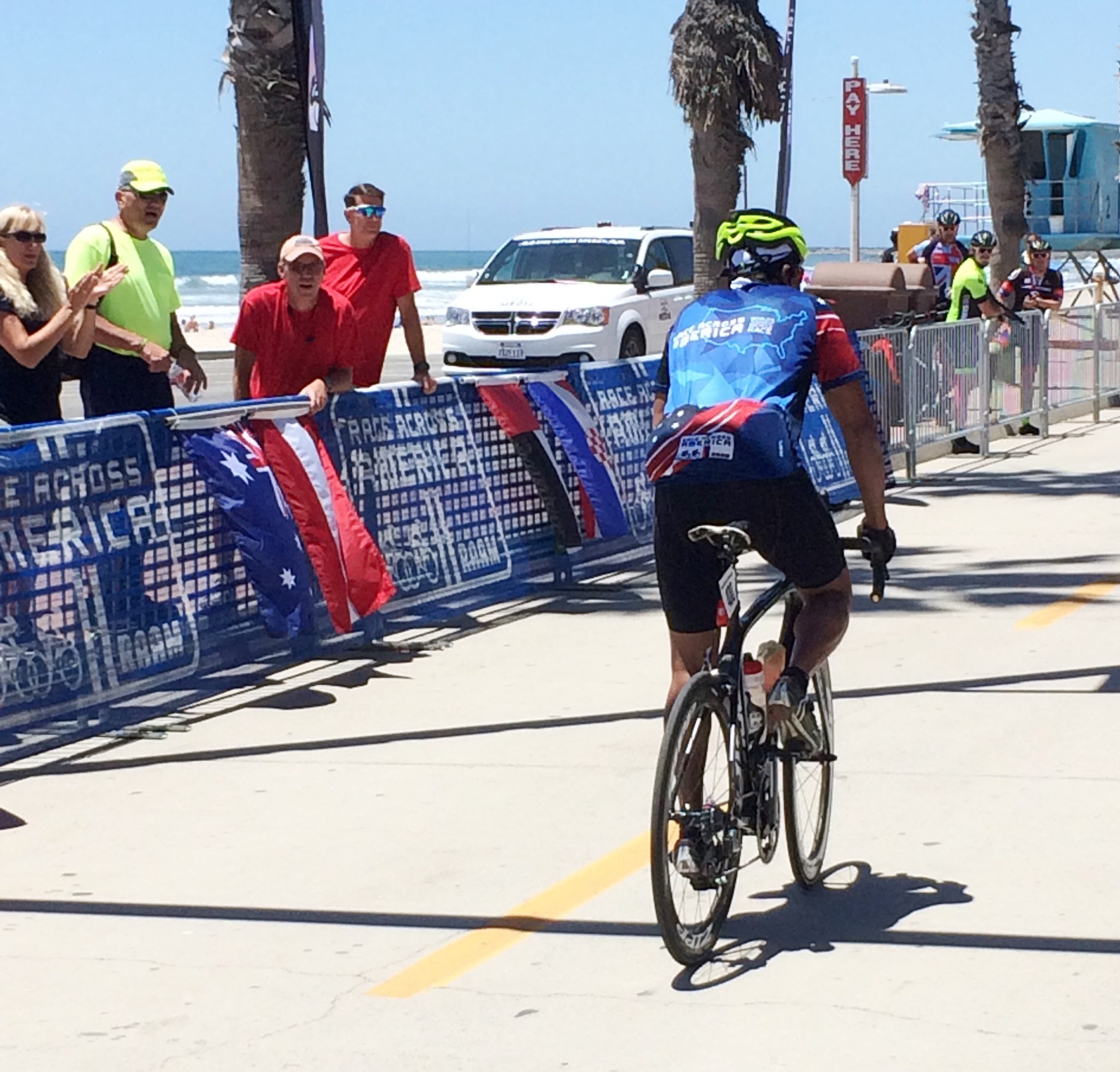
Amit riding off; ahead lay 4800 km of the United States (Photo: G. Rajeev)

G. Rajeev was at the starting point of RAAM to catch his first glimpse of the race.


He sent Outrigger this piece.   


I got to the Oceanside pier about half an hour ahead of RAAM’s scheduled start at noon.

The start point was on the boardwalk by the pier. There was a crowd milling about there. It was smaller than I had anticipated; mostly cyclists and their support crew, some race volunteers, a few gawkers who looked puzzled at the activity going on, and of course security folks who were looking suspiciously at anyone wandering by.

It was a beautiful day – clear, sunny and warm, but perhaps not ideal for cycling incredibly long distances. I didn’t know any of the cyclists or their history, but I noticed Amit Samarth immediately thanks to his tricolor jersey. I chatted with him briefly and took a picture. He said this was his first time attempting RAAM, but he had crewed for Seana Hogan last year. She has won RAAM several times.


RAAM on a recumbent (Photo: G. Rajeev)

I wandered around some more, checking out the bicycles and the riders. Mostly a lean and fit bunch, as one would expect with lean and sleek machines in tow. Some looked intense but most were relaxed and seemed in a jovial mood. The crew looked more on edge in general.

I saw someone who I thought might be Samim Rizvi, so I asked him if this was his first time doing RAAM. When he said, “ No, this is my fourth,” I knew it was Samim. I then took a couple of snaps. Samim was preoccupied discussing something with his crew, so I left him alone and went off to stand at a point a little beyond the start.


Andre Kajlich on his handcycle. He is the first solo handcyclist to qualify for RAAM (Photo: G. Rajeev)

The race started with Race Across the West (RAW) racers heading out at intervals of about a minute or thirty seconds. There were some four person teams in this race and maybe some two person teams as well. After about thirty minutes of this, the race volunteers changed out the signs to indicate that the RAAM racers were set to start.

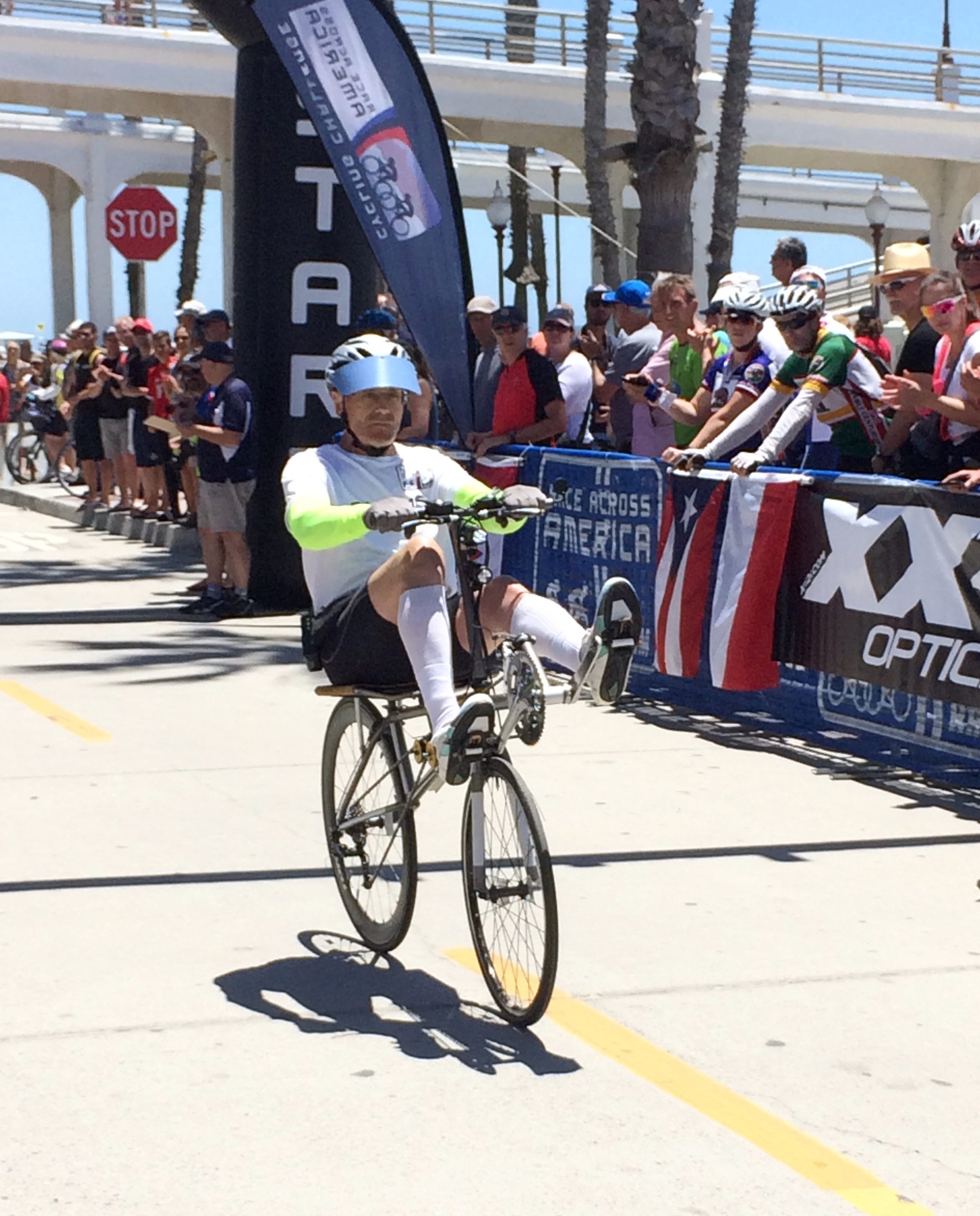
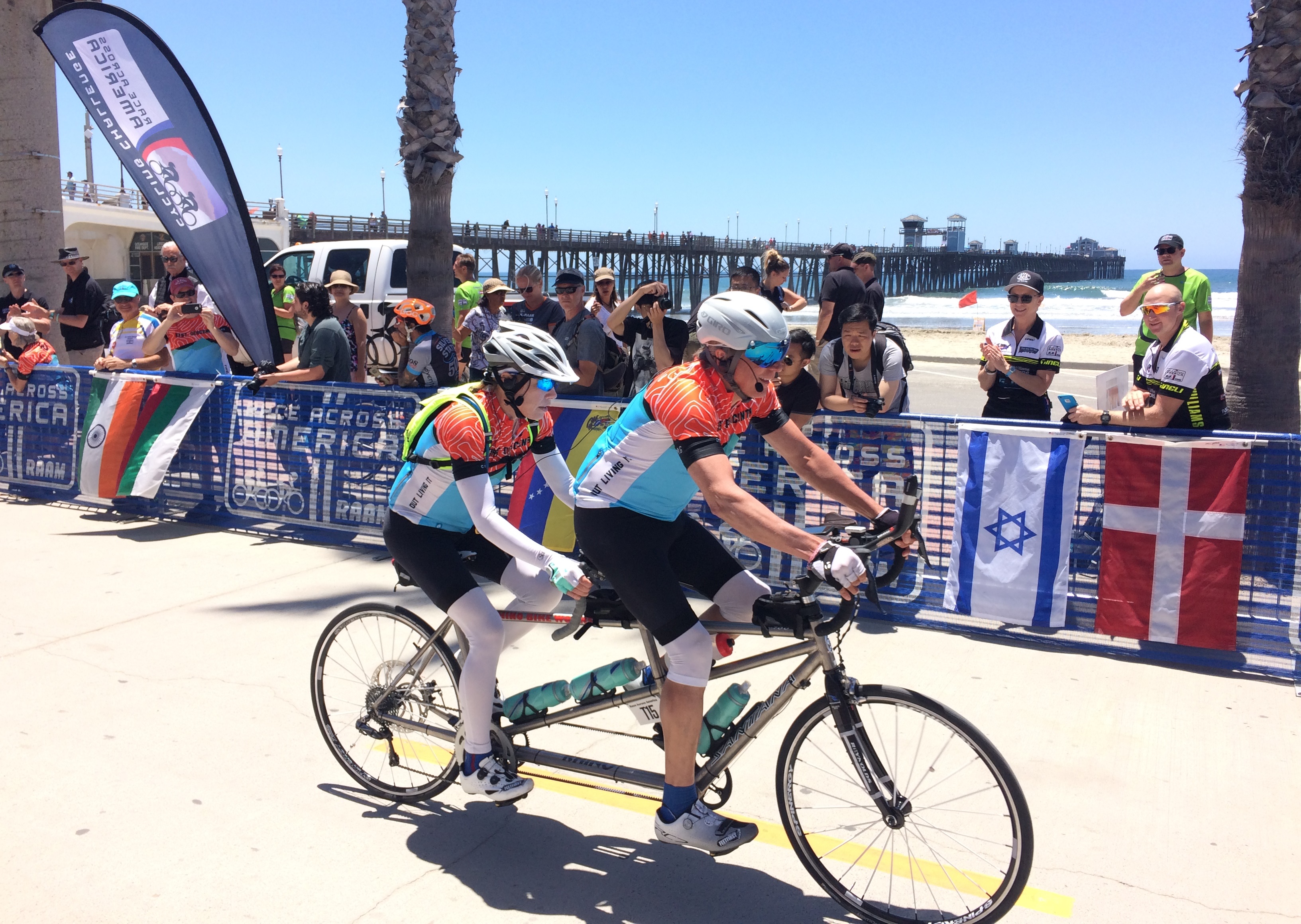
The women went out first, followed by the other racers in what seemed to me to be random order. Each support vehicle followed its racer closely, some driving by sedately and quietly and some going by with yells and raucous music. There was one racer on a handcycle, a couple on a tandem and one racer on a bike that he had modified at home into a recumbent.


Samim Rizvi, ahead of the start of the 2017 RAAM (Photo: G. Rajeev)

Samim rides off into the race (Photo: G. Rajeev)


John Jurczynski and Ann Rasmussen on their tandem bicycle (Photo: G. Rajeev)

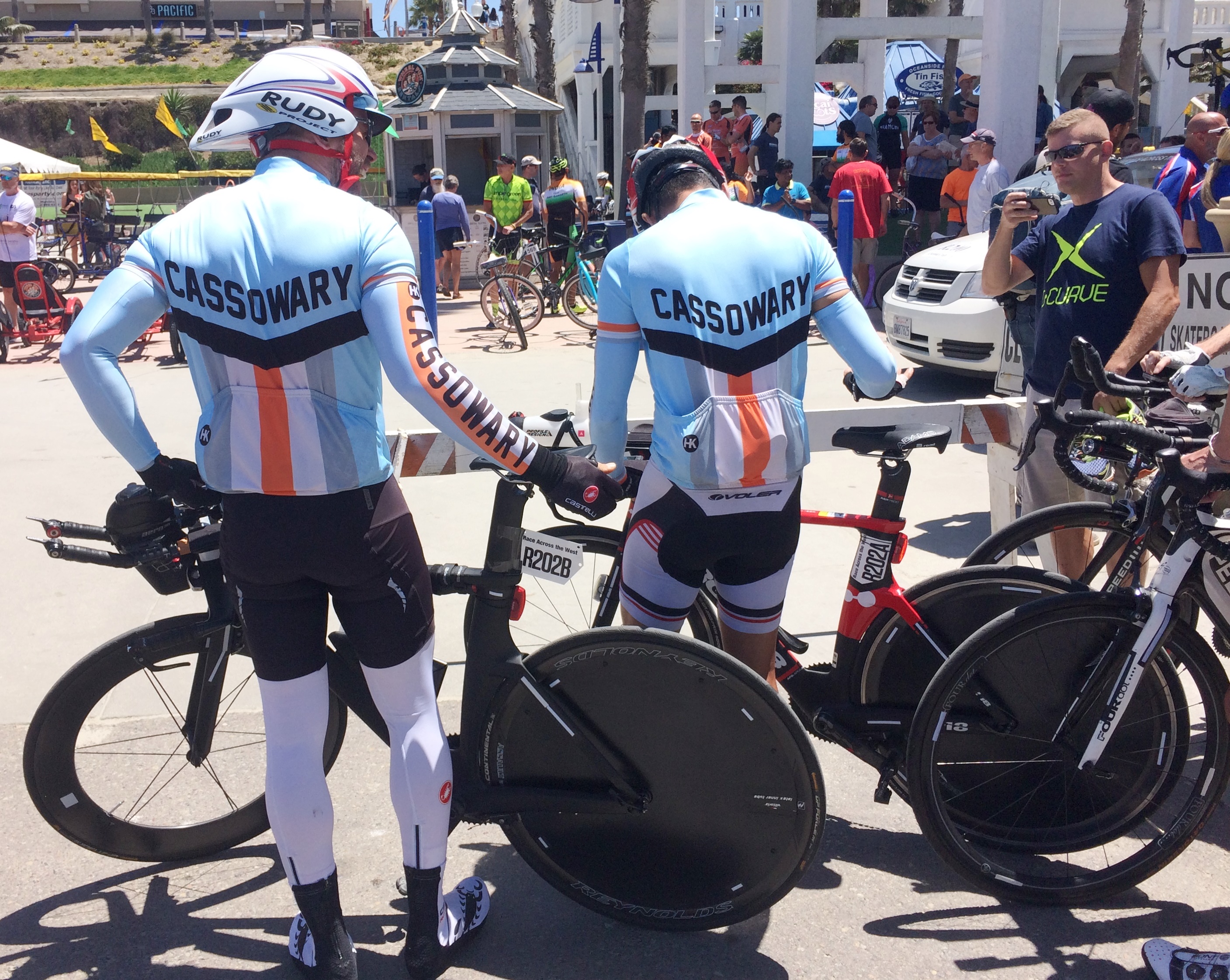
Team Cassowary gets ready (Photo: G. Rajeev)

It was daunting to look up the boardwalk as the racers cycled by and think of the 3000 miles of road that awaited them. I waited for Amit and Samim and a few more and then headed back.

My phone was almost out of charge and my parking meter was expired.

There were still quite a few cyclists left at the start when I looked back at around 1:30 PM.


(G. Rajeev is an engineer by profession. He is based in San Diego, California. For more on Samim Rizvi and what it is like to attempt RAAM, please click on this link: https://shyamgopan.wordpress.com/2017/05/23/chasing-a-10-day-raam/)

MAINTAINING SUB-THREE

Vijayaraghavan (Vijay) Venugopal (Photo: Shyam G Menon)

The story behind a hat-trick of sub-three finishes over 2016-17 at the marathons in Paris, Berlin and Boston

Early May, 2017.

I had completely over-estimated the distance to my appointment from where I stayed. Bengaluru’s Vittal Mallya road ended up very much in the neighborhood. A lot had happened in the 34 years since the man in whose memory the road was named, passed away. Impressive brick and mortar constructions bearing the name of the company he was elected director of in the year of India’s independence, rose nearby. Vittal Mallya’s son, having defaulted on bank loans worth millions was now living in UK. Suddenly, the high flying life wasn’t what it seemed. It smacked of quicksand; a gooey mess that sucks you in if you are not watchful. With an hour to kill and the afternoon heat of an Indian summer to escape, I stepped into a luxury mall the son built. As with all malls, the shift in ambiance worked till the skin’s relief in trading heat for air conditioning wore off. Then, the monotony of synthetic world took over. I tried to think of what lay ahead. Closer to appointment, I reached the assigned office, an address for several businesses. In the reception they all shared, the lone copy of the Bengaluru Times returned me to faces that harked of mall left behind. It wasn’t difficult identifying Vijayaraghavan (Vijay) Venugopal when he walked in. He looked every bit, runner.

Approximately 700 km south-west of Bengaluru and less than 100 km from the tip of the Indian peninsula, is Thiruvananthapuram; erstwhile Trivandrum. It is the capital of Kerala, among early states in independent India to establish a reputation in games and athletics. Most educational institutions here – at least in the decades before Indian independence and in the decades immediately following it – had big campuses with playgrounds. Some colleges were well known for their teams in sport; talk to old timers and you realize, there even used to be an element of talent scouting. In years gone by, at several places in cities, towns and villages, it was common to see open space preserved as a volleyball court or badminton court. Post-harvest, fields devoid of crop served as venue for local football tournaments. In the 1970s and 1980s, a drive along the state’s national highway usually yielded the sight of local matches in progress. Rivers and large ponds at old houses on land yet to be divided into a hundred plots became swimming pools. Point is – the affection for the active life ran deep. It wasn’t cosmetic. Every day, the emphasis on academics grew. But in Kerala, until the recent epidemic of life by entrance tests and professional qualification, it was never deemed bad to indulge in sports.

Vijay was born in 1975 in Thiruvananthapuram. At that time C. Achutha Menon of the Communist Party of India (CPI) was chief minister of this paradox of a state, at once literate and conservative, ahead in social indices yet industrially barren, admiring arts and literature, politically volatile and sport loving. Arguably, the Malayali’s greatest strength and weakness was awareness exceeding what is best for his / her own good. It was a vibrant universe of interesting aspirations and potential self-entrapment. Amid this, through all the frequent processions by flag wielding political cadres and the occasional shut down in capital city, a fleet of buses painted grey plied without fail in the morning and in the evening. Ferrying people to work, they belonged to an organization begun 13 years before Vijay’s birth. Thumba in Thiruvananthapuram is very close to the Earth’s magnetic equator. That made it an ideal place for scientists to do atmospheric research. In 1962, the Thumba Equatorial Rocket Launching Station (TERLS) was established. Since then, sounding rockets have been regularly launched from Thumba. The growing organization became known as the Vikram Sarabhai Space Center (VSSC). It is today the largest facility of the Indian Space Research Organization (ISRO), doing work on everything from sounding rockets to ASLV, PSLV, GSLV and GSLV Mark III rockets. Vijay’s father worked at VSSC. The family – his parents continue to reside in Thiruvananthapuram – spoke Tamil at home.

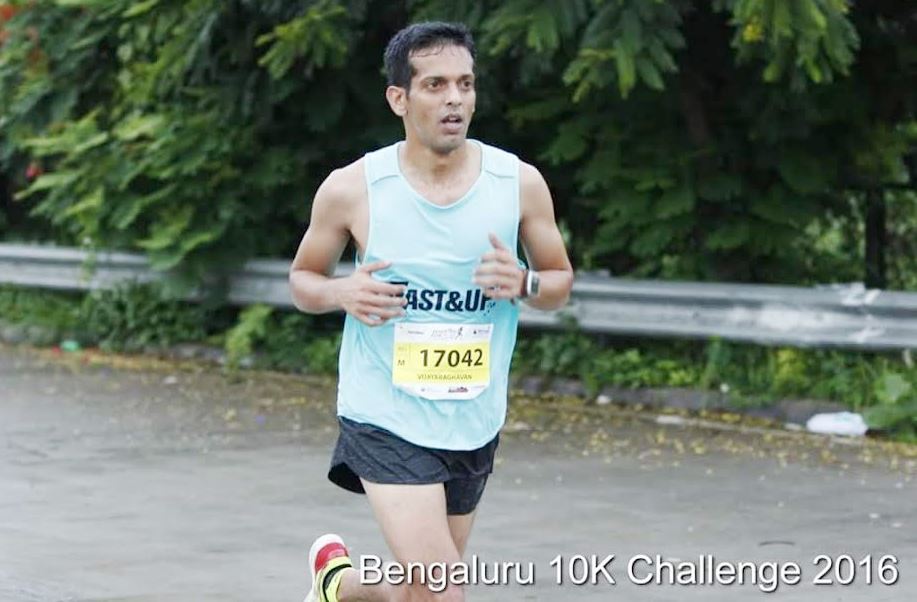
From a 10 km race in Bengaluru (Photo: courtesy Vijay)

Every town in the country has an idea of the best schools around. In the Thiruvananthapuram of the 1970s, Loyola School, located just outside city limits and tad to the north, was among most sought after. That’s where Vijay studied. “ I was the typical school going child – good at studies and good at sports,’’ he said. Loyola had a reputation locally in sports; its basketball team was particularly respected. Vijay used to participate in the school’s athletics competitions finishing second or third but what he was genuinely interested in, was a sport the Kerala of that time wasn’t famous for – cricket. In an irony of sorts, despite cricket played in Thalassery in north Kerala in the early 19th century – much before it was played elsewhere in India – it had failed to excite Keralites as much as football, volleyball and basketball did. Vijay was a good cricketer. He became captain of the school team, played in the district under-12 team for Thiruvananthapuram and played in the under-13 and under-16 teams for Kerala. He dreamt of becoming a state level player competing in the Ranji Trophy, which is a domestic first class-cricket championship.

After school and pre-degree, Vijay joined the College of Engineering, Trivandrum (CET). He studied mechanical engineering. In this phase of life, studies took precedence. Yet he continued to play cricket, remaining good enough to be part of the college team. CET’s cricket team was strong; it has produced Ranji players. One of the years Vijay was at CET, they topped the university in cricket. To keep his interest in athletics alive, Vijay participated in track and field disciplines at college. However, there was a practical reason for his partiality to cricket. Vijay liked to excel at what he did and he knew that competition in track and field events in Kerala was tough. “ In athletics, you could win at your school or college and be the king of all you surveyed there. But step out and you got killed by competition. It was that competitive in Kerala,’’ he said, an observation speaking much of the breadth and depth of sporting activities in the state. By the time Vijay was at CET, Kerala’s fame as a powerhouse in Indian athletics was firmly established. In the 1970s, names like Suresh Babu and T.C. Yohannan were frequently mentioned in the media. Then, in 1976 – a year after Vijay was born – a young P.T. Usha was spotted by coach, O.M. Nambiar at a prize distribution ceremony. The rest is history.

While Vijay’s craze for cricket was strong enough for him to feel that getting a spot in a Ranji Trophy squad was greater achievement than securing entry to an Indian Institute of Management (IIM), what did happen after his B Tech in mechanical engineering was admission for MBA at the Indian Institute of Foreign Trade (IIFT), Delhi. Here, they formed a cricket team and Vijay was part of it. But in a match he suffered serious head injury after being hit by a ball. Following IIFT, he joined the pharmaceutical company, Dr Reddy’s. In 2002, he shifted to Lupin Limited, another pharma company. He recalls wining a 100 m dash at a company sports meet. But once again, what assumed importance was cricket. Vijay became opening batsman for Lupin’s cricket team. Every year in Mumbai, pharmaceutical companies competed for the Merck Shield; it was a cricket tournament among pharma companies. When Vijay was at Lupin, the company won this shield once and finished second twice. “ Yet, a truly active life was eluding me,’’ Vijay said pointing out that in his view, the years between age 20 and 32-33 years of age were given to preparing for employment and then staying surrendered to employment. In 2004, while Vijay was based in Mumbai, the first Standard Chartered Mumbai Marathon (SCMM) happened. Once or twice, he applied to run at the event but didn’t go. It did not excite him enough. Further, through school, college and subsequently corporate life, his fancy had remained with team sports. Distance running on the other hand, appeared an invitation to court and dwell in personal ecosystem. There is a certain solitude that comes with running. The impulse to embrace such sport wasn’t yet there in him.

In 2007, while still at Lupin, Vijay moved to Shanghai in China. He was there for the next three years. In China, he took to playing badminton. He also added the breast stroke to his repertoire of swimming styles picked up long ago at the Water Works Swimming Pool in Thiruvananthapuram. The year after he arrived in China, the Beijing Olympics took place. Seated among spectators at the stadium known worldwide as Bird’s Nest, he watched Usain Bolt in action. He also got an opportunity to see Formula One racing in Shanghai and see the likes of Rafael Nadal and Novak Djokovic play at the Shanghai Masters. In 2010, Vijay returned to Mumbai with Lupin. A year later, he left the company and Mumbai. Alongside, he decided to look for a different sport to stay engaged in; cricket’s time was up. “ Looking back, I think this was also a product of the stage and age in life I found myself in. By nature I am not an extrovert. I don’t build friendships and relationships easily,’’ he said, illustrating the shift from an early romance in life with team based activities to pursuits truer to his nature. Besides, as he pointed out, emergent allegations of betting and match fixing had taken some of the sheen from cricket. In 2000, the Hansie Cronje episode surfaced, which also named former Indian captain Mohammad Azharuddin; in 2010 three Pakistani cricketers would be implicated on match fixing charges, by 2013 the Indian Premier League (IPL), which commenced the year after Vijay moved to Shanghai, would also run into turbulence over spot fixing. As the habits and tendencies of market seeped into a cricket becoming more commercial by the day, the game’s purity and standing took a beating. Those lost years – the age from 20 to 32-33, spent surrendered to career and cricket – would have been ideal for a physically demanding activity like running. Contemporary life is such that the mind wakes up to the loss, only later.

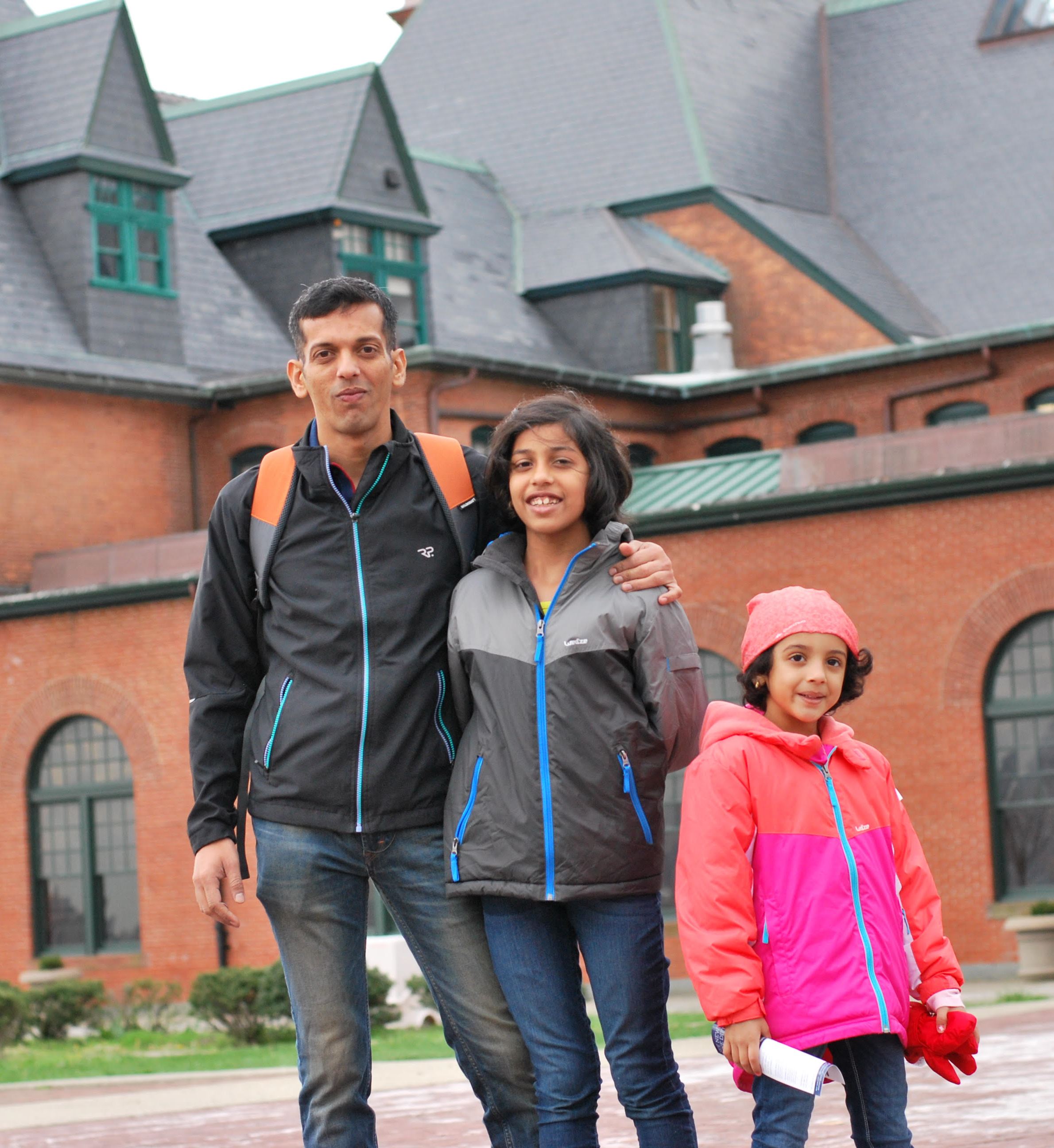
From a visit to New York; Vijay with his daughters Sharanya and Radhika (Photo: courtesy Vijay)

In 2011, Vijay moved to Pune with a company called Emcure Pharmaceuticals Ltd. The new job had less travel attached to it. Daily life swung between work and family. There was space available to be filled. Compared to Mumbai, Pune was a smaller place. Facebook had grown to be a popular tool to connect with people. The city had runners. Vijay spent his time running a bit, swimming and visiting the gym. He explained how his interest in running grew. “ In the amateur space in India, running is among the few activities that are goal driven. By nature I need some small goals to achieve. Looked that way, running is measurable and finite,’’ Vijay said. He started going out with running groups in Pune. In December 2011, he did a 10 km-run. Next year, he ran the TCS 10K. In 2013, he was back in Mumbai, this time for his first SCMM. Having found a sport that fit his nature, Vijay’s next priority was to ensure that he didn’t rush into it. His first half marathon was in 2012, in Pune; his first official half marathon was in Hyderabad, in August 2012. Registering for his first serious SCMM thereafter, he however didn’t follow any specific training plan. Nevertheless he completed the 2013 event’s full marathon in 4:02. Doing the full marathon in Hyderabad in August that year, he decided to attempt a sub-four. “ I was really humbled by the experience; it was miserable after 27 km. I finished in 4:07,’’ he said. He recalls asking Kochi-based runner, Ramesh Kanjilimadhom of what may have gone wrong. “ The first thing he asked was – which training plan did you follow?’’ Vijay said. That was the moment Vijay understood the importance of training plan. Looking around for a plan that fitted in with his nature and priorities, he zeroed in on the Run Less Run Faster program. Authored by Bill Pierce, Scott Mur and Ray Moss, it featured only three days of running per week and had much cross training thrown in. “ I have since tweaked it a bit but till date, that is essentially the running plan I follow,’’ Vijay said.

Vijay’s wife grew up in Bengaluru. In 2013, Vijay and family shifted from Pune to Bengaluru, where his wife commenced working while Vijay dabbled in some entrepreneurial ventures (by 2015, Vijay and his partners would launch Fast & Up, a sports nutrition brand, currently well-known to the Indian running community) . A challenge in Bengaluru was managing his susceptibility to asthma. The city has one of the highest incidences of the condition; a 2007 report available on pharmabiz.com said that Bengaluru accounted for an estimated 25 per cent of all asthma cases in India. Despite this, on the bright side, Vijay’s life in running was beginning to fall in place. Running the full marathon at the 2014 SCMM, Vijay breached the sub-four barrier by a wide margin. He completed the race in 3:34. That was a huge improvement. While his new training plan was definitely delivering results, his approach to improvement was also noteworthy. He wasn’t targeting improving in the age category he belonged to; he was targeting the best he could be. Next goal was to crack the 3:30 mark. However at the Spice Coast Marathon in Kochi later that year, Vijay could complete the full marathon in only 3:37. With it, his 2014 calendar concluded, for Vijay does not run more than two or three marathons a year. “ The decision to run only a few marathons is a combination of borrowed and personal wisdom. Elite athletes advise so. In my particular case, I need adequate time for training and recovery. So two to three full marathons a year appears optimum,’’ Vijay said.

A couple of months later at the 2015 SCMM, the 3:30 barrier fell; he finished the full marathon in 3:23. Why are his improvements in timing, sizable? Why are they not by small increments?  “ I don’t know the reason for that but that’s how it has been,’’ Vijay said. Same year, running the half marathon at the Bengaluru Marathon, he got his first podium finish with a timing of 1:29. According to Vijay, he values all distances in running between 5 km to 42 km. He does not foray into races exceeding 42 km. “ Eighty per cent of the time I am in training mode. It is only the balance 20 per cent that I compete,’’ he said. In November 2015, he returned to Kochi for the Spice Coast Marathon. It is a flat track. At the eighth kilometer, Vijay tripped and suspected he had injured himself. However, it seemed manageable. At 21 km, he actually took the lead. “ Suddenly I saw the police escort in front of me,’’ he said. That year, he won the full marathon at Spice Coast. His timing was 3:14. It was both satisfying and a turning point. As the gap with the three hour-barrier reduced, new goals loomed. Then at the 2016 SCMM, a setback occurred. Usually for the asthmatic Vijay, running at sea level is a better experience than running in Bengaluru. Unfortunately a week ahead of SCMM, he got an asthma attack. Its effects continued into race day in Mumbai. He was targeting timing below 3:10. He maintained the required pace till the 26 km-mark. Then he found he couldn’t sustain it. He pulled out. It was his first Did Not Finish (DNF).

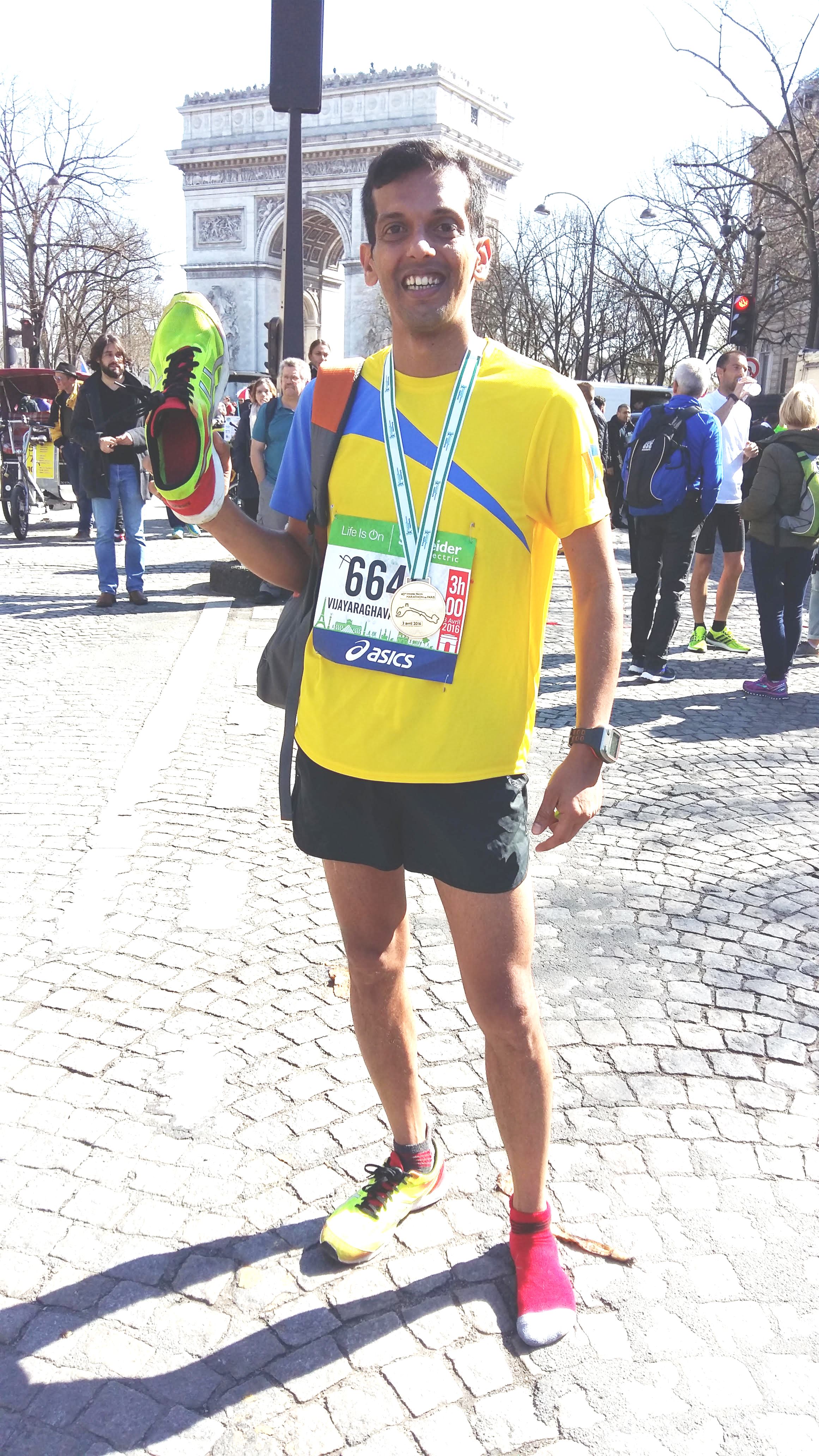
After the Paris Marathon (Photo: courtesy Vijay)

1896 is a special year in the world of sports. That’s the year the modern Olympic Games made their debut in Athens, Greece. Less importantly, it was also the year the first Paris Marathon – the Tour De Paris Marathon – was held. According to Wikipedia, the current Paris Marathon traces its origin to 1976. The event is normally held on a Sunday in April and participation is limited to 50,000 runners. The route is attractive, passing as it does through the heart of Paris. Vijay had decided that once he breached the 3:30-mark, he would try running overseas. He applied for the Paris Marathon of April, 2016. After a couple of weeks spent putting the DNF at SCMM behind him, from February onward, he started training for the Paris run. That month there was a half marathon in Delhi; he finished it in 1:23. Back in Bengaluru, he mostly trained alone for Paris. Once, Soji Mathew – the half marathon specialist from the Indian Railways – joined the training run to pace him. Soji has been a podium finisher at major events in India, in his chosen discipline. “ I like running with better runners,’’ Vijay said. During these training runs he was reporting timings like 3:02 for the full marathon. He went to Paris with a plan for 3:10. One good thing about being in Europe and US is that Vijay’s respiratory system functions well. He finished the full marathon in Paris with a timing of 2:59:48. It was his first sub-three. “ I was genuinely happy for it,’’ he said.

The nature of a marathon course plays a role in the timings athletes can set. Flat courses are prized in this context. In the world of marathon running, the maximum number of world records has been reported from the Berlin Marathon. The current world record of 2:02:57 is in the name of Dennis Kimetto of Kenya; it was established on September 28, 2014 in Berlin. This city marathon was begun in 1974 and usually takes place in the last weekend of September. With the outcome in Paris, Vijay qualified to run at the 2017 Boston Marathon. But before that iconic race, there was Berlin. The 2016 race in Berlin saw altogether 46,950 entrants from 122 countries; among them, Vijay.  Running the full marathon, he completed the race in 2:55. That was his second official sub-three. Berlin done and with Boston due the next year, Vijay skipped the 2017 SCMM. It was important not to overdo. Meanwhile in Berlin, Vijay had developed a new goal. “ The charm of Berlin is that it offers the fastest course. For me, the challenge was to replicate the sub-three I earned in Paris. That I did. What I have seen in India is that people crack sub-three but then find it hard to sustain it. In the current running scenario, a lot of amateurs are knocking at the doors of the three hour-mark. Breaking it consistently is the responsibility of some people to show,’’ Vijay said. Can he make it a hat-trick in Boston? That was the challenge at hand.

Begun in 1897, the Boston Marathon is the world’s oldest annual marathon. In running, it is historically significant. For most people, to go and run in Boston is to be part of a great tradition. It typically ends at that. Vijay on the other hand had a concrete goal – a third sub-three. Given he ran few events every year, he planned for Boston carefully. Two things particularly bothered. First, Boston’s is not an easy course; there are plenty of ups and downs. For someone new to sub-three timing in the marathon, ensuring similar result in Boston won’t be easy. Second, the city experiences fluctuations in temperature with some race days being warm, some cold. Vijay’s careful approach paid off. He completed the 2017 Boston Marathon in 2:57, among best timings in recent years by an Indian who is a resident of India and traveling there to run the race. He had a hat-trick in the bag. Vijay does not look at his sub-three timings as licence to be apart. He wants more people cracking the sub-three barrier. “ When you have a mass of people doing better, then you will also do better. So it is important that you have a sizable population registering good timing in running,’’ he said.

From a 10 km race in Bengaluru (Photo: courtesy Vijay)

What is Vijay’s goal now?

The globe’s six leading marathon events – the races in Boston, London, Chicago, Berlin, New York and Tokyo – are part of the World Marathon Majors. “ I am now looking at getting sub-three at all the six major marathons. It will be challenging because you have to maintain timing and also stay injury-free. I am not getting younger. My next full marathon will probably be 2018 SCMM. Getting a sub-three in Mumbai would be nice,’’ he said. There is also another emergent angle. Several businessmen have put their capital behind sports they fancy or are synergic with their business; some do the least they can in terms of active participation in sport but leverage media to make it seem significant. Few actually excel at given sport. Vijay is now the CEO of Fast & Up. Although Vijay’s entry into running preceded the creation of Fast & Up by a few years, his subsequent excellence at running does make him among the few CEOs around who not only have hobbies synergic with their work but can also be taken seriously in the sport concerned. Asked if the combination of sports nutrition brand and its CEO, passionate about running, was conscious choice, he said the situation was coincidental. “ Running started in 2013 in right earnest and Fast & Up happened from late 2015. So it was purely co-incidental. But I do concede the synergies. I try to stay away from the brand as much as possible, when it comes to me as an individual in running. You would have never seen me promoting my runs / podium finishes and the brand together. Many a time when the internal team wants to portray my finishes from the official Fast & Up handle, I vigorously dissuade them. Fast & Up is promoted by other athletes who genuinely like the brand and a host of well-wishers. For me the brand should grow up as an institution. Individuals don’t matter,’’ he said. Does the combination others imagine in their head, put pressure on him to perform? “ No. I don’t see it as a combination. However I am aware of the fact that people may perceive a close association. As long as you are sincere to what you do, it does not matter,’’ he said.

(The author, Shyam G Menon, is a freelance journalist based in Mumbai. This article is based on a conversation with the subject.)

MARKETING RUNNING: NEB PACKAGES A CIRCUIT

Illustration: Shyam G Menon

In what is perhaps a sign of things to come in the fast evolving running scenario in India, one of the leading event organizers therein – NEB Sports, has formally announced a National Marathon Circuit (NMC) composed of five events it organizes.

These running events are spread across Mumbai, Bengaluru, Hyderabad, Kolkata and Delhi. If a runner signs up for NMC, he / she gets to run half or full marathons at all these locations. The distance is slightly different at Hyderabad where the longer races have been kept at 25 km and 50 km. “ The Hyderabad event is a new one for NEB. We tweaked the distance for the longer races to slightly more than the regular half and full marathon distances, so that people wishing for such a stretch get a chance,’’ Sunil Shetty, veteran ultra-runner and a senior member of the NEB team, said. The NMC will open with the Mumbai event in August 2017, followed by Bengaluru, Hyderabad, Kolkata and Delhi (the last two events in 2018).

NEB Sports was founded by Nagaraj Adiga, who is also its chairman.

According to Sunil, the concept of NMC was floated last year. It was given shape well into the second half of 2016. By then, the running season was already underway. Consequently it could be tried out only in a limited fashion. As per NEB’s 2016 intimation on the subject, four of their marathon events featured in that list – Bengaluru, Goa, Kolkata and Delhi. Mumbai missed the bus. The running season of 2017-2018 marks NMC’s formal announcement as a product from NEB with whole season ahead. This time, Mumbai is included as is Hyderabad. Goa does not feature on the list because NEB is not the organizer for the Goa River Marathon, this year. At three locations – Delhi, Kolkata and Mumbai – IDBI Federal Life Insurance is the lead sponsor for the NEB-organized race. The title sponsor at Bengaluru is Shriram Properties, while (as of May 29, 2017) the search was on for a title sponsor at Hyderabad.

Beyond unique medal, customized T-shirt and certificate, a concrete incentive for runners to sign up for NMC was yet to be in place. Asked if a runner signing up for all five races under the new circuit would be able to do so at a cost that is cheaper than if he / she were to sign up for each separately, Sunil said that as yet, the organizers are unable to make that happen. What NEB can do for incentive at present, is help those signing up in finding hotel accommodation etc. Other details – like whether a single bib number can be used across races – would also need to be studied.

(The author, Shyam G Menon, is a freelance journalist based in Mumbai.)