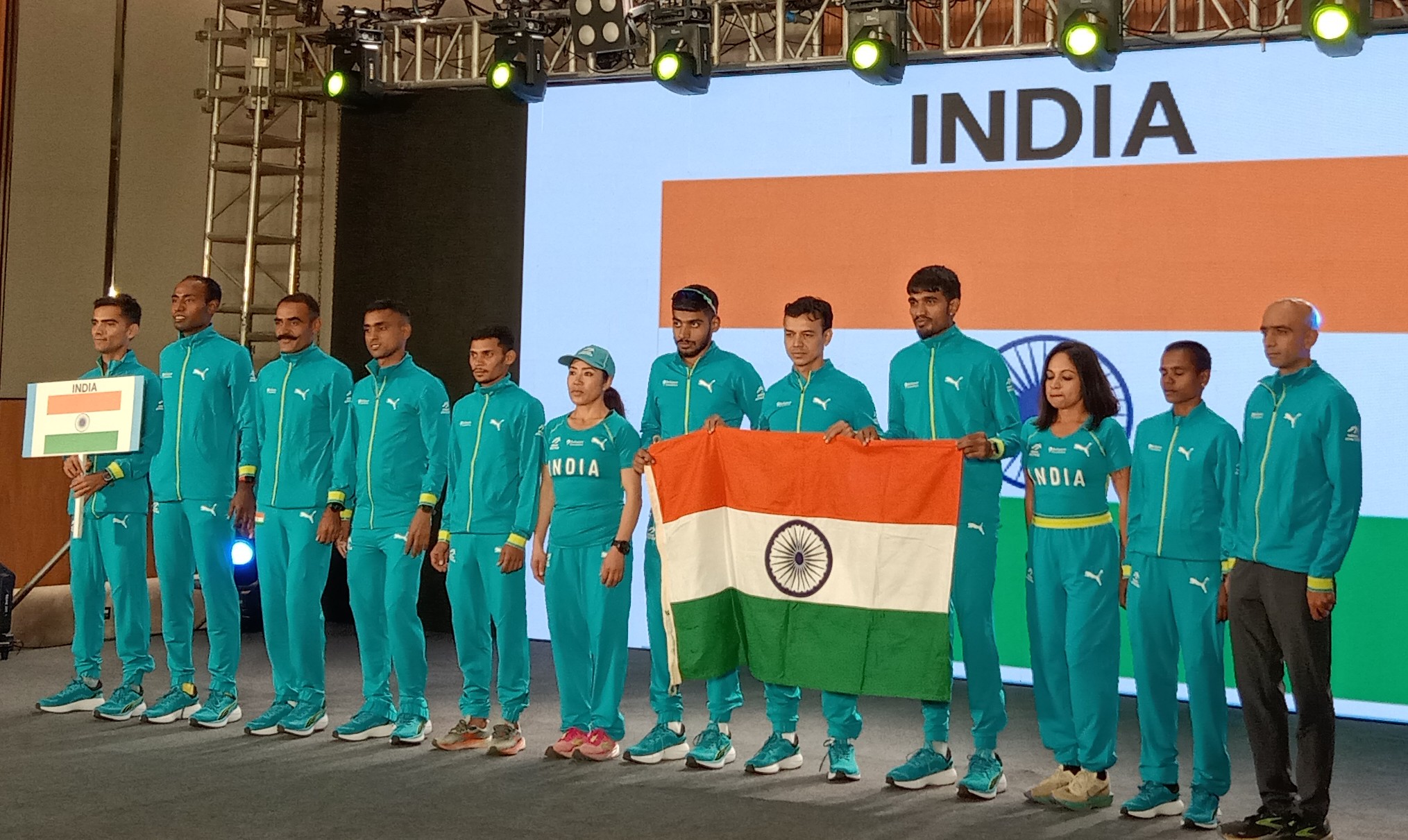
The Indian team for the 2024 IAU 100 km World Championship; at the opening ceremony of the event (photo: Shyam G Menon)
NEB Sports says it is talking to Tour de France to bring bicycle races to India
On Saturday, December 7, Bengaluru will witness the 2024 International Association of Ultrarunners (IAU) 100 km World Championship. The event was formally declared open today.
This is the first time India is hosting a 100 km World Championship. Last year, Hyderabad in Telengana had hosted the IAU 50 km World Championship.
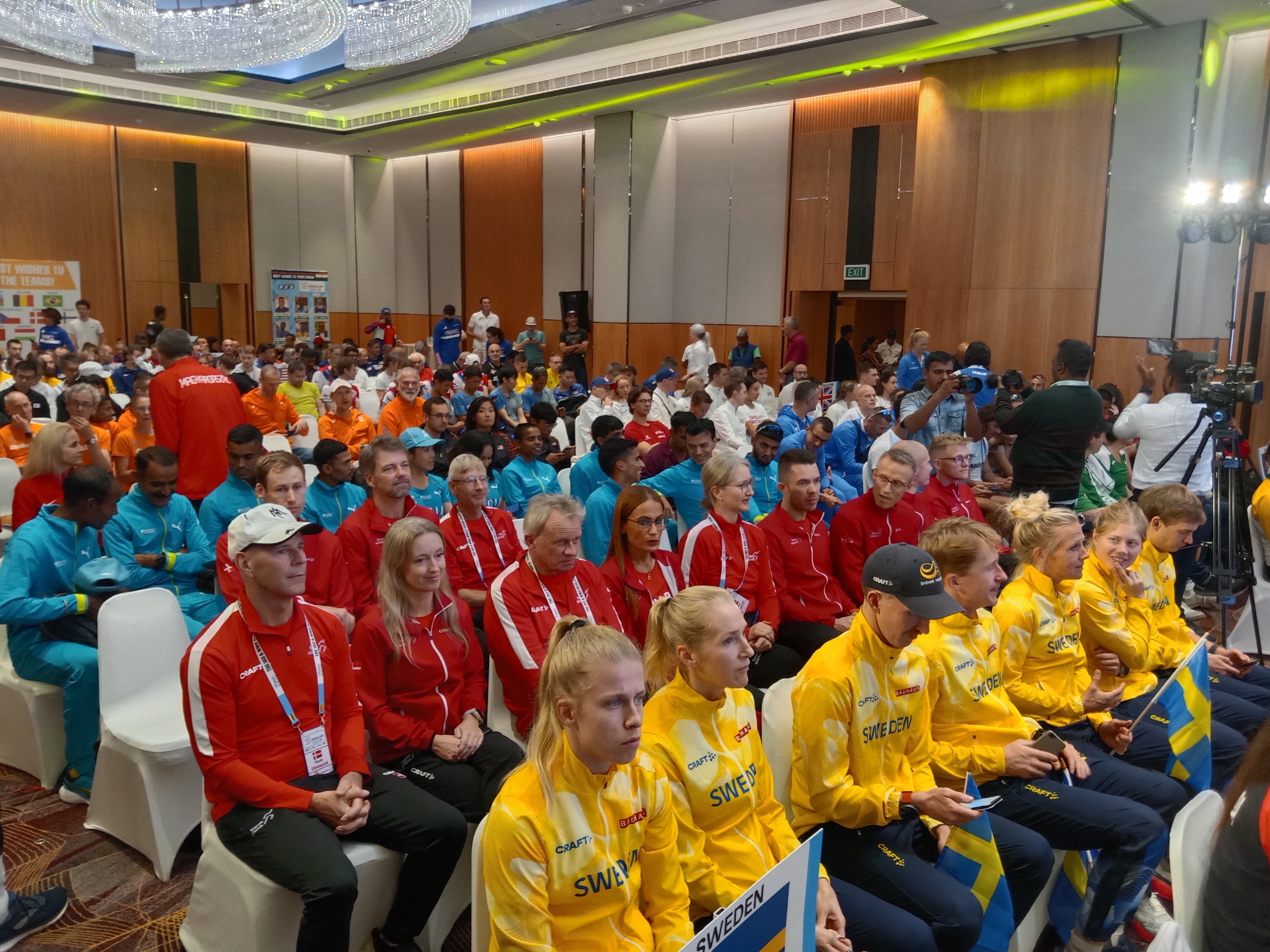
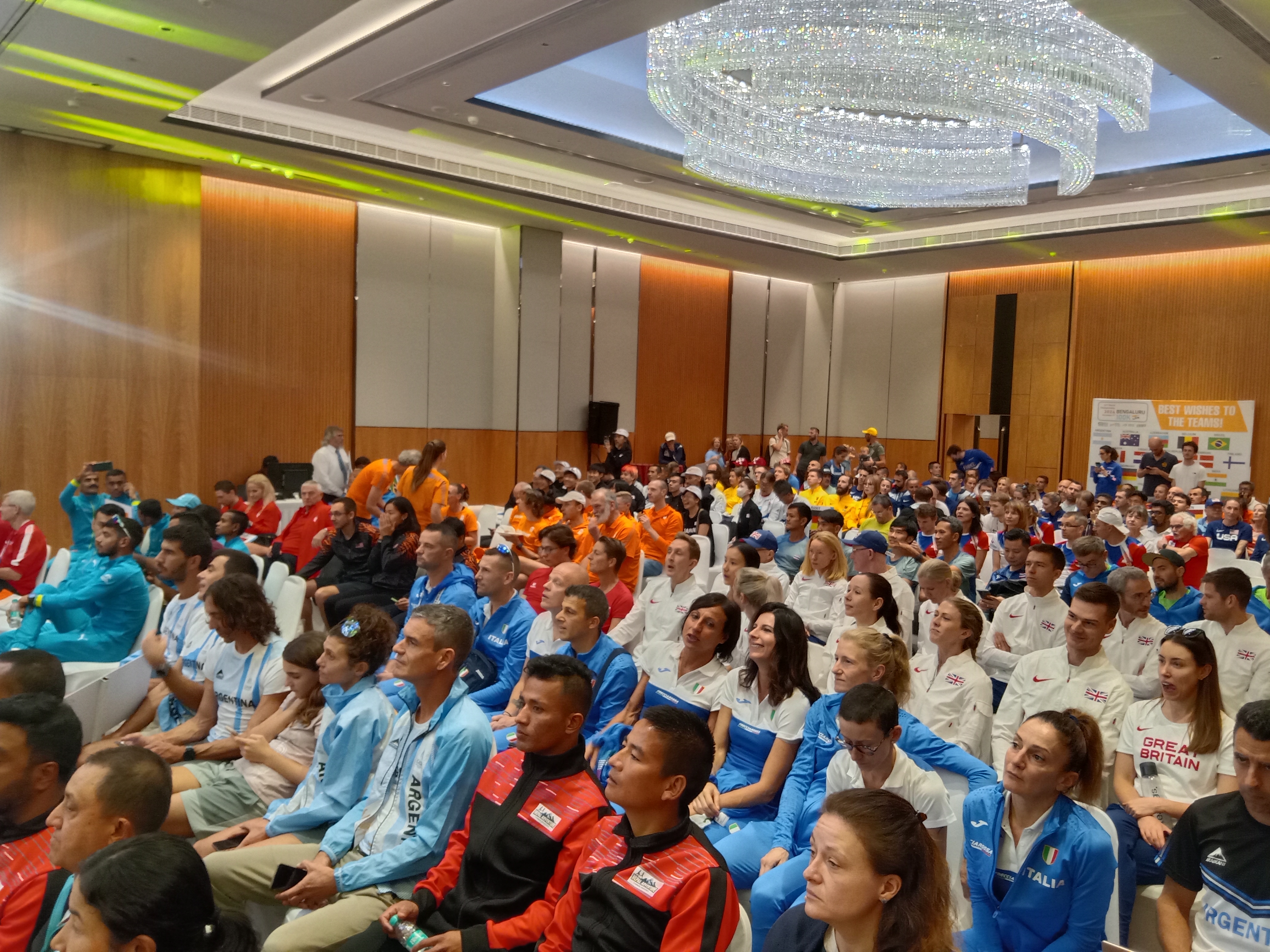
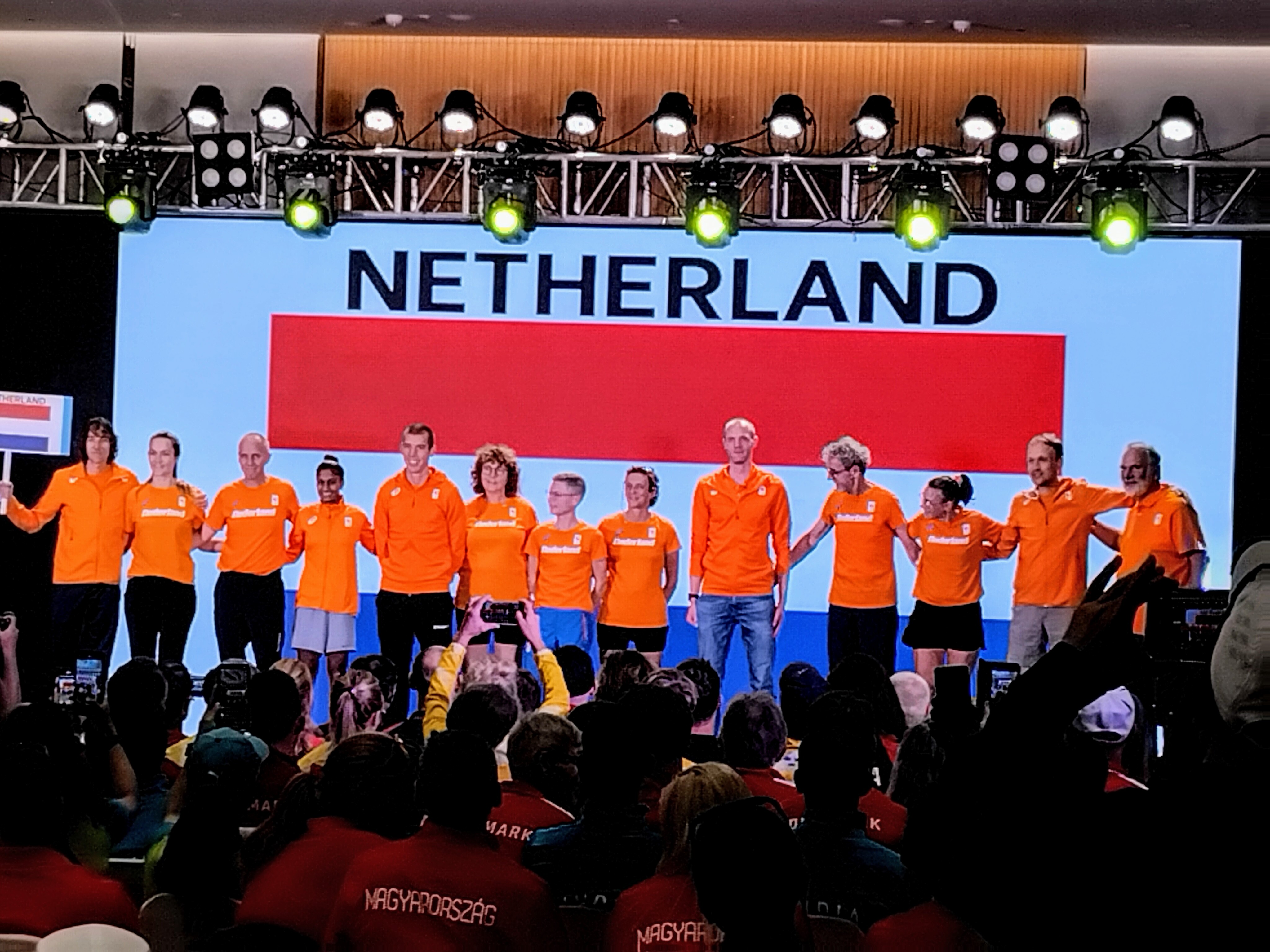
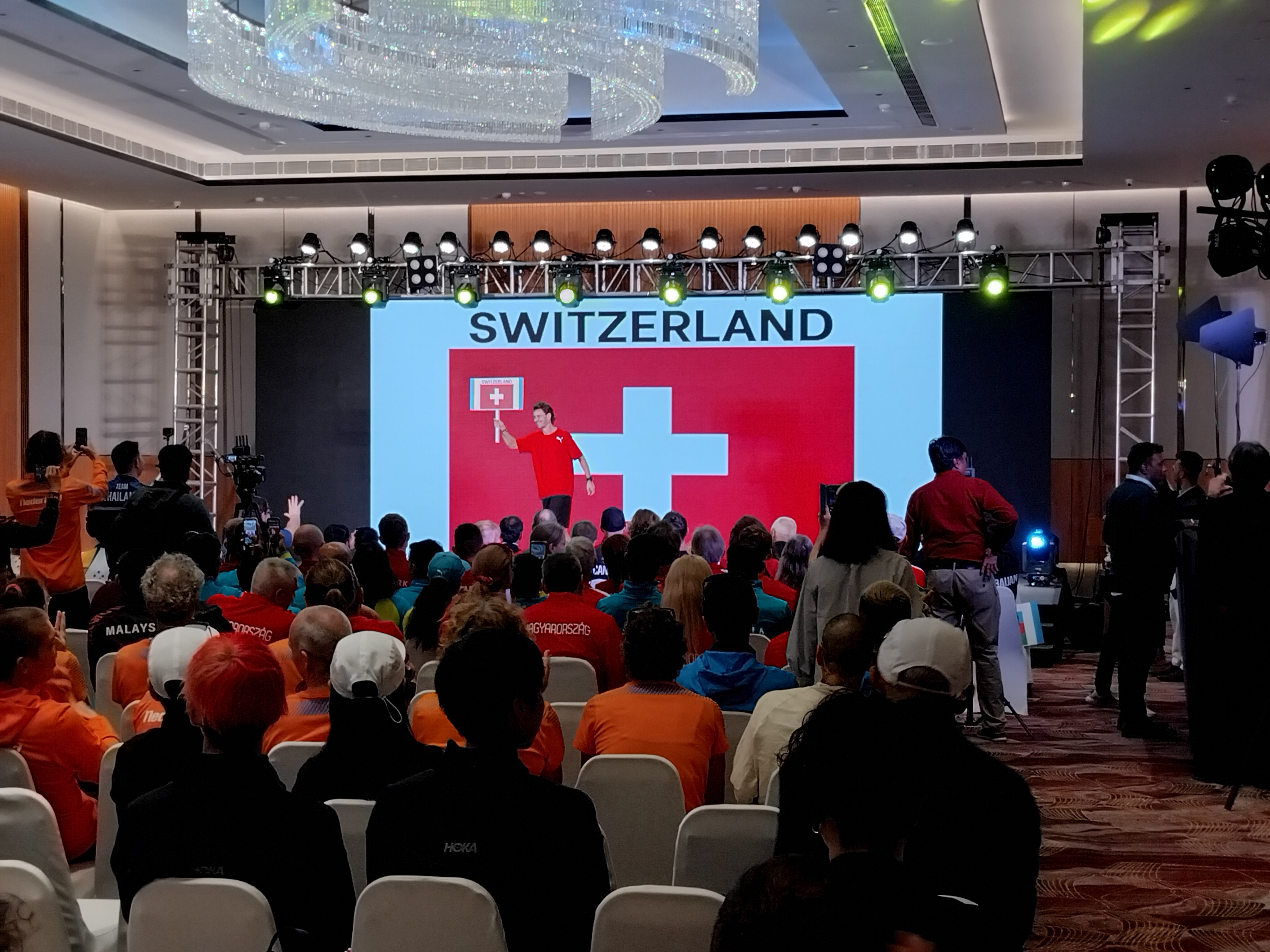
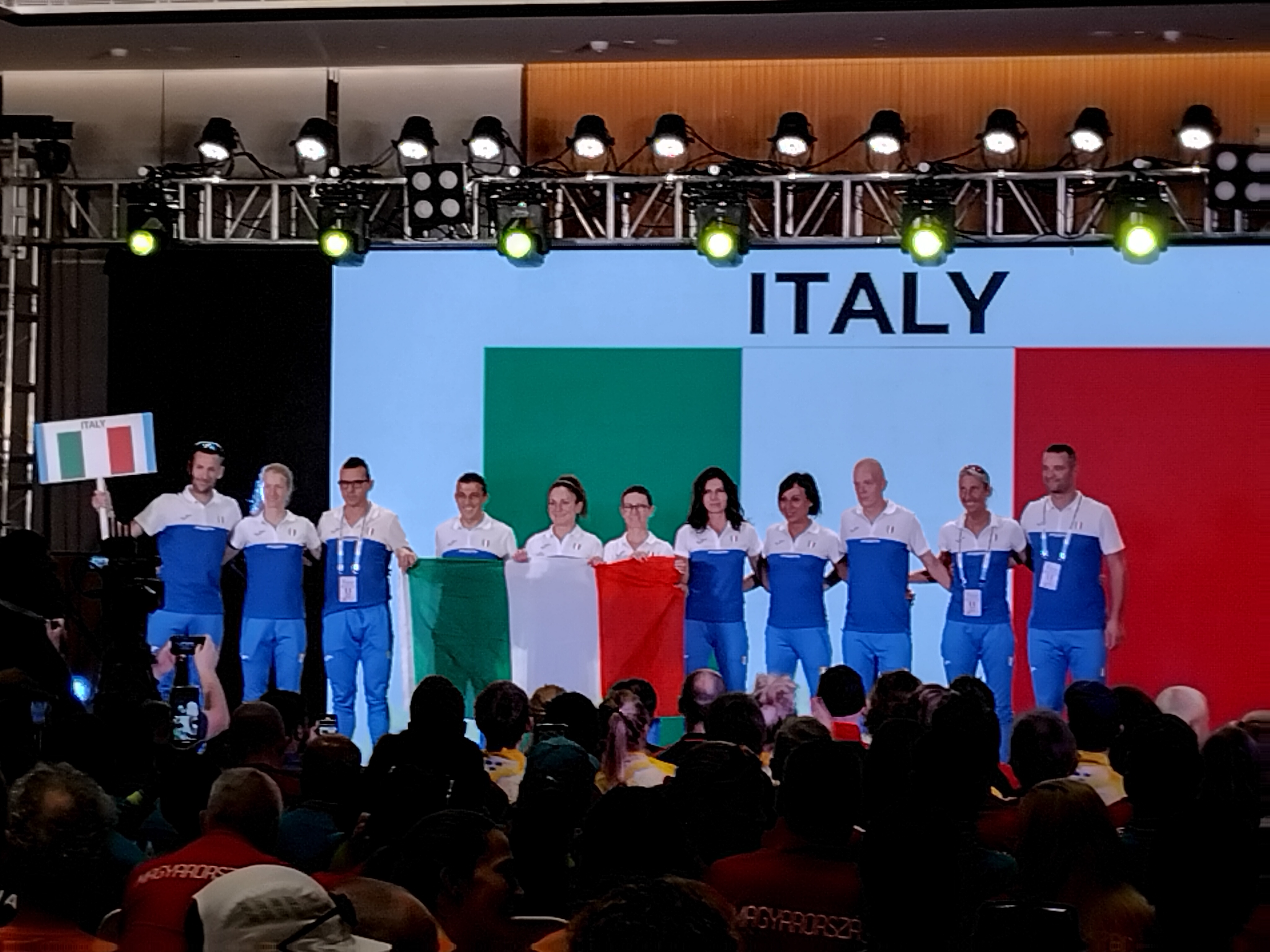
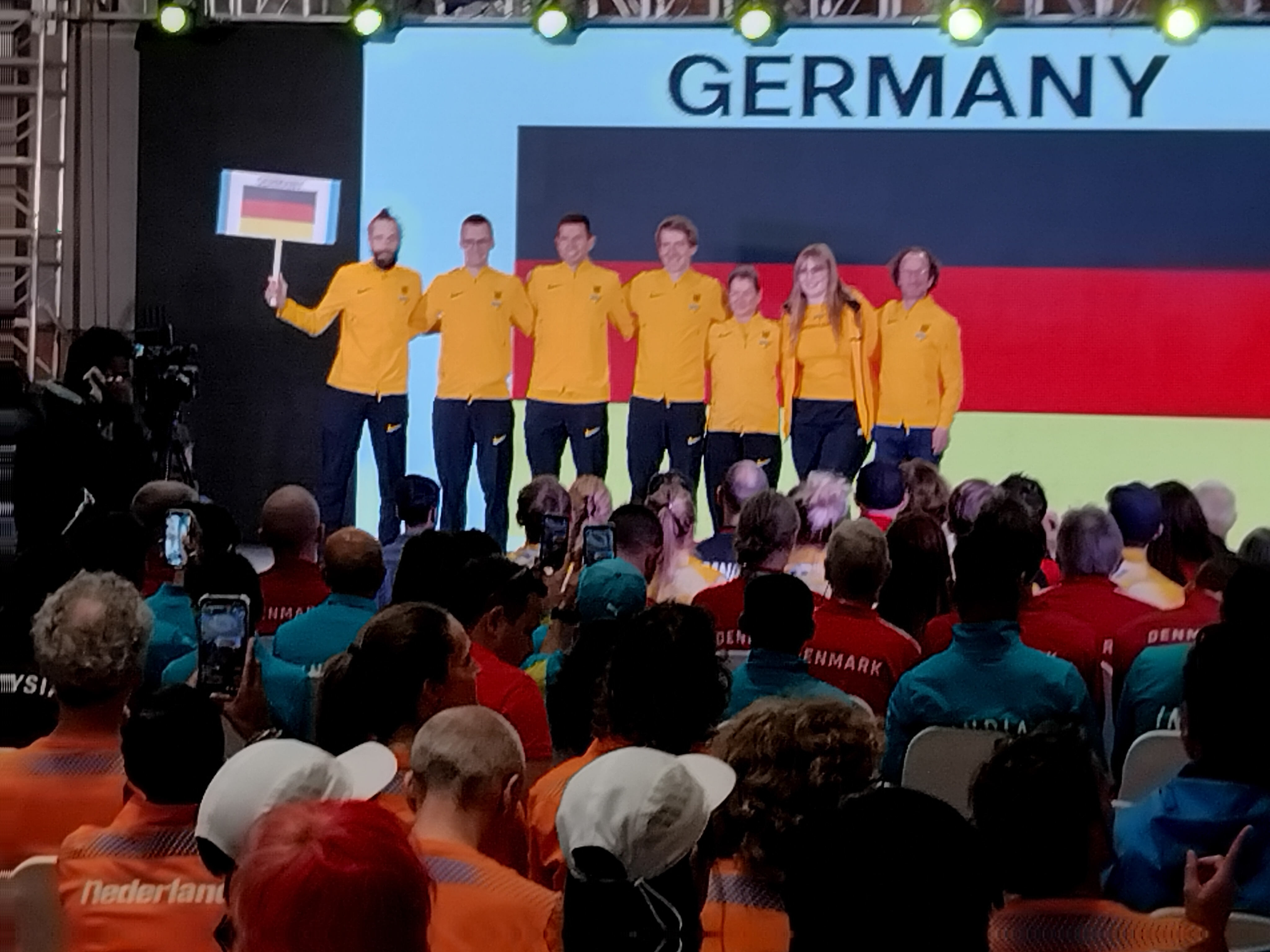
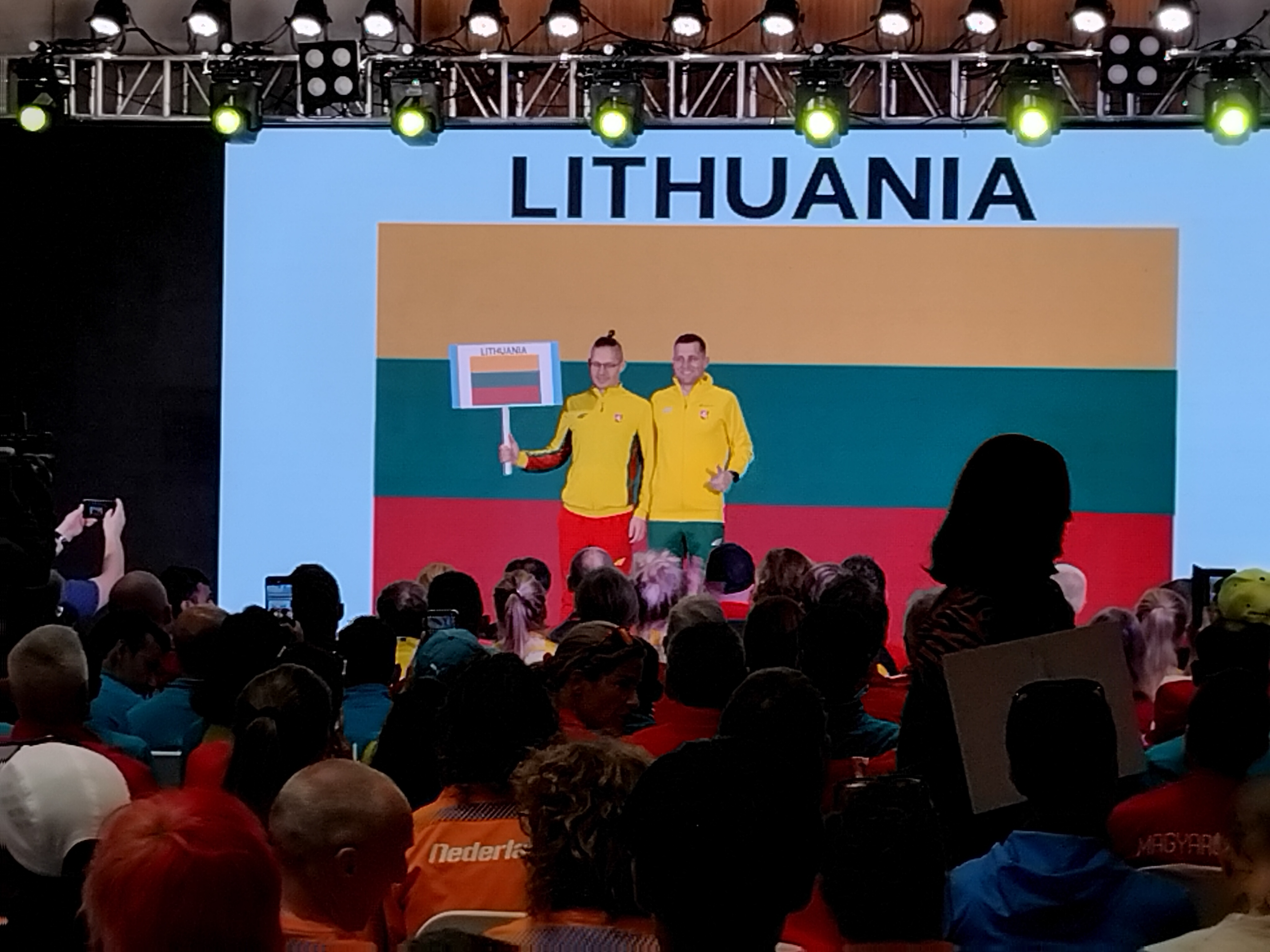
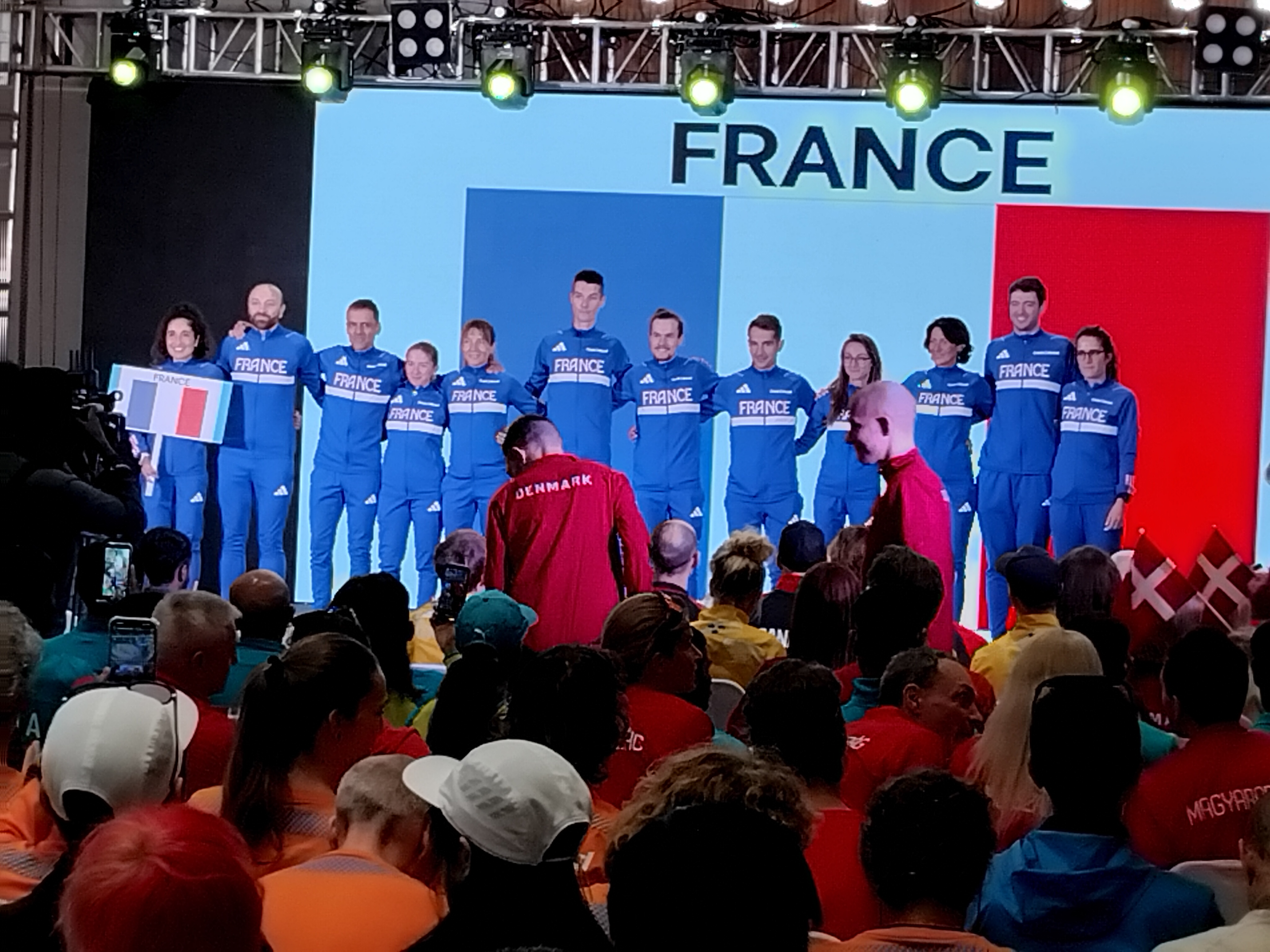
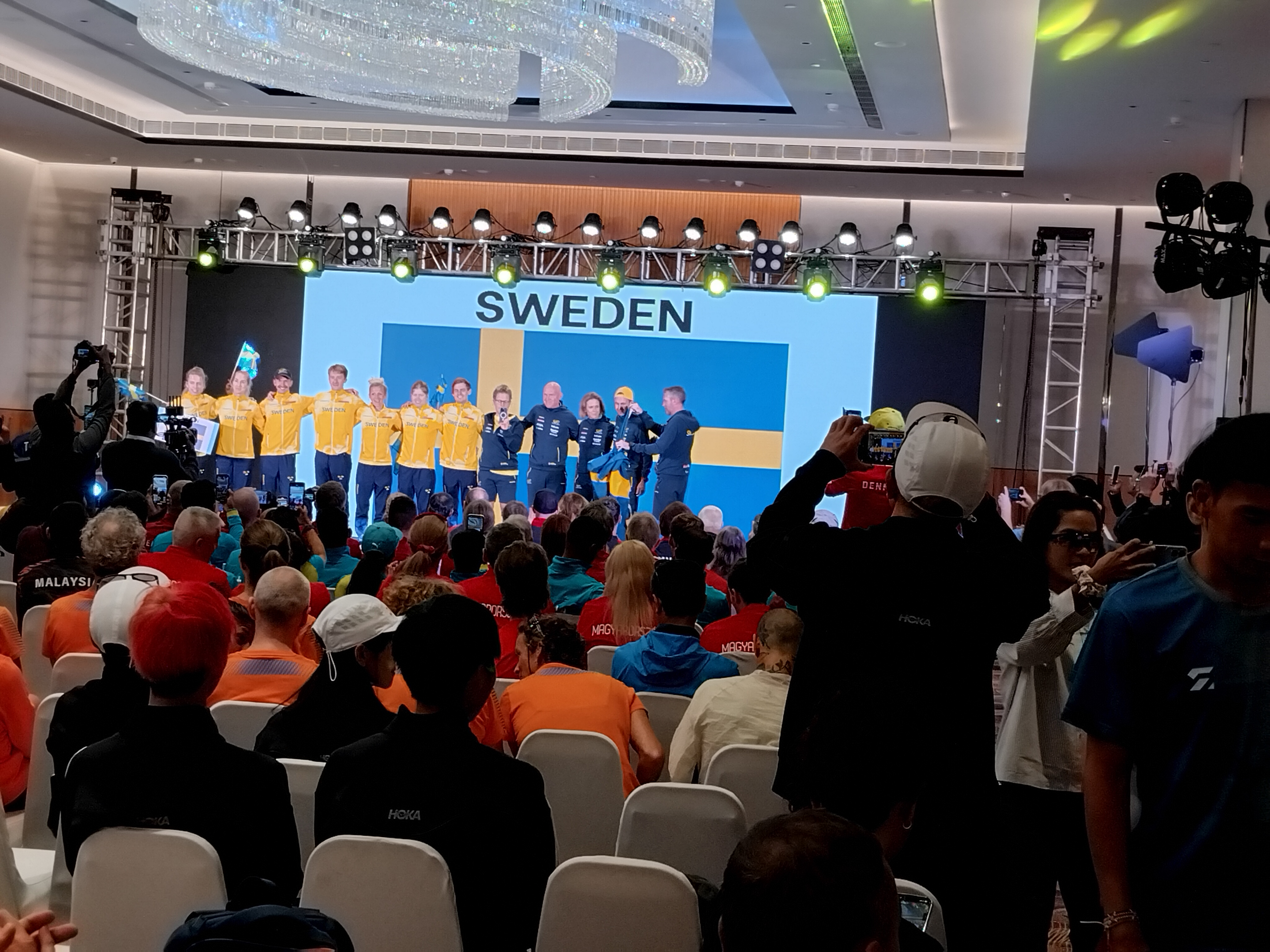
Athletes from different countries at the opening ceremony of the 2024 IAU 100 km World Championship, in Bengaluru (photo: Shyam G Menon)
About 300 ultrarunners from over 40 countries have landed in Bengaluru to participate in the championship. They will be competing in team and individual categories for both men and women.
The event supported by the Athletics Federation of India (AFI) is being held at the GKVK campus. It will also feature the World Masters 100 km Championships which allows participants to compete in five-year age categories (from 35 years onward).
Athletes from different countries at the opening ceremony of the 2024 IAU 100 km World Championship, in Bengaluru (photo: Shyam G Menon)
Defending champions participating in the 2024 World Championship include Japan’s Haruki Okayama (winner) and Jumpei Yamaguchi in the men’s category. Among women, Floriane Hot (winner) from France and Caitriona Jennings (second runner-up) from Ireland will be participating.
“ The 100 km World Championships is not just a test of endurance but a celebration of human determination and camaraderie,” Dr Nadeem Khan, President of IAU, said at the opening ceremony of the Championship.
“ IAU has been growing strong and does not intend to stop. We intend to take the championships to places where we haven’t gone,” he said.
NEB Sports is organizing the event. Nagaraj Adiga, Chairman and Managing Director of NEB Sports, and the race director of the 100 km World Championship, said Bengaluru is an ideal city to host the Championship.
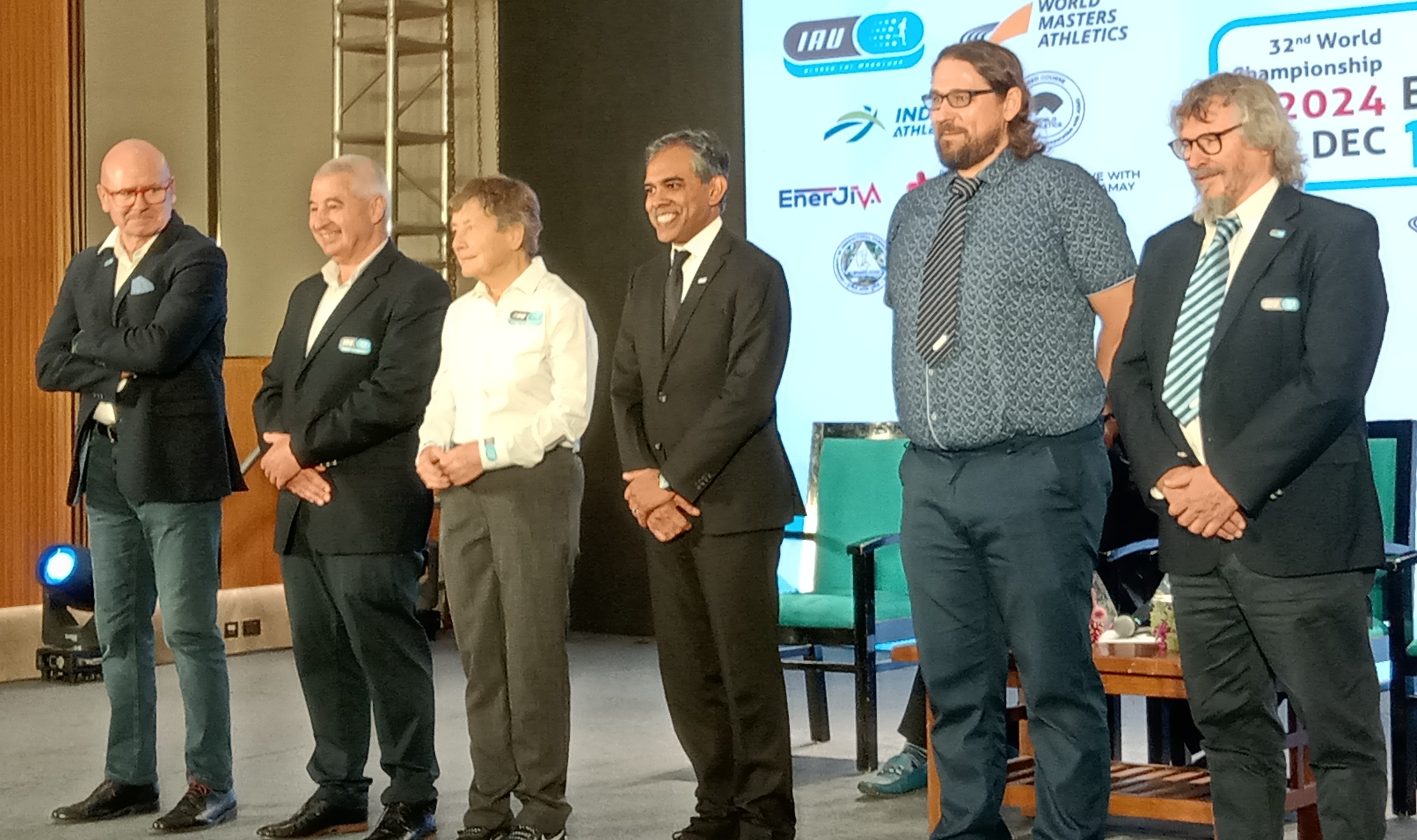
Senior officials of IAU led by its president Dr Nadeem Khan (third from right), at the opening ceremony of the 2024 IAU 100 km World Championship, in Bengaluru (photo: Shyam G Menon)
He pointed out that NEB Sports has been holding many running, triathlon and other non-cricket sporting events. He also said that NEB Sports is in talks with Tour de France to introduce a clutch of bicycle racing events in India.
Hosting the 100 km World Championship will help boost ultra-running as a sport in India, Adille Sumariwalla, President, AFI, was quoted as saying in a press note issued at the end of the opening ceremony.
(The author, Latha Venkatraman, is an independent journalist based in Mumbai)
Some more photos from the opening ceremony (photos: Latha Venkatraman)
On November 3, 2024, the year’s edition of the New York City Marathon set a world record for the number of participants running and finishing a marathon. It became the world’s largest marathon yet with 55,646 finishers.
The marathon’s course passes through the five boroughs of New York City. The race commences near the approach to the Verrazano-Narrows Bridge on Staten Island. The route winds through four other bridges – Pulaski Bridge, Queensboro Bridge, Wills Avenue Bridge and Madison Avenue Bridge. The race ends at Central Park.
In the 2024 edition of the marathon, Abdi Nageeye of the Netherlands won the men’s race while Sheila Chepkirui of Kenya won the women’s race.
We spoke to a few of the runners from India about their experience running this marathon.
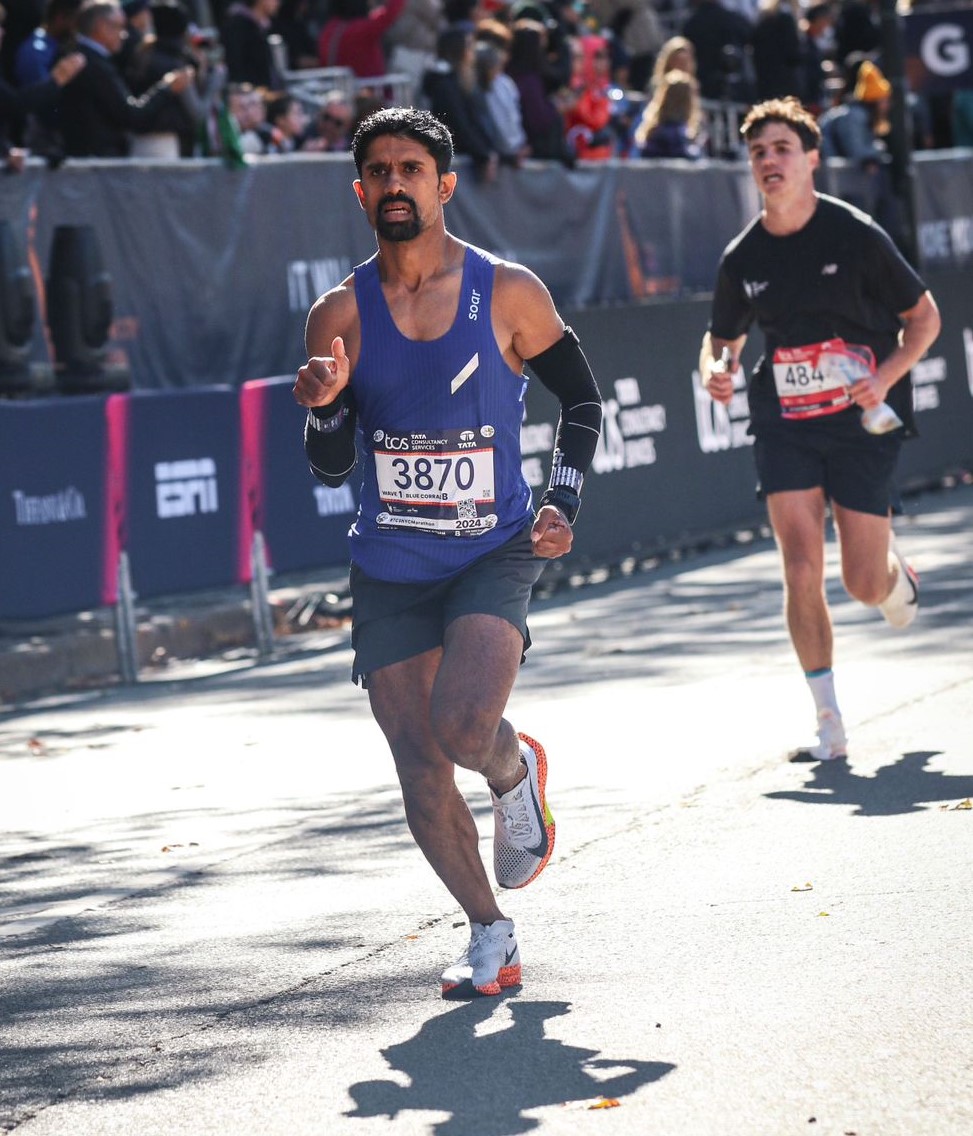
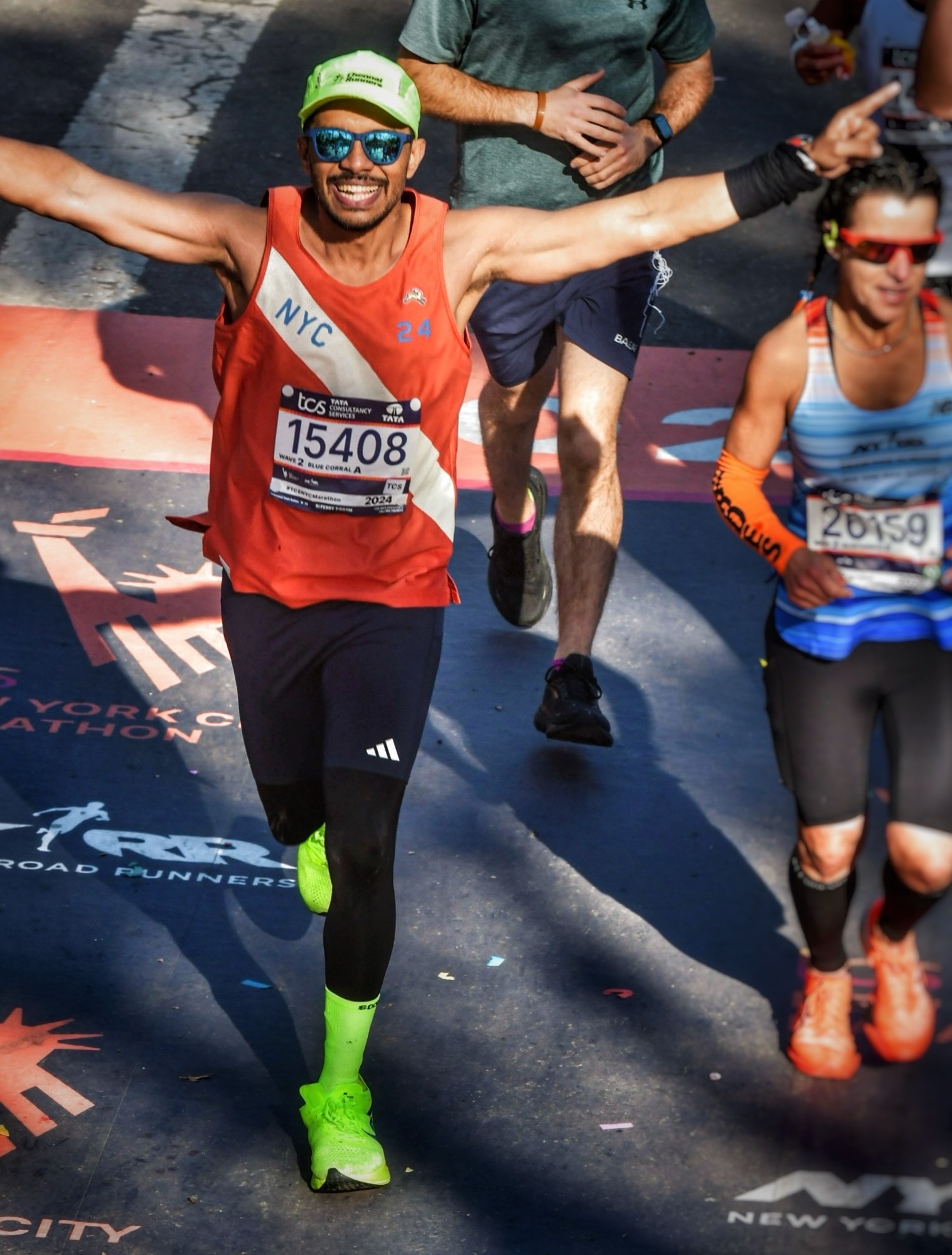
B. J. Vikram (photo: courtesy Vikram)
Bengaluru-based recreational runner, B. J. Vikram, is also a skater who has represented India at many championships.
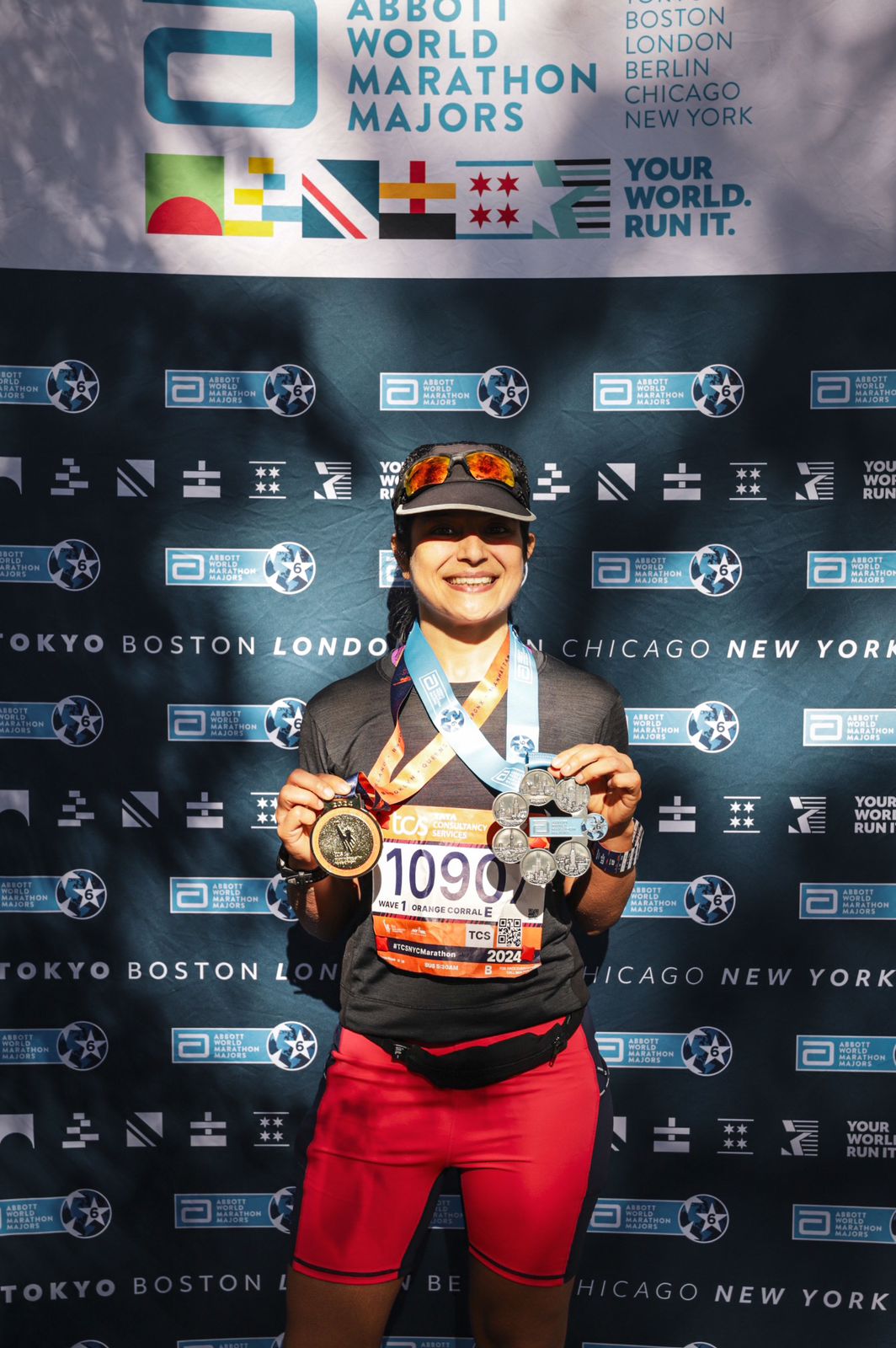
He commenced his World Marathon Major (WMM) journey in April 2022 when he ran the Boston Marathon. In November 2024, he completed the WMM circuit and earned his six-star medal at the year’s New York City Marathon.
Of the six World Marathon Majors – Berlin Marathon, Boston Marathon, Chicago Marathon, London Marathon, New York City Marathon and Tokyo Marathon – Vikram finished four with timing of less than three hours each.
New York City Marathon, according to him, is the toughest. Travelling to the start point of the marathon itself can be an ordeal. The race organizers often arrange transportation via ferry or buses to the start line in Staten Island.
Though Vikram did not find the bridges too steep, the huge crowd of runners did pose a challenge. “ There was very little space to wind through the hordes of runners. I had to run cautiously. There was a lot of elbowing,” he said. Vikram ensured that he did not miss any of the hydration points. “ Hydration was offered in paper cups,” he said.
For Vikram, the last two miles which fall inside the Central Park, was quite tough. Weather, though, was quite good. Vikram finished his run in 2:59:26, fastest among the participants from India this time around. With this run Vikram earned his six-star WMM.
Deepa Nayak (photo: courtesy Deepa)
Deepa Nayak, coach and runner from Bengaluru, also earned her six-star medal at the finish of NYCM 2024.
Deepa landed in New York after running the Chicago Marathon 2024, which was held on October 13, 2024. “ I was aiming to better my personal timing in the marathon at Chicago and take the New York City Marathon easy,” Deepa said. Among the six WMMs, Berlin Marathon and Chicago Marathon are known for their relatively flat course often helping runners get improved timings.
“ For me, the Chicago Marathon did not go as per plan,” she said. Deepa finished the marathon in 3:15:41 against her personal best timing of 3:13:10.
“ In May of this year, I lost my mother to cardiac arrest. I went home to Siddapur for a while. When I resumed my training my body was not co-operating possibly due to emotional reasons,” she said. Slowly and steadily she got back to full-fledged training. “ I could see some improvement in my training. I also took a nutrition plan from Rashmi Cherian as I wasn’t recovering from my workouts,” she said. The nutrition plan worked. Deepa felt the improvement.
“ At Chicago, I started my run too fast and that cost me towards the end. I started following a 3:10 pacer and that was a mistake,” she said. The mid-section of the race was tough with harsh sun and high humidity.
In the run-up to Chicago Marathon, Deepa had a niggling hamstring injury, which did ease after a few physiotherapy sessions.
“ At New York, my plan was to take the run easy as this marathon course is not a PB (personal best) course. It was a very good run. I loved the vibe of the run. It was cold in the morning and windy as the start line but I was able to follow my plan perfectly. There was a lot of cheering and I enjoyed the last few kilometres. The Central Park section was good and I was able to run well,” Deepa said. She finished her run in 3:17:59, the fastest Indian woman runner this year at the event. She also earned her six-star medal.
Deepa now plans to take it a tad easy. “ I did five marathons in the last one year. I will be running Tata Mumbai Marathon but won’t be racing it,” she said.
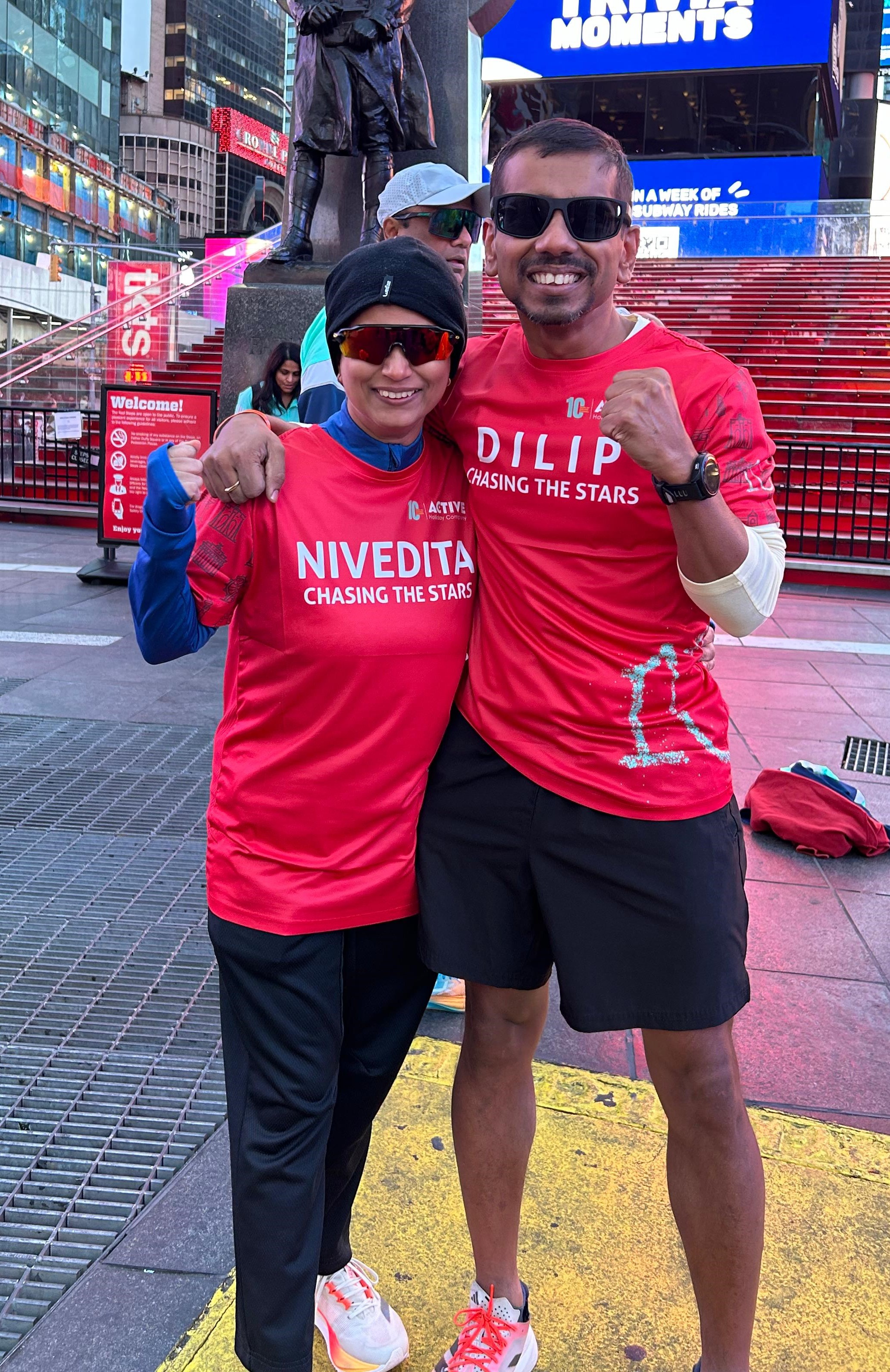
Nivedita Viswanathan and Dilip Vaitheeswaran (photo: courtesy Dilip)
For Dilip Vaitheeswaran, now a resident of Gurgaon, NYCM was his first World Marathon Major. He started running in 2016 and has participated in a few marathons including the Singapore Marathon.
Dilip and his wife Nivedita Viswanathan, also a runner since 2021, decided to attempt the World Marathon Majors together. “ We trained for six months incorporating hill runs, intervals, long runs and some speed workouts. Overall, our training went off well,” said Dilip.
New York City Marathon is a difficult course with a lot of inclines and bridges. Also, the travel to the start line at Staten Island requires runners to leave hours before the actual starting time. “ For international runners it may be tougher as the body clock is already haywire,” said Dilip. He chose to run in the same corral as his wife so as to be together until the start of the race.
The run went off fairly well for Dilip. According to him, the cool weather at the start of the race may prompt runners to step up the pace too early. “ For me, the last hour was tough. But the crowd and volunteer support were excellent,” said Dilip. He finished in 3:49:31.
Nivedita was running her second marathon at NYCM. “ I paced myself well and was able to get a tiny improvement in my timing,” she said. She finished in 5:43:51.
Dilip will be running the 100 km run in Border Ultra slated to be held in December 2024. Nivedita will be completing her Procam Slam with TSK 25 in Kolkata in December 2024.
Manuel Xavier Vernon Morais (photo: courtesy Vernon)
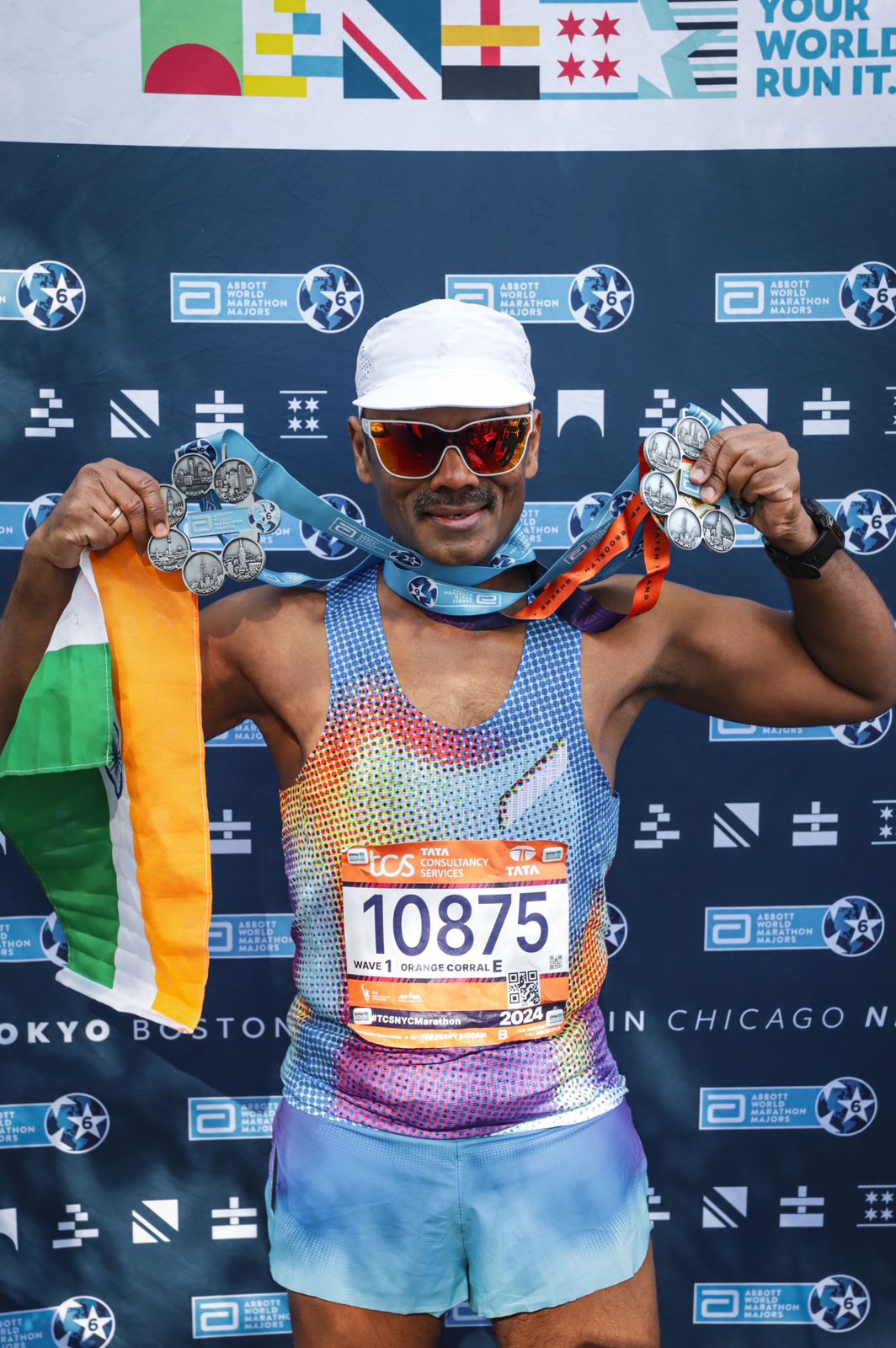
At NYCM, Manuel Xavier Vernon Morais completed his second six-star World Marathon Major journey. According to him, he is the third Indian to complete the six-star WMM twice.
Now a Kolkata resident, Vernon started running during his Delhi days in 2013. He initially started with row, bike, run triathlon before focusing on long distance running.
During his schooling days in Chennai, Vernon was into sprint distances, table tennis and chess.
Vernon got into coaching and training people for running events. Alongside, he also started organizing events to bring in more recreational runners into running.
When he shifted to Kolkata in 2014, he realized that not many in the city were into running.
He started his first WMM journey in 2016 and earned his first WMM six-star medal in April 2022. He set out on his second WMM journey in September 2022 when he ran the Berlin Marathon, earning his second six-star WMM medal at NYCM 2024. “ I enjoyed NYCM very much. I maintained my pace throughout the race,” he said. He finished the run in 3:54:52. He is likely to do the Tata Mumbai Marathon in January 2025. “ I may also go for the New Delhi Marathon but I am yet to decide the distance,” he said.
Amna and Hamid Ahmed (photo: courtesy Amna)
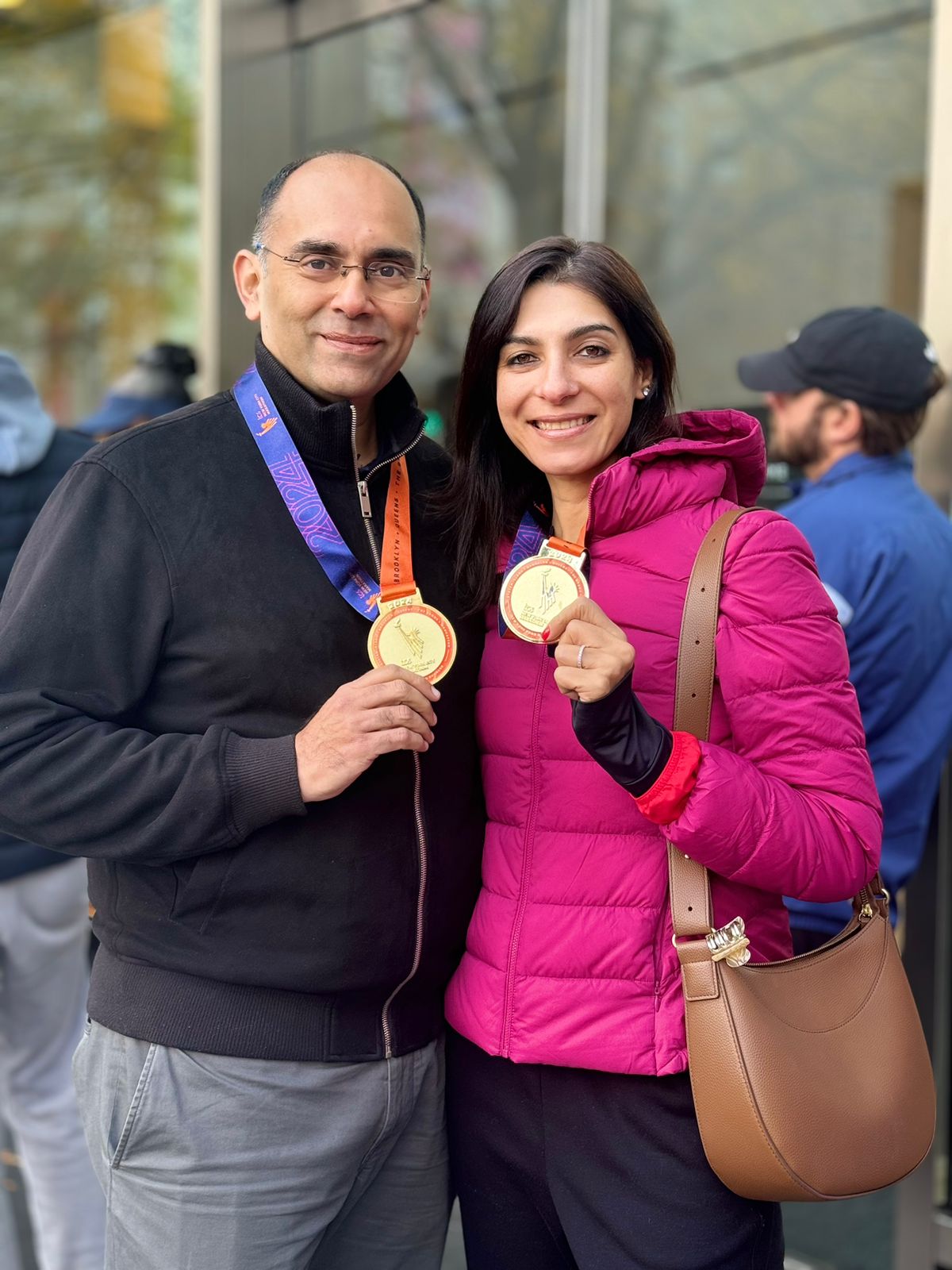
For Delhi-based Amna Ahmed, NYCM was her fourth WMM, having done Berlin Marathon in 2022, Boston Marathon and Chicago Marathon in 2023.
She started running eight years ago. “ I initially took to walking and noticed many runners along my route. Soon, I was running,” she said. She joined Adidas Running group.
“ I train under Nivedita Samanta. I like her training plans. They are drafted around women’s needs and abilities,” she said.
Although, her training for NYCM did not go as well as expected the marathon turned out to be enjoyable for her. “ In the run-up to the marathon, I had a glute injury and I was not able to do long runs. Also, a day ahead of the race my pet cat passed away after being with us for eight years. Emotionally, I was not my regular self,” Amna said.
“ The run went well. I took it easy. It is a tough course especially towards the end but the crowd support carries you through,” she said. Amna finished the run in 4:10:39, improving her personal best timing by five seconds. Her husband Hamid Ahmed also ran NYCM. “ My husband and I have been doing the WMMs together,” she said.
She is slated to do London Marathon in April 2025.
Mohamed Yasir Sultan (photo: courtesy Yasir)
In November 2023, Mohamed Yasir Sultan ran the virtual NYCM. A virtual run ensures guaranteed entry for the on-ground marathon the following year, according to Yasir. “ There are 1000 spots available through this route,” he said.
Chennai-based Yasir has been running since 2014. NYCM was Yasir’s third World Marathon Major. He did Berlin Marathon in 2018 and followed it up with Tokyo Marathon in 2023. In the intervening years, marathon running suffered a major setback from 2020 for two years due to the COVID-19 pandemic. Running events were either cancelled or postponed.
His training for NYCM did not include hill runs as Chennai is largely bereft of hilly terrain. Also, his training suffered as he was down with a viral infection close to the race date.
The highlight of NYCM is Parade of Nations, where 20 participants from every country are invited. Yasir was able to meet Ted Metellus, Chief Event Production Officer and Race Director of NYCM and hand over a t-shirt of Chennai Runners. Yasir is currently the president of Chennai Runners.
According to Yasir, the NYCM course is unforgiving. Lack of adequate hill training started to impact his run. “ The 23rd to 26th kilometer stretch was the most daunting segment. Running on Queensboro Bridge felt never-ending,” he said. Yasir finished the marathon in 4:11:29 against his personal best timing of 3:37:02 set at the 2023 Tokyo Marathon.
Bhagya Mohan Konwar (photo: courtesy Bhagya)
Growing up in Assam, Bhagya Mohan Konwar was into cricket and badminton. He took to long-distance running later and has been into it for 15 years now. “ I train all through the year. I do specific training for a race three months ahead of the date even as I maintain my base training,” he said.
He trains under Coach Neera Katwal and is also part of Team Miles Ahead, a training group in Bengaluru.
Bhagya was running the Chicago Marathon as well as New York City Marathon back to back. His training went well but Chicago Marathon did not go as well as he expected. “ I started too fast and my body was not able to keep up the pace I set for myself. Eventually, I had to resort to a lot of walking,” he said. He finished the run in 4:28:09.
“ I stayed back in the US after Chicago Marathon. During the intervening period I continued running and also did a trek inside Yellowstone National Park,” he said.
Bhagya decided to run NYCM at an easy pace. He was able to run this marathon much better although he did get cramps at the 25th km mark. He finished the run in 4:20:27.
Having done four marathons this year including the Tata Mumbai Marathon in January and New Delhi Marathon in February, Bhagya plans to step down his marathon running and focus on shorter distances such as 10 km and the half marathon.
Neelam Vaid (photo: courtesy Neelam)
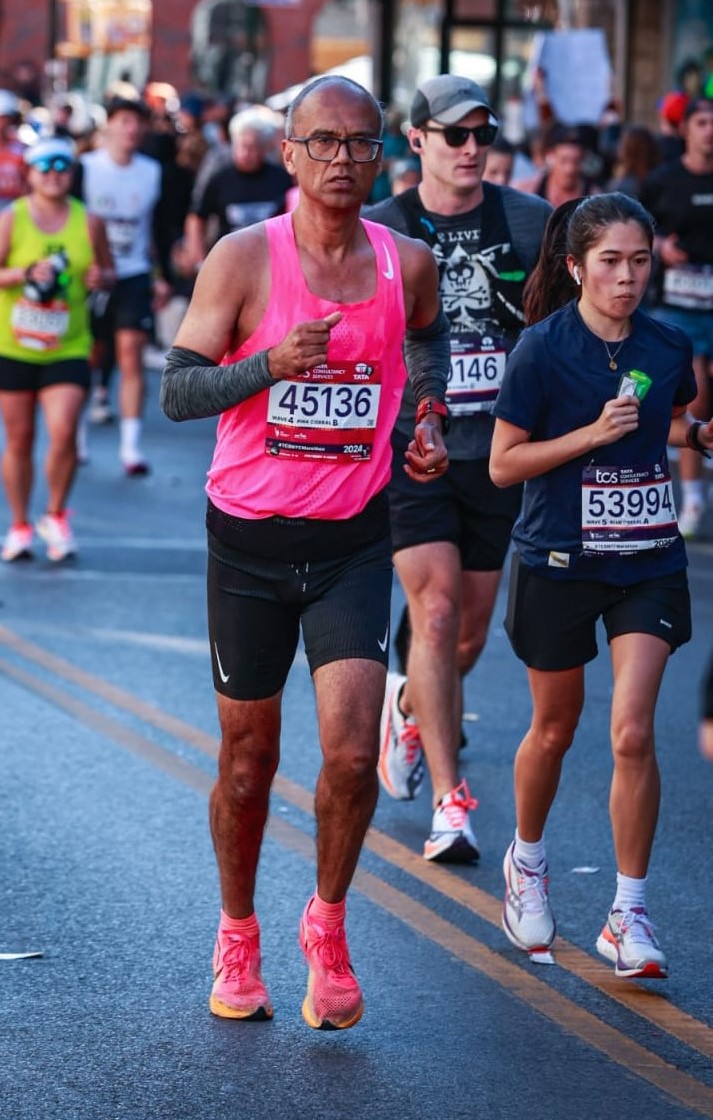
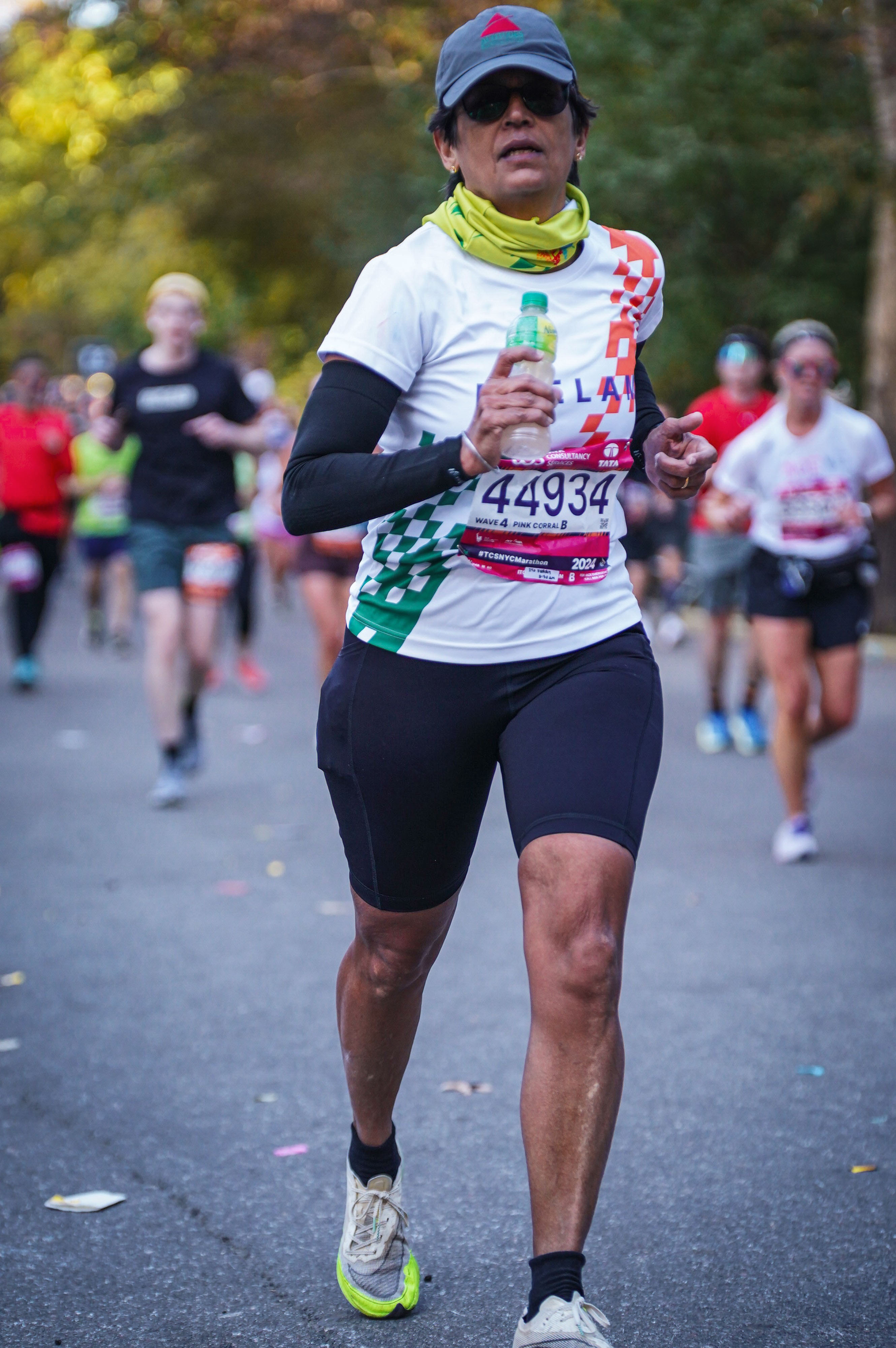
Neelam Vaid, an ENT surgeon, based in Aundh, is one marathon short of her six start WMM medal. She believes she was lucky to get a slot for NYCM in the tour operator category. “ New York Marathon was to be my training run for my upcoming 100 km Border Ultra run,” she said.
This time around she had no injuries. “ I added a lot of strength training and yoga practice over the last few months,” she said.
Running this marathon was an experience not to be missed, according to Neelam. “ The route is tough with constant rolling hills, tougher than Boston Marathon. But the cheering and the volunteering at NYCM is at another level. It is a phenomenal experience. I met runners from many countries. Ideally, NYCM should be the last of the six WMMs,” Neelam said.
At the 2023 edition of London Marathon, Neelam had completed the run along with her brother Tarun Gulati. “ I wasn’t sure he would run NYCM as he had a knee surgery two months prior to the marathon. Nevertheless, he turned up at the start line and initially intended to run a portion of the race. But finally, he completed the race,” she said. Neelam finished the run in 4:21:43. Tarun finished in 6:05:54.
(The author, Latha Venkatraman, is an independent journalist based in Mumbai)
World record holder Beatrice Chebet to lead elite runners in the field
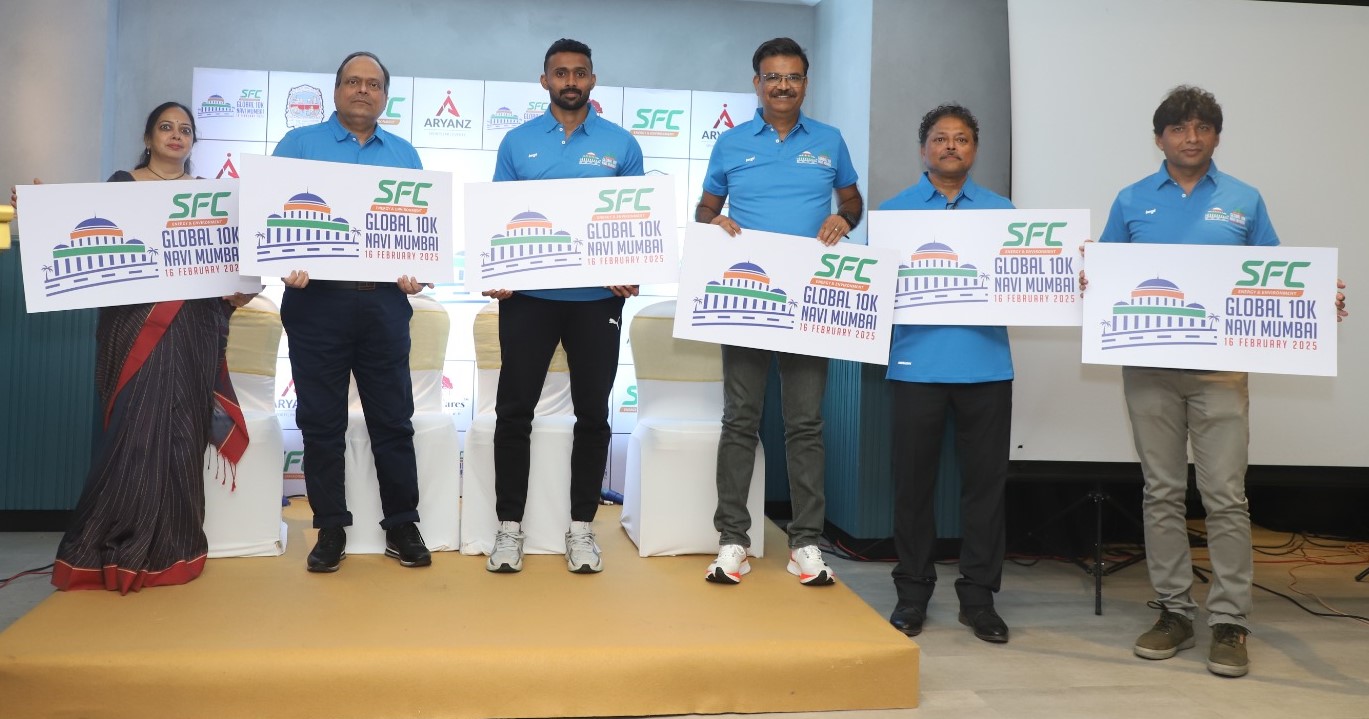
Organizers of SFC Global 10K with the logo-poster of the event at the launch of the race in Navi Mumbai. L to R: Meena Dave, CEO, India Cares, Sandeep Asolkar, CMD, SFC Environmental Technologies, Muhammad Anas Yahiya, double Asian Games gold medallist, Sandeep Parab, Director SFC Environmental Technologies, Bruno Goveas, Managing Partner, Aryanz Sports and Dnyaneshwar Tidke, SFC (photo: courtesy the event organizers)
The inaugural edition of the SFC Global 10K run in Navi Mumbai will see participation by international and Indian elite runners, the event’s organizers said.
Kenyan running legend Beatrice Chebet will be among those participating in the event. The first edition of the race is scheduled to be held on February 16, 2025. The run is being organized in association with Navi Mumbai Municipal Corporation (NMMC), which has promised support for the event.
Chebet’s participation in the race was announced by Sandeep Asolkar, CMD, SFC Environmental Technologies, the title sponsor of the event. Chebet, the current women’s 10,000m world record holder (28 minutes, 54.14 seconds), won gold in the 5,000m and 10,000m events at the 2024 Paris Olympics, becoming only the third woman in history to win both these disciplines at the same Olympic Games.
The international elite athlete field for the race in Navi Mumbai is being put together by Elite Athlete Coordinator and Coach, Ian Ladbrooke, an official press release said.
The men’s elite field is likely to include Rodrigue Kwizera from Burundi, Birhanu Balew of Bahrain and Gemechu Dida of Ethiopia. Besides the 24 year-old Chebet, the women’s elite line-up may include Lilian Kasait of Kenya and Margaret Kipkemboi, also of Kenya. According to information available on the event website, prize money for international elite athletes, across both gender categories, ranges from 10,000 US dollars for the first-placed to 7500 dollars and 5000 dollars for those finishing second and third. The same for Indian elites is Rs 275,000, Rs 200,000 and Rs 150,000.
(Above is the link to a YouTube video of Beatrice Chebet winning the women’s 5000m final at the 2024 Paris Olympics)
It is understood that the race in Navi Mumbai will be along the township’s Palm Beach road, which connects Vashi to Belapur. A favourite with local runners for their long runs, this road has often featured in runners’ conversations as one stretch of tarmac in the Mumbai-Navi Mumbai region that got overlooked for a world class race of its own. In India, the best-known 10K as yet is the TCS 10K, which happens annually in Bengaluru. The long term vision for SFC Global 10K is to try and grow itself to a similar league, Bruno Goveas, Managing Partner, Aryanz Sports, part of the team organizing the event, said.
Speaking to this blog, Sandeep Asolkar, CMD, SFC Environmental Technologies, said that the company had gravitated towards being the title sponsor of the event for a basket of reasons. Although a medium sized outfit, SFC had over 22 runners in its fold, a few of them well-known in Navi Mumbai’s marathon running and training circles. Discussions around running were frequent at SFC and there had been the idea of doing something meaningful in that line. Further, having lived in Navi Mumbai for long, there was the urge to give something back to the township. A good quality event in running appeared relevant.
With runners themselves imagining the event and involved in arranging it, Sandeep believed that an event that was focused on runners would be possible. “ Our celebrities are the runners,” he said. It was decided to go ahead with a 10K race because the middle distances cut both ways – to the track and on to the road. It is a well known fact that many greats in long distance running cut their teeth first in the middle distances. Not to mention – the middle distances are a fantastic space by themselves. Sandeep said that his company’s commitment to the event is long-term and just as Beatrice Chebet was expected to headline the first edition, efforts would be made to keep bringing top athletes to Navi Mumbai for successive editions of the race.
Asked if the long-term vision was to position this 10K race in the same category as a TCS 10K, Sandeep said that he had no competition with any other race in mind. He said that for SFC, the best return on investment would be if the SFC Global 10K allowed people to see the best of international athletes in action, inspired more people to take up running and in the process, local talent, over time, rose to match those high levels of performance.
(The authors, Latha Venkatraman and Shyam G Menon, are independent journalists based in Mumbai)
Sydney Marathon to be the 7th World Marathon Major in 2025
TCS Sydney Marathon has been announced as the seventh World Marathon Major from 2025.
The Australian city will join the Abbott World Marathon Major series that currently includes Berlin, Boston, Chicago, London, New York and Tokyo.
The 2025 edition of Sydney Marathon is slated to be held on August 31, 2025.
Two other marathons – Cape Town in South Africa and Shanghai in China – are likely to be added to the World Marathon Majors list, the Abbott.com website said.
(The author, Latha Venkatraman, is an independent journalist based in Mumbai)
For ultrarunners world over, Spartathlon in Greece, is a coveted event. The footrace, which traverses a mix of road, trail and mountain path for 246 kilometres commences in Athens and ends in Sparta. The race traces the footsteps of the Greek messenger Pheidippides, who ran from Athens to Sparta to convey the news of the Greek victory over the Persians, at the Battle of Marathon in 490 BC.
Runners have to clear 75 check points along the route, within a stipulated time, to continue to the finish line. They have to finish the 246 km-race within 36 hours.
For the 2024 edition of the race, four Indian ultrarunners had registered but only two completed. Two runners had to give up midway due to injury and ill health.
Ashok Singh completed the race in 30 hours, 14 minutes and 24 seconds and Shakti Singh in 35:08:49.
So far seven Indian runners including Ashok and Shakti have completed Spartathlon. Others who have completed this iconic race are Kieren D’Souza (2016), Munish Dev, Amit Kumar and Rakesh Kashyap (2022) and Jeevendra Singh (2023). Of these seven runners, Ashok Singh has finished the race in the fastest time yet by an Indian.
Ashok Singh (photo: courtesy Ashok)
Ashok Singh
Ashok Singh, 32, from Ganeshwar village in Neem Ka Thana district of Rajasthan, started running during his college years when he ran 10 kilometres and half marathon distances.
“ I was good at running and that helped me to go through a gruelling physical exam to gain entry into the army,” Ashok said.
After joining the Indian Army, Ashok veered off regular running. “ A few years later I resumed running mainly to cut the weight that I had gained. I kept running and then went on to do a half marathon and a full marathon at some local running events,” he said.
In 2023, Ashok Singh did the 12-hour run at the Dharamshala Stadium Run where he emerged winner with a distance of 137.2 km covered. During this run, he learnt about other ultrarunning events.
In the same year, he ran the 100 miler at Border Ultra, finishing second with a timing of 17:15:58 hours. Earlier this year, Ashok Singh did the 24-hour stadium run at Tuffman 24-hour Stadium Run Chandigarh 2024. He was the winner with a distance of 230.23 km covered. Shakti came second with 196.09 km.
When Ashok learnt about Spartathlon he wanted to attempt it. He had already qualified for this ultra-distance race at the Border Ultra. Runners wanting to try Spartathlon are mandated to do a 100 mile (160 km) race within 21 hours. Ashok had done the Border Ultra 100 miler in a little over 17 hours, well within the cut-off.
“ I was told by other ultra-runners that as practice for Spartathlon I need to do a lot of hill runs. My village is surrounded by the Raoli Mountain Range. I did my 45-day training on these hills. I did not do any strength training,” he said.
Financial help in registering for Spartathlon, visa cost and air travel to Greece came from Ashok’s community group back home in Rajasthan. “ I was also given two pairs of running shoes and money for local use while there,” he said.
At Athens, Ashok started his race well. He finished 45 km in three and a half hours. “ After a while I got knee pain and was not able to walk. I had to lie down. I thought my race was over. I felt very dejected. My friends back home had gone to town over my Spartathlon attempt on social media. Thoughts about how I am going to face my friends and my community group, which had offered a huge financial help, kept haunting me,” he said.
According to Ashok, after a while, Munish (one of the four Indian ultrarunners participating in Spartathlon 2024) came along and goaded him to start walking. “ I slowly started walking. At the next aid station one volunteer gave me her knee cap. I also took a pill containing Paracetamol. This helped me. I started running again,’’ he said.
At Spartathlon, runners have to experience varying weather conditions, including the morning chill, warm and sharp sun and cold wind in the mountains. During the daytime, Ashok suffered nose bleeds because of the severe heat and sunny conditions.
“ The mountains were very tricky. For about 30-40 km it is a steep climb through narrow mountain paths. But I was able to make up for the lost time in the last 25 km, which is mostly downhill,” he said. Ashok did not change his shoes throughout the race. “ After my 185th km I did change my clothes to feel fresh for the remaining distance,” he said.
Post race, though Ashok has been able to recover from the gruelling race, sleep has been eluding him for several days even now.
Ashok has been doing a number of ultra-running events but he is yet to figure out his hydration and nutrition needs during ultra- distance runs.
His preferred ultra-running events are stadium runs. Going forward, he wants to focus attention on the marathon to improve speed running.
Shakti Singh Hada (photo: courtesy Shakti)
Shakti Singh Hada
Shakti Singh Hada is a more recent entrant to running. His first event was the Delhi Half Marathon in the year 2016.
A former army official, Shakti, who now runs an educational consultancy company, was a regular at a gym where he would run on the treadmills. “ At the gym, a person asked me to join Kota Running Club,” he said.
In 2017, Shakti ran the 63 km Chambal Challenge. “ During this run, I met Kieren D’Souza, who was the brand ambassador for Chambal Challenge. He told me about Spartathlon,” he said.
Shakti went on to do other ultra-running events, including the 111 km at La Ultra – The High and the 74 km La Ultra – Garhwal, which is the qualifying race for the main La Ultra runs in Ladakh.
The Covid-19 pandemic brought formal running activities to a halt but Shakti decided to challenge himself by running 10 km daily for 100 days without a break. Once the pandemic died Shakti continued his ultra-distance running, attempting various races including Backyard Ultra and Stadium Runs.
To train for Spartathlon, Santhosh Padmanabhan, manager of the Indian ultrarunning team, drew up a 90-day training plan for him. Shakti had to resort to running up and down apartment building staircases in the absence of hills in Kota, Rajasthan, where he lives. “ I did a number of training runs as chalked out by Santhosh sir. I did 6-hour, 7-hour, 10-hour, 12-hour and 20-hour training runs in the run-up to Spartathlon. I could say that my training was very good,” he said.
At Athens, his race started well but after 21 km he deviated on to a wrong path and lost some time. “ At one of the check points, I arrived with just 19 seconds to spare. But subsequently, I made up. After 24 hours of running, I changed my clothes and shoes to experience a fresh lease of enthusiasm,” he said.
“ I was a bit worried about cramps. Every hour, I ate salt tablets. Through the entire mountainous stretch, I walked as did most runners,” he said, adding, “ there was a lot of cheering along the route closer to the finish line in Sparta. There were many local music bands along the route.”
Shakti finished in 35:08:49 hours.
“ At the finish line, I cried. I was so happy to finish. Also, my brother was at the finish line. I got emotional seeing him. Many runners told me that it is not possible to complete Spartathlon in the first attempt,” he said.
“ Having finished Spartathlon, I can say that it is a very tough race. Intense hill training and understanding hydration and nutrition needs are extremely important. Training has to be intense,” he said.
Shakti’s recovery has been quite good. He now plans to do 24 hour stadium run.
(The author, Latha Venkatraman, is an independent journalist based in Mumbai)
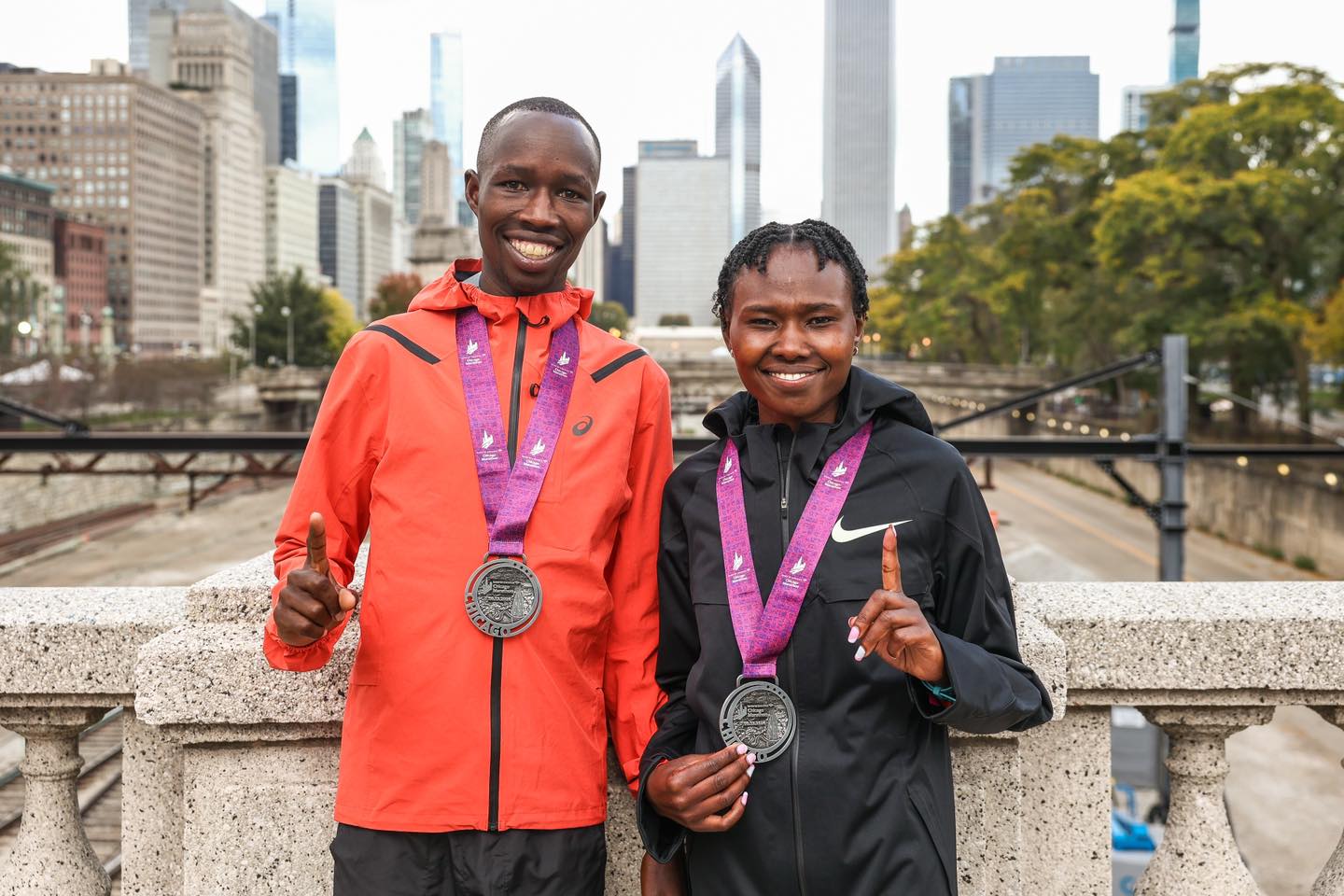
Kenyan runners, John Korir and Ruthchepngetich, winners in the man’s and women’s marathon respectively at the 2024 Chicago Marathon (this photo was downloaded from the Facebook page of Chicago Marathon and is being used here for representation purpose. No copyright infringement intended)
Ruth Chepngetich of Kenya set a new world record in the women’s marathon at the 2024 edition of the Chicago Marathon held on October 13, 2024.
She finished in two hours, nine minutes and 56 seconds.
Ruth lowered the world record by nearly two minutes from the previous mark of 2:11:53 set by Ethiopia’s Tigist Assefa at Berlin Marathon in 2023. Her timing at the Chicago Marathon on Sunday was also a huge improvement in her personal best, which stood at 2:14:18 previously.
In the men’s race, Kenyan runner John Korir was the winner with timing of 2:02:44.
Ruth later said she was dedicating her world record win to her compatriot Kelvin Kiptum who holds the world record for the men’s marathon. He had set the record at the 2023 edition of the Chicago Marathon. Kelvin and his coach Gervais Hakizimana died in a car accident in February 2024.
(The author, Latha Venkatraman, is an independent journalist based in Mumbai)
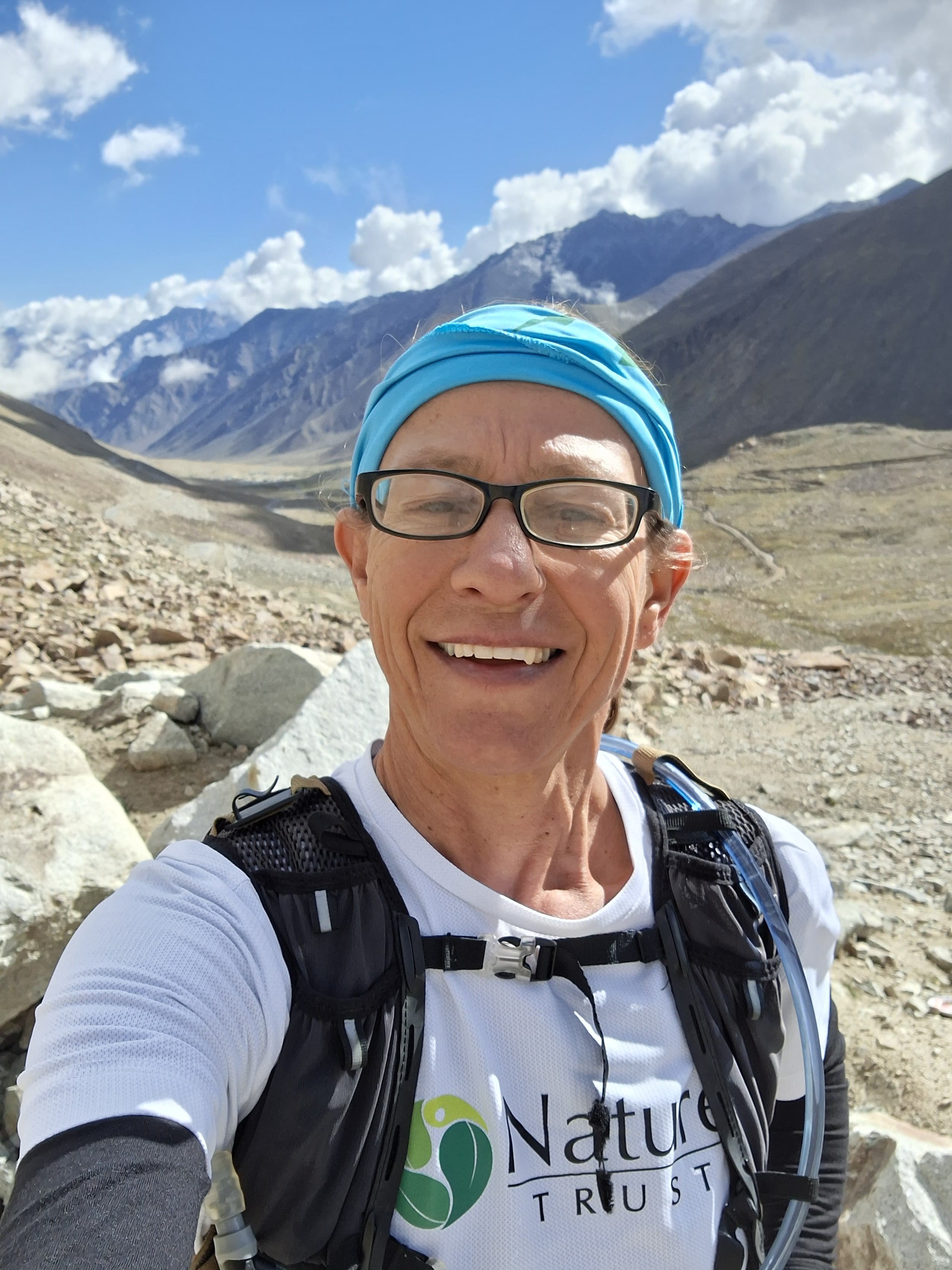
Having finished third in the women’s category at an earlier edition of the Khardung La Challenge, Corina Van Dam (Cocky) decided to try the 2024 Silk Route Ultra (SRU). She had to DNF (Did Not Finish). But she came off happy, with no sense of unfinished business in Ladakh and clear reasons for aborting her race.
A bus trip to Nubra Valley with 60 kindred spirits, including accommodation, entertainment, and food. The only catch is that you have to walk back to Leh across Khardung La’.
That was my description of Silk Route Ultra (SRU) from Ladakh Marathon before the 122-kilometer-long race started.
It wasn’t that I didn’t take it seriously. Not at all. Though the Khardung La Challenge of 2022 was not too hard on me – I finished third in the women’s category in 11.10 hours – I knew that SRU wouldn’t be a fair comparison. Add 50 kilometres to an already challenging ultra……!!
I registered late because I was stuck in the Netherlands due to visa issues. The first thing I did when I reached home was signing up for SRU. From that moment on, all my efforts (I am a triathlete) were geared towards this unique race in the Himalaya. In May, I increased my mileage, which had dropped in the Netherlands where I had to combine odd working hours, meeting friends and follow up on stressful bureaucratic processes. When I returned, Mumbai was hot and humid. That was a shock after the Dutch rain and cold. In June, I started doing back-to-back long runs with midweek half marathons. July was for six-hour runs, ultras and weekend night runs in the colony where I live. In August, I started tapering and enjoyed local races as ambassador and race mentor with one mid-term exam ` The Mumbai Ultra’, a 12-hour race in which I scored a good grade. The only exacerbation in the whole process was a 12-hour swim a few weeks before the final exam…. But as this was a low impact activity, I did not think that would do much harm.
I flew in to Leh on the first day of bib-collection, the absolute minimum for acclimatisation. I found it hard. I had travelled overnight and it was actually only the Sunday after SRU that I felt that I had acclimatized to Leh’s altitude (my Garmin was correct!). I enjoyed the morning run / walk that focused on getting used to the altitude and the climate; I also enjoyed meeting ultra runners from across the country. The bib collection was like a school reunion with our friendly but stern principal Chewang Motup Goba who exemplifies what Ladakh Marathon stands for: personal commitment, respect for the mountains, respect for each other, fairness and sports(wo)manship. The excitement, anticipation and camaraderie at Ladakh Marathon’s ultras is unique. As part of the preparations in Leh, I went with a group for a run up and down Khardung Top and a car ride to Umang La, now the highest motorable pass in the world.
For me, a lot had changed in two years. In 2022, I was an unknown runner but now ` strangers’ shouted ` hey champ!’ at me across Leh Market and added that they followed me on Instagram / Strava. As the only ` Athlos athlete’ participating in SRU, I was invited to lead Athlos’ shake-out sessions before the races. Seventy people turned up for the run, coffee and cookies at Metta Café. Expectations were high and my co-runners assessed that SRU would be “ easy for me.’’ No doubt about that.
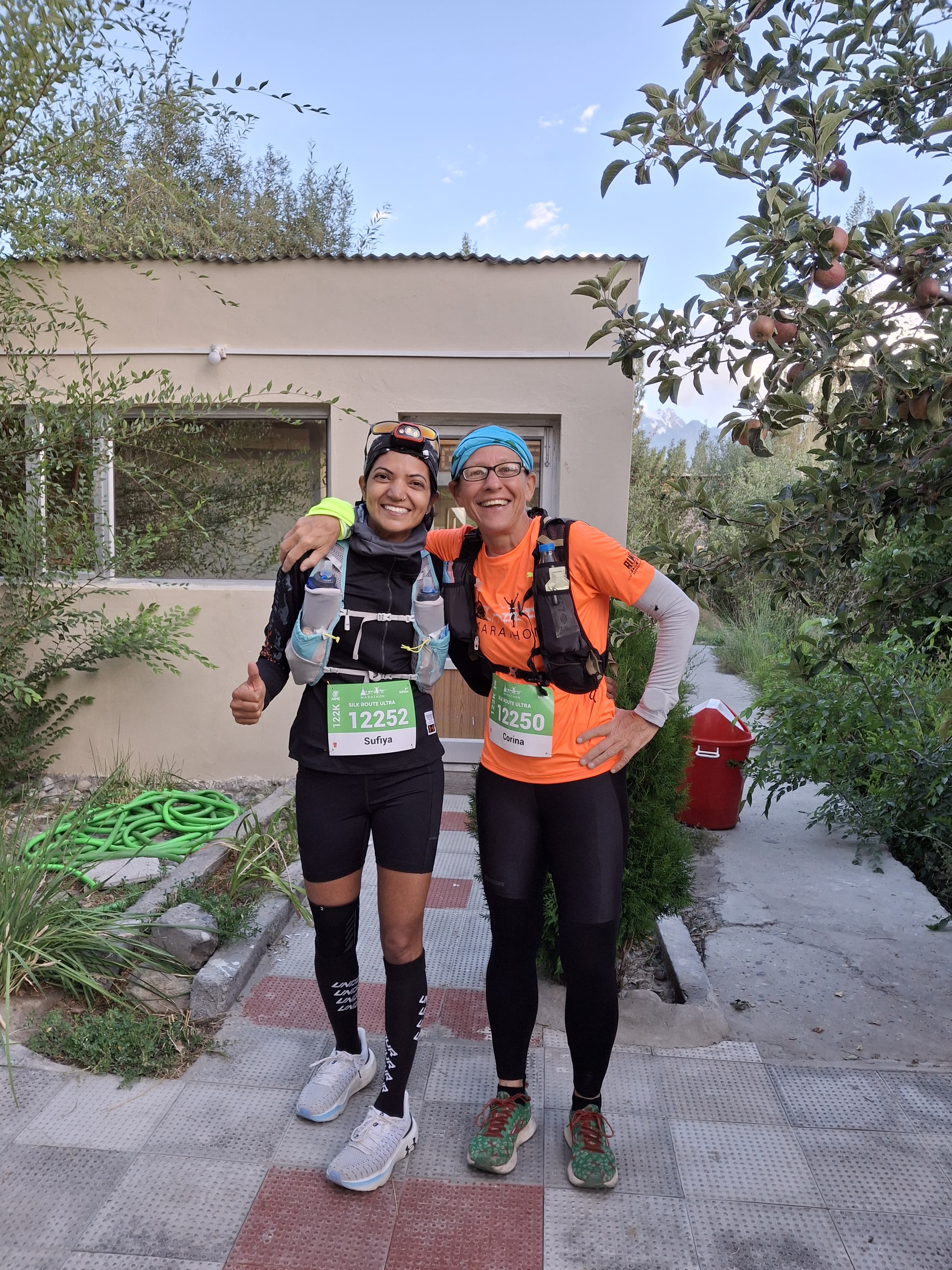
Cocky with ultrarunner, Sufiya Sufi (photo: courtesy Cocky)
On the day of the race – after a long night’s sleep, a cultural programme and meals that allowed us to load plenty of carbs -, doctors came to check our vitals. I had been nervous about the race. This had now turned into nervousness about the test results. Out of the blue, I had high blood pressure – as did many of us as this seems to be quite usual in the mountains. I tried to relax and make jokes but my blood pressure went up even more. Three of the biggest pieces of garlic I have ever seen and a couple of glasses of lukewarm water, did the trick: my BP came back into normal range. My nervousness was gone, I was just relieved that I could participate.
So, I was a happy woman at the start, without any worry. The race started at 7 pm. Just before sunset. The inhabitants of Tiggur came out of their houses to cheer us on. Pictures were taken, sponsors shot their last videos with willing participants and then we went: off to Leh….! The first 27.6 kilometres are relatively flat and led us through several communities where the villagers welcomed us with apple juice and high fives. As it got dark, we left the villages behind us and each of us got into their own rhythm. I ran ahead of some runners, then they overtook me, I overtook them and settled in running alone as the evening got darker and the stars brighter. The first cut-off was Khalsar. I reached well in time and was happy to have cleared the first hurdle which I knew that not everyone would be able to take.
From Khalsar, the 22.4 km climb towards Khardung village started. The first 12 kilometres were tough as the road was under construction. This slowed me down but there were volunteers with lights at corners and unexpected dark spots, motor bike support and aid stations at seven-kilometre-interval. The temperature was reasonable and when at some point of time, my headlamp refused duty, I enjoyed moving on in the dark under a clear sky. The white lines on the roads were easy to follow and my thoughts drifted while my feet kept on track. I could see Khardung Village from far. It took forever to reach it though….
I arrived in Khardung Village before the Khardung La Challenge was flagged off and with half an hour in hand before the cut off. The otherwise quiet village was bustling with nervous runners. I knew the feeling. I managed to stay ahead of the KC crowd. Behind me I could see a long line of headlamps on the mountain. At some point, the first KC runners started overtaking me: local participants, army personnel and just before K-Top, the elite amateur runners. I cleared the 17.1 km to the unofficial cut off at North Pullu with 45 minutes in hand and even more at the top of Khardung La (another 15.1 km further). After the top, it would be down towards Leh. I knew it would not be easy but soon I would see Leh and then it was just a matter of finishing. I had plenty of time.
My experience in 2022 told me that running from K-top to South Pullu is challenging. Gravity pulls you but the air is thin. Your legs want to go fast but your lungs don’t like it at all. So, I opted for power walking. The sun was shining, my legs felt good, I had enough fuel in the tank and I enjoyed the company of KC runners who slowly caught up with me. Every now and then I had to stop myself because my body had the tendency to move downwards at a faster pace than my legs could carry it. One of my Mumbai Sea Swimmers group members overtook me and that is when I realized that I had a problem. He warned me that my body was tilting to the right. What was he talking about? I walked perfectly straight, I thought. The thought that my brain was not able to register the state of my body was unsettling. He suggested that I adjust so that I would not be taken out of the race. I was not worried about that. My concern was that I could not observe what he observed. In the meantime, I reached South Pullu (14.3 km) and took some rest.
When I peed along the roadside (yes, that is what we do…) I noticed that I was not able to balance myself. Usually during ultra runs, when I squat, I am limited by my rather painful calves, hamstrings and glutes. This time they felt great but I was not able to coordinate my movements. This is when I had my vitals checked. Of course, my oxygen level was lower than usual and my blood pressure a bit higher. But there was nothing that got the army doctors worried. I continued the race but I was not comfortable at all, descending a mountain without being in full control of my body. In front of my eyes, I saw one of the female marathon runners from the first Olympic women’s marathons in 1984. She had zigzagged through the Olympic Stadium and refused support because she felt great. I certainly did not want to finish like that. There and then, I DNF-ed.
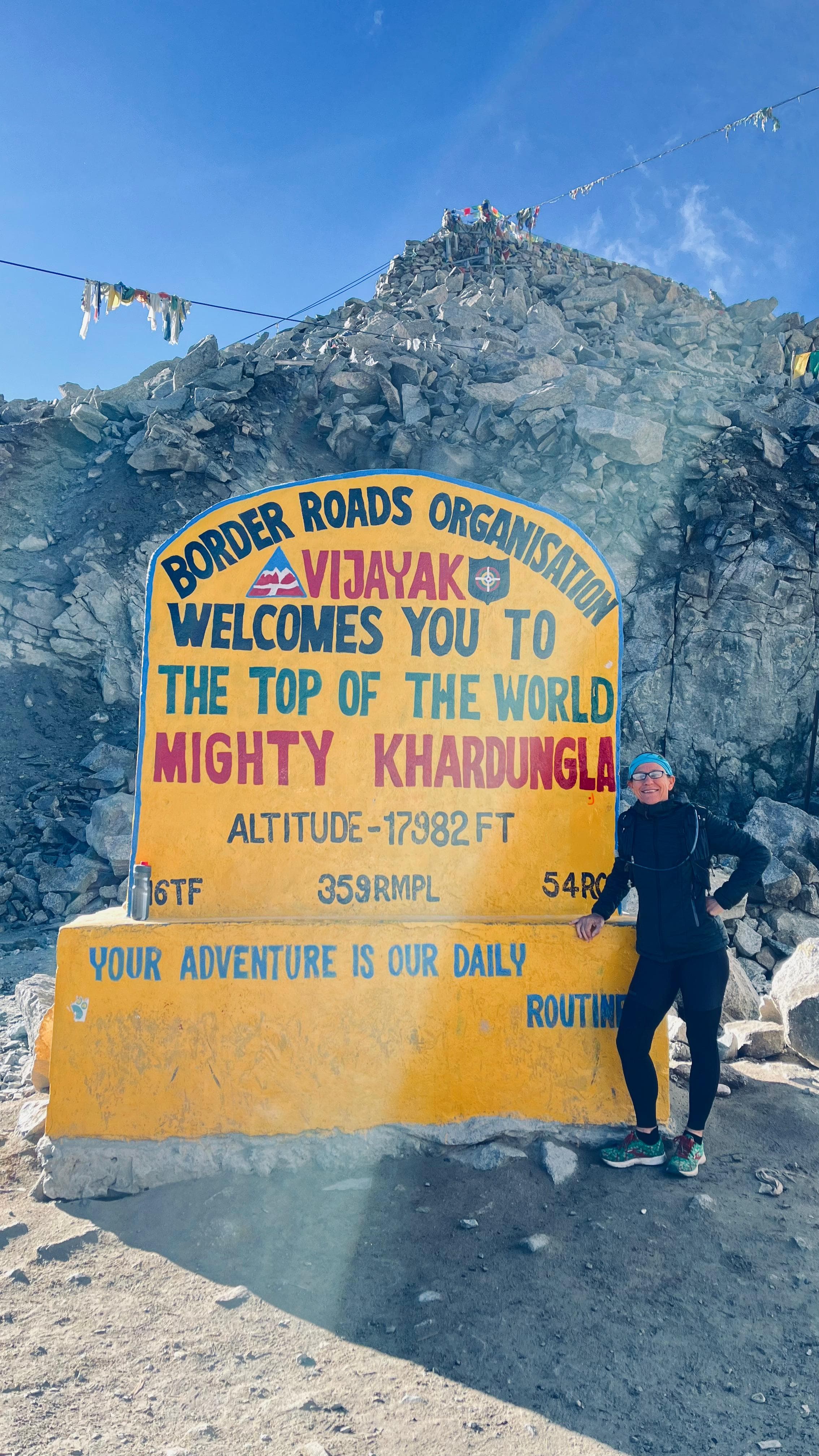
At Khardung La (photo: courtesy Cocky)
On my way down in the doctors’ car, I noticed that there were many runners with the ` leans’ (it had an unofficial name) and everyone felt fine. I stand behind my decision to withdraw from the race. In the meantime, I have spoken to several other runners. Some have sent me articles; others are still investigating. So far it seems that there is no consensus about what is behind this phenomenon: peripheral fatigue, loss of central motor control because of increased core body temperature, Exercise Associate Hyponatremia (EAH), lack of oxygen, lack of nutrition / hydration. I was surprised that the army doctors in Ladakh did not have an explanation.
At the finish there were people waiting for me, patiently, while I entered Leh through the ` backdoor.’ Some were even more disappointed than I was. They asked me if I have ` unfinished business’ in Ladakh. No, I do not have. I had a great experience and – to be honest – the best part was the climb in the dark……! Signing up for KC or SRU is a commitment. For four months, my life had been about ` running in Ladakh’. Training for an ultra means a huge investment in time and an ultra in the highest mountains, takes even more. And I am not even speaking about the mandatory 10 days holiday that you ` have’ to spend in Ladakh… But these are all thoughts….
In the end, there is nothing better than running the ultras of Ladakh Marathon….!
(The author, Corina Van Dam [Cocky], is a triathlete and a senior official at an NGO, based in Mumbai)
Indian ultrarunner plans to attempt Bob Graham Road
Jeevendra Singh, an Indian ultrarunner based in the United Kingdom, is planning to attempt the Bob Graham Road, a fell running challenge in England’s Lake District, next month.
Runners are required to cover the round in 24 hours, traversing through 42 fells (hills) covering a distance of 106 kilometres with 27,000 feet of elevation.
Jeevendra hopes to be the first Indian to attempt and complete it.
His journey will be filmed in a documentary titled, To Cumbria with Love.
The filmmakers, Summit Fever Media (Matt Green and Ellie Green), are doing a crowdfunding campaign to raise funds for the film.
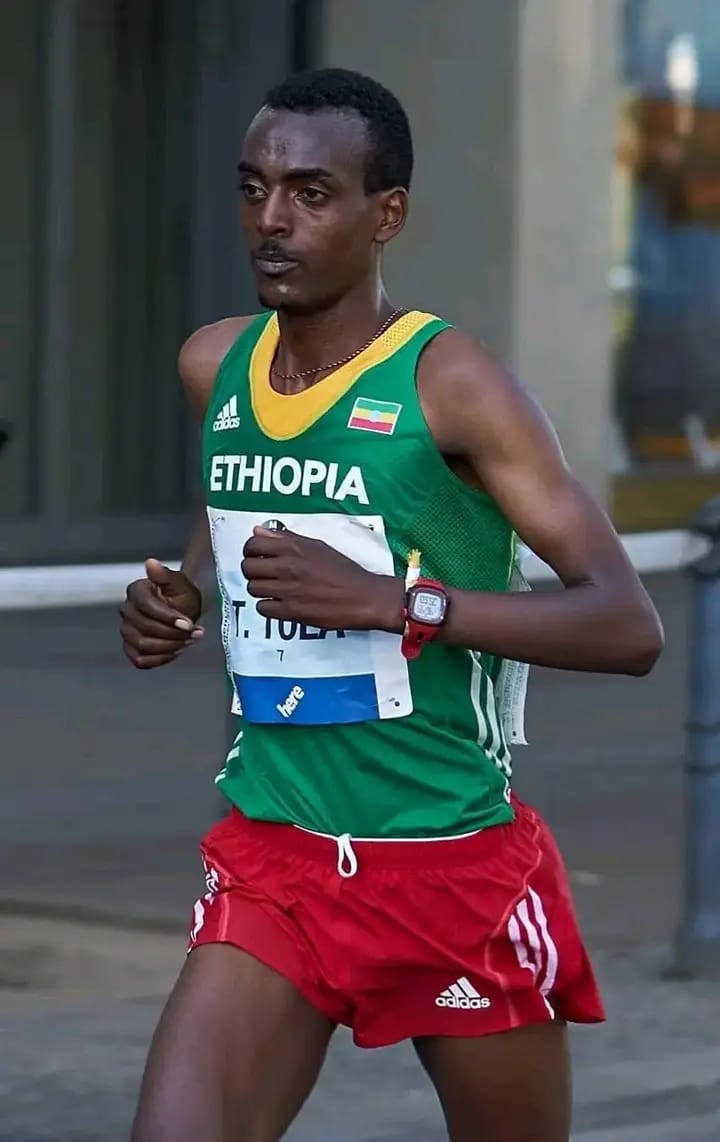
Tamirat Tola (this image was downloaded from the Facebook page of the athlete and is being used here for representation purpose. No copyright infringement intended)
TamiratTola, Sifan Hassan win in men’s and women’s categories. Both set new Olympic records
The 2024 Paris Olympics will be remembered for its two memorable marathons. Certainly therein, an unforgettable women’s marathon.
The men’s race was won by Tamirat Tola of Ethiopia in a new Olympic record of two hours, six minutes and 26 seconds (the previous Olympic record of 2:06:32 held by the late Kenyan athlete, Samuel Wanjiru was set in 2008). He was followed to the podium by Bashir Abdi of Belgium (2:06:47) and Benson Kipruto of Kenya (2:07:00). Tola who had come with the Ethiopian team as a reserve runner and subsequently replaced injured teammate Sesay Lemma, took a decisive lead past the 35 kilometres-mark. According to olympics.com, Tola is the fourth Ethiopian to win the men’s marathon title at the Olympic Games. For most fans of running, the biggest news coming out of the men’s marathon at Paris was possibly the failure of Kenyan legend Eliud Kipchoge to complete the race. He dropped out just after 30 kilometres following what appeared to be discomfort around the waist (it was later attributed to backpain). Olympics.com reported that the athlete, described often as the greatest marathoner ever, had told the website that he won’t be running at another Olympics. Paris was his last. As yet, Kipchoge is one of only three men to win the Olympic men’s marathon twice.
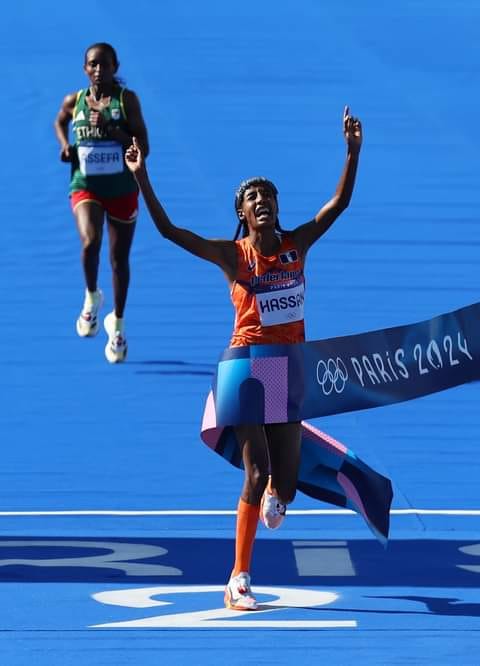
As the Kipchoge chapter appeared to fade in the men’s marathon, a similar imprint was opening up in the field of middle and long distance running for women. For many watching the Paris Olympic Games, the experienced Dutch middle-distance runner, Sifan Hassan, had seemed to disappoint winning bronze medals in the women’s 5000m and 10,000m events. At the 2020 Tokyo Olympics, Sifan had won gold in the above said two disciplines plus a bronze in the 1500m to complete a unique triple. She is a former world champion in the 5000m and 10,000m besides being the owner of a basket of current and former records, including world records. Sifan made her debut in the women’s marathon only last year, in April 2023, when she won the year’s London Marathon in 2:18:33. That victory was despite stopping twice amidst the race to stretch her legs, during which time, she was left behind by the leading pack of runners.
Sifan Hassan winning the women’s marathon at the 2024 Paris Olympic Games (this photo was downloaded from the athlete’s Facebook page and is being used here for representation purpose, No copyright infringement intended)
On Sunday, August 11, Sifan, born in Ethiopia and currently representing the Netherlands, stuck to the leading pack of runners tenaciously in the final quarter of the marathon in Paris and eventually snatched victory from Ethiopia’s Tigst Assefa with a track-like sprint to the finish. Not far from the finish line, Sifan even appeared to stumble as Tigst sought to deny her a chance to over-take on the inside and in doing so, almost crashed the Dutch athlete into the barricades. Sifan however stayed unrattled and forged ahead; she covered the 42 kilometre-distance in 2:22:55, a new Olympic record (the previous Olympic record of 2:23:07 held by Ethiopia’s Tiki Gelana was set in 2012). Tigst Assefa finished in 2:22:58 and Kenya’s Hellen Obiri in 2:23:10. With this victory, Sifan became the first woman to have won gold medals in the 5000m, 10,000m and the marathon. Not to mention – she has cemented her place as one of the all-time greats of women’s middle distance and long distance running with a repertoire of top-notch performances spanning 1500m to the 42 km-marathon. With marathon specialists around, Sifan’s greatness in that discipline may continue to be debated. What’s beyond dispute and totally deserving our admiration is the range of distances she is good at. One couldn’t immediately recall a matching name on the men’s side claiming similar breadth of competition and excellence.
(The author, Shyam G Menon, is a freelance journalist based in Mumbai)
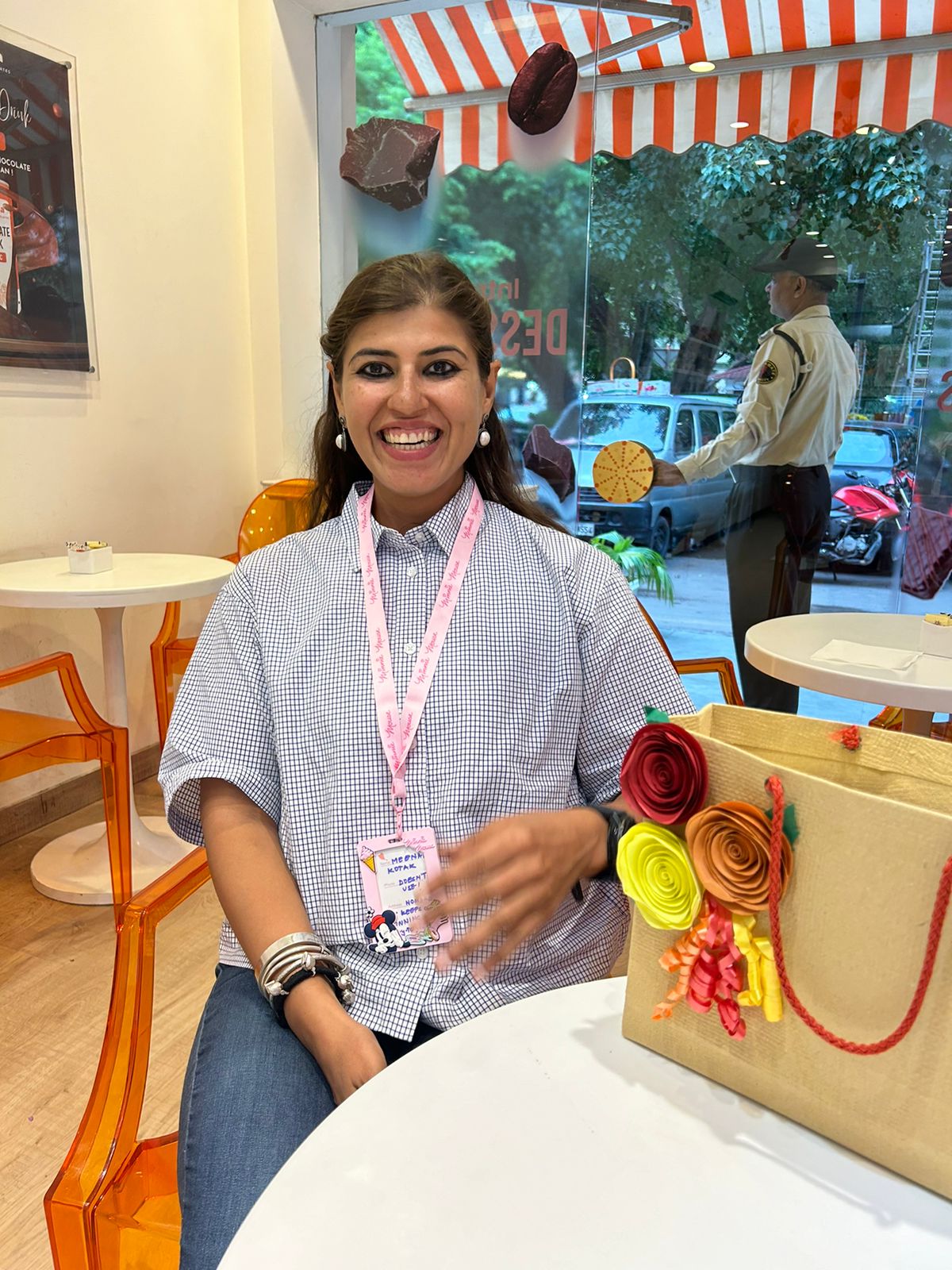
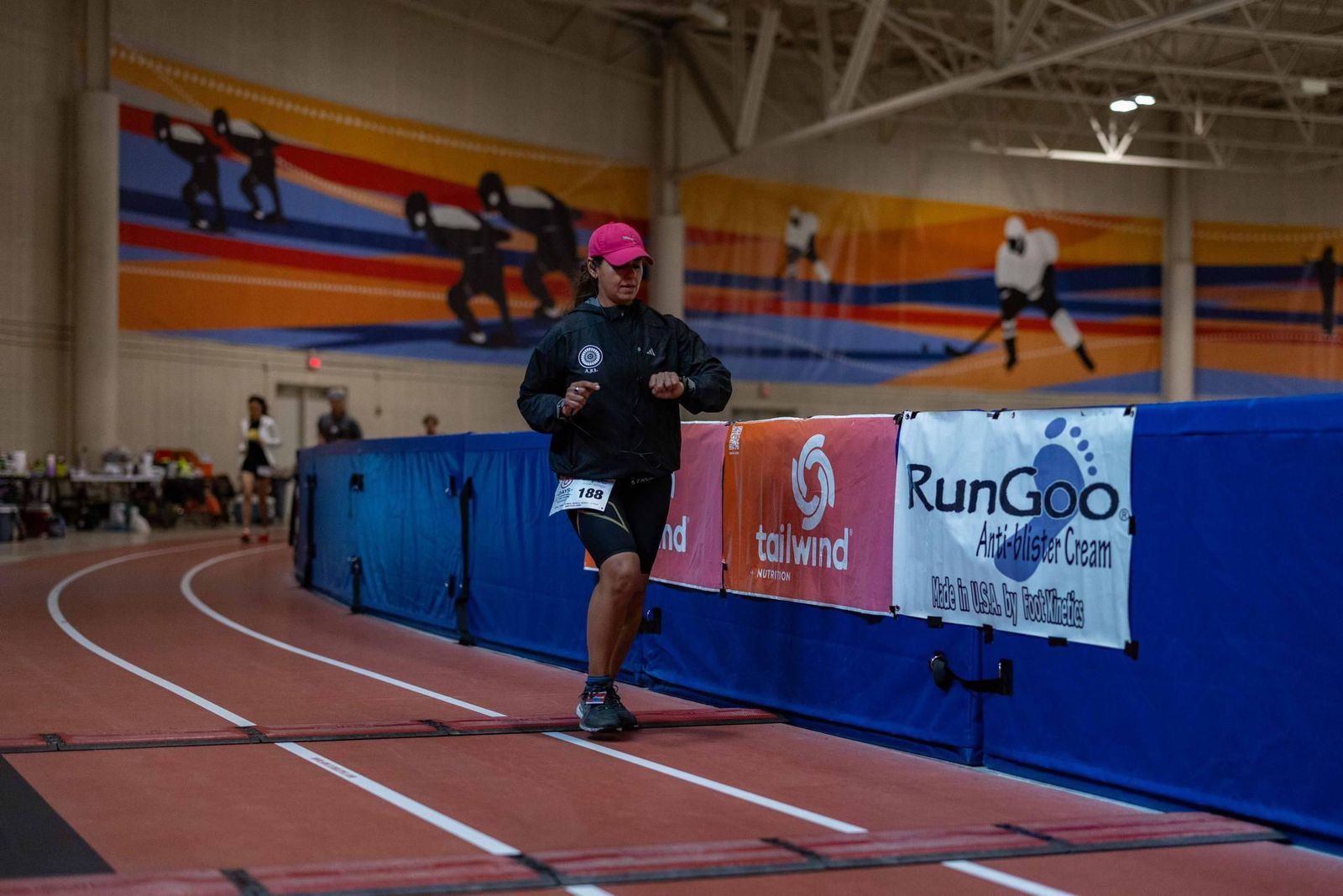
On June 23, when Indian ultrarunner Meenal Kotak set a new national mark of 680.2249 kilometres covered in the six day-race category of the Six Days in the Dome event in Milwaukee, USA, it was her best performance yet since an injury saw her stay off running for over eight months in 2019.
That year, Meenal was diagnosed with a painful case of slip disc in the L4 and L5 vertebrae and advised bed rest. There was no running. She remained indoors, life largely limited to her room and bed. It was a testing period. Besides the lack of physical activity, her mind went for a toss. Runners, especially ultrarunners, are known to pile on miles in training. The regular training helps them stay positive; in a high-endorphin, motivated zone. When such levels of physical activity get suddenly pulled off, the mind may progressively slip into depression. Meenal had cause for worry. Based on her prior performance in the ultramarathon, the Athletics Federation of India (AFI) had drafted her into the Indian team due to attend the 2019 24-hour world championship. That wouldn’t be possible now. Unable to run thanks to her slip disc problem, she grew acutely aware of the competition in the sport and the blunt truth that there is no shortage of new talent. No one is missed for long if they drop off the radar. Somebody else comes along and fills the vacancy. That is how it should be in the best interests of a team but when viewed from the individual runner’s perspective, it is precious chance missed. Meenal’s mind kept generating questions. Why am I injured?Why are things going well for others but not for me? When will AFI give me another chance? – she sank into a mental morass thinking so.
To compound matters, that known side effect of physical inactivity and mental depression manifested – she started to gain weight. “ My pacifier in this period was food. I ate. It was getting up, eating and taking medicines – that was my life,’’ she said. A major relief was the support she got from her husband, Sachin. True, the sight of others leaving for work and getting on with life was a downer. But the fact that she had somebody to talk to, meant she didn’t need to access any external assistance to tackle her depression. Then a leveller of sorts happened. By the first quarter of 2020, COVID-19 started to grow in India. Along with the pandemic, came lockdown. It dispatched everyone indoors, sporting activity came to a grinding halt worldwide and events were cancelled. Talking to this blog in early July, 2024, Meenal provided an honest overview of her bed-ridden predicament in times of pandemic. As lockdown took hold, suddenly, after months of finding herself inactive at home and left out from the active lifestyle-community, she felt a distinction crushed as people everywhere hunkered indoors. Everybody was in the same boat. Strangely, it was around this period when a whole world was hurting that Meenal began to heal.
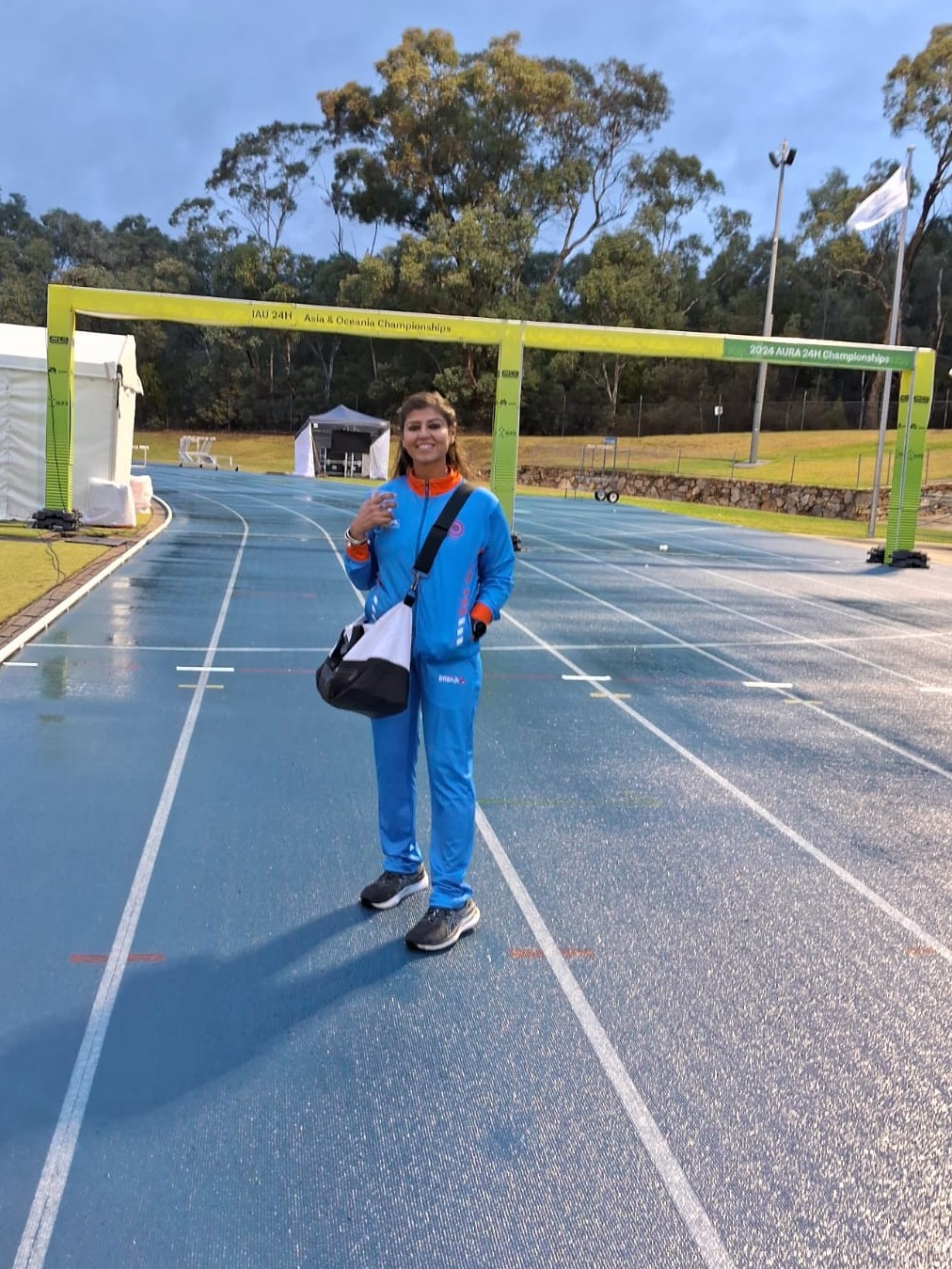
Meenal Kotak; at the 2024 IAU 24H Asia-Oceania Championship in Australia (photo: courtesy Meenal)
Her residential complex in Gurgaon – where she had moved to from Vasant Kunj in neighbouring Delhi – hosted a long loop of close to two kilometres within its premises. Once she resumed walking indoors, she took the stairs down from her flat and walked longer distances on that loop. Sachin pitched in to help. With a view to encourage her on the comeback trail, he had taken to running during the time she was bed ridden and now with him for company, Meenal slowly worked her way up from running one kilometre to covering five kilometres. “ It took me a month to accomplish this,’’ she said. The loop within her residential complex was a genuine blessing to facilitate this progression. It meant she could run at night as well, something difficult for a woman to do in Delhi. For many people, five kilometres run in a day would seem enough. Not when you are a national level ultrarunner trying to return to where one was before slip disc felled the athlete. Meenal persevered. In all, she estimates, she would have taken 14-15 months to reach close to her old levels of mileage in training. And it wasn’t a simple reset; it was a reset with significant changes.
Prior to her injury, Meenal’s idea of training for the ultramarathon had focused mainly on accumulating high mileage. She used to run 600 to 650 kilometres every month and her weekend training included long runs of eight hours and 12 hours. It was just running and running. Post injury, on the comeback trail, that homogeneity transformed to a blend of strength training, stretching and training runs. Of these, strength training became the most important new ingredient as regards the body. She now works out with weights; her strength training session lasts one hour and is repeated thrice a week. Alongside, she settled for a slightly reduced mileage in her training runs. Her current monthly mileage is around 580 kilometres and her long runs range from six hours to eight hours. But the most significant tweak lay elsewhere; it was a tweak in her approach to races.
In April 2022 she registered for her first event in many months – a 12 hour-race in Bengaluru. She completed the race covering 90 plus kilometres in the stipulated time. What stayed in mind was the lightness of being she felt. “ When you enter an event after three years, the pressure is off. Unlike before when I was a known competitor tracked for my performance, thanks to the three year-gap, people seemed to have forgotten about me. It was good to have no pressure. That was a real upside. The downside was that my old friends in running had graduated to a different league and I didn’t know anyone around to say hello to,’’ Meenal said, adding, “ it was a good learning – change is the only constant in life. Records and achievements are meant to be broken.’’ Somewhere in that mix of altered scenario and the maturity of an older self, she realized that one better run for oneself rather than any glory. Even if there is some greater glory to chase, for the athlete, focus has to be on giving one’s best and forgiving oneself if things go wrong. It makes no sense to groom setbacks into dark moods that are difficult to climb out of. Roughly two years later, that realization would prove very useful in connection with her participation in events in Taiwan and Australia.
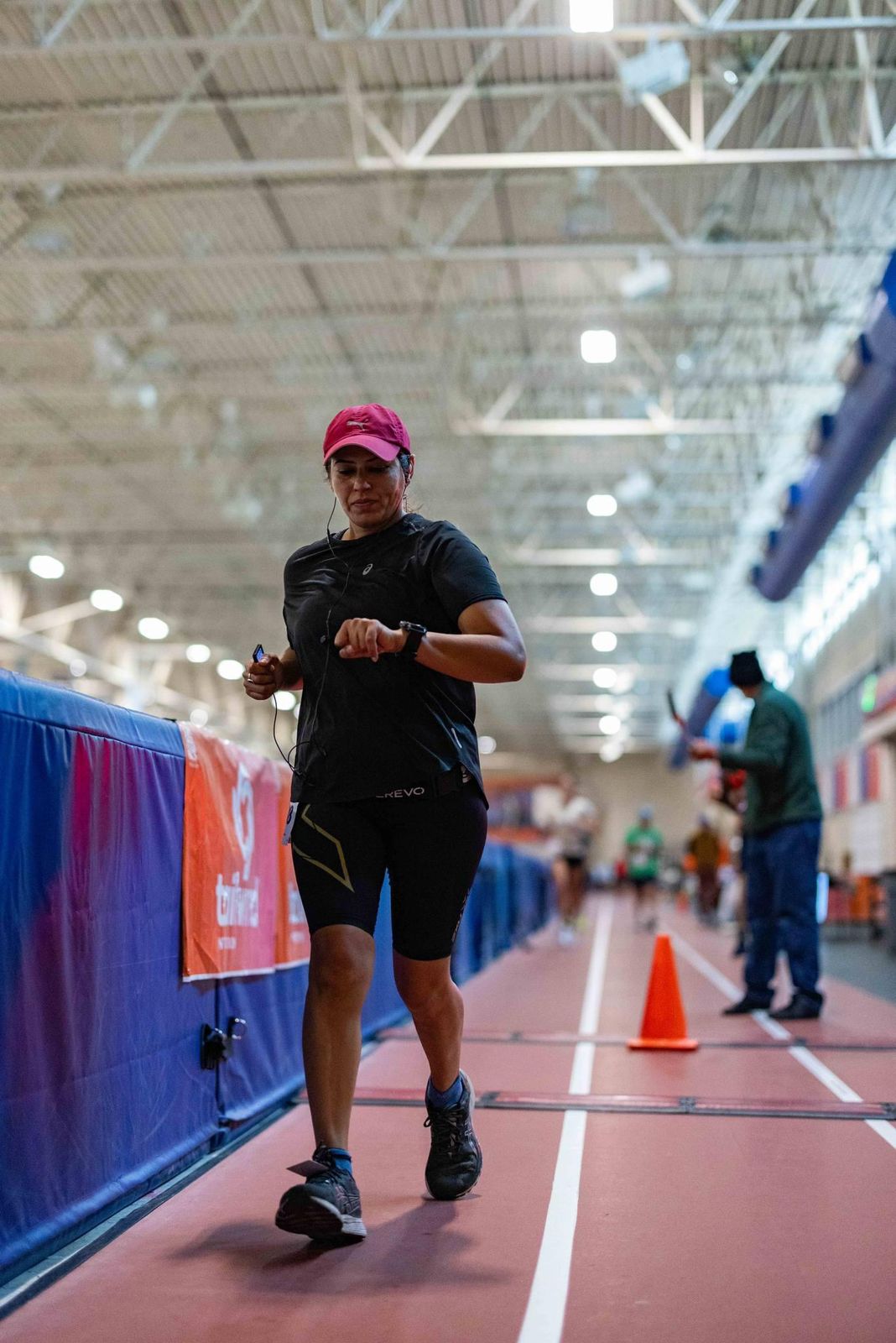
Meenal Kotak; from the event in Milwaukee, USA (photo: courtesy Meenal)
Meanwhile in 2022, in order to set a steady and systematic journey to her old endurance levels, she didn’t immediately vault from the 12 hour-race at Bengaluru to a 24-hour one. Instead, she did in all, three 12 hour-races that year to establish a solid foundation. In 2023 she participated in the Tuffman 24-hour race in Chandigarh and set a new personal best (PB) of 187 kilometres covered, an improvement over her earlier PB of 175 kilometres. Meenal is not a fast runner. Her forte is endurance; sustaining an effort for a longer period of time. And in this category, she had known for a while that her heart was in attempting multi-day events. It meant attempting runs of duration exceeding 48 hours, which was the maximum she had done till then. With this in mind, Meenal looked overseas for good opportunities and came across the event titled Six Days in the Dome in Milwaukee, USA. It had a 72-hour race, which although not well recognized as race-duration in the multi-day running fraternity was still a sensible bridge for her between the 48 hours she was familiar with and Milwaukee’s flagship six-day event, which she hoped to try at some point. She registered for the race. Sachin joined her as support crew (he does so for most of her races and Meenal finds the arrangement a big morale booster). The race turned out to be good for Meenal; in the stipulated 72 hours, she covered 379 kilometres. “ I really enjoyed those three days. It motivated me to explore deeper, the multi-day format,’’ Meenal said.
Likely taking note of her performance at Chandigarh and Milwaukee, the AFI included her in the Indian team for the 2023 IAU 24H World Championships and the 2024 IAU 24H Asia-Oceania Championships. Man proposes, God disposes. While training for the world championship (it was to take place in Taipei in December 2023), she sensed a niggle in her back. The old slip disc problem, although improved, hadn’t totally disappeared. She pulled out of the event in October. Under normal circumstances such withdrawal would demoralise any athlete. It may spark brooding and visitations to the dark zone in the head. But the post injury, new Meenal took it philosophically. She took the next 2-3 months, easy. From January 2024, she started her training for the six day-race in Milwaukee, scheduled for June. It was around this time that she got the call from AFI seeking her participation in the IAU 24H Asia-Oceania Championships. She had to accept the offer but there was a challenge. In her new cycle of training with Milwaukee in mind, until March 2024, Meenal hadn’t done a 12 hour-run, often considered vital to get ready for a 24 hour-race. She located two 12 hour-events – in Ahmedabad and Delhi – and participated in them to reacquaint herself with the experience and understand where she stood. “ I knew thereafter that I was good for 12 hours. But I couldn’t guarantee how things would be beyond that,’’ Meenal said. The Asia-Oceania championships in Australia didn’t play out well for Meenal. “ I was hoping to cover 185-190 kilometres. But I ended up with 168 kilometres. It wasn’t my day,’’ she said. Importantly, she didn’t let the reversal in fortunes, lead her into a pit of despair. She reverted her focus to the upcoming six day-race in Milwaukee.
Meenal Kotak; from the event in Milwaukee, USA (photo: courtesy Meenal)
June 2024; the race in Milwaukee featured several strong runners. “ I didn’t look at the entry list, which was displayed there. I didn’t want any pressure on myself,’’ Meenal said. The event in the US was set within an indoor stadium that held an ice-skating rink. It was therefore cold; a constant low temperature. Indoor stadium meant, there was no sunlight. On the other hand, precisely because of the synthetic setting, it was a controlled ambiance. The first day of the race went off well for Meenal. In line with her expectations, the second and third days proved to be tough. She neither ran nor slept properly. On the fourth day, things began to look up. On that day, the fifth and the sixth, she had her first taste of hallucination. There was a display board in the stadium featuring a woman’s image on it. Meenal felt the woman touch her on her shoulder, running with her and conversing with her. Some others around had more serious hallucinatory issues. “ One runner started hallucinating about a murder,’’ she said. Eventually, Meenal completed the race with a new national best for women. She thinks Indians have a talent for resilience. They can take a lot. It’s part of the South Asian package. Now 44 years old, Meenal’s wish is that somewhere on the way to her fifties or in her fifties, she should try the 52 day-Sri Chinmoy Self-Transcendence 3100 Mile Race.




 Outrigger