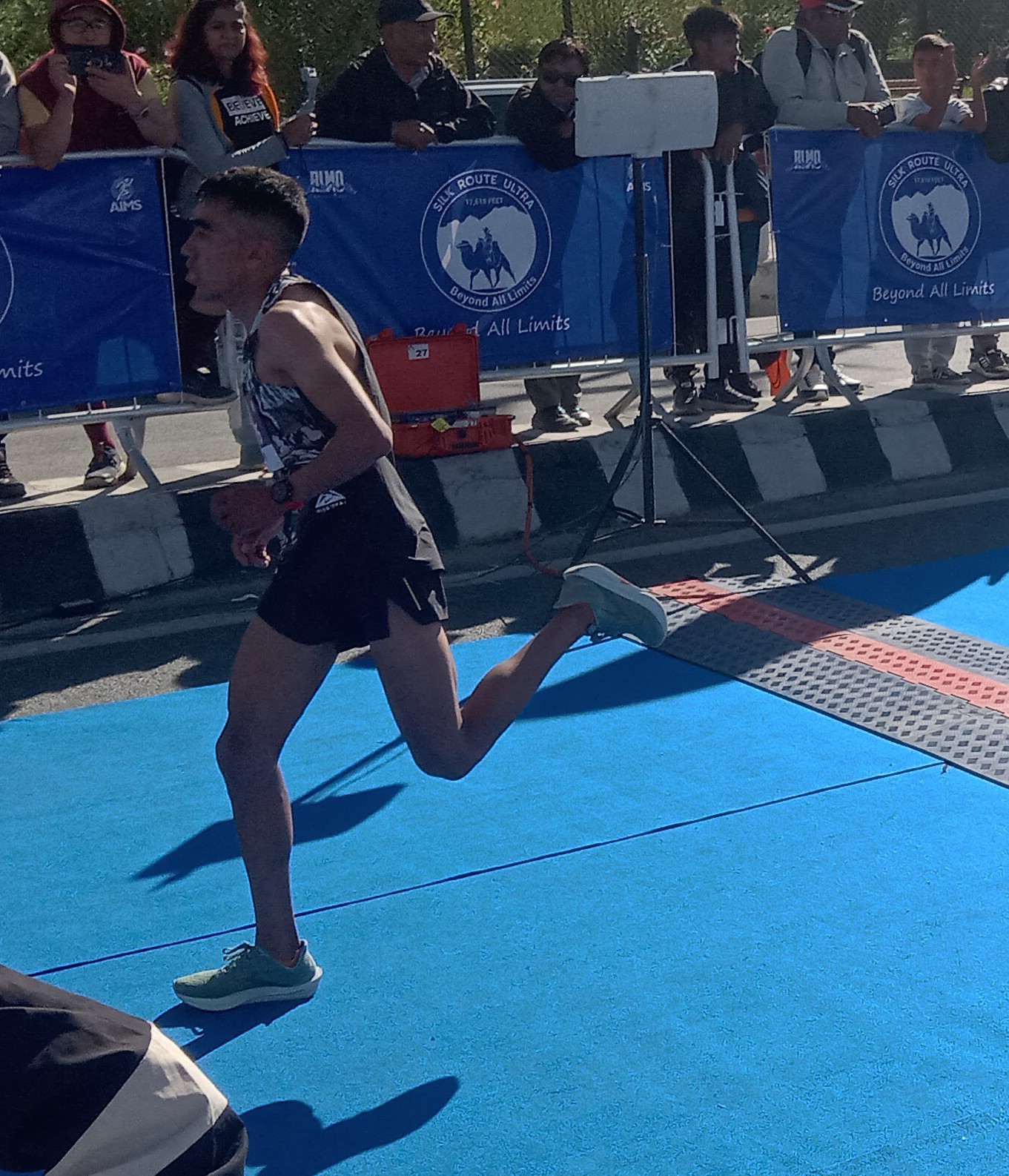
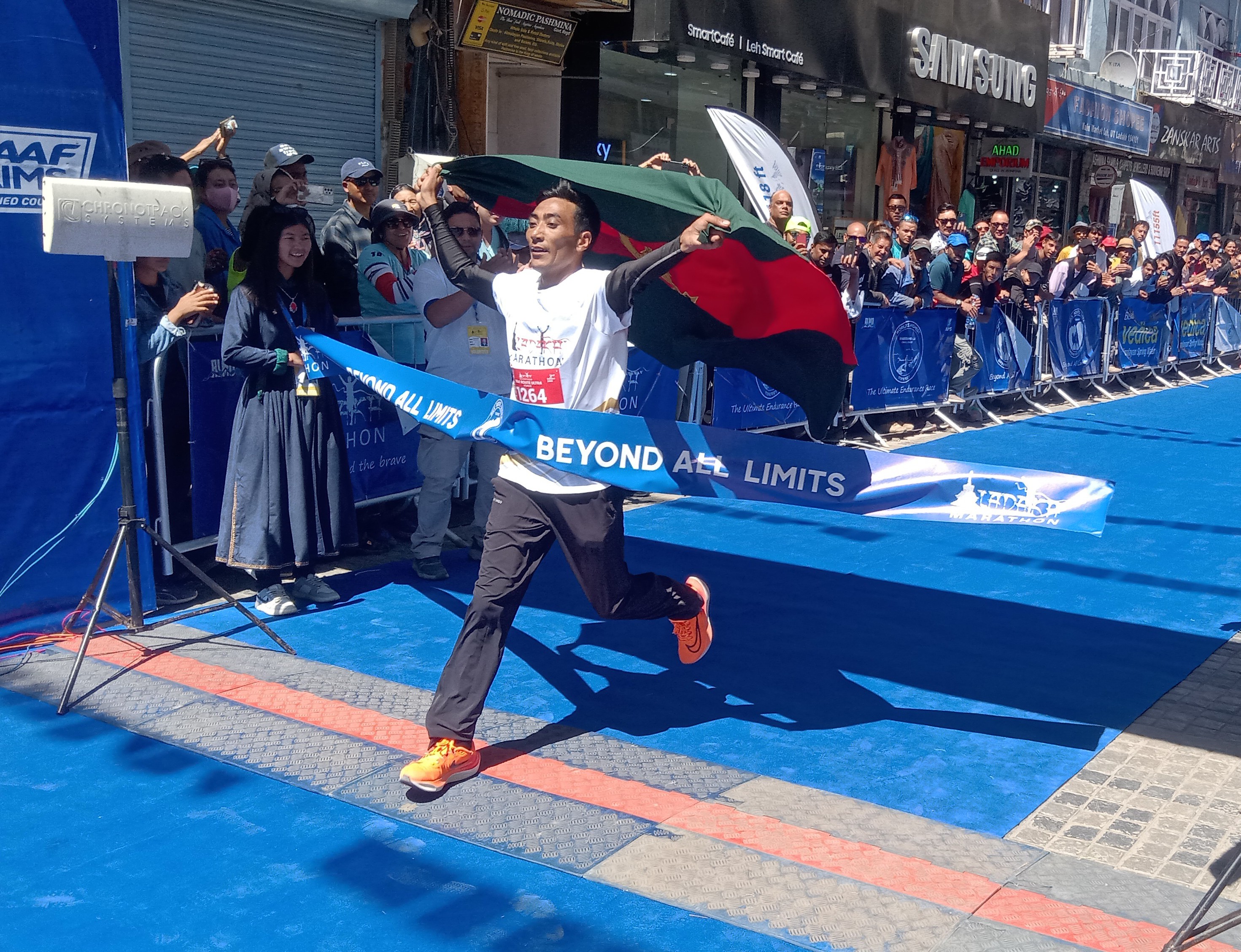
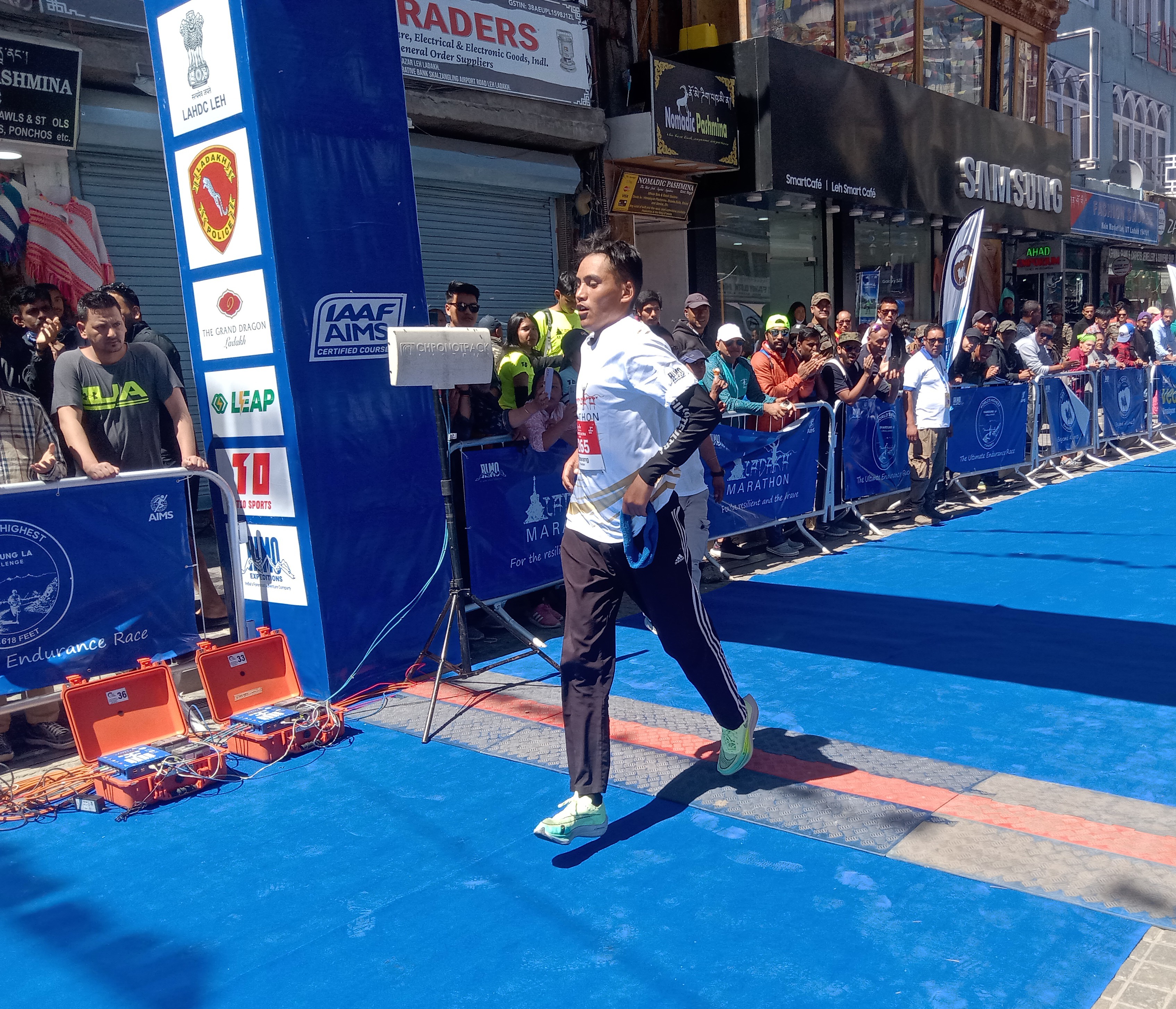
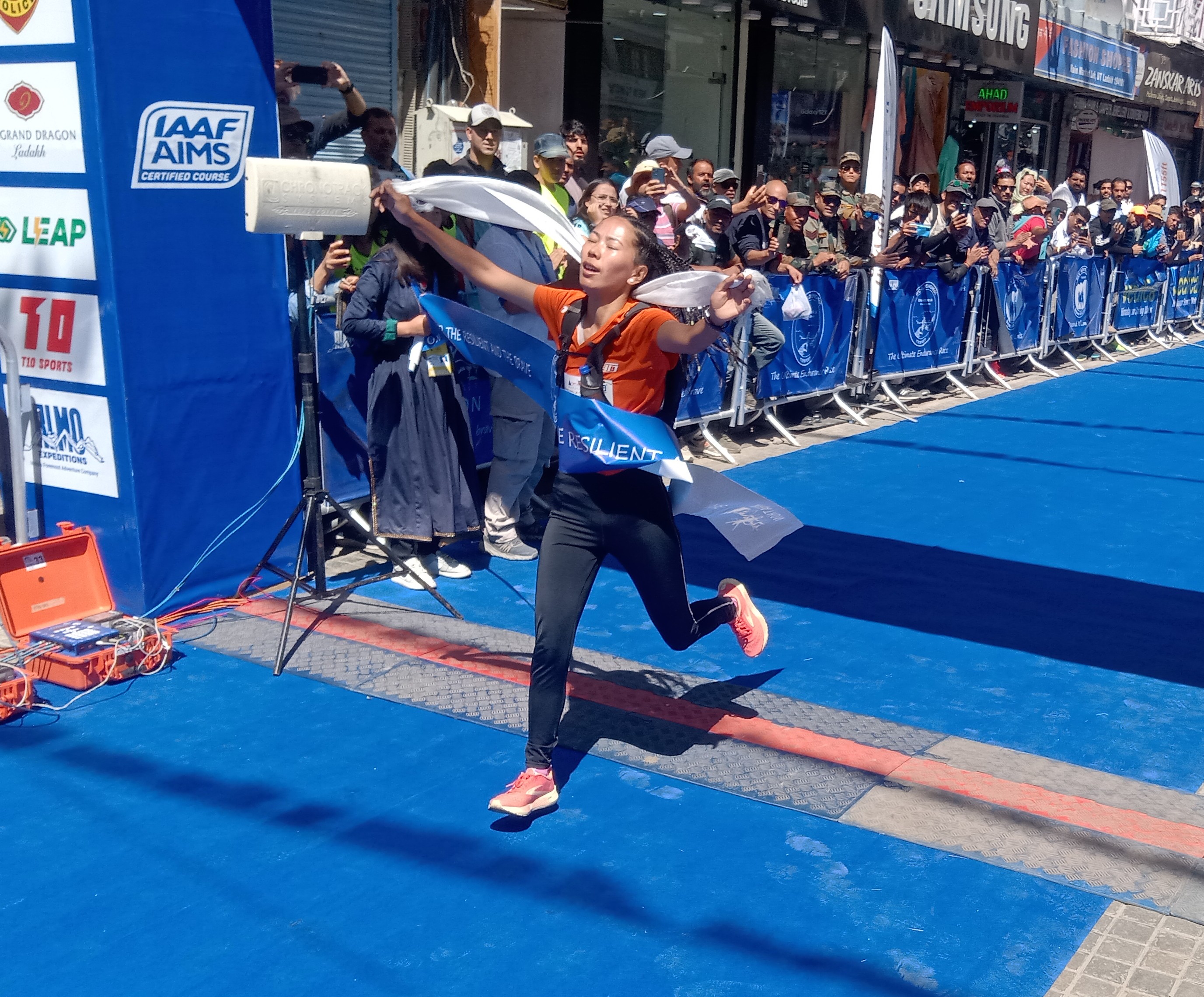
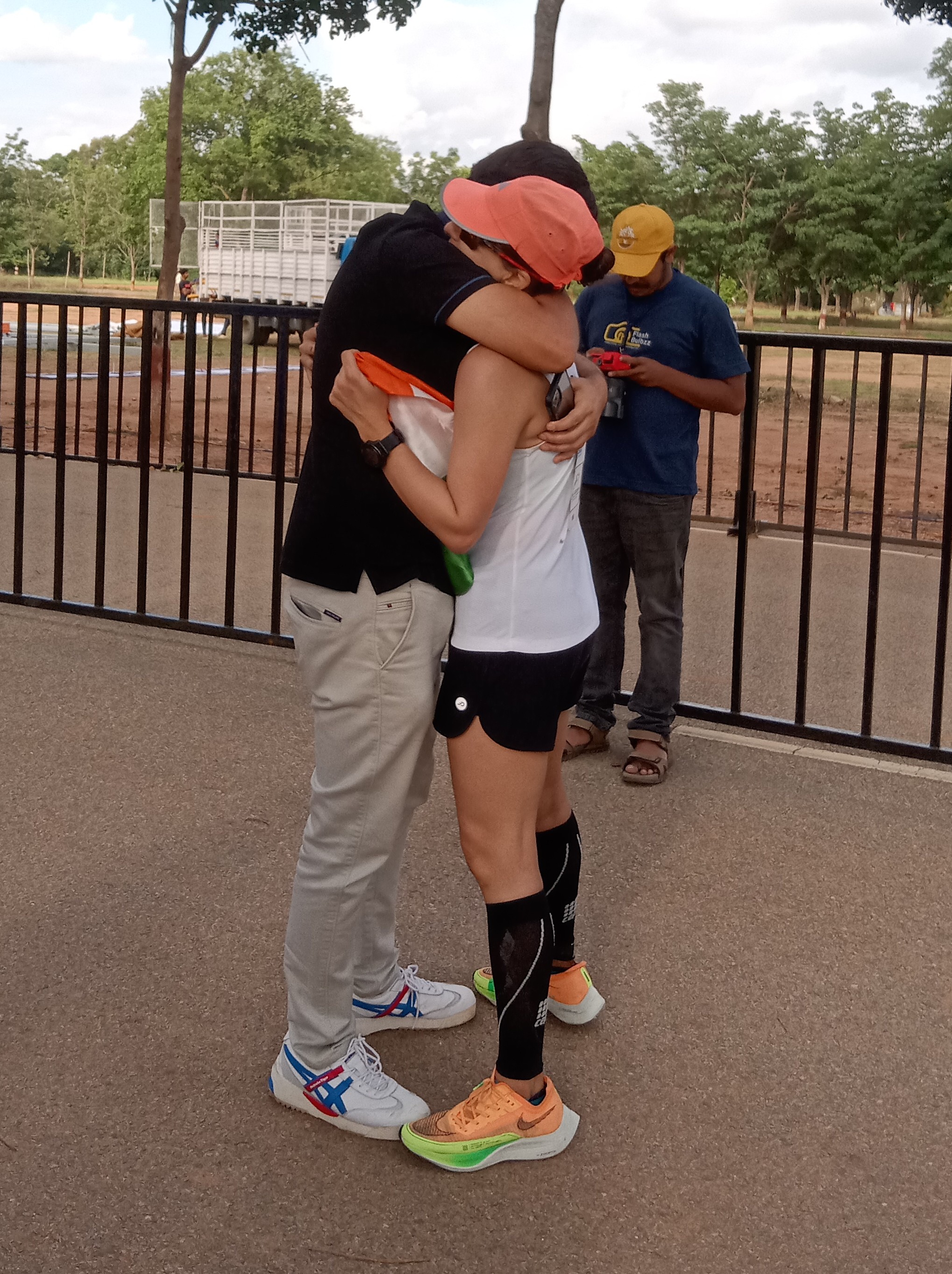
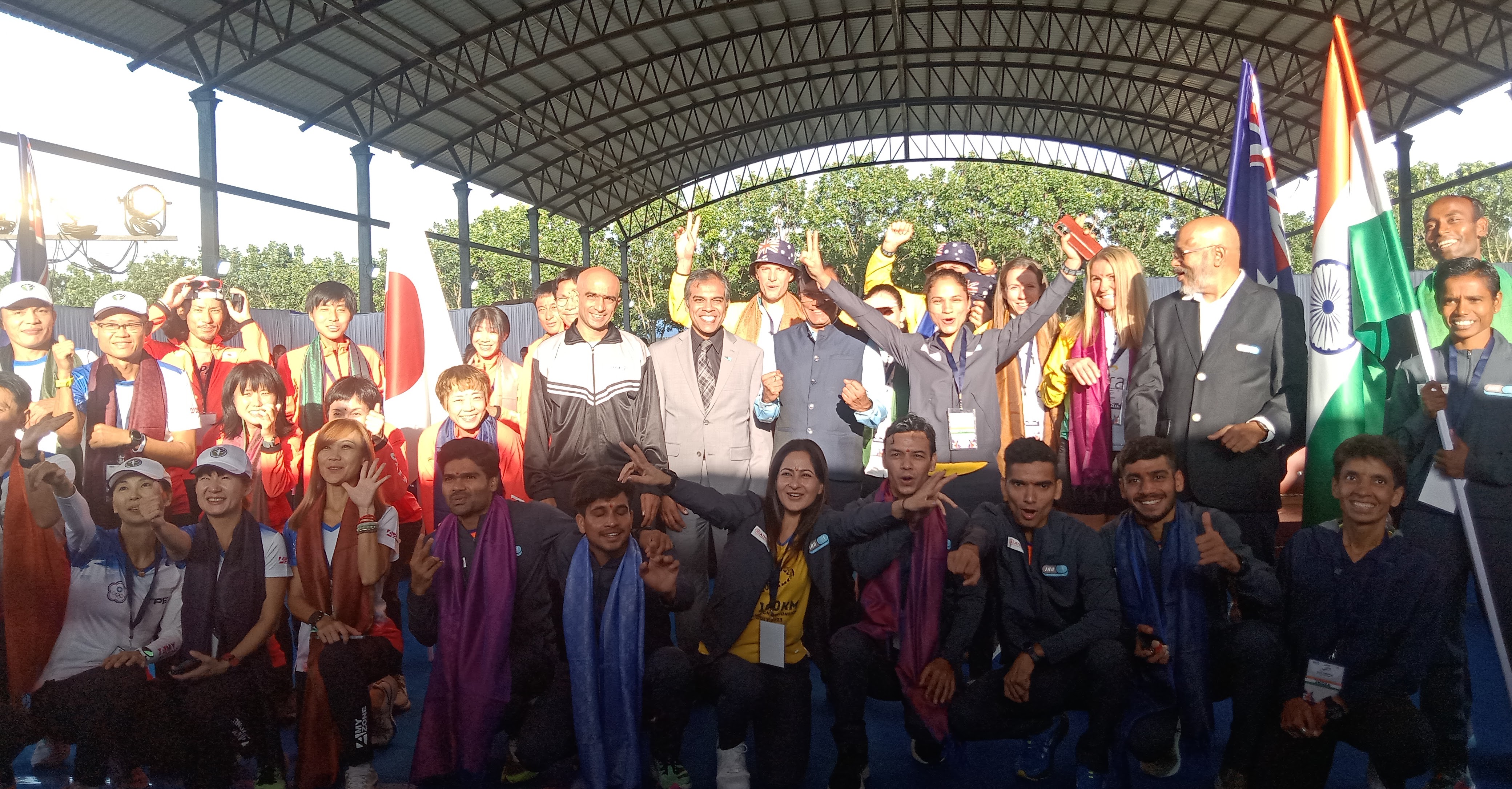
Nawang Tsering at the finish line of the 2023 Ladakh Marathon (photo: Shyam G Menon)
Hans Raj, Stanzin Chondol win in half marathon
Nawang Tsering and Jigmet Dolma successfully defended their titles at the tenth edition of the Ladakh Marathon, which concluded in Leh on Sunday, September 10, 2023.
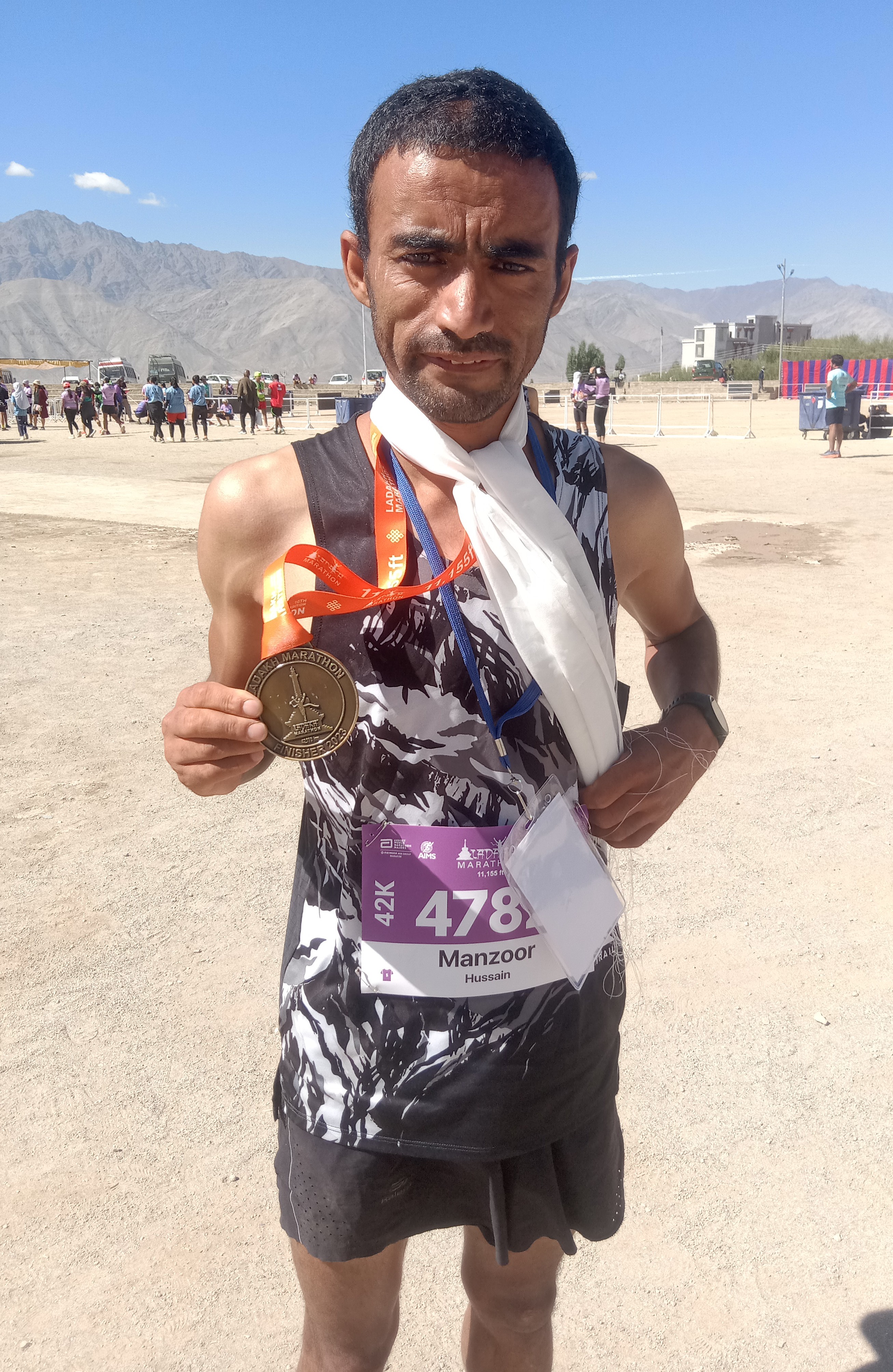
Taking top honors in the men’s open category with timing of two hours, 42 minutes and two seconds, Nawang was close to his own course record (2:41:42 / source: Olympics.com) set in 2022. Jigmet Namgail (2:52:58) took silver while Manzoor Hussain (3:20:35) earned the bronze medal.
It may be noted that the sub-three-hour performances were happening at an elevation of roughly 11,500 feet (altitude of Leh). Running becomes difficult when altitude increases owing to the reduced oxygen level in the atmosphere. An official note from the administration of Ladakh, dated March 29, 2022, about the performance of Ladakhi runners at that year’s New Delhi Marathon, highlights Nawang’s 2:39:39 (of 2022) as the best timing yet by a Ladakhi marathon runner. Both Nawang Tsering and Manzoor Hussain have been part of the Ladakh marathon team that Rimo Expeditions sent annually to races in India’s plains.
Jigmet Dolma finished first among women at the 2023 Ladakh Marathon with timing of 3:27:53. In 2022, she had clocked 3:21:19. In 2017, she had set the course record at Ladakh Marathon, covering the distance in 3:18:56 (source: Olympics.com). For long a part of the Ladakh marathon team that Rimo Expeditions formed and supported, Jigmet is among Ladakh’s best female marathon runners. Known to have determinedly chased a sub-three-hour finish in the marathon, she finally got it when she finished third at the 2023 New Delhi Marathon; she clocked 2:56:41. Jigmet has been a part of the national team. On Sunday in Leh, She was followed to the finish line by Disket Dolma (3:39:35), who too has featured in Rimo’s team. Deepika Prakash (4:36:21) took the bronze medal.
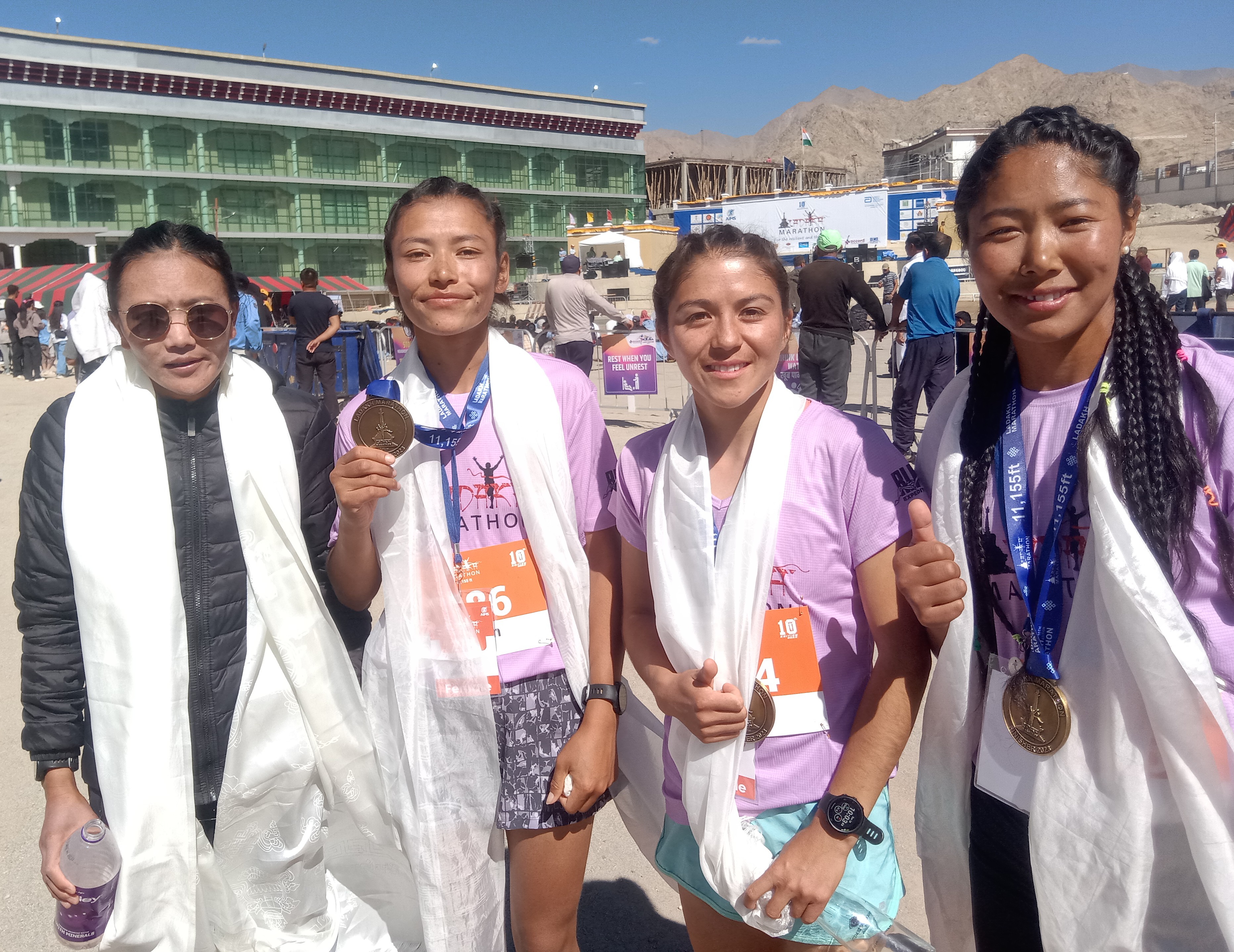
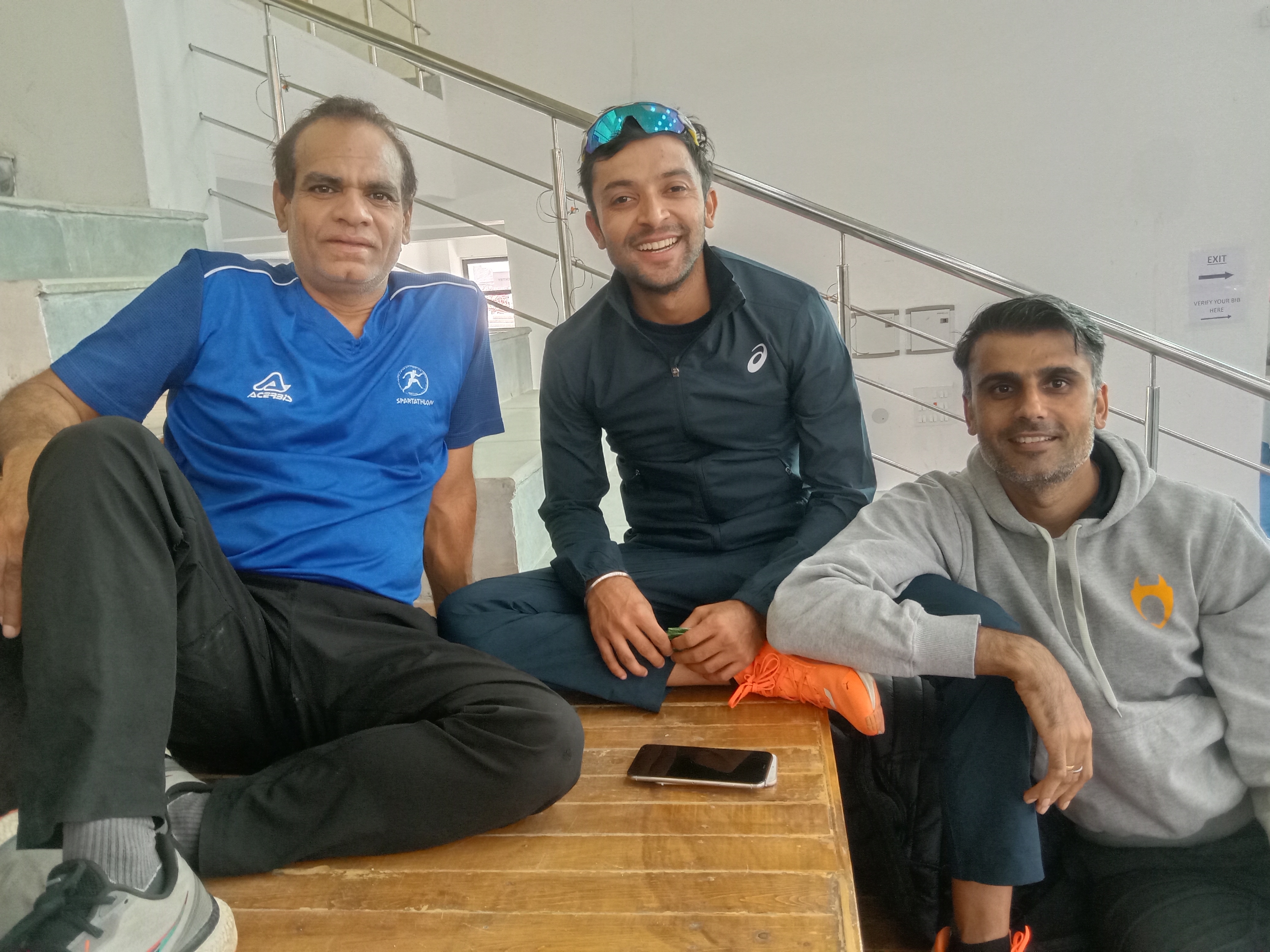
From left: Jigmet Dolma, Stanzin Dolkar, Tashi Ladol and Stanzin Chondol after their respective podium finishes in the 2023 Ladakh Marathon in Leh (photo: Shyam G Menon)
When the Ladakh Marathon was held for the first time in 2012, the winner among men, Tsering Gyatso, had clocked 3:36:18. Jigmet Skitzom, who topped among women, clocked 4:51:30 (source: Olympics.com).
Speaking to this blog after Sunday’s Ladakh Marathon, Jigmet said that she wasn’t quite satisfied with her performance and would therefore attempt to improve her timing at the marathon in Kargil scheduled for September 17. Attempting further improvement in her timing would be her goal for the approaching season of marathons in the plains, she said. In a fresh chapter to the Ladakh marathon team-story, Jigmet’s former partner in running and a good marathon runner in her own right, Tsetan Dolkar, currently works as an athletics coach in Leh.
According to Stanzin Chondol, when she first ran the half marathon at the Ladakh Marathon many years ago, she took two hours, 19 minutes to cover the distance. On Sunday, Stanzin crossed the finish line in 1:29:43 to place first among women. Her wish is to improve her timing further to the region of an hour and 25 minutes, at which point she believes, a shot at the marathon may seem reasonable. Silver in the women’s half marathon went to Stanzin Dolkar (1:31:47) and the bronze to Tashi Ladol (1:35:54). All of them have been part of Rimo’s team. Interestingly in 2022, the same trio had graced the half marathon-podium albeit in a different order with Tashi placing first, Stanzin Chondol coming in second and Stanzin Dolkar, third.
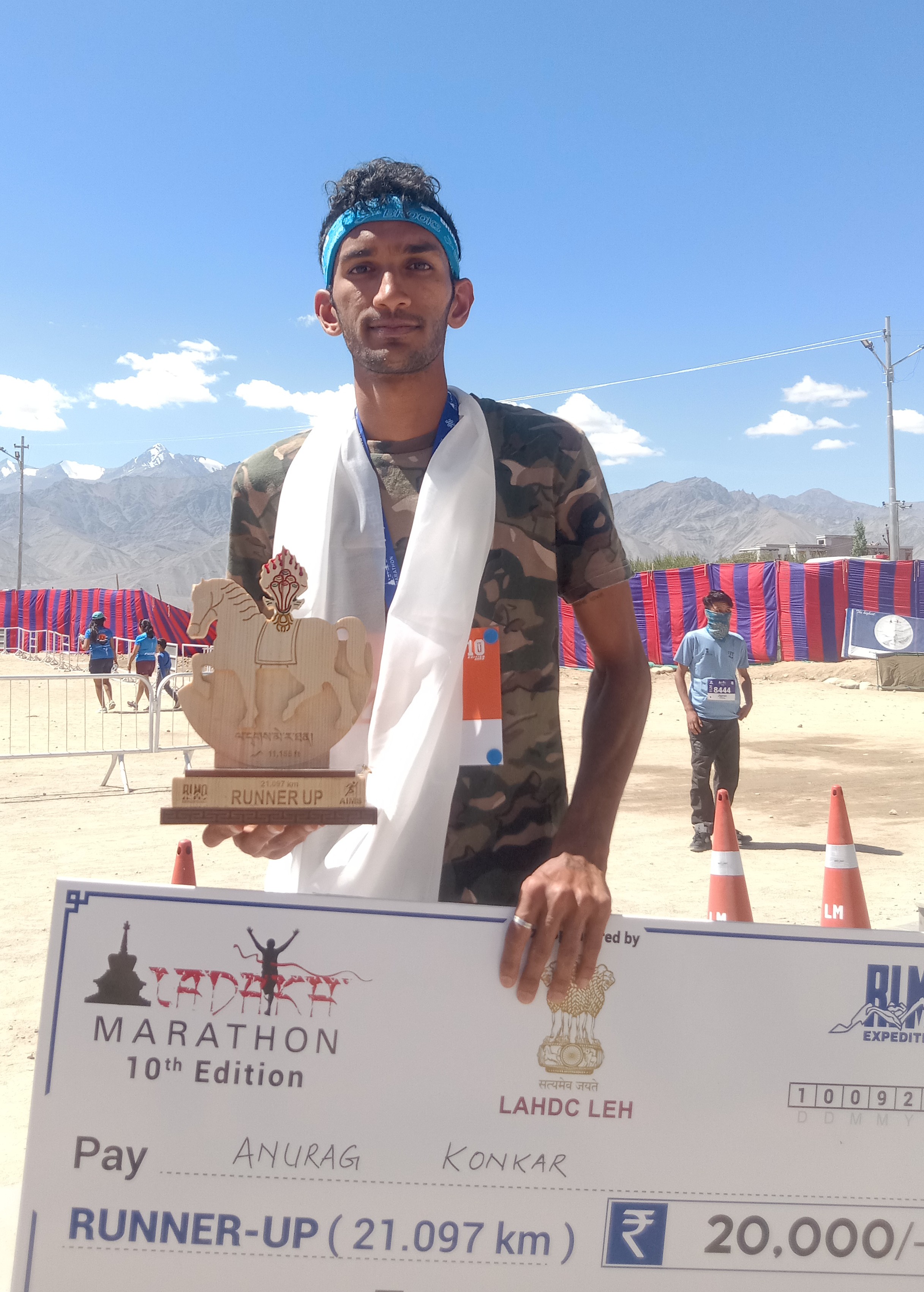
Anurag Konkar (photo: Shyam G Menon)
Manzoor Hussain (photo: Shyam G Menon)
Among men running the half marathon, the first place went to Hans Raj (1:21:28). He was the winner in 2022 too. Anurag Konkar, a university student from Pune, took the second place with timing of 1:21:43. Tsewang Nangdan (1:22:13) placed third. Speaking to this blog, Anurag said that he has been into running since the past five years and is currently focused on the half marathon. In the last one year, his mileage in training has been high and he believes that may have contributed to improved cardio vascular efficiency, something important to perform well at altitude. His training for the half marathon at Ladakh Marathon, was done in Pune. Upon arrival in Leh, he rested for three days and then did light running for the next three days as preparation locally for Sunday’s half marathon.
With two ultramarathons, a marathon, a half marathon and a cachet of races over the shorter distances, the Ladakh Marathon now spans four days. It is India’s premier running event at altitude and receives participants from elsewhere in the country as well as abroad.
(The author, Shyam G Menon, is a freelance journalist based in Mumbai.)
Shabbir Hussain, winner of Silk Route Ultra (photo: Shyam G Menon)
Shabbir Hussain wins 2023 Silk Route Ultra
A dramatic victory for Tsering Yangzam
Rigzin Gyurmeth wins Khardung La Challenge; Namgyal Lhamo tops among women
Amit Gulia is first non-Ladakhi runner to secure sub-17 hours-finish in Silk Route Ultra
The evening of September 6 was a reality check for the runners gathered at Kyagar in Ladakh’s Nubra Valley, ahead of commencement of the 2023 Silk Route Ultra (SRU).
In store was 122 kilometres of running over one of the world’s highest motorable passes along a road that has more gradients than flats, the whole thing set in an ambiance of unpredictable mountain weather and the effort of working at high altitude. Prior to leaving Leh for Kyagar, the local weather had shown signs of the season beginning to switch. After weeks of pretty warm weather, there had been a shift to slightly cool evening breeze with grey clouds gracing the peaks of the nearby Ladakh Range. People in Leh said it hinted of the weather beginning to change. In Kyagar, the evenings additionally featured strong, chilly winds. There was worry on what it may hold for the late evening race-start scheduled for September 7 and more critically, how the weather may be, as one ran up the several kilometres of gradient to Khardung La (17,618 feet).
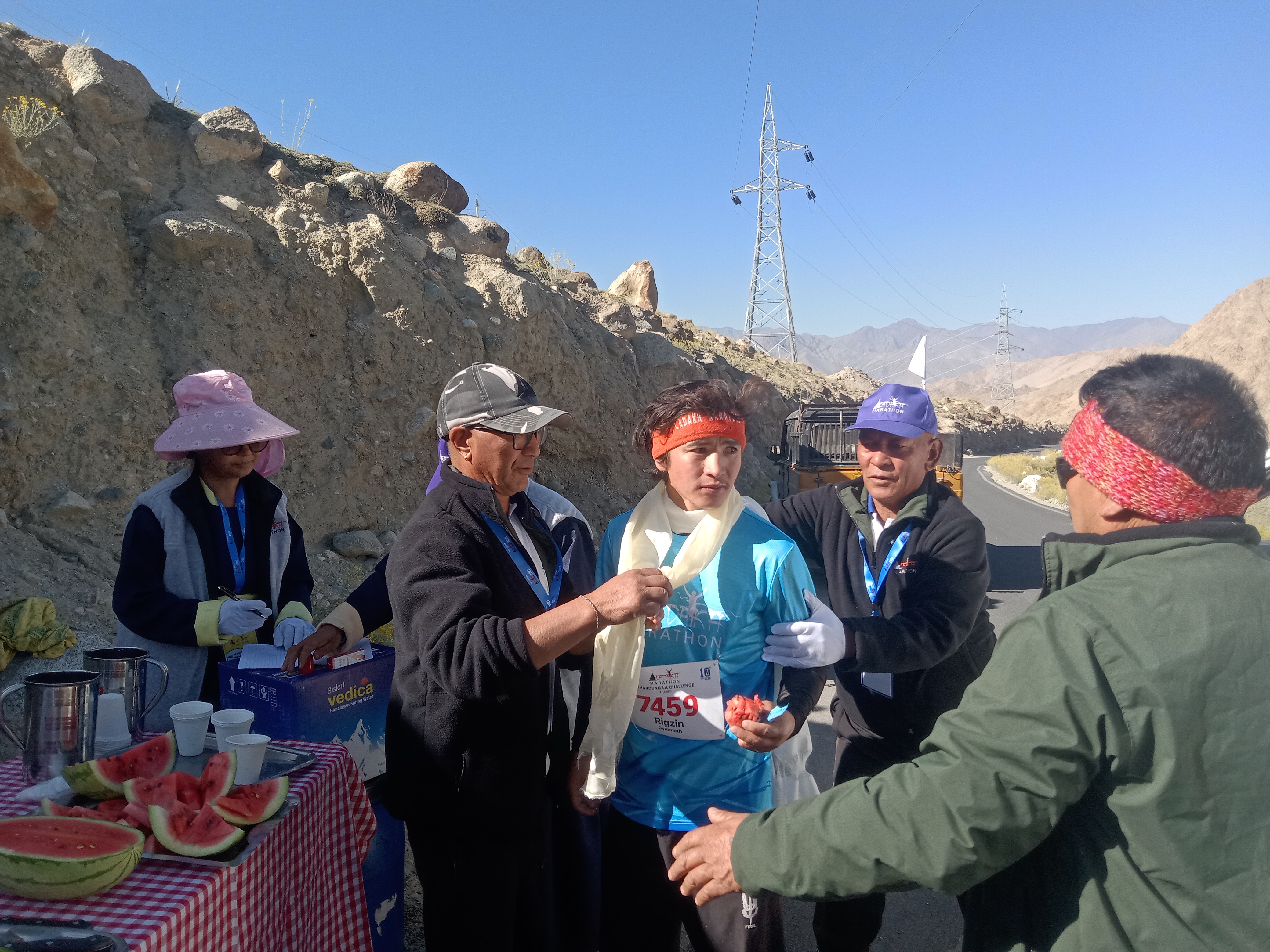
Rigzin Gyurmeth who won the Khardung La Challenge being welcomed at an aid station on the approach to Leh (photo: Shyam G Menon)
Held as they are at altitude, most races within the Ladakh Marathon (the 122 km-SRU and the 72 km-Khardung La Challenge, are part of it) tend to favour Ladakhi athletes who are naturally efficient at handling altitude. For those coming from outside, the attraction is precisely that of being an outsider, preparing well to handle hill runs, acclimatizing patiently to Ladakh’s high altitude and finding out how well one tackles the test of endurance taken up. Partly due to the natural advantages the hosts possess, the commencement of the Silk Route Ultra (it was into its second edition in 2023) was done in two stages. The race’s elite contingent, typically comprising of Ladakhi runners (mostly serving in the military) began their run one and a half hours after the rest of the field set out at 7PM. The logic was that if everyone ran together, the Ladakhis would open up too big a gap with the rest of the field for logistics, race management and monitoring to be done properly. While this may seem just, the truth is, the Ladakhi runners don’t quite enjoy the late start. As more than one of them said, it is boring to be race-ready and wait in a small group for the run to commence after everyone else has left.
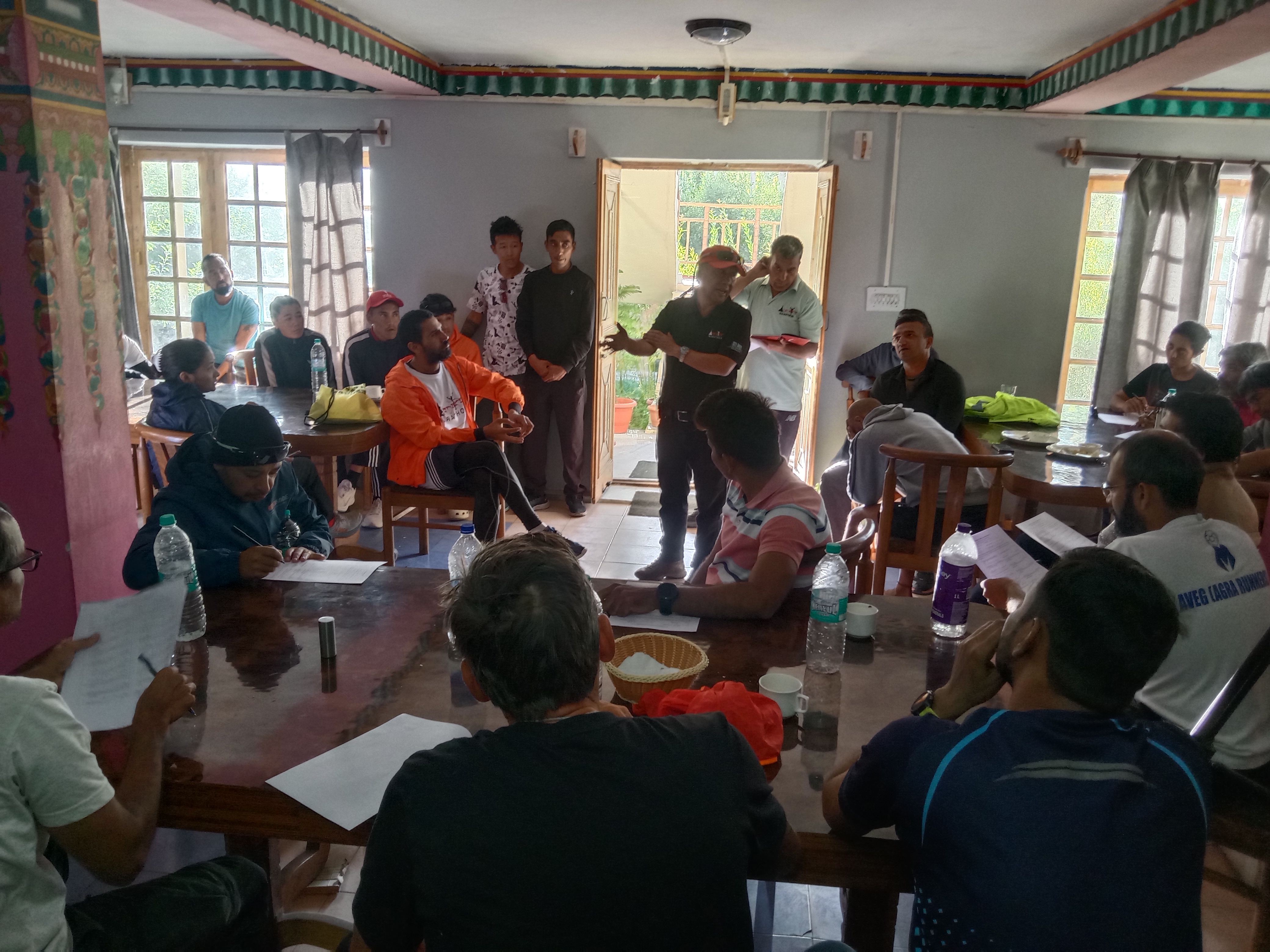
SRU; pre-race briefing at Kyagar (photo: Shyam G Menon)
Hakim, who was part of the organizers, was due to trail the elite team till SRU merged into the much larger flow of Khardung La Challenge (KC) runners starting the race from Khardung village. KC was slated to commence at 3AM on September 8. This writer found a seat in Hakim’s vehicle. The 2023 SRU was happening with a backlog of improvements to make. As mentioned in an earlier article, it is not an easy race. Although, it is only 122 kilometres long (not very long for an ultra) and is merely an extension of KC from its start line by another 50 kilometres, given altitude and mountain terrain, that additional distance suffices to tire people. Many wither away. Runners themselves told this blog that fairly easy eligibility to participate and a misconstrued perception of SRU as just an extension of KC, caused mismatch in expectation and actual outcome, provoking disappointment. For some, this is what happened in the inaugural edition of the race in 2022. At least a few, had come back in 2023 to try their luck again. Raj Vadgama had committed the error of running the early portion of the 2022 race, fast. Amisha Jain had experienced altitude sickness.
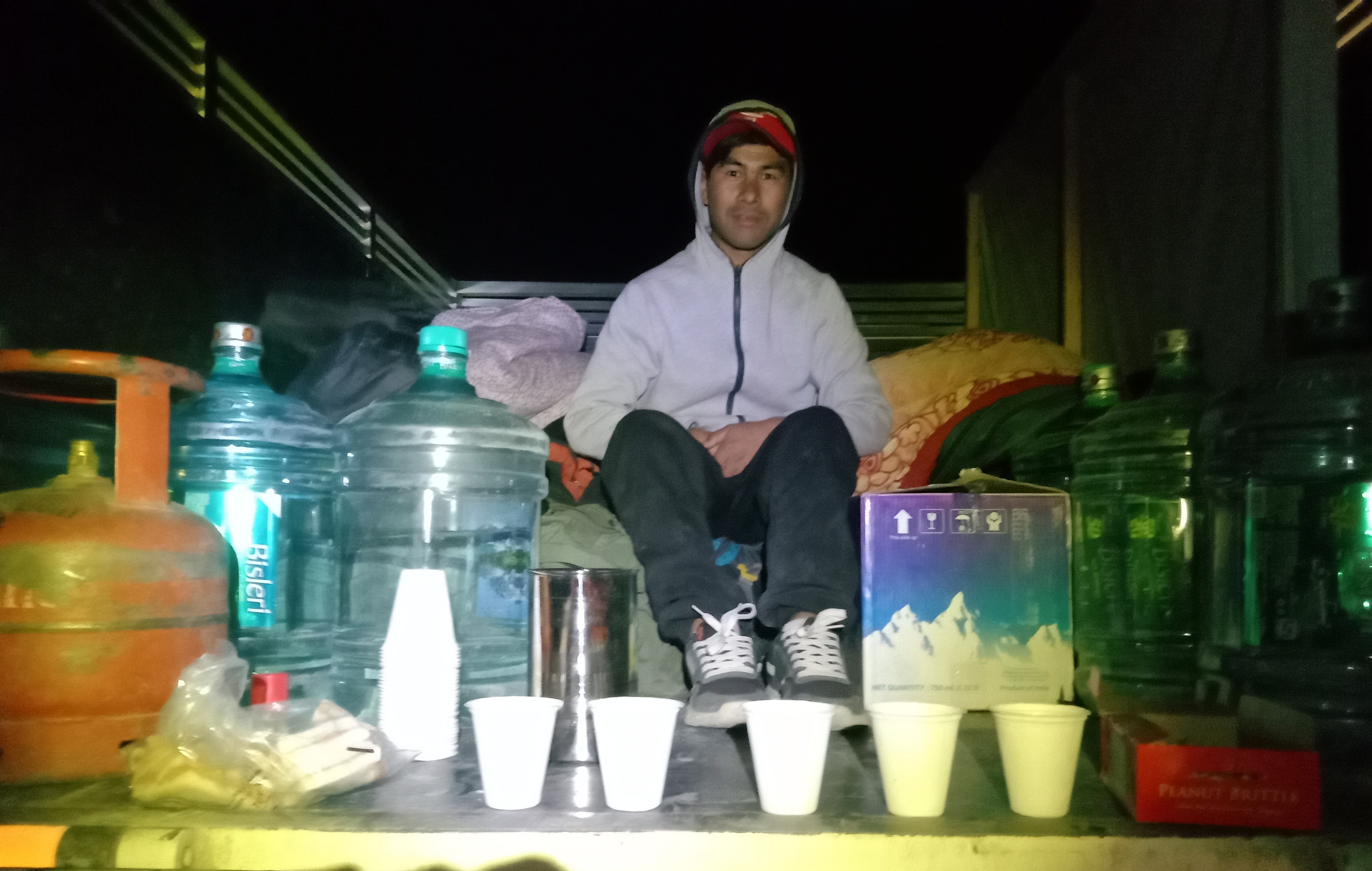
Midnight, September7-8; a villager manning an aid station on the cold northern slopes of Khardung La. This facility operated from the back of a pick-up truck (photo: Shyam G Menon)
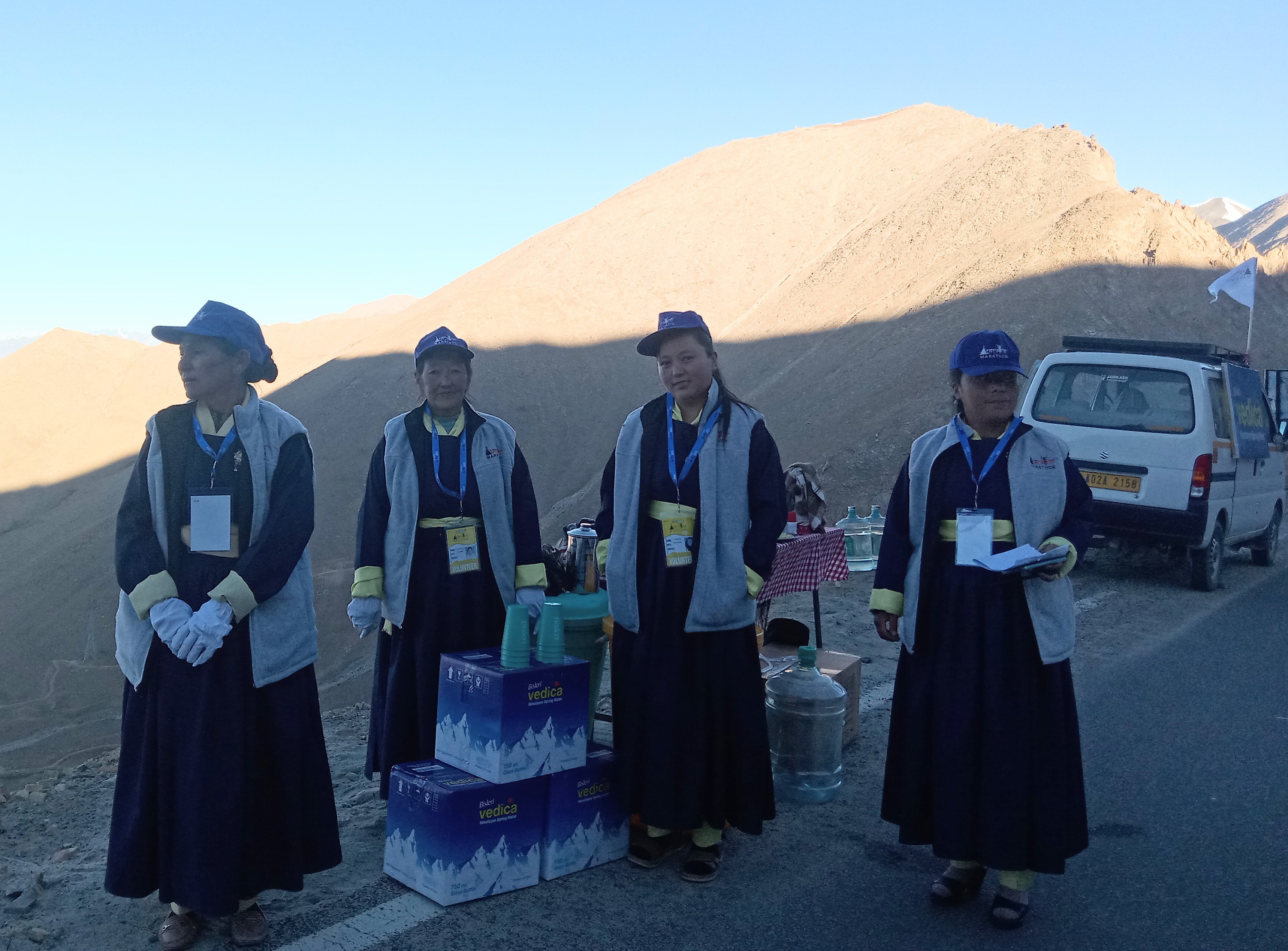
Morning of September 8; an all woman aid station on the sunnier southern slopes of Khardung La (photo: Shyam G Menon)
That year, there were also complaints of aid stations being too spaced apart and some items the runners would have loved to see included (warm water being one), absent in the support on offer. In 2022, Amit Gulia had seen the energy gels he brought along for SRU, thicken in consistency in the bitter cold of high altitude. Consumed during the race, the gel stuck to his throat. He wanted warm water to wash it down. But it wasn’t available. Amit who completed the 2022 Spartathlon after his aborted run at the year’s SRU was back for the 2023 edition. Kyagar and the accommodation facilities provided ahead of the 2023 race offered the calm any participant would seek prior to a race. The runners headed into the race spent time differently. Some appeared to prefer self-time and were rarely seen. The more gregarious lot indulged in conversation and banter. The runners from Ladakh Scouts and the Indo Tibetan Border Police (ITBP) walked around, indulged in the occasional game of table tennis and rested. Ace runner, Shabbir Hussain, rested a lot. Notwithstanding this portrait of life from Kyagar, the countdown to the race’s start on September 7 was laced with avoidable uncertainty. The culprit was the pre-race medical check-up. It got delayed. There was also confusion on the timing of the pre-race lunch at one of the hotels. The runners sorted it out. At 5PM, there was a race briefing where Chewang Motup, race director of the Ladakh Marathon, informed that the distance between SRU aid stations had been reduced and items like warm water would be made available at some of the stations. The aid stations had also been provided bright solar lights; it lights up the immediate surroundings and makes the stations visible from far. Motup emphasized safety in terms of managing altitude and asked the runners to be mindful of sections featuring road-work in progress.
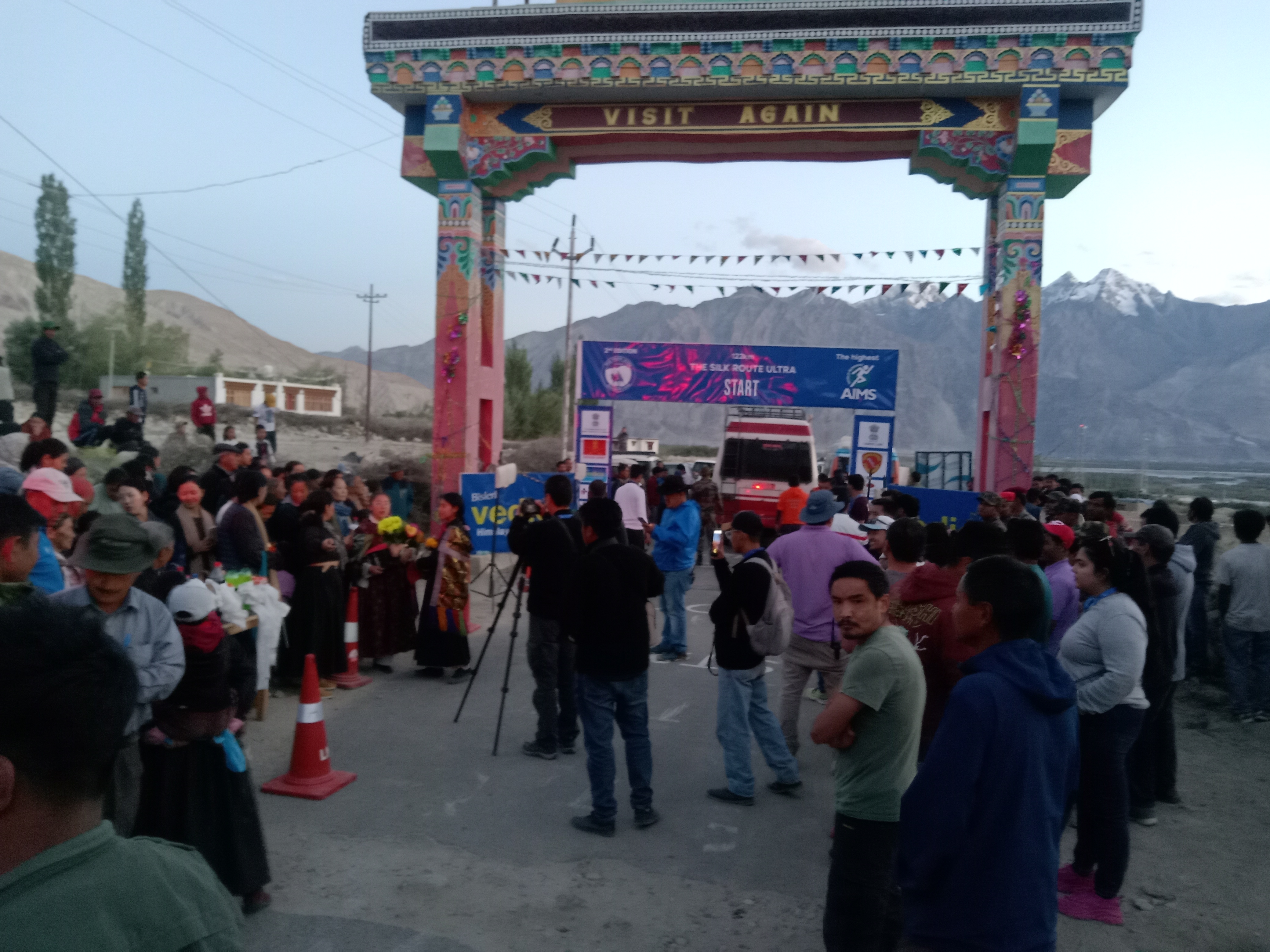
September 7 evening; SRU start line at Kyagar (photo: Shyam G Menon)
At 7PM, it seemed to be a positive, upbeat lot of runners who commenced running from Kyagar as the first SRU batch. Phunchok Tashi, runner from ITBP, who at 47 was among the older participants (and a fine person to talk to), had to sit out the race because his blood pressure was found to be high. He had placed sixth among men in the 2022 inaugural edition of SRU. Tashi, who hails from Sakti village near Leh, felt the potential outcome of the 2023 race couldn’t be predicted with absolute certainty. Shabbir Hussain, 29, was the strongest runner in the elite field. He was also the more experienced, having run and got podium finishes in KC multiple times before and placed second in the 2022 SRU. But both Stanzen Phuntsog, 26, and Tsewang Kundan, 23, had age on their side. Stanzen was the bronze medallist from 2022 SRU while Kundan was bronze medallist from 2022 KC.
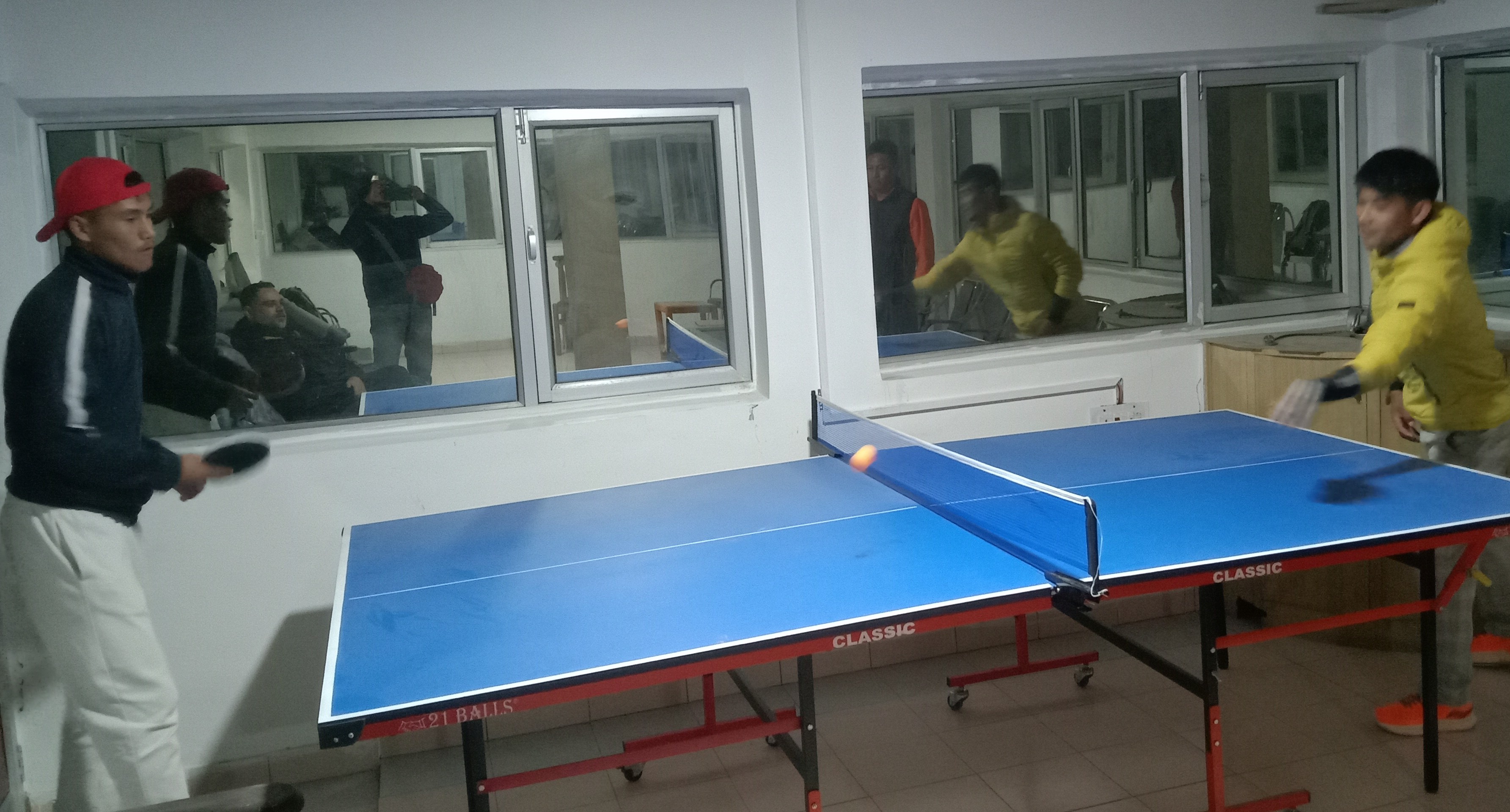
September 6 night; Kundan and Stanzen relax over a round of table tennis at Kyagar (photo: Shyam G Menon)
All three of them represented a unique Ladakhi opportunity in running and also an ongoing dilemma; a glass ceiling to break. As denizens of altitude, Ladakhis enjoy good endurance. Comparatively weak in speed, their showing in the classical marathon – it is a blend of speed and endurance – has been a mixed bag. While outsiders struggle to run in Ladakh’s rarefied atmosphere (high altitude means lower oxygen level), the Ladakhis have their own struggle coping with the heat, humidity and intense competition of the Indian plains. The partiality to endurance appeared reflected in Shabbir’s choice. Years ago, he ran Ladakh’s annual marathon just like that and had won it. His preference thereafter wasn’t to stick to the marathon; he shifted to the longer, endurance-busting ultramarathon. Asked if Ladakhi female athlete, Jigmet Dolma, who elected to focus on the marathon had done a brave thing, Shabbir said yes. Her decision is a shift away from the Ladakhi (maybe mountain) choice of endurance over speed. But therein lay a problem.
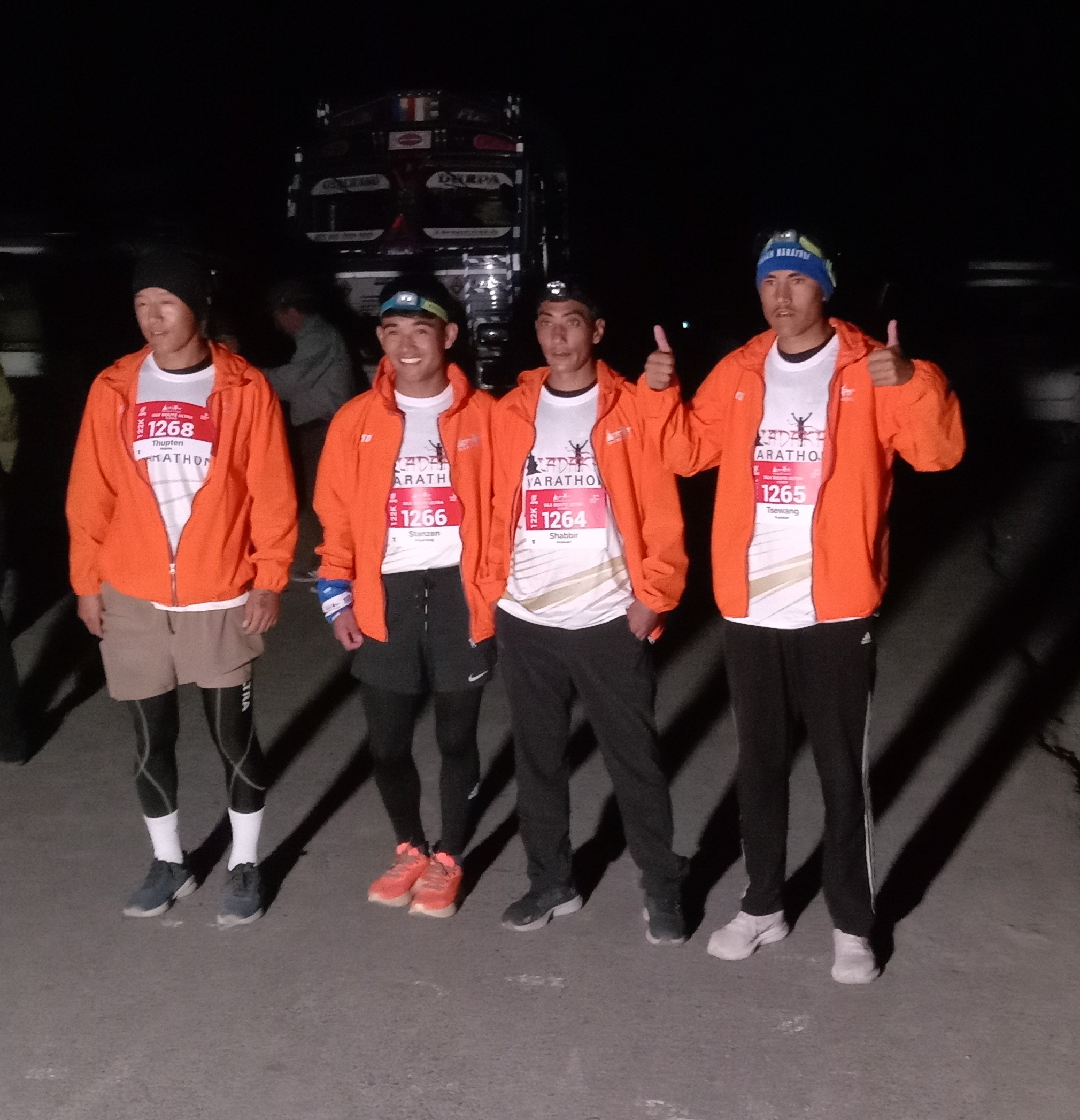
The four person-elite team for the late-start at Kyagar; from left: Thupten Nyima, Stanzen Phuntsog, Shabbir Hussain and Tsewang Kundan (photo: Shyam G Menon)
Thanks to the compulsions of media and broadcasting (which generate millions in revenues for broadcasters and sport organizers worldwide), the appetite of huge sporting spectacles like the Olympics is limited to the marathon when it comes to endurance events in athletics. Television will not risk boring audiences with extended formats of sporting events. It is a paradigm that has only grown tighter thanks to the onset of our generation of impatient audiences demanding quick results. The Olympics in turn shapes choice of sports and training, at national level. It is a known fact that the ultramarathon which can span several hours, does not enjoy the same patronage as the marathon, in India’s sports establishment. Consequently, even within institutions encouraging sports, like the military, the ultramarathon is an outlier in imagination dominated by focus on disciplines at the Olympics. Many, enamoured by the Ladakhi capacity to handle altitude, suggest that they embrace the marathon. But they overlook the nature of the marathon and its history of sterling athletes found in the mid altitudes. It is a transition the Ladakhis used to high altitude must figure out, how to bridge. Shabbir, who works for the army, has a training calendar that revolves mainly around one event – the ultramarathons of the Ladakh Marathon. He is not seen at other ultramarathons in India although ultramarathoners from elsewhere have a tough time running in Ladakh’s high altitude environment. Which also means, they find it tough to beat this Kargil athlete in his home ground. Shabbir trains mostly by himself with inputs gleaned from his own ultrarunning experience. With no particular interest in their abilities shown by the Army Sports Institute and other similar organizations, Ladakhi elite runners seem to rise and fade in Ladakh itself. It is an existence in running without a proper road map. An exception was the decade-long support for local runners extended by Rimo Expeditions, organizers of the Ladakh Marathon; they fund and send Ladakhi runners to compete in the marathons of the plains.
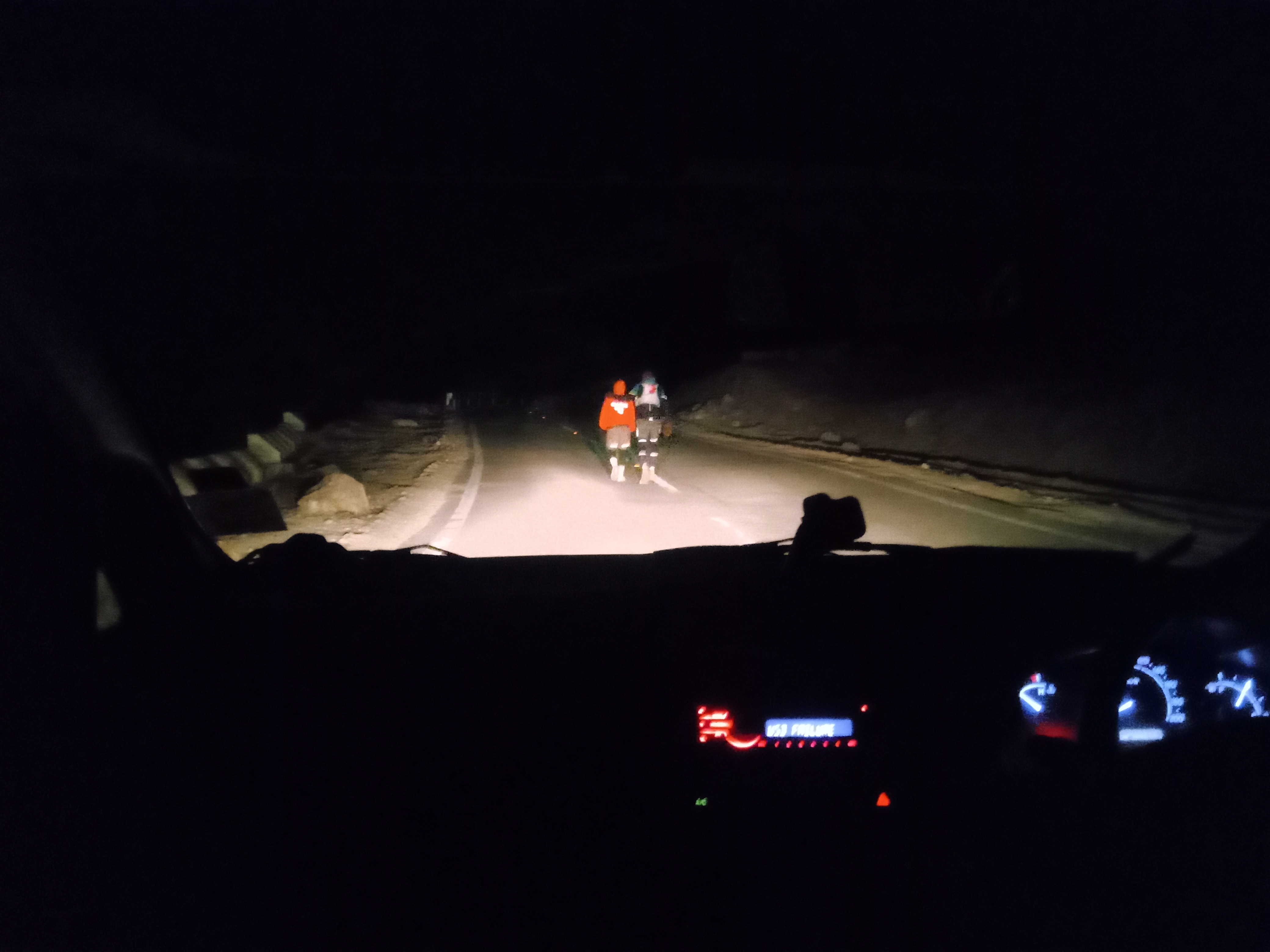
Runners on the road; the view from within the official vehicle (photo: Shyam G Menon)
At 8.30PM on September 7, there were four elite runners assembled at the SRU start line in Kyagar. There was the race favourite, Shabbir. Giving him company, were the two younger runners – Stanzen and Kundan. All three were from Ladakh Scouts of the Indian Army, the regiment that has traditionally dominated the podium at the Ladakh Marathon. The fourth person at the start line, was Thupten Nyima of the Special Frontier Force (SFF), a regiment composed mostly of Tibetans living in India. In 2022, Thupten had finished eighth among men in SRU. Interestingly, the 2023 edition of the Ladakh Marathon was accompanied by the buzz of various regiments of the army with its runners enrolled in the event, likely to put up keen mutual competition. In pre-race conversations, Shabbir had said when asked, that the Ladakhi runners usually stick together till the final phase of SRU. Into the final stretch, competition amongst them picks up. Within the first 10 kilometres or so of the elites taking off in the 8.30PM late-start, Shabbir and Stanzen set a fast pace with Thupten matching it. This went on for about an hour. Thereafter, Thupten appeared to tire from the fast pace and fell back. Kundan who had kept his own sustainable pace and was trailing the lead group by a sizable margin, slowly narrowed the gap with Thupten. He caught up with the SFF runner, overtook him and thereafter proceeded to close the gap with Stanzen and Shabbir. Eventually, Thupten was left all alone; he looked tired and his pace dropped drastically. For a long time, Hakim in his vehicle moved slowly with Thupten, making sure the runner wasn’t left alone in the pitch black mountain environment. It had been an unexpected development for the race official, one that limited him from proceeding at the pace of the lead pack. He kept checking in with Thupten to gauge how he was feeling. A kilometre or two before Khalsar, Hakim went ahead and dispatched another team back to check on the tired runner. By then, Thuptan had quit the race; he reached Khalsar in the very same vehicle sent to accompany him. SFF’s continued presence in the men’s category of the race, now stood restricted to 48-year-old mountaineer-runner, Kunchok Tenpa, who in the tradition of senior runners (including locals) running with the 7PM batch, was at that point in time, way ahead.
The SRU route (photo: Shyam G Menon)
While Hakim was moving slowly with Thupten on the pre-Khalsar stretch, word had been received that the 7PM batch was making good progress. Past Khalsar, the vehicle began encountering the tail end of this batch. On the climb towards Khardung village, a monasticism characteristic of ultramarathons had come to settle on the runners. Each was in a private cocoon. Some familiar faces – Ashwini Ganapathi, Shikha Pahwa, Brijesh Gajera, Anmol Chandan – went by. In the middle of this long line of runners dispersed on the road in that vast, dark mountain environment, one found the Ladakhi runners. They had caught up with the 7PM batch. Still ahead in the leading portion of this line were the likes of Suman Chettri and Swiss ultrarunner, Maik Becker, and further ahead, Tsering Yangzam, who represented the SFF in the women’s category. As we reached the start point of KC at Khardung village, our assumption till then was that Yangzam signified the head of the line of SRU runners. Hakim’s responsibility was to stay with the race leader and over time shepherd the lead runners of KC (it was bound to move faster than the longer ultramarathon coming in from Kyagar) into Leh. Consequently, when the vehicle left a Khardung getting ready for the start of KC, it was to Yangzam that it gravitated for SRU-leader.
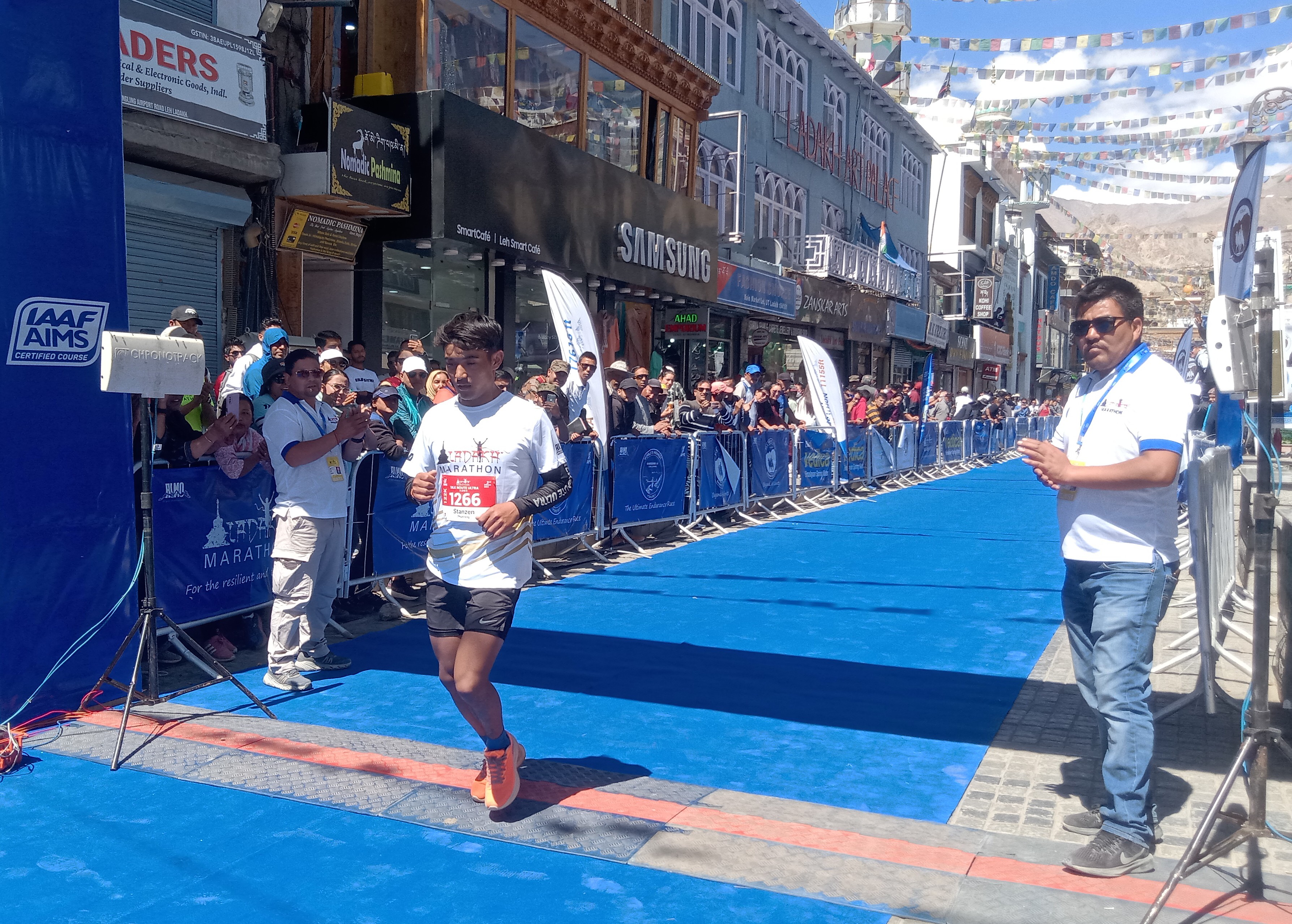
Tsewang Kundan at the finish line (photo: Shyam G Menon)
By now, it was quite cold and the course, unrelentingly uphill. Yangzam was moving strongly; mostly jogging with the occasional stint of brisk walking. It seemed an efficient progress. In 2022, Yangzam had been silver medallist among women doing KC and so, her chances in SRU were respected. It was 50 kilometres from Kyagar to Khardung. It meant that past Khardung, somewhere on the approach to North Pullu, Yangzam would be close to the 72 kilometres she had covered for KC. Would that matter? Unfortunately, around the said mark, things began going wrong. Her leg started to hurt and she complained of cramps. Although she kept up the brisk walking, her overall pace slowed down. She hydrated at an aid station, pain-relief spray was used and she also accepted some food. She was in no mood to give up. On the other hand, her halts to relieve the pain were increasing and everything about how she struggled to keep running, pointed to a potential DNF (Did Not Finish). In that time, at least two male runners overtook her. Others were catching up. Here, mention must be made of how local runners (and the SFF lot including Yangzam) approached SRU and KC. None of those born to altitude and competing for regimental glory seemed to like hydration packs. They saw it as an irritating load, a burden weighing them down. Running free and tackling the ultramarathon as they would a marathon, these runners counted on aid stations for hydration and nutrition. On the other hand, most outsiders arrived to run SRU and many in KC, kept themselves self-supported with hydration packs. They used aid stations but carried their own supplies too, as back-up. As Hakim’s vehicle drew into North Pullu, the medical station there manned by the military, was apprised of the struggling SFF runner. From the vehicle, this writer saw military personnel speak to Yangzam but she seemed determined to continue her walk-run to the high pass above. After a chat with folks from the army at North Pullu, she moved on.
Stanzen Phuntsog at the finish line (photo: Shyam G Menon)
The general belief at this time in our vehicle was that the SRU race leader (as measured by being at the head of the column of runners) was Maik. Somewhere around this time, we had seen a faster moving line of headlamps work its way up the slopes near North Pullu and eventually overtake our parked vehicle. It was the lead pack of KC, an event long dominated by Ladakhi runners, especially personnel from Ladakh Scouts. Starting their race from Khardung village at 3AM, they had caught up with SRU. It was time for us to move further up towards Khardung La. Doing so, along the way, we passed the tall figure of Amit Gulia and realized we had incorrectly assumed for quite some time that Yangzam and thereafter Maik, was the SRU race leader. Amit had opened up such a lead that he held not even a stretched link to the SRU runners behind him. He was off on his own. Much before in the race, when the vehicle was keeping Thupten company in the Kyagar-Khalsar section, we had been informed of Amit being the first to go past Khalsar. Hours later, when we met him in the heights above North Pullu, he was still doing a steady but slightly tired pace and most importantly, distinctly ahead of the rest from SRU’s 7PM and 8.30PM batches. Assuming he kept that lead and finished first in Leh, he would still be up against the 8.30PM-batch of elite runners and their net time to finish. Past Amit, we found the leaders of KC working their way up.
Namgyal Lhamo who topped the women’s category in Khardung La Challenge (photo: Shyam G Menon)
At Khardung La, we paused to talk to Amir Shandiwan, partner at Sports Timing Solutions. He was there in the biting cold of 17,618 feet, with his team and their timing equipment. We learnt there that there was a KC runner further ahead. On the downward slope to South Pullu, we saw him – a runner from the Ladakh Police. His lead was however short-lived; a couple of bends on the road later, we looked back and saw Rigzin Gyurmeth of the army’s special forces catch up with him and grab the lead. Continuing to Leh at a consistent fast pace, Rigzin would win KC in six hours, 31 minutes and 41 seconds. Jigmet Stobdan (6:57:09) secured second position while Sewang Namgyal (6:57:28) placed third. Among women at KC, the first place went to Namgyal Lhamo (8:12:42). Kunzang Lamo (9:29:36) and Tenzing Dolma (9:46:09) followed in second and third positions respectively. But it was two other results – both from SRU – that stood out.
From before the race; Amit Gulia (right), who topped among non-Ladakhi runners at 2023 SRU, with his friends Anmol (centre) and Rakesh Kashyap at the Ladakh Marathon expo (photo: Shyam G Menon)
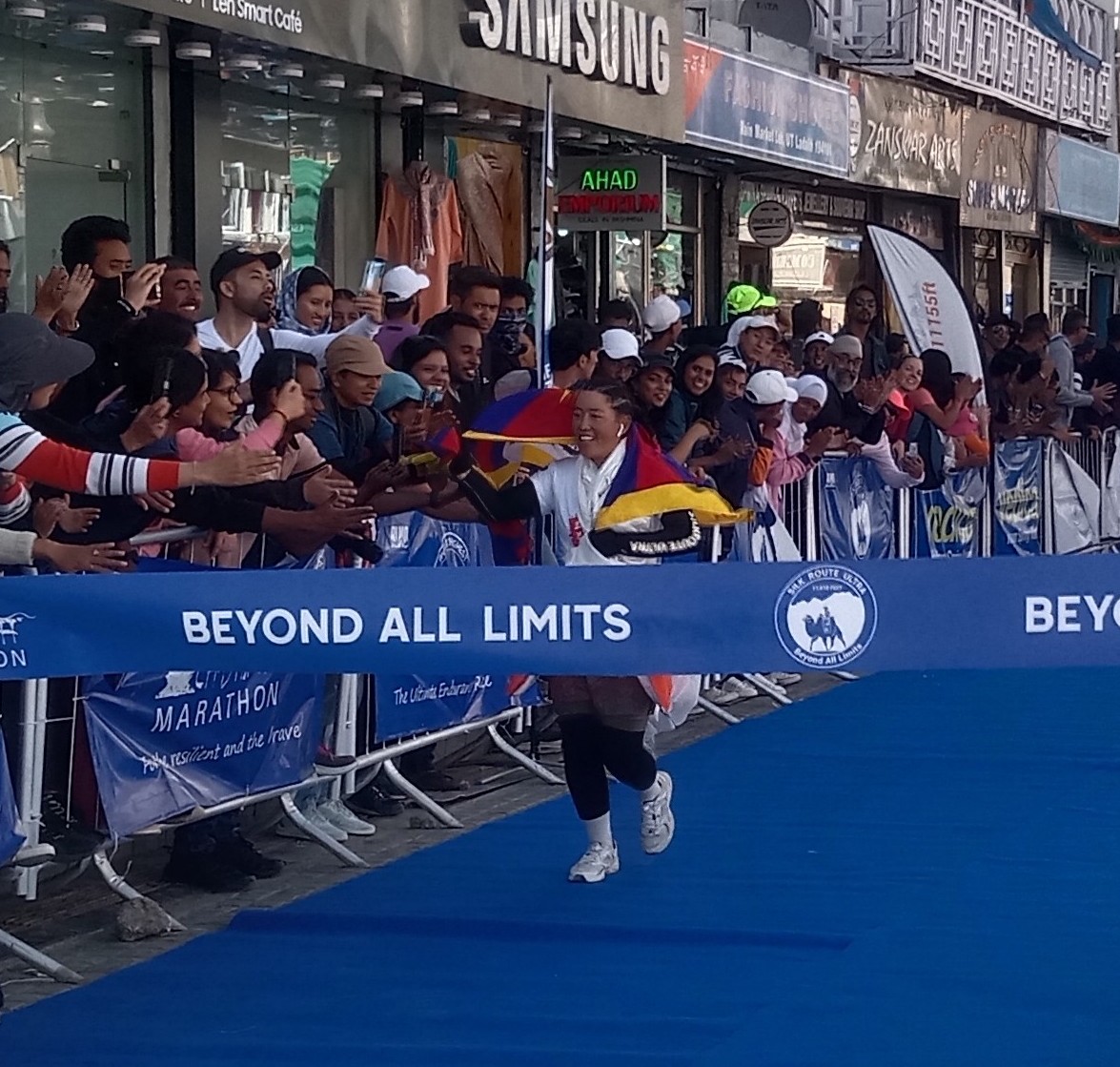
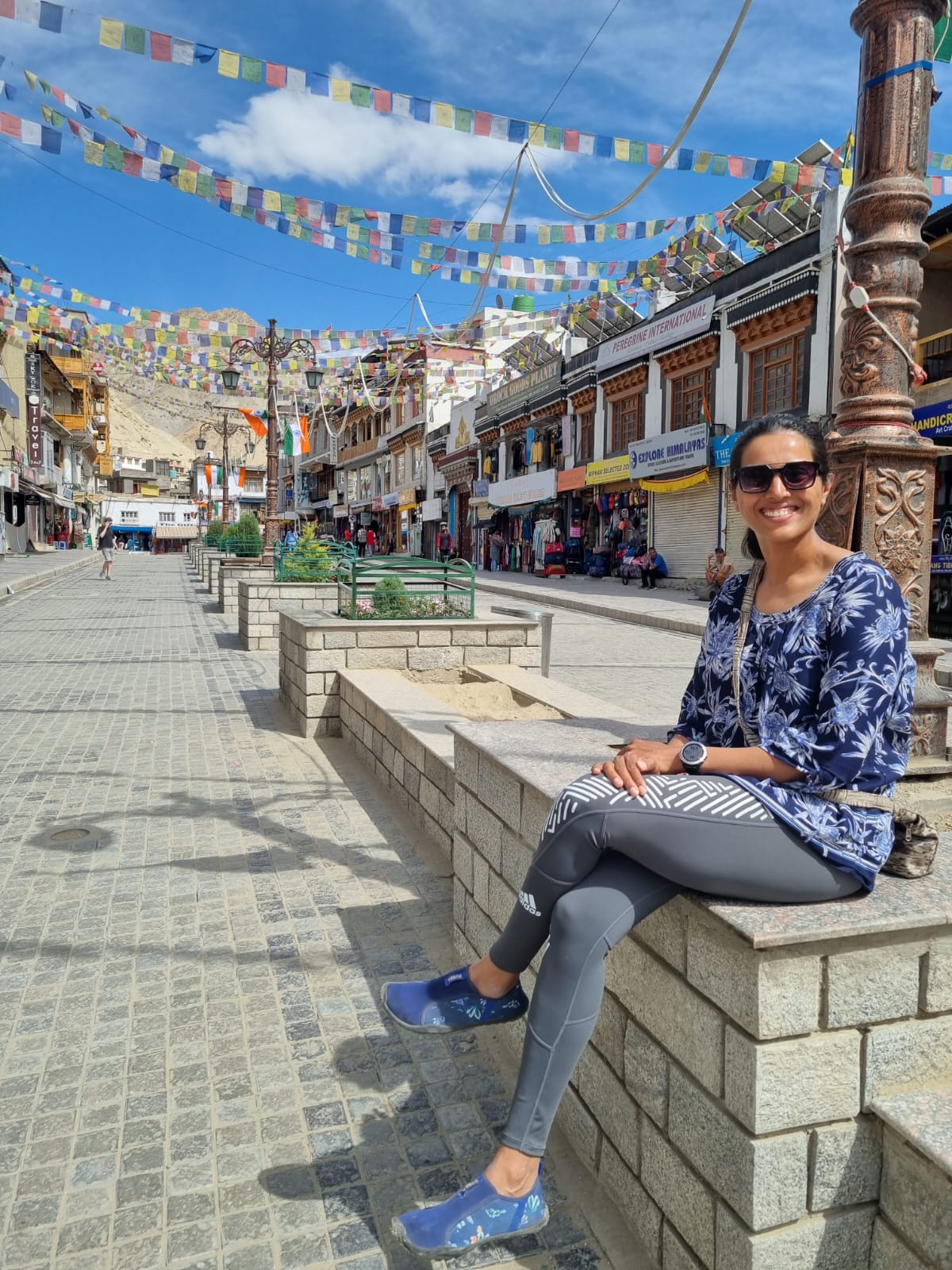
The organizers of SRU and KC deserve credit for one of the most impressive and enjoyable finish lines in India. It is set in Leh’s main market area, which is closed to traffic and is a much loved, well-maintained spot featuring quaint buildings sporting Ladakhi architecture. Adding to the ambiance is the backdrop of being in the mountains and a long blue carpeted alley guiding runners to the finish. It is well done and with the alley lined by cheering people and friends and relatives of the finishers, the final stretch is quite lively and intimate. As the runners crossed the finish line and the medical / recovery tent gained activity, a familiar face was seen helping exhausted athletes. Elevated blood pressure may have prevented Phunchok Tashi from competing in SRU but the ITBP runner volunteered at the finish line, helping fellow runners in the medical / recovery tent. In line with expectations, the winner among men at 2023 SRU, was Shabbir Hussain (15:27:53). Second place went to Kundan (15:53:46) and third to Stanzen (15:57:46). It was a sweep by Ladakh Scouts. Much before this army trio crossed the finish line, another SRU finisher in the male category had arrived – it was Amit Gulia. With a timing of 16:21:25 and fourth place overall, Amit’s was the first sub-17 hours finish by a non-Ladakhi in SRU. It was without doubt an amazing performance and a benchmark to remember for outsiders reaching Ladakh to try their hands at the race. Incidentally, Amit too had reached Leh as part of a trio. He, Rakesh Kashyap and Anmol Chandan were three friends participating in the SRU. Despite his best efforts, Anmol couldn’t complete the race. Beset with a decline in oxygen saturation level, he had to DNF after 66 kilometres. According to him, Rakesh too had to pull out. Still, the most impressive story of the 2023 race lay elsewhere.
Tsering Yangzam, winner among women in the 2023 Silk Route Ultra (photo: Shyam G Menon)
As a couple of hours went by at the finish line in Leh without a female finisher for SRU arrived yet, this writer checked with race officials to see if any woman from SRU had passed Mendak Mor, where the race had its penultimate set of timing devices before the finish line in Leh. The young man at the counter went through the data on his laptop and said yes, one female participant of SRU had gone past the time station at Mendak Mor. Incredibly, it was Yangzam. The SFF runner hadn’t given up. Sometime later, she crossed the finish line of SRU in Leh, an utterly happy person. As she sat afterwards in the medical tent, one couldn’t help walking up to her and offering congratulations. From a runner with the odds stacked against her, she had completed SRU, won in her gender category with timing of 19:26:17 and placed eighth overall. Shikha Pahwa (20:12:57) placed second among women and tenth overall. “ The arrangements were very good. No problem at all. Before we reached the start point of KC itself there were about seven aid stations offering water, bananas, sandwiches and electrolyte. Also, there were vehicles linked to the event, moving up and down. During the first stretch only the Silk Route Ultra runners, were there. This stretch was well covered by volunteers. Once the Khardung La Challenge started there were a lot more runners. After Khardung village, all the way up to the top, it was quite a challenge, quite a struggle. The last five to six kilometres were a push. The downhill stretch was also not easy but definitely easier than the uphill stretch. I resorted to walk-run all along. There were no women finishers after me. Of the 47 runners for Silk Route Ultra, only 19 finished the race. It was a well-organized race. Just the blocking of traffic was a major advantage for the runners because we did not have to worry about traffic at night. I had no time for recovery. I finished the race on the evening of September 8 and had to take a flight back to Delhi next morning. My recovery will start now. My calves are swollen. They were very tight right from the beginning. I had to stop a couple of times during the race to get help from volunteers to release the tightness. By the end of the race, they were quite swollen. I guess, it will take a few days for the swelling to ease,’’ Shikha said.
Dinesh Heda (extreme left) with friends at a post race celebration (photo: courtesy Dinesh)
Among those who had to give up, was Ashwini Ganapathi. “ I didn’t finish the race. I stopped at 65 kilometres. I got my periods the previous day. I started the race and was doing okay. Just one and a half hours into the race, I started getting a lot of cramps. I managed to run until Khardung village and by then I had severe cramps. My back also was cramping a lot. I took help from the doctors at the aid station. I continued for some time interspersing the run with some rest. But the doctors asked me to take a call as I had a long way to the finish. I stopped about one and half kilometres before North Pullu. My periods arrived five days ahead of schedule. It may have been because of the exertion. I have been here in high altitude for a long time now. When we get periods, we get bloated. I could not drink much water and that’s not a good thing at altitude. If one is not hydrated adequately there could be other issues. I am a passionate amateur runner and I do not want to push myself beyond a point and jeopardize my health. I saw two runners doing the Silk Route Ultra collapse along the way. I have now registered for Ladakh Marathon. I am feeling fine now,’’ she said. By night September 8, Leh’s roads sported the odd person with a tired, vacant, contented look; the tell-tale signs of trial by endurance. There were celebrations. Dinesh Heda, senior runner from Goa, who had earlier told this blog that he would celebrate no matter what the outcome of his participation in KC, kept his word.
(The authors, Latha Venkatraman and Shyam G Menon, are independent journalists based in Mumbai. Shyam was in Ladakh to report on the race. Latha spoke to some of the people quoted herein, on the phone. Our thanks to the organizers of this event for the support they provided to write this article. Our thanks to all the runners and aficionados of running who spoke to us.)
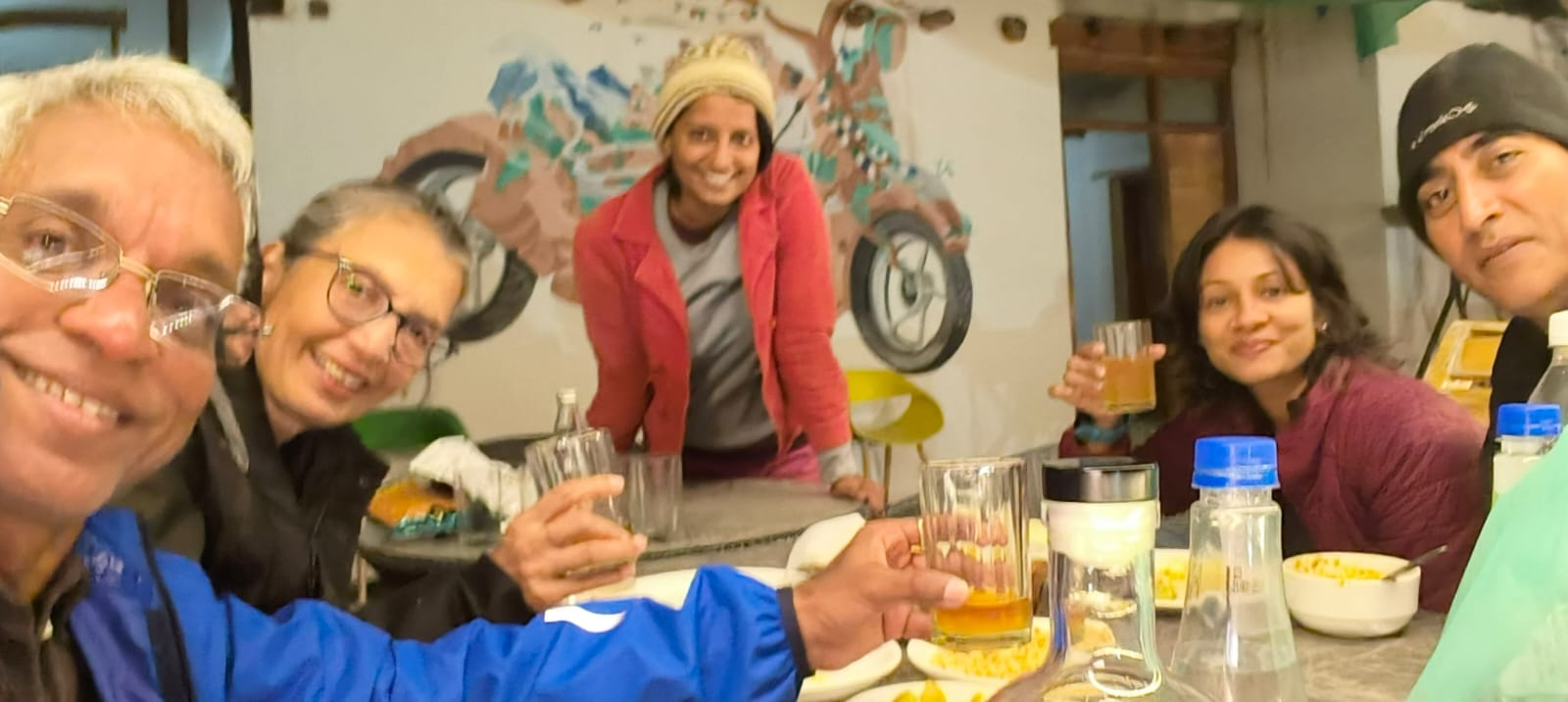
In Leh for the 2023 Ladakh Marathon. Satish Gujaran (extreme right) with Sunil Shetty, Sangeetha Shetty, Gita, Anupam Deka, Pronami Chakraborthy and Rita Chaudhary (photo: courtesy Satish)
Late August-early September, this blog got to spend time in Leh interacting with the organizers of the Ladakh Marathon, some of the runners arrived to participate and the people in town. The event comprises two ultramarathons, a marathon, a half marathon and shorter runs. Here’s a glimpse into the ecosystem of an engaging, still evolving event:
What makes the Silk Route Ultra and the Khardung La Challenge tricky?
Locations make marathons different. According to Dinesh Heda, for those not residing in the Himalaya, it is tough to replicate in the training phase, all the challenges one may face in the Silk Route Ultra (122 km) and the Khardung La Challenge (72 km). One can address endurance and accumulate elevation. But there is nothing possible as regards high altitude and weather. The altitude one touches in the Himalaya is serious; it brings in its wake reduced oxygen levels and biting cold. Alongside, there is the unpredictability of weather conditions. Things can change at short notice. Plus, during the course of the two ultramarathons (the longer Silk Route Ultra starts in the evening; the Khardung La Challenge at around 2AM), the athlete experiences cold to very cold conditions followed by the dry, warm weather of a morning in Leh. Because nature is dynamic, no two runs offer identical experience although the broad parameters may be the same.
People who assume that the Khardung La Challenge’s 72 kilometres is just another 30 kilometres more than a marathon and therefore very doable, overlook altitude and weather, Dinesh who is a senior runner from Goa, said. Not to mention – there is the overall cut off and the individual stage cut offs, which must be met. This is what makes the Khardung La Challenge challenging and the Silk Route Ultra even more so. In the latter, which measures 122 km overall, two things get frequently overlooked by runners. While Khardung La Challenge starts from Khardung village, the Silk Route Ultra commences another 50 kilometres away, at Kyagar. That’s more than a marathon at altitude run, by the time participants join the regular Khardung La Challenge route. Second, while Khardung village to Khardung La is an uphill, same goes for the Kyagar to Khardung section. In other words, by the time Silk Route participants reach Khardung to tackle the regular Khardung La Challenge route (the two races converge at Khardung with the Silk Route Ultra leaders reaching there around the same time the Khardung La Challenge kicks off), they are already on tired legs. Dinesh attempted the Silk Route Ultra in 2022. Unable to meet the stage cut off at a particular portion of the course, he had to DNF (Did Not Finish). To his credit, Dinesh who has done the Khardung La Challenge multiple times, has accepted the outcome. In 2023, he was back in Leh, not for that unfinished business with the Silk Route Ultra, but to attempt again, the Khardung La Challenge.
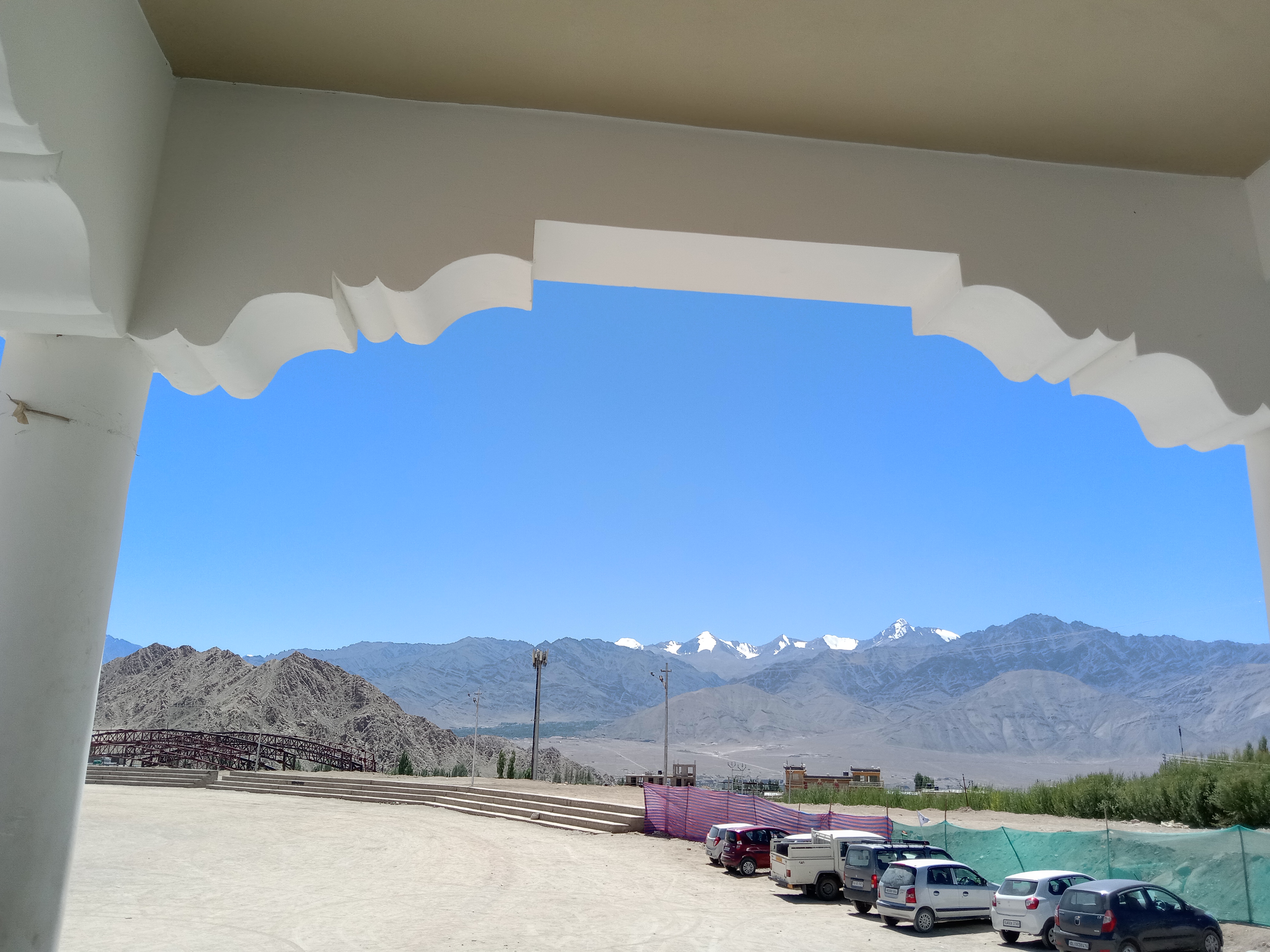
The view from the venue of the Ladakh Marathon expo (photo: Shyam G Menon)
An interesting blend
An emergent trend seen at the Ladakh Marathon is that of running the Khardung La Challenge and then following it up with the event’s full marathon. Dinesh has been doing this for a while. He was introduced to the practice in 2016. That year, Dinesh was in Leh for the full marathon when he saw Dharmendra Kumar from Bengaluru tackle both the Khardung La Challenge and the marathon. “ Dharmendra was the first runner I saw doing this combination in Ladakh,’’ Dinesh said. He commenced the practice in 2017. Today quite a few runners do this mix. When contacted, Dharmendra Kumar put the blend of ultramarathon and marathon, in perspective. “ It was a race just sitting there, waiting for you to try it,’’ he said of the marathon that beckoned following the Khardung La Challenge and a good night’s sleep. “ The idea was to do the marathon at an easy pace and enjoy the outing. That’s what we are here for, isn’t it? To run and enjoy the experience,’’ he said. What additionally engages is the difference between the two races. An ultramarathon is a personal experience. The runners may be separated by significant distance, there is a sense of being in one’s own cocoon, the route has long uphill sections, the weather may be unpredictable and there is always, the strain caused by higher altitudes. On the other hand, the marathon in Leh provides a sense of community when running with so many people around. The route has an uphill only towards the end, the weather is generally stable and after that tryst with really high altitude the day before and a good sleep thereafter, the marathon feels enjoyable to run. Plus, there is cheering. “ You take it like a recovery run,’’ Dharmendra said, adding that he was in no way discounting the inherent challenges of a marathon at altitude. It is just that when you run the marathon after the Khardung La Challenge, there is also an element of enjoyable relief and recovery at play. He was clear that the motive wasn’t to add kilometres and brag about the distance accumulated. After all, in the world of ultramarathons, 114 kilometres (the aggregate of the Khardung La Challenge and the marathon) is not big. The attraction is the relaxed pace of a recovery run and the enjoyment of being in a marathon with people around.
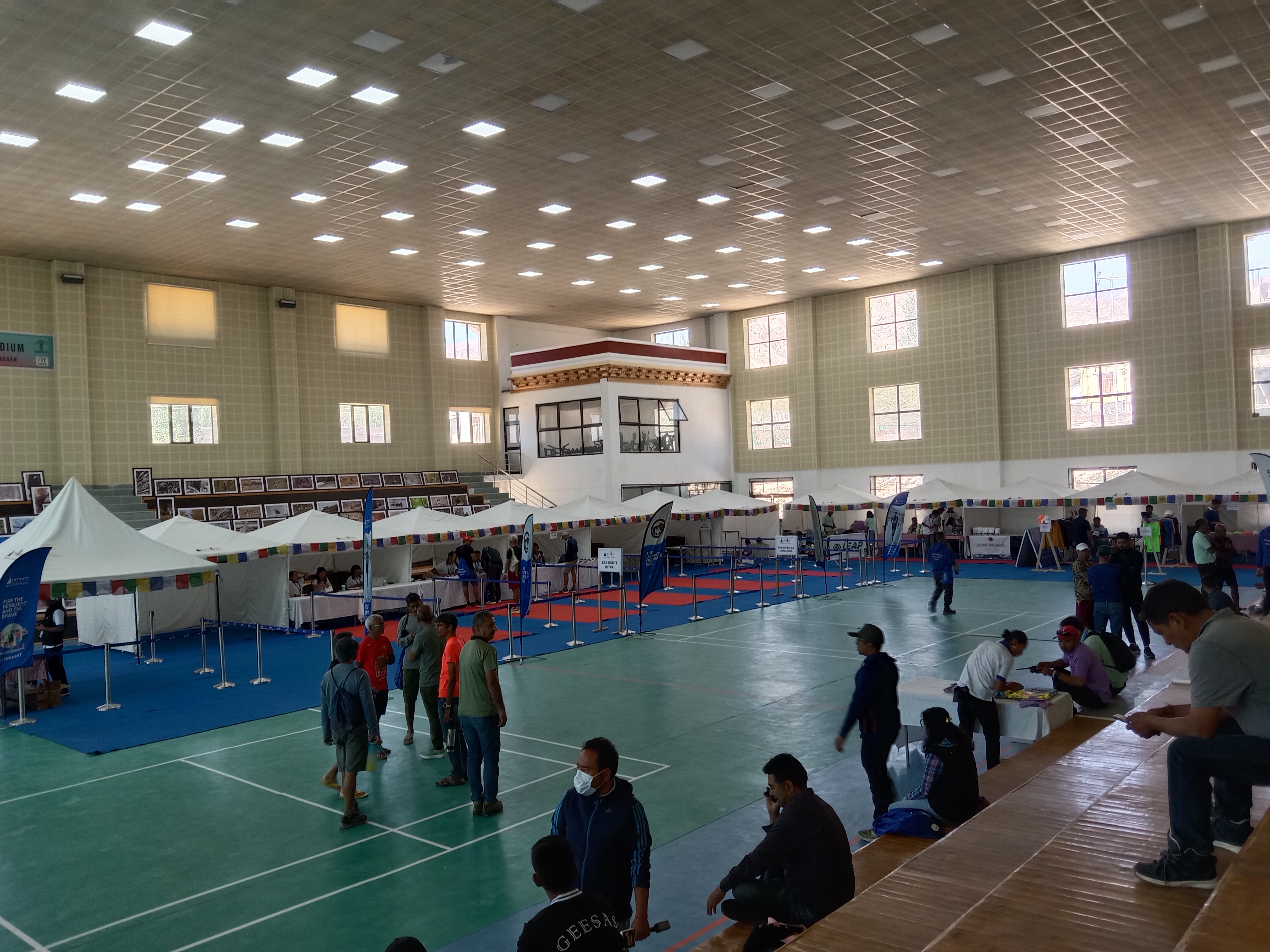
At the Ladakh Marathon expo (photo: Shyam G Menon)
The invisible risk
Being an event at altitude, medical support is critical for the Ladakh Marathon. A variety of agencies – among them, the Indian Army and the Indo-Tibetan Border Police (ITBP) dispatch their ambulances and ambulance crew to support the event. The event also has a medical partner. Since its inception, the Ladakh Marathon has had its share of medical emergencies. Significantly, it has stayed free of any fatal incident. In the case of the Silk Route Ultra and the Khardung La Challenge, participants have their oxygen saturation and pulse rate recorded twice by the organizers. The first checking is at the time of bib collection; the second happens before actual commencement of the race. Major variations are flagged and a runner may be held back from racing. Besides ambulances available along the way, there is the army’s medical station at Khardung La. With all this monitoring and the additional support of the race’s medical partner for a given edition, Chewang Motup, owner of Rimo Expeditions, which organizes the Ladakh Marathon, believes that the hosts are doing their best to contain risk. But there is one angle no organizer or race director can control and that is – concealment of medical facts by participants and poor appreciation of the risks attached to high altitude. At the race expo, Motup was seen speaking to runners, checking on their preparations and informing them of the need to respect altitude and follow the acclimatization protocol. He does not have a magic wand to flush out what runners won’t state openly.
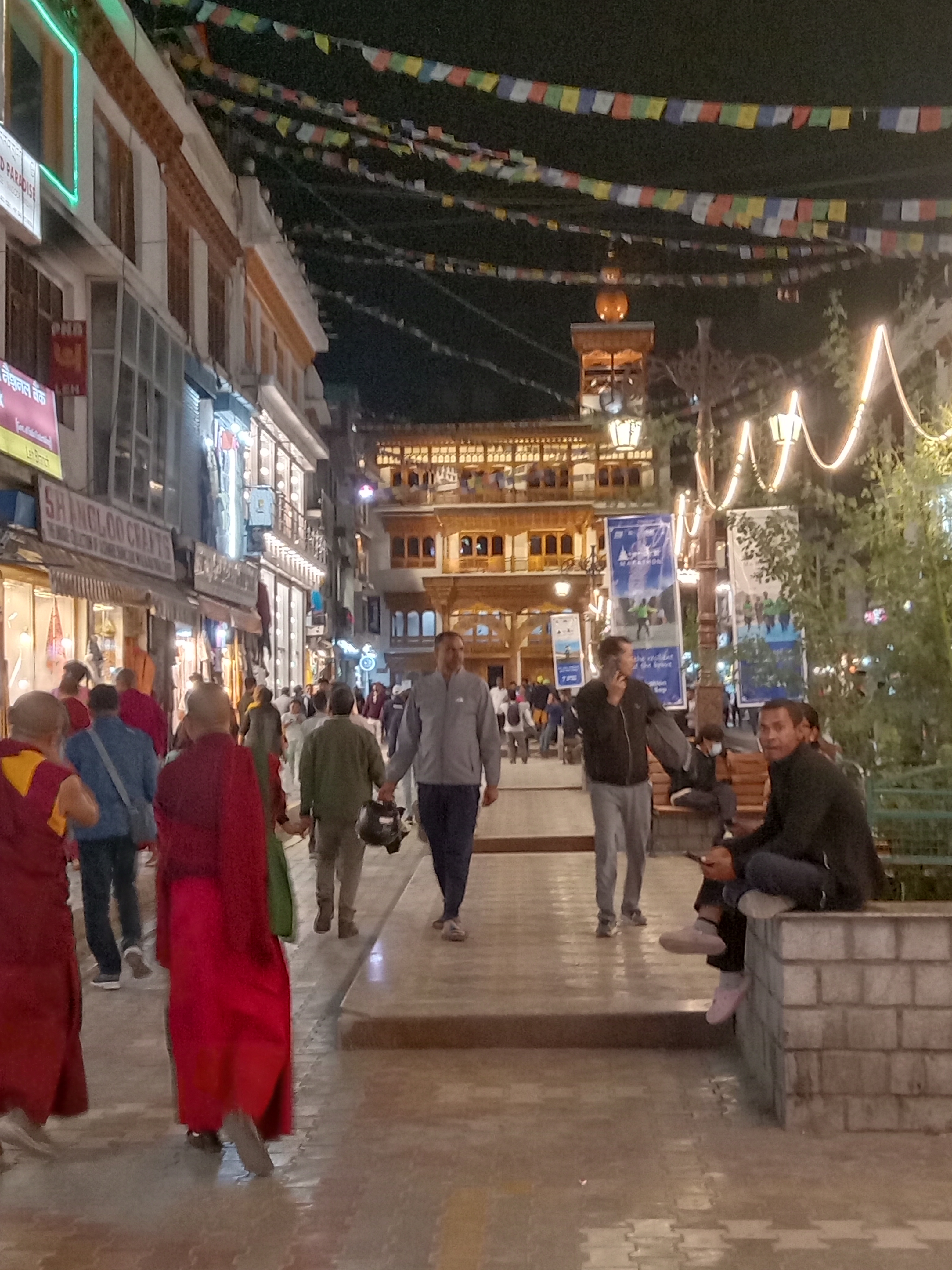
The main market in Leh (photo: Shyam G Menon)
Participation levels
In 2023, fifty-one persons were registered for the Silk Route Ultra and 261 for the Khardung La Challenge. Although podium positions are still dominated by local runners who are used to the altitude and the weather, the number of participants from elsewhere in India and abroad, have been growing. In all, the whole event spanning the two ultramarathons, the marathon, the half marathon and the shorter runs was converging nearly 6000 people to Leh this year. As P. T. Kunzon, former president of the Ladakh Buddhist Association (LBA) pointed out, the marathon has become a prominent fixture in the tourism calendar of Ladakh. Given its dates are in September, an otherwise lean period for tourism in Ladakh, the marathon has the effect of prolonging the tourist season. But it is two other factors that matter more from a business point of view. First, every runner in town is required to acclimatize well and this means, a longer period of stay in Leh. Some runners arrive with their families (in 2023, there was, according to the organizers, one family with 14 people running various distances at the Ladakh Marathon). For hotels and restaurants, this is a blessing happening as it does, in the tapering portion of the tourist season. Second, as denizens of the world of active life style, runners may wish to explore the outdoor activities Ladakh has to offer like trekking and camping (before or after the marathon). This is good news for people operating businesses around such activities. Compared to this, the tourist arrivals of Ladakh’s peak season mostly belong to the sight seeing sort. It is worth nothing that in 2023, while the number of people coming from outside Ladakh to run the two ultras, the full marathon and the half marathon had risen, the year’s tourist season till then had seen a fall in arrivals.
If one were to sense direction from how the Ladakh Marathon and the tourism around it have evolved (it has graduated from a marathon done and dusted in one day, to two ultras, marathon and smaller runs spanning as of 2023, four days), the mood is one of becoming a festival around the active life style. In 2023, besides the Ladakh Marathon, a football tournament was also scheduled to happen in the same period. This growth to being a multi-day affair is not the only emergent trend about the Ladakh Marathon. In the initial period it was a lonely walk for the event organizers, Rimo Expeditions. Over time, local authorities have come around to supporting the marathon. In Leh, local businesses with products and services relevant to the running community, keep the marathon in mind. “ We have people walking in to buy things in September,’’ Jigdol, proprietor of Himalaya Adventure Store in Leh, said. According to the organizers, on all the four days of the event, the roads earmarked for the races stay closed to traffic during the hours of the competition to ensure smooth passage for the runners. “ I prefer a road closed to traffic. As it is, I would be tired from the running. Watching out for traffic on top of that, would be making things needlessly complicated,’’ one ultrarunner told this blog at the Ladakh Marathon expo. On the Kyagar-Leh section, even the army – an active participant in the Ladakh Marathon with its pool of strong runners – suspends its convoys for the duration of the ultramarathons, Motup said. The communication support for the two ultramarathons is provided by the Signals Regiment of the Indian Army. In 2023, on the Kyagar-Leh route of the two ultramarathons, the regiment was set to have nine communication vans parked at regular intervals along the way. It is critical infrastructure for a race requiring proper monitoring of participants and medical assistance on call.
Many cities in India host marathons but the general attitude seen is one of finishing an avoidable chore and reverting to the Indian normal of traffic, rat race and money-making. Ladakh is a small place and its annual marathon, although big by local standards, is small compared to the marathons of the plains. But the ecosystem of support the event has acquired – it includes local authorities, the military, local businesses and local villages – is noteworthy.
A challenge in 2023
Leh has two major road links to the outside world. The most popular one is via Manali in Himachal Pradesh. The other is via Srinagar and Jammu. A lot of the materials needed to host the annual marathon reaches Ladakh from the plains. The goods travel by road. In 2023, the monsoon caused havoc in Himachal Pradesh. Besides causing a high number of deaths, it destroyed houses and wrecked the road network. September, the month in which the Ladakh Marathon occurs, is just outside the usual months of rain south of the main Himalayan axis (Ladakh is to its north). For a marathon, required materials should start moving at least a month in advance. In 2023, such logistics into Leh was hit by the natural calamity in Himachal. Shipments to Leh for the marathon got stuck between Shimla and Manali. A team had to be dispatched from Delhi, which then repacked the goods onto smaller vehicles and rerouted it through the few roads still open, to Jammu. There, it was transferred to trucks for passage to Leh via Srinagar. Some stuff had to be airlifted adding to costs. The kits offered to participants in the event’s ultramarathons are quite attractive and contain T-shirts, jackets, thermals etc. Orders had been placed as early as April-May. Given the challenging logistics scenario, things were still coming in even as the marathon’s expo got underway at the NDS Stadium in Leh. Nature stays an unpredictable and non-negotiable entity not just during the races in Ladakh but even in the preparations to hosting an event.
Before their race
Hanna Gogoseanu lives in Cluj-Napoca in Transylvania, Romania. She has been running regularly for the past three years or so. About two years ago, she happened to see a documentary on Ladakh on National Geographic. That was how she got to know of the Khardung La Challenge. It became a goal to aspire for. At that time, Hanna hadn’t run a proper marathon. So, to qualify for the Khardung La Challenge, she completed two marathons and in February 2023, commenced training for the race in Ladakh. For a taste of altitude, she spent time in the Carpathian Mountains of Romania but those heights are nothing compared to the Himalaya. Landing in Leh in the middle of August 2023, her first couple of weeks was tough. Besides the strain of altitude, she found the atmosphere dry. She developed nose bleeds. On August 31, when this blog met her at the race expo, she said she had begun getting used to the surroundings and had commenced her training runs. She knew she was due for an adventure and was looking forward to it.
This year, Maik Becker had with him Igor Kirsic from Switzerland and Marco Kuchhirt from Germany. For both Igor and Marco, it was their first visit to India and Ladakh. Both of them were into running but neither had done an ultramarathon at this altitude before. As Igor explained, he could accumulate elevation during training in the Swiss Alps but could do nothing about altitude, which is the irreplicable quantum when training for a run in the Himalaya. A triathlete, Marco had been to several Ironman events before. But he reserved complete respect for altitude, saying one cannot predict what lay in store. The duo was hoping to trek a bit as part of acclimatization, before reporting for the Khardung La Challenge. Maik on the other hand, was an old hand at the Ladakh Marathon and other races in India. A known Swiss ultramarathoner who travels the world to run, he had done the Khardung La Challenge a few times before. In 2023, he was set to attempt the Silk Route Ultra.
Ashwini Ganapathi (photo: courtesy Ashwini)
By the time of the race expo, Ashwini Ganapathi had been in Ladakh for over a month. She arrived on July 25. “ Five of us had planned to do a self-supported 100 kilometre run in the first week of August. We were to do it from Manali but we had to shift to Ladakh because of weather issues there,’’ she said. Apart for the 100K run, she had also planned a three-week vacation with her husband and a few treks. “ In Ladakh, we did the self-supported run of 100 km from Pang to Tso Moriri. It took us 27 hours to cover the distance. It was more of hiking than running. We drank water from the streams along the route,’’ Ashwini said. She also did a few motorbike trips apart from the treks to help in the acclimatization process. “ Ladakh is very dear to me. I have been visiting Ladakh for many years now,’’ she said. In 2019, Ashwini had done the 72 km Khardung La Challenge and finished second among women. That same year she also did the event’s full marathon. On preparations for the 2023 race, she said, “ I think my training for Silk Route has been good. I am familiar with the Silk Route course. Nevertheless, it will be a challenge to do it at night. The race starts at 7 PM. From 8 PM to 5 AM it will be dark.’’
Shikha Pahwa (photo: courtesy Shikha)
Shikha Pahwa reached Ladakh in the end of August. As part of her acclimatization, she went for a hike to South Pullu at a height of 14,000 feet. She walked the way up and ran the course down. No stranger to Ladakh, in 2017, she had done the Khardung La Challenge and emerged the winner among women. In 2018 she completed the 111 km-race of La Ultra The High. “ In 2019, I did their 222 km-race but had to give up after 212 km as weather turned for the worse. Last year, I did the 111 km again. In June this year, I did the UTMB Mozart 100 in Salzburg, Austria. The official distance was 106.3 km. I was the only Indian participant and completed it in 19 hours and 56 minutes. For the Silk Route Ultra, I am banking on my experience in running in Ladakh. But weather can be an issue,’’ she said.
Satish Gujaran (right) with Thomas Bobby Philip (photo: courtesy Satish)
For Satish Gujaran, his first few days in Leh were trying. By the evening of his arrival, he had a splitting headache. He decided to take Diamox and continued the recommended dose the next day. By now, he had loss of appetite and was feeling nauseous. From the third day onward, his condition improved. He suspects, the episode may have been the result of him resting on day one in his closed hotel room instead of an airy ambiance. Over the following days, Satish commenced running locally. When this blog met him September 2 evening on Leh’s Mall Road, Satish had begun doing trips to Khardung La to get used to that higher altitude and get a feel of how walking and running at the pass and its immediate slopes may be like. “ On the day I arrived I found it difficult to walk to the hotel. Now, it’s much better,’’ Satish, a popular figure in running and someone who has completed the Comrades ultramarathon in South Africa many times, said. He felt that running Comrades and running in Ladakh couldn’t be compared. Altitude is a totally different beast. In a reversal of the trend of Indians going to South Africa to run Comrades, Satish wishes to bring interested South Africans to Indian destinations and marathon locations like Ladakh.
A beautiful Surly touring bike parked at the door of its owner’s office on Chanspa Road and a conversation with the owner about cycling, revealed a small detail. Leh resident, Tenzin Dorjee, was due to run his first half marathon at the 2023 Ladakh Marathon. “ My neighbour was in the army. But even after leaving the military, he continued to run. He was my inspiration,’’ Tenzin, who manages a travel company, said. He has been running for the past five years. He has been cycling for a longer period; during the COVID phase, he toured a lot on his cycle within Ladakh. In the following years, he cycled in Uttarakhand and Himachal Pradesh. According to him, the Ladakh Marathon has had a salutary effect on local running with more people in Leh stepping out nowadays for a morning jog or run. Asked why the active lifestyle was late catching on in these parts, Tenzin attributed that to life in the mountains being a naturally active one and hence people not seeking out exercise as a separate avenue to physical fitness. That has changed with the onset of new perspectives to living; it received further impetus after the pandemic, he said.
Anmol Chandan (centre) with Rakesh Kashyap (left) and Amit Gulia (photo: Shyam G Menon)
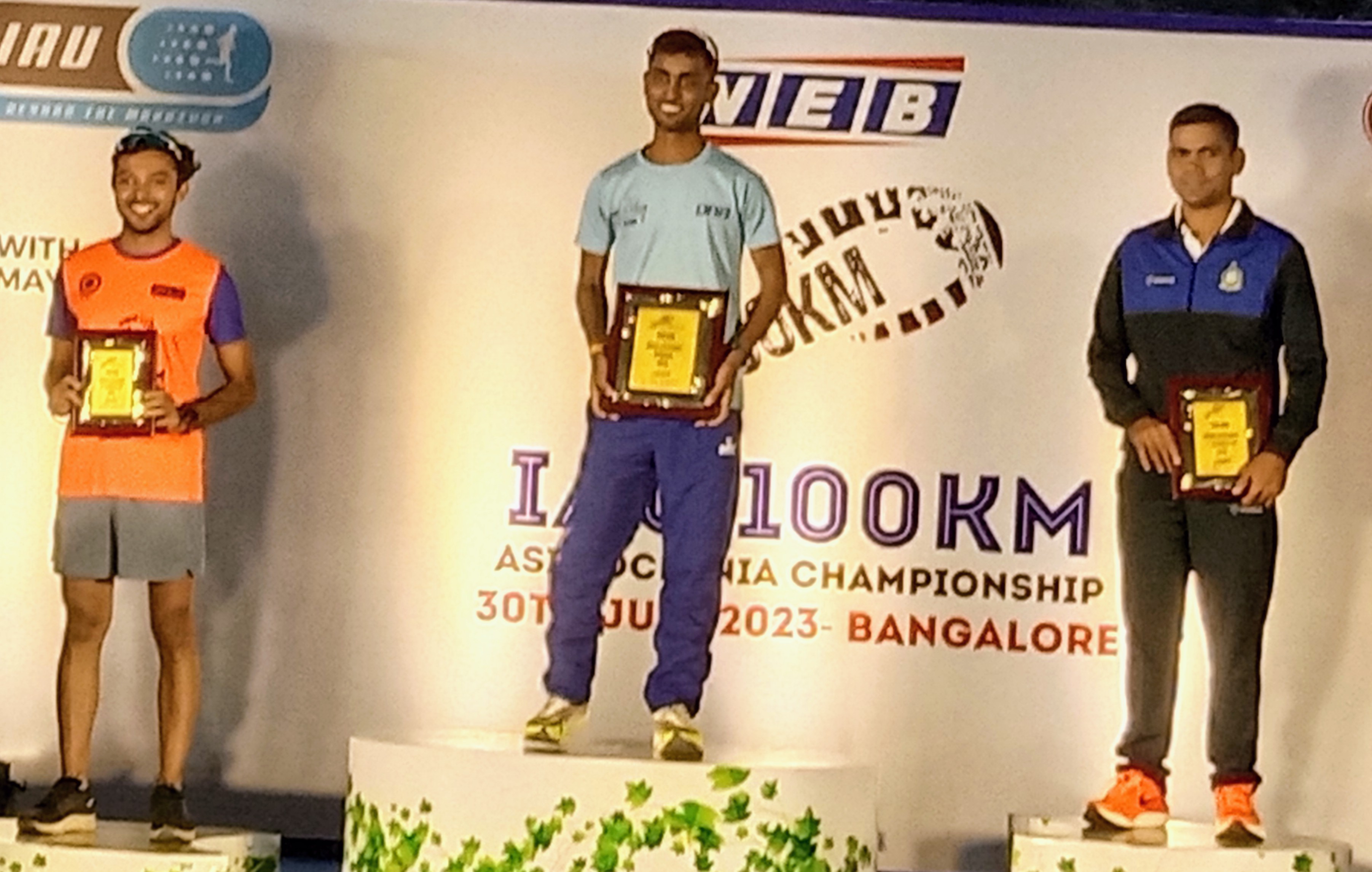
In July, Anmol Chandan had earned a podium finish (third place) in the open category for men at the 2023 IAU 100KM Asia Oceania Championship, held in Bengaluru. In 2022, he had completed the Khardung La Challenge. This year, along with his friends, Amit Gulia and Rakesh Kashyap, he was set to attempt the Silk Route Ultra. Amit reached Leh on August 29. “ We have been clocking miles,’’ he said of the training runs the trio did locally. Usually doing 6-7 kilometres a day, they did around `16-17 kilometres on one day and also made a trip to Khardung La on motorcycles. The pass felt cold that day. “ It’s going to be how you feel on race day,’’ Anmol said, adding that he intends to have a strategy in place for the Silk Route Ultra but also provide room for flexibility. Both Amit and Rakesh have completed Spartathlon.
Dinesh Heda (photo: courtesy Dinesh)
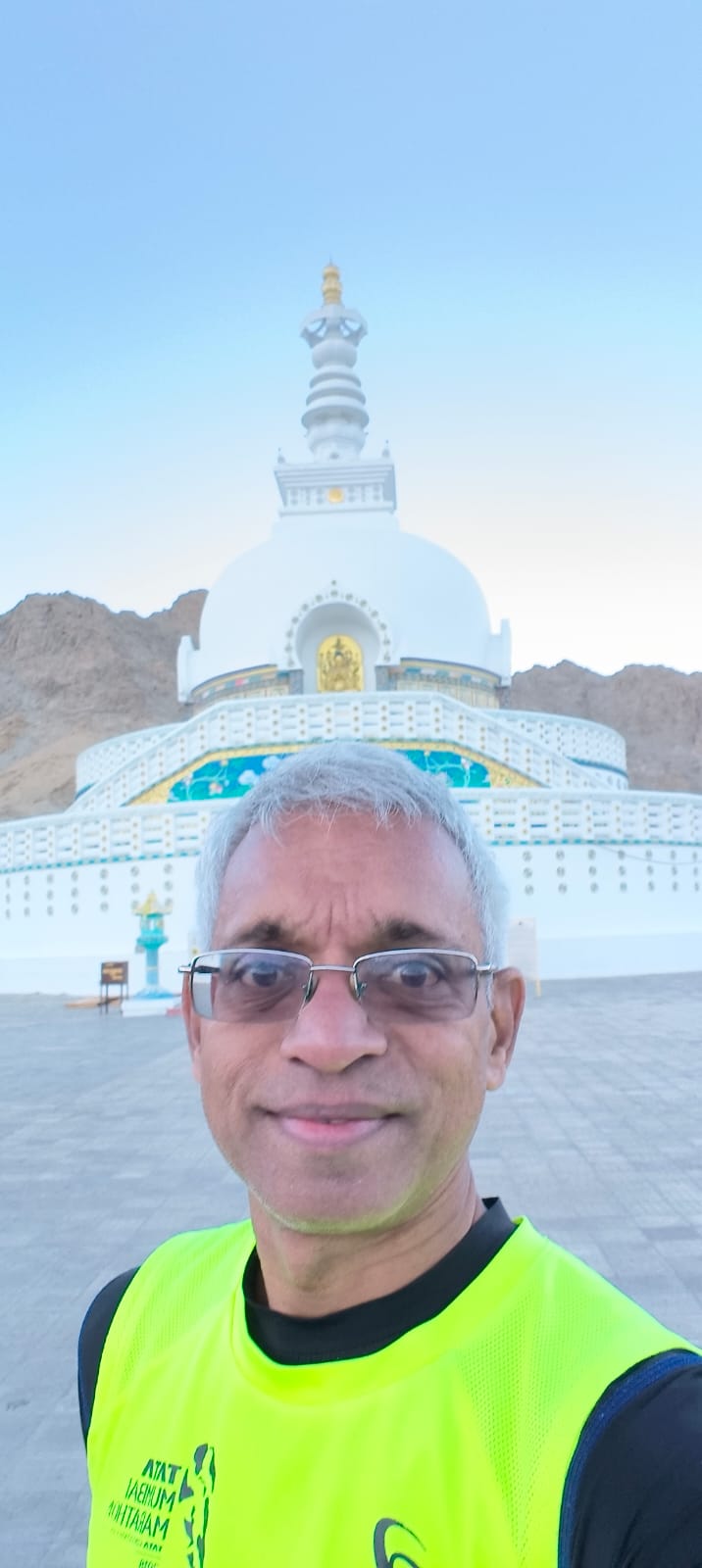
For many runners attempting the two ultramarathons within the Ladakh Marathon fold, the crux of the whole course was Khardung La and its immediate neighbourhood. This segment signified the zone with maximum altitude and lowest oxygen levels on the ultramarathon route. Runners hired cars and visited the pass to get used to the altitude and do mild training runs / walks around there. Dinesh Heda was among those not doing pre-race visits to Khardung La. Instead, after two days of natural acclimatization in Leh, he headed out in the opposite direction from Khardung La; to Shanti Stupa in Leh and the modest height gain it offered. Although he had a strategy for the race, he wasn’t a fan of the world’s fascination for measurement and data. He preferred to listen to his body. To perfect that link, Shanti Stupa sufficed. In his mid-fifties, Dinesh’s approach seemed one of reserving his running on race day for the flats, gentle gradients and downhill portions. Plus, be efficient without tiring oneself on the Khardung village-Khardung La stretch and try reaching the pass with some saved time on hand. In this, he knew that he wouldn’t be running near Khardung La, which is the hardest section. Up there, he would be walking as best as he can. “ I think it’s better to walk the uphill sections,’’ he said. Consequently, while training, he was focused more on maintaining his efficiency in brisk walking. Similarly, between performance and preservation, he preferred the latter. There were a couple of other reasons too for not stealing off to Khardung La before the actual race. Even if you visited the high pass so, there is no guarantee that conditions would be the same on the day of the race. So, why obsess with the pass and make it grow in one’s head like a formidable objective? Besides, Dinesh liked some things to stay unknown for a sense of discovery on race day. And no matter what the outcome on race day, he planned to be there for a celebratory beer in Leh with his friends.
The pass at the centre of the two ultramarathons
For most people today, Khardung La is the world’s second highest motorable pass and in Leh, a coveted objective tourists like to visit as a landmark in altitude reached in the neighbourhood. Simply put, it is all about altitude, vehicle, travel by road, the thin air of the pass and photos taken as proof of having been there. End of story. For Ladakhis however, that isn’t the case. Khardung La was for centuries, part of the summer route on the Silk Route to Central Asia. According to Chewang Motup, owner of Rimo Expeditions (it organizes the Ladakh Marathon) the Silk Route’s junction beyond the borders of Ladakh was Morgo. It had two routes of access from Leh. In winter, caravans proceeded to Morgo via Shyok village on the banks of the Shyok River. Although the river’s name is drawn from its capacity to spread gravel, there appears to be an element of death also associated and that could be because in olden times, the caravans to Morgo had to cross the Shyok River multiple times. River crossings can take a toll on animals and humans. In summer, this route becomes unusable because glacial melt causes the river to bloat. Consequently, the summer route from Leh to Morgo went via Khardung La. Motup recalled how in his childhood it had been a three-day trip on horseback from Kyagar, his home village, to Leh. It took another two days to Srinagar, where he attended school.
In the years past, the northern side of Khardung La used to be glaciated. Caravans via Khardung La operated till almost the mid-1970s, Motup said. His grandfather had gone a fair distance on the Silk Route. In 2002, as part of an expedition, Motup made it to the Karakorum Pass via Shyok. He was the third generation of his family to stand there. The motorable road from Leh to Khardung La, which everyone takes for granted these days, made its appearance only in the late 1970s. Just beyond the pass, there used to be a bridge that was – like many things Khardung La – acclaimed for its altitude. It no longer exists; the gap it bridged has been filled and concreted. Even with a road in place by the late 1970s, Khardung La wasn’t an easily accessible spot for visitors to Leh. It was a restricted area. Much later, when Nubra was opened to the public along with Dahanu (also called Aryan Valley), Pangong and Tso Moriri, the tourist destination called Khardung La was born. On either side of Khardung La, on the approach to the pass, lay North Pullu (on the Nubra side) and South Pullu (on the Leh side). Pullu in Ladakhi means a shepherd’s shelter. Long before they acquired their contemporary names, Motup said, North Pullu was known as Spang Chenmo while South Pullu was referred to as the pullu for Ganglas and Gonpa villages. Specific to the race (Khardung La Challenge), 2018 is widely recognized as having been a tough year for participants. There was rain on the approach to the pass and at the pass it was blizzard like conditions with very low temperature.
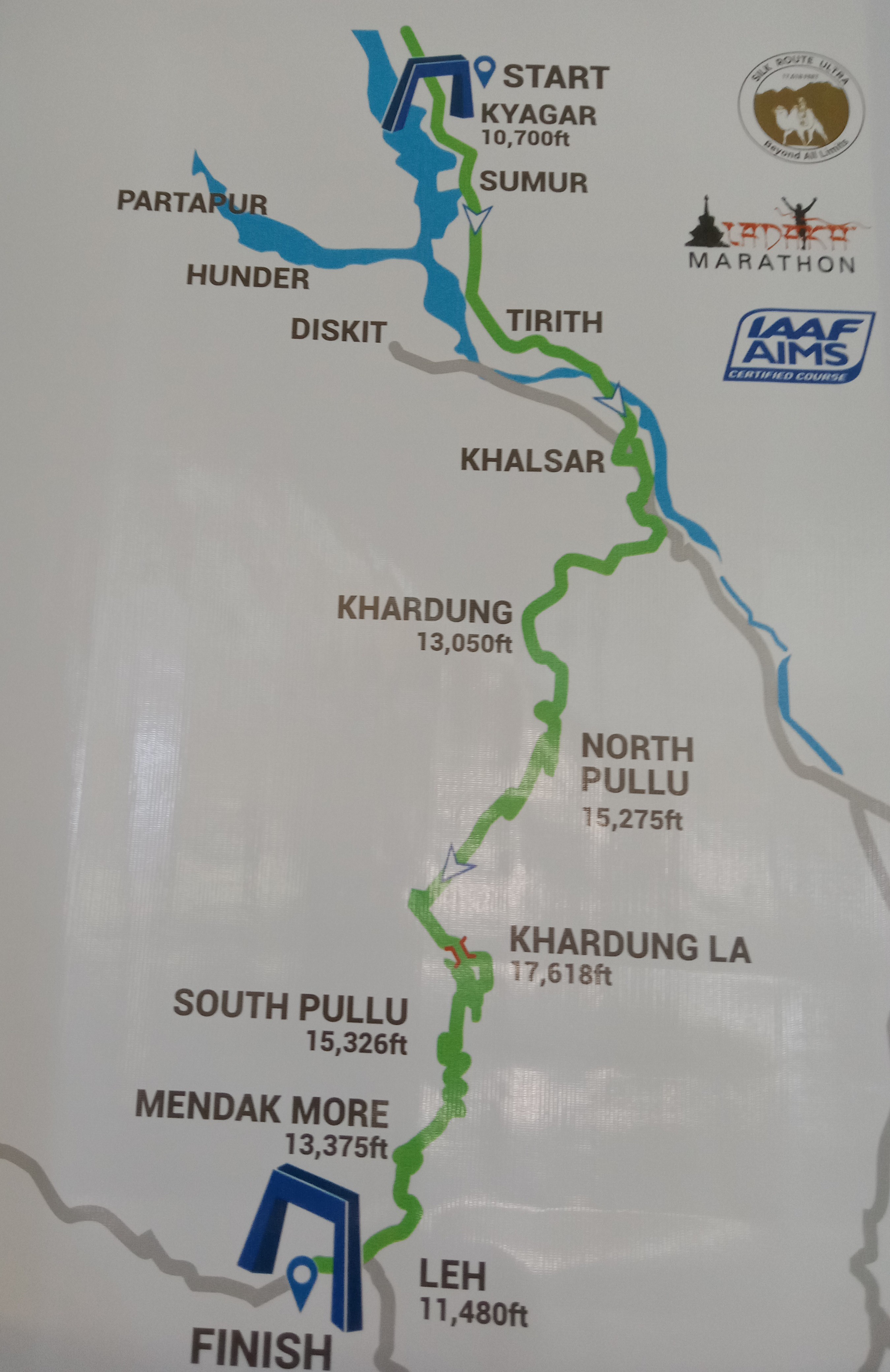
The Silk Route Ultra course (from route maps displayed at the marathon expo / photo: Shyam G Menon)
That time we run through
It is what decides podium finishes at races; it is what all runners live by (even the ones wishing to be free of its pull). Meet time. These days at marathons, time is measured using mats, which one steps on and side antennas that one runs past. The start and the finish, being most critical and requiring certainty of recording, typically feature both mats and antennas for redundancy. Mats are useful where a large number of people are involved, which is the case at the start line of a race. Time stations along the way, are served by side antennas and they suffice – especially in ultramarathons like the Silk Route Ultra and the Khardung La Challenge – because past the start line, clusters split and runners get spaced apart. The Silk Route Ultra will have six timing stations – at the start, at kilometre 25, at Khardung village, at Khardung La, at Mendak Mor and at the finish. For this race at altitude featuring a modest number of runners (both Silk Route Ultra and Khardung La Challenge put together), the service provider, Sports Timing Solutions, will work with a small crew in a format resembling a relay. Given the equipment used is imported and was designed for use in cold countries, the cold weather at stations like Khardung La won’t be a problem. What may pose difficulty is altitude; more precisely the effects of altitude on the people manning the stations (they have to be there till the last runner goes through). According to Amir Shandiwan, partner, Sports Timing Solutions, the company has learnt from its previous experience in operating at altitude in Ladakh. Aside from making sure the timing equipment and the people manning it are alright, the other thing to take care of is the availability of telecom network coverage for data transmission. Each year, this is assessed afresh on the mountainous route of the two ultramarathons. On September 5, the Sports Timing Solutions team was due to check out connectivity on the route. They had dongles from multiple telecom service providers to add redundancy into the system. As further back up, each timing station will have the provision to download the recorded data into a USB, so that in the event of any weakness in network, the data may be physically transported to the nearest point from where onward transmission is possible. To wrap up – one’s timing in the two ultramarathons may be just a series of inanimate digits; delivering it, however, entails some hard work.
The aid stations and a story of community participation
A unique aspect of the Ladakh Marathon is the participation of the local community in race arrangements. The route of the two ultras within the portfolio of races at Ladakh Marathon – Silk Route Ultra and Khardung La Challenge – are connected. The Silk Route Ultra is an extension of the older Khardung La Challenge with its start located 50 kilometres further up the road. Between Kyagar, where the longer 122-km ultra starts and Leh (the finish point), there are 21 aid stations. Except the aid station at the highest point enroute – Khardung La, and the one at the very end, all the remaining aid stations are operated by teams drawn from villages along the route. Of the seven aid stations between Kyagar and Khardung (from where the Khardung La Challenge commences), the first and third are managed by Sumoor village, the second by Lagzhum, the fourth by Khalsar and the fifth, sixth and seventh by Kyagar. Thereafter, the first four aid stations on the Khardung-Leh stretch are operated by Khardung village and the fifth and sixth by Kyagar village. Aid stations from the seventh to the thirteenth on this stretch are managed by teams from Ganglas and Gonpa villages. The last aid station, the fourteenth on the Khardung-Leh stretch is usually managed by a business enterprise in Leh close to that point.
The fourteenth aid station, located at Khardung La, is a crucial spot and is managed by a team drawn from the trekking staff of Rimo Expeditions. They spend roughly four hours on Khardung La, the highest and coldest point of the course, providing support to the runners passing through. However, the aid station that stays open longest is typically the seventh one on the Khardung-Leh stretch, Motup said. The above architecture of participation by villages, is noteworthy. In September 2023, there were 51 runners registered for the Silk Route Ultra and 216, for the Khardung La Challenge. According to Motup, the angle of carrying capacity wasn’t yet a bother because Khardung over time has added more accommodation facilities. And as for any strain on race infrastructure and monitoring due to enhanced participation, Motup pointed out that the longer Silk Route Ultra had debuted only after several years of holding the Khardung La Challenge. It was a conservative extension of the course’s length. Not to mention – the emphasis has been on sustaining and improving an existing race before adding another to the portfolio.
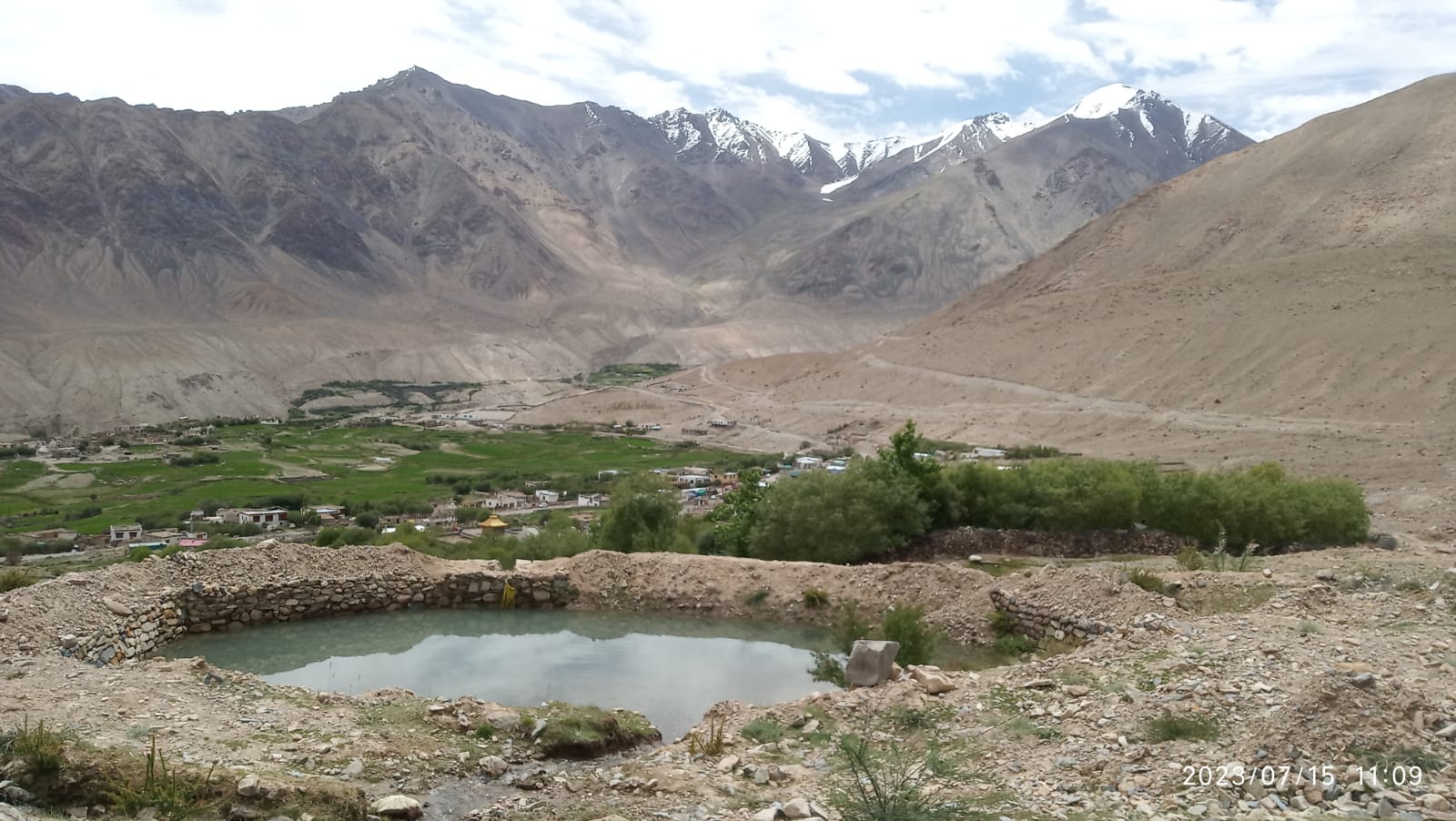
The reservoir built bythe Tatas in Khardung village (photo: courtesy Chewang Motup)
Sponsors yes but preference for those appreciating the event’s uniqueness
The high level of community support has meant, Motup setting matching expectations for his sponsors. He is clear that the Ladakh Marathon cannot be approached by sponsors in the same fashion they would, a city marathon. Notwithstanding what a sponsor may want by way of marketing and brand promotion, events in Leh come with non-negotiables like the limits and possibilities of local geography, unpredictable weather conditions, sensitive environment and modest size of race. Respect for these parameters may mean, the regular compulsions of brand promotion and marketing, requiring to compromise. For instance, a potential hydration partner cannot simply supply bottled water, end its engagement there and hope for publicity. At many marathons, plastic bottles generate garbage and littering. Water must therefore be handed out in cups to those requiring a drink. Sometimes, the realities of Ladakh and the involvement of the local community may also mean sponsors needing to go the extra mile. In 2022, the Tata Group, which was a partner that year, left behind a remarkable legacy – they built a reservoir for Khardung village, something utterly useful in Ladakh, which is a high-altitude cold desert. This year, it is hoped, Bisleri would build a reservoir for Kyagar village. Motup’s expectations don’t end there. He would like any sponsor interested in the event to also help in creating and sustaining Ladakhi talent in running. It may be recalled that for years, Rimo Expeditions has supported the growth of a team of runners from Ladakh; they travel to the marathons of India’s plains, have secured podium finishes and one of them – Jigmet Dolma – made it to the Indian women’s marathon team. Motup acknowledged that while there were those wishing to support the marathon, he had to let go of many such opportunities because they didn’t satisfy the overall paradigm employed.
(The authors, Latha Venkatraman and Shyam G Menon, are independent journalists based in Mumbai. Our thanks to all those who spared the time to talk to us.)
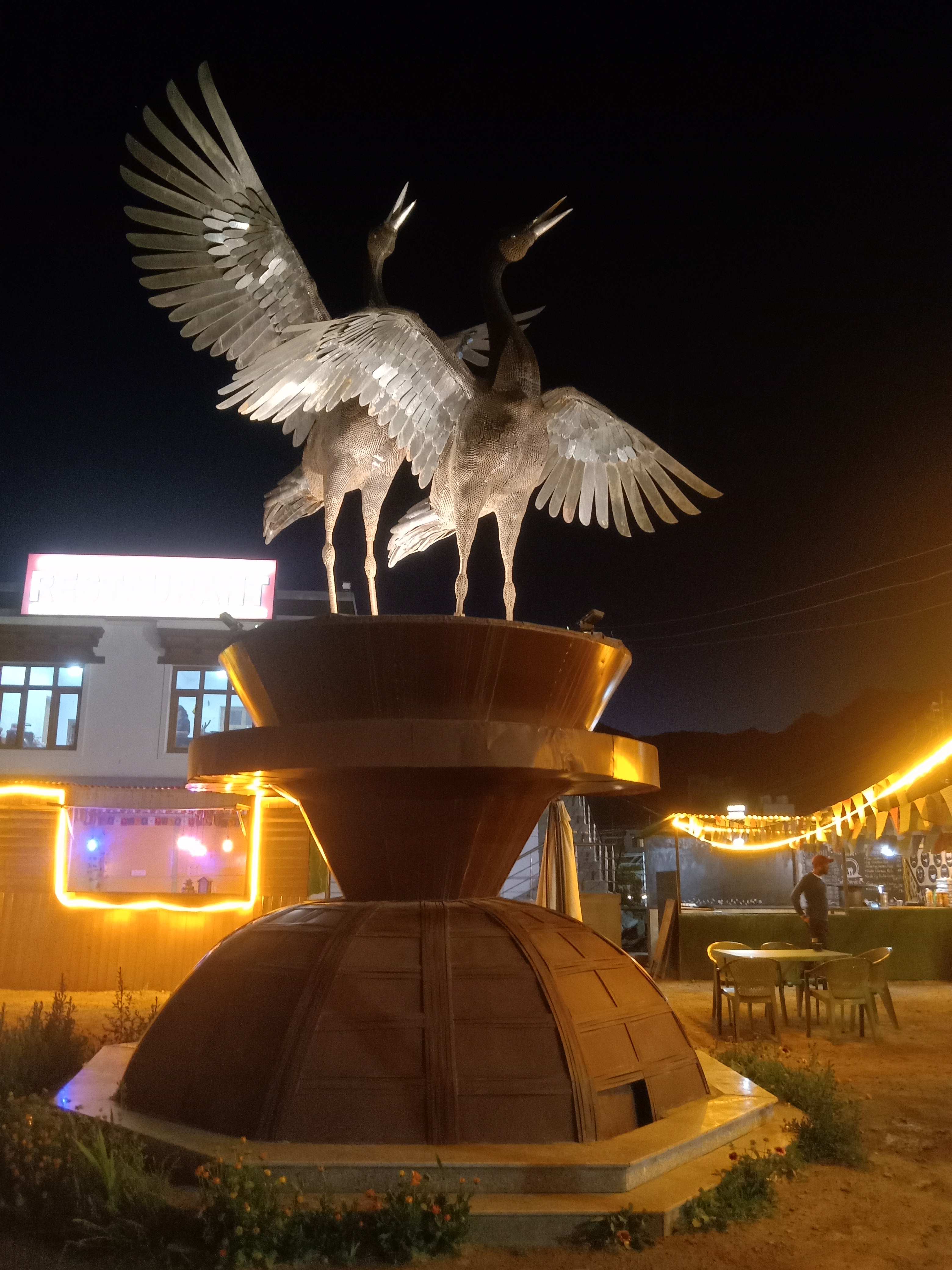
Chemat Dorjey’s sculpture of black-necked cranes near the Leh post office (photo: Shyam G Menon)
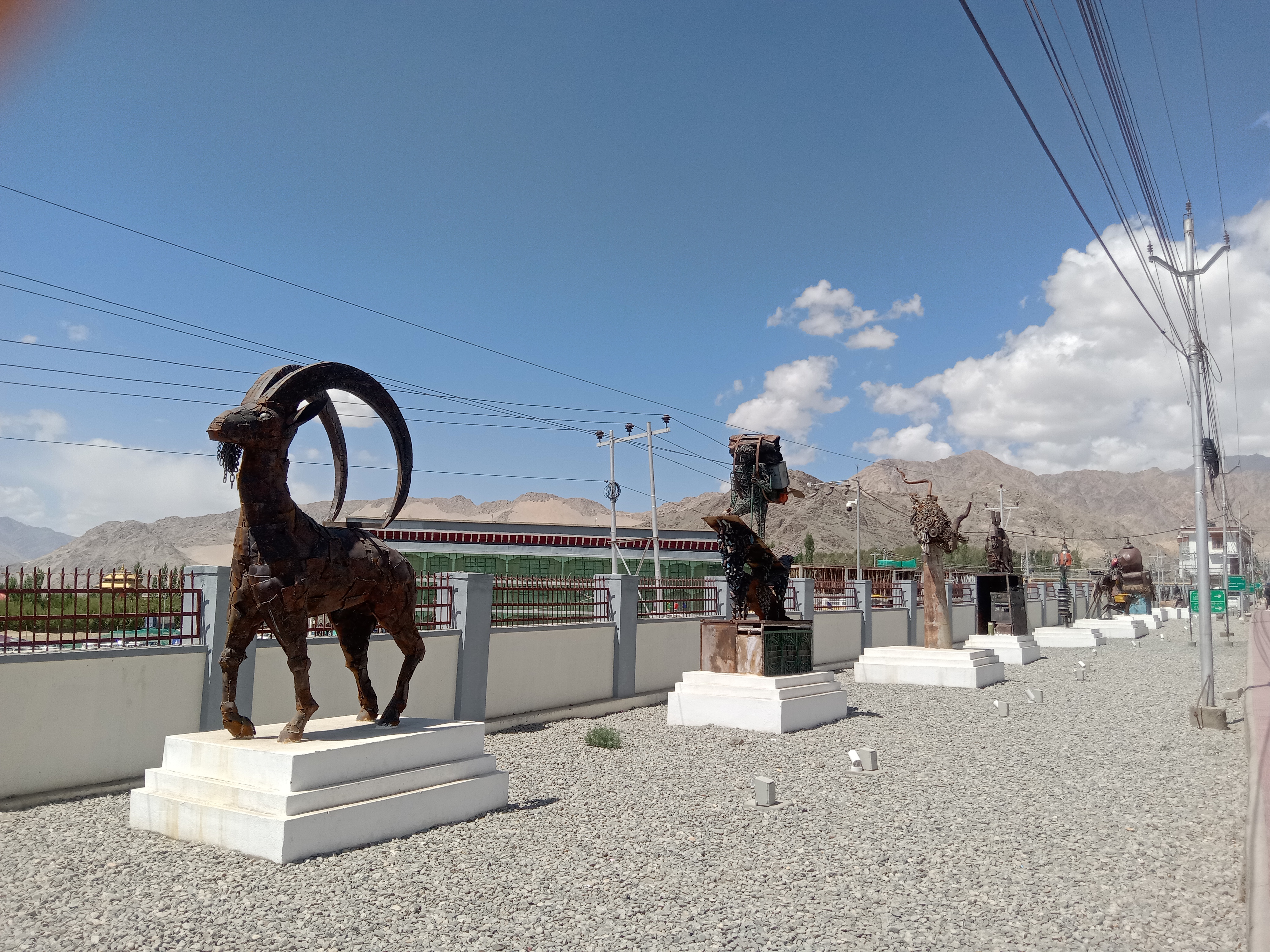
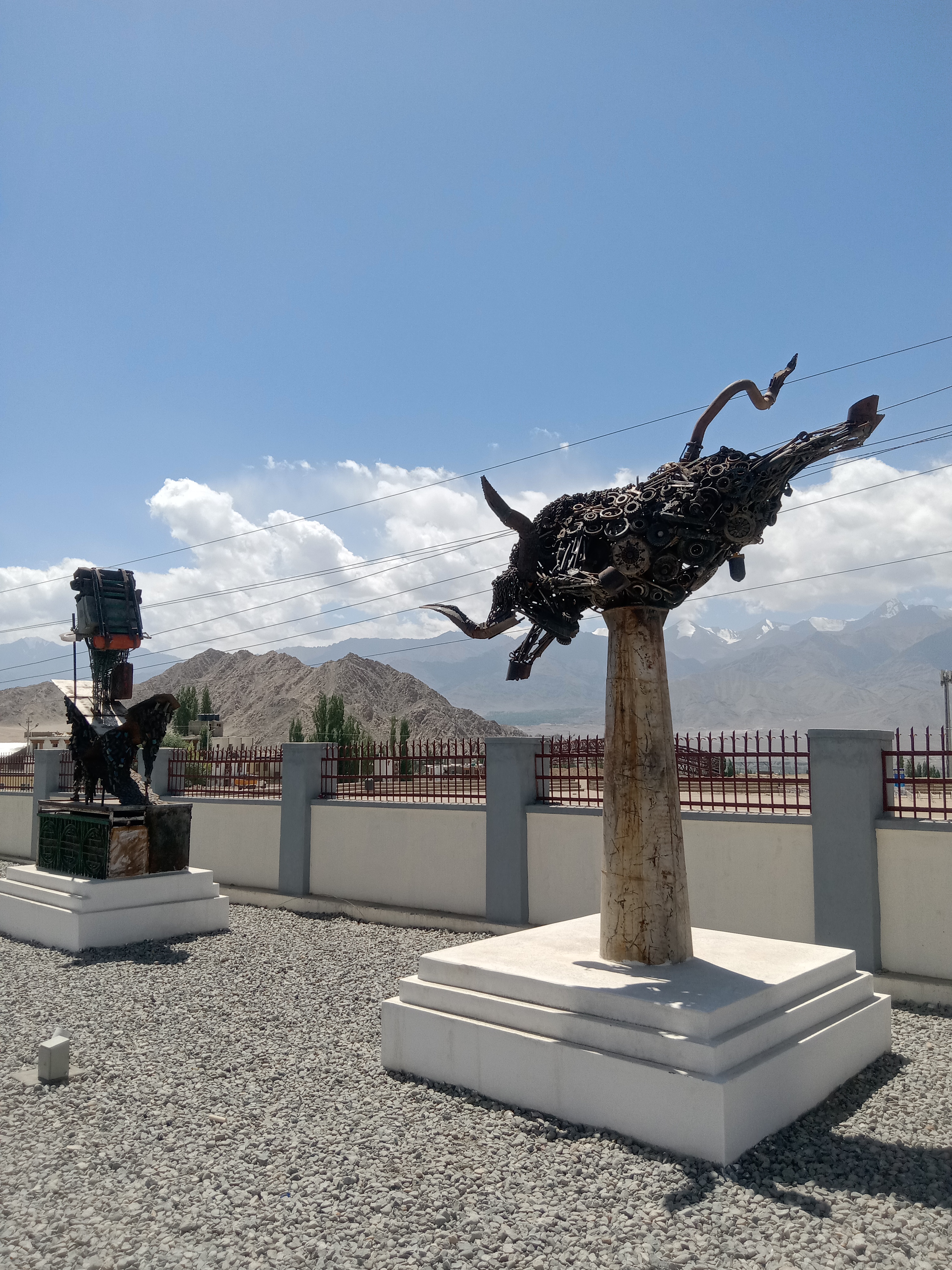
On the first day of the 2023 Ladakh Marathon expo, as one walked down the road leading to the NDS Stadium, a series of sculptures by the side of the road leading to Choglamsar, fascinated.
Made of metal parts, the idiom at work seemed to communicate a mix of form, anatomy and innards, and at least in the case of a sculpture or two, felt quite kinetic; like energy unleashed. Ladakh’s barren cold desert landscape, against which one perceived the art forms, added to the bare bones, skeletal broodiness of scrap metal. Neither an artist in the real sense of the word nor a trained art critic, I nevertheless felt sufficiently impressed to try finding out who created these works of art. As chance would have it, freelance journalist’s habit of seeking out affordable eateries landed him at a café opposite the sculpture of two black-necked cranes and a restaurant named after the birds, near Leh’s post office. The materials used to make the birds appeared similar to what I had seen near the stadium. Could there be a connection? A case of same or similar hands at work perhaps? The best place to ask seemed the Black-Necked Crane Restaurant. It’s manager, Tundup promised to help. He got back with the name and phone number of Chemat Dorjey. By then, I had also found an old interview with Chemat published by Reach Ladakh. The next day, we met.
Hailing from Sakti village and talented at painting, Chemat decided to study art. He did his Bachelor of Fine Arts (BFA) from Jammu and later, his MFA from Varanasi. Initially given to painting, he specialized in sculpture after being inspired by the work of one of his teachers. At Leh’s Onpo House, a heritage building (it was once the seat of royal astrologers) now restored and used as an art gallery and venue for discussions on art, Chemat explained the local art scene. Ladakh may be small. But its imagination is colourful. Thanks to its traditional art forms like thangka, Ladakhi society has curiosity and appreciation for art. That nature (empathy for creative work) is the foundation on which, later styles of art have got layered. Although contemporary art struggles to find acceptance, people turn up to see exhibitions of such work all the same. Indeed, when asked if choosing art for a career had been a problem (an unpopular decision) in Ladakh, Chemat said that hadn’t been the case. At the same time, studying art outside had taught him to look differently – in more perspectives than just the traditional – at subjects that engaged his interest.
The line of sculptures just outside NDS Stadium, Leh (photo: Shyam G Menon)
There is a community of around 20-30 artists scattered in and around Leh, Chemat said. Most of them have no other avenue of livelihood. They survive on original work and commissioned pieces. The rise of local businesses, particularly hotels, has helped in securing commissions. In some cases, art projects have come from monasteries. However, in the context of steadying their ship destined to sail the choppy waters of creativity, the artistic community wishes for more support from government. Besides art projects the government could give, a simple change that could help stabilize the fluctuating economic fortunes most artists are subjected to, would be to have positions for artists in schools, colleges and other such institutions. It would provide employment. That is awaited, Chemat said.
In the meantime, private patrons in Ladakh commissioned art work or as happened in the case of those black-necked cranes near the post office, the sculptor pitched an idea to government and the government decided to back it. Migratory and vulnerable, black-necked cranes have visited Ladakh for long. It’s the union territory’s ` state bird’ (previously it used to be the state bird of the erstwhile Jammu & Kashmir state). They would be found in the Changthang region of Ladakh. It is believed that a pair of black-necked cranes bond for life. Over the years, the number of visiting pairs have reduced and people from Hanle (which falls in the area where the birds arrive) told Chemat that the growing noise of vehicles, including motorcycles, had contributed to the problem. That was how the sculptor conceived the idea of a pair of black-necked cranes made from scrap metal (vehicle parts). The main inspiration for the art work is drawn from the courtship dance / display of the birds. According to Chemat the sculpture was unveiled in 2019. In a related note, Chemat observed: “ In a way this sculpture is an embodiment of the artist’s vision towards awareness of the threats that rare and migratory birds like the black-necked crane face in their natural habitat among others. Beyond the inspiration of beauty and aesthetics, this sculpture is also a criticism of the change in the ecology of the region.’’
From the sculptures just outside NDS Stadium, Leh (photo: Shyam G Menon)
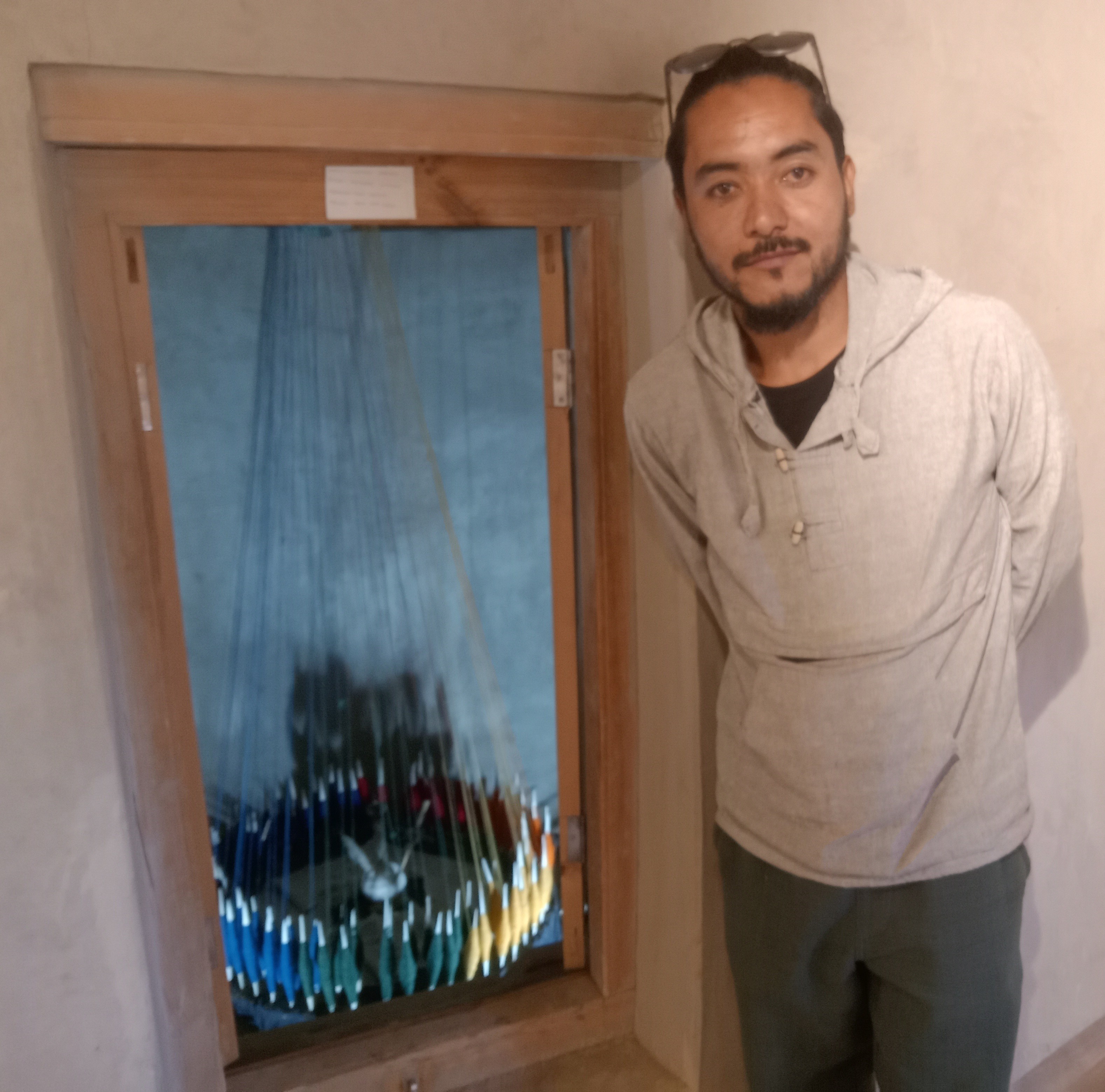
While the sculpture of two birds made of scrap metal sourced from vehicle parts bridged the two main elements of the work (vulnerable birds and the problem of traffic), Chemut provided the sculpture more local roots by bringing in the spindle as the sculpture’s base. Central to local textiles and dresses like the Ladakhi koncha which keep people warm, the spindle, as an emblem of how humans survive in Ladakh, is a recurrent motif in Chemat’s work. It is the heart of one of Chemat’s installations too, now on view at Onpo House.
In April 2023, Ladakh hosted the Youth-20 (Y-20) summit under the auspices of G-20, of which India had become president. In the run up to the Y-20 meeting, there was a flurry of beautification projects in Leh. According to Chemat, about a month before the Y-20 meeting he was sounded out by the local administration about a proposed art project. That was the genesis of the sculptures that came up just outside the NDS Stadium, which in September 2023 served as venue for the Ladakh Marathon expo. Realizing that the time provided was very limited, he recommended a symposium attended by invited artists – five from Ladakh and ten from elsewhere in India. Based yet again on scrap art, the symposium was called: 1st Ladakh National Scrap Art Symposium. It was anchored by the union territory’s administration and its housing and urban development department. The local administration leased space near Shanti Stupa in Leh for the artists to fashion scrap metal into creative art forms. The finished sculptures were set up adjacent to the NDS Stadium. Months later freelance journalist headed to a marathon expo would be sufficiently intrigued by the sculptures to find out who made it. But therein lay another tale.
Chemat Dorjey at Onpo House, Leh. To the left is one of his installations featuring spindles (photo: Shyam G Menon)
While the sculptures were installed and the Y-20 meeting was held, a proper explanation of the works of art along with credit to its creators, was still pending as of early September 2023. Standing before the sculptures, one couldn’t know the names of the artists involved because their names hadn’t been displayed. The underlying theme (what the sculptures signified) also stayed silent pending articulation and display. “ The formal unveiling is yet to happen,’’ Chemat said. He sent me a digital presentation on the earlier mentioned symposium, which contained the names of the participating artists. They were, besides Chemat; Parmar R. Kumar, Lodoe Gyaltsen, Madhab Das, Saurab Singh, Vinit Kumar, Vivek Das, Arun Bhandari, Dheeraj Kumar, Anupam Patel, Virender Singh, Tsering Gurmet, Stanzin Tsepel, Stanzin Samphel and Urgain Zawa. They made that row of intriguing metal sculptures. Unfortunately, even as anyone going to the NDS Stadium would have noticed the art work, it didn’t grace the actual course of the Ladakh Marathon. The course was towards Choglamsar while the sculptures were towards the side of Leh town.
Meanwhile, artists in Ladakh have become more versatile. Ladakh has distinct seasons with palpable impact on landscape and human existence and that has begun influencing artistic expression. Of late in winter, Ladakhi artists have worked with ice and snow. Within this approach, artists in Leh use ice, of which they have plenty in winter. In Kargil, the play is with snow; there is strong snowfall that side. Besides this, Ladakhi artists have also begun using the vast space and landscape of Ladakh as inspiration for outdoor installations.
(The author, Shyam G Menon, is a freelance journalist based in Mumbai.)
Jim Walmsley (this photo was downloaded from the Facebook page of the athlete and is being used here for representation purpose. No copyright infringement intended)
Courtney Dauwalter, Jim Walmsley win UTMB 2023
American ultrarunners Courtney Dauwalter and Jim Wamsley claimed the top spots at the 100-mile Ultra Trail Du Mont Blanc (UTMB) held over August 28 to September 3, 2023.
Jim Walmsley is the first American man to win the 100-mile race; he did so in his fifth attempt.
He also set a new course record with his finish in 19 hours, 37 minutes and 43 seconds, setting aside Killian Jornet’s course record of 19:49:30 hours.
Courtney Dauwalter won with timing of 23:29:14.
AFI names 12 ultrarunners for IAU 24-Hour World Championship Taiwan
The Athletic Federation of India (AFI) has named the team of 12 ultrarunners to represent Indian at the IAU 24 Hour World Championships to be held in Chinese Taipei in December this year, AFI said in a circular.
The team includes six women and six male runners. Women runners chosen include Anju Saini, Aparna Choudhary, Preeti Lala, Shashi Mehta, Meenal Kotak and Priyanka Bhatt. The men’s team includes Velu Perumal, Saurav Kumar Ranjan, Amar Singh Devanda, Geeno Antony, Badal Teotia and Ullas Narayana.
The selection criterion for the World Championships mandates that male runners complete 220 km or more during a 24-hour race held between July 1, 2022 and August 10, 2023. Women runners are required to cover a distance of 180 km or more.
As proof of fitness, runners are required to have run a 12-hour or a 100 km event during the period January 1, 2023 and August 10, 2023, AFI had said in an earlier circular.
In another circular, AFI said it plans to send a team of six female and six male runners for the IAU 50 km World Championship to be held in Hyderabad in November 2023.
The qualifying cut-off timing for male runners is completing a marathon in 2:50 hours and for women 3:20 hours in a race held between November 5, 2022 and August 10, 2023.
Courtney Dauwalter (this photo was downloaded from the Twitter handle of UTMB and is being used here for representation purpose. No copyright infringement intended)
Courtney Dauwalter smashes women’s course record at Western States, Hardrock 100
Courtney Dauwalter, American ultrarunner, smashed course records at two major ultramarathon events in a period of three weeks.
At the Western States, a 100-mile endurance run and the world’s oldest trail run, Courtney broke the women’s course record by nearly 80 minutes. She finished the race in 15 hours, 29 minutes and 33 seconds. The race was held on June 24-25, 2023.
Three weeks later, she broke the course record at Hardrock 100, also a 100-mile race. She finished the counter-clockwise course in 26:14:08, smashing the course record by an hour and four minutes. (Hardrock alternates the circular course every year). She already holds the course record for the clockwise direction.
(The author, Latha Venkatraman, is an independent journalist based in Mumbai.)
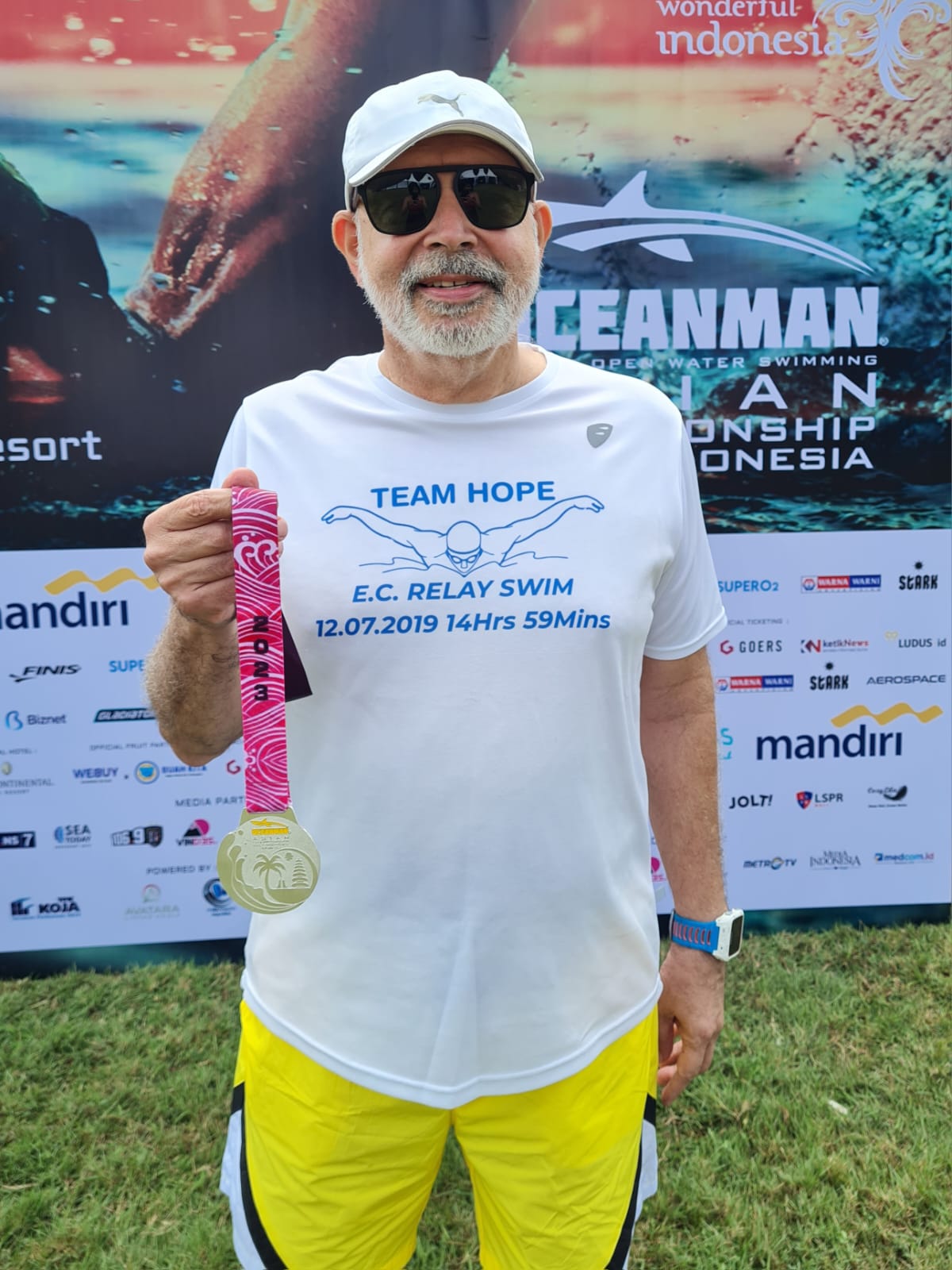
In July 2023, Zarir Baliwalla, 62, secured an age category-podium finish in the five kilometre-swim at the Oceanman Asian Championship in Bali.
Earlier, he had been three times age group podium finisher at Goa Swimathon (2019, 2022 and 2023); he was member of the winning relay team in the Gateway – Vashi Relay Swim Race in 2022, and in 2019, was a member of Team Hope, a four person-relay team that successfully swam the English Channel.
At this blog’s request, Zarir wrote in on his affection for swimming.
I learnt how to swim as a child of eight to nine years and have had a love affair with water ever since.
I have always felt comfortable in the water, be it a swimming pool, a lake or the open sea. Back in the 1960’s-70’s our coaches taught us only the breast stroke. As a junior, I competed in breast stroke races at the inter school level. Much later, as an adult, I taught myself the freestyle. After finishing school, I hardly swam for the next 30-35 years. But the sport of swimming always fascinated me and when our children were around eight to nine years old, my wife and I enrolled them in learn-to-swim classes. Both of them eventually swam competitively; my son for several years, all the way till the national level.
In my early fifties I took up long distance running to keep fit. After a few years and several half marathons my knees were beginning to trouble me, so I decided to reduce the load on them by cutting back on the running and switching to the triathlon. While training for the triathlon, I realized that swimming was by far the easiest of the three activities and also the least stressful on the body. So, even as I have done several Olympic triathlons over the past five to six years, I have always focused more on swimming than cycling and running.
Almost all my swim practice in Mumbai is done in pools. However, I am at my happiest in the open water; the sea in particular. Being in the middle of a huge ocean is a truly meditative feeling, hard to describe in words. I feel at one with the ocean, with nature. Once it casts its spell, the sea holds one in its net of wonder forever.
Apart from having done solo and relay swims in the triathlon, I have participated in several open water swim events. Some of them: Goa Swimathon, Thonnur Swimathon, Kasersai Swimathon, Gateway –Vashi Swim Relay, Sunkrock – Gateway solo swim, English Channel relay swim and most recently the 5km race at the Oceanman Asian Championship in Bali.
There was a time when we practised in the seas off Mumbai’s coast. Sadly, this has become almost impossible now due to pathetic water quality and refusal of permissions by relevant authorities supposedly on the grounds of security. So, I go to Goa three to four times a year during the open water season (October–May) and enjoy training in the pristine seas there.
Swimming plays an absolutely vital role in my life. It keeps me not just physically fit but is a definite mood elevator too. Swimming in the sea or in a pool gives one a lot of me time. At the end of a swim session, one always feels physically and mentally refreshed.
In my opinion, swimming is probably the best physical activity to keep a senior citizen fit and healthy. It entails zero impact on the knees and other joints (unlike running), the heart rate can stay low and well under check and it exercises all the muscles in our upper and lower body. Regular swimming will also certainly improve one’s lung power and aerobic capacity.
Unfortunately, not too many people take up swimming, since it is an acquired skill best picked up in childhood. Paucity of access to pools and even the sea are also huge deterrents to pursuing swimming.
(The author, Zarir Baliwalla, is a businessman based in Mumbai. He is ex-president of the Greater Mumbai Amateur Aquatic Association.)
The owner of a small furniture shop in Aluva has been making a unique contribution to life in Kerala.
A land of backwaters, rivers and seacoast, accidents involving boats have been several in the state. In May 2023, 27 people died when their boat capsized in Tanur. That was merely the latest at the time of writing. What set Saji Valasseril thinking was an incident 21 years ago, when 29 people lost their lives after their boat traveling from Muhamma to Kumarakom, capsized in the Vembanad Lake. “ There were other mishaps too that made me want to do something,’’ Saji, a resident of Aluva, said. In 2007, 15 students, two teachers and an employee were killed when their boat sank in Thattekkad. In 2009, there was the Thekkady boat tragedy when 45 people died after their boat sank in the Periyar National Park. For Saji, it just didn’t make sense that people should die so. He felt that if people knew how to swim; at the very least if they could stay calm and afloat till rescuers arrived, lives could be saved. Saji had a background relevant to imagine so. His late father, V. Thomas Mani, had been a champion swimmer during his days in the army’s Madras Regiment. He taught Saji to swim in the river Periyar.
In March 2010, Saji decided to address the subject of drownings in Kerala, starting with his own family. His two children – Merin and Jerin – and the children of a friend, commenced learning to swim under his tutelage in the Periyar. On the map, Aluva, located on the banks of the Periyar, is a little before the river splinters into a complex estuarine geography ahead of its rendezvous with the backwaters and the Arabian Sea. The Periyar is Kerala’s biggest river in terms of volume of water carried. Because he was imagining back from all those boat accidents and survival in such contexts, Saji oriented his swimming lessons towards an eventual river-crossing. Merin did just that on the 39th day of her training; aged 13, she swam across the Periyar. The younger Jerin followed suit; he took two to two and a half months of training.
A training session in progress in the Periyar (photo: courtesy Saji)
Around 2012, Saji named his endeavour, ` Valasseril River Swimming Club.’ By 2013, the number of people crossing, rose to 38. “ About one third to a quarter of a batch reach the competence level where they become eligible to try a crossing. The rest, learn swimming and go,’’ Saji said, adding against the backdrop of his syllabus that he estimates a trainee to acquire basic skills in 16 days. In 2014, 76 people swam across the Periyar. In 2017 the number touched 87 and in 2019 it rose further to 91. After a spike in response during the COVID phase, when almost 240 people crossed each year in 2020 and in 2021; in 2023, 1620 people trained, of who, 140 crossed. “ In all, I estimate, about 8000 people have by now learnt swimming from us,’’ Saji said leafing through files of entry forms submitted over the years. He has since become a regular subject of interest for the local media. According to Saji, the current length of the club’s crossing is approximately 750 metres as the route is to and fro. Maximum depth should be 30-40 feet.
Saji’s swimming sessions also attracted a clutch of differently abled individuals and senior citizens. Media reports cited a double amputee, a boy born without hands, a girl who underwent neurosurgery and was weak in one leg and a septuagenarian lady – Arifa – who swam with her hands tied, among those who crossed the Periyar. On August 14, 2023, Arifa spoke to this blog. In 2018, Aluva, where she resides, was among places affected by the heavy rain and floods that hit Kerala. She was not in town when calamity struck but her children told her of what happened including the tales of rescue. Arifa didn’t know how to swim. But she quickly realized that to be useful in times of flood and be part of relief work, swimming was an essential skill. That’s how at 68 years of age, she connected with Saji. Having grown up near a river, Arifa wasn’t an utter stranger to water. But that was 55 years earlier in her childhood. The year she attended Saji’s training session and learnt to swim, she couldn’t cross the Periyar because the day for swimming across coincided with her period of fasting. Then the lockdown induced by COVID-19 intervened. Eventually, she swam across the Periyar in 2022. Two months later with a week of training devoted to the new challenge assigned her, she swam across with her hands tied. “ The message I’d like to share from this attempt is that all should learn how to swim,” she was quoted as saying in the New Indian Express. In its early days, Saji’s program was focused on children. In 2016, very unexpectedly, a parent swam along in the crossing. He died of a heart attack. Following this, an ambulance became a constant presence at the program site and on the day of crossing, a safety-boat was engaged. More importantly, Saji began training adults as well. Nowadays, no adult gets to the crossing stage without the trainers being convinced that they are up to it, Saji said. Aside from his commitment to the journey he has embarked on, what engages about Saji’s project is the manner in which he built up scale.
A crossing underway in the Periyar (photo: courtesy Saji)
A state, where many houses once sported private ponds, the declining engagement of the average Malayali with swimming, is a product of altered lifestyle. Greater construction has meant the old ponds levelled and built over. Overwhelming emphasis on academics meant the school and college-going became distanced from swimming or they learnt it as a skill paid for and acquired at any of the state’s modern but expensive swimming pools. Simply put, the numbers of those in newer generations who were acquainted with water, shrank. As these shifts happened, the Periyar’s kadavu or bathing ghats grew neglected and with it, familiar places on the river with gradual progression in depth and ideal to teach swimming, dwindled. Compounding the issue has been the problem of sand mining (it plagues many rivers in Kerala), which creates places with sudden variation in depth.
A May 2022 report in Mathrubhumi said, “ As per the records of the Fire and Rescue Department, on an average, three people drown in the state per day. ‘’ According to it, in 2021 alone there were 1102 reported cases of drowning, up from less than 1000 the year before. Many people drowned in rivers and ponds when visiting such places in groups. Even if one knew swimming, being able to tackle natural water bodies with currents in them, was an issue contributing to the fatalities, the news report said. When this writer contacted M Naushad, Director (Technical) of Kerala Fire and Rescue Services, he said that while knowing how to swim is always a good thing, people not heeding instructions to desist from swimming when and where conditions are not ideal, was a worry.
Saji, who is clear that his job is not to create champion swimmers but impart a survival skill, hosts his training at Manappuram in Aluva, a place by the Periyar famed for a Shiva temple and which has a gradually sloping approach into the waters. Here, Saji came up with an ingenious device (his fabrication skills came of use); a removable, collapsible structure of GI pipes, 70 feet by 40 feet in dimension. He currently uses four such structures. Each of them, anchored and kept afloat by an array of inflatable rubber tubes, separates the area within used for training, into seven lanes of varying water-depth. The trainees work their way from the shallows to the deep lane. This graduation takes weeks. It is only after such progression entailing 50 days, that the best of the lot, get a shot at the crossing monitored by expert swimmers with a kayak in tow. For Saji, this method has worked well so far. More importantly, since his mission commenced in the need to teach a state how to save itself in water, he considers the model replicable for use at other locations. “ If you look at where all people are drowning these days, you will be amazed. There is the case of a large temple pond, which was cleaned and beautifully redone only to have people drown in it later. My device can be built to required scale and all it needs is the shallows of these ponds. If people are trained using the device in such ponds and they venture to the deep only after they are properly skilled, fatalities can be minimised,’’ Saji said.
A training session in progress in the Periyar (photo: courtesy Saji)
Thanks to the four structures in the water, Saji said, the club can train close to 1000 people at a time. As a concept, scaling up won’t be appreciated by discerning trainers because of the inbuilt danger in something going wrong. For instance, trainers’ attention risks being spread thin as the number of trainees rise. Health issues is another. But against the backdrop of Kerala’s emergent equation with water (there is the newfound reality of floods to cope with during rains plus those recurrent boat tragedies) Saji merits a hearing. According to him, municipal authorities and elected representatives have supported him in the ongoing project in Aluva. To aid scale and reduce risk related to the natural variabilities of a river, he wishes for a large tank with powerful pumps, built at Manappuram, which mimics the water depth of the Periyar’s banks and its flow. It will cost money; sponsors will be needed. But if by now, you are thinking that training plus scale should be fetching this man good money; hang on. According to Saji, he charges nothing except for expenses around safety. His main income remains the small shop: Valasseril Furniture.
(The author, Shyam G Menon, is a freelance journalist based in Mumbai. This is the slightly extended version of an article written by the author and published in The Telegraph on July 10, 2023.)
At the 2023 Comrades Marathon, Mumbai-based Dr Anand Patil crossed the finish line for the tenth time thus earning a Comrades Green Number Roll of Honour. Runners who complete the ultramarathon in South Africa ten times earn the recognition.
Since 1921, a total of 14,000 runners from South Africa and around the world have earned this green number, information on Comrades website said. A week before his tenth Comrades run, Anand did the Durban Half Ironman.
A surgeon by training, Anand’s journey in endurance is a combination of running, triathlon, ultra-long-distance cycling and ultra-long-distance swimming. Apart from the ten Comrades, Anand has done over 13 full Ironman and 11 half Ironman, Olympic distance triathlons and 40 marathons in India and overseas including all the six World Marathon Majors. That last distinction earned him the Abbott World Marathon Major medal. His endeavours also include several ultra-cycling races and ultra-swim events. He has done an Ultraman.
Anand grew up in Kurli village in Belgaum. Much of his childhood years were spent swimming in rivers, local water bodies, cycling, walking and running through the village, apart from pouring over his school books. There was no TV and movies for distraction. At the Vaishampayan Memorial Government Medical College, Anand became part of the swimming team and as a second year MBBS student, he took part in competitions. After his MS, he went into the medical profession. He did not stop formal education after MS. Instead, he went on to do M.Sc (in Biotechnology), MA (in Political Science and History), LLB and M.Phil (in Anthropology). He also cleared the UPSC (Union Public Services Commission) examination, which is essential for a career in civil services. Alongside he started a coaching centre, Study Circle, for those aspiring to join civil services.
Years went by. Anand’s medical practice continued. He also focussed on expanding Study Circle across Maharashtra, Karnataka and Delhi. “ I had put on a lot of weight. A college friend of mine Dr Ajay Chaugale was shocked to see me so heavy. He asked me to join a gym. At that time both me and my wife Vaishali became life members of Talwalkars Gym,” Anand said. This was in 2000.
In 2004, Mumbai Marathon made its debut. Anand was part of the medical team for that edition. “ In 2008, I ran 21 kilometres at the Thane Mahapaur Run (it was later renamed: Varsha Marathon). I ran without any training. My time at Talwalkars Gym helped build my strength and stamina,” he said.
Dr Anand Patil (photo: courtesy Anand)
In 2010, he ran the full marathon at Mumbai Marathon. In the same year, he did Berlin Marathon. In the following year, he did the New York City Marathon. While running this marathon, he heard about Comrades. In 2012, he did his first Comrades run. Comrades Marathon is actually an ultramarathon of about 87-90 km held annually in South Africa. The route alternates between the downhill version from Pietermaritzburg to Durban and the uphill version from Durban to Pietermaritzburg.
“ I began understanding endurance. I realised that I was healthy but not fit,” he said. Fitness, according to him, has five aspects – stamina, endurance, strength, power and speed.
While running his first Comrades, he heard about Ironman (triathlon) from an Australian runner. Soon, he was dividing his time between work, workouts and races. These races were a mix of marathon, triathlon, cycling events and swimming events.
In May 2017, Anand participated in Noosa Ultraman in Queensland, Australia. An Ultraman held over three days entails a 10 km swim, 140 km bicycle ride (on day one), 281 km bicycle ride (on day two) and an 84.3 km run (on day three). “ I didn’t get my visa until the day before I was to leave. I did the swim segment without a wet suit,” he said. He finished the Ultraman in 33:42:16 hours. Less than a month after the Ultraman, Anand ran the Comrades Marathon (his sixth). Later that year, he did Bhutan Tour of the Dragon, a 255 km-mountain bike race and followed it with Ironman Langkawi.
Anand’s calendar is packed with endurance events. In 2018, he did the Boston Marathon and followed it up with Comrades. Later that year, he did three events over three weekends – Ironman Maryland followed by Chicago Marathon followed by Ironman Louisville. He also did Ironman Langkawi, his third time there. He did this Ironman five times from 2016 onward. Anand is expected to do the Ironman Langkawi for the sixth time this October.
In ultra-cycling events, Anand has completed the Ultra Spice twice and the Deccan Cliffhanger six times.
According to Anand, management of calories is very important for endurance sport. “ This time at Comrades I planned to be on my feet for 12 hours. As per my calculation I needed 11,000 calories. My aim was to get to the halfway mark in under five hours with a need for 4,000 calories,” he said.
On the day of the race at Comrades, at 1:30 AM, he had breakfast and a 750 ml isotonic drink. On reaching the start line, he had a black coffee. “ The race commenced at 5:30 AM. I was in corral H. I lost 7-8 minutes by the time I crossed the start line. At 7:30 AM, at an aid station, I had a drink. From Drummond, which is the half way mark, the stiff climb starts. I did not feel hungry until finish line,” he said. He finished the run in 10:51:07 hours. His best timing in Comrades was 9:50 in 2016.
Having finished his tenth Comrades and earned his green number, Anand plans to focus on training for Race Across America (RAAM), an ultra-cycling event that starts in Oceanside in California and ends at Annapolis, Maryland on the US east coast. It covers a distance of over 3,000 miles and traverses through 12 states. As part of his training, he intends to do the 600 km solo crew supported Himalayan ultra from Leh to Kargil and back in August this year.
Dr Anand Patil (photo: courtesy Anand)
What strikes about Dr Patil’s life is the tendency to push one’s limits, visible as much in his accomplishments in sports as it is in academics. While his harvest in endurance spans marathons to ultramarathons and Ironman to Ultraman; in academics, his degrees range from humanities to law and medicine with an acceptance for the civil services. “ He is an outlier,’’ Anand’s wife, Vaishali, said (according to her, back in time when Anand cleared the civil services exams, he was ranked 68th and offered the chance to join the Indian Police Service). She attributed his nature to upbringing in a rural backdrop, challenges faced along the way, the determination to overcome obstacles and the resolve to maximise whatever one did. “ His needs are minimum. One might think that someone with his kind of calendar would have a diet regimen, a workout routine and endless needs. He has no such needs or demands. If you see his office timings, they are unbelievable, his practice for all of his races is always below par and yet I have not had an ounce of supplements or gels or anything in my house ever,’’ Vaishali said.
With Study Circle picking up strongly, it wasn’t long before the doctor – he had his own hospital in Navi Mumbai – was splitting time between his medical practice and the civil services-training outfit.
Anand has now reoriented his medical acumen towards Fitness calibration based on the concept of the Fitness pyramid, besides training students for the civil services.
In a sense, life has come full circle for him. Those who were his students at Study Circle and have since become high ranking civil servants look up to Anand as their guru in endurance sports too, Vaishali said.
(The author, Latha Venkatraman, is an independent journalist based in Mumbai.)
India’s Vipul Kumar finishes fourth in men’s 100km race
Japanese runners swept the podium in both individual and team events at the 2023 IAU 100km Asia and Oceania Championship held in Bengaluru on Sunday, July 30.
In the men’s race, Toru Somiya of Japan won by a good margin covering the distance in six hours, 39 minutes and 38 second, ahead of fellow compatriots Haruki Okayama (second place at 6:50:42) and Hideaki Yamauchi (third at 6:55:51). The outcome in the women’s race was similar with Japan’s Miho Nakata (7:27:44) placing first followed by her teammates, Mai Fujisawa (7:45:49) and Mikiko Ota (7:54:33) in second and third respectively. In the team championship, the men’s category was easily won by Japan; its best three runners had an aggregate time of 20:26:11. India placed second with an aggregate of 22:21:13 and Chinese Taipei, third, with 29:25:54. In the women’s category, the team championship went to Japan with a total of 23:04:06. The second and third positions went to Australia (27:48;03) and Chinese Taipei (32:25:07) respectively.
Miho Nakata (Photo: Latha Venkatraman)
Going into the race, expectations were high for the former world record holder Nao Kazami (he had a personal best of 6:09:14 for 100km) and Okayama (PB of 6:12:10). On race day, Kazami completed the first 11 laps of the five kilometre-course in 3:25:28 compared to 3:29:05 for Somiya. They completed 13 laps in 4:05:05 and 4:08:27 respectively. However, somewhere past the middle of the race, Kazami who was running strongly began to struggle and fade. Somiya completed his 18th lap in 5:53:52. Kazami took 6:02:37 to finish 17 laps. Somiya steadily consolidated his position and emerged winner by a wide margin (Kazami eventually finished in 7:22:10).
According to his team manager, this was Somiya’s first appearance in the national running team. His work schedule is such that he works during the night and trains during the day. On the other hand, the winner among women, Miho Nakata, has been a member of Japan’s national team before. All in all, the Japanese team drove home the message that its participation raises performance levels at running competitions, comprehensively (India’s previous taste of an IAU championship – the 2022 IAU 24 Hour Asia and Oceania Championship, also held in Bengaluru – hadn’t featured participation by the Japanese). Japan is among countries where running enjoys a great following.
Vipul Kumar (Photo: Shyam G Menon)
Having said that, on Sunday, finishing fourth in the men’s category (behind the top placed Japanese trio) was India’s Vipul Kumar. His gritty run took 7:06:10 to complete. He fell short of improving his national best (7:04:00) by a narrow margin. “Although the weather was an issue, I am very happy with my performance,” he told this blog. The second and third fastest Indian runners were Amar Singh Devanda (7:27:48) and Saurav Kumar Ranjan (7:47:06). These three runs taken together, earned the Indian men’s team a second place in their gender category.
In the women’s section, the Indian team suffered an unexpected setback when its top runner Jyoti Gawate (she holds the national record for women in 100 km – 8:20:00) was forced to pull out due to severe cramps. Between her 14th and 15th laps, there was a long gap in her appearance on the course, those watching the race from the side-lines noticed. It was the outcome of a break she had to take to address her situation. Jyoti completed 16 laps before deciding to discontinue. Coming into the race, Jyoti had the sixth best personal timing in 100km among the gathered women athletes. On Sunday, the fastest Indian woman to 100km was Shashi Mehta (8:52:38). She was followed by Gunjan Khurana (10:24:50). The race was held on a five kilometre-loop with a successful completion entailing 20 laps of the circuit. Unfortunately, the Indian women couldn’t deliver three successful completions from their ranks, to be considered for the team championship.
The podium finishers in the open category (Photo: Shyam G Menon)
In the 100km open category, Velu Perumal was the winner; he covered the distance in 7:55:50. The second runner to finish was Gorkha Ram Beniwal with a timing of 8:15:22 and in third position was Anmol Chandan who finished in 10:02:39. There were no women runners in the open category. There were eleven male runners; all from India. Both Velu and Gorkha Ram pointed out that their diligent training helped them to stay strong on the course. Velu had been part of the Indian team which took part in the 2022 IAU 24 Hour Asia and Oceania Championship, held in Bengaluru.
The 2023 IAU 100km Asia and Oceania Championship was organized by NEB Sports.
Lkhagva-Erdene Namkhaidorj and Alan (Photo: Shyam G Menon)
On Sunday, many runners spoke of the weather as a suddenly emergent challenge. In the days preceding the race, Bengaluru had seen rain and experienced a generally cool weather. The day before the race, at the time of the event’s opening ceremony, there was rain. It kindled hopes that the cool weather would continue. Race day commenced with cool weather. But a few hours later, the sun came out and the coolness gave way to heat and humidity. Add to it portions of the course described by some of the runners as less shaded or hosting an incline. From the hours merging morning to noon onward, the struggle was evident across the assembled runners. Thus, although they won the race by a fantastic margin when compared to the rest of the field, the timings of even the Japanese runners were not close to their personal best. A team manager explained the situation as being as much physical as it was psychological. According to him, there was so much confidence in the weather being good that when it turned otherwise, the carefully placed calculations and motivation levels of some of the athletes may have got upset. There were exceptions. India’s Amar Singh Devanda, Saurav Kumar Ranjan, Binay Sah (7:55:21) and Shashi Mehta managed new personal best.
Amidst all the competition, there was a lovely example of cooperation and sharing. In ultrarunning, each team’s support crew plays a crucial role; they make sure they know their runners well, cater to each athlete’s needs on race-day and support them with nutrition and hydration. Mongolian ultrarunner, Lkhagva-Erdene Namkhaidorj, out on her first international event and only the second 100km-race of her life, had reached Bengaluru without anyone to support her during the run. Alan, who was supporting Shannon-Leigh Litt of New Zealand, decided to support the Mongolian runner too. The two teams shared one tent offering the required support facilities. As Lkhagva-Erdene Namkhaidorj completed her race, it was Alan who showed up to greet her at the finish line, Mongolian flag in hand for her to wrap herself in.
(The authors, Latha Venkatraman and Shyam G Menon, are independent journalists based in Mumbai.)
It will be the first IAU world championship to be held in India
Athletes and officials assembled in Bengaluru for the IAU 100km Asia & Oceania Championship (Photo: Shyam, G Menon)
India will host its first world championship under the auspices of the International Association of Ultrarunners (IAU) in November this year.
“ It will be the 50k world championship and will be held in Hyderabad,’’ Dr Nadeem Khan, president, IAU said in Bengaluru on Saturday (July 29, 2023). As yet IAU championships held in India have spanned 24 hours and 100k and been in the Asia-Oceania championship category.
Dr Khan was in the city in connection with the IAU 100km Asia & Oceania Championship, which gets underway on Sunday (July 30). The event – it is the first IAU 100k championship being held in India – is scheduled to take place on a five kilometre-loop at the GKVK (Gandhi Krishi Vigyana Kendra) campus. The championship was formally declared open at a ceremonial function, Saturday evening.
Nao Kazami (Photo: Shyam G Menon)
Haruki Okayama (Photo: Shyam G Menon)
The event has participants from Australia, Chinese Taipei, New Zealand, Japan, Mongolia and India. It is being held in association with the IAU, Athletics Federation of India and is being organised by NEB Sports. The presence of Japan and Australia add to the competition on show. Of the top five male athletes ranked as per their personal best, the top four are from Japan and one, from Australia. This includes former world record holder Nao Kazami of Japan, who has a PB of six hours, nine minutes and 14 seconds for the 100k. Expected to give him tight competition is his teammate, Haruki Okayama (6:12;10). All the aforementioned five athletes have sub-seven-hours PBs. Going into the race, the composition of the top five ranked according to their PBs was the same for women with the top four hailing from Japan and one from Australia. The best PB among women belonged to Miho Nakata (7:19:12).
The previous edition of the 100km Asia and Oceania Championship was held in Jordan in 2019. In 2022, the 100km World Championships were held at Bernau-Berlin where India’s Vipul Kumar and Jyoti Gawate set new national bests (7:04:00 and 8:20:00) in the distance. Both Jyoti and Vipul are part of the Indian team running at Bengaluru on Sunday (July 30, 2023).
The Indian team with IAU president, Dr Nadeem Khan (far right), race director Nagaraj Adiga (second from left) and others (Photo: Latha Venkatraman)
“ The hosting of IAU 100 km Asia & Oceania Championship will give us visibility and reach in ultrarunning,” a related press release said quoting Dr Rajender Kataria, an IAS officer and president of the local organizing committee of the championship in Bengaluru. “ The championship coming to India is a culmination of several years of hard work. We are very excited to bring this event to India and appreciate the fact that this will further elevate the sport in the country,” the release said quoting Dr Khan.
India will be represented by ten ultrarunners – four women and six men. They are Vipul Kumar, Binay Sah, Saurav Kumar Ranjan, Nishu Kumar, Amar Singh Devanda, Karthik Joshi, Jyoti Gawate, Gunjan Khurana, Shashi Mehta and Aparna Choudhary.
(The authors, Latha Venkatraman and Shyam G Menon, are independent journalists based in Mumbai.)