
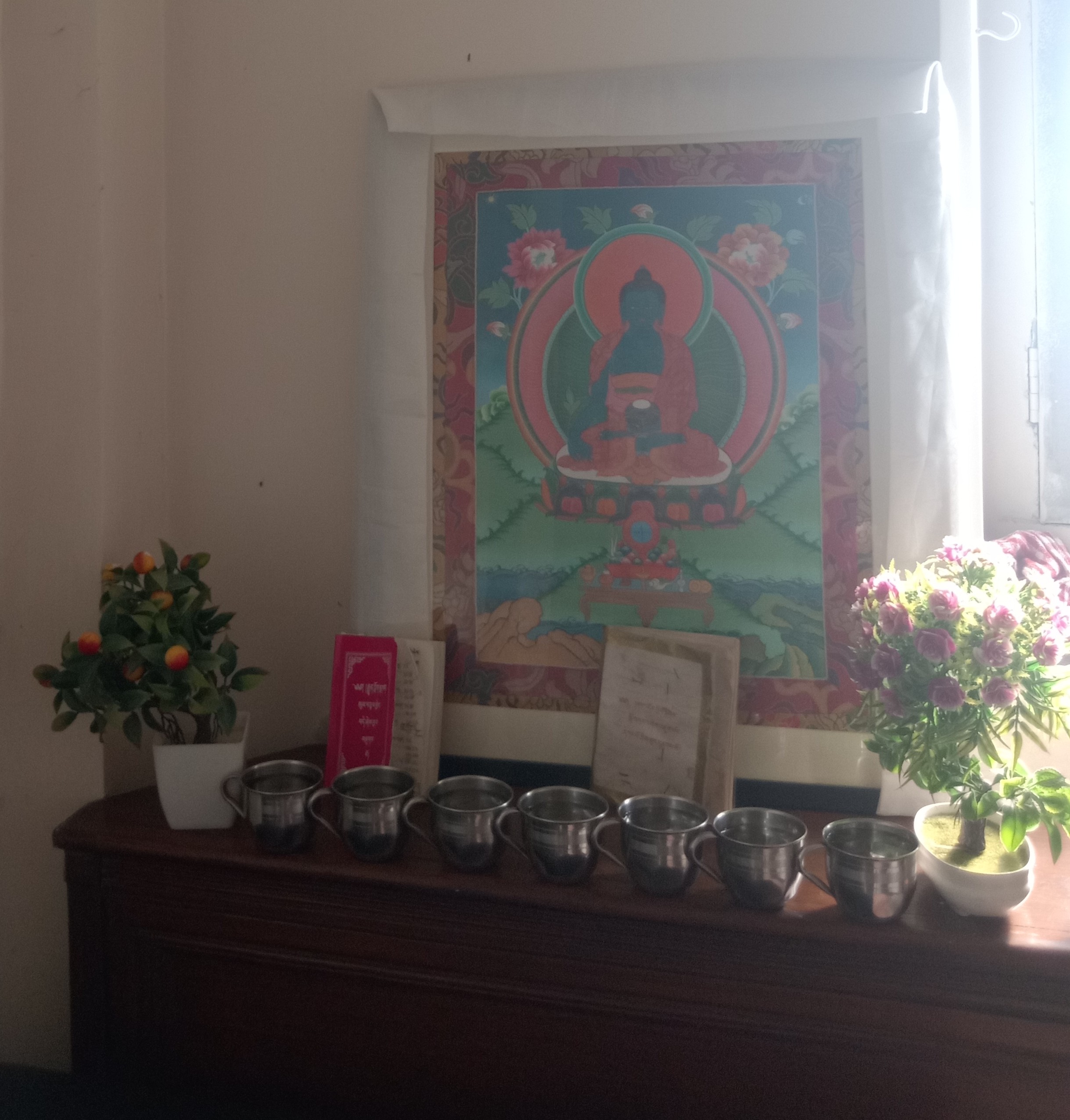
Annual marathon done and dusted, the roads near Mumbai’s Chhatrapati Shivaji Maharaj Terminus (CSMT), betrayed little sign of the thousands of runners who had passed that way just over 24 hours ago. The city is like a chameleon. It changes colour briefly for India’s biggest marathon. Event over, it quickly returns to its regular call sign of bustling trade and commerce. It was January 20, 2025. Not far from CSMT, at the apartment where the runners from Ladakh stayed, the room I was ushered into reserved a corner for its residents to pray. As Jigmet Dolma told me, the team’s coach, Mumbai-based Savio D’Souza was gifted a traditional print on cloth, done in the style of the Buddhist faith. Kept on a shelf in the room and supported by the wall, the fabric imprinted with an image of divinity, became the centre piece. There were two prayer books and small steel cups bearing offerings of water, in front of the image. The adjacent window was shut. But through its glass panes, sunlight wafted in less like an electric beam and more like a warm, diffused glow. As I understood, the little shrine appeared when the runners reached Mumbai for their annual tryst with the city’s marathon. Race done and runners gone, the shrine too disappeared. Sitting in that peaceful corner, I felt transported to Ladakh.
Stanzin Dolkar, Skarma Idong Lanzes and Tashi Ladol – all of them still doing their college education – walked into the room. For the trio, it had been a busy season of running till January 19, 2025. Back home in Ladakh, their training for India’s season of marathons, typically begins in April. The month of March is a period of rest. Stanzin Dolkar hails from Lamayuru. She has been to Mumbai before, as part of Ladakh’s running team. For most Ladakhi runners, their marathon season leading up to the Tata Mumbai Marathon (TMM), commences with local races. In Stanzin’s case, it was the annual Ladakh Marathon; its 2024 edition, wherein she participated in the half marathon and finished third. Next came the marathon in Spiti, where she placed second in the half marathon. At the inaugural edition of the Kashmir International Marathon, she placed eleventh overall among women in the half marathon. Then, traveling south to Pune in Maharashtra, she finished ninth among women in the half marathon there. This outing earned her a new personal best (PB) – an hour and 24 minutes to cover 21 kilometres. Her first race of the season in the Mumbai region was the annual Vasai Virar Mayor’s Marathon (VVMM). At the event, she placed second in the women’s half marathon. It was time now to focus on TMM.
Unlike Stanzin Dolkar, who appeared comfortably settled into running the half marathon, Skarma viewed herself for the present, as a 10 kilometre-specialist. Her season had started with a first place over a distance of 11.2 kilometres at the Ladakh Marathon in Leh. Trying her hand at the half marathon for the first time, she got a tenth place in the women’s half marathon at the 2024 Kashmir International Marathon. “ It was tough for me. I thought I won’t do the half marathon again,’’ she said. Skarma, who hails from Kobet in Nubra, had therefore planned to do the 10K at TMM in Mumbai. It would be her first visit to the city as part of Ladakh’s running team. Then an error occurred while registering for the race. Her original registration accidentally preferred TMM’s virtual race and by the time she tried to correct it, registrations for the actual 10K had closed. So, she ended up registering for another half marathon. Would it be tough? How would she fare in it?
Tashi, who completes this trio, has run in Mumbai before. Her PB in the half marathon is 1:23:10. At 2023 TMM, she had finished second in her age category with timing of 1:25:22. Her 2024-2025 season commenced, as with Stanzin and Skarma, at the annual Ladakh Marathon, where she earned a first place in the half marathon. Tashi followed that up with a first place in the half, in Spiti. She placed eighth among women in the half, at the Kashmir International Marathon. It was another eighth among women in the half, at Pune. Then she was first among women in the half marathon at VVMM. Thereafter, it was countdown to 2025 TMM.
On January 19, race day in Mumbai, all three Ladakhi runners found the humidity difficult to endure. The early portion of the race – the stretch leading up to the Sea Link bridge and the time spent on it – was particularly uncomfortable because of the humidity. They had spent adequate time in Mumbai in the lead-up to race day and yet, as runners from Ladakh they had a problem coping with the city’s humidity. The heat wasn’t as much an issue. Unlike in the 42 kilometre-marathon, wherein runners form packs to get carried through and strike out on their own in the final portion, in the half marathon, it is each to his / her own design from the start. “ In the 42, which is genuinely long, it makes sense to have a group that carries you along for much of the distance and then strike out by oneself,’’ Jigmet, who is a seasoned marathoner, explained. The half marathon is viewed as a more individual race given its shorter distance. Although they all hailed from Ladakh, the three half marathon runners moved in their own individual cocoons. Skarma, who loves the 10K, shot to the front early. Tashi, who was at this stage behind Skarma and having Stanzin Dolkar for company, put it in perspective. “ The heat and humidity of the Sea Link portion was tough on me. By the time I finished it, I was wondering whether I would be able to continue. Around this time, Stanzin also moved ahead. Till about the 12th or 13th kilometre, I kept thinking of giving up. But our coach Savio used to remind us not to give up and instead try to complete the race. That kept me going,’’ she said.
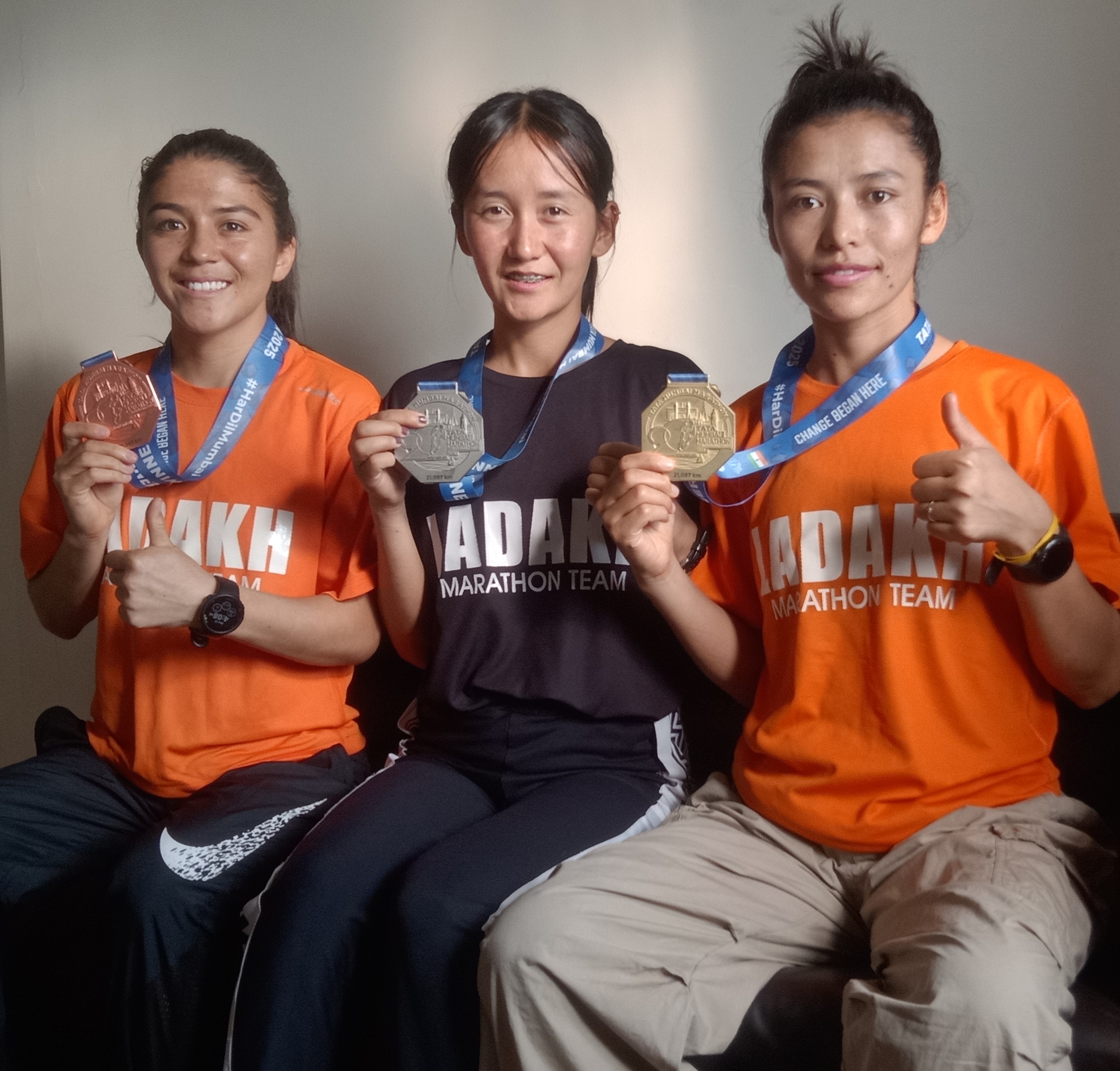
Skarma was up in front for a good part of the race. At around kilometer-18, on Mumbai’s well-known Marine Drive, she began to slow down a bit. That was the point, Stanzin took the lead. According to all three runners, none of them were focused on podium positions or even aware of where they stood in the line of runners racing to the finish. “ We run in pursuit of an improved timing, that’s all,’’ Stanzin Dolkar said. The runner from Lamayuru completed the race in one hour, 25 minutes and 47 seconds to emerge overall winner among women in the half marathon at 2025 TMM. Skarma (1:26:59) placed second and Tashi (1:29:27), third. For Skarma, it would seem a smashing debut in Mumbai. A person who speaks thoughtfully, she looked happy with the outcome. But her heart continued to be in the 10K. She still thinks of herself as a 10K runner and plans to do the 10K through 2025. She believes that by then the team’s coaches – Savio and Tsering Stobgais (he is also the team’s manager for their Mumbai visits) – will decide whether she should embrace the half marathon or not. Tashi, whose positive attitude is infectious, had mixed feelings about her result. “ The race was good but I am not satisfied with my timing. I did not have any inkling of a podium position when I finished. So, realizing that I was third was a surprise; a bonus,’’ she said smiling. For team Ladakh, it was a clean sweep of podium positions in the women’s half marathon. But Ladakh’s half marathon story at 2025 TMM, doesn’t end there.
For the past few years at TMM, Stanzin Chondol has been a promising talent in the half marathon from Ladakh. At 2023 TMM, she had finished third in her age group with timing of 1:26:14. In 2024, she finished second in her age group. Hailing from Zanskar and familiar with TMM through previous visits to Mumbai with the Ladakh team, this college student had a run up to 2025 TMM that was similar to that of her team mates but with a twist at the end; a twist, which may have made a difference. Her 2024-2025 season began with a first place in the 10K in Drass and a second place in the half marathon in Leh. Then, this runner, known best for the half marathon and who hasn’t done any of Ladakh’s own ultramarathons, enlisted for a run of 76 kilometres in Spiti and finished second. “ I went to Spiti because they had announced a laptop for the winner. Eventually, they gave cash prizes. But I was able to buy a laptop with the prize money. A laptop is very useful for Power Point presentations in college,’’ she said. Following Spiti, Stanzin placed thirteenth among women doing the half at the Kashmir International Marathon. Then came the twist. She had to represent Ladakh University at a national level sports meet in Goa. This was on January 18, the day before 2025 TMM. Having run the 10K in Goa and finished fourth, she dashed back to Mumbai that evening and ran TMM’s half marathon early morning January 19. “ My body was tight and my hamstring was hurting. I thought of giving up but managed to complete nonetheless,’’ she said. Forty-seven seconds after Tashi Ladol completed her half marathon in third place, it was Stanzin Chondol who crossed the finish line in Mumbai with timing of 1:30:14, making it a 1,2,3,4–sweep for Ladakh. Zanskar’s Stanzin also secured second place in her age category for women (same as last year), just behind Lamayuru’s Stanzin.
When contacted, Savio said that Ladakh’s half marathon runners were currently in a sweet spot. “ The four of them are more or less of the same level of competence. They train together and keep pushing each other to improve. That’s good for them,’’ he said, hinting alongside that nothing is permanent in life and athletics. There will always be the question of how long a sweet spot lasts. As much as results in the half marathon shone for Ladakh this year, it was tough going for the team in the full 42 kilometre-race. Jigmet Dolma, their best-known marathoner, had prepared better than last year for 2025 TMM. She was running in the Indian women’s elite segment. “ My training was okay and I was happy with it,’’ she said. Jigmet had also reached Mumbai sufficiently early to get used to the heat and humidity. But inexplicably on yet another warm and humid race day in Mumbai, she began developing pain on her side and in the chest region in the early part of the race itself. It affected her pace and she had to slow down. She struggled and continued as best as she could till about kilometer-30. Then, she gave up. It made sense to stop, prevent any further damage and preserve oneself to train and run well at the marathon in New Delhi, due in February second-half. According to her, there were 17 women in the Indian elite category of the 2025 Mumbai marathon. Of that almost half didn’t complete the race.
Jigmet’s result in 2025 has a backdrop to it and it is something authorities in Leh could help address. Many Indian athletes come from tough circumstances. Getting a secure job is something they all dream of. But it is also important that jobs allow them time for training. A year ago in 2024, after she finished the 2024 TMM sixth among Indian elite women (she developed pain in her shoulder and hamstring at 31-32 kilometres and had to slow down), Jigmet had spoken to this blog of challenges she faced in training (https://shyamgopan.com/2024/01/26/2024-tmm-musings/). She held a temporary job with the police in Ladakh and wasn’t able to train twice a day (typically training hard in the morning and an hour of easy running in the evening) as elite athletes are required to. Asked in 2025 if the situation had changed, she said that her job was yet to be made permanent and although accepted for employment for her strength in sports, her training was still not back to twice a day. The predicament was highlighted by Savio as well. Running with elite athletes – at that pace and for so long – is not easy. One has to train systematically and diligently for it. “ Jigmet is able to train only once a day. I think she has opted for the evening shift at work. At the level of athletes like her, an hour of easy running in the evening would mean about 10 kilometres covered. Multiplied by the number of days a week she trains, that is not a small mileage. When Jigmet is unable to train twice a day, it basically means that her overall mileage in training has decreased,’’ Savio said, pointing out how limitations imposed by one’s job, can hurt athletes. Jigmet was a podium finisher at TMM in the Indian women’s elite category in 2019; she has also been part of Indian teams for marathons abroad. Her former teammate in running the women’s marathon, Tsetan Dolkar, now works as a coach in Leh.
At 2025 TMM, Jigmet’s fellow runner from Ladakh, Disket Dolma, was making her debut in the Indian women’s elite category. She hails from Ladakh’s Changthang region and works as a cook. She had run in Mumbai before as part of Ladakh’s running team. But elite was an altogether new challenge. “ Initially I was quite nervous about being in the elite category. After I met the other runners in the segment, I relaxed a bit,’’ she said. In the elite category for the first time, Disket found the pace of running a bit daunting. The elite runners from overseas were in a class by themselves and beyond the reach of most Indians. Keeping up with the Indian elites was possible for Disket but it was challenging. For a good portion of the race, she ran at the tail end of the Indian women’s elite segment. Disket too remembered Savio’s words asking the Ladakhi runners not to give up. Past the race’s half-way point, after the Sea Link bridge, she found herself going past a few of the Indian elite runners. Her perseverance had paid off. Disket completed her debut in the Indian women’s elite segment at TMM in ninth place with timing of three hours, 19 minutes and 29 seconds compared to her open category-timing of 3:22:08 (but first place in her age group) from 2024 TMM. This, in an elite race with late start (the open category begins at 5 AM, the elites at 7.20 AM), on a warm and humid day. She now looks forward to running the marathon in Delhi, where too, she is in the elite segment for Indian women.
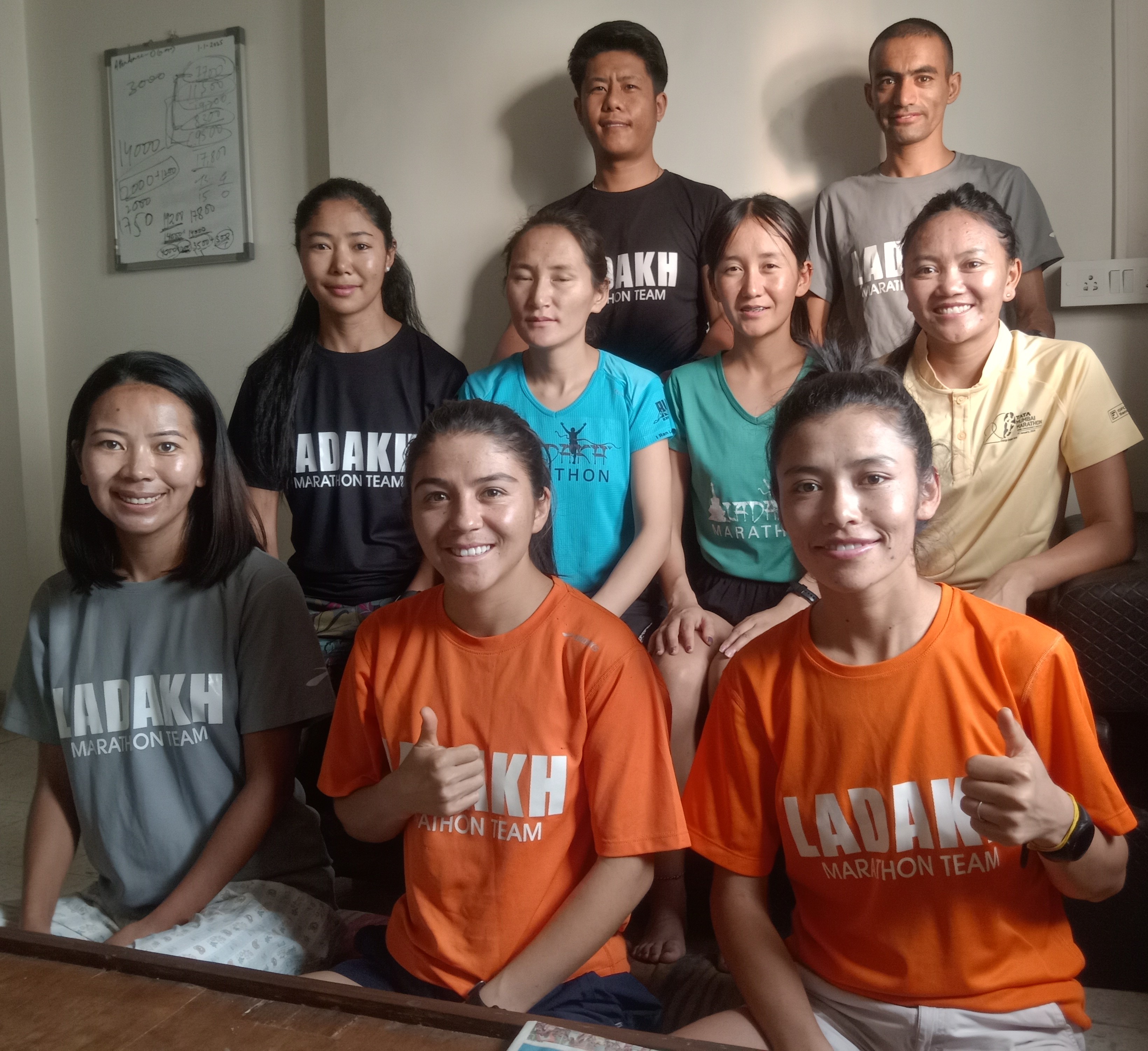
What can a freelance journalist hailing from Kerala and living in Mumbai do, after hearing these accounts? I asked Stobgais and Stanzin Dolkar, how to say congratulations as the people of Ladakh do. Tashi Delek – that’s what you say, I was told. I tucked it away in mind, for a potential headline. Conversation over, I requested for a final group photograph of the whole team, which also included Manzoor Hussain (he completed the marathon at 2025 TMM in 2:55:07) and Namgyal Lhamo, who is into trail running. That done, I took leave of the runners. On the road below the apartment, I stopped at a small hole-in-the-wall café for bun maska and chai. I thought of my favourite brew in the mountains – ginger, lemon, honey tea. No place like Ladakh for a glass of it.
(The author, Shyam G Menon, is a freelance journalist based in Mumbai)
 Outrigger