For our New Year page, we chose to showcase the art work of Dr Yamini Menon. A rheumatologist based in the US, she is also a runner and has contributed to this blog before.
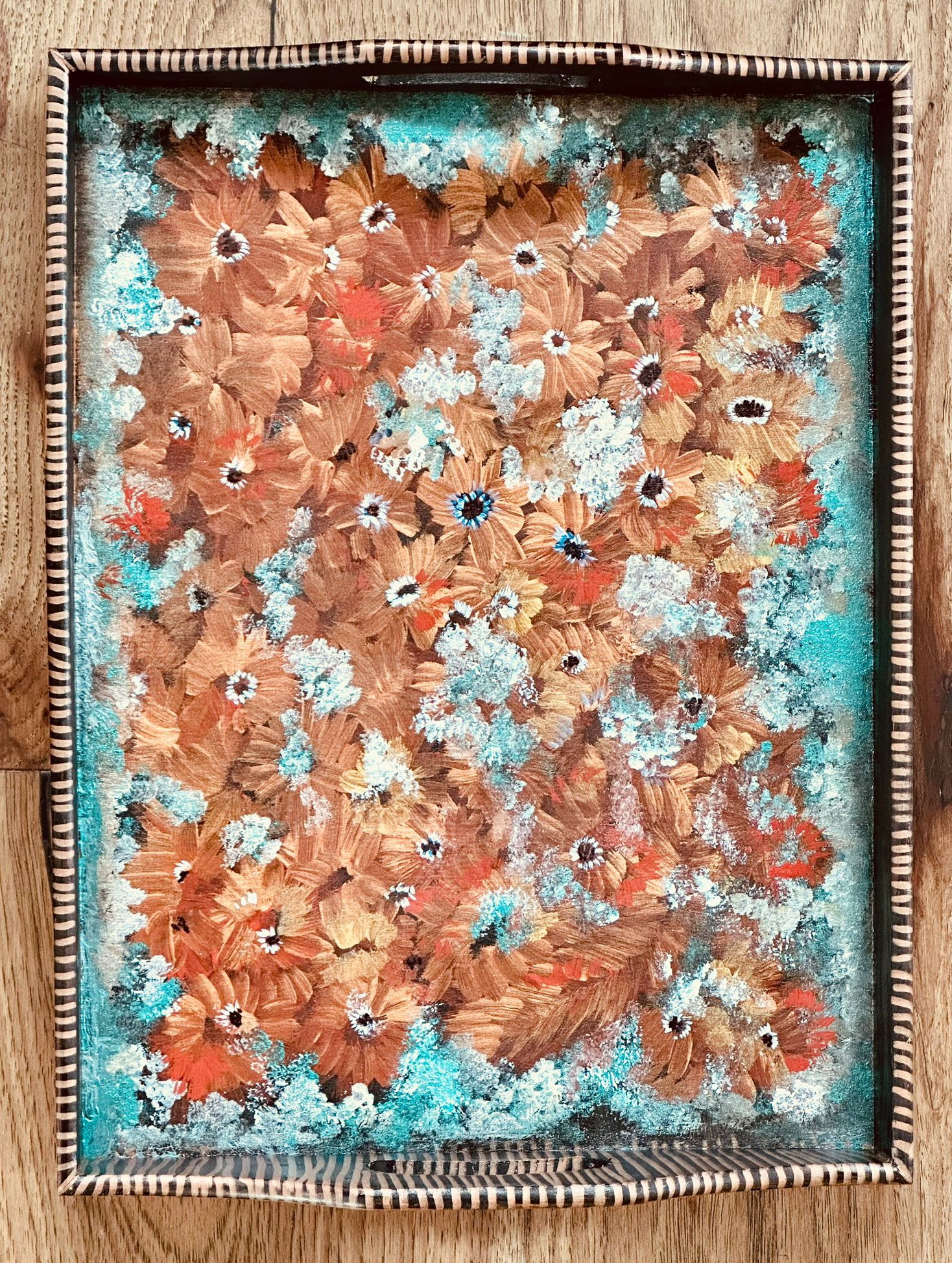
The first image is a collage of some of her work done with acrylic paint and markers on wooden trays, boxes, plates, ceramic coasters and a piece of Christmas decoration made of plastic. The second image is a stand alone picture of a tray she painted on. About it, she wrote in: “ acrylic on wooden tray – generally I start off with a dark paint base like black or navy and add other elements as I go along; again nothing planned ahead but comes to fruition at some point. The handles and borders – made to look like woven (an attempt to) using markers.” Most of these works, she gives away as gifts.
What’s life and a New Year, without music? For some years now, we at this blog, have been fans of the Polish progressive rock band, Riverside. Click on the link below for a song, we think, is one of their finest:
(The authors, Latha Venkatraman and Shyam G Menon, are independent journalists based in Mumbai)
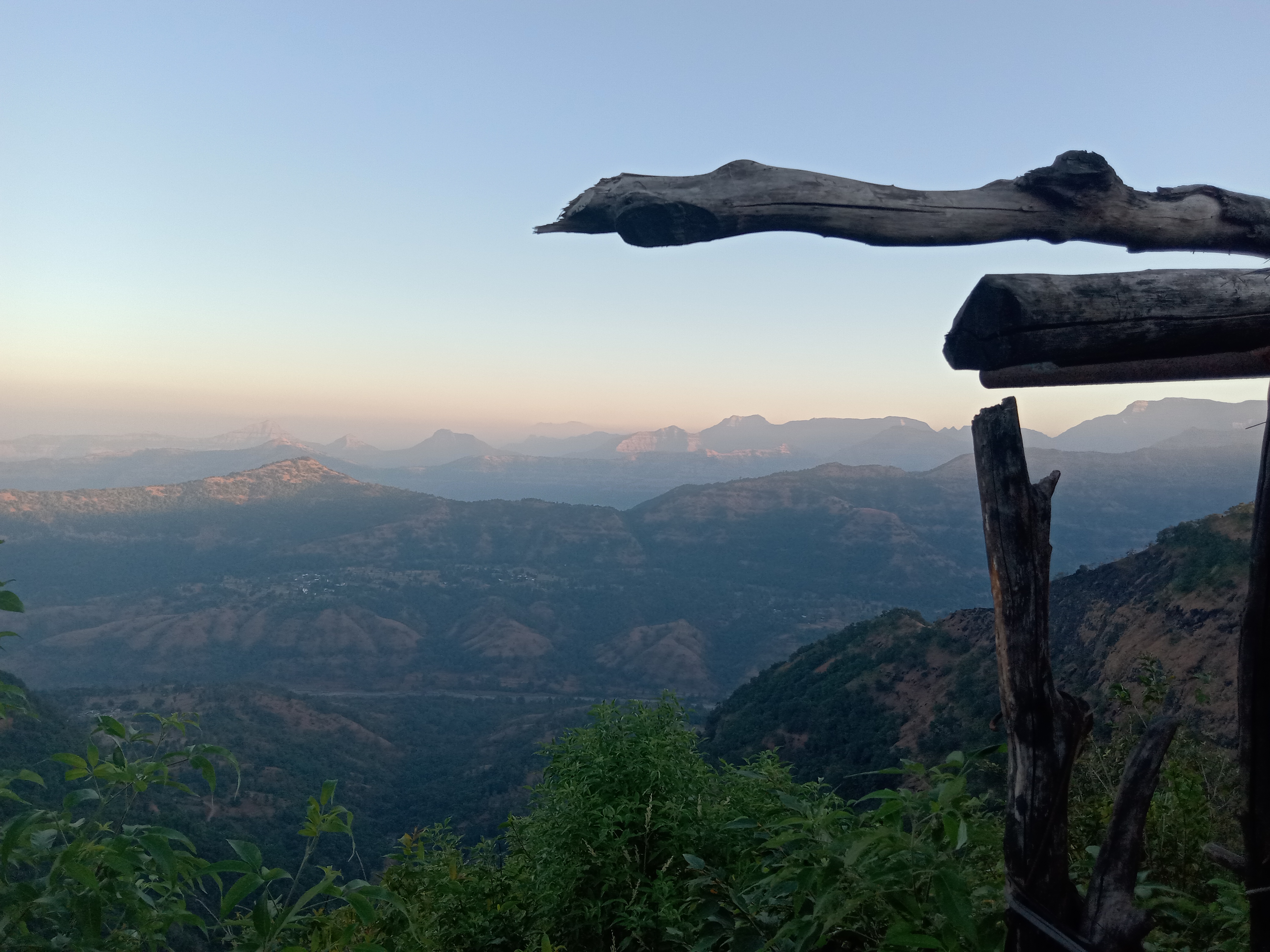
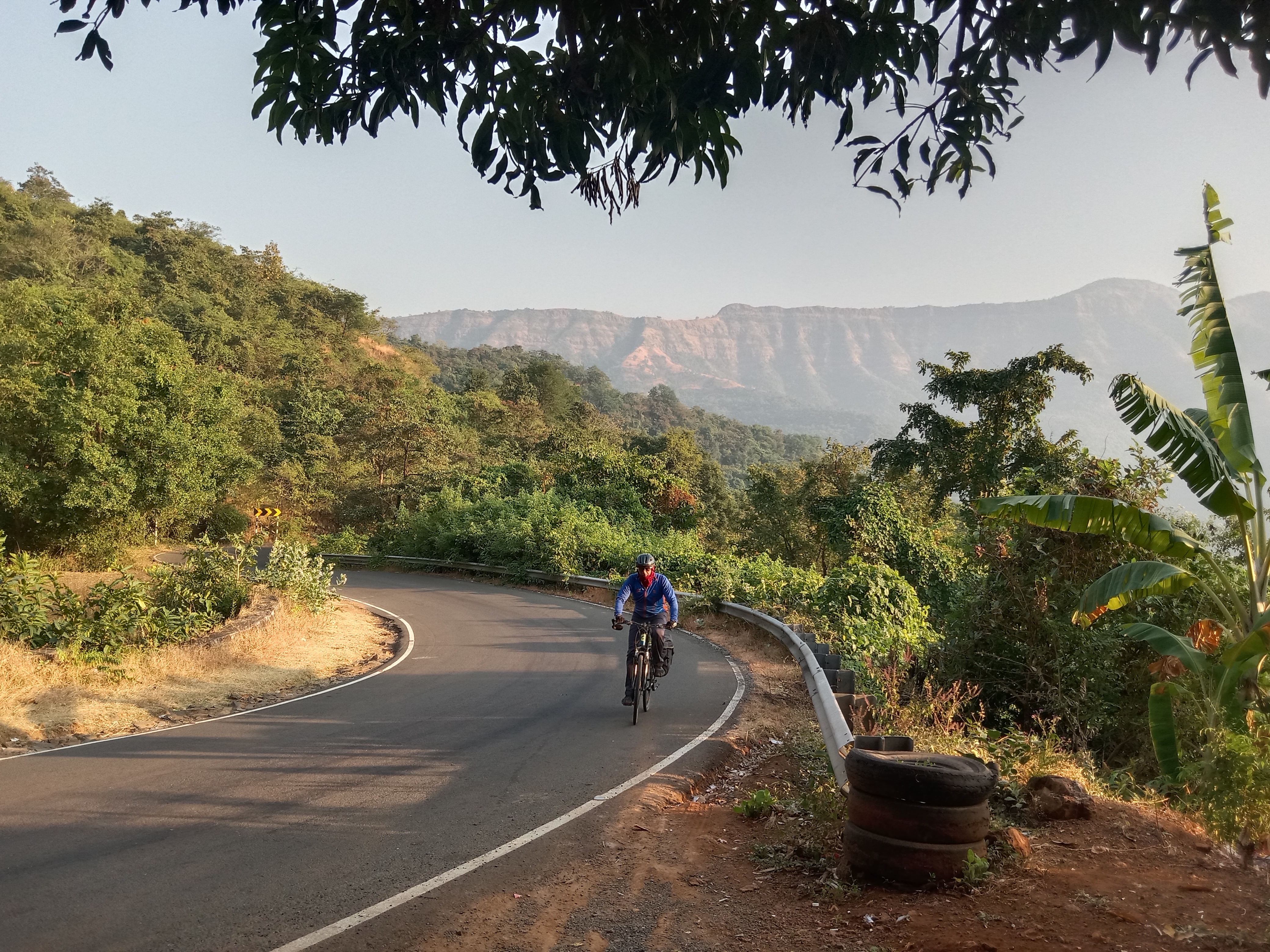
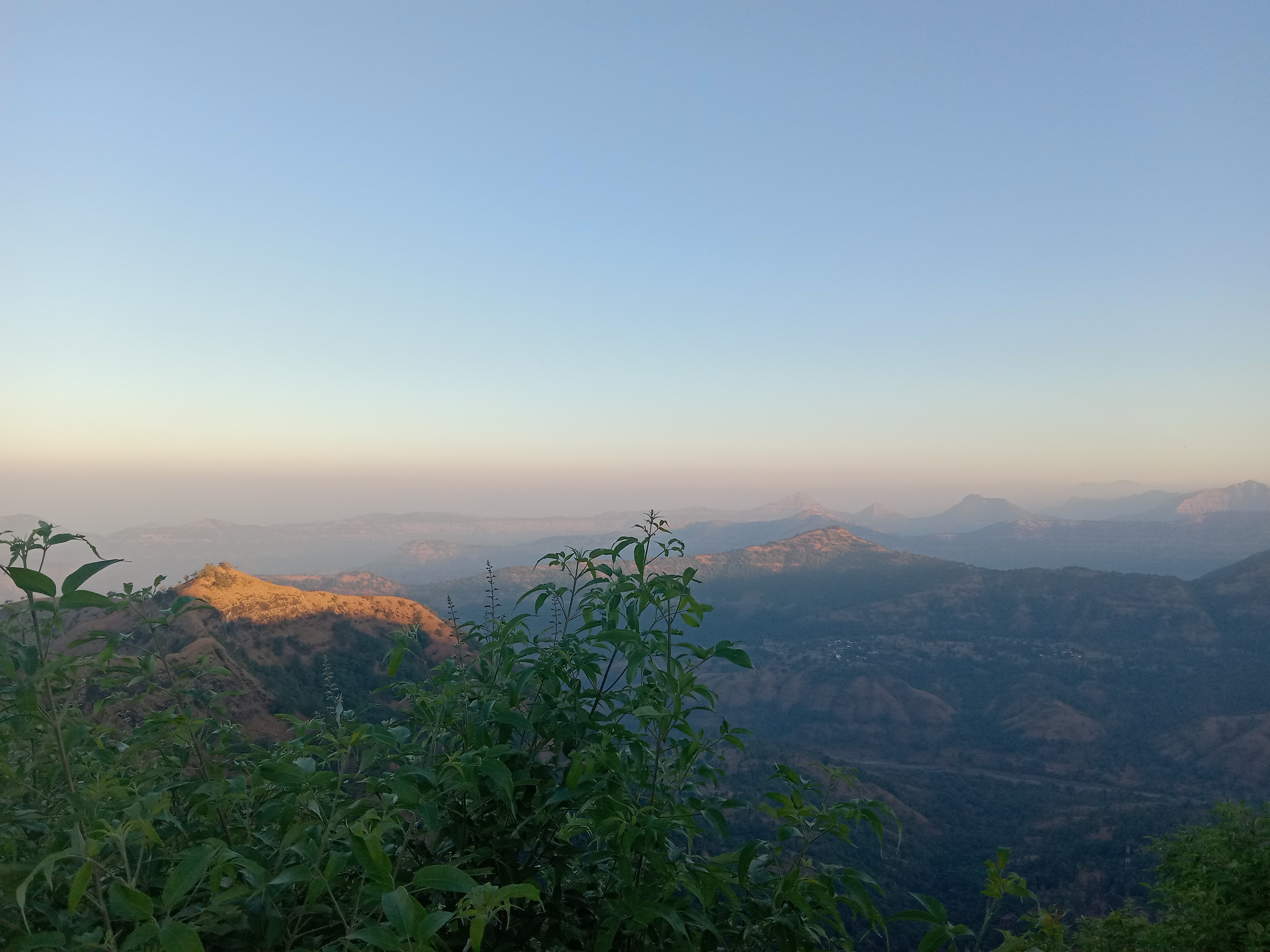
Day 4, early morning, near Mahabaleshwar; the turning with scenic view and a seemingly abandoned teashop, we stopped at (photo: Shyam G Menon)
I saw stars.
In a ditch, roughly 25 kilometers before Mahabaleshwar. It was early morning; the sun wasn’t out fully yet. Fourth day of a trip on bicycles that had long been in the making. The route was the idea of my friend Prashant Venugopal. After short trips, some repeated; to Khopoli, Lonavala and Matheran, cycling from Mumbai to Goa and a circular trip – Navi Mumbai to Navi Mumbai via Malshej Ghat and Bhor Ghat – we had been looking for more, short to medium distance multi-day trips in Maharashtra. That was when Prashant came up with the suggestion that we try going to Mahabaleshwar, not via the regular route touching Panchgani and Wai but through a couple of ascents and descents connecting Konkan and the Deccan Plateau.
For me, the time when we first discussed this trip and the period after that were neither pleasant nor suited for multi-day trips. After a brief illness, my mother passed away and during that phase and the months which followed, my life had become a case of frequent shuttling between Mumbai and Kerala. One was never long enough anywhere to settle into a pattern of doing something regularly, consistently. There was no running or hiking. On top of this, life as freelance journalist had become biting hard and I was not at all happy with what the politics prevailing all around had done to my relationships, friendships and sense of India as extended playground. I was sad. Also precisely why, one needed to get dunked in some activity.
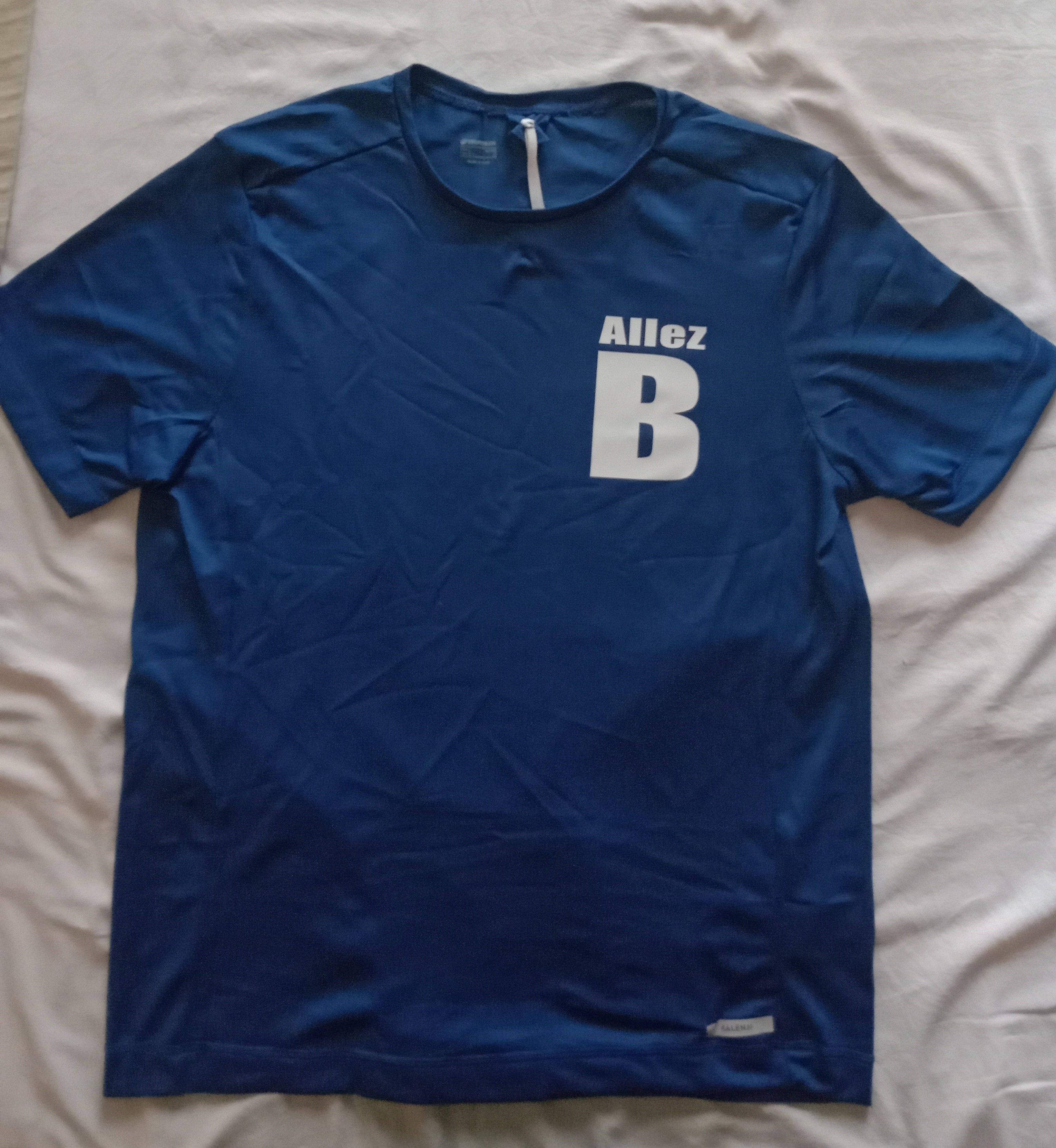
The T-shirt (photo: Shyam G Menon)
As 2024 drew to a close and the phase of Prashant’s annual leave kicked in, we spoke of Mahabaleshwar again and decided to try it once I got back from my latest visit to Kerala. While I was in the southern state, my friend B was diagnosed with an illness. She embarked on therapy set to last a few months. B liked to hike. She has also been a supporter of this blog, even written for it. I wanted to do something that would keep her motivated through her treatment period. Suddenly Mahabaleshwar seemed perfect. I could dispatch photos of the ride everyday to B and her father, who was my classmate from college. Immediately after I got back from Kerala, I travelled to Bengaluru with Latha Venkatraman, to write about the 2024 IAU 100 KM World Championship. There, at the Brigade Road outlet of Decathlon, I bought two blue T-shirts and had them printed with the slogan: Allez B. Allez, which is the French equivalent for saying Come on, had been a frequently heard term during my days in climbing. I kept one T-shirt to wear on select days of the proposed Mahabaleshwar trip; the other, I couriered to B.
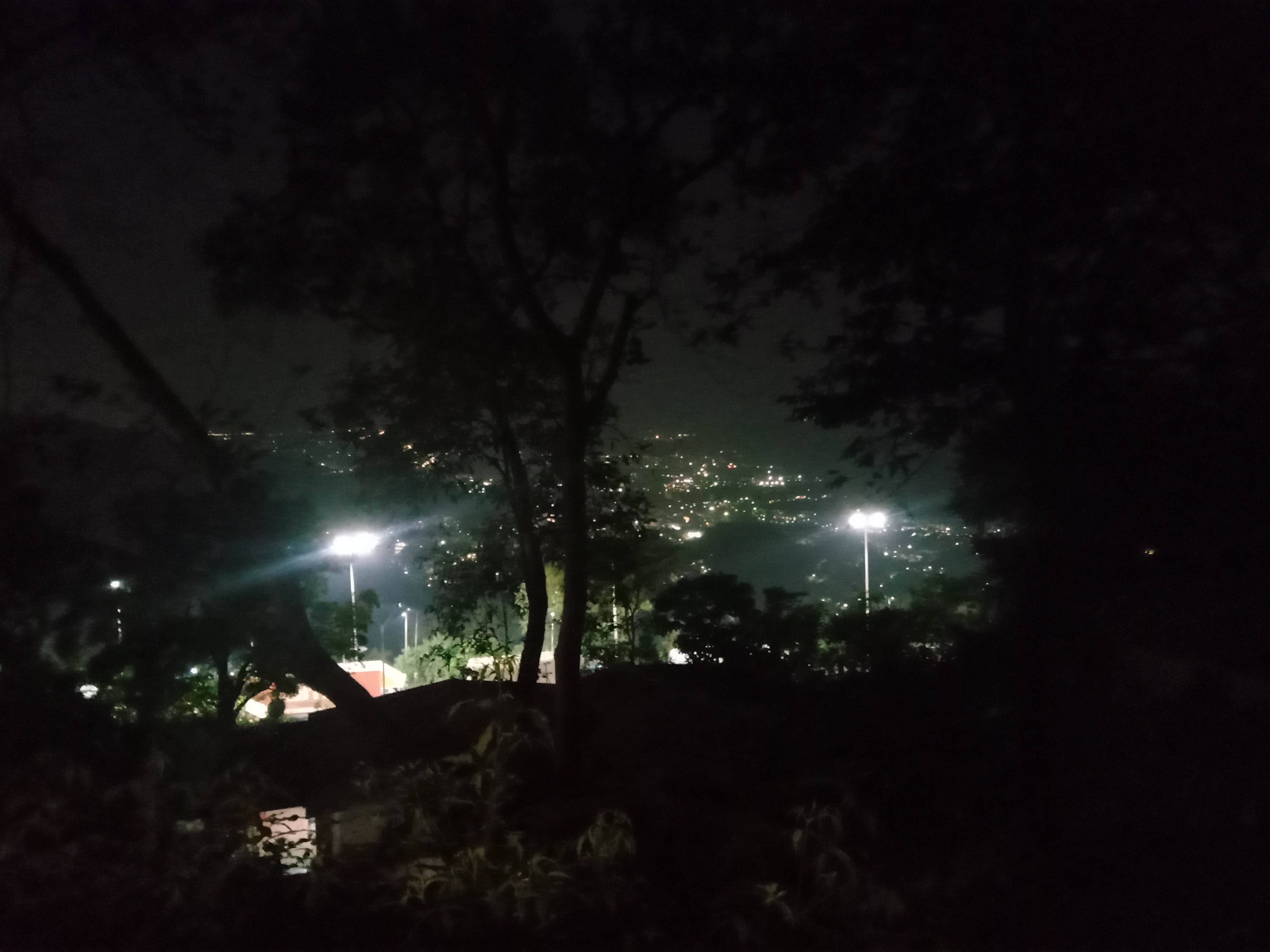
Beyond the lights in the foreground; Khopoli, seen from atop Bhor Ghat (photo: Shyam G Menon)
Every bicycle trip for me, starts with a visit to Inderjit Singh Khamba (Inder). Known well to cyclists in Navi Mumbai as both a passionate cyclist and one of the best mechanics around, Inder, after several years of operating a bicycle maintenance shop had shut down the business and accepted employment at an automobile company manufacturing electric vehicles. This happened, I think, sometime past mid-2024. Luckily for the local community of cyclists, the new job wasn’t to Inder’s liking and he returned to restart his shop. Anticipating Mahabaleshwar, I had parked my cycle with Inder before the Bengaluru trip. Once back from my assignment, I went to pick it up. Thanks to the bike having idled at home during those months of my relative inactivity, we knew even after its servicing that the rear wheel needed to vindicate itself as problem free. It was losing air and although we changed both the tyre and the tube, within a couple of days after servicing the bicycle, I had a set of punctures. Given the tyre was new and seemingly free of external damage, Inder deduced that the trouble was happening from inside the rim. The puncture marks on the tube were also on the side facing the spokes. So as a final measure, we changed the rim tape. The patient vindication of the rear wheel as problem-free ahead of attempting any long trip, which Inder recommended, couldn’t be had because between work in Bengaluru and the Mahabaleshwar trip, I was pressed for time.
Cycles loaded and ready to leave; at Woodland hotel, Lonavala, start of second day (photo: Shyam G Menon)
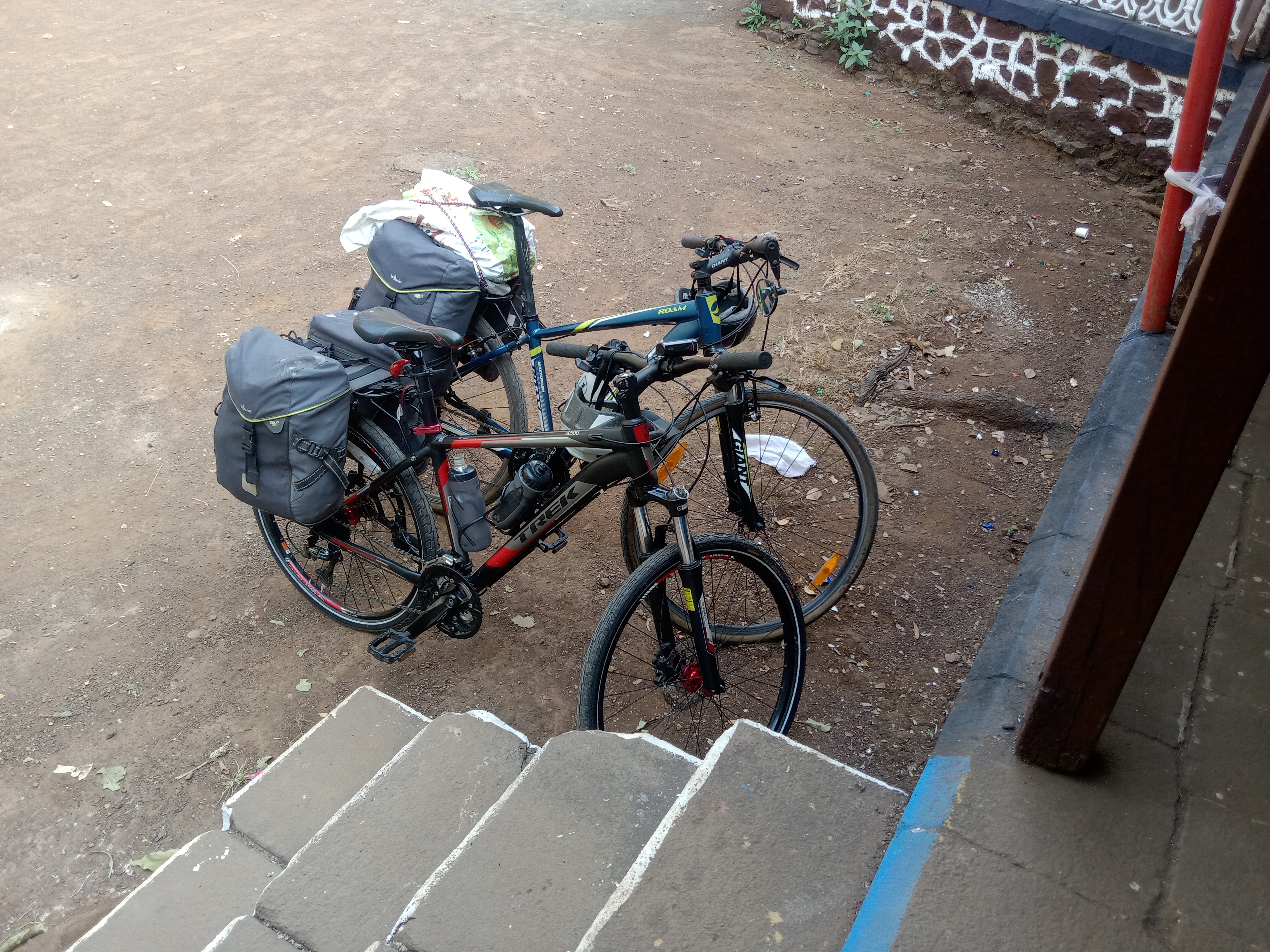
Around 11 AM on December 13, 2024, Prashant and I set off for Lonavala from Navi Mumbai; the first day of our journey to Mahabaleshwar. He rode a Giant hybrid bicycle with 700c wheels; I had my longstanding mountain bike, a Trek 4500D with 26-inch wheels. Both cycles had loaded pannier bags. I had my Allez B T-shirt on. Truth be told, the worst part of any bicycle trip from the Mumbai-Navi Mumbai region is getting out of town. The appetite people have for whizzing around on ever increasing numbers of automobiles, despite the dust and congestion they cause, amazes. Not to mention – accidents. Overrun by vehicles, our cities no longer feel like liveable spaces. Their roads and roadsides betray a Mad Max-touch of speeding steel, noise, aggression, motor oil and careless parking. Somehow, a majority of us appear to find this great aesthetics and motivation for life. Not me. I was glad to sense this snapshot of the city, fade as Khopoli approached. But then something happened for which I must thank Inder, the automobile industry and a wonderful Muslim gentleman whose name, sadly, remains an approximation in my brain.
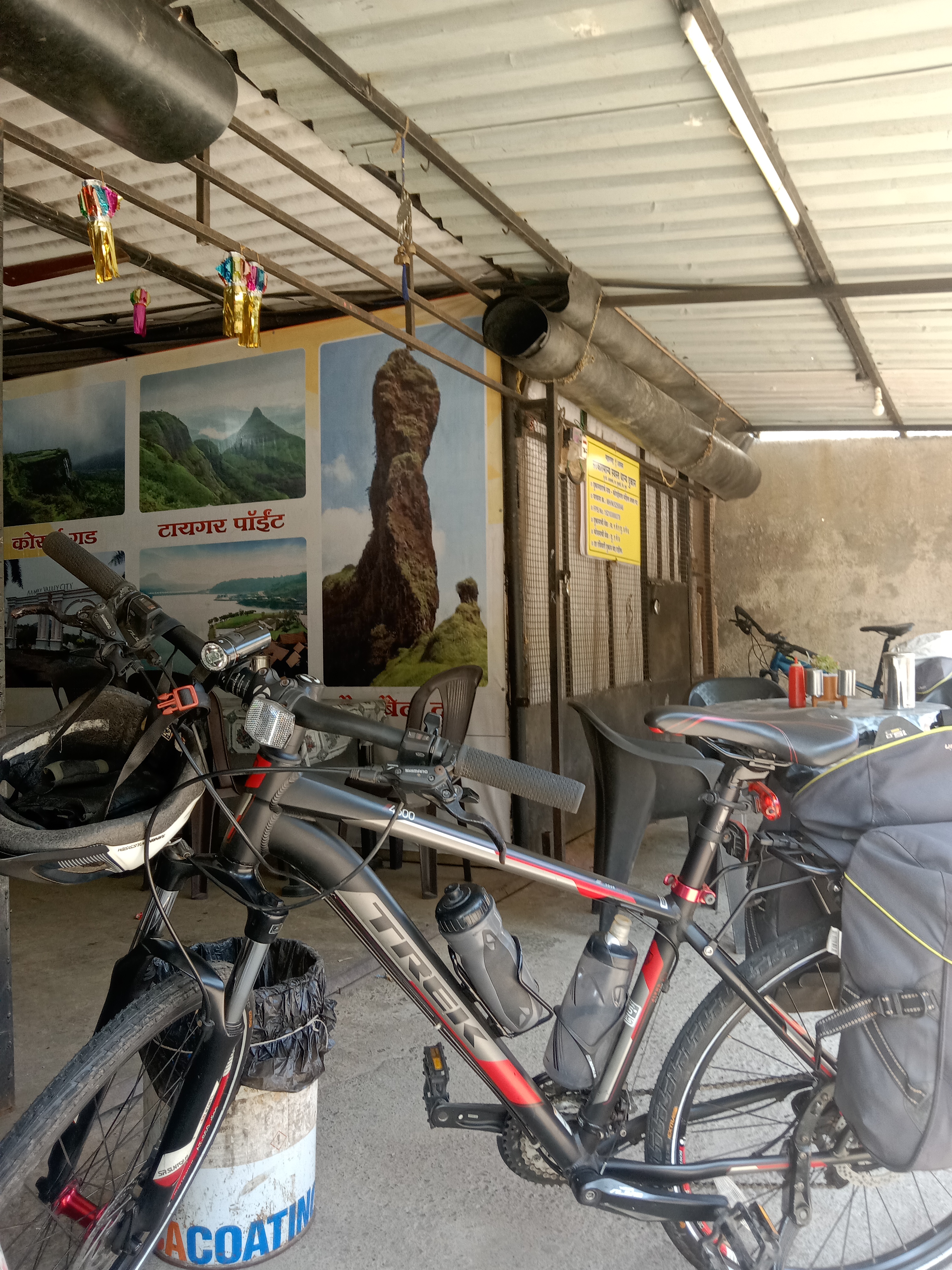
The cafe next to a school, in Amby Valley, which had a poster showing the Tel Baila pinnacle (photo: Shyam G Menon)
Between Chowk and Khopoli, my rear wheel got punctured. Yet again. We took off the wheel, got the tyre and tube out, inflated the tube and despite the faintly audible sound of air escaping couldn’t locate the puncture. We required a bucket of water to dip the tube in. Luckily, we had stopped very close to a petrol pump and this pump had an old man who repaired tyres. The other stroke of luck was that Inder, realizing over time that I wasn’t the performance type of cyclist and more the lazy wanderer sort, had changed my cycle’s tube from one having the less popular Presta valve to the Schrader valve. The latter meant, I could fill air at any petrol pump or bicycle shop on the way. It added versatility in repair and maintenance particularly when traveling long distances, self-supported. It worked at the petrol pump near Khopoli. Armed with a bucket of water, the elderly Muslim gentleman quickly located the punctures – there were two and they were tiny. He patched the tube up and filled air. It held. I paid him well and asked what he felt about my situation – with two punctures repaired in the rear wheel and no spare tube yet (I had foolishly overlooked acquiring a spare tube with Schrader valve), would he recommend that I continue to Mahabaleshwar? “ Don’t worry. It will hold,’’ he said, pointing out alongside that the puncture most likely happened because I hadn’t calibrated the air pressure to the additional weight of the pannier bags. I believe he was right. I had plonked the pannier bags on the rack and simply rode on without checking the air pressure afresh. I asked the old man for his name, which he told me. Notwithstanding the fact that his name slipped from my memory amid the worries of those hours and became an approximation, he is, in my eyes, the person who made this journey possible. The faith he had in his work and the assurance he gave, meant a lot. It helped me continue towards Lonavala instead of backtracking to Navi Mumbai. I overlooked keeping a picture of him for this travel account. My apologies sir.
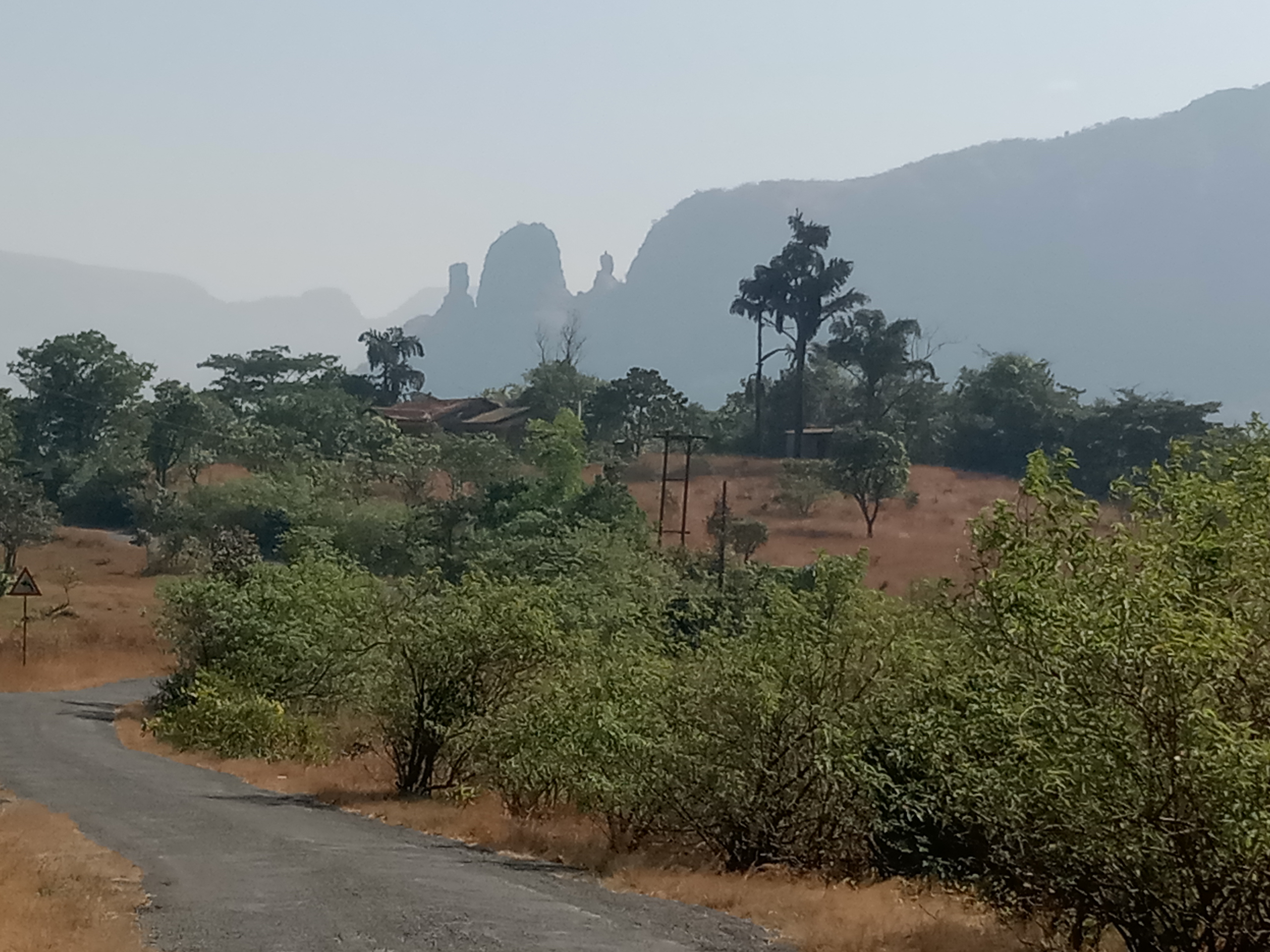
On the road; between Tel Baila and Tamini Ghat (photo: Shyam G Menon)
Cycling on to Khopoli, we promptly picked up spare tubes for both the bicycles. By now, it was getting late. Darkness had descended and we were cycling with our headlights on. Bhor Ghat was crazy and annoying. There was heavy weekend traffic. Indian roads have unguarded edges that dip sharply into ditches and drains. We found ourselves pressed that side by the unforgiving flow of vehicles. At the top of Bhor Ghat, we paused for rest at a small shop selling candies and soft drinks. We were now on the Deccan Plateau. The lights of Khopoli in Konkan, were visible in the distance, below. By the time we got to Lonavala, there was a traffic jam in town. We wove in and out of it and finally located a restaurant to have dinner. The town was overflowing with people come for the weekend and Lonavala’s relatively cool weather. As we sat down for dinner, Prashant discovered that he had lost his phone. Now, that is a major problem. To begin with, he was a senior corporate executive and I knew that the phones of such people lost, could be a genuine worry for them. Second, although touring casts cyclists into private spaces and cocoons of solitude, there is definite use in being able to stay connected. We were down to one phone between the two of us. Third, on our trips, Prashant is typically the navigator and a mobile phone is useful for navigation. I tried Prashant’s number. Somebody picked up and then switched off the device. It hinted of lost and found graduated to theft. Thankfully, the late hour notwithstanding, the local office of Vi, the service provider, responded when we called. With their assistance, we dialled the number concerned and had the SIM blocked.
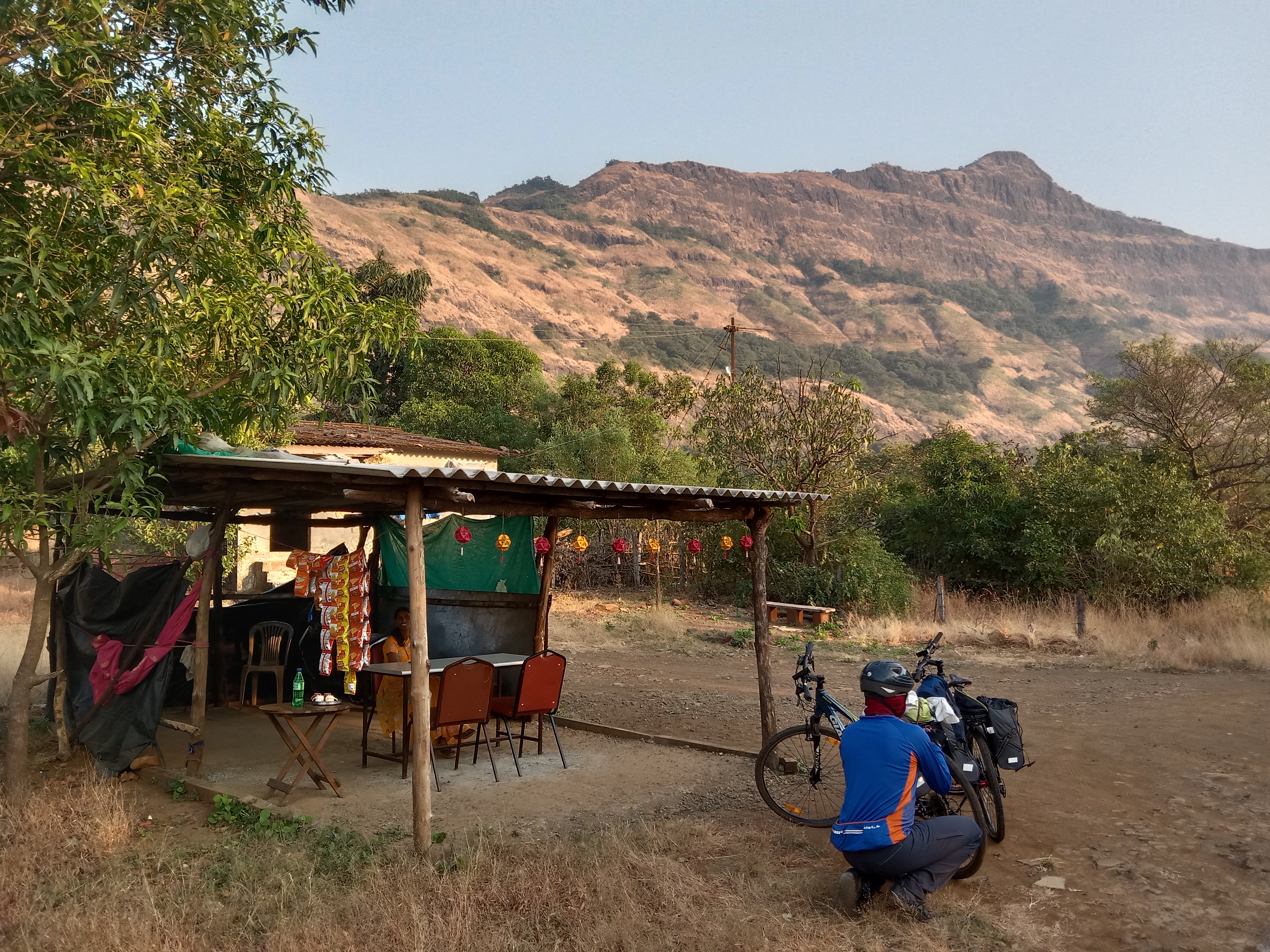
The small teashop we stopped at, between Garudmachi and Tamini Ghat (photo: Shyam G Menon)
The question now was what to do with our journey. I was ready to turn back for I knew that losing a phone could be significant for Prashant. What I didn’t know was that he had bought into Allez B. He said, let’s proceed. And so, post dinner, we found ourselves parked for the night at an old hotel called Woodland. They had a wedding due on the premises the next day and we promised we would be out in the morning. Early next morning, Prashant made a quick trip to the shop at the top of Bhor Ghat where we had stopped to rest; just in case the phone was lost somewhere there. There was no sign of the phone anywhere. After a cup of coffee in Lonavala, we cycled on to Amby Valley. Soon after passing the Indian Navy’s training establishment in Lonavala, one of the tell-tale signs of being in the hills started manifesting. Its something you find in hilly terrain in the peninsula and up north in the Himalaya. People are sure of things in their vicinity but not places a bit further away. So, directions to Amby Valley and details about it could be easily had but not anything much about the road to Nizampur, which was down in Konkan on the other side. Nizampur was our destination for the day. A good amount of cycling done, we stopped for early lunch at a café, next to a school, close to Amby Valley. The travellers quickly became an item of interest as school kids flocked to see the geared cycles fitted with pannier bags. The school was having its sports day and every now and then cheering was heard. Our fan following was therefore fleeting; we were in constant competition with budding athletes next door. The café had a poster of attractions in the area – among them, the rock face bearing the harder route on Tel Baila, a rock pinnacle which had been part of our goals in rock climbing, years ago. I sent a photo of the poster to our friend Sunny Jamshedji in the US asking if he remembered it. Got a reply: yes, he did. Then, we cycled on towards Tel Baila and at the fork ahead of the village named after the pinnacle (or the other way around) took the road leading towards Tamini Ghat.
Day 3 evening; Prashant, cycling uphill towards Mahabaleshwar on the Poladpur-Mahabaleshwar Ghat road (photo: Shyam G Menon)
After a stretch of unnervingly firm concrete road, we hit 20-25 kilometers of road so bad that it was butt-hurting and spine-squashing. Even when one got off the cycle to stretch one’s limbs, them joints in the body, they jingled and jangled. A break availed at a small teashop in the heat of afternoon, we extended that a bit, to escape the worst of the sun. Then several kilometers ahead and more rural dwellings later, exactly where a grand resort stood, the road miraculously transformed to smooth tarmac. From there on, through that locality featuring posh resorts and yoga retreats and the big luxury vehicles their customers travelled in, cyclist’s butt was as though on a feather pillow. The road was smooth. A little after Garudmachi and perhaps an equal little bit before Tamini Ghat, we stopped for tea at a lonely café run by a young woman who delighted us by the interest she took in our journey. She had questions about cycling, about the journey – it made us happy. Tea had, we bid her goodbye and sailed down the long Tamini Ghat road, still on feather pillows, till we were rudely jolted back to reality by the dusty environs, truck traffic and rudely firm concrete roads near Posco’s steel plant in the Konkan plains. Around 7-7.30 PM, we drew into Nizampur. Joshi’s restaurant, which served us a fine Konkan thali, also fixed us accommodation; we found it in a nearby apartment, rented out to travellers.
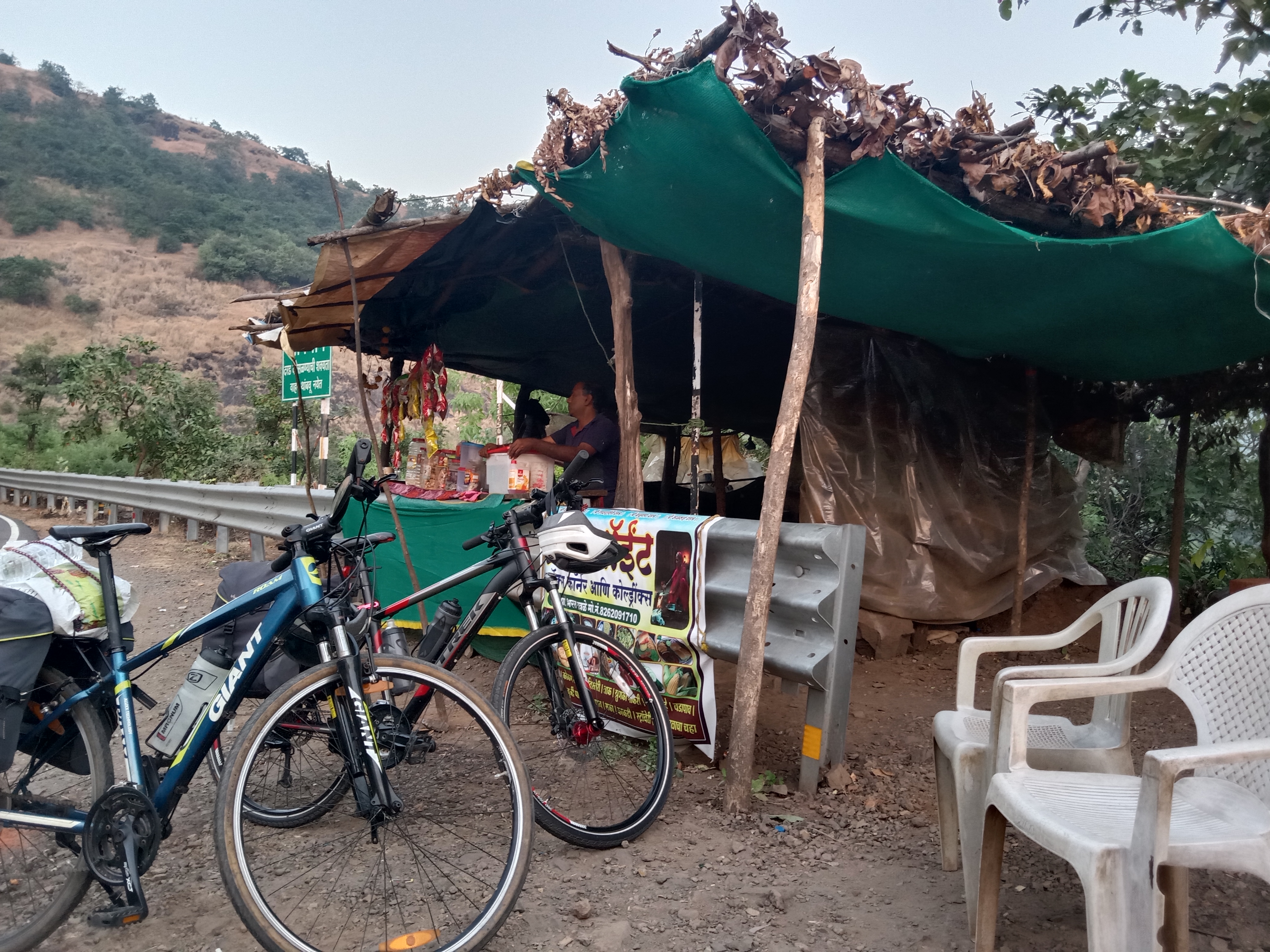
The shack run by Rahul and his wife, a little past the milestone marking 25 kilometres left for Mahabaleshwar (photo: Shyam G Menon)
December 15 morning, having downed plates of superb poha at a nearby cafe, we left Nizampur for Poladpur. Our original plan had been to take a forest road from Nizampur. While that may have kept us off heavy traffic, we discovered that it added considerable distance and that could be a problem when the time available overall for the Mahabaleshwar trip, was limited. So, we chose the straightforward, conventional route. The road from Nizampur to Mangaon was pleasant. But getting on to the Mumbai-Goa highway at Mangaon was a lot like the trip’s first day; traffic whizzing by and speeding vehicles driven dangerously. It was flat road (inclines were mild) and totally open to the sun. The industrial feel and abject monotony of the highway, coupled with the sensation of motorized metal carriages driven nonchalantly so fast nearby, made cycling here quite boring. Suddenly the butt shaking progress of the previous day across rural roads in the Deccan, quite free of traffic, didn’t seem bad at all. Rather get myself shaken and stirred than endure this unending tongue of concrete, marching relentlessly on to me like one of those invading hordes from Lord of the Rings. If these hot, dusty rivers of concrete with motorized projectiles hurtling around at high speed be the stuff of future by GDP, then God help human imagination. One felt jealous that in some other countries, dedicated long distance cycling routes existed.
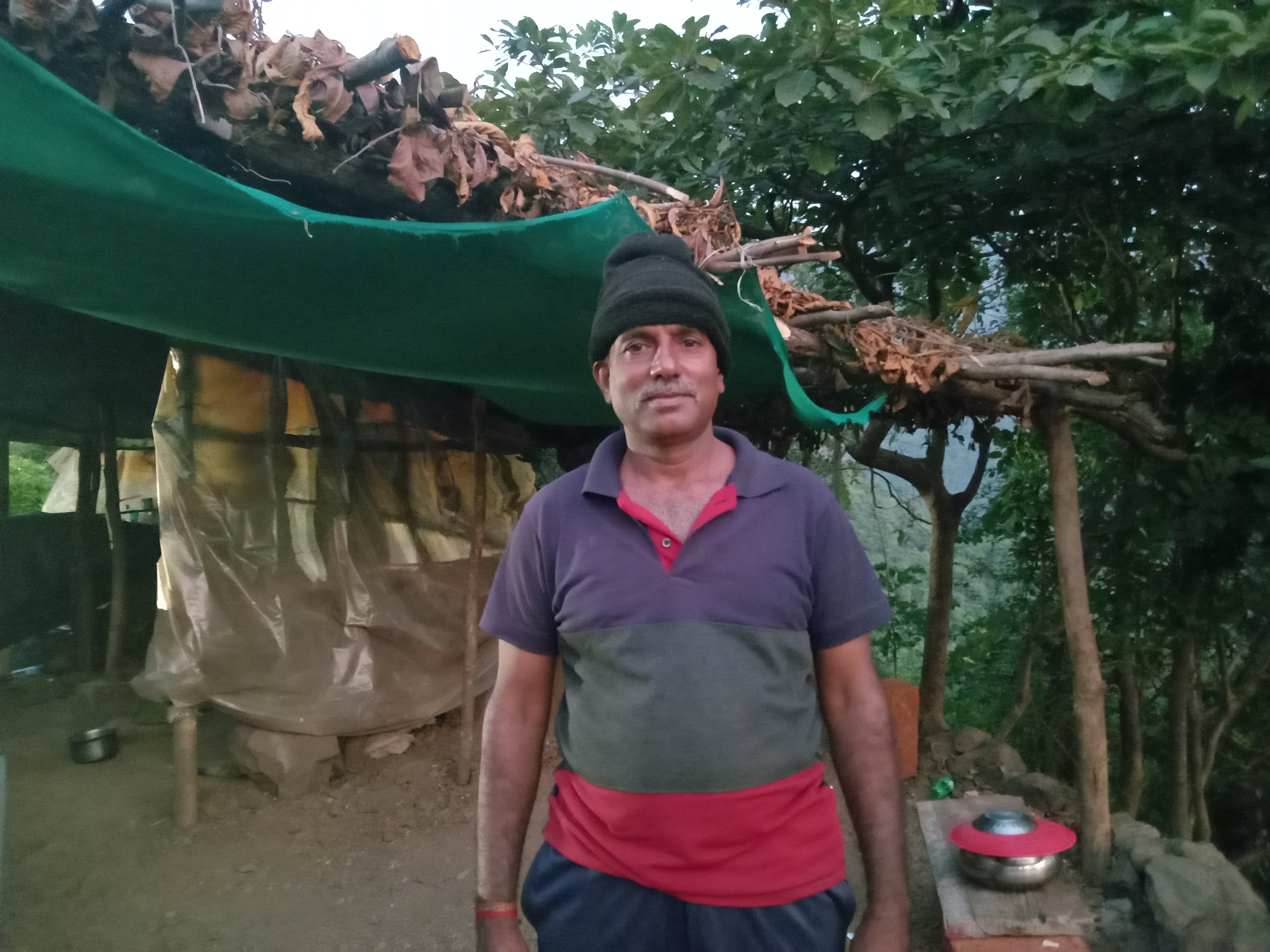
Rahul Dhovale (photo: Shyam G Menon)
We hunkered down and laboured. Two cyclists moving steadily in the hot sun. Our consistent cycling – that hunkering down – appeared to work. We reached Poladpur in good time, earlier than we expected. Knowing that we were slowly getting tired, had a long climb back to the Deccan Plateau ahead of us and had to be back in Mumbai for Prashant to address his lost phone and also receive his son arriving from overseas, we decided to head up the ghat road to Mahabaleshwar without delay. Like in a long multi-pitch climb, a bivouac seemed better option than a hotel room. But first, I contacted Ravi, a travel agent in Chembur, who had promised to get us and our cycles safe passage on a bus from Mahabaleshwar to Mumbai. He needed advance notice to get things done. Following that conversation and a visit to the ATM, we settled into a steady grind, cycling up the ghat road from Poladpur. We took stops to hydrate, liberally. At one place where we sat down to rest, we watched several people on expensive motorcycles go by. A couple of them waved at us. I must say – the non-motorized felt nice, at being acknowledged. Woohoo – we exist!
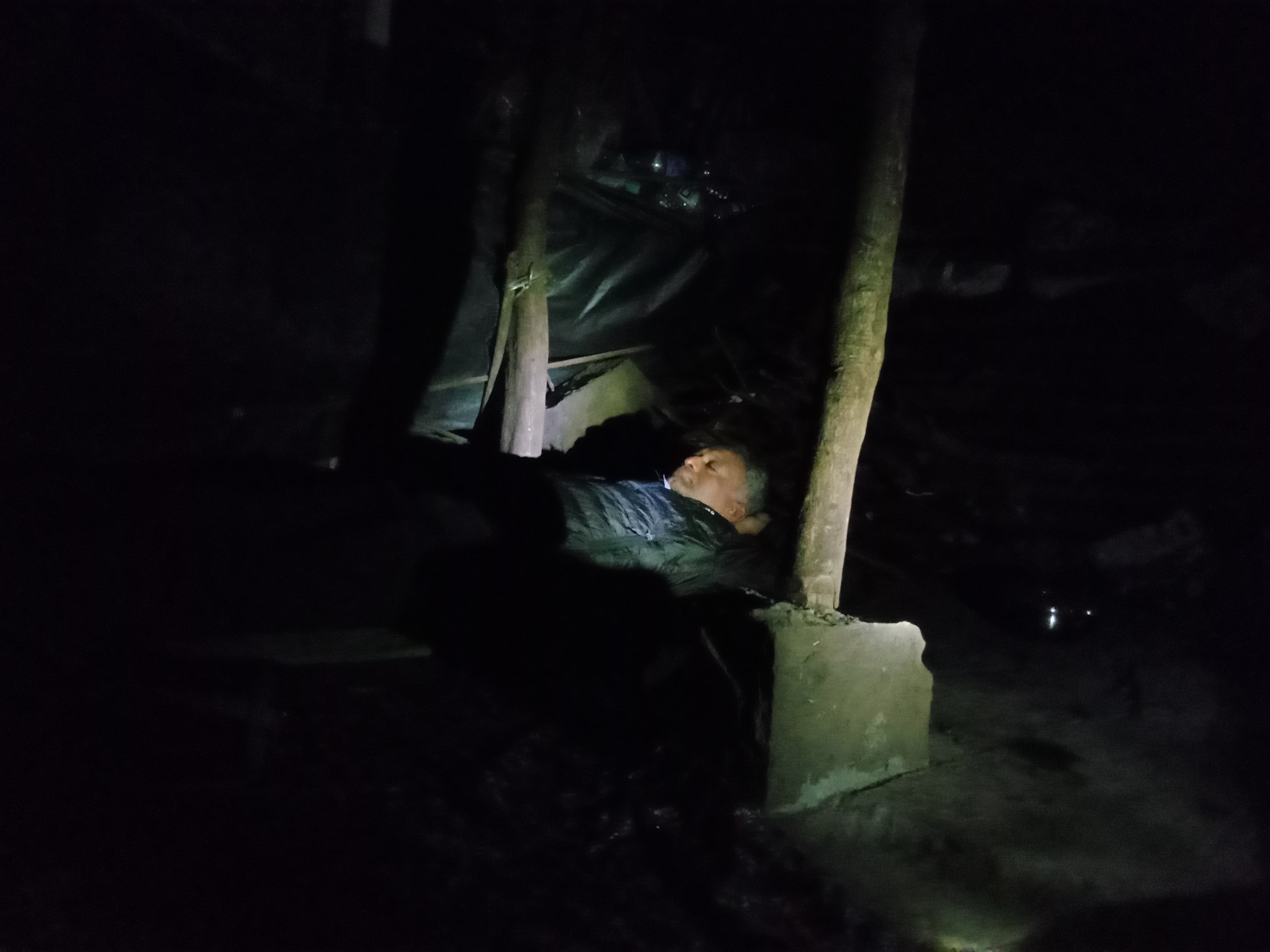
Prashant, asleep in the small shack (photo: Shyam G Menon)
Late in the evening, we stopped for tea at a small teashop, approximately 20 kilometres uphill. As we sipped tea, a group of men assembled there enquired where we were headed and what our plan was. We asked if there were teashops further ahead. For some reason, they said no and advised us to push on as Mahabaleshwar was no more than 25 kilometres away and in their estimation, we would be there in no time. I heard my soul of mid-fifties age, laugh. Either they didn’t know what cycling with load felt like or in that inevitable, unsaid competition among men to be manlier than others around, the next 25 kilometres had to be nothing less than easy. Our butts were actually sore from long hours on the saddle and our legs were aching. I had no difficulty being less manly. And it was clearly late evening. It seemed a wise decision to find a place to camp. There was some open space a little away from the teashop. We asked if we may spend the night there and avail the services of the teashop for dinner and breakfast. However, by now the menfolk were gone and the lady who managed the shop seemed a bit uncomfortable with the suggestion. So, cups of tea had and our bottles refilled with water, we cycled on hoping that we might find a clearing ahead.
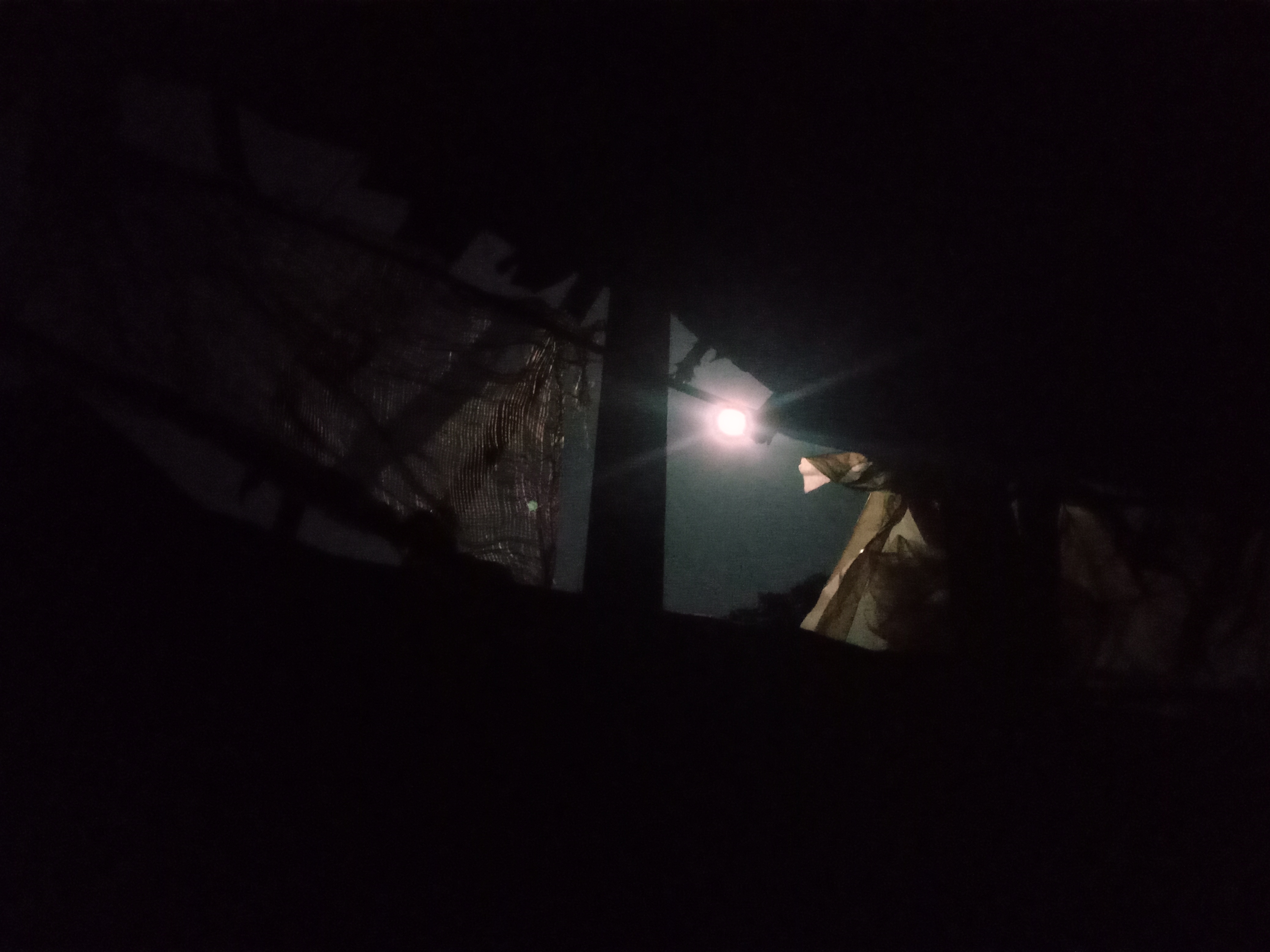
The moon; view from inside the shack (photo: Shyam G Menon)
Not long after we left the teashop and somewhere past the milestone formally indicating 25 kilometres left for Mahabaleshwar, at a sharp turning on the road, we encountered the small shack run by Rahul Dhovale and his wife. As I drew close to the shack, Rahul immediately invited us to sit down for tea. I asked him if it would be a bother if the two of us slept in the shack. Early next morning we would be off. Without fail. Not only did Rahul say yes to our staying there but he and his wife also gave us two rounds of lime juice and a pot full of poha for dinner and breakfast. We paid him for everything in advance. The shack was on the edge of a precipice falling off into a valley. At the broad end of the valley, the sky turned scarlet over the Konkan plains as the sun slowly set. With darkness setting in, Rahul and his wife cleaned up the small shack, packed their belongings and left for their house in a nearby village. We had the shack to ourselves. There was no electricity. It was now pitch dark. We used headlamps minimally to avoid drawing attention.
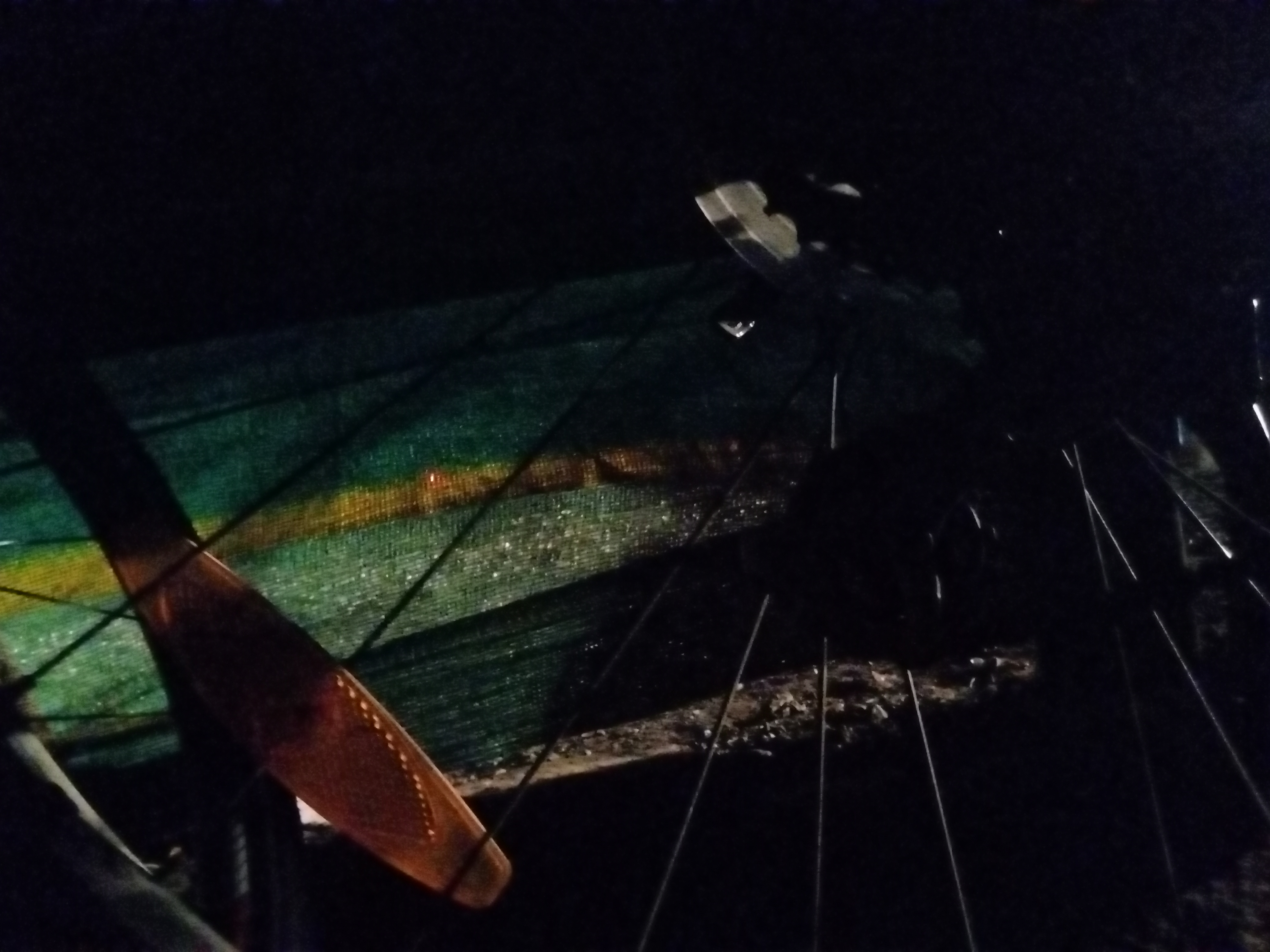
View from ground level; vehicle headlights on the shack’s fragile fabric (photo: Shyam G Menon)
The shack was an interesting experience. Located as it was on a turning, on the busy ghat road to Mahabaleshwar, the headlights of vehicles plying up and down shone through the frail green fabric serving as the shack’s walls. The headlights barrelled towards us at eye level as we were lying on the floor, before veering off. The road was intimately near; one sensed what roadside actually meant. I thought of the many people living so. To save weight in the pannier bags, I had traded my sleeping mat for a thin plastic sheet. It clung to the cold floor like a passionate lover and in the process, let every inch of the terribly uneven surface poke my back. Somehow, none of that mattered. I was tired and the shack felt notoriously secretive as nobody passing by would guess that there were two cyclists within. Rahul had told us to keep the cycles inside the shack and should anyone nosey come around, tell them that we had Rahul’s permission to stay there. What impressed me particularly was Rahul’s description of the weather. “ It will be comfortable for some time even after the sun goes down. Then a wind will start blowing and step by step, it will get chilly,’’ he had said. He was spot on. That wind woke me up a few times in the night. It was chilly but not terribly cold. Enough though to make me toss and turn in the light sleeping bag. Meanwhile my relation with vehicular traffic had touched a new dimension. On the narrow and busy ghat road, one side a precipice and the other carved into the rock face, we soon discovered, it was near impossible to even take a leak without being caught by a passing headlight. In age of social media and photos thoughtlessly uploaded, that’s the last thing one wants.
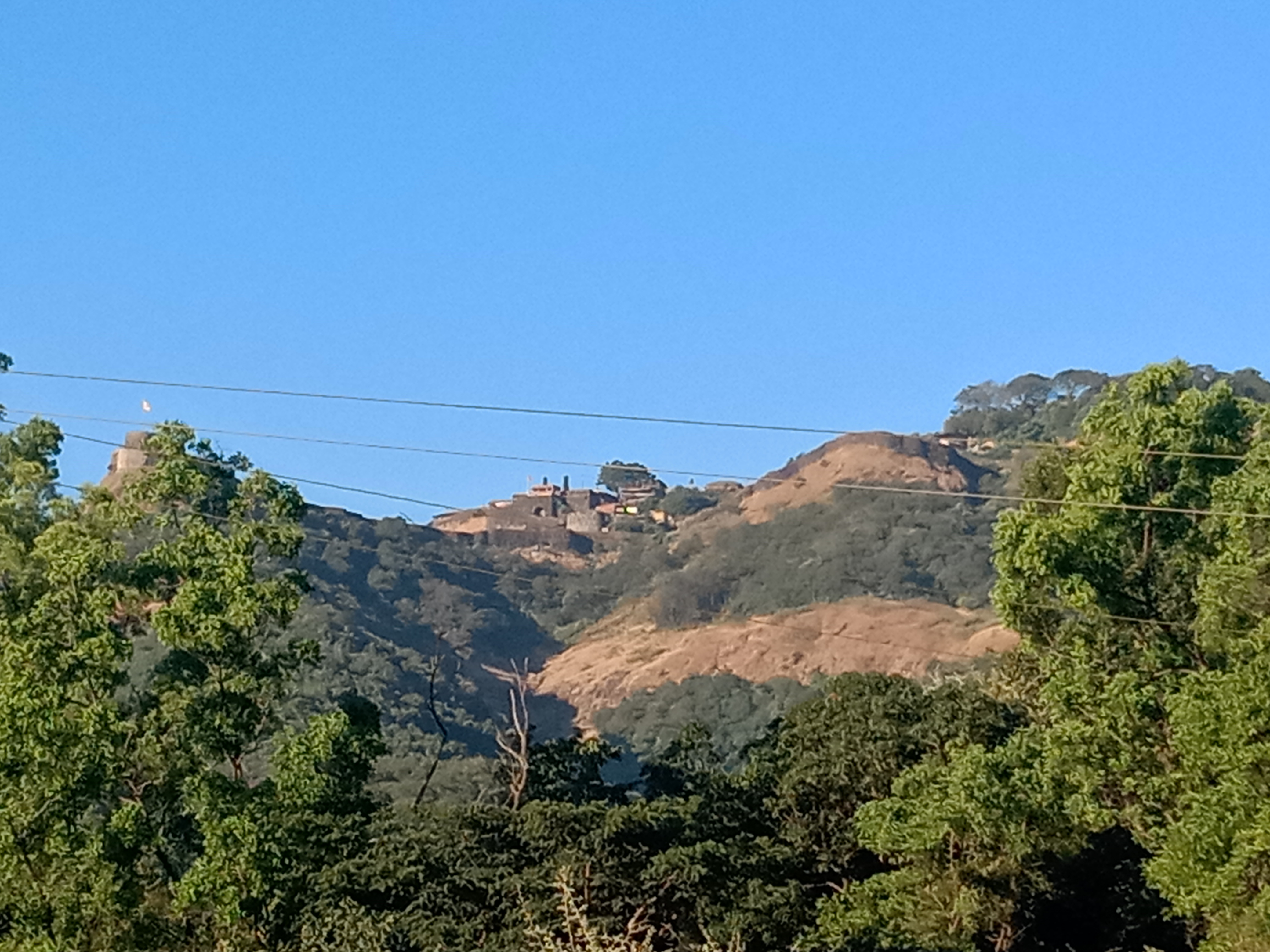
Pratapgad fort, ahead of Mahabaleshwar (photo: Shyam G Menon)
Late in the night, a vehicle full of noisy people parked close to the shack. One or two of them, seemed drunk. We stayed quiet. But somebody saw the cycles kept within and stumbled towards the shack. The light from his mobile phone outed the two cyclists. We thought we would have to reproduce the quotes Rahul had told us to – that we had permission. But it turned out to be one of the men from the teashop we had stopped at before reaching the shack. “ Hey, it is our cyclists,” he said to the others, laughing. He asked if we had eaten, were feeling alright and wished us a good night’s sleep, for we were guests in the area. Then he stumbled back to the car. The engine fired up and the vehicle’s lights disappeared down the road in a fading riot of inebriated chatter.
Early next morning, I stirred out of my sleeping bag and wishing to take a leak, headed to the rock face-side of the road where a ditch existed that may shield me from the lights of oncoming traffic. I didn’t have my specs on and it was only after my right foot was suspended above the ditch and going in that I realized it was deeper than I estimated. What should have been a simple case of stepping down, quickly evolved into an angular fall and as I dropped, my head was whacked by a jutting overhang on the adjacent rock face. I saw stars. There was burning pain and I knew in an instant that I had cut myself and was bleeding. I landed on my feet and saw dark droplets from my head, stain the soil. Miraculously our fortunes held. I had a pretty comprehensive first aid kit. We quickly cleaned up the wound with water and antiseptic, applied an antibiotic cream and bandaged it. With helmet on, the bandages seemed held in place. We cycled the remaining 25 kilometres to Mahabaleshwar, pausing for well earned cups of tea at a hotel near the entrance to Pratapgad fort.
Day 4, early morning; on the way to Mahabaleshwar (photo: Shyam G Menon)
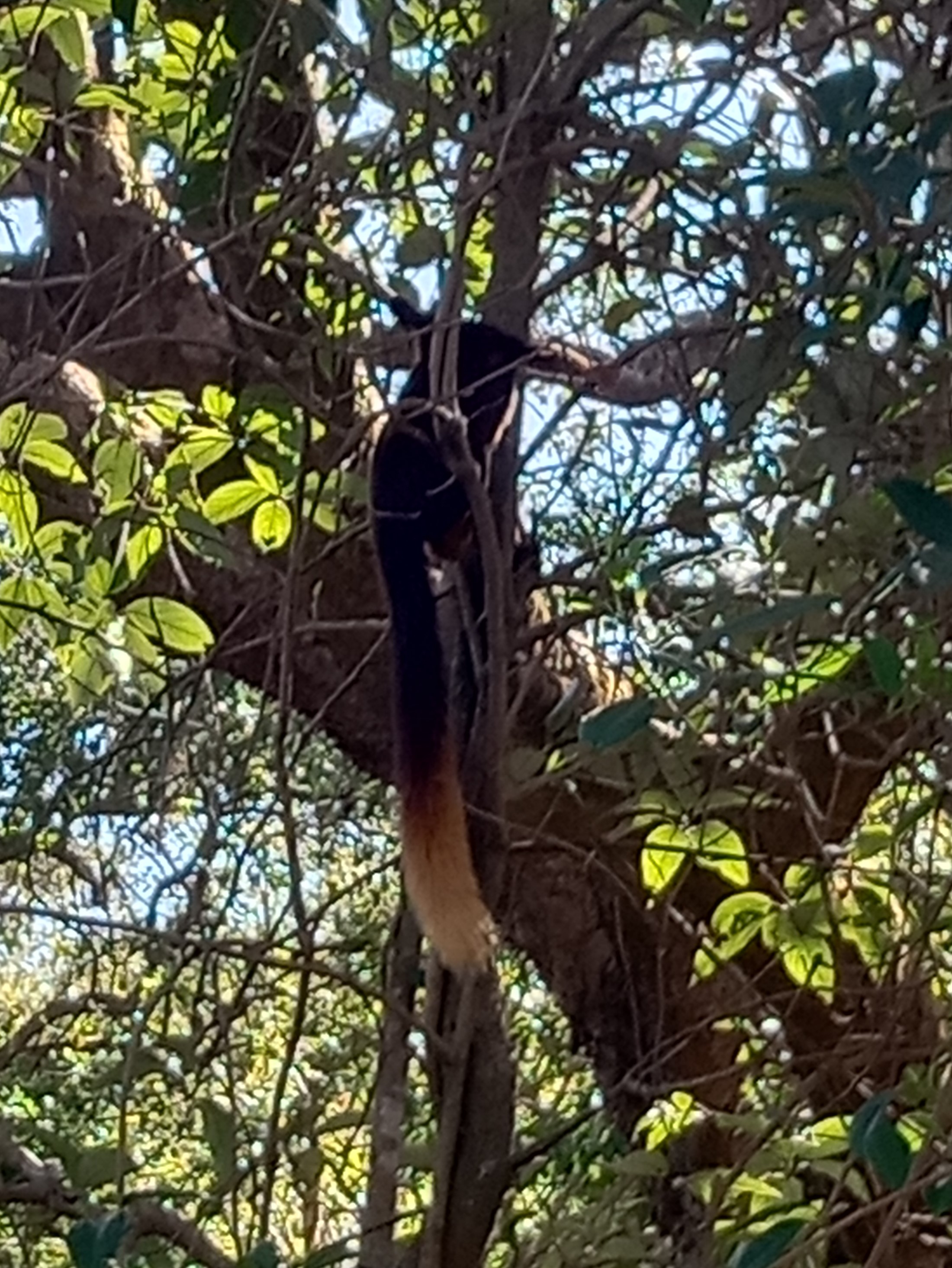
The high points of this final leg of the journey were two. First there was a place, another turning on the road with a seemingly abandoned teashop planted right there, where the early morning view of the Maharashtra Sahyadri was absolutely lovely. It was fantastic, taking a break here in that mix of chilly ambiance and the sun’s first rays. A distant ridge or two glowed like McKenna’s gold while a December blue graced the hill geography overall. The second high point was just outside Mahabaleshwar town when very close to where we elected to rest for a few minutes, a pair of giant squirrels appeared and spent time clambering up and down trees. It was one of the happiest moments of my life. What a way to be welcomed to Mahabaleshwar!
By around noon on December 16, we were in Mahabaleshwar proper and cups of tea had, cleaning our bicycles just outside a spacious hotel room we had checked into. I dispatched my final set of pictures to B and her father. I generally avoid measurement and Prashant who likes math and does measure, had lost his phone. So, we estimate, roughly, that the total distance covered was around 300 kilometres. Later that afternoon, I headed to the local government hospital to get a tetanus injection and have my wound inspected. When I showed the wound to the nurse and told her that I wanted a tetanus shot, she scolded me for not having come earlier. I felt impressed – she scolded me because I hadn’t shown a head injury promptly, I thought. Wow! Turned out, she wanted me to go and come back later. I then made my way to a medical store in the market place where the elderly owner directed me to Dr Jangam, whose practice was just down the road. “ He is my doctor too,’’ the gentleman said. The good doctor gave me a tetanus shot and an antibiotic ointment, different from the one I had in my first aid kit. Later that day, we treated ourselves to strawberry and cream and visits to the Mapro (food products) showroom and Elsie’s Dairy & Bakery, close to 175 years old.
Giant squirrel, near Mahabaleshwar (photo: Shyam G Menon)
Back in Mumbai, Ravi kept his word. Next morning we had seats on a bus from Mahabaleshwar to Mumbai. It was the conventional Indian tourist experience, people with several pieces of luggage per head. And more in tune with character – talking loudly, singing and eating. And they were adults, of my age and older. Maybe travel makes children of us all. As we departed Mahabaleshwar, our thoughts were with the bicycles in the boot. They are sturdy and fragile at once. Few realize this apart from cyclists. At Panchgani, I gazed out of the bus window and dutifully remembered Freddie Mercury, who went to school there. Somewhere near Wai, I slept off and when I woke up, I was startled to see, backlit by the sun, the profile of the man seated across the aisle – the profile looked so much like Alfred Hitchcock’s; eyes closed, contemplating the next scene to shoot. I looked around to see if there was a Cary Grant, Grace Kelly or a James Stewart also in the bus. Nope. It was director minus his favourite actors.
The bus made good time, rationed stops along the way and by around 4 PM was in Navi Mumbai. Despite Ravi’s request and our own for safe transport of the cycles, we found in Navi Mumbai that people had not only dumped luggage on top of them but someone had also tried to remove the rear wheel of my bike possibly in an effort to move things around. I guess that’s the price we will keep paying as long as existence in India is imagined by those with no empathy for the physically active lifestyle. And yet, there are glorious exceptions – I won’t forget the old Muslim gentleman at the petrol pump near Khopoli who gave me confidence when I faltered, the young woman near Tamini Ghat who asked us about our journey, Joshi and his friends who helped us in Nizampur, Rahul from a village near Mahabaleshwar, who said yes without hesitation to two travellers staying in his shack and even the motorcyclists who waved at us. Bless them all.
(The author, Shyam G Menon, is a freelance journalist based in Mumbai)
Dr Nadeem Khan, president, International Association of Ultrarunners (IAU) (Photo: Shyam G Menon)
At the 2024 IAU 100 KM World Championship held in Bengaluru in December, president of the International Association of Ultrarunners (IAU), Dr Nadeem Khan, spared some time to talk to this blog. Excerpts from the conversation:
Where do things stand as far as ultrarunning events in India go?
Events in India are definitely going ahead. NEB Sports is doing an amazing job with these races. Ultrarunning has gotten better and athletes are growing in numbers and doing very well on the international stage. It is exciting to see the growth of the sport in India. Today (December 7, 2024) is a prime example. The organization of the race is near perfect. Athletes are enjoying themselves.
On the progression towards including ultrarunning as an Olympic sport what is the current status? Is it being pursued?
As an organization IAU has agreed to the fact that if anything from the world of ultrarunning makes it to the Olympics it will be trail running. This is something we mentioned two years ago. That hasn’t changed. What has changed is that the community of trail running has got a lot stronger. We partnered with ITRA, WMRA (World Mountain Running Association) and World Athletics to organize the World Mountain and Trail Running Championships. It is very exciting. It is a championship in a whole different world altogether – multiple events in very scenic locations. One was held in Thailand, another in Innsbruck, Austria and we will be holding one in Canfranc in Spain next year. There is a lot of work being done on trail running to ensure that it becomes a sport that is watched and participated in across the globe. There are a lot of discussions happening but nothing formal yet.
What kind of distances are being considered for trail running?
Nothing has been decided. The trick is to have a proposal that is attractive enough to make it to the Olympics.
You are currently at the 100 km world championships. The 50 km is very close to the marathon. When a person looks at the Olympics logically there is no reason why any of these distances or durations shouldn’t make it to the Olympics because you have stadiums and venues to run a 24-hour race and there are events like the decathlon which go on for two days. How did discussions on ultrarunning distances pan out and how did trail running emerge as a choice?
If you look at decathlon, for instance, each of the 10 events within the decathlon lasts for a much shorter period of time and not for two days. A lot of the Olympic events are decided on the basis of how attractive they are on television. When it comes to trail running, the scenic atmosphere where the races are held, may adapt well to television broadcast. The 24-hour run is an amazing event. I used to do it. But when it comes to broadcasting these events, trail running makes sense. We have tried to push the 100 km and the 24-hour races for consideration at the Olympics but we did not get a positive response. In the opinion of some of our partners, trail running might be the best bet.
In spaces like the 100 km and the 24-hour events what is IAU doing to make them globally watched as a sport which may make it to the Olympics?
We are doing that via these world championships that we keep organizing across the globe. We are giving 40 odd countries opportunities on the international stage. That in itself is a positive direction. The next step would be to increase the caliber of athletes and step up the caliber of organization of these events. A multi-faceted approach is needed from all different directions.
What are the key points in stepping up the caliber of athletes?
India is a good example. Many Indian runners are making it to the podium now in international races. It is quite exciting to see that. We have seen huge improvement in the level of athletes whenever we bring the championships to the country they belong. For instance, when athletes bring home a medal the Athletics Federation of India (AFI), now called Indian Athletics, takes notice. AFI has been a huge support to ultrarunning here. By providing an international stage, we are also contributing to the growth of the sport locally and domestically. The flip side is that we cannot just host a championship and then walk away. We need to ensure that the development of the sport continues beyond the championships. Having these championships is the catalyst for further growth of the sport. The other side of the story is to have support from athletic federations of many countries. The more the number of federations, it means greater presence of ultrarunning in those countries. It is a multi-pronged approach. This year I travelled to many countries, promoting the sport, talking to federation heads and in the process hoping to get a lot more countries to participate in ultrarunning events as we move forward.
In terms of geographies where would IAU take the championships to? Would Asia and Africa be the new geographies you would look at?
We choose the best bids, whoever offers the best bid. We are also cognizant of the fact that we cannot organize in just one continent, whether it is Asia or Europe or America. We have to go everywhere. It just happened that we got the best bids from Asia. If not the global championships it will be the continental championships.
In other sports such as sport climbing there were a series of world cups that culminated into a world championships? Is there anything similar thought about to keep the calendar of ultrarunning busy?
Ultrarunning needs a huge recovery time. Also, the clientele is different. Very few of the ultrarunners are professional runners. Many of them work for a living. They may be doctors, engineers, teachers, business people. They have day jobs that they have to go back to once the race is over. Travelling around the world to attend these races will be difficult for them. We used to have something called a 50K World Trophy Final. We used to host 50K championships in 20 countries and the leading finishers of these would get invited to run the World Trophy Final. We used to have two 50K World Trophy events but these were individually driven and not Federation driven. We converted the 50K World Trophy to a 50K World Championships. Eventually, our goal is to bring everything under the umbrella of a championship.
(The authors, Latha Venkatraman and Shyam G Menon, are independent journalists based in Mumbai)
As we enter another winter season and along with it, the annual bloom of city marathons, it would be good to remember that performance-wise, the marathon in India is stuck.
Shivnath Singh’s national record of two hours and 12 minutes in the marathon, set at an event in Jalandhar in 1978, continues intact. It is the longest surviving national record. The closest an Indian got to it was in 2022, when T. Gopi clocked 2:13:39 at the year’s Seoul Marathon. Thereafter, the lull in progression has been thick enough to cut with a knife. Following the failure of its athletes to meet the qualifying time, India did not have a marathon runner at the last Olympic Games. Top athletes have pointed out in conversations with this blog that while 2:12:00 remains a major milestone to cross in the Indian marathon scene, when juxtaposed on the global scenario, it is nothing. The late Kelvin Kiptum’s world record in the men’s marathon stands at 2:00:35.
Alongside, and even as the number of marathons in India has increased considerably over the years, the interest shown by the nation’s sports administration in the discipline has declined. The decline mentioned is not in terms of the support expected to be provided. It is with regard to how the marathon is perceived in the pantheon of disciplines administrators periodically scan to decide which item merits attention. Right now, what one gathers is that within Indian sports administration, the marathon is not a matter of urgency. It has slipped. And it is a strange predicament for this side and that of 42.195 kilometers, improvement appears good enough to warrant support and enthusiasm for those distances. Compared to Shivnath Singh’s national record surviving unchallenged for 46 years, records have been rewritten in disciplines in running up to 10,000m and past 42.195 kilometers.
A brief conversation this blog had with a top Indian sports administrator in December 2024, hinted at how the establishment thinks with regard to the marathon. Although about 42.195 and what Shivnath Singh’s national record still reigning unbroken meant for the marathon in India, the conversation unfailingly touched upon Avinash Sable. Sable has been a phenomenon; a one-man powerhouse in Indian athletics. He rehauled the national record in the men’s 3000m steeplechase several times, featured in the finals of top international competitions and also holds the national record in the men’s half marathon. Sable is among India’s greatest athletes. Although a lot happens when the distance to run is doubled and likening the half to the full marathon is incorrect, Sable’s 2020 national record in the half marathon – 1:00:30 – is less distant from Yomif Kejelcha’s 2024 world record (pending ratification) of 57 minutes and 30 seconds, than the best Indian timing in the full marathon is from the corresponding world record. On the other side of 42.195 kilometers, Indians have rather quickly carved out an impression at the Asian level in the ultramarathon. The overall standing is still hinged to the luxury of having team championships and how a few key ultrarunners deliver but Indian teams have finished on the podium and a handful of international events – ranging from Asia-Oceania championships to world championships – have been held in India.
Following mention of Sable, the administrator quickly veered to the promise seen in the middle to early long distances. The athlete spoken of was Gulveer Singh. In November, at the 2024 Hachioji Long Distance athletics meet in Japan, the 26-year-old had improved his own national record in the 10,000 meters from 27 minutes, 41.81 seconds to 27:14.88. The approach to answering the question indicated the current focus in distance running being on disciplines leading up to the marathon. Performance in the marathon, this blog was told, was expected to be shaped through the interest shown in it by the Indian Army (the Army Sports Institute [ASI] was cited as a nodal player in this context) and interventions by private sports bodies like those associated with Reliance and JSW. There was also a second half in the overall view and it comprised of two points. First, the administrator found it unfair that the current sports ecosystem ran on an architecture of the government investing to do the hard work of finding talent while the private agencies ran with the cream of the talent the government groomed, developed it further and cornered credits accruing thereafter. Second, the administrator felt that the top Indian marathoners were running too many races to get prize money instead of rationing their participation in events.
A portrait of them as people who run for money didn’t sit well with the elite athletes this blog spoke to. First, according to them, they don’t participate in a lot of races. From what one could gather, speaking to elite athletes, right now there is no national camp for the marathon. Those from the army train at the ASI in Pune, Sports Authority of India (SAI) in Bengaluru and at camps managed by themselves in Ooty. There is a foreign coach at the ASI. And for those additionally supported by private sports agencies, there is the scope to participate in races overseas or train overseas provided the acceptance abroad and the paperwork for the same are readied by the athlete. Second, the athletes feel they can’t be blamed for a marathon ecosystem, which features prize money. Even the international marathon ecosystem has races with prize money and many of the star athletes finishing high in the Olympics take part in these races.
From what this blog could decipher based on its conversations with elite athletes and its reservoir of conversations with civilian runners and those involved with the Indian running ecosystem, there are probably two areas requiring attention to get the marathon in India back on its feet. First, there is merit in the interest shown in the middle to early long distances. These largely track distances have served globally as the cradle from which, talent for the longer distances emerge. Further, one of the complaints often heard from elite Indian athletes running the 42.195, is of them doing well till the mid-30 kilometres or so and then finding it hard to sustain the targeted pace. They don’t seem to have figured out yet why this is happening and they have looked at inputs ranging from diet to strength training and mileage. This likely underscores the potential in the middle to early long distances and up to the half marathon; it also shows work still to be done in the 42.195. As one elite runner pointed out, “ it is tempting to ascribe our weakness to genetics but look at Japan – they may not be winning the medals at elite races but they have more people capable of timings less than two hours and 15 minutes in the marathon than India does. So, there can be no excuses.’’ It speaks something about running ecosystems overseas and the need to examine their Indian equivalent to know where we are getting it wrong. This is the second of the two areas for study mentioned earlier – the ecosystem.
Illustration: Shyam G Menon
The number of road races have been slowly growing in India. According to Venkatraman Pichumani of RaceMart, India now hosts almost 2000 road races every year. Thanks mainly to them, the number of recreational runners has risen manifold. Elite runners participate in a few of these events. The vast majority of these races is powered by civilian runners, including those from their ranks who run well. A couple of aspects mark this category as different from the elites. The typical elite athlete – reference herein being to those from the army – trains twice a day; in the morning and in the evening. Given they are army personnel, they enjoy consistent salary even if their job is to dedicate themselves to sports. The reality of amateurs is different. Most of them work at regular jobs, which are rarely empathetic to pursuits irrelevant to given line of work. Training twice a day can be difficult both for want of time and want of official acceptance. Amateurs train on their own. Some of them train with civilian coaches who have had a long tenure in distance running either as civilian athletes or athletes in the military. This blog has come across coaches with promising wards who wish there was some means by which, the talent they groomed as best as they could, may be helped along to the next level of training with marathon elites. Such link is not easily found. In principle, civilians in big cities and big states are better off in establishing these connections because they live in locales with systems in place. Even then, linking to elite camps is tough. When you hail from less economically developed circumstances, the chances are dismal. A woman marathon runner, who hails from a comparatively remote region and represented India once, said that for her event abroad she trained alone. On the other hand, training in a group is an integral part of the marathon. The reason, as a leading civilian coach explained, is simple – the chore of maintaining a targeted pace for long or piling on mileage becomes less boring. Right now, in India, the best marathon runners appear to be in two distinct camps. The military runners train in their own group. The best civilian runners train on their own. Civilians also don’t seem to be in groups of equally competent runners as in the army. Not just that – when you don’t know what fetches the establishment’s attention, you end up running several events hoping somebody will notice you and recommend you for higher levels of training. Of the earlier mentioned woman marathoner, her coach said, “ she ran and ran and they kept saying the timing wasn’t good enough. How would she improve her timing when where she hailed from had no modern training facility at that point in time?’’ Indications are – it is time we broke this pattern.
In spite of the limitations they face, civilian athletes from India have improved their performance. Slowly, there is a pool of talent beginning to develop just this side and that of the two hours, 20 minutes-mark in the men’s marathon. Yet strangely, one couldn’t find in the marathon circuit, any talk of training camps – virtual or real – that brought together the best of civilians and the best from the army. No drift towards a larger pool of talent focused on the simplest of challenges to improve India’s performance in the marathon – taking down that longstanding national record. To give one example: in a training camp featuring the best from both army and civilian backdrops, athletes get an opportunity to learn from each other. This is however easier said than done. First, the army runners are far ahead in terms of timing. Second, in India the civilian-military divide is such that shared spaces are rare. Still, at least one elite athlete this blog spoke to said that provided discipline and focus are maintained in the spaces shared, athletes of high calibre, irrespective of their background, will always be useful as partners to train with and maintain a targeted pace. Doing so, people get pushed; everyone learns. The pool for selectors to pick from, grows. This blog spoke to a civilian runner with personal best in the range of two hours, 18 minutes in the marathon for his view. Years ago, as a 10,000m runner, he had the good fortune of being in the national camp and training with elites from the military. As a marathoner, despite good timing by Indian civilian standards, he hasn’t been called for any national camp. “ It is not easy. On the other hand, ten good athletes training together will produce one or two who will inch closer to 2:12:00. It will take some time, but it will happen,’’ he said. Former national level marathoner and Mumbai-based coach, Savio D’Souza, recalled this compartmentalized life wasn’t the case earlier. “ In 1986, I was at the national camp in Patiala training for the marathon along with runners from the military,’’ he said.
An easy way to facilitate a convergent atmosphere, at least occasionally, without talking of training camps, is to hold periodic trials that bring together the best from military and civilians. An invite to such trials would be treasured; civilians would see it as an honour. When this blog asked the earlier mentioned sport administrator whether officialdom favoured dedicated Olympic trials in the marathon where the best from the army and civilian ranks participated, the reply was: one can already do that in any of the annual editions of the Mumbai Marathon or the National Marathon held in Delhi. The reply amazed because neither of these events are spoken of by runners as having a course or weather conditions ideal for record breaking performance. And this is without mentioning the fact that civic authorities in India are yet to grasp how much of a difference good roads make to popularizing a road running event (a societal wish to respect running and love the fact that one’s city has a marathon, eludes India). On the other hand, trials to select runners for major events can be anywhere having a good course, conducive weather conditions and the capacity to support a race at a given point in time. It can be offered by the establishment as an additional option to qualify, not to mention – allow for a fraternity of elite athletes driven by sport and not separated by walls. Still, to be fair, can one convincingly counter what the senior sport administrator said? The answer is no. And that is because elite athletes from overseas, running at Indian events, have shown repeatedly that timings better than what Indian elites deliver is possible. Timings better than the Indian national record, have been achieved in Mumbai and Delhi.
One way out of this situation may be to dig deeper on the private participation front. Government authorities are justified in being disappointed that they do all the grassroot unearthing of talent (it is hard work). In their eyes, private players do the easier quarter of working with the best. That is by and large, a fair observation. But it also has to be admitted that the running ecosystem in India wouldn’t have grown this big had it not been for private participation. All those 2000 odd road races exist because there are private sponsors willing to support. One of the biggest Indian sponsors of road races -Tata via group company, TCS – is also possibly the biggest internationally with a clutch of prominent road races across a few continents supported by said company. However, as yet in India, there is no professional road running team supported by any company, that one has heard of. Should that happen, it is likely that a deeper exploration of training methods, training locales, identifying the best talent (irrespective of civilian and military distinction) and establishment of more training facilities (the sort oriented towards long distance running) would happen. Athletes have simple demands. One elite athlete wondered if there could be a training locale that was 6000 feet in elevation but was also a plateau with space for long training loops without too many ups and downs. An ideal training spot should have access to both tarmac and mud track. These are details that the private sector should be able to address. What one should however make sure is that money does not overplay its hand.
Illustration: Shyam G Menon
A concern in private participation in sports and creative pursuits is how the engagement between these human activities and the pressure to make monetary sense, plays out. For example, imagination by money and media typically favor short duration races and sports that deliver quick results. It is a quest to gratify the impatient human being. The world of ultramarathons knows this well. When it came to pitching for a ticket to the Olympics, they had to showcase their shortest distance and also make it trail in the hope that scenic backdrops would sustain broadcasters’ interests. That mission is still on. Or remember this more biting angle – heavy traffic and pollution, which are among the problems runners out on their daily jogs (and cyclists out on their daily rides) face, are partly a private sector gift. You can blame it on gullible customers but let’s not forget – manufacturers have gleefully crammed our environment with vehicles using this incentive and that. It is great sales but hardly great for quality of life, those daily runs included. It is why imagination by money matters but only to a point. It is why CSR, designed to improve how companies are perceived, can never convince as well as genuine change. Nothing like a change in our minds. Transposed to running it means – no matter whichever external constituency agrees to pitch in and assist, the desire to take the marathon in India to greater heights has to come from the collective of runners. The solution will have to be one that maintains interest in the sport in a sustained fashion but banks equally on empathy for it by government, support from the private sector and a culture that wants long distance running to continue and grow in Indian life. That last bit is where the average recreational runner becomes important. He / she forms the biggest component in the ecosystem; the passion which keeps running alive. Do we want marathoners from India to be world class? Will we set the best in our midst, up for greater success?
The late Shivnath Singh’s 2:12:00 may be a mere set of numbers on the clock. But trying to get past it and improve further, shows us so much about how we let ourselves down and as much about what we can do.
(The author, Shyam G Menon, is a freelance journalist based in Mumbai)
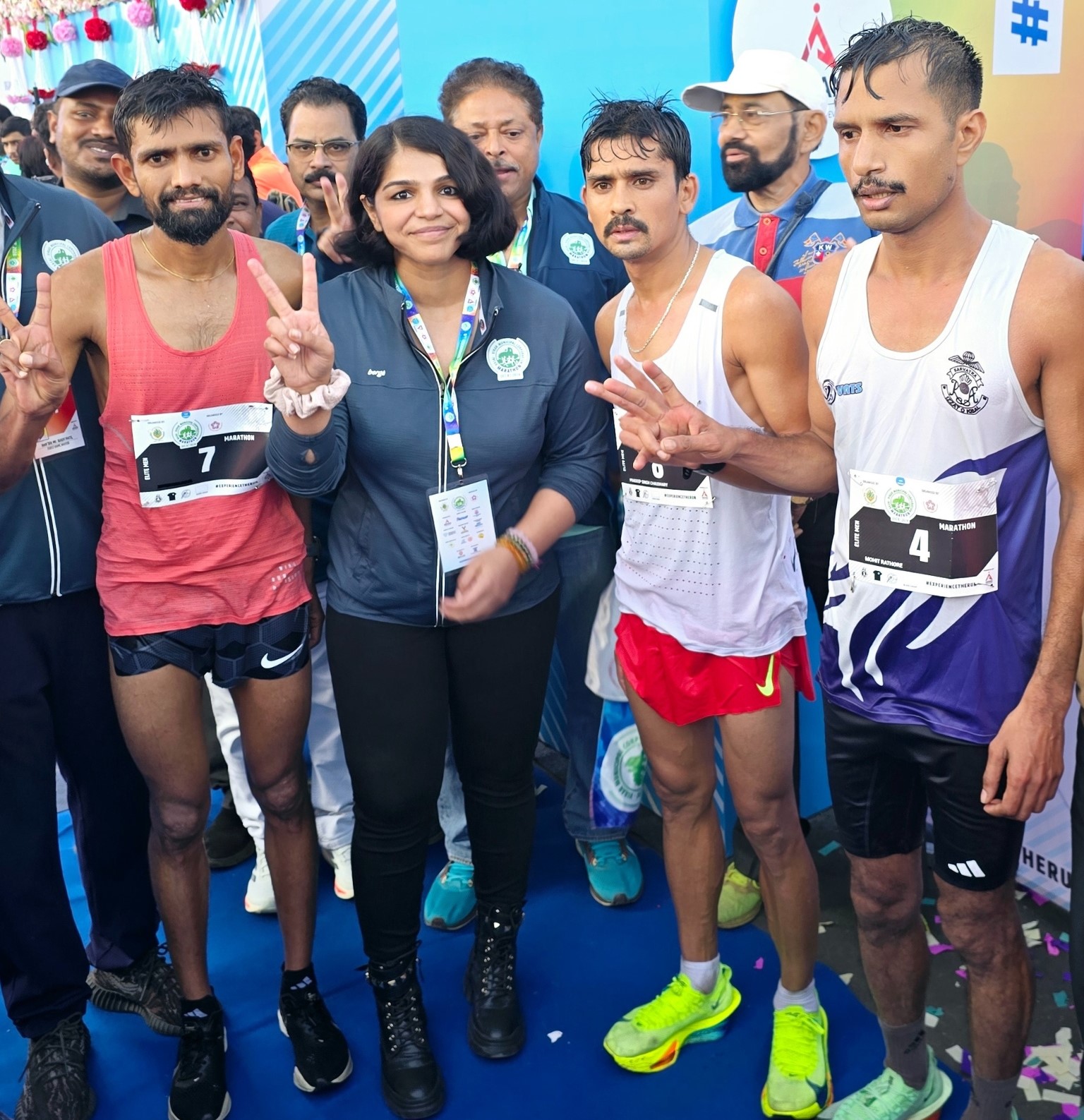
Sakshi Malik, Olympic medallist and brand ambassador of VVMM, with Kalidas Hirave (left), Mohit Rathore (far right) and Pradeep Singh Chaudhary (photo: courtesy VVMM)
Course record smashed in the men’s half marathon
New course record in women’s half marathon
Kalidas Hirave won the 2024 Vasai Virar Municipal Marathon (VVMM) held on December 8.
The runner, who hails from Satara in Maharashtra, completed the race in two hours, 18 minutes and 21 seconds. He missed the course record in the men’s marathon by just seven seconds. Pradeep Singh Chaudhary came in second, finishing closely behind Kalidas in 2:18:26. Two-time winner, twice runner-up and course record holder Mohit Rathore finished third with timing of 2:19:09.
An official press release quoting Kalidas said that he had been initially uncertain of running the year’s VVMM. “ I changed my mind at the last minute and decided to run competitively,” he was quoted as saying. Kalidas won three lakh rupees as prize money.
Speaking to this blog, he said, “ I wanted to run the marathon as a practice for the Mumbai Marathon but ended up racing. I did not know what the course record here was.’’ He said that the course at VVMM was good as was the support. Kalidas works with the Life Insurance Corporation of India (LIC) and is currently posted in Nashik. He works from 10 AM to 2 PM and manages to train twice a day like elite athletes typically do.
According to VVMM’s press release, Mohit ran well and appeared to be on track for a third time win but fell back towards the end and finished third. He had set the course record of 2:18:05 in 2022.
The men’s half-marathon saw a photo-finish for the top two spots with Rohit Verma of the Navy pipping Nitesh Rathva by a mere one second. Rohit finished in 1:03:14. Deepak Kumbhar (1:03:18) placed third. Deepak was in the lead in the early miles but slowed down due to calf pain.
The top five runners beat the course record of 1:04.37 set by Anish Thapa in 2019 by a huge margin and also registered their personal bests. Rohit attributed his win to the pleasant weather on race day.
Haryana’s Sonika won the women’s half-marathon with a timing of 1:13:14, a new course record and also her personal best. The old record (1:13:33) stood in the name of Ujala, set in 2022. Bharti, also of Haryana, stood second with 1:13:54 while Sakshi Jadyal was third with 1:14:23.
The race was flagged off by Olympic and Commonwealth medallist Sakshi Malik, who was the brand ambassador of the event. The event was organized by the Vasai Virar City Municipal Corporation and the Vasai Virar Kala Kreeda Vikas Mandal, and promoted by Aryanz Sports.
(The author, Latha Venkatraman, is an independent journalist based in Mumbai)
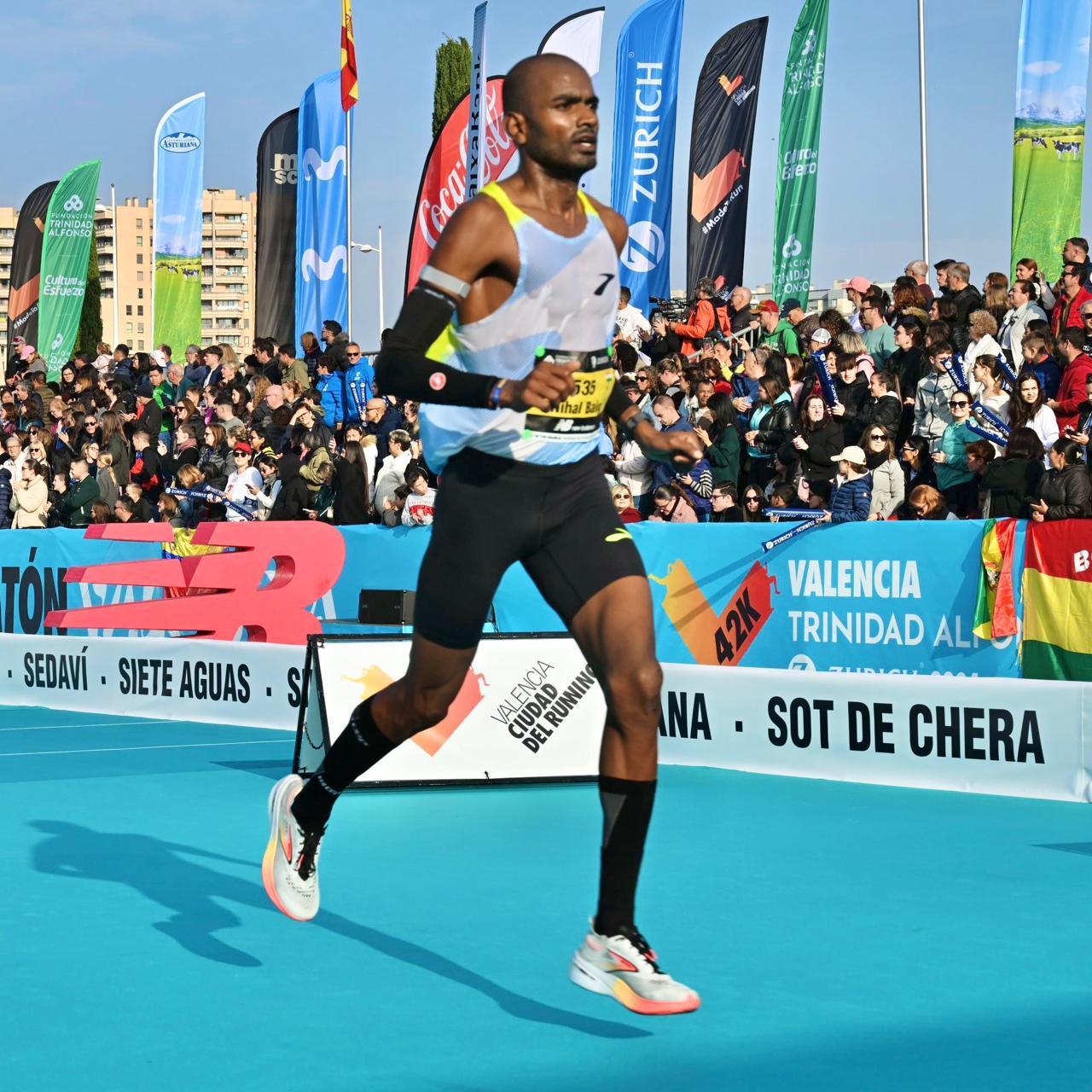
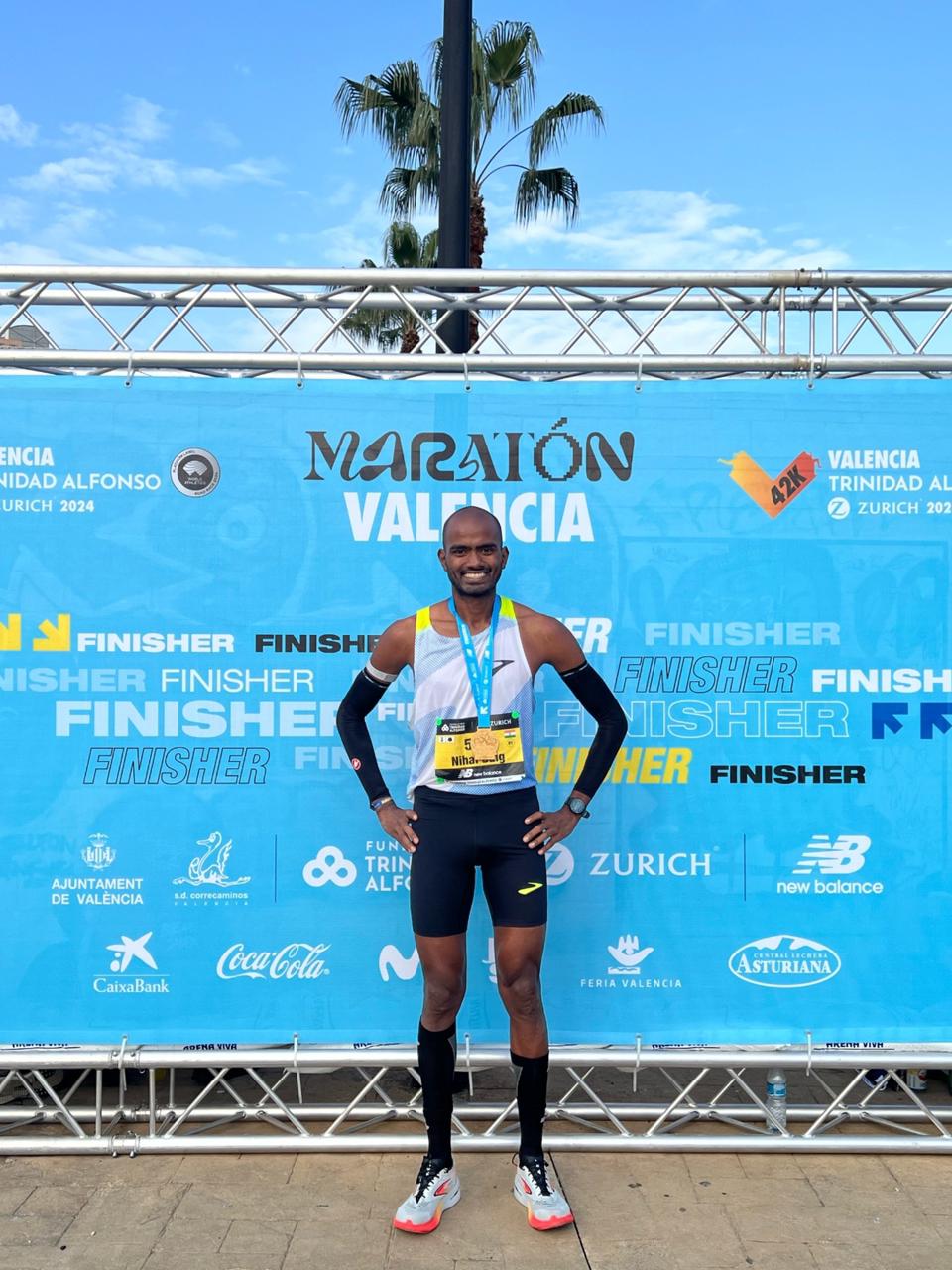
Nihal Ahamad Baig, triathlete and runner, recently completed the Valencia Marathon in two hours, 21 minutes and 48 seconds. It was a new personal best. The timing should rank high among recent performances by Indian amateur marathon runners.
The Pune-based recreational athlete has been a podium finisher in many road races as well as triathlons over the past few years. At the 2024 Vedanta Delhi Half Marathon, held on October 20, 2024, Nihal had finished with a personal best of 1:10:12 wining his age category (30 to 34 years) and securing overall sixth position.
He spoke to Latha Venkatraman about his training and the factors that helped him secure a new personal best at Valencia Marathon. Here’s Nihal’s account:
In April of 2023 I had to undergo a hernia surgery. I went off training initially for three months. I resumed training in a limited way but my mileage in running remained low until December 2023.
I decided to sign up for the 2024 Valencia Marathon mainly because it is known to have a flat course and as it is held in the December of every year the weather is expected to be good. It is also a popular race among Europeans. Given all the ideal conditions, it made sense to sign up for this race. Also, the December race is good for training for us runners in India. The Berlin Marathon takes place in September but that would entail training through our summer and monsoon months which isn’t ideal to achieve peak performance.
I started training for the Valencia Marathon in April 2024. The initial focus was to build strength and work alongside on my running form. Building strength was crucial for me as I was off serious training for almost a year. Working on the form is also essential to improve time efficiency. From April to July 2024, I focussed on strength training and my running form. I gradually built mileage up to about 120 kilometres per week in August.
My last full marathon was at the 2023 New Delhi Marathon where I was able to secure a personal record of 2:24.12.
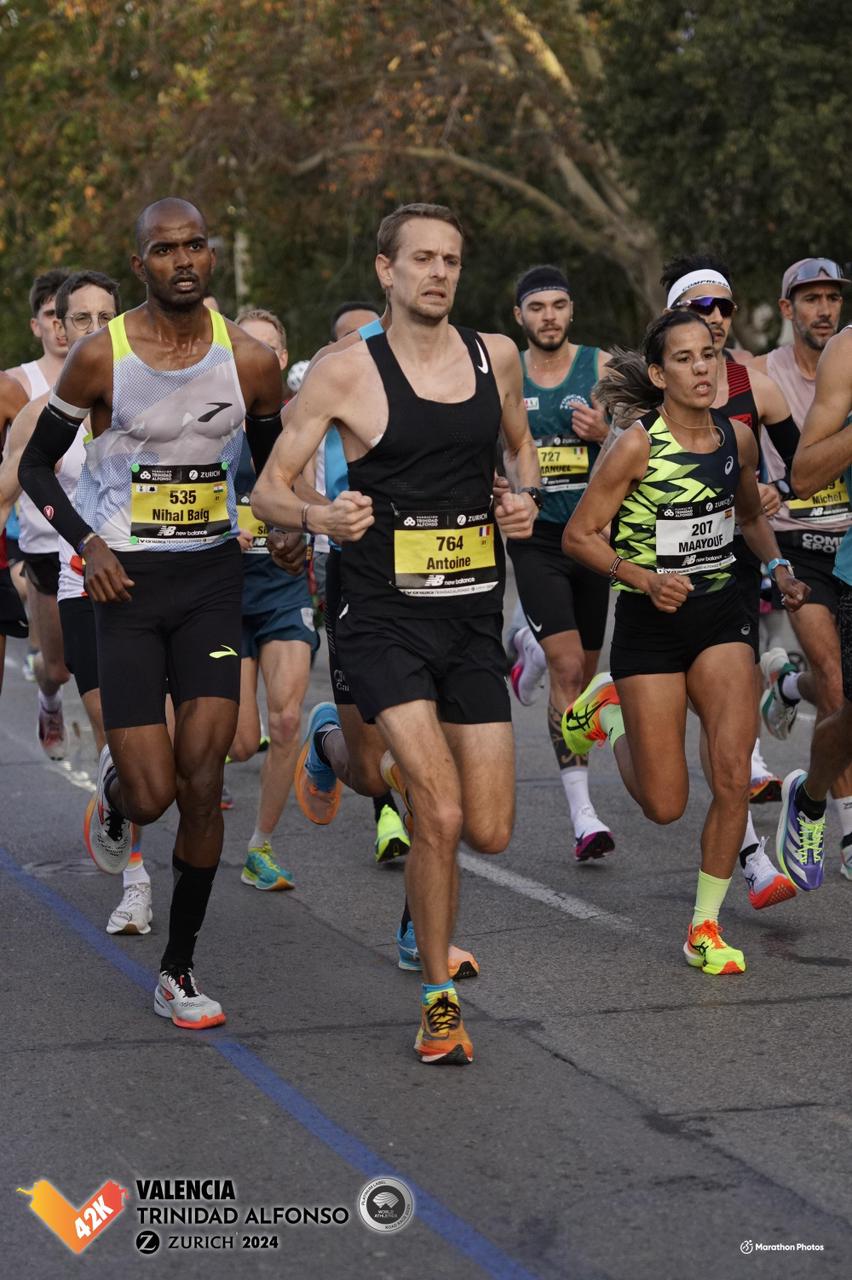
Nihal Ahamad Baig; running in the 2024 Valencia Marathon (photo: courtesy Nihal)
As part of my training for Valencia I decided to sign up for the 2024 Hyderabad Marathon. I wanted to run it as a practice run. It was a decent outing. I was able to finish in 2:40 hours. Following this race, I began to focus on race pace running. I also signed up for the 2024 Delhi Half Marathon as a build-up to my training. I finished the race in 1:10:12, also a new personal record for me in the half marathon.
My initial plan at Valencia Marathon was to focus on a sub-2:20 finish but I had to revise it to 2:22 to 2:23 as I had developed shin splints during the Hyderabad Marathon which interrupted my training for six weeks.
I had six weeks from the Delhi Half Marathon to Valencia Marathon. In terms of training it was a perfect block of time. During this period, I did a 5 km time trial and was able to secure a personal record. I was confident going into the race. But just 10 days before the race I picked up an ankle sprain in my right foot. I had to go to the physiotherapist. He asked me if I had tripped or suffered a fall during my training. I rested for two days and resumed my last stretch of training before I flew to Valencia.
I travelled to Valencia four days ahead of the race. While there, I did a couple of easy runs. I felt the pain in my ankle but I did not want it to impact me negatively.
On race day (December 1, 2024) the weather was good. At the start of the race it must have been around 12-13 degrees Celsius. I wore a singlet and arm sleeves and wore a sleeved t-shirt over it. At the start of the race I took off the t-shirt. It was cold but I was able to push my pace and heart rate. I was in the first corral of amateur runners. We were right behind the elite runners. The first two kilometres were crowded. From the third kilometre I was able to hit my target pace of 3:20 and hold on to it. I caught up with a Spanish elite runner and ran along with her for 15 kms.
At around the 18 kilometre-mark I felt a slight stiffness in my right leg and that affected my running form. I tried to hold on to my pace till the 32 km-mark. Until here, I was on track to get my 2:20 finish but I had to slow down a bit at that kilometre mark.
Nihal Ahamad Baig; at Valencia (photo: courtesy Nihal)
At Valencia, the route is mostly flat but there are many turns and a couple of ‘u’ turns. I had no problem with the left turns but I had to be cautious with the right turns. For a few moments I did feel the pain in my ankle more than I could handle. The roads were broad and runners had to veer away from the blue line to get hydration, which was available every five kilometres. They were offering 330 ml bottle. I was able to have 200 ml water every five kilometre. I took one 45 gm gel every 30 minutes.
The most amazing aspect of this race was the cheering of spectators’ right from the first kilometre to the last. This was my first international marathon. There were hundreds of people all along the course.
What helped me get a personal best were a few factors including my training with a mix of strength workout, working on my mental strength, maintaining a positive attitude, weather, running along with so many fast runners from Europe and the flat course.
At the end of this race, I felt confident that I could use this experience to positively work on my next training block and aim to improve further.
(Nihal spoke to Latha Venkatraman, an independent journalist based in Mumbai)
Japan and France win team gold in the men’s and women’s categories at the 2024 IAU 100 km World Championship in Bengaluru
On a day deemed warm by many overseas runners, the time taken by the winners to finish at the 2024 IAU 100 km World Championship in Bengaluru on Saturday, December 7, however impressed.
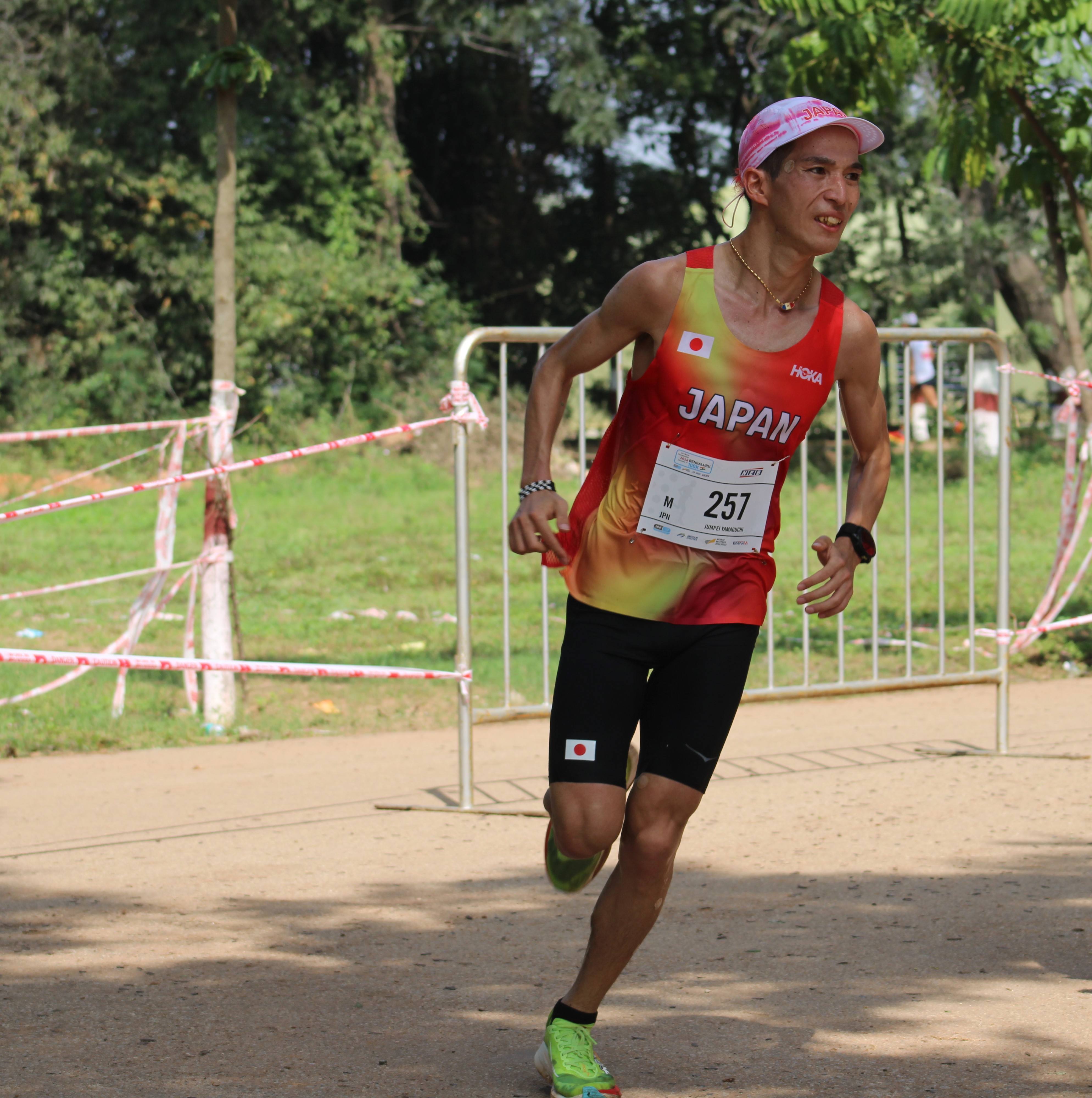
Winner in his gender category, Jumpei Yamaguchi of Japan led the men’s race from the start to the finish. He finished in 6:12:17, just seven minutes short of the 100 km-run world record of 6:05:35 set by Lithuania’s Aleksandr Sorokin in May 2023. At the last 100 km world championship held in 2022 in Bernau-Berlin, Germany, Yamaguchi had placed second in the men’s category with timing of 6:17:19.
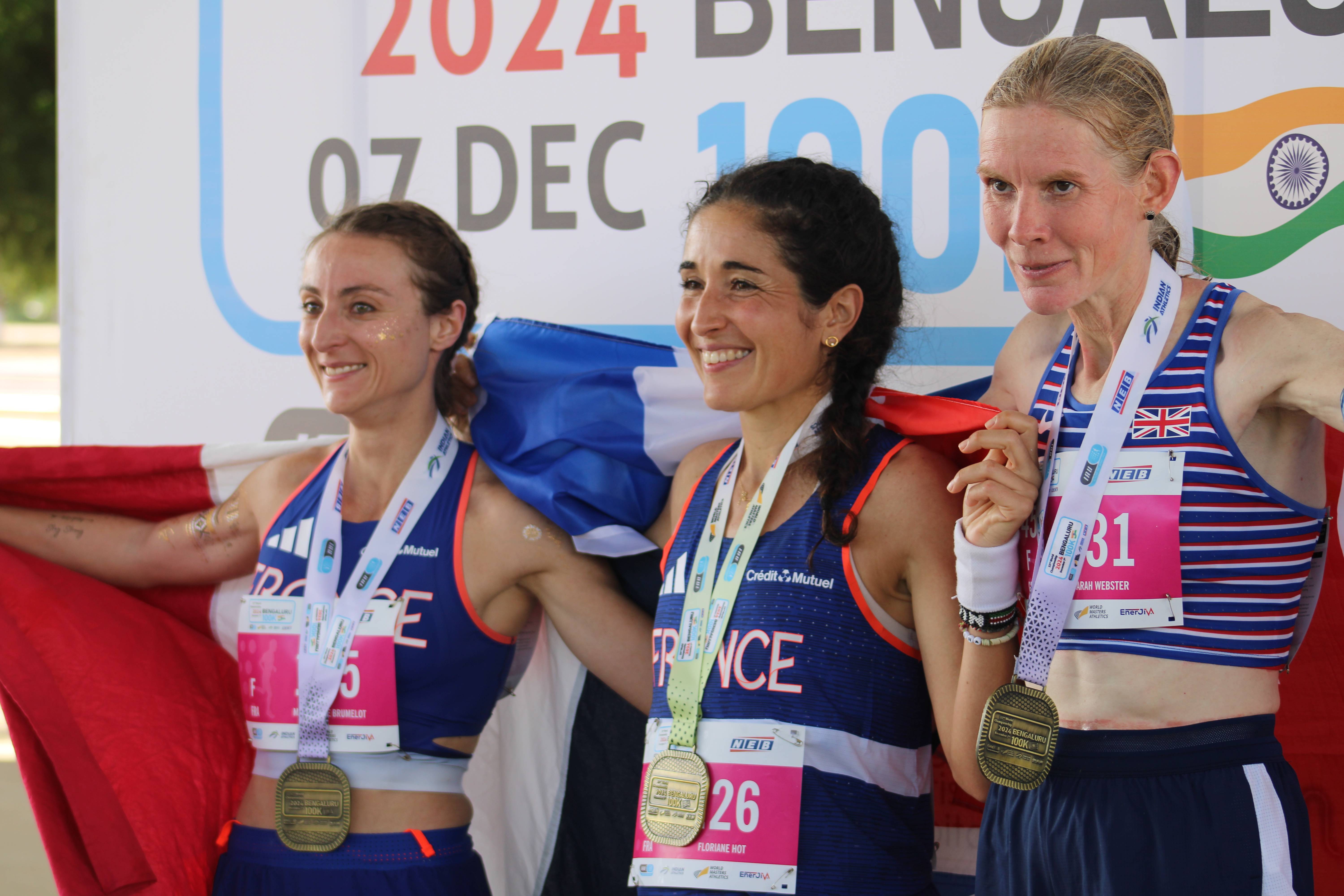
Floriane Hot (centre) with Marie-Ange Brumelot (left) and Sarah Webster (photo: Shyam G Menon)
On Saturday, Floriane Hot of France defended her title securing a gold medal with a finish of 7:08:43. In 2022, she had clocked 7:04:03. Floriane was followed to the finish line by her compatriot Marie-Ange Brumelot who covered the distance in 7:12:22. Sarah Webster of United Kingdom finished in 7:19:18 securing the third position in individual women’s race.
Japan and France clinched the team gold medal in the men’s and women’s categories respectively at the 2024 IAU 100 km World Championship.
In the men’s team event, Japan emerged winner with combined timing of 19 hours, 30 minutes and nine seconds (the aggregate of the leading three runners in each team is computed to arrive at the combined timing; the winner is the team having the lowest combined timing). Spain (20:02:32) secured a silver medal while Great Britain & Northern Ireland (20:28:18) took the bronze.
In the women’s team event, France emerged winner with a timing of 22:27:05 followed by Great Britain and Northern Ireland (22:55:50) and USA (23:36:49).
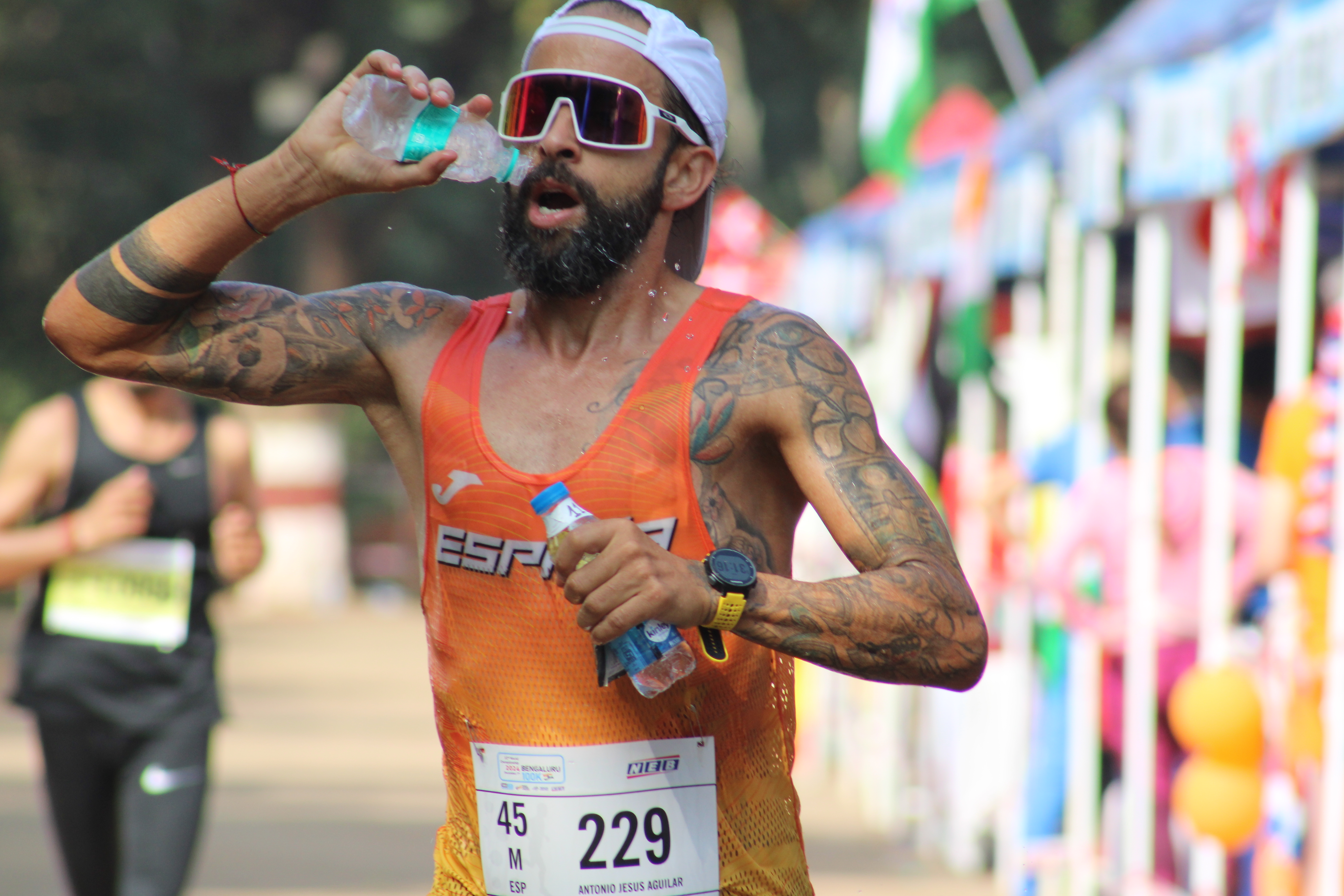
Antonio Jesus Aguilar of Spain (photo: Shyam G Menon)
The 2024 edition of the event took place at the sprawling GKVK campus on the outskirts of Bengaluru city. In the initial laps, three Japan male runners were leading but one of them fell back and two Spanish runners join the lead pack. Yamaguchi kept his lead and finished with a gold medal in his gender category. Antonio Jesus Aguilar of Spain finished second with timing of 6:25:54. More Japanese runners improved their position in the concluding laps and finished in third and fourth positions as well. Haruki Okayama, the defending champion, finished in third position with a timing of 6:37:54 and Toru Somiya of Japan finished in 6:39:58. At the 2022 edition of the event held in Bernau-Berlin, Haruki had won the men’s race in 6:12:10.
In the women’s race, Miho Nakata (world record holder in the 24 hour-run) of Japan was the initial leader followed by Sarah Webster of United Kingdom. A few laps later, Miho fell back and Sarah led all the way until the last few laps. Eventually, the French women (Floriane and Marie-Ange) took the lead and the first runner-up positions. Miho Nakata finished in fourth position with a timing of 7:25:52.
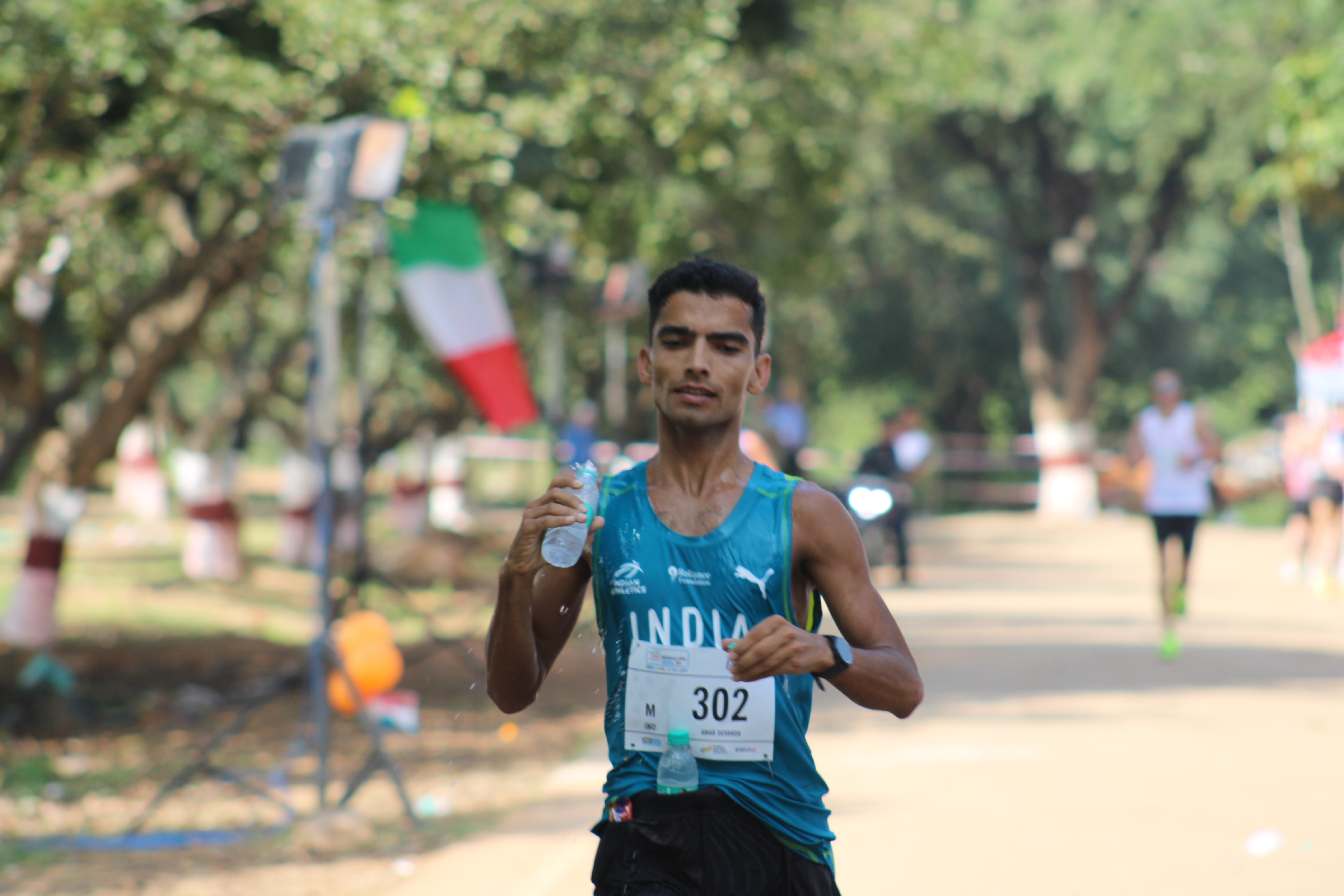
Amar Singh Devanda (photo: Shyam G Menon)
“ The route was beautiful with good tree cover. Though physically challenging, it was mentally satisfying,” Floriane said. Her compatriot Marie-Ange found the weather quite tough to handle. Sarah said she went too fast in the early stages of the race and that impacted her pace towards the end.
In the open category, Geeno Antony was the winner with timing of 7:55:39. Sugourav Goswami (8:23:42) finished second. In third position was Ankit Panwar (9:42:11). Though a bit disappointed with his timing, Geeno was otherwise happy with the outcome of the race.
Among Indian runners, Amar Singh Devanda, running as part of the national team, was the fastest finisher with a timing of 7:13, a new personal best. “ I went too fast in the initial laps of the race. By the end, I found it tough,” he said.
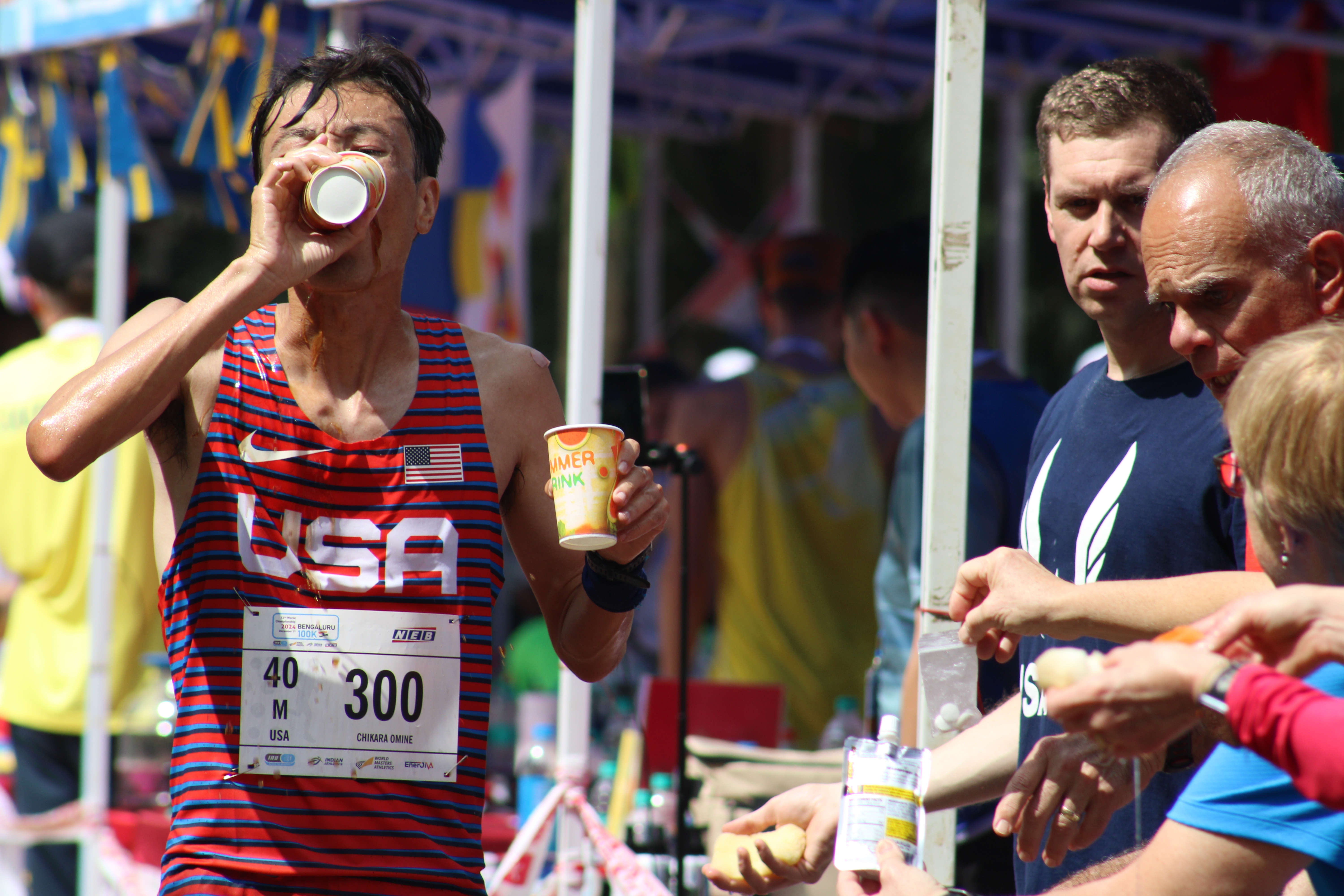
Hydrating adequately and staying cool emerged essential on the relatively warm race day; a scene from the aid station of team USA (photo: Shyam G Menon)
Vipul Kumar, who holds the national record for the 100 km (7:04:52 set at the previous IAU 100 km World Championship held at Bernau-Berlin in Germany), finished second among Indians with timing of 7:43:51. Binay Sah finished third (8:22:59).
Most runners said the weather was ideal at start but got very tough after the skies cleared and sun shone brightly. Runners were continuously reaching out for hydration, pouring water on themselves and covering their necks with ice packs to combat the heat. Against this backdrop, the timing reported by the likes of Japan’s Yamaguchi is genuinely impressive, a senior IAU official, arrived in Bengaluru to help oversee the event, said. According to him, the best team score to date has also been from Japan and the country had several victories to its credit in the team category.
(The authors, Latha Venkatraman and Shyam G Menon, are independent journalists based in Mumbai)
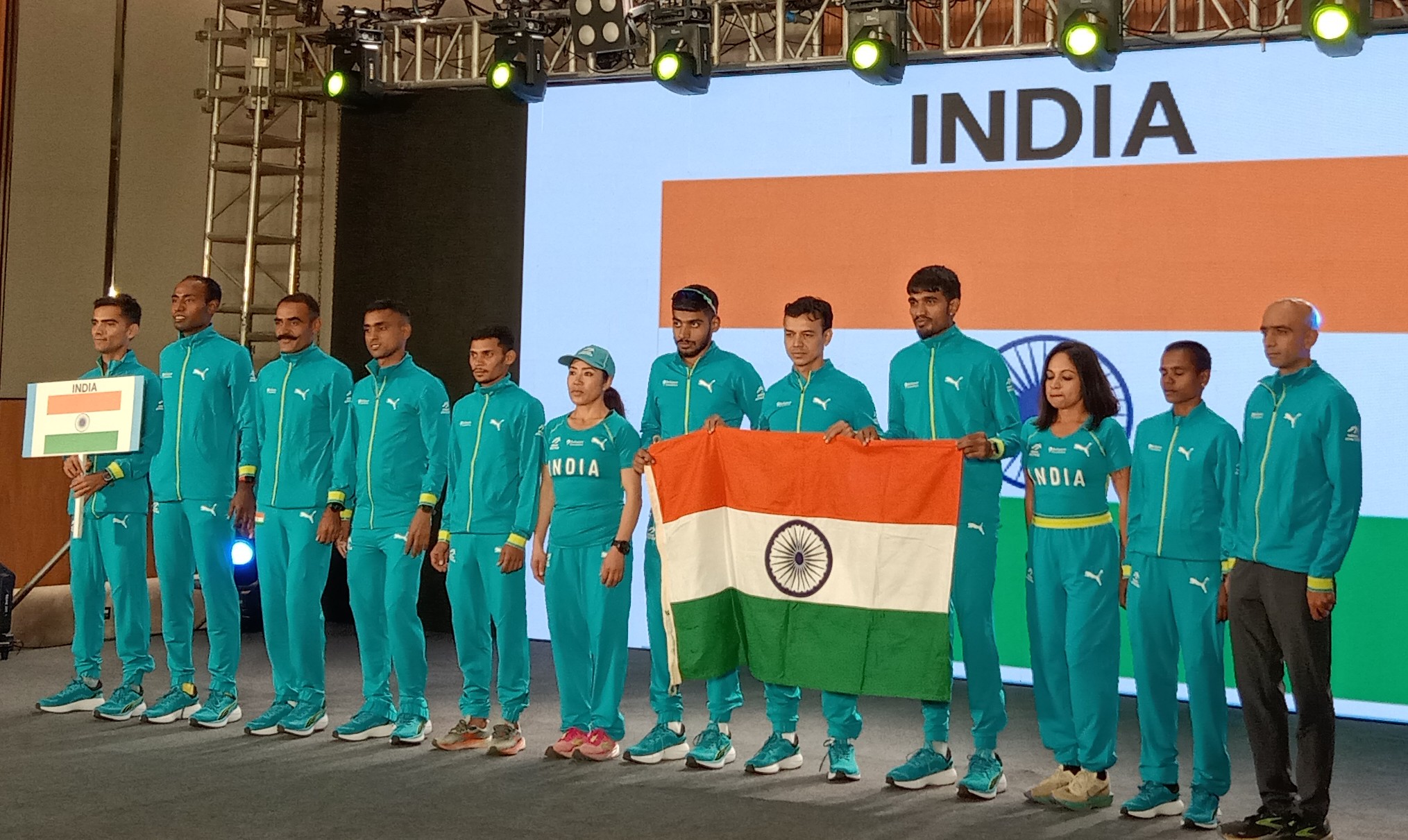
The Indian team for the 2024 IAU 100 km World Championship; at the opening ceremony of the event (photo: Shyam G Menon)
NEB Sports says it is talking to Tour de France to bring bicycle races to India
On Saturday, December 7, Bengaluru will witness the 2024 International Association of Ultrarunners (IAU) 100 km World Championship. The event was formally declared open today.
This is the first time India is hosting a 100 km World Championship. Last year, Hyderabad in Telengana had hosted the IAU 50 km World Championship.
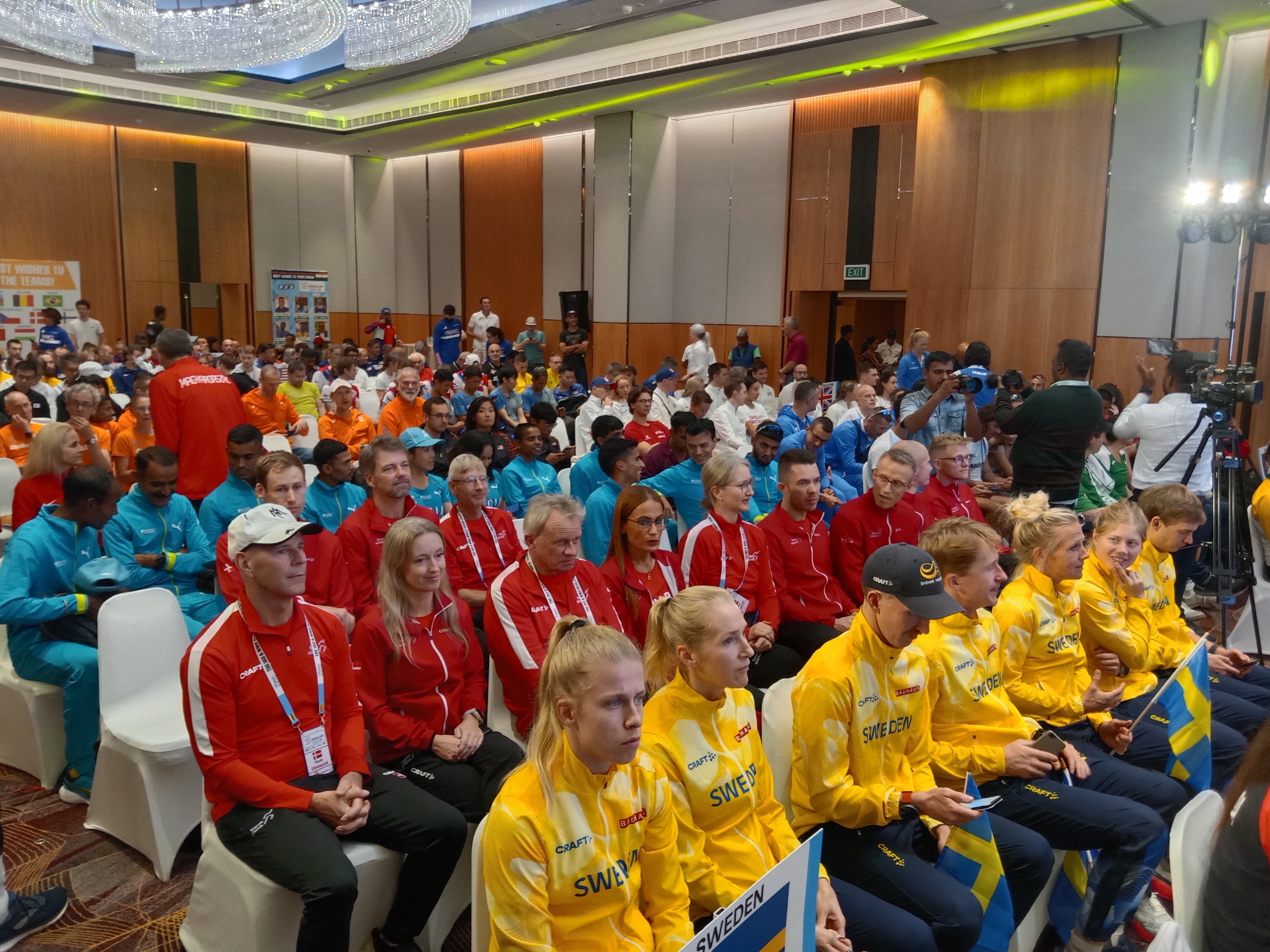
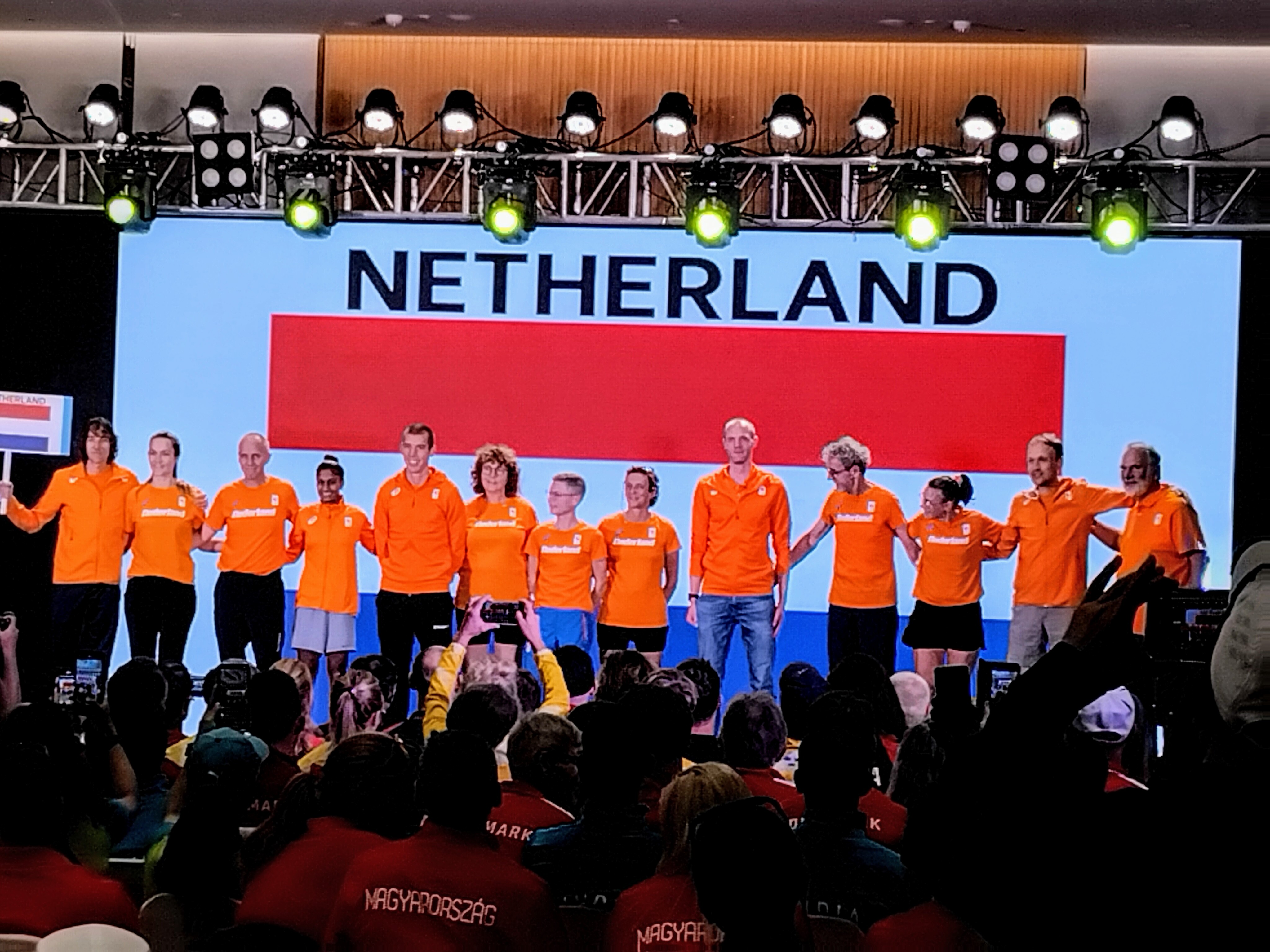
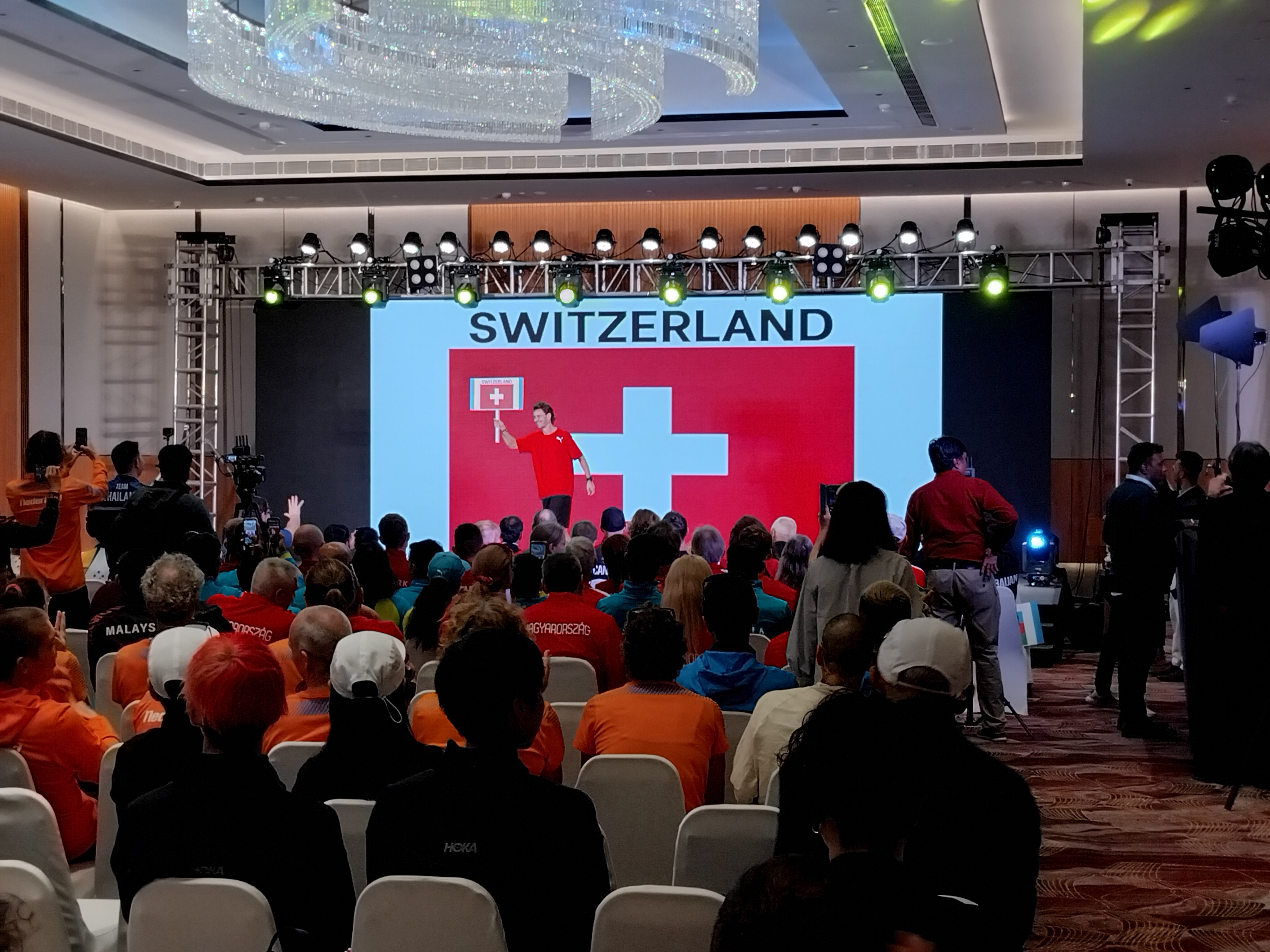
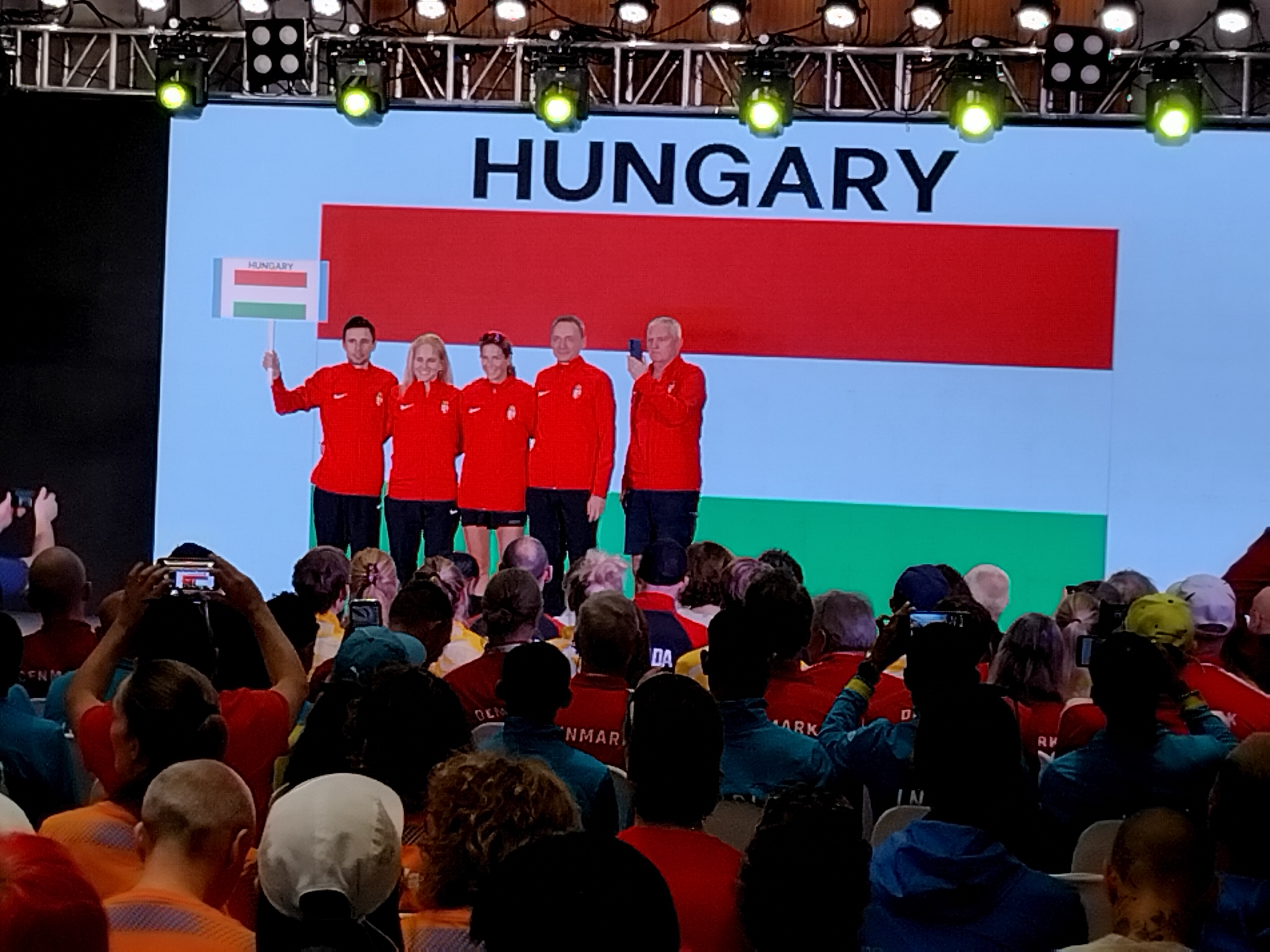
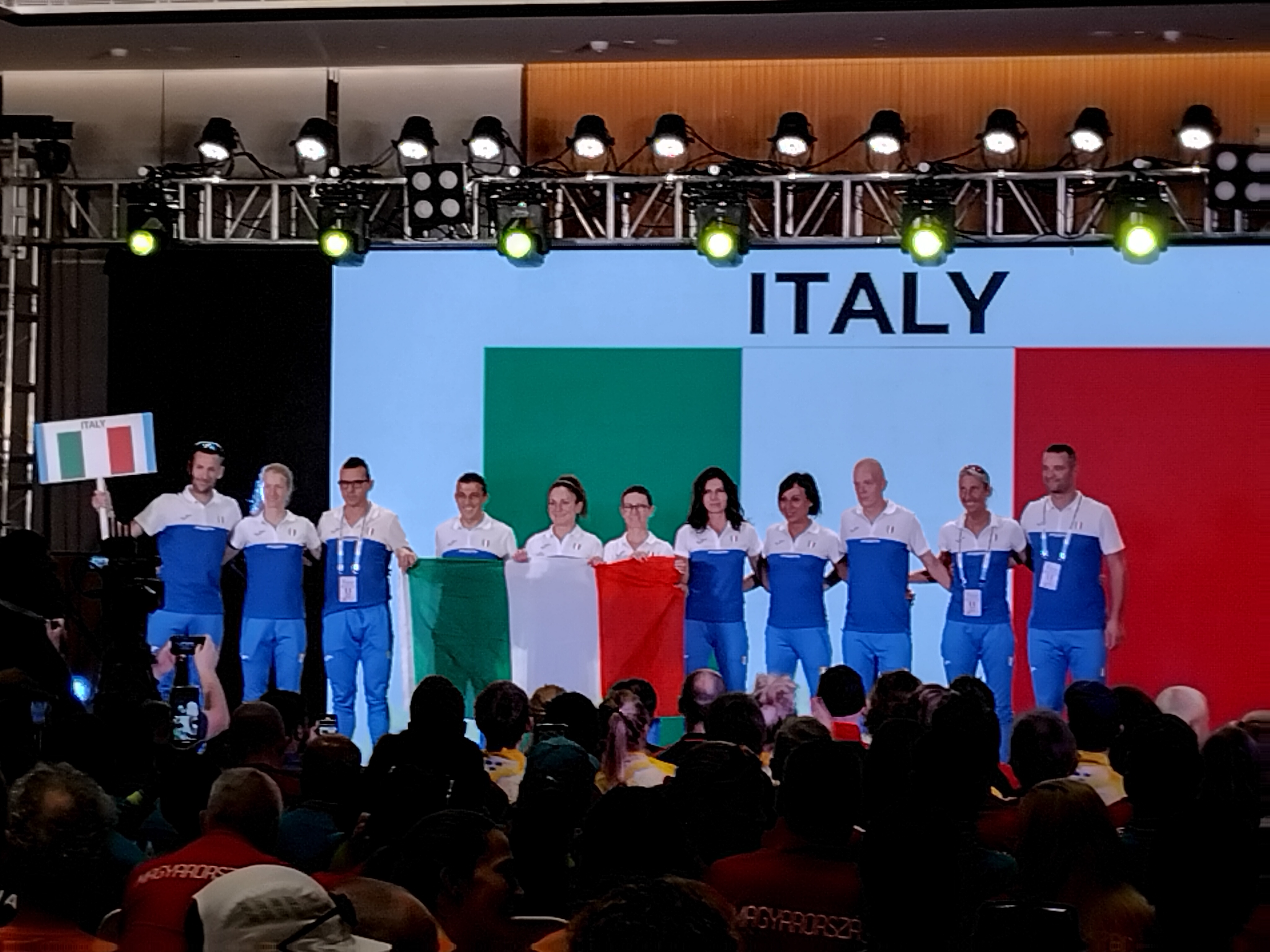
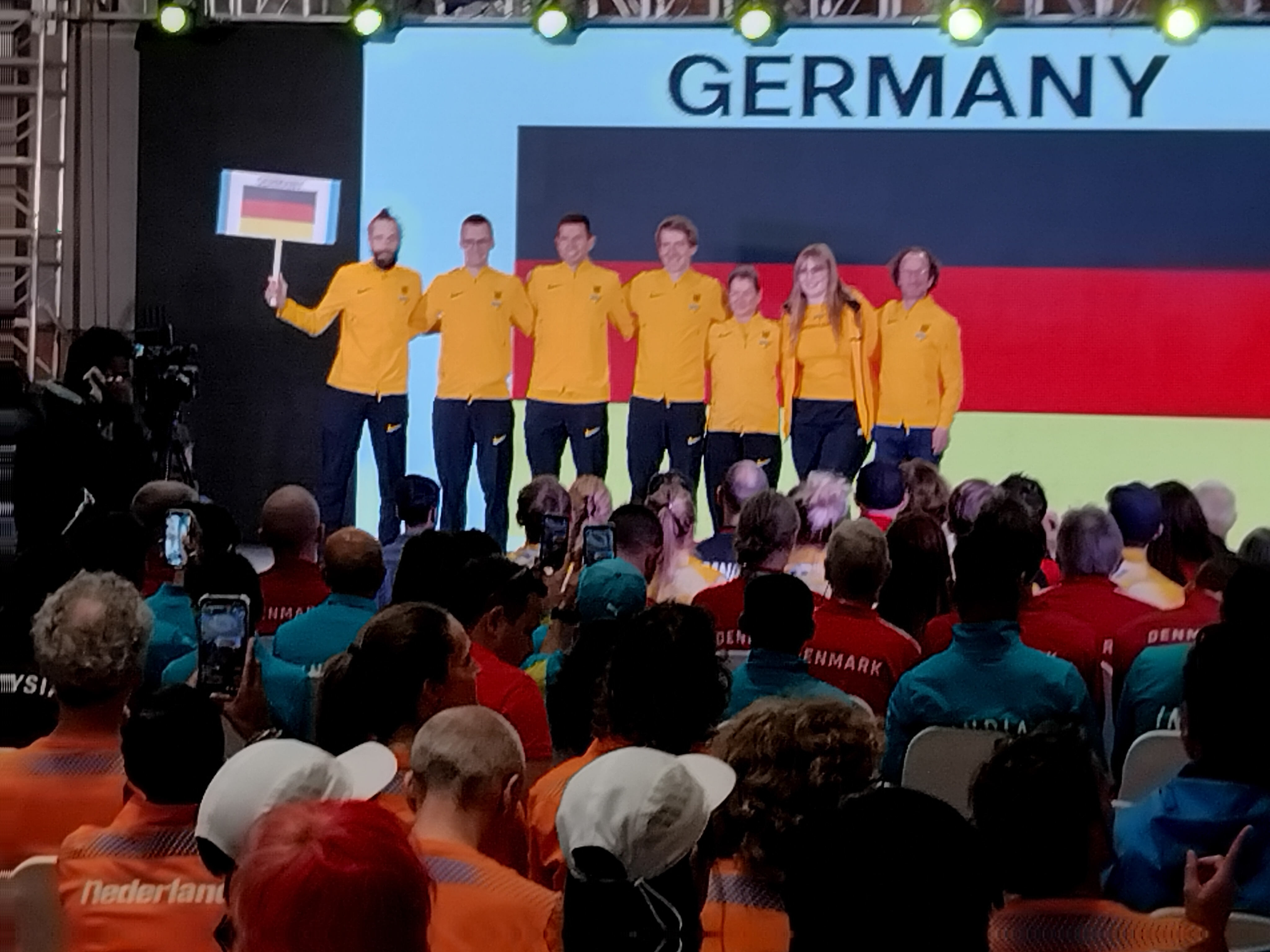
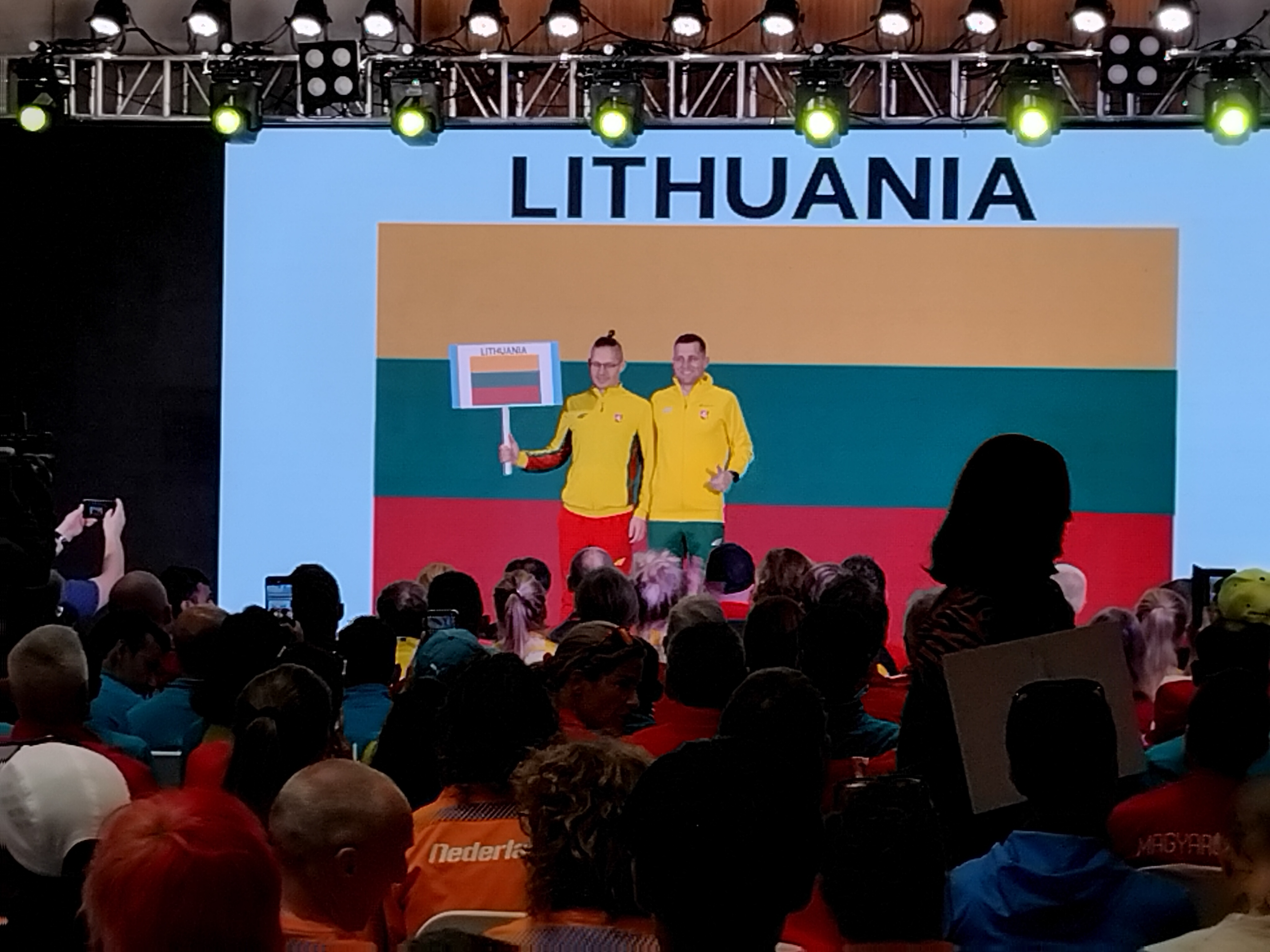
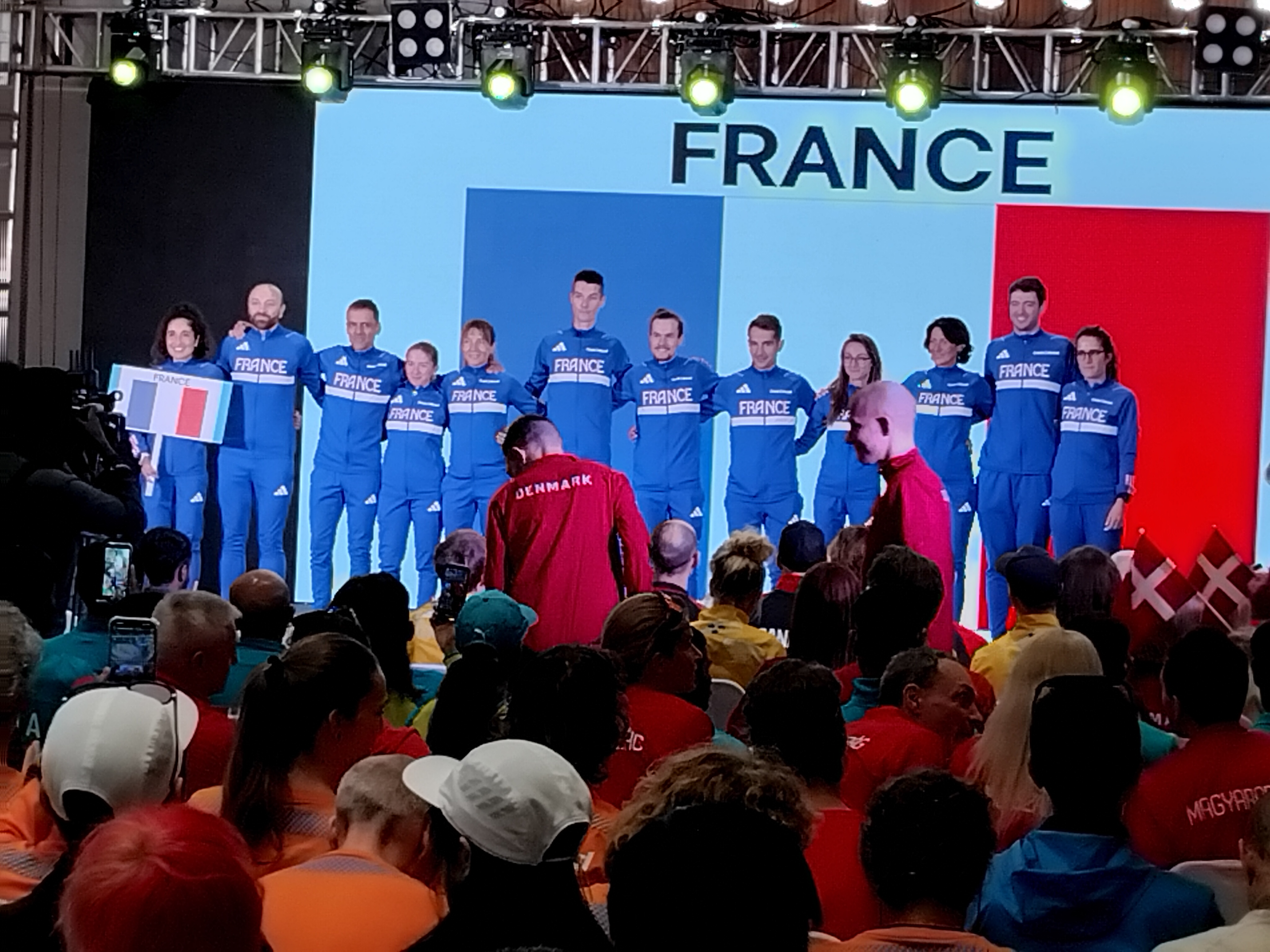
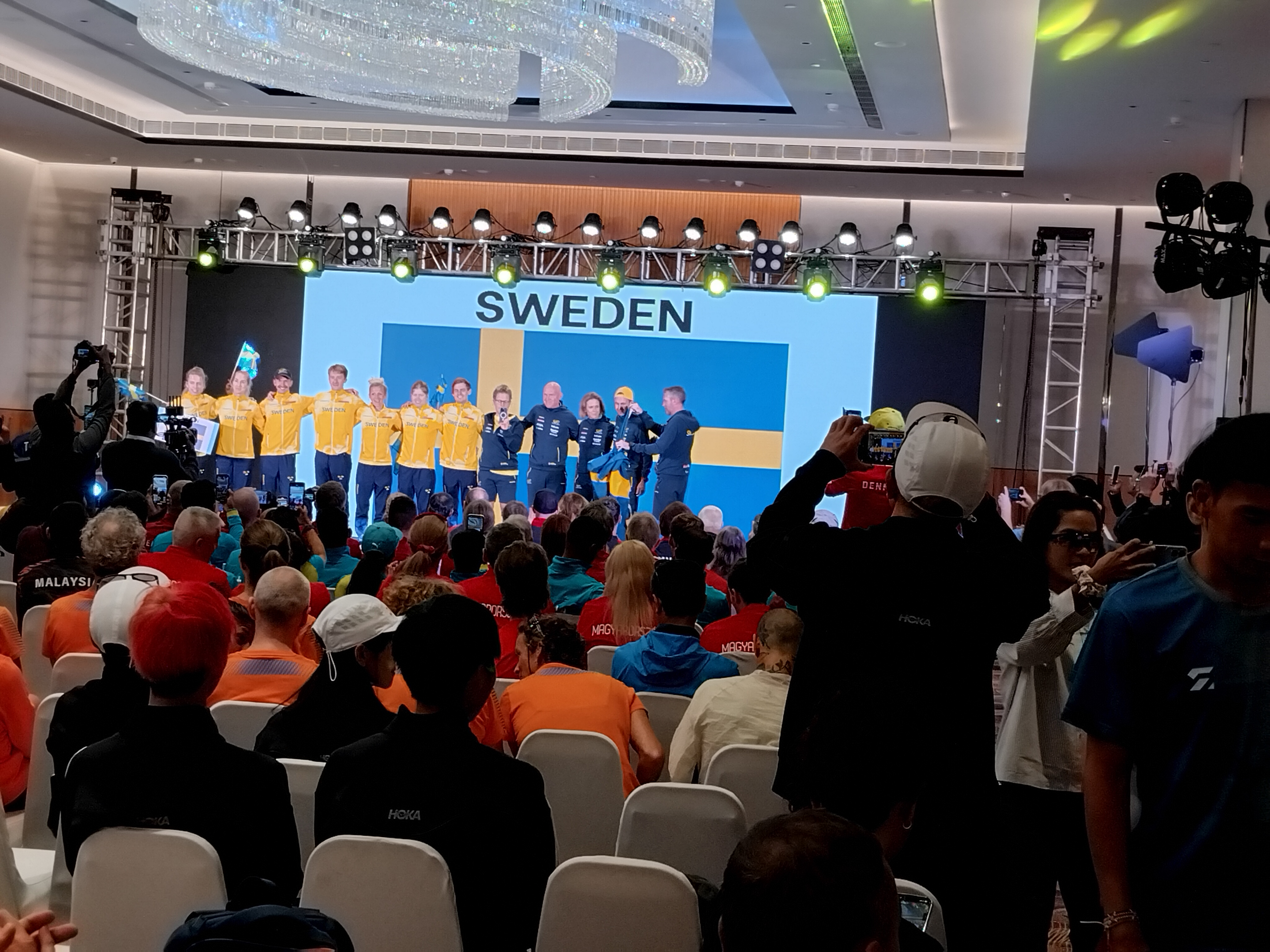
Athletes from different countries at the opening ceremony of the 2024 IAU 100 km World Championship, in Bengaluru (photo: Shyam G Menon)
About 300 ultrarunners from over 40 countries have landed in Bengaluru to participate in the championship. They will be competing in team and individual categories for both men and women.
The event supported by the Athletics Federation of India (AFI) is being held at the GKVK campus. It will also feature the World Masters 100 km Championships which allows participants to compete in five-year age categories (from 35 years onward).
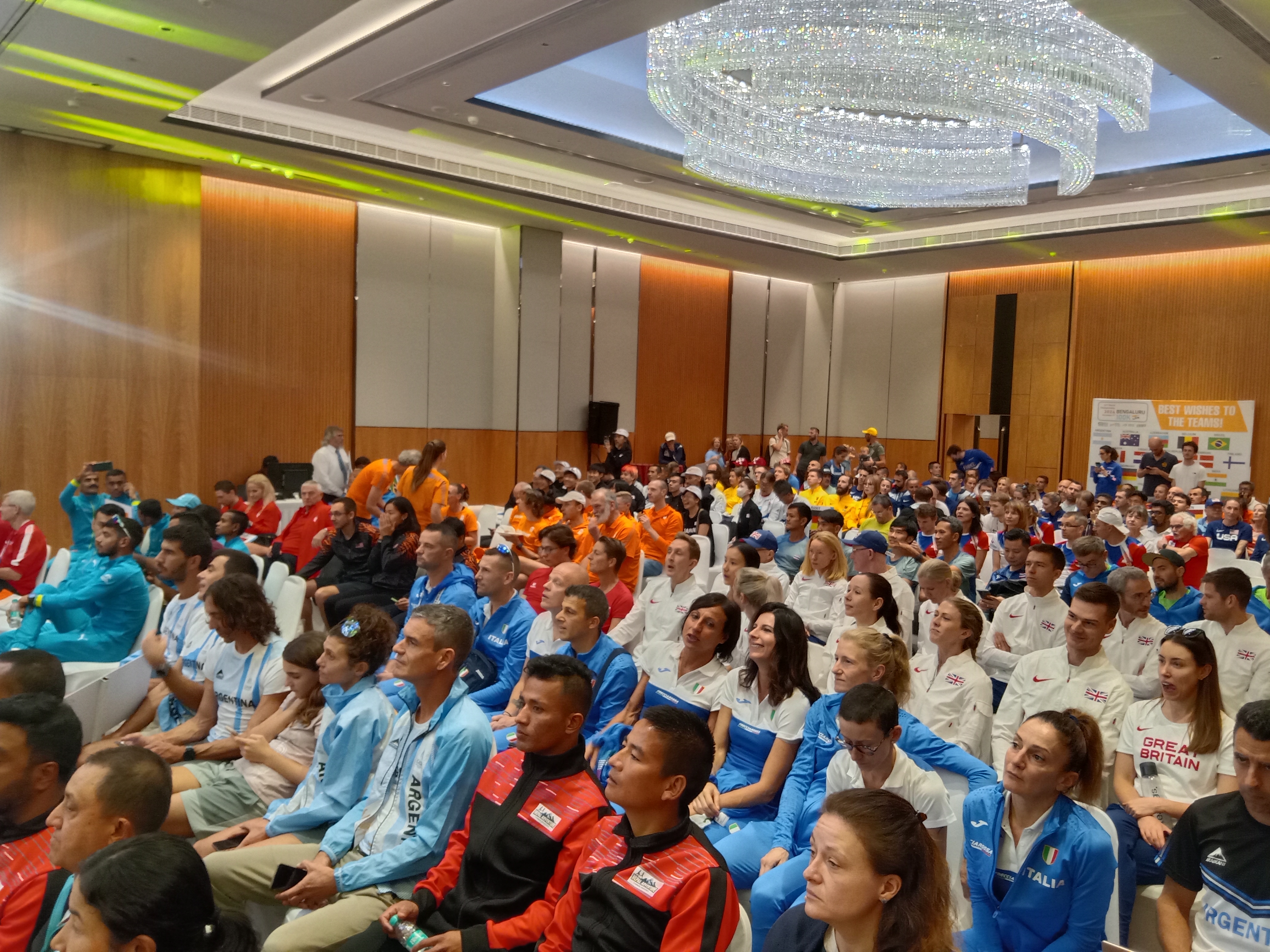
Athletes from different countries at the opening ceremony of the 2024 IAU 100 km World Championship, in Bengaluru (photo: Shyam G Menon)
Defending champions participating in the 2024 World Championship include Japan’s Haruki Okayama (winner) and Jumpei Yamaguchi in the men’s category. Among women, Floriane Hot (winner) from France and Caitriona Jennings (second runner-up) from Ireland will be participating.
“ The 100 km World Championships is not just a test of endurance but a celebration of human determination and camaraderie,” Dr Nadeem Khan, President of IAU, said at the opening ceremony of the Championship.
“ IAU has been growing strong and does not intend to stop. We intend to take the championships to places where we haven’t gone,” he said.
NEB Sports is organizing the event. Nagaraj Adiga, Chairman and Managing Director of NEB Sports, and the race director of the 100 km World Championship, said Bengaluru is an ideal city to host the Championship.
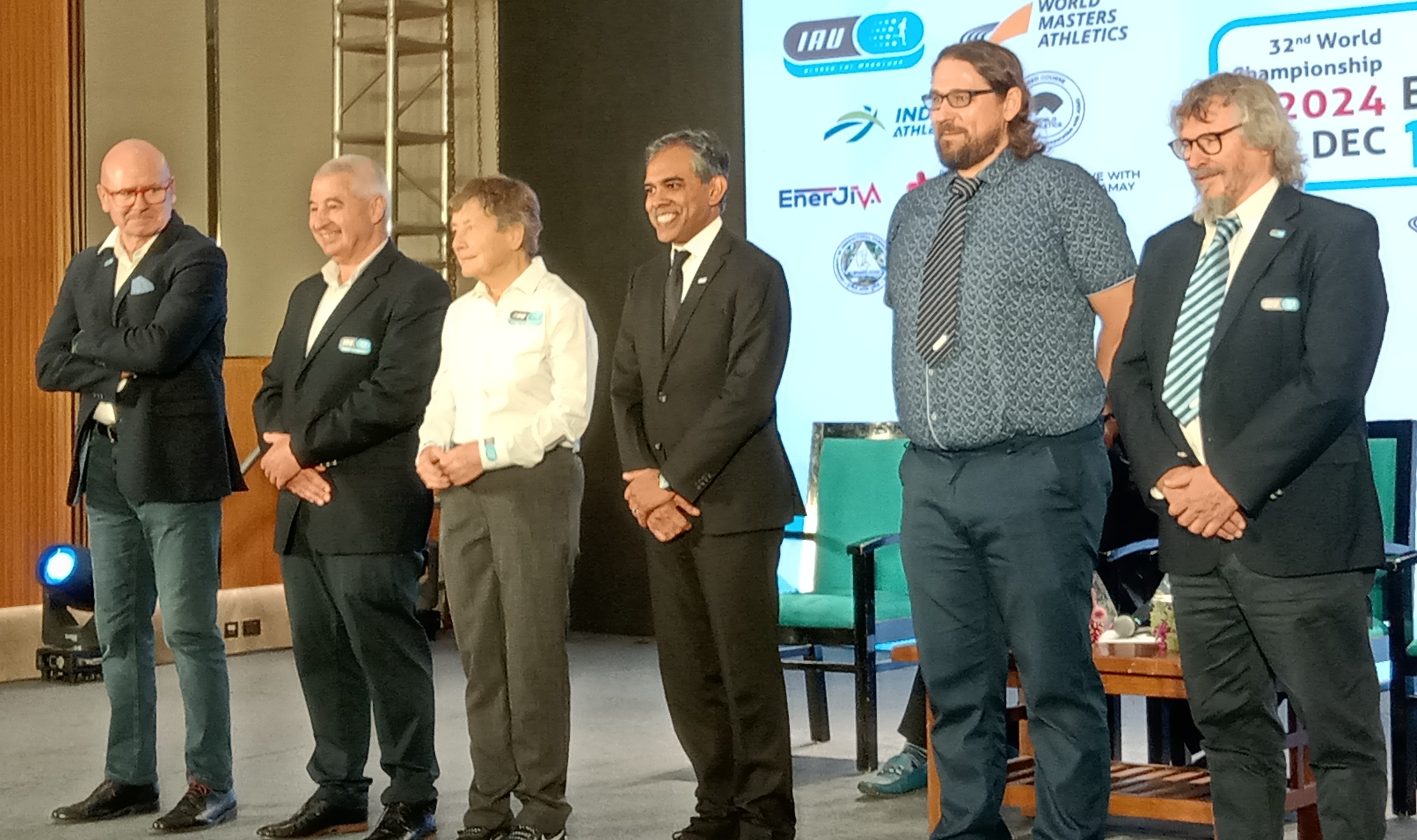
Senior officials of IAU led by its president Dr Nadeem Khan (third from right), at the opening ceremony of the 2024 IAU 100 km World Championship, in Bengaluru (photo: Shyam G Menon)
He pointed out that NEB Sports has been holding many running, triathlon and other non-cricket sporting events. He also said that NEB Sports is in talks with Tour de France to introduce a clutch of bicycle racing events in India.
Hosting the 100 km World Championship will help boost ultra-running as a sport in India, Adille Sumariwalla, President, AFI, was quoted as saying in a press note issued at the end of the opening ceremony.
(The author, Latha Venkatraman, is an independent journalist based in Mumbai)
Some more photos from the opening ceremony (photos: Latha Venkatraman)



 Outrigger