

For ultrarunners world over, Spartathlon in Greece, is a coveted event. The footrace, which traverses a mix of road, trail and mountain path for 246 kilometres commences in Athens and ends in Sparta. The race traces the footsteps of the Greek messenger Pheidippides, who ran from Athens to Sparta to convey the news of the Greek victory over the Persians, at the Battle of Marathon in 490 BC.
Runners have to clear 75 check points along the route, within a stipulated time, to continue to the finish line. They have to finish the 246 km-race within 36 hours.
For the 2024 edition of the race, four Indian ultrarunners had registered but only two completed. Two runners had to give up midway due to injury and ill health.
Ashok Singh completed the race in 30 hours, 14 minutes and 24 seconds and Shakti Singh in 35:08:49.
So far seven Indian runners including Ashok and Shakti have completed Spartathlon. Others who have completed this iconic race are Kieren D’Souza (2016), Munish Dev, Amit Kumar and Rakesh Kashyap (2022) and Jeevendra Singh (2023). Of these seven runners, Ashok Singh has finished the race in the fastest time yet by an Indian.
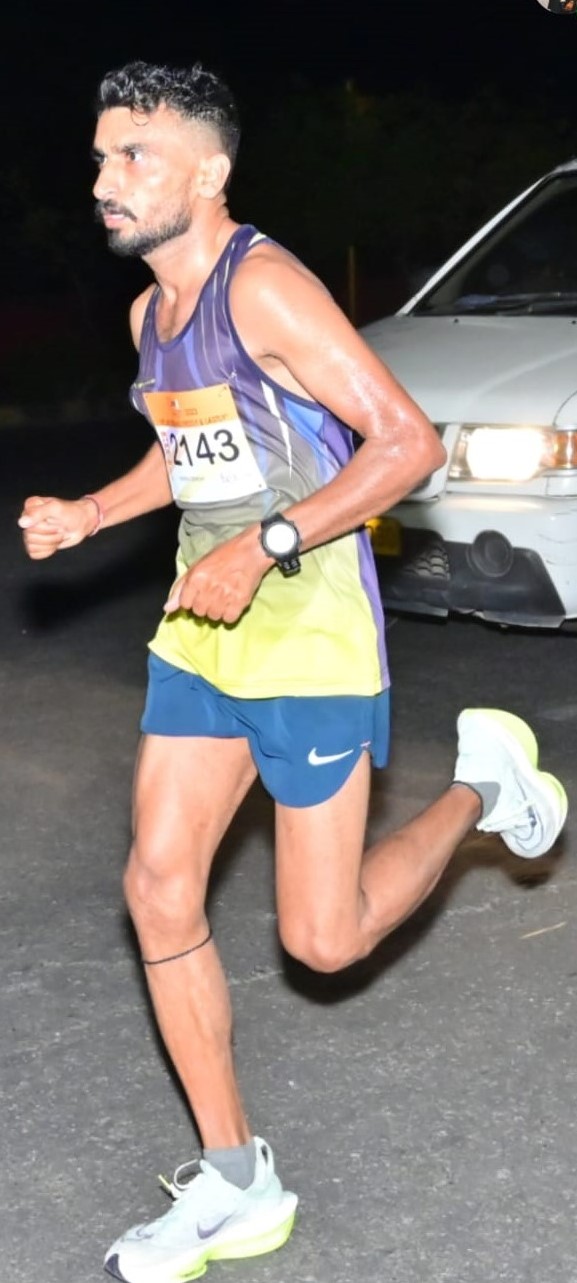
Ashok Singh
Ashok Singh, 32, from Ganeshwar village in Neem Ka Thana district of Rajasthan, started running during his college years when he ran 10 kilometres and half marathon distances.
“ I was good at running and that helped me to go through a gruelling physical exam to gain entry into the army,” Ashok said.
After joining the Indian Army, Ashok veered off regular running. “ A few years later I resumed running mainly to cut the weight that I had gained. I kept running and then went on to do a half marathon and a full marathon at some local running events,” he said.
In 2023, Ashok Singh did the 12-hour run at the Dharamshala Stadium Run where he emerged winner with a distance of 137.2 km covered. During this run, he learnt about other ultrarunning events.
In the same year, he ran the 100 miler at Border Ultra, finishing second with a timing of 17:15:58 hours. Earlier this year, Ashok Singh did the 24-hour stadium run at Tuffman 24-hour Stadium Run Chandigarh 2024. He was the winner with a distance of 230.23 km covered. Shakti came second with 196.09 km.
When Ashok learnt about Spartathlon he wanted to attempt it. He had already qualified for this ultra-distance race at the Border Ultra. Runners wanting to try Spartathlon are mandated to do a 100 mile (160 km) race within 21 hours. Ashok had done the Border Ultra 100 miler in a little over 17 hours, well within the cut-off.
“ I was told by other ultra-runners that as practice for Spartathlon I need to do a lot of hill runs. My village is surrounded by the Raoli Mountain Range. I did my 45-day training on these hills. I did not do any strength training,” he said.
Financial help in registering for Spartathlon, visa cost and air travel to Greece came from Ashok’s community group back home in Rajasthan. “ I was also given two pairs of running shoes and money for local use while there,” he said.
At Athens, Ashok started his race well. He finished 45 km in three and a half hours. “ After a while I got knee pain and was not able to walk. I had to lie down. I thought my race was over. I felt very dejected. My friends back home had gone to town over my Spartathlon attempt on social media. Thoughts about how I am going to face my friends and my community group, which had offered a huge financial help, kept haunting me,” he said.
According to Ashok, after a while, Munish (one of the four Indian ultrarunners participating in Spartathlon 2024) came along and goaded him to start walking. “ I slowly started walking. At the next aid station one volunteer gave me her knee cap. I also took a pill containing Paracetamol. This helped me. I started running again,’’ he said.
At Spartathlon, runners have to experience varying weather conditions, including the morning chill, warm and sharp sun and cold wind in the mountains. During the daytime, Ashok suffered nose bleeds because of the severe heat and sunny conditions.
“ The mountains were very tricky. For about 30-40 km it is a steep climb through narrow mountain paths. But I was able to make up for the lost time in the last 25 km, which is mostly downhill,” he said. Ashok did not change his shoes throughout the race. “ After my 185th km I did change my clothes to feel fresh for the remaining distance,” he said.
Post race, though Ashok has been able to recover from the gruelling race, sleep has been eluding him for several days even now.
Ashok has been doing a number of ultra-running events but he is yet to figure out his hydration and nutrition needs during ultra- distance runs.
His preferred ultra-running events are stadium runs. Going forward, he wants to focus attention on the marathon to improve speed running.
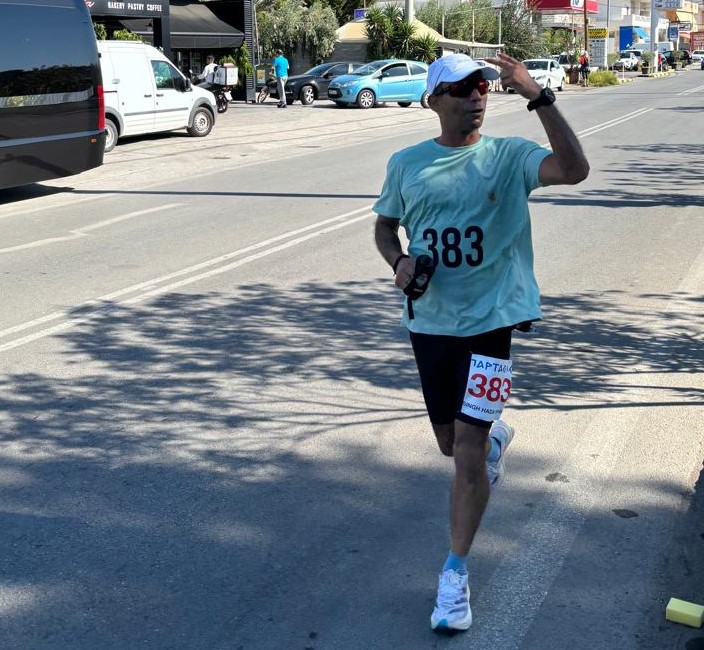
Shakti Singh Hada
Shakti Singh Hada is a more recent entrant to running. His first event was the Delhi Half Marathon in the year 2016.
A former army official, Shakti, who now runs an educational consultancy company, was a regular at a gym where he would run on the treadmills. “ At the gym, a person asked me to join Kota Running Club,” he said.
In 2017, Shakti ran the 63 km Chambal Challenge. “ During this run, I met Kieren D’Souza, who was the brand ambassador for Chambal Challenge. He told me about Spartathlon,” he said.
Shakti went on to do other ultra-running events, including the 111 km at La Ultra – The High and the 74 km La Ultra – Garhwal, which is the qualifying race for the main La Ultra runs in Ladakh.
The Covid-19 pandemic brought formal running activities to a halt but Shakti decided to challenge himself by running 10 km daily for 100 days without a break. Once the pandemic died Shakti continued his ultra-distance running, attempting various races including Backyard Ultra and Stadium Runs.
To train for Spartathlon, Santhosh Padmanabhan, manager of the Indian ultrarunning team, drew up a 90-day training plan for him. Shakti had to resort to running up and down apartment building staircases in the absence of hills in Kota, Rajasthan, where he lives. “ I did a number of training runs as chalked out by Santhosh sir. I did 6-hour, 7-hour, 10-hour, 12-hour and 20-hour training runs in the run-up to Spartathlon. I could say that my training was very good,” he said.
At Athens, his race started well but after 21 km he deviated on to a wrong path and lost some time. “ At one of the check points, I arrived with just 19 seconds to spare. But subsequently, I made up. After 24 hours of running, I changed my clothes and shoes to experience a fresh lease of enthusiasm,” he said.
“ I was a bit worried about cramps. Every hour, I ate salt tablets. Through the entire mountainous stretch, I walked as did most runners,” he said, adding, “ there was a lot of cheering along the route closer to the finish line in Sparta. There were many local music bands along the route.”
Shakti finished in 35:08:49 hours.
“ At the finish line, I cried. I was so happy to finish. Also, my brother was at the finish line. I got emotional seeing him. Many runners told me that it is not possible to complete Spartathlon in the first attempt,” he said.
“ Having finished Spartathlon, I can say that it is a very tough race. Intense hill training and understanding hydration and nutrition needs are extremely important. Training has to be intense,” he said.
Shakti’s recovery has been quite good. He now plans to do 24 hour stadium run.
(The author, Latha Venkatraman, is an independent journalist based in Mumbai)
 Outrigger